
Project Gutenberg's The Ship of Fools, Volume 1, by Sebastian Brandt

This eBook is for the use of anyone anywhere at no cost and with
almost no restrictions whatsoever.  You may copy it, give it away or
re-use it under the terms of the Project Gutenberg License included
with this eBook or online at www.gutenberg.org


Title: The Ship of Fools, Volume 1

Author: Sebastian Brandt

Translator: Alexander Barclay

Release Date: December 23, 2006 [EBook #20179]

Language: English

Character set encoding: ISO-8859-1

*** START OF THIS PROJECT GUTENBERG EBOOK THE SHIP OF FOOLS, VOLUME 1 ***


Produced by Frank van Drogen, Keith Edkins and the Online
Distributed Proofreading Team at http://www.pgdp.net (This
file was produced from images generously made available
by The Internet Archive/Canadian Libraries)
| Transcriber's note: | A few typographical errors in the 1874 introduction have been corrected. They appear in the text like this, and the explanation will appear when the mouse pointer is moved over the marked passage. In the spirit of the 1874 edition, the text of the Ship of Fools itself has been retained exactly as it stands, even to the punctuation. |
TRANSLATED BY
VOLUME FIRST
MDCCCLXXIV.
It is necessary to explain that in the present edition of the Ship of Fools, with a view to both philological and bibliographical interests, the text, even to the punctuation, has been printed exactly as it stands in the earlier impression (Pynson's), the authenticity of which Barclay himself thus vouches for in a deprecatory apology at the end of his labours (II. 330):—
"... some wordes be in my boke amys
For though that I my selfe dyd it correct
Yet with some fautis I knowe it is infect
Part by my owne ouersyght and neglygence
And part by the prynters nat perfyte in science
And other some escaped ar and past
For that the Prynters in theyr besynes
Do all theyr workes hedelynge, and in hast"
Yet the differences of reading of the later edition (Cawood's), are surprisingly few and mostly unimportant, though great pains were evidently bestowed on the production of the book, all the misprints being carefully corrected, and the orthography duly adjusted to the fashion of the time. These differences have, in this edition, been placed in one alphabetical arrangement with the glossary, by which plan it is believed reference to them will be made more easy, and much repetition avoided.
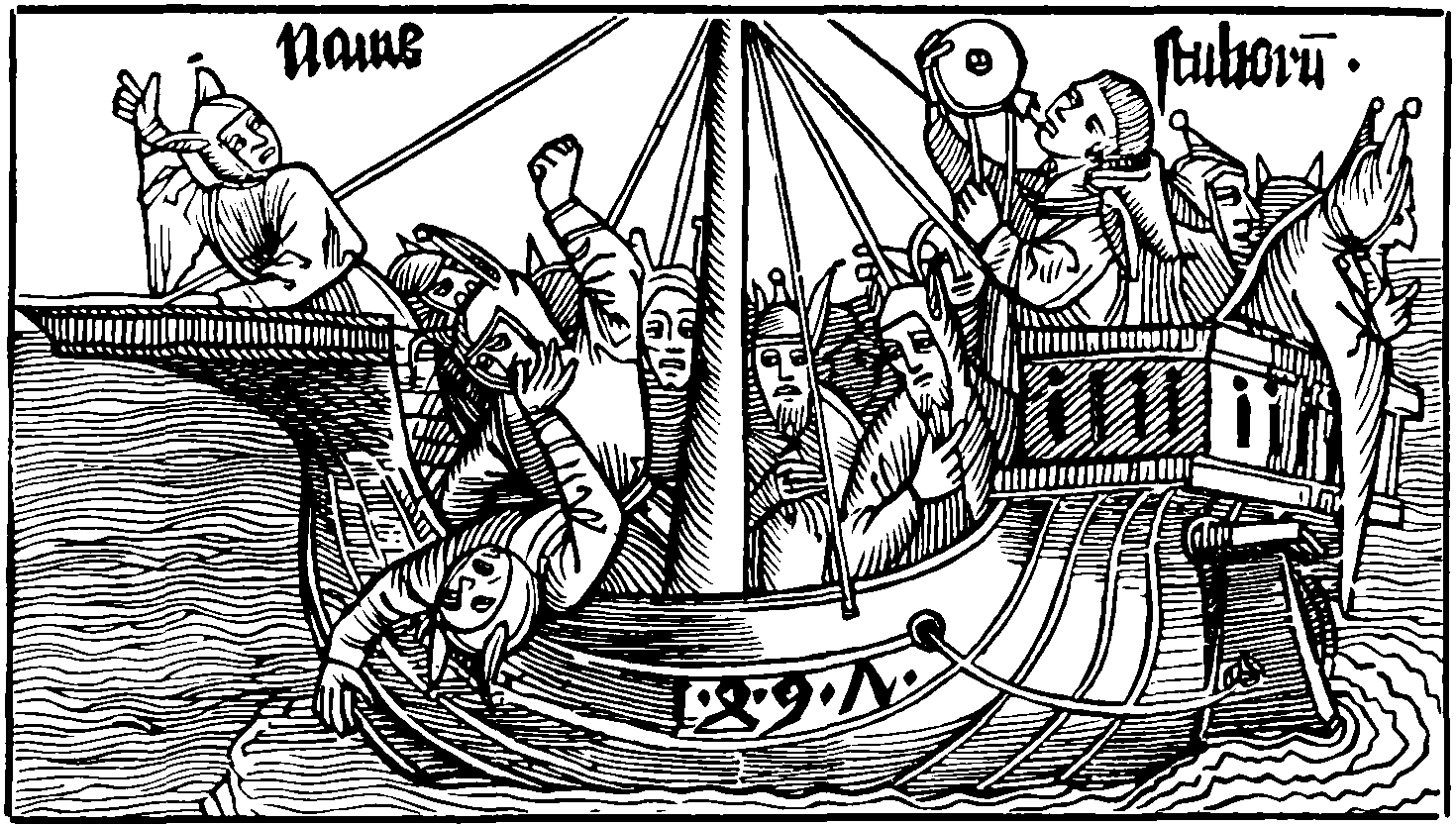
The woodcuts, no less valuable for their artistic merit than they are interesting as pictures of contemporary manners, have been facsimiled for the present edition from the originals as they appear in the Basle edition of the Latin, "denuo seduloque reuisa," issued under Brandt's own superintendence in 1497. This work has been done by Mr J. T. Reid, to whom it is due to say that he has executed it with the most painstaking and scrupulous fidelity.
The portrait of Brandt, which forms the frontispiece to this volume, is taken from Zarncke's edition of the Narrenschiff; that of Barclay presenting one of his books to his patron, prefixed to the Notice of his life, appears with a little more detail in the Mirror of Good Manners and the Pynson editions of the Sallust; it is, however, of no authority, being used for a similar purpose in various other publications.
For the copy of the extremely rare original edition from which the text of the present has been printed, I am indebted to the private collection and the well known liberality of Mr David Laing of the Signet Library, to whom I beg here to return my best thanks, for this as well as many other valuable favours in connection with the present work.
In prosecuting enquiries regarding the life of an author of whom so little is known as of Barclay, one must be indebted for aid, more or less, to the kindness of friends. In this way I have to acknowledge my obligations to Mr Æneas Mackay, Advocate, and Mr Ralph Thomas, ("Olphar Hamst"), for searches made in the British Museum and elsewhere.
For collations of Barclay's Works, other than the Ship of Fools, all of which are of the utmost degree of rarity, and consequent inaccessibility, I am indebted to the kindness of Henry Huth, Esq., 30 Princes' Gate, Kensington; the Rev. W. D. Macray, of the Bodleian Library, Oxford; W. B. Rye, Esq., of the British Museum; Henry Bradshaw, Esq., of the University Library, Cambridge; and Professor Skeat, Cambridge.
For my brief notice of Brandt and his Work, it is also proper to acknowledge my obligations to Zarncke's critical edition of the Narrenschiff (Leipzig, 1854) which is a perfect encyclopædia of everything Brandtian.
Advocates' Library,
Edinburgh, December 1873.
If popularity be taken as the measure of success in literary effort, Sebastian Brandt's "Ship of Fools" must be considered one of the most successful books recorded in the whole history of literature. Published in edition after edition (the first dated 1494), at a time, but shortly after the invention of printing, when books were expensive, and their circulation limited; translated into the leading languages of Europe at a time when translations of new works were only the result of the most signal merits, its success was then quite unparalleled. It may be said, in modern phrase, to have been the rage of the reading world at the end of the fifteenth and throughout the sixteenth centuries. It was translated into Latin by one Professor (Locher, 1497), and imitated in the same language and under the same title, by another (Badius Ascensius, 1507); it appeared in Dutch and Low German, and was twice translated into English, and three times into French; imitations competed with the original in French and German, as well as Latin, and greatest and most unprecedented distinction of all, it was preached, but, we should opine, only certain parts of it, from the pulpit by the best preachers of the time as a new gospel. The Germans proudly award it the epithet, "epoch-making," and its long-continued popularity affords good, if not quite sufficient, ground for the extravagant eulogies they lavish upon it. Trithemius calls it "Divina Satira," and doubts whether anything could have been written more suited to the spirit of the age; Locher compares Brandt with Dante, and Hutten styles him the new law-giver of German poetry.
A more recent and impartial critic (Müller, "Chips from a German Workshop," Vol. III.), thus suggestively sets forth the varied grounds of Brandt's wonderful popularity:—"His satires, it is true, are not very powerful, nor pungent, nor original. But his style is free and easy. Brant is not a ponderous poet. He writes in short chapters, and mixes his fools in such a manner that we always meet with a variety of new faces. It is true that all this would hardly be sufficient to secure a decided success for a work like his at the present day. But then we must remember the time in which he wrote.... There was room at that time for a work like the 'Ship of Fools.' It was the first printed book that treated of contemporaneous events and living persons, instead of old German battles and French knights. People are always fond of reading the history of their own times. If the good qualities of their age are brought out, they think of themselves or their friends; if the dark features of their contemporaries are exhibited, they think of their neighbours and enemies. Now the 'Ship of Fools' is just such a satire which ordinary people would read, and read with pleasure. They might feel a slight twinge now and then, but they would put down the book at the end, and thank God that they were not like other men. There is a chapter on Misers—and who would not gladly give a penny to a beggar? There is a chapter on Gluttony—and who was ever more than a little exhilarated after dinner?
There is a chapter on Church-goers—and who ever went to church for respectability's sake, or to show off a gaudy dress, or a fine dog, or a new hawk? There is a chapter on Dancing—and who ever danced except for the sake of exercise? There is a chapter on Adultery—and who ever did more than flirt with his neighbour's wife? We sometimes wish that Brant's satire had been a little more searching, and that, instead of his many allusions to classical fools (for his book is full of scholarship), he had given us a little more of the chronique scandaleuse of his own time. But he was too good a man to do this, and his contemporaries were no doubt grateful to him for his forbearance."
Brandt's satire is a satire for all time. Embodied in the language of the fifteenth century, coloured with the habits and fashions of the times, executed after the manner of working of the period, and motived by the eager questioning spirit and the discontent with "abusions" and "folyes" which resulted in the Reformation, this satire in its morals or lessons is almost as applicable to the year of grace 1873 as to the year of gracelessness 1497. It never can grow old; in the mirror in which the men of his time saw themselves reflected, the men of all times can recognise themselves; a crew of "able-bodied" is never wanting to man this old, weather-beaten, but ever seaworthy vessel. The thoughtful, penetrating, conscious spirit of the Basle professor passing by, for the most part, local, temporary or indifferent points, seized upon the never-dying follies of human nature and impaled them on the printed page for the amusement, the edification, and the warning of contemporaries and posterity alike. No petty writer of laborious vers de societe to raise a laugh for a week, a month, or a year, and to be buried in utter oblivion for ever after, was he, but a divine seer who saw the weakness and wickedness of the hearts of men, and warned them to amend their ways and flee from the wrath to come. Though but a retired student, and teacher of the canon law, a humble-minded man of letters, and a diffident imperial Counsellor, yet is he to be numbered among the greatest Evangelists and Reformers of mediæval Europe whose trumpet-toned tongue penetrated into regions where the names of Luther or Erasmus were but an empty sound, if even that. And yet, though helping much the cause of the Reformation by the freedom of his social and clerical criticism, by his unsparing exposure of every form of corruption and injustice, and, not least, by his use of the vernacular for political and religious purposes, he can scarcely be classed in the great army of the Protestant Reformers. He was a reformer from within, a biting, unsparing exposer of every priestly abuse, but a loyal son of the Church, who rebuked the faults of his brethren, but visited with the pains of Hell those of "fals herytikes," and wept over the "ruyne, inclynacion, and decay of the holy fayth Catholyke, and dymynucion of the Empyre."
So while he was yet a reformer in the true sense of the word, he was too much of the scholar to be anything but a true conservative. To his scholarly habit of working, as well as to the manner of the time which hardly trusted in the value of its own ideas but loved to lean them upon classical authority, is no doubt owing the classical mould in which his satire is cast. The description of every folly is strengthened by notice of its classical or biblical prototypes, and in the margin of the Latin edition of Locher, Brandt himself supplied the citations of the books and passages which formed the basis of his text, which greatly added to the popularity of the work. Brandt, indeed, with the modesty of genius, professes that it is really no more than a collection and translation of quotations from biblical and classical authors, "Gesamlet durch Sebastianu Brant." But even admitting the work to be a Mosaic, to adopt the reply of its latest German editor to the assertion that it is but a compilation testifying to the most painstaking industry and the consumption of midnight oil, "even so one learns that a Mosaic is a work of art when executed with artistic skill." That he caused the classical and biblical passages flitting before his eyes to be cited in the margin proves chiefly only the excellence of his memory. They are also before our eyes and yet we are not always able to answer the question: where, e.g., does this occur? ... Where, e.g., occur the following appropriate words of Goethe: "Who can think anything foolish, who can think anything wise, that antiquity has not already thought of."
Of the Greek authors, Plutarch only is used, and he evidently by means of a Latin translation. But from the Latin large draughts of inspiration are taken, direct from the fountainhead. Ovid, Juvenal, Persius, Catullus, and Seneca, are largely drawn from, while, strangely enough, Cicero, Boethius, and Virgil are quoted but seldom, the latter, indeed, only twice, though his commentators, especially Servetus, are frequently employed. The Bible, of course, is a never-failing source of illustration, and, as was to be expected, the Old Testament much more frequently than the New, most use being made of the Proverbs of Solomon, while Ecclesiastes, Ecclesiasticus, and the Sapientia follow at no great distance.
The quotations are made apparently direct from the Vulgate, in only a few cases there being a qualification of the idea by the interpretation of the Corpus Juris Canonici. But through this medium only, as was to be expected of the professor of canon law, is the light of the fathers of the Church allowed to shine upon us, and according to Zarncke (Introduction to his edition of the Narrenschiff, 1854), use of it has certainly been made far oftener than the commentary shows, the sources of information of which are of the most unsatisfactory character. On such solid and tried foundations did Brandt construct his great work, and the judgment of contemporaries and posterity alike has declared the superstructure to be worthy of its supports.
The following admirable notice from Ersch and Grüber (Encyclopädie) sums up so skilfully the history, nature, and qualities of the book that we quote at length:—"The Ship of Fools was received with almost unexampled applause by high and low, learned and unlearned, in Germany, Switzerland, and France, and was made the common property of the greatest part of literary Europe, through Latin, French, English, and Dutch translations. For upwards of a century it was in Germany a book of the people in the noblest and widest sense of the word, alike appreciated by an Erasmus and a Reuchlin, and by the mechanics of Strassburg, Basel, and Augsburg; and it was assumed to be so familiar to all classes, that even during Brandt's lifetime, the German preacher Gailer von Kaiserberg went so far as to deliver public lectures from the pulpit on his friend's poem as if it had been a scriptural text. As to the poetical and humorous character of Brandt's poem, its whole conception does not display any extraordinary power of imagination, nor does it present in its details any very striking sallies of wit and humour, even when compared with older German works of a similar kind, such as that of Renner. The fundamental idea of the poem consists in the shipping off of several shiploads of fools of all kinds for their native country, which, however, is visible at a distance only; and one would have expected the poet to have given poetical consistency to his work by fully carrying out this idea of a ship's crew, and sailing to the 'Land of Fools.' It is, however, at intervals only that Brandt reminds us of the allegory; the fools who are carefully divided into classes and introduced to us in succession, instead of being ridiculed or derided, are reproved in a liberal spirit, with noble earnestness, true moral feeling, and practical common sense. It was the straightforward, the bold and liberal spirit of the poet which so powerfully addressed his contemporaries from the Ship of the Fools; and to us it is valuable as a product of the piety and morality of the century which paved the way for the Reformation. Brandt's fools are represented as contemptible and loathsome rather than foolish, and what he calls follies might be more correctly described as sins and vices.
"The 'Ship of Fools' is written in the dialect of Swabia, and consists of vigorous, resonant, and rhyming iambic quadrameters. It is divided into 113 sections, each of which, with the exception of a short introduction and two concluding pieces, treats independently of a certain class of fools or vicious persons; and we are only occasionally reminded of the fundamental idea by an allusion to the ship. No folly of the century is left uncensured. The poet attacks with noble zeal the failings and extravagances of his age, and applies his lash unsparingly even to the dreaded Hydra of popery and monasticism, to combat which the Hercules of Wittenberg had not yet kindled his firebrands. But the poet's object was not merely to reprove and to animadvert; he instructs also, and shows the fools the way to the land of wisdom; and so far is he from assuming the arrogant air of the commonplace moralist, that he reckons himself among the number of fools. The style of the poem is lively, bold, and simple, and often remarkably terse, especially in his moral sayings, and renders it apparent that the author was a classical scholar, without however losing anything of his German character."
Brandt's humour, which either his earnestness or his manner banished from the text, took refuge in the illustrations and there disported itself with a wild zest and vigour. Indeed to their popularity several critics have ascribed the success of the book, but for this there is no sufficient authority or probability. Clever as they are, it is more probable that they ran, in popularity, but an equal race with the text. The precise amount of Brandt's workmanship in them has not been ascertained, but it is agreed that "most of them, if not actually drawn, were at least suggested by him." Zarncke remarks regarding their artistic worth, "not all of the cuts are of equal value. One can easily distinguish five different workers, and more practised eyes would probably be able to increase the number. In some one can see how the outlines, heads, hands, and other principal parts are cut with the fine stroke of the master, and the details and shading left to the scholars. The woodcuts of the most superior master, which can be recognized at once, and are about a third of the whole, belong to the finest, if they are not, indeed, the finest, which were executed in the fifteenth century, a worthy school of Holbein. According to the opinion of Herr Rudolph Weigel, they might possibly be the work of Martin Schön of Colmar.... The composition in the better ones is genuinely Hogarth-like, and the longer one looks at these little pictures, the more is one astonished at the fulness of the humour, the fineness of the characterisation and the almost dramatic talent of the grouping." Green, in his recent work on emblems, characterizes them as marking an epoch in that kind of literature. And Dibdin, the Macaulay of bibliography, loses his head in admiration of the "entertaining volume," extolling the figures without stint for "merit in conception and execution," "bold and free pencilling," "spirit and point," "delicacy, truth, and force," "spirit of drollery," &c., &c.; summarising thus, "few books are more pleasing to the eye, and more gratifying to the fancy than the early editions of the 'Stultifera Navis.' It presents a combination of entertainment to which the curious can never be indifferent."
Whether it were the racy cleverness of the pictures or the unprecedented boldness of the text, the book stirred Europe of the fifteenth century in a way and with a rapidity it had never been stirred before. In the German actual acquaintance with it could then be but limited, though it ran through seventeen editions within a century; the Latin version brought it to the knowledge of the educated class throughout Europe; but, expressing, as it did mainly, the feelings of the common people, to have it in the learned language was not enough. Translations into various vernaculars were immediately called for, and the Latin edition having lightened the translator's labours, they were speedily supplied. England, however, was all but last in the field but when she did appear, it was in force, with a version in each hand, the one in prose and the other in verse.
Fifteen years elapsed from the appearance of the first German edition, before the English metrical version "translated out of Laten, French, and Doche ... in the colege of Saynt Mary Otery, by me, Alexander Barclay," was issued from the press of Pynson in 1509. A translation, however, it is not. Properly speaking, it is an adaptation, an English ship, formed and fashioned after the Ship of Fools of the World. "But concernynge the translacion of this boke; I exhort ye reders to take no displesour for yt, it is nat translated word by worde acordinge to ye verses of my actour. For I haue but only drawen into our moder tunge, in rude langage the sentences of the verses as nere as the parcyte of my wyt wyl suffer me, some tyme addynge, somtyme detractinge and takinge away suche thinges as semeth me necessary and superflue. Wherfore I desyre of you reders pardon of my presumptuous audacite, trustynge that ye shall holde me excused if ye consyder ye scarsnes of my wyt and my vnexpert youthe. I haue in many places ouerpassed dyuers poetical digressions and obscurenes of fables and haue concluded my worke in rude langage as shal apere in my translacion."
"Wylling to redres the errours and vyces of this oure royalme of England ... I haue taken upon me ... the translacion of this present boke ... onely for the holsome instruccion commodyte and doctryne of wysdome, and to clense the vanyte and madness of folysshe people of whom ouer great nombre is in the Royalme of Englonde."
Actuated by these patriotic motives, Barclay has, while preserving all the valuable characteristics of his original, painted for posterity perhaps the most graphic and comprehensive picture now preserved of the folly, injustice, and iniquity which demoralized England, city and country alike, at the beginning of the sixteenth century, and rendered it ripe for any change political or religious.
"Knowledge of trouth, prudence, and iust symplicite
Hath vs clene left; For we set of them no store.
Our Fayth is defyled loue, goodnes, and Pyte:
Honest maners nowe ar reputed of: no more.
Lawyers ar lordes; but Justice is rent and tore.
Or closed lyke a Monster within dores thre.
For without mede: or money no man can hyr se.
Al is disordered: Vertue hath no rewarde.
Alas, compassion; and mercy bothe ar slayne.
Alas, the stony hartys of pepyl ar so harde
That nought can constrayne theyr folyes to refrayne."
His ships are full laden but carry not all who should be on board.
"We are full lade and yet forsoth I thynke
A thousand are behynde, whom we may not receyue
For if we do, our nauy clene shall synke
He oft all lesys that coueytes all to haue
From London Rockes Almyghty God vs saue
For if we there anker, outher bote or barge
There be so many that they vs wyll ouercharge."
The national tone and aim of the English "Ship" are maintained throughout with the greatest emphasis, exhibiting an independence of spirit which few ecclesiastics of the time would have dared to own. Barclay seems to have been first an Englishman, then an ecclesiastic. Everywhere throughout his great work the voice of the people is heard to rise and ring through the long exposure of abuse and injustice, and had the authorship been unknown it would most certainly have been ascribed to a Langlande of the period. Everywhere he takes what we would call the popular side, the side of the people as against those in office. Everywhere he stands up boldly in behalf of the oppressed, and spares not the oppressor, even if he be of his own class. He applies the cudgel as vigorously to the priest's pate as to the Lolardes back. But he disliked modern innovation as much as ancient abuse, in this also faithfully reflecting the mind of the people, and he is as emphatic in his censure of the one as in his condemnation of the other.
Barclay's "Ship of Fools," however, is not only important as a picture of the English life and popular feeling of his time, it is, both in style and vocabulary, a most valuable and remarkable monument of the English language. Written midway between Chaucer and Spenser, it is infinitely more easy to read than either. Page after page, even in the antique spelling of Pynson's edition, may be read by the ordinary reader of to-day without reference to a dictionary, and when reference is required it will be found in nine cases out of ten that the archaism is Saxon, not Latin. This is all the more remarkable, that it occurs in the case of a priest translating mainly from the Latin and French, and can only be explained with reference to his standpoint as a social reformer of the broadest type, and to his evident intention that his book should be an appeal to all classes, but especially to the mass of the people, for amendment of their follies. In evidence of this it may be noticed that in the didactic passages, and especially in the L'envois, which are additions of his own, wherever, in fact, he appears in his own character of "preacher," his language is most simple, and his vocabulary of the most Saxon description.
In his prologue "excusynge the rudenes of his translacion," he professes to have purposely used the most "comon speche":—
"My speche is rude my termes comon and rural
And I for rude peple moche more conuenient
Than for estates, lerned men, or eloquent."
He afterwards humorously supplements this in "the prologe," by:—
"But if I halt in meter or erre in eloquence
Or be to large in langage I pray you blame not me
For my mater is so bad it wyll none other be."
So much the better for all who are interested in studying the development of our language and literature. For thus we have a volume, confessedly written in the commonest language of the common people, from which the philologist may at once see the stage at which they had arrived in the development of a simple English speech, and how far, in this respect, the spoken language had advanced a-head of the written; and from which also he can judge to what extent the popularity of a book depends, when the language is in a state of transition, upon the unusual simplicity of its style both in structure and vocabulary, and how far it may, by reason of its popularity, be influential in modifying and improving the language in both these respects. In the long barren tract between Chaucer and Spenser, the Ship of Fools stands all but alone as a popular poem, and the continuance of this popularity for a century and more is no doubt to be attributed as much to the use of the language of the "coming time" as to the popularity of the subject.
In more recent times however, Barclay has, probably in part, from accidental circumstances, come to be relegated to a position among the English classics, those authors whom every one speaks of but few read. That modern editions of at least his principal performance have not appeared, can only be accounted for by the great expense attendant upon the reproduction of so uniquely illustrated a work, an interesting proof of which, given in the evidence before the Select Committee of the House of Commons on the Copyright act in 1818, is worth quoting. Amongst new editions of standard but costly works, of which the tax then imposed by the act upon publishers of giving eleven copies of all their publications free to certain libraries prevented the publication, is mentioned, Barclay's "Ship of Fools;" regarding which Harding, the well known bookseller, is reported to have said, "We have declined republishing the 'Ship of Fools,' a folio volume of great rarity and high price. Our probable demand would not have been more than for a hundred copies, at the price of 12 guineas each. The delivery of eleven copies to the public libraries decided us against entering into the speculation."
A wider and more eager interest is now being manifested in our early literature, and especially in our early popular poetry, to the satisfaction of which, it is believed, a new edition of this book will be regarded as a most valuable contribution. Indeed, as a graphic and comprehensive picture of the social condition of pre-Reformation England; as an important influence in the formation of our modern English tongue; and as a rich and unique exhibition of early art, to all of which subjects special attention is being at present directed, this mediæval picture-poem is of unrivalled interest.
OF THE
Whether this distinguished poet was an Englishman or a Scotchman has long been a quæstio vexata affording the literary antiquary a suitable field for the display of his characteristic amenity. Bale, the oldest authority, simply says that some contend he was a Scot, others an Englishman, (Script. Illust. Majoris Britt. Catalogus, 1559). Pits (De Illust. Angliæ Script.,) asserts that though to some he appears to have been a Scot, he was really an Englishman, and probably a native of Devonshire, ("nam ibi ad S. Mariam de Otery, Presbyter primum fuit"). Wood again, (Athen. Oxon.), by the reasoning which finds a likeness between Macedon and Monmouth, because there is a river in each, arrives at "Alexander de Barklay, seems to have been born at or near a town so called in Somersetshire;" upon which Ritson pertinently observes, "there is no such place in Somersetshire, the onely Berkeley known is in Gloucestershire." Warton, coming to the question double-shotted, observes that "he was most probably of Devonshire or Gloucestershire," in the one case following Pits, and in the other anticipating Ritson's observation.
On the other hand Bale, in an earlier work than the Catalogus, the Summarium Ill. Maj. Britt. Script., published in 1548, during Barclay's life time, adorns him with the epithets "Scotus, rhetor ac poeta insignis." Dempster (Hist. ecclesiastica), styles him "Scotus, ut retulit ipse Joannes Pitsæus." Holinshed also styles him "Scot"! Sibbald gives him a place in his (MS.) Catalogues of Scottish poets, as does also Wodrow in his Catalogues of Scots writers. Mackenzie (Lives of the Scots writers) begins, "The Barklies, from whom this gentleman is descended, are of a very ancient standing in Scotland." Ritson (Bib. Poetica), after a caustic review of the controversy, observes "both his name of baptism and the orthography of his surname seem to prove that he was of Scottish extraction." Bliss (Additions to Wood) is of opinion that he "undoubtedly was not a native of England," and Dr Irving (Hist. of Scot. Poetry) adheres to the opinion of Ritson.
Such contention, whatever may be the weight of the evidence on either side, is at any rate a sufficient proof of the eminence of the individual who is the subject of it; to be his birthplace being considered an honour of so much value to the country able to prove its claim to the distinction as to occasion a literary warfare of several centuries' duration.
We cannot profess to have brought such reinforcements to either side as to obtain for it a complete and decisive victory, but their number and character are such as will probably induce one of the combatants quietly to retire from the field. In the first place, a more explicit and unimpeachable piece of evidence than any contained in the authors mentioned above has been found, strangely enough, in a medical treatise, published about twenty years after Barclay's death, by a physician and botanist of great eminence in the middle of the sixteenth century, who was a native of the isle of Ely, at the Monastery of which Barclay was for some time a monk.
It is entitled "A dialogue both pleasaunt and pietifull, wherein is a godlie regiment against the Fever Pestilence, with a consolation and comforte against death.—Newlie corrected by William Bullein, the author thereof.—Imprinted at London by Ihon Kingston. Julij, 1573." [8vo., B.L., 111 leaves.] "There was an earlier impression of this work in 1564, but the edition of 1573 was 'corrected by the author,' the last work on which he probably was engaged, as he died in 1576. It is of no value at this time of day as a medical treatise, though the author was very eminent; but we advert to it because Bullein, for the sake of variety and amusement, introduces notices of Chaucer, Gower, Lidgate, Skelton, and Barclay, which, coming from a man who was contemporary with two of them, may be accepted as generally accurate representations.... Alexander Barclay, Dr Bullein calls Bartlet, in the irregular spelling of those times; and, asserting that he was 'born beyond the cold river of Tweed,' we see no sufficient reason for disbelieving that he was a native of Scotland. Barclay, after writing his pastorals, &c., did not die until 1552, so that Bullein was his contemporary, and most likely knew him and the fact. He observes:—'Then Bartlet, with an hoopyng russet long coate, with a pretie hoode in his necke, and five knottes upon his girdle, after Francis tricks. He was borne beyonde the cold river of Twede. He lodged upon a swete bed of chamomill, under the sinamum tree; about hym many shepherdes and shepe, with pleasaunte pipes; greatly abhorring the life of Courtiers, Citizens, Usurers, and Banckruptes, &c., whose olde daies are miserable. And the estate of shepherdes and countrie people he accoumpted moste happie and sure." (Collier's "Bibliographical Account of Early English Literature," Vol. 1., P. 97).
"The certainty with which Bulleyn here speaks of Barclay, as born beyond the Tweed, is not a little strengthened by the accuracy with which even in allegory he delineates his peculiar characteristics. 'He lodged upon a bed of sweet camomile.' What figure could have been more descriptive of that agreeable bitterness, that pleasant irony, which distinguishes the author of the 'Ship of Fools?' 'About him many shepherds and sheep with pleasant pipes, greatly abhorring the life of courtiers.' What could have been a plainer paraphrase of the title of Barclay's 'Eclogues,' or 'Miseries of Courtiers and Courtes, and of all Princes in General.' As a minor feature, 'the five knots upon his girdle after Francis's tricks' may also be noticed. Hitherto, the fact of Barclay having been a member of the Franciscan order has been always repeated as a matter of some doubt; 'he was a monk of the order of St Benedict, and afterwards, as some say, a Franciscan. Bulleyn knows, and mentions, with certainty, what others only speak of as the merest conjecture. In short, everything tends to shew a degree of familiar acquaintance with the man, his habits, and his productions, which entitles the testimony of Bulleyn to the highest credit.'" (Lives of the Scottish Poets, Vol. I., pt. ii., p. 77).
But there are other proofs pointing as decidedly to the determination of this long-continued controversy in favour of Scotland, as the soil from which this vagrant child of the muses sprung. No evidence seems to have been hitherto sought from the most obvious source, his writings. The writer of the memoir in the Biographia Brittanica, (who certainly dealt a well-aimed, though by no means decisive, blow, in observing, "It is pretty extraordinary that Barclay himself, in his several addresses to his patrons should never take notice of his being a stranger, which would have made their kindness to him the more remarkable [it was very customary for the writers of that age to make mention in their works of the countries to which they belonged, especially if they wrote out of their own];[1] whereas the reader will quickly see, that in his address to the young gentlemen of England in the 'Mirror of Good Manners,' he treats them as his countrymen,") has remarked, "It seems a little strange that in those days a Scot should obtain so great reputation in England, especially if it be considered from whence our author's rose, viz., from his enriching and improving the English tongue. Had he written in Latin or on the sciences, the thing had been probable enough, but in the light in which it now stands, I think it very far from likely." From which it is evident that the biographer understood not the versatile nature of the Scot and his ability, especially when caught young, in "doing in Rome as the Romans do." Barclay's English education and foreign travel, together extending over the most impressionable years of his youth, could not have failed to rub off any obvious national peculiarities of speech acquired in early boyhood, had the difference between the English and Scottish speech then been wider than it was. But the language of Barbour and Chaucer was really one and the same. It will then not be wondered at that but few Scotch words are found in Barclay's writings. Still, these few are not without their importance in strengthening the argument as to nationality. The following from "The Ship of Fools," indicate at once the clime to which they are native, "gree," "kest," "rawky," "ryue," "yate," "bokest," "bydeth," "thekt," and "or," in its peculiar Scottish use.[2] That any Englishman, especially a South or West of England Englishman, should use words such as those, particularly at a time of hostility and of little intercourse between the nations, will surely be admitted to be a far more unlikely thing than that a Scotchman born, though not bred, should become, after the effects of an English education and residence had efficiently done their work upon him, a great improver and enricher of the English tongue.
But perhaps the strongest and most decisive argument of all in this much-vexed controversy is to be found in the panegyric of James the Fourth contained in the "Ship of Fools," an eulogy so highly pitched and extravagant that no Englishman of that time would ever have dreamed of it or dared to pen it. Nothing could well be more conclusive. Barclay precedes it by a long and high-flown tribute to Henry, but when he comes to "Jamys of Scotlonde," he, so to speak, out-Herods Herod. Ordinary verse suffices not for the greatness of his subject, which he must needs honour with an acrostic,—
" I n prudence pereles is this moste comely kynge
A nd as for his strength and magnanymyte
C oncernynge his noble dedes in euery thynge
O ne founde or grounde lyke to hym can not be
B y byrth borne to boldnes and audacyte
V nder the bolde planet of Mars the champyon
S urely to subdue his ennemyes echone."
There, we are convinced, speaks not the prejudiced, Scot-hating English critic, but the heart beating true to its fatherland and loyal to its native Sovereign.
That "he was born beyonde the cold river of Twede," about the year 1476, as shall be shown anon, is however all the length we can go. His training was without doubt mainly, if not entirely English. He must have crossed the border very early in life, probably for the purpose of pursuing his education at one of the Universities, or, even earlier than the period of his University career, with parents or guardians to reside in the neighbourhood of Croydon, to which he frequently refers. Croydon is mentioned in the following passages in Eclogue I.:
"While I in youth in Croidon towne did dwell."
"He hath no felowe betwene this and Croidon,
Save the proude plowman Gnatho of Chorlington."
"And as in Croidon I heard the Collier preache"
"Such maner riches the Collier tell thee can"
"As the riche Shepheard that woned in Mortlake."
It seems to have become a second home to him, for there, we find, in 1552, he died and was buried.
At which University he studied, whether Oxford or Cambridge, is also a matter of doubt and controversy. Wood claims him for Oxford and Oriel, apparently on no other ground than that he dedicates the "Ship of Fools" to Thomas Cornish, the Suffragan bishop of Tyne, in the Diocese of Bath and Wells, who was provost of Oriel College from 1493 to 1507. That the Bishop was the first to give him an appointment in the Church is certainly a circumstance of considerable weight in favour of the claim of Oxford to be his alma mater, and of Cornish to be his intellectual father; and if the appointment proceeded from the Provost's good opinion of the young Scotchman, then it says much for the ability and talents displayed by him during his College career. Oxford however appears to be nowhere mentioned in his various writings, while Cambridge is introduced thus in Eclogue I.:—
"And once in Cambridge I heard a scoller say."
From which it seems equally, if not more, probable that he was a student at that university. "There is reason to believe that both the universities were frequented by Scotish students; many particular names are to be traced in their annals; nor is it altogether irrelevant to mention that Chaucer's young clerks of Cambridge who played such tricks to the miller of Trompington, are described as coming from the north, and as speaking the Scotish language:—
'John highte that on, and Alein highte that other,
Of o toun were they born that highte Strother,
Fer in the North, I cannot tellen where.'
"It may be considered as highly probable that Barclay completed his studies in one of those universities, and that the connections which he thus had an opportunity of forming, induced him to fix his residence in the South; and when we suppose him to have enjoyed the benefit of an English education it need not appear peculiarly 'strange, that in those days, a Scot should obtain so great reputation in England.'" (Irving, Hist. of Scot. Poetry).
In the "Ship" there is a chapter "Of unprofytable Stody" in which he makes allusion to his student life in such a way as to imply that it had not been a model of regularity and propriety:
"The great foly, the pryde, and the enormyte
Of our studentis, and theyr obstynate errour
Causeth me to wryte two sentences or thre
More than I fynde wrytyn in myne actoure
The tyme hath ben whan I was conductoure
Of moche foly, whiche nowe my mynde doth greue
Wherfor of this shyp syns I am gouernoure
I dare be bolde myne owne vyce to repreue."
If these lines are meant to be accepted literally, which such confessions seldom are, it may be that he was advised to put a year or two's foreign travel between his University career, and his entrance into the Church. At any rate, for whatever reason, on leaving the University, where, as is indicated by the title of "Syr" prefixed to his name in his translation of Sallust, he had obtained the degree of Bachelor of Arts, he travelled abroad, whether at his own charges, or in the company of a son of one of his patrons is not recorded, principally in Germany, Italy, and France, where he applied himself, with an unusual assiduity and success, to the acquirement of the languages spoken in those countries and to the study of their best authors. In the chapter "Of unprofytable Stody," above mentioned, which contains proof how well he at least had profited by study, he cites certain continental seats of university learning at each of which, there is indeed no improbability in supposing he may have remained for some time, as was the custom in those days:
"One rennyth to Almayne another vnto France
To Parys, Padway, Lumbardy or Spayne
Another to Bonony, Rome, or Orleanse
To Cayne, to Tolows, Athenys, or Colayne."
Another reference to his travels and mode of travelling is found in the Eclogues. Whether he made himself acquainted with the English towns he enumerates before or after his continental travels it is impossible to determine:
CORNIX.
"As if diuers wayes laye vnto Islington,
To Stow on the Wold, Quaueneth or Trompington,
To Douer, Durham, to Barwike or Exeter,
To Grantham, Totnes, Bristow or good Manchester,
To Roan, Paris, to Lions or Floraunce.
CORIDON.
(What ho man abide, what already in Fraunce,
Lo, a fayre iourney and shortly ended to,
With all these townes what thing haue we to do?
CORNIX.
By Gad man knowe thou that I haue had to do
In all these townes and yet in many mo,
To see the worlde in youth me thought was best,
And after in age to geue my selfe to rest.
CORIDON.
Thou might haue brought one and set by our village.
CORNIX.
What man I might not for lacke of cariage.
To cary mine owne selfe was all that euer I might,
And sometime for ease my sachell made I light."
ECLOGUE I.
Returning to England, after some years of residence abroad, with his mind broadened and strengthened by foreign travel, and by the study of the best authors, modern as well as ancient, Barclay entered the church, the only career then open to a man of his training. With intellect, accomplishments, and energy possessed by few, his progress to distinction and power ought to have been easy and rapid, but it turned out quite otherwise. The road to eminence lay by the "backstairs," the atmosphere of which he could not endure. The ways of courtiers—falsehood, flattery, and fawning—he detested, and worse, he said so, wherefore his learning, wit and eloquence found but small reward. To his freedom of speech, his unsparing exposure and denunciation of corruption and vice in the Court and the Church, as well as among the people generally, must undoubtedly be attributed the failure to obtain that high promotion his talents deserved, and would otherwise have met with. The policy, not always a successful one in the end, of ignoring an inconvenient display of talent, appears to have been fully carried out in the instance of Barclay.
His first preferment appears to have been in the shape of a chaplainship in the sanctuary for piety and learning founded at Saint Mary Otery in the County of Devon, by Grandison, Bishop of Exeter; and to have come from Thomas Cornish, Suffragan Bishop of Bath and Wells under the title of the Bishop of Tyne, "meorum primitias laborum qui in lucem eruperunt," to whom, doubtless out of gratitude for his first appointment, he dedicated "The Ship of Fools." Cornish, amongst the many other good things he enjoyed, held, according to Dugdale, from 1490 to 1511, the post of warden of the College of S. Mary Otery, where Barclay no doubt had formed that regard and respect for him which is so strongly expressed in the dedication.
A very eulogistic notice of "My Mayster Kyrkham," in the chapter "Of the extorcion of Knyghtis," (Ship of Fools,) has misled biographers, who were ignorant of Cornish's connection with S. Mary Otery, to imagine that Barclay's use of "Capellanus humilimus" in his dedication was merely a polite expression, and that Kyrkham, of whom he styles himself, "His true seruytour his chaplayne and bedeman" was his actual ecclesiastical superior. The following is the whole passage:—
"Good offycers ar good and commendable
And manly knyghtes that lyue in rightwysenes
But they that do nat ar worthy of a bable
Syns by theyr pryde pore people they oppres
My mayster Kyrkhan for his perfyte mekenes
And supportacion of men in pouertye
Out of my shyp shall worthely be fre
I flater nat I am his true seruytour
His chaplayne and his bede man whyle my lyfe shall endure
Requyrynge God to exalt hym to honour
And of his Prynces fauour to be sure
For as I haue sayd I knowe no creature
More manly rightwyse wyse discrete and sad
But thoughe he be good, yet other ar als bad."
That this Kyrkham was a knight and not an ecclesiastic is so plainly apparent as to need no argument. An investigation into Devonshire history affords the interesting information that among the ancient families of that county there was one of this name, of great antiquity and repute, now no longer existent, of which the most eminent member was a certain Sir John Kirkham, whose popularity is evinced by his having been twice created High Sheriff of the County, in the years 1507 and 1523. (Prince, Worthies of Devon; Izacke, Antiquities of Exeter.)
That this was the Kirkham above alluded to, there can be no reasonable doubt, and in view of the expression "My mayster Kyrkham," it may be surmised that Barclay had the honour of being appointed by this worthy gentleman to the office of Sheriff's or private Chaplain or to some similar position of confidence, by which he gained the poet's respect and gratitude. The whole allusion, however, might, without straining be regarded as a merely complimentary one. The tone of the passage affords at any rate a very pleasing glimpse of the mutual regard entertained by the poet and his Devonshire neighbours.
After the eulogy of Kyrkham ending with "Yet other ar als bad," the poet goes on immediately to give the picture of a character of the opposite description, making the only severe personal reference in his whole writings, for with all his unsparing exposure of wrong-doing, he carefully, wisely, honourably avoided personality. A certain Mansell of Otery is gibbeted as a terror to evil doers in a way which would form a sufficient ground for an action for libel in these degenerate days.—Ship, II. 82.
"Mansell of Otery for powlynge of the pore
Were nat his great wombe, here sholde haue an ore
But for his body is so great and corporate
And so many burdens his brode backe doth charge
If his great burthen cause hym to come to late
Yet shall the knaue be Captayne of a barge
Where as ar bawdes and so sayle out at large
About our shyp to spye about for prayes
For therupon hath he lyued all his dayes."
It ought however to be mentioned that no such name as Mansell appears in the Devonshire histories, and it may therefore be fictitious.
The ignorance and reckless living of the clergy, one of the chief objects of his animadversion, receive also local illustration:
"For if one can flater, and beare a Hauke on his fist,
He shalbe made parson of Honington or Clist."
A good humoured reference to the Secondaries of the College is the only other streak of local colouring we have detected in the Ship, except the passage in praise of his friend and colleague Bishop, quoted at p. liii.
"Softe, fooles, softe, a little slacke your pace,
Till I haue space you to order by degree,
I haue eyght neyghbours, that first shall haue a place
Within this my ship, for they most worthy be,
They may their learning receyue costles and free,
Their walles abutting and ioyning to the scholes;
Nothing they can, yet nought will they learne nor see,
Therfore shall they guide this our ship of fooles."
In the comfort, quiet, and seclusion of the pleasant Devonshire retreat, the "Ship" was translated in the year 1508, when he would be about thirty-two, "by Alexander Barclay Preste; and at that tyme chaplen in the sayde College," whence it may be inferred that he left Devon, either in that year or the year following, when the "Ship" was published, probably proceeding to London for the purpose of seeing it through the press. Whether he returned to Devonshire we do not know; probably not, for his patron and friend Cornish resigned the wardenship of St Mary Otery in 1511, and in two years after died, so that Barclay's ties and hopes in the West were at an end. At any rate we next hear of him in monastic orders, a monk of the order of S. Benedict, in the famous monastery of Ely, where, as is evident from internal proof, the Eclogues were written and where likewise, as appears from the title, was translated "The mirrour of good maners," at the desire of Syr Giles Alington, Knight.
It is about this period of his life, probably the period of the full bloom of his popularity, that the quiet life of the poet and priest was interrupted by the recognition of his eminence in the highest quarters, and by a request for his aid in maintaining the honour of the country on an occasion to which the eyes of all Europe were then directed. In a letter of Sir Nicholas Vaux, busied with the preparations for the meeting of Henry VIII., and Francis I., called the Field of the Cloth of Gold, to Wolsey, of date 10th April 1520, he begs the cardinal to "send to them ... Maistre Barkleye, the Black Monke and Poete, to devise histoires and convenient raisons to florisshe the buildings and banquet house withal" (Rolls Calendars of Letters and Papers, Henry VIII., iii. pt. 1.). No doubt it was also thought that this would be an excellent opportunity for the eulogist of the Defender of the Faith to again take up the lyre to sing the glories of his royal master, but no effort of his muse on the subject of this great chivalric pageant has descended to us if any were ever penned.
Probably after this employment he did not return to Ely; with his position or surroundings there he does not seem to have been altogether satisfied ("there many a thing is wrong," see p. lxix.); and afterwards, though in the matter of date we are somewhat puzzled by the allusion of Bulleyn, an Ely man, to his Franciscan habit, he assumed the habit of the Franciscans at Canterbury, ('Bale MS. Sloan, f. 68,') to which change we may owe, if it be really Barclay's, "The life of St Thomas of Canterbury."
Autumn had now come to the poet, but fruit had failed him. The advance of age and his failure to obtain a suitable position in the Church began gradually to weigh upon his spirits. The bright hopes with which he had started in the flush of youth, the position he was to obtain, the influence he was to wield, and the work he was to do personally, and by his writings, in the field of moral and social reformation were all in sad contrast with the actualities around. He had never risen from the ranks, the army was in a state of disorganisation, almost of mutiny, and the enemy was more bold, unscrupulous, and numerous than ever. It is scarcely to be wondered at that, though not past fifty, he felt prematurely aged, that his youthful enthusiasm which had carried him on bravely in many an attempt to instruct and benefit his fellows at length forsook him and left him a prey to that weakness of body, and that hopelessness of spirit to which he so pathetically alludes in the Prologue to the Mirror of good Manners. All his best work, all the work which has survived to our day, was executed before this date. But the pen was too familiar to his hand to be allowed to drop. His biographers tell us "that when years came on he spent his time mostly in pious matters, and in reading and writing histories of the Saints." A goodly picture of a well-spent old age. The harness of youth he had no longer the spirit and strength to don, the garments of age he gathered resignedly and gracefully about him.
On the violent dissolution of the Monasteries in 1539, when their inmates, the good and bad, the men of wisdom and the "fools," were alike cast adrift upon a rock-bound and stormy coast, the value of the patronage which his literary and personal popularity had brought him, was put to the test, and in the end successfully, though after considerable, but perhaps not to be wondered at, delay. His great patrons, the Duke of Norfolk, the Earl of Kent, Bishop Cornish, and probably also Sir Giles Alington, were all dead, and he had to rely on newer and necessarily weaker ties. But after waiting, till probably somewhat dispirited, fortune smiled at last. Two handsome livings were presented to him in the same year, both of which he apparently held at the same time, the vicarage of Much Badew in Essex, by the presentation of Mr John Pascal, to which he was instituted on February 7th, 1546, holding it (according to the Lansdowne MS. (980 f. 101), in the British Museum) till his death; and the vicarage of S. Mathew at Wokey, in Somerset, on March 30th of the same year. Wood dignifies him with the degree of doctor of divinity at the time of his presentation to these preferments.
That he seems to have accepted quietly the gradual progress of the reformed religion during the reign of Edward VI., has been a cause of wonder to some. It would certainly have been astonishing had one who was so unsparing in his exposure of the flagrant abuses of the Romish Church done otherwise. Though personally disinclined to radical changes his writings amply show his deep dissatisfaction with things as they were. This renders the more improbable the honours assigned him by Wadding (Scriptores Ordinis Minorum, 1806, p. 5), who promotes him to be Suffragan Bishop of Bath and Wells, and Bale, who, in a slanderous anecdote, the locale of which is also Wells, speaks of him as a chaplain of Queen Mary's, though Mary did not ascend the throne till the year after his death. As these statements are nowhere confirmed, it is not improbable that their authors have fallen into error by confounding the poet Barclay, with a Gilbert Berkeley, who became Bishop of Bath and Wells in 1559. One more undoubted, but tardy, piece of preferment was awarded him which may be regarded as an honour of some significance. On the 30th April 1552, the Dean and Chapter of Canterbury, London, presented him to the Rectory of All Hallows, Lombard Street, but the well-deserved promotion came too late to be enjoyed. A few weeks after, and before the 10th June, at which date his will was proved, he died, as his biographers say, "at a very advanced age;" at the good old age of seventy-six, as shall be shown presently, at Croydon where he had passed his youth, and there in the Church he was buried. "June 10th 1552, Alexander Barkley sepult," (Extract from the Parish Register, in Lyson's Environs of London).
A copy of his will, an extremely interesting and instructive document, has been obtained from Doctors' Commons, and will be found appended. It bears in all its details those traits of character which, from all that we otherwise know, we are led to associate with him. In it we see the earnest, conscientious minister whose first thought is of the poor, the loyal churchman liberal in his support of the house of God, the kind relative in his numerous and considerate bequests to his kith and kin, the amiable, much loved man in the gifts of remembrance to his many friends, and the pious Christian in his wishes for the prayers of his survivors "to Almightie God for remission of my synnes, and mercy upon my soule."
Barclay's career and character, both as a churchman and a man of letters, deserve attention and respect from every student of our early history and literature. In the former capacity he showed himself diligent, honest, and anxious, at a time when these qualities seemed to have been so entirely lost to the church as to form only a subject for clerical ridicule. In the latter, the same qualities are also prominent, diligence, honesty, bold outspokenness, an ardent desire for the pure, the true, and the natural, and an undisguised enmity to everything false, self-seeking, and vile. Everything he did was done in a pure way, and to a worthy end.
Bale stands alone in casting aspersions upon his moral character, asserting, as Ritson puts it, "in his bigoted and foul-mouthed way," that "he continued a hater of truth, and under the disguise of celibacy a filthy adulterer to the last;" and in his Declaration of Bonner's articles (1561, fol. 81), he condescends to an instance to the effect that "Doctoure Barkleye hadde greate harme ones of suche a visitacion, at Wellys, before he was Quene Maryes Chaplayne. For the woman whome he so religiouslye visited did light him of all that he had, sauinge his workinge tolas. For the whiche acte he had her in prison, and yet coulde nothing recouer againe." Whether this story be true of any one is perhaps doubtful, and, if true of a Barclay, we are convinced that he is not our author. It may have arisen as we have seen from a mistake as to identity. But apart from the question of identity, we have nothing in support of the slander but Bale's "foul-mouthed" assertion, while against it we have the whole tenor and aim of Barclay's published writings. Everywhere he inculcates the highest and purest morality, and where even for that purpose he might be led into descriptions of vice, his disgust carries him past what most others would have felt themselves justified in dealing with. For example, in the chapter of "Disgysyd folys" he expressly passes over as lightly as possible what might to others have proved a tempting subject:
"They disceyue myndes chaste and innocent
With dyuers wayes whiche I wyll nat expres
Lyst that whyle I labour this cursyd gyse to stynt
I myght to them mynyster example of lewdnes
And therfore in this part I shall say les
Than doth my actour."
Elsewhere he declares:
"for my boke certaynly
I haue compyled: for vertue and goodnes
And to reuyle foule synne and vyciousnes"
But citation is needless; there is not a page of his writings which will not supply similar evidence, and our great early moralist may, we think, be dismissed from Court without a stain on his character.
Indeed to his high pitched morality, he doubtless owed in some degree the great and extended popularity of his poetical writings in former times and their neglect in later. Sermons and "good" books were not yet in the sixteenth century an extensive branch of literature, and "good" people could without remorse of conscience vary their limited theological reading by frowning over the improprieties and sins of their neighbours as depicted in the "Ship," and joining, with a serious headshaking heartiness, in the admonitions of the translator to amendment, or they might feel "strengthened" by a glance into the "Mirrour of good Maners," or edified by hearing of the "Miseryes of Courtiers and Courtes of all princes in generall," as told in the "Eclogues."
Certain it is that these writings owed little of their acceptance to touches of humour or satire, to the gifts of a poetical imagination, or the grace of a polished diction. The indignation of the honest man and the earnestness of the moralist waited not for gifts and graces. Everything went down, hard, rough, even uncouth as it stood, of course gaining in truth and in graphic power what it wants in elegance. Still, with no refinement, polish or elaboration, there are many picturesque passages scattered throughout these works which no amount of polishing could have improved. How could a man in a rage be better touched off than thus ("Ship" I. 182, 15).
"This man malycious whiche troubled is with wrath
Nought els soundeth but the hoorse letter R."
The passion of love is so graphically described that it is difficult to imagine our priestly moralist a total stranger to its power, (I. 81).
"For he that loueth is voyde of all reason
Wandrynge in the worlde without lawe or mesure
In thought and fere sore vexed eche season
And greuous dolours in loue he must endure
No creature hym selfe, may well assure
From loues soft dartis: I say none on the grounde
But mad and folysshe bydes he whiche hath the wounde
Aye rennynge as franatyke no reason in his mynde
He hath no constaunce nor ease within his herte
His iyen ar blynde, his wyll alwaye inclyned
To louys preceptes yet can nat he departe
The Net is stronge, the sole caught can nat starte
The darte is sharpe, who euer is in the chayne
Can nat his sorowe in vysage hyde nor fayne"
For expressive, happy simile, the two following examples are capital:—
"Yet sometimes riches is geuen by some chance
To such as of good haue greatest aboundaunce.
Likewise as streames unto the sea do glide.
But on bare hills no water will abide.
· · · · · ·
So smallest persons haue small rewarde alway
But men of worship set in authoritie
Must haue rewardes great after their degree."—Eclogue I.
"And so such thinges which princes to thee geue
To thee be as sure as water in a siue
· · · · · · ·
So princes are wont with riches some to fede
As we do our swine when we of larde haue nede
We fede our hogges them after to deuour
When they be fatted by costes and labour."—Eclogue I.
The everlasting conceit of musical humanity is very truthfully hit off.
"This is of singers the very propertie
Alway they coueyt desired for to be
And when their frendes would heare of their cunning
Then are they neuer disposed for to sing,
But if they begin desired of no man
Then shewe they all and more then they can
And neuer leaue they till men of them be wery,
So in their conceyt their cunning they set by."—Eclogue II.
Pithy sayings are numerous. Comparing citizens with countrymen, the countryman says:—
"Fortune to them is like a mother dere
As a stepmother she doth to us appeare."
Of money:
"Coyne more than cunning exalteth every man."
Of clothing:
"It is not clothing can make a man be good
Better is in ragges pure liuing innocent
Than a soule defiled in sumptuous garment."
It is as the graphic delineator of the life and condition of the country in his period that the chief interest of Barclay's writings, and especially of the "Ship of Fools," now lies. Nowhere so accessibly, so fully, and so truthfully will be found the state of Henry the Eighth's England set forth. Every line bears the character of truthfulness, written as it evidently is, in all the soberness of sadness, by one who had no occasion to exaggerate, whose only object and desire was, by massing together and describing faithfully the follies and abuses which were evident to all, to shame every class into some degree of moral reformation, and, in particular, to effect some amelioration of circumstances to the suffering poor.
And a sad picture it is which we thus obtain of merrie England in the good old times of bluff King Hal, wanting altogether in the couleur de rose with which it is tinted by its latest historian Mr Froude, who is ably taken to task on this subject by a recent writer in the Westminster Review, whose conclusions, formed upon other evidence than Barclay's, express so fairly the impression left by a perusal of the "Ship of Fools," and the Eclogues, that we quote them here. "Mr Froude remarks: 'Looking therefore, at the state of England as a whole, I cannot doubt that under Henry the body of the people were prosperous, well-fed, loyal, and contented. In all points of material comfort, they were as well off as ever they had been before; better off than they have ever been in later times.' In this estimate we cannot agree. Rather we should say that during, and for long after, this reign, the people were in the most deplorable condition of poverty and misery of every kind. That they were ill-fed, that loyalty was at its lowest ebb, that discontent was rife throughout the land. 'In all points of material comfort,' we think they were worse off than they had ever been before, and infinitely worse off than they have ever been since the close of the sixteenth century,—a century in which the cup of England's woes was surely fuller than it has ever been since, or will, we trust, ever be again. It was the century in which this country and its people passed through a baptism of blood as well as 'a baptism of fire,' and out of which they came holier and better. The epitaph which should be inscribed over the century is contained in a sentence written by the famous Acham in 1547:—'Nam vita, quæ nunc vivitur a plurimis, non vita sed miseria est.'" So, Bradford (Sermon on Repentance, 1533) sums up contemporary opinion in a single weighty sentence: "All men may see if they will that the whoredom pride, unmercifulness, and tyranny of England far surpasses any age that ever was before." Every page of Barclay corroborates these accounts of tyranny, injustice, immorality, wretchedness, poverty, and general discontent.
Not only in fact and feeling are Barclay's Ship of Fools and Eclogues thoroughly expressive of the unhappy, discontented, poverty-stricken, priest-ridden, and court-ridden condition and life, the bitter sorrows and the humble wishes of the people, their very texture, as Barclay himself tells us, consists of the commonest language of the day, and in it are interwoven many of the current popular proverbs and expressions. Almost all of these are still "household words" though few ever imagine the garb of their "daily wisdom" to be of such venerable antiquity. Every page of the "Eclogues" abounds with them; in the "Ship" they are less common, but still by no means infrequent. We have for instance:—
"Better is a frende in courte than a peny in purse"—(I. 70.)
"Whan the stede is stolyn to shyt the stable dore"—(I. 76.)
"It goeth through as water through a syue."—(I. 245.)
"And he that alway thretenyth for to fyght
Oft at the prose is skantly worth a hen
For greattest crakers ar nat ay boldest men."—(I. 198.)
"I fynde foure thynges whiche by no meanes can
Be kept close, in secrete, or longe in preuetee
The firste is the counsell of a wytles man
The seconde is a cyte whiche byldyd is a hye
Upon a montayne the thyrde we often se
That to hyde his dedes a louer hath no skyll
The fourth is strawe or fethers on a wyndy hyll."—(I. 199.)
"A crowe to pull."—(II. 8.)
"For it is a prouerbe, and an olde sayd sawe
That in euery place lyke to lyke wyll drawe."—(II. 35.)
"Better haue one birde sure within thy wall
Or fast in a cage than twenty score without"—(II. 74)
"Gapynge as it were dogges for a bone."—(II. 93.)
"Pryde sholde haue a fall."—(II. 161).
"For wyse men sayth ...
One myshap fortuneth neuer alone."
"Clawe where it itchyth."—(II. 256.) [The use of this, it occurs again in the Eclogues, might be regarded by some of our Southern friends, as itself a sufficient proof of the author's Northern origin.]
The following are selected from the Eclogues as the most remarkable:
"Each man for himself, and the fende for us all."
"They robbe Saint Peter therwith to clothe Saint Powle."
"For might of water will not our leasure bide."
"Once out of sight and shortly out of minde."
"For children brent still after drede the fire."
"Together they cleave more fast than do burres."
"Tho' thy teeth water."
"I aske of the foxe no farther than the skin."
"To touche soft pitche and not his fingers file."
"From post unto piller tost shall thou be."
"Over head and eares."
"Go to the ant."
"A man may contende, God geueth victory."
"Of two evils chose the least."
These are but the more striking specimens. An examination of the "Ship," and especially of the "Eclogues," for the purpose of extracting their whole proverbial lore, would be well worth the while, if it be not the duty, of the next collector in this branch of popular literature. These writings introduce many of our common sayings for the first time to English literature, no writer prior to Barclay having thought it dignified or worth while to profit by the popular wisdom to any perceptible extent. The first collection of proverbs, Heywood's, did not appear until 1546, so that in Barclay we possess the earliest known English form of such proverbs as he introduces. It need scarcely be said that that form is, in the majority of instances, more full of meaning and point than its modern representatives.
Barclay's adoption of the language of the people naturally elevated him in popular estimation to a position far above that of his contemporaries in the matter of style, so much so that he has been traditionally recorded as one of the greatest improvers of the language, that is, one of those who helped greatly to bring the written language to be more nearly in accordance with the spoken. Both a scholar and a man of the world, his phraseology bears token of the greater cultivation and wider knowledge he possessed over his contemporaries. He certainly aimed at clearness of expression, and simplicity of vocabulary, and in these respects was so far in advance of his time that his works can even now be read with ease, without the help of dictionary or glossary. In spite of his church training and his residence abroad, his works are surprisingly free from Latin or French forms of speech; on the contrary, they are, in the main, characterised by a strong Saxon directness of expression which must have tended greatly to the continuance of their popularity, and have exercised a strong and advantageous influence both in regulating the use of the common spoken language, and in leading the way which it was necessary for the literary language to follow. Philologists and dictionary makers appear, however, to have hitherto overlooked Barclay's works, doubtless owing to their rarity, but their intrinsic value as well as their position in relation to the history of the language demand specific recognition at their hands.
Barclay evidently delighted in his pen. From the time of his return from the Continent, it was seldom out of his hand. Idleness was distasteful to him. He petitions his critics if they be "wyse men and cunnynge," that:—
"They shall my youth pardone, and vnchraftynes
Whiche onely translate, to eschewe ydelnes."
Assuredly a much more laudable way of employing leisure then than now, unless the translator prudently stop short of print. The modesty and singleness of aim of the man are strikingly illustrated by his thus devoting his time and talents, not to original work as he was well able to have done had he been desirous only of glorifying his own name, but to the translation and adaptation or, better, "Englishing" of such foreign authors as he deemed would exercise a wholesome and profitable influence upon his countrymen. Such work, however, moulded in his skilful hands, became all but original, little being left of his author but the idea. Neither the Ship of Fools, nor the Eclogues retain perceptible traces of a foreign source, and were it not that they honestly bear their authorship on their fore-front, they might be regarded as thoroughly, even characteristically, English productions.
The first known work from Barclay's pen[3] appeared from the press of De Worde, so early as 1506, probably immediately on his return from abroad, and was no doubt the fruit of continental leisure. It is a translation, in seven line stanzas, of the popular French poet Pierre Gringore's Le Chateau de labour (1499)—the most ancient work of Gringore with date, and perhaps his best—under the title of "The Castell of laboure wherein is richesse, vertu, and honour;" in which in a fanciful allegory of some length, a somewhat wearisome Lady Reason overcomes despair, poverty and other such evils attendant upon the fortunes of a poor man lately married, the moral being to show:—
"That idleness, mother of all adversity,
Her subjects bringeth to extreme poverty."
The general appreciation of this first essay is evidenced by the issue of a second edition from the press of Pynson a few years after the appearance of the first.
Encouraged by the favourable reception accorded to the first effort of his muse, Barclay, on his retirement to the ease and leisure of the College of St Mary Otery, set to work on the "Ship of Fools," acquaintance with which Europe-famous satire he must have made when abroad. This, his magnum opus, has been described at some length in the Introduction, but two interesting personal notices relative to the composition of the work may here be added. In the execution of the great task, he expresses himself, (II. 278), as under the greatest obligations to his colleague, friend, and literary adviser, Bishop:—
"Whiche was the first ouersear of this warke
And vnto his frende gaue his aduysement
It nat to suffer to slepe styll in the darke
But to be publysshyd abrode: and put to prent
To thy monycion my bysshop I assent
Besechynge god that I that day may se
That thy honour may prospere and augment
So that thy name and offyce may agre
· · · · · ·
In this short balade I can nat comprehende
All my full purpose that I wolde to the wryte
But fayne I wolde that thou sholde sone assende
To heuenly worshyp and celestyall delyte
Than shoulde I after my pore wyt and respyt,
Display thy name, and great kyndnes to me
But at this tyme no farther I indyte
But pray that thy name and worshyp may agre."
Pynson, in his capacity of judicious publisher, fearing lest the book should exceed suitable dimensions, also receives due notice at p. 108 of Vol. I., where he speaks of
"the charge Pynson hathe on me layde
With many folys our Nauy not to charge."
The concluding stanza, or colophon, is also devoted to immortalising the great bibliopole in terms, it must be admitted, not dissimilar to those of a modern draper's poet laureate:—
Our Shyp here leuyth the sees brode
By helpe of God almyght and quyetly
At Anker we lye within the rode
But who that lysteth of them to bye
In Flete strete shall them fynde truly
At the George: in Richarde Pynsonnes place
Prynter vnto the Kynges noble grace.
Deo gratias.
Contemporary allusions to the Ship of Fools there could not fail to be, but the only one we have met with occurs in Bulleyn's Dialogue quoted above, p. xxvii. It runs as follows:—Uxor.—What ship is that with so many owers, and straunge tacle; it is a greate vessell. Ciuis.—This is the ship of fooles, wherin saileth bothe spirituall and temporall, of euery callyng some: there are kynges, queenes, popes, archbishoppes, prelates, lordes, ladies, knightes, gentlemen, phisicions, lawiers, marchauntes, housbandemen, beggers, theeues, hores, knaues, &c. This ship wanteth a good pilot: the storme, the rocke, and the wrecke at hande, all will come to naught in this hulke for want of good gouernement.
The Eclogues, as appears from their Prologue, had originally been the work of our author's youth, "the essays of a prentice in the art of poesie," but they were wisely laid past to be adorned by the wisdom of a wider experience, and were, strangely enough, lost for years until, at the age of thirty-eight, the author again lighted, unexpectedly, upon his lost treasures, and straightway finished them off for the public eye.
The following autobiographical passage reminds one forcibly of Scott's throwing aside Waverley, stumbling across it after the lapse of years, and thereupon deciding at once to finish and publish it. After enumerating the most famous eclogue writers, he proceeds:—
"Nowe to my purpose, their workes worthy fame,
Did in my yonge age my heart greatly inflame,
Dull slouth eschewing my selfe to exercise,
In such small matters, or I durst enterprise,
To hyer matter, like as these children do,
Which first vse to creepe, and afterwarde to go.
· · · · · · · ·
So where I in youth a certayne worke began,
And not concluded, as oft doth many a man:
Yet thought I after to make the same perfite,
But long I missed that which I first did write.
But here a wonder, I fortie yere saue twayne,
Proceeded in age, founde my first youth agayne.
To finde youth in age is a probleme diffuse,
But nowe heare the truth, and then no longer muse.
As I late turned olde bookes to and fro,
One litle treatise I founde among the mo
Because that in youth I did compile the same,
Egloges of youth I did call it by name.
And seing some men haue in the same delite,
At their great instance I made the same perfite,
Adding and bating where I perceyued neede,
All them desiring which shall this treatise rede,
Not to be grieued with any playne sentence,
Rudely conuayed for lacke of eloquence."
The most important revelation in the whole of this interesting passage, that relating to the author's age, seems to have been studiously overlooked by all his biographers. If we can fix with probability the date at which these Eclogues were published, then this, one of the most regretted of the lacunæ in his biography, will be supplied. We shall feel henceforth treading on firmer ground in dealing with the scanty materials of his life.
From the length and favour with which the praises of the Ely Cathedral and of Alcock its pious and munificent bishop, then but recently dead, are sung in these poems (see p. lxviii.), it is evident that the poet must have donned the black hood in the monastery of Ely for at least a few years.
Warton fixes the date at 1514, because of the praises of the "noble Henry which now departed late," and the after panegyric of his successor Henry VIII. (Eclogue I.), whose virtues are also duly recorded in the Ship of Fools (I. 39 and II. 205-8), but not otherwise of course than in a complimentary manner. Our later lights make this picture of the noble pair appear both out of drawing and over-coloured:—
"Beside noble Henry which nowe departed late,
Spectacle of vertue to euery hye estate,
The patrone of peace and primate of prudence,
Which on Gods Church hath done so great expence.
Of all these princes the mercy and pitie,
The loue of concorde, iustice and equitie,
The purenes of life and giftes liberall,
Not lesse vertuous then the said princes all.
And Henry the eyght moste hye and triumphant,
No gifte of vertue nor manlines doth want,
Mine humble spech and language pastorall
If it were able should write his actes all:
But while I ought speake of courtly misery,
Him with all suche I except vtterly.
But what other princes commonly frequent,
As true as I can to shewe is mine intent,
But if I should say that all the misery,
Which I shall after rehearse and specify
Were in the court of our moste noble kinge,
I should fayle truth, and playnly make leasing."—Eclogue I.
This eulogy of Henry plainly implies some short experience of his reign. But other allusions contribute more definitely to fix the precise date, such as the following historical passage, which evidently refers to the career of the notorious extortioners, Empson and Dudley, who were executed for conspiracy and treason in the first year of the new king's reign.
"Such as for honour unto the court resort,
Looke seldome times upon the lower sort;
To the hyer sort for moste part they intende,
For still their desire is hyer to ascende
And when none can make with them comparison,
Against their princes conspire they by treason,
Then when their purpose can nat come well to frame,
Agayne they descende and that with utter shame,
Coridon thou knowest right well what I meane,
We lately of this experience haue seene
When men would ascende to rowmes honorable
Euer is their minde and lust insaciable."
The most definite proof of the date of publication, however, is found in the fourth Eclogue. It contains a long poem called The towre of vertue and honour, which is really a highly-wrought elegy on the premature and glorious death, not of "the Duke of Norfolk, Lord High admiral, and one of Barclay's patrons," as has been repeated parrot-like, from Warton downwards, but of his chivalrous son, Sir Edward Howard, Lord High Admiral for the short space of a few months, who perished in his gallant, if reckless, attack upon the French fleet in the harbour of Brest in the year 1513. It is incomprehensible that the date of the publication of the Eclogues should be fixed at 1514, and this blunder still perpetuated. No Duke of Norfolk died between Barclay's boyhood and 1524, ten years after the agreed upon date of the Elegy; and the Duke (Thomas), who was Barclay's patron, never held the position of Lord High Admiral (though his son Lord Thomas, created Earl of Surrey in 1514, and who afterwards succeeded him, also succeeded his brother Sir Edward in the Admiralship), but worthily enjoyed the dignified offices of Lord High Steward, Lord Treasurer, and Earl Marshal, and died one of Henry's most respected and most popular Ministers, at his country seat, at a good old age, in the year above mentioned, 1524. The other allusions to contemporary events, and especially to the poet's age, preclude the idea of carrying forward the publication to the latter date, did the clearly defined points of the Elegy allow of it, as they do not.
Minalcas, one of the interlocutors, thus introduces the subject:—
"But it is lamentable
To heare a Captayne so good and honorable,
So soone withdrawen by deathes crueltie,
Before his vertue was at moste hye degree.
If death for a season had shewed him fauour,
To all his nation he should haue bene honour."
"'The Towre of Vertue and Honor,' introduced as a song of one of the shepherds into these pastorals, exhibits no very masterly strokes of a sublime and inventive fancy. It has much of the trite imagery usually applied in the fabrication of these ideal edifices. It, however, shows our author in a new walk of poetry. This magnificent tower, or castle is built on inaccessible cliffs of flint: the walls are of gold, bright as the sun, and decorated with 'olde historyes and pictures manyfolde:' the turrets are beautifully shaped. Among its heroic inhabitants are Henry VIII., ['in his maiestie moste hye enhaunsed as ought a conquerour,' no doubt an allusion to the battle of the Spurs and his other exploits in France in 1513], Howard Duke of Norfolk, ['the floure of chiualry'], and the Earl of Shrewsbury, ['manfull and hardy, with other princes and men of dignitie']. Labour is the porter at the gate, and Virtue governs the house. Labour is thus pictured, with some degree of spirit:—
'Fearefull is labour without fauour at all,
Dreadfull of visage, a monster intreatable,
Like Cerberus lying at gates infernall;
To some men his looke is halfe intollerable,
His shoulders large, for burthen strong and able,
His body bristled, his necke mightie and stiffe;
By sturdy senewes, his ioyntes stronge and stable,
Like marble stones his handes be as stiffe.
Here must man vanquishe the dragon of Cadmus,
Against the Chimer here stoutly must he fight,
Here must he vanquish the fearefull Pegasus,
For the golden flece here must he shewe his might:
If labour gaynsay, he can nothing be right,
This monster labour oft chaungeth his figure,
Sometime an oxe, a bore, or lion wight,
Playnely he seemeth, thus chaungeth his nature,
Like as Protheus ofte chaunged his stature.
· · · · · · ·
Under his browes he dreadfully doth loure,
With glistering eyen, and side dependaunt beard,
For thirst and hunger alway his chere is soure.
His horned forehead doth make faynt heartes feard.
Alway he drinketh, and yet alway is drye,
The sweat distilling with droppes aboundaunt,'
· · · · · · ·
"The poet adds, 'that when the noble Howard had long boldly contended with this hideous monster, had broken the bars and doors of the castle, had bound the porter, and was now preparing to ascend the tower of Virtue and Honour, Fortune and Death appeared, and interrupted his progress.'" (Warton, Eng. Poetry, III.)
The hero's descent and knightly qualities are duly set forth:—
"Though he were borne to glory and honour,
Of auncient stocke and noble progenie,
Yet thought his courage to be of more valour,
By his owne actes and noble chiualry.
Like as becommeth a knight to fortifye
His princes quarell with right and equitie,
So did this Hawarde with courage valiauntly,
Till death abated his bolde audacitie."
The poet, gives "cursed fortune" a severe rating, and at such length that the old lady no doubt repented herself, for cutting off so promising a hero at so early an age:—
"Tell me, frayle fortune, why did thou breuiate
The liuing season of suche a captayne,
That when his actes ought to be laureate
Thy fauour turned him suffring to be slayne?"
And then he addresses the Duke himself in a consolatory strain, endeavouring to reconcile him to the loss of so promising a son, by recalling to his memory those heroes of antiquity whose careers of glory were cut short by sudden and violent deaths:—
"But moste worthy duke hye and victorious,
Respire to comfort, see the vncertentie
Of other princes, whose fortune prosperous
Oftetime haue ended in hard aduersitie:
Read of Pompeius," [&c.]
· · · · · ·
"This shall be, this is, and this hath euer bene,
That boldest heartes be nearest ieopardie,
To dye in battayle is honour as men wene
To suche as haue ioy in haunting chiualry.
"Suche famous ending the name doth magnifie,
Note worthy duke, no cause is to complayne,
His life not ended foule nor dishonestly,
In bed nor tauerne his lustes to maynteyne,
But like as besemed a noble captayne,
In sturdie harnes he died for the right,
From deathes daunger no man may flee certayne,
But suche death is metest vnto so noble a knight.
"But death it to call me thinke it vnright,
Sith his worthy name shall laste perpetuall," [&c.]
This detail and these long quotations have been rendered necessary by the strange blunder which has been made and perpetuated as to the identity of the young hero whose death is so feelingly lamented in this elegy. With that now clearly ascertained, we can not only fix with confidence the date of the publication of the Eclogues, but by aid of the hint conveyed in the Prologue, quoted above (p. lv.), as to the author's age, "fortie saue twayne," decide, for the first time, the duration of his life, and the dates, approximately at least, of its incidents, and of the appearance of his undated works. Lord Edward Howard, perhaps the bravest and rashest of England's admirals, perished in a madly daring attack upon the harbour of Brest, on the 25th of April, 1514. As the eclogues could not therefore have been published prior to that date, so, bearing in mind the other allusions referred to above, they could scarcely have appeared later. Indeed, the loss which the elegy commemorates is spoken of as quite recent, while the elegy itself bears every appearance of having been introduced into the eclogue at the last moment. We feel quite satisfied therefore that Warton hit quite correctly upon the year 1514 as that in which these poems first saw the light, though the ground (the allusion to the Henries) upon which he went was insufficient, and his identification of the hero of the elegy contradicted his supposition. Had he been aware of the importance of fixing the date correctly, he would probably have taken more care than to fall into the blunder of confounding the father with the son, and adorning the former with the dearly earned laurels of the latter.
It may be added that, fixing 1514 as the date at which Barclay had arrived at the age of 38, agrees perfectly with all else we know of his years, with the assumed date of his academical education, and of his travels abroad, with the suppositions formed as to his age from his various published works having dates attached to them, and finally, with the traditional "great age" at which he died, which would thus be six years beyond the allotted span.
After the Ship of Fools the Eclogues rank second in importance in a consideration of Barclay's writings. Not only as the first of their kind in English, do they crown their author with the honour of introducing this kind of poetry to English literature, but they are in themselves most interesting and valuable as faithful and graphic pictures of the court, citizen, and country life of the period. Nowhere else in so accessible a form do there exist descriptions at once so full and so accurate of the whole condition of the people. Their daily life and habits, customs, manners, sports, and pastimes, are all placed on the canvas before us with a ready, vigorous, unflinching hand. Witness for instance the following sketch, which might be entitled, "Life, temp. 1514":—
"Some men deliteth beholding men to fight,
Or goodly knightes in pleasaunt apparayle,
Or sturdie souldiers in bright harnes and male.
· · · · · · · ·
Some glad is to see these Ladies beauteous,
Goodly appoynted in clothing sumpteous:
A number of people appoynted in like wise:
In costly clothing after the newest gise,
Sportes, disgising, fayre coursers mount and praunce,
Or goodly ladies and knightes sing and daunce:
To see fayre houses and curious picture(s),
Or pleasaunt hanging, or sumpteous vesture
Of silke, of purpure, or golde moste orient,
And other clothing diuers and excellent:
Hye curious buildinges or palaces royall,
Or chapels, temples fayre and substanciall,
Images grauen or vaultes curious;
Gardeyns and medowes, or place delicious,
Forestes and parkes well furnished with dere,
Colde pleasaunt streames or welles fayre and clere,
Curious cundites or shadowie mountaynes,
Swete pleasaunt valleys, laundes or playnes
Houndes, and suche other thinges manyfolde
Some men take pleasour and solace to beholde."
The following selections illustrative of the customs and manners of the times will serve as a sample of the overflowing cask from which they are taken. The condition of the country people is clearly enough indicated in a description of the village Sunday, the manner of its celebration being depicted in language calculated to make a modern sabbatarian's hair stand on end:—
"What man is faultlesse, remember the village,
Howe men vplondish on holy dayes rage.
Nought can them tame, they be a beastly sort,
In sweate and labour hauing most chiefe comfort,
On the holy day assoone as morne is past,
When all men resteth while all the day doth last,
They drinke, they banket, they reuell and they iest
They leape, they daunce, despising ease and rest.
If they once heare a bagpipe or a drone,
Anone to the elme or oke they be gone.
There vse they to daunce, to gambolde and to rage
Such is the custome and vse of the village.
When the ground resteth from rake, plough and wheles,
Then moste they it trouble with burthen of their heles:
Faustus.
To Bacchus they banket, no feast is festiuall,
They chide and they chat, they vary and they brall,
They rayle and they route, they reuell and they crye,
Laughing and leaping, and making cuppes drye.
What, stint thou thy chat, these wordes I defye,
It is to a vilayne rebuke and vilany.
Such rurall solace so plainly for to blame,
Thy wordes sound to thy rebuke and shame."
Football is described in a lively picture:—
"They get the bladder and blowe it great and thin,
With many beanes or peason put within,
It ratleth, soundeth, and shineth clere and fayre,
While it is throwen and caste vp in the ayre,
Eche one contendeth and hath a great delite,
With foote and with hande the bladder for to smite,
If it fall to grounde they lifte it vp agayne,
This wise to labour they count it for no payne,
Renning and leaping they driue away the colde,
The sturdie plowmen lustie, stronge and bolde,
Ouercommeth the winter with driuing the foote ball,
Forgetting labour and many a greuous fall."
A shepherd, after mentioning his skill in shooting birds with a bow, says:—
"No shepheard throweth the axeltrie so farre."
A gallant is thus described:—
"For women vse to loue them moste of all,
Which boldly bosteth, or that can sing and iet,
Which are well decked with large bushes set,
Which hath the mastery ofte time in tournament,
Or that can gambauld, or daunce feat and gent."
The following sorts of wine are mentioned:—
"As Muscadell, Caprike, Romney, and Maluesy,
From Gene brought, from Grece or Hungary."
As are the dainties of the table. A shepherd at court must not think to eat,
"Swanne, nor heron,
Curlewe, nor crane, but course beefe and mutton."
Again:
"What fishe is of sauor swete and delicious,—
Rosted or sodden in swete hearbes or wine;
Or fried in oyle, most saporous and fine.—
The pasties of a hart.—
The crane, the fesant, the pecocke and curlewe,
The partriche, plouer, bittor, and heronsewe—
Seasoned so well in licour redolent,
That the hall is full of pleasaunt smell and sent."
At a feast at court:—
"Slowe be the seruers in seruing in alway,
But swift be they after, taking thy meate away;
A speciall custome is vsed them among,
No good dish to suffer on borde to be longe:
If the dishe be pleasaunt, eyther fleshe or fishe,
Ten handes at once swarme in the dishe:
And if it be flesh ten kniues shalt thou see
Mangling the flesh, and in the platter flee:
To put there thy handes is perill without fayle,
Without a gauntlet or els a gloue of mayle."
"The two last lines remind us of a saying of Quin, who declared it was not safe to sit down to a turtle-feast in one of the city-halls, without a basket-hilted knife and fork. Not that I suppose Quin borrowed his bon-mots from black letter books." (Warton.)
The following lines point out some of the festive tales of our ancestors:—
"Yet would I gladly heare some mery fit
Of mayde Marion, or els of Robin hood;
Or Bentleyes ale which chafeth well the bloud,
Of perre of Norwich, or sauce of Wilberton,
Or buckishe Joly well-stuffed as a ton."
He again mentions "Bentley's Ale" which "maketh me to winke;" and some of our ancient domestic pastimes and amusements are recorded:—
"Then is it pleasure the yonge maydens amonge
To watche by the fire the winters nightes long:
At their fonde tales to laugh, or when they brall
Great fire and candell spending for laboure small,
And in the ashes some playes for to marke,
To couer wardens [pears] for fault of other warke:
To toste white sheuers, and to make prophitroles;
And after talking oft time to fill the bowles."
He mentions some musical instruments:
" . . . . Methinkes no mirth is scant,
Where no reioysing of minstrelcie doth want:
The bagpipe or fidle to vs is delectable."
And the mercantile commodities of different countries and cities:—
"Englande hath cloth, Burdeus hath store of wine,
Cornewall hath tinne, and Lymster wools fine.
London hath scarlet, and Bristowe pleasaunt red,
Fen lands hath fishes, in other place is lead."
Of songs at feasts:—
"When your fat dishes smoke hote vpon your table,
Then layde ye songes and balades magnifie,
If they be mery, or written craftely,
Ye clappe your handes and to the making harke,
And one say to other, lo here a proper warke."
He says that minstrels and singers are highly favoured at court, especially those of the French gise. Also jugglers and pipers.
The personal references throughout the Eclogues, in addition to those already mentioned, though not numerous, are of considerable interest. The learned Alcock, Bishop of Ely (1486-1500), and the munificent founder of Jesus College, Cambridge, stands deservedly high in the esteem of a poet and priest, so zealous of good works as Barclay. The poet's humour thus disguises him.—(Eclogue I., A iii., recto.):—
"Yes since his dayes a cocke was in the fen,
I knowe his voyce among a thousande men:
He taught, he preached, he mended euery wrong;
But, Coridon alas no good thing bideth long.
He all was a cocke, he wakened vs from slepe,
And while we slumbred, he did our foldes hepe.
No cur, no foxes, nor butchers dogges wood,
Coulde hurte our fouldes, his watching was so good.
The hungry wolues, which that time did abounde,
What time he crowed, abashed at the sounde.
This cocke was no more abashed of the foxe,
Than is a lion abashed of an oxe.
When he went, faded the floure of all the fen;
I boldly dare sweare this cocke neuer trode hen!
This was a father of thinges pastorall,
And that well sheweth his Church cathedrall,
There was I lately about the middest of May,
Coridon his Church is twenty sith more gay
Then all the Churches betwene the same and Kent,
There sawe I his tome and Chapell excellent.
I thought fiue houres but euen a little while,
Saint John the virgin me thought did on me smile,
Our parishe Church is but a dongeon,
To that gay Churche in comparison.
If the people were as pleasaunt as the place
Then were it paradice of pleasour and solace,
Then might I truely right well finde in my heart.
There still to abide and neuer to departe,
But since that this cocke by death hath left his song,
Trust me Coridon there many a thing is wrong,
When I sawe his figure lye in the Chapell-side,
Like death for weping I might no longer bide.
Lo all good thinges so sone away doth glide,
That no man liketh to long doth rest and abide.
When the good is gone (my mate this is the case)
Seldome the better reentreth in the place."
The excellence of his subject carries the poet quite beyond himself in describing the general lamentation at the death of this worthy prelate; with an unusual power of imagination he thus pictures the sympathy of the towers, arches, vaults and images of Ely monastery:
"My harte sore mourneth when I must specify
Of the gentle cocke whiche sange so mirily,
He and his flocke wer like an union
Conioyned in one without discention,
All the fayre cockes which in his dayes crewe
When death him touched did his departing rewe.
The pretie palace by him made in the fen,
The maides, widowes, the wiues, and the men,
With deadly dolour were pearsed to the heart,
When death constrayned this shepheard to departe.
Corne, grasse, and fieldes, mourned for wo and payne,
For oft his prayer for them obtayned rayne.
The pleasaunt floures for wo faded eche one,
When they perceyued this shepheard dead and gone,
The okes, elmes, and euery sorte of dere
Shronke vnder shadowes, abating all their chere.
The mightie walles of Ely Monastery,
The stones, rockes, and towres semblably,
The marble pillers and images echeone,
Swet all for sorowe, when this good cocke was gone,
Though he of stature were humble, weake and leane,
His minde was hye, his liuing pure and cleane,
Where other feedeth by beastly appetite,
On heauenly foode was all his whole delite."
Morton, Alcock's predecessor and afterwards Archbishop of Canterbury (1486-1500), is also singled out for compliment, in which allusion is made to his troubles, his servants' faithfulness, and his restoration to favour under Richard III. and Henry VII. (Eclogue III.):—
"And shepheard Morton, when he durst not appeare,
Howe his olde seruauntes were carefull of his chere;
In payne and pleasour they kept fidelitie
Till grace agayne gaue him aucthoritie
Then his olde fauour did them agayne restore
To greater pleasour then they had payne before.
Though for a season this shepheard bode a blast,
The greatest winde yet slaketh at the last,
And at conclusion he and his flocke certayne
Eche true to other did quietly remayne."
And again in Eclogue IV.:—
"Micene and Morton be dead and gone certayne."
The "Dean of Powles" (Colet), with whom Barclay seems to have been personally acquainted, and to whom the reference alludes as to one still living (his death occurred in 1519), is celebrated as a preacher in the same Eclogue:—
"For this I learned of the Dean of Powles
I tell thee, Codrus this man hath won some soules."
as is "the olde friar that wonned in Greenwich" in Eclogue V.
The first three Eclogues are paraphrases or adaptations from the Miseriæ Curialium, the most popular of the works of one of the most successful literary adventurers of the middle ages, Æneas Sylvius (Pope Pius II., who died in 1464). It appears to have been written with the view of relieving his feelings of disappointment and disgust at his reception at the court of the Emperor, whither he had repaired, in the hope of political advancement. The tone and nature of the work may be gathered from this candid exposure of the adventurer's morale: "Many things there are which compel us to persevere, but nothing more powerfully than ambition which, rivalling charity, truly beareth all things however grievous, that it may attain to the honours of this world and the praise of men. If we were humble and laboured to gain our own souls rather than hunt after vain glory, few of us, indeed, would endure such annoyances." He details, with querulous humour, all the grievances of his position, from the ingratitude of the prince to the sordour of the table-cloths, and the hardness of the black bread. But hardest of all to bear is the contempt shown towards literature. "In the courts of princes literary knowledge is held a crime; and great is the grief of men of letters when they find themselves universally despised, and see the most important matters managed, not to say mismanaged, by blockheads, who cannot tell the number of their fingers and toes."
Barclay's adaptation is so thoroughly Englished, and contains such large additions from the stores of his own bitter experience, as to make it even more truly his own than any other of his translations.
The fourth and fifth eclogues are imitations,—though no notice that they are so is conveyed in the title, as in the case of the first three,—of the fifth and sixth of the popular eclogue writer of the time, Jo. Baptist Mantuan, which may have helped to give rise to the generally received statement noticed below, that all the eclogues are imitations of that author. The fourth is entitled "Codrus and Minalcas, treating of the behauour of Riche men agaynst Poetes," and it may be judged how far it is Barclay's from the fact that it numbers about twelve hundred lines, including the elegy of the Noble Howard, while the original, entitled, "De consuetudine Divitum erga Poetas," contains only about two hundred. The fifth is entitled "Amintas and Faustus, of the disputation of citizens and men of the countrey." It contains over a thousand lines, and the original, "De disceptatione rusticorum et civium," like the fifth, extends to little more than two hundred.
In the Prologue before mentioned we are told (Cawood's edition):—
"That fiue Egloges this whole treatise doth holde
To imitation of other Poetes olde,"
Which appears to be a correction of the printer's upon the original, as in Powell's edition:—
"That X. egloges this hole treatyse dothe holde."
Whether other five were ever published there is no record to show; it appears, however, highly improbable, that, if they had, they could have been entirely lost,—especially considering the popularity and repeated issue of the first five,—during the few years that would have elapsed between their original publication and the appearance of Cawood's edition. Possibly the original reading may be a typographical blunder, for Cawood is extremely sparing of correction, and appears to have made none which he did not consider absolutely necessary. This is one of the literary puzzles which remain for bibliography to solve. (See below, p. lxxix.)
The next of Barclay's works in point of date, and perhaps the only one actually entitled to the merit of originality, is his Introductory to write and pronounce French, compiled at the request of his great patron, Thomas Duke of Norfolk, and printed by Copland in 1521. It is thus alluded to in the first important authority on French grammar, "Lesclarissement de la langue Francoyse compose par maistre Jehan Palsgraue, Angloys, natyf de Londres," 1530: "The right vertuous and excellent prince Thomas, late Duke of Northfolke, hath commanded the studious clerke, Alexandre Barkelay, to embusy hymselfe about this exercyse." Further on he is not so complimentary as he remarks:—"Where as there is a boke, that goeth about in this realme, intitled The introductory to writte and pronounce frenche, compiled by Alexander Barcley, in which k is moche vsed, and many other thynges also by hym affirmed, contrary to my sayenges in this boke, and specially in my seconde, where I shall assaye to expresse the declinations and coniugatynges with the other congruites obserued in the frenche tonge, I suppose it sufficient to warne the lernar, that I haue red ouer that boke at length: and what myn opinion is therin, it shall well inough apere in my bokes selfe, though I make therof no ferther expresse mencion: saue that I haue sene an olde boke written in parchement, in maner in all thynkes like to his sayd Introductory: whiche, by coniecture, was not vnwritten this hundred yeres. I wot nat if he happened to fortune upon suche an other: for whan it was commaunded that the grammar maisters shulde teche the youth of Englande ioyntly latin with frenche, there were diuerse suche bokes diuysed: wherupon, as I suppose, began one great occasyon why we of England sounde the latyn tong so corruptly, whiche haue as good a tonge to sounde all maner speches parfitely as any other nacyon in Europa."—Book I. ch. xxxv. "According to this," Mr Ellis (Early English Pronunciation, 804) pertinently notes: "1º, there ought to be many old MS. treatises on French grammar; and 2º, the English pronunciation of Latin was moulded on the French."
To Barclay, as nine years before Palsgrave, belongs at least the credit, hitherto generally unrecognised, of the first published attempt at a French grammar, by either Frenchman or foreigner.
"The mirror of good manners, containing the four cardinal vertues," appeared from the press of Pynson, without date, "which boke," says the typographer, "I haue prynted at the instance and request of the ryght noble Rychard Yerle of Kent." This earl of Kent died in 1523, and as Barclay speaks of himself in the preface as advanced in age, the date of publication may be assigned to close upon that year. It is a translation, in the ballad stanza, of the Latin elegiac poem of Dominicus Mancinus, De quatuor virtutibus, first published in 1516, and, as appears from the title, was executed while Barclay was a monk of Ely, at "the desire of the righte worshipfull Syr Giles Alington, Knight." From the address to his patron it would seem that the Knight had requested the poet to abridge or modernise Gower's Confessio amantis. For declining this task he pleads, that he is too old to undertake such a light subject, and also the sacred nature of his profession. He then intimates his choice of the present more grave and serious work instead—
Which a priest may write, not hurting his estate,
Nor of honest name obumbring at all his light.
"But the poet," says Warton, "declined this undertaking as unsuitable to his age, infirmities, and profession, and chose rather to oblige his patron with a grave system of ethics. It is certain that he made a prudent choice. The performance shows how little qualified he was to correct Gower." Instead of a carping criticism like this, it would have been much more to the point to praise the modesty and sensibility of an author, who had the courage to decline a task unsuited to his tastes or powers.
He professes little:—
This playne litle treatise in stile compendious,
Much briefly conteyneth four vertues cardinall,
In right pleasaunt processe, plaine and commodious,
With light foote of metre, and stile heroicall,
Rude people to infourme in language maternall,
To whose vnderstanding maydens of tender age,
And rude litle children shall finde easy passage.
Two editions of the work are sufficient evidence that this humble and praiseworthy purpose was, in the eyes of his contemporaries, successfully carried out.
The only remaining authentic production of Barclay which has come down to us, is a translation of the Jugurthine War of Sallust, undertaken at the request of, and dedicated to, his great patron, Thomas Duke of Norfolk, and printed also at Pynson's press without date. The Latin and English are printed side by side on the same page, the former being dedicated, with the date "Ex cellula Hatfelden regii (i.e., King's Hatfield, Hertfordshire) in Idus Novembris" to Vesey, the centenarian Bishop of Exeter, with this superscription:—"Reueredissimo in Christo patri ac dno: dno Joanni Veysy exonien episcopo Alexander Barclay presbyter debita cum obseruantia. S." The dedication begins, "Memini me superioribus annis cu adhuc sacelli regij presul esses: pastor vigilantissime: tuis suasionibus incitatu: vt Crispi Salustij hystoria—e romana lingua: in anglicam compendiose transferrem," &c. Vesey was probably one of Barclay's oldest west country friends; for he is recorded to have been connected with the diocese of Exeter from 1503 to 1551, in the various capacities of archdeacon, precentor, dean, and bishop successively. Conjecture has placed the date of this publication at 1511, but as Veysey did not succeed to the Bishopric of Exeter till August 1519, this is untenable. We cannot say more than that it must have been published between 1519 and 1524, the date of the Duke of Norfolk's death, probably in the former year, since, from its being dated from "Hatfield," the ancient palace of the bishops of Ely, (sold to the Crown in the 30th of Henry VIII.; Clutterbuck's Hertfordshire, II.) Barclay at the time of its completion was evidently still a monk of Ely.
By his translation of Sallust (so popular an author at that period, that the learned virgin queen is reported to have amused her leisure with an English version), Barclay obtained the distinction of being the first to introduce that classic to English readers. His version bears the reputation of being executed not only with accuracy, but with considerable freedom and elegance, and its popularity was evinced by its appearance in three additions.
Two other works of our author are spoken of as having been in print, but they have apparently passed entirely out of sight: "The figure of our holy mother Church, oppressed by the Frenche King," (Pynson, 4to), known only from Maunsell's Catalogue; and "The lyfe of the glorious martyr, saynt George translated (from Mantuan) by Alexander Barclay, while he was a monk of Ely, and dedicated to N. West, Bishop of Ely," (Pynson, 4to), (Herbert, Typ. Antiquities.) West was Bishop of Ely from 1515 to 1533, and consequently Barclay's superior during probably his whole stay there. Whether these two works were in verse or prose is unknown.
There are two other books ascribed to Barclay, but nothing satisfactory can be stated regarding their parentage except that, considering their subject, and the press they issued from, it is not at all unlikely that they may have been the fruit of his prolific pen. The first is "The lyfe of the blessed martyr, Saynte Thomas," in prose, printed by Pynson, (Herbert, Typ. Ant. 292), regarding which Ant. Wood says, "I should feel little difficulty in ascribing this to Barclay." The other is the English translation of the Histoire merveilleuse du Grand Khan (in Latin, De Tartaris siue Liber historiarum partium Orientis) of the eastern soldier, and western monk, Haytho, prince of Georgia at the end of the 13th, and beginning of the 14th centuries. The History which gives an account of Genghis Khan, and his successors, with a short description of the different kingdoms of Asia, was very popular in the 15th and 16th centuries, as one of the earliest accounts of the East, and the conjecture of the Grenville Catalogue is not improbable, though there is no sufficient evidence, that Barclay was the author of the English version which appeared from the press of Pynson.
Bale further enumerates in his list of Barclay's works "Contra Skeltonum, Lib. I.; Quinq: eglogas ex Mantuano, Lib. I; Vitam D. Catherinæ, Lib. I., [Libros tres, Pits]; Vitam D. Margaritæ, Lib. I.; Vitam Etheldredæ, Lib. I.; Aliaq: plura fecit." Tanner adds: "Orationes varias, Lib. I.; De fide orthodoxa, Lib. I."
Of these various fruits of Barclay's fertility and industry no fragment has survived to our day, nor has even any positive information regarding their nature been transmitted to us.
The "Orationes varias," probably a collection of sermons with especial reference to the sins of the day would have been historically, if not otherwise, interesting, and their loss is matter for regret. On the other hand the want of the treatise, "De fide orthodoxa," is doubtless a relief to literature. There are too many of the kind already to encumber our shelves and our catalogues.
The Lives of the Saints, the work, it is stated, of the author's old age, were, according to Tanner, and he is no doubt right, translations from the Latin. Barclay's reputation probably does not suffer from their loss.
"Quinque eglogas ex Mantuano," though Bale mentions also "De miserijs aulicorum; Bucolicam Codri; Eglogam quartam," apparently the five, but really the first four of the eclogues known to us, are, I am strongly inclined to believe, nothing else than these same five eclogues, under, to use a bibliographical phrase, "a made up" title. That he mentions first, five from Mantuan, and afterwards adds "Bucolicam Codri" and "Eglogam quartam," as two distinct eclogues, apparently not from Mantuan, while both titles must refer to the same poem, an imitation of Mantuan's fifth eclogue, is proof enough that he was not speaking with the authority of personal knowledge of these works.
Johannes Baptista Spagnuoli, commonly called from his native city, Mantuan, was the most popular and prolific eclogue writer of the fifteenth century, to which Barclay himself testifies:—
"As the moste famous Baptist Mantuan
The best of that sort since Poetes first began."
Barclay's Eclogues being the first attempts of the kind in English, Bale's "Ex Mantuano," therefore probably means nothing more than "on the model of Mantuan;" otherwise, if it be assumed that five were the whole number that ever appeared, it could not apply to the first three, which are expressly stated in the title to be from Æneas Sylvius, while if ten be assumed, his statement would account for nine, the "quinque eglogas" being the five now wanting, but if so, then he has omitted to mention the most popular of all the eclogues, the fifth, and has failed to attribute to Mantuan two which are undoubtedly due to him.
The loss of the "Contra Skeltonum," is a matter for regret. That there was no love lost between these two contemporaries and chief poets of their time is evident enough. Skelton's scathing sarcasm against the priesthood no doubt woke his brother satirist's ire, and the latter lets no opportunity slip of launching forth his contempt for the laureate of Oxford.
The moralist in announcing the position he assumes in opposition to the writer of popular tales, takes care to have a fling at the author of "The boke of Phyllyp Sparowe":—
"I wryte no Ieste ne tale of Robyn Hode,
Nor sawe no sparcles, ne sede of vyciousnes;
Wyse men loue vertue, wylde people wantones,
It longeth nat to my scyence nor cunnynge,
For Phylyp the sparowe the (Dirige) to synge."
A sneer to which Skelton most probably alludes when, enumerating his own productions in the Garlande of Laurell, he mentions,
"Of Phillip Sparow the lamentable fate,
The dolefull desteny, and the carefull chaunce,
Dyuysed by Skelton after the funerall rate;
Yet sum there be therewith that take greuaunce,
And grudge thereat with frownyng countenaunce;
But what of that? harde it is to please all men;
Who list amende it, let hym set to his penne."
The following onslaught in Barclay's Fourth Eclogue, is evidently levelled at the abominable Skelton:
"Another thing yet is greatly more damnable:
Of rascolde poetes yet is a shamfull rable,
Which voyde of wisedome presumeth to indite,
Though they haue scantly the cunning of a snite;
And to what vices that princes moste intende,
Those dare these fooles solemnize and commende
Then is he decked as Poete laureate,
When stinking Thais made him her graduate;
When Muses rested, she did her season note,
And she with Bacchus her camous did promote.
Such rascolde drames, promoted by Thais,
Bacchus, Licoris, or yet by Testalis,
Or by suche other newe forged Muses nine,
Thinke in their mindes for to haue wit diuine;
They laude their verses, they boast, they vaunt and iet,
Though all their cunning be scantly worth a pet:
If they haue smelled the artes triuiall,
They count them Poetes hye and heroicall.
Such is their foly, so foolishly they dote,
Thinking that none can their playne errour note;
Yet be they foolishe, auoyde of honestie,
Nothing seasoned with spice of grauitie,
Auoyde of pleasure, auoyde of eloquence,
With many wordes, and fruitlesse of sentence;
Unapt to learne, disdayning to be taught,
Their priuate pleasure in snare hath them so caught;
And worst yet of all, they count them excellent,
Though they be fruitlesse, rashe and improuident.
To such ambages who doth their minde incline,
They count all other as priuate of doctrine,
And that the faultes which be in them alone,
And be common in other men eche one.
Thus bide good poetes oft time rebuke and blame,
Because of other which haue despised name.
And thus for the bad the good be cleane abject.
Their art and poeme counted of none effect,
Who wanteth reason good to discerne from ill
Doth worthy writers interprete at his will:
So both the laudes of good and not laudable
For lacke of knowledge become vituperable."
It has not hitherto been pointed out that Skelton did not disdain to borrow a leaf from the enemy's book and try his hand at paraphrasing the Ship of Fools also. "The Boke of three fooles, M. Skelton, poete laureate, gaue to my lord Cardynall," is a paraphrase in prose, with introductory verses, of three chapters of Brandt, corresponding to Barclay's chapters headed, Of yonge folys that take olde wyme to theyr wyues nat for loue but for ryches (I. 247); Of enuyous folys (I. 252); Of bodely lust or corporall voluptuosyte (I. 239). Skelton's three fools, are, "The man that doth wed a wyfe for her goodes and her rychesse;" "Of Enuye, the seconde foole"; and, "Of the Voluptuousnes corporall, the third foole;" and his versions are dashed off with his usual racy vigour. He probably, however, did not think it worth while to compete with the established favourite. If he had we would certainly have got a very different book from Barclay's.
Notwithstanding his popularity and industry, Barclay's name appears to be but seldom mentioned by contemporary or later authors. As early as 1521 however, we find him placed in the most honourable company by Henry Bradshaw, "Lyfe of Saynt Werburghe," (1521, Pynson, 4to). But the compliment would probably lose half its sweetness from his being bracketed with the detested Skelton:—
To all auncient poetes, litell boke, submytte the,
Whilom flouryng in eloquence facundious,
And to all other whiche present nowe be;
Fyrst to maister Chaucer and Ludgate sentencious,
Also to preignaunt Barkley nowe beying religious,
To inuentiue Skelton and poet laureate;
Praye them all of pardon both erly and late.
Bulleyn's repeated allusions to Barclay (see above, pp. xxvii., liv.), apart from the probability that, as contemporaries resident in the same provincial town, Ely, they were well acquainted with each other, leave little doubt that the two were personal friends. Bulleyn's figurative description of the poet, quoted at p. xxvii., is scarcely complete without the following verses, which are appended to it by way of summary of his teachings (similar verses are appended to the descriptions of Chaucer, Gower, &c.):—[Barclay appears] saying
"Who entreth the court in yong and teder age
Are lightly blinded with foly and outrage:
But suche as enter with witte and grauitie,
Bow not so sone to such enormitie,
But ere thei enter if thei haue lerned nought
Afterwardes Vertue the least of theyr thought."
Dialogue against the Fever Pestilence.
In another passage of the same Dialogue[4] the picture of the honourable and deserving but neglected churchman is touched with so much strength and feeling that, though no indication is given, one cannot but believe that the painter was drawing from the life, the life of his friend. The likeness, whether intentional or not, is a most faithful one: "The third [picture] is, one whiche sheweth the state of learned men, labouring long time in studie and diuine vertue, whiche are wrapped in pouertie, wantyng the golden rake or gapyng mouth. This man hath verie fewe to preferre hym to that promotion, he smiteth himselfe upo the breast, he wepeth and lamenteth, that vice should thus be exalted, ignoraunce rewarded with glorie, coueteous men spoilyng the Churche, by the names of patrones and geuers, whiche extorcioners and tellers, they care not to whom, so that it be raked with the golden racke. Wel, wel, God of his mercie, amed this euill market."
In one of the many humorous sallies which lighten up this old-fashioned antidote to the pestilence, Barclay again appears, dressed in the metaphorical colour of the poet or minstrel—green, which has probably here a double significance, referring no doubt to his popularity as the English eclogue writer as well as to his fame as a poet and satirist. In introducing "Bartlet, grene breche" as the antithesis to "Boner wepyng," allusion was also probably intended to the honourable position occupied by Barclay amongst the promoters of the Reformation, compared with the reapostacy, the career of brutal cruelty, and the deserved fate of the Jefferies of the Episcopal bench.
Thus discourse Civis et Uxor.—
"Uxor. What are all these two and two in a table. Oh it is trim. Civis. These are old frendes, it is well handled and workemanly. Willyam Boswell in Pater noster rowe, painted them. Here is Christ, and Sathan, Sainct Peter, and Symon Magus, Paule, and Alexader the Coppersmith, Trace, and Becket, Martin Luther, and the Pope ... bishop Cramer, and bishop Gardiner. Boner wepyng, Bartlet, grene breche ... Salomon, and Will Sommer. The cocke and the lyon, the wolfe and the lambe." This passage also necessarily implies that Barclay's fame at that time was second to none in England. Alas! for fame:
"What is the end of fame? 'Tis but to fill
A certain portion of uncertain paper."
In the seventeenth century Barclay still held a place in the first rank of satirists, if we accept the evidence of the learned Catholic poet of that time, Sir Aston Cokaine. He thus alludes to him in an address "To my learned friend, Mr Thomas Bancroft, upon his Book of Satires. By Sir Aston Cokayne."
"After a many works of divers kinds
Your muse to tread th' Aruncan path designs:
'Tis hard to write but Satires in these days,
And yet to write good Satires merits praise:
· · · · · ·
So old Petronius Arbiter appli'd
Corsives unto the age he did deride:
So Horace, Persius, Juvenal, (among
Those ancient Romans) scourg'd the impious throng;
So Ariosto (in these later times)
Reprov'd his Italy for many crimes;
So learned Barclay let his lashes fall
Heavy on some to bring a cure to all."
In concluding this imperfect notice of one of the most remarkable of our early writers, we cannot but echo the regret expressed by one of his biographers, that "What ought most to be lamented is, that we are able to say so very little of one in his own time so famous, and whose works ought to have transmitted him to posterity with much greater honour."
EXTRACTED FROM THE PRINCIPAL REGISTRY OF HER MAJESTY'S COURT OF PROBATE.
In the Name of God. Amen.—The xxvth day of July in the yere of our Lorde God a thousande fyve hundreth fyftie and one.... I Alexander Barqueley Doctor of Divinitie Vicar of myche badowe in the countie of Essex do make dispose and declare this my pute testament conteyning my last Will in forme and order as hereafter followethe That ys to saye First I bequeathe my soule unto Almightie God my maker and Redemer and my bodye to be buried where it shall please God to dispose after depting my soule from the bodye Also I bequeathe to the poore people of the said pish of Badowe fyftie shillings to be disposed where as yt shall appere to be most nede by the discrescon of myne Executours And also I bequeathe towardes the repacons of the same Churche vjs viijd Item I bequeathe to the poore people of the Pish of Owkley in the Countie of Somersett fiftie shillings likewise to be distributed And towardes the repacons of the same Churche vjs viijd Item I bequeathe to Mr Horsey of Tawnton in the saide Countie of Somersett one fether bed and a bolster which I had of hym or els twentie shillings in redye money Item I bequeathe to Edword Capper otherwise called Edwarde Mathewe of Tawnton aforesaid xxxiijs iiijd of currant money of England Item I bequeathe to Johane Atkynson the daughter of Thomas Atkynson of London Scryvener one fetherbed wheruppon I use to lye having a newe tyke with the bolster blanketts and coverlett tester pillowe and two payer of my best shetes Item I bequeth to the same Johane Atkynson eight pounds current money of England to be receyved of the money due unto me by Cutbeard Crokk of Wynchester to be paide in two yeres (that is to saye foure poundes in the first yere and foure poundes in the secounde yere) Item I bequeathe to the saide Johane a flocke bed a quylte and all my pewter and brasse and other stuf of my kechen Item I give and bequeathe to Jeronymy Atkynson the daughter of the saide Thomas Atkynson vjli xiijs iiijd currant money of England to be receyved of the said Cutbeard Crok in two yeres that is to saye every yere fyve markes Item I bequeathe to Tymothy and Elizabeth Atkynson the daughters of the said Thomas Atkynson to everye of theym five pounds currant money of England to be receyved of the said Cutbeard Croke so that the eldest of thes two daughters be paide the first two yeres and the other to be paide in other two yeres then next following Item The rest of the money whiche the saide Cutbeard Croke oweth to me amounting in the hole to the some of four score poundes I bequeathe to be devyded amonge poore and nedye psones after the discretion of myn Executours and manely to such as be bedred blynde lame ympotent wydowes and fatherless children.... Item I bequeathe to Syr John Gate Knight Sr Henry Gate Knight and to Mr Clerke to everye of theym fouer angell nobles to make every of theym a ringe of golde to be worne by theym in remembraunce of me Item I give and bequeathe to Hugh Rooke of London Scryvener to Henry bosoll of London Gold Smythe to Thomas Wytton of London Screvener and to the wief of Humfrey Stevens of London Goldsmythe to Humfrey Edwards Clerke to John Owhan of the Pish of Badowe aforesaid to every of them one angell noble of gold or ells ye valew therof in sylver Item I bequeathe to Mr Thomas Clerk of Owkey aforesaid to Thomas Edey Gentelman and to the said Thomas Atkynson to every of them foure angell nobles to make therof for every of them a ringe to were in remembraunce of oure olde acquayntaunce and famyliarytie Item my will is that my Executours shall distribute at the daye of my buriall among poore and nedy people sixe pounds fyftene shillings Item I bequeathe to Parnell Atkynson the wief of the said Thomas Atkynson my cosyn thirtenne pounds thirtene shillings and foure pence of currant money of England Item I bequeathe to John Watson of London Clotheworker three angell nobles to make a ring therof to be worne in remembraunce of oure olde famyliaritie Also I desire all suche as have or shall hereafter have eny benyfytt by thes my legacies and all other good chrestian people to praye to Almightie God for remission of my synnes and mercy upon my soule Item I bequeath to Johan Bowyer the syster of the said Pnell my cosen fourtie shillings Item I bequeathe to the said Thomas Atkynson Tenne pounds currant money of England whome with the said Thomas Eden I constitute the executours of this my last Will to whome I bequeathe the rest and residue of all my goodes chattells and debts to be distributed at their discrescion in works of mercy to poore people not peny mele but by larger porcon after theyr discrecon namely to psons bedred maydens widowes and other ympotent psons Item I ordeyne and desire the said Mr Rochester to be the Overseer of this my last Will to be well and truely pformed and fulfilled to whome for his labor and paynes I bequeathe fyve marks currant money of England In wytnes of whiche this my last Will I the said Alexander Barqueley hereunto have set my seale and subscribed the same with my owne hands the day and yere fyrst above written p me. Alexandru Barqueley.
Probatum fuit Testm coram dno cant Archiepo apud London decimo die mensis Junij Anno dno millemo quingentesimo quinquagesimo secundo Juramento Thome Atkynson Ex in hmoi testamento noiat Ac Approbatu et insumatu et comissa fuit admotraco omn bonoru &c dci deft de bene et &c ac de pleno Invro &c exhibend Ad sancta dei Evangelia Jurat Resrvata ptate Thome Eden alteri ex &c cum venerit.
[1] Barclay's Nationality
The objection raised to claiming Barclay as a Scotsman, founded on the ground that he nowhere mentions his nationality, though it was a common practice of authors in his time to do so, especially when they wrote out of their own country, appeared to me, though ingenious and pertinent, to be of so little real weight, as to be dismissed in a parenthesis. Its importance, however, may easily be overrated, and it may therefore be well to point out that, apart from the possibility that this omission on his part was the result of accident or indifference, there is also the probability that it was dictated by a wise discretion. To be a Scotsman was not in the days of Henry VIII., as it has been in later and more auspicious times, a passport to confidence and popularity, either at the court or among the people of England. Barclay's fate having led him, and probably his nearest relatives also, across that Border which no Scotsman ever recrosses, to live and labour among a people by no means friendly to his country, it would have been a folly which so sensible a man as he was not likely to commit to have displayed the red rag of his nationality before his easily excited neighbours, upon whose friendliness his comfort and success depended. The farther argument of the Biographia Brittannica, that "it is pretty extraordinary that Barclay himself, in his several addresses to his patrons, should never take notice of his being a stranger, which would have made their kindness to him the more remarkable," is sufficiently disposed of by the succeeding statement, that the Duke of Norfolk and the Earl of Kent, Barclay's principal patrons, "are known to have been the fiercest enemies of the Scots." Surely a man who was English in everything but his birth could not be expected to openly blazon his Scottish nativity, without adequate occasion for so doing, in the very face of his country's chiefest enemies, who were at the same time his own best friends. His caution in this respect, indeed, may be regarded as an additional proof of his Scottish origin.
[2] Barclay's Vocabulary
Some of the words, stated in popular fashion to be Scotch—they are of course of Saxon origin—the usage of which by Barclay is adduced as an evidence of his nationality, are also to be found in Chaucer, but that does not invalidate the argument as stated. The employment of so many words of northern usage must form at least a strong corroborative argument in favour of northern origin.
[3] The Castle of Labour
It ought to be stated that the modesty of the young author prevented him from affixing his name to his first production, The Castle of Labour. Both editions are anonymous. Bale, Pits, Wood, &c., all include it in the list of his works without remark.
[4] Bulleyn's Dialogue
A notice of the history of this once popular Dialogue, its ever recurring disappearance, and ever recurring "discovery" by some fortunate antiquary, would form an interesting chapter in a new "History of the transmission of ancient books to modern times." Its chances of preservation and record were unusually favourable. It must have been disseminated over the length and breadth of the land in its day, having run through four editions in little more than a dozen years. Maunsell's Catalogue (1595) records the edition of 1578. Antony Wood (1721), and Bishop Tanner (1748) both duly give it a place in their notices of the productions of its author, without any special remark. But the Biographia Brittanica (1748) in a long article upon Bulleyn, in which his various works are noticed in great detail, introduces the Dialogue as "this long neglected and unknown treatise," and gives an elaborate account of it extending to about five columns of small print. The now famous passage, descriptive of the early poets, is quoted at length, and special notice of its bearing on Barclay's nationality taken, the writer (Oldys) announcing that the dispute must now be settled in favour of Scotland, "Seeing our author (Bulleyn), a contemporary who lived in, and long upon the borders of Scotland, says, as above, he was born in that kingdom: and as much indeed might have been in great measure gathered from an attentive perusal of this poet himself."
The next biographer of Bulleyn, Aikin (Biog. Memoirs of Medicine, 1780), makes no discovery, but contents himself with giving a brief account of the Dialogue (in 1½ pages), in which the description of Chaucer, &c., is duly noticed. Three years later, in spite of this, and the appearance of a second edition of the Biographia Brittanica (1778), another really learned and able antiquary, Waldron, in his edition of Jonson's Sad Shepherd (1783), comes forth triumphantly announcing his discovery of the Dialogue as that of a hitherto totally unknown treasure; and in an appendix favours the curious with a series of extracts from it, extending to more than thirty pages, prefacing them thus: "Having, among the various Mysteries and Moralities, whether original impressions, reprinted, or described only by those writers who have given any account of these Embrios of the English Drama, never met with or read of any other copy of the Dialogue, or Morality, by Bulleyn, than the one, [which I have used], an account of and some extracts from it may not be unpleasing." The passage regarding the poets is of course given ad longum.
The next notice of the Dialogue occurs in Herbert's Ames (1786), where two editions, 1564 and 1578, are entered. Dibdin (1819), in addition, notices the edition of 1573. In the biographical accounts of Bulleyn in Hutchinson's Biographia Medica (1799), Aikin's General Biog. Dict. (1801), and its successor, Chalmers's Biog. Dict. (1812), due mention is preserved of the Dialogue in enumerating the works of its author. Sir Walter Scott alludes to it in the Introduction to the Minstrelsy of the Scottish Border (1802) as a "mystery," but his only knowledge of it is evidently derived from Waldron. Chalmers's Life of Lindsay (Poetical Works, 1806) has also kept it prominently before a considerable class of inquirers, as he gives that part of the description of the poets relating to Lindsay a conspicuous place, with the following note: "Owing to the very obliging temper of Mr Waldron I have been permitted to see that rare book of Dr Bulleyn, with the second edition of 1569, which is remarkably different from the first in 1564." To this use of it by Chalmers we owe the references to it in Lord Lindsay's Lives of the Lindsays, i. 261 (1849), Seton's Scottish Heraldry, 480 (1863), and Notes and Queries, 3rd s., iv. 164 (1863). It was also probably Chalmers that drew the attention of the writer of the Memoir of Barclay in the Lives of the Scottish Poets (1822), to the possibility of there being also in the Dialogue notice of that poet. At any rate, he quotes the description of the early poets, showing in his preliminary remarks considerable familiarity with Bulleyn's history, pointing out the probability of his having known Barclay at Ely, and arguing that whether or not, "from living in the same neighbourhood he had an opportunity of knowing better than any contemporary whose evidence on the subject is extant, to what country Barclay was, by all about him, reputed to belong." He precedes his quotations thus: "As the whole passage possesses considerable elegance, and has been so universally overlooked by the critics, the transcription of it here will not probably be deemed out of place." No mention is made of the title of the book from which the "Allegorical Description of the Early English Poets" is taken; hence it is impossible to say whether the quoter made use of a copy of the Dialogue, or of Waldron's Notes. The spelling is modernised.
In various well-known bibliographical publications the existence of this fugitive Dialogue is carefully registered, and its title, at least, made known to all inquirers,—in Watt's Bibliotheca Britt. (1824), in Lowndes' Bibliog. Manual (1834), and in Atkinson's Medical Bibliog. (1834); and by the published Catalogues of the British Museum (1813), the Douce Collection (1840), and the Bodleian Library (1843), it is made known that there are copies of it preserved in these great collections. In Warton's Hist. of Eng. Poetry (ed. 1840), it is also recorded by Park, in his notes to the chapter on Gower, in which he refers to Bulleyn's visionary description of that poet. Cooper's Athenæ Cantabrigienses, art. Bulleyn (1858), also carefully notes the Dialogue and its editions. And in 1865 Collier's well-known Bibliographical Account of Early English Literature again gives an account (two pages long) of the much neglected production, in which the passage relating to the poets is once more extracted in full, with the preliminary remarks as quoted at p. xxvii. supra, but without the usual announcement that the work has hitherto been unknown.
But in 1873, by the very last man from whom we might have expected it (F. J. Furnivall, the Atlas on whose shoulders all our projects for the preservation of our early literature rest, in Notes and Queries, 4th s., xii. 161), we are again introduced to this ever disappearing, ever reappearing Dialogue as a fresh find in early English literature: "Few things are pleasanter in reading old books than to come on a passage of praise of our old poets, showing that in Tudor days men cared for the 'makers' of former days as we do still. To Mr David Laing's kindness I owe the introduction to the following quotation from a rare tract, where one wouldn't have expected to find such a passage," and then follows once more the whole passage so often quoted for the first time. Dr Rimbault, in an interesting note in a succeeding number of Notes and Queries (p. 234), is the first one acquainted with the Dialogue to state that "this amusing old work is perfectly well known, and has often been quoted from." So henceforth we may presume that this interesting and long-fertile field of discovery may be regarded as finally worked out.
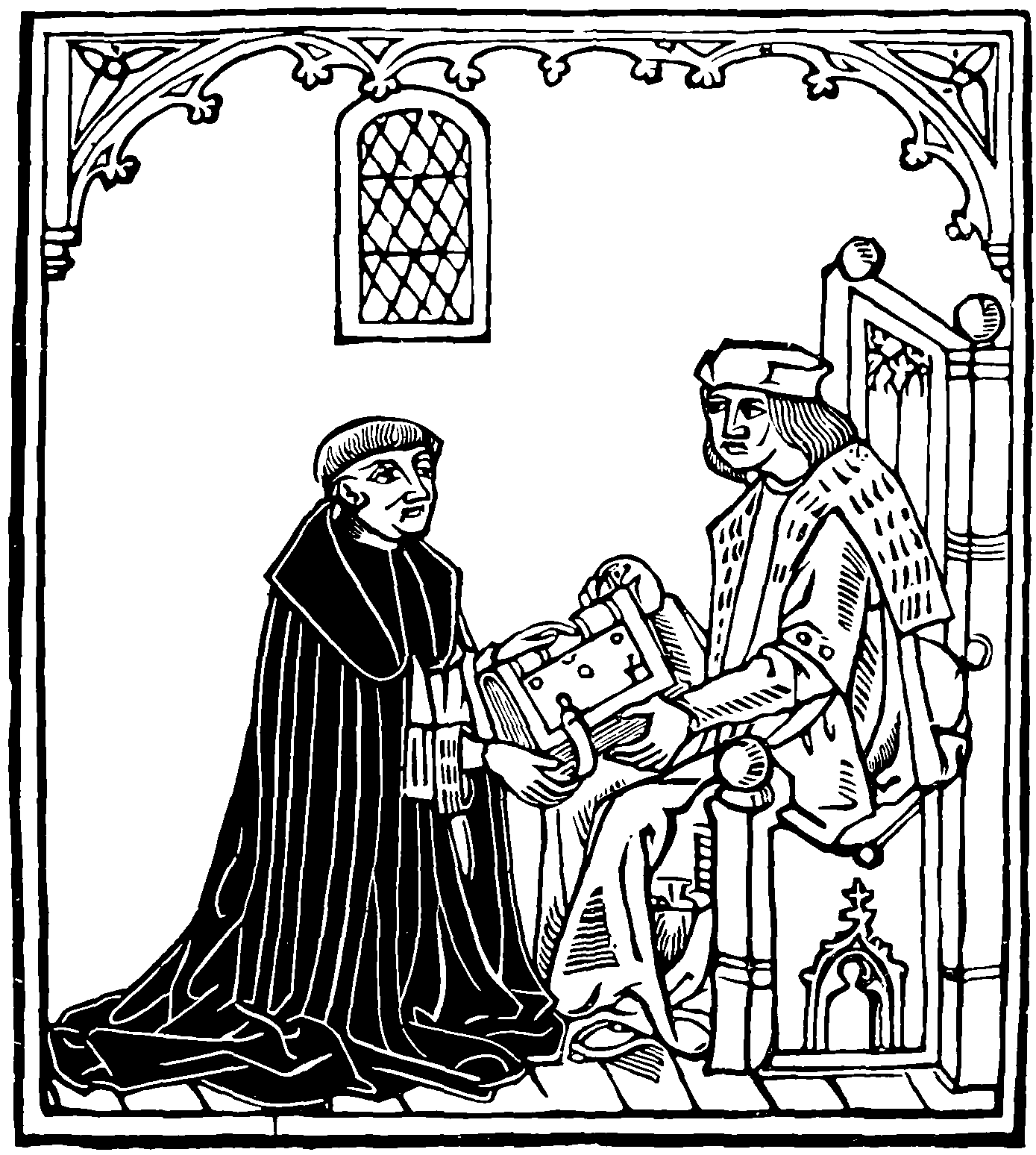
A
OF
I. The Castell of Laboure.—Wynkyn de Worde. 1506. Small Quarto. Black letter.
The title, "The castell of laboure," is within a scroll above a woodcut of men over a tub: on the verso, a cut of a man sitting at a desk. At sign. a ii. (recto) "Here begynneth the prologue of this present treatyse." [The Brit. Mus. copy has this on the verso of the title instead of the cut, a peculiarity which may entitle it to be called a separate edition, though it appears to agree otherwise with the copy described.] There are many curious woodcuts. Colophon on the reverse of sign. i iii. (51b): "Thus endeth the castell of labour, wherin is rychesse, vertue, and honour. Enprynted at London in Fletestrete in the sygne of the sonne. by Wynkyn de worde. Anno dni M.ccccc.vi." There is no indication of authorship. Signatures: a b c d e f g h, alternately 8s and 4s, i 4; 52 leaves, not numbered. The British Museum and Cambridge University Library copies of this book have been collated, but as the former ends with H 3 and the latter wants the last leaf, that leaf must remain undescribed. Mr Bradshaw, however, says, "it almost certainly contained a woodcut on the recto, and one of the devices on the verso."
A copy of this very scarce book was sold among Mr. West's books in 1773 for £2.
I.a. The Castell of Laboure.—Pynson. No date. Small Quarto. Black letter.
The title, "Here begynneth the castell of laboure," is over a woodcut; and on the reverse is a woodcut; both the same as those in the previous edition. In the body of the work there are 30 woodcuts, which differ from those of the first edition, one of these (at G 6) is a repetition of that on the title page. Colophon: "Thus endeth the castell of labour wherin is rychesse, vertue and honoure. Enprynted be me Richarde Pynson." After the colophon comes another leaf (I 6), on the recto of which is the printer's device, and on the verso a woodcut representing a city on the banks of a river. Without indication of authorship. Signatures: A, 8 leaves; B—I, in sixes.
"Neither Ames nor Herbert appear to have seen this rare volume; which is probably a reprint of Wynkyn de Worde's impression of 1506." (Dibdin's Typ. Antiq., II. 557.) There is a copy in the Library of H. Huth, Esq.
II. The Ship of Folys of the Worlde.—Pynson. 1509. Folio.
On the recto of the first leaf there is a large woodcut of Pynson's arms, or device No. VII., similar to that which is on the reverse of the last leaf of each of the volumes of his edition of Lord Berners' translation of Froissart's Chronicles; on the back of the first leaf is the translator's dedication to "Thomas Cornisshe, bishop of Tine, and suffragan bishop of Bath;" on the next leaf begins "The regyster or table of this present boke in Englyshe," (all as on pp. cxiii.—cxx.), succeeded by a Latin table. Then on sign. a i. and fol. i. a large woodcut, the same as is used for the title page of Cawood's edition (and on p. 313, Vol. II.), with a Latin description in the margin. Beneath is the title in Latin. On the back, "Alexander Barclay excusynge the rudeness of his translacion," followed with "An exhortacion of Alexander Barclay." Then on fol. ii., etc., follow in Latin, "Epigramma," "Epistola" in prose, and various "Carmina." On the back of fol. v. "The exhortacion of Brant to the fools" in Latin verse, followed by Barclay's version with the heading "Barclay the Translatour tho the Foles." On fol. iiii. the "Prologus Jacobi Locher ... incipit," followed by its translation into English. On fol. ix., etc., "Hecatastichon in proludium auctoris et Libelli Narragonici" and the English translation, "Here begynneth the prologe." On xii. "The Argument" in Latin and English, and then on xiii. commences the first chapter, "De inutilibus libris," in Latin, and then in English, which is the order throughout, with the cuts at the beginning of either the one or other as the page suited. The book concludes with a ballad in honour of the virgin Mary, consisting of twelve octave stanzas: at the end of which is the colophon in a stanza of seven lines. On the verso of the last leaf is the printer's device, No. v.
The Latin is uniformly printed in the Roman type, and the English in the Gothic. Herbert supposes the diphthongs to be "the first perhaps used in this kingdom."
The cuts are rude, coarse, English imitations of those in the original editions. They are, including the preliminary one, 118 in number. The cut illustrating the chapter, "Of them that correct other," etc., fol. liii. has been exchanged with the cut of the succeeding chapter. The cut illustrating "The unyuersall shyp and generall Barke," fol. cclxii., is repeated at the succeeding chapter. The one illustrating Barclay's new chapter "Of folys that ar ouer worldly" is an imitation of the illustration of "De singularitate quorundam novorum fatuorum" in the Latin edition of March 1497. The cut illustrating the ballad of the Virgin appears in the original at the head of "Excusatio Jacobi Locher Philomusi," and illustrates, according to the margin, "Derisio boni operis."
The word "Folium" is on the left hand page, and the number, in Roman capitals, on the right throughout the book; the last is cclxxiiii. Including the dedication and table (4 folios) there are 283 folios. The numbering is a model of irregularity: iiii. is repeated for vi., xx. stands for xv., xviii. is repeated, xx. is wanting, xxii. is repeated, xxiv. is wanting, xxx. is repeated, xxxvi. is wanting, xxxix. is repeated in place of xliv., xlviii. is wanting, xlix. is repeated, lvii is repeated after lxi., lviii follows twice, lix., lx., lxi. being repeated in succession after lviii., lxvii., lxviii. are repeated after lxviii., lxxxii. is wanting, lxxxiii. is repeated, lxxxii. stands for lxxxvii., lxxxiii. succeeds for lxxxviiii, cclxv. succeeds for lxxxix., lxxxxii. is repeated for lxxxxvii., [in the Grenville copy this leaf is correctly numbered], cxxxii is wanting, cxl. stands for cxxxviii., cxlxi. stands for cxlvi., clxxiv. is wanting, clxxxxxi. stands for cci., ccxii. is repeated for ccxvii., ccxxxviii. is wanting, cclx. stands for ccl., cclviii. is repeated for cclx.
The numeration by signatures is as follows: + iiij; a, 8; b—p, 6 s; q, 7; r, s, t, v, x, y, z, &, 6 s; A—Y, 6 s.
The book is extremely rare. There is a fine copy in the Bodleian Library among Selden's books, another in the British Museum, Grenville Collection, and another in the Library of St. John's College, Oxford.
The following are the more notable prices: Farmer, 1798, £2. 4s.; Sotheby's, 1821, £28; Dent, £30. 9s.; Bib. Anglo-Poetica, £105; Perkins, 1873, £130.
The following amusing note on prices is taken from Renouard's "Catalogue d'un Amateur." "Les premières éditions latines de ce singulier livre, celles des traductions françoises, toutes également remplies de figures en bois, ne déplaisent pas aux amateurs, mais jamais ils ne les ont payées un haut prix. La traduction angloise faite en 1509, sur le francois, et avec des figures en bois, plus mauvaises encore que leurs modèles, se paye en Angleterre 25, 30 et mème 60 guinées; c'est là, si l'on veut, du zèle patriotique, de l'esprit national."
II.a. Stultifera Nauis.... The Ship of Fooles..... With diuers other workes.... very profitable and fruitfull for all men.... Cawood. 1570. Folio.
A large cut of vessels filled with fools (the same as on p. 313, Vol. II.) is inserted between the Latin and English titles. This edition omits the ballad to the Virgin at the end. The English is in black letter, and the Latin in Roman, in the same order as in the preceding edition. On the recto of leaf 259: Thus endeth the Ship of Fooles, translated ... by Alexander Barclay Priest, at that time Chaplen in the Colledge of S. Mary Otery in the Countie of Deuon. Anno Domini 1508. On the back "Excusatio Iacobi Locher Philomusi," in Sapphic verse. On the next page five stanzas by Barclay "excusing the rudenes of his Translation." Lastly, an Index in Latin, and then in English. Then, follow the "diuers other workes," the Mirrour of good maners, and the Egloges. Colophon: Imprinted at London in Paules Church-yarde by Iohn Cawood Printer to the Queenes Maiestie. Cum Priuilegio ad imprimendum solum.
The woodcuts, including the one on the title-page, number 117. They are the same as those of Pynson's edition, but show occasional traces of the blocks having been chipped in the course of their preservation in a printer's office for 60 years or so. The borders only differ, being of a uniform type, while those of the previous edition are woodcuts of several patterns.
The numbering is a little irregular; the preliminary leaves (12) are unnumbered. The folios are numbered in figures on the left hand page, 'folio' being prefixed to the first six, 16 is repeated for 17, 13 stands for 31, [in one of the Adv. Lib. copies the latter irregularity is found, though not the former; in the other, 17 and 31 are numbered correctly], 96 is repeated for 99, 188 for 191, 100 for 200, and 205 for 201. The last number is 259, and there are three extra leaves, thus making 274 for the Ship. The supplementary works are not numbered. The signatures are as follows: The Ship, ¶ six leaves; ¶¶ six leaves; A to U u, in sixes; X x, four leaves; Mirrour of good manners, A—G, in sixes; Egloges, A to D, in sixes; in all 680 pp.
This book was licensed to Cawood in 1567-8, and is said to be the only book he had license for. It is now very rare.
Prices: Digby, 1680, 4s. 4d. Bernard, 1698, 1s. 10d. Gulston, 1783, £1, 16s. White Knights, £8, 12s. Roxburghe, £9, 19s. 6d. Fonthill, £13, 13s. Bib. Anglo-Poet, £12, 12s. Heber, £8, 12s. Sotheby's, 1873, £48, 10s.
A complete bibliography of the various editions and versions of the Ship of Fools will be found in Zarocke's edition of the original, or in Graesse's Trésor de livres rares et précieux. A notice is subjoined of the two editions of the English prose translation, and of the two other publications bearing the title.
The abridged prose translation, by Henry Watson, from the French prose version of Jehan Droyn, appeared from the press of De Worde in the same year in which Barclay's fuller poetical version was issued. In both text and illustrations it is a much inferior production to the latter. As the existence of the first edition has been, and still is, denied, it being frequently confounded with Barclay's book, we transcribe the following description of the only known copy from Van Praet's "Catalogue des livres imprimés sur vélin de la Bibliotheque du Roi."
The Shyppe of Fooles, translated out of frenche, by Henry Watson. London, Wynkyn de Worde, 1509, petit in—4.
Edition en lettres de forme, sans chiffres ni réclames, avec signatures, figures et initiales en bois; à longues lignes, au nombre de 32 sur les pages entierès; cont. 169 f.; les 7 premiers renferment 1. le titre suivant, gravé audessus d'une figure qui représente le navire des fous:
¶ The shyppe of fooles.
2. Le prologue du traducteur; 3. la préface; 4. la table des chapitres.
Au recto du dernier f. est cette souscription:
¶ Thus endeth the shyppe of fooles of this worde. Enprynted at London in Flete strete by Wynky de worde prynter vnto the excellent pryncesse Marguerete, Countesse of Rychemonde and Derbye, and grandame vnto our moost naturall souereyne lorde kynge Henry y viii. The yere of our lorde. m.ccccc. ix. ¶ The fyrste yere of the reygne of our fouerayne lorde kynge Henry the viii. The. vi. daye of Julii. On aperçoit au verso le monogramme et la marque de William Caxton, au bas desquels on lit ces mots: Wynken de Worde."
This beautiful copy upon vellum is the only example of this edition known.
The grete Shyppe of Fooles of this worlde. Wykyn de Worde. 1517. Quarto.
This is the second edition of Watson's translation. Colophon: "Thus endeth the shyppe of fooles of this worlde. Jmprynted at Londod in flete strete by Wykyn de Worde. ye yere of our lorde m.ccccc. & xvii.
¶ The nynthe yere of ye reygne of our souerayne lorde kynge Henry ye VIII. The xx. daye of June." It contains G G 6, fours and eights alternately (the signatures ending on G G iij.), besides 6 leaves, with the prologue, prolude and table, before signature A.
Extremely rare. Roxburghe, £64.
The Ship of Fools Fully Fraught and Richly Laden with Asses, Fools, Jack-daws, Ninnihammers, Coxcombs, Slenderwits, Shallowbrains, Paper-Skuls, Simpletons, Nickumpoops, Wiseakers, Dunces, and Blockheads, Declaring their several Natures, Manners and Constitutions; the occasion why this Ship was built, with the places of their intended Voyage, and a list of the Officers that bear Command therein.
If for this Voyage any have a mind,
They with Jack Adams may acceptance find,
Who will strain hard ere they shall stay behind.
Licensed, Roger L'Estrange.
[A large woodcut of the Ship.]
London, Printed by J. W. for J. Clark, at the Bible and Harp in West-Smithfield. n. d. [Circa 1650.] 4to. 4 leaves.
"This book, or rather tract, has nothing in common with Barclay's Ship of Fools, except the general idea. It is entirely in prose. My copy has nothing to show to whom it formerly belonged."—(Letter of H. Huth, Esq.) The last sentence was elicited by the inquiry whether Mr Huth's copy were the one formerly belonging to Mr Heber.—See Bibliotheca Heberiana, Part IV., No. 752.
Stultifera Navis ... The modern Ship of fools. Lond. 1807, 80. Pp. xxiv., 295.
A wretched production in verse, in imitation of Barclay's Ship of Fools, published anonymously by W. H. Ireland, the Shakesperian forger.
III. The Egloges of Alexader Barclay, Prest.—The first three, without printer's name or device. No date. Quarto. Black letter.
"Here begynneth the Egloges of Alexader Barclay, prest, wherof the fyrst thre conteyneth the myseryes of courters and courtes of all prynces in generall, the matter wherof was translated into Englyshe by the sayd Alexander in fourme of Dialogues, out of a boke named in latyn Miserie Curialiu, compyled by Eneas Siluius, Poete and oratour, whiche after was Pope of Rome, & named Pius." This title is over a cut of two shepherds, Coridon and Cornix, the interlocutors in these three eclogues. On the back is a cut of David and Bathsheba. At the end of the third egloge: "Thus endyth the thyrde and last egloge of the mysery of court and courters, composed by Alexander Barclay, preste, in his youthe." A cut of the two shepherds and a courtier fills up the page. Without date, printer's name, or device. Contains P 6, in fours, the last leaf blank.
III.a. The Fourthe Egloge of Alexander Barclay.—Pynson. No date. Quarto. Black letter.
It is entitled, "The Boke of Codrus and Mynaclus," over the cut of a priest, with a shaven crown, writing at a plutus. It concludes with "The discrypcion of the towre of Vertue & Honour, into whiche the noble Hawarde contended to entre, by worthy acts of chiualry," related by Menalcas, in stanzas of eight verses. At the end, "Thus endeth the fourthe Eglogge of Alexandre Barcley, coteyning the maner of the riche men anenst poets and other clerkes. Emprinted by Richarde Pynson priter to the kynges noble grace." On the last leaf is his device, No. V. Contains 22 leaves, with cuts.
III.b. The Fyfte Egloge of Alexander Barclay. —Wynkyn de Worde. No date. Quarto. Black letter.
"The fyfte Eglog of Alexandre Barclay of the Cytezen and vplondyshman." This title is over a large woodcut of a priest, sitting in his study. Beneath, "Here after foloweth the Prologe." On the verso of A ii. are two cuts of two shepherds, whole lengths, with this head-title, "Interlocutoures be Amyntas and Faustus." There are no other cuts. Colophon: "Here endeth the v. Eglog of Alexandre Barclay of the Cytezyn and vplondysshman. Imprynted at London in flete strete, at the sygne of [the] Sonne, by Wynkyn de worde." Beneath, device No. v. Contains A 8, B 4, C 6; 18 leaves. There is a copy in the British Museum.
With the first four Eclogues as above, Woodhouse, 1803, (Herbert's copy), £25.; resold, Dent, 1827, £36.; resold, Heber, 1834, £24. 10s. At Heber's sale this unique set, containing the only known copy of the first edition of the first four Eclogues, was bought by Thorpe; further I have not been able to trace it.
III.c. The Egloges.—John Herforde. No date. Quarto.
"Here begynneth the Egloges of Alex. Barclay, Priest, whereof the first three conteineth the Miseries of Courters and Courtes." "Probably a reprint of Pynson's impression," Dibdin. Contains only Eclogues I.-III. Herbert conjectures the date to be 1548; Corser, 1546; Hazlitt, 1545.
III.d. The Egloges.—Humfrey Powell. No date. Quarto. Black letter.
"Here begynneth the Egloges of Alexander Barclay, priest, whereof the first thre conteineth the miseries of courters and courtes, of all Princes in general ... In the whiche the interloquutors be, Cornix, and Coridon." Concludes: "Thus endeth the thyrde and last Eglogue of the Misery of Courte and Courters, Composed by Alexander Barclay preest, in his youth. Imprinted at London by Humfrey Powell." Contains only Eclogues I.-III. Collation: Title, A 1; sig. A to P2, in fours; 58 leaves not numbered.
This is an edition of extreme rarity. It is very well printed, and the title is surrounded with a woodcut border with ornamented pillars at the sides. Herbert conjectures the date to be 1549, the Bib. Anglo-Poetica, Lowndes, and Corser, 1548. There is a copy in the Cambridge University Library, and another in the possession of David Laing, Esq.
Prices: Inglis, £6. 2s. 6d.; Bright, 1845. £10. 10s.; Bib. Anglo-Poetica, £15.
III.e. Certayne Egloges of Alexander Barclay Priest.—Cawood. 1570. Folio. Black letter.
Appended to Cawood's edition of the Ship of Fools. No title-page, cuts, or pagination. The above heading on A i.
Colophon: Thus endeth the fifth and last Egloge of Alexander Barclay, of the Citizen and the man of the countrey. Imprinted at London in Paules Church-yarde by Iohn Cawood, Printer to the Queenes Maiestie. Cum Priuilegio ad imprimendum solum.
Contains A—D, in sixes.
III.f. The Cytezen and Uplondyshman: an Eclogue [the fifth] by Alexander Barclay.
Printed from the original edition by Wynkyn de Worde. Edited, with an Introductory Notice of Barclay and his other Eclogues, by F.W. Fairholt, F.S.A. London; printed for the Percy Society [vol. XXII.], 1847. 8vo. Pp. + 6, lxxiv., 47.
IV. The Introductory To Write and To Pronounce Frenche. Coplande. 1521. Folio. Black letter.
'Here begynneth the introductory to wryte, and to pronounce Frenche compyled by Alexander Barcley compendiously at the commaudemet of the ryght hye excellent and myghty prynce Thomas duke of Northfolke.' This title is over a large woodcut of a lion rampant, supporting a shield, containing a white lion in a border, (the same as that on the title of the Sallust, VI.), then follows a French ballad of 16 lines in two columns, the first headed, "R. Coplande to the whyte lyone, and the second, "¶ Ballade." On the recto of the last leaf, 'Here foloweth the maner of dauncynge of bace dauces after the vse of fraunce & other places translated out of frenche in englysshe by Robert coplande.' Col.: Jmprynted at London in the Fletestrete at the sygne of the rose Garlande by Robert coplande, the yere of our lorde. m.ccccc.xxi. ye xxii. day of Marche.' Neither folioed nor paged. Contains C 4, in sixes, 16 leaves.
In the edition of Palsgrave (see above, p. lxxiii.), published among the "Documents inédits sur l'histoire de France," the editor says of this work of Barclay's: "Tous mes efforts pour découvrir un exemplaire de ce curieux ouvrage ont été inutiles." There is a copy, probably unique, in the Bodleian; it was formerly Herbert's, afterwards Douce's.
All the parts of this treatise relating to French pronunciation have been carefully reprinted by Mr A. J. Ellis, in his treatise "On Early English Pronunciation" (published by the Philological Society), Part III., p. 804.
V. The Myrrour Of Good Maners.——Pynson. No date. Folio. Black letter.
'Here begynneth a ryght frutefull treatyse, intituled the myrrour of good maners, coteynyng the iiii. vertues, callyd cardynall, compyled in latyn by Domynike Mancyn: And translate into englysshe: at the desyre of syr Gyles Alyngton, knyght: by Alexander Bercley prest: and monke of Ely. This title is over a cut, the same as at the head of Barclay's preface to his translation of Sallust, a representation of the author in a monkish habit on his knees, presenting a book to a nobleman. The text begins on back of title. The original is printed in Roman letter in the margins.——Colophon in a square woodcut border: Thus endeth the ryght frutefull matter of the foure vertues cardynall: Jmprynted by Rychard Pynson: prynter vnto the kynges noble grace: with his gracyous pryuylege the whiche boke I haue prynted, at the instance & request, of the ryght noble Rychard yerle of Kent. On the back, Pynson's device, No. v. It has neither running titles, catch-words, nor the leaves numbered. Signatures; A to G, in sixes, and H, in eights; 100 pp.
In the British Museum, Grenville collection, from Heber's collection. "This edition differs materially from that used by Herbert, which has led Dr Dibdin to the conclusion that there were two impressions." So says a MS. note on the copy, (quoted in the Bib. Grenv.), but Dibdin does not commit himself to the conclusion, his words being these: "This description is given from a copy in the possession of Mr Heber; which, from its varying with the account of Herbert, Mr H. supposes, with justice, must be a different one from Herbert's." I have failed to discover the difference.
Prices: Perry, £9.; Roxburghe (last leaf wanting), £10. 10s.; Bibliotheca Anglo-Poetica, £12. 12s.; Sykes, £16. 16s.
To the above edition must belong the fragment entered in Bohn's Lowndes under "Four," thus: "Four Vertues Cardinal. Lond. R. Pynson, n.d. folio. Only a fragment of this Poem is known; it was printed at the request of Rychard Erle of Kent."
V.a.. The Mirrour of Good Maners.——Cawood. 1570. Folio. Black letter.
Appended to Cawood's edition of the Ship of Fools. No title page, pagination, or cuts. The above heading on A 1. The Latin original printed in Roman by the side of the English. Contains A-G, in sixes.
It may be useful to give here the bibliography of the other English translations of Mancyn.
Mancinus de quattuor Virtutibus. [The englysshe of Mancyne apon the foure cardynale vertues.] No place, printer's name, or date, but with the types of Wynkyn de Worde, circa 1518. 4to, a-d, in eights. Bodleian.
Following the title occurs: Petri Carmeliani exasticon in Dominici Mancini de quattuor cardineis virtutibus libellum. The Latin portion is in verse, printed in Roman letter, with marginal notes in black letter, of a very small size, and the English in prose.
The English part, in black letter, is entitled: The englysshe of Mancyne apon the foure cardynale vertues. n.p. or d. This portion has a separate title and signatures; the title is on A 1. On sign. F ii. occurs, "The correccion of the englysshe," and on the verso of the same leaf is printed, "The correction of the texte." A, B, C, and D, 8 leaves each; E, 6 leaves; and F, 4 leaves; 42 leaves altogether. A copy of this is in the British Museum. Only two perfect copies are known.
A Plaine Path to Perfect Vertue: Deuised and found out by Mancinus, a Latine Poet, and translated into English by G. Turberuile, Gentleman.
Ardua ad virtutem via.
Imprinted at London in Knightrider-strete, by Henry Bynneman, for Leonard Maylard. Anno. 1568. 8vo., 72 leaves. Black letter, in verse. Dedicated "To the right Honorable and hys singular good Lady, Lady Anne, Coutesse Warvvicke." There is also a metrical address to the reader, and 8 4-line stanzas by James Sanford in praise of the translator.
Freeling, 1836, No. 911, £7., bought for Mr Corser: now in the British Museum. Supposed to be unique.
VI. Cronycle compyled in Latyn, by the renowned Sallust.——Pynson. No date. Folio.
"Here begynneth the famous cronycle of the warre, which the romayns had agaynst Jugurth, vsurper of the kyngdome of Numidy. which cronycle is compyled in latyn by the renowmed romayne Salust. And translated into englysshe by syr Alexander Barclay preest, at comaundement of the right hye and mighty prince: Thomas duke of Northfolke." There are two editions by Pynson of this book.
I. In this edition the lower half of the title page has a square enclosed by double lines containing the Norfolk arms, a lion rampant, holding a shield in his paws, on which is another lion, a cut which also appears on the title of The Introductory. There is a full page cut of the royal arms with portcullis, &c., on the back, followed by five pages of Table. The preface to his patron, in English,——together with a Latin dedication to Bishop Veysy, in parallel columns,——begins on the verso of signature a iiii, under a cut of the author presenting his book to him, the same as that which appears on the title of The myrrour of good maners. [See the cut prefixed to the Notice of Barclay's life, which is confined however to a reproduction of the two principal figures only, two other figures, evidently of servants, and some additional ornamentation of the room being omitted.] At the end of this preface is another cut of the author, writing at a desk; also on the back of the leaf is a cut of the disembarking of an army. There are no other cuts, but the volume is adorned throughout with very fine woodcut initials. Catchwords are given irregularly at the beginning, but regularly towards the end, at the bottom of the left hand page only, but the preface has them to every column. Colophon:——"Thus endeth the famous cronycle of the war ... imprented at London by Rycharde Pynson printer vnto the kynges noble grace: with priuylege vnto hym grauted by our sayd souerayne lorde the kynge." On the back of the last leaf is Pynson's device, No. v. The date is erroneously conjectured in Moss's Classical Bib. to be 1511. It was probably 1519, certainly between 1519 and 1524. Contains 92 numbered leaves, and one leaf unnumbered, besides eight leaves of preliminary matter: numbering quite regular: signatures; a 8, A—O, 6 s, P, Q, 4 s. In the British Museum, Grenville Collection, the Bodleian, and the Public Library at Cambridge.
Prices: Roxburghe, £23, 12s.; Sykes, £8, 12s.; Heber, £5, 15s. 6d.; Sotheby's, 1857, £10.
II. In this edition, the title page is the same as in the other with the exception of a semicolon for a full point after Numidy, the succeeding which having an e added, and romayne being without the e, but on the back instead of a cut of the royal arms The table commences; the preface begins on the recto of sign. a 4, under the cut of the author presenting his book to the Duke of Norfolk, and ends without the leaf of woodcuts which is appended to the preface of the first edition. Pynson's device at the end of the book is also wanting in this edition. It contains only fol. lxxxvi., with six leaves of preliminary matter; the pagination is a little irregular, xxi. and xxii. are wanting but xxiii. is given three times, and lxxvii. is repeated for lxxviii.; the British Museum copy is deficient in folios lxii. and lxv.: signatures; a 6, A—N, 6 s, and O, P, 4 s. The initials are the same as those in the first edition in the great majority of cases, but appear much more worn. There are catch-words only at the end of every signature throughout the book, except to the preface, which has them to every column. In the British Museum, and the Public Library, Cambridge.
Both editions have the Latin in Roman letter in the margins, and running-titles. Ames mentions an edition with cuts, which must be the same as the first of these.
VI.a. Cronicle of Warre. Compiled in Laten by Saluste. Corrected by Thomas Paynell. Waley, 1557. Quarto.
"Here begynneth the famous Cronicle of warre, whyche the Romaynes hadde agaynst Jugurth vsurper of the kyngedome of Numidie: whiche Cronicle is compiled in Laten by the renowmed Romayne Saluste: and translated into englyshe by syr alexander Barklaye prieste. And nowe perused and corrected by Thomas Paynell. Newely Jmprinted in the yere of oure Lorde God M.D.L vij." On the verso of the title begins Paynell's dedication—"To the ryghte honorable Lorde Antonye Vycounte Mountegue, Knyghte of the ryghte honorable order of the garter, and one of the Kynge and Queenes Magesties pryuie counsayle." "The prologue" begins on a 1. Barclay's preface and dedication are omitted, as well as the Latin of Sallust. Col.: "Thus endeth the famouse Cronicle of the warre ... against Jugurth ... translated... by syr Alexander Barkeley, prieste, at commaundemente of ... Thomas, duke of Northfolke, And imprinted at London in Foster lane by Jhon Waley." Signatures; H h, 4 s, besides title and dedication, two leaves: the pagination commences on a 4, at "The fyrste chapter," the last folio being cxx.; xxi. is repeated for xxii., xxiii. for xxiv., xix., stands for xxix., lvii. is repeated, and lxxiv. is repeated for lxxv.
This edition forms the second part of a volume having the following general title page: The Conspiracie of Catiline, written by Constancius Felicius Durantinus, and translated bi Thomas Paynell: with the historye of Jugurth, writen by the famous Romaine Salust, and translated into Englyshe by Alexander Barcklaye.
VII. Alex. Barclay his figure of our Mother holy church oppressed by the Frenche King. Pynson. Quarto.
This is given by Herbert on the authority of Maunsell's Catalogue, p. 7.
VIII. The lyfe of the glorious Martyr saynt George. Translated by Alexander Barclay, while he was a monk of Ely, and dedicated to N. West, Bp. of Ely. Pinson [Circa 1530.] Quarto. [Herbert, 289].
IX. The lyfe of saynte Thomas. Pynson. No date. Quarto. Black letter.
"¶ Here begynneth the lyfe of the blessed martyr saynte Thomas." This title is the headline of this little treatise; at the beginning of which is indented a small woodcut of a man in armour, striking at the bishop, with his cross-bearer before him. It begins "The martir saynte Thomas was son to Gylberde Bequet a burgeys of the Cite of London. And was borne in ye place, whereas now standeth the churche called saynte Thomas of Akers." It concludes, "¶ Thus endeth the lyfe of the blessed martyr saynt Thomas of Caunturbury. Jmprynted by me Rycharde Pynson, prynter vnto the kynges noble grace." Contains eight leaves. There is a copy in the British Museum. Assigned to Barclay on tne authority of Wood.
X. Haython's Cronycle. Pynson. No date. Folio. Black letter.
"Here begynneth a lytell Cronycle, translated & imprinted at the cost & charge of Rycharde Pynson, by the comaundement of the ryght high and mighty prince, Edwarde duke of Buckingham, yerle of Gloucestre, Staffarde, and of Northamton," over a large woodcut. Colophon: "Here endeth, [&c.] Imprinted by the sayd Richarde Pynson, printer unto the Kinges noble grace." Date conjectured to be between 1520 and 1530. Pynson's device, No. 5, at the end. Collation: A—E, and H, in sixes; F and G, and I, in fours; forty-eight leaves.
On the verso of fol. 35, "Here endeth ye boke of thistoris of thoriet partes copyled by a relygious man frere Hayton frere of Premostre order, sotyme lorde of court & cosyn german to the kyng of Armeny vpon ye passage of the holy lande. By the comaudement of ye holy fader ye apostle of Rome Clemet the V. in ye cite of Potiers which boke I Nicholas Falcon, writ first in French ... I haue traslated it in Latyn for our holy father ye pope. In the yere of our lorde god m.ccc.vii. in ye moneth of August. Deo gras."
"The travels of Hayton into the Holy Land and Armenia, and his history of Asia, is one of the most valuable of the early accounts of the east. The present is the only translation into English, and from the circumstances of its being printed by Pynson and having been (when in Mr Heber's collection) bound with two other works (Mirrour of good Maners and Sallust) both translated by Barclay, was probably also translated by him. It is a book of extraordinaiy rarity, no perfect copy that can be traced having previously occured for sale." (Bibliotheca Grenvilliana, vol. I.)
Heber's copy (the one above mentioned), £40. 9s. 6d.
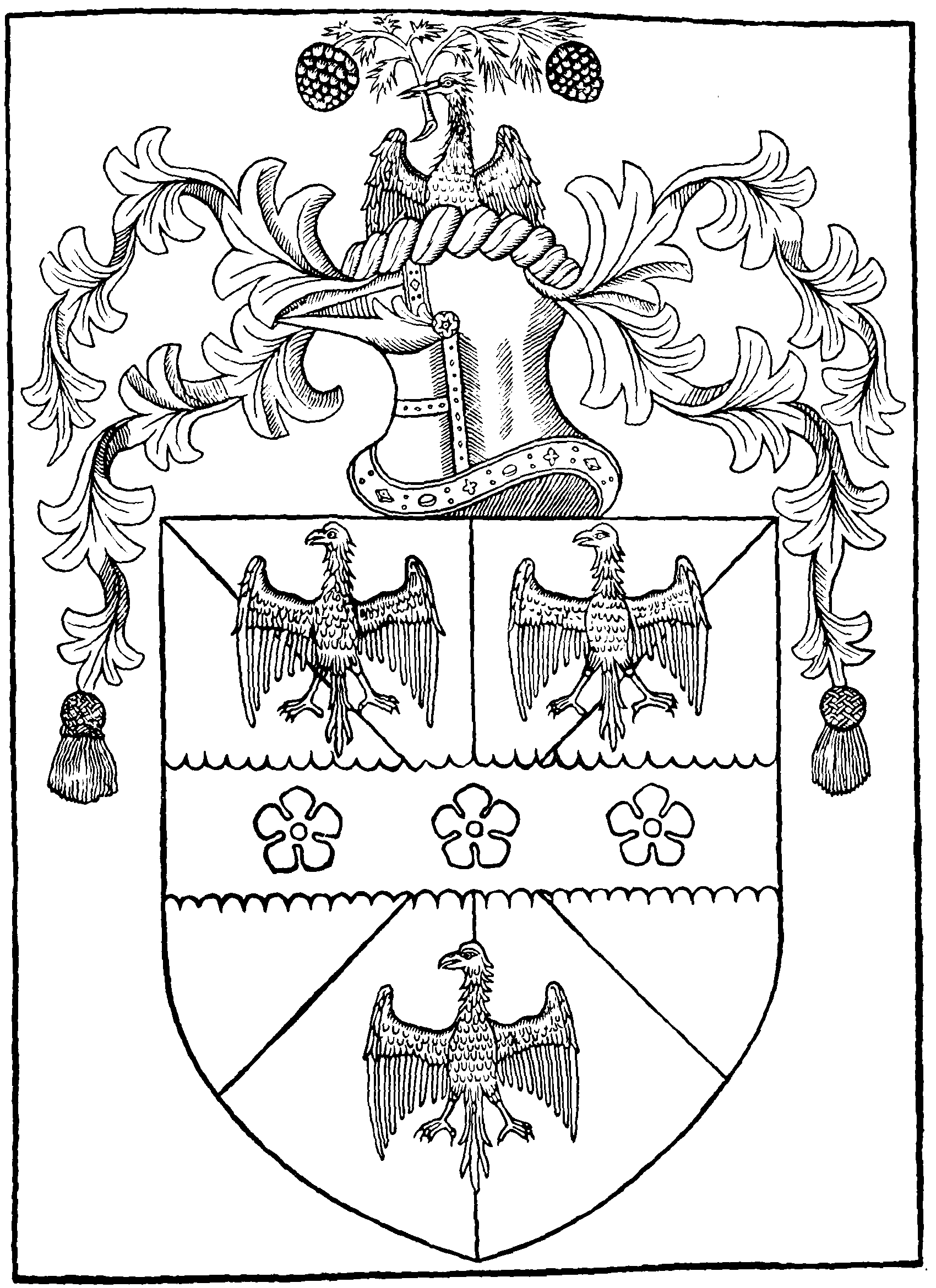
Venerandissimo in Christo Patri ac Domino: domino Thome Cornisshe Tenenensis pontifici ac diocesis Badonensis Suffraganio vigilantissimo, sue paternitatis Capellanus humilimus Alexander Barclay suiipsius recommendacionem cum omni summissione, et reuerentia.
Tametsi crebris negocijs: varioque impedimentorum genere fatigatus paulo diutiùs quàm volueram a studio reuulsus eram. Attamen obseruandissime presul: Stultiferam classem (vt sum tue paternati pollicitus) iam tandem absolui et impressam ad te destinaui. Neque tamen certum laborem pro incerto premio (humano. s.) meis impossuissem humeris: nisi Seruianum illud dictum (longe anteaqam inceperam) admonuisset. Satius esse non incipere quàm inceptum minus perfectum relinquere. Completo tamen opere: nec quemquam magis dignum quàm tua sit paternitas existimaui cui id dedicarem: tum quia saluberrima tua prudentia, morum grauitas, vite sanctitas doctrineque assiduitas: errantes fatuos mumdanis ab illecebris ad virtutis tramites: difficiles licet: possint reducere: tum vero: quia sacros ad ordines per te sublimatus et promotus, multisque aliis tuis beneficiis ditatus non potui tibi meum obsequium non coartare. Opus igitur tue paternitati dedicaui: meorum primicias laborum qui in lucem eruperunt Atque vt tua consuluerit paternatis: autoris carmina cum meis vulgaribus rithmicis vná alternatim coniunixi: et quantum a vero carminum sensu errauerim, tue autoritatis iudicium erit. Fateor equidem multo plura adiecisse quam ademisse: partim ad vicia que hac nostra in regione abundantius pullulant mordacius carpenda: partimque ob Rithmi difficultatem. Adieci etiam quasdam Biblie aliorumque autorum concordancias in margine notatas quo singula magis lectoribus illucescant: Simul ad inuidorum caninos latratus pacandos: et rabida ora obstruenda: qui vbi quid facinorum: quo ipsi scatent: reprehensum audierint. continuo patulo gutture liuida euomunt dicta, scripta dilacerant. digna scombris ac thus carmina recensent: sed hi si pergant maledicere: vt stultiuagi comites classem insiliant. At tu venerande Presul Discipuli tui exiguum munusculum: hilari fronte accipito, Classemque nostram (si quid vagum, si quid erronium: si quid denique superfluum emineat: optimam in partem interpretando: ab inuidorum faucibus: tue autoritatis clipeo tucaris. Vale. Ex Impressoria officina Richardi Pynson. iij. Idus Decembris.
¶ This present Boke named the Shyp of folys of the worlde was translated in the College of saynt mary Otery in the counte of Deuonshyre: out of Laten, French, and Doche into Englysshe tonge by Alexander Barclay Preste: and at that tyme Chaplen in the sayde College. translated the yere of our Lorde god. M.ccccc.viii. Imprentyd in the Cyte of London in Fletestre at the signe of Saynt George. By Rycharde Pynson to hys Coste and charge: Ended the yere of our Sauiour. M. d. ix. The. xiiii. day of December.
¶ THE REGYSTER OR TABLE OF THIS PRESENT BOKE IN ENGLYSSHE.
Another Prologe: in Balade concernyng the same.
In what place this Boke was translate and to what purpose it was translatyd.
¶ Here begynneth the Folys and firste of inprofytable bokys.
¶ Of euyll Counsellours Juges & men of lawe.
Of newe disgysynges in apparayle.
¶ A lawde of the nobles and grauyte of Kynge Henry the eyght.
Of olde Folys encresynge foly with age.
Of negligent Fathers ayenst their Children.
Of taleberers: & mouers of debate.
Of nat folowers of good counsel.
Of vngoodly maners, and dysordred.
Of dispysers of holy scripture.
Of disordred & venerious loue.
Of them that synne trustynge vpon the mercy of almyghty god.
Of folys yt begyn great byldynge without sufficient prouysion.
Of folys that wyl serue two lordes both togyther.
Of them that correct other, them self culpable in the same faut.
Of folys that fynde others good, nat restorynge the same to the owner.
¶ The sermon or doctryne of wysdom.
Of Folys bostyng them in fortune.
Of the superflue curyosyte of men.
Of great borowers, & slacke payers.
Of vnprofitable vowers & peticions.
Of them that folvsshly speke ayenst the workes of god.
Of lewde Juges of others dedes.
Of synners that prolonge from daye to day to amende theyr myslyuyng.
Of auoutry, and specially of suche as ar bawdes to theyr wyues.
Of suche as nedys wyll contynue in theyr foly nat withstandynge holsom erudicion.
An addicion of the secundaries of Otery saynt Mary, in Deuynshyre.
Of folys that can nat be ware by ye mysfortune nor take example of others damage.
Of folys that force or care for the bacbytynge of lewde people.
Of them that despyse euerlastynge blys for worldly thynges & transitory.
Of talkers and makers of noyse in the Chirche of god.
Of folys that put them self in wylful ieopardy and peryll.
Of the way of felycyte, and godnes and the payne to come to synners.
Of olde folys yt gyue example of vyce to youth negligent & vnexpert.
Of bodely lust or corporall voluptuosyte.
Of folys that can nat kepe secrete theyr owne counsell.
Of yonge folys that take olde wymen to theyr wyues nat for loue but for ryches.
Of impacient folys disdaynynge to abyde and suffer correccion, for theyr profyte.
Of folysshe Fesicians vsynge theyr practyke without speculacyon.
Of the ende of worldly honour & power and of folys yt trust in them.
An addicion of Alexander barclay.
Of folys that aply other mennys besynes leuynge theyr owne vndone.
Of the vyce of ingratytude or vnkyndnes and folys that vse it.
Of Folys that stande to moche in theyr owne conceyte.
Of folys that delyte them in daunsynge.
Go Boke: abasshe the thy rudenes to present.
To men auaunced to worshyp, and honour.
By byrthe or fortune: or to men eloquent.
By thy submyssion excuse thy Translatour.
But whan I remember the comon behauour
Of men: I thynke thou ought to quake for fere
Of tunges enuyous whose venym may the dere
Tremble, fere, and quake, thou ought I say agayne.
For to the Redar thou shewest by euydence
Thy selfe of Rethoryke pryuate and barayne
In speche superflue: and fruteles of sentence.
Thou playnly blamest without al difference
Bothe hye and lowe sparinge eche mannes name.
Therfore no maruayle thoughe many do the blame.
But if thou fortune to lye before a State
As Kynge or Prince or Lordes great or smal.
Or doctour diuyne or other Graduate
Be this thy Excuse to content theyr mynde withal
My speche is rude my termes comon and rural
And I for rude peple moche more conuenient.
Than for Estates, lerned men, or eloquent.
But of this one poynt thou nedest not to fere
That any goode man: vertuous and Just.
Wyth his yl speche shal the hurt or dere.
But the defende. As I suppose and trust.
But suche Unthriftes as sue theyr carnal lust
Whome thou for vyce dost sharply rebuke and blame
Shal the dysprayse: emperisshinge thy name.
But ye that shal rede this boke: I you exhorte.
And you that ar herars therof also I pray
Where as ye knowe that ye be of this sorte:
Amende your lyfe and expelle that vyce away.
Slomber nat in syn. Amende you whyle ye may.
And yf ye so do and ensue Vertue and grace.
Wythin my Shyp ye get no rowme ne place.
To Shyp galantes the se is at the ful.
The wynde vs calleth our sayles ar displayed.
Where may we best aryue? at Lyn or els at Hulle?
To vs may no hauen in Englonde be denayd.
Why tary we? the Ankers ar vp wayed.
If any corde or Cabyl vs hurt, let outher hynder.
Let slyp the ende, or els hewe it in sonder.
Retourne your syght beholde vnto the shore.
There is great nomber that fayne wold be aborde.
They get no rowme our Shyp can holde no more.
Haws in the Cocke gyue them none other worde.
God gyde vs from Rockes, quicsonde tempest and forde
If any man of warre, wether, or wynde apere.
My selfe shal trye the wynde and kepe the Stere.
But I pray you reders haue ye no dysdayne.
Thoughe Barclay haue presumed of audacite
This Shyp to rule as chefe mayster and Captayne.
Though some thynke them selfe moche worthyer than he.
It were great maruayle forsoth syth he hath be.
A scoler longe: and that in dyuers scoles
But he myght be Captayne of a Shyp of Foles
But if that any one be in suche maner case.
That he wyl chalange the maystershyp fro me
Yet in my Shyp can I nat want a place.
For in euery place my selfe I oft may se.
But this I leue besechynge eche degre:
To pardon my youthe and to bolde interprise.
For harde is it duely to speke of euery vyce.
For yf I had tunges an hundreth: and wyt to fele
Al thinges natural and supernaturall
A thousand mouthes: and voyce as harde as stele.
And sene all the seuen Sciences lyberal.
Yet cowde I neuer touche the vyces all.
And syn of the worlde: ne theyr braunches comprehende:
Nat thoughe I lyued vnto the worldes ende.
But if these vyces whiche mankynde doth incomber.
Were clene expellyd and vertue in theyr place.
I cowde nat haue gathered of fowles so great a nomber.
Whose foly from them out chaseth goddys grace.
But euery man that knowes hym in that case
To this rude Boke let hym gladly intende.
And lerne the way his lewdnes to amende.
After that I haue longe mused by my self of the sore confounded and vncertayne cours of mannys lyfe, and thinges therto belonginge: at the last I haue by my vigilant meditacion found and noted many degrees of errours: wherby mankynd wandreth from the way of trouth I haue also noted that many wyse men and wel lettred haue writen right fruteful doctrines: wherby they haue heled these dyseses and intollerable perturbacions of the mynde: and the goostly woundes therof, moche better than Esculapius which was fyrst Inuentour of Phesyke and amonge the Gentyles worshypped as a God. In the contrey of Grece were stodyes fyrst founded and ordeyned in the which began and sprange holsom medicyne which gaue vnto infect myndes frutful doctryne and norisshinge. Amonge whome Socrates that great begynner and honourer of wysdom began to dispute of ye maners of men. But for that he coude nat fynde certayne ende of goodnes and hyest felicite in naturall thinges: nor induce men to the same, he gaue the hye contemplacions of his mynde to moral vertues. And in so moche passed he al other in Philosophy moral that it was sayde that he called Philosophy down from the Imperial heuen. whan this Socrates perceyued the mindes of men to be prone, and extremely inclyned to viciousnes he had gret affeccion to subdue suche maners. Wherfore in comon places of the Cyte of Athenes he instruct and infourmed the peple in such doctrynes as compasith the clere and immaculate welles of the moste excellent and souerayne gode. After the disces of Socrates succeded ye godly Plato whiche in moral Philosophy ouerpassed also a great part of his tyme And certaynly nat without a cause was he called godly. For by what stody myght be more holely or better socour mankynde than by suche doctrynes as he gaue. He wrote and ordeyned lawes moste egal and iust He edityed vnto the Grekes a comon welthe stable, quyet and commendable. And ordeyned the societe and company of them most iocund and amyable. He prepared a brydel to refrayne the lust and sensualyte of the body. And fynally he changed the yl ignorance feblenes and negligence of youth vnto dylygence, strength and vertue. In tyme also of these Phylosophers sprange the florisshynge age of Poetes: whiche amonge lettred men had nat smal rowme and place. And that for theyr eloquent Retoryke and also for theyr mery ficcions and inuencions. Of the whiche Poetes some wrote in moste ornate termes in ditees heroycal wherin the noble actes and lyues both of dyuyne and humayne creatures ar wont to be noted and writem. Some wrote of tylling of the grounde. Some of the Planetes, of the courses of ye sterres: and of the mouynge of the heuyn and fyrmament. Some of the Empyre and shameful subieccion of disordred loue. And many other of the myserable ruyne and fal of Kynges and princes for vice: as Tragedies. And some other wrote Comedyes with great libertye of speche: which Comedies we cal Interludes. Amonge whome Aristophanes Eupolis and Cratinus mooste laudable Poetes passed al other. For whan they sawe the youth of Athenes and of al the remanent of Grece inclyned to al ylles they toke occasion to note suche myslyuinge. And so in playne wordes they repreued without fauour the vyces of the sayd yl disposyd peple of what condicion or order they were: Of this auncient wrytinge of Comedyes our laten Poetes deuysed a maner of wrytinge nat inelegant. And fyrst Lucilius composed one Satyre in the whiche he wrote by name the vices of certayne princes and Citezyns of Rome And that with many bourdes so yt with his mery speche myxt with rebukes he correct al them of the cyte that disordredly lyued. But this mery speche vsed he nat in his writing to the intent to excercyse wanton wordes or vnrefrayned lascyuyte, or to put his pleasour in suche dissolute langage: but to ye intent to quenche vyces and to prouoke the commons to wysdome and vertue, and to be asshamed of theyr foly and excessyfe lyuynge. of hym all the Latyn poetes haue takyn example, and begynnynge to wryte Satyrs whiche the grekes named Comedyes: As Fabius specifyeth in his X boke of institucions. After Lucilius succeded Horacius, moche more eloquent in wrytynge whiche in the same deseruyd great laude: Persius also left to vs onely one boke by the whiche he commyttyd his name and laude to perpetuall memory. The last and prynce of all was Juuenall whiche in his iocunde poemys comprehendyd al that was wryten most eloquent and pleasaunt of all the poetis of that sorte afore his tyme: O noble men, and diligent hertes and myndes, o laudable maners and tymes, these worthy men exyled ydelnes, wherby they haue obtayned nat small worshyp and great commodyte example and doctryne lefte to vs theyr posteryours why begyn we nat to vnderstonde and perceyue. Why worshyp nat the people of our tyme these poetis why do nat they reuerence to ye interpretours of them do they nat vnderstonde: that no poetes wryte, but outher theyr mynde is to do pleasure or els profyte to the reder, or ellys they togyther wyll doo bothe profyte and pleasoure why are they dyspysed of many rude carters of nowe a dayes which vnderstonde nat them, And for lacke of them haue nat latyn to vtter and expresse ye wyl of their mynde. Se whether poetes ar to be dispised. they laude vertue and hym that vseth it rebukyng vices with the vsers therof, They teche what is good and what is euyll: to what ende vyce, and what ende vertue bringeth vs, and do nat Poetis reuyle and sharply byte in their poemys all suche as ar vnmeke, Prowde, Couetous, Lecherous, Wanton, delycyous, Wrathfull glotons, wasters, Enuyours, Enchauntours, faythebrakers, rasshe, vnauysed, malapert, drunken, vntaught foles, and suche lyke. Shulde theyr writyng that suche thinges disprayse and reuyle be dyspised of many blynde Dotardes yt nowe lyue whiche enuy that any man shulde haue or vnderstonde ye thyng whiche they knowe nat. The Poetes also wyth great lawdes commende and exalt the noble folowers of vertue ascribyng to euery man rewardes after his merytes. And shortly to say, the intencion of al Poetes hath euer ben to repreue vyce: and to commende vertue. But syns it is so that nowe in our dayes ar so many neglygent and folysshe peple that they ar almost innumerable whiche despisynge the loue of vertue: folowe the blyndenes and vanyte of this worlde: it was expedient that of newe some lettred man, wyse, and subtil of wyt shulde awake and touche ye open vices of foles that now lyue: and blame theyr abhomynable lyfe. This fourme and lybertye of writinge, and charge hathe taken vpon hym the Right excellent and worthy Mayster Sebastian Brant Doctour of both the Lawes and noble Oratour and Poete to the comon welthe of al people in playne and comon speche of Doche in the contrey of Almayne: to the ymytacion of Dant Florentyne: and Francis Petrarche Poetes heroycal which in their maternal langage haue composed maruelous Poemes and ficcions. But amonge diuers inuencions composed of the sayde Sebastian brant I haue noted one named ye Shyp of Foles moche expedient and necessary to the redar which the sayd Sebastian composed in doche langage. And after hym one called James Locher his Disciple translated the same into Laten to the vnderstondinge of al Christen nacions where Laten is spoken. Than another (whose name to me is vnknowen) translated the same into Frenche. I haue ouersene the fyrst Inuencion in Doche and after that the two translations in Laten and Frenche whiche in blaminge the disordred lyfe of men of our tyme agreeth in sentence: threfolde in langage wherfore wylling to redres the errours and vyces of this oure Royalme of Englonde: as the foresayde composer and translatours hath done in theyr Contrees I haue taken vpon me: howbeit vnworthy to drawe into our Englysshe tunge the sayd boke named ye shyp of folys as nere to ye sayd thre Langages as the parcyte of my wyt wyll suffer me. But ye reders gyue ye pardon vnto Alexander de Barklay If ignoraunce negligence or lacke of wyt cause hym to erre in this translacion his purpose and synguler desyre is to content youre myndes. And sothely he hathe taken vpon hym the translacion of this present Boke neyther for hope of rewarde nor lawde of man: but onely for the holsome instruccion commodyte and Doctryne of wysdome, and to clense the vanyte and madnes of folysshe people of whom ouer great nombre is in the Royalme of Englonde. Therfore let euery man beholde and ouerrede this boke: And than I doute nat but he shal se the errours of his lyfe of what condycyon that he be. in lyke wyse as he shal se in a Myrrour the fourme of his countenaunce and vysage: And if he amende suche fautes as he redeth here wherein he knoweth hymself gylty, and passe forth the resydue of his lyfe in the order of good maners than shall he haue the fruyte and auauntage wherto I haue translatyd this boke.
Amonge the people of euery regyon
And ouer the worlde, south north eest and west
Soundeth godly doctryne in plenty and foyson
Wherin the grounde of vertue and wysdome doth rest
Rede gode and bad, and kepe the to the best
Was neuer more plenty of holsome doctryne
Nor fewer people that doth therto enclyne
We haue the Bybyll whiche godly doth expresse
Of the olde testament the lawes mysticall
And also of the newe our erour to redresse
Of phylosophy and other artes liberall
With other bokes of vertues morall
But thoughe suche bokes vs godly wayes shewe
We all ar blynde no man wyll them ensue
Banysshed is doctryne, we wander in derknes
Throughe all the worlde: our selfe we wyll not knowe
Wysdome is exyled, alas blynde folysshenes
Mysgydeth the myndes of people hye and lowe
Grace is decayed, yll governaunce doth growe
Both prudent Pallas and Minerua are slayne
Or els to heuyn retourned are they agayne
Knowledge of trouth, Prudence, and iust Symplicite
Hath vs clene left: For we set of them no store.
Our Fayth is defyled loue, goodnes, and Pyte:
Honest maners nowe ar reputed of: no more.
Lawyers ar lordes: but Justice is rent and tore.
Or closed lyke a Monster within dores thre.
For without mede: or money no man can hyr se.
Al is disordred: Vertue hathe no rewarde.
Alas, Compassion: and Mercy bothe ar slayne.
Alas, the stony hartys of pepyl ar so harde
That nought can constrayne theyr folyes to refrayne
But styl they procede: and eche other meyntayne.
So wander these foles: incresinge without nomber.
That al the worlde they vtterly encomber.
Blasphemers of Chryst; Hostlers; and Tauerners:
Crakars and bosters with Courters auenterous,
Bawdes and Pollers with comon extorcioners
Ar taken nowe adayes in the worlde moste glorious.
But the gyftes of grace and al wayes gracious
We haue excluded. Thus lyue we carnally:
Utterly subdued to al lewdnes and Foly.
Thus is of Foles a sorte almost innumerable.
Defilynge the worlde with syn and Vylany.
Some thynkinge them self moche wyse and commendable
Thoughe al theyr dayes they lyue vnthryftely.
No goodnes they perceyue nor to no goode aplye.
But if he haue a great wombe, and his Cofers ful
Than is none holde wyser bytwene London and Hul.
But to assemble these Foles in one bonde.
And theyr demerites worthely to note.
Fayne shal I Shyppes of euery maner londe.
None shalbe left: Barke, Galay, Shyp, nor Bote.
One vessel can nat brynge them al aflote.
For yf al these Foles were brought into one Barge
The bote shulde synke so sore shulde be the charge.
The sayles ar hawsed, a pleasant cole dothe blowe.
The Foles assembleth as fast as they may dryue.
Some swymmeth after: other as thycke doth rowe
In theyr small botes, as Bees about a hyue
The nomber is great, and eche one doth stryue
For to be chefe as Purser and Capytayne
Quarter mayster, Lodesman or els Boteswayne.
They ron to our shyp, eche one doth greatly fere
Lyst his slacke paas, sholde cause hym byde behynde
The wynde ryseth, and is lyke the sayle to tere
Eche one enforseth the anker vp to wynde
The se swellyth by planettes well I fynde
These obscure clowdes threteneth vs tempest
All are nat in bed whiche shall haue yll rest
We are full lade and yet forsoth I thynke
A thousand are behynde, whom we may not receyue
For if we do, our nauy clene shall synke
He oft all lesys that coueytes all to haue
From London Rockes almyghty god vs saue
For if we there anker, outher bote or barge
There be so many that they vs wyll ouercharge
Ye London Galantes, arere, ye shall nat enter
We kepe the streme, and touche nat the shore
In Cyte nor in Court we dare nat well auenter
Lyst perchaunce we sholde displeasure haue therfore
But if ye wyll nedes some shall haue an ore
And all the remenaunt shall stande afar at large
And rede theyr fautes paynted aboute our barge.
Lyke as a myrrour doth represent agayne
The fourme and fygure of mannes countenaunce
So in our shyp shall he se wrytyn playne
The fourme and fygure of his mysgouernaunce
What man is fautles, but outher ignoraunce
Or els wylfulnes causeth hym offende:
Than let hym nat disdayne this shyp, tyll he amende.
And certaynly I thynke that no creature
Lyuynge in this lyfe mortall in transytory
Can hym self kepe and stedfastly endure
Without all spot, as worthy eternall glory
But if he call to his mynde and memory
Fully the dedys both of his youthe and age
He wyll graunt in this shyp to kepe some stage
But who so euer wyll knowlege his owne foly
And it repent, lyuynge after in sympylnesse
Shall haue no place nor rowme more in our nauy
But become felawe to pallas the goddesse
But he that fyxed is in suche a blyndnesse
That thoughe he be nought he thynketh al is well
Suche shall in this Barge bere a babyll and a bell
These with other lyke may eche man se and rede
Eche by themselfe in this small boke ouerall
The fautes shall he fynde if he take good hede
Of all estatis as degres temporall
With gyders of dignytees spirituall
Bothe pore and riche, Chorles and Cytezyns
For hast to lepe a borde many bruse theyr shynnys
Here is berdles youth, and here is crokyd age
Children with theyr faders that yll do them insygne
And doth nat intende theyr wantones to swage
Nouther by worde nor yet by discyplyne
Here be men of euery science and doctryne
Lerned and vnlerned man mayde chylde and wyfe
May here se and rede the lewdenes of theyr lyfe.
Here ar vyle wymen: whome loue Immoderate
And lust Venereall bryngeth to hurt and shame.
Here ar prodigal Galantes: wyth mouers of debate.
And thousandes mo: whome I nat wel dare name.
Here ar Bacbyters whiche goode lyuers dyffame.
Brakers of wedlocke, men proude: and couetous:
Pollers, and pykers with folke delicious.
It is but foly to rehers the names here
Of al suche Foles: as in one Shelde or targe.
Syns that theyr foly dystynctly shal apere
On euery lefe: in Pyctures fayre and large.
To Barclays stody: and Pynsones cost and charge
Wherfore ye redars pray that they both may be saued
Before God, syns they your folyes haue thus graued.
But to thentent that euery man may knowe
The cause of my wrytynge: certes I intende
To profyte and to please both hye and lowe
And blame theyr fautes wherby they may amende
But if that any his quarell wyll defende
Excusynge his fautes to my derysyon
Knowe he that noble poetes thus haue done.
Afore my dayes a thousande yere ago
Blamynge and reuylynge the inconuenyence
Of people, wyllynge them to withdrawe therfro
Them I ensue: nat lyke of intellygence
And though I am nat to them lyke in science
Yet this is my wyll mynde and intencion
To blame all vyce lykewyse as they haue done.
To tender youth my mynde is to auayle
That they eschewe may all lewdenes and offence
Whiche doth theyr myndes often sore assayle
Closynge the iyen of theyr intellygence
But if I halt in meter or erre in eloquence
Or be to large in langage I pray you blame nat me
For my mater is so bad it wyll none other be.
Here after foloweth the Boke named the Shyp of Foles of the world: translated out of Laten, French and Doche into Englysse in the Colege of saynt Mary Otery By me Alexander Barclay to the felicite and moste holsom instruccion of mankynde the whiche conteyneth al suche as wandre from the way of trouth and from the open Path of holsom vnderstondynge and wysdom: fallynge into dyuers blyndnesses of ye mynde, folysshe sensualytees, and vndlawful delectacions of the body. This present Boke myght haue ben callyd nat inconuenyently the Satyr (that is to say) the reprehencion of foulysshnes, but the neweltye of the name was more plesant vnto the fyrst actour to call it the Shyp of foles: For in lyke wyse as olde Poetes Satyriens in dyuers Poesyes conioyned repreued the synnes and ylnes of the peple at that tyme lyuynge: so and in lyke wyse this our Boke representeth vnto the iyen of the redars the states and condicions of men: so that euery man may behold within the same the cours of his lyfe and his mysgouerned maners, as he sholde beholde the shadowe of the fygure of his visage within a bright Myrrour. But concernynge the translacion of this Boke: I exhort ye reders to take no displesour for yt it is nat translated word by worde acordinge to ye verses of my actour. For I haue but only drawen into our moder tunge, in rude langage the sentences of the verses as nere as the parcyte of my wyt wyl suffer me, some tyme addynge, somtyme detractinge and takinge away suche thinges a semeth me necessary and superflue. wherfore I desyre of you reders pardon of my presumptuous audacite trustynge that ye shall holde me excused if ye consyder ye scarsnes of my wyt and my vnexpert youthe. I haue in many places ouerpassed dyuers poetical digressions and obscurenes of Fables and haue concluded my worke in rude langage as shal apere in my translacion. But the speciyl cawse that mouethe me to this besynes is to auoyde the execrable inconuenyences of ydilnes whyche (as saint Bernard sayth) is moder of al vices: and to the vtter derision of obstynat men delitynge them in folyes and mysgouernance. But bycause the name of this boke semeth to the redar to procede of derysion: and by that mean that the substance therof shulde nat be profitable: I wyl aduertise you that this Boke is named the Shyp of foles of the worlde: For this worlde is nought els but a tempestous se in the whiche we dayly wander and are caste in dyuers tribulacions paynes and aduersitees: some by ignoraunce and some by wilfulnes: wherfore suche doers ar worthy to be called foles. syns they gyde them nat by reason as creatures resonable ought to do. Therfore the fyrst actoure willynge to deuyde suche foles from wysemen and gode lyuers: hathe ordeyned vpon the se of this worlde this present Shyp to contayne these folys of ye worlde, whiche ar in great nomber. So that who redeth it perfytely consyderynge his secrete dedys, he shall not lyghtly excuse hym selfe out of it, what so euer good name yt he hath outwarde in the mouth of the comontye, And to the entent yt this my laboure may be the more pleasaunt vnto lettred men, I haue adioyned vnto the same ye verses of my Actour with dyuerse concordaunces of the Bybyll to fortyfy my wrytynge by the same, and also to stop the enuyous mouthes (If any suche shal be) of them that by malyce shall barke ayenst this my besynes.
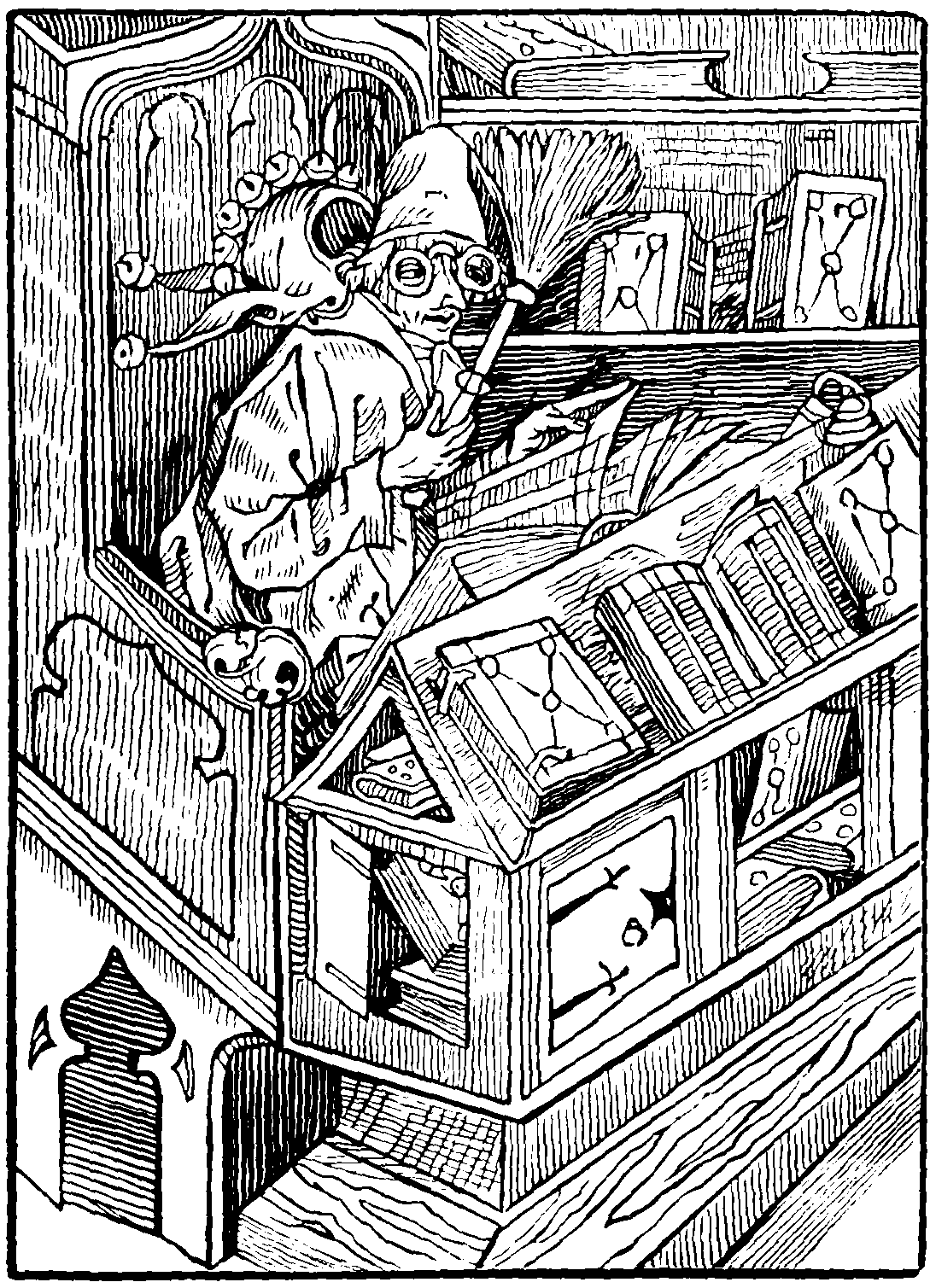
I am the firste fole of all the hole nauy
To kepe
the pompe, the helme and eke the sayle
For this is my mynde, this
one pleasoure haue I
Of bokes to haue grete plenty and
aparayle
I take no wysdome by them: nor yet auayle
Nor them
preceyue nat: And then I them despyse
Thus am I a foole and all
that sewe that guyse
That in this shyp the chefe place I gouerne
By this wyde see with folys wanderynge
The cause is playne, and easy to dyscerne
Styll am I besy bokes assemblynge
For to haue plenty it is a plesaunt thynge
In my conceyt and to haue them ay in honde
But what they mene do I nat vnderstonde
But yet I haue them in great reuerence
And honoure sauynge them from fylth and ordure
By often brusshynge, and moche dylygence
Full goodly bounde in pleasaunt couerture
Of domas, satyn, or els of veluet pure
I kepe them sure ferynge lyst they sholde be lost
For in them is the connynge wherin I me bost.
But if it fortune that any lernyd men
Within my house fall to disputacion
I drawe the curtyns to shewe my bokes then
That they of my cunnynge sholde make probacion
I kepe nat to fall in altercacion
And whyle they comon my bokes I turne and wynde
For all is in them, and no thynge in my mynde.
Tholomeus the riche causyd longe agone
Ouer all the worlde good bokes to be sought
Done was his commaundement anone
These bokes he had and in his stody brought
Whiche passyd all erthly treasoure as he thought
But neuertheles he dyd hym nat aply
Unto theyr doctryne, but lyued unhappely.
Lo in lyke wyse of bokys I haue store
But fewe I rede, and fewer understande
I folowe nat theyr doctryne nor theyr lore
It is ynoughe to bere a boke in hande
It were to moche to be it suche a bande
For to be bounde to loke within the boke
I am content on the fayre couerynge to loke
Why sholde I stody to hurt my wyt therby
Or trouble my mynde with stody excessyue
Sythe many ar whiche stody right besely
And yet therby shall they neuer thryue
The fruyt of wysdom can they nat contryue
And many to stody so moche are inclynde
That utterly they fall out of theyr mynde
Eche is nat lettred that nowe is made a lorde
Nor eche a clerke that hath a benefyce
They are nat all lawyers that plees doth recorde
All that are promotyd are nat fully wyse
On suche chaunce nowe fortune throwys hir dyce
That thoughe one knowe but the yresshe game
Yet wolde he haue a gentyllmannys name
So in lyke wyse I am in suche case
Thoughe I nought can I wolde be callyd wyse
Also I may set another in my place
Whiche may for me my bokes excercyse
Or else I shall ensue the comon gyse
And say concedo to euery argument
Lyst by moche speche my latyn sholde be spent
I am lyke other Clerkes whiche so frowardly them gyde.
That after they ar onys come vnto promocion
They gyue them to plesour theyr stody set asyde.
Theyr Auaryce couerynge with fayned deuocion.
Yet dayly they preche: and haue great derysyon
Against the rude Laymen: and al for Couetyse.
Though theyr owne Conscience be blynded wt that vyce.
But if I durst trouth playnely vtter and expresse.
This is the special cause of this Inconuenyence.
That greatest foles, and fullest of lewdnes
Hauynge least wyt: and symplest Science
Ar fyrst promoted: and haue greatest reuerence
For if one can flater, and bere a hawke on his Fyst
He shalbe made Person of Honyngton or of Clyst.
But he that is in Stody ay ferme and diligent.
And without al fauour prechyth Chrystys lore
Of al the Comontye nowe adayes is sore shent.
And by Estates thretened to Pryson oft therfore.
Thus what auayle is it, to vs to Stody more:
To knowe outher scripture, trouth, wysedom, or vertue
Syns fewe, or none without fauour dare them shewe.
But O noble Doctours, that worthy ar of name:
Consyder our olde faders: note wel theyr diligence:
Ensue ye theyr steppes: obtayne ye such fame,
As they dyd lyuynge: and that by true Prudence.
Within theyr hartys they planted theyr scyence
And nat in plesaunt bokes. But nowe to fewe suche be.
Therefore in this Shyp let them come rowe with me.
The Enuoy of Alexander Barclay Translatour exortynge the foles accloyed with this vice to amende theyr foly.
Say worthy doctours and Clerkes curious:
What moueth you of Bokes to haue such nomber.
Syns dyuers doctrines throughe way contrarious.
Doth mannys mynde distract and sore encomber.
Alas blynde men awake, out of your slomber
And if ye wyl nedys your bokes multyplye
With diligence endeuer you some to occupye.
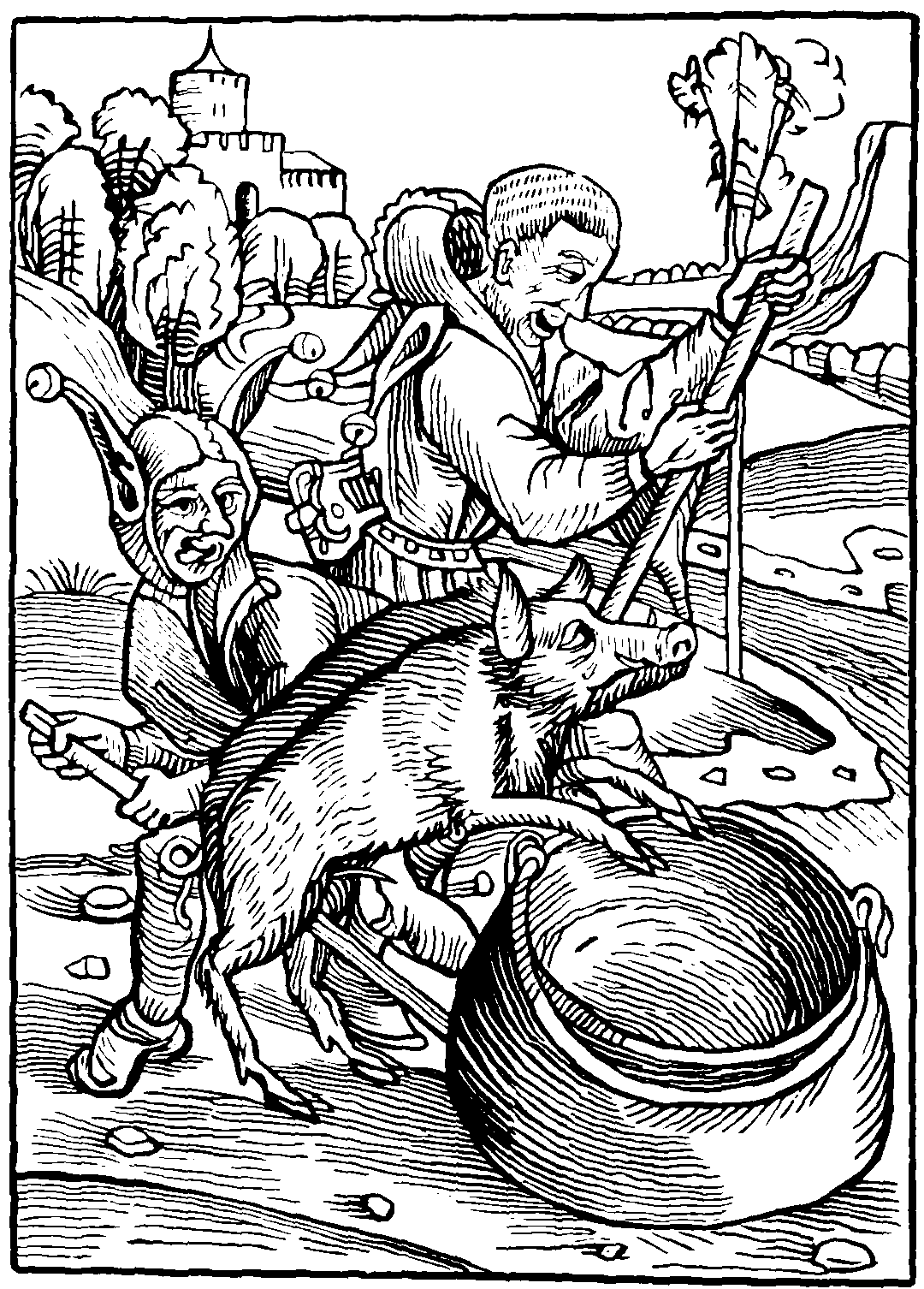
He that Office hath and hyghe autorite.
To rule a
Royalme: as Juge or Counsellour
Which seynge Justice, playne
ryght and equyte
Them falsly blyndeth by fauour or rigour
Condemnynge wretches gyltles. And to a Transgressour
For mede
shewinge fauour. Suche is as wyse a man
As he that wolde seeth a
quycke Sowe in a Pan.
Right many labours nowe, with hyghe diligence
For to be Lawyers the Comons to counsayle.
Therby to be in honour had and in reuerence
But onely they labour for theyr pryuate auayle.
The purs of the Clyent shal fynde hym apparayle.
And yet knowes he neyther lawe good counsel nor Justice.
But speketh at auenture: as men throwe the dyce.
Suche in the Senate ar taken oft to counsayle
With Statis of this and many a other region.
Whiche of theyr maners vnstable ar and frayle
Nought of Lawe Ciuyl knowinge nor Canon.
But wander in derknes clerenes they haue none.
O noble Rome thou gat nat thy honours
Nor general Empyre by suche Counsellours.
Whan noble Rome all the worlde dyd gouerne
Theyr councellers were olde men iust and prudent
Whiche egally dyd euery thynge descerne
Wherby theyr Empyre became so excellent
But nowe a dayes he shall haue his intent
That hath most golde, and so it is befall
That aungels worke wonders in westmynster hall.
There cursyd coyne makyth the wronge seme right
The cause of hym that lyueth in pouertye
Hath no defence, tuycion, strength nor myght
Suche is the olde custome of this faculte
That colours oft cloke Justyce and equyte
None can the mater fele nor vnderstonde
Without the aungell be weyghty in his honde
Thus for the hunger of syluer and of golde
Justyce and right is in captyuyte
And as we se nat gyuen fre, but solde
Nouther to estates, nor sympell comonte
And though that many lawyers rightwysnes be
Yet many other dysdayne to se the ryght
And they ar suche as blynde Justycis syght
There is one and other alleged at the barre
And namely suche as chrafty were in glose
Upon the lawe: the clyentis stande afarre
Full lytell knowynge howe the mater goose
And many other the lawes clene transpose
Folowynge the example, of lawyers dede and gone
Tyll the pore Clyentis be etyn to the bone
It is not ynough to conforme thy mynde
Unto the others faynyd opynyon
Thou sholde say trouthe, so Justyce doth the bynde
And also lawe gyueth the commyssyon
To knowe hir, and kepe hir without transgressyon
Lyst they whome thou hast Juged wrongfully
Unto the hye Juge for vengeaunce on the crye.
Perchaunce thou thynkest that god taketh no hede
To mannes dedys, nor workes of offence
Yes certaynly he knowes thy thought and dede
No thynge is secrete, nor hyd from his presence
Wherefore if thou wylt gyde the by prudence
Or thou gyue Jugement of mater lesse or more
Take wyse mennys reade and good counsayle before
Loke in what Balance, what weyght and what mesure
Thou seruest other. for thou shalt serued be
With the same after this lyfe I the ensure.
If thou ryghtwysly Juge by lawe and equyte
Thou shalt haue presence of goddes hyghe maiestye
But if thou Juge amys: than shall Eacus
(As Poetis sayth) hell Juge thy rewarde discusse
God is aboue and regneth sempiternally.
Whiche shall vs deme at his last Jugement,
And gyue rewardes to echone egally
After suche fourme as he his lyfe hath spent
Than shall we them se whome we as violent
Traytours: haue put to wronge in worde or dede
And after our deserte euen suche shall be our mede
There shall be no Bayle nor treatynge of maynpryse
Ne worldly wysdome there shall no thynge preuayle
There shall be no delayes vntyll another Syse
But outher quyt, or to infernall Gayle.
Ill Juges so iuged, Lo here theyr trauayle
Worthely rewarded in wo withouten ende.
Than shall no grace be graunted ne space to amende.
The Enuoy of Alexander Barclay the translatour.
Therfore ye yonge Studentes of the Chauncery:
(I speke nat to the olde the Cure of them is past)
Remember that Justyce longe hath in bondage be
Reduce ye hir nowe vnto lybertye at the last.
Endeuer you hir bondes to louse or to brast
Hir raunsome is payde and more by a thousande pounde
And yet alas the lady Justyce lyeth bounde.
Thoughe your fore Faders haue take hir prysoner
And done hir in a Dongeon nat mete for hir degre
Lay to your handes and helpe hir from daungere
And hir restore vnto hir lybertye
That pore men and monyles may hir onys se
But certaynly I fere lyst she hath lost hir name
Or by longe prysonment shall after euer be lame.
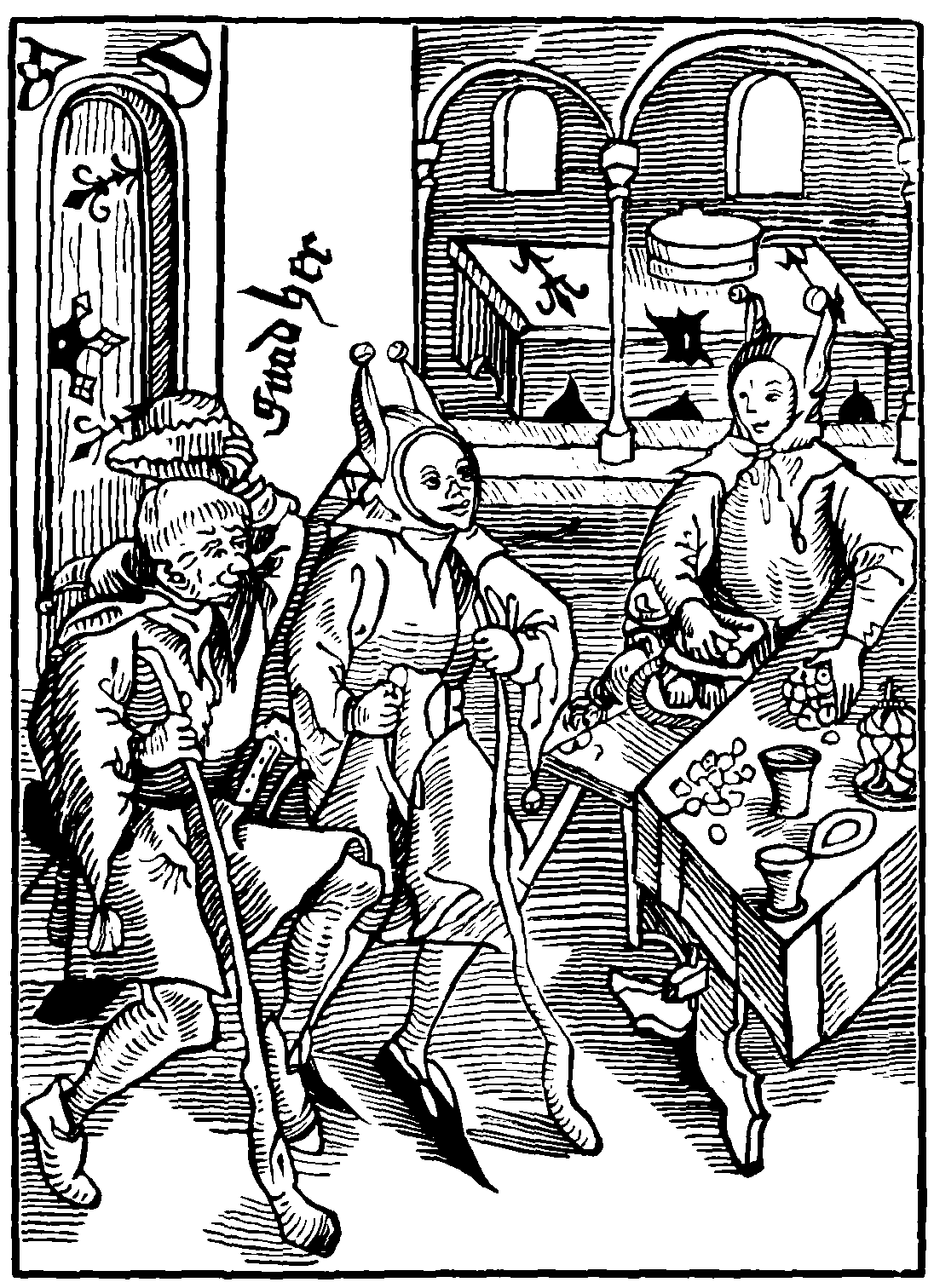
Ye that ar gyuen ouer moche to Couetyse
Come
nere, a place is here for you to dwel
Come nere ye wastfull
people in lyke wyse
Youre rowme shall be hye in the Topcastell
Ye care for no shame, for heuen nor for hell
Golde is your
god, ryches gotten wrongfully
Ye dame your soule, and yet lyue in
penury.
He that is besy euery day and houre
Without mesure, maner, or moderacion
To gather riches and great store of treasoure
Therof no ioy takinge, confort nor consolacion.
He is a Fole: and of blynde and mad opynyon
For that which he getteth and kepeth wrongfully
His heyre often wasteth moche more vnthryftely.
While he here lyueth in this lyfe caduke and mortal.
Ful sore he laboureth: and oft hungry gothe to bed
Sparinge from hymselfe: for hym that neuer shal
After do hym goode. thoughe he were harde bested.
Thus is this Couetous wretche so blyndly led
By the fende that here he lyueth wretchydly
And after his deth damned eternally.
There wandreth he in dolour and derknes
Amonge infernall flodes tedyous and horryble
Let se what auayleth than all his ryches
Ungracyously gotyne, his paynes ar terryble
Than wolde he amende but it is inpossyble
In hell is no order nor hope of remedy
But sorowe vpon sorowe, and that euerlastyngly.
Yet fynde I another vyce as bad as this
Whiche is the vyce of prodygalyte
He spendyth all in ryot and amys
Without all order, pursuynge pouertye
He lyketh nat to lyue styll in prosperite
But all and more he wastyth out at large
(Beware the ende) is the leste poynt of his charge.
But of the couetous somwhat to say agayne
Thou art a fole thy soule to sell for riches
Or put thy body to labour or to payne
Thy mynde to fere, thy herte to heuynesse
Thou fole thou fleest no maner cruelnesse
So thou may get money, to make thy heyr a knyght
Thou sleest thy soule where as thou saue it myght
Thou hast no rest thy mynde is euer in fere
Of mysauenture, nor neuer art content
Deth is forgoten, thou carest nat a here
To saue thy soule from infernall punysshement
If thou be dampned, than art thou at thy stent
By thy ryches which thou here hast left behynde
To thy executours, thou shalt small comforte fynde
Theyr custome is to holde fast that they haue
Thy pore soule shall be farthest fro theyr thought
If that thy carkes be brought onys in the graue
And that they haue thy bagges in handes cought
What say they, than (by god the man had nought)
Whyle he here lyuyd he was to lyberall
Thus dampned is thy soule, thy ryches cause of all
Who wyll denay but it is necesary
Of riches for to haue plenty and store
To this opynyon I wyll nat say contrary
So it be ordred after holy lore
Whyle thy selfe leuest departe some to the pore
With thy owne hande trust nat thy executours
Gyue for god, and god shall sende at all houres
Rede Tullius warkes the worthy Oratour.
And writen shalt thou fynde in right fruteful sentence
That neuer wyseman loued ouer great honour.
Nor to haue great riches put ouer great diligence
But onely theyr mynde was set on Sapience
And quyetly to lyue in Just symplycite.
For in greatest honour is greatest ieoperdye.
He that is symple, and on the grounde doth lye
And that can be content with ynoughe or suffisaunce
Is surer by moche than he that lyeth on hye.
Nowe vp nowe downe vnsure as a Balaunce.
But sothly he that set wyll his plesance
Onely on wysdom and styl therfore labour.
Shal haue more goode than all erthly tresour.
Wysdom techeth to eschewe al offence.
Gydynge mankynde the ryght way to vertue.
But of couetyse Comys all Inconuenyence.
It cawseth man of worde to be vntrue.
Forswerynge and falshode doth it also ensue.
Brybery and Extorcion, murder and myschefe.
Shame is his ende: his lyuyinge is reprefe.
By couetyse Crassus brought was to his ende.
By it the worthy Romayns lost theyr name.
Of this one yl a thousand ylles doth descende.
Besyde enuy, Pryde, wretchydnes and Shame.
Crates the Philosopher dyd Couetyse so blame:
That to haue his mynde vnto his stody fre.
He threwe his Tresour all hole into the see.
But shortly to conclude. Both bodely bondage.
And gostly also: procedeth of this couetyse.
The soule is damned the body hath damage
As hunger, thyrst, and colde with other preiudice.
Bereft of the ioyes of heuenly Paradyse.
For golde was theyr god and that is left behynde
Theyr bodyes beryed the soule clene out of mynde
The Enuoy of Alexander Barclay translatour.
Therefore thou couetouse thou wretch I speke to the.
Amende thy selfe ryse out of this blyndenes.
Content the wyth ynoughe for thy degre.
Dam nat thy soule by gatheringe frayle riches
Remembre this is a Uale of wretchednes.
Thou shalt no rest nor dwellynge place here fynde.
Depart thou shalt and leue it al behynde.
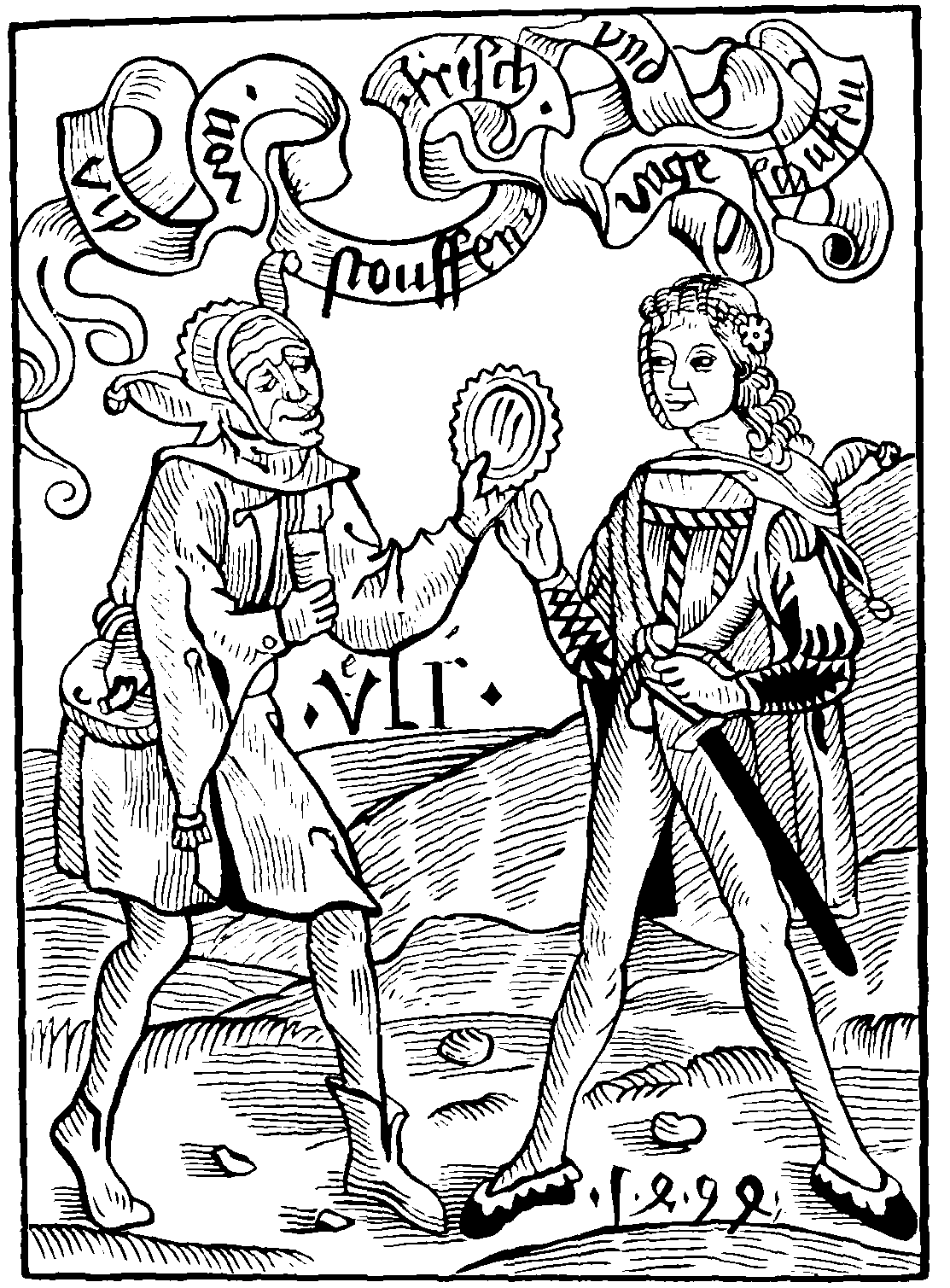
Who that newe garmentes loues or deuyses.
Or
weryth by his symple wyt, and vanyte
Gyuyth by his foly and
vnthryfty gyses
Moche yl example to yonge Comontye.
Suche
one is a Fole and skant shal euer thee
And comonly it is sene
that nowe a dayes
One Fole gladly folowes anothers
wayes.
Drawe nere ye Courters and Galants disgised
Ye counterfayt Caytifs, that ar nat content
As god hath you made: his warke is despysed
Ye thynke you more crafty than God onipotent.
Unstable is your mynde: that shewes by your garment.
A fole is knowen by his toyes and his Cote.
But by theyr clothinge nowe may we many note.
Aparayle is apayred. Al sadness is decayde
The garmentes ar gone that longed to honestye.
And in newe sortes newe Foles ar arayede
Despisynge the costom of good antiquyte.
Mannys fourme is disfigured with euery degre
As Knyght Squyer yeman Jentilman and knaue,
For al in theyr goynge vngoodely them behaue
The tyme hath ben, nat longe before our dayes
Whan men with honest ray coude holde them self content.
Without these disgised: and counterfayted wayes.
Wherby theyr goodes ar wasted, loste, and spent.
Socrates with many mo in wysdom excellent.
Bycause they wolde nought change that cam of nature
Let growe theyre here without cuttinge or scissure.
At that tyme was it reputed to lawde and great honour.
To haue longe here: the Beerde downe to the brest
For so they vsed that were of moste valour.
Stryuynge together who myht be godlyest
Saddest, moste clenely, discretest, and moste honest.
But nowe adayes together we contende and stryue.
Who may be gayest: and newest wayes contryue.
Fewe kepeth mesure, but excesse and great outrage
In theyr aparayle. And so therin they procede
That theyr goode is spent: theyr Londe layde to morgage.
Or solde out right: of Thryft they take no hede.
Hauinge no Peny them to socour at theyr nede.
So whan theyr goode by suche wastefulnes is loste.
They sel agayne theyr Clothes for half that they coste.
A fox furred Jentelman: of the fyrst yere or hede.
If he be made a Bailyf a Clerke or a Constable.
And can kepe a Parke or Court and rede a Dede
Than is Ueluet to his state mete and agreable.
Howbeit he were more mete to here a Babyl.
For his Foles Hode his iyen so sore doth blynde
That Pryde expelleth his lynage from his mynde.
Yet fynde I another sort almoste as bad as thay.
As yonge Jentylmen descended of worthy Auncetry.
Whiche go ful wantonly in dissolute aray.
Counterfayt, disgised, and moche vnmanerly
Blasinge and garded: to lowe or else to hye.
And wyde without mesure: theyr stuffe to wast thus gothe
But other some they suffer to dye for lacke of clothe.
Some theyr neckes charged with colers, and chaynes
As golden withtthes: theyr fyngers ful of rynges:
Theyr neckes naked: almoste vnto the raynes
Theyr sleues blasinge lyke to a Cranys wynges
Thus by this deuysinge suche counterfayted thinges
They dysfourme that figure that god hymselfe hath made
On pryde and abusion thus ar theyr myndes layde.
Than the Courters careles that on theyr mayster wayte
Seinge hym his Uesture in suche fourme abuse
Assayeth suche Fassion for them to counterfayte.
And so to sue Pryde contynually they muse.
Than stele they; or Rubbe they. Forsoth they can nat chuse.
For without Londe or Labour harde is it to mentayne.
But to thynke on the Galows that is a careful payne.
But be it payne or nat: there many suche ende.
At Newgate theyr garmentis ar offred to be solde.
Theyr bodyes to the Jebet solemly ascende.
Wauynge with the wether whyle theyr necke wyl holde.
But if I shulde wryte al the ylles manyfolde.
That procedeth of this counterfayt abusion
And mysshapen Fassions: I neuer shulde haue done.
For both States, comons, man, woman, and chylde
Ar vtterly inclyed to this inconuenyence.
But namely therwith these Courters are defyled.
Bytwen mayster and man I fynde no dyfference.
Therfore ye Courters knowledge your offence.
Do nat your errour mentayne, support nor excuse.
For Fowles ye ar your Rayment thus to abuse.
To Shyp Galauntes come nere I say agayne.
Wyth your set Busshes Curlynge as men of Inde.
Ye counterfayted Courters come with your fleinge brayne
Expressed by these variable Garmentes that ye fynde.
To tempt chast Damsels and turne them to your mynde
Your breste ye discouer and necke. Thus your abusion
Is the Fendes bate. And your soules confusion.
Come nere disgysed foles: receyue your Foles Hode.
And ye that in sondry colours ar arayde.
Ye garded galantes wastinge thus your goode
Come nere with your Shertes brodered and displayed.
In fourme of Surplys. Forsoth it may be sayde.
That of your Sort right fewe shal thryue this yere.
Or that your faders werith suche Habyte in the Quere.
And ye Jentyl wymen whome this lewde vice doth blynde
Lased on the backe: your peakes set a loft.
Come to my Shyp. forget ye nat behynde.
Your Sadel on the tayle: yf ye lyst to sit soft.
Do on your Decke Slut: if ye purpos to come oft.
I mean your Copyntanke: And if it wyl do no goode.
To kepe you from the rayne. ye shall haue a foles hode.
By the ale stake knowe we the ale hous
And euery Jnne is knowen by the sygne
So a lewde woman and a lechcrous
Is knowen by hir clothes, be they cours or fyne
Folowynge newe fassyons, not graunted by doctryne
The bocher sheweth his flesshe it to sell
So doth these women dampnyng theyr soule to hell
What shall I more wryte of our enormyte
Both man and woman as I before haue sayde
Ar rayde and clothyd nat after theyr degre
As nat content with the shape that god hath made
The clenlynes of Clergye is nere also decayed.
Our olde apparale (alas) is nowe layde downe
And many prestes asshamed of theyr Crowne.
Unto laymen we vs refourme agayne
As of chryste our mayster in maner halfe asshamed
My hert doth wepe: my tunge doth sore complayne
Seing howe our State is worthy to be blamed.
But if all the Foly of our Hole Royalme were named
Of mys apparayle of Olde, young, lowe, and hye,
The tyme shulde fayle: and space to me denye.
Alas thus al states of Chrysten men declynes.
And of wymen also disfourmynge theyr fygure.
Wors than the Turkes, Jewes, or Sarazyns.
A Englonde Englonde amende or be thou sure
Thy noble name and fame can nat endure
Amende lyst god do greuously chastyce.
Bothe the begynners and folowes of this vyce.
The Enuoy of Alexander Barclay ye translatour.
Reduce courters clerly vnto your rembrance
From whens this disgysyng was brought wherein ye go
As I remember it was brought out of France.
This is to your plesour. But payne ye had also.
As French Pockes hote ylles with other paynes mo.
Take ye in good worth the swetnes with the Sour.
For often plesour endeth with sorowe and dolour.
But ye proude Galaundes that thus yourselfe disgise
Be ye asshamed. beholde vnto your Prynce.
Consyder his sadnes: His honestye deuyse
His clothynge expresseth his inwarde prudence
Ye se no Example of suche Inconuenyence
In his hyghnes: but godly wyt and grauyte.
Ensue hym: and sorowe for your enormyte.
Away with this pryde, this statelynes let be
Rede of the Prophetis clothynge or vesture
And of Adam firste of your ancestrye
Of Johnn the Prophete, theyr clothynge was obscure
Uyle and homly, but nowe what creature
Wyll then eusue, sothly fewe by theyr wyll
Therfore suche folys my nauy shall fulfyll

Howe beit I stoup, and fast declyne
Dayly to my
graue, and sepulture
And though my lyfe fast do enclyne
To
pay the trybute of nature
Yet styll remayne I and endure
In
my olde synnes, and them nat hate
Nought yonge, wors olde, suche
is my state.
The madnes of my youthe rotyd in my age
And the blynde foly of my iniquite
Wyll me nat suffer to leue myne old vsage
Nor my fore lyuynge full of enormyte
Lame ar his lymmys, and also I can nat se
I am a childe and yet lyuyd haue I
An hundreth wynter, encresynge my foly.
But though I myght lerne my wyll is nat therto
But besy I am and fully set my thought
To gyue example to children to mysdo
By my lewde doctryne bryngynge them to nought
And whan they ar onys into my daunce brought
I teche them my foly wysdome set asyde
My selfe example, begynner, and theyr gyde.
My lewde lyfe, my foly and my selfwyllyd mynde
Whiche I haue styll kept hytherto in this lyfe
In my testament I leue wryten behynde
Bequethyng parte both to man childe and wyfe
I am the actour of myschefe and of stryfe
The foly of my youth and the inconuenyence
In age I practyse, techynge by experyence
I am a fole and glad am of that name
Desyrynge lawde for eche vngracious dede
And of my foly to spred abrode the same
To showe my vyce and synne, as voyde of drede
Of heuen or hell. therfore I take no hede
But as some stryue disputynge of theyr cunnynge
Right so do I in lewdnes and myslyuynge.
Somtyme I bost me of falshode and dysceyt
Somtyme of the sede that sawyn is by me
Of all myschefe, as murder flatery debate
Couetyse bacbytynge theft and lechery
My mynde is nat to mende my iniquyte
But rather I sorowe that my lyfe is wore
That I can nat do as I haue done before
But syns my lyfe so sodaynly dothe apeyre
That byde I can nat styll in this degre
I shall infourme and teche my sone and heyre
To folowe his fader, and lerne this way of me
The way is large, god wot glad shall he be
Lernynge my lore with affeccion and desyre
And folowe the steppys of his vnthryfty syre
I trust so crafty and wyse to make the lad
That me his father he shall pas and excell
O that my herte shall than be wonder glad
If I here of may knowe, se, or here tell
If he be false faynynge sotyll or cruell
And so styll endure I haue a speciall hope
To make hym scrybe to a Cardynall or Pope.
Or els if he can be a fals extorcyoner
Fasynge and bostynge to scratche and to kepe
He shall be made a comon costomer
As yche hope of Lyn Calays or of Depe
Than may he after to some great offyce crepe
So that if he can onys plede a case
He may be made Juge of the comon place.
Thus shall he lyue as I haue all his dayes
And in his age increas his folysshenes
His fader came to worshyp by suche ways
So shall the sone, if he hym selfe addres
To sue my steppes in falshode and lewdnes
And at leste if he can come to no degre
This shyp of folys shall he gouerne with me
Barklay To the Folys.
Awake age alas what thynkest thou be
Awake I say out of thy blynde derkenes
Remembrest thou nat that shortly thou shalt dye
Aryse from synne amende thy folysshenes
Though thy youth reted were in vyciousnes
Aryse in age is full tyme to leue it
Thy graue is open thy one fote in the pyt
Leue thy bostynge of that thou hast done amys
Bewayle thy synnes, sayeng with rufull mone
Delicta iuuentutis mee deus ne memineris
Amende the or thy youth be fully gone
That sore is harde to hele that bredes in the bone
He that is nought yonge, procedynge so in age
Shall skant euer his vyciousnes asswage
What thinge is more abhomynable in goddes syght.
Than vicious age: certaynly no thynge.
It is eke worldly shame, whan thy corage and mycht
Is nere dekayed, to kepe thy lewde lyuynge.
And by example of the, thy yonge children to brynge.
Into a vicious lyfe: and all goodnes to hate.
Alas age thus thou art the Fendes bate.
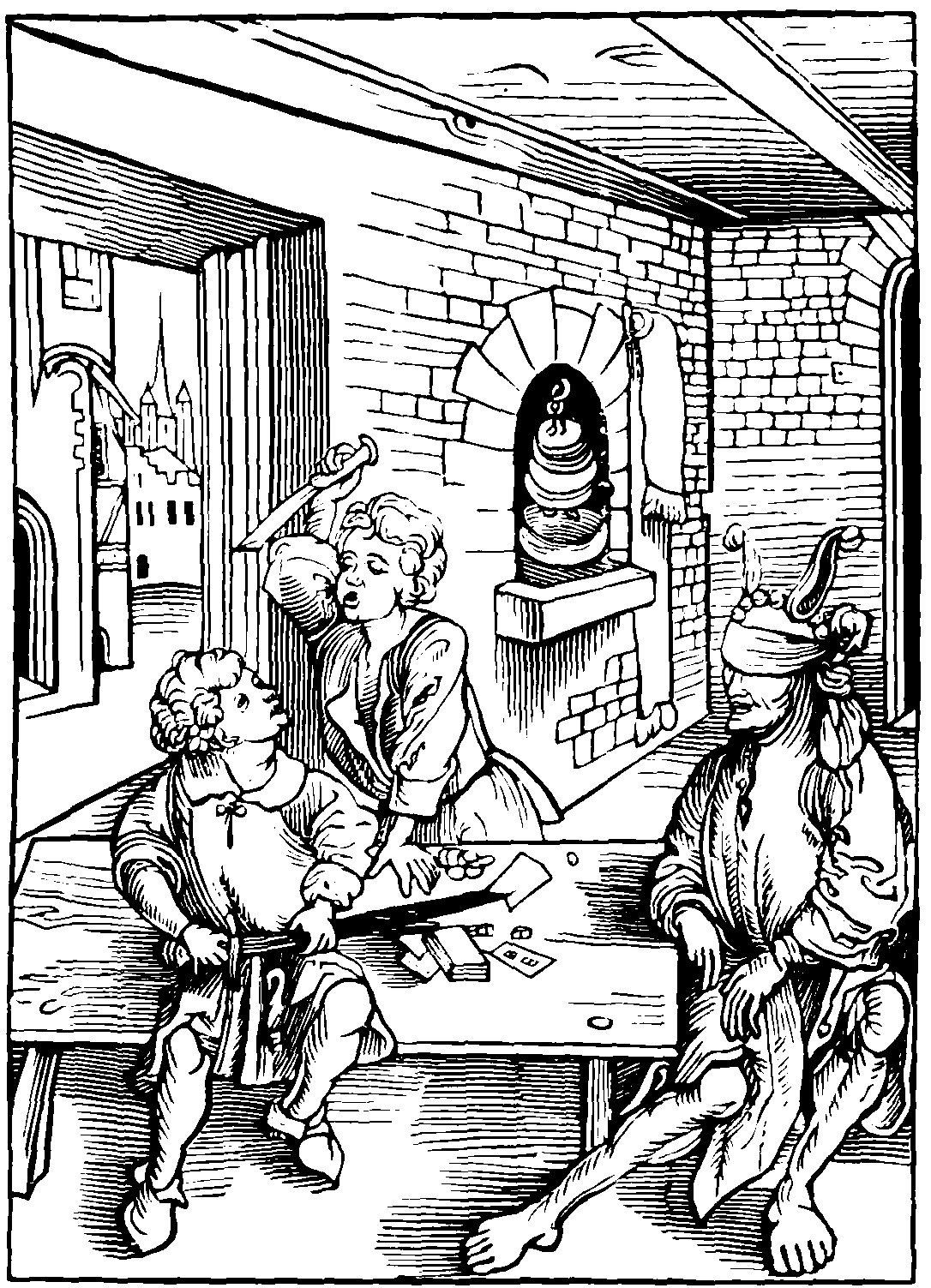
That fole that suffreth his Chylde for to offende
Wythout rebukynge, blame, and correccion.
And hym nat exhorteth,
hymselfe to amende.
Of suche fawtes as by hym ar done.
Shal
it sore repent: god wote howe sone
For oft the faders foly,
fauour, and neglygence
Causeth the Chylde for to fall to great
offence
A myserable Fole euermore shal he be.
A wretche vnauysed, and a Catyf blynde.
Whiche his chyldren fawtes forseth nat to see
Hauynge no care for to induce theyr mynde
To godly vertue: and vyce to leue behynde.
For whyle they ar yonge fereful and tender of age
Theyre vyce and foly is easy to asswage.
Two dyuers sortes of these foles may we fynde.
By whome theyr chyldren ar brought to confusion.
The one is neglygent. the other is starke blynde.
Nat wyllynge to beholde his childes yl condicion.
Whyle he is in youthe: But for a conclusion
He is a Fole that wyl nat se theyr vyce.
And he that seyth: and wyl it nat chastyce.
Alas thou art a cursed counselloure
To wanton youth that tender is of age
To let them wander without gouernoure
Or wyse mayster, in youthes furious rage
Get them a mayster theyr foly to asswage
For as a herdles flocke strayth in Jepardy
So children without gyde wandreth in foly.
To moche lyberty pleasoure and lycence
Gyuen vnto youth, whether it be or age
Right often causyth great inconuenyence
As ryot mysrule with other sore damage
Theyr londe and goodes solde or layde to gage
But thou folysshe father art redy to excuse
Thy yonge children of theyr synne and abuse
Thou sayst they ar ouer tender to eschewe
Theyr folysshe maners and they haue no skyll
To knowe the wayes of goodnes or vertue
Nor to discerne what is gode, what is yll
Thou blynde dodart these wordes holde thou styll
Theyr youth can nat excuse thy folysshenes
He that can yll as well myght lerne goodnes
A yonge hert is as apt to take wysdome
As is an olde, and if it rotyd be
It sawyth sede of holy lyfe to come
Also in children we often tymes se
Great aptness outwarde and syne of grauyte
But fyll an erthen pot first with yll lycoure
And euer after it shall smell somwhat soure
So youth brought vp in lewdnes and in sin
Shall skant it shrape so clene out of his mynde
But that styll after some spot wyll byde within
A lytell twygge plyant is by kynde
A bygger braunche is harde to bowe or wynde
But suffer the braunche to a byg tre to growe
And rather it shall brake than outher wynde or bowe
Correct thy childe whyle he is lyke a twygge
Soupyll and plyant, apt to correccion
It wyll be harde forsoth whan he is bygge
To brynge his stubron herte to subieccion
What hurtyth punysshement with moderacion
Unto yonge children, certaynely no thynge
It voydeth vyce, gettynge vertue and cunnynge
Say folysshe fader haddest thou leuer se
Thy sonnes necke vnwrested wyth a rope.
Than with a rod his skyn shulde brokyn be.
And oft thou trustest: and hast a stedfast hope
To se thy son promoted nere as hye as is the Pope
But yet perchaunce mourne thou shalt ful sore.
For his shameful ende: fortuned for lacke of lore.
Some folowe theyr chyldrens wyl and lewde plesour
So grauntinge them theyr mynde: that after it doth fal
To theyr great shame: they sorowe and dolour
As dyd to Priamus a Kynge Imperial
Whiche suffred his men: his son chefe of them al
By force from Grece to robbe the fayre Helayne.
Wherby both Fader and son were after slayne.
With noble Hector and many thousandes mo.
The Cyte of Troy vnto the ground clene brent.
I rede in the Cronycles of the Romayns also
Howe Tarquyne the proude had shame and punysshment
For rauysshynge chaste Lucres agaynst hyr assent.
Wherfore hyrselfe she slewe hyr seynge thus defiled.
For the which dede this Tarquyn was exiled,
From Rome: wandrynge in the Costes of Italy.
Dyd nat the traytour Catelyne also conspyre
And many mo sworne to his cruel tyranny
Agaynst the Romans to oppresse theyr Impyre,
But he and all his were murdred for theyr hyre,
And nat vnworthely. Beholde wherto they come
Which ar nat enfourmed in youth to ensue wysdom.
The son oft foloweth the faders behauour
And if the fader be discrete and vertuous.
The son shal suche wayes practyse both day and hour.
But if that the fader be lewde and vicious
By falshode lyuynge: and by wayes cautelous.
The son also the same wayes wyl ensue
And that moche rather than goodnes or vertue
Therfore it nedeth that better prouysion.
Were founde for youthe by sad and wyse counsayle
Far from theyr faders of this condicion.
And other lewde gydes which myght theyr myndes assayle
Greuously wyth syn. So were it theyr auayle
From theyr faders frawde and falshode to declyne
And them submyt to some lawdable mannys doctryne.
Peleus, somtyme a noble and worthy kynge
Subdued Achylles vnto the doctryne
Of phenix whiche was both worthy and cunnynge
Wherfore Achyllys right gladly dyd enclyne
With his hert and mynde vnto his disciplyne
Wherby his name so noble was at the last
That all Asy in worthynes he past
Ryght so Philippus a kynge worthy of name
Ouer all Grece made great iniquicion
To fynde one wyse, sad and laudable of fame
To Alexander his sonne for to gyue Instruccion
Founde was great Aristotyl at the conclusion
Disciple of Plato. whiche in euery Science.
Infourmed this chylde with parfyte diligence.
Whiche Alexander afterward had so great dignyte.
What by his strength, his cunnynge, and boldenes.
That he was lorde both of Londe and See.
And none durst rebel aganst his worthynes.
Lo here the lawde, the honour, and nobles.
Which dothe procede of vertue and doctryne
But few ar the faders that nowe hereto inclyne
Fewe ar that forceth nowe adayes to se
Theyr chyldren taught: or to do any cost
On som sad man, wyse, and of auctorite:
Al that is theron bestowed thynke they loste.
The folyssh Fader oft tymes maketh great boste.
That he his son to habundant riches shal auance
But no thynge he speketh of vertuous gouernance.
The feder made but smal shyft or prouysion.
To induce his Son by vertuous doctryne.
But whan he is dede and past: moche les shal the son
To stody of grace his mynde or hert inclyne.
But abuse his reason: and from al good declyne.
Alas folysshe faders gyue your aduertence
To Crates complaynt comprysed in this sentence.
If it were graunted to me to shewe my thought
Ye follysshe faders Caytifes I myght you cal
Whiche gather riches to brynge your chylde to nought.
Gyuynge him occasion forto be prodigal.
But goode nor cunnynge shewe ye hym none at all.
But whan ye drawe to age, ye than moste comonly.
Sorowe for your suffrance. But without remedy.
An olde sore to hele is oft halfe incurable
Ryght so ar these Chyldren roted in myschefe
Some after euer lyueth a lyfe abhomynable
To all theyr Kyn great sorowe and reprefe.
The one is a murderer the other a fereles thefe,
The one of god nor goode man hath no fors ne care.
Another so out wasteth that his frendes ar ful bare.
Some theyr londe and lyuelode in riot out wasteth,
At cardes, and, tenys, and other vnlawful gamys.
And some wyth the Dyce theyr thryft away casteth.
Some theyr soule damnes, and theyr body shames.
With flesshly lust: which many one dyffamys.
Spendynge the floures of youth moche vnthryftely.
On dyuers Braunches that longe to Lechery.
Another delyteth hymselfe in Glotony.
Etynge and drynkynge without maner, or mesure:
The more that some drynke: the more they wax drye.
He is moste Galant whyche lengest can endure.
Thus without mesure ouercharge they theyr nature.
So that theyr Soule is loste theyr body and goode is spent.
For lacke of doctryne, Norture and punysshment.
Se here playne prose, example and euydence
Howe youthe which is nat norysshed in doctryne.
In age is gyuen vnto al Inconuenyence.
But nought shall make youthe soner forto inclyne.
To noble maners: nor Godly dysciplyne:
Than shal the doctryne of a mayster wyse and sad:
For the rote of vertue and wysdome therby is had.
Without dout Noblenes is moche excellent
Whiche oft causeth youth to be had in great honour.
To haue the name, and lawde they ar content.
Thoughe it be nat gotten by theyr owne labour.
But what auayleth them this lewde obscure errour
Of suche hye byrthe them self to magnyfy.
Sythe they defyle it with vice and Uilany.
Why art thou proude thou foul of that nobles
Whyche is nat gotten by thyne owne vertue.
By thy goode maners, wyt nor worthynes:
But this forsothe oft tymes fynde I true
That of a goode beste, yl whelpes may weshewe.
In lyke wyse of a Moder that is bothe chast and goode.
Often is brought forth a ful vngracious Brode.
But though the childe be of lewde condicion
And of his nature frowarde and varyable
If the fader be slacke in the correccion
Of his childe, he onely is culpable
Whiche wyll nat teche hym maners commendable
Thus is the fader a fole for his suffraunce
And the sone also for his mysgouernaunce
The Enuoy.
Auoyd faders your fauour and suffraunce
Anenst your children in theyr faute and offence
Reduce ye clerely vnto your remembraunce
That many a thousande inconuenyence
Haue children done by theyr faders negligence
But to say trouth brefely in one clause
The fader's fauour onely is the cause
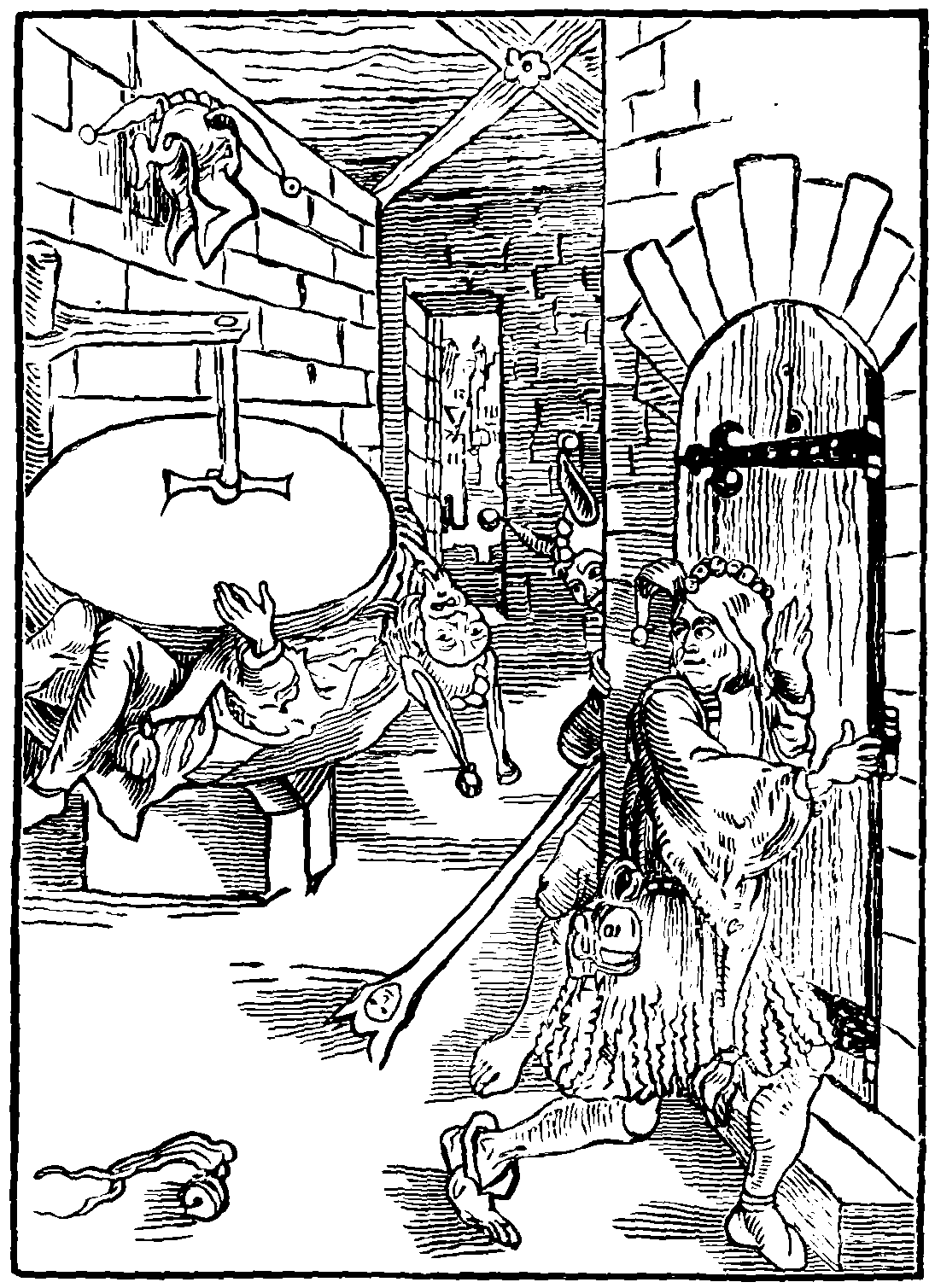
Of folys yet fynde I another maner sorte
Whiche
ar cause of brawlynge stryfe and deuysion
Suche ar dowble tongyd
that lesyngys reporte
Therby trustynge to come to great
promosion
But suche lewde caytyfes at the conclusion
Bytwene two mylstons theyr legges puttes to grynde
And for
rewarde, theyr confusion shall they fynde.
Some ar that thynke the pleasoure and ioy of theyr lyfe
To brynge men in brawlynge to discorde and debate
Enioynge to moue them to chydynge and to stryfe
And where loue before was to cause mortall hate
With the comonty, and many great estate
Suche is moche wors than outher murderer or thefe
For ofte of his talys procedeth grete myschefe
Within his mouth is venym Jeperdous and vyle
His tonge styll laboryth lesynges to contryue
His mynde styll museth of falshode and on gyle
Therwith to trobyll suche as gladly wolde nat stryue
Somtyme his wordes as dartis he doth dryue
Agaynst good men: for onely his delyte.
Is set to sclaunder to diffame and bacbyte.
And namely them that fautles ar and innocent.
Of conscience clene, and maners commendable
These dryuyls sclaunder, beynge full dilygent.
To deuyde, louers that ar moste agreable
His tonge Infect his mynde abhomynable
Infectyth loue and ouertourneth charyte
Of them that longe tyme haue lyuyd in amyte
But he that accused is thus without all faute
And so sclaundred of this caytyf vnthryfty
Knowyth nought of this ieoperdous assaute
For he nought dowteth that is no thynge fauty
Thus whyle he nought feryth comyth sodaynly
This venemous doloure distaynynge his gode name
And so gyltles put to rebuke, and to shame.
Thus if one serche and seke the worlde ouerall
Than a backbyter nought is more peryllous
His mynde myscheuous, his wordys ar mortall
His damnable byt is foule and venemous
A thousande lyes of gyles odyous
He castyth out where he wolde haue debate
Engendrynge murder whan he his tyme can wayt
Where as any frendes lyueth in accorde
Faythfull and true: this cowarde and caytyf
With his fals talys them bryngeth to dyscorde
And with his venym kepeth them in stryfe
But howe beit that he thus pas forth his lyfe
Sawynge his sede of debate and myschefe
His darte oft retourneth to his own reprefe
But nat withstandynge, suche boldely wyl excuse
His fals dyffamynge: as fautles and innocent.
If any hym for his dedes worthely accuse
He couereth his venym: as symple of intent.
Other ar whiche flater: and to euery thynge assent.
Before face folowynge the way of adulacion,
Whiche afterwarde sore hurteth by detraccion.
The worlde is nowe alle set on dyffamacion.
Suche ar moste cherisshed that best can forge a tale.
Whych shulde be moste had in abhomynacion.
And so they ar of wyse men without fayle.
But suche as ar voyde of wysdom and counsayle
Inclyneth theyr erys to sclander and detraccion,
Moche rather than they wolde to a noble sermon.
But euery Sclanderer, and begynner of stryfe.
Lousers of loue, and infecters of Charite.
Unworthy ar to lyue here at large in this lyfe.
But in derke Dongeon they worthy ar to be.
And there to remayne in pryson tyl they dye.
For with there yl tunges they labour to destroy
Concorde: whiche cause is of loue and of ioy.
An olde quean that hath ben nought al hyr dayes.
Whiche oft hath for money hyr body let to hyre
Thynketh that al other doth folowe hyr olde wayes.
So she and hyr boul felawes syttinge by the fyre.
The Boule about walkynge with theyr tunges they conspyre
Agaynst goode peple, to sclander them wyth shame.
Than shal the noughty doughter lerne of the bawdy dame.
By his warkes knowen is euery creature
For if one good, louynge, meke and charitable be.
He labours no debates amonge men to procure.
But coueyteth to norysshe true loue and charite.
Where as the other ful of falshode and iniquyte
Theyr synguler plesour put to ingender variaunce.
But oft theyr folysshe stody retournes to theyr myschaunce
Therfore ye bacbyters that folke thus dyffame
Leue of your lewdnes and note wel this sentence.
Which Cryist hymself sayd: to great rebuke and shame
Unto them that sclandreth a man of Innocence.
Wo be to them whych by malyuolence
Slandreth or dyffameth any creature.
But wel is hym that wyth pacience can indure.
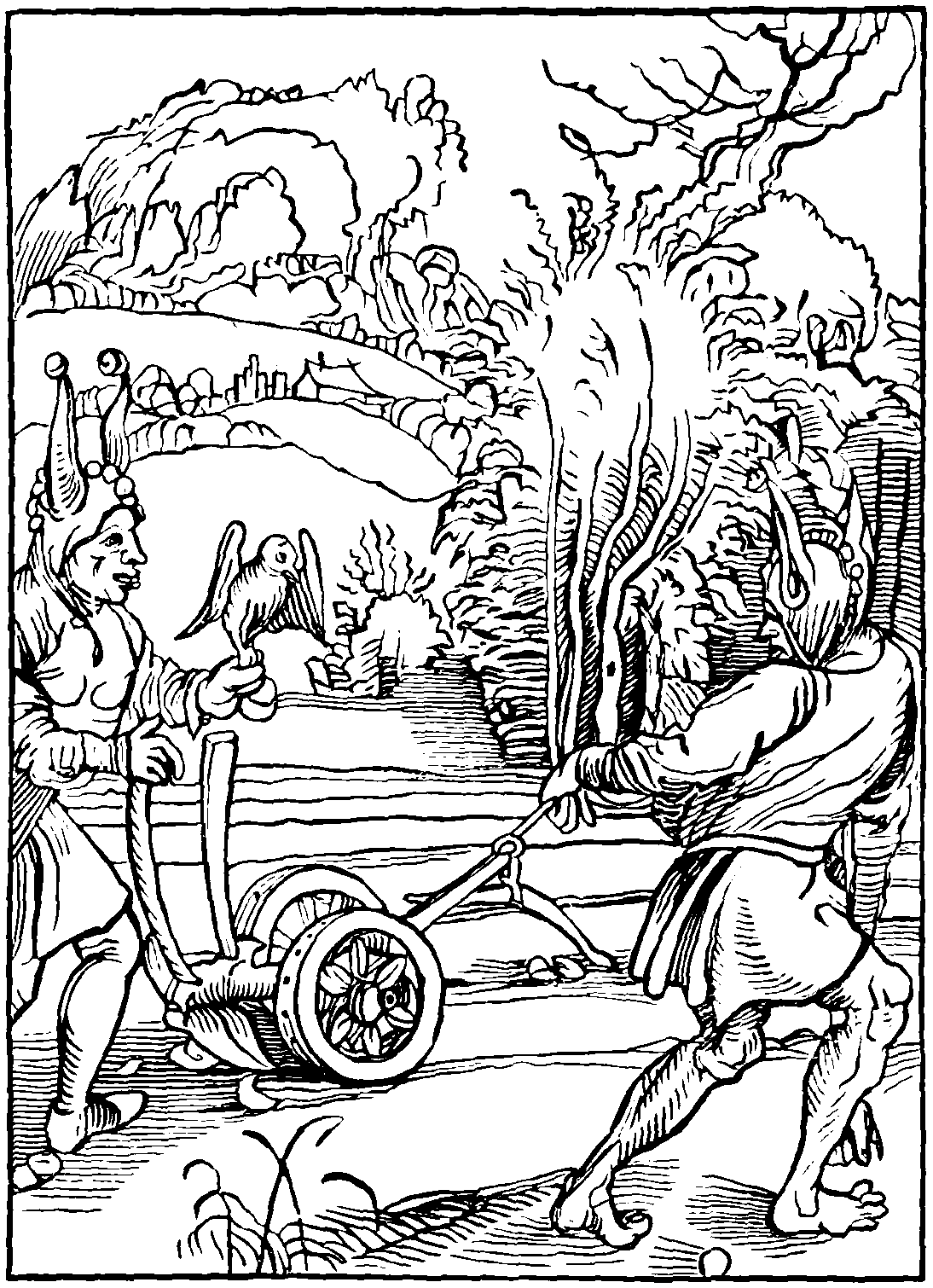
Of folys yet another sorte doth come
Vnto our
shyp rowynge with great trauayle
Whiche nought perceyue of
doctryne nor wysdome
And yet dysdayne they to aske wyse
counseyll
Nor it to folowe for theyr owne auayle
Let suche
folys therat haue no dysdayne
If they alone endure theyr losse
and payne
He is a fole that dothe coueyt and desyre
To haue the name of wysdome and prudence
And yet of one sought thorugh a cyte or a shyre
None coude be founde of lesse wysdome nor science
But whyle he thynketh hym full of sapience
Crafty and wyse, doutles he is more blynde
Than is that fole whiche is out of his mynde
But though he be wyse, and of myght meruaylous
Endued with retoryke and with eloquence
And of hym selfe both ware and cautelous
If he be tachyd with this inconuenyence
To dysdayne others counseyll and sentence
He is vnwyse, for oft a folys counsayle
Tourneth a wyse man to consort and auayle
But specially the read and auysement
Of wyse men, discrete, and full of grauyte
Helpeth thyne owne, be thou never so prudent
To thy purpose gyuynge strength and audacyte.
One man alone knowys nat all polycye
Thoughe thou haue wysdome cunnynge and scyence
Yet hath another moche more experience
Some cast out wordes in paynted eloquence
Thynkynge therby to be reputed wyse
Thoughe they haue neyther wysdome nor science
Suche maner folys them self do exercyse
A plughe and teame craftely to deuyse
To ere the path that folys erst hath made
The trouth vnder glose of suche is hyd and layde
For why, they trust alway to theyr owne mynde
And furour begon whether it be good or yll
As if any other, no wyser read coude fynde
Thus they ensue theyr pryuate folysshe wyll
Oft in suche maters wherin they haue no skyll
As did Pyrrus whiche began cruell Batayle
Agaynst Orestes refusynge wyse counsayle
But folowyd his owne rasshe mynde without auayle
As blynde and obstynat of his intencion
Wherfore he was disconfyted in Batayle
Hymselfe slayne, his men put to confusyon
If that the Troyans in theyr abusyon
With false Parys, had confourmed theyr intent
To Helenns counsayle Troy had nat ben brent.
For that Priamus his mynde wolde nat aply
To the counseyll of Cassandra Prophetes
The grekys distroyed a great parte of Asy
Hector also by his selfwyllydnes
Was slayne with Peyn for all his doughtynes
Of Achylles in open and playne Batayle
For nat folowynge of his faders counsayle
If Hector that day had byddyn within Troy
And vnto his fader bene obedient
Perchaunce he sholde haue lyuyd in welth and ioy
Longe tyme after and come to his intent
Whereas his body was with a spere through rent
Of the sayd Achyllys cruell and vnkynde
Alas for suynge his owne selfwyllyd mynde
I rede of Nero moche cursed and cruell
Whiche to wyse counsayle hymself wolde nat agre
But in all myschef all other dyd excell
Delytynge hym in synne and crueltye
But howe dyde he ende forsoth in myserye
And at the last as wery of his lyfe
Hymselfe he murdred with his owne hand and knyfe
The Bybyll wytnessyth howe the prophete Thoby
Gaue his dere sone in chefe commaundement
That if he wolde lyue sure without ieoperdy
He sholde sue the counsayle of men wyse and prudent
The story of Roboam is also euydent
Whiche for nat suynge of counseyll and wysdome
Lost his Empyre, his scepter and kyngdome
If that it were nat for cawse of breuyte
I coude shewe many of our predecessours
Whiche nat folowynge counceyll of men of grauyte
Soone haue decayed from theyr olde honours
I rede of Dukes, Kynges, and Emperours
Whiche dispysynge the counsayle of men of age
Haue after had great sorowe and damage.
For he suerly whiche is so obstynate
That onely he trusteth to his owne blyndnes
Thynkynge all wysdome within his dotynge pate
He often endyth in sorowe and dystres
Wherfore let suche theyr cours swyftly addres
To drawe our Plough, and depe to ere the ground
That by theyr laboure all folys may be founde.
The Enuoy of Alexander Barclay the Translatour.
O man vnauysed, thy blyndnes set asyde
Knowledge thy owne foly thy statelynes expel
Let nat for thy eleuate mynde nor folysshe pryde,
To order thy dedes by goode and wyse counsel
Howbeit thou thynke thy reason doth excel
Al other mennys wyt. yet oft it doth befall.
Anothers is moche surer: and thyn the worst of all.
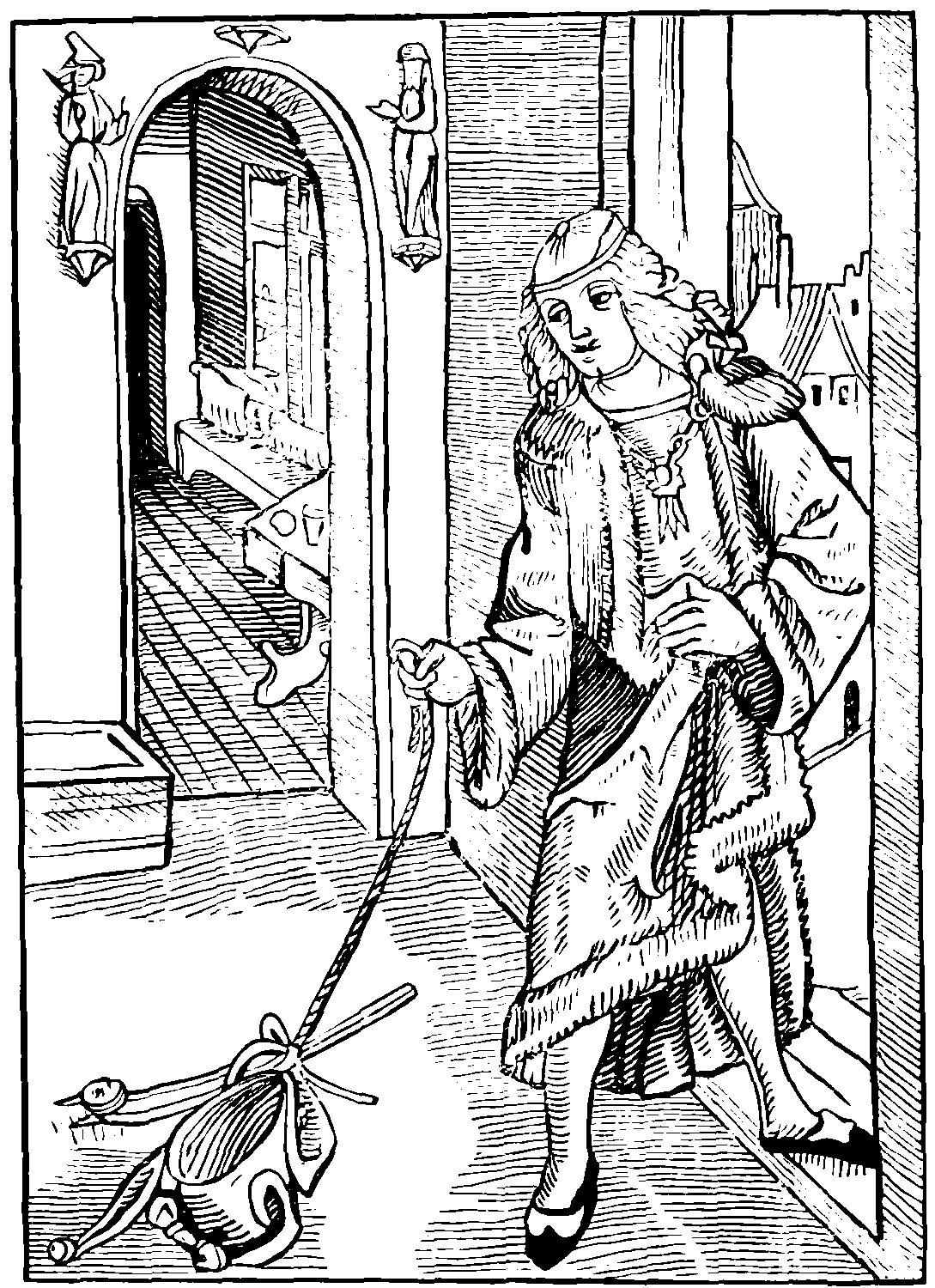
Drawe nere ye folys of lewde condicion
Of yll
behauoure gest and countenaunce
Your proude lokys, disdayne and
derysyon
Expresseth your inwarde folysshe ignoraunce
Nowe
wyll I touche your mad mysgoueraunce
Whiche hast to foly, And
folysshe company
Treylynge your Baybll in sygne of your
foly
In this our tyme small is the company
That haue good maners worthy of reuerence
But many thousandes folowe vylany
Prone to all synne and inconuenyence
Stryuynge who sonest may come to all offence
Of lewde condicions and vnlefulnesse
Blyndnes of yll, and defylyd folysshenesse
All myserable men alas haue set theyr mynde
On lothsome maners clene destytute of grace
Theyr iyen dymmyd, theyr hertes are so blynde
That heuenly ioy none forceth to purchace
Both yonge and olde procedeth in one trace
With ryche and pore without all dyfference
As bonde men subdued to foly and offence
Some ar busshed theyr bonetes, set on syde.
Some waue theyr armys and hede to and fro
Some in no place can stedfastly abyde
More wylde and wanton than outher buk or do
Some ar so proude that on fote they can nat go
But get they must with countenaunce vnstable
Shewynge them folys, frayle and varyable
Some chyde that all men do them hate
Some gygyll and lawgh without grauyte
Some thynkes, hymselfe a gentylman or state
Though he a knaue caytyf and bonde churle be
These folys ar so blynde them self they can nat so
A yonge boy that is nat worth an onyon
With gentry or presthode is felowe and companyon.
Brybours and Baylyes that lyue upon towlynge
Are in the world moche set by nowe a dayes
Sergeauntis and Catchpollys that lyue upon powlynge
Courters and caytyfs begynners of frayes
Lyue styll encreasynge theyr vnhappy wayes
And a thousande mo of dyuers facultyes
Lyue auauntynge them of theyr enormytees.
Within the chirche and euery other place
These folys use theyr lewde condicions
Some starynge some cryeng some haue great solace
In rybawde wordes, some in deuysyons
Some them delyte in scornes and derysons
Some pryde ensueth and some glotony.
Without all norture gyuen to vylany
Theyr lyfe is folysshe lothsome and vnstable
Lyght brayned, theyr herte and mynde is inconstant
Theyr gate and loke proude and abhomynable
They haue nor order as folys ignorant
Chaungyng theyr myndes thryse in one instant
Alas this lewdnes and great enormyte
Wyll them nat suffer theyr wretchydnes to se
Thus ar these wretchyd caytyfes fully blynde
All men and wymen that good ar doth them hate
But he that with good maners endueth his mynde
Auoydeth this wrath hatered and debate
His dedes pleaseth both comonty and estate
And namely suche as ar good and laudable
Thynketh his dedes right and commendable
As wyse men sayth: both vertue and cunnynge
Honoure and worshyp grace and godlynes
Of worthy maners take theyr begynnynge
And fere also asswagyth wantones.
Subduynge the furour of youthes wylfulnes
But shamefastnes trouth constance and probyte
Both yonge and olde bryngeth to great dignyte.
These foresayde vertues with charite and peas.
Together assembled stedfast in mannys mynde.
Cawseth his honour and worthynes to encreas.
And his godly lyfe a godly ende shal fynde
But these lewde caytyfs which doth theyr myndes blynde
With corrupt maners lyuynge vnhappely.
In shame they lyue and wretchedly they dye.
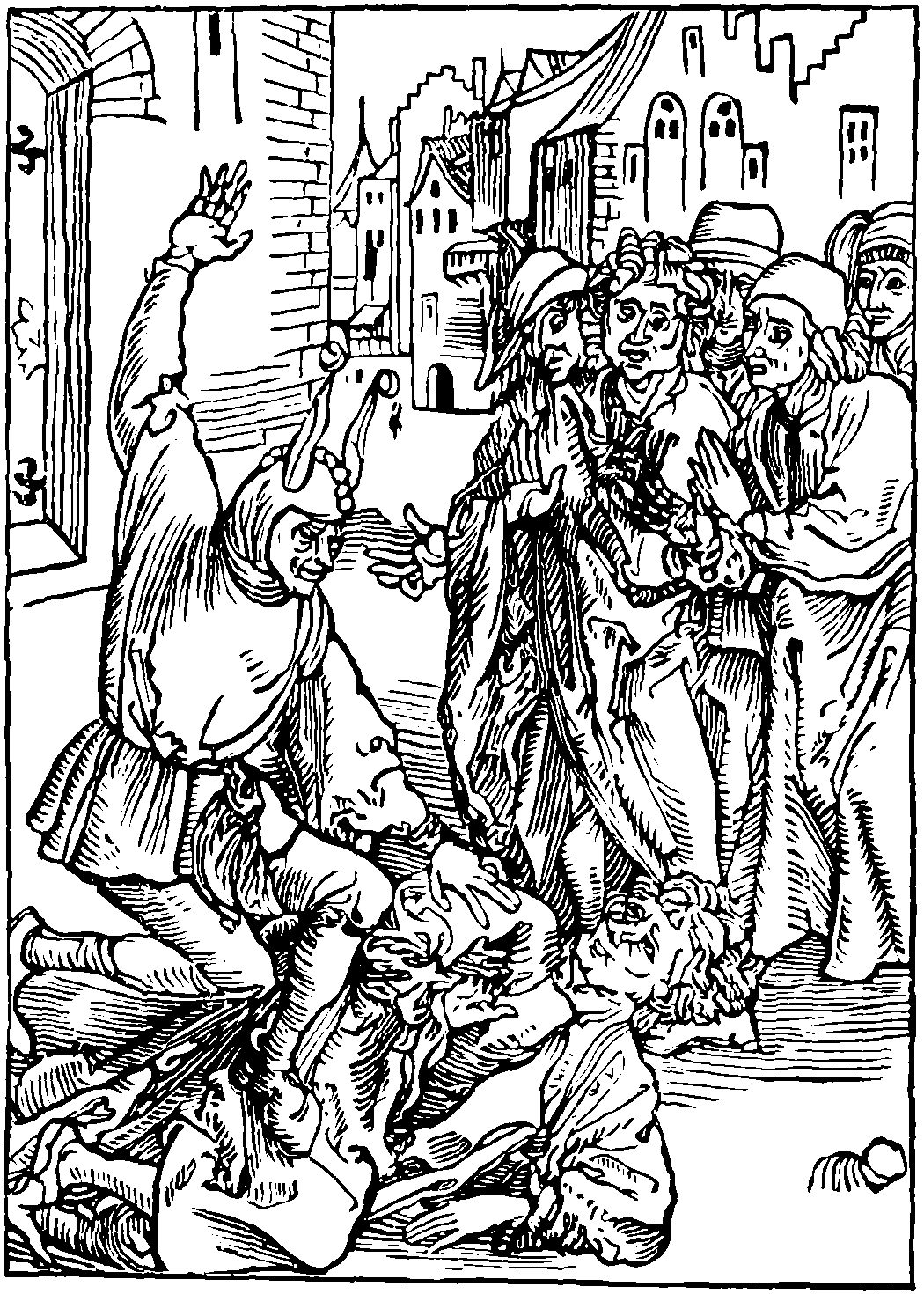
He that iniustyce vseth and greuance
Agaynst all
reason lawe and equyte
By vyolent force puttynge to vtteraunce
A symple man full of humylyte
Suche by his lewdnes and
iniquyte.
Makyth a graue wherin hym selfe shall lye.
And
lewdly he dyeth that lyueth crudlye.
A Fole frowarde cruell and vntrewe
Is he whiche by his power wrongfully
His frendes and subiectes laboures to subdewe
Without all lawe, but clene by tyranny
Therfore thou Juge thy erys se thou aply
To right Justyce and set nat thyne intent
By wrath or malyce to be to vyolent.
It is nat lawfull to any excellent
Or myghty man, outher lawyer or estate
By cruelnes to oppresse an innocent
Ne by pryde and malyce Justyce to violate
The law transposynge after a frowarde rate
With proude wordes defendynge his offence
God wot oft suche haue symple conscience
O that he cursed is and reprouable
Whiche day and nyght stodyeth besely
To fynde some meanes false and detestable
To put his frende to losse or hurte therby
Our hertes ar fully set on vylany
There ar right fewe of hye or lowe degre
That luste to norysshe trewe loue and amyte
Alas exyled is godly charyte
Out of our Royalme we all ar so vnkynde
Our folys settyth gretter felycyte
On golde and goodes than on a faythfull frynde
Awake blynde folys and call vnto your mynde
That though honest ryches be moche commendable
Yet to a true frende it is nat comparable
Of all thynges loue is moste profytable
For the right order of lowe and amyte
Is of theyr maners to be agreable
And one of other haue mercy and pyte
Eche doynge for other after theyr degre
And without falshode this frendeshyp to mayntayne
And nat departe for pleasour nor for payne
But alas nowe all people haue dysdayne
On suche frendshyp for to set theyr delyte
Amyte we haue exyled out certayne
We lowe oppressyon to sclaunder and bacbyte
Extorcyon hath strength, pyte gone is quyte
Nowe in the worlde suche frendes ar there none
As were in Grece many yeres agone.
Who lyst thystory of Patroclus to rede
There shall he se playne wryten without fayle
Howe whan Achyllys gaue no force nor hede
Agaynst the Troyans to execute batayle
The sayd Patroclus dyd on the aparayle
Of Achylles, and went forth in his steade
Agaynst Hector: but lyghtly he was dede.
But than Achylles seynge this myschaunce.
Befallen his frende whiche was to hym so true.
He hym addressyd shortly to take vengeaunce.
And so in Batayle the noble Hector slewe
And his dede cors after his charot drewe.
Upon the grounde traylynge ruthfully behynde
Se howe he auengyd Patroclus his frende.
The hystory also of Orestes dothe expresse
Whiche whan agamenon his fader was slayne
By egystus whiche agaynst rightwysnes
The sayde Orestis moder dyd meyntayne
The childe was yonge wherfore it was but vayne
In youth to stryue, but whan he came to age
His naturall moder slewe he in a rage
And also Egystus whiche had his fader slayne
Thus toke he vengeaunce of both theyr cruelnes
But yet it grewe to his great care and payne
For sodaynly he fell in a madnesse
And euer thought that in his furiousnes
His moder hym sued flamynge full of fyre
And euer his deth was redy to conspyre
Orestes troubled with this fereful vysyon
As franatyke and mad wandred many a day
Ouer many a countrey londe and regyon
His frende Pylades folowynge hym alway
In payne nor wo he wolde hym nat denay
Tyll he restoryd agayne was to his mynde
Alas what frynde may we fynde nowe so kynde.
Of dymades what shall I lawde or wryte.
And Pythias his felawe amyable
Whiche in eche other suche loue had and delyte
That whan Denys a tyrant detestable
And of his men some to hym agreable
Wolde one of them haue mordred cruelly
Echone for other offred for to dye
Ualerius wrytyth a story longe and ample
Of Lelius and of worthy Cipio.
Whiche of trewe loue hath left vs great example
For they neuer left in doloure wele nor wo
I rede in thystory of Theseus also:
Howe he (as the Poetes fables doth tell)
Folowyd his felawe perothus in to hell.
And serchynge hym dyd wander and compas
Those lothsome flodys and wayes tenebrous
Ferynge no paynes of that dysordred place
Nor obscure mystes or ayres odyous
Tyll at the laste by his wayes cautelous
And Hercules valyaunt dedes of boldnesse
He gat Perothus out of that wretchydnesse.
Alas where ar suche frendes nowe a dayes
Suerly in the worlde none suche can be founde
All folowe theyr owne profyte and lewde wayes
None vnto other coueytys to be bounde
Brekers of frendshyp ynough ar on the grounde
Whiche set nought by frendshyp so they may haue good
All suche in my shyp shall haue a folys hode
The Enuoy of Barklay To the Folys.
Ye cruell folys full of ingratitude.
Aryse be asshamyd of your iniquyte
Mollyfy your hertes vnkynde stuberne and rude
Graffynge in them true loue and amyte
Consyder this prouerbe of antyquyte
And your vnkyndnes weray ban and curse
For whether thou be of hy or lowe degre
Better is a frende in courte than a peny in purse
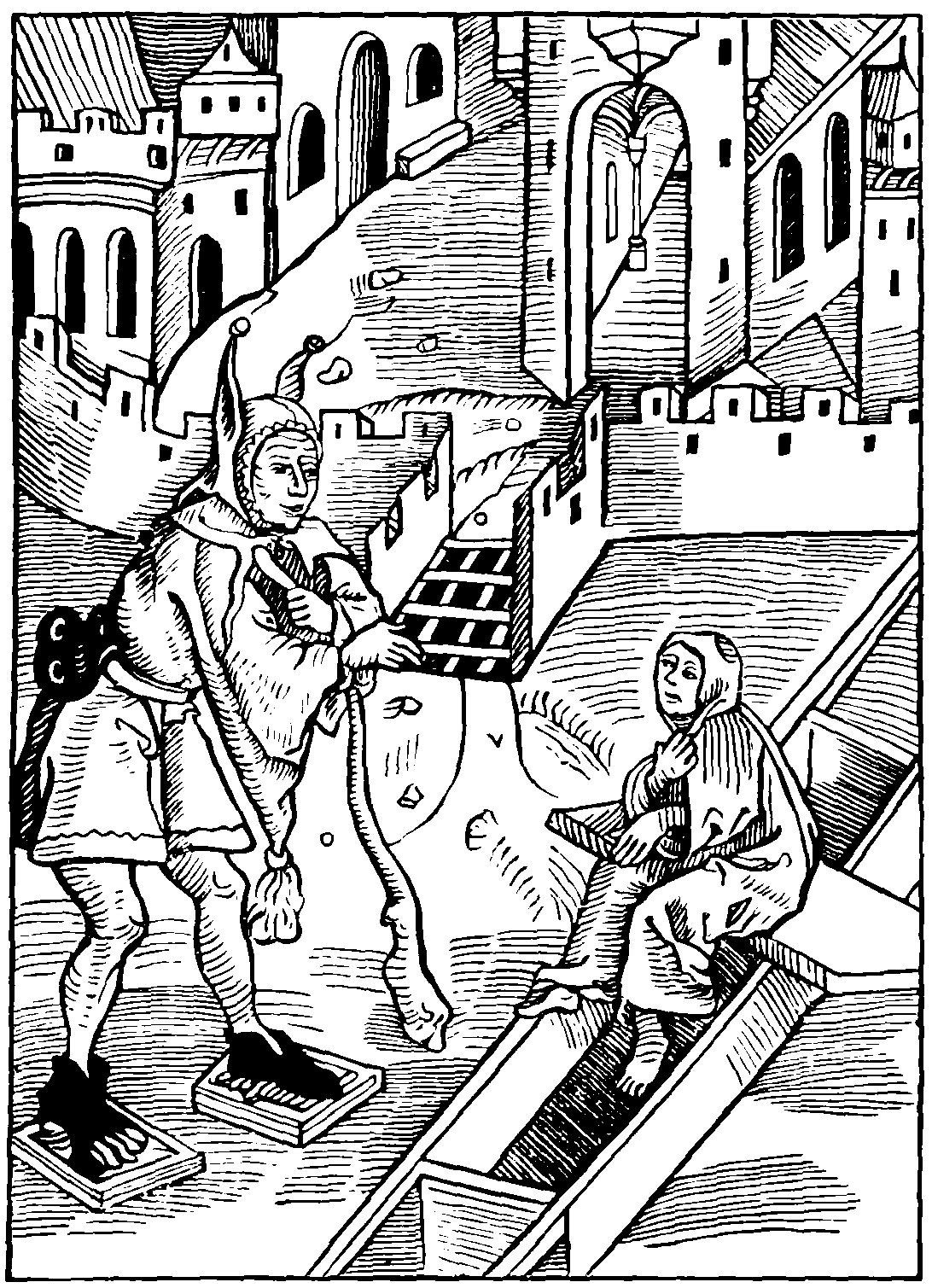
He that gyueth his erys or credence
To euery
folys talys or talkynge
Thynkynge more wysdome and fruytfull
sentence
In theyr vayne talys than is in the redynge
Of
bokes whiche shewe vs the way of godly lyuynge
And soulys helth:
forsoth suche one is blynde
And in this shyp the anker shall vp
wynde.
Suche as dispyseth auncyent scripture
Whiche prouyd is of great auctoryte
And hath no pleasoure felycyte or cure
Of godly Prophetis whiche wrote of veryte
A fole he is for his moste felycyte
Is to byleue the tales of an olde wyfe
Rather than the doctryne of eternall lyfe
The holy Bybyll grounde of trouth and of lawe
Is nowe of many abiect and nought set by
Nor godly scripture is nat worth an hawe
But talys ar louyd grounde of rybawdry
And many blynddyd ar so with theyr foly
That no scripture thynke they so true nor gode
As is a folysshe yest of Robyn hode.
He that to scripture wyll not gyue credence
Wherin ar the armys of our tuycion
And of our fayth foundacion and defence
Suche one ensueth nat the condycion
Of man resonable, but by abusyon
Lyuyth as a best of conscyence cruell
As saue this worlde were neyther heuen nor hell.
He thynketh that there is no god aboue
Nor nobler place than is this wretchyd grounde
Nor goddes power suche neyther fere nor loue
With whom all grace and mercy doth abounde
Whiche whan hym lyst vs wretches may confounde
Alas what auayleth to gyue instruction
To suche lewde folys of this condycion.
It nought auayleth vnto them to complayne
Of theyr blyndnes, nor enfourme them with vertue
Theyr cursed lyfe wyll by no mean refrayne
Their viciousnes, nor their erroure eschewe
But rather stody theyr foly to renewe
Alas what profytis to suche to expresse.
The heuenly ioy, rewarde of holynesse.
Alas what auayleth to suche to declare
The paynes of hell, wo dissolate and derke
No wo nor care can cause suche to beware
From their lewde lyfe corrupt and synfull warke
What profyteth sermons of any noble clarke
Or godly lawes taught at any Scolys
For to reherse to these myscheuous folys.
What helpeth the Prophetis scripture or doctryne
Unto these folys obstynate and blynde
Their hertis ar harde, nat wyllynge to enclyne
To theyr preceptis nor rote them in theyr mynde
Nor them byleue as Cristen men vnkynde
For if that they consydred heuen or hell
They wolde nat be so cursed and cruell
And certaynly the trouth apereth playne
That these folys thynke in theyr intent
That within hell is neyther car nor payne
Hete nor colde, woo, nor other punysshement
Nor that for synners is ordeyned no turment
Thus these mad folys wandreth euery houre
Without amendement styll in theyr blynde erroure
Before thy fete thou mayst beholde and se
Of our holy fayth the bokys euydent
The olde lawes and newe layde ar before the
Expressynge christes tryumphe right excellent
But for all this set is nat thyne intent
Theyr holy doctryne to plant within thy brest
Wherof shold procede ioy and eternall rest
Trowest thou that thy selfe wyllyd ignoraunce
Of godly lawes and mystycall doctryne
May clense or excuse thy blynde mysgouernaunce
Or lewde erroure, whiche scorne hast to inclyne
To theyr preceptis: and from thy synne declyne
Nay nay thy cursed ignoraunce sothly shall
Drowne thy soule in the depe flodes infernall
Therfore let none his cursydnes defende
Nor holy doctryne, nor godly bokes dispyse
But rather stody his fawtes to amende
For god is aboue all our dedes to deuyse
Whiche shall rewarde them in a ferefull wyse
With mortall wo that euer shall endure
Whiche haue dyspysyd his doctryne and scripture
Barclay To the Folys.
Out of your slomber folys I rede you ryse.
Scripture dyuyne, to folowe and inbrace
Be nat so bolde it to leue nor dispyse
But you enforce it to get and purchase
Remember mannys consort and solace.
Is holy closyd within the boke of lyfe
Who that it foloweth hath a speciall grace
But he that doth nat a wretche is and caytyfe
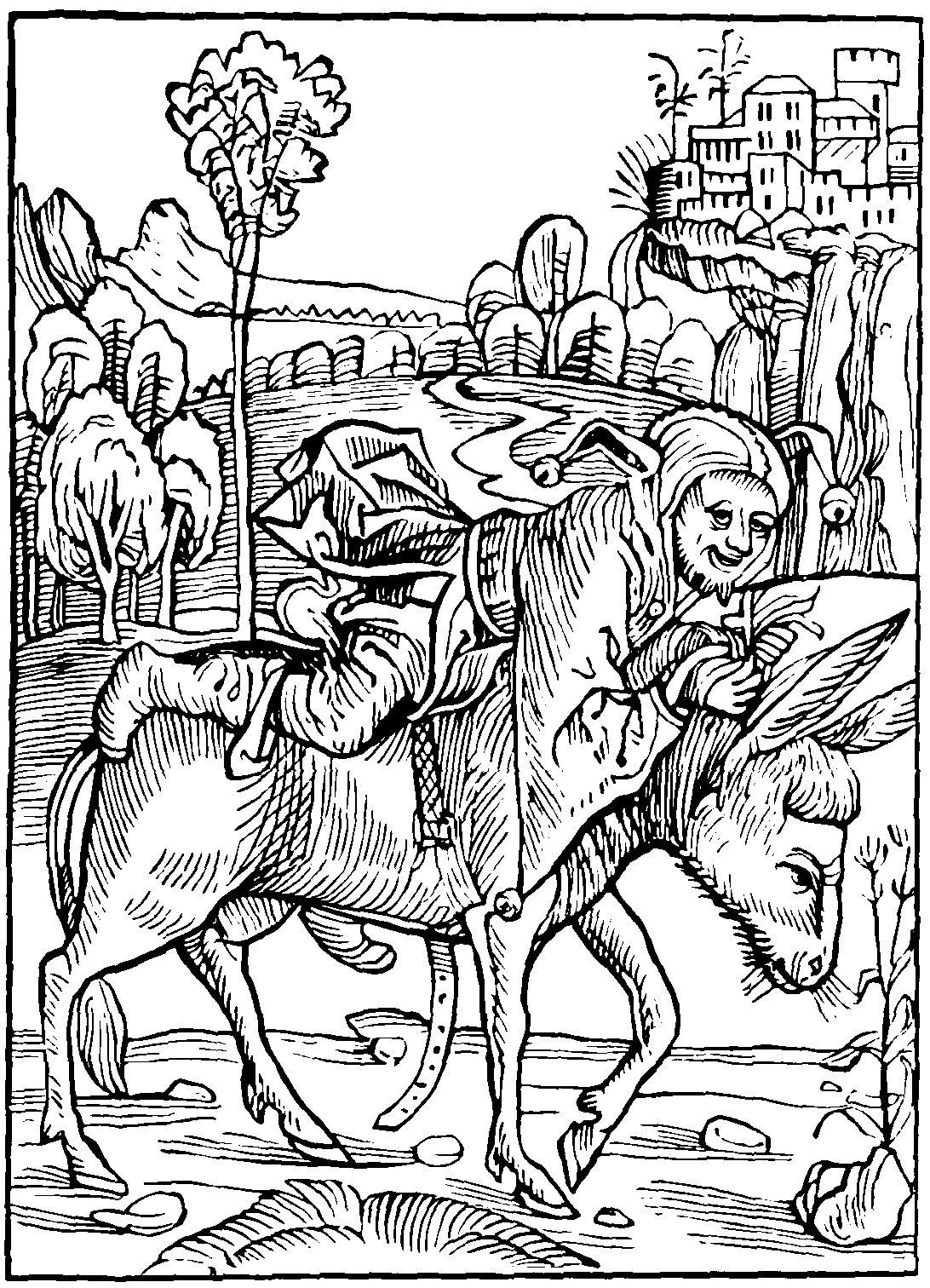
He is a fole forsoth and worse
That to his
saddyll wolde lepe on hye
Before or he haue gyrt his horse
For downe he comys with an euyll thee
But as great a fole forsoth
is he
And to be lawghed to derysyon.
That ought begynneth
without prouysyon
Of other folys yet is a moche nomber
Whom I wolde gladly brynge to intellygence
To auoyde their blyndnes which sore doth incomber
Theyr mynde and herte for lackynge of science
Suche ar vnware and gyuen to neglygence
Mad and mysmyndyd pryuate of wysdome
Makynge no prouysyon for the tyme to come.
If any mysfortune aduersyte or wo
As often hapnyth, to suche a fole doth fall
Than sayth he I thought it wolde nat haue be so
But than ouer late is it agayne to call
It is nat ynough thou fole to say I shall
For this one daye prouyde me by wysdome
A wyse man seyth peryll longe before it come
He is vnwyse and of prouysyon pore
That nought can se before he haue damage
Whan the stede is stolyn to shyt the stable dore
Comys small pleasoure profyte or vauntage
But he that can suche folysshenes asswage
Begynnynge by counsayll, and fore prouydence
Is sure to escape all inconuenyence
Whan Adam tastyd the appyll in Paradyse.
To hym prohybyte by dyuyne commaundement
If he had noted the ende of his interpryse
To Eue he wolde nat haue ben obedyent
Thus he endured right bytter punysshement
For his blynde erroure and improuydence
That all his lynage rue sore for his offence.
Hymselfe dryuyn out from Paradyce all bare
With Eue, into this vale of wretchydnes
To get theyr lyuynge with laboure payne and care
And also if Jonathas by errour and blyndnes
Had nat receyued the gyftis of falsnes
Unto hym gyuen of Tryphon by abusyon
He sholde haue escapyd great confusyon
If that he before had notyd craftely
His ennemyes gyftis of frawde full and of treason
He myght haue sauyd hymselfe from ieoperdy
And all his people by prouydence and reason
Where as he blynde was as at that season
And to a cyte broughte in by a trayne
Where he was murdred and all his people slayne
Julius Cesar the chefe of conquerours
Was euer warre and prudent of counsayle
But whan he had obteyned great honours
And drewe to rest as wery of Batayle
Than his vnwarnes causyd hym to wayle
For if he had red with good aduysement
The letter whiche to the counselhous was sent
He had nat gyuen his owne iugement
As he dyd by his foly and neglygence
For whiche he murdred was incontynent
Without respect had vnto his excellence
Alas se here what inconuenyence
Came to this Emperour hye and excellent
For nat beyng wyse dyscrete and prouydent
If Nichanor before had noted well
The ende of his dedes he had nat be slayne
By Judas and the children of Israell
His hande and tunge cut of to his great payne
And than his hede, as the bybyll sheweth playne
Thus may all knowe that wyll therto entende
Wherto they come that caryth nat the ende
But he that begynneth by counsayll and wysdome
Alway procedynge with good prouysyon
Notynge what is past and what is for to come
Suche folowys godly scripture and monycion
In happy wayes without transgressyon
Of goddes lawes, and his commaundement
And often tymes comys to his intent.
Thus it appereth playne and euydent
That wyse prouysyon, prose and good counsayle
Are moche laudable, and also excellent
And to mankynde great profyte and auayle.
Where as those folys haue often cause to wayle
For theyr mysfortune, in sorowe vexed sore
Whiche ought begyn nat prouydyd before
The Enuoy of Alexander Barclay.
O man remember thou canste nat abyde
Styll in this lyfe therfore moste specially
For thy last ende thou oughtest to prouyde.
For that prouysion forsoth is most godly
And than next after thy mynde thou ought aply
To fle offence, and bewayle thyne olde synne
And in all workes and besynes worldly
What may be the ende marke well or thou begynne
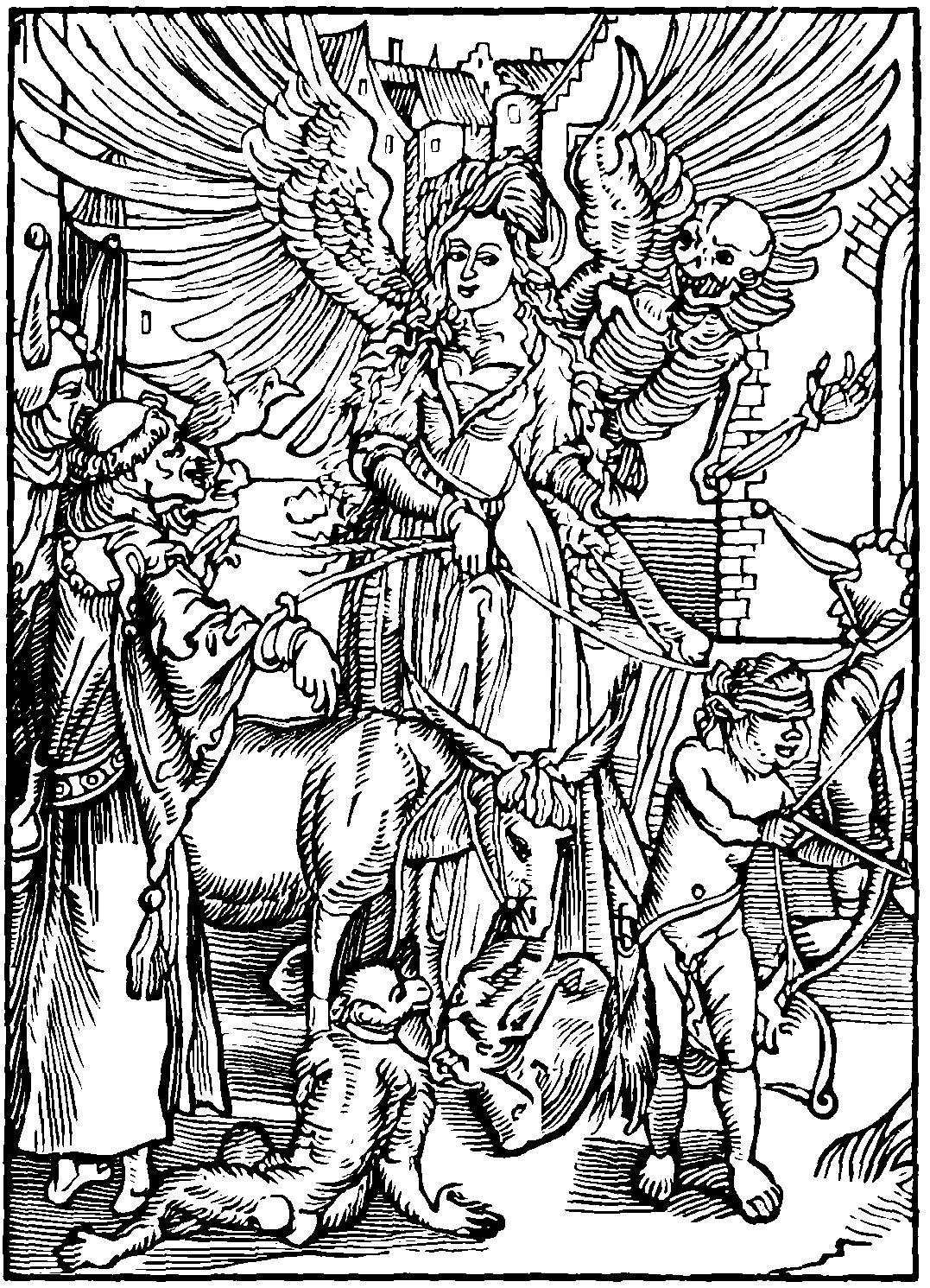
Here drawe we folys mad togyther bounde
Whom
Uenus caught hath in hyr net a snare
Whose blynde hertes this
forour doth confounde
Theyr lyfe consumynge in sorowe shame and
care
Many one she blyndeth alas fewe can beware
Of hyr
dartes hedyd with shame and vylany
But he that is wondyd can
skant ynde remedy
O cruel Uenus forsoth who doth insue
Thy flaterynge gylys and proude commaundement
And hastyth nat the dartis to eschewe
Of blynde Cupido but folowys his intent
Suche folys endure moche sorowe and turment
Wastynge theyr goodes dishonestynge their name
As past fere of god and sekynge after shame
Howe many yllys, what inconuenyence
Howe great vengeaunce, and howe bytter punysshement
Hath god oft takyn for this synne and offence
Howe many Cytees hye and excellent
Hath Uenus lost, destroyed, and alto brent
What lordes and howe many a great estate
Hath loue lost, murdred, or els brought in debate
The noble Troyans murdred ar and slayne
Theyr cyte brent, decayde is theyr kyngdome
Theyr kynge pryant by pyrrus dede and slayne
And all this by Parys vnhappy loue is come
Whiche voyde of grace and blynde without wysdome
To fyll his lust, from Grece rubbyd Helayne,
But this one pleasour was grounde of moche payne
Also Marcus a Prynce of the Romayns
Called Antonius by another name
After that he had ouercome the persyans
To Rome retournyd with tryumphe lawde and fame
And there (whiche after was to his great shame)
With cleopatra in loue was take so in blyndnes
That he promysyd to make hir empresse
So this blynde louer to fyll his interpryse
Caused his men two hondred shyppes ordayne
And toke the see wenynge in suche fourme and wyse
His lewde desyre: to perfourme and obteyne
But shortly after was he ouercome and slayne
Of Cesar: and whan he this purpose vnderstode
He bathed his Corse within his lemmans blode
For two serpentis that venemus were and fell
Were set to the brestis of fayre Cleopatray
So this cruell purpose had punysshement cruell
For theyr intendynge theyr countrey to betray
And worthy they were, what man can it denay
Thus it apereth playne by euydence
That of false loue cometh great inconuenyence
For he that loueth is voyde of all reason
Wandrynge in the worlde without lawe or mesure
In thought and fere sore vexed eche season
And greuous dolours in loue he must endure
No creature hym selfe may well assure
From loues soft dartis: I say none on the grounde
But mad and folysshe bydes he whiche hath the wounde
Aye rennynge as franatyke no reason in his mynde
He hath no constaunce nor ease within his herte
His iyen ar blynde, his wyll alwaye inclyned
To louys preceptes yet can nat he departe
The Net is stronge, the fole caught can nat starte
The darte is sharpe, who euer is in the chayne
Can nat his sorowe in vysage hyde nor fayne
Rede howe Phedra hir loue fixed so feruent
On ypolitus in prohybyte auowtry.
That whan he wolde nat vnto hir consent
To hir husbonde she accused hym falsly
As if he wolde hir tane by force to vylany
Ipolitus was murdred for this accusement
But Phedra for wo hanged hyrself incontynent
The lewde loue of Phasyphe abhomynable
As poetis sayth) brought hir to hir confusyon
Nero the cruell Tyrant detestable.
His naturall mother knewe by abusyon
Uenus and Cupido with their collusyon.
Enflamyd Messalina in suche wyse
That euery nyght hir selfe she wolde disgyse
And secretly go to the brothelhous
For to fulfyll hir hote concupyssence
What shall I wryte the dedes vicious
Of Julia or, hir cruell offence.
What shall I wryte the inconuenyence
Whiche came by Danythys cursed auowtry
Syth that the bybyll it shewyth openly
What shall I wryte the greuous forfayture
Of Sodom and Gomor syns the Bybyll doth tell
Of their synnes agaynst god and nature
For whiche they sanke alyue downe into hell.
Thus it aperith what punysshement cruell.
Our lorde hath taken both in the olde lawe and newe
For this synne: whiche sholde vs moue it to eschewe
Alexander Barklay To the Folys.
Ye folys inflamyd with loue inordynate.
Note these examples, drawe from this vyce your mynde
Remember that there is none so great estate
But that false loue hym causeth to be blynde
Our folysshe wymen may nat be left behynde
For many of them so folowys in this way
That they sell theyr soules and bodyes to go gay
The graceles galantes, and the aprentyce pore
Though they nought haue, themselfe they set nought by
Without they be acquaynted with some hore
Of westmynster or some other place of rybawdry
Than fall they to murder theft and robery.
For were nat proude clothynge, and also flesshely lust
All the feters and gyues of Englonde shulde rust.
Therfore folys awake, and be no longer blynde
Consyder that shame, seknes, and pouertye
Of loue procedeth: and drawe from it your mynde
Suffre not your soules damned and lost to be
By vayne lust and carnall sensualyte
For thoughe the small pleasure do make the fayne
The ende oft is worldly wo and myserye
Or amonge the fendes eternall payne
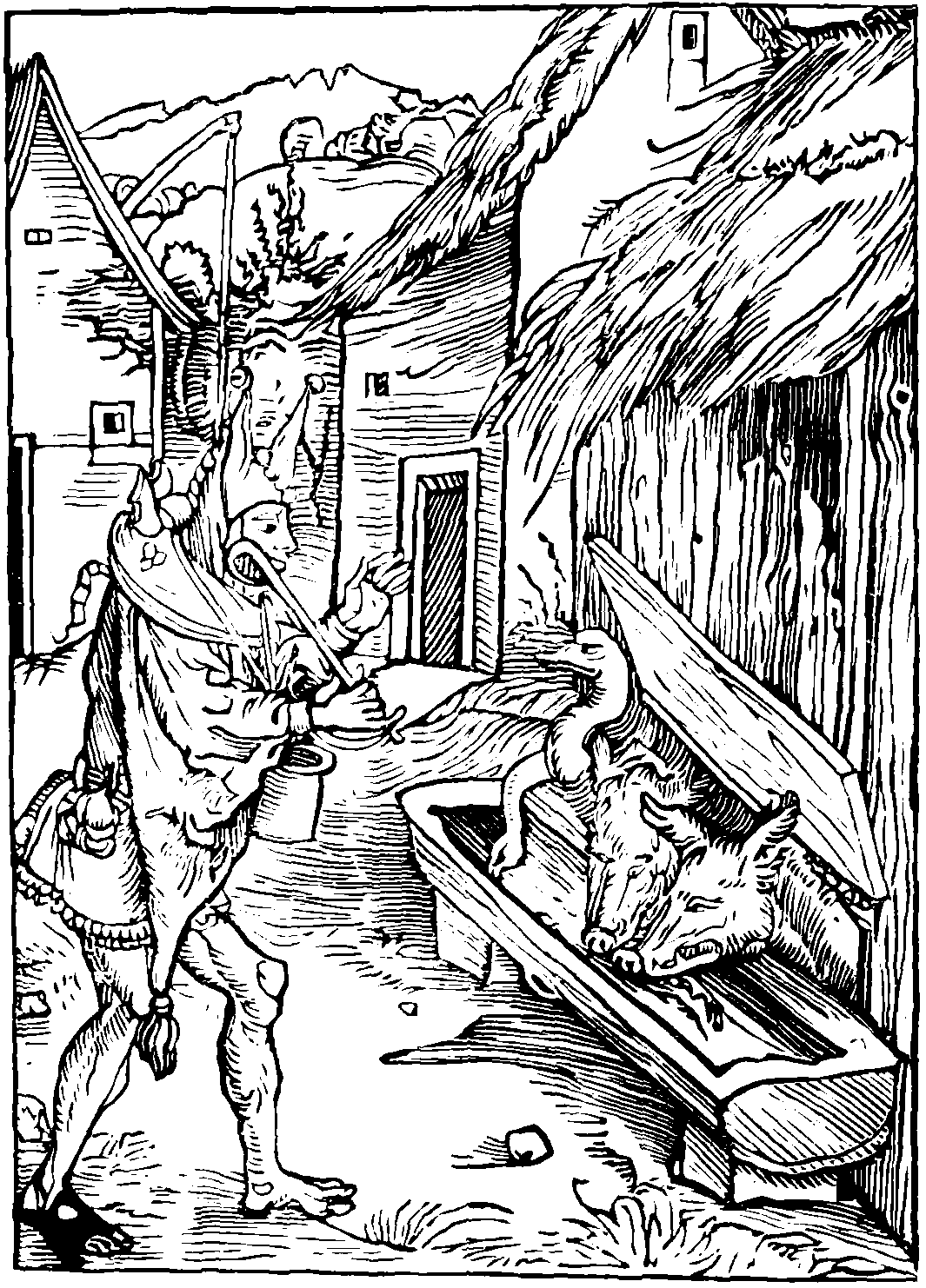
Who that styll synneth without contricion
Trustynge goddes mercy and benygnyte
Bycause he sparyth our
transgressyon
And he that thynketh iustice and equyte
Is
nat in god as well as is petye
Suche is forsoth without
discressyon
Syns he thus synneth upon
presumpcion
The wynde is up our Nauy is aflote
A bande of Folys a borde is come yet more
Theyr cursed maners and mad I shall nowe note
Whose herte for synne is neyther contryte ne sore
Nat mornynge (as they ought to do) therfore
Without fere styll lyuynge in theyr vyciousnes
No thynge inclyned to godly holynes
They thynke no thynge on goddes rightwysnes
But grounde them all, on his mercy and pyte
For that he redyer is vnto forgeuenesse
Unto all people, than them punysshed to se
Trouth it is that the great enormyte
Of the worlde hathe nat aye worthy punysshement
Nor he nat damnyd that doth his synne repent
Put case he gyuyth nat aye lyke iugement
On mannys mysdede, nor yet mundayne offence
And though he be gode meke and pacyent
Nor shortly punyssheth our inconuenyence
Put case also he gyue nat aduertence
To all mundayne fawtes synne and fragylyte
Yet none sholde synne in hope of his mercy
But these folys assembled in a companye
Sayth eche to other that oft it is laufull
To perseuerant synners lyuynge in iniquyte
Yo trust in god syns he is mercyfull
What nedeth vs our wyttis for to dull
Labourynge our synne and foly to refrayne
Syns synne is a thynge naturall and humayne
Than sayth another forsoth thou sayst playne
And also our fore Faders and progenitours
Before our dayes offendyd haue certayne.
As well as we, in many blynde errours
But syns they haue escapyd all paynes and dolours
Of hell; and nowe in heuyn ar certayne
What nede haue we to fere infernall payne.
Than comys in an other with his dotysshe brayne
By god sayth he I knowe it without fable
That heuyn was made neyther for gose nor crane
Nor yet for other bestes vnresonable
Than of the Scripture doth he Chat and bable
Alleggynge our forefaders whiche haue mysdone
Saynge that no synne is newe in our season
A myserable men destytute of reason.
That thus on hope do synne vnhappely
Remember the synne of our forefaders done
Haue neuer ben left vnpunysshed fynally
And that somtyme, full sharpe and bytterly
For euer more all synne hath had a fall
With sorowe here, or els wo infernall
The synne of Sodom foule and nat natural
The Pryde of rome, whiche was so excellent
The offence of Dauyd Prophete and kynge royal
The furour of Pharao fyers and violent
Haue nat escaped the rightwyse punysshment
Of God aboue, the celestial and highe Justice
Which fyrst, or last punyssheth euery vyce.
Remember Richarde lately kynge of price
In Englonde raynynge vnrightwisely a whyle.
Howe he ambycion, and gyleful Couetyse
With innocent blode his handes dyd defyle
But howbeit that fortune on hym dyd smyle
Two yere or thre: yet god sende hym punysshment
By his true seruant the rede Rose redolent.
Therfore remember that god omnypotent
Oft suffreth synners in theyr iniquyte
Grauntynge them space and tyme of amendement
And nat to procede in their enormyte
But those synners that byde in one degre
And in this lyfe their synne wyll nat refrayne
God after punyssheth with infernall payne
As I haue sayde (therfore) I say agayne
Though god be of infynyte pety and mercy
His fauour and grace passynge all synne mundayne
Yet iustice is with hym eternally.
Wherfore I aduyse the to note intentifly
Though pyte wolde spare, iustyce wyll nat so
But the here rewarde, els with infernal we.
Alexander Barklay to the Folys.
Syghe synners, syghe, for your mysgouernance.
Lament, mourne, and sorowe for your enormyte.
Away with these Clowdes of mysty ignorance
Syn nat in hope of goddys hyghe petye
And remember howe ye daily punysshed be
With dyuers dyseases both vncouthe and cruel
And all for your synne, but suche as escapeth fre
And styl lyue in syn, may fere the peynes of helle
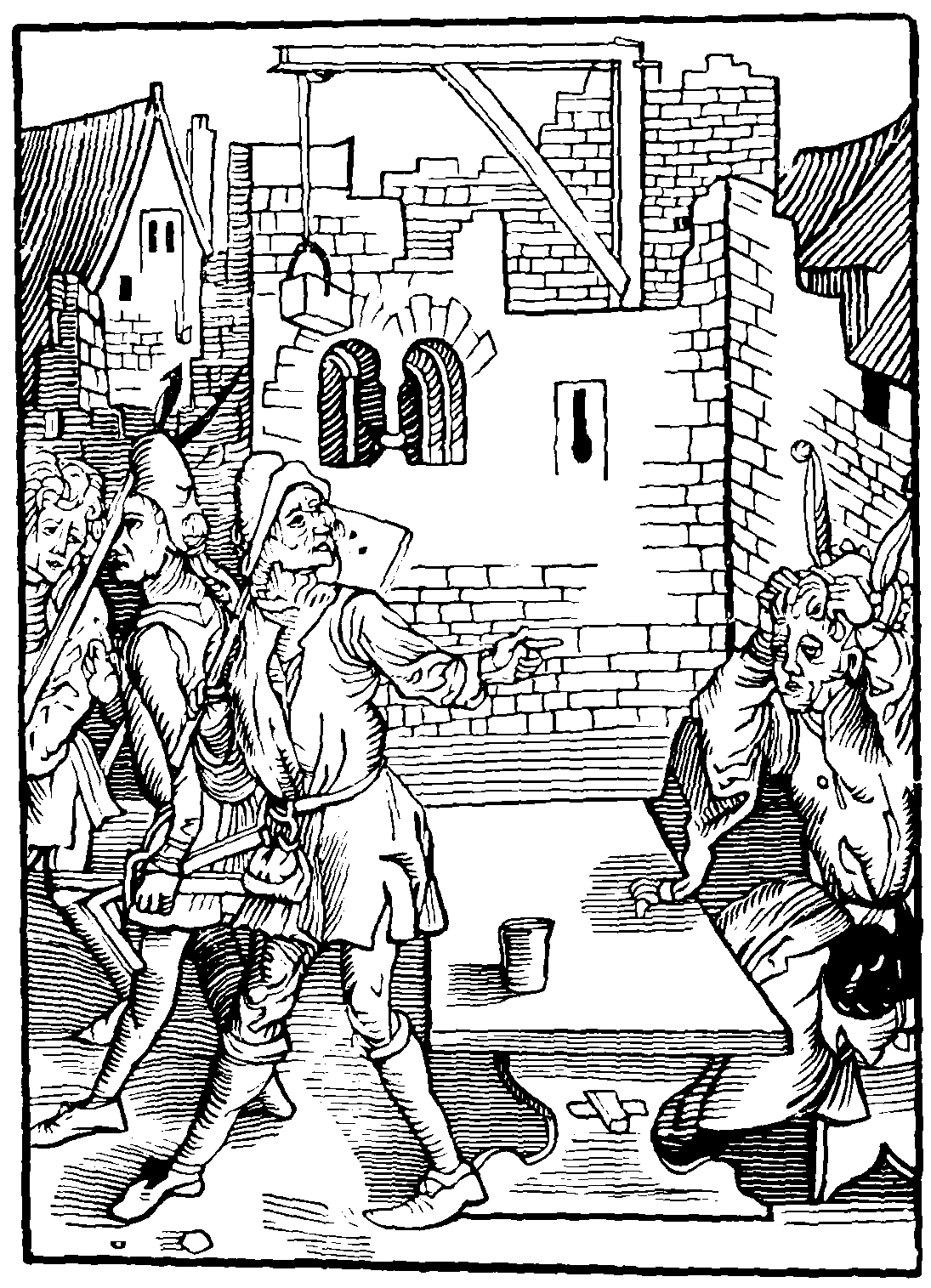
Come nere folys and rede your ignorance
And great
losse procedynge of your owne foly
Whiche without gode and
discrete purueaunce
Any great werke wyll bylde or edefye.
All suche ar folys what man wyll it deny
For he that wyll bylde
before he count his cost
Shall seldome well ende, so that is made
is lost.
Who euer begynneth any worke or dede
Of byldynge or of other thynge chargeable
And to his costes before taketh no hede
Nor tyme nat countyth to his worke agreable
Suche is a fole and well worthy a babyll
For he that is wyse wyll no thynge assay
Without he knowe howe he well ende it may.
The wyse man counteth his cost before alway
Or he begyn, and nought wyll take in honde
Wherto his myght or power myght denay
His costes confourmynge to the stynt of his londe
Where as the fole that nought doth vnderstonde
Begynneth a byldynge without aduysement
But or halfe be done his money clene is spent.
Many haue begon with purpose dilygent
To bylde great houses and pleasaunt mansyons
Them thynkynge to finysshe after theyr intent
But nede disceyuyd hath theyr opynyons
Their purpose nat worth a cowpyll of onyons
But whan they se that they it ende nat can
They curse the tyme that euer they it began
Of Nabugodosor that worthy man.
What shall I wryte or the story to the tell
Syth that the Bybyll to the expresse it can
In the fourth chapter of the prophete Danyell
Was he nat punysshed in paynes cruell
For his great pryde and his presumpcion
Whiche he toke it in the byldynge of Babylon
His golde and treasoure he spendyd hole theron
Enioynge hym in his Cyte excellent
Right so Nemroth by his inuencion
The towre of Babylon began for this intent
To saue hym, if the worlde agayne were drent
But the hye god consyderynge his blynde rage
His purpose let by confusyon of langage
His towre vnperfyte to his losse and domage
His people punysshed, hymselfe specyally
Thus it apereth what great disauauntage
On theyr hede falleth that byldeth in foly
Thus he is folysshe that wolde edefy
Any great worke without ryches in excesse
For great byldynges requyreth great rychesse
But many folys ar in suche a blyndnesse
That hereon nought they set their mynde ne thought
Wherfore to them oft commyth great distresse
And to great pouerty often ar they brought
Laughed to scorne, their purpose cometh to nought
And truely I fynde in bokes wryten playne
That our olde faders haue neuer set theyr brayne
On great byldynge, ne yet of them ben fayne:
It longeth to a lorde a Prynce or a Kynge
That lacke no treasoure theyr werkes to mayntayne
To set theyr myndes on excellent buyldynge
Therfore who so euer wyll meddle with this thynge
Or any other, before let hym be wyse
That his myght and ryches therto may suffyse.
Lyst all men do mocke and scorne his interpryse
For if he ought begyn without prouysyon
And haue nat wherby his byldynge may up ryse
All that is lost that is made and begon
And better it is sothly in myn intencion
Nought to begyn, and spare laboure and payne
Than to begyn and than, leue of agayne
Who euer he be that so doth certayne
He shall haue mockis mengled with his damage
Therfore let suche folys sharpe theyr brayne
And better intende to theyr owne auauntage
Consyderynge that processe of tyme and age
Theyr curyous byldynges shall at the lest confounde
And Roufe and wallys make egall with the grounde.
Barklay to the Folys.
Ye folys blyndyd with curyosyte
Whiche on great byldynge set so sore your mynde
Remember ye nat that doutles ye shall dye
And your gay byldynges and howses leue behynde
Thynke ye your conforte alway in them to fynde
Or whan ye dye, them hens with you to haue
Nay nay the laste hous gyuen to mankynde
Is the course grounde and walles of his graue.
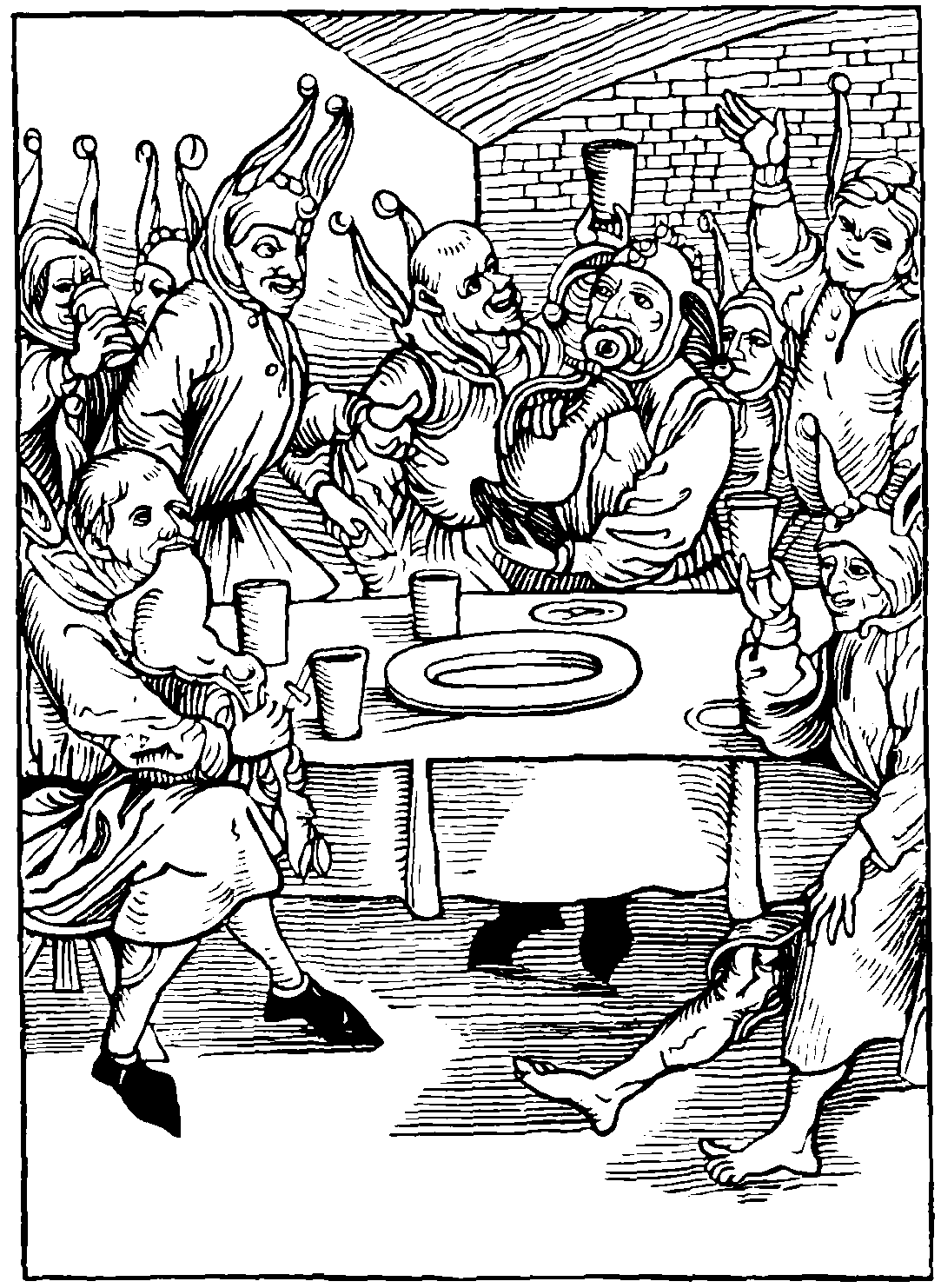
That gloton or dronkarde, vyle in goddes sight
Shall hardly escape the weyght of pouertye.
Whiche drynketh and
deuoureth both day and nyght
Therin onely settynge all his
felycyte
His lothsome lust and his bestyalyte
Shall brynge
vnto destruccion fynally
His soule, his godes and his wretchyd
body.
Within our nauy he nedes shall haue a place.
Whiche without mesure on lothsome glotony
Setteth his pleasure and singuler solace
His stomacke ouerchargynge, vyle and vngodely
And to none other thynge his mynde doth he aply
Saue depest to drynke, suche force nat of theyr soules
But labore in rynsynge pecis cuppis and bowles
The madnes of dronkennes is so immoderate
That greuous sores it ingendreth and sykenes
It causeth often great foly and debate
With soden deth and carefull heuynes
In thynges no difference putteth dronkennes.
It febleth the ioyntis and the body within
Wastynge the brayne makynge the wyt full thyn
It engendreth in the hede infirmyte
Blyndynge the herte wyt and discression
The mynde it demynyssheth, coloure and beaute.
Causynge all myschef, shame and abusyon
It maketh men mad, and in conclusyon
Causeth them lyue without lawe or measure
Suynge after syn defylynge theyr nature
The people that are acloyed with this synne.
On no thynge els theyr myndes wyll aply:
Saue to the wyne and ale stakes to renne
And there as bestes to stryue and drynke auy
Than ar they outher gyuyn to rybawdry
Or els to brawle and fight at euery worde
Thus dronkennes is the chefe cause of discorde
But namely dronkennes and wretchyd glotony
By their excesse and superfluyte
Engendreth the rote of cursed Lechery
With murder, thefte and great enormyte
So bryngeth it many to great aduersyte
And with his furour the worlde so doth it blynde
That many it bryngeth to a shamfull ende
This vyce (alas) good maners doth confounde
And maketh man ouer besy of langage
And hym that in all ryches doth abounde
It ofte in pryson bryngeth and in bondage
It causeth man to his great sorowe and domage
Disclose his secrete and his preuey counsayle
Whiche causeth hym after sore to mourne and wayle
Nought is more lothsome, more vycyous nor vyle
Than he that is subdued to this vyce
His lyfe shortynge his body he doth defyle
Bereuynge his soule the ioy of Paradyse
Howe many Cytees and lordes of great pryce
Hath ben destroyed by dronken glotony
And by his felawe, false loue, or lechery.
The sone of Thomyr had nat ben ouercome
Nor slayne by Cyrus for all his worthynes.
If he hym selfe had gydyd by wysdome
And the vyce auoydyd of blynde dronkennes
The great Alexander taken with this madnes
With his swerde, whan he was dronken slewe
Suche of his frendes as were to hym most trewe
I rede also howe this conquerour myghty
Upon a season played at the Chesse
With one of his knyghtes which wan ynally
Of hym great golde treasoure and rychesse
And hym ouercame, but in a furyousnes
And lade with wyne, this conquerour vp brayde
And to his knyght in wrath these wordes sayde
I haue subdued by strength and by wysdome
All the hole worlde, whiche obeyeth to me
And howe hast thou alone me thus ouercome
And anone commaundyd his knyght hanged to be
Than sayde the knyght by right and equyte
I may apele. syns ye ar thus cruell
Quod Alexander to whome wylt thou apell
Knowest thou any that is gretter than I
Thou shalt be hanged thou spekest treason playne
The knyght sayd sauynge your honour certaynly
I am no traytoure, apele I woll certayne
From dronken Alexander tyll he be sober agayne
His lorde than herynge his desyre sounde to reason
Differryd the iustyce as for that tyme and season
And than after whan this furour was gone
His knyght he pardoned repentynge his blyndenes.
And well consydered that he shulde haue mysdone
If he to deth had hym done in that madnesse
Thus it apereth what great unhappynes
And blyndnes cometh to many a creature
By wyne or ale taken without measure.
Se here the inconuenyence manyfolde
Comynge of dronkennes as I wrytyn fynde.
Some ar so starynge mad that none can them holde
Rorynge and cryeng as men out of their mynde
Some fyghtynge some chydynge, some to other kynde
Nought lyuynge to them selfe: and some dotynge Johnn
Beynge dronke thynketh hym as wyse as Salomon
Some sowe dronke, swaloynge mete without mesure
Some mawdelayne dronke, mournynge lowdly and hye
Some beynge dronke no lenger can endure
Without they gyue them to bawdy rybawdry
Some swereth armys nayles herte and body.
Terynge our lord worse, than the Jowes hym arayed
Some nought can speke, but harkenyth what is sayd.
Some spende all that they haue and more at wast
With reuell and reuell dasshe fyll the cup Joohnn
Some their thryft lesyth with dyce at one cast
Some slepe as slogardes tyll their thryft be gone
Some shewe theyr owne counsell for kepe can they none
Some are Ape dronke full of lawghter and of toyes
Some mery dronke syngynge with wynches and boyes
Some spue, some stacker some vtterly ar lame
Lyeng on the grounde without power to ryse
Some bost them of bawdry ferynge of no shame
Some dumme, and some speketh. ix. wordes at thryse
Some charge theyr bely with wyne in suche wyse
That theyr legges skant can bere vp the body
Here is a sort to drowne a hole nauy.
Barklaye to the Folys.
Alas mad folys howe longe wyll ye procede
In this beestly lyuynge agayst humayne nature
Cease of your Foly: gyue aduertence and hede
That in eche thynge ought to be had measure
Wyne ne ale hurteth no maner creature
But sharpeth the wyt if it be take in kynde
But if it be nat, than I the ensure
It dulleth the brayne, blyndynge the wyt and mynde
Rede all bokes and thou shalt neuer fynde
That dronkennes and wysdome may togyther be
For where is dronkennes, there madnes is by kynde
Gydynge the hauer to all enormyte
And where as is madnes thou shalt neuer se
Reason ne wysdome take theyr abydynge
In one instant, wherfore lerne this of me
That dronkennes is mortell enmy to cunnynge.
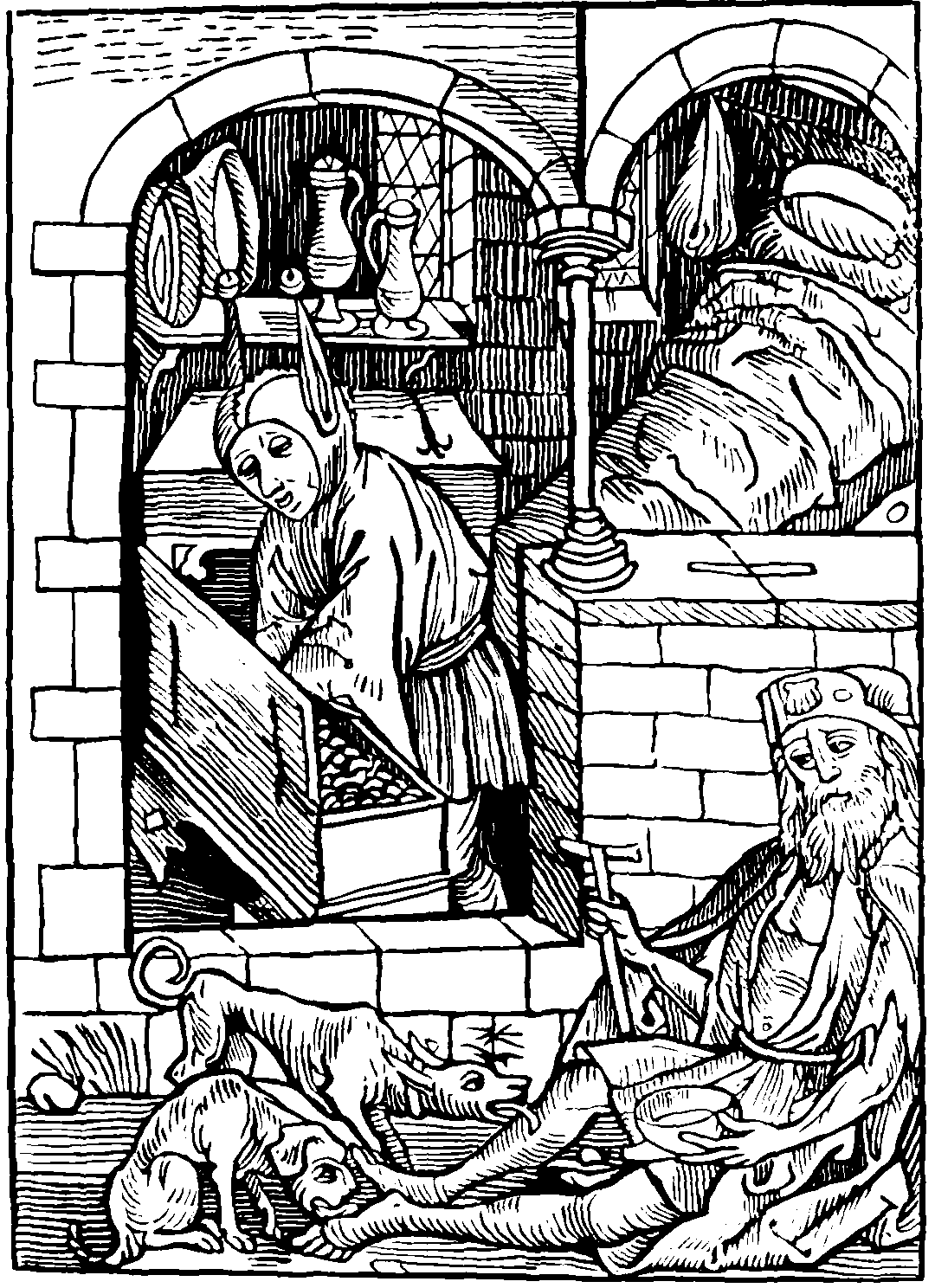
Yet fynde I folys of another sorte
Whiche gather
and kepe excessyfe ryches
With it denyeng their neyghboures to
conforte
Whiche for nede lyueth in payne and wretchydnes
Suche one by fortune may fall into distres
And in lyke wyse after
come to mysery
And begge of other, whiche shall to hym
deny.
It is great foly, and a desyre in vayne
To loue and worshyp ryches to feruently
And so great laboure to take in care and payne
Fals treasoure to encrease and multyply
But yet no wonder is it sertaynly
Syth he that is ryche hath gretter reuerence
Than he that hath sadnes wysdom and scyence
The ryche mannes rewardes stande in best degre
But godly maners we haue set clene asyde
Fewe loueth vertue, but fewer pouertye.
Fals couetyse his braunches spreddeth wyde
Ouer all the worlde, that pety can nat byde
Among vs wretches banysshed is kyndnes
Thus lyeth the pore in wo and wretchydnes
Without conforte and without auctoryte
But he only is nowe reputed wyse
Whiche hath ryches in great store and plente.
Suche shall be made a sergeant or Justyce
And in the Court reputed of moste pryse
He shall be callyd to counseyll in the lawe
Though that his brayne be skarsly worth a strawe
He shall be Mayre baylyfe or constable
And he onely promotyd to honoure
His maners onely reputed ar laudable
His dedys praysyd as grettest of valoure
Men laboure and seke to fall in his fauoure
He shall haue loue, echone to hym shall sue
For his ryches, but nought for his vertue
Se what rewardes ar gyuen to ryches
Without regarde had to mannys condycyon
A strawe for cunnynge wysdome and holynes
Of ryches is the first and chefe questyon
What rentes what londes howe great possessyon
What stuffe of housholde what store of grotz and pens
And after his gode his wordes hath credence.
His wordes ar trouth men gyue to them credence
Thoughe they be falsly fayned and sotell
But to the pore none wyll gyue aduertence
Though that his wordes be true as the gospell
Ye let hym swere by heuyn and by hell
By god and his sayntes and all that god made
Yet nought they beleue that of hym is sayde
They say that the pore men doth god dispyse
Thouhe they nought swere but trouth and veryte
And that god punyssheth them in suche wyse
For so dispysynge of his hye maiestye
Kepynge them for their synnes in pouerte
And theyr ryche exaltyth by his power and grace
To suche ryches, worldly pleasour and solace
The ryche ar rewarded with gyftis of dyuerse sorte
With Capons and Conyes delycious of sent
But the pore caytyf abydeth without confort
Though he moste nede haue: none doth hym present
The fat pygge is baast, the lene cony is brent
He that nought hathe, shall so alway byde pore
But he that ouer moche hath, yet shall haue more
The wolfe etis the shepe, the great fysshe the small
The hare with the houndes vexed ar and frayde
He that hath halfe nedes wyll haue all
The ryche mannes pleasour can nat be denayde
Be the pore wroth, or be he well apayde
Fere causeth hym sende vnto the ryches hous
His mete from his owne mouth, if it be delycious
And yet is this ryche caytyf nat content
Though he haue all yet wolde he haue more.
And though this gode can neuer of hym be spent
With nought he departyth to hym that is pore
Though he with nede harde vexed were and sore.
O cursyd hunger o mad mynde and delyte.
To laboure for that whiche neuer shall do profyte
Say couetous caytyfe what doth it the auayle
For to haue all and yet, nat to be content
Thou takest nat this sore laboure and trauayle
To thy pleasoure but to thy great turment
But loke therof what foloweth consequent
Whan thou art dede and past this wretchyd lyfe
Thou leuyst behynde brawlynge debate and stryfe
To many one ryches is moche necessary
Whiche can it order right as it ought to be
But vnto other is it vtterly contrary
Whiche therwith disdayneth to socoure pouerte.
Nor them relefe in theyr aduersyte
Suche shall our lorde sore punysshe fynally
And his petycion rightwysly deny
Barklay to the Folys.
Ye great estatis and men of dignyte
To whome god in this lyfe hath sent ryches
Haue ye compassion, on paynfull pouertye
And them conforte in theyr carefull wretchydnes
God hym loueth and shall rewarde doutles
Whiche to the nedy for hym is charitable
With heuenly ioy, whiche treasour is endeles
So shall thy riches to the be profytable.
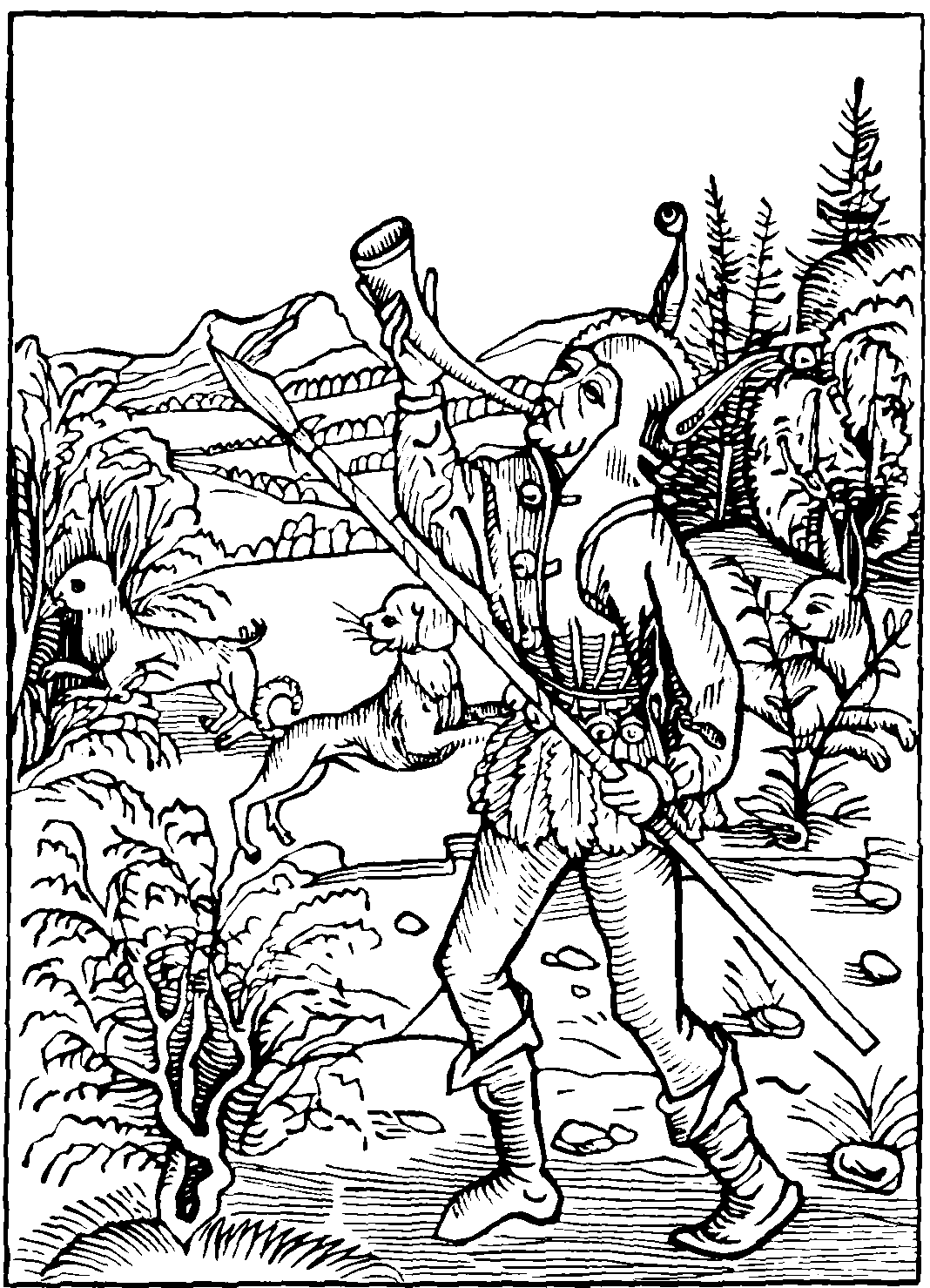
A fole he is and voyde of reason
Whiche with one
hounde tendyth to take
Two harys in one instant and season
Rightso is he that wolde vndertake
Hym to two lordes a seruaunt
to make
For whether, that he be lefe or lothe
The one he
shall displease, or els bothe.
A fole also he is withouten doute
And in his porpose sothly blyndyd sore
Whiche doth entende labour or go aboute
To serue god, and also his wretchyd store
Of worldly ryches: for as I sayde before
He that togyder wyll two maysters serue
Shall one displease and nat his loue deserue
For he that with one hownde wol take also
Two harys togyther in one instant
For the moste parte doth the both two forgo
And if he one haue: harde it is and skant
And that blynde fole mad and ignorant
That draweth thre boltis atons in one bowe
At one marke shall shote to hye or to lowe
Or els to wyde, and shortly for to say
With one or none of them he strykis the marke:
And he that taketh vpon hym nyght or day
Laboures dyuers to chargeable of warke.
Or dyuerse offycis: suche wander in the darke
For it is harde to do well as he ought
To hym that on dyuerse thynges hath his thought
With great thoughtes he troubleth sore his brayne
His mynde vnstable, his wyt alway wandrynge:
Nowe here nowe there his body labours in payne
And in no place of stedfast abydynge.
Nowe workynge now musynge now renynge now rydynge
Now on see nowe on londe, than to se agayne
Somtyme to Fraunce, and nowe to Flaunders or Spayne
Thus is it paynfull and no thynge profytable
On many labours a man to set his mynde
For nouther his wyt nor body can be stable
Whiche wyll his body to dyuers chargis bynde
Whyle one goth forwarde the other bydes behynde
Therfore I the counseyll for thyne owne behoue
Let go this worlde and serue thy lorde aboue
He that his mynde settyth god truly to serue
And his sayntes: this worlde settynge at nought
Shall for rewarde euerlastynge ioy deserue
But in this worlde, he that settyth his thought
All men to please, and in fauour to be brought
Must lout and lurke, flater, lawde, and lye:
And cloke a knauys counseyll, though it fals be
If any do hym wronge or iniury
He must it suffer and pacyently endure
A dowble tunge with wordes lyke hony
And of his offycis if he wyll be sure
He must be sober and colde of his langage
More to a knaue, than to one of hye lynage
Oft must he stoupe his bonet in his honde
His maysters backe he must oft shrape and clawe
His breste anoyntynge, his mynde to vnderstonde
But be it gode or bad therafter must he drawe
Without he can Jest he is nat worth a strawe.
But in the meane tyme beware that he none checke
For than layth malyce a mylstone in his necke
He that in court wyll loue and fauour haue
A fole must hym fayne, if he were none afore
And be as felowe to euery boy and knaue
And to please his lorde he must styll laboure sore
His manyfolde charge maketh hym coueyt more
That he had leuer serue a man in myserye
Than serue his maker in tranquylyte
But yet whan he hath done his dylygence
His lorde to serue as I before haue sayde
For one small faute or neglygent offence
Suche a displeasoure agaynst hym may be layde
That out is he cast bare and vnpuruayde.
Whether he be gentyll, yeman grome or page
Thus worldly seruyce is no sure herytage
Wherfore I may proue by these examples playne
That it is better more godly and plesant
To leue this mondayne casualte and payne
And to thy maker one god to be seruaunt
Whiche whyle thou lyuest shall nat let the want
That thou desyrest iustly, for thy syruyce
And than after gyue the, the ioyes of Paradyse.
Barklay to the Folys.
Alas man aryse out of Idolatry.
Worshyp nat thy ryches nor thy vayne treasoure
Ne this wretchyd worlde full of mysery.
But lawde thy maker and thy sauyour
With fere, mekenes, fayth, glory, and honoure
Let thy treasoure onely in his seruyce be
And here be content with symple behauoure
Hauynge in this lorde trust and felycyte
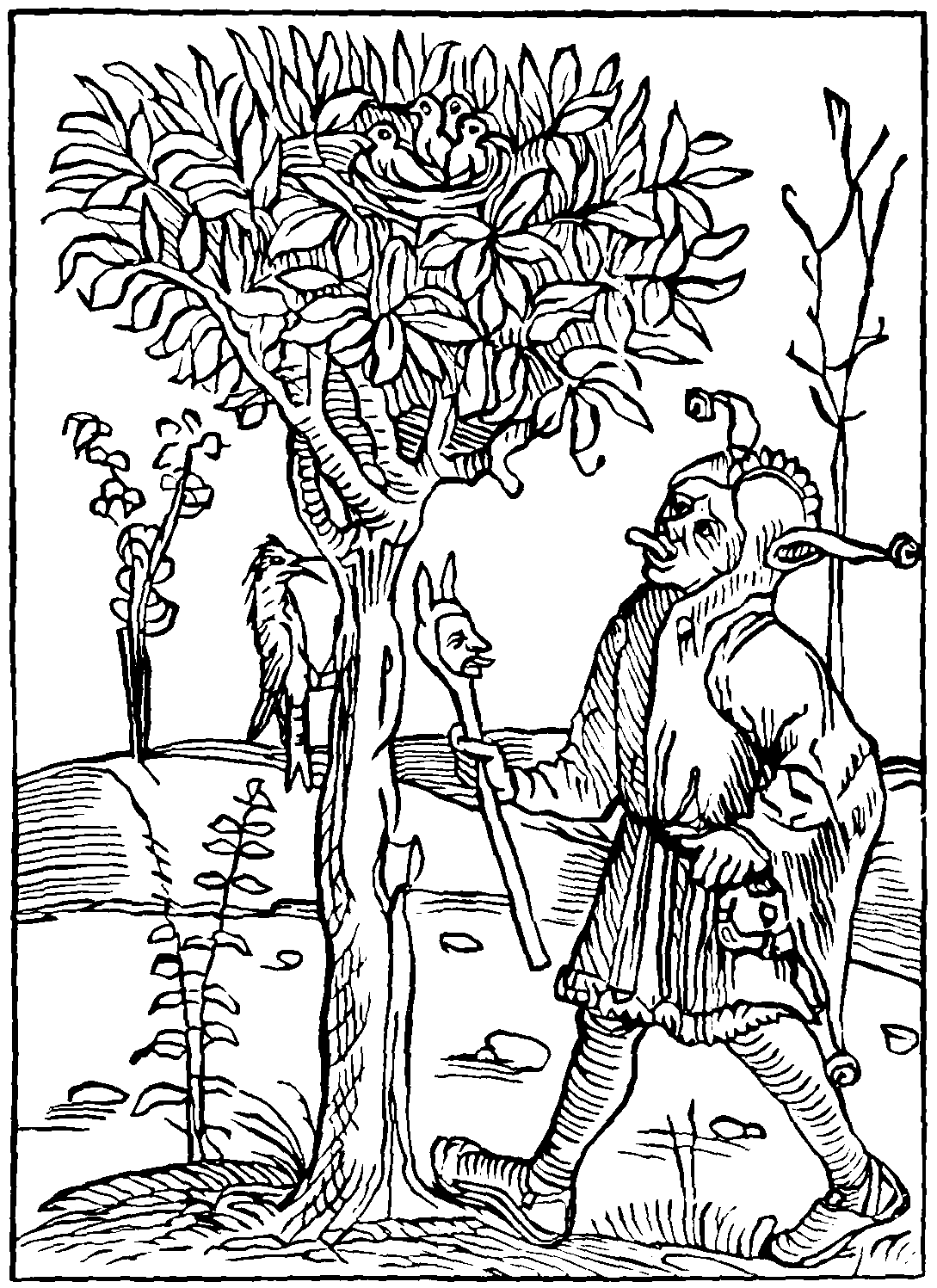
He that his tunge can temper and refrayne
And
asswage the foly of hasty langage
Shall kepe his mynde from
trowble, sadnes and payne
And fynde therby great ease and
auauntage
Where as a hasty speker falleth in great domage
Peryll and losse, in lyke wyse as the pye
Betrays hir byrdes by
hir chatrynge and crye.
Ye blaberynge folys superflue of langage
Come to our shyp our ankers ar in wayde
By right and lawe ye may chalange a stage
To you of Barklay it shall nat be denayde
Howe be it the charge Pynson hathe on me layde
With many folys our Nauy not to charge.
Yet ye of dewty shall haue a sympyll barge
Of this sorte thousandes ar withouten fayle
That haue delyte in wordes voyde and vayne
On men nat fawty somtyme vsynge to rayle
On folysshe wordes settynge theyr herte and brayne
They often touche to theyr owne shame and payne
Suche thynges to whiche none wyll theyr mynde aply
(Saue suche folys) to theyr shame and enuy
Say besy fole art thou nat well worthy
To haue enuy, and that echone sholde the hate
Whan by thy wordes soundynge to great foly
Thou sore labrest to engender debate
Some renneth fast thynkynge to come to late
To gyue his counsell whan he seeth men in doute
And lyghtly his folysshe bolt shall be shot out
Is it nat better for one his tunge to kepe
Where as he myght (perchaunce) with honestee
Than wordes to speke whiche make hym after wepe
For great losse folowynge wo and aduersyte
A worde ones spokyn reuoked can nat be
Therfore thy fynger lay before thy lypes
For a wyse mannys tunge, without aduysement trypes
He that wyll answere of his owne folysshe brayne
Before that any requyreth his counsayle
Shewith hym selfe and his hasty foly playne
Wherby men knowe his wordes of none auayle
Some haue delyted in mad blaborynge and frayle
Whiche after haue suffred bytter punysshement
For their wordes, spoken without aduysement
Say what precedeth of this mad outrage
But great mysfortune, wo and vnhappynesse
But for all theyr chattynge and plenty of langage
Whan to the preste they come them to confesse
To shewe theyr lewde lyfe theyr synne and wretchydnes
Whan they sholde speke, and to this poynt ar come
Theyr tunges ar loste and there they syt as domme
Many haue ben whiche sholde haue be counted wyse
Sad and discrete, and right well sene in scyence
But all they haue defyled with this one vyse
Of moche spekynge: o cursyd synne and offence
Pyte it is that so great inconuenience
So great shame, contempt rebuke and vylany
Sholde by one small member came to the hole body
Let suche take example by the chatrynge pye.
Whiche doth hyr nest and byrdes also betraye
By hyr grete chatterynge, clamoure dyn and crye
Ryght so these folys theyr owne foly bewraye.
But touchynge wymen of them I wyll nought say
They can nat speke, but ar as coy and styll
As the horle wynde or clapper or a mylle
But that man or woman or any creature
That lytell speketh or els kepeth sylence
Ar euer of them selfe moste stedfast and sure
Without enuy, hatred or malyuolence.
Where as to suche comys moche inconuenyence
Sorowe vpon sorowe, malyce and dysdayne
Whiche wyll no tyme, his speche nor tunge refrayne
Fayre speche is pleasaunt if it be moderate
And spoken in season, conuenyente and dewe
To kepe scylence, to pore man or estate
Is a great grace, and synguler vertue
Langage is lawdable whan it is god and true
A wyse man or he speke wyll be wyse and ware
What (to whome) why (howe) whan and whare
Barklaye to the Folys.
Ye bablynge brybours, endeuer you to amende
Mytygat by mesure, your prowde hasty langage
Kepe well your tunges so, shall ye kepe your frende
For hasty speche ingendreth great damage
Whan a worde is nat sayd, the byrde is in the cage
Also the hous is surest whan the dorys be barryde
So whan thy worde is spokyn and out at large
Thou arte nat mayster, but he that hath it harde
If thou take hede and set therto thy brayne
In this world thou shalt fynde thynges thre
Whiche ones past, can nat be callyd agayne.
The firste is (tyme lost) by mannes symplycyte
The seconde (youth) reuoked can nat be
The thyrde (a worde spoken) it gooth out in the wynde
And yet is the fourth, that is (virginyte)
My forgetfull mynde, had lefte it nere behynde
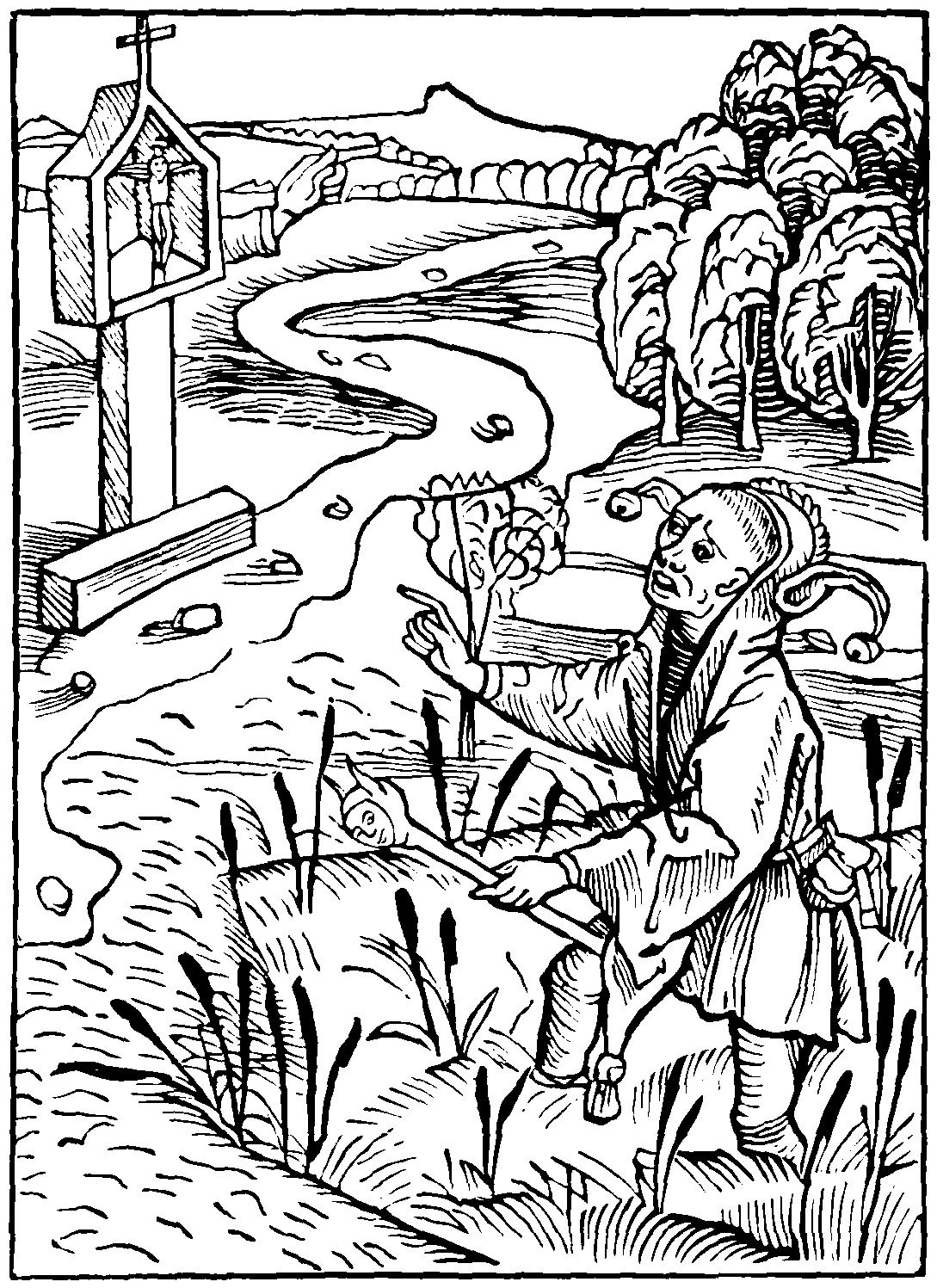
He lacketh reason and vnderstandynge to
Whiche to
a towne or Cyte knoweth the way
And shewyth other howe they may
thether go
Hym selfe wandrynge aboute from day to day
In
myre and fen, though his iourney thether lay
So he is mad whiche
to other doth preche and tell
The wave to heuyn, and hym selfe
goth to hell.
Nowe to our Nauy, a sorte maketh asaute
Of folys blynde, mad Jugys and Iniust
Whiche lyghtly noteth another mannes faute.
Chastynge that synne, whiche theyr owne mynde doth rust
By longe abydynge, and increas of carnall lust
They cloke their owne vyce synne and enormyte
Other blamynge and chastynge with moche cruelte
They mocke and mowe at anothers small offence
And redy ar a faute in them to fynde
But of theyr owne foly and inconuenyence
They se no thynge, for fully ar they blynde
Nat notynge the vyce rotyd in theyr owne mynde
Theyr greuous woundes and secrete malady
For theyr owne yll they seke no remedy
The hande whiche men vnto a Crosse do nayle
Shewyth the waye ofte to a man wandrynge
Whiche by the same his right way can nat fayle
But yet the hande is there styll abydynge
So do these folys lewde of theyr owne lyuynge
To other men shewe mean and way to wynne
Eternall ioy themselfe bydynge in synne
He sertaynly may well be callyd a sote
Moche vnauysed and his owne ennemy
Whiche in a nothers iye can spye a lytell mote
And in his owne can nat fele nor espye
A moche stycke, so is he certaynly.
Whiche noteth anothers small faute or offence
To his owne great synnes gyuynge none aduertence
Many them selfe fayne as chaste as was saynt Johnn
And many other fayne them meke and innocent
Some other as iust, and wyse as Salomon
As holy as Poule, as Job als pacyent
As sad as senecke, and as obedyent
As Abraham, and as martyn vertuous
But yet is theyr lyfe full lewde and vycious
Some lokyth with an aungels countenaunce
Wyse sad and sober lyke an heremyte
Thus hydynge theyr synne and theyr mysgouernaunce.
Under suche clokys lyke a fals ypocryte
Let suche folys rede what Cicero doth wryte
Whiche sayth that none sholde blame any creature
For his faut, without his owne lyuynge be sure
Without all spot of synne faut or offence
For in lyke fourme as a phesycyan.
By his practyse and cunnynge or scyence
The sekenes curyth of a nother man
But his owne yll nor dyseas he nat can
Relefe nor hele so doth he that doth blame
Anothers synne: he styll lyuynge in the same
Many ar whiche other can counseyll craftely
And shewe the peryll that may come by theyr synne
But them selfe they counseyll nat: ne remedy.
Nor take no waye whereby they heuyn may wynne
But lye in that vyce that they rotyd ar in
Leuynge the way that gydyth to ioy and rest
Their owne sensualyte ensuynge as a beest
Wherfore ye prestis that haue the charge and cure.
To teche and enfourme the rude comonte.
In goddys lawes groundyd in scripture
And blame all synnes sparynge no degre
Whyle ye rebuke thus theyr enormyte
Lyue so that none may cause haue you to blame
And if ye do nat: it is to your great shame
For without doute it is great vylany
A man to speke agaynst any offence
Wherin he well knowyth hym owne selfe gylty
Within his mynde and secrete conscience
Agaynst hymselfe suche one gyueth sentence
Howe god ryght iuge, by rightwyse iugement
Shulde hym rewarde with worthy punysshement
The enuoy of Barklay to the Folys.
Ye clerkes that on your shulders here the shelde
Unto you graunted by the vnyuersyte.
Howe dare ye auenture to fyght in cristes felde
Agaynst synne, without ye clere and gyltles be
Consyder the Cocke and in hym shall ye se:
A great example, for with his wynges thryse
He betyth hym selfe to wake his owne bodye
Before he crowe, to cause other wake or ryse.
He that ought fyndyth outher by day or nyght
Usynge it as his owne, as thynge gottyn iustly
And thynketh that
he so may do by lawe and right
Suche is disceyuyd, and thynketh
wrongfully
For why the deuyll our goostly ennemy
Doth hym
so counseyll and in his erys blowe
Disceyuynge in his bondes, as
he doth many mo
The feruour of ryches and disordred loue
Whiche many haue, doth me bynde and constrayne.
Within my shyp them sharply to reproue
That pen nor hande, themselfe wyll not refrayne
Of couetyse nowe I wyll nat speke agayne
But of them that kepeth by force and by myght
That thynge wherto they haue nat come, by ryght
Some fyndeth treasours other mennys good
And in theyr owne vse suche good they occupy.
Whiche of theyr myndes ar so blynde and wode.
And so reted in theyr errour and foly
That oft they say (say) ye and dare byde by
That some saynt whome they worshypped haue
Haue sende, them the same theyr honestee to saue
They haue no force nor care, nor they none haue wyll
To whome the ryches so loste dyde apertayne
That fortune hath gyuen they holde fast and kepe styll
Neuer hauynge mynde it to restore agayne
Suche folys fere no thynge euerlastynge payne
Nor note nat, that without true restytucion
It small auayleth to haue made confessyon.
Here me fole with thy immoderate mynde
Here me and do thy herte therto aply
If thou by fortune any ryches fynde
Callynge it thyne: thou lyest therin falsly
If thou haue wyt thou canst nat well deny
But that gode nat gyuen, nor gottyn by laboure
Can nat be rightwyse: thus mende thy blynde erroure
If thou ought fynde that longeth nat to the
Than is it anothers, the case is clere and playne
Wherfor thou ought of lawe and of dewte
Unto the owner it soone to yelde agayne
But if he be dede, to whome it dyd attayne
Thou ought nat yet to kepe it nere the more.
But to his sectours or heyres it restore
Put case that they also be past and dede
Yet ought thou nat to keep it styll with the.
The lawe commaundyth, and also it is mede.
To gyue it to suche as haue necessyte.
With it releuynge theyr paynfull pouertee
And so shalt thou discharge thy conseyence.
Helpynge the pore, and auoyde great offence
But he that others godes tourneth to his owne vse
Spendynge and wastynge that thynge that neuer was his
Suche certaynly his reason doth abuse
And by this meane greuously doth amysse
Wherby he lesyth eternall ioy and blysse
His soule drownynge depe within hell flodes
For his myspendynge of other mennys goodes
But to be shorte, and brefe in my sentence
And sothe to saye playne as the mater is
Forsoth I se nat right great difference
Bytwene a thefe, and these folys couetys
Both wrongly kepeth that thynge that is nat his
Thynkynge that god doth nat therto aduerte
Whiche notyth thy dedys, thy mynde thought and herte
Wherfore if thou haue a rightwyse conscyence
Thou wylt nought kepe whiche longeth nat to the
The lawe so commaundeth in payne of great offence
For of gode that thou kepest agaynst equyte
Thou shalt make accompt after that thou shalt dye
To thy great payne in hell for euer more
If thou no restytucion make before.
Here myght I touche executours in this cryme.
Blamynge theyr dedys dysceyte and couetyse
If it were nat for wastynge of my tyme
For mende they wyll nat them in any wyse
Nor leue no poyntes of theyr disceytfull gyse
Let them take parte of that whiche I here note
And be partynge foles in this present bote.
The Enuoy of Barklay the translator to the Folys.
Ye false executours whome all the worlde repreuys
And ye that fynde mennes goodes or treasoures
I call you as bad as robbers or theuys
For ye by your falshode and manyfolde errours
Kepe falsly that thynge whiche is none of yours
And wast here the goodes of hym that is past
The soule lyeth in payne, ye take your pleasours.
With his ryches, damnynge your owne soule at the last
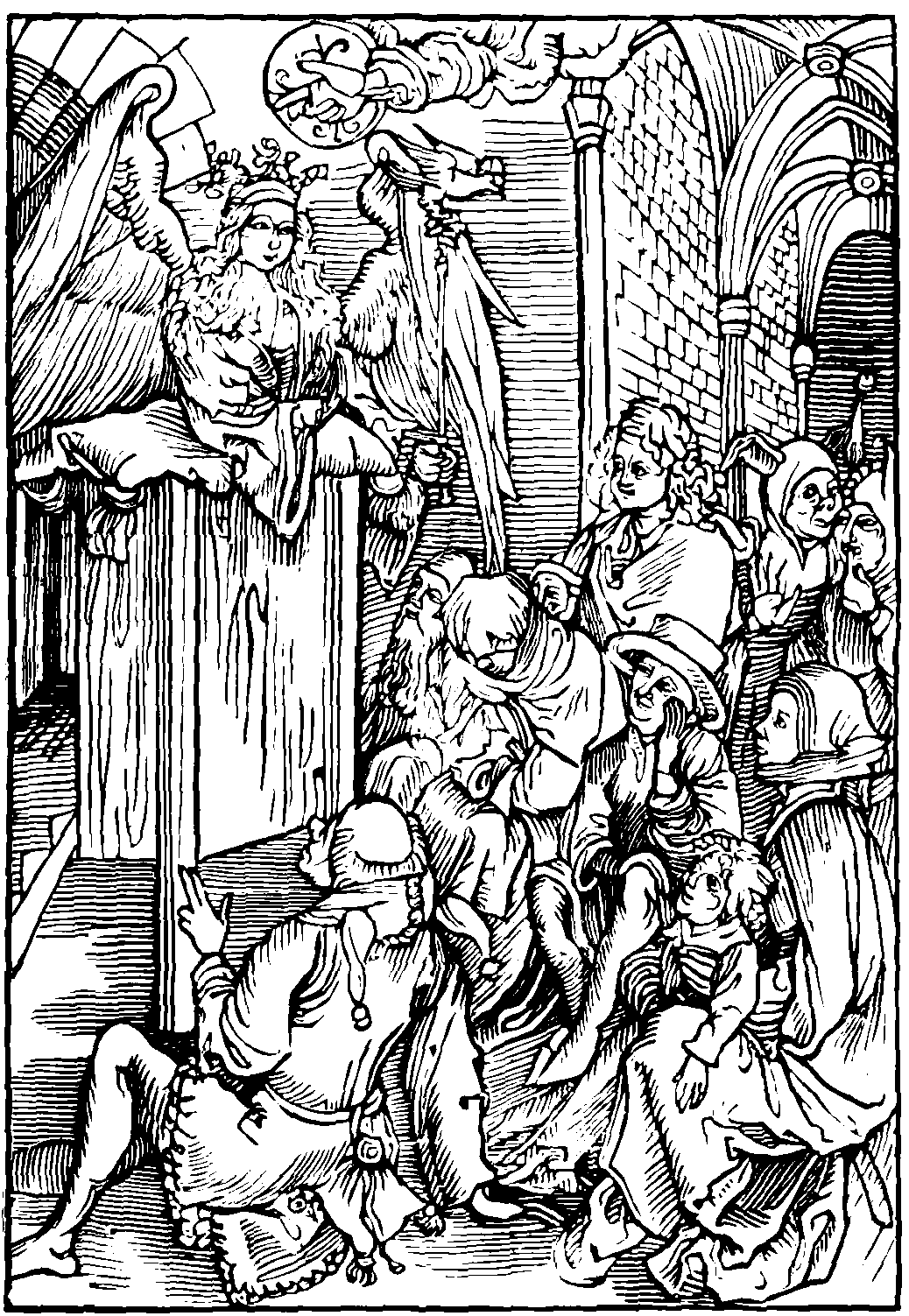
He that delyteth in godly sapience
And it to
obtayne puttyth his besynes
Aboue all folys shall haue
preemynence
And in this worlde haue honour and rychesse
Or
a worthy crowne in heuyns blessydnesse
Or els bothe welthe here,
and after ioy and blysse
Where as a fole of bothe the two shall
mysse
Wysdome with voyce replete with grauyte
Callyth to all people, and sayth o thou mankynde
Howe longe wylt thou lyue in this enormyte
Alas howe longe shalt thou thy wyt haue blynde
Here my preceptis and rote them in thy mynde
Nowe is full tyme and season to clere thy syght:
Harkyn to my wordes, grounde of goodnes and ryght
Lerne mortall men, stodyenge day and nyght
To knowe me wysdome, chefe rote of chastyte
My holy doctryne thy herte shall clere and lyght
My tunge shall shewe the ryght and equyte
Chase out thy foly, cause of aduersyte.
And seke me wysdome whiche shall endewe thy mynde
With helth and welth wherby thou lyfe shalt fynde
Aryse I say agayne to the mankynde
And seke me wysdome that am well of goodnes
Let nat this worlde thy conscyence farther blynde
Nor to synne subdue for loue of false rychesse
Blynde nat thy herte with mondayne wretchednes
I am worth golde and worth all good mundayne:
And to mankynde counselloure souerayne
No maner Jowell is to me lyke certayne
Ne so profytable to mortall creature
I passe all ryches and cause a man refrayne
His mynde from synne, and of his ende be sure
There is no treasoure nor precious stone so pure
Carbuncle Ruby ne adamond in londe nor see
Nor other lapydary comparable to me:
And shortly to speke wysdome is more laudable
Than all the worlde or other thynge mundayne
There is no treasoure: to wysdome comparable
But it alone is a vertue moste souerayne
Hauynge nought lyke in valoure nor worth certayne
No fole is so ryche, nor hye of dignyte
But that a wyse man pore is more worthy than he
Wysdome preserueth men in auctoryte
Prynces promotynge by counseyll prouydent
By it pore men somtyme, and of lowe degre
Hath had the hole worlde to them obedyent
It gydeth Cytees and countrees excellent
And gouerneth the counseyll of prynce lorde and kynge
Strengthynge the body the herte enlumynynge
It gydyth lordes and from bondage doth brynge
Them whome foly hath brought in to captyuyte
Hir gyftys to mankynde frely offrynge
Gydynge hir discyples from all aduersyte
Wysdome stondynge vpon a stage on hye
Cryeth to mankynde with lowde voyce in this wyse
I trouth exalte: and vycious men dispyse
Lerne of me wysdome cast out your couetyse
For by my myght craft and wyse prouysicion
Kynges vnto their dygnyte dothe ryse
Theyr septers gydynge by my monycion
I gaue them lawes to gyde eche regyon
In welthe defendynge and in prosperyte
Them and theyr royalmes whyle they gyde them by me
All maner nacyons that doth to me inclyne
I gyde and gouerne by lawe and equyte
In me is right, godly wyt and doctryne
What blynde foly, and howe great aduersyte
Do they auoyde that gyde them selfe by me
And he that me louyth with worshyp and honour
Shall knowe my loue my grace and my fauour
He that me folowyth shall auoyde all dolour
I shall hym folowe promotynge in suche case
That none shall be before hym in valour
I godly ryches in my power inbrace
Whiche man by me may esely purchase
And he that wyll his way by me addresse
I shall rewarde with heuenly ioy endles
The father of heuen of infynyte goodnesse.
Me comprehendyth within his deytee
Of hym my firste begynnynge is doutles.
And heuen and erth he create hath by me
And euery creature bothe on londe and se
The heuen imperyall all planetis and firmameut
God neuer thynge made without my true assent
Therfore mankynde set thy mynde and intent
To me wysdome to be subiect and seruaunt
To my preceptis be thou obedyent
And heuenly ioy thou shalt nat lacke nor want
For doutles they ar mad and ignoraunt
And folys blyndyd who so euer they be
That wyll nat gladly be seruauntes vnto me
The envoy of Barklay to the Folys.
Aryse folys of myndes darke and blynde.
Receyue the gyftes of godly sapyence
Here hir perceptis and plant them in your mynde
And rote out the gaffys of your olde offence.
Call to your myndes what inconuenyence
Howe sodayne fallys, what sorowe and turment
Hath come to many a myghty lorde and prynce
For nat folowynge of hir commaundement.
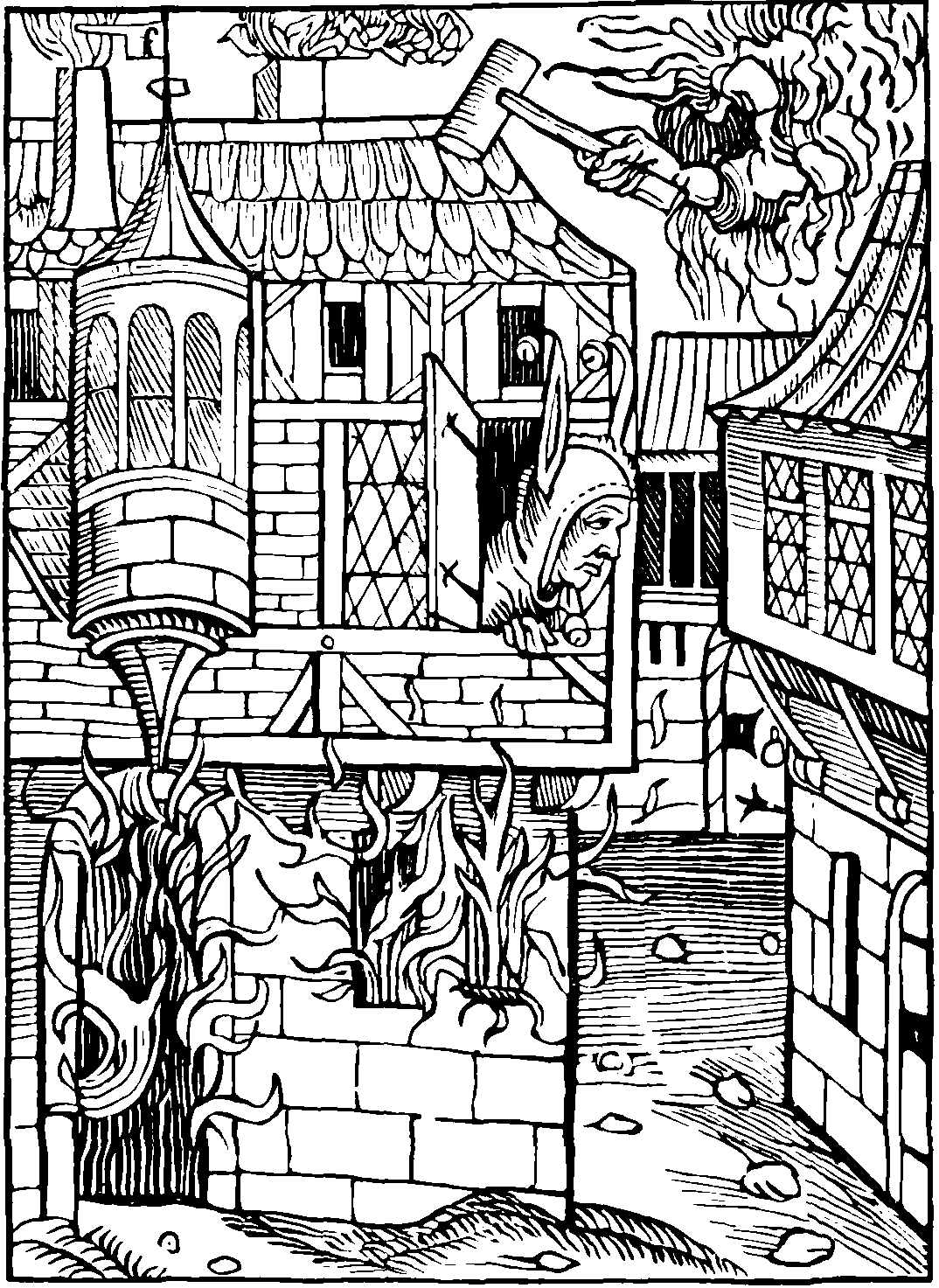
He is a fole whiche settyth confydence
On frayle
fortune vncertayne and mutable
His mynde exaltynge in pryde and
insolence
Because that she somtyme is fauorable
As if she
wolde so be perdurable
Suche folys oft whan they thynke them most
sure
All sodaynly great mysfortune
endure
Amonge our folys he ought to haue a place
And so he shall for it is resonable
Whiche thynketh hymselfe greatly in fortunes grace
Bostynge that she to hym is fauorable
As if hyr maner were nat to be mutable
In this vayne hope suche theyr lyfe doth lede
Tyll at the laste theyr hous borne oure theyr hede
He shakyth boost and oft doth hym auaunte
Of fortunes fauoure and his prosperyte
Whiche suffreth hym nought of his wyll to wante
So that he knoweth nought of aduersyte
Nor mysfortune nor what thynge is pouertee.
O lawles fole, o man blyndyd of mynde
Say what suretye in fortune canst thou fynde
To what ende or vnto what conclusyon
Shall fortune frayle vnrightwyse and vnsure
Lede the blynde fole by hyr abusyon.
Howe darest thou the in hir blyndnes assure.
Syns she vnstable is and can nat longe endure
Hir gyftis changith, she is blynde and sodayne
Thoughe she firste lawghe hir ende is vncertayne.
Thou shakest boste ofte of hir foly in vayne
For he is most happy whiche can auoyde hir snare
If she exalte some one vnto welth mundayne
She bryngeth another to payne sorowe and care
Whyle one is ladyd to the others backe is bare
Whyle she a begger maketh in good abounde
A lorde or state she throweth to the grounde
But nat withstandynge hir mutabylyte.
Thou bostest thy gode and to moche abundaunce
Thou bostest thy welth and thy prosperyte
Thy good auenturs, and plentyfull pleasaunce
Alas blynde fole amende thy ygnoraunce
And in thy welthe to this saynge intende
That fortune euer hath an incertayne ende
Fals fortune infect of countenaunce and of face
By hir iyen clowdy and varyable vysage
Hath many for a whyle taken to hir grace
Whiche after by hir whele vnstable and volage
Hath brought them to wo mysfortune and damage
She ruleth pore and riche without difference
Lewdnes exaltynge and damnynge innocence
Thus is that man voyde, of all intellygence
Whom fortune fedyth, with chaunche fortunable
If he therin haue ouer large confydence
And thynke that sure that euer is mutable
That fole is sonne, to the fende abhomynable
That foloweth ryches, and fortune that is blynde
His sauyour lefte, and clene out of mynde
Whan the foule fende, father of vnhappynes
Pore man purposyth by falshode to begyle
He sendeth hym welth worldly, and fals ryches
And causeth fortune, awhyle on hym to smyle
Whiche with hir blyndenes doth mankynde so defyle
That whyle they trust in hir fauour to sore.
They damme theyr soules in hell for euermore
By large examples thou eche day mayste se
The chaunge of fortune and the ende vncertayne
Wherfore to boste the of hyr commodyte
It is great foly and also thynge in vayne
From this lewdnes thy mynde therfore refrayne
And be content with fortune moderate
Nor boste the nat of thy welth or estate
This day thou art ryche and despysest the pore
Yet so may it fall, that for thy lewde lyuynge
To morowe thou beggest thy brede from dore to dore
Therfore remembre that blynde fortune wandrynge
Hath nat in hyr handes power, nor gydynge
The rewardes of welth, nor of felycyte
But god them gydeth by his great maieste
And all thynge chaungeth as is to hym plesaunt
His dedes to wysdome alwaye agreable
Wherfore blynde fole be nat so ignoraunt
To prayse fortune whiche is so varyable
And of rewardes vnsure and chaungeable
But thoughe she smyle trust nat to hir intent
For amonge swete herbes ofte lurkyth the serpent
Barklay to the Folys.
Ye folys that haue in fortune confydence:
And boste you of welth and of prosperyte
Leue of your foly, and note by euydence:
Hir cours vnsure: and hir mutabylyte
None in this lyfe can byde in one degre
But somtyme hye, than after pore and lowe.
Nowe nought set by, nowe in auctoryte
Nowe full nowe voyde as waters ebbe and flowe
I am remembred that I haue often sene
Great worldly ryches ende in pouertye
And many one that hath in fauour ben:
And hye promotyd in welth and dignyte.
Hath sodaynly fallyn into calamyte
Thus is it foly to trust in fortunes grace
For whyle the Se floweth and is at Burdews hye
It as fast ebbeth at some other place
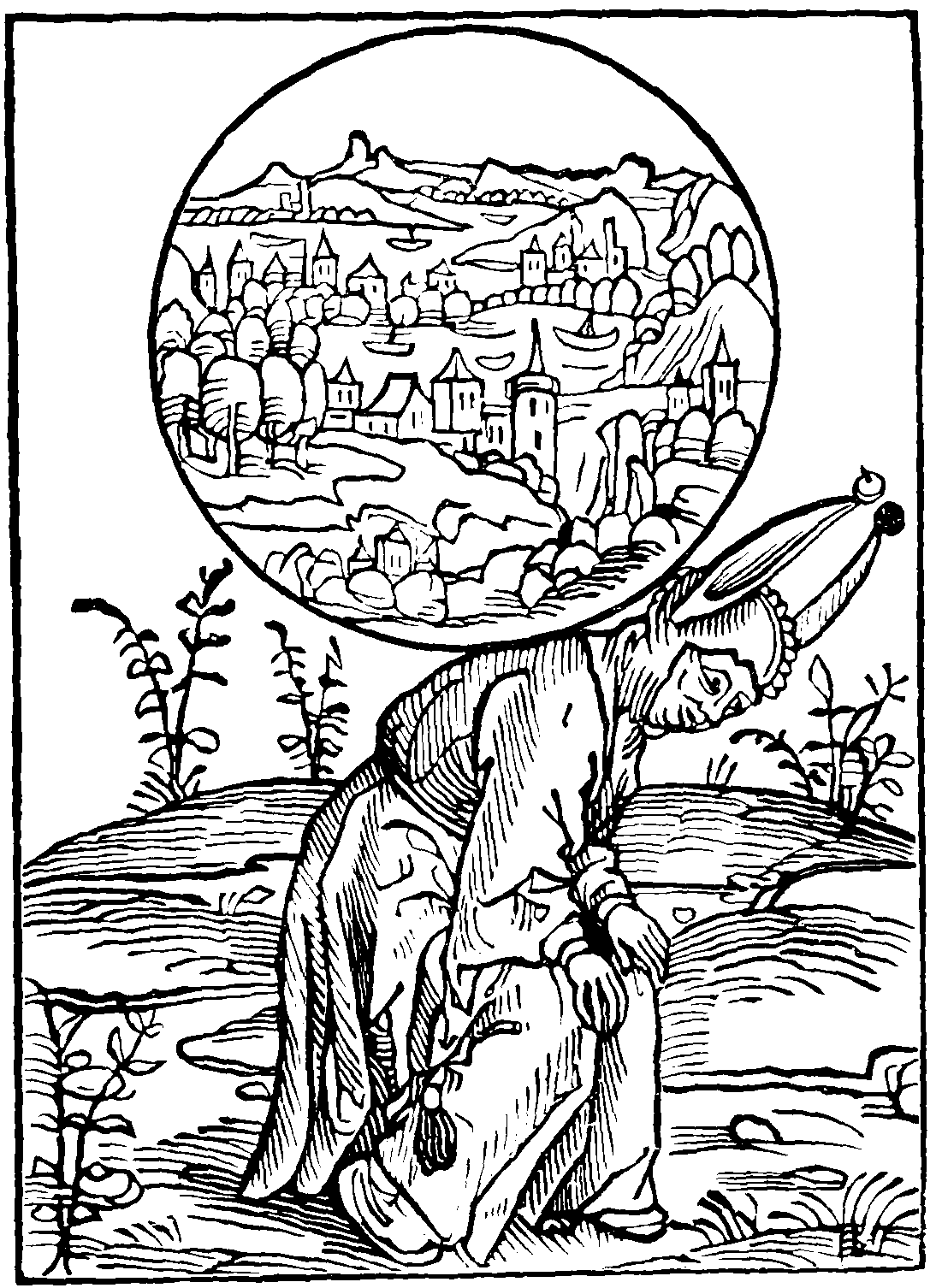
Unto mo folys here ordayne I a barge
Whiche
medlyth with euery mannys besynes
And nat intendeth to their owne
losse and charge
Great payne and wo suche folys oft oppresse
And let them lerne with pacyent mekenes
To suffer sorowe for
why they shall none lacke
Syns they alone, the hole worlde take
on theyr backe
He that wyll coueyt to bere more than he may
And take on his sholders more than he can sustayne
Suche is a fole, his dedys wyll not deny
And with his owne wyll gooth to peryll and payne.
He is vnwyse whiche is ioyous and fayne
To offer his necke to bere that without fere
Whiche were ynoughe for dyuers men to bere
That man that taketh vpon his backe alone
The heuy weght of the large fyrmament
Or any burdeyne whiche maketh hym to grone
Whiche to sustayne his strength is ympotent
No meruayle is if he fall incontynent
And than whan he lowe on the grounde doth lye
He oft repentyth his purpose and foly
We haue in storyes many examples great
Shewynge the lewde ende of this curyosyte.
I rede of Alexander that dyd often sweate
In great peryls to augment his dignyte
He was nat content with europe and asye
Nor all the grounde under the fyrmament
At the last ende, cowde nat his mynde content
As if all the erth were nat suffycyent
For his small body by curyouse couetyse
But at the last he must holde hym content
With a small cheste, and graue nat of great pryce.
Thus deth vs shewyth what thynge sholde vs suffyce
And what is the ende of our curyosyte.
For dethe is lyke to hye and lowde degre
What shall a kynge at his last endynge haue
Of all his realme and infynyte treasoure
Saue onely his towmbe, and the grounde of his graue
But thoughe it be of great pryce and voloure
As is conuenyent to his hye honoure.
Yet lytell conforte to his soule shall it gyue
But cause of bostynge to them that after lyue
Thus whan man vnto his last ende is come
He nought with hym bereth of his dignytees
Wherfore cynicus a man of great wysdome
Lorde grettest of Grece in londes and Cytees
Hathe lefte great example vnto all degrees
For his great ryches his herte dyd neuer blynde
But worldly pompe set clene out of his mynde
He forced of no castels nor excellent byldynge
Dispysynge charges and besynes worldly
But gaue his mynde to vertue and cunnynge
And namely to the scyence of astronomy
Consyderynge that great rest of mynde and of body
With hym abydeth whiche with bolde herte is fayne
To folowe vertue, and leue charges mundayne
He that so doth no weght doth vndertake
Vpon his backe of so great a grauyte
That his small strength must it agayne forsake.
Where he that attempteth grettest thynges, and hye:
Great weyght of charges and moche dignite
Must lerne to suffer payne thought and vexacion
By his great charges of perturbacion.
What auayle is it the worlde to obtayne
In one mannys power, and all other to excell
To suffer trouble, and vayne charges sustayne
And at the last his pore soule gooth to hell
There toren and tourmented in paynes cruell
It were moche better to kepe a quyet mynde
And after our deth eternall rest to fynde
He that taketh thought for euery besynes:
And caryth for that whiche doth nat apertayne
Nor longe to his charge, he is full of blyndnes
And no houre shall rest, but styll in thought and payne
Care for thy owne charges, theron set thy brayne
For he a fole is that caryth or doth intende
For another mannys charge whiche he can nat amende
Therfore lyue in rest after thy degre.
Nor on suche thynges do nat thy mynde aply
Whiche ar no thynge apertaynynge vnto the
If thou so do thou shalt fynde rest therby
Auoyde thou the charge of worldly mysery
For godes take no thought great care ne trauayle.
Whiche after deth shall do the none auayle
Barklay to the Folys.
Fole clere thy iyen and of thy selfe beware
Care moste for thy owne besynes and charge
For other mennes take no great thought nor care
If thou thy conscience mayst therof discharge
A curyous man that of his tunge is large
Talkynge or carynge of other, his place is best
Hye in the fore top of our folysshe barge
For in that place is small quyet or rest
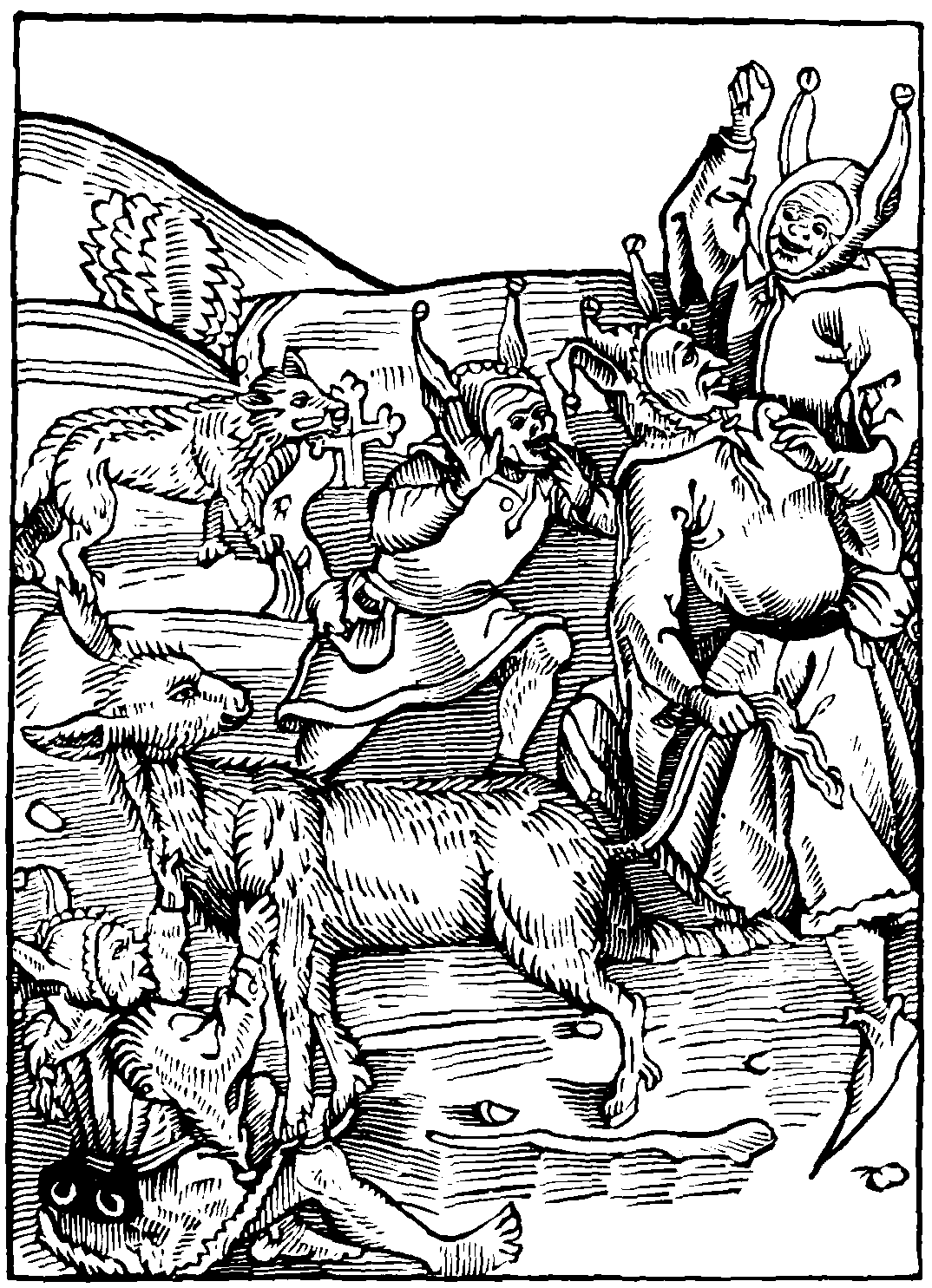
A man that is besy both euyn and morowe
With
rauysshynge clawys and insaciable
Of his frendes and neyghbours
to begge and to borow
To the deuourynge wolfe is most lyke or
semblable
Suche in our shyp shall nat want a babyll
For he
that styll borowes shall skant hym quyte or redde
And as a
wretche the asse shall hym ouer tredde
That fole that hym selfe a dettour doth make
To dyuerse men, and is borowynge alway
Right ponderous charges on hym doth take
Borowynge of one another therwith to pay
Thoughe he be glad to haue longe terme and day
To hym assygned to make his payment
It nought auayleth, for soone the tyme is spent
But in the meane tyme deuourynge vsurye
Spoylyth makynge pore many a borewer
Where they two borewed they promys to pay thre
Their day of payment lenger to defarre.
Thus doth oft borowynge many thousandes marre
Yet some get malyce for that gode that they len
And where they lent twenty gladly taketh ten.
I wyll nat say but that it is mede certayne
To lene frely to one that is in nede
And wyll be glade it to content agayne.
But he that lenyth to haue rewarde or mede
Or more than he lent, may of hell payne haue drede
And he that so boroweth gayne can haue none
Therby in this lyfe, but hell whan he is gone
Therfore in this satyre suche wyll I repreue
And none that borowe nor lene on amyte
The vsurers: fals cristen men in theyr byleue
Folowe the waren way of theyr iniquyte
Prohybyte by lawe iustyce and equyte
Theyr vnclene hertes, and mynde, vnhappely
On lucre settynge, comynge by vsury
They hepe theyr synne in quantyte horryble
Labowrynge that lewde burthen gretter to make
And that sore weght tedyose and terryble
With a great rope vpon theyr shulders take
The weyght vp taken all theyr hole ioyntes quake
Thus these caytyfs with this rope and burthyn heuy
Them selfe hange damnynge theyr soule eternally
A wretchyd man, alas make clere thy reason
Remember thoughe god the suffer thus longe tyme
He graunteth that space to amende the in season.
And nat dayly to encreas thy synne and cryme
Somtyme he punyssheth with infernall abhyme
Shortly for synne, somtyme thoughe one mysdo
He suffreth longe: but yet truste nat therto
The longer vnpunysshed, the sorer is the payne
And if thou wylt nat gyue to me credence
Of sodome and Gomor the Bybyll sheweth playne
Howe God rightwysely ponysshed theyr offence
And also Solym, towne of great excellence
For vyciousnes god ponysshed bytterly
Whiche sholde vs cause for to lyue rightwysely.
The rightwyse god also dyd sore chastyce
Tthe Nilicolyans and them vtterly destroy
For theyr contynuynge in theyr syn and vyce
And theyr lynage longe kepte from welth and ioy
In great trouble whiche dyd theyr hertis noy:
Howe be it that they were good and innocent
For theyr fathers faute they suffred punysshement
But to our purpose to retourne agayne.
He that ought boroweth whiche he can nat pay
Of a wolfe rauysshynge foloweth the trayne
But though he all swolowe yet can he by no way
Deuoure the tyme nor the prefyxed day
Wherfore if he than disceyue his credytour
He oft hym chastyth with iustyce and rygour
Ryght in lyke wyse our lorde omnipotent
In this worlde to lyue grauntyth vs tyme and space
Nat styll to synne, but vnto this intent
To leue our vyce, and folowe the way of grace
But if we styll contynue in one case
And haue done no good to pay hym at our day
In hell pryson he iustly shall vs lay
Barklay to the Folys.
Thou fole mysmyndyd to large of sconscyence
To the I speke that art a lewde dettour
Borowe thou no thynge, noble grote ne pens.
More than thou mayst agayne pay thy credytour
Right so endeuer the to pay thy sauyour
His right and dewty, with a glad wyll and fayne
That is true seruyce, with glory and honour
Than shalt thou surely escape infernall payne.
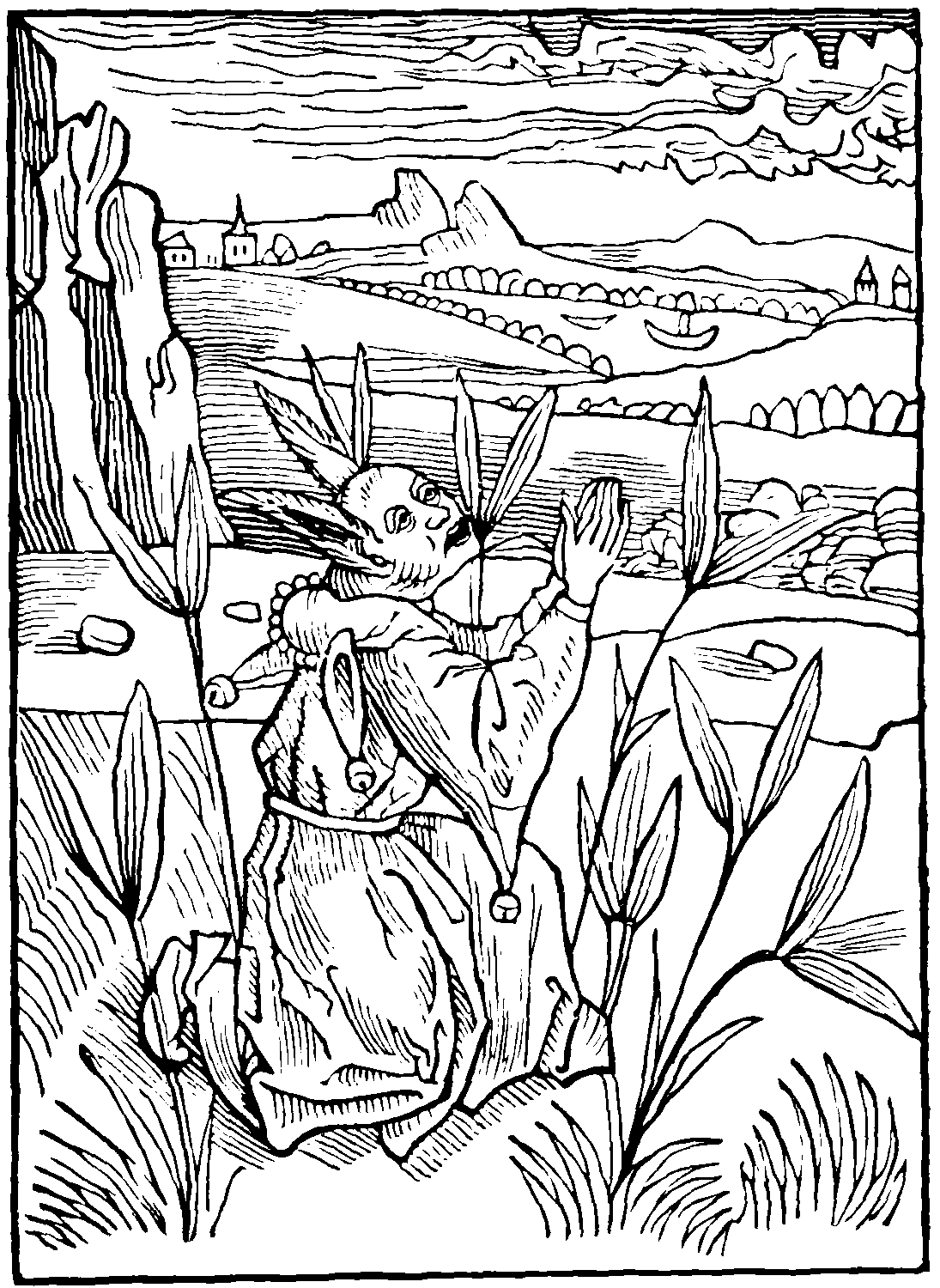
That man whose herte vnhappy synne doth blynde
And prayth gasynge into the fyrmament
Or he that setteth nat his
herte and mynde
Upon his wordes, theyr sentence or intent
And he that desyreth thynge nat conuenyent
Suche folys shall nat
theyr peticion obtayne
For without the herte the tonge laboureth
in vayne
Here we repreue (reperue) ye and reuyle.
A sorte of folys lewde of condicions
Whose herte and tunge theyr soules doth defyle
By theyr blynde prayers and yll peticions
Suche folowe no techynge nor gode monysyons
For often many of them with tunge doth pray
Theyr mynde, abstract nat knowynge what they say
Man oft desyreth with great affeccion
That thynge of god, whiche thynge if god wolde graunt.
Sholde be at last vnto thyer destruccyon
Examples hereof thou canst nat lacke nor want
The great Medas somtyme kynge tryumphant.
Of Phrygye By his owne folysshe desyre
With paynfull hunger, his lyfe breth dyd expyre
This kynge Mydas of whom I haue you tolde
Of god desyred with prayer dylygent.
That all that he touchyd tourne myght vnto golde
His prayer was harde, he obteynyd his intent
But nat to his welth, but mortall punysshement
For whan he brede or drynke tast or touche sholde
Incontynent was it tourned in to golde
Thus was his prayer to his owne damage
For at the laste he dyed in wo and payne
For no golde coude his sore hunger asswage
Nor his desyre coude he nat call agayne.
Thus his peticion desyred was in vayne:
And where he wenyd great welth to get therby
He dyed in shame hunger and mysery.
Some dayly pray with marueylous besynes
Cryeng and syghynge to god omnypotent
For to haue plenty of welth ioy and ryches
And to be made ryche myghty and excellent.
O cursyd lyuers, o blynde men of intent
On suche desyres they set theyr mynde and thought
Whiche thousandes vnto shamefull ende hath brought
What profyted the myghty edefyces:
Of Lycynus, or lyuelode of excesse:
What profyteth the money gotten in vyces
Of riche Crassus, or cresus, great ryches
They all ar dede by theyr vnhappynes
And that lewdely, nat by deth naturall
Theyr blynde desyres chefe rote and cause of all
Another whiche is in youthes prosperyte
For strength and myght often to god doth pray
Some of theyr lyfe to haue prolyxyte
Desyreth god, and here to byde alway
In riches welth, ioy and solempne aray
But yet they in glotony take suche custome
That they slea them selfe longe or theyr day be come
Alas mad fole why prayest thou for age
Syns it so greuous is and ymportable
Unstable and full of dolour and damage
Odyous to youth and intollerable
Say folysshe man whiche art of mynde vnstable
Is it nat great foly to any creature
To pray for that thynge, whiche he can nat endure
Peleus, and Nestor and many other mo
As Itackes and laertes, sore haue complayned
For to longe age, euer full of payne and wo
Wherwith theyr bodyes sore haue ben constrayned
And with great sorowes and dyuers often payned:
And to conclude brefly in one sentence
Oft to age falleth moche inconuenyence
Yet ar mo folys whiche ought repreued be
And they ar suche whiche styll on god doth call
For great rowmes, offyces and great dignyte
No thynge intendynge to theyr greuous fall
For this is dayly sene, and euer shall
That he that coueytys hye to clym aloft
If he hap to fall, his fall can nat be soft
Some other pray for bewty and fayrnes
And that to a cursyd purpose and intent
Wherby they lese the heuenly blyssydnes:
Theyr soule subduynge to infernall turment
O ye mad folys of myndes ympotent
Pray your Pater noster with deuoute herte and mynde
For therin is all that is nedefull to mankynde
Our sauyour criste whyle he was on this grounde
Amonge vs synners in this vale of mysery
Taught his disciples this prayer whiche doth sounde
Nere to this sentence, nor greatly doth nat vary
(Our father wiche art in heuen) eternally
Thy name be halowyd (graunt that to thy kyngdome)
All we thy seruauntis worthely may come
In heuen and erth thy wyll be done alway
And of thy great grace and thy benygnyte
Our dayly brede graunt vnto vs this day
Forgyuynge our synnes and our iniquyte:
As we forgyue them that to vs detters be
And to auoyde temptacion thy grace vnto vs len
And vs delyuer from euery yll amen.
Whan thou hast clensyd thy mynde from syn before
And sayd this prayer to thy maker deuoutly
Thou nedyst nat of hym to desyre more
Yet mayst thou pray and desyre rightwysly
For helthe of soule within thy hole body
For stedfast fayth and yll name to eschewe.
And chastely to lyue (by his help) in vertue
Thus sholde thou pray thou wretche both day and nyght
With herte and mynde vnto thy creatoure:
And nought by foly to asshe agaynst right
To hurte or losse to thy frende or neyghboure
Nor to thy fo by yll wyll or rygoure
But if god to thy prayers alway sholde enclyne
Oft sholde come great sorowe to the and to all thyne
The enuoy of Barklay to the Folys.
Man clere thy mynde or thou begyn to pray
Els though thy prayer be iust it is but vayne
And kepe togyther thy hurte and tonge alway
Or els doutles thou lesest all thy payne
From lewde peticions thy mynde thou ought refrayne
If thou desyre yll to thy fo by malyce
At thy peticion god shall haue dysdayne
For though thou be wrothe god is nat in lyke wyse
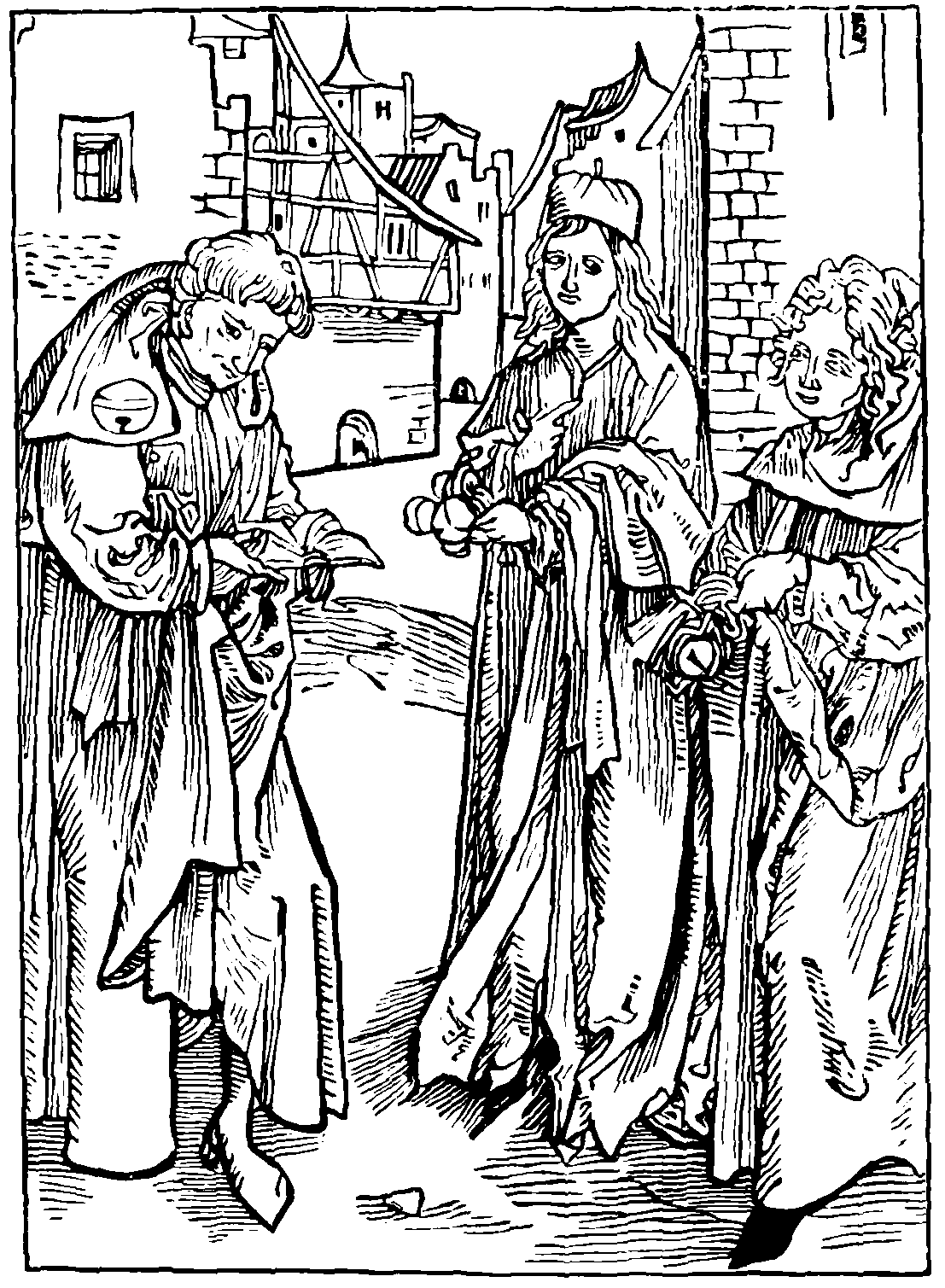
He that vayne stody doth haunt or exercyse
And
lesyth his tyme, of fruyte voyde and barayne
Resortynge to ryot
whiche cunnynge doth dispyse
And that of doctryne (in maner) hath
disdayne
Suche shall in age of his madnes complayne
And
seynge that he lesyth his tyme thus in foly
Let hym come to our
folysshe company.
Nowe in this Nauy many them selfe present
Of this our roylame and from beyond the see
Whiche in theyr stody or lewde and neglygent
Lesynge theyr tyme at the vnyuersyte
Yet count they them selfe of great auctoryte
With theyr proude hodes on theyr neckes hangynge
They haue the lawde: but other haue the cunnynge
They thynke that they haue all scyence perfytely
Within theyr hertes bostynge them of the same
Though they therto theyr mynde dyd neuer aply
Without the thynge, they ioy them of the name
But suche mad folys to theyr great losse and shame
Whyle they sholde norysshe theyr myndes with science
They seke theyr pleasour, gyuen to neglygence
They wander in euery inconuenyence
From strete to strete, from tauerne to tauerne
But namely youth, foloweth all offence
No thynge intendynge the profyte to dyscerne
Nor fruyte of cunnynge wherby they myght gouerne
Them selfe by reason, but suche thynges they ensue
Wherby they neyther get good maners nor vertne
But he that intendeth to come to the science
And godly wysdome of our elders: certayne.
He must sore stody, for without dilygence
And besy laboure no man can it obtayne
None ought to cesse: though it firste be a payne.
In good perseueraunce getteth great ryches
Where no good cometh by sleuthfull ydelnes.
But moste I marueyll of other folys blynde
Whiche in dyuers scyencis ar fast laborynge
Both daye and nyght with all theyr herte and mynde
But of gramer knowe they lytyll or no thynge
Whiche is the grounde of all lyberall cunnynge
Yet many ar besy in Logyke and in lawe
Whan all theyr gramer is skarsly worth a strawe
If he haue onys red the olde dotrinall
With his diffuse and vnparfyte breuyte
He thynketh to haue sene the poyntis of grammer all.
And yet of one errour he maketh two or thre
Precyan or sulpice disdayneth he to se
Thus many whiche say that they theyr grammer can
Ar als great folys as whan they firste began
One with his speche rounde tournynge lyke a whyle
Of logyke the knottis doth lows and vndo
In hande with his sylogysimes, and yet doth he fele
No thynge what it menyth, nor what longeth therto
Nowe sortes currit: Nowe is in hande plato
Another comyth in with bocardo and pheryson
And out goeth agayne a fole in conclusyon
There is nought else but Est and non est
Blaberynge and chydynge, as it were beawlys wyse
They argue nought els but to proue man a beest
Homo est Asinus is cause of moche stryfe
Thus passe forth these folys the dayes of theyr lyfe
In two syllabis, not gyuynge aduertence
To other cunnynge doctryne, nor scyence.
I wyll nat say but that it is expedyent
The to knowe of Logyke the chrafte and connynge
For by argument it maketh euydent
Moche obscurenes, somtyme enlumynynge
The mynde: and sharpynge the wyt in many a thynge
But oft yet by it a thynge playne bryght and pure
Is made diffuse, vnknowen harde and obscure
It is ynoughe therof to knowe the grounde
And nat therin to wast all thy lyfe holly
Styll grutchynge lyke vnto the frogges sounde
Or lyke the chaterynge of the folysshe pye
If one afferme the other wyll deny
Sophestry nor Logyke with their art talcatyfe
Shewe nat the way vnto the boke of lyfe
With suche folyes tender youth is defylyd
And all theyr dayes on them they set delyte
But godly doctryne is from theyr myndes exylyd
Whiche sholde the body and soule also profyte
They take no layser, pleasur nor respyte
To other scyences, pleasaunt and profytable
But without ende in one thynge chat and bable
One rennyth to almayne another vnto fraunce
To parys padway Lumbardy or spayne
Another to Bonony, Rome or orleance
To cayne, to Tolows, Athenys or Colayne
And at the last retournyth home agayne
More ignorant, blynder and gretter folys
Than they were whan they firste went to the scolys
One bostynge the name of a lawer or deuyne
His proude hode hye vpon his stately necke:
Thus muste a gode clerke vnto a foule enclyne
Lowt with the body and with obedyence becke
And thoughe it tourne to theyr rebuke and checke
Yet nowe a dayes ouer many suche there be.
Whiche in stede of cunnynge vseth audacyte
The hode must answere for the follysshe student
Theyr tyme hath ben lost frutles and barayne.
Theyr frendes godes on suche folyes ar spent
To their damage thought hunger and payne:
Thus to conclude: me thynke it is but vayne
The frendes to labour the dayes of theyr lyue
To spare for suche scolers whiche shall neuer thryue
The great foly, the pryde, and the enormyte
Of our studentis, and theyr obstynate errour
Causeth me to wryte two sentences or thre
More than I fynde wrytyn in myne actoure
The tyme hath ben whan I was conductoure
Of moche foly, whiche nowe my mynde doth greue
Wherfor of this shyp syns I am gouernoure.
I dare be bolde myne owne vyce to repreue
Howe be it I knowe my wordes shall suche greue
As them selfe knoweth fawty and culpable
But if they be wroth: take they me by the sleue
For they shall bere the hode and I wyll the bable:
But firste ye studentis that ar of mynde vnstable
Ye wasters and getters by nyght in felde or towne
Within my Nauy wolde I set you to a cable
If I not fered lyst ye your selfe wolde drowne
Also I fere lyst my shyp sholde synke for syn
If that Cupido and Uenus seruytours
On the vnsure se my shyp entred within
Or all the folys promotyd to honours
I none receyue can of hye progenytours
My shyp is nat dressyd for them conuenyent
And to I fere lyst theyr cruell rygours:
Sholde rayse to my shyp some tempest or tourment
Thenuoy of Barklay to the Folys.
Fy studentis clens your myndes of this cryme
Gyue ones your hertis to parfyte dylygence
Howe longe in Idelnes, wyll ye lese your tyme
In pryde and ryot, with all other offence
Alas what profyte get ye by neglygence
But spende your goodes in all iniquyte
And where your frendes thynke, ye labour for scyence:
Ye lese your tyme bryngynge them to pouertee
Leue of suche stody as is vnprofytable
Without fruyte outher godly discyplyne
And gyue your myndes to scyences lawdable
Where ye may your herte set and inclyne:
To Arystotyls or Platoys doctryne
And nat alway on logyke or Sophestry
I wyll nat say but it is a thynge dyuyne
And moche worth to knowe Phylosophy
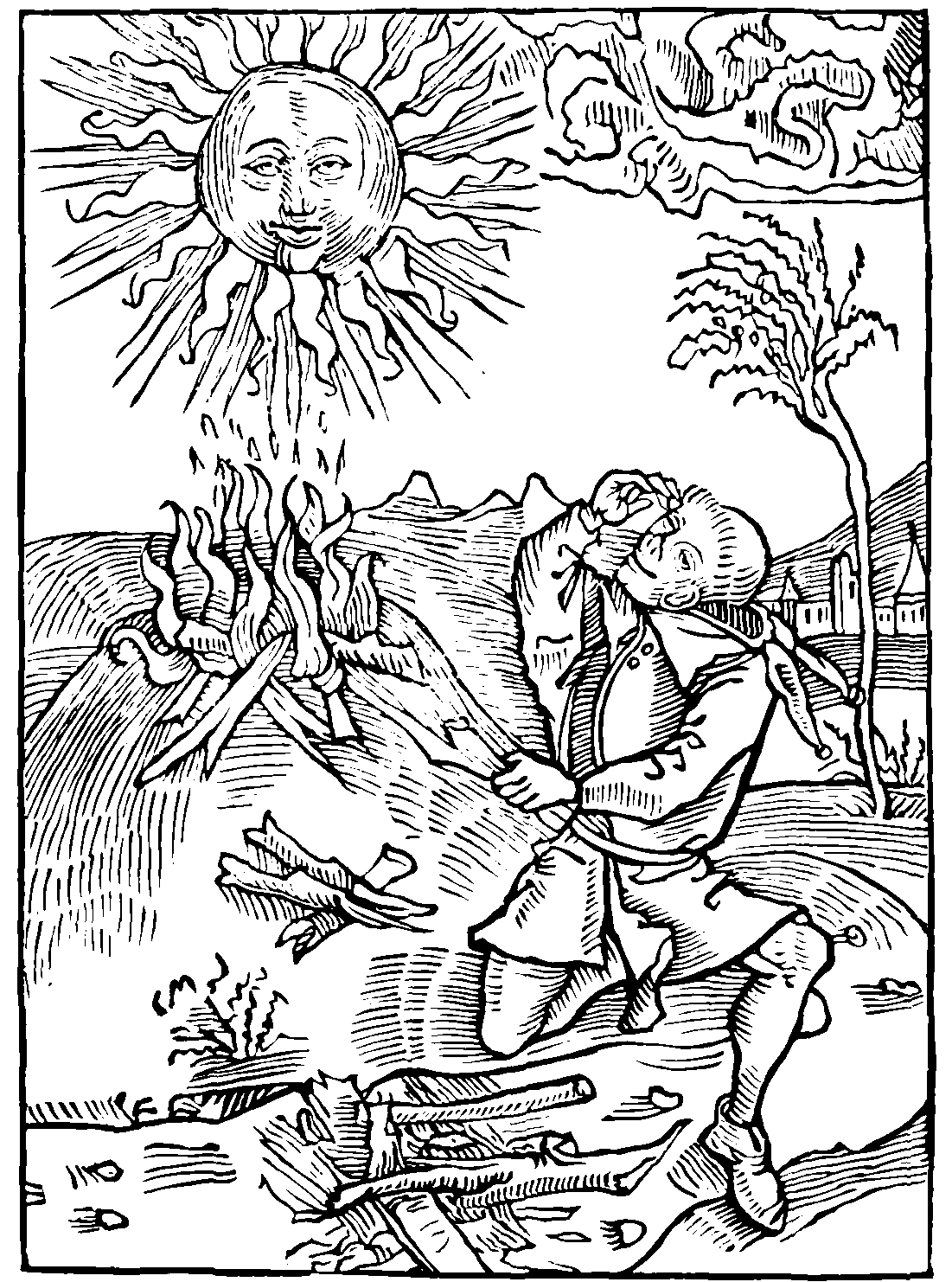
Here note we fowlys whiche can nat be content
With goddes worke, and ordynaunce dyuyne
Thynkynge theyr owne
wyll moche more expedyent
Nat wyllynge theyr myndes to his wyll
to enclyne
But suche folys often sholde come to ruyne
And
wo with sorowe and losse sholde they fynde
If god sholde conforme
his workes to theyr mynde
He is a fole and laboreth in vayne:
Whiche with small brondes of fyre flamynge bryght
Entendyth with laboure besynes and payne
Of the shynynge sonne for to encrease the lyght
Suche one assayeth a thynge passynge his myght
And is a fole to set thought or delyte
To mende that thynge whiche god hath made perfyte
But yet is he a moche gretter fole truely
Whiche wyll correct that thynge whiche god hath done
And doth nat his herte his wyll and mynde aply
To goddes workes and deuyne prouysyon
Of all other maddest is his condycion
And more frantyfe forsoth I may hym call
Than they that ar vext with furyes infernall:
(Thou fole) the myght of god omnipotent
In vertue and wysdome so largely doth extende
His maiesty, and power is so excellent
His glorious godhede his workes doth defende
So that no mortall man can them amende
Wenest thou mad fole that thou amende cannest ought
That he hath done: whiche made all thynge of nought
He that hath made the heuen and firmament
The londe, the se, and euery other thynge
Is so discrete, so wyse, and prouydent
Before his presence parfytely seynge
All thynge to come that neuer hath had beynge
His workes and dedys ar so perfyte and ryght
That none can increas nor yet decreas his myght
He doth all thynge dispose moderate and dispence
Knowynge our mynde, and what is to vs most mete
All thynge is open and playne in his presence
Our inwarde thought must he nedes knowe and wete
And euery fortune is playne before his fete
He hath all thynge by lawe and order drest
And doth no thynge but it is for the best
Therfore whether he gyue thunder snowe or rayne
Wynde or wether, tempest or tourment
Frost lyghtnynge, fayre wether, outher storme sodayne
Mystes or clowdes, yet man sholde be content
And nat with worde nouther inwarde intent
Agaynst god grutche, but euery day and houre
Magnyfye the dedys of god his creatoure
It were moche better thou fole that thou were dome
Than to cast lewde wordes agaynst thy lorde in vayne
Thou fole he worketh no thynge but by wysedome
And yet art thou nat content but dost complayne
Thou sekest vengeaunce (for thy synne) and payne
In hell for euer, thynkynge thy selfe so wyse
To teche thy god, and his warke to dispyse
It is nat lawfull for any, hye nor lowe
To be so bolde so blynde or so cruell
Grutchynge wordes agaynst his god to throwe
Thughe to theyr plaseour a thynge nat fortune well
Take example by the children of Israell
Whiche oft for this synne suffred great payne and wo
Slayne and distroyed, so haue ben many mo
Many a lewde body without wysdome or rede
Grutche in theyr myndes, and openly do blame
Almyghy god, whan theyr children ar dede
Where rather they ought to enioye of the same
For it myght fortune that great rebuke and shame
Myght to theyr frendes haue come by theyr synne and cryme
Soone after: if they had nat dyed at that tyme
Wherfore this one clause is my conclusyon
That god our maker is wyse and prouydent
Blame nat his workes by thyne abusyon
For all that he doth is for the best intent
But if that god sholde alwaye assent
To our desyres and euer perfourme our wyll
Our owne requestis sholde tourne vs to great yll
Alexander barklay to the Folys.
O ye mad myndes that no thynge vnderstonde
O man presumptuous and vnobedyent
Howe darest thou be so bolde to take on honde
To repreue the workes of god omnipotent
Wylt thou hym teche, as more wyse and prouydent
Than he is (whiche made all thynge of nought)
Leue of this thy foly, and holde thy selfe content
For thou art a fole to set theron thy thought
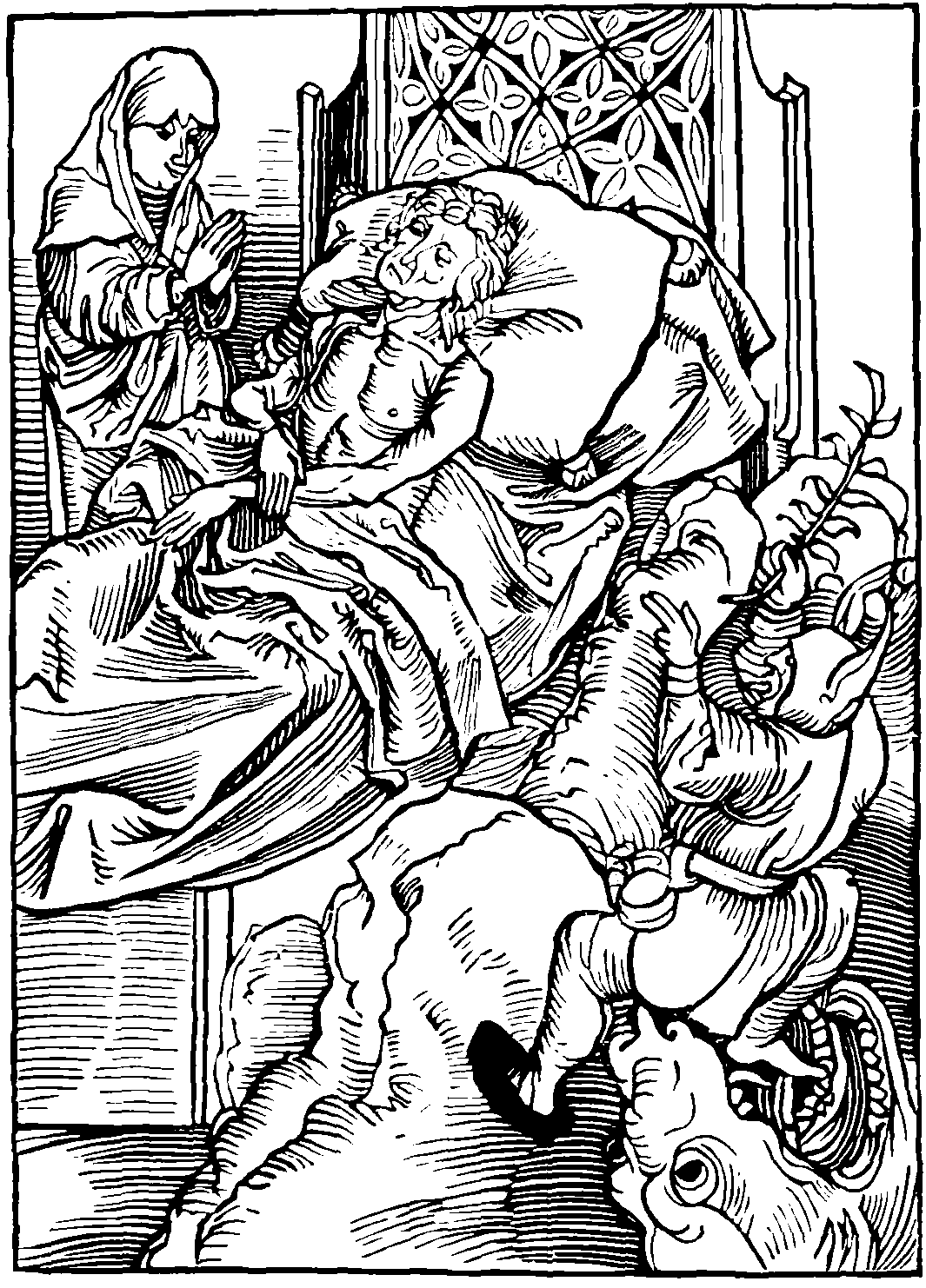
Who that reputyth hym selfe iust and fawtles
Of
maners gode, and of lyuynge commendable.
And iugeth other
(parchaunce that ar gyltles)
To be of a condicion reprouable
Hymselfe nat notynge, thoughe that he were culpable
He is a
fole, and onys shall haue a fall
Syns he wyll other iuge, hym
selfe yet worst of all.
Many fallyth in great peryll and damage
And greuous deth by the vyce of folysshnes
Perseuerantly bydynge in theyr outrage
Theyr soule infect with synne and viciousnes
And though that deth hym alway to them addres
Yet hope they in longe lyfe and prosperyte
And neuer asswageth theyr blynde iniquyte
The tyme passeth as water in a ryuere
No mortall man can it reuoke agayne
Dethe with his dartis vnwarely doth apere
It is the ende of euery man certayne
The last of all ferys and ende of worldly payne
But thoughe we knowe that we all must haue an ende
We slepe in synne disdaynynge vs to amende
Some thynke them gode, iust and excellent
Myghty stronge and worthy of preemynence:
Charitable, chast, constant and innocent
Nat doutynge deth nor other inconuenyence
But yet ar they wrappyd sore in synne and offence
And in a vayne hope, contynue in suche wyse
That all the worlde (saue them selfe) they dispyse
They take on them the workes of god omnipotent
To iuge the secrete of mannys mynde and thought
And where no sygne is sene playne and euydent
They iuge a man saynge, his lyfe is nought
And if deth one hath vnto his last ende brought
(As mad) they mende nat theyr mysgouernaunce
Nat thynkynge that they ensue must the same daunce
Suche folys fayne causes and often tymes say:
That he that is dede vsed ryot and moche foly
Whiche causyd hym to dye before his day
And that he was feble, or full of malancoly
Ouer sad, or prowde, disceytfull and pope holy
Uiciously lyuynge in couetyse and gyle
Wherfore god suffred hym lyue the shorter whyle
Lo these blynde folys saciat with vyce
Jugeth hym that perchaunce dyd nat amys
Whyle he here lyuyd, and is in paradyce
Rewardyd for his workes in endles ioy and blys
Where as this lewde Juger, here in this worlde is
Styll lyuynge in synne, suffrynge great payne and wo
And though he thynke hym gode shall neuer come therto
He that in synne here lyeth fettered fast
And iugeth the deth of his frende or neyboure
Whiche from this lyfe is departed and past.
Let hym beware, for onys come shall the houre
That he must fele dethis dolorouse rygoure.
And after that endure infernall punysshement
For iugynge and mysdemynge of people innocent
The terme and day, of deth is moche vnsure
The deth is sure, the houre is vncertayne
Deth is generall to euery creature
Theder we must all, be it pleasour or payne
Wherfore wysdome wyll that we shulde refrayne
From folysshe demynge and nons deth discus
After deth god wot howe it shall be with vs
Alas full often a iust man gode and true
Of mynde innocent sad sober and sympyll
Passynge his tyme in goodnes and vertue
Is of these folys thought and demyd for yll
And he that is nought, frowarde of dede and wyll
Of these folys blynde frantyke and wode.
Without all reason is iugyd to be goode
Wherfore I proue that a blynde fole thou art
To iuge or deme a mannys thought or intent
For onely god knoweth our mynde and hart
Wherto we gree and to what thynge we assent
But who that is rightwyse iust, and innocent
And louyth god with honour and with reuerence
Than, may he boldely iuge anothers offence
Alexander barklay to the Folys.
Amende you folys: do way these folysshe wayes
Take ye no charge: nat mete for your degre.
And note these wordes: whiche criste our sauyour sayes
Juge nat another, and thou shalt nat iugyd be
It longeth onely to the hye dyuynyte
To iuge our mynde: for he is true iustyce
All thynge discernynge by right and equyte
No man sholde deme, whyle hym selfe is in vyce
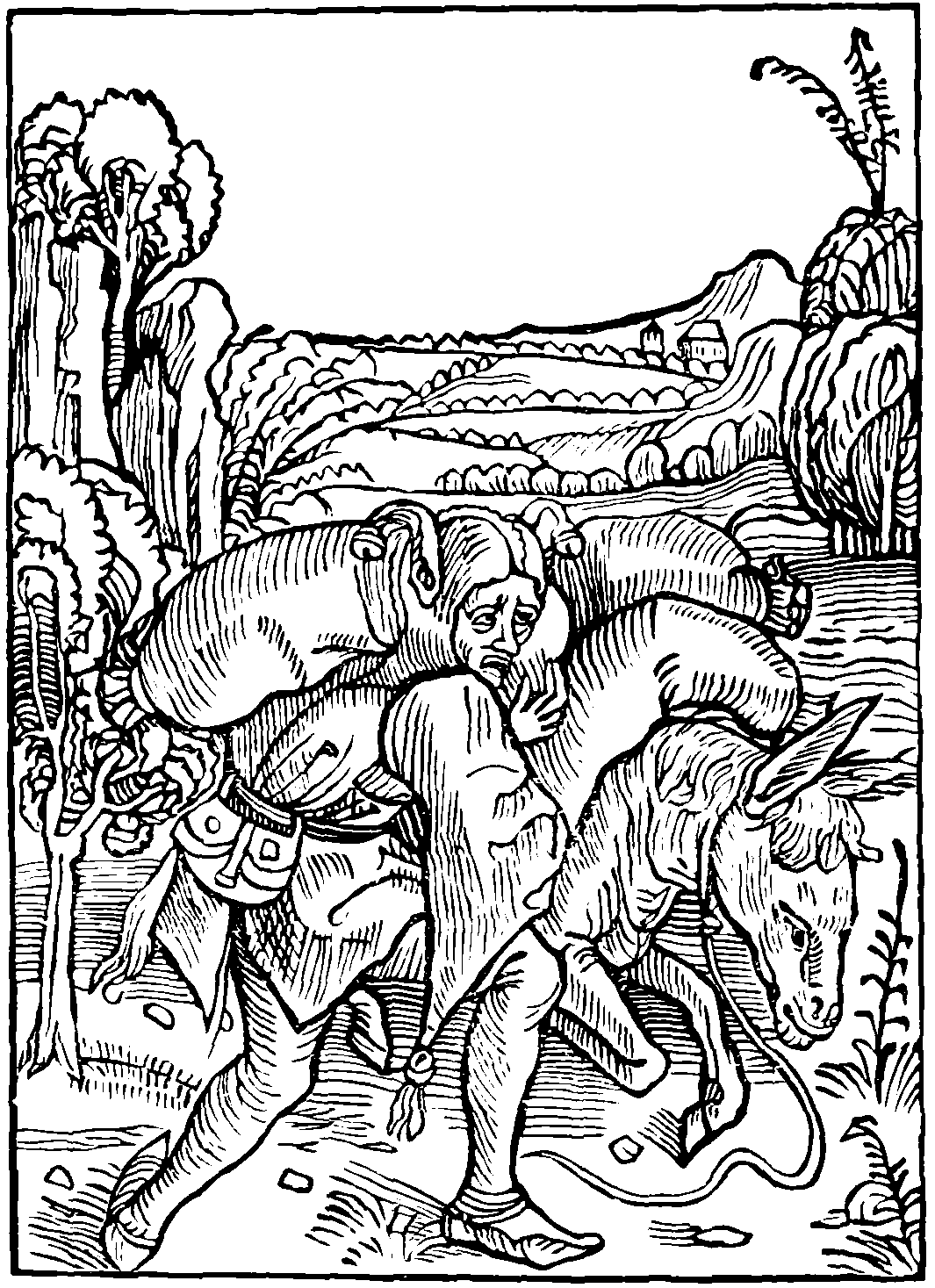
That myller is a fole and here shall haue a barge
And as a mad man shall fast therin be bounde
Whiche his Asse wyll
with so many sackes charge
That the pore beste for payne fallys
to the grounde
Many in the chirche lyke hym may be founde.
Whiche so many benefycis labour to procure
That their small myght
can nat the charge endure.
Amonge our folys delytynge them in vyces
Is yet another sorte of the speritualte
Whiche them ouerchargeth with dyuers benefyces
And namely suche that lowest ar in degre
Of byrth and cunnynge, of this condycion be
Defylynge goddes rentis and the chirches goode
Them selfe ouer ladynge, as men frantyke and wode
The weght is so great they can it nat endure
Theyr myght is small, theyr cunnynge is moche lesse
Thus this great charge wherof they haue the cure
To infernall Fenn doth this pore Asse oppresse
And to an Asse moste lyke he is doutles
Whiche takynge on his backe sackes nyne or tenne.
Destroyeth hymselfe them leuynge in the fenne
But though one prebende were to hym suffycient
Or one benefyce his lyuynge myght suffyse
Yet this blynde fole is nat therwith content
But labowreth for mo, and alway doth deuyse
Fals meanes to come therto by couetyse
He gapeth with his wyde throte insaciable
And neuer can content his wyll abhomynable
So for the loue of the peny and ryches.
He taketh this charge to lyue in welth and eas.
Howe be it that sole that hath suche besynes
And dyueres charges fyndeth great disseas
Neyther shall he god, nor yet the worlde pleas
And shall with his burthyns his mynde so vex and comber
That halfe his cures, can he nat count nor nomber
These carefull caytyfs, that ar of this same sort
With cures ar ouerchargyd so that of theyr mynde.
Rest haue they none, solace, pleasour nor conforte
Howe be it they thynke therby great welth to fynde
They gape yet euer, theyr maners lyke the wynde
Theyr lyfe without all terme or sertaynte
If they haue two lyuynges, yet loke they to haue thre
The folys whose hertis vnto this vyce ar bounde
Upon theyr sholders bereth aboute a sacke.
Insaciable without botome, outher grounde:
They thynke them nat lade though all be on theyr backe.
The more that they haue (the more they thynke they lacke)
What deuyll can stop theyr throte so large and wyde
Yet many all waste aboute Ryot and pryde
But yet is this moche more abhomynable
That asses vntaught without wysdome or scyence
Haue theyr proude myndes moste vnsaciable
Nat commynge to worshyp by vertue nor prudence
Yet counte they them worthy of this excellence
Courters become prestis nought knowynge but the dyce
They preste not for god, but for a benefyce
The clerke of the kechyn is a prest become
In full trust to come to promosyon hye
No thynge by vertue cunnynge nor wysdome
But by couetyse, practyse and flatery
The Stepyll and the chirche by this meane stand awry
For some become rather prestis for couetyse.
Than for the loue of god or his seruyce.
Alas oft goddes goodes and cristis herytage
Of suche folys is wastyd and spent in vayne
In great folyes mundaynes and outrage
Where it decreed, and ordeyned is certayne.
That prestis sholde helpe pore people that lyue in payne
And with suche goodes kepe hospytalyte
Whiche pryde ryot and Uenus suffreth nat to be
Thus is the grettest parte of the spiritualte
Pore preste, persone, vicayr, relygyon and prelate
With couetyse acloyde outher prodigalyte
And folys promotyd causyth good clerkis haue hate
Say lordes and bysshops with other of estate
What mouyth you so gladly, suche to promote
Whiche haue no cunnynge their wyt skant worth a grote
Wyll ye alway the folysshe asse ouercharge
With suche burthyns wherwith it can nat fare
And suffer other to walke and ren at large
And where they best myght bere theyr backes ar left bare
And that is worst of all, suche folys can nat be ware
But whan they ar promotyd after theyr owne entent.
Yet theyr insaciable mynde can neuer be content.
Some make exchanges and permutacions
Some take to ferme, and some let out agayne
Other folys for hope make resignacions
And some for one god scosyth gladly twayne
Some lyueth longe in hunger and in payne
And in the somer day skarsly drynketh twyse
Sparynge monay therwith to by a benefyce
Some for no wages in court doth attende
With lorde or knyght, and all for this polecy
To get of his lorde a benefyce at the ende
And in the meane tyme ensueth rybawdry
And somtyme laboureth by chraft of symony.
He playeth a fals cast, nat cessynge to coniure
Tyll of some benefyce he at the last be sure
Than if this lorde haue in hym fauoure, he hath hope
To haue another benefyce of gretter dignyte
And so maketh a fals suggestyon to the pope
For a Tot quot outher els a pluralyte
Than shall he nat be pleased with .ii. nouther thre
But dyuers wyll he haue ay choppynge and changynge
So oft a fole all and a gode clerke no thynge
These of nought force so that they may haue gayne
And golde ynough to spende on rybawdry and pryde
They haue the profyte, another hath the payne
The cure of the soulys of them is set asyde
And no meruayle, for howe sholde they abyde.
To teche their parysshynges vertue wysdome or grace
Syns no man can be atonys in euery place
Alas these folys our mayster criste betray
Of mannes soule wherof they haue the cure
And settynge in their stede syr Johnn of garnesey
They thynketh them selfe dischargyd quyte and sure
These folys note nat that euery creature.
Whiche here of soulys doth cure or charge take
At domys day a compt for them shall make
But if I sholde touche all the enormytees
The immoderat couetyse and desyre of dignyte
That nowe is vsed amonge all the degrees
Of benefycyd men ouer all the spiritualte
I fere displeasour, and also I often se
That trouth is blamed, and nat ay best to tell
But he that in this lyfe wyll alway besy be
To get dyuers prebendes shall haue the last in hell
Thenuoy of Barklay to the Folys.
What meane ye gyders of Christis herytage
Shall ye neuer leue this your deuowrynge mynde
Shall ye no tyme your couytyse asswage
Whiche in goddes seruyce your hartis sore doth blynde
Let this fals traytour no place amonge you fynde
Graunt hym no rowne in churche nor in quere.
For this is sure ye shall all leue behynde
We haue no Cyte, nor place abydynge here
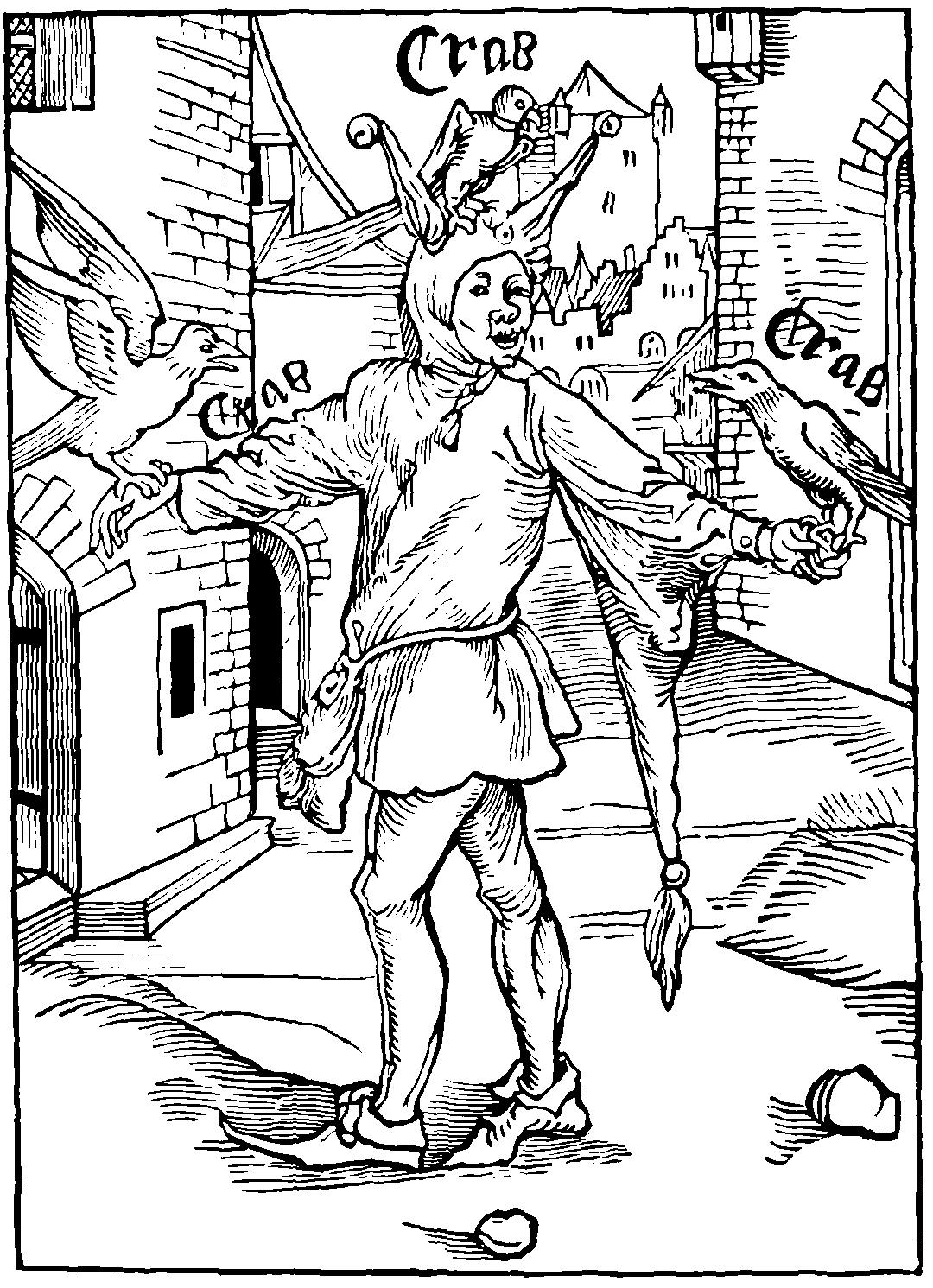
He that cras cras syngeth with the crowe
Deferrynge the tyme of his amendement
Amonge our folys, in this
our shyp shall rowe
For his presumpcion, dull mynde and blynde
intent
What knowe these folys whether god omnypotent
Wyll
graunt them to lyue vntyll another day.
Wherfore we ought to
mende vs whyle we may.
If vnto any almyghty god doth sende
From heuen aboue by inspyracion dyuyne
Wyll and gode mynde his synnes to amende
And with his grace his thoughtes enlumyne
If that synner wyll nat therto enclyne
But doth dyffer and dryue frome day to day
A fole he is, no wyse man wyll denay
Yet many folowe this inconuenience
And knowynge theyr owne vyce, and lyfe full of ordure
The payne therof, and howe euery offence
And synne is punysshed of eche creature
Also they knowe that theyr deth is vnsure
And dye they must knowynge no houre nor space
Yet synne they styll, nat receyuynge this grace
They folowe the crowes cry to theyr great sorowe
Cras cras cras to morowe we shall amende
And if we mende nat than, than shall we the next morowe
Outher shortly after, we shall no more offende
Amende mad fole whan god this grace doth sende
He is vnwyse whiche trustes the crowes songe
And that affermyth that he shall lyue so longe
Syns deth (as I haue sayde) is so vnstable
Wherfore we ought alway vs to prouyde
And mende our lyfe and synne abhomynable
For though that thou be hole at the euyn tyde
Thou knowest nat sure that thou shall here abyde
Untyll the morne but if thou dye in that space
It shall be to late for the to cry cras cras
Syns it is in thy power that thou may
Amende thy selfe whan god inspyreth the
Why shalt thou tary vnto another day
The longer tary the lesse apt shalt thou be.
In olde sores is grettest ieopardye
Whan costome and vse is tourned to nature
It is right harde to leue: I the ensure
Therfore if that thou lewdly fall in syn
By thy frayle flesshe, and the fals fendes trayne
Take nat the vse, contynue nat therin
But by confessyon shortly ryse agayne
Synne alway thretenyth vnto the doer, payne
And grutche of conscience with moche thought and wo
Yet alwaye ar we redy and prone therto
Mannys lyfe on erth is euyn a chyualry
Agaynst our flesshe fyghtyng whiche often doth vs shame
Also the deuyll our goostly ennemy
On his parte labours to get vs in his frame
Thus oft we fall, and than our foly blame
Repentynge sore, and wyllynge to refrayne
But within an houre we fall therto agayne
Thus euer to vyce ar we redy and prone
The gyftis of grace we clene from vs exclude
We haue great cause sore to complayne and mone
We leue that thynge (our myndes ar so rude)
That myght vs gyde to helth and beatytude
Thus our owne foly, and our owne blynde madnes
Us often ledyth vnto great wretchydnes
And if it fortune, that at any tyme
Within our myndes we purpose stedfastly
For to confesse our synne, excesse, or cryme
Agayne our thought is changyd by and by
Away than ren we with the crowys crye
With one cras, to morowe, perauenture twayne
Without regarde had, vnto infernall payne
But in the meane space if that deth vntretable
Arrest the with his mace, fyers and cruell
And for thy synne and lyfe abhomynable
By iustyce damme thy soule for euer to hell
Than woldest thou gladly (If thou myght) do well
But there is no grace but doloure payne and sorowe
Than is to late to crye cras cras to morowe
The Enuoy of the Actour.
Say what delyte, thou fole or what pleasoure
Takest thou in synne and voluptuosyte
It is small sothly, and passeth euery houre
Lyke to the water, and that in myserye
Therfore set nat in synne thy felycyte
This day begyn thy lewde lyfe to refuse
Perchaunce to morowe sholde be to late to the
So sholde cras the crwys songe the sore abuse
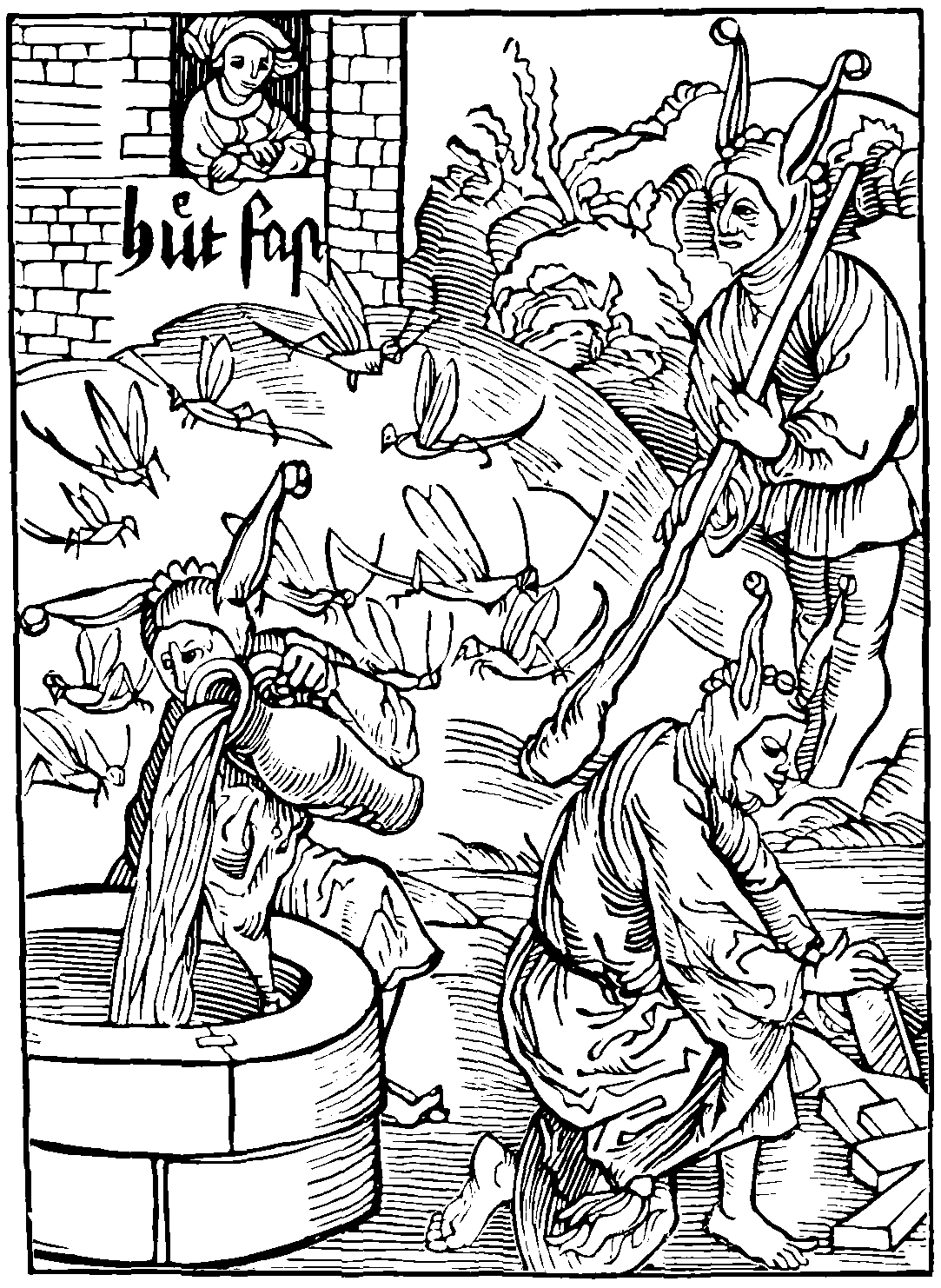
He that his wyfe wyll counterwayte and watche
And
feryth of hir lyuynge by his Jelowse intent
Is as great fole, as
is that wytles wratche
That wolde kepe flees vnder the son
feruent
Or in the se cast water, thynkynge it to augment
For thoughe he hir watche lockynge with lockys twayne
But if she
kepe hir selfe his kepynge is but vayne
Orestes was neuer so blynde and mad as is he
Whiche for his wyfe taketh thought and charge
Watchynge hir wayes, thoughe that she gyltles be
This fole styll fereth, if she be out at large
Lyst that some other his harnes sholde ouercharge
But for all his fere and carefull Jelowsy
If she be nought there is no remedy.
Thou fole I proue, thy watchynge helpeth nought
Thy labour lost is, thou takest this care in vayne
In vayne thou takest this Jelowsy and thought
In vayne thou sleest thy selfe with care and payne
And of one doute thou fole thou makest twayne
And neuer shalt fynde eas nor mery lyuynge
(Whyle thou thus lyuest) but hatered and chydynge
For locke hir fast and all hir lokes marke.
Note all hir steppys, and twynklynge of hir iye.
Ordeyne thy watchers and dogges for to barke
Bar fast thy dores and yet it wyll nat be
Close hir in a Toure with wallys stronge and hye
But yet thou fole thou lesist thy trauayle
For without she wyll no man can kepe hir tayle
And yet more ouer breche hir with plate and mayle
And for all that if she be nought of kynde
She shall disceyue the (If she lyst) without fayle
But if that she be chast of dede and mynde
Hir selfe shall she kepe, though thou hir neuer bynde
Thus they that ar chast of nature, wyll byde so
And nought wyll be nought what so euer thou do
Thus is it foly and causeth great debate
Bytwene man and wyfe, whan he by Jelowsy.
His wyfe suspectyth, and doth watche or counterwayt
Or hir mysdemyth and kepyth in stratly.
Wherfore me thynke it is best remedy
For hym that gladly wolde escape the hode
Nat to be Jelous: but honest lyuynge and gode
The toure of bras that callyd was darayne.
Coude nat the damsell (by name Danes) defende
But that Jupiter fonde a cautell and trayne
In a golden shoure into hir to discende
And to be short, at conclusyon and ende
This mayde for all this Toure was there defylyd.
And by this lorde was she there brought with childe
By this example it apereth euydent
That it is foly a woman to kepe or close
For if she be of lewde mynde or intent
Outher preuy or apert there about she goys
Deuysynge wayes with hir good man to glose
But specially if that he hir suspect
With a hode shall he vnwars be ouerdect
But in the worlde right many other be
Whiche neuer folowe this fals and lothly way
We haue example of one Penolope
Whiche though that she alone was many a day
Hir husbonde gone, and she vexed alway.
By other louers: yet was she euer trewe
Unto hir olde: and neuer changyd for newe
I fynde that often this folysshe Jelowsy
Of men; causyth some women to mysdo
Where as (were nat theyr husbondes blynde foly)
The pore wymen knowe nat what longyd therto
Wherfore suche men ar folys and mad also
And with theyr hodes whiche they them selfe purchace
Within my shyp shall haue a rowme and place
For where as perchaunce theyr wyfes ar chaste and goode
By mannys vnkyndnes they chaunge and turne theyr herte
So that the wyfe must nedes gyue them a hode
But to be playne some wymen ar esy to conuert
For if one take them where they can nat start.
What for theyr husbondes folysshe Jelowsy
And theyr owne pleasour: they scars can ought deny
The enuoy of the Actour.
Therfore ye wymen lyue wysly and eschewe
These wanton wowers and suche wylde company
Get you gode name by sadnes and vertue
Haunt no olde quenys that nourysshe rybawdry
Than fere ye nat your husbondes Jelowsy
If ye be fawtles, chaste and innocent
But wanton wowers ar ful of flatery
Euer whan they labour for their intent.
Be meke, demure, bocsome, and obedyent,
Gyue none occasyon to men by your foly
If one ought asshe, deny it incontynent
And euer after auoyde his company
Beware of cornes, do nat your erys aply
To pleasaunt wordes nor letters eloquent
If that Helena had so done certaynly
She had nat ven rauysshed by handes violent
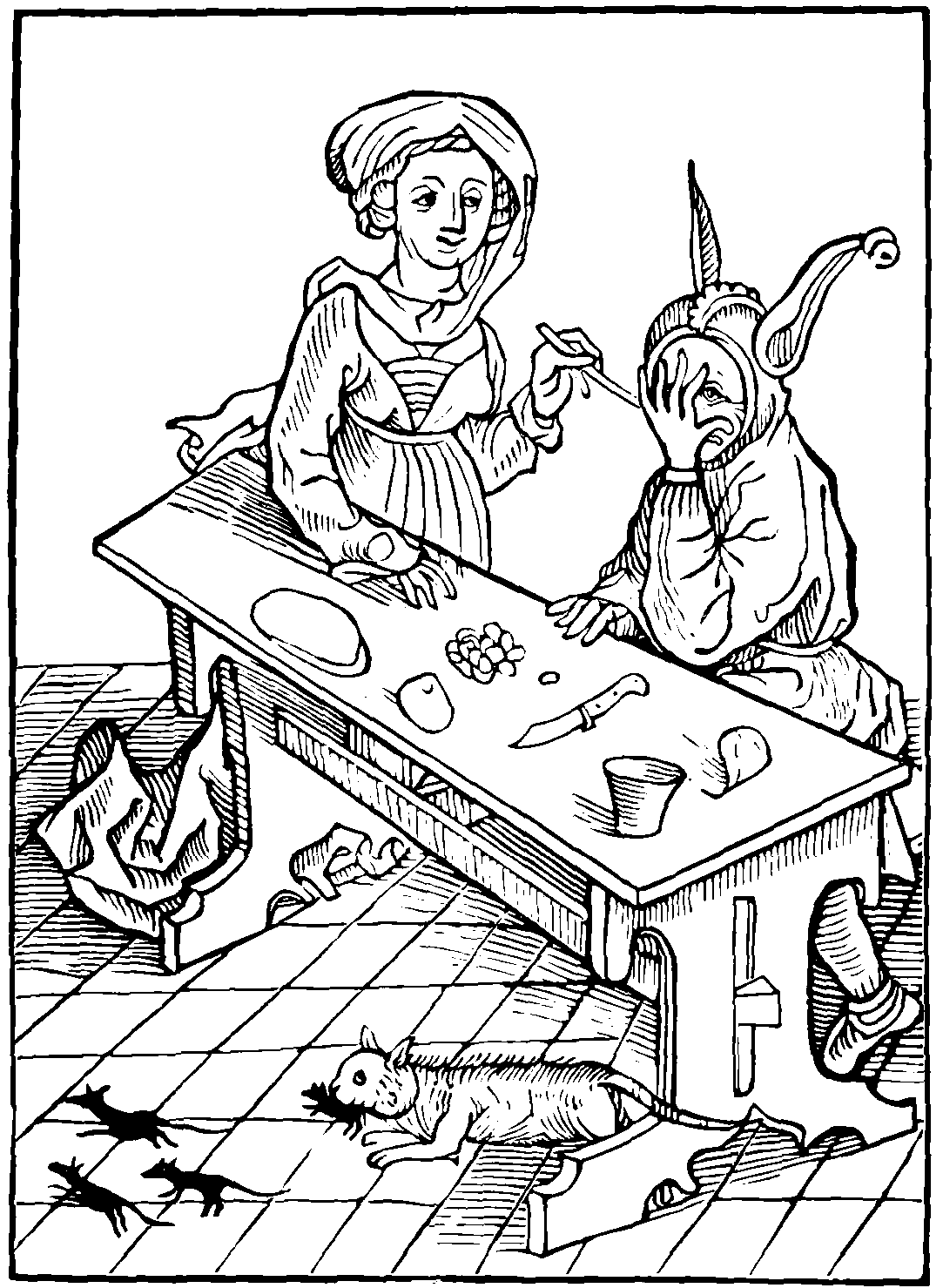
A fole blynde, forsoth and wytles is that man
Whiche thoughe his wyfe openly defylyd be
Before his owne face,
yet suche a chrafte he can
To fayne hym a slepe, nat wyllynge it
to se
Or els he layeth his hande before his iye
And thoughe
he here and se howe the mater gose
He snortynge slepyth, and wyll
it nat disclose.
O what disorder, what shame and what domage
Is nowe brought in, and right lykely to abyde
In the sacrament of holy mariage
The fere of payne and lawe is set a syde
Faythe is clene lost, and fewe them selfe do gyde
After theyr othe, but for lacke of punysshement.
They brake and despyse this dyuyne sacrament
Alas the lawe that Julius dyd ordeyne
Agaynst auoutry: is nowe a slepe or dede
None feryth iustyce punysshement nor payne
Both man and woman ar past all fere and drede
Theyr promes brekynge, without respect or hede
Had to theyr othe, by mariage solemnysed
The bed defylyd. the sacrament despysed
Many ar whiche thynke it is a thynge laudable
Anothers sponse to pullute and dyffame
And howe beit the synne is moche abhomynable
They fere nat god, nor dout nat worldly shame
But rather boldly they bost them of the same
They note no thynge the mortall punysshement
Taken on auoutrers in the olde testament
Yet is another thynge more lothsome and vyle
That many husbondes knowynge theyr wyues syn
Absent themselfe and stop theyr iyen the whyle
Kepynge the dore whyle the auoutrer is within
They forse no thynge so they may money wyn
Lyuynge as bawdes, and that to theyr owne wyues
O cursyd money, this madnes thou contryuys
O cursyd husbonde thou ought to be asshamyd
To set so great fors for syluer or for golde
That thou for them thy wyfe wyll se diffamyd
And helpe therto: ye: and the dede beholde
Blame it blynde dryuyll: by the lawe so thou sholde
And nat therat to gyggyll laghe and Jest
It is a lewde byrde that fyleth his owne nest
The Hystory of Atreus expressyth playne
Howe he (by his owne brother) for auoutry
Was dryuen from his royalme and his childre slayne
For his mysdede: without: let or remedy
These children thus bought theyr faders mad foly
What shall I wryte the wo and heuynes
Whiche Tarquyn had for rauysshynge lucres
I rede in the hystory of one Virginius
Whiche to thyntent this foule synne to eschewe
Whan his doughter was desyred by Clodius
And that by force; the fader his dowghter slewe
Bytwene the handes of Clodius vntrue
The fader answered (whan men his dede dyd blame)
Better is to dye chast: than longe to lyue in shame
But of auoutry somwhat more to speke
In it is yre Enuy and paynfull pouertye.
And also he or she that mariage doth breke
May fere of deth eternall whan they dye
And here without welth ioy and rest shall they be
And well ar they worthy (forsoth) of sore tourment
In hell: for brekynge this holy sacrament
But in the meane tyme here shalt thou haue discorde
And neuer prosper in vertue nor ryches
And lothsome be before the almyghty lorde
Thy dedes shall purchace mysfortune and distres
Thou lyue shalt in shame and dye in wretchydnes
And if thou procede therin and nat amende
Some great shame shalt thou haue before thyne ende.
The enuoy of the Actour.
O creatures vnkynde leue ye this outrage
Breke nat your othe whiche ye made solemly
Eche one to other for to lyue in mariage
Defyle ye it nat by synne and vylany
On both partis if ye lyue faythfully
After your promes: in loue, fayth and concorde
Than shall ye in erth encreas and multyply
And after haue syght of the almyghty lorde
Let all spousys in theyr myndes comprehende
The lawys and decrees of the olde testament
Howe they that in auoutry dyd offende
Were outher stonyd or els openly brent
Wherfore syns goddes son omnypotent.
Confermed hath the olde testament with the newe
Auoutrers nowe deserue that same punysshement
But well is to them, that stedfast ar and trewe
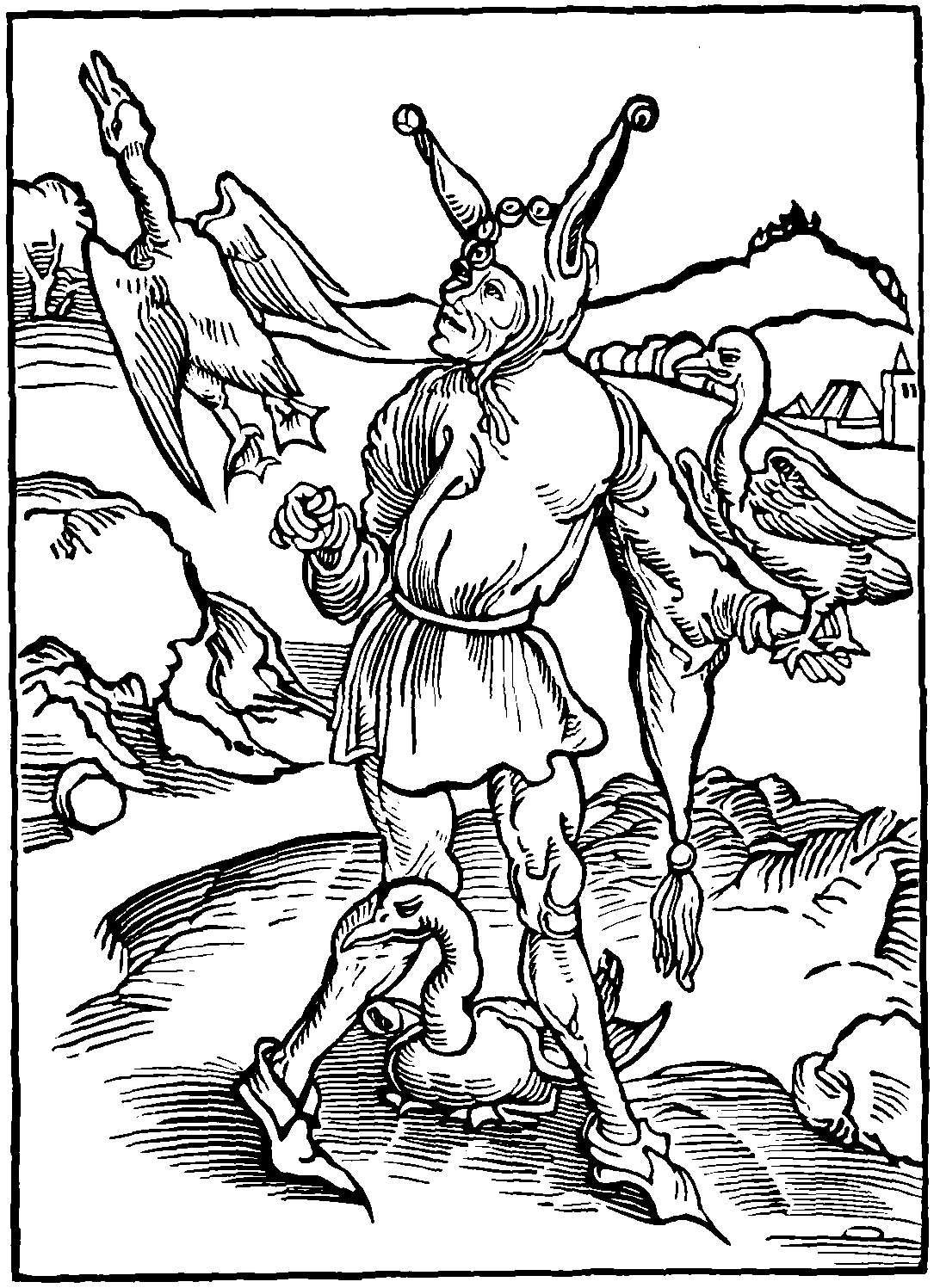
He is a fole, and so shall he dye and lyue
That
thynketh hym wyse, and yet can he no thynge
And though he myght
he wyll nat set nor gyue
His mynde to good maners, vertue nor
cunnynge.
So is he a fole that doth to market brynge
His
Gese fast bounde, and game or sporte to se
Lowsyth theyr fete,
and suffreth them to fle
Saynt George to borowe our Nauy is aflote
Forth shall we sayle, thoughe that it be a payne
And moche laboure to forge a pryuate bote
For euery faute: yet shall I nat refrayne
My hande nor penne: thoughe vnsure be my gayne
My laboure sure: my wyt and reason thynne
Than leue a thynge vnendyd better nat begynne
But in this place shall I a Shyp ordayne
For that fole: that heryth great doctryne
Wherby good maners and vertue aperyth playne
He seth all goodnes, stody, and disciplyne
And yet wyll nat his mynde therto enclyne
But though he knowe what thynge is godlyest
Ouer all the worlde, yet is he styll a beest.
Many of this sort wander and compase
All studies, the wonders of the worlde to se
With vnstabyll wynges fleynge from place to place
Some seyth lawe and some dyuynyte
But for all this byde they in one degre
And if they were Asses and folys blynde before
After all these syghtes yet ar they moche more
They se moche nought lernynge, and hauynge no delyte
In wysdome nor maners vertue nor goodnes
Theyr tyme is loste, without wysdome or profyte
Without grace, or other holynes
But whyle they labour thus with besynes
If they se ought newe, or any folysshe toy
That lyghtly they lerne, and set theron theyr ioy.
By this desyre folys may knowen be
For wytles men of fleynge mynde and brayne
Ar best pleasyd with thynges of neweltye
And them to haue, they spare no cost nor payne
To dyuers londes to ren but all in vayne
And so they labour alway from londe to londe
To se all wonders, but nought they vnderstonde
Some fle to se the wonders of englonde
Some to the court to se the maners there
Some to Wallys, Holonde, to Fraunce or Irlonde
To Lybye, afryke, and besyly enquere.
Of all marueyles, and skantly worth a here
Some vnto Fraunce and some to Flaunders ren
To so the wayes, and workes of cunnynge men
And to be shorte ouer all they range
Spendynge theyr goodes about vnthryftynes
In countrees knowen, vnknowen and strange
But whan theyr iourney they homwarde must addres
As folys vnware, and vagabundes thryftles
They haue nought lerned, kept, nor with them brought
Of maners, wysdome or other thynge that is ought
They that by the se sayle to londes strange
Oft chaunge the place and planete of the fyrmament
But theyr mynde nor maners they ne turne nor chaunge
And namely suche that ar lewde and neglygent
What euer they se styll one is theyr intent
Whan he departyd, If that he were a sote
Agayne anone he comyth in the same mynde and cote
Say mad folys blynde ouersene, and worthy scorne
Fayne wolde I knowe what necessyte ye haue
To go from the place where ye were bred and borne
Into another londe to lerne to play the knaue
Your mynde vnstable sheweth playne that ye raue
Laboure nat so sore, to lerne to be a fole
That cometh by it selfe without any other scole
He that is borne in walys or small brytayne
To lerne to pyke and stele nedys nat go to Rome.
What nede we sayle to Flaunders or Almayne
To lerne glotony, syns we may it lerne at home
Suche lewdnes soon may we lerne of our wombe
He that wyll lerne falshode gyle or sotelte
May lerne it here as well as beyonde the se.
To passe the se to lerne Uenus rybawdry
It is great foly, for thou mayst lerne thy fyll
In shoppis Innes and sellers, ye somtyme openly
At saynt Martyns Westmynster or at the tour hyll
So that I fere all London, in tyme it shall fyll
For it is there kept in lyght and in darke
That the pore Stuys decays for lacke of warke
But brefely to speke, and this to set a syde
He that on vyce, and synne wyll set his entent
May lerne it in Englonde, if he at home abyde
And that of all sortis: god sende amendement
But if thou alway wyll nede be dylygent
To labour in the worlde about from place to place
Do as dyd Plato, than shalt thou fynde great grace
This godly plato laboured with dilygence
To Egypt, and other londes sparynge for no payne
Where euer he came: augmentynge his scyence
And at the last retourned to Grece agayne
His countrey natyf: with laude and name souerayne
Thus he for all his wysdome laboured besyly
But that fowle that nought can nought settyth by
Wherfore that gose that styll about wyll wander
Moche seynge and herynge, and nought berynge away
Shall home come agayne as wyse as a gander
But more fole is he that may lerne euery day
Without cost or laboure out of his owne countrey
And whan the well of wysdome renneth by theyr dore
Yet looth they the water as if that it were soure
Alexander Barklay ad fatuos vt dent locum octo secundariis beate marie de Oterey qui quidem prima huius ratis transtra merentur.
Soft folys soft, a lytell slacke your pace
Tyll I haue space you to order by degre
I haue eyght neyghbours, that firste shall haue a place
Within this my shyp, for they most worthy be
They may theyr lernynge receyue costeles and fre.
Theyr wallys abuttynge and ioynynge to the scoles.
No thynge they can, yet nought wyll they lerne nor se
Therfore shall they gyde this one shyp of foles.
The enuoy of Barklay.
O vnauysyd, vnwyse and frowarde man
Great cause thou hast to morne sore and complayne
Whan no goodnes vertue nor wyt thou can
And yet to lerne thou hast scorne and dysdayne
Alas man mende, and spare no maner payne
To get wysdome, and it thou shalt nat want
Hym that nought wyll knowe, god wyll nat knowe certayne
Wo is hym that wylfully is ignorant.
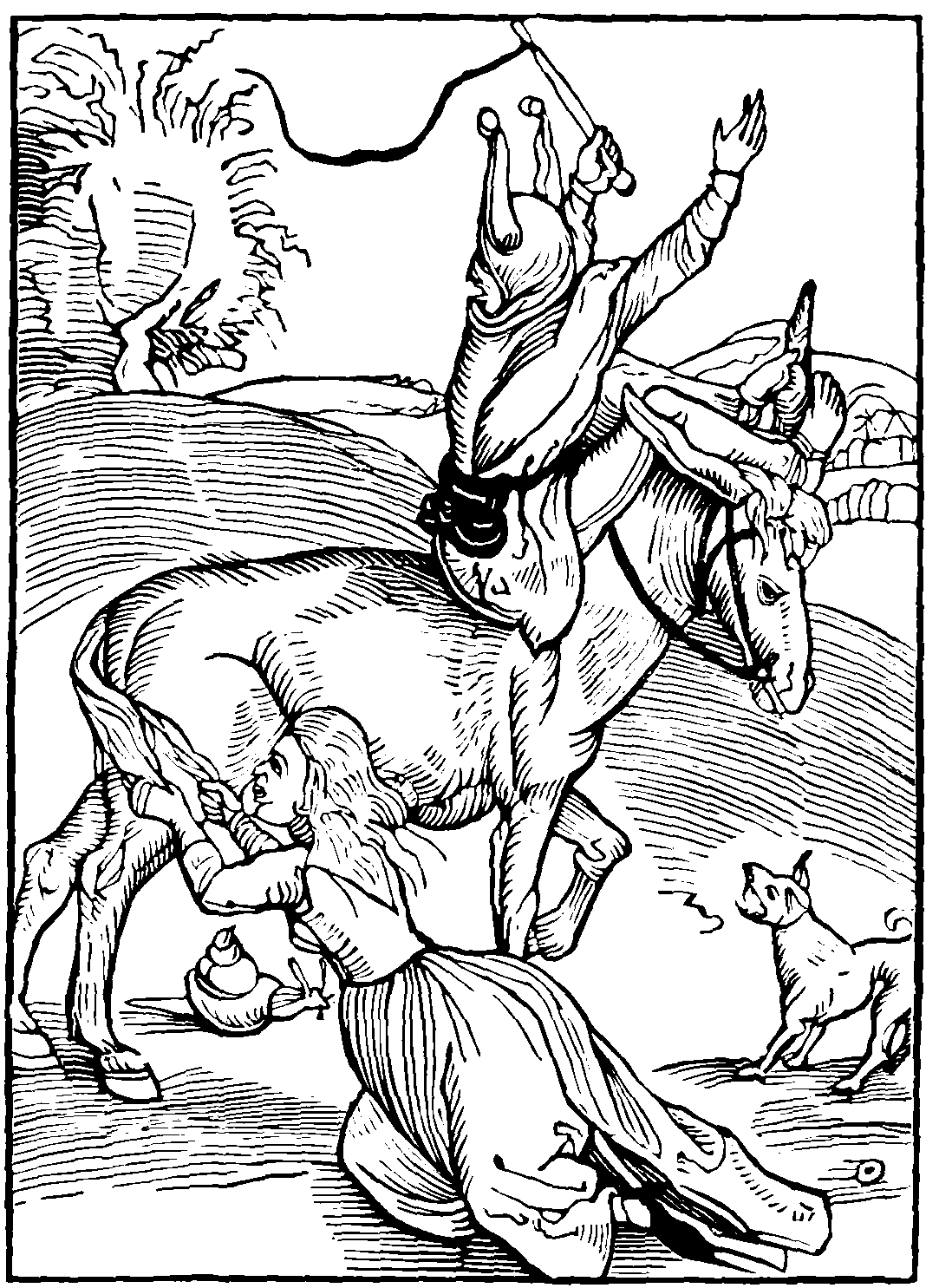
Assys erys for our folys a lyuray is
And he that
wyll be wroth for a thynge of nought
Of the same leuray is nat
worthy to mys
For who that by wrathe to suche a wyll is
brought
To sle his Asse for hir pas slowe and soft
Shall
after his fury, repent his mad foly
For to a clere mynde, mad
wrathe is ennemy
Come nere, ye wrathfull men, take your rowme and place
Within our shyp, and to slake our hastynes
Mount on an Asse slowe of hir gate and pace
Syns troublous wrath, in you, styreth this madnes
Often lacke of myght asswagyth cruelnes
To a wylde cowe god doth short hornys sende
Wrath is great foly, where myght may nat extende
O man yll myndyd what helpeth the this yre
None the commendyth whiche doth thy maners marke
What doste thou: but the waste with thyne owne fyre
Narrynge with thyselfe lyke as a dogge doth barke
Without meke worde and pleasyd with no warke
Art thou: but thoughe all men be dylygent
Mad wrathe to please, yet who can it content
This man malycious whiche troubled is with wrath
Nought els soundeth but the hoorse letter R
Thoughe all be well, yet he none answere hath
Saue the dogges letter, glowmynge with nar nar
Suche labour nat this mad rancour to defar
Nor yet his malyce to mytygate or asswage
But ioyeth to be drede of men for this outrage
His mouth fomyth his throte out gorgyth fyre
His ferefull furoure is, his hole felycyte
By his great yre, doth he coueyte and desyre
Dowtyd to be: of the pore comontye
His owne madnes and cruell furyosyte
Wyll he nat knowe as he were nat culpable
Of this mad fury and vyce abhomynable
Hym selfe is blynde, but other well note his dede
He shall be poynted whether he go or ryde
Saynge one to other take gode regarde and hede
Of yonder furyous fole whome reason doth nat gyde
Beware his wayes fle hym on euery syde
Who that hym sueth both hurte and shame shall fynde
Thus other hym notyth but he hymself is blynde
So his Asse crys to hym ar inuysyble
He thynkyth to haue pacyence though that he haue none
And vnto hym it is thynge incredyble
That suche ar folys whose pacyence is gone
Thus coueytyth he to kepe his erys alone
And to wrathfull men he wyll no thynge obiect
For that hym selfe is with the same infect
But somwhat to touche the inconuenyences
Whiche by this wrath procedyth to mankynde
It is chefe grounde of many great offences
Destroynge reason blyndynge the wyt and mynde
By malyce man is to all yll inclynde
Both symple man, and lordes excellent
Do that by wrath oft whiche they after repent
Reuoke thy mynde, somwhat thy herte enclyne
Unto Archytas a man of hye wysdome
Borne the the ryche Cyte namyd Tarentyne
Rede howe that he his malyce dyd ouercome
For thoughe his seruaunt was fals to hym become
And he sore mouyd to auenge the same offence
Yet he refraynyd his wrathe by pacyence
So socrates so Senyk and Plato
Suffred great wronge great iniury and payne
And of your fayth sayntis right many mo
For christ our mayster dyd great turment sustayne
What wo or payne cowde saynt Laurance refrayne
From pacience wherfore it is great shame
For christen men if they do not the same
They suffred deth, ye, and yet were pacyent
And many haue prayed, for suche that haue them slayne
Where thou mad fole takest greuous punysshement
For small occasyon, ye come by chaunce sodayne
Fole thou art blynde, and mad to set thy brayne
All thynge to venge (by wrath) that doth mysfall
For he that part hath lost: by wrath oft lesyth all
And forsoth no meruayle, if suche wyse actours
Hath wrathes madnes, expelled and set asyde
For where that wrath doth rayne with his furours
There can no reason nor wysedome longe abyde
The wyt it wastyth: so is it a lewde gyde
Therfore let mesure, this malyce holde agayne
But pacyence is brydyll his madnes to refrayne
It longeth nat to any man of hye prudence
For to be wrothe, yrous, or gyuys to malancoly
No suche passyon nor inconuenyence
Can fall to man, ay stedfast wyse and holy
But folys ar moste troublyd with this foly
Where as a wyse man for any aduersyte
Lyueth in quyete mynde and tranquylyte
A man well manerd, sad sober and dyscrete
If he be ware, wyse, chrafty and prouydent
Beholdeth all thynge before his syght and fete.
Gydynge hym by mesure a vertue excellent
Where as a fole doth all without aduysement
And in euery thynge shewyth his folysshnes
Wroth at eche worde, as mayster of madnes
Wherfore ye folys se ye no lenger tary
But on the dull Asse hastely assende
That a slowe beest may hasty folys cary
For your mad wrath dowtyth no thynge the ende
Your madnes can nat your blynde mysdede defende
For who that one sleyth, angry and feruent
Ought to be hangyd whan he is pacyent
The enuoy of the Actour.
Blynde myndyd man whiche wylt all thynge ouercome
Reputynge thy selfe, moste souerayne and royall
If thou be wyse or partener of wysdome
Labour to ouercome thyne owne selfe firste of all
Thy wrath asswage thou in especyall
Let neyther malyce, nor yre with the abyde
Thou art a fole the chefe or lorde to call
Of other: whan thou can nat thy selfe well gyde.
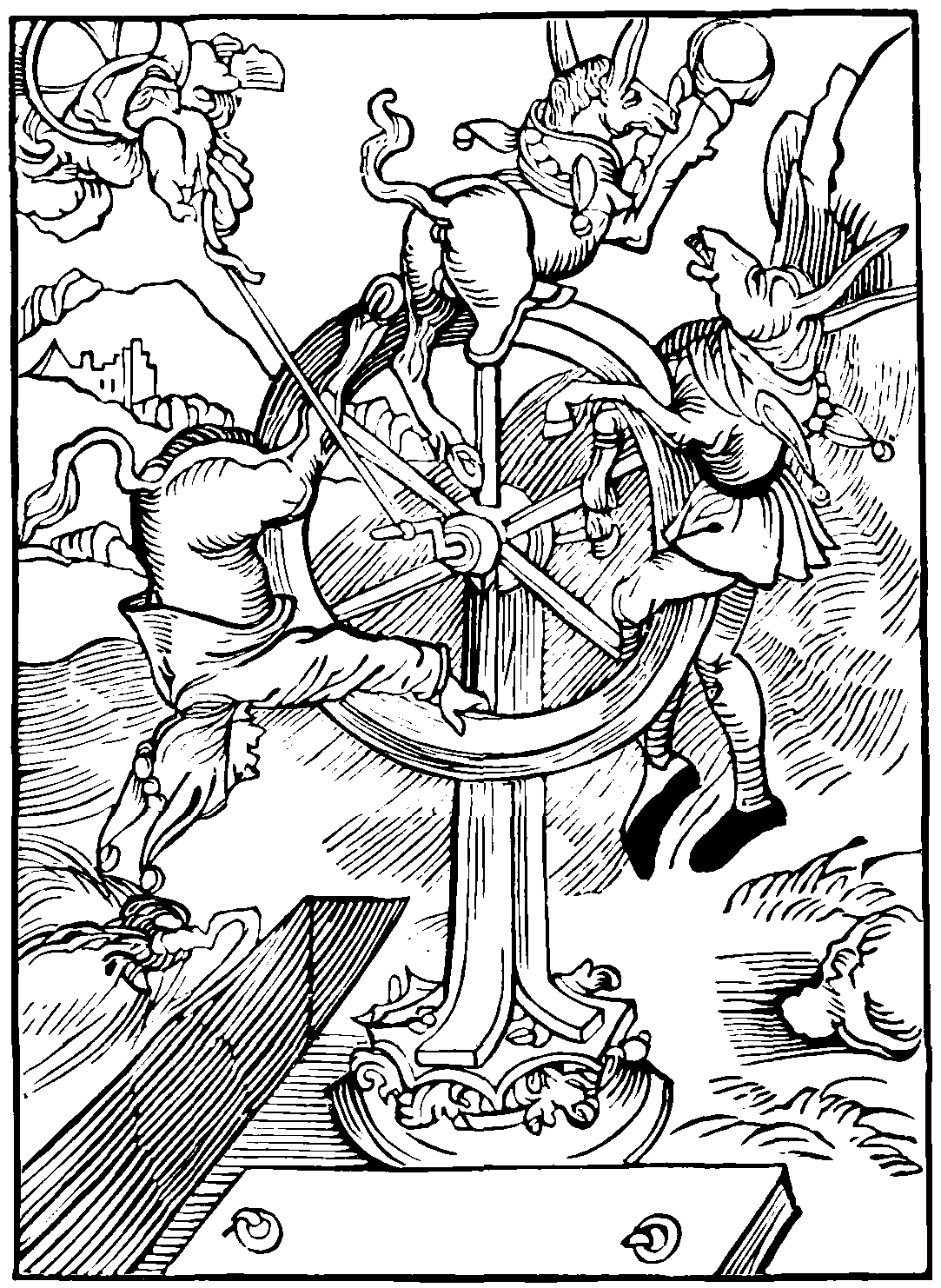
That man whiche hopyth hye vp to ascende
On
fortunes whele, and come to state royall
If the whele turne, may
doute sore to descende
If he be hye the sorer is his fall
So he whiche trustyth nat therto at all
Shall in moste eas and
suerty hymselfe gyde
For vnsure fortune can in no place
abyde
We dayly proue by example and euydence
That many be made folys mad and ignorant
By the brode worlde, puttynge trust and confydence
In fortunes whele vnsure and inconstant
Some assay the whele thynkynge it pleasant
But whyle they to clym vp haue pleasour and desyre
Theyr fete them faylyth so fall they in the myre
Promote a yeman, make hym a gentyl man
And make a Baylyf of a Butchers son
Make of a Squyer knyght, yet wyll they if they can
Coueyt in theyr myndes hyer promosyon
And many in the worlde haue this condicion
In hope of honour by treason to conspyre
But ofte they slyde, and so fall in the myre
Suche lokys so hye that they forget theyr fete
On fortunes whele whiche turneth as a ball
They seke degrees for theyr small myght vnmete
Theyr folysshe hertis and blynde se nat theyr fall
Some folys purpose to haue a rowme Royall
Or clym by fortunes whele to an empyre
The whele than turneth lyuynge them in the myre
O blynde man say what is thyne intent
To worldly honoures so greatly to entende
Or here to make the hye ryche and excellent
Syns that so shortly thy lyfe must haue an ende
None is so worthy, nor can so hye ascende
Nor nought is so sure if thou the trouth enquyre
But that it may doute to fall downe to the myre
There is no lorde Duke kynge nor other estate
But dye they must, and from this wolde go
All worldly thynges whiche god hath here create
Shall nat ay byde, but haue an ende also
What mortall man hath ben promotyd so:
In worldly welthe or vncertayne dignyte
That euer of lyfe had houre of certaynte
In stormy wyndes lowest trees ar most sure
And howsys surest whiche ar nat byldyd hye
Where as hye byldynges may no tempest endure
Without they be foundyd sure and stedfastly
So gretest men haue moste fere and ieopardy
Better is pouertye though it be harde to bere
Than is a hye degre in ieopardy and fere,
The hyllys ar hye, the valeys ar but lowe
In valeys is come the hyllys ar barayne
On hyest places most gras doth nat ay growe
A mery thynge is mesure and easy to sustayne
The hyest in great fere, the lowest lyue in payne
Yet better ly on grounde, hauynge no name at all
Than hye on a Clyf ferynge alway to fall
Thus as me thynke it is no thynge lawdable
On fortunes whele, for one to clym to hye
Syns the swyft cours therof is so vnstable
And all must we leue whan we depart and dye
Of our short lyfe haue we no certayntye
For lachesys (whan that thou hast lefte drede)
Of thy lyue dayes shall shortly breke the threde.
Atropos is egall to pore man and estate
Defar wyll nat deth by prayer ne request
No mortall man may his furour mytygate.
Nor of hym haue one day longer here to rest:
Content the with measure (therfore) for it is best
Coueyt nat to moche in honour to excell
It is a fowle fall to fall from erth to hell
Unstable fortune exalteth some a loft
To this intent, them to brynge to an yll ende
For who that hye clymmeth his fall can nat be soft
If that mysfortune constrayne hym to dyscende
Though Julius Cesar his lordshyp dyd extende
Ouer all the worlde: yet fortune at the last.
From lyfe and lordshyp hym wretchydly dyd cast
This hath ben sene, is sene, and euer shall
That most peryll is in hyest dignyte
Howe many estatis, howe many men Royall.
Hath fortune dryuyn downe into aduersyte
Rede dyuers cronycles, and thou shall playnly se
That many thousandes hath endyd in doloure
By theyr immoderate mynde to honoure
Ouer rede Bochas and than shalt thou se playne
The fall of prynces wryten ryght compendeously
There shalt thou se what punysshement and payne
Haue to them fallen, somtyme by theyr foly
And oft is moche preuy hatered and enuy
Had agaynst lordes of the rude comonte
Where euer they go: they lyue in ieopardye
Ay dowtynge deth by cursed gyle and treason
Eche thynge mysdemynge, ferynge to be opprest
By some mysfortune, with venym or with poyson.
Thus in great honour is neyther ioy nor rest
But thought and fere, ye whyle the lyfe doth lest
Thus who that procuryth great honour to attayne
Procuryth with all, enuy, peryll, fere and payne
A lorde or state whom many men doth drede
With loueles fere, and fayned countenaunce
Unto hym selfe ought wysely to take hede
And them to fere, if he wyll voyde myschaunce
For why a comonty is of suche ignoraunce
And so enuyous, that both erly and late
They muse to destroy hym whom, they fere and hate
A man promotyd vnto hye dygnyte
Shall haue loue shewyd hym by adulacion
But no true loue nouther faythfull amyte.
Good fame nor name, ne commendacion
Ye though he be worthy great exaltacion
Pytefull louynge and full of equyte
Yet harde is to please a folysshe comonte
Therfore me thynke of all thynge it is best
Man to be pleased and content with his degre
For why in mesure, is suerty eas and rest
And ay moste peryll in hyest dignyte
Fortune is full of changes and mutabylyte
Trust nat therto, therby comyth do gode
But nowe hye nowe lowe, vnstable as a flode
Alexander barklay to the Folys.
Labour nat man with to moche besy cure
To clymme to hye lyst thou by fortune fall
For certaynly, that man slepyth nat sure
That lyeth lows vpon a narowe wall
Better somtyme to serue, than for to gouerne all
For whan the Net is throwen into the se
The great fysshe ar taken and the pryncipall
Where as the small escapyth quyte and fre
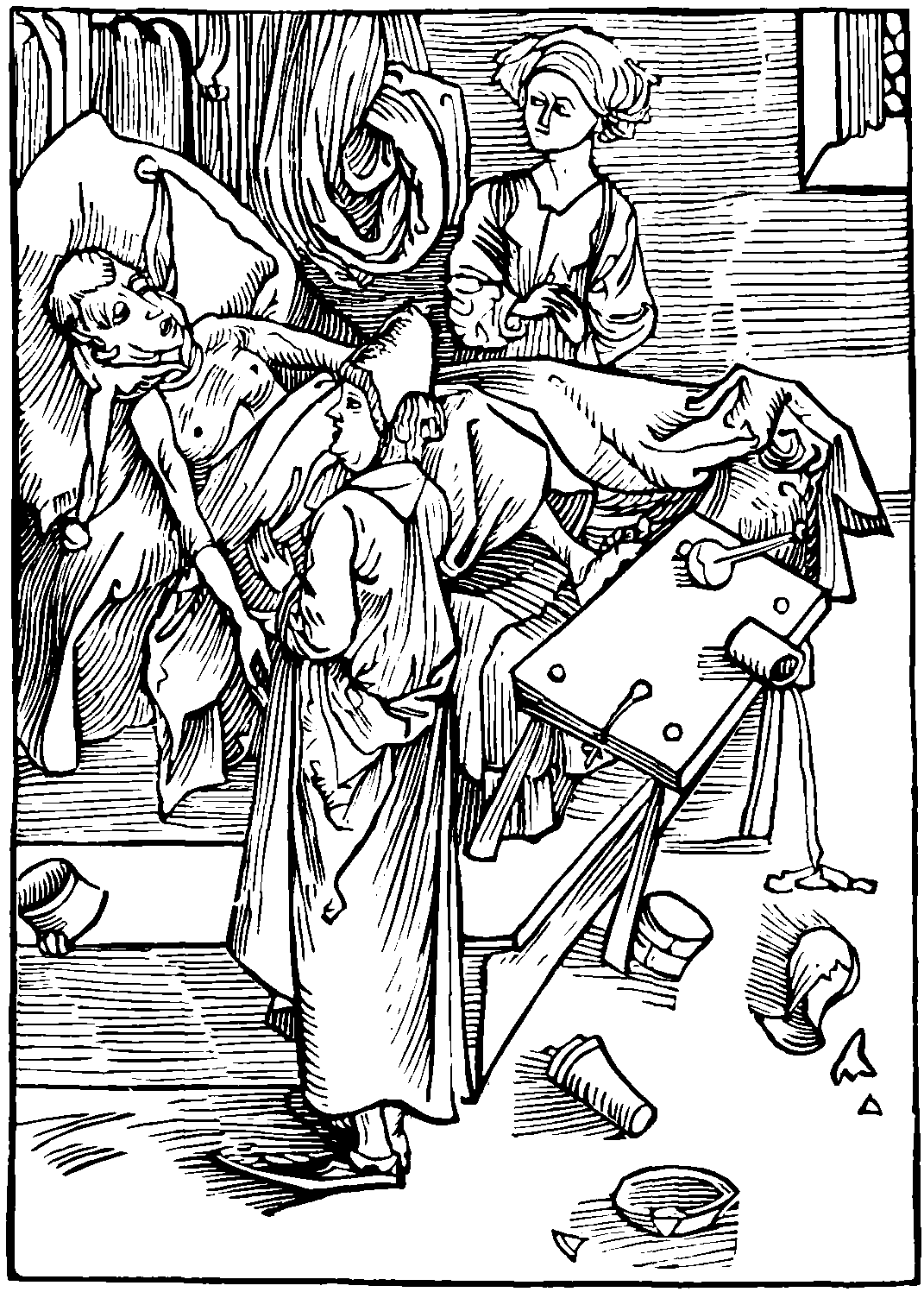
If one be vexed with sore infirmyte
Within his
body felynge dyseas and payne
And wyll nat gladly with perfyte
mynde agre
To a wyse Phesycian that wolde hym hele agayne
He is a fole, and shall his foly sore complayne
And if that he by
his selfe wyll do sterue
It is but well: syns he it doth
deserue.
He that is feble with sekenes outher wounde
Wherwith he feleth hym selfe so kept in payne
That dye he muste but if remedy be founde
He is a fole, if that he haue dysdayne
Of wyse Phesycyans: and medecines souerayne
And wyll nat sue theyr counsell and aduysement
Wherby he myght haue helth and short amendement
Thoughe the Phesycyan (of his lyfe) hym assure
So he be ruled, and vnto his mynde agre
The pacyent yet kepyth no dyete nor mesure
In mete nor drynke, and wyll nat gouerned be
But foloweth Ryot and all superfluyte
Receyuynge colde water in stede of ale or wyne
Agaynst read and counsell of crafty medycyne
What mete or drynke that is most contagious
And most infectyf to his sekenes or dyseas
And to hym forbyden, as moste contrarious
Unto his sekenes. That namely doth hym pleas
But that thynge that myght hym helpe and greatly eas
He hatyth moste, and wyll none receyue at all.
Tyll this small sore, at the last become mortall
Suche wyll no counsell ensue, nor mesure haue
Nor temper theym selfe in lesse nor yet in more.
Tyll theyr yll gouernaunce brynge them to theyr graue
Retournynge into grounde lyke as they were before
But who that soone wolde, be helyd of his sore
Whan it is newe ought to fynde remedy.
For in olde sorys is greatest ieopardy
A small sparcle often tyme doth augment
It selfe: and groweth to flames peryllous
Right so small wellys whiche semeth to be spent
With lytell sprynges and Ryuers, ofte so growys
Unto great waters, depe and ieopadous.
So a small sore augmentyth, styll preuely
By lytell and lytell for lacke of remedy
A small diseas whiche is ynoughe durable
At the begynnynge, for lacke of medycyne
At longe contynuaunce becomyth incurable
The paynfull pacyent bryngynge vnto ruyne
Wherfore who wyll to his owne helth enclyne
And soone be helyd of yll without all tary
To the Phesician ought nat to be contrary
Obstynat frowarde or inobedyent
Ought he nat be, but with a pacyent mynde
Shewe all his soris truly playne and euydent
To the Phesician if he wyll socour fynde.
And thoughe his saluys in paynes hym sore bynde.
Let nat for that, but after his wyll the gyde
Better a shorte payne, than that doth longe abyde
No sore can be releuyd without payne.
Forsake nat the short, the longe payne to eschewe
To the Phesycian we ought in worde be playne
And shewe hym our sore, whether it be olde or newe
For in thy wordes if that thou be nat trewe
Or kepe ought close, thou dysceyuest be thou sure
Thy selfe. and nat hym that of the hath the cure.
In lyke fourme who comyth vnto confessyon
There to declare howe he his lyfe hath spent
And shewyth nat his synne lyke wyse as he hath done
Hymself he disceyuyth, as blynde of his entent.
Thus many one endureth infernall tourment
With wo contynuall and payne for euermore
For kepynge secrete there, of his goostly sore.
Thus who that is payned in any malady
Bodely or gostly, ought nat to be callyd wyse
To the Phesycian without that he aply.
And his preceptis hant kepe and exercyse
But now olde wytches dare boldly interpryse
To intromyt to hele all infyrmyte
And many them byleue, whiche sothly is pyte
Suche wytches of theyr byleue abhomynable
On brest or hede of the paynfull pacyent
With theyr wytchecraftis shall compasse chat and bable
Assurynge hym of helth, and short amendement
Than he that is seke fyxith his intent
Upon hir errour: to haue helpe of his sore
But she hym leuyth wors than he was before
Poule the apostyll doth boldly say and preue
That they whiche to suche wytches wyll assent
Ar heretykes, Lolardes and false of theyr byleue
Brekynge goddes lawes and commaundement
And oft also by profe it apereth euydent
That suche as to wytches craftis wyll intende
By theyr fals Phesyke come soner to theyr ende
Theyr body dede, theyr soule in ieopardy
By mysbyleue for euer in paynes infernall.
Whiche ar rewarde for wretchyd synne and heresy
But if thou to thy mynde and reason call
And of this wrytynge perceyue the sence morall
Whan thou art fallen seke and in dedely syn
Seke helpe betyme, and byde nat longe therein
The enuoy of Barklay to the folys.
Thou man or woman, that lyest seke in vyce
To goddes vycayrs confesse thy syn holly
So shalt thou from thy goostly yll aryse.
For thy soule fyndynge helpe and remedy
Without leasynge shewe hym thy synne playnly
Let nat for shame nor fall nat thereto agayne
Better shewe thy sore there to one secretely
Than after openly: and byde eternall payne
Ensewe the counsell of a wyse confessour
Take nat colde water in stede of vermayll wyne:
For moche swetnes, endure thou a lytell soure
Kepe well the dyet and threfolde medicyne
Ordayned for synne by spirituall doctryne
That is confessyon, the next contrycyon.
With satisfaccion these thre, with grace deuyne
Ar salues parfyte for all transgressyon
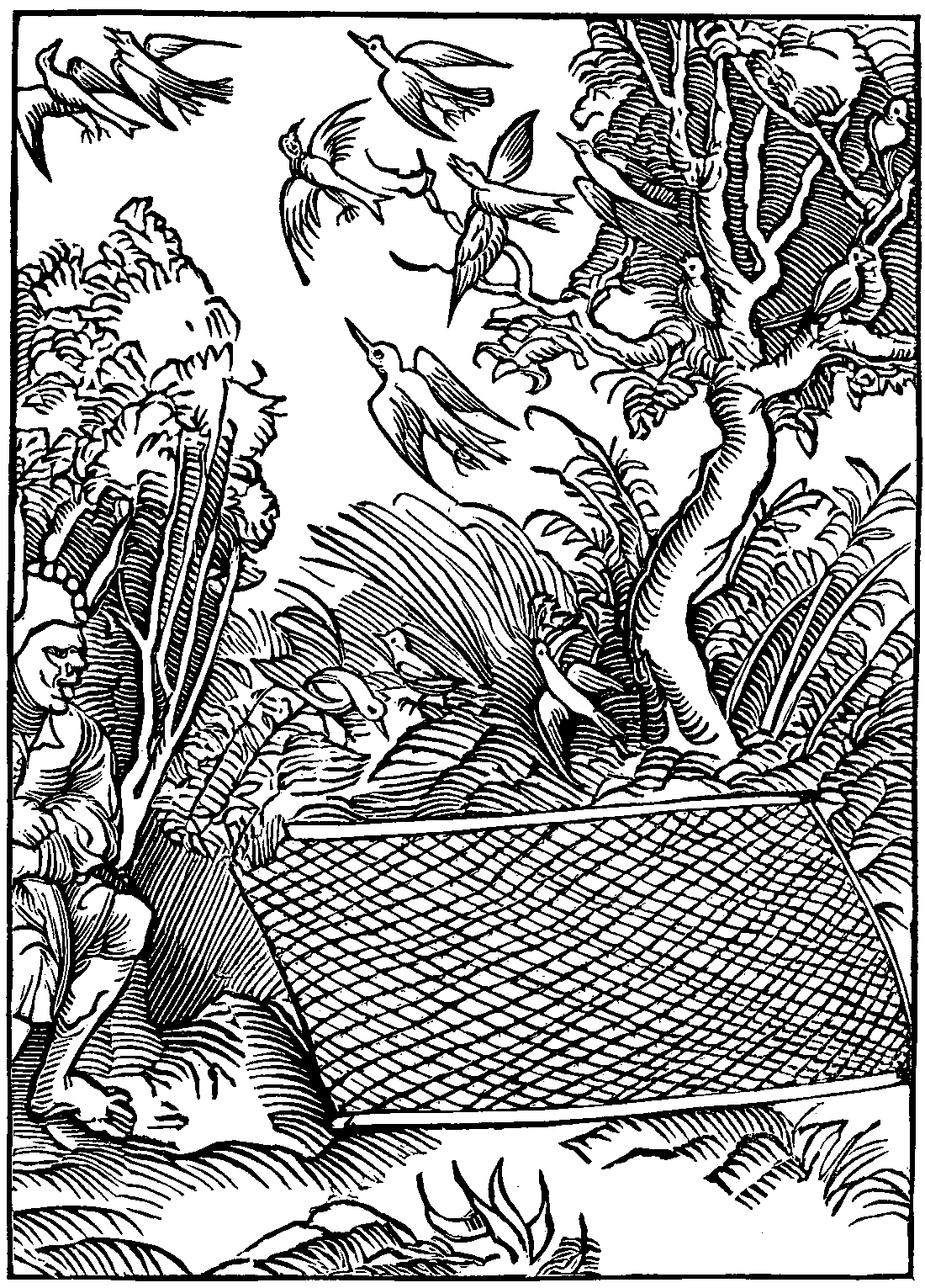
Who that to clerely layeth his net or snare
Before the byrdes whome he by gyle wolde take
Them playnly
techyth of his gyle to be ware
And is a fole whether he slepe or
wake
Right so is he (and doth a sauegarde make)
For his
foes them (techynge remedy to fynde)
Whiche sheweth them by
thretenynge the secret of his mynde
Who that intendyth by chraft and polycy
To take many byrdes, outher small or great
And layeth before them to playne and openly
His lynes snarys, his lyme twyggis or his net
He shall no profyte gayne nor auauntage get
For if that he his engynes can nat hyde
The byrdes shall be ware, and lyghtly fle asyde
So he that wyll openly manace and threte
With worde and hande, as he wolde sle adowne ryght
Is oft scant abyll a symple hounde to bete.
For in his worde is all his force and myght
And he that alway thretenyth for to fyght.
Oft at the profe is skantly worth a hen
For greattest crakers ar nat ay boldest men
Who that agaynst his ennemy wolde fyght
And gyueth hym before wepyn and armour.
Agaynst hym selfe to encreas his foes myght
Suche one hath reason and wyt of smal valour.
Ryght so that sole is led in lyke errour
Which nought can do, of mater les or more
Without he crake and boste therof before.
And also suche bosters and crakers comonly
Whiche doth theyr mynde in hasty wordes declare
Of other men ar lytell or nought set by
And by theyr wordes, full often yll they fare
A man also may ryght easely be ware
Of folys whiche thus theyr counsell out expres
Whose thretenyngs to theyr foes is armour and harnes
But hym call I wyse and crafty of counsell
Whiche kepeth close the secretis of his mynde
And to no man wyll them disclose nor tell
To man nor woman, ennemy nor yet frynde
But do his purpose whan he best tyme can fynde
Without worde spekynge, and so may his intent
Best come to ende, his foo, beynge inprouydent
And specially no man ought to be large
Of wordes nor shewe his counsell openly
In thynges weyghty, of peryll and great charge
Consernynge a royallue, or helth of his body
For many ar falsly disceyued fynally
By lewde tale berers whiche seke the way to fynde
To knowe the preuy counsell of theyr lordes mynde
They fawne and flater to knowe his pryuetee
But they forsoth, that wolde knowe thynges newe
For the moste part of this condicion be
No thynge to kepe, but lyghtly it to shewe.
Thus may the saynge of Salomon be fonde true.
Whiche sayth that he is wyse, and lyueth happely
Whiche to hym selfe kepyth his counsell secretely
I fynde foure thynges whiche by meanes can
Be kept close, in secrete, one longe in preuetee
The firste is the counsell of a wytles man
The seconde a Cyte, whiche byldyd is a bye
Upon a mountayne, the thyrde we often se
That to hyde his dedes a louer hath no skyll
The fourth is strawe or fethers on a wyndy hyll
A pore mannys dedys may soone be kept close
His name is hyd, and right so is his dede.
A ryche mannys dede may no man hyde nor glose
It fleeth farthest, all men of it take hede
So that yll fame whome all men ought to drede
In fleynge about hir myght doth multyply
Augmentynge to his lynage shame and vylany
Therfore who that intendyth to be wyse
Ware and crafty, auoydynge all inconuenyence
To shewe his counsell ought nat to interpryse
But do his mynde, kepynge alway sylence
In seruauntis is small trust or confydence
He that is nowe thy frende may after be thy fo
Warne nat thy ennemy of that that thou wylt do
The enuoy of Barklay to the Folys.
O ye that ar put to wronge and Iniury
If ye intende for to yelde the same agayne
It is great foly to warne your ennemye
Or hym to threten with bostynge wordes vayne.
For oft is sayde, and true it is certayne
That they that wyll lyue in quyetnes and rest
Must here and se and hasty wordes refrayne
All styll with fewe wordes do that they thynke best
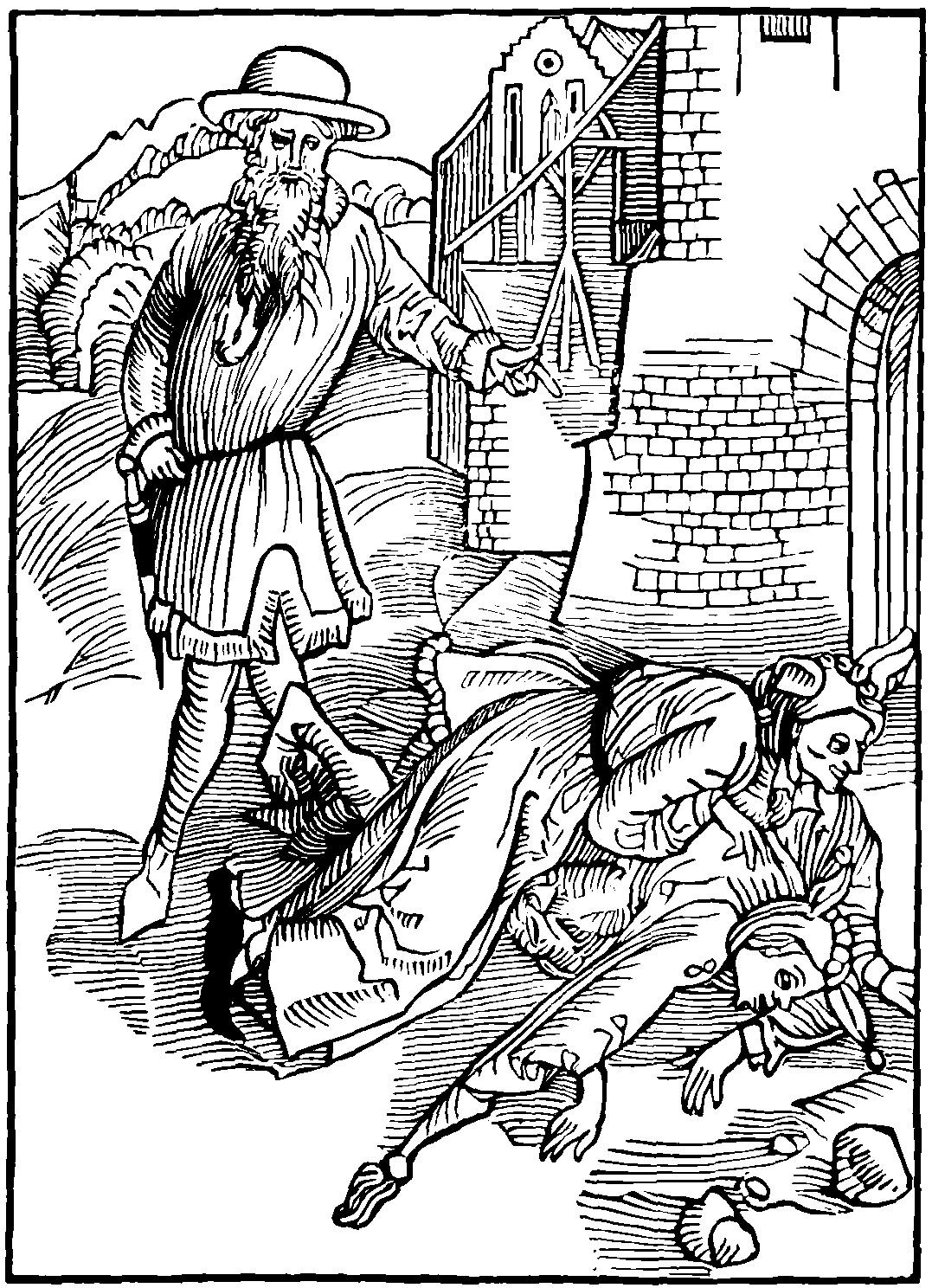
Here we expresse, the errour and blyndnes
Of them
that se others aduersyte
Theyr wofull fall the ruyne and
dystres.
Yet sue they the same, and ware they wyll nat be
Though they by example the payne of other se
Yet leue they nat:
thus may they clayme a place
Within my Nauy, as folys voyde of
grace
We dayly se the mysfortune and damage
And often fallys, to pouerte and payne
Whiche folys suffer for theyr synne and outrage
Some drowned, some maymed, some other wyse slayne
Yet this example can nat cause vs refrayne
Our wretchyd lyfe, and seke for remedy
We marke no thynge anothers ieopardy.
We se the mockynge scorne and derysyon
That folys hath ofte tyme whan they offende
We se theyr losse, theyr shame and theyr confusion
Howe be it all this can cause vs to amende
We can no thynge and to nought we intende
So many folys I fynde that playne I thynke
Theyr weyghty charge shall cause my shyp to synke
Suche ar despysyd of men discrete and wyse
Ye and more ouer these folys ar so blynde
That echone of them the other doth despyse
With sharp rebukes, wordes lewde and vnkynde
Yet in theyr lyfe no difference may we fynde
And though they haue sene a thousande brough to shame
For one sore vyce: yet lyue they in the same
The example of other can nat theyr myndes moue
Theyr wyttis ar blynde theyr foly is the cause
Alas mad folys why do ye vyce thus loue
Rennynge ay to deth without all rest or pause
Alas, at the last retourne to christis lawes
Be ware, whan ye other se taken in the snare
Let anothers peryll cause you to be ware
Ye do nat so, alas it is great shame
Your synne hath quenchyd your grace and gostly lyght
One blynde man another doth chyde and blame
And yet both stomble, nat goynge euyn or right
A blynde man hym ledyth that also hath no syght
So both in the dyche fallyth in suche a wyse
That one can nat helpe, the other agayne to ryse
One crab blamys another for hir bacwarde pace
And yet the blamer sothly can none other do
But both two ar in theyr goynge in lyke case
The one goeth bocwarde, the other doth also
Many of these folys after that maner go
But who that of his moders doctryne hath disdayne:
Shall by his stepdame endure wo care and payne
And perchaunce after abyde the correccyon
Of the sayde stepdame, in place of punysshement.
For his synne, sufferynge hir vniust subieccien
And who that nat foloweth the commaundement
Of his fader beynge to hym obedyent
May fortune after in hunger thyrst ond colde
Obey that stranger, whom he nat gladly wolde
We fynde Hystories wryten longe and ample
In dyuers bokes of great auctoryte
The hole Bybyll sheweth to vs example
Howe they were punysshed that lyuyd in cruelte
I fynde also wryten in bokes of Poetrye
Howe that Pheton was brent with the lyghtnynge
For his presumpcion, agaynst a myghty kynge
We haue example also by Icarus
Whiche contrary vnto the commaundement
Of his crafty father named Dedalus
By fleynge to hye his wynges and fethers brent
And so descendyd and in the se was drent
Thus these two endynge by theyr lewdnes in care
By theyr example sholde cause vs to beware
We dayly se before our syght and our presence
What mysauenture to many one doth fall
And that worthely for theyr synne and offence
Yet ar we blynde, and ar nat ware at all
But in our synnes lyue vnto them egall
And where by synne we se one come to shame
We wyllyngly (alas) ensue the same
Therfore who sethe a mad fole come to wo
Or fall in peryll for lacke of a good gyde
By another way ought craftely to go
And (by anothers yll) for his helthe to prouyde
The fox was ware, and peryll set asyde
And wolde nat enter into the caue, for playne
Of bestis that entred sawe he none come agayne
The enuoy of Barklay
Lerne man, lerne of bestes to be ware
Of others peryll, by theyr enormyte
For if one byrde be onys tane in a snare
The other auoyde as fast as they may flee
A fysshe byrde or beste that hath in peryll be
Of net hoke or snare, if that they may escape.
Wyll after euer beware, but blynde man wyll nat se
His owne destruccion, but after it doth gape
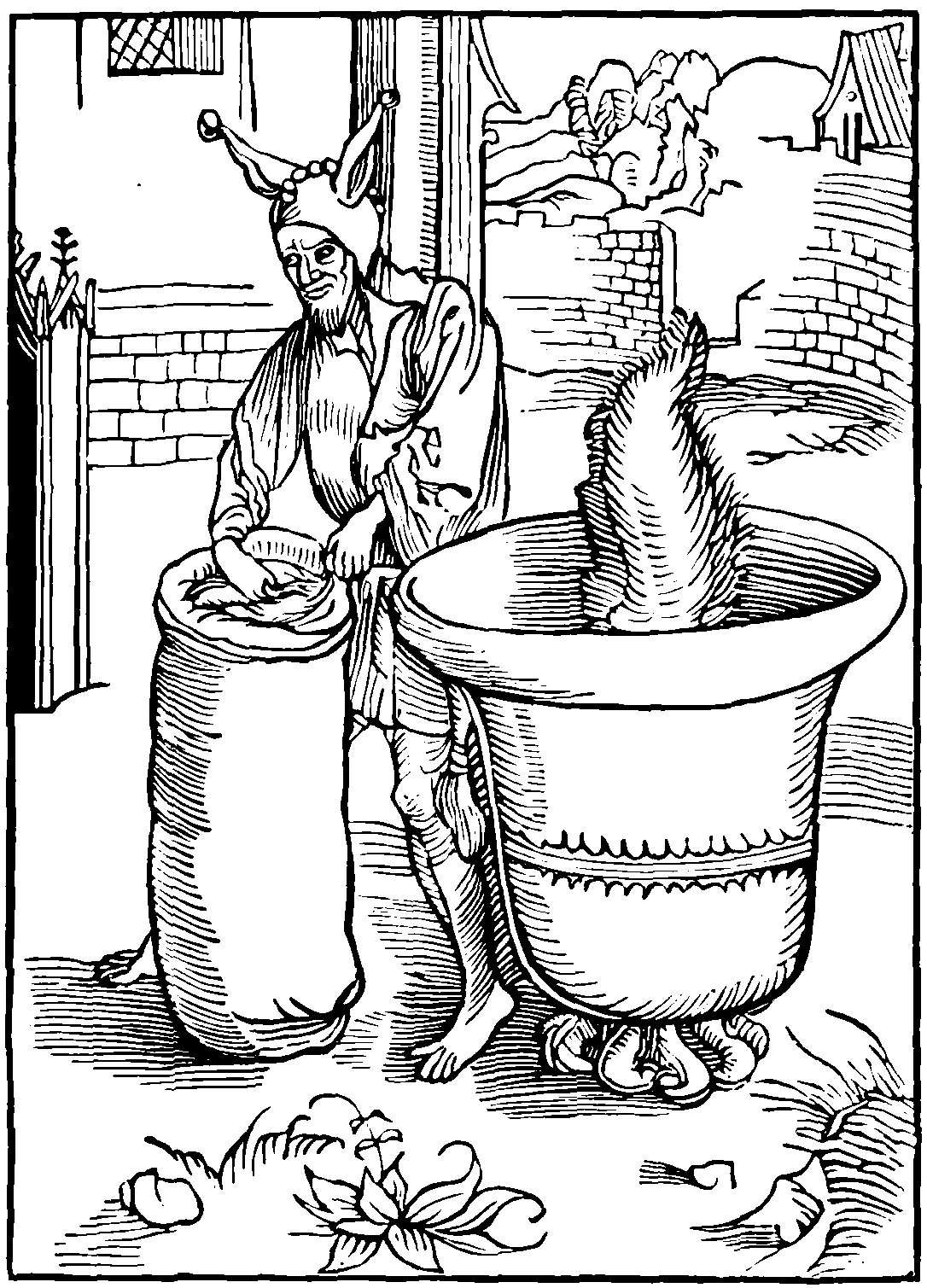
Whether that a bell be hangyd or lye on grounde
If vnto the same a clapper lacke or fayle
The bell shall make but
sympyll noyse or sounde
Though thou in it do hange a Foxys
tayle
Right so backbyters that vse on men to rayle
Can nat
greatly hurt them that lyue rightwysly
Wherfore it is foly theyr
babblynge to set by.
Who that within this worlde wolde rest and lyue
In eas of mynde, peas and tranquyllyte
Must nat his mynde set, nor his erys gyue
To the vayne talys, of the rude comonte
And though some people of suche condicion be
Oft to dyffame good people true and Just
Let them nought care, for byde it nede they must
Let no man care for the lewde hyssynges
And yll soundynges of this vnhappy rage
It is great foly to set by the lesynges
Of cursyde tunges syns none can them asswage
For who in this worlde wyll come to auautage
Hym selfe exaltynge to worshyp and honoure
Shall fynde the swetnes mengled with the sowre
And he that wyll of his dygnyte be sure
Or sympyll lyuynge what so euer it be
Right greuous chargis somtymes must endure
And with his iyen often beholde and se
Suche thynges wherwith his mynde can not agre
And he that wyll with the worlde haue to do
Must suffer suche trouble as belongeth therto
Yet some haue pytched theyr tentis stedfastly
Upon sure grounde, auoyde of all this payne
Despysynge the worldes wantonnes and foly
For in the same is nought sure nor certayne
Nought se we tranquyll in these wawes mundayne
We se no loue, lawe, fydelyte, nor trust
But nowe up hye, and nowe lowe in the dust
To auoyde the worlde with his foly and stryfe
Many hath left londes townes and ryches
And yll company lyuynge solytary lyfe
Alone in desert and in wyldernes
Ye and that: men of moste wyt and worthynes
Whiche by that meane dyd best of all eschewe
All worldly sclaunder and lyuyd in vertue
He that intendeth to lyue a rightwyse lyfe
And so procedeth in maners and good dede
Of worldly sclaunder, complaynt, hatered, and stryfe
And all yll wyll, he ought nat to take hede
For he that is iuste ought no thynge for to drede
A sclaundrynge tonge, ye, be it neuer so wode
For suche lewde tonges can none hurte that ar gode.
Lyue well and wysely, than let men chat theyr fyll
Wordes ar but wynde, and though it oft so fall
That of lewde wordes comyth great hurte and yll
Yet byde the ende, that onely prouyth all
If thou canst suffer truste well that thou shall
Ouercome thyne ennemyes better by pacience
Than by hye wordes rygour or vyolence
If poetis that somtyme vyce blamyd and discommendyd
And holy Prophetis whiche also dyd the same
To suche vayne and mortall wordes had intendyd
They sholde nat haue durst the peoples vyce to blame
So sholde they haue lost their honour and good name
Theyr fame and meryt, but nowe they haue nat so
But spred theyr fame, whiche neuer away shall go
Forsoth none lyueth within the worlde wyde
Suche meke so holy, so wyse or pacyent
Whiche can hym selfe at euery tyme so gyde
To please eche fole, for none can some content
Forsoth he myght be named excellent
Happy and blessyd and lyue in welth and eas
Whiche euery man cowde serue content and pleas
But suche is none, and he that wyll assay
For to content eche folysshe mannes mynde
Must brake his slepe and stody nyght and day
And yet alway some fole shall be behynde
Ye if one lyue well, yet wyll they somwhat fynde
Behynde his backe hym to sclaunder and diffame
For beggers and bawdes therin haue all theyr game
For whether thou dwell in Est west north or south
Of suche dryuels euer shalt thou fynde plente
One must haue moche mele, to stoppe eche mannys mouth
Sclander is the cunnynge of all the comonte
And in the same suche ay moste besy be
Whiche lyue them selfe in shame and vylany
Euen nowe they speke repentynge by and by
Thus all the cunnynge and stody dilygent.
Of people vnthryfty is alway to despyse
And diffame other whiche ar but innocent
Wherfore let suche as ar discrete and wyse
Nought set by them that lesyngys doth deuyse
Nor theyr vayne foly: for he that doth certayne
Is but, a fole. and euer shall lyue in payne.
The enuoy of Barklay to the Folys.
Trouble nat thy selfe (thou man) where is no nede
And arme thou thy selfe with goodly pacyence
Be sure it is great foly to take hede
Unto backbytynge syns that no resystence
May be founde to withstande his violence
And take thou this one thynge for thy comfort
That none wyse, or good, wyll commyt this offence
But all ar caytyffes, that ar of this lewde sort.
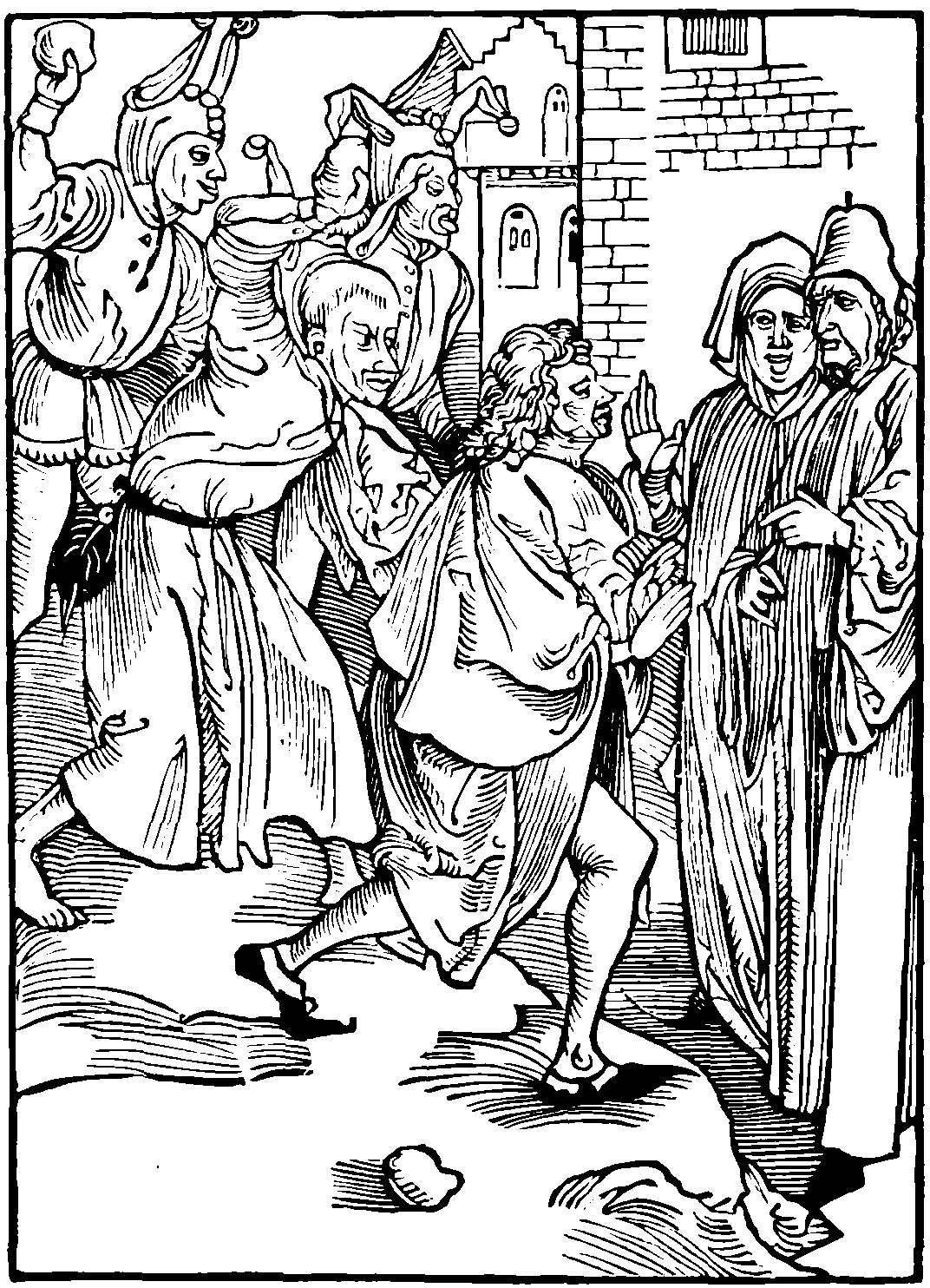
Yet ar mo Folys whiche mocke and scorneth fast
Suche as them shewyth wysdome and doctryne
And at theyr hedes
(vngoodly) stonys cast
In mynde disdaynynge to wysdome to
enclyne
But gladly they ensue the discyplyne
Of folysshe
mockers, let wyse men them eschewe
For no correccion can brynge
them to vertue
O Hertles folys, haste here to our doctryne
Leue of the wayes of your enormyte
Enforce you to my preceptis to enclyne
For here shall I shewe you good and veryte
Enclyne, and ye fynde shall great prosperyte
Ensuynge the doctryne of our faders olde
And godly lawes in valour worth great golde
Who that wyll folowe the graces manyfolde
Whiche ar in vertue, shall fynde auauncement
Wherfore ye folys that in your syn ar bolde
Ensue ye wysedome and leue your lewde intent
Wysdome is the way of men most excellent
Therfore haue done, and shortly spede your pace
To quaynt your selfe and company with grace.
Lerne what is vertue, therin is great solace
Lerne what is trouth sadnes and prudence
Let grutche be gone, and grauyte purchace
Forsake your foly and inconuenyence
Cesse to be folys, and ay to sue offence
Folowe ye vertue, chefe rote of godlynes
For it and wysdome is grounde of clenlynes
Wysedome and vertue two thynges ar doutles
Whiche man endueth with honour specyall
But suche hertis as slepe in folysshnes
Knoweth no thynge, and wyll nought knowe at all
But in this lytell barge in pryncypall
All folysshe mockers I purpos to repreue
Clawe he his backe that felyth ytche or greue
Mockers and scorners that ar harde of byleue
With a rugh combe here wyll I clawe and grate
To proue if they wyll from theyr vyce remeue
And leue theyr foly whiche causeth great debate
Suche caytyfs spare neyther pore man nor estate
And where theyr selfe ar moste worthy of dyrysion
Other men to scorne is all theyr moste condicion
Yet ar mo folys of this abusion
Whiche of wyse men despyseth the doctryne
With mowes, mockes, scorne, and collusyon
Rewardynge rebukes, for theyr good disciplyne
Shewe to suche wysdome, yet shall they nat enclyne
Unto the same, but set no thynge therby
But mocke thy doctryne, styll or openly
So in the worlde it apereth comonly
That who that wyll a Fole rebuke or blame
A mocke or mowe shall he haue by and by
Thus in derysyon, haue folys theyr speciall game
Correct a wyse man, that wolde eschewe yll name
And fayne wolde lerne, and his lewde lyfe amende
And to thy wordes he gladly shall intende
If by mysfortune a rightwyse man offende
He gladly suffreth a iuste correccion
And hym that hym techyth taketh for his frende
Hym selfe puttynge mekely vnto subieccion
Folowynge his preceptis and good dyreccion
But if that one a Fole rebuke or blame
He shall his techer, hate, sclaunder, and dyffame
Howbeit his wordes, oft turne to his owne shame
And his owne dartis retourne to hym agayne
And so is he sore woundyd with the same
And in wo endyth, great mysery and payne
It also prouyd full often is certayne
That they that on mockes alway theyr myndes cast
Shall of all other be mocked at the last
He that goeth right, stedfast sure and fast
May hym well mocke that goth haltynge and lame
And he that is whyte may well his scornes cast
Agaynst a man of ynde, but no man ought to blame
Anothers vyce whyle he vsyth the same
But who that of synne is clene in dede and thought
May hym well scorne whose lyuynge is starke nought
The scornes of Naball full dere sholde haue ben bought
If Abigayll his wyfe discrete and sage
Had nat by kyndnes right crafty meanes sought
The wrath of Dauyd to temper and asswage
Hath nat two berys in theyr fury and rage
Two and fourty Children rent and torne
For they the Prophete Helyseus dyd scorne
So myght they curse the tyme that they were borne
For theyr mockynge of this Prophete dyuyne
So many other of this sorte often mowrne
For theyr lewde mockes, and fall in to ruyne
Thus is it foly for wyse men to enclyne
To this lewde flocke of Folys for se thou shall
Them moste scornynge that ar most bad of all
Thenuoy of Barcly to the Folys.
Ye mockynge Folys that in scorne set your ioy
Proudly dyspysynge goddes punycion
Take ye example by Cham the son of Noy
Whiche laughyd his Father vnto derysyon
Whiche hym, after, cursyd for his transgressyon
And made hym seruaunt to all his lyne and stocke
So shall ye Caytyfs at the conclusyon
Syns ye ar nought, and other scorne and mocke
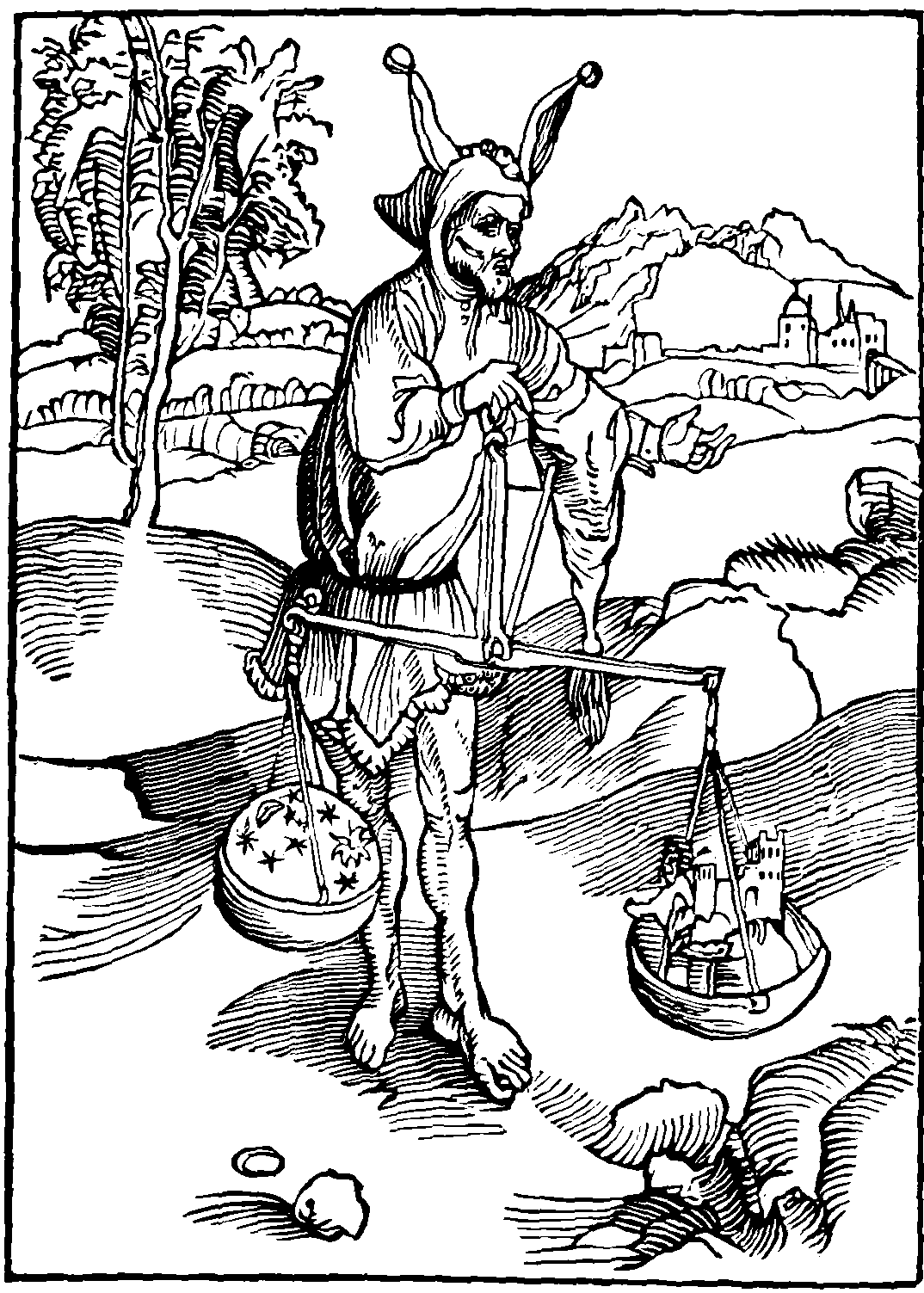
He is a foule that weyeth in one balaunce
The
heuen and erth to knowe the heuyest
And by his foly and cursed
ignoraunce
He thynketh that this wretchyd erth is best
And
thoughe that here be neyther ioy nor rest
Yet had some leuer here
styll to remayne
Than to depart to heuen voyde of al
payne
My hande is wery: fayne wolde I rest a space
But folys comyth to my shyp so besely
That to haue rest: they wyll graunt me no grace
That nede I must theyr lewdnes notefy
But to recorde this folysshe company
They ar suche that this worlde so greatly loue
That they despyse the heuenly Royalme aboue
They often thynke in theyr mynde preuely
And by them selfe in this wyse oft they say
O glorious lorde raynynge eternally
Graunt me thy grace that I may lyue alway
To se of this worlde the extreme ende and day
This is my wyll and synguler askynge
As for thy royalme, forsoth I set no thynge
But yet this fole doth nat desyre this tyme
Of so longe lyfe, and yeres alway newe
To clens his mynde from all synfull cryme
Nor for the loue of goodnes or vertue
But rather that he his pleasour may ensue
And with his maters and felawes suche as he
To folowe ryot, delytys and enormyte.
To lyue in wantonnes and blyndnes lascyuyte
In pryde in Lechery andin couetyse
Suche sytteth theyr myndes and theyr felycyte
Not ferynge hell whiche is rewarde of vyce.
Those dredefull dennys, in a right ferefull wyse
With fyres flamynge, and manyfolde tourment
Can nat suche folys, theyr synnes cause to stent
O sleuthfull fole say why doste nat thou call
Unto thy mynde that this worldes wretchydnes
Is full of sorowe moche more bytter than gall
Uoyde of all ioy, all pleasour and swetnes
Why settest thou so moche by frayle delyciousnes
On vayne pleasours, whiche shall sothly decay
Lyke as the sone meltyth the snowe away
Man note my wordes and gyue to them credence
I say that pleasours and also ioyes mundayne
As it apereth playne by good euydence
Ar fylled with sorowe bytternes and payne
Without all rest quyete or certayne
And yet alas the worlde so doth men blynde
That it they loue and caste heuen out of mynde
Wherfore it hapneth full often as I fynde
That suche as foloweth shamefull wantonnes
Ungoodly luste, and statelynes of mynde
Shall ofte perceyue great shame and wretchydnes
And them most suffer, with great mundayne distres.
And better charges, and after must nede endure
Cruell deth whiche ende is of euery creature
The worlde shall passe: ye and all ioy mundayne
Without all doute at last shall haue an ende
And euery thynge outher fruytfull or barayne
Shall to the grounde outher firste or last discende
We se also that none can hym defende
From dethes dartis. and for conclusyon.
We dayly se many mennys confusyon.
We dayly se the fallys innumerable
And greuous deth aswell of youth as age
Thus is this wretchyd worlde moche vnstable
Wherfore me thynke it is a great outrage
To trust therto, or for an vnsure stage
Or hye place of welth or worldly honour
The presence to despyse of our sauyoure
But without doute the tyme shall come and houre
Whan all mankynde shall se hym euydent
Some to theyr ioy, some to wo and doloure
None shall eskhape that rightwyse iugement.
But eche be rewardyd as he his tyme hath spent
So they that vertuously haue lyuyd here
Despysynge this worlde shall gladly there apere
But they that here haue led theyr lyfe in vyce
For to depart ar wo in herte and mynde
And ferefull to byde that sentence of iustyce
Syns of theyr synne excuse they can none fynde
But to conclude forsoth that fole is blynde
That for worldly welth, from god wolde hym deuyde
And for vayne clay, the hye heuyn set a syde
The enuoy of Barklay to the Folys.
O blynde man whiche hast thy moste felycyte
On worldly thinges, alas make clere thy mynde
What fyndest thou here, but great aduersyte
Wylt thou for it leue yt heuenly ioy behynde
And where thou myght euerlastynge ryches fynde
Where as is helth, endles lyfe and all goodnes
Wylt thou forsake it for worldly wretchydnes
Wylt thou heuyn compare with his paynfull lyfe
There on to thynke thou art vnwyse certayne
There is concorde, here is no thynge but stryfe
There is all rest, and here is care and payne
There is true loue: here is scorne and disdayne
There is all goodnes, here all yll and offence
Nowe chuse the best: here is great difference
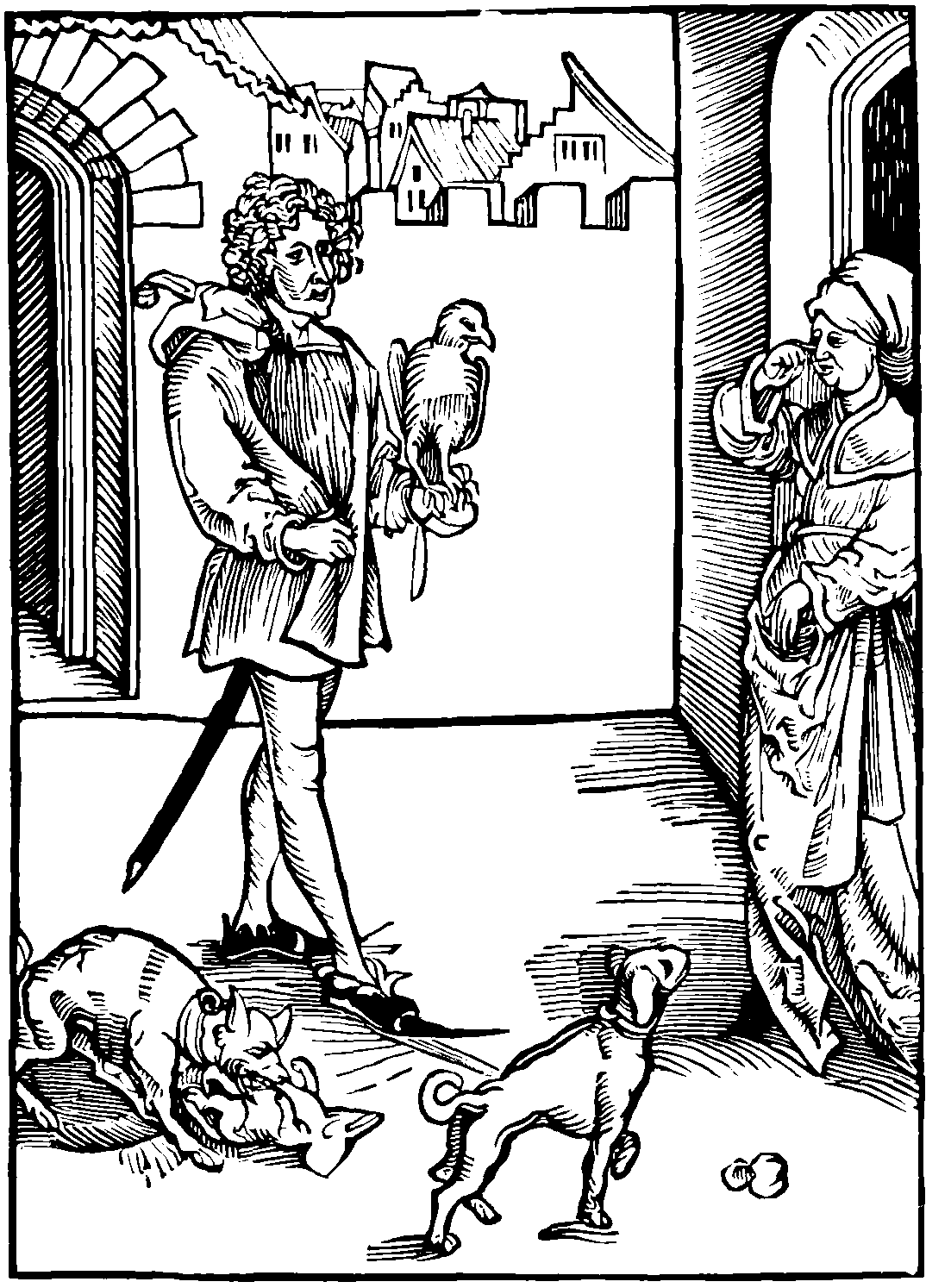
A fole is he, and hath no mynde deuoute
And
gyueth occasyon to men on hym to rayle.
Whiche goth in the
chirche, his houndes hym aboute
Some rennynge, some fast tyed to
his tayle
A hawke on his fyst suche one withouten fayle
Better were to be thens, for by his dyn and cry
He troublyth them
that wolde pray deuoutly:
Yet of mo folys fynde I a great nomber
Whiche thynke that it is no shame nor vylany
Within the chirche, the seruyce to encomber
With theyr lewde barkynge roundynge dyn and cry
And whyle good people ar praynge stedfastly
Theyr herte to good, with meke mynde and deuout
Suche folys them let, with theyr mad noyse and shout
And whyle the prestis also them exercyse.
In matyns masse sermon or prechynge dyuyne
Or other due thynges that longe to theyr seruyce.
Techynge the people to vertue to enclyne
Than these folys as it were rorynge swyne
With theyr gettynge and talys of vycyousnes
Trouble all suche seruyce, that is sayd, more and les
In to the churche than comys another sote
Without deuocyon gettynge vp and downe
Or to be sene, and to showe his gardyd cote
Another on his fyst a Sparhauke or fawcon
Or els a Cokow, and so wastynge his shone
Before the auters he to and fro doth wander
With euyn as great deuocyon as a gander
In comys another his houndes at his tayle
With lynes and leshes and other lyke baggage.
His dogges barkyth, so that withouten fayle
The hole churche is troubled by theyr outrage
So innocent youth lernyth the same of age
And theyr lewde sounde doth the churche fyll.
But in this noyse the good people kepe them styll.
One tyme the hawkys bellys Jenglyth hye
Another tyme they flutter with theyr wynges
And nowe the houndes barkynge strykes the skye
Nowe sounde theyr fete, and nowe the chaynes rynges
They clap with theyr handes, by suche maner thynges
They make of the churche, for theyr hawkes a mewe
And Canell to theyr dogges, whiche they shall after rewe
So with suche folys is neyther peas nor rest
Unto the holy churche they haue no reuerence
But wander about to see who get may best
In rybawde wordes pryde and insolence
As mad men they fere nat our sauyours presence
Hauynge no honour vnto that holy place
Wherin is gyuen to man euerlastynge grace
There ar handlyd pledynges and causes of the lawe
There ar made bargayns of dyuers maner thynges
Byenges and sellynges scant worth a hawe
And there ar for lucre contryued false lesynges
And whyle the prest his Masse or matyns synges
These folys whiche to the Churche do repayre
Ar chattynge and bablynge as it were in a fayre
Some gygyll and lawghe and some on maydens stare
And some on wyues with wanton countenaunce
As for the seruyce they haue small force or care
But full delyte them in theyr mysgouernaunce
Some with theyr slyppers to and fro doth prance
Clappynge with their helys in churche and in quere
So that good people can nat the seruyce here
What shall I wryte of maydens and of wyues
Of theyr roundynges and vngoodly comonynge
Howe one a sclaundre craftely contryues
And in the churche therof hath hyr talkynge
The other hath therto theyr erys lenynge
And than whan they all hath harde forth hir tale
With great deuocyon they get them to the ale.
Thus is the churche defylyd with vylany
And in stede of prayer and godly oryson
Ar vsyd shamefull bargayns and talys of rybawdry
Jettynges and mockynges and great derysyon
There fewe ar or none of perfyte deuocion
And whan our lorde is consecrate in fourme of brede
Therby walkes a knaue, his bonet on his hede
And whyle those wordes of consecracion
Ar sayde of the preste in goddes owne presence
Suche caytyfs kepe talys and communycacion
Fast by the auter, thynkynge it none offence
And where as the angels ar ther with reuerence
Laudynge and worshyppynge our holy sauyour
These vnkynde caytyfs wyll scantly hym honour
Alas wherto shall any man complayne
For this foly and accostomed furour
Syns none of them theyr fautes wyll refrayne
But ay procede in this theyr lewde errour
And nat withstandynge that Christ our sauyour
Hath left vs example, that none sholde mysdo
Within the chirche, yet inclyne we nat therto.
Jhonn the euangelyst doth openly expres.
Howe criste our sauyour dyd dryue out and expell
From the Temple, suche as vsed there falsnes
And all other that therin dyd bye and sell
Saynge as it after lyeth in the Gospell
Unto the Jues rebuke and great repreues
That of goddes house they made a den of theues.
Remember this man, for why thou dost the same
Defylynge goddes Chirche with synne and vanyte
Whiche sothly was ordeyned to halowe goddes name
And to lawde and worshyp the holy trynyte
With deuout harte, loue, and all benygnyte
And with all our myght our lorde to magnyfy
And than after all the heuenly company
For this cause hath god the holy chirche ordeyned
And nat for rybawde wordes and thynges vayne
But by vs chrysten men it is distayned.
Moche wors than euer, the Jewes dyd certayne
And if our lorde sholde nowe come downe agayne.
To dryue out of the churche suche as there do syn
Forsoth I thynke, right fewe sholde byde within
The Enuoy To the Reders.
O man that bostest thy selfe in cristes name
Callynge the christen, se thou thy synne refuse
Remember well it is both synne and shame
The house of god, thus to defyle and abuse
But this one thynge causeth me oft to muse
That the false paynyms within theyr Temples be
To theyr ydols moche more deuout than we
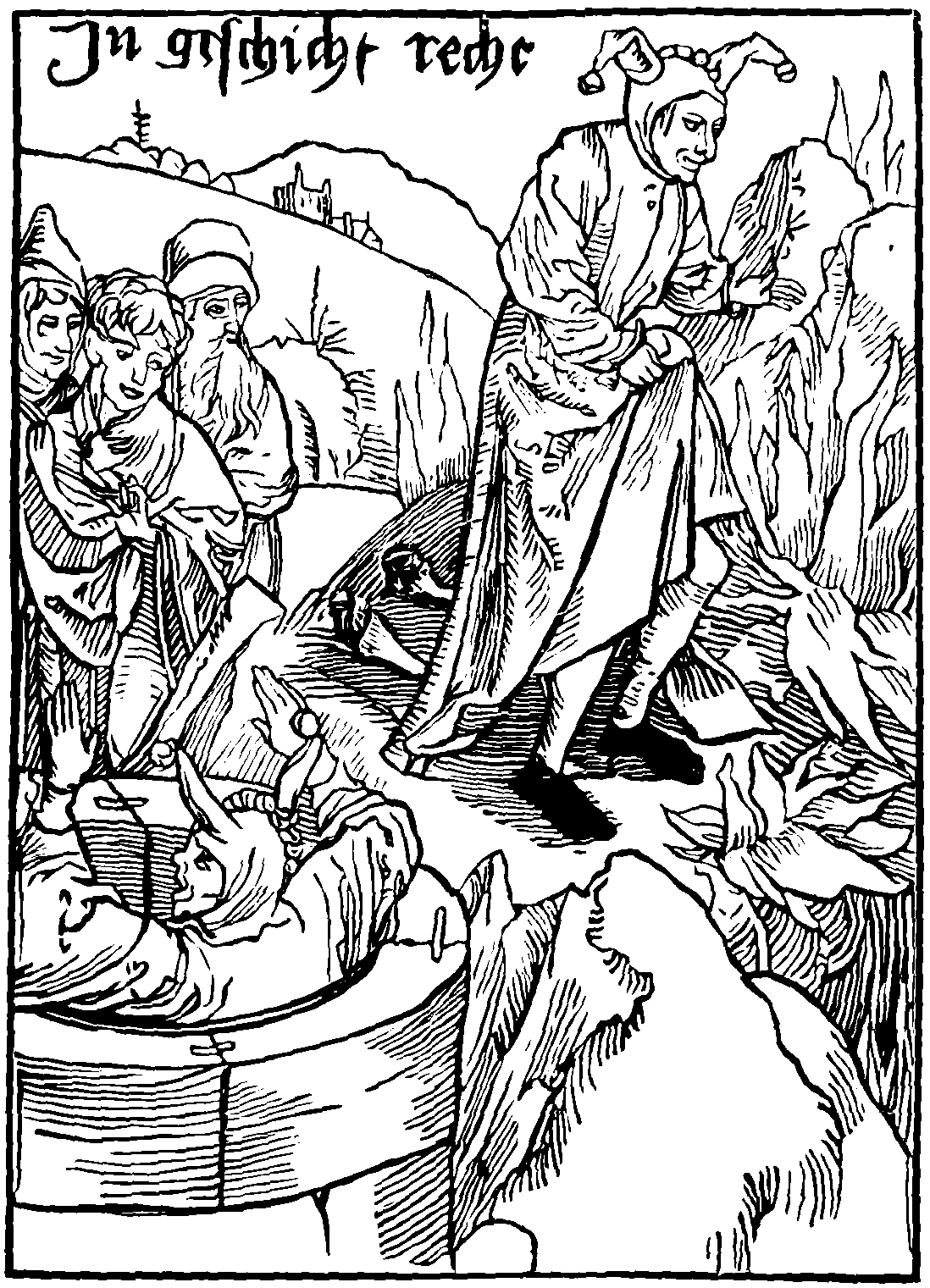
He is a fole that wyll purchace and desyre
His
owne deth or putteth hym selfe in ieopardy
Lepynge in a well, or
in a flamynge fyre
And where he myght lyue so dyeth wyllyngly
Suche suffer theyr destruccyon worthely
And if that they be
drowned outher brent
It is to late them after to
repent.
I fynde mo folys yet. whome I shall note
Suche ar they whiche pray both day and nyght
To god and his sayntes cryeng with open throte
O glorious god helpe me by thy great myght
That I may clens my herte and clere my syght
Wherby all foly and synne may fro me fall
But yet this fole it leuyth nat at all
Suche folys oft pray for theyr amendement
Unto our lorde with syghynges sore and depe
But yet to synne contynually they assent
And after the same often complayne and wepe
Than say they playne that god hath had no kepe
Unto theyr prayer and taken of it no hede
But theyr owne foly is cause of theyr lewde dede
They se the peryll before theyr faces playne
That god hath ordeyned, for foly and for synne
They pray for helpe, and yet ar they full fayne
After the folys hode alway to ren
And besely laboure the same alone to wyn
So vnto god for helpe they cry and call
But they them selfe wyll helpe no thynge at all
Than thynke they theyr prayers to god nat acceptable
Bycause (anone) they haue nat all theyr wyll
And for that god is nat sone agreable
To here theyr cry and it graunt and fulfyll
These folys in theyr vyce contynue styll
And put theyr selfe in wylfull ieopardy
And where they myght they fynde no remedy
But these folys vnstabyll as the wynde
Prayeth vnto god and to his sayntis aboue
Nat knowynge what may content theyr folysshe mynde
Nor whether theyr askynge be for theyr behoue
But sothly this dare I both say and proue
And it auowe after my sympyll skyll
That neuer man shall syn without his wyll
If that one with his owne wyll doth fall
Into a well to assay the ieopardy
Whan he is there. if he lowde crye and call
Bothe on god and man for helpe and remedy
He sekyth that peryll, and dyeth worthely
So were it foly to gyue hym corde or trayne
Or other engyne to helpe hym vp agayne
Whan suche folys ar sure vpon the grounde
Without all daunger, peryll hurt or fere
They lepe in the wel and yet fere to be drowned
Empedocles though he right myghty were
With suche lyke foly hym selfe so sore dyd dere
That knowyngly and with his owne consent
Hymself he lost and by fyers fyre was brent
He lept hedelynge into the flamynge fyre
Of a brennynge hyll whiche callyd is Ethnay
To knowe the trouth, and nature to enquyre
Whether that same flame were very fyre or nay
So with his deth the trouth he dyd assay
But who that wolde hym drawen out of that hyll
Had ben a fole, syns it was his owne wyll
For why his mynde was blyndyd so certayne
That thoughe a man had hym delyuered than
The same peryll wolde he haue proued agayne
As mad as he forsoth is euery man
That is at eas, and hym nat so holde can
And also he that putteth hymselfe in drede
Or fere and peryll, where as he hath no nede
So he that prayeth to god that he may get
The blysse of heuen, and scape infernall payne
He is a fole his herte or mynde to set
On frayle ryches, welth and ioy mundayne
On stedfast fortune, on lucre or on gayne
For certaynly these thynges of worldly welth
Oft man deuydeth away from heuenly helth
Thus he that prayeth for welth or for ryches
Or in this worlde hym selfe to magnyfy
Prayeth for his hurt and cause of viciousnes
For worldly welth doth vyce oft multyply
So seke men theyr owne peryll wyllyngly
But who that prayeth, and can nat as he ought
He bloweth in the wynde, and shall nat haue his thought
And who that to honour couetyse to ascende
Or to lyue in damnable voluptuosyte
He seketh his peryll for if that he descende
From welth and worshyp to payne and pouerte
It is but worthy, and let hym pacyent be
It to endure with mynde demure and meke
He is worthy sorowe that wyll it alway seke
The enuoy of Barklay to the Folys.
Ye that fayne wolde escape all ieopardy
Auoyde suche thynges the whiche myght cause the same
To proue a peryll, is foly certaynly
Whether it be done in ernest or in game
They that so doth may theyr owne madnes blame
For he that is sure, and to a fray wyll ren
May fortune come home agayne, nosles or lame
And so were it better for to haue byd within
Many in this lyfe the cart of syn doth drawe
By
payne and labour, alway right dylygent
Norysshynge theyr syn
agaynst all right and lawe
And alway lyuynge after one lyke
assent
But whan they ar dede than shall theyr punysshement
In hell be dowblyd with cartis of whelys foure
Where as they
thought, deth shuld ende theyr laboure
God suffreth nat eche vicious fole to knowe
The wonders that he made hath on this grounde
And dayly worketh. wherfore theyr syn doth growe
So that theyr foly them selfe doth confounde
And here theyr bodyes to great labours ar bounde
Sparynge no peryll for pleasour and for gayne
Than after deth haue they euerlastynge payne
So he that here lyueth in vyce and synne
Shall extreme dolour after deth endure
Than what auantage is it for man to wyne
All orthly tresour, and of hell payne be sure
But without dowt that wretchyd creature
Whiche goddes lawes wyll nat here holde and kepe
Shall after deth haue cause to wayle and wepe
And suche as here wyll nat knowe theyr sauyour
Obseruynge his preceptis and commaundement
Whiche god hathe ordeyned to saue vs from erroure
And vs commaundyd to kepe with clene intent
Ouer all the worlde. as rule moste excellent
To lyue godly. and who so euer he be
That foloweth in this worlde voluptuosyte
Or carnall lust ryot or other offence
Wastynge his tyme in syn and viciousnes
All suche in this worlde, by theyr blynde negligence
Drawe styll the cart of greuous besynes.
With payne and charge and, whan this wretchydnes
Is past and gone, yet after this they shall
In hell endure great tourmentis eternall
There shalt (thou fole) the charet drawe alway
With dowble paynes both tedyous and cruell
Wherfore thou fole retourne the I the pray.
Seke nat the way whiche ledeth vnto hell
With his foule dennes, more darke than tunge can tell
And thoughe the way be esy streyght and playne
The ende is nought, I aduyse the tourne agayne
The way to hell is greatly occupyed
The path is playne, and easy to ouergo
The dore ay open no entre is denyed
To suche as purpose in mynde to come therto
But at the ende therof is care and wo
With syghtis odyous and abhomynable
Yet in the way ar folkes innumerable
Thus is no meruayle though this way be playne
And greatly worne syns it is hantyd so
By dyuers folys whiche haste them to that payne.
By way contynuall therto: but none therfro
The dredefull dore to them that wyll in go
Both day and nyght is open, it doth forsake
No folys that wyll theyr iourney thyther take
But that way that to hye heuen doth lye
Is way of grace plesour, and all felycyte
In it suche walke as here lyue vertuously
And blessyd men, but nat suche as vyciouse be
Yet is it narowe, and full of difficulte
There is many a harde flynt brere and thorne
And no meruayle for it is nat greatly worne
For why lewde people, whiche is the gretest sort
Forsake this way for the payne and hardnes
But godly men therin haue chefe consort
With all that lyue by grace in ryghtwysnes
Suche well consyder that heuyns blessydnes
Can nat be gotten by pleasour rest nor eas
Wherfore this way can nat suche synners pleas
God so hath ordeyned that who wyll haue vertue
Must it obtayne with payne and dilygence
And great labour, whiche many nowe eschewe
Without it be to seke synne and offence
Fewe seke the way to christis hye presence
Therby it hapneth that many a thousande
Fast rennyth leftwarde, but fewe on the right hande
The enuoy of Barklay to the Folys.
Alas man remembre heuens blyssednes
And though the way be harde that lyeth therto
Forsoke it nat for all that great sharpnes
For at the ende is lyfe and rest also
Euerlastynge glory with other ioyes mo
But who that taketh the other way certayne
Shall fynde at the ende eternall payne and wo
Thoughe the way thether be easy streyght and playne
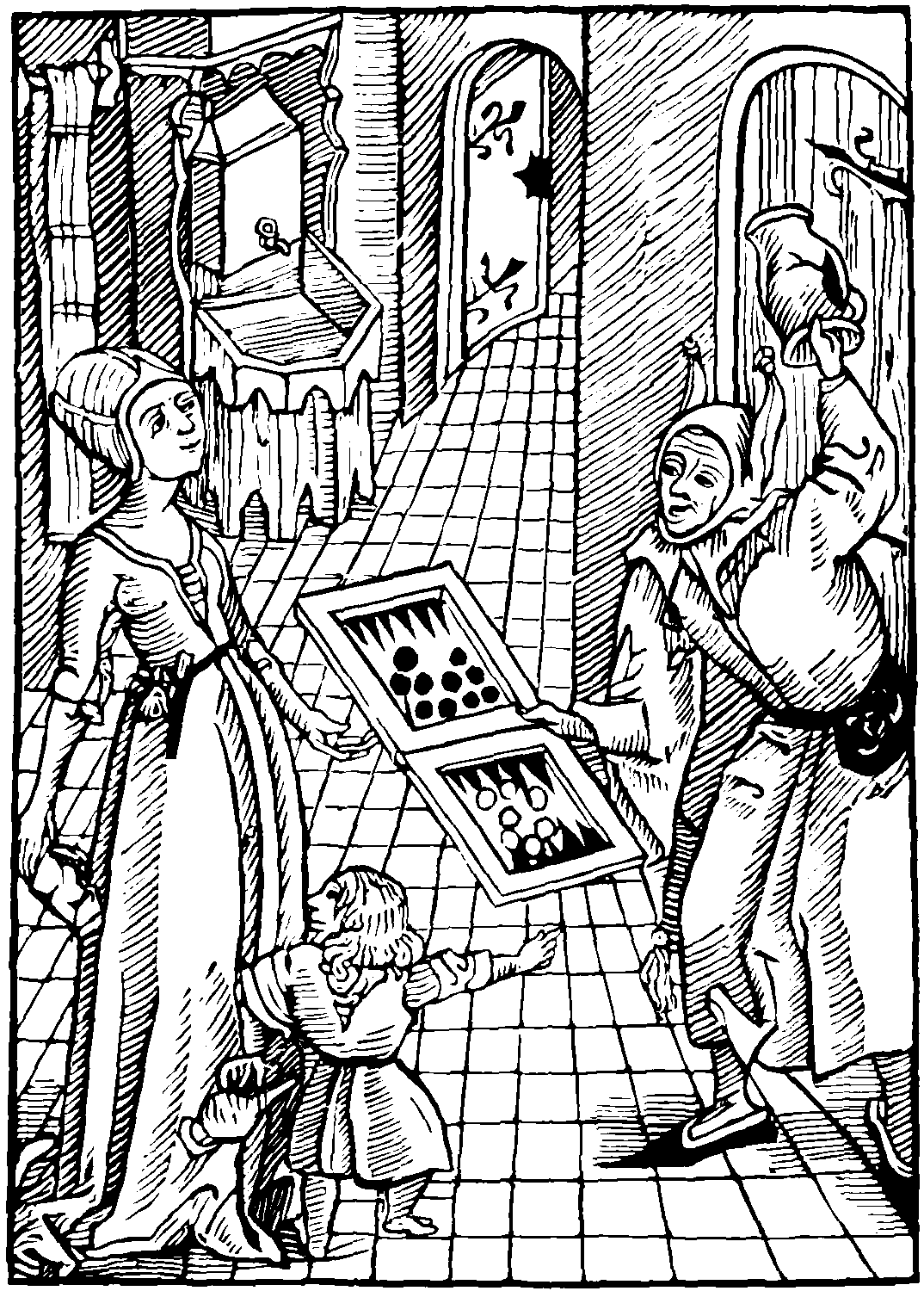
If that the fader and mother before theyr son
By
anger or malyce brake, platter pot, or pan
The son in hande shall
take some cauderon
And lerne to breke it if his small power
can
Thus oft tyme chyldren haue cause to curse or ban
Theyr
frendes for suche example of lewdnes
For soner that they lerne
than vertue or goodes
Ye aged men rotyd in folysshnes
And folysshe parentis lewde of your langage
Vnto our shyp swyftly your selfe addres
Syns ye be worthy therin to haue a stage
Nowe cast I repreues agaynst your outrage
Whiche boldly bost you of your vnthryfty lyues
Before your maydes, your doughters and your wyues
Alas the folys of this mad company
By theyr example cause great inconuenyence
Before theyr children recountynge rybaudry
Of suche as they haue had experyence.
So gyue they to them example of offence
And in that synne wheron they bost and vant
They make them perfyte whiche erst were ignorant
Theyr wordes ar voyde of shame and honestye
Theyr lyfe is without mesure and reuerence
But yet they thynke that they moste worthy be
That moste can tell of this greuous offence
Thus all the youth that is in theyr presence
Or that doth here theyr vyce and rybawdry
Vnto the same with theyr full mynde aply
Thus theyr yonge children maners lernyth none
The wyfe hath occasyon to breke hir chastyte
So is the lyfe defyled of them echone
And to be playne, we often tymes se
That of what maners the folysshe husbondes be
Such ar theyr wyues, children and housholde
The yonge Cok lerneth to crowe hye of the olde
A folysshe Father, full hardly shall ensyne
His sone to good lyfe or to good gouernaunce
For if the father to foly doth enclyne
The sone wyll folowe his father in that daunce
And if the father vse hasarde or the chaunce
Or any prohybyt and vnlawfull game
Most comonly the sone wyll do the same
If that the husbonde be vycious of his lyfe
Wastfull or dronken, or vyle in his langage
His sonnes doughters, his seruauntes and his wyfe
Wyll lerne of hym to passe the same passage
And if the husbonde breke his maryage
If the wyfe knowe, in mynde she wyll be wroth
Without he haue a hode of the same cloth
An olde prouerbe hath longe agone be sayde
That oft the sone in maners lyke wyll be
Vnto the Father, and in lyke wyse the mayde
Or doughter, vnto the mother wyll agre
So if the elders vse enormyte
And before theyr children bost them of the same
The sone and doughter shall folowe syre and dame
The monkes thynke it lawfull for to play
Whan that the Abbot bryngeth them the dyce
Right so the Father, can nought or lytell say
Agaynst the sone, nor hym blame or chastyce
If he hym selfe be taken in that same vyce
Thus lyues the Father in synne withouten shame
And after his deth the sone shall do the same
O wretchyd maners o tyme full of furour
And full of foly without all hope to stent
Howe longe shall god our lorde and sauyour
This synne suffer without greuous punysshement
Alas it nowe apereth euydent
That the fathers foly synne and great outrage
Is left to the sonne as it were herytage
And no meruayle, for it hath neuer ben seen
That of a wolfe a shepe hath be forth brought
Or that a calfe or lambe gendred hath been
Of a fell tygre: right so if it were sought
Ouer all the worlde. a Father that is nought
Sholde scant be founde, whiche coude brynge vp his childe
With his synne in no maner poynt defylyd
The yonge crab bacwarde doth crepe or go
As doth the olde, none can hir cours redres
These yonge children for the moste part also
Foloweth theyr fathers synne and his lewdnes
But they that lyue in maners of mekenes
In honest lyfe, goodnes grace and chastyte
May brynge forth children of maners as they be
I rede howe the Phylosopher Diogenes
Sayde by a childe whiche dronken was with wyne
That his Father was in that case doutles
Whan he it gate, so his hye wyt dyuyne
Knewe that the childes maners dyd inclyne
Vnto his Fathers, and so was it founde trewe
By them whiche well that childes fader knewe
But though the Father and mother also be nought
Without dout this one thynge apereth playne
That the childe is suche as it is vp brought
And nat lyghtly chaungyd without great charge or payne
Therfore let euery man hym selfe refrayne
Within his hous from all thynge worthy blame
Than shall his children and seruautes do the same
The enuoy of Barklay.
Ye that haue children or other great housholde
Subdued to your seruyce, and your obedyence
Kepe vertuous lyfe, for that is worth great golde
And great example to youth to auoyde offence
But if ye boost you of synne and neglygence
In rybawde wordes, gyue credence to this clause
If the herers fall into incouenyence
Your lewde example is the chefe grounde and cause
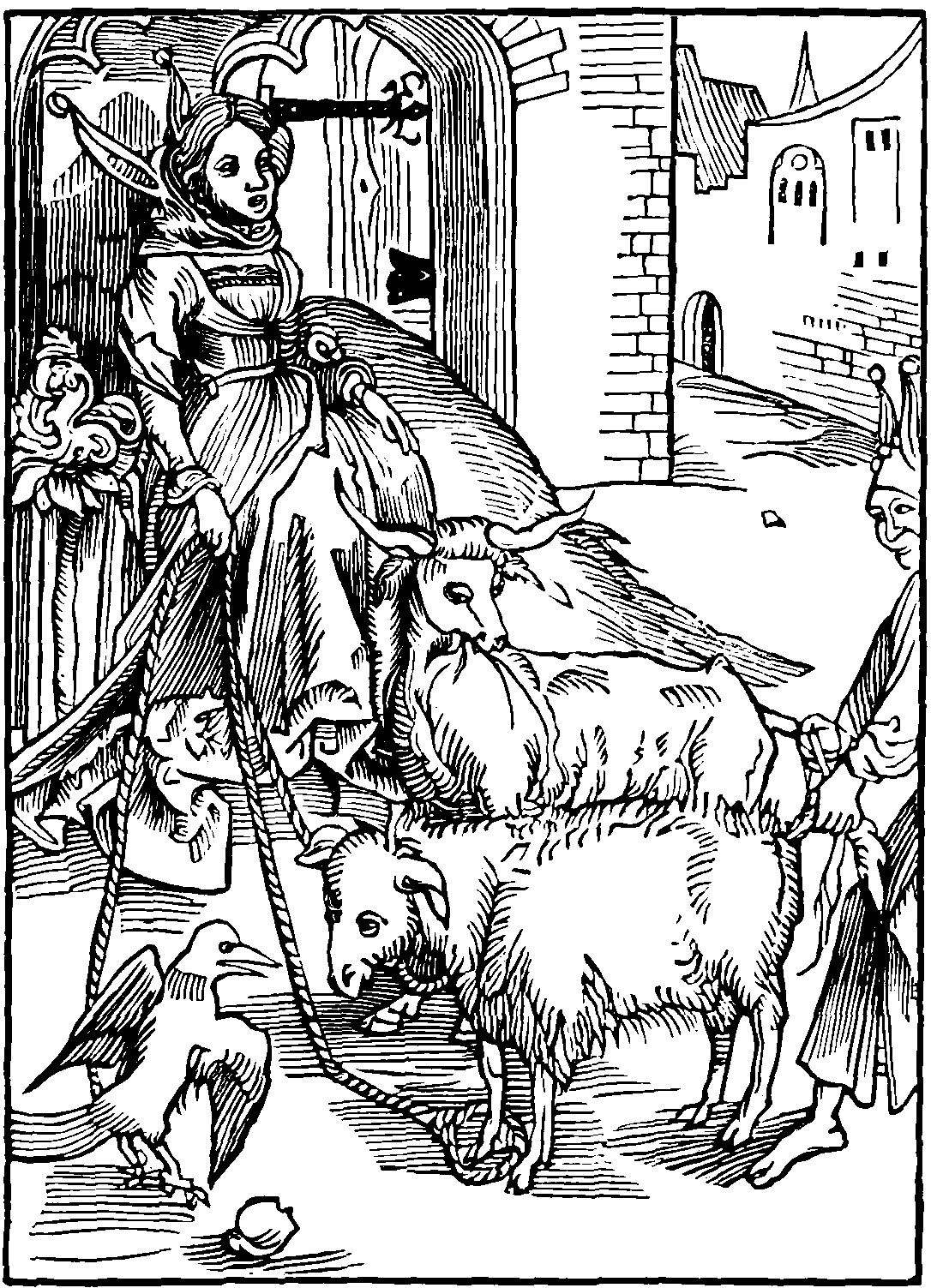
Wanton wastfull and vayne voluptuosyte
Oft
blyndeth attysynge vnto inconuenyence
Many that ar rude, for
theyr symplycyte
And them as shepe sleeth for all theyr
innocence
But other some it kepyth with myght and violence
As bulles bounde sure to endure great care
And other as byrdes it
tangleth in hir snare
Drawe nere ye folys to you I crye and call
Whiche ar of grace clene destytute and bare
Folowynge your lust and pleasour corporall
But for your soule ye take no thought ne care
To whome may I this shamefull lust compare
Saue to a harlat faynynge, fals and couetous.
Of whome comyth shame and bytes venemous
She syttyth in the strete as past both shame and fere
Hir brestes bare to tempt them that passe by
Hir face anoyntyd blasynge abrode hir here
Or els on hir folysshe front enlaced hye
Hir smocke to garnysshyd so hir dysceytfull iye
To shamfull lust a thousande doth attyce
Of youth whiche erst perchuance knewe nought of vyce
Hir chamber full of flatery and disceyte
Anone is opened the blynde fole entreth in
The hoke of deth is hyd vnder the bayte
Of folysshe lust pleasour and mortall syn
Hir soule she sellyth ryches therby to wyne
And what riches: a rewarde sothly full vyle
The soules damneth and bodyes doth defyle
The one departyth, another comys in agayne
Without all shame dare she them boldly pray
To hir fals pleasours, Thus by hir gyle and trayne
This folysshe youth to hir wyll nat denay
But vnto hir some lepe both nyght and day
Without mesure, rennynge to lese theyr lyfe
As ox or shepe vnto the bochers knyfe
The symple lambe his necke doth out extende
Vnto the Bocher his mortall ennemy
So doth these folys, sekynge a shamefull ende
And theyr owne deth, though they myght fynde remedy
O blynde fole I requyre the to aply
Vnto my wordes and thou shalt here and se.
Howe moche thou oughtest this folysshe lust to fle
The soule it damneth, and drowneth depe in hell
The wyt it wastyth, and confoundeth the mynde
It causeth man his londe and good to sell
And if that he none other mene can fynde
To rob and stele he oft tyme is inclyned
Besyde all these this fowle lust is so vyle
That with fowle sauour it shall thy body fele
Thoughe of lewde lust the ioy be short and small
And thoughe the pleasour therof be soon ouer past
The payne that foloweth it, is eternall
With wofull dolour menglyd, that euer shall last
Therfore leue of: do nat thy pleasour cast
On worldly welth, delyte ioy and pleasour
For soon they pas and chaunge at euery hour
Who that in this wretchyd worlde wyll auoyde
Of voluptuousnes the ioyes frayle and vayne
And suffre nat hym with them to be acloyde
Infect or drownyd, shall for the same certayne
Euerlastynge lyfe, and endles ioy obtayne
And for his hye tryumphe and dyuyne prudence
Haue the fruycyon of goddes hye presence
But who that wyll his carnall lust ensue
Shall here haue shame, and after payne cruell
I coude hereof dyuers examples shewe
But of right many this one I shall you tell
One Sardanapalus all other dyd excell.
In carnall lust and so his mynde dyd cast
On loue prohybyte, that grace was fro hym past
The loue of vertue was full out of his mynde
So he concludyd to sue dilyciousnes
Thynkynge after deth no welth nor ioy to fynde
For this is the sentence of the prynce of derknes
But good almyghty seynge his vycyousnes
His body and soule deuydyd soon in twayne
From worldly pleasour vnto infernall payne
By this hystory to vs it apereth playne
That from worldly pleasour and voluptuosyte
With all our myght we ought vs to refrayne
For thoughe the first of them delycious be
Theyr ende is poyson, and of sournes plente
Sue wyse men vertue, and set suche lust asyde
For they ar folys that in it lyue and byde
The enuoy of Barklay to the Folys.
Amende mad men your blynde mysgouernaunce
Subdue nat your necke to the captyuyte
Of flysshely lust and corporall pleasaunce
Nor to blynde Venus with hir lasciuyte
(If ye it note) ye dayly here and se
The mysfortune of them that it ensue
And certaynly no man can saued be
By carnall lust, but by godly vertue
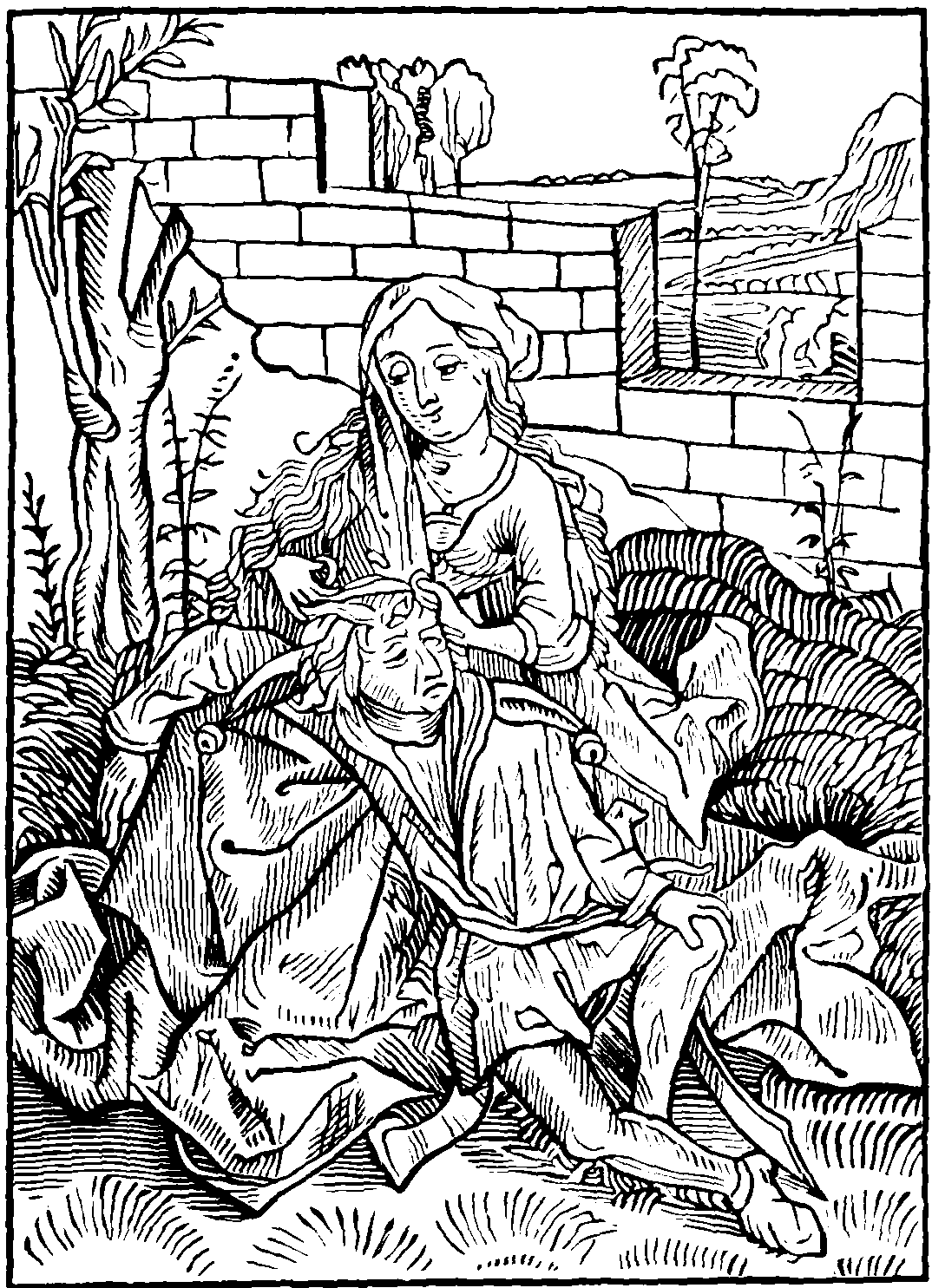
Of other Foles a nomber yet I fynde
Which by
theyr bablynge wordes and langage
Can nat kepe close the secrete
of theyr mynde.
But all theyr counsel out they shewe at large.
So that oft therof procedeth great damage.
As Murder,
myschefe, hatered and debate.
That after they repent. But than it
is to late
He is a naturall fole and vndiscrete
And to hym selfe ingendryth oft great stryfe
Whiche can nat hyde his counsell and secrete
But by his foly it sheweth to his wyfe
And all that he hath done in his hole lyfe
Or that to do here after he doth purpose
To euery man suche a fole wyll disclose
The noble Sampson moste excellent of myght
And strongest man that euer was get or borne
Were nat this foly: sholde nat haue lost his syght
Nor had his here, by gyle from his hede ofshorne
And of his ennemyes ben laughyd vnto scorne
And at the last with herte wrethfull and wo
His ennemyes murdred and hym selfe also
Where as he myght haue lyued in honour
If he had kept his secretes in his mynde
With his owne wyll he dyed in great dolour.
By the fals treason of his lemman vnkynde
We may in dyuers mo examples fynde
Howe many thousandes haue suffred paynes smart
And all for shewynge the secretes of theyr hart
Amphiaraus a Prynce moste excellent
Shortened the dayes of his pore doutfull lyfe
For shewynge the preuetees of his intent
By his owne foly to his disceytfull wyfe
And thoughe he longe escaped had the stryfe
And war of Thebes whiche he dyd longe defende
Yet at the leest his tunge was his owne ende
Thus olde storyes doth oft recorde and tell
By theyr examples whiche they vnto vs gyue
That wymen ar no kepars of councell
It goeth through them as water trough a syue
Wherfore let them that quyetly wolde lyue
No more of theyr counsell to any woman showe
Than that they wolde that euery man dyd knowe
Let euery man that is discrete and sage
Of suche folys with all wysdome be ware
Whiche shewe theyr counsell by theyr hasty langage.
To euery man without all thought and care
For they of wysdome and reason ar but bare
And who that his owne secrete wyll forth tell
Howe sholde he hyde another mannes counsell
Yet other be whiche by theyr flaterynge trayne
Labour to knowe euery mannys pryuete
And by and by to shewe it forth agayne
Of them be ware for they disceyfull be.
Some other bost them of theyr felycyte
Bablynge that they haue theyr wyll in euery thynge
As prosperous welth loue, ryches and cunnynge
And of great dedes done both on see and londe
Some by theyr falshode, some by strength and vertue
But if one laboured the trouth to vnderstonde
Suche folysshe wordes sholde all be founde vntrewe
Let neuer man to suche his counsell shewe
For of one worde these folys makyth twayne
Whiche tourneth many to losse rebuke and payne
Wherfore if thou wylt that thy pryuete
Be kept secrete and nat come out at large
Be nat so folysshe to showe it unto me
Or any other if it be thynge of charge
And if thou do thou shalt be in this barge
For howe wylt thou thynke that another man
Can kepe thy counsell syns thou thy selfe ne can
If the kynge Achab had nat vttred and tolde
Vnto his wyfe his wyll and mynde so playne
By hir fals treason, and dysceyt manyfolde
Vnrightwysly Nabot had nat ben slayne
But for the same, Achab suffred great payne
By deth in batayle, and for a punysshment
His wyfe with houndes was all to torne and rent
Thus it apereth that he is wyse and ware
Whiche can his counsell kepe within his hart
For by that mean may he escape great care
And suerly lyue without yll wyllys dart
The Prophete seynge what dyuers paynes smart
Comyth oft to them whiche doth theyr secret tell
Eche man exortyth to kepe close his counsell.
The enuoy of Barklay to the Folys.
Thou man that hast thy secret in thy brest
Holde it styll there suffer it nat out to go
Who that so doth, therby shall fynde great rest
Ne to thy frende shewe nat thy mynde also
For if that he after become thy fo
As often hapneth, than myght he the bewry
So sholde thy foly tourne vnto thy great wo
Howe be it suche thynges are prouyd comonly.
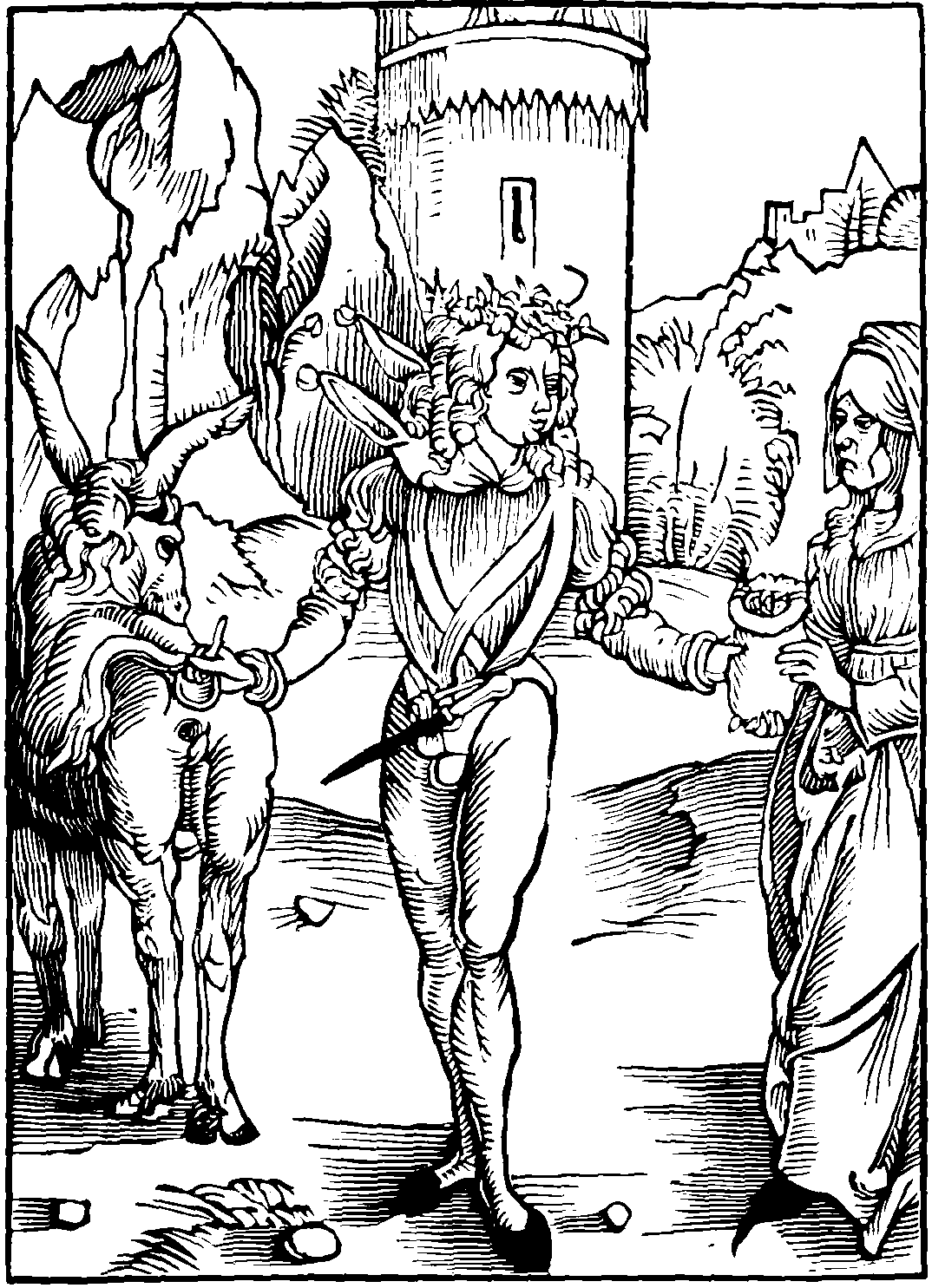
Within our shyp that fole shall haue a hode
Whiche an olde wyfe taketh in maryage
Rather for hir ryches and
hir worldly gode
Than for pure loue, or hope to haue lynage
But suche youth as mary them selfe with age
The profyte and
pleasour of wedlocke lese certayne
And worthely lyue in brawlynge
stryfe and payne.
Under the Asse tayle thoughe it be no thynge pure
Yet many seke and grope for the vyle fatnes
Gatherynge togyther the fowle dunge and ordure
Suche ar they that for treasour and ryches
Whyle they ar yonge in theyr chefe lustynes
An agyd woman taketh to theyr wyfe
Lesynge theyr youth, and shortynge so theyr lyfe
They that so do hath neyther rest nor peas
But besy brawlynge and stryfe contynuall
They have no pleasour, but thought and great dyseas
Rebuke out braydynge, and strypes whan they fall
But theyr owne foly is grounde and cause of all
For they be maryd unto the vyle treasour
And precious bagges, but nat for godly pleasour
They haue no hope of children nor lynage
Loue is there none, and durynge theyr wretchyd lyfe
Is nat one day in suche mad maryage
Auoyde of brawlynge, of hatered and of stryfe
But that pore man that weddeth a ryche wyfe
Cast in his nose shall styll hir bagges fynde
For whose cause he made was made and blynde
They that ar weddyd nat for loue but rychesse
Of moryage despysynge the pleasour and profyte
Suche seldome sauour fortunes happynes
But oft mysfortune them greuously doth byte
Thus gone is theyr pleasour theyr ioy and delyte
And for vayne treasoure suche ar so glad and fayne
That for the same they them subdue to payne
They wyllyngly to payne them selfe subdue
The whiche ar weddyd for wretchyd couetyse
They take no hede to maners and vertue
To honeste nor wysdome but lyue ay in malyce
For if a woman be fowle and full of vice
And lewde of maners, nought both to man and lad
Yet good shall hir mary be she neuer so bad
If that a man of hye or lowe degre
Wolde spouse his doughter vnto a strange man
He nought inquyreth of his honestye
Of his behauour, nor if he norture can
But if he be ryche in londes and good: than
He shall be prayed his doughter for to haue
Thoughe be but a bonde man or a knaue
The firste enquyrynge and speciall questyon
Is of the money, that thynge namely they moue
And last of all aske they the condicion
So whan they mete they neuer haue perfyte loue
Wherfore it were better to suche for theyr behoue
To byde alone in deserte and wyldernes
Than in wedloke in payne for frayle ryches
Forsoth it is an vnmete maryage
And disagreynge and moche agaynst the lawe
Bytwene fresshe youth, and lame vnlusty age
The loue bytwene them is scantly worth a strawe
So doth the one styll on the other gnawe
And oft the man in mynde doth sore complayne.
His sede to sowe vpon a grounde barayne
Than muste he haue another prymme or twayne
With them to slake his wanton yonge cowrage
But in that space must he endure great payne
With hir that he hath tane in maryage
Hir bablynge tunge whiche no man can asswage
With wrathfull wordes shall sle hym at the laste
His other prymes his good shall spende and waste
Thus who that selleth his youthes lustynes
For frayle ryches and this mundayne vanyte
He byeth stryfe, gyle and falshode endlesse
Suche force nat for fayth true loue nor honestye
And thoughe that he discende of hye degre
For hope of money he shall an olde fole wed
By whose foly he to euery yll is led.
And so these folys subdue them to bondage
And worthely endure suche payne and punysshement
They hope therby to come to auantage
But that they lese and lyue in sore tourment
They wast theyr good, and so whan that is spent
And nought remayneth theyr bodyes to relefe
Theyr disputacion is nought but hore and thefe
But if I sholde wryte all the vnhappynes
The wrath discorde and the great deuysyon
Wherin they lyue, that mary for ryches
And nat for loue. I neuer sholde haue done
Wherfore this say I for a conclusyon
That he shall neuer thryue ne come to his behoue
That weddyth a wyfe for gode and nat for loue
The enuoy of Barklay.
Alas man myndles what is thyne intent
To wed for ryches, that weddynge I defy
Maryage was ordeyned by god omnypotent
In goddes lawes the worlde to multyply
Wherfore that man that wyll therto aply
And wolde haue the profyte of faythfull maryage
This worldly ryches ought no thynge to set by
But wed for loue and hope to haue lynage
Remember ryches is no thynge comparable
To mekenes vertue and discrete gouernaunce
And other maners whiche ar more commendable
Than worldly treasour or suche vnsure substaunce
Wherfore consyder and call to thy remembraunce
That better is to haue some woman pore and bare
And lyue in eas: Than one with habundaunce
Of great ryches: and euer to lyue in care
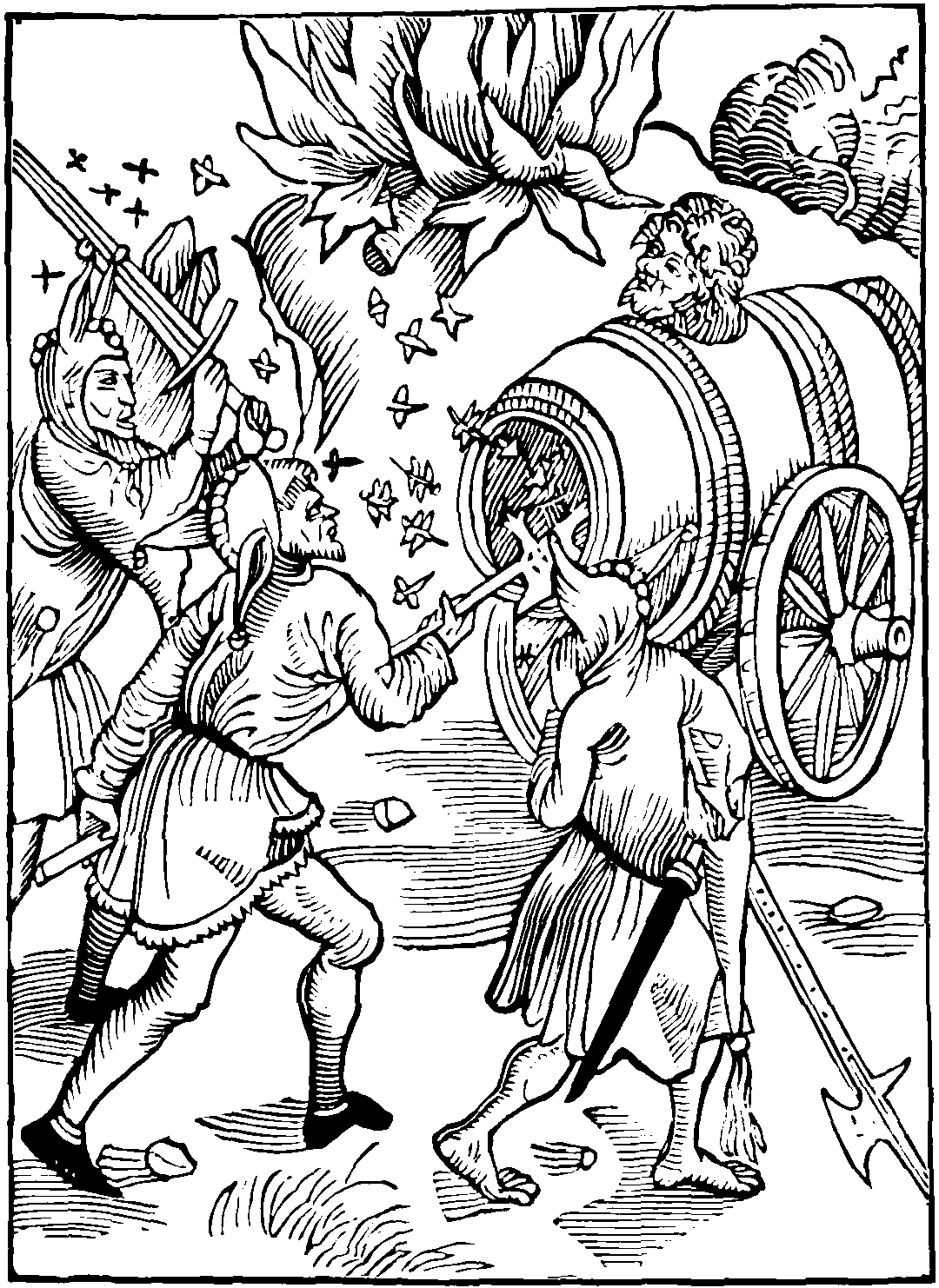
Yet ar mo folys whiche greatly them delyte
In
others losse, and that by fals enuy
Wherby they suche
vnrightwysly bacbyte
The dartis of suche ouer all the wordly
flye
And euer in fleynge theyr fethers multyply
No state in
erth therfro can kepe hym sure
His sede encreasyth as it wolde
euer endure
Wastynge enuy oft styreth to malyce
Folys nat a fewe whiche ar therto enclynyd
Pryckynge theyr frowarde hertes vnto vyce
Of others damage reioysynge in theyr mynde
Enuyes darte doth his begynnynge fynde
In wrathfull hertes, it wastyth his owne nest
Nat suffrynge other to lyue in eas and rest
If one haue plenty of treasour and ryches
Or by his merytis obteyne great dignyte
These folys enuyous that of the same haue les
Enuy by malyce, the others hye degre
And if another of honour haue plente
They it enuy and wysshe that they myght sterue
Howe be it suche folys can nat the same deserue
These folys desyre agaynst both lawe and right
Anoters good if they may get the same
If they may nat by flaterynge nor by myght
Than by fals malyce they hym enuy and blame
Outher if one by his vertue hath good name
By fals enuy these foles hym reproue
Their wrath them blyndeth so that they none can loue
The wounde of this malycious, fals enuy
So dedely is, and of so great cruelte
That it is incurable and voyde of remedy
A man enuyous hath suche a properte
That if he purpose of one vengyd to be
Or do some mysche, whiche he reputyth best
Tyll it be done, he neuer hath eas nor rest
No slepe, no rest nor pleasour can they fynde
To them so swete, pleasaunt and delectable
That may expell this malyce from theyr mynde
So is enuy a vyce abhomynable
And vnto helth so frowarde and damnable
That if it onys be rotyd in a man
It maketh hym lene. his colour pale and wan.
Enuy is pale of loke and countenaunce
His body lene of colour pale and blewe
His loke frowarde, his face without pleasaunce
Pyllynge lyke scalys, his wordes ay vntrue
His iyen sparklynge with fyre ay fresshe and newe
It neuer lokyth on man with iyen full
But euer his herte by furious wrath is dull
Thou mayst example fynde of this enuy
By Joseph whome his bretherne dyd neuer beholde
With louynge loke, but sharpe and cruelly
So that they hym haue murdred gladly wolde
I myght recount examples manyfolde
Howe many by enuy lost hath theyr degre
But that I leue bycause of breuyte
Enuyous folys ar stuffed with yll wyll
In them no myrth nor solace can be founde
They neuer laughe but if it be for yll
As for gode lost or whan some shyp is drounde
Or whan some hous is brent vnto the grounde
But whyle these folys on other byte and gnawe
Theyr enuy wastyth theyr owne herte and theyr mawe
The mount of Ethnay though it brent euer styll
Yet (saue itselfe) it brenneth none other thynge
So these enuyous Folys by theyr yll wyll
Wast theyr owne herte, thoughe they be ay musynge
Another man to shame and losse or hurt to brynge
Upon them sellfe Thus tournyth this yll agayne
To theyr destruccion both shame great losse and payne
This fals enuy by his malycious yre
Doth often, bretherne so cursedly inflame
That by the same the one of them conspyre
Agaynst the other without all fere and shame
As Romulus and Remus excellent of fame
Whiche byldyd Rome, but after: enuy so grewe
Bytwene them that the one the other slewe
What shall I wryte of Cayme and of Abell
Howe Cayme for murder suffred great payne and wo
Atreus story and Theseus cruell.
Ar vnto vs example hereof also
Ethyocles with his brother: and many mo
Lyke as the storyes declareth openly
The one the other murdred by enuy
The enuoy of Barklay to the Folys.
Wherfore let hym that is discrete and wyse
This wrathfull vyce exyle out of his mynde
And yll on none by malyce to surmyse
Let charyte in perfyte loue the bynde
Sue hir preceptis than shalt thou consort fynde
Loue in this lyfe, and ioy whan thou art past
Where as enuy thy conscyence shall blynde
And both they blode and body mar and wast
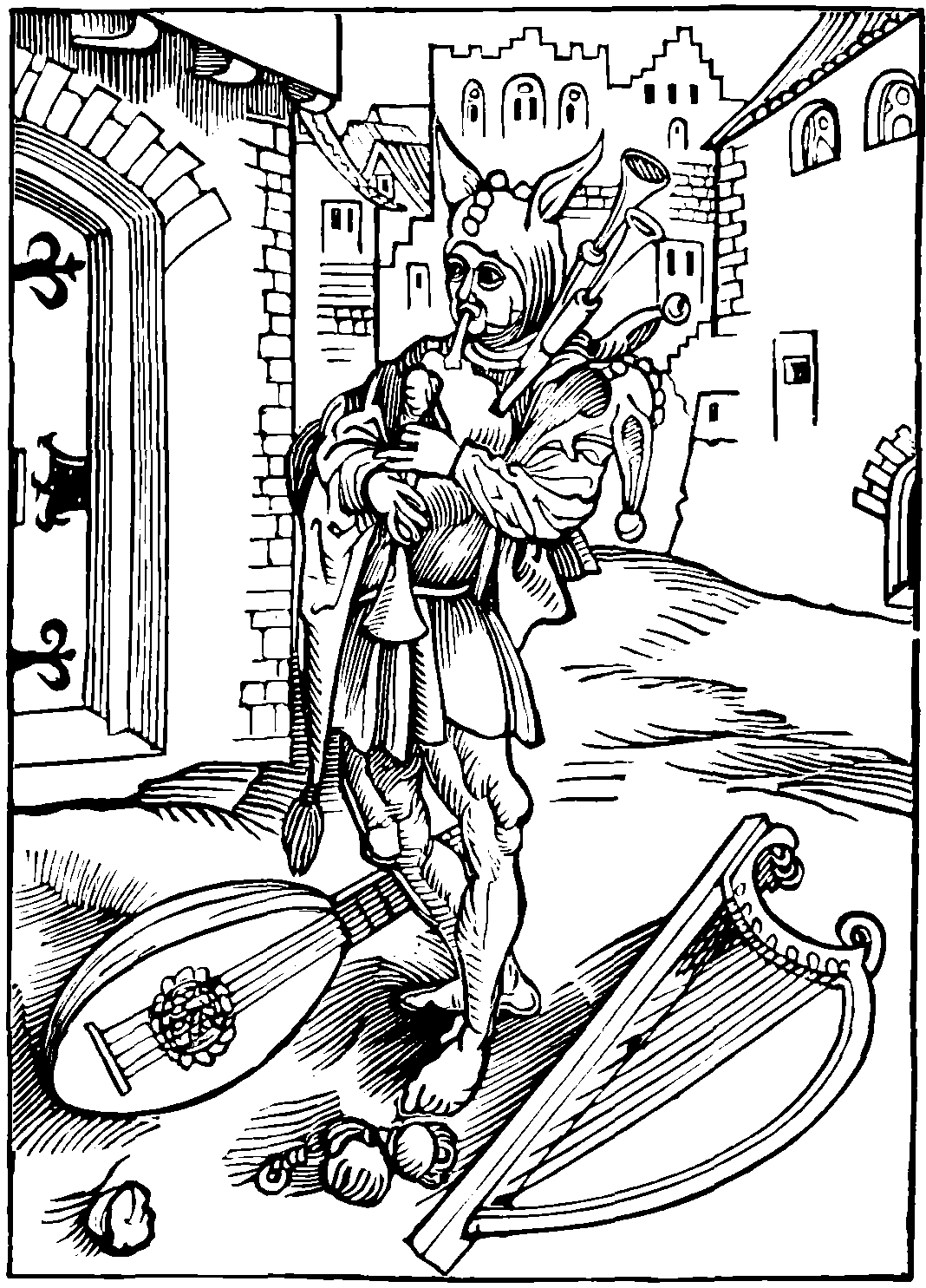
Unto our Folys shyp let hym come hastely
Whiche
in his Bagpype hath more game and sport
Than in a Harpe or Lute
more swete of melody
I fynde vnnumerable Folys of this sort
Whiche in theyr Bable haue all they hole confort
For it is oft
sayd of men both yonge and olde
A fole wyll nat gyue his Babyll
for any golde
The grettest synners that man may se or fynde
In myserable Folys theyr foly to expres
Is whan they wyll by no mean gyue theyr mynde
To frendly wordes, to grace or to goodnes
Suche folys so set theyr mynde on frowardnes
That though one gyue them counsell sad and wyse
They it disdayne and vtterly despyse
But he that is discrete sad and prudent
Aplyeth his mynde right gladly to doctryne
He hereth wyse men, his wysdome to augment
He them doth folowe and to theyr wordes enclyne
But that fole whiche ay goeth to ruyne.
And mortall myschefe had leuer be dede or slayne
Than byde correccyon or for his profyte payne
Suche haue suche pleasour in theyr mad folysshe pype
That they dispyse all other melody.
They leuer wolde dye folys than: byde a strype
For theyr correccyon and specyall remedy
And without dout none other Armony
To suche folys is halfe so delectable
As is their folysshe bagpype and theyr babyll
These frantyke folys wyll byde no punysshement
Nor smale correccion, for theyr synne and offence
No frendly warnynge can chaunge theyr yll intent
For to abyde it, they haue no pacyence.
They here no wysdome but fle from hir presence
And so it hapnyth that in the worlde be
Mo folys than men of wyt and grauyte
O mortall fole remember well what thou art
Thou art a man of erth made and of clay
Thy dayes ar short and nede thou must depart
Out of this lyfe, that canst thou nat denay
Yet hast thou reason and wyt wherby thou may
Thy selfe here gyde by wysdome ferme and stable
Wherby thou passest all bestis vnreasonable
Thou art made lorde of euery creature
All thynge erthly vnto thyne obedyence
God hath the creat vnto his owne fygure
Lo is nat here a great preemynence
God hath also gyuyn vnto the intellygence
And reason and wyt all foly to refuse.
Than art thou a fole that reason to abuse
He that is fre outher in subieccion.
If by his foly he fall into offence
And than submyt hym vnto correccyon.
All men shall laude his great obedyence
But if that one by pryde and insolence
Supporte his faute and so bere out his vyce
The hell tourmentis hym after shall chastyce
Correccyon shall the vnto wysdome brynge
Whiche is more precious than all erthly ryches
Than londes rentis or any other thynge
Why dost thou bost the of byrth or noblenes
Of ryches, strength beauty or fayrnes
These often ar cause of inconuenyence.
Where as all good comyth by wysdome and prudence
A wyse man onely as we often fynde
Is to be named moste ryche and of most myght
Here thou his wordes and plant them in thy mynde
And folowe the same for they ar sure and right.
Better is to endure, thoughe it be nat lyght
To suffer a wyse man the sharply to repreue
Than a flaterynge fole to clawe the by the sleue
Thoughe sharpe correccyon at the first the greue
Thou shalt the ende therof fynde profytable
It oft apereth, therfore I it byleue
That man also forsoth is fortunable
Whiche here in fere lyueth sure and stable
And in this lyfe is clene of his intent
Ferynge the sharpe payne of hellys punysshement
He may hym selfe right happy call also
Whiche is correct in his first tender age
And so lernyth in goodes law to go
And in his yocke, whiche doth all yll asswage
But these folys bydynge in theyr outrage
Whiche of correccyon in this lyfe hath dysdayne
May fere to be correct in hell with endles payne
The enuoy of Barklay to the Folys.
Ye obstynate folys that often fall in vyce
Howe longe shall ye kepe this frowarde ignoraunce
Submyt your myndes, and so from synne aryse
Let mekenes slake your mad mysgouernaunce
Remember that worldly payne it greuaunce
To be compared to hell whiche hath no pere
There is styll payne, this is a short penaunce
Wherfore correct thy selfe whyle thou art here.
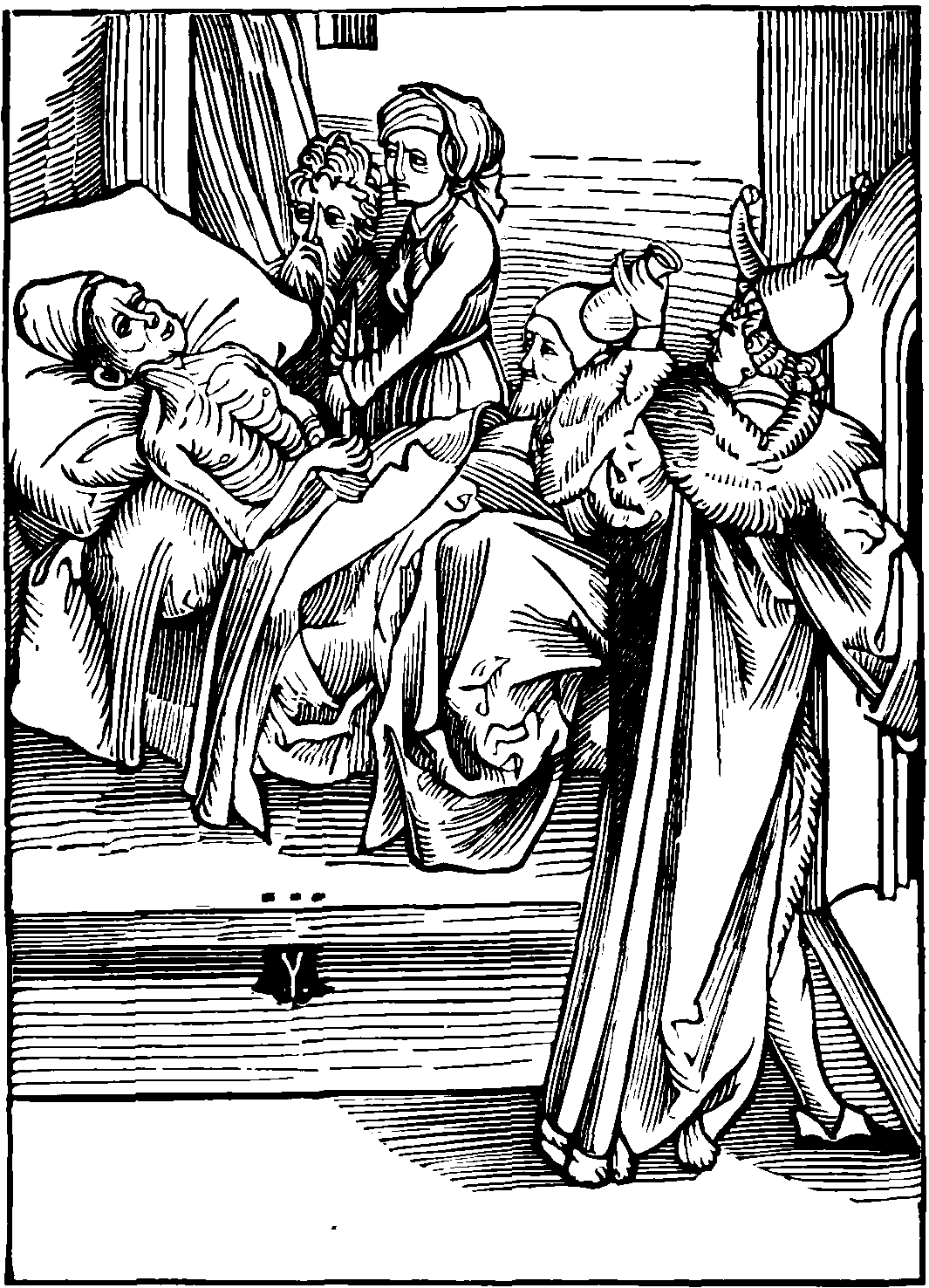
Who that assayeth the craft of medycyne
Agaynst
the seke and paynfull pacyent
And hath no insyght cunnynge nor
doctryne
To gyue the seke, helth and amendement
Suche is a
fole, and of a mad intent
To take on hym by Phesyke any cure
Nat knowynge of man, nor herbe the right nature
Yet be mo folys vpon the grounde and londe
Whiche in our Shyp may clayme a rowme and place
Suche be Phesycians that no thynge vnderstonde
Wandrynge about in euery towne and place
Uysytynge the seke whiche lyue in heuy case
But nought they relefe of those paynes harde
But gape alway after some great rewarde
Suche that haue practyse and nought of speculatyfe
Whan they go vysyte some paynfull pacyent
Whan they hym note sure to forgo his lyfe
Without all hope of any amendement
Yet say they other than is in theyr intent
That his diseas is no thynge incurable
So that the pacyent to hym be agreable
Sayth the Phesycyan whan he hath his rewarde
Abyde a whyle tyll I my bokes ouer se
Wherby I may relyue thy paynes harde
Than from the pacyent homewarde departyth he
To se his bokes but if the pacyent dye
In that meane space the medycyne is to late
So may he lay it to his owne folysshe pate
The speculacion sholde he before haue sene
For that in Phesyke is chefe and pryncypall,
Yet many ar that vse the craft I wene
Whiche of the cunnynge knowe lytell or nought at all
A herbe or wede that groweth vpon a wall
Beryth in it these folys medycyne.
None other bokes haue they nor doctryne
Nor none they rede to haue the true scyence
Or perfyte knowlege and grounde of medycyne
They rede no volumes of the experyence
Of Podalirius nor Mesues doctryne
Suche folys disdayne theyr myndes to enclyne
Unto the doctryne of bokes of Auycen
Of ypocras and parfyte galyen
But all the substance of theyr blynde faculte
They take in bokes that speke of herbes only
Without respect had to theyr properte
Or operacion so often they them aply
To fals doctrynes, but first and specyally
These olde wyues therwith wyll haue to do
Thoughe they nought knowe that doth belonge therto
They dare be bolde to take on them the cure
Of them diseasyd howe be it that they nat can
Suche thynge descerne as longyth to nature
What is for woman good, and what for man
So oft they ende moche wors than they began
That the pore pacyent is so brought to his graue
Yet dyuers suters suche folysshe wytches haue
Suche wytches boldly dare afferme and say
That with one herbe they hele can euery sore
Under euery syne plenete, houre and day
Yet besyde this they boldly dare say more
That it that helyth a man aged and hore
Shall helpe also a woman or a childe
Thus many thousandes oft ar by them begyled
They say also in this our charge or cure
What nedes it note the synes or fyrmament
The cause of thynges, or the strength of nature
Whether that the seke be stronge or impotent
They gyue one medesyn to euery pacyent
And if it fortune it be to colde or warme
The faythles wytche in hande goth with hir scharme
Say folysshe Surgyan by what experyence
Or whose Doctryne discyplyne or lore
Takest thou on the, nought knowynge of scyence
With one Salue or plaster, to heale euery sore
Yet so thou thynkest, I the compare therfore
Unto a lawyer that of his craft nought can
And yet presumeth to counsell euery man
A lawer and a Phesician ar both lyke
Of theyr condicion and both insue one trayne
The one begylyth the pacyent and seke
Takynge his god for to encreas his payne
The other labours and cauteles oft doth fayne
To clawe the coyne by craft from his clyent
Castynge hym of whan all his good is spent
Thus thryues the lawer by anothers good
Iniustly gotten, disceyuynge his clyent
Also some other ar callyd Phesicians good
Whiche vtterly disceyue the pacyent
If he haue money than hath he his intent
And if the seke haue store ynough to pay
Than shall the cure be dryuen from day to day
So if the lawer may any auauntage wyn
He shall the cause from terme to terme defarre
The playntyf for a player is holde in.
With the defendaunt kepynge open warre
So laweyers and Phesicians thousandes do marre
And whan they no more can of theyr suers haue
The playntyf beggyth, the seke is borne to graue
But of these lawyers bycause I spoke before
Of folysshe Phesicians here onely I intende.
Somwhat to say: And of lawers no more
On you Phesicians shall I conclude and ende
I say no man may hym so well defende
That he for murder may auoyde punysshement
Yet may Phesicians, sleynge the pacient
Thus thou that of Phesycian hast the name
If thou nought knowe of perfyte medycyne
It is forsoth to thy rebuke and shame
To boste the scyence: nat hauynge the doctryne
Therfore I counsell that thou thy mynde inclyne
To haue the cunnynge, els certaynly thou shall
Haue thy blynde craft and lyue a fole with all.
The enuoy of the traslatour.
Thou blynde Phesician that of thy craft nought can
Leue of thy lewdnes and bolde audacyte
To take on the: the cure of chylde or man
For by thy foly the wors myght they be
And ye that suerly perceyue your faculte
Be true therin, and auaryce from you cast
Shame is to brynge a man to pouertye
And than in paynes to leue hym at the last
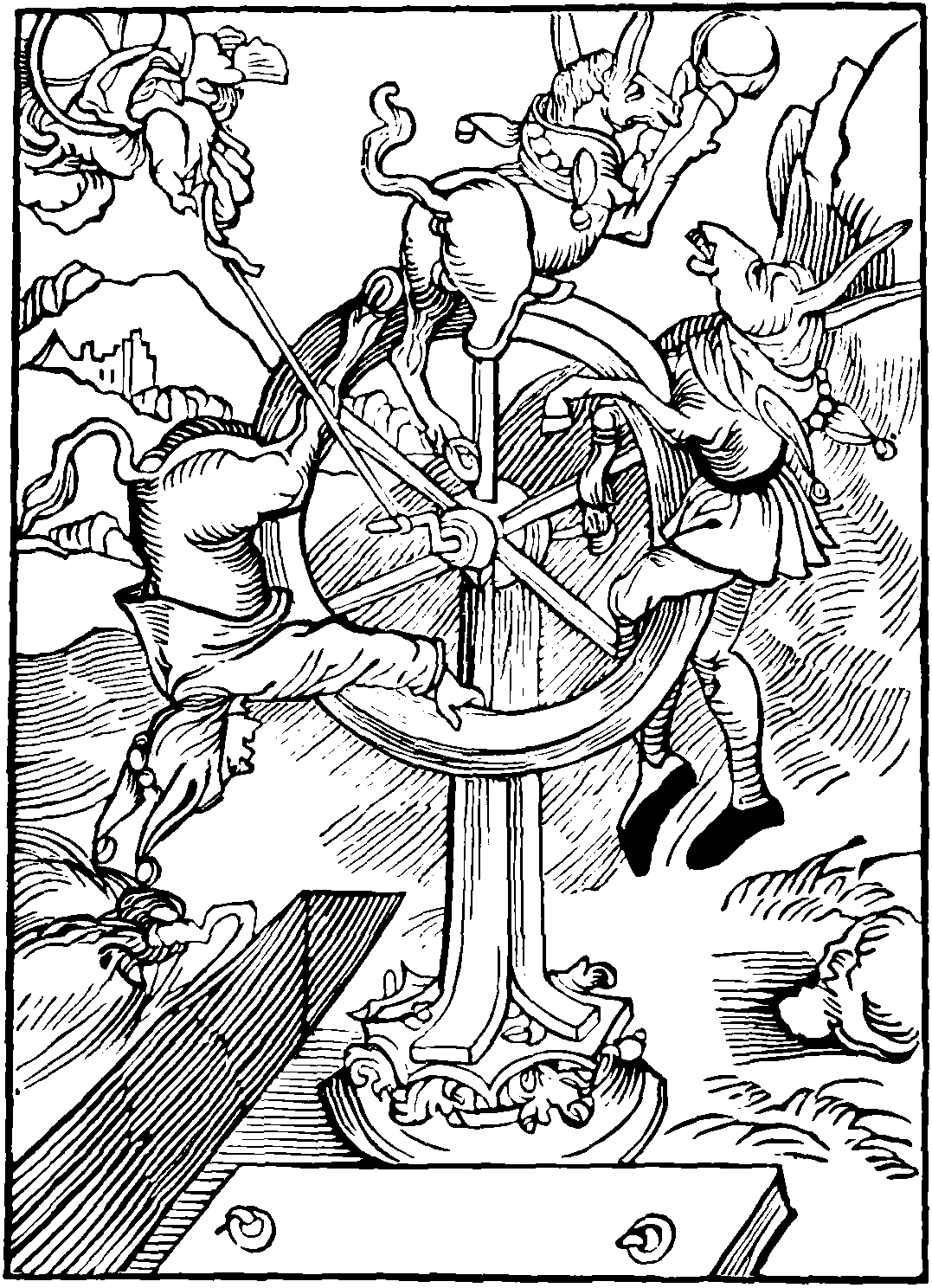
On erth was neuer degre so excellent
Nor man so
myghty: in ryches nor scyence
But at the ende all hath ben gone
and spent
Agaynst the same no man can make defence
Deth all
thynge drawyth, ferefull is his presence,
It is last ende of
euery thynge mundayne
Thus mannys fortune of cours is
vncertayne
O creatures of myndes mad and blynde
I wonder of your hertis proude and eleuate
Whiche on vayne power set so sore your mynde
And trust so moche to your vnsure estate
As of your lyfe were neyther yere nor date
To worldly worshyp ye stedfastly intende
As if your lyfe sholde neuer more come to ende
Alway ye labour to come to dignyte
And oft by falshode your power to augment
Alas fewe ar content with theyr degre
But by extorcion spoyle the pore innocent
On worldly treasour so set is theyr intent
And styll to honour as besely to ascende
As if theyr lyfe sholde neuer more come to ende
Take thou example by Julius cesar
That of the worlde durynge a whyle was sure
And many kynges subduyd by myght of warre
And of the Empyre had lordshyp charge cure
But this his myght great space dyd nat endure
And whyle he trustyd yet hyer to ascende
By cruell deth he soon came to his ende
Right in lyke wyse the myghty Darius
Was kynge of Persy a realme moche excellent
Yet was his mynde so greatly couetus
That with the same helde he hym nat content
But warred on other Royalmes adiacent
So whan his myght coude nat therto extende
His owne Royalme he loste and so came to his ende
And also Xerxes in ryches abundant
Was longe in peas and great tranquyllyte
And in his Royalme was hye and tryumphant
As longe as he was content with his degre
Than had he pleasour and great felycyte.
To assay by warre his kyngdome to amende
But all he lost and so came to his ende
Whyle Nabugodonosor kynge of Babylone
In vnsure fortune set to great confydence
Commaundynge honour vnto hym to be done
As vnto god: with all humble reuerence,
God by his power and hye magnyfycence
Made hym a beste, for that he dyd offende
And so in proces of tyme came to his ende
Alexander the great and myghty conquerour
To whome all the worlde scantly myght suffyse
Of Grece was the origynall lorde and Emperour
And all the worlde subdued as I surmyse
Yet hath he done as is the comon gyse
Left all behynde, for nought coude hym defende
But as a symple man at the last came to his ende
The myghty Cresus with his kyngdomes and store
Of golde and ryches hym selfe coude nat content
But whyle he trustyd and laboured for more
Fortune hym fayled: So lost he his intent.
What shall I wryte of Cyrus excellent
Drynkynge his blode by deth whiche fortune sende
To here of states the comon deth and ende
All kyngdomes dekay and all estate mundayne
Example of Rome Cartago and Mycene
Of Solyme Tyre grace and Troy moste souerayne
None of these places ar nowe as they haue ben
Nor none other ouer the worlde as I wene
Thus shortly to speke and all to comprehende
All worldly thynges at last shall haue an ende.
The enouy of Barklay to the Folys.
O man that hast thy trust and confydence
Fyxed on these frayle fantasyes mundayne
Remember at the ende there is no difference
Bytwene that man that lyued hath in payne
And hym that hath in welth and ioy souerayne
They both must dye their payne is of one sort
Both ryche and pore, no man can deth refrayne
For dethes dart expellyth all confort
Say where is Adam the fyrst progenytour
Of all mankynde is he nat dede and gone
And where is Abell of innocence the flour
With adamys other sonnes euerychone
A: dredfull deth of them hath left nat one
Where is Mathusalem, and Tuball that was playne
The first that played on Harpe or on Orgone
Ilz sont tous mortz ce monde est choce vayne
Where is iust Noy and his ofsprynge become
Where is Abraham and all his progeny
As Isaac and Jacob, no strength nor wysdome
Coude them ensure to lyue contynually
Where is kynge Dauyd whome god dyd magnyfy
And Salomon his son of wysdome souerayne
Where ar his sonnes of wysdome and beauty
Ilz sont toutz mortz ce monde est choce vayne.
Where ar the prynces and kynges of Babylon
And also of Jude and kynges of Israell
Where is the myghty and valiant Sampson
He had no place in this lyfe ay to dwell
Where ar the Prynces myghty and cruell
That rayned before Christ delyuered vs from payne
And from the Dongeons of darke and ferefull hell
Ilz sont toutz mortz ce monde est choce vayne.
Of worldly worsyp no man can hym assure
In this our age whiche is the last of all
No creature can here alway endure
Yonge nor olde, pore man nor kynge royall
Unstable fortune tourneth as doth a ball
And they that ones pas can nat retourne agayne
Wherfore I boldly dare speke in generall
We all shall dye: ce monde est choce vayne.
Ryches nor wysdome can none therfro defende
Ne in his strength no man can hym assure
Say where is Tully is he nat come to ende
Seneke the sage with Cato and Arture
The hye Arystotyll of godly wyt and pure
The glorious Godfray, and myghty Charlemayne
Thoughe of theyr lyfe they thought that they were sure
Yet ar they all dede: ce monde est choce vayne.
Where ar the Phylosophers and Poetis lawreat
The great Grammaryens and pleasant oratours.
Ar they nat dede after the same fourme and rate
As ar all these other myghty conquerours
Where ar theyr Royalmes theyr ryches and treasours
Left to theyr heyres: and they be gone certayne
And here haue left theyr riches and honours
So haue they proued that this worlde is but vayne.
So I conclude bycause of breuyte
That if one sought the worlde large and wyde
Therin sholde be founde no maner of dere
That can alway in one case suerly byde
Strength, honour, riches cunnynge and beautye
All these decay, dayly: thoughe we complayne
Omnia fert etas, both helth and iolyte
We all shall dye: ce monde est choce vayne.
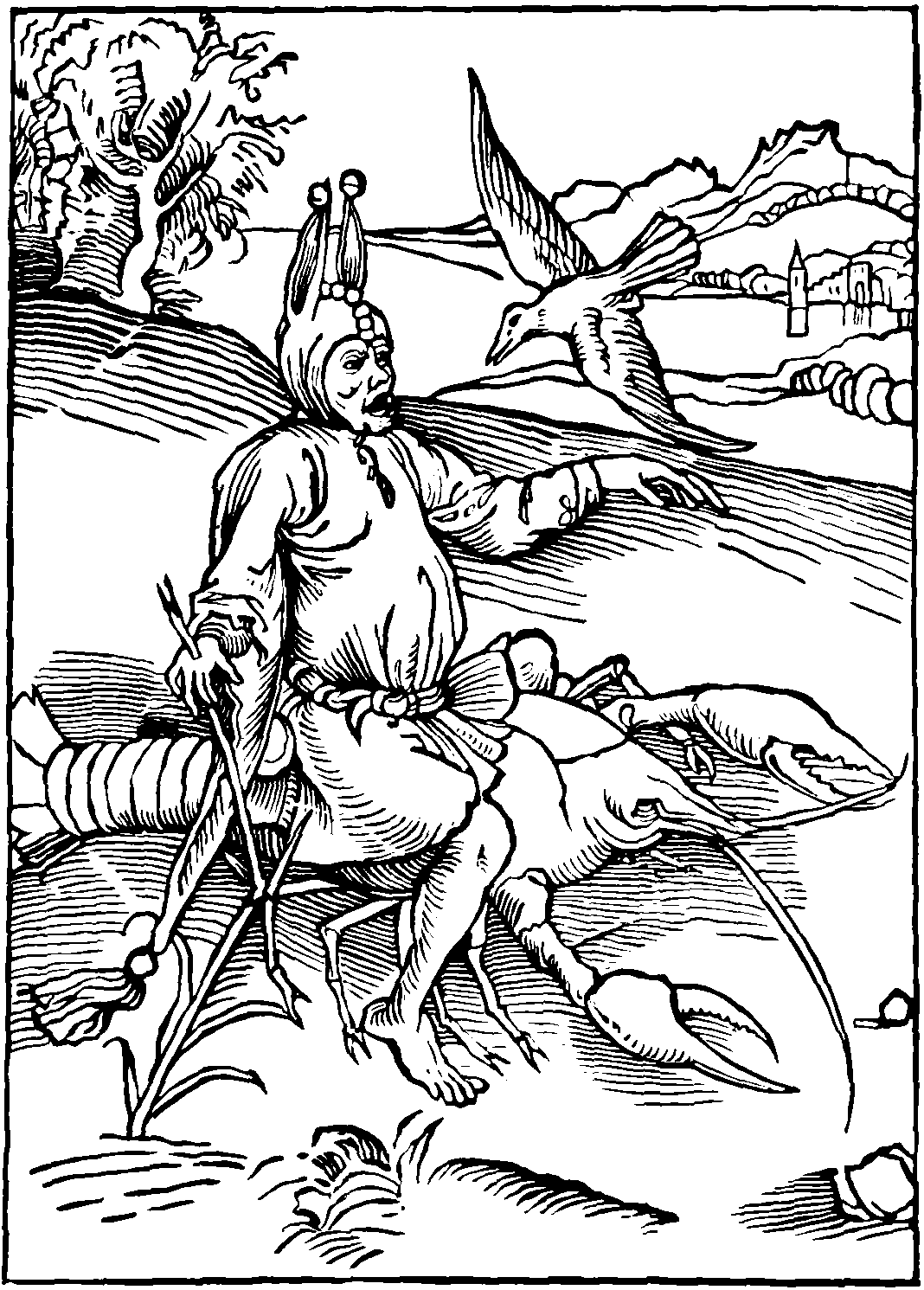
That man that lokyth for to haue a rewarde
Whiche
he hath nat deseruyd to obtayne
And lenyth his body vpon a rede
forwarde
Whiche for waykenes may hym nat well sustayne
Forsoth this fole may longe so loke in vayne
And on the Crauys he
styll shall bacwarde ryde
Cryenge with the doue, whose flyght
shall hym ay gyde
It is vnlawfull, man to be dilygent
Or serchynge goddes workes to set his thought
Howe he hath made the heuen and fyrmament
The erth the see and euery thynge of nought
Yet of some Folys the cause hereof is sought,
Whiche labour also with curyosyte
To knowe the begynnynge of his dyuynyte
These folys forgettynge their owne fragilyte
Wolde loke to knowe the ende of euery thynge
Boldly disputynge in goddys pryuete
And what rewarde is ordeynyd for men lyuynge
Of many folys this is the moste musynge
Whiche labour dayly with besy cure and payne.
To knowe what god doth discerne and or ordayne
Therfore in this part I shall dispyse and blame
Unchrafty folys whiche scantly haue ouer sene
Ought of scripture, if they knowe the bokes name
Or els a whyle hath at the Scoles bene
Than bende they the browys and stedfastly they wene
In theyr conceyt that they ar passynge wyse
For all scripture newe commentis to deuyse
They frowardly the sentence do transpose
And that whiche is wryten, both playne and holely
By theyr corruptynge and vnlawfull glose
Oft tyme they brynge to damnable heresy
Falsly expoundynge after theyr fantasy
They labour to transpose and turne the right sence
Thoughe the wordes stryue and make great resystence
Here what these folys with theyr audacyte
Dare besely say by theyr fals errour blynde
Presumynge on goddes secrete and pryuete
Here what lewde wordes they cast out in the wynde
They say what man can chaunge or turne his mynde
To lyue after any other fourme and rate
But lyke as he is therto predestynate
They say: if god that rayneth ouerall
Hath any ordeyned that in this worlde is
To come to the place and rowme celestyall
For to be partyner of euerlastynge blys
Ordeyned for suche as here doth nat amys
No man can chaunge, not other thynge mundayne
That thynge whiche god by his myght doth ordayne
But if that god prefyxed hath before
Any creature vnto infernall payne
In derknes to be damnyd for euer more
No erthly thynge may that sentence call agayne
Nor hym delyuer: o fole thou mayst complayne
For this thy foly and also it repent
Thynkest thou nat god alway omnypotent
Is god nat rightwyse and grounde of all iustyce
Rewardynge man after his gouernaunce
He that hath here nat lyen in synne and vyce
Hauynge in goddys seruyce his pleasaunce
Shall of his lorde be had in remembraunce
And of rewarde worthely be sure
Where it is worthy that synners payne endure
Trust well who seruyth his maker stedfastly
With pure herte kepynge sure his commaundement
And lawes shall be rewardyd fynally
With heuenly ioy and scape all punysshement
Therfore thou fole leue of this lewde intent
Lyue vertuously and trust in goddes grace
Than yll desteny in the shall haue no place
Vnto great ioy god hath vs all create
And to vs all ordeyned his kyngdome
And none hath vnto Hell predestynate
But often whan we folowe nat wysdome
By ouer owne foly we fall, and so become
Vnto our maker vnkind: and hym deny
Whiche them rewardyth that here lyue vertuously
Therfore thou Fole desyst thy wordes vayne
And let thy tunge no more suche wordes say
For god hath vs made all of one stuf certayne
As one potter makyth of one clay
Vessels dyuers, but whan he must them lay
Vpon the kyll with fyre them there to dry
They come nat all to good, moste comonly
Doth this erthyn pot his maker dispyse
Whether it be made of fassyon good or yll
Saynge why dost thou make me in this wyse
Wherfore mad man I reade the to be styll
Blame nat thy maker, for thy vnhappy wyll
For god hath neuer man nor childe create
But all he hath to heuen predestynate
And whyle we lyue here on this wretchyd grounde
We haue our reason and wyttes vs to gyde
With our fre wyll and if no faute be founde
In our demenour, in heuen we shall abyde
But if we goddes lawes set asyde
Howe may we hope of hym rewarde to wyn
So our owne foly is moste cause of our syn.
The enuoy of Barclay.
O creature vnkynde vnto thy creatour
What carest thou to knowe or to inuestygate
The pryuetye, of god, leue this thy errour
To thynke the by hym to be predestynate
To endles wo and from his blysse pryuate
For syns thou hast thy reason and frewyll
Gyuyn the by god, thou art in suche estate
To take the eleccion outher of good or yll
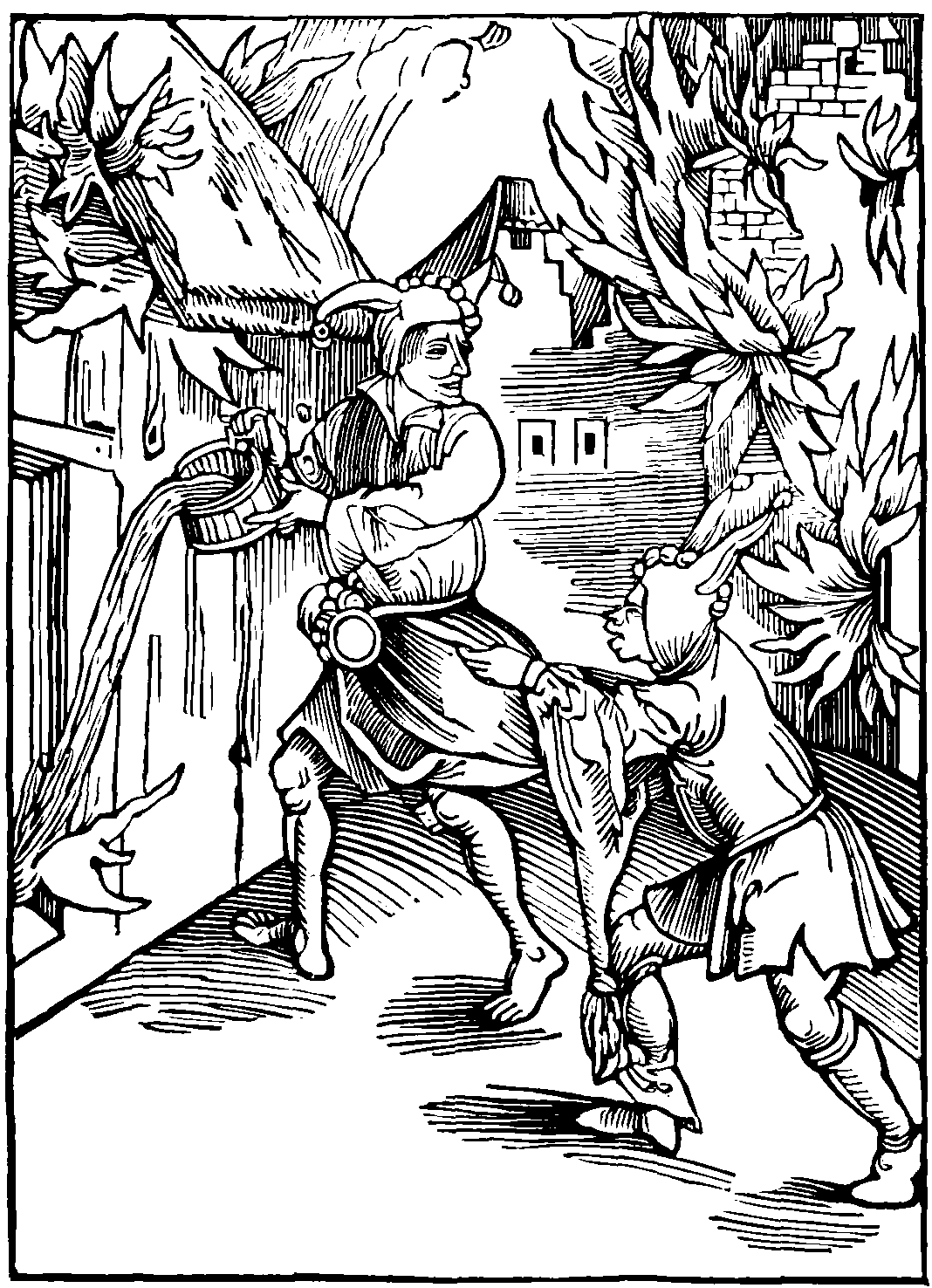
Who that wyll suffer his owne hous to bren
Tyll
nought of it saue the bare wallys stonde
And with his water
hastely doth ren
To quenche the fyre of anothers hous or londe
He is a fole and haue shall in his hande
A folysshe Pype or
horne therwith to blowe
For other folys that in my Shyp wyll
rowe.
Within my Shyp of rowme he shall be sure
Whiche for anothers auantage and profyte
Takyth great thought and doth moche payne endure
Vnto his owne charge takynge no respyte
But settyth it asyde and hath all his delyte
With all his stody hym to enforce and dres:
To care for euery mannys besynes.
Suche hertles folys to them self neglygent
In theyr owne charge slepe contynually
But with open iyen they ar full dylygent
The worke of other with all theyr myght to aply
And for others profyte prouyde they besely.
But whyle these Folys ar glad to take in hande
Anothers charge, theyr owne styll let they stande
Wherfore I am so bolde within my boke
Somwhat to touch these folys mad vsage
That if it fortune them on the same to loke
They may therby perceyue in theyr corage
That labour they ought for their owne auauntage
Most specyally. for that is the degre
And the true order of perfyte charite
For perfyte loue and also charite
Begynneth with hym selfe for to be charitable
And than to other after his degre
Thy owne auauntage is ay moost profytable
The great Phylosophers of maners ferme and stable
And also of wysdome godly and dyuyne
Hath left to vs suche techynge and doctryne
We haue by Therence the same commaundement
The same is wryten also as I fynde
In the holy lawe of the olde testament
And therfore he that oft wyll set his mynde
For others maters with care his thought to blynde
Let hym first se vnto his owne profyte
Lyst some mysfortune hym after sharply byte
Let hym turne his labour to his owne auauntage
And than do for other where as he seeth moste nede
For who that playeth for mony outher gage
And on his felawes cast takyth onely hede
And nat to his owne, suche one shall seldom spede
And is a Fole. So is he that doth ren
To quenche another hous, suffrynge his owne to bren
Suche one of his owne damage hath no fere
And worthy is his losse and hurte to byde
So is he that wyll anothers burthen bere
Or takyth anothers charge at any tyde
Despysynge his owne werke and settynge it asyde
If suche haue losse and after it forthynke
No man shall moche force whether he flete or synke
He is well worthy to haue a folys pype
That goth vnbyddyn to rype anothers corne
And suffreth his owne to stande though it be rype.
And generally all Folys ar worthy scorne
Of what maner byrth so euer they be borne
If they them self put, to losse or damage
Therby to do some other auauntage
Say curyous Fole: say what pleasour thou hast
In others maters thy self to intermyt
Or theyr great charges thus in thy mynde to cast
Thy selfe to socour set thou thy mynde and wyt
Let others maters therfore in quyete syt
On thy owne profyte of all firste set thy mynde
And than (if thou mayst) do somwhat for thy frende
For vtterly that man is moche vnwyse
That thus takyth thought for anothers charge
And doth his owne by neglygence despyse
For suche Folys I forgyd haue this barge
But of the same suche men I clene discharge
That first of his pryuate profyte can take hede
And than helpe a frende and felowe at a nede
Thenuoy of Barklay.
Ye that take charge, thought and besy cure
For others mysfortune, losse or aduersyte
First of your self I aduyse you to be sure
For this is the order of parfyte charyte
Eche to hym selfe moste louynge ay to be
And next to his frende, but who that doth dispyse.
His owne besynes whiche is in ieopardye
Seynge to anothers forsoth he is vnwyse
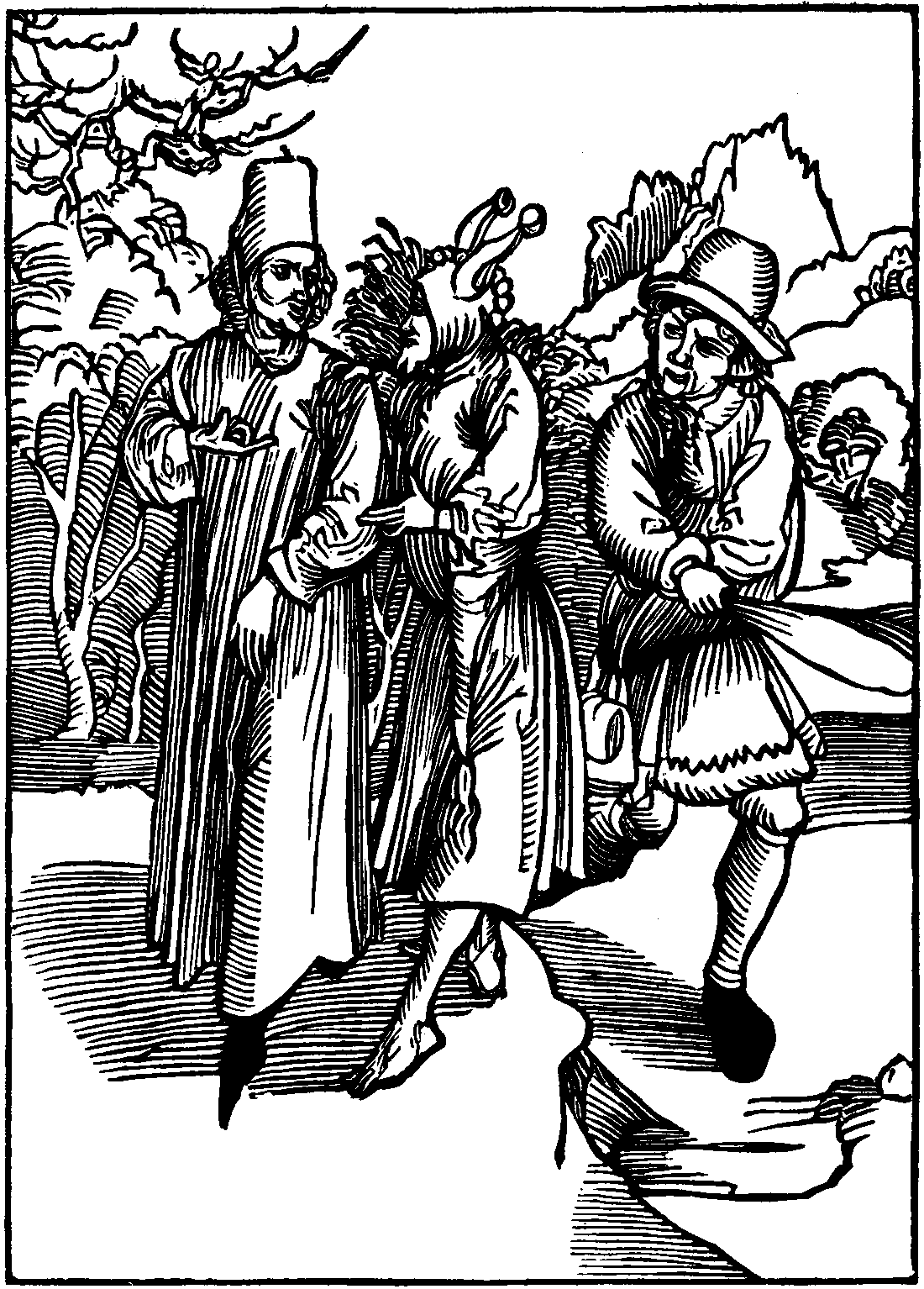
That Fole can neyther gode nor honeste
Whiche
whan one doth to hym a frendly dede
It gladly takyth, thoughe it
be two or thre
Lokynge for kyndnes, yet takyth he no hede
To shewe the same agayne in tyme of nede
Let suche Folys be no
thing wroth therfore
Thoughe in this Shyp I set them to an
ore.
He is a Fole that crauynge is alway
Takynge the seruyce and rewardes of his frende
And nat remembryth the same agayne to pay
But as a churle it castyth out of his mynde
For who that wolde haue one to hym be kynde
And lyberall, he ought the same to be
For kyndnes meyntayneth bothe loue and charyte
He that wyll charge another with cures harde
And great labours greuous to sustayne
Ought for his labour hym worthely rewarde
That the rewarde may be confort to his payne
It is disworshyp and also shame certayne
To take the labour of any ryche or pore
And nat iustly hym to content therfore
Wherfore the workman ought also to intende
Vnto his labour to saue his honestye
And workemanly to brynge it the ende
If he therby wolde well rewardyd be
And if the owner therof beholde and se.
His worke so done, he is a chorle vnkynde
If he do nat content the workmannys mynde.
He that wolde gladly that men sholde hym commende
Must fully purpose and fyx within his mynde
Lyberall to be and nat euer to intende
To false Auaryce, whiche many one doth blynde
And if he purpose hye honours for to fynde
Or hym auaunce to any great degre
He must haue mekenes and lyberalyte
He must of maners also be commendable
And of his speche als pleasaunt as he can
For an olde prouerbe true and verytable
Sayth that good lyfe and maners makyth man
But euery lawe doth dam and also ban
The churlysshe vyce and lewde of vnkyndnes
Whiche dryeth vp the well of bounte and goodnes
For vnkynde folys if one labour dylygent
And so brynge theyr worke vnto good conclusyon
They fynde yet fautis and so ar nat content
Withdrawynge the rewarde by theyr collusyon
Wherfore let suche thynke it no abusyon
Nor haue disdayne ne yet in mynde complayne
If the pore laborer gyue vp his worke agayne
These frowarde Folys, doth wronge and iniury
To suche as to them do profyte and honour
For kyndnes, they render shame and vylany
Rebukes sclander extorcion and rygour
But whyle they hope to come to great valoure
And by such rygour to honours to aryse
Theyr hope vanyssheth as doth the snowe or yce
Wherfore who that puttyth one to besynes
To charge or labour of body or of mynde
Ought hym rewarde agayne for his kyndnes
If he do nat forsoth he is unkynde
But specyally as I oft wryten fynde
It is a thynge whiche doth for vengeaunce cry
A pore laborer to put to Iniury
What man can wryte the inconuenyence
Whiche groweth of this lewde and cursyd vyce
Vnkyndnes causeth great myschefe and offence
And is repugnynge to reason and iustyce
Wherfore let suche that wyll be namyd wyse
Leue it: and folowe lyberalyte
Whiche is noryssher of loue and amyte
In dyuers bokes examples we may fynde
Howe many Cytees hygh and excellent
Agaynst all lawe and reason were vnkynde
To suche as dyd theyr dignyte augment
O vnkynde rome thou was of this intent
Whiche hast Camyllus exyled in great payne
Thoughe he euer laboured thy honour to mentayne
O cruell Athenes by thy ingratytude
Hast thou nat banysshyd Solon also fro the
Though he enfourmyd hath thy maners rude
And gyuyn the lawes of right and equyte
For his great meryte, loue and benygnyte
Thou hast hym gyuen exyle and paynes harde
His labour was nat worthy that rewarde
Thou vnkynde Sparta: of thy audacyte
What shall I wryte or thy lewde vnkyndnes
Hast thou nat banysshed by thy cruelte
Thy kynge Lycurgus, bycause he dyd redres
Thy wanton errours by lawe and rightwysnes
And Scipio whiche his country dyd defende
Fonde it to hym, vnkynde at the last ende
A thousande mo whome I can nat expresse
To suche as haue for them abyde great payne
Haue done displeasour, and shewed vnkyndnes
And them disceyued by some cautele or trayne
Yet none of them great goodnes cowde obtayne
By theyr vnkyndnes for who that so doth cast
Vnkyndly shall be seruyd at the last.
Thenuoy of Barklay.
O fals vnkyndnes out on the I cry
From all goodnes dost thou nat man withdrawe
Byndynge his herte to gyle and vylany
Agaynst nature, agaynst both right and lawe
Thou makest man his maker nat to knawe
Therfore thou man expell out from thy mynde
This vyce, for we fynde in an olde sayde sawe
Wo is hym that to his maker is vnkynde.
Remember man the great preemynence
Gyuen unto the by good omnypotent
Bytwene the and Angels is lytell difference
And all thynge erthly to the obedyent
Fysshe byrde and beste vnder the fyrmament
Say what excuse mayst thou nowe lay or fynde
Syns thou art made by god so excellent
But that thou oughtest agayne to hym be kynde.
God hath the made vnto his owne lykenes
No erthly creature vnto the comparable
Thy iyen vpwarde to consyder his hyghnes
Where other creatures that ar vnresonable
Goeth on all foure and ar nat other able.
Theyr loke alway vnto the grounde inclynyd
Therfore thou ought in vertue to be stable
And to thy maker neuer to be vnkynde
Whan man offendyd by disobedyence
Subduynge hym self to labour care and payne
And lost the consort of goodes hye presence
Hath nat christ Jhesu redemyd hym agayne
Besyde all this thou hast no thynge certayne
In erth but by hym. wherfore I call the blynde
And of thy maners vncurtayse and vylayne
If to thy sauyour thou be nat true and kynde
Thoughe god hath made the (man) thus excellent
To lyue (if thou lyst) in ioy eternally
A lytell thynge shall hym agayne content
He nought requyreth but thy herte onely
And that thou defy thy gostly ennemy
And in goddes seruyce thy herte and body bynde.
Than shall he rewarde the in heuen right gloriously
So mayst thou be callyd vnto thy maker kynde
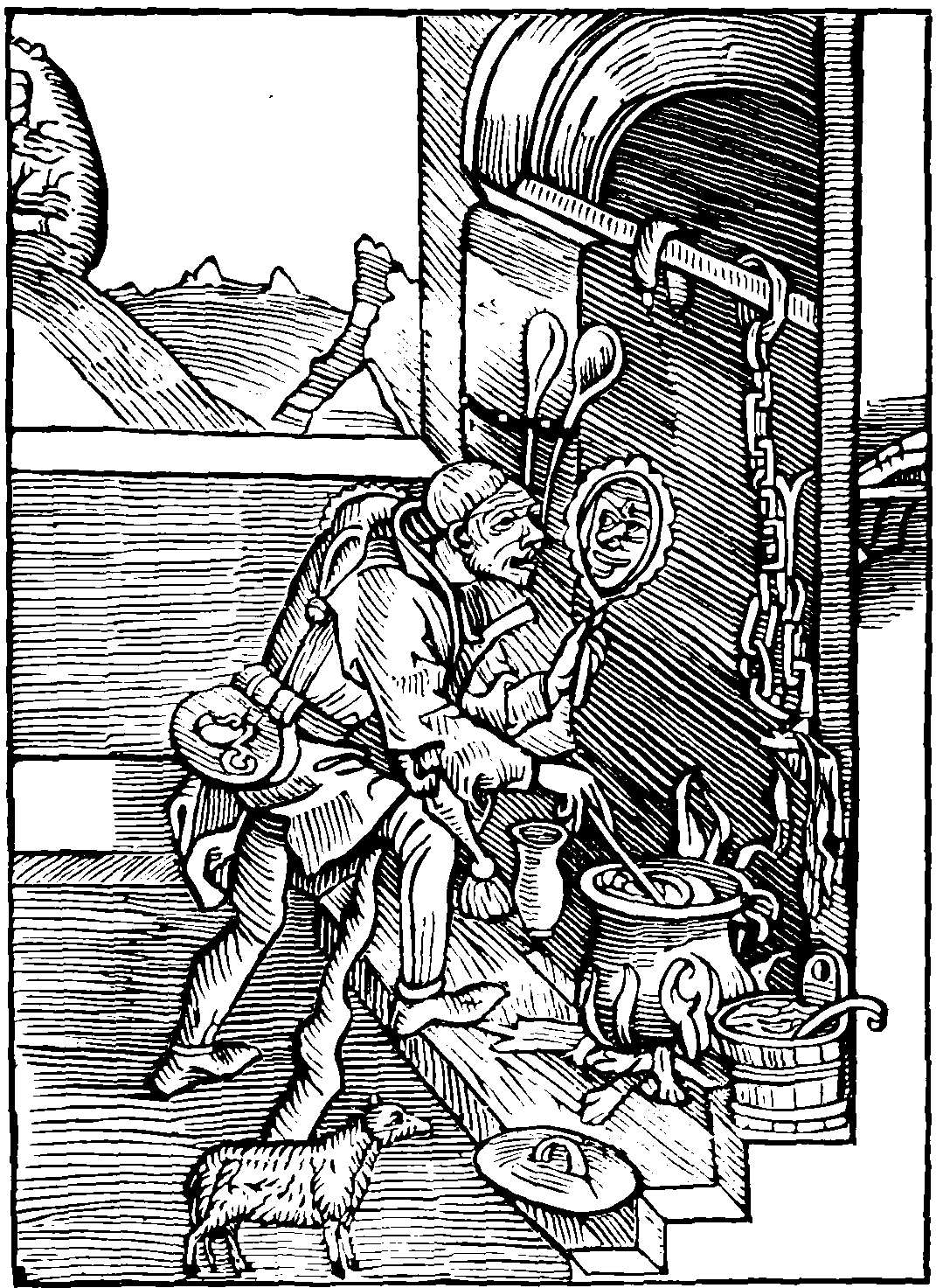
We haue ouercome the malyce and enuy
Of suche as
agaynst our Nauy did conspyre
Wherfore I shall my folys call
quyckly
That they my Shyp may aparayle and atyre
Drawe nere
ye Folys whiche syttynge by the fyre
Loke ay in a glasse to se
your countenaunce
And in your owne dedis haue all your hole
pleasaunce
Vnto my shyp I call hym to be Coke
The mete to dresse to other Folys echone
Whiche in his myrrour doth alway gase and loke
Whan he may get hym vnto a place alone
And though of colour and beaute he haue none
Yet thynketh he hym self fayre and right plesant
And wyse: thoughe that he be mad and ignorant
In his owne dedys is onely his delyte
In his owne conceyte thynkynge hymself right wyse
And fayre, thoughe he be yelowe as kyte
Is of hir fete: yet doth he styll deuyse
His vayne myrrour: that onely is his gyse
And thoughe he beholde hym self of lothly shape
He wyll it nat byleue, but in his glasse doth gape.
Though for his foly all men myght hym repreue
And that he se it before hym openly
Within his glasse: he wyll it nat byleue
But strongly it defende and eke deny
He seyth nat his erys longe and hye
Whiche stande vpon his folysshe hode behynde
His lewde conceyt thus makyth hym starke blynde
Whan people comon of men of hye prudence
Or of hye beauty, and strength if men doth tell
If one suche fole were there in the presence
He swere durst boldly and that on the gospell
That he onely all other dyd excell
And that to gyue councell good and profytable
Were none in the worldly vnto hym comparable
These folys bost them selfe of theyr wysdome
And thynke them selfe to haue preemynence
Aboue all other that ar in christendome.
In gyftis of grace as beautye and scyence
Of strength, gode maners, vertue, and eloquence
But thoughe they stande in theyr owne conceytis
Nought is saue foly within theyr folysshe patis
And thoughe theyr face and vysage stande awry
And all to reuylde, theyr mouth standynge asyde
Within theyr myrrour the same can they nat spye
But in theyr foly contynually abyde
And whether that they ar styll outher go or ryde
Labour or be ydyll, they gase styll in theyr glasse
Yet wyll they nat byleue to haue erys lyke an Asse.
Oft whan these folys lye in theyr bed vpright
With tawny loke or els theyr botyll nose
They haue theyr myrrour alway in theyr syght
The vayne glasse (of theyr beautye) to apose
And whan suche a fole into the kechyn gose
To stere the pot, there whether he syt or stande
The glasse alway is in the other hande
Whan he a whyle his glas hath loken than
If one examynyd hym of his beautye
He boldly durst swere both by god and man
That nought were in hym whiche myght repreuyd be
But all goodnes, fayre shape, and loke of grauyte
And that his gere gayly vpon his backe doth syt
He hardly is wyse: if he had any wyt.
I wryten fynde that great inconuenyence
As losse, contempt and occasyon of pryde
Hath fallyn vnto many by this lewde complacence
Whiche haue nat knowen the way themself to gyde
The emperour Otho had ay borne by his syde
In warre and peas (a glasse) for his pleasaunce
To se his colour therin; and countenaunce
And to the entent to make his colour gay
With Assys mylke he noyntyd oft his skyn
And shauyd his berde onys euery day
But for that he offendyd god herein
After was he sharply punysshyd for this syn
And put vnto extreme rebuke and shame
To gyue other example to auoyde the same
It is forsoth a maner femynyne
And nat for man to be so elegant
To suche toyes wanton wymen may inclyne
A yonge mayde may at her forhede haue pendant
The vayne myrrour to se hir shape pleasant
Man sholde nought set by to norysshe his beautye
But onely manhode strength and audacyte
The wanton mayde may for hir self ordayne
Hir call hir coyfe, and suche conceytis newe
As broches fyletes and oyntmentis souerayne
And clothynge of dyuers colour and of hewe
But nowe yonge men the same fourme do ensue
And to content theyr mad and folysshe mynde
To wymen they compare themselfe agaynst kynde
Disorder rayneth as I before haue sayde
The yonge men takyth womans countenaunce
And hir aparayll, and wymen ar arayde
As men: agaynst all lawe and ordynaunce
Thus man and woman ensue mysgouernaunce
In theyr behauour is small dyuersyte
Theyr owne conceyt causeth great enormyte
The poet Ouyde shewyth in a fable
Howe that one callyd Pygmalyon by name
A fygure made vnto hymselfe semblable
Whiche he in marbyll right craftely dyd frame
And in so moche he worshypped the same
Tyll at the last his mynde was past and gone
And he transformed so was in to that stone
And if the Poetis fables be all sure
As by theyr subtyle wordes oft we here
The childe Narcissus was chaungyd of fygure
Whyle he behelde into the water clere
For whyle his shadowe vnto hym dyd apere
Vpon the same so sore he set his mynde
That he transformyd was to another kynde.
But to retorne agayne to our purpose
And of this sort of Folys to conclude
If god sholde them to other shape transpose
That thynke them fayre though they be foule and rude
Into foule fassyon he many sholde include
For whyle Folys theyr owne beauty magnyfy
So growyth the nomber and so they multyply
Thenuoy of Barklay the translatour.
Blynde man inclere thy wylfull ignoraunce
Stande nat so great in thy owne conceyte
Ne in thy lewde fassyon set nat thy pleasaunce
Whether thou be pore or man of great estate
Another man moche more shall in the wayte
Of gode and yll than thou thy self canst do
Therfore be nat cause to thy self of disceyte
If one the teche: aply thy mynde therto
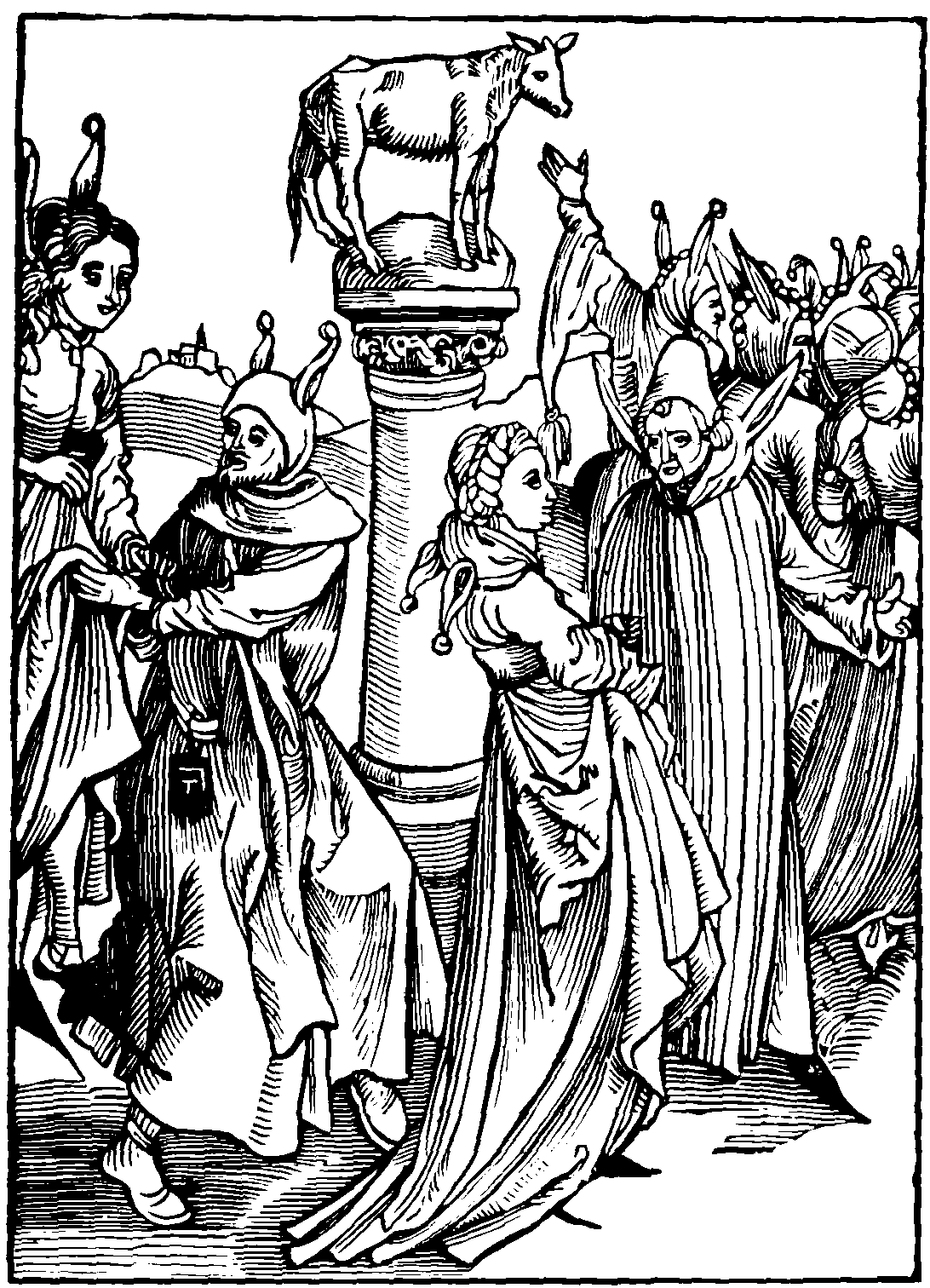
That fole that settyth his felycyte
In wanton
daunces and lepes immoderate
Hath in my Shyp a rowme for his
degre
Bysyde the stere for troublynge of his pate
He god
dyspleasyth, whiche doth suche foly hate
Suche lese theyr tyme in
vayne and oft therin
Ar many hurtis: and cause of dedely
syn.
Those folys a place may chalenge in my shyp
Whiche voyde of wysdome as men out of theyr mynde
Them selfe delyte to daunce to lepe and skyp
In compase rennynge lyke to the worlde wyde
In vnkynde labour, suche folys pleasour fynde
Rennynge about in this theyr furyous vyce
Lyke as it were in Bacchus sacryfyce
Or as the Druydans rennyth in vayne about
In theyr mad festes vpon the hylle of yde
Makynge theyr sacrafyce with furour noyse and shout
Whan theyr madnes settyth theyr wyt asyde
Or whan the prestis of mars all nyght abyde
Within theyr temple by vse abhomynable
To theyr ydollys doynge theyr seruyce detestable
Lyke as these paynyms hath to theyr ydols done
Theyr sacryfyce wandrynge in theyr madnes
Theyr bodyes weryenge, in vayne wastynge their shone
So do these fowlys them selfe to daunsynge dres
Sekynge occason of great vnhappynes
They take suche labour without all hope of gayne
Without rewarde sure, of werynes and payne
Say Folys that vse this fury and outrage
What causyth you to haue delyte therin
For your great labour say what is your wage
Forsoth ye can therby no profyte wyn
But seke occasyon (as I haue sayde) of syn
And for thy werynge thy fete thus in the dust
Thou gettest no gayne but cause of carnall lust
But whan I consyder of this folysshe game
The firste begynnynge and cause orygynall
I say the cause therof is worthy blame
For whan the deuyll to disceyue man mortall
And do contempt to the hye god eternall
Vpon a stage had set a Calfe of golde.
That euery man the same myght clere beholde
So than the Fende grounde of mysgouernaunce
Causyd the people this fygure to honour
As for theyr god and before the same to daunce.
Whan they were dronkon, thus fell they in errour
Of Idolatry, and forgate theyr creatour.
Before this ydoll daunsynge both wyfe and man
Dispysynge god: Thus daunsynge fyrst began
Suche blynde folyes and inconuenyence
Engendryth great hurte and incommodyte
And sawyth sede wherof groweth great offence
The grounde of vyce and of all enormyte
In it is pryde, fowle lust and lecherye
And whyle lewde lepys ar vysd in the daunce
Oft frowarde bargayns ar made by countenaunce
What els is daunsynge but euen a nurcery
Or els a bayte to purchase and meyntayne
In yonge hertis the vyle synne of rybawdry
Them fe*trynge therin, as in a dedely chayne
And to say trouth in wordes clere and playne
Venereous people haue all theyr hole pleasaunce
Theyr vyce to norysshe by this vnthryfty daunce
And wanton people disposyd vnto syn
To satysfye theyr mad concupyscence
With hasty cours vnto this daunsynge ryn
To seke occasyon of vyle synne and offence
And to expresse my mynde in short sentence
This vyciouse game oft tymes doth attyse
By his lewde synes, chast hartis vnto vyce
Than it in erth no game is more damnable
It semyth no peas, but Batayle openly
They that it vse of myndes seme vnstable
As mad folke rennynge with clamour showt and cry
What place is voyde of this furyous foly
None: so that I dout within a whyle
These folys the holy churche shall defyle
Of people what sort or order may we fynde
Ryche or pore hye or lowe of name
But by theyr folysshnes, and wanton mynde
Of eche sort some ar gyuen vnto the same
The prestis and clerkes to daunce haue no shame
The frere or monke in his frocke and cowle
Must daunce in his dortor lepynge to play the fole
To it comys children, maydes and wyues.
And flaterynge yonge men to se to haue theyr pray
The hande in hande great falshode oft contryues
The olde quean also this madnes wyll assay
And the olde dotarde thoughe he skantly may
For age and lamenes stere outher fote or hande
Yet playeth he the fole with other in the bande
Than lepe they about as folke past theyr mynde
With madnes amasyd rennynge in compace
He moste is commendyd that can moste lewdnes fynde
Or can most quyckly ren about the place
There ar all maners vsyd that lacke grace
Mouynge theyr bodyes in synes full of shame
Whiche doth theyr hertes to synne right sore inflame
So oft this vyce doth many one abuse
That whan they ar departyd from the daunce
On lust and synne contynually they muse
Hauynge therin theyr wyll and theyr pleasaunce
Than fall they oft to great mysgouernaunce
As folys gyuyn to worke vnprofytable
So in my shyp they well deserue a babyll.
Thenuoy of Barklay
Do way your daunces ye people moche vnwyse
Desyst your folysshe pleasour of trauayle
It is me thynke an vnwyse vse and gyse
To take suche labour and payne without auayle
And who that suspectyth his mayde or wyues tayle
Let hym nat suffer them in the daunce to be
For in that game thoughe sys or synke them fayle
The dyse oft renneth vpon the chaunce of thre
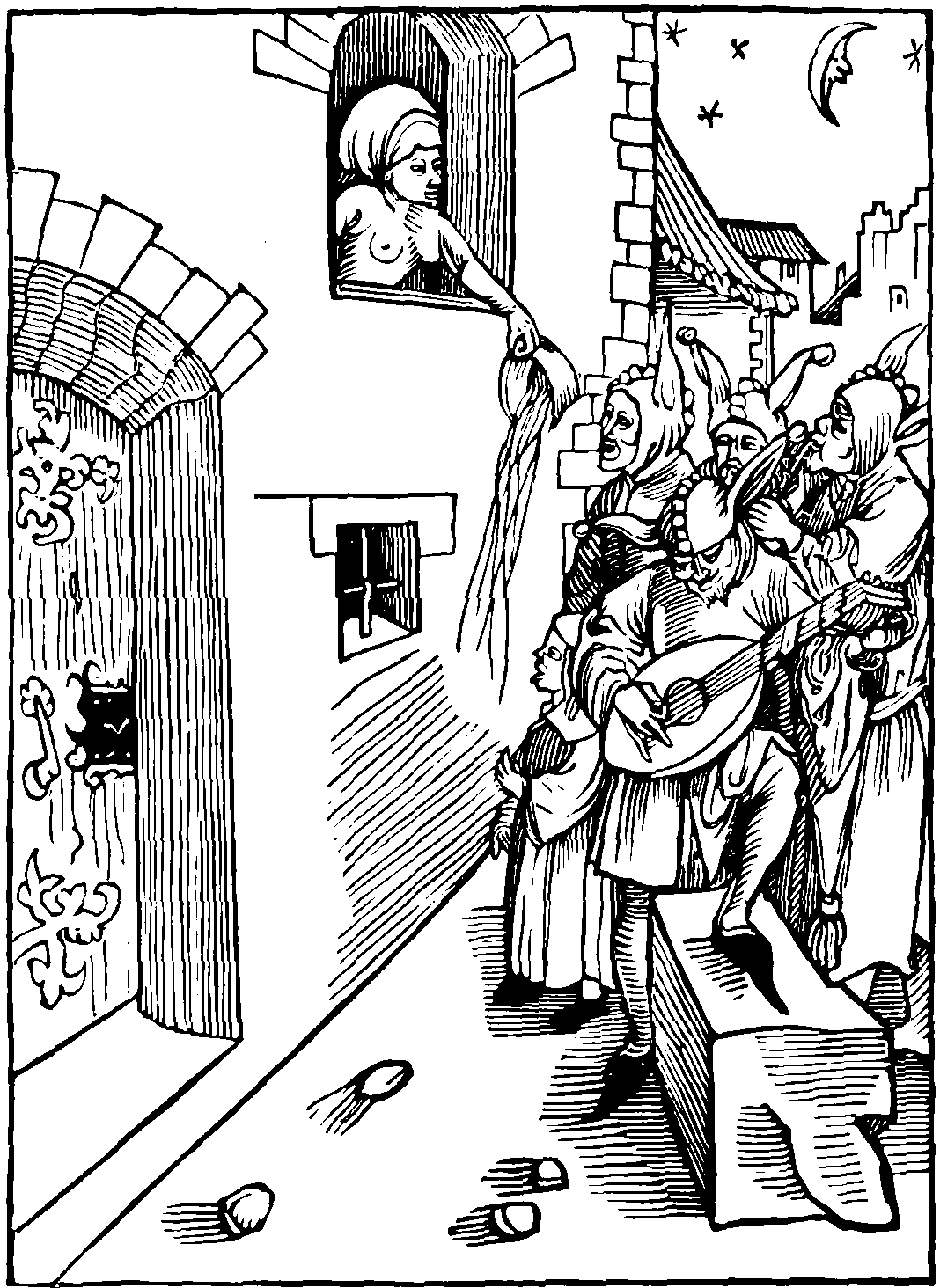
He is a Fole that wandreth by nyght
In felde or
towne, in company or alone
Playnge at his lemmans dore withouten
lyght
Tyll all his body be colde as lede or stone
These
folys knockynge tyll the nyght be gone
At that season thoughe
that they fele no colde
Shall it repent and fele whan they be
olde.
Nowe wolde I of my boke haue made an ende
And with my shyp drawen to some hauen or porte
Stryken my sayle, and all my folys sende
Vnto the londe, a whyle them selfe to sporte
But this my purpose is lettyd by a sorte
Of frantyke folys, wandrynge about by nyght
For often all yll doers hatyth the day lyght
Whyle (man) beste and euery lyuely creature
Refresshe theyr myndes and bodyes with rest
And slepe: without the whiche none can endure
And whyle all byrdes drawe them to theyr nest
These dronken bandes of Folys than doth Jest
About the stretis, with rumour noyse and cry
Syngynge theyr folysshe songes of rybawdry
The furyes ferefull spronge of the flodes of hell
Vexith these vagabundes in theyr myndes so
That by no mean can they abyde ne dwell
Within theyr howsys, but out they nede must go
More wyldly wandrynge than outher bucke or doo
Some with theyr harpis another with his lute
Another with his bagpype or a folysshe flute
Than mesure they theyr songes of melody
Before the dores of theyr lemman dere
Yowlynge with theyr folysshe songe and cry
So that theyr lemman may theyr great foly here
And tyll the yordan make them stande arere
Cast on theyr hede, or tyll the stonys fle
They nat depart, but couet there styll to be
But yet more ouer these Folys ar so vnwyse
That in colde wynter they vse the same madnes
Whan all the howsys ar lade with snowe and yse
O mad men amasyd vnstabyll and wytles
What pleasour take ye in this your folysshenes
What ioy haue ye to wander thus by nyght
Saue that yll doers alway hate the lyght
But folysshe youth doth nat alone this vse
Come of lowe byrth and sympyll of degre
But also statis them selfe therein abuse
With some yonge folys of the spiritualte
The folysshe pype without all grauyte
Doth eche degre call to this frantyke game
The darkenes of nyght expellyth fere of shame
One barkyth another bletyth lyke a shepe
Some rore, some countre, some theyr balades fayne
Another from syngynge gyueth hym to wepe
Whan his souerayne lady hath of hym dysdayne
Or shyttyth hym out, and to be short and playne
Who that of this sort best can play the knaue
Lokyth of the other the maystery to haue
The folysshe husbonde oft of this sort is one
With wanton youth wandrynge by nyght also
Leuynge his wyfe at home in bed alone
And gyueth hyr occasyon often to mysdo
So that whyle he after the owle doth go
Fedynge the Couko, his wyfe hir tyme doth watche
Receyuynge another whose egges she doth hatche.
Therfore ye folys that knowe you of this sort
To gyue occasyon of synne vnto your wyues
And all other: I you pray and exort
Of this your foly to amende your lyues
For longe nyght watches seldome tymes thryues
But if it be in labour: good to wyn
Therfore kepe your dorys: els abyde within
Thoughe I have touchyd of this enormyte
In englysshe tunge: yet is it nat so vsed
In this Royalme as it is beyonde the se
Yet moche we vse whiche ought to be refusyd
Of great nyght watchynge we may nat be excusyd
But our watchynge is in drunken glotony
More than in syngynge or other meledy
Whan it is nyght and eche shulde drawe to rest
Many of our folys great payne and watchynge take
To proue maystryes and se who may drynke best
Outher at the Tauerne of wyne, or the ale stake
Other all nyght watchyth for theyr lemmans sake
Standynge in corners lyke as it were a spye
Whether that the weder be, hote, colde, wete, or dry
Some other Folys range about by nyght
Prowdely Jettynge as men myndeles or wode
To seke occasyon with pacyent men to fyght
Delytynge them in shedynge mennys blode
Outher els in spoylynge of other mennys gode
Let these folys with suche lyke and semblable
Drawe to this barge, here shall they here a bable
Thenuoy of Barclay.
Ye folys that put your bodyes vnto payne
By nyghtly watchynge, voyde of auauntage
Leue of your foly or els ye shall complayne
And mourne it sore if ye lyue vnto age
For though ye thynke that this your blynde outrage
Is vnto you no hurte nor preiudyce
It doth your body and goodes great dammage
And great cause both to you and yours of vyce.
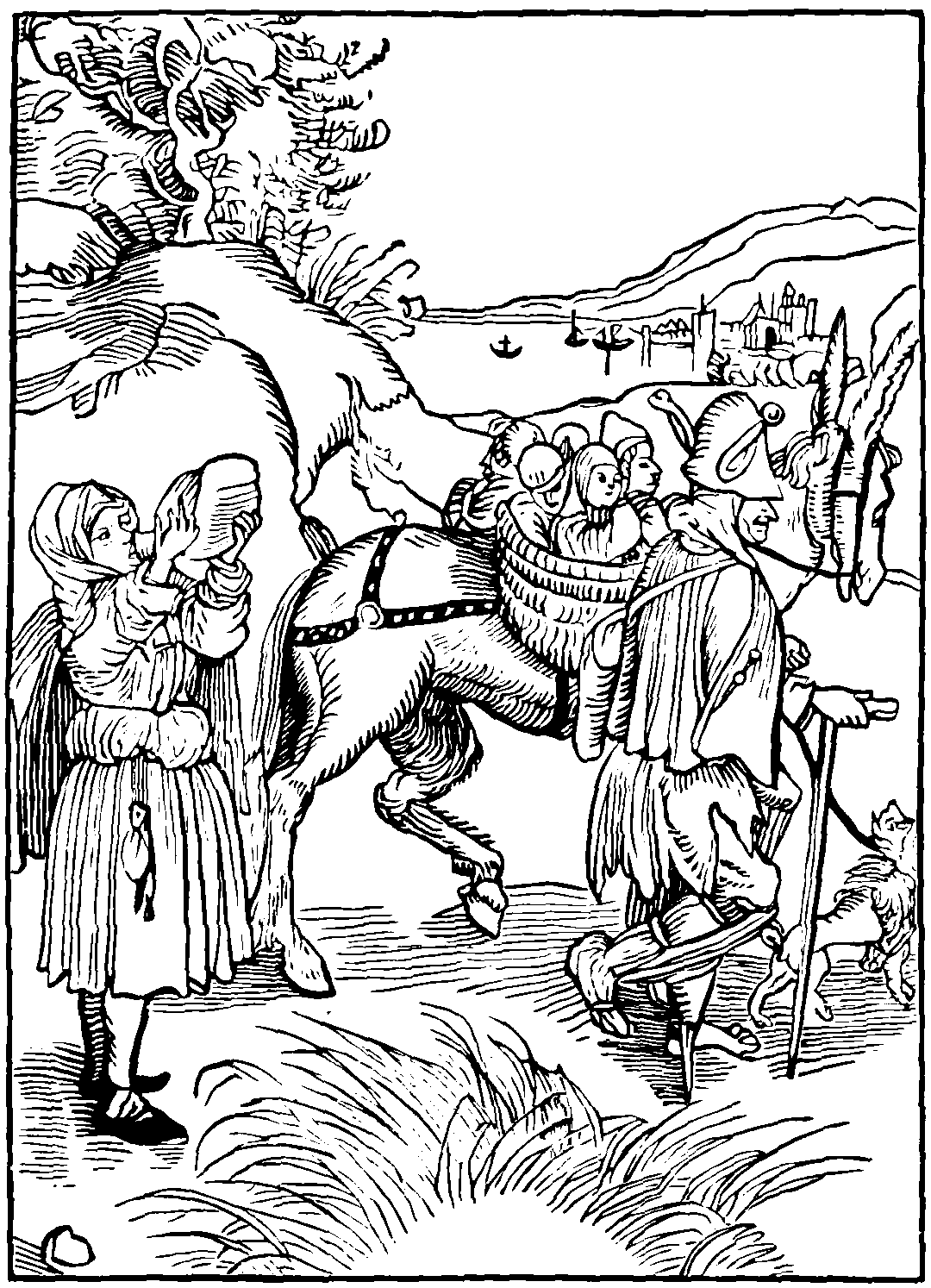
Syns I haue taken the charge one me
Mo botis and
Barges for Folys to aparayle
And so agayne of newe to take the
se
I feryd lyst company shulde me fayle
Within my folysshe
shyppis to trauayle
But nowe doth beggers them selfe to me
present
For fewe of them I fynde of good
intent
A great company of folys may we fynde
Amonge beggers, whiche haue theyr hole delyte
In theyr lewde craft: wherfore I set my mynde
In this Barge theyr maners, brefely for to write
For thoughe that nede them greuously do byte.
Yet is theyr mynde for all theyr pouerte
To kepe with them of children great plente
And though that they myght otherwyse well lyue
And get theyr lyuynge by labour and besynes
Yet fully they theyr myndes set and gyue
To lede this lyfe alway in wretchydnes
The clerke, frere, or monke, whiche hath store of ryches
For all his lyfe. if he it gyde wysely.
Wyll yet the beggers offyce occupy
Suche oft complayne the charge of pouerte
In garmentis goynge raggyd and to rent
But yet haue they of ryches great plente
Whiche in gode vse can neuer of them be spent
Almys is ordeyned by god omnypotent
And holy churche: for to be gyuyn in dede
Vnto good vse, and suche as haue moste nede
Almes is ordeyned by god our creatour
For men that lyue in nede and wretchydnes
Therwith their paynfull lyues to socour
And nat for ryche that lyues in viciousnes
But yet suche caytyfs boldly in dare pres
For their lewde lyfe without all maner drede
This almes takynge from them that haue most nede
The abbot, the Pryour, and also theyr couent
Ar so blyndyd with vnhappy couetyse
That with theyr owne can they nat be content
But to haue more, they alway mean deuyse
Ye: in so moche that some haue founde a gyse
To fayne theyr bretherne tan in captyuyte
That they may begge so by auctoryte
They fayne myracles where none were euer done
And all for lucre: some other range about
To gather and begge with some fayned pardon
And at the alehows at nyght all drynkyth out
So ren these beggers in company rowt
By stretis tauernes townes and vyllagys
No place can well be fre of theyr outragys
Some begge for byldynges, some for relyques newe
Of holy sayntis of countreys farre and strange
And with theyr wordes faynyd and vntrewe
For cause of Lucre, about they ren and range
But in a sympyll vyllage, ferme or grange
Where as these beggers moste sympyll men may fynde
With theyr fals bonys as relykes they them blynde
Other beynge stronge and full of lustynes
And yonge ynoughe to labour for theyr fode
Gyuyth theyr bodyes fully to slewthfulnes
The beggers craft thynkynge to them moost good
Some ray theyr legges and armys ouer with blood
With leuys and plasters though they be hole and sounde
Some halt as crypyls, theyr legge falsely vp bounde
Some other beggers falsly for the nonys
Disfygure theyr children god wot vnhappely
Manglynge theyr facys, and brekynge theyr bonys
To stere the people to pety that passe by
There stande they beggynge with tedyous shout and cry
There owne bodyes tournynge to a strange fassion
To moue suche as passe to pyte and compassyon
Suche yonge laddys as lusty ar of age
Myghty and stronge, and wymen in lyke wyse
Wanton and yonge and lusty of cowrage
Gyueth them selfe vtterly to this gyse
The cause is that they labour do despyse
For theyr mynde is in ydylnes to be styll
Or els in vyce to wander at theyr wyll
They paciently theyr prouertye abyde
Nat for deuocion of herte or of mynde
But to the intent that at euery tyde
Other mennys godes sholde them fede and fynde.
But if they a whyle haue ron in the wynde
And in theyr hande the staf some hete hath caught
They neuer after shall leue the beggers craft
Amonge these beggers also is comonly
Braulynge debate hatered and chydynge
Great othes, mockes falshode and enuy
And one with other euer more fyghtynge
As for theyr dronkennes and vnsure abydynge
Theyr rebaudry both in dede and communycacion
These ar chefe poyntis of theyr occupation
If the begger haue his staf and his hode
One bagge behynde and another before
Than thynkes he hym in the myddes of his goode
Thoughe that his clothes be raggyd and to tore
His body nere bare he hath no thought therfore
And if some man cloth them well to day
To morowe it shall agayne be solde away
And if these caytyfes fortune to begge or cry
For mete or money, on woman or on man
If one to them that, that they aske deny
And so depart: anone these beggers than
Whan he is gone, doth wary curse and ban
And if another gyue them ought of pyte
At the next alestake dronken shall it be
But if that I sholde gather in my barge
All folysshe beggers, and labour or intende
To note all theyr vyces, to sore sholde be the charge
And as I suppose I neuer sholde make an ende.
Wherfore I counsell them shortly to amende
Or els theyr lewdnes, synne, and enormyte
Shall cause men withdrawe theyr almes of charyte
Thenuoy of Barclay the translatour.
O people vnthrifty gyuen to ydlenes
Spendynge your youth this wyse in vanyte
What ioy haue ye to lyue in wretchydnes
Where ye myght come to better rowme and degre
By worke, and labour: and so auaunsyd be
Yet begge ye styll hauynge your ioy therin
Amende your foly, and lerne ye this of me
That goddes good sholde nat be spent in syn
End of Project Gutenberg's The Ship of Fools, Volume 1, by Sebastian Brandt

*** END OF THIS PROJECT GUTENBERG EBOOK THE SHIP OF FOOLS, VOLUME 1 ***

***** This file should be named 20179-h.htm or 20179-h.zip *****
This and all associated files of various formats will be found in:
        http://www.gutenberg.org/2/0/1/7/20179/

Produced by Frank van Drogen, Keith Edkins and the Online
Distributed Proofreading Team at http://www.pgdp.net (This
file was produced from images generously made available
by The Internet Archive/Canadian Libraries)


Updated editions will replace the previous one--the old editions
will be renamed.

Creating the works from public domain print editions means that no
one owns a United States copyright in these works, so the Foundation
(and you!) can copy and distribute it in the United States without
permission and without paying copyright royalties.  Special rules,
set forth in the General Terms of Use part of this license, apply to
copying and distributing Project Gutenberg-tm electronic works to
protect the PROJECT GUTENBERG-tm concept and trademark.  Project
Gutenberg is a registered trademark, and may not be used if you
charge for the eBooks, unless you receive specific permission.  If you
do not charge anything for copies of this eBook, complying with the
rules is very easy.  You may use this eBook for nearly any purpose
such as creation of derivative works, reports, performances and
research.  They may be modified and printed and given away--you may do
practically ANYTHING with public domain eBooks.  Redistribution is
subject to the trademark license, especially commercial
redistribution.


*** START: FULL LICENSE ***

THE FULL PROJECT GUTENBERG LICENSE
PLEASE READ THIS BEFORE YOU DISTRIBUTE OR USE THIS WORK

To protect the Project Gutenberg-tm mission of promoting the free
distribution of electronic works, by using or distributing this work
(or any other work associated in any way with the phrase "Project
Gutenberg"), you agree to comply with all the terms of the Full Project
Gutenberg-tm License (available with this file or online at
http://gutenberg.org/license).


Section 1.  General Terms of Use and Redistributing Project Gutenberg-tm
electronic works

1.A.  By reading or using any part of this Project Gutenberg-tm
electronic work, you indicate that you have read, understand, agree to
and accept all the terms of this license and intellectual property
(trademark/copyright) agreement.  If you do not agree to abide by all
the terms of this agreement, you must cease using and return or destroy
all copies of Project Gutenberg-tm electronic works in your possession.
If you paid a fee for obtaining a copy of or access to a Project
Gutenberg-tm electronic work and you do not agree to be bound by the
terms of this agreement, you may obtain a refund from the person or
entity to whom you paid the fee as set forth in paragraph 1.E.8.

1.B.  "Project Gutenberg" is a registered trademark.  It may only be
used on or associated in any way with an electronic work by people who
agree to be bound by the terms of this agreement.  There are a few
things that you can do with most Project Gutenberg-tm electronic works
even without complying with the full terms of this agreement.  See
paragraph 1.C below.  There are a lot of things you can do with Project
Gutenberg-tm electronic works if you follow the terms of this agreement
and help preserve free future access to Project Gutenberg-tm electronic
works.  See paragraph 1.E below.

1.C.  The Project Gutenberg Literary Archive Foundation ("the Foundation"
or PGLAF), owns a compilation copyright in the collection of Project
Gutenberg-tm electronic works.  Nearly all the individual works in the
collection are in the public domain in the United States.  If an
individual work is in the public domain in the United States and you are
located in the United States, we do not claim a right to prevent you from
copying, distributing, performing, displaying or creating derivative
works based on the work as long as all references to Project Gutenberg
are removed.  Of course, we hope that you will support the Project
Gutenberg-tm mission of promoting free access to electronic works by
freely sharing Project Gutenberg-tm works in compliance with the terms of
this agreement for keeping the Project Gutenberg-tm name associated with
the work.  You can easily comply with the terms of this agreement by
keeping this work in the same format with its attached full Project
Gutenberg-tm License when you share it without charge with others.

1.D.  The copyright laws of the place where you are located also govern
what you can do with this work.  Copyright laws in most countries are in
a constant state of change.  If you are outside the United States, check
the laws of your country in addition to the terms of this agreement
before downloading, copying, displaying, performing, distributing or
creating derivative works based on this work or any other Project
Gutenberg-tm work.  The Foundation makes no representations concerning
the copyright status of any work in any country outside the United
States.

1.E.  Unless you have removed all references to Project Gutenberg:

1.E.1.  The following sentence, with active links to, or other immediate
access to, the full Project Gutenberg-tm License must appear prominently
whenever any copy of a Project Gutenberg-tm work (any work on which the
phrase "Project Gutenberg" appears, or with which the phrase "Project
Gutenberg" is associated) is accessed, displayed, performed, viewed,
copied or distributed:

This eBook is for the use of anyone anywhere at no cost and with
almost no restrictions whatsoever.  You may copy it, give it away or
re-use it under the terms of the Project Gutenberg License included
with this eBook or online at www.gutenberg.org

1.E.2.  If an individual Project Gutenberg-tm electronic work is derived
from the public domain (does not contain a notice indicating that it is
posted with permission of the copyright holder), the work can be copied
and distributed to anyone in the United States without paying any fees
or charges.  If you are redistributing or providing access to a work
with the phrase "Project Gutenberg" associated with or appearing on the
work, you must comply either with the requirements of paragraphs 1.E.1
through 1.E.7 or obtain permission for the use of the work and the
Project Gutenberg-tm trademark as set forth in paragraphs 1.E.8 or
1.E.9.

1.E.3.  If an individual Project Gutenberg-tm electronic work is posted
with the permission of the copyright holder, your use and distribution
must comply with both paragraphs 1.E.1 through 1.E.7 and any additional
terms imposed by the copyright holder.  Additional terms will be linked
to the Project Gutenberg-tm License for all works posted with the
permission of the copyright holder found at the beginning of this work.

1.E.4.  Do not unlink or detach or remove the full Project Gutenberg-tm
License terms from this work, or any files containing a part of this
work or any other work associated with Project Gutenberg-tm.

1.E.5.  Do not copy, display, perform, distribute or redistribute this
electronic work, or any part of this electronic work, without
prominently displaying the sentence set forth in paragraph 1.E.1 with
active links or immediate access to the full terms of the Project
Gutenberg-tm License.

1.E.6.  You may convert to and distribute this work in any binary,
compressed, marked up, nonproprietary or proprietary form, including any
word processing or hypertext form.  However, if you provide access to or
distribute copies of a Project Gutenberg-tm work in a format other than
"Plain Vanilla ASCII" or other format used in the official version
posted on the official Project Gutenberg-tm web site (www.gutenberg.org),
you must, at no additional cost, fee or expense to the user, provide a
copy, a means of exporting a copy, or a means of obtaining a copy upon
request, of the work in its original "Plain Vanilla ASCII" or other
form.  Any alternate format must include the full Project Gutenberg-tm
License as specified in paragraph 1.E.1.

1.E.7.  Do not charge a fee for access to, viewing, displaying,
performing, copying or distributing any Project Gutenberg-tm works
unless you comply with paragraph 1.E.8 or 1.E.9.

1.E.8.  You may charge a reasonable fee for copies of or providing
access to or distributing Project Gutenberg-tm electronic works provided
that

- You pay a royalty fee of 20% of the gross profits you derive from
     the use of Project Gutenberg-tm works calculated using the method
     you already use to calculate your applicable taxes.  The fee is
     owed to the owner of the Project Gutenberg-tm trademark, but he
     has agreed to donate royalties under this paragraph to the
     Project Gutenberg Literary Archive Foundation.  Royalty payments
     must be paid within 60 days following each date on which you
     prepare (or are legally required to prepare) your periodic tax
     returns.  Royalty payments should be clearly marked as such and
     sent to the Project Gutenberg Literary Archive Foundation at the
     address specified in Section 4, "Information about donations to
     the Project Gutenberg Literary Archive Foundation."

- You provide a full refund of any money paid by a user who notifies
     you in writing (or by e-mail) within 30 days of receipt that s/he
     does not agree to the terms of the full Project Gutenberg-tm
     License.  You must require such a user to return or
     destroy all copies of the works possessed in a physical medium
     and discontinue all use of and all access to other copies of
     Project Gutenberg-tm works.

- You provide, in accordance with paragraph 1.F.3, a full refund of any
     money paid for a work or a replacement copy, if a defect in the
     electronic work is discovered and reported to you within 90 days
     of receipt of the work.

- You comply with all other terms of this agreement for free
     distribution of Project Gutenberg-tm works.

1.E.9.  If you wish to charge a fee or distribute a Project Gutenberg-tm
electronic work or group of works on different terms than are set
forth in this agreement, you must obtain permission in writing from
both the Project Gutenberg Literary Archive Foundation and Michael
Hart, the owner of the Project Gutenberg-tm trademark.  Contact the
Foundation as set forth in Section 3 below.

1.F.

1.F.1.  Project Gutenberg volunteers and employees expend considerable
effort to identify, do copyright research on, transcribe and proofread
public domain works in creating the Project Gutenberg-tm
collection.  Despite these efforts, Project Gutenberg-tm electronic
works, and the medium on which they may be stored, may contain
"Defects," such as, but not limited to, incomplete, inaccurate or
corrupt data, transcription errors, a copyright or other intellectual
property infringement, a defective or damaged disk or other medium, a
computer virus, or computer codes that damage or cannot be read by
your equipment.

1.F.2.  LIMITED WARRANTY, DISCLAIMER OF DAMAGES - Except for the "Right
of Replacement or Refund" described in paragraph 1.F.3, the Project
Gutenberg Literary Archive Foundation, the owner of the Project
Gutenberg-tm trademark, and any other party distributing a Project
Gutenberg-tm electronic work under this agreement, disclaim all
liability to you for damages, costs and expenses, including legal
fees.  YOU AGREE THAT YOU HAVE NO REMEDIES FOR NEGLIGENCE, STRICT
LIABILITY, BREACH OF WARRANTY OR BREACH OF CONTRACT EXCEPT THOSE
PROVIDED IN PARAGRAPH F3.  YOU AGREE THAT THE FOUNDATION, THE
TRADEMARK OWNER, AND ANY DISTRIBUTOR UNDER THIS AGREEMENT WILL NOT BE
LIABLE TO YOU FOR ACTUAL, DIRECT, INDIRECT, CONSEQUENTIAL, PUNITIVE OR
INCIDENTAL DAMAGES EVEN IF YOU GIVE NOTICE OF THE POSSIBILITY OF SUCH
DAMAGE.

1.F.3.  LIMITED RIGHT OF REPLACEMENT OR REFUND - If you discover a
defect in this electronic work within 90 days of receiving it, you can
receive a refund of the money (if any) you paid for it by sending a
written explanation to the person you received the work from.  If you
received the work on a physical medium, you must return the medium with
your written explanation.  The person or entity that provided you with
the defective work may elect to provide a replacement copy in lieu of a
refund.  If you received the work electronically, the person or entity
providing it to you may choose to give you a second opportunity to
receive the work electronically in lieu of a refund.  If the second copy
is also defective, you may demand a refund in writing without further
opportunities to fix the problem.

1.F.4.  Except for the limited right of replacement or refund set forth
in paragraph 1.F.3, this work is provided to you 'AS-IS' WITH NO OTHER
WARRANTIES OF ANY KIND, EXPRESS OR IMPLIED, INCLUDING BUT NOT LIMITED TO
WARRANTIES OF MERCHANTIBILITY OR FITNESS FOR ANY PURPOSE.

1.F.5.  Some states do not allow disclaimers of certain implied
warranties or the exclusion or limitation of certain types of damages.
If any disclaimer or limitation set forth in this agreement violates the
law of the state applicable to this agreement, the agreement shall be
interpreted to make the maximum disclaimer or limitation permitted by
the applicable state law.  The invalidity or unenforceability of any
provision of this agreement shall not void the remaining provisions.

1.F.6.  INDEMNITY - You agree to indemnify and hold the Foundation, the
trademark owner, any agent or employee of the Foundation, anyone
providing copies of Project Gutenberg-tm electronic works in accordance
with this agreement, and any volunteers associated with the production,
promotion and distribution of Project Gutenberg-tm electronic works,
harmless from all liability, costs and expenses, including legal fees,
that arise directly or indirectly from any of the following which you do
or cause to occur: (a) distribution of this or any Project Gutenberg-tm
work, (b) alteration, modification, or additions or deletions to any
Project Gutenberg-tm work, and (c) any Defect you cause.


Section  2.  Information about the Mission of Project Gutenberg-tm

Project Gutenberg-tm is synonymous with the free distribution of
electronic works in formats readable by the widest variety of computers
including obsolete, old, middle-aged and new computers.  It exists
because of the efforts of hundreds of volunteers and donations from
people in all walks of life.

Volunteers and financial support to provide volunteers with the
assistance they need, is critical to reaching Project Gutenberg-tm's
goals and ensuring that the Project Gutenberg-tm collection will
remain freely available for generations to come.  In 2001, the Project
Gutenberg Literary Archive Foundation was created to provide a secure
and permanent future for Project Gutenberg-tm and future generations.
To learn more about the Project Gutenberg Literary Archive Foundation
and how your efforts and donations can help, see Sections 3 and 4
and the Foundation web page at http://www.pglaf.org.


Section 3.  Information about the Project Gutenberg Literary Archive
Foundation

The Project Gutenberg Literary Archive Foundation is a non profit
501(c)(3) educational corporation organized under the laws of the
state of Mississippi and granted tax exempt status by the Internal
Revenue Service.  The Foundation's EIN or federal tax identification
number is 64-6221541.  Its 501(c)(3) letter is posted at
http://pglaf.org/fundraising.  Contributions to the Project Gutenberg
Literary Archive Foundation are tax deductible to the full extent
permitted by U.S. federal laws and your state's laws.

The Foundation's principal office is located at 4557 Melan Dr. S.
Fairbanks, AK, 99712., but its volunteers and employees are scattered
throughout numerous locations.  Its business office is located at
809 North 1500 West, Salt Lake City, UT 84116, (801) 596-1887, email
business@pglaf.org.  Email contact links and up to date contact
information can be found at the Foundation's web site and official
page at http://pglaf.org

For additional contact information:
     Dr. Gregory B. Newby
     Chief Executive and Director
     gbnewby@pglaf.org


Section 4.  Information about Donations to the Project Gutenberg
Literary Archive Foundation

Project Gutenberg-tm depends upon and cannot survive without wide
spread public support and donations to carry out its mission of
increasing the number of public domain and licensed works that can be
freely distributed in machine readable form accessible by the widest
array of equipment including outdated equipment.  Many small donations
($1 to $5,000) are particularly important to maintaining tax exempt
status with the IRS.

The Foundation is committed to complying with the laws regulating
charities and charitable donations in all 50 states of the United
States.  Compliance requirements are not uniform and it takes a
considerable effort, much paperwork and many fees to meet and keep up
with these requirements.  We do not solicit donations in locations
where we have not received written confirmation of compliance.  To
SEND DONATIONS or determine the status of compliance for any
particular state visit http://pglaf.org

While we cannot and do not solicit contributions from states where we
have not met the solicitation requirements, we know of no prohibition
against accepting unsolicited donations from donors in such states who
approach us with offers to donate.

International donations are gratefully accepted, but we cannot make
any statements concerning tax treatment of donations received from
outside the United States.  U.S. laws alone swamp our small staff.

Please check the Project Gutenberg Web pages for current donation
methods and addresses.  Donations are accepted in a number of other
ways including checks, online payments and credit card donations.
To donate, please visit: http://pglaf.org/donate


Section 5.  General Information About Project Gutenberg-tm electronic
works.

Professor Michael S. Hart is the originator of the Project Gutenberg-tm
concept of a library of electronic works that could be freely shared
with anyone.  For thirty years, he produced and distributed Project
Gutenberg-tm eBooks with only a loose network of volunteer support.


Project Gutenberg-tm eBooks are often created from several printed
editions, all of which are confirmed as Public Domain in the U.S.
unless a copyright notice is included.  Thus, we do not necessarily
keep eBooks in compliance with any particular paper edition.


Most people start at our Web site which has the main PG search facility:

     http://www.gutenberg.org

This Web site includes information about Project Gutenberg-tm,
including how to make donations to the Project Gutenberg Literary
Archive Foundation, how to help produce our new eBooks, and how to
subscribe to our email newsletter to hear about new eBooks.