This eBook is for the use of anyone anywhere at no cost and with
almost no restrictions whatsoever.  You may copy it, give it away or
re-use it under the terms of the Project Gutenberg License included
with this eBook or online at www.gutenberg.org
Title: Chatterbox, 1905.
Author: Various
Release Date: December 15, 2006 [eBook #20117]
Language: English
Character set encoding: ISO-8859-1
***START OF THE PROJECT GUTENBERG EBOOK CHATTERBOX, 1905.***
| Copyright, 1878, by Estes & Lauriat. | Copyright, 1879, by Estes & Lauriat. | Copyright, 1880, by Estes & Lauriat. |
| Copyright, 1881, by Estes & Lauriat. | Copyright, 1882, by Estes & Lauriat. | Copyright, 1883, by Estes & Lauriat. |
| Copyright, 1884, by Estes & Lauriat. | Copyright, 1885, by Estes & Lauriat. | Copyright, 1886, by Estes & Lauriat. |
| Copyright, 1887, by Estes & Lauriat. | Copyright, 1888, by Estes & Lauriat. | Copyright, 1889, by Estes & Lauriat. |
| Copyright, 1890, by Estes & Lauriat. | Copyright, 1891, by Estes & Lauriat. | Copyright, 1892, by Estes & Lauriat. |
| Copyright, 1893, by Estes & Lauriat. | Copyright, 1894, by Estes & Lauriat. | Copyright, 1895, by Estes & Lauriat. |
| Copyright, 1896, by Estes & Lauriat. | Copyright, 1897, by Estes & Lauriat. | Copyright, 1898, by Dana Estes & Co. |
| Copyright, 1899, by Dana Estes & Co. | Copyright, 1900, by Dana Estes & Co. | Copyright, 1901, by Dana Estes & Co. |
| Copyright, 1902, by Dana Estes & Co. | Copyright, 1903, by Dana Estes & Co. | Copyright, 1904, by Dana Estes & Co. |
| Copyright, 1905, by Dana Estes & Co. |
PRESSWORK BY
COLONIAL PRESS: C. H. SIMONDS & CO.
BOSTON, U.S.A.
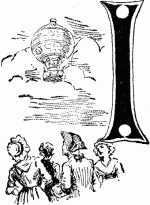
n the chimney corner of a cottage in Avignon, a man sat one day watching the smoke as it rose in changing clouds from the smouldering embers to the sooty cavern above, and if those who did not know him had supposed from his attitude that he was a most idle person, they would have been very far from the truth.
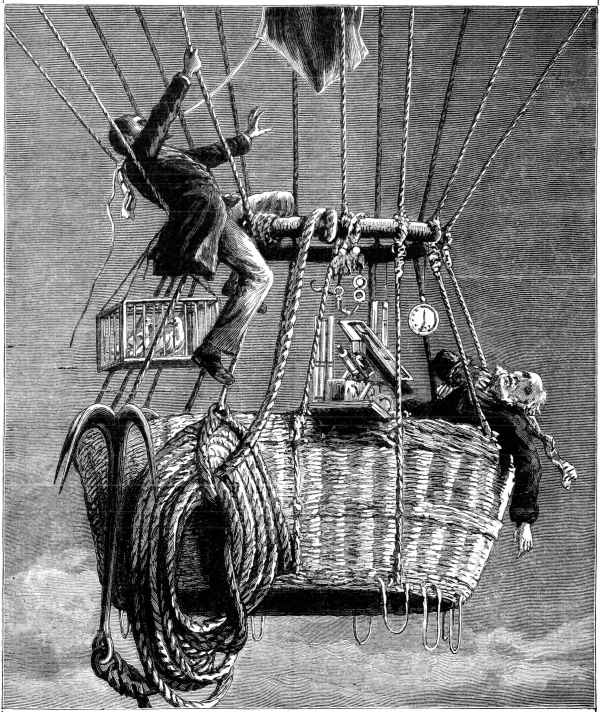
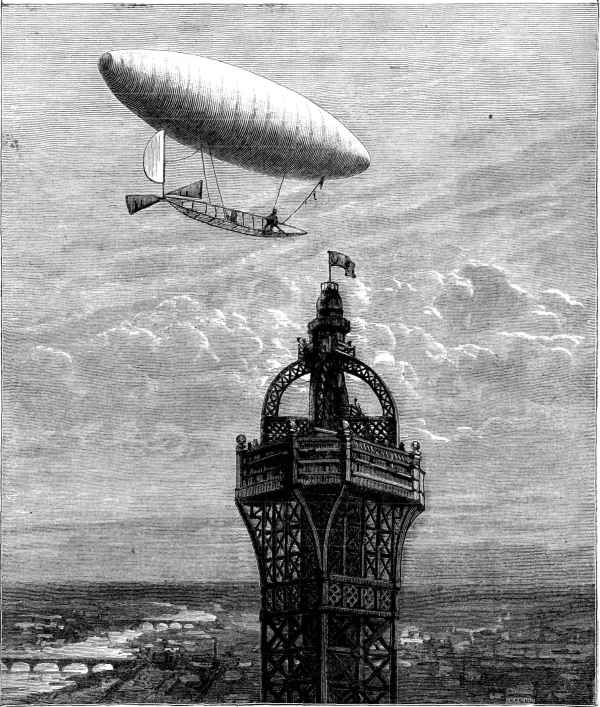
It was in the days when the combined fleets of Europe were thundering with cannon on the rocky walls of Gibraltar, in the hope of driving the English out, and, the long effort having proved in vain, Joseph Montgolfier, of whom we have spoken, fell to wondering, as he sat by the fire, how the great task could be accomplished.
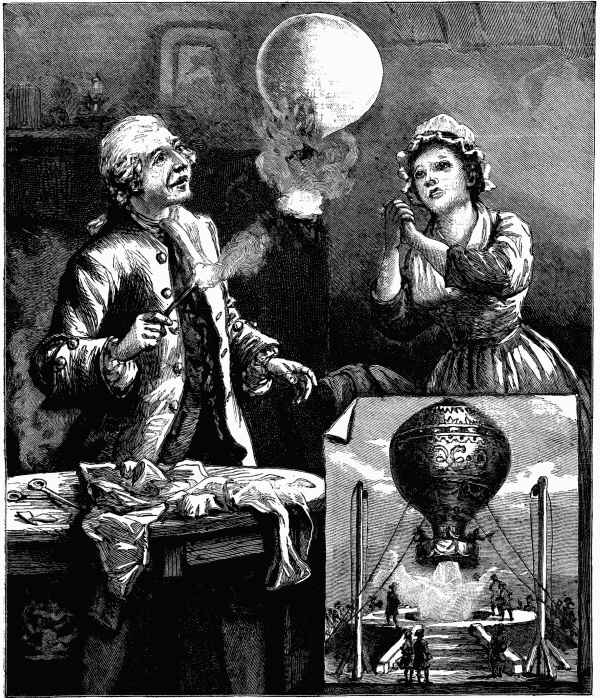
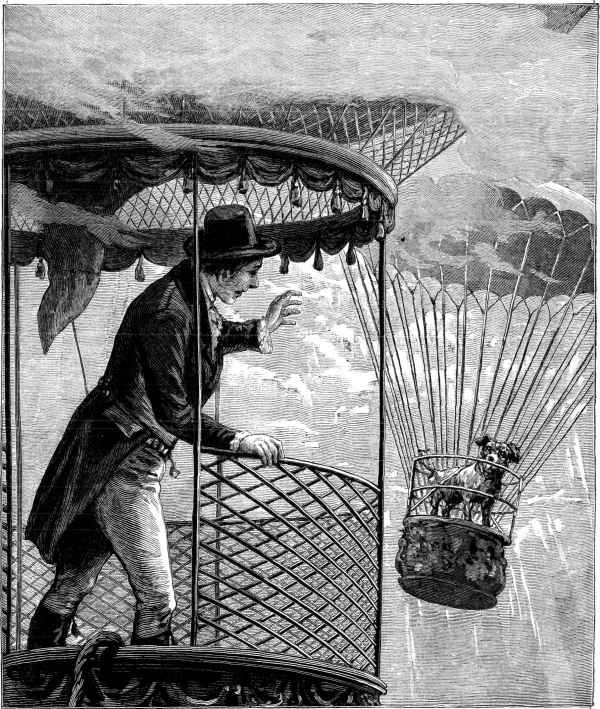
'If the soldiers and sailors could only fly,' he thought, 'there would be no difficulty.' He looked at a picture of the Rock lying on the table beside him, and saw many places on its summit very suitable for such flying foes to settle on. 'But, ah! who could give them wings?' He turned to the fireplace, and his eyes fell once more on the column of smoke, silently, silently rising; and yet not so silently as the world might think, for though he had not yet quite understood its meaning, Joseph Montgolfier had been striving for some time past to learn the lesson which he felt sure it was to teach him at last. And to-day the secret came out. Thoughts so active as his did not take long to get from Gibraltar back to the smoke, and they had not been there many minutes when Montgolfier jumped from his seat, and, throwing open the door of the room, called to his landlady. A great idea had occurred to him, and, to carry it out, he required some light, silky material, called taffeta. This the good landlady quickly supplied, and when she entered the room some time later, she found her lodger holding the taffeta, which he had formed into a bag, over the fire. As the smoke filled it, it certainly showed an inclination to rise, but once out of reach of the warmest glow it toppled over and collapsed on the floor.
The landlady watched the experiments for some time in silence. Then, with a little laugh, she said, 'Ah, M. Montgolfier, why do you not tie the fire to the bag?'
The great inventor had not thought of that; but he did not require to be told twice, and obtaining a little bunch of some inflammable material, he tied it under his bag and set it on fire. The smoke and heat inflated the tiny balloon, and it rose at once to the ceiling. A few minutes later the inventor called for pen and ink, and wrote the following letter:
'Prepare without delay a supply of taffeta and cordage, and you shall see one of the most astonishing things in the world.'
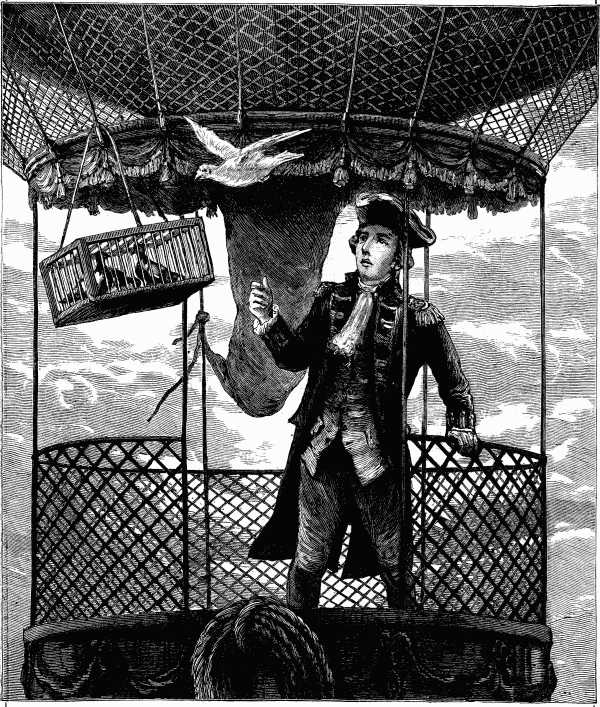
This hasty note was addressed to M. Stephen Montgolfier at Annonay, near Lyons, and never was a request made that was more likely to be carefully and promptly granted. Stephen Montgolfier, like his brother, had busy thoughts concerning means for rising in the air, and when Joseph returned from Avignon, they set to work with stronger hope of realising their dreams. As they were the largest and best paper-makers in Annonay, they did not lack material for carrying on experiments, and when these experiments had repeatedly resulted in success, they decided that the rest of the world should be admitted into their secret. A large balloon, made of paper and taffeta, should be inflated in the public square, and be allowed to rise before the eyes of any who might gather there to see it. And they carried out this determination on June 5th, 1783. On that day there assembled at Annonay a number of local celebrities, and no better opportunity could have been chosen.
In the public square a large circular space was railed off to keep the crowd at a proper distance, and in the centre of this space rose a wooden platform to accommodate the new cloud-ship and the fire which was to fill it with the power of flight. Never had the brothers Montgolfier had a busier morning; never had the good people of Annonay seen such excitement in their quiet village. The crowd had gathered from far and near, and watched the busy workers round the mysterious platform with widely different thoughts. Some were silent with expectation, some jeered noisily; but, unconscious of praise or laughter, the two brothers directed their little band of workmen, confident of coming triumph.
At last the specially invited guests had all arrived, and when they were accommodated with seats, one of the brothers made a little speech of explanation, ending with the remark that he would apply a torch to the heap of chopped straw and wool beneath the platform. The smoke arising from these different kinds of fuel formed, when combined, he said, the most suitable gas for raising a substance into the air. These diligent brothers, however, had only partly learned the truth as yet, or they would have known that it was the heat, and not the smoke, which lifted the paper bag.
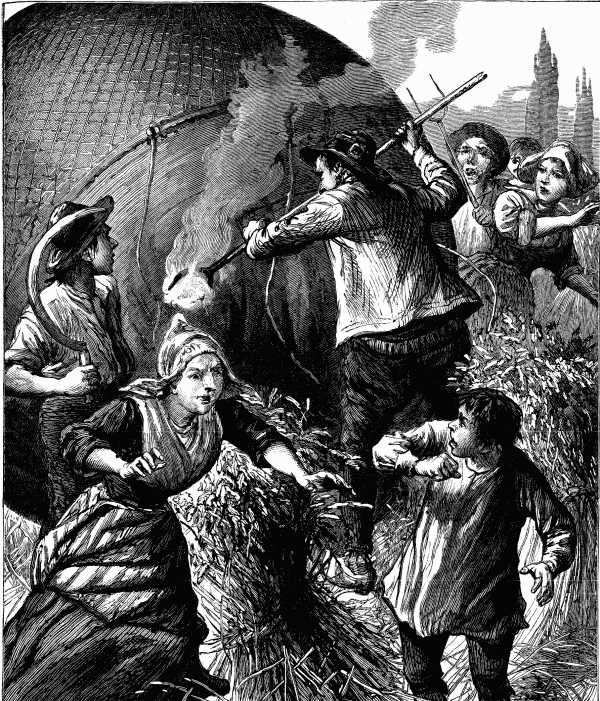
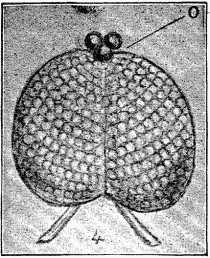
The torch was put to the straw, the yellow flames leapt up, and the smoke, passing through a hole in the platform, entered the open end of the globe-shaped bag, which up to the present had, of course, been lying flat and empty. Instantly a paper dome seemed to rise from the platform. This continued to grow in size, while the workmen stood round in a ring, each holding a rope which passed to the top of the dome. The ropes grew longer and longer as the balloon filled, and it soon became hard work to hold them. But on no account were the men to let go until the word was given.
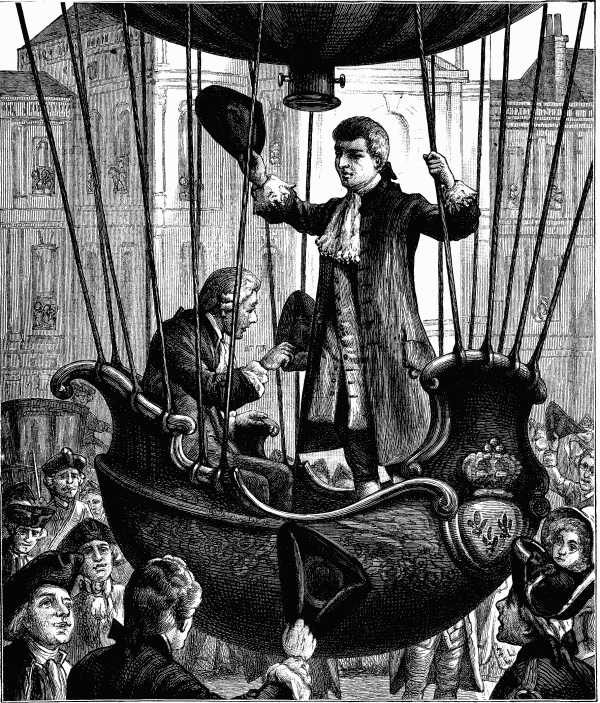
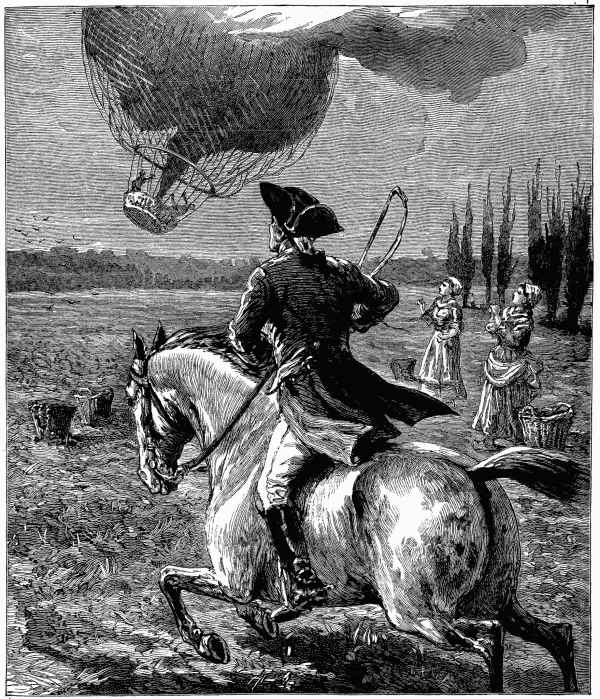
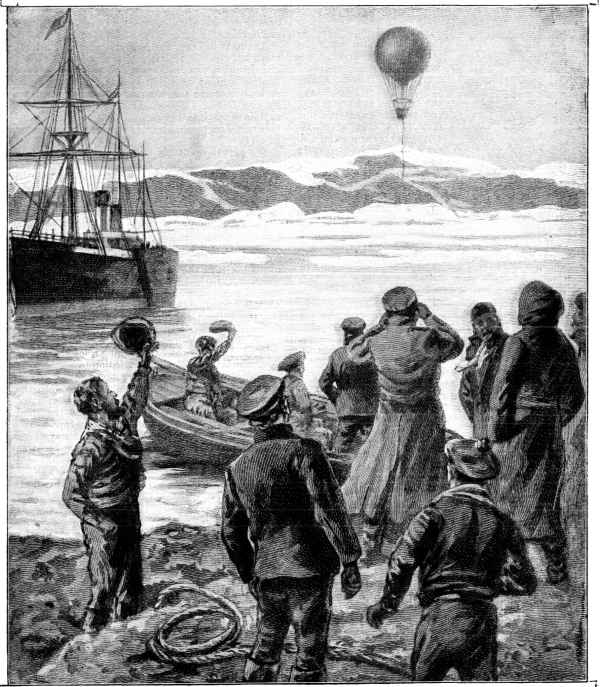
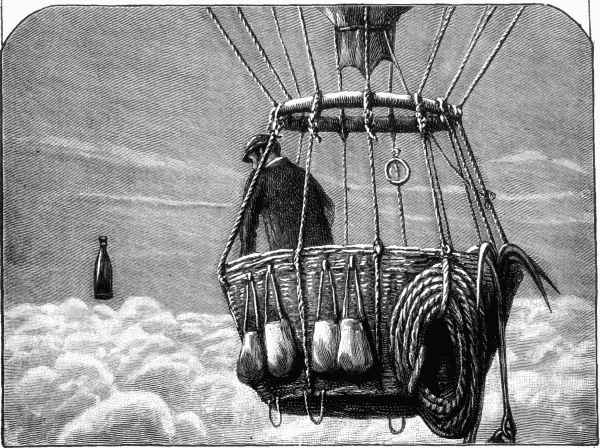
When at last the paper walls were extended to their uttermost size, the wondering spectators saw a huge ball of some one hundred and ten feet in circumference, swaying uneasily to and fro with every breath of air, as though straining at its fetters.[Pg 3] At last came the word. The ropes were released, and the great body rose rapidly into the air, followed by a thunder of applause. With straining eyes the crowd followed that wondrous flight. Higher and higher, nearer and nearer to the clouds, till what a few moments before was so very imposing in size seemed no bigger than a child's plaything. Then, caught in a current of air, it drifted out of sight for ever.
Such was the launching of the first ship in the new navigation of the clouds. On the place from which it started a handsome monument has been erected, bearing the names of the two builders—Joseph and Stephen Montgolfier—the brothers who always worked together, sharing equally the fame that their discovery brought, and never selfishly seeking for self-advancement. Recent searchings seem to show that the principal honour is due to Joseph, the elder, and, if one of the many stories told in detail (and repeated at the beginning of this article) may be relied upon, surely we ought to also remember with some praise the unknown woman who let lodgings in Avignon.
John Lea.
 wish I could win one!' a lassie was sighing,
D. H.
Prince, the parrot, was a proud and happy bird; he was proud of his gorgeous red and green feathers, of his ability to say 'Pretty Poll' and 'How do?' and, above all, of his fine gilded cage, which stood just inside the breakfast-room window.
But, in an evil hour, Prince, watching the birds which flew to and fro outside the glass, was struck with a desire for freedom. He thought no more of his splendid feathers, or his handsome cage; but, from morning till night, he wondered how he should get out. There was not wit enough in his parrot brain to make him understand that the cold English garden was not in the least like the flowery forest of his native island.
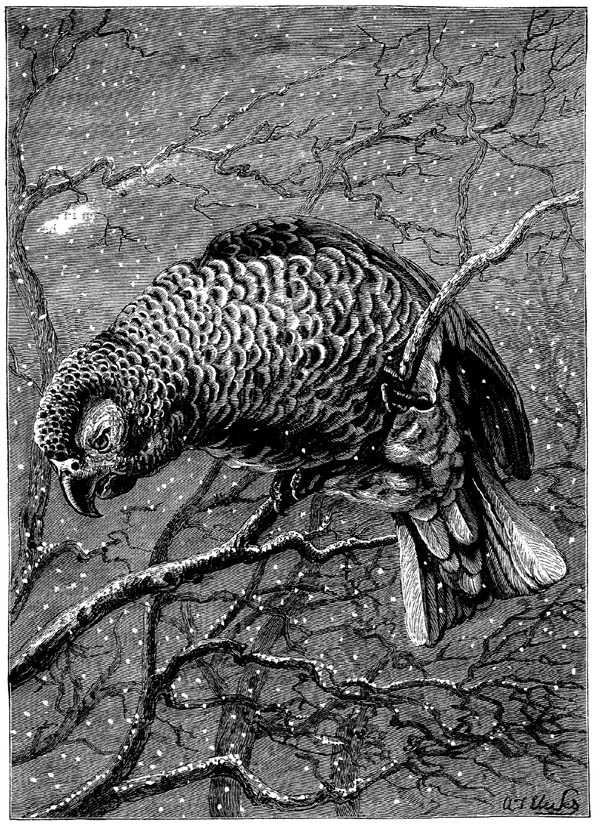
His chance came one snowy morning; the French window had been opened, after breakfast, that some one might go out and scatter crumbs for the robins. The cage-door happened to be open too. Unobserved, Prince darted swiftly out, and perched amid the leafless boughs of one of the high trees on the lawn.
He was free! but, oh, how cold it was! How wretched he was already beginning to feel! He crouched shivering on a bough; and when the snow began to fall again in large, wet flakes, he was more miserable than he had ever been in all his petted life.
Paralysed with cold and fear, he clung to the tree, too unhappy even to cry out and let people know where he was.
Poor Prince! he must soon have died if some one had not noticed the empty cage. The alarm was given at once, but it was some time before the bird was seen on his lofty perch.
When they did see him, and everybody called and coaxed 'Poor Prince! dear Prince!' to come down, he was too stupefied with cold and misery to do as he was told.
At last Tom, the page-boy, volunteered to climb the tree and try to reach Prince. It was rather a dangerous task, as the bark was slippery from the frost and snow; but Tom persevered, and, by dint of much effort, got hold of the parrot.
Prince was restored to his cage, but he had caught a bad cold, and never again held up his head as jauntily, or seemed as proud of himself, as he had done in former days.
C. J. BLAKE.
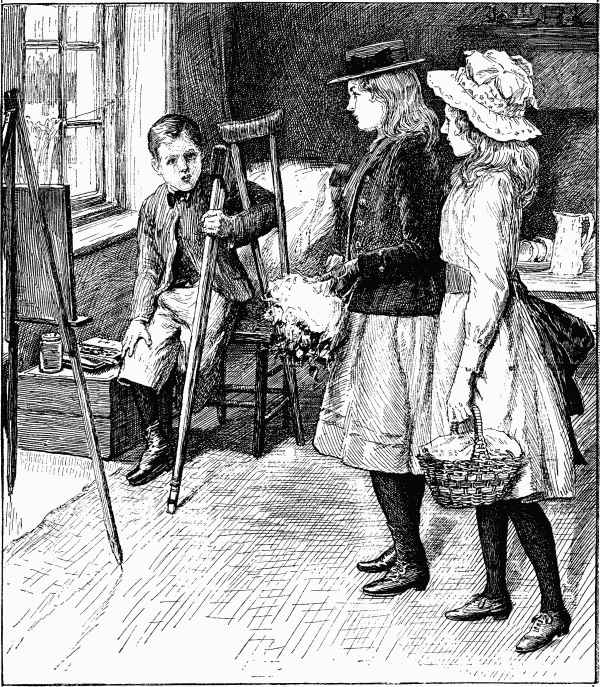
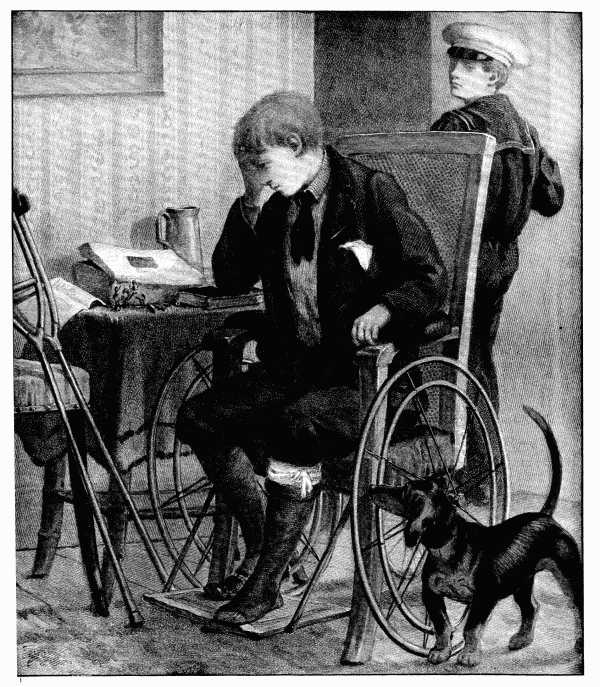
Willie Mortimer was a cripple, but he did not often complain of his lot, nor, as a rule, did he feel very unhappy about it. His love for drawing and painting was such a resource to him, that when he could hobble on his crutches down to the shore, he was never tired of watching the sea and the boats, and of trying to make sketches which he could work up into pictures at home, as he sat in the window of the little cottage.
But it was a year since the accident which had made the amputation of his leg a necessity, and for the first time Willie's cheerfulness was beginning to forsake him. He could not help noticing how worn and anxious his mother looked, and he knew how hard it was for her to earn enough money, by her plain sewing, to keep up the little house. Until the previous summer she had let lodgings, but she could not manage it when she was nursing Willie, and waiting on him after he left the hospital, and this year no people had applied for her rooms yet.
One of her former lodgers had been an artist, and it was he who, being struck with Willie's talent, had given him instruction, and taught him all he knew about art. But the boy was now thirsting for more knowled[Pg 4]ge. If only he could be trained to be an artist! That was his dream, and often he would sit at his little window, looking over the blue waters of the bay, while his eyes would fill with tears as he thought how impossible it was for a little ignorant boy to paint pictures which would have any beauty.
His pathetic face attracted Dora and Elsie Vaughan as they passed the cottage every day. They were having a perfectly lovely time in this Devonshire village, where their father had taken a house for the summer holidays. Mr. Vaughan was a celebrated artist, and Willie would watch him eagerly as he passed with his canvas and sketching materials, and would long for a sight of the pictures which would soon be so famous.
'That poor little cripple boy does look sad,' Dora said to her sister. 'I think we ought to go and visit him and take him some flowers.'
'But he is not always a prisoner,' Elsie answered. 'I see him on the beach sometimes with his crutches, and he is often trying to sketch boats and things.'[Pg 5]
'Anyway it must be dull for him, and we might cheer him up a little,' Dora persisted.
'It is rather tiresome, though, when there are such heaps of lovely things to do, and the holidays do fly so quickly,' Elsie argued, for she was not as unselfish as her sister, and did not much care to give up her own pleasure.
However, Dora had her way, for Elsie knew from former experience that if she were really set on a thing, it saved trouble to give in at once and make[Pg 6] the best of it. She even found a box of chocolates not quite empty, and with the sweets that were left, and some of Dora's, was able to fill a smaller box. Then they begged some cakes from the cook, and hunted up a couple of story-books from the number they had brought with them, and in the end had quite a well-filled basket for Elsie to carry. Dora picked a bunch of roses and then they set out for the cottage.
When they arrived Willie was sitting before his easel, looking sadly at his latest attempt at a picture, and thinking how poor it was compared with the scene his imagination painted. He was so shy and so much overcome by the honour of their visit that he could hardly find words to welcome them, but the girls' exclamations of delight when they saw his picture soon set him at ease.
'How lovely!' Dora cried. 'Did you really paint it yourself?'
'I have watched you sketching on the beach, but I never thought you were so clever,' Elsie told him, and Willie blushed with pleasure at their praise.
Then he opened the box on which his painting materials stood, and showed them all the pictures and sketches he had done in the past year.
'You see, Miss,' he said to Dora, 'now I cannot get about much, it passes the time; but I do wish I had somebody to tell me all the faults in them, and help me to do better.'
'We must bring Father to see them; he will not be backward about pointing out faults,' said Elsie, laughing, 'though I cannot find any myself.'
'But Mr. Vaughan is such a great artist, he would never look at my poor little pictures,' Willie said, flushing at the very thought.
'He may be a great artist, but he is a very kind father,' Elsie told him, 'and he nearly always does what we ask him.'
Certainly he did not disappoint his daughters this time. Moreover, he was amazed at the progress the boy had made with so little help, and saw that he was worth training.
'Your son has great natural talent,' he said to Willie's mother. 'I am even inclined to think he may be a genius. You must allow me to make it easy for him to be trained in the best schools.'
And so poor crippled Willie, instead of being a burden to his mother, became her pride and joy, beginning a career which was one day to make him even more famous than the artist who had given him a helping hand.
M. H.
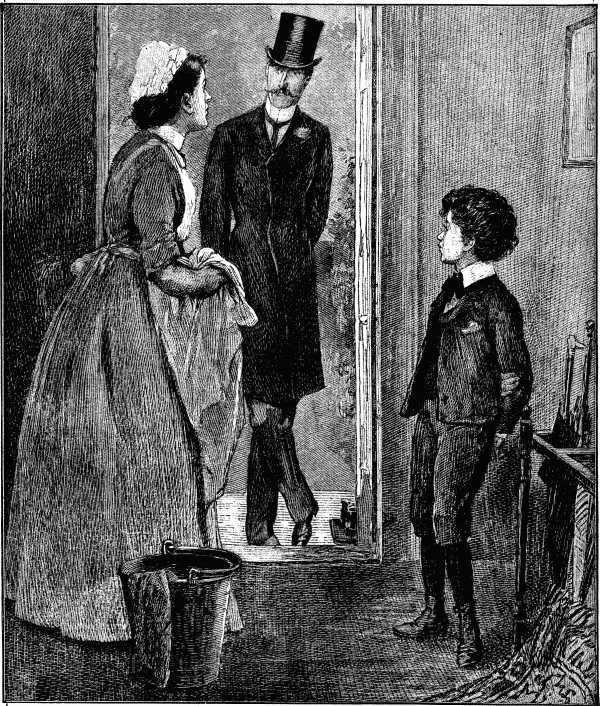
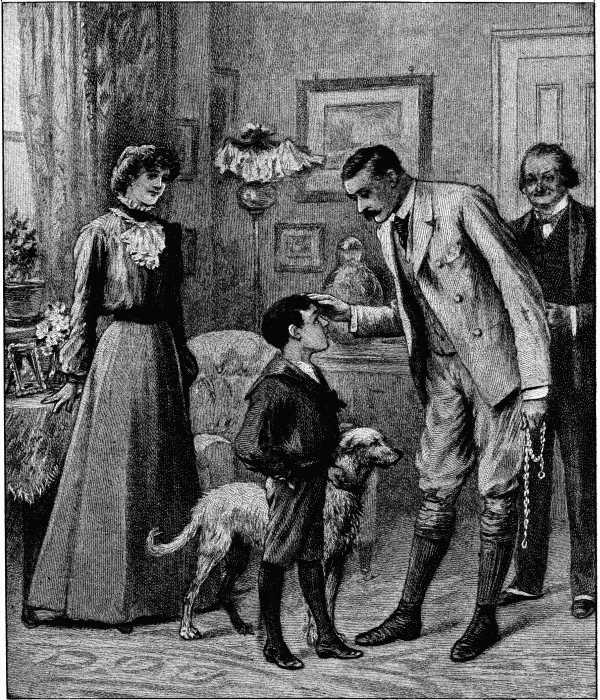
The first time I saw Captain Knowlton, we were living in lodgings at Acacia Road, Saint John's Wood. My Aunt Marion had breakfasted in bed, and I, having nothing better to do, wandered downstairs to what our landlady called the 'hall,' where I stood watching Jane as she dipped a piece of flannel into her pail, and smacked it down noisily on to the oilcloth, until there was a loud ringing of the street-door bell.
As Jane rose from her knees, rubbing her red hands on her apron, I edged along the passage, keeping touch of the wall, and staring unabashed at the tall, well-dressed, distinguished-looking visitor.
'Does Miss Everard live here?' he inquired.
'Yes, sir,' answered Jane.
'I should like to see her.'
'Master Jack!' cried Jane, 'do you know if your aunt has come down yet?'
But as I was on the point of running upstairs to find out, the visitor called me back.
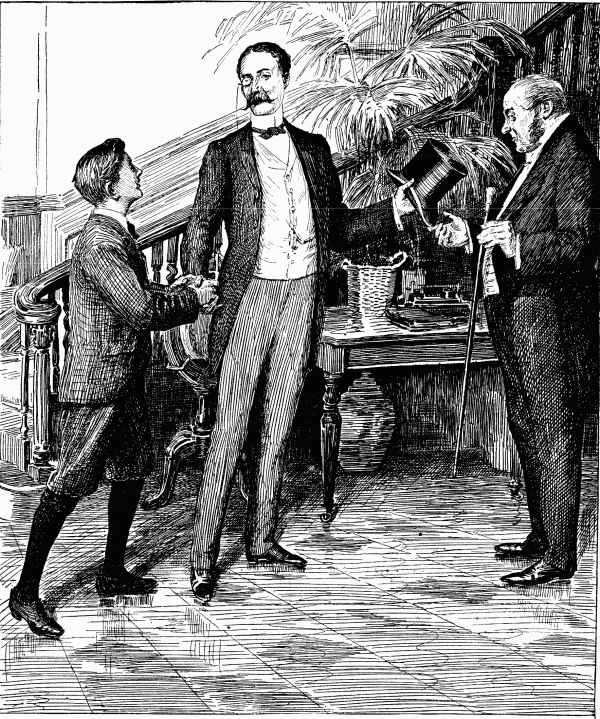
'Half a second,' he said. 'Are you young Everard?'
'Yes,' I replied; and fixing an eyeglass in his left eye, he looked at me with considerable curiosity.
'Tell your aunt,' he continued, 'that Captain Knowlton wishes to see her.'
And upon that I ran off, shouting, 'Aunt Marion! Aunt Marion!' at the top of my voice. 'Aunt Marion,' I repeated, entering the sitting-room, 'Captain Knowlton is downstairs, and he wants to speak to you.'
'Captain Knowlton!' she murmured.
'Shall I bring him up?' I asked.
Rising from the sofa, and laying down the newspaper which she had been reading, Aunt Marion walked towards the door. She must have been near her thirty-fifth year at that time, about the same age as our visitor. She was tall, fair, and nice-looking, good-tempered, and perhaps a little careless. That morning she was wearing a light blue dressing-gown, although it was past eleven o'clock.
'Yes, bring Captain Knowlton up,' she answered, and ask him to wait a few minutes.'
As she went to the bedroom, I returned to the street door, where Captain Knowlton stood gazing at Jane as she continued to smack the oilcloth with her wet flannel.
'You are to come upstairs,' I cried, and following me to the sitting-room, he sat down and began to stare afresh.
'So you are poor Frank Everard's boy!' he said.
'Did you know my father?' I demanded, for I had no recollection of either parent, or of any relative with the exception of Aunt Marion, under whose charge I had moved about from lodging-house to lodging-house since I was four years of age.
'Well,' said Captain Knowlton, 'if I had not known him, I should not be here to-day.'
He became silent for a few moments, and then added, as he took my hand and drew me against his knee, 'Your father once saved my life, Jack. How old are you?' he asked.
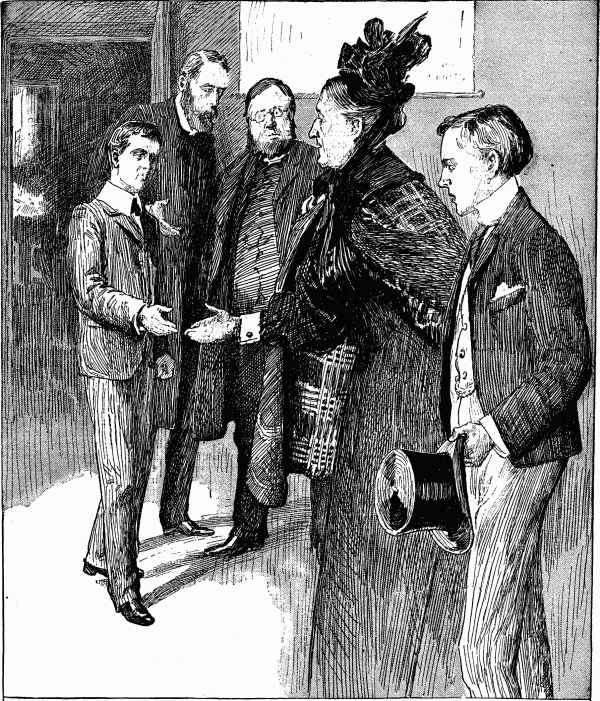
'Eleven next month,' I replied, and, somewhat to my disappointment, Aunt Marion entered the room as I spoke, wearing the dress in which she went to church on Sundays.
'I have often heard of you, Captain Knowlton,' she said, as he rose from his chair, 'although I have never seen you before.'
'Oh, well,' he answered, 'I have been in India the last five years! I came home last week, and from a few words I heard at the club, I gathered that poor Frank Everard's boy——'
Aunt Marion's cheeks flushed, and she held her head a little further back.[Pg 7]
'I have done the best I could for him,' she exclaimed.
'I am certain of that,' he continued; 'but, anyhow, I made inquiries, and, after some difficulty, succeeded in discovering your address. Perhaps,' he added, glancing in my direction, 'you would not mind sparing me a few minutes alone.'
To my great disgust, she told me to run away, so that I returned to the damp passage, which was now deserted by Jane. After waiting there what seemed a long time, I saw Captain Knowlton on the stairs. After bidding me good-bye, he let himself out of the house.
'Aunt Marion!' I cried, before there was time to reach the sitting-room, 'he says that Father saved his life!'
'Well, Jack, he said what was quite true.'
'But,' I continued, 'why did Captain Knowlton call father "poor Frank Everard?" Was he really poor?'
Aunt Marion sighed before she answered.
'Goodness knows, he ought not to have been,' she said. 'Your father had a lot of money when he came of age, but he was foolish enough to spend it all, and the consequence was that nothing remained for your mother, or for you when she died.'
'Hasn't Captain Knowlton any money either?' I asked.
'He has lately come into a large fortune,' she said; and then she told me that he had promised to come again at the same hour to-morrow morning, and take me out with him.
Captain Knowlton seemed so satisfactory in every way that the mere prospect of walking in the street by his side was enticing. I lay awake that night a long time, wondering where he would take me.
When I awoke the next morning, Aunt Marion said I was to put on my best clothes (which were nothing to boast of), and insisted on washing me herself, putting a quantity of soap into my eyes, oiling my hair, and, in short, doing her best in readiness for Captain Knowlton's arrival.
'Well, Jack, are you ready?' he asked, as he entered our room.
'Rather!' I answered.
'Have you got a handkerchief?' said Aunt Marion, and I drew it from my jacket as proof.
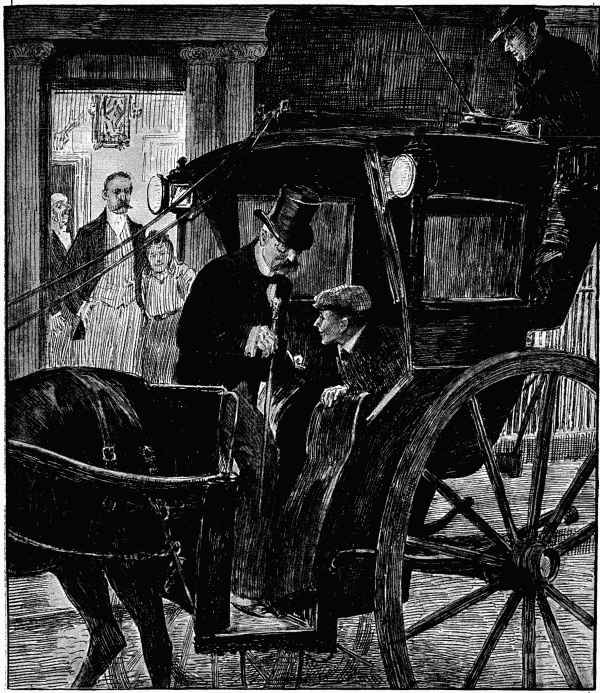
'Come along, then,' cried Captain Knowlton, and I rejoiced to see that he had kept his hansom at the door.
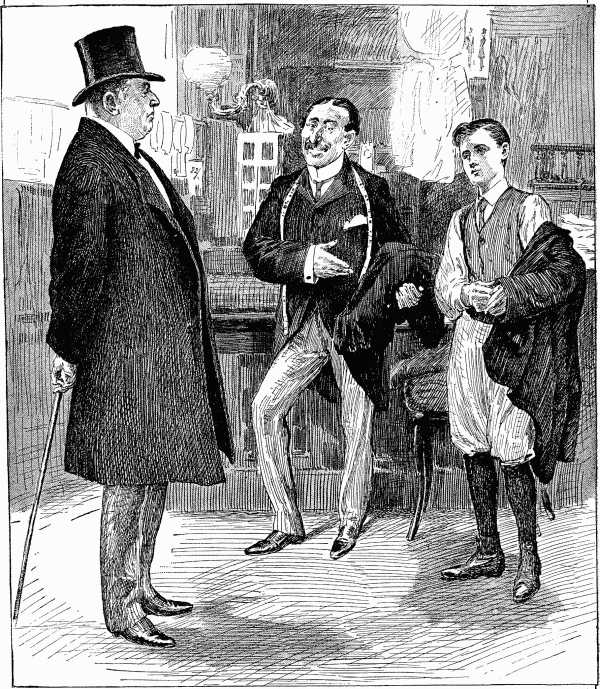
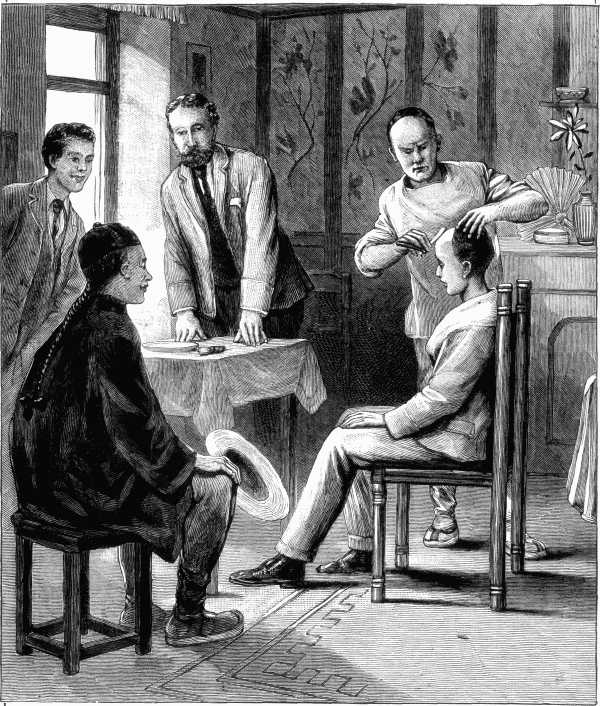
The first stoppage on that eventful morning was at the hair-dresser's, where I sat in a high chair, enveloped in a loose cotton wrapper, while Captain Knowlton smoked a cigarette and a man cut my hair, after which we went to a tailor's, where I was measured for two suits of clothes. Having visited a hatter's and a hosier's in turn, we entered a large restaurant, sitting down one on each side of a small table, Captain Knowlton leaning across it and reading the bill of fare aloud for my benefit.
'I think I will have roast turkey,' I said, after prolonged consideration, and I accordingly had it, with the accompaniment of sausage and bread sauce, to say nothing of the sweets and the ice which followed. But even what Captain Knowlton described as luncheon, and what I regarded as a kind of king of dinners, was eclipsed by what came afterwards, for we were driven to a theatre, where a comic opera was being played; and at seven o'clock that evening a very tired and sleepy boy, with his right hand tightly clenched on a half-sovereign in his jacket pocket, was deposited on the steps of the house in Acacia Road.
During the next few weeks Captain Knowlton was a frequent visitor, while, for my own part, I wished that he would come every day. One afternoon he arrived in the rain and stayed to tea.
'Now, Jack,' he said, setting down his empty cup, 'I should like to hear you read.'
But as I was bringing one of our small collection of books from the sideboard, he called me away.
'No, none of that,' he cried, with a laugh; 'something you have never seen before. Try the newspaper.'
Although I appeared to win approval by my reading of the extremely uninteresting leading article, he shook his head at the sight of my handwriting, whilst he seemed to be astounded by my total ignorance of Latin and French.
'The fact is,' he said, 'it is high time you went to boarding-school!'
Before he left the house that afternoon he had another private conversation with Aunt Marion, and a week or two later he arrived with the announcement that 'everything had been arranged.'
'Windlesham has been very strongly recommended to me,' he explained. 'The Reverend Matthew Windlesham, to give him his full title.'
'Has he a living?' inquired Aunt Marion.
'No, but he has a capital house, with a large garden and a meadow, at a place called Castlemore.'
'Where is that?'
'About a hundred miles from London. Windlesham has a wife and five daughters, and at present there are only six or seven pupils. As Jack is rather backward, it will suit him better than a larger school.'
So everything was decided, and I fancy that Aunt Marion looked forward to my departure with a satisfaction equal to my own—it could scarcely have been greater. Boys and girls were at that time an unknown quantity to us, as were most of their sports and pastimes.
It was true that there were scarcely enough of us at Ascot House for football or cricket; nevertheless we did our best in the meadow at the bottom of the garden, our scanty numbers being eked out by Mr. and Mrs. Windlesham's five girls. They were nice, kind people, and, when the first shyness had worn off, I settled down happily at Castlemore. During the next three uneventful years I received occasional visits from Captain Knowlton, while I grew greatly in stature, and, it is to be hoped, in knowledge.
The holidays were, for the most part, spent with Aunt Marion, sometimes in boarding-houses at the seaside, sometimes in London, and I had no anticipation of troubles ahead until shortly after I passed my fourteenth birthday.
(Continued on page 12.) [Pg 8]
'I wish you would tell me, Grandfather, how it was you first thought of building a lighthouse tower.'
'Well, Conrad, if you will know, you shall hear the story,' and Sir Matthew Cairns, as he said these words, looked kindly down into the bright young face uplifted to his own.
'It was twenty years ago that the thought first came to me that Cairns Castle might serve as a beacon to those far out at sea. The reason for this was that on a certain winter's night a vessel was wrecked on these shores, solely on account of there being no light to warn her of her peril. More than a hundred souls went to their doom, to the joy, it is said, of the wreckers, who made a fine harvest on the coast at daybreak.'
'Oh, Grandfather,' Conrad said with a shudder, 'how awful! Surely we have no such people about now?'
His grandfather sighed, and, to turn the subject, proceeded to explain to the little lad his method of lighting the lamp.
Cairns Castle was an ancient building which overlooked the sea, its isolated position rendering it a very lonely dwelling-place. Sir Matthew, its present possessor, though by no means a wealthy man, had spent a considerable sum of money in adding a lighthouse tower to the castle. From the window-panes shone forth a gleam so clear and brilliant, that many a gallant seaman was guided safely home thereby.
'Let me light the lamp to-night, Grandfather,' said Conrad, after listening intently to all Sir Matthew's instructions. 'Perhaps it will guide Father and Mother on their way home from India.'
'Aye, laddie, perhaps it will; the good ship Benares should be nearing our coast by this time,' was the reply.
'Then may I, Grandfather?' said Conrad.
'Yes, my boy, and I will look on to see that you do it properly.'
Ah! little did Sir Matthew think, as he said these words, of the incidents which would take place, ere the castle light should next fling its friendly rays across the sea.
The November afternoon was creeping on apace, and Sir Matthew, absorbed in thought, drew long whiffs from his pipe, as he sat over the dining-room fire. The wind was wild and stormy, and dashed against the window-pane with angry force.
Conrad, who was busy preparing his lessons for his tutor next morning, looked up anxiously. But the words he was about to say were checked by the entrance of a rough-looking man of the fisher type.
It was William Forrest, or Black Bill as he was called by his neighbours, partly on account of his swarthy appearance, and partly because of his evil deeds.
The baronet rose in surprise, wondering at his entering the room unannounced.
'Good evening, Forrest,' he said.
'Evening, master,' was the sullen reply; 'I have come on business, and I want to see you alone.'
Sir Matthew bade Conrad take his lessons into the library, whilst he spoke to his visitor. The boy obeyed, unwillingly enough, for instinctively he felt that Black Bill meant no good to his dearly loved grandfather.
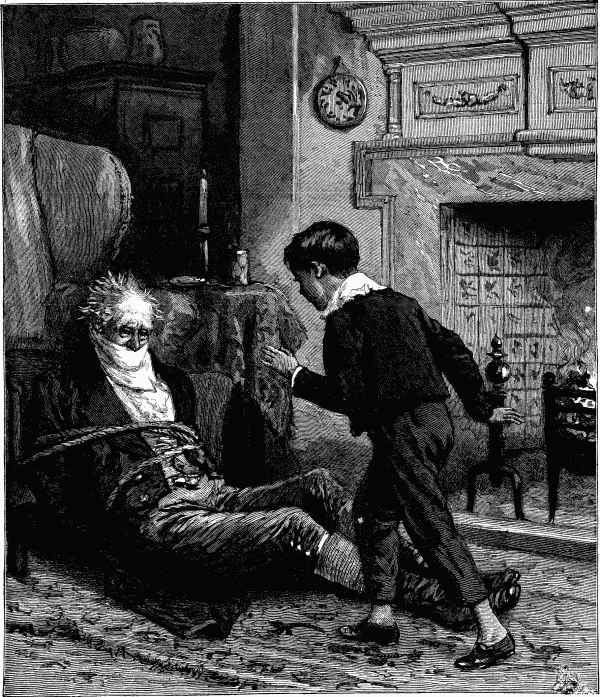
Somehow he could not give his mind to his lessons, and at length, thinking the interview must be ended, he returned to the dining-room. The sight which there met his eyes made his heart stand still with terror and alarm. His grandfather lay gagged and bound upon the floor.
It was the work of a few moments to remove the gag, and when Sir Matthew could find voice, he told the story of his attack.
Black Bill, who was in reality a wrecker, for some evil reason of his own, had endeavoured to extract from the baronet a promise not to light the lamp that night. Upon Sir Matthew's indignant refusal, he, with the aid of two colleagues who were waiting near, had next proceeded to render him helpless. They had already gagged and bound the three old servants of the castle. So massive were the walls and lengthy the passages that not a sound had reached Conrad's ears; and the men had apparently forgotten his presence in the castle.
The boy, in terrible distress of mind, tried to unloose the cords which bound his grandfather hand and foot.
'Never mind the cords, Conrad,' said the old man at last, 'they are more than you can manage. Go and light the lamp, for it is already past the hour, and may Heaven protect you.'
Conrad, sick at heart, turned to obey.
'I will do it, Grandfather,' he replied, looking fearfully around lest Black Bill and his colleagues should be listening. 'Then I will come back and help you,' he added bravely.
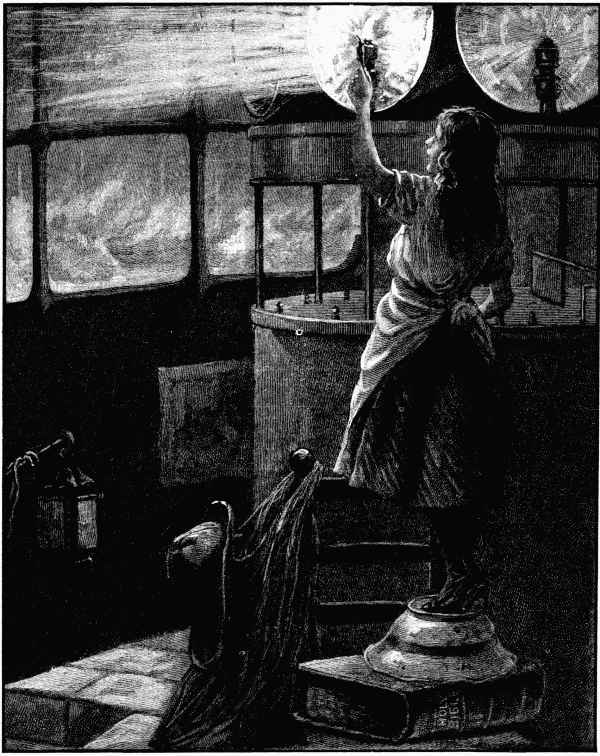
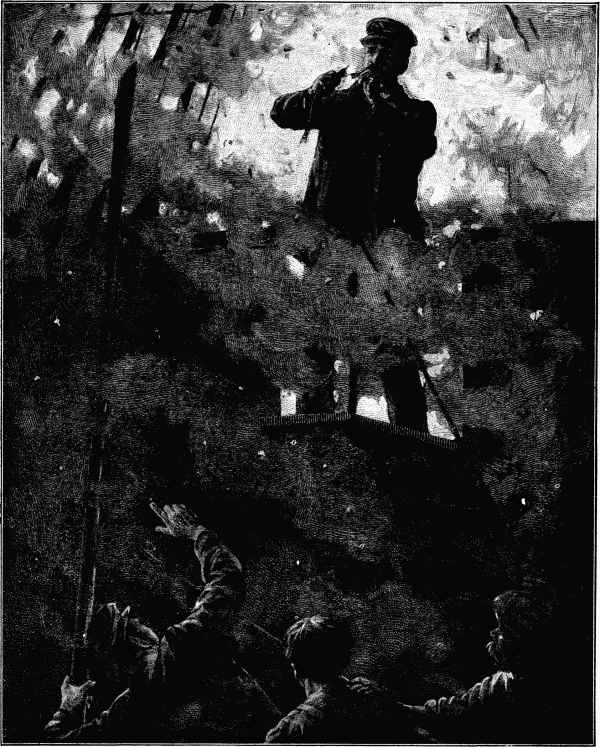
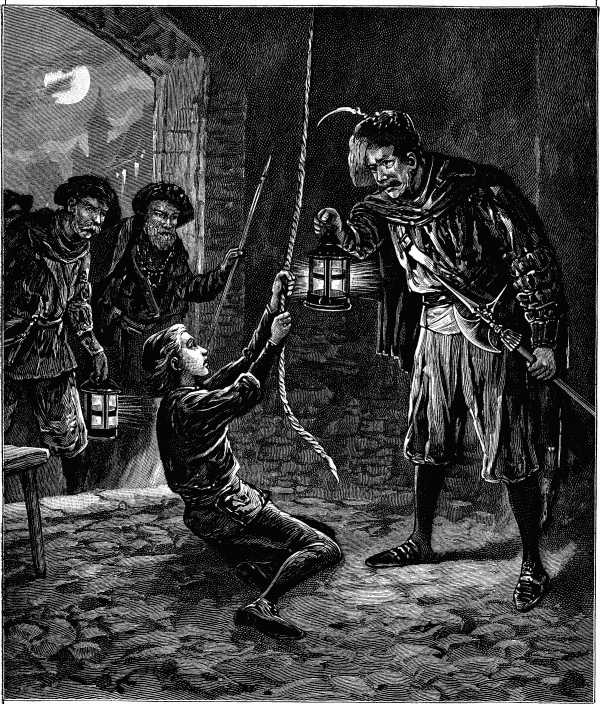
With light, fleet footsteps, the little ten-year-old laddie made his way along the passage, towards the staircase. Presently sounds fell on his ears which sent all the colour from his face. Black Bill and his comrades were talking together in a room close by, the door of which was open; and to reach the lighthouse staircase he must pass that very room. For a few minutes he crouched in shadow, too panic-stricken to move. He thought of his promise to his grandfather and of the homeward-bound Benares battling with wind and wave; then like an inspiration came the thought of Him Who stilled the waters of Galilee, and Who at this moment was watching over him.
The lad hesitated no more. On he sped past the open door, towards his goal. But, alas! Black Bill had noted his light footsteps.
'Stop, boy!' he shouted, 'or it will be the worse for you.'
But never once paused Conrad.
Then the men gave chase, and despair filled the brave young heart.
Mercifully in the darkness the men took a wrong turn, and the boy mounted quickly up, up, up, until he was safe in the shelter of the lighthouse tower.[Pg 11]
It took him but a few seconds to turn the key in the lock, and to slip the heavy bolts. Then he was safe from his pursuers.
Meanwhile the good ship Benares was tossing on the angry sea, out of its course and in sore peril, with no castle light to guide it home.
Then, almost at the moment of its extremity, shot forth a brilliant gleam, and the gallant vessel was saved—saved by a little lad's courage and daring.
Black Bill, after hammering vainly at the door, at length turned away, muttering threats of vengeance.
An hour crept by on leaden wings, and at last, to Conrad's joy, he heard his grandfather's voice calling him by name. In a very short space of time they were face to face, and Conrad heard how that one man, more tender-hearted than the rest, had secretly returned to the castle (after Black Bill's departure) and freed Sir Matthew from his bonds.
Cairns Castle is now falling into decay, and its light no longer exists. But on the coast near by stands a magnificent lighthouse, which sends forth its life-saving gleam across the sea. Conrad has left boyhood far behind him, and has now little lads and lasses of his own. Many are the stories which their parents have to tell of the once stately home of the Cairns family, but the story the children like best to hear is how Father lit the Castle Light.
M. I. Hurrell.
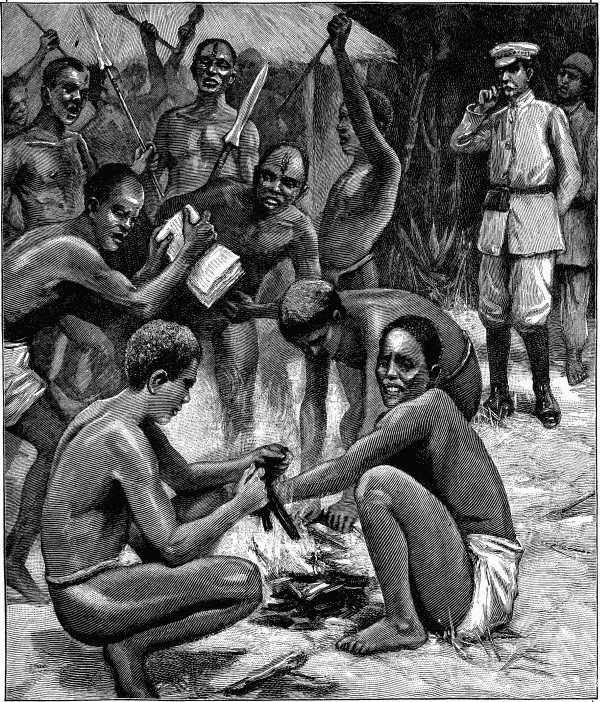
Bishop Whipple, who did so much work among the Indians of North America, tells how a great Indian chief became a Christian. 'One day,' he writes, 'the chief came to see me, and said that he wished to be a Christian; that he knew he must die some day, but he had been told of the new life into which Christians entered after death, and that he also would like to enter that life.'
'Shall I cut your hair?' asked the Bishop.
This strange question was understood perfectly well by the chief. It meant that he must cut off the bad old habit of going on the war-path.
'No, I cannot allow you to cut my hair,' he answered, reluctantly, for he was not ready to give up going on the war-path.
'Well, you cannot become a Christian unless you cut your hair,' said the Bishop, sorrowfully.
The chief went away, but he still attended the services which the Bishop held, and after some months came again to the Bishop.
'I want to be sure of that life after death,' he said. 'Please make me a Christian.'
'Shall I cut your hair?' asked the Bishop again.
'Yes; do whatever you like with me so long as you make me a Christian,' answered the chief.
Thus the chief eventually became a Christian, and many of his tribe followed his example.
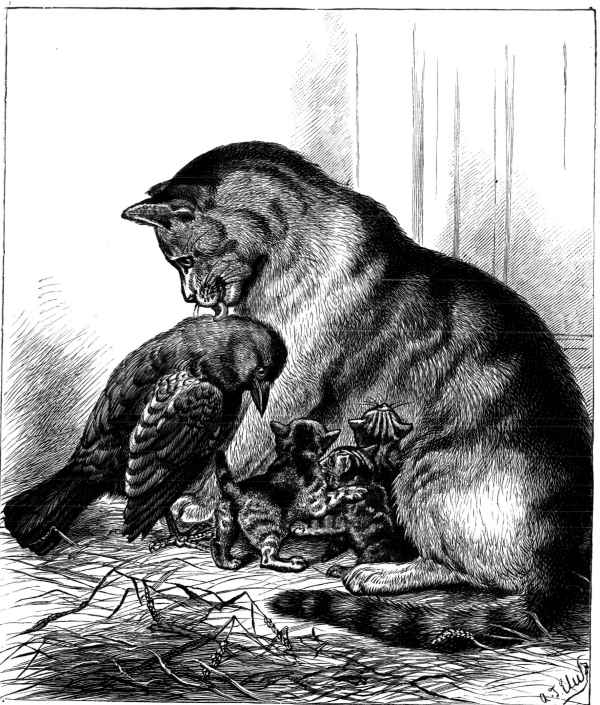
 ook at old Puss,' the Kittens said,
C. D. B.
A good man once had a serious illness, during which his life was several times despaired of. On his becoming convalescent, a friend said to him, 'It will be a long time before you are able to collect your thoughts to preach again, or to think of material for your sermons.'
'You are mistaken, friend,' was the answer. 'This illness has taught me more than all the books and learning I have studied in the whole of my life before.'
He had been not far from death, and had learnt more fully than any books could teach him, that there is something greater than mere human wisdom.
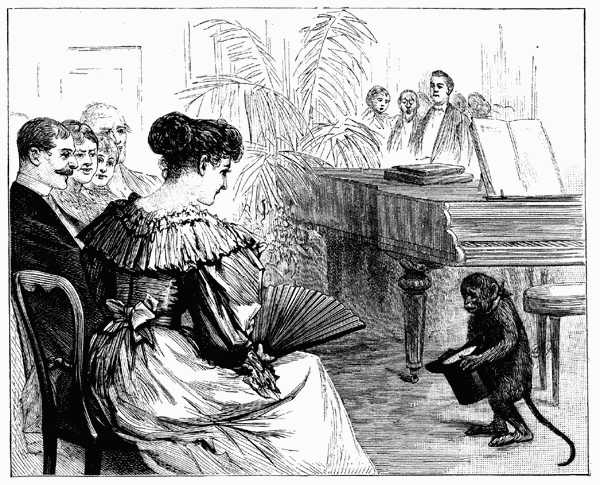
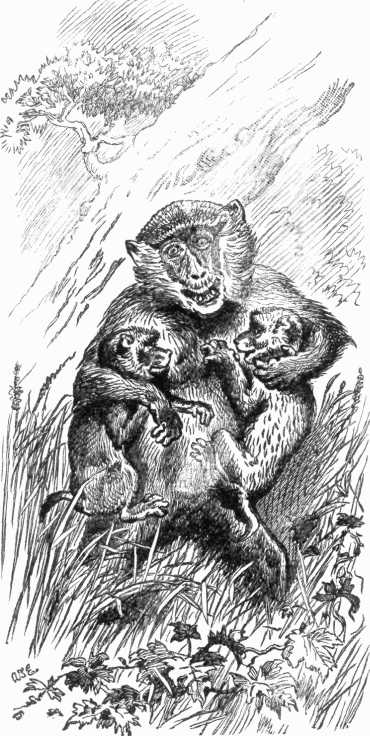
A French lady on one occasion saw an organ-grinder ill-treating his monkey. She was moved with pity, and bought it. It became her chief pet, and used to follow her about everywhere. Once she invited a party of guests to a concert. The monkey was allowed to watch; but instead of staying where she had put it, it took the hat of one of the guests, and made a collection, much to the delight of the audience, and then emptied the contents into the player's lap. It had not forgotten its old habits.[Pg 12]
'Jack,' said Captain Knowlton, who had come to see me at Castlemore for a few hours, 'I have brought some news. Your aunt is going to be married.'
'Aunt Marion?' I cried.
'You haven't another aunt, have you?' he asked.
'No, of course not,' I answered; 'but I thought she was too old.'
'Anyhow,' he said, 'she is going to marry Major Ruston, and in about a month I shall come to fetch you to the wedding.'
'But,' I asked, 'what shall I do in the holidays?'
'We must manage as best we can,' he answered. 'You understand that I have taken you entirely off her hands. In the future you must look to me. Will you object to that?'
'I shall like it immensely,' I said; and the following morning Mrs. Windlesham helped me to compose a suitable letter of congratulation to Aunt Marion.
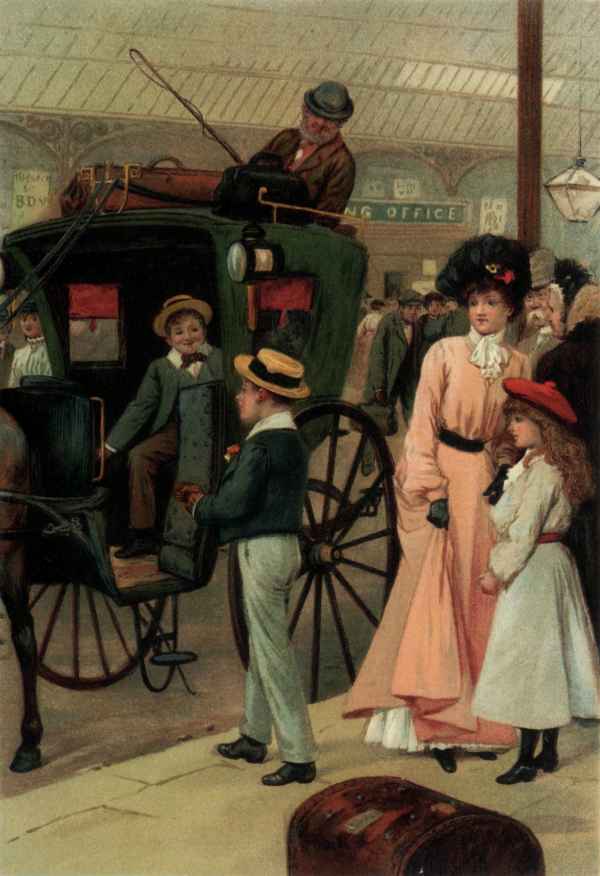
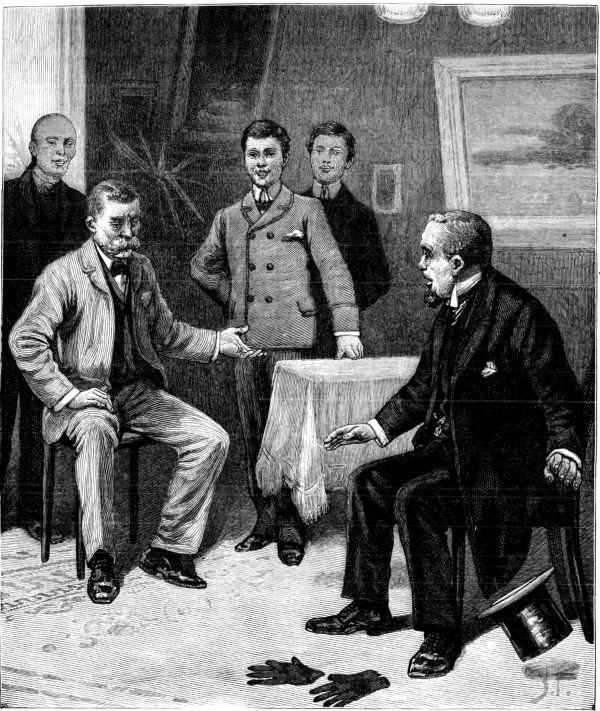
In due course Captain Knowlton came, according to his promise, to take me to the wedding, and we were driven direct from the London terminus to his own rooms in the Albany, where I made the acquaintance of Rogers, his servant, a pleasant-looking man, about twenty-seven years of age, who seemed always to wear a blue serge suit. Rogers took me to the Hippodrome that evening, and the next afternoon to a house at South Kensington, where I found Aunt Marion looking younger and more smartly dressed than I had ever seen her before.
'Did Captain Knowlton tell you the news?' she asked, when I had sat by her side for a few moments.
'I was surprised!' I exclaimed.
'I am sure I don't know why,' she answered, with a peculiar kind of laugh.
'Is Major Ruston here?' I asked.
'No,' she said; 'you won't see him until Captain Knowlton brings you to the church to-morrow. It is to be a very quiet wedding, and we shall start for India the next day.'
When Rogers returned to fetch me an hour later, Aunt Marion put her arms around my neck and kissed me a great many times, telling me to be good, and try in every way to please Captain Knowlton—advice which I considered very unnecessary.
After the wedding ceremony the following day, we went to an hotel, where the four of us had luncheon,[Pg 13] and, later on, Captain Knowlton stood on the pavement without his hat, and took a white satin slipper from his pocket, throwing it after the carriage as Major and Mrs. Ruston were driven away.
'I don't think much of Major Ruston,' I remarked as I walked to the Albany with Captain Knowlton.
'What is the matter with him?'[Pg 14]
'He is too fat, and his face is too red,' I answered, whereupon he laughed.
After Rogers had cleared the table that evening, and brought two cups of coffee, and Captain Knowlton had lighted a cigar, 'Jack,' he said, 'how old are you by this time?'
'Turned fourteen,' I replied.
'Ah, a grand age, isn't it?' he exclaimed. 'I was talking about you to Windlesham. He gave you a pretty good character on the whole.'
'I am glad of that,' I said, for although I had never thought much about my character hitherto, it seemed desirable to possess a good one, if only to please Captain Knowlton.
'A bit mischievous,' he continued, 'and rather headstrong. Inclined to act too much on the impulse of the moment. It is time you set to work in earnest, you know, Jack. You will have to look sharp if you wish to go to Sandhurst.'
'That is just what I should like!' I cried, with a great deal of excitement.
'That is all right then. You are quite old enough to understand things. I feel certain your father would have liked you to enter the army. Now,' he added, 'I am afraid you will have to spend the next holidays at Castlemore. I have one or two engagements which cannot very well be put off, and unfortunately there is nobody in the world who can be said to belong to you.'
I looked up abruptly.
'Well?' he asked.
'Oh—nothing!' I muttered.
'Come, out with it, Jack!'
'There is you,' I said; and he leaned forward, resting a hand on my knee.
'Quite right,' he answered. 'I want you to feel you have me. Understand, Jack?'
'Yes,' I cried, and suddenly I seemed to realise what a bad thing it would be if I had not Captain Knowlton to depend upon.
The next day I returned to Ascot House, naturally disappointed at the prospect of spending the holiday at school. The other fellows all went home at the end of March, and about a week later I was surprised when Elsie Windlesham, the eldest of the five girls, told me that Captain Knowlton was waiting in the drawing-room. But my satisfaction faded when he explained that he was going abroad for some months, and that he had come to say good-bye. 'The fact is I have not been up to the mark,' he continued, 'so I have bought a small steam yacht.'
'What is her name?' I interrupted.
'The Seagull—a jolly little craft, and I hope to make a voyage round the world in her. I shall get back again before the summer holidays, and then we will have a good time together. I have had a chat with Mr. Windlesham,' said Captain Knowlton, 'and told him to keep you well supplied with pocket-money and so forth. You will be a good chap,' he added, 'and work hard for Sandhurst.'
As he would probably be absent on my fifteenth birthday, he had brought a silver watch and chain, which certainly went some way towards consoling me for his departure. So I said good-bye to Captain Knowlton, little dreaming of what was destined to occur to both of us in the near future.
For now events began to happen quickly one on the top of another, and it was less than a fortnight after Captain Knowlton's departure that Elsie told me, as a great secret, that her father had been offered a lucrative living in the north of England.
'But,' I asked, 'how about the school?'
'That is why he has gone to London to-day,' she explained. 'He wants to sell the school before next term begins, and he has heard of somebody who will very likely buy it.'
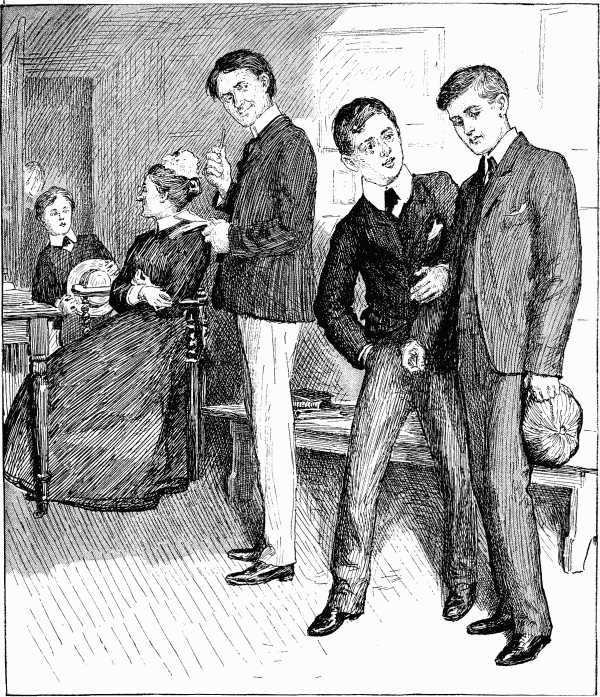
A few days later, Mr. Turton appeared on the scene, accompanied by his wife and his only son, Augustus. Mr. Turton was not a clergyman, although he dressed a little like one; he was short, rather stout, with a pale face and an untidy dark beard. But his wife was tall and lean, and her face looked gaunt and pinched, while, as for Augustus, it was difficult to judge whether he ought to be described as a boy or a man. Taller than Mr. Turton, he had a long, thin face like his mother's, and a growth of fair down upon his chin. With a boy's jacket he wore a very high stand-up collar, while his hair sadly needed cutting.
I shook hands with the three in turn, and as I tried to think of something to say to the painfully bashful Augustus, I overheard a remark of Mr. Windlesham's which led me to believe I was being spoken of as an important source of revenue.
The result of Mr. Turton's visit was that the holidays were lengthened for eight days, to allow the Windleshams to move away and their successors to take possession of Ascot House. I learnt from Elsie that the furniture had been bought as it stood, and that Mr. Bosanquet—the assistant master, and a thoroughly good fellow—was to stay on for one term, after which Augustus would take his place.
'I have felt a little at a loss,' said Mr. Windlesham, the day before his departure. 'All the other boys are returning, but in your case I have been compelled to take Captain Knowlton's approval for granted. However, I have explained all the circumstances to Mr. Turton, and I have no doubt you will be very happy and comfortable.'
Still, I had certain doubts, and, in fact, after I had reluctantly said good-bye to Mr. and Mrs. Windlesham, and to Elsie and her sisters, and the fellows came back from the holidays, a change was at once perceptible. Perhaps, in some ways, an impartial observer might have regarded it as a change for the better. Everything was conducted in a far more orderly manner. We rose an hour earlier in the morning, and went to bed half an hour earlier at night. We had the same kind of meat every week-day in regular rotation, and less of it; our bread was cut thicker, and spread with less butter; we were no longer permitted to wander about the small town at our own sweet wills.
It became necessary to ask leave before we spent any money, and although Augustus shared for the present our lessons with Mr. Bosanquet, he acted as a kind of tyrannical overseer during the rest of the day.
One morning in June, about two months after Captain Knowlton's departure from England, I was summoned to Mr. Turton's study, and I found him with a more than usually grave face.[Pg 15]
'Everard,' he said, 'you must be prepared for the most serious news.'
'Not about Captain Knowlton?' I cried, for it seemed that there was really no one else in the world for whom I very much cared.
'What was the name of his vessel?' asked Mr. Turton.
'The Seagull. You don't mean that she has been wrecked?' I faltered.
'Unfortunately, that is the fact,' was the answer.
Turning aside, I leaned against the door with my face buried in my sleeve.
Mr. Turton spoke kindly, as did Mrs. Turton in her rather cold, unsympathetic way; but nothing that any one could say made the slightest difference. I felt that I had lost my best and, indeed, my only friend.
ne summer's day in the year 1805, a farmer's wife, carrying a heavy basket of eggs, was slowly trudging along a lane leading to the market town, when a woman ran hastily to her, calling out as she passed, 'You are in luck to-day, Mrs. Hodge! Eggs are so scarce that you can ask any price you like.'
'Why is that?' asked Mrs. Hodge, surprised.
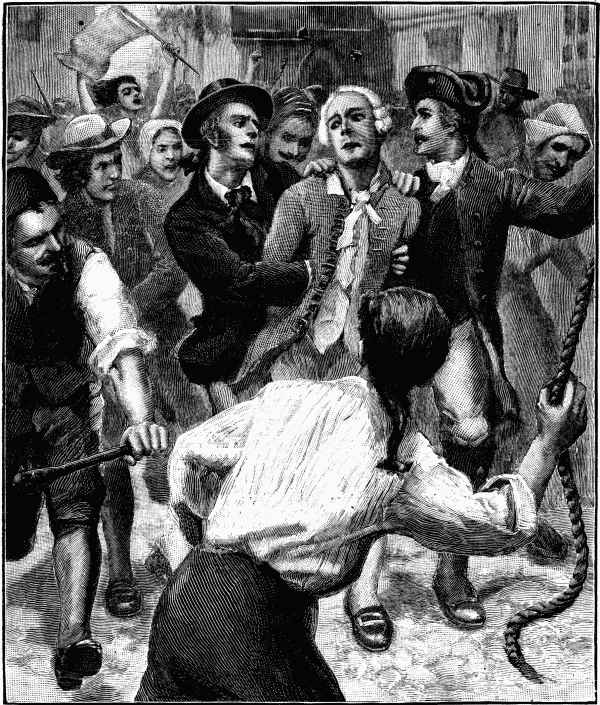
'Why?' laughed the woman. 'Because every one wants them! A man has just been put in the pillory for speaking against the King, or the Parliament, I don't rightly know which; but at any rate he is safe in the pillory, and folk are having rare fun pelting him,' and the woman passed on to join in what she called 'the fun!'
Mrs. Hodge, however, was a woman of a different sort. 'I will sell none of my eggs for such cruel work as that,' she said resolutely. 'Sooner, by far, would I take the whole lot back unsold, that I would, than ill-treat an unfortunate man in that way.'
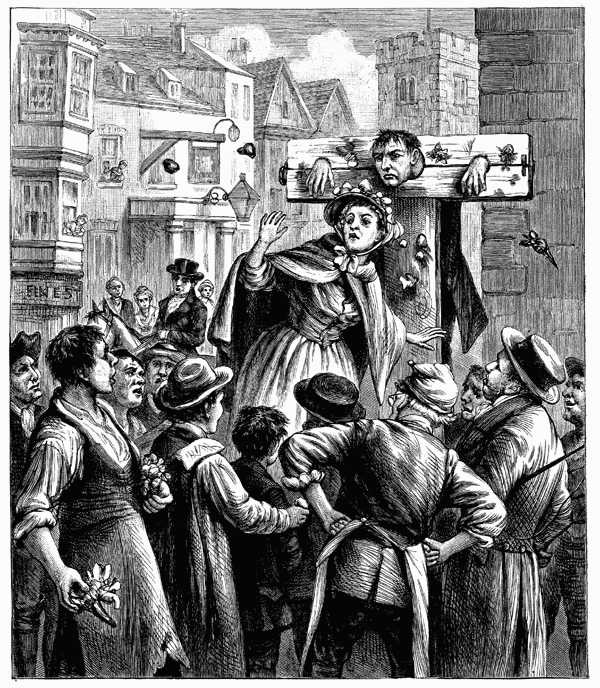
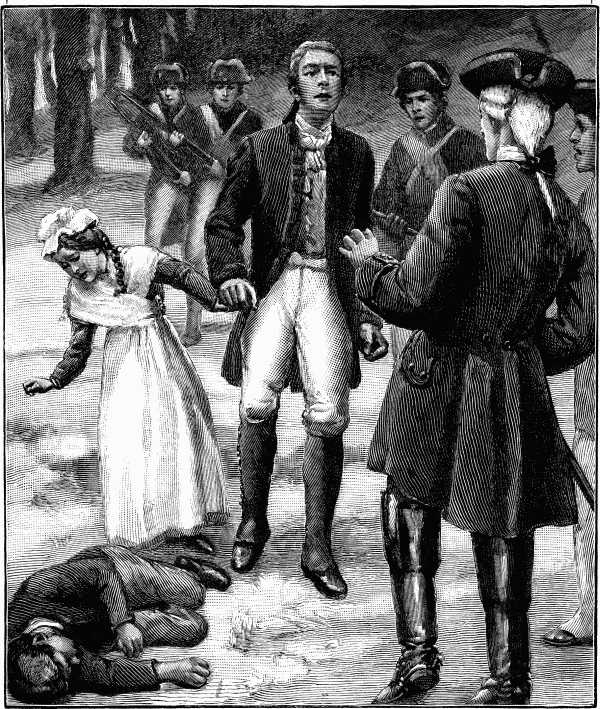
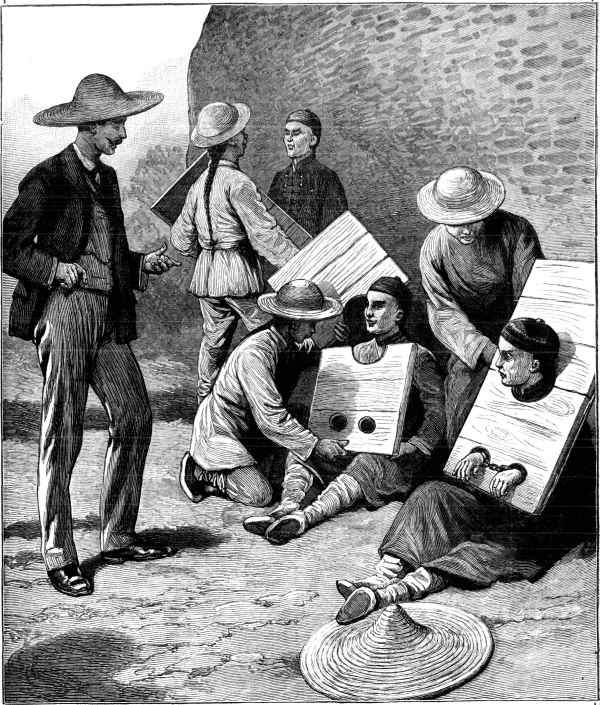
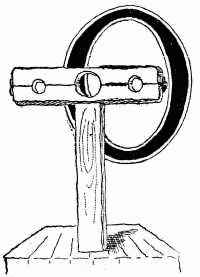
She had now reached the market-place, and there, on a platform raised several feet above the ground, stood a wide wooden post, with three round holes in it, through which appeared a man's head and his two hands. Thus imprisoned and utterly unable to protect himself in any way, he furnished sport for a thoughtless, cruel mob, who were aiming at him with rotten eggs, cabbage-stalks, and any rubbish that came to hand.
Mrs. Hodge's blood boiled with indignation as she saw the terror and agony in the poor man's eyes, as missile after missile hit him, each hit being greeted with a shout of delight from the populace.
'Shame on you!' cried the honest woman, and hastily leaving her basket at a shop-door, she somehow pushed her way through the masses, and climbing the platform, stood right in front of the pillory. 'Shame on you all, to hit a helpless man!' she cried again.
'Get down! get down!' shouted the mob, furious at any one interfering with their fun. 'Get down, or we will treat you the same!'
'More shame to you,' said the dauntless woman. 'I shall not leave for all your threats! Surely there will be one amongst you all who will not see a helpless man tortured.'
'But he is a bad man. He was trying to set folk against the Government. He deserves to be punished!' was shouted by different voices in the crowd.
'If he has done wrong he is being punished for it,' said the woman firmly, still continuing to shelter the man by standing before him. 'It is bad enough for him to stand all day in the pillory under this broiling sun, without having his eyes blinded and his nose broken. We shall all, maybe, want a friend one day, so let us help this poor fellow now. Here, Ralph,' she continued, catching the eye of the chief leader of the rioting, 'you said, when I saved you from bleeding to death in the hay-field last summer, that you owed me a good turn. Pay it me now! Leave this poor fellow alone, and get your friends to do the same.'
The man stood irresolute one minute; then his feeling of gratitude conquered him, and he said, half-sheepishly, 'Have your own way, Mother! I will see that no one throws any more at him.'
'That is right, Ralph,' said Mrs. Hodge, heartily, for she knew that Ralph's influence was great. 'Now for a pail of fresh water, and let me see if I cannot get all this dirt off this poor fellow's face and hair.'
'Thank you, Missis, you have been real good to me,' the man said, hoarsely. 'I could never have stood it much longer.'
The mob—fickle as mobs so often are—were now as ready to help as before to injure, and instead of jeering and reviling, there were now those who remarked that 'perhaps the chap was no worse than the rest of us,' whilst others were glad they had been stopped in time, for only a few weeks before a man had been killed, whilst standing in the pillory, by those who were only 'amusing' themselves in much the same fashion as folk on that day.
One of the crowd fetched water, and a woman brought a mug of milk, which was sweet as nectar to the poor man's parched throat, and now, though he had still many hours before sundown to stand in the pillory, yet it was shorn of its chief terror, as Ralph undertook to shield him from all further injury.
So he once more thanked Mrs. Hodge, and she returned to her eggs with a mind at ease.
It may surprise our readers to know that the punishment of the pillory remained on the Statute-book of this country until the year 1837, though it had practically fallen into disuse for many years before it was repealed.
The pillory came down to us from Anglo-Saxon times, and there was a law passed in the reign of Henry III., ordering every village to set up a pillory when required for bakers who used false weights, perjurers, and so on.
Clarendon.
[Pg 16]
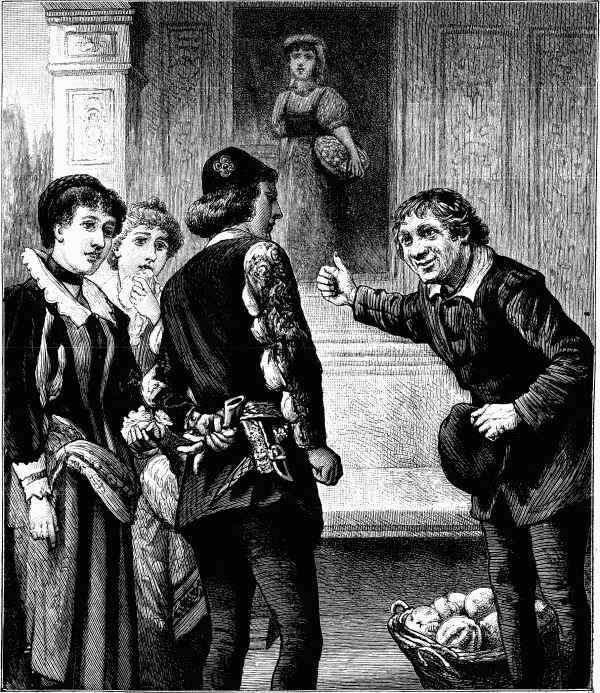
An Italian artist had painted a little girl holding a basket of strawberries. One of his friends, who was at the time a great admirer of his genius, wishing to show the perfection of the picture, said to some people who were looking at it, 'These strawberries are so very natural and perfect, that I have seen birds coming down from the trees to peck them, mistaking them for real strawberries.'
A countryman, on hearing this ridiculous praise, burst out laughing: 'Well, sir,' he cried, 'if the strawberries are so well represented as you say they are, it must not be the same with the little girl, since she does not frighten the birds.'
The painter's friend could answer nothing; he had received a well-deserved rebuke for his flattery.
Moral.—Excessive praise wrongs rather than benefits the person upon whom it is bestowed.
W. Yarwood.
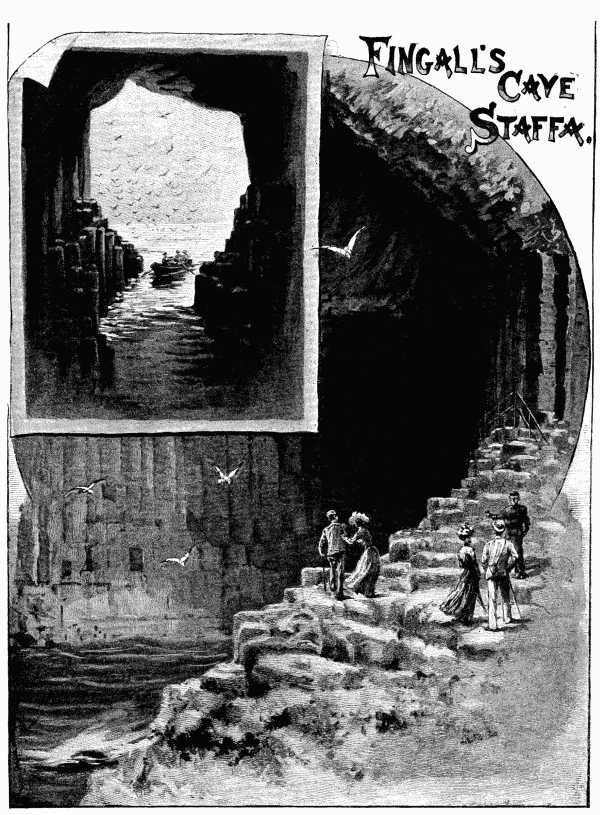
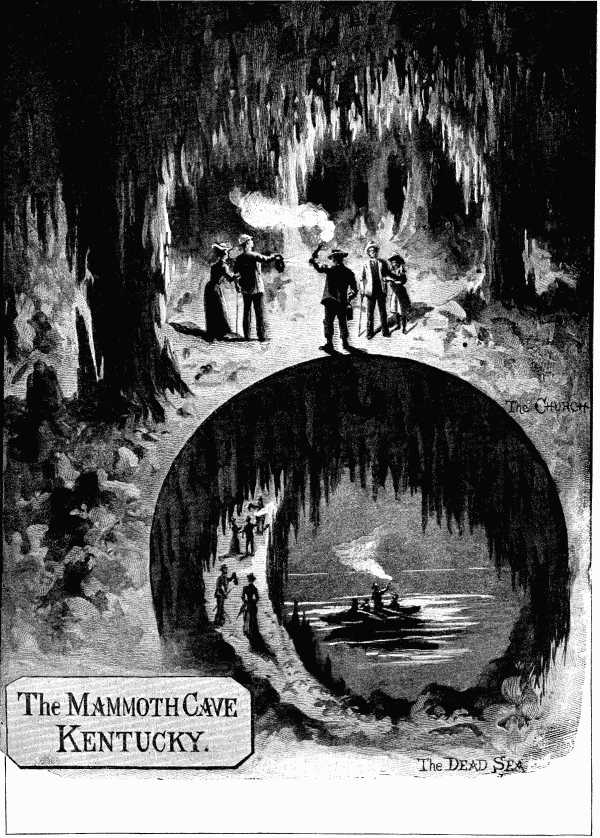
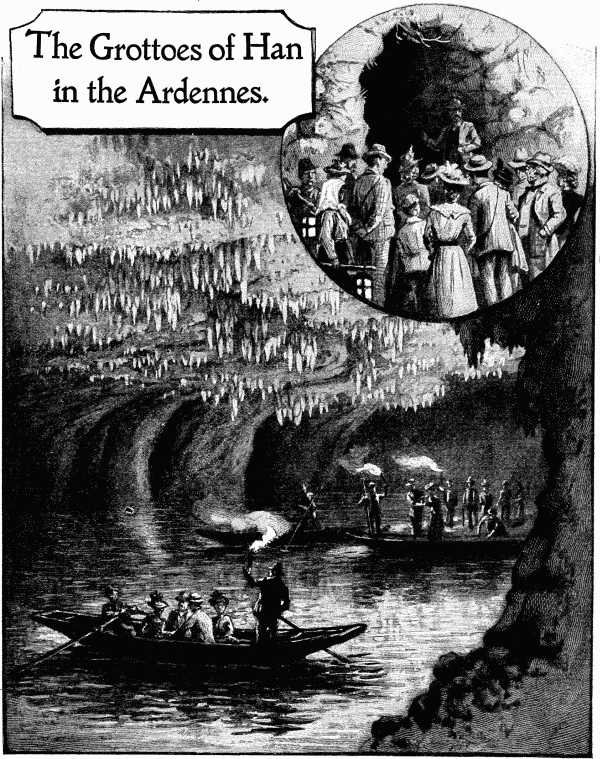
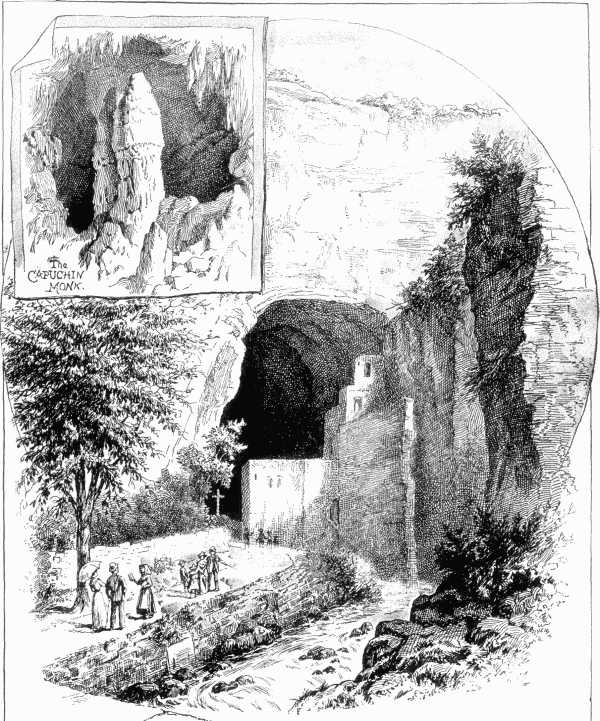
ong ago, in the dark ages of the world, when superstitious terrors ruled the mind of savage man, caverns were looked upon with awe and peopled with supernatural beings. The mysterious waters that issued from some, the depth and length of the winding ways of others, the unaccountable sounds that echoed through the vaults and galleries of all, gave rise to wonderful legends in many parts of the world.
Beneath the Holy Peak of Kailas, supposed to be the centre of the Hindoo Universe, are caverns in which, according to legend, live the four sacred animals, the elephant, the lion, the cow, and the horse, from whose mouths issue the four great rivers of India, the Ganges, Sutlej, Indus, and Brahmapootra.
According to Scandinavian mythology, Loke, the incarnation of evil, was for a long time bound to points of rock in a cavern, with a huge serpent crouching above and spitting venom on the prisoner.
Hastrand, the nether world of the Vikings, was also depicted as a cavern of colossal size, furnished with poisonous serpents and unlimited sources of torture for mind and body.
The Greeks held caverns to be sacred to various gods—Pan, Bacchus, Pluto, and the Moon. The Romans peopled them with Sibyls, or priestesses of Fate, and beautiful nymphs; whilst in ancient Germany and Gaul, fairies, dragons, and evil spirits shared the gloomy recesses which no mortal might invade and live.
In the Middle Ages there were many legends of evil spirits dwelling in caves, who beguiled human beings to their rocky homes, whence the visitors never returned. Probably the truth of this particular fable lay in the growing spirit of exploration into the recesses of Nature, the dangers of which—ill provided with light, ropes, and modern means of security as they were—must have been extreme.
About this era, too, the forests of Northern Europe were largely thinned, and fairies, dwarfs, and such folk, it was thought, were obliged to take refuge in caverns and grottoes. Within the last hundred years a legend was common in the Hartz Mountains, that if a wedding feast lacked copper or brass kettles, cooking-pans, or plates, the needs would be supplied on invoking the dwarfs at the entry of their rocky homes. No payment was asked for or expected, but a little meat left in the pans on their return was appreciated and might lead to future civilities.
Moorish children are still brought up to believe that Boabdil, the last King of Granada, with his mighty host, is still sleeping in a huge cavern, whence he will some day issue to a last great victory over the Christians.
So far we have seen only the imaginative ideas of these great hollows of the earth, for 'hollow' is the true meaning of the Latin word cavea, from which cave or cavern is derived: now we will glance at the more practical purposes to which the smaller and more superficial caves have been adapted.
With the dawn of Christianity, many men and women, shocked at the excesses of Greek and Roman civilisation, retired from the world and led simple lives as hermits in remote caves. To this day, 'The Hermit's Cave' is a common name in England, and, though it is not always a genuine one, it usually denotes that in olden times some hermit or 'anchorite' passed his lonely existence in the spot in question.
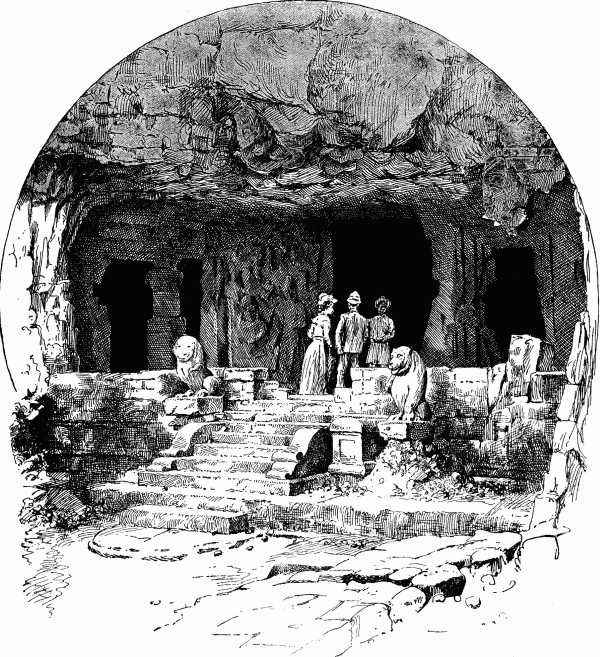
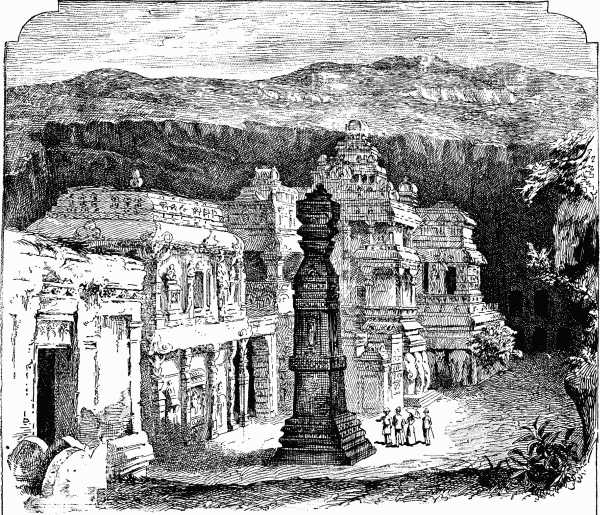
Long before this era, in Hindoostan, advantage had been taken of natural caverns to hew into shape the marvellous rock temples of Elephanta, Ellora, and Ajunta, still accounted as amongst the wonders of the world.
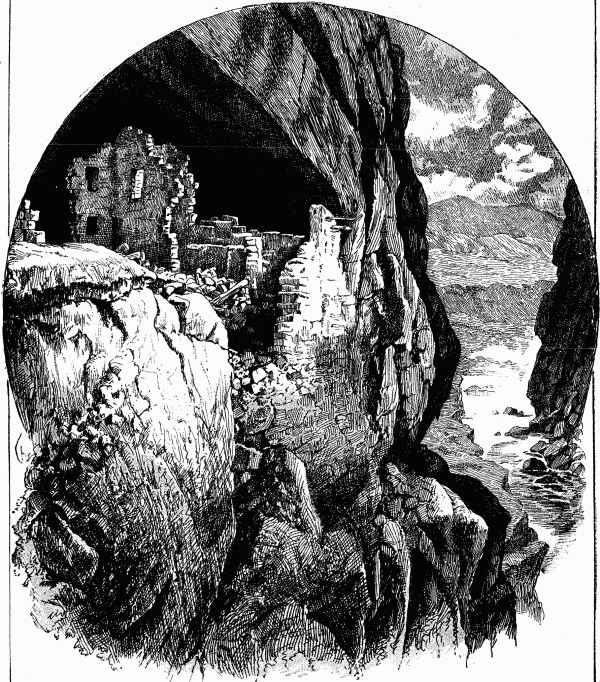
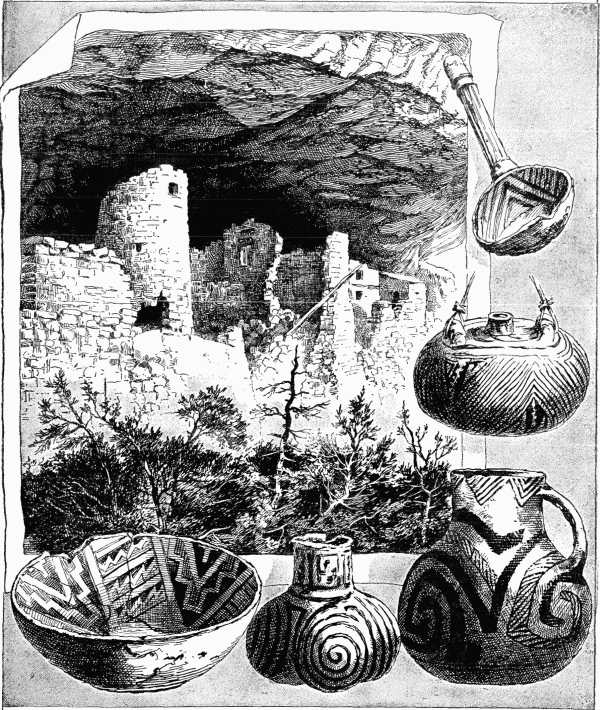
In New Mexico and Arizona in remote ages whole tribes lived in caves, some natural, but more often made habitable by the aid of masonry. Most of these are high up on shelves edging precipitous cliffs, and were clearly chosen as places of refuge from enemies of the plain.
All over Europe caves are found containing bones of human beings, most of which are recognised by scientists to belong to an earlier race, who made use of these homes provided by Nature, both for abiding-places during life and resting-places for the dead. In many of these caves, sketches on bone, horn, and ivory have been found, remarkable for their clear and vigorous drawing at a time when art was an unknown quantity. It is noticeable that drawings found amongst the Esquimaux relics depict seals, whales, and walruses, whilst those of more southern races show mammoths, wild horses, and bisons; the only animals drawn by both being the reindeer.
Numerous caves in Britain, and indeed all over the world, contain bones of animals, and from classifying these, learned folk have found out a great deal respecting the geological and geographical changes which have taken place on the crust of the earth since the Creation.
Now that we have thought of the terrors with which caverns inspired our remote forefathers, as[Pg 19] well as of the practical uses to which they have been put by less imaginative men and animals, let us try to see how and why these mighty hollows came to exist at all.
Earthquakes are often accountable for rocks heaped in wild confusion, leaving great chasms below. Volcanic agency also deposits huge roofs of lava over tracts of ice and snow, and the melting of the latter leaves empty spaces of vast extent. The neighbourhood of Mount Etna, in Sicily, has various wonderful caverns of this formation. Landslips and rock-falls on the surface account for many small grottoes, but water is the main origin of all the most celebrated caverns of the world. Underground streams and rivers gradually eat their way along the surface of their rocky flooring, the carbonic acid in the water acting chemically on the stone in addition to the wearing force of the element. Once a shallow channel is worn, new forces set to work to deepen it: sand, pebbles and grit of all kinds, washed down by the current, grind and wear away the rock. In course of time great depths are hollowed out, and if it happens that some obstacle turns the course of the water, and the river finds a new outlet, a long deep gallery is left dry, and here and there an apparently bottomless pit where the water has acted on specially soft stone. From above, also, a steady action of moisture has been eating away the cliff, adding height to the cavern, as well as coating its roof and sides with a sparkling substance derived from the union of water and particles of the limestone, in which caves usually abound.
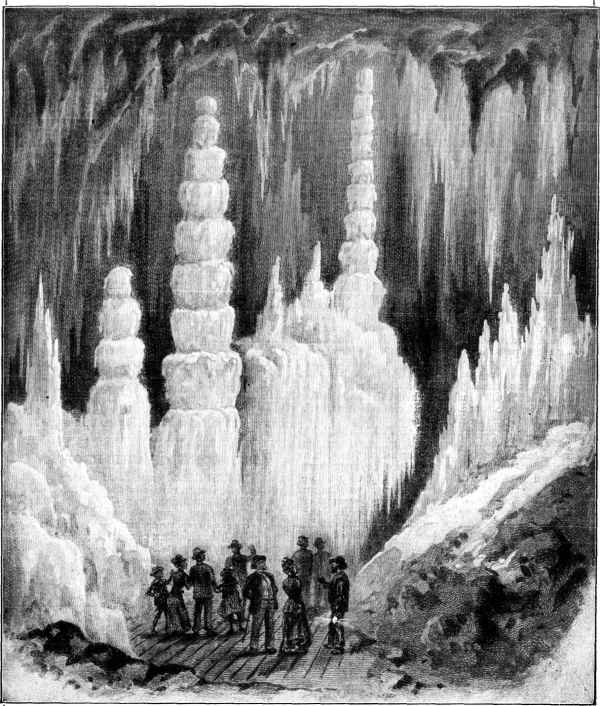
Nothing can be more beautiful, when illuminated, than a roof of stalactites, with ascending pillars of stalagmite often meeting and forming pillars, like those which will be later on described in the Mammoth Cave and others. The building of these fairy grottoes is really a simple matter, but one only possible to the Great Architect to whom a thousand years are as one day; for a very little bit of one of those stony icicles would take hundreds of years in formation. Water flowing above a cave is certain to contain carbonic acid, some given to it by the atmosphere, and some imparted from decaying vegetation. This water oozes slowly through the rock, and the carbonic acid in passing dissolves a mite of lime, carrying it through the roof, to which the lime adheres whilst the water evaporates. Drop follows drop, each tiny particle sliding down its fellow, until, as weeks and years and centuries roll by, a lovely long pendant is formed, known as a stalactite. Sometimes the drops of acidulated watery lime fall through the roof by an easier passage, and fall right on to the floor of the cavern, when an upward process takes place, each drop exactly striking the one before, until one of the stately columns arises known as a stalagmite.
Helena Heath.
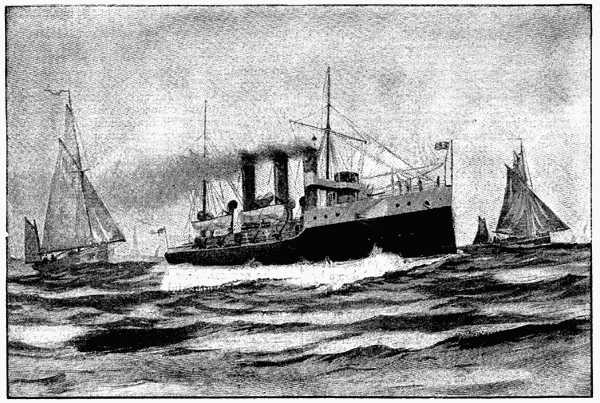
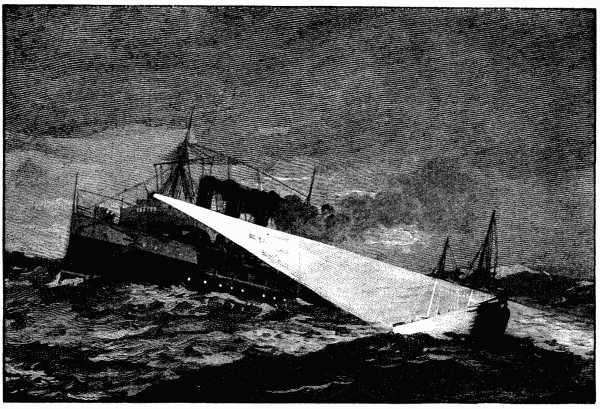
Amid a flutter of flags and the cheers of onlookers, the 'ocean policeman,' H.M.S. Speedy, first took to the water on May 18th, 1893. Its birthplace was the banks of the Thames at Chiswick, but hardly had it settled itself on the smooth surface of the river when orders came from official quarters that it should proceed at once to school. They were no easy lessons that it had to learn, and the subsequent examinations were extremely difficult and trying, for they were conducted by a large crowd of the most learned gentlemen in England and the Continent connected with naval matters. The school was at Sheerness, and here the Speedy spent four months in preparation. On September 28th the first run was made, and three weeks later the examiners were delighted to find that this splendid new boat was able to steam at a speed of twenty knots an hour. Everything the inventor and designer had claimed for her was proving true. The new style of tubing in the boilers made it possible to get up steam very quickly after the fires were lighted, so that when the order came to start there was no 'Oh, wait a minute, please; I am not quite ready!'
The engines, four thousand five hundred horse-power in strength, did their work far more nimbly than those in any previous gunboat of the same size. The vessel is two hundred and thirty feet long, and can steam triumphantly through water no more than ten feet deep. That in itself is enough to terrify evil-doers who would otherwise hope to escape by getting into shallow water beyond her reach. But in addition, she carries two large guns and a search-light.
Having thoroughly satisfied the examiners, this huge scholar soon had the honour of receiving a commission, and is now on duty in the North Sea among the brown-sailed fishing-smacks, like a gigantic duck watching over her ducklings. There are several gunboats of the British navy employed in the same way, but few of them quite so modern as the Speedy, or so capable of guarding the interests of the fishermen. Any foreign smack or lugger that comes within three miles of the English coast is 'trespassing,' and is immediately called upon by the Speedy to give an explanation. If the trespasser hesitates, a boat is lowered from the steamer with an officer on board to make inquiries, and should the answers to his questions be unsatisfactory, the stranger and his boat are sent prisoners to the nearest English port.
Thus, up and down among the great fleet of peaceful fishers, the Speedy plies all day, and even in the darkest night her watching is as keen and sure, for then her search-light, a dazzling beam, sweeps over the sea in all directions, and not the tiniest rowboat could escape unseen. Many a time it has revealed some stealthy marauder who hoped, under the cover of darkness, to pull in a net of fish from these forbidden waters and then sail into some French or Dutch port undetected. All chance of escape, however, is over when once that dazzling light falls upon the dishonest craft.
And who would begrudge such protection to our fishermen? Their busy fleets are floating towns of industry, in which some thirty-three thousand men and boys are employed. In 1901 their harvest represented eight million six hundred and forty-seven thousand eight hundred and five hundred-weight of fish, and realised six million eight hundred and forty-eight thousand one hundred and ninety-two[Pg 20] [Pg 21]pounds in money. A very large portion of this came from the North Sea.
But such treasure is only secured at great danger and with loss of life. In this same year 1901, over three hundred fishermen were drowned, some in wrecks and collisions, some in missing barks, and many by being dragged overboard by the cumbersome fishing gear. At all hours of the day and night, at all seasons of the year, these perilous labours are carried on, and when we think of this, is it not some gratification to know that the rights and privileges of our fishermen are jealously guarded by such stalwart ocean policemen as the Speedy?
John Lea.
 n London town the streets are gay,
C. D. B.
Two wild geese, when about to start southwards for the winter, were entreated by a frog to take him with them. On the geese consenting to do so if a means of carrying him could be found, the frog produced a stalk of long grass, got the two geese to take it one by each end, while he clung to it in the middle by his mouth. In this manner the three were making their journey, when they were noticed by some men, who loudly expressed their admiration of the plan, and wondered who had been clever enough to discover it. The proud frog, opening his mouth to say, 'It was I,' lost his hold, fell to the earth, and was dashed to pieces.
From La Fontaine.
'Look here!' said a young fellow as he opened the door of the log-house, in Canada, where he and a friend were 'camping out.' 'See what I have found dangling from a tree in the forest;' and he held up for his friend's inspection a tiny pair of leather moccasins gaudily embroidered with coloured beads.
'You must put those back where you found them,' said his friend quickly.
'They are of no value,' interrupted the other; 'there is a hole in the toe. I expect some Indian mother hung them there to get rid of them.'
'No! no! they were hung there because the child who wore them is buried under that tree, and these moccasins are put there for its use in the next world,' explained his friend.
'Oh, if that's the case!' said the young fellow, 'I will go back at once, and replace the little shoes, for I would not hurt their feelings about their dead friends for anything.'
So the little shoes were once more hung on the bough of the big fir-tree.
Mistaken as are the Red Indian's ideas of the next world, he is yet as careful as we are to honour the last resting-place of his loved ones.
S. C.
Mr. Turton lent me the newspaper in which he had read the account of the wreck of the Seagull, and upstairs, in the room which I shared with two other fellows, I sat down on my bed to master it.
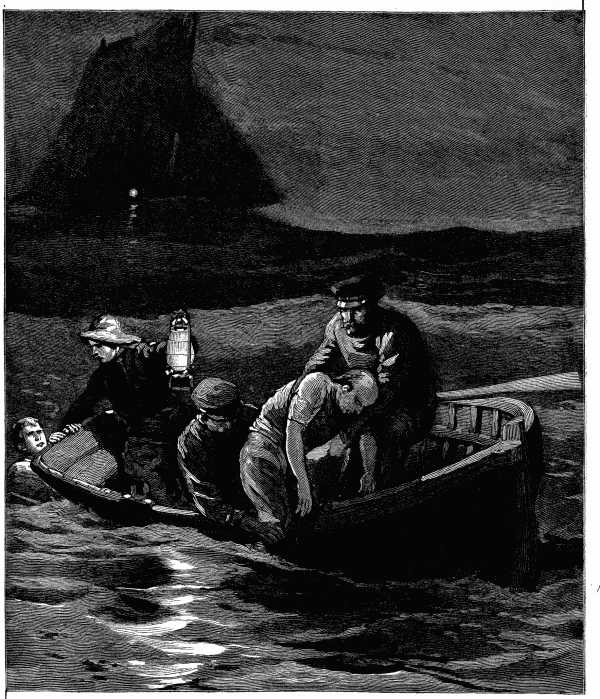
It appeared that the skipper of the vessel, with seven of the crew, had been landed by a British cargo steamer at Hobart Town, Tasmania. The Westward Ho! had picked them up in a small boat about seven days out from Capetown.
According to the story of the Seagull's skipper—Captain Wilkinson—she had experienced extremely bad weather for some days, and, becoming almost unmanageable, had been run down by a large liner in the middle of a dark night at the height of the gale.
Whether the liner was British or foreign, Captain Wilkinson could not state; but, in any case, she had continued on her way without attempting to stand by to save life. The Seagull foundered in less than ten minutes, Captain Knowlton persisting in his refusal to leave in the first, and—as Captain Wilkinson declared—the only, boat which got away. He had done his utmost to stand by, in spite of the fury of the gale; but when day broke, and the storm to some degree abated, there was no sign of either Captain Knowlton or the Seagull. That she had foundered with the remainder of the crew and her owner the skipper had not the slightest doubt, although he went as far as to admit, to the newspaper reporter, the possibility that the small boat in which he had escaped might have drifted some distance from the scene of the wreck in the darkness.
My only gleam of hope was due to Mr. Bosanquet, although I felt inclined to discount this, because he was given to look at the brightest side of things, and often predicted fine weather just before a storm.
'Still,' he urged, 'you do not know for certain that Captain Knowlton was drowned. I admit there is a great probability that you will never see him again, but, after all, it is quite within the bounds of possibility that the skipper's boat drifted away, and that the owner and the rest of the crew managed to leave the Seagull. Of course,' he added, 'if I am right, you are pretty certain to hear something farther in a week or two.'
Accordingly I lived in the most acute suspense during the next few days; but the time passed without news of Captain Knowlton, and such faint hope as I had cherished faded entirely away. In the meantime it seemed evident that Mr. and Mrs. Turton had not shared it. I learned from Augustus that his father had written to Mr. Windlesham, asking that I might be removed from Ascot House as a bad bargain.
Moreover, I began to observe a kind of resentfulness in Mr. Turton's demeanour, and especially in his wife's. It was rumoured in the school that they[Pg 23] were 'hard up,' and hence the shorter supplies of meat and butter. But it was Augustus who first made me realise my new situation.
'I say, Everard,' he said, when we were alone one day, 'I should not care to stand in your shoes. Now Captain Knowlton is dead you cannot stay here, you know.'
'Well,' I answered, 'who wants to stay? I am going to Sandhurst soon.'
'I guess you are not, though!' he exclaimed. 'There is no one to pay for you, and Windlesham is mean enough to say he won't take you off our hands.'
The entrance of Mr. Bosanquet put an end to Augustus's gloomy forecast of my future, and, as the assistant master seemed to be the best friend I had left, I asked his opinion on the subject.
'Of course,' he said, taking my arm, 'it is a rather difficult position. If Captain Knowlton has left a will with a legacy to you, there need not be much difference; but Mr. Turton is of opinion that if this were the case, he would have heard from the solicitor. Mr. Turton is a good deal perplexed to know what to do with you, though we will hope for the best, in spite of everything.'
Now, I was fifteen, and fairly tall and strong for my age. I could easily perceive the difficulties at which Mr. Bosanquet hinted, and that, if Captain Knowlton were actually dead, and had left me nothing in his will, there was only Aunt Marion to whom it was possible to look for help; and she had taken no notice of me since her wedding-day. I was ignorant of her address in India, and felt that I should be little better off even if I knew it. So, after a few days' reflection, I determined to speak to Mr. Turton.
'Well, Everard, what is it now?' he demanded, a little impatiently, as I entered his study.
'I want to know about the holidays,' I answered. 'Where am I to go?'
'Just what I should like to be in a position to tell you,' he exclaimed. 'At present I have been unable to discover the name and address of Captain Knowlton's solicitor, but, when I go to London with the boys at the end of the term, I shall do my best to gain farther information. We will put off the discussion until my return.'
It was, however, impossible to keep the question of my future in the background, and no day passed without many speculations. Numerous out-of-the-way projects had one peculiarity in common—they were all to end satisfactorily. Even if I were fated to endure certain trials and hardships, I felt perfectly confident in my ability to rise above them eventually.
The first important difference which I experienced as a result of the loss of the Seagull occurred on the Saturday after this interview with Mr. Turton. It was the custom to go to Mrs. Turton after dinner on Saturday for our pocket-money; my own allowance since Captain Knowlton's departure having been a shilling a week.
'What do you want, Everard?' asked Mrs. Turton, when my turn came.
'My shilling, please,' I answered.
But she ominously shook her head.
'I am afraid there will not be any more pocket-money for you this term!' she exclaimed—and, suddenly understanding, I walked dejectedly away. Before I had gone many yards Smythe took my arm.
'I can lend you fourpence, old chap,' he said.
'Awful ass if you do,' cried Augustus, who had a knack of overhearing what was not intended for his ears.
'Why am I an ass?' demanded Smythe.
'Because Everard will never pay you back.'
'Suppose I don't want him to pay me back?'
'Oh, well!' said Augustus, 'of course, if he is beggar enough to take your money!'
I should have liked to kick Augustus as he walked away with a snigger; but at least he had made it impossible to take advantage of Smythe's offer. It was a new and painful experience to stay outside the confectioner's shop while the other fellows entered, and the matter was freely discussed in my presence by Smythe and the rest on our return. Indeed, justice compelled me to agree with Barton's opinion that, as Turton stood uncommonly little chance of being paid for the current term's board and tuition, it was scarcely to be expected that he should feel inclined to provide me with additional pocket-money.
The end of the term soon came, and on the last afternoon I stood listening while Smythe, Barton, and the rest of the fellows boasted of all the wonderful things they intended to do during the holidays.
'I should not care to stand in Everard's shoes,' said Augustus. 'As likely as not he will have to go to the workhouse before he has done. He will see when my father comes back from London.'
Before they all set out to the railway station the next morning, Mr. Bosanquet took me apart for a last word of hope and encouragement. He was not to return to Ascot House after the holidays, and for my part I felt extremely sorry to bid him good-bye.
'I feel confident Mr. Turton will do his best for you,' he said. 'But you must try to make allowances if he seems a little put out. He is not by any means a rich man, and, of course, he had to pay Mr. Windlesham for the goodwill of the school. Mr. Turton will feel the loss of your bill, you understand—that is to say, if Captain Knowlton does not turn up again.'
'If he had been rescued,' I asked, 'don't you think we should have heard news of him before now?'
'Well, in all probability we should,' said Mr. Bosanquet. 'But strange things happen sometimes, you know; and, after all, I do not consider it impossible that he may be stranded somewhere, and prevented from communicating with his friends.'
'Still,' I answered, 'all the newspapers and Mr. Turton say he must be dead.'
'Anyhow,' he insisted, 'there is no positive proof, and even at the worst his solicitor may be able to satisfy Mr. Turton about your future.'
(Continued on page 26.)
[Pg 24]
t last the other fellows went to the station with Mr. Turton and Mr. Bosanquet, leaving me to enjoy the company of Augustus and his mother, who did not make much of an attempt to disguise her disfavour. It may be imagined with what anxiety I awaited Mr. Turton's return from London. He arrived at Ascot House late the following evening, having passed one night away from home. Although he had a long talk with Mrs. Turton, he did not speak to me that evening; but an ominous note seemed to be struck when Augustus told me I was henceforth to breakfast alone in the schoolroom. So, to my great disgust, the following morning, whilst Augustus and Mr. and Mrs. Turton breakfasted in the dining-room, a cup of milk and water, with five thick slices of bread and scrape, were brought to me on one of the desks; no bacon or egg, or relish of any kind, accompanied the meal.
Presently the door opened again, and Mr. Turton entered with a troubled face.
'Well, Everard,' he said, 'I succeeded in finding the address of Captain Knowlton's solicitor, and I had a long conversation with him.'
'Does he think Captain Knowlton is dead?' I exclaimed.
'I regret to say that he has no doubt about the fact; but, at the same time, the estate cannot be administered for some months yet. In any case that will make no difference to you. Captain Knowlton had not made a will, and everything he died possessed of will pass to his nearest relatives.'
'Then—then, what am I to do?' I asked.
'The circumstances are extremely unfortunate,' was the answer. 'For me it is a serious loss, and I confess it is difficult to know what to do for the best. I understand you have no relatives of any kind.'
'Only my Aunt Marion.'
'Ah, that is the Mrs. Ruston whom Mr. Windlesham mentioned. She is in India, I believe?'
'Yes,' I answered, 'but I do not know her address.'
'I can no doubt find it out in an Army List,' he said. 'But from what Captain Knowlton told Mr. Windlesham, I fear little is to be gained in that direction.'
From that day nothing was the same, and I soon began to realise that my presence in the house was regarded as a nuisance. All my meals were solitary, and I seldom had enough to eat.
'Everard!' cried Mrs. Turton, directly I had finished breakfast two mornings after the above conversation, 'all the servants are very busy this morning, so you must make your own bed.'
If she had told me to stand on my head, I should not have felt more surprise.
'Don't you understand?' she demanded.
'Yes, Mrs. Turton.'
'Then why do you stand staring there? Please set about it at once.'
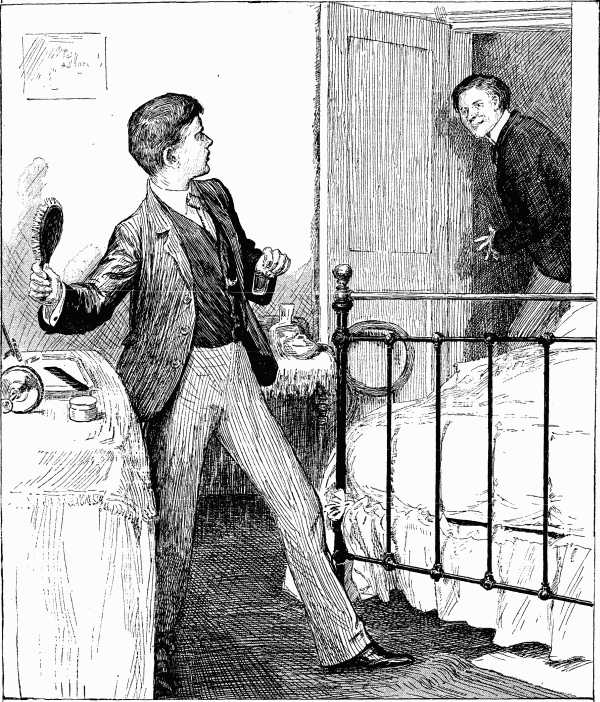
I went upstairs to the bedroom which I had occupied alone since the beginning of the holidays, and after staring at the bed for a few moments, I was about to strip off the clothes, when I heard a snigger at the door.
'Hullo, Susan!' cried Augustus.
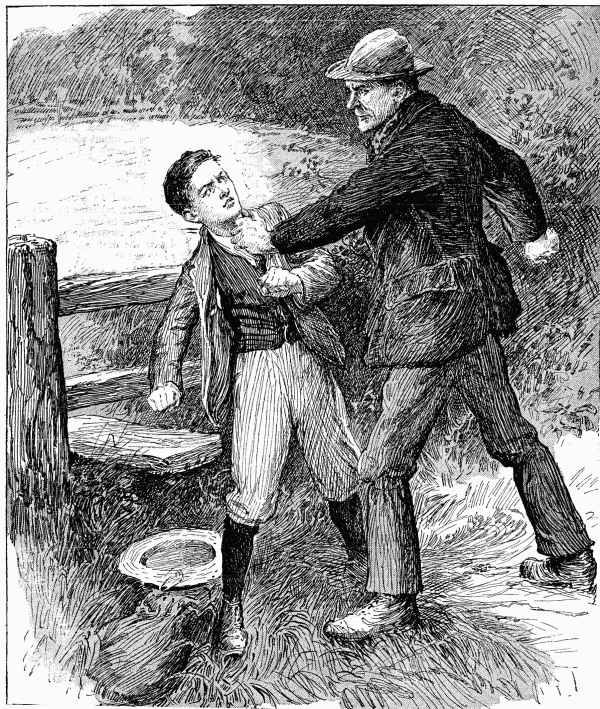
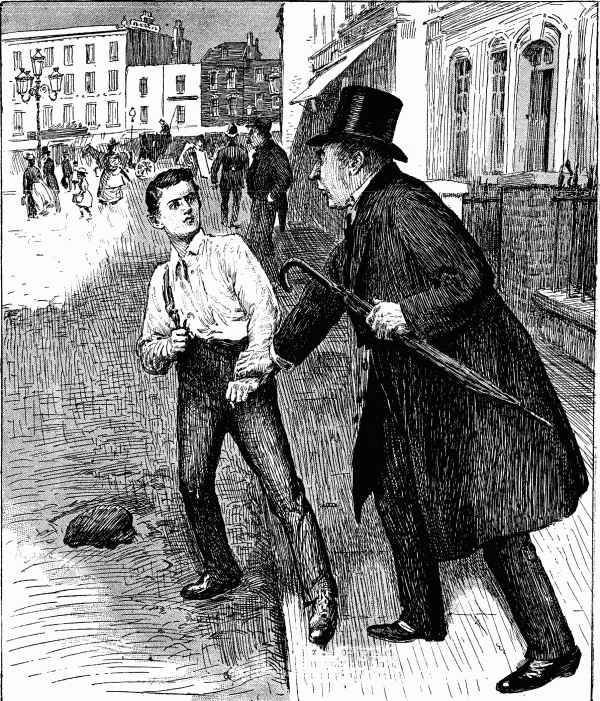
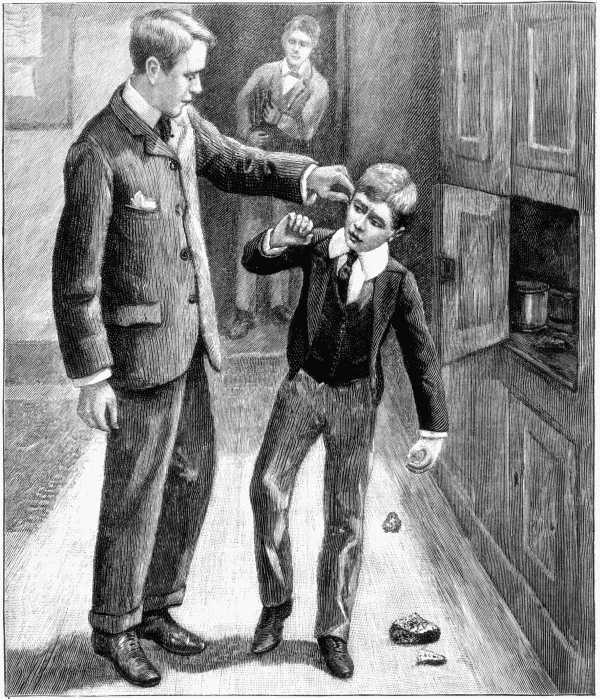
Darting to the dressing-table, I seized a hair-brush, and threw it at his head. Unfortunately it hit him on the forehead, making an ugly cut, and, of course, he at once went to show Mr. Turton, who came upstairs a few minutes later, by which time my bed was made—after a fashion.
'What was your reason for attacking my son?' demanded Mr. Turton.
'Well,' I answered, rather sullenly, I am afraid, for I was growing somewhat desperate, 'he should not be cheeky.'
'You will not leave this room until dinner-time,' he said, 'and your meal will consist of bread and water.'
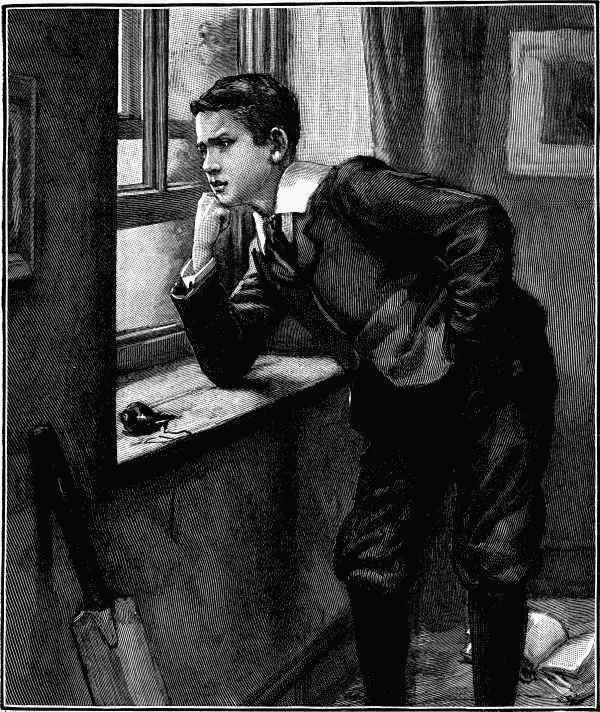
I spent a miserable morning staring out of the window on to the garden and the fields beyond, without a book to pass the time, my only comfort being the sight of Augustus with a strip of court-plaster above his left eyebrow.
At half-past one a servant came to tell me to come down to dinner. Alone in the schoolroom, I at first determined to refuse my food, until hunger conquered my resolution, and I ate it every scrap. Soon afterwards Mrs. Turton entered, but she said nothing about Augustus's injury.
'You must not spend your time in idleness,' she exclaimed.
'There was not anything to do in my bedroom,' I answered.
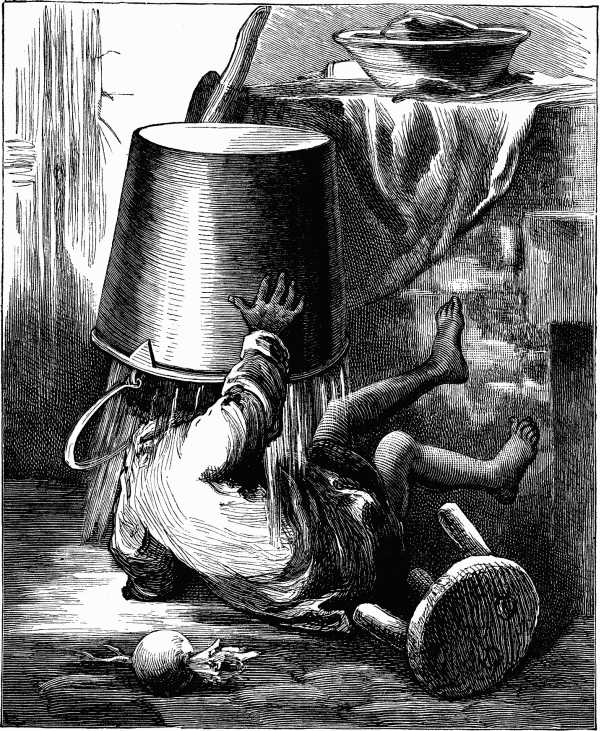
'The house is being cleaned,' she said, 'and all the woodwork has to be washed. You may as well go down to the kitchen for a pail of hot water and begin with the wainscotting in the hall.'
'I'm not a servant!' I answered.
'Honest work is no disgrace to anybody,' she said. 'You must try to make yourself useful in every possible way, and be careful not to splash your jacket.'
Raging inwardly at my task, I only hesitated a few moments; then, going down to the kitchen, I asked the good-natured cook for a pail of water.
'I call it a shame!' she muttered. 'Things were different in Mr. Windlesham's time. A shame I call it.'
'Oh, it doesn't matter,' I answered, feeling not a little embarrassed by her sympathy.
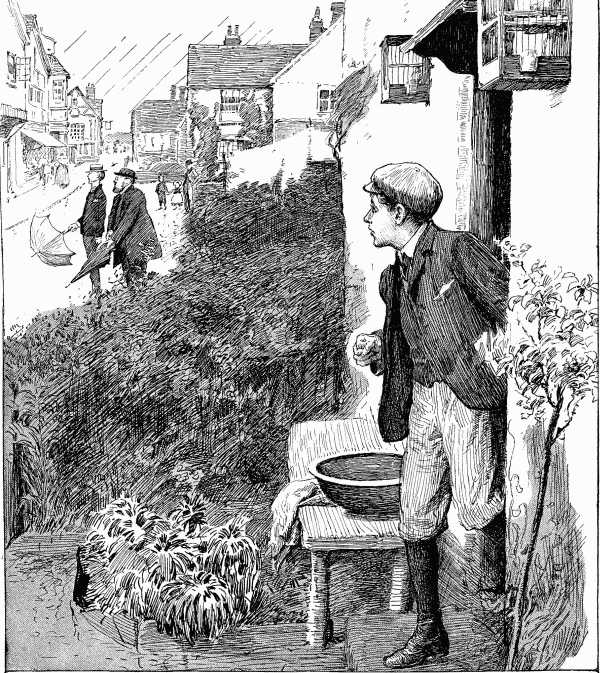
She filled an iron pail at the boiler-tap, and, as I stood waiting, my thoughts flew back to earlier days at Acacia Road, and to Jane and her energetic manner of smacking the oilcloth. But I suppose my ideas had developed since those times, and certainly I felt this morning that I was being subjected to the lowest humiliation. However, I carried up the pail, slopping the water on the stairs at every step, with a scrubbing-brush in the other hand, and then I set to work. When once I had[Pg 27] begun, I cannot pretend that I found the actual washing of the wainscot particularly distasteful, although it seemed rather hard, after I had done my best, that Mrs. Turton should upbraid me for soiling my clothes.
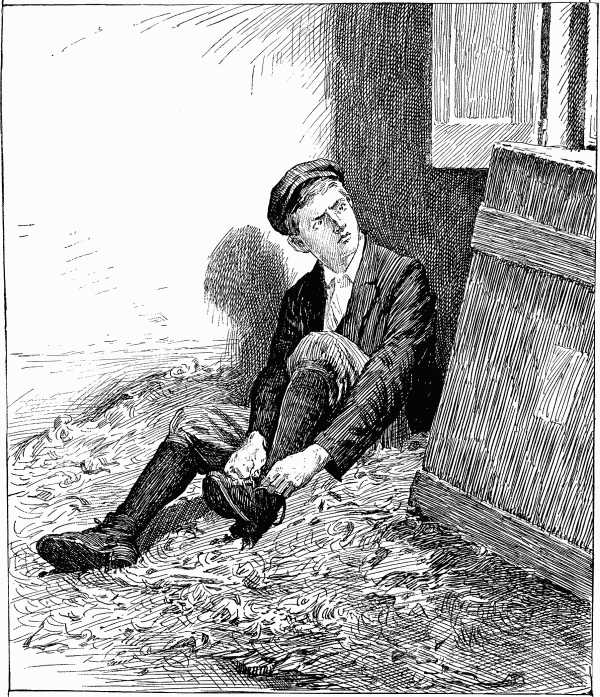
It was perhaps a week later that the notion of running away definitely entered my mind. By that time I had cleaned a considerable portion of the woodwork of the house, lime-whitened a portion of an outside wall, filled several coal-scuttles, and swept the yard. My clothes were naturally not at the best at the end of the term; I had grown considerably since they were new, and now they were splashed with distemper and soiled with dirt. One Monday morning I noticed the absence of the boy who cleaned the boots and knives and forks, and remarked upon it to Augustus.
'You see we shall not want him now,' he answered, with one of his irritating sniggers, and I fully understood the significance of his words. I try to do the Turtons no injustice, reminding myself that, to begin with, they were far from rich, and that they had lost the forty pounds or more which should have been paid for the last term's board and schooling. Moreover, they had not known me for some years, as the Windleshams had done; I was in their house, requiring food and shelter, and perhaps they could not reconcile their consciences to turning me out. So they determined to make me useful in the only possible way.
Already I had begun to wonder what would happen when Smythe and the other fellows came back after the holidays. One thing I knew for certain, and this was that Augustus would not fail to tell them how I had spent the time since they left; in fact, he had more than once hinted at their interest in my proceedings. The dismissal of the boot-boy made me more and more apprehensive that I should still continue to be degraded after the beginning of the term, while I felt humiliated by the conviction that, even in the present circumstances, Mr. and Mrs. Turton were keeping me only on sufferance.
But this Monday morning brought me to a determination. I had finished breakfast, and was wondering what I should be set to do next, when Augustus opened the schoolroom door.
'Everard,' he said, 'you are to clean my boots.'
'Clean them yourself,' I retorted.
'I shall tell Father,' he exclaimed.
'Tell your mother, too, if you like,' I said.
He went to tell them, and a few minutes later Mr. Turton entered the room.
'Everard,' he said, 'I wish to speak to you.'
'Yes, sir,' I answered.
'You understand,' he continued, 'that I have no desire to say or do anything to hurt your feelings. I can quite sympathise with you, and I am grieved that this necessity has arisen. But the fact remains.'
'I am not going to clean Augustus's boots,' I answered.
'Do you think work is disgraceful to you?' he demanded.
'I am not going to clean Augustus's boots,' I insisted.
'You compel me to take harsh measures,' he said. 'I have no wish to take them, but I shall give orders that you have no food until you obey me. You have to work for your living. I certainly cannot afford to keep you in idleness. You will go to your bedroom, and stay there until you clean the boots and bring them to my study.'
Looking back, I am never able to forgive myself for surrendering. Yet I did surrender, although not at once. I passed Mr. Turton at the door and walked slowly upstairs, where I shut myself in the bedroom. Then and there I finally made up my mind. Without any definite scheme when I succeeded in reaching my destination, I determined to go to London. I did not possess a penny of money, but I had my silver watch and chain, which surely it must possible to sell.
The hundred-miles' walk caused me not the least alarm. I was strong and well, although I had grown thinner during the holidays; the weather was warm, and I reckoned on reaching my destination in about a week. As to what I should do on my arrival I had very little idea; but, for one thing, I thought I would try to find Rogers and ask his advice. I had read many books about boys who had gone to London without a penny in their pockets and made immense fortunes, from Dick Whittington downwards, and I saw every reason to believe that, in some wonderful way, I should be equally successful. At all events, I would go. I would put some clothing into a bundle, and then I would await a favourable opportunity and take my departure, for at the worst it seemed certain I should be safe from pursuit. Mr. and Mrs. Turton would be thankful enough to get me off their hands, although Augustus might miss me as his butt.
The hours passed very slowly in the bedroom, and, having breakfasted on bread and water, I began presently to feel more and more hungry.
'I will not clean Augustus's boots,' I repeated at intervals, and I tightened the strap behind my waistcoat. But, as the long afternoon began to wear away, and my hunger still increased, I sang to a different tune. 'What did it matter whether I cleaned the boots or not?' I asked myself, especially if I could succeed in finding Augustus alone in the garden for a few quiet minutes before I left the school. Anyhow, it would be the first and the last time. So, just after the clock struck seven, I opened my door, went down to the hall, and thence to the kitchen, and knocked at the door.
'Cook,' I said, 'where do you keep the boot-brushes?'
'In the coal-cellar, Master Everard,' she answered. 'I would have done them with pleasure, only Mrs. Turton forbid me.'
I went into the coal-cellar, took the brush and blacked the boots, and, oddly enough, I did not cease until I had made them shine far more brightly than Augustus's boots had ever shone before. Then I took them in my right hand and carried them upstairs, knocked at the door of Mr. Turton's study, and was told to enter.
'I have brought the boots,' I said.
'Ah,' answered Mr. Turton, 'I am glad you have come to a less unreasonable state of mind. You can go to the kitchen and ask Cook for some food.'
(Continued on page 34.)
[Pg 28]
 ildly the wind doth rage,
C. D. B.
Bees and Spiders, Earwigs, Beetles and Snails, Dragon-flies, Grasshoppers, and Butterflies are familiar enough to us all; yet how many realise how 'fearfully and wonderfully' they are made? What a marvellously complex weapon is the 'sting' of the bee! What a wonderful 'rasp' the snail possesses! How many can tell how an insect smells, and where its organs of taste and hearing lie? Since these are questions which young people often ask again and again, some of them will be answered in the course of these articles. To explain such matters clearly is a very difficult task, but with the aid of drawings, specially made for this purpose, the main facts at least should be easy to grasp.
Most of us agree to treat the bee respectfully, having a wholesome dread of the vengeance he is likely to inflict on those who offend him. But how does a bee sting? and what is the sting like?
To take the last question first. The sting of the bee is really an extremely cunningly devised weapon, so complex that only the bare outlines of its structure can possibly be described clearly.
If you turn to the illustration of the bee-sting, you will notice, in the right-hand figure, at the upper end, three pointed projections or 'processes' marked. The two outer ones (s s) we may neglect, for they are only protecting sheaths; that in the middle (i s) is the sting proper. This consists of two parts, (1) a strong gouge-like portion, and (2) a pair of darts of marvellous delicacy. These darts we cannot see in position because they lie on the other side of the gouge-like piece. But to the left you will notice a[Pg 30] long sword-like blade, drawn separately, with a curiously crooked handle and a sharp barbed point. This is one of the pair of darts. Those who have had the misfortune to be stung may be interested to know that this painful wound was inflicted thus: When the bee alighted on you, he first thrust through the skin this hard, pointed gouge; then one of the darts was pushed down, then the other, a little further; then the gouge penetrated still deeper, and the opposite dart deeper still, and so on, first one dart, then the other, going deeper and deeper, the gouge following. As they penetrated, little drops of poison oozed out from the barbs of the dart, and this caused the pain and inflammation.
This poison is made in what is called the poison gland, the long, slender, coiled tube (p g) in the picture. As the poison is made, it is stored in the big bag (marked p) at the back of the sting, and when this is working, the poison is forced down between the gouge and the darts, to find its way out at the barbs into the flesh.
But this sting is not only used for the purpose of giving pain. The bee long ago discovered the fact that food, if it is to be preserved for any length of time, requires to be specially dealt with. Accordingly the honey which is destined to be kept is preserved from fermentation by the addition of a drop of formic acid deposited by the sting.
Only the workers and the queen-bees of a hive have stings: the males are stingless.
In stinging it often happens that the barbed darts are thrust so far into the wound that they cannot be withdrawn. As a result, the whole apparatus is left behind, and the bee pays the penalty with its life.
But whilst some insects, such as the bees, inject poison by means of a 'sting,' others effect the same end by peculiar modifications of the mouth-parts. The gnat is a case in point: the water-bug, common in our ponds and ditches, is another.
Strangely enough, the mechanism adopted is precisely similar in character, though the parts of which this mechanism is made up are of a totally different kind. Here, the mouth-parts are specially modified, so as to form a supporting and piercing weapon, like the 'gouge-like' piercing weapon of the bee, with delicate pointed and barbed weapons corresponding to the barbs of the bee's sting. This piercing organ may be used for sapping the tissue of plants, or, as in the case of gnats and fleas, they may be employed for the purpose of absorbing the blood of animals. In the latter case, after the surface of the skin is pierced, a poison is forced down into the wound, for the purpose, it is thought, of making the blood more fluid. But this poison is of a highly irritant nature, and leaves a very painful feeling, accompanied by more or less inflammation of the parts attacked.
The water-boatman, which almost every one must have seen swimming back-downwards in ponds, can inflict a very painful wound in this manner. The illustration shows the 'lancet' of nepa, the water-bug. The piercing organ just described is the spear-shaped piece bounded on either side by two long filaments.
W. P. Pycraft, F.Z.S., A.L.S.
An American Republic, having a hot climate on the coast-line, but cooler inland. It is a rich and fertile country, where many valuable trees grow. Useful plants and fruits are produced in great abundance, and there are many wild animals, and birds of brilliant plumage. Numerous shallow rivers water the land, and gold, silver, iron, copper, and other metals are to be found there.
C. J. B.
A word of eight letters, naming the hero of a noted poem.
C. J. B.
'It is hard lines it should rain the first day of the holidays,' said George, somewhat gloomily, as he looked out at the heavy downpour, which was fast changing the tennis-lawn into a miniature lake.
'No chance of a game!' sighed Pelham, thinking of the swamped cricket-field.
'If you two lads want an indoor job, I have one for you, and one that has baffled me,' said Mr. Carteret, looking up from his paper.
'What is it, Father?' asked Pelham, the eldest boy.
'A lot of things were sent here from Vale Place last month, and amongst them an oak chest, which I cannot unlock, try as I may, so I waited for you two, as I know you are more handy with your fingers than I am,' answered his father.
'We will soon tackle it!' said Pelham, confidently.
'Father,' here broke in George, 'I thought you were to have Vale Place when old Mr. Pelham died?'
'So did I,' said Mr. Carteret shortly.[Pg 31]
'But it is left to some one else, is it not?' went on George, anxious to understand the matter, which had greatly puzzled both boys for some weeks.
'Yes, I meant to tell you about it when you came home,' said their father. 'It was no good writing bad news, but you must know it sooner or later. You know,' he continued, 'that my father and Mr. Pelham were brother-officers in India, and when both my parents were swept away in one week by cholera, Mr. Pelham brought me home to Vale Place, where I was brought up as his son and heir. But after his death, a few months ago, no will could be found, though he had repeatedly told me that he had made one, leaving Vale Place to me and my children.'
'Then who has Vale Place now?' asked George, as his father paused a minute.
'It passed to the heir,' said Mr. Carteret. 'He is a distant cousin, who cares nothing about the property, and means to sell it for building land.'
'What a shame!' said Pelham, hotly.
'Well, I do not know that there is any shame about it, for this cousin has never lived there, and it has none of the old associations for him that make me regret its loss so deeply. He seems a very considerate man in some ways, and begged to be allowed to send me all the old furniture which stood in my room at Vale Place, thinking I should value it, as indeed I do. So that is how the old chest came to me, and here are the keys. See what you can do with them.'
'Come on, George!' said Pelham. 'Where is the chest, father?'
'Upstairs in the attic. You will want a candle; it is in a dark corner,' was the answer.
'I am coming too!' announced Nannie. 'I want to see what is in the chest. I have fed my birds, and I may not stay out in the rain.'
'Little girls should not be inquisitive,' said George, who dearly loved to tease his sister. 'You may see more than you want.'
'Oh, George! what?' said Nannie, in rather a shaky voice. 'What do you think is in the chest?'
'You will see by-and-by, and remember I have warned you!' said George, mysteriously.
Nannie, though alarmed, bravely stood her ground and watched the two boys as they tried every key on the bunch; then, finding that none fitted, they used a screw-driver, and at last were successful.
'Now, Nannie!' shouted George, as Pelham lifted the heavy lid. 'Look out! I am sure I heard something stirring inside.'
Pelham held up the candle and looked eagerly into the dark chest.
'Empty! quite empty!' he cried, in a tone of the utmost disgust. 'Nothing at all in it but an old letter!' and he threw the paper on to the ground by the side of the chisel.
'I told you so,' began Nannie, but the sentence was hardly out of her mouth before she gave a little shriek and leapt high into the air. 'A rat! a horrid rat!' shrieked the child. 'It ran over my foot.'
George did not shriek; but he, too, was startled, for the rat had appeared so suddenly.
'It came right out of the chest,' he said, as if to excuse his alarm.
'It could not!' said Pelham, bluntly. 'I was looking in the chest when Nannie shrieked, and there was nothing in it—that I know! I saw no rat anywhere.'
'But I saw it!' said George. 'Look! look!' he shouted, excitedly. 'There it goes! Just by your foot! You may depend upon it this box has a false bottom. Let us turn it over and see.'
'I believe you are right, George!' said Pelham. 'Hold the candle, Nan, and we will see where this rat came from.'
The chest, empty as it appeared to be, was yet so heavy that it was with difficulty that the two boys could turn it over, but they did it at last, and now there was no doubt where the rat had come from, for the floor was strewn with little bits of nibbled paper, and there was a biggish hole in the false bottom by which he had evidently gnawed his way into the chest.
'Now, then, the fun is beginning!' exclaimed Pelham, excitedly, 'We must get inside this false bottom; it is full of old letters. I can see that much! Perhaps we shall find a love-letter of William the Conqueror to Joan of Arc!'
'Oh, no, you will not!' said Nannie, wisely, 'for Joan of Arc lived many reigns after William I. I read about her only last week.'
But neither Pelham nor George heeded Nannie's superior information, so busy were they prizing off the somewhat thin layer of wood which formed the false bottom of the chest.
It gave way at last, and disclosed a whole heap of letters, some nibbled into mere powder by the busy rat and some still uninjured, and on the top of all a yellow parchment folio bearing in large letters the words, 'Will of George Pelham, Esquire, of Vale Place, Surrey.'
Pelham got very red as he exclaimed, excitedly, 'Surely this is the lost will!'
'If it is, we owe it to the rat!' said George, half thinking Pelham was joking.
'I must take it at once to Father,' said Pelham, and he ran down the attic stairs closely followed by the no less excited George and Nannie.
'See, Father, this will! Is it right? Will you have Vale Place after all?' said Pelham, eagerly; as he held out the papers.
Mr. Carteret took the bundle, looked at the heading, and then turned it hastily over to see the signatures at the end.
Yes, it was duly signed and witnessed, and without doubt was the long-sought will!
Why Mr. Pelham should have so carefully concealed his will was never explained, but people from time immemorial have done odd things with their wills, and will probably continue to do so. It was, after all, of little consequence now where it had been found, so long as the will was a true one, and of that no doubt was ever raised.
Before many months were over Mr. Carteret and his family were settled at Vale Place, where the 'mysterious chest,' as Nannie always called it, has the place of honour in the entrance hall.
S. Clarendon.
[Pg 32]
It was April, and the year 1805, when two little fellows, out for the day from Charterhouse School, stood at the bow window of a large house on Ludgate Hill, London, waiting for the return of their uncle from his country house.
'Here he comes!' said the lads, as a portly figure came round the corner, and the next minute he was in the room, exclaiming, in his cheery way, 'Well, lads, glad to see you! What must we do this afternoon? Is it to be the Tower of London, or the river, or the Monument? Anything you choose will suit me.'
'Then, sir,' said the elder boy, eagerly, 'do let us go and see the performing birds. All our fellows are talking about them.'
'To be sure we will! I, too, have heard about this Signor Rossignol, as he calls himself, and we will have a bit of dinner, and start off at once to Charing Cross.'
The 'bit of dinner' proved to be a very ample meal, to which our schoolboys did full justice, for school meals a hundred years ago were far from satisfying, and a dinner like this one was not a thing to be hurried over. However, there must come a time when even hungry schoolboys can eat no more, and at last, when even another fig seemed an impossibility, a start was made for the birds. They arrived at the Hall in good time, and had excellent seats, just facing the stage.
When the curtain drew up, it disclosed a long table, on which were placed a dozen cages, each containing a little bird. Their 'tutor,' as Signor Rossignol styled himself, stood at the head of the table, and, after a low bow to the audience, he began: 'Behold my little family of birds! They have all the true military instinct, and are ready, as you will see, to do all in their power to defend this land of freedom.'
Loud and prolonged cheers greeted this speech, for the Battle of Trafalgar had not yet taken place, and the dread of a sudden landing of the French 'tyrant' was never long out of the thoughts of any Briton. When the cheering had ceased, Rossignol opened the cages one after another, and each bird hopped out in a sedate way, and placed itself on the table, waiting for orders.
'Fall in!' shouted Rossignol, in a loud military voice, and at once the birds formed themselves into two ranks. Then their tutor fitted a little paper helmet on to each bird's head, and fixed tiny wooden muskets under their left wings.
Thus equipped, the birds, at the word of command from their tutor, went through the usual exercises of soldiers amidst the applause of the audience.
Then another bird, not previously exercised, was brought forward.
'Death of a deserter,' explained the tutor, as six birds placed themselves three on each side of the new arrival, and solemnly conducted him from the top to the bottom of the table, where there was a small brass cannon, charged with a little gunpowder.
The unfortunate deserter was placed in front of this cannon, his guards retired in an orderly way, and he was left alone to meet his fate. A lighted match was now put into the claws of another bird, who hopped slowly up to the cannon and discharged it. At the sound of the explosion the deserter fell down on to the table, and lay there as if rigid in death.
'Oh, I say! That is too bad!' said the younger boy. 'I don't think poor birds ought to be blown from the gun like that. It's cruel, is it not, sir?'
Before the uncle could reply came the sharp order, 'Stand!' and, behold, the dead deserter came to life again, and hopped away to join his friends!
The birds were now replaced in their cages, and it was the signor's turn to occupy the stage.
First of all he gave a clever imitation of the notes of all birds, ending up with the prolonged 'jug-jug' of the nightingale, which he did to such perfection that you could hardly believe there was not a grove full of those birds on the stage.
'He may well call himself "Rossignol"' (the French for nightingale), said the boys' uncle as he gave a hearty clap to the clever performer, 'for he seems as real a nightingale as I ever listened to.'
Next Rossignol produced a fiddle without any strings to it, and going through all the airs and graces of a real violinist, he sawed the air with an imaginary bow, making the notes with his voice so well that you could not imagine it was not a real violin playing. This delighted the audience most of all, and he was encored again and again, and when the entertainment was finished, the two boys said 'they wished they could have it all over again!'
For many months Rossignol continued to draw large audiences to hear his imitation of birds, &c., but one fatal day it was discovered that the sounds were produced by an instrument—probably a pierced peach-stone—which he concealed in his mouth, and after that no one cared to hear him, and he died in great poverty a few years later.
S. Clarendon.
y chief fear when I went to bed that night was that I might not wake early the following morning, for in this event my departure would have to be put off. I must leave Ascot House before any of the Turtons were up, if I left at all; I was bent upon getting away from Castlemore at the very earliest moment. In my room there were three beds, two being unoccupied during the holidays, and there was a chest of drawers which I shared with my companions. On the knob of one of the[Pg 35] drawers hung the bag in which were kept my brush and comb, and this I thought would serve to hold the few things I intended to take with me. Not daring to get the things ready that night, lest Mr. Turton should pay one of his occasional visits to the bedroom when he turned out the gas, I lay down, and in spite of the important coming event, soon fell fast asleep. When I awoke the sun shone into the room, and getting out of bed and looking at the watch which was to be shortly converted into money, I saw that it was twenty minutes to six.
Losing no time over dressing, putting on the better of my two knickerbocker suits, I removed the brush and comb from the bag, putting in their place two pairs of stockings, a spare flannel shirt, a pair of gum-shoes, two handkerchiefs, and a flannel cricket cap.
Having little fear that any one but the servants would be about the house, I tightened the string of my bag, and went quietly downstairs. In the room where we kept our hats and overcoats I put on my laced boots, which already were somewhat thin in the soles, and my straw hat, as the sun had been extremely hot the last few days; and then I began to think of breakfast, because I made up my mind that it would be wise not to attempt to dispose of my watch and chain until Castlemore had been left some distance behind. About ten miles on the London road, although I did not know the precise distance, stood the small town of Broughton, and there, I thought, it might be safe to replenish my exchequer. Consequently, having not a penny in my purse at present, I must wait until I reached Broughton for breakfast, unless it were possible to obtain something to eat before I left the school.
So, leaving my bag in the hat-room, I went to the kitchen, where the cook was in the act of lighting the fire.
'Good morning, Cook,' I said.
'You are up early this morning, Master Everard,' she answered.
'I am most awfully hungry,' I continued. 'Do you think you could give me something to eat?'
Turning her broad back to the fireplace, she stared at me from head to foot, seeming especially to be impressed by the fact that I had put on my boots. But if she had a suspicion of my intention, she kept it to herself, and going to the larder, returned with a plate on which lay a thick slice of dry bread and another of cold beef.
Thanking her, I took the bread and meat and left the plate, then, returning to the hat-room for my bag, unbolted the front door without making a noise and walked calmly away from the house, beginning to eat my breakfast as soon as I reached the road. It was a beautiful summer morning, and the birds sang in the garden trees as I walked towards the margin of the town. Holding my bag by the long string I let it hang over my left shoulder, and stepping out briskly soon passed the last houses in Castlemore. Although my chief feeling was one of relief at having left Ascot House and the Turtons behind, it was impossible to avoid a glance back at the days which I had spent so happily with the Windleshams. I no longer had the least doubt that Captain Knowlton had been lost with the Seagull, and as I covered the first mile or two of my long journey, I became impressed with a conviction of all the difference his death had made to my life. Instead of Sandhurst, I could not tell what lay before me, and yet I scarcely doubted that, whatever it might be, the end would prove satisfactory.
I determined to lose no time over my first stage, and after walking for three-quarters of an hour, I passed a finger-post, which conveyed the information that Broughton lay still eight miles distant. Although I had told myself yesterday that Mr. Turton was very unlikely to start in pursuit, that he would be only too glad to get rid of an unremunerative boarder, this morning seemed to make the affair look different. He might consider that his duty compelled him to set out in search of the runaway, so that it would be wise not to rest until the first ten miles had been put between myself and the school.
I felt anxious to reach Broughton, in order to dispose of my watch and chain, being already somewhat afraid that there might arise some difficulty about its disposal. I had never attempted to sell anything before, nor was it easy to form an opinion concerning the value of the only things I had to barter. Still, four pounds appeared a likely sum, or three pounds ten at the lowest, and this would surely serve to provide food and shelter until I reached London.
Very few persons passed me by the way, but coming within sight of the first houses of the small town, which was in reality little more than a large village, I began to overtake and soon passed a man who I little imagined would cross my path again. Broughton is approached by a long decline, at the foot of which, on the right, stands a rural inn. Before its door this morning were a couple of waggons, one laden with hay, the other with sheep-turnips. A smock-frocked carter stood eating a chunk of bread and fat bacon, while a fox-terrier begged for scraps. Having walked ten miles in the hot sunshine, I was glad of any excuse to halt, so that a few minutes after passing the man in the road, I stopped to watch the dog.
While I stood there the man caught me up again, and he also came to a stop, between myself and the waggons. He was quite young, probably not more than one or two and twenty, tall and well-built, although he walked with a slouching gait. He wore corduroy trousers fastened round the waist by a narrow strap, and a blue shirt, with an unbuttoned jacket of fustian. On his head was a limp-brimmed, dirty, drab felt hat, and in his left hand he carried a red handkerchief, which apparently contained all his possessions, and in his right a stout stick which had been obviously cut from a hedge. His hair was extremely short and black, but he could not have shaved for some days; his face was deeply sunburnt and one of the most evil-looking I had ever seen. I imagined that he was looking for a job at hay-making or harvesting, and in that case he would have little difficulty in finding one at the present season.
Without entering the inn, he walked on towards the main street, which contained two dozen or more of small shops, and a few minutes later I took the same direction, soon beginning to look about for the kind of shop I wanted. After I had passed[Pg 36] the tramp a second time, I saw the usual sign of a pawnbroker's, and, thinking it would look better to remove my watch and chain before entering, I took the bar out of my button-hole.
Stopping outside the shop, I stood a few minutes gazing in at its window, which was filled with a miscellaneous collection: teapots, telescopes, knives, spoons, pipes, and one or two flutes and concertinas. Presently I summoned enough resolution to enter, and going to the counter, held out the watch and chain to the rather elderly man behind it.
'I want to sell this watch and chain,' I said.
'Oh, you do, do you?' he answered, and opening the watch, he began to examine the works. He[Pg 37] looked so doubtful that I began to fear he would refuse to buy, in which case I scarcely knew what to do, as it seemed unlikely that I should find another such shop that day. It was already past eleven o'clock, and after my walk I was beginning to feel hungry. Certainly he had no right to buy the watch from a boy of my age, but I suppose that after a little hesitation he was unable to resist the temptation to make a bargain.
'How much do you want for it?' he asked, as he closed the lid with a snap.
'Four pounds,' I answered, thinking that a reasonable demand.
Still holding the watch with the chain hanging down between his fingers, he broke into a laugh which did not sound very merry.
'Four pounds!' he exclaimed. 'Think yourself l[Pg 38]ucky if you get ten shillings. I will give you fifteen.'
It was a terrible disappointment, but at the time it did not occur to me to doubt the man's good faith. I came to the conclusion that I had ignorantly over-valued my property, and at least fifteen shillings would be better than nothing.
'Very well,' I answered, and, placing the watch and chain on a shelf behind him, the man opened a drawer under the counter. While he slowly counted out the money in silver, I happened to glance at the window. In a moment my eyes seemed to be riveted by those of the tramp, whose existence I had quite forgotten. He stood outside the shop, watching me with the greatest intentness, and suddenly I felt afraid, and wished he had gone on his way, and left me to go mine. I spent as long a time as possible counting the money and putting it in my knickerbockers' pocket, but when I at last left the shop the tramp was still staring in at the window.
Still, he took no notice of me as I walked away from the door, not even turning his head. With money in my pocket, my appetite suddenly became urgent, and seeing a coffee-shop a little further down the street, I entered and sat down at a table, which sadly required scrubbing. An untidy girl came to ask what I wanted, but when I suggested a chop—for 'chops and steaks' was painted over the window—she said I could only have eggs and bacon.
'I will have some eggs and bacon,' I answered.
'Poached or boiled?' she asked.
'Poached, please.'
'Tea or coffee?' she suggested.
'Coffee,' I replied, and, after waiting ten minutes or longer, I was supplied with a plate of hot eggs and bacon, a thick slice of bread, and a cup of coffee. Not in a mood to be very particular, I ate every scrap with the greatest relish, and altogether I could not have spent less than three-quarters of an hour in the coffee-shop. My meal cost eightpence, and its effect was to make me feel extremely lazy and sleepy; but, having a long day before me, I determined to find some shady spot and rest for an hour or two until the heat of the day had passed. Then I would push along until I was about twenty miles from Castlemore, when I must find a lodging for the night.
At the battle of Dettingen, George II. was on horseback, and rode forward to reconnoitre the enemy. The horse, frightened by the cannonading, ran away with the King, and nearly carried him into the midst of the French lines. Fortunately, however, one of the attendants succeeded in stopping him. An ensign seized the horse's bridle, and enabled the King to dismount.
'Now that I am on my own legs,' said he, 'I am sure that I shall not run away.'
The King then abandoned his horse, and fought on foot at the head of his Hanoverian battalions. With his sword drawn and his body placed in the attitude of a fencing-master who is about to make a lunge, he continued to expose himself without flinching to the enemy's fire, and in bad English, but with the utmost pluck and spirit, called to his men to come on.
This was the last occasion upon which a sovereign of Great Britain was under the fire of an enemy.
 ho is my friend? Not he who seeks
E. Dyke.
The scene of this story is laid at Land's End in Cornwall, or, to be precise, to the west of the little village of Sennen Cove, and the time chosen is toward the end of last century.
The month of the year was November, and the night was wild and tempestuous, so that the storm beat against the little thatched cottage in one room of which a woman was dying. Gathered about her bed was her husband, Owen Tresilian, and their son Philip and daughter Mary. We pass over the sad scene connected with the death of Mrs. Tresilian, just referring to her last words to the father of her children. There had been times in Owen's life when, finding himself without means and without work, with want staring himself, his wife, and his family, in the face, he had resorted to bad ways of obtaining money. He would never have yielded to the temptation had it not been for the persuasive words and occasionally the threats of his mates. Many of these men were wreckers; that is to say, they deliberately placed on the coast false lights which lured passing ships to destruction. It was from the wrecks of the disabled vessels that they gathered up the treasures carried to them by the waves, and it was known that one or two of the more desperate characters among them had not hesitated to throw back into the water the poor unfortunate creatures whom they had lured to destruction, as they struggled to reach the shore. Owen, indeed, had never gone thus far, but he had participated in their illicit gains, and had himself helped to kindle the lights that were to[Pg 39] wreck the boats. His dying wife, whose trouble when she heard of this was very great, had made him promise that whatever might occur after her death, he would never again be guilty of such wicked work. He had promised her faithfully that none should ever force him again to engage in such undertakings, and he had added solemnly, 'They may kill me first, but I would rather starve than do it.' Scarcely had she finished speaking to husband and children, when wild shouts were heard outside the cottage, from the midst of the storm, 'Come on, men! come on—a wreck! a wreck!' Lights passed the little windows, and the clatter of many feet along the path close by told the family what manner of men were about.
The story goes on to tell how Owen, after his wife's death, his son Philip and his daughter Mary, endeavoured to lead lives very different from those of the greater number of their neighbours. They had come under the influence of Wesley's teaching, and were not afraid to let it be seen that they wished to honour God and keep His commandments. Owen's mates, who had known him in the days when he had thought very much as they did, left no stone unturned to show their ill-will to him and his family now that so marked a change had taken place. There was in the village a certain Arthur Pendrean. He was the son of old Squire Pendrean, who had at first greatly opposed his son's wish to become a clergyman. On one occasion, when Wesley had been preaching in the village, and had been in danger from the rough crowd, Arthur, then but a boy, had been so indignant at their behaviour, that he had rushed forward with the intention of placing himself between the old man and his rough assailants.
A few days later this story reached the Squire's ears, who, in a violent passion, sent for his son and told him that if he ever went near the Methodists again, he would disinherit him and turn him out of doors. A few years later, when, between sixteen and seventeen years of age, the youth left school, he told his father boldly that he wished to go to Oxford, and that he intended to become a clergyman. The boy had a hard time of it before he won the old Squire's consent, but in time leave was given.
Arthur Pendrean had from the first taken a keen interest in the Tresilian family, and had watched most carefully over Philip. He was aware of the ill-will felt by the rest of the villagers towards his charges, and made it no secret that he was one of the sternest opponents of the evil practice of wrecking. It was well known that Arthur had set his face against their evil designs, and that it was his determination to have a lighthouse built, no matter at what cost, to warn off ships from this doubly dangerous spot. The worst-disposed among the men would have made short work of the young clergyman could they have had their way and escaped consequences. At least, they would prevent, if it lay in their power, the carrying out of his cherished plan, the erection of a lighthouse. It was perhaps natural that hating the 'parson,' they should not feel kindly disposed towards those who closely followed his advice and over whom he so carefully watched. It was in these circumstances that the following occurrences took place. Arthur was about to ride to St. Sennen one Sunday morning, when his faithful old servant, Roger, came up to him and said, 'I hear, Mr. Arthur, that a cutter with a press-gang on board is at anchor off Sennen Cove. Sunday is a favourite day for those chaps to land; they always find the men at home then, and so they are easier to catch. I thought I would warn you about it, sir, because their game is to carry off all the men and lads who are called Methodists.'
'This is bad news,' Arthur had replied. 'I knew a press-gang was in the neighbourhood, but never thought of their coming our way. I will gallop down to Sennen Cove at once.'
Arrived at the Cove, Arthur found everything as usual, the cutter lying quietly at anchor and a few men and boys sitting or lying lazily on the beach watching her, and speculating as to the intentions of those on board.
On Sunday afternoon we again see the young curate; we hear his stern voice as he asks a group of six stalwart men, 'What are you doing here, men? Take your hands off those lads at once; what right have you to drag them away?' We see the men, furious at this repulse, falling upon Arthur from behind and dragging him to the ground, and Philip with him. The young clergyman, brave man that he was, was no match for six assailants at once, and was of course unable to withstand the combined attack. Promising Philip that he would have him released when he reached Plymouth, for he was under seventeen, and handing him as a memento a small Testament, and commending him to the care of God, he was obliged to witness the rowing away of the boat that carried his young charge every minute farther out of sight.
Philip's capture would not have been brought about had it not been for the ill designs of the youths of his own age who were no friends to Arthur Pendrean. The scheme for decoying him into the immediate neighbourhood of the press-gang belonged to two of the worst characters in the village. But we will not enter into details of their scheming. It is enough to know that for the time being their wicked designs were successful, and we find Philip within a very short time on board the Royal Sovereign, one of the finest line-of-battle ships in Earl Howe's fleet.
The trouble and grief of his father and little sister when they learned what had happened was great. Owen at first refused all comfort. It was in vain that Mr. Pendrean promised to spare no pains to bring the lad home again: the bereaved father would not be comforted. It was in this state of mind that he set out for Falmouth, accompanied by Arthur Pendrean, as they thought it not improbable that the cutter might put into this port before proceeding to Plymouth. Her crew were, however, too wide awake, and the press-gang too anxious to secure prize-money, to run any risk of losing those whom they had captured, and pressed for his Majesty's navy; they therefore made straight for the fleet. How Philip Tresilian subsequently fought in the battle of the first of June, how he saw for the first time and understood something of the horrors of war, are all graphically described by the author.
(Concluded on page 42.)
[Pg 40]
[1] This favourite book is by James F. Cobb. (Wells Gardner, Darton, & Co., London.)
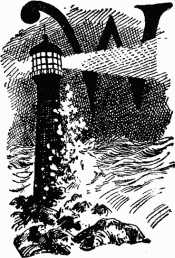
e shall now take a peep at the lighthouse and its first watcher. 'That will never be finished,' said one of the wreckers, when he saw the work slowly progressing on the lonely rock at Land's End. But it was finished. Arthur Pendrean wrote to many rich ship-owners in London and elsewhere, and at length, by the aid of their money and the toil of skilful workmen, a light began to burn in the Longships Lighthouse on September 29, 1795. Those were early days of lighthouses, and experience had hardly yet proved the risk and the danger of leaving one man alone on a solitary rock to attend to the lights, often cut off for days, or even weeks, from all communication with the shore. In these days things are very different. Three men, and sometimes four, are appointed to take charge of lighthouses, such as the Longships, Eddystone, and others.
One night a furious gale from the south-west raged along the coast; many were the watchers at Sennen and other villages along the shore, keeping a sharp look-out for wrecks; but whether owing to the lighthouse or to the fact that there were not many vessels about just then, the evil hopes of those who were longing to profit by the misfortunes of others were frustrated. Owen felt very anxious about the lonely lighthouse-keeper, whom he could not help thinking of as trimming his lamps on the solitary rock with the roar of the ocean around and below him. He knew that one who had not been there could not possibly have any idea of the awful noise on the Longships Rock occasioned by the roaring and the raging of the waves in the caverns underneath. We cannot stay to describe all that Jordan, the lighthouse-keeper, in his loneliness experienced, nor to tell how the waves, leaping above the lighthouse, sometimes completely covered it. We see him as he walks about, now up and now down, almost terrified by the fierce yells and shrieks which fell upon his ears, and at last watch him, in despair, fling himself upon his bed. Oh, that he had never been tempted to come to this accursed, haunted rock—for haunted he felt certain it was! Like most sailors, he was more or less superstitious, and the angry roar in the caverns beneath sounded to him like the roar of hundreds of imprisoned wild beasts, until, by-and-by, losing all his presence of mind, his hair turns white in a single night with terror, and he becomes a maniac. It was thus that Arthur Pendrean found him several days later, when, seeing, to his great grief, that the lamps were unlit, he put out to learn the cause in a little boat manned by Owen and one or two of his friends. How Owen and the others failed to effect a landing on the rock, and how the brave young clergyman made a bold leap, springing safely upon a projecting ledge of the Longships, is all thrillingly told in the chapter headed 'A Hazardous Voyage and a Bold Leap.'
Perhaps the most surprising part of the story is the bravery of Mary Tresilian, Philip's little sister, who, although only a child, when she sees that no man can be found to undertake the dangerous and difficult work of keeping the lamps lit on the Longships, begs her father most earnestly to himself undertake the task, and permit her to accompany him. At first he would not hear of it, neither would Arthur Pendrean; but the child pleaded so earnestly and fearlessly that, in the end, no one else coming forward to undertake the duty, they yielded to her prayers. And so we find the light burning again in the lighthouse, thanks to the courage and unselfishness of a brave little girl.
'Trust me, I will be a match for them, somehow or other,' said Nichols, when he knew who the new lighthouse-keepers were. 'I have an old grudge against that Tresilian, and I mean to pay him out. As to that parson, you all know what I think of him.'
'Well, John, there's many a chap here will be glad enough to help you,' said Pollard.
A very exciting chapter is that entitled 'A New Conspiracy,' which tells how Owen, coming ashore with some fish, was waylaid by a ruthless gang of wreckers and smugglers, who tied him up as a prisoner, and would have left him to starve had it not been for one of them with a little more heart than the rest, who cut the cords that bound his wrists, seeing there was no chance of his escape from the cavern into which they thrust him, bolting and barring the gate that closed it. A more wretched dungeon could scarcely be imagined. Dark even in brilliant noon-day, damp and dripping with slimy sea-weed, the ground full of pools of stagnant sea water, the air so chilly that it seemed to freeze one to the very bones, such was the place to which these cowardly enemies consigned the unfortunate man. And he? His thoughts were of his little child. Truly his troubles were great; his wife was dead, his son torn from him, and now his daughter, his only child, doomed, as he thought, to a terrible fate, while he, her father, was a prisoner and powerless to help her. But was he powerless? Could he not pray? It was this thought that caused him to fall on his knees in his lonely prison and entreat protection for her from the Father in heaven.
And Mary, what was she doing? At first, when she found that her father did not come back, she gave way to grief. The darkness coming on and the tempest rising, with trembling hands she tried to make a fire. Suddenly the thought struck her that the lamps were not lit, and she determined, brave child that she was, to light them herself. She had often watched her father do it, and she knew how. She stood on tip-toe to reach the lamps, but they were far, far above her. Nothing daunted, she piled one thing above another until every article that she could lay hold of was in use except the old Bible. Being a very reverent little girl, she could not bear the idea of treading on the Holy Book; but, at last, when she had reflected that[Pg 43] her standing on the book for the purpose she had in view, the saving of the lives of many poor sailors, could do it no harm, she placed it reverently on the top of the pile, and above it, that she might not tread directly on to it, a large basin. And now she was just high enough, and found, to her great delight, that she could light the lamps. Great was the surprise of Nichols and his companions when they saw, as they ascended rising ground with their false light, the bright rays of light streaming out from the Longships. For a minute or two they could say nothing; then a volley of wicked words proceeded from them.
'Who would have thought it? That child has managed to light the lamps, and there they are burning as brightly as ever.'
'Who would have thought it indeed?' exclaimed Nichols. 'If it had ever entered my head that the girl would have been up to those tricks, I'd have rowed out in Tresilian's boat, carried her off from the lighthouse, and locked her up with her father; and now here's all my fine plan spoiled.'
For the beautiful ending of this attractive story, of Owen's release and Philip's rescue from drowning by his own father, and of the punishment that befell the wicked men who occasioned the deaths of so many brave fellows, we can only say that our young readers should go to the book itself, where they will find these facts all set forth in a thoroughly interesting manner. To-day a new lighthouse stands on the Longships, and the light shines out at an elevation of one hundred and ten feet above high-water mark, and is visible at a distance of eighteen miles.
The sting of the bee and the lancet of the gnat, although fashioned of very different materials, bear a close likeness in their mechanism. In each case the piercing organ is, in the first place, a gouge-like weapon which prepares the way for more delicate lancets. But in the spider we find a very different piece of machinery for the injection of the poison. It is formed by a pair of peculiarly modified legs which act as jaws, and are armed each with a powerful claw, at the tip of which, as in the poison-fang of the viper, is a small hole. Out of this hole a drop of poison oozes when the prey is seized, and this has the effect of paralysing the victim. The poison is formed in a curious bag, or 'gland' (G.L), which communicates with the claw by means of a long tube or duct.
Many people feel a remarkable repugnance or even dread for spiders. This, in many cases at least, is due to the supposed venom in their bite. Yet, except the famous 'Tarantula,' no spiders really inflict a painful wound. Tales of fearsome black spiders are common enough. One of the spiders known as 'line weavers' is reputed to have a very poisonous bite. To test the truth of this, one authority on spiders repeatedly allowed himself to be bitten, yet suffered no inconvenience! In the early and barbarous days of medical practice, a spider was frequently applied to the wrists of patients suffering from fever.
Even the virulence of the dreaded Tarantula's bite has been greatly exaggerated. It was supposed to cause the disease known as Tarantism: the victim was seized with a mad desire to dance. The mania, while it lasted, was accompanied with leaping, contortions, gesticulations, and wild cries, until finally the fit of hysteria, for such it was, wore itself out. The methods of treatment were many and curious. One of the most favoured was to bury the patient up to the neck! But the dulcet strains of music were believed to be the most powerful of all cures, and certain peculiar tunes came to be regarded as especially effective, and hence became known as Tarantella!
Parts of India now desert are said to have been deprived of their inhabitants through the dread caused by certain huge spiders known as the Galeodes. Their bite is without doubt extremely painful, and may cause violent headache, fainting fits, or even temporary paralysis. Camels and sheep are sometimes so severely bitten by these spiders that death results.
Occasionally the spider catches a Tartar, for wasps and bees now and again get entangled in the web spread for more helpless victims. Rushing out in a blind fury, the spider closes with his captive, and then follows a fight to the death. Sometimes the spider wins, but as often as not the sting of his would-be victim is thrust home with deadly effect, for the soft and pulpy body of the spider offers a target not easily missed.
There is a saying that we should 'eat to live,' but the dragon-flies seem to have reversed this rule, for they appear almost to 'live to eat,' their appetites being enormous. This is especially true of the larval or infantile stages of growth, and the manner of capturing their prey is peculiar.
Readers of Chatterbox, who combine a love of natural history with a fondness for boating, have probably many a time watched the gauze-winged dragon-fly hawking for flies. But how many have realised that, below the surface of the stream, the coming generation of dragon-flies was waging a precisely similar war—a war, too, even more relentless? The full-fledged dragon-fly cannot bring himself to venture out, even to eat, unless the sun be shining; but the budding dragon-fly has not yet learnt to be so particular, and hunts incessantly, be the weather fine or wet. The apparatus by which his prey is captured cannot, however, be easily described. The mouth of an insect is made up of many separate parts, and that which in other insects forms the 'under-lip,' is in the young dragon-fly peculiarly modified to form what is known as the 'mask.' This remarkable piece of apparatus may be compared to a pair of nippers mounted on a jointed and freely movable handle. When not in use these nippers are kept folded up close under the head; but as soon as prey comes within reach, the nippers flash out, and the victim is seized and brought to the powerful jaws, where it is rapidly torn to pieces.
The weapons of offence of the spider and dragon-fly larva differ in one important particular from those of the bee and the water-bug, and similar insects: the former are used for the capture of victims intended as food, whilst the latter are employed, in[Pg 44] the case of the bee, for attack or defence; and in the case of the water-bug for robbing the animal or plant of a small and quite insignificant quantity of its blood, or sap, as the case may be.
W. P. Pycraft, A.L.S., F.Z.S.
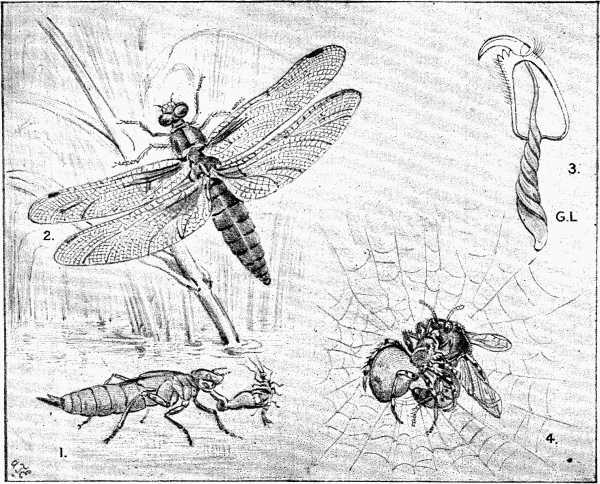
houghts of the ill-favoured tramp had once or twice come into my head while I ate my eggs and bacon, but, perhaps as one result of the meal, I felt very little doubt that he had by this time got some distance ahead, while the rest which I had determined to take would allow him to leave me still further behind. On coming into the street again, however, I took the precaution to look to the right and left, and rejoiced to see no sign of the man. The houses of Broughton soon grew farther and farther apart, but I had to walk a mile or more without seeing any tempting resting-place. The sun was very hot, and my legs were beginning to ache, when, at the foot of a slight hill, I saw that the road was edged on each side by a thick wood, whose shade looked particularly inviting. As soon as I reached the shade, I found that I was not alone, for sitting in the road were two men wearing wire spectacles and breaking stones with a hammer. They paid not the slightest attention to me, while, for my part, I felt rather glad of their presence. The shade made the spot seem more lonely than the road I had as yet traversed, so that I stepped into the wood on my right with a pleasant feeling of security. A few yards from the road I lay down at the foot of a large beech-tree, and resting my head on my bag, after listening for a few minutes to the ring of the hammers in the road, I must have fallen asleep. On reopening my eyes I instinctively felt for my watch, and when I realised that I should never see it again, it seemed that I had lost a familiar friend. The sun now shone lower in the sky, and it must in any case be time that I continued my journey.
Throwing the bag over my shoulder, I walked towards the road, when what was my dismay to see the tramp, who I imagined had long left me behind, seated by the roadside, smoking a very short, black pipe and gazing silently at the stone-breakers. Although he took no notice of my presence, I now began to wonder whether he had deliberately followed me from Broughton, or whether his presence in this shady part of the road was merely a chance coincidence. It was quite possible that he had[Pg 45] hidden himself while I was in the coffee-shop, watched me from its door, and set forth in my wake. If this were the case, his purpose seemed scarcely doubtful, for he had certainly seen me receive the money for my watch and chain.
Still, it was not possible to stay where I was all day, so reluctantly turning my back on the stone-breakers, I walked on, trying to hope that, after all, the tramp might be perfectly harmless in spite of his evil appearance. Though strongly tempted to look behind and ascertain whether he was following or not, I warned myself that it would be wiser to appear to take no notice, till, at last, when the stone-breakers must have been half a mile to the rear, I looked back, and saw, to my horror, that the tramp was still dogging my steps.[Pg 46]
Half panic-stricken for the moment, I quickened my pace; but when I looked behind again ten minutes later, it appeared that the tramp had lessened the distance between us.
It now began to seem like a nightmare. There was no prospect of getting away from my pursuer. If I hastened, he walked faster, and I no longer felt the least doubt that his intention was to rob me. Although the road was little frequented, it was by no means deserted. An occasional bicyclist would pass, or a waggon, or a dog-cart, while here and there stood farm-houses and cottages by the way-side.
I believed that the tramp would dog my steps until dark, and that in the meantime he would not allow me out of his sight. Yet, until the present, I had no actual cause for complaint, and when I met a policeman, there seemed no excuse for referring to the tramp's existence. Feeling bound to speak to the policeman, however, I stopped to inquire the time, and he eyed me curiously as he took out his watch. My clothes were by this time covered with dust, and no doubt I appeared a disreputable figure.
'Five past five,' said the policeman. I must have slept in the wood longer than I had thought.
'Thank you,' I answered, and he passed on, greatly to my regret.
The finger-posts told me that a place named Polehampton lay ahead, but I would not inquire the distance, and so tell the policeman that I did not know much about my destination. But when I fancied he must be close to the tramp, I looked back, just in time to see them exchange a nod in passing.
Every time I looked behind after this, my pursuer appeared to be gaining, although he took care not to overtake me. He could easily have done so had he wished, because I was becoming extremely tired, the more, no doubt, because of the fear which oppressed me. As this gained strength, I did the worst thing possible—playing, as it were, into the tramp's hands if his purpose was what I suspected. But this walk along the straight, open road as evening fell became gradually more and more unbearable. I even began to ask myself whether it could be actually a nightmare, and I should presently awake to find myself in bed at Ascot House, scarcely knowing which would be preferable.
Seeing a stile leading to a field-path on my right, I suddenly determined to climb over it, and though I had no notion whither it lead, to take to my heels, regardless of everything but the chance of leaving the tramp behind. In a second I was over, and, doubling my fists, began to run. There were some cattle in the field, and the path appeared to end at another stile, beyond which was a plantation of chestnut-trees. To the left, beyond a hedge, lay a large plot of waste ground; to the right, a dense wood, where I could hear some pigeons cooing.
I did not stay to look back until I reached the farther stile, a good deal out of breath, and then, to my intense relief, I saw nobody in the path. I persuaded myself that the tramp must have reached the first stile before now, and that, as there was no sign of him, he had gone on his way. Perhaps, I thought, as I climbed over the second stile, I had wronged the man after all, and had simply been the prey of my own timidity. Resting on the top of the stile a moment, I began to look around. In front was a narrow path through the chestnut plantation, and it must lead somewhere, though I knew not where. But I determined to follow it, thus making a slight divergence from the main road, and finding a way back to it to-morrow. Meantime, I might come to a village, where it would be possible to obtain some supper and a bed. So, rejoicing to have shaken off my nightmare, I sprang to the ground on the other side of the stile, when immediately I felt a hand on my collar, and saw the dark eyes of the tramp once more peering into my own.
He had, of course, dived into the wood when he saw me climb over the first stile, and, cutting off the corner, had been coolly awaiting my arrival. On the whole, I think that being in his grasp was almost preferable to the feeling that he was dogging my steps. His left hand gripped the collar of my jacket and flannel shirt, and instantly I began to wriggle, twisting my leg about his own in an attempt to bring him to the ground; but the man was of enormous strength, and, freeing himself, he shook me as a terrier shakes a rat, until I felt there was little breath left in my body.
Yet I did not give in without another struggle. I knew that he would take every penny I possessed, and that there was nothing else on which to raise any money. I was still nearly ninety miles from London, and already ready for another meal. I butted my head into his stomach, I struck out madly with my fists, I writhed and kicked, until, raising his right arm, he brought down his fist on my head, and after that I knew nothing for some time.
When I regained consciousness, I lay in the plantation about two yards from the path, just where I had been flung, I suppose. My head and body seemed to ache all over, but, on attempting to rise to my feet, I found no difficulty, beyond a slight giddiness. My bag had disappeared, my knickerbocker pocket, which had contained my total capital of fourteen shillings and eightpence, was sticking out empty, and, of course, there was no sign of the tramp. Walking to the stile, I found that my left ankle pained me, although not very severely; I could also see in the lessening light that my clothes were considerably torn.
So hopeless appeared the outlook that I confess I rested my arms on the top of the stile, buried my face on them and sobbed, until the increasing darkness warned me that crying would not provide a bed for the night. A bed for the night! But how could I obtain a bed without money? Still, it was not practicable to remain where I was, while I thought it would be better to take my chance through the plantation than to return to the road, where I might even meet the tramp again. Certainly, whichever direction I followed, I had no wish to walk very far. I had never felt quite so worn out in my life, as I continued my way through the plantation and a field beyond, the gate of which opened into a pleasant[Pg 47] country lane. Here I turned to the right, as the main road lay to the left, and I had not walked many yards before I reached a pretty farm-house, standing well back, with a barn on its left, in which some cows were lowing. The sky was by this time of a dark blue, and one small star twinkled. I could not help looking rather longingly at the cosy house, and, while I looked, a lamp was carried into one of the front rooms and a red blind was drawn down. However, it was no use lingering there, so I walked on beside a hedge, fragrant with honeysuckle, past one or two fields, until I came to a black gate with something shadowy behind it. Stopping by the gate, I saw that the object in the field was part of a haystack, one side being cut into a kind of terrace. Four black calves came to the gate, but they turned tail and trotted away again as I put my leg over the top rail, for I at once made up my mind that there would be no better place to sleep than the haystack. The night was fine and hot, and my body ached to such a degree that I felt I could sleep anywhere.
 he little days come, one by one,
E. D.
The captain of a merchant ship, on being appointed to a new vessel, heard that his crew had a very bad name for the use of oaths. He determined to put an end to bad language on his ship, and, knowing how hard it would be to do so by the mere exercise of authority, thought of a novel plan which was entirely successful. He summoned the men and addressed them thus:
'I want to ask you all a favour, and I know that British sailors will hardly refuse a favour to their new captain. It is my duty to take the lead in everything, and especially in one thing. Now, will you grant me my favour?'
'Aye, aye, sir,' said the men, not knowing what he would ask.
'It is this, then. I want to take the lead in swearing, and to use the first oath on board this ship, before any of you begin to swear.'
The men were at first surprised at the strange request, but they soon recovered and gave the captain a rousing cheer. Needless to say, the captain's oath was never uttered, and so the men had no excuse for swearing.
hanks to his quickness of brain and fleetness of foot, M. de B——, a French Royalist officer, was able to use a well-known device and so effect an escape from imminent death.
On a certain memorable morning, sixty-nine brave soldiers were executed by the Republicans. The story of these deaths, and of one remarkable escape, is related by a fellow-prisoner who witnessed the scene.
At nine o'clock in the morning the prisoners were startled by the entrance of a Republican officer, who held a piece of paper in his hand, and was attended by an escort of about twenty soldiers. As he came in he announced:
'Citizens! you are to accompany me. Those whose names I shall call will not return to this place. As I read out the roll, let each one named range himself on the right-hand side.'
The men obeyed this order in silence; no one knew what it meant, and all feared the worst. Only two names were excepted from the roll; the other prisoners, seventy in number, stood in line, awaiting their unknown fate.
'The word was given to march,' says the narrator, 'and the whole seventy-two of us, guarded by a large number of Republican soldiers, filed out from the gloomy gaol. We were taken to the seashore, where a halt was made; then the officer in charge read the death-sentence, adding, as he turned to us—the two whose names were excepted from the fatal list—these words:
'"These others will not be sentenced until further evidence has been heard, but they will be present at the execution of those condemned."
'The unhappy men were then and there shot, one by one. This work of horror went on for an hour, and we, whose time had not yet come, were forced to stand by, fully expecting that the same fate would shortly be our own.
'Sixty-nine had fallen, and at last came the turn of De B——. The four men told off to shoot him said, "We are extremely sorry to do this, but it is the law, and we cannot help ourselves; and now, if you have any money about you, please bestow it upon us."
'A happy thought flashed through the Royalist's brain. "I have twenty guineas," he replied calmly, "but I do not desire to cause any jealousy amongst you. I will therefore fling down the coins, and let each one get what he can."
'With a dexterous movement of his hand he sent the golden coins spinning in all directions. The soldiers, in their greedy eagerness, forgot the prisoner for a moment, and scrambled for the money; this was what M. de B—— had reckoned on. As he was an excellent runner, taking to his heels, he promptly fled, got safely away, and was never recaptured.'[Pg 48]
M. de Tourville, a French Admiral who lived in the beginning of King William the Third's reign, proposed to make a descent on the English coast, and, as his intention was to land somewhere in Sussex, he sent for a fisherman, a native of that county, who had been taken prisoner by one of his ships, in hopes of obtaining some useful information concerning the state of the Government. He asked the fisherman to whom his countrymen were most attached, to King James or to the Prince of Orange, styled King William.
The poor man, confounded by these questions, made the Admiral this reply: 'I have never heard of the gentlemen you mention; they may be very good lords for anything I know; they never did me any harm, and so God bless them both. As for the Government, how should I know anything about it, since I can neither read nor write? All I have to do is to take care of my boat and my nets, and sell my fish.'
'Then, since you are indifferent to both parties,' said the Admiral, 'and are a good mariner, you can have no objection to serve on board my ship.'
'I fight against my country!' answered the fisherman, with great vigour. 'No, not for the ransom of a king!'
W. Y.
 e got up to welcome the swallows
John Lea.
Many thrilling stories have been written about the dangers of whale-fishing. The perils and hardships of whaling expeditions are braved in order that we may be supplied principally with two things—whale-oil and whalebone. If you can learn what whalebone is, and what is its use, you will know a good deal about the habits of the whale itself.
The substance which we call whalebone is not true bone. It would be much more correct to call it whales' teeth, as it occupies the same position as teeth, and, in a measure, serves the same purpose. Moreover, the whale has a skeleton of true bones underlying its flesh, and serving as a framework for its huge, bulky body. These bones are very light and porous, and this is a great advantage to the whale, which spends most of its time floating upon the surface of the water without having to make much effort.
There are numerous kinds of whales, and they do not all yield the substance which we call whalebone. The sperm whale, or cachalot, has teeth in its lower jaw, and no whalebone whatever. The Greenland whale, on the other hand, which is the one most sought after for its oil, has no teeth, but abundance of whalebone, which hangs from the sides of its upper jaw.
In order to get some idea of what this whalebone is like as it hangs in the whale's mouth, we must try to picture what the whale itself is like. The largest of them grow to something like sixty feet in length. The head is unusually large, and forms about one-third of the whole body, and the inside of the mouth is about as large as a ship's cabin or a very small room. The strips of whalebone, which reach from the upper jaw to the lower one, must, therefore, be very large. The largest strips, which hang in the middle of the jaws, are rather like large planks, being from ten to fifteen feet long, and about twelve inches across at their widest part. They are thinner than planks, however, and perhaps we might better compare them to long and broad saw-blades. There are altogether about three hundred of these whalebone planks or blades in the whale's mouth. They are set transversely—that is to say, one narrow edge of each piece touches the tongue, while the other edge lies against the cheek or lip. They lie so close together that from the middle of the edge of one blade to the middle of the edge of the next the distance is less than an inch, and yet there is a space between them. The whole set extends like a huge grate round the whale's mouth, the bars of whalebone being long in the middle of the sides of the jaws, and growing shorter near the back and front.
Whalebone is very fibrous or stringy, and it splits very readily. The lower ends of the pieces in the whale's mouth are split and frayed into stiff bristles, and the inner edges are frayed in the same way, while the outer edges are made smooth, so that they do not hurt the inside of the animal's lips. The roof of the whale's mouth is covered with smaller pieces of whalebone hanging down like bristled quills. Many of these are only a few inches long, but they make the whole of the upper part of the whale's mouth rough and bristly.
The creature's tongue is an enormous one, often measuring six yards long and three yards wide. Its throat, however, is so small that sailors often say a herring would choke it. What can be the use of such a large mouth and tongue, and such large bars of whalebone to a creature which has so small a throat?
On the surface of the Arctic Sea, where the whale lives, there are swarms of living creatures. Some of these are jelly-fish, like those which are often left upon the sea-shore when the tide goes out. But one of the commonest of these lowly animals is a little[Pg 51] soft-bodied creature about an inch and a half long, which moves along through the water with the help of two organs like wings or paddles. It is called the Clio borealis, and it is very rarely seen near the shore. It is upon these creatures that the whale feeds. Opening its mouth wide, it rushes through the sea, and takes in a crowd of these soft-bodied animals, along with the water in which they are swimming. Closing its mouth, it drives out the water through its plates of whalebone, and the little creatures are caught in the bristles as in a net. Its great tongue is lifted up, and crushes them all into soft pulp, which is easily swallowed, even down the whale's small throat.
Thus every part of the whale's mouth is altered to suit its strange mode of feeding. The hard teeth, which would be of no use for biting small pulpy animals, are done away with, and a new growth of whalebone appears, which is of the utmost service in catching the whale its food.
Whalebone has been used for many purposes. It is split up into little pieces, and used for light frameworks, which are required to be stiff, but, at the same time, elastic. It used to be used for the ribs of umbrellas and for ladies' hoops. It was also split very small and used for the bristles of brushes. But it is now becoming scarce, and other substances are generally used in its place.
W. A. Atkinson.
The following story of the Crimean War, told by the Russian author, Turgenieff, is well authenticated.
A young Russian Lieutenant, named Sergius Ivanovitch, was one cold night with an attacking party whose object was to drive a body of French soldiers from their position in front of the Russian lines. Wishing to be as free from hindrances as possible, this young lieutenant did not take his military cloak.
The French proved to be well posted on the edge of a wood. At the end of a desperate fight, the Russians were forced to retreat, leaving behind them their dead and wounded. Among the latter was Sergius Ivanovitch.
How he now longed for his cloak! He suffered even more from the cold than from his wound. Although a bullet was in his leg, he knew that the exposure, rather than the wound, would be the death of him. With many a shiver and groan, he was trying to examine his leg, when he heard some one say in French:
'You had better leave it alone. Be patient, and disturb your wound as little as possible.'
The man who thus spoke was a veteran French captain, who lay close by, more severely injured than Sergius.
'You are right, no doubt,' said the Russian; 'but I shall die of cold before morning.'
Then the Frenchman blamed him for coming out in the snow without his cloak. 'I have learned by experience,' said he, 'never to go out without mine. This time, however, it will not save me, for I am mortally wounded.'
'Your people will fetch you presently.'
'No, my dear enemy, I shall not last until help arrives. It is all over with me, for the shot has gone deep. Here! take my cloak. Wrap yourself up in it and sleep. One can sleep anywhere at your age.'
The young Russian protested in vain. He felt the cloak laid upon him, and its warmth sent him to sleep.
When he awoke in the morning, the French captain lay dead at his side. The Russian never forgot this generous act of one whom the policy of his nation had made his enemy.
E. D.
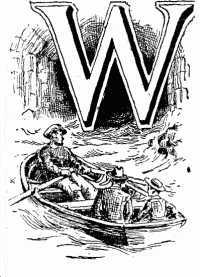
hile we shall have to consider some of the most wonderful caverns of other lands, we must not forget that Great Britain can boast of perhaps the most beautiful cave in the world. As we are a nation of sailors, it seems fitting that our marvellous cavern should rise directly from the sea, and that its pavement should be the mighty ocean. It is claimed as the most beautiful because it has the advantage of light to exhibit its wonders, as well as the endless variety of the dancing waves to illuminate its dark pillars with a never-ending flash of gems, as the waters dash against its walls in storms, or lap lovingly round them in the summer sunlight.
Fingal's Cave is one of many fringing the cliffs of the little island of Staffa, off the coast of Mull, in Scotland. These caves are all formed of what learned people call basalt, which means rocks moulded by the action of fire. Basalt contains a good deal of an opaque glassy substance, and its colour may be pale blue, dark blue, grey, brown, or black. This rock has a special faculty for building columns with (usually) six sides, but the form varies as much as the colour. These pillars are divided at fairly equal distances into lengths, just as stone pillars in a cathedral are generally built, and, wonderful to say, the joints, when closely examined, are found to be of the cup-and-ball pattern, on which our own bones are put into their sockets.
Basalt is usually hard and tough, and it is supposed, though with no certainty, that the regularity of the columns is the result of the contraction of the rock in cooling after undergoing great heat.
The name Staffa is a Scandinavian word meaning 'Pillar Island,' and no doubt its wonders have been known from very remote times. It is quite near the island of Iona, one of the earliest settlements of the Christian missionaries from Ireland.[Pg 52]
A little distance from the shore is the tiny island of Bouchallie, or the Herdsman, which is entirely composed of basaltic rocks of great beauty; and from this islet a colonnade of pillars leads to the entrance of Fingal's Cave. The mouth of the cave is forty-two feet wide, the roof is fifty-six feet above, and the length of the cavern is two hundred and twenty-seven feet.
All down the sides pillars line the walls, and from above hang the ends of pendant columns. Below is the clear blue water, where even at low tide there is a depth of eighteen feet.
Sir Walter Scott was so impressed with this marvel of Nature, that he wrote:
Certainly no service that human tongues could utter could surpass in impressiveness the strains raised to the glory of the Creator by the waves as they enter this temple of His own building, and toss aloft their offerings of glistening water and snowy foam.
Fingal, the hero from whom the cave takes its name, was a mighty man of renown in the legendary days of both Scotland and Ireland. He figures in the poems of Ossian, as well as in Gaelic ballads as Fion or Fion na Gael, and no other lore has ever been so dear to the peasants of these countries as the record of the marvellous deeds of Fingal.
Another remarkable cave in Staffa is 'Clam-shell Cave,' which is of immense size. It is really a huge fissure in the cliff, of which one side is wonderfully like the ribs of a ship or the markings on a clam-shell. This appearance is the result of immense pillars of basalt crossing the rock in even lines.
A rough iron stairway has been put up the cliff to enable visitors to look into the cave from above.
The 'Boat Cave' is smaller than that of Fingal, but the basaltic formation is even more regular: this cavern runs for one hundred and fifty feet, and is about twelve feet broad.
Indeed the whole coast of Staffa is studded with caves, into some of which a boat can enter when the water is smooth, but this is not of very frequent occurrence on this storm-beaten coast.
Helena Heath.
What is the Teal? It is a bird once plentiful in many parts of Britain from which it has now vanished, owing to the draining of marshes and the cultivation of coast-lands, for it loves watery places. Being a notable species of the duck tribe, it is a prize to the hunter of wild-fowl. Not only is the bird thought a delicacy, but when the hunter comes upon a party of them he can generally manage to secure several. It is a shy bird, avoiding the abodes of mankind and large ponds or rivers. What it likes is a still, rushy pool, or some sluggish brook overhung with vegetation. About the South of[Pg 54] England it is seldom observed except in winter; occasionally it keeps company with other wild ducks when the weather is severe. Should one of them be alarmed by the approach of a possible enemy, while it is on a brook, it usually flies up and skims just above the water for some distance, when it will quietly settle near the bank, or it may drop into the water and swim away rapidly.
In their appearance the male and female birds are very different. The male teal is particularly handsome; the head is chestnut brown, having a glossy patch on each side; the neck and back are black, pencilled with grey; the wings exhibit a green spot, set in velvety black, and underneath, the colours are black and buff. But his female companion has no bright tints; she is attired in dull black and grey, which is an advantage to her, helping to her concealment at the period of nesting. About July the old teals moult, and, losing for a time their quill feathers, they are unable to fly, though able to walk and swim. Thus deprived of their fine feathers, the male birds are less handsome, and resemble the females till spring comes. Often in September and October teals assemble to migrate, flocks of them flying hundreds of miles to some winter resort, which they quit when the wonderful instinct given them by Providence tells them to journey elsewhere to make their nests.
Teals do not like to place the nest flat on the earth, and it is generally put on the ground rather above the marshes or streamlets, a hollow being scraped under a small bush. One or other of the parents lines the nest, perhaps with heather, or perhaps with fragments of grass. Eight, nine, or ten creamy-white eggs are laid, and then the hen-bird plucks from her body the soft down underlying the feathers, which is put round the eggs, making a soft bed for the young when hatched. They soon swim and run well, following their mother about as she goes insect-hunting.
J. R. S. C.
he haystack seemed to be cut exactly for my purpose, and, mounting step by step, I found a terrace more than sufficiently large to allow me to lie at full length. The scent was warm and sweet, and when I had said my prayers, I lay staring up at the sky, watching as the stars came out one by one. For a while, sleep would not visit me, although my head went round and round, as it were, and I seemed to be conscious of nothing but the tramp pursuing me along the white, dusty road. Yet I must have fallen asleep before long, because I was suddenly awakened by the barking of a dog.
'Heel, Tiger,' said a man's voice. 'Good dog, heel!' I still heard the dog growl in a painfully threatening manner, then the man's voice again. It was a somewhat rough voice, yet with a kindly note in it. 'Now,' it said, 'whoever you are, I advise you to show yourself. I don't want to hurt you, but if you don't show up in another minute, I shall set my dog on to you.'
As it was, I felt in mortal dread lest Tiger should spring at me during my descent; still, I rose to my feet, feeling still a little giddy and confused, climbed down to the foot of the haystack, and walked a little timidly towards the gate, where I could distinctly see the tall, stoutly-built figure of a middle-aged man in the light of the rising moon.
'What were you doing there?' he demanded.
'I was only asleep,' I answered.
'Think my hayrick is a proper place to sleep on?'
'I had nowhere else,' I cried.
'Well,' he said, 'come along with me, and we will have a better look at you.'
As I walked by his side, with Tiger, a large retriever, sniffing suspiciously at my heels, I realised that we were going in the direction of the cosy-looking farm-house. The possibility of being offered a comfortable bed, with a chance of taking off my clothes, and of something to eat, seemed delightful, and, before we came within sight of the red blind again, I had lost all fear of my companion, although he had not opened his lips during our short walk.
He came to a standstill in front of a five-barred gate beyond the barn, in which I could hear the cows chewing. 'Now, then,' he said, and, without any second bidding, I entered the farmyard. 'This way,' he continued, and the next minute he was tapping the door of the house with his stick. It was opened by a short woman, who wore a white apron over a dark dress, and had one of the ugliest and pleasantest faces I have ever seen.
'Who is that?' she asked, stepping back in surprise on seeing that the farmer was not alone.
'I went to see if the calves were all right,' was the answer, 'and the youngster was asleep on the rick. Tiger found him out—didn't you, Tiger?'
'Well,' said the woman, 'he looks as if something to eat would do him good, anyhow.'
'Take him to the kitchen, Eliza,' cried the farmer, and, opening a door to the left of the passage, she bade me enter and sit down; whereupon I suppose I must have again fallen asleep, for I was conscious of nothing farther until I opened my eyes, and saw Eliza in the act of placing a tray on the deal table; on the tray I rejoiced to see a large pork chop, a cup of hot cocoa, and a thick slice of bread.
My spirits seemed to rise with every mouthful of food, and I felt that I had at last reached a haven after all the unfortunate turmoils of this first day. Although the evening was hot, the kitchen fire seemed only to add to the sense of comfort, and although there were no looking-glasses, there were many things so bright that I could easily have seen my face in them.
Eliza, who was Mr. Baker's housekeeper, watched me with evident enjoyment, and before the plate was empty she rose to replenish it. I felt thankful[Pg 55] that Providence had guided me to Mr. Baker's door, and devoutly hoped that I should not be turned away that night. I realised instinctively that these were the sort of people who would not turn a dog from their door if he needed succour, and by the time I had finished my meat, and had begun to eat a large portion of apple tart with a great many cloves in it, it appeared certain that there was shelter for one night, at least. At last I finished the last piece of thick and rather heavy piecrust, and sat waiting to see what would happen next.
'Now,' said Eliza, 'I should think the next thing ought to be to clean yourself.'
'I should like it immensely,' I answered.
So she led me to a wash-house behind the kitchen, and brought a large bowl of enamelled iron, filling it with very hot water. A cake of yellow soap and a jack-towel were provided, and taking off my jacket and waistcoat, I enjoyed a thoroughly good wash.
'Let me see what I can do with those,' said Eliza, taking my jacket and waistcoat, and when she brought them back as I dried my hands they certainly looked a little less dusty. She lent me a hard brush to brush my knickerbockers, stockings, and boots, and although there were several rents in my jacket, I began to feel something like a respectable member of society again.
'Now,' cried Eliza, regarding me with evident approval, 'suppose you come and see Mr. Baker.'
She led me to the room where I had seen her, earlier in the evening, draw down the red blind, and he was seated in an arm-chair with a wooden pipe in his mouth.
'Sit down,' he said, and nothing loth, for my legs still ached painfully, I took a chair by the door. 'Now,' he continued, 'how did you get yourself into such a state, and how is it you are wandering about the country alone?'
'I ran away,' I answered, and Mr. Baker looked towards the door, which Eliza had left half open.
'Eliza,' he exclaimed with a kind of chuckle, which seemed to confirm the assurance that I had found a sympathetic listener—'Eliza,' he shouted, 'the youngster's run away.'
'Has he, though?' said Eliza, coming to the threshold, where she remained standing.
'From school?' he asked, and sliding down farther into his chair, evidently prepared to enjoy my story, while Eliza stood in the doorway with her arms folded. I told it from the beginning. Every now and then Eliza would interrupt with an expression of sympathy, and Mr. Baker slapped his knee when I told him how I had thrown the hair-brush at Augustus. When I came to the end, having described the day's adventures, the sale of my watch and chain, with the theft of the fifteen shillings by the tramp, Mr. Baker shook his head, and looked into Eliza's pleasant, plain face.
'Now,' he said, 'the question is what's to be done with the youngster?'
'Supposing you got to London,' she suggested, turning to me, 'what did you think of doing?'
'I know I could do something,' I answered confidently.
'Still,' said Mr. Baker, 'you have not done much good for yourself to-day now, have you?'
'No,' I was compelled to admit, 'not to-day.'
'And you have no money left?' cried Eliza.
'When I get to London I am going to find some work to do,' I assured her; but she shook her head, and smiled a little sadly.
'Come to think of it,' said Mr. Baker, 'this Turton is about your only friend.'
'I don't call him a friend,' I answered.
'Anyhow,' exclaimed Eliza, 'it is too late to do anything to-night.'
'I suppose you can make the boy up a bed somewhere?' said Mr. Baker.
'If you ask my opinion,' she replied, 'the sooner he's inside it the better.'
'Yes; and directly after breakfast to-morrow morning,' he said, 'I shall drive the youngster back to Castlemore.'
'Not to Mr. Turton's!' I cried.
'What else do you think I can do with you?' he asked, as Eliza went away to prepare my bed.
'I would sooner do anything—anything,' I said, 'than go back.'
'I dare say you would,' he answered. 'Only you see there is nothing else to be done. I can't say I believe in boys running away, but still you seem to have been badly treated, and if you had a home, I don't say that in the circumstances I would not see you to it safe and sound. But you have not; and the consequence is that it is my duty to take you back. And,' he added, solemnly, 'however severely he treats you it won't be half so bad as what you would meet with if I let you go your own way.'
I could find nothing to answer. With all his kindness, Mr. Baker seemed to mean what he said, and I realised that a remonstrance would be only waste of words. Besides, I am afraid I was become cunning in my efforts at self-preservation, and if I said nothing, I certainly thought the more. My sleepiness seemed to have left me, and all my wits were at work. If I could prevent him, I determined that Mr. Baker should not take me back to Ascot House, although as yet I had not the remotest notion how to hinder his purpose.
One thing appeared certain. He was only to be defeated by strategy, and not by force. As I looked at his large fist resting on his arm-chair, I knew that if I attempted to resist I should be as powerless in his arms as I had been in those of the tramp. Presently Eliza re-entered the room to say the bed was ready, and when I arose Mr. Baker held out his arm to shake hands, causing me to feel not a little shamefaced. My friend seemed to have become an enemy. He had treated me kindly, and, indeed, still intended to do what he considered best for me, while my chief aim was to oppose him. But to have said right out that I would not go back to Castlemore would have defeated my own ends, so that I put my hand in his, received a cordial shake, and then followed Eliza upstairs. She carried a candle, which she set down on the washing-stand, and I saw that I was in a small room, extremely cool and clean, with one window, in front of which stood a muslin-covered dressing-table.
'Now tumble in quick,' she cried, 'and I will come to take the candle.'
(Continued on page 58.)
[Pg 56]
ne day, some years ago, a number of people were travelling in Ireland by coach. The day turned wet, and threatened to continue so till night. The moment the coach stopped, one of the outside passengers, who was without an umbrella, rushed into an ironmonger's shop and came out with a grid-iron in his hand. All the other outside passengers thought he was mad, but he wrapped himself in a large cloak, which covered his cap and most of his face and came down to his feet, and seated himself on his gridiron in the middle of his seat. In a couple of hours it was seen what he meant.
While the other passengers were sitting in pools of water from the dripping of the umbrellas, he was sitting high and dry above the seat on his gridiron; all the water ran under it, and when they got to their destination, the man on the gridiron was as dry as a bone, whilst the other outside passengers were soaked to the skin.
W. Yarwood.
C. J. B.
C. J. B.
I hurried out of my clothes as soon as Eliza had closed my bedroom door, although I did not turn into the inviting bed until I had bathed my feet, which were already slightly blistered. Then I lay down, having a difficult task to keep my eyes open until she came to take away the candle. To my surprise, Eliza bent over the pillow and kissed my forehead, thus making me feel more guilty than ever. It seemed a poor way to repay the kindness I had met with at her hands and Mr. Baker's, to run away during the night, although unless I did this it appeared certain that I should be taken back to Turton's the first thing after breakfast the next morning. Concerning such a calamity I felt desperate, and I believe there were few things I would not have done to secure freedom.
It was not that I feared any tremendous punishment, for I had never known Mr. Turton raise his hand to a boy, and my treatment could scarcely be worse than that which I had met with to-day. But it was the idea of the shame and degradation of being hauled back, of the jeers of Augustus, and his telling the other fellows on their return. Indeed, I was incapable of reasoning; I simply felt that any fate would be preferable to a return to Castlemore, and the only alternative seemed to be flight for the second time.
At present I could not tell whether even this would be practicable, although at the best I perceived that there would be many difficulties to overcome—Tiger not being the least. I had no idea whether Mr. Baker gave him the run of the premises at night, although this appeared extremely probable, or whether he was on the chain, and, if so, where. Whatever I did must be under cover of darkness, and the nights were short at this season. I knew that a farmer's household would be early risers, and that in fact there was little time to spare.
As I lay in bed, I could hear voices downstairs, and guessed that my own affairs were under discussion. I remembered a tale I had read of some travellers who were lost on a mountain, and in spite of their terrible weariness, feared to lie down in the snow, knowing that if they once fell asleep they would never again awaken in this world. My case seemed rather like theirs, although I lay in a comfortable feather bed. How delightful it was, how cool and fresh the linen sheets, how willingly I could have closed my tired eyes and fallen asleep! But in that case I feared that I should be lost. I certainly could not feel sure of waking before daylight; indeed, I felt I could sleep for a week, whereas, long before dawn, I had to put a considerable distance between myself and Mr. Baker's farm.
Afraid of closing my eyes in spite of myself, I sat up in bed, anxiously waiting for the voices to cease, for until it became safe to open my window, and ascertain what was underneath it, I could not tell even whether escape were possible. The window[Pg 59] was the only hope! The house was so small that I could not imagine myself opening the door, going downstairs, and finding a way out without disturbing its inmates. If the window was not too high, and the ground was fairly clear beneath it, I might be able to get away, but otherwise there seemed no alternative to an ignominious return to Castlemore to-morrow morning.
At last the voices became silent. I heard a key turned and bolts shot home into their sockets, heavy footsteps on the stairs, the shutting of first one door, then of another, followed by total silence. Getting out of bed about a quarter of an hour later, I walked about the room, and going to the washstand, sluiced my face in the basin to make myself more wakeful. Again I sat on the bed for what seemed a long time, until a clock downstairs struck the hour of midnight. Now, I thought, Mr. Baker and Eliza must be asleep, and groping for my clothes, I began to dress with all possible speed. As I rose from lacing my boots I trod on a loose board, which creaked so loudly that I felt certain it must be heard throughout the house. Lest any one should be aroused, I got quickly into bed again, dressed as I was, but although I lay there some time I heard no sound. Creeping cautiously across the room, I moved the dressing-table, and then, with the utmost care, drew up the green cotton blind. The moon shone brightly, almost at the full, but this might be either an advantage or a drawback. At least, it served to show my surroundings, and, before opening the window, I stared through the panes for some minutes. The house consisted of only one story above the ground floor, and the rooms were by no means lofty. My window overlooked what was evidently a fair-sized kitchen-garden, surrounded by a low hedge, beyond which I could see nothing but fields.
Now, if it happened that Tiger was chained, and I could succeed in reaching the garden, I determined to give up for the present every thought of gaining the road to London or anywhere else. I would simply get through the hedge at the earliest moment lest any one should detect me in the bright moonlight, then make a straight dash across country. By this means it promised to be far easier to avoid pursuit than if I followed any kind of road. Being fully dressed, with the exception of a hat, which did not seem to matter, I cautiously pushed up the lower half of the window and leaned forward to survey the ground. Immediately below me lay a bed about two feet wide, with flowers growing in it and one or two standard roses. I saw that the distance would not be too great to drop, and, anxious to lose no more time, I climbed out to the sill, crouching there a minute with alarming thoughts of Tiger. But all was perfectly still; one or two birds began to rustle in the leaves of the ivy which seemed to cover the back of the house, that was all, until turning round on the narrow sill, I heard the jangling of a chain. Peering forth once more, however, I could see no sign of a kennel, so that it seemed probable that Tiger was secured at the side of the house or in the front. Placing my hands on the sill, I gradually lowered myself until I hung by the fingers, then the next moment I dropped all of a heap, but without making much noise, on to the bed, the only damage being a scratch on the left cheek from a thorn on one of the standard roses.
Finding my feet at once, I made for the hedge, scrambling through it as Tiger began to give tongue. Turning to the left on the other side, I ran with all my might until I floundered into a wet ditch. Over a second hedge I scrambled, across a meadow with sleeping cows and calves, which rose at my approach, looking rather ghostly as they crowded together in a bunch. I clambered over gates, floundered into other ditches, and presently found myself entering the completer darkness of a wood, on the other side of which came a park, then more fields, until I began to pant, and to think that Mr. Baker's farm was sufficiently far behind for safety.
How long I had been running I have no idea, but the moon was fast sinking towards the horizon, and, before it disappeared altogether, it seemed advisable to find a place where I might secure some much-needed sleep. In a large field I espied a wooden shelter—intended, no doubt, for cattle—and open at one side. This being empty I entered, and was fortunate enough to find a goodly heap of dry clover in a corner. Spreading this out over the ground, without more ado I threw myself, just as I was, at full length upon it, too weary to think or to do anything but fall at once asleep.
I must have slept for many hours in the shed, for, when I opened my eyes, the sun was high in the sky. I think it must have been past ten o'clock, and it took some minutes before I could succeed in determining which of my recent experiences were real, and which the result of dreams. Little by little I began to put together the circumstances, which had occurred since yesterday morning, in their proper order, and my cheeks tingled with shame as I tried to imagine the feelings of Mr. Baker and Eliza when they discovered my flight. They had treated me with genuine kindness, and it must appear that I had repaid them with the basest ingratitude; while yet I cannot pretend to have repented of my flight from the farm-house, for I knew that, in similar circumstances, I should act in the same way.
At first I felt tempted to lie down and go to sleep again, but this might be to run no little risk. It was impossible to decide whether I was still on Mr. Baker's land or not, for, although I had covered some miles last night, there was no proof that I had run in a straight line, and it seemed quite likely that I had described something resembling a circle.
So I rose and stood gazing down at my legs, which now bore no traces of the brush which Eliza had lent me after supper. My boots were completely coated with mud as the result of the ditches into which I had floundered in my headlong flight, my stockings were splashed, and even my knickerbockers were freely covered with dry mud.
On stepping out from the shelter of the hut, the sun shining full in my eyes reminded me that I had not put on my hat, and, entering again, I looked[Pg 60] about for it for a few seconds before remembering that it had, of course, been left behind at the farm-house.
As I crossed the field, the situation seemed peculiarly depressing, and it was impossible not to contrast it with my circumstances at the same hour yesterday. It was one consolation that nobody could rob me to-day, for I had not a penny in my pocket. Every one of my limbs seemed to have a separate ache, and although I had not been accustomed to very luxurious fare of late, I felt a great longing for breakfast.
Although my confidence in the good fortune awaiting me in London had been somewhat shaken since I left Castlemore, I still determined to set my face in that direction. Where else could I go unless I returned to Mr. Turton? An unthinkable proposition. Making my way towards a black five-barred gate, I rejoiced to see a lane on the other side of it,[Pg 61] and, without a notion of my locality, I thought it better to turn to the left. The lane, a mere cart-track, led to a wider road, prettily undulated, and, for half a mile or so, entirely deserted. The first person I saw that morning (it must have been about half-past eleven) was a young man of about three-and-twenty years of age, engaged in mending a puncture in his bicycle-tyre. The machine was turned wheels upwards, while he stood pressing the punctured portion of the collapsed tyre between two pennies. From curiosity, and the desire, perhaps, to be near some one for a few minutes, I stopped, while he chalked the patch, stooped to replace the outer covering, and then, turning the bicycle right way up again, took off the pump.
(Continued on page 69.)
[Pg 62]
ews, like sound, travels fast; and the applause which greeted the ascent of the Montgolfier balloon at Annonay had hardly ceased when it seemed to reach the ears of the people in Paris, and put the whole town in quite a flutter of excitement. Some of those who had been present at the great experiment wrote an account of it to their friends in Paris, who at once began to make arrangements for inviting the Montgolfiers to send up another balloon from the capital. But these arrangements took too long to satisfy the impatience of the people of Paris, and they were better pleased when M. de Saint-Fond opened a subscription to pay expenses for a separate experiment.
No one in all France had heard of the event at Annonay with more interest and delight than a certain M. James Alexander Cæsar Charles, a young and clever scientist who took great pleasure in showing people the wonderful things he had discovered. When Franklin brought lightning out of the clouds with a kite, M. Charles followed the road thus pointed out to him, and soon found new wonders which he had a great talent for explaining. Thus, though he might not be a great original discoverer, he was quick to see in what direction truth lay, and was able to lead those who were less learned than himself. What wonder, then, that the people of Paris were full of expectation when they heard that M. Charles had put away his electrical studies to devote his attention to balloons? Sufficient money having been collected he set to work with the assistance of two brothers named Robert, and constructed an 'envelope' of silk, which, when filled, would make a balloon twelve feet two inches in diameter. This was very small when compared with the giant of Annonay, but the gas that M. Charles was going to use would make it thirteen times stronger. 'You see,' said he, 'the air that the Montgolfiers use is twice as light as the atmosphere. I shall use inflammable gas' (as hydrogen was then called), 'which is fourteen times lighter; though to retain this it will be necessary to paint the silk with rubber dissolved in turpentine.'
But if the gentlemen who sat around the platform at Annonay had gathered to see this baby balloon inflated they would have grown very weary, for it took nearly four days. Every morning outside Charles's house a notice was hung up to inform the eager crowds how the wonderful little giant was growing; and at last it became necessary for mounted police to protect his door, so great was the crush. Then, on the twenty-sixth of August, though the balloon was not quite full, it was decided to carry it to the Champs de Mars, the open space from which the ascent was to be made. There the filling could be completed. But as not even a king, travelling in state, would be likely to draw such excited throngs as this balloon, arrangements were made for moving the silk bag in the middle of the night. First, all the tools which would be required at the launching were sent in advance; then, at two o'clock in the morning, the procession set out. A strong body of mounted soldiers accompanied the waggon on which the half-filled balloon was placed, while in front of it marched a body of men carrying torches. The journey was only two miles long, yet in that short distance the cavalcade was greeted with enough applause to satisfy the most ambitious. All vehicles encountered en route were drawn aside, and the drivers doffed their caps as they watched it pass. As the balloon swayed solemnly from side to side, an imaginative on-looker might have fancied that it was acknowledging these respectful salutations.
In due course the scene of action was safely reached and the filling process continued. As the gas had to be made from sulphuric acid and iron filings, it naturally took some time, but when the clocks of Paris were striking five on the evening of August 27th, 1783, Charles's cloud-cruiser was ready for the voyage. The bells had hardly done chiming when a cannon-shot was heard. It was the signal for departure. The thousands of spectators heard it with a thrill of interest, and as its echoes reverberated over Paris, the watchers of the high towers of Notre Dame, and the military school, directed their telescopes to the Champs de Mars. One of the guests was Stephen Montgolfier, for though Charles might add improvements to others' inventions, he always acknowledged to whom the first honour belonged.
In spite of the heavy rain that was falling, the balloon shot into the air with great rapidity, and in the space of a minute or two disappeared behind a cloud. The moment it vanished another cannon was fired as though in farewell, but the watchers (richly dressed gentlemen and fine ladies) regardless of the weather, continued to keep their eyes upon the clouds, and were surprised to see it once more, far above them, sailing in the direction of Gonesse, fifteen miles away. Here in a field it settled, three-quarters of an hour after leaving Paris, and—met its doom. The country people, imagining it to be a large and unknown bird, approached in fear, until one, bolder than the rest, stabbed it with a pitchfork, when the sighing sound, made by the out-rushing gas, only confirmed their conviction that it was endowed with life. In vain did the village curé try to dissuade them, and when at last the silk bag lay flat and 'lifeless' on the ground, they tied it to a horse's tail and set him galloping through the field. With wild excitement they followed in chase, till hardly a shred of poor M. Charles's carefully-built balloon remained to be trodden on.
When the country folk were so ignorant as this, we can hardly be surprised to read that the Government soon found it advisable to make Montgolfier's discovery widely known, so as to allay 'the terror which it might otherwise excite among the people.'
John Lea.
[Pg 63]
 hear a splendid concert in my garden every day,
In former times there ruled at Olmütz, in Moravia, a Duke who allowed himself, when in anger, to do many cruel things. One day, Bruno, his falconer, came trembling before his master and announced to him that the finest of the falcons was dead. When the Duke heard this, he flew into a passion, and commanded his servants to chastise the man severely. Bruno, however, succeeded in escaping the intended punishment, and hid himself in the thick forest which extends from Olmütz to the Oder valley. There he lived by hunting, and occupied himself with charcoal-burning.
It happened one day that as Bruno, armed with bow and arrow and battle-axe, was going through the forest, he suddenly heard the well-known hunting-cry of the Duke. He quickly hid himself behind an oak-tree, in order that his master should not discover him, and saw, to his horror, that his master was pursued by a wild bison. The Duke would have lost his life, if Bruno, with his battle-axe, had not courageously attacked the furious animal and given it a mortal wound. Deeply touched, the Duke thanked the deliverer of his life for his proved fidelity, and bade him ask any favour he pleased.
Bruno did so. He asked to be allowed to possess as much land as he could encircle with the skin of the dead bison. Smilingly, the Duke promised to grant the request.
The falconer began to cut the skin into small strips, and with them encircled the whole hill upon which he had saved his prince's life. The Duke was highly pleased with this proof of Bruno's cleverness as well as courage, made him into a knight, and put him in a position of honour at his court. Bruno became dearer to his master every day, and rendered him many and great services. In later times he built a castle on the hill, which, in memory of the Duke's deliverance, he called Helfenstein.
W. Y.
Seagulls are a very distinct tribe of birds, mostly lovers of the sea, yet from time to time showing themselves inland. They look larger than they really are, owing to their having a quantity of down and feathers, the wings being also long and the head large. They are equipped with a strong and straight bill, by means of which they devour a great variety of food. They will occasionally go out to sea hundreds of miles from land, but they are not welcome sights to the mariner, for he usually regards them as signs that bad weather is approaching. The most familiar species is the common seagull, white and grey, with greenish legs.
One of the peculiarities of the seagull is its habit of dashing in parties after any object that attracts its notice. This now and then furnishes amusement to men and boys who are strolling along the Thames banks or bridges. Supplying themselves with bits of bread or fragments of meat, they fling these upon the river, and watch the birds eagerly pursue the food.
Seagulls will also give chase to birds of other species they may come across. Not long ago the Cunard steamer Campania, from New York, was nearly due south of Nova Scotia, when the look-out observed a bird close at hand flying rapidly. In fact, it went faster than the ship, which was then moving twenty-four statute miles an hour. A great number of seagulls were chasing the fugitive, but could not make enough speed to catch it. At length the bird settled upon the deck, wearied, and proved to be a fine specimen of the snowy owl.
The snowy owl is a species chiefly found in the Arctic Circle, especially about Greenland and Iceland. It is a hardy bird, and has its nest among the rocks. The bill is hooked like a hawk's, having round the base a few stiff feathers. Its plumage is snowy white touched with some brown.
J. R. S. C.
[Pg 64]
A fine instance of moral courage occurred not long ago at a small seaport. The captain of a little passenger-boat, a tall, sun-browned man, stood on his craft superintending the labours of his men, when the boat train came in, and about twelve minutes after, a party of half-a-dozen gentlemen came along, and, deliberately walking up to the captain, thus addressed him:—
'Sir, we wish to go by this boat, but our further progress to-day depends upon you. In the train we have just left there is a sick man, whose presence is extremely disagreeable to us. We have been chosen as a committee by the passengers, to ask that you will deny this man a passage on your boat; if he goes, we remain here.'
By this time others had come from the train.
'Gentlemen,' said the captain, 'I have heard the passengers through your committee. Has the invalid any representatives here? I wish to hear both sides of the question.'
To this unexpected inquiry there was not a single answer. Without a pause, the captain crossed to the car, and, entering, beheld a poor, emaciated, worn-out creature, who was obviously very weak and ill.
The man's head was bowed in his hands, and he was weeping. The captain advanced and spoke kindly to him.
'Oh, sir,' said the invalid, looking up, his face lit up with hope and expectation, 'are you the captain, and will you take me? The passengers shun me, and are so unkind. You see, sir, I am dying; but if I can live to see my mother, I shall die happy. She lives at B——, sir, and my journey is more than half performed. I am a poor printer, and the only child of her in whose arms I would wish to die.'
'You shall go,' said the captain, 'if I lose every passenger for the trip.'
By this time the whole crowd of passengers were grouped around the gangway, with their baggage piled on the pier, waiting for the decision of the captain, before engaging their passage.
A moment more, and that decision was made known, for they saw him coming from the cars with the sick man cradled in his strong arms. Pushing directly through the crowd with his burden, he ordered a mattress to be put in the cabin, where he laid the invalid with all the care of a parent.
Then, scarcely deigning to cast a look at the astonished crowd, he called loudly to his men: 'Let go!'
But a new feeling seemed to possess the passengers, that of shame and contrition at their own inhumanity. With a common impulse each seized his own baggage, and went in a shamefaced way on board the boat.
In a short time a message was sent to the captain, asking his presence in the cabin. He went, and one of the passengers, speaking for the rest, with faltering voice told the rough captain that he had taught them a lesson—that they felt humble before him, and they asked his forgiveness.
W. Y.
 uttercups and daisies,
J. L.
he moonlight lay in soft brilliance over the land of Burmah. Its rays pierced the small slit windows in the cell of the fanatic An-we-lota, and lighted up the fierce faces of the dacoits and desperate men, who from time to time stealthily entered, until a close-packed band had collected. Near and far a message had reached these malcontents that an attack would be made on some of the British outposts scattered here and there over the newly conquered territory, and held by English officers and a brave force of Sikhs and Pathans.
'We are as nothing,' said An-we-lota; 'these Ingalay' (Englishmen) 'have taken our country, and are now setting up their camps everywhere among us, for these men to spy on us. They say the glorious King Theebaw is dead. Know we not well that he will come again and reign over us? I am myself possessed of magic power. I have swallowed the all-powerful mercury, which makes me proof against bullet and steel, which turn to water as they touch me. Have I not also the coins of invulnerability bound in the flesh and blood of my arm?' and the fanatic stripped up the sleeve of[Pg 67] his yellow robe and showed his bare, skinny upper arm, where the edges of buried coins were visible in deep cuts. 'I am king as well as priest; I am the Prince Setkia Muntna, who was drowned in the Irrawaddy seventy years ago. I have come to life again—behold, I am he.'
Dusky hands were raised in salutation, and one evil-looking warrior stepped forward: 'I am also proof against bullets. Was I not Theebaw's chief "Boh"?' (head warrior). 'I am ready to lead any expedition against these robbing English. See, we are all armed.'
The moonlight flashed on the murderous-looking 'dah' knives raised for an instant from the folds of the garments of the assembled men.
'Our first attack,' said An-we-lota, 'shall be on the Sardu Station. Our scout, Al Met, has brought word that much of their force has been called away to quell the Wahs. Our attack shall be swift and sure, and with our band here we shall outnumber them, and exterminate the whole while they are sleeping. When shall we start?'
'No time like the present,' was the cry, and the dahs flew out again and were uplifted.
In a few minutes the cell was emptied, and the stealthy march began, by rock and jungle and secret paths, to the doomed outpost station.
The hours passed, and the early morning light showed pale on the blazing huts of Sardu Fort, and on dead and dying scattered about. Where the dead were thickest lay a young English officer gasping, 'Inez, my darling, we shall meet again soon, and our little son——'
Close at hand lay the fanatic, An-we-lota, dead, his magic coins and mercury-fed body no proof against British steel.
From the distance there came the tread of a returning force—too late!—and in the deepest shades of the jungle a native woman, with horror-stricken face, pressed forward through tangle and thorn, with a living, wailing bundle clasped close to her breast.
How many days she spent in weary wandering over well-nigh a hundred miles of jungle and plain, helped by log-boat up strange waters, ever heading for the homes of her people, the Karens—a bourne she was never to reach—who can say?
It was early morning. The first faint streaks of dawn were chasing the night shadows from hill and valley. Early risers in a little jungle village far distant from Fort Sardu shivered as they rose from their sleeping-places, and pushing aside the curiously woven mats, hung from the eaves of the sloping roofs, descended to the waking world outside. The native dogs howled hideously as they were unceremoniously driven from the still smouldering embers of last night's fires.
Maung Yet, one of the first astir, twisted the folds of his waist-cloth closer round him, and looked forth upon the morning. The rising sun was turning into gold and bronze the ripening paddy fields close at hand, glorifying the reed roofs of the native huts under the feathery palms, and gilding the distant belt of jungle, stretching away to the horizon.
The huts of the Tounghi tribe were raised breast-high on stout posts, as protection against wild beasts and snakes. Many dark-skinned natives moving around in busy preparation showed that the labours of the day would be beginning early.
It was the time of the Burmese harvest, and the first of the ripe paddy fields would be gathered in that day. Already might be heard the hoarse voice of crows, and the screams of hundreds of bright-hued parrakeets, descending for their feast on the precious grain. At the sound, many of the village youths ran up quickly, and with cries and rude bird-clappers scared the birds away, only to set to work again at some more distant spot.
Many and various were the sounds echoing around Maung Yet, and ever and anon he seemed to distinguish from among them a sound like a human cry. Once more it came, and Maung stood keenly listening. Yes, a cry for help, certainly, and a dog's strange, shrill bark, too—and both from the far-off jungle. Maung Yet trembled. Was it the cry, perchance, of some robber luring him to destruction, or was it really a fellow-creature's cry for help?
The Burman, like all his race, was very superstitious, and avoided the jungle as being haunted; but his heart was kind. Arming himself with his primitive sickle, he beckoned to Lan Wee, his young brother, who was squatting on the ground eating a huge mass of rice, and set off at full speed towards the spot whence the cries proceeded, attracted onward against his will by the voice of misery. The youth followed him closely, his eyes wide open with fear, as they neared the dreaded jungle. In its dark shadows who could say what dangers lurked? They pressed on, however, through trails of prickly foliage, clinging undergrowth, and fallen timber, which lay like so many traps for unwary feet. The cry had sunk to a moan, but the dog's whine was shriller and more urgent as they neared the end of their quest.
Both Burmen were tattooed over breast and shoulders with a glorious blazonry of red—a decoration performed with religious rites as a protection against 'evil spirits.' Few Burmen would face the jungle unless thus fortified. Maung felt a few qualms even in spite of his tattoo, but invoking the 'aing-sohn' (the good spirits), he and his young companion, breathless and panting, struggled on, and came to what they sought at last.
Half resting against a fallen tree-trunk lay an apparently dead native woman, reduced to almost a skeleton. Her bare feet told of long, rough journeying, and from wrist to elbow of the left arm was a half-healed wound, such as Maung Yet knew well the keen 'dah' could leave. From her neck was slung a baby, and standing fiercely on guard, a lean, whitish dog.
With the curious canine instinct, divining rightly friend or foe, the dog allowed the approach of the two Burmen. Maung knelt and raised the prostrate woman; the weak head fell heavily on his shoulder, then stirred uneasily, the eyes opened, and the dying lips tried again and again to find utterance. Broken words at last whispered faintly over and over again, 'Bébé Ingalay—Mah Kloo! Thakin Missee Bébé!' Then the wasted hands tried to remove the baby. Maung understood, and signed to the youth to lift it from her neck. The movement[Pg 68] woke the child, and it uttered a thin cry. The sound roused the flickering life of the dying woman for an instant; with a last movement she lightly touched the wee dark head, smiled faintly, and died.
A shallow grave was hastily dug. A pouch in the tattered garments contained a few coins of money and a curious small gold cross. Maung Yet touched his tattoo anxiously as he took the latter: it must be, he thought, some strange charm. Then he placed the coins in the mouth of the dead woman, in the belief that this provided ferry-hire over the death river, and he and Lan Wee lifted the woman into the grave. Then, with all speed, the two Burmen left the hated jungle, carrying the tiny infant, the lean dog following closely.
(Continued on page 78.)
[Pg 69]
The cyclist was a good-looking, short, but well-built man, clad in a light, home-spun suit, with knickerbockers and a Panama hat. On the frame of his bicycle was an ordinary mackintosh haversack, and, strapped behind the saddle, a paint-box, a folding sketching-stool, and a good-sized sketching-block. Fixing the pump, he knelt down to inflate the tyre; but the pump was rather small, the sun was hot (as I felt, having no hat), and the man seemed soon to weary of his job. He had glanced once or twice in my direction, and now he rose, blew out his cheeks, and cried: "Hi, boy! do you want to earn a copper?"[Pg 70]
'Rather!' I answered, thinking of breakfast.
'Just pump up this tyre for me, then,' he said; and, going down on my knees by the roadside, I began to pump with a will, while he took out a pipe and began to fill it. 'Think that's all right?' he asked, as I rose to my feet.
'It feels pretty hard,' I answered.
'Well, here's twopence for you,' he cried.
'Thanks, awfully,' I said, putting out my hand.
Holding his machine, on the point of wheeling it into the middle of the road, he paused, staring into my face.
'Where are you bound for?' he inquired.
'London,' I replied. 'Can you tell me which is the road?'
He stared again for what seemed a long time, and it was evident that I caused him a little perplexity.
'Of course,' he muttered, half to himself; 'it must be the holidays just now.'
'They began last month,' I answered.
'Yet I am sure you are running away,' he cried.
Somewhat alarmed, in consequence of my recent experiences, I thought it time to get on my way.
'Don't be in a hurry,' he said. 'I think you and I ought to have a little talk.'
'I want to get along,' I retorted.
'Where to?'
'To get some breakfast,' I replied.
'Hungry, eh?' he asked.
'A little.'
With that he looked at his watch; then, saying that it was nearly twelve, he took from a side pocket of his jacket a tin case, packed with tempting-looking sandwiches.
'Just put yourself outside those,' he said, handing me the tin.
'But—but,' I suggested with an effort, 'won't you want them?'
'I am all right,' he said, with a laugh; 'you needn't bother about me. Sit down and start.'
Needing no further persuasion, I sat down on the grass by the way-side, and steadily emptied the sandwich tin. Before this was accomplished, however, he produced a flask, pouring some of its contents into a small cup which fitted on to one end. It seemed to put fresh life into me.
'Feel better?' he inquired, as he replaced the flask in his pocket.
'Ever so much,' I answered.
'Well, then, suppose you tell me all about yourself.'
'I would much rather not,' I insisted.
'Why?'
'Because you—you might try to take me back!'
'Think for a moment, and don't be stupid,' he said. 'How can I take you back if you don't tell me where you have come from? Besides, you would be as much as I could carry with my bike, you know. So fire away,' he added, and I sat on the grass and once more told my story from the beginning, except that this time I omitted to mention Mr. Turton's name or address.
'When you reach London,' he asked after I had become silent, 'what are you going to do?'
'Other fellows have been able to do things,' I answered.
'But, you know,' he said, with a kind sort of smile, 'you have not even got a cat.'
'I believe I shall be all right if only I get there,' I persisted. 'If you would not mind telling me the way to the main road.'
'Well,' he said, 'all roads lead to London.'
'Any one will do for me,' I answered, and upon that he wheeled his machine into the middle of the road.
'Ever ridden on a step?' he asked.
'Rather!'
'Then get up behind me, only don't upset my baggage.'
He mounted as he spoke, and in a second I was standing on the step behind him. In spite of the circumstances, I thoroughly enjoyed that eight miles ride, and felt sincerely sorry when it ended. Now we coasted down a hill, now we both dismounted to walk up one, and, after one such walk, my companion stopped, unfastened his haversack, and took out a cloth cap.
'Think you could wear that?' he asked, and, trying it on, I found it was only slightly too big.
'Thank you most awfully,' I said as we rode on again, and then we did not stop until we reached four cross-roads. Seeing the word 'Polehampton' on a finger-post, I perceived that I had returned to the road from Castlemore to London, which I had left to cross the fields in my futile endeavour to avoid the tramp. It was true that I had made a fairly wide circuit, for my new friend told me I should still have five miles to walk to Polehampton.
'I am immensely obliged to you for the lift and—and everything,' I said, as he seemed to be on the point of starting. I felt extremely reluctant to part from him.
'That is all right,' he answered, thrusting his hand in his knickerbocker pocket. 'This may help you on your way.' He put something into my hand as he pressed it, then, without another word, mounted his bicycle and rode away. Opening my hand, I found five two-shilling pieces. For the next few yards I did not see things very clearly, for I felt too thankful.
After looking back once or twice until he was out of sight, I set out in a business-like manner to walk the five miles to Polehampton. The events of the morning had filled me with fresh courage, and now that my face was once set towards London, earlier hopes began to reawaken. I should have liked to know my companion's name, to keep in my memory with that of Mr. Baker and Eliza, but I never saw or heard of him again. Still, I have not forgotten him or the good turn he did me, and I wish that this story might come into his hands to show that I am not ungrateful.
Having passed through so much in a short time, I was inclined to expect every mile to bring forth its own peculiar adventure, but Polehampton came into sight without any remarkable occurrence. I scarcely enjoyed the walk, as my legs ached more than ever, and I rested many times by the roadside.
To-day being Friday, I determined, on the strength of my ten shillings, to look for a cheap temperance hotel, or some place of the kind, and make a bargain[Pg 71] with the proprietor to stay over Saturday and Sunday. This would give me time to rest and make myself a little more presentable, because, in my present muddy condition, I knew that it would be impossible to obtain any kind of work.
For that was what I intended to do. Instead of hoping to reach London in six days, as at first, I would try to earn a little money by the way, because I perceived that it would be no use entering in such a condition as I was at present.
Polehampton appeared to be even a smaller place than Broughton, and by no stretch of imagination could it be described as a town. Still, it felt pleasant to see a few people about; and noticing a clean-looking whitewashed cottage, with a few bottles of sweets and ginger-beer in the window, I entered, sitting down on an empty box while a white-haired, round-backed old woman opened a bottle of ginger-beer, and a spaniel came from a back room and began to lick my hands. Having paid my penny, I sat sipping the ginger-beer, when it occurred to me that it would be a capital place to lodge, if only the old woman would take me.
'I say,' I exclaimed, 'do you know where I could get a lodging?'
She looked a little suspiciously at my muddy legs.
'For yourself?' she inquired.
'Yes.'
'How long for?'
'Till Monday morning,' I answered. 'You see, I want to know how much it would cost for a bed and food until then.'
'That is three nights,' she said, thoughtfully. 'There is a small room I might make up a bed in, on the floor, if that would suit you, and there will be a joint of pork for Sunday.'
'To-day's only Friday,' I hinted.
'There is a bit of cheese and a bit of bacon,' she explained. 'Till Monday morning, you say? I should not think five shillings would hurt you.'
So I gave her five shillings, thus leaving only five and a penny in my pocket; but so sorely at that moment did I feel the need of rest that I did not hesitate. The old woman—Mrs. Riddles—lived alone with her old brown spaniel. There was a room behind the shop, which served the purpose of a kitchen, a sitting-room, and a wash-house. In one corner stood a step-ladder, leading to one bedroom and a kind of cupboard, without either window or fireplace, or any furniture but one bottomless chair. This I discovered was intended for my own use, and, indeed, so long as I might lie down in it, I cared about little else.
After an early supper, consisting of bread, some very fat cold streaky bacon, and cheese, Mrs. Riddles put a sofa-cushion, a pillow, two thin blankets, and a sheet on the cupboard floor, and advising me to leave the door open for the sake of air, retired to her own room. It was a vastly different kind of bed from that which had been given to me by Eliza at Mr. Baker's farmhouse, but at least it did not prevent me from sleeping the moment my head touched the pillow. I did not reopen my eyes until Mrs. Riddles brought me a can of cold water and a basin, with soap and a towel, on Saturday morning.
'It is seven o'clock,' she said, 'and breakfast is ready when you are.' For Mrs. Riddles' credit I must confess that I have seldom enjoyed a breakfast more. It consisted of dry bread, oatmeal porridge, and coffee. Oddly enough, the coffee was delicious, and the porridge was equally good, so that, thoroughly refreshed by a long night's sleep and an ample breakfast, I brushed my knickerbockers, cleaned my boots, and went forth into the main street of Polehampton feeling fit for anything that might happen.
A deputation of a guild of bakers once presented themselves before the chief magistrate, asking for permission to raise the price of bread, which in those days was regulated by the corporation. When the time came for leaving, one of the deputies dexterously left upon the table a bag containing six hundred pounds in money. Some days afterwards they came again, fully believing that the purse had pleaded very powerfully for them. But the magistrate said to them, 'Gentlemen, I have weighed your reasons in the scales of justice, and have not found them of sufficient weight. It has not seemed just to me to make an entire town suffer by an advance so ill-understood. Besides, I have had distributed between the two hospitals in the town the money which you left me, not doubting that you would wish it to be put to such a use. I also believe that, being rich enough to make similar alms, you cannot be losing in your trade as you say.'
W. Yarwood.
A man working on a farm one day saw an eagle fluttering over the barn-yard, no doubt meaning sooner or later to swoop down in search of prey. He determined to save his chickens, and fetching a gun, fired at the would-be robber. But he only succeeded in hurting its wing. Instead of falling to the ground it flapped about in the air in a helpless sort of way, uttering loud cries of pain.
The man was just going to fire again when he noticed another eagle coming up in the distance. It was evidently the mate of the one he had wounded, for it came straight to its rescue. Seeing that the first eagle could not fly away itself, the new-comer seized its wounded mate with its beak and claws, and, half carrying it, helped it to fly slowly away to the mountain-side, where it put it down, as it thought, in a safe place. For a whole week the men on the farm saw it, day after day, carrying food to the disabled bird. It would have been quite easy for them to have killed both the eagles during this time; but the farmer forbade his men to molest them in any way, because he was so pleased at the affection and courage the one had shown on behalf of the other. After a time the wounded eagle got well, and they both flew away.[Pg 72]
Cleverness or skill in doing some particular thing has been noticed to recur in families, and steeple-climbing is one example, we are told. At Nottingham there was a family named Wootton, members of which had for centuries the reputation of being daring steeple-climbers, not for adventure, but in the way of business. Such persons were also called steeplejacks, and they were paid liberally for their exploits, as they deserved to be.
Robert Wootton, who lived in the time of King George III., was famous for repairing steeples and spires without using a scaffold; he did his work by the help of ladders, hooks, and ropes. When he repaired St. Peter's spire, Nottingham, in 1789, having finished his work, he beat a drum at its top, thousands of people looking on. Another of the Woottons undertook the perilous task of ascending the spire of St. Mary's, Manchester, which was very lofty. By a tremendous wind the ball and cross had been bent down, and looked dangerous. This steeple-climber raised ladders one after the other, assisted by blocks and ropes, and secured each in succession to the stonework with clamps. When he got near the top of the spire the work became more difficult, and the spectators anxiously watched him as he fixed the last ladder. Having accomplished this feat, Wootton stepped from the ladder on to the crown or pinnacle of the steeple, and stood quite upright, with his hands free. Then he raised a cheer, which was responded to by the crowds below. More extraordinary still, one of these steeple-climbers is said to have performed the feat of standing upon his head on a steeple's top; but there is some doubt about the story.
J. R. S. C.
t was agreeable to think that I had nothing to do, and with my hands in my pockets I turned to the right, strolling towards the railway station, a few yards from which was a level crossing. The station yard and booking office stood on the left, and before the entrance were one or two old-fashioned-looking cabs; one in particular I noticed, having a body like a small stage-coach and yellow wheels.
As I hung about the doorway it was alarming to realise that in spite of my two days' journeying, and of all the accompanying dangers, I might take a ticket and reach Castlemore in little over half an hour, and that consequently any one else could travel from Castlemore to Polehampton in the same short time. But it was easy to persuade myself that nobody would feel the least desire to travel a yard on my account, although I denied myself the pleasure of going on to the platform. Leaving the station yard, I turned towards Mrs. Riddles' cottage again, and passing this came to a standstill in front of a few shops on the opposite side of the way. One was a butcher's; next to the butcher's was a grocer's, and in its window I saw a card:
'ACTIVE LAD WANTED.'
I read, and as I stood gazing at the card, a short, red-haired man came to the door, rubbing his hands and looking smilingly about him.
'Do you want a berth?' he asked, after he had eyed me once or twice.
'I don't know,' I answered.
'A stranger here?'
'Yes,' I said.
'Ah, well,' he answered, 'even if you wanted a job, I could not take you without a character. But Mr. Raikes, at the Home Farm down the road, would take any one this morning. He has got his large field of hay down, and it will probably rain before Monday. If he does not get it carried to-night, as likely as not half will be spoilt.'
With that he re-entered his shop, while I strolled on at first aimlessly down the street.
I began to wonder how far it was to the Home Farm. A day's hay-making seemed to be a kind of play, and if one could be paid for such amusement, so much the better. For now that I had paid Mrs. Riddles I had only five shillings, and when once I started again they would not go very far. I had sufficient forethought to return to the cottage and ask for some luncheon to put in my pocket; then, armed with a slice of bread and a chunk of the fat bacon from which I had supped the previous night, I set out for the farm.
There was a large field adjoining the road, with an open gate. At the farther end, two carts were being loaded, but nearer the road, several men and women were busily making the rows of hay into cocks. Close at hand stood a tall, sparely built farmer with a cane in his hand and a fox-terrier by his side. He seemed to be trying to hurry everybody along, and there was an air of bustle and haste about the whole scene. Although the sun shone hotly, threatening clouds were coming up, and it would require a hard day's work to get all the hay carried by nightfall.
'Here, youngster!' he cried, as soon as he saw me, 'do you want a job?'
'Yes, please,' I answered.
'Fire away then. You will find a fork against the hedge. Go and join those men,' and he pointed to the haymakers with his cane. Taking the fork, I ran across the field and set to work with a will. But the sun shone fiercely, and when twelve o'clock came I would gladly have lain down in the shade of the hedge. The moment we had finished dinner the farmer urged us to work again, and so we kept at it through the afternoon, until the last load was carried at seven o'clock and we all drew round the farmer for our money. He gave me a shilling for my day's work, and I confess I walked back rather[Pg 75] proudly to Mrs. Riddles' cottage, feeling that I had made a beginning and earned my first shilling.
There was no difficulty about sleeping that night. The bells were ringing for service while I dressed the next morning. Having made my appearance as decent as possible, I walked across some fields to a small church. On the way home to dinner I noticed a stream which looked extremely tempting. Mrs. Riddles had spread a clean but much-darned tablecloth, and the roast pork was ready. During the meal, the rain, which had been threatening since yesterday, began to fall, but when it ceased at half-past three I borrowed a towel, and ran across the damp fields to the river and soon plunged in.
The swim was delightful, and having partly dressed again, I sat on the bank and washed my socks, which I carried home in my hands. On the whole it was a good day, although the wet which set in again towards the evening made me anxious about to-morrow. If the rain continued, all my plans would be upset. I had determined to sleep out of doors for the next night or two, thus eking out my money, but I could not very well sleep without shelter unless it were fine and dry.
Unfortunately, Monday proved to be a drizzling morning, so that instead of setting forth as I had intended before eight, I hung about the door of the cottage, hoping the weather might improve. Towards ten o'clock, the rain began to cease, and looking inside the back room I said 'good-bye' to Mrs. Riddles, who inquired in which direction I was going.
'To London,' I answered, and this was the first sign of curiosity she had betrayed concerning either myself or my destination. She was a very old woman and somewhat deaf, treating my presence entirely as a matter of course.
However, I bade her good-bye, and was on the point of stepping from the shop into the small front garden, when instinctively I sprang back and shut the door.
To my horror I had seen Mr. Turton and Augustus walking along the middle of the road, each carrying an umbrella; Mr. Turton had an anxious expression on his pale, bearded face. As I crouched, peeping between the bottles of sweets in the window, I saw them pass the gate and come to a standstill. They had the manner of persons on the look-out for some one, and it seemed impossible to doubt that the some one was myself.
I confess that I felt surprised. Why should Mr. Turton want me back at Castlemore, unless, indeed, for the sake of taking revenge for my flight? At least, I could conceive no other reason, and while feeling deeply thankful for my narrow escape, I determined to spare no effort to make this effectual. That Mr. Turton should have hit upon my precise locality did not appear very remarkable.
These thoughts passed through my mind in far less time than it takes to set them down on paper. I remembered that my friend on the bicycle had said that all roads led to London, and now the idea occurred that the best way to evade Mr. Turton and yet to attain my purpose, would be to make a dash across to some other main road, keeping almost paralled with my pursuers.
After appearing to hesitate in the middle of the road, only a few yards from my hiding-place, Augustus and his father approached the door of the opposite butcher's shop, presumably with the intention of inquiring whether a boy of my description had been seen in the place. I regretted now my short conversation with the grocer, who had nodded to me in a friendly way as I came home from church on Sunday, and no doubt had seen me enter Mrs. Riddles' cottage.
If he directed Mr. Turton thither, I was lost, unless I could succeed in leaving Polehampton before the Turtons came out again. Now, close to the station yard was a lane, which led I knew not whither, but at least it could be reached without passing the opposite shops. Opening the door, as Mr. Turton left the butcher's and entered the grocer's, while his back and his son's were towards me, I made a dash through the garden, turned to my right, nor looked behind until I had reached the other side of the street. Then to my alarm I saw Mrs. Riddles standing at her door, which I had just left, while Mr. Turton and Augustus were hurrying across the roadway towards her. Fortunately they seemed too excited to look about them, so that I guessed that the grocer had set them on my track.
Taking to my heels I sped down the lane, soon leaving the few cottages behind and finding myself between low hedges with wheat growing on one hand and sheep-turnips on the other. A short distance ahead, I saw a butcher's cart on the point of leaving a cottage door.
'Are you going straight on?' I cried to the boy, only a little older than myself, who was driving.
'What if I am?' he demanded.
'You might give me a lift, that's all.'
'Oh yes, I dare say!' he answered.
'I will give you sixpence,' I said.
'Up you jump,' he exclaimed, and the next instant I was seated by his side, clinging to an iron railing on the top of the cart.
'How far are you going?' I inquired.
'Only to Hincham—about two miles,' he answered. 'I have got to fetch a calf.'
Two miles would be better than no start at all, for I felt certain that Mr. Turton would follow me. Mrs. Riddles had seen the direction I had taken, and he might hire one of the railway-station cabs to overtake me. Fortunately, the butcher's boy drove at a smart pace—faster, I thought, than any cab; but when we reached Hincham and I paid his sixpence and alighted, I scarcely knew what to do.
My experience on leaving the road for the fields on the first day had not been encouraging, so without much notion of where I was going, I determined to push along the lane for some distance, keeping a frequent look-out in the rear. Turning at intervals to look back along the straight, level lane, I walked on for a few miles, while the rain continued to hold off and the sun came out again. Stopping once more to make certain there was no pursuit, I saw to my dismay a vehicle rapidly approaching.
Recognising it as the queer-looking fly I had noticed on Saturday in the railway-station yard, I felt no doubt that it contained Mr. Turton and[Pg 76] Augustus. The driver turned and stooped down towards the off-side window, as if to speak to them, while the next instant, a head being thrust out, he pointed in my direction with his whip.
Now what was I to do? It seemed that although they might be able to see that I was a boy, the distance was too great to enable Mr. Turton to recognise me, with any certainty, as his runaway pupil. Fortunately, the lane began to wind to the right a few yards ahead, and taking to my heels, I was soon out of sight of the occupants of the cab.
A few yards further still, the lane bent again, and more sharply, so, seizing the opportunity, I climbed over a gate on the left into a large meadow, which contained a great many sheep and cattle.
(Continued on page 85.)
[Pg 77]
When we come to examine the methods by which the more lowly creatures take up their food, we cannot but feel astonished at the marvellous number of contrivances by which this is done. To bring home this fact, let us compare the methods of feeding of two of our commonest insects with those adopted by another and very different group of animals—the Mollusca, taking the common snail as an example.
By the butterflies and moths the food is taken in a liquid form—honey procured from flowers—by means of a most marvellously complex 'tongue' or 'proboscis.' This organ, when not in use, is coiled up so as to be out of harm's way, but when the creature desires to feed it can be extended with wonderful rapidity. Its length is astonishing: in many cases, as in some of the hawk-moths, it attains a length of four to five times that of the body, and in some species it may be as long as ten inches! The general shape of this tongue you will see in the figure marked a, which shows what the tongue is like when seen under the microscope.
Carefully examined by the aid of a microscope, this tongue will be found to be made up of two separate tubes lying side by side, and, as each tube is grooved along its inner side, it follows that when the two separate halves are brought together, a third tube lying between the two outer ones is formed. So closely do these two halves fit when closed that this middle tube is perfectly air-tight. This union is secured by a number of hairy projections which interlock, much as one's clasped fingers interlock. Only the middle tube is used for the passage of the honey, the side tubes being used, as some think, for breathing purposes, while others hold that they serve to help in pumping up the fluids into the mouth. By this interlocking contrivance the tube can easily be opened and cleaned, should the passage become blocked by solid particles.
Delicate as this wonderful 'tongue' appears to be, it is in some cases capable of inflicting wounds on the tissues of the food plants. A species of moth, for instance, causes considerable damage to crops of oranges by inserting its trunk through the peel so as to suck the juices of the enclosed pulp. The sucking action is performed by means of a small bag inside the head, the size of which can be alternately increased and decreased by the action of muscles, thus causing a pumping action.
It will probably surprise many readers of Chatterbox to learn that this wonderful tongue is by no means always found in butterflies, for there are many species which have no mouth, and take no food whatever after they emerge from the chrysalis stage. They simply live long enough to lay their eggs, and then die!
The tongue of the fly is every bit as wonderful as that of the butterfly. Strictly speaking, perhaps it ought not to be called either a tongue or a proboscis, for it is really a spout-like mouth bent upon itself, and furnished at its end with a curious pair of flaps or lobes. You may get an idea of what it is like if you imagine the spout of a teapot to turn downwards at first instead of upwards, and then picture the spout turned sharply forwards near its middle. The body of the teapot corresponds to the fly's head; the end of the spout would correspond to the mouth of the fly. On each side of this mouth there will be found in the fly a pair of ear-shaped flaps or lobes, and these play a very important part. Each flap or lobe (see fig. b), where it joins the mouth, contains a long tube, and this tube gives off, along its outer side, about thirty smaller tubes, which are[Pg 78] open below. Now, when the 'tongue,' as it is called, is extended, as in feeding, a copious flow of saliva is sent down the long tubular mouth into the tube of each flap, and when this is full the liquid escapes into the smaller tubes, and as these are open below, it flows out, of course, on to the food. Let us imagine this to be sugar. The saliva meets the sugar, and the syrup which is of course formed is then drawn up along the same channel as that by which the saliva came down. New surfaces for the saliva to work upon are constantly exposed by means of some fifty or sixty exceedingly tiny 'teeth,' which, by the aid of the microscope, will be found at the opening of the mouth, just where the tube-bearing flaps join it. The two rod-shaped, hairy organs at the base of the 'tongue,' in the illustration, are organs of touch, and not part of the 'tongue' proper.
An Elephant and a Crocodile were once standing beside a river. They were disputing as to which was the better animal.
'Look at my strength,' said the Elephant. 'I can tear up a tree, roots and all, with my trunk.'
'Ah! but quantity is not quality, and your skin is not nearly so tough as mine,' replied the Crocodile, 'for neither spear, arrow, nor sword can pierce it.'
Just as they were coming to blows, a Lion happened to pass.
'Heyday, sirs!' said His Majesty, going up to them, 'let me know the cause of your quarrel.'
'Will you kindly tell us which is the better animal?' cried both at once.
'Certainly,' said the Lion. 'Do you see that soldier's steel helmet on yonder wall?' pointing at the same time across the river.
'Yes!' replied the beasts.
'Well, then,' continued the Lion, 'go and fetch it, and bring it to me, and I shall be able then to decide between you.'
Upon hearing this, off they started. The Crocodile, being used to the water, reached the opposite bank of the river first, and was not long in standing beside the wall.
Here he waited till the Elephant came up. The latter, seeing at a glance how matters stood, extended his long trunk, and reached the helmet quite easily.
They then made their way together back again across the river. The Elephant, anxious to keep up with the Crocodile in the water, forgot that he was carrying the helmet on his back, and a sudden lurch caused the prize to slip off and sink to the bottom. The Crocodile noticed the accident, so down he dived, and brought it up in his capacious mouth. They then returned, and the Crocodile laid the helmet at the Lion's feet. His Majesty took up the helmet, and addressing the Elephant, said:—
'You, on account of your size and trunk, were able to reach the prize on the wall but, having lost it, you were unable to recover it. And you,' said the Lion, turning to the Crocodile, 'although unable to reach the helmet, were able to dive for it and save it. You are both wise and clever in your respective ways. Neither is better than the other.'
Moral: Every one has his special use in the world.
H. Berkeley Score.
There was much excitement in the Tounghi huts when the story was told, and Maung Yet's wife took possession of the 'Bébé Ingalay.' Much talking and gesticulation, too, among the mothers of the tribe over the white skin of the little stranger. Frail and weak, he seemed at first inclined to slip away from his adventurous life, but Mah Soh had a big motherly heart under her dark skin, and loved Bébé with a great love, and tended him with all the care she knew.
Thus, in spite of strange food and surroundings, the little one throve. His dark eyes took in the brightness of sunshine and moonrays, he slept on his red sleeping-mat under the shade of gorgeous blossoms, waking to the sound of water and the scream of red and green parrakeets, and his tiny hands were raised, with coos of excitement, to catch these bright-hued creatures flitting from branch to branch above him. There he heard the cries of the boys as they goaded the lazy oxen to pull the clumsy carts faster as they came laden from the steaming paddy fields. Bébé learned to love even the pye-dogs which congregated under the huts, and would let him touch them. He loved Mah Soh the best, of course, but almost as much his own white dog, who guarded Bébé jealously, and gave alarm if any evil threatened him. Bébé soon learnt to twist his tiny fingers in the dog's metal collar to keep him near.
When the rice was all gathered, the paddy boats were laden and shipped down the river to the market at Rangoon. Then quieter days began, and Mah Soh, dressed in her best on gala days, would stand at the hut door and chat to the neighbours in their curious musical language.
'How could the Bébé Ingalay have got into the jungle?' 'It was the woman who had died who had brought him there.' 'Did she not call herself Mah Kloo, and had not Maung thought she was a Karen woman?' 'Yes, that was so, but Bébé could not have been her child; had she not said he was Ingalay?' 'It must have been sad for a "Mem" or a "Thakin Ingalay" to lose him.'
Ah, it was hard to understand, and there was the queer charm the woman had, but it and Bébé had brought good fortune—never had Maung Yet gathered in a better harvest. And the little subject of all this talk, dressed like a Burmese baby in Mah Soh's arms, heard all, and understood nothing, not knowing how all-important it was to him.
The rainy season was unusually severe that year, and came all too soon; then fever broke out in the jungle villages—it came to Maung Yet's house, and[Pg 79] Mah Soh was one of the first to die. Bébé cried, and when no one knew, he crawled to her. They took him away when they found him there; he lay hot and restless on his sleeping-mat, for he too had taken the fever. Maung Yet was a sad man that day, and he and his fellows talked much of the trouble. They said the evil spirits must be angry, and some dread thing would happen if the white baby died. Had they not tied round its neck the metal charm, and it had worked no cure yet? Then one told of a camp of white men, Thakins (captains) and native soldiers, who had raised many tents and huts by the big lake: would it not be wise to take Bébé to them?
Maung Yet resolved to do so; they would start at moonrise. Wrapped in cloth and skins tenderly by the women, Bébé was placed in the tappa (a Burmese basket of creel-shape), and slung over Maung's shoulder. They paced rapidly through the night, he and his fellows, until at sunrise they saw the shining of Lake Ownwi, and later the sentries and huts of a camp, and knew that their wandering was nearly ended.
It was the first day of the summer term, at Oakwood Preparatory School, and the head master, Dr. Rayne, was interviewing in his study various parents bringing new boys, all of the latter more or less subdued by so august a presence.
A ring had heralded a fresh arrival, and the butler announced 'Captain Ferrers.' A middle-aged man, bronzed and tall, and followed by a dark, handsome boy some ten years old, entered, and was warmly greeted by Dr. Rayne, who, grasping him by both hands, exclaimed: 'Welcome back to England, Ferrers! It is good to see you again. I got your note, and am most interested—this is your little charge, of course—glad to see you, my little man.'
'Yes, this is Paul. I have been telling him a lot about my old days here, and how I was one of your first boys. I have to hurry away to-day, and would like a few words with you first. Paul could perhaps——'
'I will give him into my daughter's hands. New boys are her special function. Come with me,' and a kind arm was passed round the boy's shoulders.
'Shall I see you again?' The child's big, dark eyes were turned wistfully to Captain Ferrers.
'Oh, yes, dear boy, and you can show your dog to Miss Rayne; it is waiting outside.'
'Now for our chat,' said Dr. Rayne, returning. 'I want to hear all you can tell me about this child. He is a fine boy truly.'
'And a fine character, too, proud and passionate, but affectionate and honourable to a degree; among natives he has often helped me by his fearless truth and sense of right. It is more than nine years since he came to me. I was at the time newly arrived at Fort Caidman, one of the stations in the Shan Highlands on the China-Burmese frontier. As you know, my men are all Sikhs and Pathans, and only I and my fellow-officers were British. One morning early, my man came to me saying that some natives wished to speak to me. I went directly. I found they were Tounghis, a friendly people a long way from my station. The spokesman carried a tappa (a native carrying-basket) over his back, and in it, wrapped in a blanket, a child apparently about a year old, dying, as far as I could see. It was brown with exposure, and its cheeks and eyes bright with fever. I took it for a native infant, but the man assured me by an interpreter that it was white. His story was rather involved, but I gathered that he had received the child from a dying woman in the jungle—a "Karen" he called her. It was moons ago, and how the woman had got it he did not know—she had said "Bébé" and "Ingalay" and had died. Yes, she had said "Mah Kloo," which must have been her name. These Burmese women generally have the prefix "Mah," and so this was little clue. They call anything white "Ingalay" (English) as a rule, so that also is no guide. I thought possibly the child might be half-caste, but feel sure now he is pure European, more suggestive of Spanish or Italian blood, I think. However, I am going from my story. I hesitated what to do, but the man was in such trouble, and so insistent, repeating over and over the necessity of propitiating the "good spirit," that I called my wife, and she decided we must take the little waif, or it would die in the basket.
'For many days it seemed only just alive. My wife was doctor and nurse, however, and we managed to pull him through, and in a few months he was a beautiful walking and talking boy, the pet of the whole station; and while my wife lived, he was her bright, happy shadow; his black head, with a curious white lock (possibly from some bad cut), was always cuddled close against her shoulder, and how she loved him! But she died some months ago, and I gave up my outpost work for a time, with a year's leave, and have come to England until my next billet is fixed. We named the boy "Paul" after myself, and have given him the surname which was with difficulty made out on the brass collar of a dog which came with him—the name of "Fife," presumably that of its former master. I seemed to gather from the man that the dog had been found with the child, but cannot be sure. It is a breed I do not know. Inquiries and advertisements were of no avail—no white child seemed to be inquired for, and we had so little to go upon, as you see. And now he must be educated, and there is no one else in the world I can turn to so surely, or leave him with so thankfully, as you, Dr. Rayne.'
Dr. Rayne thanked him for his confidence, and they went back to see Paul again. Mary Rayne, the Doctor's bright-faced daughter, was making friends with little Paul, who sat on the floor, his arms round his dog's neck. The Captain stooped, and lifting the boy, kissed him tenderly. 'Good-bye, dear old man; you will be happy, I know, and get a clever boy, besides lots of football and cricket. I will take care of "Boh," and we will have no end of a good time in the holidays.' As Captain Ferrers spoke he slipped a thin chain into the dog's collar, and led him away. Pressed against the window a little lonely boy, with clenched hands, trying to keep back the tears that would come, watched those he loved best disappearing down the long drive.
(Continued on page 82.)
[Pg 80]
'Hullo, new kid, what's your name?'
'Paul Fife,' said the newcomer, who had just been left by Dr. Rayne in the school playground, where boys of all sorts and sizes, from ten to fourteen, were congregated, newly arrived from home and holidays, and while they waited for the tea-bell, were inspecting the 'new boys.'
'Oh, "Paul," what a jolly name. "Paul Pry," "Poll parrot," "Polly put the kettle on." Well, Polly, and where do you come from?'
'Let him alone, Briggs,' said the school captain (a pleasant-faced, tall boy). 'Dr. Rayne asked me to look after him a bit. I say, though, young 'un, call yourself "Fife," that's quite enough; we don't have Christian names here, you know.'
'Well, Christy, you needn't punch my head, I don't want to harm the infant,' cried Briggs. 'He can tell me where he comes from, anyhow—can't you, new kid?'
'I lived at Fort Caidman, in the Shan States—Burmah, you know.'
'And what can you do, play football and cricket?'
'No, I have not really played them, but I want to. There were no white boys besides me, but I can shoot, and ride, and row, and fence, and throw darts.'
A group of boys had gathered round—little Paul tried not to feel shy.
'Where did you row?' asked one; 'was there a river?'
'Not near, but there was a big lake like a sea—the Inthas live there. They are called lake-dwellers, and their huts stand on the top of the water—Uncle Ferrers took me to their huts sometimes. The Inthas row so funnily, partly with their legs. They can row, oh, so fast, and fish, and hold an umbrella, all at the same time!'
'Oh, I say, that must be a cram, anyhow. Tell the infant he must not tell lies, Christy.'
'I don't, and I won't tell you things if you say that,' and the child drew himself up haughtily and turned away, clenching his small brown fists.
'It is a shame, you chaps,' said Christy. 'I know he has come from some queer place in Burmah.'
'Did you see his hair?' said Fane. 'It's as black as a coal, and just in one place is a white streak—he is a regular magpie. Hurrah! there's the tea-bell.'
'Oh, I have heard my mother say some one she knew had a lock of white hair—it looks rather jolly,' rejoined Christy. 'I say, little piebald, don't mind our ragging. I'm awfully hungry, and I dare say you are. There is cold beef always for tea first night of term—worth having, I can tell you. Come along with me, and I will show you where to sit.'
Paul soon began to feel more at home as a small unit in the hundred boys at Oakwood.
'Wonderful at mathematics and no idea of classics' (was the verdict of the masters), 'but can talk Gramouki and Pushtan dialects like a native.'
'No good at football and cricket, but promises well,' said the boys, 'and can climb and jump anything, and use his fists, too.'
Ten days had passed, and Dr. Rayne, at work in his library, was disturbed by a knock, and the matron entered.
'I am sorry to interrupt you, sir, but it is about that new little boy, Paul Fife. I cannot get him to eat his dinner properly; he seems hungry at first, and then leaves off—later, I look at his plate and it is cleared. I find from some of the boys that he puts the greater part of the meat in his pocket, and, I suppose, throws it away. I thought I had better come to you.'
'Certainly; send Fife to me.'
A timid step, and the small boy came shyly in.
'Come here, little man,' the Doctor called, pleasantly. 'I want to talk to you. You are not too big to get on my knee. No, I thought not. You see, you are one of my little boys now, and we all want to be as happy as possible. You are very thin; do they give you enough to eat?'
'Oh, yes, sir,' the child pressed his hands nervously together.
'And you like what you get, I hope. We have not Burmese and Indian cooks, you know.'
'Yes, I like it all, thank you.'
'And yet Miss Owen tells me you do not eat your dinner, but pocket it—I hope you don't waste and throw away good food, Paul.'
'No, sir—indeed, no,' the boy looked up earnestly.
'Then see that it doesn't happen again, for I don't want to punish you.'
'Oh, what shall I do—what shall I do?' and to the astonishment of the doctor, the child covered his face, and his whole body shook with sobs.
'Control yourself, dear boy. No, I cannot allow such crying, you will make yourself ill. That is better. Now tell me anything in confidence, and I will see what can be done.'
With an effort Paul gradually quieted, and then said: 'Yes, I will tell you; please—please, I didn't mean to be naughty, but I do love Boh so much. It is my dog; you saw him, and Uncle Ferrers took him away. I don't know how he got loose, but several days ago he came running up to me in the cricket field—he was so thin, and his ear was torn—I was eating my lunch bun, and I gave him all I had left. He just gobbled it. When some of the fellows came up, I sent Boh off, and he ran into the wood, but each day I whistle, when I can get by myself, and he comes; he is thinner than ever, so now I eat only part of my dinner even if I am hungry, but I save nearly all the meat for Boh. He is the oldest friend I have, for Uncle Ferrers says he came with me. He looks often as though he could speak and tell me whose little boy I used to be. Please, sir, I can do quite well with half a dinner, if he may have the other.'
Dr. Rayne stroked the smooth, dark head, deeply touched by the boy's story. 'There,' he said, 'come with me, and let us see about this dog.'
So hand in hand child and master passed through the big school buildings, and out towards the breeze-swept cricket ground.
'It is a curious name for your dog,' said the Doctor; 'how do you spell it, B-e-a-u?'[Pg 83]
'Oh, no, sir, B-o-h—it is Burmese. It means "head warrior" or chief fighting-man. Uncle Ferrers' Sikhs and Pathan soldiers called him that, because whenever he fought with the pye-dogs or other dogs, Boh always won. May I call Boh now?' (for they had reached the high ridge near the wood).
'Yes; I only hope he is still there.'
'Boh! Boh!' the clear voice shouted, and then followed endearing words of Eastern dialect. A few seconds, and a joyful bark announced the delighted animal, who leapt up rapturously, his paws on the shoulders of his little master. The boy's eyes shone as he raised them to Dr. Rayne, fearlessly, but the voice trembled as he urged: 'If I might just see him now and then, we should neither of us mind so much.'
'You shall, I will see to it. Now, bring Boh round to the stables, and John shall find him a kennel and a good dinner. There, there, I didn't want so many thanks, dear boy; I wish I had thought of it before. Now, off to your form master, and I shall expect no more complaints from Miss Owen.'
So Boh also became a member of Oakwood, and a letter was dispatched at once to Captain Ferrers relieving his mind as to the missing dog, who had found his way through so many miles of unknown country safe to his happy owner.
n the State of Kentucky, in the United States, not far from Louisville, is a table-land formed of limestone, perforated with holes like a sponge, down which rain rushes with great force. Far below run rivers, and there are also still, deep lakes partially fed by the water from above; and, as might have been expected, here also are the most wonderful caverns in the world. It is said that to explore all the halls and galleries communicating with each other, and connected with the Mammoth Cave alone, it would be necessary to walk or climb one hundred and fifty miles. This may well be believed when we hear that the cave contains fifty-seven domes, eleven lakes, seven rivers, eight cataracts, and two hundred and fifty-six avenues, besides thirty-two pits or abysses, and a Gothic church.
The great Mammoth Dome is over four hundred feet high, and light comes in from above through holes which, at such a height, look like stars shining in a dark sky. One of the chief lakes is called the Dead Sea, from its stillness and gloom, and when light is flashed over it from above it is wonderfully impressive, with its surrounding fringe of gleaming stalactites.
A terrible abyss is known as the Bottomless Pit, the depths of which have never been sounded. On one of its sides rises a huge crystallisation in the form of a spinning chair, which gleams out from the surrounding blackness, and is called the Devil's Chair. This appalling chasm is credited with various terrible tales. One is of two young lovers who hid in the Mammoth Cave, but finding themselves pursued, tied themselves together with the girl's girdle, and jumped into the abyss. However misguided and foolish we may think these young folk, we can have nothing but pity for two runaway slaves from Alabama, who, after horrible sufferings and privations in the swamps and forests, hoped to have found a resting-place in the great cavern. Alas for their hopes! before long they heard the voices of their pursuers, the cracking of their heavy whips, the baying of the bloodhounds which had tracked them to their refuge. Further and further they retreated in the darkness, only to hear the dreadful sounds draw nearer and nearer, until they found that they could go no further, as they had arrived at a small rocky platform overhanging the Bottomless Pit. Before was certain death, though it was hidden in the horrors of mystery and darkness; behind were the terrors of a death of protracted agony, as a warning to other fugitive slaves! One second's hesitation, and then, as their captors reached out to seize their prey, the despairing men leapt from the rock into the awful pit.
One very singular cave is known as the Church, and is curiously like the crypt of an English Cathedral, such as Gloucester or Canterbury. It is very nearly the same size as the latter. Here stalactites and stalagmites of colossal size have joined to form pillars, united by Norman arches, with wonderful effect. Religious services have often been held in this veritable 'temple not made with hands.'
Indian mummies have been met with in parts of the cavern, proving that it was known to native tribes in past ages. The skeleton of a mastodon, an extinct form of elephant, stands in one of the great halls, and a few live creatures still inhabit the gloomy depths. A cave-rat as large as a rabbit was caught, which, although it had very bright eyes, was quite blind when taken from the cave; but after a month's experience of daylight it gradually began to make use of its eyes. Various kinds of eyeless fish and crabs live in the dark waters, and a live frog was seen wearing an unhappy expression of countenance.
The slow rate at which stalagmites grow has been tested in this cavern by a lantern which was dropped in 1812 and found cemented to the floor in 1843, since which its upward progress has been carefully watched. The Mammoth Cave contains immense quantities of nitre. During the great American Civil War, most of that used was found here, and as gunpowder contains two-thirds of nitre to all its other ingredients, these caverns were of great value to the nation. The Mammoth Cave is now private property, belonging to Dr. John Crogan, who gave ten thousand dollars for it.
Helena Heath.
[Pg 84]
Beyond the meadow lay a field of wheat, tall and yellow, although not yet quite ripe for the sickle. Stooping until my hands almost touched the ground, I ran as fast as possible under the shelter of the friendly hedge, until, reaching the cornfield, I scrambled through another hedge, and lay down on my face amidst the wheat.
But still it was impossible to feel in the slightest degree safe, the road being only a few yards distant, while I distinctly heard the sound of approaching[Pg 86] wheels. If it had not been for the bend in the lane, I should scarcely have been able to delay capture many minutes, and even as it was, I lay quaking while I wondered whether Mr. Turton would be able to see me from the road.
The cab passed my hiding-place, however, so that I began to hope it might not be going to stop, until on the point of rising, I heard the horse pulled up, heard the door opened, and recognised Mr. Turton's voice as he told Augustus to alight.
'The boy must be hiding somewhere hereabouts,' he exclaimed.
'He might easily have got into that wood,' said Augustus, and I regretted that in my haste I had not taken to the wood on the other side of the road.
While Augustus and his father must have gone to inspect the woods, I heard the sound of an approaching motor-car, and guessed that it had stopped close to the cab on the other side of the hedge.
I lay on my face with the thick wheat growing high all around, my eyes raised to the hedge, above which I could see the top of a man's straw hat. I supposed that his motor-car had broken down, but at any rate, his companion alighted and came on to the raised path, so that I could see her hat and face.
She looked about my own age, although she must have been unusually tall. Young as she was, she wore a thick veil, which she had turned back under the brim of her white hat. A quantity of fair hair hung loose, and she had dark, rather mischievous, but friendly-looking eyes.
The next moment I heard Mr. Turton and Augustus returning from the wood, to inquire whether the driver of the motor-car had seen any one answering to my description. For the car had been coming to meet the cab, as if the driver were making for Polehampton.
'A boy of about fifteen,' said Mr. Turton, as they all drew nearer to the hedge. 'I saw him—I am almost certain it was he—about this spot. Then I lost him in the bend of the lane, and I thought it was possible that you might have seen him running to meet you.'
'I don't remember seeing a boy,' was the answer; 'but then, this wretched car is enough to occupy all my attention. Did you see a boy, Jacintha?' he added.
'No, Uncle,' she answered, and I thought what a strange name it was—one which I certainly had not heard before. 'Has he run away from school?' she asked, with obvious interest, the next moment.
'Yes,' said Mr. Turton, while I could imagine Augustus's snigger; 'he has caused me an immense deal of trouble, and I am extremely anxious to take him back with me—extremely anxious.'
While I lay in the wheat, able to see the tops of their heads as they moved closer to the hedge, it did not seem altogether improbable that Mr. Turton would gain his wish; and while he was still discussing me with the driver of the motor-car, whom 'Jacintha' had addressed as 'Uncle,' the girl came quite close to the hedge, turning to look at the ripening corn. As my eyes were upraised, they looked straight into hers, which seemed to hold them as if I were fascinated.
Now, I thought, everything is over with me! I had not realised that I could be so easily seen by any one looking down into the field from the higher path. Jacintha was evidently startled; she stepped abruptly backwards, as I supposed, to tell Mr. Turton that she had found the object of his search. I was already making up my mind how to act. Mr. Turton was unlikely to be a very swift runner, while I knew that I could give Augustus a pretty good start. The moment Jacintha came back to the hedge to point out my hiding-place I determined to rise from the ground, dart towards the adjoining field where the sheep were pastured, and taking a line across country, at the worst I would lead them all a good chase before I gave in.
A second later, though it seemed a long second in my suspense, Jacintha returned to the hedge and again looked down into my upturned face. Gradually her lips parted in a smile, and then my heart began to thump against my ribs, for I knew that she was not going to betray me. As I smiled back in my relief, she nodded her head ever so slightly, and turning, walked away from the hedge.
'Why don't you drive on to Barton?' she cried, raising her voice, I supposed, for my especial benefit.
'Barton? How far is that?' asked Mr. Turton.
'Five miles, isn't it, Uncle?' she answered.
'Five and a half,' he said. 'You keep bearing to your right.'
'But,' suggested Augustus, 'I feel certain Everard disappeared about here.'
'Is that his name?' asked Jacintha.
'Yes, Jack Everard.'
'Perhaps he has gone down through a trap-door,' said Jacintha with a laugh, and Augustus sniggered in return. How I wished there had only been Augustus to deal with, with perhaps Jacintha to look on during the process. But it would not have been his boots that I should have blacked!
'Uncle!' cried Jacintha, 'do you remember the steep lane we passed on our left?—that would be on your right,' she added, evidently turning to Mr. Turton.
'What about it?' he asked.
'There was a finger-post which said "Pathway to Barton." If they were to take that path don't you think they would get to Barton more quickly?'
'Why, yes, of course,' was the answer.
'Then,' said Mr. Turton, 'if we follow the road, we might be able to intercept the boy. I am very much obliged to this young lady. But in case you should see him after all,' he continued, 'allow me to give you this card. If you could manage to detain him while you communicate with me at Castlemore you would confer the greatest favour.'
I could not catch the answer, but a few minutes later, I heard the cab-door shut and knew that Mr. Turton and Augustus, thanks to Jacintha, had been driven off in the direction of Barton, five and a half miles distant. So that they would have eleven miles to drive before they returned to this spot, leaving me at least two hours (reckoning for the search at Barton and so forth) to make good my escape.[Pg 87]
In the meantime the motor-car still continued to make strange noises, and every now and then its owner gave vent to curious exclamations.
'Don't you think,' suggested Jacintha, 'it would be best to try to get as far as the farrier's we passed opposite the footpath to Barton?'
'Upon my word, I almost think it would!' was the answer. 'Come, suppose you take your seat.'
'Oh!' cried Jacintha, 'but if you don't mind I think I would sooner walk—it is not far, you know.'
So a few moments later the motor-car made stranger noises than ever and moved away, evidently with difficulty, and when it had gone a little distance Jacintha came to the hedge again.
'It's all right now,' she cried, and rising I came to the edge of the field.
'I am most awfully obliged to you,' I said.
'What made you run away?' she asked eagerly.
'I was not going to stand all that,' I answered.
'All what?' she asked.
'I don't think I had better stay,' I said. 'Because they might change their minds and come back.'
But Jacintha shook her head.
'I don't think they will,' she answered. 'Because I heard him tell the driver to go to Barton. What shall you do?' she asked.
'I shall go to the left as they have gone to the right.'
'I wish we could give you a lift,' she cried.
'Where are you going?' I inquired.
'You see,' she explained, 'I really live in London, only I am staying now with my uncle and aunt—I always come to stay with them in the summer.'
'Do you live near here?'
'Why,' she returned, 'we have come miles and miles this morning. My uncle has just bought a motor-car—a beauty. We started quite early—soon after seven, and it began to rain just before, so my aunt wouldn't come. We were going to Polehampton, and we have broken down lots of times, though we get along splendidly in between.'
'I slept at Polehampton last night,' I said.
'Where are you going?' she asked.
'To London.'
'Why didn't you take the train?' inquired Jacintha.
'You see I had no money,' I explained. 'I sold my watch and chain, but a tramp robbed me.'
'Where do your people live in London?' she asked.
'I have no people.'
'Oh, I am sorry!' she exclaimed. 'What are you going to do?'
'Well,' I said, 'I don't quite know till I get there.'
Jacintha's face grew very solemn.
'I wish I could tell Uncle,' she said. 'You know he is most awfully nice, only I am afraid he might put you in the motor-car and drive after the cab—we could catch it easily if we tried.'
'Yes, of course,' I answered.
'Uncle will be wondering why I am so long,' she continued. 'I expect we shall go straight back now the motor-car has gone wrong.'
'Where to?' I inquired, from sheer curiosity to learn as much about her as possible.
'Uncle lives at Colebrook Park,' she answered.
'Where is that?'
'About a mile this side of Hazleton,' she said, on the point of going away. 'I do hope those people won't catch you,' she continued, 'and that you will reach London all right, though it doesn't seem much use if you haven't got any people. I never knew any one who had run away before,' she added, regarding me with evident interest, and with that to my great regret Jacintha walked away.
'Thank you ever so much,' I cried, and then in order to see the last of her, I came round into the road, standing on the path watching until a bend took her out of sight. Even then I did not at once set out on my journey, but, having taken the precaution to bring some bread and cheese in my pocket, I sat down to eat it, near the spot where Jacintha had recently stood, when I saw something shining on the path.
Taking it in my hand, I found that it was a heart-shaped locket, which doubtless belonged to Jacintha. I imagined that she had worn it suspended from a chain round her neck, that it had caught in one of the twigs of the hedge and been broken off when she started back in astonishment on first seeing me lying amidst the corn.
Ignoring any possible risk from her uncle, I now thought only of returning the locket, and accordingly set forth at a run, nor stopped until I reached the farrier's shop, opposite the footpath to Barton. Then I saw, to my extreme disappointment, no sign of a motor-car before the door.
Sir H. M. Stanley, the famous African explorer, once had a strange and unpleasant experience, from which he was saved by his presence of mind and readiness of resource. He was travelling in Africa, and had to stay some time at a village. The people here were extremely ignorant and superstitious and quite unused to the ways of white men. After a time some of them noticed him making entries in his note book—for this was new country to him, and it was important that he should remember what he saw—and not understanding what he was doing they jumped to the conclusion that he was bewitching them in some mysterious way. This report spread all over the village, and a crowd of about five hundred savages collected, and threatened to kill the explorer at once unless he destroyed the book. Stanley was, naturally, very unwilling to give up all the notes which had cost him so much trouble and danger to collect, but on the other hand it would be very much worse to lose his life. Suddenly he had a bright idea. He happened to have with him a volume of Shakespeare's plays: he thought that in all probability the savages would not know one book from another, so he offered it to them instead of his note-book. The natives were quite taken in. They accepted the Shakespeare, and, amid much rejoicing, burnt it to ashes, thus breaking, as they thought, the spell that Stanley had cast upon them.[Pg 88]
The ship was on fire! The boats were lowered, and were quickly filled by the terrified passengers and crew. Amid the general excitement, the captain alone remained cool and collected, and when the time came for him to follow the others, he did a very curious thing. Before descending the ladder into the boat, he shouted to his sailors, 'Hold on for a minute!' Then he drew a cigar from his pocket, and deliberately lighted it with a scrap of the burning rope which lay close by. This done, he went down steadily and slowly, and ordered his men to push off.
One of the passengers asked him afterwards, 'How could you stop at such a moment to light a cigar?'
'Because,' replied the captain, 'it seemed to me that unless I did something to divert the minds of the people in the boat, there would probably be a panic. Then the boat would have been upset, for, as you know, it was over-crowded. My seemingly strange act attracted your attention. Watching me, you forgot your fright and your own danger for the moment, and so we got off in safety.'
Apparent folly is sometimes wisdom in disguise.
E. D.
The Puff-adder is the most common, as well as the most deadly, of African snakes. It is generally about four feet long; the evil-looking head is broad and flat, while the body, which is as thick as a man's arm, tapers very suddenly towards the tail. The puff-adder is of a uniform brown colour, checked with bars of darker brown and white. It is slow and torpid in all its movements, and is peculiarly dangerous from its habit of lying half buried in the sandy track, not caring to move out of the way of passers-by, as other snakes generally do; still, if not molested or trodden upon, it does not attack man. If any unfortunate creature, however, should be bitten by this reptile, death occurs in a few hours. When irritated or alarmed, this snake has the power of swelling out the whole body, from which fact it derives its popular name.
It was Sports day at Oakwood School, a glorious 18th of June. Guests were gathering from near and far, and every lodging and primitive inn in the neighbouring villages was reaping a harvest from the invasion of relatives and friends of boys past and present. On the school tower, a landmark for miles, the house flag and the Union Jack floated proudly. The hundred boys looked a goodly sight below, clad alike in white with varying racing colours in broad sashes and ties.
It was Paul Fife's third term, and he had just been welcoming Captain Ferrers. 'I must go directly,' said the boy; 'I am in the sack race for boys under twelve. I must tie Boh up first, or he will come rushing after me and spoil my chance.'
Alert and active, Paul hurried off, and Captain Ferrers joined Dr. Rayne.
'So glad you think we are taking care of him,' said the Doctor. 'He is a favourite with us all; not quite a typical English boy yet, though. I am glad to see so many "old boys" here to-day, and parents too. Bless me, there's General McLeod of Clere; I have not seen him for years. It must bring back many sad memories: his son was here years ago, a splendid fellow—his death was a terrible blow,' and Dr. Rayne went off to speak to his old friend.
The bell rang for the sack race, and there was a general movement to the starting-post, where the eight small boys in for the final were standing, each tied up to the neck in his sack, ready for the start. The old General was keenly interested, and was standing immediately behind Paul.
The master starter yielded to the request, 'May we have our caps off?' and uncovered one after the other each little competitor's head. General McLeod made a hurried exclamation as the dark head before him was bared. Paul heard him, but had no time to look round, for with an 'Are you ready?—are you ready?—off!' the boys were started. Blundering, tumbling, struggling up again, they rounded the opposite post, and came hopping in, Paul an easy first. As he touched the winning tape, his uplifted face beaming with pride, the old General turned white to the lips, and stretching out his trembling hand he laid it on the head of the laughing boy, and gasped uncertainly, 'Miguel Sarreco!'
There was very earnest talk in the Head Master's study that night, between Dr. Rayne and the General and Captain Ferrers, glad of a quiet hour at last.
'If I might suggest it,' said Dr. Rayne, 'you should tell your story first, General; it may throw light on small things, which otherwise may escape my friend Ferrers's notice and remembrance of all concerning this poor little child.'
'I quite agree with you, and will reserve my story until after,' and Captain Ferrers sat down, listening eagerly while the General began.
'I must go back many years. My wife, as you know, Rayne, was of Portuguese descent, an ancestor of hers having married a señora in Lisbon, after the Peninsular war. She (my wife) inherited a little property there, and in some business connected with it I had met, at different times, a far distant connection of hers, Don Manuel Sarreco, with whom I became fast friends. About fifteen years ago I received an urgent message to go to him at once. I travelled day and night, only to find him dying—he had been mortally wounded in a duel. He knew me, and urged on me his last request, to take his two children and bring them up as my own in England. I hesitated, but his entreaties and the love I had for him prevailed, and I took on myself the charge. The eldest was a beautiful girl of seventeen, Miguel two years younger. They were wonderfully alike, only in the boy's case the raven black hair had a lock of white on one side, the "Sarreco streak," as it was proudly called, which appeared in the family generation after generation. I brought the children home with certain of their[Pg 91] most cherished possessions, some fine riding-horses, and a pair of curious dogs of Andalusian breed.
'My son, Hugh (as you know) had joined the army, and having helped in the final subjugation of Burmah, was then stationed at Mandalay, in command of native troops. I sent the boy Miguel to Harton, and Inez rapidly picked up English at home. Two years later Hugh returned, as he had obtained a year's leave. To make a long story short, he fell in love with Inez, and they were married before he returned to Burmah.
'I ought to mention that, some months before, the addition of two fine puppies of the Andalusian stock had become the pride of our kennels: they were born the day of the wedding of the Princess Louise with the Duke of Fife, and were unanimously christened "Fife" and "Louise." The dog I saw to-day was the same breed. When Hugh and Inez went away, Fife was an important part of the luggage. We went to see them on board, waving good-byes as the vessel steamed away, and I never saw them again.'
The General's voice faltered and failed, but soon he resumed: 'You may perhaps remember the sad bathing accident at Harton School, of which no one quite knew the end. Miguel Sarreco was one of the two boys drowned; his dog, Louise, had apparently tried to save him, for their bodies were washed in together some hours after the accident. The boy had been the only young one left with us at Clere: he was the darling of us all. Judge, therefore, the shock I felt to-day when a face like his looked into mine, and his own dog apparently jumped as formerly round him.
'Inez was so shocked by the news that a change from Mandalay was suggested, and Hugh obtained the command of Fort Sardu, one of the outpost stations in the Shan States. The Dacoit attack on this fort you will remember. We were just rejoicing over a letter from Hugh, telling of the birth of a little son, when we were stunned by the ghastly news of the massacre of every living soul at Fort Sardu.
'I travelled out to Burmah at once, hoping against hope. But all had perished. A sentry near the jungle alone was living, sorely wounded. When questioned, he was delirious, but just before he died he had quieted, and said that Pahna, the Karen woman, had got away into the jungle, but her arm was wounded, and as she went he heard the wailing of a child, and a dog with burning hair had rushed out from one of the huts after her. No one could say if it was truth or delirium, but every inquiry was made. No such woman had been heard of, nor had she returned to any of the Karen encampments, so if she had got away she must have died in the jungle, they said. The body of an infant had been seen among the dead at the fort and buried with the others, so that the sentry's tale seemed but a myth.
'Many months later, a letter, delayed some while, reached me from my boy. It had been written the day after the child's birth apparently. I have it here. After some private matter he says: "Our little son is a fine fellow, very dark, and his thick black hair has the 'Sarreco streak' very visible, which Inez is absurdly delighted at. The English nurse has jungle fever, and is kept away, but Pahna, the Karen woman, is a splendid substitute: she is the wife of my faithful native servant. Pahna is devoted to 'Bébé Ingalay.' Her English is curious; Inez she usually called 'Missee Sahib,' but now she has got to 'Missee Mahkloo,' 'Thakin Mahkloo' meaning me—her nearest rendering of McLeod." You start, Captain Ferrers?'
'Yes; I will say why presently—please go on,' said Captain Ferrers. 'I cannot say how interested I am.'
'The letter goes on,' resumed the General: '"Inez hung the Ragged Cross, the 'Sarreco badge,' round the baby's neck for a few moments to dub him true 'Sarreco.' Pahna looks on it as a charm especially his own, and hangs it over his cot. 'Fife' watches the little one jealously, so he is well protected."
'That is practically all,' said the General, folding the thin letter reverently with hands that trembled; 'but I feel surer and surer—my heart tells me that the little boy Paul Fife must be my own flesh and blood. He is Miguel Sarreco's very image: the same haughty poise of the head, and lean, sinewy body; but when he speaks, the voice is my son's, and the curve of the lips his also.'
'I think I can help you,' said Captain Ferrers, rising. 'I have here in my pocket-book the exact description of the finding the dying woman and the child in the jungle as given me by the Tounghi, "Maung Yet"—he is still to be found, I believe, if more is required. Her dying words over and over were as you see: "Thakin Ingalay—Bébé—Mah Kloo." He took the last to be the woman's own name, and impressed me with the same idea. But it must be meant for Macleod. This alone, coupled with the white lock of hair, is almost proof-positive. But still further, the dog was there, and on his brass collar (which I removed at once, not to risk losing it) was the word "Fife," the name of his owner, we thought, and so we called the child Fife too. Last, but not least, I believe I have in safe keeping the veritable "Sarreco badge" you mention, a curious kind of gold cross, fastened to a thin gold chain. Maung Yet gave it to me as a charm found on the dead woman. I may add that these Karen women are wonderfully faithful; probably both husband and her own infant were slain early in the fight, and she had alone been able to take away the English baby, and had carried him all those weary miles, saving him only to die herself. The hardships endured are terrible to think of.'
There was a pause—the old General's head was bowed over his clasped hands. Then he rose to his full height and said: 'It is quite enough to assure me of what I felt sure of before. I thank God for all His mercy! and now I should just like to kiss my little grandson before I go. I will be here again early to-morrow.'
Captain Ferrers and Dr. Rayne, both frequent visitors at Clere, assert that the General grows younger. It may well be so, for the dark clouds of sorrow have lifted, and the sun shines for him with the laughter of a happy child. He can look hopefully forward now to life's evening. He is not the last of the McLeods.
Martia.
[Pg 92]
 our hares were at dinner one day—
D. B. M.
The blacksmith, a tall, broad-shouldered man, wearing a leather apron, stood at the door with a hammer in his right hand, his shop being a kind of barn beneath a tall elm-tree, directly opposite the narrow lane, with a board signifying that it was a footpath to Barton. It was exactly the place I should have selected in order to get away from the main road had I known of its existence.
'Has the motor-car gone?' I inquired, stopping in front of the blacksmith's.
'Don't see much sign of it, do you?' he answered, rather gruffly.
'How long ago did it start?' I asked.
'About a quarter of an hour,' said the smith, and I saw that it would be useless to think of following it in the hope of overtaking Jacintha. Perhaps it was just as well, as she had suggested that her uncle might take me forcibly back to Mr. Turton, whose eagerness to bring me once more to Castlemore still furnished matter for surprise.
But still, even if I ran some risk, I was determined to lose no time in returning the locket to its owner, who had certainly done me a good turn. My direction, which a little while ago had appeared uncertain, was now decided for me, and henceforth, instead of directing my steps towards London, I aimed at reaching Hazleton, whence the journey could be continued with greater safety from pursuit.
'Can you tell me how far it is to Hazleton?' I asked before moving on from the smithy.
'Jim,' cried the blacksmith, turning towards a man who was hammering a horse-shoe, 'here's the champion walker wants to know how far to Hazleton.'
'About thirty miles,' said Jim.
'Which is the way?' I demanded.
'Bear to your left till you come to the main road,' said the smith, 'then take the left again.'
Having thanked the man, I walked on, still looking sharply out for Mr. Turton's cab, until I came to a small village with a green, on which a few boys were playing cricket. Here there were two forked roads, and after staying five minutes to watch the game, I followed that to the left. I took the precaution to place the locket in my empty watch-pocket for greater safety, and as I left the village behind, I took out all the money in my possession—four shillings and sevenpence—and counted it, although I knew perfectly well what it amounted to. Even if the weather remained fine, which appeared extremely doubtful, I could not hope to reach Hazleton in less than two days, and then I must hang about the entrance to Colebrook Park until I succeeded in seeing Jacintha alone. As to what was to happen after that, I did not trouble myself; Hazleton had now become my fixed destination, and by securing a free bed in the open air for two nights, I reckoned it would be possible to fare well on the way.
Now that I had set my back towards Barton, I felt perfectly safe from Mr. Turton, and the road became so hilly and beautiful, with woods and undulating fields on each hand, that it soon began to engage all my attention. Villages came close together, and, indeed, the only drawback that afternoon was the lowering sky, which certainly foreboded a bad night.
At about five o'clock I passed through a kind of model village, with some quaint cottages and a few nourishing shops, in one of whose windows I saw some extremely tempting-looking small pork pies. Having eaten only bread and cheese for dinner, I was beginning to feel ravenously hungry, so, entering the shop, I inquired the price.
'Twopence each,' said the girl behind the counter, 'fresh made this morning.'
'I will have one,' I answered, when it occurred to me that if I was going to sleep out of doors, it might be wise to buy two, keeping one in reserve for supper. Then I asked for a glass of milk, and as there was a penny change out of sixpence, I bought a large cake of chocolate.
On leaving the shop, the sky looked blacker and more threatening than ever, and I wondered whether Jacintha and her uncle had arrived home yet. Eating one of the pork pies as I walked on, I followed it by half the cake of chocolate, and then the rain began, with large drops, which made me dread a thunder-storm.
After a little while the rain ceased, however, and quickening my steps, I began to think I should be driven to pay for a night's lodging after all. Presently I came to a kind of open moor, covered with bracken, bramble, and brilliant patches of heath. A rabbit scampered across the road, but there was no one to be seen, although a railway ran close at hand through a cutting on the right. I could see the tops of the signal-posts and hear the rush of passing trains now and then. When I had walked a mile or more across the moor, the rain began again with flashes of vivid lightning and long rolls of thunder. I turned up my collar and buttoned my jacket, which was soon nearly wet through, and at last stood up in the wet bracken under a beech-tree. A more vivid flash of lightning, however, reminded me that I had heard of the danger of standing beneath trees in storms; so, plunging into the deluge again, I followed the road up a steep hill, in the hope of seeing a village, or some kind of shelter, from the crest.
But the only human habitation in sight was a solitary house, which looked curious enough amidst those lonely surroundings. It stood at the corner of a cross-road still several hundred yards distant, a new-looking house, built of red bricks, with a tiled roof, with a garden and railings in front. Determined to find shelter somewhere, I set off down the hill at a run, and, as I drew near the house, rejoiced to see that it was apparently empty. By[Pg 95] the iron railings stood a black board, announcing that it was to be let unfurnished, while the wisps of straw about the path seemed to show that the tenants had but recently forsaken it, because of its lonely situation, no doubt. Opening the gate, I went up the stone steps and stood beneath a small porch before its front door, where at least I was out of the rain, which now poured down in torrents. On each side of the small porch was a shelf, evidently intended to support flower-pots, and underneath one of the shelves I saw an old sack.
This I picked up and examined, and finding that it was not very dirty, I thought there could be no harm in taking possession of it, for if the rain continued, the sack would serve the purpose of a cape to protect my shoulders. Placing it round them at once, I stood gazing at the rain, while the evening gradually darkened. The thunder sounded as if it were exactly overhead, and the lightning seemed to dance around me. Presently I began to wonder how to pass the night, since it would be madness to leave this shelter in the deluge, while yet I could not very comfortably remain where I was.
It must have been between seven and eight o'clock when a happy thought occurred. How idiotic to feel doubtful where to sleep when here was a whole house apparently at my disposal! It could not injure anybody if I made it a shelter for myself for the night, whereas it would be an immense boon to have a roof over one's head until the rain ceased—- although it looked as if it never would leave off.
Drawing the sack over my head, I came forth from my shelter and inspected the front of the house, only to find that every window was securely fastened. Going round to the side gate of lattice-work, I found it unlocked, however, and made my way at once to the back garden. There, by great good fortune, was a window with the bottom pane broken, and having enlarged the hole, I was able to put in a hand and push back the fastener, so that to open the window and effect an entrance was the work of a few seconds.
Having shut the window, I looked about, and saw that I stood in a kind of breakfast-room, entirely empty; but on going to the adjoining kitchen, there was a heap of shavings and paper by a packing-case in one corner, and on this I determined to make a bed. The rain still pelted, the thunder rolled, and the lightning flashed, while the interior of the house seemed dismal and oppressive, I confess to a feeling of timidity which I had not experienced since I left Castlemore—such as, indeed, I had scarcely been conscious of in my life before. The evening was already dark, and the night promised to be absolutely black. When I went to the kitchen door and looked out into the stone-floored passage, I could scarcely see my hand before me, and there was no means of obtaining a light.
Returning to the kitchen, I shut the door, and, making the most of the still remaining light, I began to prepare my bed for the night, but as I turned the shavings a mouse ran over my hand, and for the moment I felt so startled that I walked to the farther side of the room.
There I began to persuade myself that there was no danger to be feared from a mouse, and presently, returning to the corner, I shook out the shavings and pieces of paper until they somewhat resembled the shape of a bed. A few minutes later, however, it seemed to become suddenly black, save when the flashes of lightning lighted the room, for, of course, the windows were without blinds. Sitting down on the bed, I determined to eat my supper and try to sleep, not caring how early I woke, so long as it was daylight. I congratulated myself on the possession of the second pork-pie and the chocolate, and lest the morning should prove as wet as the night, I only ate half of my provender, although I could very readily have dispatched the whole.
Then, having taken off my boots and spread the sack out to dry, I said my prayers and lay down at full length; but, instead of falling asleep at once, my thoughts turned to the past, and I seemed to live over again every interview I had ever had with Captain Knowlton. When I remembered his cheerful personality, it seemed impossible to realise that he could be dead, and yet by this time I had not the slightest hope of ever seeing him again. I tried to dwell on Mr. Bosanquet's encouraging words, but it was useless to-night as I lay watching the lightning; and, oppressed by grief at Captain Knowlton's loss, I could not keep back a few tears. Then I must have fallen asleep, for, I know not how much later, although the kitchen was still in total blackness, I found myself sitting up, and thinking for the moment that I was back in my room with Smythe and the other fellows at Mr. Turton's. Before I had quite realised the actual surroundings, I grew cold from head to foot, with that uncomfortable sensation called goose-flesh, as if every individual hair were standing on end. My teeth began to chatter as I strained my ears to listen.
There could be no doubt about it. I could distinctly hear a low, pitiful weeping apparently just above my head. That the sounds came from some human being in intense distress I entertained no doubt whatever, and yet, inconsistently enough, I felt frightened out of my wits. Rising, I felt my way by the empty dresser to the door, and there stood listening. Still the melancholy sound continued; such a dismal wailing as I had never heard before. How I longed for the day to break, or even for the lightning, which had now ceased, although in unison with the sounds of continuous weeping I heard the rain beating against the window-panes.
Afraid to open the door, feeling that I would gladly endure any penalty in exchange for a box of matches, I did not make the least attempt to go to sleep again, but stood close to the kitchen window on the look-out for the first sign of dawn. Never had time seemed to pass so slowly. The sounds of mice in one corner made me shudder, and for once in my life I was thoroughly and shamefully terrified.
The first shade of grey on the ceiling caused a feeling of intense relief, and I began to upbraid myself for timidity. As the light gained brightness, courage returned, and when at last it was day, although nothing could have appeared much more dismal than the outlook from the window, I determined to pull myself together and to make a tour of inspection.
(Continued on page 102.)
[Pg 96]
Gustavus Adolphus, King of Sweden, was not only an excellent ruler and fine general, but deeply religious.
On one occasion, at the beginning of a great war, he landed his troops in Germany. Directly he landed in the early morning, after giving some necessary orders to some of his officers, he retired a few paces from them and knelt down to pray. He noticed that this action on his part appeared to surprise some of his men; whereupon he said, 'The man who has finished his prayers has done one half of his daily work.'
A word of ten letters; a woman's name.
C. J. B.
3.—
4.—Amble-side, in the Lake District, near which place lived Wordsworth, Dr. Arnold, and Harriet Martineau.
An Indian once asked his neighbour for some tobacco. The neighbour put his hand in his pocket and gave him a handful. The next morning the Indian came again, and brought a quarter-dollar which he had found between the tobacco. The neighbour was surprised at such honesty, and asked the Indian why he had not kept the money.
'It is just like this,' he answered. 'In my heart I have a good man and a bad man. The good man said, "The money does not belong to you; give it back to its owner." The bad man said, "It has been given to you; it belongs to you." The good man replied, "That is not true, and such conduct is evil; the tobacco belongs to you, but the money belongs to him who has given it away by mistake; you must give it back again." The bad man answered, "Think no more about it, and do not let such a trifle disturb you. Keep the money." I was in doubt as to which voice of my heart I should listen to. At last I lay down in bed, but the good man and the bad man quarrelled so all the night in my heart that I had no peace, so I felt obliged to bring you back your money.'
The Lime, or Linden, is very notable amongst our trees on account of its beauty and usefulness, and also because it will grow anywhere. It is especially a London tree, for we see it in parks, squares, many private gardens, and along some roads in the metropolis. But the smoke of London seldom allows the tree to attain its full size. Often the stroller in July, passing along a road or lane, becomes suddenly aware of a delicious scent floating upon the summer breeze. He looks up, to find this perfume comes from a lime, putting forth its clusters of flowers upon their leafy branches—flowers to which, by day or night, crowds of bees, flies, and other insects resort. About the suburbs of London the lively sparrows often have their assemblies in lime or plane-trees; and in most years, the London limes, towards autumn, put forth a few fresh leaves.
The lime is a hardy tree, and flourishes even in the cold regions of Sweden and Russia. It is supposed to have been introduced to Britain by the Romans, who brought trees and plants into these islands from various countries where the Roman banners had been carried. Amongst the Swiss, this tree has been regarded as an emblem of liberty, and planted for a memorial. From the lime, called in Sweden 'lind,' the greatest of our early botanists took his name; it was chosen by him because a large lime-tree overhung his father's house, and so he has always been known as Linnæus.
'Linden' comes from the Swedish name, but 'lime' is an ignorant mistake, which cannot be altered now. Properly, the tree belongs to the citron family, akin to the orange and lemon, and the other name of the linden seems at first to have been 'line,' because the bark was used for making cord and other lines.
From 'bast,' as the inner bark is called, a great number of mats are made in Russia, and sent all over Europe; a small quantity is also woven in Lincolnshire and Monmouthshire. Hats and shoes have been made from lime-bark, and the solid wood is serviceable in many ways. It has supplied bowls, plates, sounding-boards for pianos; and some beautiful carving—that of Gibbons, for example—has been executed in lime-wood. It is white, but very tough when properly dried.
A handsome tree when solitary, the lime is particularly beautiful in an avenue. There is a famous avenue of large size at Ware Park, and another remarkable one in the Cathedral yard at Winchester.
Notwithstanding the superior power of Professor Charles' gas balloon, the Montgolfiers stuck to their hot air, 'for,' said they, 'see how much cheaper it is, and how much more quickly the balloon can be inflated—about ten minutes against three days.' So, in answer to frequent demands, their air-ships sailed into the skies, and[Pg 99] even the applause of royal hands increased the uproar with which each successful experiment was greeted.
On the morning of September 19th, 1783, the road between Paris and Versailles was crowded to excess. The stream of carriages seemed endless, and the eager throng pushed its way between the vehicles till there was hardly room for horse or man to move. The windows all along the route were full of faces, while the house-tops themselves were invaded by sight-seers. And all this excitement was because the King had commanded Stephen Montgolfier to send a balloon up from the gardens at Versailles. This time, however, there were to be passengers, and as no human being had ever breathed the upper air before, it was questioned whether he could do so and live. The pioneers, therefore, should not be human, and in due course a cock, a sheep, and a goose were chosen. These were the first living passengers in the cloud-cruisers, and after a voyage at a great height, of eight minutes in duration, they returned to the earth in perfect health. But what bird or animal could have wondered if, after that 19th of September, they had quacked, and crowed, and bleated with more pride than before?
Then Montgolfier was busier still, and on November 21st, in a fire-balloon specially decorated for such a great occasion, two gentlemen, named Pilâtre de Rozier and D'Arlande, made the first ascent. Of the former of these we shall have to speak again.
But as hot air, as a means of flight, has been surpassed by hydrogen gas, we ought to give more attention here to the grand voyage made eleven days later by Professor Charles and his skilful helper, M. Robert. During the preparations all went well. The balloon was made and fitted at the Tuileries, with a lovely car in the shape of a fairy's boat, bright with blue panels and golden ornaments. But when things had gone thus far, trouble began.
On November 29th a rumour (too soon confirmed) ran through Paris that the King forbade the ascent to be made. At midnight Charles was aroused from sleep and summoned to appear before a high official, who presented him with the royal order to give up his project. We may readily believe that after this he passed a restless night, and his trouble became harder to bear when his enemies whispered that he himself had asked for the order to be made because, at the last moment, his courage had failed him. Sad to say, such whispers as these will travel as fast and far as shouts of praise, and Professor Charles felt thoroughly depressed. But there was some comfort in the heavy rain that fell, for no one could expect the balloon to ascend in such weather, and before the clouds cleared away perhaps his difficulties would clear away too.
The King, however, was deaf to all appeals; maybe he thought Professor Charles was too valuable to France to run the risk of being killed. But if this was the reason, there were four hundred thousand people in Paris who did not agree with him, and when the next morning broke quite cloudless, they gathered at the Tuileries in a somewhat impatient manner. Who was to be obeyed, the people or the King? Well, up to the last minute Professor Charles would not decide. The arrangements were continued. The great balloon was moved into the open space, with a small one, five and a half feet in diameter, beside it. This was to be sent up first, to see if the air was sufficiently quiet. The rope which controlled it was placed in the hand of Stephen Montgolfier, 'for,' said Professor Charles, 'it was you who first showed us the way to the clouds.' At a signal given, M. Montgolfier cut the rope, and for a moment the attention of the spectators was engrossed by this little pioneer as it rose into the blue above them.
Finally, at a quarter past one, M. Charles made up his mind to keep his promise to the people, and disobey the King for once, and, accompanied by M. Robert, stepped into the blue and golden car. Amid a deafening tumult, that must have been heard at Versailles, they rose slowly into the air. His own description of the voyage has been preserved, and as he was a man who could describe what he felt and saw (and let all 'chatterboxes' know that this is harder than it seems), no story could be more interesting. They rose straight up for one thousand eight hundred feet, and then hung poised in the air. The view was entrancing, and as the aeronauts looked down at the Tuileries and the buzzing crowd, Professor Charles felt as though he had escaped from a swarm of wasps ready to sting him without mercy if he failed to please them. However, his troubles from that point of view were over, and he turned his thoughts to the delights of his voyage. Presently they heard the report of a cannon, which meant that the people of Paris could no longer see them. Far below, like a silver brook, wound the river Seine, and twice the balloon floated across it. Village after village drifted away beneath them, till, at the end of two happy hours, they settled in a broad meadow at Nesle, twenty-seven miles from Paris. Here they were joined by three Englishmen who had ridden after them from Paris on horseback. These Englishmen, together with the village clergyman, signed Professor Charles' papers to prove that they had witnessed his descent, while the awestruck peasants gathered round and helped to hold the balloon.
The sun had already set, but the gas was not all gone, and so Professor Charles went up once more, this time alone. He clapped his hands as a signal to the peasants to let go, and ten minutes later was soaring at a height of nine thousand feet. In that ten minutes he had passed from an atmosphere of spring to that of winter; for although it was December 1st, it was warm weather on the earth. Perfect silence was around him, and when he clapped his hands the noise was quite startling. As already stated, the sun had set when he left the earth, but now he saw it again just above the far horizon. All below was dark with shadow, and on him and his balloon alone the sun was shining. Delighted by these new experiences, he turned his eyes in all directions. Not a human being was visible, not a human voice could be heard, and while he looked and listened the sun sank out of sight once more. Professor Charles, for the first time in his life, had[Pg 100] seen two sunsets in one day. Perhaps he thought that was enough, for he pulled the valve-line, and a few minutes later alighted in a field two miles from his starting-place, and the home of one of the Englishmen. The next morning he and Robert entered Paris in triumph, and a few hours later, through another gate, the balloon entered in triumph too, being escorted by bands of music and crowds of people.
The kind old King evidently forgave Professor Charles for disobeying him, for he immediately presented him with a pension, and first-class lodgings in the Tuileries, where he continued his studies till his death in 1823.
John Lea.
[Pg 101]
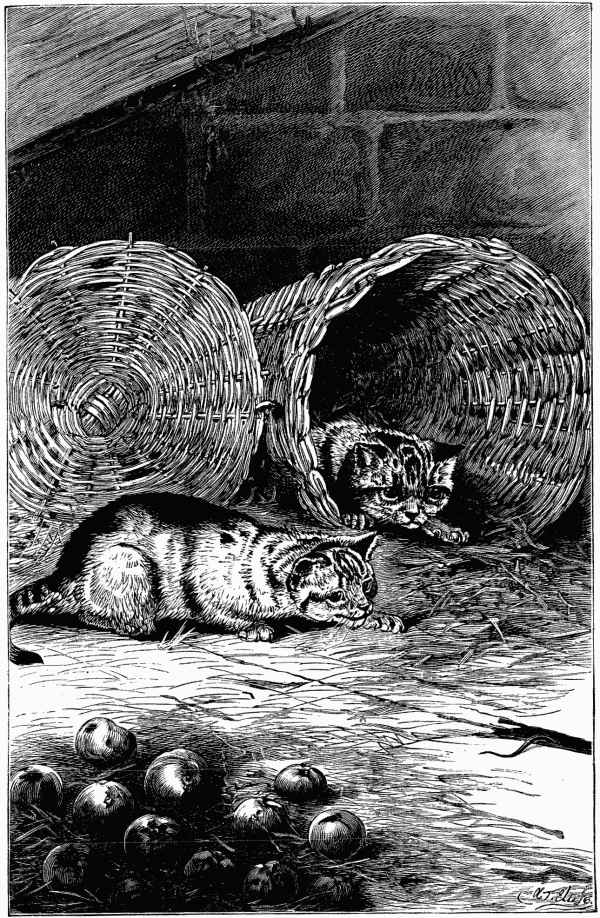 hen Jack and Tom were little kits,
he most probable explanation of the noise I had heard seemed to be that the house had not after all been empty—indeed, it could not be empty! Although the regular occupants had gone they might have left some one behind as a caretaker, who certainly must be in the depths of despair. Heedless of the fact that my presence might be resented, I opened the kitchen door, crossed the stone-paved passage, and going up a few stairs, came to a fair-sized hall. Here there were four doors, one leading out to the porch where I had found shelter yesterday afternoon, one to a room right at the back, and two which apparently opened respectively into the drawing-room and dining-room.
As the front room was above the kitchen I determined to try that first, for thence the weird sounds of the night had seemed to come. Advancing rather nervously towards it, I gathered sufficient courage to turn the handle, when, discovering that the door had been locked from the outside, I began to hesitate about turning the key.
Unless somebody had been shut in by mistake, how had he or she obtained admission? But as I stood there hesitating, I suddenly broke into a laugh of perfect relief. The truth now seemed plain enough. I could hear scampering feet, and an eager whine, which ended in an impatient bark. Opening the door, I saw a small rough-coated terrier with a patch by his tail; bounding forward he began to yelp and spring and fawn upon me, licking my hands and showing every sign of joy and satisfaction.
I think my own pleasure was almost equal to the terrier's. It is impossible to make any one understand the intense joy of finding a companion after the night I had passed. Although he looked rather thin, his condition did not suggest that he had been locked up longer than a day or two; but picking him up in my arms while he whined and licked my face, I carried him downstairs, and turning on the tap over the sink let him drink as much water as he wished. Fortunately I had still half of the pork-pie in my pocket, and it was good to see him eat it bit by bit from my hand. It was true that my remaining small piece of chocolate made an unsatisfactory breakfast, and that the terrier eyed me a little reproachfully even when I ate that, but he would not leave me for an instant, and in less than half an hour it seemed as if he had belonged to me all my life.
'What's your name, old chap?' I asked, and he wagged his stump of a tail as if he would have told me if he could. 'Anyhow,' I said, 'you must have a name of some sort. What shall it be?'
It took some time to decide upon a suitable name, and then we did not arrive at anything more original than 'Patch.' Having settled this pressing question, I stripped to the waist and had a good wash at the sink, drying myself as well as I could on the shavings which had served as a bed. By this time the rain had almost ceased, and I began to think that it might be advisable to get outside the house before I chanced to be seen. So, having got through the window with Patch in my arms, I shut it again and was going round to the front when I saw that the terrier was poking his muzzle into every nook and corner, as if in search of his lawful owner.
Still, he came to my whistle, and not forgetting the sack, I went round to the front of the house, standing under the porch at the top of the steps until presently the rain entirely ceased, the clouds broke, and the sun shone in a feeble kind of way.
The first order of the day was breakfast, then to make my way to Hazleton with the object of returning Jacintha's locket. With the sack rolled up beneath my arm, with Patch running excitedly around me, I set forth along the muddy road across the moor. Having left this behind and followed a winding lane for some distance, we seemed to be approaching a village. Passing one or two houses, we crossed over a railway bridge, passed a dozen or more cottages, and then, at the corner of two roads, I saw what appeared to be a kind of mixture between a temperance hotel and a mission hall.
After the various escapades through which I had passed since leaving Castlemore, my clothes were in a sad condition, my boots especially being coated with mud, so that for a moment I shrank from entering the building. Summoning courage, however, I pushed open the door and found myself in a bare-looking room with several large illuminated texts on the walls, and three wooden tables, at one of which a man was seated drinking a cup of tea.
A clock over the mantelpiece showed that it was a quarter-past ten, although I had thought it considerably later. As Patch followed me into the room, leaving damp footmarks on the clean linoleum, a short thin-faced woman, with fair hair drawn very tightly back, entered from the opposite door with a wet dish in one hand and a cloth in the other.
'We can't have dogs in here!' she cried by way of greeting.[Pg 103]
'Will it matter if I nurse him?' I asked.
'If he doesn't spoil my floor,' she answered, and as I took Patch up in my arms she added, 'What is it you want?'
'I should like some breakfast.'
'Tea and bread and butter?' she asked.
'How much are eggs?' I inquired.
'Three-halfpence each. Tea a penny the cup, bread and butter a halfpenny a slice.'
I made a hasty calculation in my mind, and being extremely hungry determined to spend sixpence, though it made a rather serious inroad into my remaining four shillings and a penny.
'I will have two boiled eggs, four slices of bread and butter, and a cup of tea,' I answered. Soon afterwards, while I sat with Patch on my knees, the other customer left the room. When the woman returned with my breakfast and received the sixpence in exchange, I was agreeably surprised by her altered manner. At first she had created an unfavourable impression, but now as I ate she stood watching with kindly interest, presently remarking, however, that it was beginning to rain again.
'How far is it to Hazleton?' I asked.
'Close on twenty-six miles,' she answered.
'I was told that it was thirty yesterday,' I said, 'and I know I have walked ten miles since.'
'Are you walking to Hazleton?' she inquired.
'Yes.'
'Well, you won't be able to get far on your way in this rain,' she replied, and indeed it was again coming down in torrents. 'We make up beds here,' she added. While she was speaking, a small, fair-headed child of four or five years ran into the room, and, encouraged by the way the woman caught him up and kissed him, I thought that I would confide in her.
'You see,' I explained, 'I have only three and sixpence to last me to Hazleton, and this weather I can't get along very quickly—that is the worst of it.'
She pursed her lips as she looked into my face. 'Well,' she answered, 'I can give you a bed for sixpence if you're not too particular. Then there's dinner——'
'I shall not care about dinner,' I said, feeling perfectly satisfied after two eggs and four thick slices of bread and butter, 'if I could have some bread and cheese for supper.'
Finally, she agreed to give me some tea in the afternoon, some supper, a bed, and a plain breakfast the following morning, for one and ninepence; this would leave the same sum to carry me to Hazleton, beyond which my plans did not at present extend. The woman, moreover, offered to tie Patch up in an out-house and give him some scraps, and later in the day she said that if I would go to bed early she would wash my shirt, which sadly needed such attention. Altogether it seemed that I had found a friend; and as the rain did not cease all day, I amused myself reading such books as the place contained. At six o'clock I had supper and went to bed, putting everything but my cap and cloth clothes outside my door, where, after a long night's sleep, I found them nicely ironed and folded. On coming downstairs, I borrowed some boot-brushes, so that on Wednesday morning I set out looking far more respectable than I had done on my arrival, in excellent spirits, with one and ninepence in my pocket and Patch at my heels.
A short distance from the reading-room, or whatever it ought to be called, I met a postman who told me it was only twenty-three miles to Hazleton, although, after I had covered quite four miles more, a member of the county police told me it was still twenty-two miles. Seeing that it would be impossible in any event to reach Colebrook Park to-day, although I could easily manage the distance to-morrow, I did not hurry, but, the sun being hot, allowed Patch several rests by the way, until on making another inquiry at about half-past five that evening, I was informed that Hazleton was still eighteen miles distant.
Although the day had been fine, the ground was still wet, far too wet to sleep out of doors with comfort. I had economised as much as possible, but walking is hungry work, and now I found myself with only one and fourpence by way of capital. The consequence was that a free lodging of some kind must be discovered, and I looked about vainly for another empty house.
At about six o'clock I happened to pass a farm; a good-natured-looking man stood leaning against a gate, smoking a pipe.
'Should you mind if I were to sleep in one of those barns?' I asked.
'On the tramp?' he exclaimed.
'To Hazleton,' I said.
'Pretty near twenty miles.'
'No one seems to know exactly how far it is,' I answered, and he chuckled as he puffed at his pipe. Then he began to eye me inquisitively, and presently, knocking out his pipe with a good deal of deliberation, he turned and walked away. I was beginning to feel that I had met with a rebuff, when he looked back and told me to follow him.
'Better pick up that terrier,' he said, 'because of the chickens.'
With Patch in my arms I followed the farmer round the house to an empty shed behind.
'You can have a shake-down here if you don't mind being locked in,' he said; and, although I would rather not have had the key turned, I at once consented. It was a large shed, and quite clean and fresh, but entirely bare. When I had been there about half an hour a maid opened the door, with a plate of cold beef and potatoes in her hand, and she stayed talking while Patch and I shared the meal. Soon after she had gone, taking the plate and knife and fork, the farmer came again, followed by a man with an armful of straw.
'I shall not lock you up,' he said, 'though I have been done so often you can't tell whom to trust and whom not. If you go to the back door to-morrow morning, you will get some breakfast.'
I have slept in more comfortable places, but still the shed was quite as good as anything I had a right to expect, while Patch's presence proved the greatest comfort. He lay down close beside me, artfully taking advantage of the straw, and when I felt very lonely—for I could not get to sleep for some time—I put out a hand and felt his coat.
(Continued on page 106.)
[Pg 104]
t was half-past six the next morning when I went to the farmer's back door, where the rough-looking maid provided me with a cup of coffee and a chunk of bread and butter, then, followed by Patch, I set out that Thursday morning on the road to Hazleton. The weather could not have been better, although the middle of the day promised to be excessively hot.
As I trudged along the pleasant road, I had some wild idea of reaching Hazleton that evening, but this was soon destroyed, for about a mile from the farm where we had slept, I noticed that Patch was limping. Sitting down on a heap of stones by the roadside, I looked at his near hind paw, and saw that it was nastily cut, so that he could only walk in great pain. I suppose he had trodden on a piece of glass in the road.
Now I realised that I was in an awkward plight. Of course, Patch must on no account be left behind; but, on the other hand, how was I to get him along? Tearing a piece off the edge of the sack, I frayed out some of the thread and made a kind of bag, which I put over the wounded paw, tying it round the leg. This took some time, and, as the job was finished and Patch was licking my hand by way of thanks, I saw a large van approaching from the direction of the farm, driven by one of the fattest men I had ever seen. The cart was laden with bottles of ginger-beer and mineral waters, but, as it passed us by, at a fair pace, a nosebag, which was tied behind, fell off into the road.
The driver, alone in the van, was entirely unaware of his loss until, rising from the heap of stones, I shouted to him to stop, and, picking up the nosebag, ran after the van. Pulling up his horse, he leaned down to take the bag, and then asked where I was going.
'To Hazleton,' I answered, as usual.
'That is about seventeen miles,' he said.
'The worst of it is,' I continued, 'my dog has cut his foot and can't walk.'
'Like a lift, doggie?' asked the fat driver.
'We should most awfully!' I exclaimed, eagerly.
'Well, now, listen to me,' was the answer. 'My round doesn't take me as far as Hazleton, but I am going to Watcombe, and that's ten miles short. We shall not get there much afore evening, because you see I have to travel a good bit out of the main road, and stop at ever so many places on the way.'
At any rate, the proffered lift would take me within ten miles of Colebrook Park, whereas without such help I did not see how I was to get even so far unless I carried Patch in my arms. Besides, the drive was tempting in itself, the only drawback being that my remaining capital of one and fourpence would have to bear an extra strain, and, in case of more bad weather, it would probably be exhausted before I reached my destination. However, in a very few moments Patch and I were seated on the top of a wooden box full of lemonade bottles, the fat driver whipped up his horse, and we sped gaily along the country road.
As I sat on the box of lemonade bottles, with a hand on Patch lest he should show a desire to jump down from the van, I noticed that he was sniffing curiously at the back of the driver's coat; and presently the driver in his turn began to look with equal interest at the terrier.
'He seems to know you,' I remarked.
'Come to that,' was the answer, 'I seem to know him. Looks to me most uncommon like Mr. Westrop's dog, he does.'
'Who is Mr. Westrop?' I inquired, holding Patch more tightly.
For a few minutes, without answering (for the fat driver was slow of speech and spoke in a deep voice which seemed to come from the direction of his boots), he divided his attention between the horse and the dog, and then fixed his small eyes on my face.
'The question is,' he said slowly, 'where did you get him?'
'You see, I found him,' I replied.
'Mr. Westrop's been in a bad way about his dog,' continued the driver. 'A very bad way. What do you think about it, Sam, old chap?'
The terrier, to my sorrow, showed what he thought about it by wagging his stumpy tail and whining with satisfaction, so that it would have been ridiculous to attempt to persuade myself that he failed to recognise the name of 'Sam.'
'I know most people betwixt here and Barton,' said the driver, laying his whip gently across the horse. 'Come to that, so I ought.'
'Do you live at Barton?' I asked, thinking of Mr. Turton and Augustus, and their wasted drive to that town.
'Just this side,' was the answer. 'That's where our factory is—half a mile this side of Barton. And every day of every week, for fifteen years or more, I've driven round the country with this van.'
'Are you going back to-night?' I inquired.
'Why, of course,' he exclaimed. 'Back by the straight road, after I've done my round.'
We had already left the wider road, and as the driver spoke he pulled up the horse at the door of a small rustic inn. Fastening his reins to a hook on his seat, he slowly dismounted, took a box of bottles from the van, carried it into the inn, returning after a short interval with the same box filled by a similar number of empty bottles. Then he climbed up to his seat again, unhooked the reins, and cried 'Gee-up' to the horse, which at once started at a smart trot along the lane.
'Now about this dog,' he began. 'Mr. Westrop used to live at the Beacon on Ramleigh Forest—I can remember before the house was built. He moved out last Friday to a house near Barton, and sure enough he has lost his terrier. Where did you find him? That's what I should like to know.'[Pg 107]
'I don't know whether the house was called the Beacon,' I answered, 'because I didn't see any name. Patch had got locked in the drawing-room.'
'Well, now!' cried the driver, 'who would have thought the dog was fool enough for that! Locked in the drawing-room, were you, Sam, old chap? And how did you get him out?'
When at some length I explained how I had been caught in the storm, and sought shelter in the empty house, and slept in the kitchen, and had been frightened by the ghostly noises in the middle of the night, the driver leaned forward and laughed so uproariously that I felt afraid lest he should fall from his seat on to the horse: and as soon as his merriment permitted him to speak, he turned to me with his great red face redder than ever.
'Well,' he cried, 'you are a nice young man for a small party, you are! A nice young burglar, to be sure! Going and breaking into people's houses, cool as you please, and stealing their dogs. Howsoever,' he added, 'Mr. Westrop will be no end glad when I take Sam back to him to-night.'
I clasped Patch more closely.
'You're—you are not going to take him back?' I said.
'Why, what do you think?' he demanded. 'You wouldn't go and keep a dog that didn't belong to you!'
I am afraid I might have been tempted to keep Patch or Sam, whichever he ought to be named, on any terms, if circumstances had permitted; and useful as the lift on my way had appeared, I began to regret that I had ever seen the driver or his van. But before I had time to reply we were pulling up in front of another inn, where another box of mineral waters was carried in, and a box of empty bottles was brought out.
'Not but what,' the driver continued, 'I am sorry to take the dog from you, because he is just the sort you could soon grow fond of—aren't you, Sam? But right is right,' said the driver, looking straight in front of him, as he laid the whip on his horse.
During the next two hours we stopped at numerous inns, and I might have been able to enjoy the drive through the country lanes, and the remarks which the driver exchanged with almost every one we met, if it had not been for the necessity of restoring Patch to his rightful owner. It was impossible to pretend that the driver had not right on his side, but the fact remained that the terrier's companionship had become very valuable, and I would have borne a great deal rather than give him up. On the other hand, I began to persuade myself that it would have been perhaps difficult to keep him in London, especially if I succeeded in obtaining work as quickly as I hoped, when necessarily I should be occupied most of the day.
When we stopped at a more important inn at one o'clock, the driver took from beneath his seat two plates, one covering the other, and tied up in a clean napkin. Without a moment's hesitation, he offered to share his meal with me, and there appeared to be quite enough rabbit-pie for two. After dinner, as we drove on again, he became more talkative, and asked a good many questions about myself, with the result that he soon learned where I was going after I left Hazleton, and how much money I had in my pockets, though I did not mention the gold locket.
'Now where did you think of sleeping to-night?' he asked, and I told him that I intended to wait to see what might turn up in the way of shelter. 'You see,' he continued, 'I always like fair play. Fair play is a jewel. It was you who found the dog, though you had no business to have been on the spot, so to speak. But Mr. Westrop is pretty sure to give me a tip for bringing Sam back, and I don't see why you should not have your share.'
'Oh, that is all right,' I answered.
'Of course it is, because I am going to make it all right,' he said. 'I told you I would set you down at Watcombe, ten miles from Hazleton; but half a mile short of that my sister-in-law lets lodgings. I will speak to her, and arrange that you shall have some supper and a bed and breakfast, and then I think we can cry quits, eh—what do you say?'
I said that it was very kind of him, and he proved as good as his promise. The house was not particularly tempting-looking, but, at all events, it was far better than no place to sleep in. I climbed down from the van, followed by Patch, from whom I was so soon to part, and accompanied the driver into a kind of kitchen, where a tall, stout woman in a cotton dress was busily employed as we entered. She glanced at me once or twice while the driver carried on a whispered conversation and handed her some money. Then she went out at a back door and returned with a piece of rope.
'This is the only bit I can find,' she said.
'That's enough,' answered the driver, and, going down on his knees, he whistled to Patch, who went obediently, and stood wagging his tail while a loop was fastened round his neck. I followed when the driver led him out at the door, lifting him into the van, and tying the end of the rope to the rail behind his own seat. Standing on an empty box, Patch looked down at me and whimpered, so that I climbed on to one of the wheels to pat his coat and hold his muzzle as a last good-bye. The driver mounted to his seat and unhooked the reins.
'Down you jump!' he cried. 'So long! be good!' and, whipping up his horse, he drove away, while Patch began to run about on the top of the box, and strained at the rope as if he were as sorry to leave me behind as I was to let him go.
Louis XIV., King of France, was very fond of playing at chess. One day he was having a game with one of his courtiers, and during the game made a false move, to which his adversary respectfully called his attention. The King, who did not easily suffer contradiction, did not wish to acknowledge that he was wrong, and appealed to the noblemen who surrounded the table, but none of them made any reply. Just then the Duke de Grammont came into the room, and immediately the King saw him he appealed to him, and wished to explain to[Pg 108] him the subject of the dispute, but the Duke hardly allowed him to finish.
'Your Majesty is certainly wrong,' he said, with a firmness of tone which astonished the King, and caused him to frown.
'How do you know that I am wrong, Monsieur le Duc?' replied the King; 'you have not even given me time to explain to you what the question was.'
'I know undoubtedly,' replied the Duke of Grammont, 'for all these gentlemen, whom your Majesty was consulting at the moment I arrived, only replied by their silence. They would every one have hastened to take your part if your Majesty had been right.'
The King was struck with the sense of this argument, and admitted that he had made a mistake.[Pg 109]
When the method of feeding employed by the Snail is compared with that of the Butterfly or the common Fly, a very striking difference in the construction of the mouth-parts will be noticed. The common snail (fig. d), for example, feeds by the constant licking, or rather rasping, motion of a very wonderful tongue—a tongue which, stretched out, appears to be longer than the whole body! Yet only a small portion of this curious organ is in use at one time.
This tongue (fig. f) consists of a long flat ribbon, or 'radula,' as it is called, the surface of which is beset by a series of minute teeth, set in rows across the ribbon. The number of these teeth varies greatly in the different species of Mollusca—the group to which the snail belongs. In some there may be as few as sixteen; in others, in some relatives of our garden snail, for example, there may be as many as forty thousand! The working portion of this ribbon is fixed to a sort of tough cushion, which, by means of muscles, can be drawn forward and protruded from the mouth, where it is worked backwards and forwards with a licking or rasping action that effectually scrapes away, in a fine pulp, the edge of the cabbage leaf on which the creature is feeding. The teeth serve, in fact, the same purpose as the horny spines on the tongue of the lion, or, on a small scale, of the cat. You all must have noticed how rough a cat's tongue is when, in a burst of affection, pussy insists on licking your hand. If she went on licking long enough she would wear away the skin. As the snail's teeth wear away in front they are replaced from the reserve store which is kept in a sort of pocket, which lies behind the 'cushion' in the drawing of a section of a snail's head (fig. e). It is here that new teeth are being constantly formed, and pushed forward to supply those lost.
In this drawing, by the way, you will notice a long arrow (a-b): this marks the passage which the food takes from the mouth to the gullet, and thence to the stomach. The head of the arrow points towards the snail's interior.
In many mollusca, the teeth, instead of resembling one another throughout the series, are of different kinds, very large and very small teeth alternating one with another in endless variety.
The horny jaws, to which reference has been made, are generally not conspicuous; but in the Cuttle-fish and Octopuses they are of huge size, and have been aptly compared to the beak of a parrot. But we must return to this subject again on another occasion, for it is one of quite unusual interest.
This little 'grace before meat' was written two hundred and fifty years ago by Robert Herrick, a Devonshire clergyman who became a famous poet. 'Paddocks' is an old name for 'frogs,' and 'benison' means blessing; 'heaving up' means 'lifting up in prayer.'
Time and progress have swept away many of the old streets, lanes, and alleys for which London City was remarkable. Most of them had names with a meaning, though it is sometimes difficult to find this out now. One reason is that, as the years went on, names often got altered in very odd ways. There were few of what might be called 'fancy' names, such as are now often given to new streets or roads. Frequently a name arose from the business of the people who lived in the street, or perhaps it kept in remembrance some notable person who had a house there. Occasionally it happened that a lane or alley had several names, and it is not easy to tell which is the oldest. The citizens sometimes gave two or three streets the same name.
When it could be done, old names have been kept, or not much altered, though the street is changed. Old-time Londoners would stare at Cannon Street of nowadays, so different from the Candle-wick or Candlewright Street of the past, where lived dealers in tapers and candles. It is said that Paternoster Row got its name from the fact that stationers and writers had shops there, who sold, among other things, copies of the Lord's Prayer. It had an Amen Corner, and Creed Lane is also near. Afterwards mercers and lacemen invited customers to shops in the Row, and finally it became famous for books and magazines.
Chancery Lane and Fetter Lane still keep the old names they had when their appearance was not that of streets or business thoroughfares, but quiet lanes between Holborn and Fleet Street, dotted with private houses. Fetter Lane had nothing to do with fetters or prisoners; it was so called because 'fewters,' or idle persons, were often found lurking amongst the back gardens. One of the short turnings out of this lane had the odd name of Three Leg Alley; nobody seems to know why. It is supposed that Gracechurch Street is a reminder of a church in the locality, St. Benet's, Grasschurch, thus called because near the church was a herb-market, where wild or garden plants were sold. Occasionally the name is found in books written by chance as Gracious Street. At first the Gresham Street of our day was called Cateaton Street, but an old writer about London states that this was also shortened to 'Catte.' There was a surname Catte or Katt, which might have belonged to a person who built houses along the street. Hog Lane, Spitalfields, we are told, was visited now and then by the porkers that were allowed to range in the fields and obtain what food they could. Doubtless they strolled up the lane on the chance of getting fragments from the kitchens of citizens. Was Duck Lane, Smithfield, damp enough to be attractive to ducks? It may once have been, but later it was known as Duke Street.
Many places in the city were named from eatables or other articles that were sold in them. This was the case with Pudding Lane and Pie Corner; Milk Street, too, is supposed to have been a milk market, but Honey Lane was not a depôt for honey, nor remarkable for its sweetness. The historian Stow says that it was both narrow and dark, needing much sweeping to keep it clean. The Poultry was a market for fowls, and Scalding Alley, close by, had houses in which people scalded poultry and prepared them for sale. An old name given to Grocers' Alley was Coney-slope Alley, for it had a market where coneys or rabbits could be bought. In Rood Lane formerly stood the Church of St. Margaret Pattens, beside which the women offered pattens to by-passers. These wooden elevators for the feet were much in demand at the time when London streets were often deep in mud, and the fields splashy or sticky with clay. But they did not sell bucklers in Bucklersbury; so far as we know, it was called after a citizen named Buckle, to whom the manor belonged. Grub Street did not have at all a pretty name, though some say it was first Grape Street; then it was altered to Milton Street in honour of our great poet. Little Britain or Britagne Street had a residence belonging to the Dukes of Brittany, and Barbican was notable for its Roman tower, around which were large gardens.
'I wish we could scrape enough money together to buy poor old Father a pair of slippers for his birthday,' said Jack; 'his old ones are all in holes, and I know he can't afford a new pair—he has had so many expenses since Mother's illness.'
Geoffrey looked up from his home-lessons and sighed deeply. 'My money-box is quite empty,' he remarked, 'and Nellie and Hilda have not a farthing in the world.'
'That is true enough,' laughed Nellie. 'But, oh, Jack,' turning to her eldest brother, 'if only we could do something for Father, I should be so glad! He seems so worried lately, and I am sure it's because he can't get Mother all the nice things she ought to have now that she is getting better.'
'Couldn't I take out a broom and sweep a crossing?' asked Geoffrey; 'that would bring in a little, and I would not mind what I did, if it helped.'
'You must find your crossing first,' returned Jack. 'The roads are as dry as a bone at present, so that won't work, little stupid!'
'Little stupid' sighed again. 'If only I knew how to earn an honest penny!' he murmured.
'Or twopence,' said Hilda. 'I think twopence would be a little better.'
'I would rather it was half-a-crown,' put in Nellie.
There was silence for a moment; then Jack said slowly: 'I wonder what became of Uncle Harry after he went out to Australia. Father never writes to him; he doesn't know where he is now, and we have moved so many times that I expect Uncle does not know where we are either. I dare say if he knew we were so badly off he would help us.'
'It's no good talking about Uncle Harry,' said Geoff; 'the question is, Can we help Father?'
'Look here,' cried Jack, suddenly; 'supposing, instead of saying "Can we," we say "We must." Supposing,' he added, 'we all make up our minds to[Pg 111] earn a shilling each as best we can, so that we may have four shillings to buy Father some slippers?'
'Capital!' exclaimed Nell; 'but how are we to earn it?'
'Oh, we must each hit upon a plan for ourselves,' returned Jack; 'I vote we draw lots for the first victim to-night, and we will allow each victim two days to earn the shilling in, and then will draw for the next.'
Of course, they all began to puzzle their young brains about plans; but Jack cut some slips of paper into different lengths, and, placing them between his thumb and first finger, while he clasped his other fingers tightly over the ends inside his hand, he bade them each take one, and whoever drew the longest was to earn the first shilling.
Well, they all drew, and Jack took the slip which was left; but Nellie got the longest, and she retired to the window, and stared out for inspiration.
'I know what I shall do,' she announced, at last; 'I'll cut my twelve chrysanthemums out of my garden, take them down to town, and sell them in the street for a penny each.'
'Nellie!' cried Jack; 'you mustn't think of doing such a thing! Father would not like it, and I am sure we should not. You are not half strong enough to go out into the streets.'
But Nell was firm. 'It's the only thing I can think of, Jack,' she replied, 'and I will do it. We must earn some money somehow, and no one will recognise me if I put on my old frock, and a shawl over my head. We can't help being poor, Jack, and it is an honest way of earning a shilling.'
Jack, however, looked a little worried. He admired Nellie's pluck, but he did not like the thought of her going out into the streets alone. Nevertheless, after some discussion, it was decided that she should have her way, on condition that Jack went with her to see that she was quite safe. It was agreed that the matter should be kept dark, and that if Mother asked where Jack and Nellie had gone next evening, the others were to say it was a secret.
So, after tea the following day, the two children stole out. Mother was resting in her own room, and Geoffrey and Hilda were at their lessons, though it must be confessed they found it hard to give their whole attention to them.
It was a good mile and a half down to the town, but Nellie trudged bravely on with her treasured chrysanthemums (she alone knew what it cost her to cut them), and Jack walked a little behind, for his sister said that flower-girls never had any one to escort them, and he must not let any one see he belonged to her.
When they arrived in town, Nellie took up her station at a busy corner, and timidly offered her flowers for sale, while her brother stood in a doorway not far off, pretending to read a book by the light of a street lamp, but in reality he was watching to see that she came to no harm.
One honest penny was earned—two; then Nell grew bolder, and ran after a man whom she thought a likely customer. But he pushed her roughly on one side, and she fell upon the pavement. Jack could have kicked that man, but he was out of sight in an instant, so the boy went and helped Nellie to rise instead. Gathering up her flowers, he entreated her to return home, and not to trouble any more. But the little girl bravely held out, assured him she was not hurt, and in the end persuaded him to go back to his doorway.
Ten minutes passed away without any more flowers being sold, then Nellie held out the best of all to a kind-looking gentleman who was passing slowly by.
He stopped, looked at the child somewhat curiously, and then said, 'No, little lass, I do not want any flowers; but I wonder if you can tell me where Greenfield Road is, eh?'
Nellie started, for that was the name of the road where she lived. However, she simply directed him, and was turning away to seek for another customer when he slipped a bright half-crown into her hand. The child was so astonished that for the moment she could say nothing, and when she recollected herself the gentleman had gone, and Jack was by her side, asking what had happened.
'Well,' he said, when she had told him, 'no more selling flowers to-night, Nell, so you can just come home at once, for you have done your part and more,' and he would not hear of her staying there any longer.
Together the two started for home, feeling very happy indeed; but scarcely had they got inside the door when Geoffrey literally rushed at them.
'Oh, Jack! Nellie!' he cried, 'you can't think what a splendid thing has happened! Who do you think turned up ten minutes ago? Uncle Harry; yes, Uncle Harry! He has been hunting for us for days. Oh, it seems too good to be true! He's in the dining-room now, with Father, and——'
'Oh, is he?' said a voice from behind, and who should appear on the scene but the kind gentleman who had given Nell half-a-crown! 'Why!' he exclaimed, suddenly, 'what's this I see? Well, if it isn't——Why, what does it all mean?' he asked, turning round to Father, who had followed him out, and was looking equally puzzled.
There was an awkward silence. Nellie coloured, and in her nervousness, down went all her pretty flowers on to the floor. But Jack came to the rescue, and blurted out the whole story on the spot.
Father turned his head away as Jack explained; indeed, he was much touched by the children's thoughtfulness; but Uncle Harry patted Nell's head, and praised her for her pluck. He said that Father ought to be proud of his four children, and I am sure Father was, though he said they must never think of going into the streets to sell flowers again.
Of course, the earning an honest penny business came to an end, for Uncle Harry had come back much better off than when he went out to Australia, and he gave the children a shilling each to buy Father some slippers, and something else for themselves besides.
Later on, he and Father became partners in a business of their own, and Nellie never had to think of selling her flowers again, or Geoffrey of sweeping a crossing.
J. A. Vivian.
[Pg 112]
Thomas M'Calmont had blue eyes, a mop of red hair, a moderate share of brains, and a most insatiable thirst for adventure. When his school-fellows made insulting remarks about his red locks, he was wont to answer, 'Ginger for pluck;' and, indeed, on several occasions, he had acted up to this saying there and then on the persons of his unfortunate persecutors.
Tommy was only eleven years old. Mrs. M'Calmont, his mother, regarded him as the most wonderful boy in the world, and would have utterly spoilt him, after the fashion of adoring mothers, had it not been that Mr. M'Calmont, seeing nothing more wonderful in his son than a red-headed, mischievous boy, set himself most diligently to curb Tom's youthful energy, and make an honest, sensible fellow of him.
They lived in the country, and Tom had three miles to go to his school. But Mr. M'Calmont also had business in Barton, so the pair set out together each morning in a trap drawn by a steady-going horse, who never shied or ran away, or did anything at all exciting. Tom was set down at the door of his school at nine o'clock, and called for at half-past four precisely, just like a grocery parcel. Never a chance for a frolic over the fields in the clear morning air, never any scrapes to get into! No gentle dawdles through the lanes after school, with occasional excursions into hedge or spinny after wild creatures, or the chance of a nice creepy adventure in the darkness of some winter's evening. The whole business, Tom thought, was humdrum and commonplace.
But at last, one early springtime, it happened that Mr. M'Calmont had urgent business at the town of Greenhurst, twenty miles away. It was a cross-country journey, where railways did not fit, so Mr. M'Calmont departed in his trap, leaving Tom and his mother in sole possession for a whole fortnight at Red House. Mrs. M'Calmont was secretly rather glad to be able to spoil her son as she liked.
Tom made the most of his advantages, and mother and son together revelled in the glorious sense of doing everything they liked best. Tom's favourite dishes appeared at every meal, bedtime came a good hour later than usual, and Tom also managed three clear days' 'old-soldiering' on the strength of a slight cold. But the last morning of liberty came, and as Tom dressed he carefully turned over in his mind how he should celebrate it. It was a beautiful morning after a week of heavy rain, and Tom had no wish for another day of coddling indoors.
Tom's mother packed his lunch-case with many dainties, and kissed him good-bye. Tom felt rather mean, 'like a wriggle-up worm' as he afterwards put it, and he half resolved to give up his plan and go soberly to school, for, to tell the truth, he had already resolved to play truant. Unhappily, as he turned into the lane from the drive gates, a rabbit dashed across the road right in front of him, and frisked into the hedge in a most tantalising manner, as if to show his contempt for stupid human beings who plod along the beaten track. That killed all Tom's scruples, and he was soon scurrying through the fields, scrambling over hedges, leaping ditches, and getting his clothes into as pretty a pickle as could be desired.
What a splendid day he spent, following no settled route, but wandering here and there as the impulse of the moment directed, and feeling in all his boyish frame the gladness of life and of spring! He lunched in a little wood, with a fallen tree for a throne, and a rippling stream to play him music while he feasted. Then he sauntered leisurely on in the afternoon sunlight, many thoughts busy beneath his comical red thatch. The long hours in the open after his three days indoors made him sleepy at last, and he was glad to discover behind the temporary abode of a railway navvy a little rough wood hut, where, with a friendly dog for company, and some straw for a couch, he was soon fast asleep.
Tom was dreaming. He heard a babel of voices fierce and angry, and was striving very hard to hear what they were saying; but, though the voices seemed loud, he could not distinguish one word from another, and in trying to do so he awoke. The voices continued, but they were not loud at all, though rough and angry. They came from the navvy shelter, and Tom could hear plainly every word. He was about to move away when he heard his father's name mentioned, qualified with expressions of hatred. Plainly it was right that he should hear what these men had to say about his father, so Tom crouched nearer the wall of the hut and listened. His blue eyes grew big and round, and his face filled with horror.
Tom knew that the navvies at work in the district were not regular workmen, but a very rough set. A gang of them had been almost a terror to the neighbourhood, and Tom's father had been foremost in bringing the guilty ones to justice. Three of their friends were in the hut, one with a revolver. They had learned from a workman that Mr. M'Calmont was to return from Greenhurst that evening, and they were discussing the spot where they could best waylay and shoot him. 'We won't kill him, only damage him a bit,' were the last words Tom heard as he crept from his hiding-place and made his way quietly into the wood.
Tom's fear began to give way to excitement. He had an adventure at last, and all to himself. To go home for help would be no use and would only terrify his mother. The setting sun showed that the evening was advancing, and his father would soon be coming, so that the only thing was to go and hide near the spot where the men had planned to wait. This was where two roads merged into one, at the bottom of a steep hill overhung with trees. Mr. M'Calmont might come by either of the two roads—it would depend on whether he wished to go into Barton or not.
Tom made his way to his post as quickly as possible, and found himself a hiding-place in a hole beneath the hedge, where only a boy could wriggle, and where he hoped that in the dusk he would be unobserved. His post was just the point where the road forked; the men had planned to stand some yards from that point, where it was more shaded by[Pg 115] trees, so Tom hoped that when he heard the trap approaching, and could distinguish on which road it was, he would have time to run and warn his father, who would then, he did not doubt, with the aid of his valiant son, be a match for any three men.
It was rather a lonely watch. Tom was getting hungry again and very tired and stiff. As the light faded, his excitement faded too, and it was almost a relief to hear the stealthy arrival of the conspirators. Then another long wait, until at last he heard the cart-wheels going over unrolled stones, which told that it was not on the Barton road. Out of his hiding-place he crept, and darted along the grass at the road-side. An unlucky stumble over a fallen branch betrayed him, but as he fell he shouted with all his might, 'Look out, Father, they are going to shoot you!' Then there was a rush, a crack as something came into violent contact with his head, the world went round, and then—darkness.
When Tom woke, the morning sun was shining into his own room. His mother was busy at the window, fixing the curtain to keep the light from his face, and Tom could see that she was crying. A great fear entered his mind, and, as his mother turned and looked at him, all he could say was 'Father?'
'Quite safe, my brave laddie, for you frightened the men away. My dear, brave boy.'
Then joy filled the heart of Thomas M'Calmont, and for once the fault of playing truant went unpunished.
Jessie Harvey.
hen birthdays come, we always writeA narrow opening high on an oak-covered hill; a cluster of women, girls, and boys, each carrying a slight iron bar connecting two oil lamps; a crowd of tourists of many nationalities—all waiting to enter the Grottoes of Han. Presently the guide arrives, and delivers a brief speech as to the possible consequences should visitors deface or purloin the treasures of the cave, demanding silence during his explanations, and declaring that one light-bearer would accompany every four persons. He ceases, and away we go. Down, down, down, apparently into the very heart of the earth, through damp and chilly air and profound darkness, broken only by the glimmer of the friendly lamps. Then we cease descending, and emerge in a cavern where the lights are flashed upon thousands of fossilised insects, and on into the 'Hall of the Foxes,' where countless generations of their species lived, died, and were buried. After this the great caverns succeed each other rapidly, each with some special interest of its own, until we find ourselves in the 'Hall of the Trophies,' where electric light is installed to exhibit the marvels of the roof. A thick fringe of stalactites, many of immense size, descend to meet the columns of stalagmite ascending from the floor.
Right through the caverns, a distance of nearly two miles, a rough path has been made which is fairly dry and clean, but on either side are rivers and banks of mud, so that it is well to be careful and watch the way. Once as we went along we heard behind us a splashing thud, and, turning, beheld a portly Belgian floundering on his back in the mire, whence he presently emerged, coated with mud, looking rather like a hippopotamus. No rule of silence could avail to stifle the peals of laughter that rang through the grotto, and we had the less scruple in enjoying the fun because any one of us might at any moment have the happiness of similarly amusing his or her fellow-creatures.
Our merriment ended before the wonders of the 'Hall of Mystery,' where the electric light travelled round to show 'The Mosque,' standing out in glittering points of light; 'The Curtain,' a veil of gleaming lacework in stone; and 'The Alhambra,' furnished royally with every combination of diamond-like crystals. It would be easy to invent names for most of the objects, for shrines, pulpits, thrones, and such-like are everywhere carved, of dazzling whiteness and richness of design.
Next we enter the gloomy magnificence of the 'Hall of the Dome,' where the roof towers up two hundred feet into the darkness. As we ascend the steep path we turn and see below the gleam of water. This is the subterranean river Lesse, the architect of these gloomy grottoes, which until some forty years ago had heard no voice save that of the water hammering and chiselling the rocks at its own sweet will. Legend declares these stately halls to be the palaces of the little Brown Dwarfs, who, issuing from their homes at night, by counsel and more practical aid enabled the early builders to produce the wonderful edifices of Bruges, Ypres, and other Flemish cities.
Still we go on, up and down through grotto after grotto of marvellous beauty; sometimes along the banks of the shadowy river, reflecting in its depths the fairylike beauties of roof and wall, then up high, narrow ridges or down into the depths of inky blackness, until at last we find ourselves in the 'Hall of Embarkation.' Here a small wooden platform projects over the river, and near it are a number of large boats capable of carrying all our party. The boats push off, all lights are extinguished, and the sensation of total darkness in such conditions is more weird than pleasant. We are told that the water is of unknown depth, and it takes some confidence to repress thoughts of collisions and perils by water of various kinds.[Pg 116]
The boats move on in solemn procession, and soon a tiny speck of light appears, and grows gradually larger and brighter. By degrees the light pervades dimly roof, walls, and transparent water, and then, all in a moment, a flood of glorious sunshine gleams through the lofty portal which we are approaching. Behind us fringes and bosses of stalactite are tinged with the warm glow, and stand out in bold relief from the darkness; before us the banks are green with grassy slopes and waving trees; below us the river dances along in the sunlight as if full of joy at escaping from prison, and we too share its happiness as we float back into our every-day world from the gloomy glories of the Grottoes of Han.
Helena Heath.
[Pg 117]
For the next hour I felt extremely miserable, but, remembering that I should, in all probability, see Jacintha to-morrow, I began to wish it were possible to do something to improve my appearance for the occasion. For not only were my clothes in a far from satisfactory condition, but the soles of my boots were full of holes, so that one stocking touched the ground.
There was nothing to do but wander about and look at the chickens until I was summoned to supper, which consisted of bread and very strong cheese.
On being shown to the bedroom, I found that it contained two beds, in one of which a small boy was[Pg 118] already reposing. Although he seemed to watch me with considerable curiosity, he made no attempt at conversation; but it was a very noisy house, and I found it impossible to get to sleep for some time.
When my room-fellow awoke me at about six o'clock the following morning, the sun was shining brightly into the shabby room, so that this promised excellently for the day's tramp. I said my prayers, and having washed, dressed, and partaken of a somewhat scanty breakfast, wondering, as I ate, what had by this time become of Patch, I set out, at a little after half-past seven, in the direction of Hazleton.
Presently, passing through a village, which seemed to be on the outskirts of the town of Hazleton, I bought two penny sausage rolls at a small baker's shop, and asked for a glass of water. As I walked on, eating the rolls, it soon became evident that the town was close at hand. At intervals I passed large houses, standing in their own grounds, and carefully I read the names on their gate-posts, lest one should be Colebrook Park. The path, which had been almost indistinguishable from the roadway, was now asphalted, and I stopped to read a notice board concerning vagrants, wondering whether I ought to be reckoned under that denomination. I do not know whether the sun had affected me—for it shone with brilliant force that morning—or whether I was tired after my ten miles' walk without much food, but as I drew near to Hazleton, which I had formerly felt so anxious to reach, my usual spirits seemed to forsake me, and, if it had not been for the necessity to return the locket, I think I should have passed on my way without making the least attempt to see Jacintha again.
I seemed to have lost pride in myself, so that it became difficult to keep up much hope. Perhaps it might be possible to get the locket safely into Jacintha's hands without seeing her, especially if there happened to be a lodge at the entrance to Colebrook Park, when I might leave the trinket with the lodge-keeper.
With the object of making up my mind, I lay down on the wide border of grass on one side of the road, thankful for the shelter of the hedge. It was about half-past twelve, and several carriages passed as I lay there, as well as a few bicyclists. But now the straight, wide road was clear; no one was in sight, either to the right or to the left, until, from a gate a hundred yards away, in the direction of the town, a girl on a bicycle came forth, and I knew at once that she must be Jacintha.
She wore a wide-brimmed, white straw hat, and a white cotton frock, and was sitting very upright as she turned and coasted on her free-wheel machine down the slight hill towards me. For an instant I thought of turning away my face, so that, even if she remembered it, she should not recognise me; but she looked so bright and pleasant an object in the middle of the sunny road that, on the impulse of the moment, I rose to my feet, crossed the margin of grass, and lifted the cloth cap which had been given to me before I reached Polehampton.
Jacintha was off her machine at once. 'Why,' she cried, 'you are the boy who ran away!'
'My name is Everard, you know,' I answered.
'But I thought you said you were going to London?' she suggested.
'So I am.'
'It is not the nearest way from where you were to come through Hazleton,' said Jacintha.
'You see,' I explained, thrusting my fingers into my waistcoat pocket, 'I came to bring back your locket,' and I held it out towards her in the palm of my right hand.
'My locket?' she said, gazing at it while she held the handle of her bicycle.
'Yes,' I answered. 'I found it on the path just by the hedge where you were standing.'
'But I did not bring a locket with me from London,' she exclaimed, and I felt immensely disappointed.
'Isn't it really yours, then?' I asked.
'Of course not,' she returned. 'How can it be if I didn't bring one?' and then she removed one hand from the bicycle, and took the locket from my palm, which I wished had not been so extremely grimy. 'I think it is very pretty,' she continued, 'and I believe it is gold.'
'Oh, it is gold right enough!' I said, 'because it has a hall-mark. It is eighteen carat.'
'Have you come out of your way just because you thought it was mine?' she asked, giving me back the trinket.
'It was not very far,' I persisted.
'Rather nice of you, though,' said Jacintha.
'If it comes to that,' I answered, 'you were rather nice to me that day. Some girls would have given me away, and then I should have been back at Ascot House before now.'
As I was speaking, she took a small gold watch from her pocket.
'I must not be late,' she cried, 'because both Dick and I were late for breakfast.'
'Who is Dick?' I asked, as she put away her watch.
'Dick is my brother,' Jacintha explained. 'He only came down yesterday. Dick's a year older than I am. I really ought to go,' she added. 'If my uncle were to see me talking to you he mightn't like it.'
'I suppose,' I cried a little angrily, 'he would think I was begging?'
'At all events,' said Jacintha, candidly, 'he would be rather surprised, you know. Because you do look most tremendously dirty—just as if you were a regular tramp—and yet your face would be all right if it were only washed and you had your hair properly cut.'
I felt that my cheeks were growing red, and for the moment I was tempted to make an angry retort, although, remembering what I owed to Jacintha, I simply held out my hand and muttered 'Good-bye!'
'Oh, you mustn't go on yet,' she exclaimed. 'I want to hear all you've been doing. I must go in now, but please promise to wait till I come out again. I won't be long.'
'I am not in a hurry,' I admitted.
'Only don't stay here,' she said. 'Wait till I am out of sight, and then follow me until you come to[Pg 119] our hedge. Right in the corner you will find a place you can get through, and nobody ever comes to that field. You get through the hedge and stay till I come back.'
I stood in the road while Jacintha mounted her bicycle and rode up the slight hill to the gate, when she looked back and waved her hand as she turned into the grounds. Having waited a few minutes, I followed her directions, found the weak spot in the hedge, scrambled through, and at once sat down on the grass.
I saw I was in a remote corner of a large field, in which a few Jersey cows were grazing. But this was not quite an ordinary field, as it contained a good many foreign trees with iron railings round them. It was more like a park. In the middle stood a small mound, looking as if it had been made artificially, with a kind of arbour on the top overgrown with some sort of creeper and shut in by trees.
The time seemed to pass very slowly, but at last I saw the flash of Jacintha's white dress in the sunshine as she walked rapidly towards my corner, the house not being visible from where I sat. To my vexation, however, she was not alone. A few yards behind came a boy of about my own age and size, with a straw hat on the back of his head, a red-and-blue blazer thrown over his white cricket shirt, and his hands thrust in the pockets of his flannel trousers.
While Jacintha tripped quickly over the grass, her companion, who, no doubt, was her brother, seemed to follow far less cheerfully. I could not help thinking there was something unwilling, almost resentful, in his manner, so that I felt prepared to pay him back in his own coin. Although I might look as dirty and as much like a tramp as Jacintha had suggested, I was not going to stand any nonsense.
When they reached the arbour they came to a standstill and seemed to be holding an argument, until, a few minutes later, Jacintha tossed back her long hair and set forth at a run in my direction, whereupon I went to meet her.
'You didn't mind my bringing Dick?' she suggested, looking doubtfully into my face.
'Have you told him, then?' I asked.
'I told him yesterday,' she said. 'I mean I told him about seeing you in the wheat-field, and your running away from school, and when I just had time to whisper that I had met you before lunch, he said I must not come; but I told him I had promised, and then he said he would come too.'
By this time we were within a few feet of Dick, who looked all right, although he seemed to think a great deal of himself. He was fair, like Jacintha, and he did not take his hands out of his pockets, so I put my hands into my pockets also, and stared at him as hard as he stared at me.
'Dick!' cried Jacintha, 'this is Everard.'
'Well, look here,' he answered, 'if you don't want to be collared, you had better come in, instead of standing out here all day.'
The Cuban anolis is one of a large family of lizards, all of which are confined to America and the West Indian islands. This family is nearly related to that of the iguanas; but whereas some of the iguanas attain a length of five or six feet, the anolis is always small. It is a remarkably active little creature, and often singularly beautiful, offering a striking contrast to the ugly and sluggish horned lizards of North America and Mexico. It is usually rather more than a foot long, and its general colour is a beautiful green. It has a white throat, and a white band passing over each shoulder and for some distance along each side. The little creature has the power of puffing out its throat, and distending it till it looks like a ball upon its neck. When it is irritated, angry, or alarmed, it invariably blows out its throat in this way, and tries to frighten its enemy by this means. Most of these lizards have also more or less power of changing their colour, like the chameleon, and, indeed, a few of them can out-rival the chameleon in this respect.
A striking peculiarity of this lizard is the structure of its toes. They are rather long, and furnished with sharp hooked claws, and the last joint is swollen out into a kind of pad. At first sight we should be inclined to think that these little swellings near the tips of the toes would be rather an inconvenience to the anolis, by impeding its movements. But a closer examination shows that these curious growths have a use. They act to some extent as suckers, and enable the anolis to climb the perpendicular faces of rocks, or even to hang from the under side of a branch.
The males of these little lizards are often very quarrelsome, especially at certain times of the year, when two of them rarely meet without having a fight. They fly at each other furiously, rolling over and over, and biting savagely. These fierce battles generally end in one of the combatants losing his tail, for in these lizards, as in many others, the tail is not very strongly attached to the body. The victor sometimes makes off with the tail of his foe in his mouth, and sometimes he even devours it. The loss of his tail is a great blow to the vanquished anolis, for he seems to have a great pride in it. When he is deprived of it, he accepts defeat at once, and though he recovers from the injury without much trouble, he is generally but a timid and crest-fallen creature afterwards. He seems to look upon the loss of his tail as a disgrace—very much, perhaps, as a regiment of soldiers regards the loss of its colours.
Another pretty little Cuban lizard is the chameleon-eyed lizard. It is of a brownish colour spotted with white, especially about the head. It has many resemblances to the anolis just described, being small, slender, and active. Both frequent trees, thickets, and rocky places, where they run and climb with such quickness as to be sometimes easily mistaken for birds hopping to and fro. The numerous tropical insects are their usual food, varied occasionally by berries and fruits.
W. A. Atkinson.
[Pg 120]
Not long ago a gentleman heard of a remarkable fight between a stoat and a rabbit; he gives an account of it in the Field newspaper. His gardener was walking in an orchard when he heard a scuffling and squealing on the other side of a hedge. He looked over, and to his great surprise, saw a rabbit in close pursuit of a stoat. Just as they reached the hedge the rabbit caught up with its enemy, but the stoat hid in the hedge for a few seconds, and then ran along it swiftly, escaping the rabbit's notice for a few minutes. Then it rushed out into the field again, some thirty yards from where it had entered the hedge. Its object soon became clear. 'It pulled a young rabbit out of a bunch of grass,' says the writer, 'and began to drag it to the hedge. When the old rabbit turned and saw the stoat it went for it again, and jumped on it and bit it in the most infuriated manner, driving it away from the young rabbit, and running it squealing with terror into the hedge, where they both eventually disappeared.' It is sad to learn that this brave attempt of the mother rabbit to save her young one was in vain; the little bunny was dead when the gardener picked it up a few minutes later.
Stoats will often pursue rabbits across country for very long distances, going steadily on and following the track by the power of scent alone; but it is very seldom that a rabbit will show such courage as to turn the tables and attack its foe.
The people of the olden time had great faith in the powers of magic rods and wands. Not only was this the fact amongst the Greeks and Romans, but the belief was found in our own country not so very long ago. Certain trees were famed for their magical virtues, because they were supposed to be the home of some spirit, and rods cut from them were said to have wonderful powers. The belief survives in the conjurer's wand, which, as we all know, does marvels when waved to the sound of 'Hey presto!'
To the pretended wonder-worker of the past, his rod was a most important thing, for by its help he accomplished marvels, or at least pretended to do so. There is a story told about a man who had seen a magician produce water by means of his rod. Getting hold of the rod one day, he thought he would supply his house with water by its aid. He said to it, 'Bring water.' Soon the wand rushed to and fro with big pails, but when the floors were getting flooded, he thought there was enough water, and told the wand to stop. He did not know the word of command, and so the wand went on just the same. In his rage, he took a chopper, and cut the wand in two, but instead of stopping it brought twice as much; a double lot of pails appeared, and at last the torrent of water washed away the house of the meddlesome man.
The magic rod or wand has had several names given to it. A common one was that of 'divining rod.' By the Germans it was called the 'wishing rod,' or 'wishing thorn,' which points to the fact that it was often cut from the blackthorn or sloe. It was supposed that the person who could use the magic rod most successfully was the seventh son of a seventh son, if such a person could be found. The wand, too, should not be cut from very old wood, but it must be more than a year old. Some folk said that the twig chosen to make this rod ought to be one upon which the sun shone both in the morning and afternoon. Again, the magic rod was not simply a straight piece of wood; it had to be of a particular shape—that of the letter Y. When using it, the hands grasped the two arms, so that the unforked part pointed outwards. In houses about the West of England, people will show visitors magic or divining rods, cut many years ago, and now carefully kept as memorials of the past.
These rods had various uses. They were not only supposed to show where metal was hidden, or springs of water might be found, but one brought to a person ill of fever might cure him, though he had to pay whatever was asked for it, and make no objection to the price. In some countries, men believed that a magic rod might be got to point the direction in which a lost person had gone.
The Chinese, ages before the Westerns knew them, had their magic rods, and generally cut them from fruit-trees, the peach being often chosen. But in Europe, the hazel or cob-nut tree stands at the head of the list of the trees favoured. German farmers formerly cut a hazel rod in spring, and when the first thunder-shower came, they waved it over the corn that was stored up, believing that this would make it keep sound till it was wanted. Next to the hazel in importance was the rowan or mountain ash, a tree always associated with the pixies and fairies; magic rods were frequently made from it, and also little crosses, which, if put over the door, were supposed to bring good fortune into a house. Another tree furnishing such rods was the willow, and another was the apple; one carefully avoided was the elder.
J. R. S. C.
 he came with the evening shades,
hat a shame it is, Hugo, that when your father is giving the whole class this splendid treat in honour of your recovery, you yourself should be the only boy absent.'
Hugo laughed somewhat sadly. 'Yes, I should like to be going, but the doctor says that I must not walk much before Christmas, and no one wants to spend three days in the woods in the middle of December. I should have liked the chance of catching a swallow-tailed butterfly for my collection.'
'I will try and get one for you,' answered Franz, 'though they are scarce this year. But what is this? How did you get your medal back?' as he picked up a silver disc from the table.
Hugo had won this medal a year before for a Latin composition for boys under fifteen, and when Baron Rosenthal's beautiful collection of coins and antique silver had been stolen, the medal had gone too.
'A friend of Father's saw it in a Berlin curiosity show among a lot of coins, and he sent it back to me.'
'And the coins—were they also your father's?'
'He has gone to Berlin to look at them, and he will be back to-night. But all coins are not easy to recognise. If it had been any of the silver boxes or cups he would have known his own at once.'
'And none of these have been traced?'
'No, not one. My father thinks they have probably been sold in some foreign country—America, perhaps, or England. But see, he left this money for you, so that you can let me know what you are doing. Then you can send me a long cypher telegram every day from the station on the Observatory, and it will give me something to do to translate it,' and he handed Franz some silver.
During his illness, Hugo had occupied himself in inventing a most elaborate cypher, which was the envy of the whole school. Not even the masters could read it, and it was an endless source of amusement to himself and Franz, who alone was in the secret.
'All right!' answered Franz; 'I will send you three telegrams, and catch you three swallow-tails too if I can manage it.'
As he went out of the room, his school-fellow looked wistfully at the pair of crutches that stood beside his invalid's chair. He was the only son of a very rich German nobleman, and six months before he had been nearly killed in a railway accident. When he began to recover, the Baron had promised to give a special treat to his son's class in honour of the event, and now that the time for the annual excursion had arrived, he was paying all expenses for the boys to remain three days in the forest instead of, as was usual, only one. It is the custom in German schools for each master to take his class for a long day's expedition into the country during the summer, in which he is supposed to open their eyes to the beauties of nature and the wonders of the botanical world; and the Baron, who was a very wealthy man, had caused this privilege to be extended that year. But now his son was unable to enjoy it, and this use of telegrams was a suggestion of his father's to prevent his being too depressed by the thought of his disappointment.
At five o'clock on the following morning there was a very cheerful party of boys waiting at the station for the little hill-climbing train that was to take them into the heart of the Black Forest. The master, Herr Groos, was also in the best of spirits, in spite of his failure to make any of the boys listen while he explained to them how the train was enabled to climb a hill. The boys, with their yellow caps, which was the distinctive colour of their class, and their butterfly-nets, botanical presses, and green specimen-cases, were much too excited to listen to him.
At last the train arrived, and they all filed into an open third-class carriage, whose only other occupants were two strangers, a tall and a short one, also armed with butterfly-nets and enormous green cases.
'Did you see Hugo yesterday?' inquired Herr Groos of Franz, who was sitting next him.
'Yes, sir; I was there a long time. He wished he was coming with us.'
'Well, we all wish it too,' said the master heartily. 'What does he do with himself all day? Invent more cyphers?'
'No, sir, he does not mean to invent a new one,' answered Franz, laughing, 'till some one has solved the present one. I am to send him a long telegram in it every day.'
'What is that?' asked the short stranger, good-humouredly. 'I did not know there was such a thing as a cypher that could not be solved.'
'One of my pupils has invented one that no one has solved yet,' answered Herr Groos proudly.
'He should let me see it,' laughed the stranger. 'I would undertake to read it in half an hour.'
Then the master and the two strangers began to talk sociably together, and the conversation drifted to a discussion on the best place in the locality for the capture of butterflies, especially swallow-tails.
Franz listened attentively, for he was firmly resolved that he would not return without at least one specimen to adorn Hugo's collection. Herr Groos was of opinion that the Kühberg was the best place for them; but the strangers said, 'No, for every one found on the summit of the Kühberg there are at least three on the sunny slopes of the Hirsch-felsen on the opposite side of the valley.'
But at [Pg 124]last the train journey came to an end, and the boys arrived at the little inn which was to be their head-quarters. There they were soon devouring rolls and hot coffee, almost faster than the inn-keeper and his good-tempered wife could bring them out of the kitchen. Then, with their pockets and knapsacks full of rolls and German sausage, they started on their first day's expedition to a little lake at the foot of the Kühberg. It was a lovely walk, and as they passed now under the cool green pine-trees, and now along sunny slopes where the cows, with their tinkling bells, were almost buried in sweet-scented flowers, both botanists and butterfly-hunters were busy. Finally, after two hours' walk, they reached their halting-place at the edge of the forest lake.
(Continued on page 130.)
[Pg 125]
Jacintha led the way up a path on the mound, and we all entered the summer-house, which was quite large, with seats round the sides and a table in the middle.
'Have you got the chocolates, Dick?' she asked, and at the same time began to unload her own pocket, which contained a bag with some preserved apricots in it, two oranges, and two pears. 'I often bring my dessert out here,' she explained, 'only to-day Auntie said she hoped I should not make myself ill.'[Pg 126]
'Mind you don't,' said Dick.
'Have a pear, Everard,' she suggested, and accordingly I took one. 'Uncle has just started out with Auntie in the motor-car,' she continued, 'so I want you to begin at the beginning and tell us everything, you know—just everything.'
I looked at Dick, who was pinching an orange so as to make a hole in it to suck the juice, but he did not speak; so, having eaten a preserved apricot, I sat down next to Jacintha, wishing she had not so hastily drawn away her white skirt, and began.
I cannot accuse myself of speaking a word that was not true that afternoon, but it must be confessed that the chief object was to impress Dick with the conviction that I was not what he might easily take me to be. Accordingly, I glossed over the character of Aunt Marion's household, and dwelt upon the wealth and importance of Captain Knowlton. I brought tears to Jacintha's eyes when I told her of the loss of the Seagull, of his death and the difference in my treatment at the hands of Mr. Turton; but what seemed to have the greatest effect on her brother was the story of my encounter with the tramp who stole my money, and the other events of my journey.
'Still,' he said, being the first to speak when I ended the story, 'I don't see what you are going to do when you get to London.'
'Neither do I,' cried Jacintha.
'Oh, I shall do something right enough,' I answered with all the confidence I could assume.
'I tell you what I believe,' said Dick. 'I believe Captain Knowlton is not dead after all. You see if I am not right. You don't know really that he was drowned.'
'If he were not,' I answered, 'he would have sent a telegram, because he would know the Seagull had been reported lost.'
'Still, you cannot tell,' Dick insisted, 'and if I were you, as soon as I got to London, I should go to his rooms in the Albany.'
But this was a point I had already considered.
'You see,' I said, 'very likely Mr. Turton has been there and told them to keep me——'
'I did not think of that,' Dick admitted. 'Still, I don't see what you will do in London. And, of course, I live there, though I'm going to a crammer's at Richmond next term.'
'Everard was going to be sent to Sandhurst, too,' said Jacintha quietly.
'What a lark,' he exclaimed, 'if Captain Knowlton should turn up, and you should be there at the same time.'
But this was more than my imagination at the moment was capable of. I felt very, very far from going to Sandhurst, and, indeed, a kind of sense that Dick and Jacintha belonged to a different world from mine was fast growing upon me.
'I say,' said Dick, presently, for his manner had now become all that I could desire, 'how much money have you got left?'
'One and twopence,' I answered, and he looked solemn at that.
'But still,' cried Jacintha, 'you forget the locket.'
'Why, of course, there is the locket,' said her brother; 'let us have a look at it, Everard.'
I took it from my waistcoat again, and holding it close to his nose, Dick at once looked for the hall-mark.
'It is gold right enough,' he added.
'You can sell it for quite a lot of money,' urged Jacintha, 'because you picked it up, and you can never find the real owner. I should think you would get a good deal for it.'
'If you don't mind my saying so——' began Dick, and pausing, he looked into my face.
'Cut along,' I said.
'Well, if you took it to sell, the chap might—he might think you had stolen it.'
'You see,' said Jacintha hastily, 'we could take you to the bath-room, and Dick could lend you some of his clothes; but Auntie would be certain to find out, and Uncle has kept Mr. Turton's card, and he said that if he saw you he should take you back to Castlemore.'
'Can't go back,' said Dick, in a tone of authority. 'I know!' he exclaimed, after a thoughtful silence.
'What?' demanded his sister.
'Look here, Everard,' he explained, 'there is a good shop in High Street, Foster's, where my people buy things. I know old Foster—a decent sort of chap. If I were to take the locket——'
'What would you say when he asked you where you got it?' asked Jacintha.
At that we all stared into each other's faces, and I felt disappointed at the suggestion. For I had judgment enough, after my experience in selling my watch and chain, to see that in my present untidy condition I could not myself deal with the trinket to the best advantage. A respectable jeweller would probably decline to buy it at all, whereas a less honest dealer would not give me a third of its value.
'I have it!' cried Dick, after a few minutes' pause. 'You drop the locket on the floor, Everard,' and with a glimmering of his purpose, I took it again from my pocket and let it fall on to the boarded floor of the summer-house. He immediately stooped.
'Now,' he said, 'I can tell old Foster I have picked up a locket and that I don't know whose it is, and I want to sell it. I will get my bicycle and ride into the town at once; but look here, old chap,' he added, taking my arm in quite a friendly way, 'you had better not wait here. Just hang about outside in the road, and don't let them see you if they come back first in the motor-car. I say, Jacintha, it will look better if you come to Foster's too.'
'It's awfully good of you,' I answered as we all went down the slope. 'How much do you think I shall get?'
'I should think you might get twenty-five shillings,' said Dick, as if he knew all about it.
'I wish I might,' I cried.
'Well,' he insisted, 'you get into the road and keep dark a bit, and we will scorch into the town like anything.'
With that they both set off across the field while I scrambled through the gap in the hedge, and returned to my former position on the grassy side of the road, lying down and waiting expectantly to see[Pg 127] Dick and Jacintha ride out through the gate; and with the prospect of obtaining possession of twenty-five shillings, it really began to seem as if the foundation of my fortune had been laid.
A very few minutes later Dick rode through the gate followed by Jacintha, who raised an arm as she turned to the right, pedalled up the slight hill, and soon disappeared as she began to descend on the other side. Rising to my feet I had waved my arm in return, and I was strolling about the grass beside the road, already impatient to see Dick and Jacintha returning and to learn the full extent of my wealth, when I heard a motor-car panting along the road.
A glance showed that it was driven by the man who had accompanied Jacintha that morning she spied me in the corn-field, and a few moments later he steered the car into his gate. It seemed a long time before I saw the head of Dick and then of his sister appear above the crest of the hill. Dick, in his eagerness to reach me, pedalled all the way down.
'I say, Everard,' he exclaimed as soon as he reached me, 'how much do you think?'
'Did you get the twenty-five shillings?' I asked.
'Two pounds——' began Jacintha, dismounting from her bicycle.
'Let me tell him,' cried Dick. 'Two pounds three and sixpence,' he added with an air of triumph.
'I am most awfully obliged to you,' I said, as he took a purse from his jacket pocket.
'Not so bad,' he continued, 'is it? You see I told old Foster he must give a tip-top price, and of course he knows me. At first, I thought he was not going to buy the thing at all; he said he didn't know whether my uncle would like it, and all that.'
'And he said we ought to have bills printed to say it was found,' added Jacintha.
'But I talked him out of that,' said Dick, 'and here is the money,' he continued, counting out the two sovereigns, a half-crown and a shilling.
'Mind you don't lose any of it,' suggested Jacintha.
'No fear,' I answered.
'I say, where are you going to sleep to-night?' asked Dick.
'Oh, well,' I replied, and I am afraid that my newly acquired wealth made me a little proud, 'I dare say I can find an hotel in Hazleton.'
'Do you think they will take you in?' said Dick.
'I wonder whether we shall see you in London,' cried Jacintha, 'because we are going home next week.'
'And I say, Everard,' said her brother, 'take my word for it, I should not be a scrap surprised if Captain Knowlton was rescued after all.'
'Dick,' suggested Jacintha, 'don't you think we ought to go in to tea?'
'Perhaps we ought,' he admitted. 'Well, good-bye,' he added, and with that he held out his hand. When I shook Jacintha's a moment afterwards, I wished once again that my own hands were cleaner.
'Good-bye,' she cried. 'I am glad the locket was not mine,' and then they both re-mounted their bicycles, rode up the hill, waved their hands once more, and disappeared from my sight.
In spite of the possession of the money for the locket, a sense of depression fell upon me. I had grown quickly friendly with the pair, and they seemed to bring me back to the life which I felt more acutely than before I had lost for ever.
It was a perfect day for the water, and the Fletcher boys, with a good supply of sandwiches, meat-patties and ginger-beer, had gone off for a day's boating. Their sister Daisy thought it was very hard lines to be left at home, but Mrs. Fletcher would not allow her to go unless a boatman were in charge.
'The boys know what they are about, and I feel fairly happy about them,' she said, 'but I cannot let my little daughter run any risks.'
This was disappointing, though the real grievance lay in the fact that the boys did not seem very anxious to have her. They were very fond of their sister, but, of course, they said there were times when a girl was 'a bit in the way.'
So Daisy wandered down to the pier, feeling rather forlorn, and longing for the time when the boys' boat would come in sight.
Old Steve Tucker was sitting on the end of the pier, smoking his pipe, when Daisy came along.
'Fine day for a sail, Missie,' he said, and indeed the dancing blue waters of the bay looked most inviting.
Then Daisy poured out her troubles, and the old man shook his head in sympathy.
'I wonder now if you would be allowed to come along with me in my little sailing-boat?' he suggested.
'Do you mean it?' Daisy cried. 'Oh, you good old Steve! I will run home and ask Mother this minute.'
'Right you are, Miss Daisy! and I will just go down and put the Mary Jane ship-shape.'
Daisy soon came flying back, having gained the desired permission.
Soon the little boat was dancing over the waves. The breeze filled the sail, and they made such speed that the houses on the shore fast dwindled behind them. Old Steve showed Daisy how to manage the sail and then gave her a lesson in steering. At first the sail slackened and the boat wobbled a little, but his pupil soon grew clever at keeping the head to the wind and steering a straight course.
'Oh, I am enjoying myself!' she cried. 'This is ever so much better than going with the boys, because they always want to manage the sail and the steering, and I never have a chance of learning anything.'
'Well, Missy, you shall come out sailing with me a few times, and I will soon teach you all there is to know about a boat.'
'And then they will not be able to refuse to take me because I am no good, will they?'
'No fear, Missy! You will soon know as much as the young gentlemen—and I do believe that is their boat just ahead.'
'So it is,' cried Daisy, in great excitement. 'Now we will race them, Steve, and give them a surprise.'
'Ship ahoy!' called Daisy as they flew past, and her brothers were indeed astonished to see their sister steering the boat like any old salt. After that they never said that a girl was 'a bit in the way.'[Pg 128]
A little French girl only seven years old, named Eudoxie, was playing with tiny Philomène in a field, when the young child made two stains on her pink pinafore.
'Mother will scold,' thought the little maid, and trotted off to the river to wash them out.
A plank stretched out from the bank to make it easy for people to draw water, and on this Philomène stepped, but she did not know how rotten it was. Before she could touch the water there was a splash, and the little girl was in the river.
Eudoxie heard her cry out, but did not run away as some children have been known to do when a companion was in danger. She ran at once to the bank, and caught her little friend by the foot, nearly losing her own balance in doing so.
Though Philomène, all wet and breathless, was a heavy weight for Eudoxie, still she managed to drag her on shore, kiss her, and try to console her.
But poor little Philomène was frightened at the idea of facing 'Maman' after her scrape; she must have been rather a scolding mother, as the little girl was afraid to go home in her wet clothes.
So Eudoxie partly undressed in the sunshine, and wrapped her in her own frock, while she ran to beg a change of clothes from the sharp-spoken Madame.
The mother asked why they were wanted.
'Promise not to scold, and I will tell you,' said the child. The promise was given, and Eudoxie told the adventure. 'It was not Philo's fault,' she said.
'Oh, then! my wicked, naughty, precious, darling Philo! take me to her,' said Madame.
Poor Philomène was sitting smiling in the sunshine when the two reached her, Eudoxie with her garments, the mother with tears and kisses all waiting to be showered on her tiny daughter.
Some one told the story in Paris, and many people were pleased with Eudoxie's presence of mind, and the French Humane Society presented the brave girl with a medal for saving the life of her friend.
A famous Persian king once called around him all the wisest men in his kingdom, and put the following question to them: 'What is the hardest work in the world?'
Some answered one thing and some another, but it was thought that still harder work might exist.
At last a sage came forward and said, 'I have lived many years and seen a great many things. I have come to the conclusion that the hardest work in the world is to be forced to do nothing at all; and no one can spend the whole day without doing something or other.'
The king, anxious to prove the truth of it, tried his best to find out whether this were so or not, as did also his courtiers, but they were obliged to own that what the sage had stated was the truth. Hence the proverb: 'No work, the hardest work.'
Changing one letter at a time, in as few steps as possible, make
| 1. | Cat | into | Dog. |
| 2. | Yes | " | No. |
| 3. | Will | " | Won't. |
| 4. | Pony | " | Cart. |
| 5. | Dry | " | Wet. |
C. J. B.
This picture contains the key to itself in the letters which are found on the walls, the corner-stone, and the gateway—I, C, U, S, X. If these letters are named in the order given, they form the sentence 'I see you, Essex,' which Queen Elizabeth is said to have written on a wall or a window of one of her palaces, as a warning, or perhaps an encouragement, to Lord Essex.
Though it was still only eleven o'clock, the boys were quite ready for dinner when they reached the lake; and when it was finished and they had hidden the rest of their provisions in some bushes, Herr Groos gave them leave to amuse themselves as best they chose till he sounded his horn to collect them for another meal at four o'clock. He himself was going to take charge of a botanising party on the Hersch-felsen, and a junior master was to superintend those who wished to fish in the lake; but Franz decided to join neither party, as his one idea was to catch a swallow-tailed butterfly for his friend. At last, finding no one with a similar ambition, he started on his quest alone.
'I will try the Kühberg first,' he said to himself. 'If we should meet the strangers again, it would be fun to prove to them that Herr Groos was right and they were wrong.'
It was very hot as Franz toiled up the mountain-side, and when at last he reached the place where his search was to begin, he lay down panting under[Pg 131] some trees at the edge of the wood. On the opposite slope he could see the yellow caps of his comrades, and the tall figure of Herr Groos; but where he himself was all was solitude and silence. After a few minutes' rest he rose, and having filled his cap with some delicious berries, sat down, almost buried amongst the cool, green plants, to enjoy them. They were soon finished, but he was still too lazy to move, and rolling himself down till the cranberries nearly met above him, he fell fast asleep.
He was awakened by the sound of voices, and, thinking it was some of his schoolfellows, he lay still, meaning to surprise them. He was so well hidden that he knew he could not be discovered unless he moved. Then he realised that it was not his comrades, but the two strangers from the train.
'Look at all those boys over there,' said the tall man. 'It was fortunate that we put them off the scent. If they had chosen to spend the day up here it would have upset our plans nicely.'
'Are you sure, though, that they are all there?' asked the other, doubtfully. 'There were thirty-two in the train, and I can only count twenty-five yellow caps now.'
'You are right, Schmidt,' answered the tall man, after a short pause. 'And who can tell where the others may be?'
'Not I! We must put off our digging till we are sure that they have all gone away for the night.'
'We shall miss the American boat,' said his friend, angrily, 'and all because of a pack of schoolboys!'
'Not necessarily. If we return to Freistadt by the nine o'clock train instead of by the five o'clock, we ought still to catch the steamer at Hamburg. That is the worst of taking things from a well-known man like Rosenthal. He makes it unsafe to dispose of a single recognisable thing in Germany. We were lucky to get rid of the coins, even.'
'And a mere nothing we got for them,' replied the grumbler. 'Are you certain you remember where we buried the rest of the collection?'
'Under this stone here, by the big tree, and it has evidently never been moved since we left it. See, the cranberries are already beginning to grow round it.'
'Which shall we take this time? I wish we could get the stuff all sold and done with!'
'So do I! but we cannot take too much to one country. If we make a good haul in America, we will return, and try and see what we can do in England with the rest.'
'If we cannot dig now, what are we to do?' asked the tall man, disgustedly.
'We must go on to the Observatory, and pass the time there. There is nothing else to be done.'
When they had quite gone, Franz raised himself slowly. There was the great stone, just as the short man had said, and underneath it were evidently most of the treasures stolen from Baron Rosenthal. What was the best thing to do? If he dug the treasures up and hid them elsewhere, they would be safe, but then the thieves would probably escape. If he went straight back to Freistadt by train and warned the police, Herr Groos would think he was lost, and there would be such a hue and cry in the woods that the strangers would probably hear of it and have their suspicions aroused.
Then an inspiration came to him. He would telegraph to Hugo in cypher, and then, even if Baron Rosenthal himself were not there, Hugo would have the sense to arrange matters. It took him some time to concoct his telegram, and put it into cypher. It ran as follows:—
'A tall man in grey and a shorter man in brown, with butterfly nets and big specimen cases, will reach Freistadt station at ten-thirty. Have them arrested, as their cases contain some of your father's silver, and the rest is hidden in the woods.—Franz.'
Visitors were always allowed to use the telegraph at the Observatory on the top of the hill, and so he decided to go there at once and send off his message. Then a fresh danger occurred to him. The two strangers were going to the little inn by the Observatory. If they chanced to see his telegram, or even asked to look at it, he would arouse their suspicions if he declined to show it, and yet, if the short stranger were as clever as he professed to be, he would probably decipher it and learn everything. So he wrote a companion message, using some of the same words and figures as in the cypher one, but arranging them so that they could not possibly be translated to make sense.
When he arrived at the top of the hill, he found the two strangers, as he had expected, sitting at a little table outside the building.
'Hallo, youngster, have you caught your swallow-tail yet?' inquired the tall one.
'I have not even seen one,' replied Franz, truthfully. 'I am afraid they have all left the Hirsch-felsen since you were there. I gave it up at last and came on here to send a cypher telegram to my friend.'
'Ah! the cypher!' said the fat man. 'Show me what you are going to say, and I will warrant myself to read it.'
'Very well, but be quick, for I want to send it off,' replied Franz, seeing that this would disarm suspicion.
He gave the strangers the copy he had specially prepared for them, and, to his surprise, the stout man did manage to read it, though, naturally, he thought nothing of its contents. Then Franz took the real telegram to the clerk at the Observatory, who dispatched it carefully, though he chaffed Franz a good deal about the enormous importance of a message that required to be sent so secretly.
When he rejoined his companions by the lake, just in time for the afternoon meal, he was well teased by them because he was the only boy who had no important find to announce. Then followed a merry walk back through the woods, then supper, and then bed, and through it all Franz never had a chance of a private talk with Herr Groos.
The next morning the boys were still at breakfast when the early morning train came creaking into the station, and the first person to come towards the inn was Baron Rosenthal.
He shook Franz warmly by the hand. 'Thanks to you, my boy,' he said, 'the thieves are in prison. It only remains for you to show us where the rest of the silver is hidden.'
The other boys gazed at Franz in surprise, but he[Pg 132] was not long in telling the whole story, and explaining how it was that he had been the only boy who had had no time to collect specimens. Half an hour later the whole party started for the Kühberg, with Franz to guide them.
Afterwards, when the winter came, and the boys of the class discussed the great summer excursion, they always agreed that the most exciting part of it had been the digging for Baron Rosenthal's treasures under the pine tree. Not a few of them also, though without success, tried to invent a cypher that should rival the famous one which had proved of such real and unexpected value.
A. Katharine Parkes.
[Pg 133]
Amongst our water-loving birds there are few that can rival the great Northern Diver. He is strong of wing, with remarkable legs and feet, and a body so formed that it can take in a wonderful amount of air. He is a beautiful bird, too, and a glance at him gives you the impression that he is very knowing—as is, indeed, the fact. He has not a tuneful voice, for he does not belong to the singing birds, but he utters a plaintive and wild cry, which seems to suit the regions that are usually his home. For, though the species does not keep entirely to the cold northern regions, where summer is brief and winter is long, they are his chief resorts, and their loneliness seems to suit him. He has often been seen along British shores, in the Firth of Forth, for instance, and upon the coast of Wales and Ireland. But if you wish to see the great northern diver in abundance, you must go beyond the Hebrides, towards Labrador, Iceland, and Spitzbergen. Nature has provided the bird with the means of obtaining a great amount of animal heat, which enables him to bear comfortably the intense cold of arctic regions.
A solitary specimen often attracts the notice of those on board passing ships. They observe on a headland this tall, gaunt, white-breasted sea-bird, motionless, it may be, yet looking round sharply with his keen eyes. Is he thinking of the family cares of the last season, or considering where the next meal is to come from? Suddenly he moves and darts towards the sea, into which he plunges. Two or three minutes after, he reappears many yards away. He has probably been fishing. He seems to know before entering the water what the fish are doing, and the formation of his body and limbs makes him a capital diver. It is the habit of the Northern Diver to seek out especially the shoals of herrings and sprats, of which both young and old birds consume great quantities. There is only one brood yearly, the young birds hatching during the brief summer of the far north.
The bird's head and neck are black, the bill being strong and pointed at the tip. The breast is white, but the back, tail, and legs are black, with scattered white spots; its feet are webbed. Though his wings are short, and his body appears heavy, the Northern Diver can fly powerfully and swiftly, owing to the strength of his muscles. The body, too, is smooth and rounded, adapted either for swimming or flying. Another name for it is the Immer, or Immer Diver.
J. R. S. C.
Be as encouraging as you can. There is no end to the good sometimes done by a few kindly words.
When Sydney Smith was a boy at school, a visitor found him one day, in the play-hour, poring over a lesson-book. 'Clever boy!' said the stranger, as he bestowed a shilling upon the young student, 'that is the way to conquer the world.'
This bit of encouragement brightened the neglected[Pg 134] boy's life like a ray of sunshine. That kind man was not forgotten by Sydney Smith, who was never weary of praising his deed. Little dreamed the stranger, as he went his way, of the great good effected by his pleasant words. The lad whom he had encouraged rose soon afterwards to be prefect of his school, and, as we know, became in after years a very distinguished man, and possibly the first real start he had in life was this little piece of encouragement.
E. D.
hey say there is a country where snowstorms never fall,
F. W. H.
After a few minutes' useless waiting, and wishing that I might have accompanied Jacintha and Dick into the house, I turned my back towards Colebrook Park and set out in the direction of the town, which I entered by a steep hill. The hill brought me into the middle of the High Street, at about half-past four in the afternoon, and my attention was soon absorbed by the fresh surroundings. In the street was a constant stream of well-dressed persons, there were good shops, many carriages, and I stood at the corner wondering which way to turn. Every now and then I put my hand into my pocket to make certain the money was safe, and at last I began to feel a certain sense of recklessness, as if I had now the power to launch out into extravagance. To tell the truth it seemed difficult to be in possession of such a sum without immediately looking out for something to buy, and indeed there were several things I could have added to my stock with advantage.
On the left I came to the railway station; the line passed over the road, and beyond it the High Street sloped steeply upwards. At the top of the hill I saw some public baths. Noticing on the opposite side of the way a large shop with cheap clothing in the window, I entered and made my first purchase, which consisted of a pair of stockings and some shoes—of brown canvas, because these were the cheapest. Carrying my parcel, I entered the baths, and came forth feeling much cleaner and more presentable.
I next treated myself to an egg for tea, with ample bread and butter and a cup of cocoa, and then I thought it high time to seek a place in which to sleep. In speaking of an hotel, I had in my mind a Temperance Hotel, although I had not entered into details before Dick; but, as I walked away from the tea-shop, exploring small streets, I passed a tailor's, where a man was seated cross-legged on a board, busily stitching. In the window was a card bearing the inscription, 'Bedroom to let to a single man,' and then a happy idea occurred to me.
My clothes were sadly in need of repair, my jacket being torn and stained, and my knickerbockers requiring a patch on the right knee. Now, I thought, if I engage a bed at the tailor's, he might consent to repair my suit while I occupy it. So I opened the door and entered the warm, moist air of the shop, with an inquiry about the bedroom, whereupon the tailor gazed at me doubtfully a moment and shouted for 'Emma!'
She was a pleasant-looking woman with a baby in her arms, and a second child clinging to her skirts, and she also seemed to regard me suspiciously.
'I want a room for one night,' I explained, and then she glanced at her husband.
'Got any money to pay for it?' he demanded.
'Rather,' I said. 'I can pay you first if you like.'
'Well, that is what I should like,' he answered. 'Show the room, Emma.'
She took me upstairs to a clean but poorly-furnished room, for which she demanded a shilling, but after some conversation she agreed to supply me with a good breakfast the next morning for one and ninepence. With this offer I closed, and then, having given her one of my sovereigns, she took me downstairs again to ask her husband for the change. When I had counted this, I broached the subject of my clothes, suggesting that I would go to bed at once if he would put them in good order by to-morrow morning. We made a bargain for two and sixpence, and this sum I paid also; then I turned into bed as soon as Emma had prepared the room. But for some time I could not feel inclined to sleep, lying there thinking of the time I had spent with Dick and Jacintha, and trying to decide about the future.
Before closing my eyes I came to one determination. The first thing to-morrow morning I would[Pg 135] walk to the railway station and inquire the cost of a third-class ticket to London. With so much money in my pocket, it seemed folly to walk the rest of the distance, and the sooner I reached my destination the sooner I should begin my real career.
My last waking thought that night was of Captain Knowlton, but in spite of Dick's hopefulness it seemed impossible to believe that by any chance my friend could be still living. For a few moments I exercised my imagination, I built air castles, and pictured his reappearance on the scene. I saw myself again at some other school, mixing once more with the fellows on an equality: I saw myself going in due course to Sandhurst, with Dick as my companion; I saw myself a guest at his house during the holidays, discussing with Jacintha the experiences through which I was at present passing. Whether or not I was awake when I fancied these things, or my last thoughts melted into dreams, I have not the remotest notion, but I knew nothing else until Emma knocked at my door at eight the following morning, laying down my clothes outside, and then all the pictures my imagination had painted appeared unreal and extremely tantalising.
There was a small looking-glass on the bare wooden dressing-table, and by its aid I saw that the tailor had given me good value for my money. Feeling quite respectable with the new stockings and shoes and the renovated suit, I determined to improve matters further by accepting Jacintha's hint and having my hair cut.
During breakfast I realised that the day was Saturday, and that if I travelled to London, it would not be practicable to take any steps towards finding employment until Monday. As I was at present in cheap and comfortable quarters, it seemed judicious to remain over Sunday, especially as there would be a chance of seeing Dick and his sister once more before I left Hazleton.
Having made a satisfactory arrangement with Emma, I went to the nearest hairdresser's; and afterwards bought for two and fourpence a white flannel shirt with a collar attached. Then, turning my steps to the railway station, found that the price of a third-class ticket to London was five shillings and threepence, and that there were several trains during the morning.
When I had returned home to change my shirt, I wandered along the road in the direction of Colebrook Park, but passed the lodge gates several times without the satisfaction of seeing any sign of Jacintha or her brother. Later in the day rain began to fall again, and continued until bedtime, throughout the night, and through the whole of Sunday, so that I only went out to church in the morning, and spent a far from unpleasant afternoon listening to stories from Emma's husband. It appeared that he had been a soldier, and passed through an Egyptian campaign, to the success of which, according to his own account, he must to no mean extent have contributed. In the evening I went again to the church a few doors off. On Monday, seeing that the sun was shining, I determined to make one more effort to see Dick or Jacintha before setting out to London. The walk to Colebrook Park, where I hung about for an hour or more, proved again entirely unavailing, however, and turning towards the railway station, I changed another sovereign for a ticket, and reached the platform ten minutes before the half-past eleven train was due.
While waiting for the train, I took the opportunity to count my money, and finding how rapidly it had diminished, almost regretted the determination to travel luxuriously by the railway, instead of walking the rest of the distance to London. But, on the other hand, it appeared highly desirable to present a respectable appearance when at last I began to look for work in earnest. I had learned enough since leaving Castlemore to understand that it would not do to be too particular as to the nature of such employment, but that it could be possible to search in vain scarcely seemed to me likely.
There being few passengers, I entered an empty third-class compartment, and began to eat some meat patties which I had bought on the way from Colebrook Park. At the first stoppage a middle-aged woman entered the compartment, taking a seat by the farther window, but at Midbrook, about three-quarters of the way to London, we were joined by a man, who lowered himself gently into the seat facing my own, with his face towards the engine.
He looked sixty years of age, or perhaps somewhat older, and had one of the most benevolent-looking faces I had ever seen. He was clean shaven, and he wore a tall black hat. His long frock coat was made of shiny black cloth, with a waistcoat to match, and grey trousers. He exposed a large amount of white shirt-front, and wore a neatly-tied narrow black bow; indeed, he looked noticeably neat and well-brushed from top to toe.
But, although he was so well dressed that I felt surprised at his travelling third-class, he had the appearance of a highly respectable, old-fashioned butler out for a holiday, rather than a gentleman. A pair of double eye-glasses hung from a broad black ribbon, and he sat with both hands resting on the knob of his umbrella as he gazed benevolently into my face.
'I wonder,' he suggested, soon after the train had restarted, 'whether you would object to changing sides with me?'
'I don't mind at all,' I answered.
'A great pity,' he continued, 'to put up the window on such a lovely warm day, but I am a great sufferer with a tickling in my throat, and anything of a draught—thank you, my lad, thank you,' he said, as I took the seat which he had left.
Resting his umbrella by his side, he took a small packet from his waistcoat pocket, and helped himself to a lozenge. 'May I offer you one?' he said, holding out the packet in a somewhat shaky hand. 'You won't find them at all unpleasant.'
As I noticed the smell of aniseed, I accepted the offer at once. He seemed to speak as if I were a man rather than a boy of fifteen, and no doubt I felt flattered. But his voice was scarcely in accordance with his general appearance, and it was easy to detect a note of ill-breeding.
(Continued on page 138.)
[Pg 136]
Before we reached the next station, the old gentleman made several remarks about the condition of the crops, the beauty of the country, and the unusual quantity of rain that had recently fallen, and when presently the train stopped again, and the woman at the farther end of the compartment rose from her seat, he put out a hand to open the door, though he nodded without raising his hat when she turned to thank him from the platform.
'Now, I wonder,' he said, when we were on the way again, 'if you are able to oblige me?'
'How?' I asked.
'I want two shillings and sixpence or sixpenny-worth of coppers for a half-crown piece.'
'I think I can do that,' I answered, thrusting a hand into my pocket.
'You may think it strange that I should ask you,' he suggested.
'Not at all.'
'But,' he continued, 'I hadn't time to get change, and I want a paper at the next station.'
Bringing out a handful of silver, I gave him two shillings and a sixpence, whereupon he handed me a half-crown in exchange.
'It looks like a new one,' I remarked.
'I trust it may bring you good fortune, my lad,' he answered. 'Though, in one respect, you certainly seem to be well provided for already.'
I suppose I smiled with satisfaction.
'But,' he continued, 'never forget one thing. Money is the root of all evil—the root of all evil.'
'Do you live in London?' I asked presently.
'Yes,' he replied, 'although it does not agree with my delicate throat. But we cannot choose where we would wish to live.'
'I wonder,' I said, a little hesitatingly, 'whether you could tell me where to find a lodging?'
'Ah,' he cried, 'you may be sure of this! If I can assist you in any way I shall be very happy—very happy indeed. Of course it is to some extent a question of what you are prepared to pay.'
'I must not pay much,' I said, 'because, you see, I may not get anything to do just at present.'
'So you have come to London to try your fortune?'
'Yes,' I said. 'I only want just a bedroom.'
He was looking up at the rack over my head.
'Your luggage is in the van?' he remarked.
'I have no luggage,' I answered, realising that this must appear a somewhat serious drawback.
'May I inquire how much money you possess?' he asked.
'A little over a pound.'
'Ah!' he cried; 'and that is to be the beginning of a fortune, we will hope. I have always taken a great interest in young men,' he continued. 'Now, let me see what we can do. I live with my son and my daughter-in-law, and it is just possible she might accommodate you, if you would like to come with me when we get out of this train.'
'I should like it very much indeed,' I answered, congratulating myself that I had not been backward in asking his advice. I felt no shadow of doubt concerning his good faith. He looked so entirely respectable that I should have gone anywhere at his bidding. So, when the train stopped at the London terminus I walked by his side through the booking-office, out of the station-yard, and took a seat on an omnibus without an instant's hesitation. I noticed that he had a way of turning his head very quickly, almost as if he were looking out for some one, and I thought it nice of him to insist on paying my fare. We took two omnibuses before we alighted at the corner of Baker Street and Marylebone Road, when, holding my arm in a most friendly manner, he led me in the direction of Lisson Grove, although at the time I had no idea whither we were going.
After passing through one or two quiet squares and dingy streets, we reached one which looked more dingy still, with its rows of narrow, high terrace houses, a number of unkempt children playing about the road, and a fish-hawker bawling by the kerb. At one of the dingy-looking houses my companion stopped, taking a latch-key from his waistcoat pocket; but as soon as he opened the door a woman came out of a room, standing with her arms akimbo in front of him, while I brought up the rear.
She was tall, like the old man, but her face was red and puffy, while a wisp of fair hair fell untidily over her forehead. She wore a dirty-looking dress, with several buttons missing, their places being supplied by pins.
'Who's the kid?' she asked, and it was impossible to imagine that she felt pleased at my presence.
'A young friend I happened to meet in the train,' he answered in a curious tone. 'This way, my lad,' he added, 'this way,' and, stepping past the woman, he opened a door of a back room. 'Just sit down for a moment till I come back,' he said, although there was nothing to sit upon but a bed.
Closing the door, he went away, and I heard him entering the front room. I suddenly became the prey of all manner of anxious feelings. The house itself was close and stuffy, with a curious odour as of some pungent acid. I did not feel favourably impressed by the appearance of the woman. But when a few minutes had passed the sound of voices reached my ears, although it was impossible to hear the words with any distinctness. Knowing that the old man was in all probability discussing me with the woman who must be his daughter, I did what I may safely say I had never attempted before in my life. Overcome with eagerness to learn what was being said concerning myself, I stole towards the door, opened it, and played the eavesdropper.
Even now I could not make out half their meaning, and what I heard only served to perplex and frighten me.
'I tell you he is just what we want,' said the man, and the only word I could catch in the woman's answer was—'Risk!'
'An open-faced, honest-looking boy,' he continued. 'You have only to look at him a second to feel you can trust him. Dress him properly, and he is as good as a fortune.'[Pg 139]
If it had seemed possible to dart along the passage and out through the front door, I should have done so, but my knees were shaking under me; and, hearing fresh movements in the next room, I drew back and reclosed the door. A few minutes later the man returned.
'Come this way,' he said, and I followed him into the front room. 'My daughter, Mrs. Loveridge,' he continued, 'does not like strangers, but I have persuaded her to treat you as a member of the family——'
'But if you would rather not!' I cried, looking up into her face.
'We are not rich people,' he said, entirely ignoring my outburst, 'but what we have we are willing to share—now, no one can say fairer than that. You give up what money you have got in that pocket of yours, and, when you have taken it out in board and lodging, we will see whether we can't manage to find you some useful work to do. So hand out, my lad!'
Although he had looked so benevolent in the train, I had already begun to fear this urbane old man far more than I had previously feared the tramp at Broughton. With an uncomfortable feeling that he had got me in his power, I could see no way of quickly getting out of it. To refuse to hand over my money was out of the question, although, with an appearance of kindness, he gave me back the particular half-crown which I had changed for him in the train.
The next few hours went by wretchedly enough. Mr. Parsons (for that I learned was his name) did not leave me for a moment alone, and there was nothing to divert my thoughts from the extremely disagreeable situation. I could see no sign of any kind of book; and, indeed, the only form of print in the house seemed to be half of an old newspaper. At about half-past eight, Mrs. Loveridge began to prepare for something resembling a meal by placing on the table, without a cloth, a piece of bacon, and some bread and cheese. When it was supposed to be ready I made the acquaintance of Mr. Loveridge, a small, pale-faced, dark-haired man, with one leg shorter than the other. He wore a boot with a very thick cork sole, and walked with crutches. Mr. Loveridge scarcely opened his lips, but greeted me with a long, keen stare. Although I did not feel the least appetite, I made a pretence of eating.
After supper, we all sat round the table, just as it was, while the men smoked, and talked in a jargon which it was impossible to understand.
'Better put the kid to bed,' said Loveridge, presently; and, indeed, I was beginning to feel exceedingly curious as to my sleeping quarters.
Rising from her chair, Mrs. Loveridge led the way upstairs to the top of the house, where she opened a door and said that was to be my room.
'Can I have a candle?' I asked.
'No, you can't,' she answered. 'And you needn't be afraid. We always lock the front door and take out the key, and sleep with one eye open in this house.'
With that she went downstairs and I shut the door. The window had neither blind nor curtains, and the room was almost dark. I could, however, distinguish a bed on the floor, and suddenly I remembered the last and only other time I had slept in a bedroom without a bed—at Mrs. Riddles', at Polehampton—and sincerely wished myself back in that cupboard, despite its nearness to Castlemore. I prayed earnestly to God to watch over me, for I knew instinctively that I was in some great danger. I felt that I had fallen among thieves—if these people were not thieves, what could they be?
I reproached myself for having been so easily deceived by Parsons, and determined to make my escape at the earliest opportunity. The hint in Mrs. Loveridge's parting words had not been necessary to convince me of the uselessness of trying to get away during the night, so I lay down on the mattress and the blankets (there were no sheets) and tried to make up my mind how to act. I could not believe that the object of Parsons in bringing me to his house had been merely to obtain the small sum of money I possessed. Yet he appeared eager to detain me, and he had persuaded his daughter of the need for such detention. It seemed to follow that he meant to make use of me in some way—some undesirable way, no doubt. In vain I racked my brains, before I fell asleep that miserable night, to see through his design. But I realised that my situation had become worse than ever, and it seemed difficult to imagine that only yesterday I had been the companion of Jacintha and her brother. I determined to do my utmost to disguise my suspicions, to exercise patience and—for once—judgment, and to await a favourable opportunity with all the courage I could muster.
erhaps next to their own country, English folk know more about India than of any other part of the world. So many of us have either been there ourselves, or have relations who have spent long years there, that in a way it seems rather like a home-land than a foreign country. The great difficulty is to realise what a huge piece of the world it is, with its population of over two hundred and seventy millions of people. We have to remember that this population is made up of many different races which have from time to time conquered and settled in various parts. India is above all things an old country. Its sacred books, its temples, indeed, the way of life of the people date back to very ancient times, and it is believed that considerable intercourse took place between Hindustan and ancient Egypt, which may account[Pg 140] for the likeness between the rock tombs and temples of the two kingdoms. New races have from time to time supplanted the former owners of the land, but except the Mohammedan invaders of the tenth century, the conquerors seem more or less to have fallen in with the faith and traditions of their new subjects.
The greater part of the natives of India are worshippers of Buddha, though many have been converted to Christianity. The teaching of Buddha depended greatly on meditation and freedom from the distractions of the world, and Buddhists at a very early date began to withdraw into communities of hermits living by themselves, and, partly from convenience, partly from a love of mysterious places, availed themselves largely of the many natural[Pg 141] caverns with which the rocks of India and Thibet abound.
At first a small cave would be enlarged, and by the aid of masonry turned into a habitable cell for one or more of the hermits. Next a verandah would be added, where the good men might meditate, and at the same time enjoy light and fresh air. Later on a large cavern would be chosen, which, with some building, and the addition of pillars to support the roof, would be adapted to the form of a great central hall, with small surrounding cells for each of the brethren. To our ideas it sounds rather cold and gloomy, but those were not days of luxury, and in Southern India, where coolness means comfort, these old cave-dwellers might have been worse off.
Some of these Buddhist temples are marvels of genius as well as of industry, being richly decorated with carvings of men, women, and animals, and with pillars, roofs and galleries cut from the solid rock.
One of the most celebrated of these rock buildings is on a small island a few miles from Bombay, called by the natives, Garapur, though in the sixteenth century the Portuguese gave it the name of Elephanta, from a huge black stone elephant which they saw on landing. The great temple is reached by a paved causeway from a beach below, and is chiefly underground, though both centre and wings have handsome outside frontages. The chief hall is one hundred and thirty feet long (or about as large as a fair-sized English church), and formerly had many columns, though most of these have fallen. The roof of the cave in the east wing projects seven feet beyond the line of pillars, and is about fifty feet long. On square pedestals guarding the entrance sit stone animals, either leopards or tigers, and inside are statues, whilst over the head of an image of Buddha are flying cherubs.
The view from outside, over the Bay of Bombay, is very beautiful, and the temple is still held sacred by the Hindus, who celebrate there the festival of Shivaratri. An important religious fair is also held before the first new moon after the middle of February in each year.
Helena Heath.
[Pg 142]
In the year 1805 Napoleon accomplished a work which for many years had occupied his thoughts, namely, a good carriage road from Switzerland to Italy, over the Simplon Pass, thus associating his name with that of the great Carthaginian general, Hannibal, who had crossed that Pass with his troops many hundred years before.
This road of Napoleon's—still perhaps the best-graded mountain road in Europe—was a marvel of engineering, and was considered perfect in all respects. Every stone which marked the miles (or rather kilometres) along the route was stamped with the imperial eagle, and each bridge over the rushing torrents bore the words 'Napoleon fecit' ('Napoleon made this'), so that succeeding generations should honour his name.
How little could Napoleon have imagined that, just one hundred years later, human moles, boring an underground passage through the mountain, would render his grand road all but useless, and that the opening of the Simplon Tunnel would cause his road to be neglected and forsaken.
Some conversation on this topic was passing between the travellers on a diligence (or coach) not long ago; as the five horses gaily trotted along the Simplon road from Brigue to the Italian side, an English schoolboy, who had been attentively listening, broke in.
'This grand road to be left to decay? The road Napoleon made! Why is it to be given up? I never saw a better road in all my life!'
'There could certainly be no better road,' answered an elderly gentleman who sat next to the lad, 'but now that the Simplon Tunnel is almost an accomplished fact, this road will be no longer needed. People will not sit for eight or ten hours on a diligence when they can do the journey in less than an hour by rail.'
'I would choose the diligence all the same, tunnel or no tunnel!' said the lad heartily. 'Just see how jolly it is to be trotting up-hill, with a precipice on one side of you, a great slab of rock on the other, high snow mountains in front, and hundreds of butterflies dancing about in the sun. Isn't that better than being dragged through a dark tunnel, boxed up in a stuffy train?'
'I agree with you there, at any rate in summer,' said his neighbour, smiling; 'but for all that the tunnel is a grand thing for this country, and it will benefit English folk too, for it will considerably shorten the distance between the Straits of Dover and the Adriatic, and so our Indian mails will go through the Simplon tunnel to Brindisi. The tunnel is twelve miles long—the longest railway tunnel in the world.'
'I know the tunnel is very wonderful,' went on the lad, 'and I dare say it is necessary, but why, because there happens to be a tunnel inside the mountain, should this beautiful road be allowed to go to rack and ruin? That beats me!' and the boy looked round as if to request an explanation from some one.
A Swiss gentleman—speaking, however, most excellent English—enlightened the lad.
'You only see the road in summer, when every yard of it has been carefully inspected, and if necessary renewed. The winter storms and avalanches do great damage here every year: bridges are swept away, and the roads blocked with immense rocks brought down by the avalanches, so that the cost of keeping this road in repair comes every year to over a million of francs. When the tunnel is open, the Government will be able to save this money, as the road will be no longer needed.'
'Poor old road,' said the lad. 'Then will no one ever come up it in future?'
'Oh, yes,' answered the gentleman, 'it will always be used by the peasants—they cannot afford to pay railway fares, and I hope for their sakes the monks at the Hospice yonder will still continue their good offices, and not forsake the home and the refuges, as there is some talk of their doing, now that the number of travellers on the road will be so greatly diminished.'
'Of course,' said the boy eagerly, 'I have heard of the St. Bernard monks, and their hospital and their dogs, and how they dig travellers out of the snow, and so on; but what are refuges, please? I never heard of them.'
'They are also shelters for travellers, a sort of off-shoot from the parent-house at the top of the Pass. It is fifteen miles from the valley to the Hospice, and in winter-time the road is often blocked by snow, and if it were not for these refuge houses, where food and warmth is freely given to all comers, many a poor traveller would perish in the snow.'
Napoleon's fame will have to live without the help of the great road which he built to keep it alive. Though many obstacles have been met with, including a break-down caused by an underground spring, when there were only a few yards between the borings from each end, the tunnel is at last practically finished, and it is hoped that in 1905, a hundred years after Napoleon made his road, it will be open for railway traffic.
S. C.
 'm quite knocked up!' exclaimed the Ball,
John Lea.
[Pg 143]
A native from the shores of Lake Nyasa, in Central Africa, lately enlisted in the King's 2nd African Regiment, and went off to the war in Somaliland.
He had had some education in the Mission School in his own village, and by-and-by sent home a very good letter describing his work, and how he learnt signalling, and so on; and then he ended up with this pathetic little reproach to his 'brothers' in Nyasa-land for leaving him without a letter.
'And what? all the people who knew us, have they finished to die' (that is, are they all dead?), 'or are they alive and laugh? Brethren of Mbamba, how are ye without a hen to buy stamps?'
A fowl in Central Africa, it may be explained, costs about a penny, and is the usual means of barter, so that stamps are bought with hens. But let no one think an African fowl is as plump as its English sister; on the contrary, it is such a poor, skinny thing, that three of them form the usual breakfast for a European, who after all often gets up hungry.
X.
The village children were making great preparations for May Day, and none were more excited than Alice and May Risdon, for it would be little May's birthday, and she had been looking forward to it for a long time.
Early in the morning, before some people were out of their beds, the children would start maying, carrying garlands and bunches of flowers tied on poles, and calling at each house to sing the May greeting. Some would give them pennies, and others only smiles, but the fun and the frolic were what the children loved, and they would be certain to have plenty if the sun shone and the skies were blue overhead.
On the last day of April, Alice and May hurried home from school, for they meant to start off directly after tea to pick the flowers they would want.
'I do wish Mother would give me a ribbon for my garland,' little May said, as she ran along, trying to keep pace with her elder sister.
'I don't think she will,' Alice replied. 'Mother says pennies are none too plentiful, and she cannot waste them on finery for us, so I am sure she will not buy ribbon just to decorate our flowers.'
'Annie Mock had hers tied with a lovely bow of white satin last year,' May said, with a sigh. 'I don't want to go maying if I have no ribbon for my flowers.'
May was just a little bit spoilt because she was much younger than Alice, and her elder sister was so devoted to her that she always thought of her first, and gave way to her in everything.
'We will find the very prettiest flowers we can, dear, and then nobody will miss the ribbon.'
'Do coax Mother to buy me a bit,' May begged, but Alice knew that this would be quite useless.
How she wished, though, that she could satisfy her little sister! If only she tried hard enough, perhaps she would be able to think of some plan.
However, when they reached home she was afraid that May might be disappointed, not only of her ribbon, but of her flowers and garland as well, for she found Mrs. Stevens, the Squire's wife, had called and asked Mrs. Risdon to send Alice to the Lodge to help with some weeding.
'Oh, Mother, need I go? I must get the flowers for the maying,' Alice said.
'Nonsense, my dear; I cannot disoblige Mrs. Stevens when she is always so kind to us.'
So Alice had to go to the Park Lodge, leaving May in tears, because she knew she could not get nearly as many flowers without her sister to help her.
'Never mind, dear! Pick some primroses and ferns, and I will get up early to-morrow to gather may-blossom and make the garland,' Alice promised, as she kissed her good-bye.
It was growing dark when the weeding was finished, but Mrs. Stevens was very much pleased with the neat look of the borders.
'You have been a good, industrious girl,' she said to Alice. 'Now you must come in and have some cake and milk, and I have a few little scraps of finery your mother may like for her patchwork.'
She brought a bundle of pieces of bright-coloured silk, and among them Alice saw, with delight, a length of lovely green ribbon.
Her eyes shone with excitement as she thanked Mrs. Stevens.
'Do you think, ma'am, we might use that beautiful ribbon for our garland? It would still do for Mother's patchwork if we ironed it afterwards.'
Then Mrs. Stevens had to hear all the story of May's wish and her sister's fears for her disappointment. She gave Alice leave to go through their orchard on her way home, and to pick as many of the wild jonquils—'White Sundays,' the children called them—as she liked. So Alice was a happy girl, and, although she saw by the tears on little May's cheeks that the child had cried herself to sleep, she knew how glad her waking would be.
Alice was awake at daylight to weave the garland and arrange the bunch of flowers on the pole. When all her preparations were finished, she roused May and told her that it was May Day and she had a delightful surprise for her. She brushed the little girl's golden hair till it shone, and put on her best white frock, and then, looking from the window, saw some other children coming to meet them.
'Run off, dear,' she said; 'I will follow with your garland.'
She just had time to slip on a clean pinafore, and then hurried after her down the hill.
'Oh, how lovely!' cried May, when she saw the green ribbon; and she was so excited she could hardly stand still while she held the garland and Alice tied it on.
The other children were full of admiration, and May's happy little face, with the hug she gave her kind sister, quite repaid Alice for her hard work the evening before, and for getting up with the sun to prepare for a joyful maying.
M. H.
[Pg 144]
At a college in Cambridge there was once a master who was extremely fond of figs. He watched his fig-tree very closely and tenderly, for he held that in the existence of a fig there was but one fit and proper moment at which the ripe fruit should be eaten. To eat a fig either before or after that supreme moment was, said the master, a neglect of an opportunity and a sad mistake.
One year, for some reason, the tree produced only one good fig; and one day the master's examination of this solitary fruit led him to the conclusion that it would be at its best on the day following. Then he did an exceedingly foolish thing—considering that there were undergraduates about! He wrapped his precious fig in a piece of silver paper and labelled it 'The Master's Fig!'
At what he judged the exactly right moment of the next day the master went to the tree, anticipating a brief but exquisite pleasure. Alas! the fruit had vanished, and the empty branch bore a label with these words; 'A Fig for the Master!'
H. J. H.
he daffodils are nodding;
John Lea.
Plums, especially if pickled, are a favourite ration of the Japanese soldiers. These plums are said to be such marvellous thirst-quenchers that if you have once tasted them the mere recalling of their name is sufficient to allay the severest thirst.
There is a saying in the Japanese army that when a regiment shows signs of being overcome from want of water, the officer in command has only to say, 'Two miles from here, my men, there is a forest of plum-trees.'
At once, says a Japanese writer, the men's mouths begin to water, and the danger is past.
X.
I fell asleep at last, and, on opening my eyes the next morning, saw the sunlight shining into the squalid room. Evidently it had been empty on my arrival at the house, and Mrs. Loveridge had flung these things on the floor, and placed a basin and what looked like a duster on a broken-backed chair, and considered the room furnished. Not aware of the time, but believing it to be quite early, I got up and said my prayers and began my toilet, with the intention of going downstairs to explore the house. Having lain down in my clothes, I now washed as well as I could without soap, opened my door, went out to the landing, and listened. All that I could hear was snoring; so, taking courage, I tried to walk downstairs without noise—a task in which I only partially succeeded.
Passing the first floor, I went on to the rooms which I had entered yesterday, and then to the front door. I saw that it was locked, and that the key, as Mrs. Loveridge had hinted, had been taken away. At the back of the passage was a flight of stairs, and, in the wild hope of finding some kind of back door, I went down.
In this basement were two rooms, that in front being an ordinary kind of kitchen—the door of the back room being locked. I was in the act of stooping to look through the keyhole, when I felt a hand on my collar.
'Now, get away from that,' cried Mrs. Loveridge, flinging me heavily against the wall. 'None of your prying down here, or it'll be the worse for you.'
I returned upstairs without speaking, and there I hung about the room, where the supper things still remained on the table, until I smelt an odour of frying bacon. Both the men came to breakfast, and nobody spoke during the meal. When it ended, Mr. Loveridge left the room, and I heard him downstairs, opening and shutting the door of the room where I had been caught trying to peep. I strained my ears for any fresh sound, fancying that some one must be blowing a pair of bellows, such as may be seen in any blacksmith's shop, until my attention was suddenly diverted.
'I never expect gratitude,' said Mr. Parsons, 'so I am not disappointed if I don't get it. There are private goings on in every house, come to that, and visitors have got to behave themselves.'
'Of course,' I answered, remembering the caution I had administered to myself last night.
'People tell me I am what you may call a good-natured man,' he continued. I noticed how thin his lips had become, and what an unpleasant expression had come into his eyes. 'But if you rouse me,' he exclaimed, 'I'm a Tartar—a Tartar I am! So you had better be careful.'
I was rapidly growing convinced that there was a mystery connected with the house, and that the clue[Pg 147] was to be found downstairs in what ought to have been the back kitchen. But I had no time to think of this at present, because Mr. Parsons said he intended to take me out. He accompanied me into the passage, where he carefully brushed his tall hat with his sleeve, and opened the street door, whilst I determined to lose no opportunity of making my escape before we returned. The next minute we were walking away from the house, and, to my surprise, Mr. Parsons put his hand through my arm, holding it with what seemed to be a grip of iron.
'Where are we going?' I asked, as we left the street.
'I want to make a deal with a friend of mine,' was the answer. 'Appearances are very important in this world, my lad. I like to see a boy nicely dressed. I'm always very particular myself what I wear.'
'My clothes are all right,' I muttered.
'Ah, you think so, do you? Now, I'm very fond of a short black jacket and a tall hat—a tall hat is most important.'
'You mean Etons?' I suggested.
'You will see what I mean before you're much older,' he answered, still keeping his grip of my arm.
In a wider street in the neighbourhood of Edgware Road we stopped before a good-sized second-hand clothes-shop, which was kept by a man, who appeared to be a friend of Parsons. Telling me to enter first, he stood blocking the doorway while he carried on a whispered conversation with the shopkeeper.
'Take off your jacket,' he said, a few minutes later, as the shopman began to show some folded suits of clothes.
Although I did not in the least like the notion of exchanging my own clothes, shabby as they were, for a suit which had already been worn by somebody else, it was a part of my plan to offer no unnecessary objection. Besides, it must be confessed that, in his quiet way, Mr. Parsons had succeeded in filling me with something very like terror. In a manner, he seemed like a volcano, looking perfectly harmless, and even pleasant, but yet capable of a terribly dangerous eruption.
The shopman brought out an armful of clothes, and the second jacket I tried was only a trifle too small. In less than a quarter of an hour I had taken off my own suit and put on in its place an ordinary suit of Etons, such as we all wore on Sundays at Castlemore. Although obviously far from new, it was not in very bad condition; but the hat, which had a soiled lining, required to be filled in with paper to prevent it from coming down over my eyes. Mr. Parsons sold my old suit (it could scarcely have fetched a very high price), and paid the difference to the shopman, who, I observed, examined the money, coin by coin, with close attention.
'Now,' said Parsons, as we walked in the direction of Edgware Road, 'you look a little more genteel.'
We entered a cheap hosier's shop next, and there he bought me a white shirt, two wide Eton collars, and a dark tie, all of which I carried home in a brown-paper parcel.
So far the morning had been passed harmlessly, if unpleasantly, for I continued to resent the second-hand suit, and especially the hat, and now we walked direct back to the house. After a meal, of which the less said the better, Mr. Parsons took me into his own bedroom, telling me to change my shirt and look sharp about it. When I had put on the white shirt, a wide collar, and the new necktie, I returned to the front room, but was sent into the passage to fetch the tall hat.
In the front room I found Mr. and Mrs. Loveridge, as well as a rough-looking man whom I had not seen before. Mr. Parsons placed his hand on my shoulders, and turned me round and round as if he were proud to show the change he had affected in my appearance.
'Won't he do beautiful?' he cried, excitedly. 'Did ever you set eyes on a nicer, genteeler-looking lad? Don't he take the cake?'
They all began to laugh, evidently with approval, while I bit my lips and tried to look as if I also liked it, although I think it was one of the worst minutes of my life.
'Well,' said Loveridge, 'we shall see what we get for our money.'
Mrs. Loveridge muttered something which I could not understand, and Mr. Parsons shook his head with a significant frown.
'Trust me for that,' he answered. 'Come along, Jacky! Handsome is that handsome does, you know.'
A few minutes later we were again out in the street, and while any casual passer-by would have imagined that I was accompanied by an affectionate old gentleman who held my arm, I knew very well what was his real motive. It was a hot afternoon, and presently we took an omnibus to Oxford Circus, where we at once turned down a side street.
'I dare say you are thirsty, my lad,' he exclaimed, suddenly. 'Now, two or three doors from here there's a nice shop where they sell delicious ginger-beer—a penny the bottle. Go and get yourself a bottle, Jacky.'
'I—I don't want any,' I answered, as he took a coin from his pocket.
'Jacky,' he said, looking full into my face, 'you will find it always best to do as you're told. Go and get yourself a bottle of ginger-beer, my lad.'
Taking the two-shilling-piece, I walked on and entered the small shop, where a clean-looking woman stood behind the counter. Opening a bottle of ginger-beer, she poured the contents into a glass, counting out the change for the florin while I drank. In the meantime Mr. Parsons was waiting directly outside the door, and the moment I reached his side he again gripped my arm.
'Change!' he muttered, whereupon I put the one and elevenpence into his shaky hand.
When we had walked a little farther, he stopped at another shop—a tobacconist's this time.
'Just go in there and buy me a box of wax lights,' he said, giving me half-a-crown.
Accordingly I entered the shop, where a young man was smoking a cigarette just within the door.
'A box of wax lights,' I cried, placing the money on the counter. Having given what I asked for, the[Pg 148] man began to examine the coin. He rang it on the counter, he tried it with his teeth, and then he looked curiously into my face.
'Haven't you got any smaller change?' he asked.
'No,' I answered, and, with another curious glance, he examined the half-crown again, and finally gave me the change.
(Continued on page 158.)
[Pg 149]
Of the five senses, sight is to mankind undoubtedly the most precious. The changes of the seasons, the beauty of scenery, sunset and sunrise, the wonders of nature, and the triumphs of art are only to be appreciated through the eyes, which have aptly been described as the 'windows of the soul.' Yet there are many who pass through life without even realising what we may call the 'gilding' of the world—the delights of colour. Quite a large number of people have no colour-sense, and are unable to tell red, for instance, from green. The writer knows an eminent botanist who is unable to tell the colours of the flowers he so loves to study!
How is it with the little people of the insect world in this matter? Their eyes are constructed on an entirely different plan from ours. What sort of a world is it that they look on? Taken as a whole, it would seem that the insect inhabitants of our world see but very little of it; they perceive it rather through the sense of smell. Only a very few insects, such as dragon-flies, for example, see well, and even their length of sight probably does not exceed six feet or so. They are a near-sighted race. Moreover, they see moving objects more easily than stationary ones.
That many recognise colours there can be no doubt, and many show preferences for certain colours. Bees show a great liking for blue, and ants for violet. White butterflies appear to prefer white flowers, and yellow butterflies yellow flowers. Orange and yellow are also attractive to bees, whilst other colours seem to have no charms for them.
There is no doubt that some insects, however, see much more of the world than others, for the eyes of the insects and their near relations, the spiders and scorpions, are of two different kinds, and both kinds differ greatly from ours in structure. Let us take the simple eye found in the spider or scorpion, for an example, and look at it. If you catch a spider, and carefully examine the front of his head, you will notice a number of bead-like bodies of different sizes, arranged sometimes in the form of a circle, sometimes on a prominent swelling or 'tubercle,' or it may be in some other fashion, according to the kind of spider. These are the eyes. A section cut through[Pg 150] one of these eyes and placed under the microscope would show that the surface of the eye was formed by a transparent body like a lens, and that behind this lay a complicated arrangement of rods passing gradually into the nerves of sight. Only ocelli, as these eyes are called, are found in the spider and his kind. But in true insects, like the dragon-fly, or the butterfly, we meet with eyes of another kind, in addition to ocelli. These are known as compound eyes. Where compound eyes are found, the ocelli never exceed three in number, and are arranged in the form of a triangle, and placed in the middle of the head (figs. 2, 3, and 4).
The compound eyes vary greatly in their size. In some insects they are placed one in each side of the head (fig. 1); in others, as in the drone bee, they meet one another at the top of the head (fig. 3, spot marked O) and extend downwards to the mouth. In others, yet again, they may attain a huge size, and occupy even the whole front of the head, crowding over the ocelli to form a little group at the top, as in the head of a species of fly known as the Bibio (fig. 4).
The compound eye is so delicate and wonderful, that great knowledge of anatomy or the science of optics is necessary before it can be really appreciated. Briefly, it is made up of a cluster of simple eyes, in each of which there are several parts. Beginning at the surface we have what is known as the facet, or cornea, which roughly corresponds to the surface of our own eyes. Next we meet with a clear, glassy rod, and this passes downwards into the nerve of sight. Around these rods is a sheath of black colouring matter, so that each eye is cut off from its neighbour. Thus the whole eye may be likened roughly to a bundle of telescopes.
Of what use, it may be asked, are the three little eyes in the middle of the head of insects which have these wonderfully complex eyes? Well, the large compound eyes are used to watch the movements of other animals; thus they are enabled to escape their enemies. Many of you doubtless have tried to catch butterflies, and if so you will know how suddenly and quickly they avoid the master-stroke that is to land them in the net. But the use of the three little eyes seems to be to enable their possessor to see in the dark. By their means the bee (figs. 2 and 3) can distinguish objects even in the darkest parts of the hive; so too the ant can find his way about the galleries of his underground home. Night-flying moths all have these little eyes, whilst in butterflies, which fly in the daytime, they are wanting.
W. P. Pycraft, A.L.S., F.Z.S.
People in high stations of life often receive from authors presents of their works, and are expected to say something flattering about them in return. They do not like to hurt the author's feelings if the book is worthless, and so Benjamin Disraeli, when Prime Minister, used to answer those who approached him in this way: 'I have received your book, and shall lose no time in reading it.' This sentence, as you can see, is capable of being read in two ways, but the sender of the book was, of course, intended to understand the more flattering reading. It was a kind of deception, and was not very honest, but it was done out of kindness.
A musical composer found another way of answering the many applicants for his opinion: 'I have received your music,' he would write, 'and much like it.'
S. Clarendon.
Rudel and Lisbeth were a little girl and boy who lived many years ago in a beautiful gabled farmhouse on the edge of a forest in Germany. The forest was far from any town, and the children were dressed in the quaint and pretty costumes of German peasants at that time. Lisbeth looked like a tiny copy of her old grandmother, except that her own hair hung down in two long, tight flaxen plaits, while her grandmother's was completely hidden under a high cap.
The forest, which was many miles wide, lay on one side of the farmhouse; on the other it was open country, and from the top of a low hill in the neighbourhood you could see villages and churches for miles round. This hill was a favourite playground of the children, for it was full of caves and hiding-places; it was in fact the great 'show-place' of the neighbourhood, but the children only thought how delightful it was to play houses in.
Rudel and Lisbeth were very strictly brought up, and were punished for the slightest fault. They seldom spoke to their grandparents unless spoken to, and were never talked to about anything that was going on. Like other children, however, they had a good deal of curiosity about their elders, and it puzzled Rudel very much one day when he saw that as his grandmother went about her household work, the tears were running down her face.
About this time Rudel stopped playing at houses, and took to playing at soldiers. The new game absorbed him so much that he could think of nothing else. The neighbours also began to talk of soldiers, and at last the children came to know that there was a war going on in Germany, and that certain States speaking the same language were fighting with one another. This was very sad, but the children thought it very exciting and delightful.
One night Rudel said to Lisbeth, 'We must get up early to-morrow and go and storm the hill. I am going to play at having a siege. I heard grandfather say to-morrow is to be a holiday.'
Lisbeth joyfully agreed, and they went to bed full of plans for the siege.
In the middle of the night, as it seemed to Rudel, he woke and heard a loud noise in the living-room below. Two men were talking in loud, angry tones, and a woman was sobbing. Presently the crying ceased, and the two men seemed to leave the room. Rudel sprang up and looked out of his tiny window—yes! there were his grandfather and another man going towards the forest. But after taking a few[Pg 151] steps they paused, spoke together for a little while, and then turned in the opposite direction.
'They are going to our hill,' thought Rudel, as he went back to bed. Hours afterward, as it seemed to him, a light flashed into his eyes, and he awoke again. His grandmother was standing over him with a candle. She was crying, and as she wept she bent down and kissed Rudel, which frightened him very much.
'Oh, Rudel,' said Grandmother, sobbing, 'will you always be a good boy? Promise me you will.'
Rudel promised, and, after kissing him again, Grandmother went away. Rudel wondered if she was going to see Lisbeth, and make her also promise to be a good girl. Rudel fully meant to keep his promise, but he was a forgetful little boy, and he broke it the very next day.
'Children,' said Grandfather, just as he and Grandmother were setting off on business, 'you are not to go to the hill to-day, nor anywhere near it—keep to the orchard and garden.'
And, without even stopping to make them promise, he went away, while Rudel stamped his foot in a rage, and Lisbeth began to cry.
'If Grandfather thinks,' said Rudel, after they had been wandering about for some time, 'that I am never to be a man, and do as I like—oh, Lisbeth, we didn't promise Grandfather—if we had promised it would be wrong to go; but we didn't! Let us go to the hill—no one will see us.'
Lisbeth stood out against her brother for a little while, but she was so accustomed to follow his lead in everything that she gave in at last, and the children went to the hill.
They played at the foot for some little time, and then mounted to the top, Rudel busy explaining the plan of his siege; but on reaching the top and looking round they uttered cries of amazement on seeing a party of soldiers—an army they thought it—riding rapidly towards the hill and surrounding it on every side. Rudel was fascinated by the horses and trappings, but Lisbeth was frightened and began to cry.
'Let's go and hide,' she said.
'You may,' said Rudel, 'but I shall go and speak to the soldiers, and ask them what they want. And mind, Lisbeth, don't come out or speak, but stay till they are gone.'
The children ran down the hill to a cave they knew of, which could hardly be found by any one who did not know where to look, and Lisbeth went in. But her terror may be imagined when she found it already occupied. A fierce-looking man rose up at her entrance, seized her, and pressed his hand over her mouth.
'Silence,' he whispered into her ear, 'or it will be the worse for you.'
Meantime, Rudel went to face the soldiers.
'Hallo!' cried a rough-looking soldier, who seemed in authority, 'is this the spy and deserter we are seeking?—truly a dangerous ruffian!'
The other men laughed loudly, and pressed round Rudel, who began to be frightened.
'Where's your father, boy?' asked the leader.
'He has gone away,' answered Rudel.
'You know where he is. I remember your face now; aren't you the grandson of old Peter Klinger, who holds yonder farm? Well, we are looking for his son, Rudolf Klinger, whose children we know live with the grandparents. We believe that he came here last night, and is hiding somewhere in the neighbourhood. Tell us where he is, and you shall have as many sugarplums as you can eat.'
'You are not looking for my father,' said Rudel boldly; 'he would not be a spy and deserter, and if he were I should not betray him.'
'We shall soon see that. If you don't tell us where he is you shall be shot as a deserter in his place. We have no time to waste.'
The soldiers laughed. They were accustomed to their leader's cruel jokes, but Rudel was not. He turned pale, and began to tremble a little.
'Now, then, tell us,' said the leader.
'You may kill me,' said Rudel, 'but I will not tell.'
Full well did Rudel guess now the cause of his grandmother's tears last night, and who the visitor had been.
'Fall in, men,' commanded the leader, winking at the next in command; 'form a shooting party.'
Soldiers were rough and cruel in those times, especially in time of war, and poor Rudel fully believed he was going to be shot. He watched the preparations with fascinated eyes, and allowed himself to be placed in position against a low stone wall. Then he burst into tears.
'Once more—will you tell?'
Rudel did not answer, but shut his eyes and began rapidly to repeat the Lord's Prayer. The leader glanced round with a grim smile, and the men clicked the locks of their muskets. Then fear overcame the poor little fellow, and he sank down in a heap on the ground.
Meanwhile, in the cave, which was quite close, Lisbeth had heard all. She began to struggle, and uttered a stifled scream. The man released her, and, to her surprise, gently touched her flaxen hair.
'Fear nothing, little one,' he said, and taking her hand, went with her out of the cave, and walked straight up to the soldiers.
'I may be a spy and a deserter,' he said loudly to the leader, 'but I am not a brute as you are.' And he struck the officer a violent blow in the face.
'Take that!' he said, 'and shoot me as soon as you like. I am worth something when I can call that brave boy my son.'
The soldiers surrounded and seized him, and when Rudel came to his senses he found them already gone, and his grandfather lifting him into his arms and preparing to carry him home.
The next morning both children were punished for disobedience. Rudel thought this very cruel, and years afterwards, when for the first time he dared to ask about his father, he asked his grandfather why he had done so.
'To make you forget all you had gone through,' answered the old man, smiling, 'and only remember the beating. Besides, you had disobeyed me!'
Rudel never saw his father again, for when the deserter had undergone a long imprisonment for his offence, and was free again, he was ordered to leave the country for ever; and Rudel and Lisbeth stayed on with their grandparents.[Pg 152]
he Countess of Villeroy was a very old French lady who was strongly inclined to think that people were wrong in supposing they could cruise among the clouds in balloons. But when she saw Professor Charles and his companion rise into the blue sky, she was ready to agree with any one who said that men had conquered the upper air. Alas! only a few months later an event occurred which would have made her change her opinion.
Day by day the ballooning fever grew more intense, and when the King of Sweden visited Paris of course he had to be entertained with a grand display of the new discovery. Pilâtre de Rozier, a young physician who had, like Professor Charles, devoted much attention to the subject, ascended in a balloon bearing the French arms, with the flag of Queen Marie Antoinette floating from the car. The voyage was quite successful. Scarcely had the fanfare of trumpets which greeted its start died away when the aeronauts landed on the estate of the Prince of Condé, who welcomed them with more heartiness than his ancestors were wont to bestow on visitors from the King. Mingling with the buzz of delight which accompanied these experiments, was an ever-growing rumour that certain Englishmen had made up their minds to cross the Channel in a balloon. It would never do to let them be first in performing such a feat, so Pilâtre de Rozier lost no time in asking the French Court for forty thousand francs, to build a special balloon which would take him across the English Channel. 'It is a matter of national honour,' said a writer of the time; and as most people agreed with him, De Rozier's request was granted.
The balloon was different from any other yet made, being a combination of both the systems. The lower section was a large bag to be filled with hot air, after Montgolfier's plan, and round which the platform for the travellers was arranged. The upper part was a huge gas balloon. 'My idea is,' said De Rozier, 'that by this invention much gas will be saved, for when I wish to descend I shall simply cool the hot air in the Montgolfier instead of letting out the gas. Then, to rise again it would only be necessary to rekindle the fire. This also renders ballast unnecessary.'
It was very ingenious, but most people will agree with Professor Charles that 'it was like lighting a fire under a barrel of gunpowder.'
However, the balloon was built, and measured, when complete, seventy-two feet from platform to summit. The race for the honour of crossing the narrow sea had begun, and Pilâtre took his giant to Boulogne. But here on the very shore he was doomed to stay, for the winter winds blew shrill and strong from the west. Day after day he waited for more favourable weather, and day after day he heard with still greater concern that an Englishman named Blanchard was already at Dover, waiting only for the winds to subside a little before he set out in his balloon. Pilâtre's anxiety was increased every time he thought of the forty thousand francs he had begged from the Government, and, hoping that report had been exaggerated, he took ship to Dover to see if Mr. Blanchard was really as well prepared as people said. There had been no exaggeration, and he returned to Boulogne more disturbed than ever.
With the assistance of a young doctor, named Romain, he made a number of small balloons, and sent them into the air at frequent intervals to see if they would rise into some current which would waft them to England, and show a way that he might follow. But they all fell back on the French coast, and the hopes of success grew less and less. At last the rough weather died away and a lighter wind blew from the west. Letters came from Paris urging him to ascend, and reminding him of the money paid for the experiment. Contrary winds were not considered by the officials of Paris, and poor Pilâtre could only repeat that it was impossible to sail against them. With eager eyes he watched the sea in the direction of Dover, and one day (it was the 7th of December) he saw Blanchard's balloon come sailing majestically over the grey waters, and knew that the strange race was lost. France would not have the honour of having first crossed the Channel through the air. But Pilâtre de Rozier, being a brave man, hastened to Calais, and was among the first to congratulate his successful rival. He would now have been willing to abandon his project, but such a thing was not to be permitted. He was told that it was easier to sail from England to France, since the latter had a much longer coast-line, whereas it would be a great feat for him to accomplish the reverse journey. It was vain to point out that his balloon had become weather-worn in the long waiting, and how his materials had suffered from the attacks of rats. The forty thousand francs must not be spent for nothing; so Pilâtre patched his taffeta as best he could, and with the heroic assistance of his friend, Romain, had things fairly in order by June 13th, though he was so uncertain of success that he declined to endanger the life of a gentleman who asked to be allowed to accompany him.
On the morning of June 15th, the loud report of a cannon told the inhabitants of Boulogne that he intended to start. At seven o'clock he and Romain stepped into the gallery and the balloon was released. With majestic slowness they rose into the air and sailed out over the sea; but a moment later the wind, that had so long been his enemy, drove them back. The crowd watched with great anxiety. Twenty-seven minutes after starting, the balloon, at a height of one thousand seven hundred feet, was still only a short distance away. Then, to the horror of the spectators, Pilâtre de Rozier was seen to make a gesture of alarm, and the next moment a blue flame leapt from the summit of the balloon. With terrible speed the unfortunate aeronauts were dashed to the earth. A horseman, who[Pg 155] tells the terrible story, galloped to the spot in the hope of finding them still alive. Pilâtre de Rozier lay in the gallery quite dead, with scarcely a bone in his body unbroken, and the young Romain lived only to mutter an incoherent word or two.
In memory of the sad event an obelisk was erected on the place where they fell, and in the cemetery at Wimille, their place of burial is marked by the stone carving of a flaming balloon.
John Lea.
Here is a story which a missionary lately told his congregation.
Some evil spirits were consulting together as to the best way to lead men astray.
One said, 'Let us go and tell them there is no God.'
Another said, 'Let us tell them there is no Heaven.'
But the third said, 'Let us go and tell them there is no hurry!'
'No hurry' often leads to more harm than many deliberate wrong acts.
X.
A fine leopard had just been killed by an English hunter in South Africa. The beautiful skin was speedily stripped off its back and reserved for home use. While this operation was going on the native beaters gathered eagerly round, assuring their master that the lair of the dead leopard was well known, and that its mate was there with probably a couple of young cubs; would he not like to have them? Not a doubt about it! the master would like to secure the little ones alive; but how? One leopard had doubtless been destroyed, but the other parent was still alive and would have to be dealt with; while to rob a mother leopard of her young was an act from which even the boldest of English sportsmen might well shrink.
But the natives knew what they were about, and while they had not the least intention of exposing themselves to danger, their plans were laid so as to secure the cubs, and, perhaps, themselves to share in the profits of the work. Therefore they gladly led the way to the rocky kloof, thickly studded with clumps of brush-wood, where the leopard's den, a dark cave, was situated, the entrance to it being covered with fine white sand. Upon inspecting this sand the foot-marks showed that the female leopard had lately gone forth, perhaps to fetch food for her little ones or to look for her mate. The cubs were therefore alone; but how could they be secured, as the mother leopard might return at any moment, while the cave was a long and low one, with three different entrances, each separated from the other?
How were the little cubs to be secured? We shall presently see. The native beaters had added to their party a small bush-boy, who though twelve years of age was scarcely four feet high. He was a very ugly little fellow, but affectionate towards those who treated him kindly. Like all his race, he well knew the habits of the wild animals of the country, and he had a wonderful power of tracking their footsteps. The beaters proposed that this little fellow should crawl into the den, and bring the cubs to the outer air. But eager as the Englishman was to secure the leopards, he called a halt when he understood the frightful danger to which the boy was to be exposed. But the little bush-boy was quite undaunted; he laughed in the sportsman's face, apparently looking forward to the task with as much pleasure as an English boy would feel at the prospect of catching a couple of young rabbits. They went to work silently but quickly, as no time was to be lost. The Englishman with his rifle kept watch at the principal entrance to stop the mother leopard, if she should return, while the natives watched the other two approaches to the cavern.
All being now ready, the boy disappeared into the cave. It was an anxious moment: the sun was sinking, and the Englishman, somewhat nervous at his novel position, could not help feeling uneasy about the poor little fellow, who would certainly have to fight for his life should the female leopard by any chance contrive to reach her family. Suddenly, though he heard no noise whatever, he saw, not twenty yards away from him on the ridge of the rocky glen, the head and shoulders of the mother leopard with a kid in her mouth.
The fierce creature had paused, wondering who was the intruder who had dared to place himself at the very door of her home. This pause of the leopard gave the hunter time to recover his coolness and to take good and sure aim; her head and shoulders being just over the rocky ridge were clearly marked out upon the sky-line. Slowly raising his rifle then, he fired, the leopard leaping into the air, while with the report of the weapon came the natives who had been stationed at the other entrances of the cave, all eager to see what had happened, and quite forgetting the little bush-boy, who must have heard the report of the weapon, too, and been in some anxiety as to the result. On the ground lay the body of the dead kid, but the leopard herself, only wounded, had disappeared, having got into the thick bush that clothed the sides of the kloof.
Feeling thankful that the fierce creature had not made a dash for her den, the Englishman hastily called to the boy, desiring him to come out immediately, whether successful or not in his search. This was absolutely necessary, as in the long run the wounded animal would certainly return to the cave, though in the first moment of alarm she had escaped in another direction.
But there was no reply from the boy. 'Come along, boy; come along; never mind the cubs,' repeated the Englishman, peering into the dark mouth of the cave, and desperately anxious to have done with this unpleasant adventure.
'All right, master,' was at length heard in hollow tones, yet with a dash of triumph in them; 'all right, I have got the young ones;' and in a few minutes[Pg 156] first one brown leg appeared, then a second, for the brave little fellow had to travel backwards, the hole being too narrow and winding to admit of turning. At length he appeared, gasping for breath, but full of delight, and carrying two little growling and spitting cubs. Hastily securing the prey and reloading his rifle, the Englishman and his attendants made for home as fast as they could. They reached the camp in safety, while the female leopard was found dead the next day some distance up the kloof.
The little bush-boy was well rewarded for his pluck, and taken into the Englishman's service; but the reward he seemed to appreciate most was a hearty meal off the dead kid, for good food did not often come in his way.
B. M.
[Pg 157]
 s Johnny by the window stood
J. L.
It was said of a man who rose to a high position in the State through his conscientiousness and high principles, that he was at one time a shoeblack.
One day, meeting the son of Lord ——, he was accosted in a tone of scorn: 'I remember when you blacked my father's boots.'
His answer came without anger, and as brave as true, 'Yes, and did I not do it well?'
By this time Mr. Parsons' peculiar proceedings were beginning to arouse my suspicions. I could not fail to notice that he had twice told me to make trifling purchases, and that, although he had received some pennies in exchange for the first florin, he yet brought out a half-crown for the wax lights. My dawning suspicions grew stronger on the way home on a penny omnibus, when he offered the conductor another two-shilling piece.
The conductor was an amiable, talkative man, and Mr. Parsons had already begun a conversation with him.
'Haven't you got anything smaller?' he asked, 'because I have been doing nothing but giving change half the day.'
'Sorry I haven't,' said Mr. Parsons.
'Well, I shall have to give you a shilling's worth of coppers,' answered the conductor.
'All right—all right, it can't be helped,' said Mr. Parsons, and, of course, I knew that he had already several pennies in his pockets.
'There was the change out of the wax lights and the ginger-beer,' I suggested.
'So there was,' he cried, with a sharp glance over his shoulder, as if to make certain that the conductor had left the roof.
When the omnibus stopped at our turning, I rose quickly, always on the look-out for a chance to escape, but I felt a grip on my knee.
'Age before honour, Jacky,' said Mr. Parsons, who took the precaution to alight first and to help me down the last step.
'Once upon a time,' he remarked, as we walked towards the house, 'I knew a lad about your age who was just a leetle too clever, and perhaps you would like to hear what happened to him.'
'What?' I inquired with a shudder.
'That little lad, Jacky, was licked with a strap. The little lad, Jacky, was kept in one room without any food till he learnt how to behave and keep his thoughts to himself. See, Jacky?'
'Yes,' I answered, 'I see,' and I felt helpless.
We had not been in the house more than half an hour, when he went to a cupboard on one side of the front room and took out a coiled strap.
'That's what I was telling you about, my lad,' he said with a smile. 'Don't be afraid; take it in your hand and feel it. A good bit of leather—there's nothing like leather, you know. Just hold it in your right hand; now open your left. Try it, Jacky, try it,' he cried, with a strange glitter in his eyes, and I dared not think of disobedience, but raised the strap and brought it down lightly on my palm.
'Now, good obedient boys find me very kind to them,' he continued; 'very kind indeed, Jacky. And if there's anything you'd like to amuse yourself, why, you have only to say the word.'
Apart from worse evils, I found the hours drag terribly slowly, especially as I had nothing whatever to divert my thoughts. Moreover, I felt extremely anxious to fall in with his humour.
'I suppose there isn't a book I could have?' I suggested.
'Why not, my lad?' he answered. 'I didn't want particular to go out again to-day, but anything to encourage a good young chap. There is a nice shop in Edgware Road—hundreds of books for fourpence-halfpenny each. Come along, Jacky!'
I had not counted on being taken so quickly at my word, but Mr. Parsons at once put on his hat, and, giving me mine, led me out into the street, and so to the large bookshop, where I saw piles of cheap novels. Not daring to refuse to buy one even if I wished, I selected, after some hesitation, a copy of the Three Musketeers, which I paid for with another two-shilling piece. At least, it enabled me to forget some of my troubles for two hours that evening. I had never read the book before, and sitting in a corner of the ill-lighted room, I soon became lost in the exciting story.
When it was bed-time, Mr. Parsons himself accompanied me to my room, where the bed was exactly as I had left it that morning.
'Be careful of your collar, Jacky,' he said when we reached the top story. 'I set great value on a nice clean collar. Mind you don't crumple it.'
When I had entered the room I was not surprised to hear him put a key in the lock and turn it. Although it was not pleasant to feel that I was a prisoner, I had little fear of personal injury unless I openly rebelled. Perhaps this is what I ought actually to have done; if so, I can only say that I did not possess sufficient courage.
I understood now, beyond a doubt, that the people with whom I had become connected were neither more nor less than makers of false coin. While Mr. Loveridge, and the third man whom I had seen that day, conducted the manufacture in the basement, Mr. Parsons spent his time in getting rid of the result of[Pg 159] their labours. I imagined that he had begun to meet with difficulties, and that he thought a decently dressed boy of honest appearance would prove an excellent tool for his purpose.
It was plain that having once permitted me to learn his occupation, Mr. Parsons could not, for the sake of his own safety, afford to let me go, lest I should give information to the police. At any cost he would keep me under observation, and as far as I could see I should find it extremely difficult to escape. Yet, on the other hand, I felt certain that as long as I obeyed, I should be free from actual ill-usage. That he could be cruel on occasion I had no doubt, and he had certainly managed to overawe my little stock of courage. But when I had said my prayers that night, I felt stronger and braver; before I fell asleep I determined to do my utmost to keep my spirits up; I would meet cunning with cunning, and above everything give him no cause for suspicion.
But the next day a slight difficulty arose. In the morning I lay on my bed reading the adventures of D'Artagnan and the rest, until Mr. Parsons was pleased to unlock my door and let me out of the bedroom, when I made no complaint of his conduct in turning the key. Having had breakfast, although every meal in that house was repulsive, and I felt as if the food would choke me, and almost wished it might, we set out as usual, and before we had gone far, Mr. Parsons stopped at a tobacconist's shop, and, giving me a half-crown, told me to buy a threepenny packet of cigarettes.
It was a shop of a better class than any he had sent me into before, and, placing the coin on the counter, I asked for what I had been ordered to buy. But the man behind the counter seized upon the half-crown at once.
'That looks to me like a bad one,' he cried, gazing into my face, and I suppose that my heightened colour, or some expression of guilty knowledge, told him that I knew that as well as he did. Placing the rim of the coin in a metal niche on the edge of the counter, he easily broke the false half-crown into two pieces, which he flung into my face. One of them hit my left cheek a little painfully.
'Now be off and never show your face here again,' he shouted, 'or I will have you locked up.'
Without a word, although my blood was boiling, and I had never been spoken to in this way before, I hung my head and walked out of the shop.
As soon as I reached the street, Mr. Parsons seized my arm as usual.
'Change!' he said.
'I have not got it,' I answered.
'How's that?' he sharply snapped out.
'The man said the half-crown was bad, and broke it in halves,' I exclaimed, and gripping me more tightly Mr. Parsons quickened his pace and turned aside down the first street on our right.
I felt that he was eyeing me significantly as we went, and my thoughts were busy in an attempt to determine the wisest line of action. Perhaps my circumstances were making me artful, and it is true that I felt convinced that my escape could only be accomplished by strategy.
It may appear that nothing would have been more simple than to free myself, especially as I spent some hours in the public streets every day. Now that I look back on those days from a position of safety, I even wonder whether a little more resolution, a little more courage, might have earlier put an end to my difficult position. Surely it must have been possible to have wrenched my arm from Parsons' grasp, and he would not have dared to raise the hue and cry after me, or do anything to attract attention to himself. Or I might have appealed to any policeman for protection, or to a passer-by, and so have shaken off my tormentor.
Perhaps some such attempt might have succeeded, but unfortunately a potent factor in my case was the terror with which in some way Mr. Parsons still succeeded in inspiring me. I have found myself since those days in positions of some peril, but never have I known such fear as of that old, smug-looking man. This dread had an almost paralysing effect, nor could I fail to forget the terrible penalty I should certainly have to pay if my bid for liberty were not to succeed. So that Mr. Parsons held me in a grip tighter than that of his hand on my arm; for after all I was scarcely more than fifteen years of age at the time, and it was no disgrace to be afraid.
As we hastened away from the neighbourhood of the tobacconist's shop, my fear was that Parsons might suspect that I was dissembling. He could scarcely believe I was sufficiently stupid not to have had my eyes opened by this time, and if I appeared to treat the affair as a matter of course his watchfulness might be redoubled.
His deliberate purpose was, indeed, to pollute my mind, to show me that my easiest course was to fall in with his wishes, and now as we hastened along the streets, I determined to try to lead him to believe that his efforts were already beginning to prove successful.
'I believe that other money was bad, too,' I said.
'Oh, you do, do you, Jacky?' he answered.
'Yes,' I cried, 'and you make it downstairs at your house.'
'Jacky, my lad, you haven't forgotten the story I told you about the boy who was too clever?'
'Still,' I replied, 'one needn't be a fool although one needn't be what you call too clever.'
'True for you, my lad,' said Mr. Parsons.
'Only,' I continued, playing my part with as much skill as I possessed, and more than I could have believed myself capable of a few days ago, 'I don't want to get locked up.'
'No, no,' he answered, 'I don't want you to get locked up either, Jacky. I should miss you, you know, very much. But you act sensibly, and you will be all right. What's more, I will show you how to make your fortune before we have done.'
'I should like to make a fortune,' I said, with perfect truth. But, still, as we walked home by a round-about way, without attempting any further business that morning, I could not quite make up my mind whether I had succeeded in hoodwinking my companion or not.
(Continued on page 162.)
[Pg 160]
At least Mr. Parsons could not fail to be aware that I now understood something of the truth about his occupation, while I had certainly done my utmost to make him believe that I regarded it without any deep dislike.
Had I succeeded or not? On the answer to that question my prospects of escape to a great degree depended. When we reached the house, his manner undergoing no change, I went to bed more hopefully than usual. During the morning we had walked round a large block of buildings forming one shop, with three doors in Oxford Street and two in another street behind. Now, if I could induce Mr. Parsons to let me enter by one of the front doors, it would be easy enough to pass through and make an escape from the rear, for he had never yet accompanied me into a shop.
During the next few days, however, we did not go near Oxford Street; the first day was wet, so that Mr. Parsons stayed at home, and when the weather changed, we took a train to Uxbridge, where I succeeded in exchanging five half-crowns—not without many self-reproaches.
The next day being Sunday, none of us left the house, and I think this was the most miserable time of all that I spent beneath Mr. Parsons' roof. I missed the Sunday service, and felt very lonely and helpless. At last, pretending to be overcome by drowsiness, I asked permission to go to bed at seven o'clock.
Whether or not it was due to the brightness of the morning, I awoke with a sense of unaccustomed exhilaration, and something seemed to assure me that I should find my longed-for opportunity to escape before night.
As to what was to happen if I escaped, I had very little idea. Once let me get away from my present surroundings, and nothing else seemed to matter; things could not easily become worse. But, as a matter of fact, I had thought once or twice that I would run the risk of trying to discover Rogers, Captain Knowlton's servant, who had certainly not accompanied him on board the Seagull. I knew that Captain Knowlton had given up his rooms before he left England, but still I might succeed in finding some one who could tell me where Rogers lived, and I felt certain the man would help me if possible. Hitherto I had determined to avoid the Albany, thinking that Mr. Turton would take care to anticipate me, and perhaps make arrangements for my capture, for, in spite of all I had passed through, I shrank as much as ever from the idea of returning to Castlemore, and Augustus and the other fellows at Ascot House. Still, I had in my pocket only the bad half-crown which Mr. Parsons had given me in the train, and it seemed wiser to take the risk of being intercepted, and to make my way to Captain Knowlton's old quarters. But at present I stood no chance of making my way anywhere alone, and the first thing I had to do was to get clear of Mr. Parsons and the Loveridges.
'A lovely morning, Jacky,' Mr. Parsons remarked on Monday, as he took my arm and led me away from the house. 'Makes me feel quite young again.'
'Which way are we going?' I asked.
'Ah, now, which way?'
'I like Oxford Street best,' I answered.
'Do you, my lad?' he cried, amiably. 'Then suppose we try Oxford Street?'
There were a great many people in the street, and it was about eleven o'clock in the morning when I found we were drawing near the shop which I had planned to enter by one door and to leave by another.
'Couldn't we buy something there?' I asked.
'Where, my lad?'
'There,' I said, pointing to the chief entrance.
'That is too dear for the likes of us, Jacky.'
'Oh,' I cried, 'but I know what I could buy.'
'What?' he demanded, and I began to wonder whether I had betrayed too much eagerness.
'An evening necktie,' I replied. 'They only cost about fourpence.'
'Jacky,' said Mr. Parsons, and I felt his grasp on my arm tighten, 'Jacky, that is the sort of shop a lad like you might easily get lost in. He might even make a mistake in the door, Jacky. No, we won't go in there, but I will tell you where we will go.'
'Where?' I asked, quaking with fear.
'We will go home, my lad, and I will give you such a nice little lesson as you will never forget as long as you live.'
So we turned back the way we had come, walking towards the Marble Arch, and I knew that if once I entered that hateful house, I should pay a terrible penalty for the attempt which had been so easily seen through.
For the next few minutes I was utterly hopeless and helpless. But I murmured a few incoherent words of prayer, and my head grew clearer. As the danger drew nearer with every step I took, my courage began to return, and I determined to make a bid for freedom. Mr. Parsons' threat in a way defeated his own end. Hitherto the fear in which I held him had served to cow me, to make me afraid to make a dash for liberty; but this morning the very danger seemed to encourage boldness, and as we went on our way with his strong fingers gripping my arm just above the wrist, yet in such a manner that he appeared to be holding me affectionately, I cudgelled my brains to devise some method of circumventing him.
At last, as we were close to Duke Street, Oxford Street, a bold plan flashed across my mind. Whatever was done, it should be attempted while there were some people about, to whom, in the last resort, I might denounce Mr. Parsons; and yet I did not wish my actual deed to have a spectator, since any one who saw me treat such a benevolent-looking old gentleman as I fully intended to treat Mr. Parsons must think I was a young rascal.
He hesitated a moment at the corner, and then turned to his right down Duke Street, and I fancied that he looked forward with some enjoyment to the[Pg 163] threatened 'little lesson.' A short distance ahead stood a policeman at a street corner, and, as we approached, I looked up into Mr. Parsons' face and summoned all my courage—it was certainly the courage of despair.
'If you don't let me go,' I said, 'I will tell that policeman who you are as we pass.'
In an instant he had swung me round to retrace his steps, but, doubling my free fist, I drew back my arm and hit him with all my strength just about the belt. The effect was instantaneous. Releasing me at once, he was completely doubled up, standing in the middle of the pavement outside a grocer's shop, his hands pressed against his body, gasping for breath. Fortunately no one had seen the blow struck, though Mr. Parsons was soon surrounded by a gaping, sympathetic group. I took to my heels at once, almost running against the policeman, and turned to my right, in the direction opposite to that of Mr. Parsons' dwelling-place. Soon, however, I ceased to run, feeling fairly certain that I should not see him again—that day, at least. And as I walked—still towards the City—I tried to take stock of my situation.
Besides the clothes I stood in, I possessed only a bad half-crown, and although I had, under compulsion, changed similar coins for Parsons, I had no intention of defrauding anybody on my own account. Taking the coin from my pocket, I stooped and dropped it down a grating. Now that I had nothing, I determined to risk a visit to the Albany, which I reached—always on the look-out for Mr. Parsons—at a little past two o'clock. Nothing, however, but disappointment awaited me here. I saw a man who appeared to be a kind of porter, and he told me that Captain Knowlton had given up the rooms on leaving London—a fact which I knew perfectly well already. But he had no notion where I could find Rogers, so that I walked away in a somewhat dejected mood.
Nevertheless I was able to rejoice at the successful escape from something much worse than I had yet endured, and having once triumphed over Parsons, I no longer feared him as I used to do. Even if I met him in the street, I believed I could prevent him from taking me back to his house, and the more pressing difficulty was how to obtain food and shelter, and, subsequently, work.
Becoming hungry as the afternoon wore on, I went into St. James's Park, and, taking off my jacket and waistcoat, did not put the waistcoat on again, but carried it under my arm to a small pawnbroker's shop near Victoria Station, where I obtained eightpence in exchange. For my tall hat I received a shilling, and then, passing a very cheap shop, I bought a grey cloth cap for threepence three-farthings, so that on the whole I gained about one and fourpence by the deal.
Knowing that I must husband my resources, I bought a penny saveloy and a chunk of bread at an eating-house, and then wandered about the streets until nearly nightfall, wondering where I should sleep. The first night was, however, by no means uncomfortable, for, passing a large stable-yard, I saw it contained several empty omnibuses, and, waiting until nobody was looking, I made a rush into one of these; I lay down at full length on the seat, and slept until a stable-man woke me at half-past five the next morning.
But over the next few days I intend to pass rapidly, for indeed they were too full of wretchedness to be dwelt upon. From early morning until late at night I wandered about the streets or in the parks, where also I slept. I took every care of my scanty stock of money, but at last it came to an end. Once I held a horse for twopence, once I carried a heavy portmanteau from Charing Cross to Tottenham Court Road for a penny, and once a lady took pity on my condition and gave me threepence. Then I parted with my jacket, and lived on the proceeds for three days while walking about with nothing above my shirt.
 ood-bye, old fire! We won't forget
John Lea.
On the 2nd of April, 1805, was born, amid very humble surroundings, a little Danish boy named Hans Christian Andersen, who, in later years, became the most popular tale-writer that perhaps the world has ever known. Andersen's Fairy Tales, though written in a past century, and for another generation, are just as popular to-day as they ever were, and it seems as if all children (and grown-up people who have kept their child-like hearts) could never tire of these delightful stories. We can all read, and re-read, the 'Ugly Duckling,'[Pg 164] or the 'Eleven Wild Swans;' we can sympathise with the love of the faithful 'Tin Soldier;' and who can resist laughing at all the outrageous performances of 'Little Claus and Big Claus?' Truly, Andersen had the key to unlock all hearts!
| Born April 2, 1805. | Died August 4, 1875. |
Now for the story of the writer's life.
The father of Hans Andersen was only a poor shoe-maker, but he loved reading and poetry, and seems to have taught his little boy a similar love. The shoe-maker amused himself by making a toy theatre for his little Hans, and showed him how to work the puppets, and make them act little plays. This was a winter amusement. In the long summer days he would often take the child to the woods—and here, in the great birch forests, the two would spend the hours, hardly saying a word to each other, but each dreaming his own dreams as they sauntered along the shady paths.
But these happy childish days soon came to an end: the kind father died, and Hans had to go to a charity school, where he learnt little beyond reading and writing.
Money was now very scarce in his home, and both Hans and his mother were often hard put to it for a meal.
One day they went out into the fields to glean corn, and were chased off the ground by a cruel bailiff, who ran after them with a heavy whip. The bailiff, with his long legs, soon overtook the little eight-year-old Hans, and was about to bring his whip down on the child's shoulders, when Hans turned round, and looking full at the angry man, exclaimed: 'How dare you strike me when you know God can see you?'
The bailiff was so taken aback at this rebuke from the mouth of a child that he dropped his whip, and, fumbling in his pocket, produced some money, which he offered to Hans to make up for his unkindness.
A year or two later a widow wanted some one to read aloud to her, and Hans got the place. The widow's husband had been a poet, and, as Hans read out his poems, the boy's ambition was fired.
'I too will be a poet!' he cried, and, on returning home, he at once set to work and wrote—a tragedy!
The news of this performance spread amongst the neighbours (very likely the mother boasted of it, as mothers will), and all wished to hear it; so they came together in one of the larger cottages, and Hans read his wonderful tragedy to the company, and felt bitterly hurt when the greater part of them laughed heartily at the play.
Meanwhile the mother was growing poorer and poorer, and Hans had to leave school, and to try and earn his bread.[Pg 165]
He went to a large factory, and here the workmen, finding Hans had a good voice and knew many ballads, would get him to sing to them, and to act scenes for their amusement from the great Danish writer, Holberg, whilst another of the boys employed in the factory was told off to do Hans' work for him.
After a time, however, the men tired of Hans and his songs, and he had to take his place amongst the other boys, who, being jealous of the notice that had been taken of Hans, led him a sorry life. At last he could bear their persecution no more, and left the factory—never to return to it.
The next few months he spent quietly at home, reading eagerly any book he could get hold of, and specially delighting in a copy of Shakespeare. The[Pg 166] old toy theatre was had out once more, and the puppets were put through the scenes of the Merchant of Venice and King Lear.
After a short time it was decided that Hans was to be apprenticed to a tailor. Hans, however, had other ambitions than to sit cross-legged on a board; he had read much lately of famous men, and he now said to his mother, 'I want to be famous, too!'
He had his plans all made, and had, he said, plenty of money to carry them out, for he had lately earned the immense sum (as it seemed to him) of thirty shillings, by singing and reciting at the houses of rich people. With this capital he begged his mother to let him go to Copenhagen and try his fortune.
She consented unwillingly at last, and the fourteen-year-old boy set off to make his own way in the world.
He reached Copenhagen—the city which now proudly claims him for her own—late one September afternoon, and at once went to the theatre and begged for employment, telling the manager he had a good voice and loved acting.
'You are too thin for the stage,' said the manager, shortly.
'Let me have a salary of a hundred dollars, sir, and I will soon grow fat,' quickly answered the boy.
'We only take people of education here,' said the manager, and poor Hans had to go away with a heavy heart.
Could he only have foreseen that in a few years' time his own plays would be acted at that very theatre, and a throng of eager citizens would be applauding the words of the now friendless boy!
But this was all in the future. At present misery and starvation stared him in the face.
At last, after he had met with endless failures, a rich Copenhagen merchant saw there was genius in the boy, and, finding that he lacked education, sent him to school to learn Latin and mathematics.
It was, of course, very galling to Hans, now a tall lad of seventeen, to have to sit on a bench with little boys of nine and ten, and be jeered at by both master and scholars for his backwardness. But Hans persevered, and at last he passed all his examinations, and was granted a travelling scholarship.
Meanwhile he had published his first book, which was at once successful; the promise of his boyhood began to be fulfilled, for he wrote the fairy tales by which he became famous, not only in his own country, but all over Europe.
He travelled in Italy, France, Germany, and Spain, and in 1847 he came to England, where, to his great delight, he found his stories better known than even in his own country. He was a welcome guest at many of our great houses, and, on a second visit to England some few years later, he stayed with Charles Dickens at Gad's Hill.
Andersen never married; he lived in Copenhagen when not on his travels, and here he loved to gather round him children of all ages and all ranks, whom he would delight with some of his wonderful tales.
On his seventieth birthday he was fairly overwhelmed with letters and presents of kindly greetings from all parts of the globe, and these tokens of love and goodwill much pleased the old man.
The end came a few months later, and on August 4th, 1875, Hans Christian Andersen died, regretted by all who had come in contact with him, and most of all by the band of children whom he had so loved to gather round him.
Hurry Harry, Deerslayer, Judith, and Hetty are the four principal characters in Cooper's famous book, which has delighted many thousands of readers.
Hurry Harry, as he was nicknamed, his real name being Harry March, had a dashing, reckless, off-hand manner, and a restlessness that kept him constantly moving about from place to place. He was six feet four in height, well proportioned, with a good-humoured, handsome face. Deerslayer was a very different man from Hurry Harry, both, in appearance and character. He, too, was tall, being six feet high, but with a comparatively light and slender frame. His face was not handsome, but his expression invited confidence, for it had a look of truth and sincerity.
Hurry was twenty-eight years of age and Deerslayer several years younger. Their dress was composed of deer-skins, and they were armed with rifles, powder-horns, and hunting-knives. The two men were guided by very different principles, those of Hurry Harry being entirely selfish, while Deerslayer sought, backwoodsman though he was, to live up to what he called 'white-man's nature.'
Judith and Hetty were supposed to be the daughters of a man known as 'Floating Tom,' otherwise Thomas Hutter, a man who had been a noted pirate in his younger days, but in his later years had settled down—as he hoped, beyond the reach of the King's cruisers—to enjoy his plunder.
At the time at which the story is laid Britain and France were at war, fighting in Canada, and it is said that neither side had refrained from offering payment for scalps. Whatever excuse there may have been for tribes of Indians taking the scalps of their enemies, there can have been none for Christian white men, and so Deerslayer held, but not so Hurry Harry and Thomas Hutter, both of whom, as we shall notice, suffered for their cruel practices.
If Hurry and Deerslayer were unlike in appearance, character, and principle, so, too, were Judith and Hetty. Judith was very handsome, quick-witted, fond of admiration and fine clothes, while Hetty was not beautiful to look at. Hetty was possessed of a weak mind, and cared little for the admiration of others, although she was of an affectionate nature. Her principles were good, and she ever sought to follow the good she knew, her constant companion being her Bible, for which she had the deepest reverence, while the good counsels of her mother, whose[Pg 167] body rested beneath the waters of the lake beside which the family dwelt, were put in daily practice by the devoted child.
Two other characters of the story deserve more than a passing word. One was Chingachgook the hunter, the other 'Hist,' a lovable maiden, both of whom were great friends of Deerslayer; they were Delaware Indians by nationality.
[2] The Deerslayer, by J. Fenimore Cooper. There are several cheap editions published which can be easily obtained.
C. J. B.
| 6.— | 1. | Cat. | 2. | Yes. | 3. | Will. | 4. | Pony. | 5. | Dry. |
| Rat. | Yet. | Pill. | Pond. | Day. | ||||||
| Rag. | Pet. | Pile. | Bond. | Way. | ||||||
| Hag. | Pot. | Pine. | Band. | Pay. | ||||||
| Hog. | Not. | Pint. | Bard. | Pat. | ||||||
| Dog. | No. | Pent. | Bare. | Pet. | ||||||
| Went. | Care. | Wet. | ||||||||
| Won't. | Cart. |
7.—Never despair.
An old philosopher who had two pupils one day gave each a sum of money, and told them to purchase something with it, which should fill the room where they did their studies. One pupil went out into the market and bought a large quantity of hay and straw, and the next morning he invited his master to see his room, which he had almost filled with the results of his purchase.
'Ah! very good, very good!' exclaimed the philosopher; and now turning to the other pupil, he said, 'Well, friend, and what have you bought?'
'A small lamp and some oil, which will fill the room with light in the dark evening hours. This will enable us to continue our studies by night as well as by day, if we should so wish,' replied the pupil.
'You have made the best purchase,' said the philosopher.
A wise pupil, who profits by instruction, is the delight of the master.
For a quarter of an hour, during one of the greatest crises of the Battle of Waterloo, when the Duke of Wellington had sent all his aides-de-camp with orders to the different divisions of the army, he found himself alone at the very moment when he most needed help. While watching the movements of his troops through his field-glasses, he saw Kempt's brigade beginning a manœuvre which, if not promptly countermanded, would probably lead to the loss of the battle. But there was no officer at hand to convey his orders. Just then he turned round in his saddle, and saw not far off a single horseman, rather quaintly attired, coolly watching the progress of the strife. The instant the Duke caught sight of him, he beckoned to him, and asked him who he was, why he was there, and how he had passed the lines.
He answered: 'I am a traveller for a wholesale button manufactory in Birmingham, and was showing my samples in Brussels when I heard the sound of the firing. Having had all my life a strong desire to see a battle, I at once got a horse, and set out for the scene of action; and, after some difficulty, I have reached this spot, whence I expect to have a good view.'
The Duke, pleased with his straightforward answer, determined to turn his sense and daring to good account, and addressed him as follows: 'You ought to have been a soldier. Would you like to serve your country now?'
'Yes, my lord,' said the other.
'Would you take a message of importance for me?'
Touching his hat in military fashion the traveller replied, 'Were I trusted by you, sir, I would think this the proudest day of my life.'
Putting his field-glass into the man's hands, the Duke explained to him the position of the brigade that had made the false move, and added: 'I have no writing materials by me; see, therefore, that you are very accurate in delivering my message.' He then entrusted to him a brief, emphatic order, which he made him repeat, that there might be no mistake.
The orders were barely delivered before the stranger was off at the top of his horse's speed, and soon disappeared amid the smoke of the battle. After a few minutes' interval, the Duke turned his glass in the direction of the brigade which was at fault, and exclaimed, in a joyful tone, 'It's all right, yet. Kempt has changed his tactics. He has got my message, for he is doing precisely as I directed him. Well done, Buttons!'
The Duke used to say he considered the alteration of Kempt's original movement the turning-point of the battle. Wishing to reward our hero for his intelligence and courage, he caused inquiries to be made for him in every direction, but in vain. It was not till many years afterwards that he accidentally heard of the man's whereabouts, and managed to secure for him a good appointment in the West of England, in recognition of his services.[Pg 168]
An English sailor, when travelling through France, arrived at the town of Vernon, where he met with a great crowd of riotous men and women. The mob had laid hands on a wealthy man, though he had done no wrong, and knew the use of money much better than they did. The rich man was to be hanged. In vain did the young sailor plead with the crowd: they only laughed at him, and pushed him aside with words of scorn. As a last resource he boldly pushed his way through the crowd, and with a strong grasp clung fast to the man who was so near his death.
Above the wild yells and uproar, his voice was heard: 'This man has done no wrong. I come to save you from a great sin. If you hang him, you shall hang me too.'
The worst of hearts are often touched by a noble act of self-sacrifice, and the fearless words of truth. The Frenchmen gave a cheer for the brave sailor, and were ready to carry him off like a hero. This gave time for the captive to escape. When the incident became known in Paris, the sailor received much honour, and a sword was presented to him, for they said, 'He who had no arms, and yet could save a stranger at the risk of his own life, will never draw a sword except in a cause that is just and right.' The sailor became afterwards Admiral Nesham, who lived to serve his country for many years, and died at Exmouth in 1853.
crocus peeped out from its snow-covered bed,Many Chatterbox readers have, no doubt, visited Smithfield, and others have seen pictures of it as it was in the olden time, when it was known by its executions and burnings. Upon St. Bartholomew's Eve, 1305, Sir William Wallace was put to death under the elms, a large clump of which then stood on one side of the open space. At Smithfield, too, Wat Tyler met King Richard II. on June 15th, 1381, when he received his death-blow from the Lord Mayor of London. In more recent years it was familiar to the public as a big cattle market, now fortunately removed to a better spot north of London. Evidently, too, it was for centuries a very favourite resort with the citizens, the name at first, so historians think, being 'Smoothfield.' The level open space was turfed, and made suitable for horse exercise and a variety of sports.
During the Middle Ages our kings had a palace in the city, and many of the nobles built themselves houses within the walls, or not far off. For some centuries tournaments were forbidden on account of their danger, and they were seldom held in England till after the reign of Richard I. The position of Smithfield was very convenient for holding jousts and tournaments. None but those who were esquires or knights were allowed to take part in these contests, which usually celebrated some important event, such as a royal marriage or a great victory. These tournaments gave an opportunity for a display of courtesy and chivalry. Galleries were arranged for ladies, and one in particular was chosen to preside, who was usually called the 'Queen of Beauty.' If any dispute arose, this lady settled it, and she also gave away the prizes awarded to the victors. A remarkable tournament was held in 1374 at Smithfield. A grand procession was started from the Tower; the King rode first in a triumphal chariot, followed by a number of ladies on horseback, each of whom had a knight leading her horse by the bridle. Many gallant feats of arms were performed, and the tournament lasted a week.
After the battle of Poictiers, a three-days' tournament took place in the cold weather of March, when the Lord Mayor, aldermen, and the sheriffs offered to hold the field against all comers. The chief of the heralds and minstrels had forty pounds given him for his services—a large sum in those days. Richard II. held a great tournament in 1394, when the Earl of Mar and other nobles from Scotland appeared in the field. Then, and for several years afterwards, there were several jousts and combats between Scots and Englishmen. A remarkable combat took place in 1398 on London Bridge, a wooden structure broad enough to give room for the fighters and spectators. Sir David Lindsay and Lord Wells agreed to run courses on horseback for life or death, and this was done in the presence of King and court. After a desperate struggle, Sir David Lindsay won. Again, there was a joust at Smithfield during the same reign, when the Queen gave as prizes to the most successful in tilting a gold coronet and a rich bracelet. At this tournament, too, there was a grand procession from the Tower; in front there rode an array of minstrels and heralds, while along the streets flags and banners were displayed.
The fifth Henry held several famous tournaments, and so did the fourth Edward. Edward IV. had a tournament at Smithfield in which his queen's brother, Lord Scales, engaged the young Duke of Burgundy. They fought with spears, swords, and pole-axes, until Lord Scales slightly wounded the Duke. It seems[Pg 171] probable that tournaments at Smithfield ceased after the Wars of the Roses.
It may be as well to explain the difference between a tournament and a joust. Jousting, or tilting, was a frequent amusement; in this the knights fought with blunt lances, and each tried to break his opponent's lance or to unhorse him. But in a tournament they engaged with sharp weapons, and the combatants were often wounded, sometimes killed outright. The large open space in St. James's Park, next to the Horse Guards, was at first called the Tiltyard, because of the tilting that went on there when our kings came to reside in Westminster.
'The Deerslayer' abounds in incident. One of the most thrilling adventures is that which befell 'Floating Tom' and Hurry Harry, who had so far forgotten what was due from their white man's nature as to plan to enter the camp of the Indians at night, with the object of securing the scalps of unwary men, women, and children, and so obtaining the bounty offered by the Government for each scalp. On one of these occasions, when they had gone ashore, they were taken captives by the Indians and came very near to losing their lives. They only escaped through the brave conduct of Hetty, the well-known straightforward dealings of Deerslayer, and the fact that hidden away in an old sea-chest of Hutter's, amongst fine clothes and other relics, were some beautifully chased ivory chessmen, among them being four castles supported by elephants, an animal unknown by sight to the American Indians. When the grim old warriors who held Hutter and Hurry prisoners saw the little ivory animals, their delight knew no bounds. They were familiar with horses and oxen, and had seen towers, and found nothing surprising in creatures of burden. They supposed the carving was meant to represent that the animal they saw was strong enough to carry a fort on its back. It was fortunate for the prisoners that the old sea-chest contained such treasures; had it been otherwise, they would probably both have lost their lives.
They were not so fortunate when they fell a second time into the hands of the Hurons, who had secretly gained possession of 'Muskrat Castle,' as Hutter's house had been called. This 'castle' stood in the open lake, at a quarter of a mile from the nearest shore. There was no island, but the house stood on piles, with the water flowing beneath it. The lake in other directions was of a great depth, but just where the piles had been driven was a long narrow shoal, which extended a few hundred yards in a north and south direction, rising to within six or eight feet of the surface of the lake. Floating Tom had built his house strongly, while the position made him safe against attack unless his assailants came in a boat. One day when Hutter and his friends were absent from the 'Castle,' the Hurons took possession of it, and when Hutter and Hurry returned they knew that they had fallen into a complete trap. Only a short time previously, Hurry's reckless spirit had led him to commit an act of wanton cruelty,—that of raising his gun and firing from the canoe in which he was seated into the woods. His random shot struck down an Indian girl, and caused her death, so that the Hurons felt no goodwill towards him. The Indians knew, too, that Tom and Hutter would have been only too willing to attack any of their party should it lie within their power to do so. Hurry, whose conduct towards his foes had been ferocious, was captured by means of a rope of bark, having an eye, which was thrown so dexterously that the end threaded the eye, forming a noose and drawing his elbows together behind his back with a power that all his gigantic strength could not resist. A similar fastening secured his ankles, and his body was rolled over on to the ground, as helpless as a log of wood.
Hutter fared even worse, for he was found by his daughters wounded, and in a dying condition.
'Oh, Judith!' exclaimed poor, weak-witted Hetty, as soon as they had attended to the sufferer, 'Father went for scalps himself, and now where is his own? The Bible might have foretold this dreadful punishment.'
A different scene is that which tells what befell Deerslayer when he fell into the hands of the foe. They had let him out on furlough, well knowing that they could trust his word. It was in vain that his friends in 'Muskrat Castle' tried to persuade him that he was not obliged to keep faith with such a cruel foe. Deerslayer was firm. A promise to return had been given, and it must be kept, for God had heard it, and God would look for its fulfilment. Well he knew that the cruelties of the Indians would be practised on him, and that he would be put to the 'tortures'—the young Indians, all of whom hoped to become warriors, would not, he knew, hesitate to subject him to such woes that even to read of them makes one's heart sink. Yet this knowledge could not deter him from keeping faith with them.
Bound so tightly to a tree that he could not stir an inch, he was obliged to submit while the various young men of the Indian tribes threw their tomahawks so as to strike the tree as near the victim's head as possible without hitting him. His nerves stood the terrible test, and he neither winced nor cried out with fear. The second torture was that with the rifle, only the most experienced warriors taking part in this. Shot after shot was sent, all the bullets coming close to the Deerslayer's head without touching it. Still no one could detect even the twitching of a muscle on the part of the captive or the slightest winking of an eye.
But we will not continue to describe the tortures to which the brave Deerslayer was subjected, none of which could cause his brave spirit to quail. Hetty, whose feeble mind won for her the esteem and care of the Hurons—who believed that the feeble-minded were under the special favour of the Great Spirit—unable to endure the thought of what Deerslayer, their good friend, might be suffering, made her way to the camp of the foe,[Pg 172] carrying her Bible with her, and there addressed the chiefs and warriors assembled at the 'sports.' They listened to her patiently and kindly for a time, but after a while bade her sit down, and proceeded with their dreadful work. In vain did Judith, dressed out in all the brocaded finery from the old sea-chest, suddenly appear on the scene, telling them that she was a great mountain-queen who had come in person to demand that Deerslayer be set free. Both the sisters' attempts failed, and death would have been the lot of the good man had not troops from the nearest garrison arrived at the very moment when they were most needed, and so saved Deerslayer.
I descended to terrible depths during those homeless days, and, at the lowest, when half-starving, dirty, hopeless, it happened that I almost ran against Mr. Parsons. It was about a quarter to three, in Brook Street. He stopped abruptly, and stood gazing at me with an evident effort to maintain his usual expression of benevolence.
'Now,' he said, smoothly, 'you will just make up your mind to come along with me, my lad.'
'I know I won't,' I answered.
He stood with his hands on the crook of his[Pg 174] umbrella, while his lower jaw moved as if he were trying to swallow something; but whether it was one of his favourite aniseed lozenges, or his indignation against myself, was more than I could tell. One thing, however, seemed certain: if he strove to hide his wrath, it could only be with the object of getting me once more into his power.
'Ah, Jacky, my lad,' he exclaimed, shaking his head, 'you have not done much good for yourself since you turned your back on your best friend. A great mistake, Jacky—a great mistake!'
Indeed, I must have looked very disreputable. A pair of grey trousers, supported by one brace—the other having given way some days ago—a dirty shirt, neither jacket nor waistcoat, unwashed hands and face, boots coated in mud, hair which had not lately known a comb and brush—it would have been difficult to find a grubbier street-arab within a few miles.
'Anything is better than living with you,' I cried.
He had drawn closer, but at the same time I took the precaution to edge away, determined on no account to allow him to put a hand on me again.
'Don't be afraid, my lad,' he said.
'I'm not,' I answered, though it was only half-true.
'I don't want to hurt you, Jacky,' he continued, in a wheedling voice. 'I want to be your friend. You look hungry, my lad; now come along with me—not home, but to a nice little eating-house I know. The hot joints will be just ready. Nice hot joints, Jacky—roast beef and Yorkshire pudding, and apple pie to follow. It is waiting for you round the corner, Jacky, as much as you like to eat, and then we can have a nice quiet chat together.'
It appeared inconsistent, but the naming of these luxuries caused a feeling of something like temptation for the moment, which only those who have been in need of food can understand. While I knew that nothing in the world could induce me to accompany Mr. Parsons, still the mention of roast beef and Yorkshire pudding tickled my palate, and a great longing for something to eat came over me. I had tasted no food that day, and yesterday only a few scraps.
Instead of answering, I turned my back, whereupon Mr. Parsons thrust out his umbrella, catching my right arm with its crook, while at the same time he grasped my left wrist with his disengaged hand. Now I had been conscious of a strange giddiness and weakness, with a tendency to let my thoughts wander, during the whole of yesterday and to-day, and at this moment the fear suddenly seized upon me that I might be unable to resist the man and consequently fall into his hands again. So raising my voice I shouted with all my might, 'Police! police!' and although no policeman appeared, two or three passers-by soon collected around us, while Mr. Parsons still gripped my wrist.
'Would some gentleman kindly call me a cab?' said Parsons, in a voice which might have deceived anybody. 'You will break your father's heart, Jacky,' he continued. 'Now come home to your mother without making any more trouble.'
'You are not my father,' I answered, still speaking as loudly as I could. 'You are a thief, you make false coin, and you live at——'
'Ah!' cried an old lady, who formed one of the small crowd which by this time had collected, 'here is a policeman at last,' and at the same moment I felt Mr. Parsons' grasp relax. Pushing his way through the throng, he stepped into the middle of the road, stopped a passing hansom, entered it and was driven off. While the old lady intercepted the policeman, I seized the opportunity to get away, turning my steps towards Hyde Park, where I sat down on a seat.
Now I began to find a difficulty in keeping my eyes open; my chin constantly dropped on to my chest, and then I would wake again with a start.
I seemed to be living again through all that had occurred since I left Castlemore: again I was selling the silver watch and chain at Broughton, while the tramp gazed at me through the window; again I was being pursued along the main road, sleeping under the tree in the wood, robbed of all I was possessed in the chestnut plantation. Once more I was awakened after a short sleep by Mr. Baker's dog, Tiger, and taken to the cosy farmhouse with the red blinds, where Eliza gave me food and a comfortable bed, in which I dared not lie down to rest, because I knew that Mr. Baker would be certain to carry me back to Ascot House the following morning. Then again I was racing across fields, floundering into damp ditches in the darkness, sleeping in the shed, and afterwards helping a bicyclist to blow up his tyre in the country lane. Once more I seemed to be lying prone in the cornfield, while Mr. Turton inquired whether Mr. Westlake had seen me, and Jacintha was looking down from the other side of the hedge at the same moment. I was sleeping in the empty house on the forest, and shivering at the weird, ghostly sounds in the night; I was again delighted to make friends with Patch, and regretful to have him taken away from me by the fat ginger-beer man.
I could almost taste the pear and the preserved apricot which I had eaten in the arbour at Colebrooke Park with Jacintha and Dick; once more I made the acquaintance of Mr. Parsons in the train.
Which, if any, of these were waking memories, which were feverish dreams, it is quite impossible to tell, but every day's experience seemed to be lived through again, and, at all events, at last I must have fallen pretty soundly asleep; and after I actually woke again, reality appeared like a dream. It seemed perfectly natural, after my recent adventure with Parsons, to meet Jacintha and a lady, who, from the likeness, in a confused kind of way I imagined must be her mother.
I fancy that I must have opened my eyes for an instant, and then, unwillingly, have closed them again. At any rate, as I sat on the seat, there stood Jacintha, much more gaily dressed than I had seen her before, with gloves and a sunshade, and high buttoned boots, but apparently taking no notice of me as she continued to talk very quickly and excitedly to her companion. They were still in the same position, Mrs. Westlake listening with a kindly, grave face, Jacintha looking almost as if she had been crying, when I once more opened my eyes.[Pg 175]
'Jacintha!' I murmured, and still she seemed to be almost a part of my dream.
'Mother, he is awake!' cried Jacintha, and Mrs. Westlake leaned forward towards me.
'I want you to come home with me,' she said, but when I tried to stand, it seemed as if I should have fallen if she had not put a hand beneath my arm. With Mrs. Westlake supporting me on one side and Jacintha on the other, I managed to cross the road to the nearest gate, where a hansom was hailed, and I found myself seated by Mrs. Westlake's side, while Jacintha was perched on her knees. Probably I dozed off again the next minute, for the next thing I knew was that the hansom had stopped before the door of a large house, where a middle-aged butler carried me through the hall and laid me down on the dining-room sofa.
Mrs. Westlake seemed to be holding a whispered conversation with a short, stout, rather elderly nurse, whose name was Harper, and presently she left the room, to return a few minutes later with a breakfast cup full of beef-tea, after drinking which I felt very much better. A little later, the butler half-led, half-carried me upstairs, and I seemed to be getting into a deliciously comfortable bed, where I quickly fell asleep in earnest. I have an idea that Harper came to look at me once or twice during that night, and the next morning she took my temperature with a thermometer, but although she declared there was not anything the matter with me, I felt very tired, and not in the least sorry when she brought me my breakfast in bed.
It was about twelve o'clock when Mrs. Westlake herself came to tell me to get up, and then Harper brought a dressing-gown, which together with everything else in the room must have belonged to Dick, who was away from home on a week's visit.
'First of all, you are to have a nice warm bath,' she said, and she led the way to a bath-room, where she had already made everything ready. The water was quite a foot deep and delightfully hot.
When I had had a bath, and put on a summer vest, a white shirt, a suit (almost new) of drab tweed with knickerbockers, a collar and a decent blue and white spotted tie, I confess that I regarded my figure in the glass with considerable approval.
'If you're quite ready,' said Harper, outside the door, 'you're to come to lunch,' but first she led the way to what was evidently Mr. Westlake's smoking-room. I fancied from his manner that he only half-approved of all that Mrs Westlake had done for me. He reminded me of Captain Knowlton, not because the faces were alike so much as because they both seemed to dress and speak in the same way. Captain Knowlton had been dark-haired, and wore a moustache, while Mr. Westlake was fair, and his upper lip was shaven, but he also wore an eyeglass, and stood nearly six feet in height, appearing a little stiff before I knew him properly. As Mrs. Westlake led me towards him, she said a few words in French, and I knew that they referred to her own boy, and the possibility that he might want friends some day, but still Mr. Westlake did not offer his hand, but only nodded and said, 'How d'ye do?'
'Let us go to luncheon,' he exclaimed the next moment, and I stepped forward to open the door for Mrs. Westlake. In the dining-room I saw Jacintha, who at once met me with her hand outstretched.
'You gave me quite a shock in Dick's clothes,' she cried.
'I am most awfully obliged to you,' I said, turning to Mrs. Westlake. 'I—I don't know what to say.'
The butler stood with his back slightly bowed, ready to remove a dish-cover; Jacintha shook back her hair, and looked tearful; Mrs. Westlake stared at the plates at her end of the table, and her husband put a pair of hands on my shoulders and pushed me towards my chair, facing Jacintha.
'That's all right,' he cried. 'Sit down and have a good luncheon. We will talk by-and-by.'
Readers of Chatterbox will remember a story which told how a child saved a German town; here is another tale of a siege in which children played an important part.
One morning, during the siege of Hamburg, a weary merchant was slowly returning to his house. With other business men, he had been aiding in the defence of the walls. So severe had been the fighting that he had not taken off his clothes for a week.
He reflected bitterly that all his labour was in vain, for by the following day famine would have compelled a surrender. Passing through his garden, he found himself admiring his cherry-trees, which were loaded with fruit. The mere sight was refreshing, and a thought occurred to the merchant. He was aware that the enemy were suffering from thirst. How glad they would be of that juicy fruit! Could he not by its means purchase safety for his city?
There was no time to lose, and he speedily made up his mind. He collected three hundred small children belonging to the city, had them all dressed in white, and loaded them with cherry-branches from his orchard. Then the gates were opened, and they were sent forth in the direction of the enemy.
When the commander of the besieging force saw the white-robed procession passing through the gates he suspected some trick, and prepared for battle; but when the children came nearer, and he saw how pale and thin they were from want of food, tears filled his eyes, for he thought of his own little ones at home.
As the thirsty—and, in some cases, wounded—soldiers received the juicy fruit from the children's hands, a cheer arose from the camp. Love and pity had conquered. The little ones returned accompanied by waggons of food for the famished citizens, and an honourable treaty of peace was signed the next day.
For many years, the anniversary of the day on which this deed was done was kept as a holiday, its name being 'The Feast of Cherries.' The streets were thronged with children, each one carrying a cherry-branch. Then they ate the cherries themselves, in honour of their brave little forerunners, the saviours of their city of Hamburg.[Pg 176]
 im Brown stood at the farmer's door—
C. D. Bogle.
The curious and interesting 'little ways' of Ferdinand de Lesseps, the designer of the Suez Canal, gained for him the favour of many prominent Egyptian officials, when he was in Egypt, and he was often able to get over a difficulty and do a kind act by unusual means. Among his duties was the inspection of a large number of convicts in the Egyptian galleys. Some of these were political prisoners—rather more than four hundred unfortunate Syrians, who had been brought from Syria by Ibrahim Pasha, son of Mehemet Ali, the famous Viceroy.
The Syrian prisoners begged the French count to help them to freedom. De Lesseps had no real power to do this, but he had a kind heart, and did his best to procure the release of the prisoners.
When, however, he mentioned the subject to Mehemet Ali, the Viceroy shook his head.
'These men,' said he, 'are my son's captives, and in such a matter I could no more handle him than I could handle the lightning.'
De Lesseps would not be put off. Mehemet, impressed by his persistence, and wishing to stand well with the French, at last told De Lesseps that he would manage to get five prisoners released quietly every week, until all were free.
He kept his word, and this piecemeal business of freeing the prisoners began. But very soon De Lesseps' house was besieged by the relatives and friends of the Syrians still imprisoned, all begging him to use his influence to get their own special friends included in the next batch to be set free.
The anxious folk thronged round the Frenchman, and in their eagerness plucked at his sleeve and tore it. He resolved to turn this fact to account with the Viceroy. He had an old suit of clothes torn into actual tatters, and wore it upon his next occasion of seeing Mehemet.
Mehemet was naturally greatly astonished at his friend's strange appearance.
'What on earth has happened to you?' said the Viceroy.
'In arranging that five of those prisoners should be freed each week,' replied De Lesseps, 'you have made me the prey of the relatives of those who yet remain in the galleys. The number of the Syrians was four hundred and twelve; therefore your Highness can easily reckon up and tell how long I must go in rags.'
The Viceroy was highly amused with the serious and pitiful look which De Lesseps put on as he said these words. After indulging in a hearty laugh, he gave orders for the immediate release of the remaining prisoners. Thus, by his ready wit, De Lesseps persuaded the Viceroy into an action which he would never have done if asked plainly at first.
E. D.
Have you ever heard of a white negro? Perhaps you will laugh at me for asking the question, but there really are such people in the world, and travellers and missionaries have met with them. I do not mean to say that there are whole tribes of white negroes in some far-off countries, which are not often visited by travellers, but that, scattered among all or nearly all the black races, there are individuals who are white. These persons are like the rest of the tribe in size and shape; they have the same features, and the same kind of hair; but their complexion is white, their hair is either quite white or straw-coloured, and their eyes are lighter in shade than those of their companions.
Dr. Livingstone met with several of these white natives in some parts of Africa, while in other parts he never saw any. One of these strange people was a young boy, a very fine, intelligent fellow, of whom his mother was very fond. His features were exactly like those of his parents, who were both black. His woolly hair was yellow, and the pupils of his eyes were pink. His father looked upon him with horror, very much as an English father might be expected to look upon a black child, and he treated him always as an outcast. The great traveller knew others, both men and women, who were quite white. Their skins were always very sensitive, and the heat of the sun blistered them very much. One of the white women, perhaps through a sort of shame for her colour, was most anxious for Dr. Livingstone to make her black, which was more than he could do.
A missionary who had spent many years in Fiji had met with five Fijians who were white. Three of these were grown-up persons, and one was quite a little baby, being only two or three weeks old. This baby's skin was much whiter than that of an English baby, although both its parents were young and healthy, and as black as any Fijian could be. The grown-up persons were as white as, if not whiter than, a weather-beaten Englishman, and their hair was flaxen. Their skin was very smooth, and looked[Pg 179] like a kind of horn, and it was cracked and blistered with the heat of the sun, like the skin of the white negroes whom Livingstone saw. The white Fijians had pale blue or sandy-coloured eyes, which could not bear the heat of the sun, and the poor men went about with their eyes half closed. Similar men with white skins and white hair are found among the other black races which inhabit the islands of the South Sea.
Among the red men of North America there are a few who have no colour in their skins, and there are a great many who have light-coloured hair. In one tribe a traveller found a great many men and women who had had grey or white hair all their lives. He thought this was a very strange thing, but had he known as much about other countries, he would have been aware that this peculiarity is found among the dark races in nearly every part of the world. White men are found not only in the countries already named, but also in India, where they are looked upon with some amount of dislike by their fellow-countrymen. In some parts of Africa, on the other hand, these white men are regarded as magicians, and held in honour by the rest of the tribe.
Strange to say, not only are there negroes who are white, but there are some who are patched or spotted black and white all over. I have a picture of such a negro before me as I write. He is a native of Loango, on the west coast of Africa. From head to foot he is spotted in black and white patches like a piebald horse, though in all other respects he seems a large, well-made, healthy man. I have also before me the picture of a spotted negro boy; who was exhibited as a curiosity in one of the London fairs nearly a hundred years ago.
When a negro is white or piebald, it is because he has been born without the black colouring matter which other negroes have in their skin. He suffers from a defect, and deserves to be pitied. The black colour of a negro's skin enables him to bear the heat of a fierce sun, and, as we have seen, the negro whose skin is white suffers much pain and inconvenience. A similar colouring matter in the eyes helps to shield them from the bright glare of the sunlight, and the poor man whose eyes are without this protection is compelled to go about with half-closed eyes.
A couple of boys were once climbing about some disused scaffolding in a lonely place, when a beam on which they were standing gave way under their feet. Both fell, the elder a little before the younger. But just in time the elder managed to clutch another beam and hold fast to it. By a providential coincidence, his brother, catching wildly at anything within his reach, seized his legs, and the two hung suspended thus, with all the weight on the elder boy's arms. Before long, the strain became too great, and he called out to the other that they were lost, for he could hold on no longer. No one was near, and there was little hope that their cries would attract attention.
'Could you save yourself if I let go?' asked the younger.
'I think so.'
'Then good-bye, and Heaven bless you,' said the little boy.
With these words he let go, and was dashed to pieces upon the ground beneath. His brother, thus released from the additional weight, was able to pull himself up to a place of safety.
The wings of insects are like those of bats and birds only in the work they do. In another respect they are quite different organs. The wings of the bird and the bat, for instance, are formed from the front pair of limbs, but the wings of insects are formed on a very different plan from the walking limbs, of which there are never less than three pairs. The bat and the bird have only one pair of wings, the insects have two, though in many cases the hinder or second pair have been reduced to the merest stumps, or vestiges, as they are called. In other words, they are all that is left of a once useful pair.
The butterfly has two pairs of wings; the fly is a good example of an insect which has but one pair. The stumps or vestiges of the second pair can only be found after careful search. But these vestiges—which are known as the 'balancers'—have a new use, and probably act as organs of hearing as well as to guide the flight. The butterfly uses both pairs of wings in flight, the beetle only the hinder pair, the pair that in the fly are only 'vestiges.' The front pair of wings in the beetle form hard horny cases or shields for the protection of the hinder wings, which lie beneath them when not in use.
The wings of insects are often brilliantly coloured, and this colour may be caused in two very different ways. Generally the colours of the wings are due to the way the surface of the wing is made, for this surface reflects light. But the colour of the wing of the butterfly is to be traced to a quite different cause. If the fingers be rubbed over the surface of a butterfly's wing, they will be found to be covered with a fine coloured dust, whilst the wing itself will become quite transparent (as in fig. 1). If this dust be looked at under the microscope, it will be seen that it is made up of a number of tiny scales, most beautifully shaped (as in fig. 2). Each scale is fixed to the surface of the wing by a tiny stalk and in a regular order.
From the shape of the wings in the butterfly or moth we can tell more or less how the insect flies. Long and narrow wings give a swift and rapid flight, broad round wings a slow and leisured flight.
The wings of insects are moved by only a few muscles, but with wonderful rapidity. It has been calculated that the common fly makes with its wings three hundred strokes per second, the bee one hundred and ninety. The dragon-fly and the common cabbage-white butterfly of our gardens, however, have a much slower beat of their wings, the former twenty-eight strokes per second, the[Pg 180] latter only nine. The machinery by which they move is like that of an oar.
Insects' wings are folded in various ways. Those of the butterfly, when at rest, are raised up over the back, so that the upper surfaces of the right and left wings come together. In the moth the hinder wings pass under the fore-wings, which are held flat over the back. But the beetle and the earwig hide their hind-wings beneath a hard case not used in flight. The size of the hind-wings, however, is so great that before they can be covered by the horny case, they have to be folded up, and this is done in a really wonderful manner, especially by the common earwig.
Most people probably think of the earwig as flightless; but, nevertheless, beneath a tiny pair of horny wing-cases, a very wonderful pair of transparent wings is cunningly tucked away. The marvellous way in which they are folded up after use we cannot describe in detail here. In each wing there is a hinge shaped somewhat like a half-moon, in the middle of the stiff front edge (fig. 3, in the wing extended on the left). When the hinge is bent, the outer half of the wing folds over towards the tail, and the tip points forward. The further inward folding of the hinge of this rod next appears to divide the wing into two, the second portion passing under the first, and thus bringing the wing down to half its original size. By this time the mechanical or automatic folding process stops, and the rest of the folding up has to be done by the aid of the pincers at the end of the body. Finally the packing up is complete, and the two hard outer cases, like a couple of tarpaulins, are drawn over the delicate wings to protect them.
On the right side of the body, in fig. 3, the wing has been folded up, and is covered by the wing-case.
The folding of the beetle's wing is also done by means of a hinge, but the packing up is less close, as the outer covering cases are larger.
Most insects walk as well as fly, and their walking is not less wonderful than their flight. Fig. 4 represents the foot of a fly. It will be seen, under a strong microscope, to have a pair of large claws and a pair of leaf-like plates, one on each side. The claws and the plates have different uses. The plates are used when the fly is walking, say, up a window-pane or along a ceiling. They are moved so as to lie flat on the surface which the fly is crossing, and when they are laid flat a number of tiny hairs are pushed out from them, from the tips of which a sticky liquid oozes, so that the fly is practically glued to the surface on which it is crawling. The claws are used to cling on to uneven surfaces, on which they can get a good grip. In the next article we shall say more about the way in which insects walk.
W. P. Pycraft, F.Z.S., A.L.S.
[Pg 181]
During the meal Mr. Westlake talked about cricket, asking whether I played, and I explained that there had not been enough of us at Castlemore to make a proper eleven. He inquired further about Mr. Turton and Mr. Windlesham, and gradually led the conversation round to the days when I used to live in Acacia Road with Aunt Marion. I told him that she had married Major Ruston, and gone to India, but that I did not know her address nor Major Ruston's regiment.
'We can soon find that out,' he said, and sent the[Pg 182] butler for the Army List. When he had looked in this, he raised his eyes to my face again, mentioning the number of the regiment, and explaining that it was at present at Madras.
Then he turned to the book again. 'I don't find Captain Knowlton—didn't you say that was the name?' he asked.
'Yes,' I answered, 'but he left the service when he came home from India, four or five years ago. He came into a lot of money, you see.'
'And Captain Knowlton was your guardian?' he asked, fixing his eyeglass.
'Not exactly an ordinary guardian,' I explained. 'My father was a soldier too, and Captain Knowlton said he saved his life, and that was why he looked after me.'
After I had told him all about Mr. Parsons, he rose and went to the room where I had first seen him, calling me to follow. I shut the door when Mrs. Westlake had entered, and Mr. Westlake stood lighting a cigar.
'Upon my word,' he said, in his slightly drawling voice, 'there seems to be only one thing that is possible to be done with you for the present, Everard.'
'What is that?' I asked, with considerable misgiving.
'Naturally,' he continued, 'I shall write to Major Ruston and explain the exact circumstances in which Mrs. Westlake found you, and I have no doubt that when he hears what I shall tell him, he will make some sort of arrangement for your future.'
'But it will take a long time to get an answer.'
'No doubt, but you seem to be placed in a very awkward position. As far as I can understand, Captain Knowlton had every intention of looking after you if he had lived——'
'Oh, yes!' I cried, 'because he told me I was to go to Sandhurst.'
'But, you see,' he said, 'he did not make a will. Is that right?'
'Yes,' I answered. 'Mr. Turton found out the address of his solicitor, and told me there was no will.'
'So that, except your aunt in India,' he continued, 'there appears to be no one upon whom you have the least claim. Yet, Mr. Turton——'
'I don't want to go back to Mr. Turton,' I cried, taking a step towards him.
He took his cigar from his lips, and stood gazing for a few seconds at the ash, which he then knocked off into the fender.
'That is all very well,' he said. 'I suppose no boy who ran away from school ever felt any strong desire to return. But I understand that you admit that Mr. Turton tried to find you—that, in fact, he would have found you if Jacintha had acted as she ought to have done.'
'I don't want to get Jacintha into a row,' I exclaimed, and the slightest of smiles lighted his face.
'I am certain you don't,' he answered, 'and you need not trouble yourself on that score. But as Mr. Turton tried to find you, it is pretty clear that he wished to take you back with him. Now, if he wished to take you back, he could not have had any strong objection to keeping you. You don't complain that he treated you brutally?'
'No,' I said, 'I never saw him give any fellow a licking; but, still——'
'Anyhow,' Mr. Westlake continued, 'I have decided to write to Major Ruston, and tell him all the circumstances, offering to do anything on your behalf which he wishes; then I shall take a train to Castlemore the first thing to-morrow morning and have a chat with Mr. Turton.'
'I wish you wouldn't,' I exclaimed.
'That is what I feel compelled to do,' he said, 'and what I hope will happen is this. I hope that Mr. Turton will take you back and promise me to treat you well until there's time to get an answer from Madras. If that answer is unfavourable, though it is not in the least likely to be, I shall see Mr. Turton again. In any case, we must have no more wanderings. There has been enough of that. Supposing that Major Ruston cannot do anything, and Mr. Turton declines to keep you, we must make the best of a bad job. No doubt I can find you employment in a firm with which I am connected, and you ought to have sense enough to see that this is the very best thing to be done in the circumstances.'
'Couldn't you find me work at once, and not tell Mr. Turton?' I suggested eagerly, while Mrs. Westlake fixed her eyes on his face. But he slowly shook his head.
'Understand,' he said, 'I don't intend to lose sight of you again. At the worst, you will have to work for your living; but, in the meantime,' he added, 'I am going to put you on your honour. You must give me your word not to attempt to leave the house alone until my return.'
Of course I gave my word, but I felt that my last hope had gone. All that I had done, all that I had passed through, had been to no purpose. I might as well—far better—have stayed at Castlemore, since there seemed little doubt that I should be taken back to Ascot House to-morrow. I could imagine Augustus's triumphant snigger, and all the humiliation of the return.
'I should not be surprised,' said Jacintha, later in the afternoon, 'if Mr. Turton refused to take you back, and if he does,' she exclaimed, 'Father is going to see whether Mr. Windlesham will have you until he hears from Major Ruston.'
'I should not mind that,' I answered. 'I shall not mind anything if I don't go back to Mr. Turton's.'
I went to bed early that night, and slept perfectly until one of the maids knocked at my door the next morning. But when—as soon as we had finished breakfast—Mr. Westlake was driven away from the door in a hansom, I felt that my own departure might be only a matter of a few hours. During the morning Mrs. Westlake took me out for a drive with Jacintha, but try as I might it was impossible to show them a cheerful face, and while I understood that Mr. Westlake was doing what he considered the best for me, it seemed difficult not to regard him as an enemy. That afternoon I sat in the dining-room, unable to attempt to make my escape[Pg 183] because of the promise which I had given Mr. Westlake, yet feeling that there were few things I would not endure rather than eat humble pie and go back to Mr. Turton.
Four o'clock had struck, and Mr. Westlake might arrive at almost any moment with the news of my fate.
'Do you think,' suggested Jacintha, 'that Father will bring Mr. Turton with him?'
'I should not be a scrap surprised,' I answered, dismally. 'Then I shall sleep at Ascot House to-night.'
'Mind you write,' she exclaimed, 'and tell me everything that horrid Augustus says, and all about things.'
A little later, as the clock struck half-past four, Mrs. Westlake entered the room.
'I think Mr. Westlake must have missed the train which he expected to catch,' she said. 'The next will not bring him home until about half-past six.'
'We were wondering whether Father would bring Mr. Turton with him!' cried Jacintha.
Mrs. Westlake came to my side, resting a hand on my shoulder. 'You know,' she said, gently, 'that at the very worst you will only stay at Castlemore until we hear from Mrs. Ruston.'
But, for some reason, I placed very little confidence in Aunt Marion, who, I felt certain, had entirely washed her hands of me before her marriage. Presently Jacintha suggested that we should go to another room where there was a chess-table, but it was impossible to fix my thoughts on the game, and she checkmated me twice in ten minutes.
'It's no good,' I exclaimed. 'I can't think of anything but Mr. Turton.'
When the clock on the mantelpiece struck six, I rose from my chair and began to fidget about the room, looking every few minutes to see how the time was passing.
'I think I heard a cab or something stop at the door!' cried Jacintha presently.
'So did I!' I muttered.
'I wish I knew whether Mr. Turton had come,' she said.
'Can't you find out?' I suggested.
'Perhaps I can see from the hall,' she answered, and as the front door bell rang again she left me alone in the room.
A few seconds later she hastily re-entered.
'There are two!' she cried, excitedly.
'Is one of them Mr. Turton?' I demanded.
'I could not see distinctly through the glass door,' she said. 'Only I am quite positive there are two.'
As she spoke, and I gave myself up for lost, the butler hastened past the open door of the room in the act of thrusting his left arm into his sleeve. The bell was rung a second time.
'Do have another look!' I urged, and once more Jacintha darted out of the room, while I felt, for my own part, as if my feet were riveted to one particular part of the carpet.
'It isn't Mr. Turton,' she exclaimed, returning the next instant, and this was at least a reprieve.
'Perhaps he wouldn't have me back after all,' I answered, and then I felt suddenly cold from head to foot, for the voice of Mr. Westlake's companion sounded remarkably like one which I had never hoped to hear again. Unable to restrain myself, I ran out to the hall, and there stood Captain Knowlton giving his hat and stick to the butler.
'Ah, Jack!' he said, with one of his casual nods; and he took my hand as if he had parted with me yesterday, and had been expected back as a matter of course to-day. But I began to laugh and cry by turns, clinging to his hand as if I were fully determined never to let him go again.
Our commonest bird is the sparrow, that plucky, impudent, little creature which hops about in our gardens and yards, and twitters upon our roofs all day long. It seems rather difficult at first to understand why it should be so much more common than other birds. It is not large or strong, or swift on the wing, and it seems to have none of those advantages which would help it to defend itself against enemies. It is not handsome, and it is not a sweet songster, so that man is not disposed to give it much protection. He is often prompted to destroy it, because of the injury which it does to his gardens and his crops.
But in spite of all its difficulties, the sparrow thrives, and brings up a numerous family, because it has less fear of man than other birds have. It frequents the haunts of men, while other birds are scared away from them. It requires some courage to brave the noise and tumult of a town, but the sparrow possesses this courage, and is rewarded accordingly. As other birds are too timid to trust themselves to a life among houses and streets, the sparrow needs no protection from them.
Ordinary as the sparrow is in almost every respect, we cannot but admire its courage and its wariness. It is surrounded by many dangers, and it is not only surprising how it braves them, but also how watchfully it looks out for them, and how cleverly it learns to avoid them. We all know how it watches the cats and the dogs, and even a man with a gun, and seeks a place of safety at the first sign of danger.
One of the newspapers recently gave a very striking instance of a sparrow's confidence and coolness. A passenger who was waiting for a train in one of the Underground Railway stations observed a sparrow hopping upon the rails in search of crumbs. A train came into the station from the direction in which the passenger wished to travel, and he had leisure to watch the sparrow. It allowed the engine to come within a few feet of it, and then, instead of flying away, it quickly hopped off the rail upon which it stood, and hopped into the space between the rails. There it lay until the train puffed out of the station, when it jumped upon the rails again, and resumed its search for crumbs. Presently another train entered the station, and the sparrow was seen to repeat its previous action, and to take refuge once more between the wheels of the train.
W. A. Atkinson.
[Pg 184]
The squirrel in the woods is as full of frolic and play as a kitten. One would think that it had not a care or anxiety of any kind to break in upon its play. And yet it has food to find, a family to bring up, a winter nest to make, and several stores of food to lay up ready for those occasional days when it wakes up from its long winter's sleep.
This winter sleep of the squirrel, and some other animals, is something very strange, which we do not thoroughly understand. With the first touch of winter's cold, they curl themselves up, and fall into a sleep which lasts until the return of spring. This sleep, or hibernation as it is properly called, is a very useful habit for the animals which are subject to it, because it enables them to live on at a time when their food is very often scarce. During this sleep their bodies scarcely waste away at all, and a few good meals, when they wake, soon put them right; whereas, if they were always running about, they would be almost incessantly hungry, and would probably die of starvation during the winter.
Some animals remain torpid throughout the winter, while others wake up occasionally, and enjoy a day's life every now and then in the midst of their long sleep. The common squirrel is one of the latter. Whenever there is a warm, mild day in winter, it wakes up, feeling very hungry, and turns out of its nest for a run. If it trusted to chance for a meal, it would have to return to its nest hungry. But during the autumn it has gathered large quantities of hazel-nuts, acorns, beech-nuts, and fir-cones, and has stored them away in various holes near its nest. When, therefore, it has enjoyed one of its winter runs, it visits one of these store-houses, makes a hearty meal, and then returns to its nest to sleep for a few more days, or a few more weeks, until another warm day comes round.
The squirrel selects for his storehouses various holes in the trunk of the tree near his nest, which are often the deserted nests of some wood-pecker. Indeed, he is not always content to wait until the wood-pecker deserts her nest, especially as he relishes the taste of an egg. A writer in the Standard describes how he saw a wood-pecker turned out of her house to make room for an impudent squirrel. The squirrel, descending backwards down a tree-trunk, suddenly found his hind legs in a hole. Probably he felt something sharp pecking at them, for he drew them out quickly, and rapidly climbed to a branch immediately above. A moment later a wood-pecker flew out of the hole. The squirrel watched her out of sight, and then returned to the nest, and helped himself to an egg or two, which he carried up to his perch, and ate.
When these were disposed of, he descended once more to the wood-pecker's nest and waited for the return of the bird. The moment she appeared at the entrance to her nest, the squirrel flew at her like an angry cat. The startled wood-pecker fled in fear, and the squirrel came forth triumphantly and went away for a short time. Whilst he was away the wood-pecker came again and looked into her nest. Something, however, probably a broken egg, displeased her, and she flew away again. Shortly afterwards her mate looked into the nest, but he, too, was dissatisfied, and flew away. Many times they returned to the nest, but always with the same result. At length they seemed to make up their minds that they could never make their home in that nest again, and they flew away to another part of the wood. The squirrel promptly took possession of the deserted nest, and when autumn came he turned it into a store-house for nuts.
W. A. Atkinson.
he world's a pleasant picture-book,
Frank Ellis.
Slates are not so much used in our schools as they were years ago, exercise-books being cheaper now. Still, there are some schools where the children have slates, and pocket-books are to be bought, containing a slate tablet, on which you can write notes, and rub them out afterwards to make fresh ones. Slates upon the roofs of houses are objects familiar to us all. Probably few, young or old, who have to do with slates, ever think what this substance is, and where it has come from. Yet slate is one of the most wonderful things in this world of ours.
Supposing the first question put to us was, 'What is slate?' our answer would be, 'It is simply a sort of dried mud.' If the second was, 'What is its place amongst the rocks of our earth?' we should say, 'Slate belongs to the Cambrian formation.' This is a big series of rocks, sometimes eighteen thousand feet thick. It contains in the middle what geologists call flags and grits, but the larger part of it is slates. There is but one series of rocks more ancient than the Cambrian, and that is the one called the Laurentian, which is said not to be found in Britain.
'Cambrian,' some might say: there is a reason for that name, which of course is only another word for Welsh. Though, in their first order, these slaty rocks lie deep down, they have been lifted high up, and they show us some of the grandest scenery[Pg 187] we have in this island. The hills and precipices of Wales, and the hollows where the mountain streams flow, tell of the shakings and twistings that the Cambrian rocks have gone through. Amongst them grow ferns and rare flowers, while many a tourist draws in new strength as he mounts them. Sometimes, high up, the rains and winds have made the rocks so bare that even mosses cannot live upon them, and in the clear sunlight the slates appear of various shades, from pink to deep blue.
One curious thing about slate is that the layers are often twisted or wrinkled. This has been caused, partly at least, by their being thrust up when half hardened, so as to cause a sort of fold or crease. This was chiefly done by the still harder granite.
It is wonderful to think of the succession of plants and animals that slate has had to do with; it was in existence when the coal forests were forming, and it must have been trodden by the strange creatures of other strata, which are now extinct, but of which relics are dug up. Another remarkable fact is that the slate-beds have had wonderful ups and downs over and over again during the earth's changes—being at one time under a deep sea, at another lifted to form hills, as we frequently see them now.
A strange accident happened a few years ago on board a large steamer in the Red Sea.
One of the assistant-stewards had occasion to go to the ship's ice-room to fetch something which had been forgotten when the day's provisions were given out in the morning.
The man was not missed for some time, and, when search was made, the poor fellow was found nearly frozen to death. Some one had thoughtlessly slammed the door of the refrigerator, which could only be opened from the outside.
The prisoner had a terrible experience, and after doing what he could to attract attention, had sunk exhausted on the floor.
Fortunately, the head steward noticed that the key of the ice-room was missing, and this led to the man's discovery. If he had not been found till the following day, he would probably have been the first man to be frozen to death in one of the hottest parts of the world.
With the return of Captain Knowlton the story seems to come to its natural end; but, although he had heard from Mr. Westlake all about my own adventures, there still remained, of course, a great deal to discuss.
When he was presented to Mrs. Westlake, she insisted that we should both dine in Grosvenor Gardens, and as it was difficult to refuse anything to one who had shown me such kindness, Captain Knowlton apologised for his travelling clothes and consented. Presently, when we were all sitting down together, Mrs. Westlake begged for Captain Knowlton's story. He leaned back in his arm-chair, beginning in an easy, conversational tone, as if he were telling us about a walk from one part of London to another.
'It was April when I left the Solent in the Seagull,' he said, 'making for Gibraltar, where I picked up two or three men of my old regiment, and cruised for a week or two in the Mediterranean. Early in May I sailed for Madeira, touched at the Canaries, then steamed south, crossed the line, and in due course reached Capetown. There the man who was to have accompanied me for the whole trip found a telegram to the effect that his father lay seriously ill in Vienna, so that I had to continue the voyage without him. A few days out from Capetown we got into very bad weather, which grew worse and worse until, in the middle of the roughest night I ever experienced, we were run down by a huge liner, which brutally went on her way, leaving us to our fate. The skipper wanted to be the last to leave the Seagull, but I sent him off with seven or eight of the crew, and, before the rest could get away, the ship went down under us. I found myself in the water, one moment lifted high on the crest of an enormous wave, the next sunk in the trough. I gave myself up for lost, when something was washed against my arm, and seizing it, to my great good fortune, I found that it was one of our life-rafts, which had served as a seat on the Seagull's deck.
'The night was the blackest you can imagine; from the moment the ship foundered I saw nothing either of the boat's crew or of the men who had been left with me. For what seemed an endless time I clung to my raft, and I imagine that the tide must have carried me some distance from the scene of the wreck. As the night wore on—it seemed as if it would never pass—I grew weaker and weaker, but presently the sky became lighter, and just as I was telling myself that I might as well let go of the raft and bring things to an end, I saw a small schooner close by. After half an hour of terrible suspense, I began to think she was bearing down upon me, and, with such strength as I had left, I shouted. At last, thank Heaven, I succeeded in attracting attention; a line was thrown, and after some little trouble, more dead than alive, I was hauled on board.
'The schooner was a Spaniard bound for Valparaiso, but she had lost two men—washed overboard in the storm—and been a good deal knocked about. In fact, I began to think that my end had only been postponed for a few hours. She had sprung a leak, the water seemed to be gaining, and after a short rest I took my turn at the pumps with the crew. However, we rode out the storm, and then, two or three days later, we lay becalmed for three weeks. She was, at the best, the slowest craft I have ever seen, and everything seemed to be dead against her. We were many miles out of our course, the stock of provisions—such as it was—and of water ran short, and although the captain seemed very little dissatisfied, I grew more and more hopeless.[Pg 188]
'Naturally,' said Captain Knowlton, with a glance in my direction, 'I thought a good deal of Everard. I knew that there was no one but myself to provide for him, and that in any case I should be given up for lost. Even if (as happily proved to be the case) our skipper succeeded in getting to land, he would be certain to report all the crew that were not in his boat as drowned—as, in fact, they all were except myself. I fumed and fretted to reach land, but that was all I could do, and when at last we got to Valparaiso, I lost no time in sending Mr. Windlesham a telegram.'
A Story of Adventure in the North Sea and in China.
By H. C. Moore, Author of 'Britons at Bay,' &c.
'I want a North Sea fisherman's outfit.'
'Yes, sir,' the Grimsby shopkeeper answered cheerfully, suspecting that his young, gentlemanly-looking customer required the things for a fancy-dress entertainment or theatricals. In two or three minutes he had produced for inspection a jersey, thick trousers—commonly called 'fear-noughts'—heavy top-boots, and a set of oilskins.
'I will try them on,' the lad said, and, retiring behind a screen, changed his clothes. Then he looked round for a glass, anxious to satisfy himself that he had the appearance of a North Sea fisherman. The shopkeeper, unasked, assured him that he had, and, as there was no one else there who could be consulted, the youth purchased the outfit.
'Do my other things up in a parcel,' he said to the shopkeeper. 'I will keep these on.'
'But it's raining hard, sir,' the man exclaimed, not believing that his customer wanted the clothes for real use.
'I don't mind that at all. I want a little of the newness rubbed off. Now I come to think of it, I might just as well have had a second-hand outfit.'
The shopkeeper rustled the brown paper, and pretended that he had not heard what was said.
'May I send it home?' he asked when he had made a neat parcel of the suit, cap, and boots which the boy had taken off.
'Yes. I will write the address.'
When the bill had been paid, the lad stepped out into the dirty Grimsby street, and strode off in the direction of the docks.
The clothes were meant for use after all. Charlie Page—for that was the lad's name—was not going to a fancy-dress ball, but had purchased his fisherman's outfit because, on the following morning, he was to begin work as a deck hand on board the steam trawler, Sparrow-hawk.
How it came about that he was bound for the Dogger Bank needs explanation. His father was a prosperous Lincolnshire man who had built up a large export business, which was now about to be converted into a limited liability company. Mr. Page was to become managing director of the new company, but, unfortunately, he could find no suitable position in the concern for his son Charlie. He determined, therefore, to purchase, with a portion of the money which he would receive from the company, a new business for his son.
He had heard that there were three Grimsby steam trawlers for sale, and entered into correspondence with the respective owners. The price which they asked for the trawlers was not high if they really earned what it was asserted they did, but Mr. Page had a strong suspicion that the amount of their profits was exaggerated.
'Shall I go to Grimsby and discover the truth?' Charlie said to his father one evening rather suddenly. 'I might get a job on one of those three trawlers and keep a sharp look-out all the while I was aboard her. I could count the boxes of fish, and get all the information that I could from the crew.'
'A good idea, my boy, but do you think that you could carry it out? A North Sea fisherman's life is a terribly rough one. It would not be a pleasure trip for you.'
There was a great deal of discussion before Charlie's daring plan was finally adopted. Mr. Page was struck by his son's grit and keenness, and knew, moreover, that the experience would do him good. In his own young days, before he returned to Lincolnshire and settled down to business, Mr. Page had spent three eventful years in South America, and although he had had many decidedly unpleasant adventures, he by no means regretted them. He was glad, too, to find that his son inherited some of his love of adventure, especially as it was to be used, in this case, for a good, sensible purpose. Charlie was only sixteen, but he was big and strong for his age, and the sea air and hard life would probably do him good physically as well as morally.
'I will give you ten pounds,' he said to Charlie on the following morning, 'and as you are not likely to be away much more than a week, it will, I think, be ample for your wants.'
Charlie thanked him heartily, and an hour or two later started for Grimsby. He knew the town well, and making his way to the docks, had little difficulty in finding where the Sparrow-hawk lay. She was coaling when he discovered her, and knowing that all hands would be busy, he sat down on the black scaffold-like dock and watched from a distance as truck after truck was tilted over, sending its load of coal into the shoot, down which it ran with a rattle on to the ship's deck. The trawler's men, black as niggers, shovelled the coal quickly into the hold. Fortunately the greater portion of the load had been taken aboard before Charlie arrived, and after waiting for about half an hour, he saw the last truck-load shot down. He knew then that in about an hour's time some of the Sparrow-hawk's men would be coming ashore. He watched them with interest as, having shovelled all the coal into the hold, they turned the hose on the deck, and with brooms and swabs worked hard to remove the coal-dust which coated everything. When this task was finished,[Pg 189] the men gathered around two buckets and washed themselves. They needed washing badly.
The first two men who came ashore had friends waiting for them, so that Charlie had no opportunity of speaking to them. The third man to come ashore had no one waiting for him. He was a short, bow-legged little man, with a goatee beard and a small brass ring in the lobe of each ear. Charlie spoke to him.
'Thank you, sir,' the man answered, as he took the tobacco which Charlie offered. 'Smoking is not allowed here, so I will save it till I get outside the gates.'
'Are you a Grimsby man?' Charlie asked.[Pg 190]
'No fear. I come from Gorleston. If this was Yarmouth I should be able to enjoy myself at home, but as it's Grimsby I don't expect to have much of an evening.'
Charlie felt that he had come across the very man he wanted.
'Come to my hotel and have a chat,' he suggested. 'I want some information about North Sea fishermen.'
'Certainly, sir. Are you a journalist?'
The bow-legged fisherman had a great respect for journalists, having on one occasion received from a newspaper representative a good big 'tip' for describing how a trawler worked.
Charlie could not, however, by the greatest stretch of imagination, call himself a journalist, and so he ignored the question put to him. The fisherman put his silence down to modesty.
The hotel at which Charlie had taken a room was close to the docks, and, therefore, the manager and waiters were not horrified, as they would have been at a London hotel, at seeing a rough fisherman brought into the building.
After Charlie had seen that the man had some food, they went to his sitting-room.
'I'm happy now, sir,' the fisherman declared, having lighted a pipe and thrown himself back into a roomy chair.
For a few minutes there was silence. Then Charlie said, 'I should very much like to make a trip to the North Sea on a steam trawler.'
'I should not advise you to do so, sir. A trawler is no place for a gentleman.'
'Nevertheless, I mean to go out in one.'
'Ah! I see your game, sir. You have heard what a rough time we fellows have in the North Sea, and you have come down here to get information, and then put it in a London newspaper. But it's no good, sir. There's no skipper in the North Sea who wouldn't guess what you were up to, and make some excuse for not taking you aboard his ship. You must give up the idea, sir.'
'I mean to get a job on a trawler, and go to sea as an ordinary fisherman. Then I shall be able to obtain, from personal observation, all the information I want.'
The bow-legged fisherman sat up in his chair deeply interested.
'That's a splendid idea, sir,' he declared, 'and I only wish you could get a job on the Sparrow-hawk, for you would see enough on that trawler to make you write till you wore out your pen. The skipper is an old villain, and that crafty too——'
The bow-legged fisherman did not finish his speech, but nodded his head, and raised his hands in horror, as if words were too weak to express the real character of the skipper. Naturally, Charlie became more anxious than ever to make a trip on the Sparrow-hawk.
'Can't I get a job on her?' he asked.
'No, sir. All the same hands are taken on for the next trip.'
'Couldn't I bribe one of them to stay away, and let me go aboard in his place?'
'Pretending that you are he?'
'Yes.'
''Course you could. Take my place, sir.'
'I am afraid that is not possible,' Charlie remarked, thinking of the fisherman's bow legs and goatee beard.
'Why not? It isn't hard to pretend you are bandy-legged. Lots of boys pretend they are bandy-legged when they see me coming.'
'It would be rather tiring to have to continue the pretence for two or three weeks. Moreover, I haven't a beard.'
'You could say you had shaved it off.'
'That would mean that I should have to shave nothing every morning, just to keep up the deception. If I didn't, the crew would wonder why my beard didn't grow. But, joking apart, I am very anxious to make a trip in the Sparrow-hawk, and if you, at the last moment, will pretend that you are too ill to go aboard, and will send me as a substitute, I will pay you your wages, and give you a present as well.'
'I agree, sir,' the fisherman declared, promptly.
'When does the Sparrow-hawk sail?' Charlie asked.
'In two days' time.'
'Then I must buy my outfit to-morrow. Where shall I meet you to-morrow afternoon?'
'At the Fishermen's Home, sir.'
'Very well. I will be there at four o'clock, and here is half-a-sovereign for you, to show that I am in earnest.'
'Thank you, sir,' the fisherman exclaimed, and departed, more than ever convinced that journalists were the most generous fellows in the world.
hough the English people, on the whole, disbelieved the tales they heard of the French balloonists, they became very interested when a certain young Italian, named Vincent Lunardi (Secretary to the Naples Ambassador), gave out that he was willing to build a balloon and make a voyage in it. Those devoted to science contributed willingly to the expenses, and large crowds paid to be allowed to see the balloon while it was being made. When nearly complete, it was exhibited in the Lyceum, and the arrangements made with the proprietor of that building very nearly led to disaster. He proved to be a greedy, dishonest man, and when Lunardi wished to move the balloon to where the ascent was to be made, he refused to let it go unless he was paid half of all Lunardi secured by the venture, and a large share in any profits that might be made on future occasions. Here was a[Pg 191] difficulty Lunardi had not expected, and it came with many others equally unlooked for. When Lunardi first made the proposal, he had got leave from the Governors of Chelsea Hospital to ascend from their spacious grounds; but, while the balloon was being made, a certain Frenchman had set up in opposition, and announced that he would give a display immediately. This promise he failed to keep, and the disappointed sightseers paid him back by breaking up his machinery. The idea of such a thing being repeated terrified the Governors of Chelsea Hospital, and they requested Lunardi to go elsewhere. He had just got over this trouble by being promised the ground of the Honourable Artillery Company, when the proprietor of the Lyceum refused to release the balloon. The Artillery Company, thinking themselves the victims of a fraud, ordered the apparatus, which had been sent to them, to to be thrown off the ground unless Lunardi found securities in five hundred pounds to cover any injuries their premises might suffer at the hands of the mob. But the proprietor of the Lyceum had overreached himself, and when the matter was explained he was compelled to give up the balloon, which was forthwith taken to the artillery grounds under a special guard.
Two days later the scene of action was thronged by a noisy crowd, and Lunardi has spoken of the dread he felt lest anything should happen to delay the ascent. While the balloon was being filled, he viewed the assembly from the upper storey of the Artillery House. Windows, roofs, and scaffoldings were crammed, while in the large square below, the people were so closely packed that it 'looked like a pavement of human heads.' And they were by no means orderly, for most had come with the idea that they were to be deceived. The arrival of the Prince of Wales, however, put them in a better humour, and in less than two hours after the appointed time, Vincent Lunardi carried out his promise. He would not risk a longer delay. Though the balloon was only two-thirds full of gas, and he had to disappoint a friend who had arranged to sail with him, he gave the signal and weighed anchor.
The grumblings of the fickle crowd turned to roars of applause, as the balloon rose slowly over the house-tops. The noisiest and the roughest there forgot the jests they had made at Lunardi's expense. And Vincent Lunardi forgot them, too, for his worry was over, and his long labour rewarded.
He had made his balloon without any valve at the top, and in order to descend, had fitted it with long oars, shaped like lacrosse sticks. These he now began to work in order that the vast crowds, who had not been near enough to see him embark, might know that he was in the car. But scarcely had he placed his hands upon them, when one of the oars snapped off, and returned to the earth. It was instantly broken into fragments by the crowd, the pieces being kept as relics by those who were fortunate enough to secure them.
Lunardi then gave himself up to the enjoyment of his voyage, and watched the great city spread beneath him till it became no more than a doll's town.
Over the common of North Mimms Lunardi again plied his oars, and landed, with the assistance of some country folk, in a field called Etna. Here he released a cat which he had brought from London. It had felt the coldness of the upper air considerably. A dog and some pigeons had also accompanied him, and with these he continued his journey, finally landing at Ware. A stone erected on the spot tells, to this day, the story of his adventure.
As regards his mention of the oars, it has been pointed out that, since Lunardi had to throw out ballast when rising the second time from Etna field, it is hardly likely that his descent was due alone to the working of the oars. It must have been through loss of gas, and he deceived himself in thinking otherwise.
London was delighted at the news of his voyage. George III., who had broken off an important state conference to peep through his telescope at the wonderful balloon, afterwards allowed the young Italian to kiss his hand at a brilliant levée. Military honours were bestowed upon him, and with fewer obstacles in his way he now made fresh flights.
But perhaps his greatest triumphs were in Spain, the king of which country gave him a residence in the royal palace at Madrid. Here, on January 8th, 1793, he made a grand ascent, taking with him a number of carrier pigeons. In the car of his balloon he wrote particulars of all he saw, with as much ease as he would have done in his study. Carefully folding the manuscript, he sent it on by one of the pigeons to the governor of Madrid. It was the first time that the world had ever known of a post-office in the sky, but, for all that, the letter was delivered as promptly as any one could wish.
Lunardi's cruises in the clouds were sometimes attended by great danger, particularly one he made in Portugal, on August 24th, 1794. It was a windy day, and when, on nearing the earth, he threw out the anchor, the rope snapped as it caught against a tree. The balloon rose to a height of three miles, and fearing that he would be blown out to sea, Lunardi pulled the valve-rope. Unfortunately this broke too, but enough gas escaped to cause the balloon to descend rapidly. A quarter of an hour later the car struck the ground with great violence, and a sack, weighing twenty pounds, was jolted out. Relieved of this weight it rose again, but less powerfully, and Lunardi found himself, a little later, being dragged and bumped along the ground at a great pace. Some ignorant peasants, terrified by the balloon, ran for their guns, and the poor aeronaut was treated to a shower of bullets. Fortunately, the speed soon carried him out of range; then, seizing an opportunity, he leapt from the car, among a tumbling mass of ballast and scientific instruments. When he found his feet, it was to see the balloon sailing at a great height towards the sea, and a few minutes later it disappeared from his sight for ever.
John Lea.
[Pg 192]
here was nothing more to be done,' continued Captain Knowlton, 'till I reached England. Of course I had no idea that Mr. Turton had taken Mr. Windlesham's place at Ascot House. I reached Southampton yesterday, travelled direct from there to Castlemore without touching London, and saw Mr. Turton. It appears that he opened my telegram the day after you ran away, Everard. By-the-bye,' demanded Captain Knowlton, 'I should like to hear just why you did run away?'
'When they thought you were dead,' I answered, 'and that my school bill would not be paid, and I should be left on their hands, they began to treat me as if I were a servant. I did not believe I should ever see you again; I knew I wasn't wanted there; I—I couldn't stand it, and I ran away.'
'Well,' continued Captain Knowlton, 'Mr. Turton didn't seem to know exactly what to say for himself. He explained, however, that he had paid Mr. Windlesham a long price for the goodwill of the school, and that he reckoned you as one of the most profitable pupils. He could ill afford the loss of your account, to say nothing of your being left on his hands to lodge and feed. Yet he assured me he had no intention to turn you out, although he saw no harm, in all the circumstances, in making you useful.'
'Still,' I exclaimed, 'he need not have made me black Augustus's boots.'
'That,' said Mr. Westlake, 'was evidently the last straw.'
I noticed that Jacintha watched Captain Knowlton's face with some anxiety, thinking, perhaps, that he would show signs of displeasure at my flight.
'Mr. Turton admits,' he continued, 'that since you had taken the law into your own hands, he made no effort to overtake you until the arrival of my telegram. Then, imagining you had turned towards London, he took the train to various towns on the way, and no doubt did his utmost to find you.'
'Oh!' cried Jacintha, abruptly.
'Well,' asked Mr. Westlake, 'what is it?'
'If I had told Mr. Turton where Everard was hiding,' she said, 'he would have explained that Captain Knowlton was alive, and everything would have been all right!'
'All's well that ends well!' remarked Captain Knowlton.
'Everard did not think it would end well the day before yesterday,' cried Jacintha.
'The night is often the darkest just before dawn,' said her mother; but for my own part I kept silent, for, looking back only a few days, and recollecting what had been the outlook, I felt afraid of making an idiot of myself if I ventured to open my lips.
'I gave Mr. Turton a cheque,' said Captain Knowlton, 'and I am afraid I lost my temper. I saw the real state of affairs, and reckoned him up so candidly that we did not part very good friends.'
'You certainly made an impression on him,' cried Mr. Westlake. 'He began a long rigmarole when I explained my business this morning, but the main point of it was that you had turned up and addressed him in language which he really could not describe as polite.'
'No,' admitted Captain Knowlton, gazing at the tip of his cigar, 'I am afraid he really couldn't.'
'He gave me the name of your hotel,' Mr. Westlake continued, 'and, taking the next train to London, I was driven at once to Northumberland Avenue, where luckily I found you at home.'
'I had just come back from an interview with my lawyer,' said Captain Knowlton. 'Of course, I was very anxious to discover what had become of this youngster, and, in fact,' he added, 'a private detective is already looking for him, and to-morrow morning he will see himself advertised for in every London newspaper.'
'A day after the fair!' cried Mrs. Westlake.
'And that,' said her husband, 'is about the end of the tale.'
'Not quite,' answered Captain Knowlton, rising from his arm-chair. 'The most important thing remains to be done, and the most difficult.'
'That is all right, Knowlton,' said Mr. Westlake.
But Captain Knowlton paid no attention. 'I should very much like to know,' he said, 'how to thank you kind people for all you have done.'
'Remember,' suggested Mrs. Westlake, 'that if Jacintha had acted properly, the worst troubles would have been avoided.'
'In my opinion,' said Captain Knowlton, 'Jacintha is a brick. I understand,' he continued, 'that you would rather not be thanked. All the same I shall never forget your kindness, and I hope Everard will not either.'
'No—no fear,' I muttered as I rose, trying to smile, and failing in the most lamentable manner. But there seemed to be a general desire to treat the affair lightly; we shook hands all round, the butler whistled for a hansom, and appeared pleased with the tip which Captain Knowlton pressed into his hand. So we were driven away from that truly hospitable house, and that night I slept in a comfortable room at a great hotel in Northumberland Avenue; the next morning being given up to various visits to the tailor's, the hatter's, the hosier's, and so forth. After luncheon, Captain Knowlton took me to his room and insisted that I should once more relate my adventures from beginning to end; and, when this was reached, we set out for New Scotland Yard, where in a private room I was called upon to tell all I knew about Mr. Parsons and his companions in the presence of an officer in plain clothes.
When I had finished, Captain Knowlton begged the police officer, if possible, to dispense with my appearance as a witness. A few days later we heard that Parsons, Loveridge, and another man had been arrested, although I believe not at the house where I had passed so many miserable hours. On investigation, it proved that there was evidence to[Pg 195] convict them without my aid, and although the trial did not take place for some time, the three men were eventually sentenced to terms of imprisonment which would prevent them from preying upon the public for many years to come.
Captain Knowlton consulted Mr. Westlake about the choice of my next school, with the result that a few weeks later found me settled at Richmond with the 'crammer' who was expected to do great things for Dick. Dick and I soon became the best of chums, and, later on, it happened that we entered Sandhurst together, and were in due course gazetted to our respective regiments the same month.
Shortly afterwards, we sailed for South Africa within a few days of each other, and there, at Paardeberg, I received an unwelcome Mauser bullet in my left thigh. While on sick leave at Capetown, waiting until it is possible to rejoin my regiment at the front, I have passed the time by writing this account of my adventures; and, now it is finished, it will shortly be on its way to England, whither, if all go well, I hope, before very many months have passed, to follow it.
The End.
These are the names of two famous soldiers, sailors, poets, novelists, and two queens.
8.—
'Hiplay! lu—lu—lu—lu!'[3] some coal-black natives shouted joyously as they stood by the shore of Lake Nyasa, and saw across the blue waters what a European would have taken for water-spouts, or pillars of smoke.
But the natives knew better! Those great pillars darkening the air were dense masses of that African delicacy, the Nkungu fly.
The men hurriedly seized the saucer-shaped baskets which they had with them, and waved them round their heads till they were full of flies.
The next thing to do was to crush the flies in their hands, roll them in leaves, and lay them to roast in the ashes of a wood fire.
When finished the mass looked rather like coffee-grounds, and tasted like liquorice.
This is the only cake a Central African ever makes for himself. English people would hardly want to rob him of it, but to him it is delicious.
[3] This is the Central African way of shouting 'Hurrah!'
he Weather Sprites in slumber lie,On one of India's loneliest glens, called Ajunta, travellers come upon a perfect settlement of buildings and temples, cut in the face of a semicircle of cliffs about two hundred and fifty feet high. Over the cliff leaps a brawling river, making seven distinct falls before reaching the valley below.
From a distance only pillared fronts appear, but on a closer view the real grandeur and beauty of the temples come to light. The inside walls are covered with paintings, well drawn, and fairly well preserved. The pictures chiefly illustrate the life of Buddha, and the sacred tree beneath which he used to sit often appears in them, hung with rich gifts from his followers. The good works which he did for the poor and suffering are constantly painted. Other paintings show hunting scenes and battles, drawn with great vigour and of huge size; others have pictures of peacocks, elephants, apes, and other animals.
The architecture of these caves is very fine. We can hardly imagine the enormous labour of cutting[Pg 196] out the deep ribs of the roof, the light twisted pillars, and elaborate framework for pictures which adorn the galleries. The marvel is how human hands could have done such work, especially when we remember that the natives of India, like those of Egypt, who did great feats in rock architecture, had the smallest and most delicately-shaped hands of all human races.
There are thirty-four distinct rock-temples at Ellora, near Aurangabad, in India. Most of them are of the usual pattern of cave-temples, some the work of Buddhists, others of a sect called Jains, who are famous for kindness to animals. The more modern ones are built by Brahmins, and these are the true marvels of Ellora, though they can hardly be accounted as cave-temples, being cut bodily out of the rock outside as well as inside. The way in which these monuments of industry were probably built was as follows:—The builders first marked off a large square of the cliff, and outside this square dug a wide deep trench, leaving an immense mass of stone standing in the centre. Out of this mass, which may or may not have contained natural caverns, they cut a magnificent temple, standing on a raised platform, and adorned with domes, galleries, colossal statues of animals and the richest forms of ornament. Fancy the patient toil, lasting year after year, even when the outside was finished, of scooping out the interior, with its great halls and passages!
The most wonderful of these temples is called 'Kailus,' and is dedicated to Siva the Destroyer. It has a great court, in which are ponds, obelisks, figures of the Sphinx, and other ornaments, whilst in the middle stands an immense group of elephants. Above these huge creatures, rows of stately columns, in four tiers, one above the other, support the actual temple, and the effect is so light that the building seems to be hung in the air.
Kailus is the sacred mountain in Thibet, from which flow the four great rivers of India, and every year thousands of pilgrims toil in solemn procession round its ice-covered rocks, to bathe in the waters of the sacred Lake Manseroeur, which lies below.
Helena Heath.
[Pg 197]
Eastern kings and princes are careful, like those of Western countries, that those visitors who come to them should have amusements. There is no difficulty, at any time, in obtaining performers with snakes, for serpent charmers and trainers are well-known and popular. The fearlessness these men show is amazing; it has been said, indeed, that they operate only with harmless snakes, or those deprived of their fangs, but there seems to be evidence they can manage poisonous reptiles in good condition for stinging. The charmers probably influence the[Pg 198] snakes in three ways—by music, by fumes arising from substances they burn in a dish, and also by certain movements of their own bodies. Sometimes they practise a sort of fortune-telling by snakes, the motion of the reptile's head towards some object being supposed to give an answer to a question.
A show of wild animals, too, often furnishes an entertainment, and sometimes, after the animals have performed various tricks, or have had mock fights, there is a second part consisting of conjuring and feats of agility. A traveller in the East, describing one of these entertainments, tells us of one Hindoo whom he saw, with very stout arms but rather thin legs. He was bare to the waist, wearing white trousers and a smart skull-cap of blue and yellow silk. A slight yet firm ladder was placed upright; across the top was a strong pole, and at each end of the pole a stout cord hung down. The ends of the cords were staked to the ground, so that the apparatus could not give way. Having made a salaam to the spectators, the Hindoo began his operations.
Rubbing his hands together, the juggler went to the ladder, and grasping the first bar above his head, mounted with surprising activity, keeping his feet motionless about six inches from the frame. Having reached the top by the help of his hands only, he threw his feet upward, and was seen resting upon his head with his arms crossed over his chest and his legs closed. Thus he remained motionless for over a minute. Next, a cord being flung to him from below, he caught it and drew up an iron ball about six pounds in weight, enclosed in a netting of twine. Still remaining upon his head, the Hindoo raised the ball to about three yards from his hand, and then swung it circularly; after a few whirls he launched it through the air, sending it a long distance over the heads of the spectators. His next performance was even more startling. First, he dexterously laid himself upon his back along the pole on top of the ladder. Thus balanced, he had six native daggers, with broad, double-edged blades, thrown to him, and caught each one in turn. Having got them all, he threw them one by one several yards above his head, catching them as they fell, and having always four in the air at the same moment. After a few minutes he let all the daggers drop upon his body, with the blades uppermost.
His next feat was, if possible, still more remarkable. An iron rod about three feet long was stood upright on the pole; upon the top of it he rested a large, shallow, wooden bowl, holding the rod balanced so exactly that it kept quite perpendicular. With a sudden jump, the performer seated himself in this bowl and caught twelve brass balls thrown up to him. Projecting the whole lot into the air, he kept them constantly in motion for several minutes, then sprang to his feet and stood in the bowl with the balls spinning round him. After a few minutes he jumped upon the pole, letting the balls, the rod, and the bowl drop to the ground. As a finish, the little man descended the ladder upon his hands, going head first, and amid shouts of applause bowed and retired.
J. R. S. C.
A Story of Adventure on the North Sea and in China.
From the clothes shop Charlie went to the Fishermen's Home, where he found his bow-legged friend.
'Well,' Charlie said, when they were alone, 'what do you think of my rig-out?'
'No good at all, sir,' the fisherman declared.
'Why not?' Charlie asked, somewhat astonished.
'Because, when you are cooking, the fewer things you have on the better you work. When you have a oven each side of you——'
'Are you a cook, then?' Charlie interrupted.
'Yes, sir.'
'Then why did you not tell me so? I can't go aboard the Sparrow-hawk as a cook, for I have never cooked anything but chestnuts in my life.'
'That doesn't matter, sir. North Sea fishermen are not very particular. The great thing to remember is always to serve up a meal at the proper time. If it isn't done, don't keep them waiting, but let them have it underdone. Never let your fire go out day or night, and always keep your kettle boiling.'
'Do the fellows ever want pudding?'
'Plum duff three times a week.'
'I shall have to give up the job, then, for I couldn't make plum duff to save my life.'
'That's just what I used to say when I first went as cook aboard ship, but I had a shot at it, and a nice mess I made of it. But when I came home from that trip I gave another cook a shilling to teach me how to make a few fancy things, and now I'm thought as good a cook as any in the North Sea.'
'But you know how to make plum duff. I don't.'
'I will tell you. When I discovered how to make anything, I put the particulars down in writing in a little book. I will lend you the book.'
The bow-legged cook put his hand in his pocket and drew out a grimy, paper-covered note-book.
'Plum duff comes first,' he said, as he handed the book to Charlie. 'Can you read it?'
'There are a few words which I can't quite understand,' Charlie replied, for the cookery-book was an extraordinary work. The writing was bad, the spelling was worse, and the abbreviations were confusing. But the cook went right through the book with him then and there.
'Now you'll be able to cook anything,' he declared, when they had got to the end.
'I'm not so sure of that,' Charlie answered; 'but anyhow, I shall have some idea of how to set to work. What time to-morrow shall I have to be aboard?'
'At six in the morning.'
'Won't the skipper discover me before we get out of the river?'
'No. He doesn't often pop his head into the galley. Anyhow, he cannot do without a cook, and if he does see you, he won't turn you off when he finds that I am not aboard. I will write a letter to the mate for you to give him, and perhaps he won't[Pg 199] say a word to the skipper about you. Don't you worry yourself, you will be all right.'
Charlie slept that night at the Fishermen's Home. He had a clean and comfortable bed for ninepence, and a good breakfast for a few coppers. The bow-legged cook met him in the morning outside the Home, and gave him a letter to the mate.
'It took me two hours to write,' he declared, 'and when I finished it I didn't think it was worth while going to sleep. But that doesn't matter; I shall get plenty of sleep during the next few weeks. I'm going to live like a gentleman for a time.'
Charlie smiled, and drew his purse out of his pocket. 'Here is three pounds,' he said. 'The other three I will give you when I return.'
'Suppose you don't return, sir? Accidents happen at sea as well as on land. If you got washed overboard, should I lose my three pounds?'
'Oh, no. I have written to my father, telling him the agreement I have made with you, and if I should not return he will pay you the money. Here is his address.'
'Thank you, sir, very much,' the cook answered. 'And now, as it's a quarter to six, you had better hurry off to the Sparrow-hawk. Light the fire and put the kettle on it directly you get aboard. The chaps will want some tea long before they have their breakfast.'
'I'll remember,' Charlie promised; 'good-bye.' And with his bundle of belongings on his shoulder, he hurried off to where the Sparrow-hawk lay.
'Where is the mate?' Charlie inquired of a boy who looked at him sharply as he went aboard the Sparrow-hawk.
'For'ard,' the boy answered.
Charlie went for'ard, and seeing a man standing with his arms folded, watching three men who were working hard, concluded rightly that he was the mate, and handed him the cook's letter.
'Who is it from?' the mate asked.
'The cook, sir,' Charlie answered.
The mate tore open the envelope and glanced at the letter. 'He wrote it with a toasting-fork, I should think,' the mate declared, after looking at it for a few moments. 'He says he is ill. At any rate, he has not turned up. So you're his substitute? Well, take your things below and get into the galley sharp. I want a mug of tea as soon as possible.'
Charlie went down into the foc's'le—a small, dark, stifling place where eight men slept. The thought of having to spend his nights in that dirty, close den made him half-inclined to jump ashore before the boat started. Quickly overcoming the thought, he set to work to discover which was his bunk, and while he was searching for some sign that would help him to settle the matter, a Chinaman came below. He was dressed in ordinary North Sea fishermen's clothes, and his pigtail was wound tightly round the top of his head. Charlie mistook his natural expression for a friendly smile, and therefore smiled in return.
'Which is the cook's bunk?' he asked immediately, and the Chinaman pointed it out to him.
The Chinaman watched Charlie as he stowed his things away and donned his cook's apron. Then he exclaimed suddenly, 'You no sailor-man!'
Charlie looked at the Chinaman in surprise. 'How can you tell?' he asked.
'Never mind,' the Chinaman answered, now smiling in reality; 'me no tellee any one. Me likee you first chop.'
Charlie's knowledge of 'pidgin' English was slight, but he concluded that 'first chop' meant 'very much,' and was pleased to find that he had made one friend so quickly.
'My name Ping Wang,' the Chinaman continued, 'but sailor men callee me Chinee. Skipper Dlummond welly bad man. Callee me tellible bad names. Good morning; no can stop.'
Ping Wang went on deck, and a few moments later Charlie followed and hurried to the galley, where his difficulties commenced. In spite of all his efforts he could not light the fire, and, remembering the bow-leg cook's injunction to keep the kettle always boiling, he began to think that he was making a very bad start. He left the galley in order to ask one of the men to show him how to make the fire burn, and met Ping Wang.
'Can tellee me how lightee fire?' Charlie asked.
Ping Wang nodded his head, popped into the galley, and pointed out to Charlie that he had omitted to pull out the damper. Then he relaid the fire, and, when he lighted it, it burned up quickly.
'You no sailor-man; you no cook!' Ping Wang whispered merrily, and then hurried away.
'Ping Wang and I will get on very well together,' Charlie said to himself as he filled the huge kettle with water. The kettle boiled quickly, and almost immediately after the ship had left the dock the mate's mug of tea was ready.
'Have you given the skipper any?' the mate asked; and when Charlie replied 'No,' he exclaimed, 'You had better be quick and take him some, then.'
Charlie filled another mug with tea and took it up on the bridge, but, just as he reached the top step of the ladder, he stumbled, and, to prevent himself from falling, dropped the mug. It fell with a crash on the bridge, and the tea splashed the skipper's shore trousers, which he had not yet changed.
Skipper Drummond, a short, stout, ill-tempered fellow, was thoroughly disliked by every one who knew him. He glared at Charlie for a moment as if he had committed some terrible offence, and then shouted fiercely 'What did you do that for, you idiot?'
'It was an accident,' Charlie answered bluntly, indignant at being abused.
'Saying it was an accident won't mend the mug.'
'I will pay for a new one,' Charlie rather unwisely replied.
'Pay for it, will you? So we have got a millionaire aboard, I suppose. I wonder you ever came to sea. Why did you? Do the police want you?'
Feeling that if he remained on the bridge he might speak his mind too freely, Charlie turned to go, but the skipper called him back.
'Come here, you ape!' he shouted. 'Do you think I am going to pick up these pieces? Gather them up and throw them overboard.'
(Continued on page 202.)
[Pg 200]
A Story of Adventure on the North Sea and in China.
As soon as Charlie had filled another mug with tea, he hurried back to the bridge.
'You have been a fine long time getting this,' the skipper declared, anxious to resume bullying. But Charlie was determined not to give him an occasion for fault-finding, and therefore he made no reply; but, as he walked back to his galley, he vowed to himself that, do what he might, the skipper should not have the satisfaction of making him miserable. Already he had come to the conclusion that the man was dishonourable, and was more than ever determined to find out to what extent he hoped to defraud his father. He found that the galley contained very few cooking utensils, but the need of them was not likely to be felt that voyage, as the provisions consisted almost entirely of tinned meats. There was not even one joint of fresh or salted meat aboard. Charlie, therefore, did not have much difficulty in preparing the dinner, as each tin of provisions bore instructions for the cooking of its contents. Punctually at one o'clock he took a plate of mock-turtle soup to the skipper, who was then in his cabin under the bridge.
As Charlie entered, the skipper glanced at his watch hanging on a nail at the side of his bunk; but, finding that he could not abuse him on the ground of being late, he contented himself with scowling. But, a few moments later, he pretended that he had a real cause for complaint.
When Charlie returned with the next course the skipper said, sharply: 'Look here, young fellow, don't you be so generous with other people's things. There is enough meat for two men here. I'll eat it this time, but remember I won't have any waste on this trawler. I know exactly what provisions you have, and if they go too quickly, I shall give you in charge for robbery. So just you be careful.'
Charlie had not given the skipper a very big allowance of food, and was naturally surprised at the reprimand which he had received. Had he known that the skipper had a private stock of provisions, kept under lock and key in his cabin, he would not have been surprised at his small appetite.
'Can I bring you anything more, Sir?' Charlie asked.
'No,' the skipper replied, 'and don't you come bothering for these things until after two o'clock.'
That order was given so that Charlie should not return until he had removed all traces of his private provisions.
Glad to have finished for a time with the skipper, Charlie, with the aid of the ship's boy, carried the men's food to the foc's'le. There was no mock-turtle soup for them, but simply tinned meat, boiled and floating in brown liquid.
The crew of the Sparrow-hawk were a brutal, low-minded set of men, and their conversation sickened Charlie even more than the discomfort of his life; so, after swallowing a few mouthfuls of the food, he went on deck, and, going aft, sat down on a coil of rope to think.
When he had been there about ten minutes Ping Wang joined him.
'This is the first time you have been to sea on a trawler,' the Chinaman declared as he sat down beside him.
'How do you know?' Charlie asked, astounded to find that Ping Wang could speak excellent English.
'I could see that you were surprised at the way in which the men eat and talked. If you had known that they behaved in that manner, you would not have come to sea.'
'That is very likely,' Charlie admitted.
'Why have you come?' Ping Wang inquired.
'One must do something for a living.'
'You could have got a better job ashore. I am certain of that. You have come to sea for fun.'
'If I had, I fancy that I should be disappointed.'
'The skipper has been bullying you, I suppose. He bullies every one.'
'Yes, he has been bullying me, but I will let him know very soon that I won't stand much of it.'
'I advise you not to quarrel with him. I should not have come aboard this trip had I known that he was coming. He told us last voyage that that was his last trip.'
'Where did he expect to be? In jail?'
'No,' the Chinaman answered, smiling; 'he said that he was going to retire. He was going to sell the trawler to some rich old fellow who knows nothing about such things. The mate told me that the skipper hopes to get half as much again as the trawler was worth. Last trip he cut down expenses, and he is doing the same again now, so that the gentleman who is buying her will think the cost of running a trawler is less than it is. We are a hand short this trip.'
'Is the trawler a sound boat?'
'This is the only one I have ever been on, but the fellows on the foc's'le say that she is the rottenest trawler on the North Sea. The engines are patched up, and they have to be very careful of them.'
'Then the skipper intends to swindle the man over the sale of her?'
'Of course he does.'
'I hope that the man won't buy her.'
'So do I, but the skipper is confident that he will. If he doesn't, the skipper's temper will be worse than ever next voyage. I shall take very good care not to make another trip with him.'
'Do you like a fisherman's life?'
'No. I dislike it very much indeed.'
'Then why are you aboard this ship?'
'Did you not tell me that one must do something for a living?'
'That is true; but, at the same time, I cannot understand why an educated Chinaman should travel so many thousands of miles to become a fisherman.'
'I came to England to make my fortune,' Ping Wang declared. 'I thought that when I got to London, I should be able, having an English education, to get employment in the office of some merchant doing business with China. But I soon found that nobody wanted me. The only offers I received were not to my liking. One was a place[Pg 203] in a laundry, and the other was to stand outside a tea merchant's and distribute bills. No one seemed to think that it was possible for a Chinaman to be a gentleman, or to have any self-respect. At last, when all my money was gone, I got a job as steward on board a pleasure boat. The owner became bankrupt, and I was paid off at Yarmouth. I walked from Yarmouth to Grimsby, and, after I had been hanging about the docks for a few days, the skipper of this boat took me on.'
'Then he is not such a heartless brute as I imagined,' Charlie remarked.
'It was not out of compassion that he took me,' Ping Wang answered. 'He said that as I had never been on a trawler, he would have to give me small wages. After I had been at sea three days I could do my work as well as any of the other men, but I only received half the wages that they did. He knew very well that I should be able to do my work after a few days' practice, and by taking me on he made a saving in his wages bill. This trip he is giving me three-quarters of what he pays the other men. We were only in dock for two or three days, and I had no time to find another job, but I have made up my mind never to go to sea again on a trawler, even if I have to starve. When we get back to Grimsby I shall go to London, and see if the Chinese Embassy or the Home for Asiatics will pay my passage home. I am afraid, however, that they will not believe my story of being able to repay them, and I do not desire charity. In fact, now I come to think of it, it would be very foolish of me to tell my story to the people at the Embassy.'
'Is it, then, such a wonderful story?'
'An Englishman would think so, but a Chinaman would not.'
For a few minutes Ping Wang was deep in thought, and Charlie got up to look at a passing Norwegian ship. When he returned to his seat on the coil of rope, Ping Wang said to him suddenly, 'Have you any Chinese friends?'
'No.'
'Have you any English friends living in China?'
'No.'
Ping Wang gave a slight sigh of relief.
'Then, if you will promise not to repeat what I tell you,' he said, 'you shall hear my story.'
'I promise,' Charlie answered. 'But I hope that you are not going to tell me any anti-European plots.'
Chinese rice-paper is a thing which we frequently hear of, but do not often see. It is very curious and pretty, but far too frail for most of the uses to which we put our English paper; and, for this reason, it has no commercial value in European countries, and is only brought away by travellers and traders as a curiosity.
The rice-paper which I have seen was cut into small squares about three by two inches, each of which had a beautiful coloured picture of a Chinese man or woman. The paper was very white and thin, slightly rough, like blotting-paper, stiff and brittle. It was impossible to fold it, as the least effort to bend the sheet broke it in two. The pictures upon these little sheets had evidently been painted by hand, and were very beautiful and interesting. The surface of the paint was bright and clear, and the paper was transparent enough to permit the picture to be seen from the back, with all its colours and details only a little dimmed, as if seen through a thin sheet of ground glass.
Notwithstanding its name, rice-paper has really nothing to do with rice. It is not made from rice, nor even from the rice plant, but from the pith of a kind of ivy, the Aralia papyrifera, which grows abundantly in the island of Formosa. This Aralia is not much like our English ivy. It is, in fact, a small tree, which may attain a height of twenty or thirty feet, and is crowned with a number of large leaves, shaped like those of the sycamore. It bears clusters of small, pale yellow flowers, which contrast beautifully with the dark green foliage. The stem is ringed with the marks of the fallen leaves, very like the stems of the castor-oil plants which are often seen in pots in England.
The stem of the rice-paper plant is hollow, and filled with a pith which, though it is rather broken in the centre, is firm and compact outside. After the tree has reached a certain age, the pith becomes less serviceable, and so the tree is usually cut down when it is about twelve feet high, before it has attained its full growth. The stem is cut into lengths of nine or twelve inches each, and the pith is pushed out by inserting a stick at one end, and hammering it through the core of the tree. The little rolls of pith obtained in this way are placed in hollow bamboos, which permit them to swell a little, but prevent them from curling up as they dry. When properly dried, they are ready for the cutting, which is the really skilful part of the making of rice-paper. The man who cuts up the pith has a long, sharp knife, which he places against the side of the roll of pith in such a way that it will take off a thin paring as he turns the roll round and round. It is like paring off the bark of a log by rolling it round against a sharp knife, with these differences, however, that the paring is as thin as paper, and that it is part of the log itself, and goes on until the broken centre is reached. The parings, or sheets, when stripped off, are about four feet long, and they are placed one upon the other and pressed, after which they are cut into squares like those described above. The squares are made up into packets of one hundred each, which the Chinese sell for five or six farthings a packet. Many of these little squares are dyed or stained different colours, and are used for making little artificial flowers; others, as we have already seen, are covered with little pictures, representing sometimes the people and the costumes of China, and sometimes the birds, butterflies, and animals of that country.
There are a few other trees or plants which yield a pith from which rice-paper can be made; but the Aralia is the most important. Though the tree grows best in the northern part of Formosa, the paper is made less by the Formosans than by the Chinese, who barter their goods for the rice-paper trees or logs.[Pg 204]
fox one day had left his cosy den,
M. K.
[Pg 205]
I wonder if you who read this are a Londoner, and, if so, whether you have ever sailed paper boats on the Serpentine? Can you remember watching your fleet of snowy paper spreading their white wings and sailing away into the far distance, after the manner of Christopher Columbus or Vasco di Gama? Or have you seen your toy ships driven by fierce winds on to a lee shore bristling with cruel crags and yawning clefts?
A very ocean it is, no doubt, to the feathered creatures that float upon its waters, shelter beneath[Pg 206] its rush-lined banks, and spend their whole family life within its borders. Here the babies are born, and here the tiny birds take their first airings—some perched on their mother's back, some swimming beside her without a thought of danger. Nothing is more delightful to the children of all classes who daily throng the park than a family of ducklings having their first lesson in the way to take care of themselves. One way or another, the duck tribe come in for more practical attention than all the other birds put together; for most people like to have their kindness warmly met, and no duck ever says 'No' to an offer of food.
Once in a way a stately swan may condescend to pick up a bit of bun or biscuit, but it is done with such a proud air, that the duck's ready gratitude and eagerness is more attractive. Here and there, in very quiet nooks overlooking the water, may be seen a group of bunnies, nibbling some dainty weed, and far too much at home to pay attention to the warlike looks and noisy cries of Father Duck, who clearly thinks his family is in danger.
On the right of the Serpentine towards the north, a wide slope of grass and trees above the water has been fenced off for the benefit of the Peacock family, and these are objects of great interest to admirers of all ages. The males come in for most attention, owing to their beauty. It is a very droll sight to see Mr. Peacock, with gorgeous tail and crest fully outspread, his richly coloured breast and neck gleaming in the sunlight, bowing, strutting, and scraping before the peahen whom he admires. On this same ground moorhens and other shy aquatic birds make their home in bush and sedge, from time to time crossing the open grass, evidently aware of their safety, but taking little interest in the lookers-on.
Memories of the past have very much to do with this oldest of the national parks. The Serpentine recalls to us one of London's lost rivers, the Westbourne, the current of which still helps to swell its volume of water. Rising in the Hampstead heights, and passing the villages of Paddington and Kensington, this stream flowed through and often overflowed the pleasant Manor of Hyde, which then belonged to the rich Abbey of Westminster, and from which the present park takes its name.
Good Queen Bess thought her own amusement and that of her courtiers of more importance than the enjoyment of the common folk, and filled the park with antlered stag and timid deer, while for many a long day the merry 'toot, toot' of the hunter's horn echoed amongst its glades, until merriment vanished before the grim tragedy of King Charles's execution in 1649. Then for twenty years and more the stately avenues were quiet and peaceful, and little children played beside the river until Cromwell died and Charles II. 'came to his own again.' Nothing less than turning the park into a race-course would content the new king, and the enclosure echoed with the sound of galloping horses, whilst an army of men with pick and shovel cleared and cut out the circular drive now known as Rotten Row, a name which is supposed by some to be a corruption of the French 'Route du Roi' (King's Way).
North-east of the park, close to where the Marble Arch now stands, was a plot of ground connected with more horrors than could be found elsewhere in England. This was the site of the famous Tyburn Tree—London's hanging-place in the days of old, when even a child might be hanged for stealing a few pence. Many a procession of carts came from Newgate in the City, laden with men, women, boys, and girls, followed by an excited crowd eager to watch the execution. Round the gallows galleries were erected and let out at high cost to fashionable folk—fine ladies and gay gallants all ready for the show. Happily humanity has made progress in the last century, and such dreadful sights have long been done away with.
William III., like most of his Dutch relations, was a great gardener, and cut quite a large slice out of Hyde Park to improve the gardens of Kensington Palace, where he and Queen Mary made their home. At the same time he made a great many improvements in the actual park, although for the Serpentine we have to thank Queen Caroline, wife of George II.
Since then Hyde Park has always been the playground of the rank and fashion of the United Kingdom, and nowhere else in England can such numbers of magnificent carriages and horses be seen as here in the season. The alleys bordering the drives are filled on summer afternoons with thousands of well-dressed people—many perhaps admiring the splendid clumps of rhododendrons, which form one of the sights of the park in early summer. The rich, too, are not the only people who appreciate this national playing-place. Thousands of poorly-clad women bring their white-faced children from crowded courts and alleys to enjoy the fresh air, and unlimited room in which to play.
Turn where we will, Hyde Park is, in our times, a scene of peaceful rest both of body and mind for weary citizens. Yet matters far less suitable to its beautiful surroundings have often disturbed its peace. In the days of duelling, the north side beneath the trees was a favourite place of meeting. Here on a Sunday in 1712, the first Duke of Hamilton, a statesman who could ill be spared by his country, engaged Lord Mohun, and both adversaries were carried dead from the field.
As we stand on the bridge, looking down and watching the quiet water, with all its living things, and the rabbits in their corner, it seems hard to believe that we are in the midst of a maze of human dwellings, and that miles and miles of busy streets surround us. But pause and listen awhile, and you will hear, above the music of the birds, the ring of voices and echoes of children's laughter, above the dull hum of well-hung carriages and pattering of horses' feet, a never-ending roar—the sound of the greatest city the world has ever seen. All round us, shut off only by a little space of grass and trees, lie its pleasures and its miseries.[Pg 207]
Not long ago there was a story told of a young girl whose kindness to an old man brought her a great reward. She was in the crowd upon the occasion of Queen Victoria's first Jubilee, and observed a rather shabbily dressed old gentleman who appeared to be ill. Taking him by the arm, she made a way for him through the dense throng of people, and got him safely into a quiet street. There he explained to her that he had a weak heart, and that he had foolishly ventured out sight-seeing, but the excitement and the closeness had made him faint. He thanked the girl warmly for her help, and asked for her name and address, which she gave him.
A few years after this little adventure, the girl received a letter in a big blue envelope. It was a communication from a lawyer, who informed her that the gentleman whom she had so kindly helped on Jubilee Day had died, and had left her by his will the greater part of his large fortune.
There is another story rather like this, but about a different sort of girl. A gentleman happened to read the above tale out of a newspaper as he sat with his family at breakfast. His little daughter, as she listened to her father, thought how nice it would be if she could win a fortune thus easily. So the next time she saw an old man shivering on the brink of a crossing, she went up to him, and, with a sweet smile, said in her politest tones: 'May I have the pleasure of assisting you?'
But the man chanced to be a cross-grained old fellow, and, thinking that the girl was making fun of him, he brandished his stick at her, whereupon, in a great fright, she ran away as fast as she could.
I think you will agree with me that the little girl quite deserved this rebuff, because of the unworthiness of her motive.
E. Dyke.
'Fine window-plants! Who'll buy?' shouted the man with the flower-laden donkey-cart; but it was Mary, his daughter, who did most of the selling. She stood on the edge of the pavement, a plant in each hand, and smiled at the passers-by, and few could resist the pretty picture she made. They would stop and admire the flowers even if they could not afford to buy, and Mary had smiles for all, though perhaps the brightest were kept for those who made a purchase.
And yet the girl's heart was heavy, and tears lay very close behind the smiles. Trade had not been very brisk of late, while illness in the home had made the expenses heavy. Her favourite little brother was still ailing, and seemed to make no progress. The doctor had said he needed change of air and nourishing food; but how could the doctor's orders be obeyed when money was so scarce?
The morning was getting on, and still the cart had not lost much of its load. Smiles were more difficult to manage as the hope of being able to take home something dainty for Dicky's supper grew less.
A lady with her little boy had just passed, but looks of admiration were all they gave. In the distance an old gentleman appeared, and he was even a more unlikely customer. He peered through his spectacles, and seemed too much wrapped up in his own thoughts to spare attention for anything else.
As he was passing the cart he slipped, and would have fallen had not Mary put out her arm quickly to steady him. But, alas! in doing so the flower-pot she was holding fell, and lay in fragments on the pavement, with the delicate blooms of the azalea quite ruined.
'Thank you, my dear,' the gentleman said. 'It was kind of you to come to an old man's help.' But he did not notice the broken flower-pot, and passed on, while Mary gazed in dismay at what meant a loss they could so ill afford.
'Run after him, my girl,' her father said. 'Tell him he must pay for that flower. A fine thing to come damaging other folk's property, and to slip off without a word!'
But at that moment a girl came hurrying along the pavement. 'Oh,' she cried, 'I saw what happened. That is my grandfather, and he is nearly blind. I must overtake him, and I am sure he will come back and repay you.'
Mary watched anxiously, and when they arrived, the old man leaning on the girl's arm, her spirits rose again.
'My grand-daughter says I always get into mischief when she leaves me for a minute,' he said, smiling. Then he put his hand in his pocket and took out a few coins. 'Will this make good the mischief I have done?' he asked.
'Oh, sir, it is too much,' Mary said. 'The price of the flower was only eighteen-pence.'
'But I must pay for my rudeness in running away without apologising, and you can buy a ribbon for yourself with the extra money.'
'I shall get something a great deal more useful than that,' she said.
'You seem to be a sensible young woman for your age. I wonder what this useful purchase will be?'
'Something to make my little Dicky strong,' Mary said softly.
'And who is Dicky?' asked the pretty grand-daughter; and she looked so sympathetic that somehow the whole story came out, for Mary's heart was full, and words came readily in response to this touch of kindness.
'I shall call and see him,' the girl promised, when she had inquired where Mary lived. And so the misfortune of the broken flower-pot turned out to be the best bit of good fortune Mary had ever enjoyed. Not only did her new friend come laden with delicacies for the invalid, but she interested herself in having him sent with some other children for a month to the sea-side. And when Dicky returned, brown and rosy, and full of life and spirits, Mary felt she could sell her flowers with a smiling face again, and look forward to the future with a light heart.
M. H.
[Pg 208]
'Truth is stranger than fiction,' says a very old proverb, which is certainly illustrated by the following tale of an eccentric nobleman's life.
Lord Massereene was born in 1742, and in due course sent to Cambridge University, where, however, he learnt next to nothing except how to row on the river, and this he did to perfection.
On coming of age, he started off to do the 'Grand Tour,' as it was called—a leisurely visit to the various capital cities of European countries. This was a custom much in vogue amongst the young men of the wealthier classes a hundred years ago. Our young friend, however, went no further than Paris, for that fascinating city was too much for the foolish fellow, and he spent his money right and left, till he was almost penniless. He then fell into the hands of an unscrupulous adventurer, a native of Syria, who put before him a plausible tale of how easy it would be to make a fortune by importing salt from Syria to France. Lord Massereene, in the hope of regaining the money he had wasted, invested all he could lay his hands on in this wild scheme, and of course, as it was a fraud, lost every penny.
The next misfortune that happened to him was an arrest for debt, and he made acquaintance with the inside of 'La Châtelet,' one of the largest prisons in Paris. He could, however, have satisfied his creditors, and been released from prison, had he been willing to allow his estates to be charged with his debts; but this he persistently refused to do.
There was at that time a law in France permitting debtors who had suffered twenty-five years' imprisonment to be allowed to go free, with all their liabilities discharged, and this extraordinary young man actually decided to do this, and to settle his debts by undergoing a quarter of a century of prison life!
Beyond the inability to leave the prison, Lord Massereene seems to have suffered at first but few privations, for cheerful society was not denied him, and he managed to woo and wed the daughter of one of the principal officials of the place.
A plan of escape was at length made, and as the young lady's father was able and willing to help in the matter, it was very nearly successful. But not quite! For, just as Lord Massereene was leaving the door of the prison to enter the carriage which was in waiting for him, he was arrested, and taken back to the prison. It appears that the Governor's suspicions had been aroused by seeing a carriage and pair loitering about the gate. As soon as he had caught the escaping prisoner, he ordered him to be lodged in the dungeon, a gloomy cell, below the Seine, on which Le Châtelet was built.
Lord Massereene now knew all the rigours of a French prison. He was left to languish in damp and darkness, with no companions but the rats, and only the coarsest food.
When at last the twenty-five years were ended, and his release came, he was indeed a pitiful object: gaunt, yellow, with a long unkempt beard reaching below his knees.
But his wife had remained constant to him, and together they set out for England. On landing at Dover, Lord Massereene was the first to step on shore, and falling on his knees, he exclaimed fervently,—
'God bless this land of freedom!'
He lived nearly twenty years in the enjoyment of the estate for which he had suffered imprisonment for so long, and died in 1805.
Sago is made from the pith of a tree-trunk. This tree—the sago-tree—is a kind of palm, like the date-tree and the cocoanut-tree. It is found in the East Indian Islands, where it gives food to many thousands of people, particularly in the large island of New Guinea, where a great part of the population is almost entirely dependent upon it.
The sago-tree grows in swampy places, either by the sea or in little hollows by the hill-sides. It is thicker than the cocoanut palm, but it does not grow quite so tall, being about thirty feet high when full grown, and perhaps twenty inches in diameter. What looks like the root of the sago-tree is really a creeping underground stem, from which a spike of flowers grows up when the tree is about ten or fifteen years old. For some years, while the plant is young, the upright growing stem is covered and completely hidden by very large spiny leaves. These are rather like enormous feathers, of which the centre stems, or midribs, corresponding to the quill of the feather, are from twelve to fifteen feet long, and, in their widest part, as thick as a man's leg. They are used like bamboo by the natives, for building houses, and also for making the roofs and floors of houses that are built of other kinds of wood.
The bases of the midribs widen out and wrap round the stem like a kind of sheath, as almost all leaf-stalks do to some extent. But the sheaths of the sago-tree are so large that, when they are broken off and trimmed, they are like large baskets or troughs—wide in the middle, where they have grasped the stem, and narrow at the ends, where they have joined the tree or are rolled up to form the midrib of the leaf. It is interesting to remember this, because the natives actually use the sheaths as baskets and troughs.
The hollow stem of the growing sago-tree is not more than half an inch in thickness, and it is filled with a light, pithy matter, from which 'sago' is made. This pithy matter varies in colour from a rusty tinge to white, and is rather like the eatable part of a dry apple. Strings of harder, woody fibre run through it like straight veins, and these are of no use for making sago. The pith is best for use when the tree is full grown and just about to flower, and it is then that the natives cut it down.
The tree is cut close to the ground, and, as it lies on the soil, its leaves are cut off, and a portion of the bark is shaved away from the upper side of the trunk so as to lay the pith bare. A native takes a club with a sharp stone in the end of it and beats the sago-pith with it. By this means he breaks up the fibres and the pith into little chips, taking care that they are kept within the trunk. From time[Pg 211] to time these chips are loaded into one of the sheaths of the midribs, and carried away to be cleaned. The beater continues to break up the pith until there is nothing left but the hollow tree-trunk.
The sago is separated from the fibres in the pith by the aid of water. The natives take two sheaths of the sago-plant and make them into water-troughs. They set them up upon little frames, one sheath a little higher than the other, with one of its narrow ends projecting like a spout over the lower sheath. A kind of net-like bark or skin, obtained from the cocoanut tree, serves as a strainer or sieve, and is stretched across the upper sheath or trough. They empty the broken pith into the trough above the strainer, and pour water upon it. The soft part of the pith is a kind of starch, which dissolves in the water, and so flows through the sieve and down the spout into the lower trough, but the fibres are held back by the sieve. In order to get all the sago-starch out of the pith, the sago-maker kneads and squeezes the pith until nothing but fibre remains. This is waste, and is thrown away. When the sago-laden water falls into the lower trough it rests awhile, and the sago sinks into the bottom of the sheath as a soft reddish sediment, while the clear water rises to the top, and by and by trickles over the end of the sheath. When this trough is nearly full the sago-starch is taken out, made into rolls, and wrapped in the leaves of the tree.
The sago thus prepared is known as raw sago, and is used by the islanders without being further refined. They boil it in water, and eat it with fruits and salt, or they bake it into cakes in a little clay oven. When these cakes have been well dried they will keep for years; a man can make in a few days sufficient sago-cakes to last him a whole year. It has been calculated that a single tree will produce about eighteen hundred of these cakes.
The sago which we use for our puddings is made by refining the raw sago. When our grandfathers and grandmothers were young, the best raw sago used to be mixed with water and rubbed into small grains before it was sent to Europe. At the present time the sago, after being moistened, is passed through a sieve into a shallow iron pot, placed over a fire, and in this way the round pearly sago which we use is produced. As this sago is half-baked in this operation, it will keep for a very long time.
The Malays call the sago-tree the rumbiya and its pith sagu from which word we get our name sago. We have here an instance of a Malay word which is in daily use in the English language.
A little story is told which helps to show the difference between faith and sight.
The master of an infant school told a boy to move a stool in such a way that he was not seen by the little ones himself. Then he taught them this lesson.
'You cannot see any one moving the stool; is it not alive?'
'Oh, no, sir! it never was alive. Some one must be moving it.'
'But you cannot see anybody; perhaps it moves itself.'
'No, sir; though we don't see anybody, that makes no difference. It cannot move itself.'
Then he told them of the moon and stars, which, though we see no one move them, certainly do move, and no one could do it but God, whom we do not see.
'Yes!' they said; 'it must be God.'
'But then we cannot see Him.'
'Please, we must believe that it is He.'
'You do believe it, then?'
'Yes sir.'
'Then this is Faith.' He added: 'If you have little faith, what will you do then?'
'I will shut myself up in a corner,' said one little mite, 'and pray for more.'
Grown-up insects seem to be very short of legs compared with many of their distant relatives. Thus, while no member of the insect tribe—when grown up—has more than six legs, the Centipede or the Millipede may, as their names imply, possess a far greater number—as many, indeed, as two hundred and forty-two! But there is one curious likeness between the legs of the insects and those of their relatives—the number of pairs of legs is always odd. The insect has three pairs; the centipede and millipede have a very variable number, ranging from fifteen to one hundred and twenty-one pairs!
We have seen how wonderful the foot of the fly is, with its two sticky plates for smooth surfaces, and its two claws for rough ones. The Honey-bee has very similar feet, but the two plates are joined to form one! As in the fly, when climbing rough surfaces the flat plates are raised up, and the claws used instead; but when a smooth or slippery place has to be crossed, the claws are pulled backwards and the plates are brought down.
The legs of insects vary much, according to the purpose for which they are used. Thus, the Gnats, which spend the greater part of their time on the wing, have long slender legs, suitable for breaking the shock of alighting. Whilst in other insects the legs are used for all kinds of work, such as seizing prey, carrying it, climbing, digging, and so on. When this is the case the legs are provided with spines, or bristles.
In the Mole Cricket (fig. 1) the fore-legs are very strong, being short and broad, and ending in a broad comb-like plate, which is used for digging. They are very like the great digging paws of the mole.
The exact way in which insects walk is not easy to describe, and much study has been given to this most puzzling subject. Many devices have been adopted to make the insect draw a map of its course. In one instance the legs of a slow-walking beetle were painted, and the insect was then made to walk upon a clean sheet of paper; the track made by each leg being distinguished by the use of a different colour.
From this and other experiments it appears that there are always three legs in motion at the same time, or nearly so; meanwhile the remaining three legs support the body. First (as in fig. 2) the left fore-leg steps out, then the right middle-leg and the left hind-[Pg 212]leg. Then the movement is taken up by the legs of the opposite side of the body, and so on.
If the movement of the legs in the six-legged insects is difficult to find out, what shall we say when the centipede (fig. 3) and millipede come to be examined? These, though not insects, are nearly related to the insects, and since they are common in our gardens, must be referred to here.
According to the lines of a humorous poem, the centipede was said to have been—
The last pair of legs in the centipede and millipede are never used for walking, and are generally much longer than the rest. In a South American species they are provided with delicate nerves, and are used as antennæ or 'feelers,' so that the animal is armed with organs of touch at each end of the body! In one kind of millipede, in the male the last pair of legs has a sound-producing apparatus, consisting of a ridged plate, which, by being rubbed against a set of tiny, bead-like bodies set in the surface of the last shield covering the body, produces a peculiar noise.
Centipedes and millipedes generally shun the light, and hide under stones and in crevices during the day. But there are some which love the sunlight. These kinds are remarkable for the great length and slenderness of the legs, which they part with readily when handled! Most of these long-legged species are brightly coloured with black and yellow stripes or spots. In their native haunts these creatures may be seen darting about after their prey in the sun, heedless of the notice they attract by reason of their pretty colours. Few birds or beasts would think of eating them, for these creatures have a providential instinct which tells them that the gaudily-coloured animals are generally very nasty to the taste!
W. P. Pycraft, F.Z.S., A.L.S.
[Pg 213]

So common is short-sightedness nowadays that military officers, and sometimes private soldiers, are allowed to wear spectacles. Formerly this was not the case. Where, by special permission of the authorities, exceptions had been made, the unfortunate wearers of glasses in the army came in for the ridicule of their comrades.
At the time when the French were fighting the Algerian chief, Abd-el-Kader, there was in a battalion of foot-chasseurs a spectacled adjutant named[Pg 214] Duterbre. His companions made great fun of him. A man who wore glasses could not, in their opinion, be much of a hero. One day Duterbre, engaged in a reconnoitring expedition, was slightly wounded, and taken prisoner by the enemy. He was brought before the Arab chief. The remainder of the French force had, in the meantime, taken refuge in a walled enclosure close by.
'Go to your companions,' said Abd-el-Kader to Duterbre, 'and tell them that their lives shall be spared if they will surrender. Yours, in that case, shall be spared also. But if they refuse to surrender, I will utterly exterminate them, and I will have you beheaded. And understand this clearly: I send you to your people on one condition—that whether or not they accept my terms, you are in any case to return to me. Do you accept my conditions?'
'I do,' replied Duterbre.
Duterbre left the Arab camp, well aware that his only chance of life lay in the surrender of his battalion. If the French soldiers resolved to fight on, he was bound in honour to go back to death.
Duterbre returned to his companions. He had always been a man of few words, and he said very little on this occasion. But what he said was to the point. It was this: 'Chasseurs! If you do not surrender, the Arabs are going to cut off my head. Now die rather than yield, every one of you!'
Then the brave fellow turned his back, and went straight to the Arab camp, with the message that the French refused to surrender.
The chief carried out his threat. The adjutant was beheaded, and his head—spectacles and all—was carried round the camp upon a pole for public exhibition. None could say that it was not the head of a brave man.
E. D.
A Story of Adventure on the North Sea and in China.
'What I am going to tell you,' Ping Wang began, 'is purely a family matter. It is the reason why I left China. My father was the mandarin of Kwang-ngan, and although he did not become a Christian, he was very friendly with the English missionaries, and when I was quite a little boy he asked them to teach me all the things which English boys were taught. When I was ten years old I was sent to a school at Hongkong, kept by an Englishman, and I remained there until I was eighteen. That, of course, accounts for my speaking English fairly well. When I was eighteen my father sent for me. But I found Chinese manners and customs were not pleasing to me after so many years among English people. Therefore I asked my father to permit me to return to Hongkong and become a merchant. He was considering the matter, and I believe that he would have given his consent, when he was seized by Chin Choo's orders and executed. He was unpopular with the authorities at Peking. The mandarin of every town has to squeeze as much money as he possibly can out of his people and send it to the authorities. My father was a kind-hearted man, and as he did not squeeze his people so much as most mandarins, he did not send so much money to the Imperial coffers as the authorities wished. Twice they reprimanded him, and Chin Choo, who lived at Kwang-ngan, hearing of this, went to Peking and asserted that my father retained for his own use the greater part of the money which he had squeezed out of the people. The high officials believed this false tale, and, having received bribes from Chin Choo, empowered him to have my father executed and succeed him as mandarin. My mother and brother were also killed, and our house burnt to the ground. Fortunately for me I was not in the town at the time, and hearing what had taken place I started off at once for Hongkong. Of course, it was useless for me to attempt to get Chin Choo punished, for such events are of frequent occurrence in parts of my poor country. So, having a little money, which I obtained by selling some jewellery which I possessed, I took a passage to England. What has happened to me since I have already told you.'
'It is a very sad story,' Charlie declared, feelingly; 'and I am exceedingly sorry for you. But what surprises me is, that after having suffered so much in your native land you should think of returning to it.'
'I will tell you my reason. Chin Choo confiscated all our property, but I hope to be able to recover a very valuable portion of it. Before our house was burnt to the ground, everything that it contained was removed to Chin Choo's residence. Among those things was a large brass image of Buddha. If I can recover that I shall be a rich man!'
'But brass images of Buddha are not very valuable.'
'That one is, because it was my father's safe—a receptacle for his very precious rubies. He made the idol himself, and no one but he and I knew how to open it. Chin Choo will never discover the secret, or guess that the idol contains anything. Therefore I wish to return to my native place in disguise, and obtain that idol by some means or other. If I succeed in obtaining it, I shall be a rich man.'
'I should like to go with you,' Charlie exclaimed.
'I wish you could,' Ping Wang answered, eagerly. 'I can read character well enough to know that you[Pg 215] are not what you pretend to be. You have come to sea for novelty or curiosity, but not for necessity. If you accompany me to my native place, I promise you that if I recover my father's idol I will repay you all the expense to which you have been put, and give you some of the precious stones.'
'I wasn't thinking of the stones, but of the adventure and experience. If my father raises no objection, and will supply me with the necessary money, I will go with you gladly.'
Ping Wang was delighted, and Charlie added to his high spirits by confiding to him the reason of his being aboard the Sparrow-hawk.
'So your father is the man whom the skipper hopes to swindle!' Ping Wang exclaimed, and went off into a fit of laughter.
'Stop that row!' the skipper shouted, coming aft. 'Can't you find any work to do? I'll have no loafers aboard my boat. Here, you Chinee, you get for'ard, and trim the lamps.'
Ping Wang rose to obey.
'Hurry up!' the skipper growled, and kicked him.
In a moment Charlie was on his feet. 'You wretched little bully!' he said to the skipper. 'If you ill-treat that man again, I will knock you down.'
'You dare to threaten me on my own ship!' the skipper shouted, white with rage. 'I'm the skipper, and I'll let you know it. I'll clap you in irons if you give me any of your back answers.'
'Why not try kicking me instead?'
'I'll give you in charge for mutiny when we get back to Grimsby.'
'I shouldn't be in a hurry to enter a police-court, if I were you. Prosecutors are sometimes asked unpleasant questions.'
The chief engineer at that moment came up from the engine-room.
'Skipper, I want a word with you,' he said.
'Right you are,' the skipper replied, and walked over to him, well pleased to bring his argument with Charlie to an end. Charlie was not really a very formidable opponent for a grown man, but Skipper Drummond, like many bullies, was a great coward.
Charles, left alone, resumed his seat on the ropes and, forgetting for a time the skipper's existence, spent a pleasant half-hour in thinking over the story which Ping Wang had related to him.
About three hours after the quarrel, the Sparrow-hawk arrived at the 'Dogger,' a submarine bank, the nearest point of which is about sixty miles from England. It is one hundred and seventy miles long and seventy miles broad.
'We shall shoot in an hour's time,' the mate said to Charlie, 'and you must give us a hand.'
'Whom are you going to shoot?' Charlie inquired, jokingly.
'I know whom you would like to shoot—the skipper. He has taken a dislike to you, and tells me that you are the biggest scoundrel he ever had aboard.'
The mate smiled as he spoke, and added, after a few moments' interval: 'The skipper is a queer customer, and, if you take my advice, you will do all you can to please him. Anyhow, he says that you are to give a hand when we shoot and when we haul the trawl.'
'I am to be fisherman as well as cook. Is he going to pay me double wages?'
'You had better ask him. Got a mug of tea handy?'
Charlie had, and he gave it to him.
'We shall want tea again after shooting,' the mate said to Charlie as he replaced the mug on the hook.
Leaving the big kettle on the stove, Charlie went out to witness the preparations for beginning fishing, and was just in time to see the men anchor a small buoy, fitted with a light and a flag. This was anchored so that the Sparrow-hawk, by keeping it in sight, should not wander away from the fishing-ground. They were in about twenty-six fathoms of water, and, if they lost sight of the buoy, they would probably steam into deeper water, and the net would then be unable to reach the bottom. By day the fishermen keep within sight of the buoy-flag; by night they watch the buoy-light. In fishing fleets, when some twenty or thirty steam trawlers belong to one firm, an old smack called a 'mark-ship' is anchored on the fishing-ground. It can be seen for many miles in daylight, and by night its whereabouts is made known by rockets fired from it. But 'single boaters,' such as the Sparrow-hawk, have to rely upon their own little flag and light-buoys.
When the Sparrow-hawk had anchored her buoy she steamed off, and, punctually at five o'clock, 'shot her gear,' or, in plainer language, lowered her big triangular fishing-net. This having been done without a hitch, the men had their tea. Charlie took his in the galley, having determined to spend as little time as possible in the foc's'le. He had discovered that the crew of the Sparrow-hawk was composed of the black sheep of Grimsby and Hull. They were men whom no decent North Sea skipper would have had on his boat. On nearly all the trawlers working out of Yarmouth, Grimsby, and Hull, the men are fine, manly, thoroughbred Englishmen, facing danger fearlessly and uncomplainingly year in and year out. Drunkenness is almost unknown among them, and bad language is rarely heard. If Charlie had been on almost any other boat than the Sparrow-hawk he would have thoroughly enjoyed sitting at the foc's'le table, having a chat with the men. But to save a few pounds the skipper had engaged, at low wages, men who were known to be bad characters, and who could not, therefore, get a job on any other trawler. Skipper Drummond had himself been discharged for drunkenness by the owners of a fleet in whose employ he had been for some years. Where he got the money from to purchase a trawler was a mystery to most people, although it was discovered later that a betting-man was in partnership with him.
Charlie, being satisfied that the skipper intended to make an attempt to swindle his father, was anxious to get back to Lincoln as speedily as possible to make known what he had discovered. He had forgotten to ask the bow-legged cook how long the Sparrow-hawk would remain at sea, and could, therefore, form no idea of when he would get home.
(Continued on page 218.)
[Pg 216]
A Story of Adventure on the North Sea and in China.
While Charlie was regretting his ignorance of trawlers' movements, Ping Wang appeared at the galley-door.
'Well,' Charlie said, 'has the skipper said anything more to you?'
'No,' Ping Wang answered, smilingly; 'I believe you have frightened him. But he will pay you out somehow or other.'
'I hope, for his own sake, that he won't attempt to, for I hate the little fellow already, and if he interferes with me unnecessarily I will give him a sound thrashing.'
'He is very strong,' Ping Wang remarked, warningly.
'Can he do this?' Charlie asked, catching hold of a bucket full of water and holding it easily at arm's-length straight from the shoulder.
Ping Wang made no reply but gazed at Charlie in astonishment. Charlie was slightly built, and Ping Wang had no idea that he was so strong. But he had gone in for a course of physical development exercises before coming to Grimsby, and was in fine condition.
'If the skipper thinks, as I did, that you are not very strong,' he said at last, 'he will be very surprised.'
'Well,' Charlie said, rather pleased at the astonishment he had caused, 'let us forget him for a time. When do we return to Grimsby?'
'In three or four days.'
'So soon? I thought we were out for three weeks, at the least. I had an idea that steam trawlers always remained out for three weeks.'
'Boats belonging to the fleets do. A steam carrier collects the boxes of fish from them every morning, and carries them off to London. But single boaters have to take in their own fish to Grimsby, and therefore they have to run in every few days, or else the fish wouldn't be fresh.'
'Then I shan't have to endure the skipper for as long as I expected.'
'You'll have to endure him for seven or eight weeks, I'm afraid. When we run in just to land fish we are not allowed to quit the ship. After unloading we sail as soon as possible.'
'But do you mean to say that he can prevent my leaving the ship at Grimsby?'
'I believe he can. You see, if men were allowed to leave whenever they liked, the fishing industry would soon be upset.'
'I didn't think of that. However, I will get a substitute if possible. There will be no objection to that, I suppose?'
'I don't know. The skipper is a curious kind of fellow, and he may refuse to let you go, so that he may have the pleasure of bullying you. Why don't you pretend that you are ill? He would put you ashore very soon then.'
'I don't like the idea of getting out of an unpleasant position in that way. By-the-bye, how do you pass the time away before hauling the trawl?'
'Some of the men turn in, and others play cards or draughts. Do you care about draughts?'
'Oh, yes, but I won't go down in the foc's'le to play.'
'I will bring the board up here if it is not being used.'
Ping Wang hurried away, and returned in a minute or two with the draughts.
'They are having a sing-song in the foc's'le,' he said. 'The skipper is there, and is a little bit the worse for drink.'
Charlie won the first game at draughts, and they had just begun a second when the skipper suddenly appeared at the galley door. His face was flushed, and there was a wild look in his eyes.
'The galley is not the place for playing draughts,' he said, and with his hand swept the pieces off the board.
Charlie and Ping Wang made no remark. It was plain to them that he had paid that visit for the sole purpose of bullying them, and they were wondering what his next complaint would be.
'I want a mug of tea,' he said, seeing that the kettle was not boiling.
Charlie put the kettle on the fire at once.
'That's the result of playing draughts when you ought to be at work,' the skipper growled. 'I always want some tea at this time.'
'In future it shall be ready, sir,' Charles replied, calmly.
'Future—eh?—I want it now. What's that Chinee doing here?'
'I thought you noticed that Ping Wang was playing draughts with me.'
'You're not paid to think. I do that for all the crew.'
Then the skipper turned his attention to prying into the pots and pans, to see if he could discover anything which would give him an opportunity to find fault. To his evident annoyance he did not succeed in discovering anything, for Charlie had done his work thoroughly, and the cooking utensils looked much cleaner than when he entered on his duties.
In a few minutes the tea was ready, and as soon as the skipper tasted it he made a grimace, and exclaimed, 'Beastly wash!—Do you hear?' he exclaimed, finding that Charlie did not speak. 'It's wash!'
'It is made in exactly the same way as the other tea you have had during the day,' Charlie declared.
'Then I must have drunk wash before. But I won't drink this. Here, Chinee, you drink it.'
'Me no want any, skipper,' Ping Wang answered.
'Don't want it, eh? What does that matter? Drink it at once.'
Ping Wang shook his head, and the skipper immediately flung the contents of his mug full in the Chinaman's face. The tea was very hot, and with a cry of pain Ping Wang ran at his tormentor. Stepping backwards quickly, to avoid him, the skipper stumbled over the weather-board at the entrance to the galley, and fell heavily on to the deck.[Pg 219]
The mate, who had been pacing the deck, ran to pick him up. 'What's the matter, skipper?' he asked.
'That Chinee has knocked me down,' the skipper declared.
'He did nothing of the kind,' Charlie declared, and related to the mate exactly what happened.
'You'd better get an hour or two's sleep before we haul,' the mate said to the skipper, and, taking his arm, led him away.
'I think we had better turn in also,' Ping Wang said, and Charlie at once went forward with him.
The other men were already asleep. The ventilators were all closed, and the foc's'le was so close and stuffy that Charlie thought, at first, that he would have to go on deck again. But, being very tired, he determined to stay where he was, and clambered into his bunk. He slept soundly, in spite of the bad air, until Ping Wang aroused him. It was a quarter to eleven, and the men were donning their oilskins, with a view to hauling.
'You had better put the kettle on,' Ping Wang said to Charlie; 'all hands will want tea before they turn in again.'
Charlie, wearing his oilskins, went to the galley at once. As he passed along the deck he shivered, for a breeze had sprung up, and the air struck cold, after the stuffiness of the foc's'le.
'We must not forget the gardener,' says a visitor, describing Walmer Castle at the time when Wellington was Lord Warden of the Cinque Ports. This gardener, a fine-looking, elderly man, was at the battle of Waterloo, and when his regiment was disbanded, the Duke offered him the post of head gardener at Walmer Castle.
The good fellow objected, for, to use his own words, he 'did not then know a moss rose from a cabbage,' but the Duke was determined, and, as a soldier, the man could but obey orders. 'But now,' he said to the visitor, 'I get on pretty well.'
'And like it?' he was next asked.
'Oh, yes.'
'But suppose war were to break out—would you be a soldier again?'
'Why, that must depend on the Duke: if he said I must go, of course I must.'
'How did you manage when you first came here?'
'Why, as well as I could. It was rather awkward.'
'Perhaps you studied hard—read a good deal?'
'No, I didn't read at all.'
'You looked about you, then?'
'Yes, I did that.'
'And now you get on very well?'
'Why, yes; but I am plagued sometimes: the names of the flowers puzzle me sadly.'
'And what does the Duke say to that?'
'Oh, I have him there,' said the soldier gardener, 'for he doesn't know them himself!'
The visitor also stated that the garden abounded in flowers—not rare ones, but rich and luxuriant, with a well-kept lawn, in the midst of which was a lime-tree, which the Duke always declared to be the finest he had ever seen.
The experiment of turning a soldier into a head gardener seems to have been quite successful.
A little English schoolboy was sauntering along the quay, looking rather bored. It was a picturesque scene—this port of the Black Sea—with the varied craft in the harbour, and the varied nationalities represented by the groups of men who chattered and gesticulated, or lounged and slept in the sunshine.
But what, he thought, were the summer holidays without cricket? Of course, it was jolly to be with his people again, but Dick did wish they lived in England. The boys at school had envied him because his journey home would take him through the unrestful Balkan territory, and he might have all manner of adventures. It was very hard that there had been none, though the train after his had been held up, and had not got through without some fighting.
He reached the end of the stone pier, where half-a-dozen men were leaning over a low parapet.
'What is your pleasure, little Milord?' one asked him. This was their nickname for the boy, who had been a favourite with them since he had learnt to order them about in their own tongue when not much more than a baby.
'My pleasure is a cricket match,' he answered, 'and as far as I can see it is a pleasure I shall have to do without.'
'Would not little Milord like to fish?' asked another. 'See, one already is trying his luck,' and he pointed to a boy about Dick's age sitting on the parapet with his line in the water below.
'A foolish place to try, with the current running as strong as it does round the end of the pier,' Dick said. 'He is not likely to get a bite there.'
Even as he spoke the boy jumped up suddenly and turned round. No one saw exactly how it happened, but he missed his balance, and with a scream fell into the water.
For a minute Dick waited. He was such a little chap, and of course one of those big men would jump in after the boy. But no! they stood staring at each other with terrified faces, and never moved.
Then over the wall went Dick into the water beneath. The boy had risen, and he struck out for him, reaching him easily enough, for the current carried him. It was getting back which was difficult.
The men at the pier-head ran about and shouted in a frantic way. 'A boat!' shouted one. 'A rope!' called another; while a third wrung his hands and moaned, 'They are lost! they are lost!'
And Dick battled and battled against the current with the dead weight of the boy hindering him from making any perceptible way. It never even occurred to him that by letting his burden go he might at any rate save himself. And his English pluck came to his help. He wouldn't be beaten. He just had to get to land somehow, and he must not let himself[Pg 220] think of anything else. The men, too, had at last found a rope and were flinging it to him. If only he could get near it! Once it was just within his grasp, but he was beaten back again. Then, with a final tremendous effort, he struck out again and reached it, and held on like grim death, though the singing in his ears and his struggling, panting breath warned him his strength was nearly exhausted. By this time, however, a boat was nearing them, and soon the boys were on land, though the lad Dick had saved was with difficulty brought back to consciousness.
Dick himself was rather white and limp, but otherwise not much the worse for his adventure.
'Why didn't one of you go in after him? I gave you a chance,' he said to the men.
'The water was too cold,' muttered one.
'Too deep!' said another.
'Too dangerous!' growled a third.
And the small schoolboy shrugged his shoulders and went home, to be made a great fuss over by his mother and sisters, which he thought absurd; but he liked the quiet look of pleasure his father gave him when he came in after hearing the news in the town, though he only said, 'Good business, my son!'
And although he is very shy of showing them, I think Dick is rather proud of his two medals: one of the country where the courageous act was performed, and that other of dull bronze which the Royal Humane Society presents to England's brave sons and daughters.
Dick thought it took far more courage to walk up and receive this medal amidst the cheers of the boys and their gay company on Prize-day, than it did to jump in to the rescue of the boy in the Black Sea.
The wonderful contrivances by which animals manage to do beautiful work without tools, to walk without feet, to fly without wings, to talk without a voice, and to make their wants known not only to each other but to their human friends, without understanding or speaking human words, would fill a large book. No creature boasts of a hand like our own; even that of the monkey, though his fingers resemble man's, has a thumb which is nearly useless. The American spider-monkeys prefer to use their long tails as hands, plucking fruits with the tips and carrying them to their mouths. The elephant uses his nose as a hand (for his trunk is nothing else but a long nose), and with this makeshift hand he can pick up either a heavy cannon or a sixpence from the ground. The horse uses his tail as a hand to drive off flies which he cannot otherwise reach. On board ship a hen was once seen to use her neck as a hand. She and the other fowls used to quarrel over the laying-boxes, and though the nests looked all alike to a human eye, this hen coveted one special box, and would lay nowhere else. One day her master took the china nest-egg out of the box and put it into another one, to see what she would do. He watched her through the chink of a door, and saw her hunt till she found the egg, curl her neck round it like a big finger, lift it thus, and carry it back to the old box, where she sat on it in triumph.
Stories of rats who have been seen to carry off eggs, embracing them by their tails, are common enough, and everybody has watched animals of different kinds using their mouths to carry things from place to place. Not only lions, tigers, wolves, and bears carry their young in this way, but rabbits, squirrels, mice, and many other creatures. The mother-whale tucks her little one under her huge fin, using it as a hand and arm in one; in time of danger she carries him off thus at the risk of her own life from under the very harpoons of the whalers.
All young animals have an instinct which prompts them to run to their parents for protection when frightened, trusting not only in the older and wiser heads, but in the faithful hearts which have never failed them. Though sheep, cattle, deer, and such-like, have no notion of using their jaws as hands, or of lifting their little ones, many of the young will use their limbs to cling to those who are stronger[Pg 221] and swifter than themselves. The four-footed elders will perish rather than desert the youngsters, and will, if possible, contrive to beat a retreat, helping along the weaker ones as best they can.
A very touching story of the devotion of deer to their fawns comes from America. While two men were riding along a creek in California, they saw, some distance ahead, a doe and her fawn drinking from the river. The bank was very steep, and the river deep at that point. When the deer saw the hunters they were startled, and in trying to turn, the little one lost its balance and fell into the creek. The water was running very swiftly, and of course the fawn was carried down-stream. At this the poor mother seemed to lose all fear of the men, and ran wildly along the bank, trying to reach her little one with her head, but in vain. She next ran forward for a short distance, plunged in, steadied herself by planting her feet firmly among some rocks, and waited. Presently the fawn was washed against her, and, as it was being swept by, caught hold of its mother, stretching out its forelegs and clasping her neck, much as a little child uses his arms in clinging to his nurse. The doe then carefully stepped ashore with her precious burden. She lay down beside the baby deer, and, although the hunters were not thirty yards away, she licked and fondled the little thing till it rose to run, when she too sprang up, and the pair trotted off unharmed to the woods.
Many birds use their wings as arms and hands when flight will not serve their turn. A partridge was seen to hustle and drive her little troop of chicks into the shelter of a rabbit-hole with her wings, out of the way of a hawk whose shadow had fallen on the grass at their side. Here she kept them prisoners till all was safe.
The lesson to be drawn from such stories is that even wild, untaught creatures do not use their limbs in a senseless way as parts of a machine, without thinking, but are able to turn them to a variety of uses in times of difficulty. We shall, of course, find that tame animals such as the horse, dog, and cat act more wisely in such ways than their wild relations. The dog, for instance, turns his rough idea of using his mouth for carrying food or young ones, to fetching and carrying for his own benefit or his master's. A handsome brown spaniel lately noticed that his mistress, in carrying a bowl of water, upset some of the contents on the floor. Off dashed Master Jack, intent on 'making himself generally useful,' and quickly returned with the house flannel from the kitchen. This he laid beside the pool, with an intelligent, uplifted look which said, 'There! wipe it up.' Did not this sensible fellow's mouth become a splendid makeshift hand, and his glance an excellent speech?
Edith Carrington.
The leaves and flowers of plants often grow into very strange shapes. The flowers of various kinds of orchids are very remarkable for the peculiar forms which they take. Some of them have a great resemblance to bees, flies, or butterflies, and this resemblance is at times so great that we wonder whether it is only an accidental likeness, or whether[Pg 222] it serves some useful purpose. One of the oddest shapes which any plant takes, however, is that of the leaves of the pitcher-plant; and in this case naturalists, who have studied the plant carefully, are able to show us that the strange shape of the leaf really serves a purpose.
The pitcher-plants are most abundant in the islands of Borneo, Java, and Sumatra, and in the Malay Peninsula. Though not so plentiful elsewhere, they are also found in Ceylon, Madagascar, the Moluccas, and one or two other places. The plant is a kind of creeping or climbing shrub which runs along the ground, or climbs up other shrubs and short trees. It seems to thrive best upon the mountaintops, and the summits of the mountains of Borneo are often gaily decked with it.
There are thirty or forty different kinds of pitcher-plants, varying in size a great deal. But the strange thing about all of them is that the ends of their leaves are shaped like pitchers, or perhaps it would describe them better if we said they were like jugs with lids. It is from this peculiarity that the plant takes its name. The leaf is the shape of any ordinary leaf until it reaches its point, where it is drawn out into a long stalk or tendril, at the end of which is the jug or pitcher, which, you must remember, is formed out of the leaf itself. Each plant has its own shape of jug, and the jugs vary in size a good deal. Some are long and slender; others are broad and shallow. Some are tiny jugs only an inch deep, while others are perhaps twenty inches deep. Their colour is green, but the mouth of the jug and the under side of the lid, which is always open, are spotted with red or purple, somewhat like a flower.
Not only do these strange leaves look like jugs, but they are also used as jugs. Each of them contains a little supply of water, varying with the size of the jug from a few drops in the smallest, to as much as two quarts in the largest of them. Thirsty travellers have sometimes quenched their thirst from these natural jugs, when no other water was to be found. Though the water itself is palatable, it is a little warm, and it is always full of insects.
If any one were to watch one of these jugs of the pitcher-plant for some time attentively, he would soon find that it served as a trap for flies and insects. One by one the little creatures alight upon the outside of the jug, and creep into the open mouth, and few or none of them ever return. They slip into the water at the bottom of the jug and are drowned.
If we examine a jug carefully, in order to learn why the insects enter it, and how it is that they cannot get out again, we shall be surprised at the clever way in which the trap is made. The mouth of the jug has a thick ring round it, which makes it firm, and keeps it always open. The lid stands over this mouth, and seems to be always raised a good deal, so that insects and flies may enter freely; but it covers the mouth in such a way as to prevent anything from falling accidentally into the jug from above. The underside of the lid and the mouth of the jug are often gaily coloured, so as to attract insects, as brightly-coloured flowers do. Some of the jugs even make a little honey, which, forming just inside the mouth, attracts insects by its scent. Within the jug, just below the mouth, there is a row of stiff hooks, which have their points turned inwards towards the bottom of the jug. Below the spikes the sides of the jug are so smooth and slippery that few insects could stand on them.
It is easy to see how the trap works. Insects are attracted to the pitcher by the bright colours of the lid or the scent of the honey. They creep into the mouth, and crawl between the hooks, whose sharp points are set the other way, and they step upon the smooth and slippery inside of the jug. In another instant they have slipped into the water at the bottom of the jug. Do what they will, they cannot climb up the slippery sides of the pitcher, or pass the row of sharp hooks, whose points are turned against them. They are caught.
Now all this is very strange and wonderful, and it makes us wish to know why Providence has given the plant this clever machinery. We cannot help asking ourselves why the pitcher-plant entraps these insects. I am afraid that you would hardly be able to answer this question for yourself, however carefully you might watch a pitcher-plant. Indeed, it is only a few years since clever men, making careful experiments, were able to find out the real truth. The fluid at the bottom of the pitcher digests those insects, and the pitcher-plant feeds upon them. Just as the juices of our stomach dissolve meat, so that it may pass into the blood and nourish us, so the fluid in the jug of the pitcher-plant dissolves the flesh of the insects which fall into it, and makes that flesh fit to nourish the plant. This strange plant lives, in part at least, upon flesh; and all the clever mechanism of its jug is used simply to get a meal.
s through the busy world you go,
wo hundred needlewomen were busy for a month making the 'Giant's' coat. It contained twenty thousand yards of white silk, of double thickness, at six shillings a yard, and when finished measured ninety yards round and sixty yards in height. When it was filled it held 6098 cubic yards of gas. M. Nadar, its master, introduced it to the people of Paris in the hope that the money they would pay to see it would enable him to carry out his experiments with flying machines. On October 4th, 1863, the Giant was ready to make its first voyage in the clouds, and nearly five hundred thousand people assembled to see it start.
It was like a cottage made of wicker-work, and mounted on small wheels. In two of the four walls there was a door with two small windows each side of it, and inside there was a little world of wonders. The 'cottage' was only fifteen feet long, twelve wide, and eight high; but it was divided up so carefully by thin partitions that there was room for a small printing-office, a photographic department, a refreshment-room, a compartment for the captain's bed and passengers' luggage, and another at the opposite end, with three beds in it. Outside all this, but inside the walls of wicker-work, was an inflated rubber lining, so as to prevent it from sinking if, by any mischance, the 'Giant' should fall into the sea. Thus, according to circumstances, the building could be either the car of a balloon, a ship at sea, or a caravan being drawn by horses upon the wheels already mentioned along a country road. From the inside a narrow stairway led on to the roof, or deck.
When all was ready, M. Nadar, leaning from the deck, gave the word. The ropes were let go, and the Giant rose solemnly towards the sky. Fifteen voyagers waved their hats and handkerchiefs over the bulwarks, returning the greetings of the crowd till carried beyond sight and hearing.
Though the launch was a success, the poor Giant had been served very badly by some careless persons, all unknown to those on board. The pilot, a clever aeronaut, named Godard, was a little surprised that very soon after leaving the ground he had to begin throwing out ballast, to stop them from sinking. This went on for some hours, and when darkness had fallen, and all the world had disappeared, it became clear that the balloon must descend. They had attained a height of many thousand feet. It was nearly nine o'clock, and supper on deck was over, when Godard, finding that the descent was becoming too rapid, called out, 'Hold to the ropes!'
Every passenger seized some portion of the ropes, so that the shock of contact with the earth might be somewhat lessened. Down came the Giant, a great deal more swiftly than it had risen; and the last bags of ballast were emptied over the side with little effect. The blow was tremendous, and the wonder is that the passengers escaped with their lives. An inquiry was held, and the Giant itself was proved blameless. The valves for allowing the escape of gas had never been properly closed! Thus, from the very moment when they left Paris, the gas was pouring out at the top; and it was only through the enormous quantity used that they succeeded in rising at all.
A fortnight later M. Nadar was ready to sail again. This time the Giant had nine passengers, who were destined to make an eventful voyage. Anchor was weighed in the evening, and very soon, at a great height, all eyes were turned to watch the beautiful sunset. As the shadows of night gathered round them, however, more than one traveller looked anxiously at the gigantic ball above. Supposing anything should go wrong with it! It looked such a tremendous distance down to the earth.
When day dawned again at last, after a night during which no one had closed his eyes, they found themselves hanging over the fens of Holland, many miles from Paris. Fearing that the wind might carry them out to sea, they agreed to descend. But, on reaching the lower air, the huge balloon was caught in what proved to be almost a hurricane. It drove them towards the ground at a long angle, until, like a falling kite, the Giant struck the earth head foremost, dragging the car behind it at a terrible speed. The travellers hung on for dear life. Again and again the car struck, and rebounded thirty or forty feet into the air. With the first blow the valve-rope was jerked beyond reach, so that it became impossible to let the gas escape.
Mile after mile they tore through the country, crashing into trees, and scattering herds of cattle right and left. All the anchor-ropes, dropped one after the other, had been snapped like thread, the last catching in the roof of a cottage, and tearing it open before giving way. Then, to the horror of the passengers, a railway-train appeared a short distance ahead, spinning along at great speed. A collision seemed inevitable; but with one united effort they shouted to the driver. He heard them, and reversed his engine, and the next moment they whirled by, dragging telegraph wires and poles after them. And now a hero came to their rescue. Jules Godard, the pilot's brother, after many fruitless attempts, climbed into the network and secured the valve-rope. The gas was now slowly discharged, and before the bag was empty the passengers had either jumped or been jolted from the car, bruised and shaken, but happily without loss of life.
After making such a wonderful name for itself, the Giant took a short sea voyage on board a real ship, and crossed the Channel to England, and, blown out with harmless air, hung under the great glass dome of the Crystal Palace for visitors to admire. After this it made only one or two more journeys to the clouds, and ended its career as a poor captive balloon in the gardens of Cremorne.[Pg 224]
A Story of Adventure on the North Sea and in China.
Much to his relief, Charlie found that the galley fire had not gone out.
'I kept it going, cook,' a grimy young trimmer declared. 'It would have gone out long ago if I hadn't looked after it. And I've filled the kettle for you. Got a bit of grub to give me?'
Charlie took out a chunk of bread, dabbed a spoonful of marmalade on top of it, and gave it to the lad.
'Any time you want anything done, I'll do it,' the trimmer declared, and departed.
As there was nothing to detain Charlie in the galley he went forward to assist in hauling. The skipper was on the bridge; the mate was working the donkey-engine, which was fast drawing in the long wire ropes attached to the net, and the deck hands stood at the starboard-side gunwale, watching for the net to appear. An electric light was hung up at the bridge, so that the men could see to do the work they had in hand. For a moment or two Charlie stood at the foot of the bridge, waiting for the skipper or the mate to tell him what to do.
'Stand here,' Ping Wang said, quietly, but loud enough for him to hear.
Charlie nodded his head and took up his position about three feet away from the Chinaman. Soon the net appeared above water, and the men, bending over the gunwale, grasped it with their hands, and, tugging all together, pulled it slowly but surely upwards.
'Where are the fish?' Charlie asked, surprised at seeing none in the part of the net at which they had been tugging.
'For'ard,' Ping Wang answered, and as he spoke the donkey-engine started panting and puffing, and the part of the net to which the Chinaman had pointed was now raised high above the gunwale. It resembled a huge cooking-net which had been lifted out of a gigantic pan. It was crowded with fish, and as it was pulled in and suspended over the pound made on the deck, the very small fish, mostly dead, fell through. Others, with wide-opened mouths, were caught in the meshes. A fisherman now stepped under the dripping net, untied it at the bottom, and sprang quickly aside as the catch of fish fell with a thud into the pound.
'What a mixture!' Charlie exclaimed as he gazed at the fish jumping, wriggling, and sliding about in the pound. 'What are they?'
'Cod, plaice, haddock, and turbot,' Ping Wang replied, but he only named a few of them. The catch included also ling, sole, whiting, dab, gurnet, oysters, crabs, whelks, cat-fish, star-fish, and a large amount of ocean scrapings.
Charlie stood watching the struggling mass, deeply interested, but Ping Wang whispered to him, 'Come away, or you'll have the skipper at you. We are going to shoot now.'
Charlie bestirred himself at once, and assisted in shooting the gear. When that had been done without a hitch, the work of sorting, cleaning, and packing the fish was begun. Three men stepped into the pound, trampling on the fish until they had made a clear space for their feet.
'Give a hand there, cook!' the skipper shouted, and Charlie stepped into the pound. He had not the heart to tread on the still living fish as the others were doing, and in his anxiety to avoid hurting them, he slipped and fell against the gunwale, his sou'-wester falling overboard. The other men stopped work at once, and looked at him in a by no means friendly way. The skipper abused him loudly and fiercely.
'It was my own sou'-wester,' Charlie declared, unable to understand why the skipper should be so excited over the loss.
'Then why don't you jump overboard and save it? We will fish you up next time we haul.'
The men laughed heartily at this grim joke.
'Take the skipper's advice, mate,' one of them said. 'I want some new boots badly.'
'It is thought a bad omen if a fisherman's sou'-wester is blown overboard,' Ping Wang explained in a whisper, whereupon Charlie laughed loudly at the superstitious idea.
'Stop that row,' the skipper shouted, 'and start cleaning the fish.'
Charlie took out his clasp-knife, and seized a plaice.
'Don't cut that,' Ping Wang warned him. 'Put the plaice in the box just as they are.'
Charlie hesitated, for the fish was not yet dead, and he did not like the idea of packing it away while it was alive.
'Here, stow it away,' a fisherman growled, and snatching it out of his hand flopped it in the box and smacked a dead fish on top of it.
The plaice were the only ones which had not to be cut open. As each fish was cleaned it was tossed into another pound, and when the whole of the catch, with the exception of the plaice, oysters, whelks, and the useless fish, were in this, the hose was turned on to the silvery mass.
When the fish had been thoroughly cleansed with water, they were packed away in boxes, which were at once stowed away in the hold between layers of ice.
Charlie was not required to assist in the work in the hold, and therefore he hurried to the bucket, on which was painted 'All hands,' and indulged in a wash. He was fortunate in being first, for fresh water is not plentiful on a trawler, and one bucketful has to suffice for the whole crew.
From the bucket, Charlie went to the galley and made the tea. Every one, from the skipper to the ship's boy, had a mugful; some had two. The North Sea fishermen are inveterate tea-drinkers.
Having drunk their tea, the men threw off their oilies and turned in again with all their clothes on.
'It isn't worth while undressing,' Ping Wang said to Charlie. 'In about three hours' time we shall have to turn out again. If you don't undress you will have a little longer time to sleep.'
Charlie did not undress, and consequently he was ready to start work at once when the time came. He put on a peaked cap in place of his lost sou'-wester.[Pg 227]
'Don't forget the tea, cook,' one of them said to Charlie as he climbed up on deck. 'Let's have it before we start hauling.'
Thanks to the trimmer the kettle was boiling, and Charlie was therefore able to bring the men mugs of hot tea in less than five minutes from turning out.
'Cook is one of the right sort, after all,' one of the fishermen declared as he returned his empty mug to Charlie, and the others assented by nods and grunts. But before long Charlie was again in hot water. As he was assisting to haul in the net he sneezed loudly. In a moment one of the fishermen placed his big, dirty hand over his mouth and effectually prevented him from sneezing on the net again.
The skipper, looking down from the bridge, broke into loud abuse.
'What harm is there in sneezing?' Charlie answered, angrily.
'None of your back answers, or I'll clap you in irons.'
'If you do, you'll have to pay for it dearly when we get back to Grimsby. I insist upon knowing what harm I have done.'
'It is thought very unlucky to sneeze on a trawl,' the mate explained quietly, anxious to save Charlie from any further bullying. 'It is supposed to bring bad luck to the trawler. Now, grab hold of the net.'
Charlie again tugged at the net, and, when the catch was emptied into the pound, it was found that it was an exceedingly small one.
'That comes of having you aboard!' the skipper declared, pointing at Charlie.
'I don't see how my sneezing could have affected this catch,' Charlie answered, 'considering that it was almost on board when I sneezed.'
'But how about your sou'-wester last night? That was what ruined this catch, and your sneezing will spoil the next one.'
Charlie laughed openly at this prediction, but it was rather unfortunate for him that, when the next haul was made, it was found that the catch was still smaller than the previous one.
'I told you so!' the skipper declared, white with rage.
'It is a coincidence,' Charlie replied, calmly. 'If I sneeze on the net now you will probably have a fine catch next time.'
'No back answers. Don't you try to teach me anything. Get away to the galley at once, and be careful what you do.'
Charlie returned to the galley, hardly knowing whether to be angry or amused. It was very galling to have to submit to the abuse of an ignorant, blustering fellow like the skipper, but, at the same time, he could not take the man's superstition seriously.
'I would not have believed, unless I had seen the skipper, that it was possible for there to be such a superstitious Briton living at the end of the nineteenth century,' Charlie said to the mate, about half an hour later.
'Oh, there are many like him in the North Sea,' the mate answered, 'and all the arguing in the world won't convince them of their foolishness. After a time you will not find his ignorance and superstition amusing. However, what I want to say to you is this: the men in the foc's'le declare that the grub isn't well cooked, and that you haven't given them plum duff yet. You must let them have it to-morrow.'
'I will,' Charlie declared, as if plum duff were the easiest thing in the world to make.
When the mate left him, Charlie took out the bow-legged cook's written instructions to see what ingredients were necessary. His idea was to make and boil the pudding that evening, so that, if it turned out a failure, he would have time to make another one. If it proved to be a success, he would be able to warm it up on the following morning. But, just as he began to read the recipe, he noticed that the fire had burnt low and needed instant attention. In his anxiety to prevent it from going out, he put down the flimsy little book and began shovelling coals on the fire. While he was doing that a gust of wind swept through the galley, and carried the recipe-book out through the porthole and into the sea.
Charlie, gazing out at it, saw it float for a moment or two, and then lost sight of it.
'Well,' he muttered, ruefully, 'I don't know how I am going to make plum duff now!'
aid the Trumpet to the Drum:The kitchen was very hot, and Aunt Christy, the old black cook, was very busy. With her sleeves rolled up above her elbows, and her cap all awry, she bustled about, hurrying the slow movements of the girls who were her helpers, and scolding the four little dusky children whenever they got in her way. She declared that they were all as full of mischief as they could be, and that there was not a pin to choose between them. But if one of the four did happen to be worse than the others, that one was certainly Jim.
Jim was nearly seven; his young mind was full[Pg 228] of eager questions; he wanted to know the reason of everything, and it was really because he was so curious and prying that Aunt Christy thought him worse than the rest.
On that morning he poked about the kitchen, opening baskets and peering into dishes, until his eyes fell upon a large bright pail, which was set upon a stand too high for him to reach.
'That's a new pail. Why's Aunt Christy got a new pail? Wonder what's in it? I will see.'
So said Jim to himself; and when he found that, even by standing on tiptoe, he could not reach, the little rascal trotted off for his three-legged stool, mounted on that, put his chubby arms as far as they would stretch round the pail. A three-legged stool, however, is but a treacherous support, and this Jim found to his cost. As he stood there, it slipped from under his bare feet, and the pail, which was full of warm water and vegetables, suddenly overturned.
Poor Jim got a terrible drenching; it was lucky for him that the water was not very hot, or he would have been sadly scalded. As it was, a big turnip hit him on the head, and the handle of the pail hurt him. Wet and bruised he crept away, a sadder and a wiser boy, inwardly resolved to have nothing more to do with things which did not concern him.
C. J. Blake.
[Pg 229]
If you take a map of North America, and trace the line of the Rocky Mountains downwards, you come to the State of Colorado, with New Mexico and Arizona lying below; and if you tried to explore this country you would find yourself in a perfect network of mountains. In Colorado there are magnificent snow-peaks, with richly wooded valleys lying between them, whilst in New Mexico and Arizona the land is much more bare, mountain ridges,[Pg 230] often covered with stones and pebbles, dividing flat table-lands of great extent.
Common to all three States are wonderful gorges, or splits in the cliffs, of immense depth. Sometimes from below one can hardly see the sky between the precipices; at other times the gorge may open out into quite a broad valley; but, whether narrow or wide, we may be quite sure that wherever there is a canyon (as these rock-splits are called in Western America) there will be a river running down it.
One of these rivers, named the Colorado, travels for more than three hundred miles along a channel of its own cutting, never less than a mile below the level of the surrounding country. If we remember that we take from fifteen to twenty minutes to walk a mile, and then fancy that mile standing on end like a pole, we may get some idea of what the cliffs are like in these canyons.
The currents of the mountain rivers, like those of all waters flowing from high lands, are very strong and swift; and when the snows are melting, or after heavy rainfalls, the force of the stream is enormous. The result is that the channel is worn deeper and deeper, whilst the cliffs at the side are eaten away in places. The hardest rocks remain in jagged points and ledges, and the softer parts are in time washed away, leaving caverns of all shapes and sizes.
The kind of people who lived in this country of highlands and canyons were tribes of American Indians, whose food was chiefly found in hunting, and whose main interests lay in making war upon their neighbours. Some tribes were strong, and others weak, so that by degrees the powerful folk drove away the less warlike people from the rich hunting-grounds and wooded country into the barren rocks. Now, if these hunted tribes were to exist at all, it was clear they must find some means of protecting themselves; thus it may have happened that scrambling up the cliffs one day to avoid their foes, some fugitive Indian came into one of the dwelling-places hollowed out in bygone ages by the river which roared below. What joyful news he would carry home to his friends when he ventured to go back to them! Shelter from rain, and snow, and wind! Homes easily defended from marauding foes! What a new life of ease for the persecuted people! One by one families would climb the cliffs, until at last a great population looked down from their eyries in certain gorges of Colorado, New Mexico, and Arizona, where only eagles or mountain-goats might be supposed to dwell.
The table-lands above the ravines were, as a rule, fairly fertile, and the Indians were able to grow maize, or Indian corn. When they were obliged to give up the roving life of hunters, animal food must have become a scarce luxury.
Being an industrious race, they were not long content to live in the rugged caverns as nature made them, but with wonderful labour built walls, floors, and roofs, to make their homes more comfortable, and to keep out the icy winds which howled up the canyons. The marvel is how they reached their homes, which are often at great heights; and one shudders to think of how many stray babies, clambering children, and nervous folk of all ages, must have stumbled and fallen over the rocky platforms to certain death. Every drop of water, every bit of fuel, and all food of every kind, must have been carried up those awful precipices, usually on ladders placed from ledge to ledge, and drawn up after the climber. That any people should choose such dwelling-places shows how unsafe life down in the plains must have been, and later on we will try to see how far the Cave Indians contrived to secure peace and comfort in their cliff houses.
Helena Heath.
Each word is one letter shorter than the one before. The initials, read downwards, give the name of a South American city.
C. J. B.
My first is thick and dark; my second is connected with the sea; my whole is an acid concrete salt, or some one keen and irritable.
C. J. B.
9.—
Dun-dee.
An omnibus, in the course of its journey, had to be taken up a long and toilsome hill. Frequently passengers, out of pity for the poor horse, would get out at the bottom and walk up a part of the way, so as to lighten its load. In time, the sagacious beast got to expect this, and would sometimes stop of its own accord, as if to let them descend from the vehicle.
One day, a gentleman, travelling up the hill for the first time in this conveyance, was much annoyed by the conductor frequently opening the door, even when no one wanted to get out, and banging it close again.
He inquired of the man what he meant by such conduct, when it was explained that it was done to deceive the horse, which, each time the door was banged, thought another passenger had alighted, and pulled away with more will in consequence.
H. B. S.
[Pg 231]
Hyenas have stronger jaws than any other animals in the world. They have a large tooth at each side of the upper jaw, which bites against the keen edge of a tooth like it on the lower jaw, thus forming a pair of shears sharp enough to cut paper and strong enough to crack the thigh-bone of an ox.
Hyenas live entirely on meat. A lion, on the contrary, eats a large quantity of fresh grass when it can get it, and in captivity will lap milk from a pan with as much greediness as an ordinary pussy.
It is difficult for Englishmen to realise the intense devotion which Napoleon the First inspired in the hearts of his French soldiers. Ambitious and utterly careless of human life as he undoubtedly was, these men overlooked all this in their admiration for the victorious General.
As a rule, Napoleon certainly behaved as the Father of his soldiers, and seemed to feel both with them and for them. Here is an account of the way he cheered an old 'Sapeur' whom he find lying in the ward of a military hospital.
'How now, my friend?' said the Emperor, halting at the soldier's bedside. 'You are one of my Sapeurs, I see! I thought that regiment prided itself on never being ill?'
'I am not ill, your Majesty!' said the soldier, proudly, as he saluted his chief; 'but the doctor wants me to have my leg cut off, and I do not wish it.'
'Why not?' asked Napoleon. 'Are you, who have faced death so often, afraid of an operation of a few minutes?'
'Afraid, Sire!' said the man, with a quiet smile. 'Fear is not a disease that attacks Sapeurs, as your Majesty knows; but if I change my leg of flesh for a wooden stump, I shall never be able to return to the regiment, and I would rather be buried entire than bit by bit.'
'Where were you wounded?' asked the Emperor.
'At Wagram, Sire.'
'Have you received your medal?'
'No, Sire,' said the soldier, eagerly. 'I was in the ambulance when you distributed the medals.'
'Suppose I were to give you the medal now?' said Napoleon, looking fixedly at the soldier.
'Oh, Sire!' said the man, almost leaping up in his delight. 'I should be quite well then, I know.'
'Well, then, I give it you,' said the Emperor: 'but on one condition: you must let the surgeon cut off that leg.'
'Just as you order me, Sire; if you wish my head cut off I am ready! Only I can never serve you again, if I have a leg off.'
'How do you know that, you foolish fellow?' replied the Emperor, smiling. 'Make haste and get well, and I appoint you gate-keeper of my castle of Rambouillet.'
The soldier said no more. His heart was too full of joy and gratitude, for that was indeed a post of honour.
Some months later the Castle of Rambouillet had a new gate-keeper, an old wooden-legged sergeant of Sapeurs, wearing the coveted medal on his well-brushed uniform!
X.
India is rich in animals of the deer kind. To name only a few, there are the Sambur, the beautiful Axis Deer, the small, but fierce, Hog Deer, the Rusa Deer, the Bahrainga Deer, and the noble Cashmere Deer. The habits of these animals are exceedingly varied. Some live upon the hills, while others frequent the low lands and the jungles, and are never seen upon the higher ground. Several of the species are nocturnal, and are so rarely seen in the daytime that any one might think they were scarce animals, although they are really very common.
The Cashmere Stag or Deer is one of those which live on the high lands, upon the slopes of the mountains of Cashmere, Nepal, and the countries to the north-west of India. It prefers forests and well-wooded country, in which it finds shelter and seclusion. It rarely descends to the lower and more open country, and it is in fact so retiring and alert that it is seldom met with. By day it hides itself in the woods, but in the early morning it is tempted forth to drink at the lakes and pools which lie upon the skirts of the forest. It changes its pasture-grounds with the seasons, climbing the mountains in summer, probably to enjoy the cool, fresh air of the upper regions, and returning to lower ground in winter in search of food.
The male is a fine animal, with large branching horns, somewhat like those of our own stag or red deer, but not quite so large. In a fine and well-developed specimen the horns will often display sixteen branching points. The general colour of the stag is a rather dark grey or brown, with patches of yellowish white upon the haunches, and for some little distance along the back. The neck of the male is covered with longer hair somewhat resembling a mane. The female is very similar in colour to the male, but she is smaller, and has neither horns nor mane.
The Cashmere stag is sometimes called the Nepal stag, and it has also other names, mostly derived from the localities where it is found. Many of these are native names conferred upon it by the inhabitants of various parts of the north of India, and when they are taken up and repeated by sportsmen and travellers they prove very confusing to naturalists, who cannot always be sure that they all refer to one animal.
All stags are very attentive to their mates, and the least cry of the female will draw her companion to her side. A hunter once saw a fine male come running up at the cry of his mate, which had just been shot. The poor thing was dead, but the stag stayed by her body, and would not be frightened away until he was quite sure there was no life left in it.[Pg 232]
There are few animals more beautiful than the leopard, which inhabits India and Africa. Looking at its handsome fur, we cannot fail to be struck with the regular way in which the black spots or rings are arranged upon the reddish-yellow ground, and how regularly they vary in shape and size in different parts of the body.
Besides the ordinary spotted leopard there is, however, a black leopard. It is found in India and some other countries of southern Asia where the ordinary leopard lives, and seems most common upon the high lands. It is very much scarcer than the ordinary leopard, and is, indeed, very rare. The natives of India have a great dread of it, for they think it is more cunning, more ferocious and stronger than the spotted leopard, which is one of the fiercest and most active of the flesh-eating animals. It climbs trees and sports among the branches with all the agility of a cat. It is as ferocious as the tiger, and though not so large, its activity and strength make it a very dangerous foe.
Though the black leopard is different in colour from the ordinary leopard, it is in other respects very similar, and naturalists now regard it as only a variety of the spotted leopard. After getting together all the information which they can about the colours of the leopard and similar animals, they have come to the conclusion that the leopard family has a tendency to turn to black. This does not mean that full-grown spotted leopards sometimes turn black quickly, but that the cubs are occasionally born black, or grow dark soon after they are born.
The leopard is also known to show other variations of colour, but examples of these are very much rarer than black ones. All animals are liable to occasional variations of colour, which cannot be satisfactorily explained. In the leopard these variations occur more frequently than in most other animals, and the colour is nearly always black.
Crabbe, the poet, whose Village Tales were the delight of a past generation, was sent to a boarding school whilst still so young that he had not even learnt to dress himself.
When he awoke in the morning after his first night away from home, he saw the other boys dressing, and was much disturbed. He whispered to his bedfellow (for all schoolboys slept at least two in a bed in those days), 'Master George, can you put on your shirt? for—for I'm afraid I cannot!'
This school, though only for small boys, seems to have been a very severe one, for Crabbe and his friends were punished for simply 'playing at soldiers.' He was condemned, with his friends, to be shut in a large dog-kennel, known by the terrible name of 'the Black Hole.' Little Crabbe was the first to be pushed in, and the rest were crowded in on top of him, till at last the kennel was so full of boys that they were all but suffocated. Crabbe in vain cried out that he could not breathe, but no notice was taken of him until, in despair, he bit the lad next to him violently in the hand.
'Crabbe is dying! Crabbe is dying!' roared the sufferer, and the sentinel outside at length opened the door, and allowed the boys to rush into the air.
Crabbe, when telling this story to his children in after years, always added, 'A minute more and I must have died!'
X.
 h, what a pretty scene is this,
The Thirty Years' War was raging, and Europe was torn by bitter party strife. All over the country men ranged themselves under their respective leaders and fought grimly to the death.
At the time of this story, the little German town of Bamburg had remained loyal to the Emperor Ferdinand, and had in consequence been closely besieged for many weeks by the troops of the Elector of Saxony. The flag still floated from the tower of the Town Hall, and a bold front was shown to the enemy; but in reality the inhabitants were in sore straits, when news reached them that if they could hold out one week longer help would come.
A council was summoned, and all who could bear arms were called to hear the glad news and to form fresh plans for the further defence of the town. Shrewd and cautious advice was sorely needed, and none was fitter to give it than stout old Karl Sneider, the keeper of the water-gate. So to-night he was not in his place in the little watch-tower that looked out over the broad river that flowed by the wall of the little town.
His watch was taken by Oscar Halbau, the clock-maker, who, although he was not a Bamburg man by birth, had lived there so long that the good people had come to regard him as one of themselves. Upstairs, in a quaint little room with sloping roofs and curious corners, lay Karl Sneider's crippled son Ulrich.
Usually bright and cheerful, to-night Ulrich was sadly depressed. To-day was his fifteenth birthday, and were not boys of fifteen allowed to take their[Pg 235] places in the council? Caspar Shenk and Peter and Johann Hofman had run up to see him on their way to the Rathhaus, and had joined with him in begging his father to allow him to go, too, for with the help of his crutch and a friendly arm he could make his way to the Cathedral, and the Town Hall was not much further away.
'Nay, my son,' said his father firmly, 'a council is not like a service at church. Stay quietly here, and when I return I will tell thee all.'
He spoke cheerfully, but his heart ached to see the boy's disappointment, and when the other lads had gone he bent tenderly over him, saying, 'Only wait patiently, my son; thy turn will come, bringing the bit of work Providence means thee to do. There is work for every one if only we wait quietly for it.'
Long after he had gone, Ulrich thought over these words. They might be true, but it seemed as if there could never be work for him to do. His life seemed bounded by his couch and his chair by the window. Sometimes he went out, it was true, but at best it was a slow and painful business, and lately he had fancied the children laughed to themselves when he passed.
He was roused from these sad thoughts by something coming sharply against the window. He listened, and the sound was repeated again. Someone was throwing stones at the glass. Who could it be? and what could they want at that hour?
Stretching out his hand for his crutch, he moved softly across the room and peered out. There was just enough light to enable him to see a boat moored to the steps which ran up to the gate. He opened the window gently, and was about to speak when he heard the clockmaker's voice saying cautiously, 'Is that you, Captain?'
Ulrich knew then that the stranger had struck his window by mistake; clearly it was the guard-room window he had aimed at, and if that were so, why had the stranger chosen the very night that his father was away, and how did Oscar know him? As quickly as he could he put out his lamp and listened breathlessly. Oscar was speaking again.
'All is going well—better than I dared to hope. The fools think I am as loyal as themselves, and they have left me to guard the gate. The council will not be over till near midnight, and in half an hour the moon will be gone. I will open the gate when it is quite dark and admit your men, and the game will then be in our own hands.'
'You are a good fellow, Oscar, and shall be remembered,' replied the stranger. 'To-morrow, when the town is ours, your name shall be on every one's lips, and your pockets shall be filled with gold.'
He then turned back to his boat, and Ulrich leant back in his chair sick with horror. To think that here, in his father's house, sat a traitor, and that unless help came soon the town would be lost!
What could he do? It was useless for him to crawl downstairs and confront Oscar. He had only to carry him back to his room and lock the door to ensure safety. It was no less useless to cry for help, for a long row of warehouses separated the guard-room from any other dwelling. Oh! if he had only been like other boys, how easily he could have stolen downstairs, and rushed to the Town Hall and given the alarm! It seemed absolutely impossible for him to do it as he was. He had never gone downstairs alone in his life; his father had always been there to help him; even if he managed to crawl down he could not take his crutch with him, and he could not walk without it. No, clearly it was impossible.
And yet, as the slow minutes dragged away, and as he thought of the shame it would be if the town were lost, he decided to make the attempt. Slowly he crawled across the room and down the narrow, twisted staircase. He was trembling from head to foot, and his breath seemed to come in great gasps. What if Oscar heard him? His door was ajar, and the lamp threw a ray of light on the landing outside; but Oscar was deep in his plans, and did not notice the black shadow that moved slowly across the lamp-lit space.
At last Ulrich was outside, and he breathed more freely in the open air. If he had only had his crutch now, things might all have gone well, but how was he to crawl along the long Breite Strasse, and round the corner and up the still longer Gast Strasse to the Town Hall? His heart failed. Still, he could only try his best. Perhaps he might meet some one....
Alas! all who were not at the council were safely in their houses, and there was no one to notice the bent figure slowly dragging itself along, or to hear the feeble knocks as he tried to reach the great brass knockers, which were just too high for him to reach.
At last he came to the Cathedral, where he sometimes attended service, but he had his father's strong arm to lean on then, while now he was alone and quite exhausted. He could never reach the Town Hall in time; but the church door was open, perhaps some one was inside who could take the message. But the church was closed; it was only the porch which was open.
With a sob of despair the boy entered and sank down on a low bench by the door. After all it was no use; he could go no further, and even now the traitor might be opening the gates.
As Ulrich raised his hand to wipe away the big tears that would fall, he struck something soft hanging above his head; in the darkness he felt it. It was a rope.
Instantly his strength came back with a rush. There was hope yet! Was not the bell of the Cathedral the loudest in the town, and was it not used as an alarm in cases of fire? He grasped the rope and pulled with all his might. It was hard work, but soon the sound came—crash! crash! crash!
That would surely rouse the town. And so it did. Soon hasty footsteps were heard, and a watchman ran in, frantically waving his lantern.
'Where is it? What is it?—a fire? Speak, boy!' but Ulrich seemed to have lost his tongue. It was not until several others had gathered round him that he managed to gasp out, 'The water-gate—quick! Oscar is letting in the soldiers!'
The words flew like wild-fire, and off the crowd rushed—men, boys, burgomaster, and watchmen, just in time to capture the traitor and to drive back the enemy.[Pg 236]
So his father had been right after all, and Ulrich's bit of work had been ready for him, and nearer than he thought. And he did his best, and doing his best saved the town. For help did come, and Ulrich was thanked by the Emperor himself, who put him under the care of his own doctor. The doctor, although he was not able quite to cure him, did him so much good that he was able in the course of time to walk without a crutch.
E. W. Grierson.
[Pg 237]
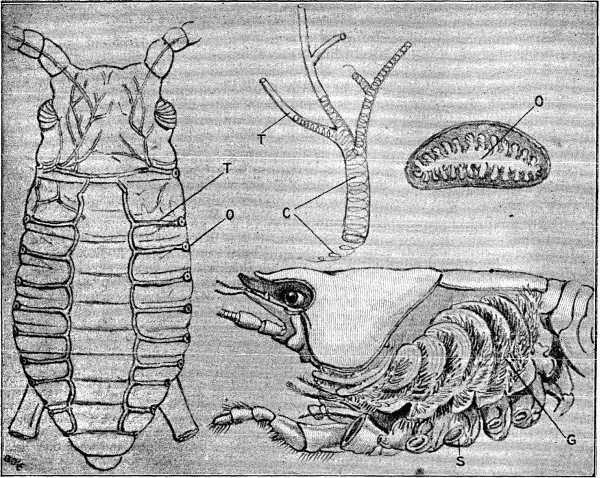 Fig. 1.—Aphis, showing "Tracheæ" (greatly magnified).
Animal life cannot be sustained without breathing, though, strange as it may seem, many of the lower animals have no special breathing organs. By breathing, we mean supplying the body with the life-giving oxygen contained in the air. Animals which live in the water breathe by taking in the oxygen held in solution in the water.
In the simplest animals which live in water, the body is only a small 'blob' of jelly, so small that the oxygen passes directly into the body. The bodies of some worms are so delicate that the oxygen easily passes through the outer layers and mixes with the blood within.
In more complicated animals this life-giving gas is conveyed all over the body by means of the blood, which is brought into contact with the water, or the air, by structures known as gills. In the crayfish, for example, the gills are placed above and rise from the bases of the legs, being saved from injury by a broad shield lying behind the head. (In fig. 4 this shield has been cut away so as to show the gills, marked g, which it really covers.) By means of the circulation of the blood, the crayfish breathes. This blood is carried to the gills and bathed by a constant stream of fresh water, which enters behind the covering and shield, and passes forwards till it comes out on each side of the mouth. The blood, thus refreshed by the oxygen in the water, is carried again all over the body, and in its course loses more and more oxygen, and becomes more and more charged with poisonous gases, which are got rid of on the return of the blood to the gills. The letter s in this figure marks the stump of the leg, which, for the sake of clearness, has been cut off.
In ourselves, the work of breathing, or of purifying the blood, is done by means of the lungs. The lungs are large, spongy organs in the chest, and are continually supplied with fresh air, which passes in through the nose and mouth and down the wind-pipe, by what we call the act of breathing.
Insects take in oxygen in a way quite different from that of the crayfish or mankind. In some larval insects, which live in water, as in some worms, the body is so thin that no special breathing organs are necessary; others breathe by means of gills like those of the crayfish, but arranged differently—some[Pg 238]times along each side, and sometimes at the tail end of the body. But in the ordinary adult insect the work of breathing is carried on by means of a system of tubes, known as 'tracheæ,' which run all over the body. Into these tubes the air is drawn through a number of holes on the surface of the body, called 'spiracles,' or breathing pores. The tracheæ or tubes are everywhere bathed by the blood, which is thus constantly 'aerated,' or kept fresh.
One very remarkable thing about these tubes is the way they are kept open. A horny, spirally-twisted thread runs through them, and thus they are prevented from closing up by pressure, or by the bending of the body or limbs. In fig. 2, this thread is marked c. This plan of keeping open the passage in a tube likely to be blocked by sudden bending, has been imitated by mankind, in making rubber gas tubing, for example. As a plain rubber tube is easily bent, the gas would be in constant danger of being cut off. To prevent this, Nature's patent is usually imitated, and a coil of wire is placed along the inside of the tube. Thus, a sharp bend, such as would instantly obstruct the passage of the gas, is prevented.
The openings at the end of the breathing tubes, on the surface of the insect's body, are known, as we have said, as 'spiracles,' or 'stigmata.' They can be closed at will by special muscles, and, to prevent dust from getting into the tube, the rim of each spiracle has a more or less complicated fringe or strainer. In fig. 3 the spiracle is shown open, the opening being marked by the letter o. When closed the fringes interlock like clasped fingers.
Fig. 1 shows the position of the breathing tubes in the aphis or green fly. The spiracles or pores are marked o, the breathing tubes t.
Some insects which live in water, such as the water-beetle, breathe air in the same way as their relatives who live on land. To do this they have to come frequently to the surface of the water to take in fresh supplies of air. In the great Dyticus water-beetle this is done in a curious way. The creature, rising to the surface, first thrusts its tail up into the air, and then bending it downwards, lets the air rush in to fill the space between the body and the upper wing-cases. This done, the tail is pressed back again, and the beetle returns to the depths, where the imprisoned air is taken in through the pores into the tubes.
Besides the system of tubes just described, many insects possess a wonderful system of air-cells, which give extra help in breathing during flight. These air-cells are largest in insects which fly most. It is a curious fact that birds have an exactly similar system; in many cases, even the bones of birds are filled with air. It is generally stated, indeed, that birds with the strongest flight have the most 'pneumatic' bones. This not quite true, for the swallow, for example, has the long bones of its wing filled with marrow, and not with air. Other birds, however, like the storks, which fly much, and the owls and nightjars, have all the bones in the body thus filled with air which they obtain from the air-cells.
W. P. Pycraft, F.Z.S., A.L.S.
A Story of Adventure on the North Sea and in China.
'I shall not be able to make plum duff,' said Charlie to Ping Wang, about half an hour after his loss of the cook's recipe-book.
'There will be a row if the men discover that you don't know how to make it,' Ping Wang declared, looking serious. 'But never mind that, I have something more important to tell you. Come aft; the skipper may be listening to what we are saying.'
They went right to the stem of the trawler and stood against the gunwale.
'No one can come near us without our seeing him,' Ping Wang said, and continued at once: 'Could you swim a mile in a sea like this?'
'I think so.'
'Then let us desert the Sparrow-hawk when darkness comes on.'
'But where are we to swim to? I don't see any boats within five miles of us.'
Ping Wang pointed to the horizon, where the smoke of about half-a-dozen trawlers was plainly visible.
'That's a fleet of steam trawlers,' he declared, 'and before midnight we shall be among them. When one comes within a mile or so of us, we will jump overboard and swim to her. The skippers and men on the steam trawlers belonging to the large fleets are splendid fellows, and when they hear what a beast Skipper Drummond is, they won't send us back. We must start as soon as possible after the midnight shoot, if there is any trawler near us then.'
'Suppose the skipper thinks we have fallen overboard and sends a boat to rescue us?'
'I don't think that he would take the trouble. But listen! I can hear him on the bridge. Don't let him see us talking, in case he suspects that we are up to something.'
Ping Wang made his way for'ard, while Charlie returned to the galley and busied himself in making buns. He had made some on the previous evening, and although he did not enjoy the one that he tasted, the crew found no fault with them.
As he worked, he could see through the porthole that the fishing fleet was drawing nearer. Some of the trawlers were miles away on the starboard bow, and others on the port.
Three hours later, when it was dark, Charlie counted twenty-five trawlers, and every now and again he could see the mark-ship's rockets piercing the night gloom. At ten o'clock he calculated that the nearest trawler was quite three miles away, and judging from the course the steamers were taking, he began to fear that it would come no nearer. But shortly before the men turned out to haul, Ping Wang popped his head into the galley and beckoned Charlie to come outside.
'As soon as we have hauled and shot,' he said in a whisper, 'we must slip off aft and dive overboard.'[Pg 239]
'We shall have to swim nearly two miles.'
'Oh, no; nothing like that distance,' Ping Wang declared, and pointed to a smack on the starboard side which Charlie had not noticed.
'It's a mission ship,' Ping Wang explained, 'and she will lay to until daybreak. By the time that we have hauled and shot we shall be abreast of her, and won't have more than half a mile to swim. The skipper is fast asleep, and, as the mate is not going to disturb him, we shall have a quiet haul.'
A few minutes later, Charlie and Ping Wang were tugging at the cold, dripping net, delighted at the thought that it was the last time they would have to perform such work.
'It's a splendid haul,' the bo's'un called out to the mate, as the net of fish was swung over the pound.
As he spoke, the fish fell with a splash in the pound, and, the catch being extra large, many of the bigger fish jumped out of the enclosure and wriggled and slid about the deck. Charlie and another man picked them up and tossed them back into the pound.
As soon as the net had been let right out again, Charlie walked aft and found that Ping Wang was already there. The other men had gone for'ard to clean and pack the fish.
'Are you ready?' Charlie asked.
'Quite,' Ping Wang answered, and at once they began to undress.
'I shall not take off my under-clothes,' Charlie said, 'in case the water is very cold.'
'Nor will I,' Ping Wang said.
In a few moments both were ready.
'Chinee!' the mate shouted from the bridge. 'Chinee!' the men in the fish-pound repeated.
'They have missed us,' Charlie said. 'I'm off.' He climbed on the starboard gunwale, balanced himself for a moment and then dived into the sea. Ping Wang was after him in an instant.
Charlie saw the sailing-boat and made towards it.
'Let us keep close together,' he said to Ping Wang, 'in case anything should happen to either of us.'
Ping Wang did not wish to waste his breath in talking, but showed that he agreed with Charlie's suggestion by drawing closer to him. For a time—they did not know for how long—they swam silently onwards, but there was a big ocean swell, and often the ship for which they were bound was completely hidden from their sight for some minutes. When they did catch sight of her, they found that they were not making rapid progress. They were still a long way from the ship, and when they had been swimming for a good time, Ping Wang's courage began to fail him.
'I shall never reach her,' he declared, 'I'm getting tired. It is all up with me.'
'Nonsense, man,' Charlie answered, swimming a little closer to him. 'Have a rest; float.'
Ping Wang acted on Charlie's advice.
'She was much farther from the Sparrow-hawk than we thought,' Ping Wang declared, when he had rested for a few moments.
'You're right,' Charlie answered; 'but we shall reach her in ten minutes at the latest.'
Ping Wang, encouraged by what Charlie had said, turned over and resumed swimming.
For more than ten minutes they swam steadily onward without saying a word, but still the sailing-boat was a long way from them, and Charlie vowed to himself that never again would he attempt to judge distances at sea.
A few minutes later Ping Wang again turned on to his back. He did not utter a word, but Charlie knew by his heavy breathing that he was nearly exhausted. When he had lain there for some minutes he said, with a gasp, 'I will have one more try,' and started off again. But when he had swum a few yards he said, feebly, 'I can't reach her. Don't you bother about me. Look after yourself.'
'I won't go aboard her without you,' Charlie declared, and kept a closer watch on his companion. Soon he saw that Ping Wang, if left to himself, would be drowned.
'Turn on your back and lie still,' he said, 'and I'll tow you.'
Very fortunately Charlie had often practised the art of saving life from drowning, and therefore had no difficulty in supporting Ping Wang, who had the presence of mind to lie still. In a few minutes the Chinaman recovered somewhat, and Charlie, seeing the improvement, said, 'If you can support yourself for a few moments I'll hail the ship.'
'All right,' Ping Wang replied, and Charlie, letting him go, turned over and shouted towards the sailing ship, 'What ho, there!'
For two or three minutes he waited for an answering shout, but none came.
'What ho! what ho!' he sang out, and almost immediately he saw some lights moving about on the deck of the ship.
'Help, help!' he shouted with all his strength.
'Coming,' was the faint reply that reached him, and almost at the same moment he noticed that a boat was being lowered.
'We shall be picked up in a few minutes,' he said to Ping Wang, and the good news had such a reviving effect upon the Chinaman that he turned over and began to swim again.
'Lie still,' Charlie shouted, knowing that his companion's strength would otherwise soon expire.
Ping Wang obeyed instantly.
'Where are you?' the men in the boat called out.
'Here,' Charlie answered, and so that the boat might not have much difficulty in finding them, he hailed her every few moments.
Sometimes he caught sight of her on the top of a wave, and then he would see nothing more of her for quite a minute. But at last she reached them.
'Take my friend first,' Charlie sang out to the man who was holding aloft a big lantern to get a look at them.
In a moment the boat was brought alongside Ping Wang, who was fished out in a state of collapse. Charlie, almost unaided, scrambled in, and at once busied himself in striving to revive his companion. Fortunately he was successful, and by the time the boat reached the ship, Ping Wang was not much the worse for his long and unpleasant swim.
(Continued on page 242.)
[Pg 240]
A Story of Adventure on the North Sea and in China.
The three men who had rescued Charlie and Ping Wang were not talkative, and beyond saying, 'That's all right,' when they were thanked for their assistance, scarcely said a word. The skipper of the sailing ship was, however, very different.
'Get down below, boys, and put on some dry togs,' he exclaimed genially, as Charlie and Ping Wang scrambled over the gunwale. 'There are chests full of them.'
The fugitives obeyed him willingly, but as Charlie put on the dry things provided for him, he took stock of the saloon, and was astonished at what he saw. Pictures of prize-fighters and race-horses hung on the walls, and at the far end of the saloon there was a sort of bar, behind which he noted some black bottles.
'Surely this can't be a mission ship,' Charlie said, in an undertone, to Ping Wang.
'It isn't what I expected to find on one,' Ping Wang answered. 'However, we shall soon know, for here comes the skipper.'
'Well, how are you feeling now?' the skipper inquired boisterously.
'Better,' Charlie answered, wondering what his nationality was, for although he spoke English fluently, he was evidently a foreigner.
'That's good,' the skipper replied, 'but why didn't you tip me the wink that you were coming over to us? I would have had the boat hanging around for you. Do any of the other fellows want to come aboard?'
'No, they have all turned in by now.'
'What a crew they must be. Who is your skipper?'
'Drummond, of the Sparrow-hawk.'
'I know him. He passed a bad five-shilling piece on me the last time he was aboard this craft.'
'Will he come aboard to-morrow do you think?' Ping Wang asked, with difficulty concealing his anxiety.
'Not likely. I told him that if ever he set foot on the Lily, I would go for him. However, we don't want to talk about him. What are you going to drink?'
'Tea or coffee, I don't mind which.'
The skipper threw back his head and laughed heartily, as if Charlie had said something that was witty. 'Do you really mean it?' he asked at length.
'I do.'
'Well!' the skipper gasped, and was evidently overcome with surprise.
After a few minutes' silence his spirits revived.
'I'll send you some tea down before long,' he said, and then went on deck without another word.
'Do you know what this ship is?' Charlie asked as soon as he was gone.
'If this is not a pleasure-boat, I do not know what it is,' Ping Wang answered.
'It's a coper.'
'A coper! What is that?'
'I thought every one in the North Sea knew.'
'This is only my second voyage, and your countrymen do not talk to me as freely as if I were an Englishman. What is a coper?'
'It is a boat that sails about the North Sea to sell drink and tobacco to our fishermen. She flies a flag to show that she has tobacco for sale, and when the men come aboard her, they are tempted to drink, just as we were a few minutes ago. As a rule the poor fellows do drink, and if their money is not all spent by the time that they are intoxicated, they are cheated at cards or robbed. I am very much afraid that we have not bettered ourselves by leaving the Sparrow-hawk, for if the skipper of the coper finds that we have money, even though we neither drink nor gamble, he will be anxious to get rid of us.'
A few minutes later a boy brought down to them two mugs of what was supposed to be tea.
'What awful stuff,' Charlie exclaimed after tasting it. 'One sip is quite enough for me.'
'There must be something besides sugar and milk in it,' Ping Wang declared.
'That is very likely. The skipper hopes that it will get in our heads without our knowing that we have been drinking intoxicants. We will upset the rascal's plans by not drinking any more of the tea.'
In about a quarter of an hour the skipper returned.
'Well, boys, how are you getting on?' he exclaimed. 'Have some more tea?'
'No, thank you,' Charlie replied. 'We haven't drunk this. There's something about the taste that we don't like.'
'It's first-class tea. I've never had any complaints about it until now. I'm very sorry that you don't like it, for you need something warming after your long swim. But look here, if you are tee-totalers, what did you come aboard the Lily for?'
'We made a mistake. We mistook her for another boat.'
The skipper looked at Charlie searchingly. 'Did you think she was a revenue cutter?' he asked.
'Oh, no; we mistook her for a mission ship.'
Now, coper skippers have the same hatred for mission ships that they have for revenue cutters, for the former, by selling tobacco at low prices, keep the North Sea fishermen away from the copers, and so have spoiled their traffic in intoxicant drinks.
'You thought she was a mission ship, did you?' the skipper growled. 'Well, you made a fine mistake.'
'We know that now,' Charlie replied.
'Then why are you sticking here? Jump overboard, and swim back to the Sparrow-hawk.'
'I should be drowned,' Ping Wang declared.
'Well, that wouldn't be much of a loss. There are too many Chinamen already.'
'Look here, skipper,' Charlie interrupted, anxious to prevent a quarrel, 'I have a proposal to make. My friend and I left the Sparrow-hawk because the skipper was a wretched little bully. I suggest that we stay here, as passengers, until we meet a boat for Grimsby that will take us aboard.'
'You will have to pay me before you leave the Lily.'[Pg 243]
'I'll do so, willingly, unless your charges are unreasonable.'
'Will you pay in advance?'
'Certainly not; but I'll settle up with you every evening.'
'Then hand over sixpence for those two cups of tea.'
'Sixpence!' Charlie answered, 'Why, you are charging as if you had put brandy in them. I'll give you threepence.'
Charlie took his belt from his pocket, and, as he undid the pouch attached to it, in which he kept his money, the skipper caught sight of three or four sovereigns.
'Well,' he said, as he pocketed the three pennies which Charlie gave him, 'I ought to let Skipper Drummond know that you are aboard; but, as I owe him a grudge, I won't. I haven't any spare bunks for you, so you must sleep on the cushions here.'
Charlie and Ping Wang were far from considering that a hardship, for the coper's saloon was a little palace compared with the Sparrow-hawk's foc's'le.
'Well,' the skipper continued, 'I'm going to shut up for the night.'
He drew a sliding-door down over the bottles, and locked it, and left them. As soon as he had gone they lay down and, finding the saloon cushions fairly comfortable, were soon asleep. They awoke about seven o'clock and, going on deck immediately, found that during the night the Sparrow-hawk had steamed away. The coper was, however, in the midst of a busy scene; for the stream-trawlers belonging to the fleet which Charlie and Ping Wang had seen on the previous day had closed in, and were busy sending their boxes of fish aboard the steam-carrier that was waiting to hurry off with them to Grimsby. The fish was conveyed from the trawlers to the carriers in small, but strongly built, rowing-boats, and some of these, after getting rid of their load, came to the Lily. As the men sprang over the gunwale on to the deck, the skipper greeted each with a hearty 'What cheer, sonny?'
Many of the fishermen were easily prevailed upon to go below and drink. Some indulged in one glass, and then hurried off to their ships; but two men remained in the saloon long after the others had departed. When they had been there for half an hour their skipper blew his siren loudly, as a command for them to return at once. Each came on deck quickly; but they were intoxicated to an extent that surprised Charlie, considering the short time they had been on the Lily.
'They will never get back to their ship,' Charlie declared to the skipper of the coper.
'That is their look-out, not mine,' the skipper answered, and turned away, evidently not caring what happened to them.
The Lily, in common with all the North Sea trawlers, had no ladder by which men quitting the ship could descend into the small boat. The departing man has to hang from the gunwale until the small boat is lifted high on a wave, and then he drops quickly into it. A moment's hesitation may result in his falling into the sea, sometimes with the risk of being crushed between the ship and the small boat. Charlie had good reason, therefore, for thinking that the two poor fellows might meet with an accident, but the men themselves did not consider that there was any danger.
'We shall be all right,' one of them answered noisily, when Charlie advised them to be careful, and the man who spoke certainly dropped into the small boat as easily as if he were sober. The other man, however, hung to the gunwale longer than he should have done, and, consequently, when he did release his hold he had a long way to drop. He landed with both feet on one of the seats, and after struggling for a moment to balance himself, fell backwards into the sea, but, fortunately, not between the boat and the ship. His mate broke into a laugh, but made no attempt to rescue him. Possibly he thought that the man could swim, but it was clear to Charlie that he could not, and that unless he went to his assistance he would be drowned. So he pulled off his coat and dived into the sea. He came to the surface just beside the man, and, seizing him, pushed him along until they reached the boat, into which the now sober fisherman quickly scrambled. In the meanwhile the other man, seeing Charlie dive to the assistance of his shipmate, had come to the conclusion that he also ought to do something. He dived in, but in consequence of the muddled state of his head, swam in the wrong direction, and by the time that it dawned on him that he had made a mistake his mate had been rescued by Charlie.
Being a good swimmer, the man regained the boat easily, and Charlie was glad to see that the water had sobered him as effectually as it had his mate.
'You've had a very narrow escape,' Charlie said to the man whom he had rescued. 'Now take my advice, both of you, and don't you ever again set foot on a coper. If you want tobacco, go to a mission ship.'
Charlie got on the seat as he finished speaking, and as the little boat was lifted on a big wave he sprang upwards, grasped the Lily's gunwale and climbed aboard, leaving the men to whom he had denounced copers to wonder why he was on one. Loud blasts from their trawler's siren instantly drove all thoughts of Charlie's action from their minds, and rowing hard they worked their way back to their ship, where they received a lecture from the skipper which they did not forget that voyage.
Many years ago there was a clever and kind doctor at a Paris hospital where the patients were of the poorest class. The skill of this doctor somehow reached the ears of the then Premier of France, who, being about to undergo a very serious operation, sent for this doctor to perform it.
'You must not expect, doctor,' said the Prime Minister to the surgeon as he entered the room to arrange for the operation, 'to treat me in the same rough manner as if I were one of your poor wretches at the hospital.'
'Sir,' answered the doctor with dignity, 'every one of those poor wretches, as you are pleased to call them, is a Prime Minister in my eyes.'
X.
[Pg 244]
wo little dogs, one summer's day,
C. D. B.
[Pg 245]
In the days of Queen Bess the pretty village of Stoke Newington was a pleasant object for a country walk of about three miles from the City boundary of London. The village lay amid dense woods whence came its name—Stoe being the Saxon word for wood, and Stoke Newington meaning the new town in the wood. Its derivation shows what an old place it is, and we may picture to ourselves how, ages ago, the dwellers within the City walls would joyfully leave London, on holidays, by the Moor Gate, and wend their way northward to the shady trees and grassy banks of the roadway known[Pg 246] as the 'Green Lanes'—names which, like Stoke Newington, still survive. Along that road the royal chariot of Queen Elizabeth might occasionally be met coming from the Tower; for at Stoke Newington, in a mansion beside the church, dwelt some of the Dudley family, whom she delighted to honour.
A story is told how, when her Majesty was the persecuted Princess Elizabeth, living under the stern rule of her sister, Queen Mary, she paid a stolen visit to London to see how Court matters were progressing. The Dudleys befriended her, and went so far as to hide her in a brick tower in the Park, communicating with their home by a secret passage. To judge by what history tells of Queen Mary, these devoted friends ran no slight risk, and Queen Elizabeth, in later years, did her best to repay their kindness. We read that, on one visit after her accession, she took a jewel of great value from her dress and presented it to the daughter of the house, Lady Anne Dudley. One avenue off the Park is still known as Queen Elizabeth's Walk, and tradition says she was fond of pacing up and down there with the master of the house.
The next time we hear much of Stoke Newington Park, it was in the hands of Mr. Jonathan Hoare, one of the founders of the great banking house of that name; and, later still, it was rented from the Ecclesiastical Commissioners by one of the Crawshay family, then known as 'the iron princes' of Wales. His lease set forth that he was to pay the sum of one hundred and nine pounds a year rent, with one good, fat turkey, the latter probably appearing at the annual dinner of his landlords. For this consideration he was allowed to call house and land after his own name, but was forbidden to cut down timber. Mr. Crawshay's tenancy closed romantically with the incident which won the place its present title.
He had two fair daughters, whom no doubt he wished to see married to rich and noble husbands. Great, therefore, was his anger when he found that one of them had given her affections to the curate of the parish, Mr. Clissold by name. Mr. Clissold was forthwith forbidden to set foot within Crawshay Farm again. To ensure this, the walls of the place were made higher, and the hard-hearted parent expressed his firm resolve of shooting any messenger who tried to carry letters secretly. How long this state of affairs lasted does not appear, but it was ended by the death of Mr. Crawshay. Then the curate and his hardly-won bride became tenants of the mansion, and changed its name to Clissold Park or Place.
As Clissold Park it was bought from the Ecclesiastical Commissioners for ninety-six thousand pounds, and formally opened by Lord Rosebery in 1889.
Perhaps the greatest charm of this particular park lies in its evident old age—trees, turf, and the disused mansion all bear witness that it is no newly planted recreation ground, but a noble relic of the days of old, with a stately dignity all its own.
A number of deer enclosed in the middle of the park prove that these pretty creatures are not always shy. A family of kittens could not be less afraid of the admiring crowd which watches them. At the same time the deer were presented to the park, a number of guinea-pigs were also introduced, and they still flourish in their cosy enclosure, giving endless delight to the children of the neighbourhood.
The beauty of the park is greatly increased by the waters of the New River, which wind in and out of the grounds as well as round them, although the charm of the stream is somewhat spoilt by a close iron fencing, walling in the water on both sides. This, however, appears to be a necessity, to protect the numerous fish from the keenness of would-be fishermen.
Bridges cross the river in many places, and two lakes of some size, studded with wooded islets, afford homes for swans, ducks, and other water-fowl. Near the mansion there is a bandstand, and all about the grounds there are seats and rustic shelters for the elders, whilst the young folk and children are making merry with games.
In the spring and autumn a very favourite place for basking in the sun is the terrace before the old house, in part of which refreshments are provided. Some of the views in the park are exceedingly pretty, especially in the direction of the deer park, looking towards the mansion, where the old parish church stands out against the trees, whilst the fine open tower of a new church, with a graceful spire, rises above the green foliage.
Stoke Newington has been the home of various celebrated men: John Howard, the philanthropist, who did so much to alleviate the horrors of prison-life; Defoe, whom we all love for the sake of Robinson Crusoe; Dr. Watts, author of many of our best-known hymns, among the number.
It is pleasant to know that the leafy walk of the Green Lanes is still an attractive one for Londoners, although the mossy banks of former days have long been lined with handsome houses, and though a wide expanse of densely populated town lies between Clissold Park and the street still known as London Wall, whence the Moor Gate, with all its companion portals, have long vanished.
A gentleman was once entertaining his friends at a grand dinner. He was a sad boaster, and was often guilty of describing deeds that he had done when an officer in the army, which those who knew him well felt sure were greatly exaggerated. He was in the midst of some such anecdote when the butler brought him word that a man wished to see him.
'Tell him I am engaged with my friends, and can see no one,' said the gentleman, pompously.
The butler retired, but soon came back to say the man was most urgent in wishing to speak to the gentleman, and said he had been in his regiment at a famous battle, where he owed his life to the officer.
'Show him in! show him in!' said the host, much gratified. 'This good fellow says I saved his life[Pg 247] at X——,' he added, turning to his guests as the old soldier came in. 'How was it?' he went on, 'for I am sure I forget; in the heat of battle one does brave things almost unconsciously.'
'It was like this, your Honour,' said the soldier: 'I owed my life to you, for I certainly should never have thought of running away if you had not set me the example!'
t is comparatively easy now to run over to Switzerland, and through the lovely scenery of the St. Gothard Pass, to the plains of sunny Italy; but this land of light and song is very little known to English boys and girls.
Of all the lovely lakes that reflect the deep blue of the summer skies, none is more beautiful than Lake Lugano, although Como is larger and Maggiore has a charm of its own. The town of Lugano stands at one end of the lake. It is pretty and bright, with many things to interest and amuse; but it is in the villages dotted along the south side of the lake that the real life of the people is to be seen.
These villages are surrounded by vineyards. The grapes are gathered in October, when the whole scene is very animated and gay. Every one—men, women, children, even the ox-waggons of the country—is pressed into the service, and the vineyards resound with songs and laughter. From these grapes a red wine is made. It is the ambition of every peasant to own a small vineyard and a boat.
On the other side of the lake rises a range of hills covered almost to the water's edge with deep green woods. In some places cliffs rise between wood and water, and in these cliffs are many small natural caves. These have been enlarged and enclosed with doors, so as to form wine vaults, and in them is stored much of the wine made in the district.
On Sunday afternoons in summer the lake is alive with boats, each holding a happy family party of father, mother, and children, and laden with cakes made from polenta, and other dainties. They are all bound for the caves, where a series of merry picnic parties is soon in progress.
The provisions are taken from the boats, the wine vault is opened with a key, for all are kept carefully locked, and then the feast begins. Soon the air is filled with song and laughter. The whole afternoon is spent in this way, and only in the cool of the evening do the merry revellers return to their simple homes across the lake.
The boats look very pretty. They are rather wide and shallow, and in the middle a white canvas covering is stretched from side to side, supported on bent canes, to make a shelter from the heat of the sun. The boatman in the dress of the country stands at the end, and drives the boat through the water with rapid strokes from his single oar.
The streets are narrow and crooked, and the houses are built very irregularly. There is no pavement, and the dust is amazing. The brown-faced, bare-legged children, with large solemn-looking brown eyes, tumble about in it, munching ripe red tomatoes with their hunches of brown bread. In the grass by the road-side funny little green lizards run in and out, hurrying away at your approach as fast as their legs will carry them.
It is very strange to see even the smallest cottages fitted with electric light, but this is the case in one village, Marroggia. A clever German has set up some works close by, and drives the machinery by power derived from a beautiful waterfall near the village.
From Marroggia a young Italian went to London some years ago to seek his fortune. He succeeded so well that he soon became rich. Returning to his native village, he built there a beautiful villa, with gardens and lawns sloping down to the lake. When it was finished he gave a feast to all the villagers. Thousands of fairy lamps and Chinese lanterns were sent for from London to illuminate the gardens, and turn them for the occasion into fairyland. The peasants had never before seen anything like it. They danced, they sang, and ate the good things provided for them. They would willingly have lingered there all night, and it was only when the last lamp flickered and went out that they returned home to dream of what they had enjoyed.
At one end of the lake stands Monte Generoso. The top is reached by a mountain railway, which zig-zags its way up through the woods. It feels very strange as the engine goes up panting and puffing, turning a sharp corner at every few yards; but the view from the summit is very fine, and the journey down still more exciting than the ascent.
At the other end of the lake is a famous china and earthenware manufactory. You can reach it by steamboat, but it is much better fun to go in a small boat, where you can lie under the awning and watch the boatman, in his white shirt-sleeves and coloured velvet waistcoat, steering his boat like the gondoliers of Venice.
The china manufactory is old-fashioned, but very interesting. The potter's wheel is still used there, and it is wonderful to see the ease and quickness with which a lump of clay is made into a cup, a saucer, a vase, or any other article you may ask for. After it is taken off the wheel, it is dipped into liquid glaze, then ornamented with some design transferred from coloured paper, and finally fired in the furnace.
Most people who visit the Italian lakes go on to Milan, a very important, busy town. On the way you pass through large tracts of country covered with maize and rice fields. The maize grows to an enormous height, and the rice is watered artificially by tiny streams, which may be seen trickling through the fields in all directions.
Elaine Carruthers.
[Pg 248]
owards the close of the war between France and Germany, in 1870, the German troops lay so closely round the walls and fortifications of Paris that all communication with the outside world was cut off. No letters could be sent to friends, and no letters from friends could be received, for, once outside the walls of the town, they would surely fall into the hands of the enemy. But the post office was anxious to continue doing its duty, and the Government felt bound to find some means for sending out and receiving official dispatches. The only way to accomplish this was by the use of balloons. Paris had always been very busy with balloons, but, when inquiries were made, it was found that there were not more than six in all the city, and these were far too old and worn out to use. Balloons must, therefore, be made, said the authorities, and two gentlemen, named Godard and Yon, were requested to begin the work at once. As railway stations were not wanted for trains in Paris at that particular time, the two largest were chosen in which to build balloons. Henceforth their 'trains' would journey silently through the sky instead of noisily over the iron roads.
Needles and cotton and calico were all carried in large quantities to the Gare du Nord and the Gare d'Orléans (as the two stations are called), and in less than four months sixty balloons were built and dispatched.
Some people in Paris, however, were so anxious to try the experiment that they could not wait for the new balloons, but used an old one, called the 'Neptune,' and M. Durnof, a daring aeronaut, made a flying dash in it out of Paris. Those who witnessed his adventure say that the old Neptune bounded almost straight up into the air, and fell beyond the enemy's camp in much the same manner. It was as though a large cannon ball had been fired (only very slowly) from the streets of Paris.
The successful path of the Neptune was soon followed. M. Gambetta, the great statesman, stepped into the car of the 'Armand Barbès' on the morning of October 7th, and, after many narrow escapes from the enemy's guns, landed safely among friends. Three days later a pretty grey-feathered pigeon settled in Paris, bringing in one of its quills the story of his journey.
But among the many wonderful ascents made in that terrible time, none is more interesting than that of M. Janssen, a great astronomer, who went to Algeria to see an eclipse of the sun. Certain learned societies in France, very anxious that the progress of science should not be delayed by this unhappy war, were delighted to find him willing to undertake the dangerous journey. England offered to obtain a safe-conduct for him through the Prussian camp, but the astronomer said: 'No, thank you. I do not wish to be under any obligation to the enemy.'
So, packing his telescope and other instruments with very great care, he carried them to the Gare d'Orléans on the morning of the 2nd December (three weeks before the eclipse would take place), and, settling himself in the car of his white balloon, the 'Volta,' gave orders for the anchor to be weighed. At that time in the morning it was quite dark, and, ere daylight was an hour old, he and his companion (a young sailor) had come to earth again by the mouth of the Loire. They had travelled nearly three hundred miles in a little more than three hours. A swifter journey has hardly ever been made. It is disappointing to learn that, after such a daring exploit, M. Janssen reached his destination only to find dense clouds covering the Algerian sky at the moment the eclipse took place.
The frequency with which balloons left Paris soon made it necessary to increase the number of aeronauts, for those who departed were, of course, unable to return. As the professional men became fewer, it was found that the best to take their places were sailors. But, that they might first have lessons in the art, a car was suspended from the roof of the factory, and into this the sailor-pupil climbed. He soon learned how to cry out, 'Let go all!' Then, after throwing out the ballast, pulling the valve-rope, and dropping the anchor, he was ready, with more courage than discretion, to call himself an aeronaut. And into the air he went, with bags of letters and cages of pigeons, and, on the whole, succeeded very well as a postman in the clouds.
The mention of pigeons leads us to another story of ingenuity, though it has not much to do with balloons.
After the question of how to dispatch letters had been solved, the next that arose was, how to receive replies. The balloons that left the city had got nearly all Europe to settle in, but it was hopeless to try to steer them back to so small a spot as the city itself. But a carrier pigeon would have no such difficulty in returning. Means must be found, however, to make it possible for each bird to carry many letters. M. Dagron, a clever photographer, discovered this means. He showed how he could photograph a letter and reduce it in size till the writing became unreadable, even under an ordinary magnifying glass. This could be done on films so thin that a roll of twenty of them could be inserted in one quill, each film representing a large number of letters. Having proved to the authorities the success of his invention, M. Dagron departed in a balloon, to explain to the various towns in France how letters must be sent to Paris.
Every day after that the welcome sounds of flapping wings was heard in the beleaguered city. The letters that they brought were placed between two sheets of glass and enlarged. Then, by means of a magic lantern, they were reflected on to a large screen, while post-office clerks, sitting at a table opposite, copied them down on to separate[Pg 251] sheets, and dispatched them to their different addresses in the city. Nearly one hundred thousand letters were sent to Paris in this way during the four months of the siege, and the hostile army outside its walls was powerless to intercept them.
John Lea.
illie laid his pencil down,A father of a family wished to settle his property between his three sons. He therefore made three equal parts of his chief possessions and gave one part to each son. There remained over a diamond ring of great value, which he reserved for the son who should perform the noblest and most generous action within the space of three months. The sons separated, and at the appointed time presented themselves before him.
The eldest son said, 'Father, during my absence I had in my power all the riches and fortune of a person who entrusted them to me without any security of any kind; he asked me for them, and I returned them to him with the greatest honesty.'
'You have done, my son,' replied the father, 'only what was your duty, and I should die of shame if you were capable of doing otherwise, for honesty is a duty; what you did was just, but not generous.'
It was now the second son's turn, and he spoke thus: 'I was on the banks of a lake, when, seeing a child fall in, I threw myself in, and with great danger to myself drew him out. I did it in the presence of some countrymen, who will testify to the truth of it.'
'Well and good,' replied the father, 'but there is only humanity in that action.'
At last came the turn of the third son, who spoke thus: 'I found my mortal enemy, who had strayed during the night, and was sleeping on the edge of a precipice in such a manner that the least false movement on waking would have thrown him over. His life was in my hands; I was careful to wake him with precaution, and drew him out of danger.'
'Ah, my son!' exclaimed the father, overjoyed, embracing him, 'without doubt you deserve the ring.'
'The stork in the heavens knoweth her appointed times,' says the Bible, and the turtle-dove, the crane, and the swallow to this day 'observe the time of their coming.' What a wonderful law is theirs! They need not learn it, for it is born in them. Migratory birds know not only the need for their journeys, but the fixed times for them. It has been thought that the rules of their airy road have been handed down from generation to generation, but this is not always true. Nothing is positively known, except that the travellers are in search of food or quiet nesting-places, when they move from land to land.
As the time draws near for birds of passage to travel, they seem to know it by an inward restlessness; they long to be away—they know that delay is dangerous, and, so strong is the longing to be gone, that migratory birds kept back by accident or wilful cruelty, often die of the desire to go. The young cuckoo never survives an attempt to detain him. A poor, wild goose, with a lame wing, was seen bravely setting out on foot to do his journey of hundreds of miles over sea and land, when he saw his brethren depart for another clime.
One of nature's grandest sights is the yearly flight southwards of wild swans from Norway to the great lakes in Turkey. The birds fly at the rate of about one hundred miles an hour, in vast flocks, shaped like the letter V, the sharp end foremost, as an arrow passes through the air. At the point flies the leader or captain, the strongest and wisest of the band, and ahead of the main army he sends a skirmishing swan to keep a sharp look-out. This swan's business it is to see if the coast is clear. From time to time he comes rushing back with some warning note. Then there is a great cackling, a pause, and a council. After holding this noisy parliament, the army resumes its course, or changes it, according to the news brought. When the swans reach the lake, they do not swoop down till the captain has made a careful search around, poking among the reeds, flapping over the surface, and even taking a sip of the water, to make sure that nothing has happened to make the lake dangerous for swans since the last time he was there. All being well, he signals to the band, who descend with a rush, and soon cover the water with their graceful forms.
Do pigeons carry watches? How do London pigeons, for instance, tell the hour, and turn up punctually at the feeding-places? At Guildhall Yard the birds come early in the morning to eat the[Pg 252] breakfast provided for them, but they do not stay all day. At Finsbury Circus, Draper's Hall Gardens, and other places in London, there are flocks which are carefully fed at regular hours, and those who have the care of them agree that at feeding-time the flocks are always joined by large numbers of guests from without. Perhaps the pigeons ask each other out to dine, mentioning the hours for the meals!
The rough idea of time which all living things possess is keenest in domestic animals. The dogs, cats, horses, donkeys, and others, who know certain days in the week and hours in the day without clock or almanac, may be guided by noticing little events which we do not, but which show them the time; or they may even feel the position of the sun, though it cannot be seen. However this may be, they show a sense which we must admire and may envy. Horses are great observers of time, as many anecdotes show, perhaps none better than this one: A horse belonging to a news-man knew the houses at which his master's journals were delivered, and, when he took them round in the trap, always stopped at the right doors. But this was not all. There were two people—living one at Thorpe, the other at Chertsey—who paid for a weekly paper between them, taking it in turns to read it first. The horse found this out, and would stop one week at Thorpe and the next at Chertsey, alternately.
The mule is not behindhand. A Spanish milk-seller was taken ill, and, being unable to go the rounds or to spare his wife, they agreed to send the mule, who always carried it, alone. A paper was written, asking the customers to measure their own milk, and place the money in a little can for the purpose; this was fastened to the animal's neck, and off he went. At every house where his master was in the habit of selling milk he stopped and waited; but he did not wait an unreasonable time. If nobody came, he tried to push the door open, or pulled the string of the bell, which, in Madrid, is usually rung by a cord hanging down. The simple peasants laughed, and fell into the joke; they scorned to cheat the dumb milkman, and the clever mule took his money home in triumph.
It is not the higher animals alone who are time-keepers. Menault tells of a friendly toad, living in a garden, who would appear at the family dinner-time, and sit upon the stone ledge outside the window to get a share. The hour was changed, for some reason, from noon to three in the afternoon, and, for the first time, the uninvited guest was absent—once, but once only. On the second day after the change he was squatting at the new hour ready for his saucer of milk.
Edith Carrington.
[Pg 253]
A Story of Adventure on the North Sea and in China.
Three days passed, and Charlie and Ping Wang were still on board the coper, no boat bound for Grimsby having been met. During that time Charlie and his friend had seen many things which filled them with loathing for the boat on which circumstances had placed them.
On the third evening, when the coper's boat returned from a trip around the trawlers, Charlie and Ping Wang were surprised to see that the passengers were two men who had been sent away early on the previous evening, because their money was spent.[Pg 254]
'How can they have got money since last night?' Charlie said to Ping Wang.
'They've borrowed from their mates,' Ping Wang suggested, but they soon discovered that his explanation was not the right one. As the boat bobbed up and down by the side of the Lily, the men took from the bottom of it a fishing-net, and handed it up to the skipper, who was leaning over the gunwale.
'They have stolen that net,' Charlie remarked, guessing the truth, 'and the skipper is going to buy it from them.'
'It's a new one, skipper,' one of the thieves exclaimed, as he jumped on board.
'All right,' the receiver of stolen property answered, 'Go down below and enjoy yourselves.'
The two men descended at once into the saloon, while the skipper, after examining the net, dragged it aft, and removing a hatchway dropped the net into the hold. As he did so Charlie stepped forward, and looking down, saw, by the light of the wire-guarded lamp, that the hold was half full of nets, oars, buckets, ropes, cooking utensils, brass fittings, mops, oilies, and other things too numerous to mention.
'All that is stolen property, I suppose?' Charlie said to the skipper.
'Well, it wasn't stolen from you,' the skipper answered, 'so you have no cause to grumble.'
He closed the hatchway, and then turned to Charlie to abuse him more freely, but just as he began a seaman came up and told him that a mission ship had joined the fleet of trawlers.
Forgetting all about Charlie, the skipper hurried away to look at the new craft, and found that the news was true. Very bad news he considered it, for he knew that the North Sea fishermen never came aboard a coper if there was a mission ship with the fleet. Tobacco is sold cheaper on a mission ship than on a coper, and naturally the fishermen, who have very little money to spend, buy in the cheapest market. Moreover, every man aboard a mission ship is a friend of the fishermen, and there is not a trawler in the North Sea on which it is not possible to find two or three men who have good reasons for blessing mission ships. Hundreds of men have been carried aboard these floating hospitals and nursed back to health.
When the mission ship was about half a mile from the Lily, Charlie said to the coper skipper: 'Now is your chance to get rid of Ping Wang and me. Hail that boat and send us aboard her.'
'Hail a craft like that?' the skipper answered roughly. 'I'd sink her with pleasure if I had the chance; but as for hailing her——I'd rather die!'
'I'll give you a sovereign to take us aboard her.'
'Wouldn't do it for ten sovereigns.'
Charlie went back to Ping Wang and told him of the skipper's decision.
'I'm not surprised,' Ping Wang declared. 'He will sail off as quickly as possible, I fancy.'
That, indeed, was the coper skipper's intention. He wished to start immediately, and would have done so had it not been for the two thieves who were drinking in the saloon.
'Now then,' said the skipper, coming down to the saloon and addressing the thieves, 'if you won't leave, I shall have to sail off with you.'
'Right you are; I don't care,' one of them declared, and the other added that he would thoroughly enjoy a cruise in a coper.
The skipper, however, had no intention of keeping on board two men without money, and was compelled to wait about for their departure. But just as he expected them to go, one man had a heated argument with his companion, which ended in a fight. The skipper, fearing that his saloon might be damaged, tried to stop the fight by seizing hold of the smaller man, who, however, promptly freed himself, and with two quick-following blows with his fist knocked the skipper down. The other man had in the meanwhile jumped across the counter and seized a bottle, which he put in his pocket.
'Come on, Jack,' he shouted to the man whom he had been fighting, and hurried up on deck. Jack, seeing that the skipper was not likely to interfere with him, followed his shipmate quickly on deck, and they made for the coper's boat, but none of the ship's crew were in it.
'Cut the painter, Jack,' the taller man commanded, and Jack, using his knife, soon did so. Then they grasped the oars and rowed away. It was the only boat that the coper possessed, and when the skipper discovered what the two fishermen had done he hurried on deck and shouted abuse at them. The men took no notice, and soon arrived safely at their own ship. Before they climbed aboard, the taller man said, 'Now let us sink the coper's boat. Cut a hole in her.'
The other man was delighted with the idea, and without delay removed the bottom boards and let in the water. That done, he followed his mate aboard the trawler, sending the small boat adrift.
The skipper of the coper had, in the meanwhile, by tacking, made an effort to keep his stolen boat in sight, but the night was dark, and the fear of a collision with a trawler made his endeavour a fruitless one, and he was compelled to lay to until daybreak would give him an opportunity of renewing his search. But, of course, when morning came he could see no signs of his boat, and after several hours' search he sailed away. About six hours later he sighted another fleet. He at once made for it, but finding on approaching nearer that there was a mission ship with it, he sailed off in another direction.
The skipper was now in a very bad temper, and his ill-humour spread to his men, who were mostly foreigners. It was evident to Charlie and Ping Wang, although they did not understand Dutch, that the latter were relieving their feelings by making insulting remarks concerning them.
While the coper's men were speaking about Charlie and Ping Wang, the Chinaman, innocent of any intention to be rude, made some gesture which one of the crew took for an insult. Instantly he rushed at Ping Wang and struck him a heavy blow in the face with his fist. He was about to strike him again, but Charlie pushed him roughly aside and faced him with clenched fists.
The sailor struck viciously at Charlie, who warded off two blows and then landed his opponent a heavy one full in the mouth. This he followed up with a[Pg 255] blow between the eyes, knocking the man down. For a moment the sailor lay still; then, seeing that he was likely to get the worst of the encounter, he quickly ran to the galley, and, seizing a big shovel, prepared to continue to fight with it. But the skipper, hearing a disturbance, hurried aft to see what was taking place. He met the man with the shovel, and, hearing his threat, drew his revolver and pointed it at him.
'Take it back!' he commanded, and the man obeyed reluctantly. 'I don't want murder done aboard my ship,' the skipper added, turning to Charlie and Ping Wang, 'so don't annoy my men.'
'We have done nothing whatever to annoy them,' Charlie declared, 'and the assault upon Ping Wang was quite unprovoked.'
'There must have been some reason for the fellow hitting him,' the skipper declared, and at once questioned his men, who, of course, made known the nature of the insult which they had received from the Chinaman. He explained the matter to Charlie and Ping Wang, and afterwards assured his men that no insult had been intended. The sailor who had assaulted Ping Wang then made an apology, and the whole incident was concluded by his shaking hands with Charlie. But in the middle of the night Charlie had an experience that was far more unpleasant than his brief fight. He was sleeping, as usual, on the cushioned seat in the saloon when he woke suddenly, feeling some one tampering with the belt which he wore, and which contained the whole of his money.
'You scoundrel!' he shouted, as he gripped the thief's hand. The next moment Charlie uttered a cry of pain, for the thief, who was under the table, drew a knife across his hand. Charlie released his hold of the thief instantly, and then jumped up in the hope of catching the man before he could escape. But the thief was too quick for him. The room was in darkness, and, before Charlie could make his way out of his cramped quarters at the side of the table, the thief had climbed up the ladder and closed the iron door behind him.
Ping Wang was now awake, and, finding the place in semi-darkness, struck a light.
'Turn up the lamp,' Charlie said, and, when the Chinaman had done as he desired, he told him what had happened.
'How much has he taken?' Ping Wang inquired.
'Half a sovereign,' Charlie replied, after counting his money. 'Evidently the scoundrel had only tried one of the little pockets when I woke. It is a good thing that I distributed my money all round my belt.'
'It is, indeed,' Ping Wang answered. 'Now let me bind up your hand.'
The cut was not very severe, the thief apparently having had no desire to inflict a deep wound.
'Let us go and complain to the skipper at once,' Ping Wang suggested, and, after putting on a few clothes, they went on deck, where, somewhat to their surprise, they found the skipper at the wheel.
'Hallo!' he sung out. 'What's up? Going to try another midnight swim?'
In as few words as possible Charlie told him what had happened.
'You've been dreaming,' the skipper declared, with a laugh. 'I've been at the wheel for the last three-quarters of an hour, and you are the first person I have seen come out of the saloon. No one could come out without me seeing him. Get down below again, and don't lie on your back; you are sure to dream if you do.'
'Dreams do not cut a man's fingers,' Charlie observed, sharply.
'Well, I'll make inquiries, but it is not likely that the man who did rob you—if you were robbed—will confess. Now get below, or you'll catch cold.'
Charlie and Ping Wang returned to the saloon, very dissatisfied with this conversation.
'I believe,' Ping Wang said, 'that it was the skipper himself who robbed you.'
'So do I,' Charlie replied; 'but how can I prove it? And if I could prove it, what good would it be while we are on his ship? All we can do is to take extra precautions against being robbed.'
After talking for about half an hour, they fell asleep, and were not again disturbed.
When they went on deck, shortly after breakfast, the skipper summoned all hands on deck, and questioned each man as to whether he had been into the saloon during the night. Each one denied having done so, and Charlie believed them.
'It is my opinion,' the skipper said to Charlie an hour or two later, 'that it was that Chinaman who robbed you.'
'If you knew Ping Wang as well as I do, such a foolish idea would never have entered your head.'
'All Chinamen are very crafty. You had better let me make him sleep in the foc's'le.'
'So that it would be easier for me to be robbed.'
'What do you mean? Do you accuse me of robbing you?'
'I do not accuse any one unless I can prove my charges. At any rate, I shouldn't be doing you an injustice if I did call you a thief, knowing, as I do, what a collection of stolen property you have in the hold. A receiver of stolen goods is not an atom better than a thief.'
With this parting shot Charlie walked away.
A celebrated physician once attended the child of a wealthy French lady, who was so grateful for the recovery of her boy that she determined to give a larger fee than usual for his attendance. As he was taking leave on his final visit, the grateful mother handed to the doctor a handsome pocket-book, which she said she had worked with her own hands. The doctor bowed stiffly, and said, 'Madam, the pocket-book is quite a work of art, and I admire it exceedingly, but my fee is two thousand francs.'
'Not more?' she replied; and taking the pocket-book back, she removed from it five one-thousand franc-notes, and handed two of them to the doctor, bowing stiffly in her turn, and, replacing the other three notes in the rejected pocket-book, she retired.[Pg 256]
A Story of Adventure on the North Sea and in China.
From the coper skipper's point of view the two following days were very unsatisfactory. Not an ounce of tobacco nor a drop of drink was sold, in spite of the fact that several fishing-boats were met. Growing reckless, the skipper determined to approach the English coast, so as to meet the boats coming out of the Humber.
'Now you will soon be able to transfer us to a Grimsby-bound boat,' Charlie said to the skipper, when they were about two miles from land.
'I have come here to look after outward-bound boats,' the skipper answered, sharply, 'and I can't bother about you. I have quite enough to think about.'
A few minutes later, Charlie understood what the skipper meant. He was in British waters, and to sell tobacco or drink there would render him liable to be seized by a cruiser or revenue cutter. Every sailing ship that came out of the Humber the captain watched closely through his marine glasses, and not until he had satisfied himself that she was harmless did he approach her.
The skipper was well pleased with his work at the end of the day, and when darkness came on he sailed out of British waters, with the intention of returning at daybreak. Charlie and Ping Wang, however, considered that the day had been a most unsatisfactory one.
'I can't stand another day of this,' Charlie said to Ping Wang, when the two were alone. 'I mean to get ashore to-morrow somehow or other. Shall we jump overboard, and swim to the nearest ship making for the Humber?'
'I have lost confidence in my swimming powers,' Ping Wang answered.
'But there will be no necessity for us to have such a long swim as our last one. Besides, there will be plenty of boats about, and some of them are sure to come to our help.'
'When do you mean to start?'
'As soon as we are again in British waters. That will be to-morrow morning. To-morrow night we shall be in Grimsby, or perhaps at my home. You agree, don't you?'
'Oh, yes. But now let us get to sleep. We ought to start as fresh as possible.'
They lay down almost immediately, and slept soundly until about six o'clock. Then they were awakened rather suddenly by hearing a gun fired.
'What's the meaning of that?' Charlie asked, as he sat up and listened.
Ping Wang shook his head, and in a few minutes was again asleep. Charlie, a little later, lay down and slept; but in about a quarter of an hour they were again awakened, this time by men descending into the saloon. Looking up over the saloon table, they saw two bluejackets, with cutlasses in their hands, at the foot of the ladder. An officer ran down the ladder and joined them.
As soon as Charlie and Ping Wang saw the sailors, they guessed that the coper had been captured in British waters, and in their delight they jumped off the seat on which they had been sleeping and stood up on the cushions. In a moment the officer covered Charlie with his revolver.
'All right,' Charlie exclaimed, 'we are not Dutchmen.'
'I didn't suspect your mate of being one,' the officer replied, smiling, but still covering Charlie. 'Come over here and surrender.'
'With pleasure,' Charlie said. 'We are jolly glad you have boarded this wretched coper.'
'The skipper denies that she is a coper. Possibly you can save us the trouble of hunting for his liquor and tobacco?'
'That is where it is kept,' Charlie declared, pointing to the cupboard. 'The skipper has the key.'
'Throw down the skipper's keys,' Lieutenant Williams sang out to his men on deck.
For two or three minutes the revenue officer sat on the saloon table, dangling his legs and whistling cheerfully.
'The skipper says he hasn't any keys, sir,' a sailor called down. 'We have searched him, and can't find any, sir.'
'Very well, then,' the officer said; 'we must do without them. Force open that cupboard.'
One of the two sailors pulled out his knife and forced the lock with little difficulty; then he slid back the shutter and displayed the coper's stock of spirits, wines, tobacco, and cigars.
'A very nice collection indeed,' the revenue officer declared. 'I am very much obliged to you for your assistance,' he continued, addressing Charlie; 'but I must ask you to explain why you are on board this boat. You are my prisoner, although you do not appear to be in league with the skipper.'
Charlie related all that had happened to him. The story of his and Ping Wang's adventures amused the revenue officer highly.
'Well,' he said, at the end of the story, 'I'm very glad to have met both of you. After I have had a peep in the hold, I will take you aboard my cutter.'
The hold, with its stock of nets and other stolen property, added to the revenue officer's satisfaction at the capture he had made. Leaving five men on the coper, to man it—three on deck and two in the saloon—he returned to his cutter, taking Charlie and Ping Wang with him. As soon as they were aboard, the cutter started, escorting the coper into Grimsby.
'How did you manage to catch the coper?' Charlie asked the lieutenant, as they were watching the land coming nearer and nearer.
'I discovered her yesterday, but could not get close to her while she was in British waters. I saw that the chances of catching her were against me, so did not make the attempt. At night I went out to sea with covered lights, and kept my eye on her. Just before daybreak she went back into British waters, and I followed her. When there was light enough for her to see me, she fancied, as I intended she should, that I was a fishing-boat returning to Grimsby. While she had two trawlers' boats alongside I made for her. Then she guessed who I was,[Pg 259] and tried to escape, but when I sent a shot across her bows she lay to, and the skipper demanded to know what I meant. I soon told him.'
'I fancy,' Charlie said, 'that the coper skipper is an old hand at the game.'
'I am certain of it,' the revenue officer replied, 'and that makes me all the more pleased. Now, I must be off.'
With that he went on deck, and Charlie and Ping Wang followed him. They were now in the Humber, creating some excitement among the vessels in the river. All hands mustered on every ship to see the coper, and frequently, when the nature of the boat was known, loud cheers were given for the captor.
The news of the capture had reached Grimsby before the two boats arrived, and, consequently, there was a large crowd waiting to see the prisoners brought in. Among the people was the former cook of the Sparrow-hawk, whose astonishment at beholding Charlie and Ping Wang on a revenue cutter highly amused his two acquaintances. Charlie nodded to him, but there was no opportunity to settle up with him just then, as the prisoners were immediately marched off to the magistrate.
To the revenue officials' surprise, the coper skipper pleaded guilty to selling spirits and tobacco in British waters. He did so because, seeing Charlie and Ping Wang in court, he knew that they would give evidence against him. On his pleading guilty, the stock-in-trade, together with the stolen property which he had purchased, was confiscated. As Charlie and Ping Wang came out of the court they found the bow-legged cook waiting for them, anxious to get the balance of money due to him from Charlie, and also to hear how he had fared on the Sparrow-hawk. They went to the Fisherman's Home, and there the cook was paid.
Charlie then related, in as few words as possible, all that had happened to him from the time he went aboard the Sparrow-hawk, and concluded by asking the bow-legged cook not to mention to Skipper Drummond, if he met him during the next few days, that he had seen him and Ping Wang.
Charlie and Ping Wang shook hands with the cook and left him.
'Now,' Charlie said, 'we must go to a cheap tailor's. I think that I have enough money to buy a ready-made suit for each of us.'
'Perhaps the tailor will give us something for the coper's things,' Ping Wang remarked. 'You paid enough for them.'
'I did, and if I tell a tailor, or any one else, what I gave for them, I shall be thought a madman.'
Half-a-crown was the value which the Grimsby tailor placed upon the clothes which Charlie and Ping Wang were wearing. The new clothes which they purchased were rather loud in pattern, and by no means a good fit, but they were cheap, and a great improvement on the things which they had taken off.
After surveying themselves in the glass—and immediately wishing that they had not done so—they quitted the shop and made their way to the railway station, to start for Charlie's home.
 h, how I wish,' cried Jack, one day,
'It looks just as if we were going to have a thunder-shower,' Mrs. Marston said. 'I wish, George, you would find Rose and Elsie, and tell them to come home.'
'But I don't know where to look for them,' George said.
'They are certain to be somewhere in the fields. And take an umbrella with you. Elsie has such a bad cold, I shall be vexed if she gets wet.'
'Oh, Mother, I don't believe it will rain, and I do want to finish painting this rabbit-hutch! It is such a nuisance to leave things half done.'
'My boy, it is not right to argue with your mother when she asks you to do something for her.'
'Bother those kids,' George muttered crossly, as he went off, grumbling, to hunt for an umbrella.
It was a hot, thundery day, and he was feeling still more cross after searching through three fields and finding no trace of the children.
'The clouds are clearing away, and blue sky is showing everywhere,' he said to himself. 'It is perfectly idiotic to go on with this wild-goose chase.'
Then he climbed a stile for a look into the next field, and what he saw almost made his heart stand still.
Rose and Elsie were sitting on the grass, busily arranging some flowers they had been gathering to make a nice bunch for their mother.
Behind them was a large freshly made gap in the hedge, and coming through it was a fierce bull belonging to a neighbouring farmer.
George was horror-struck. What should he do? If he shouted and alarmed the children, they would be too frightened to know what to do, and should the bull give chase, they might be overtaken before they could reach the stile.
In a moment his mind was made up. He jumped over into the field, and ran as fast as he could to try and get between the bull and the children.
He was only just in time. Rose and Elsie started up when they saw him, but when they realised their danger, they were almost too scared to move.
'Get to the stile as quickly as you can,' George called to them; and then he ran towards the bull, and opened his umbrella quickly before the astonished animal.[Pg 260]
The fierce creature lowered his horns and seemed uncertain whether to charge his enemy or to flee before him.
Again George fired off his umbrella as if it were a gun, and this time the bull decided it would be better to retreat in a dignified way to his own domain. You may be sure George lost no time in getting out of the field.
'My brave boy!' his mother whispered when the breathless children had arrived home and had told their story. 'How thankful I am that I have an obedient son!'
'But, Mother, I nearly disobeyed,' George confessed, and he grew pale when he thought what it would have meant if he had not arrived in time.
M. H.
[Pg 261]
Though the sounds made by insects may not in themselves be musical, according to our standard of music, yet many insect performers give us great pleasure, perhaps because of the pleasant memories which they call up. Who among us does not love the hum of the bee? How delightful is the lazy drone of the great steely-blue dor-beetle, as he rambles along in the twilight of a summer night! The lively chirping of the cricket, too, has inspired more than one poet, and the great novelist, Charles Dickens, used it in a well-known story.
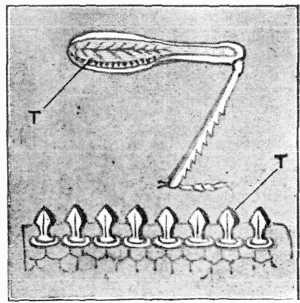 Fig. 1.—Above, leg of American Grasshopper, magnified;
musical instrument at T. Below, musical instrument of American
Grasshopper, greatly magnified.
Fig. 1.—Above, leg of American Grasshopper, magnified;
musical instrument at T. Below, musical instrument of American
Grasshopper, greatly magnified.
The simplest means of making a noise is that used by the beetle known by the grim name of the 'death-watch.' In our own houses this little beetle often causes great alarm by the ticking or tapping sound which it makes by striking its head against the wall. Ignorant people look upon this noise as a warning of approaching death; but, really, it is meant to charm and attract any other beetles of the kind which may be within hearing!
But many insects, like the crickets and grasshoppers, have a specially constructed instrument on which they play. Fig. 1 shows a part of the instrument used by an American grasshopper. It is formed by a row of tiny teeth, marked t, placed along the inner side of the thigh of the great leaping leg. When this creature feels very happy, or wants to charm his mate, he produces a shrill sound by rubbing these teeth across the hard 'nervures,' or wing 'veins.' What these teeth are really like can be seen in the lower part of the illustration, which shows eight little spear-heads set in sockets. These are 'teeth,' which act much as a comb would do if drawn lightly over a tightly stretched wire.
The 'stridulation,' as this form of musical production is called, in some locusts is so loud that it can be heard on a still night for a distance of a mile. Some South American locusts are such wonderful performers that the Indians keep them in wicker cages, in order that they may enjoy the playing. There is a North American locust[Pg 262] which is quite famous as a musician. It is known as the Katydid, on account of its peculiar notes, which resemble the words Katy-did-she-did. This note is kept up throughout the night. Our field-cricket plays by rubbing a row of teeth, about one hundred and thirty in number, placed on the under side of one of the supporting rods, or 'veins,' of the wings, against another rod very like it, but without teeth, in the upper surface of the opposite wing. First one wing is rubbed over the other, and then the process is reversed.
A near relative of the grasshopper, the cicada of North America and of Southern Europe (fig. 2), has a really wonderful instrument, rather like a kettle-drum. But it is an unusual sort of kettle-drum, for it is played from within. The drum-heads are shown in fig. 3, marked d, one on each side of the creature, like the drums on a cavalry horse, except that they are underneath the animal in the case of the cicada. If the 'skin' of the drum be removed, a very complicated instrument is seen, and this, by causing vibrations, increased by the tightly stretched drum-head, gives rise to the sounds for which these insects have long been famous.
The great traveller-naturalist, Fritz Müller, tells us that musical contests between two or three rival cicadas—only the males play—often take place. As soon as one had finished his song, another immediately began, then another, and so on all through the night. Another naturalist, Bates, tells that when in the Amazons he used to listen to the cicadas, which began with sunset. The tune began with a jarring sound, and ended in a long loud note, like 'the steam-whistle of a locomotive engine!'
In insects which hum the sound mainly comes from the abdomen. In flies and humble-bees, for example, the 'voice' is caused by air rushing out from the mouths of the air or breathing-tubes. But these sounds are deepened by the vibration of the wings. Those who know something of music will understand what is meant when they are told that the note of the honey-bee on the wing is A; its ordinary 'voice,' however, is an octave higher, and often goes to B and C. From the note produced by the wing, the speed with which it is vibrated can be reckoned. Thus, the house-fly, which produces the sound F, vibrates its wings 21,120 times a minute, or 335 times a second; the bee, which makes the note A, 26,400 times a minute, or 440 times a second!
But, besides insects, there are many spiders and scorpions which may claim to be musical. The instrument of the spider is formed on the same principle as that of the grasshopper—that is to say, by a raised tooth-like edge, which can produce vibrations. Beneath the front of a spider's head there is, on each side, a stout jaw, ending in a long, movable fang, like a claw. Behind this jaw is a short leg, formed like a walking leg, and known as the 'palp.' It is never used, however, for walking, but is carried straight forwards, so that the inner surfaces of its joints are close to the outer surface of the jaw. Now, whenever the 'palp' is moved, it is rubbed against the 'teeth' in the jaw, and this consequently, in many spiders, produces a sound like the humming of a bee! In some spiders which have this apparatus, the sound produced cannot be heard by human ears.
It is to be noted that, whatever the sound produced, its purpose is to serve one of two very different ends. It may be used, as in some spiders, when it is found only in the males, to charm its mate in courting; for she has a very bad temper, and must be approached most cautiously. But in the case of the huge bird-eating spiders, this curious buzzing sound appears to be made for the purpose of frightening its enemies, which, connecting the buzzing sound with the power of stinging, give the spider a wide berth as soon as the buzzing begins! To make itself appear more terrible, the spider raises the fore part of the body and legs high in the air, and thus, partly by this threatening attitude, and partly by the sound, persuades those about to attack that 'discretion is the better part of valour!'
The scorpion hisses. Some describe the noise as like that produced by rubbing the finger-nail over the hairs of a stiff tooth-brush. The vibrating instruments are found in different places, according to the species of scorpion. But the plan of its construction is the same in all, and is like that of the spider. Thus, in some species (as in fig. 4) there are, at the outer side of the base of the great pair of pincers, a number of sharp spinelets, shaped like a tiger's 'fang.' These make up the 'scraper.' Against it the scorpion rubs a number of tubercles, or little rounded bodies, which are seated on the base of the first pair of walking-legs; these form the 'rasp.' The movement of the rasp on the scraper produces the hissing sound. Sometimes the hissing is produced by a similar rasp and scraper placed on the inner surface of the little pincers which project in front of the body, between the two great pincers. In other cases the rasp and scraper are found, the rasp on the top of the base of the little pincer, the scraper on the under surface of the overhanging shield of the body. But, however formed, the noise produced is similar, and appears to be meant to terrify enemies. This purpose is further aided by the habit the creature has, when angry, of turning the poisonous sting at the end of the tail over the back.
W. P. Pycraft, F.Z.S., A.L.S.
Noucherivan, King of Persia, had a very violent temper. One day he condemned a page to death for having by accident spilled a little sauce over him while waiting at table. The page, knowing that he had no hope of pardon, proceeded to pour the whole contents of the plate over his master. Nouchirevan, almost forgetting his anger in his surprise, asked the reason of this outrageous act.
'Prince,' explained the page, 'I am desirous that my death should not injure your renown by being undeserved. All nations esteem you as the most just of sovereigns, but you would lose that glorious title were it to become known that you had condemned one of your slaves to die for so trifling a fault as the one which I first committed.'
This answer made such an impression upon the king that, ashamed of his passion, he pardoned the slave, and also tried by his bounty to atone for his contemplated cruelty and injustice.[Pg 263]
C. J. B.
The middle letters of each word read downwards give the name of a well-known English poet.
C. J. B.
10.—Valparaiso.
11.—Tar-tar.
Amongst our English vegetables, the potato is the most abundant and useful. It is liked by nearly all, and it is indeed a chief article of food in some districts. Other vegetables are largely eaten—cabbages and turnips, for instance—but the potato is in the greatest demand.
We have in the potato an illustration of a plant which belongs to a poisonous family, but has roots (or tubers) very nourishing and agreeable to eat. But if anybody was to eat the berries which follow the showy flowers of the potato, they would most likely be made ill, nor are the leaves wholesome to us, though they furnish food to the big caterpillar of the Death's-head moth.
We have to thank the Romans for bringing into Britain many fruits and vegetables; others, later on, came from France and Germany, or some other part of Europe; but the potato we owe to America. The potato first known in these islands, however, was not the one familiar now; it was the sweet potato, or Batatus, cultivated by the Spanish and Portuguese; it is supposed to have been brought over from the Continent early in the reign of Queen Elizabeth. It was a vegetable much liked by those who could get it, and this is the potato of which one of Shakespeare's characters says, 'Let it rain potatoes and hail kissing comforts.'
No one can tell positively who, of the voyagers to America, towards the end of the sixteenth century, it was who came upon the true potato and brought it back to his own country, more as a curious plant than for any other reason. Some have given the credit to the great Sir Walter Raleigh, but it seems more likely that he himself was not the discoverer, but one of his followers, named Heriot. In a book Heriot wrote he exactly describes the potato amongst his finds, calling it 'open-awk,' a name he had heard in America. 'There are roundish roots,' he says, 'some the size of a walnut, some much bigger; these hang together on the other roots, and are good either boiled or roasted.' By roasting he no doubt meant putting them in the hot ashes of a fire. The question of how potatoes should be cooked seems to have been troublesome at first. People dipped them in hot water, and then complained that they were hard, or sticky like glue. Potatoes brought to the table of King James I. are said to have cost two shillings a pound, and for a long while the vegetable remained scarce, perhaps because people did not know the best way to raise a crop as we do now, by planting slices of the tubers. Several of the old books only refer to it as an ornamental garden plant.
Sir Walter Raleigh does appear to have introduced this vegetable into Ireland, at least. Going one spring to his estate at Youghal, Cork, he took some potatoes, and gave them to his gardener, who planted them. Fine specimens had grown up in August, but the gardener did not think the berries were of any good, and told Sir Walter he did not admire the wonderful American plant. 'Then pull it up and throw it away,' said Sir Walter; but when the man saw the potatoes on the roots, he thought differently.
The first place in England where the potato was grown in fields was North Meols, Lancashire, about 1694. For many years the Scotch only grew it as a curiosity, till Thomas Prentice, of Kilsyth, stocked his garden with potatoes in 1728, and distributed them amongst the villages near. Early in the reign of Queen Victoria, it had become abundant, especially in Ireland; but the potato disease or murrain caused great distress in 1845 and later, nor has it ever been got rid of entirely. The potato has been introduced to our Indian Empire, and though it was unpopular at first, the people have since become partial to it.
J. R. S. C.
Doctor Abernethy, the great surgeon, was famous for his short, pointed sayings and good advice, as well as for his skill as a doctor. One day a gentleman who was accustomed to live in great luxury, and who suffered from gout in consequence of this easy life, came to consult him. He told the great surgeon all his ailments, and how he usually lived, and asked what he ought to do.
'Live on sixpence a day—and earn it!' was the reply of Dr. Abernethy.[Pg 264]
he frequent and successful voyages in balloons at last led scientific men to wonder if the ascents might not be used for solving some of nature's riddles, and so conferring benefits on mankind, instead of being undertaken only as pleasure trips. It was to help answer this question that, in 1862, Mr. James Glaisher began a series of balloon voyages. He was by no means the pioneer in this class of enterprise, for many others—both French and English—had been up with the same object some years before. But as Mr. James Glaisher, with his captain, Mr. Coxwell, went higher than any one before or after, his flight ought to be given special attention.
In order to make careful observations, it was necessary to take a large number of delicate instruments, and these were arranged on a board, which rested its ends on either side of the car. Seated before this narrow table, Mr. Glaisher meant to read the secret of the skies. When all was ready, Mr. Coxwell weighed anchor, and a few moments later the city of Wolverhampton, from which they rose, was almost lost in the vast tract of country upon which their eyes rested.
It was the third ascent these gentlemen had made together, and the wonders Mr. Glaisher had witnessed on the two previous occasions must have been more than enough to lead him to seek for more. He had pierced the densest rain-clouds, and had seen the shadow of the balloon on the white upper surface of the clouds surrounded by lovely circular rainbows. He had peeped through holes in these clouds on to the world beneath, which looked more like a misty picture than real meadows and towns and rivers. Such experiences were more beautiful than any tales of fairyland—because they were true.
But to-day he was to have a new and strange journey. At five thousand feet above ground the balloon entered a mass of rain-clouds, one thousand feet thick, and four minutes later they broke through into sunshine. Mr. Glaisher tried to take a photograph of these clouds from above, but the balloon rose too rapidly and kept turning round. At twenty-one thousand feet (or four miles high) Mr. Coxwell found it difficult to breathe, while it needed a great effort to tilt more sand over the edge of the car. Up and up they sailed—four and a half, five, five and a half miles—and the sky grew more and more intensely blue till it became, at last, almost black.
Even now, at a height of twenty-nine thousand feet, when hoar-frost was forming on the sides of the balloon, and the daring travellers were stung with a cold more severe than that of the coldest winter day, the instruments went on observing the wonders of the atmosphere without themselves being observed. Mr. Glaisher, who had for some minutes found a difficulty in seeing the small marks on his instruments, lay back quite insensible against the side of the car. He had not fainted suddenly. First, he tells us, his arms refused to move when he tried to reach the various instruments. Then, as his eyes fell on Mr. Coxwell, who had climbed into the ring to reach the valve-rope, he tried to speak; but the power of speech was gone, and a moment later he lost all consciousness.
The balloon was still ascending, and, to Mr. Coxwell's horror, he found that the terrible cold had turned his hands black, and robbed them of all muscular power. His position was one of great danger, seated as he was in that slender car miles above the earth, and so numbed by the cold that he could not hold the ropes. He reached the valve-cord at last, however, and, seizing it between his teeth, gave it two or three vigorous jerks. The balloon stopped ascending. Hooking his numbed arms over the ring, he dropped safely into the car. As he did so, he noticed that the blue hand of the barometer stood perpendicular. The balloon had ceased to climb at seven miles high!
His efforts to restore Mr. Glaisher were soon successful, and, by the time the earth was again reached, no ill effects from the wonderful adventure were to be felt.
We must mention six other passengers that took part in the journey: these were pigeons. One was liberated at three miles high, but dropped with wide-open wings like a sheet of paper until denser air was reached. A second, at four miles, was evidently a stronger bird, for it flew vigorously round and round, gradually descending. A third, dropped a little higher, fell like a stone; and another, thrown out at four miles, on the way down, took a comfortable perch on the top of the balloon.
This famous flight of Messrs. Coxwell and Glaisher is still a record. No other balloon has ever ascended to so great a height, and, when a similar attempt was made in France by three celebrated aeronauts, two of them lost their lives at a height of five miles, owing to the rarity of the atmosphere they had to breathe.
The illustration of the scene in the balloon, on page 265, is copied from Mr. Glaisher's Travels in the Air, published by Messrs. Macmillan & Co., Ltd., who have kindly given leave for its reproduction.
John Lea.
A Story of Adventure on the North Sea and in China.
When Charlie arrived at his home, in an unmistakably ill-fitting suit of clothes and accompanied by a Chinaman, equally badly dressed, he caused great surprise to his family. If he had returned dressed in 'fear-noughts' and a jersey, or even in 'oilies,' they would not have been surprised,[Pg 267] but there was nothing nautical about his present attire.
'Well, my boy,' Charlie's father said to him, after Ping Wang had been introduced, 'have you had a good time?'
'Well, not exactly,' Charlie answered, 'but I have discovered that Skipper Drummond is an old rascal, and that he believes he will have no difficulty in swindling you.'
'He is not the first person who has thought that and has lived to find that he has made a mistake. However, you can tell me all about it after dinner. You had better run upstairs and change your clothes.'
After dinner, Charlie related all that had happened to him, from the time he met the bow-legged cook until he came back to Grimsby.
'I suspected that you would have a rough time,' Mr. Page said, when Charlie had finished his story, 'but I never thought that you would meet with so many unpleasant adventures. However, as you have discovered that Skipper Drummond is a dishonourable man, I am not sorry that you went to sea. I don't suppose you will be in a hurry to go again.'
'I want to go very soon,' Charlie replied. 'I want to go to China with Ping Wang.'
'To settle there?'
'Oh, no; simply to recover Ping Wang's family riches.'
Mr. Page and Fred, not knowing whether Charlie was serious or not, made no remark.
'I'm quite sane,' Charlie declared, seeing that they were surprised; 'Ping Wang will tell you about it.'
Ping Wang, thus called upon, repeated the story of his father's death and the seizure of all his property by Chin Choo.
'But how do you know that Chin Choo still possesses the idol with the secret drawer?' Mr. Page inquired, when Ping Wang finished speaking. 'He may have sold it?'
'That is not at all likely,' Ping Wang declared. 'I know that he has had it fixed up in his chief room, and there it will remain as long as the house stands, or until Chin Choo moves somewhere else.'
'And you think that Chin Choo cannot discover that the idol contains precious stones?'
'I am certain of it. My father was a richer man than Chin Choo imagined, and the wealth that the murderer found in our house was more than he had expected. He is quite certain that he has found all my father's wealth. If he were not, he would never think of looking for it in the image.'
'But do you think it possible to get into Chin Choo's house and remove the idol without being discovered?'
'I am certain of it; of course, I shall watch for a favourable opportunity.'
'Well,' Mr. Page said, after a few moments' thought, 'I must think over the matter for a few days before deciding whether I can permit Charlie to accompany you.'
'I wish I could go with them,' Fred joined in. 'I don't desire a share of the treasure. I simply want to go for the experience.'
'But how about your studies?' Mr. Page asked.
'I wouldn't neglect them. I would read hard on board, and as my next examination does not come on for nearly two years, I shall have plenty of time. And when I'm in China I shall be able to study tropical diseases. Medical men are very keen on that, nowadays.'
'Well, if Charlie goes, I see no reason why you should not; but it requires serious consideration.'
'I will share my portion of the treasure with you,' Charlie said to his brother, but Ping Wang objected to that arrangement.
'We will each have a third of what the rubies realise,' he declared, and, in spite of all protests, he insisted that the division of the treasure, if they ever got it, should be made in that way.
Mr. Page listened in silence to their conversation. He was by no means convinced that Ping Wang's story was not an Oriental fiction, invented to arouse sympathy and obtain a free passage home. Now, as it happened, Mr. Page had a friend who was the senior partner of a large firm of Chinese merchants, and had himself resided in China for many years, and he decided, therefore, to question him as to the probability of Ping Wang's story. A day or two later Mr. Page went to London and had an interview with this friend, who confirmed many details of Ping Wang's story, and even came down to Lincolnshire to see the Chinaman in person.
Ping Wang was delighted when he found that the merchant had lived in his country for many years, and could speak his language fluently.
'Ping Wang's story is, I am convinced, quite true,' the merchant said to Mr. Page, when they were alone, 'but his plan is a very risky one.'
'I know, but that has only made them more anxious to go. It is another case of "like father like son." If I had not travelled while young, I am sure I should never have settled down. And the fact that in every place I visited I found scores of Englishmen yearning to return home made me feel that I was a fortunate man to see our distant possessions without being doomed to pass my life in exile. I have sufficient money to keep a home for my children, but I want my sons to be able to earn a living and hold their own by themselves; and I think that, as I have the means to permit them to travel before settling down, they will do well to learn as much as they can of the world outside England. They shall go with Ping Wang. If they help Ping Wang to secure his inheritance, I shall of course be pleased, but I shall be glad for both the lads to gain experience, and I hope they will return in good health.'
A little later Mr. Page told Charlie and Fred that he had decided to allow them to go to China, an announcement which was received with great delight. The next day he went to the shipping agent's, and finding that a boat would start from Liverpool to Hong-kong in twelve days' time, booked saloon passages for Fred, Charlie, and Ping Wang.
'To-morrow,' Mr. Page said to his sons and Ping Wang after he had returned from the shipping agent's, 'you must see about your outfit. The time is very short.'[Pg 268]
'I think, sir,' Ping Wang said, 'that the clothes I have will be good enough.'
'Would you not like to go in your native dress?'
Ping Wang's eyes brightened.
'Yes,' he answered, 'but you have paid my passage.'
'Don't let that thought trouble you. When you have got back your jewels, you will be able to offer to repay me.'[Pg 269]
'You are very generous, sir,' Ping Wang declared.
'Nonsense,' Mr. Page answered. 'You have been a good friend to my boy and have had a rough time since you have been in England. If you carry away a better impression of our country than you would otherwise have done, I shall consider myself repaid for what I have been able to do for you.'
(Continued on page 277.)
[Pg 270]
Happiest of little Londoners are those who are so fortunate as to live near enough to the Regent's Park for it to form their daily playground. To them the wooded shores of the winding lake, with its three long arms crossed by bridges that rock delightfully, must seem like a little world, with mountains, bays, capes, forests, and many more wonderful things, just as in the great world itself. It is filled with so many living things that dwell round the banks of the lake—the stately swans, the many varieties of the duck family that swim and fly and chase each other all day long, the gentle moorhens gliding in and out of the rushes, and the mother vole or water-rat nibbling a juicy bit of grass in the sunshine, or swimming to cover with her babies on her back; and now and again the peace of this little world is rudely broken by the distant roar of a real lion or the shriek of a hungry hyena, which frightens all the smaller animals into silence.
Perhaps no greater benefit ever befell the good folk of London town than when, early in the nineteenth century, it occurred to the authorities to turn the old Royal Park of St. Mary-le-bone into a real people's park. A great many plans were suggested for laying out the ground. One very ornamental scheme was probably rejected because of its expense; in it a fine church was to form a central point, with avenues running from it like spokes of a wheel. The design which was accepted and carried out consists of four oval drives lying like rings inside one another; in the centre of the inside one are the Royal Botanical Gardens. Rare and wonderful treasures of vegetable life are kept there—flowering plants and shrubs, palms, ferns, mosses, water-plants, and trees from many lands, each the object of deep thought and care. From time to time grand floral fêtes are held in the gardens, and often on summer evenings Shakespeare's plays are acted in the open air.
The northern side of the park is chiefly given up to the Zoological Gardens; and, indeed, to the world at large, apart from Londoners, Regent's Park often means nothing but 'the Zoo.' Probably it is safe to say that no other park in the world annually attracts so many visitors.
The collection at the Zoological Gardens was begun in 1828, and amongst the first arrivals were the lions from the Tower, for, from ancient days, lions and bears kept the old royal fortress lively. Great sums of money have been spent in securing fine specimens, and now Britons have the satisfaction of knowing that our Zoo is second to none. Amongst recent arrivals at the gardens were two young gorillas from Western Africa, who reached the Zoo in apparent health, but, as has happened on former occasions, after a few weeks the poor things sickened and died. Whether they suffer from the effects of the voyage, or whether the shock of their capture is too great for them, the fact remains that gorillas seem unable to endure the altered conditions of life which most of the other members of the great ape family can put up with.
But, with all the attractions of the Zoo, it would not do to be dependent on it for amusement, for even on Monday, 'the people's day,' it costs sixpence, and many of the park's most frequent visitors find pennies hard to come by. Pleasure has to be sought and found on the various recreation grounds, and, in fine weather, cricket and other games are usually in full swing.
A very favourite walk with many visitors is to Primrose Hill, north-west of the Zoo, which rises two hundred and nineteen feet above sea-level, where the air is usually clear and bright, whilst the view over London is very fine. The hill is the property of Eton College, and is separated from the Zoo by the Regent's Canal, as well as by the Albert Road. Beneath the slope is a fine gymnasium, which still further adds to the attractions of the park, and many fine terraces of houses line the outer circles.
The park takes its name from the Prince Regent, afterwards George IV.
Helena Heath.
'He is always very busy,' said one man to another.
'Yes,' answered a gentleman who knew the person in question. 'He is so lazy in getting up that he loses an hour every morning, and spends all the rest of the day in running after it.'
An hour lost means an hour which can only be regained by neglecting other work.
The Japanese are a wonderful people, and their foresight in even the smallest matters is really marvellous. Here is a case in point.
Late in 1904, when the time came to forward the winter outfits for their soldiers fighting in Manchuria, amongst the wadded overcoats and thick blankets were some hundreds of thousands of ear-protectors made out of rats' skins.
Even the military authorities were surprised by these, and wondered where the Government could have found so many rats as to be able to supply their soldiers with such soft and comfortable coverings for their ears.
It seems that two years ago plague was raging along the China coast, and, to keep the disease out of Japan, the quarantine authorities made war against the rats. In all the seaports and larger cities rewards were offered for each rat brought; small boys found this a delightful way of earning money, and the competition at once became very keen.
Every rat was duly registered, and the place where it was caught noted, and if any suspicious germs were found, the building from which the rat came was raided, all the rats in it hunted down, and the place disinfected. So the plague was kept out of Japan.
Meanwhile the rat-skins had not been thrown away; war was even then threatening, and ear-protectors might be wanted.
So the rat-skins were all thoroughly cleansed and disinfected, and made into ear-protectors, and now have proved a great blessing to the soldiers in the field.[Pg 271]
one of my early recollections of our pretty little home in England is so clear as that of the old grandfather's clock that stood in the hall. I remember that my mother and father were very fond of it, and when my brother and I once grumbled, saying, 'That old clock is always slow,' my mother reproved us with the words: 'Oh, children, you must not say that, for the fact that it often goes slow when the big hand is going up towards the hour was the very thing that once saved your great-grandfather's life.'
That was the curious thing about the clock. Every now and then, for some reason, the minute-hand seemed to work loose, soon after the half-hour, and, before it reached the three-quarters, it lost five minutes. It might manage to go a whole day without doing this; but sooner or later it always happened, so that the clock could not be relied upon for time.
Of course, we were very eager to hear the story, and, as we sat round the fire that evening, my mother told us the following tale:—
'You know, children, that we have not always lived in England; my ancestors were French, and lived at Château Roquefort, in the province of La Vendée. When the great insurrection broke out in the year 1792, my grandfather, Philippe de Roquefort, was one of the leading insurgents against the Republic. For a time the insurrection was successful, and the Republican generals were driven across the Loire. But at last there came a time when Philippe de Roquefort saw that to resist any longer was hopeless, and, as he had a wife and a little son, he resolved that, for their sakes, it was prudent to flee to England.
'They had abandoned Roquefort itself three days before, but the evening before their leaving France, Philippe was obliged to ride over to the château (five miles or so from the little town where he and his family, with about a dozen trusty followers, had taken refuge) to fetch some important papers.
'The whole neighbourhood swarmed with Republicans, but, with his knowledge of the country, he reached the deserted château safely.
'The whole place had a forsaken air as Philippe entered the hall he knew so well, where all his happy boyhood had been spent; but one familiar object caught his eye—the old clock, which had been too cumbersome to take with them in their flight, and which was still ticking in its accustomed manner. Philippe secured his papers, and was just leaving the château, taking a last fond look at his home, when a heavy hand pulled him backwards, and, before he could reach his sword, he was bound hand and foot.
'"We have caught the bird in his own nest," said a loud voice—and the boisterous laughter of several men made the rafters in the old hall ring.
'Philippe saw that he had been captured by five rough Republicans, who dragged him into the middle of the hall and then sat round him, consulting as to his fate. At last they decided that, at a quarter to six by the old clock, he should be shot. They had some time to wait before going back to their camp.
'Philippe gave himself up for lost. The ruffians soon began to jeer at him, and asked if he had any messages for his friends. Then my grandfather lost all his patience, and throwing aside all prudence, cried: "Yes, you villains, if I had my faithful followers here, they would soon make an end of you."
'The men laughed at this, but suddenly a cruel idea struck one of them.
'"Yes," he said, "Monsieur shall have his way"—and, looking up at the clock, he continued: "It is now five o'clock; Pierre, the peasant's son, who lives yonder, shall ride with a message to these devoted followers. Monsieur shall be shot at a quarter to six; but he can write and tell his friends to be here at ten minutes to the hour; they will come and find Monsieur—five minutes too late. We can get away easily enough before they arrive."
'His comrades agreed to this plan, which gave an adventurous tone to their enterprise, and inflicted, as well, extra misery upon their prisoner.
'A scrap of paper and a pencil were given to my grandfather; but, as he was writing, Philippe remembered with joy that the old clock on which his captors were relying had not yet lost its five minutes that day; he had noticed this as he glanced round the hall before his capture; and, therefore, at a quarter to six—the time when, by the clock, he was going to be put to death—it might be ten minutes to the hour by the proper time—if the clock only went wrong for once at a convenient time!
'The peasant-boy, Pierre, was sent with the message, and the men settled themselves down to ransacking the house, exulting over the trick they were going to play.
'The time crept by. As a quarter to six drew near Philippe was bound to a tree, and the men set to work to load their muskets! Had the clock lost five minutes, or not? Every minute of waiting seemed like an hour, and Philippe could not be sure whether the hand had stuck still too long, or not. He thought it had, but could he trust his eyes in such a terrible situation?
'You can imagine my grandfather's feelings during those last few awful minutes! A hundred conjectures flashed through his mind. Suppose the boy never gave the message! or suppose the men were late! or suppose the clock was not slow after all!
'At last the Republicans were ready, and Philippe gave himself up for lost. Suddenly the sound of horses' hoofs was heard breaking through the undergrowth. The Republicans hesitated, and, as they stood undecided, ten or a dozen men rode up hastily. They were only just in time; the Republicans fought for a few minutes, but they were taken by surprise, and soon surrendered. Philippe was saved!'
'What a narrow escape, Mother,' we cried, 'and if it had not been for the old clock's habit of losing time——'
'Well, my dear, the story would have ended very differently.'[Pg 272]
This striking story belongs to the days of the Great French Revolution of 1792. The hero is a young Englishman, the son of Colonel Mainwaring, of the 2nd Dragoon Guards, and at the time the story opens he is on a visit to Paris to his uncle and aunt. Before we narrate one or two striking incidents of his life in France, however, we must say something, very briefly, about the French Revolution, during which so many terrible things were done that it was known as the Reign of Terror. One of the grievances of the people in France was that the power of the nobles had greatly increased, so that they did as they liked. Though they claimed unlimited privileges, yet they refused to take up the responsibilities of their position, and even evaded the taxes which they laid on the shoulders of the people. One unpopular tax was the gabelle, or salt tax, which compelled every person to bring a fixed quantity of salt every year, and made them buy it of certain people who alone had the right to sell, and charged enormous prices. The peasants, too, had to work on the roads for nothing, leaving their farms and little plots of ground whenever they were ordered. They could not earn enough to live on, and what with heavy dues to their lords, and the State interference with trade, they were in a wretched plight, and discontent was widespread. Then famous writers, moved by what was going on around them, wrote strongly against the abuse of power by the nobles and the King, teaching that kings were but the servants of the people. The poor, ignorant, downtrodden peasantry, urged by the selfish trading classes who used them for their own ends, united in a great movement to take away the privileges of the nobles. The serfs flung off the heavy yoke, and went to the worst excesses, burning and wrecking the palaces of their former masters, utterly ruining them and driving them out of the country.
The Commons, or National Assembly as they styled themselves, did not stop when they had introduced reforms that were really needed, but did just as their passion against the aristocrats and the rich dictated. Things passed from bad to worse when the King, who had the right of refusing the proposals of the National Assembly, exercised his right and vetoed (from veto, I forbid) two of their decrees. This made the people furious. All this was new to Garth Mainwaring, as also was the procession of noisy people, marching through the streets to the beating of drums, carrying banners, and howling and shouting at any well-dressed people they met. Garth saw the mob battering at the doors of the King's palace, calling for his Majesty to come out, and when the King, in quiet dignity, stood before them, they ordered him to put on the red cap of liberty, and grossly insulted him and his beautiful Queen and their children.
Garth had felt his blood leap up as he witnessed this, and in his young enthusiasm he longed to fight on the side of the royal prisoner and his nobles. On the evening of one dreadful day, during which the mob had done wild things, as Garth was passing on towards the Rue Saint Honoré, he heard a faint voice on his left hand. It came from the figure of a man huddled in a doorway, who had been mortally wounded and was rapidly dying.
'Sir,' gasped the man, in English, 'Sir, save my daughter. Go to her, sir, and give her her father's dying blessing.'
'I will go, sir,' said Garth. 'Will you tell me your name?'
'The Baron de Méricourt. I was in the palace. I got away as by a miracle, but I fell among the ruffians here, and they have done for me. Waste no more time, I implore you. Save my darling Lucile, and tell her her father——' But here, with one more gasp, he died.
Another striking adventure befell our hero at Nantes. It was after he had offered to throw in his lot with Bonchamps, a leader of the loyalists, and donned the white cockade of those whose watch-word was 'for God and the King.' He was asked whether he would make an attempt, as they were to attack Nantes, a stronghold of the 'Blues,' to find out the enemy's position. Of course he agreed; there were no dangers in the path of duty that could deter Garth. He was disguised in a peasant's dress, and carried a basket full of live pigeons, which he was to offer for sale as he journeyed. Nantes was a strong position, strongly fortified and manned by the enemy, yet the brave peasants and loyalists of the Vendée determined to endeavour to take it for the young King (for the unhappy Louis XVI. and his beautiful Queen had been put to death by the influence of the more savage leaders of the Revolutionary party). It was late in the evening when Garth started. It would be nearly midnight before he could reach the city. When he came within two miles of the town he saw a barge, laden with wood, moving slowly down the river. Hailing the old man on board, who was holding the rudder, and allowing the laden craft to drift down with the tide, 'Holà,' cried Garth, 'Hé! can you give me a lift down to the quay?'
'Who are you?' asked the bargeman, Jules Viard by name.
'A poor chap with a pair of pigeons to sell.'
The man agreed to the request, and Garth sprang on to the barge as soon as it came within jumping distance, and it resumed its slow passage down the river. Presently the vessel was steered alongside the quay, where the good-natured boatman made her fast for the night, sleeping in her himself to save the few sous he would otherwise have had to pay for his bed; but Garth went along on the riverside, as he wished to look about him to learn what he could of the strength and position of the enemy.
As his wooden shoes clicked on the stone paving, he stripped them off and strung them round his neck. The cathedral clock struck the hour of midnight. On and on he went, using his eyes well. He had reached the Paris road, up which his friends of the Vendean army would probably approach, when he saw an immense obstruction. Climbing a tree, the better to look about him, he found that[Pg 275] the obstruction was a big redoubt, very solidly constructed. Scaling garden walls and getting behind the redoubt, he satisfied himself that it could be taken from the rear, and being by this time very tired, he lay down under a hedge to sleep till daylight.
The next morning he sold his pigeons to a lieutenant of the National Guard for forty sous, and spent the rest of the day walking about the town with his friend, Viard the bargeman, leaving him at nightfall to begin his return journey. Turning down a narrow passage leading to the river, between two high warehouses, he saw three men, and, as it turned out, men whom he had met before, all enemies to the King's cause. One of them, the Mayor, stopped him.
'Well, my man, where are you going?'
Garth turned his head aside.
'Where are you going?' repeated the Mayor.
'Down to the river, citizen. Came in last night on a barge to sell pigeons.'
'On a barge, eh? Were you molested by the brigands?'
'No, citizen; I joined the barge some two miles up, and saw nothing of brigands.'
The man standing to the left of the Mayor started as he heard the tone of Garth's voice. He looked closely into Garth's face, suddenly pulled off his hat, and with a quick cry, ''Tis the very man!' tried to seize him. Quick as thought, Garth slipped aside, then, before the other two had recovered from their surprise at their companion's strange action, he rushed at the Mayor, threw him over backwards, turned and flung his basket in the face of the other, then wheeled round and ran as fast as the clumsy sabots would allow him, clattering down the passage towards the river, the man behind him shouting, 'Help! a spy—a brigand—help!' Two of his enemies dashed after him, and the Mayor picked himself up and toddled off as fast as his short legs would carry him to call up the nearest guard, two hundred yards away. The National Guard was soon aroused, and the whole garrison was under arms. The dauntless Englishman reached the river. He did not hesitate; pulling off his shoes and flinging them at his pursuers, now only ten yards away, he plunged into the river. A soldier with his gun arrived, pointed his musket at Garth's head, and fired; Garth twisted over and dived, and the bullet hit the water just behind him. Others of the guard came up, fired at his bobbing head, but missed it. On he swam boldly, determinedly; and now the firing has ceased, although he can hear the clamour. His courage and presence of mind had saved him; he was now in a friendly country, and the first man he met was wearing the King's cockade!
But here we must leave our hero, proud that he was an Englishman, and that he afterwards distinguished himself by many deeds of valour, passing unhurt through many dangers, from the worst of which he was rescued by his old friend, Viard the bargeman. How he presently married Lucile de Méricourt, and accepted an appointment at Lisbon, and what became of his friends and foes, is all told by Mr. Rendel in his fine and stirring book, which every British boy who is ready to cheer pluck should read for himself.
James Cassidy.
[4] The King's Cockade, by H. Rendel. (Wells Gardner, Darton, & Co., Limited, London.)
Anybody watching a chance meeting in the street between two animals must see that they hold some sort of conversation. By sounds, signs, or both, they 'pass the time of day,' and make remarks. After settling affairs in their own language, they part, either as the best of friends, or, more frankly than politely, saying, 'Well, I hope I shall never see you again!'
Out in the fields, what horse can bear to see another horse, or even a donkey, turned into the next paddock without running up to have a chat with him? Horses that work together are always on speaking terms. Much rubbing of soft noses, pricking backwards and forwards of the ears, with a snort, playful bite, or whinny, is their talk. After much talk of this sort between two splendid cart-horses, standing in harness, I once saw a fine plan carried out. They had been drawing a heavy load, and were quietly enjoying their feed, each from the nosebag dangling at his head. But the corn dwindled and the last grains of it were hard to reach. It was then that a brilliant idea struck horse number one. He lifted his bag to the middle pole, which he used as a prop; but then there was no room for his companion's bag on it. Horse number two, apparently after asking leave, hoisted his own bag even higher still, and, balancing it on his friend's head, fed in comfort. The pair munched peacefully on, and next day I saw them doing the same thing again.
All animals have a language of sound and sign, which they use as intelligently as deaf and dumb men use the means of expressing thought invented for them. Creatures that live in troops are always under the control of a leader, who manages them by word of mouth or by gestures.
Lieutenant Shipp, in his memoirs, tells of a Cape baboon who was so dishonest as to bring his companions to the barracks, to carry off the soldiers' clothes. The thefts became serious, and a party of soldiers were told off to march against the robbers, and to bring back the booty hidden in the caves of the baboons. But the animal warriors were too cunning. They sent out scouts, to watch the enemy's movements, told off about fifty of their number to guard the entrance to the caves, and posted the rest at various points. The soldiers saw the baboons collecting large stones, and the old grey-headed rascal, who had been ring-leader in raiding the camp, was seen giving orders like a real general. At a scream from him they rolled down great stones upon the men, who were forced to retreat.
Comic as the monkey-folk sometimes are, they can make very touching appeals; they plead very earnestly in their wordless way for their own lives, and still more tenderly on behalf of their helpless young. A letter from Demarara thus describes a meeting between a mother baboon and two men with guns. Mr. S—— levelled his gun to shoot her. The animal seemed at once to understand what would probably take place, and appealingly held out in each hand a baby baboon. His friend said, 'Don't shoot.' 'No, I was not going to,' said Mr. S——. So Mrs.[Pg 276] Baboon and her family escaped unhurt, the mother showing, it will be agreed, something greater than ordinary instinct.
Something greater? Yes, love; the greatest of all instincts, higher than reason itself. It is when filled with love for her defenceless babe that the animal-mother learns, by many a wonderful makeshift, to appeal to our pity, and forgets herself for its sake. A beautiful instance of this was lately given in the Daily News.
A labourer, going along a lane, met a little robin redbreast. She flew boldly within reach of his hand, almost dashing against his face, and as he passed on tried to hinder him, uttering all the while piercing cries. At last he stopped at a hole to which she kept flying, and found a rat in the act of carrying off one of her nestlings. The labourer was able to kill the enemy by a blow of his stick as it darted across the lane, and the small mother, after hovering with a different and triumphant note over the poor little dead bird, went gladly home.
In countries where snakes abound, the shriek of a bird whose nest is threatened serves as a signal to its winged neighbours, who throng to the spot and drive away, or often kill, the enemy. Sometimes the ways in which creatures communicate are altogether mysterious. An old goose, who had spent a fortnight hatching eggs in a farmer's kitchen, was suddenly taken ill. She left her nest, waddled to a neighbouring outhouse, and persuaded a young goose to go back with her. The young one instantly scrambled into the vacant nest, and hatched and afterwards brought up the brood. The old goose sat down by the side of the nest to die. As the young goose had never reared a brood before, nor been inside the kitchen, the elder must somehow have explained the duties to her, and the younger have understood and accepted the charge.
It seems, then, that want of understanding on our part, rather than stupidity on theirs, prevents a closer understanding between ourselves and the animal creation. Though we are not able to bridge over the gulf separating speechless animals and men, we may at least take care that the dumb prayers of the 'lower brethren' never fall on wilfully deaf ears, or on unkind hearts.
Edith Carrington.
[Pg 277]
A Story of Adventure on the North Sea and in China.
The result of Mr. Page's generosity was that when Fred and Charlie went to a tailor's, Ping Wang ordered a Chinese costume. A week later it was sent home, and when Ping Wang put it on, and permitted his pigtail to hang down, he looked quite a different man. That day the family were sitting talking over the coming voyage when a maid came in.
'A man wants to see you, sir,' she said to Mr. Page. 'He says his name is Skipper Drummond.'
'What a lark!' Charlie exclaimed to Ping Wang. 'Shall we carry him down the garden, and pitch him in the duck-pond?'[Pg 278]
'Show Skipper Drummond in,' Mr. Page said to the maid, and as she departed he continued, 'Now, you boys and Ping Wang, go into the conservatory, and wait there until I call you.'
Fred, Charlie, and Ping Wang stepped into the conservatory, and seated themselves on a rustic bench, so that they could hear what the skipper said without being seen by him.
'Skipper Drummond, sir,' the maid said, as she reopened the door.
The bullying little skipper had evidently made a strong effort to look respectable. He was attired in a shiny black frock-coat, and had it not been for his brightly-coloured tie, one would have imagined that he was going to a funeral. In one hand he held a tall hat; in the other he carried two stiff-looking black gloves.
'Good evening, sir,' he said, as he stepped gingerly across the room, showing as much respect for the carpet as if it was newly-sown grass.
'Take a seat,' Mr. Page said, and he did so.
'I've come about the Sparrow-hawk, sir,' he said, endeavouring to appear more comfortable than he felt.
'Yes.'
'We've had a grand time, sir. Every voyage the Sparrow-hawk makes she improves. There is not a trawler in the North Sea catches more fish than the Sparrow-hawk. She's a beauty, sir; and every one in Grimsby and Hull knows it. Two of the big fleet-owners want to buy her.'
'I suppose that they did not offer so much for her as you are asking from me?'
'They offered more, sir.'
'Then why did you not accept one of the offers?'
'Because it wouldn't have been acting square with you, sir. I am a straightforward man, I am; and having offered the Sparrow-hawk to you at a certain price, I bide by my word.'
'That is very good of you—very good, indeed. It is not often that I meet with such an honourable business man.'
Skipper Drummond sighed deeply, as if he was sincerely sorry for the fact that there were some men who were very dishonourable.
'My idea was,' Mr. Page said, after a few moments' silence, 'to purchase the Sparrow-hawk for my son, and start him in business as a steam-trawler owner. Perhaps it would be well if I introduced you to him at once.'
'I shall be proud to make the young gentleman's acquaintance. I am not a man to boast, sir; but if any one can produce a man that knows more about North Sea fishing than I do, I'm a Dutchman.'
'Charlie!' Mr. Page called out loudly, and in walked from the conservatory Charlie, Ping Wang, and Fred.
'Good evening, skipper!' Charlie exclaimed, cheerfully.
'Good evening, skipper!' Ping Wang added, equally cheerfully.
Skipper Drummond dropped his hat and gloves, and almost started out of his chair. Evidently he had never expected to see either Charlie or Ping Wang again.
'Have you brought us the clothes which we left on the Sparrow-hawk?' Charlie inquired.
'And the pay which you owe me?' Ping Wang added.
'I thought that you were both drowned,' the skipper gasped.
'And no doubt you are almost sorry that we were not,' Charlie remarked. 'However, we have told my father what a wretched old tub the Sparrow-hawk is. We have told him that she is rotten; that her boilers are worn out; that her gear is not up-to-date; that she has the smallest catches of any Grimsby trawler. We have told him also that you have been keeping down expenses by half-starving your men, and that you are the vilest little bully that ever held a captain's certificate.'
'And they also told me,' Mr. Page joined in, 'that you confessed to one of your men that you were about to sell the Sparrow-hawk for half as much again as she was worth. Let me assure you that you will do nothing of the kind. I would not give half the sum which you ask for her. From the first I suspected that you were a swindler, and it was to obtain proof of it that my son shipped with you as a cook. Have you anything that you wish to say in your defence, or will you go at once?'
Skipper Drummond picked up his hat and gloves, and without uttering a word walked out of the room. He was white with rage, but he dared not express his anger in words such as he would have used on the Sparrow-hawk, for Charlie accompanied him to the hall door, and stood in the porch watching him until he had passed into the main road.
'We have seen the last of him, I think,' said Charlie, when the captain was out of sight; 'and I hope that I never meet another man like him.'
On the following evening the Pages had a much more welcome visitor in Lieutenant Williams, who availed himself of Charlie's earnest invitation to come and see him and Ping Wang before they started for China. In private life he was just as cheery, amusing, and good-tempered as on board ship. He told many interesting stories of his work in coper-catching and arrests for illegal fishing. He quite envied Fred, Charlie, and Ping Wang their trip to China.
'Perhaps you will be sent to South Africa,' Charlie remarked. 'That would be much better than going with us.'
'Certainly it would,' Williams declared. 'Active service is the best thing that a man in the navy can desire, but I am afraid that there is no chance of my getting to South Africa. At any rate, I shall go on hoping for foreign service of some sort.'
'If he has an opportunity,' Fred declared, after Lieutenant Williams had departed, 'he will make the most of it, I am sure. He is just the kind of man to do something big, and then laugh and pretend that it was a very easy thing to do. I wish that he was coming with us. However, it's no good wishing. I'm going to have a good long sleep for my last night in the old home. Good night, all.'
Charlie and Ping Wang followed Fred's example and went to bed as quickly as possible. They awoke[Pg 279] early, and later in the day reached Liverpool and went aboard the Twilight, which was to be their home for five or six weeks.
The Twilight was a cargo boat which had accommodation for twenty saloon passengers, but she rarely carried that number, as, her speed being but ten knots an hour, most people proceeding to China travelled by a faster and, consequently, more expensive steamer.
Soon after she had left Liverpool, Fred, Charlie, and Ping Wang began to wonder where the other passengers were.
'They can't possibly be sea-sick already,' Charlie declared, and then seeing the chief steward he inquired how many passengers they had aboard.
'Only you three gentlemen,' the steward answered.
Fred and Charlie looked at each other in amazement. They had fully expected that there would be all sorts of amusements to break the monotony of their long voyage, and their disappointment was great. However, when they found that in consequence of their being the only passengers each might have a cabin to himself, their discontent quickly passed away. And when they got well out to sea they had plenty of amusements, for the captain had the shuffle-board, deck quoits, and other games brought out, and with the second officer and chief engineer played the passengers.
When the three passengers wearied of deck games, they sat on the poop reading some of the books which they had borrowed from the ship's library. Fred sometimes brought out his medical books, but he obtained more practical than theoretical knowledge that voyage, for the ship's doctor—a young fellow who had been recently qualified and was taking a sea voyage, and small pay in return for his medical services—was completely prostrated by sea-sickness, and utterly useless as a doctor. Fred attended to him, doctored such of the crew as needed it, and successfully set a stoker's dislocated forefinger.
The sailors in our submarines have found out a simple device to protect their lives whilst on their 'under-sea' trips. Every submarine that goes to sea takes out a couple of mice. If one of these mice shows symptoms of distress, it is a sure sign that the time for coming to the surface has arrived, and that the air of the closed box needs replenishing from the fresh air.
X.
 ittle flower, in meadow bright,
certain Khan of Tartary, making a journey with his nobles, was met by a dervish, who cried with a loud voice: 'If any one will give me a piece of gold I will give him a piece of advice.' The Khan ordered the sum to be given him, upon which the dervish said, 'Begin nothing of which thou hast not well considered the end.'
The courtiers, upon hearing his plain sentence, smiled, and said with a sneer, 'The dervish is well paid for his maxim.' But the king was so well satisfied with the answer, that he ordered it to be written in golden letters in several places of his palace, and engraved on all his plate.
Not long after, the king's surgeon was bribed to kill him with a poisoned lancet. One day, when the king needed bleeding, and the fatal lancet was ready, the surgeon read on the bowl which was close by: 'Begin nothing of which thou hast not well considered the end.' He started, and let the lancet fall out of his hand. The king observed his confusion, and inquired the reason. The surgeon fell prostrate, and confessed the whole affair. The Khan, turning to his courtiers, told them: 'That counsel could not be too much valued which had saved the life of your king.'
W. Y.
[Pg 280]
ohemia is a land of rugged mountains and towering pine-forests, with other beauties of its own. Not many years ago it was, to most English people, an unknown land; but in these days, when travelling is so easy and rapid, year by year an ever-increasing number of our countrymen find their way to this beautiful country in search of health and pleasure. You have only to cross the strip of silver sea that rolls between our little island and sunny France or misty Holland, and you may then rush on, borne by the fastest of express trains, over the level plains that greet you on landing, on through the beautiful Rhineland and the quaint old towns of Bavaria, till at length you find yourself in this land of enchantment.
Here, surrounded by the mighty forests, and shut in by the mountains, stands the town of Marienbad. Not very long ago it was a lonely village, inhabited during the summer months by peasants tending their flocks and herds on the pasture of the table-land. In winter it was almost deserted, given over to the wild storms that swept the mountain slopes and to the wolves and bears that roamed through the forests.
Gradually the wonderful qualities of its mineral springs became known, and now a crowd of fashionable folk pour into it during the summer, and in every direction trees are being cut down to make way for villas, and buildings of all kinds, which are springing up like mushrooms.
The peasant-life of the people continues wonderfully simple, and it is very amusing to watch this mixing of modern fashionable life with the primitive ways of the villagers.
English boys and girls would, perhaps, not care to go for a ride in the Bohemian waggons, as they are so fond of doing in ours during harvest-time. These waggons are made of a few long, wide planks, nailed together so as to form a kind of huge trough, and strengthened on the outside by cross-pieces of wood. This is placed upon the framework with which the wheels are connected, and then roughly fastened to it. These clumsy vehicles are drawn over the rough mountain roads by teams of patient oxen. On fête days the cattle look very gay, for then they are decked out with ribbons of many colours.
The women of Bohemia work very hard indeed; they help their husbands in all kinds of work. Among other occupations they act as bricklayers' labourers. They run up and down the tall ladders with heavy loads of bricks or mortar, chattering gaily all the while as if life were one long holiday.
The houses are built in quite a different way from ours. First of all a complete skeleton house is set up, made of wood, and, when this is finished, the spaces between the wooden structure are filled in with bricks and mortar. Before the roof is put on, a large green bush is hoisted up as far as the eaves, and there tied to the scaffolding poles. This is supposed to drive away the pixies or wicked fairies, and no one would dare to put the roof on without the protection of the green bush.
The women also do the work of journeymen bakers. The loaves are of the long kind, sometimes jokingly called 'half-yards of bread.' These are carried on the backs of the women. They look very droll with their huge burdens, the loaves poking out in all directions above their shoulders, making a kind of background to their stooping figures.
Most of the people who visit Bohemia in order to take the mineral waters are very stout. They drink them to make themselves thinner, and the difference in their appearance when they arrive and when they leave is very great. They have sometimes to take mud baths, and it is very amusing to watch them going and returning from these. It does not seem to be a very pleasant way of spending a fine summer morning, but they appear to enjoy it all the same.
The Bohemians are very fond of music, and they never fail to greet any new-comers of importance with a serenade on the evening of their arrival.
grimy face,
John Lea.
[Pg 283]
'What is the use of fagging like that on a hot day?' asked Harold Lock of his brother Frank, who came and flung himself panting on the grass beside him.
'I must keep in training: a fellow so soon gets slack and out of practice if he is lazy,' was the answer.
'Well, being lazy is good enough for me in the holidays,' the elder boy said. 'I should think it pretty hard lines to have to run a mile in this sun.'
'It makes all the difference, though, if you are keen,' Frank told him. 'I want to be the fastest runner in the school, and I don't want to go back and find I am easily beaten in the sports.'
'I don't see the good of it myself,' said Harold, rather scornfully, but Frank only laughed good-temperedly, and began to swing himself on a branch of the tree for change of exercise. If there was one thing he hated more than another, it was sitting still for too long a time.
The same evening the boys were on the platform of the little village station, watching some trucks being shunted from the main line on to a siding. Suddenly there was a loud cry from one of the men engaged in the work as a heavy truck got off the rails, turned over, and dragged another with it. No one was seriously hurt, but the station-master, who was soon on the scene of the accident, turned pale as he saw the obstruction on the line.
'Stop the down express!' he shouted. But the signal-box was a quarter of a mile away, and precious minutes would have passed before he could be near enough for his voice to reach the signal-man. By that time it might be too late to stop the express.
Then, like an arrow, a nimble little figure flew past him. It was Frank, his running powers put to some practical use at last. The station-master followed as quickly as he could. But when at last he came up breathless, he found that Frank had already done his work, and the signal was against the train.
'It's touch-and-go whether we have caught her,' muttered the signal-man, and they all held their breath as the rumble of the train was heard in the distance.
'She's slowing down—she's safe!' gasped the station-master, and he hurried down again, followed by Frank and the signal-man.
But it was only a few yards off the overturned trucks that the express was finally brought to a standstill. The few seconds gained by Frank's speed had saved her. Nothing could have prevented a terrible accident if the signal had not caused the train to slow down just in time.
The passengers crowded round Frank, and thanked him warmly when they heard the story, and a few days later came a more practical expression of their gratitude in the shape of a handsome gold watch.
'So your running was some good after all,' Harold said, and he no longer laughed at his small brother's hobby, but learned to admire the nimbleness of body which, with his ready wit, made him of so much use in an emergency.
M. H.
Most of us have a vague idea that what we call the 'ear' is only partly concerned with the work of hearing; but only a few know exactly what a complicated organ the ear, as a whole, really is. The external 'ear' only serves as an aid to the collection of sounds, and the real work of hearing is performed by a delicate organ inside the head. Seals, moles, whales, and porpoises, birds, reptiles, and fishes have no visible ear; yet we know that they are not deaf, though in many the hearing must be dull. In all these creatures the sense of hearing lies inside the head.
But the ears of insects must be looked for in strange places indeed, and, when found, they seem to bear no sort of likeness to what most of us call ears. They may be on the antennæ, on the trunk, or on the legs! In the grasshopper, for example (fig. 1), the ear is placed on the abdomen, just above the base of the great hind-leg, so that this leg must be pulled down before the ear can be seen. When this has been done, there will be found an oval drumhead-like spot (figs. 2 and 3); this is the outer surface of the ear. If you had sufficient skill to take away this part of the body, so as to show the inside of this drum, you would find two horn-like stalks, to each of which is fastened a small and very delicate flask, with a long neck. This is filled with a clear fluid, and corresponds to a similar structure within our own ears.
In the green grasshoppers—those delightful sprites of hot summer days—'ears' of a precisely similar structure are found on the fore-leg instead of on the body.
In a little gnat-like insect known as Corethra, common in England during the summer months, the 'ear' takes the form of delicate hairs growing out from the body on a stem, like the teeth of a comb; the base of what corresponds to the back of the comb is connected with a delicate nerve, and this, as in the case of the similar nerve in the grasshopper and locust, makes hearing possible.
Only in some ants and bees, and in some mosquitoes, is the organ of hearing placed on the head. We say on, rather than in, the head, because it is formed by a modification of part of the antennæ. A German naturalist, named Mayer, performed an experiment to prove that the hairs on these antennæ can be made to vibrate by means of a tuning-fork. Only those hairs which have to do with the production of sound answered to the notes of the tuning-fork, and these vibrated at the rate of five hundred and twelve vibrations per second. Other hairs vibrated to other notes, which were those of the middle octave of the piano and the next above it. Mayer also found that certain of these vibrations corresponded with the notes produced by the 'song' of the female mosquito. Consequently, when she begins to 'sing,' her tune, like the tuning-fork, sets in motion those hairs on the antennæ of the male which are tuned to these vibrations. Having once found, by the movement of his antennæ, much as a horse moves his ears, from which direction the sound is coming, the male is able to fly at once to his mate. From the accuracy of this flight, Professor Mayer believes that the perception of sound in these little[Pg 284] creatures is more highly developed than in any other class of animals.
In our illustration some of these curious 'ears' are shown. Fig. 2 shows the ear of the grasshopper magnified. In fig. 3 this is further magnified to show the V-shaped mark which represents the horny stalks to which we referred, seen through the clear membrane of the drum. The dark border (b) around the drum represents a raised ridge. In fig. 4 we have the antennæ of a gnat, some of the hairs of which serve as sound-conductors to delicate nerves lying at their base.
The sense of smell in insects lies mainly in those wonderful organs, the antennæ or 'horns.' Scents of various kinds are perceived either through pits, or through peg- or spike-like teeth filled with fluid. The leaf-like plates of the antennæ of the cockchafer (fig. 5) have these pits very highly developed. On the outer surface of the first 'antennal' leaf, as also on the edges of the other leaves, only scattered bristles are seen; but on the inner surface of the first and seventh leaves, and on both surfaces of all the other leaves, there are close rows of shallow, irregularly shaped hollows. Their number is enormous—in the males as many as thirty-nine thousand, and, in the female, thirty-five thousand on each antenna. As some of the scent-laden air reaches the surface of these pits, it causes the nerves of smell to be roused, and so guides the beetle to its mate, or to its food, according to the nature of the smell. These pits are so tiny that they cannot be shown on the antennal leaves of the cockchafer shown in fig. 5, but they are there. On fig. 6 a highly magnified section of one of these 'leaves' of the antenna is shown: 'p' is the pit, 'n' is the nerve, and 'S. C.' the sense-bulb of the nerve in which it terminates—the point at which the smell is perceived.
It has been proved that insects which have lost their antennæ have no sense of smell.
W. P. Pycraft, F.Z.S., A.L.S.
[Pg 285]
A Story of Adventure on the North Sea and in China.
Fourteen days after leaving Liverpool the Twilight arrived at Port Said, and Fred, Charlie, and Ping Wang at once went ashore. The Pages thoroughly enjoyed their first glimpse of the East, for Ping Wang, knowing the place, took care that they should see everything worth seeing. After sitting for a time in a big café which was crowded with men of almost every European nation, they wandered through the shop district, and out into the Arab portion of the town.
After they had looked at the sights for some[Pg 286] little time, Ping Wang suggested that they should have a donkey ride. They had noticed the large, handsome donkeys soon after they landed, but as the passengers from a big P. & O. vessel had come ashore just before they arrived, all the animals were engaged. But when they returned to the busy part of the town they found three donkeys on hire, and the donkey 'boys,' two of whom were elderly men, at once shouted out the names of their animals.
A Port Said donkey sometimes has its name changed three or four times in a year, in consequence of its proprietor's desire that it shall always bear one which is just then popular with Englishmen. You may ride on 'W. G. Grace' in June, and on returning to Port Said in December will discover that the same animal is now called 'Mr. Chamberlain,' or 'Lord Charles Beresford.' The donkeys which Fred, Charlie, and Ping Wang found on hire were named respectively 'Lord Roberts,' 'General Buller,' and 'Krüger.'
Charlie sprang on to 'Lord Roberts's' back; Fred made a rush for 'General Buller,' and left Ping Wang to mount 'Krüger.'
'Let us have a race,' Charlie suggested, when they were getting clear of the crowded narrow streets, and immediately all three urged on their donkeys; but, before they had gone many yards, 'Krüger' began to leave his companions behind.
'This will never do,' Charlie declared, and touched up 'Lord Roberts' with his stick. Fred tried to hurry up 'General Buller.' Neither of the animals, however, appeared to be at all anxious to exert themselves, and they would have lost the race had not the donkey-man, remembering that his English patrons always seemed pleased when 'Krüger' was last, caught hold of 'Krüger's' tail with both hands, and, throwing back his head, pulled as if he were engaged in a tug of war. 'Krüger,' not liking this strain upon his tail, slackened speed and stopped. 'Lord Roberts' and 'General Buller,' evidently fearing that if they continued running they would be treated in the same way as 'Krüger' had been, stopped with such suddenness that Fred was shot over his animal's head into the road, and Charlie only just escaped a similar fate by throwing his arms round his Jenny's neck.
'This is a nice thing!' Fred declared, ruefully, as he pointed to a big tear in his trousers. 'To-day is the first time I have worn this suit.'
Ping Wang condoled with him, but Charlie, who always maintained that his brother thought too much of dress, laughed at his mishap.
'If you had been wearing a serviceable suit like mine,' he said, 'your trousers would not have been torn.'
'May the day never come,' Fred answered, solemnly, 'when I have to take your advice on the matter of dress. And now I think it is about time that we returned to the Twilight.'
'Shall we have another race?' Ping Wang asked eagerly, somewhat disappointed at having been robbed of his victory.
'I've had quite enough racing, thank you,' Fred declared, placing his hand over his knee to conceal the rent in his trousers.
'I haven't,' Charlie joined in. 'Come along, Ping Wang.'
Charlie and Ping Wang whipped up their donkeys, but no sooner had they started than Fred's animal, in spite of its rider's efforts to restrain it, bolted after them, and, overtaking them, ran a dead heat with 'Lord Roberts.' 'Krüger' was last.
When, after a little further exploration of the town, they went back to the Twilight, they were thoroughly delighted to find that she had finished coaling, and that nearly all traces of that unpleasant job had been removed.
They went down to dinner at once, and when they came on deck again they were in the Suez Canal. Fred and Charlie found plenty to interest them in the Canal. They saw several thin brown pariah dogs wandering about the desert in search of food, and once a dead camel came floating by them. Towards evening the Twilight had to anchor for a time, and the three passengers, with the captain's permission, went ashore and gathered flowers and shells to send home.
In the Red Sea there was still more to see. All day long the seagulls—brown with white breasts—hovered around the Twilight. Many other birds came and rested on the ship for hours, and, as the weather was intensely hot, Charlie, Fred, and Ping Wang found it very entertaining to sit quietly in their long chairs and watch their pretty little feathered visitors.
Three days after leaving Suez they saw, for the first time, the Southern Cross, and, on the following morning, they steamed into what, at first sight, Fred and Charlie thought was land, but was simply a wide streak of floating sand which had been blown out to sea during a sand-storm.
At night they were now permitted to sleep on deck—a boon which all three appreciated highly. They took their blankets and pillows on to the poop, and slept with greater comfort than they had experienced for many days, though one night they were caught in a heavy thunder-shower.
One morning, when they went on deck, they found it literally strewn with flying fish. The ship's rats had evidently had a good feed, for many of the fish were gnawed and bitten.
'Would you like some flying fish for breakfast, gentlemen?' the cook said to the three passengers as they stood looking at the stranded fish.
'Are they good?' Charlie inquired, suspiciously.
'First class,' the cook declared; so Charlie, Fred, and Ping Wang had flying fish for breakfast.
'I can't say that I consider them "first class,"' Fred said when he had eaten two of them, 'but I am glad that I shall be able to say that I have eaten one.'
'Eaten two,' Charlie said, but Fred ignored the interruption.
'I make a practice of tasting any new dish I come across,' he continued.
'When we get to China,' Charlie said, 'Ping Wang will have the pleasure of offering you puppy-dog pie.'
Ping Wang smiled serenely.[Pg 287]
'I don't think that you will find Chinese food so bad as you imagine,' he said. 'Certainly it will be better than what we had to eat on the Sparrow-hawk.'
While they were looking at a heap of dead fish, the captain shouted to them to come over to the starboard side; and on doing so they beheld a shoal of small fish being chased by big ones. To escape their pursuers the small fish jumped out of the water, and were instantly seized by the gulls, a flock of which were hovering around. The gulls had a splendid feast, several hundred of small fish being eaten by them before the Twilight steamed away from the shoal.
It was not long before the Twilight arrived at Aden, where they all went ashore for a short time.
After they left Aden the days were extremely monotonous, for there was nothing to be seen but the ocean.
'I shall be jolly glad when the voyage is at an end,' Charlie declared when they had passed Ceylon without catching a glimpse of it.
'So shall I,' Fred answered, 'but it won't be much longer, and then the fun will begin.'
'I hope,' Ping Wang said, 'that you will not mind being dressed as Chinamen.'
'But, my dear fellow,' Fred replied, 'if we were dressed as Chinamen, we should not deceive any one. Our faces are not at all Chinese.'
'I can alter that by shaving your eyebrows.'
'Very likely, but Chinamen without pigtails would be as absurd as a wingless bird.'
'I will buy two pigtails,' Ping Wang declared, calmly.
'What! Surely Chinamen don't wear false pigtails?' Charlie exclaimed.
'Thousands of them do, but, of course they keep it as secret as do your English ladies who wear false hair.'
'But how do they fix it to their head? Stick it on to their bald pates with gum?'
'Oh, no! Chinamen are never quite bald—at least, I have never met any who are—and the pigtail is fixed to what hair they have. My reason for advising you not to have your hair cut in Port Said was that I wanted you to have long hair by the time we reached Hongkong. I think that it is already long enough for pigtails to be attached.'
Charlie was delighted at the prospect of having to don Chinese attire, but Fred was far from pleased. He had provided himself with an excellent khaki campaigning suit, and did not at all like the idea of its lying idle. However, after some further conversation, Ping Wang succeeded in convincing him that, for the success of their plans for recovering the idol, it was necessary that he and Charlie should pass themselves off as Chinese.
'We shall have to eat our food with chop-sticks I suppose?' Charlie remarked.
'Certainly,' Ping Wang replied.
'Then lend me yours, and I'll start practising at once. I don't want to be starved when I get to China.'
Ping Wang lent his chop-sticks willingly, and having obtained some boiled rice from the cook, Charlie practised getting it into his mouth. It was an easier task than he had imagined, and when he had become proficient, he passed the chop-sticks on to Fred, who at once set to work to become as accomplished as his brother. Long before they arrived at Hongkong, Fred and Charlie found it as easy to eat with chop-sticks as with a knife and fork.
Two men once stopped at a French inn, and gave in charge of the landlady, who was a widow, a bag of money, telling her to give it up to neither of them unless they were both together. A little while afterwards one of the men came alone and asked the landlady to give up the money under the pretence that his companion had to make an important payment immediately. The widow had paid little attention to what had been said to her before, and now, forgetting all about it, gave up the bag. The rogue disappeared with it so quickly that the landlady asked herself if she had not made a mistake.
The next day the other man turned up, and made the same request as his comrade had done the previous day, and when the widow told him what had happened, he went into a passion, and summoned her for the loss of his money.
Some one who heard of the poor woman's plight advised her to say that she was ready to bring forth the money on the original terms. She asked the plaintiff to produce his comrade. The argument was found plausible by the court, and as the thief took care not to come back, his comrade had to give up his claim.
W. Yarwood.
Many instances of curious animal friendships have been recorded, but not many are stranger than that which a correspondent of the Field relates of a kitten and a peacock in his own grounds. The kitten was a half-wild one, living in the shrubberies near the house. All its brothers and sisters had been destroyed or taken away, and the kitten must have felt very lonely when there were none of its own kind to play with. Being very young and playful, it felt that it must have a friend and playmate of some kind, and it looked round to find one. There was a handsome peacock in the grounds, and pussy admired him very much, and thought she would like to play with him. So she tried to form an acquaintance, and, as the peacock was not half so vain as he looked, she succeeded very well. They were soon so friendly that pussy could rub against him and box his ears with impunity; she even tried to scramble upon his back. He took all her play in good part, and seemed to enjoy it quite as much as she did. Perhaps he was flattered by pussy's admiration, or perhaps he felt a true friendship for his strange companion. Whichever it was, he always looked out for his little playmate, and was evidently pleased to see her.
W. A. A.
[Pg 288]
We have all seen instances of the affection and care which most animals give to their helpless or nearly helpless offspring. The cat spends nearly all her day coiled up in some quiet, cosy corner with her family of kittens, and when she leaves them for a few minutes, to stretch her limbs and seek some refreshment for herself, the least squeak of one of her children will bring her back to its side. The hen struts about the farmyard surrounded by her chickens, and at the least appearance of danger the brood runs for shelter under her wings. When the lamb in the field strays from its mother's side she is soon alarmed, and shows her fear by her anxious bleating, which does not cease until the lamb returns to her. And thus it is with nearly every animal, tame or wild. Each gives proofs, if we could only see and understand them, of a wonderful and beautiful love for her young.
This motherly care is not quite like the ordinary friendship which one animal may have for another. A cat and a dog may be good friends all their lives. But, though the cat loves her kittens before all things while they are young and weak, later on, when they are sufficiently grown in size and strength to take good care of themselves, her affection gradually dies away, and she becomes indifferent to their wants. Sometimes she will even drive them away from her.
Another feature of this parental love is what might almost be called its unthinking strength. The mother animal feels her affections so strong that she cannot restrain them, and she often bestows them upon the strangest animals, along with her own young ones, or when she has been deprived of her own offspring. A hen will hatch ducks' eggs, and take the same care of the ducklings which she would have taken of her own chickens. I have heard of a hen taking charge of three young ferrets for a fortnight. They were placed in her nest because their own mother had died, and she took to them at once, and nestled down over them just as if they had been chickens. They were too helpless to follow her about, as chickens would have done, and she had to sit with them almost the whole time. She combed out their hair with her bill, just as she would have preened the feathers of chickens. The ferrets were fed by their owner, and they were taken away from the nest before they were old enough to do the hen any harm.
An even stranger instance of this misplaced affection on the part of a parent has been seen at a railway station recently, according to the newspapers. A cat in the goods shed had three kittens, which she was bringing up in the usual way. Soon after the kittens were born, some of the railwaymen found a young jackdaw, and put it with them. The cat made no objection, but received the bird kindly, and gave just as much care to it as to the kittens. The workmen fed the bird, while the cat took every other care of it, and even washed it, in its turn, with the kittens. The rearing was quite successful, and the bird grew up strong and healthy.
W. A. Atkinson.
On Coronation Day (August 9th, 1902), a number of balloons filled with natural gas were sent off from Heathfield, near Tunbridge Wells. One of these balloons was picked up on August 10th at Ulm, in Germany, having travelled the six hundred miles in less than twenty-four hours.
Notice of this fact was sent in German by the finder on a post-card, but he evidently did not understand English, for he copied the wording on the little medal fastened to the balloon: 'Natural gas carried me from Heathfield, Sussex.'
With these words for address, the post-card, after some delay, reached Heathfield, and was delivered to the manager of the Natural Gas Works.
S. Clarendon.
C. J. B.
12.—
13.—
K
NET
STARE
SCATTER
BLESSINGS
About the year 1845, a 'Ragged School,' as it was called, was started in a very poor quarter of London, but so turbulent and noisy were the boys that at last the teachers found themselves obliged to engage the services of a policeman to keep order.
This policeman was himself a 'bit of a scholar,' and had also a love of boys, and he suggested that if he took a class in the school it might be the best way of maintaining order amongst the unruly crew.
The experiment was tried, and proved a great success. The worst and noisiest boys were drafted into the policeman's class, and he somehow tamed them all. More than that, his class was so popular that all the boys wanted to belong to it, and they gave their constable the title of 'King of the Peelers.'
'Peelers,' a name which has been nearly ousted by our slang word 'Bobby.' was derived from Sir Robert Peel, who instituted the police. 'Bobby,' of course, comes from Peel's Christian name.
X.
[Pg 291]
A Story of Adventure on the North Sea and in China.
It was early one morning when the Twilight arrived at Hongkong, and the Pages and Ping Wang at once went ashore in a sampan, or native boat, to present a letter of introduction which they had brought from England.
Although it was only half-past six when they arrived at the Hongkong merchant's office, they found the manager, to whom their letter was addressed, already hard at work. He had received, some days before, from the head of the firm in London, notification of the Pages being on their way to Hongkong, and greeted them very cordially.
'I had hoped,' he said, after a few minutes' conversation, 'that you would have been here a day or two ago, for there is a very decent boat starting for Tien-tsin this afternoon, on which you would have been very comfortable. The next one will not be leaving until to-day three weeks.'
'Then let us start this afternoon,' Charlie exclaimed.
'I am quite willing,' Ping Wang said, 'if we can get you and Fred disguised in time.—As we are going to my native village, which is a very anti-foreign place,' he continued, addressing the manager, 'I think that it will be wise to have my friends disguised as Chinamen.'
'If they can act up to their disguise the suggestion is an excellent one,' the manager declared, 'for there are rumours that the Boxers or Big Sword Society are threatening to drive out all the foreigners in the land. If you wish to go on by this afternoon's boat there should be no difficulty about getting your friends disguised in time. I will send for my barber and tailor at once.'
The manager sent for the barber and tailor, and also dispatched a message to the skipper of the boat which was sailing that afternoon, the Canton. The Pages and Ping Wang had breakfast when these orders had been given, and long before they had finished their meal the barber arrived, the tailor following him very quickly. After breakfast the manager took his guests up to his bedroom, and called to the barber and the tailor to follow them. The latter had brought with him an excellent assortment of Chinese garments, and from them Ping Wang speedily selected suitable clothes for his English friends. He also chose, with the aid of the barber, a couple of splendid pigtails. Charlie having paid for the goods, the tailor departed, leaving the barber to begin shaving the Englishmen's heads and eyebrows.
Fred was the first to be operated on, and Charlie laughed heartily when he saw the alteration which the loss of eyebrows made in the appearance of his brother. The barber was a quick worker, and turning his attention to Fred's head, speedily removed with scissors and razor a large portion of his hair. He found, however, that although Fred's hair had been allowed to grow during the voyage, it was not sufficiently long for a pigtail to be tied securely to it. Therefore he sewed the pigtail to the inside of a skull-cap, and placed the cap on Fred's head.
'It is very well done,' Ping Wang admitted, when Fred was fully dressed in Chinese garments. 'If I had glanced at you casually out of doors, I should not have suspected that you were not a Chinaman.'
'But I don't like the idea of wearing this little cap,' Fred protested; 'I shall get sunstroke.'
'When you go into the sun you can wear a beehive,' Ping Wang replied, pointing to several big Chinese hats which the tailor had left for inspection.
Charlie's disguise was completed with even more speed than Fred's had been.
'It's splendid,' Charlie declared, as he surveyed himself in the glass; 'don't you think so, Fred?'
A few minutes later the barber was dismissed, and the four of them returned to the sitting-room, where the skipper of the Canton was awaiting them. He shook hands with the manager and greeted the other three men in Chinese. Charlie was nearest to them, and feeling that politeness demanded that he should say something, blurted out, 'Je ne parle pas Chinese.'
The skipper looked puzzled, and the manager, who was already in a laughing humour, roared, but Ping Wang was very serious.
'I say, Charlie,' he exclaimed, 'do remember that you are not to answer any one who addresses you in Chinese, or we shall be discovered.'
The skipper looked at Charlie in surprise. It was the first time that he had heard a Chinaman called Charlie.
'Two of these gentlemen are Englishmen,' the manager explained. 'What do you think of their disguise?'
'It is excellent. If I had not heard you speak,' he added, addressing Ping Wang, 'I should never have believed that you were an Englishman.'
'I'm not one,' Ping Wang declared merrily; 'I'm a Chinaman.'
'Well, who am I to believe?' the skipper exclaimed in bewilderment.
'They are the Englishmen,' the manager answered, pointing to Fred and Charlie; 'the other gentleman is a Chinaman. But to come to the point, I want you to take my three friends to Tien-tsin. They wish to be undisturbed, and do not want it to be known that they are not Chinamen. Therefore let every one—even the mate—fancy that they are Celestials.'
'I understand. I will have the saloon berths got ready at once. What time will they come aboard? I shall sail about four.'
'Will half-past three be early enough?'
'Half-past three, sharp, will do.'
The skipper departed a few minutes later, leaving the three travellers alone with the manager.
'Let us sit in the verandah,' the manager suggested, and for fully two hours they sat in long chairs chatting together, and watching the busy scene in the street below.
'Would it not be a good idea if we went for a short stroll?' Fred asked, after a time. 'It would accustom us to appearing in public in our Chinese garb.'
'That is a good suggestion,' Charlie declared. 'Don't you think so, Ping Wang?'
'You would be safer here,' said Ping Wang, 'but if you wish to go out, I will come with pleasure.[Pg 292] We must not go far. We needn't wear our beehives. We will keep in the shade.'
'We mustn't walk three abreast, I suppose?' Fred remarked, as they quitted the premises.
'No,' Ping Wang answered. 'It will be better to walk single file. I'll walk in the rear, so that I can keep watch on you, and hurry forward if any of my countrymen speak to you. Don't walk fast.'[Pg 293]
Charlie stepped into the street, Fred followed, and Ping Wang brought up the rear. At first Charlie and Fred felt decidedly uncomfortable, and fancied that every one who glanced at them had discovered that they were not Chinamen.
he United States of America, forming such a huge country, seem to have been provided by Nature with fittings on a similar scale. Niagara, the Rocky Mountains, the big trees of the Yosemite Valley, the wonders of Yellowstone Park and the Mammoth Cave are instances of this, and the caverns of Luray, some eighty miles from Washington, are both in size and beauty not unworthy of their mighty mother-land. They were only brought to light in 1878, although the existence of several small hollows in the neighbourhood had suggested that larger caverns might be found, and it was when actually looking for another entrance into one of the known grottoes that a Mr. Andrew Campbell accidentally came upon this wonder of the world. With an eye to business, the find was without delay turned to profit, and a Company formed which has lighted the caverns with electricity and put staircases and paths for the convenience of visitors, who flock there in great numbers. Some idea of the vast size of the caves may be gained from the fact that the electric wire is three and a half miles long, and that this only illuminates the chief halls and galleries. Each visitor carries a tin reflector to penetrate dark corners and smaller passages.
One curious cavern is called the Fish Market, from rows of fish-shaped stalactites hanging from the roof, looking exactly like bass or catfish hung on a string. Another is known as the Toyshop, from quantities of stalactites twisted into all possible shapes, many of which suggest some well-known plaything. In one place is a huge cascade of alabaster resembling a frozen waterfall, and frequently the walls appear to be hung with curtains and draperies of gleaming white, or tinted with all shades of beautiful colours. In one cavern six curious blade-shaped stalactites are called the Major Chimes. When struck by the hand they give out sweet musical tones, the vibrations of which last from a minute to a minute and a half, and resound to far-distant parts of the caverns. One enormous stalagmite bears the name of the Hollow Column, and measures one hundred feet round by forty feet high. This column shows plainly the overwhelming force of a current of water, as it is pierced from top to bottom, and visitors climb right up inside to explore the great galleries above the Giant's Hall. Learned people say that some time in the days of long ago, when the cave was filled with angry water trying to find a way of escape, the flood forced a passage right through the heart of this huge stalagmite, and on subsiding left a hollow column where it had found a solid one. The 'Tower of Babel' is another wonderful sight, with twenty-two rows of dwarf columns, and from it we pass into the Giant's Hall, where the colossal stalagmites look like monster chess kings and queens standing on pedestals. One of these is particularly beautiful, being white below and changing above to a delicate rose-pink, the colour of the inside of a shell.
One enormous stalactite was taken from the roof, and presented to the Smithsonian Institution at Washington. It weighed a thousand pounds, and was removed with great care. First it was wrapped all over in cotton cloth, every little point being separately packed. Then bits of wood were fitted exactly between the points, and, to prevent any jarring, a wooden case was built round it while it was still hanging from the roof of the cave. Then, resting on a scaffolding, it was sawn from the rock, cautiously lowered, and sent off to its new home.
From marks of claws on the stalagmites, as well as of teeth, it is clear that some of the caverns have been used by huge animals in former times, and many impressions of smaller animals are also found, such as wolves, panthers, rats, and rabbits. These marks are perfectly clear, and they must be of great age, as the stalagmites on which they are found have grown into huge pillars carrying the records of their visitors up with them far out of reach.
In one cavern, known as the Round Room, arrow and spear heads have been found, proving that human beings formerly made use of the caves.
One peculiar feature of these caves are what appear to be limpid pools, though really they are quite dry now. An unfortunate traveller slipped into one of these many years ago, when the pool was not fully hardened, and the impression of his form is still quite clearly seen, whilst the pool, in honour of him, is known as Chapman's Lake.
 ust! dust! dust! dust!
'I want you to look after the new boy, Angus,' said Mrs. Macdonald, the wife of the head master, to her son.
'Oh, Mother, I know that means he is either a molly-coddle or a black sheep. I remember the time I had when you set me on to look after young Smith.'
'My boy, I want your help. I am sure you will not refuse it.'
'Well, fire away, Mother. Let me know the worst,' and Angus put on a resigned look.
'It is Andrews, the boy who has been sent home from India,' Mrs. Macdonald explained. 'He has been brought up so badly. His mother died when he was a baby, and he has been quite neglected, and left to native servants. His father writes that he hopes English school-life will break him of the bad habits he has formed, but I am afraid it will be no easy matter. Of course, I am telling you this in confidence, Angus, but I cannot help thinking of the fight the poor boy has before him, and I want you to understand it and to befriend him.'
'Well, this is a nice treat for me,' Angus said. 'But you know, Mother, you always get your own way, and so I suppose I must do the best I can for him.'
'Thank you, my boy; I knew I could count on you. I want Andrews to have a real chance.'
'How about me, though?' asked Angus, with a smile. 'Perhaps I shall learn his bad habits, instead of breaking him of them!'
'I am not afraid,' said his mother, proudly, as she left him.
A month later Angus Macdonald told himself he had not done much towards fulfilling his promise, although he had faithfully tried.
Andrews was a most difficult boy to deal with. He was untruthful, and seemed to have no idea of honour, and he had a hot, passionate temper. On the other hand, he could evidently be led by his affections to some extent. He liked Macdonald, who had taken his part once or twice when the other boys were bullying him, and he would have done anything to show his gratitude.
'But I cannot stick up for you if you are not straight, Andrews,' Macdonald had told him plainly. 'And you will never get on here unless you act on the square and tell the truth always.'
'Indeed, I will try,' Andrews would say, and within an hour or so he would very likely be detected in some mean, deceitful act, which would make Macdonald inclined to throw up his charge and let him go his own way. Then he would remember he was the boy's only friend, and would make up his mind to give him another chance.
Howard, one of the bigger boys, lost no opportunity of bullying Andrews. He was no friend of Macdonald's, and so he took a delight in making the younger boy show off his worst points.
'Hullo, nigger, keep your hair on!' he said tauntingly one day when Andrews was beginning to get angry about some trick that had been played on him. The words made Andrews furious.
'I am as English as you are; how dare you call me that name?' he cried, and flew at his tormentor, who of course made short work of him. In a moment Andrews was lying on the floor, with Howard ready to upset him if he got up again. But after a time Howard let him go, and he walked away, vowing vengeance in his heart.
The same evening he was in the play-room alone, and he remembered that Howard had received a hamper the day before, the contents of which were packed away in his cupboard.
The temptation was too great. First, there was his love of sweet things; then his long-accustomed habit of never denying himself anything he wanted, if he could get it by fair means or foul. And his lessons in honour had been learnt such a little time that the disgrace and wrong of stealing scarcely troubled him. Finally, he would be doing his enemy an injury, and the thought of revenge was sweet to him.
He had cut some rich plum-cake, and was eagerly devouring it, when Howard came suddenly into the room and caught him in the act.
'You young rascal!' he cried, catching hold of the younger boy and tweaking his ear so unmercifully that he cried out with pain. 'I shall just make you pay for this.'
At the same moment Macdonald appeared in the doorway.
'What's the row?' he asked.
'Why, your precious friend is the row,' Howard said. 'I hope you are proud of him—the little thief! I will leave you to enjoy one another's company,' and he turned away, not sorry to have such a story to tell the other boys.
'Now you see what you have done!' Macdonald said to the culprit, who was hanging his head, remorse having overtaken him. 'How can you hope to keep your friends if you bring disgrace on them?'
'I didn't think,' murmured the unhappy boy. 'Oh, yes, I see now! Of course, you can never speak again to a boy who is a thief. It doesn't matter. I don't care what becomes of me now,' and he turned miserably away.
There was such a forlorn look about him that Macdonald was touched in spite of his anger. There flashed into his mind his mother's words, and also those others from an even Higher Authority—'until seventy times seven.'
'Hold hard, Andrews,' he said. 'I will give you one more chance.'
Then the boy broke down and promised he would never forget his friend's kindness, but would fight hard to win the victory over his faults.
And although he did not succeed without some more falls, he did, to the best of his ability, keep his word, and in the end took an honourable place in the school.[Pg 296]
n the 7th June, 1896, the steam-ship Virgo sailed from the port of Gothenburg in Sweden with a very distinguished company on board. Rising young engineers, students of the Stockholm Polytechnic, and gentlemen of scientific fame, had engaged themselves as common sailors, so deep was their interest in the object for which the Virgo sailed. The principal person on board was Herr Solomon Auguste Andrée, who, with two companions, Dr. Erkholm and Dr. Strindberg, was bent on making an adventurous attempt to reach the North Pole by means of a balloon. The Virgo was therefore steering for the lonely shores of Spitzbergen, six hundred miles south of the Pole. Here the balloon would be inflated to carry Herr Andrée and his companions (it was hoped) over the rest of that pathless, snowbound journey. The balloon itself, at present, lay carefully packed in its berth, together with the car and the apparatus for making the necessary gas. It had been manufactured in France a month before, and while on exhibition for four days at the Champ de Mars, had been seen by thirty thousand visitors.
But the very finest balloon in the world could not sail against the wind, and, though on the 27th July it was inflated and quite ready for flight, the north wind blew steadily down from the Pole as though to say, 'You are not wanted here! You are not wanted here!'
Herr Andrée and his friends waited patiently for three weeks, and then, as it still blew from the north, he ordered the gas to be let out and the silk bag packed for a return to the south. The captain of the Virgo said that he feared, if they stayed longer, his ship would be frozen in. The shed which they had erected on Dane's Island was left standing for use another time, together with the machinery for making the gas.
Nine months later, on May 30th, 1897, the Svensksund (a ship lent to the expedition by the King of Sweden) landed Andrée once more at Dane's Island, and once more he filled his air-ship with gas. This time it had been considerably increased in size, and measured sixty-six feet in diameter, with room for one hundred and seventy-six thousand cubic feet of gas. The globe was made of bands of silk eighteen inches wide, varying in thickness according to the strains it would have to bear. It was provided with two additional valves and an arrangement called a 'rending flap.' This flap was intended to avoid bumping, when, at the end of the voyage, the aeronauts would descend for the last time. A rope, carrying a small grapnel at one end, was at the other end attached to the 'flap.' The moment the grapnel was thrown out and caught in the ground, the tightened rope would tear a large opening in the balloon and let out all the gas instantaneously. If care in construction had been all that was necessary to make Herr Andrée's journey a success, then our story would surely have had a happier ending.
Again, as in 1896, the contrary wind delayed the start, but on July 11th it veered round to the south, and though it was by no means a settled wind, Herr Andrée decided to weigh anchor. All was ready. A hasty note to the King of Sweden was written by the leader. Farewells were spoken, and the captain leapt into his car.
'Strindberg! Frankel!'[5] he cried, 'we must be off!'
The next moment his two fellow-travellers stood at his side. Each held a knife with which to cut loose three bags of ballast that kept the balloon from rising. It was an impressive moment, and those who stood on that lonely shore to wish Godspeed to the tiny expedition are not likely to forget the smallest detail of the scene. The ballast fell, and the 'Ornen' (as the balloon was named) rose a little way, being still held by three strong ropes. Near each of these a sailor stood with a knife ready to cut the rope the moment Herr Andrée gave the word. A little more delay, till the great globe swayed to a favourable puff of wind, and then Herr Andrée called, 'One, two! Cut the ropes!'—and the balloon rose into the air, while the quiet shores of the lonely little island echoed the hearty cheers of the company left behind.
From the car of the balloon hung a long 'trailing' rope, which it was Andrée's intention to keep always in contact with the earth or water, and by so doing control the direction of the balloon. Between the car and the balloon itself was an arrangement of three sails, which could be trimmed to the wind against the resistance of the trailing rope. The great difficulty in steering balloons has always been that since they travel at exactly the same speed as the wind, there is nothing for sails to react against; but by checking the speed of the balloon (just as the speed of a ship is checked by the water) this difficulty may be got over to some extent.
So Herr Andrée dropped his trailing rope, and, as he left Dane's Island, those who had gone to see him off watched the little bubbling wake that was left behind by the rope. Narrower and narrower it grew in the distance till it was no more than a silver line, and the vast balloon above it moved like a grey shadow on the Arctic sky. The three explorers in the car were soon beyond the reach of sight, but the crew of the Svensksund never took their eyes from the air-ship till, sailing in a north-easterly direction at a height of about one hundred and fifty feet, it disappeared behind a range of low hills.
Eleven days later a message was received by carrier pigeon (the fourth dispatched by Herr Andrée). It stated that on July 13th, two days after the departure, all was going well. On August 31st a floating buoy was found in the Arctic seas, and contained another message, but as it was dated July 11th it was of less interest than the first.[Pg 299]
Since then the explorer and his companions have passed from our knowledge as completely as the silver wake of his trailing rope has faded from the Arctic sea. The efforts made to follow its mysterious path have failed for eight years, and the traveller's fate is another secret locked in these frozen regions.
John Lea.
[5] Herr Frankel had taken the place of Dr. Erkholm, who had retired from the enterprise.
Robert Louis Stevenson tells of a Welsh blacksmith who, at the age of twenty-five, could neither read nor write. He then heard a chapter of Robinson Crusoe read aloud. It was the scene of the wreck, and he was so impressed by the thought of what he missed by his ignorance, that he set to work that very day, and was not satisfied until he had learned to read in Welsh. His disappointment was great when he found all his pains had been thrown away, for he could only obtain an English copy of the book. Nothing daunted, he began once more, and learned English, and at last had the joy and triumph of being able to read the delightful story for himself.
A strong motive and a steady purpose overcome the greatest difficulties.
M. H.
A man named John O'Reilly died not long ago in a store near Taungs, in the Kimberley district of South Africa. Few people, perhaps, remember or know that this man began the great diamond trade of Africa.
The story is quite a romance. In 1867 the baby son of a Mrs. Jacobs found 'a pretty pebble' near the Orange River, and brought it to his mother. She showed it to a Boer, who offered to buy it. 'You may have it as a gift,' laughed the woman; 'there is no value in it.'
The Boer thought otherwise, and showed it to O'Reilly, who was then a travelling trader. He took it to Colesberg, and there cut his initials with it on the window of an inn, proving the stone to be a diamond.
It was then shown to the Clerk of the Peace, and finally it reached the Colonial Secretary, and was sent to the Paris Exhibition, where it was sold for five hundred pounds, and established the fact that diamonds could be found in the Colony.
But it was some years yet before people in Cape Colony at all realised the wealth of diamonds which lay scattered at their very feet. A Boer, living at Dutoitspan, found a diamond sticking in the mud walls of which his house was built, and in July, 1871, a man scratched the soil near Colesberg Kopje with his knife, and unearthed a diamond. A town was built round it, which has grown into the modern Kimberley.
So, from John O'Reilly's first diamond of five hundred pounds has grown a great trade, which last year produced diamonds valued at over four million pounds sterling.
There is little doubt that though Cape diamonds were 'discovered' first in 1867, they were known in Africa long ago. Stone and bronze instruments found beside skeletons in the Orange Free State show that pre-historic miners had been at work, and on an old map of 1750 the words, 'Here be diamonds' are written across what is now Griqualand West.
found in a nursery corner,New Jersey, in the United States of America, still has the name given it when British explorers paid their first visit, but it does not look new at present, and we can hardly believe that a few hundred years ago savages roamed in its forests and woods. Many of its old trees have been cut down, yet some remain to make a pleasant shade, and some curious wild animals are found in its woodlands, which are very plentiful; there is the dull-coloured wood-mouse, which often escapes notice amongst the herbage; the lively, more conspicuous white-footed species; and especially the jumping mouse, the briskest and most amusing of all.
The jumping mouse is a lover of woods or copses, but it comes also to the open ground, where, probably, it is in more peril from bird-foes; and it will visit garden shrubberies, and build a nest for itself in the corner of some zigzag fence. Some people who have watched this mouse have told us how active it is by night, but it may often be seen on a summer's day running home to the nest, with the pouches in its cheeks full of food, to be hoarded up or given to the young ones. It can run with great speed, as well as leap. Now and then a mother mouse may be noticed basking in the sun, her little ones round her, generally keeping near the nest.
Usually, it is only when in danger or frightened that the little creature travels along in its peculiar jumping way. It appears that wherever a jumping mouse is,[Pg 300] be it field or woodland, it takes to the thick grass or underbrush, probably because amongst these it finds the food required. But in these places it is in peril from enemies coming suddenly to seize it, and the mouse has a great advantage by being able to leap, and not run through tangled grass.
People have disagreed as to the distance these mice can jump; five or six feet has been stated, but that is beyond the fact. A gentleman who had a tame specimen found that on his parlour carpet it would jump about two feet, though very likely, if in danger, it would have covered a greater distance.
When the sharp frosts of autumn have begun, the jumping mouse looks out for a winter retreat. It is able to dig, and so it burrows down into the earth, when it is not too hard, and scoops itself a nest. Away from observation and sheltered from the cold, it curls round, head, tail, and feet together, eating occasionally from its store, till the spring days rouse it to fresh energy.
J. R. S. C.
A Story of Adventure on the North Sea and in China.
Before the three adventurers had gone many yards, a Chinese beggar sidled up to Charlie and begged his honourable brother to bestow a gift upon the degraded dog who addressed him.
At first Charlie did not know whether the man was asking what the time was, or whether he desired to be directed to some place. So he gave a glance round, and discovering that the man was begging he shook his head gravely. The beggar departed, and Charlie inwardly congratulated himself on having done very well. His self-satisfaction was, however, short-lived. He looked round to assure himself that Fred and Ping Wang were following him, and just as he did so a European lady stepped out of a shop,[Pg 301] and her parasol, which she was in the act of opening, prodded him in the back. He turned sharply, and the lady, believing him to be a Chinaman, apologised in Chinese. Seeing that she was apologising Charlie quite forgot his disguise, and seizing his skull-cap, raised it. Of course the pigtail came off with it, to the amazement of the lady, who stepped quickly into her trap and drove off.
Fred had the greatest difficulty in preventing himself from laughing aloud, but Ping Wang hurried forward, and taking Charlie by the arm, said in an undertone, 'Come into this shop: you have put your cap on crooked.'
The Chinese shop assistant laughed heartily as he saw Ping Wang arrange Charlie's skull-cap. He saw that Charlie was a European, but, as Ping Wang said later, it was better that he should discover it than some of the street loafers, who would probably have set to work to find out the reason for an Englishman being disguised as a Chinaman.
'We had better go back at once,' Ping Wang said, as they quitted the shop, and they walked to their temporary home without further adventure.
The manager was highly amused on hearing of Charlie's mishap, but when his merriment had subsided he gave the brothers a few words of advice.
'You will have to be very careful indeed when you get away from the treaty ports,' he said earnestly, 'for if people discovered you in Chinese attire, they would think that you were disguised for some evil purpose. Of course, there are some missionaries who wear Chinese dress, but the people know them, and understand their reasons. But you, not being missionaries, would naturally be regarded with great suspicion, and would probably be punished severely—perhaps executed.'
'I will remember what you have said,' Fred answered, 'and I am very much obliged to you.'
'And so am I,' Charlie declared. 'My brother and I will be very careful after to-day.'
The conversation was now changed to home affairs, for the manager, being a thorough-bred Englishman, was anxious to hear the latest news of London.
Soon after lunch they went aboard the Canton, which they found to be a small and poky vessel. The saloon placed at their disposal was very similar to the after-saloons which Charlie and Ping had seen in the North Sea steam trawlers; that is to say, the bunks were round the table.
The trip to Tien-tsin occupied several days, and all on board, except the skipper and his mate, being Chinamen, Charlie and Fred were compelled to speak very little, and then only in an undertone, for fear that they should be overheard. However, they managed to enjoy themselves, as Ping Wang taught them several exciting Chinese games.
'In which direction do you intend to travel when we reach Tien-tsin?' the skipper of the Canton asked Ping Wang, shortly after they had passed Taku.
'Up the Pei-ho,' Ping Wang answered. 'By-the-bye, I suppose you know several boatmen who work up the river?'
'I have a slight acquaintance with a score or so of them, and if you wish to get a passage on one of their boats I dare say that I can manage to choose a fairly honest man.'
'That is just what I do want. Of course it can never do to let him know that my friends are Englishmen. He might refuse to take them.'
'He would take them readily enough; but he would demand an absurdly high price for it; and, possibly, when you reached your destination, he would make known that they were foreigners.'
'That is highly probable,' Ping Wang admitted. 'I am afraid that some one on board is certain to discover that our friends are not Chinamen.'
'Pretend that they are both ill, and that they must on no account be disturbed. Then they will be able to escape being spoken to.'
'That is a very good idea,' Ping Wang declared; but when they arrived at Tien-tsin, and he and the skipper started bargaining with a small cargo-boat owner for passages, it was found that the idea was not so good as he expected.
'I will not take them,' the boatman declared, when he heard that two of his proposed passengers were invalids. 'They will die on my boat, and then their spirits will haunt me.'
Neither Ping Wang nor the skipper of the Canton had thought of this objection—a very natural one from a Chinese point of view.
'But these men will not die,' the skipper declared, hurriedly. 'It is only bad eyes that they are suffering from. They have come from Hongkong with Ping Wang, and, if they are not worried, they will soon be well again.'
For a moment the Chinese boatman was silent.
'I will take them,' he said, at length, 'if my honourable brother, Ping Wang, will promise that if they become very ill he will throw them overboard, so that they shall not die in my boat.'
'I promise,' Ping Wang said, and he had no qualms about making that vow, for Fred and Charlie were in splendid health, and it was very unlikely that they would become seriously ill during the two days' journey up-river.
'It seems to me,' Charlie said, when he heard of the arrangement that had been made, 'that I shall never make a really enjoyable trip on water. My first voyage I made as a cook, and had a bullying skipper to worry me. Then I escaped to what I thought was a mission ship, but it turned out to be a rascally coper. On the Canton I had to pretend that I was a Chinaman, and now, if I get ill, I'm to be thrown overboard.'
'You have told the boatman that my brother and I are suffering from bad eyes,' Fred remarked to Ping Wang; 'but he will see at a glance that there is nothing the matter with them.'
'I have thought of that,' Ping Wang answered, 'and have bought a pair of Chinese goggles for each of you. I wonder that I didn't think of them when we were at Hongkong, for they will make your disguise much more complete. At present your eyes do not look at all like Chinamen's.'
Charles and Fred at once put on the goggles which Ping Wang gave them, and the skipper declared that now, if they did not speak aloud, no one would guess that they were not Chinamen.
'We ought to go at once,' said Ping Wang; and, after shaking hands with the skipper, the three travellers quitted the Canton, and made their way towards the boat.
In less than five minutes the three travellers reached the spot where it was moored. It was a long, heavy boat. The cargo was packed in the[Pg 303] middle of the boat, and near the stern was a roughly-made awning, composed of mats and dirty-looking cloth, which had been erected for the comfort of Ping Wang's invalids.
Charlie and Fred walked aboard in silence, and assumed invalids' airs with so much success that the boatman, believing them to be seriously ill, said to Ping Wang, as he passed him, 'Honourable brother, do not forget the promise which you made to your worthless servant—that if the honourable lords with sore eyes get worse you will throw them into the river.'
'Have I not promised you?' Ping Wang asked, haughtily. 'Do you doubt my word?'
The boatman protested, humbly, that Ping Wang's word could not possibly be doubted by his disreputable servant, adding, moreover, that he lived simply to obey him.
The wooden seats under the awning were hard and uncomfortable, and Charlie, Fred, and Ping Wang were soon tired of sitting there, especially as they dared not talk, for fear of being overheard. Once Ping Wang caught the boatman peeping under the awning. He seized him quickly, and demanded his reason for prying on the sick travellers.
'Noble brother,' the boatman answered, trembling with fear, 'I wanted to see if they were dying.'
'They are getting better,' Ping Wang declared. 'It is a good thing for you that they are not dying, for their father is as rich as a mandarin; and if I had to throw them overboard he would certainly have you executed.'
Ping Wang's romancing had the desired effect. The boatman shook with fear, and, kowtowing before Ping Wang, groaned aloud.
'I shall be glad if they will die in my boat,' he declared, without the slightest intention of intimating that he hoped that Charlie and Fred would die. He was too excited to speak calmly: for, though he dreaded the spirits, he had a greater fear of mandarins.
From that minute Charlie, Fred, and Ping Wang were left undisturbed. The boatman's four assistants shunned the awning, as if it sheltered lepers, and were apparently greatly relieved when an opportunity occurred for them to go ashore and tow the boat. The boatman remained on board, but, except when Ping Wang addressed him, kept at a respectful distance from the passengers.
'How very annoying!'
'It is really too bad to have this noisy creature foisted on us just now.'
Katie stood on the doorstep of her aunt's house in a very stiff, pink frock. Her cheeks were red and rosy, for it was a warm summer day, and her feelings were just those of any little girl who is paying her first real visit to an aunt in the country.
The speakers were Katie's two cousins, Janet and Clare, and the words came very clearly through the curtains and open windows, as Katie stood there, wondering whether the bell had really rung, or whether she had better give it another tug. She saw her own reflection in the shining bell-handle, and it had gone crimson all at once.
Poor Katie! Mother had told her she would be expected, and this was what her cousins thought about her!
Was it not a dreadful state of affairs for a small girl at the beginning of her first visit? Katie shut her mouth tight, and clenched her small, hot hands, in a desperate effort to look just ordinary. It was very hard to be brave. She would have liked to run away, but she knew that would be cowardly. Her cheeks kept growing hotter and hotter. It was mean, she had always heard, to listen to things that were not intended for one. Plainly, there was only one course: to go right on, and not let anybody know that she had overheard those dreadful, unkind words.
The waiting and the silence was almost too much. The girls' voices died away in the room; a bee was buzzing in a foxglove bell at her elbow, and some cows went quietly up the lane past the green garden-gate. Then, all at once, the door flew open, and tall Janet and fair-haired Clare stood before her.
'You dear child, have you come all alone? How tired she looks, Clare!'
'Katie, Katie, haven't you got a kiss for your own Clare?'
There was quite a chorus of greetings as they ushered puzzled Katie into a bright room where her invalid aunt, wrapped in a shawl, and rather pale, lay on a couch, holding out both hands to welcome the visitor.
'Oh, dear,' thought Katie, 'I don't know how they can pretend to be so kind!'
She stood there in the midst of them all, awkward and silent, an honest-hearted little girl, obliged to act a most untruthful part. Try as she might, her kisses were but cold ones. She would have liked to push them away, and to cry out: 'You don't love me, really; you said I was a noisy creature! Let me go home.'
It was worse when her kind, suffering aunt took her in her arms, and said she was 'Oh! so glad to have her to stay!' Katie felt such a mean, horrid little girl. She did not know which way to look or where to hide her hot cheeks.
In the middle of the window, a large green parrot was clawing at her perch.
'This is Polly,' said Janet, passing a hand under the great creature's wing. 'The people next door are going away, and they have sent her to us till they come back.'
Here Polly interrupted with a long, loud screech, so that everybody had to put their hands to their ears.
'We rather like her,' said Clare, when she had finished, 'but oh! she is so noisy! Come and stroke her, Katie!'
So that was the 'noisy creature!' Katie's troubles all vanished at a stroke; and before Clare and Janet could ask what was the matter, she was sobbing out all about the silly mistake to her kind aunt.[Pg 304]
Tim Sullivan started from the town with a heavy heart, but as he left the smoke and noise behind him, the pleasant sunshine and fresh autumn breeze soon began to work a change in his spirits. It was good to see green fields again, and he wished he could walk on and on, and never return to the town life he disliked so much.
After all, what was to prevent him? His uncle had been reproaching him that very morning for his idleness at school, and had told him he would never be worth anything in the office.
'It is high time you were beginning to be of some use,' he had said. 'I did not bargain to keep you for nothing when I took you in on your father's death.'
And poor Tim knew it was hard on his uncle to have this addition to his large family. He really did try to get on at school, but it was no good. He could not learn, and the harder he tried the more stupid he seemed to grow.
Before the death of his parents, when he lived such a happy life on the little farm in Ireland, it was not so noticeable that he was not quite like other boys. Lessons were not held of much account there, and no boy of his age could have been more useful than Tim in all farm, field, or garden work; so that it was a new experience for the poor boy to be taunted with his uselessness and stupidity, and it caused him great unhappiness.
As he trudged along, a familiar grunt suddenly made him feel he must be in old Ireland again. He looked round and saw a pig rooting in the ditch by the side of the road.
'Has he got astray?' he asked a man who was breaking stones close by.
'Likely enough,' was the answer. 'Farmer Smale's man was driving home pigs from market yesterday, and I thought as he passed he was getting a bit old for work—and pigs are uncommon difficult to drive too.'
'Not if you know the right way to set about it,' said Tim. 'Instead of holloing and shouting and beating it with a stick, you should just stoop down and catch the eye of the cratur, and sure he will go the way you want.'
The man grinned. 'You're from the Ould Counthry—no need to tell me that, my broth of a boy!'
Tim nodded, with an answering twinkle in his eye.
'If you tell me where Farmer Smale lives, I will drive this pig there,' he said.
The directions were given. Tim soon had the pig before him, and all his troubles were forgotten in an occupation which reminded him of old times.
'Perhaps doing the farmer and the pig a good turn will bring me something good,' he thought.
There was a tremendous grunting in the farmyard when the wanderer rejoined his companions. Farmer Smale came out, followed by his wife, to see what was causing such a commotion.
'Well, you are a smart boy,' the farmer said. 'You must come in and rest and have some tea, for pig-driving is a tiring business.'
'It's not tired I am, sir. I only wish I had a chance to drive pigs every day. You will not be wanting a boy to help on your farm, will you, sir?'
'Why, my lad, you don't look cut out for hard work,' the farmer said, for Tim's stunted growth, and the large head, out of proportion to his small body, made him look less strong than other boys.
'I can work hard with my hands,' he said. 'It is only lessons and figures which bother me.'
'Well, I am afraid I have no berth here for you, my lad. Besides, I could not take a boy I knew nothing about, even if he was kind enough to bring home my pig.'
Tim's face fell. He looked bitterly disappointed.
'Have you no people of your own, my dear?' asked Mrs. Smale, and Tim thought she had the kindest face he had ever seen.
'Now, missus, you go in and get tea ready for this little chap,' her husband said.
He wanted to have her out of the way, for he knew how soft-hearted his wife was. She never could turn away a tramp or a beggar from her door; she gave food and shelter to all stray dogs and cats, and a blackbird in a cage outside the window bore witness to her kind nature. She had rescued a nest full of fledglings from some cruel boys and had tried to bring them up by hand. Only one survived, and although she had set it free when it was old enough to take care of itself, it often flew back to its old home, the door of which was always left open.
While they were having tea, Mrs. Smale drew from the boy all his sad little story, and of course she wanted the farmer to give him a home.
'Will Ford is getting old, and needs some help in attending to the animals,' she said.
'I had a lot to do with cattle on Father's farm,' Tim broke in eagerly, 'and I know all there is to know about pigs, though I am no scholar.'
The farmer smiled. 'I suppose I shall have to give you a chance, sonny, as the missus has set her heart on it. But I must see this uncle of yours. Perhaps he may object.'
'He will be glad to get rid of me,' Tim said.
His words proved true, and before a week had passed Tim was settled in his new home. He worked with a will, and liked his work, because he felt he was at last of some use in the world instead of being a burden to others.
And the pig that had led him to such a happy position received such a special share of attention that he grew fatter and bigger than any of his fellows.
'One good turn deserves another,' Tim would think. 'The pig got me this job, and sure and I am paying him back for it.'
ittle Goose, I love thee, little Goose.One of the very remarkable trees of South America—a region notable for its natural-history wonders—is that called the cow-tree. It receives that name, not because in its shape it is at all like a cow, but because, at certain seasons, it yields an abundant supply of milk. It grows in hilly districts, usually where very little moisture is to be had for several months of the year. This makes it more singular that a plentiful flow of milky fluid will come from the trunk, on boring into it deeply, though the branches look dried. It is believed that most milk is got when the tree is tapped about sunrise, or when the moon is nearly full. If the milk is put aside for a time, a thick cake forms upon it, under which is a clear liquid. Some of it kept in a bottle, well corked up, was once preserved for several months. The cork, on being extracted, came out with a loud report, followed by a bluish smoke; the milk was a little acid, but not disagreeable to taste.
A grove of cow-trees is a grand sight, for the species grows to a great height, and the trunk may be fifty or more feet without a branch; near the top the branches cluster together, displaying tough and ribbed leaves. Many of these leaves are ten or twelve inches long. The tree bears fruits of moderate size, each containing one or two nuts, which are said to have the flavour of strawberries and cream. From the bark of the tree, soaked in water, a bread has been made, which proved nearly as nourishing as wheaten bread.
Of all the marvellous things of which the lower creatures are capable, certainly one of the most wonderful is their power of spinning threads of the most beautiful fineness, some of which we know as 'silk,' while for others we have no special name.
Though insects are—at least, from our point of view—the most important of the world's spinners, yet they are not the only creatures who possess this secret, for the spiders and mussels and the pearl oyster have also shown themselves very wonderful spinners.
The purposes for which the fine thread is spun are very different. Caterpillars use it chiefly as a means of providing a warm covering while in the chrysalis stage: so also do some beetles. The spider uses its silk to build cunning traps for unwary flies. The mussel lying below the surface of the sea employs its power as a spinner to construct a cable, which, being fastened to the rocks on the sea-bed, prevents the otherwise helpless mussel from being washed away.
In the silkworm (fig. 1) the silk is produced by certain peculiar structures, tube-like in shape, known as the silk-glands. The silk is created in a liquid form in the inside of the silk-gland, and, becoming mixed with a kind of gum, is forced through a sort of mechanical press, from which it comes through the mouth in the form of the delicate threads which we know as 'silk.'
This silk is used by caterpillars for various purposes, and varies much in quality: that spun by silkworm caterpillars is much prized by man. The caterpillar uses it to form a case for the protection of its body when turning into a chrysalis, from which it will emerge later a full-grown moth.
When spinning, the caterpillar begins by sending out the end of a thread which is quite soft and sticky. This immediately sticks to the object to which it is attached. This done, every movement of the caterpillar's head draws a fresh piece of the silk thread from its mouth. When spinning a cocoon, the thread is made to form a long, oval, egg-shaped case around the body of the caterpillar. But sometimes, as in the case of those caterpillars which live in companies, it is used to form a sheet or tent within which the tent-makers dwell. Other caterpillars use the power of weaving silk as a means of escape from enemies. When in danger they let themselves down on to the ground by attaching the end of a thread to a leaf or twig, and then dropping off, leaving the thread to be drawn from the mouth by the weight of the body as it falls.
Under the microscope each thread of silk is seen to be double: the total length of the thread when unwound from the cocoon is over a thousand feet. Over four hundred different kinds of silk-producing caterpillars are known.
The spinning glands of the spider are placed at the tail end of the body, but the threads spun therefrom, though strong, are of little use for commercial purposes. Silk fabrics have, however, been made from spider webs, but these are only curiosities.
The silk, or, as we may call them, the spinning glands, consist of from two to four pairs of organs, or 'spinnerets,' placed together in a small cluster. The threads which they form are made, as in the case of the silk of the caterpillar, of a sticky fluid, which, when drawn out through the tiny holes of the spinnerets, and exposed to the air, form fine threads, and these combining together form the silky thread with which we are familiar.
One of the principal uses of the silk threads is to form nets to catch small insects. These nets are often—as is the case of the garden spider, for example[Pg 308]—very beautiful. In their construction the greatest skill is shown. The method is briefly as follows: First of all a large five-sided frame is formed; then long threads, which are rather like the spokes of a wheel, are added. These harden at once, and to them are attached the cross-threads, which form the delicate network of the complete web. But if the web be examined with a strong magnifying glass, there will be found, among the network, a number of threads bearing little drops of a sticky substance (fig. 2). These are made by special glands, and differ from the ordinary threads in that they do not dry on being exposed to the air. They serve the purpose of bird-lime—that is to say, they are there to aid in entangling insects which fly up against the web. Having spread his net, the spider returns to a little shelter woven on the under side of a leaf. Here he waits for his victims, holding in one of his claws a long, delicate thread attached to the web, so as to serve as a means of communication with the trap, the vibrations set up by the struggles of the captive giving warning by shaking the communication cord! He then rushes out, if the victim be small, and throwing himself upon the wretched prisoner, sucks him dry and cuts away the web so as to release the empty carcase. Should a wasp or bee happen to be caught, the proceedings are much more cautious, and the spider himself often proves the victim.
Spiders when small often use their spinnerets much as the witches of old were supposed to use a broom-stick—that is to say, as a means of travelling through the air. Turning the end of the body upwards they force out a few threads, which, caught by the breeze, are blown away, and so a number of long threads are rapidly drawn out, sufficiently long at last to carry the spider itself with them. When too heavy to fly, they sometimes send a thread adrift and wait until it catches in some projecting bough; this done, they make fast the end to the bough or leaf on which they may be resting, and climb along this tight-rope to build a new home.
The floating threads formed by broods of small spiders are sometimes very numerous, and cover everything: they are especially noticeable in hedges, and are one of the causes of what is called in the country 'Gossamer.'
W. P. Pycraft, F.Z.S., A.L.S.
A Story of Adventure on the North Sea and in China.
The journey up-river was a very tedious one, and promised to be longer than Ping Wang had expected, for, as soon as darkness came up, the boat was moored for the night near a riverside village. The boatman declared, in a very humble tone, that he dared not go any further until daybreak for fear of being attacked by pirates.
On the following morning, at daybreak, the journey was resumed, but before the travellers had covered two miles, while the mist was still hanging over the river, Ping Wang noticed a boat rapidly overtaking them. It was a long, narrow craft, paddled by eight men. Another man knelt in the bows, and two more stood up in the stern. The latter were armed with old-fashioned rifles.
'Pirates!' the boat-owner shouted in terror when he had glanced at the pursuers, and instantly there was a panic among his men. One of them dived into the river and swam towards the bank; but the other[Pg 309] three, who could not swim, ceased rowing, and hid themselves among the cargo.
'Make the cowards row,' Ping Wang commanded the boat-owner, but without any result, for the man was himself terror-stricken.
'Hasn't the wretched man got any weapons aboard?' Charlie said aloud.
Ping Wang translated Charlie's question, and the boat-owner answered promptly, 'Your miserable slave has one gun, which does not belong to him.[Pg 310] He is taking it to a mandarin. Your wretched servant does not know where it was bought.'
'Never mind about that,' Ping Wang declared, guessing at once that the fellow had a rifle which had been stolen from some European. 'Bring it here at once.'
The boat-owner produced quickly a long bundle of cloth, and from the middle of it pulled out a rifle.
'A Lee-Metford,' Fred exclaimed, as he snatched the rifle out of the man's hand. 'Where is the ammunition?'
'Here it is,' Ping Wang said, as he burst open a box and displayed several packets of cartridges.
'That is splendid,' Fred declared, as he opened a packet. Like many London medical students, he had become a Volunteer, and was, moreover, a good shot. Having placed the open packet of cartridges beside him, he took up the rifle, and, after loading it, raised it to his shoulder, but did not yet fire. 'I won't shoot,' he said, 'until I am sure they mean to attack us.'
He had not long to wait before receiving proof of the pirates' intention. The boat was approaching fast, and when it was about a hundred yards from them, the pirates fired. Their rifles made a tremendous noise, and the travellers' boat was hit about an inch above water.
'That is enough,' Fred declared, and, placing his left foot on a seat and resting his left elbow on his knee, he took aim and fired.
'Good shot, Fred!' Charlie cried, as one of the pirates who had fired on them fell forward, wounded, among his comrades. The pirates had evidently not expected such a reception, and the result of Fred's shot filled them with dismay. They ceased rowing, and took counsel for a few moments.
'Look out, Fred,' Charlie said, 'there is a man in the bow with a breechloader. He's aiming at you.'
Just as he spoke the man fired, and the bullet whizzed perilously near to Fred's head.
'Get under cover,' Charlie begged, but Fred replied calmly, 'I can do best where I am.'
Again he fired, and this time he smashed the blade of an oar.
Finding that no one was hit by that shot, the pirates took courage, and the three men with guns fired simultaneously, but without doing any damage.
'I'll give them the magazine,' Fred said, and fired eight times in quick succession. How many men he hit they never knew. Charlie and Ping Wang saw five men throw up their arms, while a sixth, who fell overboard, made such frantic efforts to save himself that the boat capsized.
'Now row,' Ping Wang shouted, and, pulling the three boatmen from their hiding-places, pushed them back to their oars. Seeing that all danger was gone, the men smiled happily as they resumed work, and were not at all ashamed of their recent cowardice.
Charlie turned to his brother. 'Fred, I am awfully proud of you—you have saved our lives! I wish I had joined the Volunteers. But, I say,' he continued, 'put on your goggles, or the boatmen will see that you are not a Chinaman.'
'They must have found that out some minutes ago,' Fred answered, 'for we have been talking ever since we saw the pirates.'
'Perhaps they did not notice it,' Ping Wang suggested; but he soon discovered that this was not the case.
While Fred, from force of habit, was cleaning the rifle after using it, the boat-owner approached the travellers, and said to Ping Wang: 'The foreigner shoots very straight in spite of his sore eyes.'
'He has saved your life,' Ping Wang replied, sharply. 'If he had not shot the pirates, they would have killed all of us.'
'That is true, honourable brother. I and my men are full of gratitude.'
'Then you must all vow not to tell any one that he is a foreigner.'
The boatman considered the matter for a few moments. 'We will promise. We will take an oath,' he declared at length. He lighted a piece of paper, and, as it burned to ashes, he expressed the hope that, if he told any one that the two men with goggles were foreigners, he might also be totally destroyed by fire. The other men took the oath in the same fashion.
'Will they keep it?' Charlie inquired, when Ping Wang had made known to Fred and him the nature of the oath.
'I cannot be sure of it,' Ping Wang said.
'I will keep this rifle until we reach the end of our river-trip,' Fred declared.
Shortly after the sun had set, the boat arrived at the place where Ping Wang had decided to land.
'The foreigners and I will not land until daybreak,' he said to the boat-owner. 'Moor the boat. It will be safer for us to begin our journey by daylight,' Ping Wang said to Charlie and Fred, after telling them that they were to remain on board until the morning. 'I have not travelled by the road we are going to take since I was a small boy, and consequently it is not familiar to me. There is another road which leads to Kwang-ngan, but it is more frequented than the one by which we are to travel. Our road is a round-about one, and rarely used since the shorter road has been made. I hope that we shall meet very few people.'
'How far shall we have to walk before we reach the first village?' Charlie asked.
'About five miles; and Kwang-ngan is six miles beyond that.'
'Then we shall be there to-morrow night, I suppose?'
'I hope so. By-the-bye, do you feel hungry?'
'Very,' Charlie answered, speaking for Fred as well as for himself.
'Then I'll ask the boat-owner to sell us a couple of ducks I know he has on board.'
Ping Wang returned to his friends presently, holding in his hands two well-cooked ducks.
'We shall soon polish these off,' Charlie said, as he, Fred, and Ping Wang took their seats under the awning, with the ducks on a big wooden plate on their knees.
'Your appetite always was enormous,' Fred remarked. 'But I was thinking whether we ought not to save one of them. Ping Wang, shall we have any difficulty in obtaining food to-morrow?'
'I don't think so,' Ping Wang replied. 'However, it would be a good thing to save one of the[Pg 311] birds until the morning, so that we may have a good meal to start the day.'
One duck was therefore kept, and the other eaten. Ten minutes after the meal, Charlie, Fred, and Ping Wang were sound asleep, with the duck near them on the wooden dish in which it had been served up. When they awoke at daybreak the dish was where they had left it, but the duck had disappeared.
'This is serious,' Ping Wang said. 'One of the boatmen must have stolen it. I will ask them.'
He did so; but the men promptly vowed that they had not stolen the duck. They did not appear at all surprised, however, when the accusation was made; and Ping Wang concluded that they were not speaking the truth.
'As you have stolen the duck,' Ping Wang continued, sternly, 'you must return to me the money which I gave for it.'
'Would my honourable brother rob his slave?' the boat-owner asked, in alarm.
'Yes. If you cannot give me the duck, I must have back the price I paid for it. If you cannot give me the money, I will keep the rifle which the foreigner is holding.'
This decision alarmed the boat-owner. 'Honourable brother,' he said, after a few moments' silence, 'I will search for the duck: perhaps it has rolled off the dish.'
He searched in what appeared to Ping Wang to be very unlikely places, and found the missing dainty in a basket on top of the pile of cargo.
'The rifle shall be given you,' said Ping Wang, and then turned to speak to Charlie and Fred. 'We had better breakfast on shore,' he said; 'let us land at once.'
Ping Wang handed over the Lee-Metford to the boat-owner, and the three travellers stepped ashore, thoroughly glad to get out of the boat.
The accounts which travellers and hunters sometimes give us of their encounters with wild animals are often very interesting, not only because they are exciting, but also because they show us the habits of the various animals, and the effects which are produced upon the human brain by these sudden and unusual attacks.
Mr. Moffat, the missionary, describes the very strange behaviour of a lion which caught a native asleep. The man was returning home from a visit alone, when, tired with his walk, he sat down to refresh himself by the side of a pool, and fell asleep. He awoke with the heat of the sun, and found a lion crouching scarcely more than a yard from his feet. He sat still for a few minutes, and tried to think what he ought to do. His gun was lying a little distance away beyond his reach, and he moved his hand towards it several times. But whenever he did so, the lion raised his head and uttered a loud roar. So long as the man remained quite still, the lion did not molest him. The day and the night passed, and neither the man nor the lion moved from the spot. At noon on the following day the lion went down to the pool for a drink, watching the poor man all the while, and then returned to its former position. Another night passed, and again on the following day the lion went for a drink. On this occasion it was alarmed by some noise, and made off to the bush. The poor native crawled to his gun, and then crept down to the pool to drink. His toes were so scorched by the heat of the rock that he could not walk. Fortunately, he was discovered by a person passing, and was rescued. He lost the use of his toes, however, and he was a cripple for the rest of his life.
Livingstone once nearly lost his life in an encounter with a lion in South Africa. He had gone out to shoot one of a troop of lions, in order to frighten the rest away from the village. After the natives who were with him had allowed several to escape, Livingstone shot at one about thirty yards off, and wounded it. He was quietly re-loading his gun, when he heard a shout from one of his attendants, and, looking up, he saw the lion springing upon him. It caught him by the shoulder, and shook him as a dog shakes a rat. The shaking seemed to deprive him of his sense of feeling, and he felt neither pain nor alarm, though he knew quite well what was happening. The lion growled all the while, and placed his heavy foot upon the doctor's head. At this moment one of the natives had courage enough to fire, and, though the shot failed, the lion's attention was drawn to the native, and it rushed upon him and bit him in the thigh. Another native tried to spear it, and he in his turn was attacked, and bitten in the shoulder. But this time the lion was exhausted by its wounds, and fell down dead.
Not long ago a Government ranger in the Transvaal had a fierce struggle with a lion, which was reported in The Field. He was riding homewards alone, having left his companions behind, when he heard his dog bark at something near the path, and saw a lion crouching near him on the right side, ready to spring. He turned his horse quickly and the lion missed his spring, but the ranger was thrown from his horse. No sooner did he touch the ground than another lion pounced upon him from the opposite side, while the first ran after the runaway horse. The second lion seized him by the right shoulder, and dragged him quickly along the path, his back and legs trailing along the ground. The animal growled and purred like a cat with a mouse, but in very much louder tones. The poor ranger was greatly distressed, both in body and in mind, and it was not until the lion had dragged him about two hundred yards that he remembered that he had a sheath-knife at his belt. As the lion stopped at the foot of a large tree, he drew his sheath-knife with his left hand, and stabbed the animal twice in the right side. The lion jumped back, and in a few moments he turned and walked away, growling and moaning as he went. Meanwhile, the ranger climbed a tree, and tied himself to a branch, lest he should lose consciousness and fall off. There he was found by his companions, and conveyed to the nearest hospital. The body of the lion was afterwards discovered not far away. Its heart had been pierced by the blade of the sheath-knife. The lion was an old male, and its empty stomach showed that it had been rendered unusually fierce by hunger.[Pg 312]
'Be off, I tell you! We want no loiterers here!' said a workman, roughly pushing away a country lad who was gazing with deep interest at the busy crowd of people engaged in the rebuilding of St. Paul's Cathedral.
This famous church, destroyed by the Great Fire in 1666, was now—some three years later—being restored under the direction of Sir Christopher Wren.
'I am not loitering, sir,' answered the lad humbly. 'I have come up from Suffolk to seek work. I can carve, and I can——'
'Be off, I tell you!' harshly interrupted the foreman; 'we want no hedge-carpenters here! Here comes the master. Be off, or he will make short work of you!'
The master, no less a person than the great Sir Christopher himself, now came up, and catching sight of the lad, said sternly:
'Who is that youth? Has he business here? If not, bid him begone, for lookers-on hinder the work.'
'Just what I was telling him, your honour,' said the foreman, scowling at the boy. 'He has come to look for work, he says, but I told him we wanted no country bumpkins here.'
Sir Christopher cast a searching glance at the boy. 'What sort of work can you do?' he asked.
The boy, Philip Wood, by name, was much flustered at being addressed by the great architect himself, and hardly knowing what he said, he stammered out, 'I am very fond of carving, sir.'
'Carving—umph! What was the last thing you carved?' asked Sir Christopher.
'The last thing was a trough, but——' and Philip was about to describe the group of roses and columbines he had made for the Squire's chimney-piece, but was interrupted by a scornful laugh from the foreman.
'A trough! and he to seek work on St. Paul's! Let him return to his swine.'
Sir Christopher joined in the laugh. Then, seeing the crestfallen look of the boy, he said, half-scornfully, 'Troughs! Well, then, you have seen pigs. Suppose your carve me a sow and her little ones; that will be in your line. Bring it me here this day week.'
He walked away, and the workmen burst into loud laughter as they hustled Philip out of the yard.
He, poor fellow, was utterly cast down at this mocking suggestion of Sir Christopher's, and hurrying back to his attic he flung himself on his bed and burst into tears.
Some hours later, his landlady, a motherly old soul, who pitied the friendless lad, toiled up the attic stairs with a basin of broth for him, knowing that he had had no food that day.
'Highty-tighty!' she said, going up to Philip and putting a kind hand on his shoulder. 'What's amiss? What's wrong to-day may prove right on the morrow, so never fret, lad.'
Philip could not resist her sympathy, and she soon got from him the story of his reception by Sir Christopher, and how the great architect had scornfully told him to go and carve 'a sow and her little ones.'
'It was all my own fault,' continued the boy. 'I was so confused, I never told him of the bedstead I had carved for the Hall, nor of the mantel-shelf, but I blurted out about the trough, and then he bade me "carve a sow,"' and Philip turned red at the remembrance.
'He said that, did he?' said the woman eagerly. 'Then do it, and show your skill. Sir Christopher bade you come again, and he will not refuse to see you. Set to work on the sow, and mind she is a good one.'
Encouraged by these words, Philip got up, drank the broth, and, feeling cheered by the food, took his last crown-piece, bought a good block of wood, and returned to his attic.
He worked at his wood block from morning to night for the next week, hoping—aye, and praying earnestly—that he might turn out something that the master would not despise.
It was finished at last, and pronounced by the landlady to be 'as like a sow as one pea is like another.' So, hoping much and fearing more, Philip took his group, carefully wrapped in an apron lent him for the purpose, and made his way to the Cathedral yard.
'Hallo! here comes our young hedge-carpenter,' exclaimed the foreman, as Philip passed the gate. 'What's he got so carefully wrapped up? Another trough, I take it. Let's have a look at the treasure,' and as he spoke he reached towards the bundle.
But Philip would not part with it. 'No,' he said firmly. 'Sir Christopher set me the task, and he shall be the first to see it.'
Before long Sir Christopher appeared, and, seeing the boy standing humbly waiting by the gate, he called to him, and, taking the bundle from Philip's hands, slowly unwound the wrapping. There, to the very life, was a fat old sow, with nine little piglings grouped about her in every possible attitude.
Sir Christopher looked long at the group, saying never a word, whilst poor Philip grew hot and cold with terror. He hardly knew if his work were good or bad; he only knew that he had put all his heart into it, and tried to do his very best.
At last the great man spoke.
'It is good! very good!' he said firmly. 'I will keep it and give you a guinea for it, and I engage you, young man, to work on this building. Attend at my office to-morrow forenoon.'
Philip bowed low; his heart was too full to speak, and Sir Christopher continued:
'I fear I did you some injustice a little time back, and for this I am sorry; but a great national work is entrusted to my care, and it is my duty to see that no part of the work falls into unskilful hands.'
So the country lad, Philip Wood of Sudbury, accomplished his ambition, and found regular work on St. Paul's Cathedral.
Those people who care to study the old parchments, still preserved, on which the building accounts of[Pg 315] the Cathedral are kept, may read that large sums of money were from time to time paid to Philip Wood (or Haylittle as he was called after his marriage, when he took his wife's name), 'for carved work in the cathedral church of St. Paul.'
S. Clarendon.
have a doll, an old, old doll,Rings, from a time very far back, have been worn as ornaments on the hands, and given by people to each other as tokens of affection or as a sign of power. The oldest rings known were very large and cumbrous, and they were adorned with stones, sometimes flattened to make seals on wax or clay. The gemmal ring, as it is called, is an old kind, probably several centuries old, and rings of this sort are not made now. From what we know about them, it would appear the first ones were of French work, that nation being long remarkable for skill in contriving curious jewellery. Some may have been made in Italy, and even in our own land rings have been dug up from the earth, where they were hidden away with other valuables, or perhaps occasionally buried with those who had worn them.
A gemmal ring has a double row of hoops, locked within each other like the links of a chain. One edge of each ring is flat, so that when one is slipped over the other, the gemmal looks like a single ring. While opened out, two persons can put a finger into the hoops, and this fact gives the origin of the old name applied to them, though it has somehow got a little altered. 'Geminal' was the proper spelling, coming from the Latin geminus (a twin), because such a ring is twin or double. Of course, owing to its form, a gemmal ring was valued as a love token; and at one period it was often used as an engagement ring, or even as a marriage ring. It is supposed that some gemmals, which have one ring gold and the other silver, were made for wedding rings, the gold being for the wife and the silver for the husband. There are gemmals still existing which are adorned with precious stones, and some have singular devices on their sides. One found at Horsleydown, in Surrey, had on each of the two parts of the ring a hand, draped, and holding half a heart; when the ring was closed, the hands appeared joined, holding a whole heart between them. Other rings had mottoes in French or English.
The word 'gemmal' was formerly applied to other objects besides rings. Thus we have in Shakespeare a mention of the 'gemmal bit,' some sort of double bit for a horse.
J. R. S. C.
he worshippers of Buddha and Brahma have not been alone in taking advantage of caverns to build temples and religious houses, for in Dauphiné, in Eastern France, we find the magnificent grotto of La Balme used for the same purpose. The builders of the West have not, however, taken the same trouble over hewing out the solid rock as did their Eastern brethren, but have contented themselves with building in an ordinary way a handsome church in the mouth of the cave. The cave is of great height, being more than a hundred feet to the roof, whilst the breadth at the entrance is sixty-five feet.
In reality the building consists of two chapels placed side by side, with rooms for the clergy and a belfry. The effect of the white building against the dark arch of the cavern, surrounded by a frame of rich green creepers, is very fine. Masonry has also been used to support the cliff to the right of the church. A broad causeway with parapets leads into the cave, and down each side rushes a stream, which comes from the recesses beyond.
On entering the cavern the roof soon becomes lower, and we soon find that the single cave divides into two long galleries. Taking the one to the left, we come into what is called the Grotto of Diamonds, in which the water oozing through the rocks has left a crystal sediment which sparkles like diamonds when light is flashed over it. Small rock basins form a ring, and, pouring water from one to the other in tiny cascades, have also crystallised into beautiful forms which reflect and multiply the gleams of light.
We follow a rocky ledge edged with a fringe of stalactite drops about six inches long, and then creep along a dangerous path with dark depths on either side. This leads downwards to a tranquil lake which reflects our lamps and torches.
On our return we take the gallery to the right, and come across a curious stalagmite (called the Capuchin Monk), wonderfully like a human being about six feet high. All around are stalactites and stalagmites of every possible form, and we long to do a great deal more exploration of the endless rock passages branching on every side. But, alas! they are too dangerous, owing to the endless crevasses of[Pg 316] unknown depth which cross and recross the rocky galleries, where a slip probably means a horrible death.
As long ago as the time of Francis I. of France, who reigned in the sixteenth century, two criminals condemned to death, were, by order of the King, offered their lives if they explored the Grotto of La Balme to its extreme limits. No record seems to have been kept whether they accepted the offer. Possibly they preferred a certain and speedy form of death to long sufferings in the darkness and terrors of the gloomy cavern.
Helena Heath.
[Pg 317]
A Story of Adventure on the North Sea and in China.
As soon as the travellers had landed, they set out on the road to Kwang-ngan, eating the second duck as they went. They understood perfectly that they were about to begin the most dangerous part of their journey.
'Don't appear surprised at anything you see or hear,' was Ping Wang's sensible advice, 'and remember that an exclamation from either of you would probably lead to its being discovered that you are not Chinamen.'[Pg 318]
Charlie and Fred promised not to forget what he had said.
When they had trudged about three-quarters of a mile they joined the main road to the village for which they were bound, and from now onwards at every few yards they met a Chinaman.
The Pages thoroughly enjoyed the novel scene. Chinamen of almost all stations of life seemed to be using that road. One moment they would see a pompous-looking man riding on a sturdy, shaggy pony; the next, a dandy being carried in a palanquin. Coolies with a long pole across one shoulder, and a basket or bundle hanging from each end, hurried past them at a shuffling kind of run. Heavier loads were carried on poles, which rested on the shoulders of two coolies. Occasionally some pedestrian would make a friendly remark to the three travellers, and when that happened Ping Wang replied in the most genial manner.
When they had been on the tramp for about an hour and a half, Ping Wang looked round, and seeing that no Chinamen were near, said, as he pointed to a square-looking object in the distance, 'That is Su-ching, our first halting-place.'
After this the three friends were compelled to remain silent, so constantly were they meeting people, and the nearer they drew to the town the more numerous did the people become. The town was enclosed by a brick wall, and from a distance looked able to withstand the attack of any enemy; but a closer inspection showed that the defences were practically worthless, and that the town could be quickly destroyed by modern guns. In some places the walls had crumbled away. Some of the guns were so old and rusty that to have fired them would have done more harm to the gunners than to the enemy. But most of the guns were dummies—wooden things, mounted to give a formidable look to the place.
'Will there be any difficulty about getting into the town?' Fred whispered.
'Oh, no!' Ping Wang replied. 'We will enter by that gate facing us. There will probably be some soldiers there, but they won't interfere with us.'
Ten minutes later Ping Wang and the Pages arrived at the open gate, near which were some half-dozen dirty rascals playing some Chinese game. They were soldiers, but so interested were they in their game that they did not even glance at the people passing in and out. Ping Wang told Fred and Charlie, later, that these imitations of soldiers usually passed their time in that fashion.
Once in the town Charlie and Fred felt that they were comparatively safe, for it seemed that among the large population they would escape notice. No one appeared to suspect that they were not Chinamen, and Ping Wang, who had recently been regretting he had induced the Pages to take part in such a dangerous enterprise, became convinced that they would reach the house for which they were bound without any difficulty. The reason for entering the town was to discover from a cousin of his, who resided there, if Chin Choo were still alive. He knew that it was a risky thing for him to do to bring the Pages into the town, but he was convinced that to have left them by themselves outside would have been far more dangerous.
'In a few minutes,' he said, quietly, 'we shall arrive at my cousin's house. He is a Christian, and will not let any one know that you are Englishmen. He will give us a meal, and then we can start off refreshed to Kwang-ngan.'
But before they had gone another fifty yards, and just as they were passing a big building, which Ping Wang whispered was the residence of some high official, some twenty Yamên runners, or policemen, suddenly rushed out of the courtyard and seized the three of them. The men were armed with swords, and to have resisted would have been madness. Ping Wang indignantly asked to be told why they were treated thus, but got no reply. Charlie and Fred had the good sense not to utter a word, for, although they believed that it had been discovered that they were Europeans, they were determined not to convict themselves. With unnecessary roughness they were hurried into the courtyard from which their captors had sallied, and before long a mandarin came out of the house to inspect them. He was not attired in his official clothes, and did not come within twenty yards of the prisoners, but after a glance at them made some remark to the leader of the men who had captured them, and then returned indoors.
Ping Wang was still ignorant of the cause of their arrest, but, as no cries of 'Foreigners!' had been raised, he knew that it had not yet been discovered that Charlie and Fred were Europeans. Once again he demanded to be told why they had been arrested, but, instead of replying, the leader raised his bamboo cane menacingly. As Ping Wang had no desire to be beaten, he made no further efforts to solve the mystery of their arrest. His sole anxiety now was as to what would be done to them. That they were supposed to have committed some crime he guessed, and that they would be punished, although they had not been tried, he was also sure.
Without any delay, Charlie, Fred, and Ping Wang were marched out of the courtyard, and through the streets, until they came to a large building, which Ping Wang recognised with dismay as a prison. But, with a thrill of hope, he found that they were not taken into the prison, but marched round the wall until they came to a spot where there were half-a-dozen wooden collars lying on the ground. These wooden collars are very much like the old English pillory, with the exception that the person who has to wear the instrument is not placed on a platform, but stands or sits on the ground.
Charlie and Fred did not recognise the instruments of punishment, and, when they were suddenly flung to the ground, they imagined that they were about to be executed. As they felt the collars tighten round their necks, and had their hands pushed through two holes lower down on the wooden board, they came to the conclusion that they were to be tortured to death. But when they found that nothing more was done to them they turned their heads—as far as their wooden collars would permit—to see how their companion was faring. Then,[Pg 319] seeing each other, they understood the nature of their punishment.
The Chinamen, having chained the wooden collars to the prison wall, departed, leaving the three prisoners to the tender mercies of any passers-by.
'Now they are all gone I must speak,' Charlie exclaimed. 'How long will they keep us in these things?'
'I haven't the faintest idea,' Ping Wang answered.
For fully half an hour they did not speak a word. Scores of people passed them during that time, but very few took any notice of them, for it was by no means an unusual sight to see prisoners there. Two or three chaffed them, but no one molested them. Their first tormentors were two boys, who walked up and down in front of them, pulling their noses as they passed; but, fortunately, an official, whose duty it was to pay periodical visits to men in their position, came in sight, and the young rascals fled in alarm.
This official, who was aged, smiled with delight at having caused the boys to go without much exertion on his part. He wore a hat which reminded Charlie and Fred of a candle-extinguisher. In other respects his costume did not differ from that of any ordinary Chinaman.
'Venerable uncle,' Ping Wang exclaimed as soon as the old man reached them, 'why are your dogs of servants placed in the wooden collars?'
The old man smiled, for in his time he had heard hundreds of prisoners ask that question. Nevertheless he replied, for he always treated prisoners courteously, having seen many respectable men in the position of his questioner.
'Did not my honourable brothers steal a horse that belonged to the foreigners?' he asked.
'Your dogs of servants have not stolen anything.'
The old man laughed incredulously. 'The foreigners say that you did,' he declared.
'They have not seen us.'
'But they have declared to the mandarin that three men stole their horse at daybreak. Therefore you were arrested.'
Having given this very unsatisfactory piece of information, the old man calmly walked away.
When he was out of hearing, Ping Wang said to his friends in misfortune: 'We are arrested for horse-stealing. Some foreigners—missionaries, I imagine, as there are not likely to be any other Europeans in this place—have complained that they have had their horse stolen by three men. Evidently the mandarin, or one of his subordinates, promised to inquire into the matter, and, in order to give the missionaries the impression that they had caught the thieves, ordered the arrest of any three men. Apparently we happened to be passing just as the Yamên runners started out, and therefore they took us. Now the mandarin will inform the missionaries that he has had the thieves caught and punished.'
Nothing more was said by either of the unfortunate prisoners for nearly an hour, so continuously were people passing to and fro. Their necks were aching terribly, and, in spite of their determination not to lose heart, they became very dispirited.
want the boat smartened up a bit, Jack. You will lend a hand this afternoon, and help me to give her a fresh coat of paint.'
'What is the use of wasting paint over an old thing like that, Grandfather? You only use her for taking out the lobster-pots. I wish we had a good boat we could hire out to visitors.'
'"If wishes were horses, beggars would ride,"' the old man said, 'or perhaps, in the present case, they would sail. But I have not quite enough money put by for a new boat yet.'
'And there is little chance of making any,' Jack grumbled.
'Well, we must just make the best of what we have got. And, you know, Jack, I must have things ship-shape about me, and so, even if the Mary Jane has seen her best days, she can still be kept spick and span as well as seaworthy.'
'There would be some sense in keeping a smart little craft which looked nice,' Jack argued, 'but this old tub is only fit for firewood.'
'Now, look here, sonny, suppose I were to say, "It is no use for an old fellow like me to try to look respectable. I will just have done with brush and comb, soap and water, and go in rags, and will leave it for the young folks to be smart and tidy?"'
'Oh, that wouldn't do at all!' Jack said, looking at the old man, with his jolly ruddy face and white hair. 'Granny would never allow that.'
'And I am not going to allow my old Mary Jane to be slovenly either. But I will manage the job myself if old folks and old boats are not worth your troubling about.'
Now this made Jack rather ashamed of his reluctance to help, so in the afternoon he came and worked with a will, until the old boat in her new dress looked as if she had grown young again.
Indeed, the fresh paint had such a smart appearance that a little girl passing down to the beach stopped and gazed at it with admiration.
'Look, Daddy,' she called to her father. 'Isn't it a dear little boat? Could we have it to go for a row?'
'It certainly looks broad and safe enough for a small girl who finds it difficult to keep still,' was the answer, and the result was an arrangement to hire the boat at intervals for the rest of the summer season.
And when the Mary Jane was laid up for the winter, Jack and his grandfather counted their earnings, and found that enough had been gained to make up the sum wanted for a new boat.
'That coat of paint was worth something after all,' the old man said. 'And remember, sonny, that "taut and trim" is a good motto to hold by whether your work lies among boats or not.'
M. H.
[Pg 320]
E. H. Mitchell.
t was in the early dawn of October 21st, 1805, when Nelson, pacing the quarter-deck of the Victory, could distinctly make out the enemy—the combined fleets of France and Spain. Villeneuve, the French Admiral, a skilful seaman, had placed his ships so as to leave the port of Cadiz open for himself, whilst bringing the British ships close to the shoals of Trafalgar.
Nelson, however, was confident of success, and asked Captain Blackwood 'what he should consider as a victory?'
Blackwood, knowing the enemy to be superior both in the number of ships and weight of guns, said he thought it would be a glorious victory if fourteen vessels were captured.
'I shall not, Blackwood, be satisfied with less than twenty,' was Nelson's reply, and he ordered the fleet to anchor, and prepare for battle.
Then he retired to his cabin, and calmly wrote a prayer, commending himself to God and begging for 'a glorious victory, and may no misconduct in any one tarnish it, and may humanity after victory be a prominent feature in the British fleet.'
About 11 a.m. he was again on deck, and turning to Captain Blackwood he asked him 'if there was not still a signal wanting?' Then, almost before the captain could answer that 'he thought the whole fleet seemed thoroughly to understand what was required of them,' Nelson had ordered his lieutenant, Mr. Pascoe, to hoist the memorable signal:
'England expects that every man will do his duty.'
This signal—Nelson's last signal—was received with hearty cheering throughout the fleet.
'Now,' said Nelson, 'I can do no more. We must trust to the Great Disposer of all events, and the justice of our cause. I thank God for this great opportunity of doing my duty.'
There was one matter which was causing great anxiety to the officers on board the Victory, and that was the conspicuousness of Nelson's dress. He wore on the left breast of his Admiral's frock-coat, the four stars of the different Orders with which he had been invested, and these shining ornaments at once singled him out from his officers, and rendered him an easy mark for the enemy's sharp-shooters.
No one, however, dared to remonstrate with Nelson on this subject—for on a previous occasion, when begged to change his dress, or cover his stars, he had answered somewhat shortly:
'In honour I gained them, and in honour I will die with them.'
At a few minutes before mid-day the battle began, Nelson and Collingwood each leading his line of ships, Nelson steering a little more to the north than Collingwood in order to cut off the enemy's retreat into Cadiz, so that the lee line under Collingwood was first engaged.
'See!' cried Nelson, pointing to the Royal Sovereign, as she steered straight for the enemy's line, 'See how that noble fellow Collingwood carries his ship into action!' whilst Collingwood, delighted to be the first in the heat of fire, exclaimed at the same time to his captain, 'What would Nelson give to be here!'
Nelson, however, had not cause for long to envy Collingwood, as very soon the Victory also was in the thick of the battle. The Admiral's secretary was shot whilst standing by his side, and shortly afterwards a shot struck the fore-brace bits on the quarter-deck and passed between Nelson and Hardy (his captain), tearing off his buckle and bruising his foot. Both men looked anxiously at each other, for each thought the other wounded, then Nelson smiled and said, 'This is too warm work, Hardy, to last long!'
The Victory was along-side the French ship Redoutable, whose tops were filled with riflemen. Suddenly a ball fired from her mizen-top, not more than fifteen yards from where Nelson was standing, struck the epaulette on his left shoulder, and he fell on his face on the deck.
Hardy, but a few steps away, turned round to see three men raising the wounded Admiral.
'They have done for me at last, Hardy,' said Nelson.
'I hope not,' said Hardy.
'Yes,' he replied, 'my backbone is shot through.'
He still, however, kept his presence of mind, and taking out his handkerchief covered his face and his stars, so that his crew might not be discouraged by knowing that the wounded officer being carried past to the cock-pit was their dearly loved commander.
'Had he but concealed those badges of honour from the enemy,' says Southey, 'England perhaps would not have had cause to receive with sorrow the news of the battle of Trafalgar.'
Nelson was well aware that his wound was mortal, and at once told the surgeon to attend to the other wounded men, who lay all about the deck and crowded cock-pit, 'for,' said he, 'you can do nothing for me.'
The life-blood was in fact fast ebbing away, and all that could be done for the dying hero was to fan him with paper, and to give him lemonade to alleviate the great thirst that always follows gun-shot wounds.
Meanwhile, the battle raged fiercely, and even in his dying agonies Nelson's eyes would gleam with joy when he heard the cheers of his men as often as an enemy's ship struck.
He now became very anxious to see Captain Hardy, but it was an hour or more before Hardy was able to leave the quarter-deck, and hasten to[Pg 323] Nelson's side. He was so affected that he could only silently shake the Admiral's hand.
'Hardy,' said Nelson, 'how goes the day?'
'Very well,' replied Hardy. 'Ten ships have struck, and I have no doubt of giving them a drubbing.'
'I hope,' said Nelson, 'none of our ships have struck?'
'No fear of that,' answered Hardy. He had now to go again on deck, but in an hour's time returned to the cock-pit, and congratulated the dying commander on having gained a complete victory, fourteen or fifteen of the enemy being taken, perhaps more, but in the confusion of the battle it was impossible to be quite accurate.
'That's well!' said Nelson, 'but I bargained for twenty!'
Then a few minutes later he said in a low voice, 'Don't throw me overboard,' and then feeling life to be all but gone, he said, 'Kiss me, Hardy.'
Hardy knelt down and kissed his cheek, and Nelson said, 'Now I am satisfied! Thank God I have done my duty.' These words he kept faintly repeating again and again until he died—just four hours and three-quarters after he had received his wound.
The victory of Trafalgar was complete. The fleets of France and Spain were not merely defeated, but completely shattered, and England had no longer any cause to dread a foreign invasion.
But great as were the rejoicings over this victory, the death of Nelson cast such gloom over the whole country that the rejoicings were said to be 'without joy.'
A fitting monument to Britain's greatest Admiral was erected some years later in Trafalgar Square, London. A statue of Nelson, in cocked hat and with empty right sleeve, stands towering aloft at a height of one hundred and forty-five feet; at the base crouch Landseer's four majestic lions, watchful as he who for so many years maintained for Britain the supremacy of the sea.
he north wind is sighing,Young readers are sometimes puzzled, in reading accounts of ancient processions through city streets, at the frequent references to the Conduits passed on the way. A conduit was a strong tower built of stone, furnished with taps, through which water was supplied to the people. London householders used to send their servants and apprentices, with jugs and pails, to the conduits, to obtain water for daily use; and a great deal of gossiping and quarrelling went on at these places. On state occasions the conduits were decorated; and, at the coronation of one of the queens, we read that over the conduit near Shoe Lane was raised a turret, with figures of the four cardinal virtues; while the taps, instead of sending out water, ran for that day with streams of wine. Often, as a royal procession passed such places, a youth or child, in some strange dress, would stand forth, and deliver a speech, prepared beforehand, to the king or queen.
'Well, Lucy, how have you been getting on since I saw you last?' said Miss Fanny Cresswell to her niece, Lucy.
Lucy had come on a visit to her aunt's pretty cottage in the country, and very pleased the little girl was to be there. Nevertheless, there was a shadow on her usually bright face as she looked up.
'We have had a great trouble at home, Aunt Fanny,' she answered. 'Our dear old dog, Carlo, is dead. He was so clever and so good that we shall never get another like him. Why, he even carried my basket when I went shopping, instead of being stupid, like other animals.'
Aunt Fanny could hardly help smiling. 'Carlo was indeed a good dog, and I am very sorry that he is dead,' she said. 'But you must not think, my dear, that all the other animals are stupid. My goat, Billy, is, in his own way, as clever as Carlo, as you may see to-morrow morning—that is, if you are up in time.'
Lucy thought to herself that Aunt Fanny's rough goat—of whom, in her heart, she was a little afraid—could not possibly equal poor, faithful Carlo. But she took care to be early next morning, and very soon she found out her aunt's meaning.
Miss Cresswell was writing at her desk, and Mary, the maid, was busy getting breakfast, when the postman came to the gate.
'There is the postman with a letter,' cried Lucy. 'Shall I run and take it, auntie?'
'Oh, never mind!' said Aunt Fanny. 'Billy will do that.'[Pg 324]
Sure enough Billy trotted up to the smiling postman and received the letter in his mouth. Once or twice he capered round Lucy, who had followed to the gate, and then, standing quite still, he held up his head as if proud of his achievement, and allowed the letter to be taken.
'Good Billy,' said Lucy, as, ashamed of her former fears, she patted his shaggy side. 'You are clever. It is just as wonderful for a goat to bring the letters as for a dog to carry a basket.'
A Story of Adventure on the North Sea and in China.
An hour passed, and Charlie, Fred, and Ping Wang were still in the wooden collars. Charlie and Fred closed their eyes; but, as they did not succeed in getting any sleep, after ten minutes' endeavour they gave up the attempt, and had a short conversation in low tones.
Ping Wang was lamenting that he had persuaded the Pages to come to China, when they heard a shout of 'Foreigners!' and turning their eyes in the direction from which it came they saw a European approaching. He wore a beehive hat, but the remainder of his attire was European.
'He is coming towards us!' Fred exclaimed, joyfully.
'But he won't be able to set us free,' Charlie answered.
'He is a missionary,' Ping Wang declared, 'and you may be sure that he will do all that he possibly can to help us out of our trouble. Come closer!' he shouted, in Chinese. 'We want to speak to you.'
'I say,' Charlie exclaimed, 'it's Barton, the old "International!"'
'So it is,' Fred said, delightedly, feeling certain that a resourceful football-player, such as Barton had proved himself to be times innumerable, would devise some means for freeing them.
'Well,' said Barton, smiling, 'you're collared.' And Charlie and Fred laughed. 'How did you get in this fix?' Barton continued, seriously; and Ping Wang related in a few words how they had been arrested. 'This is very unfortunate,' Barton declared. 'Early this morning one of our converts saw three men make off with my colleague's horse. I reported the theft to the Chinese officials, and urged that steps should be taken to detect the thieves. I suppose that to save the trouble of making inquiries they arrested you. I received information about an hour ago that the thieves had been caught,[Pg 325] and I came out to see if I knew the men. Now I must hurry away, and see if I can get you set at liberty. It will be difficult, I fear; but you may rely on my doing my best.'
Barton hurried away, leaving the prisoners in much better spirits. Nearly two hours passed before he returned, and they had begun to fear that his efforts on their behalf had not been successful.[Pg 326]
'Barton's smiling,' Charlie whispered, as the missionary drew near. 'We are going to be released. I should like to give old Barton a cheer. It wouldn't be the first I have given him by many a score.'
'Don't talk,' Ping Wang said; and in a few minutes the men who had arrested them had unlocked the collars, and set them free.
'Come with me,' Barton said, as they rose from their cramped position on the ground.
'Can you speak Chinese?' he asked the Pages, when they had walked a few yards; and, on their replying that they only knew a few words, added, 'Then we will speak English. You need not fear that it will arouse suspicion, for several of our native Christians have learnt English. By-the-bye, I am sorry to have kept you waiting; the officials knew very well that they had arrested the wrong men; but when I told them that such was the case, they flatly contradicted me. However, after we had a long conversation, they told me that they would set you free, but would not arrest anybody else. I agreed to that at once, and they seemed quite as pleased as I was at the result of my interview.'
'We are very grateful to you——' Charlie began, but Barton stopped him.
'My dear fellow, you have nothing to thank me for. In fact, I am the innocent cause of the hardship you have undergone; for if I had not complained of our horse having been stolen, you would not have been arrested. But, I hope,' he continued, 'you have not suffered from the wooden collars?'
'Our necks have. Mine is horribly stiff.'
'We can remedy that with embrocation. When we reach our house—we shall soon be there—you had better have a bath at once.'
The Pages and Ping Wang were very pleased when they reached the mission station, and were able to indulge in the luxury of a warm bath. Having bathed, rubbed their necks with embrocation, and well shaken their clothes, they strolled out on to the verandah, where Barton was waiting for them. He led the way along the verandah, which ran the length of the building, and turned into a large, airy, plainly furnished dining-room. At the head of the table sat the senior missionary—a man of about fifty years of age—and facing him was his wife. An elderly lady and a young man were the other missionaries, and there were also at the table the four children of the senior missionary.
After dinner they all went out on the verandah, and there Charlie, by request, told his new friends why he and Fred were in Su-ching disguised as Chinamen.
The senior missionary strongly advised the Pages and Ping Wang to give up their journey, declaring that if they persisted they would probably meet with worse punishment than the wooden collar.
'But the jewels belong to me,' Ping Wang declared.
'I do not doubt it, but nevertheless, Chin Choo would regard you as a common thief. Why not ask him to return the idol to you?'
'That would make him think it was more valuable than he had supposed. Moreover, he has threatened to kill me if ever he has the opportunity.'
'Then why give him an opportunity?'
'I do not mean to. We will wait at Kwang-ngan until we get a chance of regaining the idol without being found out.'
A little later Ping Wang's cousin arrived at the missionary's house, and was able to give the travellers some valuable information. He had paid a visit to Kwang-ngan during the previous week, and had seen Chin Choo on several occasions. One evening as he passed Chin Choo's house, he saw—the gate being open—the idol which the mandarin had stolen from Ping Wang's father, standing in the front room nearest the road.
To discover the room in which Chin Choo kept his stolen idol, Ping Wang had considered the most difficult part of their undertaking, and now that the information had been obtained without any exertion on their part, he felt surer than ever that the jewels would soon be in their possession.
'Our friends are tired,' the senior missionary said to his colleagues, about two hours after dinner, 'so we will have the evening service at once.'
The gong was sounded, and soon the native English-speaking servants filed into the big room in which the Europeans were assembled. It was long since the Pages had worshipped among their own people, and as they listened to the prayers, and joined in the evening hymn, they felt that this was one of the most peaceful half hours they had ever experienced; and before rising from their knees, they thanked God, silently but earnestly, for having brought them safely through so many dangers. Then, bidding good-night to their kind hosts, they retired to the large three-bedded room which had been placed at their disposal.
It was their intention to resume their journey early the following morning; but a few hours after they had turned in, Charlie and Fred were awakened by hearing Ping Wang groaning.
Jumping out of bed they lighted the lamp and looked anxiously at their friend.
'What's the matter, old boy?' Charlie asked, but Ping Wang evidently did not hear.
'He's unconscious,' Fred said. 'Call Barton, for he knows more about fever than I do.'
Fred soon saw that he had acted wisely in sending for Barton, as the missionary thoroughly understood what it was necessary to do in such cases.
For an hour or so there was, however, no improvement in the patient's condition, and Barton decided to sit up with him.
'No,' Fred said, 'let me sit up. I'm a medical student, and it's my right to look after the patient.'
'Medical students have plenty of pluck, I know,' Barton replied, with a smile, 'but they cannot defy nature with impunity. You are completely fagged out, and if you don't turn in at once I shall have two patients to-morrow instead of one.'
Charlie and Fred were soon sound asleep, and it was not until nine o'clock in the morning that Fred awoke. He relieved Barton at once, and the missionary went away to get a brief rest.
About an hour after Barton had gone out, Ping Wang awoke, and, to the delight of his two friends, spoke rationally. They forbade him, however, to talk, and told him that the quieter he kept, the quicker would be his recovery. He was an excellent[Pg 327] patient, and the result of his obedience was that, in three days, he was able to leave his bed. But his illness left him very weak, and Barton and Fred agreed that it would be dangerous for him to attempt to proceed to Kwang-ngan until a fortnight had elapsed. This prolonged delay was, of course, a disappointment to the three travellers, but they enjoyed their stay immensely. When Ping Wang became strong enough to leave the verandah, Barton took him and the Pages to see his Chinese school. It was a most novel sight; but what pleased the Pages most was to find that Barton was as popular with his Chinese pupils as he had been, a few years previously, with thousands of English schoolboys.
'Dreaming again, Millicent, and your hands folded in your lap! Your father would have to go without shirts if it were left to you!'
Millicent Basset started up from the pleasant rose-covered wall where she had been sitting, and her fair face flushed at her aunt's sharp words.
'Indeed, Aunt Deborah, I am very sorry; but the news from Newbury has driven all other thoughts from my mind. I was wishing I could have been with Antony and Father, instead of being left at home doing nothing while they are fighting.'
'There is no call for you to do nothing,' replied Aunt Deborah dryly, 'while work lies ready to your hand. Take your seam indoors to your chamber, and stir not from it till supper-time. I am going to the village to see the smith's son; I hear he was sore hurt in the fight.'
Millicent rose with a sigh, and carried her work to her room as she was bidden. She turned her back resolutely to the window, and set to work to make up for lost time. A quaint picture she made in the low oak-panelled room, in her grey dress and white kerchief—for her father, Sir James Basset, was a staunch Roundhead, and so was Dame Deborah, his sister, who had ruled his household since the death of his wife.
These were stirring times. The civil war between the Roundheads and Charles I. was at its height, and two days before, the sound of guns had been distinctly heard at Wootton Basset, for a battle had been fought at Newbury, and night had fallen before either side could claim the victory. Sir James Basset and his son had both been fighting, but had escaped unhurt, and had gone on with the Parliamentary army to London, finding means, however, to send a message home about their safety.
Aunt Deborah, with the calmness of a strong nature, after assembling the family to return thanks for the good news, went quietly on with her usual duties, expecting every one else to do the same; but to Millicent this seemed impossible. How could she be expected to sit and stitch wristbands, when, only six miles away, the sun, shining so quietly in at the window, was looking down on the battlefield? 'Oh, if I had only been a man,' she cried, 'to ride forth instead of being left here!'
Hardly had the words crossed her lips before one of the panels in a dark corner of the room flew back, revealing to her startled eyes a tall youth, whose long curls and the dainty lace ruffles on his torn and stained shirt proved him to be one of those young Cavaliers whom Millicent had often wished to know, but who to Aunt Deborah represented all that was lawless and wicked. She started to her feet in terror. At that moment the presence of her aunt, or even of one of the babies, as she called her nine-year-old twin sisters, would have been a comfort; but the stranger's voice reassured her.
'Am I speaking to Mistress Millicent Basset?' he asked with a low bow, which brought the colour to Millicent's face, for few people spoke to her as if she were grown up.
'Yes, I am Millicent Basset, at your service,' she answered. Then, plucking up her courage, she added, 'How did you come here, and what right have you to take the panel out of the wall?'
A smile passed across the young soldier's face. 'Bravely asked,' he said, 'and easily answered had I time; but I must show you something first. Do you recognise that?' and, stepping forward, he laid something on the table beside her.
At that moment hurrying feet and shrill voices were heard in the passage. It was the twins. Happily in their eagerness they paused for a moment, disputing which should open the door. Then a strange thing happened. Millicent had turned from the stranger for a moment as the children fumbled at the lock; and when she turned her head again he had vanished, and the panelled wall looked exactly as it had always done. All that remained to prove that she had not been dreaming was the little packet he had placed on the table.
Millicent quickly placed her sewing on the packet and swept it into her lap before she listened to what the excited little girls had to say.
'See, sister,' cried Alison, holding out her apron to show six little fluffy chickens, 'what my speckled hen has hatched, all unknown to any one. We do not know where to put them. Will you come out and choose a place for them?'
'Nay, children, that I cannot do, for I promised Aunt Deborah to stay here and sew; but I can show you a place from the window. The old dog-kennel yonder would be a good house for the hen and her brood, and you can watch for Aunt Deborah and let her see them when she returns. Run away now, like good little maidens; the chicks will soon grow cold without their mother, and I have this long seam to stitch before supper.'
The children ran off well pleased, and Millicent was left alone, feeling safe from interruption, for she knew she would be warned of Aunt Deborah's approach by their excited voices. When the door closed behind them, she went softly to it and drew the bolt. Then she took up the mysterious little parcel, and was greatly surprised to find it was a little Testament which belonged to her brother Antony, which he always carried in his pocket. To make sure she opened it, and there on the fly-leaf was his name, 'Antony, from Millicent,' and beneath was written as if in haste: 'I send this by the hand of Ralph de Foulkes; help him as he helped me.'
(Continued on page 330.)
[Pg 328]
Millicent sprang to her feet. For the last six months she had added this name to her prayers, for its unknown owner had saved the life of her brother at the battle of Hopton Heath, when his side had been routed, and he—his horse killed under him, and a terrible sword-cut in his arm—had hidden in a little copse, hardly expecting to escape being caught and hung as a rebel.
'He was a slight young fellow, like a girl, with a laughing face and yellow locks hanging on his shoulders. His name was Foulkes, but more than that I had no time to ask or he to answer; had it not been for him I had scarce hoped to see you again, sister,' Antony had said in answer to her eager questions as to what the young man was like; and she had treasured up the description in her heart. And now here he was at her side, for no sooner was she seated than the panel flew back and he stepped into the room.
She held out the little book. 'You are Ralph de Foulkes,' she said, 'and Antony sent you; but I do not know how you have got behind the woodwork, or how you dare come to this house—you, a Royalist! If Aunt Deborah knew!'
Again a smile crossed the young man's face. 'Nay,' he answered, 'but Aunt Deborah must not know. I trust to you, Mistress Millicent; your brother said you would help us.'
'Us!' repeated Millicent in surprise; 'is there then another?—where is he?'
'You know not the secrets of your own house,' answered De Foulkes, and, stepping back, he showed her that a few steps led from the secret door to a small, narrow room, lit only by a grating far up in the wall. It was barely furnished and evidently meant for a hiding-place, as a door at the further end pointed to another way of escape.
She followed her guide down the steps, and when her eyes became accustomed to the gloom, she saw an elderly man, wrapped in torn and stained garments, lying asleep on a low bed in the corner.
''Tis my father,' whispered Ralph; 'he was wounded in the thigh by a ball at Newbury; but I got him on his horse and set off in the darkness, hoping to reach Oxford somehow. But we had gone but eight miles when he fainted and fell from his horse. Some one was riding up behind, and careless whether it were friend or foe so long as I found help, I cried out. It was your brother, and he, in gratitude for some slight service which I did him months ago, held the horse while I lifted my father up, and then guided us to the entrance to that passage,' pointing to the door in the corner; ''tis in an old tower a mile hence, and so we brought him here.'
'Antony brought him! Antony here, and did not tell me?' cried Millicent hastily.
'He had no time; in truth he laid himself open to suspicion by loitering so long. But see! my father wakes,' and he hurried forward as the old man raised himself on his arm and gazed round.
'Water,' he muttered; 'water, Ralph! I feel weak,' and he fell back again unconscious.
'He has had no food since he left the field, and my water-flagon is long since empty,' explained Ralph. 'I thought that mayhap you could get us some food in the night when the household is quiet, for I too am well-nigh famished.'
'Famished!' cried Millicent impetuously; 'I should think so. I shall go and get some food this very moment.'
'But stay!' said her companion hastily; 'we are safe so far, but a little want of caution would ruin all; rather wait than be discovered.'
'Antony said you could trust me,' she said proudly, and she vanished through the panel, shutting it carefully behind her, leaving Ralph wondering if he had done rightly in trusting his secret to this impulsive young girl. There was something in her face, however, which gave him confidence.
It seemed a long time before he heard a little tap on the wood, and, drawing back the door, he found her standing with her arms full. In one hand she held a glass of milk, while under her arm was a flagon, and in her apron was a large loaf of bread, with some cups and a knife.
'I got these easily from the cellar,' she said, 'but I could not bring any meat, for old Joan was in the buttery; I must get that at night.'
To Ralph, faint with hunger, what she had brought was food fit for a king, and he began to feed his father while Millicent slipped away to her room again.
That night, when every one was asleep, Millicent went up and down the house without her shoes, flitting about like a ghost from place to place, taking things here and there which she did not think would be missed. Some blankets from the great chest in the gallery, a pair of sheets, an old shirt of Antony's, some soft rags, a good supply of provisions—anything, in short, that she thought would be of use to the two occupants of the hidden room, for she knew that she must not visit them too often, in case her secret was discovered. When she had collected them in a heap behind the panel, she tapped lightly on the wood and Ralph came. The tears came into his eyes when he saw the comforts which she had gathered together.
'May Heaven reward you,' he said, 'for I cannot.'
'Nay,' answered Millicent, ''tis but little to thank me for, as you will find if you have an appetite like Antony; for there were only one round of beef and two pasties in the buttery, and I dare not take too much for fear Martha the cook should notice in the morning; and I must not come again till to-morrow night, but then I will bring a few eggs—they will nourish your father.'
And with a sigh of relief Millicent saw him disappear with the things; and she went to sleep thinking that after all it would not be so difficult to provide the strangers with food until the old knight was able to travel, and no one would ever find out.
Alas! her troubles were just beginning, for next evening, while she was waiting in her room until it was safe to carry food to the fugitives, a small stone came sharply against the window, and, looking out, she saw a dark figure standing in the shadow of the great yew-tree.
'Who is there?' she cried softly.
''Tis I, Mistress,' said the figure, moving close up[Pg 331] to the window. It was Mark Field, Antony's own man and foster-brother.
'What brings you here, Mark? Has aught befallen Antony?' she asked in haste.
'Nay, the young master is well and safe in London, Mistress Millicent, but he bade me carry this note to you and to deliver it into none other hands but yours. It is of importance, for he bade me ride like the wind and spare not my steed, and I was to tell no man I was here, or wait for an answer, but just give it to thee, get a fresh nag from the stable and hasten back to London, so that no man might mark my absence; so good-night, Mistress,' and the honest fellow handed up the paper to Millicent and vanished in the darkness.
She opened it and read: 'Dearest,—Rumours have got abroad that Sir Denvil de Foulkes and his son are harbouring near Basset Court. Our father knows nought of the matter, and is anxious that troopers be sent to watch the district. They will live at the Court and doubtless search the house. Set your wits to work, for my honour is at stake. I would fain have those two escape. The younger had better depart; his appearance with the King's force would remove suspicion. For the other you must do your best.—Antony.'
Millicent sat still for a long time. The danger was great, but her courage rose to meet it. If she could prevent it, no harm would come to the helpless old man in the secret room; neither would the disgrace of having harboured an enemy fall on her father. No one, so far as she knew, knew aught of the hidden room. If the soldiers could be kept from discovering that, all might be well. There seemed only one way to prevent them doing so. If she were ill and in bed while they were in the house, they would not search her room too narrowly.
But her conscience told her that she must really be ill, not pretend; and she gave a shiver as she thought of a mixture of mustard-and-water which Aunt Deborah had administered to Marjorie once when she mistook laburnum-pods for peas. She remembered how ill the child was afterwards, and she thought if she could make herself as ill as that, there would be no deceit in saying she could not get up.
Having come to this decision she rose, and tapping on the panel, she was soon talking over the situation with Ralph and his father, whose wound was healing, although he was not yet able to walk. When he heard the contents of the letter he was anxious to give himself up, rather than bring disgrace and danger on the house which had sheltered him; but this Millicent would not hear of.
Ralph at once began his preparations for his departure, as he felt that Antony's advice was good, and that if once he were known to have joined the King at Oxford the search for his father might be given up. Oxford was only some thirty miles distant, and if he started at once he would not be far from it at daybreak.
Millicent's heart felt heavy when, after bidding her a courteous adieu and embracing his father, he vanished along the dark passage which led to the opening in the woods. She wondered if she would ever meet him again. She a Puritan, he a Cavalier—their lots seemed to lie so far apart.
Before the thought had passed he was back in the room again. 'The way is blocked,' he said; 'the rains have loosened the soil, and there has been a heavy fall of earth. 'Tis so much the better for you, father; even had the soldiers not discovered the door in the wainscot, they might have found the other entrance in the woods. The question is, how am I to get out?'
'You must get out through my window,' said Millicent; ''tis not far from the ground, and there is the apple-tree.'
Ralph did not speak as he followed her up the steps and through the room to where the casement-window stood half open, but he turned before he swung himself over the sill.
'Hitherto have I dreamt of no fair lady save my mother,' he said; 'she had ever been my guardian angel. Now your face will mingle with hers in my memory, and your name with hers in my prayers. These are troublous times, but if I live I will see you again some time, and meanwhile, as a remembrance, may I have these?' and he touched a bunch of yellow roses which she wore in her belt.
Hardly knowing what she did, she placed them in his hand, and a moment afterwards she was alone. She stood a long time where he left her; then awaking from her reverie, she went to the buttery, where she mixed and drank her nauseous draught. Then she went back to her room, and for the next few hours she felt as ill and miserable as any one could be.
've been to town,' a Rabbit said,Motorists have cause to be thankful they live in a good-natured age. Of course, they are often blamed for accidents, not always deservedly; but had they lived in the early part of the nineteenth century, they would have been much worse off. About that time, several persons constructed steam carriages, meant to run upon ordinary roads; the popular anger, however, was so great that they had to give up running them. Nearly every town and[Pg 332] village greeted them with jeers and hostile cries, with occasional presents of brickbats or stones, and it happened more than once that a furious mob attacked a party, and tried to break the machine to pieces.
Mr. Gurney was a notable contriver of such carriages. He had several, of different styles, and probably the most remarkable of his experiments was the making of one with a divided boiler, to relieve the fears which were common then amongst people to whom steam was a novelty, and who fancied that a boiler was in great danger of bursting from the pressure of the steam. Some folk said that Mr. Gurney, who was a doctor, took the idea of his peculiar boiler from the arteries and veins of the human body; at any rate, he had a double arrangement of pipes, taking the form of a horseshoe, and made of welded iron. There were forty pipes, so that if one burst it could only do a trifling amount of harm, and the damage was easily repaired. The principle was that of the 'water-tube' boilers of the present day. Mr. Gurney had also what he called 'separators,' which returned to the boiler any water that was not needed in the pipes. A tank supplied water to the boiler by means of a pump with a flexible hose; coke or charcoal was burnt in the furnace, so that there was very little smoke, and the machinery moved almost noiselessly. It was reckoned to be about twelve horse-power, and travelled at any rate between four and fifteen miles an hour. Inside and outside the vehicle eighteen or twenty persons could be seated; the guide or conductor sat in front, and steered the machine by pilot-wheels fastened to a pole, which went from end to end of the carriage. He had also under his management a lever which would stop the carriage speedily, and another to reverse the action of the wheels. The tank, containing about sixty gallons, and the furnace were placed in what they called the hind boot; the fore boot contained luggage, if any was carried. Another of Mr. Gurney's special contrivances was a propeller fixed at the back of the carriage; it could be made to touch the ground when travelling up a hill, assisting the steam-power. A few experimental trips were made, but the carriage was not brought into general use.
J. R. S. C.
ne of the tribes which at a very early date sought refuge in cliff caverns is supposed to have been that of the Pueblo Indians of the Mesa Verde in Colorado, whose descendants, though not cave-dwellers, are still found in New Mexico. From the proofs of partial civilisation found in their deserted homes, we may believe them to have been more refined and gentler than the savage Apaches and similar fighting tribes who overcame them, and drove them out to find fresh abiding-places.[Pg 333]
Their caves are generally built in with masonry, and had queer-shaped windows here and there; the floors were smoothed and covered with red clay beaten hard, whilst occasionally the walls received coats of fine red and yellow plaster, with stripes of darker colours. The larger caves were divided into several[Pg 334] rooms, and in many there was an 'Estufa,' or specially warm, dry apartment. The 'Estufa' was always round in form, and is supposed to have been used for religious purposes. It was probably a sort of private chapel for one or more families, and the round shape was most likely a survival of the old round huts or wigwams wherein their ancestors had dwelt in the old days. Most of these cave-houses are of rough workmanship, but here and there, especially in one known as the Cliff Palace, the blocks of stone have been carefully hewn and put together.
The condition of early races may be largely judged by the pottery they used, and the Pueblo Indians have left really beautiful specimens of this ancient craft. The bowls are often of a fine red, with white patterns outside, and black and red designs inside. The lamps found are of a curious boat-shaped form, and hold quite a lot of oil. Mummies have been discovered perfectly preserved in their rock places of burial, each wrapped in cloth made entirely of feathers.
Besides their cliff homes, the Pueblos, though probably much later, had another form of settlement, building huge villages on the top of a steep rock, surrounded with precipices all but inaccessible. The walls of the houses were sometimes of stone, sometimes of bricks dried in the sun, or more often of 'adobe,' or in common English, 'mud.' The Indians were careful to choose a rock on which a spring of water rose, round which the dwellings clustered. Here, safe in their fortress homes, with a plentiful supply of provisions, the Pueblos might defy their enemies below.
Many, both of these rock and cave dwellings, were 'Community houses,' in which a number of families lived, each owning one or more rooms, very much after the fashion in which people now-a-days occupy flats in London and New York. Probably the finest of these combinations of rock and masonry is that near Beaver Creek in New Mexico, known as Montezuma's Castle. The foundations of masonry let into the solid rock begin eighty feet above the valley, and the building is about fifty feet high. It is in the form of a crescent, and parts of it have five stories, though the top one cannot be seen from below, as it is close under the roof of the cavern.
The owners of these top rooms would have had a dull time but for the projecting roof of number four story, which served them for a balcony and general look-out. The building has twenty-five rooms of masonry, besides many rock chambers at the sides and below the castle. The timber of the houses is still sound, and the rafters which project outside the walls have the ends burnt off instead of sawn, whilst many of the roofs, both of mud and thatch, are still perfect.
The building overhangs the canyon, and to reach it ladders were placed from one shelf of rock to another, all sloping outwards—just the wrong way for safety; and yet up these giddy stairways not only all supplies of food, but the solid materials for building this immense structure, had to be carried.
Helena Heath.
A Story of Adventure on the North Sea and in China.
Ping Wang recovered fairly quickly, and it was early one morning, nearly a fortnight after he had been taken ill, when, having bidden farewell to their kind hosts, the three friends passed out of the town, and began their six-mile journey along the muddy track which led to Kwang-ngan.
Before they had gone far they found a cart stuck in the mud. The owner and his wife—the latter looking very comical with her tiny crippled feet and black trousers—stood helplessly beside it.
'Noble brothers,' the man called out to the approaching travellers, 'your dog of a servant implores you to assist him to move his cart.'
'He wants us to help him get his cart out of that hole,' Ping Wang said to the Pages, in an undertone. 'Shall we?'
'Certainly,' Charlie answered.
Charlie, Fred, and Ping Wang walked up to the cart, and putting forth all their strength moved it, at the first attempt, out of the rut in which it had stuck. The Chinaman thanked them profusely for their help. His wife said nothing, but stared at Charlie in a way that made him feel quite uncomfortable. He was much relieved when, in obedience to her husband's call to come and take her seat, she toddled off towards the vehicle.
'It's a wonder,' Charlie whispered to Fred, 'that she doesn't fall on her nose. If she did it would not spoil it, for it's flat already. Hallo, what's Ping Wang saying to the old man?'
In a few moments they knew. Ping Wang came over to them, and said, quietly, 'These people are on their way to Kwang-ngan, and they will drive us there for one hundred cash.'
A cash is a copper coin with a square hole in the middle. Its value is about a fifth of an English farthing. These coins are carried strung together, and their value being so small a man can have a heavy load of coppers without being even moderately rich.
'It's cheap,' Fred answered. 'Let us accept.'
Ping Wang therefore informed his noble brother that the sons of dogs would have the pleasure of riding in his magnificent carriage. Before they had travelled far the Pages came to the conclusion that the ride was by no means a cheap one, and that instead of paying to ride they ought to have been paid, so frequently were they called upon to pull or push the cart out of some rut in which it stuck fast. They felt that the wily old Chinaman had made a very good bargain, and if they had been able to speak Chinese they would have told him so. Charlie, however, disliked the woman much more than he did her husband. She stared at him almost continuously while they were on the cart, and when he was in the road helping to get the vehicle out of a rut, he could see her still peeping out at him. When the cart had stuck in the mud for the tenth time in half an hour, Charlie whispered to Fred, as they were extricating it, 'I have had enough of this. Let's walk.'[Pg 335]
Fred nodded his head, and then told Ping Wang their decision. Ping Wang was as ready as they to get away from the cart, and when it had been pushed and pulled out of the rut he informed the cart-owner that they were about to leave him.
'Noble brother,' he said, 'if your dogs of servants walk, your magnificent carriage will be lighter, and not stick in the mud so frequently.'
'Noble brother,' the cart-owner answered, with a savage expression on his face, which proved that he considered Ping Wang far from being noble, 'you will not forget that you promised to pay your humble slave one hundred cash.'
Ping Wang paid the cart-owner. But when the woman saw that the money was safe in her husband's wallet, she stretched forth her hand, seized Charlie's pigtail, and tugged at it with all her strength.
'Foreigner!' she screamed as she fell backwards in the cart with the pigtail, and skull-cap attached, in her hand.
'Foreigners!' the man shouted, on seeing Charlie's unmistakably European head—for his beehive had fallen off—and, seizing Ping Wang's pigtail with both hands, pulled it with tremendous force.
Ping Wang shouted with pain, but the cart-owner being convinced that if he pulled hard enough the pigtail would come off, tugged still more vigorously.
In great pain Ping Wang suddenly turned right about, and, before the cart-owner had time to move, seized his own pigtail with his mouth, about an inch from his tormentor's hands, and held it tight between his teeth. The cart-owner continued to tug viciously, but Ping Wang struck him several blows on the face with his fist, and finally compelled him to release his hold.
In the meanwhile Charlie had climbed into the cart, and was struggling with the Chinese woman to regain his pigtail. At first he thought that she was sitting on it, but when he pulled her up, he found he had been mistaken.
'Foreigner! Foreigner!' she screamed as he searched about the cart, and frequently she struck him with her open hands.
'If you won't keep quiet, madam,' Charlie said, 'I shall have to put you out.'
He caught hold of her with the intention of lifting her out, so that he might search the cart undisturbed. But the moment that he touched her she screamed frantically. Her husband was too busy holding his bruised face to heed her, but Ping Wang went at once to see what was happening, and finding that Charlie was lifting her bodily, shouted, 'Put her down, Charlie. Don't touch her!'
'But she has hidden my pigtail,' Charlie protested.
'Never mind. Don't touch her again, for it's a terrible insult to a Chinese woman to lay hands on her. Put her down and jump out.'
Charlie put the woman down, jumped out of the cart, and picked up his 'beehive,' but he was very indignant at having been robbed of his pigtail. To stop the cartman from following them, he caught hold of the horse, and led it into the thickest mud, where the wheels sank in almost to the axle.
They started off at a trot immediately, the Chinaman and his wife yelling after them insulting remarks. Fortunately there was no one about just then, and the three travellers were out of sight before the cartman and his wife had an opportunity of telling any one about the foreigners whom they had seen disguised as Chinamen.
When they had run for about a quarter of a mile, they began to walk, and discussed what should be done to hide the loss of Charlie's pigtail.
'To start with,' Fred said, 'we had better take off our goggles now.'
'If you can hide the loss until we get to Kwang-ngan,' said Ping Wang, 'I will buy you a new one. Put your "beehive" on the back of your head.'
Charlie did so, but as he was without a skull-cap, his European forehead was most noticeable.
'That will never do,' Ping Wang declared. 'Put your beehive as it was before. We will walk in single file; I in front of you, and Fred behind you.'
In that order they had walked for nearly two miles, when a man, passing in the opposite direction, mistook Fred for an acquaintance. He stopped short, and shook his own hands. Fred knew that the Chinese, when they meet a friend, instead of shaking his hand, shake their own. Wishing to be polite, he shook his own hands in reply.
Then the Chinaman made some remark. Fortunately Ping Wang, having been nudged by Charlie, turned round, and seeing Fred being addressed by a Chinaman, explained that Fred was a man of weak intellect. The Chinaman was astonished, but having satisfied himself that Fred was not the man he had fancied, went on his way, turning round, however, after walking a few yards, to have a look at the three friends. Then he noticed that Charlie had no pigtail, and immediately shouted jeering remarks at him.
Ping Wang told the Pages what the man had said, and they agreed that it would be unwise for Charlie to enter Kwang-ngan as he was.
'I will leave you outside the city,' Ping Wang said, 'and come back to you as soon as I have bought a new queue.'
'But suppose somebody speaks to us?'
They were wondering what would be best, when Fred seized Ping Wang by the arm, and pointed to a spot some two hundred yards away from them.
'Are they human heads?' he gasped.
'They are,' Ping Wang answered gravely, and when they had gone a little nearer, all three could see clearly the heads of six Chinamen hanging by their pigtails from six tall canes.
'I have an idea,' Fred said. 'I do not like the notion, but we are in a difficulty, and as we must have another pigtail, I think we need not have any scruples about cutting off one of these.'
'I don't like it,' said Charlie.
'But it will be a great pity, and it may be dangerous too, if we miss this opportunity,' Ping Wang declared. 'By taking one of these pigtails we shall lessen the risk of being found out.'
'Very well, then,' Charlie said, 'I will wear the pigtail. Let us get it and be off as soon as possible.'
'We must not try to get it until after dark,' Ping Wang replied. 'We must hide until then.'
(Continued on page 342.)
[Pg 336]
It was scarce seven o'clock, and Aunt Deborah was busy in the dairy, when a clatter of hoofs was heard in the court-yard, and, looking out, she saw half-a-dozen troopers sitting stern and straight on their horses, while their leader handed a note to Joan, which was speedily brought to her. It was from her brother, telling her to give the men board and lodging and to aid them in every way in their search for Sir Denzil. 'There is a rumour,' he wrote, 'that he is hidden about the Court, which is absurd.' (How had he forgotten the secret chamber? This question puzzled Millicent in after years, but it was never answered.)
Aunt Deborah went to give orders for the men's comfort, sending little Marjorie to call Millicent down to help; but the child came back with a grave face and the unlooked-for news that Millicent was so ill she could not rise.
Aunt Deborah was kindness itself when any one was really ill, and she hurried off at once to see what was the matter.
Millicent's flushed face and heavy eyes were enough to rouse her sympathy. 'You have taken a chill, child, dreaming in the garden; the wind was keen though the sun was hot. 'Tis a pity just when these men will want to go through the house; but there is nothing to hide from any one here. You must lie still for a day or two, and Joan shall send you up some soup and cooling drink.'
So Millicent lay still all that day, her heart beating quickly at every sound, while the sergeant in charge went leisurely over the house, tapping the wall here and the floor there, and even glancing casually, chaperoned by Aunt Deborah, round her room, while his men scoured the country round without success.
Indeed, she was in such a state of excitement that her hot hands and bright eyes made Aunt Deborah think herself right about the chill, and keep her in bed for four days.
Millicent felt rather a hypocrite when the twins, in much concern, brought her up nice things to eat, which she, in her turn, secretly carried to the old knight, who was now recovering fast; while she sallied forth in the dark to the buttery to get more substantial fare for her own healthy appetite.
By the time Aunt Deborah pronounced her well enough to be up, the house was once more quiet, the soldiers having been recalled to London.
More than two weeks passed, and the days were growing cold, for it was now October, when one afternoon Millicent was walking up and down the garden in deep perplexity. Sir Denzil was now able to walk about his little cell, and he was very anxious to set out to join his friends; but he was still very lame, and she saw clearly that even if he got safely out of the house, he was almost sure to be recognised and captured before he reached Oxford. Moreover, her father had had a touch of ague, and was coming home that very night. Aunt Deborah had gone to Reading with the family coach to meet him, and she knew she could not keep the secret long from him. What was to be done? Plan after plan rose in her mind, only to be thrown aside.
She was roused by the sound of voices, and going into the court-yard, she found all the maids and her little sisters gathered round a pedlar, who was showing off his wares to them.
Millicent was as fond of pretty things as any girl of her age, and soon forgot her troubles in turning over the piles of ribbons and lace laid out before her. She chose some ribbons, some lace, and a few trinkets.
'I will add this too, lady,' said the pedlar as he handed her the goods, laying a faded yellow rosebud on the top; 'it once was sweet, and the perfume lingers long.'
Millicent gazed thoughtfully at the pedlar, and he met her eyes with a meaning look.
''Tis growing dusk, good man,' she said carelessly, 'and the court-yard gates will soon be shut, so I advise you to take the straight road through the park if you would be at the village ere dark. Come, children, we will go indoors out of the cold,' and she turned away.
But having once got rid of the little girls and gained the privacy of her own room, she hastily fastened the bolt; then drawing a dark cloak round her, she got out through the window, and by the aid of the apple-tree easily reached the ground. A few minutes more and she had overtaken the pedlar, who was walking slowly through the park.
'You carry more than a rosebud in your basket, good man,' she said cautiously.
'That do I, lady,' he answered; 'but mayhap we could talk more safely under these trees.'
Then when they were out of sight of any passer-by he went on: 'I am Jasper Pope at your service, Sir Denzil de Foulke's own man, and I have in my basket such a disguise as would puzzle his dearest friend, that of a pedlar's wife. Also there is a packet for you, lady; you will find it at the bottom. I could not see you sooner. I have been selling my wares in the village for a day or two, but durst not venture near the Court until I heard the old madame was absent.'
The basket seemed a light weight to Millicent, as she carried it back to the house, for now she saw the end of her difficulties. She had some trouble getting it up to the window, but after that all was easy. The children were in bed and the servants lingering over their supper, and the back-stairs so far away that no one noticed the stealthy footsteps as Sir Denzil crept down them in his strange attire.
Little did Sir David Basset or Dame Deborah dream that the lame pedlar-woman, in the lilac print dress and white mob-cap, whom they passed in the park, and who curtsied so low as the great coach lumbered past, was the Royalist leader whom everyone was searching for; neither did they dream that Millicent, who was waiting so demurely on the steps to receive them, wore under her smooth white kerchief a little crystal heart hung from a slender gold chain, which she had found in a packet, addressed to her, in the bottom of the pedlar's basket.
More than eleven long years came and went. Charles I. was beheaded, Cromwell ruled and died,[Pg 339] and at last, one bright May day, Charles II. was brought back to his father's throne.
Many changes had taken place at Basset Court. Old Sir David was dead, and his son, Sir Antony, reigned in his stead. Antony and his young wife had gone up to London to see the merry-makings, but Millicent preferred to stay at home; and she is walking up and down the rose-garden this sunny evening, waiting for the return of the travellers.
All these years Ralph de Foulkes had been in France with the King, and all these years she had waited. Would Antony have seen him in London? Would he remember? Hark! there is the sound of wheels, and the great coach lumbers into the courtyard. She turns to welcome Antony and his wife, but she sees instead a tall, strong man, with a sunny smile on his face, and a few withered roses in his hand.
Take the first and last letters of the 'rounds,' and add a letter between each round, to form the 'posts.'
Right post. A large town in England, not far from Birmingham.
Left post. The act or process of reasoning.
| Round | 1. A boy's Christian name. |
| " | 2. A small singing bird. |
| " | 3. A town prominent in the South African War. |
| " | 4. A large island in the Pacific. |
| " | 5. A terrible monster of Greek legend. |
| " | 6. Another island in the Pacific. |
| " | 7. A race which invaded and conquered England. |
C. J. B.
14.—
A Dane once brought to his country a beautiful he-ass from Andalusia, and the animal was exhibited as a curiosity in all the towns. An innkeeper of a place between Hamburg and Lubeck took it for a sign; he had it painted, and hung the sign at the door of his inn, with the inscription, 'The Ass of Denmark;' and the good accommodation of the inn rendered it famous.
Many years after, the Prince of Denmark, in passing by that place, took lodging there. The honour was so highly appreciated by the innkeeper that he begged the prince to allow him to take his portrait for a sign, and this was granted him. Another innkeeper immediately bought the well-known sign of the Ass, and by this means attracted to his inn all travellers. The other then perceived his want of foresight; and in order to remedy it, he had written at the foot of the portrait of the Prince of Denmark, 'This is the original Ass.'
'My little orange-tree is coming up! It has put out two leaves since yesterday!' said Ethel, joyously, as she put the precious pot on the rustic table in the arbour, which in the summer holidays was the favourite sitting-room of Ethel and her sister May. 'I am so glad. I wonder when it will begin to bear oranges,' and Ethel already saw, in imagination, the tiny shoot, with its twin green leaves, growing into a bushy tree, weighed down with golden fruit!
'Here comes May,' she continued. 'May, May! isn't it nice? My orange has two leaves!'
May, however, was in no humour to rejoice with her little sister. Her orange-pip, planted at the same time, showed no signs of life whatever, and now to hear of Ethel's plant putting forth leaves was too much; and so her only answer was to say crossly, 'What have you brought the stupid thing here for? I want the table for my scrap-book.'
'Oh, let it stop,' pleaded little Ethel. 'The sun always leaves the schoolroom window at ten o'clock, and orange-trees want so much sun. There is plenty of room for your desk and the pot.'
May did not answer, but she pettishly pushed the plant to one side, and placed her scrap-book on the table with a bang.
'There is not room,' she said at last; 'where is my desk to go with that great plant blocking up everything? Take it back to the schoolroom, Ethel,' and not looking at the plant, she carelessly pushed it to one side—too much to one side, for it fell to the ground and was broken to pieces, the heavy scrap-book falling on top of it.
'Oh, my plant! my beautiful plant is broken!' cried Ethel. 'I shall never see the oranges grow on it,' and she covered her face with her hands and sobbed bitterly.
'What is the matter? Are you hurt, dear?' asked her mother, hurrying up from a flower-bed where she was planting out seedlings.
'It's the orange-plant!' sobbed Ethel; 'but May did not mean to break it,' she added loyally.
'Oh, dear, what a pity!' said Mrs. Randen, as she carefully lifted the plant in its broken pot, and placed it on the table. 'How came you to be so careless, May?'
'I—I don't know,' stammered May, and she turned away feeling ashamed and miserable, for her conscience told her it was scarcely an accident, for she meant to be rough with the plant, though perhaps she had hardly meant to break it.
'How could I do it?' she asked herself, as she threw herself on the schoolroom sofa, and burst into tears. 'Ethel is so good, too; how horrid I must be to have grudged her pleasure in her plant, even though mine is dead.'
She raised her eyes to the window, where stood her pot, and there, to her amazement, she saw a tender little leaf pushing through the dark soil. It was not dead then! Quick as thought she jumped up, seized the pot, and flew down to the arbour.
'My plant is coming up, and you must have it, Ethel, because I am so very sorry I broke yours,' she said eagerly. 'Take it, do, and say you forgive me.'[Pg 340]
'Oh, May, you could not help it,' said Ethel, drying her eyes, and trying to smile, 'and I won't take your plant. I am very glad it is coming up.'
'You must have it,' said May firmly. 'I shall never like it unless it is yours; it will always remind me of a horrid day,' ended up May, somewhat lamely, for she could not say how guilty she felt in the matter.
So Ethel had the plant, and nursed it so well that in days to come it really did produce a small orange, and this time May was the first to rejoice with her sister.
The inborn wisdom which Providence gives animals for their good is clearly shown by something very like forethought about food supplies, an instinct which tells creatures to lay by 'for a rainy day.' It is less strongly marked among the winged races, because they prefer to fly in search of fresh supplies when the old fail, and seldom provide cup[Pg 341]boards or larders at home. Yet there are birds that make stores. After a full meal many of the crow tribe, including the raven, rook, and jackdaw, will put away and hoard what is left. A magpie once paid me a visit, perching on an ash-tree, the boughs of which almost brushed against my bedroom window. Very early one morning he awoke me by calling out his own name, together with a lot of chattering, the meaning of which appeared to be that 'Maggie' was both hungry and thirsty. He was tame and talkative, and had clearly escaped from somewhere. I placed a saucer of milk and bread, with a dish of meat, cut up, and another of fresh water, on the sill of the open window, and soon had the pleasure of seeing my guest making a hearty meal. After eating till he could eat no more, he took a splendid bath out of the water-dish, muttering hoarsely all the while, and strutting up and down as he eyed the remaining meat, which he felt unable to swallow. From time to time he cast a cunning look my way, as if to hint politely that he wished to be alone. 'Go about your business, do,' I thought the look said; so I went out, shut the door, and watched him through the keyhole. With much chuckling Maggie then laid his plans, and carried them out.
That night, on going to bed, I found several lumps of meat hidden under my pillow; a further search revealed a second layer beneath the bolster. A few bits were crammed into chinks round the window-sashes, and the rest was concealed in various convenient spots. There Maggie had placed them to await the time when they should be wanted. He himself roosted on one leg in the ash-tree, looking like a feather mop, and was spared the grief of seeing his hoards discovered. But, in spite of the hidden store, he roused me at dawn the next morning by shrill screams for breakfast.
I knew Maggie would be claimed by somebody, and sure enough a woman, who had tracked him by his voice, soon came and asked leave to 'call him back.' But Maggie refused to come, and as the idea of a cage for any living creature is distasteful to me, I was glad to arrange for his free board and lodging in the tree near my window. I found that at his old quarters, one of a row of cottages hard by, he had kept things lively by his playful habit of watching the neighbours hang out their clean linen in the back yards, getting loose from his cage, pouncing down on the clothes-lines, pulling out the pegs, and chuckling with glee when all the 'wash' fell down in the dirt, and had to be done over again.
Dogs and cats, as descendants of wild races, still keep a trace of the old customs of their ancestors. Who does not know the anxious look with which a well-fed pet dog will dig a hole and bury a bone that he does not happen to want, as if he had an old age in the workhouse to dread? I have seen a little Yorkshire terrier go the round of the dinner-table, sit up and beg piteously, pretending that 'the smallest trifle is most thankfully received,' look carefully round, and, thinking that no one saw him, bury those trifles under the hearthrug, and return for more. The habit is not so common in cats, but I have known more than one puss do the same thing. One little tabby, found in the snow on my doorstep, would play with a piece of meat as if it were a mouse, make believe to kill it, and then hide it away under the edge of the carpet, with a great show of sniffing and scraping, as if to make sure that no other cat could scent it out. She had once been nearly starved, and so had learnt prudence.
A few small animals, the squirrel, field mouse, and dormouse, are store-keepers by nature. The larder is placed at a convenient distance from the nest in which these little animals sleep, and if forgotten, or accidentally left unused, the nuts, seeds, &c., often taken root and grow. Many a spreading chestnut, sturdy oak, and shady beech, to say nothing of hazel copse, owes life to these thrifty little folk, and thus the tiny woodlanders give back to nature a thousandfold more than they take. More than a[Pg 342] bushel of raw potatoes was once found laid up by a water-rat in his winter cupboard, underground.
It is not every squirrel, however, that lays up a winter store. It seems that if that prudent little animal sees his way to a fair supply of food, or lives where human beings will provide victuals, he takes no such trouble. He is, at any rate, a good judge of nuts. A gardener who liked ripe filberts, and was looking forward to a fine crop in his plantation, found out that a squirrel in the neighbourhood liked them too, and knew how to 'sample' them better than himself. One day the master of the filbert-trees came to his wife with a happy air. 'I have done the squirrel this time, at all events,' said he; 'for I found a heap of filberts he had put together, all ready to carry off, little by little, and now when he returns he will find them gone.' Not a bit of it! Every nut was a bad one, which the knowing little rascal had tossed away in disgust, while he picked out all the good ones to eat or take home!
Edith Carrington.
The celebrated physician, Dr. Abernethy, was famous for the brevity and bluntness of his answers; he never used a word more than was necessary. One day a lady who knew his peculiarity came to him and held out her finger without a word.
'Cut?' asked the doctor.
'Bite,' answered the patient.
'Dog?'
'Parrot.'
'Go home and poultice,' said Abernethy.
The next day the finger was again shown.
'Better?' was the doctor's question.
'Worse.'
'Poultice again.'
Lastly, when the finger was at length cured, the doctor even went so far as to compliment his patient.
'Better?' he asked.
'Quite well.'
'Good. You are the most sensible woman I ever met. Good-day.'
love,' said a Beetle,A Story of Adventure on the North Sea and in China.
After strolling some distance, the three travellers discovered the ruins of an old brick building. They entered it, and found that there were no signs of its being used by any one.
'The first thing to do is to have something to eat,' said Charlie.
He took from his pocket some of the food which the missionaries had given them. Fred and Ping Wang followed his example, but in the middle of their meal Charlie startled them by declaring that their plan for getting him a pigtail was not worth carrying out.
'What is the good of my having a pigtail?' he asked. 'I haven't a skull-cap, and it can't be sewn to my "beehive."'
'I will lend you my skull-cap,' Ping Wang said.
'Thank you,' Charlie said. 'But how are we going to sew the pigtail to the cap?'
'I have a pin,' Fred replied. 'We must use that for a needle; and as for thread we must pull some out of our clothing. That can easily be managed.'
As he was speaking, he rummaged about the inside of his coat, and succeeded at last in pulling out about a yard of blue cotton. Then they sat down on portions of the ruin which had fallen in, and prepared to wait until it was dark enough to carry out their unpleasant but necessary task.
Three holes in the wall commanded a view of the surrounding country, and they were satisfied that there was no one near them at present. For nearly an hour they chatted quietly. But, when Charlie peeped out again, he started back with a little cry of surprise.
'Hallo!' he said, 'here comes the old woman who stole my pigtail.'
Fred and Ping Wang sprang to their feet, and saw the cart in which they had ridden coming slowly along the road.
'I say, I should like to recover my pigtail,' said Charlie. 'Let us run out and take it from her.'
'No, no,' Ping Wang protested. 'While we were struggling to get hold of it some one would be sure to see us. There's a man coming along now.'
The occupants of the cart began to speak to the man some moments before he met them. After a time the woman produced Charlie's pigtail, and handed it to the man to look at. For a few moments he examined it carefully, and apparently he came to the conclusion that he had as much right to it as the woman, for suddenly he rushed off with it. The cart-owner shouted to him to come back; his wife shuffled out of the cart and hobbled a yard or two after the thief, but soon realised that she would not be able to catch him. The Pages and Ping Wang thoroughly enjoyed the scene.
'The old lady does not appear to be in a hurry to go,' Charlie remarked. 'Hallo! she's coming over to look at the heads.'
But when the woman had hobbled to the nearest pole, she contented herself with looking up at its grim[Pg 343] burden, and then began to hobble back towards her cart. But, before she had gone five yards, she noticed the ruin in which the Pages and Ping Wang were hiding. She stood still and gazed at it.
'She is coming over here to see what this place is!' said Charlie.
'She is,' Fred declared, and, as he spoke, the woman began to hobble in their direction.
'What shall we do?' Charlie whispered.
'Stay here,' Ping Wang answered. 'We must lie down flat and then she may overlook us.'
'Down we go,' Fred said; 'she's very near.'
About a minute later they heard the woman approach the hole in the wall, through which they had been watching her. From a grunt of annoyance which she uttered, they knew that she was not tall enough to see through. They could hear her hobbling round to the next hole, and from another grunt they guessed that she found it, like the other, above her reach. She toddled round to the third hole, which was lower down. When they heard her stop before it, they held their breath and lay motionless, wondering whether she would see them. Their suspense was soon at an end.
'Foreigners!' she shouted, wildly.
'Come on, Fred—come on, Ping Wang!' cried Charlie, jumping up; 'we must bolt.'
The Chinese woman was so startled by his voice that she moved hurriedly back, and, being unsteady on her tiny crippled feet, she toppled over and fell, shouting to her husband to come and catch the foreigners.
'There is no one about,' Fred declared, when all three had scrambled out of their hiding-place, 'so we will get a pigtail at once.'
Fred and Ping Wang without a moment's hesitation ran to the nearest execution pole, and by tugging vigorously at it brought it to the ground.
'Have you a knife?' Fred said to Ping Wang, who immediately produced one, which, fortunately, was fairly sharp. Quickly, and as reverently as possible, Fred performed the task which his brother's need had made necessary, and placing the pigtail in his pocket he started off, accompanied by Ping Wang, to rejoin Charlie, who had been having a busy and exciting time. When Fred and Ping Wang ran to obtain a pigtail, he dashed off towards the cart, and the cartman, seeing him coming, and believing that he intended to rob him of his one hundred cash, left his horse and vehicle and bolted across country. But Charlie, of course, had no intention of acting the highway robber. He unharnessed the horse, and turning him round started him off in the direction from which he had come. But the horse knew that his stable was at Kwang-ngan, and had a very natural objection to being sent in the reverse direction. After trotting about twenty yards he turned round, and, breaking into a gallop, approached Charlie, who stood in the middle of the track, with arms extended, to stop his progress. But the cunning horse pretended that he was going to pass on the right of Charlie, and, as soon as Charlie jumped aside to stop him, changed his course suddenly and shot by him on the left.
It was fortunate, however, that the horse did insist upon going towards Kwang-ngan, for, when the Pages and Ping Wang followed in the same direction, they saw two Chinamen coming towards them.
'Let us pretend that the horse has escaped from us,' Charlie suggested, and they broke into a run. The horse hearing their footsteps, changed his leisurely walk to a trot. The Chinamen made no attempt to stop him, but stood aside to let him pass, and laughed and jeered at the pursuers.
'Well, I am glad that they did not stop the horse,' Charlie declared. 'But what are we going to do now? Chase that wretched horse all the way to Kwang-ngan?'
'No,' Ping Wang replied. 'We must leave the horse. We must take that track on the left, get round the town, and enter it by the gate on the far side. To enter it by the one on this side would be very risky, as the cartman and his wife will tell every one they meet that we are bound for Kwang-ngan, and some of my more violent anti-foreign countrymen are sure to start in pursuit of us.'
They left the main track and joined a little-used one which led round the town. For half an hour they marched along in single file without meeting or catching sight of any other human beings. Night came on, and they were about a mile from the town, when they heard the shouts of an advancing mob.
'We must hide: follow me!' Ping Wang exclaimed, and ran in the direction of the town. The ground between the track and town wall was very uneven, and abounded in little hollows which would have afforded ample concealment, but Ping Wang did not halt until they had run fully half a mile.
'Let's sit down here,' he said, panting.
They sat down in a hollow surrounded by shrubs, and listened to the shouts of the men whom they had so nearly encountered.
'I imagine that they are the members of some society,' said Ping Wang. 'If they had discovered that Charlie and you were Europeans, they would probably have killed us all.'
'The best thing we could do if we do meet them,' Charlie joined in, 'is to pretend that we are deaf and dumb. We are deaf and dumb as far as Chinese is concerned. And, now, if you will give me that pigtail, I will try to sew it to this skull-cap. I've never yet tried sewing with a pin, and I fancy that it won't be an easy job.'
Charlie repeated that opinion several times during the next half-hour, for, what with the difficulty of getting the head of the pin through the cap, and the cotton constantly slipping off the pin, it was a most irritating job. However, after working hard for a little more than half an hour, he finished it.
'It doesn't look at all bad,' Fred declared.
Then they talked for some time of their journey, and of the treasure for which they had travelled so far.
'There's somebody coming!' Fred exclaimed, stopping Ping Wang in the middle of a sentence.
They listened. 'Let's get up and walk on,' Ping Wang said, quietly. 'I fancy there are quite fifty men approaching. Probably they are some of the men whom we heard an hour ago. There are more of them on the left, and they're closing in on us. Remember that, if they do see us, you are both not to say a word.'
(Continued on page 346.)
[Pg 344]
Venturesome people are always on the look-out for fresh excitements. To them it is not enough to go up in the car of a balloon in the ordinary way. They must do something that no one else had ever done. So a M. Margat ascended sitting astride a wooden horse, and Madame Blanchard attached fireworks to her balloon, and discharged them in mid-air. At Paris, on July 6th, 1819, she meant to make a finer display than usual, and succeeded in letting off fountains of fire from a wooden platform beneath the car. But, not content with this, she hoped to surprise and delight the people of Paris still further by letting off a fresh display from the car itself. Unfortunately she overlooked the fact that a small stream of gas was pouring from the lower end of her balloon, owing to the envelope having been too fully charged, and the moment she struck the match this stream caught fire. A tongue of flame ran up the outside of the bag, and, her efforts to put it out proving in vain, she pulled the valve-rope to descend. The gas rushed out at the top, but caught fire in turn, and the falling car, coming in contact with the roof of a house, threw Madame Blanchard to the ground with fatal result.
Accidents in the air have been countless, a large number of them being due to the use of the parachute. But this invention has frequently been employed effectively. Though the idea of such a machine may be traced back many hundreds of years in old drawings and old books, the inventor of the first in which a descent was actually made, was Jacques Garnerin, a pupil of the celebrated Professor Charles. The first to make use of it was his little dog. M. Garnerin carried the parachute, tied underneath a balloon, above a dense cloud. Here the little dog was carefully secured in the car of the parachute, and the next moment disappeared swiftly into the cloud. Garnerin pulled the valve-rope, and followed. But his little dog was nowhere to be seen, on account of the mist. His master was about to let out more gas, thinking that he was behindhand in this race to the earth, when a loud and joyous barking fell on his ear. It came from overhead, but Garnerin could see nothing until, when the cloud was left behind, the parachute emerged into the sunshine a few yards away. The dog, with senses quicker than his own, had been conscious of his master's presence, and hailed him as he passed. But the balloon continued rapidly on its downward course, and, answering the barks with consoling words, the aeronaut hurried to the earth. A moment or two later he welcomed his strange little traveller from the clouds. The dog, happily, suffered nothing, and even seemed to enjoy the experiment, which might have proved both cruel and fatal.
Garnerin's dog was the pioneer of many human travellers in the same machine. The master himself was the next to perform the feat, and, watched by a large crowd, on October 22nd, 1797, he cut his parachute loose from his balloon at a height of three thousand feet. A cry of horror broke from the watchers as the parachute was seen to descend with awful swiftness. But it flew open the next moment, and though M. Garnerin was swung dangerously from side to side, he reached the ground in safety. This swaying was due to the fact that he had not made a hole in the top of his 'umbrella,' to allow the air to rush through. Imprisoned in the dome, its only outlet was over the sides, and this caused the apparatus to swing. M. Garnerin took advantage of the lesson, and made the opening before his next flight.
This parachute was built like a huge umbrella, the cords supporting the car coming from the outside ends of the 'ribs.' Being closed, when detached from the balloon it, of course, descended at a great speed till the rush of air became strong enough to force it open. It was used without mishap in many descents, and is still the pattern for parachutes.
Among many who sought to improve upon M. Garnerin's machine was an Englishman, named Cocking. In 1836 he built a parachute with the sides turned up instead of down, like an umbrella blown inside out, thinking that it would give greater steadiness in the descent. Thus far he was correct, but, being too sure of success, he allowed himself, without first making experiments, to be cut loose from a balloon three thousand feet up, and was instantly killed, the parachute being too weak in construction. Sixteen years later another inventor made a parachute like Garnerin's, but provided with large wings. Standing in an iron frame he worked these wings with both arms, with the intention of directing the parachute in its fall, thus, to a certain extent, turning it into a flying machine. But when he was descending near Tottenham, on June 27th, 1854, an unfortunate accident resulted in the inventor's death.
Such were some of the misuses of the parachute; but, though with care it may be employed with safety, it is not popular with aeronauts, who have pointed out that the balloon itself may, in emergencies, be turned into a parachute. When the gas has nearly all escaped the passage of air will drive the silk up into the netting, and so check the speed of descent. Mr. Coxwell more than once came safely to earth in this way. Only a short time ago, on July 24th, 1904, an incident bearing on this point occurred in France. A captive balloon, when some hundred feet from the ground, was torn from its anchorage by a sudden gust of wind. The nine passengers in the car were horrified to find themselves a few moments later sailing above the clouds. At ten thousand feet the pressure of gas had become so great that the silk envelope was ruptured, and the terrified travellers realised that they were falling rapidly. They then left the car, and climbed into the network. Fortunately, as the balloon collapsed more and more, it took the form of a parachute, and eventually landed two miles from the starting-point, with its passengers more terrified than hurt.
A Story of Adventure on the North Sea and in China.
They walked on in silence. Soon they were able to distinguish some of the men. All of them were armed—some with swords, some with sticks,[Pg 347] and one or two with bows and arrows. None, so far as could be seen, carried fire-arms. They soon caught sight of the Pages and Ping Wang, and stood watching the travellers as they approached.
Concealing their excitement, Charlie, Fred, and Ping Wang continued walking on until they came face to face with the men, who wore yellow cloths round their heads and also round their bodies and legs. One of them spoke sharply, and Ping Wang replied promptly and cheerfully. His reply evidently pleased them, for they spoke to him in a friendly manner. Charlie and Fred stood silently a foot or two in rear of their friend, and, as they did not understand anything of what was being said, it was easy for them not to show any sign of interest. Suddenly one of the men spoke to Charlie, who acted his part well, continuing to gaze at Ping Wang's back, and appearing ignorant of the fact that he had been addressed. Ping Wang turned round instantly, and, with a sorrowful air, spoke to the man. Charlie and Fred guessed from Ping Wang's manner, and the surprise which his words created, that he had declared that they could not speak or understand.
When the people had, apparently, expressed their sorrow, Ping Wang suddenly addressed the crowd in a loud voice. He pointed to Charlie and Fred, and, as he did so, his tone became more indignant, his manner more excited. When he had brought his speech to an end, the crowd behaved like a gathering of madmen. Swords, spears, and sticks were flourished about in a most reckless and threatening manner.
After the performance, which might be called a war-dance, had subsided, a portly Chinaman, with a red cloth tied round his head, and cloth of a similar colour covering his body and legs, advanced to within a yard of Ping Wang, and shook hands with himself. Ping Wang instantly shook his own hands. Having thus greeted each other, the two men entered into an earnest conversation, and it was clear that they were discussing a matter of importance from the manner in which the crowd closed on them, so as to hear everything that was said. And then it was that Charlie and Fred noticed that every man present was wearing either a yellow or a red cloth round his head. The majority wore yellow ones, those who were wearing red being, evidently, the bodyguard of the fat gentleman who was talking to Ping Wang.
At length the conversation came to an end, and from the smile on the portly Chinaman's face Charlie and Fred concluded, rightly, that Ping Wang had succeeded in pleasing him. But what followed puzzled them completely. The crowd moved back, leaving them with Ping Wang and the big man in the centre of a circle. Then three men advanced to join them. One was carrying a long cane, the second two lighted incense candles, and the third a handful of square pieces of paper, on which were written some Chinese characters. The fat man and Ping Wang then went down on their knees, face to face, and so close to each other that their noses almost touched. As they knelt, the man with the paper set light to one of the pieces, and tossed it in the air above the kneeling men. As he did so Ping Wang and the man opposite to him bent down their heads, and butted each other gently. When the kneeling men had butted each other seven times, the man with the cane struck Ping Wang one blow across the back. The butting ceased at once, and Ping Wang stood up, the crowd giving vent to harsh cries, which were meant for applause.
The fat man remained on his knees, and Ping Wang signed to Charlie to take the position which he had just left. Charlie was put through the same performance as Ping Wang, and when he rose up, Fred knelt down, and went through the same ceremony.
When the portly Chinaman had got on his feet, he shouted to some one in the crowd, and a man ran to him, carrying in his hand three pieces of yellow cloth. These were presented to Ping Wang and the Pages. Ping Wang did not don the yellow cloth, but placed it in his pocket, and Charlie and Fred followed his example.
The crowd now separated, some men proceeding towards Kwang-ngan, and others starting off to more distant villages. The Pages and Ping Wang went with the former; but, as they walked slowly, they were soon left behind, much to their satisfaction. Having looked round and satisfied himself that the nearest men were more than a hundred yards ahead of them, Charlie said to Ping Wang, in an undertone, 'What was the meaning of it all?'
'Simply this,' Ping Wang answered with a smile, 'we have been sworn in members of the Big Sword, or Boxer Society—a Society which exists for the sole purpose of ferreting out and killing foreigners.'
Before Charlie and Fred had recovered from the surprise of this announcement, the people in front started running quickly towards the town.
'The town gates are about to be closed for the night,' Ping Wang explained. 'We will stay out here until they are opened to-morrow. Let us hide among these bushes, in case any more men should come along and be suspicious of us for not hurrying.'
They pushed their way through the dwarf bushes until they came to a small clearing. Then they sat down and waited silently until the last townsman had hurried by.
'They have all gone,' Ping Wang declared a quarter of an hour after the last man had passed, 'so now I will tell you all about the Boxers. After we had exchanged greetings they told me that they were members of the Big Sword or Big Fist Society, commonly known as Boxers, and asked me to join them. I agreed to do so; if I had refused we should not be alive now. Then they told me that the Empress Dowager, Tsi-Hsi, and most of the mandarins were supporting them, and had approved of their plan to destroy every European and native Christian in the land. I asked when the rising was likely to take place, and was told that, as far as they knew, it would begin in about three weeks' time. Then I heard a man address you, and therefore declared at once that you could not speak, and after that I made a speech pretending to be very hostile to foreigners.'
'Don't you think,' said Charlie, 'that we ought to hurry back to warn Barton and his friends of the threatened rising?'
'We can warn them without going back to them. I will send word to my cousin. Since he has become[Pg 348] a Christian, all the members of his family, excepting his youngest brother, have refused to speak to him. His youngest brother, who is in Kwang-ngan, is very fond of him, and when I tell him of his brother's danger, he will, I am certain, hurry off to warn him—and, of course, my cousin will tell Barton.'
Then they began to discuss once more the object of their visit to China—the recovery of the idol.[Pg 349]
'I'm very anxious to get that treasure,' Charlie declared, 'but I feel just now as if I would willingly sell my share of it for a good meal. I'm both hungry and cold.'
'Then let us walk about,' Ping Wang suggested. 'It will keep us warm. Our hunger we shall have to put up with for several hours, I'm afraid.'
As they tried to get warm, Ping Wang told them of many curious customs of his countrymen, to make the time pass. But in spite of his stories they became very tired and hungry, and were exceedingly thankful when, at last, daylight appeared.
Frank Ardlamont and his younger brother Dick had a liking for every kind of country sport, and were always ready for any adventure which required skill and daring. When, therefore,[Pg 350] they were spending a holiday in the Highlands of Scotland, and learned that there was an eagle's nest built upon an almost inaccessible ledge on the steep side of Ben Galt, scarcely three miles away from the house where they were staying, they thought it would be a fine thing to try and capture one of the young. The lads had recently seen an eagle in one of the cages of a travelling menagerie, and they thought that if they could capture a young one, they might perhaps be able to rear it. They talked the matter over, arranged their plans, and finally proceeded to carry them out.
The nest was a little below the edge of a steep cliff, and there was a rugged, winding path, leading up to the top of the cliff. Having provided themselves with a strong iron bar, a rope, and several stout sticks, Frank and Dick started out for Ben Galt, accompanied by a Scotch gillie. They climbed to the top of the cliff without much difficulty, and drove the iron bar firmly into a crevice of the rock. Then Frank tied one end of the rope round his waist, and having fastened the other to the iron bar, he passed the middle of the rope round it in a loop, and told the others how to pay it out in sailor fashion. This done he dropped over the edge of the cliff, and began his descent.
The boys had seen the eagles starting out upon their morning hunt, as they were on their way to Ben Galt. The birds were nowhere in sight when Frank swung himself from the cliff, and he had no fear of an attack. He was careful, nevertheless, to carry a good stout stick with him. He dropped upon the edge where the nest was built, and drew down just enough rope to allow him to move about freely. The nest was a flat pile or floor of sticks, covered with rushes, heath, and grass. It was not hollowed out, but the eaglets upon it were protected to some extent by the overhanging of the cliff itself. About the nest lay the scattered bones of hares, rabbits, and moor-fowl, with here and there a larger one which might have belonged to some young lamb or kid.
Frank stood looking at the nest for a few minutes before he took up one of the young birds. The eaglet gaped hungrily as he lifted it up, and made a sort of screeching noise, struggling apparently to reach something behind Frank. He turned quickly, and was horrified to see one of the parent birds sweeping up from the valley below. His first impulse was to give the signal for those above to haul him up, and to jump off the edge at once; but a moment's reflection showed him that it would be foolish to do so. The eagle was close upon him, and he saw that he would be much more helpless dangling at the end of a rope, than standing firmly upon his feet. So he withdrew as far as he could under the shelter of the overhanging rock, and waited, stick in hand, for the angry bird. As it came up, he hit out with all his force. It was well that he had remained where he was, for the eagle was placed at a disadvantage by having to draw in its wings in order to approach him. With gaping beak and extended claws it flew at him, but before it could touch him he delivered another heavy blow at its neck, and three or four in quick succession upon its shoulders. The first blow crippled it for the moment, and the succession of them so disabled it that it dropped in the air, and fell fluttering helplessly down into the valley.
Frank cast a quick glance across the sky, and saw the companion eagle returning high in the air. The pair had evidently been hunting in their usual way, one near the ground, and the other at a great height. He saw that he had no time to lose. He gave three sharp tugs at the rope, and sprang from the ledge. In a few minutes he was drawn up safely to the top of the cliff, carrying the eaglet in his arm. The returning eagle flew straight to the nest; then, hearing the cries of his wounded companion, he directed his course to where it lay. The two boys and the gillie, finding the eagles' attention diverted from them, made haste to return to the valley, glad to have escaped without injury.
ing-dong,The regiment of the Third Grenadier Guards not long ago changed its quarters from the Tower to the Wellington Barracks, and marched past the Mansion House in the City of London in full panoply of war, band playing, colours flying, and bayonets glittering in the bright sunshine.[Pg 351]
Before, however, their Colonel could thus proudly lead his regiment through the old historic streets of London, he had to obtain permission from the Lord Mayor, who, by virtue of a power dating back to a very remote period, can refuse the marching of troops through the City without his permission.
Two regiments only are exceptions to this law, the 'Buffs,' or East Kent Regiment, and the Honourable Artillery Company; both these are descended from the old trained bands of the City, and therefore have the right to march through when they will, with arms and unfurled colours.
Unfurled colours, it may be mentioned, always claim great honour and respect. When first presented to a regiment, the officer receives them on bended knee, and to this day very many people raise their hats to the colours as they are carried by.
There once lived in Bagdad a poor porter, whose name was Hindbad. One day, during the excessive heat of summer, he was carrying a heavy load from one end of the city to the other, and, just as he was feeling very tired of his burden, came upon a street refreshed by a gentle breeze. The pavement was sprinkled with rose-water, and in a fine position, close to the street, stood a splendid mansion. Asking whose house it was, Hindbad was told that it was the residence of Sinbad the Sailor, 'that famous voyager who had sailed over all the seas under the sun.' Hindbad could not help thinking how different this man's situation was from his own, and he exclaimed in a loud voice, 'Alas, what a difference there is between Sinbad and myself! I suffer daily a thousand ills, and find the greatest difficulty in providing my wretched family with bad barley bread, whilst Sinbad spends his riches freely, and enjoys every pleasure. What has he done to be so happy, or I to be so unhappy?'
As he said this, he struck the ground with his foot angrily, and stood there looking at the house, the picture of despair. As he remained thus, a servant came out from the great house, and, taking hold of his arm, said, 'Come, follow me; my master, Sinbad, wishes to speak with you.' Very soon Hindbad was brought into the presence of the great man, who was surrounded by a crowd of officers and servants. He was a very grave and venerable person, with a long white beard. The poor porter felt very much afraid when he saw so much magnificence; but Sinbad drove away his fears by his kindness, and helped him to the choicest dishes.
After the feast Sinbad addressed Hindbad by the title of 'brother,' and asked his name and profession. Hindbad answered him faithfully. Sinbad wished to know what it was he had said in the street, and this also Hindbad told him. Then Sinbad pointed out how foolish the porter's anger and envy had been, since he did not really know whether this wealth had not been won worthily by toil and hardship; and when Hindbad began to see that he had spoken without thought, Sinbad went on to give some account of his adventures in seven voyages that he had made on different seas. We shall not narrate the whole of these adventures during the various voyages, but shall only take two of them, one of which has passed into a proverb.
When Sinbad was a young man, he spent the fortune he inherited from his father foolishly. But there came a day, happily while he was still young, when he saw his folly, and determined to use what was left of his fortune in a better manner. As a first step in this direction, he sought the advice of some merchants who traded by sea, with the result that he embarked with several of them in a vessel which they had fitted out at their united expense. It was a lovely day when they set sail, but before long the wind fell, and they were becalmed off a small island. The captain ordered the sails to be furled, and gave permission for those who wished to go ashore. Amongst those who took advantage of the permission was Sinbad himself. He and his comrades sat down to lunch on one of the greenest parts of the island, and had just begun their meal, when the island suddenly trembled, and they felt a great shock. They at first supposed that it was an earthquake, but in this they were mistaken, for the island turned out to be nothing more nor less than a huge whale! The most active of the party jumped into the boat, while others threw themselves into the water to swim to the ship. Sinbad himself was still on the 'island' when it plunged into the sea. He had only time, as he sank, to catch hold of a piece of wood which had been brought to make a fire with. A breeze had sprung up, and the captain of the ship set sail, leaving Sinbad, whom he had possibly not missed, to the mercy of the waves.
At last a great wave dashed Sinbad, nearly exhausted, on to an island which, this time, he found to be really good firm earth. The men of the island were kind to him, and told him that had he been a day later he would very likely have perished from starvation, for on the following day they were leaving that part of the island, with the horses which they were to take to the King.
The King received Sinbad in a friendly manner, and the wanderer stayed in the chief city for some time. At length, one day, when he was standing near the harbour, he saw a ship come towards the land. It was loaded with goods, and as he was looking he saw his own name on some of the packages, and knew them to be those which he had left behind him in the vessel. On making inquiries of the captain, whom he recollected as the captain with whom he had formerly sailed, he was told that the parcels belonged to 'a merchant of Bagdad, named Sinbad.' Of course, it took but a short time to convince the captain that the man to whom he was speaking was the missing passenger. Sinbad related his adventures, and was soon in possession of his merchandise again. He selected from it some of the most valuable things, and presented them to the King of the island. He sold the remainder for a good sum of money, and at length returned in the ship to his native land, where he was received by his family and friends with great joy.
(Concluded on page 354.)
[Pg 352]
Sinbad bought a magnificent house and grounds, and thought of settling down and forgetting all the disagreeable things that had happened to him; but this state of idleness did not please his active turn of mind, and he soon gave it up and took to his travels again. He made no less than seven voyages before he retired and settled down with his family. On one of these voyages he was again wrecked, and after a narrow escape from drowning, was cast up on another island. He wandered along the shore for some time, and presently came upon a little stream. On the banks of this brook he saw an old man seated, who seemed to be very broken down and weary. 'I approached and saluted him,' said Sinbad to Hindbad, 'but instead of replying he made signs to me to take him on my shoulders and cross the brook, making me understand that he wanted to gather some fruit.' This Sinbad did, and when he had reached the other side of the stream with his heavy load, he stopped and asked the old man to get down.
But then a strange thing happened. 'This old man,' said Sinbad, 'who appeared so decrepit, nimbly threw his legs, which I now saw were covered with a hard skin, over my neck, and seated himself on my shoulders, at the same time squeezing my throat so tightly that I expected to be strangled. I was so alarmed that I fainted away.' The old man, however, would not loose his hold, but made his prisoner carry him and gather fruit for him, and work for him generally, without paying him any money or allowing him any liberty, merely raining down blows on him for all that he did.
But at last, one day, Sinbad's opportunity came. The old man having taken a drink which Sinbad had prepared for him out of some grapes he found, became drowsy, and began to sway about on the shoulders of his carrier, who, understanding how things were, threw his burden to the ground, and thus got rid of him. Overjoyed at being once again free, he walked towards the sea-shore, and here, to his great joy, he met some people who belonged to a vessel which had anchored there to get fresh water. He told them of his adventures, and they assured him that he had fallen into the hands of the Old Man of the Sea, adding, 'You are the first whom he has not strangled; he never left those whom he had once mastered till he had put an end to their lives. The sailors and merchants who land here never dare approach him except in a strong body.'
No doubt Chatterbox readers have often heard the phrase, 'The old man of the sea,' which is only another term for a weight that we have taken upon ourselves and cannot shake off. Thus, if a man is in debt, and cannot get clear, the debt is said to be a veritable 'old man of the sea' to him who carries the burden.
All Sinbad's fatigue at last ended, and he arrived happily at Bagdad, where he lived a quiet and worthy life till the hour of his death. Hindbad, when he heard the tale, was obliged to admit that the man whose riches he had so envied had not won them without fearful perils, and that his own miseries, as compared with those undergone by the owner of the mansion, were as nothing; and Sinbad, remembering what he had once suffered himself, behaved kindly and generously to the porter, making him his friend, and promising him that all his life he should have reason to remember Sinbad the Sailor.
A Story of Adventure on the North Sea and in China.
The Pages and Ping Wang were among the first twenty to pass in at the town gates, and the latter at once crossed over to an inn and peeped in at the door. The glance he gave satisfied him, and he beckoned to Charlie and Fred to enter. It was not an attractive-looking place, but there was a smell of roast pork, that made the hungry travellers sniff with delight.
The dining-room into which Ping Wang led the way was very dirty, and until Charlie and Fred were told what the room was they had no idea that it was there that they were to breakfast. They sat down on a form at a little, bare wooden table, and before long were enjoying a hearty meal of roast pork and tea.
'And now,' Fred said, when they had satisfied their healthy appetites, 'I should like to lie down and sleep.'
'So should I,' Charlie declared. 'What kind of beds do they have here?'
'We can lie on the floor here if we like,' Ping Wang answered.
'I'll do so,' Charlie said, and down he went on the floor, turned his face to the wall, rested his head on his arm, and closed his eyes: Fred followed his example at once.
Ping Wang waited until his friends were asleep, and then, having satisfied himself that their pigtails were not slipping off, and that there was nothing about their appearance to attract attention, he lay down beside them.
All three slept soundly until the landlord came in and awoke Ping Wang, who had an argument with him about the price of roast pork.
'What is our next move?' Charlie asked, quietly, when the landlord had left the room.
'To go and see my cousin,' Ping Wang replied, 'to warn him of the danger which threatens his brother and all other Christians.'
Ping Wang found his cousin—a fan-maker—at his shop. He had heard of the Boxers' intentions the day before, and had already been to his brother to warn him and his friends. This was indeed good news, and Ping Wang was anxious to tell his friends of it, but dared not, for his cousin's work-people were in the next room, and would probably hear them[Pg 355] speaking English. He told his cousin, however, that his friends, who were standing at the door, were Englishmen, a piece of news which caused the fan-maker much uneasiness. He begged Ping Wang not to introduce him to the Englishmen, and urged him to get them out of the town as quickly as possible. Ping Wang chatted with him for a few more minutes and then departed.
The streets were now crowded with people, and Ping Wang whispered to his friends not to speak on any account until they were safe at another inn. He led them through numerous narrow streets, and was within a hundred yards of the inn where he hoped to get a room when a man came running along the street, shouting wildly, slashing about with a whip, and driving the people back against the houses on either side. Ping Wang pushed the Pages back quickly and stood in front of them.
A few moments later Charlie and Fred understood the cause of the excitement. A gorgeous palanquin was borne rapidly past them, but not so quickly that they were unable to see the occupant. He was a fat, cruel-looking man, and took no notice whatever of the kowtowing of the people. On his head he wore a yellow cloth, such as the Boxers had worn on the previous evening, and this was regarded, as it was meant to be, as a sign that he was in sympathy with the Boxer movement.
'Chin Choo,' Ping Wang muttered, as the palanquin passed out of sight, and Charlie and Fred knew that they had seen the murderer of their friend's father, and the possessor of the treasure which they had come to China to secure.
The inn to which Ping Wang led his friends was the best in Kwang-ngan. It was roomy, fairly clean, and was the only place of its kind that was two storeys high. The other inns had but one storey.
Ping Wang took a room on the first floor, and they entered into occupation at once.
'Let us sit in the middle of the room,' Ping Wang said, 'and then, if we talk very quietly, there will be no fear of any one hearing that we are not talking Chinese.'
Ping Wang then told his friends of what his cousin had said to him. They were very much relieved to hear that the missionaries had been warned of the danger that threatened them, but were rather worried by the difficulties before them.
'The easiest way to get into Chin Choo's garden,' Ping Wang said, 'will be by climbing over the wall. It is a high one, certainly, but I do not think that we shall have much difficulty in scaling it. What I do fear is that, as Chin Choo's house is in the busiest part of the town, we may have to wait days, perhaps weeks, before we find the road deserted, even at night. As soon as it is dark, we will go out and find the most convenient spots for climbing. In the meanwhile, are either of you hungry?'
Charlie and Fred had had such a hearty breakfast that they almost shuddered at the mention of food.
'Well,' Ping Wang said, 'I'm not hungry either, but we shall want some dinner.'
He went downstairs to give the order and have a chat with the inn-keeper. He was absent about twenty minutes, and when he returned the Pages saw that he had some news to tell them.
'What is it?' Charlie asked.
Ping Wang quietly turned the key in the door and then sat down beside his friends.
'There is to be a feast to-night. It's to be held at the other end of the town, and everybody who possibly can will be there. That will leave this end of the town nearly deserted. A better opportunity for climbing over Chin Choo's wall we could not possibly have. The road will be deserted, and most of Chin Choo's servants will be at the feast. Perhaps Chin Choo himself will be there. Don't let us talk about it just now. Our dinner will not be brought up for three hours, and in the meantime we had better get all the sleep that we can. We must be as fresh as possible this evening.'
Charlie and Fred agreed, and five minutes later all three were sleeping soundly.
They were aroused from their slumber by a terrific banging at their door.
'Who's there?' Ping Wang asked in Chinese, and the reply came, from the landlord himself, that he was their disreputable nephew, who would, if permitted to intrude his worthless body upon their exalted presence, lay the dinner.
Ping Wang replied instantly that if their intellectual uncle would condescend to demean himself by waiting on such idiotic monkeys, they would at once admit his glorious body to their ridiculous and contemptible presence.
These flowery Chinese compliments having been exchanged, Ping Wang opened the door to his 'uncle,' and his 'nephew' walked in and placed a couple of ducks on the table.
As soon as they had finished their meal, the Pages and Ping Wang went to the window and stood gazing down into the busy street. Charlie quickly noticed that nearly all the people who were proceeding in one direction were carrying provisions.
'Are they taking those things to give to their ancestors' ghosts?' he inquired.
'Well, no,' Ping Wang replied. 'The feast to be given to-night has been got up by the priests of Fo.'
'Who is Fo?'
'Buddha. Fo is our name for him. The Buddhists decided, many years ago, that the Confucians were to be blamed for neglecting to feast the ghosts of those who had been so unfortunate as to die without leaving any descendants, and agreed to do the work themselves. They published accounts of the terrible sufferings of the starving ghosts who had no descendants, and urged the people to contribute food to relieve their wants. The people gave willingly, and from that time the Buddhist priests have had feasts at intervals. I think that we shall be able to see part of this evening's performance. At dusk we will go out and examine the wall round Chin Choo's house, and when we have found the best place for scaling it, we will hurry off to the feast. We will stay there a short time, and then return to finish our job. By this time to-morrow I hope that we shall be back at Su-ching, with our pockets full of rubies. But Chin Choo is not likely to be merciful to any one found robbing him.'
'But we are not going to rob him,' Charlie declared. 'We are simply going to recover what he has stolen from you.'[Pg 356]
'That is so,' said Fred; 'but Chin Choo will think that as much stealing as if we were taking from him something to which he had a perfect right.'
'Oh, well, don't let us look on the gloomy side of the affair,' said Ping Wang. 'We need not talk about it any more now. I must go out for a few minutes. Wait for me here.'
(Continued on page 366.)
[Pg 357]
The feebler folk among Nature's children have many enemies; against these they are, as a rule, nearly powerless; but here and there, among the different groups of animals, we meet with strange devices for repelling attacks. Though these are by no means always successful, it seems clear that they are good enough to serve as a fairly sure protection. This is especially the case with the Caterpillars.
There are two methods of defence used by caterpillars. One of these is the device of squirting noxious fluids from the body; the other is found in the poisonous hairs and spines which are scattered more or less all over the body.
Those who have taken up the study of butterflies and moths, will do well to be careful in handling hairy caterpillars, especially those of the family known as the Bombyces. Some of the members of this family, such as the Fox-moth and the Brown and Gold-tailed moths, when in the caterpillar stage are thickly clothed with long stiff hairs, and these, if the creature be handled, pierce the skin and break off. In consequence very painful itching and irritation is set up. But this is nothing to the pain caused by the caterpillars of the wonderful 'Procession moth' (fig. 1). In these caterpillars the poison hairs are very loosely attached to the body, and studded with exceedingly fine hooks that curve inwards, as may be seen in the diagram of a magnified portion of one of the spines (fig. 2, d and e). Partly by adhering to the skin, and partly by means of a very fine dust with which they are covered, these hairs set up a very violent inflammation on the skin of men and animals, which is hard to get rid of. On this account, moreover, the neighbourhood of the nests of these larvæ is dangerous, for the surrounding air is filled with the hairs and dust borne about by the wind. These are thus inhaled, and give rise to internal inflammation and swellings which have sometimes caused death.
One of the most remarkable of all hairy caterpillars is that of an American species (fig. 3), burdened by scientific men with the terrible name—Megalopyga! The shorter hairs are poisonous.
The caterpillar of our British 'Festoon moth' belongs to a very remarkable family indeed. All the caterpillars of this group, which is found in many parts of the world, are very slug-like in form, and many have an evil reputation as poisoners, though our English species is happily innocent. A small Australian species has the body armed with slight reddish knobs, four in the front and four in the hind part of the body. These knobs can be opened at will, and from them slight rays or bunches of stings of a yellow colour are thrust out. The wounds which these darts inflict are very painful. Of one Indian species a collector records that 'the caterpillar stung with such horrible pain that I sat in the room almost sick with it, and unable to keep the tears from running down my cheeks, for more than two hours, applying ammonia all the time.'
(Concluded on page 364.)
[Pg 358]
Hugh Martin had come home from Canada, where his father owned a ranch, on a visit to some English relations.
Willie Pearse was the cousin nearest him in age, and the two boys became great friends.
'It must be a jolly life out there, and money seems to be made much more quickly than in England,' Willie said one day. 'I wish Father would let me go out with you.'
'You would have to make up your mind to work harder than you do here,' Hugh told him, for he had noticed that his cousin was inclined to be lazy.
'Oh, I like that! Why, you were telling me how little there was to do in the winter, with everything frozen up! I thought that when you were not having a ripping time with sleighing parties and tobogganing, you just sat by the fire and read.'
'Compared with the summer, of course, the winter work is nothing. We just have to feed the calves every day, and ride round the field where our stock are wintering, to look up the cattle. But even that is more than you seem to get through, Will.'
'Not more than just ride round a field!' cried Willie. 'I should be glad if that ended my day's work.'
'Perhaps you do not quite realise the size of what we call a field,' Hugh said quietly.
'How many acres?' asked his cousin.
'Oh, a matter of two thousand acres or so,' was the answer, and then Willie began to think that if all the little jobs of work were on the same scale, perhaps only the energetic folk were the sort to go to Canada, and those who loved their ease had better stay at home.
M. H.
We cannot show in Britain such tall and beautiful natives of the fern tribe as may be found growing freely in tropical countries, but still we have some fine ferns belonging to our islands. These are much commoner in some parts than in others, and probably, many years ago, when a great part of the country was covered with damp forests or woods, there was a greater abundance of ferns generally than there is now. Indeed, even in the last few years, some ferns that used to be abundant have become quite scarce, often owing to the fact that unwise people dig them up, to carry the plants away from their haunts, and put them in gardens.
There are, fortunately, some ferns which such thefts do not harm, because they are plentiful. The well-known bracken, for instance, though quantities of it may be cut for wrapping or decoration, is not thereby thinned much, and it covers acres and acres of ground in some woodlands, especially about the western counties. The West of England is the home of ferns, big and small; but some southern counties, such as Sussex and Hampshire, have a good display. In Scotland, again, glens or copses, often the haunts of wild deer, are green with a thick growth of bracken.
A well-known writer, who lives where ferns abound, says that the bracken is the fern of ferns in the British Islands. The shelter of it is a pleasure and a safeguard too, not only to the tall deer and their fawns, but to thousands of quadrupeds and birds, whose home is amid the copses, shady lanes, or moorlands. In sandy wastes, this fern only grows a foot high; along the paths in woods it will attain to six or seven feet, or grow taller still in a lofty hedge, or in a clump of supporting trees. Even in the winter months the ferns have their uses; it is delightful, after walking over some moist lowland, to come upon a hilly ridge of ground, where, amongst the birches and the fragrant firs, the brown ferns grow freely.
Grand in its growth, but only to be found in a few places, is the Osmund or Royal Fern, which throws up a tall spike bearing the spores or seeds of the plant. Sometimes, in moist places, the crown of the root is a clump of more than a foot high, from which the stem rises. Of late years, this kingly fern has become still more rare, and happy is the fern-hunter who comes upon a specimen.
Who can help admiring the beautiful Lady Fern, which seems to be most at home when growing near a streamlet or pond? It is stately and graceful, with large fronds of clear green, and the tips of its sprays bend like plumes. What is called the Male Fern grows in hedges or banks, and indeed almost anywhere; a handsome cheery-looking plant, though of moderate size. It will even manage to live in a London back-garden, or area, and many cottagers have it amongst the flowers of their small garden plots. Occasionally, by the side of a copse, we may come upon a great bed of the male fern, which frequently keeps green all the winter. Often, about the same spots where the male fern flourishes, the Shield Fern displays its fronds, larger and broader, but fewer in number, and prettily toothed along their edges. Fond of damp hollows or the sides of ditches is the handsome Hart's-tongue Fern, which will also, now and then, choose to grow on a cracked wall, or perhaps down a well.
We must not forget the Polypody, which delights to creep amongst the trees and bushes of a lane, and looks very fresh in June, keeping its fronds till some sharp frost brings them off. It took the name of Polypody from its jagged leaves, upon which the seeds or spores appear in bright orange spots. The humble Wall Rue and the Wall Spleenwort grow on walls chiefly, sometimes on rocky banks. The true Maiden-hair Fern is amongst the rarest of our native ferns. What is so commonly grown by gardeners, and used for bouquets and buttonholes, is the Black Maiden-hair, a rather stronger plant.
wish,' said the Pansy, 'I had not been plantedHetais was a French sailor, a carpenter of the Ville de Paris, and he and his ship-mates took part with our soldiers in the siege of Sebastopol in 1854, where Hetais, having shown great gallantry during one of the sorties, was adjudged that coveted decoration, the médaille militaire—a medal that is only given to privates and non-commissioned officers.
The presentation of this medal was to be made on a certain evening, and on the morning, as he and his mates were on duty in the trenches, the chief subject of conversation was the honour that had befallen Hetais.
He was a modest, brave-hearted fellow, and though much pleased at the prospect of his medal, was pleased, too, to think of the treat he meant to give his comrades to celebrate the event.
'Look here,' he said to his particular chum, 'I have just drawn out all the money owing to me, and I mean you fellows to have a good, hot supper to-night at the canteen, and I foot the bill!' and as he spoke he pulled out a handful of silver from his pocket and showed it with a laugh to his friend.
Hot suppers were a rarity in that camp, and the very thought of such a treat was cheering to the half-starved men.
'You are a good fellow, Hetais,' said one of the men, 'and you deserve your luck.'
'Hold your tongue, you silly fellow,' said Hetais, with a good-natured thump on the speaker's back. 'Get on with your coffee-making, and do not talk nonsense!'
'All right,' said the man, cautiously lifting his head above the shelter of the trench, so as to see what the Russians were about. 'The "Moscos"' (so the French termed the enemy) 'seem keeping quiet to-day, and we shall be able to enjoy our coffee in peace,' he continued.
A fire was lighted, and the water put on to boil in a saucepan, the men all sitting round in eagerness, for it was bitterly cold in the trenches, and a hot cup, or rather tin, of coffee seemed to warm and cheer them better than anything else.
'Now then,' at last said the coffee-maker, 'hold out your mess-tins, and we will divide fairly.'
Every man held out his mess-tin—but not one drop of coffee was to be drunk by any of them, for at that very moment a bomb from the Russian battery landed in their midst, upsetting the saucepan of coffee and exploding in the midst of the little crowd of men.
It seemed as if none could escape! Yet, strange to say—for this is a true story—of all that group, no one was hurt, except the brave Hetais, whose head had been all but blown away by the bursting of the bomb.
It is impossible to describe the grief and consternation of his comrades, who felt, one and all, that each could have been better spared than the man who lay dead at their feet.
Just then the officer in charge of the party came up, and the senior man told him how Hetais had met his death. The officer was no less sorry than the men, for Hetais was popular with all ranks.
'Poor fellow! he was a brave man if there ever was one,' said the officer. 'Carry his body back to camp, my lads; he shall be honoured in death, if he has just missed it in life,' for the officer was thinking of the medal and the ceremony of presentation which was to have taken place that evening.
The men extemporised a sort of bier out of a litter on which the dead man was lying and their muskets, and thus they reverently carried him back to camp, the relief party presenting arms as the funeral procession passed by them.
When the General in command was informed of the death of Hetais, he issued the following order to the troops:
'I was to have presented Hetais, of the Ville de Paris, with the médaille militaire, and his untimely death must not deprive him of this honour. I shall fasten the medal on him at his burial.'
A few hours later, all the sailors and soldiers who could be spared from the trenches were drawn up in a hollow square outside the camp around the body of Hetais, who, wrapped in his cloak, slept his last calm sleep on the rough litter in which he had been carried from the trenches.
The deep silence was at last broken by the loud voice of the commanding officer: 'Present arms!' Then he took off his helmet, and followed by another officer, who carried the medal, he advanced towards the bier, and read out the brief account of the gallant action which had gained Hetais his medal.
Then, taking the medal from the hand of the subaltern, he fastened it on to the cloak of the sailor, and, turning to the assembled soldiers and sailors, he thus addressed them:
'A glorious death has ended a noble life,' he said, in a loud, clear voice, which could be heard by all; 'but death, though it has robbed us of a brave comrade, shall not rob him of the honour due to his services. In the name of the General commanding the forces in the East, I confer on our dead comrade the médaille militaire!'
Then all ranks passed in turn, bare-headed, past the still figure of Hetais, lying all unconscious of the honour done to him; and thus were the last honours paid to a brave man.[Pg 360]
It was the visit to Dan Webster which brought it all about; but for the fact that the handle of Charlie's bicycle got badly bent, so that only the village blacksmith could put it right, the most exciting incident which ever befell the boys would probably never have taken place.
It happened thus.
'Dan,' said Charlie, as he and his brother Sydney were waiting while the blacksmith finished a job he was at work on when they arrived, 'how would you like to earn twenty pounds reward?'
'I should like it amazingly well, sir,' was the reply; 'a third of that sum even would be a godsend to me.'
'How would you spend it?' asked Sydney, with an amused smile.
A serious look came into old Dan's face. 'I'd send my daughter away to the seaside for a change,' he said. 'The doctor tells me it would do her more good than all his medicines. But what's all this,' he asked, 'about twenty pounds reward? I suppose it's some joke of yours, young gentlemen?'
'It's no joke,' said Charlie; 'at least, Lady Winterton does not think so. She is on a visit to our house, you know; and this morning she discovered that she had lost a valuable necklace. Father was so angry that such a thing should have happened that he at once offered twenty pounds reward for the recovery of the necklace.'
Dan thought seriously awhile. Then he said, 'I wonder if the young chap who roused me up this morning at six o'clock, because his horse had cast a shoe, had anything to do with it?'
Both boys were instantly on the alert. 'What was he like?' they asked, in a breath.
Dan described the stranger as minutely as he could. 'He had a small bag slung round him,' he finished, 'and seemed in a great hurry to be off.'
'That's the thief, you may depend upon it,' said Charlie. 'If we can only track him, Dan, you shall share the profits.'
Dan laughed. 'He didn't look much like a thief, now I come to think of it,' said he. 'He had too honest a face for that.'
'Oh, you never know,' was Sydney's comment. 'I dare say he's a thorough bad 'un, if the truth is known. Which way did he go, Dan, when he left you?'
The blacksmith then told all he knew, and the boys, as soon as Charlie's bicycle was ready, started off, as they fondly hoped, on the track of the thief. After a good long ride, they suddenly came upon the object of their search. He was leisurely taking photographs on the outskirts of a wood. No horse was visible, so he had evidently been home to breakfast, and had started forth again.
As the lads drew near he eyed them with interest, his idea being to photograph them.
Charlie, plucking up all the courage he possessed, went straight to the point. 'I wonder if you would mind,' said he, growing very red, 'if we looked into that case of yours?'
'And what for, young stranger, may I ask?' was the reply, given with a slightly American accent.
'Because—because,' stammered Charlie, 'we think you have something there belonging to Lady Winterton.'
'Upon my word,' laughed the young fellow, 'you are a "cute" chap. As a matter of fact, I have, but how did you know it?'
'We guessed it,' said Sydney, thinking it was time he put a spoke in the wheel; 'and now, if you will give it up to us, without making any fuss about it, we won't give you in charge.'
'Very kind of you, I am sure,' replied the thief. 'How am I to reward you for your goodness?'
'Oh, Father is going to give us the reward!' cried Charlie, very pleased with himself. 'It's twenty pounds, you know.'
'Is it, indeed?' said the young man, looking rather mystified. 'Tell me all about it, and what you are going to do with the money?'
There was something so winning about this innocent-looking criminal that the boys grew quite confidential, telling him the history of the whole morning.
'Dan said you had too honest a face for a thief,' said Sydney, at the close of the recital. 'I wonder what made you do it?'
The stranger was nearly doubled up with laughter, which he turned away to hide. 'Well, you see,' he replied, as gravely as he could, 'Lady Winterton left it about so temptingly that I really couldn't help it. It's my first offence, though.'
'Yes, so I should say,' Charlie's voice was eager as he spoke, 'and we should like you to get off, awfully. You are much too nice to go to prison.'
'Thanks, old chap, you're very kind,' said the thief; 'if you really mean to let me off scot-free I will be making a move. Take this case'—here drawing forth from his satchel a small package—'to Lady Winterton, with my regrets and apologies.'
'We have got the necklace!' So cried Charlie, as with flushed, triumphant faces the boys entered the dining-room, where the whole family party was assembled together.
'My dear boy, that's impossible,' replied Lady Winterton, 'for I found it myself, only ten minutes ago, behind a chest of drawers.'
'Then what is this?' cried poor Charlie, looking very surprised. He then told his story, which was certainly a very strange one. However, the mystery was soon cleared up. The case contained nothing but photographs, one of which was a portrait of Lady Winterton taken with her daughter, Alice. Clearly this was the theft to which the stranger (a wealthy, if somewhat eccentric, young American) alluded. He was Alice Winterton's accepted lover, and, half in earnest, half in jest, had taken the photograph for his own use.
The reward was not paid, after all. But when Mr. Hereford and Lady Winterton heard, from Charlie's story, of the blacksmith's trouble, they put their heads together, with the result that Dan Webster's daughter spent a happy time in a seaside home, and came back very grateful, and quite restored to health. The amateur detectives had done some good, after all.[Pg 363]
he Sea no father has,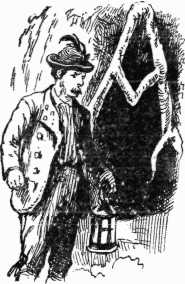
bout twenty miles north-east of Trieste, which stands at the north of the Adriatic Sea, is the little town of Adelsberg. It is a market town, and would have no more claim to notice than thousands of similar places in Europe, had it not chanced to have been built within a mile of one of the natural wonders of the world.
Thousands of years ago, when Europe was covered with dense forests, and savage man was struggling for existence with savage man and yet more savage beast, living in rude huts and ignorant of any kind of civilisation, Nature was hard at work deep below the slopes of those Adelsberg mountains. Age after age, with her simple tools of water, lime, and carbonic acid, she dug, scooped, carved, and built, fashioning by slow degrees vaulted chambers, halls with lofty domes, arches, and galleries, all gleaming like frosted silver set with diamonds, far more wonderful than Aladdin's palace, or the marble halls of the Arabian Nights. And all the while, even when Christianity and civilisation spread over the country, no one thought of the beautiful world down below those grassy slopes; though now and again some one might wonder why a deep basin in the hills, where according to tradition a lake once existed, should have been turned into dry pasture, with only the little river, Poyk or Pinka, running through it; or some more inquiring mind might have been puzzled to know why that little river should suddenly bury itself in the ground and vanish utterly from sight.
At last some enterprising being, a boy most likely, climbed into the fissure down which the waters went, most probably in the summer-time when the stream was low, and there discovered a cavern nearly three hundred feet long, now known as the Old Grotto. For ninety years this was one of the sights of the country; and then a large piece of stalactite was broken from the end, and the entrance to a far more superb cavern, known as the New Grotto, lay bare.
This New Grotto is ten times larger than the old one. It is furnished with stalactites and stalagmites of huge size and of every imaginable shape, forming arches, pillars, cornices, and fringes of exquisite beauty. The roof and walls are covered with lacework and pendants of crystals, to which great fissures, leading into narrow galleries, form backgrounds of dense shadow. The ornamental work was effected from outside by damp lime and carbonic acid, but the actual excavator was simply the river Poyk, which in time drained the lake and carried its waters through soft spots in the rock below. Every little drop that poured in did something of the digging process, and when the snows on the mountains melted, and great floods came to help, the river was able to tear away the rocks above, beside, and beneath its channel. Sometimes, for a long time together, it found itself imprisoned and could get no further, and then it would whirl round and round, boiling with anger and beating against its rocky walls, until it had hewn out quite a lofty chamber. Then sooner or later it would reach some softer formation which would yield, and the great volume of water would rush through, tearing down everything in its way, until it last it found itself once again in the sunshine.
Now, with its work in the Adelsberg Grottoes done, the river Poyk is taking a well-earned rest, and flows gently through the Grottoes, reflecting in its waters the lofty bridges and vaulted roofs hewn out by its former toil. Not that the Poyk has grown lazy! It only desires fresh worlds to conquer; after enjoying a little run in the daylight, it changes its name to the Laybach, and again plunges into the Grottoes of Reifnitz, where with all its old energy it is working as hard as ever to make the Laybach Caves as celebrated as those of Adelsberg.
Various animals live in these caverns, of which the most celebrated is the 'Proteus,' a creature which has greatly perplexed naturalists. At first sight it looks like a lizard, but its movements are those of a fish. The head, lower part of the body, and tail resemble an eel, but it has no fins, and its breathing organs are quite unlike those of fishes. Round its neck is a ruffle, which seems to help it to breathe, although it has perfect lungs and can breathe, as well as move, equally comfortably on land and in water. The front feet are like hands, and each has three fingers, whilst the back limbs have only two. The eyes are very tiny, like those of the rat or mole; its mouth is well set with teeth, proving it to be a beast of prey, and its organs of smell are fully developed. A great authority has declared its spine to be like those of the monster animals of pre-historic ages known as Saurians. The most extraordinary part of the Proteus' history is that it seems perfectly able to live without food. It has never been seen to eat in captivity, and one has been kept alive for years by occasionally changing the water in which[Pg 364] it lives. These animals were originally discovered in the Grottoes of Laybach, and later on at Adelsberg, being rare in dry seasons, but plentiful after heavy rains.
Helena Heath.
The caterpillar of the North American Great Peacock moth (fig. 4) is armed with numerous tufts of prickles ending in minute black points which pierce the hand if touched, and cause severe pain. These spines, as shown in the illustration (fig. 2, a b, on page 357) are hollow, and filled with liquid poison. 'a' is the portion which breaks off; 'b' the hollow base which contains the poison.
In some few caterpillars the poison spines take the form of balls armed with short prickles and one large spike; hence they are known as caltrop spines (fig. 2, c), from their likeness to the cruel weapons, known as caltrops, which used to be scattered over the ground in time of war to repel the attacks of cavalry; the spikes forced their way into the horses' feet when trampled on, and so disabled them.
The spines of the caterpillar of our Oak Eggar moth are very brittle, and in handling these insects, great care must be taken, as cases are known of blindness having been caused by the spines being carried into the eyes by the fingers.
Let us now turn to the liquid squirts with which some caterpillars are provided. Our Spurge-hawk caterpillar, for example, when threatened, squirts from the mouth a spray of poison. In our illustration (fig. 5) it is shown repelling the attack of the dreaded ichneumon fly by means of this spray. The quaint Puss moth, which many Chatterbox readers must have seen, can squirt out an irritant fluid, generally supposed to be formic acid, from the mouth, when alarmed, and this, if it enters the eye, causes acute pain.
The caterpillars of the Swallow-tailed moths, when irritated, give out an offensive smell, but they are unable to 'spray.'
Many beetles have the power of forcing drops of blood from a minute hole in one of the legs. This blood is saturated either with a fluid which causes a burning sensation on everything it touches, or with an intolerable odour; in either case the result is the same—they are given a wide berth by all who have discovered their power. The little lady-bird beetle, for example, sends out, when frightened, a tiny drop of a yellow fluid from the 'knee-joint,' which has a smell like opium. The Javanese 'violin-beetle' gives off a fluid which is said to paralyse the fingers for twenty-four hours.
W. P. Pycraft, F.Z.S., A.L.S.
The Black Swan is an Australian bird, and was not known in Europe until that continent began to be explored, although black swans had been often spoken of before that time as a kind of fabulous monster. The ordinary white, or mute, swan, which graces our rivers and lakes, has been admired, and even protected by laws, for many centuries, and its plumage is so beautifully and uniformly snowy that we can hardly be surprised if people thought that all swans must be white, and should regard a black swan as impossible, like the two-necked swan sometimes painted upon inn-signs. But travellers have discovered many strange animals in unexplored countries, and we now know that there are not only black swans, but even swans that have a black neck and a white body.
The plumage of the black swan, with the ex[Pg 365]ception of the quill feathers, which are white, is entirely black. The bill and the skin between the eyes are a beautiful red, which contrasts handsomely with the black feathers. The tail of the bird is very short, and, next to the colour of the plumage, this is the chief peculiarity which distinguishes it from the white swan.
The black swan frequents the swamps and secluded bays on the Australian coast. It is not a very shy bird, and is frequently seen by the sportsman and[Pg 366] the camper-out. It enjoys the companionship of its kind, and congregates usually in small flocks. August and September are, it is believed, the breeding months, and shortly before this the swans leave the swamps and seek the nesting-grounds, which are usually on the islands in the bays. Western Port Bay, not far from Melbourne, is one of their favourite haunts. The nest is a collection of reeds, and in this the female swan lays five or six eggs of a whitish-grey colour, and a little smaller than those of our white swan.
The black swan is rather strong upon the wing, and, when flying, it frequently utters a musical cry. But, being a heavy bird, its flight is very exhausting, and it appears to have more confidence in its webbed feet than its wings. It is said that when it is startled it tries to escape by swimming, if it can, rather than by taking flight. As the birds breed upon islands on the coast, they may occasionally swim out, or be drifted out, to sea. A short time ago, two black swans were picked up off Norfolk Island. They were miles away from the nearest part of Australia, and they must have been driven from their native land by winds and currents until they were lost. They were greatly exhausted when taken up, but a bath in fresh water and a good supply of food soon put them right again.
This incident is not only interesting because it shows the endurance of the swans and how long a journey they may sometimes make almost by accident, but because it illustrates the way in which animals which are natives of one country may be carried to a new one. If these two swans could have continued on to Norfolk Island, which is about nine hundred miles from Australia, and, after arriving there, could have recovered their health, made a nest, and reared a brood of young ones, then there might have been black swans in Norfolk Island as well as in Australia. These swans were probably too much exhausted to have accomplished this long journey, but we have many reasons for believing that animals have often been unwillingly driven by winds and currents to new homes across the seas, and have thus helped to extend their species over a larger portion of the earth.
W. A. Atkinson.
A Story of Adventure on the North Sea and in China.
When Ping Wang returned, he locked the door and signed to his friends to come and sit in the middle of the room.
'I have bought some offerings for us to make to the ghosts,' he said, and produced from his pocket a handful of pieces of coloured paper.
'It doesn't look very satisfying food,' Charlie remarked, 'but I dare say that it is good enough for ghosts.'
'This is not food,' Ping Wang replied—and, as he spoke, he took from the heap several round pieces of paper—'it is money. Our ghosts, according to the belief of our wise men, lead a life, in some invisible world, which is very much like what they lived here; but, as they don't appear to have a mint, we offer them money—this money. To-night we shall have the pleasure of burning those pieces of round paper, which my countrymen believe pass in the form of money into the ghosts' possession as they disappear from our sight. We will not, however, confine our gifts to money. Here are houses, carts, wheelbarrows, horses, and suits of clothes, all made of paper, to be burnt. The ghosts, my countrymen think, will find them very useful.'
Ping Wang was now in the humour for talking, and held his friends interested nearly the whole of the afternoon. Just before darkness came on they had some tea, and then paid the landlord and departed.
The people by now were flocking, or had already gone, to that part of the town where the feast was to be given, and consequently the Pages and Ping Wang found the track round the ten-foot wall of Chin Choo's house almost deserted. For this they were very thankful indeed, as it gave them a better opportunity for examining the wall.
'This will be the place,' Ping Wang said when they had gone about half-way round the wall. He pointed to several holes in it just large enough to insert the toes or fingers.
After taking note of the surroundings so that they would be able to find the spot again, they continued their journey until they reached the place from which they had started.
'Now for the feast,' Ping Wang said, quietly, and they started off in the direction of the ghosts' feast. It was a merry, jovial crowd they joined. Most of the people were carrying provisions as well as offerings for the ghosts, and Ping Wang, not wishing that he and his friends should be conspicuous, purchased three legs of pork. Then they walked on again, but, before long, came to a large and excited crowd gathered round a poster on the outside wall of a joss-house or temple. Ping Wang, leaving the Pages in a dark corner, hurried forward to read the placard, and, to his horror, found that his fears were realised. It was an anti-foreign poster, and the following is what he read:—
'We publicly announce that the foreigners who entered our Middle Kingdom many years ago have made plans to seize our territory. They ignore the teachings of Confucius, and have already taught the people their false religion, and have practised their sorceries upon them. Now the right-minded and superior men of our land are boiling with rage at the harm which the foreigners have done, and are determined to kill them. Every foreigner must be killed, and every house, shop, and church which they inhabit must be destroyed. Any one who shelters a foreigner will be killed, and all converts to the foreign religion who do not recant immediately will be executed. Kill the foreigners who are hoping to seize our country and introduce their barbarian customs! Kill the men who have made friends with them! Kill the foreigners! Kill the foreigners!'
Ping Wang turned away. He knew that the placard would have the desired effect of rousing the people to a state of frenzy. Already hundreds of people were shouting, 'Kill the foreigners!'[Pg 367]
The cry was, by this time, familiar to Charlie and Fred, and there was no need for them to ask Ping Wang what was printed on the poster.
By a slight movement of his head, Ping Wang signed to the Pages to follow him. He walked a few yards down the crowded street, fearing every moment that his friends would be detected by the mob and killed before his eyes, and then turned into a narrow lane, dark and almost deserted. The people had evidently flocked into the main road. He sighed with thankfulness, and, having glanced round and seen that the Pages were following, he quickened his speed. It was some years since he had traversed the bye-streets of his native town, but they were not changed to any great extent, and he had no difficulty in finding his way. He led his friends through street after street—gloomy and squalid places, but happily deserted by the residents. At last they came into a main road which led to the town-gates; not the ones at which they had entered early that morning, but those on the other side. He could see them in the distance. They were open, and he was tempted to lead his friends straight out into the country, and away from the danger which threatened them. At any rate, it seemed to him that he would be doing an unfriendly action if he did not tell them that escape was still easy.
'There are the gates,' he said in an undertone. 'Shall we go out and hurry off to Barton?'
'No,' Charlie said, firmly; 'not until we have got your treasure.'
'But do you know what was on that poster?'
'We have a very good idea, I fancy. An order to kill all foreigners, was it not?'
'Yes. Shall we escape?'
'No. Hurry on to Chin Choo's.'
Ping Wang again led them through narrow, dirty streets until they caught sight of Chin Choo's house. When they were about fifty yards from it, they saw the gates thrown open and the mandarin's palanquin borne out. From the shouts of the man with the whip who ran ahead of it, they knew that Chin Choo was inside.
'That is good,' Ping Wang whispered. 'Now that Chin Choo is out, the servants will start gambling and smoking opium. We need not fear being disturbed by them.'
In less than five minutes they arrived at the spot where they had decided to start their undertaking. They looked up and down the road, and, seeing no one about, Ping Wang climbed the wall.
'It is very easy,' he said, when he reached the top; 'the drop on the other side is only about six feet.'
He disappeared into Chin Choo's grounds and Fred at once scaled the wall. Charlie was about to follow him, and had already climbed five or six feet from the ground, when he heard some one approaching, and, before he was able to decide whether to jump down or continue climbing, his left foot was seized and tugged so viciously that he came down with a rush on top of his assailant.
In an instant he was on his feet again, ready to defend himself from any further attack. Looking down at the person on whom he had fallen, he saw to his astonishment that it was the cart-woman who had caused him so much annoyance before.
She lay glaring at Charlie, speechless and panting. But he had barely recognised her when he heard a shout of 'Foreigners!' and looking round saw the woman's husband running at him. He jumped quickly aside, and to defend himself snatched up one of the legs of pork, which had been left on the ground.
He rushed at the Chinaman, who, being a great coward, immediately turned about and fled. But Charlie was upon him in a moment, and with the leg of pork dealt him a blow on the back of the head, which sent him sprawling on the ground. A knife fell from his hand and Charlie at once seized it. The woman, seeing what had befallen her husband, scrambled to her feet and toddled to him shouting, 'Foreigners!' as she went. To prevent her being heard Fred clapped his hand over her mouth, and, in spite of her biting it, kept it there.
Meanwhile Ping Wang and Fred had scrambled back, hearing the noise. They joined Charlie, and between them managed to tie the Chinaman's pigtail round the woman's neck, so that neither could move without difficulty.
'Now let us leave them,' Ping Wang said, and they started running. But before they had gone many yards they heard the Chinaman and his wife shouting frantically, 'Foreigners! Kill the foreigners!'
Their shouts were heard by others, also, and a man rushed forward to stop them, but Charlie raised his knife threateningly and the fellow ran. Nevertheless, he too shouted 'Foreigners!' and, gathering together some friends, started in pursuit. At every few yards others joined in the chase.
'Where are you going to take us?' Charlie asked of Ping Wang, after glancing back at the mob pursuing them.
'To the gates,' Ping Wang answered. 'This is our way.'
They turned into one of the narrow streets which they had traversed earlier in the evening, and, as they ran at full speed along it, here and there men came out of their houses to see what the noise meant. They heard the shouts of 'Foreigners!' but the average Chinaman has a great respect for his skin, and consequently not one of the men who saw the Pages and Ping Wang rush by attempted to stop them.
'I'm done up,' Ping Wang gasped before long; 'our only chance is to hide.'
The next street was a short one, and the Pages were surprised after what Ping Wang had said about being tired to see him sprint along it. They followed close on his heels, and when he stopped at the end of it, they did the same. Instead of crossing the wide road which faced them, Ping Wang turned to the right, and after walking quickly for about thirty yards made another turn to the right which brought them into a narrow street running parallel with the one down which they had sprinted. There was no one visible; all the residents were evidently at the feast. Ping Wang stopped at the second house and pressed his hand against the door, which opened. He peeped into the place, and, seeing no one, entered stealthily, the Pages following quickly and equally cautiously. As soon as they were in, Ping Wang shot the bolt of the door. It was a dark and dirty room in which the fugitives found themselves, and by the faint light of a lantern they could see that it was a poverty-stricken place.
(Continued on page 374.)
[Pg 368]
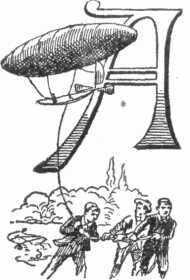
t an electrical exhibition held at Paris in 1881, most of the sightseers were very interested in a little model balloon which had been made by two famous balloonists, Messrs. Gaston and Albert Tissandier. It was quite unlike any balloon ever seen before. The silk bag for containing the gas was long and pointed at either end, and floated horizontally in the air, so that at a little distance it was not unlike a fish without a tail, though a sheet of canvas, shaped like a fish's tail, was placed beneath the balloon at the rear end to be used as a rudder. Suspended by a number of slender ropes, which met under the centre of the gas-bag, were the car for the sailors and a small electric engine for driving a powerful screw, the wings of which striking against the air would propel the 'ship' at the rate of some nine feet a second. The baby balloon may be said to have set the example for all modern air-ships, though others something like it had been built before. Two years later Messrs. Tissandier made a large copy of their model, and ascended on October 8th, 1883. As the screw succeeded in driving the balloon forward at a greater speed than that at which the wind was blowing, they were able to steer a course, just as the steamboats on the St. Lawrence River are able to shoot the rapids in safety by putting on full steam and over-racing the current. Messrs. Tissandier repeated their experiment in November, 1883, and actually drove their balloon against the wind for a short distance. As night overtook them while on this triumphant journey they did not attempt to return by balloon to Paris, but descended in the country two hours after leaving the capital.
Such was the first successful effort to steer a balloon, and it was not long before many aeronauts were following in their steps. In 1884 the air-ship 'France,' with Captains Krebs and Renard on board, was watched by a large crowd as it sailed from Meudon, near Paris, and after a wonderful flight came back against the wind to the place from which it started. Five more similar voyages were made, and in each the 'France' showed great obedience to the rudder and sail. But all these experiments were very expensive, and involved great danger. It was found, moreover, that the machinery necessary for driving the screw could not be made light enough to be really suitable. Thus there was not much heard about steerable balloons until some years later, when M. Santos Dumont began his cruises—and many strange adventures he has had.
Instead of the electric engine used by the Tissandiers, he employed the small petrol engine out of a motor tricycle. With this he started on his aerial voyages. But before we follow him we must look at his ship for a moment. From each end of the long balloon he allows a cord to hang, supporting a small weight. These are to enable him to alter his course upward or downward. If he wishes to travel upwards, he pulls into the car, by means of a thin cord, the weight which is hanging in front. This, of course, allows the head of the balloon to rise, at the same time changing the angle of the screw in the rear so that it drives the balloon upward. When he pulls the rear weight into the car, the reverse takes place. The car, the engine, and the screw are all suspended from the silk envelope by piano wires, so that it looks, from the ground, as though M. Santos Dumont were moving about in a spider's web.
On one of the first cruises the balloon behaved very well while floating at a great height, but when he descended into denser atmosphere, the gas contracted in the long thin bag, and he saw with horror that it was doubling up 'like a pocket-knife.' This made some of the cords so much tighter than others that at any moment they might cut through the silk and send him to the earth like a stone. Yet it was no use throwing out ballast, though to rise into thinner atmosphere might have put the balloon right again. 'I must descend sooner or later,' thought the aeronaut, 'so why not now?'
Beneath him lay a grassy stretch of country on which a number of boys were flying their kites. As he rapidly drew nearer, M. Santos Dumont, leaning from his basket, called to them to seize the guide-rope, which had already reached the ground, and run with it as fast as they could against the wind. The boys were sharp-witted, and obeyed at once. The speed of the descent was checked by the rush of wind, and the voyager landed in safety.
Misadventures of this sort have only increased the keenness with which M. Santos Dumont pursues his studies. The principal triumph he has yet secured was won some three years ago, when he steered his balloon round the Eiffel Tower and back to the starting-point. It only meant a distance of some fourteen miles in all, but it carried him to fame and honour in half an hour, and the Government of his native country (Brazil) had a gold medal struck to commemorate the event. Never before had the power of navigating the skies been proved so thoroughly. But it was not accomplished without several unsuccessful attempts. On one occasion the engine stopped when the winning-post was only a few yards away. Another time, the balloon lost gas through a faulty valve, and some of the suspension wires slackened so much that they caught in the whirling screw, which was beating itself into shreds. The traveller instantly stopped the engine, and found himself the next moment drifting dangerously near to the Eiffel Tower. It was safer under the circumstances to let the ship sink, and a few minutes later, like a vessel being driven on the rocks, the aeronaut's car crashed against the roof of a large hotel, the framework of the air-ship lodging itself at last over a deep courtyard, with its occupant in mid-air. From this perilous position he was rescued by a party[Pg 371] of firemen. In each of these misadventures M. Santos Dumont reads some lesson for the improvement of his ships, so that the day may come when he will be able to show us an aerial vessel in which even timid people might travel without anxiety.
aid the Pencil to the Slate,
C. J. B.
15.—
W a l t e R
O         A
L i n n e T
V         I
E r m e l O
R         C
H a w a i I
A         N
M e d u s A
P         T
T a h i t I
O         O
N o r m a N
Right post—Wolverhampton.
Left post—Ratiocination.
Round 1. Walter.
Round 2. Linnet.
Round 3. Ermelo.
Round 4. Hawaii.
Round 5. Medusa.
Round 6. Tahiti.
Round 7. Norman.
A general had been very unfortunate in a battle, and his defeat so preyed on his mind that he lost his reason. He had to be kept confined in a room in his own house, and an attendant was always near to wait upon him, and to prevent him from doing harm. One day, an officer who had been paying him a friendly visit happened to leave his sword and scabbard in the general's room. As soon as the officer had gone, the general seized the sword. Then he rushed at the man who attended him, saying, 'Now I can cut off your head.' The attendant answered, 'Oh, sir, anybody can cut off one head; it would be a stroke more worthy of you to cut off two. Wait a moment till I go for another.' To this the general consented, and the man quickly made his escape from the room. Needless to say, he returned with help and overcame the madman; he owed his life to his ready presence of mind in this strange peril.
The goodwill shown by one animal to another in time of need is an example to us all. Very lowly creatures are able to understand, and are ready to help each other like brothers, with no other motive than their comrade's need, and no other reward than the power to relieve it.
There is a kind of beetle which makes a ball or pellet of manure, in the middle of which it places its egg. This it rolls towards a hole previously dug, and drops it in. One of these beetles was seen painfully toiling to roll its little ball out of a cart-rut, into which it had tumbled; he was trying with all his tiny might, but all in vain. After pushing it up the side a great many times, the ball rolling back again, he went off to a manure-heap close by, and came back with two other beetles, his neighbours. All three set to work shoulder to shoulder, and between them shoved the ball out of the rut. Having done as they would be done by, the assistants then returned to their own business.
Sir Frederick Doyle, while watching some wasps eating plums on his trees, knocked one down without killing it. The wasp fell into a large spider's web below. To his surprise a fellow-wasp instantly flew down to the rescue. He poised himself close to the spider's web, whirling his wings till they looked like glittering rainbows, so fast that their shape could not be seen. This was to prevent them from being caught in the sticky web, and all the time he was striking deft and rapid blows at the threads that held his friend fast. At length he cut him out, but the poor rescued insect fell down to die upon the ground. The observer adds: 'I was so much struck with this proof of a heart as well as a brain in the case of wasps that I not only spared the "V.C." wasp who rescued his friend, but also the rest of the troop, and left the plums to their fate.'[Pg 372]
The weasel, that terrible foe to rabbits and rats, is not famous for good temper, yet a pretty tale is told of one of them. A gentleman was riding home, when his horse trod on a weasel, which was unable to get out of the way in time. The poor little animal's spine seemed to be hurt, and it could not move its hind legs. Presently another weasel came out of the hedge by the roadside, and went up to the injured one. After carefully inspecting it, the second weasel picked up the first and carried it to the side of the road, out of the way of the traffic, where he gently laid it down.
Wild elephants seem unable to bear the sight of suffering friends without an attempt to save them, and in particular the wild herds of these noble beasts love and protect their leaders. When pressed by hunters, they place him in the midst and crowd in front of him, eager to save his life at the expense of their own. Professor Romanes gives an instance of a fine 'tusker' which, when badly wounded, was promptly surrounded by his companions. They supported him between their shoulders, and actually succeeded in covering his retreat to the forest.
Birds are very generous towards each other in these ways, particularly such as live in communities together. If one rook of a colony gets into trouble, all the rest are worried about him directly. A great mob of rooks, living in trees near the river Irwell, were seen chasing each other playfully on the wing, dancing idly with joy and pleasure at the coming spring, when one of them accidentally knocked against another, and fell into the river below. In an instant a chorus of distress was raised; the birds hovered over their friend, as he struggled in the water, with cries of sorrow and alarm, and seemed to be giving him advice in some fashion of their own. At any rate, urged by their voices, he sprang into the air, and by one strong effort managed to reach a point of rock. The shouts of joy at his safety echoed far and wide.
Much tenderness is shown by grown-up birds to helpless orphans in need of their aid. A redbreast was mentioned lately in Science Gossip as doing a deed of kindness towards a young starling one bitterly cold morning. The starling had left the nest, and was sitting frightened and shivering in a cellar, whither it had crept, too weak and hungry to fly. In vain kindly human hands offered it bread; it refused all food, till a little hungry robin came down on his daily visit to the house and spied the baby-bird, sitting on one leg, calling his absent mother. Off he went, and soon came darting back with a worm, which was gratefully accepted. When the beggar-bird had been fed, both flew away. Seagulls have been seen assisting a wounded comrade over the wave, and a crane, seeing one of its fellows shot, placed itself under the sufferer in such a way as to prevent his falling to the ground; then, weighted as he was, he bore him away beyond gun-shot.
In sickness, too, not only monkeys, dogs, cats, and the higher animals, but the lowest also, as well as birds, show good feeling. On a salt lake in Utah[Pg 373] lived an old and completely blind pelican, which was very fat, 'and must,' says Darwin, 'have been well fed for a long while by his companions.' Crows feed their blind friends, and so do rats, and a case is on record of a barn-door cock who did the same thing. These and similar facts, which could be multiplied by thousands, prove how beautiful a spirit is that which our great Creator breathed into even the humblest of His creatures, and how worthy, for His sake, they are of our reverence and regard.
Edith Carrington.
'Step out, Jack! There's a mile yet before we get to the station.'
'Yes; and a mile in this snow counts for three!' answered Jack. 'But we have nearly an hour for it. We shall catch the train right enough; but it is a heavy snow-storm, and no mistake!' And then the two young fellows plodded resolutely on.
It was Christmas Eve, and they were on their way to catch the mail-train to town, and were looking[Pg 374] forward to a right merry time with their people at home. But somehow to-day everything seemed against them. First of all, they were detained beyond time at the bank, in which they both were clerks, and so missed the last train to town from their little branch station. There was just time, however, for them to catch a train on the main line, but to do this they had to take a short cut through Lord Ravensmere's woods, and the thick snow having covered the paths, they lost their way several times, and this, of course, delayed them again.
However, the walk was nearly over; the station lamps could be seen twinkling in the valley below, and the young fellows were hurrying on, when they heard a faint cry, 'Help! help!' coming seemingly from the wood alongside.
They stopped, and listened. Again came the cry, 'Help! By the big oak!'
Both made a dash for the oak. It was but a few paces off; and there, almost hidden in the deep snow, lay a young fellow of about their own age.
'I'm Lord Ravensmere's son. Take me up to the Castle, if you can,' he said, feebly. 'I'm done!' And, having said this, he fainted away, and lay like dead on the snowy path.
'The Castle! That's a mile off. He will freeze to death if we leave him here and go for help,' said Jack, the elder of the two lads.
'We must carry him. We can do it between us,' said Ralph; 'but—I say, old fellow, we shall miss our train, and have to return to those dreary lodgings of ours for Christmas!'
Jack nodded, and then, without another word, the two lads lifted the unconscious youth, and somehow, with interlaced hands to form a seat, they stumbled along that snowy mile to the Castle, supporting the stranger between them as best they could.
By the time they had reached the Lodge, both Jack and Ralph were thoroughly exhausted with their exertions; but here help was at hand.
The Earl himself was there, and with him quite a band of grooms and keepers, all about to start in different directions, to look for the young heir.
The old man's gratitude to the young clerks was simply unbounded. He insisted on their spending the night at the Castle, and here, dressed in some of the young heir's suits, they sat down to what Jack afterwards described as a Lord Mayor's banquet; and, later on, in the drawing-room, Lady Ravensmere herself, with tears in her eyes, thanked them warmly for saving her son, and told them they should never forget what they had done.
The Earl himself drove the lads to the station next morning, so they did not miss the Christmas dinner with their friends, after all.
A Story of Adventure on the North Sea and in China.
In the room in which the fugitives now found themselves, there were several garments hanging.
'Let us change our clothes,' Charlie whispered; 'it will be a splendid disguise.'
Ping Wang's face beamed. He pulled off his coat and trousers and donned in their place a dirty jacket and a pair of ragged knickerbockers. Then, taking off his 'beehive,' he wound round his head the yellow scarf of the Boxers.
Charlie and Fred hastened to follow his example. Ping Wang tied their Boxer cloths around their heads, and then looked at them with interest.
'Splendid,' he declared, 'and now we must be off in case any of the people return. They have gone,' he added, after listening for a few minutes.
He opened the door. A passer-by spoke to him, and he answered cheerfully, making some remark which caused the man to laugh heartily as he continued his journey.
'Come on,' Ping Wang whispered, when the man had passed out of sight, and stepped into the street, followed by Charlie and Fred.
No one penetrated their disguise as they hurried along the streets. One man informed Ping Wang that the three foreigners had been killed. They had taken refuge in a house and the mob had thereupon set light to it. He pointed to the distant flames. Ping Wang was sorry for the men who had been mistaken for them, if they were really in the burnt house, but could not help feeling relieved at the thought that now the mob had wreaked its vengeance it would probably disperse for the night.
'When we turn the next corner we shall be facing the gates,' Ping Wang said after a short walk; and Charlie and Fred heard the news with thankfulness. They were as determined as ever to recover their friend's wealth before quitting China, but they realised that it would be folly to make another attempt to do so while the Boxers were stirring up the people. Their idea was to return to Hongkong and remain there until the anti-foreign feeling had grown less strong.
Ping Wang was the first to reach the corner. To the astonishment of his friends he stopped short, with an exclamation of surprise. Charlie and Fred were at his side in a moment and saw at once the cause of his astonishment—the town gates were closed!
The surprise which they showed on seeing that the gates were closed did not cause any comment or notice among the people standing near, for they too had been surprised and annoyed by the same thing. Chin Choo had given the order for the gates to be shut, and the soldiers dared not open them until they received from him a command to that effect.
After a time the crowd began to disperse, some of the people wandering off to find lodgings for the night, and others sitting down by the roadside in the hope that, before long, the gates would be thrown open. Among the latter were the Pages and Ping Wang. They found a dark corner, and sat there almost entirely hidden from passers-by. Ping Wang sat in front of his friends, so that if any one did peer into their corner he would see him, and conclude that his companions were Chinamen. A long silence was at last broken by the shouts of an advancing mob.
'They've discovered their mistake,' Charlie declared, 'and are continuing the search for us.'
'Don't talk,' Ping Wang said, and once more they became silent, listening eagerly to distinguish what the mob was shouting. In a few minutes their[Pg 375] suspicions were confirmed, for the cry which burst from hundreds of throats was one that there was no need Ping Wang to translate—Charlie and Fred understood only too well what it meant.
'Kill the foreigners!' Nearer each moment came the crowd, every man uttering the same cry. Soon it came in sight. At the head of the mob was Chin Choo in his palanquin, wearing the yellow head-cloth of the Boxers.
'They're Boxers,' Ping Wang whispered, 'and evidently they have no idea that we are alive.'
This was welcome news to Charlie and Fred, and remembering that they too were members of the Boxers' Society, they watched the crowd with great interest. Every Boxer wore his yellow head-cloth, and carried a weapon of some sort. A few only had rifles, the remainder being armed with swords, knives, bows and arrows, and sticks.
When the Boxers had arrived at the town gates, Chin Choo addressed his followers from his palanquin. He declared that the foreigners had come to the Middle Kingdom for the sole purpose of taking their country, and that, therefore, it was necessary to kill them all at once. If any were permitted to escape, they would return to their own land, and come back with many more. Then he declared that the Boxers would avenge all the cruelties which he said had been enacted by the foreigners, and finished up with the statement that the Boxers could not be wounded. Bullets would glide off their skin without making a scar, and swords, spears, and knives would make no impression.
Chin Choo saw that the people had doubts about the truth of his last assertion, and beckoned two of his officers to approach him. He talked with them for a few moments, and then declared, in a loud voice. 'Now you shall see that nothing can harm the men who wear yellow head-cloths.'
As he spoke six Boxers advanced, and stood with their backs to the town gates. Then twelve of the soldiers marched forward with their rifles at the trail, and halted about twenty yards in front of them. At the word of command they loaded their rifles and raised them to their shoulders. An instant later they fired a volley at the six Boxers, but, to the astonishment of the onlookers, not one of the men was injured.
'They used blank cartridges,' Fred declared.
'It was smart of Chin Choo,' Charlie declared, and Fred and Ping Wang agreed with him, for not one Chinaman in a thousand knows that there are such things as blank cartridges.
The crowd was delighted with this miracle, and the Boxers themselves became wild with joy. They waved their weapons about, and shouted to be led against the enemy at once. Their desire was granted, the gates were thrown open, and the Boxers marched out of the town.
'Come on,' Ping Wang said, when the Boxers began to move forward. 'We will march out with them.'
They slipped into the road, and joined the tail of the Boxers boldly, brandishing the knives that they had with them in imitation of the Chinamen's actions. Ping Wang shouted as loudly as any man, and shook his fist fiercely at an imaginary enemy.
'Keep your eye on me,' he whispered to Charlie when they had marched about a mile. 'We will bolt soon.'
Charlie saw that it would not be a difficult thing to escape from the rabble army, for men straggled away right and left, just as they felt inclined. The officers walked in front, and beyond looking round occasionally to see that the mob was following, kept no further watch on them.
Before long Ping Wang halted to rearrange his head-cloth. Charlie and Fred turned, and stood looking at him as if they were waiting for him to finish and march on. Their action was very natural, and the few men who had been marching behind them passed on without a remark.
Ping Wang continued to fumble about with his head-cloth until the last of the Boxers were out of sight. Then he said, 'Now's our time,' and quitted the track. The bushes, which grew thickly along the roadside, afforded ample 'cover' if they needed it.
'We must hurry through this undergrowth without being seen, and get well ahead of the Boxers,' said Ping Wang; 'then we will rejoin the track and run forward at full speed.'
They proceeded cautiously, but travelled quick enough to gain on the Boxers.
'We are about level with the middle of the mob,' Ping Wang declared some minutes later. 'We must get a good half-mile ahead of them before we rejoin the track.'
As Ping Wang finished speaking, Fred, who had looked behind him, exclaimed, anxiously, 'There's some one following us.'
Charlie and Ping Wang stopped short, and, looking in the direction indicated by Fred, saw a dark figure struggling through the bushes after them.
'Let us wait and tackle him,' Charlie suggested, but Ping Wang objected firmly to that proposal.
'There may be other fellows following him,' he added, 'and a shout from any one of them would bring the mob rushing over here in a moment. The best thing that we can do is to hurry on as quickly as possible.'
'Come along, then,' Charlie said, and started running. They ran a little more than a mile. They soon left the Boxers behind, but the man whom they were trying to avoid still pursued them.
'He has gained on us,' Charlie declared, and Fred and Ping Wang could not deny it.
'We must run faster,' Ping Wang said, but, as he was panting for breath, Charlie and Fred felt sure that they would not get rid of their pursuer by running.
'He is alone,' Fred declared; 'let's stop and see what he wants. We may be certain that he hasn't any firearms with him, for if he had he would have had a shot at us long before this.'
Ping Wang, however, did not agree; he preferred to keep on running. But he sadly over-rated his running powers, and before they had gone another hundred yards he had to stop and gasp for breath. The pursuer was now approaching them rapidly, so Charlie and Fred grasped their knives and waited for him. He increased his speed, and, as he drew nearer, they saw that he was wearing the yellow head-cloth of the Boxers.
(Continued on page 378.)
[Pg 376]
A Story of Adventure on the North Sea and in China.
When the man was within twenty yards of the fugitives, he caught sight of their knives, and, stopping suddenly, exclaimed in pidgin English:
'What for knives? my plenty good Clistian man. My no knives, no shootee gun, no nothin'.'
As he spoke, he held up his hands to show that he was unarmed, and, with perfect confidence in their honour, advanced in that fashion.
'Who are you?' Charlie asked, as the thin, wizened, but lively little Chinaman stood before them.
'Number One cook. Welly good cook for missionally man.'
'What for wantee catchee us?' Fred inquired.
'Englisheeman takee to missionally.'
'How you savvy we Englisheeman?'
'Englisheeman pigtail plenty good,' Number One cook explained, but added the unflattering information that 'Englisheeman no can hide welly much funny nose, welly much funny eyes, welly much funny mouth.'
Ping Wang, having recovered his breath, took up the conversation, Charlie and Fred meanwhile keeping a sharp look-out for Boxers. When they had walked quickly about a quarter of a mile, Ping Wang brought his conversation in Chinese to a close.
'This man says,' he informed the Pages, 'that he is employed at the mission station for which we are bound. He had been sent up-country by the missionaries on business, and was returning through Kwang-ngan when he saw the anti-foreign placard. He did the same thing as we did—hurried to the gates—but did not reach them until after they were closed. Being hungry, he went back to get some food, and on his way to the shop he met a sleepy Boxer, who had apparently just come from an opium den. Number One said to himself, "I will have that head-cloth," and he took it, giving the Boxer his own hat instead. Then, after a while, he made his way to the gates, arriving there just as the Boxers were marching out. He declares that he knew that both of you were Englishmen the moment he saw you. He kept his eyes on us, and decided to join us.'
'Does he think that the rising will spread?' Charlie asked.
'He is sure it will, and he means to urge Barton and his friends to leave the country as quickly as possible.'
Being now about half a mile ahead of the Boxers, the two Englishmen and the two Chinamen made their way back to the track, and, after walking quickly for another hour, arrived at the gates of Su-ching, which they had hoped not to re-enter until they brought with them Ping Wang's treasure. The gates were open, but the soldiers who guarded the entrance to the town had thrown off their usual air of apathy, and were questioning eagerly every man who came from the direction of Kwang-ngan. On seeing four Boxers approaching, they hurried forward to meet them.
'Are the Boxers coming quickly to kill the foreigners?' they asked, excitedly.
'They are,' Ping Wang answered. 'Listen and you will hear them shouting.'
The noise of the advancing mob reached them as a faint, buzzing sound, but loud enough to convince the soldiers that the Boxers were really coming. They were anxious to ask Ping Wang and his companions more questions, but Ping Wang cut short their questions.
'We bear a message,' he declared, 'and we must deliver it at once. We have run quickly, for we did not carry rifles. But now that we have finished running, give us rifles, in case we meet any foreigners.'
To the soldiers this request appeared to be a perfectly reasonable one, and, knowing that the mandarin and other town officials sympathised with the Boxers, they took from the armoury, which was close by, four Snider rifles, and handed them out to Ping Wang, with ammunition.
Feeling safe once more, Ping Wang and his friends hurried off in the direction of the mandarin's house; but, as soon as they got out of sight of the soldiers, Number One exclaimed, 'This way welly much more quick,' and turned up a narrow side-street. The Pages and Ping Wang followed him, and in about three minutes they arrived at the wall of the mission station, which they saw was already placarded with anti-foreign manifestoes. They rang the bell, but some minutes passed, and the gate was not opened. They rang again, loudly, and a minute later they heard Barton inquire, in Chinese, who they were.
'Missionalies,' Number One answered, quite convinced that Charlie and Fred were missionaries.
'Where from?' Barton asked, for one of his native servants had already turned traitor, and he was now very cautious.
'It's all right, Mr. Barton!' Charlie sang out. 'We are the Pages, Ping Wang, and your Number One cook.'
'That's splendid!' Barton declared, and, although they could not see him, they knew by his voice that their arrival was welcome. 'Wait a moment,' he continued; 'the gate is barricaded, but I will lower a ladder to you. Here you are!' he called down a minute later, and on looking up they saw him lowering from the top of the wall a long bamboo ladder. When it touched the ground they planted it firmly.
'You go first, Number One,' Charlie said, in a tone that showed he meant to be obeyed.
'Welly good,' Number One replied, and went up the ladder as nimbly as if it were his usual way of entering the mission station.
Fred followed Number One, and Charlie asked to be the last, but Ping Wang objected.
'Hurry up!' Barton sang out, and Ping Wang, seeing that Charlie was determined to be the last man up, climbed the ladder. Just as he reached the top, and as Charlie planted his foot on the lowest rung, three men, with knives in their hands, came running up, and Charlie was unaware of his danger; but Fred saw the scoundrels, and slipping a cartridge into the breach of his rifle he took aim, fired, and[Pg 379] shot the foremost man. The other two, who had not expected any danger, turned about and fled in terror.
'Fred,' Charlie said, when he had climbed over the wall, 'you saved my life.' Then he turned to Barton. 'I see that you are prepared for the Boxers,' he said. 'We were afraid that we shouldn't get here in time to warn you of their approach.'
'Are they on their way, then?'
'They will be here in ten minutes at the latest.'
Barton sighed. 'I had been hoping,' he said, 'that the Empress-Dowager would have had the Boxers suppressed before they would be able to reach here. I am afraid, however, that she is secretly encouraging them. It is a great sorrow to my colleagues and myself to find ourselves arming against the people among whom we have lived on friendly terms for some years. However, we must protect our women and children. Since you left us, eight men, five women, and four children have joined us. Some of them have suffered terribly in their flight from the Boxers. Their own mission stations have been destroyed, and many of their fellow-missionaries were murdered. Consequently we may have to fight.'
'How many European men have you, and what weapons?' Fred asked.
'Thirteen, counting you and your brother, and we have eight rifles and five revolvers. That is not including your Sniders.'
'But what about provisions?' Charlie asked.
'I have got a good stock, and I think we can stand a month's siege. Of course it won't last quite so long now you are here.'
The other missionaries now joined them, in answer to Barton's summons. The majority were young men, but two were middle-aged, and one a grey-bearded old gentleman. Each had his rifle or revolver, and, although they did not wish to be forced to fight, they had the determined looks of men who knew that their cause was a good one, and were prepared to die in its defence. Their positions at the wall had been settled some hours before, but the arrival of the Pages, Ping Wang, and Number One made a fresh arrangement necessary.
'I will post you above the gate, with Ping Wang, and Number One, as you call him,' Barton said to Fred, adding, 'I will make Charlie my lieutenant.'
'That won't do,' Charlie declared. 'I know nothing about military matters, but Fred does. He's a Volunteer, and a jolly good shot into the bargain. Make him your lieutenant.'
'Very well. Then you go over the gate.'
Charlie took up his position on a platform built over the gateway, on the inner side of the wall. Ping Wang was on his right, and Number One on his left.
'I came to the conclusion,' Barton said, as he showed Fred the defences, 'that it would be risky to make loopholes in the wall, in case, after a time, we should be unable to place a man at each. Therefore we built those platforms.'
The platforms were built at intervals around the wall, each having room for six or seven men. The defenders would have to shoot over the top of the wall, but cover had been provided for them by sandbags fixed securely along the ridge.
'Our women workers made those sandbags,' Barton remarked. 'They used table-cloths, rugs, curtains, and even some of their own dresses. They have been a great help to us.'
'By-the-bye, do your colleagues know how to handle their rifles?' Fred inquired.
'Mr. Wilkins, that old gentleman with the grey beard, was a good shot forty years ago; but from the time he first left England, until yesterday, he hadn't touched a rifle. However, he was practising yesterday and to-day, and I have no doubt that he will do well. My other colleagues had never handled a rifle in their lives until this morning, when I gave them a little instruction. I was a member of the Oxford University Corps.'
'We ought to make a good defence then,' said Fred. 'But we must keep a sharp eye on the ammunition, and see that it isn't wasted.'
'That reminds me that my man got a fine Lee-Metford and a large box of ammunition. They were sold to him at a low price by a boatman who, I suspect, had stolen them at one of the treaty ports. As the rifle was strange to me I held it back until I had time to learn how to fill the magazine. Would you like to have it?'
'I should, very much.'
They hurried to the verandah of the house where the Lee-Metford and ammunition lay. Fred picked up the rifle and, after examining it closely, recognised it as the very one which he had used with good effect against the river pirates. He was about to tell Barton of his discovery when loud shouts from the town made known to them that the Boxers had arrived. Fred pulled off his skull-cap, filled it with cartridges, and followed Barton down the steps and up on to the platform, where Charlie, Ping Wang, and Number One were stationed.
Who does not know the Street Toy-man? 'All made to work! Here you are, sir, a real motor-car for a penny! The wonderful jumping frog!'
Cheapside and Ludgate Hill, and many less busy parts of London, ring with such cries for a month before Christmas. All the year round the hawkers are standing patiently on the curbstone with their wonderful penn'orths; but it is at Christmas-time that they do most business. Some children are fortunate enough to be taken by their parents to see the streets at Christmas-time, and sometimes they are allowed to buy some of the pretty things for themselves. But there are many others not so fortunate, who can only look on wistfully, and others again who are not rich enough or, perhaps, too ill even to go and look at the sights. Poor men and women, who cannot really afford even a penny, find in the hawkers' wares the cheapest market, and many a bare, cold home is brightened at Christmas by one or two of the little toys that cost so little, but bring so much happiness.
These toys have a wonderful history of their own. Do you know that when you have one of them in your hand, you may be holding what has come[Pg 380] thousands of miles over sea and land from the hands of other children in distant countries? Whole families make a living by manufacturing these toys. The material—wood, paper, tinsel, wire, or what not—is given out at the factory, and the worker takes it home. There every one is busy; one cutting out pieces of paper of a given shape, one whittling pieces of wood to fit together, one gumming up the[Pg 381] various parts, till the whole toy is finished and added to a growing pile. Nearly every civilised country has such workers—Austria, Germany, France, America, Japan, and England; and the toys in the end travel mile after mile in great ships and trains, to be sold in the streets for such a little sum!
Now think how some of these are made. Most of those which require gumming or fitting together are[Pg 382] the work of man's hands alone. The birdcage and dog musical-box in the illustration are of this kind. In the inside of the box under the dog is a little cogged wheel, which, when the handle is turned, rubs against pieces of metal and produces the musical sounds. The bird's song, or rather, croak, is caused by air rushing through a sort of parchment tissue when the floor of the cage is compressed. The train, carman, cart, and trailer are made almost entirely by means of moulds, though some parts have to be fitted together by hand. First of all, a model is made in wax or clay, or some other substance, then a cast is taken of it in plaster of Paris, then a double mould (in two pieces) is made from the plaster cast, and into these moulds liquid metal—an alloy mainly composed of lead—is run, and left to cool. All these five toys have wheels that move. They are electro-gilt—that is, the gilding is fixed on them by means of a bath through which an electric current passes.
The other toys in the illustration are made mainly by hand, though parts have to be cast in moulds or cut by machinery. The monkey bicyclist is hand-made; his body is composed of wool and wire. The weight hanging down under the string keeps him perfectly balanced, and as the string is raised or lowered he runs up and down more easily than a good many human bicyclists.
The differences in general appearance of the men of various races are most striking. No one could mistake a Chinaman for a North American Indian, or a Negro for a Malay or a Maori. Not only are these men of various races different in outward appearance, but they have also minds of different characters, and seem naturally fitted for different kinds of work.
The Chinaman has his own special fields of labour. He is a great trader with the countries near home, and sends out many junks to the East Indies, the Malay Islands, and the South Sea Islands, to collect edible birds' nests, trepang, ornamental woods, pearls, pearl-shells, tortoise-shell, and the skins of birds of paradise. At Singapore, there are hundreds of Chinese shopkeepers, who sell all kinds of miscellaneous articles, such as penknives, cotton thread, writing-paper, gunpowder, and corkscrews, often at a price which would be considered cheap even in England.
But it is when the Chinaman settles in some American or Australian town that his special abilities are best seen. He is surrounded and outnumbered by Englishmen and Americans, and is entirely under their government; and yet there are some kinds of work which he can do so well and so cheaply that no European can compete with him. He is an excellent gardener in a small way, and if he can obtain only a very little plot of ground, he will cultivate it so constantly and so carefully that he will be able to maintain himself in comfort with the money which he obtains from the sale of his vegetables and fruits. Many gardens belonging to Chinamen are to be seen on the outskirts of the cities of Australia and New Zealand, and early in the morning the Chinamen hawk their products through the streets.
The Chinaman is equally good as a laundryman, and in some cities the Chinese colonists do the whole of the laundry-work. In San Francisco, where there are thousands of Chinese, all the washing is performed by them. They work in the open air, just as the English and Scotch women used to do in their public washing-grounds, standing in the water rubbing and wringing their clothes. They have a curious practice in ironing, of spraying the linen with water through their mouths. They do the work very thoroughly, and at the same time cheaply. A Chinaman will live very comfortably on forty pounds a year, and, as he is an almost incessant worker, he can make sufficient money for his needs by work which is very poorly paid from an Englishman's point of view.
hat a busy world is this!
t was the last day of the Winter Assize, in the year 1805, and a long row of prisoners stood in the dock of the court to receive the sentence of death.
Sixteen men to be hanged! It seems quite incredible now, but a hundred years ago the death sentence was given indiscriminately for offences of all sorts, some so trivial as hardly to deserve the name. For instance, the man of sixty, who stood first in the dock, had snatched a ham from a shop-door, to take to some starving children at home;[Pg 383] and the country lad of some eighteen years or less, at the other end of the row, had set fire to a rick—it was an accident, it is true, but a quantity of hay had been burnt; the jury found him 'guilty,' and he was to be hanged with the rest.
Poor lad! The judge's words fell on his ear like strokes of a heavy hammer. Surely they could not be meant for him! It was but a few days ago that he had been a happy, careless lad, shouting and laughing over a bonfire in which he and some friends were to roast potatoes. A high wind got up suddenly, and some sparks from their fire were carried to a hay-rick at some little distance, and at once there was a blaze!
The other lads slunk away, terrified at the mishap, but this lad, Repton by name, ran up, and tried to stamp out the flames, and so was taken 'red-handed,' as the angry farmer expressed it, and was there and then lodged in the county jail.
And now he was to die! He sat in a corner of the dark underground room, dazed and miserable, whilst the men round him, sentenced like himself, were talking and laughing, and trying by these means to put away the thought of their fate. But Repton was stupefied with anguish, till at last merciful sleep overcame him.
He was roused next morning by the jailor, who said, roughly enough, 'You've escaped the gallows this time, lad. A reprieve has come for you.'
'Am I free? Can I go home?' asked the lad eagerly, not understanding the man's words.
The jailor burst out laughing. 'Free! What are you thinking of? Folks can't burn ricks, and be free. You are to be transported to Botany Bay for ten years, and then you will be free.'
The six months which Repton had to pass on the hulks at Sheerness among scenes of wickedness and brutality seemed afterwards like a bad dream, and the lad prayed—oh, so earnestly!—to be kept from the evil which surrounded him. Then came the day when, chained two and two, he and his companions were marched through the streets and shipped on board the Neptune, as unseaworthy a craft as ever sailed the ocean, but thought good enough for convicts.
However, the Neptune did not sink; but she took nearly a year to reach her destination, and the convicts, stowed together in the hold, suffered torments from heat and thirst in the tropics. Then small-pox broke out amongst them, and many died; the rest were more like skeletons than living men, when the Neptune at last cast anchor in Botany Bay. Here the men had to work on Government buildings, and at night were locked up in barracks, hardly more roomy or airy than the hold of the old Neptune.
Most of the convicts did as little work, and gave as much trouble as they dared, and nothing but fear of the overseer kept them from open mutiny. At last, finding the overseer alone one day, and for once unarmed, two or three of the worst convicts set upon him, and would have murdered him, if Repton had not stood by him and helped him till assistance came to overpower the mutineers.
The overseer did not forget this act of Repton's, and next time one of the merchants came to the barracks to choose a servant from among the convicts (as was then the custom), he recommended the lad for the coveted post.
Now, indeed, Repton felt almost happy for the first time since his conviction. He was still a convict, it is true, and might be flogged at his master's will, or be sent back to the convict barracks, if he misconducted himself in any way. But, for the moment, he was actually free; he lived in a little shed of his own next the stable, and groomed the horses as a free man; and the relief of no longer being herded with wicked men, day and night, was too great for words.
Repton loved horses, too, and took such care of his master's beautiful mare, and the little girl's pony, that there never was any fault to be found with him. As the months went on, he was trusted more and more by both master and mistress, and treated more like a humble friend than a despised convict.
Those were lawless days in the Colony; convicts were constantly escaping into the bush, where they lived as they could—often venturing out to rob houses, or attacking and plundering, sometimes even murdering, solitary travellers.
Mr. Edmonds, Repton's master, had a house in a somewhat lonely position, half-a-mile or more from any neighbour. He was, however, a man prepared for all emergencies, and, as he was known to be well provided with fire-arms, and not afraid to use them, his house had hitherto been left unmolested.
One night, however—a dark, stormy night—Repton was roused by the sound of steel grating against something. Listening more intently, he heard whispers, and finally came to the conclusion that men were trying to force open the house-door. Then it suddenly flashed into Repton's mind that Mr. Edmonds had been summoned hastily away that very evening by a message from a sick friend on the other side of the town, and there was no one in the house but a young nursemaid to protect the mistress and her little girl.
Hastily flinging on his clothes, he crept up in the darkness, and, getting behind the two men, who had by this time almost forced the door, he felled one of them to the ground with a well-aimed blow. The other, however, turned savagely on Repton, and the two were soon locked in fight. The burglar was, however, the heavier man of the two, and things were going badly for Repton, whose strength was all but exhausted, when the welcome sound of horses' hoofs was heard, and Mr. Edmonds came galloping up.
'Help, help, master!' cried Repton. 'Here, I cannot hold him much longer!'
Mr. Edmonds sprang from his horse, and came to him, and, with the lad's help, both burglars were bound hand and foot, and left in an outhouse till the police could fetch them away.
Then Repton's turn came, and his master shook him by the hand, convict though he was, and thanked him for his bravery, and he was taken indoors, where Mrs. Repton with her own hands brought some soothing lotion to bathe his wounds.
Nor was this the end. Mr. Edmonds, who had great influence with the Governor, obtained in time a free pardon for Repton, and set him up in business, and now some of the most respected families in Australia are the descendants of Repton the Convict.[Pg 384]
A Story of Adventure on the North Sea and in China.
'Here they come,' Ping Wang said, and as he spoke a shouting, wild-looking mob of Chinamen came running down the road to the mission station. Halting about twenty yards away from the mission wall, they waited until their whole force had arrived, contenting themselves in the meanwhile with yelling 'Down with the foreigners!' brandishing their weapons and waving their flags. Soon there were quite three hundred Boxers in the road facing the front of the mission, it being their hope to strike terror by a display of their numbers.
At a signal from the leader of the Boxers, about fifty rifles were fired point-blank at the wall. Fred raised his rifle, pressed the trigger, and the Boxer leader threw up his arms and fell on his face. Fred's shot was taken by the other defenders as the signal to fire, and they did so promptly.
The surprise and terror of the Boxers on discovering that they were not invulnerable formed a sight which none of the defenders will ever forget. Every man was seized with a desire to escape from the foreigners' bullets, and they turned and ran in confusion.
'Cease fire,' Barton commanded, when he saw the enemy routed, and Fred, Charlie, and Ping Wang obeyed instantly.
'I don't fancy that the Boxers will trouble us again to-night,' Barton said, a few minutes later, 'for their leaders will have some difficulty after this in convincing them that they cannot be wounded. There is no need for all of us to remain on duty. I dare say you fellows are hungry; come inside.'
'We are not presentable,' Fred said. 'Just look at the rags we are wearing.'
'They are pretty bad,' Barton admitted. 'Come into my room, and I'll see if I can't find you some better ones.'
Barton went into the rooms of two other missionaries, and returned with an armful of clothes. 'Now I will go and see about a meal for you,' he said. 'I will be back in a few minutes.'
When he returned, he could not help smiling at what he saw. Ping Wang, wishing to dress like his friends, had put on knickerbockers and a college blazer, down the back of which hung his black, silky pigtail. Charlie was wearing flannel trousers and a khaki tunic, while Fred was attired in a black and somewhat moth-eaten suit, which was too short for him both in arms and legs.
'You look better than you did,' Barton declared. 'But, now, come and have your supper.'
He led the way along the verandah, and into a large airy room at the back of the building, where the supper was laid. Four ladies were hard at work making sandbags, a task at which they had been busy since early in the morning. Barton introduced the Pages and Ping Wang to them. In spite of the anxiety which the fact of the mission being besieged caused them, they were cheerful in their conversation, and insisted upon the new-comers making a hearty meal. After supper Charlie, Fred, and Ping Wang returned to their posts, relieving the missionaries, and enabling them to have some rest.
The night was very cold, and the sentinels had great difficulty in keeping themselves warm.
'I hope,' Fred said to Charlie, 'that the Boxers won't attack us while my hands are numbed, for I'm sure I could not shoot just now.'
'It's my opinion,' Charlie answered, 'that the reception we gave them has taken the pluck out of them, and that we shan't be troubled with them for some days. Then, perhaps, they will screw up their courage to make another assault.'
'Their silence strikes me as very suspicious,' Ping Wang declared. 'It's my belief that they are planning a surprise.'
Ping Wang's opinion was at once communicated to Barton, with the result that every man on duty was instructed to keep an extra sharp look-out. The order was, as a matter of fact, not needed; for the sentries were as alert as they possibly could be. Hour after hour they peered into the darkness, but without seeing any signs of the enemy.
At daybreak Number One and his assistant cooks brought breakfast to the shivering defenders. They enjoyed their breakfast thoroughly, and thanked Number One for its excellence. He smiled, and sent his assistants away with the crockery. He himself remained, without asking permission, upon the platform. A spare rifle was there, and he took possession of it. Barton was about to send him back to the kitchen when Charlie suddenly exclaimed, 'What's that, just over there?'
'It looks to me uncommonly like an overturned wheelbarrow,' Barton replied. 'We shall know when it gets a little lighter.'
'It is a wheelbarrow,' Fred declared, a few minutes later.
'Well,' Charlie exclaimed, 'this is the first time that I have heard of a man coming into battle on a wheelbarrow!'
'I can see what it was used for!' Fred exclaimed. 'It carried the ammunition. I can see the cartridges lying on the ground. We must have those. I will go down and get them. Where's the ladder?'
'We certainly need more ammunition,' Barton admitted, 'but it would be a dangerous job for you to get those cartridges.'
'I object too,' said Charlie. 'It would be madness to run the risk of losing our best shot. I will go and get the cartridges, and, with Mr. Wilkins and you two to keep off any one who approaches me, I shall be pretty safe.'
'Charlie's plan is the better of the two,' Ping Wang joined in; 'but he mustn't attempt to carry it out without help. If he has one or two men with him the Boxers will be less likely to attack him, and certainly the job will be done more quickly. I'll be one of the men to accompany him, and I should like Number One to be the other.'
Ping Wang asked Number One in Chinese if he would care to take part in fetching the ammunition. His face beamed at the idea.
'Get the ladder, then,' Barton said; and Charlie added, 'Bring a sack.'[Pg 387]
Number One fetched both at once. The sack was thrown down into the road, and the ladder lowered quickly.
Charlie was the first to descend, but his companions followed so quickly that all three were on the ladder at the same time. Snatching up the sack the moment that he touched the ground, Charlie ran to the overturned wheelbarrow. Ping Wang and Number One were only a yard or two behind him, and soon all three were scooping up handfuls of cartridges and dropping them in the sack.
'Guns, mistah,' Number One exclaimed when the sack was about half full, and pointed to three rifles lying near.
'Pick them up,' Charlie said, 'and run back with them at once.'
'Can do,' Number One replied, and, collecting the rifles, ran back to the ladder, climbed up it, and handed his prize over the wall to Barton. Then, running to the barrow, he resumed his work of picking up cartridges.
'We needn't trouble about the others,' Charlie said when they had collected all but about thirty, which were scattered over a wide space, and, slinging the sack over his shoulder, he started for the ladder. At the same moment four shots were fired at him from the houses facing the mission, but without touching him or his companions. Mr. Wilkins, Barton, and Fred returned the fire instantly, but their opponents were hidden from view, and their shots were wasted—at least, they imagined that they were wasted; but it was a very fortunate thing for them that they had not touched a Boxer, for the fanatics no sooner found that they were unhurt by the foreigners' fire than they jumped to the conclusion again that they could not be wounded. One of them, springing up from his place of hiding on the roof, tried a standing shot at Charlie, but, before he had time to fire, Mr. Wilkins's rifle rang out, and the Boxer fell forward into the street. His death was not witnessed by the other Boxers, for they were in a different house. One of them exposed his head for a moment, and Barton and Fred fired simultaneously, and one, or perhaps both, hit it. But the other Boxers kept under cover, and one of them shot Number One through the left arm.
Ping Wang and Number One climbed the ladder in safety, but Charlie, whose progress was hampered by the sack, had not reached the foot of it.
'Drop the sack and run!' Fred shouted, but his brother either did not hear or would not take his advice.
'Run, Charlie! never mind about the sack,' Fred again shouted, but Charlie was now close to the foot of the ladder, and had no intention of losing his prize. A bullet tore up the ground a yard in front of him, and Fred, in desperation, fired the contents of his magazine at the spot where the man was hidden. The rapidity of the firing apparently frightened him, and Barton having wounded the other man, Charlie climbed the ladder without further harm; but just as he reached the safe side of the wall, a crowd of fully one hundred Boxers rushed round the corner, and began a determined attack on the mission.
Those of you who have kept silkworms or other caterpillars must have noticed that these insects, from time to time, become listless, cease feeding, and finally 'moult,' or change their skin; but it may not have occurred to you to inquire why this change is necessary.
The reason is certainly a curious one, since it is the caterpillar way of growing. With most living creatures, growth is continuous until the full-grown size is reached; that is to say, it takes place by imperceptible degrees. Boys and girls add to the number of their inches so gradually that neither they themselves nor their friends can perceive the change, except by reference to old measurements. You cannot see people or animals growing, because the process is so steady and gradual. But with the insects, and their relatives, the crabs and lobsters, this is otherwise. Owing to its peculiar nature, the hard outer skin, which is of horny, or, as it is called, 'chitinous' nature, cannot grow gradually, and so the skin has to be cast off periodically. This casting-off process is known as 'moulting.' At each change of skin a sudden and easily noticed increase of size takes place; and, before further growth is possible, another moult must be undergone.
Directly after each moult the body will be found to be quite soft, but the skin quickly hardens again.
The manner in which the 'old clo'' are cast off is curious. For some time before the change takes place, the insect appears to 'sicken,' taking no food and wearing a very mournful air. At last it wakes up into something like activity. Now is the time to watch. If—in the case of a silkworm, for example—the watching is begun a little earlier than this, it will be found that the day before the change, the insect deliberately binds its hinder legs to the leaf on which it rests by silken threads. This done, it remains motionless. Soon after, through the transparent skin, a second head, larger than the first, will be seen; then the body is raised, and the skin is separated from it by the formation of a fluid which circulates between the old skin and the body. Next, by a series of vigorous movements, the old skin cracks along the back, and the insect first pushes out its head and the fore-part of the body, and then withdraws the hinder part. In a few minutes all is over, and the old skin is left bound to the leaf by the silken threads. How complete this change is may be seen from the fact that even the breathing tubes and the inner lining of the digestive organs are cast off.
This process, in the case of the caterpillar, takes place no less than four times—in some caterpillars five times. Ten days separate each of the first four moults, and an interval of sixteen days elapses between the fourth, or fifth, and last. This last moult is followed by a still greater change, the caterpillar passing into a state of coma, or sleep, during which it is turned into the butterfly or moth. For this purpose it spins a winding-sheet of silk, or digs down into the ground and forms a case, or cocoon; or else it hangs itself by the tail, and becomes[Pg 388] strangely transformed into what we call a 'chrysalis.' From the cocoon, or chrysalis, as the case may be, the butterfly or moth sooner or later makes its appearance.
To give an idea of the great increase of growth in insects, let us take the case of the silkworm. At the time of hatching, the little worm weighs about the one-hundredth part of a grain; when fully grown, it weighs ninety-five grains. During this time, therefore, it has increased ninety-five thousand times its original weight, and it has eaten sixty thousand times its weight of food!
The change from the worm-like caterpillar to the butterfly is a great one, and, if we did not know it so well, would be startling. This change is known as a 'complete metamorphosis.' The dragon-fly is another insect with a complete metamorphosis. How the dragon-fly moults you will see in the illustration (fig. 1): even an acrobat might envy him!
Carefully examine the series of figures from a to d. The empty case at a shows the last stage of the larval life. Out of this case the young dragon-fly is just emerging. In c he has gained his freedom, and is stopping to take breath and allow his wings to expand. By the time this has taken place, they will be nearly as long as the body (as in d).
The locust furnishes us with an instance of what is known as 'incomplete metamorphosis.' In other words, the young, when they emerge from the egg, are very little different from the parent form. The youngest locust in the illustration (fig. 2) is obviously a locust, though he lacks wings; but there is no promise of the butterfly in the worm-like caterpillar.
The cockroach, like the grasshopper and the locust, only undergoes an incomplete metamorphosis. The empty case of a newly-moulted cockroach is shown in fig. 3. The slit(s) along the back marks the spot where the insect crept out.[Pg 389]
The most remarkable toy in our second illustration is that in the middle. It is a wonderful Japanese screen or fan, which shuts up into the space of a few inches. These fans are made in three sizes, the largest, and the very latest, as far as invention goes, being eighteen inches in diameter. The whole of the fan is made by machinery! An[Pg 390] amazing machine cuts out each layer of paper of the proper size and shape, and when all the parts are ready, sticks them neatly together. Most Japanese toys—which really are Japanese, not mere imitations of Japanese designs—are made by hand; but this one is due to machinery alone.
The other toys in this picture are mostly machine-made, and their uses can be easily seen. But the cup and ball, and the 'two bears,' as the strange figures hammering on an anvil in the top left-hand corner are called, are made by hand. The latter comes all the way from a little village in Austria, and the figures are cut out by the villagers in their homes, before being fastened together. The sewing-machine is one of the most popular toys: thousands of gross of these have been sold, according to Messrs. Lawrence, of Houndsditch, who very kindly gave us some facts about this business. A 'gross' means one hundred and forty-four; when you consider that many times one hundred and forty-four thousand have been made and purchased, you will see what a vast trade is done.
The little train in a box, a very popular toy, is made in Germany, mainly by machinery. All the wheels of each carriage go round, and the carriages themselves can be unhooked and used separately. The funny little camera—of course, it does not take real photographs—is an English toy. So is the tiny tin of biscuits. The biscuits are real, and are made specially for these wonderful little boxes.
 ardon, dearest Araminta,
It happened in Russia, when I was spending the winter with a cousin who lives in St. Petersburg. This was ten years ago and we were mere boys, both of us. There is plenty to do in Russia, in winter, for those who like sledging, skating, ice-yachting, and so on, and I think I thoroughly enjoyed all these forms of amusement. Well, one day near the beginning of the winter, before the really great snows had fallen, a big wind came and swept away every particle of snow that had fallen from the twenty miles of ice which divided St. Petersburg from Cronstadt, thus giving us such an opportunity for a day's skating on a grand scale as we might never meet with again throughout our lives.
My cousin Tom had an idea in the evening just before bed-time, with the result that we ordered sandwiches for an early hour next morning and went to bed promptly, our minds full of the delightful day we were going to spend on the Gulf of Finland, now a shining field of splendid, smooth ice.
The great day broke magnificently, a glorious, sunshiny December day, the thermometer at zero, or near it, but the air so dry and bathed in sun that one was not conscious of the cold.
Oh, the joy of feeling oneself flying through the air as we raced side by side over the firm, glass-like plain of ice! We must have skated at full pace for five miles at least before we pulled up, puffing and gloriously happy, in response to an exclamation from Tom.
'It's splendid,' he said, 'and I should like to go on for miles and miles; but Father warned me to look out when we came somewhere near the middle of the gulf; he has skated here a good deal in former years, and he says one must be on the look-out for fissures which are caused by a very hard frost like this; the ice suddenly cracks and parts, sometimes only a few inches, sometimes several feet, even up to fifteen feet or so. I believe I see a crack on ahead, and that's why I stopped.'
We skated slowly forward a short way. Sure enough, there opened out before our eyes, plain as possible, a fissure of several feet in width, the water looking black and cruel as it welled up to the edge of the ice as though it longed to get at us.
'Nice sort of place if one had skated up to it at dusk, eh?' said Tom.
The water certainly looked very grim.
'It's all very well, but what are we going to do?' said I. 'It will be no fun if this is the end of our skate, and we can't get to Cronstadt!'
'Perhaps it's only a local crack; we will skate along it, first one way and then the other, and see.'
We did so, but it appeared that the spot at which we originally struck the fissure was the narrowest place; it widened at either side.
We stood and stared at it. Tom spoke first.
'Dare you?' he asked.
I saw what he meant and remained silent, considering. 'It's about six feet,' I said, 'I suppose one could fly it—both feet together, eh?'[Pg 391]
'Yes; come on—no use thinking—we will go for it; I will give you a lead. Hold out your coat to me and pull me in if I fall short.'
Tom took a good run, got up a great speed, and launched himself into the air. He must have cleared eight or ten feet at least. 'Come on!' he laughed, 'it's as easy as winking.'
I must confess that I was more than a little frightened as I prepared to follow my daring cousin. I imitated his methods as closely as I could; I got a terrific speed up and let myself go.
I cleared the open water easily, but so great was my impetus that I turned head over heels at the other side, and lay panting and laughing on the ice.
Presently we were in full sweep once more towards Cronstadt; we reached the 'half-way house' without adventure; this was a little wooden hut built on the ice for the accommodation of travellers in need of shelter or warmth. It was kept by a man and his wife, who must have found it a weird house to live in all the winter.
'We heard wolves last night,' they told us; 'get back before dusk if you are wise!'
We thought little of the warning. We meant to be home by daylight. As for the wolves, they would have to be active animals to keep up with us at our pace!
Having enjoyed a cup of coffee and a cake apiece we continued our journey, and a few miles beyond the rest-house, came across another fissure which we calculated to be ten feet across.
By this time we were reckless, or very over confident. 'My turn to give you a lead!' said I, and suiting the action to the words, I worked up pace, flew out, and cleared the black water with ease. Tom followed and cleared it also, but in alighting he twisted his ankle a little. He uttered an exclamation of pain and sat down a moment, rubbing his leg. He said it was nothing serious, however, and indeed, he was up and off again in a few moments.
A curious sight is told of by a gentleman who was lately in Zanzibar. 'Perhaps the most vivid impression that I brought away from my hurried visit to Zanzibar,' he says, 'was that of seeing the native carpenters in the Cathedral carving the memorial to Bishop Smythies, and planing with their toes, which were decked with silver rings!'
'What a lovely day!' said Eileen, as she sat by her little brother's side, whilst John, the old boatman, rowed them across the bay. The rarest shells were only to be found at the Point, and both children were eager collectors.
'It seems always smooth water in this bay,' said Maurice—'so different from where we went last year in Cornwall. There the great, big waves seemed always dashing against the shore.'
'You wait a bit, Master Maurice!' said old John. 'You have only been here a week or two, and it has been fine weather all the time; but when a storm gets up, I will answer for it you would not know the place. There are no fiercer waves round England than those that beat against the cliffs yonder at times'—and the old man waved his hand at the cliffs just behind him.
'I should like to see a storm here,' said Maurice, as he clasped his hands round his knees and stared thoughtfully before him.
'Don't say that, sir,' answered John. 'It is a terrible thing, is a wreck on this coast; some poor vessel is sure to be dashed against the cruel cliffs in a storm, and then there are orphans and widows to mourn her loss.'
'Did you ever see a shipwreck?' asked Eileen.
'Many a one, Missy,' was the old man's quiet answer.
'But I mean, were you ever in a shipwreck?' pursued Eileen.
'I was, once,' said John, slowly.
'Oh, tell us about it, please!' begged Maurice.
'It's a long time ago now,' said the old boatman. 'I was a lad of twelve or thereabouts, on my first voyage. The vessel was the Hope, of Liverpool, and we had a cargo of Manchester goods. It was roughish weather when we started, and it kept on getting worse and worse, and by-and-bye such a storm arose as it seemed impossible for any ship to weather. Anyway, it was too much for the poor old Hope—she was driven on to the rocks off the Welsh coast and broke up like matches.'
'But the people on board! what became of them?' asked Eileen in an awe-struck tone.
'Drowned!' said old John, shortly.
'But,' said Eileen, suddenly, 'you were on that ship—you said so—and you are not drowned!'
'No, Missy, I am not,' said the old man suddenly. 'I had a most wonderful escape. It seems hard to believe that a little ignorant boy as I was should have been the only one saved out of that fine crew; but so it was.'
'Tell us about it,' said Maurice, fixing his eyes on the old man's weather-beaten face.
'When the storm was at its worst, and it was plain that the ship must founder, a kind-hearted sailor took me with him to the top of the main-mast. We had hardly got there before the ship gave a great lurch, and I believe the mast fell. Anyway, when next I knew anything, I found myself lying on the grass at the top of a low cliff, with the sea roaring below me. I had been thrown there as the mast fell.'
'Were you the only one saved?' asked Maurice.
'So they told me,' said old John. 'But come,' he said, in a different tone, and beginning to row at his utmost speed, 'we must get to the Point before high tide, or there will be no shells for you to-day.'
The mention of shells drove away the melancholy thoughts which John's story had occasioned, and the wreck of the Hope was forgotten as the children landed at the Point and began eagerly searching for new specimens.
S. Clarendon.
[Pg 392]
'I believe this forest goes on to the end of the world!' exclaimed the Colonel of the 18th Hanoverian regiment at the close of an autumn day in the year 1750. 'I was told it was a six hours' journey to Schustadt, but it seems as if we must tramp right across Germany to reach it.'
'I wonder if we have taken a wrong track?' answered the Major, who was riding by his side, whilst behind trudged the men, their white breeches, scarlet coats, and three-cornered hats looking strangely out of place in that dense pine forest.
'We must find out somehow,' said the Colonel, reining up his horse. 'There must be a peasant of some sort in these regions—a wood-cutter or charcoal burner. Call a halt, Wenzler, and let the men scatter in different directions, and tell the first who finds any one capable of acting as guide to bring him straight to me.'
The halt was called, the order given, and the soldiers disappeared amongst the pine trunks, amidst laughter and declarations from each that he would be the first to find a guide. The discovery, however, fell to Schmidt, a young corporal, who had hardly gone a hundred yards into the forest before he came on a lad who was amusing himself by gathering raspberries.
Schmidt was fond of what he called a joke, and laying a rough hand on the lad's shoulder, he said, in a voice purposely very fierce, 'You are my prisoner! I am to bring you to our Colonel, and you will probably be shot as a spy.'
The boy looked up in surprise, and turned pale as he answered: 'I am no spy! I have come out from the town to gather raspberries!'
'I know nothing about raspberries,' answered the man, still enjoying his joke, and taking small heed of the lad's evident terror; 'I must bring you before my Colonel,' and he dragged the terrified boy along the track till he reached the spot where the two officers and some of the soldiers were standing.
'Well, Schmidt; first capture!' said the Colonel, in a pleased tone, for he had not expected him to find any one in so short a time.
'Yes, your honour,' said Schmidt, now releasing the boy, who, placing his hands behind him, now addressed the Colonel in as firm a voice as he could muster.
'Please, Colonel,' he said, 'do not shoot me! I am not a spy—indeed I am not! My name is Fritz Nestor, and I live with my mother in Schustadt.'
The men standing round could not resist smiling at this odd speech, for they knew nothing of Schmidt's 'joke,' and the Colonel, bending down so as to be more of a level with the little fellow, said in a half-puzzled tone:
'You surely cannot think we should shoot you! We are not in an enemy's country, and if we were we do not shoot children. What could have put such a ridiculous idea into your head?'
'He said so,' said the boy, pointing to the corporal, whose very pigtail quivered with fear at being thus brought to his Colonel's notice.
The Colonel straightened himself and looked full at the corporal, who was standing stiffly at his right hand. 'Next time you wish to play a practical joke, corporal,' he said sternly, 'let it be with a man, and not a child! Now, my little fellow,' he said, turning to the boy, 'you may take my word for it that no one will hurt you. Can you show us the right way to Schustadt? I suppose you know it?'
'Oh, yes, sir,' said the boy brightly. 'It is barely a mile away.'
'That is good hearing,' said the Colonel, and the men were quickly recalled, and the march began once more, the boy stepping out bravely in front of the column, much preferring the part of guide to that of a spy.
do not mind the hurricane,'Cab, Madam?' said a driver; and a lady who wanted a cab got hastily in. But the driver had not proceeded very far before a loud scream from the lady startled him.
When he had recovered himself he got down, and opened the door of the cab. A strange sight met his eyes: the poor lady was huddled up in one corner, and a large and ugly snake reared its head angrily from the floor of the cab.
The driver helped the lady out, and shut the snake up in the cab, and drove as fast as he could to the police station. He remembered then how the keeper of a menagerie had that morning hired his vehicle. The keeper, while he took his drive, had placed the snake, for safe-keeping, under the seat of the cab, and, getting out at his journey's end, had forgotten the snake!
After some delay, a man was procured who killed the reptile; but it was a long time before the lady cared to enter a cab again without searching to see if there were any other travellers already in it.[Pg 395]
16.—
Ages before the day when Marconi succeeded in establishing his wireless telegraphy, the Indians of North America carried on a system of signalling by smoke rings and fire arrows.
The settler's wife, looking out from her lonely cabin on the prairie, at the band of roving Indians, learned to note and understand the Indian smoke signals, puffing lightly into the clear blue of the prairie sky. These smoke signals are always sent in puffs or rings, so that there may be no chance of mistaking them for a camp fire. The puffs are made by covering a fire with a blanket for a minute. Then the blanket is lifted quickly, and the smoke ascends in a ring or puff. The blanketing process is repeated until a column of rings warns the Indians far and near to 'Look out,' or 'Be on the watch.' Two smokes built close together mean, 'Camp here.' Three smokes signal 'Danger.'
Signalling at night was carried on by means of fire arrows. Their meaning was like that of the smokes. The fiery trail left by the arrow in its flight through the darkness was the same signal as one smoke. The others tallied, and a flight of several fiery arrows said, 'The enemy are too many for us.'
Ross Frame.
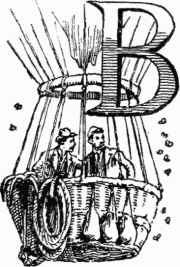
ehind the clouds there are marvels as endless as those on the earth itself. Among those who have attempted to describe some of them, few have done so as vividly as the French astronomer, M. Flammarion. He has been up in sunshine and clouds, at sunrise and sunset, and looked down on the sleeping world all through the summer night.
On one of these pleasant voyages, M. Flammarion had for some time been sailing in a dense cloud, which made even the gas-bag above quite invisible, when suddenly the air was filled with most beautiful music. It seemed as though some mysterious band was playing in the very cloud itself, only a few yards away. M. Flammarion strained his eyes in every direction, but nothing except the white mist met his gaze. By-and-by, however, the cloud grew brighter, and a few moments later the haze seemed to open and let him into a world of dazzling light. He had ascended right through the rain-cloud, and broken into fine weather on the other side. On leaving the cloud the mysterious music had ceased. M. Flammarion learned afterwards that it had been produced by the orchestra of a small town over which he was sailing at the time. The rising sound had been caught and retained by the cloud, for, strange to say, while dead silence is found in the clear sky at a certain height, a cloud at the same level will often be full of sounds coming from the world below.
The object of M. Flammarion's voyage was to study the secrets of the air, and to do this properly it was necessary to go up in all sorts of weather. In a long journey from Paris across the border into Prussia, most of the distance was done in a dark and rainy night. Finding that the falling rain had made the balloon so heavy that it was sinking to the earth, he threw out ballast and rose above the cloud. But the struggling moon gave little light, and he was greatly struck by hearing, in the darkness far below, the constant noise of the falling rain. The sense of loneliness in such surroundings was very strong.
Experiments from the floating car have proved that the best echo is produced by the smooth surface of a lake. Thus when the balloon was once over a large sheet of water, the traveller called out the names of the stars reflected on its surface. Each name was echoed back with great clearness, as though some fairy of the lake were mocking him.
'Tell me, then,' cried the aeronaut at last, in fun, 'what the inhabitants of these stars are like?'
But no reply was made, for the balloon had sailed beyond the margin of the water, and his voice had fallen on the solid earth. To obtain an echo from that is more difficult.
On one occasion, wishing to find out if the balloon were rising or falling, M. Flammarion dropped a bottle over the side of the car. To his astonishment it stood in the air as though hanging there. It would have been just the same if he had placed a table out there too, with a chair beside it, and a knife and fork and plate upon it. He might have got out himself and sat on the chair, and they would all have appeared to be remaining still in mid-air. But as a matter of fact the bottle and the balloon were descending to earth at exactly the same speed. This would never do, and so a little ballast was thrown out. The bottle immediately seem to shoot downwards, though not quite in a vertical line, for it still moved with the impetus it had been given when thrown overboard. Ten seconds later M. Flammarion saw it reach the earth in the centre of a large field.
Each voyage brought the explorer some fresh surprise; but we must say good-bye to M. Flammarion and his balloon, for his discoveries and adventures are too many to follow. Before, however, we end these cruises in the clouds altogether, there is time for a word or two about the many machines which have been made in the hope of enabling men to soar in the skies without the aid of a balloon.[Pg 396] Attempts to do this were made long before the Montgolfiers sent up their paper bag at Annonay, and beyond the fact that machines have been invented which can lift themselves into the sky, very little progress has been really made. Perhaps the most important of these inventions are those of Professor Langley and Sir Hiram Maxim. After many years of labour, Professor Langley of Washington succeeded, on May 6th, 1896, in launching his flying machine from the shores of the Potomac. The broad sails, or 'aeroplanes,' as they are called, cleaved the air like the wings of a bird, and kept up a steady flight for a minute and a half.
Somewhat similar in outward design is the huge mechanical bird built by Sir Hiram Maxim. Broad stretches of canvas are arranged horizontally one above the other, tilting a little upwards in front. Instead of legs and feet, this strange bird has wheels running on rails. When the machine is put in motion it skims over the rails at a great speed, and the effort made by the 'aeroplanes' to climb the air shows a great power of flight. But the machine is prevented from leaving the rails by a second pair of small wheels running on the under-side, and the strain on these wheels shows the strength of the giant wings; for Sir Hiram Maxim's only object is to prove that aerial ships built in such a way would have great buoyancy. A number of them, in a modified form, have been fitted to a 'giant longstride,' and many of the London boys and girls who have been to the Exhibitions (at Earl's Court and elsewhere), where the longstride stands, know something of the principle of the flying machine.
But, after all, the greatest successes in human flight have been won in fancy. And here again, the honour belongs to France, for what more entrancing journey was ever made than that taken by the passengers in the late Jules Verne's 'Clipper of the Clouds?' Built in the form of an ocean-goer, but with large screws worked horizontally at the summits of the masts, this flying ship made a journey round the world, visiting the most distant countries, for when the broad, blue sky is the road no obstacle can lie in the way. True, when the enchanting book is ended, we know that it was only a dream, yet we must remember that many of the great French author's dreams have been realised before now.
John Lea.
[Pg 397]
When men first made houses, with a view to their own comfort, they little thought that they were providing a ready-made home for a host of outsiders, who took so readily to our quarters that we wonder where they can have lived before. How did the stork get on without his chimney, the merry sparrow without his gutter, the clothes-moth without cupboards, the house-spider without dirty corners and ceilings? In Holland the stork makes free with the house-top as a matter of course, often dropping a stray eel, small snake, or frog, intended for his young, down the chimney into the fireless grate of his astonished hosts below. He knows that nobody would be cruel enough to meddle with that untidy bundle of sticks which houses his family circle. The devotion of these beautiful birds to the fluffy youngsters on the roof is an example to those beneath it. In Turkey the stork is greatly respected, and lately he has been better thought of than ever. A small village on the Gulf of Ismidt caught fire, and over two hundred houses were destroyed. Many storks' nests were there, and when the fire began to rage the terrified birds fled pell-mell, but for a few moments only. After a brief pause they recovered their presence of mind, and with a rush the same broad wings which had hurried them away from death bore them as swiftly back to the burning stacks, where, in each nest, there lay two or three helpless young. The old birds settled down over the broods, covered them with their wings, and one[Pg 398] after another perished without another attempt to save themselves.
What the stork is abroad, the swallow is, or ought to be, in England, honoured and admired. Here he makes his summer home, and for the few months during which he stays amply earns his keep by clearing away the swarms of flies. The number of injurious insects consumed by one pair of swallows and their young during a single day cannot be less than one thousand, and the number killed during the season is beyond calculation.
Swallows are quick to avail themselves of ready-made nooks for their nests. When the eaves and similar places will not do, they boldly enter houses and churches, and take any spot that takes their fancy. A farmer at Crux Eastern was honoured by a couple who chose a door inside his home, and, when the nest was accidentally shaken down, pitched upon another door. The farmer's wife, fearing that this nest would be destroyed also, drove a large nail into the woodwork beneath as a support. But Dame Swallow could not put up with this interference, and, leaving the second nest, she chose the crank of a bell-wire in the kitchen. Without more ado she built, laid eggs, and hatched them, though the farmer gave a supper to his men while she was still house-keeping, and while the sheep-shearers enjoyed their noisy feast, the little pair flew in and out, feeding their young as quietly as if they were utterly alone.
Much might be said of the fondness shown by some unbidden guests for our food, of the trickery of the mouse, or of the cricket's habit of tumbling into the milk, while taking unlawful sips. But a plea can be found even for the most despised of creatures. Cheese is a dainty to the pilfering mouse, but the eggs of the cockroach are a still daintier morsel. The cricket is a scavenger, and besides cheering us by his sprightly song, rids the floor of tiny atoms of insanitary dust, and the house-spider preys on the clothes-moth. One lesson at least is taught by many a household insect, that of strict cleanliness.
Besides our regular housemates, many strange creatures will live with us in time of trouble, forgetful of their fear. The following is a true and delightful instance of this. On one of the Highland hills an old woman lived quite alone. After a severe snow-storm, some shepherds, fearing for her safety, went to the rescue and found her hut snowed up. They were unable to trace it till a curl of smoke was seen rising out of a drift. The warmth had melted a small hollow just above the hole in her roof which served as a chimney. Down this they called, 'Jenny, are you living?' For answer a fox darted out of the hole and ran away. Again they called. 'Yes,' answered the old woman. 'Heaven has been very good to me. I have been fed by the beasts of the wood.' 'What do you mean?' asked the men. She said, 'A wild fox came down the chimney to take shelter. I spoke kindly to it, and it came and sat by the fire, and every day he went out and brought me in a hare or a rabbit.'
This story makes one feel how easily the fear and dread of us, which so many creatures are forced to feel, might be changed into trust and love, so that we might fulfil the text, 'The beast of the field shall be at peace with thee.'
Edith Carrington.
A Story of Adventure on the North Sea and in China.
The Boxers had evidently heard that Charlie and the two Chinamen had ventured to leave the shelter of the mission enclosure, and it was plain that they had hoped to surprise them. And had they been a minute earlier, they would undoubtedly have succeeded in doing so. In fact, the foremost man was so close upon them that he seized the ladder just as it was being raised, and, tugging hard, pulled it out of Barton's hands. This capture, trivial though it was, filled the Boxers with enthusiasm. With fierce shouts they rushed at the gates and attacked them with hatchets. But, as the gates were of iron, and had been made and fixed with the intention of resisting such assaults, their efforts were in vain. Soon they recognised that they were wasting their strength, and, at a signal from their leader, they turned away and ran to seek shelter. Soon there was not a living Boxer visible to the missionaries and their friends.
They had had enough fighting for one day, and did not again expose themselves. The besieged party took the opportunity to strengthen their defences and make other preparations for a long siege.
'I hope,' Barton said, in answer to a question from Charlie, 'that we shall be relieved within a week from to-day, as the missionaries who had to seek shelter here sent trustworthy messengers to Peking and Wei-hai-wei with letters to the British officials, telling them of their sufferings and whither they were bound; and the day before you arrived I sent off two messengers with notes for the captain of any British warship they could find, stating that we were besieged.'
About ten o'clock on the following morning the Boxers renewed their attack, but in a manner which the defenders had not expected. Instead of rushing into the open, as they had done before, they fired from the houses facing the mission building.
'Get the women and children into the basement at once,' Barton shouted to one of his colleagues, for some of the Boxers were firing from the roofs of the houses into the mission enclosure.
'The Boxers take good care to keep under cover,' Charlie remarked. 'Evidently we have taught them to respect us.'
'They won't remain concealed for many hours,' said Ping Wang. 'When they get excited they will make another attack on the gate.'
His words came true. For nearly one hour the Boxers continued to fire upon the missionaries' house, doing severe damage to it. Their success elated them, and the fact that the besieged did not reply to the attack probably made them believe that they had used up all their ammunition. At any rate, they suddenly rushed out of the houses and made for the mission gate, waving flags and shouting wildly. Fred and Barton, at some newly-made loop-holes, and Charlie, Mr. Wilkins, and Ping Wang at their former positions, fired rapidly at the[Pg 399] advancing mob, which, with loud shouts and wild gestures, rushed at the gate to make another attempt to destroy it. But the gate resisted all their efforts.
'Oh, for a Maxim!' Charlie sighed. 'That would disperse them.'
'So would boiling water,' Mr. Wilkins remarked, 'but we can't spare it. I wonder——'
What Mr. Wilkins intended to say was never known, for at that moment Number One, who was stationed, revolver in hand, some yards away, hailed them excitedly: 'Lun, lun!' he shouted; 'Boxer man climbee up ladder plenty quick.'
Charlie and Mr. Wilkins looked out from among the sandbags, and saw that the Boxers had placed two ladders a foot or two to the left of where Number One was posted. As the defenders looked out, some who had remained under cover fired at them. Charlie drew back instantly, for a bullet passed within an inch of his head, and, hurrying down from his platform, ran to the spot where the Boxers hoped to scale the wall. One of them was already on it. He dropped from the wall into the mission enclosure, and rushed with wild shouts at Number One, who fired but failed to hit him. But Charlie was close at hand, and, when the Boxer was about ten yards from Number One he pressed the trigger of his rifle, and the daring fanatic fell. But four more Boxers had dropped into the enclosure, and, not daunted by the fate of their comrade, were rushing at Charlie and Number One. The latter fired his revolver, and, to his great surprise, shot the foremost Boxer in the left leg. Almost at the same moment Charlie put another out of the fight, but, before he could reload, the third Boxer was close upon him. Dropping the cartridge, Charlie grasped his rifle in both hands near the muzzle, and, swinging it over his shoulder, brought the butt down on his assailant's head. The fourth man, seeing the fate of his comrades, tried to escape, but his efforts were fruitless.
'Tell him to surrender,' Charlie said to Number One.
Number One did so, and the Boxer at once went down on his knees, and, bending forward, placed his forehead and the palms of his hands on the ground.
'Get some rope and bind him securely,' Charlie instructed Number One, who obeyed at once.
Several other Boxers had been sitting on top of the wall, watching the fight, and, when they saw that their comrades were getting the worst of it, instead of going to their help, they retired quickly to join the mob, which, however, had once more taken to flight. The gallant little band of defenders were, naturally, very pleased at their victory, which, alas! they soon discovered was very dearly bought. To their great grief, the veteran missionary, Mr. Wilkins, had been shot through the throat and was dead. Evidently the fatal wound had been received when he looked out to see if the Boxers really were climbing the wall. He was buried at sunset in a corner of the mission enclosure, and his death cast a gloom over the defenders.
Two weeks passed away, and there was still no news of the long-expected relief. Food was so scarce that it was indeed wonderful how the besieged managed to exist. Four of them had died, and were now lying in the little cemetery in the corner of the enclosure. Others were seriously ill, and it was feared that, unless relief came speedily, they, too, would soon succumb.
The Boxers had altered their plans on finding that they could not carry the mission buildings by assault, and now relied upon starving out the defenders. By day or by night scarcely a single Boxer was to be seen, although hundreds were within a stone's-throw. Every building that could be seen from the mission had a Boxer flag planted on it, and every house facing it had been fortified. From these houses the Boxers, day and night, fired on the mission, the residential part of which, except the basement, was in a ruined condition. To cross from the platforms to the mission house was a work of danger, for some trained Chinese soldiers, who had joined the Boxers, were by no means bad shots, and, as they could look down into the enclosure, they fired every time that one of the defenders was seen. They used a large amount of ammunition, but without drawing the fire of the missionaries and their friends.
Another week passed—the most disastrous that the besieged had gone through. Two more of them had died from fatigue, fever, and want of proper food. The mule which had drawn the missionaries' trap for some years, had been killed and skinned, and in the course of two or three days the last of it would be eaten. When that was gone there would not be an atom of food left. If it had not been for the women and children, the men would have made a sortie and died facing overwhelming odds.
'We must remain where we are for their sake,' Barton declared, and the rest agreed with him. Then they discussed how to make the remainder of the mule-flesh last a day or two longer than they hoped; but they were already on such short rations that it was almost impossible to reduce them.
'What's that?' Charlie exclaimed, suddenly. 'Didn't you hear anything?'
'Only those two shots which the Boxers fired,' Fred replied.
'No, not that. I thought I heard a cheer.'
'Imagination, I'm afraid,' Barton said, sorrowfully, but he had scarcely uttered the words when the sound of firing in the distance was heard distinctly.
'Relief!' Charlie declared, excitedly. 'I'm certain it was an English cheer which I heard.'
'The firing is outside the town,' Ping Wang remarked, 'and the Boxers have heard it. Look, they're leaving their shelter.'
The sound of the firing had evidently caused the greatest excitement among the Boxers. They streamed out of the houses and ran off in the direction of the gates through which the advancing force, whether friend or foe, would have to enter the town.
The sound of firing in the distance now became louder, and it was plain that a fierce fight was raging somewhere near the town gates. Soon they knew that the force attacking the town was winning, for several terror-stricken Chinamen rushed past the mission, seeking some place in which to hide.
(Continued on page 402.)
[Pg 400]
A Story of Adventure on the North Sea and in China.
Three-quarters of an hour after the first sound of firing was heard by Charlie and his friends, a loud, unmistakably British cheer rang through the air.
'They've entered the town,' Fred exclaimed, and cheered wildly. Every Englishman, and Ping Wang also, joined in the cheer. Then they fell into silence, listening to the distant sounds. The Boxers were yelling furiously, hoping to terrify the Englishmen who had entered the town.
'They're marching straight through the town,' one of the missionaries declared anxiously. 'Perhaps they don't know that we are here.'
'They are certain to be aware of that,' Barton answered. 'No doubt they are going to secure the other gate.'
'My cally message to Number One soldier man,' Number One suggested. 'Say Clistian missionalies big piecee hungy.'
'But the Boxers might kill you,' Barton hinted.
'Boxer man nebber killee me. My plenty clebber. Boxer man nebber catchee me.'
'All right then; you may go.'
Number One grinned with delight, and, when the bamboo ladder had been lowered over the wall, went off at a run.
Charlie, Fred, and their friends found the time pass very slowly. They could hear that the English were fighting their way steadily through the town, and every minute their anxiety to see their gallant countrymen increased. Presently a loud British cheer told them that the other gate had been captured. The firing now became less frequent, and in about ten minutes it ceased entirely.
The excitement in the mission enclosure was now intense. The surviving women and children came out of the basement where they had been prisoners for more than three weeks, and climbed up on the platforms to get the first view of their deliverers. The native Christians, who had borne the hardships of the siege uncomplainingly, chatted and laughed gaily. The sick and wounded lay in the little hospital with their eyes fixed on the door.
'They're coming!' Charlie shouted a few minutes later, and the good news thrilled both Englishmen and Chinamen.
The tramp of drilled men came nearer and nearer, and soon from out of the street, almost facing the mission buildings, marched a British naval officer. He gave a swift glance along the wall, and seeing the men and women peering through the sandbags, he saluted them with his sword. They answered him with a cheer, and instantly some fifty smiling, sun-burnt tars burst into a loud 'Hip, hip, hoorah!'
With the smartness characteristic of our navy the men were formed up in a line with their backs to the mission wall. The officer in command gave one look at them, and then almost ran up the ladder which Barton had lowered.
'It is!' Charlie exclaimed, delightedly, as the officer reached the top of the ladder. 'It's our old friend Williams.'
'So it is,' Fred declared, as he recognised the officer of the revenue cutter, who had captured the coper in which his brother and Ping Wang were unwilling passengers.
Williams heard his name mentioned as he vaulted over the wall on to the platform, and the next moment he recognised his friends.
'Well, this is a delightful surprise!' he exclaimed, as he grasped Charlie's hand.
'It's still more delightful for us,' Fred declared.
'You've had a very rough time, I fear,' said Williams, when he had shaken hands with his three friends. 'You look almost like skeletons, every man of you. However, you shall soon have a good feed.'
'Shall we open the gate?' Barton asked, when he and his colleagues had been introduced to Williams.
'Certainly,' Williams replied; but when he saw how securely the gate had been barricaded, he knew that the task would be more than the half-starved defenders of the mission could accomplish.
'I'll call some of my men to do it,' he said, and in a few moments twelve jovial, sun-burnt, travel-stained sailors had climbed the ladder and entered the enclosure. Instantly the men, women, and children surrounded them, grasping their hands, and showering blessings on them.
'Come along, men,' Williams shouted out. 'Down with that barricade, and open the gates.'
The sailors started their work at once. In a few minutes the barricade, which had taken the missionaries some days to build, was torn down, and the gates thrown open. Number One was the first person to enter the enclosure. He carried a big bowl of cooked rice, which was probably loot, and, hurrying to the ladies and children, placed the tempting dish before them.
'Welly good,' he declared, emphatically; 'makee plenty stlong.'
When every one had had as much as was safe after their long fast, Williams drew Charlie, Fred, and Ping Wang aside. 'I suppose you haven't succeeded in getting that treasure?' he said.
'No, but we got very close to it,' Charlie replied, and then told him of their adventures in Kwang-ngan.
'You've been unfortunate,' Williams admitted. 'However, I'll see what I can do. We expect some Japanese troops here to-morrow, and as soon as they arrive we are all going to march on Kwang-ngan. Tell me exactly where the idol is.'
'Let us go to Kwang-ngan with you,' Charlie suggested.
'But, my dear fellows,' Williams replied, 'you're not in a fit state for any more fighting.'
'It's only sleep we want,' Charlie declared. 'We shall be as fit as any one after we have had a good long rest.'
'If that's the case, I shall be glad of your company; but you must turn in at once.'
'Before we do that we want to know how it is that you are here. When we last saw you, you had no idea of going to China.'[Pg 403]
'Well, I'll soon explain that. My capture of that coper on which I found you and Ping Wang won the approval of the authorities, and, fortunately for me, I was able to effect another capture, about three weeks later. Soon afterwards I received orders to go up to London, and in less than a week I was on my way to China to join my present ship.'
Charlie, Fred, and Ping Wang heartily congratulated their friend, but he cut them short by telling them that if they wanted to accompany him to Kwang-ngan they would have to turn in at once, and get as much sleep as possible.
'If that's the case, good-night,' Charlie replied, and all the three hurried away to their beds in the basement, and slept soundly.
When they awoke they found that the Japanese troops had arrived, and that the British sailors were to start within half an hour for Kwang-ngan. After a rapid but hearty breakfast they marched out, with the rifles at the shoulder, to report themselves to Williams, whom they found outside the enclosure inspecting the men. Some of the newly arrived Japanese soldiers had already been posted around the mission wall, and the Japanese flag flew, side by side with the Union Jack, over the gateway.
'Well,' Williams exclaimed, cheerfully, as he shook hands with Charlie, 'do you still wish to come with us?'
'Certainly,' Charlie replied, speaking for all three of them.
'Then you had better say "good-bye" to your missionary friends, for they must all start for Tien-tsin this morning. They will be safer there.'
Charlie, Fred, and Ping Wang hurried back to the mission buildings, but Barton was the only one of their late comrades in danger who was not sound asleep. They bade farewell to him, and extracted a promise from him that when next he came to England he would visit them at Lincoln.
While they had been talking, Williams had marched his men off towards the town gate which opened into the road leading to Kwang-ngan. Charlie, Fred, and Ping Wang ran after them and overtook them just as they were quitting the town. They fell in at the rear of the company. Nine of the ten miles which lay between Su-ching and Kwang-ngan were covered in about two hours and a half, and they proceeded more cautiously, but for some time met with no opposition, although, when they drew near Kwang-ngan they were surprised to find that it was a very formidable-looking place, bristling with big guns.
'They are not guns,' Ping Wang declared, smiling. 'They are simply circles which the Boxers have painted on the walls to represent guns, in the hope of frightening us.'
'But I was told that they had two guns,' said Williams.
'That is correct. One is mounted on either side of the gate.'
Ping Wang had barely finished speaking when both guns boomed, and their range was excellent, the shells bursting among the sailors. One man was killed and six were wounded. Charlie was thrown to the ground, but, much to his surprise, he found on getting up that he was not hurt.
The sailors now advanced quickly, and the Chinese gunners being apparently unable to alter their range, the shells passed harmlessly over their heads.
The attacking party soon got to within three hundred yards from the town, and the Boxers lining the wall, having so far received no hurt, became reckless. A few of them fired their rifles, but three hundred yards is a long range for most Chinamen, and not one of them succeeded in doing any damage. Nevertheless, Williams considered that the time had arrived to give the Boxers a warning. He gave the order to his men to lie down and fire a volley. It was a splendid one, and the terror which it caused among the Boxers was almost comical. The uninjured men hid themselves instantly, and not a single threat, or shout of defiance was heard from them as the sailors sprang to their feet and ran a hundred yards nearer to the wall.
They lay there unmolested for three or four minutes until the 'advance' was again sounded. As they rushed forward, the Boxers opened fire upon them with rifles and bows and arrows, and three men fell. But their comrades, breaking into a loud cheer, continued their advance, and arrived at the wall with but few casualties on the way. They had brought from Su-ching twelve long bamboo ladders, and these were speedily placed against the wall at a few yards distance from each other. The Japanese also had provided themselves with ladders.
At the signal from their officers, the men climbed nimbly up the ladders, and all along the south wall the fight became fierce. Many of the attacking party were shot before they reached the topmost rung, but their fall simply added to the determination of their comrades, and in a few minutes nearly a score of them had scaled the wall, and were engaged in a desperate hand-to-hand fight with the Boxers.
Charlie, Fred, and Ping Wang were not among the first dozen to enter the town, as the sailors who had fixed the ladder by which they wished to ascend declared that it was their right to be the first to mount it.
When the Chinamen found that they were unable to drive out the men who had entered the town, and that others were scrambling over the wall to their assistance, they turned and fled, closely pursued by the sailors. Within twenty minutes the whole English force held the village. Before long, Fred, Charlie, and Ping Wang found themselves close to the wall of Chin Choo's residence.
There is not much to be said about our last batch of toys. The cat and her kittens is a wonderful toy for the money; and the round box with a crown on top is a good place to keep the pennies for the next Christmas. The doll in a box, the two other dolls, the fans, and the frog, are all actually made in Japan, and shipped to England. Fancy the little Japanese boys and girls turning their hands—for these toys are all made by hand[Pg 404]—to work just to give pleasure to little boys and girls far off in other countries! The reason why these Japanese toys can be made so cheaply and sent so far, and yet sold at a profit, is that the Japanese, old and young alike, are able to live much more frugally and cheaply than Europeans. Japanese shipping companies, too, are anxious to get trade, and carry the toys very cheaply: during the war they actually guaranteed owners against loss or capture by the enemy.
But we must say good-bye to these toys. Remember, if you are fortunate enough to possess any of them, from what distant lands they come, and what pains are taken in making them. Remember, too, what a hard life the poor men and women who sell them have. These toys, like most other gifts, teach the old Christmas lesson of kindness to others and thankfulness for blessings.
e knew, on that white frosty morning,When we reached Cronstadt Tom's ankle pained him a good deal; he had skated five miles upon it, and the injured part was swollen.
'What about getting home?' I asked in some anxiety, but Tom declared that after a couple of hour's rest at the inn in Cronstadt, where we were stopping for a meal, his foot would be as well as ever it had been. So it was, he said, when, at about two o'clock in the afternoon, we started for home. But there was no life in his skating, and presently he admitted that it hurt him badly. Two miles were covered with pain and difficulty, and many stoppages. Matters began to grow somewhat serious; at least, I thought so, though I said nothing of my fears. We were sitting on the ice, Tom holding his ankle against it in hopes that the cold would reduce the inflammation, when a sound in the distance caused us both to raise our heads. Several black specks had suddenly appeared upon the white ice-field behind us. Were they a party of skaters? Were they——
'I say!' suddenly exclaimed Tom. 'Wolves!'
I am not ashamed to say that my heart sank when my companion pronounced the black, moving spots in the distance to be wolves. I was afraid of wolves, and always had been; I think most boys and girls generally are, and I fancy that 'Little Red Riding Hood' is more or less to blame for it, together with other tales in which these animals figure.
I was frightened, very frightened. My first impulse was to take to my skates and fly like the wind before the coming terror. Then, like a jet of cold water, came the thought of Tom's bad ankle. He had risen to his feet, however, at sight of the wolves, and evidently meant to forget his sprain.
'We had better be off, old chap,' he said. 'They are coming our way. We can race them well enough on skates. It's nearer to Cronstadt than to the half-way hut, but they could cut us off on our way to Cronstadt, and, besides, there is all that horrible cat-ice near the harbour. Are you ready? Skate steadily, then; no need to get done up.'
I said nothing about his ankle, trusting that the greater trouble might possibly have driven away all recollection of the lesser, and for a mile we skated evenly and rapidly forward. Occasionally we looked back over our shoulders to see how we were holding our pursuers, for undoubtedly we were being pursued. We seemed to hold our own fairly well; they had gained upon us, no doubt, but not very much. At this rate there was no danger of our being caught—if only, that is, Tom's ankle did not 'go.' But, alas! scarcely had we covered that one mile when my companion pulled up.
'I can't go on another yard without resting my ankle, Bobby,' he said. 'Go on without me, old chap, I shall think none the worse of you; you couldn't do me any good, you know, if they caught me; besides, look here.' To my surprise and delight Tom suddenly produced from an inner pocket a small revolver. He was sitting on the ground now, and he loaded the little weapon with cartridges, which he took out of his waistcoat pocket. 'This will keep them at bay all right, so, you see, I'm as safe as ninepence. Go on, don't waste time.'
'Don't be an idiot,' said I. 'You must think me a pretty average cad if you suppose I am going to leave you alone and run away.'
Tom glanced up at me and smiled. 'To tell you the truth, old chap, I never supposed you would,' he said; 'but I had to make the suggestion.'
'Why didn't you tell me you had the revolver?' I asked, ignoring the rest of his speech; 'and what made you bring it?'
'My father said he had known wolves about the gulf in severe weather. I said nothing about it for fear you wouldn't care to come. Look at the brutes, they're only a quarter of a mile away! I feel better now; let's see how far I can get this time. If they come too near, I shall fire a shot. Unfortunately I only brought these six cartridges, so we must not waste our fire.'
For a few hundred yards Tom travelled well. We gained on the wolves, which, I suppose, observed this fact, for the leader suddenly set up a howl which set my blood running cold, and the others instantly followed suit. There were nine of them; I had counted them while Tom rested.
Manfully Tom struggled on. I could see that the exertion was hurting him fearfully.
'I don't think I can go on very much farther without a rest,' he said, presently. 'The trouble is that next time we wait about they will catch us up.'
'Then you will have to shoot, that's all,' said I, as cheerfully as I could, considering that I was in reality shivering with terror.
'Yes, I shall have to shoot. One shot will be enough, I expect. Probably they will turn and[Pg 407] run straight back to the forest at Lachta or Oranienbaum, or wherever they come from. You are not frightened, old chap, are you?'
'Rather not,' said I. Then I added, conscientiously, 'At least, not very much. It's—it's rather a new experience for me, you see.'
A minute later Tom pulled up and sat down.
'Come behind me,' he said, 'just in case any of these brutes should spring at us before I get my little toy to work on them. I shan't shoot until they are within ten yards or so. I want to make sure of one, then they will stop and eat him if they don't run away.'
I got behind Tom and crouched down, and we watched them coming. They were now in full cry, heads down, like a pack of hounds. When within fifty yards of us, the leader raised his head and saw us. He gave a great yelp, and came scudding along, followed by his band. At twenty yards they slowed down and stopped, seeming to lose heart. Suddenly one sat down on his haunches, and his example was followed by two or three others.
As for me, my teeth were all a-chatter with terror. I wished to suggest to Tom that he should try the effect of a careful shot at one of the sitting wolves, but no words would come. I felt as though I were in the grip of a night-mare, awake to the horror of our position, and yet quite helpless. Tom suddenly spoke.
'I am going to fire,' he said. 'Don't speak or move for a minute.' He pointed his pistol, took a long aim, and pulled the trigger.
No wolf fell, but the shot produced a curious effect.
In an instant every wolf of the nine had 'dispersed' as though the pack had been scattered by some mysterious force. They fled in every direction except towards us. Tom uttered a cry of triumph. For a hundred or two yards the wolves careered as though they were mad. At a furlong's distance every wolf stopped and turned round. Not one of them uttered a sound.
'What a bad shot!' said Tom. 'Idiot that I was! I don't understand these things. Are you any good with them?'
I had found my tongue, and replied that I had practised at a mark occasionally. 'You take one more shot, and then let me try one,' I suggested.
'Good,' said Tom. 'I have been thinking. It's only about a mile to that wide crack, the ten-footer. I think I could skate as far as that with an effort. When we get near, I'll rest if necessary, and after that we will fly it. I doubt if the wolves will follow us over.'
This was an excellent idea. We started off. If either of us had hoped that the savage brutes at our heels would have been discouraged from further pursuit, we were soon disappointed, for within a minute all nine were again in full cry after us at two hundred yards' distance. For three-quarters of a mile Tom skated on in agony.
'Now we will stop, and I will fire my second shot,' he said.
Once more our nine snarling friends found discretion the better part of their valour, and stopped at a biscuit-toss from us, whining and howling and looking grim enough to frighten the most iron nerves. Perhaps Tom's hand shook a bit; at any rate, he missed again, and handed me over the revolver with an exclamation of disgust. And again the wolves retired, but not so far away this time.
We waited two or three minutes.
'Now we'll go,' said Tom, 'and this time we will reach and fly the water-jump without stopping. Let them come close to our heels till we are within fifty yards, then put on all the pace we can, and over we go. I want to see whether we can't drown one or two of the brutes; they don't look where they are going.'
We carried out this programme to the letter. At fifty yards from the fissure we put on all the pace we could command, and we flew the open water side by side, Tom clearing it beautifully in spite of the wrench it gave him to do so. Then we stopped.
Having gone slowly for the last quarter of a mile, we had allowed the wolves to gain upon us. This had excited them, and as we cleared the water we could hear them in full bay close behind us. I dare say the sound at our heels gave us wings.
The pack reached the fissure but ten yards behind us. The leader and three others realised too late that they must rise to a leap; they endeavoured to stop, but their impetus carried them over the edge and into the water; of the rest, two leaped in a half-hearted manner, being in two minds whether to stop or jump; both fell short into the water. The last three cleared the fissure, and these, of course, occupied our attention, for, too excited to remember discretion this time, they made straight for us, open-mouthed. Tom had hurriedly taken off one skate, and stood swinging it behind me, intending to make a fight of it. As for me, when the nearest wolf—looking all fangs and blazing eyes—was five yards from me, I pulled the trigger. I think I shut my eyes, but of this I am not quite certain.
To my complete astonishment, the wolf came rolling and tumbling to my feet, made an effort to rise, swayed and fell back dead. The other two turned, took the fissure at a bound, and fled away. In the water two wolves were still struggling; the rest had presumably gone under the ice while endeavouring to climb over the slippery edge. Tom snatched the pistol from me with a cheer; he put the muzzle to the ear of one of the wolves and fired, killing him on the spot. The last made an heroic effort, and succeeded in climbing out on the farther side. We pulled Tom's wolf ashore.
Then we sat, like two children, and shouted and howled for joy and triumph. We took off our skates and pocketed them, and fastening the straps around the necks of our wolves, we actually dragged them, with many stoppages, to the half-way hut. Here I left Tom, whose ankle was swollen to the size of a dumpling, and skated home as fast as I could move, realising that our 'people' might be anxious if some one did not come to tell the tale. I went on winged feet, so happy was I, and I think if a pack of five thousand wolves had fled howling at my heels, I should not have cared much.
I soon got back, and a relief party was at once sent in the ice-yacht to fetch Tom away in triumph.[Pg 408]
A Story of Adventure on the North Sea and in China.
'Now's our time to get the treasure,' Charlie said. 'The fighting is nearly at an end, and the sailors won't want our help now.'
'Come along, then,' Fred answered; 'and I hope that we shall do better this time than last.'
Much to their surprise they found that the gate was open.
'Chin Choo has fled,' Ping Wang declared, on seeing that the gate was unprotected, and they heard later in the day that the rascally mandarin, after making a very warlike speech to his countrymen, had sneaked out of the town, and was on his way to Peking.
As Charlie, Fred, and Ping Wang entered Chin Choo's enclosure they were more excited than ever they had been during the siege of Su-ching, or the storming of Kwang-ngan; for they knew that in a few minutes they would discover whether or not their journey to China had been a fruitless one. Several of Chin Choo's servants, their pockets and arms loaded with loot, hurried out at the back of the house as Charlie, Fred, and Ping Wang approached it. They did not interfere with the thieves, but the thought that they had, perhaps, already taken away the idol occurred to each of them. They quickened their speed, and ran up the verandah steps together.
'There is the idol!' Ping Wang exclaimed, excitedly; and Charlie and Fred saw a brass image standing in the corner of a room which opened from the verandah.
Ping Wang went down on his knees, and grasping the right forearm of the image, tugged at it. To the amazement of Charlie and Fred, he pulled the idol's arm forward from its body until it was in an almost horizontal position. Then, placing his fingers on the spot where the idol's hand had lain, he pushed to the right its crossed legs, and showed to Charlie and Fred that the brass pedestal on which the figure sat was practically a jewel-box.
'Marvellous!' Charlie muttered; but his and Fred's delight was greater still when Ping Wang took out of it a little piece of cloth, and, unrolling it, exhibited an immense ruby.
'There are at least thirty as good as this one,' Ping Wang declared, joyfully; but, as he spoke, a noise was heard in Chin Choo's enclosure.
'Shut it up quickly,' Charlie said; and just as Ping Wang had done so a middy rushed into the room, accompanied by four sailors.
'Hallo!' he exclaimed, on recognising them as friends of Williams. 'What are you doing here?'
'Oh, we captured the place some ten minutes ago,' Charlie declared, cheerfully.
'Then why don't you guard what you have captured?' the youngster asked, sharply. 'There is no one posted at the gate, and the place could have been recaptured easily.'
Having said this the lad departed with his men in search of some more exciting experience.
'He was quite right,' Fred declared. 'The Boxers might have come upon us suddenly, as he did. I will go to the gate; you two stay here and guard the image.'
Fred's period of sentry-go was a short one, for he had not been at the gate more than ten minutes when he saw Williams advancing, with a portion of his force, towards him.
'Well, have you found it?' Williams asked, after he had acknowledged Fred's salute.
'Yes,' replied Fred.
'That's very good news. I was half afraid that you had come out here on a wild-goose chase.'
Williams said nothing more on that subject just then, for he had much more important business needing his attention.
Such Boxers as had not been put out of action, and had been unable to seek safety in flight, had cast away their yellow badges, and passed themselves off as peaceful citizens. Williams knew very well that the people were not so well disposed towards the Anglo-Japanese force as they pretended, and ordered a sharp look-out to be kept. It was an anxious time, and it was not until ten o'clock at night that, satisfied he had taken every possible precaution, Williams returned to Chin Choo's house, which he had made his headquarters, for an hour or two's rest.
'I congratulate you heartily,' Williams said, when Ping Wang showed him the treasure. 'And now the best thing you three can do is to get out of the country as quickly as possible. As long as you are in China you will run great risks of being robbed. I advise you to return to Su-ching early to-morrow morning, and make your way back to England. My instructions are to hold this town until I am reinforced, but it is quite possible that the Boxers will try to recover it before the reinforcements arrive. Therefore, the sooner you quit this place the more likely you will be to get away unhurt.'
'I don't much like leaving you at a time like this,' Charlie replied; 'but I suppose we ought to. The question is, how are we to carry our treasure?'
'The best way,' Ping Wang declared, 'will be for us to divide it into three packages, and each take charge of one.'
The packing being finished, the four friends sat down to have a chat. Of course they spoke chiefly of the Boxer rising, but they discussed also the latest news from the outside world, and finally talked of home.
'Now,' Williams said, when they had chatted for about an hour, 'you had better turn in, for you must start as soon after daybreak as possible. I should advise you to draw some of those rugs together, and sleep here. That's what I'm going to do.'
The friends soon made up, on the floor, four comfortable beds. Williams was sound asleep a few minutes after lying down; but Charlie, Fred, and Ping Wang lay awake for fully an hour, so excited were they at having obtained the treasure for which they had come so far. However, they fell asleep eventually, but only, as it seemed to them, to be aroused almost immediately by Williams.[Pg 411]
'Your breakfast is ready,' he declared, cheerfully, 'and your carriages are awaiting you. I have hired a palanquin and coolies for each of you, and some extra coolies to carry the idol, as Ping Wang wants that too.'
'I say, that will be travelling in style. How long have you been up?' Charlie said.
'I went out four hours ago, and have just returned.'
Then the palanquins were brought to the foot of the verandah stairs.
'Good-bye, and God bless you, all three!' Williams said, and shook hands heartily with his friends.
'God bless you, old fellow!' Charlie said; 'and don't forget to look us up when you return to England.'
The procession of palanquins passed out through the streets and along the road to Su-ching. The bearers were hard-working fellows, and shuffled along, half-running and half-walking, at a pace which made the distance from Kwang-ngan appear very short to the travellers. On entering Su-ching, Ping Wang directed the bearers to carry them to the mission, but, on arriving there, a Japanese officer told them that Barton and his friends had started for Tien-tsin the afternoon before.
After remaining at Kwang-ngan for about an hour Ping Wang hired fresh palanquins, and they resumed their journey. It was a very uneventful one, for the Boxers had been cleared out of that part of the country; the only exciting moment being when some Russian or Japanese sentry barred their progress. The arrival of an interpreter on the scene always resulted in the travellers being allowed to continue their journey.
On arriving at the river, they soon found a boatman to take them down to Tien-tsin, and thence they went straight to Hong-kong, where they remained four days as the guest of their former host. In Hong-kong they procured new clothes, and when they went aboard the homeward-bound steamer they felt, for the first time for many weeks, that they need not be ashamed of their appearance.
Fine weather and very agreeable fellow-passengers made the voyage to England an enjoyable one, but, nevertheless, the Pages and Ping Wang were delighted when, at last, the ship reached London. Mr. Page was waiting for his sons on the landing-stage, and was so pleased at seeing them back safe and sound that he almost forgot at first to ask them about their adventures. He was, naturally, delighted with their news.
As soon as possible the jewels were valued by a London diamond merchant, who looked at them very carefully, and, after some thought, offered a price which startled the Pages and Ping Wang. They gladly accepted the offer, and returned home in high spirits to Lincoln, where they enjoyed themselves thoroughly, in spite of being called upon several times a day to relate to various friends their adventures among the Boxers. After a week's holiday Fred went back to London to continue his medical studies, and Mr. Page then began to think what to do with Charlie.
'I have had enough trawling to last me for a life-time,' Charlie declared: so the idea of putting him into a steam-trawler company was dismissed for good.
'Let us two start business together as merchants,' Ping Wang suggested. 'We could soon work up a good connection with China, I'm certain.'
Charlie liked the suggestion, and Mr. Page, having gone into the matter carefully, the firm of Page and Wang was started, and before long promises to be a prosperous one. Ping Wang decided to become a naturalised Englishman.
Their friend, Williams, so they learnt later, was publicly thanked by the Commander-in-chief of the Allied forces in China for conspicuous bravery and valuable services rendered on three different occasions.
H. C. Moore.
Viennese children have a very happy time at Christmas. Not only do they get the ordinary beautiful presents, but there is another festival for them, held at the beginning of December—the 'Nicolo.' This is, properly speaking, only a festival for good children.
Nicolo, who brings the presents, is very strict in inquiring into the behaviour of children, and, should he hear that they have not been good, he does not leave any of his gifts. Every child in Vienna is careful to hang up his stocking on the eve of the 'Nicolo,' and, on the morning of the great day, he wakes up very early to see what is in it. Good children find apples and nuts, but the naughty ones get charcoal instead of something good to eat.
In the afternoon of 'Nicolo' Day, the children get ready to receive the visit of Nicolo himself. A tap is heard at the door, and an old man, with a long white beard and a white gown, appears. He has a large sack on his back, bulging with good things—in fact, the bag is often so full that dolls and whips and whistles can be seen poking out at the top. Behind the kind Nicolo stands another gentleman, dressed in scarlet and black. He does not look either good or kind, and carries a number of birch-rods under his arm. On his back a large basket is strapped; it is made of wood instead of wicker, and is deep and large. This gentleman is the most terrible person in Austria—the much-dreaded 'Krampus.' Fearful stories are told of his dark deeds, and naughty children try to hide themselves when they see the Krampus. But the Krampus keeps behind the good Nicolo, and each child is called forward to give an account of itself.
Nicolo asks the most awkward questions, such as: 'Who stole his sister's sweets last week?' 'Who broke her brother's boat?' When all the questions are answered, the good children receive presents, but naughty boys and girls do not get anything from Nicolo; instead of a puzzle-box, a ball, a new knife, or a doll, they get a gift from the Krampus, and the Krampus only gives one kind of present—a birch-rod. The Vienna confectioners make sugar dolls like the Krampus, and fill his basket with sweets. The Krampus is sometimes made of French plums or almonds and raisins, and his photograph is seen on picture cards.
E. R.
[Pg 412]
The following errors in the original have been corrected for this version.
Page 14: overhead corrected to overheard
Page 55: 'I shall drive the youngster back to Castlemore.' Final quote misprinted in original.
Page 91: "Inez hung the changed to '"Inez hung the
Page 102: that Patch changed to than Patch
Page 103: at abont half-past five changed to at about half-past five
Page 131: solitude and silence. Period was missing in original
Page 146: Hats! hats! for those who want them,; extra comma removed
Page 178: blistered them very much, One changed to blistered them very much. One
Page 179: rubbed over the suface changed to rubbed over the surface
Page 183: anything but Mr Turton.' missing period after Mr added
Page 211: refining, the raw changed to refining the raw
Page 214: send in to the authorities changed to send it to the authorities
Page 219: 'You looked about you, then? changed to 'You looked about you, then?'
Page 222: somewhat like a flower. Missing period added
clever way in which the trap is made. Missing period added
keeps it always open. Missing period added
Page 231: wants me to to have my leg cut off, changed to wants me to have my leg cut off,
slopes of the mounttains changed to slopes of the mountains
Page 238: miles away an the changed to miles away on the
Page 246: fond of pacing np changed to fond of pacing up
Page 247: maze and rice fields changed to maize and rice fields
Page 250: beleagured city changed to beleaguered city
Page 275: 'Don't shoot. changed to 'Don't shoot.'
Page 277: Charlie exclaimed to Ping Wing changed to Charlie exclaimed to Ping Wang
Page 278: being seen by them changed to being seen by him
Page 286: "first class," Fred changed to "first class,"' Fred
Page 306: pigs every day, changed to pigs every day.
nest full of fledgings changed to nest full of fledglings
Page 310: do your changed to do you
Page 314: no loiterers here! changed to no loiterers here!'
Page 319: 'isn't it a changed to 'Isn't it a
Page 342: by a moss-grown wall. changed to by a moss-grown wall.'
Page 343: run in the direction changed to ran in the direction
Page 347: hostile to foreigners. changed to hostile to foreigners.'
Page 364: 'violin-beetle changed to 'violin-beetle'
Page 395: aid of a balloon changed to aid of a balloon.
***END OF THE PROJECT GUTENBERG EBOOK CHATTERBOX, 1905.***
******* This file should be named 20117-h.txt or 20117-h.zip *******
This and all associated files of various formats will be found in:
http://www.gutenberg.org/2/0/1/1/20117
Updated editions will replace the previous one--the old editions will be renamed.
Creating the works from public domain print editions means that no one owns a United States copyright in these works, so the Foundation (and you!) can copy and distribute it in the United States without permission and without paying copyright royalties. Special rules, set forth in the General Terms of Use part of this license, apply to copying and distributing Project Gutenberg-tm electronic works to protect the PROJECT GUTENBERG-tm concept and trademark. Project Gutenberg is a registered trademark, and may not be used if you charge for the eBooks, unless you receive specific permission. If you do not charge anything for copies of this eBook, complying with the rules is very easy. You may use this eBook for nearly any purpose such as creation of derivative works, reports, performances and research. They may be modified and printed and given away--you may do practically ANYTHING with public domain eBooks. Redistribution is subject to the trademark license, especially commercial redistribution.
*** START: FULL LICENSE ***

THE FULL PROJECT GUTENBERG LICENSE
PLEASE READ THIS BEFORE YOU DISTRIBUTE OR USE THIS WORK

To protect the Project Gutenberg-tm mission of promoting the free
distribution of electronic works, by using or distributing this work
(or any other work associated in any way with the phrase "Project
Gutenberg"), you agree to comply with all the terms of the Full Project
Gutenberg-tm License (available with this file or online at
http://www.gutenberg.org/license).


Section 1.  General Terms of Use and Redistributing Project Gutenberg-tm
electronic works

1.A.  By reading or using any part of this Project Gutenberg-tm
electronic work, you indicate that you have read, understand, agree to
and accept all the terms of this license and intellectual property
(trademark/copyright) agreement.  If you do not agree to abide by all
the terms of this agreement, you must cease using and return or destroy
all copies of Project Gutenberg-tm electronic works in your possession.
If you paid a fee for obtaining a copy of or access to a Project
Gutenberg-tm electronic work and you do not agree to be bound by the
terms of this agreement, you may obtain a refund from the person or
entity to whom you paid the fee as set forth in paragraph 1.E.8.

1.B.  "Project Gutenberg" is a registered trademark.  It may only be
used on or associated in any way with an electronic work by people who
agree to be bound by the terms of this agreement.  There are a few
things that you can do with most Project Gutenberg-tm electronic works
even without complying with the full terms of this agreement.  See
paragraph 1.C below.  There are a lot of things you can do with Project
Gutenberg-tm electronic works if you follow the terms of this agreement
and help preserve free future access to Project Gutenberg-tm electronic
works.  See paragraph 1.E below.

1.C.  The Project Gutenberg Literary Archive Foundation ("the Foundation"
or PGLAF), owns a compilation copyright in the collection of Project
Gutenberg-tm electronic works.  Nearly all the individual works in the
collection are in the public domain in the United States.  If an
individual work is in the public domain in the United States and you are
located in the United States, we do not claim a right to prevent you from
copying, distributing, performing, displaying or creating derivative
works based on the work as long as all references to Project Gutenberg
are removed.  Of course, we hope that you will support the Project
Gutenberg-tm mission of promoting free access to electronic works by
freely sharing Project Gutenberg-tm works in compliance with the terms of
this agreement for keeping the Project Gutenberg-tm name associated with
the work.  You can easily comply with the terms of this agreement by
keeping this work in the same format with its attached full Project
Gutenberg-tm License when you share it without charge with others.

1.D.  The copyright laws of the place where you are located also govern
what you can do with this work.  Copyright laws in most countries are in
a constant state of change.  If you are outside the United States, check
the laws of your country in addition to the terms of this agreement
before downloading, copying, displaying, performing, distributing or
creating derivative works based on this work or any other Project
Gutenberg-tm work.  The Foundation makes no representations concerning
the copyright status of any work in any country outside the United
States.

1.E.  Unless you have removed all references to Project Gutenberg:

1.E.1.  The following sentence, with active links to, or other immediate
access to, the full Project Gutenberg-tm License must appear prominently
whenever any copy of a Project Gutenberg-tm work (any work on which the
phrase "Project Gutenberg" appears, or with which the phrase "Project
Gutenberg" is associated) is accessed, displayed, performed, viewed,
copied or distributed:

This eBook is for the use of anyone anywhere at no cost and with
almost no restrictions whatsoever.  You may copy it, give it away or
re-use it under the terms of the Project Gutenberg License included
with this eBook or online at www.gutenberg.org

1.E.2.  If an individual Project Gutenberg-tm electronic work is derived
from the public domain (does not contain a notice indicating that it is
posted with permission of the copyright holder), the work can be copied
and distributed to anyone in the United States without paying any fees
or charges.  If you are redistributing or providing access to a work
with the phrase "Project Gutenberg" associated with or appearing on the
work, you must comply either with the requirements of paragraphs 1.E.1
through 1.E.7 or obtain permission for the use of the work and the
Project Gutenberg-tm trademark as set forth in paragraphs 1.E.8 or
1.E.9.

1.E.3.  If an individual Project Gutenberg-tm electronic work is posted
with the permission of the copyright holder, your use and distribution
must comply with both paragraphs 1.E.1 through 1.E.7 and any additional
terms imposed by the copyright holder.  Additional terms will be linked
to the Project Gutenberg-tm License for all works posted with the
permission of the copyright holder found at the beginning of this work.

1.E.4.  Do not unlink or detach or remove the full Project Gutenberg-tm
License terms from this work, or any files containing a part of this
work or any other work associated with Project Gutenberg-tm.

1.E.5.  Do not copy, display, perform, distribute or redistribute this
electronic work, or any part of this electronic work, without
prominently displaying the sentence set forth in paragraph 1.E.1 with
active links or immediate access to the full terms of the Project
Gutenberg-tm License.

1.E.6.  You may convert to and distribute this work in any binary,
compressed, marked up, nonproprietary or proprietary form, including any
word processing or hypertext form.  However, if you provide access to or
distribute copies of a Project Gutenberg-tm work in a format other than
"Plain Vanilla ASCII" or other format used in the official version
posted on the official Project Gutenberg-tm web site (www.gutenberg.org),
you must, at no additional cost, fee or expense to the user, provide a
copy, a means of exporting a copy, or a means of obtaining a copy upon
request, of the work in its original "Plain Vanilla ASCII" or other
form.  Any alternate format must include the full Project Gutenberg-tm
License as specified in paragraph 1.E.1.

1.E.7.  Do not charge a fee for access to, viewing, displaying,
performing, copying or distributing any Project Gutenberg-tm works
unless you comply with paragraph 1.E.8 or 1.E.9.

1.E.8.  You may charge a reasonable fee for copies of or providing
access to or distributing Project Gutenberg-tm electronic works provided
that

- You pay a royalty fee of 20% of the gross profits you derive from
     the use of Project Gutenberg-tm works calculated using the method
     you already use to calculate your applicable taxes.  The fee is
     owed to the owner of the Project Gutenberg-tm trademark, but he
     has agreed to donate royalties under this paragraph to the
     Project Gutenberg Literary Archive Foundation.  Royalty payments
     must be paid within 60 days following each date on which you
     prepare (or are legally required to prepare) your periodic tax
     returns.  Royalty payments should be clearly marked as such and
     sent to the Project Gutenberg Literary Archive Foundation at the
     address specified in Section 4, "Information about donations to
     the Project Gutenberg Literary Archive Foundation."

- You provide a full refund of any money paid by a user who notifies
     you in writing (or by e-mail) within 30 days of receipt that s/he
     does not agree to the terms of the full Project Gutenberg-tm
     License.  You must require such a user to return or
     destroy all copies of the works possessed in a physical medium
     and discontinue all use of and all access to other copies of
     Project Gutenberg-tm works.

- You provide, in accordance with paragraph 1.F.3, a full refund of any
     money paid for a work or a replacement copy, if a defect in the
     electronic work is discovered and reported to you within 90 days
     of receipt of the work.

- You comply with all other terms of this agreement for free
     distribution of Project Gutenberg-tm works.

1.E.9.  If you wish to charge a fee or distribute a Project Gutenberg-tm
electronic work or group of works on different terms than are set
forth in this agreement, you must obtain permission in writing from
both the Project Gutenberg Literary Archive Foundation and Michael
Hart, the owner of the Project Gutenberg-tm trademark.  Contact the
Foundation as set forth in Section 3 below.

1.F.

1.F.1.  Project Gutenberg volunteers and employees expend considerable
effort to identify, do copyright research on, transcribe and proofread
public domain works in creating the Project Gutenberg-tm
collection.  Despite these efforts, Project Gutenberg-tm electronic
works, and the medium on which they may be stored, may contain
"Defects," such as, but not limited to, incomplete, inaccurate or
corrupt data, transcription errors, a copyright or other intellectual
property infringement, a defective or damaged disk or other medium, a
computer virus, or computer codes that damage or cannot be read by
your equipment.

1.F.2.  LIMITED WARRANTY, DISCLAIMER OF DAMAGES - Except for the "Right
of Replacement or Refund" described in paragraph 1.F.3, the Project
Gutenberg Literary Archive Foundation, the owner of the Project
Gutenberg-tm trademark, and any other party distributing a Project
Gutenberg-tm electronic work under this agreement, disclaim all
liability to you for damages, costs and expenses, including legal
fees.  YOU AGREE THAT YOU HAVE NO REMEDIES FOR NEGLIGENCE, STRICT
LIABILITY, BREACH OF WARRANTY OR BREACH OF CONTRACT EXCEPT THOSE
PROVIDED IN PARAGRAPH F3.  YOU AGREE THAT THE FOUNDATION, THE
TRADEMARK OWNER, AND ANY DISTRIBUTOR UNDER THIS AGREEMENT WILL NOT BE
LIABLE TO YOU FOR ACTUAL, DIRECT, INDIRECT, CONSEQUENTIAL, PUNITIVE OR
INCIDENTAL DAMAGES EVEN IF YOU GIVE NOTICE OF THE POSSIBILITY OF SUCH
DAMAGE.

1.F.3.  LIMITED RIGHT OF REPLACEMENT OR REFUND - If you discover a
defect in this electronic work within 90 days of receiving it, you can
receive a refund of the money (if any) you paid for it by sending a
written explanation to the person you received the work from.  If you
received the work on a physical medium, you must return the medium with
your written explanation.  The person or entity that provided you with
the defective work may elect to provide a replacement copy in lieu of a
refund.  If you received the work electronically, the person or entity
providing it to you may choose to give you a second opportunity to
receive the work electronically in lieu of a refund.  If the second copy
is also defective, you may demand a refund in writing without further
opportunities to fix the problem.

1.F.4.  Except for the limited right of replacement or refund set forth
in paragraph 1.F.3, this work is provided to you 'AS-IS,' WITH NO OTHER
WARRANTIES OF ANY KIND, EXPRESS OR IMPLIED, INCLUDING BUT NOT LIMITED TO
WARRANTIES OF MERCHANTIBILITY OR FITNESS FOR ANY PURPOSE.

1.F.5.  Some states do not allow disclaimers of certain implied
warranties or the exclusion or limitation of certain types of damages.
If any disclaimer or limitation set forth in this agreement violates the
law of the state applicable to this agreement, the agreement shall be
interpreted to make the maximum disclaimer or limitation permitted by
the applicable state law.  The invalidity or unenforceability of any
provision of this agreement shall not void the remaining provisions.

1.F.6.  INDEMNITY - You agree to indemnify and hold the Foundation, the
trademark owner, any agent or employee of the Foundation, anyone
providing copies of Project Gutenberg-tm electronic works in accordance
with this agreement, and any volunteers associated with the production,
promotion and distribution of Project Gutenberg-tm electronic works,
harmless from all liability, costs and expenses, including legal fees,
that arise directly or indirectly from any of the following which you do
or cause to occur: (a) distribution of this or any Project Gutenberg-tm
work, (b) alteration, modification, or additions or deletions to any
Project Gutenberg-tm work, and (c) any Defect you cause.


Section  2.  Information about the Mission of Project Gutenberg-tm

Project Gutenberg-tm is synonymous with the free distribution of
electronic works in formats readable by the widest variety of computers
including obsolete, old, middle-aged and new computers.  It exists
because of the efforts of hundreds of volunteers and donations from
people in all walks of life.

Volunteers and financial support to provide volunteers with the
assistance they need, is critical to reaching Project Gutenberg-tm's
goals and ensuring that the Project Gutenberg-tm collection will
remain freely available for generations to come.  In 2001, the Project
Gutenberg Literary Archive Foundation was created to provide a secure
and permanent future for Project Gutenberg-tm and future generations.
To learn more about the Project Gutenberg Literary Archive Foundation
and how your efforts and donations can help, see Sections 3 and 4
and the Foundation web page at http://www.gutenberg.org/fundraising/pglaf.


Section 3.  Information about the Project Gutenberg Literary Archive
Foundation

The Project Gutenberg Literary Archive Foundation is a non profit
501(c)(3) educational corporation organized under the laws of the
state of Mississippi and granted tax exempt status by the Internal
Revenue Service.  The Foundation's EIN or federal tax identification
number is 64-6221541.  Contributions to the Project Gutenberg
Literary Archive Foundation are tax deductible to the full extent
permitted by U.S. federal laws and your state's laws.

The Foundation's principal office is located at 4557 Melan Dr. S.
Fairbanks, AK, 99712., but its volunteers and employees are scattered
throughout numerous locations.  Its business office is located at
809 North 1500 West, Salt Lake City, UT 84116, (801) 596-1887, email
business@pglaf.org.  Email contact links and up to date contact
information can be found at the Foundation's web site and official
page at http://www.gutenberg.org/about/contact

For additional contact information:
     Dr. Gregory B. Newby
     Chief Executive and Director
     gbnewby@pglaf.org

Section 4.  Information about Donations to the Project Gutenberg
Literary Archive Foundation

Project Gutenberg-tm depends upon and cannot survive without wide
spread public support and donations to carry out its mission of
increasing the number of public domain and licensed works that can be
freely distributed in machine readable form accessible by the widest
array of equipment including outdated equipment.  Many small donations
($1 to $5,000) are particularly important to maintaining tax exempt
status with the IRS.

The Foundation is committed to complying with the laws regulating
charities and charitable donations in all 50 states of the United
States.  Compliance requirements are not uniform and it takes a
considerable effort, much paperwork and many fees to meet and keep up
with these requirements.  We do not solicit donations in locations
where we have not received written confirmation of compliance.  To
SEND DONATIONS or determine the status of compliance for any
particular state visit http://www.gutenberg.org/fundraising/pglaf

While we cannot and do not solicit contributions from states where we
have not met the solicitation requirements, we know of no prohibition
against accepting unsolicited donations from donors in such states who
approach us with offers to donate.

International donations are gratefully accepted, but we cannot make
any statements concerning tax treatment of donations received from
outside the United States.  U.S. laws alone swamp our small staff.

Please check the Project Gutenberg Web pages for current donation
methods and addresses.  Donations are accepted in a number of other
ways including checks, online payments and credit card donations.
To donate, please visit: http://www.gutenberg.org/fundraising/donate


Section 5.  General Information About Project Gutenberg-tm electronic
works.

Professor Michael S. Hart is the originator of the Project Gutenberg-tm
concept of a library of electronic works that could be freely shared
with anyone.  For thirty years, he produced and distributed Project
Gutenberg-tm eBooks with only a loose network of volunteer support.

Project Gutenberg-tm eBooks are often created from several printed
editions, all of which are confirmed as Public Domain in the U.S.
unless a copyright notice is included.  Thus, we do not necessarily
keep eBooks in compliance with any particular paper edition.

Each eBook is in a subdirectory of the same number as the eBook's
eBook number, often in several formats including plain vanilla ASCII,
compressed (zipped), HTML and others.

Corrected EDITIONS of our eBooks replace the old file and take over
the old filename and etext number.  The replaced older file is renamed.
VERSIONS based on separate sources are treated as new eBooks receiving
new filenames and etext numbers.

Most people start at our Web site which has the main PG search facility:

http://www.gutenberg.org

This Web site includes information about Project Gutenberg-tm,
including how to make donations to the Project Gutenberg Literary
Archive Foundation, how to help produce our new eBooks, and how to
subscribe to our email newsletter to hear about new eBooks.

EBooks posted prior to November 2003, with eBook numbers BELOW #10000,
are filed in directories based on their release date.  If you want to
download any of these eBooks directly, rather than using the regular
search system you may utilize the following addresses and just
download by the etext year.

http://www.gutenberg.org/dirs/etext06/

    (Or /etext 05, 04, 03, 02, 01, 00, 99,
     98, 97, 96, 95, 94, 93, 92, 92, 91 or 90)

EBooks posted since November 2003, with etext numbers OVER #10000, are
filed in a different way.  The year of a release date is no longer part
of the directory path.  The path is based on the etext number (which is
identical to the filename).  The path to the file is made up of single
digits corresponding to all but the last digit in the filename.  For
example an eBook of filename 10234 would be found at:

http://www.gutenberg.org/dirs/1/0/2/3/10234

or filename 24689 would be found at:
http://www.gutenberg.org/dirs/2/4/6/8/24689

An alternative method of locating eBooks:
http://www.gutenberg.org/dirs/GUTINDEX.ALL

*** END: FULL LICENSE ***