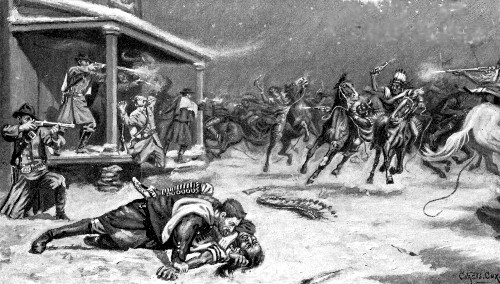
 Red Dog's Arrest.
Frontispiece. Page 264.
Red Dog's Arrest.
Frontispiece. Page 264.
The Project Gutenberg EBook of Under Fire, by Charles King

This eBook is for the use of anyone anywhere at no cost and with
almost no restrictions whatsoever.  You may copy it, give it away or
re-use it under the terms of the Project Gutenberg License included
with this eBook or online at www.gutenberg.org


Title: Under Fire

Author: Charles King

Illustrator: C. B. Cox

Release Date: December 14, 2006 [EBook #20101]

Language: English

Character set encoding: ISO-8859-1

*** START OF THIS PROJECT GUTENBERG EBOOK UNDER FIRE ***


Produced by The Online Distributed Proofreading Team at
http://www.pgdp.net. (This file was produced from images
generously made available by The Internet Archive/American
Libraries.)
Red Dog's Arrest.
Frontispiece. Page 264.
"A bad dhrill, a wake voice, an' a limp leg—thim three things are the signs av a bad man."—Private Mulvaney.
PHILADELPHIA:
J. B. LIPPINCOTT COMPANY.
1895.
Copyright, 1894,
by
J. B. Lippincott Company.
Electrotyped and Printed by J. B. Lippincott Company, Philadelphia, U.S.A.
Trancriber's note: Minor typos have been corrected, and ads moved to the end of the book. Table of contents has been added to the HTML version.
PREFACE.
UNDER FIRE.
CHAPTER I.
CHAPTER II.
CHAPTER III.
CHAPTER IV.
CHAPTER V.
CHAPTER VI.
CHAPTER VII.
CHAPTER VIII.
CHAPTER IX.
CHAPTER X.
CHAPTER XI.
CHAPTER XII.
CHAPTER XIII.
CHAPTER XIV.
CHAPTER XV.
CHAPTER XVI.
CHAPTER XVII.
CHAPTER XVIII.
CHAPTER XIX.
CHAPTER XX.
CHAPTER XXI.
CHAPTER XXII.
CHAPTER XXIII.
CHAPTER XXIV.
CHAPTER XXV.
CHAPTER XXVI.
CHAPTER XXVII.
CHAPTER XXVIII.
CHAPTER XXIX.
CHAPTER XXX.
CHAPTER XXXI.
CHAPTER XXXII.
CHAPTER XXXIII.
It is ten years since "The Colonel's Daughter" ventured before the public and found so many friends that "Marion's Faith" and later "Captain Blake" set forth in reinforcement, and even then there came the call for more. Pelham's old regiment was not the only one to contain either odd, laughable, or lovable characters, so now the curtain is raised on the Eleventh Horse,—a command as apocryphal as the —th, yet equally distinguished in the eyes of those who trod the war-path twenty years ago.
C. K.
October, 1894.
It was the last day of Captain Wilbur Cranston's leave of absence. For three blissful months he had been visiting his old home in a bustling Western city, happy in the happiness of his charming wife in this her first long restoration to civilization since their marriage ten years before; happy in the pride and joy of his father and mother in having once more under their roof the soldier son who had won an honored name in his profession, and in their delight in the exuberant health and antics of two sturdy, plains-bred little Cranstons. The visit proved one continuous round of home pleasures and social gayeties, for Margaret Cranston had been a stanch favorite in the days of her girl- and bellehood, and all her old friends, married and single, rose en masse to welcome her return. Parties, dances, dinners, concerts, theatre and opera, lectures, pictures, parks, drives and rides,—all the endless resources of the metropolitan world had been laid at the feet of the girl who, leaving them to follow her soldier lover to his exile and wanderings, had returned in the fulness of time, in the flush of womanhood, a proud wife and proud and happy mother. People could not understand her choice at the time of her marriage: "Cranston's[Pg 6] all right, but the idea of going to live in a tent or dug-out," was the popular way of putting it, and people were still unable to understand how she could have ever found anything to enjoy in that wild life or to make her wish to see it again. It was, therefore, incomprehensible to society that she and her two bouncing boys were utterly overwhelmed with distress at having to remain in so charming a circle, so happy a home, when it came time for the captain to return. Society even resented it a little. Juvenile society—feminine—took it amiss that the Cranston boys should so scorn the arts of peace, and persist furthermore in saying the buffalo and bear and wolves in the municipal "Zoo" were frauds as compared with what they had seen "any day" all around them out on the plains. Tremendous stories did these little Nimrods tell of the big game on which they had tired of dining, but some of their tales were true, and that's what made it so hard for junior society masculine, in which there wasn't a boy who did not honestly and justly hate these young frontiersmen, even while envying with all his civilized heart. Loud was the merriment at school over the Cranstons' blunders in spelling and arithmetic, but what—what was that as offset to their prowess on pony-back, their skill with the bow and sling-shot, their store of Indian trinkets, trophies, ay, even to the surreptitiously shown Indian scalp? What was that to the tales of tremendous adventure in the land of the Sioux and Apache,—the home of the bear and the buffalo? What city-bred boy could "hold a candle" to the glaring halo about the head of two who could claim personal acquaintance with the great war chiefs[Pg 7] Red Cloud and Spotted Tail?—who had actually been to ride and hunt with that then just dawning demigod of American boyhood,—Buffalo Bill? Sneer and scoff and cavil as did their little rivals for a time, calumny was crushed and scoffers blighted that wonderful March morning when, before the whole assembled school, there suddenly appeared that paragon of plainsmen, that idol of all well-bred young Westerners, he whom only on flaring posters or in the glare of the footlights had they been permitted to see, and smiling, superbly handsome, king of scouts and Indian-fighters, Buffalo Bill himself stepped into their midst and clasped the little Cranstons, madly rejoicing, in his arms, while their father, the cavalry captain, and even the dreaded teacher looked approvingly on. It was after that episode of no avail for even the sturdiest of their schoolmates to seek to belittle the Cranston fame. Louis, the elder, could not invent a whopper so big as to tax the credulity of the school. Buffalo Bill was "starring it" with his theatrical company through the States that spring, playing some blood-curdling, scalp-taking; hair-raising border drama which all boys eager strove to see, and when his old chum and comrade, the captain, went to call on him at his hotel, the great chief of scouts would not rest until together they had gone to see his friends "the boys." That other parents should have been pestered half to death as a result of this visitation any one who knows boys has not to be told, and many were the queries and complaints addressed to the laughing cavalryman upon that score. Parents, as a rule, had no proper conception of the honest merit and deserved fame of this transplanted[Pg 8] hero, Bill,—were amazed to learn from Cranston that he was no fraud at all, but a man whom he and his regimental comrades swore by. A total change had come over the spirit of the school-boys' dreams. Nothing but Indian raids, buffalo-hunts, or terrific combats diversified the hour of recess. The little girls chose romantic prairie names, were either Indian maidens or ever-ready-to-be-rescued damsels in distress. The boys became redoubtable chiefs or rival imitation scouts, but Louis Cranston alone was permitted to play the rôle of Buffalo Bill; in his presence no other boy dare attempt it.
It was a revolutionized society long before that budding May morning on which the captain had to take train for the far West, leaving wife and little ones to his father's care until the long threatened and now imminent campaign should be over. Then, should God spare his life through what proved to be the fiercest and most fatal of ten fierce and fatal summers, they should rejoin him at some distant frontier fort, and the boys' triumphant reign at school be ended. Loudly did they clamor to be taken with him. Stoutly did Louis maintain that his pony could keep up with the swiftest racer in the regiment, and indirectly did he give it to be understood at school that just as soon as the war really began he'd be out with "C" troop as he had been in the past. The war had begun and some savage fighting had already taken place, when the orders were launched for the Eleventh Cavalry to concentrate for field service. Cranston wired that he would give up the last ten days of his leave, and Mrs. Cranston, brave, submissive, but weeping sore at times, set to packing her[Pg 9] soldier's trunk. It was their last evening together for many a long month, and their friends knew it, and therefore, even if they called to leave a sympathetic word with the grandparents, they did not expect to see the captain and his wife. Once or twice the gray-haired mother had come to twine her arms about her big boy's neck, or to say that Mr. and Mrs. Somebody had just called, but wouldn't intrude. It was, therefore, a surprise when towards nine o'clock she came to announce a caller below,—a caller who begged not to be denied,—Mrs. Barnard.
"Mrs. Barnard!" exclaimed the army wife, in that tone in which incredulity mingled with surprise tells to the observant ear that no welcome awaits the announced one.
"Who is Mrs. Barnard?" asked the trooper, looking up from the depths of his big trunk.
"Oh, her husband owns about half the tenth ward," said Mrs. Cranston the elder, city bred, "and," hesitatingly, "you've often seen her in church."
"At church—yes," answered her daughter-in-law, "but no one ever sees her anywhere else. She has never called on me, has she?"
"No," said the elder lady. "They are old residents, though, and years ago when the city was new your father and hers—indeed, her husband and mine—were well acquainted, but we drifted apart as the city grew. She was Almira Prendergast."
"I'm sure I never heard of her when I was a girl, though, of course, I was away at school a good deal. Every one knows her by sight now because she's the most conspicuous woman in church. She dresses[Pg 10] magnificently," said Mrs. Cranston the younger. "I couldn't help noticing her diamonds last Sunday."
"They must have been big, Meg," put in the captain, reflectively, as he was getting himself out of his smoking-jacket. "Let's see,—ours is a hundred-dollar pew down near the foot of the side aisle, and hers a thousand-dollar box-stall just in front of the centre. Could they flash all that distance? They'd be useful for signalling——"
"Wilbur! I do wish you wouldn't mingle church and cavalry slang. It's downright irreverent, and at the bottom of your heart you're anything but an irreverent man."
"I won't," said the captain, solemnly; "at least I'll try to separate the ideas—they are a trifle incongruous—if you'll tell me how at that distance you could mingle your devotions with appraisal of Mrs. Barnard's diamonds."
"I didn't. If you'd gone to church yourself you'd understand these things. I couldn't help it. I simply happened to be next to her afterwards—at communion."
"Oh, I see," said Cranston, giving a jab at his thinning hair with the thickest and stiffest of brushes. "That does bring us to close quarters, doesn't it?" Then with provoking deliberation he rearranged his necktie and began pulling on his coat. "Hum, let's see," he went on, his eyes twinkling and his lips twitching ominously, "anything wrong about Mrs. B., mother mine, or with the millionaire husband? No? I see: just some of those people one meets at the Lord's table and nobody else's."
"Wilbur!" exclaimed Mrs. Cranston, in tones of[Pg 11] horror. "Indeed, indeed, mamma, he isn't a bit like that out on the frontier. It's only when he gets into civilized church circles that he says these outrageous things. If you could hear him read the burial service over some of our poor fellows as I have heard him, you'd know he lacked no reverence at all. He's queer,—he always has been about these social distinctions. You know and I know they are inevitable."
But leaving wife and mother to deplore his conduct and comfort each other with the assurance that he really knew better and wasn't as bad as he painted himself, which was occasionally in lurid colors, as must be admitted, Captain Cranston went down-stairs with a certain stiffness of gait which his intimates were well aware was attributable entirely to a war reminiscence of Pickett's parapet at Five Forks, but which nine out of ten, uninitiated, ascribed to military hauteur. He was still smiling his whimsical, teasing smile, for, though a devoted son, husband, and father, Wilbur Cranston was at times a trial to his feminine connections, and entertained on matters of church and state some views that were incompatible with those of high society. With opportunities second to none other when he joined the pioneer circle in the early days, Mr. Cranston, senior, had but moderately prospered from a worldly point of view. Eminent in his profession, he was destitute of any instinct of accumulation. He was a man the whole county honored,—whose word was his bond, whose purse-strings had never known a knot,—who had made large moneys in the law and spent them in charity, until now, occupying a social position at the top of the ladder, he lived[Pg 12] but modestly in the house that was once the envy of all his neighbors, many of whom once, and more than once, the beneficiaries of his charity, now looked down upon him from the colossal heights of their wheat elevators or sixteen-story office blocks. "The Cranstons were among our oldest and best people," said Society; "it is too bad they are so poor." For there had been a time when the old lawyer's health failed and practice was forbidden, and when Wilbur, once the recipient of a liberal allowance, felt called upon not only to resign that, but often to help from a captain's pay. Better times had come, and the soldier son had been able to make investments for himself and for his father in far Western mining property that yielded good return; but even when known as one of the few well-to-do men in his regiment, Cranston had persisted in a certain simplicity of living that some people could not understand. There were officers who had married wealthy women,—women whose gowns were superb, whose parlors and tables were richly furnished, whose household establishments put to shame those of three-fourths of their companions; whereas Cranston, even when he was able to dress his family fashionably and furnish his quarters elaborately, would not do it. "Every year," said he, "some of our most promising young officers are going to the devil because they or their wives try to dress or to entertain as do their wealthy neighbors. It's all wrong, and I won't set the example. It's getting to be the curse of our army, Meg, and if I had my way I'd introduce a law the reverse of that in force in foreign armies. Over there no officer can marry[Pg 13] unless he and his bride-elect can show that they will have over a certain income to live upon. In a republican army like ours no man ought to be commissioned unless he will agree to live on less than a fixed amount for each successive grade." They called him "Crank Cranston" in the Eleventh for quite a while, but without affecting in the faintest degree his sturdy stand. Margaret's gowns continued simple and inexpensive, and their mode of living modest as any subaltern's, and many women spoke of them as "close" and "mean," but many men wished openly they had Cranston's moral courage. At home, too, better times had come. There was the old homestead, and Mr. Cranston as counsel of certain big corporations had his easy salary and little work. There was no anxiety, but there should be, said he, no extravagance.
On the other hand, neighbor Barnard, who in by-gone days, tin dinner-pail in hand, tramped cheerily by the lawyer's rose-trellised home long hours before the household was awake, and who in his early struggles to maintain his little lot and roof had often availed himself of his neighbor's known liberality, had been surely and steadily climbing to wealth and honors, was now among the ranking capitalists of the great and growing city, and a few years back had been united in marriage to the admiration of his early school days,—Almira Prendergast, who, disdaining him in the early 50's and wedding the youth of her choice, was overwhelmed with joy to find in the days of want and widowhood, fifteen years later, that Barnard had been faithful to his ideal, had remained single for her sake, and so at last had she consented to accept[Pg 14] him and the control of his household. A pew in the "First Presbyterian" had been for years his habitual resort on the Sabbath, but as time wore on and wealth accumulated and the lady of his love assumed more and more the leadership in all matters, spiritual and domestic, he saw his establishment blossoming into unaccustomed splendor, he met new people, later comers from the distant East, and dropped the old, the friends of his boy days. He never meant to. He was engrossed in his affairs. He let Mrs. Barnard "run the machine," as he used to phrase it, knowing nothing of that sort of thing himself, and Almira's buxom beauty, attired now in splendor hitherto undreamed of, was rapidly rising into prominence in the new and growing circle wherein the old families revolved but seldom, but the errant orbits of Eastern stars were quick entangled; and some few years after their marriage a new and gorgeous edifice having been erected by the congregation of St. Jude's, and a daughter having been born to Barnard, the man of money heard without surprise and with little resistance his wife's change of faith in revealed religion. St. Jude's, a parochial offspring of old and established St. Paul's down-town, had become an ecclesiastical necessity in the growing north side. The Cranstons transferred their pew, as did others, to follow a favorite rector and his gospel closer to home. Mrs. Barnard experienced a long projected change of heart because the acknowledged leaders of the social circle herded thither, and Barnard followed as his wife might lead. The great memorial window in the south transept, through whose hallowed purpling the noon-day[Pg 15] sunshine streamed rich and mellow on the gray head in that prominent central pew, was the devout offering of Thomas Barnard and Almira, his wife, in testimony of their abandonment of the faith of their fathers and the adoption of that which in school days they had held to be idolatrous. Wilbur Cranston well recalled how in his school days Tom Barnard's honest, sturdy form went trudging by at nightfall from the long day's labor with the railway gang of which he was "boss," but Tom was a division superintendent when the lawyer's boy came home from West Point on furlough just as the war dogs began their growling along the border States. And now Tom Barnard owned all the tenth ward and most of the railroad, did he? And it was Tom Barnard's wife, a fair, fat penitent in sealskin and sables, who drove by in such a magnificent sleigh and style to humble herself at the altar by the side of such as we, whose social shoes she was as yet held unworthy to unlatch? Wilbur remembered how once, some years before, when his father's affairs were straitened and his own were cramped, when Meg and the baby actually and sorely needed change, but she sturdily refused to leave him and go East because of the expense, he had bethought him of Tom Barnard, the rising railway man, and wrote him a personal note explaining the situation and asking through his influence if such a thing as a pass for himself and wife could be obtained over certain roads east of the Missouri, and the answer came, written by a secretary, brief and to the point. Mr. Barnard enclosed pass over the Q. R. & X. for Mr. Cranston and wife, but did not feel in a position to[Pg 16] ask favors of any other road. And now Tom Barnard's wife had come almost at the last moment of his stay and begged that he would not refuse to see her. What on earth could she want?
A boy with a telegram had just entered and was at the open door as the captain reached the hall. Under the gas lamp without Cranston saw the carriage standing by the curb—a livery team, not the beautiful roans that had caught his trooper eye the first Sunday of his leave when he went to church with mother and Meg. The message was sharp and clear enough in all conscience:
"We march at once. You can catch us at Fetterman.
"So old Winthrop goes in command and Bob Gray as adjutant," he mused. "Then I've no minute to waste."
His step was quicker, his bearing unconsciously more erect and soldierly, as he entered the parlor and found himself facing the lady.
"I ask your pardon for keeping you waiting, Mrs. Barnard. I was in the midst of packing when you came, as I must go West at once."
She had not risen from the easy-chair,—a comfortable old family relic which stood opposite the old-fashioned piano. She leaned forward, however, so that the sealskin mantle, which the warmth of the room and the length of her wait had prompted her to throw back, settled down from her shoulders in rich and luxurious folds. She gave him, half extended, a[Pg 17] hand, which he lifted and lowered once after the fashion of the day and then released. He remembered her now perfectly,—the Almira Prendergast the big boys used to say was by long odds the prettiest girl in the days when half a dozen big brick ward schools were all the town afforded, but he did not say so, nor did she care to have him.
"Perhaps I ought to begin by apologizing for taking up your time," she said, as though not knowing how to begin; and then he saw that heavy lines of grief and anxiety had eaten their way underneath her dark and luminous eyes,—ravages that no tinsel could cover or wealth dislodge. "Was it the driver you spoke to at the door? I heard you say wait. I had already told him; but it isn't my carriage," she went on deprecatingly. "Our horses cannot stand night work, the coachman says, and there's always something the matter with them when they are most needed."
She was looking at him appealingly, as though she hoped he might suggest some way of helping her to say what had brought her thither—besides a livery carriage; but Cranston had taken a seat and was waiting, the telegram crushed in his hand. At last she spoke again.
"You—went to West Point, didn't you?"
"I? Yes."
"Well, then, you could tell me, couldn't you, how to get my boy there?"
"You mean by-and-by when he is old enough?"
"No. I mean now,—at once,—this week in fact."
"W—ell. That is hardly possible, Mrs. Barnard. Cadets are admitted only in June or September,[Pg 18] and only then when there's a vacancy in their congressional district. But, pardon me. How old is your boy?"
"He is twenty-one,—my eldest,—my first husband's."
"And you wanted to make a soldier of him?" asked Cranston, smilingly.
"Indeed, no! It's the last thing on earth I'd have chosen, nor would he, I am sure, if he were in his right mind."
"Oh, well, then I shouldn't worry about it, Mrs. Barnard. In this country, you know, no one has to be a soldier unless he very much wants to, and very often then he can't. And no boy who isn't in his right mind could get into the Point even if given a cadetship. What made you think of it?"
"Why, it seemed—at least I was told—it was the only way out of the trouble he is in. He—is already in the army, but I'm told it isn't so bad if one is an officer."
Cranston kept his face with admirable gravity.
"Then I assume that he has enlisted. If he is only just twenty-one and enlisted without your consent before his birthday, you can still have him out."
"Oh, we've tried that," said Mrs. Barnard, gravely, "but he had tried twice before he was twenty-one, and they refused him until he brought papers to prove his age. Then when he did enlist and we attempted to have it annulled, they confronted us with these. They refused to believe our lawyer."
"Well, pardon me, which was right, the papers or the lawyer?"
"The paper. It was my own letter; but I didn't[Pg 19] suppose they had it when—when we sought to have him released as not of legal age."
Cranston smiled. "Was it Mr. Barnard's proposition or the lawyer's?"
"Well, the lawyer said at first there was no other way that he knew of, we'd have to do that. Of course you understand I wouldn't ordinarily authorize an untruth, but—consider the degradation."
"The degradation of—having to—authorize the untruth?"
"No; of his enlisting,—becoming a soldier. I thought I'd had to suffer a good deal, but I never looked for that."
And then Cranston saw her eyes were full of tears.
She had tried lawyers. She had used money. She had invoked the influence of powerful friends. Each and everyone consulted assured her that the case could be settled in a twinkling. They would get the boy discharged at once. Then one after another all had failed, and then some one suggested to see him, Cranston; he was a regular, perhaps he could help. It was hard to think of her son as a soldier, but, said she, if he had to be, for a time at least, why not get him out of where he was and put him at West Point? She had come, she said, to tell Cranston the whole story, and then he could have kicked himself for the momentary amusement she had caused him.
Ah, what an old, time-worn story of mother love, mother spoiling, mother sorrow! Her bonny boy, her first-born, wild, impulsive, self-indulgent, overindulged as was his father before him, he had gone the pace from early youth; had been sent to and sent from[Pg 20] one school after another; had filled and forfeited half a dozen clerkships; tampered with cards and drink and bad company. Mr. Barnard had been willing to do anything—everything for him, but he had dishonored every effort, broken every compact, failed in every trial, forfeited every trust. At last there had been hot and furious words, expulsion from the house and home, a life of recklessness, gambling and drinking on moneys wrung from her until her patience and supplies both had given out. Then some darker shadow,—arrest and incarceration, one more appeal to mother, one more, on her knees, from mother to husband, a compromised case, a quashed indictment, temporary residence at a resort for cure of inebriates—the one condition exacted by Barnard—and prompt relapse, when discharged, into his former habits,—disgraceful arrest because of some trouble into which he had been led while drinking. This, all this she had borne, but never dreamed, said she, that worse still could follow,—that he could sink so low as to become a soldier.
What Captain Cranston would have said to a man who had come to him with such a tale, and with such unflattering conception of the profession he was proud of, need not here be recorded. It was a mother, helpless, sorrowing, and honest at least in her impression of the step taken by her recreant boy. She had come craving help and counsel, not instruction in the injustice of her estimates. Quivering, trembling, weeping, the heart-sick woman in her magnificent robes had opened the flood-gates of her soul and poured out to this comparative stranger the story of her son's depravity. Aloft, two women listened awe-stricken to[Pg 21] her sobs. Cranston brought her water, made her drink a little wine, and bade her take comfort, and amazed her by saying that at last her boy had shown a gleam of manhood, a promise of redemption. She looked up through her tears in sudden amaze. How was that possible? He must have been drunk when he did it, and couldn't have been anything but drunk ever since. Cranston patiently explained that so far from being drunk, the boy must have been perfectly sober or they couldn't have taken him. He had been frequently to the recruiting office, according to her account, and must have been sober at such times, or they would have discouraged his coming again. He couldn't have been drinking to any extent since enlistment or he could not be where she said he was, and knew he was, on daily duty as clerk in the office of the adjutant at the barracks. So far from its indicating downfall, degradation, it was the one ray of hope of better days. She looked at him, joy and incredulity mingling in her swimming eyes. "Then why does everybody I've consulted, even our rector, urge me to leave no stone unturned to get him out of it, even if we have to buy him a place at West Point?" was her query. And again Cranston found it hard to control his muscles—and his temper. Had it come to this?—that here in his old home the accepted idea of the regular soldier was that of something lower than the refuse of the prisons and reformatories? He could only tell her that it was because they knew no better. Up to the time of her boy's determination to enter the army had there been one single moment in the last five years when he had been free from his habits of drinking?[Pg 22] asked Cranston. No, not one. And yet that step was her conception of final degradation. What had occurred, he asked, to make her feel renewed anxiety, to cause her to seek a cadetship for him? Because the boy had written that recruits were soon to be sent to cavalry regiments out on the plains, and he had asked to go. The thought was terror. And Mrs. Barnard had learned that a congressman from the interior of the State had a cadetship to dispose of, but he lived at Urbana, the very place where poor Harry had spent his two months in the retreat, and then had disbehaved so afterwards. And Mr. Goss, the congressman, wanted references,—wanted him to pass examination, which he could not do, because he's only been a little while at school. Harry wrote a beautiful hand, and had read everything—everything, but he hated anything like arithmetic as a study, and Cranston had to smile and tell her that that in itself put West Point out of the question. But, said he, if he has ambition and ability, why not encourage him to persevere where he is and win commission from the ranks as many another boy had done? Bless the mother heart! That, too, had occurred to her, but they had told her it would take two years at least, whereas Harry was a born leader, a born commander. That boy could step right out now and command an army if need be, she said, and no doubt believed it; but when she wrote to Mr. Cooper about it (and Mr. Cooper it seems was Colonel Cooper, the boy's commanding officer), that gentleman replied that while the young soldier had certainly conducted himself in a most exemplary way and had given promise of being an ornament to the service,—"He[Pg 23] used those very words," said she, producing the colonel's letter. "See, 'an ornament to the service,'"—still, the colonel could hardly promise that the boy could rise above the grade of sergeant inside of two years.
Cranston recognized the handwriting, and took the letter. "I know Colonel Cooper," he said, "and he means just exactly what he writes. Mrs. Barnard, I am glad you came. I am glad to take a weight off your mind. I wish your friends and advisers were here that I might say this in their presence, especially our good rector, but I say to you with all my heart, I congratulate you on the step your boy has taken. I honestly believe he has done better for himself than you could do for him, and I advise you to let him go and learn campaigning on the frontier. It will make a man of him if anything will," and he added under his breath, "or kill him."
"And if you meet my boy, you'll help him? You'll be a friend to him?" she smiled through her tears. "God bless you for so helping me."
"I'll help him every way I know how," said Cranston.
And so they parted. She infinitely comforted, he oddly impressed. But Mrs. Barnard felt that fate was still against her and her boy when, four weeks later, flashed the news of savage battle with the Sioux, of Captain Cranston shot through the body and fearfully wounded in the fierce encounter.[Pg 24]
Fifty seats in the parquette had been reserved for the members of the class graduated from West Point on the beautiful morning of the 12th of June. The brilliant auditorium was thronged with friends of the young fellows. Officers of the Academy were seated in the boxes, interested no more in the play than in the enjoyment of "the boys" just released from their four years of hard study and rigid discipline. Two of the chairs were vacant almost until the close of the first act, then their owners came in.
"You fellows have missed a heap of fun," whispered a classmate. Then a burst of laughter and applause drowned his words. "All the same we didn't miss the train," was the reply as soon as the new-comer could make himself heard, after the lowering of the curtain. "Poor old Dad! It wasn't easy to let him go."
"What took him off in such a devil of a hurry? We counted on his being with us at the last supper."
"Oh, the Parson don't take much stock in last suppers—of this kind," answered the other in no irreverence of spirit, for the young fellow spoke in genuine earnestness; "still, he couldn't have gone back on us if it hadn't been for bad news from home."
"What, his mother?"
"No—o. It's a girl. He said he had to go."
"Ah, yes, we knew all along he was engaged, though[Pg 25] he never said anything about it. Parson never struck me as being one of the spoony kind."
"No, he wasn't a bit. He wrote to her every week, but her letters kept coming all the time—regular continued stories; but he wouldn't stand chaffing about them and didn't fancy remarks, so I quit."
"Know anything about her? Ever see her picture?"
"Once, by accident,—a mighty pretty girl, too,—but he never talked about her; it wasn't his way. We lived together the last two years, and I reckon there isn't anything I didn't tell him. I remember how you all laughed at the idea of my taking up with 'Parson' Davies, but he's pure gold."
"There's no discount on that, Jimmy; but what a time it took to find it out! If it weren't for the riding-hall we never would have known how much there was to him. There may be some prettier riders than Parson, but he's all round the best horseman in the class. What on earth did he choose the infantry for?"
"Something about that girl, I reckon. Looks to me as though he were going to get married before he joined the regiment."
"Sacrificing himself and his profession for the sake of a spoons, is it? Well, thank God, I'm not in love, and I wish he weren't."
Meantime the subject of this cadet chat, a tall, slender, serious-faced young fellow, was sitting in one of the crowded cars of the night express whistling away up the shores of the Hudson, shadowy yet familiar, fifty miles to the hour. His new civilian dress—donned[Pg 26] that morning for the first time—bore something of the cadet about it in its trim adjustment to the lines of his erect, even gaunt figure. He sat very straight, looking silently across the aisle out on the starlit river to his left, and holding on his knees the new dark-blue cape and an old travelling-bag. A lone woman in search of a seat had entered the car at Harlem and passed by a dozen unsympathetic travellers, who made no move to share the seat over which they sprawled aggressively. The first to lift his satchel and make way for her was the tall, thin-faced young man in the straw hat and pepper-and-salt suit. He rose and offered her the inner half, which she accepted gratefully, then thanked him in broken English for stowing her various bundles in the rack above.
The conductor looked oddly at him as he unrolled his ticket.
"Going through? Don't you want a sleeper?"
"How much is a single berth to Chicago?"
"Five dollars."
"No. I'll get along here."
Not until they reached Albany, after midnight, had he a seat to himself. Meantime, finding his companion overcome by drowsiness and her poor old head bobbing helplessly, he rolled his new cloak cape into a sort of pillow, wedged it between her and the window seat, and bade her use it. As they came in view of the brightly-lighted station she awoke with a start and made a spring for her belongings. She had slept soundly ever since they left Poughkeepsie, and was again profuse in gratitude. "We stay here several minutes," said Mr. Davies. "Let me help you with[Pg 27] your bundles." And, unheeding her protest, he marched off with a bird-cage and a big band-box. A burly German made a rush for the car the moment she appeared upon the platform and lifted her off with vehement osculatory welcome, Davies standing silently and patiently by the while, then surrendering her traps to her legal protector. "He is such a kind young man," said the smiling frau. "He gif me his seat. We have a sohn, yust so old as you," she added, "but he is farder as Chick-ago. He is a soldier, out by Fort Larmie."
"Yes?" said Davies, smiling. "Then perhaps I'll see him some day. I expect to be out there before long."
"And you are a soldier, too! Ach Gott! ein offizier?" she exclaimed, in consternation, born of German associations.
"Not yet, though I suppose I shall be very soon. What is your boy's regiment?"
And, jabbering excitedly now, both at once, the two old people began pouring their tale into his ears; told their boy's name,—"He was a gorboral alretty,"—and they were justly proud, and Davies made them happy by noting the name and company in his book and giving his own, though he explained that he was not yet a lieutenant, only a just-graduated cadet, but that if ever he found the corporal, he said, he should tell him of his pleasant meeting with the old folks, and then, after a cup of coffee at the restaurant counter, he returned to his own thoughts and the car.
Soon they were spinning up along the shining Mohawk, and still his eyelids would not close. In his[Pg 28] waistcoat-pocket lay a bulky letter, the last of many in the same superscription—a prim, unformed, school-girlish hand—that had come to him during the last two years of his cadet life. Its predecessors, carefully wrapped and tied, were in the old trunk somewhere ahead among the baggage. In his hand again was the telegram that, reaching him at the moment when he was bidding adieu to the academic shades he had grown so deeply to love, had determined him in the already half-formed resolution to cut loose from his comrades and the class festivities in New York and take the first train for the far West.
"Doctor says come quick. Almira worse.
"B" was Almira's elder sister. Urbana, the home of his boy- and her girlhood, the home where his father lived and died, pastor of the village flock, a man whose devotion and patriotism during the great war had won for himself the friendship of the leaders of the armies of the West and for his only son, years afterwards, the prize of a cadetship at West Point. Deeply religious in every fibre of his soul, the chaplain had labored among the hospitals in the field from first to last, and died not long after the close of the historic struggle, a martyr to the cause. He died poor, too, as such men ever die, laying up no treasures upon earth, where moth and rust and thieves are said to lessen treasure there accumulated, yet where its accumulation seems the chief end of man not spiritually constituted as was Davies, who was imposed upon by every beat and beggar, tramp and drab, within reachable distance[Pg 29] of Urbana. Far and wide had spread abroad the words of his personal creed,—that he would rather it were recorded against him that he had been duped a million times than that one human being had left his door hungering. His widow was not only merely penniless, she was helpless but for the strong arms of her son, who slaved for her as the father had slaved for the Union. Those were the days when pensions were few. It was too soon after the war, and facts were fresher in men's minds. Percy did all the farm-work by day and taught school by night until, in his twenty-first year, he was sent to the Military Academy by the President himself, who had known his father from the days of Donelson. It was told of the tall, taciturn young man that he seriously contemplated resigning during his fourth class year when he found that he could not send home the little savings from his cadet pay. If the rule of the sacred commandment could but be made to work both ways, and days would be indeed long in the land the Lord our God had given to him who most honored his father and mother, no life insurance company in all America would have hesitated in Percy Davies's case, had the policy been millions and the premium unity. A gentle woman was Mrs. Davies, but a distressingly helpless and dependent one, and it was an old saying in Urbana that Davies had married poor Salome Percy because if he didn't nobody would; not because he stood in need of her, but because she was much in need of him. And when, not long after his father's death, Percy appealed to a well-to-do citizen on the widow's behalf, he was refused, and the brawny son and heir[Pg 30] of the well-to-do citizen told of the incident, and was idiot enough in Percy's presence to repeat this old village saw as the reason of the refusal, it nearly led to tragedy. Seizing the first available weapon, a flail, which he wielded with uncommon skill, in one mad moment the indignant youth smote the other hip and thigh,—the first, and for years the only, time he was ever known to lose control of himself. In ten seconds the battered gossip was sprawled full length, and they who would have rushed to tear his assailant away stood amazed to see him tearfully imploring the pardon of the vanquished.
And then as Percy grew in years and grace, working day and night that he might obey that last sacred whispered injunction, "Take care of poor mother," and Urbana grew in population and importance, one mortgage was lifted by the sale of part of their little farm, and the home made more comfortable for the ailing, querulous woman. She loved young folks, and yet lacked the faculty of attracting them. Striving to interest some of the village maids in her, Percy interested more than one in himself, and among these was a rural beauty, by name Almira Quimby. She was only sixteen, a romantic child with an exquisite complexion, big melting blue eyes, and curling ringlets. She lived, said other village maids, "on Sylvanus Cobb and slate-pencils." She devoured with avidity every bit of sensational trash procurable in the public or post-office libraries, and made eyes at the tall, strong school-master,—the best rider, reaper, thresher in the field, and best reader and declaimer in the winter lyceums. He was intellectually far ahead of his fellows, and his[Pg 31] father had labored to teach him. He was "serious," which was our Western way of saying he had strong religious views, and Almira became devoted in her attentions at church, Bible-class, and Sunday-school. Still, he did not become an adorer, and she began visiting the widow in her affliction, and thereby seeing more and more of the widow's son. There were strapping prairie beaux who would have given all they possessed for any one of the soft, shy looks she stole at Percy Davies, and who began to hate him vehemently as her fancy for him increased.
He would have been of utterly unimpressionable material could he have looked unmoved day after day upon her budding beauty, and it was not long before Davies found himself strangely interested, and still he would not speak. It was not until his appointment came, and he was preparing to go to the Academy, that he owned himself vanquished. Almira's red eyes and not entirely concealed emotion had told the mother how the girl was grieving at the prospective loss of her first love, and she with motherly solicitude took Percy to task. If he cared for Almira why didn't he say so? With perfect truth the young man replied that he couldn't help admiring her, but had struggled against it because he was in no position to marry, and did not know when he would be. To this the mother replied that she had grown very fond of Almira, and had learned to depend upon her. She was not only very pretty but, what was much better, a very good girl, and her father was as "well-to-do" as anybody in Urbana, except the hotel-keeper. He could well afford to give her part of the big farm and build them a[Pg 32] house near the widow's own roof. She knew, or thought she knew, as do so many of us, just what her neighbor could and should do, but overlooked the fact that old Quimby had two sons and three daughters older than Almira. The fact that most of them were married in no wise detracted from their expectations of material aid from the "old man." The fact that he might care to take unto himself a wife to replace the late incumbent now sleeping placidly in Urbana's leafy cemetery was no more contemplated by them than by the Widow Davies. But there was another widow in Sangamon County who knew better and who wisely said naught. Almira's father was well off, said Mrs. Davies. She had rich relations in the great metropolis of the State. Her Aunt Almira was married to the manager of the Q. R. & X. Railway,—the man who used to send father Davies an annual pass so long as he lived. Mrs. Davies longed, she said, to see her son happily mated, and then she would be glad to go and rest by the father's side under the shadow of the soldier's monument. How it all happened would be too long, too old, and by no means uncommon a story. When Percy Davies went to West Point he left behind him a weeping maid who vowed that she would wait for him a lifetime, if need be. It was really quite a romantic parting, and the young man believed himself very deeply in love, and so did Almira.
And yet he was not easy in his mind. Percy Davies was old for his years. He was going to the Point because of his father's strong predilection for the graduates of that institution. The son had no especial[Pg 33] taste for a military life. He was studious. He would far rather have gone to some college or university and pursued a classical course, and then studied for the law or the ministry. He had no means for such an end, however, and accepted what was offered him on his father's account, with no little uneasiness on his own. It was not his desire or purpose to remain in the army. If he could honorably do so he meant to leave the military service within the four years which his letter of appointment stipulated he should serve after graduation. He doubted the propriety of his accepting it under the circumstances, and he—looked upon by his fellow-men and youths as the most enviable of their number—left his home for the new life in no enviable frame of mind.
For some months after his departure Almira fairly lived with the invalid mother, and was faithful both to her and to the absent lover. Not a day passed without her spending hours with the widow and discoursing on the perfections of the absent one. Old Quimby, a hard-fisted, hard-headed old democrat, had made no objection to the engagement, remarking that if 'twan't Davies 'twould be somebody else, and seeing as he was the smartest lad at farming and schooling, and that it would be four years anyhow, why, there was no call for him to worry. Then Urbana built a bigger school-house and got a new teacher, and for two years saw naught of Percy Davies. Property increasing in value, another slice of the homestead lot had been sold, and with economy the widow could be comfortable on her little income; but it was not long before the gossips, dropping in to cheer her up a bit, began to tell of the[Pg 34] swains who were making eyes at 'Mira, and then of 'Mira's growing consciousness of her charms and fascinations. The second year of Percy's absence there could be no doubt that three or four bucolical hearts were turned on her account. Had there been just one devotee the absent lover's claims might have been endangered, but there being several she was content in a placid cowlike way in their attentions, and became less devoted to mamma. With the second summer, however, Percy came home on cadet furlough. The slight stoop was gone. An erect, martial carriage and quick, springy step had replaced the somewhat plodding gait of the school and farm. The sprouting beard and whiskers had vanished, and a stiff moustache, which soon began to curl and twist becomingly, adorned his upper lip. The "store clothes" of the Western town long since cast aside, Davies appeared in stylish and trim-fitting civilian dress, but resolutely declined all appeals to wear—except for mother's eyes—the uniform of his famous corps. When he went on sunshiny Sundays to the church that seemed hallowed to his father's memory, the spotless white trousers and natty sack coat of dark-blue flannel were, however, so military in their effect as to create, despite himself, almost the effect of regimentals. Then he had acquired already an air and manner, a polish that distinguished him at once above his fellow-townsmen, and Almira's wavering allegiance gave place to new romance and fervor. The old flame had found too little breath in his earnest, honest letters to keep it alive. As for him, though he had belonged to what was termed the "bachelor gang" at the Point and mingled but little[Pg 35] in ladies' society, he was a close observer, and Percy Davies saw at a glance that though more radiant in her rustic beauty than before, more appealing to the senses in the flush of her health and unconscious grace, there was still something besides the fashion of her gown that differed widely from the beauties who thronged the gravelled walks, the shady groves, the tented field of the national military academy. The swains of the winter gone by were less in evidence now, and it pleased her anyhow during the two months of his home stay to forget them one and all and cling only to him. Changes came in the next two years—and trouble. Old Quimby married again. Almira's home-life became unhappy. Quarrels ensued between the new wife and the children. Reproaches fell from the lips of the failing widow because of Almira's tacit acceptance of the devotions of young Mr. Powlett, son of the resident physician of the sanitarium that was now bringing so many patients to Urbana. A handsome, dare-devil sort of boy was Powlett, who speedily cut out all the local beaux at the parties and picnics which filled the summer of '75. A beautiful dancer was he, and taught Almira to waltz and "glide" in a style never before seen in Urbana, and that other couples first derided, then envied, then vainly strove to imitate. That Urbana censors should go to the widow with invidious comment upon Almira's misbehavior was a matter of course, and that the widow should transmit their tales, not entirely without embellishment and reproof, was only to be expected. Almira accepted both with ill grace, was moved to tears and protest. She couldn't help it if people admired her and liked to[Pg 36] dance and walk and talk with her. She must either submit to it or shut herself up and mope and not go out at all. She thought Mrs. Davies most unjust, but she did not promise to amend. Then the widow, finding Almira obdurate, was moved to write to Percy advising him that he should caution her, who was only light-hearted and thoughtless, and, to the widow's surprise, Percy refused. He gravely wrote that Almira was but a child when she engaged herself to him. She had seen nothing of the world or of other men, and it was a matter he would not interfere with, and one that he desired his mother to leave alone. This was simply incomprehensible. Urbana was very gay that autumn and early winter. The sanitarium was the means of bringing business to town, and a number of new stores were opened, and new young men came to tend the counter and swell the parties, and still young Powlett held supremacy, and everybody began to say that the cadet was cut out, and Almira Quimby had gone over heart and soul to the new claimant, when there came a cataclysm,—a scandal at the sanitarium, a stir at the Palace Hotel, Urbana's new hostelry, the arrest of a recently discharged patient by the name of Brannan, an afflicted young man with what was described as an unconquerable mania for drink, and the sudden disappearance of young Powlett. There was investigation and more scandal. It transpired that this young Adonis had abused his father's trust to the extent of smuggling liquor to certain patients and of heaven only knew what else. Dr. Powlett resigned, crushed and humiliated. Lawyers came and bailed out the other unfortunate, of whom it soon was rumored[Pg 37] that he was Almira Quimby's own cousin, the son of her rich city aunt, and that was the reason the lawyers and not the relatives came. It was presently established that young Brannan was more sinned against than sinning, and the holidays opened, with a fearful gap in Urbana, for Almira's devoted lover, to the comfort of every right-thinking maid and swain in Sangamon society, had fled, no one knew whither.
Two weeks later the Widow Davies lay at death's door. Her son was telegraphed for, and came. His leave was for only one week,—even that a most unusual concession, granted only because of his unimpeachable conduct and his safe though not high standing in scholarship. His coming seemed to give new life to the mother, and Almira vied with him in attention and devotion. Urbana took it much to heart that after her months of monopoly of Mr. Powlett, of whom the most damaging and dreadful things were now told, she should so calmly and complacently resume her apparent sway over this martial and dignified and superior sort of person, the widow's son. Urbana fully meant that his eyes should be opened just so soon as the mother's were closed. But Urbana found that luck was dead against it. The widow began to mend,—the son it was who was suddenly prostrated on the eve of his return to the Point.
Leaving Almira at her father's door one night after seeing her safely home, Davies was found lying in the high-road, senseless, an hour later, and never, said Urbana, knew what hit him. Concussion of the brain was feared, for he had evidently been assaulted in the dark from behind and felled to earth by blows of some[Pg 38] heavy, blunt instrument. Robbery was evidently the motive, for his little store of money and the beautiful and costly watch presented to his father at the close of the war were gone. Almira had two patients now, and devotedly she attended them. When in a fortnight Percy declared he must return, and did return to pass his midwinter examination, she wore at last an engagement ring. Urbana did not know that he had offered—and she had refused—freedom. Urbana did not know that she declared she loved him as she never did before, and as she never had another. Urbana resented it that he who was so soon to occupy the exalted station of an officer of the regular army, and the princely salary of something over a thousand dollars a year "with all expenses paid,"—double the sum enjoyed by the head salesman of Miller & Crofts,—should be so utterly deluded as to the frivolous character of his betrothed, and means were taken to enlighten him. Anonymous letters came to Cadet Davies of the graduating class, which that grave and reverend senior committed, not to memory, but to flames. Whatever she had been before his visit and mishap, Almira was all devotion now. In May he wrote to her gravely and affectionately, bidding her remember that he always felt that she had been pledged to him when too young to know her own mind, that his must needs be a life of self-denial, privation, and danger, that he must live with the utmost economy consistent with his position as an officer, because his mother's comfort must be a sacred charge so long as she lived, and that it might be years before he could see his way to asking any woman to come and share his lot. All this he had conscientiously[Pg 39] explained to her before, and she had met it with tears and reproaches. She could help him live economically. They could sell the homestead and take mother to live with them. She would welcome the day when she could leave her father's roof, now no longer a home to her. She knew it must be that he was tiring of her,—that he had met some proud lady in the East, and his poor little village maid was forgotten, etc. Now, in answer to this last letter, virtually proffering release if she so desired, her response was vehement. He would kill her with his cruelty and coldness. She had no hope or ambition other than to share his lot, however humble. To be her noble soldier, her hero Percy's bride, would be her heaven, and neither gold nor grandeur nor princely mansion could tempt her from his side, and she would welcome the grave if he proved false to her. It was all the high-flown, emotional, melodramatic trash to be expected of an ill-balanced girl whose pretty head was stuffed with the romance of the country post-office type, and Davies sighed heavily as he read.
He had planned to visit an old friend of his father's and see something of New York harbor and city before turning his back on the East. Never yet had he set foot in Gotham, and as it would be years before opportunity might again be afforded him, he had weighed it all pro and con, and decided that Dr. Iverson's advice and invitation should be accepted. He would go with his classmates, spend the last evening with them, and join the reverend doctor on the morrow. His mother, even in her invalided state, urged that he should do so, but Almira heard the plan with fresh[Pg 40] outburst of tears. There was to be a grand picnic of all the beaux and belles of Urbana on the 18th. She had counted on having her soldier lover in attendance on that occasion. She had told him of it, and that was enough. She had declined all other invitations, saying that Mr. Davies was to hasten thither the moment the graduating exercises were over, and now to think of the triumph and malicious delight of the other girls was intolerable. Her lover should fly to her like homing-pigeon the instant he was released from prison. It was tantamount to treason that he should purpose anything else. Almira fretted herself into a fever. She wrote one long letter to the recreant Parson, and her sister Beaytrice, as they called her, followed it up with another still more alarming. Then, as he did not wire instant submission, the telegram was sent. Old Quimby was on the platform at the Urbana station as Davies sprang from the train. "Nothing much," said he, in response to the young man's eager inquiry. "Some dam girl nonsense she and Bee have cooked up between them. When they ain't devilling the life out of their step-mother they're worrying somebody else. Oh, yes!—'course the doctor's been humbugging for a week,—too glad to get a chance of shovin' in a bill."
Davies went gravely up the sunny street to his mother's home,—a meeting that served to chase away the clouds, and then an hour later to Almira's bower. Bee ushered him into a pretty room whose windows were overhung with honeysuckle and pink chintz, and there in a great old-fashioned rocking-chair reclined the lovely invalid, who greeted him with outstretched[Pg 41] arms and rapturous cry, and who was sufficiently restored to exhibit him at the Sunday-school picnic as originally planned. So far as she was concerned, all went blithely as a marriage-bell until the morning of July 5, when there came the fearful news of the massacre of General Custer and his troops at the hands of the Sioux. That evening the city papers said all officers on leave were hurrying to their regiments, that reinforcements were being pushed to the front, that recruits were needed at once; and the next day, followed by a mother's prayers and a maiden's unavailing protest, Percy Davies was gone. Just as his father did in '61, leaving all to pursue the path of duty, the young soldier, though not yet commissioned, sped to the nearest army post, and joined the first command en route for the field.
In the hot July sunshine, up the long vista of the street the flags hung drooping, every one, with a single exception, at half staff. Over the building where hearts were heaviest the colors soared highest; the general commanding, until ordered from Washington, being debarred a manifestation of mourning which the sovereign citizen adopts as a matter of course. It was bitter disaster that had befallen the national arms and involved so popular a commander with scores of his gallant men; the stars and stripes that had been saluted all over town in honor of the ever-glorious Fourth[Pg 42] were now set at mid-height or draped with black. The crowds that had gathered about the newspaper offices and department head-quarters all the previous day were scattered, in the conviction that little remained to be told, but there was a gathering at the railway station to bid adieu to the battalion of infantry from the neighboring fort, leaving by special train for the seat of war. They had cheered the dusty fatigue uniforms as the cars rolled away, and many a young fellow would gladly have gone with the boys in blue could he have faced the social ban which a misguided public has established against its most loyal servants, holding enlistment in the regular army as virtual admission of general worthlessness. And now the crowds still lingered under the glass roof of the big passenger shed, for word had gone out that another train coming across the bridge was loaded with more troops, and there was a fascination in watching these prospective victims of the stake and scalping-knife. It had been a fierce campaign thus far, and one in which the losses and vicissitudes both (there are no honors to speak of) had been borne principally by the cavalry, but now the "doughboys" with their "long toms" were being pushed to the front. "Wait till Emma Jane gets her eye on ould Squattin' Bull," said an Irish private, patting the butt of his rifle, as with head and shoulders half-way out of the car window he confidentially addressed the crowd. "It'll be the last spache he'll ever ax to hear."
"That'll do there, Moriarty; get that gun inside," said a lieutenant, briefly. And as Moriarty obeyed, with a grin and wink at the throng, the laugh and[Pg 43] cheer that went up were evidently for Private Pat and not for his superior. It is the smiling face, not official gravity, that wins the great heart of the people. The band which had headed the column on the march in from the post, but was not to accompany it to the field, was still waiting to give the next comers a fitting "send off." Two or three staff officers in civilian dress stood in earnest talk with the superintendent of the railway, a knot of curious citizens surrounding them, eager to pick up any point with reference to the troops or their transportation. Expectant eyes were cast towards the east where the towers of the great bridge loomed in the shimmer and glare of the hot noontide. "She ought to be here now," said the railway-man with an impatient snap of his watch-case. "What keeps No. 5, Gus?" he asked of an assistant hurrying by.
The man hauled up short and touched his hat. "This just came at the train-despatcher's office, sir," said he, as he handed up a slip of paper, which the superintendent quickly read, a queer look coming into his face as he did so.
"Hu-m-m, gentlemen. This is something you'll have to straighten out. It doesn't seem to be in my line." And he handed the paper to Major Ludlum, chief quartermaster of the department, who in turn read it, his eyes filling with grave concern.
"Recruits on No. 5 broke loose at Bluff Siding,—drunk—raiding the saloon. Can't get 'em on train again. Can guards or police be sent?" It was signed by the conductor.
"Well," said Ludlum, disgustedly, "we might have known that would happen. The idea of sending three[Pg 44] car-loads of raw recruits with only one officer, and that one old Muffet. It's tempting Providence."
"Why, I thought he had a lieutenant with him. Somebody said so at the office this morning," said the department engineer officer.
"Not even a lieutenant,—a cadet, if you like; graduated not a month ago,—not yet commissioned. Some young cub just out of school, with about as much idea how to handle drunken recruits as I have of dressing a doll. Home on graduating leave and thought it his duty to volunteer is all I can make out of it."
"Well, bully for him!" spoke up the superintendent. "The boy's got the right stuff in him if that's the case."
"What's his name?" asked the engineer officer. "I knew most of this year's class when I was there on duty."
"Davies," said the quartermaster, consulting a notebook. "Remember him?"
"Why,—yes,—vaguely. He was not in the section I had charge of," said Captain Eustis. "One of the last men to attract attention,—Parson Davies they called him, I believe. He was one of the Bible-class. Don't think anybody knew him outside of the Sunday-school."
"No wonder the recruits jumped the traces with no one but old Muffet and a parson," said the quartermaster, disdainfully. "Now the question is, what's to be done? Somebody's got to go over and pull them out of the hole."
The situation was indeed serious. Many of the commands now suddenly ordered to take the field were so short of men that, after the manner of doing things in the 70's, a detachment of undrilled recruits, one[Pg 45] hundred and eighty strong, was hurriedly tumbled aboard the cars at the cavalry depot on the Mississippi, while others were shipped from the far East for the Foot. Only one officer—a semi-invalided old trooper—could be spared from Jefferson Barracks to accompany the batch. There was no time to wait, and just an hour before the detachment started there arrived at the office of the depot commander a tall, slim, solemn young man in brand-new fatigue uniform,—that of the infantry,—who introduced himself as Mr. Davies of the graduating class, who said he was not yet assigned to a regiment, but having read that all officers were hastening to join their commands before they got beyond communication in the Indian country, thought it possible that he might be assigned to some company in the field and didn't wish to be left behind. That night he was seeing his first service. Colonel Cooper, the post commander, shook him by the hand and presented him to old Muffet, who was in a devil of a stew and glad of professional help, and then wired on ahead to the general commanding across the Missouri, or to his representatives at head-quarters,—he being in the field. All went well enough early in the night, but, towards morning, whiskey had been smuggled aboard in sufficient quantity to start the devil of mischief, and finally, at Bluff Siding, just before reaching the Missouri bridge, overpowering the unarmed and perhaps sympathetic sentries at the car doors, and defying the orders of their sergeants, the half-drunken crowd swarmed out and made a swoop upon a saloon across the side-track. In less time than it takes to tell it every cubic foot of space of the bar-room was packed[Pg 46] with rioting humanity in grimy blue flannel. The proprietor, who had stood his ground at the instant of initial impact, was now doubled up underneath the counter; his shrieking family—Hibernians all, and somewhat used to war's alarms, though hardly to the sight of raiding boys in blue—had taken refuge in the privacy of their own apartments above and behind the saloon itself, while within the reeking establishment pandemonium had broken loose. Bottles, glasses, and raw liquor were liberally besprinkling the heads and shoulders of the surging throng. A brawny Irishman, mad with the joy of unlimited riot and whiskey, was on top of the counter impartially cracking the heads of all men within reach with the blows of a big wooden bung-starter. Four or five who had found the trapdoor leading presumably to the supplies in the cellar were furiously fighting back the crowd so as to admit of their raising it and forcing a passage down the wooden flight. Poor Muffet, vainly pleading and swearing, was scouting on the outskirts of the crowd about the door-way, occasionally turning and shrieking orders to some bewildered lance sergeant to find the lieutenant and tell him he must get in there and do something, but the lieutenant was nowhere to be seen. At a respectful distance the neighbors were looking curiously on, half a dozen roustabouts from the wharf-boat moored under the bank, a little batch of railway employés, a number of slatternly women, not entirely unsympathetic, and perhaps half a dozen hands from a neighboring saw-mill, but all these, combined with the townsfolk hurrying to the scene, would have been powerless as opposed to the sixscore drink-maddened[Pg 47] "toughs." Of the recruits, perhaps a dozen had remained in the cars; of their non-commissioned officers, perhaps half a dozen were trying to do something, but having no directing head or hand, accomplishing little. It looked as though nothing but the bursting asunder of that ramshackle building would liberate its human charge, for even those who, battered, bleeding, and suffocated, would gladly have escaped into outer air, were packed in, sardine-like, and incapable of self-extrication. To the appeal of the conductor that he should regain control of his men and prevent destruction of property, the luckless Muffet plaintively responded, "My God, what can I do? I've done my best, and nobody else has done anything. The only officer I've got has deserted me."
But even as he spoke, accompanied by a jutting and hissing and spraying, by outburst of yells, jeers, maudlin laughter, there came sudden vomiting forth of drenched and dripping forms. Over the heads of the throng within, into the hot faces of the throng without the double door, hurling them back from the battered entrance in sudden panic, a powerful stream of cold water, shooting from unseen nozzle, broke up and demoralized the drunken barrier. Skilfully directed into the heart of the crowd at the door-way, then into the ruck and tumult within, it first cleared a passage, then, torrent-like, swept away into it, tumbling and swearing and cursing, but going, the last able-bodied invader of saloon sanctity, bestowing upon its foul interior the first thorough washing it ever received, driving the despoilers before it with the force of a battering-ram, yet even then, unsatisfied, following up[Pg 48] its victory. With perhaps half a dozen soldiers and as many mill-hands hauling on the slack of the hose behind him, through a north window came the tall, slender, serious-faced person of Mr. Davies, a laughing young lance corporal manning the butt with him, and, aiming low and driving discipline and punishment at the rate of a gallon a second, a posteriori, at the now drenched and scattering mob, and shouting, "Back to the train! Back to your seats!" never did they cease their deluge until the last laggard capable of locomotion took shelter within the cars. Muffet, recoiling in time to escape both rush of men and muddy water, stood shouting confirmatory orders from the platform the while. Many a mob will face the shock of charging steel and hissing lead that melts away before ridicule and squirted water. The emeute was ended long before the police arrived, and Muffet had regained some measure of his accustomed presence of mind. "Oh, we simply manned the saw-mill hose," said he, in complacent acknowledgment of the congratulation of the staff officials first to meet him. "It didn't take long to souse them to their sober senses."
Indeed, the three car-loads of dripping and bedraggled humanity, meekly side-tracked under the guarding bayonets of the one company of infantry left at the fort, found not a sympathetic eye among the lookers-on. An ambulance had carted off to the hospital four or five, whose battered skulls bore witness to the hammering powers of big Milligan and his bung-starter. That redoubtable giant himself, weak from the shock of having involuntarily gulped more water in a second than ever before he had swallowed[Pg 49] in weeks, was flattened out in a baggage-car. Two more of the arriving reinforcements failed to appear to the public eye at the scene of congratulation, and, as sometimes happens in even so well regulated a family as our little army, these were the two who most deserved any honors that were being bestowed,—Mr. Davies and his assistant pipeman.
Just as the last prostrate victim of that powerful combination—rum and riot—had performed the frog's march to the baggage-car, the raving saloon-keeper had been instructed to send his bill of damages to the chief quartermaster across the bridge, the conductor had signalled "Go ahead," and the young officer, ruefully scanning the wreck of his new fatigue uniform, was clambering on the platform of the sleeper, when he saw that the blood was dripping from the corporal's hand, despite the big handkerchief wrapped about it.
"Come in here, corporal," said he. "Let me look at that. How did it happen?" And he led the way into the men's toilet-room of the sleeper.
"I must have cut it with some of that broken glass at the window," was the answer.
He was paling now, drooping evidently from loss of blood. Quickly Mr. Davies unrolled the bandage, and there, beside a little jagged gash, disclosed a deep cut from which the blood was oozing. "Why, man," said he, "that's as clean as though done with a razor. Did any one try to knife you?"
But the soldier made no answer. He sank limp upon a seat. Two civilian travellers, in prompt sympathy, tendered flasks, and a stiff cup of brandy brought back some vestige of the flitting color. Then[Pg 50] a young lady came forward from the interior of the car. "Please let me help you," she said. "My father was a surgeon and I know something about these wounds." Davies gratefully gave way to her, and found himself watching the swift, skilful touch of her slender white hands as she bent over the work. It was finished in a minute, and then with calm decision the girl spoke again. "I will take him back to our section. He needs quiet for a while," said she, standing erect now and addressing herself to Mr. Davies, and rather pointedly ignoring the younger civilian, whose interjected remarks fell upon ears that were dainty but deaf. "I am with Mrs. Cranston," said she, "whose husband is among the wounded. Do you know him?—Captain Cranston?"
"Only by reputation," answered Davies, raising his cap. "You are very good to our men. Go with this young lady, corporal. I'll come as soon as I can wash my hands."
Hardly waiting, however, for his reply, the girl had passed her hand underneath the soldier's arm and led him rearwards as the train slowly rounded the long curve to the bridge embankment. Davies slipped out of his sack coat and plunged his hands in the basin. "Would you mind pumping for me?" he said to the nearest civilian, who with his companion stood gazing admiringly after the girl. "My hands are covered with that poor fellow's blood."
"Certainly," was the prompt answer, as one of them grasped the nickel-plated lever. The other and younger man turned to the ice-water tank, rinsed the tumbler that had just been used to such good purpose, poured[Pg 51] out another stiff load of spirits, and with confident kindliness held it out to the young officer.
"Thank you," said Davies, shaking his head, "I never use it."
"You don't?" was the surprised answer. "Why, I thought all army officers drank."
"That seems to be the general idea," was the quiet answer. "Much more general than the practice, I hope. Thank you," he continued, as, drying his hands, he quickly donned his coat and went on through the car. They watched him a moment as he was presented to the elder of the two ladies, one whose face, though still young, bore traces of grief and tears and anxiety. They saw her look up and clasp his proffered hand, evidently glad to meet one of her husband's cloth.
"Now, if I'd only known about her husband's being one of the wounded, I could have rung in there all right," said the younger of the two travellers. "I haven't seen a prettier girl in all my wanderings,—but she stood me off even on a dodge I never knew to fail."
"You were too transparent, so to speak, Willett," said the elder. "She couldn't help seeing you were trying to scrape acquaintance. All young girls don't take to frivolity any more than all officers to whiskey."
Willett, nettled at this palpable hit, spoke resentfully. "Oh, I dare say they'd make a good team,—one's a prude and the other a prig."
"Perhaps not a very bad team, as you put it, my boy," was the answer, as the elder thoughtfully regarded the two now in earnest conversation. "But a girl who won't flirt isn't necessarily a prude, nor a man[Pg 52] who won't drink a prig. If I were marrying again, I should be glad of a girl like that for a wife. If I were soldiering again, I'd like that boy for a sub."
And just before leaving the train on its arrival at the Omaha station the speaker went to Davies and held out his hand. "Lieutenant," said he, "my name is Langston. I met and knew a number of West Pointers during the war, and I am glad to have met you. If ever I can be of service to you in my way,—and my duties carry me out here on the frontier very often,—let me know."
Never dreaming how it might be needed, Davies accepted the proffer of services with all that the proffer implied.
Guarded by a detachment of veteran infantry, the recruits so turbulent at noon were spiritless now in every sense of the word. Turning over his charge, as well as his account of their conduct and of his own, to the commander of the escort, Captain Muffet remained at department head-quarters long enough to impress the officials thereat on duty with his version of the riot at Bluff Siding,—its inciting cause and its incisive cure. Then he went back to the cavalry depot and presumably improved on his initial effort. The story of Muffet's wild ride with the raw recruits and Muffet's method of quelling a mob was often told that summer at the rear long after Lieutenant Davies and the recruits[Pg 53] in question had gone to the front and were lost to all communication. The officer who went in command from Omaha was an expert. He established a sergeant's guard in each recruit car, with orders to flatten out the first man who left his seat, rap every head that showed outside a window when the train stopped, and so turned over the one hundred and seventy-two that were turned over to him a sick and subdued lot by the time they reached Fort Sanders the following afternoon. "This is Mr. Davies,—Lieutenant Davies,—just graduated,—who's to go on with 'em," said he to the commanding officer of that old army post, adding for his private ear, "He's a tenderfoot and doesn't know anything but moral suasion." To this conclusion Captain Tibbetts has been impelled by what he had heard as well as by the events of the night. Mr. Davies, of whom he knew nothing except what Muffet had to say, having been told that he needn't bother about the men any more, had nevertheless bothered about them, three or four at least, very much,—Lance Corporal Brannan to begin with, who was slashed in the hand, and a couple of sorely battered penitents in the middle car among them. No surgeon being with the detachment, Davies had begged permission towards evening to fetch these poor fellows back to the sleeper, where their hurts could be cleaned and bandaged. Tibbetts said no, and two hours later yes. Meantime he had met the ladies, one of whom, the elder, exhausted by the sleeplessness and anxiety of forty-eight hours, was comforted by the despatch brought her at Omaha to the effect that her husband was being sent in by easy stages to Fort Fetterman,[Pg 54] where she could meet and nurse him, and she was now finally and peacefully sleeping in her berth. The other, a slender, graceful girl, with very soft dark eyes and grave, sweet, mobile face, who sat and fanned Mrs. Cranston during the heat of the afternoon, had next surprised the captain by re-dressing the ugly wound in the young corporal's hand. Tibbetts knew Captain Cranston well by reputation. He was one of the finest troop commanders of the cavalry arm, but Tibbetts had never before met Mrs. Cranston and her companion now consigned to his care.
"You are well taught in first aid to the wounded," he said. "Where did you learn?"
"My father was Dr. Loomis, of the army," she answered, simply. "He taught me when I was quite a child. He died, as I think perhaps you know."
"We all knew him, Miss Loomis," was the instant reply. "Even those who never met him, personally, knew him as I did,—for his devotion to our poor fellows in the fever epidemic. And your mother?"
"Mother has been dead for years. I am alone now, but for my cousin Margaret,—Mrs. Cranston. I am her companion."
And the captain, himself aging in the service, and with daughters who might be left as was this girl,—penniless,—understood, and bowed in silent sympathy. It was the sight of the gash in Brannan's fist that called him back to the business before him.
"How did you get that?" he asked, with professional brevity, little liking it—soldier bred as he was—that one of the new flock should thus be parcelled out from his fellows and transported in a Pullman.[Pg 55]
"Climbing through the window of the saloon I—cut it, sir," was the answer.
"Yes—there perhaps," said Tibbetts, indicating the smaller gash, "but this one,—clean cut like a knife. Whose knife?"
Whereat Brannan looked confused and troubled. "I don't know, sir," he finally said.
"I believe you do know, and that you got it in that saloon row. A pretty thing for a man like you to be mixed in."
Whereat Brannan reddened still more, and looked as though he wanted to speak yet feared to say. It was Miss Loomis who promptly took the word.
"Indeed, captain, you don't understand. He was ordered in. He was handling the hose pipe—the very first—with Mr. Davies." And here she turned as though to seek the other pipeman, while Tibbetts effusively—impulsively—began to make amends.
"Well—well—well," said he. "That's a totally different matter. You got your wound in a good cause, sir, and if I could find out who tried to knife you, he'd repent it this night. Are you sure you don't know?"
"I don't think anybody tried to cut me, sir," was the answer, after a pause.
"Didn't you see anybody with a knife?"
But this Brannan wouldn't answer, and the captain, after a moment's thought, went lurching through the grimy, swaying cars, hunted up the two damaged recruits and gruffly bade them follow him. Davies looked up gratefully as they entered the sleeping-car, but the captain did not notice him. "I have reconsidered,"[Pg 56] said he, "and brought these patients to you, Miss Loomis," then turned abruptly away. It was the subaltern who aided, and then who thanked the skilful, light-handed nurse, for the poor fellows seemed both abashed and humbled. One of them, looking furtively about, had caught sight of Brannan, sitting alone in a section with his bandaged hand. Quick glance of recognition was exchanged. There was an instant of question in the new-comer's eye. It was answered by the corporal, who raised two fingers to his compressed lips one second, then let them fall. But Davies saw,—saw also that when told by the captain they might remain there in the roomier, cooler sleeper for a time, the younger and more intelligent-looking of the two dropped into the seat by Brannan's side. They chatted in low tone together, as the night came on, their lips moving and their ears attent even though their heads were turned apart,—communing as men commune who do not wish to be thought in conversation.
"We shall have supper at Grand Island," said the captain, presently, "and coffee will be sent through the cars for the men. If you will escort Mrs. Cranston and Miss Loomis, Mr. Davies, my sergeants will look after the command." And Mr. Davies being subordinate and just out of four years' training in which no man may hesitate to do just as a superior may bid, obeyed his instructions, not unwilling, even though smarting under vague sense of being given to understand he was of no military use.
Re-entering the car, refreshed after a hearty supper, and seeing his fair charges to their section, Mr. Davies[Pg 57] caught sight of his invalids still seated where he had left them, and looking weak and hungry.
"Did they bring you no coffee? Have you had no supper?" he asked. And, as a shake of the head was sole answer, he sallied forth. Appealing to the sergeant in charge of the distribution of the cooked rations, he was favored with the brief reply, "The captain didn't give me no orders." Moreover, there didn't seem to be anything left. The captain was still leisurely finishing his own supper, after having got the coffee started on the train. The huge caldrons used for the purpose were already being lifted off the cars, empty. Every drop had been spilled or swallowed by the hungry and thirsty crowd. With quick decision Davies stepped to the lunch-counter, loaded up with huge frontier sandwiches, doughnuts, and hard-boiled eggs, and bade the manager draw a jug full of coffee and get it, with some cups, milk, and sugar, on the sleeper at once. He came forth laden, the Pullman porter with him, as the conductor was trolling, "All aboard." Down the platform he went with the eyes of half the blue coats on the cars upon him, and soldiers refreshed by food and coffee are in more receptive mood than when dejected by hunger. Some men in the third car who had heard his eager queries of the commissary sergeant knew for whom those supplies were meant, others did not, and of these latter one jocular and untutored Patlander sang out, "Bully for the leftenint; 'tis he that knows how to look out for number wan." Whereat there came furious shouts of "Shame!" "Shut up!" and inelegant and opprobrious epithets, all at the expense of the impetuous son[Pg 58] of Erin who had spoken too soon. Some one whacked his empty head with an equally empty canteen and called him a Yap. Some one else, farther back, sang out, "Three cheers for the lieutenant," and stentorian authority in chevrons bellowed "Silence there, fore and aft!" and then, when instant hush and awe rewarded the mandate, followed up the order with the military Milesianism, "Youse fellers wants to keep your mouths shut barrin' you're atin'." The wounded in the Pullman ate and drank gratefully and heartily at the lieutenant's expense, and these are matters the rank and file remember. Lance Corporal Brannan, made comfortable for the night in the sleeper, had a few murmured words with the dark-eyed and more intelligent-looking of the two recruits before they were remanded to their own car for the night, where they went, and, after the manner of their kind, one of them bragged not a little over the bully supper they had had with the lieutenant. "Enjoy it while you can, me bucks," was the caustic comment of a fellow-recruit who had all the ear-marks and none of the credentials of previous service about him. "It's the last of that sort of hobnobbing you'll ever see."
For upwards of an hour during the night, while Mrs. Cranston lay peacefully sleeping, Mr. Davies and Miss Loomis sat in conversation in the opposite section. Tibbetts, who would fain have enjoyed such a privilege, found no opportunity. Somewhere towards ten o'clock he came quickly in. Davies read official matter in the captain's manner as he approached the section, and rising, stood attention, cadet-like, when addressed.
"Mr. Davies, while I think everything will go[Pg 59] quietly with those fellows from this on, I wish to take all necessary precautions. I will divide the night with you. After two o'clock I wish you to go through the cars once every two hours and see that the recruits are quiet and the guard alert, also to step outside to the platform when we stop at stations. Better turn in now and get what sleep you can."
But though promptly at two o'clock the young officer aroused the captain, who was dozing in the smoking-room, he himself had had little sleep. The events of the day, the novelty of his position, the desire to see something of the strange, half-settled land so recently the roaming-ground of Indian and buffalo through which they were steadily rolling, and which lay outspread, weird and ghostly, in the summer moonlight,—these and thoughts of home and the rapidly nearing possibilities of frontier warfare, all combined to make him wakeful. He was only getting sleepy when he should have been wide awake. Captain Tibbetts was an old campaigner and awoke from his doze with a start, shook himself together, and said he'd take a turn through the car before undressing for the night. In a moment or two he returned, the first sergeant with him, and this faithful old soldier was rewarded by a long pull from the captain's canteen before returning to the recruit car.
"Do you know anything about that young fellow,—ever meet him before?" said Tibbetts, indicating with a nod the recruit corporal, who, with a pillow under his head and his feet on the opposite seat, was now curled up in slumber.
"No, sir," answered Davies.[Pg 60]
"Well, he's a man of good education and family, if I'm not mistaken. I'm told he's been on duty as clerk at the depot, and 'twas he who made out the rolls. It will be long before he can write again. Better leave him at Sanders." As he spoke the captain was holding out the well-filled flask in one hand, the cup in the other. Davies took neither. "Won't you have a nip?" asked the senior. "It'll help you to keep awake."
"Thank you, sir, I never have, and don't care to begin."
Tibbetts began screwing on the cap, looking his man over as he did so.
"I believe you're right," said he, "and if I were to begin over again I'd do the same. But we were all taught the other way fifteen years ago." He paused as though he half wanted to say more, but finally turned away and disappeared in his section.
Obedient to his instructions, Davies made frequent tours through the cars, and scouted the outside of the train at every stop. The night passed, however, in perfect peace. The dawn came hours before the train was due at Sidney, where coffee was again to be served. Only one incident occurred to give him food for new thought. Towards four o'clock he returned to the sleeper after an absence of some ten minutes, just as the train pulled slowly away from one of those little prairie stations, and as he entered the dimly-lighted aisle he saw that Brannan was not in his place. Standing at Mrs. Cranston's section farther on, a little phial and medicine-glass in her hand, her dark hair falling in heavy braids down her back, attired in a loose, warm wrapper, was Miss Loomis, calm, yet evidently[Pg 61] anxious. Beyond her hovered Brannan, holding the captain's flask.
"What is it?" asked Davies. "Can I be of assistance?"
"Mrs. Cranston woke up in some pain," was the answer. "I know just what to do for her. Thank you, corporal, I believe we won't need the flask.—He thought I needed it," said she, turning to Davies. And Brannan, going to the captain's section, slipped his prize back into the little russet leather satchel and shoved it underneath the berth. Davies looked at him in some surprise, but made no comment.
"I am sorry I was not here to help you," said he. "Did you have to wake him,—Brannan?"
"He was awake. A soldier was in here speaking with him when I heard Mrs. Cranston, just after we stopped at the last station. We were there several minutes, were we not?"
"Yes, taking on water; but Captain Tibbetts gave orders that no man should leave his car. Who was the man who came in here, corporal?" asked he of Brannan.
"I—I couldn't give his name, sir," was the answer, in evident embarrassment. "He came in just the minute the lieutenant got off at the station. He was only in here a few seconds, sir."
"What did he want?" asked Davies.
"He—wanted something of the captain, sir, but I told him the captain was asleep."
Davies hastened through the passage and across the jolting platform to the next car ahead.
"Sergeant," said he, "what man went through here into the sleeper when we stopped last station?"[Pg 62]
"No man, sir," said the non-commissioned officer, stoutly.
"But there must have been—or no, perhaps he could have run along the left side of the train from a forward car and jumped on the platform. I didn't think of that. Did you see or hear no one?"
"I heard some one on the platform of the sleeper, sir, but I thought it was the lieutenant."
Going forward Davies met with no better success. The guard at each door was positive no man had gone out. Then, unless there were collusion on the part of the sentries, he must have slipped through some window, said Davies to himself. Miss Loomis was still up and rearranging Mrs. Cranston's pillows when he returned.
"Did you ascertain anything?" she asked.
"Nothing. They all deny any knowledge of such a thing."
"Do you know, I thought there was something strange about it. The man seemed hurried and excited, talked low and fast, and when Brannan refused or seemed to refuse what was asked, I heard him say, 'Well, you'll be a sorry man if you don't.'"
But of this threat Brannan denied all knowledge whatsoever. Davies, feeling sure that the young soldier was concealing something, decided to ask no more questions inviting more lies, but to wait and report the affair to the captain after breakfast. This time the sergeants did not overlook the lance corporal in the distribution of coffee and rations. Davies found that Miss Loomis had just finished dressing and bandaging the wound when he returned to the sleeper shortly[Pg 63] after they resumed the journey. The soldier looked gratefully into her face as he turned away, and murmured something the young officer could not hear. "Yes, I understand," said Miss Loomis in reply.
A moment later she accosted him. "I'm going to ask you something that may sound very strange," she said, and her color heightened and the lids swept quickly over her eyes, "yet—I believe you won't misunderstand. I want you to do something—or rather not to do something—for me. You were going to tell Captain Tibbetts about that affair of last night,—that other soldier's coming in here, were you not?"
"I certainly was."
"Well—please don't."
A week later, with additional detachments of horse, foot, and recruits, Mr. Davies found himself in camp on the sandy, sage-covered flats to the west of old Fort Fetterman. Here, too, were gathered wagons and mules laden with ammunition and supplies for the big column already in the field far to the northward. Officers hurrying to the front from leave of absence which they had promptly relinquished, newspaper correspondents, packers, teamsters, scouts and would-be scouts, soldiers old and soldiers new,—it was a strange and motley array, all awaiting the coming of the cavalry command, which was to be their escort[Pg 64] through the Indian-infested region that lay between them and the main supply camp beyond Cloud Peak. Between them and the barren slopes to the northward rolled the swollen Platte, its shallowest fords breast-deep. At rare intervals, with his life in his hands and his despatches done up in oil-skin, some solitary courier came galloping down to the opposite bank and was hauled over by the rope ferry, the only means of dry communication between the shores. One day, strongly guarded, there arrived a little procession of ambulances and travois, bearing such of the wounded as could stand such rude transportation,—but this was while Davies with his recruits was still on his foot tramp through the passes of the Medicine Bow,—and among these wounded was Captain Cranston, now comfortably housed in the quarters of a brother officer who was with his troop at the front, and there Davies found the two ladies, his companions of the railway ride, duly installed as nurses. Almost the first question asked by Miss Loomis was about her patient, the lance corporal.
"He is here with us," said Davies, "his hand still in a sling. That was a deep cut and a bad one, but he's a plucky young fellow and declined to be left behind at Sanders. He tells me, however, that the hospital steward with us cannot compare in skill with the nurse he had on the cars."
Miss Loomis smiled. "You know I owe that to father," she said. Then, with quick change of subject, "But I haven't congratulated you on your assignment."
"Is it here?—has it come?" he asked, eagerly. "I did not know. What regiment?"[Pg 65]
"To the Eleventh Cavalry,—Captain Cranston's own regiment."
"The Eleventh Cavalry!" he exclaimed, surprise and pleasure in his face. "I had not hoped for that; and yet——" a shadow falling and constraint creeping into his tone. "I fear I ought to have gone into the infantry. I had made every preparation. Where did you hear?"
"About the orders? Why, from Colonel Denton. He came last evening to call, and we were speaking of you. Haven't you been to see him yet? You know that's an officer's first duty on coming to a post."
"I came here first," answered Davies. "It seemed most natural. Of course I was going to call on the commanding officer. Captain Tibbetts said he would take me as soon as he came up, a little later. I got away earlier, as I wanted to inquire for my letters, but I missed them after all,—they had been sent over to camp. Are you sure about my being assigned to the cavalry?"
"There's no doubt about it. Colonel Denton said instructions came by telegraph to notify you of your assignment to the Eleventh, and directing you as having relinquished graduation leave to report to Colonel Winthrop, now commanding the regiment in the field. Perhaps your throwing up your leave and seeking instant service had something to do with your good fortune,—if cavalry is really what you wanted."
"It is certainly what I would most like," he answered; "and yet,—there were reasons."
She stood there in the door-way in her cool white dress looking so fresh and dainty and fair to see; her[Pg 66] dark eyes had lighted with pleasure at sight of her friend, and the flush was still on her soft and rounded cheek. She was noting how his few days of marching and campaigning had improved him, even at the expense of a sensitive complexion. Mr. Davies's nose was peeling, as a result of a week's exposure to blistering Wyoming suns, his eyes were red-rimmed too, in tribute to alkali dust and water. The gloss was gone from his trim fatigue dress, a red silk handkerchief had replaced the white starched collar, and a soft drab felt hat the natty forage-cap. But he looked the more soldierly and serviceable if less trim, and being tall, spare, and athletic, if not particularly handsome, Mr. Davies was at least as presentable as the average of his fellows now thronging the post, for bristling beards and frontier scouting-dress banish all vestige of dandyism. But if she liked him still better now that the week had wrought its changes, what could be said of his impressions? Attractive as she had appeared in the grime and dust and heat of the railway car, now in that dainty gown of cool white lawn, open at the rounded throat, she saw with woman's unerring eye the unspoken approval if not open admiration in his face. Not yet nineteen, she had lived a busy, earnest, thoughtful life. The Cranstons had known her from early maidenhood. She was a child in the Southern garrison in the days of the great epidemic, when the young captain owed his life to the doctor's skill and assiduous care. It was this that led to the deep friendship between the two men, and to Cranston's assuming the duties of guardian and protector after Loomis's lamented death. It was this that determined her[Pg 67] hastening to Mrs. Cranston the moment the sad news came, and then accompanying her to the frontier. A mature head was that on her young shoulders, but she who had so easily repelled the advances of the admiring fellow-passenger on the train had been attracted by the bearing and behavior of the young officer, who, absorbed in his new cares and duties, had apparently noticed her hardly at all. She and the train conductor and Mr. Langston, the elder of the two civilians, at least, knew who was the inspiration of that effective squelching given the rioting recruits, whatever impression might be prevailing at department head-quarters or at Sanders. She, presumably, had her duties as assistant to Mrs. Cranston at the bedside of the sorely wounded officer. Davies, too, had matters requiring his attention about the post, for the word had gone the rounds that they were to march at dawn on the morrow. Yet here under the vine-sheltered portico they lingered, chatting on all manner of topics. Mrs. Cranston came smilingly to congratulate the young officer on his assignment to her husband's regiment, to say the captain was dozing now and that she thought she would lie down a while, but that Miss Loomis was not to think of coming in out of the sweet summer air.
"Oh, Mr. Davies is only waiting for Captain Tibbetts to come up from camp to call with him on the post commander," said Miss Loomis; "and here comes the captain now," she continued, as a stalwart, full-bearded, heavily-built fellow swung himself off his horse at the gate, and, leaving him with his orderly, came forward with cordial inquiries for his wounded[Pg 68] comrade, and with a packet of letters, at least a dozen, which he handed to the new lieutenant.
"Seven of them addressed in the same fair, feminine hand, youngster," said he, in the easy jocularity of the frontier. "That gives you dead away."
And the color that mounted to Mr. Davies's forehead, a cloud of embarrassment, told plainly that the shot was a centre. He had not recovered himself when the captain again turned, saying they must go to the commanding officer's quarters at once or be too late.
"Remember, you are to come and lunch with us, Mr. Davies," said the captain's wife, as he was saying adieu.
"I—I'm afraid I can't, Mrs. Cranston," was his answer. "We march so soon, and I have so many preparations to make."
"Preparations? Why, what on earth have you been doing ever since you came up to the post?" asked his witless or too witty tormentor. "He's simply eager to get off by himself somewhere and devour his ration of spoon meat. I know how it is, Mrs. Cranston. I was there ten years ago." And Davies's low-toned protestations were drowned in the jovial tones of his burly comrade.
"I'll come to say good-by to-night, perhaps," he stammered, as he was led away, still clutching his packet; but Miss Loomis had turned and gone within-doors before the visitors reached the gate.
"I'm sorry to hear of it," said Captain Cranston, when later that evening his wife was laughingly telling of Davies's betrayal and confusion. "I always feel distressed to find a young fellow, just entering[Pg 69] service, has already enlisted in one much more exacting. I was in love when I graduated myself."
And Davies didn't come to say adieu. He wrote a note to Mrs. Cranston saying he found so many duties crowding on him at the last moment, so many home letters to be written owing to his having left in such haste, that it was impossible for him to leave camp. He begged her to say good-by for him to Miss Loomis, whom he sincerely hoped he might meet again, and with his best wishes for the captain's speedy recovery and restoration to duty, he begged to subscribe himself her friend and most obedient servant.
"Now, I like that young fellow," said Mrs. Cranston, folding up the letter, "only I didn't——"
"Well, didn't what?" asked her companion, seeing that she had faltered for a word.
"Well—he didn't act at all like an engaged man,—like he ought to have acted," said Mrs. Cranston, with honest disdain of masculine flirts or malevolent rules of speech, due perhaps to long association with belles of the Blue Grass country.
"Why, I didn't think he was engaged," said Miss Loomis.
"No,—and he didn't mean you to. But when one mail brings a man seven letters from one girl, I've no use for him."
"Well, I should much rather he had them of one than from seven different girls," said Miss Loomis, smiling resolutely.
"Oh, you're bound to uphold him, I see. All the same, I thought better of him."
"Ah?" And now in a very pretty, playful way did[Pg 70] Miss Loomis take her companion's flushed face between two long, white, slender hands,—very cool and dainty members were they,—and archly queried, "Are you beginning to tire of your bargain, Lady Cranston? Are you planning already to unload me, as the captain says, on somebody else?"
The answer came with sudden vehemence and a hug. "You are much too good for any man I know,—except Will, and you can't have him. And I'll never let you go till the right one comes."
After which outburst, and for over a week, did this young matron say little more to Miss Loomis on the subject, but she must have enlivened some hours of the captain's convalescence with her views on recent graduates in general, and this one in particular, for when at last letters came from the front announcing the arrival of the reinforcements and the final cutting loose of the reorganized column from its base, the prostrate warrior glanced up at his busy wife with an odd mixture of merriment and concern in his haggard face.
"To whose troop do you suppose your friend Davies has been assigned?"
"Not to yours, surely. You have no vacancy."
"No. I fear I wish I had,—every time I see my bulky senior sub in saddle. But, of all men you know——"
"Will Cranston! You don't mean Captain Devers?"
"Yes,—Captain Differs, for a fact."
"Well, then your protégé and Mr. Davies have gone into the same troop. What a strange coincidence! Isn't it time Mrs. Barnard answered Agatha's letter?"[Pg 71]
"Time she answered it? Yes," replied Cranston, "yet not time for her answer to get here. Poor lady! She was so distressed at the thought of his going into the army. I hope that letter will comfort her. It ought to. I doubt if he ever did an honest day's work before."
The battalion had halted at the foot of the slope, each troop closing up on its predecessor and huddling in shivering silence. No trumpet sounded; no word of command was heard. Every troop leader threw up his hand when he thought he had gone far enough and rolled stiffly out of saddle, his horse only too willingly standing stock-still the instant he found himself no longer urged. "Dismount" either by signal or command would have been an affront to a cavalry force two-thirds of whose array seemed to be dismounted already, some towing along by taut bridle-rein the famished relic of a once spirited charger, others comforting themselves with the reflection that at least they had now only their own carcass to care for, others still wishing they had not even that responsibility, wondering how much longer their aggrieved stomachs might have to struggle with the only pabulum upon which they had been allowed to expend their gastric juices for over forty-eight hours, and suffering the pangs of remorse, both physical and mental, in the poignant consciousness that the cause of this distress[Pg 72] was the undigested portion of some late faithful four-footed friend and companion, for the command for rations had been reduced to horse meat on the hoof. Three hundred miles from the nearest post when their supplies gave out, in the heart of the Bad Lands and the height of the worst season of the year, except midwinter, it had turned its back to the forts and its face to the foe, true to its orders, still following the trail of the hostile tribe,—the only hot thing it had struck for a week. "Live on the country, there isn't anything else," were their orders, as they cut loose from the main command, and their major—a reserved and conservative fellow at other times—came away from the grim presence of his commander with blasphemy on his bearded lips. The only human habitation within scores of miles of his line of march were Indian lodges, and both grass for the horses and game for the men had been fired off the face of the earth by those active foemen before the drenching wintry rain set in and chilled to the marrow the shelterless forms of starving trooper and staggering steed.
"Live on the country, indeed! Two antelope and ten prairie dogs was the sum total of the game secured by the hunters in three days' pursuit. And what are they," said Captain Truman, "among so many? Barley loaves and Galilee perch might be made to go round in a bigger crowd in the days of miracles, but this isn't Jordan's strand," he added, as he glanced around at the dripping, desolate slopes, and then, fortified in his opinion by the gloomy survey, concluded, with cavalry elegance, "not by a damn sight."
"What's the matter ahead, anyhow?" hailed a[Pg 73] brother captain, up to his shins in sticky mud, who had been making mental calculation as to how many more hours of such wearing work and wretched weather it would take to unhorse his entire company.
"Don't know," was the short answer. Men fight, but they seldom talk on empty stomachs.
"Why, I thought I saw you talking with Hastings when he rode back." Hastings being the battalion adjutant. "Didn't he say what they were pow-wowing about?"
"No, and I didn't ask. There was nothing to eat in sight, and that's the only matter that interests my people just now. Just look at those poor brutes!" And Truman heaved a sigh as he gazed about among his gaunt, dejected horses, many of them so weak as barely to be able to stand.
"My men are as bad off as the horses, pretty near," said Captain Devers, the other. "There isn't one of them that hasn't turned his saddle-bags inside out to-day for the last crumb of hard-tack. They're worn to skin and bone. Three of them broke down entirely back there at the creek crossing, and if there weren't Indians all round us, nothing would have fetched them along. There goes Davies, coddling 'em again, damn it! That man would spoil any troop——Mr. Davies!" he called, and a gaunt, wiry fellow, with a stiff beard sprouting on his thin, haggard face, turned away from a bedraggled trooper who had thrown himself in utter abandonment among the dripping sage brush at the side of the trail, and came to his troop commander.
"I wish you wouldn't make such a fuss over those[Pg 74] men," said Devers, petulantly. "Just leave 'em alone. They'll come out all right. This coddling and petting isn't going to do any good. Soldiers are not like sick children."
"A good many of ours seem to feel that way just now, sir," said the young officer. "I only thought to cheer him up a bit."
"Well, when my men need nursing, Mr. Davies, I'll have you detailed in that capacity, but be so good as to refrain from it otherwise. I don't like it. That's all."
Without a word Davies turned on his heel and went back to his horse. Truman, looking after him with a not unkindly interest in his tired eyes, saw that he swayed a little as he ploughed his way through the thick and sticky mud. "That boy's as weak as a sick child himself, Devers," said he. "You'll have to have a nurse for him before we get in."
"Well, it's his own fault, then. He had just as much in his haversack as I had when we cut loose from the main column. I 'spose he's given it away."
"I know he has," was the curt rejoinder. "Neither of those two men could stomach tough mule meat. I suppose that was the only way to get 'em along."
Devers turned gloomily about. Down in the bottom of his heart he felt that in his annoyance at what he considered disregard of his instructions he had spoken harshly and unjustly to a young officer of whom he had heard many a word of praise during the hard and trying campaign now drawing to a close. True, the words had fallen mainly from the lips of those of the rank and file or from seniors whom he didn't like.[Pg 75] In some, cases, especially among the enlisted men, they would appear to have been spoken for the captain's especial benefit. Devers, while a painstaking officer and not unmindful of the care of his men, was one who "lacked magnetism," to say the least, and never won from them the enthusiastic homage they often lavished on others among their superiors. The fact that Lieutenant Davies, finding Moore and Rupp actually so weak from lack of food that they could hardly drag one leg after another, had been sharing with them his own slender store of provision was not the first thing the men had noted in his favor, but that was no reason, thought Devers, why they should raise their voices and glance covertly in his direction when referring to it. Devers was one of the kind sometimes called unsympathetic, that is, he seemed so, but it was more in manner than in fact, for few troop commanders in his regiment were really more careful in providing for their men than he. But these were days that tried men's tempers as well as their souls, and the officer who could look back on that long campaign against the Sioux without regretting some speech wrung from him by the exasperation produced by incessant exposure, hardship, and finally by starvation, were few indeed. Devers was honest enough to admit to himself at the moment that he wished he hadn't said what he did say to Davies, but not so honest as to confess it to any one else. Yet stealing a glance at the young fellow whom he had humiliated, now wearily leaning against his saddle, Devers would have been glad to find some way of making amends, but, stealing another glance around another way after Truman, of whom he was both[Pg 76] jealous and afraid, he hardened his heart. It is one thing to say "I was in the wrong" to the victim, and quite another to admit it to one's fellows. It is fear of what the world will say that keeps many a man from righting many a wrong, and men, too, who wouldn't flinch in front of a mile of batteries.
Standing listlessly by their horses, the men of Devers's troop had, some of them at least, been silent witnesses of the scene. One or two officers also had marked and conjectured, though they had not heard, what had taken place. Truman alone was cognizant of all, and, whatever may have been his views, this was neither the time nor place to express them. But he took occasion to stop as he was returning to the head of his own troop and speak to the young officer in the case.
"Davies," said he, kindly, "come over with me a moment. I've got a little chunk of antelope in my saddle-bags, and you need it, man. We'll all have something to eat to-night—sure. We'll make the Belle Fourche by nine."
Davies looked up gratefully. "I'm ever so much obliged, captain," he began, "but I can't eat with all those poor fellows looking at me. They're about done up."
"Oh, it's rough, I know, but all they've got to do is tag along with the column till night and then eat their fill. You haven't had enough to live on, and may have work ahead. Here comes Hastings now."
And as he spoke the battalion adjutant came spurring down from a low ridge at the front fast as a miserably jaded horse could bear him. Earlier in the[Pg 77] campaign every man would have felt the thrill of coming excitement,—a chase, a brush of some kind, perhaps,—but now all were weak and weary. Even the Patlanders in Truman's troop, men of whom it had often been said that they'd rather fight than eat, were no more full of fight to-day than they were of food.
"What's he want?" growled Devers, sauntering over to where the officer stood. "We've left the Indians miles behind. Surely there can't be any between us and the river."
Many eyes were fixed on the coming horseman or on the little group of scouts and soldiers surrounding the major, who, kneeling, was levelling his field-glasses over the ridge at some objects far away, apparently towards the southeast.
"They're everywhere,—damn them!" was the curt answer, "except where we want them. But he's looking off square to the left, not ahead."
This was true. Whatever it might have been far to the front of the weary column that caused the little squad of scouts to signal halt after their first cautious peep over that ridge, the object at which so many were now excitedly peering and pointing was at right angles to the direction of the march. Yet did the advance keep well concealed against observant eyes ahead, though why they should do so when every Indian in Dakota by this time knew all about them, their movements, and those of the main column farther over towards the Little Missouri, Truman couldn't understand.
"Have you ten horses that can stand a side scout?"[Pg 78] asked the adjutant, urging his mud-spattered mount to the head of Devers's troop. He spoke abruptly, and without salute, to his superior officer,—his own captain at that.
"What are we on but a side scout now?" demanded that officer, in the surly tone the best of men may fall into under such circumstances.
"That isn't the question," replied Mr. Hastings, "and we've no time for points. Davies, it's your detail. There's something—we can't make out what—over towards the river. Report to the major and I'll find your party."
"I doubt if my horse can stand any side scout," said Davies, slowly, "but I am ready."
"Oh, your horse's as good as any in the outfit," interposed the adjutant, impatiently. "The major wants ten men from your troop at once, captain,—the ten who have the strongest horses. It won't take 'em more than a dozen miles out of the way, I reckon. The whole crowd would go, only men and horses can barely make the day's march as it is."
"See any Indians?" asked Truman, lounging up.
"I haven't. Crounse and the scouts say they have, and it's likely enough. Of course you've seen the pony tracks, and what's queer is that many of them head over towards the very point where this smoke is drifting from. Looks as if they'd jumped some wagons and burned them."
Meantime, Mr. Davies had slowly mounted and was urging his reluctant horse into some semblance of a canter. As the slope in front of him steepened, however, both horse and rider abandoned the effort, and,[Pg 79] full fifty yards below the point where the battalion commander and his scouts were in consultation, the lieutenant dismounted, and leaving his steed unguarded to nibble at a patch of scant and sodden herbage that had survived the Indian fires, he slowly climbed the ascent. "I am ordered to report to you, sir," was all he had to say.
The major lowered his field-glass and looked back over a broad, burly shoulder garbed in canvas shooting-jacket. Not a stitch of uniform graced his massive person from head to heel, yet soldier was manifest in every gesture or attitude. A keen observer might have said that a shade of disappointment crossed his fine, full-bearded face as he heard the subaltern's voice, but no sign of it appeared in his tone when he spoke.
"Mr. Davies, just take this glass and see what you make of that smoke off yonder. The sun is getting low and it baffles me somewhat." Silently the lieutenant obeyed, and creeping up towards the crest he knelt and took a preliminary peep.
Issuing from the Bad Lands the jaded column had been plodding all day long, though with frequent enforced rests, through a rolling sea of barren, turfless earth. What grass had carpeted its surface in the spring had been burned off by sagacious Indians, bent on impeding by every known device the march of troops through their lands,—and what device the Indian does not know is little worth knowing. Under a dripping leaden sky the earth lay desolate and repulsive. Miles away to the north the dim, castellated buttes and pinnacles of the range were still faintly visible, and the tortuous trail of the column of twos[Pg 80] winding its way over wave after wave of barren prairie like the wake of some terrestrial bark in a sea of mud. Far to the westward a jagged line of hills, sharply defined, seemed to rear their crests from the general level of the land, and somewhere along the eastern slope of that ridge, and not far from where two twin-pointed buttes seemed peeping over at these uncouth invaders, the main command of the expedition should have passed earlier in the day, making for the crossing of the swift-running stream that circled the northern border of some black, forbidding heights lying like a dark patch upon the landscape at its southwestern edge. Black as it looked, that was their one refuge. There alone dare they hope to find food. Thither had been sent an advanced detail with orders to buy at owners' prices flour, bacon, bread, coffee, anything the outlying settlements might have for sale that would sustain life. Men who had been living on horse or prairie-dog would not be fastidious. Here, too, the major had hoped by night to bivouac his weary men, but it seemed desperately far away. The march had been much impeded, and now, far out on his left flank was something that could not be passed uninvestigated. He, with his worn battalion of four troops, had been detached from the main column three days previous with orders to follow the trail of a war-party of Sioux, and smite them hip and thigh if he could catch them in forty-eight hours; if not, to veer around for the valley and rejoin the column at its bivouac among the foot-hills. There they should rest and recuperate. The pursued Indians, fortunately, had turned southward and gone jogging leisurely away towards their[Pg 81] reservations, until warned of the pursuit by ambitious young braves still hovering about the troops in hope of slicing off the scalp of some straggler. Then, every man for himself, they had apparently scattered over the face of the country, laughing gleefully to think what fun the white chief would have in deciding which trail to follow. The situation on the third day out had been summarized by Crounse, the guide, about as follows: "So long as this outfit pulls together it won't catch an Indian; so soon as it doesn't pull together it'll catch hell," which being interpreted meant that the four companies united were too strong for the number of Indians within striking distance, or say three days' march, but that if it were divided into little detachments, and sent hither and yon in pursuit of such small parties as would then allow themselves to be seen, the chances were that those pursuing squads would one by one be lured beyond support, surrounded, cut off, and then massacred to a man. The major and his officers, most of them, knew this as well as Crounse. They knew, moreover, that even so large a command as theirs had been cut off, surrounded, and massacred more than once in the history of Sioux warfare, but then the Indians were massed, not scattered helter-skelter all over the continent as was the case the end of this eventful summer. Well did Major Warren understand that with such broken-down horses and weakened men he could now effect little or nothing against the Indians after whom he had been sent, even could he overtake them, and his instructions were literally obeyed. It was high time for him to restore his men to their comrades.[Pg 82] He was making the best of his way to the rendezvous, hoping almost against hope to reach the welcome of the bivouac fires, and hot tins of coffee and toothsome morsels of hard-tack and bacon, things they had not had a scrap of for three days, and only occasional reminders of for the previous ten, when lo! off to their flank, far to the southeast there appeared this unwelcome yet importunate sign. Was it appeal for help or lure to ambush? Who could say? Only one thing was certain,—a thick smoke drifting westward from the clump of wallows and timber surrounding what Crounse said was a spring could not be passed unheeded.
"If we march the whole command over there, it will be another twenty-four hours before we can reach the regiment. I don't think many of the men, or horses either, can go that much longer without a bite," said Mr. Hastings, the battalion adjutant, seeing in his senior's eye a permission to speak.
"Well, there are no settlements there and never have been," said Crounse, "so it can't be cabins or shacks. Wagons it may be, but who'd be damn fool enough to start a wagon-train up the valley this year of all others, when every Indian at the reservation except old Spot is in league with the hostiles? I can't believe it's wagons, yet it's on the road full a mile this side of the river itself. What I'm afraid of is that it's a plant. They want to coax us over there and cut us off, as they did Custer." The major was silent and thoughtful. Davies, still studying the distant objects, said not a word. Leading their horses, eight troopers following a sergeant, all wet, weary, and[Pg 83] heaven only knows how hungry, came slowly forward up the slope until they reached the spot where Davies's horse was nibbling. Here the foremost halted without a word, and the others grouped about him or, stopping short when their leader did so, threw themselves on the wet ground reckless of cold or rheumatism, as spiritless a squad as frontier warfare could well develop. Valley Forge knew nothing like it. The retreat from Moscow might have furnished a parallel.
Leaving his horse to do as his jaded fancy might suggest, the battalion adjutant, returning from his quest, came slowly to the major's side. "I've picked out nine, sir. It was simply impossible to find another in the whole two hundred. Some of these look barely able to stagger as it is."
"And it's Davies's detail?" asked the major, in low tone.
"Yes, sir. He's the only sub in the battalion who hasn't been on detachment duty since we left the Yellowstone, and his horse is able to go. Look at him, actually kicking!"
This was true. The sergeant's starving charger, showing a disposition to poach on the little preserve that Davies's steed had pre-empted, was rewarded by a sudden whirl about and flourish of two shod hoofs.
"Davies," said the major, kindly, yet with quick decision, "I hate to impose additional work on worn-out men, but we can't leave that matter uninvestigated. I want you to ride over there and see what that smoke means. I don't think Indians in any force are near, and ten men ought to be enough to stand 'em off. If[Pg 84] it's nothing of consequence you can follow on up-stream or camp as you please. If it's a wagon outfit attacked, and there's anything left to help, do your best. We'll keep a troop in supporting distance, and instead of marching straight for the hills, I'll edge off here towards the river, sending Devers well out towards you. We've got nearly three hours of daylight yet. Think you understand?"
"I think so, sir," said Davies, slowly replacing his glass, then looking hesitatingly around.
"Anything you want?" asked Warren.
"Well, I should like to see Captain Truman just a minute, sir."
"He's three hundred yards back there now, and time's precious. Can't I do?" asked the major, not unkindly. "Want to leave anything?"
"No, sir. It's of no consequence." And turning abruptly, Davies went half sliding, half shuffling down the slippery slope, kicked the mud off his boots, and briefly nodding to the sergeant, said "Mount," hoisted himself into saddle, and led his little party silently away. One of the men looked appealingly back towards Crounse.
"Got any baccy, Jim?"
"Not a pinch. I'd give my boots for a chew."
Davies heard the appeal and turned to his sergeant. "Tell Dunn to come up here alongside," said he, reaching down into his saddle-pocket; "I've half a plug left, sergeant, and we'll divide."
"It'll help the men as much as a square meal, sir," said the trooper, gratefully; "but I never saw the lieutenant chew."[Pg 85]
"I don't, but it's some I fetched along for just such an emergency."
Meantime the major and his party stood gazing silently after them. They saw them winding away down the southward face of the long ridge and crossing the shallow ravine at its foot. Beyond lay another long, low spur of treeless prairie.
"The Parson didn't seem over-anxious to go," muttered Mr. Hastings, as though to himself.
"Small blame to him!" promptly answered the major. "I don't blame any man in this command for declining any invitation, except to dinner. Hallo! What's that?"
In Davies's little party the men had been seen passing some object from one to the other. One or two who had ridden up alongside the young officer touched their hats and fell back to their place. Suddenly two of them left the squad and, urging their horses to such speed as they were capable of, went at heavy plunging lope over the southern end of the opposite ridge and disappeared from view.
"Antelope, by jimminy! I thought I saw a buck's horns over that crest yonder a minute ago," said an orderly.
"Antelope be damned!" said Crounse, gritting his teeth. "If those men knew this country as I do they'd think twice before they rode a hundred yards away from the column. I wouldn't undertake to ride from here to that butte yonder,—not for a beefsteak, I wouldn't,—God knows what else I wouldn't do for that!"
"Why, you can see the whole valley, and there ain't[Pg 86] an Indian in sight," said the orderly trumpeter, disdainfully.
"Yes, and it's just when you can't see one that a valley's most apt to be full of 'em, kid," began the frontiersman, but the major cut him off.
"Ride after Mr. Davies with my compliments, trumpeter, and tell him to recall those men, and not to let them straggle, even after game."
The trumpeter touched his ragged hat-brim and turned away to get his horse, which he presently spurred to a sputtering lope, and went clattering away on the trail.
"We may as well mount now and push ahead," said the major, after a moment's reflection. "Keep Davies in sight as much as possible, Crounse." And so saying he went on and climbed stiffly into saddle, for he, too, was wet and chilled and sore-spirited; but it was his business to put the best face on matters in general, and the troopers, seeing the major mount, got themselves to their horses without further order. None of the horses, poor brutes, required holding, but stood there with dejected crest, pasterns deep in the mud, too weak to wander even in search of grass. Warren came riding slowly towards his men.
"Captain Devers," said he, "I have sent Mr. Davies off to the left to scout towards the valley. I wish you to follow his trail a mile, and then to march due south by compass, keeping about midway between him and us. Hold him in sight, if possible, and be ready to support him if he should be attacked. We will back you. If all is quiet by the time you strike the old road in the valley, turn west and follow on to camp."[Pg 87]
But Captain Devers was one of those officers who seemed never to grasp an order at first hand. Even when it came in writing, clear, brief, and explicit, he often required explanations. "I don't think I understand, sir," he began, but Warren cut him short.
"I should have been prepared for that," he exclaimed, giving way for the first time to the generally peppery and irascible spirit of semi-starved men. "Mount!" he ordered. "Captain Truman, lead the column,—Crounse will show you the line. I will ride here awhile with Devers and show him what's wanted."
Now, it is one of the peculiarities of prairie landscape that where whole counties may appear to be one general level or open slopes when viewed from the distance, the face of the country is really cut up in countless directions by ravines, watercourses and coulées, so that, except in the level bottom-lands along a river-bed, it is next to impossible to keep moving objects continually in view. Davies and his little party were out of sight when the major reappeared on the ridge with Devers's ragged troop at his heels. So, too, were the would-be hunters. "Kid" Murray, the trumpeter, alone remained in view, and he had just reached the crest of a parallel ridge somewhat lower and about a quarter of a mile to the left.
Then those at the head of column saw a strange thing. The young trumpeter, instead of pushing forward on the trail, had suddenly reined in. Bending forward in his saddle, he was gazing eagerly in the direction taken by the antelope-stalkers; then, suddenly again, whirled about and began frantically signalling[Pg 88] to the column. They saw him quickly swing his battered trumpet from behind his back and raise it to his lips, sounding some call. Floating across the wind, over the bleak and barren prairie, came almost together the muffled sound of two rifle-shots, then the stirring trumpet signal,—gallop.
"Away with you, Devers!" ordered the major. "Head Truman this way, Mr. Hastings. Tell him to come on." And forty horsemen went laboring down the gentle slope, lugging their rusty brown carbines, one by one, from the mud-covered sockets.
Jaded as were the horses, it was only by vigorous spurring that they were forced into anything like a gallop. Earlier in the campaign, only with extreme difficulty could they have been held. In dispersed order, spreading out, fan-like, to avoid the volleys of mud hurled back by the leaders, the troop came struggling up to the opposite ridge, many of the men loading as they rode, all with eager eyes and compressed lips staring straight ahead for the first glance at what each knew must be the foe. That no shot was to be dreaded from lurking Indians along the ridge each reasoned from the fact that the trumpeter, after sounding his signal and seeing them well on their way, had himself pushed on out of sight. Once or twice the foremost[Pg 89] thought they heard other shots. All reined up as they reached the crest, and this was what they saw:
Far ahead, down towards the valley ran a long tongue or spur from the high ground over which they had steadily been marching since the dawn. Farther away, perhaps ten miles, a black fringe in the depths of the valley marked the winding river-bed. Against this and the dull background of the opposite rise a faint column of pale, blue-white smoke was drifting slowly westward from a little patch of trees at least a mile nearer them than the river. "That's Antelope Springs," said Crounse, who knew every league of the valley. Straight towards this point a little party of horse were now steadily moving, a dark spot upon the slopes, and nearly a thousand yards away. They were gradually descending to the valley along the eastern side of the long tongue referred to, all ignorant, probably, of what might be going on upon the other. Obedient to his orders then, Davies was riding by the shortest line to the designated goal, and all with them thus far seemed tranquil enough. But hardly half a mile to the right front of their supporting comrades, afoot now, and stopping every minute to let drive a long-range shot at some objects scurrying away over the slopes to the south, "the Kid" was running, and ever and anon turning to beckon them on. One glance told the experienced hands what those fleeing rascals were,—Indians, fresh from some deviltry, their swift ponies bounding over the little gullies and watercourses like so many goats. Once more the troop spurred on, though every man realized the hopelessness of any pursuit. The first thought in every mind was the fate[Pg 90] of their two venturesome comrades. Even "the Kid" could not be sure what that was as they reached him. "They're just over around that point," he almost sobbed in his excitement. "I saw the Indians sneaking up the ridge yonder. They fired from there, and then rushed in with a yell, and I'm afraid they've got 'em."
Brief search was all that was needed. Not half a mile west of the little party, and hidden from the sight and hearing of their comrades, the two eager, hungry hunters had met their fate. Four lurking warriors,—part of the daring band that, hanging about the battalion, watched its every move, ever on the alert for just such opportunity as this—had lashed their ponies to the gallop, darted along the winding ravine between the two ridges until opposite the point where the hunters crossed, then crawling to the top, had shot the poor fellows from their hidden covert, and rushing in as they tumbled from their saddles, had quickly finished the bloody work. One of the men, Mullen, a notable shot, seemed to have been killed at the first fire, as he lay face downward, his hands gripping the wet soil, his scalp torn from the bare and bleeding skull. Phillips, his chum, had died fighting, and was riddled with shot and lance wounds. His horse, too, was killed, while that of Mullen was wandering helplessly about in a dazed sort of way, as though unable to comprehend his own narrow escape. For once there had been no time for further mutilation. Contenting themselves with the arms, ammunition, and scalps of the troopers, the Indians had scurried away on the instant. The whole affair had not lasted two minutes, yet there[Pg 91] on the open prairie, in broad daylight, with a four-company battalion of horse not six hundred yards away in one direction, and double their own number of troopers riding along not six hundred yards away in another, they had dared interpose between and swoop down upon their victims in their fancied security. Devers was almost beside himself with grief and rage.
"It's all that damned Sunday-school soldier's fault!" he burst forth. "He's let these poor fellows ride slap into ambush, and gone off without a thought of them." He would have said more, and in the full hearing of the whole command, but the stern voice of the major checked him.
"Hush, Devers, hush!" he ordered, as he rode into the midst of the pale and excited group gathered about the lifeless forms. "Don't halt, Truman," he ordered, as the senior captain came trotting up at the head of the long straggling column. "Push right on and do your best to catch those devils. I'll follow in a minute."
Without either orders or permission six or eight of Devers's men spurred into the nearest gaps in Truman's column,—and gaps were many,—others, half dazed, hung about their captain.
"Send a messenger to Mr. Davies and let him know what's happened," continued the major, after a moment of painful thought. "Bury your dead as quick as you can, then carry out your orders. Better halt Davies until you're ready to move ahead." Saying this, and followed by his orderly, the battalion commander spurred away towards a bedraggled party of some[Pg 92] fifty dismounted men, some with horses meekly drooping at their master's heels, several without even the shadow of a steed. Truman had "fallen out" his utterly ineffective to form a guard for the sick and unhorsed, Davies's two patients among them, and one of those now, in weakness and excitement, crying like a child. A gray-haired lieutenant was with the party striving to get this reserve into some kind of shape. "Follow Captain Truman's trail to the river, Mr. Calvert," said the major. "Bring your party along as well as you can. You'll find camp somewhere up-stream. We'll have rations to meet you. I'll have to go on now after the battalion,—what there is of it," he added to himself, his teeth firmly set. "Was ever luck worse than this?"
And thus was Captain Devers, as senior officer, left in command with the troops that remained clustered about the still warm and bleeding bodies of their murdered comrades, and his first order was characteristic. "Ride after Mr. Davies, trumpeter. Tell him to halt his party where they are, and say I wish to see him at once." Dashing the tears away from his eyes, little Murray said, "Yes, sir," and mounted his horse. He was starting when Devers called him again. "You needn't tell Mr. Davies what's happened," he said. "It would demoralize him entirely;" adding in an undertone that was none the less audible to the men around him, "He's worse than demoralized now."
Digging graves with hunting-knives and fingers as the only tools is wearisome work. "What's the use of it anyhow?" reasoned the captain, impatiently. "We simply can't dig anything but a shallow trench inside[Pg 93] an hour with the means at hand. The coyotes would paw up the bodies, sure, before we'd gone five miles. Better carry them along on these led horses by the shortest route to the river. We're bound to find plenty of rocks there that the wolves can't roll away." It wasn't the first time the sad little command had had to "pack" their dead and wounded, and in a quarter of an hour, with perhaps thirty men trailing along behind him, Devers, instead of obeying his original instructions, was striking straight across country for the river. And so it happened as nightfall approached there were four parties of cavalry, widely dispersed, in the gathering gloom of the desolate prairie. The major with about one hundred men was still hurrying far to the southwest on the trail of the Indians, hoping before dark to find them in sufficient force to halt and show fight. Calvert with his invalid corps followed three miles in their wake, and losing ground with every minute; then Devers, with about thirty men in saddle and two dead on their travois, was slowly plodding southward towards the stream. Davies's little squad, halted as ordered, was now isolated from all, far over on the east side of the jagged spur, over whose crest their lieutenant had just disappeared from their sight, with Murray in attendance, riding wearily back to find his captain, disturbed by contradictory orders and dishearted to see him in march full a mile farther away than he supposed, and diverging from the point of direction of his own party with every step. Time and again had Devers, still fuming with nervous tension and mingled wrath and pain,—hungry and savage, too, it must be borne in mind,—given vent to[Pg 94] some petulant expression because of the non-arrival of the young officer whom he saw fit to hold responsible for the loss of his men; and when at last Mr. Davies neared them, riding diagonally towards the troop from the low divide to the east, Devers did not change the direction of his little column so as to meet him half-way, but held on sullenly southward. Observance of the major's orders would have carried him along the trail of Davies's party until well across that ridge or spur, then having gone the designated mile he should now be marching southward along the ridge where he could, frequently at least, see both Davies's squad and their distant objective-point,—that smouldering fire in the valley. Marching as he was he could see neither.
Presently coming to the head of one of those tortuous ravines washed out from the general surface of the prairie by the melting snows of centuries, and noting that if he kept to the eastward side he would have to deflect a trifle to that direction, Devers inclined to his right, and ten minutes later found it swinging around in front of him, already broad and deep and obliquely crossing his path. Either he must dismount and lead down the abrupt declivity and up the opposite bank, or, keeping along the bluff, follow the windings of the ravine. One wrong step had led with him to another. There is a fatality about such things that besets the truest of men and bedevils the best intentions. The more he followed the right bank the farther west of south it bore him, and Devers hid his compass with his conscience in the breast of his hunting-shirt, and found relief in renewed expletives. It[Pg 95] was Davies who had to urge his horse to the lope to overtake the command so steadily pulling away from him. He wondered who the poor fellows could be who seemed to have given out and were being dragged along on the travois, but it soon became necessary for him to descend into the depths of the ravine, down along a tributary break, and then even in nearing he lost sight of them until, after another canter and a hard pull up the opposite slope, he came at last suddenly face to face with his captain. Murray by this time, his horse entirely used up, was far to the rear.
"It's an hour since I sent for you, Mr. Davies," began the captain, sternly. "What in God's name has kept you so long?"
"I could come no quicker, sir," was the reply, given in respectful yet remonstrative tone. "My horse——"
"Oh, you've got the best horse in the battalion, and he carries the lightest weight," said the captain, angrily; "physically and intellectually both, by God!" he added to himself. "You must have been far off your course to have been so long reaching me."
"I was heading straight for the fire, captain,—straight as men could go. I kept it in sight every minute from the time we crossed the crest yonder," said Davies, his tired, haggard eyes looking squarely into those of his commander instead of seeking sympathetic glance from the pale, drawn faces of the silent troopers nearest him.
"Well, then, that is your excuse, I suppose, for allowing men to straggle in defiance of my orders."
"It is partially so, sir, partially not. I knew these[Pg 96] were the orders early in the campaign, but ever since we ran out of rations Mullen and Phillips, as well as dozens of other men in the regiment, have been out hunting on the flanks every day. They never stopped to ask permission this time. I never knew that they were gone until they were out of sight. I supposed, of course, they wouldn't be away so long."
"I have told you more than once, Mr. Davies, that you were reckless of my instructions, and I've sent for you to show, once and for all, what it has cost. Stand aside there!" he said sternly to the men, whom some instinct of pity had prompted to gather between them and the stiffening forms of the dead. "There are your hunters,—two of my best men, Mr. Davies, and who but you is responsible for this?"
For a moment the young officer gazed as though stricken with sudden horror, his blue eyes staring, his gaunt, pinched features ghastly white, and then Sergeant Haney and another trooper sprang from their horses and ran to his side. Weak, worn, starved, he had quailed at the dreadful sight, and was toppling head-foremost to the ground, swooning away.
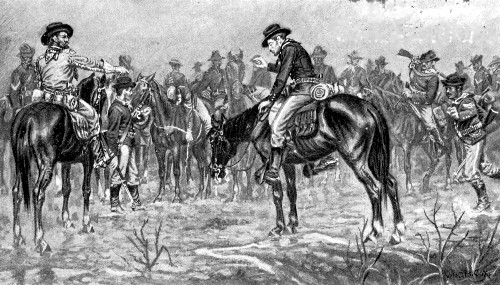 "There are your hunters,—two of my best men."
Page 96.
"There are your hunters,—two of my best men."
Page 96.
When half an hour later the captain with his silent and gloomy party had resumed his march for the river, only with the field-glasses could occasional glimpses be had of the main command far away to the southwest in the gathering dusk. Lieutenant Calvert, with his invalid corps, was dragging wearily after them, something like two miles away over the rolling surface, sometimes dipping out of sight among the swales and coulées, sometimes crawling over some low wave, and Davies, restored to consciousness and accompanied by[Pg 97] one of Devers's oldest troopers, Sergeant McGrath, had once more ridden away to join his distant and isolated party. Just before it grew too dark to see anything at all he was faintly visible at the top of the divide where he and the sergeant had halted, evidently searching in the gloom of the lowlands beyond for sign of the squad he had left over an hour before. Then they disappeared and were seen no more.
Ten miles up-stream, around rousing camp-fires, in the thick of the timber, the main body of the expedition—their lately starving comrades—were holding high carnival. Men and horses were astonishing their stomachs with dainties to which they had long been unaccustomed, for wagons had come out from the settlements to meet them, pouring in all the afternoon, and, mindful of his detached battalion, the colonel had presently despatched three or four of these welcome loads, well guarded, down the winding river in search of Warren, with instructions to bivouac at once and feast, and at nightfall they had met him, halted at the river after the luckless pursuit. The wagons were unloaded on the spot, and two of them pushed on out to meet Calvert, and be loaded up again with his exhausted plodders, while scouts, mounted on the draught mules that had had so long and hard a pull all day, and yet were stronger and fresher than the starving horses, were sent on down-stream in search of Devers. With these latter went a pencilled note from the battalion commander as follows:
"Rations here in plenty. Unless you and Davies are used up, you'd better come along to camp. We'll keep bright fires burning to guide you. I presume[Pg 98] you've seen no Indians, or we'd have heard from you before now."
In sending this letter Major Warren assumed two things: first, that Devers had carried out his orders, crossed the long spur that jutted down almost to the stream at its deep concave bend, and then, moving south, had kept Davies in sight, if not actually in touch. Second, that Davies had carried out his orders, investigated the fire, and then rejoined his captain. For, reasoned the major, had Davies been attacked, Devers would have known it, supported him at once, and sent word to us. Men instructed to watch for signals from the ridge had reported that nothing had been seen, which surely would not have been the case had Devers desired to communicate. He assumed further that Davies must now be somewhere about the point where the spur sank to the general level of the valley, some eight or nine miles down-stream, too far to send a wagon in the dark where there was no road, but not too far for men to march, with rations as their reward.
"Ride straight for that point," said he to the sergeant who was to carry the note, "and watch for their fires in case they have camped." And the sergeant and his companions—two wiry troopers whom nothing seemed to daunt or tire—had ridden away on their ambling mules, their own stomachs warmed with hot coffee and bread and bacon, and their soldier maws crammed with that most beneficent and comforting of frontier luxuries,—navy plug. What was a night ride after their weeks of marching to the joy of being first to announce full rations for all hands! They had[Pg 99] gone only half-way, perhaps four miles, when from somewhere in the timber to their right front, certainly not more than five hundred yards ahead, they came suddenly in view of something at which each man instantly reined in, and the sergeant, springing from his saddle, grabbed his mule by the nose. "Grab yours, too," he muttered, hoarsely; "for God's sake don't let the damn fools bray." And in another instant each of the astonished and protesting brutes was grabbed accordingly.
"Sure it must be the camp of 'B' Troop," said the other man, resentfully. "Indians wouldn't be lighting camp-fires so close to us."
"It can't be the captain," answered Sergeant Rice, with emphasis he well remembered and spoke of long months later. "I heard the major's orders to him, and he couldn't be this side of that point without having disobeyed them."
But just then, soft and faint, sad and plaintive and low, there came floating on the night wind the familiar notes of the sweetest of trumpet calls, and Rice turned to his comrades in amaze. "It is old Differs, by Jupiter! Who but he would be sounding taps with Indians on every side? Does the darn crank think that worn-out men can't go to sleep without it?" Even the soldiers, then, were alive to some of the captain's peculiarities. Even they could not do him justice. Even Rice supposed that Devers, rejoicing in being once more freed from the supervision of superior authority which he so cordially hated and so persistently strove to evade, was celebrating the event by resuming the sounding of unnecessary bugle calls, prohibited[Pg 100] for night use during the recent campaign. But neither the sergeant nor his comrades dreamed that it was in its other, in its saddest significance, the sweet old call was sounding,—that Devers and his men were bidding the last farewell, and piping "lights out" to them who rode forth gallantly at morn, only at sundown to be numbered with the dead.
Morning dawned over the bivouacs along the stream in hilarity unknown for previous weeks. The sun that for a fortnight had refused his face, and sent wet skies to weep in sympathy with the hungering column, now that the troopers no longer cared a rap whether he sulked or shone, came forth in all his glory to surround and beam upon and shower congratulation as do mundane friends who hold aloof when days are dark and troublous, yet swarm like bees when dazzling and unexpected prosperity bursts upon the lately fallen. Merrily rang the reveille as "jocund day" came riding o'er the misty mountain-tops. With joke and song and laughter answered the war-worn men, scores of whom had alternately dozed and cooked and eaten and drunk all the live-long night. Vain were counsels of captains and doctors. Soldier stomachs that could tackle mule and horse meat could stand any load, said the boys, and loaded accordingly. Cheer and laughter and merry-making, fun and chaff and jollity, ran through the[Pg 101] ranks, where all, but another sun agone, was silence and despond. The rough campaign was practically over. Only scattered bands of hostiles remained, in this part of the country at least. Rest and recuperation for those "tatterdemalions" would be the enforced order of the day for a month to come, for while they might readily and speedily build up, it would take many a week to remount the column or restore such horses as remained. Here among the Cottonwoods, with fire and water and food at hand, the men could have loafed in comfort and content a month, if need be; but here was no grass, and barely a nibble of oats could be distributed for each surviving horse from the scanty supply hurried forward the previous day. Before noon, therefore, after another morning devoted principally to breakfasting, the trumpets were sounding "boots and saddles." No need to sound "The General" with its stirring summons to "Strike your tents and march away," for tents had long months before been struck—by the pen of the commander—from the list of camp equipage to be taken to the field. "We were only waiting for Warren to come on," explained an aide of the general to a regimental commander, "and we've sent him word to meet us on the Birchwood farther up among the hills. We'll camp there to-night. What kept him, do you suppose?"
But the colonel couldn't imagine. Away down the valley to the eastward Warren's men had slept, as they had marched, much later,—those of them who could sleep at all, for all through the night there had been cause of disturbance to more than a few of the command. It was late before the demands of hunger were[Pg 102] appeased. Little fires blazed all through the timber, and men cooked and ate until they could eat and drink and cook no more. Then the luxury of tobacco kept many awake. Then came advanced troopers to say Devers was coming in, and despite the fact that two good and gallant comrades would no more gather with them about the camp-fire, there went up a cheer of welcome, and many men ran to meet the worn arrivals, to take their horses to feed and water so that the masters might be fed at once, and the major's first thought had been to welcome his subordinate and fill him with comfort before requiring of him detailed account of the day's doings. "I hardly expected you so soon," he said; "but here's coffee all ready, baker's bread fresh in town yesterday,—think of it!—and bacon and flapjacks. Your men must be pretty tired."
"They're about used up," said Devers; "but of course when we got your instructions to come on we came."
"Oh, I didn't mean you to come on if you were in camp for the night. Our men would rather eat than sleep and we thought yours would; but here—swallow this," said he, hospitably. "This is no time for business. I haven't tasted anything so good as that coffee in years."
"Thanks," said Devers, pulling gratefully at the steaming tin. "That is good. I'm glad, for my part, you told us to come along," he went on, reverting again to the subject of the major's note. "We shouldn't have done anything of the kind, of course, otherwise,—especially with Davies still out."
"What! Isn't Davies with you?" asked Warren,[Pg 103] with sudden anxiety and suspicion. "Why, I thought——"
"Well, we couldn't wait for him, you know, in face of your directions," said the captain, his eyes glancing quickly, almost furtively, from one to another of the bearded faces about him, for Truman, Hastings, Calvert, and all the officers of the little command had gathered. "Of course, I sent couriers right out to guide him——"
"Why—what I meant was for you to bring him along," said the major, gravely, yet not unkindly. "I felt sure, of course, you were within communicating distance at least, even if he hadn't come in. What did that smoke turn out to be when you got a closer look at it?"
"We—didn't get any closer look," answered Devers, in apparent surprise. "You ordered me to bury my dead and then go on. We had just buried them when your next orders reached us,—to join you at once. These, of course, superseded the others."
There was profound silence. The major stood by the camp-fire, his hands clasped behind his back, looking full in the face of the troop commander, all the old sayings that he had ever heard with regard to Devers crowding upon him now. When promoted to the regiment only just in time to join it on this hard campaign, and when assigned to the command of this battalion in which Devers was senior captain, the colonel himself had said, "Be on your guard with Devers. He's the trickiest of subordinates." Old Riggs, lieutenant-colonel commanding the Twelfth, had remarked, "So Devers is in your battalion, is he? Well, when[Pg 104] you want him to do anything you stand over him while he's at it, or else do it yourself." An intimate friend and classmate whom he had not seen for years had given the new major this significant pointer: "There's a man who could be one of the most valuable officers in service if he devoted to obeying an order one-tenth the energy he throws into finding a way of avoiding it." Yet, in the honesty and earnestness of his own character, Warren was slow to suspect a fellow-soldier of disloyalty. The campaign had gone on without special friction, though he remembered that he had heard Hastings swearing sotto voce more than once at Devers's cantankerous ways, and he recalled now two or three incidents—little things—in which Devers claimed to have misunderstood instructions; but this was so glaring, so gross a departure from both the spirit and letter of the orders he had given when face to face with the captain, that for a moment or two he was at a loss what to say. He was indignant, too, but it was a rule of his to control his temper and never speak to a subordinate in wrath. He had broken it that morning and was sorry; so when at last he trusted himself to speak, he said,—
"It must have been more than six hours ago that I told you to bury those two men and then go on. Surely, captain, you could not have taken all this time."
"It was nearly five o'clock, sir, when you ordered me to bury my dead as well as I could, and only a little after eight when we finished it; meantime, we had to march seven or eight miles before we could find a place where we could bury them at all well."[Pg 105]
"Why, I meant you to bury them right then and there, just where you were, not go marching in search of a place."
"But we couldn't bury them there; major, I had no tools to dig graves in a hard prairie——"
"Then you mean that you failed to go on after Davies,—failed to support him?—that you haven't seen him since I gave those orders? My heaven, Captain Devers! I told you never to let him out of your sight."
"Oh, he wasn't out of sight until darkness,—that is, he was frequently in sight. I not only saw, but communicated with him until that time."
"Thank God for that, at least! If he wasn't attacked before dark he's probably safe,—Indians are cowards in the dark. He ought to be coming along presently, I suppose. He couldn't have been more than a mile or so east of you."
But to this observation, half query, half self-consolation, Captain Devers made no verbal response. He bowed his head as he took a long swig at his can of coffee, and then a big bite into a ham sandwich of portentous size. The major and one or two others considered it a nod of assent, and ascribed to ravenous hunger the captain's failure to respond by word of mouth. Partially relieved of his anxiety on Davies's account and unwilling to spoil a gentleman's first supper after such long deprivation, the battalion commander turned away, saying,—
"Well, eat and drink till you're comforted, anyhow, captain, then we can hear all about it. I'll take a smoke meantime." Truman and Hastings joined him[Pg 106] at a fallen Cottonwood a few yards away, and the three puffed their pipes and thanked Providence for the mercies that had come with the close of the day. And then the officer of the guard appeared to ask a question about the posting of the pickets, and, leaving the others with Devers, the major strode off with the officer through the timber to satisfy himself as to the security of the horses for the night, and when he returned—not having been gone ten minutes—Devers had disappeared.
"I wanted to hear his report," said Warren, "and told him so. I supposed he understood." To which neither of his subordinates made reply. When ten minutes more elapsed and Devers did not come, Hastings, noting the major's impatience, called to the orderly trumpeter sitting at the neighboring fire,—
"Raney, go and see if Captain Devers is over with his troop anywhere,—the major desires to see him." Raney was gone full ten minutes, and when he returned it was to say that Devers's first sergeant said the captain had given orders that all talk must stop so that the worn-out men could rest, and the captain himself, rolled in his blanket, was already sound asleep.
"Well, I swear!" exclaimed the major. "Didn't you understand me to say I wanted to hear all about his march as soon as he finished supper?"
"I certainly did," replied Captain Truman, with an accent on the I that meant volumes.
"So did I," growled Hastings; but he never could bear Devers, who was persistently distorting or misunderstanding the orders the adjutant was compelled to convey to him.[Pg 107]
"Well, let him sleep," said Warren, finally. "I suppose he's tired out, and very probably Davies will speedily come in."
But midnight came and no Davies. Out on the prairie—now dimly lighted by the rays of the waning moon—the pickets at the east had descried no moving objects. Every now and then the yelp of a coyote on one side of camp would be echoed far over at the other. These, with an occasional paw or snort from the side-lined herd, and the murmuring rush of the river over its gravelly bed, were the only sounds that drifted to the night-watchers from the sleeping bivouac. Towards one o'clock the sergeant of the guard came out to take a peep. Later, about two, Lieutenant Sanders, officer of the guard, a plucky little chap of whom the men were especially fond, made his way around the chain of posts and stayed some time peering with his glass over the dim vista of prairie to the eastward.
"I declare I thought I saw something moving out there," he muttered, after long study. "Are you sure you've seen or heard nothing?" he inquired of the silent sentry.
"Not a thing, lieutenant, beyond coyotes or Indian signals, I can't tell which. They keep at respectful distance, whatever they are."
"Well, even if Mr. Davies's horses were too used up to come, the couriers ought to have got back long ago. Tell them to find me as soon as they come in," said he, and went back to his saddle pillow in the heart of the grove. At its edge a solitary figure was standing gazing out into the night.[Pg 108]
"That you, Sanders?" hailed a voice in low tone.
"Yes," answered the lieutenant, shortly, for he recognized Devers and he didn't like him.
"Isn't Davies in yet?"
"No, and it's two o'clock."
"Oh, he'll turn up all right," said the captain, in airy confidence. "It was all absurd sending him out to scout a smoke,—as if we hadn't seen and smelled smoke enough this summer to last a lifetime. He's probably camped down the valley somewhere, and they're all waiting for morning. I'm not worrying about him."
"No, I judge not," muttered Sanders to himself, as he trudged on in the dark. "You're simply keeping awake for the fun of the thing." But even Devers got to sleep at last, and when he woke it was with a sudden start, with broad daylight streaming in his eyes, and stir and bustle and low-toned orders and rapid movement among the men, and Hastings was stirring him up with insubordinate boot and speaking in tones suggestive of neither respect nor esteem.
"Come, tumble up, captain; we're all wanted; Davies has been cut off and massacred."
Already his orderly had led up the captain's horse, pricking his ears and sniffing excitedly around him, and with trembling hands the young German was dragging out from among the blankets the captain's saddle, the hot tears falling as he stooped. His own brother was of Davies's party. Devers was on his feet in an instant, dismayed, and, buckling on his revolver, he went striding through the trees to where Warren stood, pale and distressed, questioning a haggard[Pg 109] trooper,—one of the couriers sent on for Davies the previous evening. Devers burst in with interrupting words, and was instantly coolly checked.
"Never mind now, captain. Mount at once and get your men in saddle." Nor would Warren see or speak with him, as with a hundred troopers at his heels—all whose horses were even moderately fit for a ten-mile trot—the major led the way down the valley, a few eager scouts cantering on before. All Devers could learn as they jogged along was that Tate, one of the couriers, had ridden in at seven on an exhausted mule to say that not until after dawn had they found Davies's party,—seven of them,—stone dead, stripped, scalped, gashed, mutilated almost beyond recognition, far out on the slopes east of that fatal spur over which the September sun had risen before he came, leaving his stunned comrade trailing hopelessly behind.
The prairie sod was torn by the hoofs of a hundred ponies. That was evident. All around a little sink in the surface at a distance of several hundred yards the warriors must have dashed and circled for full an hour. Here along the rim of the shallow basin, each behind the bloated and stiffening carcass of his horse,—each surrounded by threescore copper shells, showing that he had fought till hope and ammunition both were gone,—lay the poor remains of the gallant boys who had ridden silently away in obedience to their[Pg 110] orders on the previous afternoon,—recognizable now only by their teeth or some still ungashed body mark. How long they had pluckily, cheerily held out, confident of the speedy coming of the comrades from over that westward spur, and therefore less miserly of their lead and eager to stretch some of their yelling foes upon the sward, could now only be conjectured. Little by little their fierce, defiant fire had slackened. Little by little confidence had waned, and doubt and dread replaced it. Some, probably, had been earlier shot by the storm of centring bullets; some, possibly, had sent their last shot into the reeling brain,—death by one's own hand being better at least than by slow and fiendish torture; and at last, probably just at dusk, the triumphant savages were able to close in upon their helpless prey and reap their reward of scalps and plunder and wreak their fury on a mute and defenceless foe.
But in a search of full an hour not a sign had Warren's best scouts discovered of Davies or his companion. The Indian trail, that of a war-party of at least fifty or sixty braves, led away southward again, into and through the timber in the distant river bottom, and there it became scattered, most of the party seeming to have ridden on towards the reservation in the darkness of the night, while others turned up-stream, and their pony-tracks led towards the point where Warren's battalion had bivouacked. These were probably the causes of the flitting shadows Sanders had detected far out on the prairie,—these the owls and coyotes whose weird cries had at intervals disturbed the silence of the night. Solemnly, sadly, now, the burial-parties labored. The soil was comparatively[Pg 111] soft in the neighboring ravine,—much more so than higher up the slopes where the two crack shots had fallen earlier in the afternoon,—and here, with picket-pins and a spade or two which happened to be with the pack-train, a trench was scooped out, into which the poor remains were lowered and then covered with stones, dragged from the depths of the neighboring coulée. It took some hours to finish the sad duty, and meanwhile sharp-eyed scouts were busily occupied striving to determine what had become of Davies and Sergeant McGrath.
In this work the major himself took the lead, and here Devers's statements had to be drawn upon. Old Indian-fighters pointed out many a significant sign to sustain the theory that the fight must have lasted full an hour,—the trampled condition of the turf,—the quantities of shells lying behind every little hummock or ridge in the surrounding prairie that commanded the position of the defence or afforded shelter from its fire. Down in the very ravine in which the bodies were buried, full four hundred yards from the scene of their desperate stand, the soft, sandy soil was pawed and trodden by waiting war-ponies, whose riders, lying flat on their stomachs along the bank above, had kept their watch upon the besieged, firing whenever head or hand appeared above their carcass fortification. The whole ingenuity of the Indian plan became apparent as the situation was studied. Noting after ten o'clock that morning that the battalion was no longer marching due south, but had turned, heading southwest straight away for the landmark of the valley,—that distant, black, pine-crested peak,—the lurking warriors[Pg 112] had devised their scheme to lure a scouting detachment away from the support of the column. Far down in the river bottom, ten miles away to the left of the trail, they had built at the springs a "shack" from the relics of some miner's outfit captured thereabouts earlier in the summer, and waiting until the head of the column was approaching the crest of the water-shed to the north, set fire to their pile and then secreted their main body in a deep ravine to await results, while small parties were thrown well forward to pick off venturesome individuals, if only such rode out in reconnoissance. If the white chief "bit" and detached a small party, then every effort was to be made to keep the battalion occupied and interested,—to draw it along, if possible, towards the southwest,—just a few daring spirits devoting themselves to this duty, while the stronger party, keeping in hiding until they lured it far beyond rescuing distance, gradually encircled the isolated squad and at last pounced upon their prey. It is no new device. It was to prevent just such a play that Warren had ordered Devers with his troop to keep midway, holding Davies's little party in sight and support and the main column in communication. Had Devers obeyed the instructions given him and gone on down along that jutting spur instead of far to the west of it, the catastrophe would have been averted,—the Indian attack, even if attempted, could have been beaten off.
In bitterness of spirit the major was riding over the field, too full of exasperation as yet to trust himself to send for and speak to his subordinate, even when he felt that he must hold conference with him in order to[Pg 113] determine how best to direct the search. Twice or thrice had Devers essayed to open communication with his chief and impress him with his views, but Warren had sent him word by Hastings to supervise at the designated point—which he himself selected—the burial of the men, while he, the major, went on with the search. Time and again it was noted how often Devers would climb the bank and anxiously gaze off to the west toward that fatal curtain,—the spur that separated him from the sacrificed detachment the night before. What his thoughts were could only be conjectured, but little Sanders seemed to hit pretty near the mark when he confided to Hastings that Differs didn't seem to care a damn whether Warren followed the Indian trail or not; what he was afraid of was that the major would "get onto" his own. And indeed as the morning wore on it began to look as though that were what the major was bent on doing. The scouting-parties had come back with their report of what they had found in the river bottom, and by this time Warren with his escort was three miles over to the west and slowly searching along the east face of the spur, peeping into every hollow and depression that might shelter a human form and looking everywhere for the print of horses' hoofs. At ten o'clock he had sent to Devers for some intelligent non-commissioned officer who could point out about where they had last seen Davies as he crossed the ridge returning to his men at sundown, but Devers very plausibly responded that while it might not be difficult to do so from where they parted, "just over on the west side," it couldn't be reliably done from so far to the east. The[Pg 114] reply must at least serve to delay matters awhile, and every moment was of value to Devers.
His own theory was that, as twilight was setting in as Davies recrossed the ridge, everything beyond in the low grounds was in deep obscurity. The attack had probably begun about the time the young officer, with Murray, first crossed the ridge in obedience to the captain's orders to report to him in person. Less than an hour, Devers thought, elapsed before he could again have come within sight of the spot where he left his little command. By that time all was practically over. In the gathering darkness and in the glut and greed of their savage triumph the Indians had crowded about the victims. Davies and the sergeant, returning, had been allowed unmolested to make their way well down toward the scene. The fire in the bottom was fed to lure them on (it was still smouldering when Warren's men trotted thither in the morning), and the two had either been captured alive and run off with the main body to grace the stake at the scalp-dance to be held with fiendish rejoicing somewhere beyond danger of interruption, or else, warned in some way, the two had sought to escape, and had been headed off and killed in some of the still unexplored ravines or coulées farther to the southwest. In either case, provided the major did not persist in his investigation and so discover how very far Devers had led his troop away from sight or support of Davies's men, and how utterly he had failed to carry out his orders, the captain felt tolerably confident that all the blame would be landed where it properly belonged,—on the shoulders of the dead and defenceless lieutenant, whose reluctance[Pg 115] to undertake the duty many had observed, and whose womanish swoon at sight of the slaughtered men had not only proved his unfitness for frontier service, but long delayed his return to his party. Devers had always said Davies was entirely overrated by the colonel and Truman and others; he had held all summer that the lieutenant was a "molly-coddle;" he had been reproved more than once for what they termed his injustice to his subaltern, and now Davies had proved just exactly what he knew he would prove,—a carpet knight, a prayer-meeting soldier, with neither grit nor brawn nor backbone; and if he was killed, at least he had died in time to save the regiment from having to blush for him in the future. Devers had served throughout the war of the rebellion in a regiment that saw no end of hard fighting, but always when he happened to be on sick-leave or detached service of some kind, for in all of his years of service no man in his grade or corps had so seldom been under fire, either in the South or on the plains. With abilities unquestioned and opportunities second to none, it was nevertheless observed of him at the close of the four years' struggle that there, at least, was a man who hadn't even mustering or recruiting service to fall back upon when "brevets" went scattering broadcast over the army, showering like the rain upon the just and the unjust. He had lived all through it without having become distinguished for anything that might become a man, winning a name for himself principally for consummate skill in getting out of what he was told to do without getting into a scrape or out of the service. He became a tremendous paper-fighter in the[Pg 116] days that followed, however, and like some of our war generals, could find the weak points in the armor of his comrades if he couldn't in that of the enemy. He became a club-room critic of other fellows' campaigns, companies, or conduct, as probably the most effective way of diverting attention from his own. He sneered at the war record of every contemporary who had achieved rank superior to his own, as with hardly an exception every one of them had done so, and made the burden of his song among the younger men the blunders, faults, and follies of the elders. Without a drop of Irish blood in his veins, he inspired the belief that he must be own cousin to the newly-landed Hibernian who announced himself as "agin the governmint," for post and regimental commanders without exception found him the most adroit, crafty, sinuous, and troublesome of captains,—one who was forever doing something to try them, yet nothing on which they could try him. Well he knew his unpopularity and sagely judged his opportunities. The liberties he had dared with Warren he would not now have ventured with Riggs, or Black Bill, or old Tintop, one and all of whom had learned to know him well, and would have been prepared for some such betrayal of the trust reposed in him.
He had worried Black Bill—long time his post commander—to the verge of exasperation with his perpetual hair-splitting and quibbling. He had played his last trump with Tintop early in the campaign, and received that grizzled veteran's rasping intimation that one more experiment would lead to arrest and court-martial, and received it with every appearance of[Pg 117] amaze and pain, which might have been effective had not Hastings been called upon beforehand to give his version of the affair that led to it. It was one of those constantly recurring examples of Devers's "cussedness" which led many a stout cavalry officer to set forth just what he'd do with Devers if he only had him under his command, yet the very men so confident they could bring him to time were not infrequently the ones who subsequently found him too adroit for their straightforward methods. Black Bill told Tintop that Devers was as bad as the Irishman's flea,—put your thumb on him and he isn't there. "I'll cinch him," said Tintop in reply, "if he tries any of his damned nonsense on me." But with every intention of doing his level best, "Topsy" little knew the infinite resources of the man.
One of Devers's idiosyncrasies was a hatred of doing things as anybody else did them. This in a service where absolute uniformity was expected was prolific of no end of chafing. In every garrison where his troop was stationed he had become notorious. If the other companies turned out in white gloves at retreat, Devers's would come in gauntlets. When dress parade, dismounted, was ordered at Fort Birney one mild November evening, he marched his men out in arctics and fur caps, and claimed that to be the proper full dress for the season. When Colonel Emerson in regimental orders lauded the devotion of Sergeant Foley, who swam the icy Missouri with despatches from Captain Cameron's beleaguered command, and ordered a handsome collar to be made by the regimental saddler to be worn thereafter by his gallant gray, now transferred[Pg 118] to the band because of the cuts and scars he had received in that fierce campaign, Devers similarly decorated Trumpeter Finnegan's bull terrier "Mike," who swam the Mini Ska in pursuit of his master the night of the wintry dash on Tall Bull's village, and gravely paraded "Mike" with the troop next muster day. These and a score of similarly annoying yet hardly punishable attempts to bring ridicule upon or run counter to the orders of his commanders, had actually rendered some of his seniors so averse to having him under them that it often resulted in his being given independent details, lonely detachment duty, "one-company posts," and similar isolation which almost any other officer would have shrunk from, but that Devers really seemed to enjoy, and, from having been so much his own commanding officer, he was all the less fitted to render prompt and cheerful obedience to others when they again had to have him. With any command greater than that of a single troop he had never been intrusted. There was no end of speculation and chaff around the camp-fires, therefore, early in the summer, when Devers, most unwillingly, it was said, was hauled in from some outlying post where he had nothing to do but hunt, eat, and sleep, and reported for duty on what turned out to be the toughest of Indian campaigns. What was worse, he was ordered to report to Tintop, and now, said the boys, there will be fun.
Well, there was. It took a week of persistent "cinching" to get Devers and his troop to understand that they were no longer an independent body, but must serve under the orders of a colonel or major. He had at first been put in Bell's battalion, and every[Pg 119] time the colonel pointed out a fault Devers "thought" that was as Major Bell wanted it, and when Bell called his attention to some irregularity, Devers had understood Colonel Winthrop to say that that was the way it should be done. Bell finally said that he'd be damned if he wouldn't rather have no command at all than one with Devers in it. The first day Devers's horses were herded to graze far out on the slopes,—five hundred yards beyond those of any other troop,—and Tintop said he wished Captain Devers hereafter not to allow his herd to be driven beyond those of the rest of the regiment. Next day they were kicking up a dust not fifty yards from Tintop's tent,—as far inside the cordon as they had been outside before,—and Devers plausibly explained that he wanted to be sure he wasn't too far away. The third day, after a long march with Indians on every hand, Tintop ordered "double guards and side lines when the herds went out to graze." The horses of the other troops were ridden out by the men to good grazing-ground some five hundred yards from the bivouac fires, and there the riders slipped off and the side lines were slipped on; but Devers's horses were side-lined as soon as unsaddled, and then the poor brutes, thus hobbled fore and aft, were driven, painfully lurching, out to graze. Tintop boiled over at the sight of so unhorsemanlike a proceeding and rode wrathfully at Devers to rebuke him. "Why, colonel," said Devers, "I wouldn't have done it for the world, but Mr. Gray was so positive in saying it must be done when they went out, I couldn't do otherwise. Of course if he'd said when they got out I——" And though Tintop swore savagely through his teeth that[Pg 120] Devers knew well just what was meant, as did every other troop commander, he couldn't prove it. Next day, before the side lines were put on, in some mysterious way Devers's herd was stampeded and ran six miles before they could be rounded up, and he explained it was all because they weren't side-lined in the first place, as they were always accustomed to being, and as the regulations required they should be in the Indian country. This was another thing to make Tintop blaspheme. Every day for a week something was amiss, and, having gone to the length of his own tether, Devers took to saying that it was all Mr. Davies's fault or Sergeant Somebody's,—"Mr. Davies had just joined and was utterly inexperienced." Then Tintop gave Devers positive orders not to content himself with telling people to do thus and so, but to see that the orders were obeyed, and Devers then took his pipe and his blankets and ostentatiously spent hours of the afternoon out on the open prairie, a monument to the severity and exactions of his colonel. And still the horses, all of them, got far out on the foot-hills, and Tintop ordered him a day or two later, when on Scalp Creek, not to let his herd get more than half a mile away from the troop fires, as they had no tents, and then Devers had his herd-guards build fires and boil coffee far out on the prairie, and claimed that those were his troop fires, and therefore his herd was within reasonable distance of them. Then Tintop swore another oath and ordered Devers not to let his horses graze more than half or less than quarter of a mile from his own head-quarters fire, and as there followed a few days of hot weather, Devers sent his herd[Pg 121] to the foot-hills again, claiming that there was no longer a head-quarters fire to regulate by, which proved to be a fact, as in such warm weather there was no need of one. Then, one day, Tintop in so many words ordered the captain hereafter not to do as he thought, but simply as his colonel said, and this led to the final incident, still more side-splitting,—one that the boys in the regiment never tired of telling. Tintop with his battalion was sent on a seven days' scout, during which he ordered all the troop commanders, until further instruction, not to permit their herds to graze more than five hundred yards from camp. Three days later, what was his wrath to find Devers's herd almost a mile away down the stream, and close by the tents of Major Roome's battalion of Foot that had been for a week placidly awaiting the return of the cavalry! Tintop had halted and unsaddled some distance up-stream. There wasn't a shred of canvas with the regiment while on this brisk raid, nor was there need of it in such perfect weather, and Tintop with Gray by his side stood fuming in the midst of surrounding cook fires, when Devers came placidly up in obedience to the summons of the orderly, and many an ear was brought to bear and bets were given and taken that this time Devers would catch it and no rebate. "How is it, sir," demanded Tintop, "that in defiance of my positive orders you allow your herd to go so far away?"
"Why, colonel, you distinctly said they mustn't be herded over five hundred yards from camp. Of course if I'd been allowed to think I probably wouldn't have done it, but I sent mine down there accordingly. That's the only camp I see,—this is only a bivouac."[Pg 122] And all Tintop could ejaculate in response was, "Well, may I be damned!"
These and a host of similar stories had come to Warren's ears in the course of the campaign, and he had laughed at them as had everybody else, for after all no man could say that actual harm had occurred as a result of Devers's experiments. So curiously are we constituted that when it is only the commander who is braved or his adjutant who is ruffled, the bulk of the line can bear it with equanimity. Therefore, while Tintop, Black Bill, Riggs, and his seniors generally could never refer to Devers except with sympathetic swear words, there were not a few of the officers junior in rank to his who found no little fun in all these incidents. Like most stories in or out of the army, they were perhaps exaggerative, but, like smoke, they could not exist without smouldering fire. If there were any speculation about Devers in the regiment, it was as to how he would behave if he ever did get into a fight, or what would happen in the event of his some day squirming out of an order on which vital issues depended. "You'll go too far yet, Devers," said a soldier who strove conscientiously to be his friend and counsellor, "and when you do, where will be the commander under whom you have ever served to say a good word for you?"
And now on this fatal September morning that ominous warning was ringing in his ears again and again. Down in the bottom of his brooding heart he knew, and well knew, that had he obeyed, as he should have obeyed, Warren's orders, this catastrophe could not have occurred, and that he more than any other man on earth was responsible for the death of these[Pg 123] gallant fellows, who, whether they looked up to him or not, were by the stern discipline of the service dependent on him for the expected support. If he could realize this, how much the quicker would others be to attach the blame to him! how much the more necessary must it be to lose no time in diverting suspicion elsewhere! The fatal propensity to distort or disobey, which perhaps he could have downed had Tintop or Riggs been there, he could not resist with Warren,—an envied contemporary, presumably new to his idiosyncrasies. Nor would he, of course, even with him, have disobeyed could he have foreseen the fatal consequences. That would have been risking too much. But now that he had disobeyed, and in all probability would be held accountable for the catastrophe, his one road to safety and to acquittal lay in saddling all possible responsibility on some one else,—preferably Davies. This, if Davies were silent in death, would not be difficult. Whatsoever others might think or say, they could prove nothing. If, however, Davies turned up alive and alert, then matters might be grave indeed. No wonder he climbed again and again the westward bank and levelled his glasses at the dull-hued ridge against the brilliant westward sky, frequently giving vent to loud denunciation of the leaders in the mismanaged campaign. It was nearly ten o'clock before his dead were laid away,—before anything occurred that looked like discovery of the missing pair. Then came new excitement.
Far down toward the point where the distant spur seemed to sink to the general level of the prairie one or two of Warren's scouts could be seen rapidly spurring,[Pg 124] as though in answer to signals. Presently they, too, began waving their hats to those searching higher up the ridge. Then all disappeared over on the westward side. Something evidently had been found, and Devers's men, their work completed, were grouped eagerly up the bank. Over half an hour in mingled hope and suspense they waited, and then there rode in a mounted messenger.
"The major's compliments to Captain Devers," he said, "and he'll wait for the captain and his troop over yonder. I'm to show the way."
"Have they found anything?" asked Devers.
"Yes, sir,—Mr. Davies; but he's more dead than alive. There is no sign of McGrath."
"Do you mean Mr. Davies is wounded?"
"No, sir. He seems just dazed-like."
"That's what I said all along," spoke the captain, loudly, so that it was heard by all the soldiers near at hand. "He never tried to rejoin his detachment. He never had any nerve. He probably saw what was going on and hid himself, never daring even to let us know. Damn these psalm-singing, Sunday-go-to-meeting soldiers anyhow! Here, Howard," he continued, turning to a young trooper who stood silently at his horse's head, "you come with me. Lead on, corporal. Sergeant Haney, mount the troop and follow." And with that the captain rode away.
For a moment, as the men were bringing up their horses and leading them into line, there was silence. Looking after the three horsemen now well out on the prairie to the west, the party saw that the messenger was riding some distance in advance, and that Howard,[Pg 125] a recruit who joined with the detachment early in the campaign, was now side by side and evidently in conversation with the captain. It had been a summer of campaigning in which not only the nicer distinctions as between officer and man—not only all symbols of rank and uniform—had gradually disappeared, but with them, little by little, some of the first principles of good order and military discipline. Officers had been heard openly condemning or covertly sneering at the seniors in command. It was not strange that the rank and file should fall into similar ways.
"Never had any nerve, is it?" muttered Private Dooley, after a moment. "Boy and man I've soldiered in this regiment longer than you, Captain Differs, and I know an officer and a gentleman when I see wan, and it's the public opinion av more than wan private that there's more av both in that young feller's starvin' stummick than in your whole damn overfed, bow-legged carcass. How's that, Brannan?" said he, turning to his next neighbor, a wan, sad-faced recruit.
"Shut up there, Dooley!" ordered Sergeant Haney, briefly. "No more of that! Count fours."
So far as the Eleventh and one or two other regiments were concerned, that summer's campaign, so fraught with incident and tribulation, was now at an end. It would take weeks and months of care to restore their horses to serviceable condition. Others[Pg 126] were ordered up to replace the worn-out command, and while an indomitable general pushed fresh columns into the field to track the savages to their winter lairs, the ragged troopers—for all the world like so many beggars a horseback, so many mounted scarecrows—were ordered in to the big garrisons near the supply depots to refit, recuperate, and restore to discipline. Some, officers and men both, had been sent ahead, too weak or ill to remain in the field, and among these, consigned to the tender care of the post surgeon of Fort Cameron, was Lieutenant Davies, over whose condition the doctors shook their heads. Brain fever was the malady, but his system was so reduced by starvation and exposure that even a moderate fever would have been most serious. Not until he had been gone nearly a month did the regiment follow, and then, scattered in detachments to various posts, became busily occupied in the work of rehabilitation. Cameron was a big new frontier fort with few accommodations, over-crowded, too; yet, being the nearest to the field of action, thither had Captain Wilbur Cranston gone just as soon as he was convalescent and able to move. Thither with him went his devoted wife and her devoted cousin and companion, Miss Loomis, for whose reception the subalterns of the infantry guard promptly gave up their frame quarters and moved into tents, and Cranston was there on light duty in charge of the big corral of remount horses when Davies was bundled in and established under Cranston's roof. There, carefully treated by Dr. Glover and regularly visited, often tenderly nursed, by Mrs. Cranston and her friend, the naturally strong constitution of the[Pg 127] young officer triumphed and he began slowly to mend. Meantime, as is or was the way, it fell to the lot of the gentle and sympathetic army wives or maidens at the post to keep the distant mother informed of her boy's slow progress toward recovery, and presently to answer the importunate letters of another. Mrs. Cranston, a shrewd observer, could not fail to note that as soon as her patient was allowed to read at all it was his mother's letters, not the great packet in Miss Quimby's unformed hand, that he eagerly opened. Then when at last he did begin these latter the steady progress of his convalescence was impaired. He became again feverish, restless, and depressed. Too ill and weak as yet to write for himself, he read with grateful eyes his mother's allusions to the kind and sympathetic missives sent her by Mrs. Cranston, and occasionally, as happened, by Miss Loomis. Gladly, too, did he avail himself of their services in reply. But when it became necessary presently to answer those of his fiancée, there might have been embarrassment but for Mrs. Cranston's tact. She had begun to feel a strong interest in and respect for her patient. So, too, had her husband, who came daily to sit by his bedside, but who avoided, as much as possible, all reference to the closing days of the campaign.
As yet the young officer had not been told of McGrath's disappearance, and had not been encouraged to tell of his own experience. Indeed, there was very little he could tell, but his story was frankly imparted to his friend and comrade, Captain Cranston. Much seemed to be a total blank. He spoke with a shudder of his last look at poor Mullen and Phillips, and at[Pg 128] the pale, drawn faces of Captain Devers and the troop,—of another backward glance from near the top of the ridge, then of their losing sight of Devers and his men, and pushing on to the deeper gloom of the east valley. It was then too dark to see, and for half an hour he and McGrath, weary and heart-sick, had scouted northeastward in search of his party. They had seen some flashes as they began the descent and rode in their direction, believing them to be signals, but soon all was darkness, all silence, but for the sigh of the night wind. Conscious of growing faintness, he suggested firing a shot or two as signals, and McGrath obeyed. Then off to the southeast, far from the point where they had seen the first flashes, the shots were answered and distant yells were heard. McGrath considered this ominous, and asked him to wait in a little ravine while he reconnoitred. In ten minutes two or three shots rang out in the direction taken by the sergeant, and presently back he came fast as a staggering horse could bear him, crying, "Indians! Indians everywhere!" It was all up with Davies's party, and their only hope was to hasten back to find the command; but the Indians came in chase, and though they plied spur, their poor horses seemed too weak for speed. How far they got he never knew, but remembered a sudden plunge, his horse's going down, rolling all over him, and nothing more.
"When you parted from Devers," asked Cranston one day, "how far was he from the top of the ridge?—how far to the west?"
And Davies answered, "At least two and a half or three miles."[Pg 129]
Over this did Cranston ponder long. It ill accorded with what they wrote him from the front as Devers's story.
"You write to Mr. Davies's mother, Agatha," Mrs. Cranston had said. "I haven't time for both, but I'll take care of Miss Quimby." Just what might be the tone and tenor of that young lady's letters to her prostrate lover Mrs. Cranston could not positively say, as no one saw them but himself, but she was ready to hazard a something more than mere conjecture when Miss Quimby took to writing to her as well. As was her wont when moved, Mrs. Margaret unbosomed herself to her lord. "I've no patience with the girl," she said. "She'll worry him to death. If she writes such silly, romantic trash to me, what mustn't she be saying to him? What on earth can he ever have seen in her?"
Now, that's just one thing no woman can find out,—what a man can see to admire in one in whom she sees nothing. It didn't help matters that Cranston, in his conservative, whimsical way, should counsel silence and patience. What woman can be silent under strong provocation? What woman can patiently abide the personal application of a general rule?
"I don't suppose there ever was a match yet of which some woman didn't say she couldn't see what he saw," said Cranston, deprecatingly; and then, with one of his whimsical grins, began to add, "Let's see, wasn't it Kitty Benton who said, when she heard of our engagement, that she——" But he got no further in face of his wife's impetuous outbreak:
"That's simply hateful in you, Wilbur, and you[Pg 130] know it as well as I do. She knew me only slightly, for we were not in the same set at school at all——"
"Well,—still, didn't she know you rather better than you do Miss Quimby, whom you never saw at all?"
"I don't care. I know what she's like," answered Mrs. Meg, with flushing cheeks. And that was really before poor Almira's first letter came, and if Mrs. Cranston thought she was right before, she knew it when she read now.
The closing paragraph of a long, almost incoherent missive must suffice. Even Cranston's lips twitched under the heavy thatch of his moustache as he listened. Even we, who like Mrs. Cranston, must admit it wasn't quite kind in her, no matter how natural, to read it afterward to Agatha Loomis, who, although declining to read, did not quite decline to hear at least a line or two.
"If you knew how I suffered—what tortures of anxiety, what nights of sleeplessness and woe, tossing on fevered pillow, tortured with visions of my beloved nobly fallen on the field of battle and pining for the touch of this hand—you would indeed pity me; but my father is inflexible. He refuses his daughter the poor boon of flying to the stricken lover's side,—her husband that is to be. In vain have I pointed out that I ask no sweeter bliss than to share my Percy's lot, for weal or woe, to live in the humblest cot, a tent, a hovel even, with only a crust,—it meets only his scornful refusal. When my arms are eagerly outstretched to enfold my soldier hero, I have to be content with nursing day and night his afflicted mother,[Pg 131] whom for his sake I love as I would my own, had she not been taken from me years ago when I was but an unsophisticated child. When I think of you privileged to sit by his delirious bedside, cooling his fevered brow, I envy you as I never thought to envy any woman on earth since, long years ago, my Percy blessed me with his love; and now if after all he should be taken, or if some proud lady should win him from his simple little village maid, there would be no refuge for me but the grave."
"Now," said Mrs. Cranston, "something besides the bedside is delirious in that case. No wonder the poor fellow is picking up so slowly."
"Well, wait a little," responded her conservative lord and master. "Seems to me a man ought to rejoice in knowing that the arms of lovely woman are outstretched in eagerness to enfold him. Now, if I were he——"
"Yes, if you were he I've no doubt you'd be off to Urbana by first train; but this young man has some sense in his head" (here Cranston began to finger his own skull tentatively), "and in losing his freedom hasn't entirely parted with his wits."
"Was that—my predicament?" asked Cranston, looking plaintively up.
"Well, at least I have to do your thinking for you, and what you have to do is help him here. Have you had any talk with him about—about what Captain Truman and Mr. Gray wrote?"
"Certainly not, Meg," answered Cranston, becoming grave at once, "and I do not mean to until he is well enough to hear it."[Pg 132]
"Well, the more I know of him the more I know it's utterly untrue. Hasn't anything been heard yet of Sergeant McGrath?"
"Not a word. Even friendly Indians say they haven't an idea what could have become of him." And Cranston's face was both anxious and troubled.
The matter was indeed one to give him deep concern. The massacre of the little detachment from Warren's battalion late in September—all of them members of Devers's troop—had brought down sharp and deserved criticism, and there was every prospect that the matter would be officially investigated just as soon as the department commander could turn his attention from the rounding up of the hostile band still at large. Meantime, between Warren and his senior troop commander, Captain Devers, strained relations existed,—the former holding to the theory that the responsibility for the disaster lay with Devers and no one else, the latter volubly, plausibly, incessantly protesting against the imputation as utterly unjust, indeed, as utterly outrageous, and moving heaven and earth to unload the entire blame on the shoulders of the absent and defenceless.
Now, as a rule this is an easy matter, almost as easy in the army as out of it, and had his accuser been any other captain in the entire field column, poor Davies might indeed have been prejudged; but with Devers it was different. His idiosyncrasies were notorious. His whole mental and moral fabric was one of antagonism to his fellows in general and his seniors in particular. It was said, and generally said, of him that the mere fact that everybody liked or respected a[Pg 133] man was enough to set Devers dead against him. The fact that Mr. Davies had thrown up his graduating leave and sought instant service in the field as a result of the tragedies of the early days of the campaign had won him instantly the interest and good will of officers and men throughout the entire command. He started well, so to speak, and his quiet, reticent, observant, but unobtrusive ways favorably impressed his regimental comrades and led to many a commendatory remark from veteran officers. But there was universal comment, half humorous, half commiserating, upon his assignment to Devers's troop, and Devers knew it. He treated the young man with cool civility at first, but became speedily captious and irritating, rebuking him openly in the presence and hearing of other officers and of enlisted men for matters for which he was not justly blamable. Old Winthrop spoke to Devers about it one day, and spoke seriously. "You'll disgust that young gentleman with the service if you're not careful, Devers," said he, "and be the means of depriving us of a good officer."
"That's just where I'm compelled to differ with you, colonel," was the response, and it was this propensity for differing that had led to his sobriquet. "I've had constant and daily opportunity of observing him, and he's mistaken his vocation. That young man should be a missionary or a Sunday-school superintendent. He's too pious for Indian fighting, which is the only thing expected of us."
But for weeks after there was no Indian fighting. What had become of the swarms of red warriors that had swooped upon the front, flank, and rear earlier in[Pg 134] the campaign no one could say. Their trails led all over the northwest, and the pursuing column pushed on night and day in dust and sun-glare, in mud and rain, in pelting hail-storm and darkness, and never once until late in the autumn could they again come within striking distance. By that time the jaunty riders of the early spring-tide were worn to skeletons; the mettlesome horses—those that were left—barely able to stagger through weakness, exhaustion, and starvation. Then like prairie wolves the warriors closed once more about the jaded flanks, waiting, watching every chance of picking off the stragglers. Just one day did Differs's troop get under fire,—a long way from under, said satirical subalterns of a command that sustained some losses,—but so scientifically did the captain handle his men that not a trooper or horse was scratched. Mr. Davies on this occasion commanded a platoon, dismounted on the skirmish line. It was his first affair, and he kept his appropriate thirty paces in rear of his dispersed men to watch and direct their fire, expecting that the enemy would charge or attack or do something, he didn't know just what. He simply behaved as he had been taught at skirmish drill at the Point,—was ready to do his full duty, but having no experience in Indian battle, thought it his business to wait orders, which was precisely what Differs had told him to do, until attacked. All the same, when others twitted Devers on the fact that his troop "didn't seem to get in," that officer did not hesitate to respond that they'd have to settle that with their admiration, Mr. Davies, who was commanding the fighting line, but probably wasn't done saying his prayers. There was[Pg 135] a lively, rattling skirmish next morning between the rear-guard and the Indians, and at one time things looked as though the thinned battalion of their comrades of the —th might be cut off, and some of Devers's regiment thought the rearmost troops ought to be deployed in support of the fellows who were fighting off the warriors, who came charging after them over wave after wave of prairie. But Devers couldn't see it in that light. He was bringing up the rear of his own regiment. Indeed, not until the fatal day of their débouchement from the Bad Lands and sighting the broad valley of the Ska had Devers's men felt the sting of Indian lead, and then he was not with them.
And now while the worn and ragged commands lay basking day after day in the warm October sunshine at Camp Recovery, and men for the time had nothing to do but eat and sleep and discuss the events of the late campaign, the Eleventh was in turmoil over the tragedy of Antelope Springs.
When Davies was finally found that morning by Warren's scouts, he was lying in a depression of the prairie at least a mile to the west of the point where that long—that fatally long—curtaining ridge sank into the general level of the valley, and therefore full four and a half or five miles away from the point where his little detachment had died fighting, and very nearly two miles south, or west of south, of the point where he and McGrath had last been seen by their comrades,—just at dusk,—just at what looked to be the comb or crest of the ridge from the point where Devers had halted his troop and made the dramatic display of his dead. But what looked to be the crest from the west[Pg 136] was in point of fact not the crest at all. Invisible to the halted command, there lay still farther over to the eastward, where the spur seemed to broaden considerably, a wave that overtopped the westward edge by a dozen feet or more. Supposing from Devers's account that the trail of his command could be found distinctly marked along the westward slope and close under the crest, Warren was searching there with his scouts when attracted by the signals two miles to the south announcing probably important discoveries. He had found some Indian pony tracks, also those of one shod horse, but dropped everything else to go at once in answer to the signals. Then they had borne the unconscious officer southeastward toward the clump of trees at the Springs, placed him in the ambulance, and then came a courier from the general himself directing Major Warren to report to him in person at Birchwood, thirty miles away, and the major went, the ambulance following. And so, to his unspeakable relief, Captain Devers was left once more the senior officer on the ground to continue the search for McGrath, and in the conduct of this he took excellent care that only himself and one or two of his chosen should search any portion of the prairie that might involve running over the trail west of the ravine which he had made the previous day. The scouts and searching parties were kept in the valley and in the timber along the river, not on the back track. That search Devers conducted in person, and made a rough topographical sketch of the neighborhood as it appeared in his eyes and as he wished it to appear in those of others. Just before dusk, sounding the rally far up the spur, he[Pg 137] rode to the point where his two hunters had met their fate, and there assembled his men, gathering some fifty troopers, and thence led them in column of twos southward close under the spur and well to the east of the ravine which on the previous day had partially caused his wide departure from the line of direction indicated to him by the major. It was therefore very late, and his men were very tired,—much too tired to sit up and talk,—when they got to camp.
Pursuing its homeward march, the main column under the general commanding had gone on through the wild hill country, and not until nearly a month had elapsed was the scene of the tragedy revisited. The officer who went thither with an escort, and Captain Devers and Corporal Finucane and Troopers Boyd and Howard, had had pointed out to him the scene of the massacre itself, then, far up the spur, the spot where Mullen and Phillips were shot, and from thence the trail of Davies's little squad as it marched away on its fatal errand toward the Springs, and the trails of the various parties. Off to the southwest went Truman in chase of the murderers,—off after Truman went Calvert and the invalid corps,—off straight to the south—to the river—along the westward side of the ridge, far to the east of the ravine and close under the crest, went another; that, he was assured, was the trail made by Captain Devers. Many of these trails, said the officer's report, were now dim and nearly effaced, "but there can be no mistaking that of Captain Devers along the spur,—it is quite sharp and clear. It isn't more than five hundred yards from the point where Mr. Davies and Sergeant McGrath[Pg 138] had disappeared over the ridge to the nearest point on the trail, where—while Captain Devers couldn't be sure—his troopers are positive Mr. Davies had left to return to his men, and where they are also positive the captain had again enjoined upon him the necessity of vigilance, and reminded him that as it was growing dark he could no longer see, and must therefore depend upon his lieutenant to keep him informed of what was going on over on that side, as under his new orders he, Captain Devers, must now go on and bury his dead. Mr. Davies and his sergeant must have seen the attack just as soon as they got back across the ridge, but what they did and why they had not instantly warned their captain remains a mystery. At all events it would seem that Captain Devers," so concluded the report, "had conscientiously carried out his instructions, though he might perhaps, if unburdened with his dead, have kept higher up towards the crest, and should perhaps have detached a couple of flankers to keep communication, and so relied less on Lieutenant Davies, who was at least inexperienced in frontier warfare." The officer could not understand how it was that in broad daylight Major Warren when searching had failed to see Devers's trail. It certainly was there. And so the old, old story was told again. The absent it was who had to take care of himself, and Devers was inferentially "whitewashed" and Davies held to explain, when convalescent, and McGrath to substantiate his statement if McGrath ever again turned up on earth. Otherwise there could be no substantiation until the judgment day. Now, McGrath, lost in the thick of an Indian fight, was as apt to be found[Pg 139] alive, or found at all, as a pin in a mill-pond. Davies, broken by the campaign and sore smitten with brain fever, had but one chance in a hundred of recovery. All things considered, therefore, it may be conceded that Captain Devers was a very gifted man.
But Devers wasn't the first man, or the last, to count on another fellow's death or disappearance to cloak his own crime. It gave him a queer turn to hear that Cranston and his wife and niece had undertaken the building up of the absent patient. He hated Cranston,—his junior as an officer, but infinitely his superior as a soldier. He feared him when word came out to the homeward marching command that Cranston said Davies was on the mend and would soon be on the war-path. But he drew another long breath of relief when there reached them the news that General Sheridan himself had telegraphed directing Davies to hasten home, that his mother was dying. When next that young officer appeared upon the scene and reported for duty, it was in midwinter at Fort Scott, a big, brilliant, sunshiny post, the head-quarters of an infantry regiment, the station of a cavalry battalion, whose major, Warren, had gone on long leave abroad, whose senior captain, Devers, was its commander pro tempore, whose other captains, Cranston, Truman, and Hay, were present for duty; so were most of their subalterns, so were most of the infantry officers, so were the wives and families of nine-tenths of the array, for it was a much-married garrison, and there was not a little talk and speculation when it was announced that Lieutenant Davies would come accompanied by his bride.[Pg 140]
"The main objection to Fort Scott," said Winthrop, when one of his battalions was finally ordered thither, "is that it's too fashionable for my taste. What this regiment needs now is more drill and less dinners." He loved to be epigrammatic. The head-quarters, staff, band, and six troops had taken station at a big frontier post, two other troops went with the lieutenant-colonel to a second post, so that that officer could have a command, and two more with the senior major, but the Interior Department had moved some thousands of the lately hostile Indians down close to the line of the railway, where they could be more readily fed and cared for. Great thereat was the alarm of the settlers, and great the protest of the cattlemen, whose steers now roamed all over the prairies within tempting distance of the restless young braves across the reservation line. Scott was not a cavalry post at all. It had no suitable stables, and only infantry ordinarily had been stationed there since the completion of the railway, and thither Devers had been sent when the final dissolution of the field column took place, and no one of the field officers wanted him in his command, and he preferred to be as usual,—alone. But then came the move of the Indians and the cry of inadequate protection. Tintop had to part with two of his pet companies—Cranston's and Hay's—at the reluctant orders from department head-quarters. Still a fourth[Pg 141] had to be sent, and Truman was taken from the lieutenant-colonel and Major Warren despatched from head-quarters to Scott as commander of this cavalry battalion or squadron at the very moment when he was clinching his arrangements for long leave of absence. He went, commanded a month, but persisted in his application. Long years of service entitled him to the indulgence and it was granted, but neither the lieutenant-colonel nor senior major would consent to give up the command of a post to go to Scott as a subordinate to old Colonel Peleg Stone, an infantry veteran of many a war, both in garrison and in the field. A shout of merriment was heard in the camp of the cavalry when the original orders were read distributing the troops to stations. "Old Pegleg's got his match at last," was the comment of the knowing ones. "He can't worry Devers half as much as Devers will worry him." Scott was the innermost and easternmost of all the stations to which the three regiments of cavalry were distributed. The big, bustling, growing cattle town of Braska lay but a few miles away. Thriving and populous ranches surrounded the post on every side, replacing the buffalo, antelope, and deer of the decade gone by with countless herds of horned cattle. Braska sported a theatre, an assembly-room, restaurants, concert-halls and banks—of all kinds. It had the unhallowed features of the average frontier metropolis and some of the more agreeable traits of an Eastern city. It contained a very large number of abandoned characters who were not all half as bad as they were painted, and quite an array of citizens of high repute who were not all as good as they looked. As between[Pg 142] bad morals and bad manners, society seems to find it easier to forgive the former, and most of the Eastern men who had come West to embark in business had charming manners and were welcome visitors at the fort, welcome companions at every party, picnic, and dance, most hospitable entertainers in their turn when the fort people went to town. During the long battle summer Fort Scott was garrisoned by Colonel "Pegleg," the chaplain, the doctors, the adjutant and quartermaster, the band, one company of his reliable old corps, the Fortieth Foot, and the wives and children of pretty much all the rest of the regiment. Famous campaigners were they of the Fortieth. They hadn't missed a chance, winter or summer, for ten long years. They had tramped, scouted, picketed, escorted, explored, surveyed, fought and bled all over the great Northwest, some of the officers being so incessantly abroad as to find themselves quite ill at ease at home, many of their ladies declaring it a difficult matter to know their lords on the rare occasions of their return, some few, indeed, being accused of having forgotten them entirely in their absence. These were days the army little knew before and will never know again,—the decade that followed the war of the rebellion. Too old to take the field himself, the veteran colonel at least could take his ease at home, and was quite placid and content when he had the band to play for him, one company to guard and "police" the post, and a host of women and children, bereft of their natural protectors, fluttering about him. When all his companies were home he had to spend hours at his desk overhauling ration and post and forage returns, and as[Pg 143] he was essentially a "red-tape" soldier,—one who knew the regulations and recognized nothing else,—he made in busier times his own life and those of his officers something of a burden. The summer had been lovely at Scott. Thrice a week on sunshiny afternoons the band played in its kiosk, and the gallants from town or the neighboring ranches drove in with their stylish "turnouts" and called on the ladies at the fort or took them driving over the hard prairie roads, or danced with them on the waxed floor of the airy assembly-room. "Really," said some of the ladies, "if it hadn't been for our friends from town and the ranches I don't know what we should have done." What some of them—ay, many of them—did was to gather their little broods about them morn and night and pray to the Father in heaven for the life and safety of the father in the field,—to lead pure and patient and faithful lives, striving to keep their little house in order against his coming, to teach his children to honor and love his name, to guard that name from any and every possibility of reproach. What others did was to accept most liberally the parting injunction, "not to mope, but try to have a good time and be brave and cheerful," while the soldier went his way. From this it was an easy step to accept as liberally the proffered attention of the gentlemen with the charming manners from Braska and Braska County. It was a gay post, a fashionable post, a frivolous post, for the tone of garrison life depends immeasurably upon its social leader, the wife of the commanding officer, and Mrs. Stone was but little older than her husband's daughters. The latter were East at school or visiting their own[Pg 144] mother's relatives. The former had been a belle at home and was glad to continue her belledom on the plains. There were times when Mrs. Stone and the colonel lent the countenance of their presence to charming little dinners and lunches, or after theatre to suppers at the leading restaurant in town. There were times when some of the ladies accepted refreshment there without such official accompaniment. "Really, one had to drive very frequently to Braska even if there was no actual shopping, for there was nowhere else to go," was an oft-heard remark at Scott that summer. But breathes there a woman who cannot find excuse for shopping? And shopping was hungry work and the drive was long, the air keen, bracing, appetizing. What more natural than that Mr. Courtenay and Mr. Fowler of the bank, Mr. Willett or Mr. Burtis of the Cattle Club,—such charming dancers these,—should sometimes, indeed frequently, suggest just a little bite, just a hot bird and a cold bottle at Cresswell's? Such delicious salads as he could concoct out of even canned shrimp or lobster, such capital oysters as came to him, fresh, three times a week from Baltimore, such delicious champagne, so carefully iced. What possible harm could there be in Mrs. Flight and Mrs. Darling and Mrs. Watson's going together, mind you, and lunching with their friends? "Why, the ladies at Fort Russell all do the same thing every time they go to Cheyenne!" said Mrs. Flight, when taken to task about it. "When I was up there visiting Fanny Turner last month we thought nothing of it!" All the same Mrs. Wright and Mrs. Leonard and others of their standard not only wouldn't go driving alone[Pg 145] with the gentlemen from town, but declined to go to Cresswell's with anybody. And Mrs. Wright's bonny face flushed and her eyes flashed when she said why. As to what the ladies of the —th did out at Russell, that was not her business. "Nevertheless," said Mrs. Wright, "I'll warrant you that Mrs. Stannard, or Mrs. Freeman, or Mrs. Truscott did nothing of the kind, and I don't care what Mrs. Flight says or Mrs. Turner does."
And then the whole regiment came flocking home, and there was joy and gladness unspeakable in many a little army household and some modification thereof in others, and presently Devers and his troop arrived after a long, long march, and Devers began giving "Pegleg" something more to think about. The resources of the quartermaster's department were insufficient to fill that ambitious dragoon's requisitions. There wasn't anything he didn't want for his men, his horses, or himself, and the next thing Pegleg knew he was involved just as he was told he would be in a voluminous warfare with the troop commander, and was minded of a saying attributed to the wag of the —th Cavalry, a certain Lieutenant Blake, who knew Devers well and shared the universal opinion of him. An officer had talked of challenging Devers in by-gone days when vestiges of the code still lingered, but Blake scouted the idea. "The only pistol he can fight with is the epistle," said Blake. So Blake was another detestation of Devers, and doubtless for good reason. He was forever getting a laugh on the captain when they happened to come together, and, contentious and critical as he was, the big dragoon couldn't abide being[Pg 146] laughed at. Somebody once referred to Devers as reminding her of a Hercules on horseback, which prompted Blake to respond, "Hercules! yes, by Jove, of the Farnese variety," whereat there was a guffaw among the men present who knew anything of art, and a general titter on every hand, for no one was ignorant of Devers's wide physical departure from artistic lines. But Tom Hollis and others of his ilk only caught the "far knees" part of it, which, however, was quite enough. Blake would have been a comfort to old Stone this breezy, wintry December, but in default of native wit to aid him wrestle with his acute antagonist, the colonel begged that if only one more cavalryman should be sent to the post in response to the new outcry for protection, he should come in the shape of a field officer to straighten out Devers. "He's got," said he, "too damn much individuality for me."
And not only had more cavalry come, but the major had come and gone. If anything, said Stone, Devers was more unbearable than before, as he now had over two hundred men to represent instead of a little more than fifty. Fort Scott was in the height of the holiday festivities, Captain and Mrs. Cranston with Miss Loomis and the boys were just settling into the new quarters when Lieutenant and Mrs. Davies were announced as en route to join.
And now arose a serious question. Who was to receive and entertain the new-comers until they were able to furnish and move into their own quarters? If any one, his own captain should be the first to tender hospitality, but Captain Devers made no move whatsoever. He had a large and interesting family of his own,[Pg 147] which was sufficient excuse. There were now two classmates of Davies at the post, both in the Fortieth, but they were youngsters, only a few months in service, who roomed together in the upper story of old Number Three, and lived at the bachelor mess, which comprised the contract doctor, the sutler's clerk, and certain of the quartermaster's employés. The boys would give "Dad" the best they had and gladly, but they hadn't anything. Even the iron bunks on which they slept were borrowed from the hospital. "How can a fellow invite a bride to occupy his one room when he don't own C. and G. E. enough to furnish a hen-coop?" And by C. and G. E., the army abbreviation for camp and garrison equipage, the youngster meant to imply that he had no furniture beyond a camp-chair and a trunk. Cranston himself would gladly have taken them in but for two reasons,—he had not a vacant room under his roof, and Margaret did not seem to wish it. It must be confessed that there had been an outburst heard only by him—confided only to him—when Mrs. Cranston received, a few weeks after the letter which sadly told of Davies's mother's death, the brief and possibly constrained note from her late patient announcing his approaching marriage to Miss Quimby, who he said had been utterly devoted to poor mother during her declining days and those of her brief but painful illness. Margaret could not bear to speak of it to Miss Loomis. It was Agatha herself who calmly asked, "And when is he to be married?" In answering Mrs. Cranston found it impossible to conceal that she thought it both quixotic and unnecessary. Miss Loomis quietly but decidedly took the[Pg 148] opposite view. No honorable man could have done otherwise. They had long been engaged. It was not only their own but his mother's choice. She was young, beautiful, deeply in love with him. He had long been in love with her. Doubtless they would be very happy, as they deserved to be. Margaret flared up again: "I believe he's doing it as he does everything else,—from sheer sense of duty, and that you advised him to." A random shot which went nearer the mark than the archer supposed, for Miss Loomis flushed in an instant, and made no reply. "Well!" said Mrs. Cranston, "she longs only to share the humblest cot, the rudest habitation with her beloved. We'll see how she'll take to frontier life."
A detachment of thirty troopers had been ordered kept at the new agency eighty miles to the north, and thither to his supreme disgust had Lieutenant Boynton of the Eleventh been banished in command, with the promise of relief soon after Christmas. Cranston wrote asking permission to use the lieutenant's vacated rooms for the new-comers, saying he would provide servants and such fittings as would be needed. Boynton wired back yes, of course, and the dreary bachelor den was made as habitable as Mrs. Cranston's busy hands and brain could make it. Other kindly women lent their aid, as well as pillow shams, towels, comforters, bed linen, lamps, wardrobe, bureau, rocking-chairs, lounge, etc. The Davieses were to breakfast and lunch with the Cranstons each day, and to be invited round to dinner until their own cot was ready. And in thus wise did traditional army hospitality vindicate itself. There was that still unexplained[Pg 149] something hanging over Davies's head, but as yet he knew nothing of it,—had never heard of the allegations so vehemently, volubly laid at his door when Captain Devers had his own portals to clear. Nor was the latter now given to faintest reference to the matter. This at first glance may seem inconsistent, yet has its explanation. As matters now stood there would be no further inquiry into that wretched business. If Davies were once to know his good name had been attacked, and that his explanation of his failure to reach his men or give notice of their plight had been aspersed, somebody might put him up to demanding a court of inquiry. Devers had even concluded it a diplomatic move to treat the lieutenant with a courtesy hitherto withheld. Mrs. Devers was already instructed to be particularly civil to the bride.
Another thing had Devers done, and done most diplomatically. Realizing his own narrow escape and suspecting his unpopularity in the regiment, though little dreaming (which of us does?) how ill he was really regarded, the temporary battalion commander began making friends of the mammon of unrighteousness, so to speak, and exerting himself to show his juniors how courteous and considerate he could be in that capacity. As a general rule it is the subaltern who makes the greatest outcry against the disciplinary measures of his captain, or the captain who most vehemently condemns the policy of his colonel, who proves in turn the most inconsiderate and annoying of superiors. But Devers was shrewd,—"wise in his generation." He knew his reign must be short at best. He felt that he had a difficult rôle to play. He had[Pg 150] always been an outspoken "company rights" man as opposed to the federalizing policy of the battalion or regimental commander. He had bitterly resented in the past any or all interference with his management of his troop, yet had been an unsparing critic of everybody else's system, and, as we have seen, a nimble and active opponent of anything like control on the part of his commander. Of him it had been predicted that he would immediately begin to "boss" the entire battalion and require his brother captains to conform to his own ways of conducting troop affairs. He had always made it a point to try to be cordial to other fellows' lieutenants, but was never liked by his own. Mr. Hastings cordially hated him, but Hastings had his peculiarities, too. As for the captains, Hay and Devers hadn't been on speaking terms for two years. Truman could not like him, yet had had no open rupture. Cranston and he were personally and officially antagonistic. One and all, the officers regarded this detail under his command as one of the most unpromising of their experience, and could hardly contain themselves when Warren left. As for Warren, his relations with the senior troop commander had been of the stiffest and most formal character ever since the close of the campaign.
But just as he had baffled his own commanders in the past, so now did Devers baffle all. Far from interfering or assuming control, he did so only when in actual command at mounted inspection or drill, and then in the most courteous way of which he was capable. He declined to overhaul or inspect the quarters or stables of the other troops, which, as battalion[Pg 151] commander, it was really his duty to do at least once a month. "I have always held that the captain should not be spied upon," he said, "and I have too much confidence in the ability and sense of duty of you gentlemen to differ now."
Hay was amazed, so was everybody up at head-quarters. Colonel Tintop didn't know what to make of it. Cranston presently decided he had solved the mystery, but kept his theory to himself. Truman, a little later, arrived at a like conclusion, and was for giving it abroad, but Cranston counselled reticence. An appeal to Truman's regimental pride was always effective.
"Never mind what's at the bottom of it all, old man. We're getting along smoothly and swimmingly, just like a happy family. Let's keep up the illusion and fool these fellows of the Fortieth awhile longer," said he, and Truman promised. But these fellows of the Fortieth were not so easily fooled. They had been on the campaign and knew a thing or two themselves, and as Devers and the adjutant speedily locked horns again and Devers said some unjustifiable things, the infantry retorted, and the infantry weapon had a longer range. It was the very day of Davies's arrival with his bride that this smouldering fire burst forth. Devers was in the adjutant's office snarling about the neglect of the post quartermaster to pay any attention to his requisitions. Now, it was an aide-de-camp and a cavalry officer who had been sent to the scene of the affair at Antelope Springs to compare the situation there with Devers's description and rough sketch, and a cavalry officer who had written what was practically[Pg 152] a vindication of Devers's course. Stung by the language of the captain, the adjutant, himself a veteran soldier of years of war service such as Devers had never rendered, looked up from his desk and sharply asked what was Devers's complaint at the expense of his regimental comrade,—the quartermaster.
"What I mean," said Devers, "is simply this: that just so long as we have to appeal to an infantry staff officer I can never get my stables whitewashed."
"We-l-l," said Mr. Leonard, looking his man squarely in the eye, "I am inclined to think that the cavalry staff officer is sometimes given to too much 'whitewashing,' and if an infantryman had been sent instead of a cavalryman the most discreditable affair of the late campaign would not have been, as it was, whitewashed entirely."
"If somebody had whitewashed old Differs's face he couldn't have turned a sicker shade," said Tommy Dot, the only other infantryman present at the moment. Cranston was there, so was Devers's own lieutenant, Mr. Hastings, and the thing couldn't be overlooked. The adjutant was as big and powerful a man as Devers, more so if anything, and his black eyes were snapping like coals, and his mouth was rigid as the jaws of a steel-trap as he rose and squarely confronted the irate captain, and Devers knew and knew well that more than his match was there before him.
"This is something you'll have to answer for, Mr. Leonard," said he, in tones that trembled, despite every effort at self-control. "You are witness to the language, Captain Cranston, Mr. Hastings."
"The language will be publicly repeated, sir," said[Pg 153] Leonard, "if you desire more witnesses." But by this time the colonel at his desk in the adjoining room seemed to catch a whiff of the impending crisis, and could be heard calling his adjutant. "I'll return in a moment, sir," said Leonard, and he did, but when he returned Devers was gone.
And now the questions were, what will Devers do about it? and what will Davies say when he hears what Devers has done? There could be no fight, except on paper, for that was Devers's only field. He had gone forth in evident wrath and excitement, bidding Cranston and Hastings to follow. Hastings as his subaltern went without a word. Cranston said he had come to transact certain business and would follow when that was done. Devers was tramping up and down in front of his quarters; Hastings, with embarrassed mien and moody face, leaning, his hands in his pockets, against the fence.
"What do you think of that as an insult to the cavalry?" asked Devers of his junior, as Cranston with his usual deliberation came finally to the spot.
"I think it provoked, sir, by your slur on the infantry."
"I merely generalized," answered Devers. "He insulted both Archer and me." Archer, by the way, was the aide-de-camp in question.
"Well, then I presume Archer and you can settle it," said Cranston, coolly.
"It's evident your sympathy for your patient has blinded your sense of justice to—to the rest of the regiment. I looked for more loyalty from you, Cranston."[Pg 154]
"It is my loyalty to the regiment and my sense of justice that refuse to be blinded by you, Devers. I cannot reconcile Mr. Davies's story with your report, and I do not see how Archer could, if indeed he ever saw Davies's story or heard of it."
"Captain Cranston, your protégé may thank heaven that I haven't yet preferred charges against him for that affair," said Devers, white with passion.
"It has always been my belief, Captain Devers, that charges should have been preferred, and the sooner that it is done the sooner will Davies be cleared. I presume that you can want nothing further of me." And Cranston walked calmly on.
And that evening the bride arrived. "The Parson's" classmates drove over to the railway to meet the happy pair and escort them to the post. The ladies, one and all, had done their best to brighten up the absent Boynton's quarters so as to make a fitting habitation for the new-comers to their ranks. The officers had passed the word, as was the expression, to keep from Davies, for the present at least, all mention of these affairs in which his name was involved. Somebody at division head-quarters must have had an eye on the situation, for there came a letter from a trusted aide of the lieutenant-general to old "Pegleg" reminding him of the gratitude we all owed the young man's noble father, and bidding him lend a helping hand to Davies, and see that his life wasn't made a burden to him by his troop commander. The general evidently knew of Devers's idiosyncrasies, but Mrs. Devers herself came early to join the circle of helping hands, and announced that she would be there to welcome[Pg 155] the bride to her temporary nest; and she was there in the crisp, cold starlight when the ambulance with its spanking team drove briskly into the big quadrangle, and in warm furs and happy blushes and half-shy delight, a very pretty girl was lifted from the dark interior and presented to the little knot of hospitable friends awaiting her coming.
Within the week of their arrival, thanks to the energetic movements of Mr. Davies, the new couple were established in Number 12, the outermost of the long row of officers' quarters, the one nearest the open prairie and farthest from the official and social centre of the post, but the best they could hope for on the rank of a junior lieutenant in a crowded garrison. Even this roost was not to be entirely their own, for Acting Assistant Surgeon Burroughs occupied the rear room aloft, and had he chosen to fight for his rights, would probably have been accorded the entire floor, but like everybody else he was eager to make everything pleasant for the bride. Davies had expected no such luck, and had duly explained to her that a combined dining-, sitting-, and bedroom, and an out-door kitchen was absolutely all that they could expect, and more than they were really entitled to. But Almira had enthusiastically declared, as she had written, that even an Indian lodge in some vast wilderness she[Pg 156] would rather share with her Percy than a palace with a prince royal. That there was a halo of romance about this marriage was something everybody in the Fortieth had heard and many in the Eleventh believed. All manner of theories and not a few stories had been put in circulation, and no end of questions propounded of Captain Cranston's household—who were believed to know all the facts—and not a few of the fair bride herself, who showed no unreadiness to enter into particulars, but had evidently been cautioned to curb her confidences. Taking a leaf from the journalism of the day, let us congratulate the reader on having now laid before him or her the first and only authentic record of the facts in the case,—let us proudly await the commendation due their herald.
It was no part of Percy Davies's plan when he left the roof of his devoted nurses at Cameron to return to the regiment within two months a married man, but other forces had been at work. A halo of heroism had been thrown about his head by the events of the summer. The papers of his State had made much of his prompt and soldierly tender of service. It was before the day of illustrated daily journalism, or his picture might have appeared in several papers, all, presumably, copies from the same photograph, and no two of them recognizably alike. According to local predictions he was on the high-road to fame, rank, and promotion, and Almira's romance was redoubled, and her importance in the community, in her own eyes at least, immeasurably enhanced. One paper indeed had referred poetically to the lovely bride from whose entwining arms at the call of duty the heroic[Pg 157] youth had torn himself, and the pen-picture drawn of Almira was as flattering as the wood-cut might have been frightful. Then something occurred that turned her head as nothing had before. Who should write to her but rich Aunt Almira, her own dear dead mother's long-talked-of sister, now the wife of the great railway magnate, and Aunt Almira urged her niece to come and visit her, and Almira went, as pretty a village maid as ever set foot in a Pullman car; but Aunt Almira looked aghast at the rural cut of her garments, even though she gasped with envy over her complexion. She drove her lovely niece forthwith to a great mart where all manner of feminine wear was in readiness for immediate donning, and Almira was in a heaven of bliss and her aunt in corresponding spell of complacency over the improvement instantly effected. This, however, was only a temporary arrangement. To her own milliner, mantua-makers and modistes, and what not, the happy, blushing girl was next transported, and Urbana looked upon her with envy and delight when at the close of that changeful moon she was restored to friends and fireside. Aunt Almira had given her niece a party, to which came famous officers of the army, stationed in the city, to say nice things to her about her hero lieutenant and honeyed words about herself. There was a reception at which three cavaliers appeared in blue and gold, with medals on their broad chests, great braids and loops of glittering cord pendent from their armored shoulders. (Percy at that time, in the rags of his first uniform and a shocking bad hat and the wreck of a pair of soldier boots, cold and wet, faint and starving, was staggering through[Pg 158] the Bad Lands, dragging his skeleton horse behind him.) A great military band was playing thrilling waltz music, and a young lieutenant-colonel swung her twice around the whirling parlor and helped her to champagne and praised her waltzing, which he declared perfect,—and indeed she had enjoyed excellent teaching, but, alas! at the hands of Powlett, not Percy, who would not dance at all. Yes, the aide-de-camp helped her to champagne and more flattery. There was a military wedding in a great cathedral church one evening where some of Percy's classmates in glittering uniforms served as ushers and crowded about her to talk of "Dad," as they called him, and to dance with her and marvel among themselves later at her beauty, her unsophistication, and at her being his choice. She went back to Urbana at the end of the month, believing army life to be one long round of balls, parties, music, dancing, champagne,—army men heroic gallants in gorgeous attire who danced divinely and said the sweetest things ever whispered into dainty ears. She went back with Aunt Almira's promise to provide still more raiment for her trousseau, and finally with Aunt Almira's tearful tale that her heart, too, was with the Eleventh, wherein her own beloved boy, her idolized black sheep, was a trooper serving his country on a private's pay and under the name of Brannan; and then, with a start, Almira bethought her of certain wild, raving letters that she had left hidden at home,—letters she had never spoken of to anybody,—letters that had come to her from time to time in the spring and early summer and then suddenly ceased, as Percy's had, entirely, for there were long weeks that[Pg 159] battle year when the field column was cut off from all communication with friends and home, and these letters, too, had told of Brannan,—told things she would not, could not tell Aunt Almira,—could not indeed tell anybody, for her letters, though signed Bertie, were written by another trooper, whose address was Howard.
After such joys under Aunt Almira's roof, life at home became insupportable. Mrs. Quimby said it was Almira herself, not the life. Clash followed clash; there came sneers, tears, squabbles, rows, and at last practical banishment. Old Quimby could stand it no longer. Almira went to live with her prospective mother-in-law, who was not sorry, and who, hearing for weeks only her side of the story, believed all she said about home troubles and their inciting cause. She could not hear enough about Percy, and so who so welcome as Almira, who never tired of the topic, or of the telling of the officers she had met and all they had said of him and of his spirited conduct. Even a great general, she said, had been presented, and before all the company had drawn her to his broad-sashed, button-studded bosom and kissed her mantling cheek, as was his way with every pretty girl he met,—Almira did not mention that. And then these two women, invalid mother and impatient daughter-in-law elect, were drawn closely together by tidings of Percy's illness, Percy's careful nursing, etc., then of Percy's slow convalescence. They could not go to him, because Mrs. Davies was far too feeble. Almira raved about going,—wanted to go,—wept, implored, and ranted, but her father was implacable and Mrs. Davies opposed. The latter was sure everything was being done that could[Pg 160] be done and she needed Almira. But from the very first Almira was suspicious of Mrs. Cranston and Miss Loomis, jealous of their attention, fearful of their influence. Percy, she cried, not she, would prove faithless. She would gladly, willingly, eagerly fly to his side, nurse him night and day, dwell with him in bliss and a wigwam if need be; but he—he was cold—he was changing—he would prove faithless to his humble, adoring village maid, and then there would be nothing left for her but despair. Then as his convalescence progressed she became insistent and Mrs. Davies weaker. Almira poured forth her plaint to her aunt by letter. Aunt Almira gave another dinner, to which some of the staff were bidden, and a mellow symposium it was, and over the oft-replenished champagne glasses did the kindly woman tell of Mrs. Davies's craving to see her boy once more, and how the boy would ask no favors, though her husband, the magnate, offered to send to the lieutenant passes all the way from Cheyenne. Two Almiras prevailed, and the last month of the mother's life was blessed and gladdened by the presence of her devoted son. Almost the last promise asked of him was that there should be no delay in the marriage of her dear children, as she called them, though the poor soul had many a misgiving now as to whether Almira, after all, would prove a worthy helpmate for her earnest, duteous son. Indeed, she at one time had thought to ask that they might be united before her eyes, but Almira's wedding garment wasn't ready, and Almira, who had urged all speed, was not prepared for speed so great as that. She, too, secretly nourished the idea of a military wedding and a big[Pg 161] church. Davies never meant to retreat from his obligation, but he had hoped to make the girl fully understand what was before her,—what army life and its duties were really like,—but his every effort to talk with her gravely and earnestly met with reproach and tears. She didn't care what it was, all she asked was to share his lot, no matter how poor, how humble. It was he who, after for years making her love him so, was now doubting and distrusting her. She knew how it would be when those other women, instead of her, had been chosen to nurse and care for him. They had usurped her place. They had undermined her. That—that Miss Loomis whom he was holding up as a model to her—all this time! He'd break her heart, and she'd just go—anywhere except home—and die. She had no home. She had given up everybody—everything for him, and now he was tiring of her. Well, it was pretty trying, but Davies strove to explain and to undeceive. He didn't take her in his arms and kiss away her tears as he ought to have done, and plead and pet and soothe as she planned he should do, poor child. It wasn't his way. He strove to appeal to her judgment and to her common sense, but could not reach them. And then came to him the great sorrow of his mother's death, peaceful, placid, hopeful though it was,—and then when she was laid away and he faced the world again, he found that there were outstanding claims against the homestead of which, through motives of kindness, both his mother and himself had been kept in ignorance during her life. Unless he could pay regularly the interest on a large sum the old place his father loved must go. It had[Pg 162] ever been Percy's plan to hold it, and in the fulness of time to return perhaps to take his father's place in the church, at any rate to strive to do so in the community. He had planned to lease it until he and Almira should be ready to go to housekeeping there if she remained faithful all these years, but now only by pinching could he hope to save it at all.
And this he explained, but it made no difference. She would help him pinch and save and starve if need be. They could live on a crust, and she could cook and bake and darn and sew and sweep for him. The one thing she could no longer do was wait, for people were pestering to know when she was to be married, and some girls had openly hinted that Percy Davies had changed his mind. Then came the naming of the day, and, as he was in deep mourning, to her bitter disappointment he said their wedding must be very simple and quiet,—just a few friends present as witnesses. She had projected on a smaller scale an imitation of the swell affair she had seen in the fall, but Percy wouldn't even have a best man. Then he told her gravely that as they must live so quietly he thought her aunt should not lay out money on party and dinner dresses and expensive trifles. Almira should dress very simply as became a poor soldier's wife, and as he was in deep mourning, and they could not go to dances or dinners or anything of the kind, that she should so notify her, but Almira could not thwart her aunt, and Percy's brow darkened when the trunks arrived. "I fear she looks in return for all this for various things which I cannot possibly do for her son," said he. He had not seen the boy for months, and did not know how[Pg 163] he might be withstanding the temptations surrounding garrison life after long months of enforced abstinence in the field.
In the days of Davies's convalescence Cranston had told him of Mrs. Barnard's call and of Brannan's story, and rejoiced that Brannan was Miss Loomis's patient on the train, and that all through the campaign the boy had borne himself well, and all this you may be sure did Cranston write to Mrs. Barnard, and most gratefully was it all acknowledged. She urged that as soon as possible now her son should be transferred to Cranston's troop as a surer and simpler path to his commission. After meeting and knowing the military gentlemen at home,—people in whom she had taken no interest whatever until her wayward son had taken to the army,—she had begun to picture him in a staff uniform and on duty with the general at home, and, motherlike, was eager to speed the consummation. And then Cranston's next letter told her that her boy's best friend and adviser, Lieutenant Davies, was from Urbana, and then very soon came the story of his engagement to Almira Quimby, her own niece. It was then that Almira was sent for and became Queen Paramount, for when do mothers cease to plan for wayward sons?
And now the bride was actually there in the army. The ladies had gathered to welcome her. The band had seranaded her the night of her arrival. The colonel and his wife, captains and lieutenants by the dozen, came to call, most of them with their better halves, some of the latter refined, high-bred, cultured women, some simple-mannered, warm-hearted army[Pg 164] girls who knew no home but the regiment, no life but that on the plains. Some vapid, frivolous, and would-be fashionable, but all full of kindly motive. She could have had luncheons, dinners, and parties in her honor, and secretly moaned that it could not be, but Mr. Davies's deep mourning prohibited. She had dined en famille and in deep constraint at the Cranstons the evening after her coming, and not all Mrs. Cranston's cheery, chatty, cordial way, or Miss Loomis's courtesy and tact, could put poor Almira at her ease. She was set against them from the start, and it made the feast an ordeal which both Cranston and Davies would gladly have eliminated from memory could they do so. The latter had never yet spoken reprovingly to his wife, but this night he felt that something must be said. Just in proportion as her manner to her hostess had been unresponsive and cold so had her assumption of little wifely airs and proprietorship been comical. She seemed bent on extracting from Percy public and frequent demonstration of his lover-like side, and her appeals and endearments had furiously embarrassed him. They went home early, met callers at their own door, and were kept up late. That Mrs. Cranston should have turned and looked inquiringly into Agatha Loomis's face the instant the door closed upon them was to be expected. Her eyes were sparkling, her lips twitching with the mental ebullition going on within; but Agatha turned abruptly away. Mrs. Cranston then sought to search her husband's face, but the captain was forearmed and chose to keep his back towards his better half and to pull on his arctics and overcoat and gather up his little hurricane lamp. The trumpet[Pg 165] was sounding first call for tattoo, and though it was no concern of his, for Mr. Sanders, his cheery subaltern, had just gone whistling by on his way to the troop quarters, Cranston preferred to face the falling snow rather than those speaking, luminous, quizzical, questioning, tormenting eyes, and so invented business for the occasion. "Don't sit up for me, Meg," said he, and she knew he simply would not be drawn into a discussion.
But she had to talk to somebody, and what was Agatha for? Agatha had palpably dodged and gone to her room, and would have been glad not to come down again. She even went into the boys' room and romped with her two young trooper cousins instead of allowing them to go to sleep. So up came Mrs. Cranston and ordered her out, and then, when the girl would have escaped and gone down-stairs again, Margaret confronted her in the hall, placed her hands on her shoulders, and with a world of mingled merriment and commiseration in her tone said, or rather asked,—
"Well?"
"Well what?"
"What do you think now?"
"Simply what I have maintained all along. That he did right."
"But what do you think of—of her?"
And Miss Loomis, shaking herself free, hurried by her friend and down the stairs. She refused to say.
Perhaps it might have been better had Mr. Davies postponed his first marital lecture. It was very gentle, very brief, but Almira had seen his vexation as they hastened home and had striven to avert the coming[Pg 166] comments. She well knew wherein she had erred. Public endearments of any kind by word or touch had already been pointed out to her as unconventional in society. There were no people on the post in whose presence he more dreaded such demonstration than the two ladies of Cranston's household. There were no people in the world in whose presence she was more bent upon making display of her possession. He had interdicted the gown she longed to wear and indicated a simple black silk. In this point she had to yield, but she had conquered on the other, and now when he gravely reminded her of his caution, she declared she thought these people were his intimate friends, his confidants,—not mere society people,—and—of course—if he was ashamed to have them see—how dear he was to her——Oh, but why go on with the rest? Sobs and tears and swollen eyelids and sore lamentation, and pleas to be taken home again if this was to be the beginning of their married life. Davies knelt alone that night, and his prayer for guidance and strength came from the depths of an anxious heart.
One of the first inquiries made by Mr. Davies was for Trooper Brannan. "He is with the detachment up at the reservation," said Mr. Hastings. "That's our Botany Bay. That's where Differs ships his bad eggs. Not that Brannan was a bad egg, but that Differs so regarded him."[Pg 167]
"Had he been drinking or in any trouble?"
"Well, not exactly trouble," said Hastings. "He didn't get along with one or two of the sergeants. They made frequent complaint of his 'lip,' and the old man seemed suspicious of him." Only one new hand or recruit had been selected to go to the agency with Boynton's detachment, and that was Brannan. He was sent to replace Fogarty, who broke his leg, just about the time the other troops came. When Davies reported to his troop and battalion commander for duty, Captain Differs received him with much grave dignity,—with a certain air in which majestic courtesy was mingled with that of forgiveness for injuries received, as though he would say, "Let by-gones be by-gones. We'll make a fresh start, and in consideration of your ills, inexperience, and the like, I'll try to overlook your shortcomings in the field." Davies had never set eyes on him from the moment of their parting at dusk that gloomy Dakota evening to the northwest of the Springs,—from that evening to that of his return. Totally ignorant of much that had taken place during his illness, he was ready to serve his captain faithfully, even though he felt that he could not like or trust him. They had but brief converse. "Take all the time you need to get your quarters ready, Mr. Davies. You and Hastings can divide the detail work of stables and roll-call between you," said Devers. "Just remember we've got an infantry adjutant here who's only too anxious to find fault and stir up trouble between us and the post commander."
Going into the troop office the day after his return, Davies was surprised to see a dark-eyed, dark-haired,[Pg 168] rather handsome young soldier at the clerk's desk. He recognized him as one of the recruits whom he had brought out in July, but of whom he had seen very little during the campaign.
"That's our new company clerk," said Hastings. "One of Differs's latest pets. There are better clerks and better men in the troop. He relieved a better man when he sent Moran up to the agency. But what Devers is driving at is past finding out. There's been a total shaking up since that—well, since the campaign."
And that this was true Davies could see for himself. Never having known the troop, except in the field on the worst of campaigns, it took him a few days to become accustomed to the change. Some of the most prominent of the troop sergeants were still on duty with it, but in their spick-and-span uniforms and clean-shaven cheeks and chins he found them greatly altered. The first sergeant was the same, and the relationship between him and the captain seemed closer than ever. Haney recognized no middleman in his dealings with the troop commander, and had long been allowed to consider himself as of far more importance than a junior lieutenant, a theory in which, perhaps, there was much to sustain him. The manner of this magnate to the two subalterns, therefore, was just a trifle independent. Two veteran corporals had stepped up to an additional stripe vice Daly killed and McGrath missing in September. Some new corporals had been "made." None of those whom Davies best knew and most noticed during the summer were among them. He missed two or three of the old hands and asked[Pg 169] for them. Sergeant Lutz had gone to the agency. Corporal O'Brien had been reduced for a spree on the home-coming and was serving as private in Boynton's detachment, and Privates Sercomb and Riley were up there, too. The resultant vacancies in the troop had been filled by raw recruits who were being energetically licked into shape.
When Cranston was asked why he supposed it had pleased Captain Devers to send a recruit like Brannan up to the bleak and unwholesome life at the agency, Cranston replied by saying, "Differs said it was to keep him out of harm's way. Up there he couldn't get liquor, down here he could." When Davies asked if Brannan had shown a disposition to drink since getting back from the campaign, Cranston again used Devers's authority. "Differs said he had,—two or three times." But when Cranston wrote to Boynton, Boynton replied that young Brannan declared that he had been totally abstemious since the day after they reached the post. The day of their coming in, he arrived half frozen and all tired out, as he had been kept back on wagon guard, and he was offered liquor by Sergeant Haney himself, and drank several times, and was wretchedly ill all the next day as a consequence,—so ill that it frightened him, and he swore off more solemnly than before. Hastings said, in fact, that there was a set in "A" troop, a clique that "stood in" with the first sergeant and some of his favorites, and that no man outside of it could hope for recognition and no one in it fear punishment. Brannan was not in it.
It was a Wednesday night, as has been said, that[Pg 170] Davies arrived, and not until the following Wednesday could they be installed in their quarters, which were being simply but prettily furnished. Private Barnickel had assumed the duties of striker, and Mrs. Maloney's strapping daughter Katty was now presiding in Boynton's kitchen as cook and maid-of-all-work. A tenant had been found for the old house at home, who was to pay a certain rental to Squire Quimby, which sum was to be supplemented by a monthly payment from his son-in-law's scanty purse. "We must live very simply and economically, my wife," said Davies. "At the very least it will take me two whole years to pay principal and interest and set us foot free; but we have few other debts. We can be warm and comfortable. You have all the clothing you will be apt to need for a good while, and I will get along with what I have." And Mira had received the suggestion with all wifely grace. They went to chapel together that first crisp, sunshiny, wintry Sunday, and all Fort Scott—at least all that happened to be there assembled—remarked on Almira's rich color—and furs—and on Davies's reverent manner. He was the only man in the little congregation who actually knelt. The old chaplain rejoiced that afternoon when the tall lieutenant came in at Sunday-school, and, taking immediate charge of the most turbulent of his classes,—the big boys,—held them both interested and respectful until the close of the session. Almira came too, and made an impression on the juvenile minds of some of the laundresses' children, who studied her pretty face and new hat and garments with close attention; but it gave her a headache[Pg 171] and she would rather not go to the evening service, she said,—a service held more especially for the benefit of the soldiers and their families, and but sparsely attended otherwise. Davies went, however, and when he came home to their temporary quarters, found Almira, all animation, chatting with Mrs. Flight and Mrs. Darling, to whom she had been showing the contents of her big trunk. They were called for presently by Mr. Sanders and his classmate Jervis, both of whom had known the "Parson" in his cadet days, but from the somewhat immeasurable altitude of a two years' start, yet they were the younger looking now, gay, debonair bachelors, pillars of the social gatherings at the post and most delightful partners, and, having completed their duties with tattoo roll-call, they were now in search of these reigning belles and an opportunity to talk over the hop projected for the coming Wednesday night. Of course Mrs. Davies would come, said Jervis, but Sanders's warning kick brought him to consciousness. "At least I hope—we all hope you'll very soon be able to attend our parties, Mrs. Davies. I suppose you've reformed the Parson and taught him to waltz." Mira looked at her husband, and she knew not just what to say.
Davies smiled gravely and said no, he feared that he was too old and awkward to learn even at the Point, but that Mrs. Davies was very fond of dancing, and by and by, perhaps, they would attend. Then the chat flowed merrily on, of the lovely time that they had all enjoyed,—that is, the garrison people had enjoyed all summer, and the pleasant associations they had formed with the gentlemen from town, and how much lovelier[Pg 172] it would be now. And while they were talking, through the thin partition which separated Mr. Boynton's official and personal quarters from those of Lieutenant and Adjutant Leonard there came the sound of sacred music,—Mrs. Leonard at her piano, her clear, true voice blending with the deep resonant bass of her soldier husband and the sweet treble of the children, and Davies stopped to listen. It was a hymn his father loved, one they often sang at the old church at home,—
It brought sweet and sacred memories. It spoke of home and holy influences, of mother love and father's blessing and children's hope and faith. It filled his heart with reverence and his eyes with tears. The babble and chat for an instant were silenced, and then Mrs. Darling spoke.
"The worst of these army quarters is that you can hear just what's going on next door; but," she added, cheerfully, "you'll soon be where you won't be bothered on one side, at least."
Sanders gave a queer, quick glance at the speaker and then at Davies. Jervis plunged into an immediate rhapsody on the subject of Mrs. Leonard's children, whom he declared to be the best little beggars he ever knew, unless it was Cranston's. "Of course," he added, diplomatically, "I can safely praise them in your presence, ladies, as you have none of your own."
Then conversation languished, for Davies was silent and Mrs. Davies uninspired. The visitors left and[Pg 173] went laughing down the row, their gay voices ringing in the frosty air.
"How long had they been here, dear?" asked Davies as he returned to the fireside.
"The ladies? Oh, I don't know. Quite a little while. They were so interested in everything,—so friendly. I quite forgot my headache while they were here. Now it seems to be coming on again, and if you don't mind I think I won't sit up,—unless somebody else is coming."
"There will hardly be any more callers to-night," he answered, gravely. "If your head aches you might be better for going early to bed, and I will sit here and read awhile."
But the wandering thoughts refused to be chained to the page before him. His heart was full and vaguely troubled. "I shall be better for a turn in the cold air," he thought, and so, throwing his cape over his shoulders, he quietly left the house.
It was just after ten, a still, sparkling winter's night. Across the snowy level of the parade the long rows of wooden barracks lay dark and silent, no lights burning except in the window of some company office or first sergeant's room. Those were the days of "early to bed and early to rise," and every man was supposed to be sleeping by ten so as to be up and doing stable duty—or nothing—at dawn. Officers and ladies, the privileged class of the army, made their own regulations as to domestic hours of retiring. The enlisted man slept or was supposed to sleep "by order." Mr. Davies, finding it essential to his comfort to sally forth and imbibe free air, had no one to say him nay,—Mrs.[Pg 174] Davies having retired,—and might wander the live-long night about the post at will. Trooper Blaney or Private Rentz, on the contrary, might toss for hours on sleepless pillow, and could only grin and bear it. It meant so many dollars "blind," or such other punishment as a court-martial might inflict to a soldier caught out of barracks after the sound of the signal to extinguish lights.
Already, in the quarters of his next-door neighbor, the adjutant, the parlor was darkened, and except for the studious head of the family, now poring over some precious volume in the privacy of his den, the household had gone aloft. Davies paused a moment, irresolute. To his right the walk extended only a short distance. There were but two more houses. To his left lay the main length of the line,—the colonel's, the surgeon's, the cavalry commander's, and most of the captains'. Cranston's roof, however, was one of the two to the right, and thither Davies turned. Dim lights were burning in the little army parlor, as he could see through the half-drawn curtain. A shadow flitted across the dormer window above him,—Mrs. Cranston's. The other windows in the upper floor were dark. He wanted to go in and commune with Cranston, the man of all others whom he most liked, but he shrank from ringing their bell at so late an hour. Elsewhere along the row many a window was brilliantly illuminated and the social life of the post seemed in full flow. The Cranstons were home-keeping folk as a rule, "not at all sociable," said some of the dames of the Fortieth, and yet they were highly regarded throughout the garrison.[Pg 175]
Except for a mere bow, as they were going to morning service, he had not met Mrs. Cranston or Miss Loomis since the dinner of Thursday evening,—the evening of Almira's provincial display of endearments, for between Katty and Striker Barnickel they had been enabled to breakfast at Boynton's quarters, and had lunched and dined elsewhere among the many hospitably disposed throughout the garrison. Davies wanted to see and talk with the captain, but to-night he shrank unaccountably from meeting either of the ladies. It is under such circumstances that many a man finds Fate unkind. Even as he stood there the hall door flew open and a bright beam from the astral lamp within shot athwart the road. A blithe voice called back in answer to some presumable remonstrance. "What nonsense, Margaret! I can run over there as well as not and be back in a moment." The door closed, and muffled in her long fur-lined cloak, Miss Loomis was at the gate. "Why! Mr. Davies!" she exclaimed in surprise.
"I was just wondering whether I might venture to ring and ask for the captain," he hesitatingly said. "I wanted very much to see him."
"Captain Cranston is out. That is how it happens that I am going out," she spoke, with prompt and cheery tone. "Old Sergeant Fritz is very low to-night, and you'll find the captain there," and she indicated the way to the married men's quarters over to the southwest. "I have to run over to the hospital, for Louis's cough is very troublesome, and we happened to be entirely out of medicine."
"Well, my talk with the captain can wait, Miss[Pg 176] Loomis. Let me be your orderly for to-night. What can I get for you?"
"Indeed you shall not!" she answered, with quick decision. "I'm accustomed to doing my own errands. Good-night." And with that she turned independently away to where the dim lights in the hospital glimmered at the eastward.
"Then your ex-patient may at least trot along as escort," said he, as promptly placing himself by her side and, army fashion, tendering his arm.
"No, thank you," she answered, resolutely muffling her cloak about her and rebelling against the rising impulse of vexation, "I do not need support, and indeed, Mr. Davies, I need no escort. I'm quite accustomed to going about the post by myself. I—I would very much rather you went on to see Captain Cranston, as was your intention."
"And I would very much rather walk with you to the hospital," he answered, with calm decision. "Come."
She had stopped as though striving to dismiss him from her side, but he ignored her wishes entirely. His lips were curving into something very like a smile of amusement, and it nettled her.
"To be perfectly frank with you, Mr. Davies, I wish now that I had made a reconnoissance before venturing out so boldly. If there is anything I hate it is this idea of burdening a man with escort duty. Just as though one needed to be guarded at every step. It is the dependence of the thing I despise,—a dependence that is entirely forced upon us."
"Well, so long as the escort is not forced upon you,[Pg 177] I hope you will not despise it. I am going with you because, as it's after taps, you may need help in rousing the steward. He was up all last night, I'm told, with Fritz, and may be abed now."
And so her protests, not her scruples, were silenced. Down the row they rapidly walked, under the sparkling heavens, through the keen, exhilarating air of the wintry prairie, passing, door by door, the quarters of the officers of the garrison, some still brightly lighted, others dark and silent. She was talking fast and with a nervous impulse as they hurried by the colonel's, the broad portals of whose official residence were just then thrown open to admit another party to join the little circle sure every evening to be surrounding Mrs. Stone, and welcoming voices and laughter floated out on the night. The moment before they passed the gate whence he had issued forth barely three minutes earlier. The hall light burned low as he left it, the parlor shades were down. Almira presumably was nursing her headache in the sanctity of the chamber at the rear. Boynton's upper story was occupied by a junior subaltern of the Fortieth, who was believed to sleep there at odd hours, but was generally to be found almost anywhere else.
"Mrs. Davies looked so well to-day," remarked Miss Loomis. "I hope she finds her welcome pleasant."
"She is very well, except for a headache that sent her early to bed to-night," he answered. "And her welcome from everybody has been most kind and cordial, and from none more so than from Mrs. Cranston and yourself. You are always adding to the obligations I am under."[Pg 178]
"I shall quarrel with you some day if you talk of obligations, Mr. Davies. But I'm so sorry to hear of her headache," she went on, quickly, as though to prevent argument on the point. "The chapel does get very hot and stuffy by evening service. Ought they not to air it after Sunday-school?"
"It would be a good plan. But my wife did not go to-night. Her headache began earlier in the day. I thought the close atmosphere of the chapel would only increase it and so counselled her remaining home."
He remembered, however, that he had counselled her going early to bed, but found her engrossed in her volatile callers on his return. It was all very natural. Upon spirits like Almira's, communion with such gay and frothy natures acted like champagne. He was trying to believe he was glad she could be so readily benefited. The houses grew darker as they approached the east end. Even the hall lamp was extinguished at Devers's quarters, though there were lights aloft. Devers had a storm-door, another instance of his individuality, as even the colonel's quarters were not so embellished. It was a perfectly still night, not a whiff of wind astir, and yet Davies could have sworn the storm-door swung slowly open a foot or so as they neared the gate, then suddenly shut to. What was more, he felt that his companion had seen and noted the same circumstance, for she drew an instant closer to his side, then as quickly seemed to recollect herself and edged away.
Davies looked back over his shoulder. So certain was he that the storm-door had been opened and closed by some unseen hand within the wooden casing that[Pg 179] he would have turned to investigate, but for his companion. He could not well leave her. They had now reached the east end, right in front of the set of quarters which were so soon to be his own. The hospital loomed up dark and massive across an open space two hundred yards away. Only a narrow foot-path had been cleared from the end of the sidewalk to the main entrance of the big building. He had not thought to put on his over-shoes, and so, letting Miss Loomis lead, Davies fell behind. Now that they were away from ear-shot of the quarters their talk languished. Davies at least was thinking of that mysterious door and wondering if he should not have looked into the matter then and there. Now it was too late. If some garrison prowler were the cause, he had doubtless by this time taken alarm and slipped away; if Captain Devers or any of his household were the "power behind," then it was none of Davies's business. Hurrying up the creaking, snapping steps of the hospital, they found the office-door locked. "I more than suspected you would need me," said Davies. "Will you wait one moment?" He tiptoed away through the long corridor, found the drowsy attendant in the big ward, and learned that the steward had gone to his little home in Sudstown, but would return in five minutes. It was nearer fifteen when he came, and meantime Miss Loomis and her escort seated themselves in the warm corridor and chatted in low tone as befitted the time and place. In one of the little wards a suffering soldier was moaning, evidently in penance for recent spree, and weakly imploring drink of a stolid nurse.[Pg 180]
"Don't make a fellow mad with misery," they heard him plead. "You know where to get it. You know it's worse than hell to have to choke off short."
"Of course I do," was the brutal answer. "If I'd never knew it before, I'd learned it that night on the train when you could have sent me help and wouldn't."
"My God, Paine! you asked me to steal from the captain's flask. I simply ask for what's my own——"
But the voice was suddenly hushed, for, springing to his feet, Mr. Davies hurried to the door. "Who is this—who have you here?" he asked. "You—you? Brannan!"
And then, as a slender, graceful, womanly shape came noiselessly in and appeared by the lieutenant's side, quivering, shaking in an agony of shame and misery and nervousness, the lonely patient threw himself over towards the wall, and burying his distorted face in his arms, burst into a passion of tears, the attendant meantime slinking out into the hall.
"Come back here, my man," ordered Davies, in low, stern voice, while Miss Loomis, without one instant of hesitation, threw off her cloak, drew a chair to the bedside, and laid her soft white hand upon the tumbled head of the wretched boy. Unwillingly, sullenly, the man obeyed.
"You are Paine, of 'A' troop, are you not?"
"Yes, sir. And the captain's orders and the doctor's were that he shouldn't have a drop."
"Never mind that. When did he get here? How did he come?"
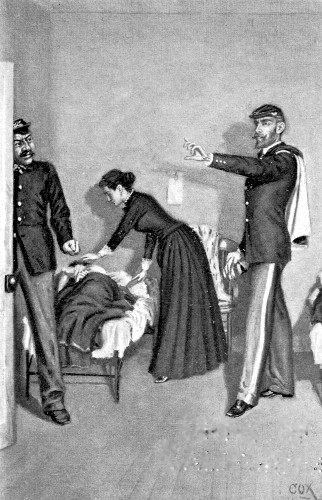 "COME BACK HERE, MY MAN."
Page 180.
"COME BACK HERE, MY MAN."
Page 180.
"With the mail-carrier this morning, from the agency, sir, and he'd been drinking on the way and[Pg 181] got to going harder as soon as he reached the post. The captain ordered him confined and the doctor sent him here. But my orders was——"
"Never mind your orders. What I want to know is, who detailed you, and when were you detailed for hospital duty?"
"The captain sent me over, sir, after Brannan was taken in, and he's been begging like that for a drink for an hour back."
Meantime, with great sobs shaking his form, Brannan lay there saying no articulate word. Miss Loomis gently drew an arm from underneath his head. "Let me have your wrist, Brannan," she gently said. "You know your old nurse of last summer, don't you?" And in another moment her practised touch was on the sufferer's pulse. In silence Davies awaited the result. Her eyes filled with grave anxiety as she counted the feeble fluttering,—a mere shadow of the vigorous throb of a soldier's heart. "This man ought not to be here—neglected," she murmured to Davies. Then, rising, she turned to the attendant. "Go at once to Dr. Burroughs and say that Miss Loomis asks him to come here as quick as he can."
And Private Paine concluded it best to go without further words. The steward, returning to his post, was met at the steps by the young contract surgeon coming over from his corner on the run. A moment more and the two stood in presence of the sufferer and of his nurse. She smiled kindly upon the new-comers. "I sent for you, doctor, because I knew you had not been informed of Brannan's state. His pulse——" and here she lowered her voice so that only Burroughs and[Pg 182] Davies could hear,—"is so thin and wiry as to be almost gone. My father would say he needed stimulant at once, and treatment later. See for yourself."
And the daughter of the well-known and beloved old army surgeon knew her ground and never faltered. Burroughs made brief examination and no remonstrance. In another minute the steward was administering brandy and water in a tablespoon while, anxious to re-establish himself, the young doctor was explaining. "I had no previous knowledge of the case," he stammered. "Captain Devers told me of the man's arrival and downfall, and I ordered him into hospital at his request, and,—yes,—I did say no stimulants of any kind. The captain so urged, and of course that would be the customary mode of treatment in most cases, but in a case like this, of course, had I been aware——"
"Oh, certainly," she interposed, with the same gracious smile and manner. "It was because I knew you hadn't been made aware. Now we'll soon be able to make him comfortable, and then when he's on his feet again he can tell us how it all happened." Again her white hand was laid upon the haggard forehead. "Courage, Brannan. Don't worry. We'll get you to sleep presently. Now, doctor, I want to send some medicine and a note to Mrs. Cranston. With your permission I mean to stay here a while."
"I will be your messenger, Miss Loomis," said Davies, "as the attendant doesn't seem to have returned, and then I can let Mrs. Davies know that I shall come here again, myself."
As he sped along the row, note and medicine phial[Pg 183] in hand, Davies was surprised to see his captain's storm-door wide open and a light shining through the transom within. A light was moving through the parlor, too, but Davies paid no further heed, left the note and medicine in Mrs. Cranston's hands with brief explanatory word, then hurried back to Boynton's quarters. He had turned down the light when he went out for his walk and had left his wife in the darkness of her room, trying, presumably, to go to sleep. He found the lights turned on again, and Almira, a heavy shawl bundled about her shoulders, sitting with white, scared face, trembling and twitching, at the big coal base-burner in what was called the parlor.
"Why, Mira!" he cried. "What has happened? Are you ill?" And he bent over as though to fold her in his arms, but she shrank away.
"Don't!" she cried. "I was frightened. You—you were gone so long. I thought you'd never come back." Then to his utter amaze she burst into a wild fit of hysterical weeping. "Oh, take me away,—take me away from this dreadful place, or I shall die,—I shall die!"
Mr. Davies was very late in returning to the hospital that night. For nearly half an hour Almira sobbed and shivered and refused to be comforted, and yet failed to explain. To his urgent plea to be told the cause of her fright and distress she could give no intelligible reply. "Oh, I don't know. I heard[Pg 184] noises, or voices, or something. I was all—all unstrung, I suppose. You—you talked to me so strangely, so cruelly the other night, and I've—I've been thinking of it all day—all day, and when you went away—and didn't come back, I—I thought all sorts of things. I supposed you'd gone there, you know where,—to those women,—those women who despise me and show it." It brought on fresh moans and tragic wringing of hands, and new outpouring of salty tears when he presently told her where he had been, but she would not listen to the cause of his detention at the hospital. It was more than enough that he had been out walking with her,—with her, in the dead of night. That seemed the only fact she cared to grasp, and that she crooned over with bitter wailing until his patience was exhausted.
"This is childish and absurd!" he said. "It is unworthy of you, my wife, and unjust to Miss Loomis as well as unjust to me. It is not possible that this has caused all your terror and distress. What noises—what sounds did you hear?"
But these now she had forgotten. In the light of his confession, as she termed it, all other calamities had faded into naught. He gradually calmed her sufficiently to induce her to return to bed, but when he announced that he must go again to the hospital to see how Brannan was getting on, her lamentations were piteous. In vain he reminded her that Brannan was her own cousin, the only son of her aunt and benefactress. She would listen to none of it. Brannan was only an excuse to enable him again to go and meet Miss Loomis, and finally, with white face and set, rigid[Pg 185] lips, Davies turned and left the house, walking rapidly to the hospital.
Miss Loom is still bent over the patient, who seemed now dozing. Dr. Burroughs sat beside her at the moment, but had been away, he explained, to see old Fritz again. A new attendant, a shy, awkward young fellow from Devers's troop, was hovering about the bedside, and Davies glanced at him inquiringly. "What became of Paine?" he asked, and the steward shook his head and shrugged his shoulders.
"Captain Devers took him away," was the answer. The doctor arose and stood by Davies a minute.
"I don't know what to make of that captain of yours," he said. "Either he or I will keep out of this hospital in future. He came here and 'raised Cain' with my steward to-night, all on account of Brannan; then went over to the troop barracks foaming like a mad bull. I fancy he means to make it rather lively for you."
"Never mind me, doctor, so long as this poor boy's coming out all right. How is he?"
"Doing nicely now, but—I wish I'd understood the case before. I'm bound to say Captain Devers misled me entirely. She's the doctor he needed," said he, with a jerk of his head towards the grave, beautiful girl bending over the soldier's pillow, one hand still slowly, tenderly stroking back the dark hair about his temples.
"Will you say good-night to her for me and escort her home? Mrs. Davies is not well and I must return to her," said Davies, "that is,—unless I am needed here."[Pg 186]
"No, go by all means. Only I may need you at the colonel's office in the morning when this thing has to be fought out. Dodge your captain, meantime, if you can."
"I know of no reason why I should dodge him or anybody," said Davies, with rising color. "I have done no wrong."
But on the steps without, as he hurried away, the lieutenant met a man who differed with him as to that—who differed with most people as to everything, and that he had been working up the case in his own mind against his subaltern there was no room for doubt.
"By what right, sir, do you assume to over-ride my authority and undo my orders? Time and again last summer I had occasion to caution you against interference in the handling of the men and the management of the troop, and now no sooner do you rejoin than here you are taking advantage of my being probably abed and asleep to countermand my positive instructions and overthrow my efforts at discipline."
Without one word of reply Mr. Davies assumed the position of attention and stood like a soldier before his furious commander. "I say again, sir," began Devers, "that you have deliberately sought to deride my authority and have connived at the disobedience of my orders. You knew perfectly well what orders I had given in the case of Brannan, and you dared to set them aside."
Still not a word in reply.
"This silence is contemptuous. Why don't you speak, sir?"[Pg 187]
"I simply deny each and every allegation, Captain Devers."
"Denial is ridiculous, Mr. Davies! Haven't I the evidence of my own senses,—of the steward and the attendant? Don't I know? By God, sir——"
"One moment. Oblige me, captain. I wish to behave with all deference and respect, but when you use blasphemy——"
"Oh, blasphemy be damned! Don't attempt to teach me! I've had too much of your puritanical, psalm-singing business. I condoned your wretched misconduct of last September in the hope that you might do better, but now the time has come for you to be given the lesson you deserve. Things have reached a pretty pass when an officer who leads his men into ambush and then deserts them in their extremity——"
"Captain Devers!"
"No dramatics now. You're not in the pulpit——" The steward came forth at the moment, and with instant modulation of tone Devers went on. "You may not realize what you have done, but you have done it all the same, despite every effort of mine to teach you the proper course——What is it, steward?" he broke off, as though suddenly aware of that official's presence.
"The doctor's compliments, sir, and the new man the captain has sent over to relieve Paine seems to lack intelligence; he won't do at all as an attendant."
"Tell the doctor I sent the best I had, and that he begged to be relieved because he couldn't serve so many masters. When the post surgeon hears of this night's work he will doubtless have his say as to the[Pg 188] manner in which his subordinates have trifled with their duties. I will make no change.—You appear to be waiting, Mr. Davies. That's all, sir, for to-night. You may go."
With a face almost as white as the snowy expanse of the parade, the lieutenant still stood there, quivering with wrath and wrong. He looked as though a torrent of reply were trembling on his lips, yet by supreme effort he curbed the impulse. His chest heaved once or twice. His lips were twitching. His hands were clenched and convulsive, but at last, with one long look into his captain's eyes while the latter was going on to say something about the necessity of his junior's accepting his admonition in proper spirit, Davies turned abruptly and sprang down the steps. Two soldiers stood there in the dusk, where they must have heard every word that was said. One was the new company clerk, Howard, the other Paine. Neither lifted a hand in salute to the officer. Both turned their backs and feigned to be deeply interested in conversation of their own.
It was Mr. Hastings's duty that week to supervise reveille roll-call and attend morning stables. He was surprised, therefore, as he went bounding over the parade, to see his junior sub on the porch wrapped in a heavy overcoat. Presently, after reporting to the post adjutant, as was the local custom, the various officers came scattering back to their own firesides, the infantry subs to turn in for another snooze, the cavalry to swallow a cup of coffee before going down to stables. Sanders hailed the lonely figure with characteristic levity.[Pg 189]
"Hello, Parson! Up for all day and meditating a sermon?"
Davies ignored the question and went straight to business. "I want to see Captain Cranston as soon as possible. Does he go to stables this morning?"
"Never misses 'em. What's up? Hope Mrs. Davies isn't ill."
"Mrs. Davies isn't very well, but it's on personal business I want to see the captain. I'll go down with him."
"Come over to my house and have some coffee, or a cocktail," said Sanders, with cheery hospitality. "Just what you need, old man. You look as if you'd been dragged by the heels through a knot-hole."
"Barnickel is making some coffee for me, thank you, Sanders. It will pull me together all right, I fancy." And Sanders went whistling on. The world and its cares, the flesh and the devil all dropped lightly on the shoulders of this young sinner, and either rode there or fell to the ground unnoticed. Garrison days were but a merry-go-round with him. "If that's a specimen of the bridegroom cometh," said he to himself, "I've got no more use for matrimony than I have for the catechism." And doubtless to this gay and nonchalant spirit the deeply religious temperament of the Parson seemed a sombre and repellent thing,—a thing to be lamented, yet indulged as something too solemn or sacred for remonstrance.
The morning air was bitter and Davies felt his toes and fingers tingling. The boards cracked and snapped under his tread, so, rather than disturb Almira, he stepped out on the walk and began pacing up and[Pg 190] down, still burning with indignation over the events of the previous night. There had been a fresh fall of snow Sunday morning, and though the walks and paths were cleared, the soft white mantle lay like a glistening carpet over the parade and prairie and along the slanting roofs of the quarters. There was an open space of sixty feet from outer wall to wall along officers' row, and a paling or picket fence, running at right angles to the roadway in front, divided this space equally, so that each set of quarters had its own yard. Davies had remarked with a smile the previous evening, the contrast presented by the Leonards's yard at the west end and his at the east of the double set in which they lived. Leonard's yard was criss-crossed, cut up in every direction by tracks of sled-runners and sturdy little rubber boots. His own lay like a flawless sheet without even a kitten's footprint to mar its virgin surface. Now as he strode rapidly westward again and came in front of the Leonard playground, he noted once more the traces that spoke so eloquently of happy, healthy childhood, of rosy cheeks and sparkling eyes and merry laughter. Then he turned back to his own, still tramping briskly in the endeavor to send the blood to his finger-tips, and then coming in view of what at nightfall had been an unbroken coverlet of snow, Davies stopped short, amazed. Straight from the corner at the front where the fences met, straight as a lance, went the footprints of a man, in long, unhesitating stride, to a point immediately underneath the closed blinds of the window behind which his wife now lay placidly sleeping. Davies stood and studied the tracks a moment, then went to the point of[Pg 191] meeting of the front fence,—a flat-topped affair,—with its picketed offshoot. Beyond doubt the maker of those tracks had swung himself over the fence at that point, dropped lightly to the ground inside and gone straightway to that side window. There he must have stood a moment or two, for the snow was trampled. Thence the tracks led around to the back of the house. Returning to his gate and hall-way, Davies tiptoed noiselessly through the little dining-room to the kitchen in the shed at the back. There Barnickel was sleepily starting a fire, and the door leading into his little den farther back discovered the soldier blankets of his bunk tumbled over as though he had just arisen. The door to the yard was still bolted. Davies slipped the bolt and stepped out on the plank walk leading from the kitchen to the gate in the rear fence. These had been tramped by many feet in that direction, and by only one pair in the other. Coming around from the side of the house were the tracks of the same foot gear, the heavy soldier arctics worn then by officers and men alike, that he had marked at the front. They led to a point underneath the rear or north window of Almira's room, and there, after evident shifting and tramping of a minute or two, had turned sharply away, led straight past the kitchen door and were lost in the general run of those towards the gate.
"What time did you come in to bed last night, Barnickel?" asked the lieutenant, at the kitchen door.
"About 10.30, sir. I'd been over to Sergeant Walsh's quarters. I went in to see if the lieutenant wanted anything, sir, but he'd turned down the lights and gone out."[Pg 192]
"Yes. And now did you hear any noise,—any footsteps?"
"No, sir. Only Mrs. Davies, sir; she was stirring round, excited like, and peeped out of her room to ask did I know where the lieutenant was."
"Did you come in through the front hall or the back way?"
"The back way, sir. There's standing orders against enlisted men crossing the parade or bein' on the officers' sidewalk."
Davies paused a minute. "Give me your broom," said he, and taking it through the partly opened door he carefully turned the knob behind him, swept away the traces leading to the rear window, swept and obliterated those at the back and side, as far as and including those under the east window, then, tossing the broom to the door, strode round the house to the front just as stable call was pealing, and Captain Cranston in huge beaver skin overcoat and cap came forth into the frosty day. The instant he caught sight of Davies the captain hastened to him and drew his arm within his own.
"The very man I want to see, and you are waiting for me!"
"Yes. I presume you know why."
"I've heard. Come with me to stables, by way of the hospital. I want to see how Brannan passed the night."
"I cannot go in, captain. I am virtually forbidden further connection with the case."
"I understand, but I am not included in the order, and wouldn't heed it if I were." Plainly Captain[Pg 193] Cranston was in aggressive mood. Other officers, issuing from their quarters, set forth across the parade, but catching sight of the popular troop commander, pulled up as though to wait for him, then looked surprised to see him earnestly talking with the pale-faced subaltern, going straight on eastward. Directly in front of Devers's house they met that officer himself, a bundle of papers in his hand. In the "Tactics" of the day one of the foremost paragraphs read, "Courtesy among military men being indispensable, it is enjoined on all officers to salute each other on meeting, the junior tendering the first salute," or words to that effect, but it was a rule far more honored in the breach than the observance. The post commander was about the only one to receive such recognition from his juniors, all others, as a rule, contenting themselves with a jovial "'Morning, Jack." "How are you, major?" and, possibly, an off-hand and perfunctory touch of the cap. Only among sticklers for military propriety like Leonard was the salute tendered to superiors. In nine cases out of ten it meant, when given, that personal relations were strained. Approaching the battalion commander Mr. Davies looked him straight in the eye and raised his gloved right hand to the cap visor. Cranston, with the most off-hand nod imaginable, gruffly and shortly said, "Good-morning," without so much as a tempering "sir" or "captain," and hurried sturdily by. Devers flushed, looked after the two an instant as though tempted to call, then turned back across the parade and was presently swallowed up in the door-way of the troop office.[Pg 194]
Leaving Davies outside, Cranston ran into the hospital, and presently reappeared. "Sleeping quietly," said he, "and the poor devil would have been in the terrors of delirium tremens if Devers's orders had been carried out and the doctor hadn't been sent for. Now tell me the whole story. Agatha has told me her version."
Lashed tight to the heavy picket rope, the horses were revelling in the keen morning air and slanting sunshine, nipping at each other's noses, challenging, with sparkling eye and tip-tilted ear, each well-known face and form of officer or man to caress or frolic, snapping and squealing at each other across the line, occasionally rearing and plunging in uncontrollable jollity. Bending to their work in their white stable frocks and overalls, the men were making brush and currycomb fly over the shining coats of their pets, carefully guarding, however, the long, thick winter crop of hair, for no man could say how soon they might have to take the field and face unsheltered the keen Dakota blasts. The frosty quadrangle was merry with musical tap, tap of the metal comb, and the snort and "purr" and paw of hoof of the spirited bays. Little Sanders, an enthusiastic horseman, was darting in and out among his charges, praising this man's work, condemning that, and occasionally seizing brush and comb himself and giving a practical lesson to some comparative novice. And, leaving matters for the nonce to his subaltern, Cranston paced gravely up and down, Davies by his side, absorbed in close converse. Captain Devers left his line to Mr. Hastings and did not appear at stables at all. "That means[Pg 195] he's concocting an epistle," said Hastings, with a grin. "He's hobnobbing with his new pet, Howard, and somebody'll get the benefit of an official letter this morning."
"We expect you to breakfast," said Cranston, as he bade the lieutenant good-by at the gate, "and I hope Mrs. Davies is feeling all right now."
But Mrs. Davies was not. She was so far from well that she had decided to remain in bed. No, she wanted no breakfast, no doctor, no anybody. All the same, Mrs. Cranston sent her a dainty tray on which was displayed a most appetizing little feast, and Almira's resolution gave way at sight of it. Wisely Mrs. Cranston refrained from calling, but other women were presently on hand to cheer and sympathize when at ten o'clock the commanding officer's orderly appeared with the commanding officer's compliments and he desired to see Mr. Davies at the office.
"Precisely as I told you," said Cranston, who was waiting for him on the walk without. "It was best to let Devers make the attack. Now for the defence."
Colonel Stone was at his desk. "Come in, Cranston," he called, as he caught sight of the soldier he so much liked. "I want to see you, too. Er,—come in, Mr. Davies," he added in a tone less cordial and more official. "Orderly, ask Mr. Leonard to step in here. Then shut the door and remain outside. Er—sit down, gentlemen, er—sit down."
And then in came Leonard, silent, even saturnine; a massive fellow with a mind as broad as his shoulders, a head full of reading and research and knowledge of his profession, but the quietest man in the garrison[Pg 196] withal, and Leonard simply bowed to the new-comers, dropped into the chair indicated by his commander, then dropped his eyes upon the floor and waited.
Pegleg dandled a pencil, end for end, between his fingers a minute, reflectively studying a knot-hole in the floor that yawned through a corresponding breach in the matting. Then he flung the stump of a cigar into a sawdust spittoon and began.
"Mr. Davies, I sent for you and I also invited in Captain Cranston because I want to hear your side of a singular case. In an official letter to the post adjutant, Captain Devers charges that you went to the post hospital last night, ordered the attendant out of the room, and proceeded to usurp control of a patient under the doctor's care,—that you deliberately overthrew his authority and actually told the attendant his orders were of no account. This, if true, is a most serious matter, but I have learned that there are many sides to a story. What is yours?"
"As briefly as possible, colonel,—and just as I answered Captain Devers,—I deny every such allegation."
"Well, you certainly went to the hospital?"
"I certainly did, sir; simply to get some medicine for Captain Cranston's little son and without an idea that Brannan was there."
"Then you didn't go with the purpose of seeing Brannan?"
"Certainly not, sir. I believed him to be at the agency until I heard his voice. I knew the young man well from an experience last summer and during the campaign."
"But what about ordering the attendant out?"[Pg 197]
"That is absurd. I found—or rather"—and now the hot color of embarrassment flew up to his pale forehead—"Miss Loomis, who is experienced in such matters, found Brannan in very dangerous plight,—his pulse nearly gone. He was verging, perhaps, on an attack of delirium. She considered, as did I, that the doctor ought to see him at once, and, as his quarters were at the nearest corner, barely two hundred yards away, she told the attendant to hurry for him. I should have done the same thing, but it was unnecessary. The attendant should have returned at once, but——"
"Well, didn't you undertake to administer brandy?"
"Not at all, sir. The doctor himself ordered that on his arrival."
"At your urging or suggestion?"
"I certainly approved it, sir, but I did not urge."
"Well, then, what does it mean—your having told the attendant his orders were of no account?"
"I did nothing of the kind, sir. The attendant once or twice began talking about his orders, but I had no time to listen. I did say, never mind your orders, or something like that, but he knew perfectly well what I meant. I inferred what the orders were,—I simply had no time to hear them."
"Well, the attendant declares, or at least Captain Devers says he declares, you twice choked him off when he tried to tell you what his orders were by saying he shouldn't mind such orders. Here, Leonard, the shortest way will be to read the whole letter. You do it." And slowly Leonard took the official sheet and began.[Pg 198]
"Sir,—It is with extreme regret that I feel it necessary to report to the commanding officer certain occurrences tending to the overthrow of good order and military discipline in the command. Yesterday morning there arrived from the Ogallalla Agency, Trooper Brannan of Troop 'A,' Eleventh Calvary, who had been ordered hither by Lieutenant Boynton as attendant or escort to the mail-rider. First Sergeant Haney reported to me at ten o'clock that the man had evidently been drinking on the way and was in an advanced stage of intoxication. On examination of the man I was convinced that he needed medical attendance rather than incarceration, and, instead of sending him to the guard-house, as is customary in such cases, caused him to be taken to the hospital, where under Dr. Burroughs's orders he was put to bed and an attendant from my troop was detailed with instructions to see that no stimulants of any kind were given him. All seemed to progress favorably until shortly after taps, when Trooper Paine, the attendant in question, reported to me that Lieutenant Davies, Eleventh Calvary, entered the ward, accompanied by a member of the household of Captain Cranston, declared the treatment of the patient unjustifiable and ordered him, the attendant, out of the room. On Paine's attempting to define his orders he was abruptly silenced and again ordered to leave. Being on duty under the instructions of superior authority, Trooper Paine again strove to explain his orders, and this time was curtly told that he should pay no heed to such instructions, and was then sent out of the hospital. The trooper called the doctor on his way and then, very properly, reported his embarrassing dilemma to me. I closely questioned him, and there can be no doubt as to the language imputed to Lieutenant Davies, whose propensity to interfere in the discipline of the troop I had frequent occasion to notice and rebuke during the campaign of the past summer. As courteous and kindly admonition had no effect, and as the officer in question has seen fit to treat my words with apparent disdain, I am compelled to invoke the support of the post commander in suppressing the spirit of insubordination of which this is so flagrant an instance.
When Leonard had finished reading he folded the paper and looked dreamily at the cobweb in the corner. He wished to be understood as having no opinion whatever to express. Cranston sat in silence with lips compressed under his heavy moustache. Davies never moved. His blue eyes were fixed unflinchingly on the swarthy face of the veteran adjutant until the latter had finished reading, then sought the eye of his commander as though for permission to speak.
"Well, Captain Cranston, what do you think of the letter?" asked Pegleg, after a moment's silence.
"I think it very ingenious, sir."
"Now, gentleman, the captain says that when he attempted to remonstrate with Mr. Davies last night he was treated with absolute contempt, and, Mr. Davies, he says that you refused to answer."
"I strove to control my tongue and temper both, colonel, and not to behave with disrespect. I did not answer him at once, but it was from no lack of impulse to do so."
Pegleg reflected a moment, then addressed himself to Cranston. "I confess that this matter is one that causes me much embarrassment," said he. "The post surgeon says that he was not aware of the man being sent to the hospital at all, and that it was Dr. Burroughs's case. Dr. Burroughs says he did not consider the man drunk, but took Captain Devers's statement, as he knew the man well. Captain Devers asked that he be put in hospital to keep him from drinking, because he knew the prisoners got liquor whenever they had money, and it wouldn't be safe to have him in the guard-house. Is there anything peculiar about[Pg 200] this Brannan?—any reason why he should be treated by his captain on a different system?"
"Colonel Stone," said Cranston, "I knew Brannan's mother, a wealthy and prominent woman in society. Mr. Davies can perhaps tell you even more, but I do not think Captain Devers knows anything of Brannan's past."
Leonard's dark eyes came down from the cobweb and studied Cranston's face as though he wished to ask a question, and Pegleg saw it. He leaned on Leonard, and had grown to respect his judgment.
"What were you about to ask?" said he.
"Do you know anything about the antecedents of that new company clerk of Captain Devers?" asked the adjutant, thus authorized.
"Nothing whatever," said Cranston, wheeling round in his chair and looking curiously at the big infantryman.
"Well,—pardon me, Mr. Davies. Had you never met or known him?"
"Never, except that he was one of the party of recruits I came out with last summer."
"But you knew Brannan, did you not?"
"Yes, he was the man who handled a nozzle with me in showering a pack of rioters among the recruits last June."
"But I mean you knew him before that, did you not?"
"Never," answered Davies, in surprise. "I never saw him in my life."
And then Leonard in turn reddened and looked confused, and shut his jaws like a clam.[Pg 201]
"Orderly," sang out the colonel, "go and give my compliments to Captain Devers, and say I wish to see him." Then, turning to Cranston, "We may as well get to the bottom of this business right here and now. I hate trickery."
But, as on more than one previous occasion, Captain Devers was not immediately to be found. He was not at his quarters, not at the store nor the stables. Mr. Hastings said later that just after Cranston and Davies went to the adjutant's office, Devers came from his house and went over to the barracks. Sergeant Haney did not know where the captain had gone. Not until 10.30 o'clock did the orderly succeed in finding him, coming up the bluff from the river bottom, whither he had ridden, he said, to look over the prospective ice crop. By that time Pegleg was tired of waiting and had dismissed his visitors. They, however, were recalled in a minute, and when Captain Devers was made acquainted with Mr. Davies's positive denial of his allegations, Captain Devers promptly shifted the responsibility to the shoulders of the attendant, Private Paine, who had persisted, he said, in his story despite his, Devers's, incredulity and stringent cross-examination. Bang went Pegleg's fist on the bell. "Send for Private Paine, Troop 'A,'" said he. "I'm bound to get to the bottom of this at once." And then while the orderly was gone he began pacing[Pg 202] the floor, occasionally stopping to drum on the frost-covered window. Leonard shifted his seat to Cranston's side and entered into low-toned chat with him and Davies, though neither seemed in mood to talk. A natural question that had risen to their lips was why Leonard seemed to think that Brannan was well known to Davies before his enlistment, and this question Leonard had disposed of by saying that he had been assured that this was the case, and that he would ask his informant's permission to give his name. It was an officer and a friend of Davies, and the statement was made in all apparent good faith. Devers sat nervously in a chair feigning to read a newspaper, but every now and then furtively watching the three. Presently the orderly came back. Trooper Paine wasn't in the post: he'd gone with the market wagon to town.
"Captain Devers," said Pegleg, irritably, "you ought to have known this. Why didn't you say he'd gone, instead of keeping us waiting here?"
"I protest against the imputation, colonel," said Devers, to all appearances much injured at such injustice. "The wagon rarely, if ever, goes to town on Monday, and that Private Paine should have gone with it is equally fortuitous."
"Well, just as soon as that wagon gets back I wish to examine that man, and I wish you, gentlemen, to be present, also Doctor Burroughs. You see to it, Mr. Leonard."
"I'll give instructions at once," said Leonard, rising quickly, and then, with significant glance at Cranston, taking his cap and quitting the office.[Pg 203]
"Then, Colonel Stone," said Devers, "I must ask, in justice to myself, that one or two officers, who are friends of mine, may be present at the inquisition. I am conscious of nothing but enemies in this office, and I can expect no fair play."
Stone whirled wrathfully upon him. "Your language is insubordinate, Captain Devers, and there must be an immediate end to it. If you have enemies here, they are of your own making. Bring any gentleman who will consent to appear with you, and, meantime, sir, you may withdraw."
"And leave the field in possession of my opponents, sir, and, like Sir Peter Teazle, my character in their hands. There is a higher court than a post commander," said Devers, white and trembling with mingled wrath and apprehension, "and to that court I shall appeal."
"You shall have every opportunity, sir," answered the colonel, with a bang upon his bell, "and leave this office in arrest if I hear another word.—Recall Mr. Leonard," said he to the orderly, who sprang in with scared face as Devers went mumbling out, "Which way did he go?"
"To the cavalry barks, sir," answered the Irish soldier, and Devers caught the reply before he was fairly out of the hall. He turned whiter still, for sudden suspicion flashed upon him. He halted as though more than half disposed to again address his commander, but realized that already he had gone too far. He looked again across the white level of the parade and saw the tall, dark figure of the adjutant stalking straight to the door of his own troop office,[Pg 204] and as with anxiously throbbing heart he walked away homewards, Devers watched his hated persecutor, almost divining what was his purpose,—what would be his first question. He saw him halt and the office-door open and Sergeant Haney come forth. Haney, who could be flippant and independent in the presence of his own lieutenants, stood like a statue before that dark, saturnine face. Officer or man, no soldier in that garrison ever took a liberty with Leonard. Devers realized that he had made a fatal error at last. He almost realized—almost divined the very words of that brief, curt interview.
"Sergeant Haney, you must have known Trooper Paine would be needed at the office this morning. How, then, did you select him to go to town?"
And Haney, to use his own expression, "wilted."
"Them was the captain's orders, sir."
"Captain who?"
"Captain Devers, sir."
"That's all."
And when Sergeant Haney was informed ten minutes later that the captain wished to see him at his quarters at once, he realized that there were breakers ahead in earnest, and went with his heart in his mouth. Later, when he came forth after full confession of the adjutant's question and his own compromising reply, the sergeant proceeded to the adjutant's office, asked to see that gentleman, well known throughout the old army as Black Larry, and nervously twitching his cap stood uneasily before those penetrating eyes. "I've come to make a correction, sir. I misunderstood the captain."[Pg 205]
"As to what?"
"As to Paine. The captain told me he might be needed this morning. Then he said he promised Paine he might go to town next trip of the market-wagon. We were out of potatoes, sir, and there were fine ones in market, so the captain said we'd better secure some without delay. I took it he meant at once, and so the wagon went this morning and Paine went along. I suppose I got it mixed, sir, but I thought the captain meant Paine should go to-day."
"Which wasn't at all what the captain meant you should think, eh?" said Leonard, dryly.
"No, sir. He says he meant to have him ready to go to see the colonel."
"Exactly. I only marvel at your misunderstanding such explicit and clear-cut orders," said Leonard, with calm sarcasm. "That will do, sergeant, so far as you are concerned." And Haney walked away, well content that when Paine and the wagon got back there would be something more for "the ould man" to explain, or stand the consequences.
But even Haney had only faint conception of his captain's squirming powers. Not until evening stables was the wagon back from Braska. It was loaded to the guards with fine Utah potatoes for the troop mess, and there was no room for Trooper Paine. "You're wanted at the adjutant's office at once," said the orderly to the wagon-driver, who was already in conversation with Sergeant Haney, "and I'm to fetch you with me."
"The man can't go till he's put up his team, young fellow," said Haney to the infantry bugler.[Pg 206]
"He can when ould Pegleg's a-pullin', Misther Sergeant Haney, and he's not to go anywhere else or talk with any one else furst off ayther," was the significant answer,—another unpleasant item to impart to his now wretchedly uneasy captain; and verily it seemed to Haney that the halcyon days were done for good and all, when soon after dusk a little squad from Cranston's troop, with Second Lieutenant Sanders in command, rode briskly away on the Braska road, and it was speedily whispered about the garrison that they were going to find Paine, drunk or sober, dead or alive, and fetch him back to the post forthwith.
"It takes a heap of nagging to get old Pegleg fully worked up," said the fellows of the Fortieth that night, à propos of the snub given Devers, and the pursuit by members of another troop of material witnesses, "but when he locks horns in dead earnest, the other party's got to scratch gravel; it's business and no quarter."
Meantime, acting under the advice of Captain Cranston, Davies had refrained from making any complaint of the language which Devers had seen fit to use at his expense. "Leonard says that some other matters should come up first, and Leonard knows. The colonel is after Devers with a sharp stick now, and all these charges are to be sprung upon him presently. You go on getting your quarters ready for Wednesday's house-warming. By that time you'll be wanted on the witness-stand. To-morrow, Tuesday, there'll be fun at the commanding officer's office with a general court-martial looming up behind it. Meantime, hold your peace."
This was Monday evening, and when he returned,[Pg 207] meditating, to his temporary fireside, he found Mira surrounded by a swarm of post callers, smiling and chatting, gracious and gay. He was in no mood for chatter himself, but had to sit by and strive to be interested and sociable. Most of their visitors had heard the story of Captain Devers's close call at the office that morning, and not a few sought to hear the facts of the case from the lips of an eye-witness. But Davies would not speak of the matter at all, and, finding him intractable, some one asked if Sanders had returned, and what success had attended his search for the missing. It was nearly time for tattoo. Dr. Burroughs was among the callers, and had just come over from the hospital. He had had no addition to the list of patients. "On the contrary," said he, "I have a man who might go to duty to-night were there need, and that is Miss Loomis's patient, Brannan."
"Oh, do tell us about that, Mr. Davies," appealed Mrs. Flight, who was again on hand, well knowing that next to the colonel's, where she was not entirely in the good graces of the lady of the house, garrison society would be most apt to be found in force doing homage to the bride. "We've heard all manner of conjectures already, and are so eager to know the truth. Was he an old friend of her's, and did he send and beg her to come to him?"
"No," said Davies, promptly, "she got to the hospital by merest accident. Louis Cranston's throat was sore, and he was coughing a great deal. She went for medicine, and I happened to meet her on the way."
"But they said there was such a romantic scene; he wept and clung to her hand, and——"[Pg 208]
Here Burroughs opportunely and somewhat aggressively burst into a guffaw of derisive laughter. "Miss Loomis is just one of those admirable women," said he, "that empty-headed idiots prate about. I wish other people had half her sense." A luckless way of essaying the defence of the absent, for it reflected on many a woman present.
"Fie! Dr. Burroughs," exclaimed Mrs. Flight. "Your blushes give you away, even more than your words. Don't you be falling in love with Miss Loomis. She's aiming higher than one room and a kitchen and a thousand a year." Whereupon there was shrill laughter, and further accusation and indignant protest from the ill-starred medico. And Davies, who ought to have rejoiced in the loyalty of such admiration for his friend and whilom nurse, was conscious of a pang of annoyance and aversion. The entrance of the old chaplain and his wife, and dark, swarthy Leonard with the handsome partner of his joys and sorrows, gave instant turn to the conversation. In a very few minutes Mrs. Flight and two younger matrons took their departure, Almira following them with rustic regretfulness, and exchanging some whispered confidences at the door, which brought new flush to Davies's anxious face. Mrs. Leonard was speaking of a recent visit "up the road," as in those days the Union Pacific in its westward climb to the Rockies was referred to. She had had such a lovely visit to Fort Russell, and had so much to tell about affairs in that particularly swell regiment, the —th, and the Truscotts had entertained her at such a pretty dinner; Mrs. Truscott was charming, and Mrs. Stannard was such a noble woman, and they were all so[Pg 209] interested in Mr. Ray's engagement. It was practically announced. He was to be married to Miss Sanford—an heiress and a great catch—early in June, and this led to the chaplain speaking of Ray, whom in days gone by he was prone to look upon with little favor, if not indeed as a ne'er-do-well. "I always feared that he would fall, and I am so rejoiced in this new phase to his character."
"Oh, I met Mr. Ray!" exclaimed Almira, delightedly. "He was ordered in to General Sheridan on some duty late in the summer, and some of the young officers, Percy's classmates, said he was such a brave fellow."
"What did the old officers say?" asked Leonard, with a twinkle in his black eyes, but not the vestige of a grin under his heavy moustache.
"They? Oh, I don't remember their saying anything about him. They said lots of lovely things about Percy."
"Yes. That's right. I can understand their omitting no opportunity of doing that. One learns to be something of a courtier even in Chicago, when on staff duty, and as for Washington, service there is a liberal education in diplomacy. One never knows who may have the strongest pull with the President in the event of a vacancy in the staff corps."
"Leonard," said the chaplain, gravely, "you're a born cynic and a pessimist to boot. Have we no generous impulses in the army?"
"Lots of 'em. Lots of 'em, chaplain, especially in the line and on the frontier, where we can afford to pat a fellow on the back, since we know that's about the[Pg 210] extent of the reward he'll ever get. It's when we're in big society in the East, above all in Washington, one has to be guarded in what he says, or first thing he knows he'll be hoisting some fellow over his own head in a moment of enthusiasm. No. I know just how you regard me, but I spent six weeks of a three months' leave in Washington last winter, and sat night after night at the club, or day after day among the army crowd at the Ebbitt, or in some fellow's den at the Department, and never once did I hear one word of frank, outspoken, fearless praise of some other fellow's work or deeds, unless it were to his face. Ask a man flat-footed if that wasn't a capital scout of Striker's last winter in the Tonto Basin, or if Jake Randlett hadn't done a daring thing in going all alone through the Sioux country to drum up Crow scouts for Crook's command, or what he thought of Billy Ray's cutting his way out through the Cheyennes to bring help to Wayne last June, and ten to one he'll hum and haw and say yes, he did hear something about that, and now that I mentioned it he believed Striker or Jake or Billy had really behaved quite creditably, but the whole tone was significant of nothing like what some other fellow I might mention, modesty only forbidding, would have done under similar circumstances.' It's just the damnation of faint praise. The trouble with the whole gang of those fellows seems to be a mortal dread lest somebody's eyes should be deflected from the valor of the warriors at Washington to that of the warriors on the plains. What recognition do you suppose Ray will ever get for that feat? General Crook says it's useless to recommend him for brevet, because the Senate[Pg 211] wouldn't confirm it, and the reason they won't is that those hangers-on about the capital don't mean to let such rewards be given to the men on the frontier. And yet this sort of thing doesn't happen only in Washington. It was a cavalry officer who said of that very affair that Ray was simply a reckless fellow under a cloud, with everything to gain and nothing to lose, and that doing a reckless thing was just as much a matter of instinct with him as battle is to a bull-dog."
It was unusual to see Leonard warm up in this way. Besides the chaplain and the silent host, there were three officers in the dreary little bachelor den at the moment. Each and every one seemed surprised at the adjutant's outbreak, but not one of them at the concluding revelation.
"No need to ask who that was," said Captain Hay, with a prefatory "Humph." "It savors of Devers from first to last. That man is a born iconoclast. He pulls down everybody's idols and sneers at what he cannot pull down,—our ideals."
"Well, now let me ask you," said the chaplain, a man whose broad charity led him at any and all times to the defence of the absent. "Without detracting in the faintest degree from the heroism and value of Mr. Ray's exploit, are there not degrees of personal bravery, are there not possibilities of an order of courage higher even than his? As I recall him, he was what I should term a fearless man, brave to a fault; but have we not in the army tens and perhaps hundreds of honorable gentlemen who are as keenly susceptible to the thrill of danger as Ray is apparently dead to it? Have I[Pg 212] not heard man after man say how his own knees trembled or his comrade's cheek blanched at the whistle of the first bullets of the battle? And as for this Indian campaigning, can there be a warfare imagined in which the percentage of peril is so great, the possibilities of ambush, surprise, sudden death in the midst of fancied security so constant, the daily and nightly circumstances so full of incessant nervous strain? Now, who is the better soldier,—the really braver, or, perhaps better, the more courageous man,—he who rides the trail utterly reckless of or insensible to its peril, or he who, sighting danger in every bush, scenting death on every breeze, looking every instant for the war-whoop, the death-wound, nevertheless so bears himself with all his faculties in hand as to seem calm, serene, confident, and stands ready for death or duty at any moment? I have always held that the Christian gentleman was the highest type of the highest order of courage; the man who replaced the fatalism of the Mahometan with the sustaining faith of the soldier of the Cross. But I see you think I'm in the pulpit and preaching again," said he, smiling at Leonard. "We both warmed up to our hobby."
They were silent a moment. Across the wintry night the trumpets were singing the lullaby of the crowded garrison, and hurrying footsteps told of belated subalterns speeding to their companies to supervise the roll-calls. Leonard rose to his full height and threw his cloak over his broad shoulders.
"We are more in accord in this matter than you think, perhaps, chaplain; only the man doesn't live who could be insensible to the danger of cutting his[Pg 213] way through a band of encircling Cheyennes. I've heard of no braver deed in many a year than Ray's. I doubt if we'll hear of truer grit or courage in many more."
"Perhaps not, Leonard," said the chaplain, as the adjutant paused an instant at the threshold to say he would return the moment he had received the reports. "Perhaps not, nor would I say one word to underrate the heroism of Ray's exploit; but when we do hear of another I look to hear of it in some fellow as firm in his faith as he is in his sense of honor and duty, and some day we shall see."
But Leonard did not return in five minutes nor in ten, and Mrs. Leonard grew anxious. "This never happens unless something unusual has occurred." Captain Hay stepped through the hall and opened the outer door.
"There are lights dancing about over there on the parade near 'A' Troop's quarters. I wonder what's up. Hullo, Sanders! That you? When did you get back? Did you get your man?"
"Got two of 'em," was the breezy answer. "T'other one disguised as a gentleman in cits and just about starting on the night train for the West,—the gifted Mr. Howard, clerk of 'A' Troop."
Mrs. Davies was standing just within the parlor door at the moment, blushing over the praises lavished on her by the chaplain's impulsive helpmeet and trying hard to say civil and appropriate things to her guests. The officers, one and all, had edged into the hall-way in eagerness to hear the news.
"What was it Mr. Sanders said?" asked Mrs.[Pg 214] Leonard, anxious to know what detained her husband. Hay half turned.
"He says they arrested two men, one of them apparently deserting, being in civilian dress and aboard the train,—Captain Devers's new clerk, Howard."
And then every one in the parlor saw that Mrs. Davies was seized as with sudden faintness. She turned very white and grasped at the nearest chair for support. "I'm only dizzy, not ill, or I don't know what it is," she protested, as they crowded round her, and Davies came quickly in, conscious that something was amiss. Nor did she recover her color or her calm. Nervous, fluttering answers only could she give to their sympathetic inquiries, and when presently Leonard reappeared, cool and imperturbable as ever, she was evidently relieved to see her guests departing. The adjutant explained his detention by saying he had gone to the colonel's with Sanders, who had galloped ahead, leaving his guard to bring along the prisoners in an ambulance, Paine too drunk to be able to move. They would hardly arrive before eleven.
"The colonel desires to see you at the office at eight o'clock in the morning," said he in low tone to Cranston. "Howard has been away all day,—since guard-mounting, in fact,—and no report was made of it. Devers has been notified that the colonel would investigate matters—the whole business, in fact—early to-morrow."
But who can tell what a day may bring forth? Devers, after a sleepless night, filled with foreboding of the wrath to come as the result of that impending investigation, sat nervously over his coffee while the[Pg 215] trumpets were sounding first call for guard-mounting, and turned a shade yellower at the ring of the front-door bell. The servant re-entered the dining-room and announced that Lieutenant Leonard, the adjutant, desired to speak to the captain. For a moment he could not rise. Conscious of his own double-dealing, visions of arrest, charges, court-martial—heaven knows what all—were floating before his startled eyes, but go he had to. Summoning courage, bravado, or something, he swaggered into the hall.
"Oh—ah—step into the parlor, Mr. Leonard," said he, airily, "I presume you're here on business." He was preparing to exhibit amaze—virtuous and soldierly indignation—at the idea of having, all unheard and unrepresented, been ordered into arrest on the prejudiced statement of a swarm of hostile officers and sorely badgered and bullied members of his troop. Well knowing himself to be tottering on the ragged edge of final discovery, his duplicity exposed, his deceit established, he nevertheless braced himself for the supreme effort to bluff to the very last. Thanks to the storm-shed without, the hall was dark, and for a moment he could only vaguely see the huge bulk of the infantryman standing erect before him, the very attitude indicative of stern official purpose.
And then in sudden revulsion of feeling,—in a wild whirl of reviving hope, courage, exultation,—he noticed that the adjutant was without his sword, and listened, spell-bound, well-nigh incredulous and without reply, to the brief official words which Mr. Leonard delivered, then saluting, turned on his heel and left the house.[Pg 216]
"It is my duty to announce, sir, that Colonel Stone has had a stroke of apoplexy or vertigo and is seriously ill. As senior captain, you are in command of the post."
That beautiful wintry Tuesday morning was as placid and serene as nature could make it, but Fort Scott was in a ferment. Whether stricken by apoplexy, which was the first, or vertigo, which was the later, theory, Colonel Peleg Stone had been found lying bleeding and unconscious at the foot of the stairs, and almost at his parlor door, just after sick-call. He had arisen early, said his tearful and terrified wife, saying that matters of importance demanded his presence at the office before guard-mounting. He had been wakeful and restless during the night. He had called for hot water soon after reveille, and gone into his dressing-room to shave. This was all she knew until aroused an hour later by her frightened maid, with the tidings that the colonel was lying speechless in the hall. Both doctors and Mr. Leonard were summoned. Violence was hinted at, but the orderly pacing the front piazza declared that no one had entered the front door since he came over and rang the bell to report himself for duty just as soon as he had finished breakfast. "For them was the colonel's orders when he dismissed me last night." Just about sick-call he heard the sound of a heavy fall inside, and presently "Jane come a-runnin',"[Pg 217] and told him to rush for the doctors. Alonzo, the colonel's colored body-servant who had followed his fortunes a dozen years, was in the kitchen below stairs, and was sure no one had come in from the rear. He, too, had heard the fall and ran up with Jane, finding his master completely dressed, lying close to the parlor door, with blood streaming from his nose and mouth. There were heavy contusions on the forehead and face, caused probably by his having plunged blindly forward down the stairs. Something in the stertorous breathing suggested apoplexy, but the doctors soon decided against that. It might have been vertigo, or he might simply have tripped at the top and come diving head-foremost all the way down, but his clothing was not in such disorder as that would cause, and neither the orderly, nor Jane, nor Alonzo had heard more than one single crash or thud. Had they examined the parlor and sitting-room to see if any one could have been there hidden? was asked. No, there wasn't time. The house was one of the big double sets of quarters, with hall-way and staircase in the middle, as frequently planned in those days for the commanding officer of the large frontier garrisons. Four large rooms were on the ground floor for use as parlor, sitting-, and reception- and dining-room, all abundantly furnished, as Mrs. Stone was well-to-do, and there were hiding-places enough if some one had stolen in, like a thief in the night. The broad contusion on the forehead might have been caused by some blunt instrument, to be sure, said the senior surgeon, but he thought it improbable. Only one thing was certain,—Pegleg was knocked out. It might be several[Pg 218] days, possibly a week, before he could resume duty. Captain Devers came over five minutes after the adjutant left him, and was profuse in sympathy, sorrow, and proffers of aid. The despatch sent to Department head-quarters that afternoon was a model of style, but it did not reach the office until late in the afternoon, so late that the general had gone home with his chief of staff, and not until five o'clock was it placed in the hands of the latter, who took it at once to his commander.
"Whew!" said the chief. "It's bad enough to have Pegleg down, but think of having Devers up, even for a week."
"I don't see what we can do, sir," was the reply. "The lieutenant-colonel of the Fortieth is on leave awaiting retirement, the major on General Sheridan's staff. Major Warren, of the Eleventh, is abroad, and Devers is the ranking captain."
"Well, let it stand," said the general, after a while. "Leonard will look after affairs in the Fortieth, and you look after Devers. If he gets to cutting up any didoes, send him up to the reservation to investigate the trouble up there; it's something after his own heart, I reckon,—or send him anywhere, and let the command devolve on the next captain until Stone's on deck again. Devers says he'll be up in a week."
"That's just what makes me fear he won't be well in a month, and if he isn't able to resume duty, Devers will say he only meant sitting up in bed, probably."
No matter what the opinion attaching to Captain Devers, however, the fact remained that he was now in law and fact commanding officer of the biggest post[Pg 219] in the Platte Valley, and meant to make the most of his opportunities. Leonard promptly asked to be relieved from duty as post-adjutant, on the plausible ground that Captain Devers would doubtless prefer to have one of his own cloth and corps in the office, and Devers, well knowing how it would reflect upon him at Department head-quarters, refused to change. "However strained may be our personal relations, the good of the service demands that for the present they be ignored. The differences between us can and shall be adjusted later on," was the purport of his reply. Meantime Mr. Leonard could be assured that he should in no wise be disturbed in his functions as regimental adjutant, or hampered no more than was necessary in those that related to the post. Leonard swore impressively as he read the reply to his friends, Captain Pollock of the Fortieth, and Cranston of the Eleventh, but said nothing to any one else.
Davies was to relieve Hastings as troop duty officer for the week, and assume charge of roll-calls and stables, all matters between himself and his captain being incontinently shelved after conference with Cranston, Truman, and Hay, until such time as somebody beside Devers should sit in judgment on Devers's acts. The temporary post-commander spent very little of Tuesday morning in the office. With official gravity he signed the ration returns and such papers as were to be forwarded. "All matters concerning the interior discipline of the companies I prefer leaving to their proper commanders," said he, coldly, to the statuesque adjutant, thereby hitting a self-comforting whack at the colonel, who rather liked to interfere. "I have[Pg 220] every confidence in the judgment of the captains of the infantry, at least, and as for routine matters you will be pleased to conduct them just as when Colonel Stone was on duty."
Then he went forth to his own sanctum, the troop office, raising his fur cap in acknowledgment of the sentry's shrill, "Turn out the guard; commanding officer!" and once there established, he sent his orderly with directions to the sergeant of the guard. In five minutes prisoner Howard, conducted by an armed sentry, made his appearance, and was received within the sanctum. "You may retire, sentry, until called. I'll be responsible for this man," said he, and from that conference even Sergeant Haney was excluded. The interview lasted twenty minutes, at the end of which time Howard was remanded to the guard-house and Paine brought over in his place. Howard swaggered insolently past the sergeant of the guard on his return, and when told to get ready to go out to work, replied, "I guess not, Johnny, unless you want to lose your stripes." But Paine came "home" scared and abject. Men in quarters said that both the captain and Sergeant Haney stormed at him until he didn't know black from white, and the temporary company clerk, excluded from the office during the conference, was called in finally to witness Paine's signature to a paper, the contents of which he did not see at all.
All day Tuesday Davies was occupied in getting his furniture and traps into Number 12, and Almira—pretty as a picture, and eagerly assisted by her now intimate friends, Mesdames Flight and Darling—was tacking up curtains, brackets, and knickknacks. Army[Pg 221] women have a gift of making even a burrow look cheery and attractive, though they do accumulate an amount of truck that becomes embarrassing in the inevitable event of a move. On Wednesday, however, as has been said, his week of troop duty was to begin, and at gun-fire he was up and dressed and ready for business. Devers did not come down to stables. The first sergeant made the various reports in somewhat off-hand and perfunctory style, but Davies took, apparently, no notice of his manner, and, joining Captain Cranston as soon as he had inspected the stables on the return of the horses to their stalls, the two friends strolled slowly up the winding road to the parade, the last officers to return homeward. Sick-call was sounding as they passed the barracks, and Captain Devers met them on the walk. Both officers saluted the post-commander, Davies in silence, Cranston with an accompanying "Good-morning, sir." Devers responded in the briefest possible way and went at once to business.
"Mr. Davies, that man Brannan will be returned to the troop from hospital this morning. See that he is immediately confined in the guard-house." And then, with his orderly following, the commander went his way. Sergeant Haney was standing not forty yards away on the barrack-porch awaiting his captain's coming. Such instructions were generally given by the company commander direct to the first sergeant, and the purpose of making Davies the medium and Cranston the witness of the order was apparent at a glance. Devers meant to inflict his punishment not only upon the soldier, but upon those who dared either in person[Pg 222] or through some "member of the household" appear as the soldier's friend.
"What should I do, captain?" asked Davies, sadly. "Turn and carry the order to the first sergeant at once?"
Cranston looked back, saw Devers halt to say some words to the troop farrier, and seized the opportunity.
"Yes, and I will go with you to be ready to testify to your having obeyed."
Retracing their steps, the two approached the quarters. "Go no farther," said Cranston, in low tone, as they got about half-way and were close to where Devers stood. "Call the sergeant to you here." Davies did so, and Devers whirled around in surprise. Haney came promptly, buttoning his overcoat on the way. It wouldn't do to "slouch" in presence of Cranston, whatsoever he might dare with a new lieutenant.
"Sergeant," said Davies, "the captain orders that Trooper Brannan be confined in the guard-house the moment he returns from hospital."
"Yes, sir. I got the order, sir, last night," said Haney, forgetful in Cranston's presence of the impulse to be flippant, and unconsciously revealing just exactly what his captain meant to conceal. Davies turned and looked at Cranston, and the latter, with a peculiar smile, linked his arm in that of his friend and, carefully avoiding the spot where Devers now stood watching them, led him away.
This for a starter was significant, but more was to come. Guard mounting was hurried through that morning, for the air was sharply cold and a northerly[Pg 223] wind was beginning to moan through the garrison and whirl the snow in drifts over the desolate prairie. Captains Truman and Pollock, the former as old and the latter as new officer of the day, appeared in fur caps and heavy overcoats and stood at the desk where Colonel Pegleg for months past had administered the affairs of the post. The former raised his hand in salute as he said, "I report as old officer of the day, sir," and tendered the guard report. Devers glanced at once at the list of prisoners. Foremost were the familiar names of the old stagers, the general prisoners undergoing sentence of court-martial. Then those of the men sentenced to brief confinement by the minor or garrison court. Then came the names of those awaiting trial, and opposite each name in the column headed "Charges" was the word "Preferred," as was the custom of the day, and this significant word appeared opposite the next to the last name on the list, that of Howard, Troop "A."
"Ah! What is the nature of the charges against prisoner Howard?" asked Devers, blandly.
"I haven't seen them, sir. I understand that they were prepared by Lieutenant Sanders as directed by Colonel Stone."
Devers tapped his bell and the orderly sprang in. "My compliments to the adjutant," said he, and from the adjoining room, grave, stolid, and imperturbable as ever, Leonard came in, pencil in hand, and stood at attention without a word.
"Mr. Leonard, have charges been preferred against Trooper Howard?"
"Yes, sir. Desertion. The specification alleges[Pg 224] that he was caught aboard the west-bound train at Braska in civilian dress Monday evening."
"Anything else?"
"No, sir."
"Captain Pollock, you may release Howard. He was in town with my approbation and assent, looking for an absentee whose haunts he knew and whose presence was required here. He says he boarded the train expecting possibly to find him thereon, and wore civilian dress because his uniform might have caused his rejection at places he wished to search."
Captain Pollock touched his cap without a word.
"You will also see that Paine and Brannan, recently confined, are sent out to work with the police cart. Other orders as usual. You are relieved, Captain Truman. That is all, Mr. Leonard."
The talk that ensued among the officers of the calvary command when this matter was detailed at the club room will have to be condensed. Davies was not present. He never went there. Cranston was present for the first time in weeks, for it was an establishment for which ordinarily he had no use. He and Truman went thither because they knew that that was where Sanders could be found, and there they found him. It was barely ten o'clock, but this light-hearted young gentleman, together with three or four kindred spirits of the Fortieth, was discussing, to the accompaniment of hot Scotch, the relative values of hands dealt at random from a grimy deck. That they should have taken to hot Scotch at such an hour they explained by the statement that as they had to be up with the dawn the day was already old, and that they should be playing[Pg 225] poker they didn't consider a matter calling for explanation of any kind. It was "a way they had in the army" in those days when the other three-quarters of the year was spent in sharp campaigning. Sanders cheerfully dropped his hand as he had his money and told his story like a little man.
"We trotted or galloped all the way to town and found Paine soon after six, drunk, of course,—too drunk to ride the spare horse, so while we were waiting for an ambulance from the quartermaster's depot, I ran over to the Cattle Club for a drink, and was chatting there with Willett and Burtis,—by the way, I asked them both to drive out and dine with us to-night and take in the hop later,—and presently in came a couple of cattlemen from Cheyenne who knew everybody at Russell and were jolly, pleasant fellows. They were going up on the evening freight, and we loaded up a lunch-basket and went down to the depot to see them off in the caboose. The Braska crowd did their best to send them home full, and they were full, and nothing would do but we must go into the bar and drink Roederer with them until the conductor came rushing in to say all aboard. Then they snaked me on to the caboose platform when the train was under way, pulled me inside and ran me half a mile up the track before they could stop her again. But that half-mile did the business for Mr. Howard. There he was spruce and dandified as you please, dressed fit to kill in a bang-up better suit than I ever hope to own, trying to sit behind a newspaper. They pulled Burtis aboard, too, and in the scuffle he fell all over Howard, knocked his hat off, and I knew the face in a second,[Pg 226] and when I came off that car he came with me, by the scruff of his neck, swearing and protesting and denying that he was Howard, and threatening to have the law on me and appealing to the cattlemen for rescue. By Jupiter, if it wasn't that I had been with them long enough to make a favorable impression they would have rescued him, too. They didn't half want to let him go, and he straggled hard to get away as it was."
Then Truman told him what Devers's orders and remarks were, and Sanders fairly blazed with wrath. "It's the maddest kind of a lie," said he. "That fellow had never looked for Paine or thought of such a thing. We found where he had left his uniform and where he kept in hiding until time to skip out and catch that train. He wasn't looking for anybody and didn't care to see or be seen by anybody. If it wasn't a clear-cut case of desertion may I be hanged. He had over two hundred dollars in his clothes and fresh duds in his grip-sack."
Long before mid-day, therefore, Sanders's words were being repeated from mouth to mouth, and Trooper Howard, with pale face and starting eyes, was shut up in the company office where only the captain and Sergeant Haney could get at him, and Devers was there with his sergeant and clerk, when just at 10.45 the telegraph operator came bulging into Mr. Leonard's office.
"An important despatch," said he, "for the commanding officer."
Leonard took it, then hesitated. Under Colonel Stone his instructions were to open and read at once, but the relations between him and the captain temporarily[Pg 227] in command were neither confidential nor cordial. "Take it to Captain Devers," said he, "and I will wait."
Devers read the despatch with kindling eye. It was from department head-quarters at Omaha, and said briefly,—
"Send a discreet officer with twenty cavalrymen for temporary duty with Boynton at the agency at once. Report action by wire."
For a few minutes the captain sat in deep thought, then with head erect, and with quick, confident step, left the barracks and went straight to the adjutant's office. "Orderly," said he, "my compliments to Mr. Davies and say I wish to see him at once."
And so only a little more than an hour later, knowing absolutely nothing of what might be going on at the agency, judging only from the reports of the mail-carrier that there had been trouble between the agent and some of Red Dog's people, and that the agent had determined to make arrests, leaving his bride wildly weeping and protesting in the hands of her devoted friends Mesdames Flight and Darling, yet commending her to the guardianship of Captain and Mrs. Cranston, Percy Davies set forth upon a bitter, wintry march of eighty miles, answering the call of duty at the front, leaving wife and fireside, good name and character, to the care of friends or foes who remained.[Pg 228]
Long remembered at Fort Scott was the evening that followed Mr. Davies's departure for the agency. Infantry and cavalry both, the garrison took it much to heart that the detail should have devolved, of all men, upon him. Not because he was comparatively young and inexperienced; not because he was just back from long leave that had been necessitated by long and serious illness, but solely and entirely because he had but recently married a wife, and therefore shouldn't have been expected to go,—should not have been torn from her side. The women opened the ball, but the men were not slow in taking the floor. What Davies himself might think no one knew, because Davies would not say. He received the order of the post commander without a word, went home to his wife and sent Barnickel to ask Captain Cranston to come to him as soon as possible. Devers retired to his quarters and was not again seen until after stables, when, scrupulously avoiding those of the other troops, he visited his own lines, having previously sent his orderly to Mr. Hastings to notify that gentleman that he should not require him to attend stables this week, which was to have been Mr. Davies's, but would expect him to superintend roll-calls. The temporary commanding officer of the garrison and of the cavalry battalion appeared, therefore, in solitary state in his capacity as captain of Troop "A." Officers who passed him on[Pg 229] the way to or from stables raised hand or cap in the salute due the post commander, but few of them entered into conversation. Old Dr. Rooke, the post surgeon, a man ten years Devers's senior in the service, returning from a visit to Colonel Stone's bedside, came face to face with the captain, and the captain stopped to make inquiries. Rooke's face was grave.
"He is semi-conscious and resting fairly well, but has received a severe shock that has clouded his faculties. I cannot say when he will be up again. I do not see any likelihood of his returning to duty for a month."
Devers's face expressed all proper concern and sympathy. "It is best, of course, that I should know this, but the colonel's friends are numerous in garrison, and it is something that would have a depressing effect. I suggest, therefore, that you do not confide your fears to any one else. It affects me painfully to hear it, though I had not the good fortune to be in the colonel's good graces. We differed as to various official matters."
"I'm aware of that," said Rooke, dryly, "and I have felt more than half constrained to remonstrate with you as to the confinement of Private Brannan. He left the hospital in good condition, and with the expectation of returning to his detachment and duty. Of course if new charges have been lodged against him——"
"New charges have been lodged against him, doctor. He was sent to the hospital at my request that he might be restrained from liquor, which, under the system pursued by Colonel Stone, could at any time be procured by guard-house prisoners who had[Pg 230] money. That he would be able to indulge his propensity in your department had not, of course, occurred to me as a possibility."
"Any criticisms you have to make at the expense of my department will receive due weight, I have no doubt, with my superiors, and you will oblige me by addressing them upon the subject, not me. The post commander expressed his entire approval of it, and to him and not to the company commanders am I responsible, Captain Devers. This, however, I will say, sir, that sooner than submit to further comment of this character, I shall telegraph to department head-quarters requesting instant relief from duty as post surgeon here, if you are to retain the command."
And Rooke had gauged his man. He knew perfectly well that this application, coming on top of Stone's prostration, would lead to the inevitable conclusion at head-quarters that the colonel could not return to duty for some time, and the surgeon could not contentedly perform duty under Devers as temporary commander. In other words, that Devers was already beginning, as the general expressed it, "to cut up didoes," and somebody—some field officer—would be at once detached, in all probability, and sent from his proper post temporarily to take charge of matters at Scott. On the other hand, if things worked smoothly and with no apparent friction, Devers might hope to retain command for several weeks, and that would be of inestimable benefit. What might not be accomplished in that time? He was quick, yet not too precipitate, therefore, in expressing grave and courteous disclaimer. No reflection on Dr. Rooke's management was intended[Pg 231] or implied, though Dr. Burroughs, the junior, had, in Devers's opinion, laid himself open to criticism. Of course being somewhat inexperienced, the unwarrantable interference of Lieutenant Davies and Miss Loomis had confused and hampered him. Surely Dr. Rooke could not say that he, Devers, had ever interfered. On the contrary, had he not incurred the enmity of officers and ladies of his own regiment by making formal report to the post commander of what he considered an unjustifiable encroachment on their part upon the sacred precincts of the post surgeon? Rooke looked at him from under his shaggy eyebrows, suspicious and unmollified. He was a shrewd old Scotchman, and Devers protested too much.
"So far as Miss Loomis and Mr. Davies are concerned," said he, "I have no exceptions to take whatsoever. I knew the young lady's father well, and I have faith in the young man. I hear he has been sent on some temporary duty to the agency, captain, and had he consulted me I should have advised against his going. The suffering and exposure of such duty in such weather are more than many a rugged man can bear. Mr. Davies has not yet half recovered his strength."
"Then I wish I had known it, doctor," said Devers, diplomatically; "but not knowing it, I could make no other selection. The orders called for a discreet officer, and Mr. Davies's friends consider him discretion itself. I have even been led to think he had too much discretion. The orders said 'cavalrymen,' therefore I was limited to the officers of my battalion. They said to report to Lieutenant Boynton, therefore I was limited[Pg 232] to officers junior in rank to him, for no senior could be required to do it. Mr. Boynton is a first lieutenant, and the only first lieutenants junior to him here are Hastings, who is eminently indiscreet, and Folsom, who is a martyr to rheumatism, as you very well know. The only second lieutenants now on duty with us are Sanders, Jervis, and Davies; certainly of the three Davies is the only one who can be called discreet, and he was the only one who had not been on scout or detached service of this character since he joined. I regret having to break up his honeymooning, but even that is to be but temporary, for so the orders said. I explain all this to you, doctor, because I respect your rank and service, but I shall not condescend to justify myself to my juniors."
"And have you reported action yet by wire?" asked Rooke, critically.
"Certainly," said Devers, but he reddened. Evidently there had been wide spread talk over the selection already, and speculation as to what department head-quarters would think of it. Evidently it was known that he was ordered to report by telegraph, yet who could have "given it away"? The despatch was still in his waistcoat-pocket, for Devers, unlike his trimmer juniors, wore that unsoldierly garment underneath his sack-coat. Even the adjutant had not seen the despatch, and the operator was sworn to secrecy. He had reported by wire, and in these words: "Discreet officer and twenty cavalrymen left post at noon with orders to hasten to Ogallalla agency and report to Lieutenant Boynton for temporary duty." This was sent at 1.15, and he had only just received another inquiring name[Pg 233] of the officer detailed. This he did not mean to answer until after five o'clock, by which time he knew the Omaha offices would be deserted and Davies some thirty miles away. "The horses are hard and sound," he had said to the silent subaltern. "You should reach there Friday morning without fail and without fatigue, and ought to camp to-night at Dismal River. It's a long thirty miles, but you can easily make it." He meant Davies to be beyond recall in the event of disapproval, and that point secure, he didn't much care what head-quarters might think or the garrison say.
And so Wednesday's sun went down red over the snow-streaked barren to the west, and long, long before that the last vestige of Davies's little party disappeared from view among the breaks and ravines in the low range of treeless heights many a long desolate mile to the north, and Almira's faithful comforters were still with her, and at dusk bustled her over to Mrs. Darling's for change of scene and surroundings and tea and a little music, and presently sleigh-bells were heard, and Mrs. Flight screamed joyously at the window, "Oh, it's Mr. Willett and Mr. Burtis with their lovely team, and they've come out for the hop!" And before long Lieutenant Darling, accompanied by these very gentlemen, came stamping in, and Sanders and Tommy Dot followed, and in the firelight the little army parlor was a pretty picture as these gallants entered and the lamps were lighted, and the gentlemen from town were presented to Almira, and everybody thought it the proper thing to be especially devoted to her by way of consoling her for this sudden and heartless separation from her lord, and for nearly half an hour her lovely[Pg 234] face maintained its expression of pathetic and unconquerable woe; but Willett had seated himself at the piano, and he and Sanders and Tommy Dot began singing with inimitable drollery some of the popular melodies of the day, and presently, "to save her life," as she declared, Almira could not resist joining in the laughter and applause, and then Willett began telling of the new step they were dancing in the East,—he had been home just long enough to attend a few parties,—and while Tommy Dot played a waltz he essayed to teach it to Mrs. Darling,—a charming partner ordinarily, but still she did not seem to catch the idea, and Mrs. Flight was even less successful. Mira looked on with sparkling eyes and new and uncontrollable eagerness. It was the very step she had danced with the aides-de-camp in Chicago the previous September,—almost the same that she had danced time and again with Mr. Powlett at Urbana, and not a lady at Fort Scott had yet learned it. At last Sanders spoke,—
"Why, surely it is the glide step you were telling us about, Mrs. Davies." And then Willett implored her to try it with him, and how could she refuse? This was not a ball or party, it was only a dancing lesson; and somehow, all in a moment, she was floating around that little parlor on Willett's sustaining arm in long, graceful, gliding steps that seemed admirably adapted to his, and Willett's face glowed with delight and hers with pardonable triumph, for was she not showing the belles of the army the latest thing out in the ball-rooms of fashionable society? And Sanders and Darling applauded enthusiastically, and the ladies as enthusiastically as they could, for one's charitable[Pg 235] impulses ooze all too rapidly when the object looms suddenly as a rival. Sanders begged presently to try with Mrs. Davies, while Mrs. Flight tried again with Willett, and presently all were trying and gradually mastering the new step, and when it was time to separate for dinner it was solemnly agreed that they would tell no one of their practice, but that very night at the hop they would simply paralyze the entire assemblage by dancing the latest waltz step.
"Now, Mrs. Davies," said Willett, "you've just got to go, if only just once to show them how," and Darling and Sanders joined eagerly in the plea. There was not actual unanimity as to the propriety and necessity of the project, however. Mrs. Flight was doubtful, but did not openly oppose, and Mrs. Darling said, of course dear Mrs. Davies must know that it would certainly cause remark. But all through tea it cropped out again and again, and after tea Willett and Sanders came back from the mess dinner and renewed their supplications. It was, at least, decided that Almira could not be left to mope alone, and as her lady friends had to go to the hop, why, she might as well go and peep in and hear the music at any rate. There were good friends, true friends of her own and her husband, who would have been glad indeed to spend the evening with her, either at her fireside or their own, whose cards and condolences she found on her little hall table when, escorted to the door by Mr. Willett, she went home at half-past eight, just to make some slight change in her toilet, which, as it stood, was too funereal for so festive an occasion.
And so that night, while Davies and his men were[Pg 236] huddling about the little camp-fires in the snow at Dismal River and a wintry blast was whistling through the bare, brown limbs of the cottonwoods, there were sounds of revelry at the big frontier post, spirited music, merry laughter, the rhythmic beat of martial feet in the measures of the dance, the rustle of silk, and the pit-a-pat of dainty slippers. Only two or three households were unrepresented. It was the first hop Mrs. Stone had missed. It was something that the chaplain and his wife did not care for. It was a nuisance to Leonard, who loved his books and his home. It bored more than one old warrior, who went, however, on account of his wife and daughters, but Captain and Mrs. Devers were on hand, as befitted the official heads, temporary, of post and martial society, and the Cranstons with Agatha Loomis, after again going to see if they could do anything for Mrs. Davies, and again finding her absent from home, concluded to go over to the hop-room soon after taps, and the first thing that met their eyes was the sight of Mira—Mrs. Davies—waltzing down the waxed floor, and waltzing beautifully in the new step that was coming into vogue while they were still at home, and waltzing on the encircling arm of the appreciative Mr. Willett. Beyond doubt she was the observed of all observers.
It had all come about in the most natural and matter-of-fact way. Mira had persisted for full an hour in her determination not to dance, but again and again had Willett and Sanders implored,—Willett with eyes as eloquent as his tongue. "None of these other ladies had yet really learned the step. Everybody longed to see it. Everybody had heard how beautifully[Pg 237] she danced it," and presently body after body came and coaxed "just to show us," and so, really before she knew it, she was again on Willett's arm, he murmuring praise and encouragement into her pretty little pink ear, and everybody seemed to stop to watch them, and then strove to imitate. And then Sanders implored her to give him just one turn for the honor of the Eleventh, and then Jervis wouldn't be denied, and Willett and Burtis came for more,—Willett again and again, and so she danced until the last waltz died away, and her first hop in the army had been one long, vivid triumph; Willett in his eagerness forgetting an engagement to waltz with Mrs. Hay. "She will never forgive me," he murmured to Almira, as he saw her home, "but," and his voice sank lower, "I only wonder I did not forget all—but yours." And that was one of the lovely things said to her that night she did not report in her long, explanatory, self-exculpatory letter to Percy. It is possibly surprising that she had sense enough not to tell it to Mrs. Flight, whose lord was on duty as officer of the guard, and who had accepted Almira's urgent invitation to come and spend what was left of the night with her. Almira was timid, even afraid to be left alone. Like two schoolgirls they chattered about the cosey fire in Almira's bedroom, Mrs. Flight filling the young wife's ears with tales of the compliments that had been passed upon her beauty, her grace, her dancing, her lovely costume,—one of Aunt Almira's modiste's most charming creations, one she assuredly would not have worn had Percy been there. Everybody had praised her in one way or another, and many had done so to her face,[Pg 238] Captain and Mrs. Devers, even, taking heart, as they said, from seeing her so delightfully occupied, came up to congratulate her on being the belle of the ball and to express every manner of condolence for the stern necessity which called her husband away. It was a piece of diplomacy Almira was at a loss to answer.
Of all the women present the two whose opinion she most dreaded and toward whom she felt absolute aversion, neither congratulated nor praised her in any way. Miss Loomis smiled and bowed and said, "Good-evening, Mrs. Davies," in very cheery manner when they met in promenade. Mrs. Cranston bowed and smiled gravely, stopped, and extended her hand, which Almira, with heightened color and drooping eyelids, took nervously.
"I need not say how we deplore the orders, Mrs. Davies. I'm so sorry to have missed you to-day. Won't you lunch and dine with us to-morrow and talk over plans? We shall be so glad to have you."
And Almira faltered that she had promised to lunch at Mrs. Darling's and spend the afternoon, and was afraid she couldn't promise to come to dinner, and Mrs. Cranston understood. They went home early, did the Cranston's,—that is, early for Fort Scott,—whereas Mrs. Davies, influenced by her energetic friends, danced until long after midnight, and then sat up and talked it all over until long after two.
"Willett's simply gone on you," was Mrs. Flight's significant remark. "No wonder lots of our primmers looked blue to-night. Willett used to dance with Mrs. Wright and Mrs. Hay all the time, but he hardly looked at them to-night. And did you see the look[Pg 239] Miss Loomis gave him when he invited her? He says she snubbed him outright." No, Almira hadn't seen, but she had caught almost every look that Willett gave her, and was thinking more of those and of what he said, and of his plea that she should be at Mrs. Darling's for luncheon next day,—they wouldn't drive back to Braska until afternoon,—and of the ball they meant to give at the railway hotel in town, to return the courtesies of their friends at the fort. He was to lead the german, and might have to lead it with Mrs. Courtenay of the bank, who was the leader of local society but couldn't dance any more than he could fly, and if Mrs. Davies would only promise to be there all would be bliss. Mrs. Davies had said she could not be there. They were in mourning for Mr. Davies's mother, as Willett well knew, and she expected Percy home within a week or ten days. Captain Devers had assured her it couldn't be for longer, and indeed, oh, no! she couldn't think of going to a ball in town.
But she did think of it very much indeed. She thought of it, and the dance of the evening gone, far more than she did of Percy and his party now sleeping in the snow or shivering in the wind at Dismal River. She wrote him one of her long letters Thursday morning, spending over an hour in the effort, and an equal time in her toilet for the luncheon at the Darlings. She was in the midst of this charming function, assisted by Mrs. Flight, when the gong on the front door announced the coming of a visitor. "I can't see anybody now, can I?" she hazarded to Mrs. Flight, and Mrs. Flight thought she really wouldn't have time, and so whispered to Katty, as that Milesian[Pg 240] maid-of-all-work bustled through to answer the summons, "Mrs. Davies will have to be excused to callers," and the parley at the hall door was brief enough. Almira and her assistant listened,—as what woman would not?—heard the courteous, cordial tone of inquiry for Mrs. Davies, and Katty's flurried "Begs to be excused, mum," and there was no need of the question which Mrs. Flight asked,—"Who was it, Katty?" for both knew Mrs. Cranston's voice.
"I've done my best, Wilbur," said Meg, as she threw herself on the arm of the big easy-chair in which her lord was reading the Chicago papers before the snapping, sparkling fireplace. "She did not want to see me last night, and she practically refused to see me this morning. She has chosen her intimates, and it is a case of like unto like. We are not congenial. Yet I so wanted to be a friend to him and to her."
Cranston dropped his paper and threw his strong arm about her waist, and when a man turns from the contemplation of his favorite journal to that of the face of his wife her queendom is assured.
"You've done all I could ask, dear," was his answer, "but we may have to pocket our pride a little. She is very young and inexperienced. She goes to Darlings' to-day, does she?—and that coxcomb Willett is to be there, too." The Times slipped to the floor, forgotten, and Margaret, saying nothing more, drew closer to his side and nestled her round, soft cheek against his weather-beaten jowl, and Agatha, coming quickly in from her supervision of the boys' lessons in the adjoining room, went back to the book-littered table unnoticed. This frontier Darby and Joan, whose[Pg 241] tin wedding had passed and gone long months before, seemed spooning yet. It's another "way we have in the army," and long may it live and linger.
Long remembered at the agency and among the lodges of the assembled Sioux was the morning of the arrival of Lieutenant Davies with a squad of half-frozen troopers at his back. The gale that swept the prairies on Wednesday had died away. The mercury in the tubes at the trader's store had sunk to the nethermost depths. The sundogs blazed in the eastern sky, and even the rapids of the Running Water seemed turned to solid blue. Borne on the wings of the blast, straight from the frozen pole, the Ice King had swooped upon the sheltered valley. Cold as is the wide frontier at such times, even among the gray heads, the old medicine-men, the great-grandmothers of the tribes, huddling in the frowzy, foul-smelling tepees, were legends of no such bitter, biting cold as this. Cattle lying here and there stark and stiffened, hardy ponies, long used to Dakota blizzards, even some among the Indian dogs had succumbed to its severity, while over at the agent's, behind double-listed doors and frost-covered sashes, around roaring coal fires in red-hot stoves, the employés and their families herded together almost as did the Indians, execrating the drop in the temperature one minute even while thanking[Pg 242] God for it the next. It was the main thing that had interposed to save them from the vengeance of Red Dog's band.
All through the desperate battling of the previous summer, even in the face of fiercest triumph the Indians had known in years, one little band of Sioux had kept faith with the white brother and refused all effort to draw its young men to the war-path. For months, from early spring-tide, against three columns of regular troops, the hostiles in the Big Horn and Powder River countries had more than held their own, and under the spell of Sitting Bull and led by such war chiefs as Crazy Horse and Gall and Rain-in-the-Face, the turbulent spirits of nearly every tribe had swelled the fighting force until at times six thousand warriors were in the field engaged in bloody work. The whole Sioux nation seemed in arms. Ogallalla and Brulé, Minneconjou, Uncapapa, Teton and Santee, Sans Arc and Black Foot, leagued with their only rivals in plainscraft and horsemanship and strategy, the Cheyennes, thronged to that wild and beautiful land once the home of the Crows. Three columns had striven to hem them in,—three thousand wagon-hampered soldiers to surround six thousand free lances of the plains, and the Indians laughed them to scorn. When the columns pressed too close they swarmed upon the nearest, stung it, sent it staggering back; then watched for the next, and swept it out of existence. They flew at Crook on the 17th of June and fought him luringly, begging him to follow farther into their traps in the cañon, but the Gray Fox knew them and divined the numbers that lurked in hiding behind the bold[Pg 243] green curtain of bluffs, and so slipped out of the toils. They turned on Custer eight days later and left no tongue to tell the tale. Three columns, against such energetic measures, fell back to recruit and refit, and not until late in the season, doubled in strength, could they resume the offensive. Then, the summer's work accomplished, the warriors scattered, spoil laden, and the troops chased madly hither and yon until brought up standing at the boundaries of Her Britannic Majesty on the one side or those of the Indian Bureau on the other. Across the border-land Sitting Bull snapped his fingers at his pursuers. Across the reservation lines did many a jeering chief hurl taunt and challenge at the baffled soldiery. When winter came on there were still a few strong bands of Sioux and Cheyennes dancing to the war-drums in the fastnesses of the Big Horn, whence Miles and Mackenzie and the Frost King soon routed them; but most of the warriors who had spent their season in saddle in the field were once more at home under the sheltering wing of the Department of the Interior, while their chiefs and leaders, their hands still red with the blood of Custer's men, their wigwams freshly upholstered with cavalry scalps, went eastward on their customary junket to the capital of the nation, to be fed and fêted and lionized, to come back laden with more spoil, more arms, ammunition, clothing, blankets, tobacco, kickshaws and trumpery dear to the savage heart, rejoicing, even though they marvelled, at the fatuity of a people that annually rewarded instead of punishing their murderous work. They, the heroes of the summer's campaign, rode in triumph through the very homes of their victims, and[Pg 244] weeping women and children listened in amaze to the plaudits with which their townspeople greeted the very savages who, not six months before, were hacking out the last flutter of life, drinking the heart's blood, revelling in the dying moan of beloved husband or father. Verily, we're a nation of odd contradictions.
And, just as a sojourn in Washington seems to turn many a white brother's head, so did this, though with better reason, send the savage homeward with boastful heart. He and his were welcomed back to the fold, lavishly provided for, all manner of requests and demands hitherto denied now smilingly honored. They came back lords of the soil, monarchs of all they surveyed, scornful of all who were not with them in the warfare of the summer gone by, and of these was the household of Spotted Tail. Long time chief of the Brulés, he had kept faith with the whites, his kith and kin were loyal to their obligations, and in so far as example and influence could go they had held their tribe, all but the more turbulent young men, out of the fight. There was a band that for years had never "drawn a bead" on white man,—settler or soldier,—a band that had furnished scouts and runners and trailers and had done yeoman's work upon the reservations. These were now, as was to be expected, of no more consequence in council lodge or tribal dance. Snubbed by the war chiefs, sneered at by the young men, slighted by the maidens, it was bad enough that they should have lost caste among their own people, it was worse, and what made it infinitely worse that it was so utterly characteristic, that these faithful allies and servants should now find themselves neglected by the[Pg 245] very government which they had so earnestly supported. Back from the war-path, day after day, came dozens of grinning, hand-shaking warriors lately in rebellion, and to them, their squaws and children, with lavish hand the agency dealt out blankets and calicoes, bacon and beef, coffee, flour, and sugar. Such redoubtables as Red Dog, Little Big Man, Prowling Wolf, and Kills Asleep were swaggering about, as were their young men, in plethora of savage adornment and "store clothes." Their squaws and children were warm and fat and garbed in attractive motley. Even their dogs were in better fettle than the social exiles of the Spotted Tail school, now in rags and dependent for their daily bread on what the agent would give them. Three times it happened on ration days that Red Dog and Kills Asleep, swaggering about the corral, told their followers to pick out and drive away such cattle as were passably fat and presumably tender, leaving to the silent loyals only a miserable batch of beeves which Lieutenant Boynton described as "dried on the hoof." The agent said he couldn't help it, "Red Dog and the likes of him are now high in favor at Washington. They and their fellows could have me removed in a minute if I interfered, and they know it. There is no lie at my expense their interpreters wouldn't tell the inspectors, and against so many witnesses what could I do?"
"Do!" said Boynton, indignantly. "Do your duty, and I'll back you up. I'll testify to the truth."
And then the agent smiled sadly, but scornfully, and said another truism. "What good would that do? From Sheridan down, what army officer's statement has[Pg 246] any weight whatever with the Indian Bureau,—when it isn't what it wants?"
"Well," said Boynton, "it's a damned shame, and I mean to make a formal report to department headquarters at once."
And the agent said he wished he would, and Boynton did, but before that document could reach Omaha there were other and more serious troubles. Two Lance was the name given the chief of the little band that had stood fast with Spotted Tail, and Two Lance had begged that he and his people might be allowed to go back to where most of the Brulés lived, at the old home on the White River. "This is no place for us," said he. "We are poor, hungry, ragged, almost naked. We are jeered at. Even our maidens are insulted by these our own people because we were taught to remain true to the Great Father and take no part in the war. Now, behold, they who killed his soldiers, murdered his settlers, and ravished his women are fat and strong and rich. Their ponies are as the herds of buffalo in our fathers' day, and we who served the great White Chief and protected his children, we are a shame and a scorn. Let us go to him who never broke a promise or told a lie and he will right us. Let us go back to Sintogaliska—to Spotted Tail." But the agent said he had no authority. It would be another moon before he could get it, and it might not come then. If they pulled up stakes and went anyhow he would have to send the white chief Boynton with his soldiers to fetch them back; and when Red Dog and Kills Asleep heard of this they rode to the village of Two Lance and jeered him anew and called[Pg 247] him "White Heart" and "No Lance," and some of Red Dog's young men said worse things to some of the Brulé girls who stood shrouded in their ragged blankets, bidding them follow and be the mothers of men and braves and warriors and not remain in the lodges of faint hearted curs. There were Brulés there, young braves who longed for battle then and there, and who leaped to their gaunt ponies and shouted challenge and defiance, but Two Lance interposed. There must be no fratricidal warring, said he. They would lay the matter before the council fire of Sintogaliska,—he who had ruled the Brulés since first the white tents of the soldiers gleamed along the Platte—Sintogaliska who never lied. And this too was jeered and flouted. Sintogaliska, indeed! Sintogaliska was a traitor, an old woman whom the white father had bought with beads and candy. The warriors of the Sioux, the only men fit to lead, were such as Red Dog and Kills Asleep. But still Two Lance kept his temper and the public peace, and again he rode to the agent and told his story, and Boynton fired up and said in common decency the agent must do something to put a stop to Red Dog's insolence, and the agent sent for Red Dog and bade him report himself at the agency forthwith, and Red Dog replied that he would when he got ready, and if the agent wanted him sooner, why, to come and get him, and Elk-at-Bay, who brought his defiance, lunged in and laughed when he gave the message, and helped himself to the cigars remaining in the agent's box and swaggered out with them.
That evening in sudden brawl and in plain view of Mr. McPhail, the agent, one of Red Dog's braves[Pg 248] stabbed to the heart the lover of a Brulé girl whom he had affronted.
"Arrest him!" ordered McPhail, who then turned and ran in-doors,—after his pistol, as he said, possibly forgetting that it was already on his hip. Boynton and his men were at the picket-line grooming horses, three hundred yards away at the moment, and the young brave mounted his pony and dared any one to take him, and rode singing defiantly down the snow-covered valley. Only the previous day the mail rider had gone on his weekly trip, and now a special messenger was needed to convey the agent's despatch to the railway, for the flimsy single wire to the reservation was down and useless. The Indian who attempted to carry the letter was pulled off his pony by frolicsome friends of the murderer and treated to a cold bath in the Niobrara. Not until Sunday night did he get back, half frozen, and tell his story. Meantime there was more defiance, so another attempt was made. Sergeant Lutz said he'd take it this time, and he rode through to Braska on a single horse,—seventy-three miles in thirty hours. The Interior Department asked immediate assistance of the War Department to make arrests, and the general commanding at Omaha was instructed by wire to place a sufficient force with the agent to enable him to overpower two or three turbulent Indians. This sent Davies and twenty troopers to reinforce Boynton, and the very day they started ushered in the coldest wave of the winter and further tragedy at Ogallalla.
Drunk and defiant, the exulting murderer with two or three reckless friends had ridden up to the agency,[Pg 249] renewed their boasts and jeers and yells, while Boynton and his men, as instructed by the agent, were over at the village of Two Lance, a long mile away, rounding up their pony herd to prevent the warriors making an assault on Red Dog's more distant township. A shot rang out from somewhere among the agency buildings, and the days of the boaster were numbered. Back, bearing the body, scurried the trio of friends, and in less than an hour, in fury and transport and grief and rage, the women were tearing their hair and prodding themselves with knives, while the warriors, singing the death-song, were painting themselves for battle. In vain the agent despatched messengers to say he and his men were innocent of blood and would bring the murderer of the murderer, some prowling Brulé, to vengeance. Swift return couriers bade him beware,—Red Dog and all his band were coming to avenge the deed. Boynton was summoned in hot haste. He and his party came sweeping in on the foremost wave of the wind, and between the two a vengeful band of two hundred seasoned warriors, veterans of many a foray, were held at bay from Wednesday night. It was too cold even for fighting.
And Friday morning, after hardship and suffering there was no time to tell, Lieutenant Davies with his party reached the threatened agency, and was greeted with ringing cheers. That evening the grasp of the Ice King was loosened by the soft touch of the south wind, and Red Dog rode in state to the adjoining camp to claim the alliance of his brother chiefs in his attempt to wrest from the agent the perpetrator of the murder of his tribesman. That the dead Indian was[Pg 250] himself a murderer had no bearing on the matter, said Red Dog. He had simply knifed in self-defence a beggarly Brulé who quarrelled with him over a girl. The blood of Lone Wolf cried aloud for vengeance, and the agent should not be permitted to harbor or conceal his slayer. "You've got no time to lose," said Boynton, who had kept his scouts on the alert. "You should arrest that old villain at once or he'll stir the whole reservation into mutiny." The agent thought he could accomplish more by seeing him and having a talk. "Indians are always ready for a talk," said he. "I'll take Mr. Davies and a couple of men just for appearance's sake and ride right over to the village. He's at Kills Asleep's now."
Boynton argued, but the agent was afraid to adopt the only course an Indian respects,—prompt and forceful measures. "Talk" means to him delay, compromise, confession of weakness. "Well, if you must palaver," said Boynton, finally, "take me along. I've had more to do with those beggars than Davies, and," he added to himself, "I'll make it possible to nab that fellow."
A most impressive scene was that which met the eyes of the little party as they rode to the village across the frozen stream. The moon was shining almost at full in a clear and cloudless sky. The neighboring slopes, the distant ridge, the broad level of the valley, all blanketed in glistening snow. Half a mile away down-stream in one dark cluster of jagged-topped cones lay the village of Red Dog's people. Away up-stream a long mile, black against the westward slope, the corral and storehouses, the school and office and[Pg 251] quarters of the agency, the watch-lights twinkling like the stars above. Close at hand, loosely huddled along the bank, the grimy, smoke-stained lodges of Kills Asleep's sullen band, and in their midst, surrounded at respectful distance by a squatted semicircle of old men and braves, all muffled in their blankets, and by an outer rim of hags and crones and young squaws and children and snarling dogs and shaggy ponies, there with trailing war-bonnet and decked with paint and barbaric finery, his robe cast aside,—there like an orator of old stood the Indian chief in the heat of his impassioned appeal. All eyes were upon him, all ears drinking in his words. Guttural grunts of approval rewarded each resounding period. "You're too late," muttered Boynton. "He's been getting in his work to good effect. You should have arrested him an hour ago."
The agent reined in his panting horse and looked and listened. "He won't talk to me now, I suppose. It would be an affront to his dignity to interrupt. Best let him finish what he's begun. What shall we do meantime?"
"What you'd best do is to give me orders to nab the old sinner in my own way and go back to the agency as quick as you can. Your life won't be worth a pin in that crowd when he's done speaking. Go while there's yet time and tell Mr. Davies to send me Sergeant Lutz and six men mounted. Keep the rest under arms in the corral. I'll land Red Dog inside the walls within an hour if you'll only say the word. Damn it, man! you've got to, or your influence is gone."
"He's got more influence now than I ever had, and[Pg 252] the whole Indiana delegation backed me for the place," wailed McPhail. "What in heaven I thought to gain by coming out here and taking such a job is more than I can guess now. Every one said there was money in it; no one thought of the danger. If my wife and kids were only safe at home I wouldn't care so much. It's that that I'm thinking of. Can't we do this somehow without bringing on a row?"
"The row's here now and growing worse every minute. His own bucks are ready for battle. He'll have every son of a squaw in this camp painting himself chrome-yellow inside an hour, and he'll never rest till he's harangued every village in the valley twixt this and morning. Our one chance is to nab him midway when he rides from here to Little Big Man's roost up-stream. Tell Lutz to meet me at the willows, and for God's sake go!"
And still the agent hesitated. Barely six months had he served in his new and unaccustomed sphere. Old-world nations, either monarchies that take no thought for the morrow's vote of the masses, or republics that have outlived their illusions, suit their servants to the work in hand. Uncle Sam, having hosts of importunate sons demanding recognition irrespective of merit, and being as yet barely a centenarian, is at the mercy of his clamorous and inconsiderate millions. Each salaried office in his gift calls with each new administration for a new incumbent, whose demanded qualifications are not "what can he do to improve the service?" but "what has he done to benefit the party?" In this way do we manufacture consuls who know next to nothing of the manners, customs,[Pg 253] language, and business abroad, and agents who know even less of the Indians at home.
But the problem in hand was settled for the sorely troubled official in a most unlooked-for way. Sharp-eyed squaws spied the little squad of horsemen at the outskirts of the village, the agent in his wolf-skin overcoat, the troopers in the army blue, with the collars of their overcoats up about their ears, and some one ran to Red Dog with the news. With all "the majesty of buried Denmark" he paused in his speech, faced the intruders, then came striding slowly towards them, warriors, women, squaws, and children opening out and making a lane for his royal progress.
"Whatever you do, no words with him here," whispered Boynton to the agent, now trembling with excitement and nervous apprehension. "Stand to your terms. He can talk with you only at your office,—the agency."
With the stately war-bonnet of eagle feathers trailing down his back and dragging along the ground, the chief came stalking on, never hastening, never slackening his stride, and after him flocked the warriors and women of the tribe, the men eager and defiant, the women trembling in fearsome dread.
"Shall we turn and ride away?" asked the agent, his blue lips twitching.
"No. Face him now,—cool as you can. Look him straight in the eye. Make no answer,—I'll do that. Ride slowly away when I say 'now' and not before. Advance carbine there, men! Fetch 'em up slowly."
Ten feet away from them Red Dog halted and stood erect, drawn up to his full height. Slowly he folded[Pg 254] his arms, and sternly he bent his gaze upon the four white men. Silently his followers ranged up in big circle, almost enveloping the stolid troopers. For a moment nothing was heard but the shuffling of moccasined feet, the quick breathing or murmured words of the squaws, the feeble wail of some Indian baby left to its own devices in the parental lodge. Sniffing the tainted air the horses shrank a bit, rallying under the prompt touch of the spur and standing with erect, quivering ear and starting eyeball, staring at the coming throng and uttering low snorts of fear. And then at last in the Dakota tongue Red Dog hailed his visitors just as down the valley the monotonous throb of the Indian drum began.
"Why are these soldiers here?"
To the agent it was, of course, unintelligible: he had been among the tribe too short a time. Boynton understood, and in low tone muttered, "Pay no attention to him whatever. Look around as though you were in search of somebody you knew and wanted to see." Then aloud he called, authoritively, "Come, step out there, some one of you who can speak soldier English. Where's Elk? He'll do if you want to ask questions." And presently Elk-at-Bay, he who bore the chieftain's message and confiscated the agent's cigars, edged his way to the front, but with far less truculence of mien than when the agent stood unsupported by soldiers.
"Red Dog asks why soldiers here," said he.
"Tell him we're here to enjoy the scenery, if you know how to do it, and minding our own business," was Boynton's reply.[Pg 255]
"Red Dog not speak to soldiers. He asks the man the Great Father sends him."
"Well, you tell him the agent of the Great Father will talk with him there, at his office, and nowhere else," said Boynton, "and that to-night's his last chance to hear what the Great Father has to say to him."
Unfolding his arms, the chief took a splendid stride forward. He understood Boynton, as Boynton well knew, and now was preparing for an outburst of oratory. The instant he opened his mouth to speak Boynton turned to the agent and whispered, "Now," and coolly and indifferently as he knew how, that official reined his broncho around and headed him for the twinkling lights of the distant buildings. Red Dog began in sonorous Dakota, with magnificent sweep of his bare, silver-banded arm, and Boynton touched up his charger impatiently and rode a length closer, his two troopers sitting like statues with the butts of their carbines resting on the thigh, the muzzles well forward.
"Red Dog wastes time and wind talking here. If he wants to be heard let him go there," said Boynton, pointing to the distant agency. "Unless," he added, with sarcastic emphasis,—"unless Red Dog's afraid." And then he, too, reined deliberately about and signalled to his men to follow. For a moment there was silence as Elk stumblingly put into Sioux the lieutenant's ultimatum. Then came an outburst of wrath and invective. Red Dog afraid, indeed! Loudly he called for his horse, and the crowd gave way as a boy came running leading the chief's pet piebald. In an[Pg 256] instant, Indian fashion, he had thrust his heavily-beaded moccasin far into the off-side stirrup and thrown his leggined left leg over the high silver-tipped cantle, and the trained war pony began to bound and curvet. Swinging over his head his beautiful new Winchester, Red Dog rode furiously to and fro, haranguing the excited tribesmen, and speedily more Indians were sitting hunched up in saddle, but darting skilfully hither and yon, yelping shrill alarm. Others dashed away to the distant village to rouse Red Dog's own people and summon the warriors that remained. In fifteen minutes, at the head of three hundred mounted braves, Red Dog was riding straight for the agency, his escort gaining numbers with every rod. Red Dog afraid, indeed!
Over the moonlit sweep of snow the watchers at the corral saw the coming throng, a moving mass, black and ominous as the storm-cloud. Within the buildings all hands were hastily barricading doors and windows and bustling a few women and children, trembling and terrified, into the cellars. Out in the corral in disciplined silence the troopers were promptly mustering and forming line. Six or eight of the party that arrived with Davies that morning having badly frozen fingers and toes were told off to act as horse-holders. "We've simply to fight on the defensive," said Boynton to his silent second in command, "and we'll fight afoot. Thirty men can defend the corral and out-houses and the front of the agency. The rest we'll put in the building. That's all we've got."
Away from the excited group at the office door a horseman turned and spurred full speed for the hills[Pg 257] far to the southwest. "Tell 'em we're attacked by overpowering numbers," said McPhail, "and want instant help,—all they can send us." There was no time to write despatches; the shouts and taunts and shrill defiance of the coming troop already rang in their ears.
"Now then, McPhail," said Boynton, lunging up through the snow-drifts, carbine in hand, "I've got my men at every loop and knot-hole, and those beggars can't take this shop to-night. What I want is authority to arrest that head devil the moment he gets here."
"It will only infuriate them and make matters worse," pleaded the representative of the Indian bureau.
"Well, it's the only way to put an end to the row," said the soldier. "The only thing in God's world those fellows respect is force and pluck. You've temporized too long. Arrest him and tell his fellows to disperse to their tepees in two minutes or we open fire."
"How can you arrest him in front of all that array?" was the tremulous question. "Do you suppose they'll permit it?"
"That's my business," was Boynton's answer. "I don't mean to let that gang come within three hundred yards, and you're a worse fool than I thought if you overrule me. I'm going to ride out there now to halt them at the creek. Then you order Red Dog forward with his interpreter and bring him in here a prisoner. You've not an instant to lose," he finished as a trooper came up at the run, Boynton's big bay trotting at his heels. The lieutenant was in saddle in a second. "Are you agreed?" he asked.[Pg 258]
"Why, they'll say we began it, lieutenant. They'll swear they were only coming to talk. They've always been accustomed to come here whenever they wanted to. We have only a handful of men; they've got a thousand fighting braves within a day's call. My God! I can't risk my family!"
"You've done that already with your confounded temporizing. Look there, man. It's too late now. There's where I would have held them, along the creek bank. Now they're swarming across."
Singing, shouting, brandishing lance and rifle, their barbaric ornaments gleaming in the frosty moonlight, some of the younger men darting to and fro on their swift ponies, mad with excitement, on came the surging crowd, led by the majestic figure of the big chief, jogging straight on at the slow, characteristic amble of the Indian pony, his war-bonnet trailing to the ground. From far and near, up and down the valley, dim, ghostly, shadowy horsemen came darting to join the array. Close behind Red Dog some rabid warrior began a wild war chant, and others took it up. Somewhere along the throng a tom-tom began its rapid, monotonous thump, and here, there, and everywhere the rattles played their weird, stirring accompaniment.
"Well, by God, McPhail! you may let them ride over you and yours, but they can't ride over me and mine without a fight," said Boynton, now wild with wrath. "That whole force will be swarming through the premises in five minutes. Quick, Davies!" he cried. "Forward as skirmishers! Cover that front! Ten men will do." And without further command, scorning prescribed order of formation, but[Pg 259] with the quick intuition of the American soldier,—the finest skirmisher in the world,—a little party of troopers watching at the corral gate, sprang forth into the moonlight and, opening out like a fan, carbines at trail or on the shoulder, forward at full run they dashed, spreading as rapidly as they possibly could to irregular intervals of something like ten yards from man to man, and presently there interposed between the coming host and the black group of buildings at their back this thin line of dismounted men, halted in silence to await the orders of the tall, slender subaltern officer, who, afoot like themselves, now stood some thirty paces in rear of their centre, calmly confronting the advancing Indians. Up to Davies's side rode Boynton, bent and whispered a word, then spurred forward to the line, and there, reining in, raised to the full length of his arm a gauntleted hand, palm to the front, and gave the universal signal known by every Indian and frontiersman from Hudson's Bay to the Gulf of California,—"Halt!"
"Red Dog comes to talk with the Great Father's agent, not with you," shouted Elk, lashing forward for a parley.
"All right. Come on, you and Red Dog, but order your gang to stay where they are. The agent will talk with Red Dog, but no one else."
Without audible orders of any kind, the Indians had suddenly ceased their clamor, and now, apparently, were quickly ranging up into long, irregular line in rear of their chief. Presently, as Red Dog and Elk conferred, there stretched across the snow-streaked prairie some three hundred motley braves, mounted on[Pg 260] their war ponies, the flanks of the line receiving constant additions from the direction of the distant lodges. Then Elk again came forward, Red Dog sitting in statuesque dignity in front of his tribesmen.
"The white chief has his soldiers. The agent of the Great Father has his men. Red Dog demands the right to bring an equal retinue," was doubtless what the Indian wished to say and what in the homely metaphor of the plains he made at once understood. "You got soldiers. Agent got heap. Red Dog he say he bring heap same," was the way Elk put it, and Boynton expected it.
"Tell Red Dog the soldiers will fall back and the agent come half-way out afoot. Red Dog and you dismount and come forward half-way. If your people advance a step we fire. That's all."
Another low-toned parley between the chief and his henchmen. Two minutes of silent fidgeting along the line of mounted Indians. Like so many blue statues the skirmishers stood or knelt, carbines advanced, every hammer at full cock. Back in the shadows of the agency hearts were thumping hard and all eyes were strained upon the scene at the east. The moon, riding higher every moment, looked coldly down upon the valley. Elk came forward again, and Red Dog's war-bonnet wagged first to right and then to left. He was saying something in low tone to the braves at his back and they were passing it along to the outer flanks of the line.
"Red Dog says soldiers go back and agent come out and talk," said he.
"All right so far, but does Red Dog agree to dismount? Does he agree to hold his people where they[Pg 261] are? Does he understand that if they advance we fire? Here, Red Dog," said Boynton, riding forward half a dozen yards, "you understand me well enough. If your crowd moves a pony length forward we fire, and, mark you, any trick or treachery and down you go, first man."
To this Red Dog deigned no other response than a scowl.
"Back up slowly, men, face to the front," said Boynton to his silent line. "Hold 'em, Davies. I'll go back to McPhail."
But when the agent was told the terms of the parley he refused. "Why, he'd knife or pistol me just as the Modocs did the Peace Commissioners," said he. "I won't step off the agency porch. We've got seven armed men here. Let him bring seven, and you have your soldiers ready inside the corral. Then if he wants to talk business he can see me here."
By this time, slowly retiring and gradually closing toward the centre, Davies and his skirmishers had come back within twenty yards of the building. Boynton swore a round oath. "There's no help for it, Parson, we've got to do as this chump decides. There's one chance yet. Get your men back to their loop-holes and join me here. No man to fire, remember, except as ordered."
Quickly the troopers scurried back to their positions along the stockade. Originally it had been intended to enclose all the buildings within this defensive work, but the returning tourists were prompt to express their disapprobation. Having just shaken hands with the Great Father at Washington, they were suspicious of[Pg 262] such an exhibition of lack of confidence on the part of his agent. That the store-rooms should have iron-barred windows was another ground for remark and remonstrance. The red children refused to enter a stockade whose gates might be closed behind them, or a room whose windows were barred. An inspector came out and held a powwow and shook hands with everybody, and told the agent the red children were lambs who would never harm him and he mustn't show distrust. It hurt their sensitive natures. So the stockade only enclosed the shed and stables, but it abutted, luckily, upon the agent's house and office. Re-entering the house from the rear, after a few words of instruction to Sergeant Lutz and his men, Davies pushed through hurriedly to the front piazza. Red Dog in grand state, with an interpreter at his left rear and seven stalwart braves aligned like a general's staff six yards behind him, came riding with majestic dignity, straight to the dark portico. Red Dog afraid, indeed! Turning his horse over to an orderly and sending him within the stockade, Boynton ordered the gate closed.
"We'll have a breeze here in a minute," he whispered to Davies. "That sinner means mischief. You watch him and the agent. I'll keep my eye on the main body."
Fifteen yards away, Red Dog halted and silently studied the shadowy group on the agency porch. There stood the bureau's "ablegate," the official interpreter by his side. In the door-way, dimly outlined, were two of his assistants, men who had known the Sioux for years, but knew not influential relatives in the East. Boynton ranged up close alongside in hopes[Pg 263] of prompting the official. "He's beginning to look knee-sprung already," whispered he to Davies, "but I'll brace him if I can." Just behind the agent stood one of his police, and this was before the days of an Indian police that, properly handled, proved valuable as auxiliaries. Then Red Dog in slow, sonorous speech began to declaim.
"Choke him off! Make him dismount and report at your office. He'll only insult you where he is," whispered Boynton.
"Red Dog says, as the agent didn't dare come and get him, he concluded to come in and see whether the agent would dare take him," began the interpreter, in trembling tones, the moment the Indian paused.
"Too late, by God!" hissed Boynton between his set teeth. "He means to blackguard the whole party right here and then ride off rejoicing."
And Red Dog reined closer and began anew. Throwing back his quill-embroidered robe, he lifted a muscular arm to heaven, and with clinching fist and flashing eyes seemed to hurl invective straight in the agent's face.
"You dare demand the arrest of Red Dog, do you?" he thundered in his native tongue, leaving hardly an instant for the interpreter. "Now hear Red Dog's reply. The blood of one of our young men calls aloud for vengeance. His slayer is here and you know him. Red Dog, backed by the braves of every tribe at the reservation, comes to demand his surrender. Give him up to us and your lives are safe. Refuse, and you, your wives and children, are at the mercy of my young men. Red Dog dares and defies the soldiers of the Great Father."[Pg 264]
Consciously or unconsciously, in the magnificence of his wrath, the chief had ridden almost to the very edge of the porch and there shook his clinched fist in the ghastly face of McPhail. The agent started back amazed, terrified, for as though to emphasize his defiance Red Dog's gleaming revolver was whipped suddenly from its sheath and flashed aloft over his feathered head.
And then there came sudden fury of excitement. A bound from the edge of the porch, a fierce yell, an outburst of Indian war-cries, a surging forward of the escort at the chieftain's back, a rush and scurry in the offices, the slamming of doors, the flash and report of a dozen revolvers, a distant roar and thunder of a thousand hoofs and chorus of thrilling yells, a scream from the women and children in the cellars below, a ringing cheer from the stockade, followed by the resonant bang, bang of the cavalry carbine, and all in an instant a mad, whirling maelstrom of struggle right at the steps, braves and ponies, soldiers and scouts, all crashing together in a rage of battle, and then, bending low to avoid the storm of well-aimed bullets from practised hands at the stockade, some few warriors managed to dash, bleeding, away, just as a determined little band of blue-coats, half a dozen in number, leaped through the door-way and down the steps, blazing into the ruck as they charged, and within another minute were coolly kneeling and firing at the swarming, yelling, veering warriors, already checked in their wild clash to the rescue, and within the little semicircle two furiously straining forms, locked in each other's arms, were rolling over and over on the trampled snow,—Red Dog, panting, raging, biting,[Pg 265] cursing, but firmly, desperately held in the clasp of an athletic soldier, for without a word Percy Davies had leaped from the porch and borne the Sioux chieftain struggling to the ground. Red Dog,—redder than ever before, even on the bloody day of the Little Horn,—bound hand and feet with cavalry lariats, spent that long winter's night a prisoner in the hands of Boynton's men, while the prairie without was dotted with braves and ponies, dropped by their cool, relentless aim. Red Dog at last had had his day.
The blizzard that swept down on the broad valley of the Platte the night of the hop,—the night Davies marched away,—though severe, had been of short duration. A warm wind and a strong wind from the Arkansas met and overthrew it, and pursued its decisive victory to the Dakota line. The snow was "slumping," said the little Leonards, when Messrs. Burtis and Willett drove out from Braska Friday afternoon and took Mrs. Davies and Mrs. Darling sleighing up the valley. It was freezing, of course, again by sundown, but judging from Mira's glowing cheeks the drive in the exhilarating air had done her a deal of good, and she sat with Willett, while Mrs. Darling faced the breeze at the side of his accomplished associate. Many women watched the start and some saw the finish, and none with more interest than Mrs.[Pg 266] Flight, who had never before been left on such occasions, nor with more distress than Mrs. Cranston, who knew not what to say. The party dined at the Darlings' quarters that evening, and later some of the boys came to Leonard and asked if it wouldn't be possible to have a few of the band in the hop-room. They wanted to dance and Darling's house was too small. Leonard said they knew the colonel's decision,—the bandsmen were expected to play once a week as late as any one cared to dance in consideration of certain small extra pay. If they played at any other time, they had a right to expect compensation. He would not order them out. Messrs. Sanders and Dot and Jervis could go and see the leader and arrange with him as to terms and men, if they chose, and have their dance. It wasn't what the boys expected; moreover, it was late, but they were young, energetic, and enthusiastic. Three musicians were found and a dozen couples, and long after midnight the lights and laughter and merry strains of music told that the younger element of Scott was enjoying itself irrespective of anything that might be going on at the almost forgotten agency. The chaplain and his wife, going earlier in the evening to call and cheer Almira, were met by Katty at the door and the information that "the misthress was dinin' at Mrs. Darlin's." Katty was short with her visitors for two reasons. She didn't approve of the dominie, as he was not of the faith of her Irish fathers, and she did approve of Corporal Lenihan, who had come to spend the evening. When, therefore, the worthy couple announced that they would return later after making other calls in order to see if there were[Pg 267] not something they could do for Mrs. Davies, who must be dreadfully sad, Katty replied, "'Deed and they needn't worry, for it's more'n she did." The stern discipline of the post took Lenihan off to his troop at tattoo, but Katty lacked not for company. "It wasn't becoming," said her mother, "that she should be left to herself at the dead of night with no one but that lout Barnickel to look after her." So she came up from Sudsville at taps to discuss Mrs. Davies's tea and preserves and, incidentally, her character with her blooming daughter, and Barnickel was sociably disposed, and the kitchen congress was in animated session when at 11.30 p.m. there came a sharp ring at the bell.
"Bless us! I didn't suppose they'd be home till long after midnight," said Katty, as she scurried away. It wasn't the misthress, however; only Mrs. Darling's maid, to say that Mrs. Davies would not come home; she would spend the night at Mrs. Darling's, and Letty had come for her things. This necessitated Mrs. Maloney's remaining all night to further look after Katty, and what more natural than that they should light Mrs. Davies's lamp and spend a blissful hour in her simply furnished but pretty room, looking over the new gowns and garments and jimcracks, and so absorbed were they in this occupation that they took no heed of time; and so it happened that the good old chaplain, coming shortly after midnight over from the hospital, whither he had been summoned to the bedside of a sorely-stricken trooper, rejoiced to see that Mrs. Davies, at least, had not gone to the dance, but was keeping wifely vigil in the sanctity of her own room, praying, probably, for the safety of the loved young[Pg 268] husband now on perilous duty eighty miles away. At the corner, at the end of the long row of quarters, a solitary figure was standing. The chaplain recognized the beaver overcoat in the soft moonlight and the soldierly face under the forage-cap.
"Ah, Cranston! Officer-of-the-day, I see. Just going the rounds?"
"I was,—yes,—but I saw you coming, so waited. How's Hooker?"
"Very low, poor fellow! Typhoid has him in tight grip. He's flighty to-night. He thinks he's back on the summer campaign again, and his talk is all of the Antelope Springs affair. Odd! this makes the third man to come back from Boynton's party, two with typhoid fever and one with the mail-carrier and a bottle,—Brannan I mean,—and they all talk about that. From what I have gathered it would seem that Devers blamed Mr. Davies for the whole tragedy, but the men, when their tongues are loosened by fever or rum, lay loads of blame elsewhere."
"Yes?" said Cranston, with deep interest, yet reluctant to talk of regimental scandal with an outsider. "I should like to know what they say."
"Well, they say McGrath could tell a tale if he were alive, and that Lutz and the men at the agency believe they were shoved up there because they had said things which First Sergeant Haney overheard and reported to the captain. It seemed queer, even to me, so many men going from Devers's troop under command of somebody else's lieutenant, and now Davies himself has gone, and suppose he should hear of this talk?"[Pg 269]
"He will know what to do, chaplain. Davies has earnest friends who will not see him further wronged, but just now, as you probably understand, nothing can be done. Now excuse me a moment. I may have been mistaken, but I thought I saw a man's figure hanging about the back gate of Number Twelve as I came up the bluff from the wood-yard. I thought he went through Davies's yard and that I'd see him crossing the parade when I got to the corner, but not a soul was in sight and it is almost as light as the day. If he didn't go through he must be in the shadows there of the wood-shed. There's been some prowling, and though this isn't the sort of night for that sort of thing, it's still possible. Will you kindly wait here and watch the front and this side while I beat up the rear?"
Wonderingly the chaplain assented, and, with his sabre clanking at his side, Cranston strode away northward along the line of white picket-fence until he came to the high rear barrier of the row, one of black unplaned boards, and around behind that he disappeared. Across the intervening yard and through the open gate-way at the back the chaplain could see a patch of the snow-clad valley, and watched for the appearance of Cranston's sturdy form in that silvery gap.
But another eye had also been alert. The very instant the figure of the officer-of-the-day disappeared from view behind the high back fence, out from the shadows of the shed there sprang a lithe, slender form, clad in soldier overcoat, and, in less time than it takes to tell it, around it darted behind the shed, was one instant poised at the top of the fence that separated the[Pg 270] yard of Davies's quarters from that of their next-door neighbor, then noiselessly dropped out of sight on the other side. The next minute Cranston appeared in the gap.
Instead of shouting, fearful of disturbing the inmates, the chaplain quit his post, hastened along the front to Davies's gate and around the house to the rear, where he found Cranston searching.
"There was a man. I saw him. He leaped the fence into the next yard. A tall, slender fellow."
But search in there and in its fellows revealed nothing. The prowler had had time to skip from yard to yard, and nothing short of the services of the entire guard would be apt to result in his capture.
"I wish you had shouted to me. I could have grabbed him in Hay's yard," said Cranston.
"Well, I didn't like to for fear of startling Mrs. Davies," said the chaplain, simply, and Cranston glanced quickly and queerly up at him from under the visor of the little cavalry cap.
"Why, she——" he began, then checked himself abruptly.
"Could you give no description of him? Did he leave no trace?" asked Captain Devers at the office next morning when the old officer-of-the-day made his report.
"No, sir, but the chaplain might. He saw him plainly,—said he was tall and slender."
And Captain Devers replied,—
"Very good, sir. You're relieved," and then turned to the new incumbent, Captain Rogers, of the infantry: "I wish especial attention given to this matter, Captain[Pg 271] Rogers, and probably I shall take a turn with you to-night after twelve."
But that night long after twelve the whole post took a turn. It was towards four a.m. when the telegraph operator, who slept always beside his instrument, came banging at the door of "A" Troop's office. It was opened by an indignant Irish sergeant. "Go rout out the captain at once. You know how to rouse him and I don't. There's hell to pay and the whole crowd wanted." And Haney, who would have damned his impudence another time, donned his clothes without an instant's delay, and together they ran across the parade and brought up with a bang at Devers's storm-door.
Agatha Loomis was probably a light sleeper. It was her tap at the Cranstons' room that first roused them.
"What is it?" cried Margaret, up in an instant and filled with no other apprehension than that of more sore throat or cough in the nursery.
"There's some excitement and running about the post. The office is lighted and people are hurrying over there."
Cranston looked at his watch,—4.15. Peering out of the dormer-window at the front, he could see dark forms scurrying across the parade and lights beginning to pop up here and there and everywhere along the row of barracks. Hurriedly donning his stable dress and furs, he went down to the hall-way, Margaret, pale and silent now, following. A man was knocking at the door of the adjoining quarters, and Cranston recognized the form of Lieutenant Jervis. "What's up?" he queried.
"Big row at the agency," came the murmured reply.[Pg 272] "Reckon most everybody will have to go." And though he spoke in low, guarded tone, Margaret heard, and then clung to her husband's arm.
"Again! so soon?" she cried. "Oh, God! Are we never to know one-half year of peace?"
Cranston led her into the warm little parlor and took her in his arms. "I must go to head-quarters at once," he whispered. "Doubtless I should have been there before; but don't borrow trouble, Meg, dear, wait until I know what's to be done." Then he left her with Agatha and went his way.
The office was crowded. Devers sat in the colonel's chair pencilling despatches to be sent to department head-quarters. Around him, sitting or standing, were most of the officers of the garrison, either silently regarding him or chatting in low tone. All that was known was that Sam Poole, one of the best and most daring scouts employed at the agency, had ridden into Braska about three o'clock, his horse nearly spent, with the news that the whole gang of Sioux had risen in revolt and attacked the agent. He left at 8.15 Friday night with McPhail's plea for instant help and all they could send of it, but so deep were the drifts in places and so exhausted was his horse that it had taken him all that time to reach the railway. The wire was still down and he bore the latest news. There could be no mistake: the attack had fairly begun before he was out of hearing. The volleying and yelling beat anything he'd heard since the battle at Slim Buttes in September. The quartermaster in charge of the depot at Braska had despatches wired at once to Omaha and another out to the fort. Devers was up in a few minutes[Pg 273] and had sent his orderly for certain of the officers, and the noise of ringing or knocking along the row had roused others. Cranston and Hay were not of those sent for, but Devers explained that he took it for granted they were prepared to take the field with their troops at a moment's notice, and did not care to disturb them until he knew what they would be required to do. It would be several hours before orders could reach them from Omaha, he reasoned, and he had no idea what the orders would be. The whole command might be sent, or none of it. Meantime vigorous preparations were going on in the store-rooms and kitchens along the barrack row, "A" Troop's activity being conspicuous. But without waiting for orders from their captains, the veteran first sergeants of the other troops were getting everything in readiness, and when Hay and Cranston walked over to the barracks to see how far preparations were advanced, each had an approving word for his faithful aide.
But Omaha was wider awake than Devers supposed. The Gray Fox was in possession of the news almost as soon as the post commanders, and he and his adjutant-general were at the telegraph-office within half an hour. "I will go by first train," said he. "Meantime we must start a big force."
And so before the reveille bugles were singing through the wintry morning along the slopes of the Rockies, the telegraph had roused the officers at all the posts along the railway for five hundred miles. Russell, Sanders, and Sidney were up and astir with preparation. Special trains were ordered to meet and convey their detachments of horse, foot, and pack-trains,[Pg 274] so that a big command might concentrate at once at Sidney and march thence, 'cross country, to the Ogallalla Agency, Colonel Winthrop at their head. The commanding officer of Fort Scott was directed to start three troops of cavalry and two companies of infantry at once, with instructions to join Colonel Winthrop's column at the Niobrara crossing, and, his own troop being now the smallest at the post, owing to these details at the agency, Devers very properly decided on sending everybody else's. Truman, Hay, and Cranston of the Eleventh and Pollock and Muncey of the Fortieth were the captains ordered to march forthwith. Before eight o'clock on Sunday morning the little column had swung sturdily away over the prairies, and Captain Devers, with his own attenuated troop and two companies of "doughboys," remained to guard the post and its supplies, and take care of the invalid colonel and the wives and children of the soldiers so summarily ordered into the field.
And now Almira could not lack sympathizers, for both Mrs. Flight and Mrs. Darling had been called upon to say adieu to their respective lords, who marched with their sturdy comrades in the wake of the cavalry, guarding the few wagons which had to be taken; but these gentlemen belonged to a famous regiment that had known no other history since the day of its organization than that of constant active service. The Fortieth was forever in the field,—its wives "perennially grass-widowed," said the garrison wits,—its children so seldom blessed with the sight of the paternal face as to be preternaturally wise in picking out their own fathers. The Fortieth went as a matter of course.[Pg 275] The two companies remaining behind looked upon that as a mere accident that time would surely rectify. The two that went made the customary appeal to the post commander for the release of certain untried and unpunished of their weaker members who happened to be at the moment languishing in the guard-house, and the plea prevailed. Hearing this, the chaplain, backed by Dr. Burroughs, came to the office with another plea. There was the young man Brannan confined in the guard-house since Wednesday morning last, he knew not on what charges and begged to be released from durance so utterly vile and permitted to go with the command to the rescue of his comrades at the agency,—what there might be left of them.
But Devers replied that Brannan's troop was not going. Furthermore, he intended to have Brannan brought before a garrison court on the morrow. This was the sorrowful message the chaplain carried, and Brannan wrung his hands. "I have violated no regulation, missed no roll-call, been drunk on no duty. I did drink when half frozen on that hard ride from the agency to the post. I drank after I got here, but drank no more and behaved no worse than half a dozen others of the troop who were with me at the store, and some of whom drank more, got drunk and were allowed to sleep it off in quarters and nothing said about it. Why am I singled out for punishment? Why is Paine—who went to town and had to be brought back by a patrol—why is he released and allowed to go as wagoner, while I am forbidden to go at all? There's surely something behind all this, chaplain."[Pg 276]
And the dominie didn't say so to the man, but thought so to himself. He was still talking with the prisoner when the sergeant of the guard came and said he was sorry, but orders had just come for Brannan to be sent to the quartermaster's corral at once to help load wagons, and the young fellow, with tears in his eyes, was led mutely away. Cranston happened to ride by the corral ten minutes later and caught sight of the pale, fine-featured face, whose-eyes looked up at him wistfully, imploringly.
"Why, Brannan," said he, "I had hoped to hear of your release by this time. We march in less than an hour, and I fear nothing I can say to Captain Devers will be apt to help you, but try to keep up good heart. Say nothing about this confinement to your mother when you write, and I'll ask Mr. Leonard to look out for you. He'll see that no great harm comes."
"It seems as if everything had gone against me, sir," said the boy, with quivering lips. "I don't know why I can't get justice in this troop. If Captain Devers thinks me so bad a soldier, why don't he let me transfer? I've asked twice, and he refuses. It's my belief he's trying to drive me to desert so as to get me out of the way—or destroy my character."
"Hush, Brannan. You know that you ought not to talk to me in that way. There's no time for words. I'll ask Mr. Hay to keep special lookout for you. I know the general will overtake us to-morrow, and quick as possible I'll have a word with him. Now, good-by, lad. Stand to your guns a little longer and you're all right."
"I'll try, sir, if you'll give my—give my respects to[Pg 277] Mr. Davies, and say to Miss Loomis—God bless her." And with a choke in his voice the young soldier turned suddenly away, dashing his sleeve over his eyes.
"Get to work there, you, Brannan," growled Sergeant Haney before Cranston was out of hearing. "No more palavering with officers out of your own troop this day unless you want double trouble in it,—and be damned to you," he added, in low and cautious tone, his eyes furtively following the captain, now twenty yards away. And Cranston was riding home to don his winter field rig and to a parting that he dreaded beyond all description, for now, more than for many a long year, had Margaret need of all her husband's love and encouragement and devotion.
Sunday noon the detachment from Scott was across the railway and first on march to the beleaguered agency. Sunday night they camped in the breaks of the big divide, some fifteen miles north of Braska, and still no tidings came from beyond the Niobrara. Restoring the telegraph line as they went, digging it out from under the snow, the infantry trudged along all day Monday, following the trail of their mounted comrades who left them at dawn, and early Monday morning an ambulance drawn by six spanking big brown mules whipped by them along the road, and the kindly twinkling eyes of their old friend and fellow-campaigner, the general, peered out at them. Away he went to overtake the foremost riders, with just brief word or two and cordial grasp of the hand to the few officers who hastened alongside. Without guard or escort, with only a single aide-de-camp, with[Pg 278] his life in his hands as usual, the Gray Fox was heading straight for the scene of danger. "Heard anything at all?" he asked.
"Not a thing." Who could tell whether man or woman was left to forward word of any kind?
Monday night the cavalry reached the snow-covered banks of the Niobrara, and went into bivouac on the northern shore to await the coming of the black speck that, just before dusk, could be seen far in their wake picking a way through the drifts in its descent from the crest of the divide. "It's the general, of course," said everybody, and the general it was.
"Anybody come ahead yet from Winthrop?" was his first question. No! The Sidney road was covered in places by drifts that had lain unbroken ever since the storm. "Any news from the agency?"
Not a word, and it lay now barely a dozen miles away. Tuesday morning, too impatient to wait for coming reinforcements, and confident he could hold his own with the little force at hand, the Gray Fox pushed ahead. All were up and off at the break of the wintry day, and at eight o'clock had neared the top of the divide between the shallow, placid Niobrara and the swift Chasing Water beyond. Little Sanders, trotting far in the advance with three or four light riders, threw himself from his horse, unslung his field-glass, and peered long and anxiously into the northward valley. All seemed desolate and deserted. A smoke was drifting lazily upward from the site of the distant agency; not from peaceful chimney, but rising from a mass of smouldering ruins. The villages of Red Dog, Kills Asleep, Little Big Man, even of Two Lance, had disappeared,[Pg 279] and of the Ogallalla Agency not another vestige could be seen but the grim outlines of the stockade.
When Sanders, with solemn face, turned to meet the general and report his discovery, the difference between the young and the old campaigner was told in their own words.
"I'm afraid we're too late to save 'em, sir. Everything's wiped out but the stockade."
"If the stockade's left, they've saved themselves," was the answer, and the Gray Fox was right. Long before the column reached the lowlands of the valley horsemen could be seen spurring eagerly forward to meet it, and the first-comer was Trooper O'Brien, who saluted the general with all soldierly grace and the rest of the array with a sociable grin.
"We're all right, general,—leastwise most of us is. Two of the boys is killed, and Loot'n't Boynton's wounded,—and four others,—but the women's all safe, and the agent—bad scran to him! Is there a doctor along?" A doctor was along,—Burroughs,—riding with the senior captain commanding the battalion, and Burroughs was hurried forward with Sanders and a squad of men, while O'Brien, proud of his prominence, rode by the general's side and told the story of the sharp and sudden fight.
"They came down on us like a crowd of grasshoppers[Pg 280] so soon as it was light enough to see anything, but they couldn't get near us without our bowling over bucks and ponies. The prairie's dotted with the corpses of the poor beggars, sir,—the ponies, that is; they never left an Indian. We stood 'em off first rate. Loot'nant Boynton and Loot'nant Davies was everywhere at once, and after trying two dashes the Indians gave it up and kept at long range. They was a thousand strong at least, and Elk came in with a white flag for a parley, and Mr. Boynton ordered him back, but McPhail let him in. He said we must give up Red Dog or they'd burn the agency over our heads and massacre every man, and McPhail was for letting him go then, but Mr. Boynton and he had words over it, and they kept him. That night was cloudy and the moon was hid, and sure enough at ten o'clock they crawled in on the storehouse side and heaped up timber under them flimsy pine boards, and no one could see them on that side until everything was in a broad blaze. It was when trying to bucket out the fire the lieut'nant was shot, and it was a roaring conflagration in five minutes, and from that it spread to the agency and the other shebangs, and it was all we could do to get the women and children out of the cellars and into the corral, and them bucks firing from every sage brush for a mile around. The whole thing was down by midnight, but it didn't do them no good: we was really better off with less to take care of and more men to do it with, and we had wather in the well and rations for all hands, and the agent and his non-combatants under cover in one corner of the stockade, and Red Dog tied up in another. All Sunday they kept up a[Pg 281] long-range fire, and five or six times made as though they was going to charge, but Loot'nant Davies was on all four sides of that square from dawn till dark, sir, and they never got within four hundred yards that we didn't drop them. Sure it was just pie, general. The only trouble was, could they set fire to the stockade at night? The loot'nant had buckets of water all around inside, and every little while a patrol ran round on the outside, and half the fellows kept watch at the loop-holes while the others slept, and Mr. Davies had the office side of the stockade battened up with old wagons and boxes and things to fill the gap. Faith, sir, he never seemed to close an eye night or day until this blessed morning, when the valley was clear of Indians and we knew it meant that the general was coming." And as O'Brien told his tale to attentive ears, others of the little garrison, lately beleaguered, joined the battalion, still steadily in march, and found eager auditors everywhere along the jogging column. Every one sorrowed at hearing of Boynton's serious wound, for he was a soldierly, faithful fellow, albeit a trifle blunt and unsociable, but as man after man spoke in lavish praise of Davies, of his plucky grapple with the most redoubtable chief in the rebellious tribes, of his calm, cool vigilance and skill in the conduct of the defence after the command devolved upon him, Cranston's eyes sparkled, and Hay and Truman joined in the chorus of congratulation.
When at last the battalion unsaddled at the stream and the officers pressed into the stockade to shake hands with the defenders, they found Boynton and the wounded feebly rejoicing in Burroughs's hands and[Pg 282] Davies tucked away in a corner under an old wagon, rolled in agency blankets, sleeping the dreamless sleep of a tired child.
"Don't disturb him for anything," said the general, with moistened eyes. "They tell me he hasn't had an hour's rest since Friday. He's behaved like a trump."
That night our old friend Tintop came trotting in at the head of eight strong troops of horse, some of his own, others of the —th Cavalry. Behind them, with the wagons, came the infantry, supplementing the little detachment of the Fortieth already on the ground,—the sturdy trampers from Fort Scott. Next day the agent and his household, with the other women and children, were bustled off to Braska until new quarters should be built for them, and his red wards be rounded up, run down, and returned to the arms of Uncle Sam by their natural oppressors, the cavalry. Sending Red Dog in irons and Boynton and the wounded back to Scott by easy stages, leaving four companies of the Fortieth to build cantonments for themselves and their comrades, the Gray Fox took the field with the residue of his force and set forth upon a winter campaign in search of the now scattered and despondent Indians. The oratory of Red Dog had borne its fruit. Four truculent bands had joined in the outbreak at the agency and lost their leader, half a score of mad-brained young warriors, scores of their best war ponies, but, what was of most consequence, had burned up the whole store of agency provisions and, with their squaws and children, were now lurking among the trackless Bad Lands to the north, outcasts upon the face of the frozen earth.[Pg 283]
The only Indians whose condition was not made materially worse as a result of this ebullition were the Brulé band of Two Lance, who had taken advantage of the general confusion to slip away to their old head chief Sintogaliska. He might not be able to feed or clothe them, and the agent at Sheridan might say he had no authority to help, but they would at least be getting as much comfort as was accorded them at Ogallalla, and less abuse.
And then, while the soldiers were stalking the renegades, the commissioner of Indian affairs sent out to stalk the soldiers. Investigation as to the cause of this inexplicable outbreak was demanded. Those very chiefs had left the capital in unbounded good humor not two months before, and who was responsible for this sudden and baleful change of heart? It was a matter soon and easily settled. In the absence of military testimony to the contrary and the presence of so unanimous a party as the agent and his assistants, the fault was laid on the broad shoulders of the troopers. Devers rode over from Scott to Braska to hear the evidence, Boynton being still in surgical bandage and bondage, and without committing himself to anything absolutely derogatory to Messrs. Boynton and Davies, was certainly understood to raise no dissenting voice to the often expressed theory that but for the impetuosity and interference of those two officers the whole trouble could have been amicably settled by the authorities of the Indian bureau. And with this most satisfactory conclusion the commissioner returned to Washington. Red Dog was ordered released and restored to the bosom of his family, and when the general had finally[Pg 284] succeeded in bringing in the scattered starvelings and the cavalry reappeared at the site of the agency, the first thing whispered to Davies was, "Be on your guard every moment. Look out for Red Dog!"
The general never swore. He was in this respect the mate of Grant, his old-time friend and regimental comrade, but he could "look swear words by the gallon," said the adjutant of the Eleventh, whose own chief was in no wise tongue-tied. It fell to the lot of Mr. Gray, sent forward from the Bad Lands to announce the coming of the field column with all its humbled captives, to be the first on returning to announce to the Gray Fox that Red Dog had been released from durance at Fort Scott, equipped anew by McPhail at Braska, and had ridden to the cantonment to harangue such Indians as were already reassembling there, and to thunder furious threats at the officers of the Fortieth. Three bitter weeks had the Gray Fox and his faithful men been scoring the wild, wintry fastnesses along the Wakpa-Schicha, and, just as the Indians obtained through the bureau the vast supplies of ammunition with which to battle the soldiers through the summer past, so now, while the War Department was running down the renegades in the field, the Interior Department was running down the soldiery at home. The troops came in with the conviction that they had been seeing some hard and trying service, many of them with frosted fingers, toes, or ears, and thinking they deserved rather well of their country for having finally rounded up a thousand warriors with all their families, ponies, and unsavory impedimenta, and the general so informed them, and leaving a command of eight companies,[Pg 285] equally divided among the horse and foot, to occupy the cantonments on the Chasing Water and thereafter keep the Indians in check, he hastened away to attend to important business in another lively section of his big department. The agency buildings were being rapidly restored, which was much more than could be said of its influence for good among the red men, and presently McPhail and his family reappeared on the scene, shook hands all around with the warriors who burned him out several weeks before, slapped Elk at Bay on the back and called him a bully boy, and promptly requested of the commanding officer of the new cantonment, which was a mile away up stream, a guard of a lieutenant and twenty-five men to be stationed at the agency itself. The major demurred, and the agent wired to Washington with the usual result. Whatsoever slur upon his actions McPhail had seen fit to cast at the expense of Mr. Davies during the investigation recently referred to, he had heard enough to convince him that the Indians spoke of that officer with awe and reverence and as "heap brave," so the man he urgently asked for to command his guard was the very one whom he had maligned. The adjutant-general of the department could only transmit the order that came from superior head-quarters within the week, and Lieutenant Davies, just as he was expecting brief leave of absence to visit his wife at Fort Scott, was detailed to the command of the permanent agency guard. The Ides of March had come.
And how had it fared with Mira and her sympathetic friends at Scott during all these weeks of toil and march and scout? Two at a time the officers had[Pg 286] been allowed to run in thither for a few days as soon as their men and horses were made fairly comfortable at the cantonments. Cranston and Hay went first, then Truman and Jervis, then came the turn to which Sanders and the patient Parson had been looking forward, and Sanders went alone. Already some of those fearless frontierswomen, the amazons of the Fortieth, had come ahead with bag, baggage and babies and moved into the log huts of their lords as contentedly as they would have taken quarters at the Grand Central in Omaha, but Mesdames Flight and Darling were not of the number. Indeed, there was no reason why they should be, as it was settled that their companies were those designated presently to return to Scott; so was Hay's troop, so presumably would be the detached members of Devers's Troop, "A," as soon as he wrote and called attention to the fact that nearly one-half his men were detained eighty miles away where there was now an abundance of other soldiery, and the truly remarkable thing was that he, always hitherto so quick to find fault with or criticise the actions of his superiors, was keeping utter silence, and so long as he made no protest no one else could. Colonel Stone, still weak and dazed, was just beginning to hobble about the post, and for six wonderful weeks had Devers succeeded in retaining the command.
"Your husband will be home any day," said Mrs. Darling to Mira, when they got the news of the triumphant return of the command to the cantonments. "He belongs here with his troop, so he's sure to come, and then," she added, archly, "what will poor Willett do?"[Pg 287]
That was a question occurring to many another mind and falling from many another tongue. The rapture of Cranston's home-coming one sharp evening in late February was dashed only by the sight of a blooming face at Willett's side behind that stylish Eastern team. In the windings of the road among the willow islands in the Platte he had come suddenly upon them, he riding at rapid gallop, they dawdling with loosened reins. Willett was bending eagerly toward her, talking earnestly. She sat with downcast eyes that never saw the swift rider until he had almost passed them by. Mrs. Darling, chatting with Mr. Burtis on the rear seat, was the first to announce his coming, and with rare presence of mind to turn and send sweetest smiles and beaming glances and the welcome of a waving hand after the grim, bearded face that had no smile for their civilian escorts and only grave courtesy for the ladies themselves. He would not mar the joy of his home-coming by the faintest reference to what he had seen, but Margaret read his honest eyes as she read her boys', and knew that he must have met them on the way. For weeks she had seen the rapid growth of the new intimacy and deplored it, and had no one to confer with about it except Agatha, but Agatha flatly refused to open her lips upon the subject. It was a mercy that Wilbur at last came home and unloosed her tongue. As she pathetically said, "I simply could not contain myself any longer."
But if Mrs. Cranston had held her tongue, there was no lack of others who had not, and foremost of these was Mrs. Flight, who spoke by the card. For a fortnight or so the devotion of these two ladies, Mrs.[Pg 288] Flight and Mira, to one another had been of that seething and tireless character that rendered them incapable of spending an hour apart, and then came the little tiffs and coolnesses that betokened that this, too, was inevitably going the way of all such feminine intimacies. Up to the day of Mira's coming Mrs. Flight and Mrs. Darling had been inseparable for as much as a week at a time. Both were young, pretty, and empty-headed; neither was burdened with children nor ideas. Both were healthy, one was wealthy, neither was wise. Mrs. Darling had the advantage over Mrs. Flight in that she was able to entertain lavishly, whereas Mrs. Flight could only entertain by personal charm and sprightly chat. They were the reigning belles at Scott, and not only the young officers at the post, but the young civilians in town, found great pleasure in their society. There was capital sleighing for several weeks, and Willett and Burtis came as often as every other day to take the ladies an airing. At first it had been Mesdames Flight and Darling, then the bride had to be invited because she was the bride, then because she was a beauty, and finally because Willett would have no one else. Then as it was generally at Darlings' they lunched, dined, danced, supped, were wined and warmed and welcomed, it transpired that Mrs. Flight found herself very frequently dropped from the sleigh-rides,—only invited semi-occasionally, perhaps once in ten days, when Burtis pointed out to Willett that they really must, you know, to which the now infatuated Willett merely responded, "All right. You ask her, then, and let her sit with you." No one but Mrs. Davies shared the sleigh man's seat.[Pg 289]
During the fortnight that followed the departure of Lieutenant Davies, Mrs. Flight had been devotion itself to her dear, bereaved friend, and, having wept with her, slept with her, sleighed with her, bared her innermost soul to her, and made herself, as she supposed, indispensable, it was to be expected that Mrs. Flight could not look with equanimity upon the discovery that she was not so indispensable after all. She had started Mira on the road to conquest, never dreaming that she herself would be the first overtaken and supplanted. She had thought hitherto no possible harm could come of their taking an occasional drive with their friends, especially as Mr. Flight expressed himself so grateful for the attention shown his wife, and as she and Mrs. Darling seemed chosen rather to the exclusion of the other women, but when Mira and not herself became the invariable occupant of the seat by the swell civilian's side, the indiscretion, not to say the impropriety of the affair, became glaringly apparent. It is rarely from the contemplation of our own, but rather from the errors of our neighbors, that our moral lessons are drawn, and now that in all its nakedness the scandalous nature of Mira's conduct was forced upon her attention, Mrs. Flight reasoned, most logically, that she could be no true friend if she failed to remonstrate and, if need be, admonish and reprove. She did so, and Almira pouted and was grievously vexed. She didn't think so at all, neither had Mrs. Flight until—until she began to be counted out. This led to war, and from pointing the moral Mrs. Flight now turned to adorning the tale with what "everybody was saying." Mira challenged her[Pg 290] authorities. "I know who you mean,—Mrs. Cranston and Miss Loomis. They hate me and would say anything mean of me." Now, it was not Mrs. Cranston and Miss Loomis at all. They had no more intimacy with Mrs. Flight than they had with Mira, nor as much. They looked upon Mrs. Flight as responsible in great measure for Almira's wrong start. They under no circumstances would confide to Mrs. Flight what they thought of Mrs. Davies, and Mrs. Flight knew it, still she was not unwilling to let Mira suppose that she was now enjoying their confidences even while she referred to other authorities by the dozen as condemning or deploring Mira's conduct, and a stormy scene followed, ending in tears and reproaches,—much heat, followed by chilling cold.
For the following fortnight Almira's intimacy was transferred to Mrs. Darling, and from going to spend the night with Mira, Mrs. Flight took to revolving in mind her singular observations while she was there. There had been a thrilling, a delicious, a mysterious and romantic occurrence. Somebody twice came and whistled a strange, soft melody under the window and tapped as with a cane, gently, stealthily, a signal that sounded like Rattat tat, rattat tat, just once repeated, and Mrs. Davies trembled all over and grew icily cold, and begged Mrs. Flight to go to the window and say, "Go away, or I'll call the guard," and when pressed for explanation Mira moaned hysterically and said, but Mrs. Flight must never, never tell, that there was once a young man whom she had known long before who had got desperate on her account, for she couldn't return his love, and he had run away from home and[Pg 291] enlisted, and she feared that he was there now, though she had never seen him and never wanted to see him, and it became Mrs. Flight's belief that it was no one less than that handsome young fellow, Brannan, who Captain Devers said was drinking himself to death. And now that Mira had withdrawn from her the confidences of the month gone by and was recklessly driving the road to ruin, flouting her admonitions, what more natural than that Mrs. Flight should forget her own vows of secrecy and conclude it time to seek other advice? Mrs. Darling would have been her first confidante in this revelation, but they, too, had once been devotedly intimate and had now drifted apart. They were no longer on anything more than merely frigidly friendly terms, smiling and kissing in public and hiding womanfully their wounds, yet confiding to friends how much they had been disappointed in the other's character, if not actually deceived. Mrs. Flight found a confidante in the chaplain's wife, a woman simply swamped under an overload of best intentions. It was Bulwer who declared that "It is difficult to say who do the most harm, enemies with the worst intentions or friends with the best," but Bulwer, who had reason to know what he was talking about, never lived at Scott in the Centennial times or at old Camp Sandy in the Arizona "days of the empire," for then he would have known no such difficulty in deciding. Just as the stanch old chaplain was just such another God-fearing, God-serving, devil-downing man as Davies's father, so was the chaplain's wife a counterpart of Davies's mother, filled with the milk of human kindness still unturned, and overflowing with[Pg 292] best intentions uncontrollably effervescent. Had she told her husband all might have been stopped right there, but, as the demon of ill luck would have it, he had gone to a distant convention. So she sallied forth, brimming with eagerness to snatch this lovely brand from the burning, to turn this fair, motherless, guideless, possibly guileless girl to the contemplation of her dangers, to the knowledge of her peril, to banish Willett from the dove-cote,—wily hawk that he was,—and settle forthwith the fate of that young scamp Brannan. She did not find Almira until after dark, but meantime told her thrilling tale to Mrs. Stone (now full panoplied for further social triumphs, the colonel being on the mend, and herself so young as not to have looked unmoved on those famous sleigh-rides, nor without envy on Almira's blooming cheek), and from her side sped the chaplain's wife to hunt up Captain Devers. In him she found a listener indeed in whom there was no end of guile.
This was just before Cranston's return. The ball to be given by the townsfolk had been indefinitely postponed in deference to Colonel Stone's condition and the absence of so many dancing men in the field, but the weekly hops, although with thinned attendance, went regularly on. Now there were several households who did not attend at all, among them Cranston's, Leonard's, and Hay's. More civilians came out from town, whom Devers welcomed affably and Hastings and the resident "doughboys" entertained as best they could. No need to trouble themselves: the visitors came to "dance with the grass widows at the fort," and had no embarrassment other than richness. There[Pg 293] were always wall-flowers, but never in the person of pretty Mrs. Davies, to whom "Phaeton" Willett's devotion was now the talk of all.
It was just at this time, too, that there came to Braska a middle-aged lawyer with all the ear-marks of the soldier about him, including a white seam along his cheek that told of a close call his intimates knew to have occurred at Spottsylvania. His name was Langston, and his first visit to the post was the result of a letter of introduction to Captain Cranston from a classmate in the East. Cranston had driven over to Braska to seek him out on receipt of the letter enclosing Langston's card, bade him hearty welcome to the West, and was surprised to hear that his practice brought him frequently to the neighborhood. He asked him out to dinner two weeks later, Captain and Mrs. Hay, Mrs. Davies, and Mr. Hastings being invited to meet him, for almost his first question had been for that soldierly young officer, the hero of the riot on the train. Mrs. Davies pleaded previous engagement, but Captain and Mrs. Cranston took the trouble to call and explain that this Mr. Langston especially admired and asked for her husband, Mr. Davies, and so Almira simply had to go. Hastings called for and escorted her. He was a blunt fellow, who held that when the husband was away and the lady of the house alone, no other man ought to set foot within the threshold, and he waited on the porch. But the lady was not alone. Willett's sleigh was in the trader's stable, and Willett himself biting his nails and swearing in Almira's parlor while Mrs. Darling was putting the finishing touches to Almira's toilet.[Pg 294] Willett had driven out solus this time, thinking to persuade Mrs. Davies to take a drive, with some other dames playing propriety on the back seat, and, finding she was engaged for dinner and could not go, lost a chance of scoring a point by asking the other women anyhow, for by this time his infatuation had utterly overcome his senses. Katty again appeared and begged the lieutenant to step in wid Mr. Willett, and Hastings turned fiery red, scowled malevolently, said "No," and took himself outside the gate, pacing up and down like the orderly in front of Devers's quarters, a short pistol-shot away, until Almira came fluttering out, Willett in close attendance, Mrs. Darling mercifully following. Hastings bade the others a gruff good-evening, silently tendered Mrs. Davies his arm, and led her away with the sole remark "Aren't we late?" which gave her a chance to talk the rest of the way.
And though Langston sat on Mrs. Cranston's right, with the pretty bride on his other side, so that he might descant about the absent Percy to his heart's content, his eyes ever wandered across the simple table and dwelt on Agatha Loomis's noble face. She had recognized him at once as the one of the two civilians on the sleeper the previous June who had not been suggestively and impertinently intrusive, yet she welcomed him only formally even now because of that association. Langston had heard the first mention of a Mrs. Davies with an inexplicable little pang, and the further description of her with quick reaction, for his instant thought was of Miss Loomis. The dinner dragged, despite every effort, for Almira was distinctly and determinedly unresponsive. Margaret was glad[Pg 295] when it was over, glad when Almira early went home, for matters brightened somewhat with her disappearance. Langston paid his dinner call with surprising promptitude, and then overjoyed "the ladies" with a box of rarest roses expressed from Margaret's own beloved home. "I know how many of these are meant for me," she said, with almost fierce rejoicing. "Oh, Wilbur!" she cried that evening, as she nestled in his arms in front of their cheery fire, "if only he is all they say of him, and she should——"
"Should what, Meg?" he densely queried.
"Should—why, you know just as well as I do, and he has such a fine practice, and comes from such an admirable family and all that."
"Undoubtedly,—but where does Agatha come in?"
"Wilbur, you are just as provokingly sluggish as our own Chicago River,—what wouldn't I give for a sight of its dirty face sometimes when—when you're away! Now, be honest. Don't you know he never could have sent all that way for all those roses—just for me?"
"I would."
"Oh, you,—you are——" but the entrance of Miss Loomis herself with sorrow in her face blocked the conference.
"Captain Cranston," she said, "Brannan has been sent to the guard-house again. I know he has not been drinking. What can it possibly mean?"
It meant, said Captain Devers, when respectfully approached upon the subject in the morning, that on very strong circumstantial evidence he had discovered the identity of the night prowler. Brannan certainly[Pg 296] answered the description given by the chaplain, despite the chaplain's assurance that he didn't believe it was Brannan, and Brannan, said Devers, when not in the guard-house or hospital, had frequently been out of his quarters at midnight.
Cranston's six days home-keeping sped all too swiftly away. It was now definitely settled that his troop and Truman's were to remain indefinitely on duty at the agency. The general hated the idea of building cantonments there, and had urged that all the Indians be concentrated at the White River reservation, but without avail,—the Interior Department would have its way. Troops had to be drawn from all the posts along the railroad to make up the new command at the Ogallalla, and out of his own pocket Cranston was adding to the log quarters assigned to him, for Margaret had promptly announced that she would not remain at Scott, that where he dwelt was her dwelling, and they had known far greater isolation and danger in the past. Indeed, there was little danger of their going now, for in the presence of so strong a force the Indians would be meek enough. Two log huts were connected and thrown into one as rapidly as possible, and it was fully decided that by the 25th of March Mrs. Cranston, Agatha Loomis, and the boys were to join him at the cantonment. It was not a very difficult[Pg 297] trip for such heroines as lived in those days in the army. Cranston's strong spring wagon, fairly lined with buffalo-robes and blankets, would carry them in perfect comfort from camp to camp. They would have an escort and a baggage-wagon, spend the first night at Dismal River, the next at Niobrara. Hastings would escort them, for he longed to get away from Scott for a while and visit his comrades in the field. There was nothing in the least unusual in it, said Margaret, in her home letters,—for this had she married a soldier. The boys, of course, gloried in the opportunity and bragged about it, or would brag about it when they next got away from their kind in the army to their kind in civil life,—boys who could only vainly long for such opportunities and vaguely loathe those who had enjoyed them. As for Agatha, she accepted the change of station with serene and philosophic silence until cross-questioned as to her own intentions. "Why, certainly I mean to go with Mrs. Cranston," she replied, with clear, wide-open eyes. "She will have more need of me there than here—and I of her." Mr. Langston, who drove out again to spend Sunday at the post, heard of the decision with grave concern in his soldierly face, but in silence equal to her own.
Some others of the ladies whose lords were thus detached to Ogallalla preferred, however, to wait until the snow was gone. There was now abundant room at Scott,—why leave it, with its warmth, its comfort, its society and all, to go to a mud-chinked hovel at that ghastly spot where the Indians danced and coyotes howled the live-long night? Of course if there were[Pg 298] quarters in which a woman could live with even reasonable comfort, that would be very different. Then their remaining at Scott would be inexcusable. Mrs. Flight and Mrs. Darling were women who were at variance on very many points of late, but openly in accord on this. Indeed, almost every woman at Scott had all of a sudden been seized by some strange lingual epidemic that manifested itself in the persistent repetition of such expressions as "Of course no woman who could see her way to any kind of a civilized house would be justified in not joining her husband there instead of staying here." It was sure to attack them, too, whenever Almira happened to be within ear-shot, for the news came down one March morning that one officer at least was to have a very comfortable little frame cottage,—the commander of the agency guard. It would be finished in a week or two, and even the stoves, fuel, and much of the furniture would be provided by the Indian bureau. Again did Mrs. Cranston go and call on Mrs. Davies and warmly congratulate her, and say that Captain Cranston's men who were packing up the troop property would gladly box and pack her furniture too and send it out by their wagons, and then she said there were six inside seats in the big Concord wagon and it would afford so much pleasure if Mrs. Davies would go with them. But Almira faltered unresponsively. Mr. Davies had not fully decided. It was such a shock to her,—his being detained there. She had never dreamed of his being away more than a week or ten days, if she had she would have returned home to Urbana, but now it was nearly two months, and really Mr. Davies would have[Pg 299] to come down and look after the household affairs and matters that she didn't fully understand.
Davies understood them well enough when he got the commissary and grocer and butcher and baker and other bills that Mira had managed to run up, both at Scott and at Braska. He went with grave face to Cranston. "I'm afraid Mrs. Maloney and Katty have been taking advantage of my wife's inexperience," said he, "and ordering all manner of things in all possible quantities, and possibly, or probably, stocking the Maloney larder at my expense. I simply cannot pay these and my home assessments too."
Cranston was a man of few words. "Davies," said he, after looking over the accounts, "Mrs. Davies has been cheated right and left by those people, but in any event you cannot keep up two establishments. Break up the house at Scott at once, let her come out with my people and leave the Maloneys and Barnickel—and Scott behind. Let my Braska banker be yours for the present. A few mouths here will float you well above water."
And though Davies declined the offer of pecuniary aid, the very night of Mrs. Cranston's visit the agency telegraph flashed to Mira a despatch directing her to get ready to come on with them, whereat Mira fled in tears to Mrs. Darling,—Mira, who, it may be remembered, longed to come and cook and bake and darn and sweep and sew and share the merest hovel with her Percy so long as she thought it just possible that he might yet change his mind and leave his simple village maid no fate but lonely grief and an early grave. Mira's enthusiasm for the bliss of frontier life fled at[Pg 300] the contemplation of the utter isolation at the agency,—with wild Indians and animals all around, and without Mrs. Darling, without the lovely, cosey fireside confidences, without the band, the hops, the sleigh-rides, not to mention the glowing devotions of Mr. Willett.
But Mrs. Darling rose to the occasion. From having been first favorite in Scott social circles up to the time of Mira's coming she, with Mrs. Stone and Mrs. Flight, was struggling now for second place. She felt constrained to remind Mira that she was now a soldier's wife, and should share a soldier's lot, especially a lot that included furnished quarters. Other women had gone or were going to live in the log huts, and it would never do to have it said of her, of Almira Davies, that she had shrunk from joining her husband at the agency when everything—everything was provided. Everything wasn't provided, by any means, but in the largeness of her convictions woman sometimes drifts to breadth of statement. The interview with Mrs. Darling proved but cold comfort to poor Mira. She went homewards through the chill gloaming with restless heart. There was a little parcel lying on her table, securely wrapped and sealed. The post ambulance driver brought it out from Braska, said Katty, "an' there was no address, 'twas only to be left for Mrs. Davies," and Katty fain would have followed her mistress into her chamber to see it opened, but Mira closed the door before she cut the string. It contained some exquisite double violets and a tiny note sealed as carefully as was the box.
Before tattoo Mrs. Flight and other ladies hastened[Pg 301] in to offer their congratulations. They were desolated at the thought of losing Mrs. Davies, but rejoiced with her that she was so soon to be comfortably housed with her devoted husband at the agency, and Mira's cheeks were flaming, her eyes, full of a feverish excitement, flitted from one to another. She had but very, very little to say. She was glad, oh, yes, so glad, though it was dreadful to leave Fort Scott, where so many people had been so kind to her,—dreadful.
This was about the 20th and the general situation of affairs was somewhat complicated. The bureau, resuming control over the Indians reassembled at the agency, conferred no longer with the general who had gathered them in, and for whose naked word they had more respect than for all the formal treaties of agents or inspectors, but contented itself with sending curt, crisp orders signed, however reluctantly, by his superiors at Washington. The general, leaving matters at Ogallalla where he had no influence, had gone after other malcontent braves in a far corner of Wyoming. Colonel Peleg was beginning to evince a desire to resume command, despite Rooke's knitted brows and reluctant answers. An official from Sheridan's headquarters had just paid informal visit to Scott, had had long talks with Stone, Leonard, and the chaplain, and a very short one with the plausible Devers, and had gone back to Chicago. He arrived at Scott within four days of Cranston's departure for the agency, and within five of the re incarceration of Trooper Brannan on charge of night prowling. He made very brief examination in Leonard's office of Sergeants Haney and Finucane, Corporal Boyd and Trooper Howard,[Pg 302] who were witnesses, so Devers said, to the frequent absences of Trooper Brannan from quarters during the dead hours of the night, and their expert testimony seemed to be given with much reluctance and to be received with equal incredulity. He asked of Devers what his reasons were for refusing to forward Brannan's application for transfer to Cranston's troop, and Devers, much disturbed to find that this was known, hesitated in his reply. He said he had not refused, he had merely taken time to consider. The man had given him much trouble. Some officers considered it all right for a captain under such circumstances to shunt a reprobate off on some other company commander, but he differed with them. He wanted to know something of the man's antecedents. "Well," said the aide-de-camp, "Cranston knows all about them and is willing to take him. You might relieve yourself of any feeling of punctilio on that score."
"Then Captain Cranston is your informant in this business, colonel," said Devers, with an attempt at a sneer.
"Not at all," said the aide-de-camp, placidly. "Brannan's mother told us all about it. She is a very superior woman, and we dine there occasionally."
Devers stared blankly at the speaker just a moment, half incredulous, half resentful, then at last he realized that it was no pleasantry on the part of his visitor and, for once in his life, collapsed entirely.
That night Brannan was released and bidden to go to his troop and be patient. This time there was no doubt of his application being forwarded to regimental head-quarters, and there's no doubt, said the chaplain,[Pg 303] who had a talk with him within an hour of his restoration to duty, that a week would see him en route to join Cranston's troop at Ogallalla. Devers was still commanding officer of the post, however, and gave the chaplain to understand that so long as the man remained at Scott the interests of discipline required that there should be no exhibition of exuberant triumph on his part or of further interference on the part of his spiritual sympathizers. He hated the chaplain by this time as much as he feared Cranston. Something had told him that the aide-de-camp's visit meant that the toils were tightening, and that even though the Gray Fox was away his great superior, the lieutenant-general, had an eye on the situation and an ear for the stories of his defamers. Devers felt that the inspector came because of sudden and direct appeal from Brannan's friends. He could not longer attribute it to Davies. Well, it would take a week or ten days anyhow before Brannan's orders could come, and a week was a long time to a man with a treacherous thirst.
But what Devers only suspected and did not know was that in the long consultation with Leonard that officer gave, by request, his version of the altercation which had taken place between himself and Devers, and of the events leading up to it. The staff officer brought with him the original report of the investigation made of the Antelope Springs affair and Devers's topographical sketch of the ground, trails and all, and Leonard's black eyes burned as he studied it. The aide-de-camp had some social calls to pay and left these papers in Leonard's hands while he was gone. "I have made a tracing of that map, colonel," said[Pg 304] the adjutant, when after two hours the official returned. "I hope you don't object. I know you can't leave the originals with me."
"That's all right," was the answer. "Say, Leonard, who's that young cit with the swell team who came to take Mrs. Davies sleighing? I didn't catch the name."
"His name's Willett," said Leonard, briefly.
"What's he doing here?"
"Cattle."
"Cattle in Braska, perhaps, but here, I mean."
"I don't know," said Leonard to the officer. "I wish I did," said Leonard to himself. "If I did—I'd smash him."
Mr. Langston had driven out to the post with Willett that afternoon. He had other calls to pay, and this was Saturday, a favorite day for visiting at Braska. The Cranstons' house was topsy-turvy, everybody in the midst of packing, but Langston had a box of bon-bons which the ladies, or the boys, might enjoy as reminders of Chicago, and he rang. Miss Loomis herself, in cap and apron, opened the door. Her shapely, soft white hands were covered with the dust of books and papers she had been busily storing in the boxes, and her face flushed, just a bit, at sight of her visitor.
"I cannot shake hands with you, Mr. Langston, and, as you see, we're all at work, but welcome in. I'll call Mrs. Cranston."
"No. Don't," he said, hurriedly. "I only came to offer these trifles. I heard you were all busy packing and had hoped to hear that, after all, you were not going up to that forsaken spot. Is it true?"[Pg 305]
"Certainly. Wherever Captain Cranston goes there goes his wife, and where she goes to live is my home and duty."
He stood looking steadfastly into her brave, beautiful face. He was tall and stalwart: she almost Juno-like in the grandeur of her form. He could not conceal the admiration that glowed in his eyes. He could not, dare not speak so soon the thoughts that had been surging in his brain, springing up from his very heart. What would he not give could she but accept the offer he longed to lay at her feet, that of a name, a love, a home wherein she should reign as queen, not live as a dependent. Such silences are eloquent. She turned quickly away. "Louis, tell mother Mr. Langston has come out to say good-by," said she, and Mrs. Cranston, not ten feet away, these being army quarters, had to appear.
"I didn't mean to say good-by here exactly," said Langston. "I rather planned to see you. I thought perhaps you'd honor me by breakfasting or lunching with me in Braska on your way," he said, hesitatingly. "They tell me ladies often——"
"Well, we go direct. Ours is the through express, Mr. Langston," said Mrs. Cranston, laughing, "and it's a hotel car we travel by. Braska is some distance off the air line."
"Braska doesn't seem to have been in your line at any time," he said, after a moment's pause. "I hear of frequent visits on the part of the other ladies, many of them, but you never honor us."
"Oh, we sometimes go there for shopping."
"But to Cresswell's, I mean, for luncheon or supper.[Pg 306] They say he gives a very creditable spread, and as quite a number of the ladies go there at times, and Willett and Burtis have a little party there to-night in honor of some of your friends, I thought I might persuade you; but—of course—if you do not go that way," he concluded, vaguely.
"No, thank you, Mr. Langston, we do not—go that way."
"But I shall see you, both, again before you start, I hope," he said, addressing Mrs. Cranston, but palpably appealing to Miss Loomis in the weakness of a strong man deeply in love.
"It will be a pleasure," said Margaret, cordially. She wished him to come. She meant him to come. She saw and forgave the wandering eyes. He might come any day he pleased before the 25th. There would still be a box or a trunk for him to sit on; but now, she concluded, artfully, she must get right back to the boys a minute. They were trying on some clothes that had just come from home, and she'd return very soon. So saying she vanished. It was half an hour before she reappeared, and Langston was on his knees in the parlor—packing books. It was the sweetest work he had known in years.
But when he was finally gone Margaret turned impulsively to Agatha. "Do you think it possible that—that she can be going there—with him—to-night? No matter who else goes. She cannot realize what she's doing. Would you go—should I go to see her?"
Miss Loomis stood at the window, leaning her forehead against the cold pane and gazing silently out over the snowy expanse of the parade. "You would be[Pg 307] too late, Margaret," she answered, presently, and drew back from the folds of the heavy curtain, and Mrs. Cranston seemed to read in her companion's face what was coming along the road.
Two double sleighs drove briskly past the window. First came Stone's old swan-head behind his sedate team of bays, but from a perfect nest of robes and furs a gay party waved their hands in laughing salutation. Mrs. Stone and Mrs. Flight on the back seat, Messrs. Darling and Tommy Dot opposite them in the body of the sleigh. Captain Pollock in the driver's perch with a fair companion whose husband was still detained at the agency, but wanted her to have the best time possible instead of moping at home. Then came Willett's stylish sleigh and team, Sanders on the back seat with Mrs. Darling, Almira blooming in her accustomed place by "Phaeton's" side. She neither bowed nor kissed her hand to Cranston's window, but smiled sweetly up into her companion's eyes.
Mr. Langston, meantime, was dining at the officers' mess, and presently when Mrs. Leonard came over to see if she could not help her neighbor a trifle in her packing, she unfolded some of the details of the Braska plan. Messrs. Burtis and Willett desired to entertain some of their fort friends in town; Colonel "Pegleg" was the only man at the post who owned a sleigh; Mrs. Stone was invited as a matter of course, and accepted, provided the colonel felt well enough to let her go, and it was duly settled that six of the party should go in her sleigh. The rest was easily arranged. Langston was only too glad to go out with Willett and spend the hours until the return of the party in[Pg 308] calling and dining at the post, hoping thereby to obtain more than one glance at and more than a few words with Miss Loomis. It was nearly sundown when they started. It would be eleven before they got back. Long before that hour the lights in Cranston's quarters were out and all was silence and peace. Langston, strolling by after making his evening calls, looked long, as lovers will, at the window of the room he knew to be hers, then went resignedly over to the store and took a hand with the officers at a game for which at other times he had no use whatever,—pool. He had to do something to while away the time until the sleigh-bells came tinkling back, and that seemed to be the only thing going.
But midnight came before the foremost sleigh. Pollock safely tooled his party into the post as the twelve o'clock call was going the rounds. Oh, they had had a blissful time! a glorious time! Such a delightful supper,—partridges and celery and all manner of dainties from Chicago, and such oyster patties! to say nothing of Roederer ad libitum. Then they had danced, and then they had more supper, and then started home. Willett would be along in a minute.
But ten, twenty minutes sped and no Willett. Pegleg's horses, being homeward bound, had possibly made phenomenal time, and Willett, probably, was in no hurry. "It's about his last chance to have Mrs. Davies beside him," laughed Mrs. Stone, "so he's making the most of it." It was 12.30 when at last the bells of the New Yorker's sleigh were heard tinkling faintly at the corner, and presently the party came slowly into view. Only three now, and three silent,[Pg 309] embarrassed if not evidently agitated people, for they seemed to whip up and hurry by the little knot of anxious faces gathered at the colonel's gate.
"Where's Mr. Sanders?" was the cry.
"Tell you in a minute!" shouted Willett, as he drove straight by to No. 12, where he sprang out, lifted Mira from the sleigh and almost bore her to the gate, Mrs. Darling following. Already Mr. Darling was hastening up the road to join his wife. At the door Willett simply had to turn back to his spirited team, as they were standing unhitched, and Mrs. Darling disappeared with Mira into the hall.
"Where's Sanders? What kept you?" panted Darling, hastening up.
"Hush! Don't make any fuss," muttered Willett. "He jumped out half a mile back. Some drunken men, or soldiers perhaps, gave us a little trouble. I'm going back after him now."
"Hold on one minute till I see my wife and I'll go with you," sang out Darling, as he ran into the house, where Mira had sunk nerveless into a big chair and was wildly imploring Mrs. Darling not to leave her.
The Cranstons were ready to start on the 23d, but nothing was in readiness at Mrs. Davies's. On the contrary, that lovely and most interesting young woman was, according to her own account, as transmitted to the garrison by her now devoted friend and nurse,[Pg 310] Mrs. Darling, in a state of prostration and could do nothing at all. Mr. Davies had been telegraphed for and was coming, and Dr. Rooke said she must be kept very quiet meanwhile,—so at least Mrs. Darling reported to sympathetic friends who called to inquire and possibly hoped to see. Bluff old Rooke himself was besieged with questions as to his fair patient, the nature of her malady and the cause of the sudden shock, and Rooke told some people not to bother her, others not to bother him, and others still not to bother themselves about her. She'd come out all right if left alone. It was Mrs. Cranston and Miss Loomis to whom he delivered himself of the last mentioned. He liked them both, which was more than he did most people, for this Æsculapian countryman of Carlyle had much of that eminent writer's sharpness of vision and bluntness of speech together with even more of his contempt for the bulk of his fellow-men. "No, Mrs. Cranston," said he, "don't wait a day for her. Start just as soon as you are ready, and don't give a thought to this little flibberty gibbet." And so the Cranstons, with Miss Loomis, bade farewell to Scott, and one radiant winter morning drove buoyantly away, almost all of the officers and ladies being out to wave them adieu. Hastings, with a brace of troopers, trotted alongside as they crossed the Platte and reported the camp wagon well on its way to Dismal River. "I never was so glad to leave a place in all my life," said Margaret to her friend, as they glanced back from the crest of the distant ridge that spanned the northern sky. "I never have been at a post where there were so few people I cared for." The driver halted his[Pg 311] strong team at a level spot after a long, tortuous climb, and let the mules breathe a moment while his passengers took their final peep at the dim, dingy patch, far away upon the southward slopes beyond the willow-fringed river, which indicated the site of old Fort Scott. Already the snow had disappeared on many an open tract and lay deep only in the ravines and gullies, on the ice coat of the stream and in the dense undergrowth of the islands. To right and left for miles the broad valley lay beneath their eyes, the rigid line of the railway cutting a sharp, narrow slit across the level prairie in the lowlands, straight away eastward until all was merged in the misty, impenetrable veil at the horizon, while westward near the forks of the river, in long, graceful curve, it swept around an elbow of the snow-mantled stream and disappeared among the roofs and spires of far-away Braska. The boys, with the agile energy of their kind, had leaped out to scamper about on the rimy buffalo-grass, dull gray, dried and withered, yet full of nutriment for the little droves of horned cattle already browsing placidly along the slopes where but a few years before the Sioux and Cheyenne chased great herds of bison. Hastings and his men were riding along a hundred yards or so in front, and the two women were left to their own low-toned confidences.
"I cannot help it," said Mrs. Cranston, "it may be uncharitable, unkind, but I am simply glad she could not go with us. She does not like us,—me at least. She has pointedly avoided me, and I half believe it was to avoid going with us that she was taken ill. I only hope Wilbur will not misunderstand the matter."[Pg 312]
"I think you are unjust, Margaret, in one thing at least. There was certainly some severe fright or shock Saturday night."
"Oh, a thing that might unstring a nervous, hysterical woman a few hours, perhaps, but it is no case of nerves or hysteria with her. She's a perfectly healthy country girl. Mrs. Darling, who isn't thoroughly strong and well, seems to have been very little affected."
"Mrs. Darling has been three years out here and is accustomed to frontier life. Mrs. Davies, probably, never had such an experience before, and she has been worried by these queer incidents that Mrs. Leonard tells us of,—those midnight whistlings and tappings at her window. Mrs. Davies is alone, her husband miles away at the agency. Everything has tended to worry the girl. I honestly feel sorry for her, Margaret. I'm sorry that she wouldn't let us be her friends."
"You are full of excuse for her, Agatha, and down in the bottom of your heart you know perfectly well she doesn't deserve it. I cannot forgive her for this flirtation with Mr. Willett. I only welcomed the idea of taking her with us because of the hope it gave me of breaking up that affair."
"Has it never occurred to you that she may have broken it off herself?—that besides this queer adventure with those drunken fellows there was something else to agitate her? Be just, Margaret. She came to us utterly inexperienced, even ignorant. She hasn't much mind, I'll admit, but she is innocent of wrong intent. Is it not possible that driving home he may[Pg 313] have spoken to her in a way she could not mistake, and that that has had much to do with her prostration? If not, if she did not then and there forbid his coming near her again, how do you account for it that he has not once been out to the fort since Saturday?"
"Well, it's only three days, and the sleighing is practically ended."
"Yes, but he hasn't let forty-eight hours pass hitherto without a visit, so I'm told, and he has his buggy and wagon, and unless there was a rupture of some kind was it not more than likely he would be out Sunday or Monday? Wasn't it the proper thing, really, for him to call and inquire for her?"
But here the Concord rattled on again, the boys playing "giant strides" hanging to the boot at the back, and the driver, poking his head around the canvas wind-screen at the front, called out to Mrs. Cranston, "There's two of our fellows coming a couple of miles ahead, mum." And both ladies leaned from the wagon to strain their eyes in vain effort to distinguish the forms and faces of the distant party, Margaret half hoping that her soldier husband might have been able to stretch a point and ride far down to meet her, Miss Loomis half divining who it must be, and it was Miss Loomis who was right. Fifteen minutes further and the Concord halted again, and Mr. Hastings, with Davies at his side, rode up to the open door.
Even at a glance one could see how much he was changed in the service of those two months. The lines about his clear, thoughtful eyes had deepened and his face was thinner, despite the full, heavy, close-cropped[Pg 314] beard, but there was no mistaking the joy with which he met and welcomed his friends and nurses of that long autumn's convalescence. He whipped off his gauntlets and flung them at Louis's head, as the boys came dancing about his horse, and then extended both hands in eager greeting to Mrs. Cranston, who was nearest him, and who frankly grasped and shook them in hearty, cordial fashion.
"Oh, how glad I am to see you!" she cried. "We thought to meet you at our first camp I had no idea you could come so fast." And by this time she had released his hands and he was bending farther in to extend the right to Miss Loomis, who welcomed him with friendly warmth, yet with that womanly reserve which seemed never separable from her.
"We did not stop at the Niobrara," said he. "We came right through and camped at Dismal River late last night. Did you see Mrs. Davies this morning? How did you leave her?" he asked, with grave anxiety.
"We left her very comfortable. Dr. Rooke said there was no occasion whatever for anxiety," answered Mrs. Cranston, tactfully evading the question as to "seeing her," and then, fearful lest he should be moved to repeat it, plunging impetuously ahead. "She was looking so bright and well, so lovely in fact, that none of us were prepared for her being ill. Of course you'll hear all about the excitement and adventure they met with, so I won't speak of it now. In deed, you know, we hardly know anything more about it ourselves than you do, for both Mrs. Davies and Mrs. Darling saw so little of what followed the first appearance of the fellows. Mr. Sanders jumped[Pg 315] right out among them, it seems, and gave chase after some who ran. The one they afterwards captured was one of your recruits, Paine by name, and Mr. Sanders can tell you all about it when he gets back. He was sent up to Cheyenne. One or two men who have disappeared entirely are the suspected ones, and he is after them."
"But I don't understand," said Davies, gravely. "It seems incredible that even drunken soldiers should have attempted an indignity to a party of officers and ladies. Weren't you with them?"
"No; we were in the midst of packing, you know, and we weren't going anywhere. Indeed, it was an extraordinary thing and no one knows how to account for it, but you'll hear all about it at the fort, and I know you are eager to push ahead, and we'll see you so soon at the Ogallalla, so just tell me how you left my husband and you may gallop on."
How blithe and radiant was her face as she spoke! How could he suspect the dread that lurked behind it,—the artfulness of her effort to escape further questioning?
"The captain's as well as ever and counting the hours until your coming," he answered. "How thankful I am, for my wife's sake as well as my own, that you and Miss Loomis are to be so near us! Think of our having a house while the rest of you live in log huts! But if any sub would exchange with me I'd gladly give him the agency guard and the house and come and live in cantonments." Then with a parting shake of the hand he waved them on. The driver cracked his whip, the boys scrambled aboard, and away they went bowling on northward, while Davies and[Pg 316] his single orderly turned again their horses' heads to the welcome awaiting them at Scott.
Margaret sank back in her seat with fluttering heart and a deep sigh of relief. "Thank heaven, that's over, and I have told nothing of any consequence, have I?" she murmured to her silent friend. "What will he say or think when he learns the truth? But you were saying Mr. Willett had not reappeared. For that matter neither had Mr. Burtis nor Mr. Langston. I believe they'll all be out to the fort this very day. Mr. Langston thought we were not to start, you know, until to-morrow."
No answer to this observation. Miss Loomis was quite well aware of the fact and had been, for her, an eager advocate of the earlier start the moment it was declared that Almira could not attempt to move.
"I didn't fib, did I?" asked Mrs. Cranston, after a moment of deep thought.
"No; you managed to control the examination quite successfully without it."
But people at Scott that afternoon were less skilful or less fortunate. Arriving nearly ten hours earlier than he was expected, Mr. Davies dismounted at his quarters and, tossing the reins to his orderly, quickly and noiselessly entered. He expected to find his wife an invalid in a darkened chamber. He strode in upon a cosey little party at luncheon, Almira presiding at the tea things in a most becoming négligée, and Mrs. Stone and Mrs. Darling nibbling at the dainties set before them, rising in surprise and some confusion as the young wife fluttered from her chair to the arms of her returned hero and becomingly precipitated herself[Pg 317] upon his breast. The visitors managed to retire soon after luncheon was over, despite Almira's evident desire to hold one or both at her side, for in that brief quarter of an hour Davies learned, as the result of questions that presently became insistent, very much to deepen the grave anxiety in his grave face, very much that made him impatient to hear from other witnesses.
Over the interview between him and his now nervous and fluttering wife we need not linger. She read disapproval, even distrust in his eyes, in his grave, deep tones, and all the prostration of the three days previous showed forcible symptoms of immediate return. She knew she was going to be wretchedly ill again; she must have Mrs. Darling and Dr. Rooke. Oh, why had they taken Dr. Burroughs away? he was so much nicer, and Barnickel should go for Dr. Rooke at once; and Barnickel, who was unpacking the lieutenant's saddle-bags and blanket roll, said he knew the doctor had gone to town and there was no one but the steward about. Mr. Sanders was just back, said he, and some gentlemen from town with him; whereat Almira started nervously and with fear in her face, and Davies took his cap and, presently, his leave.
"I will ask Mrs. Darling to come to you at once," he said, gently, "but I must go and see Mr. Sanders." He stooped and kissed her flushed forehead and then turned slowly away. The instant he closed the hall door behind him she crept to the parlor window, watching him as he walked rapidly westward along the row; then, slipping the bolt, she flew back to her room, searching in the bureau drawer an instant, drew[Pg 318] forth two or three little notes, tied with silken ribbon, also a bunch of faded violets. The next instant notes and violets were blazing in the parlor base-burner.
Davies went straight to Sanders's quarters. It was then only a little after two and no one happened to be visible along the row. Over at the barracks and office there was the customary drowsy silence that followed the mid-day meal of men who had to be up with the dawn, and at stables, drill, or exercise until the noon recall. But Mrs. Stone had hurried home to her colonel and told him of Davies's arrival, and the colonel was eager to see him. Mrs. Darling had similarly warned her consort, and Darling was as eager to dodge.
"Lieutenant Sanders has gone to report to Captain Devers," said the striker who answered Davies's ring, and Davies said he would come in and wait until his return. He wanted to get by himself and quietly think over Almira's fragmentary and reluctant account and admissions concerning this supper-party at Braska. He threw himself into Sanders's big arm-chair drawn up in front of the stove, and leaned his head on his thin, white hand. Trooper Hurley, Sanders's striker, acting under his usual instructions, presently reappeared with a decanter of whiskey, glasses, sugar, and spoon on a tray. "We're all torn up, sir, packing the lieutenant's traps for the move, but here's everything but bitters, or lemon, and I can get them in a moment, sir."
Davies wearily thanked him, but waved the proffered refreshment aside. Hurley deposited his tray on the table close to the lieutenant's elbow and tiptoed out.[Pg 319]
"Did Mr. Sanders say he'd come back here?" called the visitor.
"No, sir," said Hurley, poking his head back in the door-way; "but he will, sir. He was sent for by Captain Devers before he had been ten minutes in the post, and he went as soon as he could change his clothes and get into uniform. Mr. Darling run in here just a few moments ago after him, but he was gone. Mr. Willett fetched him out from town, sir, along with some other gentlemen. They went over to the store."
"I'll wait a few minutes," said Davies. So Hurley hospitably brought the late papers and placed them within reach.
"There's pipes and tobacco if the lieutenant would like to smoke, and I'll be in the back room, sir, packing."
"Did you hear whether Mr. Sanders had succeeded in arresting the other men?"
"No, sir, he didn't. They couldn't be found and hadn't been heard of in Cheyenne, but Mr. Sanders said they had bought their tickets for there, and that they were on the train as far as Sidney anyhow. I heard him say that. They were a bad lot, sir, them two fellows, especially Howard. The men in 'A' Troop say he made many a ball for Paine to throw, and that he was the one that was always making trouble for Brannan."
Davies bowed silently. He remembered Howard well all through the long dismal summer, one of the very "likeliest looking" of the recruits, at first glance, and almost the only one of the lot whom Captain Devers seemed to fancy, yet Davies was surprised,[Pg 320] when he rejoined after his sick-leave, to find him in the troop office instead of the drill squad. All through the regiment the story had gone the rounds of how Sanders had arrested him on the train in "cits" and evident intent to desert, and how Devers had ordered his release, virtually assuming responsibility for the entire affair, and no man could account for Devers's action in the matter except that it was Devers's, and therefore bound to be different from that which any other officer would have taken.
And it was Howard who, this time at least, had deserted for good, taking with him a garrison ne'er-do-well whose going was only a good riddance, and leaving as a captive in the hands of Lieutenant Sanders the luckless Paine, now languishing in the guard-house, while, under the orders of a nervous and evidently anxious post commander, parties were searching everywhere for the other two.
From the somewhat garbled and excited account given by the ladies at the luncheon-table, Davies had been able to gather only these particulars,—that, as the second sleigh was coming along, oh, just a little distance behind Colonel Stone's, and as they rounded a sharp turn at the head of one of the islands, a brilliant light flashed from the bank, so close to the horses that they shied violently, nearly toppling Mrs. Davies out, and in this flash they distinctly saw the face and form of a tall young man in dark slouch hat and civilian clothes, and the expression on his face was so wicked, and he was so ghastly pale that it looked like an apparition, and Mrs. Davies screamed and nearly fainted from the fright and shock, and Mr. Willett, who was[Pg 321] driving, made a furious cut at the fellow with his whip, and then as the horses tore away in fright the occupants of the sleigh had just time to catch a glimpse of some soldier overcoats, and when at last Mr. Willett regained control of his horses, Mrs. Darling cried out that they must go back for Mr. Sanders. He had leaped right out among those brutes, and she was sure she had heard shots. Mrs. Davies admitted that here she protested against going back, so terribly was she frightened, but Mrs. Darling said that they must do so and Willett said that they must, and go they did, only to find the spot abandoned. Even when Willett called for Sanders there was no answer, and then they were dreadfully alarmed for fear he had met with violence, and Mrs. Darling took the reins while Willett searched, and Mrs. Davies, as she admitted, cowered under the buffalo robe, and then, all on a sudden, they heard the sound of angry voices, heard some one furiously denouncing Mr. Willett for lashing a gentleman with his whip, heard Willett curse the stranger for flashing a match purposely to frighten his horses,—some sneering reply to the effect that a man had a right to light a cigar on a public road, then Willett's voice calling the man a liar, then heavy blows and scuffle, and then Sanders came running up the road just in time, for the stranger had Mr. Willett down in the snow and was throttling him. He sprang up and dashed into the willows the instant he heard Sanders's voice, and that was the last seen of him, for Sanders's first care was for the civilian, who was bruised and choked, but, after all, not seriously hurt. He helped Willett back to his seat, bade him drive the ladies at[Pg 322] once to the fort, but said he was going after those marauders, for two at least were soldiers. That was all. When Willett and Mr. Darling drove back they found that he had captured Paine, too drunk to run well, and that the others were gone. Next morning Trooper Howard was reported absent, and that settled the identity of the man in civilian dress. Mr. Willett had not been out at the post since the affair simply because he was nursing a black eye and a sprained thumb.
What Mrs. Darling and Mrs. Stone couldn't understand was what could possibly have prompted the man Howard to stand right on that little bank, close to the track, and there flash his phosphorus match. He must have known it would scare the horses even if it did not terrify the people. It was a reckless, diabolical thing to do, and then to think of his daring to strike and beat Mr. Willett afterwards. Mrs. Darling was full of indignation at his conduct; Mira was agitated, but had little to say. She was thinking of the cross-questioning that was inevitable when her supporters were gone.
And now, sitting there in Sanders's easy-chair, Davies was pondering over all that he had been told at the table, and the little that he had wrung from her reluctant lips, putting them together with the frequent questions asked him by the few women who had joined their husbands at the cantonment,—questions so frequent and persistent as to whether he often heard from his wife, and wasn't she soon coming, very soon, to join him, that even to his unsuspicious nature they carried a significance he could not down, and now it seemed that[Pg 323] Almira had gone with a gay party to a supper and dance in town at a time when he supposed that she was spending her hours with his friends, the Cranstons, or in quiet and seclusion at her home. There, at least, he showed his inexperience, for in nine cases out of ten the friends the newly-arrived wife is surest to fancy in garrison are not those whose praises her lord has been sounding for six months ahead. Of the hops and dances and drives that had preceded this eventful evening he had as yet, mirabile dictu, heard nothing beyond Mira's own meagre account. In fact, he had no idea of them at all.
He was worn and weary after the long, hard eighty-mile ride. The fire was warm, the room still and peaceful; no sound broke the silence but Hurley's occasional step and soft whistle out in the "linter" at the rear where lay his packing-boxes. Possibly Davies may have become drowsy, dreamy, as he reclined there. At all events he never moved as a quick, nervous step came bounding across the veranda and into the hall. The door burst open and a voice, surely a little tremulous and agitated, spoke low and quickly.
"Where are you, Sanders? Oh, say, will you do me a favor? I can't—at least I don't want these other women to know. Was there ever such a streak of hell's luck as this? He's home. I've got to go. Will you see that Mrs. Davies gets this before to-night?"
And in the dim light of the little bachelor den, Percy Davies, slowly turning, was aware of a stylishly-dressed, handsome young civilian, whose face, though pale and apparently bruised, was vaguely familiar to[Pg 324] him, in whose outstretched hand was a little box-shaped packet. Just then another step came bounding into the hall-way, into the room, and the lawful occupant of the quarters halted short at sight of the two tall, slender forms confronting each other, one that of the civilian, slowly recoiling toward the door with twitching, tremulous hands, and a face livid as death, the other, in cavalry undress, with bearded, haggard face, deeply lined, under whose heavy, bushy, overhanging brows a pair of blue eyes were blazing. For a moment not a word was spoken, then Davies broke the silence.
"Sanders, this gentleman wishes you to see that that package is promptly delivered to my wife, and I should be glad to see you as soon as possible at my quarters."
Not until the speaker had coolly stepped past them both and out of the room had Sanders recovered sufficient presence of mind to sing out, "All right, old man; I'll come." Then, as the outer door closed after the retiring officer, he whirled on Willett.
"You inveterate ass! How dare you haul me into this?"
Among the gentlemen from Braska visiting the post that afternoon was Mr. Langston, who drove thither full of eager anticipation, and hailed the first glimpse of the bright hues of the flag with a thrill of hope and joy. No spot in all God's green earth at that moment held in his eyes such vivid charm and interest.[Pg 325] Ten minutes later no spot in all the world seemed so barren and desolate. The sunshine, the sailing clouds in the vault of blue, the chasing shadows along the slopes, the streaming colors of blue and white and scarlet at the tip of the swaying staff, the glint and sparkle of the accoutrements of the guard, the gaudy lining of the troopers' capes, were absolutely unaltered, yet the light had gone from his eyes—following the trail to the far Ogallalla. To him who loves a woman with all his heart there is more beauty in a mud-chinked hovel in a frontier fort where she may dwell than in all "the castled crags" of storied Rhineland or the cloud-capped towers and gorgeous palaces among the mirror lakes of Alpine Italy.
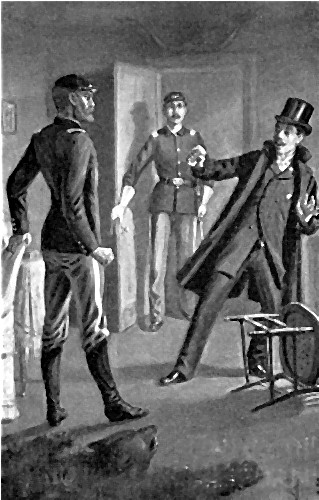 "For a moment not a word was spoken."
Page 324.
"For a moment not a word was spoken."
Page 324.
Langston learned of the departure five minutes after he reached the post, and lost all further interest in the day. He said he would "loaf" at the club room until Burtis and Willett got through their calls, which, said they, would occupy some hours,—two or three at least. Indeed, Willett "didn't know but what he might stay out with Sanders overnight" and let Burtis "tool the trap" back to Braska when he got ready. When, therefore, in less than forty minutes Willett's team was reported being hurriedly harnessed in the post trader's corral and that gentleman himself came bustling in with a pale, scared face that intensified the blue blotch under his eye, Langston was astonished. He was listlessly turning over the leaves of a magazine at the moment and seeking solace in a cigar. Willett looked nervously about him, bade the attendant bring him some brandy and soda, and threw himself into a chair in front of the stove.[Pg 326]
"You look used up, Willett," said the elder. "What's the matter? Seen anything more of your midnight antagonist?"
"No, by heaven! I wish I had. I believe the devil himself has gone in league with the gang at this garrison. I never knew such a string of mishaps in all my life. Say, are you ready to go back?"
"Any time; but I thought you wanted to stay."
"Oh, so did you when you came out, Langston, and now you don't, and I'm simply in the same boat."
The attendant brought him a tall glass and poured the soda hissing into the brandy. Willett drank eagerly, then started for the door. "Come, then," he called; "the trap's ready—or ought to be." Langston knew it was not, so temporized.
"How about Burtis?" he asked.
"Burtis? Oh, I don't know or care. He can get back just the best way he knows how. There's an ambulance coming over to town to-night."
"Well, I think you ought to let him know, Willett."
"I have. I sent him word by Sanders, whom I just left."
"Very well, then I'll go with you now. Only stop one minute at Sanders's so that I can say good-by to him. He goes back to the agency to-morrow, I believe."
"Well, he isn't there. He's gone out to pay a call. Jump in."
But as they drove around the level road towards the northwest gate, and the long line of officers' quarters lay to their right front, two officers could be seen in earnest conversation at the front gate of No. 12, the farthest away.[Pg 327]
"There's Sanders now," said Langston. "It won't take you five minutes out of your own way. Turn over there, won't you?"
"I can't. I—I've got to hurry, Langston. If you want to see him you can jump out, and I'll wait for you outside the gate."
"Well, if you're in a hurry that'll take much more time than if you drove. I'd have to walk both ways, don't you see?" was the cool answer. "Never mind, though; go ahead. Who's that with Sanders?"
Willett, who had turned red with confusion at his own blunder, turned redder at the question, then went gray again. "That's Lieutenant Davies," said he, briefly.
"Oh, then he's home. Why, how I'd like to meet him again! Here—just let me out, will you? and you go ahead. I'll come back with Burtis."
"No; come on with me, Langston. I'm in a devil of a fix and want your advice."
And as they bowled swiftly along homeward over the smooth, hard, prairie road, Langston admitted to himself, as Willett falteringly unfolded his tale, that the young man was indeed "in a devil of a fix,"—in what Langston, who was an old soldier, found it more descriptive to say, a damnable fix. He pondered over it a moment and then said, "I don't understand what you want me to do, Willett," and his tone was very cold. "I don't see how I can help you. From your own account you have behaved either like a fool or a blackguard, and what I can't fathom is why Davies's commanding officer, or some friend or comrade, did not warn you off weeks ago."[Pg 328]
Now, admitting that in the absence of almost all his comrades in the field, and that it was distinctly his duty to protect the honor and interest of his regimental comrade, let us see to what extent Captain Devers felt disposed to exercise his prerogative and act against this indisputable wolf in the sheepfold. Precedents he did not lack. Everybody had heard how Colonel Atherton, of the —th, had served a would-be gallant whose attentions to a lady of the regiment, during the prolonged absence of her husband in the field, had become the talk of a big garrison. Everybody knew how old Tintop, when he made up his mind that Lieutenant B—— was becoming infatuated with Mrs. Captain Potiphar, calmly recommended B.'s immediate and indefinite detail at the Shoshone Agency, an isolated nook in the heart of the Wind River country where the mails got through only once a week in midwinter and no one but the mail rider thought of trying to get out. Colonel Pegleg, in the days of his original wife, had taken a fatherly interest in garrison matters, and instituted a system of post government that was almost patriarchal, especially when most of the men were absent in the field, but Mrs. Stone the second was made of flimsier stuff, and fond of gladness and gayety, dancing and feasting, and what she termed "an innocent flirtation" was harmless occupation so long as her own queendom was unimpaired. There can be no question, however, that she would long since have put her husband on the trail of this new disturber of the garrison peace but for the illness that followed Stone's sudden prostration. The command with its powers having devolved upon Devers, she[Pg 329] could do nothing. It is a hard thing for a man to find himself by reason of illness suddenly stripped of the robe of command and forced to become only a lay figure, but it is harder yet to many a woman whose social powers were dependent mainly upon the rank of her husband to see herself, through his prostration, suddenly set aside as though of only vicarious consequence. Naturally, Mrs. Stone could not bear Captain Devers,—few of the women could,—and it was only through his own wife that the gossip of the garrison was apt to reach him, and Mrs. Devers had troubles of her own that seemed to stifle to a great extent her interest in those of her neighbors. She was neither young nor pretty; she shone not in society and had no great ambition in that direction. She had seen Mr. Willett's devotions to Mrs. Davies,—as who had not?—but with only languid interest. Such things concerned her less than they did those belles of the active list, who felt themselves thereby defrauded of attentions that had been quite lavishly, even if impartially, bestowed up to the time of Mrs. Davies's dawning on the social horizon. Actually, therefore, Captain Devers was not so much to blame as Langston thought, for of his own regiment only one officer was present to advise him, and Hastings's advice, as that officer had long since been informed, would be asked for when desired. In point of fact only three officers remained at the post for whose opinions Devers entertained any respect, Leonard, Rooke, and the chaplain, and he had quarrelled with the first and second, and treated with indignity the third, so that no one of the three now felt disposed to confer with him on any[Pg 330] subject. This would not have deterred the chaplain in a matter of duty, however, for that honest and stalwart soldier of the cross was as ready to battle with himself as he was to take issue with the devil, but the chaplain had been absent for long days, and returned only when it was supposed that Mira would be whisked away to the agency with the Cranstons, and, safe in Percy's sheltering arms, be beyond the reach of harm or temptation.
There were other reasons, however, for Devers's inaction, and grave ones. Ever since the ominous visit of the staff officer from division head quarters he had felt that the ground was caving beneath his feet. For years had he been skimming along on the very verge of serious trouble, yet ever adroitly evading trial; always incurring censure, but escaping court-martial. One after another he had alienated or betrayed every commander under whom he had served. One after another he had lost the respect of every officer with whom he associated, and now he realized that if the regiment could but settle down somewhere for a few months, there would speedily follow a crystallization of the sentiment against him,—a deposit of all this floating mass of testimony now apparently held in solution, and the true inwardness of the tragedy of Antelope Springs, the falsity of his insinuations against Davies, the trickery of his methods, one and all be brought to light. Already, through Haney, he heard of the sensation created among the men by his defence of Howard, and of the depth of feeling among the old hands against this airy upstart recruit, not a year in service, who frequently boasted that he had[Pg 331] more influence with "Cap." than all the rest of them put together. Haney himself could not cipher out the secret of Howard's importance, and was plainly and palpably jealous. Ever since early in the campaign, when young Brannan was pointed out to Devers as Miss Loomis's patient and as a trooper who wanted to get out of "A" troop and into "C,"—ever since the colonel and the major began interfering with Devers because of his open rebuke of Mr. Davies, it was noticed that Howard, a mere raw recruit, could get the captain's private ear at almost any time, and those were days when a soldier was not supposed to address his company commander on any point until he had first obtained the sanction of the first sergeant. Every man in the troop knew that soon after their arrival at Scott, Howard began to get letters from the East, and some of these contained money orders, which he had cashed in Braska. Some men in the troop, notably that babbling drunkard Paine, declared that in a little strong box he had brought with him Howard had some letters tied up in ribbon that he watched with jealous care. "New hands" who came out in the same batch of recruits said that at St. Louis Arsenal, whither they were shipped on enlistment, Brannan, Howard, and Paine had at first been very intimate, but that some coldness had sprung up and Brannan kept aloof from them. They were wild and full of "gall," Brannan was sad and sober. Howard used to write lots of letters then to some girl, Paine said, and go off and post them in obscure letter-boxes outside the gates when he could get leave, but he had quit writing long since, Haney knew, for he watched the new company[Pg 332] clerk with jealous eyes. He knew and knew well that Howard was savagely glad when Brannan was sent to the reservation with Boynton's party. He noted that Howard became of a sudden fitful, restless, sullen, and then reckless and negligent of his work and eager to go frequently to Braska. Presently he heard things of him that made him believe Howard was contemplating desertion, and no sooner had Lieutenant Davies arrived than he became assured of it. "I had to serve under that damned, canting Methodist preacher," said Howard, "and I won't have him nosing around where I am. I'll desert first." Now, Haney had no objection to Howard's "skipping,"—it would be good riddance to dangerous timber,—but he wanted first to find out what was the secret of his dislike of Davies, whom most of the men, and all the better ones, had learned to respect and esteem. He plied Howard with questions, hints, suggestions, and whiskey, but Howard's head, or stomach, was stronger than he thought, and the liquor failed in the short time at his disposal to overcome it. With a few months the result would have been different. Howard once admitted, however, that he hated the lieutenant and had reason to, but that was all that Haney ever wormed out of him, but he and others were morally certain that Howard meant to desert when the very day of Paine's trip to Braska the company clerk disappeared. They counted on his court-martial and downfall when brought back to the post in "cits" by Sanders's squad. They were amazed at the abortive outcome of the affair, and then at last the gang that "had stood in with" the first sergeant as the surest means of keeping on the right side of the[Pg 333] captain began to realize that here was a man with more "pull" than Haney, and the latter, feeling his influence going, determined that the time had come to regain it, cost what it might. He knew beyond peradventure who was the mysterious night prowler, knew why Captain Devers had ordered Paine to watch Brannan in hospital, he knew why, or believed he knew why, the captain was so down on Brannan and so fiercely bent on breaking him or driving him out. He knew that he could, if he would, lay before Mr. Leonard certain damaging facts in connection with Brannan's two relapses into drinking, and of Paine's detail to town that day when he was needed, as they knew he would be needed, at the adjutant's office. He required just one or two links more to make a chain so powerful he could twist his troop commander in its coils and dictate the terms of their future relations, but he needed Howard's testimony to complete the chain, and the liquor with which he tempted him, in and out of the office, at last began to take effect. Howard was getting more and more reckless, sullen, savage. He would get up at night and drink and dress and slip out of barracks and be gone an hour sometimes, yet so stealthy was he that when Haney strove to trail him he turned on him like a tiger and damned him for a spy, and still the sergeant felt that perseverance and whiskey would bring him triumph yet, when all on a sudden came the dramatic episode of that still Saturday night,—the flash that revealed him for one instant to the frightened revellers in Willett's sleigh and then covered his track in shadows impenetrable. All on a sudden Howard had vanished,—deserted[Pg 334] in earnest this time, leaving his first sergeant in a tangle of unfinished toils and his captain in sore anxiety. It was the contemplation of his own meshes that blinded Devers to those which Willett would have thrown over Mira's pretty, curly, empty head.
The conversation between Sanders and Davies was very brief and decidedly grave. Sanders had at first assumed the light air of superiority of the old cadet toward the plebe, and, to head off questioning, plunged into that species of deprecatory and officious advice which is generally prefaced by, "Now, my dear boy, let me as a friend," etc., etc. Like the chaplain's wife, Sanders started with the best intentions, and just as she had excited Mira's resentment so had Sanders aroused Davies's wrath.
"Stop right there, Sanders, and say nothing about friendship until you explain that scene. Where is the packet you were asked to deliver to my wife?"
"I haven't it. I wouldn't touch it. You don't suppose I'd be a party to such a thing. The man was an ass to ask me, and I told him so."
"He doubtless reasoned that a man who could accompany the wife of a brother officer to a place of such miscellaneous character as Cresswell's would not be above carrying secretly to her that which he dare not send openly."
"He had no right to judge by it, Davies! Lots of ladies go there,—and Mrs. Stone matronized us."
"No ladies of our regiment have ever gone there, Sanders, until you accompanied my wife,—an inexperienced and ignorant child. What Mrs. Stone or[Pg 335] her associates may have seen fit to do is no concern of mine. You know and I know that women like Mrs. Cranston, like Mrs. Truman, like Mrs. Leonard or Mrs. Wright would not go there under any circumstances, and the fact that a party of women from the fort was in one room simply served to attract a party of—very different women to the next."
"Then I'll bust Cresswell's head for him inside of twenty-four hours," exclaimed Sanders. "The idea of his daring to allow such people in there at such a time!"
"The idea of your not standing my friend—you, the only fellow-graduate of my regiment here at the post—and preventing my wife's being taken there at any time. Think of that, Sanders."
"Why, damn it, Parson, don't be so brutally unjust. I supposed if you cared a rap you'd have stopped it before."
"Stopped it before? Why, Sanders, what are you saying? You don't mean she—my wife—had been there before?" And all the indignation had gone from Davies's face. It was now white, almost awe-stricken.
For a moment Sanders knew not what to say. All at once there dawned upon him the realization that now through him, in this utterly untoward, clumsy, miserable way, was Davies for the first time being made aware of what common, every-day rumor said of his wife. He would have cut his tongue out rather than wilfully put in circulation a word of scandal, yet it had been reserved for him to bring to a husband's ears the first ill-omened tidings of a wife's misdoing.[Pg 336]
"God forgive me, Davies, if I've blundered!" he burst out at last. "I'll never forgive myself. I supposed—they all talked of it so fully—freely together—I supposed you knew all about it. I never dreamed of harm in it. Mrs. Flight—or rather Mrs. Darling and she together—occasionally went there, and the other ladies had their husbands as a rule, or at least sometimes, and there was good sleighing, you know, between here and town, and absolutely nowhere else were the roads beaten. They sort of had to go there, don't you see?"
"Go there with whom?" said Davies, grasping the rail of the fence and breathing hard.
"Why, with Willett, of course; he was the only fellow that had a good turnout. He used to come for them, I believe, and sometimes he had Mrs. Darling and Mrs. Davies—he and Burtis—and sometimes Mrs. Flight."
"And do you mean that they—that these four, went there to Cresswell's? Do you know this, Sanders?"
"Well," said Sanders, "they were all talking and laughing about it, never dreaming of anything harmful or unbecoming. Why, Parson, old man, you mustn't be too strait-laced out here. You know it's the way of the West."
But Davies threw out his hand as though imploring silence, seemed about to speak again and ask another question, but finally turned without another word, and leaving Sanders standing dejectedly at the gate, re-entered his hall and closed the door behind him.[Pg 337]
That night Dr. Rooke called twice at No. 12, and went away both times saying opprobrious things about his fellow-men and women. The chaplain, who had gone over to see Davies about three o'clock, presently went back for his wife, and that good-hearted woman remained until late at night. Mrs. Darling coming over in the early evening to congratulate dear Mira again on her husband's return and invite them both to dinner on the morrow, was met by Davies himself at the door, but not invited in. Her sweet smiles and words of greeting and proffers of hospitality were checked at sight of his stern, sad face. In brief words he told her Mrs. Davies was too ill to receive callers or accept invitations, and in response to her flurried "Is there anything in the world I can do?" coldly answered that Mrs. Darling had already done—too much.
In her natural and justifiable indignation, Mrs. Darling at once sought Mrs. Stone and Mrs. Flight. "They had an awful scene, I'm sure," said she, "for his face was as black as a storm, and I knew how it would be. Some one's been blabbing and making matters infinitely worse than they really were. What do you suppose will happen when he and Willett really meet?"
"They have met," cried Mrs. Flight, forgetful of her determination to keep at odds with Mrs. Darling[Pg 338] in the bliss of imparting exciting news,—"they have met at Sanders's quarters, and there must have been something dreadful, because Willett came out, oh, with such a face! and went right over to the store and drove off to town. Sanders is all broken up about something. Flighty says he wouldn't tell anybody." And by "Flighty" the lady referred to her consort.
The awful scene of Mrs. Darling's imagination was really not very tragic. Almira had shut herself in her room in preparation for the coming visits of the doctor and Mrs. Darling. Her tea-gown being a most becoming garment, she was still enveloped in its soft and clinging folds, and had let her long, lustrous hair fall rippling down her back. She had once seen a queen of the emotional drama similarly gowned and groomed and a lasting impression was the consequence. The tea-gown and tumbling hair became Mira's conception of the proper make-up for wronged and injured and deeply-suffering wifehood. She had prepared to deluge the doctor with symptoms and Mrs. Darling with tears, but nearly an hour went by and neither came. Katty was clearing away the luncheon table, and to her Almira faintly appealed for tidings, and Katty said that the masther had come in for a minute and walked up and down in the parlor and gone to the front door himself to meet Mr. Sanders, and they were talking out in front. When the second time her husband entered the house she prepared to hide her face and refuse him a word, but he did not come near her. She heard him pacing up and down, up and down, at first with quick nervous stride and at last more slowly. Then he seemed to sit at his desk and write. She[Pg 339] could hear him sigh heavily. What business had he to sigh? She was suffering for lack of sympathy, nursing, tender care. Why should he sit there sighing in that absurd fashion? She heard him go to the kitchen and tell Barnickel to take that note to the chaplain, and then he came back to write some more. She grew impatient, lonely. She determined to bring him to her side, and if possible to her feet again. Other men were abject enough; why should she be lorded over in this way? She threw herself again upon her bed and covered her eyes with her filmy handkerchief and faintly called "Percy!" As he did not hear she tried again, louder, and still he did not seem to be at her door listening for the slightest sign, and she was compelled to sit up and call loudly, not for him but for Katty.
And Katty, being out among the pots and pans and kettles, didn't hear her at all; so Davies went and summoned the girl, instead of going to Almira himself, as Almira thought he should have done. Presently Katty came out. The misthress wanted to know was the doctor ever coming—and Mrs. Darling? Then Davies entered the room and closed the door.
"Dr. Rooke has not yet returned, Mira," he said. "Mrs. Darling with my consent will not visit you again until you are experienced enough to know right from wrong. You never told me of these visits with her to Cresswell's or I should have forbidden them utterly. It never occurred to me that you would be tempted to go thither or I should have warned you. I do not blame you so much, my wife, as I do those who have so misled you. There are some things I[Pg 340] have been told that are past my understanding, and that when you are well again I shall have to ask you to explain. Now rest as well as you can. The doctor will come to you just as soon as he returns to the post. Is there anything I can do to help you?"
But Mira burst into a wail. She didn't wish to see anybody—anybody but the doctor and Mrs. Darling. It was cruel, heartless, brutal on his part to come in and taunt and torment her when she was so helpless and ill. It was wicked to cut her off from the only friends she loved or who had been kind to her. She would have died of loneliness and misery while he was gone if it hadn't been for Mrs. Darling and for her friends. His friends hadn't come near her,—hadn't done anything for her, and now he was angry because, when she was neglected and scorned by them, others like Mrs. Darling had been good and kind to her. Oh, why couldn't she go home to her dear old father and the sisters who loved her, and weep her heart out on her m-m-mother's grave? Davies sadly realized that neither argument nor appeal would help matters. He heard the chaplain's ring at the outer door, and went to him with sore-laden heart. Later the two left the fair invalid to the care of the chaplain's wife and went in search of Leonard. Boynton, still unable to walk about, was occupying his old quarters next to the adjutant's, and, propped up in an easy-chair near the window, caught sight of his comrade, the captor of Red Dog, and eagerly beckoned him in. Davies had to go and shake hands, though at the moment he wished that he might avoid almost everybody.
"Why, Parson, old boy, you can't stand that agency[Pg 341] work. It's making an old man of you now before half your time. You look ten years older. I hope you're not ill."
"No, not ill; a little tired and worn perhaps," said Davies. "We were just going in to see Leonard."
"Well, I wish you'd fetch him in here the first evening you can. There are some things that I want to talk over with you two, things that affect us both. Have you seen Differs?"
"No, not yet. I'll report to him at guard-mounting in the morning. The regulations say the first orderly hour, don't they?"
"Yes,—but you'd better report your arrival to him the moment he comes out of his house or else go to the office and do it. We've got a bone to pick with him, Parson, and I don't want you to get into any outside tangle. I'll be up and about in a couple of days, then we'll settle it with him."
For a man who had striven conscientiously to do his duty, it seemed to Davies, as he rejoined the chaplain, that he had become involved in tangles enough without seeking new ones. His friend had already rapped at Leonard's door and been informed that the adjutant was over at his office, so thither went the two, many eyes following them as they crossed the broad, brown level of the parade. The snow had disappeared entirely except in dirty hummocks along the pathways and walks whither it had been shovelled after the heavy fall. The post looked even less cheery and attractive than before. The few men moving about had the listless air of soldiers with nothing to do, going fat and "soft" for lack of vigorous exercise. Over in front[Pg 342] of the colonel's quarters his sedate bay team was waiting, and presently that veteran, with Mrs. Stone and Tommy Dot and a striker in attendance, was aided down the steps and into his open carriage for a drive.
"Is it not late for them to take him out?" asked Davies. "Why don't they make an earlier start?"
"Ordinarily they have done so. To-day, though, he has been having a conference with your captain; rather an extended and trying one, I fancy, and not agreeable to either party. Captain Devers was leaving there as I returned to yours. Davies, my friend, there is a man who is a veritable Ishmael. His hand seems against every one and every man's hand against him. You could never have wronged him,—what on earth has set him against you?"
"Indeed," was the earnest answer, "I do not know;" and then, solemnly, Davies added, "Trouble seems the lot of many of us, yet even in one's saddest hour it is impossible not to feel sorrow and pity for one like him, who stands before his fellows an utterly friendless man."
The adjutant rose with an eager light in his dark eyes at sight of the two. "I have been hoping to see you, Davies," said he, "yet I knew you would have much to detain you at home. Mrs. Davies is better, I hope?"
"Mrs. Davies is not well, but I think the matter is not serious. I came first to report my arrival from the reservation. Mrs. Davies will go there with me just as soon as we can pack. Then the chaplain and I want to consult you personally about some important matters. Have you a spare half-hour?"[Pg 343]
"Frankly, Davies, I haven't, and won't have until tattoo. There are some reports here that will occupy me pretty much every minute. Is it business that can wait until then?"
"It will have to," said Davies.
"Then let me get at once to the reason of my desiring to see you before to-night. Captain Devers has been called upon by department head-quarters to explain some discrepancies in an official report or two, and I was present at the long interview between him and the colonel this afternoon. Davies, have you ever seen a map or sketch of that ground north of Antelope Springs where you had your adventure last September?"
"No," said Davies, wondering.
"Then I want you to look at this, compare it with your recollections, and tell me how accurate it is, especially as to the tracing of the trails of the various parties."
The short winter day was already waning and the light in the dingy office growing dim. Leonard called for candles, then stretched a huge white blotter upon a wide-topped stand and spread open upon it the filmy sheet of tracing paper. An almost exact copy of Devers's map was thrown into bold, black relief, and for the first time Percy Davies saw the plan on which was based the report that, exonerating his captain, inferentially held him accountable for the massacre of his comrades at Antelope Springs.
"Why! when was this made?" he asked, in grave surprise. "Whose work is this?"
"It was made while you were lying ill at Cranston's up at the old post," said Leonard, calmly. "Had you never heard of the investigation?"[Pg 344]
"Never."
"The general sent Mr. Archer of his staff up there to go over the ground with Devers and let him explain, if he could, why he got so far away from you and your people as to permit that tragedy to occur, especially after the orders he'd received from Major Warren. Devers cleared himself by proving to Archer's satisfaction that he obeyed his orders exactly and marched right along the ridge here. This trail, the one that runs due south, just west of the summit of the divide, was made by Devers's main command moving in support of you and your detachment. This one off here"—and Leonard's pencil rode lightly along another that skirted a ravine apparently two miles away from the ridge—"this one was made by his command the next day after you had been found by Warren's men," and Leonard was narrowly eying Davies as he spoke.
"Pardon me, Mr. Leonard, it was just the other way," said Davies, assuming that the adjutant in his personal ignorance of the facts was stating a theory. "Captain Devers never approached the ridge that evening. He was going farther away from it all the time. I had to gallop to catch him. This, out here to the southwest, is what might be called an approximation to his trail. I finally overtook him away out over here somewhere, across the ravine," and Davies indicated with the point of a pencil.
"Well, then who made this trail up here on the ridge? You must have crossed it twice before dark."
"There was no such trail there, sir, nor was there any party to make it. Everything in the battalion[Pg 345] except my own little squad was away off to the southwest, anywhere from two to ten miles."
"You could swear to that, Davies? You remember it distinctly—despite your illness?"
"Swear to it? Certainly, sir," said Davies, with wonderment in his eyes. "So could McGrath, who was with me, if he were only alive. So could Devers himself, or Haney, or Finucane, or a dozen others of the command who must know that wasn't their trail."
"I fear me, Davies," said Leonard, gravely, "that some of the very men you name have told it, if not sworn to it, the other way, and that your captain has allowed it to be accepted as the basis of his release from accountability."
In the gloomy office the darkness was gathering thicker. At the head of the table, his coat thrown over his arm, his hat in his folded hands, stood the strong figure of the chaplain, his thoughtful brow shining in the light of the candles the clerks had placed upon the board. His was the first face to be seen by one entering the room from the hall-way, or peering in at the window, for the figures of Leonard and Davies, their backs to the entrance, were thrown in black silhouette against the glare; but as Leonard spoke the two who had been bending over the work drew slightly apart and gazed silently, significantly, into each other's faces, Leonard calm, massive, masterful, Davies searching, questioning, the light of a new and grave suspicion in his troubled eyes.
And looking on this picture,—on this triumvirate,—there stood on the porch without, close to the uncurtained window, a fourth form, heavy, massive almost as[Pg 346] Leonard's, but far less soldierly. Then noiselessly this latter turned to the hall-way, and with cautious step drew near the open office door; the heavy arctics, which it was Devers's habit to wear so long as the weather was even moderately cold, deadened the sound of his footfalls, and now with beating heart the troop commander stood listening to what he could catch of the conversation within.
"It is absolutely false and misleading," said Davies, "and if it has been used, as you say, to clear him or anybody else, it should be exposed at once."
"That," said the adjutant, in his deep, deliberate tone, "is precisely what I believe, but needed your evidence to establish. Now you will excuse me from further talk about this or anything else until, say, after office hours to-morrow morning. I have much to attend to. If you and the chaplain will meet me at ten o'clock, we can settle various matters. Meantime I'll lock these papers in my desk." Across the dim hall-way, as the two friends left the office, stood the door of the sanctum of the post commander. It was just ajar, but there was no light beyond, and to all appearances the room was as deserted as it was dark. Rooke was just coming out of No. 12 as they returned thither.
"I'm glad you're home, Mr. Davies, and I'll be gladder when you've got that pretty little bunch of nerves and nonsense off my hands and off this military reservation."
"She will be well enough to travel—when?" asked Davies, as placidly as he could. Even when the wife of one's bosom has been behaving outrageously it isn't pleasant to hear it from one's neighbors, unasked.[Pg 347]
"She could go to-morrow and be the better for it," said Rooke, bluntly. "What she needs is a firm hand and a change of scene—and surroundings. We're too volatile hereabouts." And this it seems was practically what he had told Almira herself, much to her scandal and dismay. She piteously asked why she couldn't see Dr. Burroughs; and was unfeelingly told that there was no reason whatever, provided she started to-morrow; that he was at Ogallalla and would be very glad to see her. "Once up there," said the old cynic, "you can have Burroughs and lollipops to your heart's content."
"Oh, doctor, but think of the peril, the danger," she moaned.
"Tut, woman, you'll be in no such danger there as here," he answered brusquely; and Davies found her weeping dejectedly, but weeping to no purpose. When morning came Barnickel and Katty were boxing up the lares and penates, and toward nightfall Mira herself was meekly, though not resignedly, bearing a hand. This indeed was not what she had pictured army life to be. Davies and the chaplain were to have joined Leonard as planned at ten o'clock. At nine the orderly came to the door of No. 12, and said that Mr. Leonard would be very much obliged if Mr. Davies would come to the office at once, and Davies went. Colonel Stone, as had been arranged, was once more restored to his desk in the office, and though looking gray and ten years older, was "on deck." He was absorbed in turning over some official papers, so Davies did not disturb him. He went into Leonard's den. The officer of the day was comparing[Pg 348] the list of prisoners in the guard report with some memoranda on the adjutant's desk, but presently finished, shook hands with Davies and said welcome back to Scott, then went his way.
The moment he was gone Leonard whirled about in his chair. "Davies, you remember our locking those papers in this drawer last night?"
"Certainly."
"Well, look at it now, and as I found it ten minutes ago."
The drawer was absolutely empty.
The closing week of March was marked by a furious snow-storm that swept the big prairie like a besom, but plugged up every coulée and ravine. For four days no communication had been held with the Ogallalla Agency. The wires were down, the road impassable, and Mrs. Davies had reached her new harbor of refuge none too soon. The quartermaster's ambulance bore the couple half-way to the new station, and Cranston's Concord came to meet and carry them the rest of the way. Mira's parting with her devoted lady friends at Scott was cut short by a start at early dawn, against which she rebelled faintly, but to no purpose. It had taken only two days to pack their few belongings. They spent the last night of their stay in Scott under Leonard's roof, and Mrs. Leonard[Pg 349] did her best to cheer and gladden the mournful bride. It was of little avail, however. Almira was dimly beginning to see that her conduct had cost her the respect of those women most worth knowing, and that although the dreaded interrogatories which Percy was to put to her as soon as she was stronger were still in the future, his faith in and love for her, whatsover they might have been, were seriously shattered. In manner he was still grave, kind, and gentle almost as before, but everything like tenderness had vanished. One question he said he must ask her before they left Scott. Had she ever accepted any gifts or letters or anything from Mr. Willett? And Almira answered that once he had sent her just a few violets with a note inviting Mrs. Darling and her to drive with him the next day, but she had tossed them into the fire long ago. Nothing more, nothing else at any time? asked Davies, gravely, and Almira answered no. How could he torment her with such unjust suspicions? Far better would it be to let her return to the father and sisters who longed for and missed her, to her peaceful home where down in the bottom of her heart Mira knew she was not wanted by either father or sisters or step-mother. Davies looked graver, but questioned no longer. The day before their start Mr. Langston came out from Braska and inquired for Davies, and told him how glad he was to renew his acquaintance, and Davies greeted him with much reserve. This was the man who was travelling with Willett the June gone by, and just as it had at first affected Miss Loomis, so did the recollection now prejudice the officer against him. Langston saw it, but went quietly on with the business in hand.[Pg 350]
"I am the bearer of a note to you from Mr. Willett, whose people, at least, are old friends of mine. He has gone home, at my advice, and it will be against my advice if he return here within a year. If he should do so, I wash my hands of him. It is not to make excuses for him or Burtis that I have come, but to ask you about one matter. On his way back to the agency your comrade Mr. Sanders came to town and heaped reproaches on Willett and on the proprietor of the restaurant, alleging that certain disreputable people were allowed to occupy the adjoining dining-room while the party from the fort was dancing. Cresswell was very indignant at the charge. He says that the party in the adjoining room was the family of old Pierre Robideau, from Kearney,—just himself, his wife and daughter, with a friend whom they called Mr. Powell, and it was Mr. Powell who paid the bill.
"Robideau is an old trader and trapper, but he and his people are honest and respectable as any in Braska, and the young man with them was supposed to be paying attention to the daughter. Robideau and his family went back to Kearney that night after a week's visit to friends up here in Braska. The daughter, Angie, had been here some time visiting a school friend. We feel sure you have made no such statement to Mr. Sanders without some strong ground of suspicion. May I ask how you heard it so soon after your arrival?"
"I heard it before I got here," said Davies, quietly, "though when it was told me I had no idea my wife was one of the party. My orderly was cold and tired and we stopped at the Scott station at the point where[Pg 351] the road crosses the railway to give him a cup of coffee and water the horses. There were some trappers and plainsmen in there, and one of them was telling with much gusto of the performances of a soldier of our troop who deserted that night,—how he had chartered the adjoining room to that in which the officers and ladies were dancing and had a whirl to the officers' music with some ladies of his own choosing, and the girls lassoed a waiter and hauled him into their room and got a bottle of the officers' champagne——"
"Pardon me, Mr. Davies, but do not these plainsmen rather like to tell big stories at the expense of the officers,—the bigger the better?"
"I believe so, and paid little attention to it at first, but among the listeners was a scout who went through last summer's campaign with us and did good service. He rode over to the post with me, and on the way we met a sergeant and two men of 'A' Troop, returning from an unsuccessful pursuit of deserters. They told the same story with some additions, and said the fellow openly boasted in Braska that afternoon that he was going to the dance. Then the scout admitted reluctantly that he had heard the story from several sources, and gave the names of the women who were said to have been introduced there, and they were not Robideau's family. The sergeant had heard just what the scout had as to the identity of the intruders. Then on my arrival at home I learned that Mrs. Davies was one of the fort party, and Mrs. Stone and other ladies who were present referred to some rude creatures in a neighboring room who peeped and stared at the dancing. There was also awaiting me with my mail[Pg 352] an anonymous letter, which I burned without reading through. Next I learned that the man who frightened them on the homeward way and then deserted after a fracas with Mr. Willett was Howard, of 'A' Troop, and that man's associations in town are matters of notoriety. That was the chain that led to my belief in the story."
Langston looked grave. "And Howard was probably Robideau's friend, though Cresswell didn't know it! He had been paying court to Robideau's daughter during her visit to Braska, always in civilian dress and always claiming to be a civilian clerk in the quartermaster's department with a salary of twelve hundred a year. I have seen her friends in town where she visited, and they are very plain, honest, and well-to-do people, whose daughter was sent to Illinois to school and met Angeline Robideau there. They had another friend living in Cheyenne, and when they were up there visiting her for a few days they said Mr. Powell was coming up to spend one evening,—Powell is the name they all knew him by, and the belief is that Angie was much fascinated by him, and had met him East before meeting him here. Mr. Davies, I am glad to relieve your mind of one uncomfortable theory in connection with this affair. I wish I could extenuate or explain Willett's conduct as easily, but that young man is a fool of the first magnitude."
Davies had taken the note handed him by Langston and was mechanically turning it and twisting it in his fingers. His impulse was to toss it, as he had the anonymous billet, into the fire. There was something about the handwriting of the former that was vaguely[Pg 353] familiar to him even through its disguise, but Willett's scrawling superscription he had never seen. Something told him, however, that anything of which a man of Langston's calibre chose to be the bearer was entitled to consideration. He made no reply to Langston's closing words. He had fully made up his mind as to what his course should be, and what was the extent of Mira's misdoing. Just as he said to her, he blamed those who should have been her advisers and protectors far more than he blamed her, and as to this popinjay who had become infatuated with her beauty, though the lieutenant's blood boiled in wrath and indignation, his calmer judgment and his disciplined spirit tempered any and every expression. He had spent long, wakeful, prayerful hours in the silence and solemnity of the night, and no man knew the story of the struggle. He had trained himself to meet this man who had so openly and persistently shown himself a worshipper at the feet of his wife, and to meet him with cool contempt, yet the same hot blood that rioted in his veins when, long years before, he had downed the village scoffer who had ventured to ridicule his aged mother, now prompted him to horsewhip Willett should he venture again to visit the fort.
It was relief, therefore, to hear that he had gone.
At last he opened and read the note, a clumsy, cubbish attempt to explain his language in Sanders's room, and to say the package was absolutely nothing but some violets, to apologize for any and every annoyance he might have caused Mr. and Mrs. Davies, for whom he entertained nothing but sentiments of the most profound respect and esteem, and begging if ever they[Pg 354] met again to be regarded as most sincerely their friend, etc.
"There is no answer," said Davies, as he finished it, a smile of contempt on his lips. "You must have known there couldn't be, did you not?"
"Well, I fancied as much. He had no friend to carry it for him unless I would, and the young idiot has gone off feeling profoundly wretched about the whole business, as he deserves to. Had I been here, as an old friend of his family, it would have been my right to warn him weeks ago, and to put a stop to his foolishness if he was not to be advised. More than that, Mr. Davies, I wish to say that ever since I met you on the train last June I felt an interest in you that would have prompted me to stand your friend in your absence whether I felt any interest in him or not. I should like to know you better and to convince you that I meant what I said when we parted there."
And Davies at last held out a cordial hand.
This was the afternoon before his early start, and though he left the post feeling that he had gained a friend worth having, Davies did not fully realize how dangerous a thing it was to leave a community of women, none of whom he had sought to placate and some of whom he had offended. Mrs. Darling had declared war against him, and Mrs. Stone, if not Mrs. Flight, was in full sympathy with her. How dare he say they were responsible for Mrs. Davies's flirtation? How dare he insinuate that they had led her to the forbidden shades of Cresswell's? There was a tempest in a teapot among Mrs. Stone's friends and associates over Mrs. Darling's account of his rebuke to her, for[Pg 355] Mrs. Darling had deftly managed to include Mrs. Stone and Mrs. Flight in the scope of his condemnation, and very possibly old Peleg might have been wrought up to pitch of sympathetic resentment but for the fact that he was concentrating all of his shattered faculties on the mysterious robbery of the adjutant's desk.
Captain Devers, relieved at last from command of the post and overshadowed by vague sense of official condemnation, was now, in hopeful imitation of the Homeric Achilles, sulking in his tent. Invited by Colonel Stone to appear at the office and give his counsel as to the matter, Captain Devers had replied that in view of the discourtesies to which he had been subjected at the hands of the adjutant he could hardly be expected to care to visit the building except when compelled to do so, and having been relieved from command under circumstances indicative of disapproval of his methods, he should consider it indelicate on his part to say what he thought of the matter in question.
But the orderly trumpeter had told the sergeant-major that Captain Devers was on the piazza looking in the adjutant's window when the gentlemen were there examining the map, and that he entered the hall-way. The sergeant-major told Mr. Leonard, and Leonard was actually startled. He conveyed the information to Pegleg, and Pegleg sent his compliments to Captain Devers with the information that his immediate presence was desired, so Devers came, and shrewdly guessed what was the cause. Certainly, he said, he went to the office to get certain papers that he[Pg 356] had left in the commanding officer's desk. He did look in for one instant through the adjutant's window, attracted by the unusual sight of the adjutant, the chaplain, and his own subaltern, of whose services he had been deprived, in apparent consultation. They were so absorbed in talk that they did not hear him as he entered his own office or when he left. Certainly he lit no candle; he needed none. He knew just where his papers were, got them, and came away. Did he leave before or after the others? Really, that was a matter he couldn't answer. He was absorbed in his own reflections when he came out and couldn't say whether the other gentlemen were there or not.
Pegleg asked whether he had any theory as to the disappearance of the batch of papers from Leonard's desk, and Devers said he had none whatever, he didn't know how the matter could be supposed to interest him. He did not inquire the means resorted to, but perhaps that was unnecessary, as the drawer had evidently been forced by a heavy chisel and the woodwork about the lock was crushed. Leonard glowered at him with stormy eyes during the brief interview but, true to his notions of subordination, asked no questions whatever. It was the colonel who presently gave it up as a hopeless job and dismissed the cavalryman with a brief, "Well, that will do, captain; I see you can't help us," and Devers left with livid, twitching face. He had no fear of Stone, weakened as he evidently was both physically and mentally by his recent shock. It was that silent, gloomy thunder-cloud of an adjutant he dreaded, and with good reason. There was an unsettled account between these men and one[Pg 357] that Devers would have been glad indeed to drop, but Leonard was a man who never let go. "I hate to have you leave just now," he said to Davies, "for I know we shall need you presently."
But once more there was a week of no communication with the Ogallalla agency. Three days of blizzard and three of repairs before the flimsy telegraph line could be used again. Mrs. Davies, busily occupied in putting her new house in order, was aided by Mrs. McPhail and one of the ladies from the cantonment, who, happening to be visiting the agent's wife when the storm broke, found it pleasanter to remain there than go back to the log huts across that mile of blast-swept prairie. The Indians, with the stoicism of their race, huddled in their foul, smoky tepees instead of swarming about the agency, and except Davies's detachment none of the command appeared. It was therefore a rather busy time for Mira, as there was abundant opportunity for conversation, and both Mrs. McPhail and Mrs. Plodder rejoiced in so interested a listener. The three seemed to be getting along together famously, a fact which Davies noted with the same half-dreamy, half-amused smile. It was a relief in seeing her really interested in setting her little house to rights, but it was as evidently a relief to her that the otherwise inevitable visitors were blockaded by the storm. Davies really did not know which she dreaded most, the Cranstons or the Indians.
It was the latter who were the first to call. The gale went down with the sun one night, and the morning dawned clear and fine. Up with the sun, true to his cavalry teaching, Davies had been out superintending[Pg 358] the grooming and feeding of his horses. He and Mira were at breakfast and Mrs. Plodder had come to help. Trooper Gaffney was the household cook for the time being, and a good one. The coffee was excellent, despite the fact that Gaffney could get no cream, and condensed milk was the only substitute obtainable. The steak was juicy and tender, as the finest of the contractor's beef was sure to go to the agency itself, and Gaffney's soda biscuits were enticing, whatsoever might be the after-effect. The two ladies were chatting in very good spirits when one considers the depths of woe from which Mira had so recently emerged, and the lieutenant was beginning to take some comfort in the outlook, when all on a sudden Mira turned a chalky white, screamed violently, and cowered almost under the table, her face hidden in her hands. Davies's instant thought was of the repeated whisper of warning that came to him regarding Red Dog, but Mrs. Plodder's merry peal of laughter reassured him, as he whirled to confront what proved to be the foe. There on the porch without, crouching low, shading their eyes with their broad brown paws, their painted faces almost flattened against the window, three Indians, a brave and two squaws,—all innocent of any violation of etiquette or decorum, but just as their kith and kin and instincts taught them,—were staring hungrily into the room. To Eastern readers it would have seemed bare, homely, plain in the last degree; to the untutored minds of these children of the prairie it spoke of wealth, luxury, and plenty. Peering over the shoulders of one of the squaws, from its perch on her toil-bowed back, was a wee pappoose, its beady little black[Pg 359] eyes gleaming, its tiny face expressive of emotions that in later years it would speedily learn to suppress,—wonderment and interest. A thinly-clad girl of five or six clung to the mother with one hand and clutched her little blanket with the other. They all looked cold and hungry, and the big eyes wore that dumb, professionally pathetic look which these born beggars are adepts in assuming.
"Go 'way! Scat!" called Mrs. Plodder, with appropriate gesticulation as she waved them aside. "You're darkening the room." But for answer the visitors only huddled the closer and mournfully patted and rubbed the region of their stomachs. Davies, laughing, went to the door and called them in, which signal they promptly obeyed, and came trooping smilingly after the stalking warrior, who took the lead as he would have taken anything else. Mira by this time had backed into a corner, where she cowered in terror, but Mrs. Plodder laughingly shook hands with the man as Davies passed them in, and then blockaded him in an opposite corner where he could not lay hands on anything they might give the squaws and children. He wanted to shake hands with Mira, too, but she implored them to keep him away. Davies took the little girl by the arm and led her to his wife. "Do look at her, dear, and see what a pretty, intelligent face she has. I want you to know how really friendly they mean to be." And still Mira shrank and trembled. The younger woman was a Minneconjou girl, with frank, attractive, almost pretty face. She dropped her blanket from her head and let it fall about her calico-covered shoulders, smiling affably[Pg 360] about her, but eying the breakfast things appreciatively. Davies held out a lump of sugar to the baby, which that embryo warrior grasped eagerly and thrust into his ready maw, and then buttering one of Gaffney's biscuits and calling for a fresh supply, the lieutenant, with Mrs. Plodder lending active aid, began feeding their unbidden guests. Gaffney came in with a heaping platter of his productions and a pitcher of maple syrup. "This is what they like, mum," said he to the lady of the house. "Give that little kid a molasses sandwhich and she'll be your friend for life. Heap walk? heap hungry?" he continued, addressing the head of the family, in sympathetic tone.
"Heap walk—plenty heap hungry," was the warrior's prompt response, with appropriate pantomime and immediate lapse of dignity. Mrs. Plodder had cut off a big slice of the steak and handed it to the mother with reassuring gesture, but that well-disciplined wife passed it immediately on to her lord, and in eloquent silence pleaded with open hand and eyes for more. "The heathens!" exclaimed Mrs. Plodder. "We'd cure them of that notion in no time, wouldn't we, Mrs. Davies?" But Mira was watching the Minneconjou maiden, forgetful even of the adulation in the eyes of the little five-year-old girl now licking the syrup off her slab of soldier bread and gazing adoringly up into the shrinking donor's face. Miss Minneconjou had caught sight of her own winsome face in a mirror that hung in a stained-wood frame opposite Mira's seat, and with no little shy giggling was revelling in the study of her charms even while busily munching the big biscuit in her slender brown hand. Here was[Pg 361] a trait that formed a bond of sympathy, and Mira took courage. It is not the contemplation of their nobler qualities, but their weaknesses, that puts us on easy terms with our fellow-men. Breakfast promised to last a long time. Gaffney, with the adaptability of the trooper of years of service on the frontier, had been worming something of their visitors' story out of them. The average Indian never wants to tell his name, but gets a friend to give it for him. It proved, however, to be Bear-Rides-Double who, with his wife, sister, and little ones, had honored them with this early visit, and after riding double long years among his people, this young chief had come afoot long miles to see the Great Father's man and lodge a complaint. He had actually walked from the Minneconjou village, five thousand yards away down-stream. But for the chance of making a theatrical coup Bear-Rides-Double could easily have borrowed a pony, even though his own were gone to pay a poker debt incurred within thirty-six hours, and when he waked up the morning after the protracted play he found that Pulls Hard and the half-breed "squaw man" with whom he had been gambling had not only played him with cogged dice, but plied him with drugged liquor, and then gone off with his war ponies as well as the rest. He wanted the Great Father to redress his wrongs, recover his stock, and give him another show with straight cards, and then he'd show Pulls Hard and Sioux Pete a trick or two of his own. Davies had proffered chairs during this recital, which Gaffney managed between the sign language and a species of "pidgin English," called "soldier Sioux," to interpret for him,[Pg 362] but the family preferred to squat on the floor. Mrs. Plodder, tiring of the diplomatic features, took Miss Minneconjou into Mira's room to show her the pretty gifts the pale-face bride had brought with her, and Mira, with her five-year-old friend toddling alongside, speedily followed. Davies strove to make the double equestrian understand that he had no authority in the premises, and that McPhail was the proper person to apply to, but the warrior wished to deal only with his kind,—a heap brave chief,—the conqueror of the redoubtable Red Dog. He could get more to eat through him in any event, and in the midst of it all Gaffney came in from a brief visit to his kitchen to say that Sioux Pete, the malefactor in question, was actually in the corral at that moment trying to sell two ponies to the sergeant of the guard. Leaving Gaffney to the duty of entertaining his guests, Davies went out to investigate. Pete had come over from Red Dog's camp with some of his plunder, and had no idea the complainant had forestalled him. Pete spoke English,—that is, plains English,—but he shrank a little at sight of the tall, grave-faced young officer of whom Red Dog's people spoke with bated breath.
"You want how much for these ponies?" asked the lieutenant, as though he had heard the talk.
"Tirty dollar."
"Where are the others?"
"No got."
"You rode off with four ponies from the lodge of Bear-Rides-Double two nights ago. Where are the other two?"
Pete turned sickly gray. Could this white-faced[Pg 363] soldier read visions and dreams and thoughts? Was he a medicine-man?
"No got," he sullenly answered once more.
"You will leave these two with me for safe-keeping," said Davies, "and go and fetch the others at once, even if you have to take them from Pulls Hard, and get back here with them at noon without fail. No, you need not appeal to the agent, or I'll tell him that you loaded Bear with drugged liquor and marked cards and cogged dice. Off with you, Pete," he continued, and the half-breed rode away on his Cayuse pony with scared face, and told in the camp of Red Dog that the young chief Davies was a seer, a mind-reader as well as a brave who feared not to grapple their war chief; and when he was gone, Bear-Rides-Double was summoned and bidden to ride double if he could, but to go and sin no more with cogged dice, and the Minneconjou looked with evident awe and wonderment upon the grave, reticent cavalryman, and went away homeward on one of the recovered ponies, his women-folk, laden with Mira's discarded finery and leading the other, trudging contentedly along behind him afoot.
"You'll be a heap bigger man among the Indians than the agent can ever hope to be, lieutenant," said Gaffney, with an Irish grin.
But Davies said nothing. Had he overstepped his authority? Would McPhail approve? The point was soon settled. Through the hangers-on about the store McPhail heard rumors flitting like lightning among the villages. The young officer was a medicine-man, a mind-reader, and far and wide the Indians[Pg 364] spoke of him in fear and reverence. It might be a good thing, said the canny Scot, to back him up and reap the benefit. "Just so long as I can keep him here in charge of the guard we can run things to suit ourselves, for no red-skin will dare buck against him."
For nearly a fortnight there was sunshine at the agency,—sunshine and prosperity, and then came manifestation of that pride which goeth before destruction. Because there were more of the Ogallalla tribe than of others herded there when originally established the agency on the Chasing Water had been given this name, but after the stirring events of the winter and the revolt of Red Dog, it happened that rather more of the Minneconjou and not a few of the Uncapapa backsliders were gathered among the grimy tepees. Two Lance and his people, having made their way to the fold of Spotted Tail, were permitted to abide with him as a result of the earnest plea made in their behalf by the general in command of the department. Young-Man-Afraid-of-His-Horses and some other chiefs of the wiser—the peace element, had also been transferred, and such Brulés as remained under the wing of McPhail were of the class old Spot denounced as "devil-dreamers," men who would stir up a row in any community, men he wouldn't entertain among the lodges of his people. The Uncapapas were of Sitting[Pg 365] Bull's own tribe, malcontents almost to a man, "mouth-fighters" who, like some recent exponents of Southern oratory, were far more conspicuous after than during the battle days, and between these breeders of devilment and the renegade Brulés, there lay the village of Red Dog's reviving band,—three gangs of aboriginal jail-birds who looked upon Red Dog's release as virtual confession on part of the White Father that he dare not keep him, and they were only waiting until the grass sprouted and their ponies could wax fat and strong to take the war-path for another summer, and take all they could carry with them when they did it. April had come. The last vestiges of ice and snow were slipping away out of the broad, sun-kissed valley. Up at the cantonments a stalwart infantry major had a battalion of the Fortieth out along the prairie slopes for over two hours every morning, drilling, drilling, drilling, until officers and men came double-quicking in at 11.30, exuding profanity and perspiration from every pore, but owning up to it, after a rub down and a rest and a hearty dinner, that old Alex was a boss soldier who knew how to take the conceit out of the cavalry, even if he did nearly have to run his bandy-legs off, and the lean shanks of his men, in doing it. The cavalry major was far less energetic. He sent his troops out under their respective chiefs, and ambled around among them after a while making audible comment to this captain and that, but never drawing sabre himself. Cranston had a capital troop and was a born cavalryman who needed neither coach nor spur and there were others nearly as good as he, but each worked on his own system, whereas the doughboys pulled together.[Pg 366] Not to be outdone, Davies laid out a riding-school back of the agency corral, and every day had his detachment out for a vigorous mounted gymnastic drill as well as another at platoon exercise. He was wiry, athletic, and an enthusiastic teacher, and presently it was noted that the Indians, who for a time hovered impartially all over the prairies and slopes, watching the manœuvres of the soldiers, began gathering in daily augmenting crowds about the agency grounds, frequently applauding the leaping and hurdling, but only too readily jeering the awkwardness of some of the men in mounting and dismounting at the gallop, a thing they had learned and practised since early boyhood. Then Cranston and the other troop leaders got to working down toward the agency and, during the rests, moving close up to the corral and watching the riding-school. It was capital work, said Cranston and his contemporaries, though some jealous youngsters used to say to their cynical selves that Parson probably "put up a prayer-meeting as a stand-off." McPhail and his people began to come out and look on, and Mira to watch from the window, for she still trembled and shrank at sight of the savage painted faces and glittering eyes of the Indians, and equally shrank from meeting the Cranstons. But presently Mrs. Cranston and other women came driving over in their ambulances, the generic term by which army carriages were known in the days when a provident Congress first began curtailing the transportation facilities of the line where, sous entendu, all great reformatory experiments were tried, the staff being, of course, beyond even congressional suspicion, and so it resulted[Pg 367] that about eleven o'clock every fine day the biggest gathering of the people, red and white, in all the broad valley of the Chasing Water, as far east as its confluence with the shadowy Niobrara and thence to the shores of the Big Muddy, was that to be found about the rectangular space where the Parson held forth to his faithful squad.
Now, McPhail came back to his recaptured children with conciliation for his watchword, willing, eager to shake hands with one and all from Red Dog down, or up, according to the proper plane of that warrior on the scale of merit; but as he noted the humility of bearing exhibited by all except a truculent few, and the evident awe with which even these looked upon the stern and taciturn commander of his guard, the agent began, like Mulvaney after his fifth drink, "to think scornful av elephints," in other words, of the red wards of his bailiwick, and with McPhail to "think scornful" was to act. Just in proportion as he was meek and cringing before did he become arrogant and abusive now. There was no Boynton on hand to warn him with what he termed brutal bluntness that he was tempting Providence again. Even the worm will turn, and the difference between the worm and the Indian is that one can anticipate the former and prepare for the blow. Up to the 10th of April Red Dog had held himself haughtily apart from the whites—agent, officers, troops, and all, but there were half-breeds and scouts who warned them that the humiliation of his capture still rankled in his bosom, and that a mad thirst for revenge possessed him. "Watch him as you would a snake," said old Spotted Tail himself, when he came[Pg 368] down to visit the agency. "He never sleeps without dreaming of vengeance." The agent told Davies what the loyal old chief had said, and Davies looked grave, but made no reply. He was thinking, however, of Mira's danger. Indians could not be put under bonds to keep the peace, however: the Bureau's system being to let them kill first and explain afterwards. It wasn't pleasing to the relatives of the deceased or even to the army, but what were they among so many?—the millions of Indian sympathizers dwelling at discreet distance.
One morning half a dozen ladies drove down from the cantonment, and their wagons were ranged up close alongside the rail near the high hurdle. Around them were thickly clustered a number of squaws and children and a few Indian boys, though most of the men, old or young, kept to their ponies around on the south and east sides. McPhail came out later with his household, and really was not unprepared to find his usual place, on a little raised platform, pre-empted by a score of blanketed "reds." Mac had some odd views. He couldn't understand why the soldiers should not be made to salute him as they did their own officers, who, having occasionally to report to him for instructions, might be considered as his inferiors. He liked to impress the ladies of the cantonment with the extent of his power and authority, and had more than once interrupted the proceedings in the ring by loudly-shouted orders to some of the Indians on the other side. This annoyed Davies, but he said nothing. McPhail spoke of the detachment as "My guard," etc., and once or twice in the presence of the army[Pg 369] ladies had addressed Davies in the crisp, curt tone of the superior officer, or such imitation of it as he was enabled to compass, and this, too, the young man had suffered without remark, though with a quiet smile. Seeing the swarm of Indians on McPhail's platform, Mrs. Cranston and Miss Loomis presently called to him to bring Mrs. McPhail to a seat in their wagon, but the agent sprang up on the flimsy structure, sharply ordering off the Indians right and left, and emphasizing his order with his boot toes. Mac's twelve-year-old son, taking the cue from his father, proceeded to deliver a vicious kick at a slowly-moving, blanketed form, and the very next instant was screaming for help, flat on his back among a swarm of Indian boys. All in a second the little savage had flashed out of his blanket like lightning from a black cloud, and, grappling, had hurled McPhail junior to earth. The agent made a furious lunge to the rescue of his first-born, and the squaws and young girls scattered shrieking at his charge. Startled and excited, the horses of Cranston's wagon whirled sharply around, nearly capsizing the vehicle. Other horses followed suit despite the efforts of their drivers, and in less than a moment all the young braves on the opposite side came lashing their ponies at mad gallop around the long rectangle just as McPhail reappeared on the platform, bringing captive a furiously struggling Indian boy screaming with rage and yelling for help. In less than that moment too, it seemed, Percy Davies had leaped his horse over the breast-high barrier and spurred to the heads of Cranston's team, seizing the reins of the near horse. "Come right on," he shouted[Pg 370] to the driver. "Let them follow me." Out through the surging, scurrying crowd he guided them to the edge of the road, then, pointing to the cantonment, called to the driver, "Home with you, quick!" And with hardly a glance at the grateful occupants, whirling his horse about, he burst his way back again through the excited crowd until he found himself at the edge of the platform. Already a dozen Indians were furiously demanding the release of the prisoner. Little McPhail had scudded for home; Mira's white face had disappeared from her window. Some of the guard had darted into the corral for their arms, others, unarmed, had pressed to the support of the agent. Before Davies could reach him four warriors were out of their blankets and high-pommelled saddles, and had hurled themselves on McPhail. "Rescue! Help!" he screamed, with ashen face, releasing the Indian boy and vainly striving to draw his revolver. Away sped the escaped captive, darting between the legs of struggling braves, sheltered by the robes of hurrying squaws; away, right, left, anywhere, everywhere, scattered the blanketed, jabbering groups, leaving on the scene of action only the agent, the quickly rallying guard, and upward of fivescore of jeering, taunting screeching warriors, at least a dozen of them now dismounted, dancing and brandishing knife and tomahawk, rifle or revolver, about the still writhing group rolling upon the wooden floor,—McPhail and his assailants. Into the midst of this mad mellay sprang the cavalryman, turning loose his horse, which animal, urged by shrill yells and slyly administered lashings, went tearing away over the prairie. Right at the lieutenant's back,[Pg 371] almost as he had fought his way with him, nozzle in hand, into the ruck of the rioting crowd at Bluff Siding, striking out scientifically with his clinched fists, charged young Brannan, only three days since transferred to the agency guard. Vaulting the low rail and lunging in among the devil-dreamers, came Sergeant Lutz and a squad of his fellow-troopers, and in a dozen seconds, breathless and dust-begrimed, half stifled, but practically unhurt, the agent was dragged from among the whirl of moccasined feet and propped up, panting and swearing, against the rail, while burly forms in trooper blue were hustling the half-raging, half-jeering crowd of warriors off the platform. Even in the moment of mad excitement they knew too much to use their weapons. Wise old heads had been cautioning them against any deed of blood so long as the grass was barely beginning to shoot. All they demanded was the instant release of that boy, the chieftain's son, but incidentally, if McPhail insisted on wrestling, they could not deny the Great Father's man or spare him vigorous handling while about it. Davies had seized one brawny, muscular throat and sent a gauntleted fist plump against the sweat-gleaming jaw of a second brave. Brannan had backed him with half a dozen well-delivered blows, but even these had evoked neither shot nor knife. The instant the savages realized that it was the young commander of the guard, they seemed to give way without further struggle, and so it resulted that in a moment more every red-skin was off that sacred square of board, and that a thick, deep semicircle of warriors, some few afoot, but most of them astride their ponies,[Pg 372] glowered in silence now at the tall soldier who, interposing between them and the victim of their rude horse play, stood confronting them with grave, set, indomitable look in his pale face, on which the sweat was already starting. Behind the officer, leaping up on the platform, were now a little squad of his men, and McPhail, fuming and raging malevolently. "Arrest those blackguards, arrest them instantly, Davies! Every man of them, by God! They shall pay for this or there's no power in Washington." But Davies never moved hand or foot. Calmly eying the surrounding crowd, he was searching for some familiar face among the scowling warriors. Some few were men well on in years, others mere striplings. Some were still covertly fuming with rage for battle, others slyly tittering at the agent's expense, but all faces were turned in instant interest, all ears attent when Davies began to speak. "Where is Charging Bear?" he asked. "What is the meaning of this riot?"
Probably not ten Indians in the throng could speak a dozen words of reputable English; probably not ten, however, failed to read his meaning.
"Charging Bear is not here," suddenly spoke in deep guttural a grizzly Indian, who urged his pony forward. "The son of McPhail struck and kicked the son of White Wolf,—the son of a clerk struck the first-born of a war chief, and the Great Father's man would punish, not the striker, but the struck."
"Nab that damned lying scoundrel, Davies. He put 'em up to this whole business. He's another of your mission whelps. I know you, Thunder Hawk," continued McPhail, his courage and his choler rising[Pg 373] alike as he saw that the Indians were slowly recoiling, and evidently meant no further mischief. "I know you, and I order your arrest right here and now. As for the young dog that attacked my son, I'll demand him of White Wolf in half an hour with five hundred soldiers at my back."
"Then bring your own, who gave the first blow, if you want him in exchange. As for me," continued the old man, in calm dignity, "I have done no wrong, but my people shall not be made to suffer because of me. I know the power of the Great Father, but he would not demand my surrender to such as you. Here is the chief to whom the Indian yields," he said, turning to the lieutenant, and then, riding a pony length closer, gravely swung his handsome repeating rifle from its gayly-fringed sheath of skins and extended it, butt foremost, to Davies.
But before that officer could receive the proffered rifle a warning cry came from the outskirts of the swarm. There was instantaneous lashing of quirts, a sudden scurry and rush, and like one great herd of elk smitten with sudden panic, away surged and sped the entire throng, Thunder Hawk's stampeded pony bearing him irresistibly away with the rest. Only a cloud of dust settling slowly to earth remained to greet the long line of Cranston's troop as it came sweeping in from the foot-hills at thundering gallop. Far out across the prairie the manœuvring cavalry had sniffed the "sign" of trouble at the agency, and his was the first to answer the alarm.[Pg 374]
Again was there scene of mad excitement among the Indian villages on the Chasing Water. Again was Red Dog in saddle, exhorting, declaiming, prophesying, but with no such ready result as during the winter days gone by. It was one thing to rally to the standard of a war chief and follow him on a raid against the agent of the Great Father when but a handful of soldiers could back the authorities. It was quite another to rise in revolt when five hundred war-trained blue-coats were aligned to defend him. Within two hours after the exciting scene at the corral the Indians in every band knew that McPhail had launched his ultimatum at the little village of White Wolf. "Send in Chaska, the assailant of my son, and Thunder Hawk, the boaster, or there is war between the Great Father and you and yours."
Already had Chaska and Chaska's mother, with three trusty friends, mounted on swift ponies, been spirited away northward, with instructions to ride all night through the devious trails of the Bad Lands, and never draw rein until they reached the shelter of the Uncapapa lodges beyond the Wakpa Schicha. Already had Red Dog dashed over to the lodge of Thunder Hawk, offering him asylum in the heart of his tribe, and pledging his uttermost brave to his defence. But the old Indian would none of him. Long years before, a fatherless boy, he had been reared and[Pg 375] taught by a priest of the Church of Rome,—is there a people they do not know, a peril they do not dare?—and when finally his friend and teacher and protector was gathered to his fathers and laid in the old mission churchyard, the boy drifted back to his tribe, a mature and thoughtful man, to find his kindred among the tents of the Ogallallas,—among, worse luck, the malcontents of Red Cloud. From this time on he had cast his lot with them, marrying, rearing children, yet but slowly gaining influence among them. When his great and cruel chief lured the garrison of a mountain stockade into the neighboring hills and massacred every man, Hawk had refused to take part. His heart was not at war with the whites. When swarms of the warriors left to join the great renegade bands gathering under Crazy Horse and Gall to reinforce Sitting Bull, Hawk had held aloof. "The people of Red Cloud," said he, "have no grounds for war. The Great Father has done everything he promised them and more," and Red Cloud called him dastard and squaw; but when an Indian girl was missing from her lodge, and the gossips told how she had been lured by a white soldier to the distant banks of the Laramie, Hawk rode thither, rode into the presence of the post commander and told her story and his, and found and brought her back to her people. He strove to find the man for whose sake she had abandoned her father's lodge and forfeited her good name. Hawk well knew how futile was her trust that the white chief would ever claim her as his wife, but among so many comrades he was concealed, and Hawk left his message. Sooner or later his people should find the white man who had wrought[Pg 376] the wrong and his days were numbered. Every knife in all his band was whetted for that particular scalp. And now again, when Indian blood had been fired by the insult to the son of White Wolf, he stepped forward to interpose between his people and the fury of the Great Father's man. He had repressed, not incited the wrath of his brothers, but the agent in authority ruled otherwise and demanded his surrender. His people would have fought to save him. He would suffer willingly rather than that one drop of blood should be spilt on his account. Refusing Red Dog's clamorous offer, Thunder Hawk mounted his pony and, despite the wails and lamentations of his village, rode forth in calm dignity to meet the coming soldiery, to offer in silent submission his hands to the clinch of the steel.
The recall had sounded at the cantonment, and mounted orderlies had galloped out to bring in such troops as might have trotted too far away for the sound. The infantry battalion, practising skirmish drill, had quickly rallied, re-formed, and was marched within the log walls to exchange blank for ball cartridge and await orders. The four cavalry troops galloped back to their stables and dismounted, while their officers gathered about the major commanding. Cranston to him had briefly recounted the story of the excitement as he had heard it from McPhail's lips. "I am bound to say, sir," said he, "that Mr. Davies did not seem to agree with the agent in either his statements or his conclusions. He considers the agent to have been the aggressor, and if he is required to go to arrest Hawk and White Wolf's boy, it will be with an unwilling hand."[Pg 377]
"Yes," said the major, coldly, "the trouble with Davies seems to be that he has displayed similar unwillingness on previous occasions."
The command of the cantonment had been given to this veteran field officer of infantry, a man whose motto had been fight from boyhood on. For ten days had he been hammering away here, hours at a time, to get his own battalion in readiness for what he considered the inevitable summer's work. He had fought every one of the dozen or more tribes of plains Indians, and considered fighting their normal condition as it was his own. He had made it his boast that during the previous summer his battalion, day after day, had outmarched the cavalry, and even while the statement was misleading, the boast was based on facts. The horses of the cavalry, starved and staggering, worn to skin and bone, had to be towed along instead of ridden, and the cavalry were therefore handicapped. Yet there was not a trooper who did not honor the bluff senior major, and none who really disliked him, except perhaps the battalion commander of the cavalry, a gentleman whose gold leaves were as dazzlingly new as the senior's were old and withered, and just about to be changing into silver, the silver of the lieutenant-colonel. The contrast between Major White's spirited handling of his battalion of foot and Major Chrome's listless management of a similar body of horse was vivid in the last degree. The latter and two of his troops belonged to Atherton's fine regiment, the —th, the other two troops, Cranston's and Truman's, were, as we know, of the Eleventh, and here in presence of four officers of the latter's regiment, and a[Pg 378] dozen of the Fortieth Foot and of the —th Horse,—here on the broad parade of the cantonment, at high noon and in plain sight and hearing even of three or four enlisted men, orderlies, horse-holders, etc., had the post commander spoken words that meant nothing short of discredit, if not disgrace, to the subaltern who was at that very instant riding away on a perilous as well as thankless mission. Deep, embarrassed silence fell on one and all of the major's hearers for a single instant. Cranston reddened with indignation, little Sanders with wrath. Truman looked quickly and curiously about him. All three were eager and ready to speak, yet by common consent the duty devolved upon Cranston, who took the floor.
"It would be idle, Major White, to feign ignorance of what you refer to, but let me say right here and now that you have been utterly misled as to that young officer's character, and I doubt if you properly estimate that of his detractors."
"I base my opinion on a cavalry report, Captain Cranston,—on Mr. Archer's vindication of Captain Devers."
"As one-sided a report as was ever written, sir, for the other side—Mr. Davies—had never a hearing,—never even heard of the investigation itself until a week ago, and is now bound to silence pending action at department head-quarters; but meantime, sir, as a friend of his, and a man who believes in him, I protest against any such impression as you have received, and I ask you how it is that you can believe such a story of an officer who, single-handed, arrested Red Dog in the face of his followers? There has been an insidious[Pg 379] influence at work against him ever since last summer, and we of the Eleventh know just where to place it."
"If I've wronged him, Cranston, you know me well enough to know that I'll make every amend possible. I have heard, I own, much more than Archer's report, so have my brother officers, not only before the recent outbreak in which he seems to have outwrestled Red Dog, but since. Since his recent visit to Scott stories have come to our ears very much to his discredit."
"Not from Leonard, sir, I warrant you," interposed Cranston, hotly.
"No, not from Leonard, for Leonard never talks against anybody, but from officers at Scott who seem to speak by the card. There is general indignation because of his affront to the wife of one of our number. If your friend is so far above suspicion, and did not feel some sense of the sentiment against him, why did he utterly shun the society of every officer at the post-except the chaplain? It reminds me of that English snob who was sent to Coventry for abandoning the Prince Imperial, and then took refuge in the prayers of the Church."
"Major White, there are reasons for Davies's conduct for which I will be answerable, and which you could not fail to respect. The fault, sir, lay on the other side. This is something that can't be discussed here, for a woman's war is mixed up in it, but if I have any place in your esteem, let me urge you to suspend judgment. While the responsibility for the original wrong done Davies must rest in my regiment, there have been later wrongs done him in yours, and I learn it for the first time to-day."[Pg 380]
It was an impressive scene, this impromptu gathering at the foot of the flag-staff while anxiously awaiting further tidings from the agency. Over among the quarters the humid eyes of frightened women peered from many a door-way, watching with fluttering hearts for sign of action. Stacking arms in front of their barracks, the infantry had been sent in to a hurried dinner, and the cavalry horses, saddled, still stood at the lines, watched by a few troopers, while the rest were packing saddle-bags and taking a bite on their own account. The sentries to the eastward kept gazing over toward the grim stockade and the clustering groups of Indian lodges far away down-stream. Ten minutes since a party of a dozen troopers had been seen to ride slowly away from the agency in the direction of White Wolf's tepees, a mile beyond; "Davies going to demand the surrender" were the words that passed from mouth to mouth and gave the text for the startling conversation that had just taken place, a topic which was now by common consent dropped as having reached a point where the utmost caution should be observed. Everybody seemed to know in some mysterious way that the circulators of the new and unflattering stories about Davies were not so much the invalid colonel or Messrs. Flight and Darling of the Fortieth as their more voluble, active, and dangerous helpmeets. Indeed, the very day Trooper Brannan arrived, transferred by regimental orders from "A" to "C" troop, he brought one letter from Mrs. Leonard to Mrs. Cranston, and two or three, each, of the missives of Mesdames Stone, Flight, and Darling to ladies at the cantonment. Mrs. Leonard's letter[Pg 381] said that her husband, the adjutant, had been summoned by telegraph to General Sheridan's office in Chicago, and he expected to be gone a week. No trace had been found of the papers stolen from his desk, but it was undoubtedly on that business that he had been sent for, and Mrs. Leonard felt confident that when he returned it would be with news that full justice would at last be awarded Mr. Davies for his conduct during the campaign as well as at the agency, and Mrs. Leonard could not control the impulse to add, "If justice could only be meted out to his accuser!—but will that man ever get his deserts?"
It must be owned that Mrs. Leonard had good grounds for being doubtful on that point.
Meantime how fared it with the embassy to White Wolf? Smarting under the injury to his pride and person, McPhail had decided to inflict severe humiliation on the red men prominent in the affair. First, White Wolf's boy should be made to suffer, and then Thunder Hawk, who had dared to oppose his views, should be ironed as an inciter of riot and placed under guard. Knowing the feeling of veneration, almost of awe, with which Davies was regarded by many of the Indians, he desired to avail himself of the fact and send him to make the arrest, and at last Davies asserted himself. Calmly, but positively, he refused. "My orders are simply to protect the agency and the agent and his family from attack," said he, "not to act as the agent's police."
"Do you refuse to obey my orders?" asked McPhail, angrily.
"You are not empowered to give me any orders, Mr.[Pg 382] McPhail,—above all, such orders. It is no question of obedience or disobedience."
"Then I'll ask to have you relieved and sent to your regiment, and some man sent here who will do his duty," said McPhail.
"You cannot do it too soon, sir," was the answer. "It has been most unwelcome from the start, and I shall now ask to be relieved in any event."
And so, finding Davies inflexible, Mr. McPhail had no alternative but to go himself. He had sent his demand; it had met with no response. He must attempt the arrest in person or become the laughing-stock of his Indian wards. Here at last Davies had to back him. It might be true that the officer would be sustained in his refusal to go and do his bidding, but if the agent went in person the lieutenant would have to send a detachment as a guard. Davies did more. He calmly informed McPhail that he should place himself at the head of the party and protect him to the extent of his ability; and so with the detachment as it marched away, watched by many an anxious eye, rode McPhail with his agency interpreter.
And when barely half-way to the cluster of tepees among the Cottonwoods at the point, there came to meet them in solitary state old Thunder Hawk himself. He wore no barbaric finery. His pony was destitute of trappings. He, himself, wore not even a revolver. Everything that might speak of war or even self-defence was left behind. When within a hundred yards of the foremost horsemen he reined in his pony and calmly awaited their approach.
Half a mile farther down the valley, clustered in[Pg 383] front of their lodges, some of them lashing about on their excited ponies, could be plainly seen the warriors of Red Dog's band, and that that hot-blooded chief was in their midst could hardly be doubted, though he was too far away for personal recognition. All at once the seething group seemed to obey some word of command, for it heaved suddenly forward, and, breasting its way through the scattering outskirts, just as it had advanced on the agency that moonlit winter's night, the centre burst into view, one accurate rank of mounted Indians, and in another moment, wheeling and circling, all the individual horsemen came ranging into line at the flanks, and, reinforced every moment by galloping braves from the villages in the rear, Red Dog's big squadron, like Clan Alpine, came sweeping up the vale. Borne on the breeze like one long wail of foreboding, the weird chant of squaws and stay-behinds was wafted to the ears of the agency party. Another instant and the song was taken up in swelling chorus by the coming foe. McPhail, who had spurred eagerly forward as Thunder Hawk halted, now irresolutely checked his horse and glanced back, as though feeling for the support of the grim and silent guard.
"By God, Mr. Davies, I believe that traitor Red Dog means mischief!"
Making no reply whatever, the lieutenant simply raised his sword arm in signal to his party,—halt! whereat, sniffing the tainted breeze and anxiously eyeing the distant cavalcade, the horses of Davies's party stood nervously pawing and stamping. Evidently they liked the outlook as little as did McPhail. And[Pg 384] there, all alone, fifty yards out in their front now, grave and motionless, still sat old Thunder Hawk.
"Do you suppose they will try to rescue if we arrest him here?" asked McPhail.
"Very probably. They regard him as a martyr, and so do I," was the answer.
"Here! gallop to the cantonments for help at once," said McPhail to his interpreter. "Say that Red Dog and his whole gang are coming," he shouted, instantly reining about and looking anxiously back. Behind him, nearly a thousand yards, lay the low, squat buildings of his official station. Beyond that, nearly two thousand more, and but for the flag and staff almost indistinguishable from the dull hues of the prairie, except to Indian eye, lay the low log walls of the cantonment. Already signs of alarm and bustle could be seen about the former. A buckboard was just hurriedly driving off, full gallop, for the distant barracks, scudding for shelter before the storm should break. Evidently Mrs. McPhail didn't mean to stand siege in her cellars this time. Already Lutz, who remained with the reserve, had mounted his men and was trotting out to the support of the advance. Already the long, barbaric array of Red Dog's band had come within rifle-range, and their clamoring chief, all bristling with eagle feathers, rode up and down across their advancing front, brandishing aloft his gleaming rifle. "Watch him as you would a snake," indeed! Here he came once more in open, defiant hostility, bent beyond possibility of doubt on instant attack should the agent attempt to lay hands on Thunder Hawk.
"Come in here, Hawk. I suppose you surrender!"[Pg 385] yelled McPhail, nervously. Evidently something had to be done, and done at once.
"Not to you," was the determined answer. "I will surrender to soldiers when they demand, and to them only, and I'll await justice as their prisoner and not as yours."
"My God! Mr. Davies, you've got to do something!" wailed the agent, shrinking still farther back now, as Red Dog's line unmistakably quickened the pace and the earth began to quiver and tremble.
"Take the men and fall back towards the agency, sir," said Davies, quickly, sternly, and then without an instant's hesitation spurred forward. As he rode he whipped off his right gauntlet, and then halting within a horse-length of the silent warrior, held out his bare hand. "Thunder Hawk, this is the hand of a friend. Will you ride with me and turn Red Dog back?"
"I will go with you wherever you say."
Over among the lodges of Thunder Hawk's people the signs of intense excitement were on the increase. Women and young girls had taken up the weird war-song of the advancing array. Young men springing to their ponies and no longer able to restrain their desire to act in his behalf, all forgetful of his injunction, came galloping forth to join the band of Red Dog riding to the rescue. Over at the agency, far to the rear, there was mad flurry and consternation. Women and children of the few employés, now that there was a military post within range, were gathering up such valuables as they could carry and scurrying away along the cantonment road. Conscious of his own impotence, McPhail had lost the last vestige of[Pg 386] his truculent manner and, eagerly availing himself of Davies's advice, turned nervously to the senior corporal of the little squad of troopers and said, "Fall back! We've got to fall back to the reserve." The corporal glanced first at him, irresolutely, then back at the coming reserve now spurring forward with Lutz at their head, then around at the whirl and turmoil and trouble in the villages, at Red Dog's now "magnificently stern array," and finally at the two figures, calmly, slowly riding straight at the very centre of the advancing line, straight at the heart of Red Dog's chanting battalion; and then, when McPhail nervously repeated his instructions, and, adding example to precept, turned and strove to lead the party in retreat, briefly addressed first his fellows and then the agent.
"Stand fast, men!—You—go to hell!"
A moment later and far out at the front now the two figures had halted, a strange contrast. The man on the right, tall, slender, of athletic and graceful build, clad in trim simple undress uniform of the cavalry, sitting his horse as straight as a young pine; the other, bent, blanket-robed, hunched up on his pony in the peculiarly ungraceful pose of the Indian rider when at rest, but resolute and immovable; both sublimely devoted in the duty now before them. When by the sweeping advance of the Indian line these two, the young officer, the old sub-chief, were brought nearly midway between the little party of blue-coats and the great rank of red warriors, both men as by common impulse threw upward the right hand, signalling "Stand where you are!" to the coming line.
And recognizing their challengers, little by little,[Pg 387] gradually reining in, the Indians obeyed. Only Red Dog, followed closely by Elk, sullenly, angrily continued the advance; his fierce eyes, avoiding Davies's calm face, were bent glowering upon his fellow-tribesman.
"Why is Thunder Hawk here?" was his demand in the Ogallalla tongue. "Is he ally or prisoner of the soldiers?"
"Thunder Hawk is their friend and the friend of his people. The white chief came as his friend and brother to protect him from indignity. Now as friends and brothers we stand between Red Dog and the wrong he would do. Only over our bodies shall Red Dog move another lance-length against the Great Father's people."
Davies could not comprehend this talk, but there was no mistaking its import or its effect on the rabid chief. Furiously Red Dog pressed forward, his rifle still clutched in his sinewy hand.
"Thunder Hawk is a traitor and a liar! He has sold himself to the whites! He is their prisoner, and when they have used him they will iron and brand and starve him. Even a sub-chief of the Dakotas shall not live to be their tool. Thunder Hawk rides back with us at once or dies here and now." And around came the ready weapon, muzzle to the front, with Red Dog's hand at the guard.
"Ride back to your men, lieutenant," muttered the old Indian. "You have my word that I will join you as soon as I can, but this man is crazed. He means to force a fight."
"If that be so my place is here with you," was the answer. "What does he demand?"[Pg 388] "No parlying with your soldier friends," shouted Red Dog, again in the Sioux tongue. Then, as though losing all control of himself in his hatred of his captor, he dashed furiously at Davies. "Back!" he shouted. "Back!" And he pointed with grand dramatic action up the valley. "Back to your own people! This is Indian land." Then seeing that his words fell on heedless ears and that Davies never relaxed his cool, steadfast gaze into the raging red face, he fell into such English as he knew. "Run or I kill."
And then Lutz and his reserve, just reaching their comrades under Corporal Clanton, saw a sudden flash of sunshine from the silver mountings of the Indian's beautiful Winchester as it was whirled to the brawny shoulder, saw sudden rear and plunge of Davies's spirited horse, a grapple as though in mid-air, and with a mad cry of "My God! They'll murder him!" young trooper Brannan dashed forward from the ranks just as the shot from Red Dog's rifle whirled harmless into space, and horse and man, the pride of the Ogallalla hostiles, were rolling in the dust, overthrown by the officers heavier charger, while the butt of the polished weapon, wrested from the warrior's grasp and wielded by muscular hand, came down with resounding whack on the head of the struggling chief, and for the second time, in the very face of his astonished braves, Red Dog, the redoubtable, went sprawling to earth, downed by the white chief whom he affected to despise.
In the fierce mellay that followed the advantage lay with the first to move. Lutz and his party had not really checked their gait, and so leaped into the charge with a flying start. Sixteen ready troopers had darted[Pg 389] forward to the support of their beloved young officer. Thunder Hawk had lashed his pony so as to interpose between him and the rush of the Indian band, but even as those red-skins nearest the centre, where the drums and rattles were keeping up their low, threatening din, with one impulse dashed forward to rescue the chief, those on the flanks, far-seeing, held wisely back, even while around the prostrate chief there raged for a brief, hot, furious moment a wild babel of threat and execration, a mad whirl of brandishing knives and pistols and naked red limbs and brawny arms in dusty blue, Hawk and two other stalwart Sioux had thrown themselves between avenging blows and the young white chief, standing afoot now with pale, set face, over his writhing victim. Lutz and his men, lunging in among the lighter ponies, bore them back by sheer force of weight. 'Only one or two shots were heard; even in that frantic turmoil friend and foe alike seemed to realize that a battle must be avoided so long as each side held possession of its own. And then from the outskirts came loud yells of warning. By fives and tens the mounted warriors melted hurriedly away, and presently all the broad prairie to the eastward, back toward the lodges from which they came, was alive with circling, darting, screaming red-skins, keeping up their shrill appeal to brethren still hot-handed in the struggle for out from behind the curtain of the agency corral swept the long column of galloping horse under its curtaining cloud of dust, and down at full speed came the whole squadron, far more than Red Dog's band dare tackle in heady fight. Out from beneath his struggling pony they dragged him, bleeding and bedaubed[Pg 390] with sweat and paint and blood, and when presently as the long skirmish line of Cranston's troop swept over the spot and drove before it all the mounted warriors, only two or three of the faithful remained to share the fortunes of their fallen chief, for like Thunder Hawk, Red Dog was the prisoner, not of the Great Father's agent, who was somewhere far to the rear, but of the soldier chief of the cantonments, who came galloping up in the wake of the cavalry, wrathful, if anything, that the whole thing was over without a fight.
And then, and not until nearly ten minutes after he had downed his man, was it noticed that Mr. Davies had not recovered color, that he was too faint to remount his horse.
"What is it, lad?" murmured Cranston, with keen anxiety in his eyes.
"I'm stabbed, captain. I—think you'd better not let Mrs. Davies know."
But Davies need not have worried on that score. When a little later they bore him, faint, unconscious from loss of blood, to his own roof at the agency, there was lack of woman's nursing, there was dearth of woman's tears,—Mira had fled with the McPhails with the first alarm, and was in hiding somewhere up at the cantonment.
One soft spring morning, some two weeks later, a little knot of officers had gathered about the Cranstons' quarters at the cantonment. Under an awning of tent flies they were conning the papers that had just reached[Pg 391] them and eagerly discussing their contents. Mrs. Cranston, a shade of anxiety on her winsome, sunburned face, was glancing quickly from one speaker to another. Through the open door-way in the cool interior Miss Loomis could be seen bending over the boys as they fidgeted at their books. Neither felt like studying this day of days, for absorbing news, and lots of it, had come. To begin with, a general court-martial had been ordered to meet at Omaha for the trial of Captain Devers, Eleventh Cavalry, and officers of high rank and distinction were to be his judges. With Atherton as president of the court there could be no "monkey business," said Mr. Sanders, by which that young gentleman was understood to mean that there would be no trifling with the subject. It was noticeable that neither Riggs nor Winthrop was of the detail, an omission readily understood, as Devers would unquestionably object, as was his privilege, to either or both on the ground of bias, prejudice, or malice, which, whether sustained or not, would lead to their asking to be excused from serving and so reducing the array. The court had been ordered from division head-quarters by the lieutenant-general himself, and its members, as a rule, were summoned from distant posts and commands, so as to preclude the possibility of the accused captain saying it was "packed" from the ranks of his enemies. In other words, except Atherton, the court was made up entirely of officers who had taken no part in the campaign of the previous summer. It was understood that the charges were grave and numerous; rumors of misconduct in the face of the enemy, disobedience of orders, misrepresentation of facts, etc.,[Pg 392] being among the items mentioned. Major Warren had been summoned from abroad a month earlier than he had planned to come. Colonel Peleg Stone and Mr. Leonard had both been notified that they would be required as witnesses, so had Captains Cranston, Truman and Hay, Lieutenants Boynton, Hastings and Davies. The court could not meet before mid-May because several of the members came from the department of Dakota, far up the Missouri, but that it was to be a "clinch" at last was the generally expressed sentiment. Devers had run to the end of his tether, said Boynton, unfeelingly. "I could add a charge or two myself if I didn't know he was loaded with them so deep that he can't stagger." Boynton, limping still, had come back to resume command of the agency guard, for Davies's wound had proved deep and serious. He had been stabbed by Red Dog after that warrior was raised to his feet, after Cranston's skirmishers had swept the field, after Davies thought the struggle at an end, and was unprepared for the stealthy blow. Nothing but Brannan's vigilance, and the warning cry which caused the lieutenant to turn in the nick of time, had saved his life. Red Dog in irons lay in the log guard-house. Thunder Hawk, on parole,—for White had dared the wrath of the bureau and refused to let McPhail have him,—walked the garrison at will. Mr. Davies, still weak and languid, lay in the big hospital tent, really the most comfortable dwelling at the station, now that the weather was growing warm, and there, attended by Burroughs and ministered to by a pathetically pretty wife (who had somewhat recovered from her panic, now that she was within the[Pg 393] stockade of a military post with lots of men around to watch her and be fascinated), was on the road to speedy convalescence. He was being allowed occasional visitors, and while his own comrades vied in their attentions, nothing could exceed the anxiety of old White, the major commanding. Twice did he have Thunder Hawk recount to him the details of Davies's calm courage in this second daring capture, red-handed, of the rebellious chief, and White went to Cranston like the blunt, outspoken campaigner that he was.
"It begins to look to me," said he, "as if this young fellow had been most damnably backbitten. You can haul Devers before a court, but what can we do with these women?"
"You have never told me, major, what these women had to say against him."
"And I'm not going to," said White. "When a man's ashamed of having believed a mean story, the sooner he buries it the better. Men like him don't go round abusing their own wife or insulting anybody else's. It's my belief that the swarm that buzzes around the throne there at Mrs. Pegleg's ought to be muzzled, and if the old man hadn't lost his grip in this seizure he's had, I'd tell him so."
But this seizure of Pegleg's had indeed proved a serious matter. So far from recovering his accustomed spirits, the old colonel seemed to grow feebler and less inclined to move about with every day. One morning he sent word to Captain Devers that he would not leave his bed, as he felt too weak, and that night it was that Leonard got back from Chicago. When told by Pollock, who met him at the railway station, that[Pg 394] Devers was again in command, Leonard stepped into the telegraph-office and wrote a message which he showed to nobody. Within thirty-six hours Lieutenant Archer of the department staff reached Fort Scott with orders from the general commanding. Captain Pollock was placed in command of the post and Devers in close arrest. The next day Mr. Langston came out from Braska and was closeted an hour with Leonard at the adjutant's office, and then, taking advantage of a returning escort and ambulance, the civilian lawyer left for the agency. Even while the group of officers at Cranston's was eagerly discussing the news, he had made his bow to a deeply blushing Mira over at the hospital tent, and was seated by Davies's side. "Business first, pleasure afterwards," hummed Cranston to himself when he heard of the arrival, and noted how Meg's bright eyes dilated.
"Business, indeed!" thought she. "I know the business that brings him here, despite Agatha's assumption of sublime indifference."
But grave though some of the older faces grew as the news was read, and eager and excited as were some of the younger, it was not because of the long-prophesied trial of Captain Devers. The papers, letters, and despatches were full of detail of the serious condition of affairs to the northwest. Inspired by the success of the Sioux in their grand uprising of the previous year, and reasoning that they had little to lose and everything to gain by similar methods, a big tribe had cut loose from its reservation and taken the field, one band of it prudently massacring all the white men to be found in their neighborhood as necessary preliminary[Pg 395] to the move. This was bad to begin with, but worse was to follow. The other agencies were overrun by a number of young Indians of what might be termed the unreconstructed class, and these, excited by reports brought in by runners from the openly hostile, were slipping off in scores to join them. Already had the epidemic struck McPhail's "angels." Already had Mac, with long face and longer story, been up to see Major White and beg for cavalry to be sent in pursuit. White said it was preposterous. The renegades had two or three days' start to begin with, and if pursued, all they had to do was to hide in the Bad Lands and pick off their pursuers. Cavalry could only go there in single file. Ten Indians could hold the narrow, tortuous trail against ten hundred troops. Relations were strained between Mac and the military anyhow. Everybody knew by this time that he had lied about Boynton and Davies, and had striven to make it appear, and with no little success, too, so far as Eastern newspapers were concerned, that all the turbulence and rioting at Ogallalla was caused by the arrogance of the army. Then Mac pointed out that if something weren't done to drive those renegades back, all the young braves over at the big reservation beyond the Mini Ska would follow suit. Already the cattlemen were complaining. Already settlers were drifting in to Pawnee station and Minden on the railway to the west, and besieging old Tintop at regimental head-quarters at Fort Ransom, and stirring up "screamers" in the columns of the infantile dailies at Butte and Braska, alleging apathy on part of the authorities and cowardice on that of the cavalry. Already letters had passed[Pg 396] between the officers of the Eleventh at the cantonment and their comrades at Ransom. "If we have to take the field again this summer let us try to get together as a regiment and not be split up in all manner of crowds," was the cry. What Cranston and Truman dreaded, too, was that they might be squadroned with some of the —th under Major Chrome. The —th was all right, but Chrome was so horribly slow that his own comrades chafed under his command, and Atherton really wanted him to retire and get "a live man" in his place. Truman, Hay, and Cranston felt certain that it would not be a fortnight before they were ordered into the field. Tintop and Gray were sure of it. Captain Fenton and others at Ransom were talking of sending their families East, and now the question that agitated Cranston was, what to do with his dear ones? It was all well enough to have them at the cantonment while the cavalry were there, but with all the troops in the field except a single company of infantry, he did not dare leave them. They must go back to Scott.
No wonder then that Mrs. Cranston's bonny face was clouded this sweet spring morning. No wonder the boys could not pin their vagrant thoughts to the books before them while snatches of the low, eager talk came drifting in through the open door. No wonder Miss Loomis went about her work with conscious effort, but when told of the arrival of Robert Langston, the woman in her knew he would not go until he had seen and spoken with her.
The day of Red Dog's capture was still fresh in the minds of Cranston's household, as indeed in that[Pg 397] of every household at the cantonment. With field-glasses they had marked the threatening gathering at the distant village, and the ominous advance in line. Old White had his men in ranks in less than no time, and the cavalry column, masked by the agency buildings, was sent at brisk trot to the eastward, so that McPhail's messenger, spurring at mad gallop for aid, met them midway. Cranston's troop was instantly deployed into long skirmish line at the gallop, and the affair was practically over by the time Major White, leaving the infantry battalion to guard the post, had reached the scene. Meantime the composure of the mothers and children left at the cantonment was in no wise augmented by the panic-stricken guise of the arriving refugees, Mrs. McPhail, with her children, and Mira being the first to appear. It so happened that the Cranstons' bungalow, being near the eastern end of the line, proved the natural refuge of the first wagon-load, and that Mrs. Cranston and Miss Loomis were the angels who thus had to minister to their weaker sisters. Even then, when nearly "dead with terror," as she expressed it, Mira would gladly have gone somewhere else, but as Mrs. McPhail promptly bundled herself and her youngsters out of the wagon and under the shelter of the Cranstons' wing, there was nothing left for Mira but to follow suit. Dr. Burroughs came promptly to see what he could do for her. Both Mrs. Cranston and Miss Loomis mastered their own anxiety in the effort to comfort these weaklings, and as no sounds of battle came from the eastward, and the watchers on the roofs reported Red Dog's people as scattering for their tepees before the advance[Pg 398] of the cavalry, comparative composure was gradually being restored when the first messenger came in from the front, a corporal of Cranston's troop, whom the boys hailed with eager acclaim.
"Everything's all right, mum," he blithely saluted Mrs. Cranston. "We've got old Red Dog again,—Lieutenant Davies nabbed him," he added, with prompt recognition of Mira's lovely face. "They want Dr. Burroughs to come down to the agency though." And as the doctor mounted the trooper said something more in a low tone, glancing furtively at Mrs. Davies as he did so. Burroughs nodded, but rode rapidly away, the corporal after him. Mrs. McPhail became instantly lachrymose. Dr. Burroughs wanted at the agency? That could mean only one thing,—Mr. McPhail must be wounded, he was always so impetuous. In vain Mrs. Cranston strove to soothe her. She ran out on the roadway in front and hailed the very next party straggling in,—the wife and the cook of the agency clerk, importuning them to say was Mac badly hurt.
"Mac ain't hurt at all," said the new arrivals, hot after a long and needless tramp. "How was he to get hurt? It's Loot'nant Davies that's shot. Red Dog tried to kill him."
And here Mira promptly and appropriately shrieked and fainted.
Nor was she of use when presently restored to a limp and dejected consciousness. Other messengers had come by this time. Dr. Burroughs had examined Mr. Davies's hurts. He was stabbed, not shot. It was serious, not dangerous. He was being made comfortable at home, where Captain Cranston said it was perfectly[Pg 399] safe for Mrs. Davies to join him, and the ambulance was speedily ready to take her to the bedside of her wounded hero, but again poor Mira's nerves gave way. She could not go to that dreadful place, so much nearer those frightful savages. Oh, why, why hadn't they brought her Percy here? Even Mrs. McPhail was no such coward as that. She drove back without her, and not for hours after was Mira strong enough to go. By that time he was sleeping placidly when, trembling still and pathetically pale, Mira was escorted to his bedside, and that night Mrs. Cranston had her revenge.
"Agatha Loomis," said she, "you declared all along that he did perfectly right in marrying that—that—in marrying her. What do you say now?"
And Miss Loomis said—nothing.
They had been talking of Davies again this very morning before the mails and Langston came. No sooner had he been well enough to move than he asked to be sent up to the garrison. He was no longer commander of the guard, and no longer entitled to the house. What was more, he must decline to serve McPhail in any such capacity again, and had had a letter written to department head-quarters representing the facts, and one was received from the general promising that another officer should be detailed immediately. Furthermore, Mr. Davies announced that Mrs. Davies simply could not stand the life at that point. Then Boynton expressed a desire to return to it, as he was now able to stump around a little, and he enjoyed chaffing McPhail, and so the wounded second lieutenant of Devers's troop was shifted to the hospital tent[Pg 400] put up for his accommodation at the cantonment, and there Mira was made far more comfortable than many an army wife had been, awaiting the day when they could with safety be started on the road to Scott, now his proper station.
"Langston's paying the Parson a mighty long visit," exclaimed Mr. Sanders, unslinging his sabre and flopping down into the first camp-chair on his way back from morning drill. "Mrs. Cranston, what do you want to bet y'all go back to Scott inside of a week?"
"I like it very much better here, especially as our going to Scott would mean 'y'all' were to be again in the field," was the laughing reply.
"Well, I like duty here better, but I do hanker for a waltz on that old waxed floor. Think, we haven't had a dance since we came."
"The men had some good music the other evening; why didn't you suggest a waltz on the prairie to Mrs. Davies?"
"Well, I did think of it. She looks bored to death. I saw her just now as I came by. She was yawning in the shade of the tent fly while Langston and the Parson were chatting inside." Why don't you and Miss Loomis go over there and cheer her up sometimes? was the question he checked just as it trembled on his lips. Some brief inspiration of discretion warned him that that was ground too sacred for his blundering intrusion. "She seems downright lonely," he concluded, somewhat lamely and suggestively. "I don't think Mrs. Davies is cut out for this kind of army life. Here comes Langston now."[Pg 401] He needn't have made that announcement. Mrs. Cranston was watching, waiting for him, and she glanced quickly to see where Miss Loomis was. That young lady, however, never looked up from the slate whereon Louis's hieroglyphics were in mad arithmetical tangle, even when she heard Langston's courteous greeting to the lady of the house and his inquiries for the captain, and heard them without evidence of any emotion whatsoever.
"The captain is at the stables, Mr. Langston. We are so glad to see you. I'll send him word in a moment. Do sit down and tell us all the news from Braska," said Mrs. Cranston, hospitably.
"I will do all that most gladly, Mrs. Cranston, but the matter on which I desire to see him at once is urgent, and perhaps Mr. Sanders will walk over to the stables with me. Then, may I not call and see you later?"
"By all means! and will you not dine with us? A real campaign dinner, you know, but we shall be so pleased to have you."
Langston's face fairly glowed. "I'll be here in half an hour, if I may, but I must see the captain at once, and will go. I trust—Miss Loomis—is well."
"Very well, and quite able to answer for herself," said Mrs. Cranston, mischievously, while Langston's eyes eagerly searched the door-way and dim interior; but Miss Loomis was nowhere in sight, and chose to appear to be not within hearing.
"Why didn't you come or speak?" said Meg, reproachfully, the moment he was gone.
"I was busy. These are school days," was the calm[Pg 402] reply, one that would have been no comfort to Langston, who walked rather ruefully on with the subaltern. The business with Cranston proved interesting.
"You have a young trooper, Brannan, whom I need to see confidentially, and at once. May I do so, captain?"
"Certainly. Send Corporal Brannan here," said the troop commander, wondering what new complication had involved this wayward son; and presently, erect and soldierly, with a fine tan on his cheek and brand-new chevrons on his sleeves, "lanced for bravery in the field," as the troopers expressed it in those days, the young soldier stood attention before them.
"You probably do not remember me, Corporal Brannan," said Langston, in courteous tone, "but I remember you favorably and well for the day at Bluff Siding last June." And the light in the young soldier's eyes indicated that he recalled the civilian. "Your captain knows something of the matter on which I wish to see you, and I have asked him to remain here with us." And now an anxious, troubled look crept over Brannan's face, some swift overshadowing from the coming cloud. "You have never yet told any one whose knife it was that cut you that day."
Brannan's lips moved and he turned even paler, but he said no word.
"Well, corporal, the time seems to have come when instead of keeping silence to protect another man you may have to speak for your own sake."
Brannan glanced quickly, anxiously, from one face to another, from the lawyer to his troop commander, as though appealing to the latter to say how could that be. Presently he faltered, "I don't understand."[Pg 403] "Well, I will tell you, in part at least. Your captain and I know something of your past history, and I do not think you will have cause to regret that fact. We know that you were at Dr. Powlett's at the time Mr. Davies was assaulted and robbed near his Urbana home. You had there been on terms of intimacy with young Powlett, who disappeared after much disreputable doing. You soon enlisted, and were for a time very intimate with a recruit, Howard, who corresponded with the description I have of Powlett. You both had frequent letters,—you from your mother and he from several sources. Then came a disagreement and you held yourself apart from him and his new chum, a young fellow called Paine, and, while you continued loyal to an old friendship and kept silent as to Howard's past, he was less considerate of you. There was serious trouble between yourself and Sergeant Haney and Howard the night you reached Fort Scott after the campaign, and you were ordered confined. I have heard there at Scott a story I do not believe. Will you not tell your captain and me the real cause?"
"Well, sir, it was about my writing-case," said the corporal, in low and hesitant voice. "I kept mother's letters and some pictures and things I valued in it. It went with me up to the Big Horn camp all right, but when we started on the campaign and cut loose from the wagons I had to turn it over to Sergeant Haney. I saw him lock it in the big company chest, and the night we got into Scott with the wagons and that chest was unloaded, over three months afterwards, I asked for it at once, and I had been kept back with the wagons, and I'd been drinking a little, for it was a bitter[Pg 404] cold march, and Haney and Howard gave me more liquor and told me I'd better not take it until I'd quit drinking. We had trouble that night later, and I was confined for abusing the sergeant and being drunk, though I could prove I hadn't abused him, and that it was just the other way, and that I was only slightly affected by the liquor. The next day I sent word from the guard-house for my case, and the reply came that the sergeant gave it to me the previous night. I knew he hadn't and said so. They answered that I was drunk and must have lost it, and that was all the satisfaction I got."
"Why didn't you tell me about this at the time, Brannan?" asked Cranston, kindly.
"I meant to, sir, the moment I got out, but they fixed things so as to send me direct from the guard-house with Lieutenant Boynton's detachment to the agency, and when I wrote from there to Howard and Haney both, they answered that they had a clue, and if I'd only keep quiet they'd get it sure, and the man who stole it from me. I never told mother about it,—it shamed me so. I was afraid the liquor was drugged, and—it might be true, though I thought I knew everything that happened." Then he stopped abruptly.
"Go on," said Langston, with deep interest in his keen, shrewd face. "There is even more to this than I thought. What followed?"
"I got tired waiting, and there was a chance to go to Scott with the mail rider and I took it, and a bitter cold ride it proved to be. We couldn't get coffee on the way, the rider and I, but we could get whiskey,[Pg 405] worse luck, for he had it with him, and so I had been drinking when we reached the post, and made my demand of Haney. He put me off with more liquor and soft words. Then I threatened to appeal to Captain Cranston or Lieutenant Davies, and the next thing they had me in hospital with Paine to watch me. I had been drinking enough to make me mad with suffering for more by that time."
"Well, did you never appeal to Captain Devers?"
"No, sir; there was no use in doing that," said Brannan, coloring uneasily as he spoke. "I beg Captain Cranston's pardon for saying so of an officer, but no one could hope for justice in 'A' Troop unless he was solid with Sergeant Haney."
"And you have never seen your writing-case to this day?" continued Langston.
"Never, sir."
"Well, one thing more. Now that you know Howard's character,—know him to have deserted and to have striven to injure you in many a way, will you still persist in saying he did not wield the knife that slashed you?"
"I have said, sir, that I knew no one in all the recruits who would have used a knife on me."
"True! You put it well, Brannan," said Langston, with a smile of deep meaning, "and among simple-minded military folk the answer would be enough, perhaps, but not to a lawyer. Would you declare that Howard did not wield the knife that slashed you—but was meant for Lieutenant Davies?"
And Brannan colored still deeper. "I cannot say anything about him, sir; at least not now."[Pg 406]
"Very well. Then it is useless to ask just now what you know of his past?"
"Yes, sir."
"All right, Brannan. It is my belief that in the near future that writing-case of yours will turn up, and I mean to stay to see it, for when it does you'll need us both."
But Langston's hope for a speedy and brilliant coup was dashed by the news that came that very night. Forty-eight hours thereafter a little caravan of army wagons, Concords and ambulances, with an infantry escort, was slowly wending its way southward toward the welcoming roofs of old Fort Scott, with the wives and children of several families, with Mira and her newest friend, Mrs. Plodder, with the tall, martial-looking civilian riding in close attendance on the Cranston's equipage, basking in the life-giving sunshine and in the thrill and hope and sweet unrest of an ever-growing love, devoted and insistent in spite of vague and jealous dread, for there was not the feeblest flicker of encouragement in Miss Loomis's calm and oft-averted eyes. Langston asked himself in the still hours of the starlit night, camping on the banks of Dismal River, was it possible that her heart was following some soldier in the dusty column, riding hard, riding fast long miles away to the northwest now, eager to overtake the comrade soldiery already on the flank of the foe, and bear a trooper's part in the battle summer so suddenly to open. Even Percy Davies, laughing at the feeble protest of Dr. Burroughs, and heartily congratulated by old White himself, had donned his field dress and climbed stiffly into saddle,[Pg 407] to ride once more with the fighting column, to the savage disappointment of his one red foe at the cantonments, and the utter confusion of other foes at Scott.
A hundred miles away,—a hundred as the crow flies, and not by the tortuous route the cavalry had to follow, through a region that, all in an hour's march, shifted its scene from the dull monotone of barren waves of prairie to bold, beautiful heights and deep sheltered ravines and cañons, the winding thread of the Mina Ska went foaming and leaping over its stony bed, taking occasional cat-naps in wide, shadowy shallows, only to wake up again to wilder riot under the frowning, fir-crested cliffs of the Black Rock Range. For many a long, sunshiny mile it had come floating placidly eastward, issuing from the great water-shed of the continent, drifting leisurely between low-lying, grassy banks all criss-crossed with ancient buffalo-trails, or the recent footprints of long-horned cattle, past the broad plateau, crowded by the wooden walls of Fort Ransom, past the roofs and spires of bustling Butte, a prairie metropolis, a railway and cattle town that rivalled Braska, past long miles of gleaming tangents of the transcontinental railway until it met the bold bluffs east of Alkali Station and was shouldered from its course and sent on long, tortuous détour to the northeast, until, beyond the great reservation of the[Pg 408] red men in the loveliest hill country of the wild frontier, it once more turned sharply eastward at the point described in the sonorous language of the plains as "the Big Bend of the Mina Ska." Midway between its sweeping curve near Alkali and the sharp deflection at the big bend there came flowing into it from the westward, through the very heart of the Dakota lands, the clear, translucent waters of the Wakpa Wakon,—the Spirit River of the Sioux, all along whose storied shores for mouths had clustered the thronging villages of the tribe, living through the long, fierce winter in sheltered comfort, fed, warmed, inspired by the spoils and stories of the great campaign the year gone by. But now as though by magic had the tepees vanished. Only around the protecting agency, miles to the west, miles deeper in among the tumbling hills, were the lodges now clustered, hundreds of them, with their swarming occupants,—old men, old crones, Indian mothers, wives, sweethearts, maids, young boys, children, and pappooses,—all confidingly clinging to the protecting hand of the Great Father and claiming his bounty; while the husbands and fathers, the stalwart young warriors of the Sioux themselves, were skulking through the Bad Lands across the Ska, eagerly, warily watching the coming of the little cavalry column from the distant Chasing Water, while even in greater numbers their wild red cohorts patrolled the deep valley, the overhanging heights of the Ska itself, watching every move of the coming force from Ransom, bent on luring both, if possible, far within their borders, far in among those tangling, treacherous ravines and cañons, and, there surrounding, to massacre the last man.[Pg 409]
Southwestward, at Painted Lodge Butte, after a long, long march through the heat and glare of the long June day, Colonel Winthrop had ordered his men to bivouac for the night. Riding steadily eastward by the "foot-hill" trail from Ransom, they had reached Willow Springs on Friday noon, purposing to camp there until the following dawn, but so alarming were the reports of the few fleeing settlers whom they met that the old colonel decided after an hour's rest to push on again. Without being trammelled by precise orders, the general tenor of his instructions was to march on down the Ska, and strike and punish any Indian war-parties he could find, and clear the valley as soon as possible. Major Chrome, with four troops, two of the Eleventh, his own, and two of the —th, Atherton's regiment, was ordered to march across country from the Chasing Water, and join Winthrop in the valley of the Ska. One hundred miles, as has been said, had Chrome to march to reach the valley at the nearest point, nearly opposite the mouth of the Spirit River. Nearly two hundred if he followed the stream would Tintop have to cover in going from Fort Ransom to that point, but he had started on a Wednesday morning, twenty-four hours ahead of Chrome. Each well knew he would probably have to fight his way. Each meant, according to his own lights, to do his best, and each resorted to measures radically different. Winthrop, active, eager, nervous in temperament, pushed forward boldly, rapidly, bent on "getting there," as he expressed it, and hitting hard before the reds could slip back to their holes. Chrome, slow, phlegmatic, cautious, advanced by carefully-studied marches, with scouts far ahead and[Pg 410] flankers far dispersed. Arguing that Winthrop, with one hundred and fifty miles or more to go, and a bigger crowd to handle, and with Indians on his flank every inch of the way, would not be able to reach the Spirit River crossing inside of seven days,—Chrome parcelled out his own march accordingly. Starting with all speed from the cantonment, according to his instructions from Major White, he soon slowed down to a pace more in accordance with his own views. "If we get there Monday or Tuesday even," said he, "we'll be 'way ahead of Tintop." And this was at the close of the second day's march, when he could point to less than a total of forty-four miles covered. The country was still open, the trails distinct, the Indians reported in the distance were in small parties, probably from the Ogallalla reservation. To Cranston and Truman, as well as to the captains of the —th, there seemed every reason to push ahead. It was urged among them that, at last, Truman should speak, and Truman did, as the captains of the —th positively declined. "We have known Colonel Winthrop well, sir," said Truman, "and we believe he will make long marches, perhaps forced marches, to throw himself between the raiders and the reservation. Just as soon as a big force gets there, they will scatter for the far north and northwest. The only chance of punishing them is to get there at once while there is still something left for them to kill or burn,—something to tempt them. I fear, major, that unless we make better time we'll be too late for the ball."
Chrome listened placidly and without impatience of any kind. Yes, he admitted, that was what White[Pg 411] himself said. White was fuming with wrath because he wasn't given command of a field column instead of being sent west to cover the Pawnee Station road. "Small blame to him!" muttered Cranston. "Why on earth couldn't this tortoise have been left to that work and old Whitey given to us?" No! Major Chrome meant to advance with caution and deliberation. If the Indians saw them coming precipitately, they might be equally precipitate in their flight, and thereby defeat the general's plans of having Tintop get in their rear, at which characteristic opinion Captain Canker, of the —th, a man of many moods, but a fighter, turned gloomily away, and was heard soon afterwards swearing viciously. It was the old story of the army of lions with a sheep at their head.
And then came a calm, cloudless, radiant June Sunday, a day as perfect and serene aloft as was that June Sunday of the year gone by on whose high noon there rose the mad clamor of the battle on the Little Horn, whose pitiless sun looked fiercely down upon the slaughtered ranks of Custer and his gallant Seventh, and just as the red went out of the western sky, and the sharp, jagged line of the Warrior Buttes melted into softer purple, there came galloping in from the distant outpost an excited trooper, who gave a paper to Major Chrome. The officers were seated about him at a tiny fire, and Cranston quickly lighted a candle lantern and the major read. It was from the officer of the picket.
"Thunder Hawk and Rides Double just in from over toward the Ska. They say they have seen 'plenty warriors' all day and are sure there has been a big fight[Pg 412] far across the valley. We could plainly see Indian signal-smokes an hour ago, and Hawk says a heavy dust-cloud rose between him and the sunset." It was signed "Davies."
"Now, there, gentlemen!" said Chrome, "if we had pushed ahead any faster Davies couldn't have kept up with us, and this evening he's commanding the advance. If we had hurried, those Indians would have hurried too and got clear away before Tintop could have got behind them and struck them as he has. See how well it worked?" And Chrome glanced contentedly about him.
"That's all well enough, sir, so far as it goes," growled Captain Canker, "but where do we come in on this campaign? What will be said of our failure to get into the fight?"
"What a growler you are, Canker! Why, man, in matters of this kind individual ambition must give place to concerted plans. It's the team work, the combinations that tell." And here the silent circle became engrossed in pipes or in whittling, or in the contemplation of the very ground at their feet, though from under the broad brims of their scouting hats veteran campaigners exchanged meaning glances. Canker only growled the more sulkily.
"What I'm afraid of, Major Chrome, is that Colonel Winthrop may have wanted us this very day, and forty miles wouldn't have reached him."
"My heaven!" said Cranston, later that night, tossing upward his clinched fists and nervous straining arms, "I feel like a man in a nightmare. One long winter of incessant friction and undecided clashings[Pg 413] with Devers, and now this mad eagerness to be doing something choked and smothered by this incubus at our head. If to-morrow brings no relief I want to quit for good and all."
But the long weeks of indecisive warfare, in camp as in the field, were destined to have their climax at last. Well for the little battalion, perhaps, was it, after all, that officers and men alike were boiling over with repressed, pent-up fury for action, for when the morrow came it called each soldier into line, and gave him giant work to do.
Somewhere towards one o'clock in the morning, under the glitter and sheen of the myriad stars overhead, while, all but the guard, the troopers slept peacefully upon the prairie turf and, all but a few early risers, their chargers, too, were drowsing undisturbed by the occasional querulous yelp of the coyote,—somewhere, far out over the dim, shadowy slopes to the westward, there rose upon the night the faint sound of a trumpet call, seemingly miles away. In his extreme caution Chrome had posted little parties full a mile out from the bivouac, north, east, and west, and it was while slowly riding to the westernmost of these that the officer of the guard first thought he heard the sound. A corporal of Cranston's troop was at his heels. "Yes, sir," he said, in answer to the low, eager question, as the two reined in their horses, "I could almost swear I heard it. I couldn't make out the signal though—could only hear a note or two." They found the picket alert, even excited. They, too, had heard something very like a faint trumpet call very far to the west, and Davies waited no longer.[Pg 414] "You remain here, corporal. I'll call the captain." And in a few moments he was bending over Cranston. The latter was awake in a minute, and together they hastened out afoot, past snoring troopers or snorting steeds, and stood some hundred yards outside the inner sentry line.
"Hay left Scott with 'A' and 'I' troops Wednesday, as we know," said Cranston, "but it's impossible he could have caught us yet, though he took the cutoff. That night trumpeting's a trick of the —th. They tried it twice last summer."
"I know, sir, and may not that be some of them trying to find us?"
"Well, hardly. You know Atherton only had one troop left at Russell, the other five were sent up toward the Big Horn ten days ago. Listen! There it goes again!"
Yes, unmistakably, faint, far, but clear, the notes of a cavalry trumpet could be heard, and, while Davies hurried to rouse the major, Cranston stirred up his boy bugler. It took a minute or two to make Chrome comprehend the situation. "Why," said he, "who'd be ass enough to be marching or drilling with trumpet calls this hour of the night and in the midst of a campaign?"
Cranston reminded him how scattered troops of the —th, his own regiment, had found each other by night the previous year; how Truscott announced the coming of his relieving column to Wayne's beleaguered squadron; and Chrome slowly found his legs and faculties, but wouldn't believe his subordinates. He demanded the evidence of his own senses, and unwillingly[Pg 415] accompanied them to the point beyond the lines, Cranston's trumpeter sleepily following. It was full five minutes before again the call was heard, and then it seemed farther away than before, too far away for Chrome, who still could not believe it.
"Let my trumpeter hail them," urged Cranston, "then they'll answer." But Chrome said that wouldn't do; it would wake up or startle everybody in camp, and so declined.
"It's all your fancy," he said. "There are none of our fellows with Tintop, and——"
"But he knows you, with at least two troops of the —th, are somewhere out here, sir, and he takes a regimental way of trying to communicate with you. I beg you to listen one moment more. There!" And this time even Chrome was convinced, and the next instant guards and pickets, sleeping troopers, and drowsing steeds all came staggering to their feet, roused by the shrill blast from Cranston's trumpet sounding "Forward!"
And half an hour later there came jogging wearily into camp, guided for a time only by the call, and finally met and escorted by the picket, a sergeant and trumpeter from old Tintop himself, and the letter they bore put an end even to Chrome's inertness. In brief, terse words it told the story. He and his command had had a sharp, stubborn fight with a big force of hostiles that very day, with considerable loss to both. "If you had been here with your men," Tintop said, "I believe we could have cleaned them out entirely." The main body, however, had retired toward the agency at the head of Spirit River, but a band of Uncapapas[Pg 416] and Minneconjous, that had cut loose from all, had gone on down the Ska, making for a junction with some of Red Dog's people at the confluence of the streams. Tintop held that Chrome must be there by this time, but if detained from any cause this was to tell him to strike, strike hard and instantly with every man at his back, and that he, Winthrop, would support as soon as possible.
Fording the Ska above the narrows of the valley, the faithful messengers had plunged into the open country to the east, so as to keep well in rear of the fleeing Indians, then sounding officers' call, the night signal of the —th, as they came, rode eastward through the starlight, scouring the broad prairies for the comrade column.
Half an hour later the command was saddling. Coffee had been hurriedly served. The packers were lashing their bulky sacks and boxes to the apparejos and turning loose the patient little burden-bearers. Old Thunder Hawk, grave and dignified, had been standing in consultation with Chrome and his troop commanders. He knew the point where the hostiles were probably in camp, and placed it, as did Tintop's scouts, close to the confluence of the Wakpa Wakon and the Ska. Thunder Hawk was of the Ogallallas, therefore not a tribesman of the renegades, but he was a Sioux, and therefore a brother. He had counselled peace to his people, and they had rewarded him with taunts and jeers. He had accompanied the column, formally enrolled as a scout, and he would be guide and adviser to the white chief, yet shrank from personal part in the coming battle. He had been asked[Pg 417] how many miles it was to the forks and replied fifteen, "but," said he, "it is much farther by the way the chief should go."
"We want to go the shortest way," was Chrome's short reply. "The quickest way to reach and strike them."
Already Cranston seemed to divine what the old Indian meant to counsel,—"The longest way round is the shortest way home," in fact, as Hawk calmly explained. They knew the white soldiers were coming from Ogallalla. They expected them from the southeast,—had seen them coming from that direction and, falling back to the stream before them, were watching for their coming on the following morn. Their scouts could not be more than a few miles in front of them now. They would be up and away the moment they heard of the near approach of the column. Then it would be a stern chase into the heart of the hills, and there, reinforced by renegades from all sides, they might be able to turn upon and overwhelm their pursuers. There was only one likely way of striking them where they were, and that was by making wide circuit to the north, fording the Ska far behind their camp, and then, turning up-stream, attack them from the north or northeast. Chrome saw the point and yielded. When at 1.30 the little command mounted and moved away it was at brisk, steady walk, "column half right," with the pole star high aloft but straight ahead. Ten minutes out and they struck the trot. "Bedad!" said Trooper Riley, at the rear of column, "Old Chrome Teller's had his nap out at last."
Many's the time a cavalry column, after an all-night[Pg 418] march, finds itself jaded and drowsy just as a blithe young world is waking up to hail the coming day. Far different is the feeling when, refreshed by a few hours' sound and dreamless sleep, warmed with that soldier comfort, coffee, and thrilled by the whispered news of "fight ahead," the troop pricks eagerly on. Then the faint blush of the eastern sky, the cool breath of the morning breeze, the dim gray light that steals across the view, all are hailed with bounding pulse and kindling eyes. It was just at the peep of day, after a glorious burst over the bounding turf, that Chrome's little battalion, some two hundred and forty strong, riding in broad column of fours, and guided by old Thunder Hawk himself, turned squarely to the left at the head of a long, dark, winding ravine, and, diminishing front to two abreast, and steadying down to the walk again, dove out of sight among the tortuous depths. Thirty minutes more and the Ska was foaming about the horses' bellies as they boldly forded the stream, every man whipping out and raising carbine as his steed plunged in. Then, turning southwestward, close under the bluffs of the Indian shore, they rode within the reservation lines at last, with the dawn no longer at the sabre hand, but at the bridle. Peering out through the dim ghostly light, long miles to the south, were the Uncapapa scouts, watching for the first sign of the coming of the column that, slipping away from before them in the darkness of midnight, had ridden in wide circuit around and across their front, burrowed into the earth at the first blush of the morning sky, reappeared dripping on the left bank of the bordering stream, the Rubicon of the reservation, and[Pg 419] now was swiftly bearing down upon the devoted village from a quarter utterly unsuspected.
"Just 4.15," said Cranston, glancing at his watch as soon as it was possible to see. "How do you feel, Davies?"
"Better than I have for a month, though tired. I told Burroughs no harm could result. That scratch is almost entirely healed. How far ahead are they supposed to be, captain? It'll be broad daylight, even in this deep valley, in a quarter of an hour."
Sanders, acting as Chrome's adjutant, came riding back from the head of column at the very moment and reined about alongside his own troop commander. "I'd rather be here in my old place, sir, and you're in big luck to have it, Parson. The major says he wants to capture their whole pony herd, if it takes three troops to do it, and 'C' is to charge the village and rout out the bucks."
It so happened that Cranston's troop was bringing up the rear of column,—only the pack-mules and their guard being behind,—a long distance behind at the moment, for the pace had been trot or lope for ten miles until the command reached the shelter of the ravine.
"I was in hopes there was no village," said Cranston; "that we'd only strike the wickyups of a war-party. Do you mean village, Sanders?"
"Thunder Hawk says he's afraid so, sir. He thinks the Uncapapas and Minneconjous who were rounded up last fall really want to get away and join the bulk of their tribe who are summering in Canada with Sitting Bull. If so this was their chance, and they've got their women and children with them."[Pg 420]
Cranston's face seemed to grow paler in the gray gathering light. "There's no help for it, then," he said; "but I hate that sort of thing. How near are we?"
"Within two or three miles," Hawk says. "He and Bear and two others have galloped out ahead. We'll know by the time we've reached that bluff yonder." And he pointed to a magnificent rose-tipped palisade of rock that jutted out across their path. "That's Good Heart Butte, and the Wakon comes in just around it. It's ten to one we'll find them right there. Where're you going, Cullen?" he called to a trooper who came cantering back past the flank of the column.
"To hurry up the pack-train, sir. It's the major's orders," sung out the trooper, only momentarily checking his horse. It always annoys the officers of a marching column to have messengers galloping up and down along their flanks, but this was the major's own orderly, and no man might rebuke but the chief himself.
"Reckon I'd better get up to the front again," said Sanders, as he spurred away and left the friends together. Cranston looked back at his leading four. His veteran first sergeant was commanding a platoon, and it was a junior sergeant who rode with the head of column, and next him a stunted little Irish corporal, for by the inexorable rule of the cavalry the shorter men rode at the flanks of the troop. Midway down the column the guidon-bearer was just unfurling and shaking out its silken folds, but without raising it so as to attract the attention of possible spies. Forward, in the ranks of the two companies of the —th, uniforms were rare and no guidons visible;—long campaigning[Pg 421] in Arizona had taught the uselessness of both in Indian warfare, but the Eleventh had their traditions, as had the Seventh, and rode into action with a certain old-fashioned style and circumstance that lent inspiration to the scene. Turning out of column for a moment the captain rode slowly alongside, looking over his men as they passed him by. There was always something trim, elastic, jaunty about his troop, and they knew it, and even on long marches in hard campaigns the men would instinctively "brace up" and raise their heads and square their dusty shoulders when they felt the captain's eye upon them. He couldn't help seeing how eagerly and with what trust and faith in their leader many of his sixty glanced at him as though to question what work he might have in hand for them to-day. Side by side with the guidon-bearer rode Corporal Brannan. "Another chance for our prodigy," smiled Cranston to himself. "I wonder if it will be as warm in Chicago as it promises to be here. More than one mother there will be kneeling little dreaming, even as she prays for his safety, what scenes her boy may be battling through this day." The thought sent a lump into his throat and softened the soldier light in his eye. "You'd rather be here than at the agency guard, I fancy, Brannan?"
"Indeed I would, sir, if we get a fight out of 'em."
"We'll get it, I think, and speedily, too. Look to your pistols, men. We're to charge them."
One could almost feel the thrill that leaped along the column. Every horse seemed to start and paw and dance as though impatient for the word. Some faces flushed, others lost a shade or two of tan, as some faces[Pg 422] will in presence of sudden peril or the news of stirring battle just ahead. Out from the holsters came the blue-brown Colts, each man twirling the cylinder, testing the hammer and trigger, and counting his shots, even while holding the weapon steadfastly "muzzle up." Nervous troopers have been known to kill a comrade or his horse at just such times.
"Look to it that each has six shots ready, and remember the old rules now, men. Stop for nothing unless some one falls. Charge through and rally on the farther side. Careful about the women and children if there are any. Return pistol now." And here again came Sanders galloping back, his face aglow, his eyes snapping.
"Treed 'em, captain," he shouted, gleefully. "A thundering big, loose-jointed village, too, tepees and all. It covers a ten-acre lot and more. Must be a thousand ponies in the herd right around the point. The major says to come ahead with 'C.'"
Just here the ground was open and fairly level, the trail cutting across a bend in the stream. Just ahead towered Good Heart Butte, with its glistening, gilded crest throwing a black shadow half-way up the billowing westward slopes. Over at the east across the stream, bold and beautifully rounded, the bluffs went rolling away, knoll after knoll, shoulder after shoulder heavily wooded and fringed at their bases and in the deep ravines, and away over those natural ramparts, far out to the southeast, still rode and peeped and peered the young braves, but ever in the direction of the far Ogallalla, marvelling that no sign appeared of the threatening foe. Not half a mile in front, along a low[Pg 423] ridge, a little group of scouts, Hawk, Bear, and two half-breed Sioux, were lying, peeping at the village still sleeping in fancied security. Chrome, riding a trifle heavily, and speaking with just a tinge of excitement in his tone, came jogging back from the ridge to meet his men just as Cranston's troop trotted up from the rear of column, parallel with their comrades of the —th, at whose head rode Canker with that injured expression on his face that was habitual to him at no time more than when he thought somebody else was going to get into a fight ahead of him. He couldn't understand why Chrome should have picked out Cranston for the dash on the village and retained him for so much less conspicuous a duty. Everybody, however, who knew Canker knew he had absolutely no dash at all. Brave and determined he might be, but Canker's idea of a charge was a steady advance in line, to be instantly checked and corrected and done over again if the men lost either touch or "dress."
"We haven't a moment to lose, gentlemen," sang out the major. "The village is already waking. Cranston, you charge through and stir 'em up all you can. Truman, you support Cranston in line, but don't follow in unless he's checked. Captain Canker, take the two troops and round up that pony herd; it's half a mile long. Just as quick as you've rallied beyond the village, Cranston, you face about and stand off any Indians who rip out on that side. What I want is to drive every pony across the Wakon and up the Ska valley, where we'll find support. Get them on the jump and we're all right. Now I'll ride somewhere between Canker and Truman. All ready now?"[Pg 424] "What I want to know, major, is this," began Canker, always on the lookout for some point or flaw.
"Well, you can ask what you want as we advance, captain. Are you ready, Cranston?"
"Ay, ay, sir," answered Cranston, in the hearty, nautical fashion he so much liked that it had become habitual with him.
"Then shove ahead. We're backing you now. Now, Canker, what is it?"
But no one else cared what Canker wanted. All eyes were on Cranston and his troop. Quickening the pace he led the way, keeping in fours until clear of the head of column, then rapidly forming line. "Now, Davies, just keep them so," he ordered, as he rode diagonally over in front of the first platoon, "while I gallop ahead and get a peep over that ridge."
Another minute and, curveting with impatience even after their twenty-mile spurt, the handsome bays were dancing in one long line over the springy turf, Davies and two stalwart sergeants in front of the three platoons. They saw their soldierly leader whip off his hat as he rode up the slope, rein cautiously in and peer eagerly over, saw him gesticulating as he conferred with old Hawk, who lay on his stomach a dozen yards farther to the front and to the right, where the ridge was a little higher. Every man knew that just ahead of him, over that curtain, lay in overwhelming force the mass of their red enemies. Not one of their rank had yet set eyes on the point of attack. Not one man knew how many lodges, much less how many braves, would leap into view the instant they went bounding over the crest; yet not a soul faltered, for, turning with[Pg 425] confident, eager mien, their captain signalled come on, and Davies ordered "Trot!"
"It's all right, lads," cheerily rang Cranston's voice, as he rode circling down to place himself at their head. "The ground's open and level. We can go through like a blizzard. Draw pistol! Now, not a sound till I say charge, but take the pace from me."
Up the gentle slope they go, many horses already plunging and tugging at their bits, the glorious excitement of the rider communicating itself, as it must and will where horse and man are in sympathy. Right behind Cranston rides his second sergeant commanding the second platoon, the streaming guidon, lowered still, a little to his left and rear. Already the men are opening out a trifle, for this is to be no charge upon serried masses of disciplined troops, no crash of cavalry upon cavalry, where the line which rides with the greater impetus, the closer touch, the more accurate alignment, hurls the greater shock and weight upon the foe. Here no naked sabre flames in air,—a useless blade in Indian battle,—but all through the plunging rank are keen old campaigners whose eyes blaze from underneath the slouching hat brims, whose muscular brown hands grasp the pistol butt, who ride with close gripping thighs, for well they know that once over the crest, "gallop" and "charge" will follow in quick succession, and there will be but an instant in which to see and think or plan. Indeed, from a cavalry point of view it really is not a charge at all, not even a charge as foragers, but rather a wild dash into and through a straggling, swarming village of Indian lodges, every man for himself when once turned loose, the whole[Pg 426] object being to carry terror, panic, and confusion to the half-waking warriors, and so cover the major's main effort, which is to whirl away with him every pony in the valley. This done the red renegades are crippled for good and all, and their outbreak is at an end.
All eyes are on Cranston's gallant troop then as it goes sweeping up the gentle slope. Already Truman's men are galloping front into line so as to follow and support. Already Chrome is spurring eagerly forward to watch the effect. Already Canker, grim, cynical, dissatisfied, but obedient, is launching his leading troop well over to the right front, at swift gallop, too, so as to head off such fugitives—Indians or ponies—as may attempt to scurry away westward; but still the eyes of all men seem to follow Cranston, for his, after all, is the perilous part. Already Thunder Hawk and Bear have run back down the slope to leap into saddle, for the earth begins to quiver and shake under the bounding hoofs, and with another moment all the valley will wake to the ringing battle-cry. "My God!" mutters little Sanders, lunging along after his major, "why ain't I with my own instead of loafing here?"
And now they see Cranston glancing back over his shoulder and carrying hand to holster. Up like a centaur he bounds against the sky line, up after him the long rank of ragged hat brims and blue-shirted, broad-belted, manly forms, up the plunging line of hard-tugging bays, their black tails streaming in the morning wind, and then Cranston's arm flings up aloft; up into plain view streams and flaps the silken guidon,—the stars and stripes in swallow-tailed miniature that the troopers loved to see,—and then the thud gives way to[Pg 427] thunder, for as one man "C" troop strikes the gallop with the thronging Indian village not five hundred yards ahead.
Scattered over the low level between the receding bluffs and the rapid stream, loosely covering a stretch of nearly half a mile along the shores, with their ragged crown of pole tops wrapped in smoky hide or canvas, their spreading bases littered with the rude crates, "parfleches" and travois, some fourscore Indian wigwams burst into view as the line darts over the crest. "Oh, murther! Six to wan at least," gasps an old growler in the right platoon, and Davies whirls about in saddle. "Silence there, Donovan!" is all he says.
And now can be seen wild scurry and confusion. Four or five dingy forms dart in and out among the tepees. Three or four Indian boys are lashing in from the almost countless herd of ponies. Startled by the tremor and thunder, the nearest of these sturdy little beasts, with tossing heads and manes, have taken alarm, and are already beginning an aimless scamper that in another moment will spread to the entire flock. Not a moment to lose, indeed! One more backward glance does Cranston fling as his magnificent bay quickens his stride, and the long line instantly responds. One half nod, half smile to Davies, for the Parson rides like moss trooper of old, with grim set face, despite the eager light in his keen, blue-gray eyes.
"Open out now a little, men! Gently, keep your rank!" for the chargers are tugging madly, straining for a race. A terrified squaw, clasping her baby to her breast, bursts from the nearest tepee, pauses one[Pg 428] instant as though paralyzed, and then, with unerring instinct, holding her little one on high, runs straight forward, mutely appealing, straight for the galloping line. "Open out! Look out for the kid! Let her through, lads," are the low, hurried cautions. Somewhere on the near skirt of the village a wild war-whoop rings out on the air, a mad cry of warning, then bang, zip, comes the first shot from the tepees, whistling over Cranston's shoulder and skimming a mile away down-stream. No need of further caution now. Now is the time. Cranston's voice rings like the bugler's clarion mingling in the order "Charge!" and the welkin rings, the rocks re-echo to the grand burst of cheers with which "C" Troop goes tearing, thrashing into the heart of the village, swallowed up instantly in a dense cloud of dust. For a moment cheer and yell and rallying and war-cry, mingling with the thunder of hoofs and the sharp crackling of revolver and rifle, drown all other sounds. Then the screams of Indian women and children add to the clamor, and, with slashing knives, the startled braves hew their way out through the tepees. Then the thunder is swelled by the mad rush of the pony herd away from the driving storm. The cheer is renewed by Canker's men, yelling and hat waving at the heels of the herd. The dust-cloud in the village is but a flimsy veil to the dense volume that goes floating skyward and southward, for practised hands have prevailed, and the red man's most precious possessions, all but a scattered few stampeding to and fro among the wigwams, are swept from his maddened sight.
And then comes the rally on the flats beyond.[Pg 429] Sweeping and circling in the effort to control their excited horses, the troopers, exultant, come reining up into line long pistol-shot south of the terror-stricken village. Off to the west the great dust-cloud is slowly settling to earth, and through it Truman's men, in perfect order, with carbines advanced, can be seen moving by the flank, but interposing ever between the village and the captured herds. Cranston, easily reining his pawing charger, sits facing the reforming centre of his panting line. The guidon-bearer is there all right and waves aloft the fluttering folds, and the boy trumpeter tries to sound the recall, but makes a mess of it, and throws the forming rank into convulsions of unrebuked chaff and laughter. The captain is proud of his men and unbends for the occasion, but, all the same, he eagerly counts the files, looking for this familiar bearded face or that. Both sergeant platoon commanders are there. The second and third platoons re-form without much delay and with hardly a missing face. It's the first that proves to be the last. They had to charge through the thickest part of the village,—the westward side, where more Indians were awake and alert, roused by the cries of the herd guards. The dust-cloud is still settling. Galloping forms still issue from it and the western skirts of the village, from the clumps of Cottonwoods, from under the banks, whither the mad dash of some horses had carried their riders. But Cranston's face loses its smile, a world of anxiety suddenly replaces it, for shots and yells ring from the midst of the village still, and the chief of the first platoon is not here to rally his men.
"Who's missing there, sergeant?" he calls, spurring[Pg 430] over to where a trooper comes riding heavily forward, drooping a little as he rides.
"Four or five, sir. Donovan was shot from his horse and the lieutenant went back for him."
"Quick, trumpeter! Ride to Captain Truman and tell him to whirl about and help us. Now, men, follow for all you're worth!"
And when the dust-cloud settles on the flats south of the Minneconjou village, only one of "C" Troop remains to greet the eyes of the battalion adjutant, sent back with Major Chrome's impatient query as to why on earth the Eleventh doesn't come on. It is Sergeant Grant, who has toppled out of saddle—dead.
If there be any truth in the saying that a burnt child shuns the fire, the two officers who led "C" troop in its dash on the village should have been almost anywhere else, and at least ten of Cranston's men bore the scars of previous battle, either in the South or on the frontier. The captain was still reminded of his ugly wound, received the previous summer, by sharp, burning twinges of pain. Davies, the junior, as we know, had not yet recovered his strength, and had gone on this sudden raid, stepping practically from a sick-bed to the saddle. Twice that morning, as the captain looked with ill-concealed anxiety into the face of his friend and subaltern, he noted its pallor, despite the expression of stern determination. Had there been[Pg 431] time he would covertly have warned three or four "stalwarts" of the first platoon not to lose sight of their lieutenant, and to hold themselves close in support, but there was no time. Indeed, as the sequel proved, there was no need. Soldier stories fly fast among the rank and file, and the men of "C" Troop had heard from many a source how the young officer on his first campaign had denied himself, stinted himself, starved himself, nearly, in order to share his scant supply of food with the weak and suffering in his own troop, and so they welcomed his presence with them now when the column marched from the cantonment, and spoke among themselves their admiration of the pluck of the young officer in being so soon again on duty.
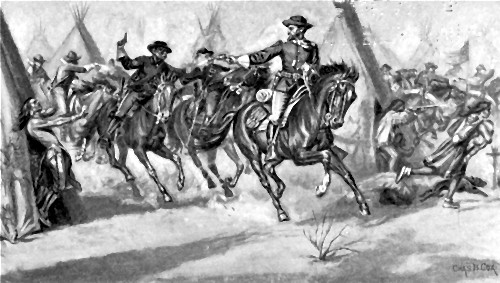 "Look out! Don't harm the women."
Page 431.
"Look out! Don't harm the women."
Page 431.
And so it happened that as the pace quickened that stirring June morning and the long line swept down upon the rousing, shrieking village, and the first shot came singing over their heads and the wild cheer leaped to their lips as the trumpet sounded charge, while many troopers sought their own course through and among the fire-spitting lodges, Sergeant Grant with Donovan and two others drove their horses close at the heels of the lieutenant's. Only squaws or children appeared among the tepees as they dashed furiously in. "Look out! Don't harm the women!" they heard him cry, as he held his own pistol hand well aloft, but in another second a scowling, painted faced flashed one brief instant into view as their leader went lunging by, a shot rang on the air, and flame and smoke jetted from the lodge opening. Three pistols barked in answer and Davies galloped on unhurt, but poor Donovan, with an Irish howl, dropped his revolver, clapped[Pg 432] his hands to his stomach as he toppled out of saddle. "My God, fellers, I've got it," was his moan, as Davies, a superb rider, quickly turned his horse about, and in the twinkling of an eye leaped to the ground to the trooper's side.
"Quick, sergeant. Quick, men, help me lift him on my saddle, I'm too weak," was his almost breathless order, and gallantly did they answer him.
"Are ye badly hit, Jimmy?" gasped an honest Irish lad, as he strove to raise him from the ground. But deathly pallor and staring, sightless eyes were the sole reply. "My God, lieutenant, he's killed outright. There's no use staying," cried another trooper. "Mount, sir, mount for God's sake! They'll be on us in a minute." But tugging still at the limp and lifeless form, Davies did not seem to hear. The fierce clamor of the charge was receding. Already the second and third platoons had cleared the village and were reining about and rallying on the flats up-stream. Already the pony herds, driven full tilt by Canker's squadron, were out of sight in the dense dust-cloud and could be heard thundering up the valley. Only a portion of Truman's troop could be dimly seen through the settling dust, but, worst of all, the warriors recovering from their panic came rushing from their lodges, and in a moment all would be over with the struggling little group of blue-coats. Fortunately, they were at the western skirt of the village, and almost all the rallying braves were running, rifle in hand, down to the southern edge, the direction of the chase. Some few, springing upon the scattered ponies left among the tepees, rode furiously away into the[Pg 433] dust-cloud in the hope of recapturing some of their stampeded stock, and so it happened that, except for some shrieking women, only one or two Indians appeared aware of the little knot of troopers still in their midst, but that was more than enough. Davies's horse, pierced by a rifle bullet, went rolling in agony upon the ground just as a devoted Irishman was trying to bolster the almost exhausted officer into saddle, and, luckily for him, Davies was borne to earth out of the way of the shots that came driving at them from the surrounding lodges. "Save yourselves," he faintly called to the remaining men. Already Grant had darted away for help, receiving his death wound as he rode. Then down came another horse, while Donovan's, snorting, tore away among the tepees, and then there was help for it. The little Irishman, Carney, bending low, strove to drag his prostrate leader, stunned by a kick from his dying horse, around behind the nearest lodge, when he, too, was sent blindly stumbling forward and sprawling in the dust, shot through and through from an unseen rifle not ten feet away, and the gallant fellow never heard the furious cheer with which "C" Troop came charging back to the rescue.
It is one thing to dash into an Indian village; it is another to get out of it. Wounded or unhorsed, any men left behind are doomed to cruel and certain death. Within another minute, Cranston and his men came tearing in, firing right and left at every dusky form that appeared. Within a minute the prostrate bodies were found, and half a dozen men, Brannan among them, had sprung from their saddles, while the others[Pg 434] rode blazing with their revolvers at the nearest lodges, some bringing their carbines into play. But even within that minute the scalping-knife had been at work, and poor Donovan's mutilated head lay in a pool of blood. Short-lived triumph for the scalper, sneaking to shelter with his hideous prize, for Cranston's pistol stretched him in his tracks, and Sergeant Buckner's big charger knocked the foremost of the rescuing warriors scrambling back between the lodges, where other troopers drove their horses trampling them under foot. But every wigwam had its garrison. The village swarmed with maddened braves, who now came rushing to the scene, and, they on foot and the troopers in saddle, they with their repeating rifles, the troopers with their pistols or single-shooters, annihilation of the latter could be but a question of a few moments. Even before Davies and his brave defenders could be lifted to the saddle and led away, two or three more of Cranston's horses went down, and Corporal Bertram was shot through both thighs. Then came the effort to retire fighting, covering their dead and wounded. There was only one way to go,—out across the westward flat, where the ponies were peacefully grazing when the attacking column hove in sight. Even as he shouted his orders to his savagely fighting troop, Cranston looked back with keen anxiety. To what pitiless fire must they be exposed in retreating over that prairie! Yet, with Indians on every hand within the village, it was manifestly his duty to get out. "Go on with the wounded!" he cried to the men afoot. "Go on! We'll cover you." And then Davies slowly opened his eyes and began to look feebly[Pg 435] about him. Oh, if Truman would only come! Every second the fight waged fiercer, hotter, and more men dropped as they backed slowly away. Down went Buckner's horse. Down went the guidon, and then, when it seemed as though half the troop must fall before they could reach the open field, the half-frenzied, half-joyous cheer of Truman's men rose shrill above the clamor, and again the dancing, howling Indians dove for cover underneath the tepees as "F" Troop came thundering through.
"By the Lord, but that's the hottest place I ever struck!" cried Sergeant Buckner a moment later, as, slowly falling back now, most of the men fighting on foot, with the led horses and the disabled soldiers well beyond them, "C" Troop was making its way southwestward towards the clump of Cottonwoods and willows, close along the stream. Truman's men, after their spirited and successful charge, were now rallying well to the north of the village beyond the ridge, where for the time being they were safe from the Indian fire. But once more now the warriors in the village were swarming along its western limit and, flat on their bellies, firing vengefully on Cranston's retiring line, now three hundred yards away, and every moment some horse would rear and plunge, stung by the hissing lead, but only one more soldier had been hit. Davies, faint and dizzy and only semi-conscious still, was riding slowly away with Brannan's supporting arm about him. The bodies of Carney and Donovan were thrown across led horses and lashed on with lariats, and Cranston had just sent a corporal to tell the horse-holders to move more quickly when, up the slopes to[Pg 436] the north, the men caught sight of a horse and rider darting toward them from the distant ridge over which Truman's men had disappeared. Straight as an arrow's flight they came, heedless of the fact that their course was along the western edge of the Indian village and barely two hundred yards away. "My God, fellers, it's little Millikin!" cried an excited trooper. "Ride wide, you young idiot!" yelled another, but all to no purpose. The boy trumpeter who had borne the message to Truman and charged with him through the village was now on his homing flight to rejoin his own. Vengeful yells and war-whoops rang from the village as warrior after warrior caught sight of him and blazed away. Throwing himself out of saddle, Indian fashion, and clinging like a monkey to the off side, the young dare-devil drove straight onward, the bullets nipping the bunch grass and kicking up the dust under his racer's flying feet, yet mercifully whizzing by him. Running the gauntlet of more than half the length of the village, the little rascal darted, grinning, through the cheering skirmish line, and tumbled to his feet before his beloved chief.
"Captain Truman's compliments, sir, and he'll rejoin you at the timber," was his message, delivered while his quivering horse stood flicking his long tail at a red seam in his silky coat where one bullet at least had scored its way, and Cranston bade him take his horse—and no more such fool chances—and get under cover straightway.
But now in falling back the skirmish line had made an irregular half wheel to the southward with a flying pivot toward the village, and the Indians were darting[Pg 437] or crawling out south of the tepees so as to get an enfilading fire on the line. Cranston's quick eyes saw the danger and warned his right skirmishers. "Back there! Fall back, you men! Run for it!" he shouted; and to the jeering rage of the Indians the run began, the men halting and refacing the village as soon as beyond danger of flank fire, and then came still another excitement. Even while falling steadily back, with wary eyes on the smoking lodge lines, the men at the right became suddenly aware of a rush of several Indians to the point where the troop had re-formed after its initial charge. "They're making for the timber," was the first cry, for a few scattered, stunted trees grew along the low ridge. Then came a yell from the rear, from the sergeant in charge of the led horses.
"It's one of our men lying there wounded. For God's sake save him!" and that was enough. Every carbine along the line was brought to bear on the stooping, crouching, scurrying warriors who had ventured so far out from the sheltering tepees. Obedient to Davies's order, Brannan and two or three men in saddle left the wounded to take care of themselves, and spurred headlong across the prairie to the scene, and Cranston, catching sight of the affair at the same instant, waved his cap in eager signal, while his voice, now hoarse and choked, could hardly be heard in the order "By the right flank." Truman's column of fours, reappearing at the instant at the north, but well to the westward of the village, could not imagine what that distant manoeuvre meant, but it was no time to ask questions. "Gallop" was the order, and down they came.[Pg 438] And so it happened that barely twenty minutes after the first shot was fired the comrade troops of the Eleventh were once more united, and, facing nearly north, were in furious fight with an overwhelming force of Indians, while Chrome, turning deaf ear to Sanders's supplications, was vainly striving to round up a galloping herd of several hundred ponies full three miles away. Picking up the body of Sergeant Grant, saved from scalping and mutilation by the dash of Brannan and his squad, "C" Troop was once more wearily retiring toward the timber along the Wakon, and Truman deploying his dismounted skirmishers to their relief.
And then, as the horses were huddled at last under the bank, and the wounded were tenderly lowered to the shade of the willows, and the dead, with soldier reverence, laid, blanket covered, under a spreading tree, the captains met to compare notes and sum up the losses. Grave indeed were their faces, for two of the best sergeants were killed as well as five veteran troopers, and nearly a dozen were more or less severely wounded. Davies, unscarred by bullet, lay faint from loss of blood, and dizzy and dazed from the blow from his horse's hoof. The knife wound, Red Dog's treacherous work, had reopened as a result of his violent throw to earth, and there was no surgeon nearer than Chrome's battalion, now out of sight far up the Ska. "Thank God! they've got few ponies left," said Cranston, fervently. "We can hold them here until help comes."
And help was coming, hard and fast,—harder and faster than Cranston dreamed, but not to them. Within[Pg 439] the next quarter hour, greeted by frantic acclamations from the hostile village, there rode into view on the opposite bluff, and came shouting their war-song, brandishing feathered lance or gleaming rifle, more than a hundred red warriors,—Ogallallas, Brulés, Minneconjous all, with Red Dog himself, escaped from durance at the agency, madly revelling in their midst.
It was barely sunrise when Chrome's battalion struck the hostile camp this hot June day, and two hours later the situation was comfortless enough—for the strikers. Hampered with their wounded and having lost a dozen horses killed, the two troops of the Eleventh on whom had devolved the harsher share of the work had been compelled to halt in the timber and stand off the now exultant Indians. With a hundred mounted warriors at his back and as many more afoot in the village, Red Dog promptly took the offensive, sent his yelling braves in big circle all around the clump of timber in which Truman and Cranston had posted their men, cut off communication with Chrome's party, now "doing herd guard duty half a dozen miles up the Ska," as some of Cranston's men derisively said, and then, little by little, established the dismounted braves in every hollow, behind every little ridge or mound, and soon had a complete circle of fire all about the wearied little force. As senior officer, Captain[Pg 440] Truman was now in command of the detachment, but between him and Cranston there was a bond of cordial esteem and comradeship, and the command was purely a matter of form. Each had had long years of experience in frontier warfare, each knew just what had to be done, and neither regarded the situation as either desperate or particularly dangerous. It would have been an easy matter to cut their way out anywhere but for the helpless wounded, who would be butchered to a man if left behind. Here in the timber, with water in abundance, and comparative shelter for the disabled men and for the horses under the banks, they could remain until relief should reach them. This with Chrome's two troops not very far away and their own old colonel, with half the regiment, somewhere over in the hills to the southwest, they felt very well assured ought to be only a matter of a few hours. "It was big luck," said Truman, "that our little pack-train got in when it did. Ten minutes later and they'd have been cut off and massacred."
But the further advantage lay with the Indians that they just knew exactly where Chrome was and Tintop, too, and knew that neither one was making the first effort to relieve his surrounded comrades, Tintop because he was twenty miles away and had no knowledge of what was going on at the mouth of the Spirit River, and Chrome because he was utterly rattled by the mounted warriors now beginning to appear in increasing numbers around him. He had sustained no loss to speak of. None of his men had been hit. Only two horses had been struck by their long-range fire. He was, to use his own words, "Really provoked at Truman and[Pg 441] Cranston. They might know he needed them in holding such a big herd of ponies." Poor Sanders was in a miserable state of anxiety. He begged the major to let him take ten men and go back to find them, or even to let him go back alone. He pointed out that they must have had a fierce fight. He had found Sergeant Grant dead, and heard the fierce battling in the villages where both troops were engaged, and then he had galloped through the dust-cloud to Chrome, narrowly escaping death as he did so, and told him the situation, confidently expecting that Chrome would turn the ponies loose, rally his men and dash back to the village; but Chrome did nothing of the kind. "They should have come to me," he said. "We're the ones in need," then sent him with an order to Canker, who, out on the right flank, was making the morning blue with blasphemy, and Sanders poured his tale into Canker's ears, and begged him to come and make Chrome understand the situation, and Canker replied that nothing short of a pile-driver could hammer an idea into a skull as thick as Chrome's, and nothing short of a blast get anything out of it. The man was a born idiot and had no more idea how to command cavalry in the field than he, Canker, had of teaching Sunday-school. Oddly enough, many of Canker's contemporaries said the same of him, but one never knows and rarely suspects half what one's brethren say or think of him. The valley was black with ponies, the troopers were black with dust, and a pall as of night hung over the herd, so dense that the sun rays were swallowed up in its depths and gave but little light below, and tears of rage and misery that started from Sanders's eyes trickled down[Pg 442] through a sandy desert on each sun-blistered cheek. He rode back to his temporary chief just as an Indian bullet had whizzed in front of the major's nose and made his eyes almost pop from his head. "Don't you see," he urged, reproachfully, "how very much more they are around us? If Truman or Cranston needed help they would have let us know long ago."
After a brisk gallop of three or four miles up the valley of the Ska, the troopers of the —th had permitted the stampeded ponies to take things more leisurely, and so it resulted that by six o'clock many of their number were stopping occasionally to nibble at the grass which grew here luxuriantly, but there was, all the same, a steady, persistent movement of the living mass,—an enforced migration at the rate of at least three miles an hour. Well out on the foot-hills Canker's troop had thrown its flankers, while the other in long skirmish line, with appropriate reserves, interposed between the herd and possible Indian attack from the north. The eastern banks of the Ska along here were high and steep, and the stream flowed deep and rapid at their base, so attack from that quarter was not to be dreaded. All the same, occasional warriors could be seen along the bluff, scampering from point to point, firing long-range chance shots at the officers or men distinguishable through the edge of the dust-cloud, but venturing no closer. It was Chrome's idea, as he frankly said, to keep moving southwestward until Tintop's scouts should see the huge column of dust, and send forth to meet and guide him with his prizes to the colonel's camp. Every quarter-hour, therefore, was taking him farther and father away from his corralled[Pg 443] comrades down-stream, but he refused to see it. "Oh, they'll come along all right, Sanders," he declared, as he saw how his adjutant's eyes constantly gazed back beyond the dispersed line of skirmishers, "and we'll have a regular jubilee when we meet your colonel this evening. Some day, perhaps, you'll get a brevet for this."
"Damn the brevet!" groaned the youngster. "Give me a sight of 'C' and 'F' Troops safe and sound, and I'd rather have it than any brevet in creation." Then a brilliant idea struck him. "By the way, major, suppose they don't come along, what will you do for breakfast and dinner? They've got the pack-train—unless the Indians have."
"By heavens, I never thought of the packs. They were way behind when we struck the village," said the major, whipping out his watch. "It's 6.30 now. Sanders, I reckon you'll have to go back and see what's become of them. Take six or eight men from the reserves here and try to rejoin us by eight." And glad enough to slip out from the shadows of that overhanging pall, Sanders went, half a dozen Arizona "jayhawkers" riding silently with him.
And that was the last Major Chrome saw of his battalion adjutant, of the "Eleventh" half of his battalion, and of all but one of the six jayhawkers referred to, in many a long week. One of the latter made his way back afoot in the course of half an hour, saying his horse was shot under him in the valley, which was thick with Indians, and Chrome looked yellow-white and a trifle undecided. But again the big herd of ponies from some unseen cause was in rapid motion,[Pg 444] loping away southwestward. All the guards and flankers were on the run, and it was half an hour before things quieted down again, and when eight o'clock came Canker sent in word that there were dozens of Indians on the bluffs ahead where the valley narrowed, and it would be well to halt and round up the herd right there and wait for Cranston and Truman, and Chrome so ordered. Presently the dust-cloud began to settle, and by and by, when it floated slowly to earth again, half a dozen at a time, under cover of their comrades' carbines, the troopers ventured to the stream to fill their canteens and souse their grimy heads. There, peacefully grazing again, were the Indian ponies by the hundreds and their dusty guardians by the score; but, far as eye could see down the beautiful valley, not a sign of Sanders, his party, his comrades of the Eleventh, or, worse than all, of the pack-train, and Chrome and his people were getting hungry.
There were still with him the sergeant and trumpeter who had brought the despatch from Colonel Winthrop, and to them again did Chrome appeal for an estimate of the probable distance and direction of the colonel's camp. With an officer and twenty troopers as an escort they rode to the summit of the nearest bluff on the western shore, and with their field-glasses studied the landscape for miles. Far to the southwest lay the placid valley, unvexed now by sign of hostile force of any kind, and the sergeant indicated, some fifteen miles away, the butte near which they made their crossing of the stream the previous day. Far to the west and northwest rolled a wild, tumbling sea of prairie upland, wave after wave of gray-green earth,[Pg 445] spanned at the horizon by the black, pine-covered range of the Medicine Hills, pierced nearly due west from them by the deep slit the sergeant said was Slaughter Cove. To the northwest they could trace the general course of the Wakon valley, though the stream itself was nowhere in view, even among the broader levels toward its mouth, for everything down the Ska beyond a point three miles away was hidden from their sight by the bold cliffs that jutted out almost into the foaming waters. "Somewhere off there, fifteen or twenty miles," said the sergeant, pointing towards Slaughter Cove, "the colonel is probably marching." He had pursued the warriors into the hills after their heavy fight, and wouldn't let up on them till he ran them back to the agency, but the camp where he had left his wounded, his wagons, and supplies and their guard couldn't be more than twenty miles farther up the valley. Of the Indian village they had attacked at sunrise nothing could be seen. Eastward and south westward the opposite bluffs cut off the view, and such Indians as watched them did so from the concealment of the ridges and ravines. Chrome's triumphant rejoicing of the early day was rapidly giving place to uneasiness. In the absence of rations even martial fame is an empty thing. It was a bitter pill to have to go down and consult with Canker, but he did not know what else to do. Noon found him, watched by the lurking Indians among the bluffs, still guarding his captured herd and waiting for Sanders to come along with the pack-train. But there was no dinner for Chrome's command that day, and, by nightfall, even the ponies were gone.[Pg 446]
Barely two hours after the triumphant appearance of Red Dog and his reinforcements on the scene of the morning's fight, Truman and Cranston, making the rounds together, came upon Davies among the rifle-pits on the north front, instead of resting with the wounded under the banks. He was still pallid and ill, but, having dressed and bandaged his wound and had a refreshing dip in the stream, he had made his way out among the men. He shook his head gravely in answer to Truman's suggestion that he ought to be lying down. "We are lying down all around here, sir," he said, "and I can get more rest out here than under the banks."
But Truman did not know that, weak as he was, the Parson was dividing his time between the wounded and the effectives, ministering to the one and cautioning the other, for the latter could not always resist the temptation to fire at such Indians as appeared in view within five or six hundred yards, and ammunition might be scarce before the siege was ended. Grimly, but without uneasiness, the command watched Red Dog's scientific manœuvres in his "surround," the mounted warriors being gradually replaced, except on the open prairie, by the bereaved villagers. "Oh, we can stand off double their force easily," was the confident saying of the old hands. "We have food, water, ammunition, and a smart chance for more fighting," so what more could soldier ask? There was even jollity in the little command, despite the losses of the early morning. There was keen and lively interest in Red Dog's movements when, by nine o'clock, it was seen that he was calling most of the mounted warriors[Pg 447] around him and could be heard haranguing them at the farther end of the village. None of the lodges had been taken down,—there were no ponies to haul them away,—but those nearest the southern end were now deserted of women and children and used only as shelter for a few lurking braves. Presently on every side the Indian prowlers opened sharp fire on the troops, a long-range and hap-hazard fusillade, for what with logs and earth, sand, trees, and river-banks and little wooded isles, the defence was well covered, only some of the horses being where they could be plainly seen. The bullets came zipping overhead or spitting vengefully into the sand, doing little harm, yet teaching the troopers to lie low; and then in the midst of it all Red Dog rode magnificently away from the north end of the village, across the open prairie, heading for some point far up the valley of the Wakon, and sixty braves rode valiantly at his back. He was a good half-mile away from the defence, but the troopers let drive a few shots, "for old acquaintance' sake," as one of them expressed it, but without disturbing the pomp and dignity of the procession. It was soon out of sight, and then the encircling fire slackened. "Now, what on earth are they up to?" was the question.
And in less than an hour after his disappearance there came new excitement, and the men set up a cheer. Sharp firing was heard toward the south. What could it mean but that their comrades of the —th were fighting their way back to join them? Then four or five horsemen appeared along the southward slopes, darting and dashing about as only Indians ride, evidently firing at something between them and the Ska,[Pg 448] and Truman ordered a platoon to mount and drive away the Indians on that front so as to open a road for the new-comers to enter. This was accomplished with little loss, for the Indians broke from before the spirited dash, but rallied, of course, far out on the flanks, and again poured in their rapid fire from their repeating rifles, and then after a while the troops could be seen slowly retiring, firing as they fell back, some afoot now, and some leading and supporting in saddle others who were evidently wounded, and finally, as these latter came within a few hundred yards of the rifle-pits, the cry went up that it was Lieutenant Sanders and some of the —th, and so it proved. Four more wounded to care for, and Sanders, faint and heart-sick, among them.
"I tried to get old Chrome to drop that herd and come back to you," he moaned, "but it was useless. He wouldn't have let me come—only to get him something to eat. Damn this having to fight Indians under office soldiers anyhow!" And with this pithy protest on his blue lips the little bantam fainted away.
Then Chrome wasn't coming. Truman looked grave and Cranston angry. "No matter. We can lick them endwise by staying just where we are," he said. "Relief is bound to come to-night."
Later that afternoon, under the shadows of the willows, there gathered a little group, perhaps a score of officers and men, all who could be spared from their stations in the rifle-pits, listening to the solemn tones of one of their number reading the service for the burial of the dead. Never did Cranston take the field[Pg 449] without Margaret's stowing in the corner of his saddlebag a little prayer-book of her church, and this the captain had handed silently to Davies. Side by side the forms of the two sergeants and their comrade troopers were laid in the sandy pit. Reverently the bearded, war-worn men uncovered and stood with drooping heads while their grave young officer read the solemn words. Here and there along the big circle of their surrounding foe the faint distant crack of the rifle punctuated the sentences as they fell from soldier lips, and every moment a bullet whistled overhead. Somewhere down the valley, borne on the wings of the breeze, the wail of Indian women mourning their braves slain in the earlier battle echoed and almost overwhelmed the solitary voice that rose in soldier tribute to the soldier dead. Then with one brief, fervent prayer, the solemnly murmured "Amen," carving no line, raising no stone, but tamping deep and heavy the earth upon their blanket-shrouded forms, without the trooper volleys, with only the faint soft winding of the trooper's last earthly trumpet-call singing "lights out" to sadly listening ears, the little group dispersed, each man going to his post.
An hour later still and the bluffs were throwing long shadows across the valley, and the crack of Indian rifles and occasional loud bark of the carbine close at hand seemed growing more frequent, and watchers at the outskirts became conscious of increasing excitement among the warriors up the valley to the west as well as over to the south, and listening men, laying their ears to earth, declared that there was tremor and vibration, and dull distant thunder of[Pg 450] myriad hoofs, and over in the village there was hurrying to and fro and growing clamor of squaws and children, and dusky women could be seen clutching their little ones and speeding away towards the hills down-stream, while others began rapidly tearing down the painted lodges of hide or cloth, and such Indians as had no mount, but were skulking under the banks or among the bluffs across the stream, could be seen leaping and crouching and racing back toward the village, and presently there went up a shout from the lookouts towards the upper Ska: "Big dust-cloud coming. Must be the pony herd again!" And men began springing to their feet and scrambling out of their shelters, and staring around them and waving their hats and shouting congratulation and encouragement, and ducking suddenly as more bullets came whistling in, and from a low rumble the sound rose to distant thunder, and from that to nearer uproar, and Truman and Cranston made a rush for their own herds, ordering the men to side line and hopple instantly, for the surviving horses were excitedly sniffing the air, pawing and snorting, and then there hove in sight up the valley the wiry leaders of the herd, galloping wearily, behind them a dull, dust-hidden, laboring mass, the main body of the Indian prizes swept away at sunrise. But who and what were these darting along the flanks of the coming host, lashing furiously in and out, ever guiding, controlling, commanding even while hurrying on? No blue-shirted, slouch-hatted, broad-belted troopers these! No cheering comrades of the stalwart —th, but in their stead few, but far more skilful, the most accomplished[Pg 451] herdsmen in all creation,—Indians by the dozen. And then at last, amid the yell and clamor and shot and shout and furious rush of riderless steeds, came explanation of the mysterious foray up the Spirit valley. Circling far to the west and south, riding like the wind when once well out of sight of watching foes, the Ogallallas had swung around between the Ska and Winthrop's distant column, threaded ravines and depressions well known to them from boyish days, and finally creeping behind the curtaining bluffs into full view of the great herd drowsily nibbling in the broad, sunny valley, had burst with maddening yell and waving blankets and banging rifles, with sudden fury from their covert, tearing by the weary pickets, stampeding their horses, and so had gone thundering down upon the startled herd and, skilfully encircling it from the south, reckless of rallying cry and rapid shot from Canker's men, had sent the whole pack, with many a cavalry charger too, whirling before them in wild triumph down the echoing valley, back to the waiting village whence they came. "Red Dog versus Chrome Yaller," wailed little Sanders from his bed of leaves. "Who wouldn't have bet on the bay?"
Vain the major's valiant effort to mount and follow. Forty at least of his horses were swept away in the rush, his own among them; vain long-range shots and Canker's vivid blasphemy. Black in the face with rage, he mounted such men as had managed to restrain their horses and went charging after, leaving Chrome to the care of his fellows. Vain the rapid and telling fire opened upon herd and herders by Truman's men as they came within range. Down went two or three[Pg 452] yelling, painted warriors, down a dozen ponies here and there, but on went the leaders, plunging breast-deep into the stream, and, followed by the whole mass, forded the Wakon in a flood of foam and splash and spray, losing only a trivial few in the glorious effort, and then, sweeping well around the rifle-pits of the command, were welcomed with mad rejoicing and acclaim in the heart of the thronging village.
Instantly now did they send forward their own skirmish line,—scores of Indians crawling, snake-like, through the grass, and from all sides pouring rapid fire in on Cranston's front to keep him and his fellows from attempting to mount or attack, which, indeed, would have been a hopeless effort. The timber rang with the fierce volleying, and in the excitement and exposure that resulted four more of the little command were shot, Truman himself receiving a painful wound in the side. For half an hour there was yell and clamor and furious crash of firearms, but all this time the lodges were rapidly disappearing, the Indian households were piling their goods and chattels, their babies, the old and the wounded and the helpless, even their dead, on travois and drag of lodge-poles, and then, guided by old chiefs, whole families were flitting away down the Ska, and finally, as darkness lowered on the valley, and the last lodge was down and gone, and the last warriors drew away from their front, and silence and peace settled down upon the exhausted command, Cranston, laying his broad hand on Davies's shoulder, looked into his tired eyes with a world of soldier trust and admiration in his own, and said, "If there was such a thing with us as promoting a man on the[Pg 453] battlefield, my lad, this day's work would win it for you."
And before the other could answer, far up the valley of the Wakon hailed a trumpet call. Over from the bluffs across the stream another answered, and man after man sprang from his blanket to give a welcome cheer. "We might have known those beggars would have been in no such hurry to get away," said Truman, faintly, "but for old Tintop's coming with the whole command."
They were discussing matters a week later at old Fort Scott, where two little companies of the Fortieth kept watch and ward over the women and children of their many comrades in the field. Barely mid-June now, yet how all plans and projects for the summer had been changed. Guarded by Chrome's "infantry," as his unhorsed troopers were jocularly described, most of the wounded were being carried by short stages into Pawnee Station, where a field hospital had been established. Truman and Sanders were with these, but Winthrop, assuming command of all the cavalry that was available at the forks, had gone on in pursuit of Red Dog's renegade band. With him were Cranston and Davies; with him, too, were Hay and Hastings. Only one officer of the Eleventh remained at Scott, the captain of "A" Troop, in arrest awaiting trial. It was a time of sore anxiety to wives and children, to[Pg 454] some two or three sweethearts who had happened there, and they showed it plainly. It was a time of strange suspense and trouble to Captain Devers, but he hid it well. Few men could better have portrayed the chafing, indignant soldier, robbed of the right to lead his men to battle, than did Devers when his comrades took the field. Hastings as first lieutenant went in command of "A" Troop, but Devers had importuned head-quarters with letters and telegrams imploring to be permitted to accompany the column. He asked for only temporary release from arrest. He courted—he demanded the fullest investigation of his every act. He longed to meet his accusers—his defamers, rather, and overthrow them before a jury of his peers, but, as the court could not proceed now until the campaign was over, why hold him chafing here? It was all capital, it was even touching, but it "did not work." The general himself was far away in the distant Big Horn; his adjutant-general could not act, and the lieutenant-general in Chicago would not. Then, as Devers had been in close arrest much over seven days, he demanded "extended limits," which were readily accorded him. When "A" Troop marched away its captain's only solace had been a long, closeted conference with Sergeant Haney, who, as a consequence, had to gallop many a mile to overtake the troop.
The news of Red Dog's escape and the bolt of the Ogallallas from McPhail's bailiwick created consternation at Scott. With the cavalry and all but one company of White's battalion gone from the agency there was ample opportunity, but it had not been foreseen. Then, three days later, by way of Pawnee, came the[Pg 455] details of the fierce fighting on the Ska, of Truman's wound and Sanders's, of Chrome's catastrophe, the only humor in the situation being the contemplation of how Captain Canker must have sworn. Then came hurried letters, pencilled in the field, and Leonard himself took hers to Mrs. Cranston, and then went in search of Mrs. Davies, whom he found at Darling's quarters, though Darling was not there. The ladies were at luncheon, and the adjutant contented himself with sending Mira's missive in. There was a letter for Captain Devers in the well-known hand of Sergeant Haney. This was sent him by the orderly. There were others for others, which were duly delivered and brought at least momentary joy, but Mrs. Cranston's eyes were dancing with delight when Leonard met her half an hour later.
"I'm going to Mrs. Davies," she said. "I want to read her what the captain says of her husband's conduct all through that fight of Monday afternoon. He says he never saw anything calmer or braver in his life."
"Yes, I remember our chaplain's indulging in some prognostication to that end," said Leonard, gravely; "but, Mrs. Cranston, did you want to see Mrs. Davies?"
"Why, yes, assuredly."
"Well, she isn't home,—I think you'll find her at Mrs. Darling's."
But Mrs. Cranston's humor changed. She decided to wait and see her later. She did not care to go to Mrs. Darling's; neither, as it transpired, did she care to return home, at least not yet awhile. There were people capable of believing of Mrs. Cranston that she[Pg 456] had no especial interest in Mrs. Davies, personally, and no genuine desire to communicate to her the tidings which Mrs. Davies, perhaps, could hardly appreciate. Mira had not once set foot within Mrs. Cranston's door since their return from the cantonment, and there had been next to no intercourse between them, and yet on this almost joyous afternoon Margaret had eagerly seized upon this pretext of leaving Agatha Loomis alone with Mr. Langston, who had returned that very day from some investigation at Kearney and Cheyenne, and, after half an hour with Mr. Leonard, had hastened to her door. He was still in the parlor when the lady of the house came smilingly in an hour later,—she had been visiting Mrs. Leonard the while,—but there was constraint in the air. The boys were out with their ponies. There was no one to entertain him during her absence but Miss Loomis, and Miss Loomis apparently must have failed, for Langston's face had grown ten years older, and the moment Mrs. Cranston left the room, on household cares intent, he must have taken his leave, for when she returned from an inspection of the larder in order to see if it would justify an invitation to stay and dine, the parlor was empty. Langston had gone back to Braska, Miss Loomis to her room. I regret to have to record it of Mrs. Cranston, but during the following week she made more than one effort to induce her friend and kinswoman to say what had happened to put so summary a stop to Mr. Langston's visits, and that she wrote some peppery things to her husband, the captain, in summing up her conclusions; she also looked some, and I fear said some, to Miss[Pg 457] Loomis herself, for one day, going suddenly into Agatha's room, she surprised that young lady in the act of packing her trunk. There ensued a scene which neither cared in after-years to say much about. There were tears and reproaches on one side, if not both, but Agatha's determination could not be changed. She had made up her mind to leave Fort Scott, return to Chicago, and go she did,—but not without Mrs. Cranston.
In less than ten days there came a long letter from the captain. He and his troop were destined, he said, to long months of scouting in the distant Northwest. The general had told him as much. They might again have to go to the Yellowstone, and it would be November before he could hope to see the inside of a garrison. "So," said he, "stow away the goods and chattels, leave them with the quartermaster, pack your trunk, and take the boys and Agatha for another visit to the old folks at home,—who are most eager to welcome you." When the Fourth of July came, the Cranston boys, in the added glory of all their experiences at the cantonment, were once more the envied centre of youthful attention at Chicago.
"We will have no more fighting this summer," said he, "for the Indians have scattered," and "C" Troop did not; but there was abundant opportunity for usefulness and distinction for "the prodigy," as Cranston now generally referred in his home letters to Corporal Brannan, whose devoted mother was almost the first to visit Margaret on her arrival and overwhelm her with proffers of hospitality and with questions about her boy. "C" Troop was detailed as escort to the commanding general in a long tour he made to the[Pg 458] Yellowstone Park, and the prodigy's letters to that fond mother became more and more a cause for rejoicing. Already had she learned to thrill with pride over the accounts of his bravery and good conduct in the affairs at the agency and the fighting on the Ska, but that, said she, was only as she knew he would behave. From babyhood her boy had been conspicuous among his fellows for absolute fearlessness and desperate courage, and her memory was charged with a wealth of corroborative detail which that of his fellows seemed to have lost. Those who were confidently appealed to were polite and sympathetic, as became them when responding to a social magnate of such prominence and influence, but they looked far from confident and said satirical things when once away from her presence; but then, no one knows how a boy is going to turn out. A few weeks and the general himself would be home, and then, fresh from the contemplation of the soldierly prowess and graces of her son, what could he do less than have him commissioned a colonel or something and ordered in on the staff, and then what store of fatted calves would not be slaughtered in honor of this her son who was lost and was found, and who had returned to her bringing his sheaves with him? If mother-dreams could but come true all men would live and die immaculate, ennobled, magnificently brave, steadfast, and commanding. And far away among the fastnesses of the Yellowstone, living in close communion with nature, in a glorious round of days, full of high health, courage, and hope, with ambition fired, purpose strengthened, with freedom from care or temptation,[Pg 459] small wonder was it if Corporal Brannan's letters warranted all her expectations. But those were the halcyon days of cavalry life, not the typical. Our truest heroes are those who bear with equanimity the heat and burden of the long, monotonous round of garrison life with its petty tyrannies, exactions, exasperations, and bear them without a break or murmur. It is a poor, poor soldier who cannot wax enthusiastic on a full stomach—and a good horse—when serving in the field.
But while "C" Troop was doing escort duty, and its captain's wife and little ones were safe at home, "A" Troop, long handicapped by the frailties of its commander and notorious for bad drill, was now striving to win a new name under the lead of Bachelor Hastings and its grim Benedick second lieutenant, whose fair young bride could hardly be said to be safe at Scott, restored to the sympathetic circle of which Mesdames Stone, Flight, and Darling were the guiding stars. Old Pegleg seldom left his piazza now except to go to bed or dinner, and did not much care what was said or done around him so long as he was left in peace. The post surgeon had bolstered him up again, after a few days in bed, so that he could sign papers, and while he retained the nominal command of the garrison, Leonard was its virtual and actual head, for when July came only one detachment of the Fortieth remained with the band as guard.
But that band was a host in itself, and why should women weep and mope and mourn—with music and the dance so easily accessible? Mrs. Leonard's letters to Mrs. Cranston became vividly interesting just about[Pg 460] this time. The hops were resumed, as well as the drives with friends in town. Mr. Langston came no longer, but the bank and the Cattle Club poured forth their homage. Messrs. Burtis, Courtenay, and Fowler were out twice a week at least. Then Mr. Willett's beautiful team reappeared, and presently Mr. Willett himself, and he had brought still another step from the distant sea-shore. It is only the first step that counts, and Mira had taken that. Mrs. Leonard thought she was learning another. She danced as beautifully, dressed as divinely, smiled as bewitchingly, and talked as inanely as ever. Mr. Leonard disapproved of Mr. Willett, but that could not keep him off the post. When mid-July came Willett was there almost every day. Twice he remained overnight, sleeping at the sutler's. The chaplain had been to talk with Mr. Leonard, and had tried to talk with Mira, but she fled from him in tears. What he said to her was dreadful!—dreadful! and she should tell Mr. Davies about it just as soon as he returned. "I," said the chaplain, gravely, "shall not wait till then. I shall have to write and tell him now."
Meantime Captain Devers occupied his quarters in gloomy state and twice each day patrolled the garrison limits with the air of an injured man. At other times he was writing long letters and reading those which came to him by every mail, but none came now from the faithful henchman Haney, far away on the Indian trail with Tintop's pursuing column. Red Dog was known to be with a remnant of his band somewhere in the wild Bad Lands to the north of the Ska, and the last heard from the colonel was that he, with six[Pg 461] troops of the Eleventh, was scouring the southern limit of those dismal features of our frontier landscape, looking for Red Dog not far to the north of Antelope Springs. Devers had been truculent in his demand for speedy trial up to the third week in July,—up to the twentieth of the month in fact,—but that day brought telegraphic sensation. Tintop had found and struck Red Dog's camp at dawn on the sixteenth, guided thither by Thunder Hawk himself, had struck hard and heavily, scattering not only Red Dog's people to the hills but destroying their village and burning another that from its foul condition seemed to have been standing there all winter. Red Dog himself was killed, fighting like a tiger, and "A" Troop under Hastings and Davies had won the distinction of heading the charge, doing most of the work, and losing more in killed and wounded than the others combined. Hastings was shot through the arm and crippled. Corporal Boyd, one of Devers's pets, was killed, so were two troopers, and Sergeant Haney had received what was reported to be a mortal wound. Leaving a small guard with his invalids and invoking aid from Major White's infantry battalion, now garrisoning the stockade where the new post was to be built, Tintop had gone on into the hills to continue the work of breaking up the bands, Davies commanding "A" Troop, and not until the thirtieth was he heard from again.
But meantime Lieutenant Archer, of the general's staff, who had accompanied the cavalry column, was staying with the wounded, and had removed them from the smoking, malodorous neighborhood of the ruined villages, and could be found, he wrote, with his charges[Pg 462] at Antelope Springs. This was news at which Leonard's eyes flashed. It was tidings at which Devers turned very pale. The latter begged for authority to go at his own expense and at once, and without a guard, though it involved five days of buckboard driving or saddle work from Pawnee Station, to join his wounded men. "Debarred," said he, "from the right to battle with my men, I pray that I may at least be permitted to minister to their needs,—they who have so gloriously maintained the honor and credit of their troop." But the adjutant-general at department head-quarters smiled sarcastically and said that this, with others of Devers's letters and telegrams, deserved to be framed. August came, and Devers again clamored to be brought to trial or relieved from arrest, and two evenings later, as he sat in gloomy state upon his piazza, he was amazed to see the adjutant turn grimly into the gate and calmly stand attention before him.
"Captain Devers," said he, "I am directed by the post commander to read to you this despatch:
"'Notify Captain Devers that his letters have been received, and that the court for his trial will convene not later than the fifteenth instant.
And when it is remembered that he had persistently demanded prompt trial it is surprising that the accused officer looked completely disconcerted. The fact of the matter was Captain Devers had no idea that the members and witnesses could be brought together again before mid-September, if then. That night he sat up[Pg 463] writing until very late, and sent two messages away by wire. He was sorely troubled now, but could he have seen the group gathered solemnly about the dying sergeant far away at Antelope Springs, and heard his faint, whispered words as Archer took them down, Devers would have stood aghast.
A charming little informal dance was going on at the fort one August evening about a week later. The Leonards would not attend them now, but with five such belles as Mesdames Stone, Darling, Davies, Flight, and Plodder, to say nothing of other lesser lights of the garrison galaxy, there was no lack of womanly beauty, only the cavaliers were short. One officer, an infantry subaltern, represented the martial element, the other men were civilians. Courtenay had brought out two Eastern friends; Burtis was on hand as usual, and Willett, metaphorically, at least, at Mira's feet. The poor girl actually lacked the sense to see that his infatuation was such that he had no eyes, ears, or senses left for any one else. Possibly she gloried in his devotion. At all events he danced with her again and again and watched her jealously when she danced with others. At last towards eleven o'clock Leonard suddenly appeared at the door of the dancing-room, holding an open letter in his hand, and beckoned to his comrade. "I'll have to trouble you to come with me to the quartermaster's storehouse," said he. "There is a chest there that must be opened to-night." And though the lieutenant was surprised, he, in common with everybody else in the Fortieth, had learned that Leonard rarely opened his mouth except to speak by authority, and so went with barely a word to the[Pg 464] ladies left behind, nor did he return in ten minutes, as he said he would. The old non-commissioned officer left in charge of the "A" company stores was awaiting their coming with the quartermaster sergeant. He looked troubled and perplexed when Leonard handed him the key and bade him unlock and open Sergeant Haney's chest. "I ought to have the orders of the company commander, sir," he began. "I mean Captain Devers."
"Captain Devers is not the commanding officer," said Leonard, quietly. "Here is the written order of the owner, Sergeant Haney, and the instructions of Lieutenant Hastings. The actual commanding officer of the company is with it in the field." So no more was said.
Down in the depths of the chest, among a roll of clothing, carefully covered, but just as described in Hastings's letter, was found a leather writing-case. "Lock the chest again," said Leonard, as this was handed to him. "That is all we mean to disturb." And then he took the case to the office, while the old trooper went to tell his captain what had happened. Morning brought, as was to be expected, a letter from Devers protesting against this new indignity. No property of his officers or men should have been opened save in his presence, as he was but temporarily suspended from his functions, and as to him the men would look for the security of their effects. Lying in wait for Leonard as he returned from the office, Devers demanded to be told what had been taken from the sergeant's chest, and then went white as chalk when Leonard calmly answered, "Certain stolen property,[Pg 465] sir, including a map and some written memoranda which will be required before the court-martial that meets next week."
But this was not all that was found in Brannan's case, the lock of which had long since been forced. There was a valuable gold watch presented to Chaplain Davies by the officers and men of his brigade at the close of the war. There were letters which Leonard barely glanced at,—some silly, sentimental trash addressed to some one's darling Bertie by his devoted Mira. All this, opened in presence of a regimental comrade and certified to by him, was replaced, carefully sealed, and then the case was locked in the commissary safe. "That goes with me to Omaha Monday next," said Leonard to the much-mystified officer, "and you may be needed to corroborate my testimony. Keep all this to yourself."
And, despite a vigorous cross-questioning, the youngster managed to hold his own against even Captain Devers, whose suspicions, however, were now fully aroused, and who obtained permission from Colonel Stone to visit the telegraph-office at Braska, and there wired to a legal friend in Omaha and to certain addresses in Washington, and on Friday came telegraphic instructions permitting Captain Devers, for the purpose of consulting with his counsel, to repair to Omaha at once, and he took the midnight train. On Monday, as required, Leonard left, taking his prizes with him, and on Wednesday the court met, with all but two members present. Colonel Atherton inquired of the judge-advocate if he were ready to proceed to business, and that officer replied that he was, but that certain[Pg 466] witnesses were still to arrive and the accused did not seem to be in the building. A messenger to the hotel brought back word that the captain breakfasted there that morning, had paid his bill and gone out, his baggage being taken away by an expressman. This strange news fluttered about from room to room at the headquarters building. The members of the court fidgeted in their full-dress uniforms and smoked and chatted and strolled about, calling on old acquaintances, and the adjutant-general sent orderlies to and fro with inquiries.
And then came the sensation of the year among military circles in the old frontier department. The grave, dignified, soldierly chief of staff appeared at the court-room door with a telegraphic despatch in his twitching fingers. "Gentlemen," said he, "your services in this case will not be needed. The accused is beyond our jurisdiction."
There was a moment of intense silence, a look as of awe on many a face, then came the question from one who knew not Devers:
"Killed himself?"
"No! Worse than that,—resigned under fire, and got it accepted."
Later that day there were shown to certain officers some scraps and letters that had been left in the wastebasket in Devers's room; among them was a telegraphic despatch from Butte, Sunday, repeated from Scott on Monday, apparently after Leonard left. It was to this effect:
"Haney split. Secure box. McGrath found. Send hundred at once."[Pg 467]
And while detectives hastened Butteward in quest of its signer, Howard, only malediction followed its recipient, now speeding eastward fast as steam could carry him.
"By heaven!" said Leonard, in strange, unnatural excitement, "the Eleventh have said all along that Devers could never be cornered, and I believe they're right."
But on the following morning the adjutant's black eyes glowed with even greater wrath and amaze. They had gone to the station,—several of the officers,—to meet the in-coming train on which certain of the witnesses were expected, and there another despatch was handed, this time to Leonard himself. He tore it open, read it, and then, handing it without a word to Truman, turned bitterly away.
And Truman, wondering, read, looked dazed an instant, then—understood.
"Gone—with Willett—last night."
All manner of men were gathered at the station of the Union Pacific in Omaha that August morning. Some of the members of the court, thus unexpectedly absolved from a disagreeable duty, had obtained brief leave of absence and were going to spend a few days in the East before returning to their commands. They were there to take the train. Others had come to see[Pg 468] them off; others, like Truman and Leonard, to welcome the coming witnesses. Far up into the fastnesses of the Big Horn had gone the couriers from the frontier forts, bearing brief orders that had come by telegraph, and even Winthrop's command, having an almost idyllic time of it hunting and fishing in the mountains, was required to yield up some of its officers and men at the beck of the law. A long ride had these fellows to Fetterman and thence over the Medicine Bow to Rock Springs. Davies was of this party, but Cranston and Corporal Brannan had a ride still longer. The bulk of the army of witnesses, oddly enough, was marshalled by Lieutenant Archer at the field hospital at Pawnee, and this distinguished young staff officer was coming "with blood in his eye," as wrathful a man as lived and swore in army blue that long, eventful summer. To think that he who so prided himself on plainscraft should have been so utterly hoodwinked by Captain Differs, of all men, was worse to him than gall and wormwood, but he came now fairly snapping with righteous indignation, fresh from another study of the famous field over which he rode with the last man to part with Lieutenant Davies the night of the tragedy of Antelope Springs,—Devers's long-missing sergeant, McGrath.
Separated from his young officer in the gathering darkness by the eagerly searching Indians, detected by them and shot through the leg, he had taken refuge in a ravine until dawn, and then the cries of the coyotes had attracted him to the scene of the massacre, and the sight of his mutilated comrades had unmanned him utterly. Feeling sure the Indians were still in[Pg 469] the neighborhood, he had determined that if seen he would adopt the plan told him by an old scout long months before,—that of feigning insanity and boldly seeking their company. Indians regard the insane as specially guarded by the Great Spirit and look upon them with superstitious fear, but McGrath little dreamed how narrow would become the border between the real and the feigned. Fleeing in dismay from the sight of his slaughtered comrades, he had followed the ravine to the timbered valley, lurked there two days and nights in constant fear and nervous dread and suffering, and finally swooned from exhaustion. When he waked with sudden, awful start, two Indian faces were bending over him. Then he had fallen into the hands of the foe at last.
But he was in better luck than he had dared to dream. They were of a peaceful band, wanderers from the fold of Red Cloud who had sought the lower valley for peace and protection. They had a hunting lodge and led him thither, and their squaws gave him food and ministered to him as best they knew how in the mad fever that followed. McGrath never realized how long he was ill, but when he came to himself it was bitter cold and he was living somehow among these strange people,—a small village of them in the heart of the Bad Lands. Not for months did he recover strength. Not until May did he try to ride or walk beyond the limits of their camp. They were poor; they had no spare ponies, and they made him understand he was many, many "sleeps" from his friends with hordes of marauding hostiles intervening, and so induced him to remain with them in hiding[Pg 470] until the rebellious tribes were driven from the reservations and Red Dog himself fled to their fastness. Then again had McGrath to remain in hiding, secreted by his humble friends, and there he lay when Winthrop's bugles sounded the charge and his own old troop came dashing in. He was so worn, ragged, and changed that he had difficulty in making even "A" Troop know him, but, once they did, their joy was boundless, for McGrath was a popular man, and the meeting between him and Davies was something long to be remembered, for each believed the other dead. Then, as the wounded were led back to the Ska and he recovered strength and was happy in seeing his Indian protectors lavishly fed, clothed, and rewarded, he began to talk of the events of the campaign of the previous summer and to inquire why the captain was away now; and then Hastings and Archer took him in hand, and later poor stricken Haney, conscious of the approaching end, begged to see him, and then came Haney's broken confession. No wonder Hastings and Archer were confident they had Differs "done for" now.
These, the wounded and convalescent, were still at Pawnee hospital awaiting telegraphic summons from the judge-advocate, but Archer was already on the ground, and Cranston and Davies and others, reunited, presumably, the previous morning at Rock Springs Station, were due at Omaha by this very train for which all hands were waiting. So was another principal witness, who, however, might decline to testify because of the danger of self-incrimination. The detectives sent to Butte the previous day went too late. Langston's trailers were ahead of them, and deserter[Pg 471] Howard, in irons, was being forwarded under charge of a corporal of infantry from Ransom, arrested two days before in a restaurant at Butte.
"Verily," said Truman, "there is quite a batch of interesting evidence trundling over the Union Pacific to-day," and this was before he had read that significant despatch from Scott.
But when he read and had pondered over it a moment, the captain suddenly left the company of his fellows and strode away after Leonard, now gloomily pacing the platform a dozen yards away.
"Man alive!" said he, "if they left last night what could they do but take this train?"
Leonard nodded, darkly. Then again, after a moment's silence, Truman spoke.
"Could he have been so mad, do you think, as not to have thought of that,—of some one being on that train?"
"No one at the fort knew. How was he to suspect when up to yesterday we all supposed Davies would come down the Yellowstone."
Truman shuddered. "She ought to be in now," said he. "Just think of the tragedy there may have been."
The train was late,—half an hour late, said the official at the train-despatcher's office. No, there hadn't been any accident or excitement up the road that he'd heard of. He really didn't know what caused it. Did she reach and leave Braska on time? Yes, the delay occurred this morning somewhere,—began after leaving Kearney.
Then there had been no excitement, no tragedy farther up the road. There was comfort in that, said[Pg 472] Truman. But there had been a sensation at old Fort Scott, such as these counsellors little dreamed of.
For a brief time after their return from the cantonment Mrs. Davies and her new friend, Mrs. Plodder, had kept house together. In those days when so many of our officers were almost constantly in the field, it became quite the thing for some of the ladies left at the garrisons to club together, share expenses, and thereby economize. Old No. 12 was still at Mira's service, but she couldn't bear the house, she said, and so the ladies moved their furniture into an abandoned bachelor den next to Flight's, and for a few days all went merrily. Then there came a servants' squabble, and their cook differed with Mrs. Flight's maid-of-all-work, and, refusing arbitration, was impudent to her employers. Mrs. Plodder was an Amazon in whom there was no weakness. She discharged the cook and sent her back to Braska. Then they "messed" with Mrs. Flight, and about this time the hops began and the visits from town and the drives, and Mrs. Plodder presently conceived it to be her duty to remonstrate with Mira, who wept and stormed, and after a time, as Willett's visits began to grow frequent, Mrs. Plodder said she would not remain under the same roof with Mira, and moved over and kept house with Mrs. Darling. The Cranston household had gone East some time before this, and, as Mira could not bear the chaplain's worthy wife, and Mrs. Stone had become estranged, and Mrs. Darling, with Mrs. Plodder, had decided that she was openly encouraging Mr. Willett's devotions and told her so, and as Mrs. Leonard held aloof from them, one and all, it must be admitted that[Pg 473] the poor brainless child was restricted in her choice of friends and intimates. Davies had had but brief time in which to give her instructions, and there is no use in setting forth their purport. He asked Mrs. Cranston, if a possible thing, to give his wife the benefit of her experience and aid her in any way Mira might need, and Margaret warmly assured him that she was ready at any time and glad to be of any and every service to Mrs. Davies, but even in so saying she felt well assured that there was little hope of being of use. What made the matter worse was that this summer Congress adjourned without making provision for the pay of the army, even while expecting it to perform rather more than its customary functions; but here Cranston stepped in and insisted on placing at Mrs. Davies's disposal a certain sum in Courtenay's bank at Braska. Davies could return it when Uncle Sam resumed payment, and so Mira had been provided with a check-book and taught its use. She was, at least, to have no financial anxieties. The regiment had to remain long in the field and the Cranstons went home, as Davies expected and had advised that Mira go with them to Chicago. Even if her people could not make her welcome at Urbana, she could board there with former friends in perfect comfort, and be ready to rejoin him by and by. Many and many an army wife and mother had similarly to live a Bedouin life that summer. One cavalry regiment, the —th, for instance, was scattered from Cheyenne to Chicago, facing riotous mobs one month and chasing Indians all over the upper Yellowstone the next. One thing Davies firmly yet gently strove to impress upon Mira,—that her intimates[Pg 474] at Scott were not at all the women with whom a poor and debt-burdened officer's wife should foregather. He begged her to be guided by Mrs. Cranston and Mrs. Leonard, and wrote a brief line to the chaplain, commending Mira to his care, and then he had to go.
But once back at Scott, where she could sport the lovely toilets with which her hopeful aunt had supplied her, Mira went the way of the empty-headed. Admiration, adulation were to her as the breath of life. So long as she was perfectly innocent of wrong intent how could people—how dare people rebuke her? She told Willett the horrid things Mrs. Darling, Mrs. Plodder, and Mrs. Stone were reported to have said, and he replied that it was all because they envied her her beauty and were jealous of the attentions she won. She almost told him what the chaplain said, but that sent the burning blushes to her forehead, yet she dreaded what the old soldier of the cross might have written to her husband. She knew he would surely condemn the renewal of her association with Mr. Willett, but so long as he wasn't there to say so, and so long as she intended the association to be purely platonic, as a rebuke to all who had rebuked her, she proposed to assume that no objection existed.
The news that he had been sent for and was coming in as a witness in Captain Devers's court startled her inexpressibly, despite her conscious rectitude. She told Willett that very evening, as they were driving slowly among the willow-wooded islands, and he looked imploringly into her eyes, and Mrs. Flight and Mr. Burtis on the back seat could see that he was talking eagerly, earnestly, pleadingly, and that her eyes were[Pg 475] downcast, her cheeks aflame, and still they did not take alarm. "She's too much in love with herself and her own good looks ever to do that foolish thing," said Mrs. Flight to those who asked her why she didn't warn her. Willett himself, so Burtis afterwards declared, had said in answer to some friendly words of remonstrance on the Sunday night preceding the meeting of the court, that the girl was as heartless and cold as a stone. No one need worry on her account. It was plain to Burtis that the young fellow was well-nigh insane about her, and he had sent a letter ten days before to Langston urging him to come and look after his kinsman; but Langston was far away at the time and never knew that Willett had quit the sea-shore and gone back to the charmer in mid-continent,—never knew, indeed no one ever knew until too late, that it was she herself who baited the line that drew him there.
There was a gathering at the post on Tuesday evening and all the few society men were out from Braska. The ladies, in their summer toilets, sat on the verandas and told one another and their visitors from town how dreadful it was to be so long bereft of their husbands and protectors, and Mrs. Flight and Mrs. Darling said they wished with all their hearts the court had called some witnesses from the infantry. Surely they knew as much about the matter as some of the cavalry who had been summoned. There was Mrs. Davies who could expect her husband within the week, while it might be months before they set eyes on theirs. They seemed to take comfort in harping on this theme for Willett's benefit, He sat near Mira's side, as she reclined[Pg 476] languidly in her wicker chair, his eyes glowing, his hands and lips twitching at times, listening and occasionally addressing low-toned, eager words to her. "Mr. Davies will have finished his testimony by Thursday at the latest," said Mrs. Flight, decisively; "I heard Mrs. Leonard say so to the chaplain to-day," and here she glanced meaningly at Mira; "so what's to prevent his being here early Friday morning? I know I'd let no grass grow under my feet."
And Mira could only say she surely hoped so, but she couldn't tell. The last letter from him was away up near the mouth of Powder River somewhere, and he thought then they mightn't be home before November; but she was plainly unwilling to discuss the matter, and with evident relief took Willett's arm when the musicians presently were heard tuning up at the hop-room.
But it was noticed then how flushed and excited she looked, how quickly she seemed to tire of the dance and went out on the veranda for cooler air, and presently they were missed and were gone from the room the rest of the evening, so that the hop broke up early, and the anxious women hurrying homeward were incensed to find her in a dark, vine-covered corner of the veranda of the quarters, Willett in close attendance. "I didn't feel like dancing," was her sole explanation. "I begged Mr. Willett to go back to you, but he wouldn't." And Burtis, later, had to shout angrily for him before he could get him into the wagon and off for town.
She slept that night in the room adjoining Mrs. Flight's, and slept but little, said that lady later. She[Pg 477] seemed ablaze with nervous excitement and utterly unlike her usual self,—placid and satisfied except when subjected to reproof. She had gone thither right after the departure of the men and shut her would-be mentor out. Mrs. Flight afterwards declared she saw the coming catastrophe and was determined to avert it if a possible thing, but Mira said she had a dreadful headache and wouldn't talk. Mrs. Flight, considering that she had a duty to perform, began, however, from outside. The result was a quarrel and Mira's announcement from behind the door that she would not speak to Mrs. Flight again. When Wednesday came she refused to leave her room. It had been arranged that three of the ladies were to drive to town with the sole cavalier left at the post, a lieutenant of the Fortieth, and Mira was one of them, but they supposed she had abandoned the plan. To the surprise of everybody she appeared, satchel in hand, arrayed in sober travelling garb, and asked the driver of the ambulance to help their servant bring out her trunk, and took her seat in the Concord while it was being tossed into the boot. It was Mrs. Darling who ventured to ask what it meant, and Mira calmly explained. She had determined to go and meet her husband in Omaha. They were amazed, yet what could they do or say? It was after luncheon-time and she merely urged that they should drive rapidly so as to get her to the bank before it closed, and then she left them, saying she would remain at the hotel at the station until her train arrived. It was due soon after midnight.
Before returning to the post the others, Mrs. Darling and Mrs. Plodder, called upon Mira at the hotel, for[Pg 478] they were oppressed with strange fears. They strove to remonstrate with her, pointed out that Mr. Davies would be with her in three days. Mira said it might not be for a week. Well, wasn't it unusual for a lady to be going alone? Not at all. She would sleep all the evening in her room, and the landlord would place her in charge of the conductor. Surely Mrs. Plodder had come from Omaha alone. That was different, said Mrs. Plodder, in rueful recognition of the fact that a plain woman is exempted from annoyances which a beauty has to suffer, yet would suffer indefinitely rather than be plain. "But, dear Mrs. Davies, is it not very expensive?" said Mrs. Darling. "Not when I have passes all the way to Chicago," said Mira. So they had to return to the fort at dusk, though Mrs. Plodder did suggest staying all night and seeing her off. They had not set eyes on Willett. They both entertained, though neither expressed, a hope that he was not to be of the party. They asked for Willett casually when they met Mr. Burtis. Burtis said with perfect truth that he was out at the ranch, that he had hoped to be here to meet the ladies, but was called out by urgent business.
It was dark, and they were tired, hungry, and worried when they got back to the post, and the lieutenant on escort found the ladies strangely preoccupied and silent. The first thing on reaching home was to go in search of the chaplain. As a devoted friend of Mr. Davies he should be informed of this odd freak of Mira's, and, if there were any grounds for their fears, there was still time to avert what would bring such awful scandal about their social circle. They[Pg 479] assumed that they were coming back with sensational news, forgetful of the fact that garrison servants helped pack Mira's trunk, and garrison eyes had seen it start with her for town. The chaplain's wife knew all about it before two o'clock, and the chaplain would have known it, too, had he not been long miles away at the death-bed of an old soldier turned cow-boy. Not until after the east-bound train was whistling far down the valley and the dawn was in the sky did an inkling reach him. Somebody said he thought the least Mr. Willett could have done was to come over and see how his best "puncher" was getting on, and somebody else replied, in low tone, that any one could see Willett had no thoughts for anything or anybody outside of Fort Scott, whereupon somebody Number 1 replied that Willett had been at his "shack" most of the afternoon, packing some things and burning others, and had taken the midnight train at Duncan Switch, ten miles west of Braska.
And even while the news of his going was bringing strange comfort to the good old man, who rejoiced that this wolf in the sheepfold was even temporarily out of the way, there came a messenger from the distant post and a packet was handed in for him. Some letters and a note from his wife.
"Expecting you home during the evening, I did not send these, but they may be important. Mrs. Davies suddenly made up her mind to go to Omaha this afternoon, and was to take the night train at Braska." Here the other letters dropped to the floor, and the reader's eyes filled with sudden consternation and dismay. Not until his ambulance had been hitched[Pg 480] and brought to the door did he cease his restless pacing to and fro. Kneeling a brief moment at the bedside of the unconscious and fast-failing sufferer, he bade his fellows hurried adieu and drove with speed to town, a long eight miles. It was then broad daylight, but he stirred up the sleepy telegraph operator and asked about wiring after the train. "Grand Island's the place to catch 'em," said the operator. "They breakfast there at seven." And the chaplain flushed and glanced keenly at the man. Why should he speak of catching anybody or anything? Was all the valley already aware of this shameful flight? The hotel stood not a stone's throw away. There must be no unnecessary scandal about this business. He needed to see the proprietor, and roused him, too. Boniface came down anything but smiling, yet thawed a trifle at sight of the man whom all Nebraska seemed to know and swear by. Certainly, Mrs. Davies spent the evening at the hotel in her room, and he put her aboard the sleeper at 12.20, the moment the train came in. He had wired to Pawnee and secured her section and checked her trunk to Omaha. She had her tickets, she said. Was Mr. Davies aboard or—anybody else to meet her? Not that the landlord knew of. The porter showed her in and said her section was ready. Everybody else was sound asleep, apparently, but there were some soldiers in the forward cars. Some of them got out and had a cup of coffee at the stand, and "piled aboard as she pulled out." They had a prisoner, a deserter, in manacles. Then the chaplain wired to Duncan Switch, and the answer came that Mr. Willett left there, bound for Omaha, at midnight, and then he wired the conductor[Pg 481] of the train at Grand Island, and later to Leonard at Omaha, then sat him down to wait and watch and pray.
The sleeping-car, said the conductor afterwards, was fuller than usual that night. Some officers got aboard at Rock Springs, and sat up quite late, chatting with others who had boarded them at Butte and Pawnee. There were five officers in all. One of them, who had not taken a berth, went forward about ten o'clock and made a "roost" in the day car. The conductor heard the others talking about it, and how the lieutenant would never spend an unnecessary cent, and some of them thought he was foolish, and others said he was right, and they respected him for it. These gentlemen slept late, saying they would rather breakfast after they got to Omaha. The lady who came aboard at Braska was the first one up in the morning. She was astir with the sun, and came back from the dressing-room as soon as the porter had made up her section, looking as fresh and fair as the day. Presently a gentleman joined her,—a man he had often seen on the road,—who travelled, as most cattlemen did in those days, with a pass, and who boarded them at Duncan Switch, and went at once to his berth. He seemed very much surprised to meet the lady, but sat down and talked with her until we whistled for Grand Island, and there, said the conductor, "as I bustled off the train, the operator handed me a despatch just at same minute that the brakeman came to tell me we had a cracked wheel on the smoker. One look at the wheel told me that the car must be left behind, so I ordered out the passengers while another car was being put on."[Pg 482]
But the telegram took more than one look. It puzzled him, said the conductor. It was sent by the chaplain, a man he knew well, and in brief words it said, "The lady in Section 7 is the wife of Lieutenant Davies, Eleventh Cavalry. She needs escort to Omaha, where Lieutenant Leonard will meet her. If any army officer is aboard, show him this and introduce him. She should not leave the train."
"Now, there were officers on the car, but they were not yet up," continued the official. "Of course I supposed at once that she must be out of her mind, and that was the trouble. Just at that moment I caught sight of the young lieutenant who had spent the night in the forward car. He was a tall, slender fellow, with thick, close-cropped brown beard and clear blue eyes, and he had got that poor devil of a prisoner and his guard together, and was fetching them back along the track to the coffee-stand that happened to be right opposite where the sleeper stopped. 'Will you read this, and see if you know what to make of it?' said I, handing him the despatch, and then, as he stopped to read, my brakeman asked me some question, and I turned around to answer, and there, just stepping off the Pullman, was Mr. Willett, looking back and giving his hand to the lady herself. The handcuffed prisoner was just opposite them at the moment, between two soldiers, and then the next thing I knew I heard an awful scream, and the lady had covered her face with her hands and fallen back on the steps, right at the feet of an officer who was just coming out, and the prisoner thought he saw a chance, perhaps, and gave a spring and dove like a rat under the car, the guard[Pg 483] clumsily following, and Mr. Willett stared about him one instant, with a face that turned the color of chalk, then he too gave a sort of stifled exclamation, 'My God!' and sprang up the steps and over the platform of the day-car and was out of sight in the flash of an eye. We heard shouts of 'Halt, halt, or we fire!' from the guards on the other side of the car, and then two quick shots a little distance away, and another wail or cry from the lady, and then I felt some one brush by me, and the lieutenant sprang to her side, lifted her in his arms as he reached the steps, and carried her, without a word, into the car by an open window, where she cowered and sobbed and shivered and moaned, and he all the time bending over and striving to soothe and calm her."
But when that train drew up at the station at Omaha an ambulance received the bleeding, pain-distorted form of the prisoner Howard, shot through the leg in his mad effort to escape. Leonard and Truman, scanning every face as the passengers stepped off the cars, waved their hands in greeting to the knot of officers on the sleeper platform, and Leonard sprang aboard, inquiry in his snapping black eyes. They made way silently for him to enter, and then he knew not whether to believe his senses.
"Leonard," said Davies, quietly, "my wife came on to surprise me at Omaha, not expecting me this way. I supposed she'd already come in with the Cranstons. She was hardly well enough for the journey. Will you kindly order a carriage?"
She was driven away in the very dust of the ambulance that was trundling one poor wounded fellow[Pg 484] to hospital, the conductor lamenting that a woman so young and lovely should be thus afflicted. No one else aboard that train could dream from Davies's words or manner that any other explanation for her coming existed than that she was simply hastening to Omaha to meet him.
But no claimant appeared for the handsome leather bag and hat-box and umbrella left in Section 10.
A few days later when the witnesses were scattering back to their stations, or going on brief leaves of absence before so doing, Cranston took his soldierly-looking corporal, the recruit of the previous year, to gladden the eyes of the mother so eagerly awaiting him in Chicago; but before starting they had been summoned to the hospital where Howard lay, where "Brannan" formally, though still with sorrow and reluctance, identified him as Powlett. Leonard was there with the leather writing-case and its contents, at sight of which Brannan's last barrier of compunction fell, and Davies stood by the bedside, looking pale, haggard, and ten years older, and Colonel Rand, the inspector of the department, and another sad-faced fellow, Langston. And Archer was there, and Hastings, when Sergeant Haney's formal confession was read. There was little sensation over it. Everybody seemed to know just about what it would be. He said nothing to directly accuse Captain Devers of conspiracy, but Haney had been his first sergeant for five years, and the devious ways of his troop commander had necessitated the existence of a right bower who could swear straight and strong to what the captain thought should be established. They got to know each other thoroughly,[Pg 485] and each lived in mortal dread of some betrayal on the other's part. There was a squad of six or eight men in the troop which practically "ran things," and Haney was its head. For years these men had triumphed over all efforts to break their line, just as Devers had baffled those which would have cornered him, but they could see plainly that the captain was nearing the end of his "tether," and his downfall meant theirs. The catastrophe of Antelope Springs brought matters to a climax. Half the men in the troop heard Major Warren's orders to Devers, and all knew he had slighted if not disobeyed them. This, if proved, meant ruin to the ring, and the plan to shift the blame on Davies's shoulders,—to make the investigating officer believe the troop had marched right down along the ridge within supporting distance, and that Davies had become terror-stricken and had hidden instead of instantly communicating with his captain, was the result. Devers, indeed, boldly announced that as his theory and explanation of the whole affair, and Haney, Finucane, Boyd, and the intelligent Howard were there ready to swear to it and save the captain the trouble. So long as Davies and McGrath never turned up to combat the accusation all would go well. The captain didn't tell them in so many words they must swear to the ridge trail as the one they pursued the evening of the tragedy, but he did not oppose it. He asked them for their recollection of the matter and made his map, as did Mr. Archer his report, accordingly.
Then when it was found that Recruit Brannan as well as certain old hands resented the idea of Mr.[Pg 486] Davies being held accountable, they had to muzzle him. Brannan declared he would warn the lieutenant the moment he returned to the troop, so they made up their minds that he must be discredited, if not ruined. Howard said that there was in his writing-case a sealed packet that contained evidence that would send him to State's prison and "kill" him in the lieutenant's eyes; and this, indeed, was no idle threat, for Powlett, fearing detection if he either sold or kept the watch he had torn from Davies's pocket after the cowardly assault, had sealed it in one package and tied Mira's gushing letters in another, and long before had induced the unsuspecting boy to promise to keep and guard them for him as a sacred trust. Only as a last resort, said Haney, were they to exhibit the proofs of Brannan's apparent criminality. Meantime, by sending him to the agency or tempting him with liquor they hoped to keep him harmless.
But Howard soon began striking for leadership. He held the secrets of his captain and two of his sergeants and was safely out of the troubles that involved him at home. (He had been wise enough to confide these to no one and to make poor Brannan swear to preserve his secret.) He was beginning to hear from relations and receive money from them. He began to put on airs over everybody, captain and all, and though Haney hated, and was jealous of his influence, he dared not offend him. They knew it was he who was seen prowling about Davies's quarters, but they could not account for it, and strove to make it appear that Brannan was the culprit. And then he began "sparking" Robideau's daughter in town, and had[Pg 487] become moody, nervous, excitable; talked about mysterious spies and trailers, and then, suddenly and unaccountably, deserted after a spree in Braska that had cost him much money,—after a mad scrape in which he had terrified Mrs. Davies and thrashed Mr. Willett. Who he was or what he was Sergeant Haney didn't know, but that he was a villain with a history and a capacity for further devilment was certain. Haney had still more to tell. The captain had sent for him and told him of the adjutant's being in conference with the chaplain and Mr. Davies, and he felt sure it was about the Antelope Springs matter. He was sure they had his map, the one on which Archer based his report, and that this would some day be brought up in evidence against him. It was locked for the night in the second drawer of the adjutant's desk, said he, and Haney understood. The drawer was chiselled that night and the map and papers taken, but not until the robbery was known all over the post did the captain see the map and see that it wasn't his original at all, but simply a copy. Except for information obtained in the memoranda, they had robbed the desk to no purpose.
Howard was gone before this, but there was Brannan's writing-case in Haney's possession, why not throw further suspicion upon him? and so there were the papers hidden in the hopes of further damning him should he ever appear as a witness against them. For all this and much more the poor dying sinner craved forgiveness, and, hearing promptly of the confession, through Finucane, who had fled with horse, equipments, and everything, Howard, in hiding and in[Pg 488] want at Butte, wired to his captain, hoping to extract more money, for Devers had been a thrifty, and was regarded a wealthy, man.
And then when this confession had been made known to the wounded sufferer the chaplain spoke. "You see the case that is building up against you, Powlett, and just as soon as you are able to sit or stand the court will meet for your trial. You have assault with intent to kill, at Bluff Siding if not at Urbana, highway robbery, theft, desertion, conspiracy, and kindred crimes to answer for; would it not be infinitely better that you should confess fully and at once? Even the men whom you have so bitterly wronged join in no clamor against—they would even spare—you."
But Powlett was a villain game, and answered only with a sneer. It was that packet of Mira's letters handed to Davies with his father's watch that supplemented Brannan's story and told him all. Mira could not live without adorers, could not resist the longing to flaunt her victims in the faces of other girls, and Powlett was a conquest indeed until his rascality at the institute became known. Then he had to flee, but such was his infatuation that he returned in hopes of seeing her. She did meet him in secret, for it was sweet to see his despair. She refused to meet him again, however, and then he charged her with faithlessness and demanded to be told the truth about Davies. If that fellow reappeared as her lover he swore to kill him, and then she bade him go and never see her more, with the result already known. And at Bluff Siding in the crowd and confusion he might have killed Davies but for Brannan's watchful eye[Pg 489] and warding hand. That was the last pound that broke the back of Brannan's feeling of friendship and gratitude. He would no more of Powlett, yet remained true to his pledge of secrecy. Mira's dream of joy and triumph as an army bride met its first rude shock when, under her window at Scott, she heard stealthy footsteps and the soft, low whistling of a familiar air, the signal with which he used to summon her to their trysting-place at home. The mad fool thought either to recover his ascendency over her or revenge himself by tormenting, and then, when her husband was sent to the agency and he saw opportunity of meeting and terrorizing her, he was infuriated with new jealousy by her flirtation with Willett. Even there at Scott he must have written and made further threats, for the freshest and newest of the precious collection of her letters found in "Brannan's" case referred to something of the kind. Driven to desperation, she wrote that she would expose him to her husband and Captain Cranston if he again presumed to address her, and finally wrote this last:
"My husband will be here within forty-eight hours and I have fully resolved to confess all to him: that you, who made the cowardly assault and left him for dead at Urbana, and have been guilty of such abominable crimes, are here, in this garrison, a soldier in his troop. If you remain it is at your peril. On my knees I swear it." And with this melodramatic conclusion Mira had really frightened him. He had sense enough to know that, with all the other complications in which he was involved, this exposure was more than he could stand. He made other efforts to see and[Pg 490] plead with her, but they were fruitless, and his own melodramatic coup,—his last appearance, as he supposed, before her eyes, then followed. After that, desertion.
Davies read but two of these missives, the first and the last. He restored them to her without a word. She was lying in the seclusion of her shaded room at the hotel when he returned from the hospital, the chaplain with him. They spoke few words together on the way, and parted on the corridor, near her door, for there Davies turned and faced his friend.
"And you must go back to Scott to-night, sir?"
"Yes." The chaplain was still grasping his hand and looking into the sad, stern face with anxiety and tenderness and unspoken longing in his eyes. "I will see to all you have charged me with." He placed his other hand upon the broad shoulder before him. "My son, though I never met, I knew, your father, and that told me what to look for in you." And now the rich, deep voice was tremulous, and the kind old eyes were dim with unshed tears. "The hand of the Lord has been laid in heaviness upon you, but 'those whom He loveth He chasteneth.' Even could I lift the burden of your sorrow as easily as I raise this hand, I should falter, because, as I believe in God, so do I believe that through trial even such as this your light shall yet shine before men so pure and strong that men themselves shall be purer and stronger because of it."
There was a moment's pause. Davies stood with bowed head. Cranston, coming into the hall-way, stopped at sight of them and tiptoed back, motioning to others to wait. Then the chaplain spoke again,[Pg 491]—
"You will write—as soon as—you have decided?"
"I have decided," was the low, calm answer.
"And——?"
"Yes, we go to-night. She is not too ill to move, and once at Urbana—no one need know."
"Do you mean——?" began the chaplain.
"I mean," said Davies, looking calmly and with dry, tired eyes into the chaplain's face, "that she is utterly alone in the world,—homeless, friendless. Who knows but that her story may be true, despite indications? What would be her fate if I were to fail her now? It was 'for better, for worse,' chaplain. I have tried to do my duty in the past. God help me to do it to the end."
The tears were running down the old clergyman's face when, around the corner, he came suddenly on Cranston and his friends, and they seemed to understand.
There was a new post commander at Scott when the first snows fell that winter, for honest Pegleg had retired and Leonard had a colonel after his own heart, and the Fortieth sang songs of praise when the campaign was over, and moved into quarters and renewed acquaintances with their families and "assurances" with the Eleventh when they happened to meet along the Union Pacific, and said they sorely missed them at the post, as probably they did, but the Eleventh didn't care to go back. It was too near civilization, said Truman. Tintop had his warriors under his own wing after the close of the fighting season, and they were having grand times at Ransom. There this winter were most of the familiar names and faces.[Pg 492] The Cranstons, Trumans, and Hays, Boynton, Hastings, and Sanders, battle-scarred heroes, most of them, and dozens of others in the congenial circle; but Margaret Cranston sorely missed her boys, who were big enough now to be at school, and far too big to be staying around garrison. She missed, too, their fair teacher and her friend, but Agatha Loomis firmly told her she had decided not to return to the frontier now that she no longer had her pupils. To the unspeakable indignation and grief of her cousin, she had chosen what Margaret termed "a life of drudgery" as a teacher in Mrs. Forester's seminary for young ladies, only a few miles out of Chicago. Even there had Langston followed, but in vain. That, however, was a subject on which Margaret had promised to dilate no more. She had done her best, she said, for Agatha. She had striven to aid and abet this distinguished and worthy gentleman in his suit. She thought the difference of some twenty-five years between his age and her cousin's a feeble consideration as against his sterling worth and wealth. Agatha owned that she respected and esteemed him highly,—looked up to him, in fact,—but as a maid of twenty looks up to the man of forty-five. She did not love and therefore would not marry him. The whole regiment seemed to feel for him, but he came to them no more. He was East again, and seeking resignation in the one safe solace, hard and constant work.
But the Davieses, where were they? Time and again was that question asked. He hurried back for the grand chase they had in September when Chief Joseph made his memorable rush cross continent. He left[Pg 493] Mira at Urbana installed in lodgings near her father's home. He went back to her in December when the troops returned, and then came orders announcing that Lieutenant Percy Davies, Eleventh Cavalry, was detailed on temporary duty at division head-quarters. It was at this time that Aunt Almira urgently offered him and her pretty niece, his wife, the hospitality of her home, begging that he, her boy's friend and fellow-soldier and admiration, should bring her and be their guest in Chicago as long as they could possibly stay, and Aunt Almira was amazed at the refusal, grateful, gentle, courteous though it was in every way. Mira, junior, had been devoted to society when there before, was it possible she had so soon tired of it all? Davies had some topographical work to do, it soon transpired, for the lieutenant-general wanted certain maps made of the Bad Lands traversed during the campaigns of the two years, and the Gray Fox recommended the silent, observant young graduate, whose field-notes had proved so accurate and complete. Not oftener than once a week did Davies go in to consult the chief engineer at head-quarters. The work he did in quiet at Urbana, and it might detain him several months. Aunt Almira thought it really strange that he could succeed in it at all. She was sure that the descriptions her boy had given of the Bad Lands were so vividly accurate that he must know them even better than did her nephew-in-law, the lieutenant. She asked her husband if it did not seem almost as though Davies might be afraid to have her lambkin take any part in it lest it should rob the officer of the credit, but that hard-headed old railway-man thought not. He shared[Pg 494] her gratification in the wonderfully improved appearance of the boy, and secretly marvelled at his apparent reformation. He had several talks with him, gave her for him abundant money, so that on his home visit he might dress as became his mother's son and enjoy himself like a gentleman. He expected him to turn up speedily somewhere on a tremendous drunk, and was rejoiced and surprised that he did not. Aunt Almira had planned a grand dinner to which should be bidden the general and staff, the Cranstons and others, all in honor of the home-coming of their fellow-soldier, her son, and was utterly bewildered and crestfallen when the latter laughingly told her to go ahead with the dinner, but count him out; corporals didn't dine with their generals and captains, despite the teachings of the modern military drama. The mother indignantly protested. The son was firm. If her boy, said she, wasn't good enough to sit at table with the President of the United States then she wasn't. If that was the result of his joining the cavalry, the sooner he resigned and quit the better, and then he saw the indignant tears and teased no more, but took her in his arms and soothed and strove to explain. Soothe he could, but explain he could not. She gave up the dinner until after he had gone back to his regiment, for go he would, as he meant to be a sergeant inside of two years, and when she found that the sole difference between sergeant and corporal in our blessedly democratic service was simply half an inch or so more of stripe on his trousers, and brought him no nearer the commission and little farther from the rank and file, she marvelled that the Department of War could[Pg 495] be so slow to appreciate a soldier ready to do so much for so little. Go back to "C" Troop he would and did, and was proud of it, and her husband comforted her by saying "Bran" was a man at last.
But if the Eleventh heard but little of the Davieses for a time, they had abundant news of Devers, and much comfort did he seem to find in sending to them stacks of local papers, and in writing long, argumentative letters in which he sought to convince his readers that he was a wronged and injured man. When Trooper Howard came up for the trial which resulted in his going in irons for a five years' tour in prison, an effort was made to get Devers before the court as a witness, and a subpœna duces tecum was duly served upon him in his far distant home within sight of the sounding sea, but it did not fetch him. Devers explained that as a civilian he had no interest in the proceedings and could not be required to obey the mandate of a purely military court, a view in which the judiciary of the great republic, ever steadfast in the principle that military must be subservient to the civil power, virtually sustained him. It was perfectly competent for a court-martial to summon a civilian witness, said the bench, but it had no recourse in case the civilian treated both court and summons with contempt, and Devers's fellow-citizens in the far East, headed by the editor of the Mooselemeguntic Mirror, congratulated their returned hero on the spirited and just rebuke he had administered to a satrapy which should have no place among an enlightened people. Indeed, the Mirror's interviews and editorials were both full of brilliant mendacity just now. Devers's story[Pg 496] was in every issue, more or less of it, and West Point jealousy was the theme of many a paragraphic fling. Brilliant, daring, conspicuous as had been Devers's services during the civil war and on the wild frontier, he had never succeeded in winning recognition, owing to the persistent calumnies of his seniors, who, graduates of the great national charity school on the Hudson, were leagued to down any man whose ability, dash, and daring made him the object of their narrow jealousy and the victim of their inordinate greed. After years of patient service, loyal and dutiful, their distinguished fellow-citizen, said the Mirror, had been relieved from his command on trumped-up charges, and, though he pleaded hard to be allowed to go with them in any capacity, even as an humble trooper in the ranks, his company took the field on the late campaign without him, and, deprived of the services of their beloved captain, met with grievous and irreparable disaster. Even then his enemies were not silenced. The faithful soldiers who clamored for the restoration of their captain were driven to death or desertion. He himself begged to be confronted with his accusers, but met denial, delay, and deceit at every hand. One pretext after another was resorted to in postponing the meeting of the court, and at last, worn out with long struggle against prejudice, injustice, and organized enmity, he had thrown up his commission in a thankless service and returned to the welcoming arms of his fellow-citizens. The Mirror, in which Devers had a controlling interest, inquired whether the time had not come for the recall of the amiable fossil then misrepresenting the district in Congress, and the unanimous[Pg 497] election of Colonel Devers as his successor. The governor, needing the support of the Mirror in a coming campaign, gladly availed himself of the opportunity of rewarding a war-tried veteran, and named the returning soldier an aide-de-camp with the rank of colonel on his staff, and humble subalterns of artillery from the two-battery post at the entrance of Mooselemeguntic Bay looked with awe upon the future military committeeman of the —th Congress, yet were charmed with his affability at the governor's ball, where his new uniform fitted him better than did those of his associate aides, and where the artillerymen heard things confirmatory of their convictions that their comrades of the cavalry really had no idea how to fight Indians. Devers was on the high-road to fame and Congress, and might indeed have made successful run had the election occurred within four months after his return, but four months was too long for him to live without differing, and little by little the Mirror became dimmed and Devers's image faded out of public sight.
Only once did it revive, and that was when, several years after, all on a sudden there appeared in the columns of the army paper notice that a bill had been introduced in Congress providing for the restoration to the army, with the rank he would have held had he remained continuously in the cavalry service, of Jared B. Devers, formerly captain Eleventh Cavalry, who had tendered his resignation some years before owing to disagreements with certain officers representing the West Point element, which was hostile to him, and friends in Washington warned the Eleventh that old Differs had strong political backing.[Pg 498]
And then did the Eleventh arise in its wrath. Good old Tintop had been gathered to his fathers by that time. Riggs was rusting out of active service, Pegleg was buried and Mrs. Pegleg was married again,—a lieutenant this time; but there was no lack of men to remember how he had managed by political influence at Washington to secure the acceptance of his resignation the moment he saw how surely, if brought to trial, the case would go against him, and the Eleventh published a memorial, signed by almost every surviving officer who was with it in the old days. The bill if passed would make Devers a major well up on the list, for Warren was now lieutenant-colonel of the —th, Truman major of the Fourth, Cranston senior captain, Boynton and Hastings were junior troop commanders, Sanders a senior first and regimental quartermaster. All these and other names appeared attached to the remonstrance, and that bill was never even reported in committee. It was learned that in the course of some years of differing with his business associates, the gentle Devers, though still a colonel on his native heath, had nearly wrecked the "Mirror" and his fortune with it, and so bethought him of this scheme of restoration to the army. Leonard was by this time an assistant adjutant-general, and prompt to act. There was a jubilee at Ransom the evening after his despatch was received reporting arrival of the regimental protest and the remarks thereon by members of the military committee. The officers gathered in the club-room and drank long life to Leonard and confusion to Devers, and then little Sanders tuned up his guitar and sang. He was just back from leave, and a popular[Pg 499] lyric of the day was one they called "The Accent On," for the last line of every verse was "with the accent on" some syllable of the last word of the previous line. There was nothing especially poetic or refined about the composition, but the newspapers were ringing the changes on it. A popular comedian had sung and made much of it, and its composer had presumably made something if not much out of it, and Sanders was sure of laughter and applause when he sang it at the "stags." One verse was of a man who came home in a maudlin state and his wife remarked, "Well, you are beautiful. With the accent on the full." Another was of a man who wanted unlimited credit at a bar and was told, "I like not your arithmetic. With the accent on the tick." All very poor literature, perhaps, but it amused, and this night after singing three verses of the old song, Sanders "turned loose" on a verse of his own which, when heard, the mess applauded and chorused to the echo, and broke up singing again and again Sanders's telling hit in the last line:
And that was Devers's requiem in the Eleventh Horse as well as in the house of Congress. He never vexed them more.
One of the old names was lacking on the list that[Pg 500] accompanied the remonstrance,—that of the man of whom, nearly a decade before, Devers "only spoke to slur." Lieutenant Davies would not sign. He was with the regiment too, but, just as of old, eschewed the club-room and all gatherings of the kind. They had taken the paper to him and he read, pondered, and said no. Gray it was, now captain of "I" Troop, with which Davies was on duty as first lieutenant, who draughted the paper, and confidently presented it to his subaltern. "Why not?" said he, in surprise. "No man ever did more to injure you except perhaps——" And here Gray broke off short in sudden confusion.
"Perhaps that is why I prefer not to be quoted against him," said Davies, quietly. And mentally kicking himself, as he expressed it, for making such a "break" as in his bungling half allusion to the exception, Gray hastened away to tell of it. His story came to unsympathetic ears.
"In my opinion," said Sanders, "if you mean that other fellow, he didn't injure Parson half as much as he hurt himself."
That, too, was an old story in the Eleventh by this time. Six long months was Davies absent from the regiment on his map-work at division head-quarters. Then came the customary call to the field for another season of scouting and campaigning, and he rejoined his troop, somewhat pallid and graver looking, the result probably of long days of toil over his drawing board. He was only a few hours at Ransom before they marched, but the ladies wanted to know all about Mrs. Davies and what she was to do in his absence.[Pg 501] Mrs. Davies would remain at Urbana, said he, where her father and sister dwelt, and those were indeed his injunctions to her, and for a month after his departure she observed them, then repaired to Chicago and Aunt Almira's roof. Davies by this time was with his troop scouting near Yellowstone Park, far beyond reach of telegrams or letters. Society was unusually gay that summer. There was dancing, boating, dining, summer resorting, and one of the loveliest of summer resorts within an hour's run of the great city was Forest Glen, the seat of the famous seminary where Agatha Loomis was enjoying the quiet of her vacation, and one night, strolling with Mrs. Forrester over to the hotel to watch the dancers and hear the lovely music, she came face to face in the soft moonlight with a couple so absorbed in their conversation that not until they were actually brushing by did they look up, and even Mrs. Forrester saw the sudden confusion and dismay in their faces. The man turned white and made a hurried movement as though to lift his hat. The woman flushed, almost angrily. Miss Loomis bowed calmly and coldly and passed on without a word.
The next day, however, she called at the Glen House, where the two Almiras, aunt and niece, were spending the week, and asked for Mrs. Percy Davies. Mrs. Davies was out. Miss Loomis wrote a few words in pencil, slipped them into an envelope, sent that up, and the next day called again, and Mrs. Davies begged to be excused. Miss Loomis sadly went home, penned a long letter to Mrs. Davies, and on the following morning sent it. In half an hour her messenger and[Pg 502] note returned. Mrs. Davies had left for home that morning. Urbana was not far away, and two days later Miss Loomis was there inquiring for Mrs. Davies on her native heath. She had not returned. She was visiting her aunt at Forest Glen, and then Agatha knew she had come too late. She had striven to prove to the poor empty-headed, empty-hearted girl that she had at least one friend. She had hoped to plead, to point out the right, and, if possible, save her from herself and the impending step, but all to no purpose. Two years later, among the papers of her unhappy boy, a sorrowing mother found two little notes written, like Beatrix Esmond's, to lure her lover on. One was dated Fort Scott in the summer of '77. "We are desolate again with all our soldiers in the field, but we pray for happier days. Have you no new waltz music for us?" And this reached him at the sea-shore. The second was posted on the railway and addressed to his club in New York. "I am even more desolate than last year. Shall I never hear from you again?" It contained a self-addressed envelope. And that was why her boy postponed until later in the summer the voyage his physician had advised, and why he lived apart from friends and kindred, in Paris most of the time, until the death of his wretched companion within a year of their flight. Then Langston, at his mother's prayer, went over and fetched him home. It had been a year soon given over to recrimination, bitter reproaches, and frequent and increasing estrangement. Willett was but the moody wreck of his old self when restored to the one faithful friend who clung to him as only mothers will, in spite of all.[Pg 503]
The Eleventh was a thousand miles or so away the summer of poor Mira's final escapade, and not until she was across the sea did the news reach her husband. She wrote a few words of farewell such as would be expected of her. "You never loved me," she said, "never understood me, and in every way I was made to feel that I was only a burden, only a doll. You have mured me here in prison, where I have no soul to sympathize with me, and I can bear it no longer. You will not miss me. Indeed, I know too well how soon you will find solace, and where. Henceforth I dedicate my life to one who adores me, whose soul responds to every thought of mine. Adieu."
It was predicted about this time that Davies would resign, shoot Willett, or study for the ministry. Many men thought that he bore his wrongs so meekly that he had mistaken his calling. One man, a sergeant, said as much in Corporal Brannan's presence, and the result was a scene that called for the intervention of the guard and the adjudication of a court-martial. Brannan lost his chevrons, but gained an enthusiastic friend and champion in Cranston, who sifted out the cause of the fight,—a matter scrupulously hidden from the court. Brannan went into the Ute campaign the following year a sergeant, and out of the army with an Indian bullet through his arm and into his chest, where the doctors couldn't find it. Little by little the doting mother at home began to learn how very far away that longed-for commission might be. Her boy himself flouted the idea. "I haven't the education," he said, "and would be ill at ease and out of place among them." And so the magnate was[Pg 504] steadily importuned, and when at last the young fellow came home after the Milk River campaign, and generals like Sheridan and Crook praised his pluck and devotion, and the doctors said he simply couldn't go back to service, they got him his discharge,—a medal of honor came later,—and presently in the long list of railway officials of the Q. R. and X. appeared his name as assistant general passenger agent, and for a couple of years the way that great corporation dealt out passes to the army was a matter that finally came up at directors' meeting and led to a preliminary to the Interstate Commerce Law of '87, and a restriction of the powers of the assistant. But there was no longer any hitch in the maternal schemes for elaborate dinners to generals and staff. They enjoyed meeting "the sergeant," as he rejoiced in being called, as much as he could wish, and if they did not quite look upon him as she did, as the central figure, the one Prince Paramount of the late campaign, there was at least warmth and cordiality and comradeship enough to gratify even a mother's heart.
But the Parson did not resign. He was away from the regiment again a long month after Mira's flight, and again after her death, returning suddenly on each occasion because of the imminence of Indian hostilities which for a time seemed breaking out in new spots with every spring. Between Cranston and himself there was ever the same firm and steadfast friendship. He sought no intimacies anywhere, but in the same calm, grave, consistent way he went about his duties in garrison, waking up to something like enthusiasm or excitement only when "on the trail." For three[Pg 505] years after his brief absence in the summer of '79 he never left his troop a day. A wonderfully good drill officer was the Parson, with a powerful, ringing voice. "Make a splendid exhorter," said some of the boys. He was an accurate tactician, too, and a man who had the faculty of getting admirable results out of his command "without ever a cuss word," said Truman, a thing which that old-time troop leader could not understand. Davies lived hours in the open air, but read and studied much. Popular he was not, and never cared to be; but, honored and respected by one and all and loved by little children, he went his earnest way, and little by little Margaret Cranston found herself leaning more and more upon his opinions as to the pursuits and studies of her boys, and would sit with her needle-work listening to the long discussions between him and her husband, who read not much outside the papers, and presently it got to be the established thing for the Parson to read aloud to them when he came, and though Wilbur scandalized her by going to sleep and snoring on two occasions, he soon began to wake up and talk and discuss, and others, dropping in, either stayed to take part in Cranston's impromptu lyceum or took their chatter elsewhere. The second and third winters at old Laramie were some of the loveliest, said Margaret afterwards, she ever knew, and Mr. Davies had become one of themselves. His promotion to "I" Troop and transfer to a different post was nothing short of a domestic calamity.
But not until that promotion and transfer occurred—though who shall say there was significance in the fact?—was Mrs. Cranston able to induce Miss Loomis[Pg 506] to visit the frontier again. They were together all the summer of '81, at the sea-shore with the boys, while Captain Cranston and Davies and others were scorching on the plains, and Miss Loomis evidently needed rest and salt air and water. The next winter she gave up her duties at the seminary and joined the Cranstons on a trip down the Mississippi, eventually returning with her cousin to Wyoming, for her health seemed to have suffered from the long confinement at the school. Bob Gray, with "I" Troop, was away up at Fort McKinney then, but an important court met at the old station down on the Platte, and, as luck would have it, Lieutenant Davies was sent in as judge-advocate.
Just why Mrs. Cranston should have made no mention to Miss Loomis of his coming is a matter only a woman can explain, but she kept the matter to herself until the evening of his arrival. It was their first meeting in four years. The court was in session a month, and three evenings out of four Davies spent as of old at Cranston's fireside. Sanders suggested that the Parson seemed to be "taking notice" again. But Davies went back to his station and Miss Loomis went on about her daily avocations, reading aloud while Margaret's busy needle flew, or playing sweet old melodies at the piano. The young officers were rather afraid of her. She was "a somewhat superior old maid," said a youngster whom she had found it expedient to repress. Some women declared her a trifle unapproachable, unsympathetic perhaps, but even that did not seem to disconcert her. Something happened ere long that did, however, for a few months after[Pg 507] adjournment of the court Davies reappeared at Laramie. He had actually taken a leave of absence, and now he was at Cranston's six evenings out of seven, and garrison gossip began in good earnest. Was the Parson seeking solace where poor Mira always said he would? If so, he had little to build on by way of encouragement. The Cranstons missed him sorely when he went back to Gray, and Miss Loomis frankly referred to him as "most instructive" and much broadened and improved. She missed him as any one must miss so well-informed a companion. Four years before she used to exasperate Margaret by standing up for him no matter what he did; now she vexed her by refusing to see anything remarkable in him whatever. Davies wrote with increasing frequency from Fort McKinney to Mrs. Cranston, and Margaret always wanted to read the letters aloud, which was bad generalship in a would-be match-maker.
Then one day came the tidings that head-quarters and six troops were to be stationed together, "C" and "I" among them, and Miss Loomis returned to Chicago. "I'll never forgive you as long as I live," said Margaret. "I know just why you won't stay, and you needn't have worried yourself,—he's far too proud to importune a woman who won't listen to—to reason."
But Mrs. Cranston meant love, not reason, and the two are miles or oceans apart. Mr. Davies might be too proud to worry a woman who couldn't appreciate reason, but a woman worth the winning was worth the wooing, and not a little of it. Business called him to Urbana several days the following winter, and something kept him several weeks. He resumed duty in[Pg 508] the spring, steadfast as ever, but even less disposed to take part in garrison affairs. Mrs. Cranston wrote fiercely and frequently to Agatha, and, for aught I know, called her opprobrious things. For another year she refused to return to them. Then came a winter indeed of discontent, and the Eleventh was ordered to far away, burning, blistering Arizona, all but Cranston's troop, excepted at the last moment and detailed for service at the School of Application. Agatha again came to stay with them, and here at last Margaret Cranston learned the momentous fact that, after all these years, something had happened: they were actually corresponding.
She learned more within the fortnight that followed. One exquisite May evening just as the sunset gun had fired and all the bordering walks and piazzas were thronged with gayly-dressed groups, women and children mainly, watching the scene on the parade, there was some stir among the clerks and orderlies and a gentle movement over on the porch of the colonel commanding. The long line of officers dispersed as usual at dismissal of parade, and Cranston came strolling over homeward chatting with his friend and next-door neighbor, Captain Blake, of the —th. Blake's lovely wife was even then on Cranston's veranda, for she and Miss Loomis seemed to have taken a fancy to each other from the moment of their meeting. Margaret, as usual, met her hero at the steps, just as a young officer came excitedly and hurriedly down the brick walk from the colonel's. It was Blake who heard him calling some tidings to other households and who hailed him as he neared them and was bustling by.[Pg 509]
"What's the row, Tommy?"
"Big fight in Arizona," was the startling answer. "Captain Hastings and Parson Davies killed."
And Nannie Blake saw in amaze the light go out of her companion's eyes and every vestige of color from her face. Her arms were about her in an instant, and none too soon. Oh, the blessing of those clinging, clustering vines! No one else saw how they had to fairly carry her within doors, but Agatha's secret was revealed.
There was little exaggeration in the first story of that savage battle in the cañon. Many a gallant fellow lay stripped and bloated when the relief party reached the scene a few days later, but Davies, though pierced through and through, still lived, and was moved and borne away weeks later to bracing mountain air, and found many a reason for wanting to live for many a year. Two men had gone to him fast as trains could speed, Cranston and our old friend the chaplain. It was the former who within the week that followed that engagement announced another. It was the latter who within the fortnight joined her hand in his, white, feeble as it was, and poured out his very heart and soul in the fervent prayer for blessing on this man and this woman now at last made one.
That seems a long time ago. The regiment is famous now for its troop commanders,—stalwart fellows in the prime of life who have brought the training of men and mounts to a point of excellence such enthusiasts as Cranston only dreamed of in the old campaigning days, when there was little opportunity for experiment[Pg 510] or practice in any other branch of the trooper's art than that developed on the trail of savage foe. Already the men who were stripling soldiers in '76 are wearing patriarchal—long since they assumed patronizing—airs towards those who came too late to learn campaigning when the Indian was not hemmed in by railways, but ruled the Plains, proud monarch of all he surveyed. Already silver threads are streaking the beards and temples of even such rollicking spirits as Sanders, while Boynton is gray as the chargers of the troop he commands. Cranston's squadron was cheered to the skies when it marched away from Chicago after its month of riot duty, and on the plains of Evanston during the manœuvres the visitors thronged to see the feats in horsemanship displayed by the men of Davies's troop. Even in the Eleventh he was held to be the most brilliant instructor as well as the most judicious and successful troop commander. Old-time dragoons simply couldn't understand it. Here was a man who would neither drink, swear, nor flare up and boil over when things went wrong on drill, but preserved a calm, even-tempered, dignified bearing at all times. True, he had native gifts which were not shared by all his kind,—a deep, resonant voice, a ringing word of command, a fine physique, an admirable seat, and an easy, practised hand, all of which were combined with a consummate knowledge of his art. He was equally at home in saddle or squad-room, and at all times was friend and almost father to his men. "A" Troop, once the worst-drilled in the Eleventh, and universally known as the "Differentials," is now called "the Parson's Flock," but there is no irreverence in the term,[Pg 511] for soldiers honor men like him whose faith is backed by courage long tried on many a field. There isn't a man in Cranston's squadron who would not resent an affront to their pet troop commander, as they would were the major himself the object of aspersion, and as for Agatha, his wife,—Florence Nightingale was not more beloved.
They were talking of it all the other evening, seated among the tents on the broad, level prairie just before the separation for the winter stations was announced. The old chaplain was there to say farewell to his own stalwart son, now wearing his first shoulder-straps in the regiment his father had known so long and well. "Sometimes," said the dominie, "I look back almost wistfully on those old days with all their danger and privation, and while the life our fellows lead to-day knows little of the temptation and trial encountered twenty years ago, it seems to lack its vim and vigor. Sometimes I almost wish my boy could have begun—with you."
Davies was silent a moment. "It was a hard experience," said he, finally. "It seems odd to think that to some of us there was more peace on the war-path than at home, more rest in the field than in the fort. Perhaps the reason why one's sterner qualities were so constantly called into play was that not only in action but in all the surroundings of our daily life we seemed forever 'under fire.'"
Under Fire. Illustrated. Cloth, $1.25.
The Colonel's Daughter. Illustrated. Cloth, $1.25.
Marion's Faith. Illustrated. Cloth, $1.25.
Captain Blake. Illustrated. Cloth, $1.25.
Foes In Ambush. Cloth, $1.25.
Kitty's Conquest. Cloth, $1.00.
Starlight Ranch, and Other Stories. Cloth, $1.00.
Laramie; or, The Queen of Bedlam. Cloth, $1.00.
The Deserter, and From The Ranks. Cloth, $1.00.
Two Soldiers, and Dunraven Ranch. Cloth, $1.00.
A Soldier's Secret, and An Army Portia. Cloth, $1.00.
Waring's Peril. Cloth, $1.00.
The Colonel's Christmas Dinner, and Other Stories. Cloth, $1.25.
An Initial Experience, and Other Stories. Cloth, $1.00.
For sale by all Booksellers.
J. B. LIPPINCOTT COMPANY, Publishers, Philadelphia.
End of the Project Gutenberg EBook of Under Fire, by Charles King

*** END OF THIS PROJECT GUTENBERG EBOOK UNDER FIRE ***

***** This file should be named 20101-h.htm or 20101-h.zip *****
This and all associated files of various formats will be found in:
        http://www.gutenberg.org/2/0/1/0/20101/

Produced by The Online Distributed Proofreading Team at
http://www.pgdp.net. (This file was produced from images
generously made available by The Internet Archive/American
Libraries.)


Updated editions will replace the previous one--the old editions
will be renamed.

Creating the works from public domain print editions means that no
one owns a United States copyright in these works, so the Foundation
(and you!) can copy and distribute it in the United States without
permission and without paying copyright royalties.  Special rules,
set forth in the General Terms of Use part of this license, apply to
copying and distributing Project Gutenberg-tm electronic works to
protect the PROJECT GUTENBERG-tm concept and trademark.  Project
Gutenberg is a registered trademark, and may not be used if you
charge for the eBooks, unless you receive specific permission.  If you
do not charge anything for copies of this eBook, complying with the
rules is very easy.  You may use this eBook for nearly any purpose
such as creation of derivative works, reports, performances and
research.  They may be modified and printed and given away--you may do
practically ANYTHING with public domain eBooks.  Redistribution is
subject to the trademark license, especially commercial
redistribution.


*** START: FULL LICENSE ***

THE FULL PROJECT GUTENBERG LICENSE
PLEASE READ THIS BEFORE YOU DISTRIBUTE OR USE THIS WORK

To protect the Project Gutenberg-tm mission of promoting the free
distribution of electronic works, by using or distributing this work
(or any other work associated in any way with the phrase "Project
Gutenberg"), you agree to comply with all the terms of the Full Project
Gutenberg-tm License (available with this file or online at
http://gutenberg.org/license).


Section 1.  General Terms of Use and Redistributing Project Gutenberg-tm
electronic works

1.A.  By reading or using any part of this Project Gutenberg-tm
electronic work, you indicate that you have read, understand, agree to
and accept all the terms of this license and intellectual property
(trademark/copyright) agreement.  If you do not agree to abide by all
the terms of this agreement, you must cease using and return or destroy
all copies of Project Gutenberg-tm electronic works in your possession.
If you paid a fee for obtaining a copy of or access to a Project
Gutenberg-tm electronic work and you do not agree to be bound by the
terms of this agreement, you may obtain a refund from the person or
entity to whom you paid the fee as set forth in paragraph 1.E.8.

1.B.  "Project Gutenberg" is a registered trademark.  It may only be
used on or associated in any way with an electronic work by people who
agree to be bound by the terms of this agreement.  There are a few
things that you can do with most Project Gutenberg-tm electronic works
even without complying with the full terms of this agreement.  See
paragraph 1.C below.  There are a lot of things you can do with Project
Gutenberg-tm electronic works if you follow the terms of this agreement
and help preserve free future access to Project Gutenberg-tm electronic
works.  See paragraph 1.E below.

1.C.  The Project Gutenberg Literary Archive Foundation ("the Foundation"
or PGLAF), owns a compilation copyright in the collection of Project
Gutenberg-tm electronic works.  Nearly all the individual works in the
collection are in the public domain in the United States.  If an
individual work is in the public domain in the United States and you are
located in the United States, we do not claim a right to prevent you from
copying, distributing, performing, displaying or creating derivative
works based on the work as long as all references to Project Gutenberg
are removed.  Of course, we hope that you will support the Project
Gutenberg-tm mission of promoting free access to electronic works by
freely sharing Project Gutenberg-tm works in compliance with the terms of
this agreement for keeping the Project Gutenberg-tm name associated with
the work.  You can easily comply with the terms of this agreement by
keeping this work in the same format with its attached full Project
Gutenberg-tm License when you share it without charge with others.

1.D.  The copyright laws of the place where you are located also govern
what you can do with this work.  Copyright laws in most countries are in
a constant state of change.  If you are outside the United States, check
the laws of your country in addition to the terms of this agreement
before downloading, copying, displaying, performing, distributing or
creating derivative works based on this work or any other Project
Gutenberg-tm work.  The Foundation makes no representations concerning
the copyright status of any work in any country outside the United
States.

1.E.  Unless you have removed all references to Project Gutenberg:

1.E.1.  The following sentence, with active links to, or other immediate
access to, the full Project Gutenberg-tm License must appear prominently
whenever any copy of a Project Gutenberg-tm work (any work on which the
phrase "Project Gutenberg" appears, or with which the phrase "Project
Gutenberg" is associated) is accessed, displayed, performed, viewed,
copied or distributed:

This eBook is for the use of anyone anywhere at no cost and with
almost no restrictions whatsoever.  You may copy it, give it away or
re-use it under the terms of the Project Gutenberg License included
with this eBook or online at www.gutenberg.org

1.E.2.  If an individual Project Gutenberg-tm electronic work is derived
from the public domain (does not contain a notice indicating that it is
posted with permission of the copyright holder), the work can be copied
and distributed to anyone in the United States without paying any fees
or charges.  If you are redistributing or providing access to a work
with the phrase "Project Gutenberg" associated with or appearing on the
work, you must comply either with the requirements of paragraphs 1.E.1
through 1.E.7 or obtain permission for the use of the work and the
Project Gutenberg-tm trademark as set forth in paragraphs 1.E.8 or
1.E.9.

1.E.3.  If an individual Project Gutenberg-tm electronic work is posted
with the permission of the copyright holder, your use and distribution
must comply with both paragraphs 1.E.1 through 1.E.7 and any additional
terms imposed by the copyright holder.  Additional terms will be linked
to the Project Gutenberg-tm License for all works posted with the
permission of the copyright holder found at the beginning of this work.

1.E.4.  Do not unlink or detach or remove the full Project Gutenberg-tm
License terms from this work, or any files containing a part of this
work or any other work associated with Project Gutenberg-tm.

1.E.5.  Do not copy, display, perform, distribute or redistribute this
electronic work, or any part of this electronic work, without
prominently displaying the sentence set forth in paragraph 1.E.1 with
active links or immediate access to the full terms of the Project
Gutenberg-tm License.

1.E.6.  You may convert to and distribute this work in any binary,
compressed, marked up, nonproprietary or proprietary form, including any
word processing or hypertext form.  However, if you provide access to or
distribute copies of a Project Gutenberg-tm work in a format other than
"Plain Vanilla ASCII" or other format used in the official version
posted on the official Project Gutenberg-tm web site (www.gutenberg.org),
you must, at no additional cost, fee or expense to the user, provide a
copy, a means of exporting a copy, or a means of obtaining a copy upon
request, of the work in its original "Plain Vanilla ASCII" or other
form.  Any alternate format must include the full Project Gutenberg-tm
License as specified in paragraph 1.E.1.

1.E.7.  Do not charge a fee for access to, viewing, displaying,
performing, copying or distributing any Project Gutenberg-tm works
unless you comply with paragraph 1.E.8 or 1.E.9.

1.E.8.  You may charge a reasonable fee for copies of or providing
access to or distributing Project Gutenberg-tm electronic works provided
that

- You pay a royalty fee of 20% of the gross profits you derive from
     the use of Project Gutenberg-tm works calculated using the method
     you already use to calculate your applicable taxes.  The fee is
     owed to the owner of the Project Gutenberg-tm trademark, but he
     has agreed to donate royalties under this paragraph to the
     Project Gutenberg Literary Archive Foundation.  Royalty payments
     must be paid within 60 days following each date on which you
     prepare (or are legally required to prepare) your periodic tax
     returns.  Royalty payments should be clearly marked as such and
     sent to the Project Gutenberg Literary Archive Foundation at the
     address specified in Section 4, "Information about donations to
     the Project Gutenberg Literary Archive Foundation."

- You provide a full refund of any money paid by a user who notifies
     you in writing (or by e-mail) within 30 days of receipt that s/he
     does not agree to the terms of the full Project Gutenberg-tm
     License.  You must require such a user to return or
     destroy all copies of the works possessed in a physical medium
     and discontinue all use of and all access to other copies of
     Project Gutenberg-tm works.

- You provide, in accordance with paragraph 1.F.3, a full refund of any
     money paid for a work or a replacement copy, if a defect in the
     electronic work is discovered and reported to you within 90 days
     of receipt of the work.

- You comply with all other terms of this agreement for free
     distribution of Project Gutenberg-tm works.

1.E.9.  If you wish to charge a fee or distribute a Project Gutenberg-tm
electronic work or group of works on different terms than are set
forth in this agreement, you must obtain permission in writing from
both the Project Gutenberg Literary Archive Foundation and Michael
Hart, the owner of the Project Gutenberg-tm trademark.  Contact the
Foundation as set forth in Section 3 below.

1.F.

1.F.1.  Project Gutenberg volunteers and employees expend considerable
effort to identify, do copyright research on, transcribe and proofread
public domain works in creating the Project Gutenberg-tm
collection.  Despite these efforts, Project Gutenberg-tm electronic
works, and the medium on which they may be stored, may contain
"Defects," such as, but not limited to, incomplete, inaccurate or
corrupt data, transcription errors, a copyright or other intellectual
property infringement, a defective or damaged disk or other medium, a
computer virus, or computer codes that damage or cannot be read by
your equipment.

1.F.2.  LIMITED WARRANTY, DISCLAIMER OF DAMAGES - Except for the "Right
of Replacement or Refund" described in paragraph 1.F.3, the Project
Gutenberg Literary Archive Foundation, the owner of the Project
Gutenberg-tm trademark, and any other party distributing a Project
Gutenberg-tm electronic work under this agreement, disclaim all
liability to you for damages, costs and expenses, including legal
fees.  YOU AGREE THAT YOU HAVE NO REMEDIES FOR NEGLIGENCE, STRICT
LIABILITY, BREACH OF WARRANTY OR BREACH OF CONTRACT EXCEPT THOSE
PROVIDED IN PARAGRAPH F3.  YOU AGREE THAT THE FOUNDATION, THE
TRADEMARK OWNER, AND ANY DISTRIBUTOR UNDER THIS AGREEMENT WILL NOT BE
LIABLE TO YOU FOR ACTUAL, DIRECT, INDIRECT, CONSEQUENTIAL, PUNITIVE OR
INCIDENTAL DAMAGES EVEN IF YOU GIVE NOTICE OF THE POSSIBILITY OF SUCH
DAMAGE.

1.F.3.  LIMITED RIGHT OF REPLACEMENT OR REFUND - If you discover a
defect in this electronic work within 90 days of receiving it, you can
receive a refund of the money (if any) you paid for it by sending a
written explanation to the person you received the work from.  If you
received the work on a physical medium, you must return the medium with
your written explanation.  The person or entity that provided you with
the defective work may elect to provide a replacement copy in lieu of a
refund.  If you received the work electronically, the person or entity
providing it to you may choose to give you a second opportunity to
receive the work electronically in lieu of a refund.  If the second copy
is also defective, you may demand a refund in writing without further
opportunities to fix the problem.

1.F.4.  Except for the limited right of replacement or refund set forth
in paragraph 1.F.3, this work is provided to you 'AS-IS' WITH NO OTHER
WARRANTIES OF ANY KIND, EXPRESS OR IMPLIED, INCLUDING BUT NOT LIMITED TO
WARRANTIES OF MERCHANTIBILITY OR FITNESS FOR ANY PURPOSE.

1.F.5.  Some states do not allow disclaimers of certain implied
warranties or the exclusion or limitation of certain types of damages.
If any disclaimer or limitation set forth in this agreement violates the
law of the state applicable to this agreement, the agreement shall be
interpreted to make the maximum disclaimer or limitation permitted by
the applicable state law.  The invalidity or unenforceability of any
provision of this agreement shall not void the remaining provisions.

1.F.6.  INDEMNITY - You agree to indemnify and hold the Foundation, the
trademark owner, any agent or employee of the Foundation, anyone
providing copies of Project Gutenberg-tm electronic works in accordance
with this agreement, and any volunteers associated with the production,
promotion and distribution of Project Gutenberg-tm electronic works,
harmless from all liability, costs and expenses, including legal fees,
that arise directly or indirectly from any of the following which you do
or cause to occur: (a) distribution of this or any Project Gutenberg-tm
work, (b) alteration, modification, or additions or deletions to any
Project Gutenberg-tm work, and (c) any Defect you cause.


Section  2.  Information about the Mission of Project Gutenberg-tm

Project Gutenberg-tm is synonymous with the free distribution of
electronic works in formats readable by the widest variety of computers
including obsolete, old, middle-aged and new computers.  It exists
because of the efforts of hundreds of volunteers and donations from
people in all walks of life.

Volunteers and financial support to provide volunteers with the
assistance they need, is critical to reaching Project Gutenberg-tm's
goals and ensuring that the Project Gutenberg-tm collection will
remain freely available for generations to come.  In 2001, the Project
Gutenberg Literary Archive Foundation was created to provide a secure
and permanent future for Project Gutenberg-tm and future generations.
To learn more about the Project Gutenberg Literary Archive Foundation
and how your efforts and donations can help, see Sections 3 and 4
and the Foundation web page at http://www.pglaf.org.


Section 3.  Information about the Project Gutenberg Literary Archive
Foundation

The Project Gutenberg Literary Archive Foundation is a non profit
501(c)(3) educational corporation organized under the laws of the
state of Mississippi and granted tax exempt status by the Internal
Revenue Service.  The Foundation's EIN or federal tax identification
number is 64-6221541.  Its 501(c)(3) letter is posted at
http://pglaf.org/fundraising.  Contributions to the Project Gutenberg
Literary Archive Foundation are tax deductible to the full extent
permitted by U.S. federal laws and your state's laws.

The Foundation's principal office is located at 4557 Melan Dr. S.
Fairbanks, AK, 99712., but its volunteers and employees are scattered
throughout numerous locations.  Its business office is located at
809 North 1500 West, Salt Lake City, UT 84116, (801) 596-1887, email
business@pglaf.org.  Email contact links and up to date contact
information can be found at the Foundation's web site and official
page at http://pglaf.org

For additional contact information:
     Dr. Gregory B. Newby
     Chief Executive and Director
     gbnewby@pglaf.org


Section 4.  Information about Donations to the Project Gutenberg
Literary Archive Foundation

Project Gutenberg-tm depends upon and cannot survive without wide
spread public support and donations to carry out its mission of
increasing the number of public domain and licensed works that can be
freely distributed in machine readable form accessible by the widest
array of equipment including outdated equipment.  Many small donations
($1 to $5,000) are particularly important to maintaining tax exempt
status with the IRS.

The Foundation is committed to complying with the laws regulating
charities and charitable donations in all 50 states of the United
States.  Compliance requirements are not uniform and it takes a
considerable effort, much paperwork and many fees to meet and keep up
with these requirements.  We do not solicit donations in locations
where we have not received written confirmation of compliance.  To
SEND DONATIONS or determine the status of compliance for any
particular state visit http://pglaf.org

While we cannot and do not solicit contributions from states where we
have not met the solicitation requirements, we know of no prohibition
against accepting unsolicited donations from donors in such states who
approach us with offers to donate.

International donations are gratefully accepted, but we cannot make
any statements concerning tax treatment of donations received from
outside the United States.  U.S. laws alone swamp our small staff.

Please check the Project Gutenberg Web pages for current donation
methods and addresses.  Donations are accepted in a number of other
ways including checks, online payments and credit card donations.
To donate, please visit: http://pglaf.org/donate


Section 5.  General Information About Project Gutenberg-tm electronic
works.

Professor Michael S. Hart is the originator of the Project Gutenberg-tm
concept of a library of electronic works that could be freely shared
with anyone.  For thirty years, he produced and distributed Project
Gutenberg-tm eBooks with only a loose network of volunteer support.


Project Gutenberg-tm eBooks are often created from several printed
editions, all of which are confirmed as Public Domain in the U.S.
unless a copyright notice is included.  Thus, we do not necessarily
keep eBooks in compliance with any particular paper edition.


Most people start at our Web site which has the main PG search facility:

     http://www.gutenberg.org

This Web site includes information about Project Gutenberg-tm,
including how to make donations to the Project Gutenberg Literary
Archive Foundation, how to help produce our new eBooks, and how to
subscribe to our email newsletter to hear about new eBooks.