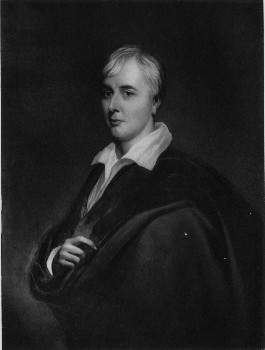
 George Henry Borrow
From a painting by Henry Wyndham Phillips
Project Gutenberg's George Borrow and His Circle, by Clement King Shorter

This eBook is for the use of anyone anywhere at no cost and with
almost no restrictions whatsoever.  You may copy it, give it away or
re-use it under the terms of the Project Gutenberg License included
with this eBook or online at www.gutenberg.org


Title: George Borrow and His Circle
       Wherein May Be Found Many Hitherto Unpublished Letters Of
              Borrow And His Friends

Author: Clement King Shorter

Release Date: November 12, 2006 [EBook #19767]

Language: English

Character set encoding: ISO-8859-1

*** START OF THIS PROJECT GUTENBERG EBOOK GEORGE BORROW AND HIS CIRCLE ***


Produced by The Online Distributed Proofreading Team at
http://www.pgdp.net. (This file was produced from images
generously made available by The Internet Archive/Million
Book Project).
George Henry Borrow
BOSTON AND NEW YORK
HOUGHTON MIFFLIN COMPANY
1913
Transcriber's Notes: Minor typos have been corrected. There is Persian and Russian writing in this book, which have been marked as [Persian] or as [Russian]. In this text, full page illustrations used the same page number as the previous non illustration page, so, for example, there were two page 16. I have added an a after the illustration page number for the sake of clarity.
I have to express my indebtedness first of all to the executors of Henrietta MacOubrey, George Borrow's stepdaughter, who kindly placed Borrow's letters and manuscripts at my disposal. To the survivor of these executors, a lady who resides in an English provincial town, I would particularly wish to render fullest acknowledgment did she not desire to escape all publicity and forbid me to give her name in print. I am indebted to Sir William Robertson Nicoll without whose kindly and active intervention I should never have taken active steps to obtain the material to which this biography owes its principal value. I am under great obligations to Mr. Herbert Jenkins, the publisher, in that, although the author of a successful biography of Borrow, he has, with rare kindliness, brought me into communication with Mr. Wilfrid J. Bowring, the grandson of Sir John Bowring. To Mr. Wilfrid Bowring I am indebted in that he has handed to me the whole of Borrow's letters to his grandfather. I have to thank Mr. James Hooper of Norwich for the untiring zeal with which he has unearthed for me a valuable series of notes including[Pg vi] certain interesting letters concerning Borrow. Mr. Hooper has generously placed his collection, with which he at one time contemplated writing a biography of Borrow, in my hands. I thank Dr. Aldis Wright for reading my chapter on Edward FitzGerald; also Mr. W.H. Peet, Mr. Aleck Abrahams, and Mr. Joseph Shaylor for assistance in the little known field of Sir Richard Phillips's life. I have further to thank my friends, Edward Clodd and Thomas J. Wise, for reading my proof-sheets. To Theodore Watts-Dunton, an untiring friend of thirty years, I have also to acknowledge abundant obligations.
C. K. S.
| Preface, | v |
| Introduction, | xv |
| CHAPTER I | |
| CAPTAIN BORROW OF THE WEST NORFOLK MILITIA, | 1 |
| CHAPTER II | |
| BORROW'S MOTHER, | 12 |
| CHAPTER III | |
| JOHN THOMAS BORROW, | 18 |
| CHAPTER IV | |
| A WANDERING CHILDHOOD, | 36 |
| CHAPTER V | |
| GEORGE BORROW'S NORWICH—THE GURNEYS, | 54 |
| CHAPTER VI | |
| GEORGE BORROW'S NORWICH—THE TAYLORS, | 63 |
| CHAPTER VII | |
| GEORGE BORROW'S NORWICH—THE GRAMMAR SCHOOL, | 70 |
| CHAPTER VIII | |
| GEORGE BORROW'S NORWICH—THE LAWYER'S OFFICE, | 79 |
| CHAPTER IX | |
| SIR RICHARD PHILLIPS, | 87 |
| CHAPTER X | |
| 'FAUSTUS' AND 'ROMANTIC BALLADS,' | 101 |
| CHAPTER XI | |
| 'CELEBRATED TRIALS' AND JOHN THURTELL, | 112 |
| CHAPTER XII | |
| BORROW AND THE FANCY, | 126 |
| CHAPTER XIII | |
| EIGHT YEARS OF VAGABONDAGE, | 133 |
| CHAPTER XIV | |
| SIR JOHN BOWRING, | 138 |
| CHAPTER XV | |
| BORROW AND THE BIBLE SOCIETY, | 153 |
| CHAPTER XVI | |
| ST. PETERSBURG AND JOHN P. HASFELD, | 162 |
| CHAPTER XVII | |
| THE MANCHU BIBLE—'TARGUM'—'THE TALISMAN,' | 169 |
| CHAPTER XVII | |
| THREE VISITS TO SPAIN, | 179 |
| CHAPTER XIX | |
| BORROW'S SPANISH CIRCLE, | 201 |
| CHAPTER XX | |
| MARY BORROW, | 215 |
| CHAPTER XXI | |
| 'THE CHILDREN OF THE OPEN AIR,' | 226 |
| CHAPTER XXII | |
| 'THE BIBLE IN SPAIN,' | 237 |
| CHAPTER XXIII | |
| RICHARD FORD, | 248 |
| CHAPTER XXIV | |
| IN EASTERN EUROPE, | 260 |
| CHAPTER XXV | |
| 'LAVENGRO,' | 275 |
| CHAPTER XXVI | |
| A VISIT TO CORNISH KINSMEN, | 289 |
| CHAPTER XXVII | |
| IN THE ISLE OF MAN, | 296 |
| CHAPTER XXVIII | |
| OULTON BROAD AND YARMOUTH, | 304 |
| CHAPTER XXIX | |
| IN SCOTLAND AND IRELAND, | 320 |
| CHAPTER XXX | |
| 'THE ROMANY RYE,' | 341 |
| CHAPTER XXXI | |
| EDWARD FITZGERALD, | 350 |
| CHAPTER XXXII | |
| 'WILD WALES,' | 364 |
| CHAPTER XXXIII | |
| LIFE IN LONDON, | 379 |
| CHAPTER XXXIV | |
| FRIENDS OF LATER YEARS, | 389 |
| CHAPTER XXXV | |
| BORROW'S UNPUBLISHED WRITINGS, | 401 |
| CHAPTER XXXVI | |
| HENRIETTA CLARKE, | 413 |
| CHAPTER XXXVII | |
| THE AFTERMATH, | 434 |
| INDEX, | 439 |
| George Borrow, | Frontispiece |
| A photogravure portrait from the painting by Henry Wyndham Phillips. | |
| PAGE | |
| The Borrow House, Norwich, | 16 |
| Robert Hawkes, Mayor of Norwich in 1824, | 24 |
| From the painting by Benjamin Haydon in St. Andrew's Hall, Norwich. | |
| George Borrow, | 32 |
| From a portrait by his brother, John Thomas Borrow, in the National Portrait Gallery, London. | |
| The Erpingham Gate and the Grammar School, Norwich | 72 |
| William Simpson, | 80 |
| From a portrait by Thomas Phillips, R.A., in the Black Friars Hall, Norwich. | |
| Friends of Borrow's Early Years— | |
| Sir John Bowring in 1826, | 96 |
| John P. Hasfeld in 1835, | 96 |
| William Taylor, | 96 |
| Sir Richard Phillips, | 96 |
| The Family of Jasper Petulengro, | 128 |
| Where Borrow Lived in Madrid, | 192 |
| The Calle del Principe, Madrid, | 192 |
| A hitherto Unpublished Portrait of George Borrow, | 304 |
| Taken in the garden of Mrs. Simms Reeve of Norwich in 1848. | |
| Oulton Cottage from the Broad, | 352 |
| The Summer-House, Oulton, as it is to-day, | 352 |
| George Borrow's Birthplace at Dumpling Green, | 35 |
| From a Drawing by Fortunino Matania. | |
| Title-Pages of 'Targum' and 'The Talisman,' | 178 |
| Portion of a Letter From George Borrow To the Rev. Samuel Brandram, | 187 |
| Written From Madrid, 13th May 1838. | |
| Facsimile of an Account of George Borrow's Expenses in Spain made out by the Bible Society, | 190 |
| A Letter from Sir George Villiers, afterwards Earl of Clarendon, British Minister to Spain, to George Borrow, | 211 |
| Mrs. Borrow's Copy of her Marriage Certificate, | 222 |
| An Application for a Book in the British Museum, with Borrow's Signature, | 230 |
| A Shekel, | 244 |
| Title-Page of Basque Translation by Oteiza of the Gospel of St. Luke, | 247 |
| Title-Page of First Edition of Romany Translation of the Gospel of St. Luke, | 247 |
| Two Pages From Borrow's Corrected Proof Sheets of Romany Translation of the Gospel of St. Luke, | 247 |
| Inscriptions in Borrow's Handwriting on his Wife's Copies Of 'The Bible in Spain' and 'Lavengro,' | 275 |
| The Original Title-Page of 'Lavengro,' | 280 |
| From the Manuscript in the possession of the Author of 'George Borrow and his Circle.' | |
| Facsimile of the First Page of 'Lavengro,' | 282 |
| From the Manuscript in the possession of the Author of 'George Borrow and his Circle.' | |
| Runic Stone From the Isle of Man, | 302 |
| Facsimile of a Communication from Charles Darwin to George Borrow, | 318 |
| Facsimile of a Page of the Manuscript of 'The Romany Rye,' | 346 |
| From the Borrow Papers in the possession of the Author of 'George Borrow and his Circle.' | |
| 'Wild Wales' in its Beginnings, | 365 |
| Two pages from one of George Borrow's Pocket-books with pencilled notes made on his journey through Wales. | |
| Facsimile of the Title-Page of 'Wild Wales,' | 368 |
| From the original Manuscript in the possession of the Author of 'George Borrow and his Circle.' | |
| Facsimile of the First Page of 'Wild Wales,' | 370 |
| From the original Manuscript in the possession of the Author of 'George Borrow and his Circle.' | |
| Facsimile of a Poem from 'Targum,' | 403 |
| A Translation from the French by George Borrow. | |
| Borrow as a Professor of Languages—an Advertisement, | 409 |
| A Page of the Manuscript of Borrow's 'Songs of Scandinavia'—an unpublished work, | 411 |
| A Letter from Borrow to his Wife written from Rome in his Continental Journey of 1844, | 418 |
It is now exactly seventeen years ago since I published a volume not dissimilar in form to this under the title of Charlotte Brontë and her Circle. The title had then an element of novelty, Dante Gabriel Rossetti's Dante and his Circle, at the time the only book of this particular character, having quite another aim. There are now some twenty or more biographies based upon a similar plan.[1] The method has its convenience where there are earlier lives of a given writer, as one can in this way differentiate the book from previous efforts by making one's hero stand out among his friends. Some such apology, I feel, is necessary, because, in these days of the multiplication of books, every book, at least other than a work of imagination, requires ample apology. In Charlotte Brontë and her Circle I was able to claim that, even though following in the footsteps of Mrs. Gaskell, I had added some four hundred new letters by Charlotte Brontë to the world's knowledge of that interesting woman, and still more considerably enlarged our knowledge of her sister Emily. This achievement has been generously acknowledged, and I am most proud of the testimony of the most accomplished of living biographers, Sir George Otto Trevelyan, who once rendered me the following quite spontaneous tribute:[Pg xvi]
We have lately read aloud for the second time your Brontë book; let alone private readings. It is unique in plan and excellence, and I am greatly obliged to you for it. Apart from the pleasure of the book, the form of it has always interested me as a professional biographer. It certainly is novel; and in this case I am pretty sure that it is right.
With such a testimony before me I cannot hesitate to present my second biography in similar form. In the case of George Borrow, however, I am not in a position to supplement one transcendent biography, as in the case of Charlotte Brontë and Mrs. Gaskell. I have before me no less than four biographies of Borrow, every one of them of distinctive merit. These are:
Life, Writings, and Correspondence of George Borrow. Derived from Official and other Authentic Sources. By William I. Knapp, Ph.D., LL.D. 2 vols. John Murray, 1899.
George Borrow: The Man and his Work. By R. A. J. Walling. Cassell, 1908.
The Life of George Borrow. Compiled from Unpublished Official Documents. His Works, Correspondence, etc. By Herbert Jenkins. John Murray, 1912.
George Borrow: The Man and his Books. By Edward Thomas. Chapman and Hall, 1912.
All of these books have contributed something of value and importance to the subject. Dr. Knapp's work it is easiest to praise because he is dead.[2] His biography of Borrow was the effort of a lifetime. A scholar with great linguistic qualifications for writing the biography of an author whose knowledge of languages was one of[Pg xvii] his titles to fame, Dr. Knapp spared neither time nor money to achieve his purpose. Starting with an article in The Chautauquan Magazine in 1887, which was reprinted in pamphlet form, Dr. Knapp came to England—to Norwich—and there settled down to write a Life of Borrow, which promised at one time to develop into several volumes. As well it might, for Dr. Knapp reached Norfolk at a happy moment for his purpose. Mrs. MacOubrey, Borrow's stepdaughter, was in the humour to sell her father's manuscripts and books. They were offered to the city of Norwich; there was some talk of Mr. Jeremiah Coleman, M.P., whose influence and wealth were overpowering in Norwich at the time, buying them. Finally, a very considerable portion of the collection came into the hands of Mr. Webber, a bookseller of Ipswich, who later became associated with the firm of Jarrold of Norwich. From Webber Dr. Knapp purchased the larger portion, and, as his bibliography indicates (Life, vol. ii. pp. 355-88), he became possessed of sundry notebooks which furnish a record of certain of Borrow's holiday tours, about a hundred letters from and to Borrow, and a considerable number of other documents. The result, as I have indicated, was a book that abounded in new facts and is rich in new material. It was not, however, a book for popular reading. You must love the subject before you turn to this book with any zest. It is a book for your true Borrovian, who is thankful for any information about the word-master, not for the casual reader, who might indeed be alienated from the subject by this copious memoir. The result was somewhat discouraging. There were not enough of true Borrovians in those years, and the book was not received too generously. The two volumes have gone out of[Pg xviii] print and have not reached a second edition. Time however, will do them justice. As it is, your good Borrow lover has always appreciated their merits. Take Lionel Johnson for example, a good critic and a master of style. After saying that these 'lengthy and rich volumes are a monument of love's labour, but not of literary art or biographical skill,' he adds: 'Of his over eight hundred pages there is not one for which I am not grateful' and every new biographer of Borrow is bound to re-echo that sentiment. Dr. Knapp did the spade work and other biographers have but entered into his inheritance. Dr. Knapp's fine collection of Borrow books and manuscripts was handed over by his widow to the American nation—to the Hispanic Society of New York. Dr. Knapp's biography was followed nine years later by a small volume by Mr. R. A. J. Walling, whose little book adds considerably to our knowledge of Borrow's Cornish relatives, and is in every way a valuable monograph on the author of Lavengro. Mr. Herbert Jenkins's book is more ambitious. Within four hundred closely printed pages he has compressed every incident in Borrow's career, and we would not quarrel with him nor his publisher for calling his life a 'definitive biography' if one did not know that there is not and cannot be anything 'definitive' about a biography except in the case of a Master. Boswell, Lockhart, Mrs. Gaskell are authors who had the advantage of knowing personally the subjects of their biographies. Any biographer who has not met his hero face to face and is dependent solely on documents is crippled in his undertaking. Moreover, such a biographer is always liable to be in a manner superseded or at least supplemented by the appearance of still more documents. However, Mr. Jenkins's excellent biography has the[Pg xix] advantage of many new documents from Mr. John Murray's archives and from the Record Office Manuscripts. His work was the first to make use of the letters of George Borrow to the Bible Society, which the Rev. T. H. Darlow has published as a book under that title, a book to which I owe him an acknowledgment for such use of it as I have made, as also for permission to reproduce the title-page of Borrow's Basque version of St. Luke's gospel. There only remains for me to say a word in praise of Mr. Edward Thomas's fine critical study of Borrow which was published under the title of George Borrow: The Man and his Books. Mr. Thomas makes no claim to the possession of new documents. This brings me to such excuse as I can make for perpetrating a fifth biography. When Mrs. MacOubrey, Borrow's stepdaughter, the 'Hen.' of Wild Wales and the affectionate companion of his later years, sold her father's books and manuscripts—and she always to her dying day declared that she had no intention of parting with the manuscripts, which were, she said, taken away under a misapprehension—she did not, of course, part with any of his more private documents. All the more intimate letters of Borrow were retained. At her death these passed to her executors, from whom I have purchased all legal rights in the publication of Borrow's hitherto unpublished manuscripts and letters. I trust that even to those who may disapprove of the discursive method with which—solely for my own pleasure—I have written this book, will at least find a certain biographical value in the many new letters by and to George Borrow that are to be found in its pages. The book has taken me ten years to write, and has been a labour of love.
[1] As for example, Garrick and his Circle; Johnson and his Circle; Reynolds and his Circle; and even The Empress Eugénie and her Circle.
[2] William Ireland Knapp died in Paris in June 1908, aged seventy-four. He was an American, and had held for many years the Chair of Modern Languages at Vassar College. After eleven years in Spain he returned to occupy the Chair of Modern Languages at Yale, and later held a Professorship at Chicago. After his Life of Borrow was published he resided in Paris until his death.
George Henry Borrow was born at Dumpling Green near East Dereham, Norfolk, on the 5th of July 1803. It pleased him to state on many an occasion that he was born at East Dereham.
On an evening of July, in the year 18—, at East D——, a beautiful little town in a certain district of East Anglia, I first saw the light,
he writes in the opening lines of Lavengro, using almost the identical phraseology that we find in the opening lines of Goethe's Wahrheit und Dichtung. Here is a later memory of Dereham from Lavengro:
What it is at present I know not, for thirty years and more have elapsed since I last trod its streets. It will scarcely have improved, for how could it be better than it was? I love to think on thee, pretty, quiet D——, thou pattern of an English country town, with thy clean but narrow streets branching out from thy modest market-place, with their old-fashioned houses, with here and there a roof of venerable thatch, with thy one half-aristocratic mansion, where resided the Lady Bountiful—she, the generous and kind, who loved to visit the sick, leaning on her golden-headed cane, while the sleek old footman walked at a respectful distance behind. Pretty, quiet D——, with thy venerable church, in which moulder the mortal remains of England's sweetest and most pious bard.
Then follows an exquisite eulogy of the poet Cowper, which readers of Lavengro know full well. Three years before Borrow was born William Cowper died in this very town, leaving behind him so rich a legacy of poetry and of prose, and moreover so fragrant a memory of a life in which humour and pathos played an equal part. It was no small thing for a youth who aspired to any kind of renown to be born in the neighbourhood of the last resting-place of the author of The Task.
Yet Borrow was not actually born in East Dereham, but a mile and a half away, at the little hamlet of Dumpling Green, in what was then a glorious wilderness of common and furze bush, but is now a quiet landscape of fields and hedges. You will find the home in which the author of Lavengro first saw the light without much difficulty. It is a fair-sized farm-house, with a long low frontage separated from the road by a considerable strip of garden. It suggests a prosperous yeoman class, and I have known farm-houses in East Anglia not one whit larger dignified by the name of 'hall.' Nearly opposite is a pond. The trim hedges are a delight to us to-day, but you must cast your mind back to a century ago when they were entirely absent. The house belonged to George Borrow's maternal grandfather, Samuel Perfrement, who farmed the adjacent land at this time. Samuel and Mary Perfrement had eight children, the third of whom, Ann, was born in 1772.
In February 1793 Ann Perfrement, aged twenty-one, married Thomas Borrow, aged thirty-five, in the Parish Church of East Dereham, and of the two children that were born to them George Henry Borrow was the younger. Thomas Borrow was the son of one John Borrow of St. Cleer in Cornwall, who[Pg 3] died before this child was born, and is described by his grandson[3] as the scion 'of an ancient but reduced Cornish family,[Pg 4] tracing descent from the de Burghs, and entitled to carry their arms.' This claim, of which I am thoroughly sceptical, is endorsed by Dr. Knapp,[4] who, however, could find no trace of the family earlier than [Pg 5]1678, the old parish registers having been destroyed. When Thomas Borrow was born the family were in any case nothing more than small farmers, and Thomas Borrow and his brothers were working on the land in the intervals of attending the parish school. At the age of eighteen Thomas was apprenticed to a maltster at Liskeard, and about this time he joined the local Militia. Tradition has it that his career as a maltster was cut short by his knocking his master down in a scrimmage. The victor fled from the scene of his prowess, and enlisted as a private soldier in the Coldstream Guards. This was in 1783, and in 1792 he was transferred to the West Norfolk Militia; hence his appearance at East Dereham, where, now a serjeant, his occupations for many a year were recruiting and drilling.[5] It is recorded that at a theatrical performance at East Dereham he first saw, presumably on the stage of the county-hall, his future wife—Ann Perfrement. She was, it seems, engaged in a minor part in a travelling company, not, we may assume, altogether with the sanction of her father, who, in spite of his inheritance of French blood, doubtless shared the then very strong English prejudice against the stage. However, Ann was[Pg 6] one of eight children, and had, as we shall find in after years, no inconsiderable strength of character, and so may well at twenty years of age have decided upon a career for herself. In any case we need not press too hard the Cornish and French origin of George Borrow to explain his wandering tendencies, nor need we wonder at the suggestion of Nathaniel Hawthorne, that he was 'supposed to be of gypsy descent by the mother's side.' You have only to think of the father, whose work carried him from time to time to every corner of England, Scotland, and Ireland, and of the mother with her reminiscence of life in a travelling theatrical company, to explain in no small measure the glorious vagabondage of George Borrow.
Behold then Thomas Borrow and Ann Perfrement as man and wife, he being thirty-five years of age, she twenty-one. A roving, restless life was in front of the pair for many a day, the West Norfolk Militia being stationed in some eight or nine separate towns within the interval of ten years between Thomas Borrow's marriage and his second son's birth. The first child, John Thomas Borrow, was born on the 15th April 1801.[6] The second son, George Henry Borrow, the subject of this memoir, was born in his grandfather's house at Dumpling Green, East Dereham, his mother having found a natural refuge with her father while her husband was busily recruiting in Norfolk. The two children passed with their parents from place to place, and in 1809 we find them once again in East[Pg 7] Dereham. From his son's two books, Lavengro and Wild Wales, we can trace the father's later wanderings until his final retirement to Norwich on a pension. In 1810 the family were at Norman Cross in Huntingdonshire, when Captain Borrow had to assist in guarding the French prisoners of war; for it was the stirring epoch of the Napoleonic conflict, and within the temporary prison 'six thousand French and other foreigners, followers of the Grand Corsican, were now immured.'
What a strange appearance had those mighty casernes, with their blank blind walls, without windows or grating, and their slanting roofs, out of which, through orifices where the tiles had been removed, would be protruded dozens of grim heads, feasting their prison-sick eyes on the wide expanse of country unfolded from that airy height. Ah! there was much misery in those casernes; and from those roofs, doubtless, many a wistful look was turned in the direction of lovely France. Much had the poor inmates to endure, and much to complain of, to the disgrace of England be it said—of England, in general so kind and bountiful. Rations of carrion meat, and bread from which I have seen the very hounds occasionally turn away, were unworthy entertainment even for the most ruffian enemy, when helpless and a captive; and such, alas! was the fare in those casernes.
But here we have only to do with Thomas Borrow, of whom we get many a quaint glimpse in Lavengro, our first and our last being concerned with him in the one quality that his son seems to have inherited, as the associate of a prize-fighter—Big Ben Brain. Borrow records in his opening chapter that Ben Brain and his father met in Hyde Park probably in 1790, and that after an hour's conflict 'the champions shook hands and retired, each having experienced quite enough of the other's prowess.' Borrow further relates that four months afterwards Brain 'died in the arms of my father, who read to him the Bible in his last[Pg 8] moments.' Dr. Knapp finds Borrow in one of his many inaccuracies or rather 'imaginings' here, as Brain did not die until 1794. More than once in his after years the old soldier seems to have had a shy pride in that early conflict, although the piety which seems to have come to him with the responsibilities of wife and children led him to count any recalling of the episode as a 'temptation.' When Borrow was about thirteen years of age, he overheard his father and mother discussing their two boys, the elder being the father's favourite and George the mother's:
'I will hear nothing against my first-born,' said my father, 'even in the way of insinuation: he is my joy and pride; the very image of myself in my youthful days, long before I fought Big Ben, though perhaps not quite so tall or strong built. As for the other, God bless the child! I love him, I'm sure; but I must be blind not to see the difference between him and his brother. Why, he has neither my hair nor my eyes; and then his countenance! why, 'tis absolutely swarthy, God forgive me! I had almost said like that of a gypsy, but I have nothing to say against that; the boy is not to be blamed for the colour of his face, nor for his hair and eyes; but, then, his ways and manners!—I confess I do not like them, and that they give me no little uneasiness.'[7]
Borrow throughout his narrative refers to his father as 'a man of excellent common sense,' and he quotes the opinion of William Taylor, who had rather a bad reputation as a 'freethinker' with all the church-going citizens of Norwich, with no little pride. Borrow is of course the 'young man' of the dialogue. He was then eighteen years of age:
'Not so, not so,' said the young man eagerly; 'before I knew you I knew nothing, and am still very ignorant; but of late my[Pg 9] father's health has been very much broken, and he requires attention; his spirits also have become low, which, to tell you the truth, he attributes to my misconduct. He says that I have imbibed all kinds of strange notions and doctrines, which will, in all probability, prove my ruin, both here and hereafter; which—which——'
'Ah! I understand,' said the elder, with another calm whiff. 'I have always had a kind of respect for your father, for there is something remarkable in his appearance, something heroic, and I would fain have cultivated his acquaintance; the feeling, however, has not been reciprocated. I met him the other day, up the road, with his cane and dog, and saluted him; he did not return my salutation.'
'He has certain opinions of his own,' said the youth, 'which are widely different from those which he has heard that you profess.'
'I respect a man for entertaining an opinion of his own,' said the elderly individual. 'I hold certain opinions; but I should not respect an individual the more for adopting them. All I wish for is tolerance, which I myself endeavour to practise. I have always loved the truth, and sought it; if I have not found it, the greater my misfortune.'[8]
When Borrow is twenty years of age we have another glimpse of father and son, the father in his last illness, the son eager as usual to draw out his parent upon the one subject that appeals to his adventurous spirit, 'I should like to know something about Big Ben,' he says:
'You are a strange lad,' said my father; 'and though of late I have begun to entertain a more favourable opinion than heretofore, there is still much about you that I do not understand. Why do you bring up that name? Don't you know that it is one of my temptations? You wish to know something about him? Well, I will oblige you this once, and then farewell to such vanities—something about him. I will tell you—his—skin when he flung off his clothes—and he had a particular knack in doing[Pg 10] so—his skin, when he bared his mighty chest and back for combat; and when he fought he stood, so—if I remember right—his skin, I say, was brown and dusky as that of a toad. Oh me! I wish my elder son was here!'
Concerning the career of Borrow's father there seem to be no documents other than one contained in Lavengro, yet no Life of Borrow can possibly he complete that does not draw boldly upon the son's priceless tributes. And so we come now to the last scene in the career of the elder Borrow—his death-bed—which is also the last page of the first volume of Lavengro. George Borrow's brother has arrived from abroad. The little house in Willow Lane, Norwich, contained the mother and her two sons sorrowfully awaiting the end, which came on 28th February 1824.
At the dead hour of night—it might be about two—I was awakened from sleep by a cry which sounded from the room immediately below that in which I slept. I knew the cry—it was the cry of my mother; and I also knew its import, yet I made no effort to rise, for I was for the moment paralysed. Again the cry sounded, yet still I lay motionless—the stupidity of horror was upon me. A third time, and it was then that, by a violent effort, bursting the spell which appeared to bind me, I sprang from the bed and rushed downstairs. My mother was running wildly about the room; she had awoke and found my father senseless in the bed by her side. I essayed to raise him, and after a few efforts supported him in the bed in a sitting posture. My brother now rushed in, and, snatching up a light that was burning, he held it to my father's face. 'The surgeon! the surgeon!' he cried; then, dropping the light, he ran out of the room, followed by my mother; I remained alone, supporting the senseless form of my father; the light had been extinguished by the fall, and an almost total darkness reigned in the room. The form pressed heavily against my bosom; at last methought it moved. Yes, I was right; there was a heaving of the breast, and then a gasping. Were those words which I heard? Yes, they were words, low and[Pg 11] indistinct at first, and then audible. The mind of the dying man was reverting to former scenes. I heard him mention names which I had often heard him mention before. It was an awful moment; I felt stupefied, but I still contrived to support my dying father. There was a pause; again my father spoke: I heard him speak of Minden, and of Meredith, the old Minden Serjeant, and then he uttered another name, which at one period of his life was much on his lips, the name of ——; but this is a solemn moment! There was a deep gasp: I shook, and thought all was over; but I was mistaken—my father moved, and revived for a moment; he supported himself in bed without my assistance. I make no doubt that for a moment he was perfectly sensible, and it was then that, clasping his hands, he uttered another name clearly, distinctly—it was the name of Christ. With that name upon his lips the brave old soldier sank back upon my bosom, and, with his hands still clasped, yielded up his soul.
Did Borrow's father ever really fight Big Ben Brain or Bryan in Hyde Park, or is it all a fantasy of the artist's imagining? We shall never know. Borrow called his Lavengro 'An Autobiography' at one stage of its inception, although he wished to repudiate the autobiographical nature of his story at another. Dr. Knapp in his anxiety to prove that Borrow wrote his own memoirs in Lavengro and Romany Rye tells us that he had no creative faculty—an absurd proposition. But I think we may accept the contest between Ben Brain and Thomas Borrow, and what a revelation of heredity that impressive death-bed scene may be counted. Borrow on one occasion in later life declared that his favourite hooks were the Bible and the Newgate Calendar. We know that he specialised on the Bible and Prize-Fighting in no ordinary fashion—and here we see his father on his death-bed struggling between the religious sentiments of his maturity and the one great worldly escapade of his early manhood.
[3] In the year 1870 Borrow was asked for material for a biography by the editor of Men of the Time, a publication which many years later was incorporated in the present Who's Who. He drew up two drafts in his own handwriting, which are so interesting, and yet vary so much in certain particulars, that we are tempted to print both here, or at least that part of the second draft that differs from the first. The concluding passages of both drafts are alike. The biography as it stands in the 1871 edition of Men of the Time appears to have been compiled from the earlier of these drafts. It must have been another copy of Draft No. 1 that was forwarded to the editor:
Draft I.—George Henry Borrow, born at East Dereham in the county of Norfolk in the early part of the present century. His father was a military officer, with whom he travelled about most parts of the United Kingdom. He was at some of the best schools in England, and also for about two years at the High School at Edinburgh. In 1818 he was articled to an eminent solicitor at Norwich, with whom he continued five years. He did not, however, devote himself much to his profession, his mind being much engrossed by philology, for which at a very early period he had shown a decided inclination, having when in Ireland acquired the Irish language. At the age of twenty he knew little of the law, but was well versed in languages, being not only a good classical scholar but acquainted with French, Italian, Spanish, all the Celtic and Gothic dialects, and also with the peculiar language of the English Romany Chals or Gypsies. This speech, which, though broken and scanty, exhibits evident signs of high antiquity, he had picked up amongst the wandering tribes with whom he had formed acquaintance on a wild heath near Norwich, where they were in the habit of encamping. At the expiration of his clerkship, which occurred shortly after the death of his father, he betook himself to London, and endeavoured to get a livelihood by literature. For some time he was a hack author. His health failing he left London, and for a considerable time lived a life of roving adventure. In the year 1833 he entered the service of he British and Foreign Bible Society, and being sent to Russia edited at Saint Petersburg the New Testament in the Manchu or Chinese Tartar. Whilst at Saint Petersburg he published a book called Targum, consisting of metrical translations from thirty languages. He was subsequently for some years agent of the Bible Society in Spain, where he was twice imprisoned for endeavouring to circulate the Gospel. In Spain he mingled much with the Calóre or Zincali, called by the Spaniards Gitanos or Gypsies, whose language he found to be much the same as that of the English Romany. At Madrid he edited the New Testament in Spanish, and translated the Gospel of Saint Luke into the language of the Zincali. Leaving the service of the Bible Society he returned to England in 1839, and shortly afterwards married a Suffolk lady. In 1841 he published The Zincali, or an account of the Gypsies of Spain, with a vocabulary of their language, which he proved to be closely connected with the Sanskrit. This work obtained almost immediately a European celebrity, and was the cause of many learned works being published on the continent on the subject of the Gypsies. In 1842 he gave to the world The Bible in Spain, or an account of an attempt to circulate the Gospel in the peninsula, a work which received a warm and eloquent eulogium from Sir Robert Peel in the House of Commons. In 1844 he was wandering amongst the Gypsies of Hungary, Walachia, and Turkey, gathering up the words of their respective dialects of the Romany, and making a collection of their songs. In 1851 he published Lavengro, in which he gives an account of his early life, and in 1857 The Romany Rye, a sequel to the same. His latest publication is Wild Wales. He has written many other works, some of which are not yet published. He has an estate in Suffolk, but spends the greater part of his time in wandering on foot through various countries.
* * * *
Draft II.—George Henry Borrow was born at East Dereham in the county of Norfolk on the 5th July 1803. His father, Thomas Borrow, who died captain and adjutant of the West Norfolk Militia, was of an ancient but reduced Cornish family, tracing descent from the de Burghs, and entitled to carry their arms. His mother, Ann Perfrement, was a native of Norfolk, and descended from a family of French Protestants banished from France on the revocation of the edict of Nantes. He was the youngest of two sons. His brother, John Thomas, who was endowed with various and very remarkable talents, died at an early age in Mexico. Both the brothers had the advantage of being at some of the first schools in Britain. The last at which they were placed was the Grammar School at Norwich, to which town their father came to reside at the termination of the French war. In the year 1818 George Borrow was articled to an eminent solicitor in Norwich, with whom he continued five years. He did not devote himself much to his profession, his mind being engrossed by another and very different subject—namely philology, for which at a very early period he had shown a decided inclination, having when in Ireland with his father acquired the Irish language. At the expiration of his clerkship he knew little of the law, but was well versed in languages, being not only a good Greek and Latin scholar, but acquainted with French, Italian, and Spanish, all the Celtic and Gothic dialects, and likewise with the peculiar language of the English Romany Chals or Gypsies. This speech or jargon, amounting to about eleven hundred and twenty-seven words, he had picked up amongst the wandering tribes with whom he had formed acquaintance on Mousehold, a wild heath near Norwich, where they were in the habit of encamping. By the time his clerkship was expired his father was dead, and he had little to depend upon but the exercise of his abilities such as they were. In 1823 he betook himself to London, and endeavoured to obtain a livelihood by literature. For some time he was a hack author, doing common work for booksellers. For one in particular he prepared an edition of the Newgate Calendar, from the careful study of which he has often been heard to say that he first learned to write genuine English. His health failed, he left London, and for a considerable time he lived a life of roving adventure.
[4] Knapp's Life of Borrow, vol. i. p. 6.
[5] The writer recalls at his own school at Downham Market in Norfolk an old Crimean Veteran—Serjeant Canham—drilling the boys each week, thus supplementing his income precisely in the same manner as did Serjeant Borrow.
[6] The date has always hitherto been wrongly given. I find it in one of Ann Borrow's notebooks, but although every vicar of every parish in Chelmsford and Colchester has searched the registers for me, with agreeable courtesy, I cannot discover a record of John's birthplace, and am compelled to the belief that Dr. Knapp was wrong in suggesting one or other of these towns.
[7] Lavengro, ch. xiv.
[8] Lavengro, ch. xxiii.
Throughout his whole life George Borrow adored his mother, who seems to have developed into a woman of great strength of character far remote from the pretty play-actor who won the heart of a young soldier at East Dereham in the last years of the eighteenth century. We would gladly know something of the early years of Ann Perfrement. Her father was a farmer, whose farm at Dumpling Green we have already described. He did not, however, 'farm his own little estate' as Borrow declared. The grandfather—a French Protestant—came, if we are to believe Borrow, from Caen in Normandy after the Revocation of the Edict of Nantes, but there is no documentary evidence to support the contention. However, the story of the Huguenot immigration into England is clearly bound up with Norwich and the adjacent district. And so we may well take the name of 'Perfrement' as conclusive evidence of a French origin, and reject as utterly untenable the not unnatural suggestion of Nathaniel Hawthorne, that Borrow's mother was 'of gypsy descent.'[9] She was one of the eight children of Samuel[Pg 13] and Mary Perfrement, all of whom seem to have devoted their lives to East Anglia.[10] We owe to Dr. Knapp's edition of Lavengro one exquisite glimpse of Ann's girlhood that is not in any other issue of the book. Ann's elder sister, curious to know if she was ever to be married, falls in with the current superstition that she must wash her linen and 'watch' it drying before the fire between eleven and twelve at night. Ann Perfrement was ten years old at the time. The two girls walked over to East Dereham, purchased the necessary garment, washed it in the pool near the house that may still be seen, and watched and watched. Suddenly when the clock struck twelve they heard, or thought they heard, a footstep on the path, the wind howled, and the elder sister sprang to the door, locked and bolted it, and then fell in convulsions on the floor. The superstition, which Borrow seems to have told his mother had a Danish origin, is common enough in Ireland and in Celtic lands. It could scarcely have been thus rehearsed by two Norfolk children had they not had the blood of a more imaginative race in their veins. In addition to this we find more than one effective glimpse of Borrow's mother in Lavengro. We have already noted the episode in which she takes the side of her younger boy against her husband, with whom John was the favourite. We meet her again in the following dialogue, with its pathetic allusions to Dante and to the complaint—a kind of nervous exhaustion which he called 'the horrors'—that was to trouble Borrow all his days:[Pg 14]
'What ails you, my child?' said a mother to her son, as he lay on a couch under the influence of the dreadful one; 'what ails you? you seem afraid!'
Boy. And so I am; a dreadful fear is upon me.
Mother. But of what? there is no one can harm you; of what are you apprehensive?
Boy. Of nothing that I can express. I know not what I am afraid of, but afraid I am.
Mother. Perhaps you see sights and visions. I knew a lady once who was continually thinking that she saw an armed man threaten her, but it was only an imagination, a phantom of the brain.
Boy. No armed man threatens me; and 'tis not a thing like that would cause me any fear. Did an armed man threaten me I would get up and fight him; weak as I am, I would wish for nothing better, for then, perhaps, I should lose this fear; mine is a dread of I know not what, and there the horror lies.
Mother. Your forehead is cool, and your speech collected. Do you know where you are?
Boy. I know where I am, and I see things just as they are; you are beside me, and upon the table there is a book which was written by a Florentine; all this I see, and that there is no ground for being afraid. I am, moreover, quite cool, and feel no pain—but, but——
And then there was a burst of 'gemiti, sospiri ed alti guai.' Alas, alas, poor child of clay! as the sparks fly upward, so wast thou born to sorrow—Onward![11]
Our next glimpse of Mrs. Borrow is when after his father's death George had shouldered his knapsack and made his way to London to seek his fortune by literature. His elder brother had remained at home, determined upon being a painter, but joined George in[Pg 15] London, leaving the widowed mother momentarily alone in Norwich.
'And how are things going on at home?' said I to my brother, after we had kissed and embraced. 'How is my mother, and how is the dog?'
'My mother, thank God, is tolerably well,' said my brother, 'but very much given to fits of crying. As for the dog, he is not so well; but we will talk more of these matters anon,' said my brother, again glancing at the breakfast things. 'I am very hungry, as you may suppose, after having travelled all night.'
Thereupon I exerted myself to the best of my ability to perform the duties of hospitality, and I made my brother welcome—I may say more than welcome; and when the rage of my brother's hunger was somewhat abated, we recommenced talking about the matters of our little family, and my brother told me much about my mother; he spoke of her fits of crying, but said that of late the said fits of crying had much diminished, and she appeared to be taking comfort; and, if I am not much mistaken, my brother told me that my mother had of late the prayer-book frequently in her hand, and yet oftener the Bible.[12]
Ann Borrow lived in Willow Lane, Norwich, for thirty-three years. That Borrow was a devoted husband these pages will show. He was also a devoted son. When he had made a prosperous marriage he tried hard to persuade his mother to live with him at Oulton, but all in vain. She had the wisdom to see that such an arrangement is rarely conducive to a son's domestic happiness. She continued to live in the little cottage made sacred by many associations until almost the end of her days. Here she had lived in earlier years with her husband and her two ambitious boys, and in Norwich, doubtless, she had made her own friendships, although of these no record remains. The cottage still stands in its modest court, but is[Pg 16] at the moment untenanted. There is a letter extant from Cecilia Lucy Brightwell, who wrote The Life of Mrs. Opie, to Mary Borrow at Oulton, when Mrs. Borrow the elder had gone to live there, which records the fact that in 1851, two years after Mrs. Borrow had left the cottage in Willow Lane, it had already changed its appearance. Mrs. Brightwell writes:
Give my kind love to dear mother. Tell her I went past her house to-day and looked up the court. It is quite changed: all the trees and the ivy taken away.
The house was the property of Thomas King, a carpenter. You enter from Willow Lane through a covered passage into what was then known as King's Court. Here the little house faces you, and you meet it with a peculiarly agreeable sensation, recalling more than one incident in Lavengro that transpired there. In 1897 the then mayor made the one attempt of his city of a whole half century to honour Borrow by calling this court Borrow's Court—thereby conferring a ridiculously small distinction upon Borrow,[13] and removing a landmark connected with one of its own worthy citizens. For Thomas King, the carpenter, was in direct descent in the maternal line from the family of Parker, which gave to Norwich one of its most distinguished sons in the famous Archbishop of Queen Elizabeth's day. He extended his business as carpenter sufficiently to die a prosperous builder. Of his two sons one, also named Thomas, became physician to Prince Talleyrand, and married a sister of John Stuart Mill.[14] All this by the way, but there is little more to record of Borrow's mother apart from the letters addressed to her by her son, which occur in their due place in these records. Yet one little memorandum among my papers which bears Mrs. Borrow's signature may well find place here:
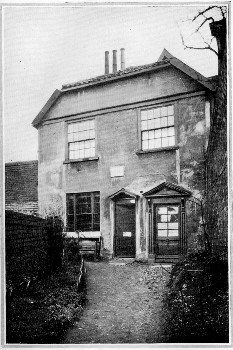 THE BORROW HOUSE, NORWICH
In the year 1797 I was at Canterbury. One night at about one o'clock Sir Robert Laurie and Captain Treve came to our lodgings and tapped at our bedroom door, and told my husband to get up, and get the men under arms without beat of drum as soon as possible, for that there was a mutiny at the Nore. My husband did so, and in less than two hours they had marched out of town towards Sheerness without making any noise. They had to break open the store-house in order to get provender, because the Quartermaster, Serjeant Rowe, was out of the way. The Dragoon Guards at that time at Canterbury were in a state of mutiny.
Ann Borrow.
[9] 24th May 1856. Dining at Mr. Rathbone's one evening last week (21st May), it was mentioned that Borrow, author of The Bible in Spain, is supposed to be of gypsy descent by the mother's side. Hereupon Mr. Martineau mentioned that he had been a schoolfellow of Borrow, and though he had never heard of his gypsy blood, he thought it probable, from Borrow's traits of character. He said that Borrow had once run away from school, and carried with him a party of other boys, meaning to lead a wandering life (The English Notebooks of Nathaniel Hawthorne, vol. ii. 1858).
[10] Samuel and Maria Perfrement were married in 1766, the latter to John Burcham. Two of her brothers survived Ann Borrow, Samuel Perfrement dying in 1864 and Philip in 1867.
[11] Lavengro, ch. xviii.
[12] Lavengro, ch. xxxvii.
[13] In May 1913 the Lord Mayor of Norwich (Mr. A. M. Samuel) purchased the Borrow house in Willow Lane for £375, and gave it to the city for the purpose of a Borrow Museum.
[14] This Thomas King was a cousin of my mother; his father built the Borrow House in Norwich in 1812. The only allusion to him I have ever seen in print is contained in a letter on Lavengro contributed by Thomas Burcham to The Britannia newspaper of June 26, 1851:—'With your criticism on Lavengro I cordially agree, and if you were disappointed in the long promised work, what must I have been? A schoolfellow of Borrow, who, in the autobiography, expected to find much interesting matter, not only relating to himself, but also to schoolfellows and friends—the associates of his youth, who, in after-life, gained no slight notoriety—amongst them may be named Sir James Brooke, Rajah of Sarawak; poor Stoddard, who was murdered at Bokhara, and who, as a boy, displayed that noble bearing and high sensitiveness of honour which partly induced that fatal result; and Thomas King, one of Borrow's early friends, who, the son of a carpenter at Norwich, the landlord of Lavengro's father, after working in his father's shop till nearly sixteen, went to Paris, entered himself as a student at one of the hospitals, and through his energy and intellect became internal surgeon of L'Hôtel Dieu and private physician to Prince Talleyrand.' Thomas Borrow Burcham was Magistrate of Southwark Police Court from 1856 till his death in 1869. He was the son of Maria Perfrement, Borrow's aunt.
John Thomas Borrow was born two years before his younger brother, that is, on the 15th April 1801. His father, then Serjeant Borrow, was wandering from town to town, and it is not known where his elder son first saw the light. John Borrow's nature was cast in a somewhat different mould from that of his brother. He was his father's pride. Serjeant Borrow could not understand George with his extraordinary taste for the society of queer people—the wild Irish and the ragged Romanies. John had far more of the normal in his being. Borrow gives us in Lavengro our earliest glimpse of his brother:
He was a beautiful child; one of those occasionally seen in England, and in England alone; a rosy, angelic face, blue eyes, and light chestnut hair; it was not exactly an Anglo-Saxon countenance, in which, by the by, there is generally a cast of loutishness and stupidity; it partook, to a certain extent, of the Celtic character, particularly in the fire and vivacity which illumined it; his face was the mirror of his mind; perhaps no disposition more amiable was ever found amongst the children of Adam, united, however, with no inconsiderable portion of high and dauntless spirit. So great was his beauty in infancy, that people, especially those of the poorer classes, would follow the nurse who carried him about in order to look at and bless his lovely face. At the age of three months an attempt was made to snatch him from his mother's arms in the streets of London, at[Pg 19] the moment she was about to enter a coach; indeed, his appearance seemed to operate so powerfully upon every person who beheld him, that my parents were under continual apprehension of losing him; his beauty, however, was perhaps surpassed by the quickness of his parts. He mastered his letters in a few hours, and in a day or two could decipher the names of people on the doors of houses and over the shop-windows.
John received his early education at the Norwich Grammar School, while the younger brother was kept under the paternal wing. Father and mother, with their younger boy George, were always on the move, passing from county to county and from country to country, as Serjeant Borrow, soon to be Captain, attended to his duties of drilling and recruiting, now in England, now in Scotland, now in Ireland. We are given a fascinating glimpse of John Borrow in Lavengro by way of a conversation between Mr. and Mrs. Borrow over the education of their children. It was agreed that while the family were in Edinburgh the boys should be sent to the High School, and so at the historic school that Sir Walter Scott had attended a generation before the two boys were placed, John being removed from the Norwich Grammar School for the purpose. Among his many prejudices of after years Borrow's dislike of Scott was perhaps the most regrettable, otherwise he would have gloried in the fact that their childhood had had one remarkable point in common. Each boy took part in the feuds between the Old Town and the New Town. Exactly as Scott records his prowess at 'the manning of the Cowgate Port,' and the combats maintained with great vigour, 'with stones, and sticks, and fisticuffs,' as set forth in the first volume of Lockhart, so we have not dissimilar feats set down in Lavengro. Side[Pg 20] by side also with the story of 'Green-Breeks,' which stands out in Scott's narrative of his school combats, we have the more lurid account by Borrow of David Haggart. Literary biography is made more interesting by such episodes of likeness and of contrast.
We next find John Borrow in Ireland with his father, mother, and brother. George is still a child, but he is precocious enough to be learning the language, and thus laying the foundation of his interest in little-known tongues. John is now an ensign in his father's regiment. 'Ah! he was a sweet being, that boy soldier, a plant of early promise, bidding fair to become in after time all that is great, good, and admirable.' Ensign John tells his little brother how pleased he is to find himself, although not yet sixteen years old, 'a person in authority with many Englishmen under me. Oh! these last six weeks have passed like hours in heaven.' That was in 1816, and we do not meet John again until five years later, when we hear of him rushing into the water to save a drowning man, while twenty others were bathing who might have rendered assistance. Borrow records once again his father's satisfaction:
'My boy, my own boy, you are the very image of myself, the day I took off my coat in the park to fight Big Ben,' said my father, on meeting his son, wet and dripping, immediately after his bold feat. And who cannot excuse the honest pride of the old man—the stout old man?
In the interval the war had ended, and Napoleon had departed for St. Helena. Peace had led to the pensioning of militia officers, or reducing to half-pay of the juniors. The elder Borrow had settled in Norwich. George was set to study at the Grammar School there,[Pg 21] while his brother worked in Old Crome's studio, for here was a moment when Norwich had its interesting Renaissance, and John Borrow was bent on being an artist. He had worked with Crome once before—during the brief interval that Napoleon was at Elba—but now he set to in real earnest, and we have evidence of a score of pictures by him that were catalogued In the exhibitions of the Norwich Society of Artists between the years 1817 and 1824. They include one portrait of the artist's father, and two of his brother George.[15] Old Crome died in 1821, and then John went to London to study under Haydon. Borrow declares that his brother had real taste for painting, and that 'if circumstances had not eventually diverted his mind from the pursuit, he would have attained excellence, and left behind him some enduring monument of his powers,' 'He lacked, however,' he tells us, 'one thing, the want of which is but too often fatal to the sons of genius, and without which genius is little more than a splendid toy in the hands of the possessor—perseverance, dogged perseverance.' It is when he is thus commenting on his brother's characteristics that Borrow gives his own fine if narrow eulogy of Old Crome. John Borrow seems to have continued his studies in London under Haydon for a year, and then to have gone to Paris to copy pictures at the[Pg 22] Louvre. He mentions a particular copy that he made of a celebrated picture by one of the Italian masters, for which a Hungarian nobleman paid him well. His three years' absence was brought to an abrupt termination by news of his father's illness. He returned to Norwich in time to stand by that father's bedside when he died. The elder Borrow died, as we have seen, in February 1824. The little home in King's Court was kept on for the mother, and as John was making money by his pictures it was understood that he should stay with her. On the 1st April, however, George started for London, carrying the manuscript of Romantic Ballads from the Danish to Sir Richard Phillips, the publisher. On the 29th of the same month he was joined by his brother John. John had come to London at his own expense, but in the interests of the Norwich Town Council. The council wanted a portrait of one of its mayors for St. Andrew's Hall—that Valhalla of Norwich municipal worthies which still strikes the stranger as well-nigh unique in the city life of England. The municipality would fain have encouraged a fellow-citizen, and John Borrow had been invited to paint the portrait. 'Why,' it was asked, 'should the money go into a stranger's pocket and be spent in London?' John, however, felt diffident of his ability and declined, and this in spite of the fact that the £100 offered for the portrait must have been very tempting. 'What a pity it was,' he said, 'that Crome was dead.' 'Crome,' said the orator of the deputation that had called on John Borrow,
'Crome; yes, he was a clever man, a very clever man, in his way; he was good at painting landscapes and farm-houses, but he would not do in the present instance, were he alive. He had no conception of the heroic, sir. We want some person capable of[Pg 23] representing our mayor standing under the Norman arch of the cathedral.'[16]
At the mention of the heroic John bethought himself of Haydon, and suggested his name; hence his visit to London, and his proposed interview with Haydon. The two brothers went together to call upon the 'painter of the heroic' at his studio in Connaught Terrace, Hyde Park. There was some difficulty about their admission, and it turned out afterwards that Haydon thought they might be duns, as he was very hard up at the time. His eyes glistened at the mention of the £100. 'I am not very fond of painting portraits,' he said, 'but a mayor is a mayor, and there is something grand in that idea of the Norman arch.' And thus Mayor Hawkes came to be painted by Benjamin Haydon, and his portrait may be found, not without diligent search, among the many municipal worthies that figure on the walls of that most picturesque old Hall in Norwich. Here is Borrow's description of the painting:
The original mayor was a mighty, portly man, with a bull's head, black hair, body like that of a dray horse, and legs and thighs corresponding; a man six foot high at the least. To his bull's head, black hair, and body the painter had done justice; there was one point, however, in which the portrait did not correspond with the original—the legs were disproportionably short, the painter having substituted his own legs for those of the mayor.
John Borrow described Robert Hawkes to his brother as a person of many qualifications:
—big and portly, with a voice like Boanerges; a religious man, the possessor of an immense pew; loyal, so much so that I once heard him say that he would at any time go three miles to hear any one sing 'God save the King'; moreover, a giver of excellent[Pg 24] dinners. Such is our present mayor, who, owing to his loyalty, his religion, and a little, perhaps, to his dinners, is a mighty favourite.
Haydon, who makes no mention of the Borrows in his Correspondence or Autobiography, although there is one letter of George Borrow's to him in the latter work, had been in jail for debt three years prior to the visit of the Borrows. He was then at work on his greatest success in 'the heroic'—The Raising of Lazarus, a canvas nineteen feet long by fifteen high. The debt was one to house decorators, for the artist had ever large ideas. The bailiff, he tells us,[17] was so agitated at the sight of the painting of Lazarus in the studio that he cried out, 'Oh, my God! Sir, I won't arrest you. Give me your word to meet me at twelve at the attorney's, and I'll take it.' In 1821 Haydon married, and a little later we find him again 'without a single shilling in the world—with a large picture before me not half done.' In April 1822 he is arrested at the instance of his colourman, 'with whom I had dealt for fifteen years,' and in November of the same year he is arrested again at the instance of 'a miserable apothecary.' In April 1823 we find him in the King's Bench Prison, from which he was released in July. The Raising of Lazarus meanwhile had gone to pay his upholsterer £300, and his Christ's Entry into Jerusalem had been sold for £240, although it had brought him £3000 in receipts at exhibitions. Clearly heroic pictures did not pay, and Haydon here took up 'the torment of portrait-painting' as he called it.
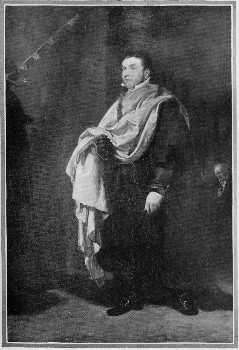 ROBERT HAWKES, MAYOR OF NORWICH in 1824.
'Can you wonder,' he wrote in July 1825, 'that I nauseate portraits, except portraits of clever people. I feel quite convinced that every portrait-painter, if there be purgatory, will leap at once to heaven, without this previous purification.'
Perhaps it was Mayor Hawkes who helped to inspire this feeling.[18] Yet the hundred pounds that John Borrow was able to procure must have been a godsend, for shortly before this we find him writing in his diary of the desperation that caused him to sell his books. 'Books that had cost me £20 I got only £3 for. But it was better than starvation.' Indeed it was in April of this year that the very baker was 'insolent,' and so in May 1824, as we learn from Tom Taylor's Life, he produced 'a full-length portrait of Mr. Hawkes, a late Mayor of Norwich, painted for St. Andrew's Hall in that city.' But I must leave Haydon's troubled career, which closes so far as the two brothers are concerned with a letter from George to Haydon written the following year from 26 Bryanston Street, Portman Square:
Dear Sir,—I should feel extremely obliged if you would allow me to sit to you as soon as possible. I am going to the south of France in little better than a fortnight, and I would sooner lose a thousand pounds than not have the honour of appearing in the picture.—Yours sincerely,
As Borrow was at the time in a most impoverished condition, it is not easy to believe that he would have wished to be taken at his word. He certainly had not a thousand pounds to lose. But he did undoubtedly, as we shall see, take that journey on foot through the south of France, after the manner of an earlier vagabond of literature—Oliver Goldsmith. Haydon was to be far too much taken up with his own troubles during the coming months to think any more about the Borrows when he had once completed the portrait of the mayor, which he had done by July of this year. Borrow's letter to him is, however, an obvious outcome of a remark dropped by the painter on the occasion of his one visit to his studio when the following conversation took place:
'I'll stick to the heroic,' said the painter; 'I now and then dabble in the comic, but what I do gives me no pleasure, the comic is so low; there is nothing like the heroic. I am engaged here on a heroic picture,' said he, pointing to the canvas; 'the subject is "Pharaoh dismissing Moses from Egypt," after the last plague—the death of the first-born,—it is not far advanced—that finished figure is Moses': they both looked at the canvas, and I, standing behind, took a modest peep. The picture, as the painter said, was not far advanced, the Pharaoh was merely in outline; my eye was, of course, attracted by the finished figure, or rather what the painter had called the finished figure; but, as I gazed upon it, it appeared to me that there was something defective—something unsatisfactory in the figure. I concluded, however, that the painter, notwithstanding what he had said, had omitted to give it the finishing touch. 'I intend this to be my best picture,' said the painter; 'what I want now is a face for Pharaoh; I have long been meditating on a face for Pharaoh.' Here, chancing to cast his eye upon my countenance, of whom he had scarcely taken any manner of notice, he remained with his mouth open for some time, 'Who is this?' said he at last. 'Oh, this is my brother, I forgot to introduce him——.'
We wish that the acquaintance had extended further, but this was not to be. Borrow was soon to commence the wanderings which were to give him much unsatisfactory fame, and the pair never met again. Let us, however, return to John Borrow, who accompanied Haydon to Norwich, leaving his brother for some time longer to the tender mercies of Sir Richard Phillips. John, we judge, seems to have had plenty of shrewdness, and was not without a sense of his own limitations. A chance came to him of commercial success in a distant land, and he seized that chance. A Norwich friend, Allday Kerrison, had gone out to Mexico, and writing from Zacatecas in 1825 asked John to join him. John accepted. His salary in the service of the Real del Monte Company was to be £300 per annum. He sailed for Mexico in 1826, having obtained from his Colonel, Lord Orford, leave of absence for a year, it being understood that renewals of that leave of absence might be granted. He was entitled to half-pay as a Lieutenant of the West Norfolk Militia, and this he settled upon his mother during his absence. His career in Mexico was a failure. There are many of his letters to his mother and brother extant which tell of the difficulties of his situation. He was in three Mexican companies in succession, and was about to be sent to Columbia to take charge of a mine when he was stricken with a fever, and died at Guanajuato on 22nd November 1838. He had far exceeded any leave that his Colonel could in fairness grant, and before his death his name had been taken off the army rolls. The question of his pay produced a long correspondence, which can be found in the archives of the Rolls Office. I have the original drafts of these letters in Borrow's handwriting.[Pg 28] The first letter by Borrow is dated 8th September 1831; it is better to give the correspondence in its order.[20] The letters speak for themselves, and require no comment.
Willow Lane, Norwich, September 8, 1831.
Sir,—I take the liberty of troubling you with these lines for the purpose of enquiring whether there is any objection to the issuing of the disembodied allowance of my brother Lieut. John Borrow of the Welsh Norfolk Militia, who is at present abroad. I do this by the advice of the Army Pay Office, a power of Attorney having been granted to me by Lieut. Borrow to receive the said allowance for him. I beg leave to add that my brother was present at the last training of his regiment, that he went abroad with the leave of his Commanding Officer, which leave of absence has never been recalled, that he has sent home the necessary affidavits, and that there is no clause in the Pay and Clothing Act to authorize the stoppage of his allowance. I have the honor to remain, Sir, your most obedient, humble servant,
George Borrow.
Willow Lane, Norwich, 17th Septr. 1831.
Sir,—I have to acknowledge the receipt of No. 33,063, dated 16th inst., from the War Office, in which I am informed that the Office does not feel authorized to give instructions for the issue of the arrears of disembodied allowance claimed by my brother Lieut. Borrow of the West Norfolk, until he attend the next training of his regiment, and I now beg leave to ask the following[Pg 29] question, and to request that I may receive an answer with all convenient speed. What farther right to his present arrears of disembodied allowance will Lieut. Borrow's appearance at the next training of his regiment confer upon him, and provided there is no authority at present for ordering the payment of those arrears, by what authority will the War Office issue instructions for the payment of the same, after his arrival in this country and attendance at the training? Sir, provided Lieut. Borrow is not entitled to his arrears of disembodied allowance at the present moment, he will be entitled to them at no future period, and I was to the last degree surprised at the receipt of an answer which tends to involve the office in an inextricable dilemma, for it is in fact a full acknowledgment of the justice of Lieutenant Borrow's claims, and a refusal to satisfy them until a certain time, which instantly brings on the question, 'By what authority does the War Office seek to detain the disembodied allowance of an officer, to which he is entitled by Act of Parliament, a moment after it has become due and is legally demanded?' If it be objected that it is not legally demanded, I reply that the affidavits filled up in the required form are in the possession of the Pay Office, and also a power of Attorney in the Spanish language, together with a Notarial translation, which power of Attorney has been declared by the Solicitor of the Treasury to be legal and sufficient. To that part of the Official letter relating to my brother's appearance at the next training I have to reply, that I believe he is at present lying sick in the Mountains above Vera Cruz, the pest-house of the New World, and that the last time I heard from him I was informed that it would be certain death for him to descend into the level country, even were he capable of the exertion, for the fever was then raging there. Full six months have elapsed since he prepared to return to his native country, having received information that there was a probability that his regiment would be embodied, (but) the hand of God overtook him on his route. He is the son, Sir, of an Officer who served his King abroad and at home for upwards of half a century; he had intended his disembodied allowance for the use of his widowed and infirm mother, but it must now be transmitted to him for his own support until he can arrive in England. But, Sir, I do not wish to excite compassion in his behalf, all I request is that he may[Pg 30] have justice done him, and if it be, I shall be informed in the next letter, that the necessary order has been given to the Pay Office for the issue of his arrears. I have the honor to remain, Sir, your most obedient, humble servant,
George Borrow.
Norwich, Novr. 24, 1831.
Sir,—Not having been favoured with an answer to the letter which I last addressed to you concerning the arrears of disembodied allowance due to Lieut. John Borrow of the West Norfolk Militia, I again take the liberty of submitting this matter to your consideration. More than six months have elapsed since by virtue of a power of attorney granted to me by Lieut. Borrow, I made demand at the army Pay Office for a portion of those arrears, being the amount of two affidavits which were produced, but owing to the much unnecessary demur which ensued, chiefly with respect to the power of Attorney, since declared to be valid, that demand has not hitherto been satisfied. I therefore am compelled to beg that an order may be issued to the Pay Office for the payment to me of the sums specified in the said affidavits, that the amount may be remitted to Lieut. Borrow, he being at present in great need thereof. If it be answered that Lieut. Borrow was absent at the last training of his regiment, and that he is not entitled to any arrears of pay, I must beg leave to observe that the demand was legally made many months previous to the said training, and cannot now be set aside by his non-appearance, which arose from unavoidable necessity; he having for the last year been lying sick in one of the provinces of New Spain. And now, Sir, I will make bold to inquire whether Lieut. Borrow, the son of an Officer, who served his country abroad and at home, for upwards of fifty years, is to lose his commission for being incapable, from a natural visitation, of attending at the training; if it be replied in the affirmative, I have only to add that his case will be a cruelly hard one. But I hope and trust, Sir, that taking all[Pg 31] these circumstances into consideration you will not yet cause his name to be stricken off the list, and that you will permit him to retain his commission in the event of his arriving in England with all the speed which his health of body will permit, and that to enable him so to do his arrears[21] you will forthwith give an order for the payment of his arrears. I have the honor to be, Sir, your very humble servant,
George Borrow.
Norwich, Decr. 13, 1831.
Sir,—I have just received a letter from my brother Lieutenant J. Borrow, from which it appears he has had leave of absence from his Colonel, the Earl of Orford, up to the present year. He says 'in a letter dated Wolterton, 21st June 1828, Lord Orford writes: "should you want a further leave I will not object to it." 20th May 1829 says: "I am much obliged to you for a letter of the 18th March, and shall be glad to allow you leave of absence for a twelvemonth." I enclose his last letter from Brussels, August 6, 1829. At the end it gives very evident proof that my remaining in Mexico was not only by his Lordship's permission, but even by his advice. Sir, if you should require it I will transmit this last letter of the Earl of Orford's, which my brother has sent to me, but beg leave to observe that no blame can be attached to his Lordship in this case, he having from a multiplicity of important business doubtless forgotten these minor matters. I hope now, Sir, that you will have no further objection to issue an order for the payment of that portion of my brother's arrears specified in the two affidavits in the possession of the Paymaster General. By the unnecessary obstacles which have been flung in my brother's way in obtaining his arrears he has been subjected to great inconvenience and distress. An early answer on this point will much oblige, Sir, your most obedient, humble servant,
George Borrow.
Willow Lane, Norwich, May 24, 1833.
Sir,—I take the liberty of addressing you for the purpose of requesting that an order be given to the Paymaster General for the issue of the arrears of pay of my brother Lieutenant John Borrow of the West Norfolk Militia, whose agent I am by virtue of certain powers of Attorney, and also for the continuance of the payment of his disembodied allowance. Lieutenant Borrow was not present at the last training of his Regiment, being in Mexico at the time, and knowing nothing of the matter. I beg leave to observe that no official nor other letter was dispatched to him by the adjutant to give him notice of the event, nor was I, his agent, informed of it, he therefore cannot have forfeited his arrears and disembodied allowance. He was moreover for twelve months previous to the training, and still is, so much indisposed from the effects of an attack of the yellow fever, that his return would be attended with great danger, which can be proved by the certificate of a Medical Gentleman practising in Norwich, who was consulted from Mexico. Lieutenants Harper and Williams, of the same Regiment, have recovered their pay and arrears, although absent at the last training, therefore it is clear and manifest that no objection can be made to Lieut. Borrow's claim, who went abroad with his Commanding Officer's permission, which those Gentlemen did not. In conclusion I have to add that I have stated nothing which I cannot substantiate, and that I court the most minute scrutiny into the matter. I have the honor to be, Sir, your most obedient and most humble servant,
George Borrow.
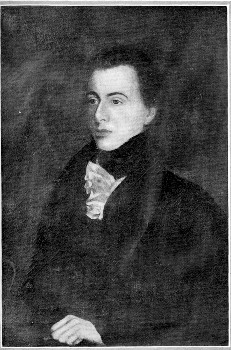 GEORGE BORROW
The last of these letters is in another handwriting than that of Borrow, who by this time had started for St. Petersburg for the Bible Society. The officials were adamant. To one letter the War Office replied that they could not consider any claims until Lieutenant Borrow of the West Norfolk Militia should have arrived in England to attend the training of his regiment. These five letters are, as we have said, in the Rolls Office, although the indefatigable Professor Knapp seems to have dropped across only two of them there. Their chief interest is in that they are the earliest in order of date of the hitherto known letters of Borrow. There is one further letter on the subject written somewhat later by old Mrs. Borrow. She also appeals to the War Office for her son's allowance.[22] It would seem clear that the arrears were never paid.
Willow Lane, Norwich, 26 May 1834.
My Lord,—I a few days since received the distressing intelligence of the death of my dear son John, a lieutenant in your Lordship's West Norfolk Regiment of Militia, after the sufferings of a protracted and painful illness; the melancholy event took place on the 22nd November last at Guanajuato in Mexico. Having on the former irreparable loss of my dear husband experienced your Lordship's kindness, I am induced to trespass on your goodness in a like case of heavy affliction, by requesting that you will be pleased to make the necessary application to the Secretary at War to authorise me to receive the arrears of pay due to my late son, viz.: ten months to the period of the training, and from that time to the day of his decease, for which I am informed it is requisite to have your Lordship's certificate of leave of absence from the said training. The amount is a matter of great importance to me in my very limited circumstances, having been at considerable expense in fitting him out, which, though at the time it occasioned me much pecuniary inconvenience, I thought it my duty to exert all my means to accomplish, my present distress of[Pg 34] mind is the greater having to struggle with my feelings without the consolation and advice of my son George, who is at this time at St. Petersburg. Your Lordship will, I trust, pardon the liberty I am taking, and the trouble I am giving, and allow for the feelings of an afflicted mother. I have the honor to be your Lordship's most obedient servant,
Ann Borrow.
I have said that there are letters of John Borrow's extant. Fragments of these will be found in Dr. Knapp's book. These show a keen intelligence, great practicality, and common sense. George—in 1829—had asked his brother as to joining him in Mexico. 'If the country is soon settled I shall say "yes,"' John answers. With equal wisdom he says to his brother, 'Do not enter the army; it is a bad spec.' In this same year, 1829, John writes to ask whether his mother and brother are 'still living in that windy house of old King's; it gives me the rheumatism to think of it.' In 1830 he writes to his mother that he wishes his brother were making money. 'Neither he nor I have any luck, he works hard and remains poor.' In February of 1831 John writes to George suggesting that he should endeavour to procure a commission in the regiment, and in July of the same year to try the law again:
I am convinced that your want of success in life is more owing to your being unlike other people than to any other cause.
John, as we have seen, died in Mexico of fever. George was at St. Petersburg working for the Bible Society when his mother writes from Norwich to tell him the news. John had died on 22nd November 1833. 'You are now my only hope,' she writes, ' ... do not grieve, my dear George. I trust we shall all meet in heaven. Put a crape on your hat for[Pg 35] some time.' Had George Borrow's brother lived it might have meant very much in his life. There might have been nephews and nieces to soften the asperity of his later years. Who can say? Meanwhile, Lavengro contains no happier pages than those concerned with this dearly loved brother.
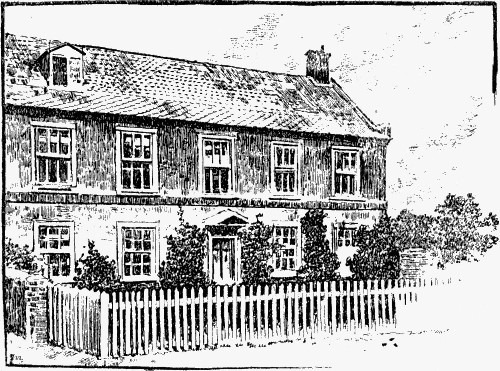 GEORGE BORROW'S BIRTHPLACE AT DUMPLING GREEN
[15] I am not able to trace more than three of John Borrow's pictures: firstly, a portrait of George Borrow, reproduced in this book, which was long in the possession of Mr. William Jarrold, the well-known publisher of Norwich, and is now in the National Portrait Gallery in London, having been purchased by the Director in 1912; secondly, the portrait of Borrow's father in the possession of a lady at Leamington; and thirdly, The Judgment of Solomon, which for a long time hung as an overmantel in the Borrow Home in Willow Lane, Norwich. Dr. Knapp also saw in Norwich 'A Portrait of a Gentleman,' by John Borrow. A second portrait of George Borrow by his brother was taken by the latter to Mexico, and has not since been heard of.
[16] Lavengro, ch. xxv.
[17] Life of B. R. Haydon, by Tom Taylor, 1853, vol. ii. p. 21.
[18] Or perhaps the experience contained in a letter to Miss Mitford in 1824 (Benjamin Robert Haydon: Correspondence and Table Talk, 2 vols., 1876):
'I have had a horrid week with a mother and eight daughters! Mamma remembering herself a beauty; Sally and Betsey, etc., see her a matron. They say, "Oh! this is more suitable to mamma's age," and "that fits mamma's time of life!" But mamma does not agree. Betsey, and Sally, and Eliza, and Patty want "mamma"! Mamma wants herself as she looked when she was Betsey's age, and papa fell in love with her. So I am distracted to death. I have a great mind to paint her with a long beard like Salvator, and say, "That's my idea of a fit accompaniment."'
[19] Benjamin Robert Haydon: Correspondence and Table Talk, with a Memoir by his son Frederic Wordsworth Haydon, vol. i. pp. 360-61.
[20] From what are called the 'War Office Weeded Papers, Old Series, No. 33,063/17,' and succeeding numbers.
[21] ('his arrears' are ruled out.) Note by War Office.
[22] This letter is from the original among the Borrow Papers in my possession.
We do not need to inquire too deeply as to Borrow's possible gypsy origin in order to account for his vagabond propensities. The lives of his parents before his birth, and the story of his own boyhood, sufficiently account for the dominant tendency in Borrow. His father and mother were married in 1793. Almost every year they changed their domicile. In 1801 a son was born to them—they still continued to change their domicile. Captain Borrow followed his regiment from place to place, and his family accompanied him on these journeys. Dover, Colchester, Sandgate, Canterbury, Chelmsford—these are some of the towns where the Borrows sojourned. It was the merest accident—the Peace of Amiens, to be explicit—that led them back to East Dereham in 1803, so that the second son was born in his grandfather's house. George was only a month old when he was carried off to Colchester; in 1804 he was in the barracks of Kent, in 1805 of Sussex, in 1806 at Hastings, in 1807 at Canterbury, and so on. The indefatigable Dr. Knapp has recorded every detail for all who love the minute, the meticulous, in biography. The whole of the first thirteen years of Borrow's life is filled up in this way, until in 1816 he and his parents found a home of some permanence in Norwich. In 1809-10 they were at East[Pg 37] Dereham, in 1810-11 at Norman Cross, in 1812 wandering from Harwich to Sheffield, and in 1813 wandering from Sheffield to Edinburgh; in 1814 they were in Norwich, and in 1815-16 in Ireland. In this last year they returned to Norwich, the father to retire on full pay, and to live in Willow Lane until his death. How could a boy, whose first twelve years of life had been made up of such continual wandering, have been other than a restless, nomad-loving man, envious of the free life of the gypsies, for whom alone in later life he seemed to have kindliness? Those twelve years are to most boys merely the making of a moral foundation for good or ill; to Borrow they were everything, and at least four personalities captured his imagination during that short span, as we see if we follow his juvenile wanderings more in detail to Dereham, Norman Cross, Edinburgh, and Clonmel, and the personalities are Lady Fenn, Ambrose Smith, David Haggart, and Murtagh. Let us deal with each in turn:
A. East Dereham and Lady Fenn.—In our opening chapter we referred to the lines in Lavengro, where Borrow recalls his early impressions of his native town, or at least the town in the neighbourhood of the hamlet in which he was born. Borrow, we may be sure, would have repudiated 'Dumpling Green' if he could. The name had a humorous suggestion. To this day they call boys from Norfolk 'Norfolk Dumplings' in the neighbouring shires. But East Dereham was something to be proud of. In it had died the writer who, through the greater part of Borrow's life, remained the favourite poet of that half of England which professed the Evangelical creed in which Borrow was brought up. Cowper was buried here by the side of[Pg 38] Mary Unwin, and every Sunday little George would see his tomb just as Henry Kingsley was wont to see the tombs in Chelsea Old Church. The fervour of devotion to Cowper's memory that obtained in those early days must have been a stimulus to the boy, who from the first had ambitions far beyond anything that he was to achieve. Here was his first lesson. The second came from Lady Fenn—a more vivid impression for the child. Twenty years before Borrow was born Cowper had sung her merits in his verse. She and her golden-headed cane are commemorated in Lavengro. Dame Eleanor Fenn had made a reputation in her time. As 'Mrs. Teachwell' and 'Mrs. Lovechild' she had published books for the young of a most improving character, The Child's Grammar, The Mother's Grammar, A Short History of Insects, and Cobwebs to Catch Flies being of the number. The forty-fourth edition of The Child's Grammar by Mrs. Lovechild appeared in 1851, and the twenty-second edition of The Mother's Grammar in 1849. But it is her husband that her name most recalls to us. Sir John Fenn gave us the delightful Paston Letters—of which Horace Walpole said that 'they make all other letters not worth reading.' Walpole described 'Mr. Fenn of East Dereham in Norfolk' as 'a smatterer in antiquity, but a very good sort of man.' Fenn, who held the original documents of the Letters, sent his first two volumes, when published, to Buckingham Palace, and the King acknowledged the gifts by knighting the editor, who, however, died in 1794, before George Borrow was born. His widow survived until 1813, and Borrow was in his seventh or eighth year when he caught these notable glimpses of his 'Lady Bountiful,' who lived in 'the half-aristocratic mansion' of the[Pg 39] town. But we know next to nothing of Borrow in East Dereham, from which indeed he departed in his eighth year. There are, however, interesting references to his memories of the place in Lavengro. The first is where he recalls to his author friend, who had offered him comet wine of 1811, his recollection of gazing at the comet from the market-place of 'pretty D——' in 1811.[23] The second reference is when he goes to church with the gypsies and dreams of an incident in his childhood:
It appeared as if I had fallen asleep in the pew of the old church of pretty Dereham. I had occasionally done so when a child, and had suddenly woke up. Yes, surely, I had been asleep and had woke up; but no! if I had been asleep I had been waking in my sleep, struggling, striving, learning and unlearning in my sleep. Years had rolled away whilst I had been asleep—ripe fruit had fallen, green fruit had come on whilst I had been asleep—how circumstances had altered, and above all myself whilst I had been asleep. No, I had not been asleep in the old church! I was in a pew, it is true, but not the pew of black leather in which I sometimes fell asleep in days of yore, but in a strange pew; and then my companions, they were no longer those of days of yore. I was no longer with my respectable father and mother, and my dear brother, but with the gypsy cral and his wife, and the gigantic Tawno, the Antinous of the dusky people. And what was I myself? No longer an innocent child but a moody man, bearing in my face, as I knew well, the marks of my strivings and strugglings; of what I had learnt and unlearnt.
But Borrow, as I have said, left Dereham in his eighth year, and the author of a History of East Dereham[Pg 40] thus accounts for several inaccuracies in his memory, both as to persons and things.
B. Norman Cross and Ambrose Smith.—In Lavengro Borrow recalls childish memories of Canterbury and of Hythe, at which latter place he saw the church vault filled with ancient skulls as we may see it there to-day. And after that the book which impressed itself most vividly upon his memory was Robinson Crusoe. How much he came to revere Defoe the pages of Lavengro most eloquently reveal to us. 'Hail to thee, spirit of Defoe! What does not my own poor self owe to thee?' In 1810-11 his father was in the barracks at Norman Cross in Huntingdonshire. Here the Government had bought a large tract of land, and built upon it a huge wooden prison, and overlooking this a substantial barrack also of wood, the only brick building on the land being the house of the Commandant. The great building was destined for the soldiers taken prisoners in the French wars. The place was constructed to hold 5000 prisoners, and 500 men were employed by the War Office in 1808 upon its construction. The first batch of prisoners were the victims of the battle of Vimeiro in that year. Borrow's description of the hardships of the prisoners has been called in question by a later writer, Arthur Brown,[24] who denies the story of bad food and 'straw-plait hunts,' and charges Borrow with recklessness of statement. 'What could have been the matter with the man to write such stuff as this?' asks[Pg 41] Brown in reference to Borrow's story of bad meat and bad bread: which was not treating a great author with quite sufficient reverence. Borrow was but recalling memories of childhood, a period when one swallow does make a summer. He had doubtless seen examples of what he described, although it may not have been the normal condition of things. Brown's own description of the Norman Cross prison was interwoven with a love romance, in which a French officer fell in love with a girl of the neighbouring village of Yaxley, and after Waterloo returned to England and married her. When he wrote his story a very old man was still living at Yaxley, who remembered, as a boy, having often seen the prisoners on the road, some very well dressed, some in tatters, a few in uniform. The milestone is still pointed out which marked the limit beyond which the officer-prisoners might not walk. The buildings were destroyed in 1814, when all the prisoners were sent home, and the house of the Commandant, now a private residence, alone remains to recall this episode in our history. But Borrow's most vivid memory of Norman Cross was connected with the viper given to him by an old man, who had rendered it harmless by removing the fangs. It was the possession of this tame viper that enabled the child of eight—this was Borrow's age at the time—to impress the gypsies that he met soon afterwards, and particularly the boy Ambrose Smith, whom Borrow introduced to the world in Lavengro as Jasper Petulengro. Borrow's frequent meetings with Petulengro[25] are no doubt many of them mythical. He was an imaginative writer, and Dr. Knapp's worst banality is to suggest that he 'invented nothing.' But[Pg 42] Petulengro was a very real person, who lived the usual roving gypsy life. There is no reason to assume otherwise than that Borrow did actually meet him at Norman Cross when he was eight years old, and Ambrose a year younger, and not thirteen as Borrow states. In the original manuscript of Lavengro in my possession, as in the copy of it in Mrs. Borrow's handwriting that came into the possession of Dr. Knapp, 'Ambrose' is given instead of 'Jasper,' and the name was altered as an afterthought. It is of course possible that Borrow did not actually meet Jasper until his arrival in Norwich, for in the first half of the nineteenth century various gypsy families were in the habit of assembling their carts and staking their tents on the heights above Norwich, known as Mousehold Heath, that glorious tract of country that has been rendered memorable in history by the tragic life of Kett the tanner, and has been immortalised in painting by Turner and Crome. Here were assembled the Smiths and Hernes and Boswells, names familiar to every student of gypsy lore. Jasper Petulengro, as Borrow calls him, or Ambrose Smith, to give him his real name, was the son of Fāden Smith, and his name of Ambrose was derived from his uncle, Ambrose Smith, who was transported for stealing harness. Ambrose was twice married, and it was his second wife, Sanspirella Herne, who comes into the Borrow story. He had families by both his wives. Ambrose had an extraordinary varied career. It will be remembered by readers of the Zincali that when he visited Borrow at Oulton in 1842 he complained that 'There is no living for the poor people, brother, the chokengres (police) pursue us from place to place, and the gorgios are become either so poor or miserly that they grudge our cattle a bite of grass by the wayside, and ourselves a yard of[Pg 43] ground to light a fire upon.' After a time Ambrose left the eastern counties and crossed to Ireland. In 1868 he went to Scotland, and there seems to have revived his fortunes. In 1878 he and his family were encamped at Knockenhair Park, about a mile from Dunbar. Here Queen Victoria, who was staying at Broxmouth Park near by with the Dowager Duchess of Roxburghe, became interested in the gypsies, and paid them a visit.[26] This was in the summer of 1878. Ambrose was then a very old man. He died in the following October. His wife, Sanspi or Sanspirella, received a message of sympathy from the Queen. Very shortly after Ambrose's death, however, most of the family went off to America, where doubtless they are now scattered, many of them, it may be, leading successful lives, utterly oblivious of the association of one of their ancestors with Borrow and his great book. Ambrose Smith was buried in Dunbar cemetery, the Christian service being read over his grave, and his friends erected[Pg 44] a stone to him which bears the following inscription, the hymn not being very accurately rendered:
In December 1912 a London newspaper contained an account of a gypsy meeting at which Jasper Petulengro was present. Not only was this obviously impossible, but no relative of Ambrose Smith is apparently alive in England who could by any chance have justified the imposition.
I have said that it is probable that Borrow did not meet Jasper or Ambrose until later days in Norwich. I assume this as possible because Borrow misstates the age of his boy friend in Lavengro. Ambrose was actually a year younger than Borrow, whereas when George was eight years of age he represents Ambrose as 'a lad of some twelve or thirteen years,' and he[Pg 45] keeps up this illusion on more than one later occasion. However, we may take it as almost certain that Borrow received his first impression of the gypsies in these early days at Norman Cross.
C. Edinburgh and David Haggart.—Three years separated the sojourn of the Borrow family at Norman Cross from their sojourn in Edinburgh—three years of continuous wandering. The West Norfolk Militia were watching the French prisoners at Norman Cross for fifteen months. After that we have glimpses of them at Colchester, at East Dereham again, at Harwich, at Leicester, at Huddersfield, concerning which place Borrow incidentally in Wild Wales writes of having been at school, in Sheffield, in Berwick-on-Tweed, and finally the family are in Edinburgh, where they arrive on 6th April 1813. We have already referred to Borrow's presence at the High School of Edinburgh, the school sanctified by association with Walter Scott and so many of his illustrious fellow-countrymen. He and his brother were at the High School for a single session, that is, for the winter session of 1813-14, although with the licence of a maker of fiction he claimed, in Lavengro, to have been there for two years. But it is not in this brief period of schooling of a boy of ten that we find the strongest influence that Edinburgh gave to Borrow. Rather may we seek it in the acquaintanceship with the once too notorious David Haggart. Seven years later than this all the peoples of the three kingdoms were discussing David Haggart, the Scots Jack Sheppard, the clever young prison-breaker, who was hanged at Edinburgh in 1821 for killing his jailer in Dumfries prison. How much David Haggart filled the imagination of every one who could read in the early years of last[Pg 46] century is demonstrated by a reference to the Library Catalogue of the British Museum, where we find pamphlet after pamphlet, broadsheet after broadsheet, treating of the adventures, trial, and execution of this youthful jailbird. Even George Combe, the phrenologist, most famous in his day, sat in judgment upon the young man while he was in prison, and published a pamphlet which made a great impression upon prison reformers. Combe submitted his observations to Haggart in jail, and told the prisoner indeed that he had a greater development of the organs of benevolence and justice than he had anticipated. There cannot be a doubt but that Combe started in a measure, through his treatment of this case, the theory that many of our methods of punishment led to the making of habitual criminals.[28] But by far the most valuable publication with regard to Haggart is one that Borrow must have read in his youth. This was a life of Haggart written by himself,[29] a little book that had a[Pg 47] wide circulation, and containing a preface by George Robertson, Writer to the Signet, dated Edinburgh, 20th July 1821. Mr. Robertson tells us that a portion of the story was written by Haggart, and the remainder taken down from his dictation. The profits of this book, Haggart arranged, were to go in part to the school of the jail in which he was confined, and part to be devoted to the welfare of his younger brothers and sister. From this little biography we learn that Haggart was born in Golden Acre, near Canon-Mills, in the county of Edinburgh in 1801, his father, John Haggart, being a gamekeeper, and in later years a dog-trainer. The boy was at school under Mr. Robin Gibson at Canon-Mills for two years. He left school at ten years of age, and from that time until his execution seems to have had a continuous career of thieving. He tells us that before he was eleven years old he had stolen a bantam cock from a woman belonging to the New Town of Edinburgh. He went with another boy to Currie, six miles from Edinburgh, and there stole a pony, but this was afterwards returned. When but twelve years of age he attended Leith races, and it was here that he enlisted in the Norfolk Militia, then stationed in Edinburgh Castle. This may very well have brought him into contact with Borrow in the way described in Lavengro. He was only, however, in the regiment for a year, for when it was sent back to England the Colonel in command of it obtained young Haggart's discharge. These dates coincide with Borrow's presence in Edinburgh. Haggart's history for the next five or six years was in truth merely that of a wandering pickpocket, sometimes in Scotland, sometimes in England, and finally he became a notorious burglar. Incidentally he refers to a girl[Pg 48] with whom he was in love. Her name was Mary Hill She belonged to Ecclefechan, which Haggart more than once visited. He must therefore have known Carlyle, who had not then left his native village. In 1820 we find him in Edinburgh, carrying on the same sort of depredations both there and at Leith—now he steals a silk plaid, now a greatcoat, and now a silver teapot. These thefts, of course, landed him in jail, out of which he breaks rather dramatically, fleeing with a companion to Kelso. He had, indeed, more than one experience of jail. Finally, we find him in the prison of Dumfries destined to stand his trial for 'one act of house-breaking, eleven cases of theft, and one of prison-breaking.' While in prison at Dumfries he planned another escape, and in the attempt to hit a jailer named Morrin on the head with a stone he unexpectedly killed him. His escape from Dumfries jail after this murder, and his later wanderings, are the most dramatic part of his book. He fled through Carlisle to Newcastle, and then thought that he would be safer if he returned to Scotland, where he found the rewards that were offered for his arrest faced him wherever he went. He turned up again in Edinburgh, where he seems to have gone about freely, although reading everywhere the notices that a reward of seventy guineas was offered for his apprehension. Then he fled to Ireland, where he thought that his safety was assured. At Dromore he was arrested and brought before the magistrate, but he spoke with an Irish brogue, and declared that his name was John McColgan, and that he came from Armagh. He escaped from Dromore jail by jumping through a window, and actually went so far as to pay three pound ten shillings for his passage to America, but he was afraid of the sea, and changed his mind, and lost his[Pg 49] passage money at the last moment. After this he made a tour right through Ireland, in spite of the fact that the Dublin Hue and Cry had a description of his person which he read more than once. His assurance was such that in Tullamore he made a pig-driver apologise before the magistrate for charging him with theft, although he had been living on nothing else all the time he was in Ireland. Finally, he was captured, being recognised by a policeman from Edinburgh. He was brought from Ireland to Dumfries, landed in Calton jail, Edinburgh, and was tried and executed. In addition to composing this biography Haggart wrote while in Edinburgh jail a rather long set of verses, of which I give the following two as specimens (the original autograph is in Lord Cockburn's copy in the British Museum):
D. Ireland and Murtagh.—We may pass over the brief sojourn in Norwich that was Borrow's lot in 1814, when the West Norfolk Militia left Scotland. When Napoleon escaped from Elba the West Norfolk Regiment was despatched to Ireland, and Captain Borrow again took his family with him. We find the boy with his family at Clonmel from May to December of 1815. Here Borrow's elder brother, now a boy of fifteen, was promoted from Ensign to Lieutenant, gaining in a year, as Dr. Knapp reminds us, a position that it[Pg 50] had taken his father twelve years to attain. In January 1816 the Borrows moved to Templemore, returning to England in May of that year. Borrow, we see, was less than a year in Ireland, and he was only thirteen years of age when he left the country. But it seems to have been the greatest influence that guided his career. Three of the most fascinating chapters in Lavengro were one outcome of that brief sojourn, a thirst for the acquirement of languages was another, and perhaps a taste for romancing a third. Borrow never came to have the least sympathy with the Irish race, or its national aspirations. As the son of a half-educated soldier he did not come in contact with any but the vagabond element of Ireland, exactly as his father had done before him.[30] Captain Borrow was asked on one occasion what language is being spoken:
'Irish,' said my father with a loud voice, 'and a bad language it is.... There's one part of London where all the Irish live—at least the worst of them—and there they hatch their villainies to speak this tongue.'
And Borrow followed his father's prejudices throughout his life, although in the one happy year in which he wrote The Bible in Spain he was able to do justice to the country that had inspired so much of his work:
Honour to Ireland and her 'hundred thousand welcomes'! Her fields have long been the greenest in the world; her daughters the fairest; her sons the bravest and most eloquent. May they never cease to be so.[31]
In later years Orangemen were to him the only attractive element in the life of Ireland, and we may be sure[Pg 51] that he was not displeased when his stepdaughter married one of them. Yet the creator of literature works more wisely than he knows, and Borrow's books have won the wise and benign appreciation of many an Irish and Roman Catholic reader, whose nationality and religion Borrow would have anathematised. Irishmen may forgive Borrow much, because he was one of the first of modern English writers to take their language seriously.[32] It is true that he had but the most superficial knowledge of it. He admits—in Wild Wales—that he only knew it 'by ear.' The abundant Irish literature that has been so diligently studied during the last quarter of a century was a closed book to Borrow, whose few translations from the Irish have but little value. Yet the very appreciation of Irish as a language to be seriously studied in days before Dr. Sigerson, Dr. Douglas Hyde, and Dr. Kuno Meyer had waxed enthusiastic and practical kindles our gratitude. Then what a character is Murtagh. We are sure there was a Murtagh, although, unlike Borrow's other boyish and vagabond friend Haggart, we know nothing about him but what Borrow has to tell. Yet what a picture is this where Murtagh wants a pack of cards:
'I say, Murtagh!'
'Yes, Shorsha dear!'[Pg 52]
'I have a pack of cards.'
'You don't say so, Shorsha ma vourneen?—you don't say that you have cards fifty-two?'
'I do, though; and they are quite new—never been once used.'
'And you'll be lending them to me, I warrant?'
'Don't think it!—But I'll sell them to you, joy, if you like.'
'Hanam mon Dioul! am I not after telling you that I have no money at all?'
'But you have as good as money, to me, at least; and I'll take it in exchange.'
'What's that, Shorsha dear?'
'Irish!'
'Irish?'
'Yes, you speak Irish; I heard you talking it the other day to the cripple. You shall teach me Irish.'
'And is it a language-master you'd be making of me?'
'To be sure!—what better can you do?—it would help you to pass your time at school. You can't learn Greek, so you must teach Irish!'
Before Christmas, Murtagh was playing at cards with his brother Denis, and I could speak a considerable quantity of broken Irish.[33]
With what distrust as we learn again and again in Lavengro did Captain Borrow follow his son's inclination towards languages, and especially the Irish language, in his early years, although seeing that he was well grounded in Latin. Little did the worthy Captain dream that this, and this alone, was to carry down his name through the ages:
Ah, that Irish! How frequently do circumstances, at first sight the most trivial and unimportant, exercise a mighty and permanent influence on our habits and pursuits!—how frequently is a stream turned aside from its natural course by some little rock or knoll, causing it to make an abrupt turn! On a wild[Pg 53] road in Ireland I had heard Irish spoken for the first time; and I was seized with a desire to learn Irish, the acquisition of which, in my case, became the stepping-stone to other languages. I had previously learnt Latin, or rather Lilly; but neither Latin nor Lilly made me a philologist.
Borrow was never a philologist, but this first inclination was to lead him to Spanish, to Welsh, and above all to Romany, and to make of him the most beloved traveller and the strangest vagabond in all English literature.
[23] This episode, rescued from the manuscript that came into Dr. Knapp's possession, is only to be found in his Life of Borrow. He does not include it in his edition of Lavengro. That Borrow revisited East Dereham in later manhood we learn from Mr. S. H. Baldrey. See p. 420.
[24] The French Prisoners of Norman Cross: A Tale, by the Rev. Arthur Brown, Rector of Catfield, Norfolk. London: Hodder Brothers, 18 New Bridge Street, E.C., 1895. Mr. Brown remarks that there were sixteen casernes, whereas Borrow says in Lavengro that there were five or six. 'They looked,' he says, 'from outside exactly like a vast congeries of large, high carpenter's shops, with roofs of glaring red tiles, and surrounded by wooden palisades, very lofty and of prodigious strength.'
[25] The Journal of the Gypsy Lore Society teaches me that the name should be spelt Pétulengro.
[26] See In Gipsy Tents by Francis Hindes Groome, p. 17. The late Queen herself writes (More Leaves from the Journal of a Life in the Highlands, Smith, Elder and Co., 1884, p. 370), under the date Monday, August 26th: 'At half-past three started with Beatrice, Leopold, and the Duchess in the landau and four, the Duke, Lady Ely, General Ponsonby, and Mr. Yorke going in the second carriage, and Lord Haddington riding the whole way. We drove through the west part of Dunbar, which was very full, and where we were literally pelted with small nosegays, till the carriage was full of them; then for some distance past the village of Belhaven, Knockindale Hill (Knockenhair Park), where were stationed in their best attire the queen of the gypsies, an oldish woman with a yellow handkerchief on her head, and a youngish, very dark, and truly gypsy-like woman in velvet and a red shawl, and another woman. The queen is a thorough gypsy, with a scarlet cloak and a yellow handkerchief around her head. Men in red hunting-coats, all very dark, and all standing on a platform here, bowed and waved their handkerchiefs. George Smith told Mr. Myers that "the queen" was Sanspirella, that the "gypsy-like woman in velvet and a red shawl" was Bidi, and the other woman Delaia. The men were Ambrose, Tommy, and Alfred.'
[27] I am indebted to an admirable article by Thomas William Thompson in the Journal of the Gypsy Lore Society, New Series, vol. iii, No, 3, January 1910, for information concerning the later life of Jasper Pétulengro.
[28] Phrenological Observations on the Cerebral Development of David Haggart, who was lately executed at Edinburgh for murder, and whose life has since been published. By George Combe, Esq. Edinburgh: W. and C. Tait, 1821.
[29] The Life of David Haggart, alias John Wilson, alias John Morison, alias Barney McCone, alias John McColgan, alias Daniel O'Brien, alias The Switcher, written by himself while under sentence of death. Edinburgh: Printed for W. and C. Tait by James Ballantyne and Co., 1821.
In the British Museum Library there is a copy with an autograph note by Lord Cockburn on the fly-leaf, which runs as follows:
'This youngster was my client when he was tried and convicted. He was a great villain. His life is almost all lies, and its chief curiosity consists in the strange spirit of lying, the indulgence of which formed his chief pleasure to the very last. The manuscript poem and picture of himself (bound up at the end of the Life) were truly composed and written by him. Being an enormous miscreant the phrenologists got hold of him, and made the notorious facts of his character into evidence of the truth of their system. He affected some decent poetry just before he was hanged, and therefore the Saints took up his memory and wrote monodies on him. His piety and the composition of the lies in this book broke out at the same time. H. C.'
[30] Although Captain Borrow was never as ignorant as one or two of Borrow's biographers, who call the Irish language 'Erse.'
[31] The Bible in Spain, ch. xx.
[32] Dr. Johnson was the first as Borrow was the second to earn this distinction. Johnson, as reported by Boswell, says:
'I have long wished that the Irish literature were cultivated. Ireland is known by tradition to have been once the seat of piety and learning, and surely it would be very acceptable to all those who are curious on the origin of nations or the affinities of languages to be further informed of the evolution of a people so ancient and once so illustrious. I hope that you will continue to cultivate this kind of learning which has too long been neglected, and which, if it be suffered to remain in oblivion for another century, may perhaps never be retrieved.'
[33] Lavengro.
Norwich may claim to be one of the most fascinating cities in the kingdom. To-day it is known to the wide world by its canaries and its mustard, although its most important industry is the boot trade, in which it employs some eight thousand persons. To the visitor it has many attractions. The lovely cathedral with its fine Norman arches, the Erpingham Gate so splendidly Gothic, the noble Castle Keep so imposingly placed with the cattle-market below—these are all as Borrow saw them nearly a century ago. So also is the church of St. Peter Mancroft, where Sir Thomas Browne lies buried. And to the picturesque Mousehold Heath you may still climb and recall one of the first struggles for liberty and progress that past ages have seen, the Norfolk rising under Robert Kett which has only not been glorified in song and in picture, because—
And Kett's so-called rebellion was destined to failure, and its leader to cruel martyrdom. Mousehold Heath has been made the subject of paintings by Turner and Crome, and of fine word pictures by George Borrow. When Borrow and his parents lighted upon Norwich[Pg 55] in 1814 and 1816 the city had inspiring literary associations. Before the invention of railways it seemed not uncommon for a fine intellectual life to emanate from this or that cathedral city. Such an intellectual life was associated with Lichfield when the Darwins and the Edgeworths gathered at the Bishop's Palace around Dr. Seward and his accomplished daughters. Norwich has more than once been such a centre. The first occasion was in the period of which we write, when the Taylors and the Gurneys flourished in a region of ideas; the second was during the years from 1837 to 1849, when Edward Stanley held the bishopric. This later period does not come into our story, as by that time Borrow had all but left Norwich. But of the earlier period, the period of Borrow's more or less fitful residence in Norwich—1814 to 1833—we are tempted to write at some length. There were three separate literary and social forces in Norwich in the first decades of the nineteenth century—the Gurneys of Earlham, the Taylor-Austin group, and William Taylor, who was in no way related to Mrs. John Taylor and her daughter, Sarah Austin. The Gurneys were truly a remarkable family, destined to leave their impress upon Norwich and upon a wider world. At the time of his marriage in 1773 to Catherine Bell, John Gurney, wool-stapler of Norwich, took his young wife, whose face has been preserved in a canvas by Gainsborough, to live in the old Court House in Magdalen Street, which had been the home of two generations of the Gurney family. In 1786 John Gurney went with his continually growing family to live at Earlham Hall, some two or three miles out of Norwich on the Earlham Road. Here that family of eleven children—one boy had died in infancy—grew[Pg 56] up. Not one but has an interesting history, which is recorded by Mr. Augustus Hare and other writers.[34] Elizabeth, the fourth daughter, married Joseph Fry, and as Elizabeth Fry attained to a world-wide fame as a prison reformer. Hannah married Sir Thomas Fowell Buxton of Slave Trade Abolition; Richenda, the Rev. Francis Cunningham, who sent George Borrow upon his career; while Louisa married Samuel Hoare of Hampstead. Of her Joseph John Gurney said at her death in 1836 that she was 'superior in point of talent to any other of my father's eleven children.' It is with the eleventh child, however, that we have mainly to do, for this son, Joseph John Gurney, alone appears in Borrow's pages. The picture of these eleven Quaker children growing up to their various destinies under the roof of Earlham Hall is an attractive one. Men and women of all creeds accepted the catholic Quaker's hospitality. Mrs. Opie and a long list of worthies of the past come before us, and when Mr. Gurney, in 1802, took his six unmarried daughters to the Lakes Old Crome accompanied them as drawing-master. There is, however, one picture in the story of unforgettable charm, the episode of the courtship of Elizabeth Gurney by Joseph Fry, and this I must quote from Mr. Augustus Hare's pleasant book:
Mr. Fry had no intention of exposing himself to the possibility of a refusal. He bought a very handsome gold watch and chain, and laid it down upon a white seat—the white seat which still exists—in the garden at Earlham. 'If Betsy takes up that watch,' he said, 'it is a sign that she accepts me: if she does not take it up by a particular hour, it will show that I must leave Earlham.'[Pg 57]
The six sisters concealed themselves in six laurel-bushes in different parts of the grounds to watch. One can imagine their intense curiosity and anxiety. At last the tall, graceful Betsy, her flaxen hair now hidden under a Quaker cap, shyly emerged upon the gravel walk. She seemed scarcely conscious of her surroundings, as if, 'on the wings of prayer, she was being wafted into the unseen.' But she reached the garden seat, and there, in the sunshine, lay the glittering new watch. The sight of it recalled her to earth. She could not, could not, take it, and fled swiftly back to the house. But the six sisters remained in their laurel-bushes. They felt sure she would revoke, and they did not watch in vain. An hour elapsed, in which her father urged her, and in which conscience seemed to drag her forwards. Once again did the anxious sisters see Betsy emerge from the house, with more faltering steps this time, but still inwardly praying, and slowly, tremblingly, they saw her take up the watch, and the deed was done. She never afterwards regretted it, though it was a bitter pang to her when she collected her eighty-six children in the garden at Earlham and bade them farewell, and though she wrote in her journal as a bride, 'I cried heartily on leaving Norwich; the very stones in the street were dear to me.'
In 1803—the year of Borrow's birth—John Gurney became a partner in the great London Bank of Overend and Gurney, and his son, Joseph John, in that same year went up to Oxford. In 1809 Joseph returned to take his place in the bank, and to preside over the family of unmarried sisters at Earlham, father and mother being dead, and many members of the family distributed. Incidentally, we are told by Mr. Hare that the Gurneys of Earlham at this time drove out with four black horses, and that when Bishop Bathurst, Stanley's predecessor, required horses for State occasions to drive him to the cathedral, he borrowed these, and the more modest episcopal horses took the Quaker family to their meeting-house. It does not come within the scope of this book, discursive as I choose to[Pg 58] make it, to trace the fortunes of these eleven remarkable Gurney children, or even of Borrow's momentary acquaintance, Joseph John Gurney. His residence at Earlham, and his life of philanthropy, are a romance in a way, although one wonders whether if the name of Gurney had not been associated with so much of virtue and goodness the crash that came long after Joseph John Gurney's death would have been quite so full of affliction for a vast multitude. Joseph John Gurney died in 1847, in his fifty-ninth year; his sister, Mrs. Fry, had died two years earlier. The younger brother and twelfth child—Joseph John being the eleventh—Daniel Gurney, the last of the twelve children, lived till 1880, aged eighty-nine. He had outlived by many years the catastrophe to the great banking firm with which the name of Gurney is associated. This great firm of Overend and Gurney, of which yet another brother, Samuel, was the moving spirit, was organised nine years after his death—in 1865—into a joint-stock company, which failed to the amount of eleven millions in 1866. At the time of the failure, which affected all England, much as did the Liberator smash a generation later, the only Gurney in the directorate was Daniel Gurney, to whom his sister, Lady Buxton, allowed a pension of £2000 a year. This is a long story to tell by way of introduction to one episode in Lavengro. Dr. Knapp places this episode in the year 1817, when Borrow was but fourteen years of age and Gurney was twenty-nine. I need not apologise at this point for a very lengthy quotation from a familiar book:
At some distance from the city, behind a range of hilly ground which rises towards the south-west, is a small river, the waters of which, after many meanderings, eventually enter the principal river of the district, and assist to swell the tide which it rolls down[Pg 59] to the ocean. It is a sweet rivulet, and pleasant it is to trace its course from its spring-head, high up in the remote regions of Eastern Anglia, till it arrives in the valley behind yon rising ground; and pleasant is that valley, truly a good spot, but most lovely where yonder bridge crosses the little stream. Beneath its arch the waters rush garrulously into a blue pool, and are there stilled for a time, for the pool is deep, and they appear to have sunk to sleep. Farther on, however, you hear their voice again, where they ripple gaily over yon gravelly shallow. On the left the hill slopes gently down to the margin of the stream. On the right is a green level, a smiling meadow, grass of the richest decks the side of the slope; mighty trees also adorn it, giant elms, the nearest of which, when the sun is nigh its meridian, fling a broad shadow upon the face of the pool; through yon vista you catch a glimpse of the ancient brick of an old English hall. It has a stately look, that old building, indistinctly seen, as it is, among those umbrageous trees; you might almost suppose it an earl's home; and such it was, or rather upon its site stood an earl's home, in days of old, for there some old Kemp, some Sigurd, or Thorkild, roaming in quest of a hearthstead, settled down in the grey old time, when Thor and Freya were yet gods, and Odin was a portentous name. Yon old hall is still called the Earl's Home, though the hearth of Sigurd is now no more, and the bones of the old Kemp, and of Sigrith his dame, have been mouldering for a thousand years in some neighbouring knoll; perhaps yonder, where those tall Norwegian pines shoot up so boldly into the air. It is said that the old earl's galley was once moored where is now that blue pool, for the waters of that valley were not always sweet; yon valley was once an arm of the sea, a salt lagoon, to which the war-barks of 'Sigurd, in search of a home,' found their way.
I was in the habit of spending many an hour on the banks of that rivulet with my rod in my hand, and, when tired with angling, would stretch myself on the grass, and gaze upon the waters as they glided past, and not unfrequently, divesting myself of my dress, I would plunge into the deep pool which I have already mentioned, for I had long since learned to swim. And it came to pass, that on one hot summer's day, after bathing in the pool, I passed along the meadow till I came to a shallow part, and, wading over to the opposite side, I adjusted my dress, and commenced[Pg 60] fishing in another pool, beside which was a small clump of hazels.
And there I sat upon the bank, at the bottom of the hill which slopes down from 'the Earl's Home'; my float was on the waters, and my back was towards the old hall. I drew up many fish, small and great, which I took from off the hook mechanically, and flung upon the bank, for I was almost unconscious of what I was about, for my mind was not with my fish. I was thinking of my earlier years—of the Scottish crags and the heaths of Ireland—and sometimes my mind would dwell on my studies—on the sonorous stanzas of Dante, rising and falling like the waves of the sea—or would strive to remember a couplet or two of poor Monsieur Boileau.
'Canst thou answer to thy conscience for pulling all those fish out of the water and leaving them to gasp in the sun?' said a voice, clear and sonorous as a bell.
I started, and looked round. Close behind me stood the tall figure of a man, dressed in raiment of quaint and singular fashion, but of goodly materials. He was in the prime and vigour of manhood; his features handsome and noble, but full of calmness and benevolence; at least I thought so, though they were somewhat shaded by a hat of finest beaver, with broad drooping eaves.
'Surely that is a very cruel diversion in which thou indulgest, my young friend?' he continued.
'I am sorry for it, if it be, sir,' said I, rising; 'but I do not think it cruel to fish.'
'What are thy reasons for thinking so?'
'Fishing is mentioned frequently in Scripture. Simon Peter was a fisherman.'
'True; and Andrew his brother. But thou forgettest; they did not follow fishing as a diversion, as I fear thou doest.—Thou readest the Scriptures?'
'Sometimes.'
'Sometimes?—not daily?—that is to be regretted. What profession dost thou make?—I mean to what religious denomination dost thou belong, my young friend?'
'Church.'
'It is a very good profession—there is much of Scripture[Pg 61] contained in its liturgy. Dost thou read aught beside the Scriptures?'
'Sometimes.'
'What dost thou read besides?'
'Greek, and Dante.'
'Indeed! then thou hast the advantage over myself; I can only read the former. Well, I am rejoiced to find that thou hast other pursuits beside thy fishing. Dost thou know Hebrew?'
'No.'
'Thou shouldest study it. Why dost thou not undertake the study?'
'I have no books.'
'I will lend thee books, if thou wish to undertake the study. I live yonder at the hall, as perhaps thou knowest. I have a library there, in which are many curious books, both in Greek and Hebrew, which I will show to thee, whenever thou mayest find it convenient to come and see me. Farewell! I am glad to find that thou hast pursuits more satisfactory than thy cruel fishing.'
And the man of peace departed, and left me on the bank of the stream. Whether from the effect of his words or from want of inclination to the sport, I know not, but from that day I became less and less a practitioner of that 'cruel fishing.' I rarely flung line and angle into the water, but I not unfrequently wandered by the banks of the pleasant rivulet. It seems singular to me, on reflection, that I never availed myself of his kind invitation. I say singular, for the extraordinary, under whatever form, had long had no slight interest for me: and I had discernment enough to perceive that yon was no common man. Yet I went not near him, certainly not from bashfulness, or timidity, feelings to which I had long been an entire stranger. Am I to regret this? perhaps, for I might have learned both wisdom and righteousness from those calm, quiet lips, and my after-course might have been widely different. As it was, I fell in with other queer companions, from whom I received widely different impressions than those I might have derived from him. When many years had rolled on, long after I had attained manhood, and had seen and suffered much, and when our first interview had long been effaced from the mind of the man of peace, I visited him in his venerable hall, and partook of the hospitality of his[Pg 62] hearth. And there I saw his gentle partner and his fair children, and on the morrow he showed me the books of which he had spoken years before by the side of the stream. In the low quiet chamber, whose one window, shaded by a gigantic elm, looks down the slope towards the pleasant stream, he took from the shelf his learned books, Zohar and Mishna, Toldoth Jesu and Abarbenel.
'I am fond of these studies,' said he, 'which, perhaps, is not to be wondered at, seeing that our people have been compared to the Jews. In one respect I confess we are similar to them: we are fond of getting money. I do not like this last author, this Abarbenel, the worse for having been a money-changer. I am a banker myself, as thou knowest.'
And would there were many like him, amidst the money-changers of princes! The hall of many an earl lacks the bounty, the palace of many a prelate the piety and learning, which adorn the quiet Quaker's home!
It is doubtful if Borrow met Joseph John Gurney more than on the one further occasion to which he refers above. At the commencement of his engagement with the Bible Society he writes to its secretary, Mr. Jowett (March 18, 1833), to say that he must procure from Mr. Cunningham 'a letter of introduction from him to John Gurney,' and this second and last interview must have taken place at Earlham before his departure for Russia.
But if Borrow was to come very little under the influence of Joseph John Gurney, his destiny was to be considerably moulded by the action of Gurney's brother-in-law, Cunningham, who first put him in touch with the Bible Society. Joseph John Gurney and his sisters were the very life of the Bible Society in those years.
[34] See The Gurneys of Earlham by Augustus J. C. Hare, 2 vols., 1895; Memoirs of Joseph Gurney; with Selections from his Journal and Correspondence, edited by Joseph Bevan Braithwaite, 2 vols., 1834.
With the famous 'Taylors of Norwich' Borrow seems to have had no acquaintance, although he went to school with a connection of that family, James Martineau. These socially important Taylors were in no way related to William Taylor of that city, who knew German literature, and scandalised the more virtuous citizens by that, and perhaps more by his fondness for wine and also for good English beer—a drink over which his friend Borrow was to become lyrical. When people speak of the Norwich Taylors they refer to the family of Dr. John Taylor, who in 1783 was elected to the charge of the Presbyterian congregation in Norwich. His eldest son, Richard, married Margaret, the daughter of a mayor of Norwich of the name of Meadows; and Sarah, another daughter of that same worshipful mayor, married David Martineau, grandson of Gaston Martineau, who fled from France at the time of the Revocation of the Edict of Nantes.[35] Harriet and James Martineau were grandchildren of this David. The second son of Richard and Margaret Taylor was John, who married Susannah Cook. Susannah is the clever Mrs. John Taylor of this story, and her daughter of even greater ability was Sarah Austin, the wife of the[Pg 64] famous jurist. Their daughter married Sir Alexander Duff-Gordon. She was the author of Letters from Egypt, a book to which George Meredith wrote an 'Introduction,' so much did he love the writer. Lady Duff-Gordon's daughter, Janet Ross, wrote the biography of her mother, her grandmother, and Mrs. John Taylor, in Three Generations of Englishwomen. A niece, Lena Duff-Gordon (Mrs. Waterfield), has written pleasant books of travel, and so, for five generations, this family has produced clever women-folk. But here we are only concerned with Mrs. John Taylor, called by her friends the 'Madame Roland of Norwich.' Lucy Aikin describes how she 'darned her boy's grey worsted stockings while holding her own with Southey, Brougham, or Mackintosh.' One of her daughters married Henry Reeve, and, as I have said, another married John Austin. Borrow was twenty years of age and living in Norwich when Mrs. Taylor died. It is to be regretted that in the early impressionable years his position as a lawyer's clerk did not allow of his coming into a circle in which he might have gained certain qualities of savoir faire and joie de vivre, which he was all his days to lack. Of the Taylor family the Duke of Sussex said that they reversed the ordinary saying that it takes nine tailors to make a man. The witticism has been attributed to Sydney Smith, but Mrs. Ross gives evidence that it was the Duke's—the youngest son of George III. In his Life of Sir James Mackintosh Basil Montagu, referring to Mrs. John Taylor, says:
Norwich was always a haven of rest to us, from the literary society with which that city abounded. Dr. Sayers we used to visit, and the high-minded and intelligent William Taylor; but our chief delight was in the society of Mrs. John Taylor, a most[Pg 65] intelligent and excellent woman, mild and unassuming, quiet and meek, sitting amidst her large family, occupied with her needle and domestic occupations, but always assisting, by her great knowledge, the advancement of kind and dignified sentiment and conduct.
We note here the reference to 'the high-minded and intelligent William Taylor,' because William Taylor, whose influence upon Borrow's destiny was so pronounced, has been revealed to many by the slanders of Harriet Martineau, that extraordinary compound of meanness and generosity, of poverty-stricken intelligence and rich endowment. In her Autobiography, published in 1877, thirty-four years after Robberds's Memoir of William Taylor, she dwells upon the drinking propensities of William Taylor, who was a schoolfellow of her father's. She admits, indeed, that Taylor was an ideal son, whose 'exemplary filial duty was a fine spectacle to the whole city,' and she continues:
His virtues as a son were before our eyes when we witnessed his endurance of his father's brutality of temper and manners, and his watchfulness in ministering to the old man's comfort in his infirmities. When we saw, on a Sunday morning, William Taylor guiding his blind mother to chapel ... we could forgive anything that had shocked or disgusted us at the dinner-table.
Well, Harriet Martineau is not much to be trusted as to Taylor's virtues or his vices, for her early recollections are frequently far from the mark. Thus she refers under the date 1833 to the fact that:
The great days of the Gurneys were not come yet. The remarkable family from which issued Mrs. Fry and Joseph John Gurney were then a set of dashing young people, dressed in gay riding habits and scarlet boots, and riding about the country to balls and gaieties of all sorts.
As a matter of fact, in this year, 1833, Mrs. Fry was[Pg 66] the mother of fifteen children, and had nine grandchildren, and Joseph John Gurney had been twice a widower. Both brother and sister were zealous philanthropists at this date. And so we may take with some measure of qualification Harriet Martineau's many strictures upon Taylor's drinking habits, which were, no doubt, those of his century and epoch; although perhaps beyond the acceptable standard of Norwich, where the Gurneys were strong teetotallers, and the Bishop once invited Father Mathew, then in the glory of his temperance crusade, to discourse in his diocese. Indeed, Robberds, his biographer, tells us explicitly that these charges of intemperance were 'grossly and unjustly exaggerated.' William Taylor's life is pleasantly interlinked with Scott and Southey. Lucy Aikin records that she heard Sir Walter Scott declare to Mrs. Barbauld that Taylor had laid the foundations of his literary career—had started him upon the path of glory through romantic verse to romantic prose, from The Lay of the Last Minstrel to Waverley. It was the reading of Taylor's translation of Bürger's Lenore that did all this. 'This, madam,' said Scott, 'was what made me a poet. I had several times attempted the more regular kinds of poetry without success, but here was something that I thought I could do.' Southey assuredly loved Taylor, and each threw at the feet of the other the abundant literary learning that both possessed. This we find in a correspondence which, reading more than a century after it was written, still has its charm.[36] The son of a[Pg 67] wealthy manufacturer of Norwich, Taylor was born in that city in 1765. He was in early years a pupil of Mrs. Barbauld. At fourteen he was placed in his father's counting-house, and soon afterwards was sent abroad, in the company of one of the partners, to acquire languages. He learnt German thoroughly at a time when few Englishmen had acquaintance with its literature. To Goethe's genius he never did justice, having been offended by that great man's failure to acknowledge a book that Taylor sent to him, exactly as Carlyle and Borrow alike were afterwards offended by similar delinquencies on the part of Walter Scott. When he settled again in Norwich he commenced to write for the magazines, among others for Sir Richard Phillips's Monthly Magazine, and to correspond with Southey. At the time Southey was a poor man, thinking of abandoning literature for the law, and hopeful of practising in Calcutta. The Norwich Liberals, however, aspired to a newspaper to be called The Iris. Taylor asked Southey to come to Norwich and to become its editor. Southey declined and Taylor took up the task. The Norwich Iris lasted for two years. Southey never threw over his friendship for Taylor, although their views ultimately came to be far apart. Writing to Taylor in 1803 he says:
Your theology does nothing but mischief; it serves only to thin the miserable ranks of Unitarianism. The regular troops of infidelity do little harm; and their trumpeters, such as Voltaire and Paine, not much more. But it is such pioneers as Middleton, and you and your German friends, that work underground and sap the very citadel. That Monthly Magazine is read by all the Dissenters—I call it the Dissenters' Obituary—and here are you eternally mining, mining, under the shallow faith of their half-learned, half-witted, half-paid, half-starved pastors.
But the correspondence went on apace, indeed it occupies the larger part of Robberds's two substantial volumes. It is in the very last letter from Taylor to Southey that we find an oft-quoted reference to Borrow. The letter is dated 12th March 1821:
A Norwich young man is construing with me Schiller's Wilhelm Tell with the view of translating it for the Press. His name is George Henry Borrow, and he has learnt German with extraordinary rapidity; indeed, he has the gift of tongues, and, though not yet eighteen, understands twelve languages—English, Welsh, Erse, Latin, Greek, Hebrew, German, Danish, French, Italian, Spanish, and Portuguese; he would like to get into the Office for Foreign Affairs, but does not know how.
Although this was the last letter to Southey that is published in the memoir, Taylor visited Southey at Keswick in 1826. Taylor's three volumes of the Historic Survey of German Poetry appeared in 1828, 1829, and 1830. Sir Walter Scott, in the last year of his life, wrote from Abbotsford on 23rd April 1832 to Taylor to protest against an allusion to 'William Scott of Edinburgh' being the author of a translation of Goetz von Berlichingen. Scott explained that he (Walter Scott) was that author, and also made allusion to the fact that he had borrowed with acknowledgment two lines from Taylor's Lenore for his own—
adding that his recollection of the obligation was infinitely stronger than of the mistake. It would seem, however, that the name 'William' was actually on the title-page of the London edition of 1799 of Goetz von Berlichingen. When Southey heard of the death of Taylor in 1836 he wrote:[Pg 69]
I was not aware of my old friend's illness, or I should certainly have written to him, to express that unabated regard which I have felt for him eight-and-thirty years, and that hope which I shall ever feel, that we may meet in the higher state of existence. I have known very few who equalled him in talents—none who had a kinder heart; and there never lived a more dutiful son, or a sincerer friend.
Taylor's many books are now all forgotten. His translation of Bürger's Lenore one now only recalls by its effect upon Scott; his translation of Lessing's Nathan the Wise has been superseded. His voluminous Historic Survey of German Poetry only lives through Carlyle's severe review in the Edinburgh Review[37] against the many strictures in which Taylor's biographer attempts to defend him. Taylor had none of Carlyle's inspiration. Not a line of his work survives in print in our day, but it was no small thing to have been the friend and correspondent of Southey, whose figure in literary history looms larger now than it did when Emerson asked contemptuously, 'Who's Southey?'; and to have been the wise mentor of George Borrow is in itself to be no small thing in the record of letters. There is a considerable correspondence between Taylor and Sir Richard Phillips in Robberds's Memoir, and Phillips seemed always anxious to secure articles from Taylor for the Monthly, and even books for his publishing-house. Hence the introduction from Taylor that Borrow carried to London might have been most effective if Phillips had had any use for poor and impracticable would-be authors.
[35] Three Generations of Englishwomen, by Janet Ross, vol. i, p. 3.
[36] A Memoir of the Life and Writings of William Taylor of Norwich: Containing his Correspondence of many years with the late Robert Southey, Esquire, and Original Letters from Sir Walter Scott and other Eminent Literary Men. Compiled and edited by J. W. Robberds of Norwich, 2 vols. London: John Murray, 1843.
[37] Reprinted in Carlyle's Miscellanies.
When George Borrow first entered Norwich after the long journey from Edinburgh, Joseph John Gurney, born 1788, was twenty-six years of age, and William Taylor, born 1765, was forty-nine. Borrow was eleven years of age. Captain Borrow took temporary lodgings at the Crown and Angel Inn in St. Stephen's Street, George was sent to the Grammar School, and his elder brother started to learn drawing and painting with John Crome ('Old Crome') of many a fine landscape. But the wanderings of the family were not yet over. Napoleon escaped from Elba, and the West Norfolk Militia were again put on the march. This time it was Ireland to which they were destined, and we have already shadowed forth, with the help of Lavengro, that momentous episode. The victory of Waterloo gave Europe peace, and in 1816 the Borrow family returned to Norwich, there to pass many quiet years. In 1819 Captain Borrow was pensioned—eight shillings a day. From 1816 till his father's death in 1824 Borrow lived in Norwich with his family. Their home was in King's Court, Willow Lane, a modest one-storey house in a cul de sac, which we have already described. In King's Court, Willow Lane, Borrow lived at intervals until his marriage in 1840, and his[Pg 71] mother continued to live in the house until, in 1849, she agreed to join her son and daughter-in-law at Oulton. Yet the house comes little into the story of Borrow's life, as do the early houses of many great men of letters, nor do subsequent houses come into his story; the house at Oulton and the house at Hereford Square are equally barren of association; the broad highway and the windy heath were Borrow's natural home. He was never a 'civilised' being; he never shone in drawing-rooms. Let us, however, return to Borrow's schooldays, of which the records are all too scanty, and not in the least invigorating. The Norwich Grammar School has an interesting tradition. We pass to the cathedral through the beautiful Erpingham Gate built about 1420 by Sir Thomas Erpingham, and we find the school on the left. It was originally a chapel, and the porch is at least five hundred years old. The schoolroom is sufficiently old-world-looking for us to imagine the schoolboys of past generations sitting at the various desks. The school was founded in 1547, but the registers have been lost, and so we know little of its famous pupils of earlier days. Lord Nelson and Rajah Brooke are the two names of men of action that stand out most honourably in modern times among the scholars[38]. In literature Borrow had but one schoolfellow, who afterwards came to distinction—James Martineau. Borrow's headmaster was the Reverend Edward Valpy, who held the office from 1810 to 1829, and to whom is credited the destruction of the school[Pg 72] archives. Borrow's two years of the Grammar School were not happy ones. Borrow, as we have shown, was not of the stuff of which happy schoolboys are made. He had been a wanderer—Scotland, Ireland, and many parts of England had assisted in a fragmentary education; he was now thirteen years of age, and already a vagabond at heart. But let us hear Dr. Augustus Jessopp, who was headmaster of the same Grammar School from 1859 to 1879. Writing of a meeting of old Norvicensians to greet the Rajah, Sir James Brooke, in 1858, when there was a great 'whip' of the 'old boys,' Dr. Jessopp tells us that Borrow, then living at Yarmouth, did not put in an appearance among his schoolfellows:
My belief is that he never was popular among them, that he never attained a high place in the school, and he was a 'free boy.' In those days there were a certain number of day boys at Norwich school, who were nominated by members of the Corporation, and who paid no tuition fees; they had to submit to a certain amount of snubbing at the hands of the boarders, who for the most part were the sons of the county gentry. Of course, such a proud boy as George Borrow would resent this, and it seems to have rankled with him all through his life.... To talk of Borrow as a 'scholar' is absurd. 'A picker-up of learning's crumbs' he was, but he was absolutely without any of the training or the instincts of a scholar. He had had little education till he came to Norwich, and was at the Grammar School little more than two years. It is pretty certain that he knew no Greek when he entered there, and he never seems to have acquired more than the elements of that language.[39]
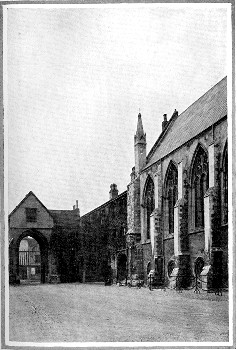 THE ERPINGHAM GATE AND THE GRAMMAR SCHOOL, NORWICH
Yet the only real influence that Borrow carried away from the Grammar School was concerned with foreign languages. He did take to the French master and exiled priest, Thomas d'Eterville, a native of Caen, who had emigrated to Norwich in 1793. D'Eterville taught French, Italian, and apparently, to Borrow, a little Spanish; and Borrow, with his wonderful memory, must have been his favourite pupil. In his edition of Lavengro Dr. Knapp publishes a brief dialogue between master and pupil, which gives us an amusing glimpse of the worthy d'Eterville, whom the boys called 'poor old Detterville.' In the fourteenth and fifteenth chapters of Lavengro he is pleasantly described by his pupil, who adds, with characteristic 'bluff,' that d'Eterville said 'on our arrival at the conclusion of Dante's Hell, "vous serez un jour un grand philologue, mon cher."'
Borrow's biographers have dwelt at length upon one episode of his schooldays—the flogging he received from Valpy for playing truant with three other boys. One, by name John Dalrymple, faltered on the way, the two faithful followers of George in his escapade being two brothers named Theodosius and Francis Purland, whose father kept a chemist's shop in Norwich. The three boys wandered away as far as Acle, eleven miles from Norwich, whence they were ignomimously brought back and birched. John Dalrymple's brother Arthur, son of a distinguished Norwich surgeon, who became Clerk of the Peace at Norwich in 1854, and died in 1868, has left a memorandum concerning Borrow, from which I take the following extract[40]:
'I was at school with Borrow at the Free School, Norwich, under the Rev. E. Valpy. He was an odd, wild boy, and always[Pg 74] wanting to turn Robinson Crusoe or Buccaneer. My brother John was about Borrow's age, and on one occasion Borrow, John, and another, whose name I forget, determined to run away and turn pirates. John carried an old horse pistol and some potatoes as his contribution to the general stock, but his zeal was soon exhausted, he turned back at Thorpe Lunatic Asylum; but Borrow went off to Yarmouth, and lived on the Caister Denes for a few days. I don't remember hearing of any exploits. He had a wonderful facility for learning languages, which, however, he never appears to have turned to account.
James Martineau, afterwards a popular preacher and a distinguished theologian of the Unitarian creed, here comes into the story. He was a contemporary with Borrow at the Norwich Grammar School as already stated, but the two boys had little in common. There was nothing of the vagabond about James Martineau, and concerning Borrow—if on no other subject—he would probably have agreed with his sister Harriet, whose views we shall quote in a later chapter. In Martineau's Memoirs, voluminous and dull, there is only one reference to Borrow;[41] but a correspondent once ventured to approach the eminent divine concerning the rumour as to Martineau's part in the birching of the author of The Bible in Spain, and received the following letter:
35 Gordon Square, London, W.C., December 6, 1895.
Dear Sir,—Two or three years ago Mr. Egmont Hake (author, I think, of a life of Gordon) sought an interview with me, as reputed to be Borrow's sole surviving schoolfellow, in order to gather information or test traditions about his schooldays. This was with a view to a memoir which he was compiling, he said, out of the[Pg 75] literary remains which had been committed to him by his executors. I communicated to him such recollections as I could clearly depend upon and leave at his disposal for publication or for suppression as he might think fit. Under these circumstances I feel that they are rightfully his, and that I am restrained from placing them at disposal elsewhere unless and until he renounces his claim upon them. But though I cannot repeat them at length for public use, I am not precluded from correcting inaccuracies in stories already in circulation, and may therefore say that Mr. Arthur Dalrymple's version of the Yarmouth escapade is wrong in making his brother John a partner in the transaction. John had quite too much sense for that; the only victims of Borrow's romance were two or three silly boys—mere lackeys of Borrow's commanding will—who helped him to make up a kit for the common knapsack by pilferings out of their fathers' shops.
The Norwich gentleman who fell in with the boys lying in the hedgerow near the half-way inn knew one of them, and wormed out of him the drift of their enterprise, and engaging a postchaise packed them all into it, and in his gig saw them safe home.
It is true that I had to hoist (not 'horse') Borrow for his flogging, but not that there was anything exceptional or capable of leaving permanent scars in the infliction. Mr. Valpy was not given to excess of that kind.
I have never read Lavengro, and cannot give any opinion about the correct spelling of the 'Exul sacerdos' name.
Borrow's romance and William Taylor's love of paradox would doubtless often run together, like a pair of well-matched steeds, and carry them away in the same direction. But there was a strong—almost wild—religious sentiment in Borrow, of which only faint traces appear in W. T. In Borrow it had always a tendency to pass from a sympathetic to an antipathetic form. He used to gather about him three or four favourite schoolfellows, after they had learned their class lesson and before the class was called up, and with a sheet of paper and book on his knee, invent and tell a story, making rapid little pictures of each dramatis persona that came upon the stage. The plot was woven and spread out with much ingenuity, and the characters were various[Pg 76] and well discriminated. But two of them were sure to turn up in every tale, the Devil and the Pope, and the working of the drama invariably had the same issue—the utter ruin and disgrace of these two potentates. I had often thought that there was a presage here of the mission which produced The Bible in Spain.—I am, dear sir, very truly yours,
James Martineau.[42]
Yet it is amusing to trace the story through various phases. Dr. Martineau's letter was the outcome of his attention being called to a statement made in a letter written by a lady in Hampstead to a friend in Norwich, which runs as follows:
11th Nov. 1893.
Dr. Martineau, to amuse some boys at a school treat, told us about George Borrow, his schoolfellow: he was always reading adventures of smugglers and pirates, etc., and at last, to carry out his ideas, got a set of his schoolfellows to promise to join him in an expedition to Yarmouth, where he had heard of a ship that he thought would take them. The boys saved all the food they could from their meals, and what money they had, and one morning started very early to walk to Yarmouth. They got half-way—to Blofield, I think—when they were so tired they had to rest by the roadside, and eat their lunch. While they were resting, a gentleman, whose son was at the Free School, passed in his gig. He thought it was very odd so many boys, some of whom he had seen, should be waiting about, so he drove back and asked them if they would come to dine with him at the inn. Of course they were only too glad, poor boys: but as soon as he had got them all in he sent his servant with a letter to Mr. Valpy, who sent a coach and brought them all back. You know what a cruel man that Dr. V. was. He made Dr. Martineau take poor Borrow on his back, 'horse him,' I think he called it, and flogged him so that Dr. M. said he would carry the marks for the rest of his life, and he had to keep his bed for a fortnight. The other[Pg 77] boys got off with lighter punishment, but Borrow was the ring-leader. Those were the 'good old times'! I have heard Dr. M. say that not for another life would he go through the misery he suffered as 'town boy' at that school.
Miss Frances Power Cobbe, who lived next door to Borrow in Hereford Square, Brompton, in the 'sixties, as we shall see later, has a word to say on the point:
Dr. Martineau once told me that he and Borrow had been schoolfellows at Norwich some sixty years before. Borrow had persuaded several of his other companions to rob their fathers' tills, and then the party set forth to join some smugglers on the coast. By degrees the truants all fell out of line and were picked up, tired and hungry, along the road, and brought back to Norwich School, where condign chastisement awaited them. George Borrow, it seems, received his large share horsed on James Martineau's back! The early connection between the two old men, as I knew them, was irresistibly comic to my mind. Somehow when I asked Mr. Borrow once to come and meet some friends at our house he accepted our invitation as usual, but, on finding that Dr. Martineau was to be of the party, hastily withdrew his acceptance on a transparent excuse; nor did he ever after attend our little assemblies without first ascertaining that Dr. Martineau was not to be present.[43]
James Martineau died in 1900, but the last of Borrow's schoolfellows to die was, I think, Mr. William Edmund Image, a Justice of the Peace and Deputy Lieutenant for Suffolk. He resided at Herringswell House, near Mildenhall, where he died in 1903, aged 96 years.
Mr. Valpy of the Norwich Grammar School is scarcely to be blamed that he was not able to make separate rules for a quite abnormal boy. Yet, if he[Pg 78] could have known, Borrow was better employed playing truant and living up to his life-work as a glorified vagabond than in studying in the ordinary school routine. George Borrow belonged to a type of boy—there are many such—who learn much more out of school than in its bounds; and the boy Borrow, picking up brother vagabonds in Tombland Fair, and already beginning, in his own peculiar way, his language craze, was laying the foundations that made Lavengro possible.
[38] In earlier times we have the names of Matthew Parker, Archbishop of Canterbury; Edward Coke, Lord Chief Justice; John Caius, the founder of Caius College, Cambridge; and Samuel Clarke, divine and metaphysician; and, indeed, a very considerable list of England's worthies.
[39] 'Lights on Borrow,' by the Rev. Augustus Jessopp, D. D., Hon. Canon of Norwich Cathedral, in The Daily Chronicle, 30th April 1900.
[40] The whole memorandum on a sheet of notepaper, signed A. D., is in the possession of Mrs. James Stuart of Carrow Abbey, Norwich, who has kindly lent it to me.
[41] This is a contemptuous reference in Martineau's own words to 'George Borrow, the writer and actor of romance,' in the allusion to Martineau's schoolfellows under Edward Valpy. Martineau was at the Norwich Grammar School for four years—from 1815 to 1819. See Life and Letters, by James Drummond and C. B. Upton, vol. i. pp. 16, 17.
[42] Reprint from an article by W. A. Dutt on 'George Borrow and James Martineau' in The Sphere for 30th August 1902. The letter was written to Mr. James Hooper, of Norwich.
[43] Life of Frances Power Cobbe as told by Herself, ch. xvii.
Doubts were very frequently expressed in Borrow's lifetime as to his having really been articled to a solicitor, but the indefatigable Dr. Knapp set that point at rest by reference to the Record Office. Borrow was articled to Simpson and Rackham of Tuck's Court, St. Giles's, Norwich, 'for the term of five years'—from March 1819 to March 1824—and these five years were spent in and about Norwich, and were full of adventure of a kind with which the law had nothing to do. If Borrow had had the makings of a lawyer he could not have entered the profession under happier auspices. The firm was an old established one even in his day. It had been established in Tuck's Court as Simpson and Rackham, then it became Rackham and Morse, Rackham, Cooke and Rackham, and Rackham and Cooke; finally, Tom Rackham, a famous Norwich man in his day, moved to another office, and the firm of lawyers who occupy the original offices in our day is called Leathes Prior and Sons. Borrow has told us frankly what a poor lawyer's clerk he made—he was always thinking of things remote from that profession, of gypsies, of prize-fighters, and of word-makers. Yet he loved the head of the firm, William Simpson, who must have been a kind and tolerant guide to the curious youth. Simpson was for a time Town Clerk of Norwich,[Pg 80] and his portrait hangs in the Blackfriars Hall. Borrow went to live with Mr. Simpson in the Upper Close near the Grammar School. Archdeacon Groome recalled having seen Borrow 'reserved and solitary' haunting the precincts of the playground; another schoolboy, William Drake, remembered him as 'tall, spare, dark-complexioned.'[44] Here is Borrow's account of his master and of his work:
A more respectable-looking individual was never seen; he really looked what he was, a gentleman of the law—there was nothing of the pettifogger about him: somewhat under the middle size, and somewhat rotund in person, he was always dressed in a full suit of black, never worn long enough to become threadbare. His face was rubicund, and not without keenness; but the most remarkable thing about him was the crown of his head, which was bald, and shone like polished ivory, nothing more white, smooth, and lustrous. Some people have said that he wore false calves, probably because his black silk stockings never exhibited a wrinkle; they might just as well have said that he waddled, because his boots creaked; for these last, which were always without a speck, and polished as his crown, though of a different hue, did creak, as he walked rather slowly. I cannot say that I ever saw him walk fast.
He had a handsome practice, and might have died a very rich man, much richer than he did, had he not been in the habit of giving rather expensive dinners to certain great people, who gave him nothing in return, except their company; I could never discover his reasons for doing so, as he always appeared to me a remarkably quiet man, by nature averse to noise and bustle; but in all dispositions there are anomalies. I have already said that he lived in a handsome house, and I may as well here add that he had a very handsome wife, who both dressed and talked exceedingly well.
So I sat behind the deal desk, engaged in copying documents of various kinds; and in the apartment in which I sat, and in the adjoining ones, there were others, some of whom likewise copied documents, while some were engaged in the yet more difficult task of drawing them up; and some of these, sons of nobody, were paid for the work they did, whilst others, like myself, sons of somebody, paid for being permitted to work, which, as our principal observed, was but reasonable, forasmuch as we not unfrequently utterly spoiled the greater part of the work intrusted to our hands.[45]
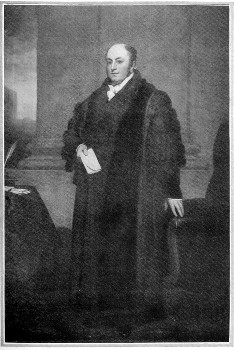 WILLIAM SIMPSON
And he goes on to tell us that he studied the Welsh language and later the Danish; his master said that his inattention would assuredly make him a bankrupt, and his father sighed over his eccentric and impracticable son. The passion for languages had indeed caught hold of Borrow. Among my Borrow papers I find a memorandum in the handwriting of his stepdaughter in which she says:
I have often heard his mother say, that when a mere child of eight or nine years, all his pocket-money was spent in purchasing foreign Dictionaries and Grammars; he formed an acquaintance with an old woman who kept a bookstall in the market-place of Norwich, whose son went voyages to Holland with cattle, and brought home Dutch books, which were eagerly bought by little George. One day the old woman was crying, and told him that her son was in prison. 'For doing what?' asked the child. 'For taking a silk handkerchief out of a gentleman's pocket.' 'Then,' said the boy, 'your son stole the pocket handkerchief?' 'No dear, no, my son did not steal,—he only glyfaked.'
We have no difficulty in recognising here the heroine of the Moll Flanders episode in Lavengro. But it was not from casual meetings with Welsh grooms and Danes and Dutchmen that Borrow acquired even such command of various languages as was undoubtedly his. We have it on the authority of an old fellow-pupil at the Grammar School, Burcham, afterwards a London police-magistrate, that William[Pg 82] Taylor gave him lessons in German,[46] but he acquired most of his varied knowledge in these impressionable years in the Corporation Library of Norwich. Dr. Knapp found, in his most laudable examination of some of the books, Borrow's neat pencil notes, the making of which was not laudable on the part of his hero. One book here marked was on ancient Danish literature, the author of which, Olaus Wormius, gave him the hint for calling himself Olaus Borrow for a time—a signature that we find in some of Borrow's published translations. Borrow at this time had aspirations of a literary kind, and Thomas Campbell accepted a translation of Schiller's Diver, which was signed 'O. B.' There were also translations from the German, Dutch, Swedish, and Danish, in the Monthly Magazine. Clearly Borrow was becoming a formidable linguist, if not a very exact master of words. Still he remained a vagabond, and loved to wander over Mousehold Heath, to the gypsy encampment, and to make friends with the Romany folk; he loved also to haunt the horse fairs for which Norwich was so celebrated; and he was not averse from the companionship of wilder spirits who loved pugilism, if we may trust Lavengro, and if we may assume, as we justly may, that he many times cast youthful, sympathetic eyes on John Thurtell in these years, the to-be murderer of Weare, then actually living with his father in a house on the Ipswich Road, Thurtell, the father, being in no mean position in the city—an alderman, and a sheriff in 1815. Yes, there was plenty to do and to see in Norwich, and Borrow's memories of it were nearly always kindly:
A fine old city, truly, is that, view it from whatever side you will; but it shows best from the east, where ground, bold and[Pg 83] elevated, overlooks the fair and fertile valley in which it stands. Gazing from those heights, the eye beholds a scene which cannot fail to awaken, even in the least sensitive bosom, feelings of pleasure and admiration. At the foot of the heights flows a narrow and deep river, with an antique bridge communicating with a long and narrow suburb, flanked on either side by rich meadows of the brightest green, beyond which spreads the city; the fine old city, perhaps the most curious specimen at present extant of the genuine old English town. Yes, there it spreads from north to south, with its venerable houses, its numerous gardens, its thrice twelve churches, its mighty mound, which, if tradition speaks true, was raised by human hands to serve as the grave-heap of an old heathen king, who sits deep within it, with his sword in his hand, and his gold and silver treasures about him. There is a grey old castle upon the top of that mighty mound; and yonder, rising three hundred feet above the soil, from among those noble forest trees, behold that old Norman master-work, that cloud-encircled cathedral spire, around which a garrulous army of rooks and choughs continually wheel their flight. Now, who can wonder that the children of that fine old city are proud of her, and offer up prayers for her prosperity? I myself, who was not born within her walls, offer up prayers for her prosperity, that want may never visit her cottages, vice her palaces, and that the abomination of idolatry may never pollute her temples.
But at the very centre of Borrow's Norwich life was William Taylor, concerning whom we have already written much. It was a Jew named Mousha, a quack it appears, who pretended to know German and Hebrew, and had but a smattering of either language, who first introduced Borrow to Taylor, and there is a fine dialogue between the two in Lavengro, of which this is the closing fragment:
'Are you happy?' said the young man.
'Why, no! And, between ourselves, it is that which induces me to doubt sometimes the truth of my opinions. My life, upon the whole, I consider a failure; on which account, I would not counsel you, or anyone, to follow my example too closely. It is[Pg 84] getting late, and you had better be going, especially as your father, you say, is anxious about you. But, as we may never meet again, I think there are three things which I may safely venture to press upon you. The first is, that the decencies and gentlenesses should never be lost sight of, as the practice of the decencies and gentlenesses is at all times compatible with independence of thought and action. The second thing which I would wish to impress upon you is, that there is always some eye upon us; and that it is impossible to keep anything we do from the world, as it will assuredly be divulged by somebody as soon as it is his interest to do so. The third thing which I would wish to press upon you——'
'Yes,' said the youth, eagerly bending forward.
'Is'—and here the elderly individual laid down his pipe upon the table—'that it will be as well to go on improving yourself in German!'
Taylor it was who, when Borrow determined to try his fortunes in London with those bundles of unsaleable manuscripts, gave him introductions to Sir Richard Phillips and to Thomas Campbell. It was in the agnostic spirit that he had learned from Taylor that he wrote during this period to his one friend in London, Roger Kerrison. Kerrison was grandson of Sir Roger Kerrison, Mayor of Norwich in 1778, as his son Thomas was after him in 1806. Roger was articled, as was Borrow, to the firm of Simpson and Rackham, while his brother Allday was in a drapery store in Norwich, but with mind bent on commercial life in Mexico. George was teaching him Spanish in these years as a preparation for his great adventure. Roger had gone to London to continue his professional experience. He finally became a Norwich solicitor and died in 1882. Allday went to Zacatecas, Mexico, and acquired riches. John Borrow followed him there and met with an early death, as we have seen. Borrow and[Pg 85] Roger Kerrison were great friends at this time; but when Lavengro was written they had ceased to be this, and Roger is described merely as an 'acquaintance' who had found lodgings for him on his first visit to London. As a matter of fact that trip to London was made easy for Borrow by the opportunity given to him of sharing lodgings with Roger Kerrison at Milman Street, Bedford Row, where Borrow put in an appearance on 1st April 1824, some two months after the following letter was written:
Norwich, Jany. 20, 1824.
Dearest Roger,—I did not imagine when we separated in the street, on the day of your departure from Norwich, that we should not have met again: I had intended to have come and seen you off, but happening to dine at W. Barron's I got into discourse, and the hour slipt past me unawares.
I have been again for the last fortnight laid up with that detestable complaint which destroys my strength, impairs my understanding, and will in all probability send me to the grave, for I am now much worse than when you saw me last. But nil desperandum est, if ever my health mends, and possibly it may by the time my clerkship is expired, I intend to live in London, write plays, poetry, etc., abuse religion and get myself prosecuted, for I would not for an ocean of gold remain any longer than I am forced in this dull and gloomy town.
I have no news to regale you with, for there is none abroad, but I live in the expectation of shortly hearing from you, and being informed of your plans and projects; fear not to be prolix, for the slightest particular cannot fail of being interesting to one who loves you far better than parent or relation, or even than the God whom bigots would teach him to adore, and who subscribes himself, Yours unalterably,
Borrow might improve his German—not sufficiently as we shall see in our next chapter—but he would certainly never make a lawyer. Long years afterwards, when, as an old man, he was frequently in Norwich, he not seldom called at that office in Tuck's Court, where five strange years of his life had been spent. A clerk in Rackham's office in these later years recalls him waiting for the principal as he in his youth had watched others waiting.[48]
[44] Norvicensian, 1888, p. 177.
[45] Lavengro, ch. xix.
[46] The Britannia newspaper, 26th June 1851.
[47] This letter is in the possession of Mr. J. C. Gould, Trap Hill House, Loughton, Essex.
[48] Mr. C. F. Martelli of Staple Inn, London, who has so generously placed this information at my disposal. Mr. Martelli writes:
'Old memories brought him to our office for professional advice, and there I saw something of him, and a very striking personality he was, and a rather difficult client to do business with. One peculiarity I remember was that he believed himself to be plagued by autograph hunters, and was reluctant to trust our firm with his signature in any shape or form, and that we in consequence had some trouble in inducing him to sign his will. I have seen him sitting over my fire in my room at that office for hours, half asleep, and crooning out Romany songs while waiting for my chief.'
'That's a strange man!' said I to myself, after I had left the house, 'he is evidently very clever; but I cannot say that I like him much with his Oxford Reviews and Dairyman's Daughters.'—Lavengro.
Borrow lost his father on the 28th February 1824. He reached London on the 2nd April of the same year, and this was the beginning of his many wanderings. He was armed with introductions from William Taylor, and with some translations in manuscript from Danish and Welsh poetry. The principal introduction was to Sir Richard Phillips, a person of some importance in his day, who has so far received but inadequate treatment in our own.[49] Phillips was active in the cause of reform at a certain period in his life, and would seem to have had many sterling qualities before he was spoiled by success. He was born in the neighbourhood of Leicester, and his father was 'in the farming line,' and wanted him to work on the farm, but he determined to seek his fortune in London. After a short absence, during which he clearly proved to himself that he was not at present qualified to capture London, young Phillips returned to the farm. Borrow refers to his patron's vegetarianism, and on this point we have an amusing story from his own[Pg 88] pen! He had been, when previously on the farm, in the habit of attending to a favourite heifer:
During his sojournment in London this animal had been killed; and on the very day of his return to his father's house, he partook of part of his favourite at dinner, without his being made acquainted with the circumstance of its having been slaughtered during his absence. On learning this, however, he experienced a sudden indisposition; and declared that so great an effect had the idea of his having eaten part of his slaughtered favourite upon him, that he would never again taste animal food; a vow to which he has hitherto firmly adhered.[50]
Farming not being congenial, Phillips hired a small room in Leicester, and opened a school for instruction in the three R's, a large blue flag on a pole being his 'sign' or signal to the inhabitants of Leicester, who seem to have sent their children in considerable numbers to the young schoolmaster. But little money was to be made out of schooling, and a year later Phillips was, by the kindness of friends, started in a small hosiery shop in Leicester. Throwing himself into politics on the side of reform, Phillips now started the Leicester Herald, to which Dr. Priestley became a contributor. The first number was issued gratis in May 1792. His Memoir informs us that it was an article in this newspaper that secured for its proprietor and editor eighteen months imprisonment in Leicester gaol,[Pg 89] but he was really charged with selling Paine's Rights of Man. The worthy knight had probably grown ashamed of The Rights of Man in the intervening years, and hence the reticence of the memoir. Phillips's gaoler was the once famous Daniel Lambert, the notorious 'fat man' of his day. In gaol Phillips was visited by Lord Moira and the Duke of Norfolk. It was this Lord Moira who said in the House of Lords in 1797 that 'he had seen in Ireland the most absurd, as well as the most disgusting tyranny that any nation ever groaned under.' Moira became Governor-General of Bengal and Commander-in-Chief of the Army in India. The Duke of Norfolk, a stanch Whig, distinguished himself in 1798 by a famous toast at the Crown and Anchor Tavern, Arundel Street, Strand:—'Our sovereign's health—the majesty of the people!' which greatly offended George III., who removed Norfolk from his lord-lieutenancy. Phillips seems to have had a very lax imprisonment, as he conducted the Herald from gaol, contributing in particular a weekly letter. Soon after his release he disposed of the Herald, or permitted it to die. It was revived a few years later as an organ of Toryism. He had started in gaol another journal, The Museum, and he combined this with his hosiery business for some time longer, when an opportune fire relieved him of an apparently uncongenial burden, and with the insurance money in his pocket he set out for London once more. Here he started as a hosier in St. Paul's Churchyard, lodging meantime in the house of a milliner, where he fell in love with one of the apprentices, Miss Griffiths, 'a native of Wales.' His affections were won, we are naïvely informed in the Memoir, by the young woman's talent in the preparation of a vegetable pie. This is[Pg 90] our first glimpse of Lady Phillips—'a quiet, respectable woman,' whom Borrow was to meet at dinner long years afterwards. Inspired, it would seem, by the kindly exhortation of Dr. Priestley, he now transformed his hosiery business in St. Paul's Churchyard into a 'literary repository,' and started a singularly successful career as a publisher. There he produced his long-lived periodical, The Monthly Magazine, which attained to so considerable a fame. Dr. Aikin, a friend of Priestley's, was its editor, but with him Phillips had a quarrel—the first of his many literary quarrels—and they separated. This Dr. Aikin was the father of the better-known Lucy Aikin, and was a Nonconformist who suffered for his opinions in these closing years of the eighteenth century, even as Priestley did. He was the author of many works, including the once famous Evenings at Home, written in conjunction with his sister, Mrs. Barbauld;[51] and after his quarrel with Phillips he founded a new publication issued by the house of Longman, and entitled The Athenæum. Hereupon he and Phillips quarrelled again, because Dr. Aikin described himself in advertisements of The Athenæum as 'J. Aikin, M.D., late editor of The Monthly Magazine.' Aikin's contributors to The Monthly included Capell Lofft, of whom we know too little, and Dr. Wolcot, of whom we know too much. Meanwhile Phillips's publishing business grew apace, and he removed to larger premises in Bridge Street, Blackfriars, an address which we find upon many famous publications of his period. A catalogue of his[Pg 91] books lies before me dated 'January 1805.' It includes many works still upon our shelves. Almon's Memoirs and Correspondence of John Wilkes, Samuel Richardson's Life and Correspondence, for example, several of the works of Maria Edgeworth, including her Moral Tales, many of the works of William Godwin, including Caleb Williams, and the earlier books of that still interesting woman and once popular novelist, Lady Morgan, whose Poems as Sydney Owenson bears Phillips's name on its title-page, as does also her first successful novel The Wild Irish Girl, and other of her stories. My own interest in Phillips commenced when I met him in the pages of Lady Morgan's Memoirs.[52] Thomas Moore, Lady Morgan tells us,
had come back to Dublin from London, where he had been 'the guest of princes, the friend of peers, the translator of Anacreon!' From royal palaces and noble manors, he had returned to his family seat—a grocer's shop at the corner of Little Longford Street, Angier Street.
Here, in a little room over the shop, Sydney heard him sing two of his songs, and was inspired thereby to write her first novels, St. Clair and The Novice of St. Dominick. The first was published in Dublin; over the second she corresponded with Phillips, and his letters to her commence with one dated from Bridge Street, 6th April 1805, in which he wishes[Pg 92] her to send the manuscript of The Novice to him as one 'often (undeservedly) complimented as the most liberal of my trade!' She determined, fresh from a governess situation, to bring the manuscript herself. Phillips was charmed with his new author, and really seems to have treated her very liberally. He insisted, however, on having The Novice cut down from six volumes to four, and she was wont to say that nothing but regard for her feelings prevented him from reducing it to three.[53] The Novice of St. Dominick was a favourite book with the younger Pitt, who read it over again in his last illness. Then followed—in 1806—Sydney Owenson's new novel, The Wild Irish Girl, and it led to an amusing correspondence with its author on the part of Phillips on the one side, and Johnson, who, it will be remembered, was Cowper's publisher, on the other. Phillips was indignant that, having first brought Sydney into fame, she should dare to ask more money on that account. As is the case with every novelist to-day who scores one success, Miss Owenson had formed a good idea of her value, and there is a letter to Johnson in which she admitted that Phillips's offer was a generous one. Johnson had offered her £300 for the copyright of The Wild Irish Girl. Phillips had offered only £200 down and £50 each for the second and third editions. When Phillips heard that Johnson had outbidden him, he described the offer as 'monstrous,' and that it was 'inspired by a spirit of revenge.' He would not, he declared, increase his offer, but a little later he writes from Bridge Street to Sydney Owenson as his 'dear, bewitching, and deluding Syren,' and promises the £300. A few months later he gave her a hundred[Pg 93] pounds for a slight volume of poems, which certainly never paid for its publication, although Scott and Moore and many another were making much money out of poetry in those days. In any case Phillips did not accept Miss Owenson's next story with alacrity, in spite of the undoubted success of The Wild Irish Girl. She no doubt asked too much for Ida of Athens. Phillips probably thought, after reading the first volume in type, that it was very inferior work, as indeed it was. Athens was described without the author ever having seen the city. After much wrangling, in which the lady said that her 'prince of publishers,' as she had once called him, had 'treated her barbarously,' the novel went into the hands of the Longmans, who published it, not without some remonstrance as to certain of its sentiments. The successful Lady Morgan afterwards described Ida as a bad book, so perhaps here, as usually, Phillips was not far wrong in his judgment. A similar quarrel seems to have taken place over the next novel, The Missionary. Here Phillips again received the manuscript, discussed terms with its author, and returned it. The firm of Stockdale and Miller were his successful rivals. Later and more prosperous novels, O'Donnel in particular, were issued by Henry Colburn, and Phillips now disappears from Lady Morgan's life. I have told the story of Phillips's relation with Lady Morgan at length because at no other point do we come into so near a contact with him. In Fell's Memoir Phillips is described—in 1808—as 'certainly now the first publisher in London,' but while he may have been this in the volume of his trade—and school-books made an important part of it—he was not in mere 'names.' Most of his successful writers—Sydney Owenson, Thomas Skinner Surr,[Pg 94] Dr. Gregory, and the rest—have now fallen into oblivion. The school-books that he issued have lasted even to our own day, notably Dr. Mavor's Spelling Book. Dr. Mavor was a Scotsman from Aberdeen, who came to London and became Phillips's chief hack. There are no less than twenty of Mavor's school-books in the catalogue before me. They include Mavor's History of England, Mavor's Universal History, and Mavor's History of Greece. In the Memoir of 1808 it is claimed that 'Mavor' is but a pseudonym for Phillips, and the claim is also made, quite wrongfully, by John Timbs, who, before he became acting editor of the Illustrated London News under Herbert Ingram, and an indefatigable author, was Phillips's private secretary.[54] It seems clear, however, that in the case of Blair's Catechism and Goldsmith's Geography, and many another book for schools, Phillips was 'Blair' and 'Goldsmith' and many another imaginary person, for the books in question numbered about two hundred in all. For these books there must have been quite an army of literary hacks employed during the twenty years prior to the appearance of George Borrow in that great army. On 9th November 1807, the Lord Mayor's procession through London included Richard Phillips among its sheriffs, and he was knighted by George III. in the following year. During his period of office he effected many reforms in the City prisons. John Timbs, in his Walks and Talks about London, tells us that Phillips's colleague in the[Pg 95] shrievalty was one Smith, who afterwards became Lord Mayor:
The personnel of the two sheriffs presented a sharp contrast. Smith loved aldermanic cheer, but was pale and cadaverous in complexion; whilst Phillips, who never ate animal food, was rosy and healthful in appearance. One day, when the sheriffs were in full state, the procession was stopped by an obstruction in the street traffic; when droll were the mistakes of the mob: to Smith they cried, 'Here's Old Water-gruel!' to Phillips, 'Here's Roast Beef! something like an Englishman!'
Two volumes before me show Phillips as the precursor of many of the publishers of one-volume books of reference so plentiful in our day. A Million of Facts is one of them, and A Chronology of Public Events Within the Last Fifty Years from 1771 to 1821 is another, while one of the earliest and most refreshing guides to London and its neighbourhood is afforded us in A Morning Walk from London to Kew, which first appeared in The Monthly Magazine, but was reprinted in 1817 with the name 'Sir Richard Phillips' as author on the title-page. Phillips was now no longer a publisher. Here we have some pleasant glimpses of a bygone era, many trite reflections, but not enough topography to make the book one of permanent interest. It would not, in fact, be worth reprinting.[55]
This, then, was the man to whom George Borrow presented himself in 1824. Phillips was fifty-seven years of age. He had made a moderate fortune and lost it, and was now enjoying another perhaps less satisfying; it included the profits of The Monthly Review,[Pg 96] repurchased after his bankruptcy, and some rights in many of the school-books. But the great publishing establishment in Bridge Street had long been broken up. Borrow would have found Taylor's introduction to Phillips quite useless had the worthy knight not at the moment been keen on a new magazine and seen the importance of a fresh 'hack' to help to run it. Moreover, had he not written a great book which only the Germans could appreciate, Twelve Essays on the Phenomena of Nature? Here, he thought, was the very man to produce this book in a German dress. Taylor was a thorough German scholar, and he had vouched for the excellent German of his pupil and friend. Hence a certain cordiality which did not win Borrow's regard, but was probably greater than many a young man would receive to-day from a publisher-prince upon whom he might call laden only with a bundle of translations from the Danish and the Welsh. Here—in Lavengro—is the interview between publisher and poet, with the editor's factotum Bartlett, whom Borrow calls Taggart, as witness:
'Well, sir, what is your pleasure?' said the big man, in a rough tone, as I stood there, looking at him wistfully—as well I might—for upon that man, at the time of which I am speaking, my principal, I may say my only hopes, rested.
'Sir,' said I, 'my name is So-and-so, and I am the bearer of a letter to you from Mr. So-and-so, an old friend and correspondent of yours.'
The countenance of the big man instantly lost the suspicious and lowering expression which it had hitherto exhibited; he strode forward and, seizing me by the hand, gave me a violent squeeze.
'My dear sir,' said he, 'I am rejoiced to see you in London. I have been long anxious for the pleasure—we are old friends, though we have never before met. Taggart,' said he to the man who sat at the desk, 'this is our excellent correspondent, the friend and pupil of our excellent correspondent.'
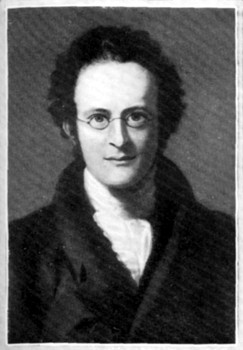 SIR JOHN BOWRING in 1826
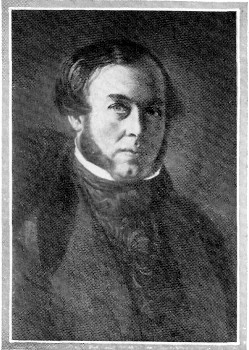 JOHN P. HASFELD in 1835
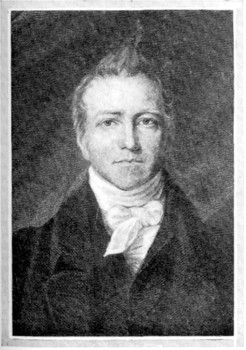 WILLIAM TAYLOR
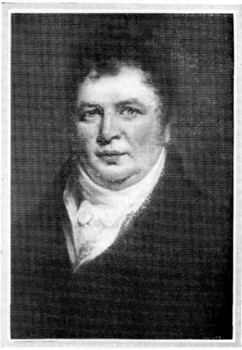 SIR RICHARD PHILLIPS
[Transcriber's Note: This is the caption for the page of four portraits, each portrait's caption is shown above.]
Phillips explains that he has given up publishing, except 'under the rose,' had only The Monthly Magazine, here[56] called The Magazine, but contemplated yet another monthly, The Universal Review, here called The Oxford. He gave Borrow much the same sound advice that a publisher would have given him to-day—that poetry is not a marketable commodity, and that if you want to succeed in prose you must, as a rule, write trash—the most acceptable trash of that day being The Dairyman's Daughter,[57] which has sold in hundreds of thousands, and is still much prized by the Evangelical folk who buy the publications of the Religious Tract Society. Phillips, moreover, asked him to dine to meet his wife, his son, and his son's wife,[58] and we know what an amusing account of that dinner Borrow gives in Lavengro. Moreover, he set Borrow upon his first piece of hack-work, the Celebrated Trials, and gave him something to do upon The Universal Review and also upon The Monthly. The Universal lasted only for six numbers, dying in January 1825. In that year appeared the six volumes of the Celebrated Trials, of which we have something to[Pg 98] say in our next chapter. Borrow found Phillips most exacting, always suggesting the names of new criminals, and leaving it to the much sweated author to find the books from which to extract the necessary material:
In the compilation of my Lives and Trials I was exposed to incredible mortification, and ceaseless trouble, from this same rage for interference.... This was not all; when about a moiety of the first volume had been printed, he materially altered the plan of the work; it was no longer to be a collection of mere Newgate lives and trials, but of lives and trials of criminals in general, foreign as well as domestic.... 'Where is Brandt and Struensee?' cried the publisher. 'I am sure I don't know,' I replied; whereupon the publisher falls to squealing like one of Joey's rats. 'Find me up Brandt and Struensee by next morning, or—' 'Have you found Brandt and Struensee?' cried the publisher, on my appearing before him next morning. 'No,' I reply, 'I can hear nothing about them'; whereupon the publisher falls to bellowing like Joey's bull. By dint of incredible diligence, I at length discover the dingy volume containing the lives and trials of the celebrated two who had brooded treason dangerous to the state of Denmark. I purchase the dingy volume, and bring it in triumph to the publisher, the perspiration running down my brow. The publisher takes the dingy volume in his hand, he examines it attentively, then puts it down; his countenance is calm for a moment, almost benign. Another moment and there is a gleam in the publisher's sinister eye; he snatches up the paper containing the names of the worthies which I have intended shall figure in the forthcoming volumes—he glances rapidly over it, and his countenance once more assumes a terrific expression. 'How is this?' he exclaims; 'I can scarcely believe my eyes—the most important life and trial omitted to be found in the whole criminal record—what gross, what utter negligence! Where's the life of Farmer Patch? where's the trial of Yeoman Patch?'
'What a life! what a dog's life!' I would frequently exclaim, after escaping from the presence of the publisher.[59]
Then came the final catastrophe. Borrow could not translate Phillips's great masterpiece, Twelve Essays on the Proximate Causes, into German with any real effectiveness although the testimonial of the enthusiastic Taylor had led Phillips to assume that he could. Borrow, as we shall see, knew many languages, and knew them well colloquially, but he was not a grammarian, and he could not write accurately in any one of his numerous tongues. His wonderful memory gave him the words, but not always any thoroughness of construction. He could make a good translation of a poem by Schiller, because he brought his own poetic fancy to the venture, but he had no interest in Phillips's philosophy, and so he doubtless made a very bad translation, as German friends were soon able to assure Phillips, who had at last to go to a German for a translation, and the book appeared at Stuttgart in 1826.[60] Meanwhile, Phillips's new magazine, The Universal Review, went on its course. It lasted only for a few numbers, as we have said—from March 1824 to January 1825—and it was entirely devoted to reviews, many of them written by Borrow, but without any distinction calling for comment to-day. Dr. Knapp thought that Gifford was the editor, with Phillips's son and George Borrow assisting. Gifford translated Juvenal, and it was for a long time assumed that Borrow wished merely to disguise Gifford's identity when he referred to his editor as the translator of Quintilian. But Sir Leslie Stephen has pointed out in Literature that John Carey (1756-1826), who actually edited Quintilian in 1822, was Phillips's editor, 'All the poetry which I reviewed,'[Pg 100] Borrow tells us, 'appeared to be published at the expense of the authors. All the publications which fell under my notice I treated in a gentlemanly ... manner—no personalities, no vituperation, no shabby insinuations; decorum, decorum was the order of the day.' And one feels that Borrow was not very much at home. But he went on with his Newgate Lives and Trials, which, however, were to be published with another imprint, although at the instance of Phillips. By that time he and that worthy publisher had parted company. Probably Phillips had set out for Brighton, which was to be his home for the remainder of his life.
[49] The few lines awarded to him in Mumby's Romance of Bookselling are an illustration of this.
[50] Memoirs of the Public and Private Life of Sir Richard Phillips, King's High Sheriff for the City of London and the County of Middlesex, by a Citizen of London and Assistants. London, 1808. This Memoir was published in 1808, many years before the death of Phillips, and was clearly inspired and partly written by him, although an autograph letter before me from one Ralph Fell shows that the worthy Fell actually received £12 from Phillips for 'compiling' the book. A portion of the Memoir may have been written by another literary hack named Pinkerton, but all of it was compiled under the direction of Phillips.
[51] Mr. Arthur Aikin Brodribb in his memoir of Aikin in the Dictionary of National Biography makes the interesting but astonishing statement that Aikin's Life of Howard 'has been adopted, without acknowledgment, by a modern writer.' Mr. Brodribb apparently knew nothing of Dr. Aikin's association with the Monthly Magazine or with the first Athenæum.
[52] I have no less than four memoirs of Lady Morgan on my shelves:—Passages from my Autobiography, by Sydney, Lady Morgan (Richard Bentley, 1859); The Friends, Foes, and Adventures of Lady Morgan, by William John Fitzpatrick (W. B. Kelly: Dublin, 1859); Lady Morgan; Her Career, Literary and Personal, with a Glimpse of her Friends, and A Word to her Calumniators, by William John Fitzpatrick (London: Charles J. Skeet, 1860); Lady Morgan's Memoirs: Autobiography, Diaries and Correspondence. Two vols. (London: W. H. Allen, 1863).
[53] Memoirs of Lady Morgan, edited by W. Hepworth Dixon.
[54] See Timbs's article on Phillips in his Walks and Talks about London, 1865. Timbs was wont to recall, as the late W. L. Thomas of the Graphic informed me, that while at the Illustrated London News he got so exasperated with Herbert Ingram, the founder and proprietor, that he would frequently write and post a letter of resignation, but would take care to reach the office before Ingram in the morning in order to withdraw it.
[55] Another London book before me, which bears the imprint 'Richard Phillips, Bridge Street,' is entitled The Picture of London for 1811. Mine is the twelfth edition of this remarkable little volume.
[56] In Lavengro.
[57] Legh Richmond (1772-1827), the author of The Dairyman's Daughter and The Young Cottager, which had an extraordinary vogue in their day. A few years earlier than this Princess Sophia Metstchersky translated the former into the Russian language, and Borrow must have seen copies when he visited St. Petersburg. Richmond was the first clerical secretary of the Religious Tract Society, with which The Dairyman's Daughter has always been one of the most popular of tracts.
[58] Phillips at his death in 1840 left a widow, three sons, and four daughters. One son was Vicar of Kilburn.
[59] Lavengro, ch. xxxix.
[60] Ueber die nächsten Ursachen der materiellen Erscheinungen des Universums, von Sir Richard Phillips, nach dem Englischen bearbeitet von General von Theobald und Prof. Dr. Lebret. Stuttgart, 1826.
In the early pages of Lavengro Borrow tells us nearly all we are ever likely to know of his sojourn in London in the years 1824 and 1825, during which time he had those interviews with Sir Richard Phillips which are recorded in our last chapter. Dr. Knapp, indeed, prints a little note from him to his friend Kerrison, in which he begs his friend to come to him as he believes he is dying. Roger Kerrison, it would seem, had been so frightened by Borrow's depression and threats of suicide that he had left the lodgings at 16 Milman Street, Bedford Row, and removed himself elsewhere, and so Borrow was left friendless to fight what he called his 'horrors' alone. The depression was not unnatural. From his own vivid narrative we learn of Borrow's bitter failure as an author. No one wanted his translations from the Welsh and the Danish, and Phillips clearly had no further use for him after he had compiled his Newgate Lives and Trials (Borrow's name in Lavengro for Celebrated Trials), and was doubtless inclined to look upon him as an impostor for professing, with William Taylor's sanction, a mastery of the German language which had been demonstrated to be false with regard to his own book. No 'spirited publisher' had come forward to give reality to his dream thus set down:[Pg 102]
I had still an idea that, provided I could persuade any spirited publisher to give these translations to the world, I should acquire both considerable fame and profit; not, perhaps, a world-embracing fame such as Byron's; but a fame not to be sneered at, which would last me a considerable time, and would keep my heart from breaking;—profit, not equal to that which Scott had made by his wondrous novels, but which would prevent me from starving, and enable me to achieve some other literary enterprise. I read and re-read my ballads, and the more I read them the more I was convinced that the public, in the event of their being published, would freely purchase, and hail them with the merited applause.
He has a tale to tell us in Lavengro of a certain Life and Adventures of Joseph Sell, the Great Traveller, the purchase of which from him by a publisher at the last moment saved him from starvation and enabled him to take to the road, there to meet the many adventures that have become immortal in the pages of Lavengro. Dr. Knapp has encouraged the idea that Joseph Sell was a real book, ignoring the fact that the very title suggests doubts, and was probably meant to suggest them. In Norfolk, as elsewhere, a 'sell' is a word in current slang used for an imposture or a cheat, and doubtless Borrow meant to make merry with the credulous. There was, we may be perfectly sure, no Joseph Sell, and it is more reasonable to suppose that it was the sale of his translation of Klinger's Faustus that gave him the much needed money at this crisis. Dr. Knapp pictures Borrow as carrying the manuscript of his translation of Faustus with him to London. There is not the slightest evidence of this. It may be reasonably assumed that Borrow made the translation from Klinger's novel during his sojourn in London. It is true the preface is dated 'Norwich, April 1825,' but Borrow did not leave London until the end of May 1825, that is to[Pg 103] say, until after he had negotiated with 'W. Simpkin and R. Marshall,' now the well-known firm of Simpkin and Marshall, for the publication of the little volume. That firm, unfortunately, has no record of the transaction. My impression is that Borrow in his wandering after old volumes on crime for his great compilation, Celebrated Trials, came across the French translation of Klinger's novel published at Amsterdam. From that translation he acknowledges that he borrowed the plate which serves as frontispiece—a plate entitled 'The Corporation Feast.' It represents the corporation of Frankfort at a banquet turned by the devil into various animals. It has been erroneously assumed that Borrow had had something to do with the designing of this plate, and that he had introduced the corporation of Norwich in vivid portraiture into the picture. Borrow does, indeed, interpolate a reference to Norwich into his translation of a not too complimentary character, for at that time he had no very amiable feelings towards his native city. Of the inhabitants of Frankfort he says:
They found the people of the place modelled after so unsightly a pattern, with such ugly figures and flat features, that the devil owned he had never seen them equalled, except by the inhabitants of an English town called Norwich, when dressed in their Sunday's best.[61]
In the original German version of 1791 we have the town of Nuremberg thus satirised. But Borrow was not the first translator to seize the opportunity of adapting the reference for personal ends. In the French translation of 1798, published at Amsterdam, and entitled Les Aventures du Docteur Faust, the[Pg 104] translator has substituted Auxerre for Nuremberg. What makes me think that Borrow used only the French version in his translation is the fact that in his preface he refers to the engravings of that version, one of which he reproduced; whereas the engravings are in the German version as well.
Friedrich Maximilian von Klinger (1752-1831), who was responsible for Borrow's 'first book,' was responsible for much else of an epoch-making character. It was he who by one of his many plays, Sturm und Drang, gave a name to an important period of German Literature. In 1780 von Klinger entered the service of Russia, and in 1790 married a natural daughter of the Empress Catherine. Thus his novel, Faust's Leben, Thaten und Höllenfahrt, was actually first published at St. Petersburg in 1791. This was seventeen years before Goethe published his first part of Faust, a book which by its exquisite poetry was to extinguish for all self-respecting Germans Klinger's turgid prose. Borrow, like the translator of Rousseau's Confessions and of many another classic, takes refuge more than once in the asterisk. Klinger's Faustus, with much that was bad and even bestial, has merits. The devil throughout shows his victim a succession of examples of 'man's inhumanity to man.' Borrow's translation of Klinger's novel was reprinted in 1864 without any acknowledgment of the name of the translator, and only a few stray words being altered.[62] Borrow nowhere[Pg 105] mentions Klinger's name in his latter volume, of which the title-page runs:
Faustus: His Life, Death, and Descent into Hell. Translated from the German. London: W. Simpkin and R. Marshall, 1825.
I doubt very much if he really knew who was the author, as the book in both the German editions I have seen as well as in the French version bears no author's name on its title-page. A letter of Borrow's in the possession of an American collector indicates that he was back in Norwich in September 1825, after, we may assume, three months' wandering among gypsies and tinkers. It is written from Willow Lane, and is apparently to the publishers of Faustus:
As your bill will become payable in a few days, I am willing to take thirty copies of Faustus instead of the money. The book has been burnt in both the libraries here, and, as it has been talked about, I may perhaps be able to dispose of some in the course of a year or so.
This letter clearly demonstrates that the guileless Simpkin and the equally guileless Marshall had paid Borrow for the right to publish Faustus, and even though part of the payment was met by a bill, I think we may safely find in the transaction whatever verity there may be in the Joseph Sell episode. 'Let me know how you sold your manuscript,' writes Borrow's brother to him so late as the year 1829. And this was doubtless Faustus. The action of the Norwich libraries in burning the book would clearly have had the sympathy of one of its few reviewers had he been informed of the[Pg 106] circumstance. It is thus that the Literary Gazette for 16th July 1825 refers to Borrow's little book:
This is another work to which no respectable publisher ought to have allowed his name to be put. The political allusions and metaphysics, which may have made it popular among a low class in Germany, do not sufficiently season its lewd scenes and coarse descriptions for British palates. We have occasionally publications for the fireside—these are only fit for the fire.
Borrow returned then to Norwich in the autumn of 1825 a disappointed man so far as concerned the giving of his poetical translations to the world, from which he had hoped so much. No 'spirited publisher' had been forthcoming, although Dr. Knapp's researches have unearthed a 'note' in The Monthly Magazine, which, after the fashion of the anticipatory literary gossip of our day, announced that Olaus Borrow was about to issue Legends and Popular Superstitions of the North, 'in two elegant volumes.' But this never appeared. Quite a number of Borrow's translations from divers languages had appeared from time to time, beginning with a version of Schiller's 'Diver' in The New Monthly Magazine for 1823, continuing with Stolberg's 'Ode to a Mountain Torrent' in The Monthly Magazine, and including the 'Deceived Merman.' These he collected into book form and, not to be deterred by the coldness of heartless London publishers, issued them by subscription. Three copies of the slim octavo book lie before me, with separate title-pages:
(1) Romantic Ballads, Translated from the Danish; and Miscellaneous Pieces by George Borrow. Norwich: Printed and Published by S. Wilkin, Upper Haymarket, 1826.
(2) Romantic Ballads, Translated from the Danish; and Miscellaneous Pieces by George Borrow. London: Published by John Taylor, Waterloo Place, Pall Mall, 1826.[Pg 107]
(3) Romantic Ballads, Translated from the Danish; and Miscellaneous Pieces, by George Borrow. London: Published by Wightman and Cramp, 24 Paternoster Row, 1826.[63]
The book contains an introduction in verse by Allan Cunningham, whose acquaintance Borrow seems to have made in London. It commences:
Sing, sing, my friend, breathe life again
Through Norway's song and Denmark's strain:
On flowing Thames and Forth, in flood,
Pour Haco's war-song, fierce and rude.
Cunningham had not himself climbed very far up the literary ladder in 1825, although he was forty-one years of age. At one time a stonemason in a Scots village, he had entered Chantrey's studio, and was 'superintendent of the works' to that eminent sculptor at the time when Borrow called upon him in London, and made an acquaintance which never seems to have extended beyond this courtesy to the younger man's Danish Ballads. The point of sympathy of course was that in the year 1825 Cunningham had published The Songs of Scotland, Ancient and Modern. But Allan Cunningham, whose Lives of the Most Eminent British Painters is his best remembered book to-day, scarcely comes into this story. There are four letters from Cunningham to Borrow in Dr. Knapp's Life, and two from Borrow to Cunningham. The latter gave his young friend much good advice. He told him, for example, to send copies of his book to the newspapers—to the Literary Gazette in particular, and 'Walter[Pg 108] Scott must not be forgotten.' Dr. Knapp thinks that the newspapers were forgotten, and that Borrow neglected to send to them. In any case not a single review appeared. But it is not exactly true that Borrow ignored the usual practice of authors so entirely as Dr. Knapp supposes. There is a letter to Borrow among my Borrow Papers from Francis Palgrave the historian, who became Sir Francis Palgrave seven years later, which throws some light upon the subject:
Parliament St., 17 June 1826.
My dear Sir,—I am very much obliged to you for the opportunity that you have afforded me of perusing your spirited and faithful translating of the Danish ballads. Mr. Allan Cunningham, who, as you will know, is an ancient minstrel himself, says that they are more true to the originals and more truly poetical than any that he has yet seen. I have delivered one copy to Mr. Lockhart, the new editor of the Quarterly Review, and I hope he will notice it as it deserves. Murray would probably be inclined to publish your translations.—I remain, dear sir, your obedient and faithful servant,
Francis Palgrave.
It is probable that he did also send a copy to Scott, and it is Dr. Knapp's theory that 'that busy writer forgot to acknowledge the courtesy.' It may be that this is so. It has been the source of many a literary prejudice. Carlyle had a bitterness in his heart against Scott for much the same cause. Rarely indeed can the struggling author endure to be ignored by the radiantly successful one. It must have been the more galling in that a few years earlier Scott had been lifted by the ballad from obscurity to fame. Borrow did not in any case lack encouragement from Allan Cunningham: 'I like your Danish ballads much,' he writes. 'Get out of[Pg 109] bed, George Borrow, and be sick or sleepy no longer. A fellow who can give us such exquisite Danish ballads has no right to repose.'[64] Borrow, on his side, thanks Cunningham for his 'noble lines,' and tells him that he has got 'half of his Songs of Scotland by heart.'
Five hundred copies of the Romantic Ballads were printed in Norwich by S. Wilkin, about two hundred being subscribed for, mainly in that city, the other three hundred being dispatched to London—to Taylor, whose name appears on the London title-page, although he seems to have passed on the book very quickly to Wightman and Cramp, for what reason we are not informed. Borrow tells us that the two hundred subscriptions of half a guinea 'amply paid expenses,' but he must have been cruelly disappointed, as he was doomed to be more than once in his career, by the lack of public appreciation outside of Norwich. Yet there were many reasons for this. If Scott had made the ballad popular, he had also destroyed it for a century—perhaps for ever—by substituting the novel as the favourite medium for the storyteller. Great ballads we were to have in every decade from that day to this, but never another 'best seller' like Marmion or The Lady of the Lake. Our popular poets had to express themselves in other ways. Then Borrow, although his verse has been underrated by those who have not seen it at its best, or who are incompetent to appraise poetry, was not very effective here, notwithstanding that the stories in verse in Romantic Ballads are all entirely interesting. This fact is most in evidence in a case where a real poet, not of the greatest, has told the same story. We owe a rendering of 'The Deceived Merman'[Pg 110] to both George Borrow and Matthew Arnold, but how widely different the treatment! The story is of a merman who rose out of the water and enticed a mortal—fair Agnes or Margaret—under the waves; she becomes his wife, bears him children, and then asks to return to earth. Arriving there she refuses to go back when the merman comes disconsolately to the churchdoor for her. Here are a few lines from the two versions, which demonstrate that here at least Borrow was no poet and that Arnold was a very fine one:
| GEORGE BORROW | MATTHEW ARNOLD |
| 'Now, Agnes, Agnes list to me, | We climbed on the graves, on the stones worn with rains, |
| Thy babes are longing so after thee.' | And we gazed up the aisles through the small leaded panes. |
| 'I cannot come yet, here must I stay | She sate by the pillar; we saw her clear: |
| Until the priest shall have said his say,' | 'Margaret, hist! come quick we are here! |
| And when the priest had said his say, | Dear heart,' I said, 'we are long alone; |
| She thought with her mother at home she'd stay. | The sea grows stormy, the little ones moan,' |
| 'O Agnes, Agnes list to me, | But, ah, she gave me never a look, |
| Thy babes are sorrowing after thee,' | For her eyes were sealed on the holy book! |
| 'Let them sorrow and sorrow their fill, | Loud prays the priest; shut stands the door. |
| But back to them never return I will.' | Come away, children, call no more! |
| Come away, come down, call no more! |
It says much for the literary proclivities of Norwich at this period that Borrow should have had so kindly a reception for his book as the subscription list implies. At the end of each of Wilkin's two hundred copies a 'list of subscribers' is given. It opens with the name of the Bishop of Norwich, Dr. Bathurst; it includes the equally familiar names of the Gurdons, Gurneys, Harveys, Rackhams, Hares (then as now of Stow[Pg 111] Hall), Woodhouses—all good Norfolk or Norwich names that have come down to our time. Mayor Hawkes, who is made famous in Lavengro by Haydon's portrait, is there also. Among London names we find 'F. Arden,' which recalls his friend 'Francis Ardry' in Lavengro, John Bowring, Borrow's new friend, and later to be counted an enemy, Thomas Campbell, Benjamin Haydon, and John Timbs, But the name that most strikes the eye is that of 'Thurtell.' Three of the family are among the subscribers, including Mr. George Thurtell of Eaton, near Norwich, brother of the murderer; there also is the name of John Thurtell, executed for murder exactly a year before. This would seem to imply that Borrow had been a long time collecting these names and subscriptions, and doubtless before the all-too-famous crime of the previous year he had made Thurtell promise to become a subscriber, and, let us hope, had secured his half-guinea. That may account, with so sensitive and impressionable a man as our author, for the kindly place that Weare's unhappy murderer always had in his memory. Borrow, in any case, was now, for a few years, to become more than ever a vagabond. Not a single further appeal did he make to an unsympathetic literary public for a period of five years at least.
[61] Life and Death of Faustus, p. 59.
[62] Faustus: His Life, Death, and Doom: a Romance in Prose, translated from the German. London: W. Kent and Co., Paternoster Row, 1864, Borrow's Life and Death of Faustus was reprinted in 1840, again with Simpkin's imprint. Collating Borrow's translation with the issue of 1864, I find that, with a few trivial verbal alterations, they are identical—that is to say, the translator of the book of 1864 did not translate at all, but copied from Borrow's version of Faustus, copying even his errors in translation. There is no reason to suppose that the individual, whoever he may have been, who prepared the 1864 edition of Faustus for the Press, had ever seen either the German original or the French translation of Klinger's book. It is clear that he 'conveyed' Borrow's translation almost in its entirety.
[63] Allan Cunningham, in a letter to Borrow, says, 'Taylor will undertake to publish.' But there must have been a change afterwards, for some of the London copies bear the imprint Wightman and Cramp. In 1913 Jarrold and Sons of Norwich issued a reprint of Romantic Ballads limited to 300 copies, with facsimiles of the manuscript from my Borrow Papers.
[64] Knapp's Life, vol. i 117.
Borrow's first book was Faustus, and his second was Romantic Ballads, the one being published, as we have seen, in 1825, the other in 1826. This chronology has the appearance of ignoring the Celebrated Trials, but then it is scarcely possible to count Celebrated Trials[65] as one of Borrow's books at all. It is largely a compilation, exactly as the Newgate Calendar and Howell's State Trials are compilations. In his preface to the work Borrow tells us that he has differentiated the book from the Newgate Calendar[66] and the State Trials[67] by the fact that he had made considerable compression. This was so, and in fact in many cases he has used the blue pencil rather than the pen—at least in the earlier volumes. But Borrow attempted something much more comprehensive than the Newgate Calendar and the State Trials in his book. In the former work the trials range from 1700 to 1802; in the latter from the[Pg 113] trial of Becket in 1163 to the trial of Thistlewood in 1820. Both works are concerned solely with this country. Borrow went all over Europe, and the trials of Joan of Arc, Count Struensee, Major André, Count Cagliostro, Queen Marie Antoinette, the Duc d'Enghien, and Marshal Ney, are included in his volumes. Moreover, while what may be called state trials are numerous, including many of the cases in Howell, the greater number are of a domestic nature, including nearly all that are given in the Newgate Calendar. In the first two volumes he has naturally mainly state trials to record; the later volumes record sordid everyday crimes, and here Borrow is more at home. His style when he rewrites the trials is more vigorous, and his narrative more interesting. It is to be hoped that the exigent publisher, who he assures us made him buy the books for his compilation out of the £50 that he paid for it, was able to present him with a set of the State Trials, if only in one of the earlier and cheaper issues of the work than the one that now has a place in every lawyer's library.[68]
The third volume of Celebrated Trials, although it opens with the trial of Algernon Sidney, is made up largely of crime of the more ordinary type, and this sordid note continues through the three final volumes.[Pg 114] I have said that Faustus is an allegory of 'man's inhumanity to man.' That is emphatically, in more realistic form, the distinguishing feature of Celebrated Trials. Amid these records of savagery, it is a positive relief to come across such a trial as that of poor Joseph Baretti. Baretti, it will be remembered, was brought to trial because, when some roughs set upon him in the street, he drew a dagger, which he usually carried 'to carve fruit and sweetmeats,' and killed his assailant. In that age, when our law courts were a veritable shambles, how cheerful it is to find that the jury returned a verdict of 'self-defence.' But then Sir Joshua Reynolds, Edmund Burke, Dr. Johnson, and David Garrick gave evidence to character, representing Baretti as 'a man of benevolence, sobriety, modesty, and learning.' This trial is an oasis of mercy in a desert of drastic punishment. Borrow carries on his 'trials' to the very year before the date of publication, and the last trial in the book is that of 'Henry Fauntleroy, Esquire,' for forgery. Fauntleroy was a quite respectable banker of unimpeachable character, to whom had fallen at a very early age the charge of a banking business that was fundamentally unsound. It is clear that he had honestly endeavoured to put things on a better footing, that he lived simply, and had no gambling or other vices. At a crisis, however, he forged a document, in other words signed a transfer of stock which he had no right to do, the 'subscribing witness' to his power of attorney being Robert Browning, a clerk in the Bank of England, and father of the distinguished poet.[69] Well, Fauntleroy was sentenced to be hanged—and he was duly hanged at Newgate on 30th October[Pg 115] 1824, only thirteen years before Queen Victoria came to the throne!
Borrow has affirmed that from a study of the Newgate Calendar and the compilation of his Celebrated Trials he first learned to write genuine English, and it is a fact that there are some remarkably dramatic effects in these volumes, although one here withholds from Borrow the title of 'author' because so much is 'scissors and paste,' and the purple passages are only occasional. All the same I am astonished that no one has thought it worth while to make a volume of these dramatic episodes, which are clearly the work of Borrow, and owe nothing to the innumerable pamphlets and chap-books that he brought into use. Take such an episode as that of Schening and Harlin, two young German women, one of whom pretended to have murdered her infant in the presence of the other because she madly supposed that this would secure them bread—and they were starving. The trial, the scene at the execution, the confession on the scaffold of the misguided but innocent girl, the respite, and then the execution—these make up as thrilling a narrative as is contained in the pages of fiction. Assuredly Borrow did not spare himself in that race round the bookstalls of London to find the material which the grasping Sir Richard Phillips required from him. He found, for example, Sir Herbert Croft's volume, Love and Madness, the supposed correspondence of Parson Hackman and Martha Reay, whom he murdered. That correspondence is now known to be an invention of Croft's. Borrow accepted it as genuine, and incorporated the whole of it in his story of the Hackman trial.
But after all, the trial which we read with greatest interest in these six volumes is that of John Thurtell,[Pg 116] because Borrow had known Thurtell in his youth, and gives us more than one glimpse of him in Lavengro and The Romany Rye. We recall, for example, Lavengro's interview with the magistrate when a visitor is announced:
'In what can I oblige you, sir?' said the magistrate.
'Well, sir; the soul of wit is brevity; we want a place for an approaching combat between my friend here and a brave from town. Passing by your broad acres this fine morning we saw a pightle, which we deemed would suit. Lend us that pightle, and receive our thanks; 'twould be a favour, though not much to grant: we neither ask for Stonehenge nor for Tempe.'
My friend looked somewhat perplexed; after a moment, however, he said, with a firm but gentlemanly air, 'Sir, I am sorry that I cannot comply with your request.'
'Not comply!' said the man, his brow becoming dark as midnight; and with a hoarse and savage tone, 'Not comply! why not?'
'It is impossible, sir—utterly impossible!'
'Why so?'
'I am not compelled to give my reasons to you, sir, nor to any man.'
'Let me beg of you to alter your decision,' said the man, in a tone of profound respect.
'Utterly impossible, sir; I am a magistrate.'
'Magistrate! then fare-ye-well, for a green-coated buffer and a Harmanbeck.'
'Sir,' said the magistrate, springing up with a face fiery with wrath.
But, with a surly nod to me, the man left the apartment; and in a moment more the heavy footsteps of himself and his companion were heard descending the staircase.
'Who is that man?' said my friend, turning towards me.
'A sporting gentleman, well known in the place from which I come.'
'He appeared to know you.'
'I have occasionally put on the gloves with him.'
'What is his name?'
In the original manuscript in my possession the name 'John Thurtell' is given as the answer to that inquiry. In the printed book the chapter ends more abruptly as we see. The second reference is even more dramatic. It occurs when Lavengro has a conversation with his friend the gypsy Petulengro in a thunderstorm—when all are hurrying to the prize-fight. Here let Borrow tell his story:
'Look up there, brother!'
I looked up. Connected with this tempest there was one feature to which I have already alluded—the wonderful colours of the clouds. Some were of vivid green, others of the brightest orange, others as black as pitch. The gypsy's finger was pointed to a particular part of the sky.
'What do you see there, brother?'
'A strange kind of cloud.'
'What does it look like, brother?'
'Something like a stream of blood.'
'That cloud foreshoweth a bloody dukkeripen.'
'A bloody fortune!' said I. 'And whom may it betide?'
'Who knows?' said the gypsy.
Down the way, dashing and splashing, and scattering man, horse, and cart to the left and right, came an open barouche, drawn by four smoking steeds, with postillions in scarlet jackets and leather skull-caps. Two forms were conspicuous in it—that of the successful bruiser, and of his friend and backer, the sporting gentleman of my acquaintance.
'His!' said the gypsy, pointing to the latter, whose stern features wore a smile of triumph, as, probably recognising me in the crowd, he nodded in the direction of where I stood, as the barouche hurried by.
There went the barouche, dashing through the rain-gushes, and in it one whose boast it was that he was equal to 'either fortune.' Many have heard of that man—many may be desirous of knowing yet more of him. I have nothing to do with that man's after life—he fulfilled his dukkeripen. 'A bad, violent man!' Softly, friend; when thou wouldst speak harshly of[Pg 118] the dead, remember that thou hast not yet fulfilled thy own dukkeripen!
There is yet another reference by Borrow to Thurtell in The Gypsies of Spain, which runs as follows:
When a boy of fourteen I was present at a prize-fight; why should I hide the truth? It took place on a green meadow, beside a running stream, close by the old church of E——, and within a league of the ancient town of N——, the capital of one of the eastern counties. The terrible Thurtell was present, lord of the concourse; for wherever he moved he was master, and whenever he spoke, even when in chains, every other voice was silent. He stood on the mead, grim and pale as usual, with his bruisers around. He it was, indeed, who got up the fight, as he had previously done twenty others; it being his frequent boast that he had first introduced bruising and bloodshed amidst rural scenes, and transformed a quiet slumbering town into a den of Jews and metropolitan thieves.
Rarely in our criminal jurisprudence has a murder trial excited more interest than that of John Thurtell for the murder of Weare—the Gill's Hill Murder, as it was called. Certainly no murder of modern times has had so many indirect literary associations. Borrow, Carlyle, Hazlitt, Walter Scott, and Thackeray are among those who have given it lasting fame by comment of one kind or another; and the lines ascribed to Theodore Hook are perhaps as well known as any other memory of the tragedy:
Carlyle's division of human beings of the upper classes into 'noblemen, gentlemen, and gigmen,' which occurs[Pg 119] in his essay on Richter, and a later reference to gig-manhood which occurs in his essay on Goethe's Works, had their inspiration in an episode in the trial of Thurtell, when the question being asked, 'What sort of a person was Mr. Weare?' brought the answer, 'He was always a respectable person.' 'What do you mean by respectable?' the witness was asked. 'He kept a gig,' was the reply, which brought the word 'gigmanity' into our language.[70]
I have said that John Thurtell and two members of his family became subscribers for Borrow's Romantic Ballads,[71] and it is certain that Borrow must often have met Thurtell, that is to say looked at him from a distance, in some of the scenes of prize-fighting which both affected, Borrow merely as a youthful spectator, Thurtell as a reckless backer of one or other combatant. Thurtell's father was an alderman of Norwich living in a good house on the Ipswich Road when the son's name rang through England as that of a murderer. The father was born in 1765 and died in 1846. Four years after his son John was hanged he was elected Mayor of Norwich, in recognition of his violent ultra-Whig[Pg 120] or blue and white political opinions. He had been nominated as mayor both in 1818 and 1820, but it was perhaps the extraordinary 'advertisement' of his son's shameful death that gave the citizens of Norwich the necessary enthusiasm to elect Alderman Thurtell as mayor in 1828. It was in those oligarchical days a not unnatural fashion to be against the Government. The feast at the Guildhall on this occasion was attended by four hundred and sixty guests. A year before John Thurtell was hanged, in 1823, his father moved a violent political resolution in Norwich, but was out-Heroded by Cobbett, who moved a much more extreme one over his head and carried it by an immense majority. It was a brutal time, and there cannot be a doubt but that Alderman Thurtell, while busy setting the world straight, failed to bring up his family very well. John, as we shall see, was hanged; Thomas, another brother, was associated with him in many disgraceful transactions; while a third brother, George, also a subscriber, by the way, to Borrow's Romantic Ballads, who was a landscape gardener at Eaton, died in prison in 1848 under sentence for theft. Apart from a rather riotous and bad bringing up, which may be pleaded in extenuation, it is not possible to waste much sympathy over John Thurtell. He had thoroughly disgraced himself in Norwich before he removed to London. There he got further and further into difficulties, and one of the many publications which arose out of his trial and execution was devoted to pointing the moral of the evils of gambling.[72] It was bad luck at cards,[Pg 121] and the loss of much money to William Weare, who seems to have been an exceedingly vile person, that led to the murder. Thurtell had a friend named Probert who lived in a quiet cottage in a byway of Hertfordshire—Gill's Hill, near Elstree. He suggested to Weare in a friendly way that they should go for a day's shooting at Gill's Hill, and that Probert would put them up for the night. Weare went home, collected a few things in a bag, and took a hackney coach to a given spot, where Thurtell met him with a gig. The two men drove out of London together. The date was 24th October 1823. On the high-road they met and passed Probert and a companion named Joseph Hunt, who had even been instructed by Thurtell to bring a sack with him—this was actually used to carry away the body—and must therefore have been privy to the intended murder. By the time the second gig containing Probert and Hunt arrived near Probert's cottage, Thurtell met it in the roadway, according to their accounts, and told the two men that he had done the deed; that he had killed Weare first by ineffectively shooting him, then by dashing out his brains with his pistol, and finally by cutting his throat. Thurtell further told his friends, if their evidence was to be trusted, that he had left the body behind a hedge. In the night the three men placed the body in a sack and carried it to a pond near Probert's house and threw it in. The next night they fished it out and threw it into another pond some distance away.[Pg 122]
Thurtell meanwhile had divided the spoil—some £20, which he said was all that he had obtained from Weare's body—with his companions. Hunt, it may be mentioned, afterwards declared his conviction that Thurtell, when he first committed the murder, had removed his victim's principal treasure, notes to the value of three or four hundred pounds. Suspicion was aroused, and the hue and cry raised through the finding by a labourer of the pistol in the hedge, and the discovery of a pool of blood on the roadway. Probert promptly turned informer; Hunt also tried to save himself by a rambling confession, and it was he who revealed where the body was concealed, accompanying the officers to the pond and pointing out the exact spot where the corpse would be found. When recovered the body was taken to the Artichoke Inn at Elstree, and here the coroner's inquest was held. Meanwhile Thurtell had been arrested in London, and taken down to Elstree to be present at the inquest. A verdict of guilty against all three miscreants was given by the coroner's jury, and Weare's body was buried in Elstree Churchyard.[73]
In January 1824 John Thurtell was brought to trial at Hertford Assizes, and Hunt also. But first of all there were some interesting proceedings in the Court of King's Bench, before the Chief Justice and two other judges,[74] complaining that Thurtell had not been allowed to see his counsel. And there were other points at issue. Thurtell's counsel moved for a criminal injunction against the proprietor of the Surrey Theatre in that a performance had been held there, and was being held, which assumed Thurtell's guilt, the identical horse and gig being exhibited in which Weare was supposed to have ridden to the scene of his death. Finally this was arranged, and a mandamus was granted 'commanding the admission of legal advisers to the prisoner.' At last the trial came on at Hertford before Mr. Justice Park. It lasted two days, although the judge wished to go on all night in order to finish in one. But the protest of Thurtell, supported by the jury, led to an adjournment. Probert had been set free and appeared as a witness. The jury gave a verdict of guilty, and Thurtell and Hunt were sentenced to be hanged, but Hunt escaped with[Pg 124] transportation. Thurtell made his own speech for the defence, which had a great effect upon the jury, until the judge swept most of its sophistries away. It was, however, a very able performance. Thurtell's line of defence was to declare that Hunt and Probert were the murderers, and that he was a victim of their perjuries. If hanged, he would be hanged on circumstantial evidence only, and he gave, with great elaboration, the details of a number of cases where men had been wrongfully hanged upon circumstantial evidence. His lawyers had apparently provided him with books containing these examples from the past, and his month in prison was devoted to this defence, which showed great ability. The trial took place on 6th January 1824, and Thurtell was hanged on the 9th, in front of Hertford Gaol: his body was given to the Anatomical Museum in London. A contemporary report says that Thurtell, on the scaffold,
fixed his eyes on a young gentleman in the crowd, whom he had frequently seen as a spectator at the commencement of the proceedings against him. Seeing that the individual was affected by the circumstances, he removed them to another quarter, and in so doing recognised an individual well known in the sporting circles, to whom he made a slight bow.
The reader of Lavengro might speculate whether that 'young gentleman' was Borrow, but Borrow was in Norwich in January 1824, his father dying in the following month. In his Celebrated Trials Borrow tells the story of the execution with wonderful vividness, and supplies effective quotations from 'an eyewitness.' Borrow no doubt exaggerated his acquaintance with Thurtell, as in his Robinson Crusoe romance he was fully entitled to do for effect. He was too young at the time to have been much noticed by a man so much[Pg 125] his senior. The writer who accepts Borrow's own statement that he really gave him 'some lessons in the noble art' is too credulous,[75] and the statement that Thurtell's house 'on the Ipswich Road was a favourite rendezvous for the Fancy' is unsupported by evidence. Old Alderman Thurtell owned the house in question, and we find no evidence that he encouraged his son's predilection for prize-fighting. In The Romany Rye he gives his friend the jockey as his authority for the following apologia:
The night before the day he was hanged at H——, I harnessed a Suffolk Punch to my light gig, the same Punch which I had offered to him, which I have ever since kept, and which brought me and this short young man to Horncastle, and in eleven hours I drove that Punch one hundred and ten miles. I arrived at H—— just in the nick of time. There was the ugly jail—the scaffold—and there upon it stood the only friend I ever had in the world. Driving my Punch, which was all in a foam, into the midst of the crowd, which made way for me as if it knew what I came for, I stood up in my gig, took off my hat, and shouted, 'God Almighty bless you, Jack!' The dying man turned his pale grim face towards me—for his face was always somewhat grim, do you see—nodded and said, or I thought I heard him say, 'All right, old chap.' The next moment—my eyes water. He had a high heart, got into a scrape whilst in the marines, lost his half-pay, took to the turf, ring, gambling, and at last cut the throat of a villain who had robbed him of nearly all he had. But he had good qualities, and I know for certain that he never did half the bad things laid to his charge.
[65] Celebrated Trials and Remarkable Cases of Criminal Jurisprudence from the Earliest Records to the Year 1825. In six volumes. London: Printed for Geo. Knight & Lacey, Paternoster Row, 1825. Price £3, 12s. in boards.
[66] The New and Complete Newgate Calendar or Malefactors Recording Register. By William Jackson. Six vols. 1802.
[67] Cobbett and Howell's State Trials. In thirty-three volumes and index, 1809 to 1828. The last volume, apart from the index, was actually published the year after Borrow's Celebrated Trials, that is, in 1826; but the last trial recorded was that of Thistlewood in 1820. The editors were William Cobbett, Thomas Bayly Howell, and his son, Thomas Jones Howell.
[68] The following note appeared in The Monthly Magazine for 1st July 1824 (vol. lvii. p. 557):
'A Selection of the most remarkable Trials and Criminal Causes is printing in five volumes. It will include all famous cases, from that of Lord Cobham, in the reign of Henry the Fifth, to that of John Thurtell; and those connected with foreign as well as English jurisprudence. Mr. Borrow, the editor, has availed himself of all the resources of the English, German, French, and Italian languages; and his work, including from 150 to 200 of the most interesting cases on record, will appear in October next. The editor of the preceding has ready for the press a Life of Faustus, his Death, and Descent into Hell, which will also appear early in the next winter.'
[69] Did the poet, who had an interest in criminology, know of his father's quite innocent association with the Fauntleroy trial?
[70] Another witness attained fame by her answer to the inquiry, 'Was supper postponed?' with the reply, 'No, it was pork.'
[71] I have already stated (ch. x. p. 111) that three members of the Thurtell family subscribed for Romantic Ballads. I should have hesitated to include John Thurtell among the subscribers, as he was hanged two years before the book was published, had I not the high authority of Mr. Walter Rye, but recently Mayor of Norwich, and the honoured author of a History of Norfolk Families and other works. Mr. Rye, to whom I owe much of the information concerning the Thurtells published here, tells me that there was only this one, 'J. Thurtell.' Borrow had doubtless been appealing for subscribers for a very long time. I cannot, however, accept Mr. Rye's suggestion to me that Borrow left Norwich because he was mixed up with Thurtell in ultra-Whig or Radical scrapes, the intimidation and 'cooping' of Tory voters being a characteristic of the elections of that day with the wilder spirits, of whom Thurtell was doubtless one. Borrow's sympathies were with the Tory party from his childhood up—following his father.
[72] The Fatal Effects of Gambling Exemplified in the Murder of Wm. Weare and the Trial and Fate of John Thurtell, the Murderer, and his Accomplices. London: Thomas Kelly, Paternoster Row. 1824. I have a very considerable number of Weare pamphlets in my possession, one of them being a record of the trial by Pierce Egan, the author of Life in London and Boxiana. Walter Scott writes in his diary of being absorbed in an account of the trial, while he deprecates John Bull's maudlin sentiment over 'the pitiless assassin.' That was in 1826, but in 1828 Scott went out of his way when travelling from London to Edinburgh, to visit Gill's Hill, and describes the scene of the tragedy very vividly. Lockhart's Life, ch. lxxvi.
[73] Elstree had already had its association with a murder case, for Martha Reay, the mistress of John Montagu, fourth Earl of Sandwich, was buried in the church in 1779. She was the mother of several of the Earl's children, one of whom was Basil Montagu. She was a beautiful woman and a delightful singer, and was appearing on the stage at Covent Garden, which theatre she was leaving on the night of 7th April 1779, when the Reverend James Hackman, Vicar of Wiveton in Norfolk, shot her through the head with a pistol in a fit of jealous rage. Hackman was hanged at Tyburn, Boswell attending the funeral. Croft's supposed letters between Hackman and Martha Reay, which made a great sensation when issued under the title of Love and Madness, are now known to be spurious (see ch. x. p. 115). Martha Reay was buried in the chancel of Elstree Church, but Lord Sandwich, who, although he sent word to Hackman, who asked his forgiveness, that 'he had robbed him of all comfort in this world,' took no pains to erect a monument over her remains. On 28th February 1913 the present writer visited Elstree in the interest of this book. He found that the church of Martha Reay and William Weare had long disappeared. A new structure dating from 1853 had taken its place. The present vicar, he was told, has located the spot where Weare was buried, and it coincides with the old engravings. Martha Reay's remains, at the time of the rebuilding, were removed to the churchyard, and lie near the door of the vestry, lacking all memorial. The Artichoke Inn has also been rebuilt, and 'Weare's Pond,' which alone recalls the tragedy to-day, where the body was found, has contracted into a small pool. It is, however, clearly authentic, the brook, as pictured in the old trial-books, now running under the road.
[74] One of them was Mr. Justice Best, of whom it is recorded that a certain index had the reference line, 'Mr. Justice Best: his Great Mind,' which seemed to have no justification in the mental qualities of that worthy, but was explained when one referred to the context and saw that 'Mr. Justice Best said that he had a great mind to commit the witness for contempt.'
[75] See an introduction by Thomas Seccombe to Lavengro in 'Everyman's Library.'
George Borrow had no sympathy with Thurtell the gambler. I can find no evidence in his career of any taste for games of hazard or indeed for games of any kind, although we recall that as a mere child he was able to barter a pack of cards for the Irish language. But he had certainly very considerable sympathy with the notorious criminal as a friend and patron of prize-fighting. This now discredited pastime Borrow ever counted a virtue. Was not his God-fearing father a champion in his way, or, at least, had he not in open fight beaten the champion of the moment, Big Ben Brain? Moreover, who was there in those days with blood in his veins who did not count the cultivation of the Fancy as the noblest and most manly of pursuits! Why, William Hazlitt, a prince among English essayists, whose writings are a beloved classic in our day, wrote in The New Monthly Magazine in these very years[76] his own eloquent impression, and even introduces John Thurtell more than once as 'Tom Turtle,' little thinking then of the fate that was so soon to overtake him. What could be more lyrical than this:[Pg 127]
Reader, have you ever seen a fight? If not, you have a pleasure to come, at least if it is a fight like that between the Gas-man and Bill Neate.
And then the best historian of prize-fighting, Henry Downes Miles, the author of Pugilistica, has his own statement of the case. You will find it in his monograph on John Jackson, the pugilist who taught Lord Byron to box, and received the immortality of an eulogistic footnote in Don Juan. Here is Miles's defence:
No small portion of the public has taken it for granted that pugilism and blackguardism are synonymous. It is as an antidote to these slanderers that we pen a candid history of the boxers; and taking the general habits of men of humble origin (elevated by their courage and bodily gifts to be the associates of those more fortunate in worldly position), we fearlessly maintain that the best of our boxers present as good samples of honesty, generosity of spirit, goodness of heart and humanity, as an equal number of men of any class of society.
From Samuel Johnson to George Bernard Shaw literary England has had a kindness for the pugilist, although the magistrate has long, and rightly, ruled him out as impossible. Borrow carried his enthusiasm further than any, and no account of him that concentrates attention upon his accomplishment as a distributor of Bibles and ignores his delight in fisticuffs, has any grasp of the real George Borrow. Indeed it may be said, and will be shown in the course of our story, that Borrow entered upon Bible distribution in the spirit of a pugilist rather than that of an evangelist. But to return to Borrow's pugilistic experiences. He claims, as we have seen, occasionally to have put on the gloves with John Thurtell. He describes vividly enough his own conflicts with the Flaming Tinman[Pg 128] and with Petulengro. His one heroine, Isopel Berners, had 'Fair Play and Long Melford' as her ideal, 'Long Melford' being the good right-handed blow with which Lavengro conquered the Tinman. Isopel, we remember, had learned in Long Melford Union to 'Fear God and take your own part!'
George Borrow, indeed, was at home with the whole army of prize-fighters, who came down to us like the Roman Cæsars or the Kings of England in a noteworthy procession, their dynasty commencing with James Fig of Thame, who began to reign in 1719, and closing with Tom King, who beat Heenan in 1863, or with Jem Mace, who flourished in a measure until 1872. With what zest must Borrow have followed the account of the greatest battle of all, that between Heenan and Tom Sayers at Farnborough in 1860, when it was said that Parliament had been emptied to patronise a prize-fight; and this although Heenan complained that he had been chased out of eight counties. For by this time, in spite of lordly patronage, pugilism was doomed, and the more harmless boxing had taken its place. 'Pity that corruption should have crept in amongst them,' sighed Lavengro in a memorable passage, in which he also has his pæan of praise for the bruisers of England:
Let no one sneer at the bruisers of England—what were the gladiators of Rome, or the bull-fighters of Spain, in its palmiest days, compared to England's bruisers?[77]
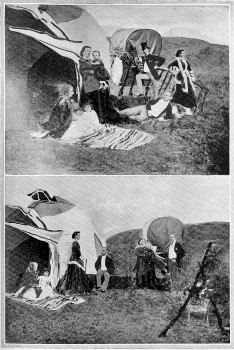 THE FAMILY OF JASPER PETULENGRO
Yes: Borrow was never hard on the bruisers of England, and followed their achievements, it may be said, from his cradle to his grave. His beloved father had brought him up, so to speak, upon memories of one who was champion before George was born—Big Ben Brain of Bristol. Brain, although always called 'Big Ben,' was only 5 feet 10 in. high. He was for years a coal porter at a wharf off the Strand. It was in 1791 that Ben Brain won the championship which placed him upon a pinnacle in the minds of all robust people. The Duke of Hamilton then backed him against the then champion, Tom Johnson, for five hundred guineas. 'Public expectation,' says The Oracle, a contemporary newspaper, 'never was raised so high by any pugilistic contest; great bets were laid, and it is estimated £20,000 was wagered on this occasion.' Ben Brain was the undisputed conqueror, we are told, in eighteen rounds, occupying no more than twenty-one minutes.[78] Brain died in 1794, and all the biographers tell of the piety of his end, so that Borrow's father may have read the Bible to him in his last moments, as Borrow avers,[79] but I very much doubt the accuracy of the following:
Honour to Brain, who four months after the event which I have now narrated was champion of England, having conquered the heroic Johnson. Honour to Brain, who, at the end of other four months, worn out by the dreadful blows which he had received in his manly combats, expired in the arms of my father, who read the Bible to him in his latter moments—Big Ben Brain.
We have already shown that Brain lived for four years after his fight with Johnson. Perhaps the fight in Hyde Park between Borrow's father and Ben, as narrated in Lavengro, is all romancing. It makes[Pg 130] good reading in any case, as does Borrow's eulogy of some of his own contemporaries of the prize-ring:
So the bruisers of England are come to be present at the grand fight speedily coming off; there they are met in the precincts of the old town, near the field of the chapel, planted with tender saplings at the restoration of sporting Charles, which are now become venerable elms as high as many a steeple. There they are met at a fitting rendezvous, where a retired coachman, with one leg, keeps an hotel and a bowling-green. I think I now see them upon the bowling-green, the men of renown, amidst hundreds of people with no renown at all, who gaze upon them with timid wonder. Fame, after all, is a glorious thing, though it lasts only for a day. There's Cribb, the champion of England, and perhaps the best man in England; there he is, with his huge, massive figure, and face wonderfully like that of a lion. There is Belcher, the younger, not the mighty one, who is gone to his place, but the Teucer Belcher, the most scientific pugilist that ever entered a ring, only wanting strength to be, I won't say what. He appears to walk before me now, as he did that evening, with his white hat, white greatcoat, thin genteel figure, springy step, and keen, determined eye. Crosses him, what a contrast! grim, savage Shelton, who has a civil word for nobody, and a hard blow for anybody—hard! one blow, given with the proper play of his athletic arm, will unsense a giant. Yonder individual, who strolls about with his hands behind him, supporting his brown coat lappets, under-sized, and who looks anything but what he is, is the king of the light weights, so called—Randall! the terrible Randall, who has Irish blood in his veins—not the better for that, nor the worse; and not far from him is his last antagonist, Ned Turner, who, though beaten by him, still thinks himself as good a man, in which he is, perhaps, right, for it was a near thing; and 'a better shentleman,' in which he is quite right, for he is a Welshman. But how shall I name them all? They were there by dozens, and all tremendous in their way. There was Bulldog Hudson, and fearless Scroggins, who beat the conqueror of Sam the Jew. There was Black Richmond—no, he was not there, but I knew him well; he was the most dangerous of blacks, even with a broken thigh. There was Purcell, who could never conquer till[Pg 131] all seemed over with him. There was—what! shall I name thee last? ay, why not? I believe that thou art the last of all that strong family still above the sod, where mayest thou long continue—true piece of English stuff, Tom of Bedford—sharp as winter, kind as spring.
All this is very accurate history. We know that there really was this wonderful gathering of the bruisers of England assembled in the neighbourhood of Norwich in July 1820, that is to say, sixteen miles away at North Walsham. More than 25,000 men, it is estimated, gathered to see Edward Painter of Norwich fight Tom Oliver of London for a purse of a hundred guineas. There were three Belchers, heroes of the prize-ring, but Borrow here refers to Tom, whose younger brother, Jem, had died in 1811 at the age of thirty. Tom Belcher died in 1854 at the age of seventy-one. Thomas Cribb was champion of England from 1805 to 1820. One of Cribb's greatest fights was with Jem Belcher in 1807, when, in the forty-first and last round, as we are told by the chroniclers, 'Cribb proving the stronger man put in two weak blows, when Belcher, quite exhausted, fell upon the ropes and gave up the combat.' Cribb had a prolonged career of glory, but he died in poverty in 1848. Happier was an earlier champion, John Gully, who held the glorious honour for three years—from 1805 to 1808. Gully turned tavern-keeper, and making a fortune out of sundry speculations, entered Parliament as member for Pontefract, and lived to be eighty years of age.
It is necessary to dwell upon Borrow as the friend of prize-fighters, because no one understands Borrow who does not realise that his real interests were not in literature but in action. He would have liked to join the army but could not obtain a commission. And so[Pg 132] he had to be content with such fighting as was possible. He cared more for the men who could use their fists than for those who could but wield the pen. He would, we may be sure, have rejoiced to know that many more have visited the tomb of Tom Sayers in Highgate Cemetery than have visited the tomb of George Eliot in the same burial-ground. A curious moral obliquity this, you may say. But to recognise it is to understand one side of Borrow, and an interesting side withal.
[76] The New Monthly Magazine, February 1822, 'The Fight.' Reprinted among William Hazlitt's Fugitive Writings in vol. xii. of his Collected Works (Dent, 1904).
[77] Lavengro ch. xxvi. 'It is as good as Homer,' says Mr. Augustine Birrell, quoting the whole passage in his Res Judicatæ. Mr. Birrell tells a delightful story of an old Quaker lady who was heard to say at a dinner-table, when the subject of momentary conversation was a late prize-fight: 'Oh, pity it was that ever corruption should have crept in amongst them'—she had just been reading Lavengro.
[78] Pugilistica, vol. i. 69.
[79] Lavengro, ch. i.
There has been much nonsense written concerning what has been called the 'veiled period' of George Borrow's life. This has arisen from a letter which Richard Ford of the Handbook for Travellers in Spain wrote to Borrow after a visit to him at Oulton in 1844. Borrow was full of his projected Lavengro, the idea of which he outlined to his friends. He was a genial man in those days, on the wave of a popular success. Was not The Bible in Spain passing merrily from edition to edition! Borrow, it is clear, told Ford that he was writing his 'Autobiography'—he had no misgiving then as to what he should call it—and he evidently proposed to end it in 1825 and not in 1833, when the Bible Society gave him his real chance in life. Ford begged him, in letters that came into Dr. Knapp's possession, and from which he quotes all too meagrely, not to 'drop a curtain' over the eight years succeeding 1825. 'No doubt,' says Ford, 'it will excite a mysterious interest,' but then he adds in effect it will lead to a wrong construction being put upon the omission. Well, there can be but one interpretation, and that not an unnatural one. Borrow had a very rough time during these eight years. His vanity was hurt, and no wonder. It seems a small matter to us[Pg 134] now that Charles Dickens should have been ashamed of the blacking-bottle episode of his boyhood. Genius has a right to a penurious, and even to a sordid, boyhood. But genius has no right to a sordid manhood, and here was George 'Olaus' Borrow, who was able to claim the friendship of William Taylor, the German scholar; who was able to boast of his association with sound scholastic foundations, with the High School at Edinburgh and the Grammar School at Norwich; who was a great linguist and had made rare translations from the poetry of many nations, starving in the byways of England and of France. What a fate for such a man that he should have been so unhappy for eight years; should have led the most penurious of roving lives, and almost certainly have been in prison as a common tramp.[80] It was all very well to romance about a poverty-stricken youth. But when youth had fled there ceased to be romance, and only sordidness was forthcoming. From his twenty-third to his thirty-first year George Borrow was engaged in a hopeless quest for the means of making a living. There is, however, very little mystery. Many incidents of each of these years are revealed at one or other point. His home, to which he returned from time to time, was with his mother at the cottage in Willow Lane, Norwich. Whether he made sufficient profit out of a horse, as in The Romany Rye, to enable him to travel upon the proceeds, as Dr. Knapp thinks, we cannot say. Dr. Knapp is doubtless right in assuming that during this period he led 'a life of roving adventure,' his own authorised version of his career at the time, as we have quoted from the biography in his handwriting from Men of the Time. But[Pg 135] how far this roving was confined to England, how far it extended to other lands, we do not know. We are, however, satisfied that he starved through it all, that he rarely had a penny in his pocket. At a later date he gave it to be understood at times that he had visited the East, and that India had revealed her glories to him. We do not believe it. Defoe was Borrow's master in literature, and he shared Defoe's right to lie magnificently on occasion. Dr. Knapp has collected the various occasions upon which Borrow referred to his supposed earlier travels abroad prior to his visit to St. Petersburg in 1833. The only quotation that carries conviction is an extract from a letter to his mother from St. Petersburg, where he writes of 'London, Paris, Madrid, and other capitals which I have visited.' I am not, however, disinclined to accept Dr. Knapp's theory that in 1826-7 Borrow did travel to Paris and through certain parts of Southern Europe. It is strange, all the same, that adventures which, had they taken place, would have provoked a thousand observations, provoked but two or three passing references. Yet there is no getting over that letter to his mother, nor that reference in The Gypsies of Spain, where he says—'Once in the south of France, when I was weary, hungry, and penniless....' Borrow certainly did some travel in these years, but it was sordid, lacking in all dignity—never afterwards to be recalled. For the most part, however, he was in England. We know that Borrow was in Norwich in 1826, for we have seen him superintending the publication of the Romantic Ballads by subscription in that year. In that year also he wrote the letter to Haydon, the painter, to say that he was ready to sit for him, but that he was 'going to the south of France in a little better than a[Pg 136] fortnight.'[81] We know also that he was in Norwich in 1827, because it was then, and not in 1818 as described in Lavengro, that he 'doffed his hat' to the famous trotting stallion Marshland Shales, when that famous old horse was exhibited at Tombland Fair on the Castle Hill. We meet him next as the friend of Dr. Bowring. The letters to Bowring we must leave to another chapter, but they commence in 1829 and continue through 1830 and 1831. Through them all Borrow shows himself alive to the necessity of obtaining an appointment of some kind, and meanwhile he is hard at work upon his translations from various languages, which, in conjunction with Dr. Bowring, he is to issue as Songs of Scandinavia. Dr. Knapp thinks that in 1829 he made the translation of the Memoirs of Vidocq, which appeared in that year with a short preface by the translator.[82] But these little volumes bear no internal evidence of Borrow's style, and there is no external evidence to support the assumption that he had a hand in their publication. His occasional references to Vidocq are probably due to the fact that he had read this little book.
I have before me one very lengthy manuscript of Borrow's of this period. It is dated December 1829,[Pg 137] and is addressed, 'To the Committee of the Honourable and Praiseworthy Association, known by the name of the Highland Society.'[83] It is a proposal that they should publish in two thick octavo volumes a series of translations of the best and most approved poetry of the ancient and modern Scots-Gaelic bards. Borrow was willing to give two years to the project, for which he pleads 'with no sordid motive.' It is a dignified letter, which will be found in one of Dr. Knapp's appendices—so presumably Borrow made two copies of it. The offer was in any case declined, and so Borrow passed from disappointment to disappointment during these eight years, which no wonder he desired, in the coming years of fame and prosperity, to veil as much as possible. The lean years in the lives of any of us are not those upon which we delight to dwell, or upon which we most cheerfully look back.[84]
[80] Only thus can we explain Borrow's later declaration that he had four times been in prison.
[81] I quote this letter in another chapter. Mr. Herbert Jenkins thinks (Life, ch. v. p. 88) that Borrow was in Paris during the revolution of 1830, because of a picturesque reference to the war correspondents there in The Bible in Spain. But Borrow never hesitated to weave little touches of romance from extraneous writers into his narratives, and may have done so here. I have visited most of the principal capitals of the world, he says in The Bible in Spain. This we would call a palpable lie were not so much of The Bible in Spain sheer invention.
[82] Memoirs of Vidocq, Principal Agent of the French Police until 1827, and now proprietor of the paper manufactory at St. Mandé. Written by himself. Translated from the French. In Four Volumes. London: Whittaker, Treacher and Arnot, Ave Maria Lane, 1829.
[83] This with other documents I am about to present to the Borrow Museum, Norwich.
[84] In 1830 Borrow had another disappointment. He translated The Sleeping Bard from the Welsh. This also failed to find a publisher. It was issued in 1860, under which date we discuss it.
'Poor George.... I wish he were making money. He works hard and remains poor'—thus wrote John Borrow to his mother in 1830 from Mexico, and it disposes in a measure of any suggestion of mystery with regard to five of those years that he wished to veil. They were not spent, it is clear, in rambling in the East, as he tried to persuade Colonel Napier many years later. They were spent for the most part in diligent attempt at the capture of words, in reading the poetry and the prose of many lands, and in making translations of unequal merit from these diverse tongues. This is indisputably brought home to me by the manuscripts in my possession, supplemented by those that fell to Dr. Knapp. These manuscripts represent years of work. Borrow has been counted a considerable linguist, and he had assuredly a reading and speaking acquaintance with a great many languages. But this knowledge was acquired, as all knowledge is, with infinite trouble and patience. I have before me hundreds of small sheets of paper upon which are written English words and their equivalents in some twenty or thirty languages. These serve to show that Borrow learnt a language as a small boy in an old-fashioned system of education learns his Latin or French—by writing down simple words—'father,' 'mother,' 'horse,' 'dog,' and so on with[Pg 139] the same word in Latin or French in front of them. Of course Borrow had a superb memory and abundant enthusiasm, and so he was enabled to add one language to another and to make his translations from such books as he could obtain, with varied success. I believe that nearly all the books that he handled came from the Norwich library, and when Mrs. Borrow wrote to her elder son to say that George was working hard, as we may fairly assume, from the reply quoted, that she did, she was recalling this laborious work at translation that must have gone on for years. We have seen the first fruit in the translation from the German—or possibly from the French—of Klinger's Faustus; we have seen it in Romantic Ballads from the Danish, the Irish, and the Swedish. Now there really seemed a chance of a more prosperous utilisation of his gift, for Borrow had found a zealous friend who was prepared to go forward with him in this work of giving to the English public translations from the literatures of the northern nations. This friend was Dr. John Bowring, who made a very substantial reputation in his day.
Bowring has told his own story in a volume of Autobiographical Recollections,[85] a singularly dull book for a man whose career was at once so varied and so full of interest. He was born at Exeter in 1792 of an old Devonshire family, and entered a merchant's office in his native city on leaving school. He early acquired a taste for the study of languages, and learnt French from a refugee priest precisely in the way in which Borrow had done. He also acquired Italian, Spanish, German and Dutch, continuing with a great variety of other languages. Indeed, only the very year after[Pg 140] Borrow had published Faustus, he published his Ancient Poetry and Romances of Spain, and the year after Borrow's Romantic Ballads came Bowring's Servian Popular Poetry. With such interest in common it was natural that the two men should be brought together, but Bowring had the qualities which enabled him to make a career for himself and Borrow had not. In 1811, as a clerk in a London mercantile house, he was sent to Spain, and after this his travels were varied. He was in Russia in 1820, and in 1822 was arrested at Calais and thrown into prison, being suspected by the Bourbon Government of abetting the French Liberals. Canning as Foreign Minister took up his cause, and he was speedily released. He assisted Jeremy Bentham in founding The Westminster Review in 1824. Meanwhile he was seeking official employment, and in conjunction with Mr. Villiers, afterwards Earl of Clarendon, and that ambassador to Spain who befriended Borrow when he was in the Peninsula, became a commissioner to investigate the commercial relations between England and France. After the Reform Bill of 1832 Bowring was frequently a candidate for Parliament, and was finally elected for Bolton in 1841. In the meantime he assisted Cobden in the formation of the Anti-Corn Law League in 1838. Having suffered great monetary losses in the interval, he applied for the appointment of Consul at Canton, of which place he afterwards became Governor, being knighted in 1854. At one period of his career at Hong Kong his conduct was made the subject of a vote of censure in Parliament, Lord Palmerston, however, warmly defending him. Finally returning to England in 1862, he continued his literary work with unfailing zest. He died at Exeter, in a house very near that in which he was born, in 1872. His extraordinary[Pg 141] energies cannot be too much praised, and there is no doubt but that in addition to being the possessor of great learning he was a man of high character. His literary efforts were surprisingly varied. There are at least thirty-six volumes with his name on the title-page, most of them unreadable to-day; even such works, for example, as his Visit to the Philippine Isles and Siam and the Siamese, which involved travel into then little-known lands. Perhaps the only book by him that to-day commands attention is his translation of Chamisso's Peter Schlemihl. The most readable of many books by him into which I have dipped is his Servian Popular Poetry of 1827, in which we find interesting stories in verse that remind us of similar stories from the Danish in Borrow's Romantic Ballads published only the year before. The extraordinary thing, indeed, is the many points of likeness between Borrow and Bowring. Both were remarkable linguists; both had spent some time in Spain and Russia; both had found themselves in foreign prisons. They were alike associated in some measure with Norwich—Bowring through friendship with Taylor—and I might go on to many other points of likeness or of contrast. It is natural, therefore, that the penniless Borrow should have welcomed acquaintance with the more prosperous scholar. Thus it is that, some thirty years later, Borrow described the introduction by Taylor:
The writer had just entered into his eighteenth year, when he met at the table of a certain Anglo-Germanist an individual, apparently somewhat under thirty, of middle stature, a thin and weaselly figure, a sallow complexion, a certain obliquity of vision, and a large pair of spectacles. This person, who had lately come from abroad, and had published a volume of translations, had attracted some slight notice in the literary world, and was looked upon as a kind of lion in a small provincial capital. After dinner he argued[Pg 142] a great deal, spoke vehemently against the Church, and uttered the most desperate Radicalism that was perhaps ever heard, saying, he hoped that in a short time there would not be a king or queen in Europe, and inveighing bitterly against the English aristocracy, and against the Duke of Wellington in particular, whom he said, if he himself was ever president of an English republic—an event which he seemed to think by no means improbable—he would hang for certain infamous acts of profligacy and bloodshed which he had perpetrated in Spain. Being informed that the writer was something of a philologist, to which character the individual in question laid great pretensions, he came and sat down by him, and talked about languages and literature. The writer, who was only a boy, was a little frightened at first.[86]
The quarrels of authors are frequently amusing but rarely edifying, and this hatred of Bowring that possessed the soul of poor Borrow in his later years is of the same texture as the rest. We shall never know the facts, but the position is comprehensible enough. Let us turn to the extant correspondence[87] which, as far as we know, opened when Borrow paid what was probably his third visit to London in 1829:
17 Great Russell Street, Bloomsbury. [Dec. 6, 1829.]
My dear Sir,—Lest I should intrude upon you when you are busy, I write to inquire when you will be unoccupied. I wish to shew you my translation of The Death of Balder, Ewald's most celebrated production,[88] which, if you approve of, you will perhaps[Pg 143] render me some assistance in bringing forth, for I don't know many publishers. I think this will be a proper time to introduce it to the British public, as your account of Danish literature will doubtless cause a sensation. My friend Mr. R. Taylor has my Kæmpe Viser, which he has read and approves of; but he is so very deeply occupied, that I am apprehensive he neglects them: but I am unwilling to take them out of his hands, lest I offend him. Your letting me know when I may call will greatly oblige,—Dear Sir, your most obedient servant,
George Borrow.
17 Great Russell Street, Bloomsbury. [Dec. 28, 1829.][89]
My dear Sir,—I trouble you with these lines for the purpose of submitting a little project of mine for your approbation. When I had last the pleasure of being at yours, you mentioned, that we might at some future period unite our strength in composing a kind of Danish Anthology. You know, as well as I, that by far the most remarkable portion of Danish poetry is comprised in those ancient popular productions termed Kæmpe Viser, which I have translated. Suppose we bring forward at once the first volume of the Danish Anthology, which should contain the heroic and supernatural songs of the K. V., which are certainly the most interesting; they are quite ready for the press with the necessary notes, and with an introduction which I am not ashamed of. The second volume might consist of the Historic songs and the ballads and Romances, this and the third volume, which should consist of the modern Danish poetry, and should commence with the celebrated 'Ode to the Birds' by Morten Borup, might appear in company at the beginning of next season. To Ölenslager should be allotted the principal part of the fourth volume; and it is my opinion that amongst his minor pieces should be given a good translation of his Aladdin, by which alone[Pg 144] he has rendered his claim to the title of a great poet indubitable. A proper Danish Anthology cannot be contained in less than 4 volumes, the literature being so copious. The first volume, as I said before, might appear instanter, with no further trouble to yourself than writing, if you should think fit, a page or two of introductory matter.—Yours most truly, my dear Sir,
George Borrow.
17 Great Russell Street, Decr. 31, 1829.
My dear Sir,—I received your note, and as it appears that you will not be disengaged till next Friday evening (this day week) I will call then. You think that no more than two volumes can be ventured on. Well! be it so! The first volume can contain 70 choice Kæmpe Viser; viz. all the heroic, all the supernatural ballads (which two classes are by far the most interesting), and a few of the historic and romantic songs. The sooner the work is advertised the better, for I am terribly afraid of being forestalled in the Kæmpe Viser by some of those Scotch blackguards who affect to translate from all languages, of which they are fully as ignorant as Lockhart is of Spanish. I am quite ready with the first volume, which might appear by the middle of February (the best time in the whole season), and if we unite our strength in the second, I think we can produce something worthy of fame, for we shall have plenty of matter to employ talent upon.—Most truly yours,
George Borrow.
17 Great Russell Street, Bloomsbury, Jany. 14, 1830.
My dear Sir,—I approve of the prospectus in every respect; it is business-like, and there is nothing flashy in it. I do not wish to suggest one alteration. I am not idle: I translated yesterday from your volume 3 longish Kæmpe Visers, among which is the 'Death of King Hacon at Kirkwall in Orkney,' after his unsuccessful invasion of Scotland. To-day I translated 'The Duke's Daughter of Skage,' a noble ballad of 400 lines. When I call again I will, with your permission, retake Tullin and attack The Surveyor.[Pg 145] Allow me, my dear Sir, to direct your attention to Ölenschlæger's St. Hems Aftenspil, which is the last in his Digte of 1803. It contains his best lyrics, one or two of which I have translated. It might, I think, be contained within 70 pages, and I could translate it in 3 weeks. Were we to give the whole of it we should gratify Ölenschlæger's wish expressed to you, that one of his larger pieces should appear. But it is for you to decide entirely on what is or what is not to be done. When you see the foreign editor I should feel much obliged if you would speak to him about my reviewing Tegner, and enquire whether a good article on Welsh poetry would be received. I have the advantage of not being a Welshman. I would speak the truth, and would give translations of some of the best Welsh poetry; and I really believe that my translations would not be the worst that have been made from the Welsh tongue.—Most truly yours,
G. Borrow.
17 Great Russell Street, Bloomsbury, Jany. 7, 1830.
My dear Sir,—I send the prospectus[90] for your inspection and for the correction of your master hand. I have endeavoured to assume a Danish style, I know not whether I have been successful.[Pg 146]
Alter, I pray you, whatever false logic has crept into it, find a remedy for its incoherencies, and render it fit for its intended purpose. I have had for the two last days a rising headache which has almost prevented me doing anything. I sat down this morning and translated a hundred lines of the May-day; it is a fine piece.—Yours most truly, my dear Sir,
George Borrow.
7 Museum Street, Jany. 1830.
My dear Sir,—I write this to inform you that I am at No. 7 Museum St., Bloomsbury. I have been obliged to decamp from Russell St. for the cogent reason of an execution having been sent into the house, and I thought myself happy in escaping with my things. I have got half of the Manuscript from Mr. Richard Taylor, but many of the pages must be rewritten owing to their being torn, etc. He is printing the prospectus, but a proof has not yet been struck off. Send me some as soon as you get them.[91] I will send one with a letter to H. G.—Yours eternally,
G. Borrow.
7 Museum Street, Jany. 25, 1830.
My dear Sir,—I find that you called at mine, I am sorry that I was not at home. I have been to Richard Taylor, and you will have the prospectuses this afternoon. I have translated Ferroe's 'Worthiness of Virtue' for you, and the two other pieces I shall translate this evening, and you shall have them all when I come on Wednesday evening. If I can at all assist you in anything, pray let me know, and I shall be proud to do it.—Yours most truly,
G. Borrow.
7 Museum Street, Feby. 20, 1830.
My dear Sir,—To my great pleasure I perceive that the books have all arrived safe. But I find that, instead of an Icelandic[Pg 147] Grammar, you have lent me an Essay on the origin of the Icelandic Language, which I here return. Thorlakson's Grave-ode is superlatively fine, and I translated it this morning, as I breakfasted. I have just finished a translation of Baggesen's beautiful poem, and I send it for your inspection.—Most sincerely yours,
George Borrow.
P.S.—When I come we will make the modifications of this piece, if you think any are requisite, for I have various readings in my mind for every stanza. I wish you a very pleasant journey to Cambridge, and hope you will procure some names amongst the literati.
7 Museum Street, March 9, 1830.
My dear Sir,—I have thought over the Museum matter which we were talking about last night, and it appears to me that it would be the very thing for me, provided that it could be accomplished. I should feel obliged if you would deliberate upon the best mode of proceeding, so that when I see you again I may have the benefit of your advice.—Yours most sincerely,
George Borrow.
To this letter Bowring replied the same day, and his reply is preserved by Dr. Knapp. He promised to help in the Museum project 'by every sort of counsel and creation.' 'I should rejoice to see you nicked in the British Museum,' he concludes.
7 Museum Street, Friday Evening, May 21, 1830.
My dear Sir,—I shall be happy to accept your invitation to meet Mr. Grundtvig to-morrow morning. As at present no doubt seems to be entertained of Prince Leopold's accepting the sovereignty of Greece, would you have any objection to write to him concerning me? I should be very happy to go to Greece in his service. I do not wish to go in a civil or domestic capacity,[Pg 148] and I have, moreover, no doubt that all such situations have been long since filled up; I wish to go in a military one, for which I am qualified by birth and early habits. You might inform the Prince that I have been for years on the Commander-in-Chief's List for a commission, but that I have not had sufficient interest to procure an appointment. One of my reasons for wishing to reside in Greece is, that the mines of Eastern Literature would be acceptable to me. I should soon become an adept in Turkish, and would weave and transmit to you such an anthology as would gladden your very heart. As for The Songs of Scandinavia, all the ballads would be ready before departure, and as I should take books, I would in a few months send you translations of the modern lyric poetry. I hope this letter will not displease you. I do not write it from flightiness, but from thoughtfulness. I am uneasy to find myself at four and twenty drifting on the sea of the world, and likely to continue so.—Yours most sincerely,
G. Borrow.
This letter is printed in part by Dr. Knapp, and almost in its entirety by Mr. Herbert Jenkins. Dr. Knapp has much sound worldly reflection upon its pathetic reference to 'drifting on the sea of the world.' If only, he suggests, Borrow had not received that unwise eulogy from Allan Cunningham about his 'exquisite Danish ballads,' if only he had listened to Richard Ford's advice—which came too late in any case—'Avoid poetry and translations of poets'—how much better it would have been. But Borrow had not the makings in him of a 'successful' man, and we who enjoy his writings to-day must be contented with the reflection that he had just the kind of life-experience which gave us what he had to give. Here Borrow holds his place among the poets—an unhappy race. In any case the British Museum appointment was not for him, nor the military career. Had one or other fallen to his lot, we might have had much literary work[Pg 149] of a kind, but certainly not Lavengro. To return to the correspondence:
7 Museum St., June 1, 1830.
My dear Sir,—I send you Hafbur and Signe to deposit in the Scandinavian Treasury, and I should feel obliged by your doing the following things.
1. Hunting up and lending me your Anglo-Saxon Dictionary as soon as possible, for Grundtvig wishes me to assist him in the translation of some Anglo-Saxon Proverbs.
2. When you write to Finn Magnussen to thank him for his attention, pray request him to send the Feeroiska Quida, or popular songs of Ferroe, and also Broder Run's Historie, or the History of Friar Rush, the book which Thiele mentions in his Folkesagn.—Yours most sincerely,
G. Borrow.
7 Museum Street, June 7, 1830.
My dear Sir,—I have looked over Mr. Grundtvig's manuscripts. It is a very long affair, and the language is Norman-Saxon. £40 would not be an extravagant price for a transcript, and so they told him at the museum. However, as I am doing nothing particular at present, and as I might learn something from transcribing it, I would do it for £20. He will call on you to-morrow morning, and then if you please you may recommend me. The character closely resembles the ancient Irish, so I think you can answer for my competency.—Yours most truly,
G. Borrow.
P.S.—Do not lose the original copies of the Danish translations which you sent to the Foreign Quarterly, for I have no duplicates. I think The Roses of Ingemann was sent; it is not printed; so if it be not returned, we shall have to re-translate it.
7 Museum St., Sept. 14, 1830.
My dear Sir,—I return you the Bohemian books. I am going to Norwich for some short time as I am very unwell, and hope[Pg 150] that cold bathing in October and November may prove of service to me. My complaints are, I believe, the offspring of ennui and unsettled prospects. I have thoughts of attempting to get into the French service, as I should like prodigiously to serve under Clausel in the next Bedouin campaign. I shall leave London next Sunday and will call some evening to take my leave; I cannot come in the morning, as early rising kills me.—Most sincerely yours,
G. Borrow.
Willow Lane, Norwich, Sept. 11, 1831.
My dear Sir,—I return you my most sincere thanks for your kind letter of the 2nd inst., and though you have not been successful in your application to the Belgian authorities in my behalf, I know full well that you did your utmost, and am only sorry that at my instigation you attempted an impossibility. The Belgians seem either not to know or not to care for the opinion of the great Cyrus, who gives this advice to his captains: 'Take no heed from what countries ye fill up your ranks, but seek recruits as ye do horses, not those particularly who are of your own country, but those of merit.' The Belgians will only have such recruits as are born in Belgium, and when we consider the heroic manner in which the native Belgian army defended the person of their new sovereign in the last conflict with the Dutch, can we blame them for their determination? It is rather singular, however, that, resolved as they are to be served only by themselves, they should have sent for 50,000 Frenchmen to clear their country of a handful of Hollanders, who have generally been considered the most unwarlike people in Europe, but who, if they had had fair play given them, would long ere this time have replanted the Orange flag on the towers of Brussels, and made the Belgians what they deserve to be—hewers of wood and drawers of water. And now, my dear Sir, allow me to reply to a very important part of your letter. You ask me whether I wish to purchase a commission in the British Service, because in that case you would speak to the Secretary at War about me. I must inform you, therefore, that my name has been for several years upon the list for the purchase[Pg 151] of a commission, and I have never yet had sufficient interest to procure an appointment. If I can do nothing better I shall be very glad to purchase; but I will pause two or three months before I call upon you to fulfil your kind promise. It is believed that the militias will be embodied in order to be sent to that unhappy country Ireland, and, provided I can obtain a commission in one of them and they are kept in service, it would be better than spending £500 upon one in the line. I am acquainted with the colonels of the two Norfolk regiments, and I dare say that neither of them would have any objection to receive me. If they are not embodied I will most certainly apply to you, and you may say when you recommend me that, being well grounded in Arabic, and having some talent for languages, I might be an acquisition to a corps in one of our Eastern colonies. I flatter myself that I could do a great deal in the East provided I could once get there, either in a civil or military capacity. There is much talk at present about translating European books into the two great languages, the Arabic and Persian. Now I believe that with my enthusiasm for those tongues I could, if resident in the East, become in a year or two better acquainted with them than any European has been yet, and more capable of executing such a task. Bear this in mind, and if, before you hear from me again, you should have any opportunity to recommend me as a proper person to fill any civil situation in those countries, or to attend any expedition thither, I pray you to lay hold of it, and no conduct of mine shall ever give you reason to repent of it.—I remain, my dear Sir, your most obliged and obedient servant,
George Borrow.
P.S.—Present my best remembrances to Mrs. Bowring and to Edgar, and tell them that they will both be starved. There is now a report in the street that twelve corn-stacks are blazing within twenty miles of this place. I have lately been wandering about Norfolk, and I am sorry to say that the minds of the peasantry are in a horrible state of excitement. I have repeatedly heard men and women in the harvest-field swear that not a grain of the corn they were cutting should be eaten, and that they would as lieve be hanged as live. I am afraid all this will end in a famine and a rustic war.
Borrow's next letter to Bowring that has been preserved is dated 1835 and was written from Portugal. With that I will deal when we come to Borrow's travels in the Peninsula. Here it sufficeth to note that during the years of Borrow's most urgent need he seems to have found a kind friend if not a very zealous helper in the 'Old Radical' whom he came to hate so cordially.
[85] Autobiographical Reflections of Sir John Bowring. With a Brief Memoir by Lewin B. Bowring. Henry S. King and Co., London, 1877.
[86] The Romany Rye Appendix, ch. xi.
[87] Kindly placed at my disposal by Mr. Wilfred J. Bowring, Sir John Bowring's grandson. The rights which I hold through the executors of George Borrow's stepdaughter, Mrs. MacOubrey, over the Borrow correspondence enable me to publish in their completeness letters which three previous biographers, all of whom have handled the correspondence, have published mainly in fragments.
[88] The manuscript of The Death of Balder came into the hands of Mr. William Jarrold of Norwich through Mr. Webber of Ipswich, who purchased a large mass of Borrow manuscripts that were sold at Borrow's death, most of which were re-purchased by Dr. Knapp. His firm, Jarrold and Sons, issued The Death of Balder, from the Danish of Johannes Ewald, in 1889.
[89] This and the previous letter are undated, but bear the careful endorsement of Dr. John Bowring, as he then was, with the date of receipt, presumably the day after the letters were written.
* * * *
The First Volume will contain about One Hundred Specimens of the Ancient Popular Ballads of North-Western Europe, arranged under the heads of Heroic, Supernatural, Historical, and Domestic Poems.
The Second Volume will represent the Modern School of Danish Poetry, from the time of Tullin, giving the most remarkable lyrical productions of Ewald, Ölenschlæger, Baggesen, Ingemann, and many others.'
This four-page leaflet contains two blank pages for lists of subscribers, who apparently did not come, and the project seems to have been abandoned.
[91] The prospectus, already quoted, bears the imprint: Printed by Richard Taylor, Red Lion Court, Fleet Street.
That George Borrow should have become an agent for the Bible Society, then in the third decade of its flourishing career, has naturally excited doubts as to his moral honesty. The position was truly a contrast to an earlier ideal contained in the letter to his Norwich friend, Roger Kerrison, that we have already given, in which, with all the zest of a Shelley, he declares that he intends to live in London, 'write plays, poetry, etc., abuse religion, and get myself prosecuted.' But that was in 1824, and Borrow had suffered great tribulation in the intervening eight years. He had acquired many languages, wandered far and written much, all too little of which had found a publisher. There was plenty of time for his religious outlook to have changed in the interval, and in any case Borrow was no theologian. The negative outlook of 'Godless Billy Taylor,' and the positive outlook of certain Evangelical friends with whom he was now on visiting terms, were of small account compared with the imperative need of making a living—and then there was the passionate longing of his nature for a wider sphere—for travelling activity which should not be dependent alone upon the vagabond's crust. What matter if, as Harriet Martineau—most generous and also most malicious of women, with much kinship with Borrow in temperament—said,[Pg 154] that his appearance before the public as a devout agent of the Bible Society excited a 'burst of laughter from all who remembered the old Norwich days'; what matter if another 'scribbling woman,' as Carlyle called such strident female writers as were in vogue in mid-Victorian days—Frances Power Cobbe—thought him 'insincere'; these were unable to comprehend the abnormal heart of Borrow, so entirely at one with Goethe in Wilhelm Meister's Wanderjahre:
Here was Borrow's opportunity indeed. Verily I believe that it would have been the same had it been a society for the propagation of the writings of Defoe among the Persians. With what zest would Borrow have undertaken to translate Moll Flanders and Captain Singleton into the languages of Hafiz and Omar! But the Bible Society was ready to his hand, and Borrow did nothing by halves. A good hater and a staunch friend, he was loyal to the Bible Society in no half-hearted way, and not the most pronounced[Pg 155] quarrel with forces obviously quite out of tune with his nature led to any real slackening of that loyalty. In the end a portion of his property went to swell the Bible Society's funds.[93]
When Borrow became one of its servants, the Bible Society was only in its third decade. It was founded in the year 1804, and had the names of William Wilberforce, Granville Sharp, and Zachary Macaulay on its first committee. To circulate the authorised version of the Bible without note or comment was the first ideal that these worthy men set before them; never to the entire satisfaction of the great printing organisations, which already had a considerable financial interest in such a circulation. For long years the words 'Sold under cost price' upon the Bibles of the Society excited mingled feelings among those interested in the book trade[94]. The Society's first idea was limited to Bibles in the English tongue. This was speedily modified. A Bible Society was set up in Nuremberg to which money was granted by the parent organisation. A Bible in the Welsh language was circulated broadcast through the Principality, and so the movement grew. From the first it had one of its principal centres in Norwich, where Joseph John Gurney's house was open to its committee, and at its annual gatherings at Earlham his sister Elizabeth Fry took a leading part, while Wilberforce, Charles Simeon, the famous preacher, and Legh Richmond, whose Dairyman's Daughter Borrow failed to appreciate, were of[Pg 156] the company. 'Uncles Buxton and Cunningham are here,' we find one of Joseph John Gurney's daughters writing in describing a Bible Society gathering. This was John Cunningham, rector of Harrow, and it was his brother who helped Borrow to his position in connection with the Society, as we shall see. At the moment of these early meetings Borrow is but a boy, meeting Joseph Gurney on the banks of the river near Earlham, and listening to his discourse upon angling. The work of the Bible Society in Russia may be said to have commenced when one John Paterson of Glasgow, who had been a missionary of the Congregational body, went to St. Petersburg during those critical months of 1812 that Napoleon was marching into Russia. Paterson indeed, William Canton tells us,[95] was 'one of the last to behold the old Tartar wall and high brick towers' and other splendours of the Moscow which in a month or two were to be consumed by the flames. Paterson was back again in St. Petersburg before the French were at the gates of Moscow, and it is noteworthy that while Moscow was burning and the Czar was on his way to join his army, this remarkable Scot was submitting to Prince Galitzin a plan for a Bible Society in St. Petersburg, and a memorial to the Czar thereon:
The plan and memorial were examined by the Czar on the 18th (of December); with a stroke of his pen he gave his sanction—'So be it, Alexander'; and as he wrote, the last tattered[Pg 157] remnants of the Grand Army struggled across the ice of the Niemen.[96]
The Society was formed in January 1813, and when the Czar returned to St. Petersburg in 1815, after the shattering of Napoleon's power, he authorised a new translation of the Bible into modern Russian. From Russia it was not a far cry, where the spirit of evangelisation held sway, to Manchuria and to China. To these remote lands the Bible Society desired to send its literature. In 1822 the gospel of St. Matthew was printed in St. Petersburg in Manchu. Ten years later the type of the whole New Testament in that language was lying in the Russian capital. 'All that was required was a Manchu scholar to see the work through the press'.[97] Here came the chance for Borrow. At this period there resided at Oulton Hall, Suffolk, but a few miles from Norwich, a family of the name of Skepper, Edward and Anne his wife, with their two children, Breame and Mary. Mary married in 1817 one Henry Clarke, a lieutenant in the Royal Navy. He died a few months afterwards of consumption. Of this marriage there was a posthumous child, Henrietta Mary, born but two months after her father's death. Mary Clarke, as she now was, threw herself with zest into all the religious enthusiasms of the locality, and the Rev. Francis Cunningham, Vicar of St. Margaret's, Lowestoft, was one of her friends. Borrow had met Mary Clarke on one of his visits to Lowestoft, and she had doubtless been impressed with his fine presence, to say nothing of the intelligence and varied learning of the young man. The following note, the first communication[Pg 158] I can find from Borrow to his future wife, indicates how matters stood at the time:
St. Giles, Norwich, 22 October 1832.
Dear Madam,—According to promise I transmit you a piece of Oriental writing, namely the tale of Blue Beard, translated into Turkish by myself. I wish it were in my power to send you something more worthy of your acceptance, but I hope you will not disdain the gift, insignificant though it be. Desiring to be kindly remembered to Mr. and Mrs. Skepper and the remainder of the family,—I remain, dear Madam, your most obedient humble servant,
George Borrow.
That Borrow owed his introduction to Mr. Cunningham to Mrs. Clarke is clear, although Cunningham, in his letter to the Bible Society urging the claims of Borrow, refers to the fact that a 'young farmer' in the neighbourhood had introduced him. This was probably her brother, Breame Skepper. Dr. Knapp was of the opinion that Joseph John Gurney obtained Borrow his appointment, but the recently published correspondence of Borrow with the Bible Society makes it clear that Cunningham wrote—on 27th December 1832—recommending Borrow to the secretary, the Rev. Andrew Brandram. How little he knew of Borrow is indicated by the fact that he referred to him as 'independent in circumstances.' Brandram told Caroline Fox many years afterwards that Gurney had effected the introduction, but this was merely a lapse of memory. In fact we find Borrow asking to be allowed to meet Gurney before his departure. In any case he has himself told us, in one of the brief biographies of himself that he wrote, that he promptly walked to London, covering the whole distance of 112 miles[Pg 159] in twenty-seven hours, and that his expenses amounted to 5-1/2d. laid out in a pint of ale, a half-pint of milk, a roll of bread, and two apples. He reached London in the early morning, called at the offices of the Bible Society in Earl Street, and was kindly received by Andrew Brandram and Joseph Jowett, the two secretaries. He was asked if he would care to learn Manchu, and go to St. Petersburg. He was given six months for the task, and doubtless also some money on account. He returned to Norwich more luxuriously—by mail coach. In June 1833 we find a letter from Borrow to Jowett, dated from Willow Lane, Norwich, and commencing, 'I have mastered Manchu, and I should feel obliged by your informing the committee of the fact, and also my excellent friend, Mr. Brandram.' A long reply to this by Jowett is among my Borrow Papers, but the Bible Society clearly kept copies of its letters, and a portion of this one has been printed.[98] It shows that Borrow went through much heart-burning before his destiny was finally settled. At last he was again invited to London, and found himself as one of two candidates for the privilege of going to Russia. The examination consisted of a Manchu hymn, of which Borrow's version seems to have proved the more acceptable, and he afterwards printed it in his Targum. Finally, on the 5th of July 1833, Borrow received a letter from Jowett offering him the appointment, with a salary of £200 a year and expenses. The letter contained his first lesson in the then unaccustomed discipline of the Evangelical vocabulary. Borrow had spoken of the prospect of becoming 'useful to the Deity, to man, and to himself.'[Pg 160]
'Doubtless you meant,' commented Jowett, 'the prospect of glorifying God,' and Jowett frankly tells him that his tone of confidence in speaking of himself 'had alarmed some of the excellent members of our committee.' Borrow adapted himself at once, and is congratulated by Jowett in a later communication upon the 'truly Christian' spirit of his next letter.
By an interesting coincidence there was living in Norwich at the moment when Borrow was about to leave it, a man who had long identified himself with good causes in Russia, and had lived in that country for a considerable period of his life. John Venning[99] was born in Totnes in 1776, and he is buried in the Rosary Cemetery at Norwich, where he died in 1858, after twenty-eight years' residence in that city. He started for St. Petersburg four years after John Howard had died, ostensibly on behalf of the commercial house with which he was associated, but with the intention of carrying on the work of that great man in prison reform. Alexander I. was on the throne, and he made Venning his friend, frequently conversing with him upon religious subjects. He became the treasurer of a society for the humanising of Russian prisons; but when Nicholas became Czar in 1825 Venning's work became more difficult, although the Emperor was sympathetic. Venning returned to England in 1830, and thus opportunely, in 1833, was able to give his fellow-townsman letters of introduction to Prince Galitzin and other Russian notables, so that Borrow was able to set forth under the happiest auspices—with an entire[Pg 161] change of conditions from those eight years of semi-starvation that he was now to leave behind him for ever. Borrow left London for St. Petersburg on 31st July 1833, not forgetting to pay his mother before he left the £17 he had had to borrow during his time of stress. Always devoted to his mother, Borrow sent her sums of money at intervals from the moment the power of earning came to him. We shall never know, we can only surmise something of the self-sacrificing devotion of that mother during the years in which Borrow had failed to find remunerative work. Wherever he wandered there had always been a home in the Willow Lane cottage. It is probable that much the greater part of the period of his eight years of penury was spent under her roof. Yet we may be sure that the good mother never once reproached her son. She had just that touch of idealism in her character that made for faith and hope. In any case never more was Borrow to suffer penury, or to be a burden on his mother. Henceforth she was to be his devoted care to her dying day.
[93] Through the will of his stepdaughter, Henrietta MacOubrey.
[94] Although the Bible Society then as now purchased all the sheets of its Bibles from the three authorised sources of production—the King's printers who hold a patent, and the universities of Oxford and Cambridge, which hold licences to print—these exclusive privileges being granted in order that the text of the Bible should be maintained with accuracy.
[95] Let me here acknowledge with gratitude my indebtedness to that fine work The History of the British Foreign Bible Society (1904-10, Murray), by William Canton, which is worthy of the accomplished author of The Invisible Playmate. An earlier history of the Society, by the Rev. George Browne, published in 1859, has necessarily been superseded by Mr. Canton's book.
[96] Canton's History of the Bible Society, vol. i. 195.
[97] Ibid., vol. ii. 127.
[98] In Letters from George Borrow to the Bible Society (Hodder and Stoughton), 1911.
[99] See Memoirs of John Venning, Esq., formerly of St. Petersburgh and late of Norwich. With Numerous Notices from his Manuscripts relative to the Imperial Family of Russia. By Thulia S. Henderson. London: Knight and Son, 1862. Borrow's name is not once mentioned, but there is a slight reference to him on pages 148 and 149.
Borrow travelled by way of Hamburg and Lübeck to Travemünde, whence he went by sea to St. Petersburg, where he arrived on the twentieth of August 1833. He was back in London in September 1835, and thus it will be seen that he spent two years in Russia. After the hard life he had led, everything was now rose-coloured. 'Petersburg is the finest city in the world,' he wrote to Mr. Jowett; 'neither London nor Paris nor any other European capital which I have visited has sufficient pretensions to enter into comparison with it in respect to beauty and grandeur.' But the striking thing about Borrow in these early years was his capacity for making friends. He had not been a week in St. Petersburg before he had gained the regard of one, William Glen, who, in 1825, had been engaged by the Bible Society to translate the Old Testament into Persian. The clever Scot, of whom Borrow was informed by a competent judge that he was 'a Persian scholar of the first water,' was probably too heretical for the Society which recalled him, much to his chagrin. 'He is a very learned man, but of very simple and unassuming manners,' wrote Borrow to Jowett.[100] His[Pg 163] version of the Psalms appeared in 1830, and of Proverbs in 1831. Thus he was going home in despair, but seems to have had good talk on the way with Borrow in St. Petersburg. In 1845 his complete Old Testament in Persian appeared in Edinburgh. This William Glen has been confused with another William Glen, a law student, who taught Carlyle Greek, but they had nothing in common. Borrow and Carlyle could not possibly have had friends in common. Borrow was drawn towards this William Glen by his enthusiasm for the Persian language. But Glen departed out of his life very quickly. Hasfeld, who entered it about the same time, was to stay longer. Hasfeld was a Dane, now thirty-three years of age, who, after a period in the Foreign Office at Copenhagen, had come to St. Petersburg as an interpreter to the Danish Legation, but made quite a good income as a professor of European languages in cadet schools and elsewhere. The English language and literature would seem to have been his favourite topic. His friendship for Borrow was a great factor in Borrow's life in Russia and elsewhere. If Borrow's letters to Hasfeld should ever turn up, they will prove the best that he wrote. Hasfeld's letters to Borrow were preserved by him. Three of them are in my possession. Others were secured by Dr. Knapp, who made far too little use of them. They are all written in Danish on[Pg 164] foreign notepaper: flowery, grandiloquent productions we may admit, but if we may judge a man by his correspondents, we have a revelation of a more human Borrow than the correspondence with the friends at Earl Street reveals:
St. Petersburg, 6/18 November 1836.
My dear Friend,—Much water has run through the Neva since I last wrote to you, my last letter was dated 5/17th April; the last letter I received from you was dated Madrid, 23rd May, and I now see with regret that it is still unanswered; it is, however, a good thing that I have not written as often to you as I have thought about you, for otherwise you would have received a couple of letters daily, because the sun never sets without you, my lean friend, entering into my imagination. I received the Spanish letter a day or two before I left for Stockholm, and it made the journey with me, for it was in my mind to send you an epistle from Svea's capital, but there were so many petty hindrances that I was nearly forgetting myself, let alone correspondence. I lived in Stockholm as if each day were to be my last, swam in champagne, or rested in girls' embraces. You doubtless blush for me; you may do so, but don't think that that conviction will murder my almost shameless candour, the only virtue which I possess, in a superfluous degree. In Sweden I tried to be lovable, and succeeded, to the astonishment of myself and everybody else. I reaped the reward on the most beautiful lips, which only too often had to complain that the fascinating Dane was faithless like the foam of the sea and the ice of spring. Every wrinkle which seriousness had impressed on my face vanished in joy and smiles; my frozen heart melted and pulsed with the rapid beat of gladness; in short, I was not recognisable. Now I have come back to my old wrinkles, and make sacrifice again on the altar of friendship, and when the incense, this letter, reaches you, then prove to me your pleasure, wherever you may be, and let an echo of friendship's voice resound from Granada's Alhambra or Sahara's deserts. But I know that you, good soul, will write and give me great pleasure by informing me that you are happy and well; when I get a letter from you my heart rejoices, and I feel as if I were happy, and that is what[Pg 165] happiness consists of. Therefore, let your soldierlike letters march promptly to their place of arms—paper—and move in close columns to St. Petersburg, where they will find warm winter quarters. I have received a letter from my correspondent in London, Mr. Edward Thomas Allan, No. 11 North Audley St.; he informs me that my manuscript has been promenading about, calling on publishers without having been well received; some of them would not even look at it, because it smelt of Russian leather; others kept it for three or six weeks and sent it back with 'Thanks for the loan.' They probably used it to get rid of the moth out of their old clothes. It first went to Longman and Co.'s, Paternoster Row; Bull of Hollis St.; Saunders and Otley, Conduit St.; John Murray of Albemarle St., who kept it for three weeks; and finally it went to Bentley of New Burlington St., who kept it for SIX weeks and returned it; now it is to pay a visit to a Mr. Colburn, and if he won't have the abandoned child, I will myself care for it. If this finds you in London, which is quite possible, see whether you can do anything for me in this matter. Thank God, I shall not buy bread with the shillings I perhaps may get for a work which has cost me seventy nights, for I cannot work during the day. In The Athenænum,[101] No. 436, issued on the 3rd March this [Pg 166]year, you will find an article which I wrote, and in which you are referred to; in the same paper you will also find an extract from my translation. I hope that article will meet with your approbation. Ivan Semionewitch sends his kind regards to you. I dare not write any more, for then I should make the letter a double one, and it may perhaps go after you to the continent; if it reaches you in England, write AT ONCE to your sincere friend,
J. P. Hasfeld.
My address is, Stieglitz and Co., St. Petersburg.
St. Petersburg, 9th/21st July 1842.
Dear Friend,—I do not know how I shall begin, for you have been a long time without any news from me, and the fault is mine, for the last letter was from you; as a matter of fact, I did produce a long letter for you last year in September, but you did not get it, because it was too long to send by post and I had no other opportunity, so that, as I am almost tired of the letter, you shall, nevertheless, get it one day, for perhaps you will find something interesting in it; I cannot do so, for I never like to read over my own letters. Six days ago I commenced my old hermit life; my sisters left on the 3rd/15th July, and are now, with God's help, in Denmark. They left with the French steamer Amsterdam, and had two Russian ladies with them, who are to spend a few months with us and visit the sea watering-places. These ladies are the Misses Koladkin, and have learnt English from me, and became my sisters' friends as soon as they could understand each other. My sisters have also made such good progress in your language that they would be able to arouse your astonishment. They read and understand everything in English, and thank you very much for the pleasure you gave them with your 'Targum'; they know how to appreciate 'King Christian stood by the high mast,' and everything which you have translated[Pg 167] of languages with which they are acquainted. They have not had more than sixty real lessons in English. After they had taken ten lessons, I began, to their great despair, to speak English, and only gave them a Danish translation when it was absolutely necessary. The result was that they became so accustomed to English that it scarcely ever occurs to them to speak Danish together; when one cannot get away from me one must learn from me. The brothers and sisters remaining behind are now also to go to school when they get home, for they have recognised how pleasant it is to speak a language which servants and those around one do not understand. During all the winter my dearest thought was how, this summer, I was going to visit my long, good friend, who was previously lean and who is now fat, and how I should let him fatten me a little, so as to be able to withstand better the long winter in Russia; I would then in the autumn, like the bears, go into my winter lair fat and sleek, and of all these romantic thoughts none has materialised, but I have always had the joy of thinking them and of continuing them; I can feel that I smile when such ideas run through my mind. I am convinced that if I had nothing else to do than to employ my mind with pleasant thoughts, I should become fat on thoughts alone. The principal reason why this real pleasure journey had to be postponed, was that my eldest sister, Hanna, became ill about Easter, and it was not until the end of June that she was well enough to travel. I will not speak about the confusion which a sick lady can cause in a bachelor's house, occasionally I almost lost my patience. For the amount of roubles which that illness cost I could very well have travelled to America and back again to St. Petersburg; I have, however, the consolation in my reasonable trouble that the money which the doctor and chemist have received was well spent. The lady got about again after she had caused me and Augusta just as much pain, if not more, than she herself suffered. Perhaps you know how amiable people are when they suffer from liver trouble; I hope you may never get it. I am not anxious to have it either, for you may do what the devil you like for such persons, and even then they are not satisfied. We have had great festivals here by reason of the Emperor's marriage; I did not move a step to see the pageantry; moreover, it is difficult to find anything fresh in it which would afford me[Pg 168] enjoyment; I have seen illuminations and fireworks, the only attractive thing there was must have been the King of Prussia; but as I do not know that good man, I have not very great interest in him either; nor, so I am told, did he ask for me, and he went away without troubling himself in the slightest about me; it was a good thing that I did not bother him.
J. P. H.
St. Petersburg, 26th April/8th May 1858.
Dear friend,—I thank you for your friendly letter of the 12th April, and also for the invitation to visit you. I am thinking of leaving Russia soon, perhaps permanently, for twenty-seven years are enough of this climate. It is as yet undecided when I leave, for it depends on business matters which must be settled, but I hope it will be soon. What I shall do I do not yet know either, but I shall have enough to live on; perhaps I shall settle down in Denmark. It is very probable that I shall come to London in the summer, and then I shall soon be at Yarmouth with you, my old true friend. It was a good thing that you at last wrote, for it would have been too bad to extend your disinclination to write letters even to me. The last period one stays in a country is strange, and I have many persons whom I have to separate from. If you want anything done in Russia, let me know promptly; when I am in movement I will write, so that you may know where I am, and what has become of me. I have been ill nearly all the winter, but now feel daily better, and when I get on the water I shall soon be well. We have already had hot and thundery weather, but it has now become cool again. I have already sold the greater part of my furniture, and am living in furnished apartments which cost me seventy roubles per month; I shall soon be tired of that. I am expecting a letter from Denmark which will settle matters, and then I can get ready and spread my wings to get out into the world, for this is not the world, but Russia. I see you have changed houses, for last year you lived at No. 37. With kindest regards to your dear ones, I am, dear friend, yours sincerely,
John P. Hasfeld.[102]
[100] Darlow's George Borrow's Letters to the Bible Society, page 76. There are twenty letters written by Borrow from Russia to the Bible Society, contained in T. H. Darlow's Letters of George Borrow to the British and Foreign Bible Society, several of which, in the original manuscripts, are in my possession. There are as many also in Knapp's Life of Borrow, and these last are far more interesting, being addressed to his mother and other friends. I have several other letters concerned with Borrow's Bible Society work in Russia, but they are not inspiring. Borrow's correspondence with Hasfeld, of which Knapp gives us glimpses, is more bracing, and the two or three letters from that admirable Dane that are in my collection I am glad to print here.
[101] In the Athenæum for March 5, 1836, there is a short, interesting letter, dated from St. Petersburg, signed J. P. H. This was obviously written by Hasfeld. 'Here your journal is found in every well furnished library,' he writes, 'and yet not a passing word do you ever bestow upon us,' and then, to the extent of nearly five columns, he discourses upon the present state of Russian literature, and has very much to say about his friend George Borrow:
'Will it be thought ultra-barbarian if I mention that Mr. George Borrow concluded, in the autumn, the publication of the New Testament in the Mandchou language? Remember, if you please, that he was sent here for the express purpose by the British and Foreign Bible Society of London. The translation was made for the Society by Mr. Lipóftsof, a gentleman in the service of the Russian Department of Foreign Affairs, who has spent the greater part of an industrious life in Peking and the East. I can only say that it is a beautiful edition of an Oriental work, that it is printed with great care on a fine imitation of Chinese paper made on purpose. At the outset, Mr. Borrow spent weeks and months in the printing-office to make the compositors acquainted with the intricate Mandchou types, and that, as for the contents, I am assured by well-informed persons, that this translation is remarkable for the correctness and fidelity with which it has been executed.'
Then Hasfeld goes on to describe Borrow's small volume, Targum: 'The exquisite delicacy with which he has caught and rendered the beauties of his well-chosen originals,' he says, 'is a proof of his learning and genius. The work is a pearl in literature, and, like pearls, it derives value from its scarcity, for the whole edition was limited to about a hundred copies.' Then Hasfeld gives two poems from the book, which really justify his eulogy, for the poetic quality of Targum has not had justice done to it by Borrow's later critics.
[102] The name is frequently spelt 'Hasfeldt,' but I have followed the spelling not only of Hasfeld's signature in his letters in my possession, but also of the printed addressed envelope which he was in the habit of forwarding to his friends in his letters.
The Bible Society wanted the Bible to be set up in the Manchu language, the official language of the Chinese Court and Government. A Russian scholar named Lipóftsof, who had spent twenty years in China, undertook in 1821 to translate the New Testament into Manchu for £560. Lipóftsof had done his work in 1826, and had sent two manuscript copies to London. In 1832 the Rev. William Swan of the London Missionary Society in passing through St. Petersburg discovered a transcript of a large part of the Old and New Testament in Manchu, made by one Pierot, a French Jesuit, many years before. This transcript was unavailable, but a second was soon afterwards forthcoming for free publication if a qualified Manchu scholar could be found to see it through the Press. Mr. Swan's communication of these facts to the Bible Society in London gave Borrow his opportunity. It was his task to find the printers, buy the paper, and hire the qualified compositors for setting the type. It must be admitted Borrow worked hard for his £200 a year. First he had to ask the diplomatists for permission from the Russian Government, not now so friendly to British Missionary zeal. The Russian Bible Society had been suppressed in 1826. He succeeded here. Then he had to continue his[Pg 170] studies in the Manchu language. He had written from Norwich to Mr. Jowett on 9th June 1833, 'I have mastered Manchu,' but on 20th January 1834 we find him writing to the same correspondent: 'I pay about six shillings, English, for each lesson, which I grudge not, for the perfect acquirement of Manchu is one of my most ardent wishes.'[103] Then he found the printers—a German firm, Schultz and Beneze—who probably printed the two little books of Borrow's own for him as a 'make weight.' He purchased paper for his Manchu translation with an ability that would have done credit to a modern newspaper manager. Every detail of these transactions is given in his letters to the Bible Society, and one cannot but be amused at Borrow's explanation to the Reverend Secretary of the little subterfuges by which he proposed to 'best' the godless for the benefit of the godly:
Knowing but too well that it is the general opinion of the people of this country that Englishmen are made of gold, and that it is only necessary to ask the most extravagant price for any article in order to obtain it, I told no person, to whom I applied, who I was, or of what country; and I believe I was supposed to be a German.[104]
Then came the composing or setting up of the type of the book. When Borrow was called to account by his London employers, who were not sure whether he was wasting time, he replied: 'I have been working in the printing-office, as a common compositor, between ten and thirteen hours every day.' In another letter Borrow records further difficulties with the printers after the composition had been effected. Several of[Pg 171] the working printers, it appears, 'went away in disgust,' Then he adds:
I was resolved 'to do or die,' and, instead of distressing and perplexing the Committee with complaints, to write nothing until I could write something perfectly satisfactory, as I now can; and to bring about that result I have spared neither myself nor my own money. I have toiled in a close printing-office the whole day, during ninety degrees of heat, for the purpose of setting an example, and have bribed people to work whom nothing but bribes would induce so to do. I am obliged to say all this in self-justification. No member of the Bible Society would ever have heard a syllable respecting what I have undergone but for the question, 'What has Mr. Borrow been about?'[105]
It is not my intention to add materially to the letters of Borrow from Russia and from Spain that have already been published, although many are in my possession. They reveal an aspect of the life of Borrow that has been amply dealt with by other biographers, and it is an aspect that interests me but little. Here, however, is one hitherto unpublished letter that throws much light upon Borrow's work at this time:
St. Petersburg, 18th Oct. 1833.
Reverend Sir,—Supposing that you will not be displeased to hear how I am proceeding, I have taken the liberty to send a few lines by a friend[106] who is leaving Russia for England. Since my arrival in Petersburg I have been occupied eight hours every day in transcribing a Manchu manuscript of the Old Testament belonging to Baron Schilling, and I am happy to be able to say that I have just completed the last of it, the Rev. Mr. Swan, the Scottish missionary, having before my arrival copied the previous[Pg 172] part. Mr. Swan departs to his mission in Siberia in about two months, during most part of which time I shall be engaged in collating our transcripts with the original. It is a great blessing that the Bible Society has now prepared the whole of the Sacred Scriptures in Manchu, which will doubtless, when printed, prove of incalculable benefit to tens of millions who have hitherto been ignorant of the will of God, putting their trust in idols of wood and stone instead of in a crucified Saviour. I am sorry to say that this country in respect to religion is in a state almost as lamentable as the darkest regions of the East, and the blame of this rests entirely upon the Greek hierarchy, who discountenance all attempts to the spiritual improvement of the people, who, poor things, are exceedingly willing to receive instruction, and, notwithstanding the scantiness of their means in general for the most part, eagerly buy the tracts which a few pious English Christians cause to be printed and hawked in the neighbourhood. But no one is better aware, Sir, than yourself that without the Scriptures men can never be brought to a true sense of their fallen and miserable state, and of the proper means to be employed to free themselves from the thraldom of Satan. The last few copies which remained of the New Testament in Russian were purchased and distributed a few days ago, and it is lamentable to be compelled to state that at the present there appears no probability of another edition being permitted in the modern language. It is true that there are near twenty thousand copies of the Sclavonic bible in the shop which is entrusted with the sale of the books of the late Russian Bible Society, but the Sclavonian translation is upwards of a thousand years old, having been made in the eighth century, and differs from the dialect spoken at present in Russia as much as the old Saxon does from the modern English. Therefore it cannot be of the slightest utility to any but the learned, that is, to about ten individuals in one thousand. I hope and trust that the Almighty will see fit to open some door for the illumination of this country, for it is not to be wondered if vice and crime be very prevalent here when the people are ignorant of the commandments of God. Is it to be wondered that the people follow their every day pursuits on the Sabbath when they know not the unlawfulness of so doing? Is it to be wondered that they steal when only in dread of the laws of the country, and are not deterred[Pg 173] by the voice of conscience which only exists in a few. This accounts for their profanation of their Sabbath, their proneness to theft, etc. It is only surprising that so much goodness is to be found in their nature as is the case, for they are mild, polite, and obliging, and in most of their faces is an expression of great kindness and benignity. I find that the slight knowledge which I possess of the Russian tongue is of the utmost service to me here, for the common opinion in England that only French and German are spoken by persons of any respectability in Petersburg is a great and injurious error. The nobility, it is true, for the most part speak French when necessity obliges them, that is, when in company with foreigners who are ignorant of Russian, but the affairs of most people who arrive in Petersburg do not lie among the nobility, therefore a knowledge of the language of the country, unless you associate solely with your own countrymen, is indispensable. The servants speak no language but their native tongue, and also nine out of ten of the middle classes of Russians. I might as well address Mr. Lipóftsof, who is to be my coadjutor in the edition of the New Testament (in Manchu) in Hebrew as in either French or German, for though he can read the first a little he cannot speak a word of it or understand when spoken. I will now conclude by wishing you all possible happiness. I have the honour to be, etc.,
George Borrow.
When the work was done at so great a cost of money,[107] and of energy and enthusiasm on the part of George Borrow, it was found that the books were useless. Most of these New Testaments were afterwards sent out to China, and copies distributed by the missionaries there as opportunities offered. It was found, however, that the Manchus in China were able to read Chinese, preferring it to their own language, which indeed had become almost confined to official use.[108] In the year[Pg 174] 1859 editions of St. Matthew and St. Mark were published in Manchu and Chinese side by side, the Manchu text being a reprint of that edited by Borrow, and these books are still in use in Chinese Turkestan. But Borrow had here to suffer one of the many disappointments of his life. If not actually a gypsy he had all a gypsy's love of wandering. No impartial reader of the innumerable letters of this period can possibly claim that there was in Borrow any of the proselytising zeal or evangelical fervour which wins for the names of Henry Martyn and of David Livingstone so much honour and sympathy even among the least zealous. At the best Borrow's zeal for religion was of the order of Dr. Keate, the famous headmaster of Eton—'Blessed are the pure in heart ... if you are not pure in heart, by God, I'll flog you!' Borrow had got his New Testaments printed, and he wanted to distribute them because he wished to see still more of the world, and had no lack of courage to carry out any well defined scheme of the organisation which was employing him. Borrow had thrown out constant hints in his letters home. People had suggested to him, he said, that he was printing Testaments for which he would never find readers. If you wish for readers, they had said to him, 'you must seek them among the natives of Pekin and the fierce hordes of desert Tartary.' And it was this last most courageous thing that Borrow proposed. Let him, he said to Mr. Jowett, fix his headquarters at Kiachta upon the northern frontier of China. The Society should have an agent there:
I am a person of few words, and will therefore state without circumlocution that I am willing to become that agent. I speak Russ, Manchu, and the Tartar or broken Turkish of the Russian steppes, and have also some knowledge of Chinese, which I might[Pg 175] easily improve at Kiachta, half of the inhabitants of which town are Chinamen. I am therefore not altogether unqualified for such an adventure.[109]
The Bible Committee considered this and other plans through the intervening months, and it seems clear that at the end they would have sanctioned some form of missionary work for Borrow in the Chinese Empire; but on 1st June 1835 he wrote to say that the Russian Government, solicitous of maintaining good relations with China, would not grant him a passport across Siberia except on the condition that he carried not one single Manchu Bible thither.[110] And so Borrow's dreams were left unfulfilled. He was never to see China or the farther East, although, because he was a dreamer and like his hero, Defoe, a bit of a liar, he often said he had. In September 1835 he was back in England awaiting in his mother's home in Norwich further commissions from his friends of the Bible Society.
Work on the Manchu New Testament did not entirely absorb Borrow's activities in St. Petersburg. He seems to have made a proposition to another organisation, as the following letter indicates. The proposal does not appear to have borne any fruit:
Prayer Book and Homily Society,
No. 4 Exeter Hall, London, January 16th, 1835.
Sir,—Your letters dated July and November 17, 1834, and addressed to the Rev. F. Cunningham, have been laid before the Committee of the Prayer Book and Homily Society, who have agreed to print the translation of the first three Homilies into the Russian language at St. Petersburg, under the direction of Mr. and Mrs. Biller, so soon as they shall have caused the translation[Pg 176] to undergo a thorough revision, and shall have certified the same to this Society. I write by this post to Mrs. Biller on the subject. In respect to the second Homily in Manchu, if we rightly understand your statement, an edition of five hundred copies may be sent forth, the whole expense of which, including paper and printing, will amount to about £12. If we are correct in this the Committee are willing to bear the expense of five hundred copies, by way of trial, their wish being this, viz.: that printed copies should be put into the hands of the most competent persons, who shall be invited to offer such remarks on the translation as shall seem desirable; especially that Dr. Morrison of Canton should be requested to submit copies to the inspection of Manchu scholars as he shall think fit. When the translation has been thoroughly revised the Committee will consider the propriety of printing a larger edition. They think that the plan of submitting copies in letters of gold to the inspection of the highest personages in China should probably be deferred till the translation has been thus revised. We hope that this resolution will be satisfactory to you; but the Committee, not wishing to prescribe a narrower limit than such as is strictly necessary, have directed me to say, that should the expense of an edition of five hundred copies of the Homily in Manchu exceed £12, they will still be willing to meet it, but not beyond the sum of £15.
Should you print this edition be pleased to furnish us with twenty-five copies, and send twenty-five copies at the least to Rev. Dr. Morrison, at Canton, if you have the means of doing so; if not, we should wish to receive fifty copies, that we may send twenty-five to Canton. In this case you will be at liberty to draw a bill upon us for the money, within the limits specified above, in such manner as is most convenient. Possibly Mr. and Mrs. Biller may be able to assist you in this matter. Believe me, dear Sir, yours most sincerely,
C. R. Pritchett.
Mr. G. Borrow.
I am not aware whether I am addressing a clergyman or a layman, and therefore shall direct as above. Will you be so kind as to send the MS. of the Russian Homilies to Mrs. Biller?
During Borrow's last month or two in St. Petersburg he printed two thin octavo volumes of translations—some of them verses which, undeterred by the disheartening reception of earlier efforts, he had continued to make from each language in succession that he had the happiness to acquire, although most of the poems are from his old portfolios. These little books were named Targum and The Talisman. Dr. Knapp calls the latter an appendix to the former. They are absolutely separate volumes of verse, and I reproduce their title-pages from the only copies that Borrow seems to have reserved for himself out of the hundred printed of each. The publishers, it will be seen, are the German firm that printed the Manchu New Testament, Schultz and Beneze. Borrow's preface to Targum is dated 'St. Petersburg, June 1, 1835.' Here in Targum we find the trial poem which in competition with a rival candidate had won him the privilege of going to Russia for the Bible Society—The Mountain Chase. Here also among new verses are some from the Arabic, the Persian, and the Turkish. If it be true, as his friend Hasfeld said, that here was a poet who was able to render another without robbing the garland of a single leaf—that would but prove that the poetry which Borrow rendered was not of the first order. Nor, taking another standard—the capacity to render the ballad with a force that captures 'the common people,'—can we agree with William Bodham Donne, who was delighted with Targum and said that 'the language and rhythm are vastly superior to Macaulay's Lays of Ancient Rome.' In The Talisman we have four little poems from the Russian of Pushkin followed by another poem, The Mermaid, by the same author. Three other poems in Russian and Polish complete the booklet. Borrow[Pg 178] left behind him in St. Petersburg with his friend, Hasfeld, a presentation copy for Pushkin, who, when he received it, expressed regret that he had not met his translator while Borrow was in St. Petersburg.
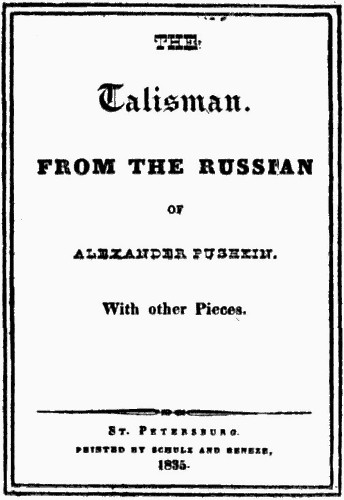 Title Page from "Targum"
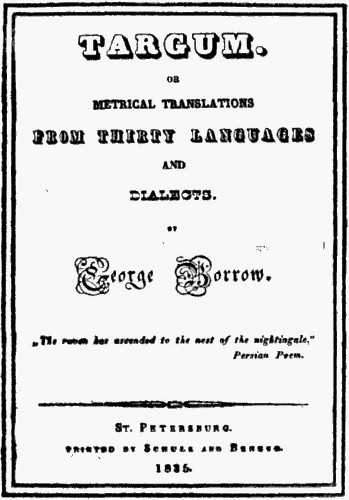 Title Page from "The Talisman"
[103] Darlow, Letters to the Bible Society, p. 32.
[104] Ibid. p. 47.
[105] Darlow, Letters to the Bible Society, pp. 60, 61.
[106] Mr. Glen.
[107] The Manchu version—i.e. the transcript of Pierot's MS. of the Old Testament and 1000 copies of Lipóftsof's translation of the New—cost the Society in all £2600. Canton: History of the Bible Society, vol. ii. p. 239.
[108] Darlow; Letters to the Bible Society, p. 96.
[109] Darlow: Letters to the Bible Society, p. 65.
[110] Ibid., p. 81.
From his journey to Russia Borrow had acquired valuable experience, but nothing in the way of fame, although his mother had been able to record in a letter to St. Petersburg that she had heard at a Bible Society gathering in Norwich his name 'sounded through the hall' by Mr. Joseph John Gurney and Mr. Cunningham, to her great delight. 'All this is very pleasing to me,' she said, 'God bless you!' Even more pleasing to Borrow must have been a letter from Mary Clarke, his future wife, who was able to tell him that she heard Francis Cunningham refer to him as 'one of the most extraordinary and interesting individuals of the present day.' But these tributes were not all-satisfying to an ambitious man, and this Borrow undoubtedly was. His Russian journey was followed by five weeks of idleness in Norwich varied by the one excitement of attending a Bible meeting at Oulton with the Reverend Francis Cunningham in the chair, when 'Mr. George Borrow from Russia'[111] made one of the usual conventional missionary speeches, Mary Clarke's brother, Breame Skepper, being also among the orators. Borrow begged for more work from the Society. He urged the desirability of carrying out its own idea of an[Pg 180] investigation in Portugal and perhaps also in Spain, and hinted that he could write a small volume concerning what he saw and heard which might cover the expense of the expedition.[112] So much persistency conquered. Borrow sailed from London on 6th November 1835, and reached Lisbon on 12th November, this his first official visit to the Peninsula lasting exactly eleven months. The next four years and six months were to be spent mainly in Spain.[113] Broadly the time divides itself in the following fashion:
| 1st Tour (via Lisbon), | 2nd Tour (via Cadiz), | 3rd Tour (via Cadiz), |
| Nov. 1835 to Oct. 1836. | Nov. 1836 to Sept. 1838. | Dec. 1838 to March 1840. |
| Lisbon. | Cadiz. | Cadiz. |
| Mafia. | Lisbon. | Seville. |
| Evora. | Seville. | Madrid. |
| Badajoz. | Madrid. | Gibraltar. |
| Madrid. | Salamanca. | Tangier. |
| Coruña. | ||
| Oviedo. | ||
| Toledo. |
What a world of adventure do the mere names of these places call up. Borrow entered the Peninsula at an exciting period of its history. Traces of the Great War in which Napoleon's legions faced those of Wellington still abounded. Here and there a bridge had disappeared, and some of Borrow's strange experiences on ferry-boats were indirectly due to the results of Napoleon's ambition.[114] Everywhere there was still war in the land. Portugal indeed had just passed through a revolution. The partisans of the infant Queen Maria II. had been fighting with her uncle Dom Miguel for eight years, and it was only a few short months before Borrow landed at Lisbon that Maria had become undisputed queen. Spain, to which Borrow speedily betook himself, was even in a worse state. She was in the throes of a six years' war. Queen Isabel II., a child of three, reigned over a chaotic country with her mother Dona Christina as regent; her uncle Don Carlos was a formidable claimant to the throne and had the support of the absolutist and clerical parties. Borrow's political sympathies were always in the direction of absolutism; but in religion, although a staunch Church of England man, he was certainly an anti-clerical one in Roman Catholic Spain.[Pg 182] In any case he steered judiciously enough between contending factions, describing the fanatics of either side with vigour and sometimes with humour. Mr. Brandram's injunction to Borrow 'to be on his guard against becoming too much committed to one particular party' seems to have been unnecessary.
Borrow's three expeditions to Spain have more to be said for them than had his journey to St. Petersburg. The work of the Bible Society was and is at its highest point of human service when distributing either the Old or the New Testament in Christian countries, Spain, England, or another. Few there be to-day in any country who, in the interests of civilisation, would deny to the Bible a wider distribution. In a remote village of Spain a Bible Society's colporteur, carrying a coloured banner, sold me a copy of Cipriano de Valera's New Testament for a peseta. The villages of Spain that Borrow visited could even at that time compare favourably morally and educationally, with the villages of his own county of Norfolk at the same period. The morals of the agricultural labourers of the English fen country eighty years ago were a scandal, and the peasantry read nothing; more than half of them could not read. They had not, moreover, the humanising passion for song and dance that Andalusia knew. But this is not to deny that the Bible Society under Borrow's instrumentality did a good work in Spain, nor that they did it on the whole in a broad and generous way. Borrow admits that there was a section of the Roman Catholic clergy 'favourably disposed towards the circulation of the Gospel,'[115] and the Society actually fixed upon a Roman Catholic version of the Spanish Bible, that by[Pg 183] Scio de San Miguel,[116] although this version Borrow considered a bad translation. Much has been said about the aim of the Bible Society to provide the Bible without notes or comment—in its way a most meritorious aim, although then as now opposed to the instinct of a large number of the priests of the Roman Church. It is true that their attitude does not in any way possess the sanction of the ecclesiastical authorities. It may be urged, indeed, that the interpretation of the Bible by a priest, usually of mature judgment, and frequently of a higher education than the people with whom he is associated, is at least as trustworthy as its interpretation at the hands of very partially educated young women and exceedingly inadequately equipped young men who to-day provide interpretation and comment in so many of the Sunday Schools of Protestant countries.[117]
Behold George Borrow, then, first in Portugal and a little later in Spain, upon his great mission—avowedly at first a tentative mission—rather to see what were the prospects for Bible distribution than to distribute Bibles. But Borrow's zeal knew no such limitations. Before very long he had a shop in one of the principal streets of Madrid—the Calle del Principe—much more[Pg 184] in the heart of things than the very prosperous Bible Society of our day ventures upon.[118] Meanwhile he is at present in Portugal not very certain of his movements, and he writes to his old friend Dr. Bowring the following letter with a request with which Bowring complied, although in the coldest manner:[Pg 185]
Evora in the Alemtejo, 27 Decr. 1835.
Dear Sir,—Pray excuse me for troubling you with these lines. I write to you, as usual, for assistance in my projects, convinced that you will withhold none which it may be in your power to afford, more especially when by so doing you will perhaps be promoting the happiness of our fellow creatures. I returned from dear, glorious Russia about three months since, after having edited there the Manchu New Testament in eight volumes. I am now in Portugal, for the Society still do me the honour of employing me. For the last six weeks I have been wandering amongst the wilds of the Alemtejo and have introduced myself to its rustics, banditti, etc., and become very popular amongst them, but as it is much more easy to introduce oneself to the cottage than the hall (though I am not entirely unknown in the latter), I want you to give or procure me letters to the most liberal and influential minds of Portugal. I likewise want a letter from the Foreign Office to Lord De Walden, in a word, I want to make what interest I can towards obtaining the admission of the Gospel of Jesus into the public schools of Portugal which are about to be established. I beg leave to state that this is my plan, and not other persons', as I was merely sent over to Portugal to observe the disposition of the people, therefore I do not wish to be named as an Agent of the B.S., but as a person who has plans for the mental improvement of the Portuguese; should I receive these letters within the space of six weeks it will be time enough, for before setting up my machine in Portugal I wish to lay the foundation of something similar in Spain. When you send the Portuguese letters direct thus:
Mr. George Borrow,
to the care of Mr. Wilby,
Rua Dos Restauradores, Lisbon.
I start for Spain to-morrow, and I want letters something similar (there is impudence for you) for Madrid, which I should like to have as soon as possible. I do not much care at present for an introduction to the Ambassador at Madrid, as I shall not commence operations seriously in Spain until I have disposed of Portugal. I will not apologise for writing to you in this manner,[Pg 186] for you know me, but I will tell you one thing, which is that the letter which you procured for me, on my going to St. Petersburg, from Lord Palmerston, assisted me wonderfully. I called twice at your domicile on my return; the first time you were in Scotland, the second in France, and I assure you I cried with vexation. Remember me to Mrs. Bowring and God bless you.
G. Borrow.
P.S.—I am told that Mendizábal is liberal, and has been in England; perhaps he would assist me.
During this eleven months' stay in the Peninsula Borrow made his way to Madrid, and here he interviewed the British Minister, Sir George Villiers, afterwards fourth Earl of Clarendon, and had received a quite remarkable encouragement from him for the publication and distribution of the Bible. He also interviewed the Spanish Prime Minister, Mendizábal, 'whom it is as difficult to get nigh as it is to approach the North Pole,' and he has given us a picturesque account of the interview in The Bible in Spain. It was agreed that 5000 copies of the Spanish Testament were to be reprinted from Scio's text at the expense of the Bible Society, and all these Borrow was to handle as he thought fit. Then Borrow made his way to Granada, where, under date 30th August 1836, his autograph may be read in the visitors' book of the Alhambra:
George Borrow Norvicensis.
Here he studied his friends the gypsies, now and probably then, as we may assume from his Zincali, the sordid scum on the hillside of that great city, but now more assuredly than then unutterably demoralised by the numerous but curious tourists who visit this rabble under police protection, the very policeman or gendarme not despising a peseta for his protective services. But Borrow's hobbies included the Romanies of every land, and a year later he produced and published[Pg 187] a gypsy version of the Gospel of St. Luke.[119] In October 1836 Borrow was back in England. He found that the Bible Society approved of him. In November of the same year he left London for Cadiz on his second visit to Spain. The journey is described in The Bible in Spain;[120] but here, from my Borrow Papers, is a kind letter that Mr. Brandram wrote to Borrow's mother on the occasion:
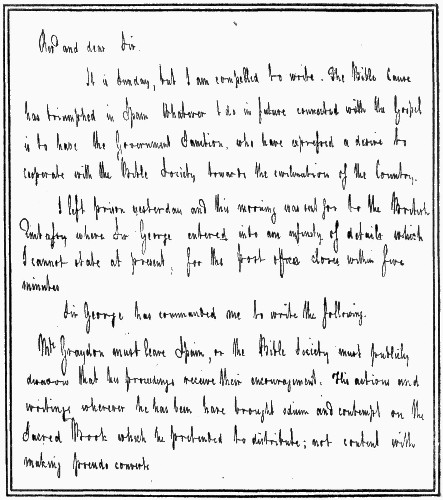 PORTION OF A LETTER FROM GEORGE BORROW TO THE REV. SAMUEL
BRANDRAM.
PORTION OF A LETTER FROM GEORGE BORROW TO THE REV. SAMUEL
BRANDRAM.
No. 10 EAST STREET, Jany. 11, 1837.
My dear Madam,—I have the joyful news to send you that your son has again safely arrived at Madrid. His journey we were aware was exceedingly perilous, more perilous than we should have allowed him to take had we sooner known the extent of the danger. He begs me to write, intending to write to you himself without delay. He has suffered from the intense cold, but nothing beyond inconvenience. Accept my congratulations, and my best wishes that your dear son may be preserved to be your comfort in declining years—and may the God of all consolation himself deign to comfort your heart by the truths of that holy volume your son is endeavouring, in connection with our Society, to spread abroad.—Believe me, dear Madam, yours faithfully,
A. Brandram.
Mrs. Borrow, Norwich.
A brilliant letter from Seville followed soon after, and then he went on to Madrid, not without many adventures. 'The cold nearly killed me,' he said. 'I swallowed nearly two bottles of brandy; it affected me no more than warm water.' This to kindly Mr. Brandram, who clearly had no teetotaller proclivities, for the letter, as he said, 'filled his heart with joy and gladness.' Meanwhile those five thousand copies of the New Testament were a-printing, Borrow superintending the work with the assistance of a new friend, Dr. Usóz. 'As soon as the book is printed and issued,' he tells Mr. Brandram, 'I will ride forth from Madrid into the wildest parts of Spain, ...' and so, after some correspondence with the Society which is quite entertaining, he did. The reader of The Bible in Spain will note some seventy separate towns and villages that Borrow[Pg 189] visited, not without countless remarkable adventures on the way. 'I felt some desire,' he says in The Romany Rye, 'to meet with one of those adventures which upon the roads of England are generally as plentiful as blackberries in autumn.' Assuredly in this tour of Spanish villages Borrow met with no lack of adventures. The committee of the Bible Society authorised this tour in March 1837, and in May Borrow started off on horseback attended by his faithful servant, Antonio. This tour was to last five months, and 'if I am spared,' he writes to his friend Hasfeld, 'and have not fallen a prey to sickness, Carlists, banditti, or wild beasts, I shall return to Madrid.' He hopes a little later, he tells Hasfeld, to be sent to China. We have then a glimpse of his servant, the excellent Antonio, which supplements that contained in The Bible of Spain. 'He is inordinately given to drink, and is of so quarrelsome a disposition that he is almost constantly involved in some broil.'[121] Not all his weird experiences were conveyed in his letters to the Bible Society's secretary. Some of these letters, however—the more highly coloured ones—were used in The Bible in Spain, word for word, and wonderful reading they must have made for the secretary, who indeed asked for more, although, with a view to keeping Borrow humble—an impossible task—Mr. Brandram takes occasion to say 'Mr. Graydon's letters, as well as yours, are deeply interesting,' Graydon being a hated rival, as we shall see. The question of L.S.D. was also not forgotten by the assiduous secretary. 'I know you are no accountant,' he writes, 'but do not forget there are some who are,' and a financial document was forwarded to Borrow about this time which we reproduce in facsimile.[Pg 190]
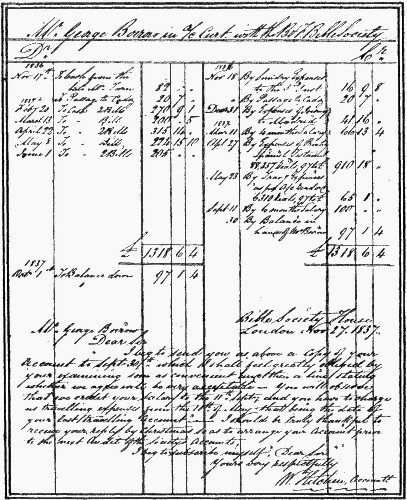 FACSIMILE OF AN ACCOUNT OF GEORGE BORROW'S EXPENSES IN
SPAIN MADE OUT BY THE BIBLE SOCIETY
FACSIMILE OF AN ACCOUNT OF GEORGE BORROW'S EXPENSES IN
SPAIN MADE OUT BY THE BIBLE SOCIETY
But now Borrow was happy, for next to the adventures of five glorious months in the villages between Madrid and Coruña nothing could be more to the taste of Borrow than a good wholesome quarrel. He was imprisoned by order of the Spanish Government[Pg 191] and released on the intervention of the British Embassy.[122] He tells the story so graphically in The Bible in Spain that it is superfluous to repeat it; but here he does not tell of the great quarrel with regard to Lieutenant Graydon that led him to attack that worthy zealot in a letter to the Bible Society. This attack did indeed cause the Society to recall Graydon, whose zealous proclamation of anti-Romanism must however have been more to the taste of some of its subscribers than Borrow's trimming methods. Moreover, Graydon worked for love of the cause and required no salary, which must always have been in his favour. Borrow was ten days in a Madrid prison, and there, as ever, he had extraordinary adventures if we may believe his own narrative, but they are much too good to be torn from their context. Suffice to say here that in the actual correspondence we find breezy controversy between Borrow and the Society. Borrow thought that the secretary had called the accuracy of his statements in question as to this or that particular in his conduct. Ever a fighter, he appealed to the British Embassy for confirmation of his word, and finally Mr. Brandram suggested he should come back to England for a time and talk matters over with the members of the committee. In the beginning of September 1838 Borrow was again in England, when he issued a lengthy and eloquent defence of his conduct and a report on 'Past and Future Operations in Spain.'[123] In December of[Pg 192] the same year Borrow was again on his way to Cadiz upon his third and last visit to Spain.
Borrow reached Cadiz on this his last visit on 31st December 1838, and went straight to Seville, where he arrived on 2nd January 1839. Here he took a beautiful little house, 'a paradise in its way,' in the Plazuela de la Pila Seca, and furnished it—clearly at the expense of his friend Mrs. Clarke of Oulton, who must have sent him a cheque for the purpose. He had been corresponding regularly with Mrs. Clarke, who had told him of her difficulties with lawyers and relatives, and Borrow had advised her to cut the Gordian knot and come to Spain. But Mrs. Clarke and her daughter, Henrietta, did not arrive from England until June.
In the intervening months Borrow had been working more in his own interests than in those of the patient Bible Society, for he started to gather material for his Gypsies of Spain, and this book was for the most part actually written in Seville. It was at this period that he had the many interviews with Colonel Elers Napier that we quote at length in our next chapter.
A little later he is telling Mr. Brandram of his adventure with the blind girl of Manzanares who could talk in the Latin tongue, which she had been taught by a Jesuit priest, an episode which he retold in The Bible in Spain. 'When shall we hear,' he asks, 'of an English rector instructing a beggar girl in the language of Cicero?' To which Mr. Brandram, who was rector of Beckenham, replied 'Cui bono?' The letters of this period are the best that he ever wrote, and are incorporated more exactly than the earlier ones in The Bible in Spain.
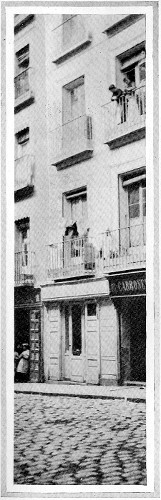 WHERE BORROW LIVED IN MADRID
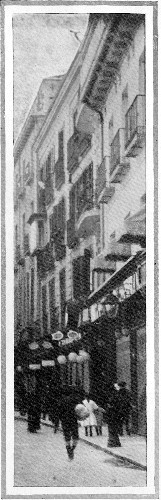 THE CALLE DEL PRINCIPE, MADRID
Four letters to his mother within the period of his second and third Spanish visits may well be presented together here from my Borrow Papers:
Madrid, July 27, 1838.
My dear Mother,—I am in perfect health though just returned from a long expedition in which I have been terribly burnt by the sun. In about ten days I sold nearly a thousand Testaments among the labourers of the plains and mountains of Castille and La Mancha. Everybody in Madrid is wondering and saying such a thing is a miracle, as I have not entered a town, and the country people are very poor and have never seen or heard of the Testament before. But I confess to you that I dislike my situation and begin to think that I have been deceived; the B.S. have had another person on the sea-coast who has nearly ruined their cause in Spain by circulating seditious handbills and tracts. The consequence has been that many of my depots have been seized in which I kept my Bibles in various parts of the country, for the government think that he is employed by me; I told the B.S. all along what would be the consequence of employing this man, but they took huff and would scarce believe me, and now all my words are come true; I do not blame the government in the slightest degree for what they have done in many points, they have shown themselves to be my good friends, but they have been driven to the step by the insane conduct of the person alluded to. I told them frankly in my last letter that I would leave their service if they encouraged him; for I will not be put in prison again on his account, and lose another servant by the gaol fever, and then obtain neither thanks nor reward. I am going out of town again in a day or two, but I shall now write very frequently, therefore be not alarmed for I will run into no danger. Burn this letter and speak to no one about it, nor any others that I may send. God bless you, my dear mother.
G. B.
Madrid, August 5, 1838.
My dear Mother,—I merely write this to inform you that I am back to Madrid from my expedition. I have been very successful and have sold a great many Testaments. Indeed all the villages and towns within thirty miles have been supplied. In Madrid itself I can do nothing as I am closely watched by order of the government and not permitted to sell, so that all I do is by riding out to places where they cannot follow me. I do not blame them, for they have much to complain of, though nothing of me, but if the Society will countenance such men as they have lately done in the South of Spain they must expect to reap the consequences. It is very probable that I may come to England in a little time, and then you will see me; but do not talk any more about yourself being 'no more seen,' for it only serves to dishearten me, and God knows I have enough to make me melancholy already. I am in a great hurry and cannot write any more at present.—I remain, dear mother, yours affectionately,
George Borrow.
(No date.)
My dear Mama,—As I am afraid that you may not have received my last letter in consequence of several couriers having been stopped, I write to inform you that I am quite well.
I have been in some difficulties. I was selling so many Testaments that the priests became alarmed, and prevailed on the government to put a stop to my selling any more; they were likewise talking of prosecuting me as a witch, but they have thought better of it. I hear it is very cold in England, pray take care of yourself, I shall send you more in a few weeks.—God bless you, my dear mama,
G. B.
It was in the middle of his third and last visit to Spain that Borrow wrote this next letter to his mother which gives the first suggestion of the romantic and happy termination of his final visit to the Peninsula:
Seville, Spain, April 27, 1839.
My dear Mother,—I should have written to you before I left Madrid, but I had a long and dangerous journey to make, and I[Pg 195] wished to get it over before saying anything to you. I am now safely arrived, by the blessing of God, in Seville, which, in my opinion, is the most delightful town in the world. If it were not a strange place with a strange language I know you would like to live in it, but it is rather too late in the day for you to learn Spanish and accommodate yourself to Spanish ways. Before I left Madrid I accomplished a great deal, having sold upwards of one thousand Testaments and nearly five hundred Bibles, so that at present very few remain; indeed, not a single Bible, and I was obliged to send away hundreds of people who wanted to purchase, but whom I could not supply. All this has been done without the slightest noise or disturbance or anything that could give cause of displeasure to the government, so that I am now on very good terms with the authorities, though they are perfectly aware of what I am about. Should the Society think proper to be guided by the experience which I have acquired, and my knowledge of the country and the people, they might if they choosed sell at least twelve thousand Bibles and Testaments yearly in Spain, but let them adopt or let any other people adopt any other principle than that on which I act and everything will miscarry. All the difficulties, as I told my friends the time I was in England, which I have had to encounter were owing to the faults and imprudencies of other people, and, I may say, still are owing. Two Methodist schoolmasters have lately settled at Cadiz, and some little time ago took it into their heads to speak and preach, as I am informed, against the Virgin Mary; information was instantly sent to Madrid, and the blame, or part of it, was as usual laid to me; however, I found means to clear myself, for I have powerful friends in Madrid, who are well acquainted with my views, and who interested themselves for me, otherwise I should have been sent out of the country, as I believe the two others have been or will be. I have said nothing on this point in my letters home, as people would perhaps say that I was lukewarm, whereas, on the contrary, I think of nothing but the means best adapted to promote the cause; but I am not one of those disposed to run a ship on a rock when only a little skill is necessary to keep her in the open sea.
I hope Mrs. Clarke will write shortly; tell her if she wishes for a retreat I have found one here for her and Henrietta. I have my eye on a beautiful one at fifteen pence a day. I call it a small[Pg 196] house, though it is a paradise in its way, having a stable, court-yard, fountain, and twenty rooms. She has only to write to my address at Madrid and I shall receive the letter without fail. Henrietta had better bring with her a Spanish grammar and pocket dictionary, as not a word of English is spoken here. The house-dog—perhaps a real English bulldog would be better—likewise had better come, as it may be useful. God bless you therefore for the present, my dearest mother.
George Borrow.
Borrow had need of friends more tolerant of his idiosyncrasies than the 'powerful friends' he describes to his mother, for the Secretary of the Bible Society was still in a critical mood:—
You narrate your perilous journey to Seville, and say at the beginning of the description, 'my usual wonderful good fortune accompanying us.' This is a mode of speaking to which we are not accustomed—it savours, some of our friends would say, a little of the profane.[124]
On 29th July 1839 Borrow was instructed by his Committee to return to England, but he was already on the way to Tangier, whence in September he wrote a long and interesting letter to Mr. Brandram, which was afterwards incorporated in The Bible in Spain. He had left Mrs. Clarke and her daughter in Seville, and they joined him at Gibraltar later. We find him en route for Tangier, staying two days with Mr. John M. Brackenbury, the British Consul in Cadiz, who found him a most fascinating man.
His Tangier life is fully described in The Bible in Spain. Here he picked up a Jewish youth, Hayim Ben Attar, who returned to Spain as his servant, and afterwards to England.
Borrow, at the end of September, was back again in Seville, in his house near the cathedral, in the[Pg 197] Plazuela de la Pila Seca, which, when I visited Seville in the spring of this year (1913), I found had long been destroyed to make way for new buildings. Here he received the following letter from Mr. George Browne of the Bible Society:—
Bible House, Oct. 7, 1839.
My dear Friend,—Mr. Brandram and myself being both on the eve of a long journey, I have only time to inform you that yours of the 2d ult. from Tangier, and 21st from Cadiz came to hand this morning. Before this time you have doubtless received Mr. Brandram's letter, accompanying the resolution of the Comee., of which I apprised you, but which was delayed a few days, for the purpose of reconsideration. We are not able to suggest precisely the course you should take in regard to the books left at Madrid and elsewhere, and how far it may be absolutely necessary or not for you to visit that city again before you return. The books you speak of, as at Seville, may be sent to Gibraltar rather than to England, as well as any books you may deem it expedient or find it necessary to bring out of the country. As soon as your arrangements are completed we shall look for the pleasure of seeing you in this country. The haste in which I am compelled to write allows me to say no more than that my best wishes attend you, and that I am, with sincere regard, yours truly,
G. Browne.
I thank you for your kind remembrance of Mrs. Browne. Did I thank you for your letter to her? She feels, I assure you, very much obliged. Your description of Tangier will be another interesting 'morceau' for her.
'Where is Borrow?' asked the Bible Society meanwhile of the Consuls at Seville and Cadiz, but Borrow had ceased to care. He hoped to become a successful author with his Gypsies; he would at any rate secure independence by marriage, which must have been already mooted. In November he and Mrs. Clarke[Pg 198] were formally betrothed, and would have been married in Spain, but a Protestant marriage was impossible there. When preparing to leave Seville he had one of those fiery quarrels, with which his life was to be studded. This time it was with an official of the city over a passport, and the official promptly locked him up, for thirty hours. Hence the following letter in response to his complaint. The writer is Mr., afterwards Sir, George Jerningham, then Secretary of Legation at Madrid, who it may be mentioned came from Costessey, four miles from Norwich. It is written from the British Legation, and is dated 23rd December 1839:
I have the honour to acknowledge the receipt of your two letters, the one without date, the second dated the 19th November (which however ought to have been December), respecting the outrageous conduct pursued towards you at Seville by the Alcalde of the district in which you resided. I lost no time in addressing a strong representation thereon to the Spanish Minister, and I have to inform you that he has acquainted me with his having written to Seville for exact information upon the whole subject, and that he has promised a further answer to my representation as soon as his inquiries shall have been answered. In the meantime I shall not fail to follow up your case with proper activity.
Borrow was still in Seville, hard at work upon the Gypsies, all through the first three months of the year 1840. In April the three friends left Cadiz for London. A letter of this period from Mr. Brackenbury, the British Consul at Cadiz, is made clear by these facts:
British Consulate, Cadiz, January 27th, 1840.
My dear Sir,—I received on the 19th your very acceptable letter without date, and am heartily rejoiced to find that you have received satisfaction for the insult, and that the Alcalde is likely to be punished for his unjustifiable conduct. If you come to[Pg 199] Cadiz your baggage may be landed and deposited at the gates to be shipped with yourselves wherever the steamer may go, in which case the authorities would not examine it, if you bring it into Cadiz it would be examined at the gates—or, if you were to get it examined at the Custom House at Seville and there sealed with the seal of the Customs—it might then be transhipped into the steamer or into any other vessel without being subjected to any examination. If you take your horse, the agents of the steamer ought to be apprized of your intention, that they may be prepared, which I do not think they generally are, with a suitable box.
Consuls are not authorised to unite Protestant subjects in the bonds of Holy Matrimony in popish countries—which seems a peculiar hardship, because popish priests could not, if they would—hence in Spain no Protestants can be legally married. Marriages solemnised abroad according to the law of that land wheresoever the parties may at the time be inhabitants are valid—but the law of Spain excludes their priests from performing these ceremonies where both parties are Protestants—and where one is a Papist, except a dispensation be obtained from the Pope. So you must either go to Gibraltar—or wait till you arrive in England. I have represented the hardship of such a case more than once or twice to Government. In my report upon the Consular Act, 6 Geo. iv. cap. 87—eleven years ago—I suggested that provision should be made to legalise marriages solemnised by the Consul within the Consulate, and that such marriages should be registered in the Consular Office—and that duly certified copies thereof should be equivalent to certificates of marriages registered in any church in England. These suggestions not having been acted upon, I brought the matter under the consideration of Lord John Russell (I being then in England at the time of his altering the Marriage Act), and proposed that Consuls abroad should have the power of magistrates and civil authorities at home for receiving the declarations of British subjects who might wish to enter into the marriage state—but they feared lest the introduction of such a clause, simple and efficacious as it would have been, might have endangered the fate of the Bill; and so we are as Protestants deprived of all power of being legally married in Spain.
What sort of a horse is your hack?—What colour? What age?[Pg 200] Would he carry me?—What his action? What his price? Because if in all these points he would suit me, perhaps you would give me the refusal of him. You will of course enquire whether your Arab may be legally exported.
All my family beg to be kindly remembered to you.—I am, my dear sir, most faithfully yours,
J. M. Brackenbury.
There is a young gentleman here, who is in Spain partly on account of his health—partly for literary purposes. I will give him, with your leave, a line of introduction to you whenever he may go to Seville. He is the Honourable R. Dundas Murray, brother of Lord Elibank, a Scottish nobleman.
[111] Norfolk Chronicle, 17th October 1835.
[112] Secretary Samuel Brandram, writing to Borrow from the office of the Bible Society in October 1835, gave clear indication that the Society was uncertain how next to utilise Borrow's linguistic and missionary talents. Should he go to Portugal or to China was the question. In November the committee had decided on Portugal, although they thought it probable that Borrow would 'eventually go to China,' 'With Portugal he is already acquainted,' said Mr. Brandram in a letter of introduction to the Rev. E. Whitely, the British chaplain in Oporto. So that Borrow must really have wandered into Portugal in that earlier and more melancholy apprenticeship to vagabondage concerning which there is so much surmise and so little knowledge. Had he lied about his acquaintance with Portugal he would certainly have been 'found out' by this Portuguese acquaintance, with whom he had much social intercourse.
[113] The reader who finds Borrow's Bible in Spain insufficient for his account of that period, and I am not of the number, may turn to the Letters of George Borrow to the Bible Society, from which we have already quoted, or to Mr. Herbert Jenkins's Life of George Borrow. In the former book the greater part of 500 closely-printed pages is taken up with repetitions of the story as told in The Bible in Spain, or with additions which Borrow deliberately cancelled in the work in question. In Mr. Jenkins's Life he will find that out of a solid volume of 496 pages exactly 212 are occupied with Borrow's association with the Peninsula and his work therein. To the enthusiast who desires to supplement The Bible in Spain with valuable annotation I cordially commend both these volumes.
[114] Who that has visited Spain can for a moment doubt but that, if Napoleon had really conquered the Peninsula and had been able to put his imprint upon it as he did upon Italy, the Spain of to-day would have become a much greater country than it is at present—than it will be in a few short years.
[115] The Bible in Spain, ch. xlii.
[116] The Old and New Testament, in ten volumes, were first issued in Spanish at Valencia in 1790-93. When in Madrid I picked up on a second-hand bookstall a copy of a cheap Spanish version of Scio's New Testament, which bears a much earlier date than the one Borrow carried. It was published, it will be noted, two years before Borrow published his translation of Klinger's ribald book Faustus:—
'El Nuevo Testamento, Traducido al Español de la Vulgata Latina por el Rmo. P. Philipe Scio de S. Miguel. Paris: En la Imprenta de J. Smith, 1823,'
[117] This kind of interpretation is not restricted to the youthful Sunday School teacher. At a meeting of the Bible Society held at Norwich—Borrow's own city—on 29th May 1913, Mrs. Florence Barclay, the author of many popular novels, thus addressed the gathering. I quote from the Eastern Daily Press: 'She had heard sometimes a shallow form of criticism which said that it was impossible that in actual reality any man should have lived and breathed three days and three nights in the interior of a fish. Might she remind the meeting that the Lord Jesus Christ, who never made mistakes, said Himself, "As Jonah was three days and three nights in the interior of the sea monster." Please note that in the Greek the word was not "whale," but "sea monster." And then, let us remember, that we were told that the Lord God had prepared the great fish in order that it should swallow Jonah. She did suggest that if mere man nowadays could construct a submarine, which went down to the depths of the ocean and came up again when he pleased, it did not require very much faith to believe that Almighty God could specially prepare a great fish which should rescue His servant, to whom He meant to give another chance, from the depths of the sea, and land him in due course upon the shore. (Applause).' These crude views, which ignored the symbolism of Nineveh as a fish, now universally accepted by educated people, were not, however, endorsed by Dr. Beeching, the learned Dean of Norwich, who in the same gathering expressed the point of view of more scholarly Christians:—'He would not distinguish inspired writing from fiction. He would say there could be inspired fiction just as well as inspired facts, and he would point to the story of the prodigal son as a wonderful example from the Bible of inspired fiction. There were a good many other examples in the Old Testament, and he had not the faintest doubt that the story of Jonah was one. It was on the same level as the prodigal son. It was a story told to teach the people a distinct truth.'
[118] When in Madrid in May 1913 I called upon Mr. William Summers, the courteous Secretary of the Madrid Branch of the British and Foreign Bible Society in the Flor Alta. Mr. Summers informs me that the issues of the British and Foreign Bible Society, Bibles and Testaments, in Spain for the past three years are as follows:
| Year. | Bibles. | Testaments. | Portions. | Total. |
| 1910, | 5,309 | 8,971 | 70,594 | 84,874 |
| 1911, | 5,665 | 11,481 | 79,525 | 96,671 |
| 1912, | 9,083 | 11,842 | 85,024 | 105,949 |
The Calle del Principe is now rapidly being pulled down and new buildings taking the place of those Borrow knew.
[119] Embeo e Majaro Lucas. El Evangelio segun S. Lucas traducido al Romani ó dialecto de los Gitanos de España, 1857. Two later copies in my possession bear on their title-pages 'Lundra, 1871' and 'Lundra, 1872.' But the Bible Society in Spain has long ceased to handle or to sell any gypsy version of St. Luke's Gospel.
[120] And in Darlow's Letters of George Borrow to the Bible Society, pp. 180-4.
[121] Darlow, Letters of George Borrow to the Bible Society.
[122] The story of all the negotiations concerning this imprisonment and release is told by Dr. Knapp (Life, vol. i, pp. 279-297), and is supplemented by Mr. Herbert Jenkins by valuable documents from the Foreign Office Papers at the Record Office.
[123] Printed by Mr. Darlow in Letters of George Borrow to the Bible Society, pp. 359-379.
[124] Darlow, George Borrow's Letters to the Bible Society, p. 414.
There are many interesting personalities that pass before us in Borrow's three separate narratives,[125] as they may be considered, of his Spanish experiences. We would fain know more concerning the two excellent secretaries of the Bible Society—Samuel Brandram and Joseph Jowett. We merely know that the former was rector of Beckenham and was one of the Society's secretaries until his death in 1850;[126] that the latter was rector of Silk Willoughby in Lincolnshire, and belonged to the same family as Jowett of Balliol. But there are many quaint characters in Borrow's own narrative to whom we are introduced. There is Maria Diaz, for example, his landlady in the house in the Calle de Santiago in Madrid, and her husband, Juan Lopez, also assisted Borrow in his Bible distribution. Very eloquent are Borrow's tributes to the pair in the pages of The Bible in Spain. 'Honour to Maria Diaz, the quiet, dauntless, clever, Castilian female! I were an ungrate not to speak well of her,' We get a glimpse of Maria and her husband long years afterwards when a pensioner in a Spanish[Pg 202] almshouse revealed himself as the son of Borrow's friends. Eduardo Lopez was only eight years of age when Borrow was in Madrid, and he really adds nothing to our knowledge.[127] Then there were those two incorrigible vagabonds—Antonio Buchini, his Greek servant with an Italian name, and Benedict Mol, the Swiss of Lucerne, who turns up in all sorts of improbable circumstances as the seeker of treasure in the Church of St. James of Compostella—only a masterly imagination could have made him so interesting. Concerning these there is nothing to supplement Borrow's own story. But we have attractive glimpses of Borrow in the frequently quoted narrative of Colonel Napier,[128] and this is so illuminating that I venture to reproduce it at greater length than previous biographers have done. Edward Elers Napier, who was born in 1808, was the son of one Edward Elers of the Royal Navy. His widow married the famous Admiral Sir Charles Napier, who adopted her four children by her first husband. Edward Elers, the younger, or Edward Napier, as he came to be called, was educated at Sandhurst and entered the army, serving for some years in India. Later his regiment was ordered to Gibraltar, and it was thence that he made several sporting excursions into Spain and Morocco. Later he served in Egypt, and when, through ill-health, he retired in 1843 on half-pay, he lived for some years in Portugal. In 1854 he returned to the army and did good work in the Crimea, becoming a lieutenant-general in 1864. He died in 1870. He[Pg 203] wrote, in addition to these Excursions, several other books, including Scenes and Sports in Foreign Lands.[129] It was during his military career at Gibraltar that he met George Borrow at Seville, as the following extracts from his book testify. Borrow's pretension to have visited the East is characteristic—and amusing:—
1839. Saturday 4th.—Out early, sketching at the Alcazar. After breakfast it set in a day of rain, and I was reduced to wander about the galleries overlooking the 'patio.' Nothing so dreary and out of character as a rainy day in Spain. Whilst occupied in moralising over the dripping water-spouts, I observed a tall, gentlemanly-looking man, dressed in a zamarra,[130] leaning over the balustrades, and apparently engaged in a similar manner with myself. Community of thoughts and occupation generally tends to bring people together. From the stranger's complexion, which was fair, but with brilliant black eyes, I concluded he was not a Spaniard; in short, there was something so remarkable in his appearance that it was difficult to say to what nation he might belong. He was tall, with a commanding appearance; yet, though apparently in the flower of manhood, his hair was so deeply tinged with the winter of either age or sorrow as to be nearly snow-white. Under these circumstances, I was rather puzzled as to what language I should address him in. At last, putting a bold face on the matter, I approached him with a 'Bonjour, monsieur, quel triste temps!'
'Yes, sir,' replied he in the purest Parisian accent; 'and it is very unusual weather here at this time of the year.'
'Does "monsieur" intend to be any time at Seville?' asked I. He replied in the affirmative. We were soon on a friendly footing, and from his varied information I was both amused and instructed. Still I became more than ever in the dark as to his nationality; I found he could speak English as fluently as French. I tried him on the Italian track; again he was perfectly at home.[Pg 204]
He had a Greek servant, to whom his gave his orders in Romaïc. He conversed in good Castilian with 'mine host'; exchanged a German salutation with an Austrian Baron, at the time an inmate of the fonda; and on mentioning to him my morning visit to Triano, which led to some remarks on the gypsies, and the probable place from whence they derived their origin, he expressed his belief that it was from Moultan, and said that, even to this day, they retained many Moultanee and Hindoostanee expressions, such as 'pánee' (water), 'buree pánee'[131] (the sea), etc. He was rather startled when I replied 'in Hindee,' but was delighted on finding I was an Indian, and entered freely, and with depth and acuteness, on the affairs of the East, most of which part of the world he had visited.
In such varied discourse did the hours pass so swiftly away that we were not a little surprised when Pépé, the 'mozo' (and I verily believe all Spanish waiters are called Pépé), announced the hour of dinner; after which we took a long walk together on the banks of the river. But, on our return, I was as much as ever in ignorance as to who might be my new and pleasant acquaintance.
I took the first opportunity of questioning Antonio Baillie (Buchini) on the subject, and his answer only tended to increase my curiosity. He said that nobody knew what nation the mysterious 'Unknown' belonged to, nor what were his motives for travelling. In his passport he went by the name of ——, and as a British subject, but in consequence of a suspicion being entertained that he was a Russian spy, the police kept a sharp look-out over him. Spy or no spy, I found him a very agreeable companion; and it was agreed that on the following day we should visit together the ruins of Italica.
May 5.—After breakfast, the 'Unknown' and myself, mounting our horses, proceeded on our expedition to the ruins of Italica. Crossing the river, and proceeding through the populous suburb of Triano, already mentioned, we went over the same extensive plain that I had traversed in going to San Lucar, but keeping a little more to the right a short ride brought us in sight of the Convent of San Isidrio, surrounded by tall cypress and waving date-trees. This once richly-endowed religious establishment[Pg 205] is, together with the small neighbouring village of Santi Ponci, I believe, the property of the Duke of Medina Coeli, at whose expense the excavations are now carried on at the latter place, which is the ancient site of the Roman Italica.
We sat down on a fragment of the walls, and sadly recalling the splendour of those times of yore, contrasted with the desolation around us, the 'Unknown' began to feel the vein of poetry creeping through his inward soul, and gave vent to it by reciting, with great emphasis and effect, and to the astonishment of the wondering peasant, who must have thought him 'loco,' the following well-known and beautiful lines:—
I had been too much taken up with the scene, the verses, and the strange being who was repeating them with so much feeling, to notice the approach of one who now formed the fourth person of our party. This was a slight female figure, beautiful in the extreme, but whom tattered garments, raven hair (which fell in matted elf-locks over her naked shoulders), swarthy complexion, and flashing eyes, proclaimed to be of the wandering tribe of 'gitános.' From an intuitive sense of natural politeness she stood with crossed arms, and a slight smile on her dark and handsome countenance, until my companion had ceased, and then addressed us in the usual whining tone of supplication, with 'Caballeritos, una limosita! Dios se lo pagara a ustedes!' ('Gentlemen, a little charity! God will repay it to you!') The gypsy girl was so pretty, and her voice so sweet, that I involuntarily put my hand in my pocket.
'Stop!' said the 'Unknown.' 'Do you remember what I told you about the Eastern origin of these people? You shall see I am correct. Come here, my pretty child,' said he in Moultanee, 'and tell me where are the rest of your tribe?'[Pg 206]
The girl looked astounded, replied in the same tongue, but in broken language; when, taking him by the arm, she said, in Spanish: 'Come, caballero; come to one who will be able to answer you;' and she led the way down amongst the ruins towards one of the dens formerly occupied by the wild beasts, and disclosed to us a set of beings scarcely less savage. The sombre walls of this gloomy abode were illumined by a fire, the smoke from which escaped through a deep fissure in the massy roof; whilst the flickering flames threw a blood-red glare on the bronzed features of a group of children, of two men, and a decrepit old hag, who appeared busily engaged in some culinary preparations.
On our entrance, the scowling glance of the males of the party, and a quick motion of the hand towards the folds of the 'faja,'[132] caused in me, at least, anything but a comfortable sensation; but their hostile intentions, if ever entertained, were immediately removed by a wave of the hand from our conductress, who, leading my companion towards the sibyl, whispered something in her ear. The old crone appeared incredulous. The 'Unknown' uttered one word; but that word had the effect of magic; she prostrated herself at his feet, and in an instant, from an object of suspicion he became one of worship to the whole family, to whom, on taking leave, he made a handsome present, and departed with their united blessings, to the astonishment of myself, and what looked very like terror in our Spanish guide.
I was, as the phrase goes, dying with curiosity, and, as soon as we mounted our horses, exclaimed, 'Where, in the name of goodness, did you pick up your acquaintance and the language of these extraordinary people?' 'Some years ago, in Moultan,' he replied. 'And by what means do you possess such apparent influence over them?' But the 'Unknown' had already said more than he perhaps wished on the subject. He drily replied that he had more than once owed his life to gipsies, and had reason to know them well; but this was said in a tone which precluded all further queries on my part. The subject was never again broached, and we returned in silence to the fonda....
May 7th.—Pouring with rain all day, during which I was[Pg 207] mostly in the society of the 'Unknown.' This is a most extraordinary character, and the more I see of him the more I am puzzled. He appears acquainted with everybody and everything, but apparently unknown to every one himself. Though his figure bespeaks youth—and by his own account his age does not exceed thirty—yet the snows of eighty winters could not have whitened his locks more completely than they are. But in his dark and searching eye there is an almost supernatural penetration and lustre, which, were I inclined to superstition, might induce me to set down its possessor as a second Melmoth; and in that character he often appears to me during the troubled rest I sometimes obtain through the medium of the great soother, 'laudanum.'
The next most interesting figure in the Borrow gallery of this period is Don Luis de Usóz y Rio, who was a good friend to Borrow during the whole of his sojourn in Spain. It was he who translated Borrow's appeal to the Spanish Prime Minister to be permitted to distribute Scio's New Testament. He watched over Borrow with brotherly solicitude, and wrote him more than one excellent letter, of which the two following from my Borrow Papers, the last written at the close of the Spanish period, are the most interesting:
(Translated from the Spanish)
Piazza di Spagna 17, Rome, 7 April 1838.
Dear Friend,—I received your letter, and thank you for the same. I know the works under the name of 'Boz,' about which you write, and also the Memoirs of the Pickwick Club, and although they seemed to me good, I have failed to appreciate properly their qualities, because much of the dramatic style and dialogue in the same are very difficult for those who know English merely from books. I made here a better acquaintance than that of Mezzofanti[Pg 208] (who knows nothing), namely, that of Prof. Michel-Angelo Lanci, already well-known on account of his work, La sacra scrittura illustrata con monumenti fenico-assiri ed egiziani, etc., etc. (The Scriptures, illustrated with Phœnician-Assyrian and Egyptian monuments), which I am reading at present, and find very profound and interesting, and more particularly very original. He has written and presented me a book, Esposizione dei versetti del Giobbe intorno al cavallo (Explanation of verses of Job about a horse), and in these and other works he proves himself to be a great philologist and Oriental scholar. I meet him almost daily, and I assure you that he seems to me to know everything he treats thoroughly, and not like Gayangos or Calderon, etc., etc. His philosophic works have created a great stir here, and they do not please much the friars here; but as here they are not like the police barbarians there, they do not forbid it, as they cannot. Lanci is well known in Russia and in Germany, and when I bring his works there, and you are there and have not read them, you will read them and judge for yourself.
Wishing you well, and always at your service, I remain, always yours,
Luis de Usóz Y Rio.
(Translated from the Spanish)
Naples, 28 August 1839.
Dear Friend,—I received your letter of the 28 July written from Sevilla, and I am waiting for that which you promise me from Tangier.
I am glad that you liked Sevilla, and I am still more glad of the successful shipment of the beloved book. In distributing it, you are rendering the greatest service that generous foreigners (I mean Englishmen) can render to the real freedom and enlightenment in Spain, and any Spaniard who is at heart a gentleman must be grateful for this service to the Society and to its agent. In my opinion, if Spain had maintained the customs, character, and opinions that it had three centuries ago, it ought to have maintained also unity in religious opinions: but that at present[Pg 209] the circumstances have changed, and the moral character and the advancement of my unfortunate country would not lose anything in its purification and progress by (the grant of) religious liberty.
You are saying that I acted very light-mindedly in judging Mezzofanti without speaking to him. You know that the other time when I was in Italy I had dealings and spoke with him, and that I said to you that he had a great facility for speaking languages, but that otherwise he was no good. Because I have seen him several times in the Papal chapels with a certain air of an ass and certain grimaces of a blockhead that cannot happen to a man of talent. I am told, moreover, that he is a spy, and that for that reason he was given the hat. I know, moreover, that he has not written anything at all. For that reason I do not wish to take the trouble of seeing him.
As regards Lanci, I am not saying anything except that I am waiting until you have read his work without passion, and that if my books have arrived at Madrid, you can ask my brother in Santiago.
You are judging of him and of Pahlin in the way you reproach me with judging Mezzofanti; I thank you, and I wish for the dedication Gabricote; and I also wish for your return to Madrid, so that in going to Toledo you would get a copy of Aristophanes with the order that will be given to you by my brother, who has got it.
If for the Gabricote or other work you require my clumsy pen, write to Florence and send me a rough copy of what is to be done, in English or in Spanish, and I will supply the finished work. From Florence I intend to go to London, and I should be obliged if you would give me letters and instructions that would be of use to me in literary matters, but you must know that my want of knowledge of speaking English makes it necessary that the Englishmen who speak to me should know Spanish, French, or Italian.
As regards robberies, of which you accuse Southern people, from the literatures of the North, do you think that the robberies committed by the Northerners from the Southern literature would be left behind? Erunt vitia donec homines.—Always yours,
Eleutheros.
[Pg 210]
Yet another acquaintance of these Spanish days was Baron Taylor—Isidore Justin Séverin Taylor, to give him his full name—who had a career of wandering achievement, with Government pay, that must have appealed to Borrow. Although his father was an Englishman he became a naturalised Frenchman, and he was for a time in the service of the French Government as Director of the Théâtre Français, when he had no little share in the production of the dramas of Victor Hugo and Dumas. Later he was instrumental in bringing the Luxor obelisk from Egypt to Paris. He wrote books upon his travels in Spain, Portugal and Morocco.[133] He wandered all over Europe in search of art treasures for the French Government, and may very well have met Borrow again and again. Borrow tells us that he had met Taylor in France, in Russia, and in Ireland, before he met him in Andalusia, collecting pictures for the French Government. Borrow's description of their meetings is inimitable:—
Whenever he descries me, whether in the street or the desert, the brilliant hall or amongst Bedouin haimas, at Novogorod or Stambul, he flings up his arms and exclaims, "O ciel! I have again the felicity of seeing my cherished and most respectable Borrow."[134]
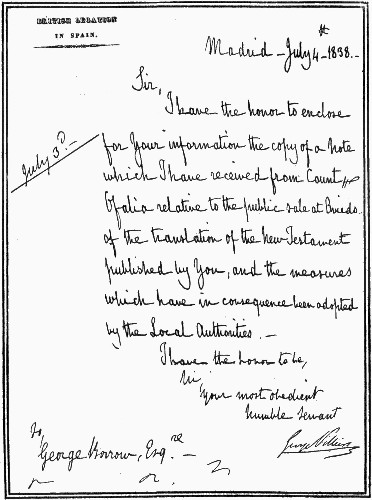 A LETTER FROM SIR GEORGE VILLIERS, AFTERWARDS EARL OF
CLARENDON, BRITISH MINISTER TO SPAIN, TO GEORGE BORROW
A LETTER FROM SIR GEORGE VILLIERS, AFTERWARDS EARL OF
CLARENDON, BRITISH MINISTER TO SPAIN, TO GEORGE BORROW
The last and most distinguished of Borrow's colleagues while in Spain was George Villiers, fourth Earl of Clarendon, whom we judge to have been in private life one of the most lovable men of his epoch. George Villiers was born in London in 1800, and was the grandson of the first Earl, Thomas Villiers, who received his title when holding office in Lord North's administration, but is best known from his association in diplomacy with Frederick the Great. His grandson[Pg 212] was born, as it were, into diplomacy, and at twenty years of age was an attaché to the British Embassy in St. Petersburg. Later he was associated with Sir John Bowring in negotiating a commercial treaty with France. In August 1833 he was sent as British Minister—'envoy extraordinary' he was called—to Madrid, and he had been two years in that seething-pot of Spanish affairs, with Christinos and Carlists at one another's throats, when Borrow arrived in the Peninsula. His influence was the greater with a succession of Spanish Prime Ministers in that in 1838 he had been largely instrumental in negotiating the quadruple alliance between England, France, Spain, and Portugal. In March 1839—exactly a year before Borrow took his departure—he resigned his position at Madrid, having then for some months exchanged the title of Sir George Villiers for that of Earl of Clarendon through the death of his uncle;[135] Borrow thereafter having to launch his various complaints and grievances at his successor, Mr.—afterwards Sir George—Jerningham, who, it has been noted, had his home in Norfolk, at Costessey, four miles from Norwich. Villiers returned to England with a great reputation, although his Spanish policy was attacked in the House of Lords. In that same year, 1839, he joined Lord Melbourne's administration as Lord Privy Seal, O'Connell at the time declaring that he ought to be made Lord-Lieutenant of Ireland, so sympathetic was he towards concession and conciliation in that then feverishly excited country. This office actually came to him in 1847, and he was Lord-Lieutenant through that dark period of Ireland's history, including the Famine, the[Pg 213] Young Ireland rebellion, and the Smith O'Brien rising. He pleased no one in Ireland. No English statesman could ever have done so under such ideals of government as England would have tolerated then, and for long years afterwards. The Whigs defended him, the Tories abused him, in their respective organs. He left Ireland in 1852 and was more than once mentioned as possible Prime Minister in the ensuing years. He was Secretary of State for Foreign Affairs in Lord Aberdeen's Administration during the Crimean War, and he held the same office under Lord Palmerston, again under Earl Russell in 1865, and under Mr. Gladstone in 1868. He might easily have become Prime Minister. Greville in his Diary writes of Prince Albert's desire that he should succeed Lord John Russell, but Clarendon said that no power on earth would make him take that position. He said he could not speak, and had not had parliamentary experience enough. He died in 1870, leaving a reputation as a skilful diplomatist and a disinterested politician, if not that of a great statesman. He had twice refused the Governor-Generalship of India, and three times a marquisate.
Sir George Villiers seems to have been very courteous to Borrow during the whole of the time they were together in Spain. It would have been easy for him to have been quite otherwise. Borrow's Bible mission synchronised with a very delicate diplomatic mission of his own, and in a measure clashed with it. The government of Spain was at the time fighting the ultra-clericals. Physical and moral strife were rife in the land. Neither Royalists nor Carlists could be expected to sympathise with Borrow's schemes, which were fundamentally to attack their church. But[Pg 214] Villiers was at all times friendly, and, as far as he could be, helpful. Borrow seems to have had ready access to him, and he answered his many letters. He gave Borrow an opportunity of an interview with the formidable Prime Minister Mendizábal, and he interviewed another minister and persuaded him to permit Borrow to print and circulate his Bibles. He intervened successfully to release Borrow from his Madrid prison. But Villiers could not have had any sympathy with Borrow other than as a British subject to be protected on the Roman citizen principle. We do not suppose that when The Bible in Spain appeared he was one of those who were captivated by its extraordinary qualities. When Borrow crossed his path in later life he received no special consideration, such as would be given very promptly in our day by a Cabinet minister to a man of letters of like distinction. We find him on one occasion writing to the ex-minister, now Lord Clarendon, asking his help for a consulship. Clarendon replied kindly enough, but sheltered himself behind the statement that the Prime Minister was overwhelmed with applications for patronage. Yet Clarendon, who held many high offices in the following years, might have helped if he had cared to do so. Some years later—in 1847—there was further correspondence when Borrow desired to become a Magistrate of Suffolk. Here again Clarendon wrote three courteous letters, and appears to have done his best in an unenthusiastic way. But nothing came of it all.
[125] The accounts in The Bible in Spain, The Gypsies of Spain, and the Letters to the Bible Society.
[126] The only 'Samuel Brandram' in the Dictionary of National Biography is a reciter who died in 1892; he certainly had less claim to the distinction than his namesake.
[127] See 'Footprints of George Borrow' by A. G. Jayne in The Bible in the World for July 1908.
[128] Excursions along the Shores of the Mediterranean, by Lieut.-Colonel E. Napier, vol. ii (Henry Colburn), 1842.
[129] See Dictionary of National Biography, vol. xl. pp. 54-55.
[130] A sheepskin jacket with the wool outside, a costume much worn here in cold weather.
[131] 'pánee' is masculine (marginal note in pencil).
[132] In the folds of the sash is concealed the 'navaja,' or formidable clasp-knife, always worn by the Spaniard.
[133] His principal work was Voyages pittoresques et romantiques dans l'ancienne France.
[134] The Bible in Spain, ch. xv.
[135] Many interesting letters from Villiers will be found in Memoirs and Memories, by his niece, Mrs. C. W. Earle, 1911.
Among the many Borrow manuscripts in my possession I find a page of unusual pathos. It is the inscription that Borrow wrote for his wife's tomb, and it is in the tremulous handwriting of a man weighed down by the one incomparable tragedy of life's pilgrimage:
The death of his wife saddened Borrow, and assisted to transform him into the unamiable creature of Norfolk tradition. But it is well to bear in mind, when we are considering Borrow on his domestic and personal side, that he was unquestionably a good and devoted husband throughout his married life of twenty-nine years. It was in the year 1832 that Borrow and his wife first met. He was twenty-nine; she was a widow of thirty-six. She was undeniably very intelligent, and was keenly sympathetic to the young vagabond of wonderful adventures on the highways of England, now so ambitious for future adventure in distant lands. Her maiden name was Mary Skepper. She was one of the two children of Edmund Skepper and his wife Anne,[Pg 216] who lived at Oulton Hall in Suffolk, whither they had removed from Beceles in 1805. Mary's brother inherited the Oulton Hall estate of three hundred acres, and she had a mortgage the interest of which yielded £450 per annum. In July 1817 Mary married, at Oulton Church, Henry Clarke,[136] a lieutenant in the Navy, who died eight months later of consumption. Two months after his death their child Henrietta Mary, the 'Hen' who was Borrow's life companion, was born. There is a letter among my Borrow Papers addressed to the widow by her husband's father at this time. It is dated 17th June 1818, and runs as follows:
I read your very kind, affectionate, and respectful Letter of the 15th Inst. with Feelings of Satisfaction and thankfulness—thankful that God has mercifully given you so pleasing a Pledge of the Love of my late dear, but lamented son, and I most sincerely hope and trust that dear little Henrietta will live to be the Joy and Consolation of your Life: and satisfyed I am that you are what I always esteemed you to be, one of the best of Women; God[Pg 217] grant! that you may be, as I am sure you deserve to be one of the happiest—His Ways of Providence are past finding out; to you—they seem indeed to have been truly afflictive: but we cannot possibly say that they are really so; we cannot doubt His Wisdom nor ought we to distrust His Goodness, let us avow, then, where we have not the Power of fathoming—viz. the dispensations of God; in His good time He will show us, perhaps, that every painful Event which has happened was abundantly for the best—I am truly glad to hear that you and the sweet Babe, my little grand Daughter, are doing so well, and I hope I shall have the pleasure shortly of seeing you either at Oulton or Sisland. I am sorry to add that neither Poor L. nor myself are well.—Louisa and my Family join me in kind love to you, and in best regards to your worthy Father, Mother, and Brother.
Mary Skepper was certainly a bright, intelligent girl, as I gather from a manuscript poem before me written to a friend on the eve of leaving school. As a widow, living at first with her parents at Oulton Hall, and later with her little daughter in the neighbouring cottage, she would seem to have busied herself with all kinds of philanthropies, and she was clearly in sympathy with the religious enthusiasms of certain neighbouring families of Evangelical persuasion, particularly the Gurneys and the Cunninghams. The Rev. Francis Cunningham was Rector of Pakefield, near Lowestoft, from 1814 to 1830. He married Richenda, a sister of the distinguished Joseph John Gurney and of Elizabeth Fry, in 1816. In 1830 he became Vicar of St. Margaret's, Lowestoft. His brother, John William Cunningham, was Vicar of Harrow, and married a Verney of the famous Buckinghamshire family. This John William Cunningham was a great light of the Evangelical Churches of his time, and was for many years editor of The Christian Observer. His daughter Mary Richenda married Sir James Fitzjames Stephen,[Pg 218] the well-known judge, and the brother of Sir Leslie Stephen. But to return to Francis Cunningham, whose acquaintance with Borrow was brought about through Mrs. Clarke. Cunningham was a great supporter of the British and Foreign Bible Society, and was the founder of the Paris branch. It was speedily revealed to him that Borrow's linguistic abilities could be utilised by the Society, and he secured the co-operation of his brother-in-law, Joseph John Gurney, in an effort to find Borrow work in connection with the Society. There is a letter of Borrow's to Mrs. Clarke of this period in my Borrow Papers which my readers will already have read.[137]
We do not meet Mary Clarke again until 1834, when we find a letter from her to Borrow addressed to St. Petersburg, in which she notifies to him that he has been 'mentioned at many of the Bible Meetings this year,' adding that 'dear Mr. Cunningham' had spoken so nicely of him at an Oulton gathering. 'As I am not afraid of making you proud,' she continues, 'I will tell you one of his remarks. He mentioned you as one of the most extraordinary and interesting individuals of the present day.' Henceforth clearly Mary Clarke corresponded regularly with Borrow, and one or two extracts from her letters are given by Dr. Knapp. Joseph Jowett of the Bible Society forwarded Borrow's letters from Russia to Cunningham, who handed them to Mrs. Clarke and her parents. Borrow had proposed to continue his mission by leaving Russia for China, but this Mary Clarke opposed:
I must tell you that your letter chilled me when I read your intention of going as a Missionary or Agent, with the Manchu Scriptures in your hand, to the Tartars, that land of incalculable dangers.[138]
In 1835 Borrow was back in England at Norwich with his mother, and on a visit to Mary Clarke and the Skeppers at Oulton. Mrs. Skepper died just before his arrival in England—that is, in September 1835—while her husband died in February 1836. Mary Clarke's only brother died in the following year.[139]
Thus we see Mary Clarke, aged about forty, left to fight the world with her daughter, aged twenty-three, and not only to fight the world but her own family, particularly her brother's widow, owing to certain ambiguities in her father's will which are given forth in dreary detail in Dr. Knapp's Life.[140] It was these legal[Pg 220] quarrels that led Mary Clarke and her daughter to set sail for Spain, where Mary had had the indefatigable and sympathetic correspondent during the previous year of trouble. Borrow and Mary Clarke met, as we have seen, at Seville and there, at a later period, they became 'engaged.' Mrs. Clarke and her daughter Henrietta sailed for Spain in the Royal Tar, leaving London for Cadiz in June 1839. Much keen correspondence between Borrow and Mrs. Clarke had passed before the final decision to visit Spain. His mother was one of the few people who knew of Mrs. Clarke's journey to Seville, and must have understood, as mothers do, what was pending, although her son did not. When the engagement is announced to her—in November 1839—she writes to Mary Clarke a kindly, affectionate letter:
I shall now resign him to your care, and may you love and cherish him as much as I have done. I hope and trust that each will try to make the other happy.
There is no reason whatever to accept Dr. Knapp's suggestion,[141] strange as coming from so pronounced a hero-worshipper, that Borrow married for money. And this because he had said in one of his letters, 'It is better to suffer the halter than the yoke,' the kind of[Pg 221] thing that a man might easily say on the eve of making a proposal which he was not sure would be accepted. Nor can Dr. Knapp's further discovery of a casual remark of Borrow's—'marriage is by far the best way of getting possession of an estate'—be counted as conclusive. That Borrow was all his life devoted to his wife I think is proved by his many letters to her that are given in this volume, letters, however, which Dr. Knapp had not seen. Borrow's further tribute to his wife and stepdaughter in Wild Wales is well known:
Of my wife I will merely say that she is a perfect paragon of wives, can make puddings and sweets and treacle posset, and is the best woman of business in Eastern Anglia. Of my stepdaughter—for such she is, though I generally call her daughter, and with good reason, seeing that she has always shown herself a daughter to me—that she has all kinds of good qualities, and several accomplishments, knowing something of conchology, more of botany, drawing capitally in the Dutch style, and playing remarkably well on the guitar—not the trumpery German thing so called, but the real Spanish guitar.
Borrow belonged to the type of men who would never marry did not some woman mercifully take them in hand. Mrs. Clarke, when she set out for Spain, had doubtless determined to marry Borrow. It is clear that he had no idea of marrying her. Yet he was certainly 'engaged,' as we learn from a letter to Mr. Brackenbury, to be given hereafter, when he wrote a letter from Seville to Mr. Brandram, dated March 18, in which he said: 'I wish very much to spend the remaining years of my life in the northern parts of China, as I think I have a call to those regions.... I hope yet to die in the cause of my Redeemer.' Surely never did man take so curious a view of the responsibilities of marriage.[Pg 222] He must have known that his proposal would be declined—as it was.
Very soon after the engagement Borrow experienced his third term of imprisonment in Spain, this time, however, only for thirty hours, and all because he had asked the Alcalde, or mayor of the district in which he lived, for his passport, and had quarrelled with his worship over the matter. Borrow gave up the months of this winter of 1839 rather to writing his first important book, The Gypsies of Spain, than to the concerns of the Bible Society. Finally Borrow, with Mrs. Clarke and her daughter, sailed from Cadiz on the 3rd April 1840, as we have already related. He had with him his Jewish servant, Hayim Ben Attar, and his Arabian horse, Sidi Habismilk, both of which were to astonish the natives of the Suffolk broads. The party reached London on 16th April and stayed at the Spread Eagle Inn, Gracechurch Street. The marriage took place at St. Peter's Church, Cornhill, on 23rd April 1840.
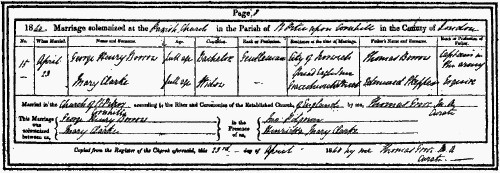 MRS. BORROW'S COPY OF HER MARRIAGE CERTIFICATE.
There are only two letters from Mrs. Borrow to her husband extant. Dr. Knapp apparently discovered none in the Borrow Papers in his possession. The two before me were written in the Hereford Square days[Pg 223] between the years 1860 and 1869—the last year of Mrs. Borrow's life. The pair had been married some twenty-five years at least, and it is made clear by these letters alone that at the end of this period they were still a most happily assorted couple. Mrs. Borrow must have gone to Brighton for her health on two separate occasions, each time accompanied by her daughter. Borrow, who had enjoyed many a pleasant ramble on his own account, as we shall see—rambles which extended as far away as Constantinople—is 'keeping house' in Hereford Square, Brompton, the while. It will be noted that Mrs. Borrow signed herself 'Carreta,' the pet name that her husband always gave her. Dr. Knapp points out that 'carreta' means a Spanish dray-cart, and that 'carita,' 'my dear,' was probably meant. But, careless as was the famous word-master over the spelling of words in the tongues that he never really mastered scientifically, he could scarcely have made so obvious a blunder as this, and there must have been some particular experience in the lives of husband and wife that led to the playful designation.[142] Here are the two letters:
Grenville Place, Brighton, Sussex.
My darling Husband,—I am thankful to say that I arrived here quite safe on Saturday, and on Wednesday I hope to see you at home. We may not be home before the evening about six o'clock, sooner or later, so do not be anxious, as we shall be careful.[Pg 224] We took tea with the Edwards at six o'clock the day I came; they are a very kind, nice family. You must take a walk when we come home, but remember now we have a young servant, and do not leave the house for very long together. The air here is very fresh, and much cooler than in London, and I hope after the five days' change I shall be benefited, but I wish to come home on Wednesday. See to all the doors and windows of a night, and let Jane keep up the chain, and lock the back door by the hop plant before it gets dark. Our love to Lady Soame.—And with our best love to you, believe me, your own
Carreta.
Sunday morning, 10 o'clock.
If I do not hear from you I shall conclude all is well, and you may do the same with regard to us. Have the tea ready a little before six on Wednesday. Henrietta is wonderfully improved by the change, and sends dear and best love to you.
33 Grenville Place, Brighton, Sussex.
Thursday morning.
My dear Husband,—As it is raining again this morning I write a few lines to you. I cannot think that we have quite so much rain as you have at Brompton, for I was out twice yesterday, an hour in the morning in a Bath chair, and a little walk in the evening on the Marine Parade, and I have been out little or much every day, and hope I feel a little better. Our dear Henrietta likewise says that she feels the better for the air and change. As we are here I think we had better remain till Tuesday next, when the fortnight will be up, but I fear you feel very lonely. I hope you get out when you can, and that you take care of your health. I hope Ellen continues to attend to yr. comfort, and that when she gives orders to Mrs. Harvey or the Butcher that she shews[Pg 225] you what they send. I shall want the stair carpets down, and the drawing-room nice—blinds and shutters closed to prevent the sun, also bed-rooms prepared, with well aired sheets and counterpane by next Tuesday. I suppose we shall get to Hereford Square perhaps about five o'clock, but I shall write again. You had better dine at yr. usual time, and as we shall get a dinner here we shall want only tea.
Henrietta's kindest dear love and mine, remaining yr. true and affectionate wife.
Carreta.
There is one letter from Borrow to his wife, written from London in 1843, in which he says:
I have not been particularly well since I wrote last; indeed, the weather has been so horrible that it is enough to depress anybody's spirits, and, of course, mine. I did very wrong not to bring you when I came, for without you I cannot get on at all. Left to myself a gloom comes upon me which I cannot describe.[143]
Assuredly no reader can peruse the following pages without recognising the true affection for his wife that is transparent in his letters to her. Arthur Dalrymple's remark that he had frequently seen Borrow and his wife travelling:
He stalking along with a huge cloak wrapped round him in all weathers, and she trudging behind him like an Indian squaw, with a carpet bag, or bundle, or small portmanteau in her arms, and endeavouring under difficulty to keep up with his enormous strides,
is clearly a travesty. 'Mrs. Borrow was devoted to her husband, and looked after business matters; and he always treated her with exceeding kindness,' is the verdict of Miss Elizabeth Jay, who was frequently privileged to visit the husband and wife at Oulton.
[136] All I know of Henry Clarke is contained in two little documents in my Borrow Papers which run as follows:
'These are to Certify the Principal Officers and Commissioners of H.M. Navy that Mr. Henry Clarke has Served as Midshipman on board H.M. Ship Salvador del Mundo under my Command from the 23 September 1810 to the date hereof, during which time he behaved with Diligence, Sobriety, and Attention, and was always obedient to Command.
'These are to Certify the Principal Officers and Commissioners of H.M. Navy that Mr. Henry Clarke has Served as Midshipman on board H.M. Ship Tisiphone under my Command from the 20th of June 1813 to the date hereof, during which time he behaved with Diligence, Sobriety, and Attention, and was always obedient to Command.
[137] Vide supra, p. 158.
[138] Knapp's Life, vol. i. 189.
[139] The tombs in Oulton Churchyard bear the following inscriptions:
(1) Beneath this stone are interred in the same grave the Mortal Remains of Edmund Skepper, who died Febry. 5th, 1836, aged 69. Also Ann Skepper, his wife, who died Sept. 15th, 1835, aged 62.
(2) Beneath this stone are interred the Mortal Remains of Breame Skepper, who died May 22nd, 1837, aged 42, leaving a wife and six children to lament his severe loss.
(3) Sacred to the Memory of Lieut. Henry Clarke of His Maj.'s Royal Navy, who departed this life on the 21st of March 1818, aged 25 years, leaving a firmly attached widow and an infant daughter to lament his irreparable loss.
A further tomb commemorates the mother of George Borrow, whose epitaph is given elsewhere.
[140] The following document in Henrietta's handwriting is among my Borrow Papers:
'When my Grandfather died he owed a mortgage of £5000 on the Oulton Hall estate—to a Mrs. Purdy.
'At my Grandfather's death my Mother applied to her Brother for the money left to her and also the money left—beside the money owed to her daughter which is also mentioned in the Will. She was refused both, and told moreover that neither the money nor the interest would be paid to her.
'My Mother and I were living at the Cottage since the funeral of my Grandfather—the Skeppers removed to the Hall. The Estate was to be sold—and my Mother and myself were to be paid. 'My Mother mentioned this to her solicitor, who hastened back to Norwich and got £5000—which he carried to the old lady, Mrs. Purdy, next day and paid off the mortgage. My Mother then was mortgagee in possession—after which she let the place for what she could get—this accounts for the whole affair and the whole confusion.
'My Mother was a Widow at this time and remained so for some time after—consequently all transactions took place with her and not with Mr. Borrow—she being afterwards married to Mr. Borrow without a settlement.
'After this, in 1844, the place was again put up by public auction and bought in by Mr. Borrow and my Mother.'
[141] Knapp's Life, vol. i. pp. 330, 331.
[142] The following suggestion has, however, been made to me by a friend of Henrietta MacOubrey née Clarke:
'I think Borrow intended "Carreta" for "dearest," It is impossible to think that he would call his wife a "cart." Perhaps he intended "Carreta" for "Querida." Probably their pronunciation was not Castillian, and they spelled the word as they pronounced it. In speaking of her to "Hen." Borrow always called her "Mamma." Mrs. MacOubrey took a great fancy to me because she said I was like "Mamma." She meant in character, not in person.'
[143] Dr. Knapp: Life, vol. ii p. 39.
Behold George Borrow, then, in a comfortable home on the banks of Oulton Broad—a family man. His mother—sensible woman—declines her son's invitation to live with the newly-married pair. She remains in the cottage at Norwich where her husband died. The Borrows were married in April 1840, by May they had settled at Oulton. It was a pleasantly secluded estate, and Borrow's wife had £450 a year. He had, a month before his marriage, written to Mr. Brandram to say that he had a work nearly ready for publication, and 'two others in a state of forwardness.' The title of the first of these books he enclosed in his letter. It was The Zincali: Or an Account of the Gypsies of Spain. Mr. Samuel Smiles, in his history of the House of Murray—A Publisher and his Friends—thus relates the circumstances of its publication:—
In November 1840 a tall, athletic gentleman in black called upon Mr. Murray offering a MS. for perusal and publication.... Mr. Murray could not fail to be taken at first sight with this extraordinary man. He had a splendid physique, standing six feet two in his stockings, and he had brains as well as muscles, as his works sufficiently show. The book now submitted was of a very uncommon character, and neither the author nor the publisher were very sanguine about its success. Mr. Murray[Pg 227] agreed, after perusal, to print and publish 750 copies of The Gypsies of Spain, and divide the profits with the author.
It was at the suggestion of Richard Ford, then the greatest living English authority on Spain, that Mr. Murray published the book. It did not really commence to sell until The Bible in Spain came a year or so later to bring the author reputation.[144] From November 1840 to June 1841 only three hundred copies had been sold in spite of friendly reviews in some half dozen journals, including The Athenæum and The Literary Gazette. The first edition, it may be mentioned, contained on its title-page a description of the author as 'late agent of the British and Foreign Bible Society in Spain.'[145] There is very marked compression in the edition now in circulation, and a perusal of the first edition reveals many interesting features that deserve to be restored for the benefit of the curious. But nothing can make The Zincali a great piece of literature. It was summarised by the Edinburgh Review at the time as 'a hotch-potch of the jockey, tramper, philologist, and missionary.' That description, which was not intended to be as flattering as it sounds to-day, appears more to apply to The Bible in Spain. But The Zincali is too confused, too ill-arranged a book[Pg 228] to rank with Borrow's four great works. There are passages in it, indeed, so eloquent, so romantic, that no lover of Borrow's writings can afford to neglect them. But this was not the book that gypsy-loving Borrow, with the temperament of a Romany, should have written, or could have written had he not been obsessed by the 'science' of his subject. His real work in gypsydom was to appear later in Lavengro and The Romany Rye. For Borrow was not a man of science—a philologist, a folk-lorist of the first order.
No one, indeed, who had read only The Zincali among Borrow's works could see in it any suspicion of the writer who was for all time to throw a glamour over the gypsy, to make the 'children of the open air' a veritable cult, to earn for him the title of 'the walking lord of gypsy lore,' and to lay the foundations of an admirable succession of books both in fact and fiction—but not one as great as his own. The city of Seville, it is clear, with sarcastic letters from Bible Society secretaries on one side, and some manner of love romance on the other, was not so good a place for an author to produce a real book as Oulton was to become. Richard Ford hit the nail on the head when he said with quite wonderful prescience:
How I wish you had given us more about yourself, instead of the extracts from those blunder-headed old Spaniards, who knew nothing about gypsies! I shall give you the rap, on that, and a hint to publish your whole adventures for the last twenty years.[146]
Henceforth Borrow was to write about himself and to become a great author in consequence. For in writing about himself as in Lavengro and The Romany[Pg 229] Rye he was to write exactly as he felt about the gypsies, and to throw over them the glamour of his own point of view, the view of a man who loved the broad highway and those who sojourned upon it. In The Gypsies of Spain we have a conventional estimate of the gypsies. 'There can be no doubt that they are human beings and have immortal souls,' he says, even as if he were writing a letter to the Bible Society. All his anecdotes about the gypsies are unfavourable to them, suggestive only of them as knaves and cheats. From these pictures it is a far cry to the creation of Jasper Petulengro and Isopel Berners. The most noteworthy figure in The Zincali is the gypsy soldier of Valdepeñas, an unholy rascal. 'To lie, to steal, to shed human blood'—these are the most marked characteristics with which Borrow endows the gypsies of Spain. 'Abject and vile as they have ever been, the gitános have nevertheless found admirers in Spain,' says the author who came to be popularly recognised as the most enthusiastic admirer of the gypsies in Spain and elsewhere. Read to-day by the lover of Borrow's other books The Zincali will be pronounced a readable collection of anecdotes, interspersed with much dull matter, with here and there a piece of admirable writing. But the book would scarcely have lived had it not been followed by four works of so fine an individuality. Well might Ford ask Borrow for more about himself and less of the extracts from 'blunder-headed old Spaniards.' When Borrow came to write about himself he revealed his real kindness for the gypsy folk. He gave us Jasper Petulengro and the incomparable description of 'the wind on the heath.' He kindled the imagination of men, proclaimed the joys of vagabondage in a manner[Pg 230] that thrilled many hearts. He had some predecessors and many successors, but 'none could then, or can ever again,' says the biographer of a later Rye, 'see or hear of Romanies without thinking of Borrow.'[147] In her biography of one of these successors in gypsy lore, Charles Godfrey Leland, Mrs. Pennell discusses the probability that Borrow and Leland met in the British Museum. That is admitted in a letter from Leland to Borrow in my possession. To this letter Borrow made no reply. It was wrong of him. But he was then—in 1873—a prematurely old man, worn out and saddened by neglect and a sense of literary failure. For this and for the other vagaries of those latter years Borrow will not be judged harshly by those who read his story here. Nothing could be more courteous than Borrow's one letter to Leland, written in the failing handwriting—once so excellent—of the last sad decade of his life:
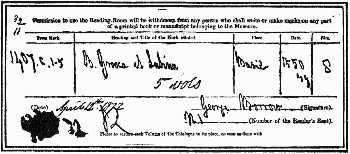 AN APPLICATION FOR A BOOK IN THE BRITISH MUSEUM, WITH
BORROWS SIGNATURE
AN APPLICATION FOR A BOOK IN THE BRITISH MUSEUM, WITH
BORROWS SIGNATURE
22 Hereford Square, Brompton, Nov. 2, 1871.
Sir,—I have received your letter and am gratified by the desire you express to make my acquaintance. Whenever you please to come I shall be happy to see you.—Yours truly,
The meeting did not, through Leland's absence from London, then take place. Two years later it was another story. The failing powers were more noteworthy. Borrow was by this time dead to the world, as the documents before me abundantly testify. It is not, therefore, necessary to assume, as Leland's friends have all done, that Borrow never replied because he was on the eve of publishing a book of his own about the gypsies. There seems no reason to assume, as Dr. Knapp does and as Leland does, that this was the reason for the unanswered letter:
Langham Hotel, Portland Place, March 31st, 1873.
Dear Sir,—I sincerely trust that the limited extent of our acquaintanceship will not cause this note to seem to you too presuming. Breviter, I have thrown the results of my observations among English gypsies into a very unpretending little volume consisting almost entirely of facts gathered from the Romany, without any theory. As I owe all my interest in the subject to your writings, and as I am sincerely grateful to you for the impulse which they gave me, I should like very much to dedicate my book to you. Of course if your kindness permits I shall submit the proofs to you, that you may judge whether the work deserves the honour. I should have sent you the MS., but not long after our meeting at the British Museum I left for Egypt, whence I have very recently returned, to find my publisher clamorous for the promised copy.
It is not—God knows—a mean and selfish desire to help my book by giving it the authority of your name, which induces this[Pg 232] request. But I am earnestly desirous for my conscience' sake to publish nothing in the Romany which shall not be true and sensible, even as all that you have written is true and sensible. Therefore, should you take the pains to glance over my proof, I should be grateful if you would signify to me any differences of opinion should there be ground for any. Dr. A. F. Pott in his Zigeuner (vol. ii. p. 224), intimates very decidedly that you took the word shastr (Exhastra de Moyses) from Sanskrit and put it into Romany; declaring that it would be very important if shaster were Romany. I mention in my book that English gypsies call the New Testament (also any MS.) a shaster, and that a betting-book on a racecourse is called a shaster 'because it is written.' I do not pretend in my book to such deep Romany as you have achieved—all that I claim is to have collected certain words, facts, phrases, etc., out of the Romany of the roads—corrupt as it is—as I have found it to-day. I deal only with the gypsy of the Decadence. With renewed apology for intrusion should it seem such, I remain, yours very respectfully,
Charles G. Leland.
Francis Hindes Groome remarked when reviewing Borrow's Word Book in 1874,[149] that when The Gypsies of Spain was published in 1841 'there were not two educated men in England who possessed the slightest knowledge of Romany.' In the intervening thirty-three years all this was changed. There was an army of gypsy scholars or scholar gypsies of whom Leland was one, Hindes Groome another, and Professor E. H. Palmer a third, to say nothing of many scholars and students of Romany in other lands. Not one of them seemed when Borrow published his Word Book of the Romany to see that he was the only man of genius among them. They only saw that he was an inferior philologist to them all. And so Borrow, who prided himself on things that he could do indifferently quite as much as[Pg 233] upon things that he could do well, suffered once again, as he was so often doomed to suffer, from the lack of appreciation which was all in all to him, and his career went out in a veritable blizzard. He published nothing after his Romano Lavo-Lil appeared in 1874.[150] He was then indeed a broken and a bitter man, with no further interest in life. Dedications of books to him interested him not at all. In any other mood, or a few years earlier, Leland's book, The English Gypsies,[151] would have gladdened his heart. In his preface Leland expresses 'the highest respect for the labours of Mr. George Borrow in this field,' he quotes Borrow continually and with sympathy, and renders him honour as a philologist, that has usually been withheld. 'To Mr. Borrow is due the discovery that the word Jockey is of gypsy origin and derived from chuckiri, which means a whip,' and he credits Borrow with the discovery of the origin of 'tanner' for sixpence; he vindicates him as against Dr. A. F. Pott,—a prince among students of gypsydom—of being the first to discover that the English gypsies call the Bible the Shaster. But there is a wealth of scientific detail in Leland's books that is not to be found in Borrow's, as also there is in Francis Hindes Groome's works. What had Borrow to do with science? He could not even give the word 'Rúmani' its accent, and called it 'Romany.' He 'quietly appropriated,' says Groome, 'Bright's Spanish gypsy words for his own work,[Pg 234] mistakes and all, without one word of recognition. I think one has the ancient impostor there.'[152] 'His knowledge of the strange history of the gypsies was very elementary, of their manners almost more so, and of their folk-lore practically nil,' says Groome elsewhere.[153] Yet Mr. Hindes Groome readily acknowledges that Borrow is above all writers on the gypsies. 'He communicates a subtle insight into gypsydom'—that is the very essence of the matter.[154] Controversy will continue in the future as in the present as to whether the gypsies are all that Borrow thought them. Perhaps 'corruption has crept in among them' as it did with the prize-fighters. They have intermarried with the gorgios, thrown over their ancient customs, lost all their picturesque qualities, it may be. But Borrow has preserved in literature for all time, as not one of the philologists and folk-lore students has done, a remarkable type of people. But this is not to be found in his first original work, The Zincali, nor in his last, The Romano Lavo-Lil. This glamour is to be found in Lavengro and The Romany Rye, to which books we shall come in due course. Here we need only refer to the fact that Borrow had loved the gypsies all his life—from his boyish meeting with Petulengro until in advancing years the prototype of that wonderful creation of his imagination—for[Pg 235] this the Petulengro of Lavengro undoubtedly was—came to visit him at Oulton. Well might Leland call him 'the Nestor of Gypsydom.'
We find the following letter to Dr. Bowring accompanying a copy of The Zincali:
58 Jermyn Street, St. James, April 14, 1841.
My dear Sir,—I have sent you a copy of my work by the mail. If you could contrive to notice it some way or other I should feel much obliged. Murray has already sent copies to all the journals. It is needless to tell you that despatch in these matters is very important, the first blow is everything. Lord Clarendon is out of town. So I must send him his presentation copy through Murray, and then write to him. I am very unwell, and must go home. My address is George Borrow, Oulton Hall, Oulton, Lowestoft, Suffolk. Your obedient servant,
George Borrow.
Two years later we find Borrow writing to an unknown correspondent upon a phase of folk-lore:
Oulton, Lowestoft, Suffolk, August 11, 1843.
My dear Sir,—Many thanks for your interesting and kind letter in which you do me the honour to ask my opinion respecting the pedigree of your island goblin, le feu follet Belenger; that opinion I cheerfully give with a premise that it is only an opinion; in hunting for the etymons of these fairy names we can scarcely expect to arrive at anything like certainty.
I suppose you are aware that the name of Bilenger or Billinger is of occasional though by no means of frequent occurrence both in England and France. I have seen it; you have heard of Billings-gate and of Billingham, the unfortunate assassin of poor Percival,—all modifications of the same root; Belingart, Bilings home or Billing ston. But what is Billin-ger? Clearly that which is connected in some way or other with Billing. You[Pg 236] will find ger, or something like it, in most European-tongues—Boulanger, horologer, talker, walker, baker, brewer, beggar. In Welsh it is of frequent occurrence in the shape of ur or gwr—henur (an elder), herwr (a prowler); in Russian the ger, gwr, ur, er, appears in the shape of ik or k—sapojgnik, a shoemaker, Chinobuik, a man possessed of rank. The root of all these, as well as of or in senator, victor, etc., is the Sanscrit ker or kir, which means lord, master, maker, doer, possessor of something or connected with something.
We want now to come at the meaning of Beling or Billing, which probably means some action, or some moral or personal attribute; Bolvile in Anglo-Saxon means honest, Danish Bollig; Wallen, in German, to wanken or move restlessly about; Baylan, in Spanish, to dance (Ball? Ballet?), connected with which are to whirl, to fling, and possibly Belinger therefore may mean a Billiger or honest fellow, or it may mean a Walterger, a whirlenger, a flinger, or something connected with restless motion.
Allow me to draw your attention to the word 'Will' in the English word will-o-the-wisp; it must not be supposed that this Will is the abbreviation of William; it is pure Danish, 'Vild'—pronounced will,—and signifies wild; Vilden Visk, the wild or moving wisp. I can adduce another instance of the corruption of the Danish vild into will: the rustics of this part of England are in the habit of saying 'they are led will' (vild or wild) when from intoxication or some other cause they are bewildered at night and cannot find their way home. This expression is clearly from the old Norse or Danish. I am not at all certain that 'Bil' in Bilinger may not be this same will or vild, and that the word may not be a corruption of vilden, old or elder, wild or flying fire. It has likewise occurred to me that Bilinger may be derived from 'Volundr,' the worship of the blacksmith or Northern Vulcan. Your obedient servant,
George Borrow.
[144] There were 750 copies of the first edition of The Zincali in two vols. in 1841. 750 of the second edition in 1843, and a third issue of 750 in the same year. A fourth edition of 7,500 copies appeared in the cheap Home and Colonial Library in 1846, and there was a fifth edition of 1000 copies in 1870. These were all the editions published in England during Borrow's lifetime. Dr. Knapp traced three American editions during the same period.
[145] The Zincali; or an Account of the Gypsies of Spain. With an original collection of their songs and poetry, and a copious dictionary of their language. By George Borrow, Late Agent of the British and Foreign Bible Society in Spain. 'For that which is unclean by nature, thou canst entertain no hope; no washing will turn the gypsy white.'—Ferdousi. In two volumes. London: John Murray, Albemarle Street, 1841.
[146] Knapp's Life, vol. i. p. 378.
[147] Mrs. Pennell. See Charles Godfrey Leland: a Biography, by Elizabeth Robins Pennell. 2 vols. 1906.
[148] Given in Mrs. Pennell's Leland: a Biography, vol. ii. pp. 142-3. The letter to which it is a reply is given in Knapp's Borrow, vol. ii. pp. 228-9.
[149] The Academy, June 13, 1874.
[150] Romano Lavo-Lil: Word Book of the Romany; or, English Gypsy Language. By George Borrow. London: John Murray, Albemarle Street, 1874.
[151] Charles Godfrey Leland (1824-1903) better known as 'Hans Breitmann' of the popular ballads, was born in Philadelphia and died in Florence. He was always known among his friends as 'The Rye,' in consequence of his enthusiasm for the gypsies concerning whom he wrote four books, the best known being: The English Gypsies and their Language, by Charles G. Leland: Trübner. The Gypsies, by Charles G. Leland: Trübner.
[152] See Groome's In Gipsy Tents (W. P. Nimmo, 1880), and Gipsy Folk-Tales (Hurst & Blackett, 1899). Francis Hindes Groome (1851-1902), whom it was my privilege to know, was the son of Archdeacon Groome, the friend of Edward FitzGerald. He was the greatest English authority of his time on gypsy language and folk-lore. He celebrated his father's friendship with the paraphraser of Omar Khayyám in Two Suffolk Friends, 1895, and wrote a good novel of gypsydom in Kriegspiel, 1896. He also edited an edition of Lavengro (Methuen), 1901.
[153] Groome to Leland in Charles Godfrey Leland: a Biography, by E. R. Pennell, vol. ii. p. 141.
[154] Introduction to Lavengro (Methuen), 1901.
In an admirable appreciation of our author, the one in which he gives the oft-quoted eulogy concerning him as 'the delightful, the bewitching, the never-sufficiently-to-be-praised George Borrow,' Mr. Birrell records the solace that may be found by small boys in the ambiguities of a title-page, or at least might have been found in it in his youth and in mine. In those days in certain Puritan circles a very strong line was drawn between what was known as Sunday reading, and reading that might be permitted on week-days. The Sunday book must have a religious flavour. There were magazines with that particular flavour, every story in them having a pious moral withal. Very closely watched and scrutinised was the reading of young people in those days and in those circles. Mr. Birrell, doubtless, speaks from autobiographical memories when he tells us of a small boy with whose friends The Bible in Spain passed muster on the strength of its title-page. For Mr. Birrell is the son of a venerated Nonconformist minister; and perhaps he, or at least those who were of his household, had this religious idiosyncrasy. It may be that the distinction which pervaded the evangelical circles of Mr. Birrell's youth as to what were Sunday books, as[Pg 238] distinct from books to be read on week-days, has disappeared. In any case think of the advantage of the boy of that generation who was able to handle a book with so unexceptionable a title as The Bible in Spain. His elders would succumb at once, particularly if the boy had the good sense to call their attention to the sub-title—'The Journeys, Adventures, and Imprisonments of an Englishman in an Attempt to Circulate the Scriptures in the Peninsula.' Nothing could be said by the most devout of seniors against so prepossessing a title-page.[155] But what of the boy who had thus passed the censorship? What a revelation of adventure was open to him! Perhaps he would skip the 'preachy' parts in which Borrow was doubtless sincere, although the sincerity has so uncertain a ring to-day. Here are five passages, for example, which do not seem to belong to the book:
In whatever part of the world I, a poor wanderer in the Gospel's cause, may chance to be
very possibly the fate of St. Stephen might overtake me; but does the man deserve the name of a follower of Christ who would shrink from danger of any kind in the cause of Him whom he calls his Master? 'He who loses his life for my sake shall find it,' are words which the Lord Himself uttered. These words were fraught with consolation to me, as they doubtless are to every one engaged in propagating the Gospel, in sincerity of heart, in savage and barbarian lands.
Unhappy land! not until the pure light of the Gospel has illumined thee, wilt thou learn that the greatest of all gifts is charity![Pg 239]
and I thought that to convey the Gospel to a place so wild and remote might perhaps be considered an acceptable pilgrimage in the eyes of my Maker. True it is that but one copy remained of those which I had brought with me on this last journey; but this reflection, far from discouraging me in my projected enterprise, produced the contrary effect, as I called to mind that, ever since the Lord revealed Himself to man, it has seemed good to Him to accomplish the greatest ends by apparently the most insufficient means; and I reflected that this one copy might serve as an instrument for more good than the four thousand nine hundred and ninety-nine copies of the edition of Madrid.
I shall not detain the course of my narrative with reflections as to the state of a Church which, though it pretends to be founded on scripture, would yet keep the light of scripture from all mankind, if possible. But Rome is fully aware that she is not a Christian Church, and having no desire to become so, she acts prudently in keeping from the eyes of her followers the page which would reveal to them the truths of Christianity.
All this does not ring quite true, and in any case it is too much on the lines of 'Sunday reading' to please the small boy, who must, however, have found a thousand things in that volume that were to his taste—some of the wildest adventures, hairbreadth escapes, extraordinary meetings again and again with unique people—with Benedict Mol, for example, who was always seeking for treasure. Gypsies, bull-fighters, quaint and queer characters of every kind, come before us in rapid succession. Rarely, surely, have so many adventures been crowded into the same number of pages. Only when Borrow remembers, as he has to do occasionally, that he is an agent of the Bible Society does the book lose its vigour and its charm. We have already pointed out that the foundations of the volume were contained in certain letters written by Borrow during[Pg 240] his five years in Spain to the secretaries of the Bible Society in London. The recent publication of these letters has revealed to us Borrow's methods. When he had settled down at Oulton he took down his notebooks, one of which is before me, but finding this was not sufficient, he asked the Bible Society for the loan of his letters to them.[156] Other letters that he hoped to use were not forthcoming, as the following note from Miss Gurney to Mrs. Borrow indicates:
Earlham, 12th June 1840.
Dear Mrs. Borrow,—I am sorry I cannot find any of Mr. Borrow's letters from Spain. I don't think we ever had any, but[Pg 241] my brother is from home and I therefore cannot inquire of him. I send you the only two I can find. I am very glad he is going to publish his travels, which I have no doubt will be very interesting. It must be a pleasant object to assist him by copying the manuscripts. If I should visit Lowestoft this summer I shall hope to see you, but I have no immediate prospect of doing so. With kind regards to all your party, I am, Dear Mrs. Borrow, Yours sincerely,
C. Gurney.[157]
The Bible Society applied to in the same manner lent Borrow all his letters to that organisation and its secretaries. Not all were returned. Many came to Dr. Knapp when he purchased the half of the Borrow papers that were sold after Borrow's death; the remainder are in my possession. It is a nice point, seventy years after they were written, as to whom they belong. In any case the Bible Society must have kept copies of everything, for when, in 1911, they came to publish the Letters[158] the collection was sufficiently complete. That publication revealed some interesting sidelights. It proved on the one hand that Borrow had drawn more upon his diaries than upon his letters, although he frequently reproduced fragments of his diaries in his letters. It revealed further the extraordinary frankness with which Borrow wrote to his employers. But the main point is in the discovery revealed to us that Borrow was not an artist in his letters. Borrow was never a good letter writer, although I think that many of the letters that appear[Pg 242] for the first time in these pages will prove that his letters are very interesting as contributions to biography. If some of the letters that helped to make up The Bible in Spain are interesting, it is because in them Borrow incorporated considerable fragments of anecdote and adventure from his notebooks. It is quite a mistake to assume, as does Dr. Knapp, that the 'Rev. and Dear Sir' at the head of a letter was the only variation. You will look in vain in the Bible Society correspondence for many a pearl that is contained in The Bible in Spain, and you will look in vain in The Bible in Spain for many a sentence which concludes some of the original letters. In one case, indeed, a letter concludes with Heber's hymn—
with which Borrow's correspondent must already have been sufficiently familiar. But Borrow could not be other than Borrow, and the secretaries of the Bible Society had plentiful matter with which to astonish them. The finished production, however, is a fascinating book. You read it again and it becomes still more entertaining. No wonder that it took the world by storm and made its author the lion of a season. 'A queer book will be this same Bible in Spain,' wrote Borrow to John Murray in August 1841, 'containing all my queer adventures in that queer country ... it will make two nice foolscap octavo volumes.'[159] It actually made three volumes, and Borrow was as irritated at Mr. Murray's delay in publishing as that publisher afterwards became at Borrow's own delay over Lavengro. The whole book was laboriously copied out by Mrs. Borrow. When this copy was sent to Mr. Murray, it[Pg 243] was submitted to his 'reader,' who reported 'numerous faults in spelling and some in grammar,' to which criticism Borrow retorted that the copy was the work of 'a country amanuensis.' The book was published in December 1842, but has the date 1843 on its title-page.[160] In its three-volumed form 4750 copies of the book were issued by July 1843, after which countless copies were sold in cheaper one-volumed form. Success had at last come to Borrow. He was one of the most talked-of writers of the day. His elation may be demonstrated by his discussion with Dawson Turner as to whether he should leave the manuscript of The Bible in Spain to the Dean and Chapter's Library at Norwich or to the British Museum, by his gratification at the fact that Sir Robert Peel referred to his book in the House of Commons, and by his pleasure in the many appreciative reviews which, indeed, were for the most part all that an ambitious author could desire. 'Never,' said The Examiner, 'was book more legibly impressed with the unmistakable mark of genius.' 'There is no taking leave of a book like this,' said the Athenæum. 'Better Christmas fare we have never had it in our power to offer our readers.'
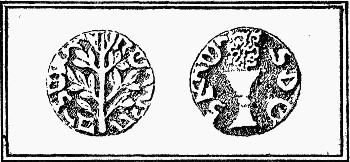 A SHEKEL
The publication of The Bible in Spain made Borrow famous for a time. Hitherto he had been known only to a small religious community, the coterie that ran the Bible Society. Even the large mass of people who subscribed to that Society knew its agent in Spain only by meagre allusions in the Annual Reports. Now the world was to talk about him, and he enjoyed being talked about. Borrow declared—in 1842—that the five years he passed in Spain were the most happy years of his existence. But then he had not had a happy life during the previous years, as we have seen, and in Russia he had a toilsome task with an added element of uncertainty as to the permanence of his position. The five years in Spain had plentiful adventure, and they closed in a pleasant manner. Yet the year that followed, even though it found him almost a country squire, was not a happy one. Once again the world did not want him and his books—not the Gypsies of Spain for example. Seven weeks after publication it had sold only to the extent of some three hundred copies.[161] But the happiest year of Borrow's life was undoubtedly the one that followed the publication of The Bible in Spain. Up to that time he had been a mere adventurer; now he was that most joyous of beings—a successful author; and here, from among his Papers, is a carefully preserved relic of his social triumph:[Pg 245]
4 Carlton Terrace, Tuesday, 30th May.
The Prussian Minister and Madam Bunsen would be very happy to see Mr. Borrow to-morrow, Wednesday evening, about half past nine o'clock or later, when some German national songs will be performed at their house, which may possibly suit Mr. Borrow's taste. They hoped to have met him last night at the Bishop of Norwich's, but arrived there too late. They had already commissioned Lady Hall (sister to Madam Bunsen) to express to Mr. Borrow their wish for his acquaintance.
In a letter to his wife, of which a few lines are printed in Dr. Knapp's book, he also writes of this visit to the Prussian Minister, where he had for company 'Princes and Members of Parliament.' 'I was the star of the evening,' he says; 'I thought to myself, "what a difference!"'[162] The following letter is in a more sober key:
Wednesday, 58 Jermyn Street.
Dear Carreta,—I was glad to receive your letter; I half expected one on Tuesday. I am, on the whole, very comfortable, and people are kind. I passed last Sunday at Clapham with Mrs.[Pg 246] Browne; I was glad to go there for it was a gloomy day. They are now glad enough to ask me: I suppose I must stay in London through next week. I have an invitation to two grand parties, and it is as well to have something for one's money. I called at the Bible Society—all remarkably civil, Joseph especially so. I think I shall be able to manage with my own Dictionary. There is now a great demand for Morrison. Yesterday I again dined at the Murrays. There was a family party; very pleasant. To-morrow I dine with an old schoolfellow. Murray is talking of printing a new edition to sell for five shillings: those rascals, the Americans, have, it seems, reprinted it, and are selling it for eighteen pence. Murray says he shall print ten thousand copies; it is chiefly wanted for the Colonies. He says the rich people and the libraries have already got it, and he is quite right, for nearly three thousand copies have been sold at 27s.[163] There is no longer the high profit to be made on books there formerly was, as the rascals abroad pirate the good ones, and in the present state of copyright there is no help; we can, however, keep the American edition out of the Colonies, which is something. I have nothing more to say save to commend you not to go on the water without me; perhaps you would be overset; and do not go on the bridge again till I come. Take care of Habismilk and Craffs; kiss the little mare and old Hen.
George Borrow.
The earliest literary efforts of Borrow in Spain were his two translations of St. Luke's Gospel—the one into Romany, the other into Basque. This last book he did not actually translate himself, but procured 'from a Basque physician of the name of Oteiza.'[Pg 247]
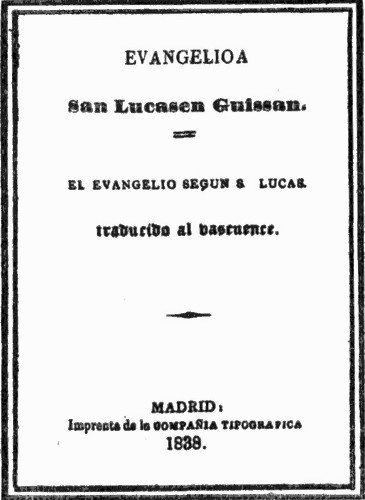 TITLE-PAGE OF BASQUE TRANSLATION BY OTEIZA OF THE GOSPEL
OF ST. LUKE
TITLE-PAGE OF BASQUE TRANSLATION BY OTEIZA OF THE GOSPEL
OF ST. LUKE
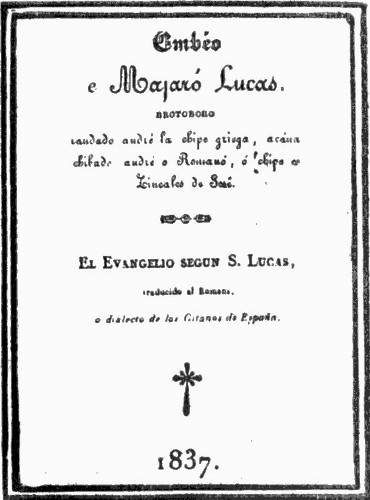 TITLE-PAGE OF FIRST EDITION OF ROMANY TRANSLATION OF THE
GOSPEL OF ST. LUKE
TITLE-PAGE OF FIRST EDITION OF ROMANY TRANSLATION OF THE
GOSPEL OF ST. LUKE
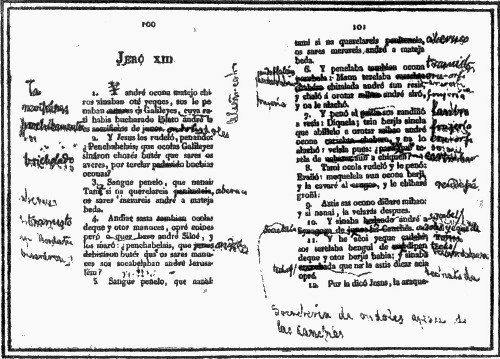 TWO PAGES FROM BORROW'S CORRECTED PROOF SHEETS OF ROMANY
TRANSLATION OF THE GOSPEL OF ST. LUKE
TWO PAGES FROM BORROW'S CORRECTED PROOF SHEETS OF ROMANY
TRANSLATION OF THE GOSPEL OF ST. LUKE
[155] Yet one critic of Borrow—Jane H. Findlater, in the Cornhill Magazine, November 1899—actually says that 'The Bible in Spain was perhaps the most ill-advised title that a well-written book ever laboured under, giving, as it does, the idea that the book is a prolonged tract.'
[156] Borrow had really written a great deal of the book in Spain. The 'notebook' contained many of his adventures, and moreover on August 20, 1836, the Athenæum, published two long letters from him under the title of 'The Gypsies in Russia and in Spain,' opening with the following preliminary announcement:
We have been obligingly favoured with the following extracts from letters of an intelligent gentleman, whose literary labours, the least important of his life, we not long since highly praised, but whose name we are not at liberty, on this occasion, to make public. They contain some curious and interesting facts relating to the condition of this peculiar people in very distant countries.
The first letter is dated September 23, 1835, and gives an account of his experiences with the gypsies in Russia. The whole of this account he incorporated in The Gypsies of Spain. Following this there are two columns, dated Madrid, July 19, 1836, in which he gives an account of the gypsies in Spain. All the episodes that he relates he incorporated in The Bible in Spain. The two letters so plainly indicate that all the time Borrow was in Spain his mind was more filled with the subject of the gypsies than with any other question. He did his work well for the Bible Society no doubt, and gave them their money's worth, but there is a humorous note in the fact that Borrow should have utilised his position as a missionary—for so we must count him—to make himself so thoroughly acquainted with gypsy folklore and gypsy songs and dances as these two fragments by an 'intelligent gentleman' imply. It is not strange that under the circumstances Borrow did not wish that his name should be made public.
[157] This was Miss Catherine Gurney, who was born in 1776, in Magdalen Street, Norwich, and died at Lowestoft in 1850, aged seventy-five. She twice presided over the Earlham home. The brother referred to was Joseph John Gurney.
[158] Letters of George Borrow to the British and Foreign Bible Society. Published by direction of the Committee. Edited by T. H. Darlow. Hodder and Stoughton, 1911.
[159] Samuel Smiles: A Publisher and his Friends, vol. ii. p. 485.
[160] The Bible in Spain; or The Journeys, Adventures, and Imprisonments of an Englishman in an Attempt to Circulate the Scriptures in the Peninsula. By George Borrow, author of The Gypsies of Spain. In three volumes. London: John Murray, Albemarle St., 1843.
[161] Herbert Jenkins: Life, p. 341.
[162] Knapp's Life, vol. i. p. 398. In the Annals of the Harford Family, edited by Alice Harford (Westminster Press, 1909), there is an account of this gathering in a letter from J. Harford-Battersby to Louisa Harford. There was present 'the amusing author of The Bible in Spain, a man who is remarkable for his extraordinary powers as a linguist, and for the originality of his character, not to speak of the wonderful adventures he narrates, and the ease and facility with which he tells them. He kept us laughing a good part of breakfast time by the oddity of his remarks, as well as the positiveness of his assertions, often rather startling, and, like his books, partaking of the marvellous.'
[163] 4750 copies were sold in the three volume form in 1843, and a sixth and cheaper edition the same year sold 9000 copies.
The most distinguished of Borrow's friends in the years that succeeded his return from Spain was Richard Ford, whose interests were so largely wrapped-up in the story of that country. Ford was possessed of a very interesting personality, which was not revealed to the public until Mr. Rowland E. Prothero issued his excellent biography[164] in 1905, although Ford died in 1858. This delay is the more astonishing as Ford's Handbook for Travellers in Spain was one of the most famous books of its day. Ford's father, Sir Richard Ford, was a friend of William Pitt, and twice sat in Parliament, being at one time Under-Secretary of State for the Home Department. He ended his official career as a police magistrate at Bow Street, but deserves to be better known to fame as the creator of the mounted police force of London. Ford was born with a silver spoon in his mouth, inheriting a fortune from his father, and from his mother an extraordinary taste for art. Although called to the bar he never practised, but spent his time in travelling on the Continent, building up a valuable collection of books and paintings. He was three times married, and all these unions seem to[Pg 249] have been happy, in spite of an almost unpleasant celerity in the second alliance, which took place nine months after the death of his first wife. A very large portion of his life he devoted to Spain, which he knew so intimately that in 1845 he produced that remarkable Handbook in two closely printed volumes, a most repellent-looking book in appearance to those who are used to contemporary typography, usually so attractive. Ford, in fact, was so full of his subject that instead of a handbook he wrote a work which ought to have appeared in half a dozen volumes. In later editions the book was condensed into one of Mr. Murray's usual guide-books, but the curious may still enjoy the work in its earliest form, so rich in discussions of the Spanish people, their art and architecture, their history and their habits. The greater part of the letters in Mr. Prothero's collection are addressed to Addington, who was our ambassador to Madrid for some years, until he was superseded by George Villiers, Lord Clarendon, with whom Borrow came so much in contact. Those letters reveal a remarkably cultivated mind and an interesting outlook on life, an outlook that was always intensely anti-democratic. It is impossible to sympathise with him in his brutal reference to the execution by the Spaniards of Robert Boyd, a young Irishman who was captured with Torrijos by the Spanish Government in 1831. Richard Ford apparently left Spain very shortly before George Borrow entered that country. Ford passed through Madrid on his way to England in September 1833. He then settled near Exeter, purchasing an Elizabethan cottage called Heavitree House, with twelve acres of land, and devoted himself to turning it into a beautiful mansion. Presumably he first met Borrow in Mr. John[Pg 250] Murray's famous drawing-room soon after the publication of The Gypsies of Spain. He tells Addington, indeed, in a letter of 14th January 1841:
I have made acquaintance with an extraordinary fellow, George Borrow, who went out to Spain to convert the gypsies. He is about to publish his failure, and a curious book it will be. It was submitted to my perusal by the hesitating Murray.
Ford's article upon Borrow's book appeared in The British and Foreign Review, and Ford was delighted that the book had created a sensation, and that he had given sound advice as to publishing the manuscript. When The Bible in Spain was ready, Ford was one of the first to read it. Then he wrote to John Murray:
I read Borrow with great delight all the way down per rail. You may depend upon it that the book will sell, which after all is the rub.
And in that letter Ford describes the book as putting him in mind of Gil Blas with 'a touch of Bunyan.' Lockhart himself reviewed the book in The Quarterly, so Ford had to go to the rival organ—The Edinburgh Review—receiving £44 for the article, which sum, he tells us, he invested in Château Margaux.
Ford's first letter to Borrow in my collection is written in Spanish:
Heavitree House, Exeter, Jan. 19, 1842.
Querido Compadre,—Mucho m'ha alegrado el buen termino de sus trabajos literarios que V.M. me participó. Vaya con los picaros de Zincali, buenas pesetas han cobrado—siempre he tenido á los Sres. M. como muy hombres de bien, suele ser que los que tratan mucho con personages de categoria, tomen un algo del[Pg 251] grande y liberal. Convega V.M. que soy critico de tipo, y que digo, 'Bahi de los gabicotes.' Conosco bastante loque agradecera al muy noble y illustrado publico—conque sigue V.M. adelante y no dejes nada en el tintero, pero por vida del Demonio, huyese V.M. de los historiadores españoles, embusteros y majaderos. Siento mucho que V.M. haya salido de Londres, salgo de esto Sabato, y pienso hacer una visita de como unas tres semanas, en la casa maternal, como es mi costumbre por el mes de los aguinaldos. Con mucho gusto hubiera praticado con V.M. y charleado sobre las cosas de España y otra chismografia gitanesca y zandungera, por ahora no entiendo nada de eso. No dejaré de llevar conmigo los papeles y documentos que V.M. se sirvio de remitirme á Cheltenham. Haré de ellos un paquete, y lo confiaré á los Señores Murray, para quando V.M. guste reclamarlo. Haré el mio posible de averiguar y aprofundicar aquellos misterios y gente estrambotica. El Señor Murray hijo, me escrive muy contento de la Biblia en España. Descaria yo escribir un articulo sobre asunto tan relleno de interes. Talvez el articulo mio de los Gitanos parecera en el numero proximo, y en tal caso ha de ser mas util á V.M. que no hubiera sido ahora. La vida y memoria de las revistas, es muy corta. Salen como miraposas y mueren en un dia. Los muertos y los idos no tienen amigos. Los vivos á la mesa, y los muertos á la huesa. Al istante que está imprimido un nuevo numero, el pasado y esta olvidado y entra entre las cosas del Rey Wamba. Que le parece á V.M., ultimamente en un baile donde sacaron un Rey de Hubas (twelfth night) tiré El Krallis de los Zincali. Incluyo á V. Majestad tabula, de veras es preciso que yo tengo en mis venas algunas gotitas de legitimo errante. El Señor Gagargos viene á ser nombrado Consul español á Tunis, donde no le faltaron medios de adelantarse en el idioma y literatura arabica. Queda de S.M. afemo. su amigo, Q.B.S.M.,
Here is a second letter of the following month:
February 26th, Heavitree House, Exeter.
Batuschca Borrow,—I am glad that the paper pleased you, and I think it calculated to promote the sale, which a too copious extracting article does not always do, as people think that they have had the cream. Napier sent me £44 for the thirty-two pages; this, with Kemble's £50, 8s. for the Zincali, nearly reaches £100: I lay it out in claret, being not amiss to do in the world, and richer by many hundreds a year than last year, but with a son at Eton and daughters coming out, and an overgrown set of servants, money is never to be despised, and I find that expenditure by some infernal principle has a greater tendency to increase than income, and that when the latter increases it never does so in the ratio of the former—enough of that. How to write an article without being condensed—epigrammatical and epitomical cream-skimming[Pg 253] that is—I know not, one has so much to say and so little space to say it in.
I rejoice to hear of your meditated biography; really I am your wet nurse, and you ought to dedicate it to me; take time, but not too much; avoid all attempts to write fine; just dash down the first genuine uppouring idea and thoughts in the plainest language and that which comes first, and then fine it and compress it. Let us have a glossary; for people cry out for a Dragoman, and half your local gusto evaporates.
I am amazed at the want of profits—'tis sad to think what meagre profits spring from pen and ink; but Cervantes died a beggar and is immortal. It is the devil who comes into the market with ready money: No solvendum in futuro: I well know that it is cash down which makes the mare to go; dollars will add spurs even to the Prince of Mustard's paces.
It is a bore not receiving even the crumbs which drop from such tables as those spread by Mr. Eyre: Murray, however, is a deep cove, y muy pratico en cosas de libreteria: and he knew that the first out about Afghan would sell prodigiously. I doubt now if Lady Sale would now be such a general Sale. Murray builds solid castles in Eyre. Los de España rezalo bene de ser siempre muy Cosas de España: Cachaza! Cachaza! firme, firme! Arhse! no dejei nada en el tintero; basta que sea nuevo y muy piquunte cor sal y ajo: a los Ingleses le gustan mucho las Longanizas de Abarbenel y los buenos Choriyos de Montanches:
El handbook sa her concluido jeriayer: abora principia el trabajo: Tengo benho un monton de papel acombroso. El menester reducirlo a la mitad y eso so hara castratandolo de lo bueno duro y particolar a romperse el alma:
I had nothing to do whatever with the manner in which the handbook puff was affixed to your book. I wrote the said paper, but concluded that Murray would put it, as usual, in the fly-leaf of the book, as he does in his others, and the Q. Rev.
Sabe mucho el hijo—ha imaginado altacar mi obresilla al flejo de vuestra immortalidad y lo que le toca de corazon, facilitarsele la venta.
Yo no tengo nada en eso y quedé tanalustado amo Vm a la [Pg 254]primera vista de aquella hoja volante. Conque Mantengare Vm bueno y alegre y mande Vm siempre, a S:S:S:y buen Critico, L:I:M:B.,
R. F.
During these years—1843 and onwards—Borrow was regularly corresponding with Ford. I quote a sentence from one of these letters:
Borrow writes me word that his Life is nearly ready, and it will run the Bible hull down. If he tells truth it will be a queer thing. I shall review it for The Edinburgh.
123 Park Mansions, Thursday, April 13, 1843.
Batuschca B.,—Knowing that you seldom see a newspaper I send you one in which Peel speaks very handsomely of your labour. Such a public testimonial is a good puff, and I hope will attract purchasers.—Sincerely yours,
R. F.
This speech of Peel's in the House of Commons, in which in reply to a very trivial question by Dr. Bowring, then M.P. for Bolton, upon the subject of the correspondence of the British Government with Turkey, the great statesman urged:
It might have been said to Mr. Borrow, with respect to Spain, that it would be impossible to distribute the Bible in that country in consequence of the danger of offending the prejudices which prevail there; yet he, a private individual, by showing some zeal in what he believed to be right, succeeded in triumphing over many obstacles.[166]
Borrow was elated with the compliment, and asked Mr. Murray two months later if he could not advertise the eulogium with one of his books.[Pg 255]
In June 1844, while the Handbook for Travellers in Spain was going to press, Ford went on a visit to Borrow at Oulton, and describes the pair as 'two rum coves in a queer country'; and further gives one of the best descriptions of the place:
His house hangs over a lonely lake covered with wild fowl, and is girt with dark firs through which the wind sighs sadly.
When the Handbook for Travellers in Spain was published in 1845 it was agreed that Borrow should write the review for The Quarterly. Instead of writing a review Borrow, possessed by that tactlessness which so frequently overcame him, wrote an article on 'Spain and the Spaniards,' very largely of abuse, an absolutely useless production from the point of view of Ford the author, and of Lockhart, his editor friend. Borrow never forgave Lockhart for returning this manuscript, but that it had no effect on Ford's friendship is shown by the following letter, dated 1846 (p. 258), written long after the unfortunate episode, and another in Dr. Knapp's Life, dated 1851:
Oct. 6, 1844, Cheltenham.
My dear Madam,—I trouble you with a line to say that I have received a letter from Don Jorge, from Constantinople. He evidently is now anxious to be quietly back again on the banks of your peaceful lake; he speaks favourably of his health, which has been braced up by change of air, scenery, and occupations, so I hope he will get through next winter without any bronchitis, and go on with his own biography.
He asks me when Handbook will be done? Please to tell him that it is done and printing, but that it runs double the length[Pg 256] which was contemplated: however, it will be a queer book, and tell him that we reserve it until his return to review it. I am now on the point of quitting this pretty place and making for my home at Hevitre, where we trust to arrive next Thursday.
Present my best compliments to your mother, and believe me, your faithful and obedient servant,
Rch. Ford.
When you write to Don Jorge thank him for his letter.
123 Parliament Street,
Grosvenor Square, Feb. 17, 1845.
Dear Borrow,—El hombre propose pero Dios es que dispose. I had hope to have run down and seen you and yours in your quiet Patmos; but the Sangrados will it otherwise. I have never been quite free from a tickling pain since the bronchitis of last year, and it has recently assumed the form of extreme relaxation and irritation in the uvula, which is that pendulous appendage which hangs over the orifice of the throat. Mine has become so seriously elongated that, after submitting for four days last week to its being burnt with caustic every morning in the hopes that it might thus crimp and contract itself, I have been obliged to have it amputated. This has left a great soreness, which militates against talking and deglutition, and would render our charming chats after the Madeira over la cheminea del cueldo inadvisable. I therefore defer the visit: my Sangrado recommends me, when the summer advances, to fly away into change of air, change of scene; in short, must seek an hejira as you made. How strange the coincidence! but those who have wandered much about require periodical migration, as the encaged quail twice a year beats its breast against the wires.
I am not quite determined where to go, whether to Scotland and the sweet heath-aired hills, or to the wild rocks and clear trout streams of the Tyrol; it is a question between the gun and the rod. If I go north assuredly si Dios quiere I will take your friendly and peaceful abode in my way.
As to my immediate plans I can say nothing before Thursday,[Pg 257] when the Sangrado is to report on some diagnosis which he expects.
Meanwhile Handbook is all but out, and Lockhart and Murray are eager to have you in the Q. R. I enclose you a note from the editor. How feel you inclined? I would send you down 30 sheets, and you might run your eye through them. There are plums in the pudding.
Richard Ford.
A proof in slip form of the rejected review, with Borrow's corrections written upon it, is in my possession. Our author pictures Gibraltar as a human entity thus addressing Spain:
Accursed land! I hate thee, and far from being a defence, will invariably prove a thorn in thy side.
And so on through many sentences of excited rhetoric. Borrow forgot while he wrote that he had a book to review—a book, moreover, issued by the publishing house which issued the periodical in which his review was to appear. And this book was a book in ten thousand—a veritable mine of information and out of the way learning. Surely this slight reference amid many dissertations of his own upon Spain was to damn his friend's book with faint praise:
A Handbook is a Handbook after all, a very useful thing, but still—the fact is that we live in an age of humbug, in which everything, to obtain note and reputation, must depend less upon its own intrinsic merit than on the name it bears. The present book is about one of the best books ever written upon Spain; but we are afraid that it will never be estimated at its proper value; for after all a Handbook is a Handbook.
Yet successful as was Ford's Handbook, it is doubtful but that Borrow was right in saying that it had better have been called Wanderings in Spain or Wonders[Pg 258] of the Peninsula. How much more gracious was the statement of another great authority on Spain—Sir William Stirling-Maxwell—who said that 'so great a literary achievement had never before been performed under so humble a title.' The article, however, furnishes a trace of autobiography in the statement by Borrow that he had long been in the habit of reading Don Quixote once every nine years. Yet he tells us that he prefers Le Sage's Gil Blas to Don Quixote, 'the characters introduced being certainly more true to nature.' But altogether we do not wonder that Lockhart declined to publish the article. Here is the last letter in my possession; after this there is one in the Knapp collection dated 1851, acknowledging a copy of Lavengro, in which Ford adds: 'Mind when you come to see the Exhibition you look in here, for I long to have a chat,' and so the friendship appears to have collapsed as so many friendships do. Ford died at Heavitree in 1858:
Heavitree, Jany. 28, 1846.
Querido Don Jorge,—How are you getting on in health and spirits? and how has this absence of winter suited you? Are you inclined for a run up to town next week? I propose to do so, and Murray, who has got Washington Irving, etc., to dine with him on Wednesday the 4th, writes to me to know if I thought you could be induced to join us. Let me whisper in your ear, yea: it will do you good and give change of air, scene and thought: we will go and beat up the renowned Billy Harper, and see how many more ribs are stoved in.
I have been doing a paper for the Q. R. on Spanish Architecture; how gets on the Lavengro? I see the 'gypsies' are coming out in the Colonial, which will have a vast sale.[Pg 259]
John Murray seems to be flourishing in spite of corn and railomania.
Remember me kindly and respectfully to your Ladies, and beg them to tell you what good it will do you to have a frisk up to town, and a little quiet chat with your pal and amigo,
Richard Ford.
[164] The Letters of Richard Ford, 1797-1858, edited by Rowland E. Prothero, M. V. O. John Murray, 1905.
[165] Dear Friend,—I was glad to hear from you of the successful termination of your literary work. Fancy those rogues of Zincali! They have managed to make good money—I always thought Messrs. M. very decent people, it usually happens that those who have much to do with good class of people become themselves somewhat large-minded and liberal. You must admit that I am a model critic, and that I cry, 'Luck to the Books' Full well do I know how you thank the most noble and illustrious public! Go ahead, therefore, and leave nothing forgotten in the ink-pot; but by all that is holy, shun the Spanish historians, who are liars and fools! I regret very much that you should have left London; I leave here on Saturday with the intention of paying a visit of about three weeks to the maternal home, as is my custom in the month of the Christmas boxes. Very much would I have liked to see you and discuss with you about things of Spain and other gypsy lore and fancy topics, but of which at present nothing do I understand. I shall not fail to take with me the papers and documents which you kindly sent me to Cheltenham. I will make them into a parcel and leave them with Messrs. Murray, so that you can send for them whenever you like. I shall do my best to penetrate those mysteries and that strange people. Mr. Murray, junior, writes in a pleased tone respecting The Bible in Spain. I should like to write an article on a subject so full of interest. Possibly my article on the gypsies will appear in the next number, and in such case it will prove more useful to you than if it appeared now. The life and memory of reviews are very short. They appear like butterflies, and die in a day. The dead and the departed have no friends. The living to the feast, the dead to the grave. No sooner does a new number appear than the last one is already forgotten and joins the things of the past. What do you think? At a party recently in which a drawing was held, I drew the Krallis de los Zincali. I beg to enclose the table (or index) for your Majesty's guidance; really, I must have in my veins a few drops of the genuine wanderer. Mr. Gagargos has been just appointed Spanish Consul in Tunis, where he will not lack means for progressing in the Arabic language and literature.—Yours, etc.,
R. F.
[166] The Times, April 12, 1843.
In 1844 Borrow set out for the most distant holiday that he was ever to undertake. Passing through London in March 1844, he came under the critical eye of Elizabeth Rigby, afterwards Lady Eastlake, that formidable critic who four years later—in 1848—wrote the cruel review of Jane Eyre in The Quarterly that gave so much pain to Charlotte Brontë. She was not a nice woman. These sharp, 'clever' women-critics rarely are; and Borrow never made a pleasant impression when such women came across his path—instance Harriet Martineau, Frances Cobbe, and Agnes Strickland. We should sympathise with him, and not count it for a limitation, as some of his biographers have done. The future Lady Eastlake thus disposes of Borrow in her one reference to him:
March 20.—Borrow came in the evening; now a fine man, but a most disagreeable one; a kind of character that would be most dangerous in rebellious times—one that would suffer or persecute to the utmost. His face is expressive of strong-headed determination.[167]
Quoting this description of Borrow, Dr. Knapp describes it as 'shallow'—for 'he was one of the[Pg 261] kindest of men, as my documents show.' The description is shallow enough, because the writer had no kind of comprehension of Borrow, but then, perhaps, his champion had not. Borrow was neither one of the 'kindest of men' nor the reverse. He was a good hater and a whole-hearted lover, and to be thus is to fill a certain uncomfortable but not discreditable place in the scheme of things. About a month later Borrow was on the way to the East, travelling by Paris and Vienna. From Paris he wrote to Mr. John Murray that Vidocq 'wished much to have a copy of my Gypsies in Spain,' but suspects the Frenchman of desiring to produce a compressed translation. Will Mr. Murray have the book translated into French? he asks, and so circumvent his wily friend.[168] In June he is in Buda Pesth, whence he wrote to his wife:
Pesth, Hungary, 14th June 1844.
My dearest Carreta,—I was so glad to get your letter which reached me about nine days ago; on receiving it, I instantly made preparations for quitting Vienna, but owing to two or three things which delayed me, I did not get away till the 20th; I hope that you received the last letter which I sent, as I doubt not that you are all anxious to hear from me. You cannot think how anxious I am to get back to you, but since I am already come so far, it will not do to return before my object is accomplished. Heaven knows that I do not travel for travelling's sake, having a widely different object in view. I came from Vienna here down the Danube, but I daresay I shall not go farther by the river, but shall travel through the country to Bucharest in Wallachia, which is the next place I intend to visit; but Hungary is a widely different country to Austria, not at all civilised, no coaches, etc., but only carts and wagons; however, it is all the same thing to[Pg 262] me as I am quite used to rough it; Bucharest is about three hundred miles from here; the country, as I have said before, is wild, but the people are quite harmless—it is only in Spain that any danger is to be feared from your fellow creatures. In Bucharest I shall probably stay a fortnight. I have a letter to a French gentleman there from Baron Taylor. Pesth is very much like Edinburgh—there is an old and a new town, and it is only the latter which is called Pesth, the name of the old is Buda, which stands on the side of an enormous mountain overlooking the new town, the Danube running between. The two towns together contain about 120,000 inhabitants; I delivered the letter which dear Woodfall was kind enough to send; it was to a person, a Scotchman, who is superintending in the building of the chain bridge over the Danube; he is a very nice person, and has shown me every kind of civility; indeed, every person here is very civil; yesterday I dined at the house of a rich Greek; the dinner was magnificent, the only drawback was that they pressed me too much to eat and drink; there was a deal of champagne, and they would make me drink it till I was almost sick, for it is a wine that I do not like, being far too sweet. Since I have been here I have bathed twice in the Danube, and find myself much the better for it; I both sleep and eat better than I did. I have also been about another chapter, and get on tolerably well; were I not so particular I should get on faster, but I wish that everything that I write in this next be first-rate. Tell Mama that this chapter begins with a dialogue between her and my father; I have likewise contrived to bring in the poor old dog in a manner which I think will be interesting. I began this letter some days ago, but have been so pleasantly occupied that I have made little progress till now. Clarke, poor fellow, does not know how to make enough of me. He says he could scarcely believe his eyes when he first received the letter, as he has just got The Bible in Spain from England, and was reading it. This is the 17th, and in a few days I start for a place called Debreczen, from whence I shall proceed gradually on my journey. The next letter which you receive will probably be from Transylvania, the one after that from Bucharest, and the third D.V. from Constantinople. If you like you may write to Constantinople, directing it to the care of the English Ambassador, but be sure to pay the postage.[Pg 263]
Before I left Vienna Baron Hammer, the great Orientalist, called upon me; his wife was just dead, poor thing, which prevented him showing me all the civility which he would otherwise have done. He took me to the Imperial Library. Both my books were there, Gypsies and Bible. He likewise procured me a ticket to see the Imperial treasure. (Tell Henrietta that I saw there the diamond of Charles the Bold; it is as large as a walnut.) I likewise saw the finest opal, as I suppose, in the world; it was the size of a middling pear; there was likewise a hyacinth as big as a swan's egg; I likewise saw a pearl so large that they had wrought the figure of a cock out of it, and the cock was somewhat more than an inch high, but the thing which struck me most was the sword of Tamerlane, generally called Timour the Tartar; both the hilt and scabbard were richly adorned with diamonds and emeralds, but I thought more of the man than I did of them, for he was the greatest conqueror the world ever saw (I have spoken of him in Lavengro in the chapter about David Haggart). Nevertheless, although I have seen all these fine things, I shall be glad to get back to my Carreta and my darling mother and to dear Hen. From Debreczen I hope to write to kind dear Woodfall, and to Lord from Constantinople. I must likewise write to Hasfeld. The mulet of thirty pounds upon Russian passports is only intended for the subjects of Russia. I see by the journals that the Emperor has been in England; I wonder what he is come about; however, the less I say about that the better, as I shall soon be in his country. Tell Hen that I have got her a large piece of Austrian gold money, worth about forty-two shillings; it is quite new and very handsome; considerably wider than the Spanish ounce, only not near so thick, as might be expected, being of considerable less value; when I get to Constantinople I will endeavour to get a Turkish gold coin. I have also got a new Austrian silver dollar and a half one; these are rather cumbersome, and I don't care much about them—as for the large gold coin, I carry it in my pocket-book, which has been of great use to me hitherto. I have not yet lost anything, only a pocket handkerchief or two as usual; but I was obliged to buy two other shirts at Vienna; the weather is so hot, that it is quite necessary to change them every other day; they were beautiful linen ones, and I think you will like them when you see. I shall be so glad to[Pg 264] get home and continue, if possible, my old occupation. I hope my next book will sell; one comfort is that nothing like it has ever been published before. I hope you all get on comfortably, and that you catch some fish. I hope my dear mother is well, and that she will continue with you till the end of July at least; ah! that is my month, I was born in it, it is the pleasantest month in the year; would to God that my fate had worn as pleasant an aspect as the month in which I was born. God bless you all. Write to me, to the care of the British Embassy, Constantinople. Kind remembrances to Pilgrim.
In the intervening journey between Pesth and Constantinople he must have talked long and wandered far and wide among the gypsies, for Charles L. Brace in his Hungary in 1851 gives us a glimpse of him at Grosswardein holding conversation with the gypsies:
They described his appearance—his tall, lank, muscular form—and mentioned that he had been much in Spain, and I saw that it must be that most ubiquitous of travellers, Mr. Borrow.
The four following letters require no comment:
Debreczen, Hungary, 8th July 1844.
My darling Carreta,—I write to you from Debreczen, a town in the heart of Hungary, where I have been for the last fortnight with the exception of three days during which I was making a journey to Tokay, which is about forty miles distant. My reason for staying here so long was my liking the place where I have experienced every kind of hospitality; almost all the people in these parts are Protestants, and they are so fond of the very name of Englishmen that when one arrives they scarcely know how to make enough of him; it is well the place is so remote that very few are ever seen here, perhaps not oftener than once in ten years, for if some of our scamps and swell mob were once to find their way there the good people of Hungary would soon cease to have[Pg 265] much respect for the English in general; as it is they think that they are all men of honour and accomplished gentlemen whom it becomes them to receive well in order that they may receive from them lessons in civilisation; I wonder what they would think if they were to meet such fellows as Squarem and others whom I could mention. I find my knowledge of languages here of great use, and the people are astonished to hear me speak French, Italian, German, Russian, and occasionally Gypsy. I have already met with several Gypsies; those who live abroad in the wildernesses are quite black; the more civilised wander about as musicians, playing on the fiddle, at which they are very expert, they speak the same languages as those in England, with slight variations, and upon the whole they understand me very well. Amongst other places I have been to Tokay, where I drank some of the wine. I am endeavouring to bring two or three bottles to England, for I thought of my mother and yourself and Hen., and I have got a little wooden case made; it is very sweet and of a pale straw colour; whether I shall be able to manage it I do not know; however, I shall make the attempt. At Tokay the wine is only two shillings the bottle, and I have a great desire that you should taste some of it. I sincerely hope that we shall soon all meet together in health and peace. I shall be glad enough to get home, but since I am come so far it is as well to see as much as possible. Would you think it, the Bishop of Debreczen came to see me the other day and escorted me about the town, followed by all the professors of the college; this was done merely because I was an Englishman and a Protestant, for here they are almost all of the reformed religion and full of love and enthusiasm for it. It is probable that you will hear from Woodfall in a day or two; the day before yesterday I wrote to him and begged him to write to you to let you know, as I am fearful of a letter miscarrying and your being uneasy. This is unfortunately post day and I must send away the letter in a very little time, so that I cannot say all to you that I could wish; I shall stay here about a week longer, and from here shall make the best of my way to Transylvania and Bucharest; I shall stay at Bucharest about a fortnight, and shall then dash off for Constantinople—I shan't stay there long—but when once there it matters not as it is a civilised country from which start steamers to any part where you may want to go. I[Pg 266] hope to receive a letter from you there. You cannot imagine what pleasure I felt when I got your last. Oh, it was such a comfort to me! I shall have much to tell you when I get back. Yesterday I went to see a poor wretch who is about to be hanged; he committed a murder here two years ago, and the day after to-morrow he is to be executed—they expose the people here who are to suffer three days previous to their execution—I found him in a small apartment guarded by soldiers, with hundreds of people staring at him through the door and the windows; I was admitted into the room as I went with two officers; he had an enormous chain about his waist and his feet were manacled; he sat smoking a pipe; he was, however, very penitent, and said that he deserved to die, as well he might; he had murdered four people, beating out their brains with a club; he was without work, and requested of an honest man here to receive him into his house one night until the morning. In the middle of the night he got up, and with his brother, who was with him, killed every person in the house and then plundered it; two days after, he was taken; his brother died in prison; I gave him a little money, and the gentleman who was with me gave him some good advice; he looked most like a wild beast, a huge mantle of skin covered his body; for nine months he had not seen the daylight; but now he is brought out into a nice clean apartment, and allowed to have everything he asks for, meat, wine, tobacco—nothing is refused him during these last three days. I cannot help thinking that it is a great cruelty to keep people so long in so horrid a situation; it is two years nearly since he has been condemned. Do not be anxious if you do not hear from me regularly for some time. There is no escort post in the countries to which I am going. God bless my mother, yourself, and Hen.
G. B.
Hermanstadt, July 30, 1844.
My dearest Carreta,—I write to you a line or two from this place; it is close upon the frontier of Wallachia. I hope to be in Bucharest in a few days—I have stopped here for a day owing to some difficulty in getting horses—I shall hasten onward as quick as[Pg 267] possible. In Bucharest there is an English Consul, so that I shall feel more at home than I do here. I am only a few miles now from the termination of the Austrian dominions, their extent is enormous, the whole length of Hungary and Transylvania; I shall only stay a few days in Bucharest and shall then dash off straight for Constantinople; I have no time to lose as there is a high ridge of mountains to cross called the Balkans, where the winter commences at the beginning of September. I thought you would be glad to hear from me, on which account I write. I sent off a letter about a week ago from Klausenburg, which I hope you will receive. I have written various times from Hungary, though whether the letters have reached you is more than I can say. I wrote to Woodfall from Debreczen. I have often told you how glad I shall be to get home and see you again. If I have tarried, it has only been because I wished to see and learn as much as I could, for it was no use coming to such a distance for nothing. By the time I return I shall have made a most enormous journey, such as very few have made. The place from which I write is very romantic, being situated at the foot of a ridge of enormous mountains which extend to the clouds, they look higher than the Pyrenees. My health, thank God, is very good. I bathed to-day and feel all the better for it; I hope you are getting on well, and that all our dear family is comfortable. I hope my dear mother is well. Oh, it is so pleasant to hope that I am still not alone in the world, and that there are those who love and care for me and pray for me. I shall be very glad to get to Constantinople, as from there there is no difficulty; and a great part of the way to Russia is by sea, and when I am in Russia I am almost at home. I shall write to you again from Bucharest if it please God. It is not much more than eighty miles from here, but the way lies over the mountains, so that the journey will take three or four days. We travel here in tilted carts drawn by ponies; the carts are without springs, so that one is terribly shaken. It is, however, very healthy, especially when one has a strong constitution. The carts are chiefly made of sticks and wickerwork; they are, of course, very slight, and indeed if they were not so they would soon go to pieces owing to the jolting. I read your little book every morning; it is true that I am sometimes wrong with respect to the date, but I soon get right again; oh, I shall be so glad to see you[Pg 268] and my mother and old Hen. and Lucy and the whole dear circle. I hope Crups is well, and the horse. Oh, I shall be so glad to come back. God bless you, my heart's darling, and dear Hen.; kiss her for me, and my mother.
George Borrow.
Bucharest, August 5, 1844.
My dearest Carreta,—I write you a few lines from the house of the Consul, Mr. Colquhoun, to inform you that I arrived at Bucharest quite safe: the post leaves to-day, and Mr. C. has kindly permitted me to send a note along with the official despatches. I am quite well, thank God, but I thought you would like to hear from me. Bucharest is in the province of Wallachia and close upon the Turkish frontier. I shall remain here a week or two as I find the place a very interesting one; then I shall proceed to Constantinople. I wrote to you from Hermanstadt last week and the week previous from Clausenburgh, and before I leave I shall write again, and not so briefly as now. I have experienced every possible attention from Mr. C., who is a very delightful person, and indeed everybody is very kind and attentive. I hope sincerely that you and Hen. are quite well and happy, and also my dear mother. God bless you, dearest.
George Borrow.
Bucharest, August 14, 1844.
My darling Carreta,—To-morrow or the next day I leave Bucharest for Constantinople. I wrote to you on my arrival a few days ago, and promise to write again before my departure. I shall not be sorry to get to Constantinople, as from thence I can go where-ever I think proper without any difficulty. Since I have been here, Mr. Colquhoun, the British Consul-General, has shown me every civility, and upon the whole I have not passed the time disagreeably. I have been chiefly occupied of late in rubbing up my Turkish a little, which I had almost forgotten; there was a time when I wrote[Pg 269] it better than any other language. It is coming again rapidly, and I make no doubt that in a little time I should speak it almost as well as Spanish, for I understand the groundwork. In Hungary and Germany I picked up some curious books, which will help to pass the time at home when I have nothing better to do. It is a long way from here to Constantinople, and it is probable that I shall be fifteen or sixteen days on the journey, as I do not intend to travel very fast. It is possible that I shall stay a day or two at Adrianople, which is half way. If you should not hear from me for some time don't be alarmed, as it is possible that I shall have no opportunities of writing till I get to Constantinople. Bucharest, where I am now, is close on the Turkish frontier, being only half a day's journey. Since I have been here, I have bought a Tartar dress and a couple of Turkish shirts. I have done so in order not to be stared at as I pass along. It is very beautiful and by no means dear. Yesterday I wrote to M. Since I have been here I have seen some English newspapers, and see that chap H. has got in with M. Perhaps his recommendation was that he had once insulted us. However, God only knows. I think I had never much confidence in M. I can read countenances as you know, and have always believed him to be selfish and insincere. I, however, care nothing about him, and will not allow, D.V., any conduct of his to disturb me. I shall be glad to get home, and if I can but settle down a little, I feel that I can accomplish something great. I hope that my dear mother is well, and that you are all well. God bless you. It is something to think that since I have been away I have to a certain extent accomplished what I went about. I am stronger and better and hardier, my cough has left me, there is only occasionally a little huskiness in the throat. I have also increased my stock of languages, and my imagination is brightened, Bucharest is a strange place with much grandeur and much filth. Since I have been here I have dined almost every day with Mr. C., who wants me to have an apartment in his house. I thought it, however, better to be at an inn, though filthy. I have also dined once at the Russian Consul-General's, whom I knew in Russia. Now God bless you my heart's darling; kiss also Hen., write to my mother, and remember me to all friends.
G. Borrow.
The best letter that I have of this journey, and indeed[Pg 270] the best letter of Borrow's that I have read, is one from Constantinople to his wife—the only letter by him from that city:
Constantinople, 16th September 1844.
My darling Carreta,—I am about to leave Constantinople and to return home. I have given up the idea of going to Russia; I find that if I go to Odessa I shall have to remain in quarantine for fourteen days, which I have no inclination to do; I am, moreover, anxious to get home, being quite tired of wandering, and desirous of being once more with my loved ones. This is a most interesting place, but unfortunately it is extremely dear. The Turks have no inns, and I am here at an English one, at which, though everything is comfortable, the prices are very high. To-day is Monday, and next Friday I purpose starting for Salonica in a steamboat—Salonica is in Albania. I shall then cross Albania, a journey of about three hundred miles, and get to Corfu, from which I can either get to England across Italy and down the Rhine, or by way of Marseilles and across France. I shall not make any stay in Italy if I go there, as I have nothing to see there. I shall be so glad to be at home with you once again, and to see my dear mother and Hen. Tell Hen. that I picked up for her in one of the bazaars a curious Armenian coin; it is silver, small, but thick, with a most curious inscription upon it. I gave fifteen piastres for it. I hope it and the rest will get safe to England. I have bought a chest, which I intend to send by sea, and I have picked up a great many books and other things, and I wish to travel light; I shall, therefore, only take a bag with a few clothes and shirts. It is possible that I shall be at home soon after your receiving this, or at most three weeks after. I hope to write to you again from Corfu, which is a British island with a British garrison in it, like Gibraltar; the English newspapers came last week. I see those wretched French cannot let us alone, they want to go to war; well, let them; they richly deserve a good drubbing. The people here are very kind in their way, but home is home, especially such a one as mine, with true[Pg 271] hearts to welcome me. Oh, I was so glad to get your letters; they were rather of a distant date, it is true, but they quite revived me. I hope you are all well, and my dear mother. Since I have been here I have written to Mr. Lord. I was glad to hear that he has written to Hen. I hope Lucy is well; pray remember me most kindly to her, and tell her that I hope to see her soon. I count so of getting into my summer-house again, and sitting down to write; I have arranged my book in my mind, and though it will take me a great deal of trouble to write it, I feel that when it is written it will be first-rate. My journey, with God's help, has done me a great deal of good. I am stronger than I was, and I can now sleep. I intend to draw on England for forty or fifty pounds; if I don't want the whole of it, it will be all the same. I have still some money left, but I have no wish to be stopped on my journey for want of it. I am sorry about what you told me respecting the railway, sorry that the old coach is driven off the road. I shall patronise it as little as possible, but stick to the old route and Thurton George. What a number of poor people will these railroads deprive of their bread. I am grieved at what you say about poor M.; he can take her into custody, however, and oblige her to support the children; such is law, though the property may have been secured to her, she can be compelled to do that. Tell Hen. that there is a mosque here, called the mosque of Sultan Bajazet; it is full of sacred pigeons; there is a corner of the court to which the creatures flock to be fed, like bees, by hundreds and thousands; they are not at all afraid, as they are never killed. Every place where they can roost is covered with them, their impudence is great; they sprang originally from two pigeons brought from Asia by the Emperor of Constantinople. They are of a deep blue. God bless you, dearest.
G. B.
He returned home by way of Venice and Rome as the following two letters indicate:
Venice, 22nd Octr. 1844.
My dearest Carreta,—I arrived this day at Venice, and though I am exceedingly tired I hasten to write a line to inform you of my well-being. I am now making for home as fast as possible, and I have now nothing to detain me. Since I wrote to you last I have been again in quarantine for two days and a half at Trieste, but I am glad to say that I shall no longer be detained on that account. I was obliged to go to Trieste, though it was much out of my way, otherwise I must have remained I know not how long in Corfu, waiting for a direct conveyance. After my liberation I only stopped a day at Corfu in order that I might lose no more time, though I really wished to tarry there a little longer, the people were so kind. On the day of my liberation, I had four invitations to dinner from the officers. I, however, made the most of my time, and escorted by one Captain Northcott, of the Rifles, went over the fortifications, which are most magnificent. I saw everything that I well could, and shall never forget the kindness with which I was treated. The next day I went to Trieste in a steamer, down the whole length of the Adriatic. I was horribly unwell, for the Adriatic is a bad sea, and very dangerous; the weather was also very rough; after stopping at Trieste a day, besides the quarantine, I left for Venice, and here I am, and hope to be on my route again the day after to-morrow. I shall now hurry through Italy by way of Ancona, Rome, and Civita Vecchia to Marseilles in France and from Marseilles to London, in not more than six days' journey. Oh, I shall be so glad to get back to you and my mother (I hope she is alive and well) and Hen. I am glad to hear that we are not to have a war with those silly people, the French. The idea made me very uneasy, for I thought how near Oulton lay to the coast. You cannot imagine what a magnificent old town Venice is; it is clearly the finest in Italy, although in decay; it stands upon islands in the sea, and in many places is intersected with canals. The Grand Canal is four miles long, lined with palaces on either side. I, however, shall be glad to leave it, for there is no place to me like Oulton, where live two of my dear ones. I have told you that I am very tired, so that I cannot write much more, and I am presently going to bed, but I am sure that you will be glad to hear from me, however little I may write. I think I told you in my last letter that I had been to the top of Mount Olympus in Thessaly. Tell Hen. that I saw a whole herd of wild deer bounding[Pg 273] down the cliffs, the noise they made was like thunder; I also saw an enormous eagle—one of Jupiter's birds, his real eagles, for, according to the Grecian mythology, Olympus was his favourite haunt. I don't know what it was then, but at present the most wild savage place I ever saw; an immense way up I came to a forest of pines; half of them were broken by thunderbolts, snapped in the middle, and the ruins lying around in the most hideous confusion; some had been blasted from top to bottom and stood naked, black, and charred, in indescribable horridness; Jupiter was the god of thunder, and he still seems to haunt Olympus. The worst is there is little water, so that a person might almost perish there of thirst; the snow-water, however, when it runs into the hollows is the most delicious beverage ever tasted—the snow, however, is very high up. My next letter, I hope, will be from Marseilles, and I hope to be there in a very few days. Now, God bless you, my dearest; write to my mother, and kiss Hen., and remember me kindly to Lucy and the Atkinses.
G. B.
Rome, 1 Nov. 1844.
My dearest Carreta,—My last letter was from Ancona; the present is, as you see, from Rome. From Ancona I likewise wrote to Woodfall requesting he would send a letter of credit for twelve or fifteen pounds, directing to the care of the British Consul at Marseilles. I hope you received your letter and that he received his, as by the time I get to Marseilles I shall be in want of money by reason of the roundabout way I have been obliged to come. I am quite well, thank God, and hope to leave here in a day or two. It is close by the sea, and France is close by, but I am afraid I shall be obliged to wait some days at Marseilles before I shall get the letter, as the post goes direct from no part of Italy, though it is not more than six days' journey, or seven at most, from Ancona to London. It was that wretched quarantine at Corfu that has been the cause of all this delay, as it caused me to lose the passage by the steamer [original torn here] Ancona, which forced me to go round by Trieste and Venice, five hundred miles[Pg 274] out of my way, at a considerable expense. Oh, I shall be so glad to get home. As I told you before, I am quite well; indeed, in better health than I have been for years, but it is very vexatious to be stopped in the manner I have been. God bless you, my darling. Write to my mother and kiss her.
G. Borrow.
[167] Journals and Correspondence of Lady Eastlake, edited by her nephew, Charles Eastlake Smith, vol. i. p. 124. John Murray, 1895.
[168] Life of Borrow by Herbert Jenkins, p. 361.
The Bible in Spain bears on its title-page the date 1843, although my copy makes it clear in Borrow's handwriting that it was really ready for publication in the previous year.

Borrow's handwriting had changed its character somewhat when he inscribed to his wife a copy of his next book Lavengro in 1851.

In the intervening eight or nine years he had travelled[Pg 276] much—suffered much. During all these years he had been thinking about, talking about, his next book, making no secret of the fact that it was to be an Autobiography. Even before The Bible in Spain was issued he had written to Mr. John Murray foreshadowing a book in which his father, William Taylor, and others were to put in an appearance. In the 'Advertisement' to The Romany Rye he tells us that 'the principal part of Lavengro was written in the year '43, that the whole of it was completed before the termination of the year '46, and that it was in the hands of the publisher in the year '48.' As the idea grew in his mind, his friend, Richard Ford, gave him much sound advice:
Never mind nimminy-pimminy people thinking subjects low. Things are low in manner of handling. Draw Nature in rags and poverty, yet draw her truly, and how picturesque! I hate your silver fork, kid glove, curly-haired school.[169]
And so in the following years, now to Ford, now to Murray, he traces his progress, while in 1844 he tells Dawson Turner that he is 'at present engaged in a kind of Biography in the Robinson Crusoe style.'[170] But in the same year he went to Buda-Pesth, Venice, and Constantinople. The first advertisement of the book appeared in The Quarterly Review in July 1848, when Lavengro, An Autobiography, was announced. Later in the same year Mr. Murray advertised the book as Life, A Drama; and Dr. Knapp, who had in his collection the original proof-sheets of Lavengro, reproduces the title-page of the book which then stood as Life, A Drama, and bore the date 1849. Borrow's procrastination in delivering the complete book worried John Murray exceedingly. Not unnaturally, for in[Pg 277] 1848 he had offered the book at his annual sale dinner to the booksellers who had subscribed to it liberally. Eighteen months later Murray was still worrying Borrow for the return of the proof-sheets of the third and last volume. Not until January 1850 do we hear of it as Lavengro, An Autobiography, and under this title it was advertised in The Quarterly Review for that month as 'nearly ready for publication.' In April 1850 we find Woodfall, John Murray's printer, writing letter after letter urging celerity, to which Mrs. Borrow replies, excusing the delay on account of her husband's indifferent health. They have been together in lodgings at Yarmouth. 'He had many plunges into the briny Ocean, which seemed to do him good.'[171] Murray continued to exhort, but the final chapter did not reach him. 'My sale is fixed for December 12th,' he writes in November, 'and if I cannot show the book then I must throw it up.' This threat had little effect, for on 13th December we find Murray still coaxing his dilatory author, telling him with justice that there were passages in his book 'equal to Defoe.' The very printer, Mr. Woodfall, joined in the chase. 'The public is quite prepared to devour your book,' he wrote, which was unhappily not the case. Nor was Ford a happier prophet, although a true friend when he wrote—'I am sure it will be the book of the year when it is brought forth.'[172] The activity of Mrs. Borrow in this matter of the publication of Lavengro is interesting. 'My husband ... is, I assure you, doing all he can as regards the completion of the book,' she writes[Pg 278] to Mr. Murray in December 1849, and in November of the following year Murray writes to her to say that he is engraving Phillips's portrait of Borrow for the book. 'I think a cheering letter from you will do Mr. Borrow good,' she writes later. Throughout the whole correspondence between publisher and printer we are impressed by Mrs. Borrow's keen interest in her husband's book, her anxiety that he should be humoured. Sadly did Borrow need to be humoured, for if he had cherished the illusion that his book would really be the 'Book of the Year' he was to suffer a cruel disillusion. Scarcely any one wanted it. All the critics abused it. In The Athenæum it was bluntly pronounced a failure. 'The story of Lavengro will content no one,' said Sir William Stirling-Maxwell in Fraser's Magazine. The book 'will add but little to Mr. Borrow's reputation,' said Blackwood. The only real insight into the book's significance was provided by Thomas Gordon Hake in a letter to The New Monthly Review, in which journal the editor, Harrison Ainsworth, had already pronounced a not very favourable opinion. 'Lavengro's roots will strike deep into the soil of English letters,' wrote Dr. Hake, and he then pronounced a verdict now universally accepted. George Henry Lewes once happily remarked that he would make an appreciation of Boswell's Life of Johnson a test of friendship. Many of us would be almost equally inclined to make such a test of Borrow's Lavengro. Tennyson declared that an enthusiasm for Milton's Lycidas was a touchstone of taste in poetry. May we not say that an enthusiasm for Borrow's Lavengro is now a touchstone of taste in English prose literature?
But the reception of Lavengro by the critics, and[Pg 279] also by the public,[173] may be said to have destroyed Borrow's moral fibre. Henceforth, it was a soured and disappointed man who went forth to meet the world. We hear much in the gossip of contemporaries of Borrow's eccentricities, it may be of his rudeness and gruffness, in the last years of his life. Only those who can realise the personality of a self-contained man, conscious, as all genius has ever been, of its achievement, and conscious also of the failure of the world to recognise, will understand—and will sympathise.
Borrow, as we have seen, took many years to write Lavengro. 'I am writing the work,' he told Dawson Turner, 'in precisely the same manner as The Bible in Spain, viz., on blank sheets of old account-books, backs of letters,' etc., and he recalls Mahomet writing the Koran on mutton bones as an analogy to his own 'slovenliness of manuscript.'[174] I have had plenty of opportunity of testing this slovenliness in the collection of manuscripts of portions of Lavengro that have come into my possession. These are written upon pieces of paper of all shapes and sizes, although at least a third of the book in Borrow's very neat handwriting is contained in a leather notebook, of which I give examples of the title-page and opening leaf in facsimile. The title-page demonstrates the earliest form of Borrow's conception. Not only did he then contemplate an undisguised autobiography, but even described himself, as he frequently did in his conversation, as 'a Norfolk man.' Before the book was finished, however, he repudiated the autobiographical note, and by the time he sat down to write The Romany Rye we find him fiercely denouncing his critics for coming to such a conclusion. 'The writer,' he declares, 'never said it was an autobiography; never authorised any person to say it was one.' Which was doubtless true, in a measure. Yet I find among my Borrow Papers the following letter from Whitwell Elwin, who, writing from Booton Rectory on 21st October 1852, and addressing him as 'My dear Mr. Borrow,' said:
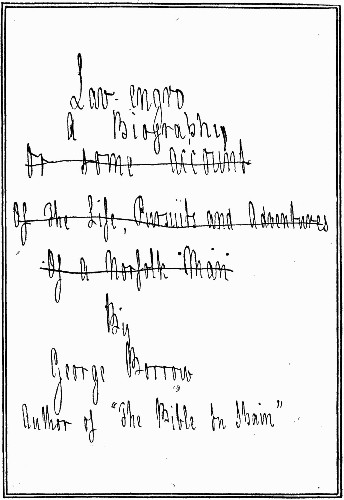 THE ORIGINAL TITLE-PAGE OF LAVENGRO.
I hoped to have been able to call upon you at Yarmouth, but a heavy cold first, and now occupation, have interfered with my intentions. I daresay you have seen the mention made of your Lavengro in the article on Haydon in the current number of The Quarterly Review, and I thought you might like to know that every syllable, both comment and extract, was inserted by the writer (a man little given to praise) of his own accord. Murray sent him your book, and that was all. No addition or modification was made by myself, and it is therefore the unbiassed judgment of a very critical reviewer. Whenever you appear again before the public I shall endeavour to do ample justice to your past and present merits, and there is one point in which you could aid those who understand you and your books in bringing over general readers to your side. I was myself acquainted with many of the persons you have sketched in your Lavengro, and I can testify to the extraordinary vividness and accuracy of the portraits. What I have seen, again, of yourself tells me that romantic adventures are your natural element, and I should a priori expect that much of your history would be stranger than fiction. But you must remember that the bulk of readers have no personal acquaintance with you, or the characters you describe. The consequence is that they fancy there is an immensity of romance mixed up with the facts, and they are irritated by the inability to distinguish between them. I am confident, from all I have heard, that this was the source of the comparatively cold reception of Lavengro. I should have partaken the feeling myself if I had not had the means of testing the fidelity of many portions of the book, from which I inferred the equal fidelity of the rest. I think you have the remedy in your own hands, viz., by giving the utmost possible matter-of-fact air to your sequel. I do not mean that you are to tame down the truth, but some ways of narrating a story make it seem more credible than others, and if you were so far to defer to the ignorance of the public they would enter into the full spirit of your rich and racy narrative. You naturally look at your life from your own point of view, and this in itself is the best; but when you publish a book you invite the reader to participate in the events of your career, and it is necessary then to look a little at things from his point of view. As he has not your knowledge you must stoop to him. I throw this out for your consideration. My sole wish is that the public should have a right estimate of you, and surely you ought to do what is in your power to help them to it. I know you will excuse the liberty I take in offering this crude suggestion. Take it for what it is worth, but anyhow....
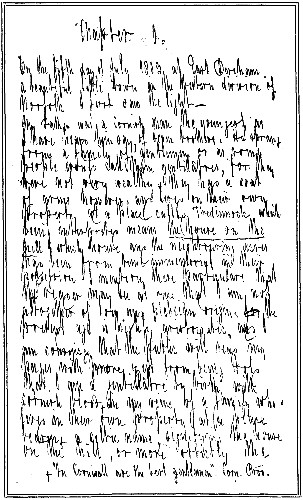 FACSIMILE OF THE FIRST PAGE OF LAVENGRO.
To this letter, as we learn from Elwin's Life, 'instead of roaring like a lion,' as Elwin had expected, he returned quite a 'lamb-like note.'
Read by the light in which we all judge the book to-day, this estimate by Elwin was about as fatuous as most contemporary criticisms of a masterpiece. Which is only to say that it is rarely given to contemporary critics to judge accurately of the great work that comes to them amid a mass that is not great. That Elwin, although not a good editor of Pope, was a sound critic of the literature of a period anterior to his own is demonstrated by the admirable essays from his pen that have been reprinted with an excellent memoir of him by his son.[175] In this memoir we have a capital glimpse of our hero:
Among the notables whom he had met was Borrow, whose Lavengro and Romany Rye he afterwards reviewed in 1857 under the title of 'Roving Life in England,' Their interview was[Pg 284] characteristic of both. Borrow was just then very sore with his snarling critics, and on some one mentioning that Elwin was a quartering reviewer, he said, 'Sir, I wish you a better employment.' Then hastily changing the subject he called out, 'What party are you in the Church—Tractarian, Moderate, or Evangelical? I am happy to say I am the old High.' 'I am happy to say I am not,' was Elwin's emphatic reply. Borrow boasted of his proficiency in the Norfolk dialect, which he endeavoured to speak as broadly as possible. 'I told him,' said Elwin, 'that he had not cultivated it with his usual success.' As the conversation proceeded it became less disputatious, and the two ended by becoming so cordial that they promised to visit each other. Borrow fulfilled his promise in the following October, when he went to Booton,[176] and was 'full of anecdote and reminiscence,' and delighted the rectory children by singing them songs in the gypsy tongue. Elwin during this visit urged him to try his hand at an article for the Review. 'Never,' he said; 'I have made a resolution never to have anything to do with such a blackguard trade.'
While writing of Whitwell Elwin and his association with Borrow, which was sometimes rather strained as we shall see when The Romany Rye comes to be published, it is interesting to turn to Elwin's final impression of Borrow, as conveyed in a letter which the recipient[177] has kindly placed at my disposal. It was written from Booton Rectory, and is dated 27th October 1893:
I used occasionally to meet Borrow at the house of Mr. Murray, his publisher, and he once stayed with me here for two or three days about 1855. He always seemed to me quite at ease 'among refined people,' and I should not have ascribed his dogmatic tone, when he adopted it, to his resentment at finding himself out of keeping with his society. A spirit of self-assertion was engrained in him, and it was supported by a combative temperament. As he was proud of his bodily prowess, and rather given to parade it, so he took the same view of an argument as of a battle with fists, and thought that manliness required him to be determined and unflinching. But this, in my experience of him, was not his ordinary manner, which was calm and companionable, without rudeness of any kind, unless some difference occurred to provoke his pugnacity. I have witnessed instances of his care to avoid wounding feelings needlessly. He never kept back his opinions which, on some points, were shallow and even absurd; and when his antagonist was as persistently positive as himself, he was apt to be over vehement in contradiction. I have heard Mr. Murray say that once in a dispute with Dr. Whewell at a dinner the language on both sides grew so fiery that Mrs. Whewell fainted.
He told me that his composition cost him a vast amount of labour, that his first draughts were diffuse and crude, and that he wrote his productions several times before he had condensed and polished them to his mind. There is nothing choicer in the English language than some of his narratives, descriptions, and sketches of character, but in his best books he did not always prune sufficiently, and in his last work, Wild Wales, he seemed to me to have lost the faculty altogether. Mr. Murray long refused to publish it unless it was curtailed, and Borrow, with his usual self-will and self-confidence, refused to retrench the trivialities. Either he got his own way in the end, or he revised his manuscript to little purpose.
Probably most of what there was to tell of Borrow has been related by himself. It is a disadvantage in Lavengro and Romany Rye that we cannot with certainty separate fact from fiction, for he avowed in talk that, like Goethe, he had assumed the right in the interests of his autobiographical narrative to embellish it in places; but the main outline, and larger part of the details, are the genuine record of what he had seen and done, and I can[Pg 286] testify that some of his minor personages who were known to me in my boyhood are described with perfect accuracy.
Two letters by Mr. Elwin to Borrow, from my Borrow Papers, both dated 1853—two years after Lavengro was written,—may well have place here:
Booton, Norwich, Oct. 26, 1853.
My dear Mr. Borrow,—I shall be rejoiced to see you here, and I hope you will fasten a little luggage to the bow of your saddle, and spend as much time under my roof as you can spare. I am always at home. Mrs. Elwin is sure to be in the house or garden, and I, at the worst, not further off than the extreme boundary of my parish. Pray come, and that quickly. Your shortest road from Norwich is through Horsford, and from thence to the park wall of Haverland Hall, which you skirt. This will bring you out by a small wayside public house, well known in these parts, called 'The Rat-catchers.' At this point you turn sharp to the left, and keep the straight road till you come to a church with a new red brick house adjoining, which is your journey's end.
The conclusion of your note to me is so true in sentiment, and so admirable in expression, that I hope you will introduce it into your next work. I wish it had been said in the article on Haydon. Cannot you strew such criticisms through the sequel to Lavengro? They would give additional charm and value to the work. Believe me, very truly yours,
W. Elwin.
You are of course aware that if I had spoken of Lavengro in the Q.R. I should have said much more, but as I hoped for my turn hereafter, I preferred to let the passage go forth unadulterated.
Booton Rectory, Norwich, Nov. 5, 1853.
My dear Mr. Borrow,—-You bore your mishap with a philosophic patience, and started with an energy which gives the best earnest that you would arrive safe and sound at Norwich. I was happy to find yesterday morning, by the arrival of your kind present, a sure notification that you were well home. Many thanks for the tea, which we drink with great zest and diligence. My legs are not as long as yours, nor my breath either. You soon made me feel that I must either turn back or be left behind, so I chose the former. Mrs. Elwin and my children desire their kind regards. They one and all enjoyed your visit. Believe me, very truly yours,
W. Elwin.
I have said that I possess large portions of Lavengro in manuscript. Borrow's always helpful wife, however, copied out the whole manuscript for the publishers, and this 'clean copy' came to Dr. Knapp, who found even here a few pages of very valuable writing deleted, and these he has very rightly restored in Mr. Murray's edition of Lavengro. Why Borrow took so much pains to explain that his wife had copied Lavengro, as the following document implies, I cannot think. I find in his handwriting this scrap of paper signed by Mary Borrow, and witnessed by her daughter:
Janry. 30, 1869.
This is to certify that I transcribed The Bible in Spain, Lavengro, and some other works of my husband George Borrow, from the original manuscripts. A considerable portion of the transcript of Lavengro was lost at the printing-office where the work was printed.
Mary Borrow.
Witness: Henrietta M., daughter of Mary Borrow.
It only remains here to state the melancholy fact once again that Lavengro, great work of literature as it is now universally acknowledged to be, was not 'the book of the year.' The three thousand copies of[Pg 288] the first issue took more than twenty years to sell, and it was not until 1872 that Mr. Murray resolved to issue a cheaper edition. The time was not ripe for the cult of the open road; the zest for 'the wind on the heath' that our age shares so keenly.
[169] Knapp's Life, vol. ii p. 9.
[170] Ibid. p. 11.
[171] Knapp's Life, vol. ii. p. 19.
[172] Ford was right, however, if authors wrote only for posterity, although 1851 was not a very important year among the great Victorian writers. It produced Carlyle's John Sterling, Ruskin's Stones of Venice, and Kingsley's Yeast.
[173] Mr. Murray published Lavengro in an edition of 3000 copies in 1851, a second edition (incorrectly called the third) was not asked for until 1872.
[174] Jenkins's Life, p. 387.
[175] Some XVIII. Century Men of Letters: Biographical Essays, by the Rev. Whitwell Elwin, sometime Editor of The Quarterly Review, With a Memoir by his son Warwick Elwin, 2 vols. John Murray, 1902.
[176] Whitwell Elwin was Rector of Booton, Norfolk—a family living—from 1849 to his death, aged 83, on 1st January 1900. He succeeded Lockhart as editor of The Quarterly Review in 1853, and resigned in 1860. He was born in 1816, and educated at Caius College, Cambridge. Thackeray called him 'a grandson of the late Rev. Dr. Primrose,' thereby recognising in Elwin many of the kindly qualities of Goldsmith's admirable creation.
[177] Mr. James Hooper, of Norwich, whose kindness in placing this and many other documents at my disposal I have already acknowledged. This letter was first published in The Sphere, December 19, 1903.
If Borrow had been a normal man of letters he would have been quite satisfied to settle down at Oulton, in a comfortable home, with a devoted wife. The question of money was no longer to worry him. He had moreover a money-making gift, which made him independent in a measure of his wife's fortune. From The Bible in Spain he must have drawn a very considerable amount, considerable, that is, for a man whose habits were always somewhat penurious. The Bible in Spain would have been followed up, were Borrow a quite other kind of man, by a succession of books almost equally remunerative. Even for one so prone to hate both books and bookmen there was always the wind on the heath, the gypsy encampment, the now famous 'broad,' not then the haunt of innumerable trippers. But Borrow ever loved wandering more than writing. Almost immediately after his marriage—in 1840—he hinted to the Bible Society of a journey to China; a year later, in June 1841, he suggested to Lord Clarendon that Lord Palmerston might give him a consulship: he consulted Hasfeld as to a possible livelihood in Berlin, and Ford as to travel in Africa. He seems to have endured residence at Oulton with difficulty during the succeeding three years, and in 1844 we find[Pg 290] him engaged upon the continental travel that we have already recorded. In 1847 he had hopes of the consulship at Canton, but Bowring wanted it for himself, and a misunderstanding over this led to an inevitable break of old friendship. Borrow's passionate love of travel was never more to be gratified at the expense of others. He tried hard, indeed, to secure a journey to the East from the British Museum Trustees, and then gave up the struggle. Further wanderings, which were many, were to be confined to Europe and indeed to England, Scotland, Ireland, and the Isle of Man. His first journey, however, was not at his own initiative. Mrs. Borrow's health was unequal to the severe winters at Oulton, and so the Borrows made their home at Yarmouth from 1853 to 1860. During these years he gave his vagabond propensities full play. No year passed without its record of wandering. His first expedition was the outcome of a burst of notoriety that seems to have done for Borrow what the success of his Bible in Spain could not do—revealed his identity to his Cornish relations. The Bury Post of 17th September 1853 recorded that Borrow had at the risk of his life saved at least one member of a boat's crew wrecked on the coast at Yarmouth:
The moment was an awful one, when George Borrow, the well-known author of Lavengro and The Bible in Spain, dashed into the surf and saved one life, and through his instrumentality the others were saved. We ourselves have known this brave and gifted man for years, and, daring as was his deed, we have known him more than once to risk his life for others. We are happy to add that he has sustained no material injury.
I was quite sorry to find this extract from the Bury Post among my Borrow Papers in Mrs. Borrow's[Pg 291] handwriting. It a little suggests that she sent the copy to the journal in question, or at least inspired the paragraph, perhaps in a letter to her friend, Dr. Gordon Hake, who with his family then resided at Bury St. Edmunds. Borrow was a perfect swimmer, and there is no reason to suppose but that he did act heroically.[178] In my Borrow Papers I find in his handwriting his own account of the adventure:
I was seated on Yarmouth jetty; the weather was very stormy; there came a tremendous sea, which struck the jetty, and made it quiver; there was a boat on the lee-side of the jetty fastened by a painter; the surge snapped the painter like a thread, the boat was overset with two men in it, there was a cry, 'The men must be drowned.' I started up from my seat on the north side of the jetty, and saw the boat bottom upwards, and I heard some people say, 'The men are under it.' I ran a little way along the jetty, and then jumped upon the sand; before taking the leap I saw a man flung by the surge upon the shore; he crawled up upon the beach, and was, I believe, lifted up upon his legs by certain beachmen. I had my eye upon the boat, which was now near the shore; I had an idea that there was a man under it; I flung off my coat and hat, and went a little way into the sea, about parallel to some beachmen who were moving backwards and forwards as the waves advanced and receded. I now saw a man as a wave recoiled lying close by the boat in the reflux. I dashed forward and made a grip at the man, then came a tremendous wave which tumbled me heels over head; being an expert diver I did not attempt to rise, lest I should be flung on shore. When the wave[Pg 292] receded, I found myself near the boat; the man was now nearer to the shore than myself. I believe a man or two were making towards him; another wave came which overwhelmed me, and flung me on the shore, to which I was now making with all my strength. I got on my legs for one moment, when the advanced guard, if I may call it so, of another wave, struck me on the back, and laid me upon my face, but I was now quite out of danger. A man now came and lifted me up, as others lifted up the other man, who seemed quite unable to exert himself. The above is a plain statement of facts. I was the only person, with the exception of the man in distress, who was in the deep water, or who confronted the billows, which were indeed monstrous, but which I cared little for, being, as I said before, an expert diver. Had I been alone the result of the affair would have been much the same; as it is, after the last wave I could easily have dragged the man up upon the beach. I am willing to give to the beachmen whatever credit is due to them; I am anxious to believe that one of them was once up to his middle in water, but truth compels me to state that I never saw one of them up to his knees. I received very uncivil language from one of them, but every species of respect and sympathy from the genteel part of the spectators. A gentleman, I believe from Norwich, and a policeman, attended me in a cab to my lodgings, where they undressed and dressed me. The kindness of these two individuals I shall never forget.
In any case this adventure had exceptional publicity. For example Mr. Robert Cooke of John Murray's firm wrote to Mrs. Borrow on 13th October 1853 to say that while travelling abroad he had read in Galignani's Messenger an account of his friend Lavengro's 'daring and heroic act in rescuing so many from a watery grave.' 'I wish they had all been critics,' he adds; 'he would have done just the same, and they might perhaps have shown their gratitude when they got among his inky waves of literature.'
More than this, the paragraph in the Bury St. Edmunds newspaper was copied into the Plymouth[Pg 293] Mail, and was there read by the Borrows of Cornwall, who had heard nothing of their relative, Thomas Borrow, the army captain and his family, for fifty years or more. One of Borrow's cousins by marriage, Robert Taylor of Penquite, invited him to his father's homeland, and Borrow accepted, glad, we may be sure, of any excuse for a renewal of his wanderings. And so on the 23rd of December 1853 Borrow made his way from Yarmouth to Plymouth by rail, and thence walked twenty miles to Liskeard, where quite a little party of Borrow's cousins were present to greet him. The Borrow family consisted of Henry Borrow of Looe Doun, the father of Mrs. Taylor, William Borrow of Trethinnick, Thomas Nicholas and Elizabeth Borrow, all first cousins, except Anne Taylor. Anne, talking to a friend, describes Borrow on this visit better than any one else has done:
A fine tall man of about six feet three; well-proportioned and not stout; able to walk five miles an hour successively; rather florid face without any hirsute appendages; hair white and soft; eyes and eyebrows dark; good nose and very nice mouth; well-shaped hands;—altogether a person you would notice in a crowd.[179]
Dr. Knapp possessed two 'notebooks' of this Cornish tour. Borrow stayed at Penquite with his cousins from 24th December to 9th January, then he went on a walking tour to Land's End, through Truro and Penzance; he was back at Penquite from 26th January to 1st February, and then took a week's tramp to Tintagel, King Arthur's Castle, and Pentire. Naturally he made inquiries into the language, already extinct, but spoken within the memory of the older inhabitants.[Pg 294] 'My relations are most excellent people,' he wrote to his wife from London on his way back, 'but I could not understand more than half of what they said.'
I have only one letter to Mrs. Borrow written during this tour:
Penquite, 27th Janry. 1854.
My dear Carreta,—I just write you a line to inform you that I have got back safe here from the Land's End. I have received your two letters, and hope you received mine from the Land's End. It is probable that I shall yet visit one or two places before I leave Cornwall. I am very much pleased with the country. When you receive this if you please to write a line by return of post I think you may; the Trethinnick people wish me to stay with them for a day or two. When you see the Cobbs pray remember me to them; I am sorry Horace has lost his aunt, he will miss her. Love to Hen. Ever yours, dearest,
G. Borrow.
(Keep this.)
One of Borrow's biographers, Mr. Walling, has given us the best account of that journey through Cornwall,[180] and his explanation of why Borrow did not write the Cornish book that he caused to be advertised in a fly-leaf of The Romany Rye, by the discouragement arising out of the dire failure of that book, may be accepted.[181] Borrow would have made a beautiful book[Pg 295] upon Cornwall. Even the title, Penquite and Pentyre; or, The Head of the Forest and the Headland, has music in it. And he had in these twenty weeks made himself wonderfully well acquainted not only with the topography of the principality, but with its folklore and legend. The gulf that ever separated the Borrow of the notebook and of the unprepared letter from the Borrow of the finished manuscript was extraordinary, and we may deplore with Mr. Walling the absence of this among Borrow's many unwritten books.
Borrow was back in Yarmouth at the end of February 1854—he had not fled the country as Dalrymple had suggested—but in July he was off again for his great tour in Wales, in which he was accompanied by his wife and daughter. Of that tour we must treat in another and later chapter, for Wild Wales was not published until 1862. The year following his great tour in Wales he went on a trip to the Isle of Man.
[178] It is thus that an old schoolfellow, Dalrymple, describes the episode in a fragment of manuscript in the possession of Mrs. James Stuart of Carrow Abbey, from which I have already quoted:
'In 1850/2/3 Borrow lived at Yarmouth; he here made rather a ludicrous exhibition of himself on the occasion of a wreck, when he ran into the sea through a full tide up to his knees, with the utmost apparent heroism, and retreated again as soon as he thought it might be dangerous. He incurred so much ridicule that he abruptly quitted the town, and I have not heard since of him.'
[179] Knapp's Life, vol. ii. p. 97. Letter from Mrs. Robert Taylor to Mrs. Wilkey.
[180] George Borrow, The Man and His Work. By R. A. J. Walling. Cassell, 1908.
[181] It is not generally known that not less than eleven books by Borrow were advertised in the first edition of The Romany Rye in 1857, of which only two were published in his lifetime:
1. Celtic Bards, Chiefs, and Kings. 2 volumes.
2. Wild Wales: Its People, Language, and Scenery. 2 volumes.
3. Songs of Europe, or Metrical Translations from all the European Languages. 2 volumes.
4. Kæmpe Viser. Songs about Giants and Heroes. 2 volumes.
5. The Turkish Jester. 1 volume.
6. Penquite and Pentyre; or, The Head of the Forest and the Headland. A Book on Cornwall. 2 volumes.
7. Russian Popular Tales. 1 volume.
8. The Sleeping Bard. 1 volume.
9. Norman Skalds, Kings, and Earls. 2 volumes.
10. The Death of Balder. 1 volume.
11. Bayr Jairgey and Glion Doo. Wanderings in Search of Manx Literature. 1 volume.
Of these The Sleeping Bard appeared in 1860 and Wild Wales in 1862; and after Borrow's death The Turkish Jester in 1884 and The Death of Balder in 1889. The remaining seven books have not yet been published. Their manuscript is partly in the Knapp Collection now in the Hispanic Society's possession, partly in my Collection, while certain fragments and the manuscript of Romano Lavo-Lil are in the possession of well-known Borrow enthusiasts.
The holiday which Borrow gave himself the year following his visit to Wales, that is to say, in September 1855, is recorded in his unpublished diaries. He never wrote a book as the outcome of that journey, although he caused one to be advertised under the title of Bayr Jairgey and Glion Doo: Wanderings in Search of Manx Literature.[182] Dr. Knapp possessed two volumes of these notebooks closely written in pencil. These he reproduced conscientiously in his Life, and indeed here we have the most satisfactory portion of his book, for the journal is transcribed with but little modification, and so we have some thirty pages of genuine 'Borrow' that are really very attractive reading. Borrow, it will be remembered, learnt the Irish language as a mere child, much to his father's disgust. Although he never loved the Irish people, the Celtic Irish, that is to say, whose genial temperament was so opposed to his own, he did love the Irish language, which he more than once declared had incited him to become a student of many tongues. He never made the mistake into which two of his biographers have fallen of calling it 'Erse.' He was never an accurate student of the Irish language, but among Englishmen he[Pg 297] led the way in the present-day interest in that tongue—an interest which is now so pronounced among scholars of many nationalities, and has made in Ireland so definite a revival of a language that for a time seemed to be on the way to extinction. Two translations from the Irish are to be found in his Targum published so far back as 1835, and many other translations from the Irish poets were among the unpublished manuscripts that he left behind him. It would therefore be with peculiar interest that he would visit the Isle of Man which, at the beginning of the nineteenth century, was an Irish-speaking land, but in 1855 was at a stage when the language was falling fast into decay. What survived of it was still Irish with trifling variations in the spelling of words. 'Cranu,' a tree, for example, had become 'Cwan,' and so on—although the pronunciation was apparently much the same. When the tall, white-haired Englishman talked to the older inhabitants who knew something of the language they were delighted. 'Mercy upon us,' said one old woman, 'I believe, sir, you are of the old Manx!' Borrow was actually wandering in search of Manx literature, as the title of the book that he announced implied. He inquired about the old songs of the island, and of everything that survived of its earlier language. Altogether Borrow must have had a good time in thus following his favourite pursuit.
But Dr. Knapp's two notebooks, which are so largely taken up with these philological matters, are less human than a similar notebook that has fallen into my hands. This is a long leather pocket-book, in which, under the title of 'Expedition to the Isle of Man,' we have, written in pencil, a quite vivacious account of his adventures. It records that Borrow and his wife and daughter set out through Bury to Peterborough, Rugby, and[Pg 298] Liverpool. It tells of the admiration with which Peterborough's 'noble cathedral' inspired him. Liverpool he calls a 'London in miniature':
Strolled about town with my wife and Henrietta; wonderful docks and quays, where all the ships of the world seemed to be gathered—all the commerce of the world to be carried on; St. George's Crescent; noble shops; strange people walking about, an Herculean mulatto, for example; the old china shop; cups with Chinese characters upon them; an horrible old Irishwoman with naked feet; Assize Hall a noble edifice.
The party left Liverpool on 20th August, and Borrow, when in sight of the Isle of Man, noticed a lofty ridge of mountains rising to the clouds:
Entered into conversation with two of the crew—Manx sailors—about the Manx language; one, a very tall man, said he knew only a very little of it as he was born on the coast, but that his companion, who came from the interior, knew it well; said it was a mere gibberish. This I denied, and said it was an ancient language, and that it was like the Irish; his companion, a shorter man, in shirt sleeves, with a sharp, eager countenance, now opened his mouth and said I was right, and said that I was the only gentleman whom he had ever heard ask questions about the Manx language. I spoke several Irish words which they understood.
When he had landed he continued his investigations, asking every peasant he met the Manx for this or that English word:
'Are you Manx?' said I. 'Yes,' he replied, 'I am Manx.' 'And what do you call a river in Manx?' 'A river,' he replied. 'Can you speak Manx?' I demanded. 'Yes,' he replied, 'I speak Manx.' 'And you call a river a river?' 'Yes,' said he, 'I do.' 'You don't call it owen?' said I. 'I do not,' said he. I passed on, and on the other side of the bridge went for some time along an avenue of trees, passing by a stone water-mill, till I came to a public-house on the left hand. Seeing a woman looking out of[Pg 299] the window, I asked her to what place the road led. 'To Castletown,' she replied. 'And what do you call the river in Manx?' said I. 'We call it an owen,' said she. 'So I thought,' I replied, and after a little further discourse returned, as the night was now coming fast on.
One man whom Borrow asked if there were any poets in Man replied that he did not believe there were, that the last Manx poet had died some time ago at Kirk Conoshine, and this man had translated Parnell's Hermit beautifully, and the translation had been printed. He inquired about the Runic Stones, which he continually transcribed. Under date Thursday, 30th August, we find the following:
This day year I ascended Snowdon, and this morning, which is very fine, I propose to start on an expedition to Castletown and to return by Peel.
Very gladly would I follow Borrow more in detail through this interesting holiday by means of his diary,[183] but it would make my book too long. As he had his wife and daughter with him there are no letters by him from the island. But wherever Borrow went he met people who were interested in him, and so I find the following letter among his Papers, which he received a year after his return:
3 Albert Terrace, Douglas, 11 February 1856.
My dear Sir,—If experience on report has made you acquainted with the nature of true Celtic indolence and procrastination you will be prepared to learn, without surprise, that[Pg 300] your Runic stone still remains unerected.[184] In vain have I called time after time upon the clerk of Braddan—in vain have I expostulated. Nothing could I get but fair words and fair promises. First he was very rheumatic, having, according to his own account, contracted his dolorous aches in the course of that five-hours' job under your superintendence in the steeple, where, it seems, a merciless wind is in the habit of disporting itself. Then the weather was so unfavourable, then his wife was ailing, etc., etc. On Saturday, however, armed with your potent note, I made another attack, and obtained a promise that the stone should be in its right place on that day of the week following. So I await the result. My own private impression is that if we see the achievement complete by Easter there will be much cause for thankfulness.
Many thanks for The Illustrated News; I read the article with great interest, and subsequently studied the stone itself as well as its awkward position in its nook in the steeple would allow me. Your secret, I need hardly say, was faithfully kept till the receipt of the news assured me that it need be a secret no longer. I may just mention that the clerk thinks that the sovereign you left will be quite enough to defray the expenses. I think so too; at least if there be anything more it cannot be worth mentioning. Though no Manxman myself still I shall take the liberty of thanking you in the name of Mona—may I not add in the name of Antiquarian Science too—for your liberality in this matter. Mrs. Borrow, I trust, is convalescent by this time, and Miss Clarke well. With our united kind regards, believe me, my dear Sir, very sincerely yours,
S. W. Wanton.
And even three years later we find that Borrow has not forgotten the friends of that Manx holiday. This letter is from the Vicar of Malew in acknowledgment of a copy of The Romany Rye published in the interval:[Pg 301]
Malew Vicarage, Ballasalla, Isle of Man, 27 Jany. 1859.
My dear Sir,—I return you my most hearty thanks for your most handsome present of Romany Rye, and no less handsome letter relative to your tour in the Isle of Man and the literature of the Manx. Both I value very highly, and from both I shall derive useful hints for my introduction to the new edition of the Manx Grammar. I hope you will have no objection to my quoting a passage or two from the advertisement of your forthcoming book; and if I receive no intimation of your dissent, I shall take it for granted that I have your kind permission. The whole notice is so apposite to my purpose, and would be so interesting to every Manxman, that I would fain insert the whole bodily, did the Author and the limits of an Introduction permit. The Grammar will, I think, go to press in March next. It is to be published under the auspices of 'The Manx Society,' instituted last year 'for the publication of National documents of the Isle of Man.' As soon as it is printed I hope to beg the favour of your acceptance of a copy.—I am, my dear Sir, your deeply obliged humble servant,
William Gill.
The letter from Mr. Wanton directs us to the issue of The Illustrated London News for 8th December 1855, where we find the following note on the Isle of Man, obviously contributed to that journal by Borrow, together with an illustration of the Runic Stone, which is also reproduced here:
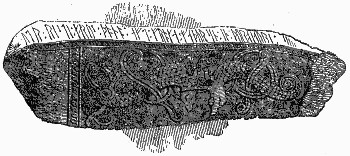 RUNIC STONE FROM THE ISLE OF MAN
ANCIENT RUNIC STONE, RECENTLY FOUND IN THE ISLE OF MAN
For upwards of seventy years a stone which, as far as it could be discerned, had the appearance of what is called a Danish cross, has been known to exist in the steeple of Kirk Braddan, Isle of Man. It was partly bedded in mortar and stones above the lintel of a[Pg 302] doorway leading to a loft above the gallery. On the 19th of November it was removed from its place under the superintendence of an English gentleman who had been travelling about the island. It not only proved to be a Northern cross, but a Runic one; that is, it bore a Runic inscription. As soon as the stone had been taken out of the wall, the gentleman in question copied the inscription and translated it, to the best of his ability, in the presence of the church clerk who had removed the stone. The Runes were in beautiful preservation, and looked as fresh as if they had just come out of the workshop of Orokoin Gaut. Unfortunately the upper part of the cross was partly broken, so that the original inscription was not entire. In the inscription, as it is, the concluding word is mutilated; in its original state it was probably 'sonr,' son; the Runic character which answers to s being distinct, and likewise the greater part of one which stands for o. Yet there is reason for believing that sonr was not the concluding word of the original, but the penultimate, and that the original terminated with some Norwegian name: we will suppose 'Olf.' The writing at present on the stone is to this effect:
The names Otr and Fruki have never before been found on any of the Runic stones in the Isle of Man. The words In ...[Pg 303] Thorwiaori, which either denote the place where the individual to whom they relate lived, or one of his attributes or peculiarities, will perhaps fling some light on the words In ... Aruthur, which appear on the beautiful cross which stands nearly opposite the door of Kirk Braddan.
The present cross is curiously ornamented. The side which we here present to the public bears two monsters, perhaps intended to represent dragons, tied with a single cord, which passes round the neck and body of one whose head is slightly averted, whilst, though it passes round the body of the other, it leaves the neck free. Little at present can be said about the other side of the stone, which is still in some degree covered with the very hard mortar in which it was found lying. The gentleman of whom we have already spoken, before leaving the island, made arrangements for placing the stone beside the other cross, which has long been considered one of the principal ornaments of the beautiful churchyard of Braddan.
[182] In vol. ii. of The Romany Rye, vide supra.
[183] The whole of this diary, which is the best original work that Borrow left behind him unpublished, will be issued in my edition of The Collected Works.
[184] Borrow found the stone had fallen, and he left money for its re-erection. He copied this stone on 13th September 1855, noting in his diary that Henrietta sketched the church while he copied and translated the inscription which ran as follows—Thorleifr Nitki raised this Cross to Fiak, son of his brother's son, the date being 1084 or 1194 a.d.
George Borrow wandered far and wide, but he always retraced his footsteps to East Anglia, of which he was so justly proud. From his marriage in 1840 until his death in 1881 he lived twenty-seven years at Oulton or at Yarmouth. 'It is on sand alone that the sea strikes its true music,' Borrow once remarked, 'Norfolk sand'—and it was in the waves and on the sands of the Norfolk coast that Borrow spent the happiest hours of his restless life. Oulton Cottage is only about two miles from Lowestoft, and so, walking or driving, these places were quite near one another. But both are in Suffolk. Was it because Yarmouth—ten miles distant—is in Norfolk that it was always selected for seaside residence? I suspect that the careful Mrs. Borrow found a wider selection of 'apartments' at a moderate price. In any case the sea air of Yarmouth was good for his wife, and the sea bathing was good for him, and so we find that husband and wife had seven separate residences at Yarmouth during the years of Oulton life.[185] But Oulton was ever to be Borrow's headquarters, even though between 1860 and 1874 he had a house in London. Borrow was thirty-seven years of age when he settled down at Oulton.
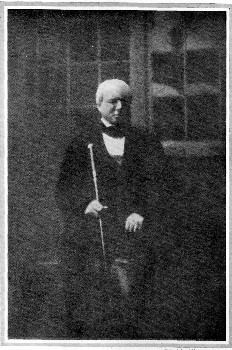 Copyright of Mrs. Simms Reeve
He was, he tells us in The Romany Rye, 'in tolerably easy circumstances and willing to take some rest after a life of labour.' Their home was a cottage on the Broad, for the Hall, which was also Mrs. Borrow's property, was let on lease to a farmer.[186] The cottage, however, was an extremely pleasant residence with a lawn running down to the river. A more substantial house has been built on this site since Borrow's day. The summer-house is generally assumed to be the same, but has certainly been reroofed since the time when Henrietta Clarke drew the picture of it that is reproduced in this book. Probably the whole summer-house is new, but at any rate the present structure stands on the site of the old one. Here Borrow did his work, wrote and wrote and wrote, until he had, as he said, 'Mountains of manuscripts.' Here first of all he completed The Zincali (1841), commenced in Seville; then he wrote or rather arranged The Bible in Spain (1843), and then at long intervals, diversified by extensive travel holidays, he wrote Lavengro (1851), The Romany Rye (1857), and Wild Wales (1860),—these are the five books and their dates that we most associate[Pg 306] with Borrow's sojourn at Oulton. When Wild Wales was published he had removed to London. Borrow brought with him to Oulton, as we have said, a beautiful Arabian horse, Sidi Habismilk, and a Jewish servant, Hayim Ben Attar. The horse remained to delight the neighbourhood. It followed Borrow like a dog when he was not riding it. The Jew had soon had enough of this rural retreat and sighed for a sunnier clime. Thus, under date 1843, I find among my Borrow Papers the following letter to a firm of shipbrokers:
4th July 1843.
Gentlemen,—Having received a communication from Liverpool from Harry Palmer, Esq., stating that you are his agents in London, and that as such he has requested you to communicate with us relative to a passage required for a man sent to Cadiz or Gibraltar, I shall as briefly as possible state the particulars. Mr. Palmer names £7 or £8 as the lowest which he thinks it will cost us to get him to Gibraltar or Cadiz. This we consider is a large sum when it is to be remembered that he is to fare as the ship's crew fare, and with the exception of a berth to lie down in, no difference is required at this beautiful season of the year. I must here state as an excuse for the above remark that this man came to England at his own particular desire. I have been at much expense about him. He has had good wages, but now that he wants to get back to his own country the whole expense is thrown upon me, as he has saved no money, and we wish it to be clearly understood by the captain who will take him that when he is once off from England and his passage paid that we will be responsible for no further expense whatever. We do not want to get him to Tangier, as we shall put money in his pocket which will enable him to pay for a passage across if he wishes to go there, but we will pay only to Gibraltar or Cadiz. A steam vessel sails from Yarmouth bridge every Wednesday and Friday. This will be the most direct and safe way to send him to London,[Pg 307] and then trouble you to have him met at the steamer and conveyed to the ship at once in which he is to have his passage. All therefore that remains to be done is to trouble you to give us a few days' notice with time to get him up per Yarmouth steamer. I beg to thank you for the willingness you expressed to Mr. Palmer to assist me in this affair by getting as cheap a passage as you can and seeing him on board and the passage not paid till the ship sails. You no doubt can quite understand our anxious feelings upon the subject from your connection with shipping, and consequently knowing what foreigners generally are.—I am, Sir, Your obedient servant,
G. H. Borrow.[187]
Then we have the following document with which his cautious master provided himself:
A Statement of Hayim Ben Attar previous to his leaving England.
I declare that it was my own wish to come to England with my master G. H. Borrow, who offered to send me to my own country before he left Spain. That I have regularly received the liberal wages he agreed to give me from the first of my coming to him. That I have been treated justly and kindly by him during my stay in England, and that I return to my country at my own wish and request, and at my master's expense. To this statement, which I declare to be true, I sign my name.—Hayim Ben Attar.
Declared before me this 9 of August 1843.
W. M. Hammond, Magistrate for Great Yarmouth.
[Pg 308]
I find a letter among my Papers which bears no name, and is probably a draft. It contains an interesting reference to Hayim Ben Attar, and hence I give it here:
Sir,—I have the honour to acknowledge the receipt of your letter of the 17th inst., which my friend, Mr. Murray, has just forwarded to me. I am afraid that you attribute to me powers and information which I am by no means conscious of possessing; I should feel disposed to entertain a much higher opinion of myself than I at present do could I for a moment conceive myself gifted with the talent of inducing any endeavour to dismiss from his mind a theory of the reasonableness of which appears to him obvious. Nevertheless, as you do me the honour of asking my opinion with respect to the theory of Gypsies being Jews by origin, I hasten to answer to the following effect. I am not prepared to acknowledge the reasonableness of any theory which cannot be borne out by the slightest proof. Against the theory may be offered the following arguments which I humbly consider to be unanswerable. The Gypsies differ from the Jews in feature and complexion—in whatever part of the world you find the Gypsy you recognise him at once by his features which are virtually the same—the Jew likewise has a peculiar countenance by which at once he may be distinguished as a Jew, but which would certainly prevent the probability of his being considered as a scion of the Gypsy stock—in proof of which assertion I can adduce the following remarkable instance.
I have in my service a Jew, a native of Northern Africa. Last summer I took him with me to an encampment of Romanies or Gypsies near my home at Oulton in Suffolk. I introduced him to the Chief, and said, Are ye not dui patos (two brothers). The Gypsy passed his hand over the Jew's face and stared him in the eyes, then turning to me he answered—we are not two brothers, not two brothers—this man is no rom—I believe him to be a Jew. Now this Gypsy has been in the habit of seeing German and English Jews who must have been separated from their African brothers for a term of 1700 years—yet he recognised the Jew of Troy for what he was—a Jew—and without hesitation declared that he was not a rom; the Jews, therefore, and the Gypsies have[Pg 309] each their peculiar and distinctive features, which disprove the impossibility of their having been originally the same people.—Your obedient servant,
George Borrow.
I find also in this connection a letter from Tangier addressed to 'Mr. H. George Borrow' under date 2nd November 1847. It tells us that the worthy Jew longs once again to see the 'dear face' of his master. Since he left his service he has married and has two sons, but he is anxious to return to England if that same master will find him work. We can imagine that by this time Borrow had had enough of Hayim Ben Attar, and that his answer was not encouraging.
But by far the best glimpses of Borrow during these years of Suffolk life are those contained in a letter contributed by his friend, Elizabeth Harvey, to The Eastern Daily Press of Norwich over the initials 'E.H.':[188]
When I knew Mr. Borrow he lived in a lovely cottage whose garden sloped down to the edge of Oulton Broad. He had a wooden room built on the very margin of the water, where he had many strange old books in various languages. I remember he once put one before me, telling me to read it. 'Oh, I can't,' I replied. He said, 'You ought, it's your own language.' It was an old Saxon book. He used to spend a great deal of his time in this room writing, translating, and at times singing strange words in a stentorian voice, while passers-by on the lake would stop to listen with astonishment and curiosity to the singular sounds. He was 6 feet 3 inches, a splendid man, with handsome hands and feet.[Pg 310] He wore neither whiskers, beard, nor moustache. His features were very handsome, but his eyes were peculiar, being round and rather small, but very piercing, and now and then fierce. He would sometimes sing one of his Romany songs, shake his fist at me and look quite wild. Then he would ask, 'Aren't you afraid of me?' 'No, not at all,' I would say. Then he would look just as gentle and kind, and say, 'God bless you, I would not hurt a hair of your head,' He was an expert swimmer, and used to go out bathing, and dive under water an immense time. On one occasion he was bathing with a friend, and after plunging in nothing was seen of him for some while. His friend began to be alarmed, when he heard Borrow's voice a long way off exclaiming, 'There, if that had been written in one of my books they would have said it was a lie, wouldn't they?' He was very fond of animals, and the animals were fond of him. He would go for a walk with two dogs and a cat following him. The cat would go a quarter of a mile or so and then turn back home. He delighted to go for long walks and enter into conversation with any one he might meet on the road, and lead them into histories of their lives, belongings, and experiences. When they used some word peculiar to Norfolk (or Suffolk) countrymen he would say, 'Why, that's a Danish word.' By and by the man would use another peculiar expression, 'Why, that's Saxon'; a little later on another, 'Why, that's French.' And he would add, 'Why, what a wonderful man you are to speak so many languages.' One man got very angry, but Mr. Borrow was quite unconscious that he had given any offence. He spoke a great number of languages, and at the Exhibition of 1851, whither he went with his stepdaughter, he spoke to the different foreigners in their own language, until his daughter saw some of them whispering together and looking as if they thought he was 'uncanny,' and she became alarmed and drew him away. He, however, did not like to hear the English language adulterated with the introduction of foreign words. If his wife or friends used a foreign word in conversation, he would say, 'What's that, trying to come over me with strange languages.'
I have gone for many a walk with him at Oulton. He used to go on, singing to himself or quite silent, quite forgetting me until he came to a high hill, when he would turn round, seize my hand, and drag me up. Then he would sit down and enjoy the prospect.[Pg 311] He was a great lover of nature, and very fond of his trees. He quite fretted if, by some mischance, he lost one. He did not shoot or hunt. He rode his Arab at times, but walking was his favourite exercise. He was subject to fits of nervous depression. At times also he suffered from sleeplessness, when he would get up and walk to Norwich (25 miles), and return the next night recovered. His fondness for the gypsies has been noticed. At Oulton he used to allow them to encamp in his grounds, and he would visit them, with a friend or alone, talk to them in Romany, and sing Romany songs. He was very fond of ghost stories and believed in the supernatural. He was keenly sympathetic with any one who was in trouble or suffering. He was no man of business and very guileless, and led a very harmless, quiet life at Oulton, spending his evenings at home with his wife and stepdaughter, generally reading all the evening. He was very hospitable in his own home, and detested meanness. He was moderate in eating and drinking, took very little breakfast, but ate a very great quantity at dinner, and then had only a draught of cold water before going to bed. He wrote much in praise of 'strong ale,' and was very fond of good ale, of whose virtue he had a great idea. Once I was speaking of a lady who was attached to a gentleman, and he asked, 'Well, did he make her an offer?' 'No,' I said. 'Ah,' he exclaimed, 'if she had given him some good ale he would.' But although he talked so much about ale I never saw him take much. He was very temperate, and would eat what was set before him, often not thinking of what he was doing, and he never refused what was offered him. He took much pleasure in music, especially of a light and lively character. My sister would sing to him, and I played. One piece he seemed never to tire of hearing. It was a polka, 'The Redowa,' I think, and when I had finished he used to say, 'Play that again, E——.' He was very polite and gentlemanly in ladies' society, and we all liked him.
It is refreshing to read this tribute, from which I have omitted nothing salient, because a very disagreeable Borrow has somehow grown up into a tradition. I note in reading some of the reviews of Dr. Knapp's Life that he is charged, or half-charged, with suppressing[Pg 312] facts, 'because they do not reflect credit upon the subject of his biography.' Now, there were really no facts to suppress. Borrow was at times a very irritable man, he was a very self-centred one. His egotism might even be pronounced amazing by those who had never met an author. But those of us who have, recognise that with very few exceptions they are all egotists, although some conceal it from the unobservant more deftly than others. Let me recall Mr. Arthur Christopher Benson's verses on 'My Poet.'
Many successful and unsuccessful authors, living and dead, are here described, and Borrow was far from one of the worst. He was quarrelsome, and I rather like him for that. If he was a good hater he was also a very loyal friend, as we find Miss Elizabeth Harvey and, in after years, Mr. Theodore Watts-Dunton testifying. Moreover, Borrow had a grievance of a kind that has not often befallen a man of his literary power. He had written a great book in Lavengro, and the[Pg 313] critics and the public refused to recognise that it was a great book. Many authors of power have died young and unrecognised; but recognition has usually come to those men of genius who have lived into middle age. It did not come to Borrow. He had therefore a right to be soured. This sourness found expression in many ways. Borrow, most sound of churchmen, actually quarrelled with his vicar over the tempers of their respective dogs. Both the vicar, the Rev. Edwin Proctor Denniss, and his parishioner wrote one another acrid letters. Here is Borrow's parting shot:
Circumstances over which Mr. Borrow has at present no control will occasionally bring him and his family under the same roof with Mr. Denniss; that roof, however, is the roof of the House of God, and the prayers of the Church of England are wholesome from whatever mouth they may proceed.[190]
Surely that is a kind of quarrel we have all had in our day, and we think ourselves none the less virtuous in consequence. Then there was Borrow's very natural ambition to be made a magistrate of Suffolk. He tells Mr. John Murray in 1842 that he has caught a bad cold by getting up at night in pursuit of poachers and thieves. 'A terrible neighbourhood this,' he adds, 'not a magistrate dare do his duty.' And so in the next year he wrote again to the same correspondent:
Present my compliments to Mr. Gladstone, and tell him that the Bible in Spain will have no objection to becoming one of the 'Great Unpaid.'
Mr. Gladstone, although he had admired The Bible in Spain, and indeed had even suggested the modification of one of its sentences, did nothing. Lockhart,[Pg 314] Lord Clarendon, and others who were applied to were equally powerless or indifferent. Borrow never got his magistracy. To-day no man of equal eminence in literature could possibly have failed of so slight an ambition. Moreover, Borrow wanted to be a J.P., not from mere snobbery as many might, but for a definite, practical object. I am afraid he would not have made a very good magistrate, and perhaps inquiry had made that clear to the authorities. Lastly, there was Borrow's quarrel with the railway which came through his estate. He had thoughts of removing to Bury, where Dr. Hake lived, or to Troston Hall, once the home of the interesting Capell Lofft. But he was not to leave Oulton. In intervals of holidays, journeys, and of sojourn in Yarmouth it was to remain his home to the end. In 1849 his mother joined him at Oulton. She had resided for thirty-three years at the Willow Lane Cottage. She was now seventy-seven years of age. She lived-on near her son as a tenant of his tenant at Oulton Hall until her death nine years later, dying in 1858 in her eighty-seventh year. She lies buried in Oulton Churchyard, with a tomb thus inscribed:
Sacred to the memory of Ann Borrow, widow of Captain Thomas Borrow. She died on the 16th of August 1858, aged eighty-six years and seven months. She was a good wife and a good mother.
During these years at Oulton we have many glimpses of Borrow. Dr. Jessopp, for example, has recorded in The Athenæum[191] newspaper his own hero-worship[Pg 315] for the author of Lavengro, whom he was never to meet. This enthusiasm for Lavengro was shared by certain of his Norfolk friends of those days:
Among those friends were two who, I believe, are still alive, and who about the year 1846 set out, without telling me of their intention, on a pilgrimage to Oulton to see George Borrow in the flesh. In those days the journey was not an inconsiderable one; and though my friends must have known that I would have given my ears to be of the party, I suppose they kept their project to themselves for reasons of their own. Two, they say, are company and three are none; two men could ride in a gig for sixty miles without much difficulty, and an odd man often spoils sport. At any rate, they left me out, and one day they came back full of malignant pride and joy and exultation, and they flourished their information before me with boastings and laughter at my ferocious jealousy; for they had seen, and talked with, and eaten and drunk with, and sat at the feet of the veritable George Borrow, and had grasped his mighty hand. To me it was too provoking. But what had they to tell?
They found him at Oulton, living, as they affirmed, in a house which belonged to Mrs. Borrow and which her first husband had left her. The household consisted of himself, his wife, and his wife's daughter; and among his other amusements he employed himself in training some young horses to follow him about like dogs and come at the call of his whistle. As my two friends were talking with him Borrow sounded his whistle in a paddock near the house, which, if I remember rightly, was surrounded by a low wall. Immediately two beautiful horses came bounding over the fence and trotted up to their master. One put his nose into Borrow's outstretched hand and the other kept snuffing at his pockets in expectation of the usual bribe for confidence and good behaviour. Borrow could not but be flattered by the young Cambridge men paying him the frank homage they offered, and he treated them with the robust and cordial hospitality characteristic of the man. One or two things they learnt which I do not feel at liberty to repeat.
Mr. Arthur W. Upcher of Sheringham Hall, Cromer, also provided in The Athenæum[192] a quaint reminiscence of Borrow in which he recalled that Lavengro had called upon Miss Anna Gurney. This lady had, assuredly with less guile, treated him much as Frances Cobbe would have done. She had taken down an Arabic grammar, and put it into his hand, asking for explanation of some difficult point which he tried to decipher; but meanwhile she talked to him continuously. 'I could not,' said Borrow, 'study the Arabic grammar and listen to her at the same time, so I threw down the book and ran out of the room.' He soon after met Mr. Upcher, to whom he made an interesting revelation:
He told us there were three personages in the world whom he had always a desire to see; two of these had slipped through his fingers, so he was determined to see the third. 'Pray, Mr. Borrow, who were they?' He held up three fingers of his left hand and pointed them off with the forefinger of the right: the first Daniel O'Connell, the second Lamplighter (the sire of Phosphorus, Lord Berners's winner of the Derby), the third, Anna Gurney. The first two were dead and he had not seen them; now he had come to see Anna Gurney, and this was the end of his visit.
Mr. William Mackay, who now lives at Oulton Broad, where he has heard all the village gossip about Borrow and his ménage, and we may hope has discounted it fully, furnishes me with the following impression of Borrow, which is of a much later date than those I have just given:
I met Borrow in 1869 at the house of Dr. Gordon Hake at Coombe End, near the top of Roehampton Lane, Wimbledon Common. My recollection is of a tall, broad-shouldered old man,[Pg 317] stooping a little, engaged in reading a small volume held close to his eyes. Something Yorkshire about his powerful build, but little tolerance or benevolence in his expression. A fine, strongly marked clean shaven face, but with no kindliness or sense of humour indicated in its lines. In loosely made broadcloth he gave the idea of a nonconformist minister—a Unitarian, judging from the intellectuality betrayed in his countenance. To me he was always civil and, even, genial, for he did not know that I was a writing fellow. But to others casually met he seemed to be invariably and intolerably rude. He could not brook contradiction—particularly on religious topics. He was an earnest believer. But it was in the God of Battles that he believed. And he would be delighted at any time to prove in a stand-up fight the honesty of his convictions. In the union of a deep religious fervour with an overwhelming love of fighting—sheer physical hand-to-hand fighting—he was an interesting study. In this curious blending of what appear to be opposite qualities he resembled General Gordon, who, by the way, was a cousin of Dr. Gordon Hake at whose place I met Borrow.
He was a splendid liar too. Not in the ordinary domestic meaning of the word. But he lied largely, picturesquely, like Baron Munchausen. That is one of the reasons that he did not take to the literary persons whom he met at Hake's. Perhaps he was afraid that some of them would steal his thunder, or perhaps he had a contempt for their serious pose. But to those whom he did not suspect of literary leanings he lied delightfully. That fine boys' book, The Bible in Spain, is, I should say, chiefly lies. I have heard him reel off adventures as amazing as any in the Spanish reminiscences, related as having happened on the very Common which we were crossing. Theodore Watts, who first met Borrow at Hake's, appears to have got on all right with him. But then Watts would get on with anybody. Besides, the two men had a common topic in Romany lore. But toward the literary man in general his attitude was pretty much that of Carlyle. He was contemptuous towards those who followed his own trade.
At one moment of the correspondence we obtain an interesting glimpse of a great man of science. Mr.[Pg 318] Darwin sent the following inquiry through Dr. Hooker, afterwards Sir Joseph Hooker, and it reached Borrow through his friend Thomas Brightwell:
Is there any Dog in Spain closely like our English Pointer, in shape and size, and habits,—namely in pointing, backing, and not giving tongue. Might I be permitted to quote Mr. Borrow's answer to the query? Has the improved English pointer been introduced into Spain?
C. Darwin.
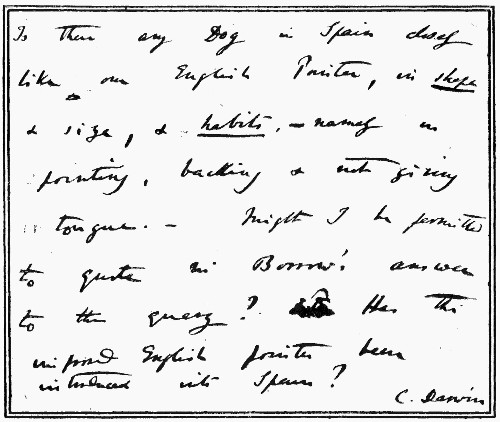 FACSIMILE OF A COMMUNICATION FROM CHARLES DARWIN TO
GEORGE BORROW.
FACSIMILE OF A COMMUNICATION FROM CHARLES DARWIN TO
GEORGE BORROW.
Borrow took constant holidays during these Oulton days. We have elsewhere noted his holidays in Eastern Europe, in the Isle of Man, in Wales, and in Cornwall. Letters from other parts of England would be welcome,[Pg 319] but I can only find two, and these are but scraps. Both are addressed to his wife, each without date:
Oxford, Feb. 2nd.
Dear Carreta,—I reached this place yesterday and hope to be home to-night (Monday). I walked the whole way by Kingston, Hampton, Sunbury (Miss Oriel's place), Windsor, Wallingford, etc., a good part of the way was by the Thames. There has been much wet weather. Oxford is a wonderful place. Kiss Hen., and God bless you!
George Borrow.
Tunbridge Wells, Tuesday evening.
Dear Carreta,—I have arrived here safe—it is a wonderful place, a small city of palaces amidst hills, rocks, and woods, and is full of fine people. Please to carry up stairs and lock in the drawer the little paper sack of letters in the parlour; lock it up with the bank book and put this along with it—also be sure to keep the window of my room fastened and the door locked, and keep the key in your pocket. God bless you and Hen.
George Borrow.
One of the very last letters of Borrow that I possess is to an unknown correspondent. It is from a rough 'draft' in his handwriting:
Oulton, Lowestoft, May 1875.
Sir,—Your letter of the eighth of March I only lately received, otherwise I should have answered it sooner. In it you mention Chamberlayne's work, containing versions of the Lord's Prayer translated into a hundred languages, and ask whether I can explain why the one which purports to be a rendering into Waldensian is evidently made in some dialect of the Gaelic. To such explanation as I can afford you are welcome, though perhaps[Pg 320] you will not deem it very satisfactory. I have been acquainted with Chamberlayne's work for upwards of forty years. I first saw it at St. Petersburg in 1834, and the translation in question very soon caught my attention. I at first thought that it was an attempt at imposition, but I soon relinquished that idea. I remembered that Helvetia was a great place for Gaelic. I do not mean in the old time when the Gael possessed the greater part of Europe, but at a long subsequent period: Switzerland was converted to Christianity by Irish monks, the most active and efficient of whom was Gall. These people founded schools in which together with Christianity the Irish or Gaelic language was taught. In process of time, though the religion flourished, the Helveto Gaelic died away, but many pieces in that tongue survived, some of which might still probably be found in the recesses of St. Gall. The noble abbey is named after the venerable apostle of Christianity in Helvetia; so I deemed it very possible that the version in question might be one of the surviving fruits of Irish missionary labour in Helvetia, not but that I had my doubts, and still have, principally from observing that the language though certainly not modern does not exhibit any decided marks of high antiquity. It is much to be regretted that Chamberlayne should have given the version to the world under a title so calculated to perplex and mislead as that which it bears, and without even stating how or where he obtained it. This, sir, is all I have to say on the very obscure subject about which you have done me the honour to consult me.—Yours truly,
George Borrow.
[185] They lived first at 169 King Street, then at two addresses unknown, then successively at 37, 38 and 39 Camperdown Terrace, their last address was 28 Trafalgar Place.
[186] Borrow's letters were frequently addressed to Oulton Hall, but he never lived here. Oulton Hall was the name given to the farm house which went with Oulton Hall Farm. 'Old inhabitants,' writes Mr. William Mackay of Oulton Broad to me, 'remember that seventy years ago it was occupied by Skepper, who was succeeded by Grimmer, who was succeeded by Smith.' 'I can find no one,' continues Mr. Mackay, 'who recollects old Mrs. Borrow lodging at the farm house. But what more likely? And it was characteristic of Borrow—don't you think?—that he should hold out "Oulton Hall" as an address to those who were not likely to visit him.' When Mrs. Borrow, senior, was persuaded to leave Willow Lane, Norwich, for Oulton, her son took lodgings for her at the 'Hall,' and here she died. Very commonplace farm houses in East Anglia are frequently called 'halls,' to the great amazement of visitors from other counties, although there are some very noble ones, as, for example, Kirkstead, Swineshead, Parham and Dalling.
[187] This was in reply to a letter from Mr. Harry Palmer which ran as follows:—'When in London on Thursday I saw the captain and brothers of several vessels bound to Gibraltar and Cadiz, and the passage money required will be about £10. The Warblington will leave to-morrow, the latter part of next week, and should you decide upon sending your servant I have requested Messrs. Nickols and Marshal to attend to any communication you may make to them, who will do their utmost to get him out at the least possible expense, and pay the passage money upon his leaving England, and make arrangements with the captain for his passage to Tangier. As Gibraltar would be as convenient as Cadiz, have little doubt Messrs. Nickols and Co. would be able to get him out for £7 or £8. I have a vessel now loading in this port for Barcelona, to which port (if you could send him to Liverpool) should be happy to take him and then send him forward to his destination.'
[188] The Eastern Daily Press, 1st October 1892. The Harveys were great friends of Borrow, and he left one of them co-executor with Mrs. MacOubrey of his estate. Miss Harvey's impressions make an interesting contrast to those of Miss Frances Power Cobbe. I have to thank Mr. A. Cozens-Hardy, the editor of The Eastern Daily Press, for courteously furnishing me with copies of these letters, and for giving me permission to use them here.
[189] The Poems of A. C. Benson, p. 213: Published by John Lane, 1909.
[190] Dr. Knapp's Life, vol. ii, p. 41.
[191] The Athenæum, July 8, 1893. Dr. Jessopp's feeling for Borrow was much more kindly then than when he supplied to the London Daily Chronicle of 30th April 1900 an article which had better not have been written.
[192] Letter to The Athenæum, July 22, 1893.
Borrow has himself given us—in Lavengro—a picturesque record of his early experiences in Scotland. It is passing strange that he published no account of his two visits to the North in maturer years. Why did he not write Wild Scotland as a companion volume to Wild Wales? He preserved in little leather pocket-books or leather-covered exercise-books copious notes of both tours. Two of his notebooks came into the possession of the late Dr. Knapp, Borrow's first biographer, and are thus described in his Bibliography:
Note Book of a Tour in Scotland, the Orkneys and Shetland in Oct. and Dec. 1858. 1 large vol. leather.
Note Book of Tours around Belfast and the Scottish Borders from Stranraer to Berwick-upon-Tweed in July and August 1866. 1 vol. leather.
Of these Dr. Knapp made use only to give the routes of Borrow's journeys so far as he was able to interpret them. It may be that he was doubtful as to whether his purchase of the manuscript carried with it the copyright of its contents, as it assuredly did not; it may be that he quailed before the minute and almost undecipherable handwriting. But similar notebooks are in my possession, and there are, happily, in these[Pg 322] days typists—you pay them by the hour, and it means an infinity of time and patience—who will copy the most minute and the most obscure documents. There are some of the notebooks of the Scottish tour of 1858 before me, and what is of far more importance—Borrow's letters to his wife while on this tour. Borrow lost his mother in August 1858, and this event was naturally a great blow to his heart. A week or two later he suffered a cruel blow to his pride also, nothing less than the return of the manuscript of his much-prized translation from the Welsh of The Sleeping Bard—and this by his 'prince of publishers,' John Murray. 'There is no money in it,' said the publisher, and he was doubtless right.[193] The two disasters were of different character, but both unhinged him. He had already written Wild Wales, although it was not to be published for another four years. He had caused to be advertised—in 1857—a book on Cornwall, but it was never written in any definitive form, and now our author had lost heart, and the Cornish book—Penquite and Pentyre—and the Scots book never saw the light. In these autumn months of 1858 geniality and humour had parted from Borrow; this his diary makes clear. He was ill. His wife urged a tour in Scotland, and he prepared himself for a rough, simple journey, of a kind quite different from the one in Wales. The north of Scotland in the winter was scarcely to be thought of for his wife and stepdaughter Henrietta. He tells us in one of these diaries that he walked 'several hundred miles in the Highlands.' His wife and daughter were with him in[Pg 323] Wales, as every reader of Wild Wales will recall, but the Scots tour was meant to be a more formidable pilgrimage, and they went to Great Yarmouth instead. The first half of the tour—that of September—is dealt with in letters to his wife, the latter half is reflected in his diary. The letters show Borrow's experiences in the earlier part of his journey, and from his diaries we learn that he was in Oban on 22nd October, Aberdeen on 5th November, Inverness on the 9th, and thence he went to Tain, Dornoch, Wick, John o'Groat's, and to the island towns, Stromness, Kirkwall, and Lerwick. He was in Shetland on the 1st of December—altogether a bleak, cheerless journey, we may believe, even for so hardy a tramp as Borrow, and the tone of the following extract from one of his rough notebooks in my possession may perhaps be explained by the circumstance. Borrow is on the way to Loch Laggan and visits a desolate churchyard, Coll Harrie, to see the tomb of John Macdonnel or Ian Lom:
I was on a Highland hill in an old Popish burying-ground. I entered the ruined church, disturbed a rabbit crouching under an old tombstone—it ran into a hole, then came out running about like wild—quite frightened—made room for it to run out by the doorway, telling it I would not hurt it—went out again and examined the tombs.... Would have examined much more but the wind and rain blew horribly, and I was afraid that my hat, if not my head, would be blown into the road over the hill. Quitted the place of old Highland Popish devotion—descended the hill again with great difficulty—grass slippery and the ground here and there quaggy, resumed the road—village—went to the door of house looking down the valley—to ask its name—knock—people came out, a whole family, looking sullen and all savage. The stout, tall young man with the grey savage eyes—civil questions—half-savage answers—village's name Achaluarach—the neighbourhood—all Catholic—chiefly Macdonnels; said the English,[Pg 324] my countrymen, had taken the whole country—'but not without paying for it,' I replied—said I was soaking wet with a kind of sneer, but never asked me in. I said I cared not for wet. A savage, brutal Papist and a hater of the English—the whole family with bad countenances—a tall woman in the background probably the mother of them all. Bade him good-day, he made no answer and I went away. Learnt that the river's name was Spean.
He passed through Scotland in a disputative vein, which could not have made him a popular traveller. He tells a Roman Catholic of the Macdonnel clan to read his Bible and 'trust in Christ, not in the Virgin Mary and graven images.' He went up to another man who accosted him with the remark that 'It is a soft day,' and said, 'You should not say a "soft" day, but a wet day.' Even the Spanish, for whom he had so much contempt and scorn when he returned from the Peninsula, are 'in many things a wise people'—after his experiences of the Scots. There is abundance of Borrow's prejudice, intolerance, and charm in this fragment of a diary[194]; but the extract I have given is of additional interest as showing how Borrow wrote all his books. The notebooks that he wrote in Spain and Wales were made up of similar disjointed jottings. Here is a note of more human character interspersed with Borrow's diatribes upon the surliness of the Scots. He is at Invergarry, on the Banks of Loch Oich. It is the 5th of October:
Dinner of real haggis; meet a conceited schoolmaster. This night, or rather in the early morning, I saw in the dream of my sleep my dear departed mother—she appeared to be coming out of her little sleeping-room at Oulton Hall—overjoyed I gave a[Pg 325] cry and fell down at her knee, but my agitation was so great that it burst the bonds of sleep, and I awoke.
But the letters to Mrs. Borrow are the essential documents here, and not the copious diaries which I hope to publish elsewhere. The first letter to 'Carreta' is from Edinburgh, where Borrow arrived on Sunday, 19th September 1858:
Edinburgh, Sunday (Sept. 19th, 1858).
Dear Carreta,—I just write a line to inform you that I arrived here yesterday quite safe. We did not start from Yarmouth till past three o'clock on Thursday morning; we reached Newcastle about ten on Friday. As I was walking in the street at Newcastle a sailor-like man came running up to me, and begged that I would let him speak to me. He appeared almost wild with joy. I asked him who he was, and he told me he was a Yarmouth north beach man, and that he knew me very well. Before I could answer, another sailor-like, short, thick fellow came running up, who also seemed wild with joy; he was a comrade of the other. I never saw two people so out of themselves with pleasure, they literally danced in the street; in fact, they were two of my old friends. I asked them how they came down there, and they told me that they had been down fishing. They begged a thousand pardons for speaking to me, but told me they could not help it. I set off for Alnwick on Friday afternoon, stayed there all night, and saw the castle next morning. It is a fine old place, but at present is undergoing repairs—a Scottish king was killed before its walls in the old time. At about twelve I started for Edinburgh. The place is wonderfully altered since I was here, and I don't think for the better. There is a Runic stone on the castle brae which I am going to copy. It was not there in my time. If you write direct to me at the Post Office, Inverness. I am thinking of going to Glasgow to-morrow, from which place I shall[Pg 326] start for Inverness by one of the packets which go thither by the North-West and the Caledonian Canal. I hope that you and Hen are well and comfortable. Pray eat plenty of grapes and partridges. We had upon the whole a pleasant passage from Yarmouth; we lived plainly but well, and I was not at all ill—the captain seemed a kind, honest creature. Remember me kindly to Mrs. Turnour and Mrs. Clarke, and God bless you and Hen.
George Borrow.
In his unpublished diary Borrow records his journey from Glasgow through beautiful but over-described scenery to Inverness, where he stayed at the Caledonian Hotel:
Inverness, Sunday (Sept. 26th).
Dear Carreta,—This is the third letter which I have written to you. Whether you have received the other two, or will receive this, I am doubtful. I have been several times to the post office, but we found no letter from you, though I expected to find one awaiting me when I arrived. I wrote last on Friday. I merely want to know once how you are, and if all is well I shall move onward. It is of not much use staying here. After I had written to you on Friday I crossed by the ferry over the Firth and walked to Beauly, and from thence to Beaufort or Castle Downie; at Beauly I saw the gate of the pit where old Fraser used to put the people whom he owed money to—it is in the old ruined cathedral, and at Beaufort saw the ruins of the house where he was born. Lord Lovat lives in the house close by. There is now a claimant to the title, a descendant of old Fraser's elder brother who committed a murder in the year 1690, and on that account fled to South Wales. The present family are rather uneasy, and so are their friends, of whom they have a great number, for though they are flaming Papists they are very free of their money. I have told several of their cousins that the claimant has not a chance as the present family have been so long in possession. They almost[Pg 327] blessed me for saying so. There, however, can be very little doubt that the title and estate, more than a million acres, belong to the claimant by strict law. Old Fraser's brother was called Black John of the Tasser. The man whom he killed was a piper who sang an insulting song to him at a wedding. I have heard the words and have translated them; he was dressed very finely, and the piper sang:
Whereupon John drew his dagger and ran it into the piper's belly; the descendants of the piper are still living at Beauly. I walked that day thirty-four miles between noon and ten o'clock at night. My letter of credit is here. This is a dear place, but not so bad as Edinburgh. If you have written, don't write any more till you hear from me again. God bless you and Hen.
George Borrow.
'Swindled out of a shilling by rascally ferryman,' is Borrow's note in his diary of the episode that he relates to his wife of crossing the Firth. He does not tell her, but his diary tells us, that he changed his inn on the day he wrote this letter: the following jottings from the diary cover the period:
Sept. 29th.—Quit the 'Caledonian' for 'Union Sun'—poor accommodation—could scarcely get anything to eat—unpleasant day. Walked by the river—at night saw the comet again from the bridge.
Sept. 30th.—Breakfast. The stout gentleman from Caithness, Mr. John Miller, gave me his card—show him mine—his delight.
Oct. 1st.—Left Inverness for Fort Augustus by steamer—passengers—strange man—tall gentleman—half doctor—breakfast—dreadful hurricane of wind and rain—reach Fort Augustus—inn—apartments—Edinburgh ale—stroll over the bridge to a wretched village—wind and rain—return—fall asleep before fire—dinner—herrings, first-rate—black ale, Highland mutton—pudding[Pg 328] and cream—stroll round the fort—wet grass—stormy-like—wind and rain—return—kitchen—kind, intelligent woman from Dornoch—no Gaelic—shows me a Gaelic book of spiritual songs by one Robertson—talks to me about Alexander Cumming, a fat blacksmith and great singer of Gaelic songs.
But to return to Borrow's letters to his wife:
Inverness, September 29th, 1858.
My dear Carreta,—I have got your letter, and glad enough I was to get it. The day after to-morrow I shall depart from here for Fort Augustus at some distance up the lake. After staying a few days there, I am thinking of going to the Isle of Mull, but I will write to you if possible from Fort Augustus. I am rather sorry that I came to Scotland—I was never in such a place in my life for cheating and imposition, and the farther north you go the worse things seem to be, and yet I believe it is possible to live very cheap here, that is if you have a house of your own and a wife to go out and make bargains, for things are abundant enough, but if you move about you are at the mercy of innkeepers and suchlike people. The other day I was swindled out of a shilling by a villain to whom I had given it for change. I ought, perhaps, to have had him up before a magistrate provided I could have found one, but I was in a wild place and he had a clan about him, and if I had had him up I have no doubt I should have been outsworn. I, however, have met one fine, noble old fellow. The other night I lost my way amongst horrible moors and wandered for miles and miles without seeing a soul. At last I saw a light which came from the window of a rude hovel. I tapped at the window and shouted, and at last an old man came out; he asked me what I wanted, and I told him I had lost my way. He asked me where I came from and where I wanted to go, and on my telling him he said I had indeed lost my way, for I had got out of it at least four miles, and was going away from the place I wanted to get to. He then said he would show me the[Pg 329] way, and went with me for several miles over most horrible places. At last we came to a road where he said he thought he might leave me, and wished me good-night. I gave him a shilling. He was very grateful and said, after considering, that as I had behaved so handsomely to him he would not leave me yet, as he thought it possible I might yet lose my way. He then went with me three miles farther, and I have no doubt that, but for him, I should have lost my way again, the roads were so tangled. I never saw such an old fellow, or one whose conversation was so odd and entertaining. This happened last Monday night, the night of the day in which I had been swindled of the shilling by the other; I could write a history about those two shillings.
Inverness, 30th September 1858.
Dear Carreta,—I write another line to tell you that I have got your second letter—it came just in time, as I leave to-morrow. In your next, address to George Borrow, Post Office, Tobermory, Isle of Mull, Scotland. You had, however, better write without delay, as I don't know how long I may be there; and be sure only to write once. I am glad we have got such a desirable tenant for our Maltings, and should be happy to hear that the cottage was also let so well. However, let us be grateful for what has been accomplished. I hope you wrote to Cooke as I desired you, and likewise said something about how I had waited for Murray.... I met to-day a very fat gentleman from Caithness, at the very north of Scotland; he said he was descended from the Norse. I talked to him about them, and he was so pleased with my conversation that he gave me his card, and begged that I would visit him if I went there. As I could do no less, I showed him my card—I had but one—and he no sooner saw the name than he was in a rapture. I am rather glad that you have got the next door, as the locality is highly respectable. Tell Hen that I copied the Runic stone on the Castle Hill, Edinburgh. It was brought from Denmark in the old time. The inscription is imperfect, but[Pg 330] I can read enough of it to see that it was erected by a man to his father and mother. I again write the direction for your next: George Borrow, Esq., Post Office, Tobermory, Isle of Mull, Scotland. God bless you and Hen. Ever yours,
George Borrow.
Fort Augustus, Sunday, October 17th, 1858.
Dear Carreta,—I write a line lest you should be uneasy. Before leaving the Highlands I thought I would see a little more about me. So last week I set on a four days' task, a walk of a hundred miles. I returned here late last Thursday night. I walked that day forty-five miles; during the first twenty the rain poured in torrents and the wind blew in my face. The last seventeen miles were in the dark. To-morrow I proceed towards Mull. I hope that you got my letters, and that I shall find something from you awaiting me at the post office. The first day I passed over Corryarrick, a mountain 3000 feet high. I was nearly up to my middle in snow. As soon as I had passed it I was in Badenoch. The road on the farther side was horrible, and I was obliged to wade several rivulets, one of which was very boisterous and nearly threw me down.[195] I wandered through a wonderful country, and picked up a great many strange legends from the people I met, but they were very few, the country being almost a desert, chiefly inhabited by deer. When amidst the lower mountains I frequently heard them blaring in the woods above me. The people at the inn here are by far the nicest I have met; they are kind and honourable to a degree. God bless you and Hen.
George Borrow.
[Pg 331]
(Fragment? undated.)
On Tuesday I am going through the whole of it to Icolmkill—I should start to-morrow—but I must get my shoes new soles, for they have been torn to pieces by the roads, and likewise some of my things mended, for they are in a sad condition.
I shall return from Thurso to Inverness, as I shall want some more money to bring me home. So pray do not let the credit be withdrawn. What a blessing it is to have money, but how cautious people ought to be not to waste it. Pray remember me most kindly to our good friend Mr. Hills. Send the Harveys the pheasant as usual with my kind regards. I think you should write to Mr. Dalton of Bury telling him that I have been unwell, and that I send my kind regards and respects to him. I send dear Hen a paper in company with this, in which I have enclosed specimens of the heather, the moss and the fern, or 'raineach,' of Mull.—God bless you both,
George Borrow.
Do not delay in sending the order. Write at the same time telling me how you are.
Inverness, Nov. 7th, 1858.
Dear Carreta,—After I wrote to you I walked round Mull and through it, over Benmore. I likewise went to Icolmkill, and passed twenty-four hours there. I saw the wonderful ruin and crossed the island. I suffered a great deal from hunger, but what I saw amply repaid me; on my return to Tobermory I was rather unwell, but got better. I was disappointed in a passage to Thurso by sea, so I was obliged to return to this place by train.[196] On Tuesday,[Pg 332] D. V., I shall set out on foot, and hope to find your letter awaiting me at the post office at Thurso. On coming hither by train I nearly lost my things. I was told at Huntly that the train stopped ten minutes, and meanwhile the train drove off purposely; I telegraphed to Keith in order that my things might be secured, describing where they were, under the seat. The reply was that there was nothing of the kind there. I instantly said that I would bring an action against the company, and walked off to the town, where I stated the facts to a magistrate, and gave him my name and address. He advised me to bring my action. I went back and found the people frightened. They telegraphed again—and the reply was that the things were safe. There is nothing like setting oneself up sometimes. I was terribly afraid I should never again find my books and things. I, however, got them, and my old umbrella, too. I was sent on by the mail train, but lost four hours, besides undergoing a great deal of misery and excitement. When I have been to Thurso and Kirkwall I shall return as quick as possible, and shall be glad to get out of the country. As I am here, however, I wish to see all I can, for I never wish to return. Whilst in Mull I lived very cheaply—it is not costing me more than seven shillings a day. The generality of the inns, however, in the lowlands are incredibly dear—half-a-crown for breakfast, consisting of a little tea, a couple of small eggs, and bread and butter—two shillings for attendance. Tell Hen that I have some moss for her from Benmore—also some seaweed from the farther shore of Icolmkill. God bless you.
George Borrow.
I do not possess any diaries or notebooks covering the period of the following letters. The diary which covers this period is mentioned in the bibliography attached to Dr. Knapp's Life of Borrow, which, with the rest of Dr. Knapp's Borrow papers, is now in the possession of the Hispanic Society, New York.
Thurso, 21st Nov. 1858.
My dear Carreta,—I reached this place on Friday night, and was glad enough to get your kind letter. I shall be so glad to[Pg 333] get home to you. Since my last letter to you I have walked nearly 160 miles. I was terribly taken in with respect to distances—however, I managed to make my way. I have been to Johnny Groat's House, which is about twenty-two miles from this place. I had tolerably fine weather all the way, but within two or three miles of that place a terrible storm arose; the next day the country was covered with ice and snow. There is at present here a kind of Greenland winter, colder almost than I ever knew the winter in Russia. The streets are so covered with ice that it is dangerous to step out; to-morrow D. and I pass over into Orkney, and we shall take the first steamer to Aberdeen and Inverness, from whence I shall make the best of my way to England. It is well that I have no farther to walk, for walking now is almost impossible—the last twenty miles were terrible, and the weather is worse now than it was then. I was terribly deceived with respect to steamboats. I was told that one passed over to Orkney every day, and I have now been waiting two days, and there is not yet one. I have had quite enough of Scotland. When I was at Johnny Groat's I got a shell for dear Hen, which I hope I shall be able to bring or send to her. I am glad to hear that you have got out the money on mortgage so satisfactorily. One of the greatest blessings in this world is to be independent. My spirits of late have been rather bad, owing principally to my dear mother's death. I always knew that we should miss her. I dreamt about her at Fort Augustus. Though I have walked so much I have suffered very little from fatigue, and have got over the ground with surprising facility, but I have not enjoyed the country so much as Wales. I wish that you would order a hat for me against I come home; the one I am wearing is very shabby, having been so frequently drenched with rain and storm-beaten. I cannot say the exact day that I shall be home, but you may be expecting me. The worst is that there is no depending on the steamers, for there is scarcely any traffic in Scotland in winter. My appetite of late has been very poorly, chiefly, I believe, owing to badness of food and want of regular meals. Glad enough, I repeat, shall I be to get home to you and Hen.
George Borrow.
Kirkwall, Orkney, November 27th, 1858. Saturday.
Dear Carreta,—I am, as you see, in Orkney, and I expect every minute the steamer which will take me to Shetland and Aberdeen, from which last place I go by train to Inverness, where my things are, and thence home. I had a stormy passage to Stromness, from whence I took a boat to the Isle of Hoy, where I saw the wonderful Dwarf's House hollowed out of the stone. From Stromness I walked here. I have seen the old Norwegian Cathedral; it is of red sandstone, and looks as if cut out of rock. It is different from almost everything of the kind I ever saw. It is stern and grand to a degree. I have also seen the ruins of the old Norwegian Bishop's palace in which King Hacon died; also the ruins of the palace of Patrick, Earl of Orkney. I have been treated here with every kindness and civility. As soon as the people knew who I was they could scarcely make enough of me. The Sheriff, Mr. Robertson, a great Gaelic scholar, said he was proud to see me in his house; and a young gentleman of the name of Petrie, Clerk of Supply, has done nothing but go about with me to show me the wonders of the place. Mr. Robertson wished to give me letters to some gentleman at Edinburgh. I, however, begged leave to be excused, saying that I wished to get home, as, indeed, I do, for my mind is wearied by seeing so many strange places. On my way to Kirkwall I saw the stones of Stennis—immense blocks of stone standing up like those of Salisbury Plain. All the country is full of Druidical and Pictish remains. It is, however, very barren, and scarcely a tree is to be seen, only a few dwarf ones. Orkney consists of a multitude of small islands, the principal of which is Pomona, in which Kirkwall is. The currents between them are terrible. I hope to be home a few days after you receive these lines, either by rail or steamer. This is a fine day, but there has been dreadful weather here. I hope we shall have a prosperous passage. I have purchased a little Kirkwall newspaper, which I send you with this letter. I shall perhaps post both at Lerwick or Aberdeen. I sent you a Johnny Groat's newspaper, which I hope you got. Don't tear either up, for they are curious. God bless you and Hen.
George Borrow.
Stirling, Dec. 14th, 1858.
Dear Carreta,—I write a line to tell you that I am well and that I am on my way to England, but I am stopped here for a day,[Pg 335] for there is no conveyance. Wherever I can walk I get on very well—but if you depend on coaches or any means of conveyance in this country you are sure to be disappointed. This place is but thirty-five miles from Edinburgh, yet I am detained for a day—there is no train. The waste of that day will prevent me getting to Yarmouth from Hull by the steamer. Were it not for my baggage I would walk to Edinburgh. I got to Aberdeen, where I posted a letter for you. I was then obliged to return to Inverness for my luggage—125 miles. Rather than return again to Aberdeen, I sent on my things to Dunkeld and walked the 102 miles through the Highlands. When I got here I walked to Loch Lomond and Loch Katrine, thirty-eight miles over horrible roads. I then got back here. I have now seen the whole of Scotland that is worth seeing, and have walked 600 miles. I shall be glad to be out of the country; a person here must depend entirely upon himself and his own legs. I have not spent much money—my expenses during my wanderings averaged a shilling a day. As I was walking through Strathspey, singularly enough I met two or three of the Phillips. I did not know them, but a child came running after me to ask me my name. It was Miss P. and two of the children. I hope to get to you in two or three days after you get this. God bless you and dear Hen.
George Borrow.
In spite of Borrow's vow never to visit Scotland again, he was there eight years later—in 1866—but only in the lowlands. His stepdaughter, Hen., or Henrietta Clarke, had married Dr. MacOubrey, of Belfast, and Borrow and his wife went on a visit to the pair. But the incorrigible vagabond in Borrow was forced to declare itself, and leaving his wife and daughter in Belfast he crossed to Stranraer by steamer on 17th July 1866, and tramped through the lowlands, visiting Ecclefechan and Gretna Green. We have no record of his experiences at these places. The only literary impression of the Scots tour of 1866, apart from a brief reference in Dr. Knapp's Life, is an essay on Kirk Yetholm in Romano Lavo-Lil. We would gladly[Pg 336] have exchanged it for an account of his visits to Abbotsford and Melrose, two places which he saw in August of this year.
In his letter of 27th November from Kirkwall it will be seen that Borrow records the kindness received from 'a young gentleman of the name of Petrie.' It is pleasant to find that when he returned to England he did not forget that kindness, as the next letter demonstrates:
39 Camperdown Place, Yarmouth, Jany. 14, 1859.
My dear Sir,—Some weeks ago I wrote to Mr. Murray (and) requested him to transmit to you two works of mine. Should you not have received them by the time this note reaches you, pray inform me and I will write to him again. They may have come already, but whenever they may come to hand, keep them in remembrance of one who will never forget your kind attention to him in Orkney.
On reaching Aberdeen I went to Inverness by rail. From there I sent off my luggage to Dunkeld, and walked thither by the Highland road. I never enjoyed a walk more—the weather was tolerably fine, and I was amidst some of the finest scenery in the world. I was particularly struck with that of Glen Truim. Near the top of the valley in sight of the Craig of Badenoch on the left hand side of the way, I saw an immense cairn, probably the memorial of some bloody clan battle. On my journey I picked up from the mouth of an old Highland woman a most remarkable tale concerning the death of Fian or Fingal. It differs entirely from the Irish legends which I have heard on the subject—and is of a truly mythic character. Since visiting Shetland I have thought a great deal about the Picts, but cannot come to any satisfactory conclusion. Were they Celts? were they Laps? Macbeth could hardly have been a Lap, but then the tradition of the country that they were a diminutive race, and their name Pight or Pict, which I almost think is the same as petit—pixolo—puj—pigmy. It is a truly perplexing subject—quite as much so as that of Fingal, and[Pg 337] whether he was a Scotsman or an Irishman I have never been able to decide, as there has been so much to be said on both sides of the question. Please present my kind remembrances to Mrs. Petrie and all friends, particularly Mr. Sheriff Robertson,[197] who first did me the favour of making me acquainted with you.—And believe me to remain, dear Sir, ever sincerely yours,
George Borrow.
Thank you for the newspaper—the notice was very kind, but rather too flattering.
On the same day that Borrow wrote, Mr. Petrie sent his acknowledgment of the books, and so the letters crossed:
I was very agreeably surprised on opening a packet, which came to me per steamer ten days ago, to find that it contained a present from you of your highly interesting and valuable works[Pg 338] Lavengro and Romany Rye. Coming from any person such books would have been highly prized by me, and it is therefore specially gratifying to have them presented to me by their author. Please to accept of my sincere and heartfelt thanks for your kind remembrance of me and your valuable gift. May I request you to confer an additional favour on me by sending me a slip of paper to be pasted on each of the five volumes, stating that they were presented to me by you. I would like to hand them down as an heirloom to my family. I am afraid you will think that I am a very troublesome acquaintance.
I would have written sooner, but I expected to have had some information to give you about some of the existing superstitions of Orkney which might perhaps have some interest for you. I have, however, been much engrossed with county business during the last fortnight, and must therefore reserve my account of these matters till another opportunity.
Mr. Balfour, our principal landowner in Orkney, is just now writing an article on the ancient laws and customs of the county to be prefixed to a miscellaneous collection of documents, chiefly of the sixteenth century. He is taking the opportunity to give an account of the nature of the tenures by which the ancient Jarls held the Jarldom, and the manner in which the odalret became gradually supplanted. I have furnished him with several of the documents, and am just now going over it with him. It is for the Bannatyne Club in Edinburgh that he is preparing it, but I have suggested to him to have it printed for general sale, as it is very interesting, and contains a great mass of curious information condensed into a comparatively small space. Mr. Balfour is very sorry that he had not the pleasure of meeting you when you were here.
My last glimpse of George Borrow in Scotland during his memorable trip of the winter of 1858 is contained in a letter that I received some time ago from the Rev. J. Wilcock of St. Ringan's Manse, Lerwick, which runs as follows:
Nov. 18th, 1903.
Dear Sir,—As I see that you are interested in George Borrow, would you allow me to supply you with a little notice of[Pg 339] him which has not appeared in print? A friend here—need I explain that this is written from the capital of the Shetlands?—a friend, I say, now dead, told me that one day early in the forenoon, during the winter, he had walked out from the town for a stroll into the country. About a mile out from the town is a piece of water called the Loch of Clickimin, on a peninsula, in which is an ancient (so-called) 'Pictish Castle.' His attention was attracted by a tall, burly stranger, who was surveying this ancient relic with deep interest. As the water of the loch was well up about the castle, converting the plot of ground on which it stood almost altogether into an island, the stranger took off shoes and stockings and trousers, and waded all round the building in order to get a thorough view of it. This procedure was all the more remarkable from the fact, as above mentioned, that the season was winter. I believe that there was snow on the ground at the time. My friend noticed on meeting him again in the course of the same walk that he was very lightly clothed. He had on a cotton shirt, a loose open jacket, and on the whole was evidently indifferent to the rigour of our northern climate at that time of the year.
In addition to the visit to Belfast in 1866, Borrow was in Ireland the year following his Scots tour of 1858, that is to say from July to November 1859. He went, accompanied by his wife and daughter, by Holyhead to Dublin, where, as Dr. Knapp has discovered, they resided at 75 St. Stephen Green, South. Borrow, as was his custom, left his family while he was on a walking tour which included Connemara and on northward to the Giant's Causeway. He was keenly interested in the two Societies in Dublin engaged upon the study of ancient Irish literature, and he became a member of the Ossianic Society in July of this year. I have a number of Borrow's translations from the Irish in my possession, but no notebooks of his tour on this occasion.
All Irishmen who wish their country to preserve its individuality should have a kindly feeling for George[Pg 340] Borrow. Opposed as he was to the majority of the people in religion and in politics, he was about the only Englishman of his time who took an interest in their national literature, language and folk-lore. Had he written such another travel book about Ireland as he wrote about Wales he would certainly have added to the sum of human pleasure.
I find only one letter to his wife during this Irish journey:
Ballina, County Mayo, Thursday Morning.
My dear Carreta,—I write to you a few lines. I have now walked 270 miles, and have passed through Leinster and Connaught. I have suffered a good deal of hardship, for this is a very different country to walk in from England. The food is bad and does not agree with me. I shall be glad to get back, but first of all I wish to walk to the Causeway. As soon as I have done that I shall get on railroad and return, as I find there is a railroad from Londonderry to Dublin. Pray direct to me at Post Office, Londonderry. I have at present about seven pounds remaining, perhaps it would bring me back to Dublin; however, to prevent accidents, have the kindness to enclose me an order on the Post Office, Londonderry, for five pounds. I expect to be there next Monday, and to be home by the end of the week. Glad enough I shall be to get back to you and Hen. I got your letter at Galway. What you said about poor Flora was comforting—pray take care of her. Don't forget the order. I hope to write in a day or two a kind of duplicate of this. I send Hen. heath from Connemara, and also seaweed from a bay of the Atlantic. I have walked across Ireland; the country people are civil; but I believe all classes are disposed to join the French. The idolatry and popery are beyond conception. God bless you, dearest.
George Borrow.
Love to Hen. and poor Flora. (Keep this.)
[193] Borrow had The Sleeping Bard printed at his own expense in Great Yarmouth in 1860, Mr. Murray giving his imprint on the title-page. See Chapter xxxv. p. 404
[194] Which will be published in my edition of Borrow's Collected Works.
[195] Mr. James Barren of The Inverness Courier informs me that Borrow took a well-known route between Fort Augustus and Badenoch, although nowadays it is rarely used, as Wade's Road has been abandoned; it is very dilapidated. It was not quite so bad, he says, in 1858.
[196] Mr. Barron points out to me that as there was no direct railway communication Borrow must have gone to Aberdeen or Huntly, and returned from the latter town to Inverness. He must have taken a steamer from Tobermory to Fort William, and thence probably walked by Glen Spean and Laggan to Kingussie. After that he must have traversed one of the passes leading by Ben Macdhui or the Cairngorms to Aberdeenshire.
[197] Mr. Sheriff Robertson's son kindly sends me the following extract from the diary of his father, James Robertson, Sheriff of Orkney:
'Friday, 26th November, 1858.—In the evening Geo. Petrie called with "Bible Borrow." He is a man about 60, upwards of six feet in height, and of an athletic though somewhat gaunt frame. His hair is pure white though a little bit thin on the top, his features high and handsome, and his complexion ruddy and healthy. He was dressed in black, his surtout was old, his shoes very muddy. He spoke in a loud tone of voice, knows Gaelic and Irish well, quoted Ian Lom, Duncan Ban M'Intyre, etc., is publishing an account of Welsh, Irish, and Gaelic bards. He travelled—on foot principally—from Inverness to Thurso, and is going on to-morrow to Zetland. He walked lately through the upper part of Badenoch, Lochaber, and the adjacent counties, and through Mull, which he greatly admired.... In his rambles he associated exclusively with the lower classes, and when I offered to give him letters of introduction to Wm. F. Skene, Robert Chambers, Joseph Robertson, etc., he declined to accept them. His mother died lately and he was travelling, he said, to divert and throw off his melancholy. He talked very freely on all subjects that one broached, but not with precision, and he appeared to me to be an amiable man and a gentleman, but, withal, something of a projector, if not an adventurer. He is certainly eccentric. I asked him to take wine, etc., and he declined. He said he was bred at the High School of Edinburgh, and that he was there in 1813, and mentioned that he was partly educated in Ireland, and that by birth and descent he is an Englishman.'
George Borrow's three most important books had all a very interesting history. We have seen the processes by which The Bible in Spain was built up from notebooks and letters. We have seen further the most curious apprenticeship by which Lavengro came into existence. The most distinctly English book—at least in a certain absence of cosmopolitanism—that Victorian literature produced was to a great extent written on scraps of paper during a prolonged Continental tour which included Constantinople and Budapest. In Lavengro we have only half a book, the whole work, which included what came to be published as The Romany Rye, having been intended to appear in four volumes. The first volume was written in 1843, the second in 1845, after the Continental tour, which is made use of in the description of the Hungarian, and the third volume in the years between 1845 and 1848. Then in 1852 Borrow wrote out an 'advertisement' of a fourth volume,[198] which runs as follows:
Shortly will be published in one volume. Price 10s. The Rommany Rye, Being the fourth volume of Lavengro. By George Borrow, author of The Bible in Spain.
But this volume did not make an appearance 'shortly.' Its author was far too much offended with the critics, too disheartened it may be to care to offer himself again for their gibes. The years rolled on, much of the time being spent at Yarmouth, a little of it at Oulton. There was a visit to Cornwall in 1854, and another to Wales in the same year. The Isle of Man was selected for a holiday in 1855, and not until 1857 did The Romany Rye appear. The book was now in two volumes, and we see that the word Romany had dropped an 'm':
The Romany Rye: A Sequel to 'Lavengro.' By George Borrow, author of 'The Bible in Spain,' 'The Gypsies of Spain,' etc., 'Fear God, and take your own part.' In Two Volumes. London: John Murray, Albemarle Street, 1857.
Dr. Knapp publishes some vigorous correspondence between Mrs. Borrow and her husband's publisher written prior to the issue of The Romany Rye. 'Mr. Borrow has not the slightest wish to publish the book,' she says. 'The manuscript was left with you because you wished to see it.'[199] This was written in 1855, the wife presumably writing at her husband's dictation. In 1857 the situation was not improved, as Borrow himself writes to Mr. Murray: 'In your last letter you talk of obliging me by publishing my verse. Now is not that speaking very injudiciously?'[200] At last, however, in[Pg 343] April 1857, The Romany Rye appeared, and we are introduced once more to many old favourites, to Petulengro, to the Man in Black, and above all to Isopel Berners. The incidents of Lavengro are supposed to have taken place between the 24th May 1825 and the 18th July of that year. In The Romany Rye the incidents apparently occur between 19th July and 3rd August 1825. In the opinion of that most eminent of gypsy experts, Mr. John Sampson,[201] the whole of the episodes in the five volumes occurred in seventy-two days. Mr. Sampson agrees with Dr. Knapp in locating Mumper's Dingle in Momber or Monmer Lane, Willenhall,[Pg 344] Shropshire. The dingle has disappeared—it is now occupied by the Monmer Lane Ironworks—but you may still find Dingle Bridge and Dingle Lane. The book has added to the glamour of gypsydom, and to the interest in the gypsies which we all derive from Lavengro, but Mr. Sampson makes short work of Borrow's gypsy learning on its philological side. 'No gypsy,' he says, 'ever uses chal or engro as a separate word, or talks of the dukkering dook or of penning a dukkerin.' 'Borrow's genders are perversely incorrect'; and 'Romany'—a word which can never get out of our language, let philologists say what they will—should have been 'Romani.' '"Haarsträubend" is the fitting epithet,' says Mr. Sampson, 'which an Oriental scholar, Professor Richard Pischel of Berlin, finds to describe Borrow's etymologies.' But all this is very unimportant, and the book remains in the whole of its forty-seven chapters not one whit less a joy to us than does its predecessor Lavengro, with its visions of gypsies and highwaymen and boxers.
But then there is its 'Appendix.' That appendix of eleven petulant chapters undoubtedly did Borrow harm in his day and generation. Now his fame is too great, and his genius too firmly established for these strange dissertations on men and things to offer anything but amusement or edification. They reveal, for example, the singularly non-literary character of this great man of letters. Much—too much—has been made of his dislike of Walter Scott and his writings. As a matter of fact Borrow tells us that he admired Scott both as a prose writer and as a poet. 'Since Scott he had read no modern writer. Scott was greater than Homer,' he told Frances Cobbe. But he takes occasion to condemn his 'Charlie o'er the water nonsense,' and[Pg 345] declares that his love of and sympathy with certain periods and incidents have made for sympathy with what he always calls 'Popery.'[202] Well, looking at the matter from an entirely opposite point of view, Cardinal Newman declared that the writings of Scott had had no inconsiderable influence in directing his mind towards the Church of Rome.[203]
During the first quarter of this century a great poet was raised up in the North, who, whatever were his defects, has contributed by his works, in prose and verse, to prepare men for some closer and more practical approximation to Catholic truth. The general need of something deeper and more attractive than what had offered itself elsewhere may be considered to have led to his popularity; and by means of his popularity he re-acted on his readers, stimulating their mental thirst, feeding their hopes, setting before them visions, which, when once seen, are not easily forgotten, and silently indoctrinating them with nobler ideas, which might afterwards be appealed to as first principles.[204]
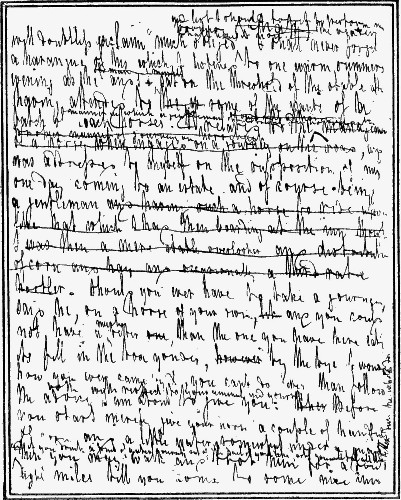 FACSIMILE OF A PAGE OF THE MANUSCRIPT OF THE ROMANY RYE
From the Borrow Papers in the possession of the Author of 'George
Borrow and his Circle'
FACSIMILE OF A PAGE OF THE MANUSCRIPT OF THE ROMANY RYE
From the Borrow Papers in the possession of the Author of 'George
Borrow and his Circle'
And thus we see that Borrow had a certain prescience in this matter. But Borrow, in good truth, cared little for modern English literature. His heart was entirely with the poets of other lands—the Scandinavians and the Kelts. In Virgil he apparently took little interest, nor in the great poetry of Greece, Rome and England, although we find a reference to Theocritus and Dante in his books. Fortunately for his fame he had read Gil Blas, Don Quixote, and, above all, Robinson Crusoe, which last book, first read as a boy of six, coloured his whole life. Defoe and Fielding and Bunyan were the English authors to whom he owed most. Of Byron he has quaint things to say, and of Wordsworth things that are neither quaint nor wise. We recall the man in the field in the twenty-second chapter of The[Pg 347] Romany Rye who used Wordsworth's poetry as a soporific. And throughout his life Borrow's position towards his contemporaries in literature was ever contemptuous. He makes no mention of Carlyle or Ruskin or Matthew Arnold, and they in their turn, it may be added, make no mention of him or of his works. Thackeray he snubbed on one of the few occasions they met, and Browning and Tennyson were alike unrevealed to him. Borrow indeed stands quite apart from the great literature of a period in which he was a striking and individual figure. Lacking appreciation in this sphere of work, he wrote of 'the contemptible trade of author,' counting it less creditable than that of a jockey.
But all this is a digression from the progress of our narrative of the advent of The Romany Rye. The book was published in an edition of 1000 copies in April 1857, and it took thirty years to dispose of 3750 copies. Not more than 2000 copies of his book were sold in Great Britain during the twenty-three remaining years of Borrow's life. What wonder that he was embittered by his failure! The reviews were far from favourable, although Mr. Elwin wrote not unkindly in an article in the Quarterly Review called 'Roving Life in England.' No critic, however, was as severe as The Athenæum, which had called Lavengro 'balderdash' and referred to The Romany Rye as the 'literary dough' of an author 'whose dullest gypsy preparation we have now read.' In later years, when, alas! it was too late, The Athenæum, through the eloquent pen of Theodore Watts, made good amends. But William Bodham Donne wrote to Borrow with adequate enthusiasm:[Pg 348]
12 St. James's Square, May 24th, 1857.
My dear Sir,—I received your book some days ago, but would not write to you before I was able to read it, at least once, since it is needless, I hope, for me to assure you that I am truly gratified by the gift.
Time to read it I could not find for some days after it was sent hither, for what with winding up my affairs here, the election of my successor, preparations for flitting, etc., etc., I have been incessantly occupied with matters needful to be done, but far less agreeable to do than reading The Romany Rye. All I have said of Lavengro to yourself personally, or to others publicly or privately, I say again of The Romany Rye. Everywhere in it the hand of the master is stamped boldly and deeply. You join the chisel of Dante with the pencil of Defoe.
I am rejoiced to see so many works announced of yours, for you have more that is worth knowing to tell than any one I am acquainted with. For your coming progeny's sake I am disposed to wish you had worried the literary-craft less. Brand and score them never so much, they will not turn and repent, but only spit the more froth and venom. I am reckoning of my emancipation with an eagerness hardly proper at my years, but I cannot help it, so thoroughly do I hate London, and so much do I love the country. I have taken a house, or rather a cottage, at Walton on Thames, just on the skirts of Weybridge, and there I hope to see you before I come into Norfolk, for I am afraid my face will not be turned eastward for many weeks if not months.
Remember me kindly to Mrs. Borrow and Miss Clarke, and believe me, my dear Sir, very truly and thankfully yours.
Wm. B. Donne.
And perhaps a letter from the then Town Clerk of Oxford is worth reproducing here:
Town Clerk's Office, Oxford, 19th August 1857.
Sir,—We have, attached to our Corporation, an ancient jocular court composed of 13 of the poor old freemen who attend the elections and have a king who sits attired in scarlet with a crown and sentences interlopers (non-freeman) to be cold-burned, i.e. a bucket or so of water introduced to the offender's sleeve by means of the city pump; but this infliction is of course generally commuted by a small pecuniary compensation.
They call themselves 'Slaveonians' or 'Sclavonians.' The only notice we have of them in the city records is by the name of 'Slovens Hall.' Reading Romany Rye I notice your account of the Sclaves and venture to trouble you with this, and to enquire whether you think that the Sclaves might be connected through the Saxons with the ancient municipal institutions of this country. You are no doubt aware that Oxford is one of the most ancient Saxon towns, being a royal bailiwick and fortified before the Conquest,—Yours truly.
George P. Hester.
In spite of contemporary criticism, The Romany Rye is a great book, or rather it contains the concluding chapters of a great book. Sequels are usually proclaimed to be inferior to their predecessors. But The Romany Rye is not a sequel. It is part of Lavengro, and is therefore Borrow's most imperishable monument.
[198] Borrow was fond of writing out title-pages for his books, and I have a dozen or so of these draft title-pages among my Borrow Papers.
[199] Dr. Knapp's Life, vol. ii. p. 167.
[200] Borrow's association with the firm of Murray deserves a chapter to itself, but the material for writing such a chapter has already been used by Dr. Knapp and Mr. Herbert Jenkins. The present Mr. John Murray, John Murray iv., has seventy letters from Borrow to his firm in his possession. The first of the name to publish Borrow's works was John Murray ii., who died in 1843. John Murray iii., who died in 1892, and his partner and cousin Robert Cooke, were Borrow's friends. He had differences at times, but he was loyal to them and they were loyal to him as good authors and good publishers ought to be. With all his irritability Borrow had the sense to see that there was substantial reason in their declining to issue his translations. That, although at the end there were long intervals of silence, the publishers and their author remained friends is shown by letters written to his daughter after Borrow's death, and by the following little note from Borrow to John Murray which was probably never sent. It is in the feeble, broken handwriting of what was probably the last year of Borrow's life.
To John Murray, Esq.
'Oulton (no date).
'My dear Friend,—Thank you most sincerely for sending me the last vol. of the Quarterly, a truly remarkable one it is, full of literature of every description—I should have answered the receipt of it before had I not been very unwell. Should you come to these parts do me the favour to look in upon me—it might do me good, and say the same thing from me to my kind and true friend Robt. Cooke. His last visit to me did me much good, and another might probably do me the same. What a horrible state the country seems to be in, and no wonder—a monster-minister whose principal aim seems to be the ruin of his native land, a parliament either incompetent or indifferent. However, let us hope for the best. Pray send my cordial respects to Mrs. Murray and kind regards to the rest of your good family.—Ever sincerely yours,
George Borrow.'
[201] Mr. Sampson has written an admirable introduction to The Romany Rye in Methuen's 'Little Library,' but he goes rather far in his suggestion that Borrow instead of writing 'Joseph Sell' for £20, possibly obtained that sum by imitating 'the methods of Jerry Abershaw, Galloping Dick,' or some of the 'fraternity of vagabonds' whose lives Borrow had chronicled in his Celebrated Trials, in other words, that he stole the money.
[202] The Romany Rye, Appendix, ch. vii.
[203] It is interesting to note that all the surviving members of Sir Walter Scott's family belong to the Roman Catholic Church, as do certain members of the family of Newman's opponent, Charles Kingsley. Several members of Charles Dickens's family are also Roman Catholics.
[204] Essays Critical and Historical by John Henry Cardinal Newman, vol. i., Longmans. See also Apologia pro Vita Sua, pp. 96-97.
Edward FitzGerald once declared that he was about the only friend with whom Borrow had never quarrelled.[205] There was probably no reason for this exceptional amity other than the 'genius for friendship' with which FitzGerald has been rightly credited. There were certainly, however, many points of likeness between the two men which might have kept them at peace. Both had written copiously and out of all proportion to the public demand for their work. Both revelled in translation. FitzGerald's eight volumes in a magnificent American edition consists mainly of translations from various tongues which no man presumably now reads. All the world has read and will long continue to read his translation or paraphrase of Omar Khayyám's Rubáiyát. 'Old Fitz,' as his friends called him, lives by that, although his letters are among the best in literature. Borrow wrote four books that will live, but had publishers been amenable he would have published forty, and all as unsaleable as the major part of FitzGerald's translations. Both men were Suffolk squires, and yet delighted more in the company of a class other than their own, FitzGerald of boatmen, Borrow of gypsies; both were counted eccentrics in their respective villages. Perhaps alone[Pg 351] among the great Victorian authors they lived to be old without receiving in their lives any popular recognition of their great literary achievements. But FitzGerald had a more cultivated mind than Borrow. He loved literature and literary men whilst Borrow did not. His criticism of books is of the best, and his friendships with bookmen are among the most interesting in literary history. 'A solitary, shy, kind-hearted man,' was the verdict upon him of the frequently censorious Carlyle. When Anne Thackeray asked her father which of his friends he had loved best, he answered 'Dear old Fitz, to be sure,' and Tennyson would have said the same. Borrow had none of these gifts as a letter-writer and no genius for friendship. The charm of his style, so indisputable in his best work, is absent from his letters; and his friends were alienated one after another. Borrow's undisciplined intellect and narrow upbringing were a curse to him, from the point of view of his own personal happiness, although they helped him to achieve exactly the work for which he was best fitted. Borrow's acquaintance with FitzGerald was commenced by the latter, who, in July 1853, sent from Boulge Hall, Suffolk, to Oulton Hall, in the same county, his recently published volume Six Dramas of Calderon. He apologises for making so free with 'a great man; but, as usual, I shall feel least fear before a man like yourself who both do fine things in your own language and are deep read in those of others.' He also refers to 'our common friend Donne,' so that it is probable that they had met at Donne's house.[206] The next letter, also published by Dr. Knapp, that FitzGerald writes to Borrow is dated from his home in Great Portland[Pg 352] Street in 1856. He presents his friend with a Turkish Dictionary, and announces his coming marriage to Miss Barton, 'Our united ages amount to 96!—a dangerous experiment on both sides'—as it proved. The first reference to Borrow in the FitzGerald Letters issued by his authorised publishers is addressed to Professor Cowell in January 1857:
I was with Borrow a week ago at Donne's, and also at Yarmouth three months ago: he is well, but not yet agreed with Murray. He read me a long translation he had made from the Turkish: which I could not admire, and his taste becomes stranger than ever.[207]
But Borrow's genius if not his taste was always admired by FitzGerald, as the following letter among my Borrow Papers clearly indicates. Borrow had published The Romany Rye at the beginning of May:
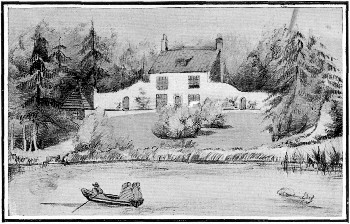 OULTON COTTAGE FROM THE BROAD
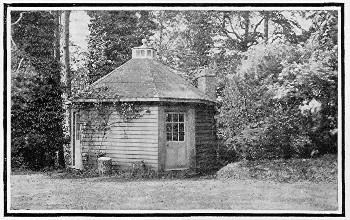 THE SUMMER HOUSE OULTON, AS IT IS TO DAY
Goldington Hall, Bedford, May 24/57[208]
My dear Sir,—Your Book was put into my hands a week ago just as I was leaving London; so I e'en carried it down here, and have been reading it under the best Circumstances:—at such a Season—in the Fields as they now are—and in company with a Friend I love best in the world—who scarce ever reads a Book, but knows better than I do what they are made of from a hint.
Well, lying in a Paddock of his, I have been travelling along with you to Horncastle, etc.,—in a very delightful way for the most part; something as I have travelled, and love to travel, with Fielding, Cervantes, and Robinson Crusoe—and a smack of all these there seems to me, with something beside, in your book. But, as will happen in Travel, there were some spots I didn't like so well—didn't like at all: and sometimes wished to myself that I, a poor 'Man of Taste,' had been at your Elbow (who are a Man of much more than Taste) to divert you, or get you by some means to pass lightlier over some places. But you wouldn't have heeded me, and won't heed me, and must go your own way, I think—And in the parts I least like, I am yet thankful for honest, daring, and original Thought and Speech such as one hardly gets in these mealy-mouthed days. It was very kind of you to send me your book.
My Wife is already established at a House called 'Albert's Villa,' or some such name, at Gorlestone—but a short walk from you: and I am to find myself there in a few days. So I shall perhaps tell you more of my thoughts ere long. Now I shall finish this large Sheet with a Tetrastich of one Omar Khayyám who was an Epicurean Infidel some 500 years ago:

and am yours very truly,
Edward FitzGerald.
[Pg 354]
In a letter to Cowell about the same time—June 5, 1857—FitzGerald writes that he is about to set out for Gorleston, Great Yarmouth:
Within hail almost lives George Borrow, who has lately published, and given me, two new volumes of Lavengro called Romany Rye, with some excellent things, and some very bad (as I have made bold to write to him—how shall I face him!) You would not like the book at all I think.[210]
It was Cowell, it will be remembered, who introduced FitzGerald to the Persian poet Omar, and afterwards regretted the act. The first edition of The Rubáiyát of Omar Khayyám appeared two years later, in 1859. Edward Byles Cowell was born in Ipswich in 1826, and he was educated at the Ipswich Grammar School. It was in the library attached to the Ipswich Library Institution that Cowell commenced the study of Oriental languages. In 1842 he entered the business of his father and grandfather as a merchant and maltster. When only twenty years of age he commenced his friendship with Edward FitzGerald, and their correspondence may be found in Dr. Aldis Wright's FitzGerald Correspondence. In 1850 he left his brother to carry on the business and entered himself[Pg 355] at Magdalen Hall, Oxford, where he passed six years. At intervals he read Greek with FitzGerald and, later, Persian. FitzGerald commenced to learn this last language, which was to bring him fame, when he was forty-four years of age. In 1856 Cowell was appointed to a Professorship of English History at Calcutta, and from there he sent FitzGerald a copy of the manuscript of Omar Khayyám, afterwards lent by FitzGerald to Borrow. Much earlier than this—in 1853—FitzGerald had written to Borrow:
At Ipswich, indeed, is a man whom you would like to know, I think, and who would like to know you; one Edward Cowell: a great scholar, if I may judge.... Should you go to Ipswich do look for him! a great deal more worth looking for (I speak with no sham modesty, I am sure) than yours,—E. F. G.[211]
Twenty-six years afterwards—in 1879—we find FitzGerald writing to Dr. Aldis Wright to the effect that Cowell had been seized with 'a wish to learn Welsh under George Borrow':
And as he would not venture otherwise, I gave him a Note of Introduction, and off he went, and had an hour with the old Boy, who was hard of hearing and shut up in a stuffy room, but cordial enough; and Cowell was glad to have seen the Man, and tell him that it was his Wild Wales which first inspired a thirst for this language into the Professor.[212]
This introduction and meeting are described by Professor Cowell in the following letter:[213]
Cambridge, December 10, 1892.
Dear Sir,—I fear I cannot help you much by my reminiscences of Borrow. I never had the slightest interest in the gipsies, but I always had a corner in my heart for Spain and Wales, and consequently The Bible in Spain and Wild Wales have always been favourite books. But though Borrow's works were well known to me, I never saw him but once, and what I saw of him then made me feel that he was one of those men who put the best part of themselves into their books. We get the pure gold there without the admixture of alloy which daily life seemed to impart.
I was staying one autumn at Lowestoft some ten years or more ago when I asked my dear old friend, Mr. Edward FitzGerald, to give me a letter of introduction to Mr. George Borrow. Armed with this I started on my pilgrimage and took a chaise for Oulton Hall. I remember as we drew near we turned into a kind of drift road through the fields where the long sweeping boughs of the trees hung so low that I lost my hat more than once as we drove along. My driver remarked that the old gentleman would not allow any of his trees to be cut. When we reached the hall I went in at the gate into the farmyard, but I could see nobody about anywhere. I walked up to the front door, but nobody answered my knock except some dogs, who began barking from their kennels. At last in answer to a very loud knock, the door was opened by an old gentleman whom I at once recognised by the engraving to be Borrow himself. I gave him my letter and introduced myself. He replied in a tone of humorous petulance, 'What is the good of your bringing me a letter when I haven't got my spectacles to read it?' However, he took me into his room, where I fancy my knock had roused him from a siesta. We soon got into talk. He began by some unkind remarks about one or two of our common friends, but I soon turned the subject to books, especially Spanish and Welsh books. Here I own I was disappointed in his conversation. I talked to him about Ab Gwilym, whom he speaks so highly of in Wild Wales, but his interest was languid. He did not seem interested when I told him that the London Society of Cymmrodorion were publishing in their journal the Welsh poems of Iolo Goch, the bard of Owen Glendower who fought with our Henry v., two of whose poems Borrow had given spirited translations of in Wild Wales. He told me he had heaps of translations from Welsh books somewhere in his cupboards but he did not know where to lay his hand on[Pg 357] them. He did not show me one Welsh or Spanish book of any kind. You may easily imagine that I was disappointed with my interview and I never cared to visit him again. Borrow was a man of real genius, and his Bible in Spain and Wild Wales are unique books in their way, but with all his knowledge of languages he was not a scholar. I should be the last person to depreciate his Sleeping Bard, for I owe a great deal to it as it helped me to read the Welsh original, but it is full of careless mistakes. The very title is wrong; it should not be the Visions of the Sleeping Bard but the Visions of the Bard Sleep, as the bard or prophet Sleep shows the author in a series of dreams—his visions of life, death, and hell, which form the three chapters of the book.
Borrow knew nothing of philology. His strange version of 'Om mani padme hûm' (Oh! the gem in the lotus ho!) must have been taken from some phonetic representation of the sounds as heard by an ignorant traveller in China or Mongolia.
I have written this long letter lured on by my recollections, but after all I can tell you nothing. Surely it is best that Borrow should remain a name; we have the best part of him still living in his best books.
I don't see why we should trouble ourselves about his 'worst.' He had his weaker side like all of us, the foolish part of his nature as well as the wise; but 'de mortuis nil nisi bonum' especially applies in such cases.—I remain, dear sir, yours sincerely,
E. B. Cowell.
There is one short letter from FitzGerald to Borrow in Dr. Aldis Wright's FitzGerald Letters. It is dated June 1857 and from it we learn that FitzGerald lent Borrow the Calcutta manuscript of Omar Khayyám, upon which he based his own immortal translation, and from a letter to W. H. Thompson in 1861 we learn that Cowell, who had inspired the writing of FitzGerald's Omar Khayyám, Donne and Borrow were the only three friends to whom he had sent copies of his 'peccadilloes[Pg 358] in verse' as he calls his remarkable translation,[214] and this two years after it was published. A letter, dated July 6, 1857,[215] asks for the return of FitzGerald's copy of the Ouseley manuscript of Omar Khayyám, Borrow having clearly already returned the Calcutta manuscript. This letter concludes on a pathetic note:
My old Parson Crabbe is bowing down under epileptic fits, or something like, and I believe his brave old white head will soon sink into the village church sward. Why, our time seems coming. Make way, gentlemen!
Borrow comes more than once into the story of FitzGerald's great translation of Omar Khayyám, which in our day has caused so great a sensation, and deserves all the enthusiasm that it has excited as the
to quote Tennyson's famous eulogy. Cowell, to his after regret, for he had none of FitzGerald's dolce far niente paganism, had sent FitzGerald from Calcutta, where he was, the manuscript of Omar Khayyám's Rubáiyát in Persian, and FitzGerald was captured by it. Two years later, as we know, he produced the translation, which was so much more than a translation. 'Omar breathes a sort of consolation to me,' he wrote to Cowell. 'Borrow is greatly delighted with your MS. of Omar which I showed him,' he says in another letter to Cowell (June 23, 1857), 'delighted at the terseness so unusual in Oriental verse.'[216]
[Pg 359]The next two letters by FitzGerald from my Borrow Papers are of the year 1859, the year of the first publication of the Rubáiyát:
10 Marine Parade, Lowestoft.
My dear Borrow,—I have come here with three nieces to give them sea air and change. They are all perfectly quiet, sensible, and unpretentious girls; so as, if you will come over here any day or days, we will find you board and bed too, for a week longer at any rate. There is a good room below, which we now only use for meals, but which you and I can be quite at our sole ease in. Won't you come?
I purpose (and indeed have been some while intentioning) to go over to Yarmouth to look for you. But I write this note in hope it may bring you hither also.
Donne has got his soldier boy home from India—Freddy—I always thought him a very nice fellow indeed. No doubt life is happy enough to all of them just now. Donne has been on a visit to the Highlands—which seems to have pleased him—I have got an MS. of Bahram and his Seven Castles (Persian), which I have not yet cared to look far into. Will you? It is short, fairly transcribed, and of some repute in its own country, I hear. Cowell sent it me from Calcutta; but it almost requires his company to make one devote one's time to Persian, when, with what remains of one's old English eyes, one can read the Odyssey and Shakespeare.
With compliments to the ladies, believe me, Yours very truly,
Edward FitzGerald.
I didn't know you were back from your usual summer tour till Mr. Cobb told my sister lately of having seen you.
Bath House, Lowestoft, October 10/59.
Dear Borrow,—This time last year I was here and wrote to ask about you. You were gone to Scotland. Well, where are you now? As I also said last year: 'If you be in Yarmouth and have any mind to see me I will go over some day; or here I am if you will come here. And I am quite alone. As it is I would bus it to Yarmouth but I don't know if you and yours be there at all, nor if there, whereabout. If I don't hear at all I shall suppose you are not there, on one of your excursions, or not wanting to be rooted out; a condition I too well understand. I was at Gorleston some months ago for some while; just after losing my greatest friend, the Bedfordshire lad who was crushed to death, coming home from hunting, his horse falling on him. He survived indeed two months, and I had been to bid him eternal adieu, so had no appetite for anything but rest—rest—rest. I have just seen his widow off from here. With kind regards to the ladies, Yours very truly,
Edward FitzGerald.
In a letter to George Crabbe the third, and the grandson of the poet, in 1862, FitzGerald tells him that he has just been reading Borrow's Wild Wales, 'which I like well because I can hear him talking it. But I don't know if others will like it.' 'No one writes better English than Borrow in general,' he says. But FitzGerald, as a lover of style, is vexed with some of Borrow's phrases, and instances one: '"The scenery was beautiful to a degree," What degree? When did this vile phrase arise?' The criticism is just, but Borrow, in common with many other great English authors whose work will live was not uniformly a good stylist. He has many lamentable fallings away from the ideals of the stylist. But he will, by virtue of a wonderful individuality, outlive many a good stylist. His four great books are immortal, and one of them is Wild Wales.
We have a glimpse of FitzGerald in the following letter in my possession, by the friend who had[Pg 361] introduced him to Borrow, William Bodham Donne:[217]
40 Weymouth Street, Portland Place, W., November 28/62.
My dear Borrow,—Many thanks for the copy of Wild Wales reserved for and sent to me by Mr. R. Cooke.[218] Before this copy arrived I had obtained one from the London Library and read it through, not exactly stans pede in uno, but certainly almost at a stretch. I could not indeed lay it down, it interested me so much. It is one of the very best records of home travel, if indeed so strange a country as Wales is can properly be called home, I have ever met with.
Immediately on closing the third volume I secured a few pages in Fraser's Magazine for Wild Wales, for though you do not stand in need of my aid, yet my notice will not do you a mischief, and[Pg 362] some of the reviewers of Lavengro were, I recollect, shocking blockheads, misinterpreting the letter and misconceiving the spirit of that work. I have, since we met in Burlington Arcade, been on a visit to FitzGerald. He is in better spirits by far than when I saw him about the same time in last year. He has his pictures and his chattels about him, and has picked up some acquaintance among the merchants and mariners of Woodbridge, who, although far below his level, are yet better company than the two old skippers he was consorting with in 1861. They—his present friends—came in of an evening, and sat and drank and talked, and I enjoyed their talk very much, since they discussed of what they understood, which is more than I can say generally of the fine folks I occasionally (very occasionally now) meet in London. I should have said more about your book, only I wish to keep it for print: and you don't need to be told by me that it is very good.—With best regards to Mrs. Borrow and Miss Clarke, I am, yours ever truly,
W. B. Donne.
The last letter from FitzGerald to Borrow is dated many years after the correspondence I have here printed,[219] and from it we gather that there had been no correspondence in the interval.[220] FitzGerald writes from Little Grange, Woodbridge, in January 1875, to say that he had received a message from Borrow that he would be glad to see him at Oulton. 'I think the more of it,' says FitzGerald, 'because I imagine, from what I have heard, that you have slunk away from human company as much as I have.' He hints that they might not like one another so well after a fifteen years' separation. He declares with infinite pathos that he has now severed himself from all old ties, has refused the invitations of old college friends and old schoolfellows. To him there was no companionship possible for his declining days other than his reflections and verses. It is a fine letter,[Pg 363] filled with that graciousness of spirit that was ever a trait in FitzGerald's noble nature. The two men never met again. When Borrow died, in 1881, FitzGerald, who followed him two years later, suggested to Dr. Aldis Wright, afterwards to be his (FitzGerald's) executor, who was staying with him at the time, that he should look over Borrow's books and manuscripts if his stepdaughter so desired. If this had been arranged, and Dr. Aldis Wright had written Borrow's life, there would have been no second biographer.[221]
[205] This was said by FitzGerald to his friend Frederick Spalding.
[206] Edward FitzGerald to George Borrow, in Knapp's Life, vol. ii. p. 346.
[207] The Works of Edward FitzGerald, vol. ii. p. 59 (Macmillan).
[208] FitzGerald was staying with his friends Mr. and Mrs. W. K. Browne. There is no letter other than this one to Borrow to recall that visit, which is, however, referred to in the FitzGerald Correspondence (Works, vol. ii. p. 75) by the following sentence:—'When in Bedfordshire I put away almost all Books except Omar Khayyám! which I could not help looking over in a Paddock covered with Buttercups and brushed by a delicious Breeze, while a dainty racing Filly of Browne's came startling up to wonder and to snuff about me.' The 'friend' of the letter was of course Mr. W. K. Browne, who was more of an open air man than a bookman.
[209] I am indebted to Mr. Edward Heron-Allen for the information that this is the original of the last verse but one in FitzGerald's first version of the Rubáiyát:
The literal translation is:
[210] The Works of Edward FitzGerald, vol. ii. p. 74 (Macmillan).
[211] Letters of Edward FitzGerald, vol. ii. p. 15.
[212] Ibid., vol. iv. p. 85 (Macmillan).
[213] First published in The Sphere, October 31, 1903. The letter was written to Mr. James Hooper of Norwich.
[214] Works of Edward FitzGerald, vol. ii. p. 135 (Macmillan).
[215] Published by Dr. Knapp in Borrow's Life, vol. ii. p. 348 (Murray).
[216] We learn from FitzGerald that Borrow's eyesight gave way about this time, and his wife had to keep all books from him.
[217] There are two or three references to Borrow in William Bodham Donne and his Friends, edited by Catharine B. Johnson (Methuen). The most important of these is in a letter from Donne to Bernard Barton, dated from Bury St. Edmunds, September 12th, 1848:
'We have had a great man here, and I have been walking with him and aiding him to eat salmon and mutton and drink port—George Borrow; and what is more, we fell in with some gypsies and I heard the speech of Egypt, which sounded wonderously like a medley of broken Spanish and dog Latin. Borrow's face lighted by the red turf fire of the tent was worth looking at. He is ashy white now, but twenty years ago, when his hair was like a raven's wing, he must have been hard to discriminate from a born Bohemian. Borrow is best on the tramp, if you can walk four and a half miles per hour—as I can with ease and do by choice—and can walk fifteen of them at a stretch—which I can compass also—then he will talk Iliads of adventures even better than his printed ones. He cannot abide those amateur pedestrians who saunter, and in his chair he is given to groan and be contradictory. But on Newmarket Heath, in Rougham Woods, he is at home, and specially when he meets with a thorough vagabond like your present correspondent.'
In June 1874 FitzGerald writes to Donne:
'I saw in some Athenæum a somewhat contemptuous notice of G. B.'s Rommany Lil or whatever the name is. I can easily understand that B. should not meddle with science of any sort; but some years ago he would not have liked to be told so; however, old age may have cooled him now.'
[218] Mr. Robert Cooke was a partner in John Murray's firm at this time.
[219] It is to be found in Dr. Knapp's Life, vol. ii. pp. 248-9.
[220] I have a copy of FitzGerald's.
[221] Dr. Aldis Wright tells me that he did go over to Oulton to see Mrs. MacOubrey, and gave her the best advice he could, but it was neglected.
The year 1854 was an adventurous one in Borrow's life, for he, so essentially a Celt, as Mr. Watts-Dunton has more than once reminded us,[222] had in that year two interesting experiences of the 'Celtic Fringe.' He spent the first months of the year in Cornwall, as we have seen, and from July to November he was in Wales. That tour he recorded in pencilled notebooks, four of which are in the Knapp Collection in New York, and are duly referred to in Dr. Knapp's biography, and two of which are in my possession. In addition to this I have the complete manuscript of Wild Wales in Borrow's handwriting, and many variants of it in countless, carefully written pages. Therein lie the possibilities of a singularly interesting edition of Wild Wales should opportunity offer for its publication. When I examine the manuscript, with its demonstration of careful preparation, I do not wonder that it took Borrow eight years—from 1854 to 1862—to prepare this book for the press. Assuredly we recognise here, as in all his books, that he realised Carlyle's definition of genius—'the[Pg 365] transcendent capacity of taking trouble—first of all.'
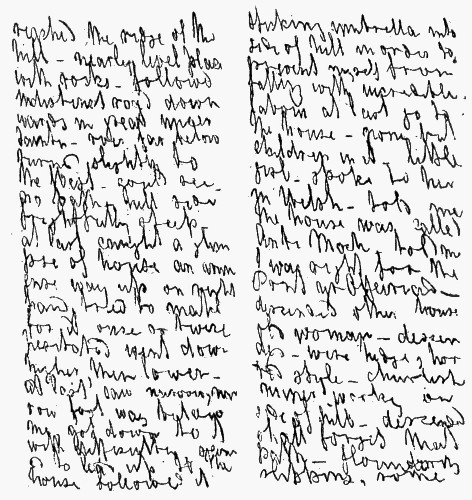 WILD WALES IN ITS BEGINNINGS.
It was on 27th July 1854 that Borrow, his wife and her daughter, Henrietta Clarke, set out on their journey to North Wales. Dr. Knapp prints two kindly letters from Mrs. Borrow to her mother-in-law written from Llangollen on this tour. 'We are in a lovely quiet spot,' she writes, 'Dear George goes out exploring the mountains.... The poor here are humble, simple,[Pg 366] and good.' In the second letter Mrs. Borrow records that her husband 'keeps a daily journal of all that goes on, so that he can make a most amusing book in a month.' Yet Borrow took eight years to make it. The failure of The Romany Rye, which was due for publication before Wild Wales, accounts for this, and perhaps also the disappointment that another book, long since ready, did not find a publisher. In the letter from which I have quoted Mary Borrow tells Anne Borrow that her son will, she expects at Christmas, publish The Romany Rye, 'together with his poetry in all the European languages.' This last book had been on his hands for many a day, and indeed in Wild Wales he writes of 'a mountain of unpublished translations' of which this book, duly advertised in The Romany Rye, was a part.[223]
After an ascent of Snowdon arm in arm with Henrietta, Mrs. Borrow remaining behind, Borrow left his wife and daughter to find their way back to Yarmouth, and continued his journey, all of which is most picturesquely described in Wild Wales. Before that book was published, however, Borrow was to visit the Isle of Man, Scotland, and Ireland. He was to publish Lavengro (1857); to see his mother die (1858); and to issue his very limited edition of The Sleeping Bard (1860); and, lastly, to remove to Brompton (1860). It was at the end of the year 1862 that Wild Wales was published. It had been written during the two years immediately following the tour in Wales, in 1855 and 1856. It had been announced as ready for publication in 1857, but doubtless the chilly reception[Pg 367] of The Romany Rye in that year, of which we have written, had made Borrow lukewarm as to venturing once more before the public. The public was again irresponsive. The Cornhill Magazine, then edited by Thackeray, declared the book to be 'tiresome reading.' The Spectator reviewer was more kindly, but nowhere was there any enthusiasm. Only a thousand copies were sold,[224] and a second edition did not appear until 1865, and not another until seven years after Borrow's death. Yet the author had the encouragement that comes from kindly correspondents. Here, for example, is a letter that could not but have pleased him:
West Hill Lodge, Highgate,
Dec. 29th, 1862.
Dear Sir,—We have had a great Christmas pleasure this year—the reading of your Wild Wales, which has taken us so deliciously into the lovely fresh scenery and life of that pleasant mountain-land. My husband and myself made a little walking tour over some of your ground in North Wales this year; my daughter and her uncle, Richard Howitt, did the same; and we have been ourselves collecting material for a work, the scenes of which will be laid amidst some of our and your favourite mountains. But the object of my writing was not to tell you this; but after assuring you of the pleasure your work has given us—to say also that in one respect it has tantalised us. You have told over and over again to fascinated audiences, Lope de Vega's ghost story, but still leave the poor reader at the end of the book longing to hear it in vain.
May I ask you, therefore, to inform us in which of Lope de Vega's numerous works this same ghost story is to be found? We like ghost stories, and to a certain extent believe in them, we deserve therefore to know the best ghost story in the world:
Wishing for you, your wife and your Henrietta, all the compliments of the season in the best and truest of expression.—I am, dear sir, yours sincerely,
Mary Howitt.[225]
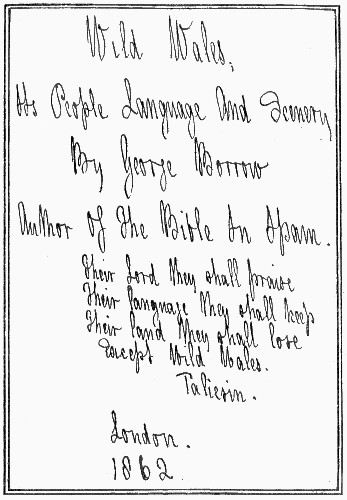 FACSIMILE OF THE TITLE-PAGE OF WILD WALES
The reference to Lope de Vega's ghost story is due to the fact that in the fifty-fifth chapter of Wild Wales, Borrow, after declaring that Lope de Vega was 'one of the greatest geniuses that ever lived,' added, that among his tales may be found 'the best ghost story in the world.' Dr. Knapp found the story in Borrow's handwriting among the manuscripts that came to him, and gives it in full. In good truth it is but moderately interesting, although Borrow seems to have told it to many audiences when in Wales, but this perhaps provides the humour of the situation. It seems clear that Borrow contemplated publishing Lope de Vega's ghost story in a later book. We note here, indeed, a letter of a much later date in which Borrow refers to the possibility of a supplement to Wild Wales, the only suggestion of such a book that I have seen, although there is plenty of new manuscript in my Borrow collection to have made such a book possible had Borrow been encouraged by his publisher and the public to write it.[Pg 370]
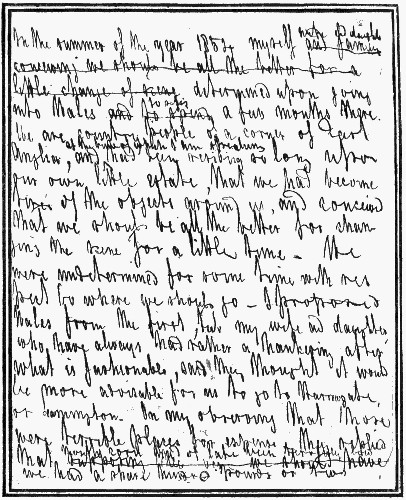 FACSIMILE OF THE FIRST PAGE OF WILD WALES
22 Hereford Square, Brompton, Decr. 31, 1863.
Dear Sir,—I have received your letter and thank you for the kind manner in which you are pleased to express yourself concerning me. Now for your questions. With respect to Lope De Vega's ghost story, I beg to say that I am thinking of publishing a supplement to my Wild Wales in which, amongst other things, I shall give a full account of the tale and point out where it is to be found. You cannot imagine the number of letters I receive on the subject of that ghost story. With regard to the Sclavonian languages, I wish to observe that they are all well deserving of[Pg 371] study. The Servian and Bohemian contain a great many old traditionary songs, and the latter possesses a curious though not very extensive prose literature. The Polish has, I may say, been rendered immortal by the writings of Mickiewicz, whose 'Conrad Wallenrod' is probably the most remarkable poem of the present century. The Russian, however, is the most important of all the Sclavonian tongues, not on account of its literature but because it is spoken by fifty millions of people, it being the dominant speech from the Gulf of Finland to the frontiers of China. There is a remarkable similarity both in sound and sense between many Russian and Welsh words, for example 'tcheló' ([Russian]) is the Russian for forehead, 'tal' is Welsh for the same; 'iasnhy' (neuter 'iasnoe') is the Russian for clear or radiant, 'iesin' the Welsh, so that if it were grammatical in Russian to place the adjective after the noun as is the custom in Welsh, the Welsh compound 'Taliesin' (Radiant forehead) might be rendered in Russian by 'Tchelōiasnoe,' which would be wondrously like the Welsh name; unfortunately, however, Russian grammar would compel any one wishing to Russianise 'Taliesin' to say not 'Tchelōiasnoe' but 'Iasnoetchelo.'—Yours truly,
George Borrow.
Another letter that Borrow owed to his Wild Wales may well have place here. It will be recalled that in his fortieth chapter he waxes enthusiastic over Lewis Morris, the Welsh bard, who was born in Anglesey in 1700 and died in 1765. Morris's great-grandson, Sir Lewis Morris (1833-1907), the author of the once popular Epic of Hades, was twenty-nine years of age when he wrote to Borrow as follows:—
Reform Club, Dec. 29, 1862.
Sir,—I have just finished reading your work on Wild Wales, and cannot refrain from writing to thank you for the very lifelike picture of the Welsh people, North and South, which, unlike other Englishmen, you have managed to give us. To ordinary Englishmen[Pg 372] the language is of course an insurmountable bar to any real knowledge of the people, and the result is that within six hours of Paddington or Euston Square is a country nibbled at superficially by droves of holiday-makers, but not really better known than Asia Minor. I wish it were possible to get rid of all obstacles which stand in the way of the development of the Welsh people and the Welsh intellect. In the meantime every book which like yours tends to lighten the thick darkness which seems to hang round Wales deserves the acknowledgments of every true Welshman. I am, perhaps, more especially called upon to express my thanks for the very high terms in which you speak of my great-grandfather, Lewis Morris. I believe you have not said a word more than he deserves. Some of the facts which you mention with regard to him were unknown to me, and as I take a very great interest in everything relating to my ancestor I venture to ask you whether you can indicate any source of knowledge with regard to him and his wife, other than those which I have at present—viz. an old number of the Cambrian Register and some notices of him in the Gentleman's Magazine, 1760-70. There is also a letter of his in Lord Teignmouth's Life of Sir William Jones in which he claims kindred with that great scholar. Many of his manuscript poems and much correspondence are now in the library of the British Museum, most of them I regret to say a sealed book to one who like myself had yet to learn Welsh. But I am not the less anxious to learn all that can be ascertained about my great ancestor. I should say that two of his brothers, Richard and William, were eminent Welsh scholars.
With apologies for addressing you so unceremoniously, and with renewed thanks, I remain, Sir, your obedient servant,
Lewis Morris.
An interesting letter to Borrow from another once popular writer belongs to this period:
The 'Press' Office, Strand, Westminster, Thursday.
One who has read and delighted in everything Mr. Borrow has yet published ventures to say how great has been his delight in reading Wild Wales. No philologist or linguist, I am yet an untiring walker and versifier: and really I think that few things are pleasanter than to walk and to versify. Also, well do I love good ale, natural drink of the English. If I could envy anything, it is your linguistic faculty, which unlocks to you the hearts of the unknown races of these islands—unknown, I mean, as to their real feelings and habits, to ordinary Englishmen—and your still higher faculty of describing your adventures in the purest and raciest English of the day. I send you a Danish daily journal, which you may not have seen. Once a week it issues articles in English. How beautiful (but of course not new to you) is the legend of Queen Dagmar, given in this number! A noble race, the Danes: glad am I to see their blood about to refresh that which runs in the royal veins of England. Sorry and ashamed to see a Russell bullying and insulting them.
Mortimer Collins.[226]
How greatly Borrow was disappointed at the comparative failure of Wild Wales may be gathered from a curt message to his publisher which I find among his papers:
Mr. Borrow has been applied to by a country bookseller, who is desirous of knowing why there is not another edition of Wild Wales, as he cannot procure a copy of the book, for which he receives frequent orders. That it was not published in a cheap form as soon as the edition of 1862 was exhausted has caused much surprise.
Borrow, it will be remembered, left Wales at Chepstow, as recorded in the hundred and ninth and final chapter of Wild Wales, 'where I purchased a first class ticket, and ensconcing myself in a comfortable carriage, was soon on my way to London, where I arrived at about four o'clock in the morning.' In the[Pg 374] following letter to his wife there is a slight discrepancy, of no importance, as to time:
53a Pall Mall, London.
Dear Wife Carreta,—I arrived here about five o'clock this morning—time I saw you. I have walked about 250 miles. I walked the whole way from the North to the South—then turning to the East traversed Glamorganshire and the county of Monmouth, and came out at Chepstow. My boots were worn up by the time I reached Swansea, and was obliged to get them new soled and welted. I have seen wonderful mountains, waterfalls, and people. On the other side of the Black Mountains I met a cartload of gypsies; they were in a dreadful rage and were abusing the country right and left. My last ninety miles proved not very comfortable, there was so much rain. Pray let me have some money by Monday as I am nearly without any, as you may well suppose, for I was three weeks on my journey. I left you on a Thursday, and reached Chepstow yesterday, Thursday, evening. I hope you, my mother, and Hen. are well. I have seen Murray and Cooke.—God bless you, yours,
George Borrow.
(Keep this.)
Before Borrow put the finishing touches to Wild Wales he repeated his visit of 1854. This was in 1857, the year of The Romany Rye. Dr. Knapp records the fact through a letter to Mr. John Murray from Shrewsbury, in which he discusses the possibility of a second edition of The Romany Rye: 'I have lately been taking a walk in Wales of upwards of five hundred miles,' he writes. This tour lasted from August 23rd to October 5th. I find four letters to his wife that were written in this holiday. He does not seem to have made any use of this second tour in his Wild Wales, although I have abundance of manuscript notes upon it in my possession.[Pg 375]
Tenby, Tuesday, 25.
My dear Carreta,—Since writing to you I have been rather unwell and was obliged to remain two days at Sandypool. The weather has been horribly hot and affected my head and likewise my sight slightly; moreover one of the shoes hurt my foot. I came to this place to-day and shall presently leave it for Pembroke on my way back. I shall write to you from there. I shall return by Cardigan. What I want you to do is to write to me directed to the post office, Cardigan (in Cardiganshire), and either inclose a post office order for five pounds or an order from Lloyd and Co. on the banker of that place for the same sum; but at any rate write or I shall not know what to do. I would return by railroad, but in that event I must go to London, for there are no railroads from here to Shrewsbury. I wish moreover to see a little more. Just speak to the banker and don't lose any time. Send letter, and either order in it, or say that I can get it at the bankers. I hope all is well. God bless you and Hen.
George Borrow.
Trecastle, Brecknockshire, South Wales, August 17th.
Dear Carreta,—I write to you a few words from this place; to-morrow I am going to Llandovery and from there to Carmarthen; for the first three or four days I had dreadful weather. I got only to Worthen the first day, twelve miles—on the next to Montgomery, and so on. It is now very hot, but I am very well, much better than at Shrewsbury. I hope in a few days to write to you again, and soon to be back to you. God bless you and Hen.
G. Borrow.
Lampeter, 3rd September 1857.
My dear Carreta,—I am making the best of my way to Shrewsbury (My face is turned towards Mama). I write this from[Pg 376] Lampeter, where there is a college for educating clergymen intended for Wales, which I am going to see. I shall then start for Badnor by Tregaron, and hope soon to be in England. I have seen an enormous deal since I have been away, and have walked several hundred miles. Amongst other places I have seen St. David's, a wonderful half ruinous cathedral on the S. Western end of Pembrokeshire, but I shall be glad to get back. God bless you and Hen.
George Borrow.
Henrietta! Do you know who is handsome?
Presteyne, Radnorshire, Monday morning.
Dear Carreta,—I am just going to start for Ludlow, and hope to be at Shrewsbury on Tuesday night if not on Monday morning. God bless you and Hen.
G. Borrow.
When I get back I shall have walked more than 400 miles.
In Wild Wales we have George Borrow in his most genial mood. There are none of the hairbreadth escapes and grim experiences of The Bible in Spain, none of the romance and the glamour of Lavengro and its sequel, but there is good humour, a humour that does not obtain in the three more important works, and there is an amazing amount of frank candour of a biographical kind. We even have a reference to Isopel Berners, referred to by Captain Bosvile as 'the young woman you used to keep company with ... a fine young woman and a virtuous.' It is the happiest of Borrow's books, and not unnaturally. He was having a genuine holiday, and he had the companionship during a part of it of his wife and daughter, of whom he was, as this book is partly written to prove, very genuinely fond. He also enjoyed the singularly felicitous experience of[Pg 377] harking back upon some of his earliest memories. He was able to retrace the steps he took in the Welsh language during his boyhood:
That night I sat up very late reading the life of Twm O'r Nant, written by himself in choice Welsh.... The life I had read in my boyhood in an old Welsh magazine, and I now read it again with great zest, and no wonder, as it is probably the most remarkable autobiography ever penned.
It is in this ecstatic mood that he passes through Wales. Let me recall the eulogy on 'Gronwy' Owen, and here it may be said that Borrow rarely got his spelling correct of the proper names of his various literary heroes, in the various Norse and Celtic tongues in which he delighted.[227] But how much Borrow delighted in his poets may be seen by his eulogy on Goronwy Owen, which in its pathos recalls Carlyle's similar eulogies over poor German scholars who interested him, Jean Paul Richter and Heyne, for example. Borrow ignored Owen's persistent intemperance and general impracticability. Here and here only, indeed, does he remind one of Carlyle.[228] He had a great capacity for hero-worship, although the two were not interested in the same heroes. His hero-worship of Owen took him over large tracks of country in search of that poet's[Pg 378] birthplace. He writes of the delight he takes in inspecting the birth-places and haunts of poets. 'It is because I am fond of poetry, poets, and their haunts, that I am come to Anglesey.'[229] 'I proceeded on my way,' he says elsewhere, 'in high spirits indeed, having now seen not only the tomb of the Tudors, but one of those sober poets for which Anglesey has always been so famous.' And thus it is that Wild Wales is a high-spirited book, which will always be a delight and a joy not only to Welshmen, who, it may be hoped, have by this time forgiven 'the ecclesiastical cat' of Llangollen, but to all who rejoice in the great classics of the English tongue.
[222] 'Not one drop of East Anglian blood was in the veins of Borrow's father, and very little in the veins of his mother. Borrow's ancestry was pure Cornish on one side, and on the other mainly French.'—Theodore Watts-Dunton: Introduction to The Romany Rye (Ward and Lock).
[223] The advertisement describes it thus: 'In two volumes, Songs of Europe: or Metrical Translations from all the European Languages; With Brief Prefatory Remarks on each Language and its Literature.'
[224] Wild Wales: Its People, Language, and Scenery. By George Borrow. 3 vols. John Murray, 1862.
[225] Mary Botham (1799-1888) was born at Coleford, Gloucestershire, and married William Howitt in 1821. The pair compiled many books together. The statement in the Dictionary of National Biography that 'nothing that either of them wrote will live' is quite unwarranted. William Howitt's Homes and Haunts of the most eminent British Poets (Bentley, 2 vols., 1847) is still eagerly sought after for every good library. In Mary Howitt: An Autobiography (Isbister, 2 vols., 1889), a valuable book of reminiscences, there is no mention of Borrow.
[226] Edward James Mortimer Collins (1827-1876), once bore the title of 'King of the Bohemians' among his friends; wrote Sweet and Twenty and many other novels once widely popular.
[227] Goronwy or Gronow Owen (1723-1769), born at Rhos Fawr in Anglesey, and died at St. Andrews, Brunswick County, Virginia.
[228] Borrow had at many points certain affinities to Carlyle's hero Johnson, but lacked his epigrammatic wit—and much else. But he seems to have desired to emulate Johnson in one particular, as we find in the following dialogue:—
'I wouldn't go on foot there this night for fifty pounds.'
'Why not?' said I.
'For fear of being knocked down by the colliers, who will be all out and drunk.'
'If not more than two attack me,' said I, 'I shan't so much mind. With this book I am sure I can knock down one, and I think I can find play for the other with my fists.'
[229] When searching for the home of Goronwy Owen Borrow records a meeting with one of his descendants—a little girl of seven or eight years of age, named Ellen Jones, who in recent years has been interviewed as to her impressions of Borrow's visit. 'He did speak funny Welsh,' she says, ' ... he could not pronounce the "ll." 'He had plenty of words, but bad pronunciation.'—Herbert Jenkins: Life of Borrow, p. 418. But Borrow in Wild Wales frequently admits his imperfect acquaintance with spoken Welsh.
George Borrow's earlier visits to London are duly recorded, with that glamour of which he was a master, in the pages of Lavengro. Who can cross London Bridge even to-day without thinking of the apple-woman and her copy of Moll Flanders; and many passages of Borrow's great book make a very special appeal to the lover of London. Then there was that visit to the Bible Society's office made on foot from Norwich, and the expedition a few months later to pass an examination in the Manchu language. When he became a country squire and the author of the very successful Bible in Spain Borrow frequently visited London, and his various residences may be traced from his letters. Take, for example, these five notes to his wife, the first apparently written in 1848, but all undated:
Tuesday afternoon.
My dear Wife,—I just write you a line to tell you that I am tolerably well as I hope you are. Every thing is in confusion abroad. The French King has disappeared and will probably never be heard of, though they are expecting him in England. Funds are down nearly to eighty. The Government have given up the income tax and people are very glad of it. I am not.[Pg 380] With respect to the funds, if I were to sell out I should not know what to do with the money. J. says they will rise. I do not think they will, they may, however, fluctuate a little.—Keep up your spirits, my heart's dearest, and kiss old Hen. for me.
G. B.
53a, Pall Mall.
Dear Wife Carreta,—I write you a line as I suppose you will be glad to have one. I dine to-night with Murray and Cooke, and we are going to talk over about The Sleeping Bard; both are very civil. I have been reading hard at the Museum and have lost no time. Yesterday I went to Greenwich to see the Leviathan. It is almost terrible to look at, and seems too large for the river. It resembles a floating town—the paddle is 60 feet high. A tall man can stand up in the funnel as it lies down. 'Tis sad, however, that money is rather scarce. I walked over Blackheath and thought of poor dear Mrs. Watson. I have just had a note from FitzGerald. We have had some rain but not very much. London is very gloomy in rainy weather. I was hoping that I should have a letter from you this morning. I hope you and Hen. have been well.—God bless you,
George Borrow.
Pall Mall, 53a, Saturday.
Dear Carreta,—I am thinking of coming to you on Thursday. I do not know that I can do anything more here, and the dulness of the weather and the mists are making me ill. Please to send another five pound note by Tuesday morning. I have spent scarcely anything of that which you sent except what I owe to Mrs. W., but I wish to have money in my pocket, and Murray and Cooke are going to dine with me on Tuesday; I shall be glad to be with you again, for I am very much in want of your society. I miss very much my walks at Llangollen by the quiet canal; but what's to be done? Everything seems nearly at a standstill in London, on account of this wretched war, at which it appears to me the English are getting the worst, notwithstanding their[Pg 381] boasting. They thought to settle it in an autumn's day; they little knew the Russians, and they did not reflect that just after autumn comes winter, which has ever been the Russians' friend. Have you heard anything about the rent of the Cottage? I should have been glad to hear from you this morning. Give my love to Hen. and may God bless you, dear.
(Keep this.)
George Borrow.
No. 53a Pall Mall.
Dear Carreta,—I hope you received my last letter written on Tuesday. I am glad that I came to London. I find myself much the better for having done so. I was going on in a very spiritless manner. Everybody I have met seems very kind and glad to see me. Murray seems to be thoroughly staunch. Cooke, to whom I mentioned the F.T., says that Murray was delighted with the idea, and will be very glad of the 4th of Lavengro. I am going to dine with Murray to-day, Thursday. W. called upon me to-day. I wish you would send me a blank cheque, in a letter so that if I want money I may be able to draw for a little. I shall not be long from home, but now I am here I wish to do all that's necessary. If you send me a blank cheque, I suppose W. or Murray would give me the money. I hope you got my last letter. I received yours, and Cooke has just sent the two copies of Lavengro you wrote for, and I believe some engravings of the picture. I shall wish to return by the packet if possible, and will let you know when I am coming. I hope to write again shortly to tell you some more news. How is mother and Hen., and how are all the creatures? I hope all well. I trust you like all I propose—now I am here I want to get two or three things, to go to the Museum, and to arrange matters. God bless you. Love to mother and Hen.
George Borrow.
No. 58 Jermyn Street, St. James.
Dear Carreta,—I got here safe, and upon the whole had not so bad a journey as might be expected. I put up at the Spread Eagle for the night for I was tired and hungry; have got into my old lodgings as you see, those on the second floor, they are very nice ones, with every convenience; they are expensive, it is true, but they are cheerful, which is a grand consideration for me. I have as yet seen nobody, for it is only now a little past eleven. I can scarcely at present tell you what my plans are, perhaps to-morrow I shall write again. Kiss Hen., and God bless you.
G. B.
It was in the year 1843 that Borrow, on a visit to London following upon the success of The Bible in Spain, sat to Henry Wyndham Phillips for his portrait at the instigation of Mr. Murray, who gave Borrow a replica, retaining for himself Phillips's more finished picture, which has been reproduced again and again in the present Mr. Murray's Borrow productions.[230]
Borrow was in London in 1845 and again in 1848. There must have been other occasional visits on the way to this or that starting point of his annual holiday, but in 1860 Borrow took a house in London, and he resided there until 1874, when he returned to Oulton. In a letter to Mr. John Murray, written from Ireland[Pg 383] in November 1859, Mrs. Borrow writes to the effect that in the spring of the following year she will wish to look round 'and select a pleasant holiday residence within three to ten miles of London.' There is no doubt that a succession of winters on Oulton Broad had been very detrimental to Mrs. Borrow's health, although they had no effect upon Borrow, who bathed there with equal indifference in winter as in summer, having, as he tells us in Wild Wales, 'always had the health of an elephant.' And so Borrow and his wife arrived in London in June, and took temporary lodgings at 21 Montagu Street, Portman Square. In September they went into occupation of a house in Brompton—22 Hereford Square, which is now commemorated by a County Council tablet. Here Borrow resided for fourteen years, and here his wife died on January 30, 1869. She was buried in Brompton Cemetery, where Borrow was laid beside her twelve years later. For neighbour, on the one side, the Borrows had Mr. Robert Collinson and, on the other, Miss Frances Power Cobbe and her companion, Miss M. C. Lloyd. From Miss Cobbe we have occasional glimpses of Borrow, all of them unkindly. She was of Irish extraction, her father having been grandson of Charles Cobbe, Archbishop of Dublin. Miss Cobbe was an active woman in all kinds of journalistic and philanthropic enterprises in the London of the 'seventies and 'eighties of the last century, writing in particular in the now defunct newspaper, the Echo, and she wrote dozens of books and pamphlets, all of them forgotten except her Autobiography,[231] in which she devoted several[Pg 384] pages to her neighbour in Hereford Square. Borrow had no sympathy with fanatical women with many 'isms,' and the pair did not agree, although many neighbourly courtesies passed between them for a time. Here is an extract from Miss Cobbe's Autobiography:
George Borrow, who, if he were not a gypsy by blood, ought to have been one, was for some years our near neighbour in Hereford Square. My friend[232] was amused by his quaint stories and his (real or sham) enthusiasm for Wales, and cultivated his acquaintance. I never liked him, thinking him more or less of a hypocrite. His missions, recorded in The Bible in Spain, and his translations of the Scriptures into the out-of-the-way tongues, for which he had a gift, were by no means consonant with his real opinions concerning the veracity of the said Bible.
One only needs to quote this by the light of the story as told so far in these pages to see how entirely Miss Cobbe misunderstood Borrow, or rather how little insight she was able to bring to a study of his curious character. The rest of her attempt at interpretation is largely taken up to demonstrate how much more clever and more learned she was than Borrow. Altogether it is a sorry spectacle this of the pseudo-philanthropist relating her conversations with a man broken by misfortune and the death of his wife. Many of Miss Cobbe's statements have passed into current biographies and have doubtless found acceptance.[233] I do not find[Pg 385] them convincing. Archdeacon Whately on the other hand tells us that he always found Borrow 'most civil and hospitable,' and his sister gives us the following 'impression':
When Mr. Borrow returned from this Spanish journey, which had been full, as we all know, of most entertaining adventures, related with much liveliness and spirit by himself, he was regarded as a kind of 'lion' in the literary circles of London. When we first saw him it was at the house of a lady who took great pleasure in gathering 'celebrities' in various ways around her, and our party was struck with the appearance of this renowned traveller—a tall, thin, spare man with prematurely white hair and intensely dark eyes, as he stood upright against the wall of one of the drawing-rooms and received the homage of lion-hunting guests, and listened in silence to their unsuccessful attempts to make him talk.'[234]
Another reminiscence of Borrow in London is furnished by Mr. A. T. Story, who writes:[235]
I had the pleasure of meeting Borrow on several occasions in London some forty years ago. I cannot be quite certain of the[Pg 386] year, but I think it was either in 1872 or '73. I saw him first in James Burns's publishing office in Southampton Row. I happened to call just as a tall, strongly-built man with an unforgettable face was leaving. When he had gone, Mr. Burns asked: 'Do you know who that gentleman was?' and when I said I did not, he said: 'He is the man whose book, The Bible in Spain, I saw you take down from the shelf there the other day and read.' 'What, George Borrow?' I exclaimed. He nodded, and then said Borrow had called several times.
A few days later I had an opportunity of making the good man's acquaintance and hearing a conversation between him and Mr. Burns. They talked about Spiritualism, with which Borrow had very little patience, though, after some talk he consented to attend a séance to be held that evening in Burns's drawing-room. We sat together, and I had the pleasure of hearing from time to time his grunts of disapproval. When the discourse—'in trance'—was over, he asked me if I believed in 'this sort of thing,' and when I said I was simply an investigator he remarked, 'That's all right, I, too, am an investigator—of things in general—and it would not take me long to sum up that little man (the medium) as a humbug, but a very clever humbug.'
That evening I had a long walk and a talk with him, and after that several other opportunities of talk, the last being one night when I chanced upon him on Westminster Bridge. It was a superb starlight night, and he was standing about midway over the bridge gazing down into the river. When I approached him he said: 'I have been standing here for twenty minutes looking round and meditating. There is not another city like this in the world, nor another bridge like this, nor a river, nor a Parliament House like that—with its little men making little laws—which the Lawgiver that made yonder stars—look at them!—is continually confounding—and will confound. O, we little men! How long before we are dust? And the stars there, how they smile at our puny lives and tricks—here to-day, gone to-morrow. And yet to-night how glorious it is to be here!'
So he rhapsodised. And then it was, 'Where can we get a bite and sup? I've been footing it all day among the hills there—the Surrey Hills—for a breath of fresh air.'
In appearance, at the time I knew him, Borrow was neither[Pg 387] thin nor stout, but well proportioned and apparently of great strength.
During this sojourn in London, which was undertaken because Oulton and Yarmouth did not agree with his wife, Borrow suffered the tragedy of her loss. Borrow dragged on his existence in London for another five years, a much broken man. It is extraordinary how little we know of Borrow during that fourteen years' sojourn in London; how rarely we meet him in the literary memoirs of this period. Happily one or two pleasant friendships relieved the sadness of his days; and in particular the reminiscences of Walter Theodore Watts-Dunton assist us to a more correct appreciation of the Borrow of these last years of London life. Of Mr. Watts-Dunton's 'memories,' we shall write in our next chapter. Here it remains only to note that Borrow still continued to interest himself in his various efforts at translation, and in 1861 and 1862 the editor of Once a Week printed various ballads and stories from his pen. The volumes of this periodical are before me, and I find illustrations by Sir John Millais, Sir E. J. Poynter, Simeon Solomon and George Du Maurier; stories by Mrs. Henry Wood and Harriet Martineau, and articles by Walter Thornbury.
In 1862 Wild Wales was published, as we have seen. In 1865 Henrietta married William MacOubrey, and in the following year, Borrow and his wife went to visit the pair in their Belfast home. In the beginning of the year 1869 Mrs. Borrow died, aged seventy-three. There are few records of the tragedy that are worth perpetuating.[236] Borrow consumed his own smoke. With his wife's death his life was indeed a wreck.[Pg 388] No wonder he was so 'rude' to that least perceptive of women, Miss Cobbe. Some four or five years more Borrow lingered on in London, cheered at times by walks and talks with Gordon Hake and Watts-Dunton, and he then returned to Oulton—a most friendless man:—
[230] The frontispiece to the present volume is from the replica in the possession of Borrow's executor, who has kindly permitted me to have it photographed for the purpose. There are slight and interesting variations from Mr. Murray's portrait. Phillips (1820-1868), the artist of these pictures, is often confused with his father, Thomas (1770-1845), the Royal Academician and a much superior painter, who, by the way, painted many portraits of authors for Mr. John Murray. Henry Phillips was never an R.A. A letter from Phillips to Borrow in my possession shows that he visited the latter at Oulton. The portrait of Borrow is pronounced by Henry Dalrymple, his schoolfellow, from whose manuscript we have already quoted, to be 'very like him.' This fact is the more remarkable as the only photograph of Borrow that is known, one taken in a group with Mrs. Simms Reeve of Norwich in 1848—five years later—has many points of difference. The reader will here be able to compare the two portraits in this book. A third portrait of Borrow—a crude painting by his brother John taken in his early years, is now in the London National Portrait Gallery.
[231] Life of Frances Power Cobbe as told by Herself. With Additions by the Writer and Introduction by Blanche Atkinson. 2 vols., 1904. Frances Power Cobbe was born in Dublin in 1822, and died at Hengwrt in 1904.
[232] Miss Lloyd, who was a Welshwoman. Miss Cobbe lived with her and was doubtless a jealous woman. There are many kindly letters from Miss Lloyd to Borrow in my collection. She seems always to be anxious to invite him to her house.
[233] About three months before her death Miss Cobbe replied to an inquiry made by Mr. James Hooper of Norwich concerning her estimate of Borrow. As it is all but certain that Borrow was never intoxicated in his life, we may find the letter of interest only as giving a point of view:
'Hengwrt, Dolgelley, N. Wales, Jan. 26, 1904.
'I can have no objection to your asking me if my little sketch of George Borrow in my Life is my dernier mot about him. If I were to give my dernier mot, it would be much more to his disadvantage than anything I liked to insert in my biography. I see his American biographer has accused me of 'bitterness.' I do not think that what is contained in my book is 'bitter' at all. But if I were to have told my last interview with him,—when I was driven practically to drive him out of our house, more or less drunk, or mad with some opiate—the charge might have had some colour. He was not a good man, and not a true or honourable one, by any manner of means.'
Here assuredly we miss the fine charity which led Goethe's friend, the Duchess of Weimar, to urge that there was a special moral law for poets. Not for one moment does it occur to Miss Cobbe that her neighbour was a man of genius who had written four imperishable contributions to English literature. To her he was merely a conceited, brusque old man. Concerning the adage that 'no man is a hero to his valet,' well may Carlyle remark that that is more often the fault of the valet than of the hero.
[234] Personal and Family Glimpses of Remarkable People. By Edward W. Whately. London: Hodder and Stoughton, 1889.
[235] London Daily Chronicle, July 9, 1913.
[236] There is an interview between Borrow and his wife's medical attendant, Dr. Playfair, recorded in Herbert Jenkins's Life, that is full of poignancy.
We should know little enough of George Borrow's later years, were it not for his friendship with Thomas Gordon Hake and Theodore Watts-Dunton. Hake was born in 1809 and died in 1895. In 1839 he settled at Bury St. Edmunds as a physician, and he resided there until 1853. Here he was frequently visited by the Borrows. We have already quoted his prophecy concerning Lavengro that 'its roots will strike deep into the soil of English letters.' In 1853 Dr. Hake and his family left Bury for the United States, where they resided for some years. Returning to England they lived at Roehampton and met Borrow occasionally in London. During these years Hake was, according to Mr. W. M. Rossetti, 'the earthly Providence of the Rossetti family,' but he was not, as his Memoirs show, equally devoted to Borrow. In 1872, however, he went to live in Germany and Italy for a considerable period. Concerning the relationship between Borrow and Hake, Mr. Watts-Dunton has written:
After Hake went to live in Germany, Borrow told me a good deal about their intimacy, and also about his own early life: for, reticent as he naturally was, he and I got to be confidential and intimate. His friendship with Hake began when Hake was practising as a physician in Norfolk. It lasted during the greater part of Borrow's later life. When Borrow was living in London his[Pg 390] great delight was to walk over on Sundays from Hereford Square to Coombe End, call upon Hake, and take a stroll with him over Richmond Park. They both had a passion for herons and for deer. At that time Hake was a very intimate friend of my own, and having had the good fortune to be introduced by him to Borrow I used to join the two in their walks. Afterwards, when Hake went to live in Germany, I used to take those walks with Borrow alone. Two more interesting men it would be impossible to meet. The remarkable thing was that there was between them no sort of intellectual sympathy. In style, in education, in experience, whatever Hake was, Borrow was not. Borrow knew almost nothing of Hake's writings, either in prose or in verse. His ideal poet was Pope, and when he read, or rather looked into, Hake's World's Epitaph, he thought he did Hake the greatest honour by saying, 'there are lines here and there that are nigh as good as Pope'!
On the other hand, Hake's acquaintance with Borrow's works was far behind that of some Borrovians who did not know Lavengro in the flesh, such as Saintsbury and Mr. Birrell. Borrow was shy, angular, eccentric, rustic in accent and in locution, but with a charm for me, at least, that was irresistible. Hake was polished, easy and urbane in everything, and, although not without prejudice and bias, ready to shine generally in any society.
So far as Hake was concerned the sole link between them was that of reminiscence of earlier days and adventures in Borrow's beloved East Anglia. Among many proofs I would adduce of this I will give one. I am the possessor of the MS. of Borrow's Gypsies of Spain, written partly in a Spanish notebook as he moved about Spain in his colporteur days. It was my wish that Hake would leave behind him some memorial of Borrow more worthy of himself and his friend than those brief reminiscences contained in Memoirs of Eighty Years. I took to Hake this precious relic of one of the most wonderful men of the nineteenth century, in order to discuss with him differences between the MS. and the printed text. Hake was writing in his invalid chair,—writing verses. 'What does it all matter?' he said. 'I do not think you understand Lavengro,' I said. Hake replied, 'And yet Lavengro had an advantage over me, for he understood nobody. Every individuality with which he was brought into contact had, as no one knows[Pg 391] better than you, to be tinged with colours of his own before he could see it at all.' That, of course, was true enough; and Hake's asperities when speaking of Borrow in Memoirs of Eighty Years,—asperities which have vexed a good many Borrovians,—simply arose from the fact that it was impossible for two such men to understand each other. When I told him of Mr. Lang's angry onslaught upon Borrow in his notes to the Waverley Novels, on account of his attacks upon Scott, he said, 'Well, does he not deserve it?' When I told him of Miss Cobbe's description of Borrow as a poseur, he said to me, 'I told you the same scores of times. But I saw Borrow had bewitched you during that first walk under the rainbow in Richmond Park. It was that rainbow, I think, that befooled you.' Borrow's affection for Hake, however, was both strong and deep, as I saw after Hake had gone to Germany and in a way dropped out of Borrow's ken. Yet Hake was as good a man as ever Borrow was, and for certain others with whom he was brought in contact as full of a genuine affection as Borrow was himself.[237]
Mr. Watts-Dunton refers here to Hake's asperities when speaking of Borrow. They are very marked in the Memoirs of Eighty Years, and nearly all the stories of Borrow's eccentricities that have been served up to us by Borrow's biographers are due to Hake. It is here we read of his snub to Thackeray. 'Have[Pg 393] you read my Snob Papers in Punch?' Thackeray asked him. 'In Punch?' Borrow replied. 'It is a periodical I never look at.' He was equally rude, or shall we say Johnsonian, according to Hake, when Miss Agnes Strickland asked him if she might send him her Queens of England. He exclaimed, 'for God's sake don't, madam; I should not know where to put them or what to do with them.' Hake is responsible also for that other story about the woman who, desirous of pleasing him, said, 'Oh, Mr. Borrow, I have read your books with so much pleasure!' On which he exclaimed, 'Pray, what books do you mean, madam? Do you mean my account books?'[238] Dr. Johnson was guilty of many such vagaries, and the readers of Boswell have forgiven him everything because they are conveyed to them through the medium of a hero-worshipper. Borrow never had a Boswell, and despised the literary class so much that he never found anything in the shape of an apologist until he had been long dead. The most competent of these, because writing from personal knowledge, was Walter Theodore Watts-Dunton, who is known in literature as Theodore Watts, the author of Aylwin and The Coming of Love, and the writer of many acute and picturesque criticisms. Mr. Watts-Dunton—who added his mother's name of Dunton to his own in later life—was the son of a solicitor of St. Ives in Huntingdonshire. In early life he was himself a[Pg 394] solicitor, which profession he happily abandoned for literature. His friendship with Algernon Charles Swinburne is one of the romances of the Victorian era. His affectionate solicitude doubtless kept that great poet alive for many a year beyond what would otherwise have been his lot. Watts-Dunton was, as we have seen, introduced to Borrow by Hake. He has written a romance which, if he could be persuaded to publish it, would doubtless command the same attention as Aylwin, in which Borrow is introduced as 'Dereham' and Hake as 'Gordon,' and here he tells the story of that introduction:
One day when I was sitting with him in his delightful home, near Roehampton, whose windows at the back looked over Richmond Park, and in front over the wildest part of Wimbledon Common, one of his sons came in and said that he had seen Dereham striding across the common, evidently bound for the house.
'Dereham,' I said, 'is there a man in the world I should so like to see as Dereham?'
And then I told Gordon how I had seen him years before swimming in the sea off Yarmouth, but had never spoken to him.
'Why do you want so much to see him?' asked Gordon.
'Well, among other things, I want to see if he is a true Child of the Open Air.'[239]
I find no letter from Hake to Borrow among my papers, but three to his wife:
Bury St. Edmunds, Jan. 27, '48. Evening.
My dear Mrs. Borrow,—It gave me great pleasure, as it always does, to see your handwriting; and as respects the subject of your note you may make yourself quite easy, for I believe the[Pg 395] idea has crossed no other mind than your own. How sorry I am to learn that you have been so unwell since your visit to us. I hope that by care you will get strong during this bracing weather. I wish that you were already nearer to us, and cannot resign the hope that we shall yet enjoy the happiness of having you as our neighbours. I have felt a strong friendship for Mr. Borrow's mind for many years, and have ardently wished from time to time to know him, and to have realised my desire I consider one of the most happy events of my life. Until lately, dear Mrs. Borrow, I have had no opportunity of knowing you and your sweet simple-hearted child; but now I hope nothing will occur to interrupt a regard and friendship which I and Mrs. Hake feel most truly towards you all. Tell Mr. Borrow how much we should like to be his Sinbad. I wish he would bring you all and his papers and come again to look about him. There is an old hall at Tostock, which, I hear to-day, is quite dry; if so it is worthy of your attention. It is a mile from the Elmswell station, which is ten minutes' time from Bury. This hall has got a bad name from having been long vacant, but some friends of mine have been over it and they tell me there is not a damp spot on the premises. It is seven miles from Bury. Mrs. Hake has written about a house at Rougham, but had no answer. The cottage at Farnham is to let again. I know not whether Mr. Harvey will make an effort for it. A little change would do you all good, and we can receive Miss Clarke without any difficulty. Give our kindest regards to your party, and believe me, dear Mrs. Borrow, sincerely yours,
T. G. Hake.
Bury St. Edmunds, January 19th, '49.
My dear Mrs. Borrow,—The sight of your handwriting is always a luxury—but you say nothing about coming to see us. We are pleased to get good accounts of your party, and only wish you could report better of yourself. I must take you fairly in hand when you come again to the ancient quarters, for such they are becoming now from your long absence. You might try bismuth and extract of hop, which is often very strengthening to the stomach. Five grains of extract of hop and five grains of trisnitrate of bismuth made into two pills, which are to be taken at eleven and repeated at four—daily. I am so pleased to learn that Miss Clarke is better, as well as Mr. Borrow. I hope that on[Pg 396] some occasion, the morphia may be of great comfort to him should his night watchings return. It is good news that the proofs are advancing—I hope towards a speedy end. Messrs. Oakes and Co.'s Bank is as safe as any in the kingdom and more substantial than any in this county. It must be safe, for the partners are men of large property, and of careful habits. I am happy to say we are all well here, but my brother's house in town is a scene of sad trouble. He is himself laid up with bad scarlet fever as well as five children, all severely attacked. One they have lost of this fearful complaint.
Give our kindest regards to Mr. Borrow and accept them yourselves. Ever, dear Mrs. Borrow, sincerely yours,
T. G. Hake.
I send Beethoven's epitaph for Miss Clarke's album according to promise. It is not by Wordsworth.
Bury St. Edmunds, June 24, '51.
My dear Mrs. Borrow,—I am very sorry to hear that you are not feeling strong, and that these flushes of heat are so frequent and troublesome. I will prescribe a medicine for you which I hope may prove serviceable. Let me hear again about your health, and be assured you cannot possibly give me any trouble.
I am also glad to hear of Mr. Borrow. I envy him his bath. I am looking out anxiously for the new quarterly reviews. I wonder whether the Quarterly will contain anything. Is there a prospect of vol. iv.? I really look to passing a day and two half days with you, and to bringing Mrs. Hake to your classic soil some time in August—if we are not inconveniencing you in your charming and snug cottage. I hope Miss Clarke is well. Our united kind regards to you all. George is quite brisk and saucy—Lucy and the infant have not been well. Mrs. Hake has better accounts from Bath. Believe me, dear Mrs. Borrow, very sincerely yours,
T. G. Hake.
Mr. Donne was pleased that Mr. Borrow liked his notice in Tait. You can take a little cold sherry and water after your dinner.
Mr. A. Egmont Hake, one of Dr. Hake's sons,[Pg 397] has also given us an interesting reminiscence of Borrow:[240]
Though he was a friend of my family before he wrote Lavengro, few men have ever made so deep an impression on me as George Borrow. His tall, broad figure, his stately bearing, his fine brown eyes, so bright yet soft, his thick white hair, his oval, beardless face, his loud rich voice, and bold heroic air, were such as to impress the most indifferent of lookers-on. Added to this there was something not easily forgotten in the manner in which he would unexpectedly come to our gates, singing some gipsy song, and as suddenly depart. His conversation, too, was unlike that of any other man; whether he told a long story or only commented on some ordinary topic, he was always quaint, often humorous.... It was at Oulton that the author of The Bible in Spain spent his happiest days. The ménage in his Suffolk home was conducted with great simplicity, but he always had for his friends a bottle or two of wine of rare vintage, and no man was more hearty than he over the glass. He passed his mornings in his summer-house, writing on small scraps of paper, and these he handed to his wife who copied them on foolscap. It was in this way and in this retreat that the manuscript of Lavengro as well as of The Bible in Spain was prepared, the place of which he says, 'I hastened to my summer-house by the side of the lake and there I thought and wrote, and every day I repaired to the same place and thought and wrote until I had finished The Bible in Spain.' In this outdoor studio, hung behind the door, were a soldier's coat and a sword which belonged to his father; these were household gods on which he would often gaze while composing.
To Mr. Watts-Dunton we owe by far the best description of Borrow's personal appearance:
What Borrow lacked in adaptability was in great degree compensated by his personal appearance. No one who has ever walked with him, either through the streets of London or along[Pg 398] the country roads, could fail to remark how his appearance arrested the attention of the passers-by. As a gypsy woman once remarked to the present writer, 'Everybody as ever see'd the white-headed Romany Rye never forgot him.' When he chanced to meet troops marching along a country road, it was noticeable that every soldier, whether on foot or horseback, would involuntarily turn to look at Borrow's striking figure. He stood considerably above six feet in height, was built as perfectly as a Greek statue, and his practice of athletic exercises gave his every movement the easy elasticity of an athlete under training. Those East Anglians who have bathed with him on the east coast, or others who have done the same in the Thames or the Ouse, can vouch for his having been an almost faultless model of masculine symmetry, even as an old man. With regard to his countenance, 'noble' is the only word which can be used to describe it. When he was quite a young man his thick crop of hair had become of a silvery whiteness.[241] There was a striking relation between the complexion, which was as luminous and sometimes rosy as an English girl's, and the features—almost perfect Roman-Greek in type, with a dash of Hebrew. To the dark lustre of the eyes an increased intensity was lent by the fair skin. No doubt, however, what most struck the observer was the marked individuality, not to say singularity, of his expression. If it were possible to describe this expression in a word or two, it might, perhaps, be called a self-consciousness that was both proud and shy.[242]
Here is another picture by Mr. Watts-Dunton of this London period:[243]
At seventy years of age, after breakfasting at eight o'clock in Hereford Square, he would walk to Putney, meet one or more of us at Roehampton, roam about Wimbledon and Richmond Park with us, bathe in the Fen Ponds with a north-east wind cutting across the icy water like a razor, run about the grass afterwards,[Pg 399] like a boy to shake off some of the water-drops, stride about the park for hours, and then, after fasting for twelve hours, eat a dinner at Roehampton that would have done Sir Walter Scott's eyes good to see. Finally, he would walk back to Hereford Square, getting home late at night. And if the physique of the man was bracing, his conversation, unless he happened to be suffering from one of his occasional fits of depression, was still more so. Its freshness, raciness, and eccentric whim no pen could describe. There is a kind of humour, the delight of which is that while you smile at the pictures it draws, you smile quite as much to think that there is a mind so whimsical, crotchety, and odd as to draw them. This was the humour of Borrow.
And there is yet another description, equally illuminating, in which Mr. Watts-Dunton records how he won Borrow's heart by showing a familiarity with Douglas Jerrold's melodrama Ambrose Gwinett:
From that time I used to see Borrow often at Roehampton, sometimes at Putney, and sometimes, but not often, in London. I could have seen much more of him than I did had not the whirlpool of London, into which I plunged for a time, borne me away from this most original of men; and this is what I so greatly lament now: for of Borrow it may be said, as it was said of a greater man still, that 'after Nature made him she forthwith broke the mould.' The last time I ever saw him was shortly before he left London to live in the country. It was, I remember well, on Waterloo Bridge, where I had stopped to gaze at a sunset of singular and striking splendour, whose gorgeous clouds and ruddy mists were reeling and boiling over the West-End. Borrow came up and stood leaning over the parapet, entranced by the sight, as well he might be. Like most people born in flat districts, he had a passion for sunsets. Turner could not have painted that one, I think, and certainly my pen could not describe it; for the London smoke was flushed by the sinking sun, and had lost its dunness, and, reddening every moment as it rose above the roofs, steeples, and towers, it went curling round the sinking sun in a rosy vapour, leaving, however, just a segment of a golden rim, which gleamed as dazzlingly as in the thinnest and clearest[Pg 400] air—a peculiar effect which struck Borrow deeply. I never saw such a sunset before or since, not even on Waterloo Bridge; and from its association with 'the last of Borrow' I shall never forget it.[244]
Mr. Watts-Dunton concludes his reminiscences—the most valuable personal record that we have of Borrow—with a sonnet that now has its place in literature:
[237] Theodore Watts-Dunton's memoir of Thomas Gordon Hake in the Athenæum, January 19, 1895.
An interesting letter that I have received from Mr. Watts-Dunton clears up several points and may well have place here:—
'The Pines, 11 Putney Hill, S.W., 31st May 1913.
'You ask me what I have written upon George Borrow. When Borrow died (26th July 1881), the first obituary notice of him in the Athenæum was not by me, but by W. Elwin. This appeared on the 6th August 1881. At this time the general public had so forgotten that Borrow was alive that I remember once, at one of old Mrs. Procter's receptions, it had been discussed, as Lowell and Browning afterwards told me, as to whether I was or was not "an archer of the long bow" because I said that on the previous Sunday I had walked with Borrow in Richmond Park, and was frequently seeing him, and that on the Sunday before I had walked in the same beautiful park with Dr. Gordon Latham, another celebrity of the past "known to be dead." The fact is, Borrow's really great books were Lavengro and The Romany Rye, and the latter had fallen almost dead from the press, smothered by Victorian respectability and philistinism. He was thoroughly soured and angry, and no wonder! He fought shy of literary society. He quite resented being introduced to strangers.
'Elwin's article was considered very unsatisfactory. Knowing that the most competent man in England to write about Borrow was my old friend, Dr. Gordon Hake, I suggested that MacColl should ask the doctor (one of the few men whom Borrow really loved) to furnish the Athenæum with another article. This was agreed to, and another article was written, either by Dr. Hake himself, or by one of his sons—I don't quite remember at this distance of time. It appeared in the Athenæum of the 13th August 1881. But even this article did not seem to MacColl to vitalise one of the most remarkable personalities of the 19th century; and as I was then a leading writer in the literary department of the Athenæum, MacColl asked me to give him an article upon Borrow whom I had known so well. I did so, and the article "caught on," as MacColl said, more than had any Athenæum article for a long time. This appeared 3rd September 1881. When MacColl read the article he was so much pleased with it that he urged me to follow it up with an article on Borrow in connection with the Children of the Open Air—a subject upon which I had previously written a good deal in the Athenæum. This appeared on the 10th September 1881, and became still more popular, and the Athenæum containing it had quite an exceptional sale.
'The Hake whom you inquire about, Egmont Hake, has drifted out of my ken. He at one time lived in Paris, and wrote a book called Paris Originals. I know that he did, at one time, contemplate writing upon Borrow, and corresponded with Mrs. MacOubrey with this view; but the affair fell through. As a son of Dr. Hake's he could not fail to know Borrow. He wrote a brief article about him, in the Dictionary of National Biography. But the two Hakes who were thrown across Borrow most intimately were Thomas Hake and George Hake, the latter of whom lately died in Africa. Thomas Hake, the eldest of the family, knew Borrow in his own childhood, which the other members of the family did not. After Dr. Gordon Hake went to live in Germany, after the Roehampton home was broken up, I saw a good deal of Borrow. He always thought that no one sympathised with him and understood him so thoroughly as I did,—Ever most cordially yours,
'Theodore Watts-Dunton.'
Since receiving this letter I have been in communication with Mr. Egmont Hake, who generously offered to place his Borrow material at my disposal, but this offer came too late to be of service. Mr. Hake will, however, shortly publish his Memoirs in which he will include some interesting impressions of George Borrow which it has been my privilege to read in manuscript.
[238] Dr. Hake was equally severe in his references to Thackeray, of whom scarcely any one has spoken ill. 'Thackeray spent a good deal of his time on stilts,' he says. ' ... He was a very disagreeable companion to those who did not want to boast that they knew him.'—Memoirs, p. 86. 'Thackeray,' he says elsewhere, 'as if under the impression that the party was invited to look at him, thought it necessary to make a figure.... Borrow knew better how to behave in good company.'—Memoirs, p. 166.
[239] Theodore Watts-Dunton: Poet, Novelist, Critic. By James Douglas. Hodder and Stoughton, 1904, p. 96.
[240] 'Recollections of George Borrow,' by A. Egmont Hake in The Athenæum, Aug. 13, 1881.
[241] Borrow's hair was black until he was about twenty years of age, when it turned white.
[242] Chambers's Cyclopaedia of English Literature, vol. iii. p. 430.
[243] The Athenæum, September 3, 1881.
[244] The Athenæum, September 10, 1881. I am indebted to my friend Mr. John Collins Francis., of The Athenæum newspaper, for generously placing the columns of that journal at my disposal for the purposes of this book.
To many in our day, less utilitarian than those of an earlier era, Borrow must have been an interesting man of letters had he not written his four great books. Single-minded devotion to the less commercially remunerative languages has now become respectable and even estimable. Students of the Scandinavian languages, and of the Celtic, abound in our midst. Borrow was a forerunner with Bowring of much of this 'useless' learning. Borrow came to consider Bowring's apparent neglect of him to be unforgivable. But that time had not arrived, when in 1842 he wrote to him as follows:
Oulton, Lowestoft, Suffolk, July 14th, 1842.
Dear dear Sir,—Pray excuse my troubling you with a line. I wish you would send as many of the papers and manuscripts, which I left at yours some twelve years ago, as you can find. Amongst others there is an essay on Welsh poetry, a translation of the Death of Balder, etc. If I am spared to the beginning of next year, I intend to bring out a volume called Songs of Denmark, consisting of some selections from the Kæmpe Viser and specimens from Ewald, Grundtvig, Oehlenschläger, and I suppose I must give a few notices of those people. Have you any history of[Pg 402] Danish literature from which I could glean a few hints. I think you have a book in two volumes containing specimens of Danish poetry. It would be useful to me as I want to translate Ingemann's Dannebrog; and one or two other pieces. I shall preface all with an essay on the Danish language. It is possible that a book of this description may take, as Denmark is quite an untrodden field.
Could you lend me for a short time a Polish and French or Polish and German dictionary. I am going carefully through Makiewitz, about whom I intend to write an article.
The Bible in Spain is in the press, and with God's permission will appear about November in three volumes. I shall tell Murray to send a copy to my oldest, I may say my only friend. Pray let me know how you are getting on. I every now and then see your name in the Examiner, the only paper I read. Should you send the papers and the books it must be by the Yarmouth coach which starts from Fetter Lane. Address: George Borrow, Crown Inn, Lowestoft, Suffolk. With kindest remembrances to Mrs. Bowring, Miss Bowring, and family—I remain, Dear Sir, ever yours,
George Borrow.
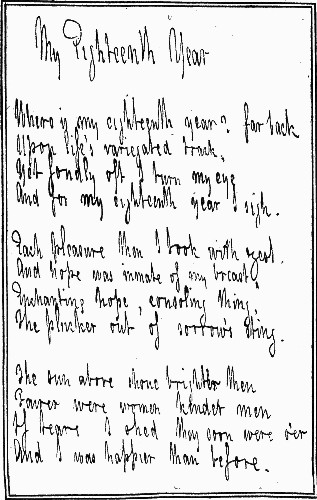 FACSIMILE OF A POEM FROM TARGUM
Now with the achieved success of The Bible in Spain and the leisure of a happy home Borrow could for the moment think of the ambition of 'twelve years ago'—an ambition to put before the public some of the results of his marvellous industry. The labours of the dark, black years between 1825 and 1830 might now perchance see the light. Three such books got themselves published, as we have seen, Romantic Ballads, Targum, and The Talisman. The Sleeping Bard had been translated and offered to 'a little Welsh bookseller' of Smithfield in 1830, who, however, said, when he had read it, 'were I to print it I should be ruined.' That fate followed the book to the end, and Borrow was premature when he said in his Preface to The Sleeping Bard that such folly is on the decline, because he found 'Albemarle Street in '60 willing to publish a harmless but plain-speaking book which Smithfield shrank from in '30.' At the last moment John Murray refused to publish, but seems to have agreed to give his imprint to the title-page. Borrow published the book at his own expense, it being set up by James Matthew Denew, of 72 Hall Plain, Great Yarmouth. Fourteen years later—in 1874—Mr. Murray made some amends by publishing Romano Lavo-Lil, in which are many fine translations from the Romany, and that, during his lifetime, was the 'beginning and the end' of Borrow's essays in publishing so far as his translations were concerned. Webber, the bookseller of Ipswich, did indeed issue The Turkish Jester—advertised as ready for publication in 1857—in 1884, and Jarrold of Norwich The Death of Balder in 1889; but enthusiasts have asked in vain for Celtic Bards, Chiefs and Kings, Songs of Europe, and Northern Skalds, Kings and Earls. It is not recorded whether Borrow offered these to any publisher other than 'Glorious John' of Albemarle Street, but certain it is that Mr. Murray would have none of them. The 'mountains of manuscript' remained to be the sorrowful interest of Borrow as an old man as they had—many of them—been the sorrow and despair of his early manhood. Here is a memorandum in his daughter's handwriting of the work that Borrow was engaged upon at the time of his death:
These translations were intended to form a volume with copious notes, but were only completed a month before Mr. Borrow's death, which occurred at his residence, Oulton Cottage, Suffolk, July 26th, 1881, in the seventy-ninth year of his age. This grand old man, full of years and honour, was buried beside his wife (who had proved a noble helpmate to him), in Brompton Cemetery, August 4th.
And so what many will consider Borrow's 'craze' for verse translations remained with him to the end. We know with what equanimity he bore his defeat in early years. Did he not make humorous 'copy' out of it in Lavengro. It must have been a greater disappointment that his publisher would have none of his wares when he had proved by writing The Bible in Spain that at least some of his work had money in it. For years it was Borrow's opinion that Lockhart stood in his way, wishing to hold the field with his Ancient Spanish Ballads (1821), and maintaining that Borrow was no poet. The view that Borrow had no poetry in him and that his verse is always poor has been held by many of Borrow's admirers. The view will not have the support of those who have had the advantage of reading all Borrow's less known published writings, and the many manuscripts that he left behind him. But on the general question let us hear Mr. Theodore Watts-Dunton:[Pg 406]—
It should never be forgotten that Borrow was, before everything else, a poet.... By poet I do not mean merely a man who is skilled in writing lyrics and sonnets and that kind of thing, but primarily a man who has the poetic gift of seeing through 'the show of things,' and knowing where he is—the gift of drinking deeply of the waters of life, and of feeling grateful to Nature for so sweet a draught.'[245]
Possibly Mr. Watts-Dunton did not contemplate his idea being applied to Borrow's verse translations, but all the same the quality of poetic imagination may be found here in abundance. The little Welsh bookseller of Smithfield said to Borrow in reference to The Sleeping Bard:
Were I to print it I should be ruined; the terrible description of vice and torment would frighten the genteel part of the English public out of its wits, and I should to a certainty be prosecuted by Sir James Scarlett. I am much obliged to you for the trouble you have given yourself on my account—but, Myn Diawl! I had no idea, till I had read him in English, that Elis Wyn had been such a terrible fellow.
And here the little Welsh bookseller paid Borrow a signal compliment. In the main Borrow provided a prose translation of The Sleeping Bard. In Targum however, he showed himself a quite gifted balladist, far removed from the literary standard of Romantic Ballads ten years earlier. Space does not permit of any quotation in this chapter, and I must be content here to declare that the spirit of poetry came over Borrow on many occasions. The whole of Borrow's Songs of Scandinavia will ultimately be published, although for eighty and more years[246] the pile of neatly[Pg 407] written manuscript of that book, which is now in my possession, has appealed for publication in vain. There will be found, in such a ballad as Orm Ungerswayne, for example, a practical demonstration that Borrow had the root of the matter in him. It is true that Borrow's limited acquaintance with English poetry was a serious drawback to great achievement, and his many translations from his favourite Welsh bard Goronwy Owen that are before me are too much under the influence of Pope. In addition to the Songs of Scandinavia I have before me certain other ballads in manuscript—such portions of his various unpublished but frequently advertised works as did not fall to Dr. Knapp.[247] Of these I do not hesitate to say that whatever the difference of opinion as to their poetic quality there can be no difference of opinion as to their being well-told stories of an exceedingly interesting and invigorating character. But I must leave for another time and another opportunity any discussion of Borrow's poetic achievement of which at present the world has had little opportunity of knowing anything.[248] Of prose manuscript there is also a considerable quantity, including diaries of travel and translations of nine or ten stories from various languages. Of the minor books already published we have already spoken of Faustus, Romantic Ballads, Targum, and The Talisman, and Borrow's last and least interesting book Romano Lavo-Lil. There remains but to recall:[Pg 408]—
| The Sleeping Bard, | published by | John Murray, 1860 |
| The Turkish Jester, | " | W. Webber, 1884 |
| The Death of Balder, | " | Jarrold and Sons, 1889 |
These eight little volumes will always remain Borrow's least-read books. Only in Targum and The Sleeping Bard do we find much indication of those qualities which made him famous. It is not in the least surprising that the other work failed to find a publisher, and, indeed, from a merely commercial point of view, the late John Murray had more excuse for refusing Romano Lavo-Lil, which he did publish, than The Sleeping Bard, which he refused to publish—at least on his own responsibility. Such books, whatever their merits, are issued to-day only by learned societies. In a quite different category were those many ballads[249] from diverse languages that Borrow had hoped to issue under such titles as Celtic Bards, Chiefs and Kings, and Northern Skalds, Kings and Earls. These books would have had no difficulty in finding a publisher to-day were they offered by a writer of one half the popularity of Borrow.[250]
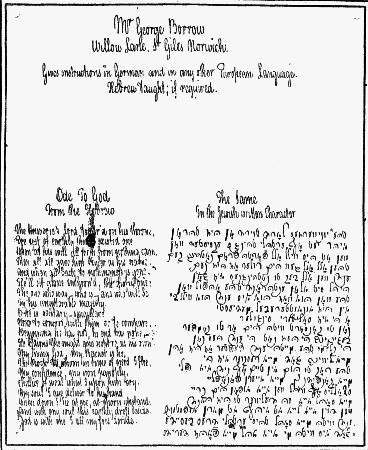 BORROW AS A PROFESSOR OF LANGUAGES
There is, I repeat, excellent work in these ballads. As to Targum let it not be forgotten that Hasfeld—really a good judge—said in The Athenæum that 'the work is a pearl of genius,' and that William Bodham Donne declared that 'the language and rhythm are vastly superior to Macaulay's Lays of Ancient Rome.' As to The Sleeping Bard Borrow himself was able to make his own vigorous defence of that work. In emulation of Walter Scott he reviewed himself in The Quarterly.[251] His article is really an essay on Welsh poetry, and incidentally he quotes from his unpublished Celtic Bards, Chiefs and Kings a lengthy passage, the manuscript of which is in my possession. We are introduced again to all Borrow's old friends of Wild Wales: Hew Morris, Goronwy Owen, and finally Elis Wyn. Borrow quotes from The Romany Rye, but as becomes a reviewer of his own book, gives no praise to his achievement.
I find no plays among Borrow's 'mountains of manuscript' in my possession, and so I am not disposed to accept the suggestion that the following letter from Gifford to Borrow refers to a play which Borrow pretended to be the work of a friend while it was really his own. If it was his own he doubtless took Gifford's counsel to heart and promptly destroyed the manuscript:—
A Specimen of Gifford's criticism on a friend's play, which I was desired to send to him.
My dear Borrow,—I have read your M.S. very attentively, and may say of it with Desdemona of the song—
The poetry in some places is pretty, the sentiment is also excellent. And can I say more? The plot is petty, the characters without vigour, and the story poorly told. Instead of Irene the scene seems to be laid in Arcadia, and the manners are not so much confounded as totally lost. There are Druids—but such Druids! O Lord!
There is to be seen no physical, perhaps no moral lesson, though a Druid should not be a rogue—but it is not so set down in the bond. Is this the characterisation which we have been used to see there? To end an unpleasant letter, I must leave to[Pg 411] your friendship for the author to contrive some mode of dissuading him from publishing. If, however, he is determined to rush on the world, let him do it, in the first place, anonymously. If it takes, he may then toss up his nose at my opinion, and claim his work.
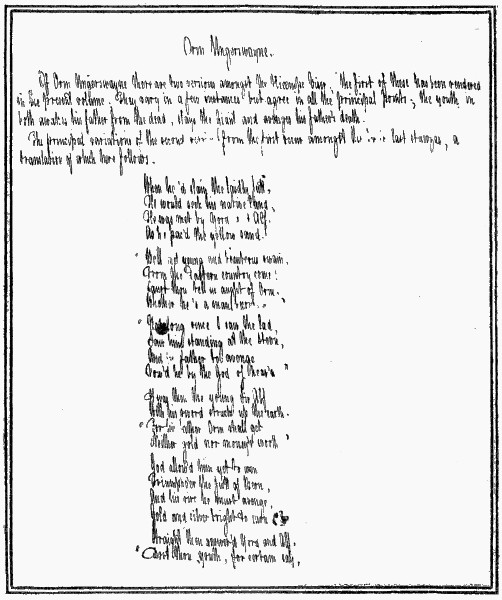 A PAGE OF THE MANUSCRIPT OF BORROW'S SONGS OF
SCANDINAVIA—AN UNPUBLISHED WORK
A PAGE OF THE MANUSCRIPT OF BORROW'S SONGS OF
SCANDINAVIA—AN UNPUBLISHED WORK
Say nothing of me, for I would not be thought to offend so excellent and so able a man. He may be content with his literary fame, and can do without poetic praise.[Pg 412]
Your answer is short. The play might have passed very well had it been published when written, and when the writer was yet young and little known, but it will be hazardous now, as the world is cross-grained, and will not see your master in the grave and learned author of so many valuable works; but judge him from his present attainments. But this, as Mrs. Quickly says, 'is alligant terms,' and it may do.—Ever yours,
Wm. Gifford.
P.S.—I see the preface is already written, and do what you will, the play will be published.
One other phase of this more limited aspect of Borrow's work may be dealt with here—his mastery of languages. I have before me scores of pages which reveal the way that Borrow became a lav-engro—a word-master. He drew up tables of every language in turn, the English word following the German, or Welsh, or whatever the tongue might be, and he learnt these off with amazing celerity. His wonderful memory was his greatest asset in this particular. He was not a philologist if we accept the dictionary definition of that word as 'a person versed in the science of language.' But his interest in languages is refreshing and interesting—never pedantic, and he takes rank among those disinterested lovers of learning who pursue their researches without any regard to the honours or emoluments that they may bring, loving learning for learning's sake, undaunted by the discouragements that come from the indifference of a world to which they have made their appeal in vain.
[245] The Athenæum, September 3, 1881.
[246] In the Monthly Magazine for March 1830 under the head of 'Miscellaneous Intelligence' we find the following announcement:—
'Dr. Bowring and Mr. George Borrow are about to publish The Songs of Scandinavia, containing a selection of the most interesting of the Historical and Romantic Ballads of North-Western Europe, with specimens of the Danish and Norwegian Poets down to the present day.'
[247] Dr. Knapp's Borrow manuscripts are now in the Hispanic Society's Archives in New York.
[248] I contemplate at a later date an edition of Borrow's Collected Writings, in which the unpublished verse will extend to two volumes.
[249] Certain of these have of late been privately printed in pamphlet form—limited to thirty copies each.
[250] The works of Dr. George Sigerson, Dr. Douglas Hyde and Dr. Kuno Meyer in Irish Literature are an evidence of this. Dr. Sigerson's Bards of the Gael and Gaul and Dr. Hyde's Love Songs of Connaught have each gone through more than one edition and have proved remunerative to their authors.
[251] The Quarterly Review, January 1861, pp. 38-63.
Borrow never had a child, but happy for him was the part played by his stepdaughter Henrietta in his life. She was twenty-three years old when her mother married him, and it is clear to me that she was from the beginning of their friendship and even to the end of his life devoted to her stepfather. Readers of Wild Wales will recall not only the tribute that Borrow pays to her, which we have already quoted, in which he refers to her 'good qualities and many accomplishments,' but the other pleasant references in that book. 'Henrietta,' he says in one passage, 'played on the guitar[252] and sang a Spanish song, to the great delight of John Jones.' When climbing Snowdon he is keen in his praises of the endurance of 'the gallant girl.' As against all this, there is an undercurrent of depreciation of his stepdaughter among Borrow's biographers. The picture of Borrow's home in later life at Oulton is presented by them with sordid details. The Oulton tradition which still survives among the few inhabitants who lived near the Broad at Borrow's death in 1881, and still reside there, is of an ill-kept home, supremely untidy, and it is as a final indictment of his daughter's[Pg 414] callousness that we have the following gruesome picture by Dr. Knapp:
On the 26th of July 1881 Mr. Borrow was found dead in his house at Oulton. The circumstances were these. His stepdaughter and her husband drove to Lowestoft in the morning on some business of their own, leaving Mr. Borrow without a living soul in the house with him. He had earnestly requested them not to go away because he felt that he was in a dying state; but the response intimated that he had often expressed the same feeling before, and his fears had proved groundless. During the interval of these few hours of abandonment nothing can palliate or excuse, George Borrow died as he had lived—alone! His age was seventy-eight years and twenty-one days.
Dr. Knapp no doubt believed all this;[253] it is endorsed by the village gossip of the past thirty years, and the mythical tragedy is even heightened by a further story of a farm tumbril which carried poor Borrow's body to the railway station when it was being conveyed to London to be buried beside his wife in Brompton Cemetery.
The tumbril story—whether correct or otherwise—is a matter of indifference to me. The legend of the neglect of Borrow in his last moments is however of importance, and the charge can easily be disproved.[254] I have before me Mrs. MacOubrey's diary for 1881.[Pg 415]
I have many such diaries for a long period of years, but this for 1881 is of particular moment. Here, under the date July 26th, we find the brief note, George Borrow died at three o'clock this morning. It is scarcely possible that Borrow's stepdaughter and her husband could have left him alone at three o'clock in the morning in order to drive into Lowestoft, less than two miles distant. At this time, be it remembered, Dr. MacOubrey was eighty-one years of age. Now, as to the general untidiness of Borrow's home at the time of his death—the point is a distasteful one, but it had better be faced. Henrietta was twenty-three years of age when her mother married Borrow. She was sixty-four at the time of his death, and her husband, as I have said, was eighty-one years of age at that time, being three years older than Borrow. Here we have three very elderly people keeping house together and little accustomed overmuch to the assistance of domestic servants. The situation at once becomes clear. Mrs. Borrow had a genius for housekeeping and for management. She watched over her husband, kept his accounts, held the family purse,[255] managed all his affairs. She 'managed' her daughter also, delighting in that daughter's accomplishments of drawing and botany, to which may be added a zeal for the writing of stories which does not seem, judging from the many manuscripts in her handwriting that I have burnt, to have received much editorial encouragement. In short, Henrietta was not domesticated. But just as I have[Pg 416] proved in preceding chapters that Borrow was happy in his married life, so I would urge that as far as a somewhat disappointed career would permit to the sadly bereaved author he was happy in his family circle to the end. It was at his initiative that, when he had returned to Oulton after the death of his wife, his daughter and her husband came to live with him. He declared that to live alone was no longer tolerable, and they gave up their own home in London to join him at Oulton.
A new glimpse of Borrow on his domestic side has been offered to the public even as this book is passing through the press. Mr. S. H. Baldrey, a Norwich solicitor, has given his reminiscences of the author of Lavengro to the leading newspaper of that city.[256] Mr. Baldrey is the stepson of the late John Pilgrim of the firm of Jay and Pilgrim, who were Borrow's solicitors at Norwich in the later years of his life. One at least of Mr. Baldrey's many reminiscences has in it an element of romance; that in which he recalls Mrs. Borrow and her daughter:
Mrs. Borrow always struck me as a dear old creature. When Borrow married her she was a widow with one daughter, Henrietta Clarke. The old lady used to dress in black silk. She had little silver-grey corkscrew curls down the side of her face; and she wore a lace cap with a mauve ribbon on top, quite in the Early Victorian style. I remember that on one occasion when she and Miss Clarke had come to Brunswick House they were talking with my mother in the temporary absence of George Borrow, who, so far as I can recall, had gone into another room to discuss business with John Pilgrim.
'Ah!' she said, 'George is a good man, but he is a strange creature. Do you know he will say to me after breakfast, "Mary,[Pg 417] I am going for a walk," and then I do not see anything more of him for three months. And all the time he will be walking miles and miles. Once he went right into Scotland, and never once slept in a house. He took not even a handbag with him or a clean shirt, but lived just like any old tramp.'
Mr. Baldrey is clearly in error here, or shall we say that Mrs. Borrow humorously exaggerated? We have seen that Borrow's annual holiday was a matter of careful arrangement, and his knapsack or satchel is frequently referred to in his descriptions of his various tours. But the matter is of little importance, and Mr. Baldrey's pictures of Borrow are excellent, including that of his personal appearance:
As I recall him, he was a fine, powerfully built man of about six feet high. He had a clean-shaven face with a fresh complexion, almost approaching to the florid, and never a wrinkle, even at sixty, except at the corners of his dark and rather prominent eyes. He had a shock of silvery white hair. He always wore a very badly brushed silk hat, a black frock coat and trousers, the coat all buttoned down before; low shoes and white socks, with a couple of inches of white showing between the shoes and the trousers. He was a tireless walker, with extraordinary powers of endurance, and was also very handy with his fists, as in those days a gentleman required to be, more than he does now.
Mr. John Pilgrim lived at Brunswick House, on the Newmarket Road, Norwich, and here Borrow frequently visited him. Mr. Baldrey recalls one particular visit:
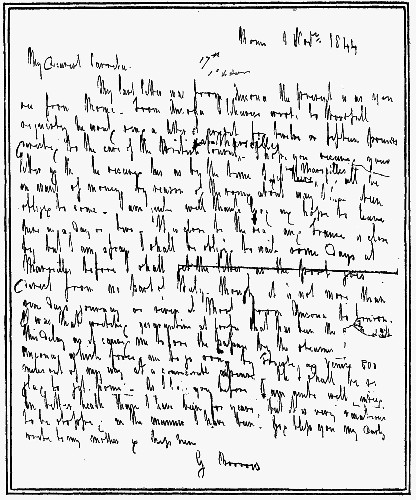 A LETTER FROM BORROW TO HIS WIFE WRITTEN FROM ROME IN HIS
CONTINENTAL JOURNEY OF 1844
A LETTER FROM BORROW TO HIS WIFE WRITTEN FROM ROME IN HIS
CONTINENTAL JOURNEY OF 1844
I have a curious recollection of his dining one night at Brunswick House. John Pilgrim, who was a careful, abstemious man, never took more than two glasses of port at dinner. 'John,' said Borrow, 'this is a good port. I prefer Burgundy if you can get it good; but, lord, you cannot get it now.' It so happened that Mr. Pilgrim had some fine old Clos-Vougeot in the cellar. 'I think,' said he, 'I can give you a good drop of Burgundy.' A bottle was sent for, and Borrow finished it, alone and unaided. 'Well,' he remarked, 'I think this is a good Burgundy. But I'm not quite certain. I should like to try a little more.' Another bottle was called up, and the guest finished it to the last drop. I am still,' he said, 'not quite sure about it, but I shall know in the morning.' The next morning Mr. Pilgrim and I were leaving for the office, when Borrow came up the garden path waving his[Pg 419] arms like a windmill. 'Oh, John,' he said, 'that was Burgundy! When I woke up this morning it was coursing through my veins like fire.' And yet Borrow was not a man to drink to excess. I cannot imagine him being the worse for liquor. He had wonderful health and digestion. Neither a gourmand nor a gourmet, he could take down anything, and be none the worse for it. I don't think you could have made him drunk if you tried.
And here is a glimpse of Borrow after his wife's death, for which we are grateful to Mr. Baldrey:
After the funeral of Mrs. Borrow he came to Norwich and took me over to Oulton with him. He was silent all the way. When we got to the little white wicket gate before the approach to the house he took off his hat and began to beat his breast like an Oriental. He cried aloud all the way up the path. He calmed himself, however, by the time that Mr. Crabbe had opened the door and asked us in. Crabbe brought in some wine, and we all sat down to table. I sat opposite to Mrs. Crabbe; her husband was on my left hand. Borrow sat at one end of the table, and the chair at the opposite end was left vacant. We were talking in a casual way when Borrow, pointing to the empty chair, said with profound emotion, 'There! It was there that I first saw her.' It was a curious coincidence that though there were four of us we should have left that particular seat unoccupied at a little table of about four feet square.[257]
But this is a lengthy digression from the story of Henrietta Clarke, who married William MacOubrey, an Irishman—and an Orangeman—from Belfast in 1865. The pair lived first in Belfast and afterwards at 80 Charlotte Street, Fitzroy Square. Before his marriage he had practised at 134 Sloane Street, London. MacOubrey, although there has been some doubt cast upon the statement, was a Doctor of Medicine of Trinity College, Dublin, and a Barrister-at-Law. Within his limitations he was an accomplished man, and before me lie not only documentary evidence of his M.D. and his legal status, but several printed pamphlets that bear[Pg 421] his name.[258] What is of more importance, the letters from and to his wife that have through my hands and have been consigned to the flames prove that husband and wife lived on most affectionate terms.
It is natural that Borrow's correspondence with his stepdaughter should have been of a somewhat private character, and I therefore publish only a selection from his letters to her, believing however that they modify an existing tradition very considerably:
Dear Henrietta,—Have you heard from the gentleman whom you said you would write to about the farm?[259] Mr. C. came over the other day and I mentioned the matter to him, but he told me that he was on the eve of going to London on law business and should be absent for some time. His son is in Cambridge. I am afraid that it will be no easy matter to find a desirable tenant and that none are likely to apply but a set of needy speculators; indeed, there is a general dearth of money. How is Dr. M.? God bless you!
George Borrow.
Dear Henrietta,—I have received some of the rent and send a cheque for eight pounds. Have the kindness to acknowledge the receipt of same by return of post. As soon as you arrive in London, let me know, and I will send a cheque for ten pounds,[Pg 422] which I believe will pay your interest up to Midsummer. If there is anything incorrect pray inform me. God bless you. Kind regards to Miss Harvey.
George Borrow.
Dear Henrietta,—As soon as Smith has paid his Michaelmas rent I will settle your interest up to Midsummer. Twenty-one pounds was, I think, then due to you, as you received five pounds on the account of the present year. If, however, you are in want of money let me know forthwith, and I will send you a small cheque. The document which I mentioned has been witnessed by Mrs. Church and her daughter. It is in one of the little tin boxes on the lower shelf of the closet nearest to the window in my bedroom. I was over at Mattishall some weeks ago. Things there look very unsatisfactory. H. and his mother now owe me £20 or more. The other man a year's rent for a cottage and garden, and two years' rent for the gardens of two cottages unoccupied. I am just returned from Norwich where I have been to speak to F. I have been again pestered by Pilgrim's successor about the insurance of the property. He pretends to have insured again. A more impudent thing was probably never heard of. He is no agent of mine, and I will have no communication with him. I have insured myself in the Union Office, and have lately received my second policy. I have now paid upwards of twelve pounds for policies. F. says that he told him months ago that the demand he made would not be allowed, that I insured myself and was my own agent, and that as he shall see him in a few days he will tell him so again. Oh what a source of trouble that wretched fellow Pilgrim has been both to you and me.
I wish very much to come up to London. But I cannot leave the country under present circumstances. There is not a person in these parts in whom I can place the slightest confidence. I most inform you that at our interview F. said not a word about the matter in Chancery. God bless you. Kind remembrances to Dr. M.
George Borrow.
[Pg 423]
Dear Henrietta,—I wish to know how you are. I shall shortly send a cheque for thirteen pounds, which I believe will settle the interest account up to Michaelmas. If you see anything inaccurate pray inform me. I am at present tolerably well, but of late have been very much troubled with respect to my people. Since I saw you I have been three times over to Mattishall, but with very little profit. The last time I was there I got the key of the house from that fellow Hill, and let the place to another person who I am now told is not much better. One comfort is that he cannot be worse. But now there is a difficulty. Hill refuses to yield up the land, and has put padlocks on the gates. These I suppose can be removed as he is not in possession of the key of the house. On this point, however, I wish to be certain. As for the house, he and his mother, who is in a kind of partnership with him, have abandoned it for two years, the consequence being that the windows are dashed out, and the place little better than a ruin. During the four years he has occupied the land he has been cropping it, and the crops have invariably been sold before being reaped, and as soon as reaped carried off. During the last two years there has not been a single live thing kept on the premises, not so much as a hen. He now says that there are some things in the house belonging to him. Anything, however, which he has left is of course mine, though I don't believe that what he has left is worth sixpence. I have told the incoming tenant to deliver up nothing, and not permit him to enter the house on any account. He owes me ten or twelve pounds, arrears of rent, and at least fifteen for dilapidations. I think the fellow ought to be threatened with an action, but I know not whom to employ. I don't wish to apply to F. Perhaps Dr. M.'s London friend might be spoken to. I believe Hill's address is Alfred Hill, Mattishall, Norfolk, but the place which he occupied of me is at Mattishall Burgh. I shall be glad to hear from you as soon as is convenient. I have anything but reason to be satisfied with the conduct of S. He is cropping the ground most unmercifully, and is sending sacks of game off the premises every week. Surely he must be mad, as he knows I can turn him out next Michaelmas. God bless you. Kind regards to Dr. M. Take care of this.
George Borrow.
[Pg 424]
Dear Henrietta,—I was glad to hear that you had obtained your dividend. I was afraid that you would never get it. I shall be happy to see you and Dr. M. about the end of the month. Michaelmas is near at hand, when your half-year's interest becomes due. God bless you. Kind remembrances to Dr. M.
George Borrow.
Oulton, Lowestoft, November 29th, 1874.
Dear Henrietta,—I send a cheque for £15, which will settle the interest account up to Michaelmas last. On receipt of this have the kindness to send me a line. I have been to Norwich, and now know all about your affair. I saw Mr. Durrant, who, it seems, is the real head of the firm to which I go. He received me in the kindest manner, and said he was very glad to see me. I inquired about J.P.'s affairs. He appeared at first not desirous to speak about them, but presently became very communicative. I inquired who had put the matter into Chancery, and he told me he himself, which I was very glad to hear. I asked whether the mortgagees would get their money, and he replied that he had no doubt they eventually would, as far as principal was concerned. I spoke about interest, but on that point he gave me slight hopes. He said that the matter, if not hurried, would turn out tolerably satisfactory, but if it were, very little would be obtained. It appears that the unhappy creature who is gone had been dabbling in post obit bonds, at present almost valueless, but likely to become available. He was in great want of money shortly before he died. Now, dear, pray keep up your spirits; I hope and trust we shall meet about Christmas. Kind regards to Dr. M.
George Borrow.
Keep this. Send a line by return of post.
Dear Henrietta,—I thought I would write to you as it seems a long time since I heard from you. I have been on my expedition[Pg 425] and have come back safe. I had a horrible time of it on the sea—small dirty boat crowded with people and rough weather. Poor Mr. Brightwell is I am sorry to say dead—died in January. I saw Mr. J. and P. and had a good deal of conversation with them which I will talk to you about when I see you. Mr. P. sent an officer over to M. I went to Oulton, and as soon as I got there I found one of the farm cottages nearly in ruins; the gable had fallen down—more expense! but I said that some willow trees must be cut down to cover it. The place upon the whole looks very beautiful. C. full of complaints, though I believe he has a fine time of it. He and T. are at daggers drawn. I am sorry to tell you that poor Mr. Leathes is dying—called, but could not see him, but he sent down a kind message to me. The family, however, were rejoiced to see me and wanted me to stay. The scoundrel of a shoemaker did not send the shoes. I thought he would not. The shirt-collars were much too small. I, however, managed to put on the shirts and am glad of them. At Norwich I saw Lucy, who appears to be in good spirits. Many people have suffered dreadfully there from the failure of the Bank—her brother, amongst others, has been let in. I shall have much to tell you when I see you. I am glad that the Prussians are getting on so famously. The Pope it seems has written a letter to the King of Prussia and is asking favours of him. A low old fellow!!! Remember me kindly to Miss H., and may God bless you! Bring this back.
George Borrow.
March 6, 1873.
Dear Henrietta,—I was so grieved to hear that you were unwell. Pray take care of yourself, and do not go out in this dreadful weather. Send and get, on my account, six bottles of good port wine. Good port may be had at the cellar at the corner of Charles Street, opposite the Hospital near Hereford Square—I think the name of the man is Kitchenham. Were I in London I would bring it myself. Do send for it. May God Almighty bless you!
George Borrow.
[Pg 426]
Norwich, July 12, 1873.
Dear Henrietta,—I shall be glad to see you and Dr. M. as soon as you can make it convenient to come. As for my coming up to London it is quite out of the question. I am suffering greatly, and here I am in this solitude without medicine or advice. I want very much to pay you up your interest. I can do so without the slightest inconvenience. I have money. It is well I have, as it seems to be almost my only friend. God bless you. Kind regards to Dr. M.
George Borrow.
Here I find a letter from Mrs. MacOubrey to her stepfather:
Southgate House, Bury St. Edmunds, Novbr. 25th, 1873.
My beloved Friend,—I sincerely trust that you are well, and received my letter which I sent about ten days ago. Miss Harvey is pretty well and very kind, and it really is a great pleasure to be here during the dark foggy month of November, the most disagreeable in London. I saw Miss Beevor the other day; she is confined to the house with rheumatism and a strain; she was so pleased to see me, and talked about the Images of Mildenhall. They now set up for the great county gentry; give very grand entertainments, dinners, etc., and go also to grand dinners, so their time is fully taken up going and receiving; they never scarce honour the little paltry town of Bury St. Edmunds. Bloomfield, the old butler, is gone to service again; he could not bear himself without horses, so he is gone to the Wigsons, near Bury, where he will have plenty of hunters to look after; he wished to live with Miss Harvey.
Poor Miss Borton died about a week ago; she did not live long to enjoy the huge fortune her brother left. Bury seems very much changing its inhabitants, but there are still some nice people. I shall always like it while dear Miss Harvey lives; she is so very kind to me. It is extremely cold, but we keep tremendous fires, which combats it.
I do sincerely trust, dear, that you are well. I should like to[Pg 427] have a line just to say how you are. I return to London the 6th of Decbr., not later, but you see Miss Harvey likes to keep me as long as she can, and I am very happy with her, but at that time I shall be sure to be at home. If you were going up to London I would leave sooner. If you want any medicine or anything, only let me know and you shall have it.
Accept my most affec. love, and believe me ever, your attached daughter,
Henrietta MacOubrey.
P.S.—Miss Harvey desires her kind regards. May God bless you.
Oulton, Lowestoft, April 1, 1874.
Dear Henrietta,—I have received your letter of the 30th March. Since I last wrote I have not been well. I have had a great pain in the left jaw which almost prevented me from eating. I am, however, better now. I shall be glad to see you and Dr. M. as soon as you can conveniently come. Send me a line to say when I may expect you. I have no engagements. Before you come call at No. 36 to inquire whether anything has been sent there. Leverton had better be employed to make a couple of boxes or cases for the books in the sacks. The sacks can be put on the top in the inside. There is an old coat in one of the sacks in the pocket of which are papers. Let it be put in with its contents just as it is. I wish to have the long white chest and the two deal boxes also brought down. Buy me a thick under-waistcoat like that I am now wearing, and a lighter one for the summer. Worsted socks are of no use—they scarcely last a day. Cotton ones are poor things, but they are better than worsted. Kind regards to Dr. M. God bless you!
Return me this when you come.
George Borrow.
Oulton, Nov. 14, 1876.
Dear Henrietta,—You may buy me a large silk handkerchief, like the one you brought before. I shall be glad to see you and Dr. M. I am very unwell.
George Borrow.
Dear Henrietta,—I shall be glad to see you and Dr. M. as soon as you can make it convenient. In a day or two the house will be in good repair and very comfortable. I want you to go to the bank and have the cheque placed to my account. Lady Day is nigh at hand, and it must be seen after. Buy for me a pair of those hollow ground razors and tell Dr. M. to bring a little laudanum. Come if you can on the first of March. It is dear Mama's birthday. God bless you! Kind regards to Dr. M.
George Borrow.
Mrs. Church's, Lady's Lane, Norwich, Feb. 28, 1877.
Dear Henrietta,—I received your letter this morning with the document. The other came to hand at Oulton before I left. I showed Mr. F. the first document on Wednesday, and he expressed then a doubt with regard to the necessity of an affidavit from me, but he said it would perhaps be necessary for him to see the security. I saw him again this morning and he repeated the same thing. To-night he is going to write up to his agent on the subject, and on Monday I am to know what is requisite to be done—therefore pray keep in readiness. On Tuesday, perhaps, I shall return to Oulton, but I don't know. I shall write again on Monday. God bless you.
George Borrow.
Borrow died, as we have seen, in 1881, and was buried by the side of his wife in Brompton Cemetery. By his will, dated 1st December 1880, he bequeathed all his property to his stepdaughter, making his friend, Elizabeth Harvey, her co-executrix. The will, a copy of which is before me, has no public interest, but it may be noted that Miss Harvey[Pg 429] refused to act, as the following letter to Mrs. MacOubrey testifies[260]:
Bury St. Edmunds, August 13th.
My dearest Henrietta,—I was just preparing to write to you when yours arrived together with Mrs. Reeve's despatch. You know how earnestly I desire your welfare—but because I do so I earnestly advise you immediately to exercise the right you have of appointing another trustee in my place. I am sure it will be best for you. You ought to have a trustee at least not older than yourself, and one who has health and strength for discharging the office. I know what are the duties of a trustee. There's always a considerable responsibility involved in the discharge of the duties of a trustee—and it may easily occur that great responsibility may be thrown on them, and it may become an anxious business fit only for those who have youth and health and strength of mind, and are likely to live.
My dear friend, you do not like to realise the old age of your[Pg 430] dear friends, but you must consider that I am quite past the age for such an office, and my invalid state often prevents my attending to my own small affairs. I have no relation or confidential friend who can act for me. My executors were Miss Venn and John Venn. Miss Venn departed last February to a better land. John is in such health with heart disease that he cannot move far from his home—he writes as one ready and desiring to depart. I do not expect to see him again. So you see, my dearest friend, I am not able to undertake this trusteeship, and I think the sooner you consult Mrs. Reeve as to the appointment of another trustee—the better it will be—and the more permanent. Had I known it was Mr. Borrow's intention to put down my name I should have prevented it, and he would have seen that an aged and invalid lady was not the person to carry out his wishes—for I am quite unable.
I pray that a fit person may be induced to undertake the[Pg 431] business, and that it may please God so to order all for your good. It is indeed the greatest mercy that your dear husband is well enough to afford you such help and such comfort. Pray hire a proper servant who will obey orders.—In haste, ever yrs. affectionately,
E. Harvey.
Another letter that has some bearing upon Borrow's last days is worth printing here:
Yarmouth, August 19, 1881.
My dear Mrs. MacOubrey,—I was very sorry indeed to hear of Mr. Borrow's death. I thought he looked older the last time I saw him, but with his vigorous constitution I have not thought the end so near. You and Mr. MacOubrey have the comfort of knowing that you have attended affectionately to his declining years, which would otherwise have been very lonely. I have been abroad for a short time, and this has prevented me from replying to your kind letter before. Pray receive the assurance of my sympathy, and with my kind remembrances to Mr. MacOubrey, believe me, yours very truly,
R. H. Inglis Palgrave.
Three years later Dr. MacOubrey died in his eighty-fourth year, and was interred at Oulton. Mrs. MacOubrey lived for a time at Oulton and then removed to Yarmouth. A letter that she wrote to a friend soon after the death of her husband is perhaps some index to her character:
Oulton Cottage, Oulton, Nr. Lowestoft, Sept. 3rd, 1884.
My dear Sir,—I beg to thank you for your kind thought of me. On Sunday night the 24th Augst., it pleased God to take from me my excellent and beloved husband—his age was nearly 84. He sunk simply from age and weakness. I was his nurse by night and by day, administering constant nourishment, but he became weaker and weaker, till at last 'The silver cord was[Pg 432] loosed.' My dear father died about this time three years since, which makes the blow more stunning. I feel very lonely now in my secluded residence on the banks of the Broad—the music of the wild birds adds not to my pleasure now. Trusting that yourself and Mrs. S—— may long be spared.—Believe me to remain, yours very truly,
Henrietta MacOubrey.
The cottage at Oulton was soon afterwards pulled down, but the summer-house where Borrow wrote a portion of his Bible in Spain and his other works remained for some years. That ultimately an entirely new structure took its place may be seen by comparing the roof in Mrs. MacOubrey's drawing with the illustration of the structure as it is to-day. Mrs. MacOubrey died in 1903 at Yarmouth, and the following inscription may be found on her tomb in Oulton Churchyard:
Sacred to the memory of Henrietta Mary, widow of William MacOubrey, only daughter of Lieut. Henry Clarke, R.N., and Mary Skepper, his wife, and stepdaughter of George Henry Borrow, Esq., the celebrated author of The Bible in Spain, The Gypsies of Spain, Lavengro, The Romany Rye, Wild Wales, and other works and translations. Henrietta Mary MacOubrey was born at Oulton Hall in this Parish, May 17th, 1818, and died 23rd December 1903. 'And He shall give His angels charge over thee, to keep thee in all thy ways.'—Psalm xci. 11.
The following extract from her will is of interest as indicating the trend of a singularly kindly nature. The intimate friends of Mrs. MacOubrey's later years, whose opinion is of more value than that of village gossips, speak of her in terms of sincere affection:
I give the following charitable legacies, namely, to the London Bible Society, in remembrance of the great interest my dear father, George Henry Borrow, took in the success of its great work for[Pg 433] the benefit of mankind, the sum of one hundred pounds. To the Foreign Missionary Society the sum of one hundred pounds. To the London Religious Tract Society the sum of one hundred pounds. To the London Society for the Prevention of Cruelty to Animals, the sum of one hundred pounds.
[252] Henrietta's guitar is now in my possession and is a very handsome instrument.
[253] Henrietta MacOubrey put every difficulty in the way of Dr. Knapp, and I hold many letters from her strongly denouncing his Life.
[254] The stories against Henrietta MacOubrey have received endorsement from that pleasant writer Mr. W. A. Dutt, who has long lived near Lowestoft. It is conveyed in such a communication as the following from a correspondent: 'After Borrow's death Mr. Reeve, Curator of Norwich Castle Museum, visited the Oulton house with the Rev. J. Gunn (died 28th May 1890), having some idea of buying Borrow's books for the Colman collection. Mrs. MacOubrey wanted £1000 for them, but Mr. Reeve did not think them worth more than £200. They were, however, bought by Webber of Ipswich, who soon afterwards entered into the employment of Jarrold of Norwich. Mr. Reeve described the scene as one of rank dilapidation and decay—evidences of extreme untidiness and neglect everywhere.'
[255] Mr. Herbert Jenkins has drawn a quite wrong conclusion—although natural under the circumstances—from a letter he had seen in which Borrow asked his wife for money. Mrs. Borrow kept the banking account. Moreover, it is not generally known that Borrow completed the possession of his wife's estate, including Oulton Hall farm and some cottage property, with the money that came to him from The Bible in Spain.
[256] 'George Borrow Reminiscences' in The Eastern Daily Press, July 31, 1913.
[257] Mr. Baldrey also gives us reminiscences of Borrow's prowess as a swimmer:
'It was one of the signs of his perfect health and vigour that he was a fine swimmer. On one occasion George Jay and John Pilgrim were out for a sail in Jay's old yacht, the Widgeon. Becalmed, they were drifting somewhere down by Reedham, when suddenly Borrow said, "George, how deep is it here?" "About twenty-two feet, sir," said George Jay. The partners always called him "sir." "George," said Borrow, "I am going to the bottom." Straightway he stripped, dived, and presently came up with a handful of mud and weeds. "There, George," he said, "I've been to the bottom," Some time in 1872 or 1873, for Borrow was then sixty-nine, my mother and I were walking on the beach at Lowestoft, when just round the Ness Light we met Borrow coming: towards us from the Corton side. He got hold of my shoulder, and, pointing to the big black buoy beyond the Ness, he said, "There! Do you see that? I have just been out there. I have not been back many minutes." At the age of nearly seventy he had been round the Ness Buoy and home again—a wonderful performance if, in addition to his age, you remember the dangerous set of the currents thereabouts.'
There is also a story, which comes to me from another quarter, of Borrow skating upon the ice of Oulton Broad a few months before his death, and remarking that he had not skated since he was in Russia. The following passage from Mr. Baldrey's narrative is interesting as showing that Borrow did not in later life quite lose sight of his birthplace:
'Apparently I interested him in some way, for twice while I was at school at East Dereham he came over specially to take me out for the afternoon. He had ascertained from my mother which were the school half-holidays, and purposely chose those days so that I might be free. We would start off at half-past twelve and return at bedtime. Where we went I could not tell you for certain, but I know that once we went through Scarning and once through Mattishall. What we talked about of course I cannot recall, for I was then a boy between 13 and 15 years of age, and I had no sort of inkling that my companion was even then a celebrity and destined to be a still greater one in the future. But I do remember that sometimes I could not get a word out of him for an hour or more, and that then suddenly he would break out with all sorts of questions. "I wonder if you can see what I can," he once remarked. "Do you see that the gypsies have been here?" "No," I replied. "And you are not likely to," said he. And then he would tell me no more. He was rather prone to arouse one's curiosity and refuse to pursue the subject. I do not mean that he was morose. Far from it. He was always very kind to me. After I had left school and returned to Norwich he frequently called for me and took me out with him. Once or twice I went with him to Lowestoft.'
[258] One of them is entitled The Present Crisis: The True Cause of Our Indian Troubles, by William MacOubrey of the Middle Temple. There are also countless pamphlets in manuscript. MacOubrey was an enthusiastic and indeed truculent upholder of the Act of Union.
[259] The farm referred to was Oulton Hall farm, often referred to as Oulton Hall.
[260] Another letter from Miss Harvey, dated 1st August, is one of sympathy, and there are passages in it that may well be taken to heart when it is considered that Miss Harvey was the most intimate friend of Borrow and his stepdaughter:
'Bury, August 1st, 1881.
'Dearest Friend,—Though I cannot be with you in your trouble I am continually thinking of you, and praying that all needful help and comfort may be sent to you as you need and how you need it. I have no means of hearing any particulars, and am most anxious to know how you do, and how you have got through the last painful week. Whenever you feel able write me a few words, I await them with much anxiety. When you are able to realise the reality of his eternal gain—you will feel that all is well. A great spirit, a great and noble spirit, has passed from the earth, his earthly tabernacle is taken down to be raised again—glorious and immortal, a fitting abode for a spirit of the just made perfect. How wonderful are those words, "made perfect." We are even now part of that grand assembly where they dwell. "We are come to the general assembly and church of the first born which are written in heaven. To God the judge of all, to Jesus the Mediator, to an innumerable company of angels, etc., to the spirits of the just made perfect." Let us realise our communion with them even now, and soon to meet them on the Resurrection Morn—when they who sleep in Jesus will God bring with Him ... and so we shall be ever with the Lord.
Blessed are the dead which die in the Lord, their works do follow them. Your beloved father's work in Spain will follow him. His efforts to spread the word of God in that benighted land, ever has and ever will bring forth blessed fruits. Dearest Henrietta, be comforted, you have been a most devoted daughter to him, and latterly his greatest earthly comfort; your dear husband also; and together you have tended him to the last. He now rests in peace. All the sufferings of mind and body are over for ever. You will have much earthly business on your hands. I pray that you may be directed in all things by true wisdom. The time is short, we must set our houses in order, that we may not be unnecessarily burdened with earthly cares. Having food and raiment, let us be therewith content.
'Let us be without carefulness, and so quietly and piously spend the
remnant of our days—ever growing in the knowledge of Christ, and
finding in Him all our comfort and all our joy, and when our own time
of departure shall arrive may we be ready and able to say, "I have a
desire to depart and be with Christ, which is far better." The path
of the just is as the shining light which shineth more and more unto the
perfect day. May our path be so lighted up—until the day break and
the shadows flee away. Dearest friend, do write soon. I am so anxious to
hear how Dr. MacOubrey is.—Your most affect. friend,
E. Harvey.
'We are all Borrovians now.'—Augustine Birrell.
It is a curious fact that of only two men of distinction in English letters in these later years can it be said that they lived to a good old age and yet failed of recognition for work that is imperishable. Many poets have died young—Shelley and Keats for example—to whom this public recognition was refused in their lifetime. But given the happiness of reaching middle age, this recognition has never failed. It came, for example, to Wordsworth and Coleridge long after their best work was done. It came with more promptness to all the great Victorian novelists. This recognition did not come in their lifetime to two Suffolk friends, Edward FitzGerald with Omar Khayyám and George Borrow with Lavengro. In the case of FitzGerald there was probably no consciousness that he had produced a great poem. In any case his sunny Irish temperament could easily have surmounted disappointment if he had expected anything from the world in the way of literary fame. Borrow was quite differently made. He was as intense an egoist as Rousseau, whose work he had probably never read, and would not have appreciated if he had read. He longed for the recognition of the multitude through his books, and thoroughly enjoyed it when it[Pg 435] was given to him for a moment—for his Bible in Spain. Such appreciation as he received in his lifetime was given to him for that book and for no other. There were here and there enthusiasts for his Lavengro and Romany Rye. Dr. Jessopp has told us that he was one. But it was not until long after his death that the word 'Borrovian'[261] came into the language. Not a single great author among his contemporaries praised him for his Lavengro, the book for which we most esteem him to-day. His name is not mentioned by Carlyle or Tennyson or Ruskin in all their voluminous works. Among the novelists also he is of no account. Dickens and Thackeray and George Eliot knew him not. Charlotte Brontë does indeed write of him with enthusiasm,[262] but she is alone among the great Victorian authors in this particular. Borrow's Lavengro received no commendation from contemporary writers of the first rank. He died in his seventy-eighth year an obscure recluse whose works were all but forgotten. Since that year, 1881, his fame has been continually growing. His greatest work, Lavengro, has been reprinted with introductions by many able critics;[263][Pg 436] notable essayists have proclaimed his worth. Of these Mr. Watts-Dunton and Mr. Augustine Birrell have been the most assiduous. The efforts of the former have already been noted. Mr. Birrell has expressed his devotion in more than one essay.[264] Referring to a casual reference by Robert Louis Stevenson to The Bible in Spain,[265] in which R. L. S. speaks well of that book, Mr. Birrell, not without irony, says:
It is interesting to know this, interesting, that is, to the great Clan Stevenson, who owe suit and service to their liege lord; but so far as Borrow is concerned, it does not matter, to speak frankly, two straws. The author of Lavengro, The Romany Rye, The Bible in Spain, and Wild Wales is one of those kings of literature who never need to number their tribe. His personality will always secure him an attendant company, who, when he pipes, must dance.
This is to sum up the situation to perfection. You cannot force people to become readers of Borrow by argument, by criticism, or by the force of authority. You reach the stage of admiration and even love by effects which rise remote from all questions of style or taste. To say, as does a recent critic, that 'there is something in Borrow after all; not so much as most people suppose, but still a great deal,'[266] is to miss the compelling power of his best books as they strike those with whom they are among the finest things in literature.[267] In attempting to interest new readers in the man—and this book is not for the sect called Borrovians, to whom I recommend the earlier biographies, but for a wider public which knows not Borrow—I hope I shall succeed in sending many to those incomparable works, which have given me so many pleasant hours.
[261] A word that is very misleading, as no writer was ever so little the founder of a school.
[262] Although this fact was not known until 1908 when I published The Brontës: Life and Letters. See vol. ii. p. 24, where Charlotte Brontë writes: 'In George Borrow's works I found a wild fascination, a vivid graphic power of description, a fresh originality, an athletic simplicity, which give them a stamp of their own.'
[263] Theodore Watts-Dunton, Augustine Birrell, Francis Hindes Groome, and Thomas Seccombe. Lionel Johnson's essay on Borrow is the more valuable in its enthusiasm in that it was written by a Roman Catholic. Writing in the Outlook (April 1, 1899) he said:
'What the four books mean and are to their lovers is upon this sort. Written by a man of intense personality, irresistible in his hold upon your attention, they take you far afield from weary cares and business into the enamouring airs of the open world, and into days when the countryside was uncontaminated by the vulgar conventions which form the worst side of "civilised" life in cities. They give you the sense of emancipation, of manumission into the liberty of the winding road and fragrant forest, into the freshness of an ancient country-life, into a milieu where men are not copies of each other. And you fall in with strange scenes of adventure, great or small, of which a strange man is the centre as he is the scribe; and from a description of a lonely glen you are plunged into a dissertation upon difficult old tongues, and from dejection into laughter, and from gypsydom into journalism, and everything is equally delightful, and nothing that the strange man shows you can come amiss. And you will hardly make up your mind whether he is most Don Quixote, or Rousseau, or Luther, or Defoe; but you will always love these books by a brave man who travelled in far lands, travelled far in his own land, travelled the way of life for close upon eighty years, and died in perfect solitude. And this will be the least you can say, though he would not have you say it—Requiescat in pace Viator.'
[264] In Res Judicatæ 1892 (a paper reprinted from The Reflector, Jan. 8, 1888), in his Introduction to Lavengro (Macmillan, 1900), in an essay entitled 'The Office of literature,' in the second series of Obiter Dicta, and in an address at Norwich; on July 5, 1913, reprinted in full in the Eastern Daily Press of July 7, 1913.
[265] There are but three references to Borrow in Stevenson's writings, all of them perfunctory. These are in Memories and Portraits ('A Gossip on a novel of Dumas''), in Familiar Studies of Men and Books ('Some aspects of Robert Burns'), and in The Ideal House.
[266] The Spectator, July 12, 1913.
[267] On July 6, 1913, Dr. H. C. Beeching, Dean of Norwich, preached a sermon on Borrow in Norwich Cathedral, which in its graceful literary enthusiasm may be counted the culminating point of recognition of Borrow so far, when the place is considered. The sermon has been published by Jarrold and Sons of Norwich.
A
Aikin, Dr., quarrels with Phillips, 90.
---- Lucy, 90;
on Mrs. John Taylor, 64;
on William Taylor, 66.
Ainsworth, Harrison, Lavengro criticised by, 278.
Ancient Poetry and Romances of Spain, by Bowring, 140.
André, Major, trial of, included in Borrow's volumes, 113.
Annals of the Harford Family, reference to Borrow in, 245.
Apologia pro Vita Sua, by J. H. Newman, 345.
Arden, F., 111.
Athenæum, The, founding of, 90;
Hasfeld's letter on Russian literature and Borrow in, 165-166;
friendly review of The Zincali in, 227;
publishes letters from Borrow, 240;
severely criticises Lavengro, 278, 347
and Romany Rye, 347;
reminiscences of Borrow contributed to, 315-316;
contemptuous notice of Romano Lavo-Lil in, 361;
obituary of Borrow in, 391.
Austin, John, 64.
---- Sarah, 55.
Autobiographical Recollections of Sir John Bowring, 139.
Autobiography of Harriet Martineau, quoted, 65.
B
Baldrey, S. H., reminiscences of the Borrows published by, 416-420.
Barbauld, Mrs., 67, 90.
Barclay, Mrs. Florence, addresses Bible Society meeting, 183-184.
Bards of the Gael and Gaul, by Dr. Sigerson; editions published of, 408.
Baretti, Joseph, witnesses at trial of, 114.
Barron, James, on Borrow's itinerary in Scotland, 330, 331.
Bathurst, Bishop, 57, 110.
Beeching, Dr., 184;
graceful recognition of Borrow in sermon of, 437.
Belcher, pugilist, 130, 131.
Bell, Catherine, 55.
Benjamin Robert Haydon; Correspondence and Table Talk, by F. W. Haydon, 25.
Benson, A. C., verses on 'My Poet,' 312.
Best, Mr. Justice, his 'Great Mind,' 123.
Bible in Spain, The, 180, 201, 202, 289;
much sheer invention in, 136, 313;
quoted, 182-183, 210, 238-239;
episode of the blind girl, 192;
brings fame to Borrow, 227, 243-244;
the title of, 237-238;
criticisms of Mr. Murray's reader on copy of—number of copies sold—referred to in House of Commons, 243;
reviews of, 243, 250, 278;
how written, 279;
Gladstone's admiration of, 313, 397;
Cowell's opinion of, 356.
Birrell, Augustine, 237, 238;
story told by, 128;
introduction to Lavengro by, 435, 436.
Blackwood's Magazine, condemns Lavengro, 278.
Borrow, Ann, mother of Borrow 2, 6, 10, 139, 219;
life in Norwich of, 12-17, 71;
correspondence of, 17, 33-35, 188, 193-196, 220;
[Pg 440]death—inscription on tomb of, 314.
Borrow, Elizabeth, 293.
---- George Henry, biographical drafts and family history of, 1-7;
wandering childhood of, 36-53;
schooldays and schoolfellows at Norwich of, 71-78;
struggles and failure in London, 96-102;
Celtic ancestry of, 364;
characteristics of, 14, 15, 161, 285, 312-313, 316-317, 350, 361, 393, 405-412, 434;
agent for Bible Society, 159, 191;
facsimile of an account of the Society with, 190;
work for the Society in
—Portugal, 184-185
—Russia, 162-178
—Spain, 179-214;
imprisonments of, 134, 191, 198, 222;
correspondence of, with
—Bowring, 142-151
—Brackenbury, 198-200
—Ford, 250-259
—Haydon, 25
—Jerningham, 198
—Henrietta MacOubrey, 421-428
—publishers of Faustus, 108
—Secretary at War, 28-32
—his wife, 223-225, 261-268, 272-273, 319, 325-335, 340;
Darwin asks information from, 317-318;
handwriting of, 275;
fails to become a magistrate, 214, 313-314;
feeling of, as regards people and language of Ireland, 50, 296-297;
friends of later years, 389-400;
life of, in London, 379-388
—in Oulton Broad and Yarmouth, 304-320;
attainments of, as a linguist, 3, 4, 51, 68, 138-139, 412;
advertisement of, as a Professor of Languages, 409;
his ignorance of philology, 357;
literary tastes of, 2, 11, 38, 135, 344-346, 390;
literary methods of, 240-243, 285;
attitude towards literary men of, 317, 347, 393;
marriage of, 3, 198-199, 220-223, 225;
personal appearance of, 226, 260-261, 293, 309-311, 316-317, 339, 385, 397-398;
physical vigour of, 383, 419-420;
political sympathies of, 181;
existing portraits of, 382;
pugilistic tastes of, 126-132;
on a phase of folklore, 235-236;
on theory of Jewish origin of the Gypsies, 308-309;
on Spiritualism, 386;
translations by, 82, 133-137, 187, 247, 404-405;
travels in
—Austria-Hungary, 261-268
—Greece and Italy, 272-273
—Ireland, 339-340
—Portugal, 184-185
—Russia, 162-178
—Scotland, 321-330
—Spain, 179-214
—Wales, 364-366, 374-378;
unfounded reports as to neglect of, when dying, 414-415;
unrecognised genius and growing fame of, 312-313, 435-436;
Yarmouth rescue episode, 290-293.
Borrow, Henry, 293.
---- John, grandfather of George Henry, 3-5.
---- John Thomas, 4, 6, 49, 50;
Captain Borrow's love of, 8, 19;
described in Lavengro, 18-19;
pictures by, 21;
career and death of, 19-35.
---- Mary, 218, 219, 222, 277, 278;
correspondence with
—Ann Borrow, 365-366
—G. H. Borrow, 157-158, 246, 261-274, 294, 374-376, 379-382
—Clarke, 216-217
—Hake, 394-396;
epitaph written for, by Borrow, 215;
family history of, 214-217;
housekeeping genius of, 415;
marriage of, 157-158, 225;
unpublished works of, 295;
death of, 383, 387.
---- Captain Thomas, 19, 20, 36, 49, 87, 293;
descent of, 2-5;
military career of, 5-7;
references to, in Lavengro, 8-11;
prejudiced against the Irish, 50, 52;
pensioned off, 70;
his fight with Big Ben Brain, 126, 129.
---- William, 293.
Bowring, Sir John, collaboration with Borrow, 136;
correspondence of, with Borrow, 142-152, 184-186, 235, 401-402;
described by Borrow, 141-142;
Borrow's misunderstanding with, 290;
Borrow's relations with, 138-152.
Boyd, Robert, 249.
Brace, Charles L., 264.
Brackenbury, Mr., letter from, to Borrow, 198-200.
Brain, Big Ben, supposed fight between Captain Borrow and, 8, 9, 10;
career of, 129, 130.
Brandram, Rev. Mr., 159;
correspondence of, with Borrow, 171-173, 180-182, 189-192, 221-222;
letter from, to Mrs. Borrow, 188;
[Pg 441]reproduction of portion of Borrow's letter to, 187.
Brightwell, Cecilia, letter from, to Mary Borrow, 16.
British and Foreign Bible Society, aided by the Gurneys, 62;
Borrow's connection with, 3, 133, 153-196;
growth and procedure of, 155-157;
sanctioned in Russia by the Czar, 156-157;
number of bibles issued in Spain for three years up to 1913, 184;
work of, in Spain, 182-200;
facsimile of an account with Borrow of the, 190;
breezy controversy between Borrow and the, 191.
Brodripp, A. A., 90.
Brontë, Charlotte, writes of Borrow with enthusiasm, 435.
Brontës, The, by Clement Shorter, quoted, 435.
Brooke, Rajah, 17, 71, 72.
Brown, Rev. Arthur, 40, 41.
Browne, Sir Thomas, 54.
Browning, Robert, 114.
Buchini, Antonio, Borrow's attendant in Spain, 189.
Bunsens, the invitation given to Borrow by, 245.
Bunyan, what Borrow owed to, 346.
Burcham, Thomas, 81;
letter from, to The Britannia on Lavengro, 17.
Burke, Edmund, 114.
Bury Post, The, account in, of lifesaving by Borrow at Yarmouth, 290.
Buxton, Sir T. F., 56.
---- Lady, 56, 58.
C
Cagliostro, trial of, included in Borrow's volumes, 113.
Caius, John, 71.
Campbell, Thomas, 82, 111.
Cannon, Sergeant, 5.
Canton, William, 156.
Carlyle, Thomas, 154, 163;
point of similitude between Borrow and, 377;
on Edward FitzGerald, 351;
prejudiced against Scott, 67, 108.
Celebrated Trials, Borrow's first piece of hack-work, 97;
payment made to Borrow for, 113;
distinguishing feature of, 114;
dramatic episodes in, 114-116.
Celtic Bards, unpublished work of Borrow, 294, 404;
merits of, 408.
Chiefs and Kings, unpublished work of Borrow, 404;
merits of, 408.
Christ's Entry into Jerusalem, picture by Haydon, 24.
Clarendon, Earl of, 289;
befriends Borrow in Spain, 140, 186;
career of, and services to Borrow, 210-214;
facsimile of letter to Borrow from, 211.
Clarke, Lieutenant Henry, 216, 219.
---- Dr. Samuel, 71.
Cobbe, Frances Power, 344;
her opinion of Borrow, 154;
her story of Borrow and James Martineau, 77;
unkindly glimpses of Borrow given by—her character and works, 383-385;
Borrow's rudeness to, 388.
Cobham, Lord, trial of, included in Borrow's volumes, 113.
Cockburn, Lord, on David Haggart, 46.
Coke, Lord Chief Justice, 71.
Collins, Mortimer, his appreciation of Wild Wales, 372-373;
works of, 373.
Collinson, Robert, 383.
Combe, George, phrenological observations of, regarding David Haggart, 46.
Cooke, Robert, 361.
Cornhill Magazine, The, reviews Wild Wales unfavourably, 367.
'Corporation Feast, The,' plate of, borrowed for Life and Death of Faustus, 103.
Cowell, Professor E. C., friendship of, with FitzGerald, 354-355;
describes interview with Borrow, 355-357.
Cowper, poet, Borrow's devotion to, 2, 38.
Cozens-Hardy, A., 309.
Crabbe, Mrs., 419.
---- George, FitzGerald's letter to, 360.
Cribb, pugilist, 130, 131.
Croft, Sir Herbert, 115.
Crome, John, 21, 22, 56, 70.
Cunningham, Mrs., 56.
---- Allan, writes introduction in verse to Romantic Ballads; correspondence with
[Pg 442]Borrow, 107;
encourages Borrow, 108-109.
Cunningham, Rev. Francis, befriends Borrow with the Bible Society, 56, 62, 156, 158;
his praise of Borrow, 179, 218.
---- Rev. John W., 156, 217.
D
Dairyman's Daughter, The, extraordinary vogue of, 97;
Borrow's failure to appreciate, 155.
Dalrymple, Arthur, on schooldays of Borrow, 73-74;
on Borrow and his wife, 225;
ridicules story of lifesaving by Borrow at Yarmouth, 291.
---- John, joins Borrow in a schoolboy escapade, 73, 75.
Darwin, Charles, facsimile of letter from, asking for information, regarding the dogs of Spain, from Borrow, 317-318.
Death of Balder, The, translation by Borrow, 142, 295;
issued by Jarrold, 404.
Deceived Merman, The, versions by Borrow and Matthew Arnold compared, 109-110.
Defoe, Daniel, Borrow's master in literature, 40, 135, 346.
Denniss, Rev. E. P., acrid correspondence between Borrow and, 313.
D'Eterville, Thomas, Borrow's teacher, 72-73.
Diaz, Maria, Borrow's tribute to, 201.
Dickens, Charles, 345.
Dictionary of National Biography, article on Borrow in, 392.
Donne, W. B., letters to Borrow, 347, 361-362;
awards high praise to Romany Rye and Lavengro, 347-348.
Drake, William, description of Borrow by, 80.
Duff-Gordon, Lady A., 64.
Dumpling Green, birthplace of Borrow, 1, 2, 37.
Dutt, W. A., on Borrow and James Martineau, 75-76;
on state of Oulton house after Borrow's death, 414.
E
East Dereham, described in Lavengro, 1, 38.
Eastern Daily Press, The, 'George Borrow Reminiscences' published in, 416-420;
Miss Harvey's letter on Borrow in, 309-311.
Eastlake, Lady, her description of Borrow, 260-261.
Edinburgh, childhood of Borrow in, 45-49.
Edinburgh Review, reviews Borrow's works, 227.
Egan, Pierce, 121.
Elwin, Rev. Whitwell, his estimate of Lavengro, 281, 283;
his interview with, and impressions of, Borrow, 284-285;
letters to Borrow from, 286-287;
reviews Romany Rye in Quarterly Review, 347;
writes obituary of Borrow in Athenæum, 391.
Enghien, Duc d', trial of, included in Borrow's volumes, 113.
English Gypsies, The, by Charles G. Leland, 233.
Essays Critical and Historical, by J. H. Newman, quoted, 345.
Examiner, The, at one time only paper read by Borrow, 402.
Excursions along the Shores of the Mediterranean, attractive glimpse of Borrow in,
202-207.
F
Fauntleroy, Henry, trial of, included in Borrow's volumes, 114-115.
Faustus, translated by Borrow, 101-106, 112, 139, 140;
burned by libraries of Norwich, 105;
criticisms on, 106.
Fell, Ralph, compiles memoirs of Phillips, 88.
Fenn, Lady, commemorated by Cowper, and in Lavengro—books for children by, 38.
---- Sir John, author of Paston Letters, 38.
Fielding, what Borrow owed to, 346.
Fig, James, 128.
[Pg 443]Findlater, Jane H., on the title of The Bible in Spain, 238.
FitzGerald, Edward, parallel between Borrow and,—works of, 350-351;
character and gifts of, 351;
marriage of, 352;
letters to Borrow, 351-355, 359-362;
criticises Borrow's expressions, 360.
Footprints of George Borrow, by A. G. Jayne, 202.
Ford, Richard, 227, 289;
family history and fortune of, 248-249;
anti-democratic outlook of, 249;
his tribute to Borrow—reviews The Bible in Spain, 250;
correspondence with the Borrows, 133, 250-259;
odd sentence referring to Borrow, in a letter of, 254;
advice given to Borrow by, 148, 276;
his ideas about Lavengro, 277;
on The Zincali, 228, 229;
his work, 133, 255, 257, 258.
---- Sir Richard, creator of mounted police force of London, 248.
Fox, Caroline, 159.
Francis, John Collins, 400.
Frazer's Magazine, Lavengro condemned by, 278.
French Prisoners of Norman Cross, The, by Rev. Arthur Brown, 40.
Fry, Elizabeth, 65-66;
connection of, with Bible Society, 155;
the courtship of, 56-57.
G
Garrick, David, 114.
'George Borrow Reminiscences,' by S. H. Baldrey, quoted, 416-420.
George Borrow's Letters to the Bible Society, 162-163.
George Borrow; The Man and his Work, account of Borrow's Cornish journey in, 294.
Gibson, Robin, 47.
Gifford, William, 99;
letter from, to Borrow, criticising a friend's play, 410-412.
Gill, Rev. W., letter to Borrow from, 301.
Gypsies, language of, studied by Borrow, 3, 4;
Borrow's description of Hungarian, 265.
Gladstone, W. E., his admiration of The Bible in Spain, 313.
Glen, William, Borrow's friendship with, 162-163.
Gould, J. C., 85.
Graydon, Lieutenant, a rival of Borrow in Spain, 189;
Borrow's attack upon, 191.
Groome, Archdeacon, his memories of Borrow's schooldays, 80.
---- F. H., gipsy scholar, 43;
writes introduction to Lavengro, 435;
reviews Romano Lavo-Lil, 232, 233-234;
works of, 234.
Grundtvig, Mr., Borrow's translations for, 147, 149.
Gully, John, career of, 131.
Gunn, Rev. J., 414.
Gurdons, the, subscribe to Borrow's 'Romantic Ballads,' 110.
Gurney, Miss Anna, letter from, to Mrs. Borrow, 240-241;
Borrow cross-examined in Arabic by, 316.
---- Daniel, 58.
---- John, 55-56.
---- Joseph John, connection of with great bank, 56-58;
and with Bible Society, 155;
his praise of Borrow, 179.
Gurneys, the, at Norwich, 55-62;
subscribe to Borrow's 'Romantic Ballads,' 110.
Gurneys of Earlham, The, by A. J. C. Hare, quoted, 56.
Gypsies of Spain, The. See Zincali, The.
H
Hackman, Parson, trial of, in Borrow's volumes, 115.
Haggart, David, 20;
story of, 45-48;
trial and execution of—verses written by, 49.
Hake, Egmont, article of, in Dictionary of National Biography, on Borrow, 392;
his reminiscence of Borrow, 397.
---- Dr. T. G., 74, 291;
on Lavengro, 278, 389, 390-391;
his intimacy with Borrow, 389-397;
relations of, with the Rossetti family, 389;
asperities of, when speaking of Borrow, 391, 392, 393;
memoir of, in the Athenæum, 391.
Hamilton, Duke of, 129.
Handbook for Travellers in Spain, by Richard Ford, 133;
Borrow's blundering review of, 255, 257;
[Pg 444]Maxwell's praise of, 258.
Hare, Augustus J. C., 56.
Hares, the, 110.
Harper, Lieutenant, 32.
Harvey, Miss Elizabeth, her impressions of Borrow, 309-312;
letters to Mrs. MacOubrey from, 429-431.
Harveys, the, 110.
Hasfeld, John P., 244, 289;
Borrow's correspondence with, 163-168;
high praise of Targum by, 408.
Hawkes, Robert, 25, 111;
painting of, 23-24.
Hawthorne, Nathaniel, suggestion of, as to gypsy descent of Borrow, 6, 12, 13.
Haydon, Benjamin, 111;
career of, 24-27;
correspondence of, with Borrow, 25, 135-136.
Hayim Ben Attar, Moorish servant of Borrow, 197, 222;
Borrow's precautions in repatriating, 306-309.
Hazlitt, William, on prize-fighting, 126-127.
Heenan, pugilist, 128.
Herne, Sanspirella, second wife of Ambrose Smith, 42-43.
Hester, George P., writes to Borrow on possible connection between Sclaves and Saxons,
348-349.
Highland Society, the, Borrow's proposal to, 136-137.
Hill, Mary, 48.
Historic Survey of German Poetry, by William Taylor, 68.
History of the British and Foreign Bible Society, by William Canton, 156.
Hooper, James, letter from Professor Cowell to, 355-357.
Howell, State Trials of, 112, 113.
Howitt, Mary, her appreciation of Wild Wales, 369.
Hudson, pugilist, 130.
Hungary in 1851, glimpse of Borrow in, 264.
Hunt, Joseph, trial and execution of, 121-123.
Hyde, Dr. Douglas, Irish scholar, 51;
success of Love Songs of Connaught by, 408.
I
Ida of Athens, judgment of Phillips on, 93.
Illustrated London News, The, 94;
Borrow's contribution to, on Runic stone, 301-303.
Image, W. E., last survivor of Borrow's schoolfellows, 77.
In Gipsy Tents, by F. H. Groome, 43.
Ireland, Borrow's early years in, 49-53;
his feelings as regards people and language of, 296-297.
Iris, The, editing of, 67.
J
Jackson, John, pugilist, 127.
Jane Eyre, cruelly reviewed by Lady Eastlake, 260.
Jay, Elizabeth, on happy married life of the Borrows, 225.
---- George, Borrow on yacht of, 419-420.
Jenkins, Mr. Herbert, 136, 148, 378, 387, 415.
Jerningham, Sir George, letter from, to Borrow, 198;
Borrow's complaints to, 212.
Jessopp, Dr., on Borrow as a pupil at the Grammar School, 72;
his admiration of Borrow, 314-315.
Joan of Arc, trial of, included in Borrow's volumes, 113.
Johnson, publisher, his offers for The Wild Irish Girl, 92.
---- Catharine B., 361.
---- Dr. Samuel, 114;
on Ireland and Irish Literature, 51;
his kindness for pugilists, 127.
---- Tom, his fight with Brain, 129.
---- Lionel, his essay on Borrow, 435.
Jones, Ellen, on Borrow's pronunciation of Welsh, 378.
Journal of the Gypsy Lore Society, 41, 44.
Jowett, Rev. Joseph, Secretary of the Bible Society, 62;
correspondence of, with Borrow, 162, 170-171, 175.
Judgment of Solomon, painting by John Borrow, 21.
K
Kæmpe Viser, translation by Borrow, 143-144.
[Pg 445]Keate, Dr., 174.
Kerrison, Alladay, 84;
invites John Borrow to join him in Mexico, 27.
---- Roger, 84, 101;
Borrow's correspondence with, 85, 153.
---- Thomas, 84.
Kett, Robert, 54.
Kings and Earls, unpublished work of Borrow, 404;
merits of, 408.
Kingsley, Charles, 345.
King, Thomas, owner of the Borrow house in Willow Lane—descent of, from Archbishop Parker, 16-17.
---- —— junior, career of—marries sister of J. S. Mill,—Burcham's allusion to, 16-17.
---- Tom, conqueror of Heenan, 128.
Klinger, F. M. von, responsible for Borrow's first book—works of, 104.
Knapp, Dr., Life of Borrow by, 5 and passim;
purchases half the Borrow papers, 241.
L
Lambert, Daniel, gaoler of Phillips, 89.
Lamplighter, racehorse, Borrow's desire to see, 316.
Lang, Andrew, his onslaught on Borrow, 391.
Laurie, Sir Robert, 17.
Lavengro, appreciations of, 228-230, 278, 389, 391;
autobiographical nature of, 1, 4, 6, 8, 10, 11, 52, 58-62, 81, 83-84, 96-97, 279, 285-
286, 379;
copies of, sold, 279, 287-288;
criticisms and reviews of, 278-279, 281, 347;
Donne on some reviewers of, 361-362;
facsimile of first manuscript page of, 282;
greatness of, unrecognised in Borrow's lifetime, 312-313;
original manuscript title-page of, 280;
preparation of manuscript of, 276-277, 397;
Thurtell referred to in, 116-117.
Leicester Herald started by Phillips, 88-89.
Leland, Charles Godfrey, correspondence of, with Borrow, 230-232;
his books—tribute to Borrow, 233.
Letters from Egypt, by Lady A. Duff-Gordon, 64.
Letters from George Borrow to the Bible Society, 159, 162, 163, 169;
valuable information in, 180-181;
interesting facts revealed in, 241-242;
quoted, 174, 175.
Letters of Richard Ford, 248, 249;
Borrow's mistake in reviewing, 255.
Life and Adventures of Joseph Sell, Borrow's story of the writing of, 102.
Life of Borrow, by Dr. Knapp, 5, 6, 8, and passim;
glimpse of Ann Perfrement's girlhood in, 13;
gruesome picture of circumstances of Borrow's death—strongly denounced by Henrietta MacOubrey, 414.
Life of B. R. Haydon, by Tom Taylor, 24, 25.
Life of David Haggart, by himself, 46.
Life of Frances Power Cobbe as told by Herself, glimpses of Borrow in, 383-384.
Life of George Borrow, by Herbert Jenkins, 387, and passim;
valuable information in, 180-181;
quoted, 261, 378.
Life of Howard, 90.
Life of Sir James Mackintosh, quoted, 64-65.
Lights on Borrow, by Rev. A. Jessopp, D.D., quoted, 72.
Lipóftsof, worker for Bible Society, 169, 173.
Literary Gazette, The, reviews of Borrow's works in, 106, 227.
Lloyd, Miss M. C., 383.
Lofft, Capell, 90.
Lopez, Eduardo, 202.
---- Juan, Borrow's tribute to, 201-202.
Love Songs of Connaught, by Dr. Hyde, success of, 408.
M
Macaulay, Zachary, connection of, with Bible Society, 155.
MacColl, Mr., 392.
Mace, Jem, 128.
Mackay, William, his impressions of Borrow related by, 316-317.
MacOubrey, Dr., 335, 414, 415;
[Pg 446]status and accomplishments of, 420;
pamphlets issued by, 421;
illness and death of, 431-432.
MacOubrey, Henrietta, 155, 195, 216, 363, and passim;
on Borrow, 81;
Borrow's tribute to, in Wild Wales—her devotion to Borrow, 413;
unfounded stories of her neglect of Borrow, 414-416;
correspondence of, 421-431;
death of—inscription on tomb of, 432;
charitable bequests of, 431-432.
Man, Isle of, Borrow's expedition to, 296-303;
his investigations into the Manx language, 298-299;
the Runic stone, 300-303.
Marie Antoinette, trial of, included in Borrow's volumes, 113.
Martelli, C. F., his memories of Borrow, 86.
Martineau, David, 63.
---- Dr. James, on supposed gypsy descent of Borrow, 12-13;
impressions of, as schoolfellow of Borrow, 62, 71, 74-77.
---- Gaston, 63.
---- Harriet, 63;
on Borrow's connection with the Bible Society, 153-154.
Matthew, Father, 66.
Mavor, Dr., school-books issued by, 94.
Maxwell, Sir W. S., praises Ford's book, 258;
criticises Lavengro, 278.
Meadows, Margaret, 63.
---- Sarah, 63.
Memoir of the Life and Writings of William Taylor of Norwich, A, by J. W. Robbards, 66.
Memoirs of Fifty Years, by T. G. Hake, 166, 390.
Memoirs of John Venning, 160.
Memoirs of Lady Morgan, quoted, 62.
Memoirs of the Public and Private Life of Sir Richard Phillips, 88.
Memoirs of Vidocq, translated by Borrow, 136.
Mendizábal, Borrow's interview with, 186, 214.
Men of the Time, biographical drafts drawn up by Borrow for, 3-5.
Meyer, Dr. Kuno, Irish scholar, 51;
work of, in Irish literature, 408.
Mezzofanti, 209.
Miles, H. D., his defence of prize-fighting, 127.
Mill, John Stuart, Thomas King marries sister of, 16-17.
Mitford, Miss, 25.
Moira, Lord, 89.
Mol, Benedict, 202, 239.
Montague, Basil, his reference to Mrs. John Taylor, 64-65.
Monthly Magazine, The, 67, 69, 90, 113;
Borrow's work on, 97.
Moore, Thomas, 91.
More Leaves from the Journal of a Life in the Highlands, visit to gypsy encampment
described in, 43.
Morgan, Lady, works of, published by Phillips, 91-93.
Morrin, killed by David Haggart, 48.
Morris, Lewis, Welsh bard, 371.
---- Sir Lewis, letter to Borrow, 371-372.
Mousehold Heath, historical and artistic associations of, 42, 54.
Mousha, introduces Borrow to Taylor, 83;
figures in Lavengro, 83-84.
Murray, John, publishes The Zincali, 226-227;
Borrow's relations with, 342-343;
correspondence of Borrow with, 313, 342-343.
---- Hon. R. D., 200.
Murtagh, Irish friend of Borrow—figures in Lavengro, 49-52.
Museum, The, 89.
N
Nantes, Edict of, Borrow's ancestors driven from France by Revocation of, 4, 12, 63.
Napier, Admiral Sir C., 202.
---- Col. E., 138;
interesting account of Borrow by, 202-207.
Nelson, Lord, a pupil of Norwich Grammar School, 71.
Newgate Calendar, edited by Borrow, 5, 112, 113.
Newgate Lives and Trials, Borrow's work on, 100.
Newman, Cardinal, influenced towards Roman Catholicism by Scott, 345.
New Monthly Magazine, The, 126.
[Pg 447]New Testament, edited by Borrow in Manchu and Spanish, 3.
Ney, Marshal, trial of, included in Borrow's volumes, 113.
Nicholas, Thomas, 293.
Norfolk, Duke of, 89.
Norman Cross, French prisoners at, 7, 45;
Borrow's memories of, 40-45.
Northern Skalds, unpublished work of Borrow, 404;
merits of, 408.
Norwich, 54, 86;
Borrow's description of, 82-83;
satirised by Borrow, 103.
Novice, The, favourite book of William Pitt, 91-92.
O
O'Connell, Daniel, Borrow's desire to see, 316.
Oliver, Tom, pugilist, 131.
Once a Week, Borrow contributes to, 387.
Opie, Mrs., 56.
Oracle, The, quoted, 129.
Orford, Col. Lord, 27, 31;
Ann Borrow's letter to, 33-34.
Outlook, The, Lionel Johnson on Borrow in, quoted, 435-436.
Overend and Gurney, banking firm, 57-58.
Owen, Goronwy, Borrow's favourite Welsh bard, 377-378, 407.
Owenson, Sydney. See Morgan, Lady.
P
Pahlin, 209.
Painter, Edward, pugilist, 131.
Palgrave, Sir Francis, letter to Borrow from, 108.
---- R. H. I., letters to Mrs. MacOubrey from, 431.
Palmer, Professor E. H., gypsy scholar, 232.
Park, Mr. Justice, 123.
Parker, Archbishop., pupil at Norwich Grammar School, 71.
---- Archbishop (temp. Queen Elizabeth) descent of Thomas King from, 16.
Paterson, John, work of, for Bible Society in Russia, 156.
Pennell, Mrs. Elizabeth Robins, her biography of Leland, quoted, 230-231.
Perfrement, Mary, grandmother of Borrow, 2, 13.
---- Samuel, grandfather of Borrow, 2, 12-13.
Personal and Family Glimpses of Remarkable People, by E. W. Whately, quoted, 385.
Peter Schlemihl, translated by Bowring, 141.
Petrie, George, correspondence of Borrow with, 336-338.
Phillips, Lady, 90.
---- H. W., portrait of Borrow by, 382.
---- Sir Richard, 27, 69, 100;
early days of, 87-88;
imprisonment of, 88-89;
knighted, 94;
books published by, 90-95;
relations of, with Borrow, 96-100.
Phrenological Observations, etc., by George Combe, 46.
Picts, the, Borrow on, 336-337.
Pilgrim, John, Borrow's visits to, 417-420.
Pinkerton, literary hack, 88.
Pischel, Professor Richard, criticises Borrow's etymologies, 344.
Playfair, Dr., 387.
Pope, influence of, on Borrow, 407.
Pott, Dr. A. F., gypsy scholar, 232, 233.
Prayer Book and Homily Society, Borrow's correspondence with, 176-177.
Prize-fighting, Borrow's taste for, 11, 82, 126-132.
Probert, witness against Thurtell, 121.
Prothero, Rowland E., 248, 249.
Purcell, pugilist, 130-131.
Purland, Francis, companion of Borrow in schoolboy escapade, 73-75.
---- Theodosius, 73-75.
Pushkin, Alexander, Russian poet, translated by Borrow, 178.
Q
Quarterly Review, The,
review of Lavengro in, 281;
[Pg 448]of Romany Rye in, 347.
R
Rackham, Tom, 79.
Rackhams, the, 110.
Raising of Lazarus, picture by Haydon, 24.
Randall, pugilist, 130.
Reay, Martha, murdered by Hackman, 115.
'Recollections of George Borrow,' by A. Egmont Hake in Athenæum, quoted, 397.
Reeve, Mr., on scene in Oulton house after Borrow's death, 414.
---- Henry, 64.
Res Judicatæ, by Augustine Birrell, 436.
Reynolds, Sir Joshua, 114.
Richmond, pugilist, 130.
---- Legh, connection of, with Bible Society, 155.
Rights of Man, Phillips charged with selling, 89.
Robbards, J. W., writes memoir of William Taylor, 65-66.
Robertson, George, 47.
Romance of Bookselling, by Mumby, 87.
Romano Lavo-Lil, manuscript of, 295;
published by Murray, 404;
reviews of, 232, 233, 234, 361.
Romantic Ballads, translation from the Danish by Borrow, 106-111, 112, 139, 140.
Romany Rye, The, 4, 125, 141-142, 305;
appreciations of, 228-230, 234-235, 349, 354, 391;
autobiographical nature of, 279-280, 285-286;
Borrow embittered by failure of, 347;
characters in, 343;
defects of Appendix, 344-345;
facsimile of page of manuscript of, 346;
identification of localities of, 343-344;
philological criticism of, 344;
preparation of manuscript of, 341;
quoted, 189;
reviews of, 347, 349.
Ross, Janet, 64.
Rowe, Quartermaster, 17.
Rubáiyát, Fitzgerald's paraphrase, 350;
quoted in original and translated, 353-354;
Tennyson's eulogy of, 358.
Rye, Walter, 119.
S
St. Petersburg, Borrow in, 162-178.
Sampson, John, eminent gypsy expert—extraordinary suggestion, of, regarding Borrow, 343;
criticises Borrow's etymologies, 344.
Sam the Jew, pugilist, 130.
Samuel, A. M., Lord Mayor of Norwich—presents Borrow house to Norwich, 16.
Sayers, Dr., 64.
---- Tom, pugilist, 130.
Scott, Sir Walter, 68;
Borrow's prejudice against, 19, 108, 344;
influence of, on J. H. Newman, 345;
Taylor's influence on, 66;
interest of, in Thurtell's trial, 121;
writings of, admired by Borrow, 344.
Scroggins, pugilist, 130.
Seccombe, Thomas, introduction to Lavengro by, 125, 435.
Servian Popular Poetry, by Bowring, 140.
Sharp, Granville, connection with Bible Society of, 155.
Shaw, G. B., his kindness for the pugilist, 127.
Shelton, pugilist, 130.
Sidney, Algernon, trial of, included in Borrow's volumes, 113.
Sigerson, Dr., Irish scholar, 51;
success of Bards of the Gael and Gaul, by, 408.
Simeon, Charles, connection with Bible Society of, 155.
Simpson, William, Borrow articled to, 79-81;
described by Borrow, 80-81.
Skepper, Anne, 157, 215, 216, 219.
---- Breame, 156, 157, 219.
---- Edmund, 215, 219.
---- Edward, 157.
Sleeping Bard, The, translation by Borrow, 137;
his mistakes in, 357;
refused by publishers, 322, 402, 404, 406, 408, 410;
printed at his own expense, 322.
Smiles, Samuel, on publication of The Zincali, 226-227.
Smith, Ambrose, the Jasper Petulengro of Lavengro, 41-45.
---- Fāden, 42.
[Pg 449]---- Thomas, 44.
Songs from Scandinavia, translation by Borrow, 136;
prospectus of, 145;
future publication of, 406-407;
page of manuscript of, 411.
Songs of Europe, metrical translation by Borrow, 294, 404.
Songs of Scotland, by Allan Cunningham, Borrow's appreciation of, 109.
Southey, Robert, affection of, for William Taylor, 66;
on death of Taylor, 69.
Spalding, Frederick, 351.
Spectator, The, point of view of criticism of Borrow of, 437;
reviews Wild Wales, 367.
Sphere, The, article on Borrow and Martineau in, 75-76.
State Trials, 112-113.
Stephen, Sir J. Fitzjames, 217.
---- Sir Leslie, 99.
Stevenson, R. L., perfunctory references to Borrow in writings of, 436.
Stoddard, Mr., Burcham's reference to, 17.
Story, A. T., reminiscences of Borrow by, 385-387.
Struensee, Count, trial of, included in Borrow's volumes, 113.
Stuart, Mrs. James, 73.
Suffolk, Duke of, 64.
Summers, William, 184.
Swan, Rev. William, 169.
T
Talisman, The, translation by Borrow, 178.
Targum, translation by Borrow, 3, 297;
high praise of, 165-166, 177, 178, 408;
facsimile of a poem from, 403.
Taylor, Anne, describes Borrow's appearance, 293.
---- Baron, Borrow's meeting with, 210.
---- Dr. John, 63.
---- John, 63.
---- Mrs. John, 55;
Basil Montague on, 64-65.
---- Richard, 63.
---- Robert, 293.
---- Tom, author of Life of B. R. Haydon, 24, 25.
---- William, 55, 70;
dialogue in Lavengro between Borrow and, 8-9, 83-84;
gives Borrow lessons in German, 81-82;
gives Borrow introductions to Phillips and Campbell, 84;
his love of paradox, 75;
influence of, on Borrow, 65;
Harriet Martineau on, 65-66;
his friends and literary work, 66-69;
correspondence with Southey, 67-68;
his testimony to Borrow's knowledge of German, 101.
Taylors, the, at Norwich, 55, 63-69.
Tennyson on enthusiasm for Lycidas, 278;
his eulogy of FitzGerald's translation of the Rubáiyát, 358.
Thackeray, W. M., Borrow's attitude towards, 347, 393;
on Edward FitzGerald, 351;
Hake's severe reference to, 393.
Theodore Watts-Dunton: Poet, Novelist, Critic, by James Douglas, quoted, 394.
Thompson, T. W., article of, on Jasper Petulengro, 44.
---- W. H., 357.
Three Generations of Englishwomen, by Janet Ross, 64.
Thurtell, Alderman, 120, 125.
---- John, 82, 111;
trial of—glimpses of, in Borrow's books, 116-125;
great authors who have commented on crime of, 118.
Timbs, John, 111;
stories told by, 94, 95.
Tom of Bedford, pugilist, 131.
Treve, Captain, 17.
Turkish Jester, The, by Borrow, 295;
issued by Webber, 404.
Turner, Dawson, 243, 279.
---- Ned, pugilist, 130.
Twelve Essays on the Phenomena of Nature, Phillips anxious to produce in a German dress, 96.
Twelve Essays on the Proximate Causes, Borrow unable to translate into German— published in German, 99.
U
Universal Review, The, 99;
Borrow's work on, 97.
[Pg 450]Upcher, A. W., contributes reminiscences of Borrow to the Athenæum, 316.
Usóz y Rio, Don Luis de, letters from, to Borrow, 207-209.
V
Valpy, Rev. E., Borrow's schoolmaster—story of Borrow being flogged by, 73-78.
Venning, John, work of, in Russia—befriends Borrow, 160-161.
Victoria, Queen, visits gypsy encampment, 43.
Vidocq, 261;
memoirs of, translated by Borrow, 136.
W
Wahrheit und Dichtung, opening lines of, compared with those of Lavengro, 1.
Walks and Talks about London, 94;
story told of Phillips in, 95.
Walling, R. A. J., biography of Borrow by, 294-295.
Walpole, Horace, on Mr. Fenn, 39.
Wanton, S. W., letter to Borrow from, 299-300.
Waterfield, Mrs., 64.
Watts-Dunton, Theodore, criticism of Borrow's work, 347, 392;
description of personal appearance of Borrow, 397-398;
friendship with Borrow, 317;
on intimacy between Borrow and Hake, 389-391;
introduction to Lavengro by, 435, 436;
on Borrow's loyalty in friendship, 312;
on poetic gifts of Borrow, 406;
reminiscences of Borrow, 398-400;
sonnet written by, 400.
Weare pamphlets, 120-121.
---- William, murder of, 121, 122.
Webber, Borrow's books bought by, 414.
Westminster Review, 140.
Whately, Archdeacon, description of Borrow by, 385.
Whewell, Dr., 285.
Wilberforce, William, connection of, with Bible Society, 155.
Wilcock, Rev. J., his impressions of Borrow, 338-339.
Wild Irish Girl, The, the publication of, 91, 92.
Wild Wales, 4, 6, 221, 383, 413;
appreciations of, 356, 360, 369, 372-373;
comparative failure of, 367, 373;
comparison of, with Borrow's three other great works, 376-377;
facsimiles of two pages from Borrow's pocket-books, and of title-page of manuscript, 365, 368;
high spirits of, 378;
Lope de Vega's ghost-story referred to in, 369;
reviews of, 367;
time taken to write, 366.
Wilhelm Meister, quoted, 154.
William Bodham Donne and his Friends, Borrow described in, 361.
Williams, Lieutenant, 32.
---- J. Evan, letter from Borrow to, on similarity of some Sclavonian and Welsh words, 369-371.
Wolcot, Dr., 90.
Woodhouses, the, 111.
Wordsworth, Borrow's estimate of, 346-347.
Wormius, Olaus, 82.
Wright, Dr. Aldis, 357, 363.
Y
Young Cottager, The, by Legh Richmond, extraordinary vogue of, 97.
Z
Zincali, The, work by Borrow, 3, 4, 42, 118;
reference to Borrow's travels in, 135;
criticisms of, 227-229;
number of copies of, sold, 244;
editions of, issued, 226-227.
End of the Project Gutenberg EBook of George Borrow and His Circle, by
Clement King Shorter

*** END OF THIS PROJECT GUTENBERG EBOOK GEORGE BORROW AND HIS CIRCLE ***

***** This file should be named 19767-h.htm or 19767-h.zip *****
This and all associated files of various formats will be found in:
        http://www.gutenberg.org/1/9/7/6/19767/

Produced by The Online Distributed Proofreading Team at
http://www.pgdp.net. (This file was produced from images
generously made available by The Internet Archive/Million
Book Project).


Updated editions will replace the previous one--the old editions
will be renamed.

Creating the works from public domain print editions means that no
one owns a United States copyright in these works, so the Foundation
(and you!) can copy and distribute it in the United States without
permission and without paying copyright royalties.  Special rules,
set forth in the General Terms of Use part of this license, apply to
copying and distributing Project Gutenberg-tm electronic works to
protect the PROJECT GUTENBERG-tm concept and trademark.  Project
Gutenberg is a registered trademark, and may not be used if you
charge for the eBooks, unless you receive specific permission.  If you
do not charge anything for copies of this eBook, complying with the
rules is very easy.  You may use this eBook for nearly any purpose
such as creation of derivative works, reports, performances and
research.  They may be modified and printed and given away--you may do
practically ANYTHING with public domain eBooks.  Redistribution is
subject to the trademark license, especially commercial
redistribution.


*** START: FULL LICENSE ***

THE FULL PROJECT GUTENBERG LICENSE
PLEASE READ THIS BEFORE YOU DISTRIBUTE OR USE THIS WORK

To protect the Project Gutenberg-tm mission of promoting the free
distribution of electronic works, by using or distributing this work
(or any other work associated in any way with the phrase "Project
Gutenberg"), you agree to comply with all the terms of the Full Project
Gutenberg-tm License (available with this file or online at
http://gutenberg.org/license).


Section 1.  General Terms of Use and Redistributing Project Gutenberg-tm
electronic works

1.A.  By reading or using any part of this Project Gutenberg-tm
electronic work, you indicate that you have read, understand, agree to
and accept all the terms of this license and intellectual property
(trademark/copyright) agreement.  If you do not agree to abide by all
the terms of this agreement, you must cease using and return or destroy
all copies of Project Gutenberg-tm electronic works in your possession.
If you paid a fee for obtaining a copy of or access to a Project
Gutenberg-tm electronic work and you do not agree to be bound by the
terms of this agreement, you may obtain a refund from the person or
entity to whom you paid the fee as set forth in paragraph 1.E.8.

1.B.  "Project Gutenberg" is a registered trademark.  It may only be
used on or associated in any way with an electronic work by people who
agree to be bound by the terms of this agreement.  There are a few
things that you can do with most Project Gutenberg-tm electronic works
even without complying with the full terms of this agreement.  See
paragraph 1.C below.  There are a lot of things you can do with Project
Gutenberg-tm electronic works if you follow the terms of this agreement
and help preserve free future access to Project Gutenberg-tm electronic
works.  See paragraph 1.E below.

1.C.  The Project Gutenberg Literary Archive Foundation ("the Foundation"
or PGLAF), owns a compilation copyright in the collection of Project
Gutenberg-tm electronic works.  Nearly all the individual works in the
collection are in the public domain in the United States.  If an
individual work is in the public domain in the United States and you are
located in the United States, we do not claim a right to prevent you from
copying, distributing, performing, displaying or creating derivative
works based on the work as long as all references to Project Gutenberg
are removed.  Of course, we hope that you will support the Project
Gutenberg-tm mission of promoting free access to electronic works by
freely sharing Project Gutenberg-tm works in compliance with the terms of
this agreement for keeping the Project Gutenberg-tm name associated with
the work.  You can easily comply with the terms of this agreement by
keeping this work in the same format with its attached full Project
Gutenberg-tm License when you share it without charge with others.

1.D.  The copyright laws of the place where you are located also govern
what you can do with this work.  Copyright laws in most countries are in
a constant state of change.  If you are outside the United States, check
the laws of your country in addition to the terms of this agreement
before downloading, copying, displaying, performing, distributing or
creating derivative works based on this work or any other Project
Gutenberg-tm work.  The Foundation makes no representations concerning
the copyright status of any work in any country outside the United
States.

1.E.  Unless you have removed all references to Project Gutenberg:

1.E.1.  The following sentence, with active links to, or other immediate
access to, the full Project Gutenberg-tm License must appear prominently
whenever any copy of a Project Gutenberg-tm work (any work on which the
phrase "Project Gutenberg" appears, or with which the phrase "Project
Gutenberg" is associated) is accessed, displayed, performed, viewed,
copied or distributed:

This eBook is for the use of anyone anywhere at no cost and with
almost no restrictions whatsoever.  You may copy it, give it away or
re-use it under the terms of the Project Gutenberg License included
with this eBook or online at www.gutenberg.org

1.E.2.  If an individual Project Gutenberg-tm electronic work is derived
from the public domain (does not contain a notice indicating that it is
posted with permission of the copyright holder), the work can be copied
and distributed to anyone in the United States without paying any fees
or charges.  If you are redistributing or providing access to a work
with the phrase "Project Gutenberg" associated with or appearing on the
work, you must comply either with the requirements of paragraphs 1.E.1
through 1.E.7 or obtain permission for the use of the work and the
Project Gutenberg-tm trademark as set forth in paragraphs 1.E.8 or
1.E.9.

1.E.3.  If an individual Project Gutenberg-tm electronic work is posted
with the permission of the copyright holder, your use and distribution
must comply with both paragraphs 1.E.1 through 1.E.7 and any additional
terms imposed by the copyright holder.  Additional terms will be linked
to the Project Gutenberg-tm License for all works posted with the
permission of the copyright holder found at the beginning of this work.

1.E.4.  Do not unlink or detach or remove the full Project Gutenberg-tm
License terms from this work, or any files containing a part of this
work or any other work associated with Project Gutenberg-tm.

1.E.5.  Do not copy, display, perform, distribute or redistribute this
electronic work, or any part of this electronic work, without
prominently displaying the sentence set forth in paragraph 1.E.1 with
active links or immediate access to the full terms of the Project
Gutenberg-tm License.

1.E.6.  You may convert to and distribute this work in any binary,
compressed, marked up, nonproprietary or proprietary form, including any
word processing or hypertext form.  However, if you provide access to or
distribute copies of a Project Gutenberg-tm work in a format other than
"Plain Vanilla ASCII" or other format used in the official version
posted on the official Project Gutenberg-tm web site (www.gutenberg.org),
you must, at no additional cost, fee or expense to the user, provide a
copy, a means of exporting a copy, or a means of obtaining a copy upon
request, of the work in its original "Plain Vanilla ASCII" or other
form.  Any alternate format must include the full Project Gutenberg-tm
License as specified in paragraph 1.E.1.

1.E.7.  Do not charge a fee for access to, viewing, displaying,
performing, copying or distributing any Project Gutenberg-tm works
unless you comply with paragraph 1.E.8 or 1.E.9.

1.E.8.  You may charge a reasonable fee for copies of or providing
access to or distributing Project Gutenberg-tm electronic works provided
that

- You pay a royalty fee of 20% of the gross profits you derive from
     the use of Project Gutenberg-tm works calculated using the method
     you already use to calculate your applicable taxes.  The fee is
     owed to the owner of the Project Gutenberg-tm trademark, but he
     has agreed to donate royalties under this paragraph to the
     Project Gutenberg Literary Archive Foundation.  Royalty payments
     must be paid within 60 days following each date on which you
     prepare (or are legally required to prepare) your periodic tax
     returns.  Royalty payments should be clearly marked as such and
     sent to the Project Gutenberg Literary Archive Foundation at the
     address specified in Section 4, "Information about donations to
     the Project Gutenberg Literary Archive Foundation."

- You provide a full refund of any money paid by a user who notifies
     you in writing (or by e-mail) within 30 days of receipt that s/he
     does not agree to the terms of the full Project Gutenberg-tm
     License.  You must require such a user to return or
     destroy all copies of the works possessed in a physical medium
     and discontinue all use of and all access to other copies of
     Project Gutenberg-tm works.

- You provide, in accordance with paragraph 1.F.3, a full refund of any
     money paid for a work or a replacement copy, if a defect in the
     electronic work is discovered and reported to you within 90 days
     of receipt of the work.

- You comply with all other terms of this agreement for free
     distribution of Project Gutenberg-tm works.

1.E.9.  If you wish to charge a fee or distribute a Project Gutenberg-tm
electronic work or group of works on different terms than are set
forth in this agreement, you must obtain permission in writing from
both the Project Gutenberg Literary Archive Foundation and Michael
Hart, the owner of the Project Gutenberg-tm trademark.  Contact the
Foundation as set forth in Section 3 below.

1.F.

1.F.1.  Project Gutenberg volunteers and employees expend considerable
effort to identify, do copyright research on, transcribe and proofread
public domain works in creating the Project Gutenberg-tm
collection.  Despite these efforts, Project Gutenberg-tm electronic
works, and the medium on which they may be stored, may contain
"Defects," such as, but not limited to, incomplete, inaccurate or
corrupt data, transcription errors, a copyright or other intellectual
property infringement, a defective or damaged disk or other medium, a
computer virus, or computer codes that damage or cannot be read by
your equipment.

1.F.2.  LIMITED WARRANTY, DISCLAIMER OF DAMAGES - Except for the "Right
of Replacement or Refund" described in paragraph 1.F.3, the Project
Gutenberg Literary Archive Foundation, the owner of the Project
Gutenberg-tm trademark, and any other party distributing a Project
Gutenberg-tm electronic work under this agreement, disclaim all
liability to you for damages, costs and expenses, including legal
fees.  YOU AGREE THAT YOU HAVE NO REMEDIES FOR NEGLIGENCE, STRICT
LIABILITY, BREACH OF WARRANTY OR BREACH OF CONTRACT EXCEPT THOSE
PROVIDED IN PARAGRAPH F3.  YOU AGREE THAT THE FOUNDATION, THE
TRADEMARK OWNER, AND ANY DISTRIBUTOR UNDER THIS AGREEMENT WILL NOT BE
LIABLE TO YOU FOR ACTUAL, DIRECT, INDIRECT, CONSEQUENTIAL, PUNITIVE OR
INCIDENTAL DAMAGES EVEN IF YOU GIVE NOTICE OF THE POSSIBILITY OF SUCH
DAMAGE.

1.F.3.  LIMITED RIGHT OF REPLACEMENT OR REFUND - If you discover a
defect in this electronic work within 90 days of receiving it, you can
receive a refund of the money (if any) you paid for it by sending a
written explanation to the person you received the work from.  If you
received the work on a physical medium, you must return the medium with
your written explanation.  The person or entity that provided you with
the defective work may elect to provide a replacement copy in lieu of a
refund.  If you received the work electronically, the person or entity
providing it to you may choose to give you a second opportunity to
receive the work electronically in lieu of a refund.  If the second copy
is also defective, you may demand a refund in writing without further
opportunities to fix the problem.

1.F.4.  Except for the limited right of replacement or refund set forth
in paragraph 1.F.3, this work is provided to you 'AS-IS' WITH NO OTHER
WARRANTIES OF ANY KIND, EXPRESS OR IMPLIED, INCLUDING BUT NOT LIMITED TO
WARRANTIES OF MERCHANTIBILITY OR FITNESS FOR ANY PURPOSE.

1.F.5.  Some states do not allow disclaimers of certain implied
warranties or the exclusion or limitation of certain types of damages.
If any disclaimer or limitation set forth in this agreement violates the
law of the state applicable to this agreement, the agreement shall be
interpreted to make the maximum disclaimer or limitation permitted by
the applicable state law.  The invalidity or unenforceability of any
provision of this agreement shall not void the remaining provisions.

1.F.6.  INDEMNITY - You agree to indemnify and hold the Foundation, the
trademark owner, any agent or employee of the Foundation, anyone
providing copies of Project Gutenberg-tm electronic works in accordance
with this agreement, and any volunteers associated with the production,
promotion and distribution of Project Gutenberg-tm electronic works,
harmless from all liability, costs and expenses, including legal fees,
that arise directly or indirectly from any of the following which you do
or cause to occur: (a) distribution of this or any Project Gutenberg-tm
work, (b) alteration, modification, or additions or deletions to any
Project Gutenberg-tm work, and (c) any Defect you cause.


Section  2.  Information about the Mission of Project Gutenberg-tm

Project Gutenberg-tm is synonymous with the free distribution of
electronic works in formats readable by the widest variety of computers
including obsolete, old, middle-aged and new computers.  It exists
because of the efforts of hundreds of volunteers and donations from
people in all walks of life.

Volunteers and financial support to provide volunteers with the
assistance they need, is critical to reaching Project Gutenberg-tm's
goals and ensuring that the Project Gutenberg-tm collection will
remain freely available for generations to come.  In 2001, the Project
Gutenberg Literary Archive Foundation was created to provide a secure
and permanent future for Project Gutenberg-tm and future generations.
To learn more about the Project Gutenberg Literary Archive Foundation
and how your efforts and donations can help, see Sections 3 and 4
and the Foundation web page at http://www.pglaf.org.


Section 3.  Information about the Project Gutenberg Literary Archive
Foundation

The Project Gutenberg Literary Archive Foundation is a non profit
501(c)(3) educational corporation organized under the laws of the
state of Mississippi and granted tax exempt status by the Internal
Revenue Service.  The Foundation's EIN or federal tax identification
number is 64-6221541.  Its 501(c)(3) letter is posted at
http://pglaf.org/fundraising.  Contributions to the Project Gutenberg
Literary Archive Foundation are tax deductible to the full extent
permitted by U.S. federal laws and your state's laws.

The Foundation's principal office is located at 4557 Melan Dr. S.
Fairbanks, AK, 99712., but its volunteers and employees are scattered
throughout numerous locations.  Its business office is located at
809 North 1500 West, Salt Lake City, UT 84116, (801) 596-1887, email
business@pglaf.org.  Email contact links and up to date contact
information can be found at the Foundation's web site and official
page at http://pglaf.org

For additional contact information:
     Dr. Gregory B. Newby
     Chief Executive and Director
     gbnewby@pglaf.org


Section 4.  Information about Donations to the Project Gutenberg
Literary Archive Foundation

Project Gutenberg-tm depends upon and cannot survive without wide
spread public support and donations to carry out its mission of
increasing the number of public domain and licensed works that can be
freely distributed in machine readable form accessible by the widest
array of equipment including outdated equipment.  Many small donations
($1 to $5,000) are particularly important to maintaining tax exempt
status with the IRS.

The Foundation is committed to complying with the laws regulating
charities and charitable donations in all 50 states of the United
States.  Compliance requirements are not uniform and it takes a
considerable effort, much paperwork and many fees to meet and keep up
with these requirements.  We do not solicit donations in locations
where we have not received written confirmation of compliance.  To
SEND DONATIONS or determine the status of compliance for any
particular state visit http://pglaf.org

While we cannot and do not solicit contributions from states where we
have not met the solicitation requirements, we know of no prohibition
against accepting unsolicited donations from donors in such states who
approach us with offers to donate.

International donations are gratefully accepted, but we cannot make
any statements concerning tax treatment of donations received from
outside the United States.  U.S. laws alone swamp our small staff.

Please check the Project Gutenberg Web pages for current donation
methods and addresses.  Donations are accepted in a number of other
ways including checks, online payments and credit card donations.
To donate, please visit: http://pglaf.org/donate


Section 5.  General Information About Project Gutenberg-tm electronic
works.

Professor Michael S. Hart is the originator of the Project Gutenberg-tm
concept of a library of electronic works that could be freely shared
with anyone.  For thirty years, he produced and distributed Project
Gutenberg-tm eBooks with only a loose network of volunteer support.


Project Gutenberg-tm eBooks are often created from several printed
editions, all of which are confirmed as Public Domain in the U.S.
unless a copyright notice is included.  Thus, we do not necessarily
keep eBooks in compliance with any particular paper edition.


Most people start at our Web site which has the main PG search facility:

     http://www.gutenberg.org

This Web site includes information about Project Gutenberg-tm,
including how to make donations to the Project Gutenberg Literary
Archive Foundation, how to help produce our new eBooks, and how to
subscribe to our email newsletter to hear about new eBooks.