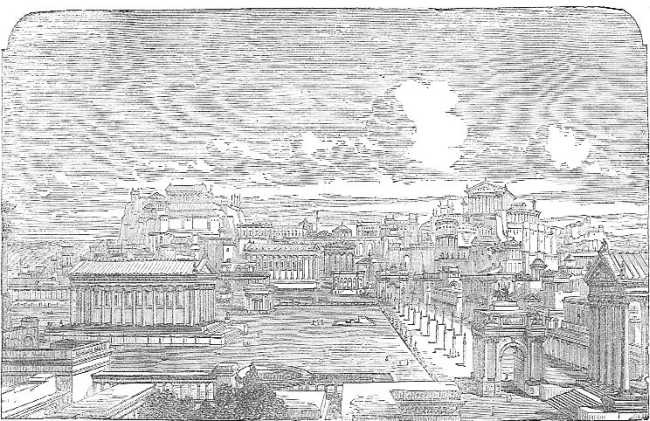
THE ROMAN FORUM RESTORED.
The Project Gutenberg EBook of A Smaller History of Rome, by
William Smith and Eugene Lawrence

This eBook is for the use of anyone anywhere at no cost and with
almost no restrictions whatsoever.  You may copy it, give it away or
re-use it under the terms of the Project Gutenberg License included
with this eBook or online at www.gutenberg.org


Title: A Smaller History of Rome

Author: William Smith and Eugene Lawrence

Release Date: November 1, 2006 [EBook #19694]

Language: English

Character set encoding: ISO-8859-1

*** START OF THIS PROJECT GUTENBERG EBOOK A SMALLER HISTORY OF ROME ***


Produced by Alicia Williams, Taavi Kalju and the Online
Distributed Proofreading Team at http://www.pgdp.net
MANUAL OF ECCLESIASTICAL HISTORY. By PHILIP SMITH. Illustrated. $1 50.
THE STUDENT'S CLASSICAL DICTIONARY. Illustrated. $1 25.
ANCIENT HISTORY OF THE EAST. By PHILIP SMITH. Illustrated. $1 25.
HISTORY OF GREECE. By Dr. WILLIAM SMITH. Illustrated. $1 25.
COX'S GENERAL HISTORY OF GREECE. With Maps. $1 25.
LIDDELL'S HISTORY OF ROME. Illustrated. $1 25.
MERIVALE'S GENERAL HISTORY OF ROME. With Maps. $1 25.
GIBBON'S DECLINE AND FALL OF THE ROMAN EMPIRE. Illustrated. $1 25.
LYELL'S GEOLOGY. Illustrated. $1 25.
HISTORY OF FRANCE. By the Rev. W.H. JERVIS, M.A. Illustrated. $1 25.
HUME'S HISTORY OF ENGLAND. Illustrated. Now Edition. $1 50.
STRICKLAND'S QUEENS OF ENGLAND. Illustrated. $1 25.
HALLAM'S CONSTITUTIONAL HISTORY OF ENGLAND. $1 25.
HALLAM'S MIDDLE AGES. $1 25.
OLD TESTAMENT HISTORY. By PHILIP SMITH. With Maps and Illustrations. $1 25.
NEW TESTAMENT HISTORY. By PHILIP SMITH. With Maps and Illustrations. $1 25.
LEWIS'S HISTORY OF GERMANY. With Maps and Illustrations. $1 50.
SCRIPTURE HISTORY. 60 cents.
HISTORY OF GREECE. 60 cents.
HISTORY OF ROME. 60 cents.
COX'S SCHOOL HISTORY OF GREECE. 60 cents.
HISTORY OF ENGLAND. 60 cents.
ANCIENT HISTORY OF THE EAST. 60 cents.
SEEMANN'S MYTHOLOGY. 60 cents.
MERIVALE'S SCHOOL HISTORY OF ROME. 75 cents.
 Any of the above books sent by mail, postage
prepaid, to any part of the United States, on receipt of the price.
Any of the above books sent by mail, postage
prepaid, to any part of the United States, on receipt of the price.
Entered, according to Act of Congress, in the year one thousand eight hundred and sixty-five, by HARPER & BROTHERS, in the Clerk's Office of the District Court of the Southern District of New York.
The present History has been drawn up chiefly for the lower forms in schools, at the request of several teachers, and is intended to range with the author's Smaller History of Greece. It will be followed by a similar History of England. The author is indebted in this work to several of the more important articles upon Roman history in the Dictionary of Greek and Roman Biography.
The Table of Contents presents a full analysis of the work, and has been so arranged that the teacher can frame from it questions for the examination of his class, the answers to which will be found in the corresponding pages of the volume.
The restoration of the Forum has been designed by Mr. P.W. Justyne.
W.S.
| B.C. | Page | |
| CHAPTER I. | ||
| GEOGRAPHY OF ITALY—EARLY INHABITANTS. | ||
| Position of Italy | 1 | |
| Its boundaries | 1 | |
| Its two Divisions | 1 | |
| I. Gallia Cisalpina | 2 | |
| Liguria | 2 | |
| Venetia | 2 | |
| II. Italia, properly so called | 2 | |
| Etruria | 2 | |
| Umbria | 2 | |
| Picenum | 2 | |
| Sabini | 3 | |
| Marsi | 3 | |
| Peligni | 3 | |
| Vestini | 3 | |
| Marrucini | 3 | |
| Frentani | 3 | |
| Latium: its two senses | 3 | |
| The Campagna | 3 | |
| The Pontine Marshes | 4 | |
| Campania | 4 | |
| Bay of Naples | 4 | |
| Samnium | 4 | |
| Apulia | 4 | |
| Calabria | 4 | |
| Lucania | 4 | |
| Bruttii | 4 | |
| Fertility of Italy | 5 | |
| Its productions | 5 | |
| Its inhabitants | 5 | |
| I. Italians proper | 5 | |
| 1. Latins | 5 | |
| 2. Umbro-Sabellians | 5 | |
| II. Iapygians | 5 | |
| III. Etruscans | 5 | |
| Their name | 5 | |
| Their language | 5 | |
| Their origin | 5 | |
| Their two confederacies | 6 | |
| 1. North of the Po | 6 | |
| 2. South of the Apennines | 6 | |
| Foreign races— | ||
| IV. Greeks | 6 | |
| Gauls | 6 | |
| CHAPTER II. | ||
| THE FIRST FOUR KINGS OF ROME. B.C. 753-616. | ||
| Position of Rome | 7 | |
| Its inhabitants | 7 | |
| 1. Latins | 7 | |
| 2. Sabines | 7 | |
| 3. Etruscans | 7 | |
| Remarks on early Roman history | 8 | |
| Legend of Æneas | 8 | |
| Legend of Ascanius | 8 | |
| Foundation of Alba Longa | 8 | |
| Legend of Rhea Silvia | 8 | |
| Birth of Romulus and Remus | 8 | |
| Their recognition by Numitor | 9 | |
| 753. | Foundation of Rome | 9 |
| Roma Quadrata | 9 | |
| Pomœrium | 9 | |
| Death of Remus | 10 | |
| 753-716. | Reign of Romulus | 9 |
| Asylum | 10 | |
| Rape of Sabines | 10 | |
| [Pg viii] | War with Sabines | 10 |
| Tarpeia | 10 | |
| Sabine women | 10 | |
| Joint reign of Romulus and Titus Tatius | 11 | |
| Death of Titus Tatius | 11 | |
| Sole reign of Romulus | 11 | |
| Death of Romulus | 11 | |
| Institutions ascribed to Romulus | 12 | |
| Patricians & Clients | 12 | |
| Three tribes—Ramnes, Tities, Luceres | 12 | |
| Thirty Curiæ | 12 | |
| Three Hundred Gentes | 12 | |
| Comitia Curiata | 12 | |
| The Senate | 12 | |
| The Army | 12 | |
| 716-673. | Reign of Numa Pompilius | 12 |
| Institutions ascribed to Numa Pompilius | 12 | |
| Pontiffs | 12 | |
| Augurs | 13 | |
| Flamens | 13 | |
| Vestal Virgins | 13 | |
| Salii | 13 | |
| Temple of Janus | 13 | |
| 673-641. | Reign of Tullus Hostilius | 13 |
| War with Alba Longa | 13 | |
| Battle of the Horatii and Curiatii | 13 | |
| War with the Etruscans | 14 | |
| Punishment of Mettius Fuffetius, Dictator of Alba Longa | 14 | |
| Destruction of Alba Longa | 14 | |
| Removal of its inhabitants to Rome | 14 | |
| Origin of the Roman Plebs | 14 | |
| Death of Tullus Hostilius | 14 | |
| 640-616. | Reign of Ancus Marcius | 14 |
| War with the Latins | 14 | |
| Increase of the Plebs | 15 | |
| Ostia | 15 | |
| Janiculum | 15 | |
| Pons Sublicius | 15 | |
| Death of Ancus Marcius | 15 | |
| CHAPTER III. | ||
| THE LAST THREE KINGS OF ROME, AND THE ESTABLISHMENT OF THE REPUBLIC DOWN TO THE BATTLE OF THE LAKE REGILLUS. B.C. 616-498. | ||
| 616-578. | Reign of Tarquinius Priscus | 16 |
| His early history | 16 | |
| His removal to Rome | 16 | |
| Becomes king | 16 | |
| His wars | 16 | |
| The Cloacæ | 16 | |
| Circus Maximus | 17 | |
| Increase of the Senate | 17 | |
| Increase of the Equites | 17 | |
| Attus Navius | 17 | |
| Increase of the Vestal Virgins | 17 | |
| Early history of Servius Tullius | 17 | |
| Death of Tarquinius Priscus | 18 | |
| 578-534. | Reign of Servius Tullius | 18 |
| I. Reform of the Roman Constitution | 18 | |
| 1. Division of the Roman territory into Thirty Tribes | 18 | |
| 2. Comitia Centuriata | 18 | |
| Census | 18 | |
| Five Classes | 19 | |
| The Equites | 19 | |
| Number of the Centuries | 19 | |
| Three sovereign assemblies—Comitia Centuriata, Comitia Curiata, Comitia Tributa | 20 | |
| II. Increase of the city: walls of Servius Tullius | 20 | |
| III. Alliance with the Latins | 20 | |
| Death of Servius Tullius | 22 | |
| 534-510. | Reign of Tarquinius Superbus | 22 |
| His tyranny | 22 | |
| His alliance with the Latins | 23 | |
| His war with the Volscians | 23 | |
| Foundation of the temple on the Capitoline Hill | 23 | |
| The Sibylline books | 23 | |
| Legend of the Sibyl | 23 | |
| Capture of Gabii | 23 | |
| King's sons and Brutus sent to consult the oracle at Delphi | 23 | |
| Lucretia | 24 | |
| [Pg ix] | Expulsion of the Tarquins | 25 |
| 509. | Establishment of the Republic | 25 |
| The Consuls | 25 | |
| First attempt to restore the Tarquins | 25 | |
| Execution of the sons of Brutus | 25 | |
| War of the Etruscans with Rome | 26 | |
| Death of Brutus | 26 | |
| Defeat of the Etruscans | 26 | |
| Valerius Publicola | 26 | |
| Dedication of the Capitoline Temple by M. Horatius | 26 | |
| 508. | Second attempt to restore the Tarquins | 26 |
| Lars Porsena | 26 | |
| Horatius Cocles | 26 | |
| Mucius Scævola | 27 | |
| Clœlia | 27 | |
| 498. | Third attempt to restore the Tarquins | 28 |
| War with the Latins | 28 | |
| Battle of the Lake Regillus | 28 | |
| 496. | Death of Tarquinius Superbus | 28 |
| CHAPTER IV. | ||
| FROM THE BATTLE OF THE LAKE REGILLUS TO THE DECEMVIRATE. B.C. 498-451. | ||
| Struggles between the Patricians and Plebeians | 29 | |
| Ascendency of the Patricians | 29 | |
| Sufferings of the Plebeians | 30 | |
| Law of debtor and creditor | 30 | |
| Ager Publicus | 30 | |
| Object of the Plebeians to obtain a share in the political power and in the public land | 30 | |
| 494. | Secession to the Sacred Mount | 30 |
| Fable of Menenius Agrippa | 31 | |
| Institution of the Tribunes of the Plebs | 31 | |
| 486. | Agrarian Law of Sp. Cassius | 31 |
| Foreign wars | 32 | |
| 488. | I. Coriolanus and the Volscians | 32 |
| 477. | II. The Fabia Gens and the Veientines | 33 |
| 458. | III. Cincinnatus and the Æquians | 34 |
| League between the Romans, Latins, and Hernicans | 35 | |
| CHAPTER V. | ||
| THE DECEMVIRATE. B.C. 451-449. | ||
| 471. | Publilian Law transferring the election of the Tribunes from the Comitia of Centuries to those of the Tribes | 36 |
| 462. | Proposal of the Tribune Terentilius Arsa for the appointment of Decemviri | 37 |
| 460. | Seizure of the Capitol by Herdonius the Sabine | 37 |
| 454. | Appointment of three Commissioners to visit Greece | 37 |
| 452. | Their return to Rome | 37 |
| 451. | Appointment of the Decemviri | 37 |
| The Ten Tables | 37 | |
| 450. | New Decemviri appointed | 37 |
| Their tyranny | 38 | |
| Two new Tables added, making twelve in all | 38 | |
| 449. | The Decemviri continue in office | 38 |
| Death of Sicinius Dentatus | 38 | |
| Death of Virginia | 39 | |
| Second secession to the Sacred Mount | 39 | |
| Resignation of the Decemvirs | 39 | |
| Election of ten Tribunes | 40 | |
| Valerian and Horatian Laws | 40 | |
| Death of Appius Claudius | 40 | |
| The Twelve Tables | 40 | |
| [Pg x] | CHAPTER VI. | |
| FROM THE DECEMVIRATE TO THE CAPTURE OF ROME BY THE GAULS. B.C. 448-390. | ||
| 445. | Third secession to the Sacred Mount | 41 |
| Lex Canuleia for intermarriage between the two orders | 41 | |
| Institution of Military Tribunes with consular powers | 41 | |
| 443. | Institution of the Censorship | 41 |
| 421. | Quæstorship thrown open to the Plebeians | 42 |
| 440. | Famine at Rome | 42 |
| Death of Sp. Mælius | 42 | |
| Foreign wars | 42 | |
| Roman colonies | 43 | |
| War with the Etruscans | 43 | |
| 437. | Spolia Opima won by A. Cornelius Cossus | 43 |
| 426. | Capture and destruction of Fidenæ | 43 |
| 403. | Commencement of siege of Veii | 43 |
| Tale of the Alban Lake | 43 | |
| 396. | Appointment of Camillus as Dictator | 43 |
| Capture of Veii | 44 | |
| 394. | War with Falerii | 44 |
| Tale of the Schoolmaster | 44 | |
| Unpopularity of Camillus | 44 | |
| 391. | He goes into exile | 44 |
| CHAPTER VII. | ||
| FROM THE CAPTURE OF ROME BY THE GAULS TO THE FINAL UNION OF THE TWO ORDERS. B.C. 390-367. | ||
| The Gauls, or Celts | 45 | |
| 391. | Attack of Clusium by the Senones | 45 |
| Roman ambassadors sent to Clusium | 45 | |
| They take part in the fight against the Senones | 45 | |
| The Senones march upon Rome | 46 | |
| 390. | Battle of the Allia | 46 |
| Destruction of Rome | 46 | |
| Siege of the Capitol | 46 | |
| Legend of M. Manlius | 47 | |
| Appointment of Camillus as Dictator | 47 | |
| He delivers Rome from the Gauls | 47 | |
| Rebuilding of the city | 47 | |
| Further Gallic wars | 48 | |
| 361. | Legend of T. Manlius Torquatus | 48 |
| 349. | Legend of M. Valerius Corvus | 48 |
| 385. | Distress at Rome | 48 |
| 384. | M. Manlius comes forward as a patron of the poor | 48 |
| His fate | 49 | |
| 376. | Licinian Rogations proposed | 49 |
| Violent opposition of the Patricians | 50 | |
| 367. | Licinian Rogations passed | 50 |
| 366. | L. Sextius first Plebeian Consul | 50 |
| Institution of the Prætorship | 50 | |
| 356. | First Plebeian Dictator | 51 |
| 351. | First Plebeian Censor | 51 |
| 336. | First Plebeian Prætor | 51 |
| 300. | Lex Ogulnia, increasing the number of the Pontiffs and Augurs, and enacting that a certain number of them should be taken from the Plebeians | 51 |
| 339. | Publilian Laws | 51 |
| 286. | Lex Hortensia | 51 |
| [Pg xi] | CHAPTER VIII. | |
| FROM THE LICINIAN ROGATIONS TO THE END OF THE SAMNITE WARS. B.C. 367-290. | ||
| 362. | Pestilence at Rome | 52 |
| Death of Camillus | 52 | |
| Tale of M. Curtius | 53 | |
| The Samnites | 53 | |
| Their history | 53 | |
| Division into four tribes | 53 | |
| Conquer Campania and Lucania | 53 | |
| Samnites of the Apennines attack the Sidicini | 53 | |
| Campanians assist the Sidicini | 53 | |
| They are defeated by the Samnites | 53 | |
| They solicit the assistance of Rome | 53 | |
| 343-341. | FIRST SAMNITE WAR | 54 |
| Battle of Mount Gaurus | 54 | |
| Peace concluded | 54 | |
| Reasons for the conclusion of peace | 54 | |
| 340-338. | THE LATIN WAR | 54 |
| The armies meet near Mount Vesuvius | 55 | |
| Tale of Torquatus | 55 | |
| Decisive battle | 55 | |
| Self-sacrifice of Decius | 55 | |
| Capture of Latin towns | 56 | |
| Conclusion of the war | 56 | |
| 329. | Conquest of the Volscian town of Privernum | 56 |
| Origin of the Second Samnite War | 56 | |
| 327. | The Romans attack Palæopolis and Neapolis | 56 |
| 326-304. | SECOND SAMNITE WAR | 57 |
| First Period. | ||
| Roman arms successful | 57 | |
| 325. | Quarrel between L. Papirius Dictator and Q. Fabius, his master of the horse | 57 |
| 321-315. | Second Period. | |
| Success of the Samnites | 57 | |
| 321. | Defeat of the Romans at the Caudine Forks by C. Pontius | 68 |
| Ignominious treaty rejected by the Romans | 58 | |
| 314-304. | Third Period. | |
| Success of the Romans | 58 | |
| 311. | War with the Etruscans | 58 |
| Defeat of the Etruscans | 59 | |
| Defeat of the Samnites | 59 | |
| 304. | Peace with Rome | 59 |
| 300. | Conquests of Rome in Central Italy | 59 |
| Coalition of Etruscans, Umbrians, and Samnites against Rome | 59 | |
| 298-290. | THIRD SAMNITE WAR | 59 |
| 295. | Decisive battle of Sentinum | 59 |
| Self-sacrifice of the younger Decius | 59 | |
| 292. | C. Pontius taken prisoner and put to death | 59 |
| CHAPTER IX. | ||
| FROM THE CONCLUSION OF THE SAMNITE WAR TO THE SUBJUGATION OF ITALY. B.C. 290-265. | ||
| 283. | War with the Etruscans and Gauls | 60 |
| Battle of the Lake Vadimo | 60 | |
| 282. | State of Magna Græcia | 60 |
| The Romans assist Thurii | 60 | |
| Their fleet is attacked by the Tarentines | 61 | |
| Roman embassy to Tarentum | 61 | |
| 281. | War declared against the Tarentines | 61 |
| They apply for aid to Pyrrhus | 61 | |
| Pyrrhus arrives in Italy | 62 | |
| 280. | His first campaign against the Romans | 62 |
| Battle of Heraclea | 62 | |
| Remarks of Pyrrhus on the victory | 62 | |
| He attempts to make peace with Rome | 62 | |
| Failure of his minister Cineas | 63 | |
| He marches upon Rome and arrives at Præneste | 63 | |
| Retires into winter quarters at Tarentum | 63 | |
| [Pg xii] | Embassy of Fabricius | 63 |
| 279. | Second campaign of Pyrrhus | 64 |
| Battle of Asculum | 64 | |
| 278. | Treachery of the physician of Pyrrhus | 64 |
| Truce with Rome | 64 | |
| Pyrrhus crosses over into Sicily | 64 | |
| 276. | He returns to Italy | 64 |
| 274. | Defeat of Pyrrhus | 65 |
| He returns to Greece | 65 | |
| 272. | Subjugation of Tarentum | 65 |
| Conquest of Italy | 65 | |
| 273. | Embassy of Ptolemy Philadelphus to Rome | 65 |
| Three classes of Italian population: | ||
| I. Cives Romani, or Roman Citizens | 66 | |
| 1. Of the Thirty-three tribes | 66 | |
| 2. Of the Roman Colonies | 66 | |
| 3. Of the Municipal Towns | 66 | |
| II. Nomen Latinum, or the Latin name | 66 | |
| III. Socii, or Allies | 66 | |
| 312. | Censorship of Appius Claudius | 67 |
| His dangerous innovation as to the Freedmen | 67 | |
| 304. | Repealed in the Censorship of Q. Fabius Maximus and P. Decius Mus | 67 |
| 312. | The Appian Way | 67 |
| The Appian Aqueduct | 67 | |
| Cn. Flavius | 67 | |
| CHAPTER X. | ||
| THE FIRST PUNIC WAR. B.C. 264-241. | ||
| 814. | Foundation of Carthage | 68 |
| Its empire | 68 | |
| Its government | 68 | |
| Its army | 68 | |
| Its foreign conquests | 68 | |
| Conquest of Messana by the Mamertini | 69 | |
| Hiero attacks the Mamertini | 69 | |
| They apply for assistance to Rome | 69 | |
| 264. | The Consul Ap. Claudius crosses over to Sicily to aid them | 70 |
| He defeats the forces of Syracuse and Carthage | 70 | |
| 263. | Hiero makes peace with the Romans | 70 |
| 262. | Capture of Agrigentum by the Romans | 70 |
| 260. | The Romans build a fleet | 70 |
| Naval victory of the Consul Duilius | 71 | |
| 256. | The Romans invade Africa | 72 |
| Their naval victory | 72 | |
| Brilliant success of Regulus in Africa | 72 | |
| The Carthaginians sue in vain for peace | 72 | |
| 255. | Arrival of the Lacedæmonian Xanthippus | 72 |
| He restores confidence to the Carthaginians | 73 | |
| Defeat and capture of Regulus | 73 | |
| Destruction of the Roman fleet by a storm | 73 | |
| The Romans build another fleet | 73 | |
| 253. | Again destroyed by a storm | 73 |
| The war confined to Sicily | 73 | |
| 250. | Victory of Metellus at Panormus | 73 |
| Embassy of the Carthaginians to Rome | 73 | |
| Heroic conduct of Regulus | 74 | |
| 250. | Siege of Lilybæum | 74 |
| 249. | Defeat of the Consul Claudius at sea | 75 |
| Destruction of the Roman fleet a third time | 75 | |
| 247. | Appointment of Hamilcar Barca to the Carthaginian command | 75 |
| He intrenches himself on Mount Herctè, near Panormus | 75 | |
| He removes to Mount Eryx | 75 | |
| 241. | Victory off the Ægatian Islands | 76 |
| Peace with Carthage | 76 | |
| End of the War | 76 | |
| [Pg xiii] | CHAPTER XI. | |
| EVENTS BETWEEN THE FIRST AND SECOND PUNIC WARS. B.C. 240-219. | ||
| 240-238. | War of the Mercenaries with Carthage | 77 |
| She owes her safety to Hamilcar | 77 | |
| 238. | The Romans seize Sardinia and Corsica | 77 |
| Hamilcar goes to Spain | 78 | |
| 235. | Temple of Janus closed | 78 |
| Completion of the Thirty-five Roman Tribes | 78 | |
| 229. | ILLYRIAN WAR | 78 |
| Conquest of Teuta, queen of the Illyrians | 78 | |
| 223. | Honors paid to the Romans in the Grecian cities | 78 |
| 232. | Agrarian law of the Tribune Flaminius | 78 |
| 225. | GALLIC WAR | 78 |
| Defeat of the Gauls at Telamon in Etruria | 79 | |
| 224. | Conquest of the Boii | 79 |
| 223. | The Romans cross the Po | 79 |
| 222. | Conquest of the Insubres | 79 |
| Marcellus wins the Spolia Opima | 79 | |
| 220. | The Via Flaminia from Rome to Ariminum | 79 |
| 218. | Foundation of Colonies at Placentia and Cremona | 79 |
| 219. | SECOND ILLYRIAN WAR | 79 |
| 235. | Hamilcar in Spain | 80 |
| Oath of Hannibal | 80 | |
| 229. | Death of Hamilcar | 80 |
| Hasdrubal succeeds him in the command | 80 | |
| 227. | Treaty with Rome | 80 |
| 221. | Death of Hasdrubal | 80 |
| Hannibal succeeds him in the command | 80 | |
| 219. | Siege of Saguntum | 80 |
| Its capture | 81 | |
| War declared against Carthage | 81 | |
| CHAPTER XII. | ||
| THE SECOND PUNIC WAR: FIRST PERIOD, DOWN TO THE BATTLE OF CANNÆ B.C. 218-216. | ||
| 218. | Preparations of Hannibal | 82 |
| His march to the Rhone | 83 | |
| Arrival of the Consul Scipio at Massilia | 83 | |
| Hannibal crosses the Rhone | 83 | |
| Scipio sends his brother to Spain, and returns himself to Italy | 83 | |
| Hannibal crosses the Alps | 83 | |
| Skirmish on the Ticinus | 84 | |
| Battle of the Trebia | 84 | |
| Defeat of the Romans | 84 | |
| 217. | Hannibal's march through Etruria | 86 |
| Battle of the Lake Trasimenus | 86 | |
| Great defeat of the Romans | 86 | |
| Q. Fabius Maximus appointed Dictator | 87 | |
| His policy | 87 | |
| Rashness of Minucius, the Master of the Horse | 87 | |
| 216. | Great preparations of the Romans | 88 |
| Battle of Cannæ | 88 | |
| Great defeat of the Romans | 88 | |
| Revolt of Southern Italy | 88 | |
| Hannibal winters at Capua | 89 | |
| Note on Hannibal's passage across the Alps | 90 | |
| CHAPTER XIII. | ||
| SECOND PUNIC WAR: SECOND PERIOD, FROM THE REVOLT OF CAPUA TO THE BATTLE OF THE METAURUS. B.C. 215-207. | ||
| 215. | Plan of the War | 91 |
| Hannibal's repulse before Nola | 92 | |
| 214. | He attempts in vain to surprise Tarentum | 92 |
| 213. | He obtains possession of Tarentum | 93 |
| WAR IN SICILY— | ||
| 216. | Death of Hiero | 93 |
| Succession of Hieronymus | 93 | |
| His assassination | 93 | |
| 214. | Arrival of Marcellus in Sicily | 93 |
| He takes Leontini | 93 | |
| [Pg xiv] | He lays siege to Syracuse | 93 |
| Defended by Archimedes | 93 | |
| 212. | Capture of Syracuse | 94 |
| WAR IN SPAIN— | ||
| 212. | Capture and death of the two Scipios | 95 |
| Siege of Capua | 95 | |
| 211. | Hannibal marches upon Rome | 95 |
| Is compelled to retreat | 96 | |
| The Romans recover Capua | 96 | |
| Punishment of its inhabitants | 93 | |
| 209. | The Romans recover Tarentum | 96 |
| 208. | Defeat and death of Marcellus | 97 |
| 207. | Hasdrubal marches into Italy | 97 |
| He besieges Placentia | 97 | |
| March of the Consul Nero to join his colleague Livius in Umbria | 97 | |
| Battle of the Metaurus | 98 | |
| Defeat and death of Hasdrubal | 98 | |
| CHAPTER XIV. | ||
| SECOND PUNIC WAR: THIRD PERIOD, FROM THE BATTLE OF THE METAURUS TO THE CONCLUSION OF THE WAR. B.C. 206-201. | ||
| Character and early life of Scipio | 99 | |
| 210. | He is elected Proconsul for Spain | 100 |
| He takes New Carthage | 100 | |
| 206. | He subdues Spain | 101 |
| He crosses over into Africa and visits Syphax | 101 | |
| He returns to Rome | 102 | |
| 205. | His Consulship | 102 |
| He prepares to invade Africa | 102 | |
| His project is opposed by Fabius and others | 102 | |
| 204. | He arrives in Africa | 103 |
| 203. | He defeats the Carthaginians and Syphax | 103 |
| Masinissa and Sophonisba | 103 | |
| The Carthaginians recall Hannibal | 104 | |
| 202. | Battle of Zama, and defeat of Hannibal | 104 |
| Terms of peace | 105 | |
| 201. | Conclusion of the war | 105 |
| Triumph of Scipio | 105 | |
| CHAPTER XV. | ||
| WARS IN THE EAST: THE MACEDONIAN, SYRIAN, AND GALATIAN WARS. B.C. 214-188. | ||
| State of the East | 106 | |
| Syria | 106 | |
| Pontus | 106 | |
| Galatia | 106 | |
| Pergamus | 106 | |
| Egypt | 107 | |
| State of Greece | 107 | |
| Macedonia | 107 | |
| Achæan League | 107 | |
| Ætolian League | 107 | |
| Rhodes | 107 | |
| Sparta | 107 | |
| 214-205. | FIRST MACEDONIAN WAR— | |
| Its indecisive character | 108 | |
| 211. | Treaty of the Romans with the Ætolian League | 108 |
| 205. | Conclusion of the war | 108 |
| Philip's hostile acts | 108 | |
| He assists the Carthaginians at the battle of Zama | 108 | |
| His conduct in Greece | 108 | |
| 200-196. | SECOND MACEDONIAN WAR— | |
| 200. | First campaign: the Consul Galba | 108 |
| 199. | Second campaign: the Consul Villius | 109 |
| 198. | Third campaign: the Consul Flamininus | 109 |
| 197. | Battle of Cynoscephalæ | 109 |
| 196. | Declaration of Grecian independence at the Isthmian Games | 109 |
| 191-190. | SYRIAN WAR— | |
| Antiochus the Third | 110 | |
| Intrigues of the Ætolians in Greece | 110 | |
| [Pg xv] | They Invite Antiochus to Greece | 110 |
| Hannibal expelled from Carthage | 110 | |
| He arrives in Syria | 110 | |
| His advice to Antiochus | 110 | |
| 192. | Antiochus crosses over to Greece | 110 |
| 191. | The Romans defeat him at Thermopylæ | 110 |
| He returns to Asia | 110 | |
| 190. | The Romans invade Asia | 111 |
| Battle of Magnesia | 111 | |
| Defeat of Antiochus by Scipio Asiaticus | 111 | |
| Terms of peace | 111 | |
| Hannibal flies to Prusias, king of Bithynia | 111 | |
| 189. | ÆTOLIAN WAR— | |
| Fulvius takes Ambracia | 111 | |
| Terms of peace | 111 | |
| 189. | GALATIAN WAR— | |
| Manlius attacks the Galatians without the authority of the Senate or the People | 112 | |
| 187. | He returns to Rome | 113 |
| Effects of the Eastern conquests upon the Roman character | 113 | |
| CHAPTER XVI. | ||
| WARS IN THE WEST: THE GALLIC, LIGURIAN, AND SPANISH WARS. B.C. 200-175. | ||
| 200. | THE GALLIC WAR— | |
| The Gauls take Placentia and lay siege to Cremona | 113 | |
| Conquest of the Insubres and Cenomani | 114 | |
| 191. | Conquest of the Boil | 114 |
| 190. | Colony founded at Bononia | 114 |
| 180. | Via Æmilia | 114 |
| 200. | THE LIGURIAN WAR— | |
| Continued with intermissions for nearly 80 years | 114 | |
| Character of the war | 114 | |
| 198. | TWO PROVINCES FORMED IN SPAIN | 114 |
| 195. | THE SPANISH WAR— | |
| The Consul M. Porcius Cato sent into Spain | 114 | |
| His success | 115 | |
| The Spaniards again take up arms | 115 | |
| 180. | The war brought to a conclusion by Tib. Sempronius Gracchus | 115 |
| 178. | THE ISTRIAN WAR | 115 |
| 177-175. | THE SARDINIAN AND CORSICAN WAR | 115 |
| CHAPTER XVII. | ||
| THE ROMAN CONSTITUTION AND ARMY. | ||
| Review of the history of the Roman Constitution | 116 | |
| Political equality of the Patricians and Plebeians | 116 | |
| I. THE MAGISTRATES— | ||
| The Lex Annalis | 117 | |
| 1. The Quæstors | 117 | |
| 2. The Ædiles | 117 | |
| 3. The Prætors | 117 | |
| 4. The Consuls | 118 | |
| 5. The Dictators | 118 | |
| 6. The Censors | 118 | |
| (a) The Census | 118 | |
| (b) Control over the morals of the citizens | 119 | |
| (c) Administration of the finances of the state | 119 | |
| II. THE SENATE— | ||
| Its number | 119 | |
| Its mode of Election | 119 | |
| Its power and duties | 119 | |
| III. THE POPULAR ASSEMBLIES— | ||
| 1. The Comitia Curiata | 120 | |
| 2. The Comitia Centuriata: change in its constitution | 120 | |
| 3. The Comitia Tributa | 121 | |
| The Tribunes | 121 | |
| The Plebiscita | 121 | |
| IV. FINANCES— | ||
| Tributum | 121 | |
| Vectigalia | 121 | |
| [Pg xvi] | V. THE ARMY— | |
| Number of the Legion | 122 | |
| 1. First Period—Servius Tullius | 122 | |
| 2. Second Period—The Great Latin War, B.C. 340 | 122 | |
| Hastati | 122 | |
| Principes | 122 | |
| Triarii | 122 | |
| Rorarii and Accensi | 123 | |
| 3. Third Period—During the wars of the younger Scipio | 123 | |
| Two legions assigned to each Consul | 123 | |
| Division of the legion | 123 | |
| The Maniples | 123 | |
| The Cohorts | 123 | |
| The Tribuni Militum | 123 | |
| The Horse-soldiers | 123 | |
| Infantry of the Socii | 123 | |
| 4. Fourth Period—From the times of the Gracchi to the downfall of the Republic | 123 | |
| Changes introduced by Marius | 124 | |
| Triumphs | 124 | |
| CHAPTER XVIII. | ||
| INTERNAL HISTORY OF ROME DURING THE MACEDONIAN AND SYRIAN WARS. CATO AND SCIPIO. | ||
| Effect of the Roman conquests in the East | 126 | |
| Debasement of the Roman character | 126 | |
| 192. | Infamous conduct of L. Flamininus | 127 |
| 193. | Worship of Bacchus | 127 |
| Gladiatorial exhibitions | 127 | |
| Rise of the new nobility | 127 | |
| 191. | Law against bribery | 127 |
| Decay of the peasant proprietors | 128 | |
| M. Porcius Cato | 128 | |
| 234. | His birth | 128 |
| His early life | 128 | |
| 204. | His Quæstorship | 129 |
| 198. | His Prætorship | 129 |
| 195. | His Consulship | 129 |
| Repeal of the Oppian Law | 130 | |
| 191. | Cato serves in the battle of Thermopylæ | 130 |
| Prosecution of the two Scipios | 130 | |
| Haughty conduct of Scipio Africanus | 130 | |
| Condemnation of Scipio Asiaticus | 130 | |
| Prosecution of Scipio Africanus | 130 | |
| He leaves Rome | 131 | |
| 188. | His death | 131 |
| Death of Hannibal | 132 | |
| 184. | Censorship of Cato | 132 |
| He studies Greek in his old age | 132 | |
| His character | 133 | |
| CHAPTER XIX. | ||
| THE THIRD MACEDONIAN, ACHÆAN, AND THIRD PUNIC WARS. B.C. 179-146. | ||
| 179. | Death of Philip and accession of Perseus | 134 |
| 172. | Murder of Eumenes, king of Pergamus | 135 |
| 171-168. | THIRD MACEDONIAN WAR— | |
| 168. | Battle of Pydna | 135 |
| Defeat of Perseus by L. Æmilius Paullus | 135 | |
| 167. | Æmilius Paullus punishes the Epirotes | 135 |
| His triumph | 135 | |
| His domestic misfortunes | 136 | |
| Haughty conduct of Rome in the East | 136 | |
| Embassy to Antiochus Epiphanes | 136 | |
| Treatment of Eumenes, king of Pergamus | 136 | |
| Mean conduct of Prusias, king of Bythinia | 136 | |
| Treatment of the Rhodians | 136 | |
| 167. | One thousand Achæans sent to Italy | 136 |
| [Pg xvii]151. | The survivors allowed to return to Greece | 137 |
| 140. | A pretender lays claim to the throne of Macedonia | 137 |
| He is defeated and taken prisoner | 137 | |
| 147-146. | THE ACHÆAN WAR— | |
| 146. | Corinth taken by L. Mummius | 138 |
| Final conquest of Greece | 138 | |
| Rome jealous of Carthage | 139 | |
| Advice of Scipio | 139 | |
| War between Masinissa and Carthage | 139 | |
| Conduct of the Romans | 140 | |
| 149-146. | THIRD PUNIC WAR— | |
| 147. | Scipio Africanus the younger, Consul | 140 |
| His parentage and adoption | 140 | |
| His character | 140 | |
| 146. | He takes Carthage | 142 |
| Formation of the Roman province of Africa | 142 | |
| Later history of Carthage | 142 | |
| CHAPTER XX. | ||
| SPANISH WARS, B.C. 153-133. FIRST SERVILE WAR, B.C. 134-132. | ||
| 153. | War with the Celtiberians | 143 |
| 152. | Peace with the Celtiberians | 143 |
| 151. | War with the Lusitanians | 143 |
| 150. | Treacherous murder of the Lusitanians by Galba | 144 |
| Success of Viriathus against the Romans | 144 | |
| The Celtiberians again take up arms—the Numantine War | 144 | |
| 140. | Murder of Viriathus | 145 |
| 138. | Brutus conquers the Gallæci | 145 |
| 137. | The Consul Hostilius Mancinus defeated by the Numantines | 145 |
| He signs a peace with the Numantines | 145 | |
| The Senate refuse to ratify it | 145 | |
| 142. | Censorship of Scipio Africanus | 145 |
| 134. | Consul a second time | 145 |
| He carries on the war against Numantia | 146 | |
| 133. | He takes Numantia | 146 |
| Increase of slaves | 146 | |
| They rise in Sicily | 146 | |
| They elect Eunus as their leader | 146 | |
| Eunus assumes the title of king | 146 | |
| 134. | He defeats the Roman generals | 147 |
| 132. | Is himself defeated and taken prisoner | 147 |
| 133. | Death of Attalus, last king of Pergamus | 147 |
| He bequeaths his kingdom to the Romans | 147 | |
| 131. | Aristonicus lays claim to the kingdom of Pergamus | 147 |
| 130. | Is defeated and taken prisoner | 147 |
| 129. | Formation of the province of Asia | 147 |
| Extent of the Roman dominions | 147 | |
| CHAPTER XXI. | ||
| THE GRACCHI. B.C. 133-121. | ||
| Necessity for reform | 148 | |
| Early life of Tiberius Gracchus | 149 | |
| 137. | Quæstor in Spain | 149 |
| 133. | Elected Tribune | 150 |
| Brings forward an Agrarian Law | 150 | |
| Opposition of the landowners | 150 | |
| The Tribune Octavius puts his veto upon it | 150 | |
| Deposition of Octavius | 151 | |
| The Agrarian Law enseted | 151 | |
| Three Commissioners elected | 151 | |
| Distribution of the treasures of Pergamus among the Roman people | 151 | |
| Renewed opposition to Tiberius | 151 | |
| He becomes a candidate for the Tribunate a second time | 151 | |
| Riots | 152 | |
| Death of Tiberius | 152 | |
| 132. | Return of Scipio to Rome | 152 |
| He opposes the popular party | 153 | |
| [Pg xviii]129. | Death of Scipio | 153 |
| 126. | Expulsion of the Allies from Rome | 154 |
| 125. | M. Fulvius Flaccus proposes to give the franchise to the Italians | 154 |
| Revolt and destruction of Fregellæ | 154 | |
| 126. | C. Gracchus goes to Sardinia as Quæstor | 154 |
| 124. | He returns to Rome | 157 |
| 123. | He is elected Tribune | 157 |
| His legislation | 157 | |
| I. Laws for improving the condition of the people | 157 | |
| 1. Extension of the Agrarian Law | 157 | |
| 2. State provision for the poor | 157 | |
| 3. Soldiers equipped at the expense of the Republic | 157 | |
| II. Laws to diminish the power of the Senate | 157 | |
| 1. Transference of the judicial power from the Senators to the Equites | 157 | |
| 2. Distribution of the Provinces before the election of the Consuls | 158 | |
| 122. | C. Gracchus Tribune a second time | 158 |
| Proposes to confer the citizenship upon the Latins | 158 | |
| Unpopularity of this proposal | 158 | |
| The Tribune M. Livius Drusus outbids Gracchus | 158 | |
| Foundation of a colony at Carthage | 159 | |
| Decline of the popularity of Gracchus | 159 | |
| 121. | His murder | 160 |
| Cornelia, the mother of the Gracchi | 160 | |
| CHAPTER XXII. | ||
| JUGURTHA AND HIS TIMES. B.C. 118-104. | ||
| C. MARIUS | 161 | |
| 134. | Serves at the siege of Numantia | 161 |
| Attracts the notice of Scipio Africanus | 161 | |
| 119. | Tribune of the Plebs | 162 |
| 115. | Prætor | 162 |
| 149. | Death of Masinissa | 162 |
| Accession of Micipsa | 162 | |
| 134. | Jugurtha serves at the siege of Numantia | 162 |
| 118. | Death of Micipsa | 162 |
| Jugurtha assassinates Hiempsal | 163 | |
| War between Jugurtha and Adherbal | 163 | |
| 117. | Roman commissioners divide Numidia between Jugurtha and Adherbal | 163 |
| Fresh war between Jugurtha and Adherbal | 163 | |
| Siege of Cirta | 163 | |
| 112. | Death of Adherbal | 163 |
| 111. | The Romans declare war against Jugurtha | 163 |
| Jugurtha bribes the Consul Calpurnius Bestia | 163 | |
| Indignation at Rome | 163 | |
| Jugurtha comes to Rome | 164 | |
| 111. | He murders Massiva | 164 |
| Renewal of the war | 164 | |
| 110. | Incapacity of the Consul Sp. Postumius Albinus | 164 |
| Defeat of his brother Aulus | 164 | |
| 109. | Bill of the Tribune C. Mamilius | 164 |
| Many Romans condemned | 164 | |
| The Consul Q. Cæcilius Metellus lands in Africa | 164 | |
| Accompanied by Marius as his lieutenant | 165 | |
| Metellus defeats Jugurtha | 165 | |
| Ambitious views of Marius | 165 | |
| 108. | He quits Africa and arrives in Rome | 166 |
| Is elected Consul | 166 | |
| Attacks the nobility | 166 | |
| Campaign of Metellus as Proconsul | 166 | |
| The people give Marius command of the Numidian War | 166 | |
| 107. | First Consulship of Marius | 166 |
| He arrives in Africa | 166 | |
| He defeats Jugurtha and Bocchus, king of Mauritania | 167 | |
| 106. | Bocchus surrenders Jugurtha to Sulla, the Quæstor of Marius | 167 |
| Early history of Sulla | 167 | |
| His character | 167 | |
| 104. | Triumph of Marius | 168 |
| His second Consulship | 168 | |
| [Pg xix] | CHAPTER XXIII. | |
| THE CIMBRI AND TEUTONES, B.C. 113-101. SECOND SERVILE WAR IN SICILY, B.C. 103-101. | ||
| Invasion of the Cimbri and Teutones | 169 | |
| Their probable origin | 169 | |
| 113. | Defeat of the Consul Cn. Papirius Carbo | 169 |
| 109. | Defeat of the Consul M. Junius Silanus | 169 |
| 107. | Defeat of the Consul L. Cassius Longinus | 169 |
| 105. | Defeat of the Consul Cn. Mallius Maximus and the Proconsul Cn. Servilius Cæpio | 170 |
| 104. | Second Consulship of Marius | 170 |
| The Cimbri invade Spain | 170 | |
| 103. | Third Consulship of Marius | 170 |
| 102. | Fourth Consulship of Marius | 170 |
| The Cimbri return from Spain | 170 | |
| 102. | Marius takes up his position near Arles | 170 |
| The Cimbri enter Italy by the Pass of Tridentum | 170 | |
| Great defeat of the Teutones by Marius at Aquæ Sextiæ | 171 | |
| 101. | Fifth Consulship of Marius | 171 |
| Great defeat of the Teutones at Vercellæ by Marius and the Proconsul Catulus | 171 | |
| Triumph of Marius and Catulus | 171 | |
| 103-101. | Second Servile War in Sicily | 171 |
| Tryphon king of the Slaves | 172 | |
| Succeeded by Athenio as king | 172 | |
| 101. | The Consul Aquillius puts an end to the war | 172 |
| CHAPTER XXIV. | ||
| INTERNAL HISTORY OF ROME, FROM THE DEFEAT OF THE CIMBRI AND TEUTONES TO THE SOCIAL WAR. B.C. 100-91. | ||
| 100. | Sixth Consulship of Marius | 173 |
| His league with the demagogues Saturninus and Glaucia | 173 | |
| Agrarian Law of Saturninus | 174 | |
| Banishment of Metellus | 174 | |
| Saturninus declared a public enemy | 174 | |
| He is put to death | 175 | |
| Marius visits the East | 175 | |
| 92. | Condemnation of Rutilius Lupus | 175 |
| 91. | Tribunate of M. Livius Drusus | 175 |
| His measures | 176 | |
| Proposes to give the franchise to the Italian allies | 176 | |
| His assassination | 176 | |
| CHAPTER XXV. | ||
| THE SOCIAL OR MARSIC WAR. B.C. 90-89. | ||
| 90. | The Allies take up arms | 178 |
| The war breaks out at Asculum in Picenum | 178 | |
| Corfinium the new capital of the Italian confederation | 178 | |
| Q. Pompædius Silo, a Marsian, and C. Papius Mutilus, a Samnite, the Italian Consuls | 178 | |
| Defeat and death of the Roman Consul P. Rutilius Lupus | 179 | |
| Exploits of Marius | 179 | |
| The Lex Julia | 179 | |
| 89. | Success of the Romans | 180 |
| The Lex Plautia Papiria | 180 | |
| The franchise given to the Allies | 180 | |
| All the Allies lay down their arms except the Samnites and Lucanians | 180 | |
| Ten new Tribes formed | 180 | |
| [Pg xx] | CHAPTER XXVI. | |
| FIRST CIVIL WAR. B.C. 88-86. | ||
| 88. | Consulship of Sulla | 181 |
| Receives the command of the Mithridatic War | 181 | |
| The Tribune P. Sulpicius Rufus | 182 | |
| He proposes to distribute the Italians among the thirty-five Tribes | 182 | |
| Sulla flies from Rome to Nola | 182 | |
| The people give Marius the command of the Mithridatic War | 182 | |
| Sulla marches upon Rome | 182 | |
| Sulpicius put to death | 183 | |
| Marius flies from Rome | 183 | |
| His adventures | 183 | |
| Is seized at Minturnæ | 183 | |
| Escapes to Africa | 184 | |
| Sulla sails to the East | 184 | |
| 87. | Riots at Rome | 185 |
| The Consul Cinna invites the assistance of Marius | 185 | |
| Marius and Cinna march upon Rome | 185 | |
| They enter the city | 185 | |
| Proscription of their enemies | 185 | |
| 86. | Seventh Consulship of Marius | 185 |
| His death | 185 | |
| CHAPTER XXVII. | ||
| FIRST MITHRIDATIC WAR. B.C. 88-84. | ||
| Kingdom of Pontus | 186 | |
| Its history | 186 | |
| 120. | Accession of Mithridates VI | 186 |
| His early life | 186 | |
| His attainments | 187 | |
| His conquests | 187 | |
| His disputes with the Romans | 187 | |
| 88. | He invades Cappadocia and Bithynia | 187 |
| He invades the Roman province of Asia | 188 | |
| Massacre of Romans and Italians | 188 | |
| 87. | The Grecian states declare in favor of Mithridates | 188 |
| Sulla lands in Epirus | 188 | |
| He lays siege to Athens and the Piræus | 188 | |
| 86. | Takes these cities | 188 |
| Defeats Archelaus, the general of Mithridates, at Chæronea | 188 | |
| 85. | Again defeats Archelaus at Orchomenus | 189 |
| 84. | Peace with Mithridates | 189 |
| Sulla attacks Fimbria, the Marian general, in Asia | 189 | |
| 83. | He returns to Italy | 189 |
| CHAPTER XXVIII. | ||
| SECOND CIVIL WAR—SULLA'S DICTATORSHIP, LEGISLATION, AND DEATH. B.C. 83-78. | ||
| 84. | Consulship of Cinna and Carbo | 190 |
| Death of Cinna | 190 | |
| 83. | Consulship of Scipio and Norbanus | 190 |
| Preparations for war | 191 | |
| The Italians support the Marian party | 191 | |
| Sulla marches from Brundusium to Campania | 191 | |
| Defeats the Consul Norbanus | 191 | |
| Pompey, Metellus Pius, Crasus, and others, join Sulla | 192 | |
| 83. | Consulship of Papirus Carbo and the younger Marius | 192 |
| Defeat of Marius, who takes refuge in Præneste | 192 | |
| Murder of Senators in Rome by order of Marius | 192 | |
| Great battle before the Colline gate at Rome between Sulla and the Samnites | 192 | |
| Defeat of the Samnites | 193 | |
| Surrender of Præneste | 193 | |
| Death of Marius | 193 | |
| [Pg xxi] | End of the war | 193 |
| Sulla master of Rome | 193 | |
| Proscription | 193 | |
| Dreadful scenes | 194 | |
| 81. | Sulla dictator | 194 |
| He celebrates his triumph over Mithridates | 194 | |
| His reforms in the constitution | 194 | |
| His military colonies | 194 | |
| 73. | He resigns the Dictatorship | 195 |
| He retires to Puteoli | 195 | |
| 73. | His death | 195 |
| His funeral | 196 | |
| LEGES CORNELLÆ— | ||
| I. Laws relating to the Constitution | 196 | |
| Deprive the Comitia Tribute of their legislative and judicial powers | 196 | |
| Increase the power of the Senate | 197 | |
| Increase the number of the Quæstors and Prætors | 197 | |
| Deprive the Tribunes of all real power | 197 | |
| II. Laws relating to the Ecclesiastical Corporations | 197 | |
| Repeal of the Lex Domitia | 197 | |
| Increase of the number of Pontiffs and Augurs | 197 | |
| III. Laws relating to the Administration of Justice | 197 | |
| Quæstiones Perpetuæ | 197 | |
| Transference of the Judicia from the Equites to the Senators | 198 | |
| IV. Laws relating to the improvement of Public Morals | 198 | |
| CHAPTER XXIX. | ||
| FROM THE DEATH OF SULLA TO THE CONSULSHIP OF POMPEY AND CRASSUS. B.C. 78-70. | ||
| 78. | Consulship of Lepidus and Catulus | 199 |
| Lepidus attempts to repeal the laws of Sulla | 199 | |
| Is opposed by Catulus | 199 | |
| Is defeated at the Mulvian Bridge | 199 | |
| Retires to Sardinia | 200 | |
| His death | 200 | |
| 82. | Sertorius in Spain | 200 |
| 79. | Carries on war against Metellus | 200 |
| CN. POMPEIUS MAGNUS | 200 | |
| His birth | 200 | |
| 89. | Fights against the Italians under his father | 200 |
| 83. | Joins Sulla | 200 |
| 82. | Is sent into Sicily and Africa | 200 |
| 80. | Enters Rome in triumph | 201 |
| 78. | Supports the aristocracy against Lepidus | 201 |
| 76. | Is sent into Spain to assist Metellus | 201 |
| 72. | Assassination of Sertorius by Perperna | 202 |
| 71. | Pompey finishes the war in Spain | 202 |
| 73. | War of the Gladiators: Spartacus | 202 |
| 72. | Spartacus defeats both Consuls | 202 |
| 71. | Crassus appointed to the command of the war against the Gladiators | 202 |
| Defeats and slays Spartacus | 203 | |
| Pompey cuts to pieces a body of Gladiators | 203 | |
| 70. | Consulship of Pompey and Crassus | 203 |
| Pompey restores the Tribunitian power | 203 | |
| Law of L. Aurelius Cotta, transferring the Judicia to the Senators, Equites, and Tribuni Ærarii | 204 | |
| CHAPTER XXX. | ||
| THIRD OR GREAT MITHRIDATIC WAR. B.C. 74-61. | ||
| 83. | SECOND MITHRIDATIC WAR— | |
| Murena invades Pontus | 205 | |
| 83. | Mithridates defeats Murena | 205 |
| End of the Second Mithridatic War | 205 | |
| Preparations of Mithridates | 206 | |
| 71. | THIRD MITHRIDATIC WAR— | |
| Mithridates defeats the Consul Cotta | 206 | |
| He lays siege to Cyzicus | 206 | |
| [Pg xxii]73. | The siege is raised by Lucullus | 207 |
| Lucullus defeats Mithridates | 207 | |
| 71. | Mithridates takes refuge in Armenia | 207 |
| 70. | Lucullus settles the affairs of Asia | 207 |
| 69. | He invades Armenia and defeats Tigranes | 208 |
| 68. | Lucullus defeats Tigranes and Mithridates, and lays siege to Nisibis | 208 |
| 67. | Mithridates returns to Pontus and defeats the generals of Lucullus | 208 |
| Mutiny in the army of Lucullus | 208 | |
| The command of the Mithridatic War given to Glabrio | 209 | |
| WAR WITH THE PIRATES— | ||
| Account of the Pirates | 209 | |
| Command of the war given by the Gabinian Law to Pompey | 210 | |
| Success of Pompey | 210 | |
| He finishes the war | 210 | |
| 66. | THIRD MITHRIDATIC WAR CONTINUED | 210 |
| Command of the Mithridatic War given by the Manilian Law to Pompey | 210 | |
| It is opposed by the aristocracy | 211 | |
| It is supported by Cicero | 211 | |
| Pompey defeats Mithridates | 211 | |
| Mithridates retires into the Cimmerian Bosporus | 211 | |
| Pompey invades Armenia | 212 | |
| Submission of Tigranes | 212 | |
| 65. | Pompey pursues Mithridates | 212 |
| He advances as far as the River Phasis | 212 | |
| He returns to Pontus, which he reduces to the form of a Roman province | 212 | |
| 64. | He marches into Syria, which he makes a Roman province | 212 |
| 63. | He subdues Phœnicia and Palestine | 212 |
| He takes Jerusalem | 212 | |
| Preparations of Mithridates | 213 | |
| Conspiracy against him | 213 | |
| His death | 213 | |
| Pompey settles the affairs of Asia | 213 | |
| 62. | He returns to Italy | 213 |
| CHAPTER XXXI. | ||
| INTERNAL HISTORY, FROM THE CONSULSHIP OF POMPEY AND CRASSUS TO THE RETURN OF POMPEY FROM THE EAST: THE CONSPIRACY OF CATILINE. B.C. 69-61. | ||
| C. JULIUS CÆSAR— | ||
| 100. | His birth | 214 |
| His early history | 214 | |
| Proscribed by Sulla | 215 | |
| 81. | He serves in Asia | 215 |
| 77. | Accuses Dolabella | 215 |
| Taken by the Pirates | 215 | |
| 75. | Studies in Rhodes | 215 |
| 68. | Quæstor | 215 |
| 65. | Curule Ædile | 216 |
| Restores the statues of Marius | 216 | |
| M. TULLIUS CICERO— | ||
| 106. | His birth | 216 |
| 80. | Serves in the Social War | 216 |
| 81. | His speech for P. Quintius | 216 |
| 80. | His speech for Sex. Roscius of Ameria | 216 |
| 79. | He goes to Athens | 216 |
| 78. | He studies in Rome | 216 |
| 77. | He returns to Rome | 216 |
| 76. | Quæstor in Sicily | 217 |
| 70. | He accuses Verres | 217 |
| 68. | Ædile | 217 |
| 66. | Prætor | 217 |
| He speaks on behalf of the Manilian law | 217 | |
| 65. | First conspiracy of Catiline | 217 |
| History of Catiline | 218 | |
| 63. | Consulship of Cicero | 219 |
| Second conspiracy of Catiline | 219 | |
| Catiline quits Rome | 220 | |
| Cicero seizes the conspirators | 220 | |
| They are put to death | 221 | |
| 62. | Defeat and death of Catiline | 221 |
| Popularity of Cicero | 221 | |
| Remarks upon the punishment of the conspirators | 221 | |
| CHAPTER XXXII. | ||
| FROM POMPEY'S RETURN FROM THE EAST TO CICERO'S BANISHMENT AND RECALL. B.C. 62-57. | ||
| 62. | Pompey arrives in Italy | 223 |
| 61. | Triumph of Pompey | 223 |
| State of parties in Rome | 224 | |
| 60. | The Senate refuses to sanction Pompey's measures in Asia | 224 |
| 63. | Prætorship of Cæsar | 224 |
| [Pg xxiii]61. | Proprætor in Spain | 224 |
| 60. | His victories in Spain | 224 |
| He returns to Rome | 225 | |
| FIRST TRIUMVIRATE | 225 | |
| 59. | Consulship of Cæsar | 225 |
| Agrarian Law for the division of the Campanian land | 225 | |
| Ratification of Pompey's acts in Asia | 225 | |
| Marriage of Julia, Cæsar's daughter, with Pompey | 225 | |
| Cæsar gains over the Equites | 225 | |
| Vatinian Law, granting to Cæsar the provinces of Cisalpine Gaul and Illyricum for five years | 226 | |
| Transalpine Gaul added | 226 | |
| 62. | Clodius profanes the rites of the Bona Dea | 226 |
| 61. | His trial and acquittal | 227 |
| His enmity against Cicero | 227 | |
| 58. | Tribune of the Plebs | 227 |
| He accuses Cicero | 227 | |
| Banishment of Cicero | 227 | |
| 57. | Riots at Rome between Clodius and Milo | 227 |
| Return of Cicero from banishment | 228 | |
| CHAPTER XXXIII. | ||
| CÆSAR'S CAMPAIGNS IN GAUL. B.C. 58-51. | ||
| 58. | First Campaign | 229 |
| He defeats the Helvetii | 229 | |
| He defeats Ariovistus and the Germans | 230 | |
| 57. | Second Campaign | 230 |
| The Belgic War | 230 | |
| Great victory over the Nervii | 230 | |
| 55. | Third Campaign | 230 |
| He defeats the Veneti | 231 | |
| He defeats the Morini and Menapii | 231 | |
| 55. | Fourth Campaign | 231 |
| Cæsar crosses the Rhine | 231 | |
| His first invasion of Britain | 231 | |
| 54. | Fifth Campaign | 232 |
| His second invasion of Britain | 232 | |
| Revolt of the Eburones | 232 | |
| They destroy the detachment of T. Titurius Sabinus and L. Aurunculeius Cotta | 232 | |
| They attack the camp of Q. Cicero | 232 | |
| 53. | Sixth Campaign | 232 |
| Cæsar puts down the revolt in Gaul | 233 | |
| He crosses the Rhine a second time | 233 | |
| 52. | Seventh Campaign | 233 |
| Revolt of all Gaul | 233 | |
| Headed by Vercingetorix | 233 | |
| Cæsar takes Alesia and Vercingetorix | 234 | |
| 51. | Eighth Campaign | 234 |
| Pacification of Gaul | 234 | |
| CHAPTER XXXIV. | ||
| INTERNAL HISTORY FROM THE RETURN OF CICERO FROM BANISHMENT TO THE COMMENCEMENT OF THE CIVIL WAR: EXPEDITION AND DEATH OF CRASSUS. B.C. 57-50. | ||
| 57. | Cicero supports the Triumvirs | 235 |
| 56. | Pompey and Crassus meet Cæsar at Luca | 236 |
| Fresh arrangements for the continuance of their power | 236 | |
| 55. | Second Consulship of Pompey and Crassus | 236 |
| The Trebonian Law, giving the two Spains to Pompey and Syria to Crassus, and prolonging Pompey's government for five years more | 236 | |
| Dedication of Pompey's theatre | 236 | |
| 54. | Crassus crosses the Euphrates | 237 |
| He winters in Syria | 237 | |
| 53. | He again crosses the Euphrates | 237 |
| Is defeated and slain near Carrhæ | 237 | |
| 54. | Death of Julia | 237 |
| 53. | Riots in Rome | 238 |
| 52. | Murder of Clodius by Milo | 238 |
| Pompey sole Consul | 238 | |
| Trial and condemnation of Milo | 238 | |
| 51. | Rupture between Cæsar and Pompey | 239 |
| Pompey joins the aristocratical party | 239 | |
| 49. | Proposition that Cæsar should lay down his command | 240 |
| The Senate invest the Consuls with dictatorial power | 240 | |
| The Tribunes Antony and Cassius fly to Cæsar's camp | 240 | |
| Commencement of the Civil War | 240 | |
| [Pg xxiv] | CHAPTER XXXV. | |
| THE BEGINNING OF THE SECOND CIVIL WAR TO CÆSAR'S DEATH, B.C. 49-44. | ||
| 49. | Cæsar at Ravenna | 241 |
| He crosses the Rubicon | 241 | |
| His triumphal progress through Italy | 241 | |
| Pompey and his party fly from Rome to Brundusium | 242 | |
| They are pursued by Cæsar | 242 | |
| They embark for Greece | 242 | |
| Cæsar goes to Rome | 242 | |
| He sets out for Spain | 242 | |
| He conquers L. Africanus and M. Petreius, Pompey's lieutenants in Spain | 243 | |
| Is appointed Dictator, which office he holds only eleven days | 243 | |
| He takes Massilia | 243 | |
| 48. | He sails from Brundusium to Greece | 243 |
| He besieges Pompey at Dyrrhachium | 244 | |
| Is compelled to retire | 241 | |
| Battle of Pharsalia, and defeat of Pompey | 244 | |
| Pompey flies to Egypt | 245 | |
| His death | 245 | |
| Cæsar is appointed Dictator a second time | 245 | |
| The Alexandrine War | 245 | |
| 47. | Conclusion of the Alexandrine War | 246 |
| Cæsar marches into Pontus and defeats Pharnaces | 246 | |
| He sails to Africa | 246 | |
| 46. | Battle of Thapsus, and defeat of the Pompeians | 246 |
| Siege of Utica | 247 | |
| Death of Cato | 247 | |
| Cæsar returns to Rome | 247 | |
| His triumph | 247 | |
| His reformation of the Calendar | 247 | |
| Insurrection in Spain | 248 | |
| Cæsar sets out for Spain | 248 | |
| 45. | Battle of Munda, and defeat of the Pompeians | 248 |
| Cæsar returns to Rome | 248 | |
| He is undisputed master of the Roman world | 248 | |
| Honors conferred upon him | 248 | |
| Use he made of his power | 248 | |
| His vast projects | 249 | |
| 44. | Conspiracy against Cæsar's life | 249 |
| Brutus and Cassius | 249 | |
| Assassination of Cæsar on the Ides of March | 250 | |
| Reflections on his death | 250 | |
| His character and genius | 250 | |
| CHAPTER XXXVI. | ||
| FROM THE DEATH OF CÆSAR TO THE BATTLE OF PHILIPPI. B.C. 44-42. | ||
| 44. | Proceedings of the conspirators | 252 |
| Antony and Lepidus | 253 | |
| Pretended reconciliation | 253 | |
| Cæsar's will | 253 | |
| His funeral | 253 | |
| Popular indignation against the conspirators | 253 | |
| They fly from Home | 253 | |
| OCTAVIUS, Cæsar's nephew, at Illyricum | 253 | |
| Is made Cæsar's heir | 253 | |
| He proceeds to Rome | 254 | |
| His opposition to Antony | 254 | |
| He courts the Senate | 254 | |
| Antony proceeds to Cisalpine Gaul, and lays siege to Mutina | 254 | |
| 43. | Cicero's second Philippic | 254 |
| Octavian and the Consuls Hirtius and Pansa march against Antony | 255 | |
| They attack Antony | 255 | |
| Death of Hirtius and Pansa | 255 | |
| Antony is defeated, and crosses the Alps | 255 | |
| Octavian marches to Rome | 255 | |
| Is declared Consul | 255 | |
| Breaks with the Senate, and outlaws the murderers of Cæsar | 255 | |
| Marches against Antony and Lepidus | 255 | |
| Is reconciled with them | 256 | |
| SECOND TRIUMVIRATE | 256 | |
| The Triumvirs enter Rome | 256 | |
| Dreadful Scenes | 256 | |
| Death of Cicero | 257 | |
| Sextus Pompey master of Sicily and the Mediterranean | 257 | |
| He defeats the fleet of the Triumvirs | 257 | |
| [Pg xxv] | Brutus obtains possession of Macedonia | 258 |
| Cassius, of Syria | 258 | |
| Their proceedings in the East | 258 | |
| They plunder Asia Minor | 258 | |
| 42. | They return to Europe to meet the Triumvirs | 258 |
| Battle of Philippi | 261 | |
| Death of Brutus and Cassius | 261 | |
| CHAPTER XXXVII. | ||
| FROM THE BATTLE OF PHILIPPI TO THE BATTLE OF ACTIUM. B.C. 41-30. | ||
| 41. | Antony remains in the East | 262 |
| He meets Cleopatra at Tarsus | 262 | |
| He accompanies her to Alexandria | 263 | |
| Octavian returns to Rome | 263 | |
| Confusion in Italy | 263 | |
| Confiscation of lands | 263 | |
| Fulvia, the wife of Antony, and L. Antonius, his brother, rise against Antony | 263 | |
| They take refuge in Perusia | 263 | |
| 40. | Capture of Perusia, and end of the war | 263 |
| The Parthians invade Syria | 264 | |
| Antony joins Sextus Pompey and lays siege to Brundusium | 264 | |
| Reconciliation between Antony and Octavian | 264 | |
| Fresh division of the Roman world | 264 | |
| Antony marries Octavia | 264 | |
| 39. | Peace with Sextus Pompey at Misenum | 264 |
| Ventidius, the Legate of Antony, defeats the Parthians | 265 | |
| 38. | He again defeats the Parthians | 265 |
| Death of Pacorus | 265 | |
| War with Sextus Pompey | 265 | |
| He destroys the fleet of Octavian | 265 | |
| 37. | Antony comes to Tarentum | 266 |
| Triumvirate renewed for another period of five years | 266 | |
| 30. | Renewal of the war with Sextus Pompey | 266 |
| His defeat | 266 | |
| He flies to Asia | 266 | |
| Lepidus deprived of his Triumvirate | 266 | |
| 35. | Death of Pompey | 266 |
| 36. | Antony joins Cleopatra | 267 |
| His infatuation | 267 | |
| He invades Parthia | 267 | |
| His disastrous retreat | 267 | |
| 34. | He invades Armenia | 267 |
| Octavian subdues the Dalmatians | 267 | |
| His prudent conduct | 267 | |
| 33. | Rupture between Octavian and Antony | 267 |
| 32. | War against Cleopatra | 268 |
| 31. | Battle of Actium | 268 |
| Defeat of Antony | 268 | |
| He flies to Alexandria | 268 | |
| 30. | Death of Antony and Cleopatra | 269 |
| Egypt made a Roman province | 269 | |
| End of the Republic | 269 | |
| 29. | Triumph of Octavian | 269 |
| 27. | He receives the title of Augustus | 270 |
| His policy | 270 | |
| CHAPTER XXXVIII. | ||
| SKETCH OF THE HISTORY OF ROMAN LITERATURE FROM THE EARLIEST TIMES TO THE DEATH OF AUGUSTUS. | ||
| Poetry— | ||
| Saturnian Metre | 272 | |
| Commencement of Roman Literature | 272 | |
| The Drama— | ||
| 240. | M. Livius Andronicus | 272 |
| 235. | Cn. Nævius | 273 |
| 239-169. | Q. Ennius | 273 |
| 254-184. | T. Maccius Plautus | 273 |
| 195-159. | P. Terentius Afer | 274 |
| 160. | Q. Cæcilius | 274 |
| 100. | L. Afranius | 274 |
| 220-180. | M. Pacuvius | 275 |
| 170-90. | L. Accius | 275 |
| Comœdiæ Togatæ | 274 | |
| Comœdiæ Palliatæ | 274 | |
| [Pg xxvi] | Comœdiæ Prætextatæ | 275 |
| Atellanæ Fabulæ | 275 | |
| Mimes | 275 | |
| 50. | Dec. Laberius | 275 |
| P. Syrus | 275 | |
| Fescennine Songs | 276 | |
| Satire | 276 | |
| 148-103. | C. Lucilius | 276 |
| 95-51. | T. Lucretius Carus | 276 |
| 87-47. | Valerius Catullus | 276 |
| 70-19. | P. Virgilius Maro | 277 |
| 65-8. | Q. Horatius Flaccus | 278 |
| 30. | Albius Tibullus | 280 |
| B.C. A.D. | Aurelius Propertius | 280 |
| 43-18. | P. Ovidius Naso | 281 |
| B.C. | PROSE WRITERS— | |
| The Annalists | 282 | |
| 210. | Q. Fabius Pictor | 282 |
| L. Cincius Alimentus | 282 | |
| 234-140. | M. Porcius Cato | 282 |
| 106-43. | M. Tullius Cicero | 282 |
| 117-28. | M. Terentius Varro | 283 |
| 100-41. | C. Julius Cæsar | 283 |
| 86-34. | C. Sallustius Crispus | 284 |
| B.C. A.D. | Cornelius Nepos | 284 |
| 53-17. | Titus Livius | 284 |
| CHAPTER XXXIX. | ||
| THE REIGN OF AUGUSTUS CÆSAR. B.C. 31-A.D. 14. | ||
| Conduct of Augustus | 286 | |
| His friends | 286 | |
| Police of Rome | 286 | |
| Condition of the empire | 287 | |
| Italy, Gaul, and Spain | 287 | |
| Africa | 288 | |
| Egypt and Greece | 288 | |
| Boundaries of the empire | 289 | |
| The Prætorian guard | 290 | |
| Army and navy | 290 | |
| Augustus in Spain | 291 | |
| His family | 291 | |
| His wife, Livia | 292 | |
| Marcellus, Julia, Tiberius | 292 | |
| Cains and Lucius Cæsar | 293 | |
| Birth of the Savior | 293 | |
| Death of Augustus | 294 | |
| His character and personal appearance | 294 | |
| CHAPTER XL. | ||
| FROM THE ACCESSION OF TIBERIUS, A.D. 14-37, TO DOMITIAN, A.D. 96. | ||
| Accession of Tiberius | 295 | |
| Germanicus | 296 | |
| His death | 296 | |
| The Lex Majestas | 297 | |
| The Delatores | 297 | |
| Sejanus | 297 | |
| Death of Sejanus | 298 | |
| Death of Tiberius | 299 | |
| Caligula | 299 | |
| Claudius | 300 | |
| His conduct | 300 | |
| The Emperor Nero | 301 | |
| His crimes | 301 | |
| Vitellius | 302 | |
| Vespasian | 302 | |
| Fall of Jerusalem | 303 | |
| Reign of Titus | 304 | |
| The Colosseum | 304 | |
| Reign of Domitian | 305 | |
| He persecutes the Christians | 305 | |
| CHAPTER XLI. | ||
| PROSPERITY OF THE EMPIRE, A.D. 96.—COMMODUS, A.D. 180.—REIGN OF M. COCCEIUS NERVA, A.D. 96-98. | ||
| The Emperor Nerva | 306 | |
| Prosperity of the empire | 306 | |
| Trajan | 307 | |
| His wise administration | 307 | |
| The Dacian war | 308 | |
| Conquests in the East | 308 | |
| Trajan's public works | 309 | |
| Reign of Hadrian | 309 | |
| His travels | 310 | |
| His death | 312 | |
| Antoninus Pius | 313 | |
| His excellent character | 313 | |
| Marcus Aurelius | 314 | |
| His conduct | 315 | |
| He defeats the Barbarians | 316 | |
| The depraved Commodus | 316 | |
| His vices | 316 | |
| Is assassinated | 316 | |
| [Pg xxvii] | CHAPTER XLII. | |
| FROM PERTINAX TO DIOCLETIAN. A.D. 192-284. | ||
| Pertinax made emperor | 319 | |
| Is assassinated | 319 | |
| Didius Julianus | 319 | |
| Severus | 320 | |
| His severe rule | 320 | |
| Geta and Caracalla | 321 | |
| Papinian executed | 321 | |
| Cruelties of Caracalla | 322 | |
| Elagabalus | 322 | |
| Alexander Severus | 322 | |
| Maximin | 323 | |
| The Goths invade the empire | 324 | |
| Valerian | 325 | |
| Thirty tyrants | 325 | |
| Zenobia | 325 | |
| Aurelian | 325 | |
| The Emperor Tacitus | 326 | |
| Frugal habits of Carus | 326 | |
| CHAPTER XLIII. | ||
| FROM DIOCLETIAN, A.D. 284, TO CONSTANTINE'S DEATH, A.D. 337. | ||
| Diocletian | 327 | |
| His colleagues | 328 | |
| Persecution of the Christians | 329 | |
| Abdication of Diocletian | 329 | |
| Constantine the Great | 330 | |
| His administration | 331 | |
| The Council of Nice | 332 | |
| Constantinople | 332 | |
| Its magnificence | 333 | |
| The præfectures | 334 | |
| Christianity the national religion | 334 | |
| Taxes | 334 | |
| Family of Constantine | 335 | |
| He is baptized and dies | 335 | |
| CHAPTER XLIV. | ||
| FROM THE DEATH OF CONSTANTINE, A.D. 337, TO ROMULUS AUGUSTULUS, A.D. 476. | ||
| The three sons of Constantine | 336 | |
| Constantius jealous of Julian | 337 | |
| Julian becomes emperor | 337 | |
| Attempts to restore Paganism | 337 | |
| Valentinian | 338 | |
| The Huns appear in Europe | 338 | |
| The Goths cross the Danube | 338 | |
| Theodosius the Great | 339 | |
| Stilicho | 339 | |
| Alaric enters Italy | 340 | |
| Luxury of the Romans | 340 | |
| Sack of Rome | 341 | |
| Arcadius and Honorius | 341 | |
| The Vandals | 342 | |
| The Huns | 342 | |
| Romulus Augustulus | 343 | |
| Extinction of the Empire of the West | 343 | |
| CHAPTER XLV. | ||
| ROMAN LITERATURE UNDER THE EMPIRE. A.D. 14-476. | ||
| Decline of letters | 344 | |
| Epic poetry—Lucan | 344 | |
| Silius Italicus | 344 | |
| Claudian | 345 | |
| Persius, Juvenal | 345 | |
| Martial | 346 | |
| History—Velleius Paterculus | 346 | |
| Valerius Maximus | 346 | |
| Tacitus | 347 | |
| Quintus Curtius | 347 | |
| Rhetoric—Seneca the elder | 348 | |
| Quintilian | 348 | |
| Appuleius | 349 | |
| Philosophy—Seneca | 349 | |
| The elder Pliny | 349 | |
| His nephew | 350 | |
| Grammarians—Macrobius | 350 | |
| Marcellinus | 350 | |
| Legal writers—Gains | 350 | |
| Science and art | 351 |
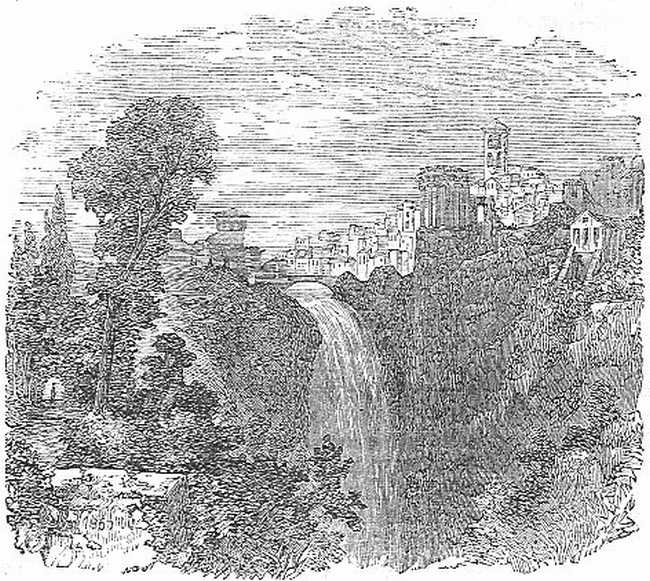
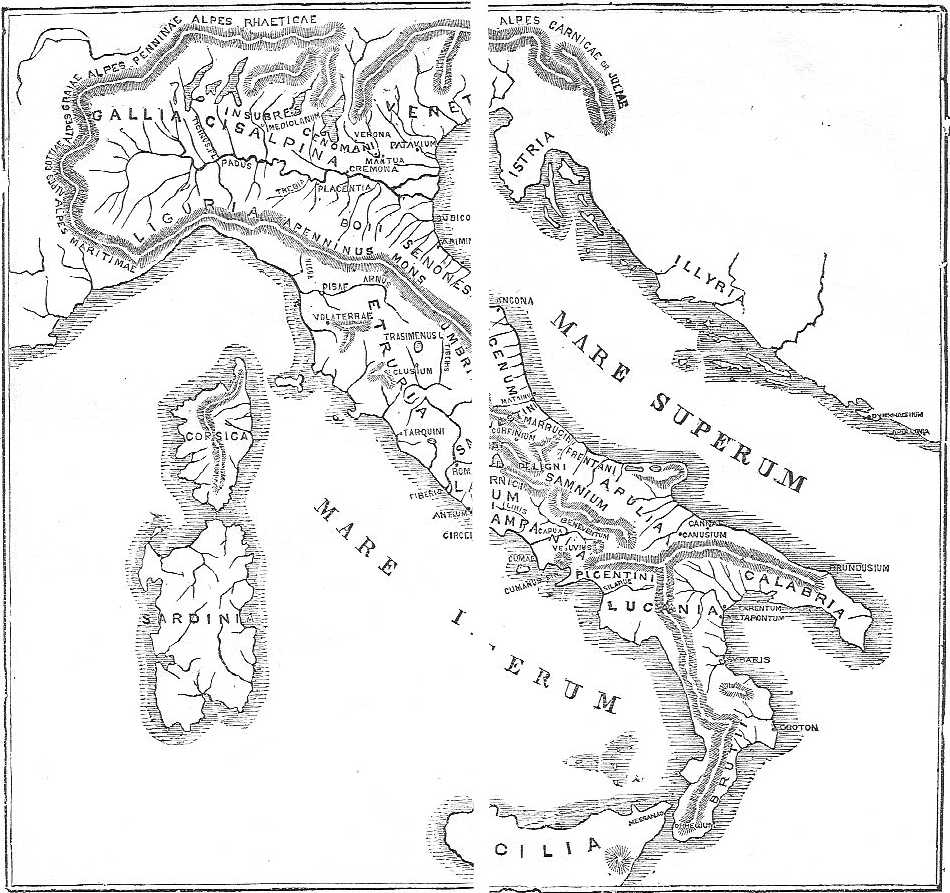
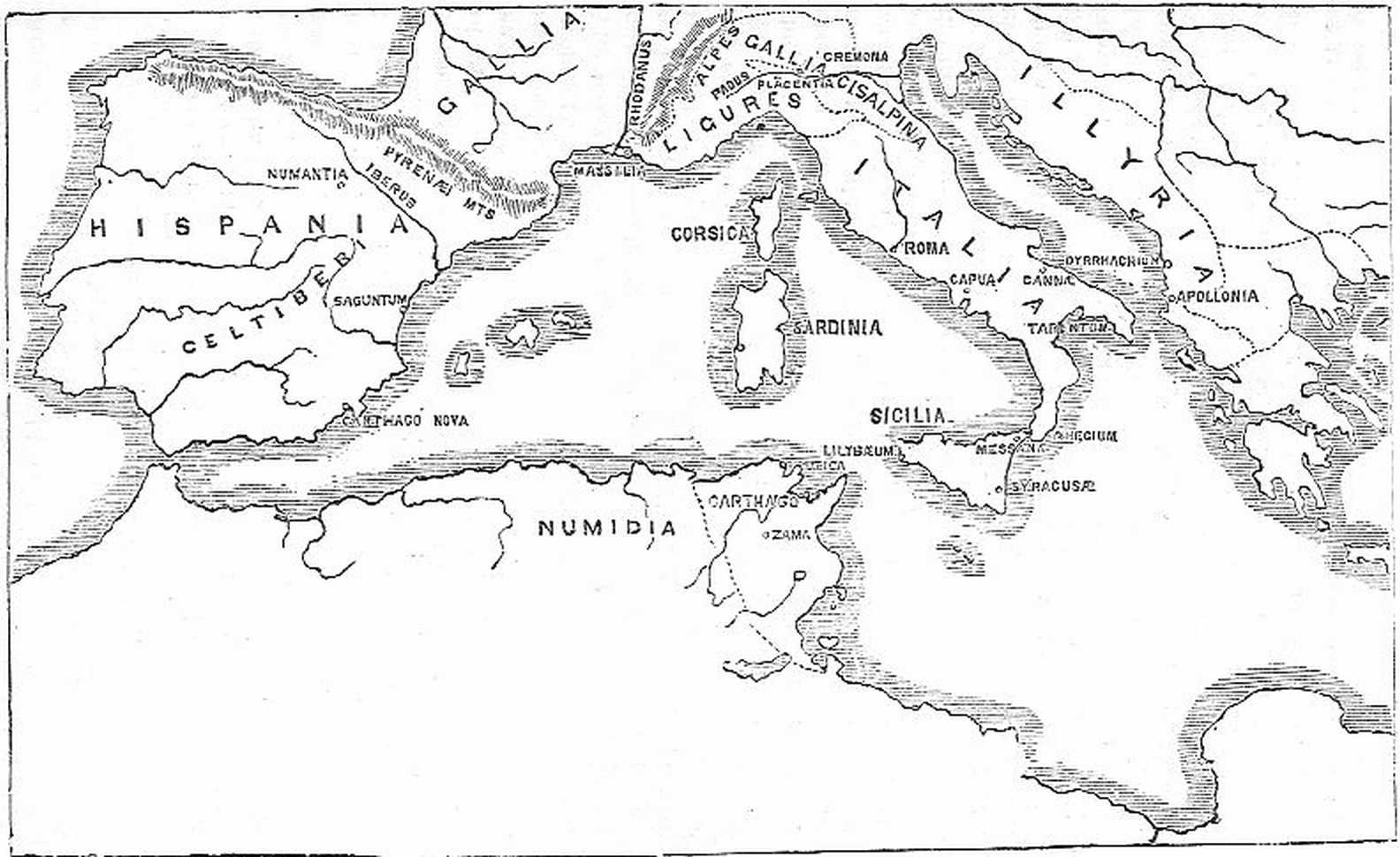
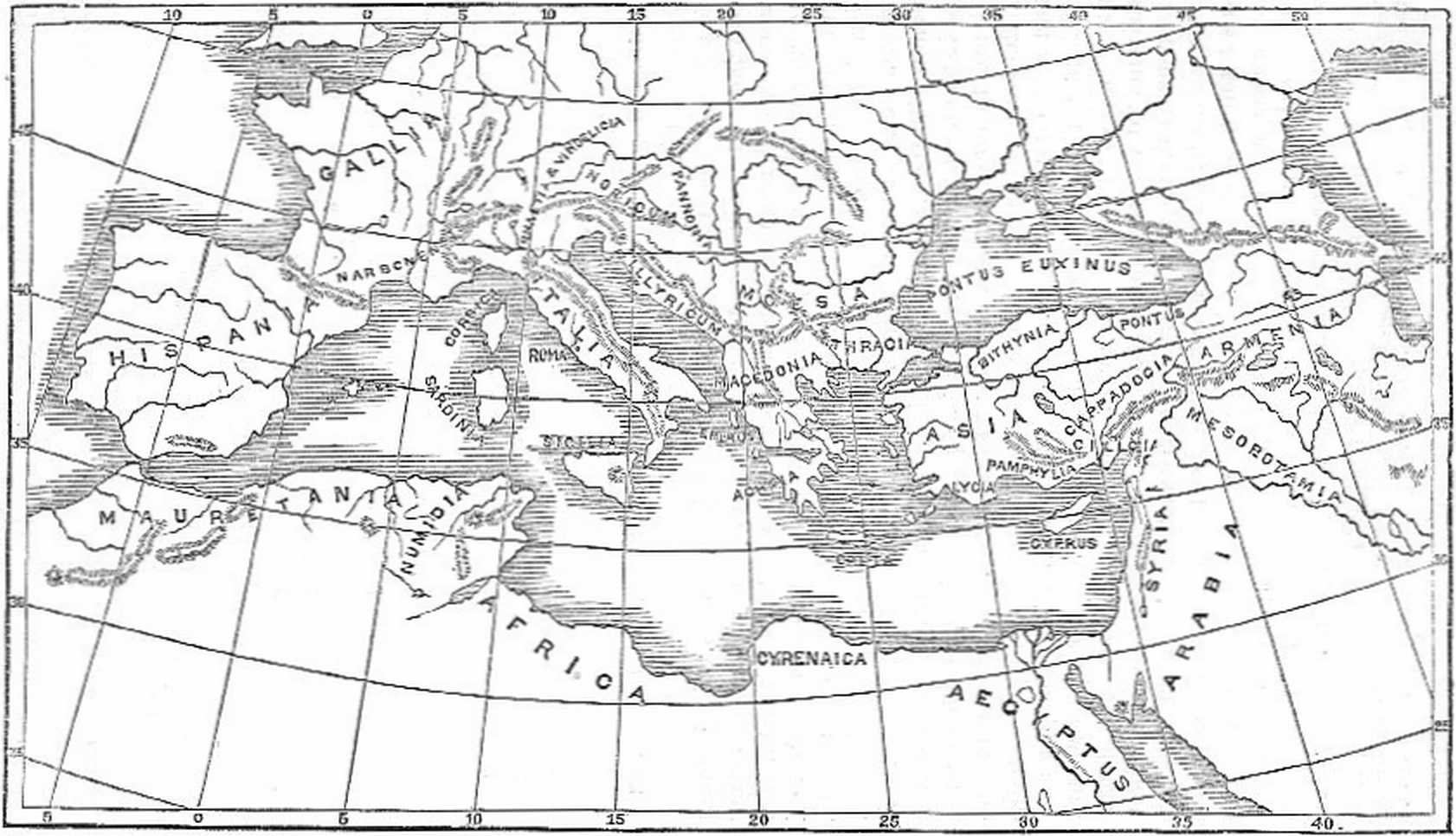
Italy is the central one of the three great peninsulas which project from the south of Europe into the Mediterranean Sea. It is bounded on the north by the chain of the Alps, which form a natural barrier, and it is surrounded on other sides by the sea. Its shores are washed on the west by the "Mare Inferum," or the Lower Sea, and on the east by the Adriatic, called by the Romans the "Mare Superum," or the Upper Sea. It may be divided into two parts, the northern consisting of the great plain drained by the River Padus, or Po, and its tributaries, and the southern being a long tongue of land, with the Apennines as a back-bone running down[Pg 2] its whole extent from north to south. The extreme length of the peninsula from the Alps to the Straits of Messina is 700 miles. The breadth of northern Italy is 350 miles, while that of the southern portion is on an average not more than 100 miles. But, till the time of the Empire, the Romans never included the plain of the Po in Italy. To this country they gave the general name of GALLIA CISALPINA, or Gaul on this (the Roman) side of the Alps, in consequence of its being inhabited by Gauls. The western-most portion of the plain was peopled by Ligurian tribes, and was therefore called LIGURIA, while its eastern extremity formed the Roman province of VENETIA.
The name ITALIA was originally applied to a very small tract of country. It was at first confined to the southern portion of Calabria, and was gradually extended northward, till about the time of the Punic wars it indicated the whole peninsula south of the Rivers Rubicon and Macra, the former separating Cisalpine Gaul and Umbria, the latter Liguria and Etruria. Italy, properly so called, is a very mountainous country, being filled up more or less by the broad mass of the Apennines, the offshoots or lateral branches of which, in some parts, descend quite to the sea, but in others leave a considerable space of level or low country. Excluding the plain of the Po, it was divided into the following districts:[1]
1. ETRURIA, which extended along the coast of the Lower Sea from the River Macra on the north to the Tiber on the south. Inland, the Tiber also formed its eastern boundary, dividing it first from Umbria, afterward from the Sabines, and, lastly, from Latium. Its inhabitants were called Etrusci, or Tusci, the latter form being still preserved in the name of Tuscany. Besides the Tiber it possesses only one other river of any importance, the Arnus, or Arno, upon which the city of Florence now stands. Of its lakes the most considerable is the Lacus Trasimenus, about thirty-six miles in circumference, celebrated for the great victory which Hannibal there gained over the Romans.
2. UMBRIA, situated to the east of Etruria, and extending from the valley of the Tiber to the shores of the Adriatic. It was separated on the north from Gallia Cisalpina by the Rubicon, and on the south by the Æsis from Picenum, and by the Nar from the Sabines.
3. PICENUM extended along the Adriatic from the mouth of the Æsis to that of the Matrinus and inland as far as the central ridge of the Apennines. It was bounded on the north by Umbria, on the south by the Vestini, and on the west by Umbria and the Sa[Pg 3]bini. Its inhabitants, the Picentes, were a Sabine race, as is mentioned below.
4. The SABINI inhabited the rugged mountain-country in the central chain of the Apennines, lying between Etruria, Umbria, Picenum, Latium, and the country of the Marsi and Vestini. They were one of the most ancient races of Italy, and the progenitors of the far more numerous tribes which, under the names of Picentes, Peligni, and Samnites, spread themselves to the east and south. Modern writers have given the general name of Sabellians to all these tribes. The Sabines, like most other mountaineers, were brave, hardy, and frugal; and even the Romans looked up to them with admiration on account of their proverbial honesty and temperance.
5. The MARSI, PELIGNI, VESTINI, and MARRUCINI inhabited the valleys of the central Apennines, and were closely connected, being probably all of Sabine origin. The MARSI dwelt inland around the basin of the Lake Fucinus, which is about thirty miles in circumference, and the only one of any extent in the central Apennines. The PELIGNI also occupied an inland district east of the MARSI. The VESTINI dwelt east of the Sabines, and possessed on the coast of the Adriatic a narrow space between the mouth of the Matrinus and that of the Aternus, a distance of about six miles. The MARRUCINI inhabited a narrow strip of country on the Adriatic, east of the Peligni, and were bounded on the north by the Vestini and on the south by the Frentani.
6. The FRENTANI dwelt upon the coast of the Adriatic from the frontiers of the Marrucini to those of Apulia. They were bounded on the west by the Samnites, from whom they were originally descended, but they appear in Roman history as an independent people.
7. LATIUM was used in two senses. It originally signified only the land of the Latini, and was a country of small extent, bounded by the Tiber on the north, by the Apennines on the east, by the sea on the west, and by the Alban Hills on the south. But after the conquest of the Volscians, Hernici, Æquians, and other tribes, originally independent, the name of Latium was extended to all the country which the latter had previously occupied. It was thus applied to the whole region from the borders of Etruria to those of Campania, or from the Tiber to the Liris. The original abode of the Latins is of volcanic origin. The Alban Mountains are a great volcanic mass, and several of the craters have been filled with water, forming lakes, of which the Alban Lake is one of the most remarkable. The plain in which Rome stands, now called the Campagna, is not an unbroken level, but a broad undulating tract, in[Pg 4]tersected by numerous streams, which have cut themselves deep channels through the soft volcanic tufa of which the soil is composed. The climate of Latium was not healthy even in ancient times. The malaria of the Campagna renders Rome itself unhealthy in the summer and autumn; and the Pontine Marshes, which extend along the coast in the south of Latium for a distance of thirty miles, are still more pestilential.
8. CAMPANIA extended along the coast from the Liris, which separated it from Latium, to the Silarus, which formed the boundary of Lucania. It is the fairest portion of Italy. The greater part of it is an unbroken plain, celebrated in ancient as well as in modern times for its extraordinary beauty and fertility. The Bay of Naples—formerly called Sinus Cumanus and Puteolanus, from the neighboring cities of Cumæ and Puteoli—is one of the most lovely spots in the world; and the softness of its climate, as well as the beauty of its scenery, attracted the Roman nobles, who had numerous villas along its coasts.
9. SAMNIUM was an inland district, bounded on the north by the Marsi and Peligni, on the east by the Frentani and Apulia, on the west by Latium and Campania, and on the south by Lucania. It is a mountainous country, being entirely filled with the masses of the Apennines. Its inhabitants, the Samnites, were of Sabine origin, as has been already mentioned, and they settled in the country at a comparatively late period. They were one of the most warlike races in Italy, and carried on a long and fierce struggle with the Romans.
10. APULIA extended along the coast of the Adriatic from the Frentani on the north to Calabria on the south, and was bounded on the west by the Apennines, which separated it from Samnium and Lucania. It consists almost entirely of a great plain, sloping down from the Apennines to the sea.
11. CALABRIA formed the heel of Italy, lying south of Apulia, and surrounded on every other side by the sea. It contains no mountains, and only hills of moderate elevation, the Apennines running to the southwest through Lucania and the Bruttii.
12. LUCANIA was bounded on the north by Campania and Samnium, on the east by Apulia, and on the south by the Bruttii. The Apennines run through the province in its whole extent. The Lucanians were a branch of the Samnite nation, which separated from the main body of that people, and pressed on still farther to the south.
13. The BRUTTII[2] inhabited the southern extremity of Italy, ly[Pg 5]ing south of Lucania; and, like Lucania, their country is traversed throughout by the chain of the Apennines.
Italy has been in all ages renowned for its beauty and fertility. The lofty ranges of the Apennines, and the seas which bathe its shores on both sides, contribute at once to temper and vary its climate, so as to adapt it for the productions alike of the temperate and the warmest parts of Europe. In the plains on either side of the Apennines corn is produced in abundance; olives flourish on the southern slopes of the mountains; and the vine is cultivated in every part of the peninsula, the vineyards of northern Campania being the most celebrated in antiquity.
The early inhabitants of Italy may be divided into three great classes—the Italians proper, the Iapygians, and the Etruscans, who are clearly distinguished from each other by their respective languages.
(1.) The Italians proper inhabited the centre of the peninsula. They were divided into two branches, the Latins and the Umbro-Sabellians, including the Umbrians, Sabines, Samnites, and their numerous colonies. The dialects of the Latins and Umbro-Sabellians, though marked by striking differences, still show clearest evidence of a common origin, and both are closely related to the Greek. It is evident that at some remote period a race migrated from the East, embracing the ancestors of both the Greeks and Italians—that from it the Italians branched off—and that they again were divided into the Latins on the west and the Umbrians and Sabellians on the east.
(2.) The Iapygians dwelt in Calabria, in the extreme southeast corner of Italy. Inscriptions in a peculiar language have here been discovered, clearly showing that the inhabitants belonged to a different race from those whom we have designated as the Italians. They were doubtless the oldest inhabitants of Italy, who were driven toward the extremity of the peninsula as the Latins and Sabellians pressed farther to the south.
(3.) The Etruscans, or, as they called themselves, Rasena, form a striking contrast to the Latins and Sabellians as well as to the Greeks. Their language is radically different from the other languages of Italy; and their manners and customs clearly prove them to be a people originally quite distinct from the Greek and Italian races. Their religion was of a gloomy character, delighting in mysteries and in wild and horrible rites. Their origin is unknown. Most ancient writers relate that the Etruscans were Lydians who had migrated by sea from Asia to Italy; but this is very improbable, and it is now more generally believed that the Etruscans descended into Italy from, the Rhætian Alps. It is expressly stated[Pg 6] by ancient writers that the Rhætians were Etruscans, and that they spoke the same language; while their name is perhaps the same as that of Rasena, the native name of the Etruscans. In more ancient times, before the Roman dominion, the Etruscans inhabited not only the country called Etruria, but also the great plain of the Po, as far as the foot of the Alps. Here they maintained their ground till they were expelled or subdued by the invading Gauls. The Etruscans, both in the north of Italy and to the south of the Apennines, consisted of a confederacy of twelve cities, each of which was independent, possessing the power of even making war and peace on its own account. In Etruria proper Volsinii was regarded as the metropolis.
Besides these three races, two foreign races also settled in the peninsula in historical times. These are the Greeks and the Gauls.
(4.) The Greeks planted so many colonies upon the coasts of southern Italy that they gave to that district the name of Magna Græcia. The most ancient, and, at the same time, the most northerly Greek city in Italy, was Cumæ in Campania. Most of the other Greek colonies were situated farther to the south, where many of them attained to great power and opulence. Of these, some of the most distinguished were Tarentum, Sybaris, Croton, and Metapontum.
(5.) The Gauls, as we have already said, occupied the greater part of northern Italy, and were so numerous and important as to give to the whole basin of the Po the name of Gallia Cisalpina. They were of the same race with the Gauls who inhabited the country beyond the Alps, and their migration and settlement in Italy were referred by the Roman historian to the time of the Tarquins.
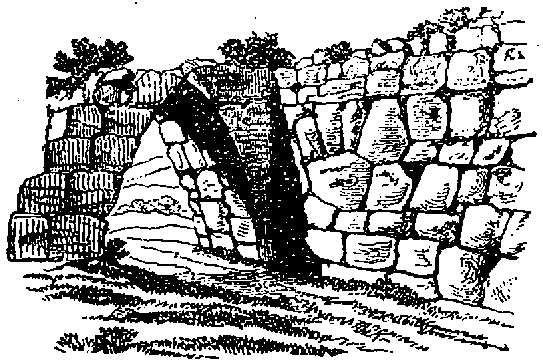
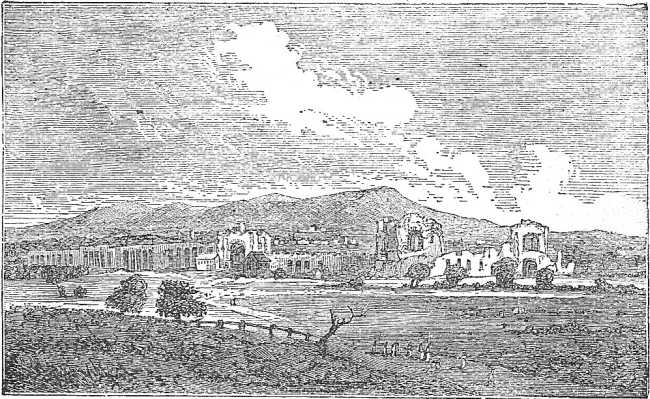
The history of Rome is that of a city which originally had only a few miles of territory, and gradually extended its dominions at first over Italy and then over the civilized world. The city lay in the central part of the peninsula, on the left bank of the Tiber, and about fifteen miles from its mouth. Its situation was upon the borders of three of the most powerful races in Italy, the Latins, Sabines, and Etruscans. Though originally a Latin town, it received at an early period a considerable Sabine population, which left a permanent impression upon the sacred rites and religious institutions of the people. The Etruscans exercised less influence upon Rome, though it appears nearly certain that a part of its population was of Etruscan origin, and that the two Tarquins represent the establishment of an Etruscan dynasty at Rome. The population of the city may therefore be regarded as one of mixed origin, consisting of the three elements of Latins, Sabines, and Etruscans, but the last in much smaller proportion than the other two. That the Latin element predominated over the Sabine is also evident from the fact that the language of the Romans was a Latin and not a Sabellian dialect.[Pg 8]
The early history of Rome is given in an unbroken narrative by the Roman writers, and was received by the Romans themselves as a faithful record of facts. But it can no longer be regarded in that light. Not only is it full of marvelous tales and poetical embellishments, of contradictions and impossibilities, but it wants the very foundation upon which all history must be based. The reader, therefore, must not receive the history of the first four centuries of the city as a statement of undoubted facts, though it has unquestionably preserved many circumstances which did actually occur. It is not until we come to the war with Pyrrhus that we can place full reliance upon the narrative as a trustworthy statement of facts. With this caution we now proceed to relate the celebrated legends of the foundation and early history of Home.
Æneas, son of Anchises and Venus, fled after the fall of Troy to seek a new home in a foreign land. He carried with him his son Ascanius, the Penates or household gods, and the Palladium of Troy.[3] Upon reaching the coast of Latium he was kindly received by Latinus, the king of the country, who gave him his daughter Lavinia in marriage. Æneas now built a city, which he named Lavinium, in honor of his wife. But Lavinia had been previously promised to Turnus, the leader of the Rutulians. This youthful chief, enraged at the insult, attacked the strangers. He was slain, however, by the hands of Æneas; but in a new war which broke out three years afterward the Trojan hero disappeared amid the waters of the River Numicius, and was henceforward worshiped under the name of Jupiter Indiges, or "god of the country."
Ascanius, who was also called Iulus, removed from Lavinium thirty years after its foundation, and built Alba Longa, or the "Long White City," on a ridge of the Alban Mount about fifteen miles southeast of Rome. It became the most powerful city in Latium, and the head of a confederacy of Latin cities. Twelve kings of the family of Æneas succeeded Ascanius. The last of these, named Procas, left two sons, Numitor and Amulius. Amulius, the younger, seized the kingdom; and Numitor, who was of a peaceful disposition, made no resistance to his brother. Amulius, fearing lest the children of Numitor might not submit so quietly to his usurpation, caused his only son to be murdered, and made his daughter, Rhea Silvia, one of the vestal virgins, who were compelled to live and die unmarried. But the maiden became, by the god Mars, the mother of twins. She was, in consequence, put[Pg 9] to death, because she had broken her vow, and her babes were doomed to be drowned in the river. The Tiber had overflowed its banks far and wide; and the cradle in which the babes were placed was stranded at the foot of the Palatine, and overturned on the root of a wild fig-tree. A she-wolf, which had come to drink of the stream, carried them into her den hard by, and suckled them; and when they wanted other food, the woodpecker, a bird sacred to Mars, brought it to them. At length, this marvelous spectacle was seen by Faustulus, the king's shepherd, who took the children home to his wife, Acca Larentia. They were called Romulus and Remus, and grew up along with the sons of their foster-parents on the Palatine Hill.
A quarrel arose between them and the herdsmen of Numitor, who stalled their cattle on the neighboring hill of the Aventine. Remus was taken by a stratagem, and carried off to Numitor. His age and noble bearing made Numitor think of his grandsons; and his suspicions were confirmed by the tale of the marvelous nurture of the twin brothers. Soon afterward Romulus hastened with his foster-father to Numitor; suspicion was changed into certainty, and the old man recognized them as his grandsons. They now resolved to avenge the wrongs which their family had suffered. With the help of their faithful comrades they slew Amulius, and placed Numitor on the throne.
Romulus and Remus loved their old abode, and therefore left Alba to found a city on the banks of the Tiber. But a dispute arose between the brothers where the city should be built, and after whose name it should be called. Romulus wished to build it on the Palatine, Remus on the Aventine. It was agreed that the question should be decided by the gods; and each took his station on the top of his chosen hill, awaiting the pleasure of the gods by some striking sign. The night passed away, and as the day was dawning Remus saw six vultures; but at sunrise, when these tidings were brought to Romulus, twelve vultures flew by him. Each claimed the augury in his own favor; but the shepherds decided for Romulus, and Remus was therefore obliged to yield.
1. REIGN OF ROMULUS, B.C. 753-716.—Romulus now proceeded to mark out the boundaries of his city. He yoked a bullock and a heifer to a plow, and drew a deep furrow round the Palatine. This formed the sacred limits of the city, and was called the Pomœrium. To the original city on the Palatine was given the name of Roma Quadrata, or Square Rome, to distinguish it from the one which subsequently extended over the seven hills.
Rome is said to have been founded on the 21st of April, 753 years before the Christian era.[Pg 10]
On the line of the Pomœrium Romulus began to raise a wall. One day Remus leapt over it in scorn; whereupon Romulus slew him, exclaiming, "So die whosoever hereafter shall leap over my walls." Romulus now found his people too few in numbers. Accordingly, lie set apart on the Capitoline Hill an asylum, or a sanctuary, in which homicides and runaway slaves might take refuge. The city thus became filled with men, but they wanted women, and the inhabitants of the neighboring cities refused to give their daughters to such an outcast race. Romulus accordingly resolved to obtain by force what he could not obtain by treaty. He proclaimed that games were to be celebrated in honor of the god Consus, and invited his neighbors, the Latins and Sabines, to the festival. Suspecting no treachery, they came in numbers with their wives and children, but the Roman youths rushed upon their guests and carried off the virgins. The parents returned home and prepared for vengeance. The inhabitants of three of the Latin towns, Cænina, Antemnæ and Crustumerium, took up arms one after the other, but were defeated by the Romans. Romulus slew with his own hand Acron, king of Cænina, and dedicated his arms and armor, as spolia opima, to Jupiter. These were offered when the commander of one army slew with his own hand the commander of another, and were only gained twice afterward in Roman history. At last Titus Tatius, the king of Cures, the most powerful of the Sabine states, marched against Rome. His forces were so great that Romulus, unable to resist him in the field, was obliged to retire into the city. Besides the city on the Palatine, Romulus had also fortified the top of the Capitoline Hill, which he intrusted to the care of Tarpeius. But his daughter Tarpeia, dazzled by the golden bracelets of the Sabines, promised to betray the hill to them "if they would give her what they wore on their left arms." Her offer was accepted. In the night-time she opened a gate and let in the enemy, but when she claimed her reward they threw upon her the shields "which they wore on their left arms," and thus crushed her to death. One of the heights of the Capitoline Hill preserved her name, and it was from the Tarpeian Rock that traitors were afterward hurled down. On the next day the Romans endeavored to recover the hill. A long and desperate battle was fought in the valley between the Palatine and the Capitoline. At one time the Romans were driven before the enemy, when Romulus vowed a temple to Jupiter Stator, the Stayer of Flight, whereupon his men took courage and returned again to the combat. At length the Sabine women, who were the cause of the war, rushed in between them, and prayed their husbands and fathers to be reconciled. Their prayers were heard; the two[Pg 11] people not only made peace, but agreed to form only one nation. The Romans dwelt on the Palatine under their king Romulus, the Sabines on the Capitoline under their king Titus Tatius.[4] The two kings and their senates met for deliberation in the valley between the two hills, which was hence called Comitium, or the place of meeting, and which afterward became the Roman Forum. But this union did not last long. Titus Tatius was slain at Lavinium by some Latins to whom he had refused satisfaction for outrages committed by his kinsmen. Henceforward Romulus ruled alone over both Romans and Sabines. He reigned, in all, thirty-seven years. One day, as he was reviewing his people in the Campus Martius, near the Goat's Fool, the sun was suddenly eclipsed, and a dreadful storm dispersed the people. When daylight returned Romulus had disappeared, for his father Mars had carried him up to heaven in a fiery chariot. Shortly afterward he appeared in more than mortal beauty to the senator Proculus Sabinus, and bade him tell the Romans to worship him under the name of the god Quirinus.
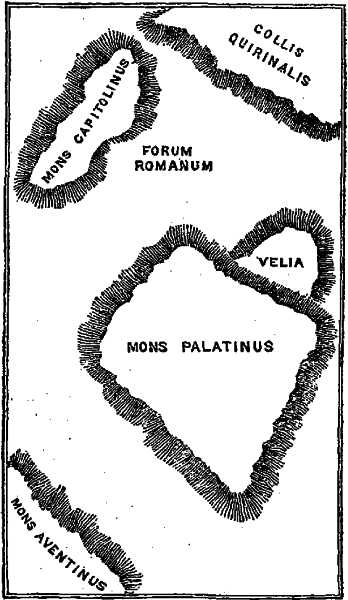
As Romulus was regarded as the founder of Rome, its most an[Pg 12]cient political institutions and the organization of the people were ascribed to him by the popular belief.
(i.) The Roman people consisted only of Patricians and their Clients. The Patricians formed the Populus Romanus, or sovereign people. They alone had political rights; the Clients were entirely dependent upon them. A Patrician had a certain number of Clients attached to him personally. To these he acted as a Patronus or Patron. He was bound to protect the interests of the Client both in public and private, while the Client had to render many services to his patron.
(ii.) The Patricians were divided by Romulus into three Tribes; the Ramnes, or Romans of Romulus; the Tities, or Sabines of Titus Tatius; and the Luceres, or Etruscans of Cæles, a Lucumo or Etruscan noble, who assisted Romulus in the war against the Sabines. Each tribe was divided into 10 curiæ, and each curiæ into 10 gentes. The 30 curiæ formed the Comitia Curiata, a sovereign assembly of the Patricians. This assembly elected the king, made the laws, and decided in all cases affecting the life of a citizen.
To assist him in the government Romulus selected a number of aged men, forming a Senate, or Council of Elders, who were called Patres, or Senators. It consisted at first of 100 members, which number was increased to 200 when the Sabines were incorporated in the state. The 20 curiæ of the Ramnes and Tities each sent 10 members to the senate, but the Luceres were not yet represented.
(iii.) Each of the three tribes was bound to furnish 1000 men for the infantry and 100 men for the cavalry. Thus 3000 foot-soldiers and 300 horse-soldiers formed the original army of the Roman state, and were called a Legion.
2. REIGN OF NUMA POMPILIUS, B.C. 716-673.—On the death of Romulus, the Senate, at first, would not allow the election of a new king. The Senators enjoyed the royal power in rotation as Inter-reges, or between-kings. In this way a year passed. But the people at length insisted that a king should be chosen, and the Senate were obliged to give way. The choice fell upon the wise and pious Numa Pompilius, a native of the Sabine Cures who had married the daughter of Tatius. The forty-three years of Numa's reign glided away in quiet happiness without any war or any calamity.
As Romulus was the founder of the political institutions of Rome, so Numa was the author of the religious institutions. Instructed by the nymph Egeria, whom he met in the sacred grove of Aricia, he instituted the Pontiffs, four in number, with a Pontifex Maximus at their head, who had the general superintendence[Pg 13] of religion; the Augurs, also four in number, who consulted the will of the gods on all occasions, both private and public; three Flamens, each of whom attended to the worship of separate deities—Jupiter,[5] Mars, and Quirinus; four Vestal Virgins, who kept alive the sacred fire of Vesta brought from Alba Longa; and twelve Salii, or priests of Mars, who had the care of the sacred shields.[6] Numa reformed the calendar, encouraged agriculture, and marked out the boundaries of property, which he placed under the care of the god Terminus. He also built the temple of Janus, a god represented with two heads looking different ways. The gates of this temple were to be open during war and closed in time of peace.
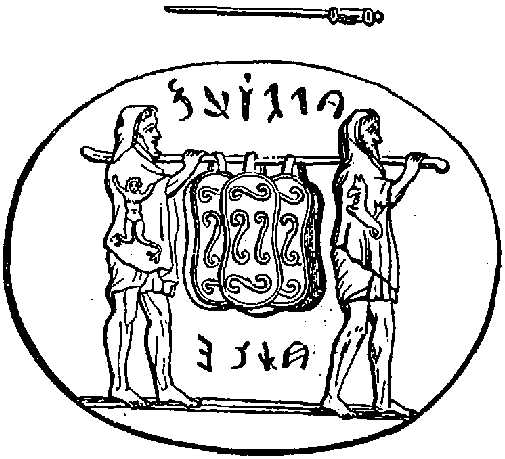
3. REIGN OF TULLUS HOSTILIUS, B.C. 673-641.—Upon the death of Numa an interregnum again followed; but soon afterward Tullus Hostilius, a Roman, was elected king. His reign was as warlike as that of Numa had been peaceful. The most memorable event in it is the destruction of Alba Longa. A quarrel having arisen between the two cities, and their armies having been drawn up in array against each other, the princes determined to avert the battle by a combat of champions chosen from each army. There were in the Roman army three brothers, born at the same birth, named Horatii; and in the Alban army, in like manner, three brothers, born at the same birth, and called Curiatii. The two sets of brothers were chosen as champions, and it was agreed that the people to whom the conquerors belonged should rule the other. Two of the Horatii were slain, but the three Curiatii were wounded, and the surviving Horatius, who was unhurt, had recourse to stratagem. He was unable to contend with the Curiatii united, but was more than a match for each of them separately. Taking to flight, he was followed by his three opponents at unequal distances. Sud[Pg 14]denly turning round, he slew, first one, then the second, and finally the third. The Romans were declared the conquerors, and the Albans their subjects. But a tragical event followed. As Horatius was entering Rome, bearing his threefold spoils, his sister met him, and recognized on his shoulders the cloak of one of the Curiatii, her betrothed lover. She burst into such passionate grief that the anger of her brother was kindled, and, stabbing her with his sword, he exclaimed, "So perish every Roman woman who bewails a foe." For this murder he was condemned by the two judges of blood to be hanged upon the fatal tree, but he appealed to the people, and they gave him his life.
Shortly afterward Tullus Hostilius made war against the Etruscans of Fidenæ and Veii. The Albans, under their dictator Mettius Fuffetius, followed him to the war as the subjects of Rome. In the battle against the Etruscans, the Alban dictator, faithless and insolent, withdrew to the hills, but when the Etruscans were defeated he descended to the plain, and congratulated the Roman king. Tullus pretended to be deceived. On the following day he summoned the two armies to receive their praises and rewards. The Albans came without arms, and were surrounded by the Roman troops. They then heard their sentence. Their dictator was to be torn in pieces by horses driven opposite ways; their city was to be razed to the ground; and they themselves, with their wives and children, transported to Rome. Tullus assigned to them the Cælian Hill for their habitation. Some of the noble families of Alba were enrolled among the Roman patricians, but the great mass of the Alban people were not admitted to the privileges of the ruling class. They were the origin of the Roman Plebs, who were thus quite distinct from the Patricians and their Clients. The Patricians still formed exclusively the Populus, or Roman people, properly so called. The Plebs were a subject-class without any share in the government.
After carrying on several other wars Tullus fell sick, and sought to win the favor of the gods, as Numa had done, by prayers and divination. But Jupiter was angry with him, and smote him and his whole house with fire from heaven. Thus perished Tullus, after a reign of thirty-two years.
4. REIGN OF ANCUS MARCIUS, B.C. 640-616.—Ancus Marcius, the successor of Tullus Hostilius, was a Sabine, being the son of Numa's daughter. He sought to tread in the footsteps of his grandfather by reviving the religious ceremonies which had fallen into neglect; but a war with the Latins called him from the pursuits of peace. He conquered several of the Latin cities, and removed many of the inhabitants to Rome, where he assigned them[Pg 15] the Aventine for their habitation. Thus the number of the Plebeians was greatly enlarged. Ancus instituted the Fetiales, whose duty it was to demand satisfaction from a foreign state when any dispute arose, to determine the circumstances under which hostilities might be commenced, and to perform the proper religious rites on the declaration of war. He also founded a colony at Ostia at the mouth of the Tiber, built a fortress on the Janiculum as a protection against the Etruscans, and united it with the city by a bridge across the Tiber, called the Pons Sublicius, because it was made of wooden piles, and erected a prison to restrain offenders. He died after a reign of twenty-four years.
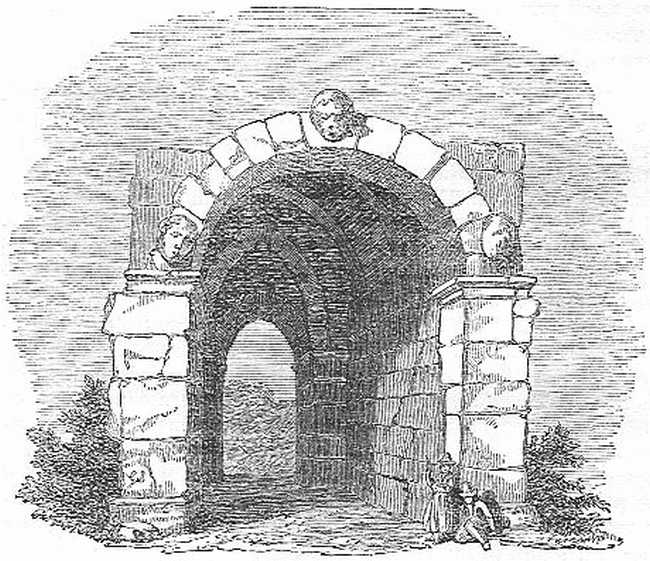
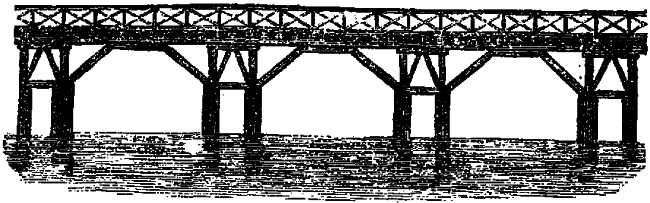
5. REIGN OF LUCIUS TARQUINIUS PRISCUS, or the ELDER TARQUIN, B.C. 616-578.—The fifth king of Rome was an Etruscan by birth, but a Greek by descent. His father Demaratus was a wealthy citizen of Corinth, who settled in the Etruscan city of Tarquinii, where he married an Etruscan wife. Their son married Tanaquil, who belonged to one of the noblest families in Tarquinii, and himself became a Lucumo or a noble in the state. But he aspired to still higher honors; and, urged on by his wife, who was an ambitious woman, he resolved to try his fortune at Rome. Accordingly, he set out for this city, accompanied by a large train of followers. When he had reached the Janiculum an eagle seized his cap, and, after carrying it away to a great height, placed it again upon his head. Tanaquil, who was skilled in the Etruscan science of augury, bade her husband hope for the highest honors. Her predictions were soon verified. He took the name of Lucius Tarquinius Priscus, and gained the favor both of Ancus Marcius and the people. Ancus appointed the stranger guardian of his children; and, when he died, the senate and the people unanimously elected Tarquin to the vacant throne.
The reign of Tarquin was distinguished by great exploits in war and by great works in peace. He defeated the Sabines, and took their town Collatia, which he placed under his nephew Egerius, who was thence called Collatinus. He also captured many of the Latin towns, and became the ruler of all Latium; but the important works which he executed in peace have rendered his name still more famous. The great cloacæ, or sewers, by which he drained[Pg 17] the lower parts of the city, still remain, after so many ages, with not a stone displaced. He laid out the Circus Maximus, and instituted the great or Roman games performed in the circus. He also made some changes in the constitution of the state. He added to the Senate 100 new members, taken from the Luceres, the third tribe, and called patres minorum gentium, to distinguish them from the old Senators, who were now termed patres majorum gentium. To the three centuries of equites established by Romulus he wished to add three new centuries, and to call them after himself and two of his friends. But his plan was opposed by the augur Attus Navius, who said that the gods forbade it. The tale runs that the king, to test the augur, asked him to divine whether what he was thinking of could be done. After consulting the heavens, the augur replied that it could; whereupon the king said, "I was thinking that thou shouldst cut this whetstone with a razor." Navius, without a moment's hesitation, took a razor and cut it in twain. In consequence of this miracle, Tarquin gave up his design of establishing new centuries; but with each of the former centuries he associated another under the same name, so that henceforth there were the first and second Ramnes, Tities, and Luceres. The number of Vestal Virgins was also increased from four to six, the two new vestals being probably taken from the Luceres.
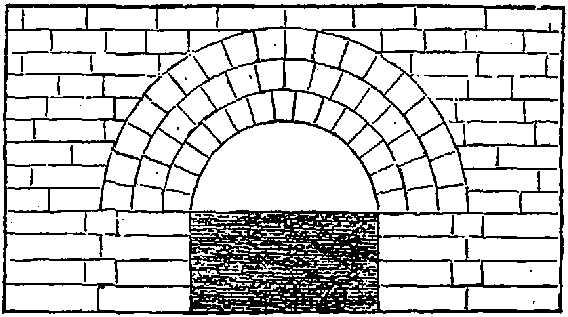
Tarquin had a favorite, Servius Tullius, said to have been the son of a female slave taken at the capture of the Latin town Corniculum. His infancy was marked by prodigies which foreshadowed his future greatness. On one occasion a flame played around his head, as he was asleep, without harming him. Tanaquil foresaw the greatness of the boy, and from this time he was brought up as the king's child. Tarquin afterward gave him his daughter in marriage, and left the government in his hands. But the sons of Ancus Marcius, fearing lest Tarquin should transmit the crown[Pg 18] to his son-in-law, hired two countrymen to assassinate the king. These men, feigning to have a quarrel, came before the king to have their dispute decided, and while he was listening to the complaint of one, the other gave him a deadly wound with his axe. But the sons of Ancus did not reap the fruit of their crime; for Tanaquil, pretending that the king's wound was not mortal, told them that he would soon return, and that he had, meantime, appointed Servius to act in his stead. Servius forthwith proceeded to discharge the duties of king, greatly to the satisfaction of the people; and when the death of Tarquin could no longer be concealed, he was already in firm possession of the regal power. Tarquin had reigned thirty-eight years.
6. SERVIUS TULLIUS, B.C. 578-534.—Servius thus succeeded to the throne without being elected by the Senate and the Assembly of the Curiæ. The reign of this king is almost as barren of military exploits as that of Numa. His great deeds were those of peace; and he was regarded by posterity as the author of the later Roman constitution, just as Romulus was of the earlier. Three important acts are assigned to Servius by universal tradition. Of these the greatest was:
I. The reform of the Roman Constitution. In this reform his two main objects were to give the Plebeians political rights, and to assign to property that influence in the state which had previously belonged exclusively to birth. To carry his purpose into effect he made a twofold division of the Roman people, one territorial and the other according to property.
a. It must be recollected that the only existing political organization was that of the Patricians into 3 tribes, 30 curiæ, and 300 gentes; but Servius now divided the whole Roman territory into Thirty Tribes, and, as this division was simply local, these tribes contained Plebeians as well as Patricians. But, though the institution of the Thirty Tribes gave the Plebeians a political organization, it conferred upon them no political power, nor any right to take part in the elections, or in the management of public affairs. At a later time the tribes assembled in the forum for the transaction of business, and were hence called Comitia Tributa. The Patricians were then excluded from this assembly, which was summoned by the Tribunes of the Plebs, and was entirely Plebeian.
b. The means by which Servius gave the Plebeians a share in the government was by establishing a new Popular Assembly, in which Patricians and Plebeians alike voted. It was so arranged that the wealthiest persons, whether Patricians or Plebeians, possessed the chief power. In order to ascertain the property of each citizen, Servius instituted the Census, which was a register of Ro[Pg 19]man citizens and their property. All Roman citizens possessing property to the amount of 12,500 asses and upward[7] were divided into five great Classes. The First Class contained the richest citizens, the Second Class the next in point of wealth, and so on. The whole arrangement was of a military character. Each of the five Classes was divided into a certain number of Centuries or Companies, half of which consisted of Seniores from the age of 46 to 60, and half of Juniores from the age of 17 to 45. All the Classes had to provide their own arms and armor, but the expense of the equipment was in proportion to the wealth of each Class. The Five Classes formed the infantry. To these five Classes were added two centuries of smiths and carpenters, and two of trumpeters and horn-blowers. These four centuries voted with the Classes. Those persons whose property did not amount to 12,500 asses were not included in the Classes, and formed a single century.
At the head of the Classes were the Equites or cavalry. These consisted of eighteen centuries, six being the old patrician Equites, as founded by Romulus and augmented by Tarquinius Priscus, and the other twelve being chosen from the chief plebeian families.[8]
The Centuries formed the new National Assembly. They mustered as an army in the Campus Martius, or the Field of Mars, on the banks of the Tiber, outside the city. They voted by Centuries, and were hence called the Comitia Centuriata. Each Century counted as one vote, but did not consist of the same number of men. On the contrary, in order to give the preponderance to[Pg 20] wealth, the first or richest class contained a far greater number of Centuries than any of the other classes (as will be seen from the table below), although they must at the same time have included a much smaller number of men. The Equites and First Class alone amounted to 100 Centuries, or more than half of the total number; so that, if they agreed to vote the same way, they possessed at once an absolute majority. An advantage was also given to age; for the Seniores, though possessing an equal number of votes, must of course have been very inferior in number to the Juniores.
Servius made the Comitia Centuriata the sovereign assembly of the nation; and he accordingly transferred to it from the Comitia Curiata the right of electing kings and the higher magistrates, of enacting and repealing laws, and of deciding in cases of appeal from the sentence of a judge. But he did not dare to abolish the old Patrician assembly, and was even obliged to enact that no vote of the Comitia Centuriata should be valid till it had received the sanction of the Comitia Curiata.
Thus, in consequence of the legislation, we shall find that Rome subsequently possessed three sovereign assemblies: 1. The Comitia Centuriata, consisting of both Patricians and Plebeians, and voting according to Centuries; 2. The Comitia Curiata, consisting exclusively of Patricians, and voting according to Curiæ; 3. The Comitia Tributa, exclusively of Plebeians, and voting according to Tribes.
II. The second great work of Servius was the extension of the Pomœrium, or hallowed boundary of the city, and the completion of the city by incorporating with it the Quirinal, Viminal, and Esquiline Hills.[9] He surrounded the whole with a stone wall, called after him the wall of Servius Tullius; and from the Porta Collina to the Esquiline Gate, where the hills sloped gently to the plain, he constructed a gigantic mound nearly a mile in length, and a moat 100 feet in breadth and 30 in depth, from which the earth of the mound was dug. Rome thus acquired a circumference of five miles, and this continued to be the legal extent of the city till the time of the emperors, although suburbs were added to it.
III. An important alliance with the Latins, by which Rome and the cities of Latium became the members of one great league, was one of the great events which distinguished the reign of Servius.
Servius gave his two daughters in marriage to the two sons of Tarquinius Priscus. Lucius, the elder, was married to a quiet and[Pg 21] gentle wife; Aruns, the younger, to an aspiring and ambitious woman. The character of the two brothers was the very opposite of the wives who had fallen to their lot; for Lucius was proud and haughty, but Aruns unambitious and quiet. The wife of Aruns, enraged at the long life of her father, and fearing that at his death her husband would tamely resign the sovereignty to his elder brother, resolved to murder both her father and husband. Her fiendish spirit put into the heart of Lucius thoughts of crime which he had never entertained before. Lucius made way with his wife, and the younger Tullia with her husband; and the survivors, with[Pg 22]out even the show of mourning, were straightway joined in unhallowed wedlock. Tullia now incessantly urged her husband to murder her father, and thus obtain the kingdom which he so ardently coveted. Tarquin formed a conspiracy with the Patricians, who were enraged at the reforms of Servius; and when the plot was ripe he entered the forum arrayed in the kingly robes, seated himself in the royal chair, in the senate-house, and ordered the senators to be summoned to him as their king. At the first news of the commotion Servius hastened to the senate-house, and, standing at the doorway, bade Tarquin to come down from the throne; but Tarquin sprang forward, seized the old man, and flung him down the stone steps. Covered with blood, the king hastened home; but, before he reached it, he was overtaken by the servants of Tarquin, and murdered. Tullia drove to the senate-house and greeted her husband as king; but her transports of joy struck even him with horror. He bade her go home; and, as she was returning, her charioteer pulled up and pointed out the corpse of her father lying in his blood across the road. She commanded him to drive on; the blood of her father spirted over the carriage and on her dress; and from that day forward the place bore the name of the Wicked Street. The body lay unburied; for Tarquin said, scoffingly, "Romulus too went without burial;" and this impious mockery is said to have given rise to his surname of Superbus, or the Proud. Servius had reigned forty-four years.
7. Reign of LUCIUS TARQUINIUS SUPERBUS, or, THE PROUD, B.C. 534-510.—Tarquin commenced his reign without any of the forms of election. One of his first acts was to abolish all the privileges which had been conferred upon the Plebeians by Servius. He also compelled the poor to work at miserable wages upon his magnificent buildings, and the hardships which they suffered were so great that many put an end to their lives. But he did not confine his oppressions to the poor. All the senators and patricians whom he mistrusted, or whose wealth he coveted, were put to death or driven into exile. He surrounded himself with a body-guard, by whose means he was enabled to carry out his designs. But, although a tyrant at home, he raised the state to great influence and power among the surrounding nations, partly by his alliances and partly by his conquests. He gave his daughter in marriage to Octavius Mamilius, of Tusculum, the most powerful of the Latins, by whose means he acquired great influence in Latium. Any Latin chiefs like Turnus Herdonius, who attempted to resist him, were treated as traitors, and punished with death. At the solemn meeting of the Latins at the Alban Mount, Tarquin sacrificed the bull on behalf of all the allies, and distributed the flesh to the people of the league.[Pg 23]
Strengthened by this Latin alliance, Tarquin turned his arms against the Volscians. He took the wealthy town of Suessa Pometia, with the spoils of which he commenced the erection of a magnificent temple on the Capitoline Hill, which his father had vowed. This temple was dedicated to the three gods of the Latin and Etruscan religions, Jupiter, Juno, and Minerva. A human head (caput), fresh, bleeding and undecayed, is said to have been found by the workmen as they were digging the foundations, and being accepted as a sign that the place was destined to become the head of the world, the name of CAPITOLIUM was given to the temple, and thence to the hill. In a stone vault beneath were deposited the Sibylline books, containing obscure and prophetic sayings. One day a Sibyl, a prophetess from Cumæ, appeared before the king and offered to sell him nine books. Upon his refusing to buy them she went away and burned three, and then demanded the same sum for the remaining six as she had asked for the nine. But the king laughed, whereupon she again burnt three and then demanded the same sum as before for the remaining three. Wondering at this strange conduct, the king purchased the books. They were placed under the care of two patricians, and were consulted when the state was in danger.
Tarquin next attacked Gabii, one of the Latin cities, which refused to enter into the league. Unable to take the city by force, he had recourse to stratagem. His son, Sextus, pretending to be ill, treated by his father, and covered with the bloody marks of stripes, fled to Gabii. The infatuated inhabitants intrusted him with the command of their troops; and when he had obtained the unlimited confidence of the citizens, he sent a messenger to his father to inquire how he should deliver the city into his hands. The king, who was walking in his garden when the messenger arrived, made no reply, but kept striking off the heads of the tallest poppies with his stick. Sextus took the hint. He put to death or banished, on false charges, all the leading men of the place, and then had no difficulty in compelling it to submit to his father.
In the midst of his prosperity Tarquin was troubled by a strange portent. A serpent crawled out from the altar in the royal palace, and seized on the entrails of the victim. The king, in fear, sent his two sons, Titus and Aruns, to consult the oracle at Delphi. They were accompanied by their cousin L. Junius Brutus. One of the sisters of Tarquin had been married to M. Brutus, a man of great wealth, who died, leaving two sons under age.[10] Of these the elder was killed by Tarquin, who coveted their possessions; the younger escaped his brother's fate only by feigning[Pg 24] idiotcy. On arriving at Delphi, Brutus propitiated the priestess with the gift of a golden stick inclosed in a hollow staff. After executing the king's commission, Titus and Aruns asked the priestess who was to reign at Rome after their father. The priestess replied, whichsoever should first kiss his mother. The princes agreed to keep the matter secret from Sextus, who was at Rome, and to cast lots between themselves. Brutus, who better understood the meaning of the oracle, fell, as if by chance, when they quitted the temple, and kissed the earth, the mother of them all.
Soon afterward Tarquin laid siege to Ardea, a city of the Rutulians. The place could not be taken by force, and the Roman army lay encamped beneath the walls. Here, as the king's sons, and their cousin Tarquinius Collatinus, were feasting together, a dispute arose about the virtue of their wives. As nothing was doing in the field, they mounted their horses to visit their homes by surprise. They first went to Rome, where they surprised the king's daughters at a splendid banquet. They then hastened to Collatia, and there, though it was late in the night, they found Lucretia, the wife of Collatinus, spinning amid her handmaids. The beauty and virtue of Lucretia excited the evil passions of Sextus. A few days after he returned to Collatia, where he was hospitably received by Lucretia as her husband's kinsman. In the dead of night he entered her chamber with a drawn sword, threatening that, if she did not yield to his desires, he would kill her and lay by her side a slave with his throat cut, and would declare that he had killed them both taken in adultery. Fear of such a shame forced Lucretia to consent; but, as soon as Sextus had departed, she sent for her husband and father. Collatinus came, accompanied by L. Brutus, her father, Lucretius, brought with him P. Valerius. They found her in an agony of sorrow. She told them what had happened, enjoined them to avenge her dishonor, and[Pg 25] then stabbed herself to the heart. They all swore to avenge her. Brutus threw off his assumed stupidity, and placed himself at their head. They carried the corpse into the market-place of Collatia. There the people took up arms, and renounced the Tarquins. A number of young men attended the funeral procession to Rome. Brutus summoned the people, and related the deed of shame. All classes were inflamed with the same indignation. A decree was passed deposing the king, and banishing him and his family from the city. Brutus now set out for the army at Ardea. Tarquinius meantime had hastened to Rome, but found the gates closed against him. Brutus was received with joy at Ardea; and the army renounced their allegiance to the tyrant. Tarquin, with his two sons, Titus and Aruns, took refuge at Cæré, in Etruria. Sextus fled to Gabii, where he was shortly after murdered by the friends of those whom he had put to death.
Tarquin had reigned 22 years when he was driven out of Rome. In memory of this event an annual festival was celebrated on the 24th of February, called the Regifugium or Fugalia.
THE REPUBLIC.—Thus ended monarchy at Rome. Tarquin the Proud had made the name of king so hateful that the people resolved to intrust the kingly power to two men, who were only to hold office for a year. In later times they were called Consuls, but at their first institution they were named Prætors. They were elected by the Comitia Curiata, and possessed the same honors as the king had had. The first consuls were L. Brutus and Tarquinius Collatinus (B.C. 509). But the people so hated the very name and race of Tarquin, that Collatinus was obliged to resign his office and retire from Rome. P. Valerius was elected consul in his place.
Meantime embassadors came to Rome from Tarquin, asking that his private property should be given up to him. The demand seemed just to the Senate and the People; but, while the embassadors were making preparation for carrying away the property, they formed a conspiracy among the young Roman nobles for the restoration of the royal family. The plot was discovered by means of a slave, and among the conspirators were found the two sons of Brutus himself. But the consul would not pardon his guilty children, and ordered the lictors[11] to put them to death with the other traitors. The agreement to surrender the property was made void by this attempt at treason. The royal goods were given up to the people to plunder.[Pg 26]
As the plot had failed, Tarquin now endeavored to recover the throne by arms. The people of Tarquinii and Veii espoused the cause of their Etruscan kinsmen, and marched against Rome. The two Consuls advanced to meet them. When Aruns, the king's son, saw Brutus at the head of the Roman cavalry, he spurred his horse to the charge. Brutus did not shrink from the combat; and both fell from their horses mortally wounded by each other's spears. A desperate battle between the two armies now followed. Both parties claimed the victory, till a voice was heard in the dead of night, proclaiming that the Romans had conquered, as the Etruscans had lost one man more. Alarmed at this, the Etruscans fled; and Valerius, the surviving Consul, returned to Rome, carrying with him the dead body of Brutus. The matrons mourned for Brutus a whole year, because he had revenged the death of Lucretia.
This was the first war for the restoration of Tarquin.
Valerius was now left without a colleague; and as he began to build a house on the top of the hill Velia, which looked down upon the forum, the people feared that he was aiming at kingly power. Thereupon Valerius not only pulled down the house, but, calling an assembly of the people, he ordered the lictors to lower the fasces before them, as an acknowledgment that their power was superior to his. He likewise brought forward a law enacting that every citizen who was condemned by a magistrate should have a right of appeal to the people. Valerius became, in consequence, so popular that he received the surname of Publicola, or "The People's Friend."
Valerius then summoned an assembly for the election of a successor to Brutus, and Sp. Lucretius was chosen. Lucretius, however, lived only a few days, and M. Horatius was elected consul in his place. It was Horatius who had the honor of consecrating the temple on the Capitol, which Tarquin had left unfinished when he was driven from the throne.
The second year of the republic (B.C. 508) witnessed the second attempt of Tarquin to recover the crown. He now applied for help to Lars Porsena, the powerful ruler of the Etruscan town of Clusium, who marched against Rome at the head of a vast army. The Romans could not meet him in the field; and Porsena seized without opposition the Janiculum, a hill immediately opposite the city, and separated from it only by the Tiber. Rome was now in the greatest danger, and the Etruscans would have entered the city by the Sublician bridge had not Horatius Cocles, with two comrades, kept the whole Etruscan army at bay while the Romans broke down the bridge behind him. When it was giving way he[Pg 27] sent back his two companions, and withstood alone the attacks of the foe till the cracks of the falling timbers and the shouts of his countrymen told him that the bridge had fallen. Then praying, "O Father Tiber, take me into thy charge and bear me up!" he plunged into the stream and swam across in safety, amid the arrows of the enemy. The state raised a statue in his honor, and allowed him as much land as he could plow round in one day. Few legends are more celebrated in Roman history than this gallant deed of Horatius, and Roman writers loved to tell
The Etruscans now proceeded to lay siege to the city, which soon began to suffer from famine. Thereupon a young Roman, named C. Mucius, resolved to deliver his country by murdering the invading king. He accordingly went over to the Etruscan camp; but, ignorant of the person of Porsena, killed the royal secretary instead. Seized and threatened with torture, he thrust his right hand into the fire on the altar, and there let it burn, to show how little he heeded pain. Astonished at his courage, the king bade him depart in peace; and Mucius, out of gratitude, advised him to make peace with Rome, since three hundred noble youths, he said, had sworn to take the life of the king, and he was the first upon whom the lot had fallen. Mucius was henceforward called Scævola, or the Left-handed, because his right hand had been burnt off. Porsena, alarmed for his life, which he could not secure against so many desperate men, forthwith offered peace to the Romans on condition of their restoring to the Veientines the land which they had taken from them. These terms were accepted, and Porsena withdrew his troops from the Janiculum after receiving ten youths and ten maidens as hostages from the Romans. Clœlia, one of the maidens, escaped from the Etruscan camp, and swam across the Tiber to Rome. She was sent back by the Romans to Porsena, who was so amazed at her courage that he not only set her at liberty, but allowed her to take with her those of the hostages whom she pleased.
Thus ended the second attempt to restore the Tarquins by force.[12]
After Porsena quitted Rome, Tarquin took refuge with his son-in-law, Octavius Mamilius, of Tusculum. The thirty Latin cities now espoused the cause of the exiled king, and declared war against Rome. The contest was decided by the battle of the Lake[Pg 28] Regillus, which was long celebrated in Roman story, and the account of which resembles one of the battles in the Iliad. The Romans were commanded by the Dictator,[13] A. Postumius, and by T. Æbutius, the Master of the Horse; at the head of the Latins were Tarquin and Octavius Mamilius. The struggle was fierce and bloody, but the Latins at length fled. Almost all the chiefs on either side fell in the conflict, or were grievously wounded. Titus, the son of Tarquin, was killed; and the aged king was wounded, but escaped with his life. It was related in the old tradition that the Romans gained this battle by the assistance of the gods Castor and Pollux, who were seen charging the Latins at the head of the Roman cavalry, and who afterward carried to Rome the tidings of the victory. A temple was built in the forum on the spot where they appeared, and their festival was celebrated yearly.
This was the third and last attempt to restore the Tarquins. The Latins were completely humbled by this victory. Tarquinius Superbus had no other state to which he could apply for assistance. He had already survived all his family; and he now fled to Cumæ, where he died a wretched and childless old man (B.C. 496).
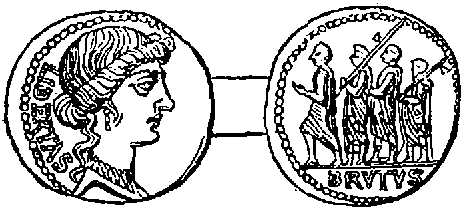
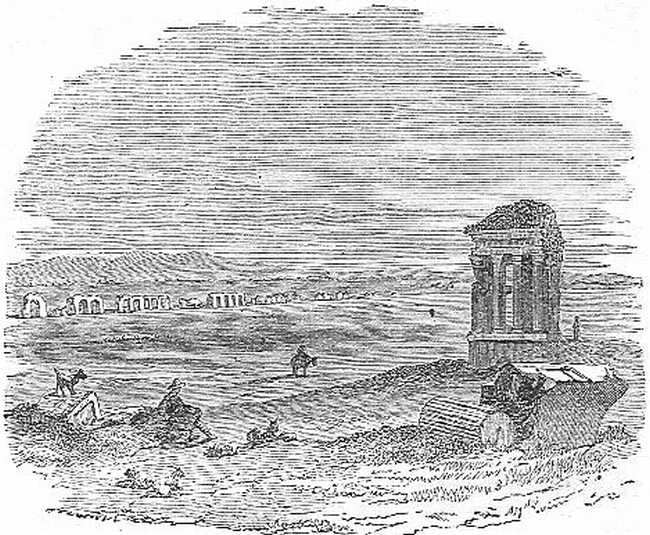
The history of Rome for the next 150 years consists internally of the struggles between the Patricians and Plebeians, and externally of the wars with the Etruscans, Volscians, Æquians, and other tribes in the immediate neighborhood of Rome.
The internal history of Rome during this period is one of great interest. The Patricians and Plebeians formed two distinct orders in the state. After the banishment of the kings the Patricians retained exclusive possession of political power. The Plebeians, it is true, could vote in the Comitia Centuriata, but, as they were mostly poor, they were outvoted by the Patricians and their clients. The Consuls and other magistrates were taken entirely from the Patricians, who also possessed the exclusive knowledge and administration of the law. In one word, the Patricians were a ruling and the Plebeians a subject class. But this was not all.[Pg 30] The Patricians formed not only a separate class, but a separate caste, not marrying with the Plebeians, and worshiping the gods with different religious rites. If a Patrician man married a Plebeian wife, or a Patrician woman a Plebeian husband, the state refused to recognize the marriage, and the offspring was treated as illegitimate.
The Plebeians had to complain not only of political, but also of private wrongs. The law of debtor and creditor was very severe at Rome. If the borrower did not pay the money by the time agreed upon, his person was seized by the creditor, and he was obliged to work as a slave.[14] Nay, in certain cases he might even be put to death by the creditor; and if there were more than one, his body might be cut in pieces and divided among them. The whole weight of this oppressive law fell upon the Plebeians; and what rendered the case still harder was, that they were frequently compelled, through no fault of their own, to become borrowers. They were small landholders, living by cultivating the soil with their own hands; but as they had to serve in the army without pay, they had no means of engaging laborers in their absence. Hence, on their return home, they were left without the means of subsistence or of purchasing seed for the next crop, and borrowing was their only resource.
Another circumstance still farther aggravated the hardships of the Plebeians. The state possessed a large quantity of land called Ager Publicus, or the "Public Land." This land originally belonged to the kings, being set apart for their support; and it was constantly increased by conquest, as it was the practice on the subjugation of a people to deprive them of a certain portion of their land. This public land was let by the state subject to a rent; but as the Patricians possessed the political power, they divided the public land among themselves, and paid for it only a nominal rent. Thus the Plebeians, by whose blood and unpaid toil much of this land had been won, were excluded from all participation in it.
It was not to be expected that the Plebeians would submit to such grievous injustice. The contest was twofold. It was a struggle of a subject against a ruling class, and of rich against poor. The Plebeians strove to obtain an equal share not only in the political power, but also in the public land.
The cruelty of the Patrician creditors was the most pressing evil, and led to the first reform. In B.C. 494 the Plebeians, after a campaign against the Volscians, instead of returning to Rome, retired to the Sacred Mount, a hill about two miles from the city,[Pg 31] near the junction of the Arno and the Tiber. Here they determined to settle and found a new town, leaving Rome to the Patricians and their clients. This event is known as the Secession to the Sacred Mount. The Patricians, alarmed, sent several of their number to persuade the Plebeians to return. Among the deputies was the aged Menenius Agrippa, who had great influence with the Plebeians. He related to them the celebrated fable of the Belly and the Members.
"Once upon a time," he said, "the Members refused to work any longer for the Belly, which led a lazy life, and grew fat upon their toils. But receiving no longer any nourishment from the Belly, they soon began to pine away, and found that it was to the Belly they owed their life and strength."
The fable was understood, and the Plebeians agreed to treat with the Patricians. It was decided that existing debts should be canceled, and that all debtors in bondage should be restored to freedom. It was necessary, however, to provide security for the future, and the Plebeians therefore insisted that two of their own number should be elected annually, to whom the Plebeians might appeal for assistance against the decisions of the Patrician magistrates. These officers were called Tribunes of the Plebs. Their persons were declared sacred and inviolate; they were never to quit the city during their year of office; and their houses were to remain open day and night, that all who were in need of help might apply to them. Their number was soon afterward increased to five, and at a later time to ten. They gradually gained more and more power, and obtained the right of putting a veto[15] upon any public business.[16] At the Sacred Mount the Plebeians also obtained the privilege of having two Ædiles of their order appointed. These officers had at a later time the care of the public buildings and roads, and the superintendence of the police of the city.
Emboldened by this success, the Plebeians now demanded a share in the public land. And in this they found an unexpected supporter among the Patricians themselves. Sp. Cassius, one of the most distinguished men in the state, who had formed the league between the Romans, Latins, and Hernicans, brought forward in his third consulship a law, by which a portion of the public land was to be divided among the Plebeians (B.C. 486). This was the first Agrarian Law mentioned in Roman history. It must be rec[Pg 32]ollected that all the Agrarian laws dealt only with the public land, and never touched the property of private persons. Notwithstanding the violent opposition of the Patricians, the law was passed; but it was never carried into execution, and the Patricians soon revenged themselves upon its author. In the following year he was accused of aiming at the kingly power, and condemned to death. He was scourged and beheaded, and his house razed to the ground.
We now turn to the external history of Rome. Under the kings Rome had risen to a superiority over her neighbors, and had extended her dominion over the southern part of Etruria and the greater part of Latium. The early history of the republic presents a very different spectacle. For the next 100 years she is engaged in a difficult and often dubious struggle with the Etruscans on the one hand, and the Volscians and Æquians on the other. It would be unprofitable to relate the details of these petty campaigns; but there are three celebrated legends connected with them which must not be passed over.
1. CORIOLANUS AND THE VOLSCIANS, B.C. 488.—C. Marcius, surnamed Coriolanus, from his valor at the capture of the Latin town of Corioli, was a brave but haughty Patrician youth. He was hated by the Plebeians, who refused him the consulship. This inflamed him with anger; and accordingly, when the city was suffering from famine, and a present of corn came from Sicily, Coriolanus advised the Senate not to distribute it among the Plebeians unless they gave up their Tribunes. Such insolence enraged the Plebeians, who would have torn him to pieces on the spot had not the tribunes summoned him before the Comitia of the Tribes. Coriolanus himself breathed nothing but defiance; and his kinsmen and friends interceded for him in vain. He was condemned to exile. He now turned his steps to Antium, the capital of the Volscians, and offered to lead them against Rome. Attius Tullius, king of the Volscians, persuaded his countrymen to appoint Coriolanus their general. Nothing could check his victorious progress; town after town fell before him; and he advanced within five miles of the city, ravaging the lands of the Plebeians, but sparing those of the Patricians. The city was filled with despair. The ten first men in the Senate were sent in hopes of moving his compassion. But they were received with the utmost sternness, and told that the city must submit to his absolute will. Next day the pontiffs, augurs, flamens, and all the priests, came in their robes of office, and in vain prayed him to spare the city. All seemed lost; but Rome was saved by her women. Next morning the noblest matrons, headed by Veturia, the aged mother of Cor[Pg 33]olanus, and by his wife Volumnia, holding her little children by the hand, came to his tent. Their lamentations turned him from his purpose. "Mother," he said, bursting into tears, "thou hast saved Rome, but lost thy son!" He then led the Volscians home, but they put him to death because he had spared Rome. Others relate that he lived among the Volscians to a great age, and was often heard to say that "none but an old man can feel how wretched it is to live in a foreign land."
2. THE FABIA GENS AND THE VEIENTINES, B.C. 477.—The Fabii were one of the most powerful of the Patrician houses. For seven successive years one of the Consuls was always a Fabius. The[Pg 34] Fabii had been among the leading opponents of the Agrarian Law; and Kæso Fabius had taken an active part in obtaining the condemnation of Sp. Cassius. But shortly afterward we find this same Kæso the advocate of the popular rights, and proposing that the Agrarian Law of Cassius should be carried into effect. He was supported in his new views by his powerful house, though the reasons for their change of opinion we do not know. But the Fabii made no impression upon the great body of the Patricians, and only earned for themselves the hearty hatred of their order. Finding that they could no longer live in peace at Rome, they determined to leave the city, and found a separate settlement, where they might still be useful to their native land. One of the most formidable enemies of the republic was the Etruscan city of Veii, situated about twelve miles from Rome. Accordingly, the Fabian house, consisting of 306 males of full age, accompanied by their wives and children, clients and dependents, marched out of Rome by the right-hand arch of the Carmental Gate, and proceeded straight to the Cremera, a river which flows into the Tiber below Veii. On the Cremera they established a fortified camp, and, sallying thence, they laid waste the Veientine territory. For two years they sustained the whole weight of the Veientine war; and all the attempts of the Veientines to dislodge them proved in vain. But at length they were enticed into an ambuscade, and were all slain. The settlement was destroyed, and no one of the house survived except a boy who had been left behind at Rome, and who became the ancestor of the Fabii, afterward so celebrated in Roman history. The Fabii were sacrificed to the hatred of the Patricians; for the consul T. Menenius was encamped a short way off at the time, and he did nothing to save them.
3. CINCINNATUS AND THE ÆQUIANS, B.C. 458.—The Æquians in their numerous attacks upon the Roman territory generally occupied Mount Algidus, which formed a part of the group of the Alban Hills in Latium. It was accordingly upon this mount that the battles between the Romans and Æquians most frequently took place. In the year 458 B.C. the Roman consul L. Minucius was defeated on the Algidus, and surrounded in his camp. Five horsemen, who made their escape before the Romans were completely encompassed, brought the tidings to Rome. The Senate forthwith appointed L. Cincinnatus dictator.
L. Cincinnatus was one of the heroes of old Roman story. When the deputies of the Senate came to him to announce his elevation to the dictatorship they found him driving a plow, and clad only in his tunic or shirt. They bade him clothe himself, that he might hear the commands of the Senate. He put on his[Pg 35] toga, which his wife Racilia brought him. The deputies then told him of the peril of the Roman army, and that he had been made Dictator. The next morning, before daybreak, he appeared in the forum, and ordered all the men of military age to meet him in the evening in the Field of Mars, with food for five days, and each with twelve stakes. His orders were obeyed; and with such speed did he march, that by midnight he reached Mount Algidus. Placing his men around the Æquian camp, he told them to raise the war-cry, and at the same time to begin digging a trench and raising a mound, on the top of which the stakes were to be driven in. The other Roman army, which was shut in, hearing the war-cry, burst forth from their camp, and fought with the Æquians all night. The Dictator's troops thus worked without interruption, and completed the intrenchment by the morning. The Æquians found themselves hemmed in between the two armies, and were forced to surrender. The Dictator made them pass under the yoke, which was formed by two spears fixed upright in the ground, while a third was fastened across them. Cincinnatus entered Rome in triumph only twenty-four hours after he had quitted it, having thus saved a whole Roman army from destruction.
In reading the wars of the early Republic, it is important to recollect the League formed by Spurius Cassius, the author of the Agrarian Law between the Romans, Latins, and Hernicans. This League, to which allusion has been already made, was of the most intimate kind, and the armies of the three states fought by each other's sides. It was by means of this League that the Æquians and Volscians were kept in check, for they were two of the most warlike nations in Italy, and would have been more than a match for the unsupported arms of Rome.
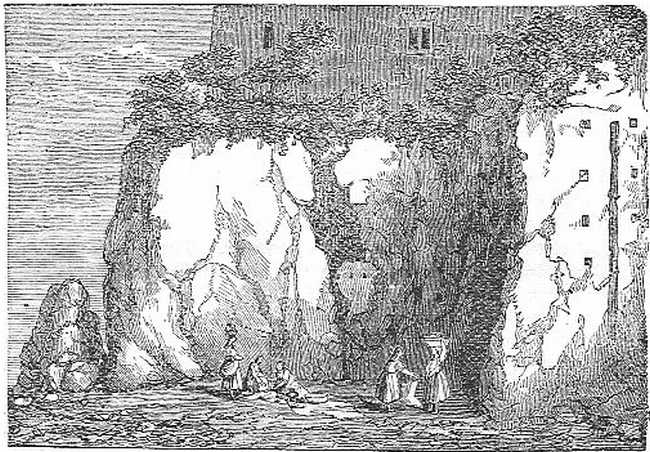
From the Agrarian Law of Sp. Cassius to the appointment of the Decemvirs was a period of more than thirty years. During the whole of this time the struggle between the Patricians and the Plebeians was increasing. The latter constantly demanded, and the former as firmly refused, the execution of the Agrarian Law of Cassius. But, though the Plebeians failed in obtaining this object, they nevertheless made steady progress in gaining for themselves a more important position in the city. In B.C. 471 the Publilian Law was carried, by which the election of the Tribunes and Plebeian Ædiles was transferred from the Comitia of the Centuries to those of the Tribes.[17] From this time the Comitia of the Tribes may be regarded as one of the political assemblies of the state, ranking with those of the Centuries and the Curies. But the Patricians still retained exclusive possession of the administrative and judicial powers, and there were no written laws to limit their authority and to regulate their decisions. Under these circum[Pg 37]stances, the Tribune C. Terentilius Arsa proposed, in B.C. 462, that a commission of Ten Men (Decemviri) should be appointed to draw up a code of laws, by which a check might be put to the arbitrary power of the Patrician magistrates. This proposition, as might have been expected, met with the most vehement opposition from the Patricians. But the Plebeians were firm, and for five successive years the same Tribunes were re-elected. It was during this struggle that an attempt was made upon the Capitol by Herdonius, a Sabine chief, with a band of outlaws and slaves. It was a turbulent period, and the Patricians had recourse even to assassination. At length, after a struggle of eight years, a compromise was effected, and it was arranged that Three Commissioners (Triumviri) were to be sent into Greece to collect information respecting the laws of Solon at Athens, as well as of the other Greek states. After an absence of two years the three commissioners returned to Rome (B.C. 452), and it was now resolved that a Council of Ten, or Decemvirs, should be appointed to draw up a code of laws, and, at the same time, to carry on the government and administer justice. All the other magistrates were obliged to abdicate, and no exception was made even in favor of the Tribunes. The Decemvirs were thus intrusted with supreme power in the state. They entered upon their office at the beginning of B.C. 451. They were all Patricians. At their head stood Appius Claudius and T. Genucius, who had been already appointed consuls for the year. They discharged the duties of their office with diligence, and dispensed justice with impartiality. Each administered the government day by day in succession, and the fasces were carried only before the one who presided for the day. They drew up a Code of Ten Tables, in which equal justice was dealt out to both orders. The Ten Tables received the sanction of the Comitia of the Centuries, and thus became law.
On the expiration of their year of office all parties were so well satisfied with the manner in which the Decemvirs had discharged their duties that it was resolved to continue the same form of government for another year, more especially as some of them said that their work was not finished. A new Council of Ten was accordingly elected, of whom Appius Claudius alone belonged to the former body. He had so carefully concealed his pride and ambition during the previous year that he had been the most popular member of the council, and the Patricians, to prevent his appointment for another year, had ordered him to preside at the Comitia for the elections, thinking that he would not receive votes for himself. But Appius set such scruples at defiance, and not only returned himself as elected, but took care that his nine colleagues[Pg 38] should be subservient to his views. He now threw off the mask he had hitherto worn, and acted as the tyrant of Rome. Each Decemvir was attended by twelve lictors, who earned the fasces with the axes in them, so that 120 lictors were seen in the city instead of 12. The Senate was rarely summoned. No one was now safe, and many of the leading men quitted Rome. Two new Tables were added to the Code, making twelve in all; but these new laws were of the most oppressive kind, and confirmed the Patricians in their most odious privileges.
When the year came to a close the Decemvirs neither resigned nor held Comitia for the election of successors, but continued to hold their power in defiance of the Senate and of the People. Next year (B.C. 449) the Sabines and Æquians invaded the Roman territory, and two armies were dispatched against them, commanded by some of the Decemvirs. Appius remained at Rome to administer justice. But the soldiers fought with no spirit under the command of men whom they detested, and two acts of outrageous tyranny caused them to turn their arms against their hated masters. In the army fighting against the Sabines was a centurion named L. Sicinius Dentatus, the bravest of the brave. He had fought in 120 battles; he had slain eight of the enemy in single combat; had received 40 wounds, all in front; he had accompanied the triumphs of nine generals; and had war-crowns and other rewards innumerable. As Tribune of the Plebs four years before, he had taken an active part in opposing the Patricians, and was now suspected of plotting against the Decemvirs. His death was accordingly resolved on, and he was sent with a company of soldiers as if to reconnoitre the enemy's position. But in a lonely spot they fell upon him and slew him, though not until he had destroyed most of the traitors. His comrades, who were told that he had fallen in an ambush of the enemy, discovered the foul treachery that had been practiced when they saw him surrounded by Roman soldiers who had evidently been slain by him. The Decemvirs prevented an immediate outbreak only by burying Dentatus with great pomp, but the troops were ready to rise in open mutiny upon the first provocation.
In the other army sent against the Æquians there was a well-known centurion named Virginius. He had a beautiful daughter, betrothed to L. Icilius, an eminent leader of the Plebeian order. The maiden had attracted the notice of the Decemvir Appius Claudius. He at first tried bribes and allurements, but when these failed he had recourse to an outrageous act of tyranny. One morning, as Virginia, attended by her nurse, was on the way to her[Pg 39] school, which was in one of the booths surrounding the forum, M. Claudius, a client of Appius, laid hold of the damsel and claimed her as his slave. The cry of the nurse for help brought a crowd around them, and all parties went before the Decemvir. In his presence Marcus repeated the tale he had learnt, asserting that Virginia was the child of one of his female slaves, and had been imposed upon Virginius by his wife, who was childless. He farther stated that he would prove this to Virginius as soon as he returned to Rome, and he demanded that the girl should meantime be handed over to his custody. Appius, fearing a riot, said that he would let the cause stand over till the next day, but that then, whether her father appeared or not, he should know how to maintain the laws. Straightway two friends of the family made all haste to the camp, which they reached the same evening. Virginius immediately obtained leave of absence, and was already on his way to Rome, when the messenger of Appius arrived, instructing his colleagues to detain him. Early next morning Virginius and his daughter came into the forum with their garments rent. The father appealed to the people for aid, and the women in their company sobbed aloud. But, intent upon the gratification of his passions, Appius cared not for the misery of the father and the girl, and hastened to give sentence, by which he consigned the maiden to his client. Appius, who had brought with him a large body of patricians and their clients, ordered his lictors to disperse the mob. The people drew back, leaving Virginius and his daughter alone before the judgment-seat. All help was gone. The unhappy father then prayed the Decemvir to be allowed to speak one word to the nurse in his daughter's hearing, in order to ascertain whether she was really his daughter. The request was granted. Virginius drew them both aside, and, snatching up a butcher's-knife from one of the stalls, plunged it into his daughter's breast, exclaiming, "There is no way but this to keep thee free." In vain did Appius call out to stop him. The crowd made way for him, and, holding his bloody knife on high, he rushed to the gate of the city and hastened to the army. His comrades espoused his cause, expelled their commanders, and marched toward Rome. They were soon joined by the other army, to whom Numitorius and Icilius had carried the tidings. The Plebeians in the city flocked to them, and they all resolved to retire once more to the Sacred Mount.
This second secession extorted from the Patricians the second great charter of the Plebeian rights. The Patricians compelled the Decemvirs to resign, and sent L. Valerius and M. Horatius, two of the most eminent men of their order, to negotiate with the Plebeians. It was finally agreed that the Tribunes should be restored,[Pg 40] that the authority of the Comitia Tributa should be recognized, and that the right of appeal to the people against the power of the supreme magistrates should be confirmed. The Plebeians now returned to the city, and elected, for the first time, ten Tribunes instead of five, a number which remained unchanged down to the latest times. Virginius, Icilius, and Numitorius were among the new Tribunes.
Two Consuls were elected in place of the Decemvirs, and the choice of the Comitia Centuriata naturally fell upon Valerius and Horatius. The new Consuls now redeemed their promises to the Plebeians by bringing forward the laws which are called after them, the Valerian and Horatian Laws. These celebrated laws enacted:
1. That every Roman citizen should have the right of appeal against the sentence of the supreme magistrate. This was, in fact, a solemn confirmation of the old law of Valerius Publicola, passed in the first year of the republic. It was enacted again a third time in B.C. 300, on the proposal of M. Valerius, the Consul. These repeated enactments gave a still farther sanction to the law. In the same way the Great Charter of England was ratified several times.
2. That the Plebiscita, or resolutions passed by the Plebeians in the Comitia Tributa, should have the force of laws, and should be binding alike upon Patricians and Plebeians.
3. That the persons of the Tribunes, Ædiles, and other Plebeian magistrates should be sacred, and whoever injured them should be sold as a slave.
Virginius now accused Appius Claudius, who was thrown into prison to await his trial. But the proud Patrician, seeing that his condemnation was certain, put an end to his own life. Oppius, another of the Decemvirs, and the personal friend of Appius, was condemned and executed. The other Decemvirs were allowed to go into exile, but they were all declared guilty, and their property confiscated to the state.
The Twelve Tables were always regarded as the foundation of the Roman law, and long continued to be held in the highest estimation. But they probably did little more than fix in a written form a large body of customary law, though even this was a benefit to the Plebeians, as they were no longer subject to the arbitrary decisions of the Patrician magistrates. The Patricians still retained their exclusive privileges; and the eleventh table even gave the sanction of law to the old custom which prohibited all intermarriage (connuubium) between the two orders.
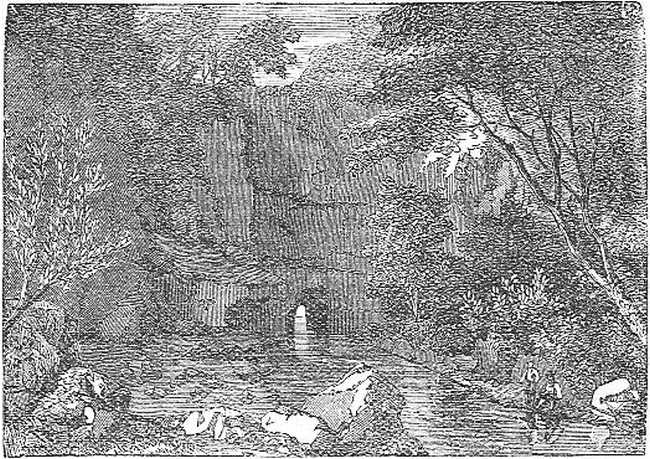
The efforts of the leaders of the Plebeians were now directed to two subjects, the removal of the prohibition of intermarriage between the two orders, and the opening of the Consulship to their own order. They attained the first object four years after the Decemvirate by the Lex Canuleia, proposed by Canuleius, one of the Tribunes (B.C. 445). But they did not carry this law without a third secession, in which they occupied the Janiculum. At the same time a compromise was effected with respect to the Consulship. The Patricians agreed that the supreme power in the state should be intrusted to new officers bearing the title of Military Tribunes with Consular Power, who might be chosen equally from Patricians and Plebeians. Their number varied in different years from three to six. In B.C. 444 three Military Tribunes were nominated for the first time. In the following year (443) two new magistrates, called Censors, were appointed. They were always to be chosen from the Patricians; and the reason of the institu[Pg 42]tion clearly was to deprive the Military Tribunes of some of the most important functions, which had been formerly discharged by the Consuls. The Censors originally held office for a period of five years, which was called a lustrum; but their tenure was limited to eighteen months, as early as ten years after its institution (B.C. 443), by a law of the Dictator Mamercus Æmilius, though they continued to be appointed only once in five years.[18]
Though the Military Tribunes could from their first institution be chosen from either order, yet such was the influence of the Patricians in the Comitia of the Centuries that it was not till B.C. 400, or nearly forty years afterward, that any Plebeians were actually elected. In B.C. 421 the Quæstorship was also thrown open to them. The Quæstors were the paymasters of the state; and as the Censors had to fill up vacancies in the Senate from those who had held the office of Quæstor, the Plebeians thus became eligible for the Senate.
During these struggles between the two orders an event took place which is frequently referred to by later writers. In the year 440 B.C. there was a great famine at Rome. Sp. Mælius, one of the richest of the Plebeian knights, expended his fortune in buying up corn, which he sold to the poor at a small price, or distributed among them gratuitously. The Patricians thought, or pretended to think, that he was aiming at kingly power: and in the following year (439) the aged Quintius Cincinnatus, who had saved the Roman army on Mount Algidus, was appointed Dictator. He nominated C. Servilius Ahala his Master of the Horse. During the night the Capitol and all the strong posts were garrisoned by the Patricians, and in the morning Cincinnatus appeared in the forum with a strong force, and summoned Mælius to appear before his tribunal. But seeing the fate which awaited him, he refused to go, whereupon Ahala rushed into the crowd and struck him dead upon the spot. His property was confiscated, and his house was leveled to the ground. The deed of Ahala is frequently mentioned by Cicero and other writers in terms of the highest admiration, but it was regarded by the Plebeians at the time as an act of murder. Ahala was brought to trial, and only escaped condemnation by a voluntary exile.
In their foreign wars the Romans continued to be successful, and, aided by their allies the Latins and Hernicans, they made[Pg 43] steady progress in driving back their old enemies the Volscians and Æquians. About this time they planted several colonies in the districts which they conquered. These Roman colonies differed widely from those of ancient Greece and of modern Europe. They were of the nature of garrisons established in conquered towns, and served both to strengthen and extend the power of Rome. The colonists received a portion of the conquered territory, and lived as a ruling class among the old inhabitants, who retained the use of the land.
The Romans now renewed their wars with the Etruscans; and the capture of the important city of Veii was the first decisive advantage gained by the Republic. The hero of this period was Camillus, who stands out prominently as the greatest general of the infant Republic, who saved Rome from the Gauls, and whom later ages honored as a second Romulus.
Veii, however, was only taken after a long and severe struggle. It was closely allied with Fidenæ, a town of Latium, not more than five or six miles from Rome. The two cities frequently united their arms against Rome, and in one of these wars Lars Tolumnius, the king of Veii, was slain in single combat by A. Cornelius Cossus, one of the Military Tribunes, and his arms dedicated to Jupiter, the second of the three instances in which the Spolia Opima were won (B.C. 437). A few years afterward Fidenæ was taken and destroyed (B.C. 426), and at the same time a truce was granted to the Veientines for twenty years. At the expiration of this truce the war was renewed, and the Romans resolved to subdue Veii as they had done Fidenæ. The siege of Veii, like that of Troy, lasted ten years, and the means of its capture was almost as marvelous as the wooden horse by which Troy was taken. The waters of the Alban Lake rose to such a height as to deluge the neighboring country. An oracle declared that Veii could not be taken until the waters of the lake found a passage to the sea. This reached the ears of the Romans, who thereupon constructed a tunnel to carry off its superfluous waters.[19] The formation of this tunnel is said to have suggested to the Romans the means of taking Veii. M. Furius Camillus, who was appointed Dictator, commenced digging a mine beneath the city, which was to have its outlet in the citadel, in the temple of Juno, the guardian deity of Veii. When the mine was finished, the attention of the inhabitants was diverted by feigned assaults against the walls. Camillus[Pg 44] led the way into the mine at the head of a picked body of troops. As he stood beneath the temple of Juno, he heard the soothsayer declare to the king of the Veientines that whoever should complete the sacrifice he was offering would be the conqueror. Thereupon the Romans burst forth and seized the flesh of the victim, which Camillus offered up. The soldiers who guarded the walls were thus taken in the rear, the gates were thrown open, and the city soon filled with Romans. The booty was immense, and the few citizens who escaped the sword were sold as slaves. The image of Juno was carried to Rome, and installed with great pomp on Mount Aventine, where a temple was erected to her. Camillus entered Rome in a chariot drawn by four white horses. Rome had never yet seen so magnificent a triumph (B.C. 396).
One circumstance, which occurred during the siege of Veii, deserves notice. As the Roman soldiers were obliged to pass the whole year under arms, in order to invest the city during the winter as well as the summer, they now, for the first time, received pay.
Veii was a more beautiful city than Rome, and, as it was now without inhabitants, many of the Roman people wished to remove thither. At the persuasion of Camillus the project was abandoned; but the territory of Veii was divided among the Plebeians.
Falerii was almost the only one of the Etruscan cities which had assisted Veii, and she was now exposed single-handed to the vengeance of the Romans. It is related that, when Camillus appeared before Falerii, a schoolmaster of the town treacherously conducted the sons of the noblest families into the Roman camp, but that Camillus, scorning the baseness of the man, ordered his arms to be tied behind him, and the boys to flog him back into the town; whereupon the inhabitants, overcome by such generosity, gave up their arms, and surrendered to the Romans (B.C. 394).
Camillus was one of the proudest of the Patricians; and he now incurred the hatred of the Plebeians by calling upon every man to refund a tenth of the booty taken at Veii; because he had made a vow to consecrate to Apollo a tithe of the spoil. He was accused of having appropriated the great bronze gates at Veii, and was impeached by one of the Tribunes. Seeing that his condemnation was certain, he went into exile, praying as he left the walls that the Republic might soon have cause to regret him (B.C. 491). His prayer was heard, for the Gauls had already crossed the Apennines, and next year Rome was in ashes.
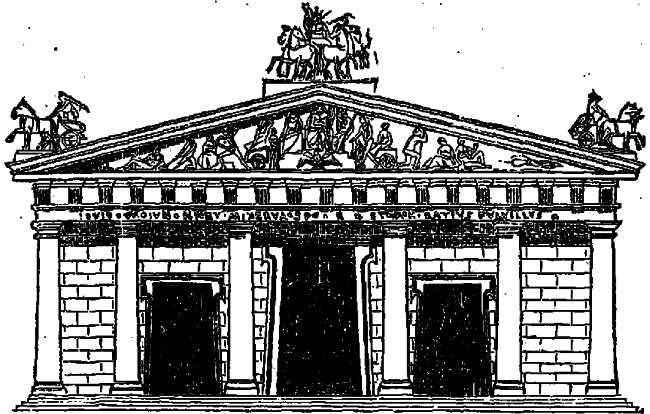
The Gauls or Celts were in ancient times spread over the greater part of Western Europe. They inhabited Gaul and the British isles, and had in the time of the Tarquins crossed the Alps and taken possession of Northern Italy. But they now spread farther south, crossed the Apennines, and laid waste with fire and sword the provinces of Central Italy. Rome fell before them, and was reduced to ashes; but the details of its capture are clearly legendary. The common story runs as follows:
The Senones, a tribe of the Gauls, led by their chief Brennus, laid siege to Clusium, the powerful Etruscan city over which Lars Porsena once reigned. Such reputation had Rome gained through her conquests in Etruria, that Clusium applied to her for aid (B.C. 391). The Senate sent three embassadors, sons of the chief pontiff, Fabius Ambustus, to warn the barbarians not to touch an ally of Rome. But the Gauls treated their message with scorn; and the embassadors, forgetting their sacred character, fought in the Clusine ranks. One of the Fabii slew with his own hands a Gallic chieftain, and was recognized while stripping off his armor. Bren[Pg 46]nus therefore sent to Rome to demand satisfaction. The Roman people not only refused to give it, but elected the three Fabii as Military Tribunes for the following year. On hearing of this insult, the Gauls broke up the siege of Clusium, and hastened southward toward Rome. All the inhabitants fled before them into the towns. They pursued their course without injuring any one, crying to the guards upon the walls of the towns they passed, "Our way lies for Rome." On the news of their approach the Roman army hurried out of the city, and on the 16th of July (B.C. 300), a day ever after regarded as disastrous, they met the Gauls on the Allia, a small river which flows into the Tiber, on its left bank, about eleven miles from Rome. Brennus attacked the Romans on the flank, and threw them into confusion. A general panic seized them: they turned and fled. Some escaped across the Tiber to Veii, and a few reached Rome, but the greater number were slain by the Gauls.
The loss at the Allia had been so great that enough men were not left to guard the walls of the city. It was therefore resolved that those in the vigor of their age should withdraw to the Capitol, taking with them all the provisions in the city; that the priests and Vestal Virgins should convey the objects of religious reverence to Cæré; and that the rest of the population should disperse among the neighboring towns. But the aged senators, who had been Consuls or Censors, seeing that their lives were no longer of any service to the state, sat down in the forum on their curule thrones awaiting death. When the Gauls entered the city they found it desolate and deathlike. They marched on, without seeing a human being till they came to the forum. Here they beheld the aged senators sitting immovable, like beings of another world. For some time they gazed in awe at this strange sight, till at length one of the Gauls ventured to go up to M. Papirius and stroke his white beard. The old man struck him on the head with his ivory sceptre; whereupon the barbarian slew him, and all the rest were massacred. The Gauls now began plundering the city; fires broke out in several quarters; and with the exception of a few houses on the Palatine, which the chiefs kept for their own residence, the whole city was burnt to the ground.
The Capitol was the next object of attack. There was only one steep way leading up to it, and all the assaults of the besiegers were easily repelled. They thereupon turned the siege into a blockade, and for seven months were encamped amid the ruins of Rome. But their numbers were soon thinned by disease, for they had entered Rome in the most unhealthy time of the year, when fevers have always prevailed. The failure of provisions obliged[Pg 47] them to ravage the neighboring countries, the people of which began to combine for defense against the marauders. Meantime the scattered Romans took courage. They collected at Veii, and here resolved to recall Camillus from banishment, and appoint him Dictator. In order to obtain the consent of the Senate, a daring youth, named Pontius Cominius, offered to swim across the Tiber and climb the Capitol. He reached the top unperceived by the enemy, obtained the approval of the Senate to the appointment of Camillus, and returned safely to Veii. But next day some Gauls observed the traces of his steps, and in the dead of night they climbed up the same way. The foremost of them had already reached the top, unnoticed by the sentinels and the dogs, when the cries of some geese roused M. Manlius from sleep. These geese were sacred to Juno, and had been spared notwithstanding the gnawings of hunger; and the Romans were now rewarded for their piety. M. Manlius thrust down the Gaul who had clambered up, and gave the alarm. The Capitol was thus saved; and down to latest times M. Manlius was honored as one of the greatest heroes of the early Republic.
Still no help came, and the Gauls remained before the Capitol. The Romans suffered from famine, and at length agreed to pay the barbarians 1000 pounds of gold, on condition of their quitting the city and its territory. Brennus brought false weights, and, when the Romans exclaimed against this injustice, the Gallic chief threw his sword also into the scale, crying, "Woe to the vanquished!" But at this very moment Camillus marched into the forum, ordered the gold to be taken away, and drove the Gauls out of the city. Another battle was fought on the road to Gabii, in which the Gauls were completely destroyed, and their leader Brennus taken prisoner. This tale, however, is an invention of Roman vanity. We learn from other sources that the Gauls retreated because their settlements in Northern Italy were attacked by the Venetians; and there can be little doubt that their departure was hastened by a present of Roman gold. The Gauls frequently repeated their inroads, and for many years to come were the constant dread of the Romans.
When the Romans returned to the heap of ruins which was once their city their hearts sank within them. The people shrank from the expense and toil of rebuilding their houses, and loudly demanded that they should all remove to Veii, where the private dwellings and public buildings were still standing. But Camillus and the Patricians strongly urged them not to abandon the homes of their fathers, and they were at length persuaded to remain. The state granted bricks, and stones were fetched from Veii. Within a year[Pg 48] the city rose from its ashes; but the streets were narrow and crooked; the houses were frequently built over the sewers; and the city continued to show, down to the great fire of Nero, evident traces of the haste and irregularity with which it had been rebuilt. Rome was now deprived of almost all her subjects, and her territory was reduced to nearly its original limits. The Latins and Hernicans dissolved the League with the Romans, and wars broke out on every side. In these difficulties and dangers Camillus was the soul of the Republic. Again and again he led the Roman legions against their enemies, and always with success. The rapidity with which the Romans recovered their power after so terrible a disaster would seem unaccountable but for the fact that the other nations had also suffered greatly from the inroads of the Gauls, who still continued to ravage Central Italy. Two of their invasions of the Roman territory are commemorated by celebrated legends, which may be related here, though they belong to a later period.
In B.C. 361 the Gauls and Romans were encamped on either bank of the Arno. A gigantic Gaul stepped forth from the ranks and insultingly challenged a Roman knight. T. Manlius, a Roman youth, obtained permission from his general to accept the challenge, slew the giant, and took from the dead body the golden chain (torques) which the barbarian wore around his neck. His comrades gave him the surname of Torquatus, which he handed down to his descendants.
In B.C. 349 another distinguished Roman family earned its surname from a single combat with a Gaul. Here again a Gallic warrior of gigantic size challenged any one of the Romans to single combat. His challenge was accepted by M. Valerius, upon whose helmet a raven perched; and as they fought, the bird flew into the face of the Gaul, striking at him with its beak and flapping his wings. Thus Valerius slew the Gaul, and was called in consequence "Corvus," or the "Raven."
It is now necessary to revert to the internal history of Rome. Great suffering and discontent prevailed. Returning to ruined homes and ravaged lands, the poor citizens had been obliged to borrow money to rebuild their houses and cultivate their farms. The law of debtor and creditor at Rome, as we have already seen, was very severe, and many unfortunate debtors were carried away to bondage. Under these circumstances, M. Manlius, the preserver of the Capitol, came forward as the patron of the poor. This distinguished man had been bitterly disappointed in his claims to honor and gratitude. While Camillus, his personal enemy, who had shared in none of the dangers of the siege, was repeatedly[Pg 49] raised to the highest honors of the state, he, who had saved the Capitol, was left to languish in a private station. Neglected by his own order, Manlius turned to the Plebeians. One day he recognized in the forum a soldier who had served with him in the field, and whom a creditor was carrying away in fetters. Manlius paid his debt upon the spot, and swore that, as long as he had a single pound, he would not allow any Roman to be imprisoned for debt. He sold a large part of his property, and applied the proceeds to the liberation of his fellow-citizens from bondage. Supported now by the Plebeians, he came forward as the accuser of his own order, and charged them with appropriating to their own use the gold which had been raised to ransom the city from the Gauls. The Patricians in return accused him, as they had accused Sp. Cassius, of aspiring to the tyranny. When he was brought to trial before the Comitia of the Centuries in the Campus Martius, he proudly showed the spoils of thirty warriors whom he had slain, the forty military distinctions which he had won in battle, and the innumerable scars upon his breast, and then turning toward the Capitol he prayed the immortal gods to remember the man who had saved their temples from destruction. After such an appeal, his condemnation was impossible, and his enemies therefore contrived to break up the assembly. Shortly afterward he was arraigned on the same charges before the Comitia of the Curies in the Peteline Grove. Here he was at once condemned, and was hurled from the Tarpeian Rock. His house, which was on the Capitol, was razed to the ground (B.C. 384).
The death of Manlius, however, was only a temporary check to the Plebeian cause. A few years afterward the contest came to a crisis. In B.C. 376 C. Licinius Stolo and his kinsman L. Sextius, being Tribunes of the Plebs, determined to give the Plebeians an equal share in the political power, to deprive the Patricians of the exclusive use of the public land, and to remove the present distress of the Plebeians. For this purpose they brought forward three laws, which are celebrated in history under the name of THE LICINIAN ROGATIONS.[20] These were:
I. That in future Consuls, and not Military Tribunes, should be appointed, and that one of the two Consuls must be a Plebeian.
II. That no citizen should possess more than 500 jugera[21] of the public land, nor should feed upon the public pastures more than 100 head of large and 500 of small cattle, under penalty of a heavy fine.[Pg 50]
III. That the interest already paid for borrowed money should be deducted from the principal, and that the remainder should be repaid in three yearly instalments.
These great reforms naturally excited the most violent opposition, and the Patricians induced some of the Plebeians to put their veto upon the measures of their colleagues. But Licinius and Sextius were not to be baffled in this way, and they exercised their veto by preventing the Comitia of the Centuries from electing any magistrates for the next year. Hence no Consuls, Military Tribunes, Censors, or Quæstors could be appointed; and the Tribunes of the Plebs and the Ædiles, who were elected by the Comitia of the Tribes, were the only magistrates in the state. For five years did this state of things continue. C. Licinius and L. Sextius were re-elected annually, and prevented the Comitia of the Centuries from appointing any magistrates. At the end of this time they allowed Military Tribunes to be chosen in consequence of a war with the Latins; but so far were they from yielding any of their demands, that to their former Rogations they now added another: That the care of the Sibylline books, instead of being intrusted to two men (duumviri), both Patricians, should be given to ten men (decemviri), half of whom should be Plebeians.
Five years more did the struggle last; but the firmness of the Tribunes at length prevailed. In B.C. 367 the Licinian Rogations were passed, and L. Sextius was elected the first Plebeian Consul for the next year. But the Patricians made one last effort to evade the law. By the Roman constitution, the Consuls, after being elected by the Comitia Centuriata, received the Imperium, or sovereign power, from the Comitia Curiata. The Patricians thus had it in their power to nullify the election of the Centuries by refusing the Imperium. This they did when L. Sextius was elected Consul; and they made Camillus, the great champion of their order, Dictator, to support them in their new struggle. But the old hero saw that it was too late, and determined to bring about a reconciliation between the two orders. A compromise was effected. The Imperium was conferred upon L. Sextius; but the judicial duties were taken away from the Consuls, and given to a new magistrate called Prætor. Camillus vowed to the goddess Concord a temple for his success.
The long struggle between the Patricians and Plebeians was thus brought to a virtual close. The Patricians still clung obstinately to the exclusive privileges which they still possessed; but when the Plebeians had once obtained a share in the Consulship, it was evident that their participation in the other offices of the state could not be much longer delayed. We may therefore anticipate the[Pg 51] course of events by narrating in this place that the first Plebeian Dictator was C. Marcius Rutilus in B.C. 356; that the same man was the first Plebeian Censor five years afterward (B.C. 351); that the Prætorship was thrown open to the Plebeians in B.C. 336; and that the Lex Ogulnia in B.C. 300, which increased the number of the Pontiffs from four to eight, and that of the Augurs from four to nine, also enacted that four of the Pontiffs and five of the Augurs should be taken from the Plebeians.
About thirty years after the Licinian Rogations, another important reform, which abridged still farther the privileges of the Patricians, was effected by the PUBLILIAN LAWS, proposed by the Dictator Q. Publilius Philo in B.C. 339. These were:
I. That the Resolutions of the Plebs should be binding on all the Quirites,[22] thus giving to the Plebiscita passed at the Comitia of the Tribes the same force as the Laws passed at the Comitia of the Centuries.
II. That all laws passed at the Comitia of the Centuries should receive previously the sanction of the Curies; so that the Curies were now deprived of all power over the Centuries.
III. That one of the Censors must be a Plebeian.
The first of these laws seems to be little move than a re-enactment of one of the Valerian and Horatian laws, passed after the expulsion of the Decemvirs;[23] but it is probable that the latter had never been really carried into effect. Even the Publilian Law upon this subject seems to have been evaded; and it was accordingly enacted again by the Dictator Q. Hortensius in B.C. 286. In this year the last Secession of the Plebeians took place, and the LEX HORTENSIA is always mentioned as the law which gave to Plebiscita passed at the Comitia of the Tribes the full power of laws binding upon the whole nation. From this time we hear of no more civil dissensions till the times of the Gracchi, a hundred and fifty years afterward, and the Lex Hortensia may therefore be regarded as the termination of the long struggle between the two orders.
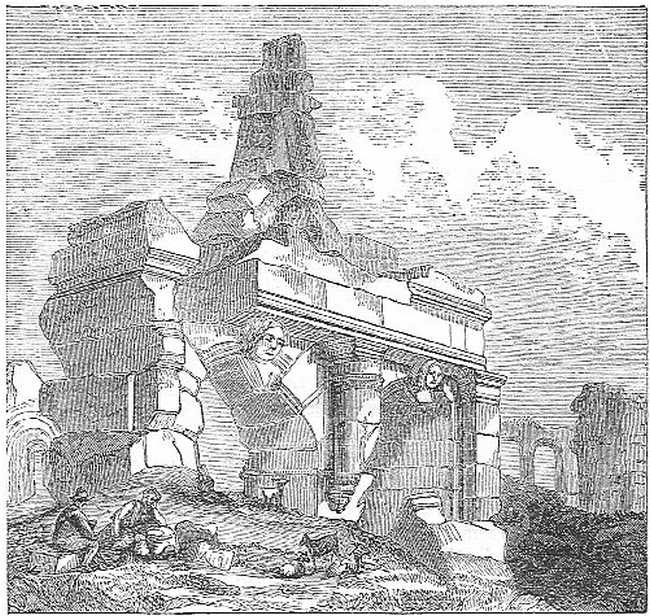
United at home, the Romans were now prepared to carry on their foreign wars with more vigor; and their conquests of the Samnites and Latins made them the virtual masters of Italy. But the years which immediately followed the Licinian laws were times of great suffering. A pestilence raged in Rome, which carried off many of the most distinguished men, and among others the aged Camillus (B.C. 362). The Tiber overflowed its banks, the city was shaken by earthquakes, and a yawning chasm opened in the forum. The soothsayers declared that the gulf could never be filled up ex[Pg 53]cept by throwing into it that which Rome held most valuable. The tale runs that, when every one was doubting what the gods could mean, a noble youth named M. Curtius came forward, and, declaring that Rome possessed nothing so valuable as her brave citizens, mounted his steed and leaped into the abyss in full armor, whereupon the earth closed over him. This event is assigned to the year 362 B.C.
During the next few years the Gauls renewed their inroads, of which we have already spoken, and in the course of which Manlius Torquatus and Valerius Corvus gained such glory. The Romans steadily extended their dominion over the southern part of Etruria and the country of the Volscians, and the alliance with the Latins was renewed. Fifty years had elapsed since the capture of the city by the Gauls, and Rome was now strong enough to enter into a contest with the most formidable enemy which her arms had yet encountered. The SAMNITES were at the height of their power, and the contest between them and the Romans was virtually for the supremacy of Italy. The Samnites, as we have already seen, were a people of Sabine origin, and had emigrated to the country which they inhabited at a comparatively late period. They consisted of four different tribes or cantons, the Pentri, Hirpini, Caraceni, and Caudini, of whom the two former were the most important. They inhabited that part of the Apennines which lies between Campania and Lucania, but they were not contented with their mountain-homes, and overran the rich plains which lay at their feet. They became the masters of Campania and Lucania, and spread themselves almost to the southern extremity of Italy. But the Samnites of Campania and Lucania had in course of time broken off all connection with the parent nation, and sometimes were engaged in hostilities with the latter. It was a contest of this kind that led to the war between the Romans and the Samnites of the Apennines. On the borders of Campania and Samnium dwelt a people, called the Sidicini, who had hitherto preserved their independence. Being attacked by the Samnites, this people implored the assistance of the Campanians, which was readily granted. Thereupon the Samnites turned their arms against the Campanians, and, after occupying Mount Tifata, which overlooks the city of Capua, they descended into the plain, and defeated the Campanians in a pitched battle at the very gates of Capua. The Campanians, being shut up within the city, now applied for assistance to Rome, and offered to place Capua in their hands. The Romans had only a few years previously concluded an alliance with the Samnites; but the bait of the richest city and the most fertile soil in Italy was irresistible, and they resolved to comply with the request. Thus began the[Pg 54] Samnite Wars, which, with a few intervals of peace, lasted 53 years.
FIRST SAMNITE WAR, B.C. 343-341.—The Romans commenced the war by sending two consular armies against the Samnites; and the first battle between the rival nations was fought at the foot of Mount Gaurus, which lies about three miles from Cumæ. The Samnites were defeated with great loss; and it has been justly remarked that this battle may be regarded as one of the most memorable in history, since it was a kind of omen of the ultimate issue of the great contest which had now begun between the Samnites and Romans for the sovereignty of Italy. The Romans gained two other decisive victories, and both consuls entered the city in triumph. But two causes prevented the Romans from prosecuting their success. In the first place, the Roman army, which had been wintering in Capua, rose in open mutiny; and the poorer Plebeians in the city, who were oppressed by debt, left Rome and joined the mutineers. In the second place, the increasing disaffection of the Latins warned the Romans to husband their resources for another and more terrible struggle. The Romans, therefore, abandoning the Sidicini and Campanians, concluded a treaty of peace and alliance with the Samnites in B.C. 341, so that in the great Latin war, which broke out in the following year, the Samnites fought on the side of the Romans.
THE LATIN WAR, B.C. 340-338.—The Latins had, as already stated, renewed their league with Rome in B.C. 356, and consequently their troops had fought along with the Romans in the war against the Samnites. But the increasing power of Rome excited their alarm; and it became evident to them that, though nominally on a footing of equality, they were, in reality, becoming subject to Rome. This feeling was confirmed by the treaty of alliance which the Romans had formed with the Samnites. The Latins, therefore, determined to bring matters to a crisis, and sent two Prætors, who were their chief magistrates, to propose to the Romans that the two nations should henceforth form one state; that half of the state should consist of Latins, and that one of the two Consuls should be chosen from Latium. These requests excited the greatest indignation at Rome, and were rejected with the utmost scorn. The Senate met in the Temple of Jupiter, in the Capitol, to receive the Latin deputation, and, after hearing their proposals, the Consul, T. Manlius Torquatus, the same who had slain the Gaul in single combat, declared that, if the Republic should cowardly yield to these demands, he would come into the senate-house sword in hand and cut down the first Latin he saw there. The tale goes on to say that in the discussion which followed, when both parties[Pg 55] were excited by anger, the Latin Prætor defied the Roman Jupiter; that thereupon an awful peal of thunder shook the building; and that, as the impious man hurried down the steps from the temple, he fell from top to bottom, and lay there a corpse.
War was now declared, and the most vigorous efforts were made on both sides. The contest was to decide whether Rome should become a Latin town, or the Latins be subject to Rome. The Romans had elected to the consulship two of their most distinguished men. The Patrician Consul was, as already mentioned, T. Manlius Torquatus; his Plebeian colleague was P. Decius Mus, who had gained great renown in the recent war against the Samnites. The two Consuls marched through Samnium into Campania, and threatened Capua, thus leaving Rome exposed to the attacks of the Latins. But the Consuls foresaw that the Latins would not abandon Capua, their great acquisition; and the event proved their wisdom. The contest was thus withdrawn from the territory of Rome and transferred to Campania, where the Romans could receive assistance from the neighboring country of their Samnite allies. It was at the foot of Mount Vesuvius that the two armies met, and here the battle was fought which decided the contest. It was like a civil war. The soldiers of the two armies spoke the same language, had fought by each others' sides, and were well known to one another. Under these circumstances, the Consuls published a proclamation that no Roman should engage in single combat with a Latin on pain of death. But the son of Torquatus, provoked by the insults of a Tusculan officer, accepted his challenge, slew his adversary, and carried the bloody spoils in triumph to his father. The Consul had within him the heart of Brutus; he would not pardon this breach of discipline, and ordered the unhappy youth to be beheaded by the lictor in the presence of the assembled army.
In the night before the battle a vision appeared to each Consul, announcing that the general of one side and the army of the other were doomed to destruction. Both agreed that the one whose wing first began to waver should devote himself and the army of the enemy to the gods of the lower world. Decius commanded the left wing; and when it began to give way, he resolved to fulfill his vow. Calling the Pontifex Maximus, he repeated after him the form of words by which he devoted himself and the army of the enemy to the gods of the dead and the mother earth; then leaping upon his horse, he rushed into the thickest of the fight, and was slain. The Romans gained a signal victory. Scarcely a fourth part of the Latins escaped (B.C. 340).
This victory made the Romans masters of Campania, and the[Pg 56] Latins did not dare to meet them again in the field. The war continued two years longer, each city confining itself to the defense of its own walls, and hoping to receive help from others in case of an attack. But upon the capture of Pedum in B.C. 338 all the Latins laid down their arms, and garrisons were placed in their towns. The Romans were now absolute masters of Latium, and their great object was to prevent the Latin cities from forming any union again. For this purpose not only were all general assemblies forbidden, but, in order to keep the cities completely isolated, the citizens of one town could not marry or make a legal contract of bargain or sale with another.[24] Tibur and Præneste, the two most powerful cities of the League, which had taken the most active part in the war, were deprived of a portion of their land, but were allowed to retain a nominal independence, preserving their own laws, and renewing from time to time their treaties with Rome. The inhabitants of several other towns, such as Tusculum and Lanuvium, received the Roman franchise; their territory was incorporated in that of the Republic; and two new tribes were created to carry these arrangements into effect. Many of the most distinguished Romans sprung from these Latin towns.
Twelve years elapsed between the subjugation of Latium and the commencement of the Second Samnite War. During this time the Roman arms continued to make steady progress. One of their most important conquests was that of the Volscian town of Privernum in B.C. 329, from which time the Volscians, so long the formidable enemies of Rome, disappear as an independent nation. The extension of the Roman power naturally awakened the jealousy of the Samnites; and the assistance rendered by them to the Greek cities of Palæopolis and Neapolis was the immediate occasion of the Second Samnite War. These two cities were colonies of the neighboring Cumæ, and were situated only five miles from each other. The position of Palæopolis, or the "Old City," is uncertain; but Neapolis, or the "New City," stands on the site of a part of the modern Naples. The Romans declared war against the two cities in B.C. 327, and sent the Consul Q. Publilius Philo to reduce them to subjection. The Greek colonists had previously formed an alliance with the Samnites, and now received powerful Samnite garrisons. Publilius encamped between the cities; and as he did not succeed in taking them before his year of office expired, he was continued in the command with the title of Proconsul, the first time that this office was created. At the beginning of the following year Palæopolis was taken; and Neapolis only escaped the[Pg 57] same fate by concluding an alliance with the Romans. Meanwhile the Romans had declared war against the Samnites.
SECOND OR GREAT SAMNITE WAR, B.C. 326-304.—The Second Samnite War lasted 22 years, and was by far the most important of the three wars which this people waged with Rome. During the first five years (B.C. 326-322) the Roman arms were generally successful. The Samnites became so disheartened that they sued for peace, but obtained only a truce for a year. It was during this period that the well-known quarrel took place between L. Papirius Cursor and Q. Fabius Maximus, the two most celebrated Roman generals of the time, who constantly led the armies of the Republic to victory. In B.C. 325 L. Papirius was Dictator, and Q. Fabius his Master of the Horse. Recalled to Rome by some defect in the auspices, the Dictator left the army in charge of Fabius, but with strict orders not to venture upon an engagement. Compelled or provoked by the growing boldness of the enemy, Fabius attacked and defeated them with great loss. But this victory was no extenuation for his offense in the eyes of the Dictator. Papirius hastened back to the camp, burning with indignation that his commands had been disobeyed, and ordered his lictors to seize Fabius and put him to death. The soldiers, whom Fabius had led to victory, rose in his defense; and in the night he escaped to Rome, to implore the protection of the Senate. He was stating the case to the Fathers, when Papirius entered the senate-house, followed by his lictors, and demanded that the offender should be given up for execution. But the Senate, the people, and the aged father of Maximus interceded so strongly for his life, that the Dictator was obliged to give way and to grant an ungracious pardon.
The year's truce had not expired when the Samnites again took up arms, and for the next seven years (B.C. 321-315) the balance of success inclined to their side. This appears to have been mainly owing to the military abilities of their general C. Pontius, who deserves to be ranked among the chief men of antiquity. In the first year of his command he inflicted upon the Romans one of the severest blows they ever sustained in the whole course of their history.
In B.C. 321 the two Consuls, T. Veturius and Sp. Postumius, marched into Samnium by the road from Capua to Beneventum. Near the town of Caudium they entered the celebrated pass called the CAUDINE FORKS (Furculæ Caudinæ). It consisted of two narrow defiles or gorges, between which was a tolerably spacious plain, but shut in on each side by mountains. The Romans, thinking the Samnites to be far distant, had marched through the first pass and the plain; but when they came to the second they found it blocked up by works and trunks of trees, so as to be quite impassable.[Pg 58] Retracing their steps to the pass by which they had entered, they found that the enemy had meantime taken possession of this also. They were thus blocked up at either end, and, after making vain attempts to force their way through, were obliged to surrender at discretion. Thus both Consuls and four legions fell into the hands of the Samnites. C. Pontius made a merciful use of his victory. He agreed to dismiss them in safety upon their promising to restore the ancient alliance on equal terms between the two nations, and to give up all the places which they had conquered during the war. The Consuls and the other superior officers swore to these terms in the name of the Republic, and six hundred Roman knights were given as hostages. The whole Roman army was now allowed to depart, and each Roman soldier marched out singly under the yoke.
When the news of this disaster reached Rome the Senate refused to ratify the peace, and resolved that the two Consuls and all the officers who had sworn to the peace should be delivered up to the Samnites as persons who had deceived them. They were conducted to Caudium by a Fetialis; and when they appeared before the tribunal of C. Pontius, Postumius, with superstitious folly, struck the Fetialis with his foot, saying that he was now a Samnite citizen, and that war might be renewed with justice by the Romans, since a Samnite had insulted the sacred envoy of the Roman people. But Pontius refused to accept the persons who were thus offered, and told them, if they wished to nullify the treaty, to send back the army to the Caudine Forks. Thus Postumius and his companions returned to Rome, and the 600 knights were alone left in the hands of the Samnites.
The disaster of Caudium shook the fate of many of the Roman allies, and the fortune of war was for some years in favor of the Samnites. But in B.C. 314 the tide of success again turned, and the decisive victory of the Consuls in that year opened the way into the heart of Samnium. From this time the Romans were uniformly successful; and it seemed probable that the war was drawing to a close, when the Etruscans created a powerful diversion by declaring war against Rome in B.C. 311. But the energy and ability of Q. Fabius Maximus averted this new danger. He boldly carried the war into the very heart of Etruria, and gained a decisive victory over the forces of the League. The Samnites also were repeatedly defeated; and after the capture of Bovianum, the chief city of the Pentri, they were compelled to sue for peace. It was granted them in B.C. 304, on condition of their acknowledging the supremacy of Rome.
At the conclusion of the Second Samnite War the Æquians and[Pg 59] Hernicans were reduced to subjection after a brief struggle. A part of the Æquian territory was incorporated in that of Rome by the addition of two new tribes, and two colonies were planted in the other portion. The Marsi, Marrucini, Peligni, and other nations of Central Italy, entered into a league with the Romans on equal terms. Thus, in B.C. 300, the power of Rome seemed firmly established in Central Italy. But this very power awakened the jealousy of the surrounding nations, and the Samnites exerted themselves to form a new and formidable coalition. The Etruscans and Umbrians agreed to make war against Rome, and called in the assistance of the Senonian Gauls.
THIRD SAMNITE WAR, B.C. 298-290.—As soon as the Etruscans and Umbrians were engaged with Rome, the Samnites invaded Lucania. The Lucanians invoked the assistance of the Romans, who forthwith declared war against the Samnites. The Republic had now to contend at one and the same time against the Etruscans, Umbrians, Gauls, and Samnites; but she carried on the struggle with the utmost energy, attacking the Etruscans, Umbrians, and Gauls in the north, and the Samnites in the south. At length, in B.C. 295, the Samnites joined their confederates in Umbria. In this country, near the town of Sentinum, a desperate battle was fought, which decided the fortune of the war. The two Roman Consuls were the aged Q. Fabius Maximus and P. Decius Mus. The victory was long doubtful. The wing commanded by Decius was giving way before the terrible onset of the Gauls, when he determined to imitate the example of his father, and to devote himself and the enemy to destruction. His death gave fresh courage to his men, and Fabius gained a complete and decisive victory. Gellius Egnatius, the Samnite general, who had taken the most active part in forming the coalition, was slain. But, though the League was thus broken up, the Samnites continued the struggle for five years longer. During this period C. Pontius, who had defeated the Romans at the Caudine Forks, again appeared, after twenty-seven years, as the leader of the Samnites, but was defeated by Q. Fabius Maximus with great loss and taken prisoner. Being carried to Rome, he was put to death as the triumphal car of the victor ascended the Capitol (B.C. 292). This shameful act has been justly branded as one of the greatest stains on the Roman annals. Two years afterward the Samnites were unable to continue any longer the hopeless struggle, and became the subjects of Rome. The third and last Samnite war was brought to a close in B.C. 290.
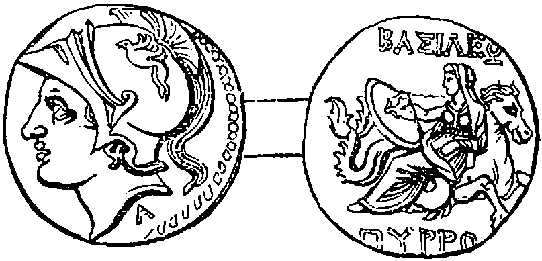
Ten years elapsed from the conclusion of the third Samnite war to the arrival of Pyrrhus in Italy. During this time the Etruscans and Gauls renewed the war in the north, but were defeated with great slaughter near the Lake Vadimo. This decisive battle appears to have completely crushed the Etruscan power; and it inflicted so severe a blow upon the Gauls that we hear no more of their ravages for the next sixty years.
In the south the Lucanians also rose against Rome. The extension of the Roman dominion in the south of the peninsula had brought the state into connection with the Greek cities, which at one period were so numerous and powerful as to give to this part of Italy the name of Magna Græcia.[25] Many of these cities had now fallen into decay through internal dissensions and the conquests of the Lucanians and other Sabellian tribes; but Tarentum, originally a Lacedæmonian colony, still maintained her former power and splendor. The Tarentines naturally regarded with extreme jealousy the progress of the Roman arms in the south of Italy, and had secretly instigated the Etruscans and Lucanians to form a new coalition against Rome. But the immediate cause of the war between the Lucanians and Romans was the assistance which the latter had rendered to the Greek city of Thurii. Being attacked by the Lucanians, the Thurians applied to Rome for aid, and the Consul C. Fabricius not only relieved Thurii, but defeated the Lucanians and their allies in several engagements (B.C. 252). Upon the departure of Fabricius a Roman garrison was left in Thurii. The only mode now of maintaining communication between Rome and Thurii was by sea; but this was virtually forbidden by a treaty[Pg 61] which the Romans had made with Tarentum nearly twenty years before, in which treaty it was stipulated that no Roman ships of war should pass the Lacinian promontory. But circumstances were now changed, and the Senate determined that their vessels should no longer be debarred from the Gulf of Tarentum. There was a small squadron of ten ships in those seas under the command of L. Valerius; and one day, when the Tarentines were assembled in the theatre, which looked over the sea, they saw the Roman squadron sailing toward their harbor. This open violation of the treaty seemed a premeditated insult, and a demagogue urged the people to take summary vengeance. They rushed down to the harbor, quickly manned some ships, and gained an easy victory over the small Roman squadron. Only half made their escape, four were sunk, one taken, and Valerius himself killed. After this the Tarentines marched against Thurii, compelled the inhabitants to dismiss the Roman garrison, and then plundered the town.
The Senate sent an embassy to Tarentum to complain of these outrages and to demand satisfaction. L. Postumius, who was at the head of the embassy, was introduced with his colleagues into the theatre, to state to the assembled people the demands of the Roman Senate. He began to address them in Greek, but his mistakes in the language were received with peals of laughter from the thoughtless mob. Unable to obtain a hearing, much less an answer, Postumius was leaving the theatre, when a drunken buffoon rushed up to him and sullied his white robe in the most disgusting manner. The whole theatre rang with shouts of laughter and clapping of hands, which became louder and louder when Postumius held up his sullied robe and showed it to the people. "Laugh on now," he cried, "but this robe shall be washed in torrents of your blood."
War was now inevitable. The luxurious Tarentines sent an embassy to Pyrrhus, king of Epirus, begging him, in the name of all the Italian Greeks, to cross over into Italy in order to conduct the war against the Romans. They told him that they only wanted a general, and that all the nations of Southern Italy would flock to his standard. Pyrrhus needed no persuasion to engage in an enterprise which realized the earliest dreams of his ambition. The conquest of Italy would naturally lead to the sovereignty of Sicily and Africa, and he would then be able to return to Greece with the united forces of the West to overcome his rivals and reign as master of the world. But as he would not trust the success of his enterprise to the valor and fidelity of Italian troops, he began to make preparations to carry over a powerful army. Meantime he sent Milo, one of his generals, with a detachment of 3000 men, to[Pg 62] garrison the citadel of Tarentum. Pyrrhus himself crossed over from Epirus toward the end of B.C. 281, taking with him 20,000 foot, 3000 horse, and 20 elephants.
Upon reaching Tarentum he began to make preparations to carry on the war with activity. The Tarentines soon found they had obtained a master rather than an ally. He shut up the theatre and all other public places, and compelled their young men to serve in his ranks. Notwithstanding all his activity, the Romans were first in the field. The Consul M. Valerius Lævinus marched into Lucania; but as the army of Pyrrhus was inferior to that of the Romans, he attempted to gain time by negotiation in order that he might be joined by his Italian allies. He accordingly wrote to the Consul, offering to arbitrate between Rome and the Italian states; but Lævinus bluntly told him to mind his own business and retire to Epirus. Fearing to remain inactive any longer, although he was not yet joined by his allies, Pyrrhus marched out against the Romans with his own troops and the Tarentines. He took up his position between the towns of Pandosia and Heraclea, on the River Siris. The Romans, who were encamped on the other side of the river, were the first to begin the battle. They crossed the river, and were immediately attacked by the cavalry of Pyrrhus, who led them to the charge in person, and distinguished himself as usual by the most daring acts of valor. The Romans, however, bravely sustained the attack; and Pyrrhus, finding that his cavalry could not decide the day, ordered his infantry to advance. The battle was still contested most furiously: seven times did both armies advance and retreat; and it was not till Pyrrhus brought forward his elephants, which bore down every thing before them, that the Romans took to flight, leaving their camp to the conqueror (B.C. 280).
This battle taught Pyrrhus the difficulty of the enterprise he had undertaken. Before the engagement, when he saw the Romans forming their line as they crossed the river, he said to his officers, "In war, at any rate, these barbarians are not barbarous;" and afterward, as he saw the Roman dead lying upon the field with all their wounds in front, he exclaimed, "If these were my soldiers, or if I were their general, we should conquer the world." And, though his loss had been inferior to that of the Romans, still so large a number of his officers and best troops had fallen, that he said, "Another such victory, and I must return to Epirus alone." He therefore resolved to avail himself of this victory to conclude, if possible, an advantageous peace. He sent his minister Cineas to Rome with the proposal that the Romans should recognize the independence of the Greeks in Italy, restore to the Samnites, Lucanians, Apulians, and Bruttians all the possessions which they had[Pg 63] lost in war, and make peace with himself and the Tarentines. As soon as peace was concluded on these terms he promised to return all the Roman prisoners without ransom. Cineas, whose persuasive eloquence was said to have won more towns for Pyrrhus than his arms, neglected no means to induce the Romans to accept these terms. The prospects of the Republic seemed so dark and threatening that many members of the Senate thought it would be more prudent to comply with the demands of the king; and this party would probably have carried the day had it not been for the patriotic speech of the aged Ap. Claudius Caucus, who denounced the idea of a peace with a victorious foe with such effect that the Senate declined the proposals of the king, and commanded Cineas to quit Rome the same day.
Cineas returned to Pyrrhus, and told him he must hope for nothing from negotiation; that the city was like a temple of the gods, and the Senate an assembly of kings. Pyrrhus now advanced by rapid marches toward Rome, ravaging the country as he went along, and without encountering any serious opposition. He at length arrived at Præneste, which fell into his hands. He was now only 24 miles from Rome, and his outposts advanced six miles farther. Another march would have brought him under the walls of the city; but at this moment he learned that peace was concluded with the Etruscans, and that the other Consul had returned with his army to Rome. All hope of compelling the Romans to accept the peace was now gone, and he therefore resolved to retreat. He retired slowly into Campania, and from thence withdrew into winter quarters to Tarentum.
As soon as the armies were quartered for the winter, the Romans sent an embassy to Pyrrhus to negotiate the ransom or exchange of prisoners. The embassadors were received by Pyrrhus in the most distinguished manner; and his interviews with C. Fabricius, who was at the head of the embassy, form one of the most famous stories in Roman history. Fabricius was a fine specimen of the sturdy Roman character. He cultivated his farm with his own hands, and, like his contemporary Curius, was celebrated for his incorruptible integrity. The king attempted in vain to work upon his cupidity and his fears. He steadily refused the large sums of money offered by Pyrrhus; and when an elephant, concealed behind him by a curtain, waved his trunk over his head, Fabricius remained unmoved. Such respect did his conduct inspire, that Pyrrhus attempted to persuade him to enter into his service and accompany him to Greece. The object of the embassy failed. The king refused to exchange the prisoners; but, to show them his trust in their honor, he allowed them to go to Rome in order to celebrate the[Pg 64] Saturnalia, stipulating that they were to return to Tarentum if the Senate would not accept the terms which he had previously offered through Cineas. The Senate remained firm in their resolve, and all the prisoners returned to Pyrrhus, the punishment of death having been denounced against those who should remain in the city.
In the following year (B.C. 279) the war was renewed, and a battle was fought near Asculum. The Romans fled to their camp, which was so near to the field of battle that not more than 6000 fell, while Pyrrhus lost more than half this number. The victory yielded Pyrrhus little or no advantage, and he was obliged to retire to Tarentum for the winter without effecting any thing more during the campaign. In the last battle, as well as in the former, the brunt of the action had fallen almost exclusively upon his Greek troops; and the state of Greece, which this year was overrun by the Gauls, made it hopeless for him to expect any re-enforcements from Epirus. He was therefore unwilling to hazard his surviving Greeks by another campaign with the Romans, and accordingly lent a ready ear to the invitations of the Greeks in Sicily, who begged him to come to their assistance against the Carthaginians. It was necessary, however, first to suspend hostilities with the Romans, who were likewise anxious to get rid of so formidable an opponent, that they might complete the subjugation of Southern Italy without farther interruption. When both parties had the same wishes it was not difficult to find a fair pretext for bringing the war to a conclusion. This was afforded at the beginning of the following year (B.C. 278) by one of the servants of Pyrrhus deserting to the Romans, and proposing to the Consuls to poison his master. They sent back the deserter to the king, saying that they abhorred a victory gained by treason. Thereupon Pyrrhus, to show his gratitude, sent Cineas to Rome with all the Roman prisoners, without ransom and without conditions; and the Romans granted him a truce.
Leaving Milo with part of his troops in possession of Tarentum, Pyrrhus now crossed over into Sicily. He remained there upward of two years. At first he met with brilliant success, and deprived the Carthaginians of a great part of the island. Subsequently, however, he received a severe repulse in an attempt which he made upon the impregnable town of Lilybæum. The fickle Greeks now began to form cabals and plots against him. This led to retaliation on his part, and he soon became as anxious to abandon the island as he had been before to leave Italy. Accordingly, when his Italian allies again begged him to come to their assistance, he readily complied with their request, and arrived in Italy in the autumn of B.C. 276. His troops were now almost the same in number as when he first landed in Italy, but very different in quality. The[Pg 65] faithful Epirots had for the most part fallen, and his present soldiers consisted chiefly of mercenaries, whom he had levied in Italy. One of his first operations was the recovery of Locri, which had revolted to the Romans; and as he here found himself in great difficulties for want of money to pay his troops, he was induced to take possession of the treasures of the Temple of Proserpine in that town; but the ships conveying the money were wrecked. This circumstance deeply affected the mind of Pyrrhus; he ordered the treasures which were saved to be restored to the temple, and from this time became haunted by the idea that the wrath of Proserpine was pursuing him, and dragging him down to ruin.
The following year (B.C. 274) closed the career of Pyrrhus in Italy. The Consul M'. Curius marched into Samnium, and his colleague into Lucania. Pyrrhus advanced against Curius, who was encamped in the neighborhood of Beneventum, and resolved to fight with him before he was joined by his colleague. As Curius did not wish to risk a battle with his own army alone, Pyrrhus planned a night-attack upon his camp. But he miscalculated the time and the distance; the torches burnt out, the men missed their way, and it was already broad daylight when he reached the heights above the Roman camp. Still their arrival was quite unexpected; but, as a battle was now inevitable, Curius led out his men. The troops of Pyrrhus, exhausted by fatigue, were easily put to the rout; two elephants were killed and eight more taken. Encouraged by this success, Curius no longer hesitated to meet the king in the open plain, and gained a decisive victory. Pyrrhus arrived at Tarentum with only a few horsemen. Shortly afterward he crossed over to Greece, leaving Milo with a garrison at Tarentum. Two years afterward he perished in an attack upon Argos, ingloriously slain by a tile hurled by a woman from the roof of a house.
The departure of Pyrrhus left the Lucanians and other Italian tribes exposed to the full power of Rome. They nevertheless continued the hopeless struggle a little longer; but in B.C. 272 Tarentum fell into the hands of Rome, and in a few years afterward every nation in Italy, to the south of the Macra and the Rubicon, owned the supremacy of Rome. She had now become one of the first powers in the ancient world. The defeat of Pyrrhus attracted the attention of the nations of the East; and in B.C. 273, Ptolemy Philadelphus, king of Egypt, sent an embassy to Rome, and concluded a treaty with the Republic.
The dominion which Rome had acquired by her arms was confirmed by her policy. She pursued the same system which she had adopted upon the subjugation of Latium, keeping the cities isolated from one another, but at the same time allowing them to[Pg 66] manage their own affairs. The population of Italy was divided into three classes. Cives Romani, Nomen Latinum, and Socii.
I. CIVES ROMANI, or ROMAN CITIZENS.—These consisted: (1.) Of the citizens of the thirty-three Tribes into which the Roman territory was now divided, and which extended north of the Tiber a little beyond Veii, and southward as far as the Liris; though even in this district there were some towns, such as Tibur and Prænesté, which did not possess the Roman franchise. (2.) Of the citizens of Roman colonies planted in different parts of Italy. (3.) Of the citizens of municipal towns upon whom the Roman franchise was conferred. In some cases the Roman franchise was granted without the right of voting in the Comitia (civitas sine suffragio), but in course of time this right also was generally conceded.
II. NOMEN LATINUM, or the LATIN NAME.—This term was applied to the colonies founded by Rome which did not enjoy the rights of Roman citizenship, and which stood in the same position with regard to the Roman state as had been formerly occupied by the cities of the Latin League. The name originated at a period when colonies were actually sent out in common by the Romans and Latins, but similar colonies continued to be founded by the Romans alone long after the extinction of the Latin League. In fact, the majority of the colonies planted by Rome were of this kind, the Roman citizens who took part in them voluntarily resigning their citizenship, in consideration of the grants of land which they obtained. But the citizen of any Latin colony might emigrate to Rome, and be enrolled in one of the Roman tribes, provided he had held a magistracy in his native town. These Latin colonies—the Nomen Latinum—were some of the most flourishing towns in Italy.
III. SOCII, or ALLIES, included the rest of Italy. Each of the towns which had been conquered by Rome had formed a treaty (fœdus) with the latter, which determined their rights and duties. These treaties were of various kinds, some securing nominal independence to the towns, and others reducing them to absolute subjection.
The political changes in Rome itself, from the time of the Latin wars, have been already in great part anticipated. Appius Claudius, afterward named Cæcus, or the Blind, introduced a dangerous innovation in the constitution during the Second Samnite War. Slavery existed at Rome, as among the other nations of antiquity; and as many slaves, from various causes, acquired their liberty, there gradually sprung up at Rome a large and indigent population of servile origin. These Freedmen were Roman citizens, but they could only be enrolled in the four city-tribes, so that, however numerous they might become, they could influence only the votes[Pg 67] of four tribes. Appius Claudius, in his Censorship (B.C. 312), when making out the lists of citizens, allowed the Freedmen to enroll themselves in any tribe they pleased; but this dangerous innovation was abolished by the Censors Q. Fabius Maximus and P. Decius Mus (B.C. 304), who restored all the Freedmen to the four city-tribes. The Censorship of Appius is, however, memorable for the great public works which he executed. He made the great military road called the Appian Way (Via Appia), leading from Rome to Capua, a distance of 120 miles, which long afterward was continued across the Apennines to Brundusium. He also executed the first of the great aqueducts (Aqua Appia) which supplied Rome with such an abundance of water.
Cn. Flavius, the son of a Freedman, and Secretary to Appius Claudius, divulged the forms and times to be observed in legal proceedings. These the Patricians had hitherto kept secret; they alone knew the days when the courts would be held, and the technical pleadings according to which all actions must proceed. But Flavius, having become acquainted with these secrets, by means of his patron, published in a book a list of the formularies to be observed in the several kinds of actions, and also set up in the forum a whited tablet containing a list of all the days on which the courts could be held. In spite of his ignominious birth, he was made a Senator by Appius Claudius, and was elected Curule Ædile by the people.
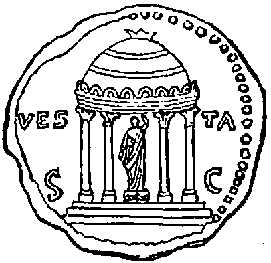
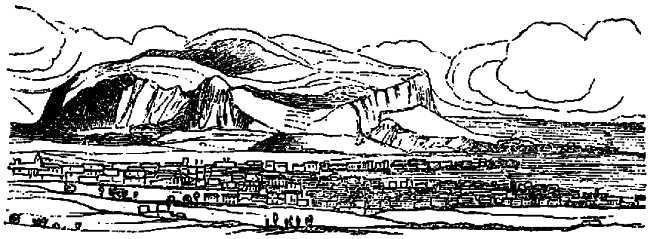
Rome, now mistress of Italy, entered upon a long and arduous straggle with Carthage, which ruled without a rival the western waters of the Mediterranean. This great and powerful city was founded by the Phœnicians[26] of Tyre in B.C. 814, according to the common chronology. Its inhabitants were consequently a branch of the Semitic race, to which the Hebrews also belonged. Carthage rose to greatness by her commerce, and gradually extended her empire over the whole of the north of Africa, from the Straits of Hercules to the borders of Cyrene. Her Libyan subjects she treated with extreme harshness, and hence they were always ready to revolt against her so soon as a foreign enemy appeared upon her soil.
The two chief magistrates at Carthage were elected annually out of a few of the chief families, and were called Suffetes.[27] There was a Senate of Three Hundred members, and also a smaller Council of One Hundred, of which the latter were the most powerful, holding office for life, and exercising an almost sovereign sway over the other authorities in the state. The government was a complete oligarchy; and a few old, rich, and powerful families divided among themselves the influence and power of the state. These great families were often opposed to each other in bitter feuds, but concurred in treating with contempt the mass of the people.
In her foreign wars Carthage depended upon mercenary troops, which her great wealth enabled her to procure in abundance from Spain, Italy, and Greece, as well as from Libya. Sardinia and Corsica were among her earliest conquests, and Sicily was also one[Pg 69] of the first objects of her military enterprise. The Phœnician colonies in this island came under her dominion as the power of Tyre declined; and having thus obtained a firm footing in Sicily, she carried on a long struggle for the supremacy with the Greek cities. It was here that she came into contact with the Roman arms. The relations of Rome and Carthage had hitherto been peaceful, and a treaty, concluded between the two states in the first years of the Roman republic, had been renewed more than once. But the extension of Roman dominion had excited the jealousy of Carthage, and Rome began to turn longing eyes to the fair island at the foot of her empire. It was evident that a struggle was not far distant, and Pyrrhus could not help exclaiming, as he quitted Sicily, "How fine a battle-field are we leaving to the Romans and Carthaginians!"
The city of Messana, situated on the straits which divide Sicily from Italy, was occupied at this time by the Mamertini. They were a body of Campanian mercenaries, chiefly of Sabellian origin, who had served under Agathocles, and after the death of that tyrant (B.C. 289) were marched to Messana, in order to be transported to Italy. Being hospitably received within the city, they suddenly rose against the inhabitants, massacred the male population, and made themselves masters of their wives and property. They now took the name of Mamertini, or "Children of Mars," from Mamers, a Sabellian name for that deity. They rapidly extended their power over a considerable portion of the north of Sicily, and were formidable enemies to Syracuse. Hiero, having become king of Syracuse, determined to destroy this nest of robbers, advanced against them with a large army, defeated them in battle, and shut them up within Messana. The Mamertines were obliged to look out for help; one party wished to appeal to the Carthaginians, and the other to invoke the assistance of Rome. The latter ultimately prevailed, and an embassy was sent to implore immediate aid. The temptation was strong, for the occupation of Messana by a Carthaginian garrison might prove dangerous to the tranquillity of Italy. Still the Senate hesitated; for only six years before Hiero had assisted the Romans in punishing the Campanian mercenaries, who had seized Rhegium in the same way as the Mamertines had made themselves masters of Messana. The voice of justice prevailed, and the Senate declined the proposal. But the Consuls, thirsting for glory, called together the popular assembly, who eagerly voted that the Mamertines should be assisted; in other words, that the Carthaginians should not be allowed to obtain possession of Messana. The Consul App. Claudius, the son of the blind Censor, was to lead an army into Sicily. But during this delay the Carthaginian party in Messana had obtained the ascendency, and Hanno,[Pg 70] with a Carthaginian garrison, had been admitted into the citadel. Hiero had concluded peace with the Mamertines through the mediation of the Carthaginians, so that there was no longer even a pretext for the interference of the Romans. But a legate of the Consul App. Claudius, having crossed to Sicily, persuaded the Mamertines to expel the Carthaginian garrison. Hiero and the Carthaginians now proceeded to lay siege to Messana by sea and land, and the Romans no longer hesitated to declare war against Carthage. Such was the commencement of the first Punic War (B.C. 264).
The Carthaginians commanded the sea with a powerful fleet, while the Romans had no ships of war worthy of the name. But the Consul App. Claudius, having contrived to elude the Carthaginian squadron, landed near the town of Messana, and defeated in succession the forces of Syracuse and Carthage. In the following year (263) the Romans followed up their success against Hiero. The two Consuls advanced to the walls of Syracuse, ravaging the territory of the city and capturing many of its dependent towns. The king became alarmed at the success of the Romans; and thinking that they would prove more powerful than the Carthaginians, he concluded a peace with Rome. From this time till his death, a period of nearly fifty years, Hiero remained the firm and steadfast ally of the Romans.
The Romans, now freed from the hostility of Syracuse, laid siege to Agrigentum, the second of the Greek cities in Sicily, which had espoused the cause of the Carthaginians at the commencement of the war. The siege lasted seven months, and numbers perished on both sides. But at length the Romans gained a decisive victory over the Carthaginian army which had been sent to raise the siege, and obtained possession of the town (B.C. 262).
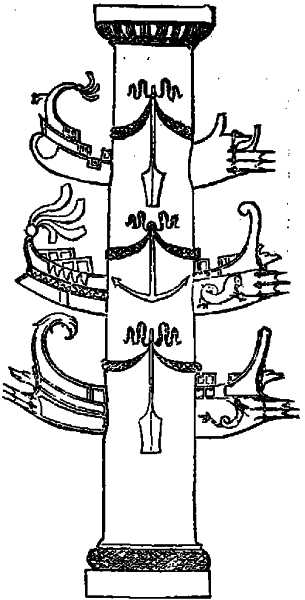
The first three years of the war had already made the Romans masters of the greater part of Sicily. But the coasts of Italy were exposed to the ravages of the Carthaginian fleet, and the Romans saw that they could not hope to bring the war to a successful termination so long as Carthage was mistress of the sea. They had only a small number of triremes, galleys with three banks of oars, and were quite unable to cope with the quinqueremes, or large vessels with five banks of oars, of which the Carthaginian navy consisted. The Senate, with characteristic energy, determined to build a fleet of these larger vessels. A Carthaginian quinquereme, which had been wrecked upon the coast of Italy, served as a model; and in the short space of sixty days from the time the trees were felled, 130 ships were launched. While the ships were building, the rowers were trained on scaffolds placed upon the land like benches of ships at sea. We can not but feel astonished at the[Pg 71] daring of the Romans, who, with ships thus hastily and clumsily built, and with crews imperfectly trained, sailed to attack the navy of the first maritime state in the world. This was in the fifth year of the war (B.C. 260). One of the Consuls, Cn. Cornelius, first put to sea with only 17 ships, but was surprised near Lipara, and taken prisoner with the whole of his squadron. His colleague, C. Duilius, now took the command of the rest of the fleet. He saw that the only means of conquering the Carthaginians by sea was to deprive them of all the advantages of manœuvring, and to take their ships by boarding. For this purpose, every ship was provided with a boarding-bridge 36 feet in length, which was pulled up by a rope and fastened to a mast in the fore part of the ship. As soon as an enemy's ship came near enough, the rope was loosened, the bridge fell down, and became fastened by means of an iron spike in its under side. The boarders then poured down the bridge into the enemy's ship. Thus prepared, Duilius boldly sailed out to meet the fleet of the enemy. He found them off the Sicilian coast, near Mylæ. The Carthaginians hastened to the fight as if to a triumph, but their ships were rapidly seized by the boarding-bridges, and when it came to a close fight their crews were no match for the veteran soldiers of Rome. The victory of Duilius was complete. Thirty-one of the enemy's ships were taken, and fourteen destroyed; the rest only saved themselves by an ignominious flight. On his return to Rome, Duilius celebrated a magnificent triumph. Public honors were conferred upon him; he was to be escorted home in the evening from banquets by the light of torches and the sound of the flute, and a column adorned with the beaks of the conquered ships, and thence called the Columna Rostrata, was set up in the forum.[28]
[Pg 72]For the next few years the war languished, and nothing of importance was effected on either side; but in the ninth year of the struggle (B.C. 256) the Romans resolved by strenuous exertions to bring it to a conclusion. They therefore made preparations for invading Africa with a great force. The two Consuls, M. Atilius Regulus and L. Manlius, set sail with 330 ships, took the legions on board in Sicily, and then put out to sea in order to cross over to Africa. The Carthaginian fleet, consisting of 350 ships, met them near Ecnomus, on the southern coast of Sicily. The battle which ensued was the greatest sea-fight that the ancient world had yet seen. The boarding-bridges of the Romans again annihilated all the advantages of maritime skill. Their victory was decisive. They lost only 24 ships, while they destroyed 30 of the enemy's vessels, and took 64 with all their crews. The passage to Africa was now clear, and the remainder of the Carthaginian fleet hastened home to defend the capital. The Romans landed near the town of Clupea, or Aspis, which they took, and there established their head-quarters. From thence they laid waste the Carthaginian territory with fire and sword, and collected an immense booty from the defenseless country. On the approach of winter, Manlius, one of the Consuls, by order of the Senate, returned to Rome with half of the army, while Regulus remained with the other half to prosecute the war. He carried on his operations with the utmost vigor, and was greatly assisted by the incompetency of the Carthaginian generals. The enemy had collected a considerable force, which they intrusted to three commanders, Hasdrubal, Bostar, and Hamilcar; but these generals avoided the plains, where their cavalry and elephants would have given them an advantage over the Roman army, and withdrew into the mountains. There they were attacked by Regulus, and utterly defeated with great loss; 15,000 men were killed in battle, and 5000 men, with 18 elephants, were taken. The Carthaginian troops retired within the walls of the capital, and Regulus now overran the country without opposition. Many towns fell into the power of the Romans, and among others Tunis, which was at the distance of only 20 miles from Carthage. The Numidians took the opportunity of recovering their independence, and their roving bands completed the devastation of the country. The Carthaginians, in despair, sent a herald to Regulus to solicit peace; but the Roman general, intoxicated with success, would only grant it on such intolerable terms that the Carthaginians resolved to continue the war and hold out to the last. In the midst of their distress and alarm, succor came to them from an unexpected quarter. Among the Greek mercenaries who had lately arrived at Carthage was a Lacedæmonian of the name of Xanthippus. He[Pg 73] pointed out to the Carthaginians that their defeats were owing to the incompetency of their generals, and not to the superiority of the Roman arms; and he inspired such confidence in the government, that he was forthwith placed at the head of their troops. Relying on his 4000 cavalry and 100 elephants, Xanthippus boldly marched into the open country to meet the enemy, though his forces were very inferior in number to the Romans. Regulus readily accepted battle thus offered; but it ended in his total overthrow. Thirty thousand Romans were slain; scarcely 2000 escaped to Clupea, and Regulus himself, with 500 more, was taken prisoner. This was in the year B.C. 255.
Another disaster awaited the Romans in this year. Their fleet, which had been sent to Africa to carry off the remains of the army of Regulus, had not only succeeded in their object, but had gained a victory over the Carthaginian fleet. They were returning home when they were overtaken off Camarina, in Sicily, by a fearful storm. Nearly the entire fleet was destroyed, and the coast was strewed for miles with wrecks and corpses.
The Romans, with undiminished energy, immediately set to work to build a new fleet, and in less than three months 220 ships were ready for sea. But the same fate awaited them. In B.C. 253 the Consuls had ravaged the coasts of Africa, but, on their return, were again surprised by a fearful storm off Cape Palinurus. A hundred and fifty ships were wrecked. This blow, coming so soon after the other, damped the courage even of the Romans; they determined not to rebuild the fleet, and to keep only 60 ships for the defense of the coast of Italy and the protection of the transports.
The war was now confined to Sicily; but, since the defeat of Regulus, the Roman soldiers had been so greatly alarmed by the elephants, that their generals did not venture to attack the Carthaginians. At length, in B.C. 250, the Roman proconsul, L. Metellus, accepted battle under the walls of Panormus, and gained a decisive victory. The Carthaginians lost 20,000 men; 13 of their generals adorned the triumph of Metellus; and 104 elephants were also led in the triumphal procession. This was the most important battle that had been yet fought in Sicily, and had a decisive influence upon the issue of the contest. It so raised the spirits of the Romans that they determined once more to build a fleet of 200 sail. The Carthaginians, on the other hand, were anxious to bring the war to an end, and accordingly sent an embassy to Rome to propose an exchange of prisoners, and to offer terms of peace.
Regulus, who had been now five years in captivity, was allowed to accompany the embassadors, with the promise that he would return to Carthage if their proposals were declined. This embassy is[Pg 74] the subject of one of the most celebrated stories in the Roman annals. The orators and poets relate how Regulus at first refused to enter the city as a slave of the Carthaginians; how afterward he would not give his opinion in the Senate, as he had ceased by his captivity to be a member of that illustrious body; how, at length, when induced by his countrymen to speak, he endeavored to dissuade the Senate from assenting to a peace, or even to an exchange of prisoners; and when he saw them wavering, from their desire to redeem him from captivity, how he told them that the Carthaginians had given him a slow poison, which would soon terminate his life; and how, finally, when the Senate, through his influence, refused the offers of the Carthaginians, he firmly resisted all the persuasions of his friends to remain in Rome, and returned to Carthage, where a martyr's death awaited him. It is related that he was placed in a barrel covered over with iron nails, and thus perished. Other writers state, in addition, that, after his eyelids had been cut off, he was first thrown into a dark dungeon, and then suddenly exposed to the full rays of a burning sun. When the news of the barbarous death of Regulus reached Rome, the Senate is said to have given Hamilcar and Bostar, two of the noblest Carthaginian prisoners, to the family of Regulus, who revenged themselves by putting them to death with cruel torments.
Regulus was one of the favorite characters of early Roman story. Not only was he celebrated for his heroism in giving the Senate advice which secured him a martyr's death, but also on account of his frugality and simplicity of life. Like Fabricius and Curius, he lived on his hereditary farm, which he cultivated with his own hands; and subsequent ages loved to tell how he petitioned the Senate for his recall from Africa when he was in the full career of victory, as his farm was going to ruin in his absence, and his family was suffering from want.
The Carthaginian dominion in Sicily was now confined to the northwestern corner of the island, and Lilybæum and Drepanum were the only two towns remaining in their hands. Lilybæum, situated upon a promontory at the western extremity of the island, was the strong-hold of the Carthaginian power; and accordingly the Romans determined to concentrate all their efforts, and to employ the armies of both Consuls in attacking this city. This siege, which is one of the most memorable in ancient history, commenced in B.C. 250, and lasted till the termination of the war. In the second year of the siege (B.C. 249), the Consul P. Claudius, who lay before Lilybæum, formed the design of attacking the Carthaginian fleet in the neighboring harbor of Drepanum. In vain did the auguries warn him. The keeper of the sacred chickens told[Pg 75] him that they would not eat. "At any rate," said he, "let them drink;" and he ordered them to be thrown overboard. His impiety met with a meet reward. He was defeated with great loss; 93 of his ships were taken or destroyed, and only 30 escaped. Great was the indignation at Rome. He was recalled by the Senate, ordered to appoint a Dictator, and then to lay down his office. Claudius, in scorn, named M. Claudius Glycias, a son of one of his freedmen. But the Senate would not brook this insult; they deprived the unworthy man of the honor, and appointed in his place A. Atilius Calatinus.
The other Consul, C. Junius, was equally unfortunate. He was sailing along the coasts of Sicily with a convoy of 800 vessels, intended to relieve the wants of the army at Lilybæum, when he was overtaken by one of those terrible storms which had twice before proved so fatal to the Roman fleets. The transports were all dashed to pieces, and of his 105 ships of war only two escaped. Thus the Roman fleet was a third time destroyed. These repeated misfortunes compelled the Romans to abandon any farther attempts to contest the supremacy of the sea.
About this time a really great man was placed at the head of the Carthaginian army—a man who, at an earlier period of the war, might have brought the struggle to a very different termination. This was the celebrated Hamilcar Barca,[29] the father of the still more celebrated Hannibal. He was still a young man at the time of his appointment to the command in Sicily (B.C. 247). His very first operations were equally daring and successful. Instead of confining himself to the defense of Lilybæum and Drepanum, with which the Carthaginian commanders had been hitherto contented, he made descents upon the coast of Italy, and then suddenly landed on the north of Sicily, and established himself, with his whole army, on a mountain called Herctè (the modern Monte Pellegrino), which overhung the town of Panormus (the modern Palermo), one of the most important of the Roman possessions. Here he maintained himself for nearly three years, to the astonishment alike of friends and foes, and from hence he made continual descents into the enemy's country, and completely prevented them from making any vigorous attacks either upon Lilybæum or Drepanum. All the efforts of the Romans to dislodge him were unsuccessful; and he only quitted Herctè in order to seize Eryx, a town situated upon the mountain of this name, and only six miles from Drepanum. This position he held for two years longer; and the Romans, despairing of driving the Carthaginians out of Sicily so long as they were masters of the sea, resolved to build another fleet. In B.C.[Pg 76] 242 the Consul Lutatius Catulus put to sea with a fleet of 200 ships, and in the following year he gained a decisive victory over the Carthaginian fleet, commanded by Hanno, off the group of islands called the Ægates.
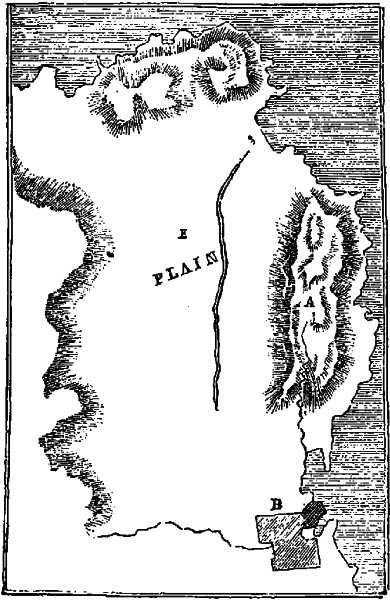
This victory gave the Romans the supremacy by sea. Lilybæum, Drepanum, and Eryx might now be reduced by famine. The Carthaginians were weary of the war, and indisposed to make any farther sacrifices. They therefore sent orders to Hamilcar to make peace on the best terms he could. It was at length concluded on the following conditions: that Carthage should evacuate Sicily and the adjoining islands; that she should restore the Roman prisoners without ransom, and should pay the sum of 3200 talents within the space of ten years (B.C. 241). All Sicily, with the exception of the territory of Hiero, now became a portion of the Roman dominions, and was formed into a Province, governed by a Prætor, who was sent annually from Rome.
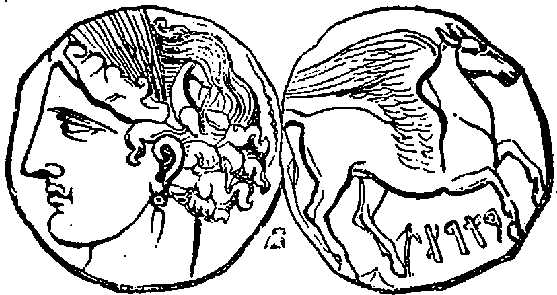
Twenty-three years elapsed between the First and Second Punic Wars. The power of Carthage, though crippled, was not destroyed; and Hamilcar returned home, burning with hatred against Rome, and determined to renew the war upon a favorable opportunity. But a new and terrible danger threatened Carthage upon her own soil. The mercenary troops, who had been transported from Sicily to Africa at the conclusion of the war, being unable to obtain their arrears of pay, rose in open mutiny. Their leaders were Spendius, a runaway Campanian slave, and Matho, a Libyan. They were quickly joined by the native Libyans, and brought Carthage almost to the brink of destruction. They laid waste the whole country with fire and sword, made themselves masters of all the towns except the capital, and committed the most frightful atrocities. Carthage owed her safety to the genius and abilities of Hamilcar. The struggle was fierce and sanguinary, but was at length brought to a successful issue, after it had lasted more than three years, by the destruction of all the mercenaries. It was called the War without Peace, or the Inexpiable War (B.C. 238).
The Romans availed themselves of the exhausted condition of Carthage to demand from her the islands of Sardinia and Corsica, and the payment of a farther sum of 1200 talents. The mercenary troops in Sardinia, who had also revolted, had applied to Rome for assistance; and the Senate menaced her rival with war unless she complied with these unjust demands. Resistance was impossible, and Sardinia and Corsica were now formed into a Roman prov[Pg 78]ince, governed, like Sicily, by a Prætor sent annually from Rome (B.C. 238). This act of robbery added fresh fuel to the implacable animosity of Hamilcar against the grasping Republic. He now departed for Spain, where for many years he steadily worked to lay the foundation of a new empire, which might not only compensate for the loss of Sicily and Sardinia, but enable him at some time to renew hostilities against Rome.
Rome was now at peace, and in B.C. 235 the Temple of Janus, which had remained open since the days of Numa, was closed for a second time. Two new tribes were added to the Roman territory, thus making their total number thirty-five.
The Temple of Janus did not long remain closed. The Illyrians, who dwelt near the head of the Adriatic upon its eastern side, were a nation of pirates, who ravaged the coasts of this sea. The Senate having sent embassadors to the Illyrian queen, Teuta, to complain of these outrages, she not only refused to attend to their complaints, but caused one of the embassadors to be murdered. War was straightway declared, and a Roman army for the first time crossed the Adriatic (B.C. 229). Demetrius of Pharos, an unprincipled Greek, who was the chief counselor of Teuta, deserted his mistress, and surrendered to the Romans the important island of Corcyra. Teuta was obliged to yield to the Romans every thing they demanded, and promised that the Illyrians should not appear south of Lissa with more than two vessels. The suppression of piracy in the Adriatic was hailed with gratitude by the Grecian states, and deserves notice as the first occasion upon which the Romans were brought into immediate contact with Greece. The Consul Postumius, who had wintered in Illyria, sent envoys to Athens, Corinth, and other Grecian cities, to explain what had been done. The envoys were received with honor, and thanks were returned to Rome (B.C. 228).
The Romans had scarcely brought this trifling war to an end when they became involved in a formidable struggle with their old enemies the Gauls. Since the conquest of the Senones in B.C. 289, and of the Boii in B.C. 283, the Gauls had remained quiet. The Romans had founded the colony of Sena after the subjugation of the Senones; and in B.C. 268 they had still farther strengthened their dominion in those parts by founding the colony of Ariminum. But the greater part of the soil from which the Senones were ejected became Public Land. In B.C. 232 the Tribune C. Flaminius carried an Agrarian Law to the effect that this portion of the public land, known by the name of the "Gallic Land,"[30] should be distributed among the poorer citizens. This alarmed the Boii, who[Pg 79] dwelt upon the borders of this district. They invoked the assistance of the powerful tribe of the Insubres, and being joined by them, as well as by large bodies of Gauls from beyond the Alps, they set out for Rome.
All Italy was in alarm. The Romans dreaded a repetition of the disaster of the Allia. The Sibylline Books being consulted, declared that Rome must be twice occupied by a foreign foe; whereupon the Senate ordered that two Gauls and a Grecian woman should be buried alive in the forum. The allies eagerly offered men and supplies to meet a danger which was common to the whole peninsula. An army of 150,000 foot and 6000 horse was speedily raised. A decisive battle was fought near Telamon in Etruria. The Gauls were hemmed in between the armies of the two Consuls. As many as 40,000 of their men were slain, and 10,000 taken prisoners (B.C. 225). The Romans followed up their success by invading the country of the Boii, who submitted in the following year (B.C. 224).
In B.C. 223 the Romans for the first time crossed the Po, and the Consul C. Flaminius gained a brilliant victory over the Insubres. The Consuls of the next year, Cn. Cornelius Scipio and M. Claudius Marcellus, continued the war against the Insubres, who called in to their aid a fresh body of Transalpine Gauls. Marcellus slew with his own hand Viridomarus, the chief of the Insubrian Gauls, and thus gained the third Spolia Opima. At the same time Scipio took Mediolanum (Milan), the chief town of the Insubres. This people now submitted without conditions, and the war was brought to an end. To secure their recent conquests, the Romans determined to plant two powerful Latin colonies at Placentia and Cremona, on opposite banks of the Po. These were founded in B.C. 218, and consisted each of 6000 men. The Via Flaminia, a road constructed by C. Flaminius during his consulship (B.C. 220), from Rome to Ariminum, secured the communication with the north of Italy.
While the Romans were engaged in the Gallic wars, the traitor Demetrius of Pharos had usurped the chief power in Illyria, and had ventured upon many acts of piracy. In B.C. 219 the Consul L. Æmilius Paullus crossed the Adriatic, and soon brought this second Illyrian war to an end. Demetrius fled to Philip of Macedon, where we shall shortly afterward see him prompting this king to make war against Rome. The greater part of Illyria was restored to the native chiefs; but the Romans retained possession of Corcyra, and of the important towns of Apollonia and Oricum on the coast.
Meanwhile Hamilcar had been steadily pursuing his conquests[Pg 80] in Spain. The subjugation of this country was only a means to an end. His great object, as already stated, was to obtain the means of attacking, and, if possible, crushing that hated rival who had robbed his country of Sicily, Sardinia, and Corsica. His implacable animosity against Rome is shown by the well-known tale that, when he crossed over to Spain in B.C. 235, taking with him his son Hannibal, then only nine years old, he made him swear at the altar eternal hostility to Rome. During the eight years that Hamilcar continued in Spain he carried the Carthaginian arms into the heart of the country. While he conquered several states in war, he gained over others by negotiation, and availed himself of their services as allies or mercenaries. He fell in battle in B.C. 229, and was succeeded in the command by his son-in-law Hasdrubal. His plans were ably carried out by his successor. The conciliatory manners of Hasdrubal gained him the affections of the Spaniards; and he consolidated the Carthaginian empire in Spain by the foundation of New Carthage, now Cartagena, in a situation admirably chosen on account of its excellent harbor and easy communication with Africa, as well as from its proximity to the silver mines, which supplied him with the means of paying his troops. The conduct of his warlike enterprises was intrusted to the youthful Hannibal, who had been trained in arms under the eye of his father, and who already displayed that ability for war which made him one of the most celebrated generals in ancient or modern times. The successes of Hamilcar and Hasdrubal could not fail to attract the notice of the Romans, and in B.C. 227 they concluded a treaty with the latter, by which the River Iberus (Ebro) was fixed as the northern boundary of the Carthaginian empire in Spain.
Hasdrubal was assassinated in B.C. 221 by a slave whose master he had put to death. Hannibal had now acquired such a remarkable ascendency over the army that the soldiers unanimously proclaimed him commander-in-chief, and the government at Carthage hastened to ratify an appointment which they had not, in fact, the power to prevent. Hannibal was at this time in the 26th year of his age. There can be no doubt that he already looked forward to the invasion and conquest of Italy as the goal of his ambition; but it was necessary for him first to complete the work which had been so ably begun by his two predecessors, and to establish the Carthaginian power as firmly as possible in Spain. This he accomplished in two campaigns, in the course of which he brought all the nations south of the Iberus into subjection to Carthage.
Early in the spring of B.C. 219 he proceeded to lay siege to Saguntum, a city of Greek origin, founded by the Zacynthians. Though situated to the south of the Iberus, and therefore not in[Pg 81]cluded under the protection of the treaty between Hasdrubal and the Romans, Sagantum had concluded an alliance with the latter people. There could be little doubt, therefore, that an attack upon this city would inevitably bring on a war with Rome; but for this Hannibal was prepared, or, rather, it was unquestionably his real object. The immediate pretext of his invasion was the same of which the Romans so often availed themselves—some injury inflicted by the Saguntines upon one of the neighboring tribes, who invoked the assistance of Hannibal. But the resistance of the city was long and desperate, and it was not till after a siege of nearly eight months that he made himself master of the place. During all this period the Romans sent no assistance to their allies. They had, indeed, as soon as they heard of the siege, dispatched embassadors to Hannibal, but he referred them for an answer to the government at home, and they could obtain no satisfaction from the Carthaginians, in whose councils the war-party had now a decided predominance. A second embassy was sent, after the fall of Saguntum, to demand the surrender of Hannibal, in atonement for the breach of the treaty. After much discussion, Q. Fabius, one of the Roman embassadors, holding up a fold of his toga, said, "I carry here peace and war; choose ye which ye will." "Give us which you will," was the reply. "Then take war," said Fabius, letting fall his toga. "We accept the gift," cried the Senators of Carthage. Thus commenced the Second Punic War.
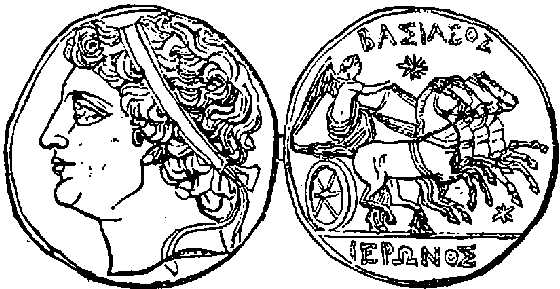
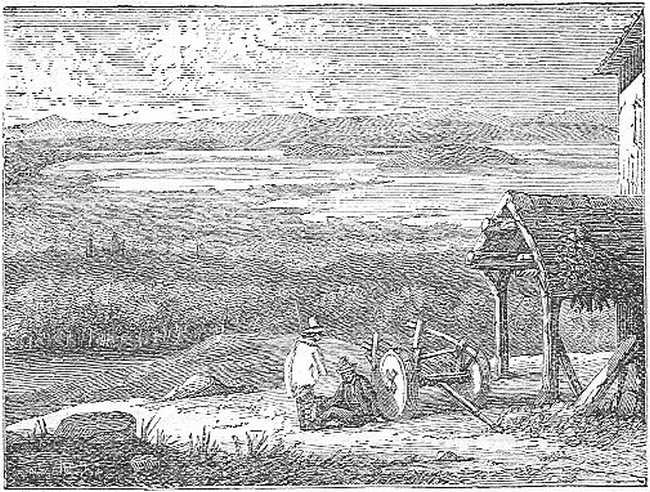
The Second Punic War was not so much a contest between the powers of two great nations—between Carthage and Rome—as between the individual genius of Hannibal on one hand, and the combined energies of the Roman people on the other. The position of Hannibal was indeed very peculiar. His command in Spain, and the powerful army there, which was entirely at his own disposal, rendered him in great measure independent of the government at Carthage, and the latter seemed disposed to devolve all responsibility upon him. Even now they did little themselves to prepare for the impending contest. All was left to Hannibal, who, after the conquest of Saguntum, had returned once more to New Carthage for the winter, and was there actively engaged in preparations for transporting the scene of war in the ensuing campaign from Spain into Italy. At the same time he did not neglect to provide for the defense of Spain and Africa during his absence. In the[Pg 83] former country he placed his brother Hasdrubal, with a considerable army, great part of which was composed of Africans, while he sent over a large body of Spanish troops to contribute to the defense of Africa, and even of Carthage itself.
All his preparations being now completed, Hannibal quitted his winter quarters at New Carthage in the spring of B.C. 218, and crossed the Iberus with an army of 90,000 foot and 12,000 horse. The tribes between that river and the Pyrenees offered at first a vigorous resistance, and, though they were quickly subdued, Hannibal thought it necessary to leave behind him a force of 11,000 men under Hanno to maintain this newly-acquired province. His forces were farther thinned by desertion during the passage of the Pyrenees, which obliged him to send home a large body of his Spanish troops. With a greatly diminished army, but one on which he could securely rely, he now continued his march from the foot of the Pyrenees to the Rhone without meeting with any opposition; for the Gaulish tribes through which he passed were favorably disposed to him, or had been previously gained over by his enemies.
The Consul P. Cornelius Scipio had been ordered to proceed to Spain, but various causes had detained him in Italy, and upon landing at Massilia (Marseilles) he found that Hannibal was already advancing toward the Rhone. Meantime the Carthaginian general effected his passage across the river, notwithstanding the opposition of the Gauls; and when Scipio marched up the left bank of the river he found that Hannibal had advanced into the interior of Gaul, and was already three days in advance of him. Despairing, therefore, of overtaking Hannibal, he determined to sail back to Italy and await him in Cisalpine Gaul; but as the Republic had already an army in that province, he sent the greater part of his own forces into Spain under the command of his brother Cn. Scipio. This prudent step probably saved Rome; for if the Carthaginians had maintained the undisputed mastery of Spain, they might have concentrated all their efforts to support Hannibal in Italy, and have sent him such strong re-enforcements after the battle of Cannæ as would have compelled Rome to submit.
Hannibal, after crossing the Rhone, continued his march up the left bank of the river as far as its confluence with the Isère. Here he interposed in a dispute between two rival chiefs of the Allobroges, and, by lending his aid to establish one of them firmly on the throne, secured the co-operation of an efficient ally, who greatly facilitated his farther progress. But in his passage across the Alps he was attacked by the barbarians, and as he struggled through the narrow and dangerous defiles the enemy destroyed numbers of his men. It was some days before he reached the summit of the[Pg 84] pass. Thenceforth he suffered but little from hostile attacks, but the descent was difficult and dangerous. The natural difficulties of the road, enhanced by the lateness of the season (the beginning of October, at which time the snows had already commenced in the high Alps), caused him almost as much loss as the opposition of the barbarians on the other side of the mountains. So heavy were his losses from these combined causes, that, when he at length emerged from the valley of Aosta into the plains of the Po and encamped in the friendly country of the Insubres, he had with him no more than 20,000 foot and 6000 horse.[31] Such were the forces with which he descended into Italy to attempt the overthrow of a power that a few years before was able to muster a disposable force of above 700,000 fighting men.
Five months had been employed in the march from New Carthage to the plains of Italy, of which the actual passage of the Alps had occupied fifteen days. Hannibal's first care was now to recruit the strength of his troops, exhausted by the hardships and fatigues they had undergone. After a short interval of repose, he turned his arms against the Taurinians (a tribe bordering on, and hostile to, the Insubrians), whom he quickly reduced, and took their principal city (Turin). The news of the approach of P. Scipio next obliged him to turn his attention toward a more formidable enemy. In the first action, which took place in the plains westward of the Ticinus, the cavalry and light-armed troops of the two armies were alone engaged, and the superiority of Hannibal's Numidian horse at once decided the combat in his favor. The Romans were completely routed, and Scipio himself severely wounded; in consequence of which he hastened to retreat beyond the Ticinus and the Po, under the walls of Placentia. Hannibal crossed the Po higher up, and, advancing to Placentia, offered battle to Scipio; but the latter declined the combat, and withdrew to the hills on the left bank of the Trebia. Here he was soon after joined by the other Consul, Ti. Sempronius Longus, who had hastened from Ariminum to his support. Their combined armies were greatly superior to that of the Carthaginians, and Sempronius was eager to bring on a general battle, of which Hannibal, on his side, was not less desirous, notwithstanding the great inferiority of his force. The result was decisive; the Romans were completely defeated, with heavy loss; and the remains of their shattered army, together with the two Consuls, took refuge within the walls of Placentia. The battles of the Ticinus and Trebia had been fought in December, and the[Pg 86] winter had already begun with unusual severity, so that Hannibal's troops suffered severely from cold, and all his elephants perished except one. But his victory had caused all the wavering tribes of the Gauls to declare in his favor, and he was now able to take up his winter quarters in security, and to levy fresh troops among the Gauls while he awaited the approach of spring.
As soon as the season permitted the renewal of military operations (B.C. 217), Hannibal entered the country of the Ligurian tribes, who had lately declared in his favor, and descended by the valley of the Macra into the marshes on the banks of the Arno. He had apparently chosen this route in order to avoid the Roman armies, which guarded the more obvious passes of the Apennines; but the hardships and difficulties which he encountered in struggling through the marshes were immense; great numbers of his horses and beasts of burden perished, and he himself lost the sight of one eye by a violent attack of ophthalmia. At length, however, he reached Fæsulæ in safety, and was able to allow his troops a short interval of repose.
The Consuls for this year were Cn. Servilius and C. Flaminius. The latter was the author of the celebrated Agrarian Law which occasioned the Gallic War, and in his first consulship he had gained a great victory over the Insubrian Gauls (see p. 79). He had been raised to his second consulship by popular favor, in spite of the opposition of the Senate; and he hurried from Rome before the Ides of March,[32] lest the Senate might throw any obstacle in the way of his entering upon his consulship. He was a man of great energy, but headstrong and reckless. When Hannibal arrived at Fæsulæ, Flaminius was with his army at Arretium. It was always the object of Hannibal to bring the Roman commanders to a battle, and therefore, in moving from Fæsulæ, he passed by the Roman general, and advanced toward Perugia, laying waste the fertile country on his line of march. Flaminius immediately broke up his camp, and, following the traces of Hannibal, fell into the snare which was prepared for him. His army was attacked under the most disadvantageous circumstances, where it was hemmed in between rocky heights, previously occupied by the enemy, and the Lake of Trasimenus. Its destruction was almost complete. Thousands fell by the sword, among whom was the Consul himself; thousands more perished in the lake, and no less than 15,000 prisoners fell into the hands of Hannibal, who on his side is said to have lost only 1500 men. Hannibal's treatment of the captives on this occasion, as well as after the battle of the Trebia, was marked[Pg 87] by the same policy on which he afterward uniformly acted; the Roman citizens alone were retained as prisoners, while their Italian allies were dismissed without ransom to their respective homes. By this means he hoped to excite the nations of Italy against their Roman masters, and to place himself in the position of the leader of a national movement rather than that of a foreign invader. It was probably in order to give time for this feeling to display itself that he did not, after so decisive a victory, push on toward Rome itself; but, after an unsuccessful attempt upon the Roman colony of Spoletium, he turned aside through the Apennines into Picenum, and thence into the northern part of Apulia. Here he spent a great part of the summer, and was able effectually to refresh his troops, who had suffered much from the hardships of their previous marches; but no symptoms appeared of the insurrections he had looked for among the Italians.
Meantime the Romans had collected a fresh army, which they placed under the command of Q. Fabius Maximus, who had been elected Dictator by the Comitia of the Centuries. Fabius formed a different plan for the campaign. He determined to keep the heights, and not to risk a battle, but at the same time to watch the Carthaginian army, cut off its supplies, and harass and annoy it in every possible way. From pursuing this policy he received the surname of Cunctator, or the Lingerer.
Hannibal now recrossed the Apennines, descended into the rich plains of Campania, and laid waste, without opposition, that fertile territory. But he was unable either to make himself master of any of the towns, or to draw the wary Fabius to a battle. The Roman general contented himself with occupying the mountain passes leading from Samnium into Campania, by which Hannibal must of necessity retreat, and believed that he had caught him, as it were, in a trap; but Hannibal eluded his vigilance by an ingenious stratagem, passed the defiles of the Apennines without loss, and established himself in the plains of Apulia, where he collected supplies from all sides, in order to prepare for the winter. Meantime the Romans, having become impatient at the inactivity of Fabius, raised Minucius, the Master of the Horse, to an equality in command with Fabius. His rashness very nearly gave Hannibal the opportunity, for which he was ever on the watch, to crush the Roman army by a decisive blow; but Fabius was able to save his colleague from destruction; and Hannibal, after obtaining only a partial advantage, took up his winter quarters at the small town of Geronium. Minucius acknowledged his error, and resumed his post of Master of the Horse.
During the winter the Romans made preparations for bringing[Pg 88] an unusually large force into the field. The people thought that it needed only a man of energy and decision at the head of an overwhelming force to bring the war to a close. They therefore raised to the consulship C. Terentius Varro, said to have been the son of a butcher, who had been for some time regarded as the champion of the popular party. The Senate regarded this election with dismay, as Varro possessed no military experience; and they therefore persuaded the people to appoint as his colleague L. Æmilius Paullus, who had distinguished himself by the way in which he had conducted the Illyrian war during his consulship.
Hannibal remained at Geronium until late in the spring (B.C. 216), when, compelled to move by the want of provisions, he surprised the Roman magazines at Cannæ, a small town of Apulia, and established his head-quarters there until the harvest could be got in. Meanwhile the two Roman Consuls arrived at the head of an army of little less than 90,000 men. To this mighty host Hannibal gave battle in the plains on the right bank of the Aufidus, just below the town of Cannæ. We have no statement of the numbers of his army, but it is certain that it must have been greatly inferior to that of the enemy; notwithstanding which, the excellence of his cavalry, and the disciplined valor of his African and Spanish infantry, gave him the most decisive victory. The immense army of the Romans was not only defeated, but annihilated, and between forty and fifty thousand men are said to have fallen in the field, among whom was the Consul Æmilius Paullus, both the Consuls of the preceding year, the late Master of the Horse, Minucius, above eighty senators, and a multitude of the wealthy knights who composed the Roman cavalry. The other Consul, Varro, escaped with a few horsemen to Venusia, and a small band of resolute men forced their way from the Roman camp to Canusium; all the rest were killed, dispersed, or taken prisoners. Hannibal has been generally blamed for not following up his advantage at once, after so decisive a victory, by an immediate advance upon Rome itself—a measure which was strongly urged upon him by Maharbal. "Only send me on with the cavalry," said this officer, "and within five days thou shalt sup in the Capitol." Whatever may be the motives that deterred Hannibal from marching upon Rome, we can not but be surprised at his apparent inactivity after the battle. He probably expected that so brilliant a success would immediately produce a general rising among the nations of Italy, and remained for a time quietly in Apulia, until they should have had time to declare themselves. Nor were his hopes disappointed; the Hirpinians, all the Samnites (except the Pentrian tribe), and almost all the Apulians, Lucanians, and Bruttians, declared in favor of Car[Pg 89]thage. But, though the whole of the south of Italy was thus apparently lost to the Romans, yet the effect of this insurrection was not so decisive as it would at first appear; for the Latin colonies, which still, without exception, remained faithful, gave the Romans a powerful hold upon the revolted provinces; and the Greek cities on the coast, though mostly disposed to join the Carthaginians, were restrained by the presence of Roman garrisons. Hence it became necessary to support the insurrection in the different parts of Italy with a Carthaginian force. Hannibal marched first into Samnium, and from thence into Campania, where he obtained possession of the important city of Capua, the gates of which were opened to him by the popular party. Here he established his army in winter quarters. Thus ends the first period of the war, in which Hannibal had met with uninterrupted success. Three great victories in three years, followed by the revolt of a city scarcely inferior to Rome itself in importance, seemed to promise a speedy termination of the war.
(See p. 84.)
The narrative in the text is taken from that of the Greek historian Polybius, which is certainly by far the most trustworthy that has descended to us; but that author has nowhere clearly stated by which of the passes across the Alps Hannibal effected his march; and this question has given rise to much controversy both in ancient and modern times. Into this discussion our limits will not allow us to enter, but the following may be briefly stated as the general results: 1. That after a careful examination of the text of Polybius, and comparison of the different localities, his narrative will be found, on the whole, to agree best with the supposition that Hannibal crossed the Graian Alps, or Little St. Bernard; though it can not be denied that there are some difficulties attending this line, especially in regard to the descent into Italy. 2. That Cælius Antipater certainly represented him as taking this route (Liv., xxi., 38); and as he is known to have followed the Greek history of Silenus, who is said to have accompanied Hannibal in many of his campaigns, his authority is of the greatest weight. 3. That Livy and Strabo, on the contrary, both suppose him to have crossed the Cottian Alps, or Mont Genèvre. But the main argument that appears to have weighed with Livy, as it has done with several modern writers on the subject, is the assumption that Hannibal descended in the first instance into the country of the Taurinians, which is opposed to the direct testimony of Polybius, who says expressly that he descended among the Insubrians, and subsequently mentions his attack on the Taurinians. 4. That, as according to Livy himself (xxi., 29), the Gaulish emissaries who acted as Hannibal's guides were Boians, it was natural that these should conduct him by the passage that led directly into the territory of their allies and brothers-in-arms, the Insubrians, rather than into that of the Taurinians, a Ligurian tribe, who were at this very time in a state of hostility with the Insubrians. And this remark will serve to explain why Hannibal chose apparently a longer route, instead of the more direct one of Mont Genèvre. Lastly, it is remarkable that Polybius, though he censures the exaggerations and absurdities with which earlier writers had encumbered their narrative, does not intimate that any doubt was entertained as to the line of march; and Pompey, in a letter to the Senate, written in 73 B.C., alludes to the route of Hannibal across the Alps as something well known. Hence it appears clear that the passage by which he crossed them must have been one of those frequented in subsequent times by the Romans. This argument seems decisive against the claims of Mont Cenis, which have been advocated by some modern writers, that pass having apparently never been used till the Middle Ages—See Dict. of Greek and Roman Biography, vol. ii., p. 334, 335.
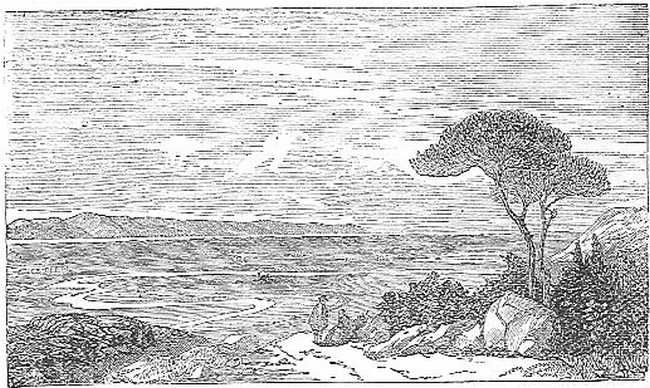
Capua was celebrated for its wealth and luxury, and the enervating effect which these produced upon the army of Hannibal became a favorite theme of rhetorical exaggeration in later ages. The futility of such declamations is sufficiently shown by the simple fact that the superiority of that army in the field remained as decided as ever. Still it may be truly said that the winter spent at Capua (B.C. 216-215) was in great measure the turning-point of Hannibal's fortune, and from this time the war assumed an altered character. The experiment of what he could effect with his single army had now been fully tried, and, notwithstanding all his victories, it had decidedly failed; for Rome was still unsubdued, and still provided with the means of maintaining a protracted contest. But Hannibal had not relied on his own forces alone, and he now found himself, apparently at least, in a condition to commence the execution of his long-cherished plan—that of arming Italy itself against the Romans, and crushing the ruling power by means of her own subjects. It was to this object that his attention was henceforth mainly directed. From this time, also, the Romans[Pg 92] changed their plan of operations, and, instead of opposing to Hannibal one great army in the field, they hemmed in his movements on all sides, guarded all the most important towns with strong garrisons, and kept up an army in every province of Italy to thwart the operations of his lieutenants and check the rising disposition to revolt. It is impossible here to follow in detail the complicated operations of the subsequent campaigns, during which Hannibal himself frequently traversed Italy in all directions, appearing suddenly wherever his presence was called for, and astonishing and often baffling the enemy by the rapidity of his marches. All that we can do is to notice very briefly the leading events which distinguished each successive campaign.
The campaign of B.C. 215 was not marked by any decisive events. The Consuls were Q. Fabius Maximus (whose plan of conducting the war had been fully vindicated by the terrible defeat of Cannæ) and Tiberius Sempronius Gracchus. With the advance of spring Hannibal took up his camp on Mount Tifata, where, while awaiting the arrival of re-enforcements from Carthage, he was at hand to support his partisans in Campania and oppose the Roman generals in that province. But his attempts on Cumæ and Neapolis were foiled, and even after he had been joined by a force from Carthage (very inferior, however, to what he had expected), he sustained a repulse before Nola, which was magnified by the Romans into a defeat. As the winter approached he withdrew into Apulia, and took up his quarters in the plains around Arpi. But other prospects were already opening before him. In his camp on Tifata he had received embassies from Philip, king of Macedon, and Hieronymus of Syracuse, both of which he had eagerly welcomed, and thus sowed the seeds of two fresh wars, and raised up two formidable enemies against the Roman power.
These two collateral wars in some degree drew off the attention of both parties from that in Italy itself; yet the Romans still opposed to the Carthaginian general a chain of armies which fettered all his operations; and though Hannibal was ever on the watch for the opportunity of striking a blow, the campaign of B.C. 214 was still less decisive than that of the preceding year. Fabius was again elected Consul, and Marcellus was appointed his colleague. Early in the summer Hannibal advanced from Apulia to his former station on Mount Tifata to watch over the safety of Capua; from thence he had descended to the Lake Avernus, in hopes of making himself master of Puteoli, when a prospect was held out to him of surprising the important city of Tarentum. Thither he hastened by forced marches, but arrived too late; Tarentum had been secured by a Roman force. After this his operations were of[Pg 93] little importance, until he again took up his winter quarters in Apulia.
During the following summer (B.C. 213), while all eyes were turned toward the war in Sicily, Hannibal remained almost wholly inactive in the neighborhood of Tarentum, the hopes he still entertained of making himself master of that important city rendering him unwilling to quit that quarter of Italy. Before the close of the ensuing winter he was rewarded with the long-looked-for prize, and Tarentum was betrayed into his hands by two of its citizens. The advantage, however, was incomplete, for a Roman garrison still held possession of the citadel, from which he was unable to dislodge them. The next year (B.C. 212) was marked by important events in Sicily and Spain, to which we must now direct our attention.
Hiero, so long the faithful ally of Rome, died shortly after the battle of Cannæ (B.C. 216), and was succeeded by his grandson Hieronymus, a vain youth, who abandoned the alliance of Rome for that of Carthage. But he was assassinated after a reign of fifteen months, and a republican form of government was established in Syracuse. A contest ensued between the Roman and Carthaginian parties in Syracuse, but the former ultimately prevailed, and Epicydes and Hippocrates, two brothers whom Hannibal had sent to Syracuse to espouse his interests, had to quit the city, and took refuge at Leontini. Such was the state of affairs when the Consul Marcellus arrived in Sicily (B.C. 214). He forthwith marched against Leontini, which Epicydes and Hippocrates defended with a considerable force. He took the city by storm, and, though he spared the inhabitants, executed in cold blood 2000 Roman deserters whom he found among the troops that had formed the garrison. This sanguinary act at once alienated the minds of the Sicilians, and alarmed the mercenary troops in the service of Syracuse. The latter immediately joined Hippocrates and Epicydes, who had made their escape to Herbessus; the gates of Syracuse were opened to them by their partisans within the walls, and the party hostile to Rome was thus established in the undisputed command of that city. Marcellus now appeared before Syracuse at the head of his army, and, after a fruitless summons to the inhabitants, proceeded to lay siege to the city both by sea and land. His attacks were vigorous and unremitting, and were directed especially against the quarter of Achradina[33] from the side of the sea; but, though he brought many powerful military engines against the walls, these were rendered wholly unavailing by the superior skill and science of Archimedes, which were employed on the side of[Pg 94] the besieged. All the efforts of the assailants were baffled; and the Roman soldiers were inspired with so great a dread of Archimedes and his engines,[34] that Marcellus was compelled to give up all hopes of carrying the city by open force, and to turn the siege into a blockade. The siege was prolonged far on into the summer of B.C. 212, nor did there appear any prospect of its termination, as the communications of the besieged by sea were almost entirely open. In this state of things Marcellus fortunately discovered a part of the walls more accessible than the rest; and, having prepared scaling ladders, effected an entrance at this point during the night which followed a great festival, and thus made himself master of Epipolæ. The two quarters called Tyché and Neapolis were now at his mercy, and were given up to plunder; but Epicydes still held the island-citadel and the important quarter of Achradina, which formed two separate and strong fortresses. Marcellus, however, made himself master of the fort of Euryalus, and had closely invested Achradina, when the Carthaginian army under Himilco and Hippocrates advanced to the relief of the city. Their efforts were, however, in vain; all their attacks on the camp of Marcellus were repulsed, and they were unable to effect a junction with Epicydes and the Syracusan garrison. The unhealthiness of the country soon gave rise to a pestilence which carried off both the Carthaginian generals and led to the entire break-up of the army. Shortly afterward the treachery of a leader of Spanish mercenaries in the Syracusan service opened to Marcellus the gates of Achradina, and in the general attack that ensued he made himself master of the island of Ortygia also. The city was given up to plunder, and Archimedes was slain by a Roman soldier, being so intent upon a mathematical problem at the time that he did not answer a question that was asked him. He was deeply regretted by Marcellus, who gave orders for his burial, and befriended his surviving relatives.[35]
The booty found in the captured city was immense: besides the money in the royal treasury, which was set apart for the coffers of the state, Marcellus carried off many of the works of art with which the city had been adorned, to grace his own triumph and the temples at Rome. This was the first instance of a practice which afterward became so general; and it gave great offense not only to the Greeks of Sicily, but to a large party at Rome itself.[Pg 95]
The fall of Syracuse was followed, though not immediately, by the subjugation of the whole island by the Romans; but these successes were counterbalanced by the defeat and death of the two Scipios in Spain. We have already seen that P. Scipio, when he landed at Massilia and found himself unable to overtake Hannibal in Gaul, sent his brother Cneius with the army into Spain, while he himself returned to Italy. In the following year (B.C. 217) Publius himself crossed over into Spain, where he found that his brother had already obtained a firm footing. They continued in Spain for several years, during which they gained many victories, and prevented Hasdrubal from marching into Italy to support his victorious brother. When Hasdrubal was recalled to Africa to oppose Syphax, one of the Numidian kings, who was carrying on war against Carthage, the Scipios availed themselves of his absence to strengthen their power still farther. They gained over new tribes to the Roman cause, took 20,000 Celtiberians into their pay, and felt themselves so strong in B.C. 212 that they resolved to cross the Iberus and to make a vigorous effort to drive the Carthaginians out of Spain. They accordingly divided their forces; but the result was fatal. Publius was destroyed, with the greater part of his troops; and Cneius was also defeated, and fell in battle, twenty-nine days after the death of his brother. These victories seemed to establish the superiority of Carthage in Spain, and open the way for Hasdrubal to join his brother in Italy.
In Italy (B.C. 212) the two Consuls Appius Claudius and Q. Fulvius began to draw together their forces for the purpose of besieging Capua. Hannibal advanced to relieve it, and compelled the Consuls to withdraw; but he was unable to force either of them to fight. Shortly afterward he returned again to the south to urge on the siege of the citadel of Tarentum, which still held out; and he spent the winter and the whole of the ensuing spring (B.C. 211) in its immediate neighborhood. But during his absence the Consuls had renewed the siege of Capua, and prosecuted it with such activity, that they had succeeded in surrounding the city with a double line of intrenchments. The pressing danger once more summoned Hannibal to its relief. He accordingly presented himself before the Roman camp, and attacked their lines from without, while the garrison co-operated with him by a vigorous sally from the walls. Both attacks were however repulsed, and Hannibal, foiled in his attempt to raise the siege by direct means, determined on the bold manœuvre of marching directly upon Rome itself, in hopes of thus compelling the Consuls to abandon their designs upon Capua, in order to provide for the defense of the city. But this daring scheme was again frustrated; the appearance of Hanni[Pg 96]bal before the gates of Rome for a moment struck terror through the city; but a considerable body of troops was at the time within the walls; and the Consul Fulvius, as soon as he heard of Hannibal's march, hastened, with a portion of the besieging army, from Capua, while he still left with the other Consul a force amply sufficient to carry on the siege. Hannibal was thus disappointed in the main object of his advance, and he had no means of effecting any thing against Rome itself, where Fulvius and Fabius confined themselves strictly to the defensive, allowing him to ravage the whole country without opposition, up to the very walls of Rome. Nothing therefore remained for him but to retreat, and he accordingly recrossed the Anio, and marched slowly and sullenly through the land of the Sabines and Samnites, ravaging the country which he traversed. From thence he retired to the Bruttii, leaving Capua to its fate. The city soon after surrendered to the Romans. Its punishment was terrible. All the leaders of the insurrection were beheaded; the chief men were imprisoned; and the rest of the people were sold. The city and its territory were confiscated, and became part of the Roman domain.
The commencement of the next season (B.C. 210) was marked by the fall of Salapia, which was betrayed by the inhabitants to Marcellus; but this loss was soon avenged by the total defeat and destruction of the army of the Proconsul Cn. Fulvius at Herdonea. The Consul Marcellus, on his part, carefully avoided an action for the rest of the campaign, while he harassed his opponent by every possible means. Thus the rest of that summer too wore away without any important results. But this state of comparative inactivity was necessarily injurious to the cause of Hannibal; the nations of Italy that had espoused that cause when triumphant now began to waver in their attachment; and in the course of the following summer (B.C. 209) the Samnites and Lucanians submitted to Rome, and were admitted to favorable terms. A still more disastrous blow to the Carthaginian cause was the loss of Tarentum, which was betrayed into the hands of Fabius, as it had been into those of Hannibal. In vain did the latter seek to draw the Roman general into a snare; the wary Fabius eluded his toils. The recovery of Tarentum was the last exploit in the military life of the aged Fabius, and was a noble completion to his long list of achievements. From the time of the battle of Cannæ he had directed almost exclusively the councils of his country, and his policy had been pre-eminently successful; but the times now demanded bolder measures, and something else was necessary than the caution of the Lingerer to bring the war to a close.
After the fall of Tarentum Hannibal still traversed the open[Pg 97] country unopposed, and laid waste the territories of his enemies. Yet we can not suppose that he any longer looked for ultimate success from any efforts of his own; his object was doubtless now only to maintain his ground in the south until his brother Hasdrubal should appear in the north of Italy, an event to which he had long anxiously looked forward. Yet the following summer (B.C. 208) was marked by some brilliant achievements. The two Consuls, Crispinus and Marcellus, who were opposed to Hannibal in Lucania, allowed themselves to be led into an ambush, in which Marcellus was killed, and Crispinus mortally wounded. Marcellus was one of the ablest of the Roman generals. Hannibal displayed a generous sympathy for his fate, and caused due honors to be paid to his remains.
The following year (B.C. 207) decided the issue of the war in Italy. The war in Spain during the last few years had been carried on with brilliant success by the young P. Scipio, of whose exploits we shall speak presently. But in B.C. 208, Hasdrubal, leaving the two other Carthaginian generals to make head against Scipio, resolved to set out for Italy to the assistance of his brother. As Scipio was in undisputed possession of the province north of the Iberus, and had secured the passes of the Pyrenees on that side, Hasdrubal crossed these mountains near their western extremity, and plunged into the heart of Gaul. After spending a winter in that country, he prepared to cross the Alps in the spring of B.C. 207, and to descend into Italy. The two Consuls for this year were C. Claudius Nero and M. Livius. Nero marched into Southern Italy to keep a watch upon Hannibal; Livius took up his quarters at Ariminum to oppose Hasdrubal. The latter experienced little loss or difficulty in crossing the Alps. The season of the year was favorable, and the Gauls were friendly to his cause. But instead of pushing on at once into the heart of Italy, he allowed himself to be engaged in the siege of Placentia, and lost much precious time in fruitless efforts to reduce that colony. When at length he abandoned the enterprise, he sent messengers to Hannibal to apprize him of his movements, and concert measures for their meeting in Umbria. But his dispatches fell into the hands of the Consul Nero, who formed the bold resolution of instantly marching with a picked body of 7000 men to join his colleague, and fall upon Hasdrubal with their united forces before Hannibal could receive any information of his brother's movements. Nero executed his design with equal secrecy and rapidity. Hannibal knew nothing of his departure, and in a week's time Nero marched 250 miles to Sena, where his colleague was encamped in presence of Hasdrubal. He entered the camp of Livius in the night, that[Pg 98] his arrival might not be known to the Carthaginians. After a day's rest the two Consuls proceeded to offer battle; but Hasdrubal, perceiving the augmented numbers of the Romans, and hearing the trumpet sound twice, felt convinced that the Consuls had united their forces, and that his brother had been defeated. He therefore declined the combat, and in the following night commenced his retreat toward Ariminum. The Romans pursued him, and he found himself compelled to give them battle on the right bank of the Metaurus. On this occasion Hasdrubal displayed all the qualities of a consummate general; but his forces were greatly inferior to those of the enemy, and his Gaulish auxiliaries were of little service. The gallant resistance of the Spanish and Ligurian troops is attested by the heavy loss of the Romans; but all was of no avail, and seeing the battle irretrievably lost, he rushed into the midst of the enemy, and fell, sword in hand, in a manner worthy of the son of Hamilcar and the brother of Hannibal. The Consul Nero hastened back to Apulia almost as speedily as he had come, and announced to Hannibal the defeat and death of his brother by throwing into his camp the severed head of Hasdrubal. "I recognize," said Hannibal, sadly, "the doom of Carthage."
The victory of the Metaurus was, as we have already said, decisive of the fate of the war in Italy, and the conduct of Hannibal shows that he felt it to be such. From this time he abandoned all thoughts of offensive operations, and, withdrawing his garrisons from Metapontum and other towns that he still held in Lucania, collected together his forces within the peninsula of the Bruttii. In the fastnesses of that wild and mountainous region he maintained his ground for nearly four years, while the towns that he still possessed on the coast gave him the command of the sea.
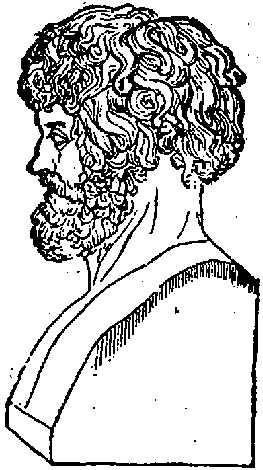
After the battle of the Metaurus, the chief interest of the war was transferred to Spain and Africa. The Roman armies were led by a youthful hero, perhaps the greatest man that Rome ever produced, with the exception of Julius Cæsar. The remaining period of the war is little more than the history of P. Scipio. This extraordinary man was the son of P. Scipio, who fell in Spain in B.C. 212, as already related. In his early years he acquired, to an extraordinary extent, the confidence and admiration of his countrymen. His enthusiastic mind led him to believe that he was a special favorite of heaven; and he never engaged in any public or private business without first going to the Capitol, where he sat some time alone, enjoying communion with the gods. For all he proposed or executed he alleged the divine approval: he believed himself in the revelations which he asserted had been vouchsafed to him; and the extraordinary success which attended all his enterprises deepened this belief.
P. Scipio is first mentioned in B.C. 218 at the battle of the Ticinus, where he is reported to have saved the life of his father, though he was then only 17 years of age. He fought at Cannæ two years afterward (B.C. 216), when he was already a tribune of the soldiers, and was one of the few Roman officers who survived that fatal[Pg 100] day. He was chosen along with Appius Claudius to command the remains of the army, which had taken refuge at Canusium; and it was owing to his youthful heroism and presence of mind that the Roman nobles, who had thought of leaving Italy in despair, were prevented from carrying their rash project into effect. He had already gained the favor of the people to such an extent that he was unanimously elected Ædile in B.C. 212. On this occasion he gave indications of the proud spirit, and of the disregard of all the forms of law, which distinguished him throughout life; for when the tribunes objected to the election, because he was not of the legal age, he haughtily replied, "If all the Quirites wish to make me Ædile, I am old enough." After the death of Scipio's father and uncle, C. Nero was sent out as Proprætor to supply their place; but shortly afterward the Senate resolved to increase the army in Spain, and to place it under the command of a Proconsul to be elected by the people. But when they were assembled for this purpose, none of the generals of experience ventured to apply for so dangerous a command. At length Scipio, who was then barely twenty-four, to the surprise of every one, offered himself as a candidate. But the confidence which he felt in himself he communicated to the people, and he was accordingly chosen with enthusiasm to take the command.
Scipio arrived in Spain in the summer of B.C. 210. He found that the three Carthaginian generals, Hasdrubal, son of Barca, Hasdrubal, son of Gisco, and Mago, were not on good terms, and were at the time engaged in separate enterprises in distant parts of the peninsula. Instead of attacking any of them singly, he formed the project of striking a deadly blow at the Carthaginian power by a sudden and unexpected attack upon New Carthage. He gave the command of the fleet to his intimate friend Lælius, to whom alone he intrusted the secret of the expedition, while he led the land-forces by extremely rapid marches against the city. The project was crowned with complete success. The Carthaginian garrison did not amount to more than a thousand men, and before any succor could arrive New Carthage was taken by assault. The hostages who had been given by the various Spanish tribes to the Carthaginians had been placed for security in the city. These now fell into the hands of Scipio, who treated them with kindness; and the hostages of those people who declared themselves in favor of the Romans were restored without ransom. Scipio also found in New Carthage magazines of arms, corn, and other necessaries, for the Carthaginians had there deposited their principal stores.
The immediate effects of this brilliant success were immense. Many of the Spanish tribes deserted the Carthaginian cause; and[Pg 101] when Scipio took the field in the following year (B.C. 209) Mandonius and Indibilis, two of the most powerful and hitherto the most faithful supporters of Carthage, quitted the camp of Hasdrubal Barca, and awaited the arrival of the Roman commander. Hasdrubal was encamped in a strong position near the town of Bæcula, in the upper valley of the Bætis (Guadalquiver), where he was attacked and defeated by Scipio. He succeeded, however, in making good his retreat, and retired into northern Spain. He subsequently crossed the Pyrenees, and marched into Italy to the assistance of his brother Hannibal, as already narrated.
In B.C. 207 Scipio gained possession of nearly the whole of Spain, by a decisive victory near a place variously called Silpia or Elinga, but the position of which is quite uncertain.
Hasdrubal, son of Gisco, and Mago, took refuge within the walls of Gades, which was almost the only place that now belonged to the Carthaginians; and all the native chiefs hastened to acknowledge the supremacy of Rome. But the victories of Scipio had had but a small share in winning Spain. His personal influence had won far more people than his arms had conquered. He had gained such an ascendency over the Spaniards by his humanity and courage, his courtesy and energy, that they were ready to lay down their lives for him, and wished to make him their king.
The subjugation of Spain was regarded by Scipio as only a means to an end. He had formed the project of transferring the war to Africa, and thus compelling the Carthaginians to recall Hannibal from Italy. He therefore resolved, before returning to Rome, to cross over into Africa, and secure, if possible, the friendship and co-operation of some of the native princes. His personal influence had already secured the attachment of Masinissa, the son of the king of the Massylians, or Western Numidians, who was serving in the Carthaginian army in Spain; and he trusted that the same personal ascendency might gain the more powerful support of Syphax, the king of the Massæsylians, or Eastern Numidians. With only two quinqueremes he ventured to leave his province and repair to the court of Syphax. There he met his old adversary, Hasdrubal, son of Gisco, who had crossed over from Gades for the same purpose; and the two generals spent several days together in friendly intercourse. Scipio made a great impression upon Syphax; but the charms of Sophonisba, the daughter of Hasdrubal, whom the latter offered in marriage to Syphax, prevailed over the influence of Scipio. Syphax married her, and from that time became the zealous supporter and ally of the Carthaginians.
During Scipio's absence in Africa a formidable insurrection had broken out in Spain; but on his return it was speedily put down,[Pg 102] and terrible vengeance was inflicted upon the town of Illiturgis, which had taken the principal share in the revolt. Scarcely had this danger passed away when Scipio was seized with a dangerous illness. Eight thousand of the Roman soldiers, discontented with not having received their usual pay, availed themselves of this opportunity to break out into open mutiny; but Scipio quelled it with his usual promptitude and energy. He crushed the last remains of the insurrection in Spain; and to crown his other successes, Gades at last surrendered to the Romans. Mago had quitted Spain, and crossed over into Liguria, to effect a diversion in favor of his brother Hannibal, and there was therefore now no longer any enemy left in Spain.
Scipio returned to Rome in B.C. 206, and immediately offered himself as a candidate for the consulship. He was elected for the following year (B.C. 205) by the unanimous votes of all the centuries, although he had not yet filled the office of Prætor, and was only 30 years of age. His colleague was P. Licinius Crassus, the Pontifex Maximus, who could not, therefore, leave Italy. Consequently, if the war was to be carried on abroad, the conduct of it must of necessity devolve upon Scipio. The latter was anxious to land at once in Africa, and bring the contest to an end at the gates of Carthage; but the older members of the Senate, and among them Q. Fabius Maximus, opposed the project, partly through timidity and partly through jealousy of the youthful conqueror. All that Scipio could obtain was the province of Sicily, with permission to invade Africa if he should think it for the advantage of the Republic; but the Senate resolutely refused him an army, thus making the permission of no practical use. The allies had a truer view of the interests of Italy than the Roman Senate; from all the towns of Italy volunteers flocked to join the standard of the youthful hero. The Senate could not refuse to allow him to enlist these volunteers; and such was the enthusiasm in his favor that he was able to cross over to Sicily with an army and a fleet, contrary to the expectations and even the wishes of the Senate. While busy with preparations in Sicily, he sent over Lælius to Africa with a small fleet to concert a plan of co-operation with Masinissa. But meantime his enemies at Rome had nearly succeeded in depriving him of his command. Although he had no authority in Lower Italy, he had assisted in the reduction of Locri, and after the conquest of the town had left Q. Pleminius in command. The latter had been guilty of such acts of excesses against the inhabitants, that they sent an embassy to Rome to complain of his conduct. Q. Fabius Maximus eagerly availed himself of the opportunity to inveigh in general against the conduct of Scipio, and to urge his im[Pg 103]mediate recall. Scipio's magnificent style of living, and his love of Greek literature and art, were denounced by his enemies as dangerous innovations upon old Roman manners and frugality. It was asserted that the time which ought to be given to the exercise and the training of his troops was wasted in the Greek gymnasia or in literary pursuits. Though the Senate lent a willing ear to these attacks, they did not venture upon his immediate recall, but sent a commission into Sicily to inquire into the state of the army. During the winter Scipio had been busy in completing his preparations; and by this time he had collected all his stores, and brought his army and navy into the most efficient state. The commissioners were astonished at what they saw. Instead of ordering him to return to Rome, they bade him cross over to Africa as soon as possible.
Accordingly, in B.C. 204, Scipio, who was now Proconsul, sailed from Lilybæum and landed in Africa, not far from Utica. He was immediately joined by Masinissa, who rendered him the most important services in the war. He commenced the campaign by laying siege to Utica, and took up his quarters on a projecting headland to the east of the town, on a spot which long bore the name of the Cornelian Camp. Meantime the Carthaginians had collected a powerful army, which they placed under the command of Hasdrubal, son of Cisco, Scipio's old opponent in Spain; and Syphax came to their assistance with a great force.
In the beginning of B.C. 203 Scipio planned a night-attack upon the two camps occupied by Hasdrubal and Syphax. With the assistance of Masinissa, his enterprise was crowned with success: the two camps were burned to the ground, and only a few of the enemy escaped the fire and the sword. Among these, however, were both Hasdrubal and Syphax; the former fled to Carthage, where he persuaded the Senate to raise another army, and the latter retreated to his native dominions, where he likewise collected fresh troops. But their united forces were again defeated by Scipio. Hasdrubal did not venture to make his appearance again in Carthage, and Syphax once more fled into Numidia. Scipio did not give the Numidian prince any repose; he was pursued by Lælius and Masinissa, and finally taken prisoner. Among the captives who fell into their hands was Sophonisba, the wife of Syphax, whom Masinissa had long loved, and had expected to marry when she was given to his rival. Masinissa now not only promised to preserve her from captivity, but, to prevent her falling into the hands of the Romans, determined to marry her himself. Their nuptials were accordingly celebrated without delay; but Scipio, fearful of the influence which she might exercise over his ally, sternly[Pg 104] upbraided him with his weakness, and insisted on the immediate surrender of the princess. Unable to resist this command, Masinissa spared her the humiliation of captivity by sending her a bowl of poison, which she drank without hesitation, and thus put an end to her own life.
These repeated disasters so alarmed the Carthaginians that they resolved to recall Hannibal and Mago. Hannibal quitted Italy in B.C. 203, to the great joy of the Romans. For more than 15 years had he carried on the war in that country, laying it waste from one extremity to another; and during all this period his superiority in the field had been uncontested. The Romans calculated that in these 15 years their losses in the field alone had amounted to not less than 300,000 men; a statement which will hardly appear exaggerated when we consider the continued combats in which they were engaged by their ever-watchful foe.
As soon as Hannibal landed in Africa the hopes of the Carthaginians revived, and they looked forward to a favorable termination of the war. Hannibal, however, formed a truer estimate of the real state of affairs; he saw that the loss of a battle would be the ruin of Carthage, and he was therefore anxious to conclude a peace before it was too late. Scipio, who was eager to have the glory of bringing the war to a close, and who feared lest his enemies in the Senate might appoint him a successor, was equally desirous of a peace. The terms, however, which the Roman general proposed seemed intolerable to the Carthaginians; and as Hannibal, at a personal interview with Scipio, could not obtain any abatement of the hard conditions, he was forced, against his will, to continue the war. Into the details of the campaign, which are related very differently, our limits will not permit us to enter. The decisive battle was at length fought on the 19th of October, B.C. 202, on the Bagradas, not far from the city of Zama; and Hannibal, according to the express testimony of his antagonist, displayed on this occasion all the qualities of a consummate general. But he was now particularly deficient in that formidable cavalry which had so often decided the victory in his favor; his elephants, of which he had a great number, were rendered unavailing by the skillful management of Scipio; and the battle ended in his complete defeat, notwithstanding the heroic exertions of his veteran infantry. Twenty thousand of his men fell on the field of battle, as many were made prisoners, and Hannibal himself with difficulty escaped the pursuit of Masinissa. Upon his arrival at Carthage he was the first to admit the magnitude of the disaster, and to point out the impossibility of the farther prosecution of the war. The terms, however, now imposed by Scipio were much more se[Pg 105]vere than before. Carthage had no alternative but submission; but the negotiations were continued for some time, and a final treaty was not concluded till the following year (B.C. 201). By this treaty it was agreed that the Carthaginians were to preserve their independence and territory in Africa, but to give up all claims to any foreign possessions; that they were to surrender all prisoners and deserters, all their ships of war except ten triremes, and all their elephants; that they were not to make war in Africa, or out of Africa, without the consent of Rome; that they were to acknowledge Masinissa as king of Numidia; that they were to pay 10,000 talents in silver in the course of fifty years.
Scipio returned to Italy in B.C. 201, and entered Rome in triumph. He was received with universal enthusiasm; the surname of Africanus was conferred upon him, and the people, in their gratitude, were anxious to distinguish him with the most extraordinary marks of honor. It is related that they wished to make him Consul and Dictator for life, and to erect his statue in the Comitia, the Senate-house, and even in the Capitol, but that he prudently declined all these invidious distinctions.
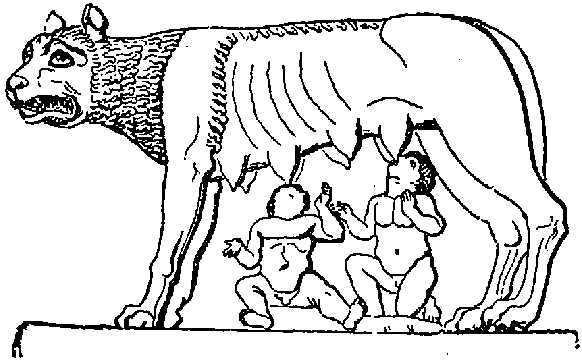
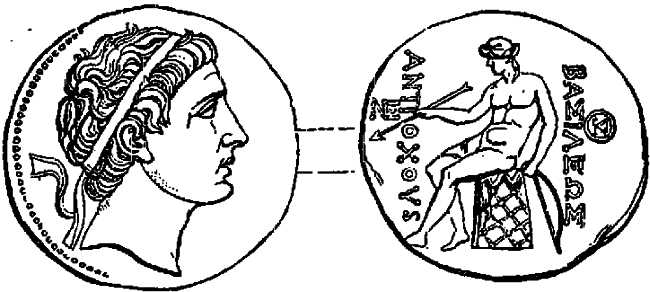
The Second Punic War made the Romans undisputed masters of the western shores of the Mediterranean. Sicily, Sardinia, and Corsica were Roman provinces; Spain owned the Roman supremacy; Carthage was completely humbled, and her powerful neighbor Masinissa was the steadfast ally of Rome. The Roman Republic was now the most powerful state in the ancient world. Her legions had been trained to war by long struggles with Gauls, Spaniards, and Africans, and were superior to all other troops in discipline, experience, and valor. She now naturally turned her eyes toward the East, whose effeminate nations seemed to offer an easy conquest.
The Greek kingdoms in Asia, founded by the successors of Alexander the Great, bore within them the seeds of decay. The mighty kingdom of SYRIA, which had once extended from the Indus to the Ægean Sea, had now lost some of its fairest provinces. The greater part of Asia Minor no longer owned the authority of the Syrian kings. PONTUS was governed by its own rulers. A large body of Gauls had settled in the northern part of Phrygia, which district was now called GALATIA after them. A new kingdom was founded in Mysia, to which the name of PERGAMUS was given from its chief city; and Attalus, who was king of Pergamus during the Second Punic War, formed an alliance with Rome as a protection against Syria and Macedonia. The king of Syria at this time was Antiochus III., who, from his victory over the Parthians, had received the surname of the Great.[Pg 107]
EGYPT was governed by the Greek monarchs who bore the name of Ptolemy. They had, even as early as the time of Pyrrhus, formed an alliance with Rome (see p. 66). The kingdom had since declined in power, and upon the death of Ptolemy IV., surnamed Philopator, in B.C. 205, the ministers of his infant son Ptolemy Epiphanes, dreading the ambitious designs of the Macedonian and Syrian kings, placed him under the protection of the Roman Senate, who consented to become his guardians.
The Republic of RHODES was the chief maritime power in the Ægean Sea. It extended its dominion over a portion of the opposite coasts of Caria and Lycia, and over several of the neighboring islands. Like the king of Pergamus, the Rhodians had formed an alliance with Rome as a protection against Macedonia.
MACEDONIA was still a powerful kingdom, governed at this time by Philip V., a monarch of considerable ability, who ascended the throne in B.C. 220, at the early age of seventeen. His dominion extended over the greater part of Greece; but two new powers had sprung up since the death of Alexander, which served as some counterpoise to the Macedonian supremacy. Of these the most important was the ACHÆAN LEAGUE, which embraced Corinth, Arcadia, and the greater part of the Peloponnesus.[36] The ÆTOLIAN LEAGUE included at this time a considerable portion of Central Greece. ATHENS and SPARTA still retained their independence, but with scarcely a shadow of their former greatness and power.
Such was the state of the Eastern world when it came into contact with the arms of Rome.
We have already seen that during the Second Punic War Philip had been engaged in hostilities with the Roman Republic. Demetrius of Pharos, who had been driven by the Romans from his Illyrian dominions,[37] had taken refuge at the court of Philip, and soon acquired unbounded influence over the mind of the young king. This wily Greek urged him to take up arms against the grasping Republic; and the ambition of Philip was still farther excited by the victories of Hannibal. After the battle of Cannæ (B.C. 216) he concluded a treaty with Hannibal; but, instead of supporting the Carthaginian army and fleet, his proceedings were marked by an unaccountable degree of hesitation and delay. It was not till B.C. 214 that he appeared in the Adriatic with a fleet, and laid siege to Oricus and Apollonia, which the Romans had retained possession of at the close of the Illyrian war.[37] He succeeded in taking Oricus; but the arrival of a small Roman force, under the command of M. Valerius Lævinus, compelled him to raise the siege of Apollonia, and to burn his own ships to prevent their[Pg 108] falling into the hands of the enemy. For the next three years the war was carried on with unaccountable slackness on both sides; but in B.C. 211 it assumed a new character in consequence of the alliance which the Romans formed with the Ætolian League. Into the details of the campaigns which followed it is unnecessary to enter; but the attention of the Romans was soon afterward directed to affairs in Spain, and the Ætolians were left almost alone to cope with Philip. The Achæans also joined Philip against the Ætolians, and the latter people were so hard pressed that they were glad to make peace with the Macedonian king. Shortly afterward the Romans, who were desirous of turning their undivided attention to the invasion of Africa, also concluded peace with him (B.C. 205).
The peace, which thus terminated the First Macedonian War, was probably regarded by both parties as little more than a suspension of hostilities. Philip even went so far as to send to the Carthaginians in Africa a body of 4000 men, who fought at Zama under the command of Hannibal. At the same time he proceeded to carry out his plans for his own aggrandizement in Greece, with out any regard to the Roman alliances in that country. In order to establish his naval supremacy in the Ægean Sea, he attacked the Rhodians and Attalus, king of Pergamus, both of whom were allies of Rome. He had also previously made a treaty with Antiochus, king of Syria, for the dismemberment of the Egyptian monarchy, which was placed under the guardianship of the Roman people.
It was impossible for the Senate to pass over these acts of hostility, and accordingly, in the year after the conclusion of the Second Punic War, the Consul P. Sulpicius Galba proposed to the Comitia of the Centuries that war should be declared against Philip. But the people longed for repose, and rejected the proposition by the almost unanimous vote of every century. It was only by the most earnest remonstrance, and by representing to them that, unless they attacked Philip in Greece, he would invade Italy, like Hannibal, that they were induced to reverse their decision and declare war (B.C. 200).
Philip was at this time engaged in the siege of Athens, which had joined Attalus and the Rhodians. The Consul Galba crossed over to Epirus, and Athens was relieved by a Roman fleet; but before he withdrew, Philip, prompted by anger and revenge, displayed his barbarism by destroying the gardens and buildings in the suburbs, including the Lyecum and the tombs of the Attic heroes; and in a second incursion which he made with large re-enforcements he committed still greater excesses. For some time,[Pg 109] however, the war lingered on without any decided success on either side. The Consul Villius, who succeeded Galba in B.C. 199, effected nothing of importance, and it was not till the appointment of the Consul T. Quinctius Flamininus to the command that the war was earned on with energy and vigor (B.C. 198). He forced his way through the passes of Antigonea, which were occupied by the enemy, invaded Thessaly, and took up his winter quarters in Phocis and Locris. In the following year (B.C. 197) the struggle was brought to a termination by the battle of Cynoscephalæ (Dogs' Heads), a range of hills near Scotussa, in Thessaly. The Roman legions gained an easy victory over the once formidable Macedonian phalanx: 8000 Macedonians were killed and 5000 taken prisoners, while Flamininus lost only 700 men. Philip was obliged to sue for peace, and in the following year (B.C. 196) a treaty was ratified by which the Macedonians were compelled to renounce their supremacy, to withdraw their garrisons from the Grecian towns, to surrender their fleet, and to pay 1000 talents for the expenses of the war, half at once, and half by annual instalments in the course of ten years. Thus ended the SECOND MACEDONIAN WAR.
At the ensuing Isthmian games, which were celebrated at Corinth in the summer of this year, Flamininus was present, and a herald at his command solemnly proclaimed the independence and freedom of Greece. This unexpected news was received with overwhelming gratitude and joy; the throngs of people that crowded round Flamininus to catch a sight of their liberator, or to touch his garment, were so enormous as almost to endanger his life. Flamininus remained two years longer in Greece in order to settle the affairs of the country. He seems to have been actuated by a sincere desire to restore the internal peace and welfare of Greece; and whenever his actions appear at variance with this object, he was under the influence of the policy of the Republic. Thus, though he made war upon Nabis, the tyrant of Sparta, and deprived him of the southern portion of Laconia, he did not expel him from Sparta, that he might serve as a useful check upon the Achæans. When Flamininus returned to Italy in B.C. 194, he withdrew the Roman garrisons from all the Grecian towns, even from Corinth, Chalcis, and Demetrias, the three strongest fortresses in the country, which were called the Fetters of Greece. On his departure he convoked an assembly of the Greeks at Corinth, in which he exhorted them to use their freedom wisely, and to remain faithful to Rome. Flamininus had been absent five years. His reputation was second only to that of Scipio Africanus. His triumph, which was most magnificent, lasted three days.[Pg 110]
It has been already mentioned that Philip had formed an alliance with Antiochus III., king of Syria, surnamed the Great, for the dismemberment of the Egyptian monarchy. During the war between Philip and the Romans, Antiochus had occupied Asia Minor, and was preparing to cross into Greece. Upon the conclusion of this war, Flamininus sternly forbade him to set foot in Europe, and for a time he shrank from a contest with the victorious arms of Rome. But the Ætolians, who had fought on the Roman side, were discontented with the arrangements of Flamininus. Their arrogance led them to claim the chief merit of the victory of Cynoscephalæ, and their cupidity desired a larger share in the spoils of the war. Flamininus had scarcely quitted Greece before the Ætolians endeavored to persuade Philip, Nabis, and Antiochus to enter into a league against the Romans. Philip at once refused, but Nabis took up arms, and Antiochus willingly entered into the designs of the Ætolians. At this time Hannibal appeared as an exile at the Syrian court. After the Second Punic War he had set himself to work, like his father Hamilcar at the end of the previous war, to prepare means for renewing the contest at no distant period. He introduced various reforms in the constitution, and seems to have deprived the Oligarchy of their exclusive power; but they avenged themselves by denouncing him to the Romans as engaged in negotiations with Antiochus to induce him to take up arms against Rome. The Senate sent envoys to Carthage to inquire into these charges; and Hannibal, seeing that his enemies were too strong for him, secretly took flight, and reached the court of Antiochus in safety. He was received with the highest honors, and urged the king to place an army at his disposal with which he might invade Italy. But Antiochus was persuaded by the Ætolians to cross over into Greece, and accordingly landed at Demetrias in Thessaly in B.C. 192. The Romans now declared war against Antiochus, and in the following year (B.C. 191) the Consul Acilius Glabrio marched into Thessaly. The king had intrenched himself in the passes of Thermopylæ, that he might prevent the Romans from penetrating into Central Greece. But there was, as is well known, a difficult passage across Mount Œta, by which the Persians had descended to fight with Leonidas. This passage was now forced by M. Cato, who was serving as one of the Consul's lieutenants, and as soon as he appeared in the rear of the Syrian army they fled in confusion, and the battle was won. Antiochus now hastened back to Asia, abandoning all farther hopes of conquest in Greece. As soon as he had placed the sea between himself and the Romans he thought that he was safe; but Hanni[Pg 111]bal warned him of his error, and said that he wondered that the Romans had not already followed him.
Next year (B.C. 190) L. Cornelius Scipio, the brother of the great Africanus, and C. Lælius, the intimate friend of the latter, were Consuls. L. Scipio was anxious to have the command of the war against Antiochus; but the Senate had not much confidence in his ability, and it was only in consequence of his brother Africanus offering to serve under him as his lieutenant that he obtained the command which he desired. Meantime Antiochus had collected a vast army from all parts of his dominions, and, advancing northward from Ephesus, laid waste the kingdom of Pergamus. But upon the approach of the Roman army, which entered Asia by crossing the Hellespont, Antiochus retreated southward; and the decisive battle was fought near Magnesia, at the foot of Mount Sipylus. The Romans obtained an easy and bloodless victory over the vast but disorderly rabble of the Syrian monarch. Only 400 Romans fell, while Antiochus lost 53,000 men. He at once gave up the contest in despair, and humbly sued for peace. The conditions were hard. He had to cede all his dominions west of Mount Taurus (that is, the whole of Asia Minor), to pay 15,000 Euboic talents within twelve years, to give up his elephants and ships of war, and to surrender to the Romans Hannibal and some others who had taken refuge at his court. Hannibal foresaw his danger, and made his escape to Crete, from whence he afterward repaired to the court of Prusias, king of Bithynia.
L. Scipio returned to Rome in the following year, bringing with him enormous treasures. In imitation of his brother, he assumed the surname of ASIATICUS.
The Romans were now at leisure to punish the Ætolians, who had to make head against the Romans by themselves. The Consul M. Fulvius Nobilior (B.C. 189) took their chief town, Ambracia, after an obstinate resistance, and compelled them to sue for peace. This was granted, but on the most humiliating conditions. They were required to acknowledge the supremacy of Rome, to renounce all the conquests they had recently made, to pay an indemnity of 500 talents, and to engage in future to aid the Romans in their wars. The power of the Ætolian league was thus forever crushed, though it seems to have existed, in name at least, till a much later period.
The colleague of M. Fulvius Nobilior was Cn. Manlius Vulso, who had received Asia as his province, that he might conclude the peace which his predecessor, Scipio Asiaticus, had made with Antiochus, and arrange the affairs of Asia. But Manlius was not content with the subordinate part allotted to him; and being anx[Pg 112]ious for booty as much as for glory, he attacked the Galatians in Asia Minor, without waiting for any instructions from the Senate, and in direct opposition to the ten commissioners who had been sent to arrange conjointly with him the affairs of Asia. This was the first instance in which a Roman general had made war without the authority of the Senate or the People; a dangerous precedent, which was afterward only too faithfully followed. The Galatians were, as has been already said, a body of Gauls, who, after laying waste a great part of Asia Minor, had settled in the north of Phrygia. They had fought in the army of Antiochus at Magnesia, and this supplied Manlius with a pretext for marching against them. He defeated them in two battles, and compelled them to sue for peace. The campaign greatly enriched Manlius and his legions, as the Gauls had accumulated enormous wealth by their many conquests in Asia.
Manlius remained another year (B.C. 188) in the East as Proconsul, and, in conjunction with the ten commissioners, formally concluded the peace with Antiochus, and settled the affairs of Asia. Eumenes, the king of Pergamus, received Mysia, Lydia, and part of Caria. The Rhodians obtained the remaining portion of Caria, together with Lycia and Pisidia. Manlius returned to Rome in B.C. 187, and his triumph, like that of Scipio Asiaticus, was most magnificent. But his soldiers, like that of Scipio, introduced into the city the luxuries of the East. These campaigns, as we shall presently see, exercised a most injurious influence upon the character of the Roman nobles and people, teaching them to love war for the sake of acquiring wealth, and prompting them to acts of robbery and rapine.
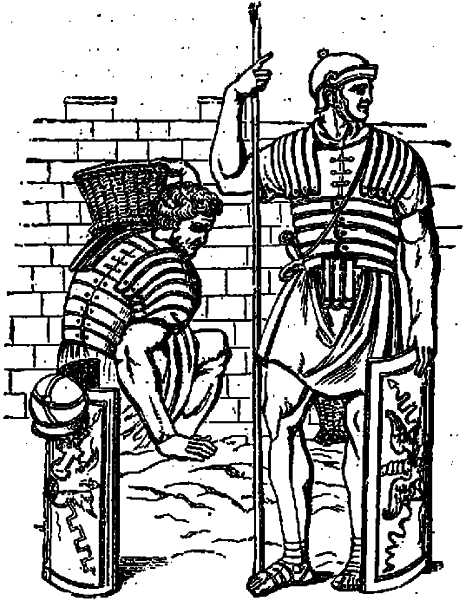
While the Roman legions in the East were acquiring wealth and winning easy conquests, their less fortunate comrades in the West were carrying on a severe struggle with the warlike Gauls, Ligurians, and Spaniards. The Romans had hardly concluded the Second Punic War when they received intelligence that Hamilcar, a Carthaginian officer, had excited several tribes in Northern Italy to take up arms against Rome. These were the Gauls on both sides of the Po, and the Ligurians, a race of hardy mountaineers, inhabiting the upper Apennines and the Maritime Alps. They commenced the war in B.C. 200 by the capture and destruction of the Roman colony of Placentia, and by laying siege to that of Cremona, the two strong-holds of the Roman dominion in Northern Italy. The Romans now set themselves to work, with the characteristic stubbornness of their nation, to subdue thoroughly these[Pg 114] tribes. The Insubres and the Cenomani, to the north of the Po, were the first to yield; but the Boii resisted for some years all the efforts of the Romans, and it was not till B.C. 191 that the Consul P. Cornelius Scipio Nasica received their final submission. He slaughtered the Boii without mercy, and made it one of the claims of his triumph that he had left only children and old men alive. This warlike people was now thoroughly subdued, and from henceforth Cisalpine Gaul became a Roman province, and gradually adopted the language and customs of Rome. The submission of the people was secured by the foundation of new colonies and the formation of military roads. In B.C. 190 a colony was established at Bononia, now Bologna, in the country of the Boii, and six years afterward others were also founded at Mutina (Modena) and Parma. A military road made by M. Æmilius Lepidus, Consul for B.C. 180, and called the Via Æmilia, was a continuation of the Via Flaminia, and ran from Ariminum past Placentia, Mutina, and Parma to Placentia. The subjugation of the Ligurians was a longer and more difficult task. These hardy mountaineers continued the war, with intermissions, for a period of eighty years. The Romans, after penetrating into the heart of Liguria, were seldom able to effect more than to compel the enemy to disperse, and take refuge in their villages and castles, of which the latter were mountain fastnesses, in which they were generally able to defy their pursuers. But into the details of these long-protracted and inglorious hostilities it is unnecessary to enter.
The conquests of Scipio Africanus had driven the Carthaginians out of Spain, and established the Roman supremacy in that country. Accordingly, soon after the end of the Second Punic War (about B.C. 198), the Romans proceeded to consolidate their dominion in Spain by dividing it into two provinces, each governed by a Prætor, which were called Hispania Citerior, or Hither Spain, and Hispania Ulterior, or Farther Spain, and divided from each other by the Iberus or the Ebro. But it was little more than the eastern part of the peninsula that was really subject to Rome. The powerful tribes of the Celtiberians in Central Spain, the Lusitanians in Portugal, and the Cantabrians and Gallæcians in the northwest, still maintained their independence. The division of the country into two provinces showed that the Romans intended to occupy it permanently, and occasioned a general insurrection.
The Consul M. Porcius Cato, of whom we shall speak more fully presently, was sent to put down this insurrection (B.C. 195). The whole country was in arms; but his military genius and indefatigable industry soon re-established the superiority of Rome. He gained several decisive victories, contrived to set tribe against[Pg 115] tribe, and took native mercenaries into his pay. The details of his campaign are full of horrors. We read of the wholesale slaughter of men who had laid down their arms, of multitudes sold as slaves, and of many more who had put themselves to death to escape this fate. Cato was not the man to feel any compunctions of conscience in the performance of what he considered a rigorous public task. He boasted of having destroyed more towns in Spain than he had spent days in that country. When he had reduced the whole of Hither Spain to a hollow, sullen, and temporary submission, he returned to Rome, and was rewarded with a triumph.
The severe measures of Cato only exasperated the Spaniards. They again took up arms, and continued to resist the Roman Prætors for the next sixteen years, till Tib. Sempronius Gracchus, the father of the celebrated tribunes, after gaining several brilliant victories over the Celtiberians, granted them an honorable peace. By his wise measures and conciliatory conduct he won the affections of the natives, and induced them to submit to the Roman supremacy (B.C. 179).
It remains to mention two other wars in the West. The Sardinians and Corsicans revolted, and held out for two years against the Conqueror of Spain (B.C. 177-175). But Gracchus effected their complete subjugation, and brought to Rome so large a number of captives for sale as to give rise to the proverb "Sardi venales" for any thing that was cheap and worthless.
The Istrians, near the head of the Adriatic Gulf, had been conquered by the Romans just before the Second Punic War. But their complete subjugation was now necessary, on account of their proximity to the newly-formed province of Cisalpine Gaul. Accordingly, the Consuls invaded Istria in B.C. 178, and in the following year the whole people was reduced to submission.
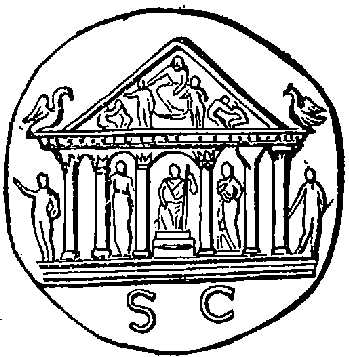
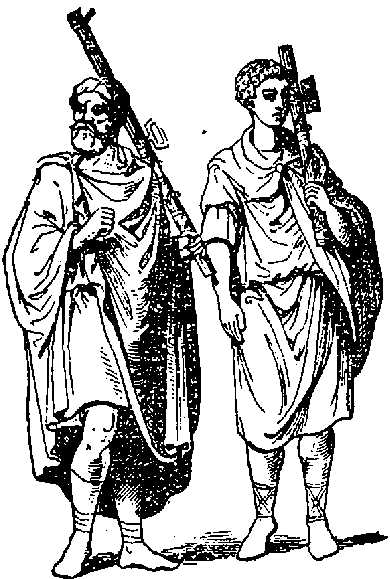
The career of foreign conquest upon which the Republic had now entered continued with little or no interruption till the establishment of the Empire. We may here pause to take a brief survey of the form of government, as well as of the military organization by which these conquests were effected.
The earlier history of the Roman constitution has been already related. We have seen how, after a long struggle, the Plebeians acquired complete political equality with the Patricians. In the Second Punic War, the antagonism between the two orders had almost disappeared, and the only mark of separation between them in political matters was the regulation that, of the two Consuls and two Censors, one must be a Patrician and the other a Plebeian. Even this fell into disuse upon the rise of the new Nobility, of which we shall speak in the next chapter. The Patricians gradually dwindled away, and it became the custom to elect both Consuls and Censors from the Plebeians.[38][Pg 117]
I. THE MAGISTRATES.—Every Roman citizen who aspired to the consulship had to pass through a regular gradation of public offices, and the earliest age at which he could become a candidate for them was fixed by a law passed in B.C. 179, and known by the name of the Lex Annalis. The earliest age for the Quæstorship, which was the first of these magistracies, was 27 years; for the Ædileship, 37; for the Prætorship, 40; and for the Consulship, 43.
All magistrates at Rome were divided into Curules and those who were not Curules. The Curule Magistrates were the Dictators, Censors, Consuls, Prætors, and Curule Ædiles, and were so called because they had the right of sitting upon the Sella Curulis, originally an emblem of kingly power, imported, along with other insignia of royalty, from Etruria.
1. The Quæstors were the paymasters of the state. It was their duty to receive the revenues, and to make all the necessary payments for the military and civil services. There were originally only two Quæstors, but their number was constantly increased with the conquests of the Republic. Besides two Quæstors who always remained at Rome, every Consul or Prætor who conducted a war or governed a province was attended by one of these magistrates.
2. The Ædileship was originally a Plebeian office, instituted at the same time as the Tribuneship of the Plebs.[39] To the two Plebeian Ædiles two Curule Ædiles were added in B.C. 365. The four Ædiles in common had the charge of the public buildings,[40] the care of the cleansing and draining of the city, and the superintendence of the police. They had also the regulation of the public festivals; and the celebration of the Ludi Magni, or Great Games, was their especial function. Originally they received a sum of money from the state to defray the expenses of these games, but the grant was withdrawn about the time of the First Punic War; a measure attended with important consequences, since the higher magistracies were thus confined to the wealthy, who alone could defray the charges of these costly entertainments. After the Macedonian and Syrian wars, the Curule Ædiles often incurred a prodigious expense, with the view of pleasing the people, and securing their votes in future elections.
3. The institution of the Prætorship in B.C. 366 has been already narrated. There was originally only one Prætor, subsequently called Prætor Urbanus, whose chief duty was the administration of justice. In B.C. 246 a second Prætor was added, who had to decide cases in which foreigners were concerned, and who was hence called Prætor Peregrinus. When the territories of the state extended beyond Italy, new Prætors were created to govern the[Pg 118] provinces. Two Prætors were appointed to take the administration of Sicily and Sardinia (B.C. 227), and two more were added when the two Spanish provinces were formed (B.C. 197). There were thus six Prætors, two of whom staid in the city and the other four went abroad. Each Prætor was attended by six Lictors.
4. The Consuls were the highest ordinary magistrates at Rome, and were at the head both of the state and the army. They convoked the Senate and the Assembly of the Centuries; they presided in each, and had to see that the resolutions of the Senate and the People were carried into effect. They had the supreme command of the armies in virtue of the Imperium conferred upon them by a special vote of the People. At the head of the army, they had full power of life and death over their soldiers. They were preceded by twelve lictors, but this outward sign of power was enjoyed by them month by month in turn.
The magistrates above-mentioned were elected annually, but it was the practice frequently to prolong the command of the Consuls or Prætors in the provinces under the titles of Proconsuls or Proprætors. In the later times of the Republic it was usual for both Consuls and several Prætors to remain at Rome during their year of office, and at its close to take the command of provinces, with the titles of Proconsuls or Proprætors.
5. The Dictatorship, which occurs so often in the early history of the Republic, disappears altogether after the Second Punic War. As the Republic became powerful, and had no longer to dread any enemies in Italy, there was no necessity for such an extraordinary magistracy as the Dictatorship, but whenever internal dangers seemed to require a stronger executive, the Senate invested the Consuls with dictatorial power.[41]
6. The Censors were two in number, elected every five years, but they held their office for a year and a half. They were taken, as a general rule, from those who had been previously Consuls, and their office was regarded as the highest dignity in the state. Their duties, which were very extensive and very important, may be divided into three classes, all of which, however, were closely connected.
(a). Their first and most important duty was to take the Census. This was not simply a list of the population, according to the modern use of the word, but a valuation of the property of every Roman citizen. This valuation was necessary, not only for the assessment of the property-tax, but also for determining the posi[Pg 119]tion of every citizen in the state, which was regulated, in accordance with the constitution of Servius Tullius, by the amount of his property. Accordingly, the Censors had to draw up lists of the Classes and Centuries. They also made out the lists of the Senators and Equites, striking out the names of all whom they deemed unworthy, and filling up all vacancies in the Senate.
(b.) The Censors possessed a general control over the conduct and morals of the citizens. In the exercise of this important power they were not guided by any rules of law, but simply by their own sense of duty. They punished acts of private as well as public immorality, and visited with their censure not only offenses against the laws, but every thing opposed to the old Roman character and habits, such as living in celibacy, extravagance, luxury, etc. They had the power of degrading every citizen to a lower rank, of expelling Senators from the Senate, of depriving the Equites of their horses, and of removing ordinary citizens from their tribes, and thus excluding them from all political rights.
(c.) The Censors also had the administration of the finances of the state, under the direction of the Senate. They let out the taxes to the highest bidders for the space of a lustrum, or five years.[42] They likewise received from the Senate certain sums of money to keep the public buildings, roads, and aqueducts in repair,[43] and to construct new public works in Rome and other parts of Italy. Hence we find that many of the great public roads, such as the Via Appia and Via Flaminia, were made by Censors.
II. THE SENATE.—The Senate was in reality the executive government of Rome, and the Magistrates, of whom we have been speaking, were only its ministers. The Senate consisted of Three Hundred members, who held the dignity for life unless expelled by the Censors for reasons already mentioned, but they could not transmit the honor to their sons. All vacancies in the body were filled up by the Censors every five years from those who had held the Quæstorship or any higher magistracy. The Censors were thus confined in their selection to those who had already received the confidence of the people, and no one could therefore enter the Senate unless he had some experience in political affairs.
The power of the Senate was very great. It exercised a control over legislation, since no law could be proposed to the Assemblies of the People unless it had first received the approval of the Sen[Pg 120]ate. In many cases "Senatus consulta"[44] were passed, which had the force of laws without being submitted to the Popular Assemblies at all. This was especially the case in matters affecting religion, police, administration, the provinces, and all foreign relations.
In foreign affairs the authority of the Senate was absolute, with the exception of declaring war and making peace, which needed the sanction of the Centuries. The Senate assigned the provinces into which the Consuls and Prætors were to be sent; they determined the manner in which a war was to be conducted, and the number of troops to be levied; they prolonged the command of a general or superseded him at their pleasure, and on his return they granted or refused him a triumph; they alone carried on negotiations with foreign states, and all embassadors to foreign powers were appointed by the Senate from their own body.
In home affairs they had the superintendence in all matters of religion. They had also the entire administration of the finances. When the Republic was in danger the Senate had the power of suspending the laws by the appointment of a Dictator, or by investing the Consuls with dictatorial power, as already mentioned.
III. THE POPULAR ASSEMBLIES.—1. The Comitia Curiata, the Patrician assembly, had become a mere form as early as the First Punic War. The gradual decline of its power has been already traced. It continued to meet for the transaction of certain matters pertaining to the Patrician gentes, but was represented simply by 30 lictors.
2. The constitution of the Comitia Centuriata, as established by Servius Tullius,[45] had undergone a great change between the time of the Licinian Rogations and the Punic Wars, but both the exact time and nature of this change are unknown. It appears, however, that its object was to give more power and influence to the popular element in the state. For this purpose the 35 tribes were taken as the basis of the new Constitution of the Centuries. Each tribe was probably divided into five property Classes, and each Classis was subdivided into two Centuries, one of Seniores and the other of Juniores. Each tribe would thus contain 10 Centuries, and, consequently, the 35 tribes would have 350 Centuries, so that, with the 18 Centuries of the Knights, the total number of the Centuries would be 368.
The Comitia of the Centuries still retained the election of the higher magistrates, the power of enacting laws, of declaring war[Pg 121] and making peace, and also the highest judicial functions. Accusations for treason were brought before the Centuries, and in all criminal matters every Roman citizen could appeal to them.[46] But, notwithstanding these extensive powers, their influence in the state was gradually superseded by the Assembly of the Tribes.
3. The Comitia Tributa obtained its superior influence and power mainly through its Tribunes. The Assembly of the Centuries, being summoned and presided over by the Consuls, was, to a great extent, an instrument in the hands of the Senate, while that of the Tribes, being guided by its own magistrates, and representing the popular element, was frequently opposed to the Senate, and took an active part in the internal administration of the state. The increasing power of the Tribunes naturally led to a corresponding increase in the power of the Tribes. The right of Intercession[47] possessed by the Tribunes was extended to all matters. Thus we find the Tribunes preventing the Consuls from summoning the Senate and from proposing laws to the Comitia of the Centuries. As the persons of the Tribunes were sacred, the Senate could exercise no control over them, while they, on the contrary, could even seize a Consul or a Censor, and throw him into prison. The only effective check which the Senate had upon the proceedings of the Tribunes was, that one Tribune could put his veto upon the acts of his colleagues. Consequently, by securing the support of one member of the body, the Senate were able to prevent the other Tribunes from carrying out their plans.
The Plebiscita enacted by the Tribes had the same force as the Leges of the Centuries.[48] There were thus two sovereign assemblies at Rome, each independent of the other; that of the Tribes, as already observed, was the most important at the period which we have now reached.
IV. FINANCES.—The ordinary expenditure of the Roman state was not large. All the magistrates discharged their duties without pay; and the allied troops, which formed so large a portion of a Roman army, were maintained by the allies themselves. The expenses of war were defrayed by a property-tax called Tributum, which was usually one in a thousand, or one tenth per cent., but after the last war with Macedonia the treasury received such large sums from the provinces that the tributum was abolished. From this time the expenses of the state were almost entirely defrayed by the taxes levied in the provinces. The other revenues of the state, which bore the general name of Vectigalia, may be dismissed[Pg 122] with a few words. They consisted of the rents arising from the public lands, of the customs' duties, of the taxes upon mines, salt, etc.
V. THE ARMY.—The Roman army was originally called Legio; and this name, which is coeval with the foundation of Rome, continued down to the latest times. The Legion was therefore not equivalent to what we call a regiment, inasmuch as it contained troops of all arms, infantry, cavalry, and, when military engines were extensively employed, artillery also. The number of soldiers who, at different periods, were contained in a legion, does not appear to have been absolutely fixed, but to have varied within moderate limits. Under Romulus the legion contained 3000 foot-soldiers. From the expulsion of the Kings until the second year of the Second Punic War the regular number may be fixed at 4000 or 4200 infantry. From the latter period until the consulship of Marius the ordinary number was from 5000 to 5200. For some centuries after Marius the numbers varied from 5000 to 6200, generally approaching to the higher limit. Amid all the variations with regard to the infantry, 300 horsemen formed the regular complement of the legion. The organization of the legion differed at different periods.
1. First Period. Servius Tullius.—The legion of Servius is so closely connected with the Comitia Centuriata that it has already been discussed,[49] and it is only necessary to state here that it was a phalanx equipped in the Greek fashion, the front ranks being furnished with a complete suit of armor, their weapons being long spears, and their chief defense the round Argolic shield (clipeus).
2. Second Period. The Great Latin War, B.C. 340.—The legion in B.C. 340 had almost entirely discarded the tactics of the phalanx. It was now drawn up in three, or perhaps we ought to say, in five lines. The soldiers of the first line, called Hastati, consisted of youths in the first bloom of manhood, distributed into 15 companies or maniples (manipuli), a moderate space being left between each. The maniple contained 60 privates, 2 centurions (centuriones), and a standard-bearer (vexillarius). The second line, the Principes, was composed of men in the full vigor of life, divided in like manner into 15 maniples, all heavily armed. The two lines of the Hastati and Principes taken together amounted to 30 maniples, and formed the Antepilani. The third line, the Triarii, composed of tried veterans, was also in 15 divisions, but each of these was triple, containing 3 maniples. In these triple maniples the veterans, or Triarii proper, formed the front ranks; immediately be[Pg 123]hind them stood the Rorarii, inferior in age and prowess, while the Accensi, or supernumeraries, less trustworthy than either, were posted in the extreme rear.
3. Third Period. During the Wars of the younger Scipio.—Under ordinary circumstances four legions were levied yearly, two being assigned to each Consul. It must be observed that a regular consular army no longer consisted of Roman legions only, but, as Italy became gradually subjugated, the various states under the dominion of Rome were bound to furnish a contingent, and the number of allies usually exceeded that of the citizens. They were, however, kept perfectly distinct, both in the camp and in the battle-field.
The men belonging to each legion were separated into four divisions. 1. 1000 of the youngest and poorest were set apart to form the Velites, the light-armed troops or skirmishers of the legion. 2. 1200 who came next in age (or who were of the same age with the preceding, but more wealthy) formed the Hastati. 3. 1200, consisting of those in the full vigor of manhood, formed the Principes. 4. 600 of the oldest and most experienced formed the Triarii. When the number of soldiers in the legion exceeded 4000, the first three divisions were increased proportionally, but the number of the Triarii remained always the same. The Hastati, Principes, and Triarii were each divided into 10 companies, called Maniples. The Velites were not divided into companies, but were distributed equally among the Hastati, Principes, and Triarii. Each maniple was subdivided into two centuries, commanded by a centurion. Each legion had six superior officers, called Tribuni Militum. The legion was also divided into 10 cohorts; and as the cohorts were all equal to each other, the strength of the cohort varied from time to time with the strength of the legion, and thus at different periods ranged between the limits of 300 and 600.
Three hundred horse-soldiers were apportioned to each legion, divided into 10 troops (turmæ), out of which three officers were chosen named Decuriones.
The infantry furnished by the Socii was for the most part equal in number to the Roman legions, the cavalry twice or thrice as numerous, and the whole were divided equally between the two consular armies. Each Consul named 12 superior officers, who were termed Præfecti Sociorum, and corresponded by the Legionary Tribunes.
Fourth Period. From the times of the Gracchi until the downfall of the Republic.[50]—After the times of the Gracchi the following[Pg 124] changes in military affairs may be noticed: In the first consulship of Marius the legions were thrown open to citizens of all grades, without distinction of fortune. The whole of the legionaries were armed and equipped in the same manner, all being now furnished with the pilum. The legionaries, when in battle-order, were no longer arranged in three lines, each consisting of ten maniples with an open space between each maniple, but in two lines, each consisting of five cohorts, with a space between each cohort. The younger soldiers were no longer placed in the front, but in reserve, the van being composed of veterans. As a necessary result of the above arrangements, the distinction between Hastati, Principes, and Triarii ceased to exist. The Velites disappeared. The skirmishers, included under the general term Levis Armatura, consisted for the most part of foreign mercenaries possessing peculiar skill in the use of some national weapon, such as the Balearic slingers, the Cretan archers (sagittarii), and the Moorish dartmen. When operations requiring great activity were undertaken, such as could not be performed by mere skirmishers, detachments of legionaries were lightly equipped, and marched without baggage for these special services.[51] The cavalry of the legion underwent a change in every respect analogous to that which took place with regard to the light-armed troops. The Roman Equites attached to the army were very few in number, and were chiefly employed as aids-de-camp and on confidential missions. The bulk of the cavalry consisted of foreigners, and hence we find the legions and the cavalry spoken of as completely distinct from each other. After the termination of the Social War, when most of the inhabitants of Italy became Roman citizens, the ancient distinction between the Legiones and the Socii disappeared, and all who had served as Socii became incorporated with the Legiones.
In the course of the history the Triumphs granted to victorious generals have been frequently mentioned, and therefore a brief description of them may appropriately close this sketch of the Roman army. A Triumph was a solemn procession, in which a victorious general entered the city in a chariot drawn by four horses. He was preceded by the captives and spoils taken in war, was followed by his troops, and, after passing in state along the Via Sacra, ascended the Capitol to offer sacrifice in the Temple of Jupiter. From the beginning of the Republic down to the extinction of liberty a Triumph was recognized as the summit of military glory, and was the cherished object of ambition to every Roman general. After any decisive battle had been won, or a province subdued by[Pg 125] a series of successful operations, the general forwarded to the Senate a laurel-wreathed dispatch containing an account of his exploits. If the intelligence proved satisfactory the Senate decreed a public thanksgiving.[52] After the war was concluded, the general, with his army, repaired to Rome, or ordered his army to meet him there on a given day, but did not enter the city. A meeting of the Senate was held without the walls, that he might have an opportunity of urging his pretensions in person, and these were then scrutinized and discussed with the most jealous care. If the Senate gave their consent, they at the same time voted a sum of money toward defraying the necessary expenses, and one of the Tribunes applied for a plebiscitum to permit the Imperator to retain his imperium on the day when he entered the city. This last form could not be dispensed with, because the imperium conferred by the Comitia did not include the city itself; and accordingly the military power of the general ceased as soon as he re-entered the gates, unless the general law had been previously suspended by a special enactment.
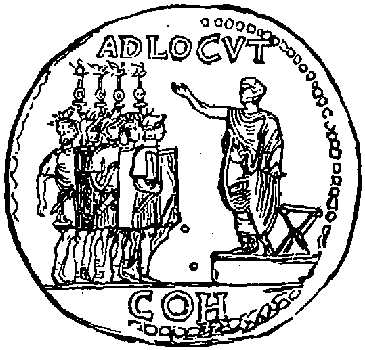
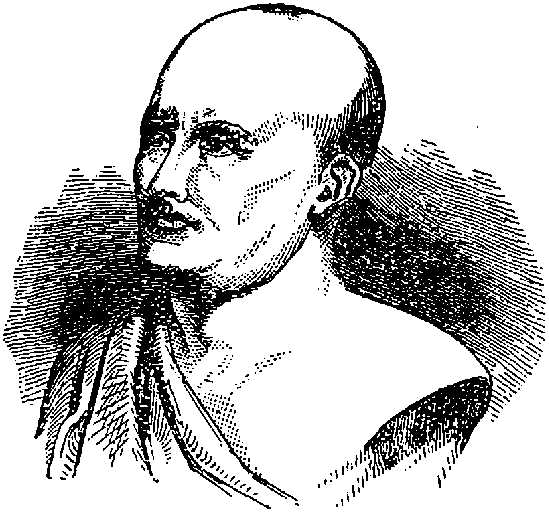
The conquests of the Romans in the East had exercised a most pernicious influence upon the national character. They were originally a hardy, industrious, and religious race, distinguished by unbending integrity and love of order. They lived with great frugality upon their small farms, which they cultivated with their own hands; but they were stern and somewhat cruel, and cared little or nothing for literature and the arts. Upon such a people the sudden acquisition of wealth produced its natural effects. They employed it in the gratification of their appetites, and in coarse sensual pleasures. Some of the Roman nobles, such as Scipio Africanus, Flamininus (the conqueror of Philip), and others, acquired a love for Greek literature and art; but the great mass of the nation imitated only the vices of the Greeks. Cooks, who had formerly been the cheapest kind of slaves at Rome, now became the most valuable. A love of luxury and a general depravity gradually spread through all classes of society. A striking instance of the growing licentiousness of the times was brought to light in B.C. 186. It was discovered that the worship of Bacchus had been introduced from Southern Italy into Rome and other towns, and[Pg 127] that secret societies were formed, which, under the cloak of this worship, indulged in the most abominable vices. A stringent inquiry was made into these practices; the most guilty were put to death; and a decree of the Senate was passed, forbidding the worship of Bacchus in Rome and throughout Italy.
Another circumstance will illustrate the manners of the times. L. Flamininus, the brother of the conqueror of Philip, and Consul in B.C. 192, took with him into Cisalpine Gaul a beautiful Carthaginian boy, to whom he was attached. The youth complained of leaving Rome just before the exhibition of the games of the gladiators. Shortly after reaching the province, when Flamininus was feasting with his favorite, a Boian chief came into the Consul's tent to implore his protection. Flamininus seized this opportunity to please the boy, and, telling him that he should be rewarded for not seeing the gladiators, he ordered an attendant to stab the Gaul, that his favorite might enjoy the dying agonies of the man.
The increasing love of gladiatorial combats was another indication of the national character. These brutalizing sports are said to have taken their origin from the Etruscans, who were accustomed to kill slaves and captives at the funerals of their relatives. They were first exhibited at Rome in the beginning of the First Punic War (B.C. 264). At first confined to funerals, they were afterward exhibited by the Ædiles at the public games, with the view of pleasing the people. The passion for this brutalizing amusement rose to a great height toward the end of the Republic and under the Empire. Great pains were taken with the training of gladiators, who were divided into different classes according to their arms and modes of fighting.
Among many other important consequences of these foreign wars, two exercised an especial influence upon the future fate of the Republic. The nobles became enormously rich, and the peasant proprietors almost entirely disappeared. The wealthy nobles now combined together to keep in their own families the public offices of the state, which afforded the means of making such enormous fortunes. Thus a new Nobility was formed, resting on wealth, and composed alike of plebeian and patrician families. Every one whose ancestry had not held any of the curule magistracies[53] was called a New Man, and was branded as an upstart.[54] It became[Pg 128] more and more difficult for a New Man to rise to office, and the Nobles were thus almost an hereditary aristocracy in the exclusive possession of the government. The wealth they had acquired in foreign commands enabled them not only to incur a prodigious expense in the celebration of the public games in their ædileship, with the view of gaining the votes of the people at future elections, but also to spend large sums of money in the actual purchase of votes. The first law against bribery[55] was passed in B.C. 181, a sure proof of the growth of the practice.
The decay of the peasant proprietors was an inevitable consequence of these frequent and long-protracted wars. In the earlier times the citizen-soldier, after a few weeks' campaign, returned home to cultivate his land; but this became impossible when wars were carried on out of Italy. Moreover, the soldier, easily obtaining abundance of booty, found life in the camp more pleasant than the cultivation of the ground. He was thus as ready to sell his land as the nobles were anxious to buy it. But money acquired by plunder is soon squandered. The soldier, returning to Rome, swelled the ranks of the poor; and thus, while the nobles became richer and richer, the lower classes became poorer and poorer. In consequence of the institution of slavery there was little or no demand for free labor, and as prisoners taken in war were sold as slaves, the slave-market was always well supplied. The estates of the wealthy were cultivated by large gangs of slaves; and even the mechanical arts, which give employment to such large numbers in the modern towns of Europe, were practiced by slaves, whom their masters had trained for the purpose. The poor at Rome were thus left almost without resources; their votes in the popular assembly were nearly the only thing they could turn into money, and it is therefore not surprising that they were ready to sell them to the highest bidder.
Many distinguished men saw with deep regret the old Roman virtues disappearing, and strove vigorously against these corruptions of the national character. Of this party the most conspicuous member was M. Porcius Cato, who may be taken as a type of the old Roman character. He was born at Tusculum in B.C. 234. When a young man, the death of his father put him in possession of a small hereditary estate in the Sabine territory, at a distance from his native town. It was here that he passed the greater part of his boyhood, hardening his body by healthful exercise, and su[Pg 129]perintending and sharing the operations of the farm. Near his estate was an humble cottage, which had been tenanted, after three triumphs, by its owner M. Curius Dentatus, whose warlike exploits and simple character were often talked of with admiration in the neighborhood. The ardor of the youthful Cato was kindled. He resolved to imitate the character, and hoped to rival the glory, of Dentatus. Opportunity was not wanting. He took his first military lessons in the campaigns against Hannibal, and gained the favor and friendship of Fabius Maximus. He was also patronized by L. Valerius Flaccus, a Roman noble in his neighborhood, and a warm supporter of the old Roman manners, who had observed Cato's eloquence, as well as his martial spirit. Encouraged by Fabius and Flaccus, Cato became a candidate for office, and was elected Quæstor in B.C. 204. He followed P. Scipio Africanus to Sicily, but there was not that cordiality of co-operation between Cato and Scipio which ought to subsist between a Quæstor and his Proconsul. Fabius had opposed the permission given to Scipio to carry the attack into the enemy's home, and Cato, whose appointment was intended to operate as a check upon Scipio, adopted the views of his friend. Cato was Prætor in Sardinia in B.C. 198, where he took the earliest opportunity of illustrating his principles by his practice. He diminished official expenses, walked his circuits with a single attendant, administered justice with strict impartiality, and restrained usury with unsparing severity. He had now established a reputation for pure morality and strict old-fashioned virtue. He was looked upon as the living type and representative of the ideal ancient Roman. To the advancement of such a man opposition was vain. In B.C. 195 he was elected Consul with his old friend and patron L. Valerius Flaccus. During his consulship a strange scene took place peculiarly illustrative of Roman manners. In B.C. 215, at the height of the Punic War, a law had been passed, proposed by the Tribune Oppius, that no woman should possess more than half an ounce of gold, nor wear a garment of divers colors, nor drive a carriage with horses within a mile of the city, except for the purpose of attending the public celebration of religious rites. Now that Hannibal was conquered, and Rome abounded with Carthaginian wealth, there being no longer any necessity for women to contribute toward the exigencies of an impoverished treasury the savings spared from their ornaments and pleasures, two Tribunes thought it time to propose the abolition of the Oppian law; but they were opposed by two of their colleagues. The most important affairs of state excited far less interest and zeal than this singular contest. The matrons blockaded every avenue to the forum, and intercepted their husbands as they approached, beseech[Pg 130]ing them to restore the ancient ornaments of the Roman matrons. Even Flaccus wavered, but his colleague Cato was inexorable. Finally, the women carried the day. Worn out by their importunity, the two Tribunes withdrew their opposition, and the hated law was abolished by the suffrage of all the tribes.
Cato's campaign in Spain during his Consulship, which added greatly to his military reputation, has been already related. He afterward served in Greece under M. Glabrio, where he distinguished himself at the battle of Thermopylæ fought against Antiochus (B.C. 191).
The victory of Zama had made P. Scipio Africanus the first man in the Republic, and for a time silenced all his enemies. But the party of Fabius still cherished their old animosity against him, and Cato inherited the hatred of his friend and patron. After the return of P. Scipio and his brother Lucius from the war against Antiochus, they were charged with having been bribed to let off the Syrian monarch too leniently, and of having appropriated to their own use a portion of the money which had been paid by Antiochus to the Roman state. The first blow was directed against Lucius Scipio. At the instigation of Cato, the two Petillii Tribunes of the people required Lucius to render an account of all sums of money which he had received from Antiochus. Lucius accordingly prepared his accounts; but, as he was in the act of delivering them up, the proud conqueror of Hannibal indignantly snatched them out of his hands, and tore them in pieces, saying "it was unworthy to call to account for a few thousands a man who had paid millions into the treasury." But this haughty conduct appears to have produced an unfavorable impression, and his brother, when brought to trial in the course of the tame year, was declared guilty, and sentenced to pay a heavy fine. The Tribune ordered him to be dragged to prison, and there detained till the money was paid; whereupon Africanus, still more enraged at this fresh insult to his family, and setting himself above the laws, rescued his brother from the hands of the Tribune's officer. The contest would probably have been attended with fatal results had not Tib. Gracchus, the father of the celebrated Tribune, and then Tribune himself, had the prudence, although he disapproved of the violent conduct of Africanus, to release his brother Lucius from the sentence of imprisonment.
The successful issue of the prosecution of Lucius emboldened his enemies to bring the great Africanus himself before the people. His accuser was the Tribune M. Nævius. When the trial came on, Scipio did not condescend to say a single word in refutation of the charges that had been brought against him, but descanted long[Pg 131] and eloquently upon the signal services he had rendered to the commonwealth. Having spoken till nightfall, the trial was adjourned till the following day. Early next morning, when the Tribunes had taken their seats on the rostra, and Africanus was summoned, he proudly reminded the people that this was the anniversary of the day on which he had defeated Hannibal at Zama, and called upon them to neglect all disputes and lawsuits, and follow him to the Capitol, there to return thanks to the immortal gods, and pray that they would grant the Roman state other citizens like himself. Scipio struck a chord which vibrated in every heart; their veneration for the hero returned; and he was followed by such crowds to the Capitol that the Tribunes were left alone in the rostra. Having thus set all the laws at defiance, Scipio immediately quitted Rome, and retired to his country seat at Liternum. The Tribunes wished to renew the prosecution, but Gracchus wisely persuaded them to let it drop. Scipio never returned to Rome. He would neither submit to the laws, nor aspire to the sovereignty of the state, and he therefore resolved to expatriate himself forever. He passed his remaining days in the cultivation of his estate at Liternum, and at his death is said to have requested that his body might be buried there, and not in his ungrateful country (B.C. 183).
Hannibal perished in the same year as his great opponent. Scipio was the only member of the Senate who opposed the unworthy persecution which the Romans employed against their once dreaded foe. Each of these great men, possessing true nobility of soul, could appreciate the other's merits. A story is told that Scipio was one of the embassadors sent to Antiochus at Ephesus, at whose court Hannibal was then residing, and that he there had an interview with the great Carthaginian, who declared him the greatest general that ever lived. The compliment was paid in a manner the most flattering to Scipio. The latter had asked, "Who was the greatest general?" "Alexander the Great," was Hannibal's reply. "Who was the second?" "Pyrrhus." "Who was the third?" "Myself," replied the Carthaginian. "What would you have said, then, if you had conquered me?" asked Scipio, in astonishment. "I should then have placed myself above Alexander, Pyrrhus, and all other generals."
After the defeat of Antiochus, Hannibal, as we have already seen, took up his abode with Prusias, king of Bithynia, and there found for some years a secure asylum. But the Romans could not be at ease so long as Hannibal lived, and T. Flamininus was at length dispatched to the court of Prusias to demand the surrender of the fugitive. The Bithynian king was unable to resist; but[Pg 132] Hannibal, who had long been in expectation of such an event, took poison to avoid falling into the hands of his implacable foes.
We now return to Cato, whose Censorship (B.C. 184) was a great epoch in his life. He applied himself strenuously to the duties of his office, regardless of the enemies he was making. He repaired the water-courses, paved the reservoirs, cleansed the drains, raised the rents paid by the publicani for farming the taxes, and diminished the contract-prices disbursed by the state to the undertakers of public works. There can be no doubt that great abuses existed in the management of the public finances, with which nothing but the undaunted courage and administrative abilities of Cato could have successfully grappled. He was disturbing a nest of hornets, and all his future life was troubled by their buzz, and their attempts to sting. But, though he was accused no fewer than forty-four times during the course of his life, it was only once that his enemies prevailed against him. His enactments against luxury were severe and stringent. He levied a heavy tax upon expensive slaves and costly furniture and dress. He justly degraded from the Senate L. Flamininus for the act of abominable cruelty in Gaul which has been already narrated.[56]
The strong national prejudices of Cato appear to have diminished in force as he grew older and wiser. He applied himself in old age to the study of Greek literature, with which in youth he had no acquaintance, although he was not ignorant of the Greek language. Himself an historian and orator, the excellences of Demosthenes and Thucydides made a deep impression upon his kindred mind. But throughout life his conduct was guided by prejudices against classes and nations whose influence he deemed to be hostile to the simplicity of the old Roman character. When Eumenes, king of Pergamus, visited Rome after the war with Antiochus, and was received with honor by the Senate, and splendidly entertained by the nobles, Cato was indignant at the respect paid to the monarch, refused to go near him, and declared that "kings were naturally carnivorous animals." He had an antipathy to physicians, because they were mostly Greeks, and therefore unfit to be trusted with Roman lives. He loudly cautioned his eldest son against them, and dispensed with their attendance. When Athens sent three celebrated philosophers, Carneades, Diogenes, and Critolaüs, to Rome, in order to negotiate a remission of the 500 talents which the Athenians had been awarded to pay to the Oropians, Carneades excited great attention by his philosophical conversation and lectures, in which he preached the pernicious doctrine of an expediency distinct from justice, which he illustrated by the[Pg 133] example of Rome herself: "If Rome were stripped of all that she did not justly gain, the Romans might go back to their huts." Cato, offended with his principles, and jealous of the attention paid to the Greek, gave advice which the Senate followed: "Let these deputies have an answer, and a polite dismissal as soon as possible."
Cato was an unfeeling and cruel master. His conduct toward his slaves was detestable. The law held them to be mere chattels, and he treated them as such, without any regard to the rights of humanity. After supper he often severely chastised them, thong in hand, for trifling acts of negligence, and sometimes condemned them to death. When they were worn out, or useless, he sold them, or turned them out of doors. He treated the lower animals no better. His war-horse, which bore him through his campaign in Spain, he sold before he left the country, that the state might not be charged with the expenses of its transport. As years advanced he sought gain with increasing eagerness, but never attempted to profit by the misuse of his public functions. He accepted no bribes; he reserved no booty to his own use; but he became a speculator, not only in slaves, but in buildings, artificial waters, and pleasure-grounds. In this, as in other points, he was a representative of the old Romans, who were a money-getting and money-loving people.
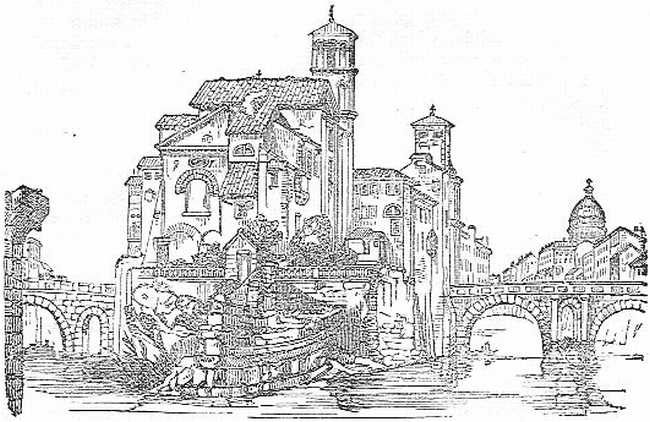
In B.C. 179 Philip died, and was succeeded by his son Perseus, the last monarch of Macedonia. The latter years of the reign of Philip had been spent in preparations for a renewal of the war, which he foresaw to be inevitable; and when Perseus ascended the throne, he found himself amply provided with men and money for the impending contest. But, whether from a sincere desire of peace, or from irresolution of character, he sought to avert an open rupture as long as possible, and one of the first acts of his reign was to obtain from the Romans a renewal of the treaty which they had concluded with his father. It is probable that neither party was sincere in the conclusion of this peace, at least neither could entertain any hope of its duration; yet a period of seven years elapsed before the mutual enmity of the two powers broke out into open hostilities. Meanwhile, Perseus was not idle; he secured the attachment of his subjects by equitable and popular measures, and formed alliances not only with the Greeks and the Asiatic princes, but also with the Thracian, Illyrian, and Celtic tribes which sur[Pg 135]rounded his dominions. The Romans naturally viewed these proceedings with jealousy and suspicion; and at length, in 172, Perseus was formally accused before the Roman Senate by Eumenes, king of Pergamus, in person, of entertaining hostile designs against the Roman power. The murder of Eumenes near Delphi, on his return homeward, of which Perseus was suspected, aggravated the feeling against him at Rome, and in the following year war was declared.
Perseus was at the head of a numerous and well-appointed army, but of all his allies, only Cotys, king of the Odrysians, ventured to support him against so formidable a foe. Yet the war was protracted three years without any decisive result; nay, the balance of success seemed on the whole to incline in favor of Perseus, and many states, which before were wavering, now showed a disposition to join his cause. But his ill-timed parsimony restrained him from taking advantage of their offers, and in B.C. 168 the arrival of the Consul L. Æmilius Paullus completely changed the aspect of affairs. Perseus was driven from a strong position which he had taken up on the banks of the Enipeus, forced to retreat to Pydna, and, finally, to accept an engagement near that town. At first the serried ranks of the phalanx seemed to promise superiority; but its order having been broken by the inequalities of the ground, the Roman legionaries penetrated the disordered mass, and committed fearful carnage, to the extent, it is said, of 20,000 men. Perseus fled first to Pella, then to Amphipolis, and finally to the sanctuary of the sacred island of Samothrace, but was at length obliged to surrender himself to a Roman squadron. He was treated with courtesy, but was reserved to adorn the triumph of his conqueror. Such was the end of the Macedonian empire. The Senate decreed that Macedonia should be divided into four districts, each under the jurisdiction of an oligarchical council.
Before leaving Greece, Paullus was commanded by the Senate to inflict a terrible punishment upon the Epirotes, because they had favored Perseus. Having placed garrisons in the seventy towns of Epirus, he razed them all to the ground in one day, and carried away 150,000 inhabitants as slaves. Epirus never recovered from this blow. In the time of Augustus the country was still a scene of desolation, and the inhabitants had only ruins and villages to dwell in.
Paullus arrived in Italy toward the close of B.C. 167. The booty which he brought with him from Macedonia, and which he paid into the Roman treasury, was of enormous value; and his triumph, which lasted three days, was the most splendid that Rome had yet seen. Before his triumphal car walked the captive monarch of[Pg 136] Macedonia, and behind it, on horseback, were his two eldest sons, Q. Fabius Maximus, and P. Scipio Africanus the younger, both of whom had been adopted into other families. But his glory was darkened by the death of his two younger sons, one dying a few days before, and the other a few days after his triumph.
After the triumph Perseus was thrown into a dungeon, but, in consequence of the intercession of Paullus, he was released, and permitted to end his days in an honorable captivity at Pella. His son Alexander learned the Latin language, and became a public clerk at Rome.
The fall of the Macedonian monarchy made Rome the real mistress of the eastern shores of the Mediterranean. The most haughty monarchs trembled before the Republic. Antiochus Epiphanes had invaded Egypt, and was marching upon Alexandria, when he was met by three Roman commissioners, who presented him with a decree of the Senate, commanding him to abstain from hostilities against Egypt. The king, having read the decree, promised to take it into consideration with his friends, whereupon Popillius, one of the Roman commissioners, stepping forward, drew a circle round the king with his staff, and told him that he should not stir out of it till he had given a decisive answer. The king was so frightened by this boldness that he immediately promised to withdraw his troops. Eumenes, king of Pergamus, whose conduct during the war with Perseus had excited the suspicion of the Senate, hastened to make his submission in person, but was not allowed to enter Rome. Prusias, king of Bithynia, had the meanness to appear at Rome with his head shaven, and in the dress of a liberated slave. The Rhodians, who had offered their mediation during the war with Perseus, were deprived of Lycia and Caria. In Greece itself the Senate acted in the same arbitrary manner. It was evident that they meant to bring the whole country under their sway. In these views they were assisted by various despots and traitors in the Grecian cities, and especially by Callicrates, a man of great influence among the Achæans, who for many years had lent himself as the base tool of the Romans. He now denounced more than a thousand Achæans as having favored the cause of Perseus. Among them were the historian Polybius, and the most distinguished men in every city of the League. They were all apprehended and sent to Italy, where they were distributed among the cities of Etruria, without being brought to trial. Polybius alone was allowed to reside at Rome in the house of Æmilius Paullus, where he became the intimate friend of his son Scipio Africanus the younger. The Achæan League continued to exist, but it was really subject to Callicrates. The Achæan exiles lan[Pg 137]guished in confinement for seventeen years. Their request to be allowed to return to their native land had been more than once refused; but the younger Scipio Africanus at length interceded on their behalf, and prevailed upon Cato to advocate their return. The conduct of the aged Senator was kinder than his words. He did not interpose till the end of a long debate, and then simply asked, "Have we nothing better to do than to sit here all day long debating whether a parcel of worn-out Greeks shall be carried to their graves here or in Achaia?" A decree of the Senate gave the exiles permission to return; but, when Polybius was anxious to obtain from the Senate restoration to their former honors, Cato bade him, with a smile, beware of returning to the Cyclops' den to fetch away any trifles he had left behind him.
The Achæan exiles, whose numbers were now reduced from 1000 to 300, landed in Greece (B.C. 151) with feelings exasperated by their long confinement, and ready to indulge in any rash enterprise against Rome. Polybius, who had returned with the other exiles, in vain exhorted them to peace and unanimity, and to avoid a hopeless struggle with the Roman power. Shortly afterward an adventurer laid claim to the throne of Macedonia (B.C. 149). He was a man of low origin called Andriscus, but he pretended to be the son of Perseus, and assumed the name of Philippus. At first he met with some success, and defeated the Roman Prætor Juventius, but, after reigning scarcely a year, he was conquered and taken prisoner by Q. Metellus.
The temporary success of Andriscus had encouraged the war-party in the Achæan League. Polybius had quitted the country to join his friend Scipio in Africa; and Diæus and Critolaüs, the most violent enemies of Rome, had now undisputed sway in the League. Diæus incited the Achæans to attack Sparta, on the ground that, instead of appealing to the League respecting a boundary question, as they ought to have done, they had violated its laws by sending a private embassy to Rome. The Spartans, feeling themselves incompetent to resist this attack, appealed to the Romans for assistance; and in B.C. 147 two Roman commissioners were sent to Greece to settle these disputes. The commissioners decided that not only Sparta, but Corinth, and all the other cities, except those of Achaia, should be restored to independence. Their decision occasioned serious riots at Corinth. All the Spartans in the town were seized, and even the Roman commissioners narrowly escaped violence. On their return to Rome a fresh embassy was dispatched to demand satisfaction for these outrages. But the violent and impolitic conduct of Critolaüs, then Strategus of the League, rendered all attempts at accom[Pg 138]modation fruitless, and, after the return of the embassadors, the Senate declared war against the League. The cowardice and incompetence of Critolaüs as a general were only equaled by his previous insolence. On the approach of the Romans from Macedonia under Metellus he did not even venture to make a stand at Thermopylæ; and, being overtaken by them near Scarphea, in Locris, he was totally defeated, and never again heard of. Diæus, who succeeded him as Strategus, displayed rather more energy and courage, and made preparations to defend Corinth. Metellus had hoped to have had the honor of bringing the war to a conclusion, and had almost reached Corinth, when the Consul L. Mummius landed on the Isthmus and assumed the command. The struggle was soon brought to a close. Diæus was defeated in battle; and Corinth was immediately evacuated, not only by the troops of the League, but also by the greater part of the inhabitants. On entering the city, Mummius put to the sword the few males who remained, sold the women and children as slaves, and, having earned away all its treasures, consigned it to the flames (B.C. 146). Corinth was filled with masterpieces of ancient art; but Mummius was so insensible to their surpassing excellence as to stipulate with those who contracted to convey them to Italy that, if any were lost in the passage, they should be replaced by others of equal value! Mummius then employed himself in chastising and regulating the whole of Greece; and ten commissioners were sent from Rome to settle its future condition. The whole country, to the borders of Macedonia and Epirus, was formed into a Roman province, under the name of Achaia, derived from that confederacy which had made the last struggle for political existence. The Roman commissioners then proceeded northward, and also formed Macedonia into a province. Polybius, who had hastened to Greece immediately after the capture of Corinth, exerted all his influence to alleviate the misfortunes of his countrymen, and to procure for them favorable terms. As a friend of Scipio he was received by the Roman commissioners with great distinction, and obtained from them a relaxation of some of the most severe enactments which had been made against the Achæans.
Metellus and Mummius both triumphed on their return to Rome, the former taking the surname of Macedonicus, the latter that of Achaicus.
Carthage, so long the rival of Rome, had fallen in the same year as Corinth. The reforms introduced by Hannibal after the battle of Zama had restored some degree of prosperity to the state; and, though the Roman party obtained the supremacy after he had been compelled to fly to Antiochus, the commercial activity of the Car[Pg 139]thaginians restored to the city much of its former influence. Rome looked with a jealous eye upon its reviving power, and encouraged Masinissa to make repeated aggressions upon its territory. At length the popular party, having obtained more weight in the government, made a stand against these repeated encroachments of Masinissa. Thereupon Cato recommended an instant declaration of war against Carthage; but this met with considerable opposition in the Senate, and it was at length arranged that an embassy should be sent to Africa to gain information as to the real state of affairs. The ten embassadors, of whom Cato was the chief, offered their arbitration, which was accepted by Masinissa, but rejected by the Carthaginians, who had no confidence in Roman justice. The deputies accurately observed the warlike preparations and the defenses of the frontier. They then entered the city, and saw the strength and population it had acquired since the Second Punic War. Upon their return Cato was the foremost in asserting that Rome would never be safe as long as Carthage was so powerful, so hostile, and so near. One day he drew a bunch of early ripe figs from beneath his robe, and, throwing it upon the floor of the Senate-house, said to the assembled fathers, who were astonished at the freshness and fineness of the fruit, "Those figs were gathered but three days ago at Carthage; so close is our enemy to our walls." From that time forth, whenever he was called upon for his vote in the Senate, though the subject of debate bore no relation to Carthage, his words were, "Delenda est Carthago," "Carthage must be destroyed."[57]
Cato's opinion prevailed, and the Senate only waited for a favorable opportunity to destroy the city. This soon occurred. The popular party having driven into exile the powerful partisans of Masinissa, the old Numidian king invaded the Carthaginian territory, and defeated the army which had been raised to oppose him (B.C. 150). This led to a change in the government, and the aristocratical party, once more restored to power, hastened to make their submission to Rome. But the Romans had resolved upon war, and, when the Carthaginian embassadors arrived at Rome, the two Consuls were already levying troops. The embassadors, knowing that resistance was hopeless, sought to appease the anger of the Senate by unconditional obedience. They were ordered to send 300 youths of the noblest families to meet the Consuls at Lilybæum, and were told that the Consuls would acquaint them with the farther orders of the Senate. At Lilybæum the Consuls[Pg 140] found the hostages awaiting them, and then promised the Carthaginian envoys that the decision of the Senate should be announced to them in Africa. Upon reaching Utica, which surrendered to them in despair, the Consuls informed the Carthaginians that, as their state would henceforth be under the protection of Rome, they had no longer any occasion for arms, and must surrender all the munitions of war. Even this demand was complied with, and the Roman commissioners who were sent to Carthage brought to the Roman camp 200,000 stand of arms, and 2000 catapults. The Consuls, thinking that the state was now defenseless, threw off the mask, and announced the final resolution of the Senate: "That Carthage must be destroyed, and that its inhabitants must build another city ten miles distant from the coast." When this terrible news reached Carthage, despair and rage seized all the citizens. They resolved to perish rather than submit to so perfidious a foe. All the Italians within the walls were massacred; the members of the former government took to flight, and the popular party once more obtained the power. Almost superhuman efforts were made to obtain means of defense; corn was collected from every quarter; arms were manufactured day and night; the women cut off their long hair to be made into strings for the catapults, and the whole city became one vast work-shop. The Consuls now saw that it would be necessary to have recourse to force; but they had no military ability, and their attacks were repulsed with great loss. The younger Scipio Africanus, who was then serving in the army as military tribune, displayed great bravery and military skill, and, on one occasion, saved the army from destruction. Still no permanent success was gained, and Scipio returned to Rome, accompanied by the prayers of the soldiers that he would come back as their commander. In the following year (B.C. 148) the new Consul L. Calpurnius Piso was even less successful than his predecessors. The soldiers became discontented; the Roman Senate and people, who had anticipated an easy conquest, were indignant at their disappointment, and all eyes were turned to Scipio. Accordingly, when he became a candidate for the ædileship for the ensuing year (B.C. 147), he was unanimously elected Consul, though he was only thirty-seven years old, and had not, therefore, attained the legal age for the office.
This remarkable man was, as we have already said, the son of L. Æmilius Paullus, the conqueror of Macedonia. He was adopted by P. Scipio, the son of the great Africanus, and is therefore called Scipio Africanus Minor, to distinguish him from his grandfather by adoption. To these names that of Æmilianus is sometimes added to mark the family of his birth, so that his full desig[Pg 141]nation was P. Cornelius Scipio Africanus Æmilianus. His intimacy with the historian Polybius has been already mentioned. He appears from his earliest years to have devoted himself with ardor to the study of literature; and he eagerly availed himself of the superior knowledge of Polybius to direct him in his literary pursuits. He was accompanied by the Greek historian in almost all his campaigns, and, in the midst of his most active military duties, lost no opportunity of enlarging his knowledge of Greek literature and philosophy by constant intercourse with his friend. Nor did he neglect the literature of his own country, for Terence was admitted to his intimacy, and he is even said to have assisted him in the composition of his comedies. His friendship with Lælius, whose tastes and pursuits were so congenial to his own, has been immortalized by Cicero's celebrated treatise "On Friendship."
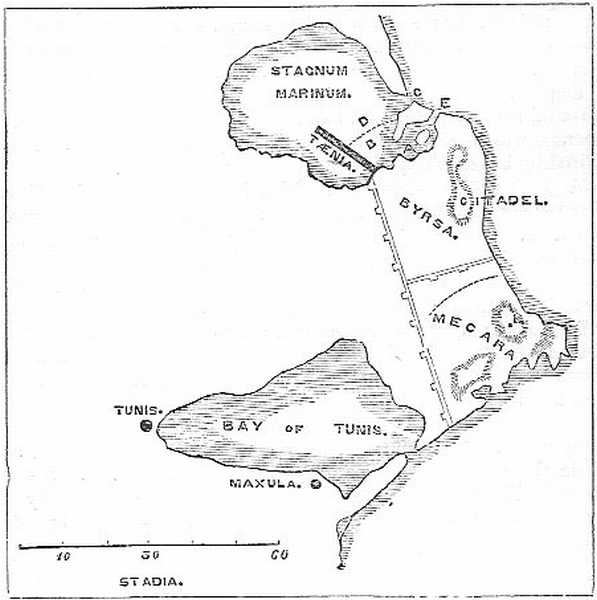
Scipio landed in Africa in B.C. 147. His first step was to restore[Pg 142] discipline to the army. He next took by storm Megara, a suburb of Carthage, and then proceeded to construct a work across the entrance of the harbor to cut off the city from all supplies by sea. But the Carthaginians defended themselves with a courage and an energy rarely paralleled in history. While Scipio was engaged in this laborious task, they built a fleet of fifty ships in their inner port, and cut a new channel communicating with the sea. Hence, when Scipio at length succeeded in blocking up the entrance of the harbor, he found all his labor useless, as the Carthaginians sailed out to sea by the new outlet. But this fleet was destroyed after an obstinate engagement which lasted three days. At length, in the following year (B.C. 146), Scipio had made all his preparations for the final assault. The Carthaginians defended themselves with the courage of despair. They fought from street to street, and from house to house, and the work of destruction and butchery went on for six days. The fate of this once magnificent city moved Scipio to tears; and, anticipating that a similar catastrophe might one day befall Rome, he is said to have repeated the lines of the Iliad over the flames of Carthage: "The day shall come when sacred Troy shall perish, and Priam and his people shall be slain."
Scipio returned to Rome in the same year, and celebrated a splendid triumph on account of his victory. The surname of Africanus, which he had inherited by adoption, had now been acquired by his own exploits.
A portion of the dominions of Carthage was assigned to Utica. The remainder was formed into a Roman province under the name of Africa. Carthage itself was leveled to the ground, and a curse pronounced upon any who should rebuild the city. C. Gracchus, however, only twenty-four years afterward, attempted to found a new city upon the ancient site under the name of Junonia; but evil prodigies at its foundation, and the subsequent death of Gracchus, interrupted this design. The project was revived by Julius Cæsar, and was carried into effect by Augustus; and Roman Carthage, built at a short distance from the former city, became the capital of Africa, and one of the most flourishing cities in the ancient world. In the fifth century it was taken by Genseric, and made the capital of the Vandal kingdom in Africa. It was retaken by Belisarius, but was finally captured and destroyed by the Arabs in A.D. 647. Its site is now desolate, marked only by a few ruins.
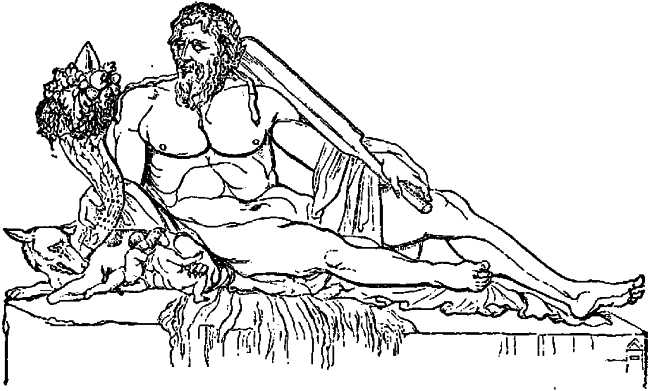
The generous policy of Tib. Sempronius Gracchus in B.C. 179[58] had secured for Spain a long period of tranquillity. But in B.C. 153, the inhabitants of Segeda having commenced rebuilding the walls of their town, which was forbidden by one of the articles in the treaty of Gracchus, a new war broke out, which lasted for many years. The Celtiberians in general espoused the cause of Segeda, and the Consul Q. Fabius Nobilior made an unsuccessful campaign against them. His successor, the Consul M. Claudius Marcellus, grandson of the Marcellus who was celebrated in the Second Punic War, carried on the war with vigor, and concluded a peace with the enemy on very fair terms (B.C. 152). The Consul of the following year, L. Lucinius Lucullus, finding the Celtiberians at peace, turned his arms against the Vaccæi, Cantabri, and other nations as yet unknown to the Romans. At the same time the Prætor Ser. Sulpicius Galba invaded Lusitania, but, though he met with some advantage at first, he was subsequently defeated with great loss, and escaped with only a few horsemen. In the following year (B.C. 150) he again invaded the country from the south, while Lucullus attacked it from the north. The Lusitanians therefore sent embassadors[Pg 144] to Galba to make their submission. He received them with kindness, lamented the poverty of their country, and promised to assign them more fertile lands, if they would meet him in three bodies, with their wives and children, in three places which he fixed upon. The simple people believed him. But he meditated one of the most atrocious acts of treachery and cruelty recorded in history. He fell upon each body separately, and butchered them, men, women, and children, without distinction. Among the very few who escaped was Viriathus, the future avenger of his nation. Galba was brought to trial on his return to Rome on account of this outrage; and Cato, then in the 85th year of his age, inveighed against his treachery and baseness. But Galba was eloquent and wealthy, and the liberal employment of his money, together with the compassion excited by his weeping children and ward, obtained his acquittal.
Viriathus appears to have been one of those able guerrilla chiefs whom Spain has produced at every period of her history. He is said to have been first a shepherd and afterward a robber, but he soon acquired unbounded influence over the minds of his countrymen. After the massacre of Galba, those Lusitanians who had not left their homes rose as a man against the rule of such treacherous tyrants. Viriathus at first avoided all battles in the plains, and waged an incessant predatory warfare in the mountains; and he met with such continued good fortune, that numbers flocked to his standard. The aspect of affairs seemed at length so threatening that in B.C. 145 the Romans determined to send the Consul Q. Fabius Maximus into the country. In the following year Fabius defeated Viriathus with great loss; but this success was more than counterbalanced by the revolt of the Celtiberians, the bravest and most noble-minded of the Spaniards. The war is usually known by the name of the Numantine, from Numantia, a town on the River Douro, and the capital of the Arevaci, the most powerful of the Celtiberian tribes.
Henceforward two Roman armies were employed in Spain, one in the north against the Celtiberians, and the other in the south against Viriathus and the Lusitanians. The war against the Lusitanians was at first brought to a conclusion. In B.C. 141 Viriathus surprised the Proconsul Fabius Servilianus in a narrow pass, where escape was impossible. He used his victory with moderation, and suffered the Romans to depart uninjured, on condition of their allowing the Lusitanians to retain undisturbed possession of their own territory, and recognizing him as a friend and ally of Rome. This treaty was ratified by the Roman people; but the Consul Q. Servilius Cæpio, who succeeded Fabius in the command in south[Pg 145]ern Spain, found some pretext for violating the peace, and renewed the war against Viriathus. The latter sent envoys to Cæpio to propose fresh terms of peace; but the Roman Consul persuaded them, by promises of large rewards, to murder their general. On their return they assassinated him in his own tent, and made their escape to the Roman camp before the Lusitanians were aware of the death of their chief. But, when the murderers claimed their reward, the Consul coolly told them that the Romans did not approve of the murder of a general by his own soldiers. The Lusitanians continued in arms a little longer, but the war virtually terminated by the death of Viriathus. Their country was finally reduced to subjection by the Consul D. Junius Brutus in B.C. 138, who also crossed the rivers Douro and Minho, and received the surname of Callaïcus in consequence of his receiving the submission of the Callaïci, or Gallæci, a people in the northwest of Spain.
The war against the Celtiberians was at first conducted with success by the Consul Q. Metellus Macedonicus, who during his Prætorship had defeated the pretender to the Macedonian throne. But the successors of Metellus experienced repeated disasters, and at length, in B.C. 137, the Consul C. Hostilius Mancinus, being entirely surrounded by the Celtiberians, was obliged to sign a peace with them, in which he recognized their independence. He only obtained these terms on condition that his Quæstor, Tib. Sempronius Gracchus, who was greatly respected by the Spaniards for his father's sake, should become responsible for the execution of the treaty. The Senate refused to ratify it, and went through the hypocritical ceremony of delivering over Mancinus, bound and naked, to the enemy. But the Numantines, like the Samnites in a similar case, declined to accept the offering.
The Numantine war continued in the same disastrous manner to the Roman arms, and the people now called upon Scipio Africanus to bring it to a conclusion. We have already traced the career of this eminent man till the fall of Carthage. In B.C. 142 he was Censor with L. Mummius. In the administration of the duties of his office he followed in the footsteps of Cato, and attempted to repress the growing luxury and immorality of his contemporaries; but his efforts were thwarted by his colleague. He vainly wished to check in the people the appetite for foreign conquests; and in the solemn prayer which he offered at the conclusion of the lustrum he changed the usual supplication for the enlargement of the Republic into one for its preservation. He was now elected Consul a second time, and was sent into Spain in B.C. 134. His first efforts were directed, as in Africa, to the restoration of discipline in the army, which had become disorganized and demoralized by[Pg 146] every kind of indulgence. Two remarkable men served under Scipio in this war. Marius, afterward seven times Consul, and the Numidian prince Jugurtha. Having brought his troops into an effective condition, Scipio, in the following year, proceeded to lay siege to Numantia. The town was defended by its inhabitants with the courage and perseverance which has pre-eminently distinguished the Spaniards in all ages in the defense of their walled towns. It was not till they had suffered the most dreadful extremities of famine, eating even the bodies of the dead, that they surrendered the place (B.C. 133). Fifty of the principal inhabitants were selected to adorn Scipio's triumph; the rest were sold as slaves, and the town was leveled to the ground. He now received the surname of Numantinus, in addition to that of Africanus.
During the Numantine war Rome was menaced by a new danger, which revealed one of the plague-spots in the Republic. We have already had occasion to describe the decay of the free population in Italy, and the great increase in the number of slaves from the foreign conquests of the state.[59] As slaves were cheap, in consequence of the abundant supply, the masters did not care for their lives, and treated them with great barbarity. A great part of the land in Italy was turned into sheep-walks. The slaves were made responsible for the sheep committed to their care, and were left to supply themselves with food as they best could. It was an aggravation of their wretched lot, that almost all these slaves had once been freemen, and were not distinguished from their masters by any outward sign, like the negroes in the United States. In Sicily the free population had diminished even more than in Italy; and it was in this island that the first Servile War broke out. Damophilus, a wealthy landowner of Enna, had treated his slaves with excessive barbarity. They entered into a conspiracy against their cruel master, and consulted a Syrian slave of the name of Eunus, who belonged to another master. This Eunus pretended to the gift of prophecy, and appeared to breathe flames of fire from his mouth. He not only promised them success, but joined in the enterprise himself. Having assembled to the number of about 400 men, they suddenly attacked Enna, and, being joined by their fellow-citizens within the town, quickly made themselves masters of it. Great excesses were committed, and almost all the freemen were put to death with horrid tortures. Eunus had, while yet a slave, prophesied that he should become king. He now assumed the royal diadem, and the title of King Antiochus. Sicily was at this time swarming with slaves, a great proportion of them Syrians, who flocked to the standard of their countryman and fellow-bonds[Pg 147]man. The revolt now became general, and the island was delivered over to the murderous fury of men maddened by oppression, cruelty, and insult. The Prætors, who first led armies against them, were totally defeated; and in B.C. 134 it was thought necessary to send the Consul C. Fulvius Flaccus to subdue the insurrection. But neither he, nor the Consul of the following year, succeeded in this object; and it was not till B.C. 132 that the Consul P. Rupilius brought the war to an end by the capture of Tauromenium and Enna, the two strong-holds of the insurgents. The life of Eunus was spared, probably with the intention of carrying him to Rome, but he died in prison at Morgantia.
About the same time died Attalus Philometor, the last king of Pergamus, leaving no children (B.C. 133). He beqeuathed his kingdom and treasures to the Roman people; but Aristonicus, a natural son of Eumenes, the father of Attalus, laid claim to the crown. He even defeated the Consul P. Licinius Crassus, who fell in the engagement (B.C. 131), but he was himself defeated and taken prisoner in the following year. The kingdom of Pergamus was formed into a Roman province under the name of Asia (B.C. 129).
The foreign dominions of Rome now comprised the ten following provinces, to which is added the date of the formation of each: 1. Sicily, B.C. 241. 2. Sardinia and Corsica, B.C. 238. 3, 4. The two Spains, Citerior and Ulterior, B.C. 205. 5. Gallia Cisalpina, B.C. 191. 6. Macedonia, B.C. 146. 7. Illyricum, probably formed at the same time as Macedonia. 8. Achaia, that is, Southern Greece, virtually a province after the capture of Corinth, B.C. 146, though the exact date of its formation is unknown. 9. Africa, consisting of the dominions of Carthage, B.C. 146. 10. Asia, including the kingdom of Pergamus, B.C. 129. To these an eleventh was added in B.C. 118 by the conquest of the southern portion of Transalpine Gaul between the Alps and the Pyrenees. In contrast with the other portions of Gaul, it was frequently called simply the "Provincia," a name which has been retained in the modern Provence.
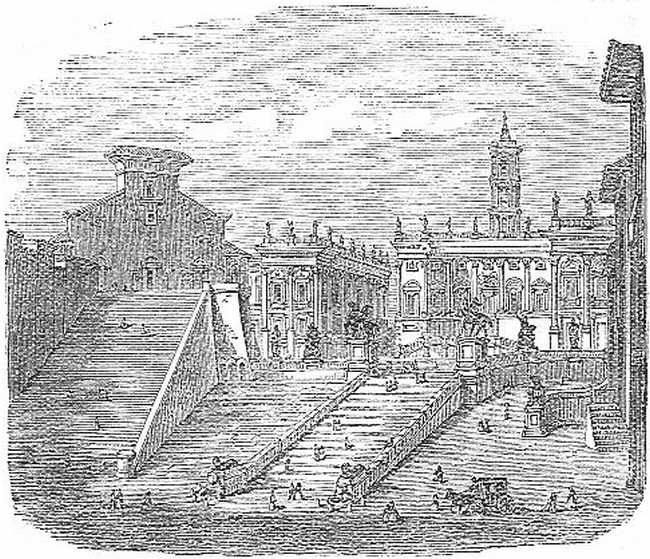
The more thoughtful Romans had foreseen the dangers with which Rome was menaced by the impoverishment of her free population, and the alarming increase in the number of slaves. It is said that Lælius, the friend of the elder Scipio Africanus, had at the close of the Second Punic War meditated some reforms to arrest the growing evil, but had given them up as impracticable. The Servile War in Sicily had lately revealed the extent of the peril to which the Republic was exposed. It must have been felt by many that the evil would never have reached its present height if the Livinian Law had been observed, if men had been appointed to watch over its execution, and if the newly-acquired public lands had from time to time been distributed among the people. But the nobles, from long possession, had come to regard the public land as their own; many had acquired their portions by purchase, inheritance,[Pg 149] or marriage; and every one shrank from interfering with interests supported by long prescription and usage. Still, unless something was done, matters would become worse; the poor would become poorer, and the slaves more numerous, and the state would descend more rapidly into the yawning abyss beneath it. Under these circumstances, two young men, belonging to one of the noblest families in Rome, came forward to save the Republic, but perished in the attempt. Their violent death may be regarded as the beginning of the Civil Wars, which ended in the destruction of freedom, and the establishment of the despotism of the Empire.
Tiberius and Caius Gracchus were the sons of Tib. Sempronius Gracchus, whose prudent measures gave tranquillity to Spain for so many years.[60] They lost their father at an early age, but they were educated with the utmost care by their mother, Cornelia, the daughter of Scipio Africanus the elder, who had inherited from her father a love of literature, and united in her person the severe virtue of the ancient Roman matron with the superior knowledge and refinement which then prevailed in the higher classes at Rome. She engaged for her sons the most eminent Greek teachers; and it was mainly owing to the pains she took with their education that they surpassed all the Roman youths of their age. Tiberius was nine years older than his brother Caius. The latter had more ability, but Tiberius was the more amiable, and won all hearts by the simplicity of his demeanor and his graceful and persuasive eloquence. So highly was Tiberius esteemed, that as soon as he reached the age of manhood he was elected Augur, and at the banquet given at his installation Appius Claudius, then Chief of the Senate, offered him his daughter in marriage. When Appius returned home and informed his wife that he had just betrothed their daughter, she exclaimed, "Why in such a hurry, unless you have got Tib. Gracchus for her husband?" Sempronia, the only sister of Tiberius, was married to the younger Scipio Africanus. Tiberius was thus, by birth and marriage, connected with the noblest families in the Republic—the grandson of the conqueror of Hannibal—the son-in-law of the Chief of the Senate—and the brother-in-law of the destroyer of Carthage.
Tiberius served under his brother-in-law in Africa, and was the first who scaled the walls of Carthage. He was Quæstor in B.C. 137, and accompanied the Consul C. Hostilius to Spain, where he saved the army by obtaining a treaty with the Numantines, which the Senate refused to ratify.[61] In passing through Etruria, on his way to Spain, Tiberius had observed with grief and indignation the deserted state of that fertile country. Thousands of foreign slaves[Pg 150] were tending the flocks and cultivating the soil of the wealthy landowners, while Roman citizens, thus thrown out of employment, could scarcely procure their daily bread, and had not a clod of earth to call their own. He now conceived the design of applying a remedy to this state of things, and with this view became a candidate for the Tribunate, and was elected for the year B.C. 133.
Tiberius, however, did not act with precipitation. The measure which he brought forward had previously received the approbation of some of the wisest and noblest men in the state; of his own father-in-law Appius Claudius; of P. Mucius Scævola, the great jurist, who was then Consul; and of Crassus, the Pontifex Maximus. It was proposed to re-enact the Licinian Law of B.C. 364—which had, in fact, never been repealed—but with some modifications and additions. As in the Licinian Law, no one was to be allowed to possess more than 500 jugera of public land; but, to relax the stringency of this rule, every possessor might hold in addition 250 jugera for each of his sons. All the rest of the public land was to be taken away from them and distributed among the poor citizens, who were not to be permitted to alienate these lots, in order that they might not be again absorbed into the estate of the wealthy. An indemnity was to be given from the public treasury for all buildings erected upon lands thus taken away. Three commissioners (Triumviri) were to be elected by the tribes in order to carry this law into execution.
The Law affected only Public Lands, but it was no less a revolutionary measure. It is true that no prescription can, as a general rule, be pleaded against the rights of the state, but the possessors of the public lands had enjoyed them without question for so long a period that they had come to regard these lands as their private property. In many cases, as we have already said, they had been acquired by bonâ fide purchase, and the claim of the state, now advocated by Gracchus, was regarded as downright robbery. Attacks upon property have produced the greatest convulsions in all states, and the Roman landowners were ready to have recourse to any measures to defeat the law. But the thousands who would be benefited by it were determined to support Tiberius at any risk. He told them that "the wild beasts of Italy had their dens, and holes, and hiding-places, while the men who fought and bled in defense of Italy wandered about with their wives and children without a spot of ground to rest upon." It was evident that the law would be carried, and the landowners therefore resorted to the only means left to them. They persuaded M. Octavius, one of the Tribunes, to put his veto upon the measure of his colleague. This was a fatal and unexpected obstacle. In vain did Tiberius implore[Pg 151] Octavius to withdraw his veto. The contest between the Tribunes continued for many days. Tiberius retaliated by forbidding the magistrates to exercise any of their functions, and by suspending, in fact, the entire administration of the government. But Octavius remained firm, and Tiberius therefore determined to depose him from his office. He summoned an Assembly of the People and put the question to the vote. Seventeen out of the thirty-five tribes had already voted for the deposition of Octavius, and the addition of one tribe would reduce him to a private condition, when Tiberius stopped the voting, anxious, at the last moment, to prevent the necessity of so desperate a measure. Octavius, however, would not yield. "Complete what you have begun," was his only answer to the entreaties of his colleague. The eighteenth tribe voted, and Tiberius ordered him to be dragged from the rostra. Octavius had only exercised his undoubted rights, and his deposition was clearly a violation of the Roman constitution. This gave the enemies of Gracchus the handle which they needed. They could now justly charge him not only with revolutionary measures, but with employing revolutionary means to carry them into effect.
The Agrarian Law was passed without farther opposition, and the three commissioners elected to put it in force were Tiberius himself, his father-in-law Appius Claudius, and his brother Caius, then a youth of twenty, serving under P. Scipio at Numantia. About the same time news arrived of the death of Attalus Philometor, king of Pergamus, who had bequeathed his kingdom and treasures to the Republic. Tiberius therefore proposed that these treasures should be distributed among the people who had received assignments of lands, to enable them to stock their farms and to assist them in their cultivation. He even went so far as to threaten to deprive the Senate of the regulation of the new province, and to bring the subject before the Assembly of the People. The exasperation of the Nobility was intense. They tried every means to blacken the character of the Tribune, and even spread a report that he had received, a diadem and a purple robe from the envoy from Pergamus, and that he meditated making himself King of Rome. It was evident that his life would be no longer safe when he ceased to be protected by the sanctity of the Tribune's office. Accordingly, he became a candidate for the Tribunate for the following year. The Tribunes did not enter upon their office till December, but the election took place in June, at which time the country people, on whom he chiefly relied, were engaged in getting in the harvest. Still, two tribes had already voted in his favor, when the nobility interrupted the election by maintaining[Pg 152] that it was illegal, since no man could be chosen Tribune for two consecutive years. After a violent debate the Assembly was adjourned till the following day. Tiberius now became alarmed lest his enemies should get the upper hand, and he went round the forum with his child, appealing to the sympathy of the people and imploring their aid. They readily responded to his appeal, escorted him home, and a large crowd kept watch around his house all night.
Next day the adjourned Assembly met on the Capitol in the open space in front of the Temple of Jupiter. The Senate also assembled in the Temple of Faith close by. Scipio Nasica, the leader of the more violent party in the Senate, called upon the Consul Mucius Scævola to stop the re-election, but the Consul declined to interfere. Fulvius Flaccus, a Senator, and a friend of Tiberius, hastened to inform him of the speech of Nasica, and told him that his death was resolved upon. Thereupon the friends of Tiberius prepared to resist force by force; and as those at a distance could not hear him, on account of the tumult and confusion, the Tribune pointed with his hand to his head, to intimate that his life was in danger. His enemies exclaimed that he was asking for the crown. The news reached the Senate. Nasica appealed to the Consul to save the Republic, but as Scævola still refused to have recourse to violence, Nasica sprung up and exclaimed, "The Consul is betraying the Republic! let those who wish to save the state follow me." He then rushed out of the Senate-house, followed by many of the Senators. The people made way for them; and they, breaking up the benches, armed themselves with sticks, and rushed upon Tiberius and his friends. The tribune fled to the Temple of Jupiter, but the door had been barred by the priests, and in his flight he fell over a prostrate body. As he was rising he received the first blow from one of his colleagues, and was quickly dispatched. Upward of 300 of his partisans were slain on the same day. Their bodies were thrown into the Tiber. This was the first blood shed at Rome in civil strife since the expulsion of the kings.
Notwithstanding their victory, the Nobles did not venture to propose the repeal of the Agrarian Law, and a new Commissioner was chosen in the place of Tiberius. The popular indignation was so strongly excited against Scipio Nasica that his friends advised him to withdraw from Italy, though he was Pontifex Maximus, and therefore ought not to have quitted the country. He died shortly afterward at Pergamus.
All eyes were now turned to Scipio Africanus, who returned to Rome in B.C. 132. When Scipio received at Numantia the news[Pg 153] of the death of Tiberius, he is reported to have exclaimed in the verse of Homer[62]—
The people may have thought that the brother-in-law of Tiberius would show some sympathy with his reforms and some sorrow for his fate. They were, however, soon undeceived. Being asked in the Assembly of the Tribes by C. Papirius Carbo, the Tribune, who was now the leader of the popular party, what he thought of the death of Tiberius, he boldly replied that "he was justly slain." The people, who had probably expected a different answer, loudly expressed their disapprobation; whereupon Scipio, turning to the mob, bade them be silent, since Italy was only their step-mother.[63] The people did not forget this insult; but such was his influence and authority that the Nobility were able to defeat the bill of Carbo by which the Tribunes might be re-elected as often as the people pleased. Scipio was now regarded as the acknowledged leader of the Nobility, and the latter resolved to avail themselves of his powerful aid to prevent the Agrarian Law of Tiberius from being carried into effect. The Italians were alarmed at the prospect of losing some of their lands, and Scipio skillfully availed himself of the circumstance to propose in the Senate (B.C. 129) that all disputes respecting the lands of the Italians should be taken out of the hands of the Commissioners and transferred to the Consuls. This would have been equivalent to an abrogation of the law, and accordingly the three Commissioners offered the most vehement opposition to his proposal. In the forum he was attacked by Carbo, with the bitterest invectives, as the enemy of the people; and upon his again expressing his approval of the death of Tiberius, the people shouted out, "Down with the tyrant!" In the evening he went home accompanied by the Senate and a great number of the Italians. He retired to his sleeping-room with the intention of composing a speech for the following day. Next morning Rome was thrown into consternation by the news that Scipio was found dead in his room. The most contradictory rumors were circulated respecting his death, but it was the general opinion that he was murdered. Suspicion fell upon various persons, but Carbo was most generally believed to have been the murderer. There was no inquiry into the cause of his death (B.C. 129).
Scipio was only 56 at the time of his death. To the Republic[Pg 154] his loss was irreparable. By his last act he had come forward as the patron of the Italians. Had he lived he might have incorporated them in the Roman state, and by forming a united Italy have saved Rome from many of the horrors and disasters which she afterward suffered.
The leaders of the popular party perceived the mistake they had made in alienating the Italians from their cause, and they now secured their adhesion by offering them the Roman citizenship if they would support the Agrarian Law. As Roman citizens they would, of course, be entitled to the benefits of the law, while they would, at the same time, obtain what they had so long desired—an equal share in political power. But the existing citizens, who saw that their own importance would be diminished by an increase in their numbers, viewed such a proposal with the utmost repugnance. So strong was their feeling that, when great numbers of the Italians had flocked to Rome in B.C. 126, the Tribune M. Junius Pennus carried a law that all aliens should quit the city. Caius Gracchus spoke against this law, and his friends still remained faithful to the cause of the Italians. In the following year (B.C. 125), M. Fulvius Flaccus, who was then Consul, brought forward a Reform Bill, granting the Roman citizenship to all the Italian allies. But it was evident that the Tribes would reject this law, and the Senate got rid of the proposer by sending him into Transalpine Gaul, where the Massilians had implored the assistance of Rome against the Salluvians. In the previous year Caius Gracchus had gone to Sardinia as Quæstor, so that the Senate had now removed from Rome two of their most troublesome opponents, and the Italians had lost their two most powerful patrons. Bitter was the disappointment of the Italians. Fregellæ, a town of Latium, and one of the eighteen Latin colonies which had remained faithful to Rome during the Second Punic War, took up arms, but its example was not followed, and it had to bear alone the brunt of the unequal contest. It was quickly reduced by the Prætor L. Opimius; the city was utterly destroyed; and the insurrection, which a slight success would have made universal, was thus nipped in its bud (B.C. 125).
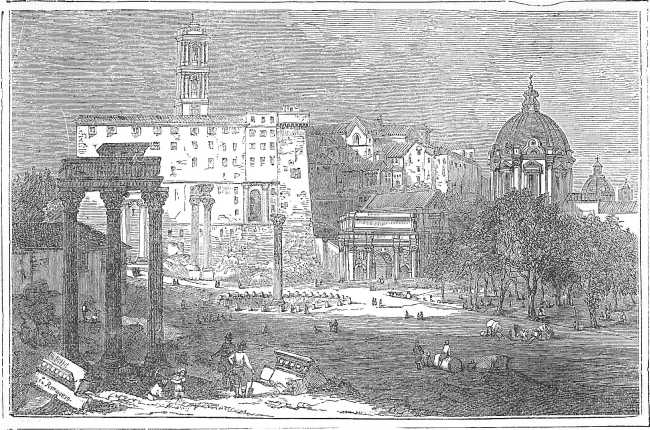
Caius Gracchus had taken very little part in public affairs since his brother's death. He had spoken only twice in public: once in favor of the law of Carbo for the re-election of Tribunes, and a second time in opposition to the Alien Act of Junius Pennus, as already mentioned. But the eyes of the people were naturally turned toward him. His abilities were known, and the Senate dreaded his return to Rome. He had been already two years in Sardinia, and they now attempted to retain him there another year[Pg 157] by sending fresh troops to the province, and by commanding the Proconsul to remain in the island. But Caius suddenly appeared at Rome, to the surprise of all parties (B.C. 124). His enemies brought him before the Censors to account for his conduct, but he defended himself so ably that not only was no stigma put upon him, but he was considered to have been very badly used. He showed that he had served in the army twelve years, though required to serve only ten; that he had acted as Quæstor two years, though the law demanded only one year's service; and he added that he was the only soldier who took out with him a full purse and brought it back empty.
Exasperated by the persecution of the Senate, Caius determined to become a candidate for the Tribuneship, and to reform the Roman constitution. He was elected for the year B.C. 123, and lost no time in bringing forward a number of important measures which are known as the Sempronian Laws. His legislation was directed to two objects: the amelioration of the condition of the poor, and the weakening of the power of the Senate. Caius was the greatest orator of all his contemporaries; the contagion of his eloquence was irresistible, and the enthusiasm of the people enabled him to carry every thing before him.
I. His principal laws for improving the condition of the people were:
1. The extension of the Agrarian Law of his brother by planting new colonies in Italy and the provinces.
2. A state provision for the poor, enacting that corn should be sold to every citizen at a price much below its market value. This was the first of the Leges Frumentariæ, which were attended with the most injurious effects. They emptied the treasury, at the same time that they taught the poor to become state paupers, instead of depending upon their own exertions for a living.
3. Another law enacted that the soldiers should be equipped at the expense of the Republic, without the cost being deducted from their pay, as had hitherto been the case.
II. The most important laws designed to diminish the power of the Senate were:
1. The law by which the Judices were to be taken only from the Equites, and not from the Senators, as had been the custom hitherto. This was a very important enactment, and needs a little explanation. All offenses against the state were originally tried in the Popular Assembly; but when special enactments were passed for the trial of particular offenses, the practice was introduced of forming a body of Judices for the trial of these offenses. This was first done upon the passing of the Calpurnian Law (B.C., 149) for[Pg 158] the punishment of provincial magistrates for extortion in their government (De Repetendis). Such offenses had to be tried before the Prætor and a jury of Senators; but as these very Senators either had been or hoped to be provincial magistrates, they were not disposed to visit with severity offenses of which they themselves either had been or were likely to be guilty. By depriving the Senators of this judicial power, and by transferring it to the Equites, Gracchus also made the latter a political order in the state apart from their military character. The name of Equites was now applied to all persons who were qualified by their fortune to act as Judices, whether they served in the army or not. From this time is dated the creation of an Ordo Equestris, whose interests were frequently opposed to those of the Senate, and who therefore served as a check upon the latter.
2. Another law was directed against the arbitrary proceedings of the Senate in the distribution of the provinces. Hitherto the Senate had assigned the provinces to the Consuls after their election, and thus had had it in their power to grant wealthy governments to their partisans, or unprofitable ones to those opposed to them. It was now enacted that, before the election of the Consuls, the Senate should determine the two provinces which the Consuls should have; and that they should, immediately after election, settle between themselves, by lot or otherwise, which province each should take.
These laws raised the popularity of Caius still higher, and he became for a time the absolute ruler of Rome. He was re-elected Tribune for the following year (B.C. 122), though he did not offer himself as a candidate. M. Fulvius Flaccus, who had been Consul in B.C. 125, was also chosen as one of his colleagues. Flaccus, it will be recollected, had proposed in his consulship to give the Roman franchise to the Italian allies, and it was now determined to bring forward a similar measure. Caius therefore brought in a bill conferring the citizenship upon all the Latin colonies, and making the Italian allies occupy the position which the Latins had previously held. This wise measure was equally disliked in the forum and the Senate. Neither the influence nor the eloquence of Gracchus could induce the people to view with satisfaction the admission of the Italian allies to equal rights and privileges with themselves. The Senate, perceiving that the popularity of Gracchus had been somewhat shaken by this measure, employed his colleague, M. Living Drusus—who was noble, well-educated, wealthy, and eloquent—to undermine his influence with the people. With the sanction of the Senate, Drusus now endeavored to outbid Gracchus. He played the part of a demagogue in order to supplant[Pg 159] the true friend of the people. He gave to the Senate the credit of every popular law which he proposed, and gradually impressed the people with the belief that the Nobles were their best friends. Gracchus proposed to found two colonies at Tarentum and Capua, and named among the founders some of the most respectable citizens. Drusus introduced a law for establishing no fewer than twelve colonies, and for settling 3000 poor citizens in each. Gracchus, in the distribution of the public land, reserved a rent payable to the public treasury. Drusus abolished even this payment. He also gained the confidence of the people by asking no favor for himself; he took no part in the foundation of colonies, and left to others the management of business in which any money had to be expended. Gracchus, on the other hand, superintended every thing in person; and the people, always jealous in pecuniary matters, began to suspect his motives. During his absence in Africa, whither he had gone as one of the three Commissioners for founding a colony upon the ruins of Carthage, Drusus was able to weaken his popularity still farther. On his return he endeavored in vain to reorganize his party and recover his power. Both he and Flaccus failed in being re-elected Tribunes; while L. Opimius and Q. Fabius, two personal enemies of Gracchus, were raised to the Consulship. The two new Consuls had no sooner entered upon office (B.C. 121) than they resolved to drive matters to extremities. One of the first measures of Opimius was a proposal to repeal the law for colonizing Carthage, because it had been established upon the site which Scipio had cursed. It was evident that a pretext was only sought for taking the life of Gracchus, and Flaccus urged him to repel violence by force. Caius shrunk from this step, but an accident gave his enemies the pretext which they longed for. The tribes had assembled at the Capitol to decide upon the colony at Carthage, when a servant of the Consul Opimius, pushing against Gracchus, insolently cried out, "Make way for honest men, you rascals." Gracchus turned round to him with an angry look, and the man was immediately stabbed by an unknown hand. The assembly immediately broke up, and Gracchus returned home, foreseeing the advantage which this unfortunate occurrence would give to his enemies. The Senate declared Gracchus and Flaccus public enemies, and invested the Consuls with dictatorial powers. During the night Opimius took possession of the Temple of Castor and Pollux, which overlooked the forum; summoned a meeting of the Senate for the following morning, and ordered all the partisans of the Senate to be present, each with two armed slaves. Flaccus seized the Temple of Diana on the Aventine, and distributed arms to his followers: here he was joined by Gracchus. Civil war was[Pg 160] thus declared. After some fruitless attempts at negotiation, the Consul proceeded to attack the Aventine. Little or no resistance was made, and Flaccus and Gracchus took to flight, and crossed the Tiber by the Sublician bridge. Gracchus escaped to the Grove of the Furies, accompanied only by a single slave. When the pursuers reached the spot they found both of them dead. The slave had first killed his master and then himself. The head of Gracchus was cut off, and carried to Opimius, who gave to the person who brought it its weight in gold. Flaccus was also put to death, together with numbers of his party. Their corpses were thrown into the Tiber, their houses demolished, and their property confiscated. Even their widows were forbidden to wear mourning. After the bloody work had been finished, the Consul, by order of the Senate, dedicated a temple to Concord!
At a later time statues of the two Gracchi were set up in public places, and the spots on which they fell were declared holy ground; but for the present no one dared to show any sympathy for their fate. Their mother Cornelia retired to Misenum, where she was visited by the most distinguished men. She loved to recount to her guests the story of her noble sons, and narrated their death without showing sorrow or shedding tears, as if she had been speaking of heroes of the olden time.
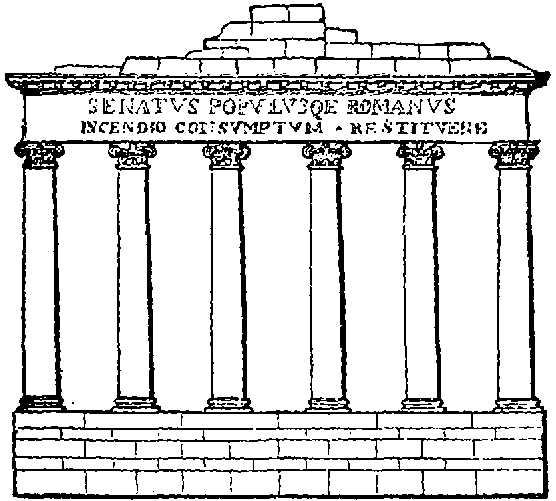
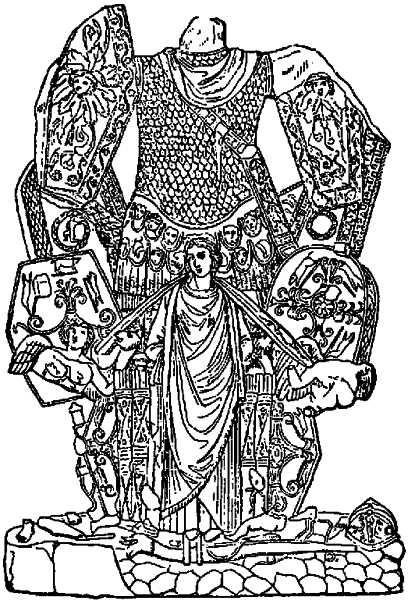
The murder of C. Gracchus and his adherents left the Nobility undisputed masters of the state, till their scandalous conduct in the Jugurthan War provoked a reaction against them, and raised to power a more terrible opponent than the Gracchi had ever been. This man, who took such signal vengeance upon the Nobility, was the lowborn MARIUS. He was a native of Arpinum, and was said to have worked for wages as a common peasant before he entered the ranks of the army. He first served in Spain, and was present at the siege of Numantia in B.C. 134. Here he distinguished himself so much that he attracted the notice of Scipio Africanus, and received from him many marks of honor. Scipio indeed admitted him to his table; and on a certain occasion, when one of the guests asked Scipio where the Roman people would find[Pg 162] such another general after his death, he is said to have laid his hand on the shoulder of Marius, and said, "Perhaps here." The name of Marius does not occur again for many years, but he doubtless continued to serve in the army, and became so distinguished that he was at length raised to the Tribunate of the Plebs in B.C. 119, though not till he had attained the mature age of 38. Only two years had elapsed since the death of C. Gracchus; and the Nobles, flushed with victory, resolved to put down with a high hand the least invasion of their privileges and power. But Marius had the boldness to propose a law for the purpose of giving greater freedom at elections; and when the Senate attempted to overawe him, he ordered one of his officers to carry the Consul Metellus to prison. Marius now became a marked man. He lost his election to the Ædileship, and with difficulty obtained the Prætorship (B.C. 115); but he added to his influence by his marriage with Julia, the sister of C. Julius Cæsar, the father of the future ruler of Rome. His military abilities recommended him to the Consul Metellus (B.C. 100), who was anxious to restore discipline in the army and to retrieve the glory of the Roman name, which had been tarnished by the incapacity and corruption of the previous generals in the Jugurthan War, which now requires our attention.
Masinissa, the ruler of Numidia, and so long the faithful ally of the Romans, had died in B.C. 149, at the advanced age of 90, leaving three sons, Micipsa, Mastanabal, and Gulussa, among whom his kingdom was divided by Scipio Africanus, according to the dying directions of the old king. Mastanabal and Gulussa dying in their brother's lifetime, Micipsa became sole king. Jugurtha was a bastard son of Mastanabal; but Micipsa brought him up with his own sons, Hiempsal and Adherbal. Jugurtha distinguished himself so much that he began to excite the jealousy of Micipsa. In order to remove him to a distance, and not without a hope that he might perish in the war, Micipsa sent him, in B.C. 134, with an auxiliary force, to assist Scipio against Numantia; but this only proved to the young man a fresh occasion of distinction. By his zeal, courage, and ability he gained the favor not only of his commander, but of all the leading nobles in the Roman camp, by many of whom he was secretly stimulated to nourish ambitious schemes for acquiring the sole sovereignty of Numidia; and notwithstanding the contrary advice of Scipio, the counsels seem to have sunk deep into the mind of Jugurtha. On his return he was received with every demonstration of honor by Micipsa; nor did he allow his ambitious projects to break forth during the lifetime of the old man. Micipsa, on his death-bed, though but too clearly foreseeing what would happen, commended the two young princes to the care[Pg 163] of Jugurtha; but at the very first interview which took place between them after his decease (B.C. 118) their dissensions broke out with the utmost fierceness. Shortly afterward Jugurtha found an opportunity to surprise and assassinate Hiempsal; whereupon Adherbal and his partisans rushed to arms, but were defeated in battle by Jugurtha. Adherbal himself fled for refuge to the Roman province, from whence he hastened to Rome to lay his cause before the Senate. Jugurtha had now the opportunity, for the first time, of putting to the test that which he had learnt in the camp before Numantia of the venality and corruption of the Roman nobility. He sent embassadors to Rome to counteract, by a lavish distribution of bribes, the effect of the just complaints of Adherbal, and by these means succeeded in averting the indignation of the Senate. A decree was, however, passed for the division of the kingdom of Numidia between the two competitors, and a committee of Senators sent to enforce its execution; but as soon as these arrived in Africa, Jugurtha succeeded in gaining them over by the same unscrupulous methods, and obtained, in the partition of the kingdom, the western division adjacent to Mauritania, by far the larger and richer portion of the two (B.C. 117). But this advantage was far from contenting him, and shortly afterward he invaded the territories of his rival with a large army. Adherbal was defeated in the first engagement, his camp taken, and he himself with difficulty made his escape to the strong fortress of Cirta. Here he was closely blockaded by Jugurtha. The garrison surrendered on a promise of their lives being spared; but these conditions were shamefully violated by Jugurtha, who immediately put to death Adherbal and all his followers (B.C. 112).
Indignation was now loud at Rome against the Numidian king; yet so powerful was the influence of those whose favor he had gained by his gold, that he would probably have prevailed upon the Senate to overlook all his misdeeds, had not one of the Tribunes, C. Memmius, by bringing the matter before the people, compelled the Senators to give way. War was accordingly declared against him, and one of the Consuls, L. Calpurnius Bestia, landed in Africa with a large army, and immediately proceeded to invade Numidia (B.C. 111). But Jugurtha easily bribed Bestia and M. Scaurus, who acted as his principal lieutenant, to grant him a favorable peace, on condition only of a pretended submission, together with the surrender of thirty elephants and a small sum of money. As soon as the tidings of this disgraceful transaction reached Rome, the indignation excited was so great that, on the proposition of C. Memmius, it was agreed to send the Prætor L. Cassius, a man of the highest integrity, to Numidia, in order to[Pg 164] prevail on the king to repair in person to Rome, the popular party hoping to be able to convict the leaders of the Nobility by means of his evidence. The safe-conduct granted him by the state was religiously observed; but the scheme failed of its effect, for, as soon as Jugurtha was brought forward in the assembly of the people to make his statement, one of the Tribunes, who had been previously gained over by the friends of Scaurus and Bestia, forbade him to speak. He nevertheless remained at Rome for some time longer, and engaged in secret intrigues, which would probably have been ultimately crowned with success had he not in the mean time ventured to assassinate Massiva, son of Gulussa, who was putting in a claim to the Numidian throne. It was impossible to overlook so daring a crime, perpetrated under the very eyes of the Senate. Jugurtha was ordered to quit Italy without delay. It was on this occasion that he is said, when leaving Rome, to have uttered the memorable words, "A city for sale, and destined to perish quickly, if it can find a purchaser."
War was now inevitable; but the incapacity of Sp. Postumius Albinus, who arrived to conduct it (B.C. 110), and still more that of his brother Aulus, whom he left to command in his absence, when called away to hold the elections at Rome, proved as favorable to Jugurtha as the corruption of their predecessors. Aulus, having penetrated into the heart of Numidia, suffered himself to be surprised in his camp; great part of his army was cut to pieces, and the rest only escaped a similar fate by the ignominy of passing under the yoke. But Jugurtha had little reason to rejoice in this success, great as it might at first appear; for the disgrace at once roused all the spirit of the Roman people; the treaty concluded by Aulus was instantly annulled, immense exertions made to raise troops, and one of the Consuls for the new year (B.C. 109), Q. Cæcilius Metellus, hastened to Numidia to retrieve the honor of the Roman arms. But this did not satisfy the people. The scandalous conduct of so many of the Nobles had given fresh life to the popular party; and the Tribune C. Mamilius carried a bill for the appointment of three Commissioners to inquire into the conduct of all of those who had received bribes from Jugurtha. Scaurus, though one of the most guilty, managed to be put upon the Commission. But he dared not shield his confederates. Many men of the highest rank were condemned, among whom were Bestia, Albinus, and Opimius. The last named was the Opimius who acted with such ferocity toward Caius Gracchus and his party. He died in exile at Dyrrhachium some years afterward, in great poverty.
The Consul Metellus, who was an able general and a man of[Pg 165] the strictest integrity, landed in Africa, with Marius as his lieutenant, in B.C. 109. As soon as Jugurtha discovered the character of the new commander he began to despair of success, and made overtures for submission in earnest. These were apparently entertained by Metellus, while he sought in fact to gain over the adherents of the king, and induce them to betray him to the Romans, at the same time that he continued to advance into the enemy's territories. Jugurtha, in his turn, detected his designs, attacked him suddenly on his march with a numerous force, but was, after a severe struggle, repulsed, and his army totally routed. Metellus ravaged the greater part of the country, but failed in taking the important town of Zama before he withdrew into winter quarters. But he had produced such an effect upon the Numidian king, that Jugurtha was induced, in the course of the winter, to make offers of unqualified submission, and even surrendered all his elephants, with a number of arms and horses, and a large sum of money, to the Roman general; but when called upon to place himself personally in the power of Metellus, his courage failed him, he broke off the negotiation, and once more had recourse to arms. Marius had greatly distinguished himself in the preceding campaign. The readiness with which he shared the toils of the common soldiers, eating of the same food, and working at the same trenches with them, had endeared him to them, and through their letters to their friends at Rome his praises were in everybody's mouth. His increasing reputation and popularity induced him to aspire to the Consulship. His hopes were increased by a circumstance which happened to him at Utica. While sacrificing at this place the officiating priest told him that the victims predicted some great and wonderful events, and bade him execute whatever purpose he had in his mind. Marius thereupon applied to Metellus for leave of absence, that he might proceed to Rome and offer himself as a candidate. The Consul, who belonged to a family of the highest nobility, at first tried to dissuade Marius from his presumptuous attempt, by pointing out the certainty of failure; and when he could not prevail upon him to abandon his design, he civilly evaded his request by pleading the exigencies of the public service, which required his presence and assistance. But, as Marius still continued to press him for leave of absence, Metellus said to him on one occasion, "You need not be in such a hurry to go to Rome; it will be quite time enough for you to apply for the Consulship along with my son." The latter, who was then serving with the army, was a youth of only twenty years of age, and could not, therefore, become a candidate for the Consulship for the next twenty years. This insult was never forgotten by Marius. He[Pg 166] now began to intrigue against his general, and to represent that the war was purposely prolonged by Metellus to gratify his own vanity and love of military power. He openly declared that with one half of the army he would soon have Jugurtha in chains; and as all his remarks were carefully reported at Rome, the people began to regard him as the only person competent to finish the war. Metellus at last allowed him to leave Africa, but only twelve days before the election. Meeting with a favorable wind, he arrived at Rome in time, and was elected Consul with an enthusiasm which bore down all opposition. He received from the people the province of Numidia, although the Senate had previously decreed that Metellus should continue in his command. The exultation of Marius knew no bounds. In his speeches to the public, he gloried in his humble origin. He upbraided the Nobles with their effeminacy and licentiousness; he told them that he looked upon the Consulship as a trophy of his conquest over them; and he proudly compared his own wounds and military experience with their indolence and ignorance of war. It was a great triumph for the people and a great humiliation for the aristocracy, and Marius made them drink to the dregs the bitter cup. While engaged in these attacks upon the Nobility, he at the same time carried on a levy of troops with great activity, and enrolled any persons who chose to offer for the service, however poor and mean, instead of taking them from the five classes according to ancient custom.[64]
Meantime Metellus had been carrying on the war in Africa as Proconsul (B.C. 108). But the campaign was not productive of such decisive results as might have been expected. Jugurtha avoided any general action, and eluded the pursuit of Metellus by the rapidity of his movements. Even when driven from Thala, a strong-hold which he had deemed inaccessible from its position in the midst of arid deserts, he only retired among the Gætulians, and quickly succeeded in raising among those wild tribes a fresh army, with which he once more penetrated into the heart of Numidia. A still more important accession was that of Bocchus, king of Mauritania, who had been prevailed upon to raise an army, and advance to the support of Jugurtha. Metellus, however, having now relaxed his own efforts, from disgust at hearing that C. Marius had been appointed to succeed him in the command, remained on the defensive, while he sought to amuse the Moorish king by negotiation. The arrival of Marius (B.C. 107) infused fresh vigor into the Roman arms. He quickly reduced in succession almost all the strong-holds that still remained to Jugurtha, in some of which the king[Pg 167] had deposited his principal treasures; and the latter, seeing himself thus deprived step by step of all his dominions, at length determined on a desperate attempt to retrieve his fortunes by one grand effort. He with difficulty prevailed on the wavering Bocchus, by the most extensive promises in case of success, to co-operate with him in this enterprise; and the two kings, with their united forces, attacked Marius on his march, when he was about to retire into winter quarters. Though the Roman general was taken by surprise for a moment, his consummate skill and the discipline of his troops proved again triumphant; the Numidians were repulsed, and their army, as usual with them in case of a defeat, dispersed in all directions. Jugurtha himself, after displaying the greatest courage in the action, cut his way almost alone through a body of Roman cavalry, and escaped from the field of battle. He quickly again gathered round him a body of Numidian horse; but his only hope of continuing the war now rested on Bocchus. The latter was for some time uncertain what course to adopt, but was at length gained over by Sulla, the Quæstor of Marius, to the Roman cause, and joined in a plan for seizing the person of the Numidian king. Jugurtha fell into the snare; he was induced, under pretense of a conference, to repair with only a few followers to meet Bocchus, when he was instantly surrounded, his attendants cut to pieces, and he himself made prisoner, and delivered in chains to Sulla, by whom he was conveyed directly to the camp of Marius. This occurred early in the year B.C. 106.
L. Cornelius Sulla, the Quæstor of Marius, who afterward plays such a distinguished part in Roman history, was descended from a Patrician family which had been reduced to great obscurity. But his means were sufficient to secure him a good education. He studied the Greek and Roman writers with diligence and success, and early imbibed that love of literature and art by which he was distinguished throughout his life. But he was also fond of pleasure, and was conspicuous even among the Romans for licentiousness and debauchery. He was in every respect a contrast to Marius. He possessed all the accomplishments and all the vices which the old Cato had been most accustomed to denounce, and he was one of those advocates of Greek literature and of Greek profligacy who had since Cato's time become more and more common among the Roman Nobles. But Sulla's love of pleasure did not absorb all his time, nor enfeeble his mind; for no Roman during the latter days of the Republic, with the exception of Julius Cæsar, had a clearer judgment, a keener discrimination of character, or a firmer will. Upon his arrival in Africa, Marius was not well pleased that a Quæstor had been assigned to him who was only known for his[Pg 168] profligacy, and who had had no experience in war; but the zeal and energy with which Sulla attended to his new duties soon rendered him a useful and skillful officer, and gained for him the unqualified approbation of his commander, notwithstanding his previous prejudices against him. He was equally successful in winning the affections of the soldiers. He always addressed them with the greatest kindness, seized every opportunity of conferring favors upon them, was ever ready to take part in all the jests of the camp, and at the same time never shrank from sharing in all their labors and dangers. It is a curious circumstance that Marius gave to his future enemy and the destroyer of his family and party the first opportunity of distinguishing himself. The enemies of Marius claimed for Sulla the glory of the betrayal of Jugurtha, and Sulla himself took the credit of it by always wearing a signet ring representing the scene of the surrender.
Marius continued more than a year in Africa after the capture of Jugurtha. He entered Rome on the first of January, B.C. 104, leading Jugurtha in triumph. The Numidian king was then thrown into a dungeon, and there starved to death. Marius, during his absence, had been elected Consul a second time, and he entered upon his office on the day of his triumph. The reason of this unprecedented honor will be related in the following chapter.
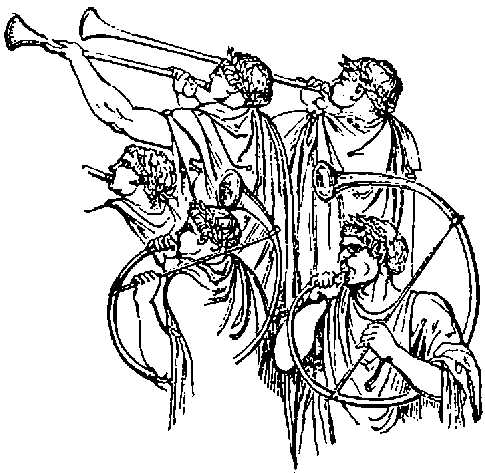
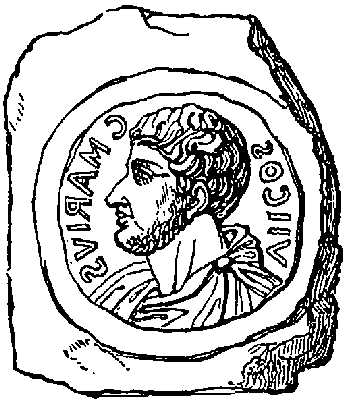
A greater danger than Rome had experienced since the time of Hannibal now threatened the state. Vast numbers of barbarians, such as spread over the south of Europe in the later times of the Roman Empire, had collected together on the northern side of the Alps, and were ready to pour down upon Italy. The two leading nations of which they consisted are called Cimbri and Teutones, of whom the former were probably Celts and the latter Germans, but the exact parts of Europe from which they came can not be ascertained. The whole host is said to have contained 300,000 fighting men, besides a much larger number of women and children. The alarm at Rome was still farther increased by the ill success which had hitherto attended the arms of the Republic against these barbarians. Army after army had fallen before them. The Cimbri were first heard of in B.C. 113, in Noricum, whence they descended into Illyricum, and defeated a Roman army under the command of Cn. Papirius Carbo. They then marched westward into Switzerland, where they were joined by the Tigurini and the Ambrones. They next poured over Gaul, which they plundered and ravaged in every direction. The Romans sent army after army to defend the southwestern part of the country, which was now a Roman province; but all in vain. In B.C. 109 the Consul M. Junius Silanus was defeated by the Cimbri; in B.C. 107 the Tigurini cut in pieces, near the Lake of Geneva, the army of the Consul L. Cassius Lon[Pg 170]ginus, the colleague of Marias, who lost his life in the battle; and shortly afterward M. Aurelius Scaurus was also defeated and taken prisoner. But the most dreadful loss was still to come. In B.C. 105 two consular armies, commanded by the Consul Cn. Mallius Maximus and the Proconsul Cn. Servilius Cæpio, consisting of 80,000 men, were completely annihilated by the barbarians: only two men are said to have escaped the slaughter.
These repeated disasters hushed all party quarrels. Every one at Rome felt that Marius was the only man capable of saving the state, and he was accordingly elected Consul by the unanimous votes of all parties while he was still absent in Africa. He entered Rome in triumph, as we have already said, on the 1st of January, B.C. 104, which was the first day of his second Consulship. Meantime the threatened danger was for a while averted. Instead of crossing the Alps and pouring down upon Italy, as had been expected, the Cimbri marched into Spain, which they ravaged for the next two or three years. This interval was advantageously employed by Marius in training the new troops, and accustoming them to hardships and toil. It was probably during this time that he introduced the various changes into the organization of the Roman army which are usually attributed to him. Notwithstanding the sternness and severity with which he punished the least breach of discipline, he was a favorite with his new soldiers, who learned to place implicit confidence in their general, and were delighted with the strict impartiality with which he visited the offenses of the officers as well as of the privates. As the enemy still continued in Spain, Marius was elected Consul a third time for the year B.C. 103, and also a fourth time for the following year, with Q. Lutatius Catulus as his colleague. It was in this year (B.C. 102) that the long-expected barbarians arrived. The Cimbri, who had returned from Spain, united their forces with the Teutones. Marius first took up his position in a fortified camp upon the Rhone, probably in the vicinity of the modern Arles; and as the entrance of the river was nearly blocked up by mud and sand, he employed his soldiers in digging a canal from the Rhone to the Mediterranean, that he might the more easily obtain his supplies from the sea.[65] Meantime the barbarians had divided their forces. The Cimbri marched round the northern foot of the Alps, in order to enter Italy by the northeast, crossing the Tyrolese Alps by the defiles of Tridentum (Trent). The Teutones and Ambrones, on the other hand, marched against Marius, intending, as it seems, to penetrate into Italy by Nice and the Riviera of Genoa. Marius, anxious to ac[Pg 171]custom his soldiers to the savage and strange appearance of the barbarians, would not give them battle at first. The latter resolved to attack the Roman camp; but as they were repulsed in this attempt, they pressed on at once for Italy. So great were their numbers, that they are said to have been six days in marching by the Roman camp. As soon as they had advanced a little way, Marius followed them; and thus the armies continued to march for a few days, the barbarians in the front and Marius behind, till they came to the neighborhood of Aquæ Sextiæ (Aix). Here the decisive battle was fought. An ambush of 3000 soldiers, which Marius had stationed in the rear of the barbarians, and which fell upon them when they were already retreating, decided the fortune of the day. Attacked both in front and rear, and also dreadfully exhausted by the excessive heat of the weather, they at length broke their ranks and fled. The carnage was dreadful; the whole nation was annihilated, for those who escaped put an end to their lives, and their wives followed their example. Immediately after the battle, as Marius was in the act of setting fire to the vast heap of broken arms which was intended as an offering to the gods, horsemen rode up to him, and greeted him with the news of his being elected Consul for the fifth time.
The Cimbri, in the mean time, had forced their way into Italy. The colleague of Marius, Q. Lutatius Catulus, despairing of defending the passes of the Tyrol, had taken up a strong position on the Athesis (Adige); but, in consequence of the terror of his soldiers at the approach of the barbarians, he was obliged to retreat even beyond the Po, thus leaving the whole of the rich plain of Lombardy exposed to their ravages. Marius was therefore recalled to Rome. The Senate offered him a triumph for his victory over the Teutones, which he declined while the Cimbri were in Italy, and proceeded to join Catulus, who now commanded as Proconsul (B.C. 101). The united armies of the Consul and Proconsul crossed the Po, and hastened in search of the Cimbri, whom they found to the westward of Milan, near Vercellæ, searching for the Teutones, of whose destruction they had not yet heard. The Cimbri met with the same fate as the Teutones; the whole nation was annihilated; and the women, like those of the Tentones, put an end to their lives. Marius was hailed as the savior of the state; his name was coupled with the gods in the libations and at banquets; and he received the title of third founder of Rome. He celebrated his victories by a brilliant triumph, in which, however, he allowed Catulus to share.
During the brilliant campaigns of Marius, Sicily had been exposed to the horrors of a second Servile War. The insurrection[Pg 172] broke out in the east of the island, where the slaves elected as their king one Salvius, a soothsayer. He displayed considerable abilities, and in a short time collected a force of 20,000 foot and 2000 horse. After defeating a Roman army he assumed all the pomp of royalty, and took the surname of Tryphon, which had been borne by a usurper to the Syrian throne. The success of Salvius led to an insurrection in the western part of the island, where the slaves chose as their leader a Cilician named Athenio, who joined Tryphon, and acknowledged his sovereignty. Upon the death of Tryphon, Athenio became king. The insurrection had now assumed such a formidable aspect that, in B.C. 101, the Senate sent the Consul M. Aquillius into Sicily. He succeeded in subduing the insurgents, and killed Athenio with his own hand. The survivors were sent to Rome, and condemned to fight with wild beasts; but they disdained to minister to the pleasures of their oppressors, and slew each other with their own hands in the amphitheatre.
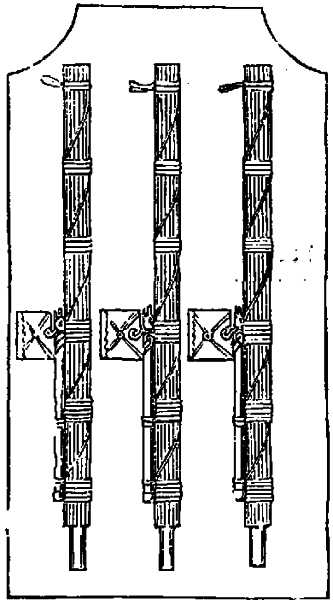
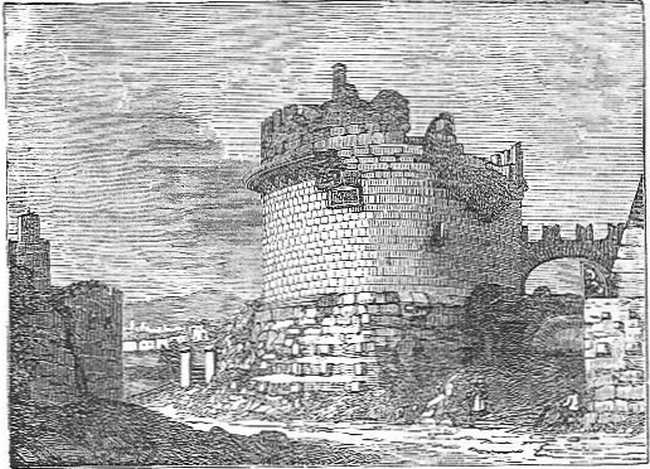
The career of Marius had hitherto been a glorious one, and it would have been fortunate for him if he had died on the day of his triumph. The remainder of his life is full of horrors, and brings out into prominent relief the worst features of his character. As the time for the consular elections approached, Marius became again a candidate for the Consulship. He wished to be first in peace as well as in war, and to rule the state as well as the army. But he did not possess the qualities requisite for a popular leader at Rome; he had no power of oratory, and lost his presence of mind in the noise and shouts of the popular assemblies. In order to secure his election, he entered into close connection with two of the worst demagogues that ever appeared at Rome, Saturninus and Glaucia. The former was a candidate for the Tribunate, and the latter for the Prætorship; and by their means, as well as by bribing the Tribes, Marius secured his election to the Consulship for[Pg 174] the sixth time. Glaucia also obtained the Prætorship, but Saturninus was not equally successful. He lost his election chiefly through the exertions of A. Nonius, who was chosen in his stead. But Nonius paid dearly for the honor, for on the evening of his election he was murdered by the emissaries of Saturninus and Glaucia, and next morning, at an early hour, before the forum was full, Saturninus was chosen to fill up the vacancy.
As soon as Saturninus had entered upon his office (B.C. 100) he brought forward an Agrarian Law for dividing among the soldiers of Marius the lands in Gaul which had been lately occupied by the Cimbri. He added to the law a clause that, if it was enacted by the people, every Senator should swear obedience to it within five days, and that whoever refused to do so should be expelled from the Senate, and pay a fine of twenty talents. This clause was specially aimed at Metellus, who, it was well known, would refuse to obey the requisition. In order to insure a refusal on the part of Metellus, Marius rose in the Senate, and declared that he would never take the oath, and Metellus made the same declaration; but when the law had been passed, and Saturninus summoned the Senators to the rostra to comply with the demands of the law, Marius, to the astonishment of all, immediately took the oath, and advised the Senate to follow his example. Metellus alone refused compliance; and on the following day Saturninus sent his beadle to drag him out of the Senate-house. Not content with this victory, Saturninus brought forward a bill to punish him with exile. The friends of Metellus were ready to take up arms in his defense; but he declined their assistance, and withdrew privately from the city. Saturninus brought forward other popular measures, of which our information is very scanty. He proposed a Lex Frumentaria, by which the state was to sell corn to the people at a very low price; and also a law for founding new colonies in Sicily, Achaia, and Macedonia. In the election of the magistrates for the following year Saturninus was again chosen Tribune. Glaucia was at the same time a candidate for the Consulship, the two other candidates being M. Antonius and C. Memmius. The election of Antonius was certain, and the struggle lay between Glaucia and Memmius. As the latter seemed likely to carry his election, Saturninus and Glaucia hired some ruffians, who murdered him openly in the comitia. All sensible people had previously become alarmed at the mad conduct of Saturninus and his partisans, and this last act produced a complete reaction against them. The Senate felt themselves now sufficiently strong to declare them public enemies, and invested the Consuls with dictatorial power. Marius was unwilling to act against his associates, but he had no[Pg 175] alternative, and his backwardness was compensated by the zeal of others. Driven out of the forum, Saturninus, Glaucia, and the Quæstor Saufeius took refuge in the Capitol, but the partisans of the Senate cut off the pipes which supplied the citadel with water before Marius began to move against them. Unable to hold out any longer, they surrendered to Marius. The latter did all he could to save their lives: as soon as they descended from the Capitol, he placed them, for security, in the Curia Hostilia; but the mob pulled off the tiles of the Senate-house, and pelted them till they died. The Senate gave their sanction to the proceeding by rewarding with the citizenship a slave of the name of Scæva, who claimed the honor of having killed Saturninus.
Marius had lost all influence in the state by allying himself with such unprincipled adventurers. In the following year (B.C. 99) he left Rome, in order that he might not witness the return of Metellus from exile, a measure which he had been unable to prevent. He set sail for Cappadocia and Galatia under the pretense of offering sacrifices which he had vowed to the Great Mother. He had, however, a deeper purpose in visiting these countries. Finding that he was losing his popularity while the Republic was at peace, he was anxious to recover his lost ground by gaining fresh victories in war, and accordingly repaired to the court of Mithridates, in hopes of rousing him to attack the Romans.
The mad scheme of Saturninus, and the discredit into which Marius had fallen, had given new strength to the Senate. They judged the opportunity favorable for depriving the Equites of the judicial power which they had enjoyed, with only a temporary cessation, since the time of C. Gracchus. The Equites had abused their power, as the Senate had done before them. They were the capitalists who farmed the public revenues in the provinces, where they committed peculation and extortion with habitual impunity. When accused, they were tried by accomplices and partisans. Their unjust condemnation of Rutilius Rufus had shown how unfit they were to be intrusted with judicial duties. Rutilius was a man of spotless integrity, and while acting as lieutenant to Q. Mucius Scævola, Proconsul of Asia in B.C. 95, he displayed so much honesty and firmness in repressing the extortions of the farmers of the taxes, that he became an object of fear and hatred to the whole body. Accordingly, on his return to Rome, a charge of malversation was trumped up against him, he was found guilty, and compelled to withdraw into banishment (B.C. 92).
The following year (B.C. 91) witnessed the memorable Tribunate of M. Livius Drusus. He was the son of the celebrated opponent of C. Gracchus. He was a man of boundless activity and extraor[Pg 176]dinary ability. Like his father, he was an advocate of the party of the Nobles. He took up arms against Saturninus, and supported the Senate in the dispute for the possession of the judicial power. His election to the Tribunate was hailed by the Nobles with delight, and for a time he possessed their unlimited confidence. He gained over the people to the party of the Senate by various popular measures, such as the distribution of corn at a low price, and the establishment of colonies in Italy and Sicily. He was thus enabled to carry his measures for the reform of the judicia, which were, that the Senate should be increased from 300 to 600 by the addition of an equal number of Equites, and that the Judices should be taken from the Senate thus doubled in numbers. Drusus seems to have been actuated by a single-minded desire to do justice to all, but the measure was acceptable to neither party. The Senators viewed with dislike the elevation to their own rank of 300 Equites, while the Equites had no desire to transfer to a select few of their own order the profitable share in the administration of justice which they all enjoyed.
Another measure of Drusus rendered him equally unpopular with the people. He had held out to the Latins and the Italian allies the promise of the Roman franchise. Some of the most eminent men of Rome had long been convinced of the necessity of this reform. It had been meditated by the younger Scipio Africanus, and proposed by C. Gracchus. The Roman people, however, always offered it the most violent opposition. But Drusus still had many partisans. The Italian allies looked up to him as their leader, and loudly demanded the rights which had been promised them. It was too late to retreat; and, in order to oppose the formidable coalition against him, Drusus had recourse to sedition and conspiracy. A secret society was formed, in which the members bound themselves by a solemn oath to have the same friends and foes with Drusus, and to obey all his commands. The ferment soon became so great that the public peace was more than once threatened. The Allies were ready to take up arms at the first movement. The Consuls, looking upon Drusus as a conspirator, resolved to meet his plots by counterplots. But he knew his danger, and whenever he went into the city kept a strong body-guard of attendants close to his person. The end could not much longer be postponed; and the civil war was on the point of breaking out, when one evening Drusus was assassinated in his own house, while dismissing the crowds who were attending him. A leather-cutter's knife was found sticking in his loins. Turning round to those who surrounded him, he asked them, as he was dying, "Friends[Pg 177] and neighbors, when will the Commonwealth have a citizen like me again?"
Even in the lifetime of Drusus the Senate had repealed all his laws. After his death the Tribune Q. Varius brought forward a law declaring all persons guilty of high treason who had assisted the cause of the Allies. Many eminent men were condemned under this law. This measure, following the assassination of Drusus, roused the indignation of the Allies to the highest pitch. They clearly saw that the Roman people would yield nothing except upon compulsion.
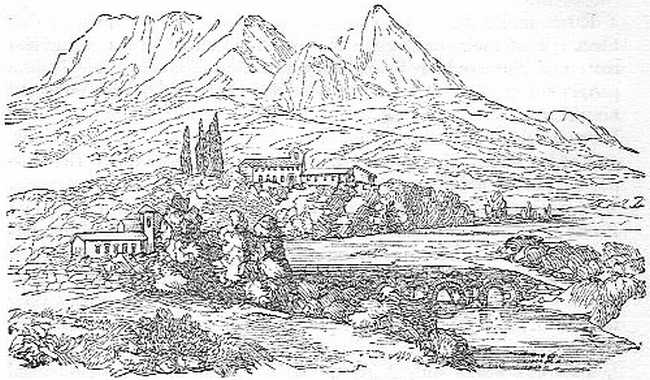
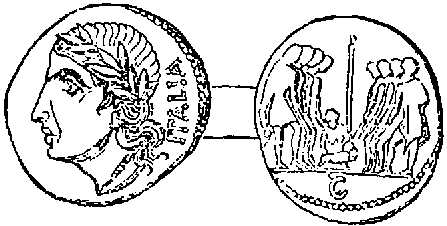
Rome had never been exposed to greater danger than at this time. Those who had been her bravest defenders now rose against her; and she would probably have perished had the whole Italian people taken part in the war. But the insurrection was confined almost exclusively to the Sabellians and their kindred races. The Etruscans and Umbrians stood aloof, while the Sabines, Volscians, and other tribes who already possessed the Roman franchise, supported the Republic, and furnished the materials of her armies. The nations which composed the formidable conspiracy against Rome were eight in number—the Marsians, Pelignians, Marrucinians, Vestinians, Picentines, Samnites, Apulians, and Lucanians. Of these the Marsians were particularly distinguished for their courage and skill in war; and from the prominent part which they took in the struggle, it was frequently termed the Marsic as well as the Social War.
The war broke out at Asculum in Picenum. The Proconsul Q. Servilius, who had the charge of this part of Italy, hearing that the inhabitants of Asculum were organizing a revolt, entered the town, and endeavored to persuade them to lay aside their hostile intentions. But he was murdered, together with his legate, by the exasperated citizens, and all the Romans in the place were likewise put to death. The insurrection now became general. The Allies entered upon the war with feelings of bitter hatred against their former rulers. They resolved to destroy Rome, and fixed upon Corfinium, a strong city of the Peligni, to which they gave the name of Italica, as the new capital of the Italian Confederation. The government of the new Republic was borrowed from that of Rome. It was to have two Consuls, twelve Prætors, and a Senate of 500 members. Q. Pompædius Silo, a Marsian, one of[Pg 179] the chief instigators of the war, and C. Papius Mutilus, a Samnite, who cherished the hereditary hatred of his countrymen against the Romans, were chosen Consuls. Under them were many able lieutenants, who had learned the art of war under the best Roman generals. The soldiers had also served, in the Roman armies, and were armed and disciplined in the same way, so that the contest partook of all the characters of a civil war. But the Romans had the great advantage which a single state always possesses over a confederation.
Of the details of the war our information is meagre and imperfect. But in the military operations we clearly see that the Allies formed two principal groups: the one composed of the Marsians, with their neighbors the Marrucinians, Pelignians, Vestinians, and Picentines; the other of the Samnites, with the Lucanians and Apulians. The two Consuls, L. Julius Cæsar and P. Rutilius Lupus, took the field with powerful armies, and under them served Marius, Sulla, and the most experienced generals of the time. The Romans were fully aware of the formidable nature of the struggle, which was one for existence, and not for victory. In the first campaign the advantage was on the side of the Allies. The Samnites, under their Consul Papius, overran Campania, took most of the towns, and laid siege to Acerræ, into which Cæsar threw himself. Pompædius Silo was still more successful. He defeated the Roman Consul P. Rutilius Lupus with great slaughter, Rutilius himself being slain in the battle. This disaster was to some extent repaired by Marius, who commanded a separate army in the neighborhood, and compelled the victorious Allies to retire. The old general then intrenched himself in a fortified camp, and neither the stratagems nor the taunts of the Samnites could entice him from his advantageous position. "If you are a great general," said Pompædius, "come down and fight;" to which the veteran replied, "Nay, do you, if you are a great general, compel me to fight against my will." The Romans considered that Marius was over-cautious and too slow; and Plutarch says that his age and corpulence rendered him incapable of enduring the fatigue of very active service. But it is more probable that he was not very willing to destroy the Allies, who had been among his most active partisans, and to whom he still looked for support in his future struggles with the Nobility.
The Romans now saw the necessity of making some concessions. The Lex Julia, proposed by the Consul Julius Cæsar, granted the franchise to all the Latin colonies, and to those of the Allies who had remained faithful to Rome, or had laid down their arms. The effects of this concession were immediately seen. Several of the[Pg 180] Allies hastened to avail themselves of it, and disunion and distrust were produced among the rest.
The next campaign (B.C. 89) was decidedly favorable to the Romans. The Consuls were Cn. Pompeius Strabo, the father of the celebrated Triumvir, and L. Porcius Cato. The latter, it is true, was slain at the commencement of the campaign; but his loss was more than compensated by his lieutenant Sulla obtaining, in consequence, the supreme command. He carried on the war with the utmost vigor, and completely eclipsed his old commander Marius. He drove the enemy out of Campania, subdued the Hirpini, and then penetrated into the very heart of Samnium. Here he defeated Papius Mutilus, the Samnite Consul, and followed up his victory by the capture of the strong town of Bovianum.
Meanwhile Pompeius Strabo had been equally successful in the north. Asculum was reduced after a long and obstinate siege. The Marrucinians, Vestinians, Pelignians, and finally the Marsians, laid down their arms before the end of the year. Their submission was facilitated by the Lex Plautia Papiria, proposed by the Tribunes M. Plautius Silvanus and C. Papirius Carbo (B.C. 89), which completed the arrangements of the Lex Julia, and granted, in fact, every thing which the Allies had demanded before the war. All citizens of a town in alliance with Rome could obtain, by this law, the Roman franchise, provided they were at the time resident in Italy, and registered their names with the Prætor within sixty days.[66]
The war was thus virtually brought to a conclusion within two years, but 300,000 men, the flower of Rome and Italy, perished in this short time. The only nations remaining in arms were the Samnites and Lucanians, who still maintained a guerrilla warfare in their mountains, and continued to keep possession of the strong fortress of Nola, in Campania, from which all the efforts of Sulla failed to dislodge them.
It now remained to be settled in what way the new citizens were to be incorporated in the Roman state. If they were enrolled in the thirty-five tribes, they would outnumber the old citizens. It was therefore resolved to form ten new tribes, which should consist of the new citizens exclusively; but, before these arrangements could be completed, the Civil War broke out.
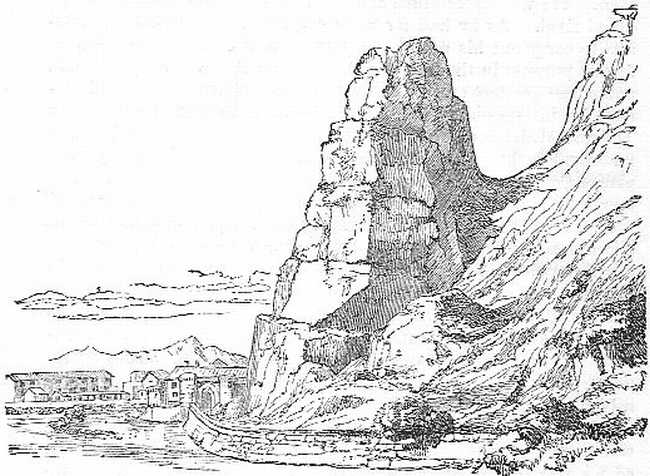
One reason which induced the Senate to bring the Social War to a conclusion was the necessity of attacking Mithridates, king of Pontus, one of the ablest monarchs with whom Rome ever came into contact. The origin and history of this war will be narrated in the following chapter. The dispute between Marias and Sulla for the command against Mithridates was the occasion of the first Civil War. The ability which Sulla had displayed in the Social War, and his well-known attachment to the Senatorial party, naturally marked him out as the man to whom this important dignity was to be granted. He was accordingly elected Consul for the year 88 B.C., with Q. Pompeius Rufus as his colleague; and he forthwith received the command of the Mithridatic War. But Marius had long coveted this distinction; he quitted the magnificent villa which he had built at Misenum, and took up his residence at Rome; and in order to show that neither his age nor his corpulency had destroyed his vigor, he repaired daily to the Cam[Pg 182]pus Martius, and went through the usual exercises with the young men. He was determined not to yield without a struggle to his hated rival. As he had formerly employed the Tribune Saturninus to carry out his designs, so now he found an able instrument for his purpose in the Tribune P. Sulpicius Rufus. Sulpicius was one of the greatest orators of the age, and had acquired great influence by his splendid talents. He was an intimate friend of the Tribune M. Livius Drusus, and had been himself elected Tribune for B.C. 88, through the influence of the Senatorial party, who placed great hopes in him; but, being overwhelmed with debt, he now sold himself to Marius, who promised him a liberal share of the spoils of the Mithridatic War. Accordingly, Sulpicius brought forward a law by which the Italians were to be distributed among the thirty-five tribes. As they far outnumbered the old Roman citizens, they would have an overwhelming majority in each tribe, and would certainly confer upon Marius the command of the Mithridatic War. To prevent the Tribune from putting these rogations to the vote, the Consuls declared a justitium, during which no business could be legally transacted. But Sulpicius was resolved to carry his point; with an armed band of followers he entered the forum and called upon the Consuls to withdraw the justitium; and upon their refusal to comply with his demand he ordered his satellites to draw their swords and fall upon them. Pompeius escaped, but his son Quintus, who was also the son-in-law of Sulla, was killed. Sulla himself took refuge in the house of Marius, which was close to the forum, and in order to save his life he was obliged to remove the justitium.
Sulla quitted Rome and hastened to his army, then besieging Nola, which was still held by the Samnites (see p. 180). The city was now in the hands of Sulpicius and Marius, and the rogations passed into law without opposition, as well as a third, conferring upon Marius the command of the Mithridatic War. Marius lost no time in sending some Tribunes to assume on his behalf the command of the army at Nola; but the soldiers, who loved Sulla, and who feared that Marius might lead another army to Asia, and thus deprive them of their anticipated plunder, stoned his deputies to death. Sulla found his soldiers ready to respond to his wishes; they called upon him to lead them to Rome, and deliver the city from the tyrants. He therefore hesitated no longer, but at the head of six legions broke up from his encampment at Nola, and marched toward the city. His officers, however, refused to serve against their country, and all quitted him, with the exception of one Quæstor. This was the first time that a Roman had ever marched at the head of Roman troops against the city. Marius[Pg 183] was taken by surprise. Such was the reverence that the Romans entertained for law, that it seems never to have occurred to him or to his party that Sulla would venture to draw his sword against the state. Marius attempted to gain time for preparations by forbidding Sulla, in the name of the Republic, to advance any farther; but the Prætors who carried the command narrowly escaped being murdered by the soldiers; and Marius, as a last resource, offered liberty to the slaves who would join him. But it was all in vain. Sulla forced his way into the city, and Marius took to flight with his son and a few followers. Sulla used his victory with moderation. He protected the city from plunder; and only Marius, Sulpicius, and ten others of his bitterest enemies, were declared public enemies by the Senate. Sulpicius was betrayed by one of his slaves and put to death, but Marius and his son succeeded in making their escape. Marius himself embarked on board a ship at Ostia, with a few companions, and then sailed southward along the coast of Italy. At Circeii he and his companions were obliged to land on account of the violence of the wind and the want of provisions. After wandering about for a long time, they learned from some peasants that a number of horsemen had been in search of them; and they accordingly turned aside from the road, and passed the night in a deep wood in great want. But the indomitable spirit of the old man did not fail him; and he consoled himself and encouraged his companions by the assurance that he should still live to see his seventh Consulship, in accordance with a prediction that had been made to him in his youth. Shortly afterward, when they were near to Minturnæ, they descried a party of horsemen galloping toward them. In great haste they hurried down to the sea, and swam off to two merchant vessels, which received them on board. The horsemen bade the crew bring the ship to land or throw Marius overboard; but, moved by his tears and entreaties, they refused to surrender him. The sailors soon changed their minds; and, fearing to keep Marius, they cast anchor at the mouth of the Liris, where they persuaded him to disembark, and rest himself from his fatigues till a wind should rise; but they had no sooner landed him than they immediately sailed away. Marius was now quite alone amid the swamps and marshes through which the Liris flows. With difficulty he reached the hut of an old man, who concealed him in a hole near the river, and covered him with reeds; but hearing shortly afterward the noise of his pursuers, he crept out of his hiding-place and threw himself into the marsh. He was discovered, and dragged out of the water; and, covered with mud, and with a rope round his neck, was delivered up to the authorities of Minturnæ. The[Pg 184] magistrates then deliberated whether they should comply with the instruction that had been sent from Rome to all the municipal towns to put Marius to death as soon as they found him. After some consultation they resolved to obey it, and sent a Cimbrian slave to carry out their orders. The room in which the old general was confined was dark; and, to the frightened barbarian, the eyes of Marius seemed to dart forth fire, and from the darkness a terrible voice shouted out, "Man! durst thou slay C. Marius?" The barbarian immediately threw down his sword, and rushed out of the house, exclaiming, "I can not kill C. Marius!" Straightway there was a revulsion of feeling among the inhabitants of Minturnæ. They repented of their ungrateful conduct toward a man who had saved Rome and Italy. They got ready a ship for his departure, provided him with every thing necessary for the voyage, and, with prayers and wishes for his safety, placed him on board. The wind carried him to the island of Ænaria (now Ischia), where he found the rest of his friends; and from thence he set sail for Africa, which he reached in safety. He landed near the site of Carthage, but he had scarcely put his foot on shore before the Prætor Sextilius sent an officer to bid him leave the country, or else he would carry into execution the decree of the Senate. This last blow almost unmanned Marius: grief and indignation for a time deprived him of speech, and his only reply was, "Tell the Prætor that you have seen C. Marius a fugitive sitting on the ruins of Carthage." Shortly afterward Marius was joined by his son, and they crossed over to the island of Cercina, where they remained unmolested.
Meantime a revolution had taken place at Rome, which prepared the way for the return of Marius to Italy. Sulla's soldiers were impatient for the plunder of Asia, and he therefore contented himself with repealing the Sulpician laws. He then sent forward his legions to Capua, that they might be ready to embark for Greece, but he himself remained in Rome till the Consuls were elected for the following year. The candidates whom he recommended were rejected, and the choice fell on Cn. Octavius, who belonged to the aristocratical party, but was a weak and irresolute man, and on L. Cinna, a professed champion of the popular side. Sulla did not attempt to oppose their election: to have recalled his legions to Rome would have been a dangerous experiment when the soldiers were so eager for the spoils of the East; and he only took the vain precaution of making Cinna promise that he would make no attempt to disturb the existing order of things. But as soon as Sulla had quitted Italy, Cinna brought forward again the law of Sulpicius for incorporating the new Italian citizens among the thirty-five[Pg 185] tribes. The two Consuls had recourse to arms, Octavius to oppose and Cinna to carry the law. A dreadful conflict took place in the forum. The party of Octavius obtained the victory, and Cinna was driven out of the city with great slaughter. But Cinna, by means of the new citizens, whose cause he espoused, was soon at the head of a formidable army. As soon as Marius heard of these changes he set sail from Africa, and offered to serve under Cinna, who gladly accepted his proposal, and named him Proconsul; but Marius refused all marks of honor. The sufferings and privations he had endured had exasperated his proud and haughty spirit almost to madness, and nothing but the blood of his enemies could appease his resentment. He continued to wear a mean and humble dress, and his hair and beard had remained unshorn from the day he had been driven out of Rome. After joining Cinna, Marius prosecuted the war with great vigor. He first captured the corn-ships, and thus cut off Rome from its usual supply of food. He next took Ostia and the other towns on the sea-coast, and, moving down the Tiber, encamped on the Janiculum. Famine began to rage in the city, and the Senate was obliged to yield. They sent a deputation to Cinna and Marius, inviting them into the city, but entreating them to spare the citizens. Cinna received the deputies sitting in his chair of office, and gave them a kind answer. Marius stood in silence by the side of the Consul, but his actions spoke louder than words. After the audience was over they entered the city. The most frightful scenes followed. The Consul Octavius was slain while seated in his curule chair. The streets ran with the noblest blood of Rome. Every one whom Marius hated or feared was hunted out and put to death; and no consideration, either of rank, talent, or former friendship, induced him to spare the victims of his vengeance. The great orator M. Antonius fell by the hands of his assassins; and his former colleague, Q. Catulus, who had triumphed with him over the Cimbri, was obliged to put an end to his own life. Cinna was soon tired of the butchery; but the appetite of Marius seemed only whetted by the slaughter, and daily required fresh victims for its gratification. Without going through the form of an election, Marius and Cinna named themselves Consuls for the following year (B.C. 86), and thus was fulfilled the prediction that Marius should be seven times Consul. But he did not long enjoy the honor: he was now in his seventy-first year; his body was worn out by the fatigues and sufferings he had recently undergone; and on the eighteenth day of his Consulship he died of an attack of pleurisy, after a few days' illness.
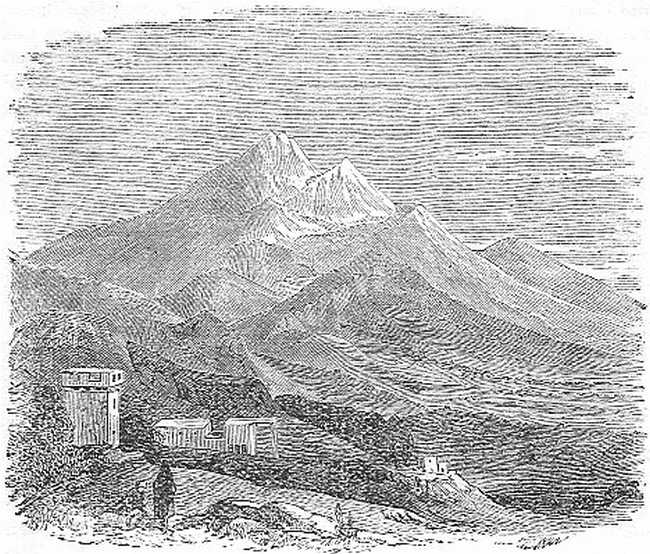
The kingdom of Pontus, which derived its name from being on the coast of the Pontus Euxinus, or Black Sea, was originally a satrapy of the Persian empire, extending from the River Halys on the west to the frontiers of Colchis on the east. Even under the later Persian kings the rulers of Pontus were really independent, and in the wars of the successors of Alexander the Great it became a separate kingdom. Most of its kings bore the name of Mithridates; and the fifth monarch of this name formed an alliance with the Romans, and was rewarded with the province of Phrygia for the services he had rendered them in the war against Aristonicus. He was assassinated about B.C. 120, and was succeeded by his son Mithridates VI., commonly called the Great, who was then only about twelve years of age. His youth was remarkable, but much that has been transmitted to us respecting this period of his life wears a very suspicious aspect; it is certain, how[Pg 187]ever, that when he attained to manhood he was not only endowed with consummate skill in all martial exercises, and possessed of a bodily frame inured to all hardships, but his naturally vigorous intellect had been improved by careful culture. As a boy he had been brought up at Sinope, where he had probably received the elements of a Greek education, and so powerful was his memory that he is said to have learned not less than twenty-five languages, and to have been able in the days of his greatest power to transact business with the deputies of every tribe subject to his rule in their own peculiar dialect. As soon as he was firmly established on the throne he began to turn his arms against the neighboring nations. On the west his progress was hemmed in by the power of Rome, and the minor sovereigns of Bithynia and Cappadocia enjoyed the all-powerful protection of the Republic. But on the east his ambition found free scope. He subdued the barbarian tribes between the Euxine and the confines of Armenia, including the whole of Colchis and the province called Lesser Armenia; and he even added to his dominions the Tauric Chersonesus, now called the Crimea. The Greek kingdom of Bosphorus, which formed a portion of the Chersonesus, likewise submitted to his sway. Moreover, he formed alliances with Tigranes, king of Armenia, to whom he gave his daughter Cleopatra in marriage, as well as with the warlike nations of the Parthians and Iberians. He thus found himself in possession of such great power and extensive resources, that he began to deem himself equal to a contest with Rome itself. Many causes of dissension had already arisen between them. Shortly after his accession, the Romans had taken advantage of his minority to wrest from him the province of Phrygia. In B.C. 93 they resisted his attempt to place upon the throne of Cappadocia one of his own nephews, and appointed a Cappadocian named Ariobarzanes to be king of that country. For a time Mithridates submitted; but the death of Nicomedes II., king of Bithynia, shortly afterward, at length brought matters to a crisis. That monarch was succeeded by his eldest son, Nicomedes III.; but Mithridates took the opportunity to set up a rival claimant, whose pretensions he supported with an army, and quickly drove Nicomedes out of Bithynia (B.C. 90). About the same time he openly invaded Cappadocia, and expelled Ariobarzanes from his kingdom, establishing his own son Ariarathes in his place. Both the fugitive princes had recourse to Rome, where they found ready support; a decree was passed that Nicomedes and Ariobarzanes should be restored to their respective kingdoms, and the execution of it was confided to M. Aquillius and L. Cassius.
Mithridates again yielded, and the two fugitive kings were re[Pg 188]stored to their dominions; but no sooner was Nicomedes replaced on the throne of Bithynia than he was urged by the Roman legates to invade the territories of Mithridates, into which he made a predatory incursion. Mithridates offered no resistance, but sent to the Romans to demand satisfaction, and it was not until his embassador was dismissed with an evasive answer that he prepared for immediate hostilities (B.C. 88). His first step was to invade Cappadocia, from which he easily expelled Ariobarzanes once more. His generals drove Nicomedes out of Bithynia, and defeated Aquillius. Mithridates, following up his advantage, not only made himself master of Phrygia and Galatia, but invaded the Roman province of Asia. Here the universal discontent of the inhabitants, caused by the oppression of the Roman governors, enabled him to overrun the whole province almost without opposition. The Roman officers, who had imprudently brought this danger upon themselves, were unable to collect any forces to oppose his progress; and Aquillius himself, the chief author of the war, fell into the hands of the King of Pontus. Mithridates took up his winter quarters at Pergamus, where he issued the sanguinary order to all the cities of Asia to put to death on the same day all the Roman and Italian citizens who were to be found within their walls. So hateful had the Romans rendered themselves during the short period of their dominion, that these commands were obeyed with alacrity by almost all the cities of Asia. Eighty thousand persons are said to have perished in this fearful massacre.
The success of Mithridates encouraged the Athenians to declare against Rome, and the king accordingly sent his general Archelaus with a large army and fleet into Greece. Most of the Grecian states now declared in favor of Mithridates. Such was the position of affairs when Sulla landed in Epirus in B.C. 87. He immediately marched southward, and laid siege to Athens and the Piræus. But for many months these towns resisted all his attacks. Athens was first taken in the spring of the following year; and Archelaus, despairing of defending the Piræus any longer, withdrew into Bœotia, where he received some powerful re-enforcements from Mithridates. Piræus now fell into the hands of Sulla, and both this place and Athens were treated with the utmost barbarity. The soldiers were indulged in indiscriminate slaughter and plunder. Having thus wreaked his vengeance upon the unfortunate Athenians, Sulla directed his arms against Archelaus in Bœotia, and defeated him with enormous loss at Chæronea. Out of the 110,000 men of which the Pontic army consisted, Archelaus assembled only 10,000 at Chalcis, in Eubœa, where he had taken refuge. Mithridates, on receiving news of this great disaster, immediately[Pg 189] set about raising fresh troops, and was soon able to send another army of 80,000 men to Eubœa. But he now found himself threatened with danger from a new and unexpected quarter. While Sulla was still occupied in Greece, the party of Marius at Rome had sent a fresh army to Asia under the Consul L. Valerius Flaccus to carry on the war at once against their foreign and domestic enemies. Flaccus was murdered by his troops at the instigation of Fimbria, who now assumed the command, and gained several victories over Mithridates and his generals in Asia (B.C. 85). About the same time the new army, which the king had sent to Archelaus in Greece, was defeated by Sulla in the neighborhood of Orchomenus. These repeated disasters made Mithridates anxious for peace, but it was not granted by Sulla till the following year (B.C. 84), when he had crossed the Hellespont in order to carry on the war in Asia. The terms of peace were definitely settled at an interview which the Roman general and the Pontic king had at Dardanus, in the Troad. Mithridates consented to abandon all his conquests in Asia, to restrict himself to the dominions which he held before the commencement of the war, or pay a sum of 5000 talents, and surrender to the Romans a fleet of seventy ships fully equipped. Thus terminated the First Mithridatic War.
Sulla was now at liberty to turn his aims against Fimbria, who was with his army at Thyatira. The name of Sulla carried victory with it. The troops of Fimbria deserted their general, who put an end to his own life. Sulla now prepared to return to Italy. After exacting enormous sums from the wealthy cities of Asia, he left his legate, L. Licinius Murena, in command of that province, with two legions, and set sail with his own army to Athens. While preparing for his deadly struggle in Italy, he did not lose his interest in literature. He carried with him from Athens to Rome the valuable library of Apellicon of Teos, which contained most of the works of Aristotle and Theophrastus.
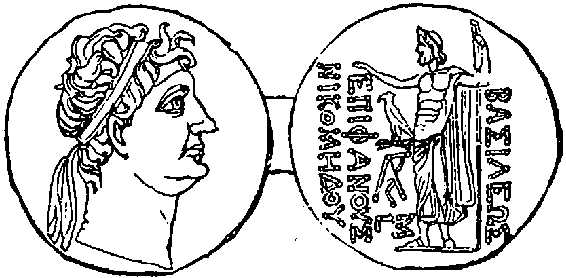
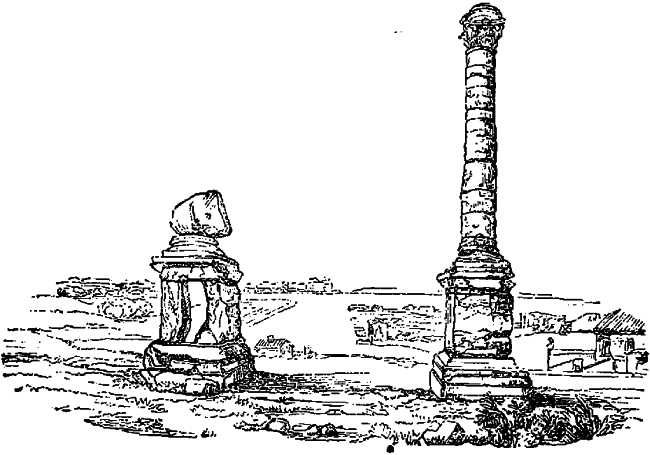
Sulla landed at Brundisium in the spring of B.C. 83, in the Consulship of L. Scipio and C. Norbanus. During the preceding year he had written to the Senate, recounting the services he had rendered to the commonwealth, complaining of the ingratitude with which he had been treated, announcing his speedy return to Italy, and threatening to take vengeance upon his enemies and those of the Republic. The Senate, in alarm, sent an embassy to Sulla to endeavor to bring about a reconciliation between him and his enemies, and meantime ordered the Consuls Cinna and Carbo to desist from levying troops and making farther preparations for war. Cinna and Carbo gave no heed to this command; they knew that a reconciliation was impossible, and resolved to carry over an army to Dalmatia, in order to oppose Sulla in Greece; but, after one detachment of their troops had embarked, the rest of the soldiers rose in mutiny, and murdered Cinna. The Marian party had thus lost their chief leader, but continued nevertheless to make[Pg 191] every preparation to resist Sulla, for they were well aware that he would never forgive them, and that their only choice lay between victory and destruction. Besides this the Italians were ready to support them, as these new citizens feared that Sulla would deprive them of the rights which they had lately obtained after so much bloodshed. The Marian party had every prospect of victory, for their troops far exceeded those of their opponent. They had 200,000 men in arms, while Sulla landed at Brundusium with only 30,000, or at the most 40,000 men. But, on the other hand, the popular party had no one of sufficient influence and military reputation to take the supreme command in the war; their vast forces were scattered about Italy, in different armies, under different generals; the soldiers had no confidence in their commanders, and no enthusiasm in their cause; and the consequence was, that whole hosts of them deserted to Sulla on the first opportunity. Sulla's soldiers, on the contrary, were veterans, who had frequently fought by each other's sides, and had acquired that confidence in themselves and in their general which frequent victories always give. Still, if the Italians had remained faithful to the cause of the Marian party, Sulla would hardly have conquered, and therefore one of his first cares after landing at Brundusium was to detach them from his enemies. For this purpose he would not allow his troops to do any injury to the towns or fields of the Italians in his march from Brundusium through Calabria and Apulia, and he formed separate treaties with many of the Italian towns, by which he secured to them all the rights and privileges of Roman citizens which they then enjoyed. Among the Italians the Samnites continued to be the most formidable enemies of Sulla. They had joined the Marian party, not simply with the design of securing the supremacy for the latter, but with the hope of conquering Rome by their means, and then destroying forever their hated oppressor. Thus this Civil war became merely another phase of the Social war, and the struggle between Rome and Samnium for the supremacy of the peninsula was renewed after the subjection of the latter for more than two hundred years.
Sulla marched from Apulia into Campania without meeting with any resistance. In Campania he gained his first victory over the Consul Norbanus, who was defeated with great loss, and obliged to take refuge in Capua. His colleague Scipio, who was at no great distance, willingly accepted a truce which Sulla offered him, although Sertorius, the ablest of the Marian generals, warned him against entering into any negotiations. His caution was justified by the event. By means of his emissaries Sulla seduced the troops of Scipio, who at length found himself deserted by all his soldiers,[Pg 192] and was taken prisoner in his tent. Sulla, however, dismissed him uninjured. On hearing of this, Carbo is said to have observed "that he had to contend in Sulla both with a lion and a fox, but that the fox gave him more trouble." Many distinguished Romans meantime had taken up arms on behalf of Sulla. Cn. Pompey, the son of Cn. Pompeius Strabo, then only twenty-three years of age, levied three legions in Picenum and the surrounding districts; and Q. Metellus Pius, M. Crassus, M. Lucullus, and several others, offered their services as legates. It was not, however, till the following year (B.C. 82) that the struggle was brought to a decisive issue. The Consuls of this year were Cn. Papirius Carbo and the younger Marius, the former of whom was intrusted with the protection of Etruria and Umbria, while the latter had to guard Rome and Latium. Sulla appears to have passed the winter at Campania. At the commencement of spring he advanced against the younger Marius, who had concentrated all his forces at Sacriportus, and defeated him with great loss. Marius took refuge in Præneste; and Sulla, after leaving Q. Lucretius Ofella with a large force to blockade the town, marched with the main body of his army to Rome. Marius was resolved not to perish unavenged, and accordingly, before Sulla could reach Rome, he sent orders to L. Damasippus, the Prætor, to put to death all his leading opponents. His orders were faithfully obeyed. Q. Mucius Scævola, the Pontifex Maximus and jurist, P. Antistius, L. Domitius, and many other distinguished men, were butchered, and their corpses thrown into the Tiber. Sulla entered the city without opposition, and marched against Carbo, who had been previously opposed by Pompey and Metellus. The history of this part of the war is involved in great obscurity. Carbo made two efforts to relieve Præneste, but failed in each; and, after fighting with various fortune against Pompey, Metellus, and Sulla, he at length embarked for Africa, despairing of farther success in Italy. Meantime Rome had nearly fallen into the hands of the enemy. The Samnites and Lucanians, under Pontius Telesinus and L. Lamponius, after attempting to relieve Præneste, resolved to march straight upon Rome, which had been left without an army for its protection. Sulla arrived barely in time to save the city. The battle was fought before the Colline Gate; it was long and obstinately contested; the combat was not simply for the supremacy of a party; the very existence of Rome was at stake, for Pontius had declared that he would raze the city to the ground. The left wing, where Sulla commanded in person, was driven off the field by the vehemence of the enemy's charge; but the success of the right wing, which was commanded by Crassus, enabled Sulla to restore the battle, and at length gain a com[Pg 193]plete victory. Fifty thousand men were said to have fallen on each side. All the most distinguished leaders of the Marian party either perished in the engagement, or were taken prisoners and put to death. Among these was the brave Samnite Pontius, whose head was cut off and carried under the walls of Præneste, thereby announcing to the young Marius that his last hope of succour was gone. To the Samnite prisoners Sulla showed no mercy. He was resolved to root out of the peninsula those heroic enemies of Rome. On the third day after the battle he collected all the Samnite and Lucanian prisoners in the Campus Martius, and ordered his soldiers to cut them down. The dying shrieks of so many victims frightened the Senators, who had been assembled at the same time by Sulla in the temple of Bellona; but he bade them attend to what he was saying, and not mind what was taking place outside, as he was only chastising some rebels. Præneste surrendered soon afterward. The Romans in the town were pardoned; but all the Samnites and Prænestines were massacred without mercy. The younger Marius put an end to his own life. The war in Italy was now virtually at an end, for the few towns which still held out had no prospect of offering any effectual opposition, and were reduced soon afterward. In other parts of the Roman world the war continued still longer, and Sulla did not live to see its completion. The armies of the Marian party in Sicily and Africa were subdued by Pompey in the course of the same year; but Sertorius in Spain continued to defy all the attempts of the Senate till B.C. 72.
Sulla was now master of Rome. He had not commenced the Civil war, but had been driven to it by the mad ambition of Marius. His enemies had attempted to deprive him of the command in the Mithridatic war, which had been legally conferred upon him by the Senate; and while he was righting the battles of the Republic they had declared him a public enemy, confiscated his property, and murdered the most distinguished of his friends and adherents. For all these wrongs Sulla had threatened to take the most ample vengeance; and he more than redeemed his word. He resolved to extirpate the popular party root and branch. One of his first acts was to draw up a list of his enemies who were to be put to death, which list was exhibited in the forum to public inspection, and called a Proscriptio. It was the first instance of the kind in Roman history. All persons in this list were outlaws who might be killed by any one with impunity; their property was confiscated to the state; their children and grandchildren lost their votes in the comitia, and were excluded from all public offices. Farther, all who killed a proscribed person, or indicated the place of his concealment, received two talents as a reward, and whoever sheltered[Pg 194] such a person was punished with death. Terror now reigned not only at Rome, but throughout Italy. Fresh lists of the proscribed constantly appeared. No one was safe; for Sulla gratified his friends by placing in the fatal lists their personal enemies, or persons whose property was coveted by his adherents. An estate, a house, or even a piece of plate, was to many a man, who belonged to no political party, his death-warrant; for, although the confiscated property belonged to the state, and had to be sold by public auction, the friends and dependents of Sulla purchased it at a nominal price, as no one dared to bid against them. Oftentimes Sulla did not require the purchase-money to be paid at all, and in many cases he gave such property to his favorites without even the formality of a sale. The number of persons who perished by the proscriptions amounted to many thousands. At the commencement of these horrors Sulla had been appointed Dictator. As both the Consuls had perished, he caused the Senate to elect Valerius Flaccus interrex, and the latter brought before the people a rogatio, conferring the Dictatorship upon Sulla, for the purpose of restoring order to the Republic, and for as long a time as he judged to be necessary. Thus the Dictatorship was revived after being in abeyance for more than 120 years, and Sulla obtained absolute power over the lives and fortunes of all the citizens. This was toward the close of B.C. 81. Sulla's great object in being invested with the Dictatorship was to carry into execution in a legal manner the great reforms which he meditated in the constitution and the administration of justice, by which he hoped to place the government of the Republic on a firm and secure basis. He had no intention of abolishing the Republic, and consequently he caused Consuls to be elected for the following year, B.C. 81, and was elected to the office himself in B.C. 80, while he continued to hold the Dictatorship.
At the beginning of B.C. 81 Sulla celebrated a splendid triumph on account of his victory over Mithridates. In a speech which he delivered to the people at the close of the gorgeous ceremony, he claimed for himself the surname of Felix, as he attributed his success in life to the favor of the gods. All ranks in Rome bowed in awe before their master; and among other marks of distinction which were voted to him by the obsequious Senate, a gilt equestrian statue was erected to his honor before the Rostra, bearing the inscription "Cornelio Sullæ Imperatori Felici."
During the years B.C. 80 and 79 Sulla carried into execution his various reforms in the constitution, of which an account is given at the end of this chapter. At the same time he established many military colonies throughout Italy. The inhabitants of the Italian[Pg 195] towns which had fought against Sulla were deprived of the full Roman franchise which had been lately conferred upon them; their lands were confiscated and given to the soldiers who had fought under him. A great number of these colonies were settled in Etruria. They had the strongest interest in upholding the institutions of Sulla, since any attempt to invalidate the latter would have endangered their newly-acquired possessions. But, though they were a support to the power of Sulla, they hastened the fall of the commonwealth; an idle and licentious soldiery supplanted an industrious agricultural population; and Catiline found nowhere more adherents than among the military colonies of Sulla. While Sulla thus established throughout Italy a population devoted to his interests, he created at Rome a kind of body-guard for his protection by giving the citizenship to a great number of slaves belonging to those who had been proscribed by him. The slaves thus rewarded are said to have been as many as 10,000, and were called Cornelii after him as their patron.
Sulla had completed his reforms by the beginning of B.C. 79; and as he longed for the undisturbed enjoyment of his pleasures, he resigned his Dictatorship, and declared himself ready to render an account of his conduct while in office. This voluntary abdication by Sulla of the sovereignty of the Roman world has excited the astonishment and admiration of both ancient and modern writers. But it is evident that Sulla never contemplated, like Julius Cæsar, the establishment of a monarchical form of government; and it must be recollected that he could retire into a private station without any fear that attempts would be made against his life or his institutions. The ten thousand Cornelii at Rome and his veterans stationed throughout Italy, as well as the whole strength of the aristocratical party, secured him against all danger. Even in his retirement his will was law, and shortly before his death he ordered his slaves to strangle a magistrate of one of the towns in Italy because he was a public defaulter.
After resigning his Dictatorship, Sulla retired to his estate at Puteoli, and there, surrounded by the beauties of nature and art, he passed the remainder of his life in those literary and sensual enjoyments in which he had always taken so much pleasure. He died in B.C. 78, in the sixtieth year of his age. The immediate cause of his death was the rupture of a blood-vessel, but some time before he had been suffering from the disgusting disease which is known in modern times by the name of Morbus Pediculosus. The Senate, faithful to the last, resolved to give him the honor of a public funeral. This was, however, opposed by the Consul Lepidus, who had resolved to attempt the repeal of Sulla's laws; but the Dicta[Pg 196]tor's power continued unshaken even after his death. The veterans were summoned from their colonies, and Q. Catulus, L. Lucullus, and Cn. Pompey placed themselves at their head. Lepidus was obliged to give way, and allowed the funeral to take place without interruption. It was a gorgeous pageant. The Magistrates, the Senate, the Equites, the Priests, and the Vestal virgins, as well as the veterans, accompanied the funeral procession to the Campus Martius, where the corpse was burnt according to the wish of Sulla himself, who feared that his enemies might insult his remains, as he had done those of Marius, which had been taken out of the grave and thrown into the Anio at his command. It had been previously the custom of the Cornelia gens to bury and not burn their dead. A monument was erected to Sulla in the Campus Martius, the inscription on which he is said to have composed himself. It stated that none of his friends ever did him a kindness, and none of his enemies a wrong, without being fully repaid.
All the reforms of Sulla were effected by means of Leges, which were proposed by him in the Comitia Centuriata, and bore the general name of Leges Corneliæ. They may be divided into four classes: laws relating to the constitution, to the ecclesiastical corporations, to the administration of justice, and to the improvement of public morals. Their general object and design was to restore, as far as possible, the ancient Roman Constitution, and to give again to the Senate and the Nobility that power of which they had been gradually deprived by the leaders of the popular party. His Constitution did not last, because the aristocracy were thoroughly selfish and corrupt, and exercised the power which Sulla had intrusted to them only for their own aggrandizement. Their shameless conduct soon disgusted the provinces as well as the capital; the people again regained their power, but the consequence was an anarchy and not a government; and as neither class was fit to rule, they were obliged to submit to the dominion of a single man. Thus the empire became a necessity to the exhausted Roman world.
I. Laws relating to the Constitution.—Sulla deprived the Comitia Tributa of their legislative and judicial powers; but he allowed them to elect the Tribunes, Ædiles, Quæstors, and other inferior magistrates. This seems to have been the only purpose for which they were called together. The Comitia Centuriata, on the other hand, were allowed to retain their right of legislation unimpaired. He restored, however, the ancient regulation, which had fallen into desuetude, that no matter should be brought before them without the previous sanction of a senatus consultum.[Pg 197]
The Senate had been so much reduced in numbers by the proscriptions of Sulla, that he was obliged to fill up the vacancies by the election of three hundred new members. But he made no alteration in their duties and functions, as the whole administration of the state was in their hands; and he gave them the initiative in legislation by requiring a previous senatus consultum respecting all measures that were to be submitted to the Comitia, as already stated.
With respect to the magistrates, Sulla increased the number of Quæstors from eight to twenty, and of Prætors from six to eight. He renewed the old law that no one should hold the Prætorship before he had been Quæstor, nor the Consulship before he had been Prætor. He also renewed the law that no one should be elected to the same magistracy till after the expiration of ten years.
One of the most important of Sulla's reforms related to the Tribunate, which he deprived of all real power. He took away from the Tribunes the right of proposing a rogation of any kind to the Tribes, or of impeaching any person before them; and he appears to have limited the right of intercession to their giving protection to private persons against the unjust decisions of magistrates, as, for instance, in the enlisting of soldiers. To degrade the Tribunate still lower, Sulla enacted that whoever had held this office forfeited thereby all right to become a candidate for any of the higher curule offices, in order that all persons of rank, talent, and wealth might be deterred from holding an office which would be a fatal impediment to rising any higher in the state. He also required persons to be Senators before they could become Tribunes.
II. Laws relating to the Ecclesiastical Corporations.—Sulla repealed the Lex Domitia, which gave to the Comitia Tributa the right of electing the members of the great ecclesiastical corporations, and restored to the latter the right of co-optatio, or self-election. At the same time, he increased the number of Pontiffs and Augurs to fifteen respectively.
III. Laws relating to the Administration of Justice.—Sulla established permanent courts for the trial of particular offenses, in each of which a Prætor presided. A precedent for this had been given by the Lex Calpurnia of the Tribune L. Calpurnius Piso, in B.C. 149, by which it was enacted that a Prætor should preside at all trials for Repetundæ during his year of office. This was called a Quæstio Perpetua, and nine such Quæstiones Perpetuæ were established by Sulla, namely, De Repetundis, Majestatis, De Sicariis et Veneficis, De Parricidio, Peculatus, Ambitus, De Nummis Adulter[Pg 198]inis, De Falsis or Testamentaria, and De Vi Publica. Jurisdiction in civil cases was left to the Prætor Peregrinus and the Prætor Urbanus as before, and the other six Prætors presided in the Quæstiones; but as the latter were more in number than the Prætors, some of the Prætors took more than one Quæstio, or a Judex Quæstionis was appointed. The Prætors, after their election, had to draw lots for their several jurisdictions. Sulla enacted that the Judices should be taken exclusively from the Senators, and not from the Equites, the latter of whom had possessed this privilege, with a few interruptions, from the law of C. Gracchus, in B.C. 123. This was a great gain for the aristocracy, since the offenses for which they were usually brought to trial, such as bribery, malversation, and the like, were so commonly practiced by the whole order, that they were, in most cases, nearly certain of acquittal from men who required similar indulgence themselves.
Sulla's reform in the criminal law, the greatest and most enduring part of his legislation, belongs to a history of Roman law, and can not be given here.
IV. Laws relating to the Improvement of Public Morals.—Of these we have very little information. One of them was a Lex Sumtuaria, which enacted that not more than a certain sum of money should be spent upon entertainments, and also restrained extravagance in funerals. There was likewise a law of Sulla respecting marriage, the provisions of which are quite unknown, as it was probably abrogated by the Julian law of Augustus.
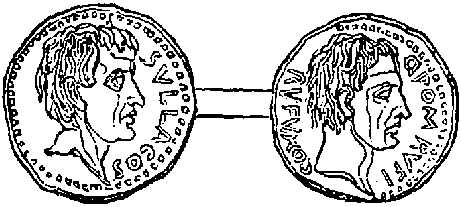
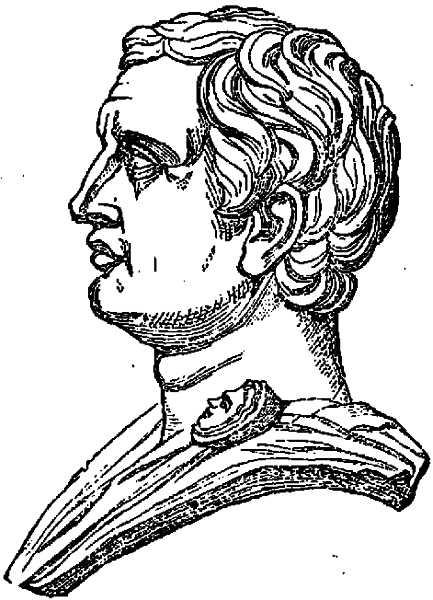
Sulla was scarcely dead before an attempt was made to overthrow the aristocratic constitution which he had established. The Consul M. Lepidus had already, as we have seen, endeavored to prevent the burial of Sulla in the Campus Martius. He now proposed to repeal the Dictator's laws; but the other Consul, Q. Catulus, remained firm to the aristocracy, and offered the most strenuous opposition to the measures of his colleague. Shortly afterward the Senate ordered Lepidus to repair to Farther Gaul, which had been assigned to him as his Province; but he availed himself of the opportunity to collect an army in Etruria, and at the beginning of the following year marched straight upon Rome. The Senate assembled an army, which they placed under the command of Q. Catulus, with Pompey as his lieutenant. A battle was fought near the Mulvian bridge, in which Lepidus was defeated, and, find[Pg 200]ing it impossible to maintain his footing in Italy, he sailed with the remainder of his forces to Sardinia, where he died soon afterward.
Meantime the remainder of the Marian party found refuge in Spain. Q. Sertorius, one of the ablest of their generals, had received the government of this country in the year B.C. 82. He soon acquired an extraordinary ascendency over the minds of the natives, and flattered them with the hope of establishing an independent state which might bid defiance to Rome. His influence was enhanced by the superstition of the people. He was accompanied on all occasions by a tame fawn, which they believed to be a familiar spirit. So attached did they become to his person, that he found no difficulty in collecting a formidable army, which for some years successfully opposed all the power of Rome. After defeating several generals whom Sulla had sent against him, he had to encounter, in B.C. 79, Q. Metellus, who had been Consul the previous year with Sulla. But Metellus did not fare much better than his predecessors; and in B.C. 78 Sertorius was re-enforced by a considerable body of troops which Perperna carried with him into Spain after the defeat of Lepidus. The growing power of Sertorius led the Senate to send Pompey to the assistance of Metellus. Pompey, though only 30 years of age, was already regarded as the ablest general of the Republic; and as he played such a prominent part in the later history, we may here pause to give a brief account of his early career.
POMPEY was born B.C. 106, and was, as we have already seen, the son of Cn. Pompeius Strabo, who fought against the Italians in his Consulship, B.C. 89. The young Pompey served under his father in this war, when he was only 17 years of age, and continued with him till his death two years afterward. He was present at the battle of the Colline Gate in B.C. 87, and shortly afterward he saved the life of his father, and quelled an insurrection of the soldiers by his courage and activity. As soon as Sulla had finished the Mithridatic war, and was on his way to Italy, Pompey, instead of waiting, like the other leaders of the aristocracy, for the arrival of their chief, resolved to share with him the glory of crushing the Marian party. Accordingly, he proceeded to levy troops in Picenum without holding any public office; and such was his personal influence that he was able to raise an army of three legions. Before joining Sulla he gained a brilliant victory over the Marian generals, and was received by Sulla with the greatest distinction. Upon the conclusion of the war in Italy Pompey was sent first into Sicily, and afterward into Africa, where the Marian party still held out. His success was rapid and decisive. In a few months he[Pg 201] reduced the whole of Numidia, and, unlike other Roman governors, abstained from plundering the province. His military achievements and his incorruptibility procured him the greatest renown, and he returned to Rome covered with glory (B.C. 80). Numbers flocked out of the city to meet him; and the Dictator himself, who formed one of the crowd, greeted him with the surname of MAGNUS or the GREAT, which he bore ever afterward. Sulla at first refused to let him triumph. Hitherto no one but a Dictator, Consul, or Prætor had enjoyed this distinction; but as Pompey insisted upon the honor, Sulla gave way, and the young general entered Rome in triumph as a simple Eques, and before he had completed his 25th year.
Pompey again exhibited his power in promoting, in B.C. 79, the election of M. Æmilius Lepidus to the Consulship, in opposition to the wishes of Sulla. The latter had now retired from public affairs, and contented himself with warning Pompey, as he met him returning from the comitia in triumph, "Young man, it is time for you not to slumber, for you have strengthened your rival against yourself." Lepidus seems to have reckoned upon the support of Pompey; but in this he was disappointed, for Pompey remained faithful to the aristocracy, and thus saved his party. He fought at the Mulvian bridge against Lepidus, as we have already related, and afterward marched into Cisalpine Gaul against the remains of his party. The Senate, who now began to dread Pompey, ordered him to disband his army; but he found various excuses for evading this command, as he was anxious to obtain the command of the war against Sertorius in Spain. They hesitated, however, to give him this opportunity for gaining fresh distinction and additional power; and it was only in consequence of the increasing power of Sertorius that they at length unwillingly determined to send Pompey to Spain, with the title of Proconsul, and with powers equal to Metellus.
Pompey arrived in Spain in B.C. 76. He soon found that he had a more formidable enemy to deal with than any he had yet encountered. He suffered several defeats, and, though he gained some advantages, yet such were his losses that at the end of two years he was obliged to send to Rome for re-enforcements. The war continued three years longer; but Sertorius, who had lost some of his influence over the Spanish tribes, and who had become an object of jealousy to M. Perperna and his principal Roman officers, was unable to carry on operations with the same vigor as during the two preceding years. Pompey accordingly gained some advantages over him, but the war was still far from a close; and the genius of Sertorius would probably have soon given a very differ[Pg 202]ent aspect to affairs had he not been assassinated by Perperna in B.C. 72. Perperna had flattered himself that he should succeed to the power of Sertorius; but he soon found that he had murdered the only man who was able to save him from ruin. In his first battle with Pompey he was completely defeated, his principal officers slain, and himself taken prisoner. Anxious to save his life, he offered to deliver up to Pompey the papers of Sertorius, containing letters from many of the leading men at Rome. But Pompey refused to see him, and commanded the letters to be burnt. The war was now virtually at an end, and the remainder of the year was employed in subduing the towns which still held out against Pompey. Metellus had taken no part in the final struggle with Perperna, and Pompey thus obtained the credit of bringing the war to a conclusion. The people longed for his return, that he might deliver Italy from Spartacus and his horde of gladiators, who had defeated the Consuls, and were in possession of a great part of the peninsula.
A righteous retribution had overtaken the Romans for their love of the cruel sports of the amphitheatre. The gladiators were generally prisoners taken in war, and sold to persons who trained them in schools for the Roman games. There was such a school at Capua, and among the gladiators was a Thracian of the name of Spartacus, originally a chief of banditti, who had been taken prisoner by the Romans, and was now destined to be butchered for their amusement. Having prevailed upon about 70 of his comrades, he burst out of the school with them, succeeded in obtaining arms, and took refuge in the crater of Vesuvius, at that time an extinct volcano (B.C. 73). Here he was soon joined by large numbers of slaves, who flocked to him from all quarters. He was soon at the head of a formidable army. The desolation of the Social and Civil Wars had depopulated Italy, while the employment of slave-labor furnished Spartacus with an endless supply of soldiers. In addition to this, the war with Sertorius was not yet finished, and that with Mithridates, of which we shall speak presently, had already commenced. For upward of two years Spartacus was master of Italy, which he laid waste from the foot of the Alps to the southernmost corner of the peninsula. In B.C. 72 he found himself at the head of 100,000 men, and defeated both Consuls. As the Consuls of the following year had no military reputation, the conduct of the war was intrusted to the Prætor, M. Licinius Crassus, who had greatly distinguished himself in the wars of Sulla. He had been rewarded by the Dictator with donations of confiscated property, and had accumulated an immense fortune. Six legions were now given him in addition to the remains of the Consular[Pg 203] armies already in the field. The Roman troops were disheartened and disorganized by defeat, but Crassus restored discipline by decimating the soldiers. Spartacus was driven to the extreme point of Bruttium. Crassus drew strong lines of circumvallation around Rhegium, and by his superior numbers prevented the escape of the slaves. Spartacus now attempted to pass over to Sicily, where he would have been welcomed by thousands of followers. He failed in the attempt to cross the straits, but at length succeeded in forcing his way through the lines of Crassus. The Roman general hastened in pursuit, and in Lucania fell in with the main body of the fugitives. A desperate battle ensued, in which Spartacus perished, with the greater part of his followers. About 6000 were taken prisoners, whom Crassus impaled on each side of the Appian road between Rome and Capua. A body of 5000 made their way northward, whom Pompey met as he was returning from Spain, and cut to pieces. Crassus had, in reality, brought the war to an end, but Pompey took the credit to himself, and wrote to the Senate, saying, "Crassus, indeed, has defeated the enemy, but I have extirpated them by the roots."
Pompey and Crassus now approached the city at the head of their armies, and each laid claim to the Consulship. Neither of them was qualified by the laws of Sulla. Pompey was only in his 35th year, and had not even held the office of Quæstor. Crassus was still Prætor, and two years ought to elapse before he could become Consul. Pompey, however, agreed to support the claims of Crassus, and the Senate dared not offer open opposition to two generals at the head of powerful armies. Pompey, moreover, declared himself the advocate of the popular rights, and promised to restore the Tribunitian power. Accordingly, they were elected Consuls for the following year. Pompey entered the city in triumph on the 31st of December, B.C. 71, and Crassus enjoyed the honor of an ovation.
The Consulship of Pompey and Crassus (B.C. 70) was memorable for the repeal of the most important portions of Sulla's constitutional reforms. One of Pompey's first acts was to redeem the pledge he had given to the people, by bringing forward a law for the restoration of the Tribunitian power. The law was passed with little opposition; for the Senate felt that it was worse than useless to contend against Pompey, supported as he was by the popular enthusiasm and by his troops, which were still in the immediate neighborhood of the city. He also struck another blow at the aristocracy. By one of Sulla's laws, the Judices, during the last ten years, had been chosen from the Senate. The corruption and venality of the latter in the administration of justice had excited[Pg 204] such general indignation that some change was clamorously demanded by the people. Accordingly, the Prætor L. Aurelius Cotta, with the approbation of Pompey, proposed a law by which the Judices were to be taken in future from the Senate, Equites, and Tribuni Ærarii, the latter probably representing the wealthier members of the third order in the state. This law was likewise carried; but it did not improve the purity of the administration of justice, since corruption was not confined to the Senators, but pervaded all classes of the community alike. Pompey had thus broken with the aristocracy, and had become the great popular hero. In carrying both these measures he was strongly supported by Cæsar, who, though he was rapidly rising in popular favor, could as yet only hope to weaken the power of the aristocracy through Pompey's means.
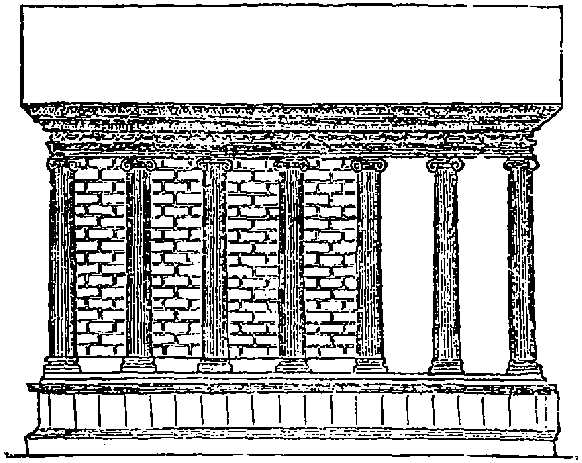
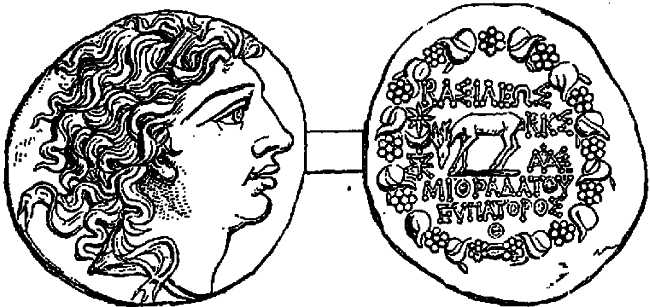
When Sulla returned to Italy after the First Mithridatic War, he left L. Murena, with two legions, to hold the command in Asia. Murena, who was eager for some opportunity of earning the honor of a triumph, pretending that Mithridates had not yet evacuated the whole of Cappadocia, not only marched into that country, but even crossed the Halys, and laid waste the plains of Pontus itself (B.C. 83). To this flagrant breach of the treaty so lately concluded the Roman general was in great measure instigated by Archelaus, who, finding himself regarded with suspicion by Mithridates, had consulted his safety by flight, and was received with the utmost honors by the Romans. Mithridates, who was wholly unprepared to renew the contest with Rome, offered no opposition to the progress of Murena; but finding that general disregard his remonstrances, he sent to Rome to complain of his aggression. When, in the following spring (B.C. 82), he saw Murena preparing to renew his hostile incursions, he at once determined to oppose him by force, and assembled a large army, with which he met the Roman general on the banks of the Halys. The action that ensued terminated in the complete victory of the king, and Murena, with difficultly, effected his retreat into Phrygia, leaving Cappadocia at the mercy of Mithridates, who quickly overran the whole province. Shortly afterward A. Gabinius arrived in Asia, bringing peremptory orders from Sulla to Murena to desist from hostilities, whereupon Mithridates once more consented to evacuate Cappadocia. Thus ended what is commonly called the Second Mithridatic War.
Notwithstanding the interposition of Sulla, Mithridates was well aware that the peace between him and Rome was in fact only sus[Pg 206]pension of hostilities, and that the haughty Republic would never suffer the massacre of her citizens in Asia to remain ultimately unpunished. Hence all his efforts were directed toward the formation of an army capable of contending, not only in numbers, but in discipline, with those of Rome; and with this view he armed his barbarian troops after the Roman fashion, and endeavored to train them up in that discipline of which he had so strongly felt the effect in the preceding contest. In these attempts he was doubtless assisted by the refugees of the Marian party, who had accompanied Fimbria into Asia, and on the defeat of that general by Sulla had taken refuge with the King of Pontus. At their instigation, also, Mithridates sent an embassy to Sertorius, who was still maintaining his ground in Spain, and concluded an alliance with him against their common enemies. But it was the death of Nicomedes III., king of Bithynia, at the beginning of B.C. 74, that brought matters to a crisis, and became the immediate occasion of the war which both parties had long felt to be inevitable. That monarch left his dominions by will to the Roman people, and Bithynia was accordingly declared a Roman province; but Mithridates asserted that the late king had left a legitimate son by his wife Nysa, whose pretensions he immediately prepared to support by his arms.
The forces with which Mithridates was now prepared to take the field were such as might inspire him with no unreasonable confidence of victory. He had assembled an army of 120,000 foot-soldiers, armed and disciplined in the Roman manner, and 16,000 horse, besides a hundred scythed chariots. His fleet, also, was so far superior to any that the Romans could oppose to him as to give him the almost undisputed command of the sea. These preparations, however, appear to have delayed him so long that the season was far advanced before he was able to take the field, and both the Roman Consuls, L. Licinius Lucullus and M. Aurelius Cotta, had arrived in Asia. Neither of them, however, was able to oppose his first irruption. He traversed almost the whole of Bithynia without encountering any resistance; and when at length Cotta ventured to give him battle under the walls of Chalcedon, his army and fleet were totally defeated. Mithridates now proceeded to lay siege to Cyzicus both by sea and land. But Lucullus, who had advanced from Phrygia to the relief of Cotta, and followed Mithridates to Cyzicus, took possession of an advantageous position near the camp of the king, where he almost entirely cut him off from receiving supplies by land, while the storms of the winter prevented him from depending on those by sea. Hence it was not long before famine began to make itself felt in the camp of Mithridates, and all his assaults upon the city having been foiled by the[Pg 207] courage and resolution of the besieged, he was at length compelled (early in the year B.C. 73) to abandon the enterprise and raise the siege. In his retreat he was repeatedly attacked by the Roman general, and suffered very heavy loss at the passage of the Æsepus and Granicus. By the close of the year the great army with which he had commenced the war was annihilated, and he was not only compelled to retire within his own dominions, but was without the means of opposing the advance of Lucullus into the heart of Pontus itself. But he now again set to work with indefatigable activity to raise a fresh army; and while he left the whole of the sea-coast of Pontus open to the invaders, he established himself in the interior at Cabira. Here he was again defeated by Lucullus; and despairing of opposing the farther progress of the Romans, he fled into Armenia to claim the protection and assistance of his son-in-law Tigranes.
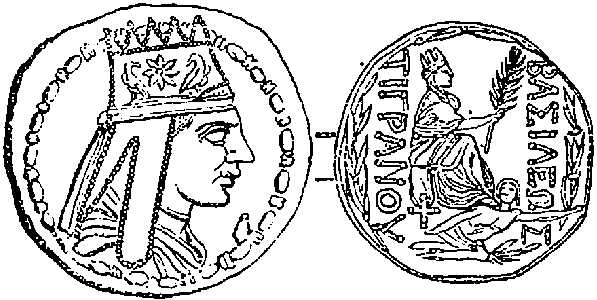
Tigranes was at this moment the most powerful monarch of Asia, but he appears to have been unwilling to engage openly in war with Rome; and on this account, while he received the fugitive monarch in a friendly manner, he refused to admit him to his presence, and showed no disposition to attempt his restoration. But the arrogance of the Romans brought about a change in his policy; and Tigranes, offended at the haughty conduct of Appius Claudius, whom Lucullus had sent to demand the surrender of Mithridates, not only refused this request, but determined at once to prepare for war.
While Lucullus was waiting for the return of Claudius, he devoted his attention to the settlement of the affairs of Asia, which was suffering severely from the oppressions of the farmers of the public taxes. By various judicious regulations he put a stop to their exactions, and earned the gratitude of the cities of Asia; but at the same time he brought upon himself the enmity of the Equites, who were the farmers of the revenue. They were loud[Pg 208] against him in their complaints at Rome, and by their continued clamors undoubtedly prepared the way for his ultimate recall.
Meanwhile community of interests between Mithridates and Tigranes had led to a complete reconciliation between them, and the Pontic king, who had spent a year and eight months in the dominions of his son-in-law without being admitted to a personal interview, was now made to participate in all the councils of Tigranes, and appointed to levy an army to unite in the war. But it was in vain that in the ensuing campaign (B.C. 69) he urged upon his son-in-law the lessons of his own experience, and advised him to shun a regular action with Lucullus: Tigranes, confident in the multitude of his forces, gave battle at Tigranocerta, and was defeated, before Mithridates had been able to join him. But this disaster, so precisely in accordance with the warnings of Mithridates, served to raise the latter so high in the estimation of Tigranes, that from this time forward the whole conduct of the war was intrusted to the direction of the King of Pontus.
In the following summer (B.C. 68) Lucullus crossed the Taurus, penetrated into the heart of Armenia, and again defeated the allied monarchs near the city of Artaxata. But the early severity of the season, and the discontent of his own troops, checked the farther advance of the Roman general, who turned aside into Mesopotamia. Here Mithridates left him to lay siege to the fortress of Nisibis, which was supposed to be impregnable, while he himself took advantage of his absence to invade Pontus at the head of a large army, and endeavor to regain possession of his former dominions. The defense of Pontus was confided to Fabius, one of the lieutenants of Lucullus; but the oppression of the Romans had excited a general spirit of disaffection, and the people crowded around the standard of Mithridates. Fabius was totally defeated, and compelled to shut himself up in the fortress of Cabira. In the following spring (B.C. 67), Triarius, another of the Roman generals, was also defeated with immense loss. The blow was one of the severest which the Roman arms had sustained for a long period: 7000 of their troops fell, among whom were an unprecedented number of officers, and their camp itself was taken.
The advance of Lucullus himself from Mesopotamia prevented Mithridates from following up his advantage, and he withdrew into Lesser Armenia, where he took up a strong position to await the approach of Tigranes. But the farther proceedings of Lucullus were paralyzed by the mutinous and disaffected spirit of his own soldiers. Their discontents were fostered by P. Clodius, whose turbulent and restless spirit already showed itself in its full force, and were encouraged by reports from Rome, where the demagogues[Pg 209] who were favorable to Pompey, or had been gained over by the Equestrian party, were loud in their clamors against Lucullus. They accused him of protracting the war for his own personal objects, either of ambition or avarice; and the soldiery, whose appetite for plunder had been often checked by Lucullus, readily joined in the outcry. Accordingly, on the arrival of Tigranes, the two monarchs found themselves able to overrun almost the whole of Pontus and Cappadocia without opposition.
Such was the state of affairs when ten legates arrived in Asia to reduce Pontus to the form of a Roman province, and they had, in consequence, to report to the Senate that the country supposed to be conquered was again in the hands of the enemy. The adversaries of Lucullus naturally availed themselves of so favorable an occasion, and a decree was passed transferring to M. Acilius Glabrio, one of the Consuls for the year, the province of Bithynia, and the command against Mithridates. But Glabrio was wholly incompetent for the task assigned to him. On arriving in Bithynia he made no attempt to assume the command, but remained within the confines of his province, while he still farther embarrassed the position of Lucullus by issuing proclamations to his soldiers, announcing to them that their general was superseded, and releasing them from their obedience. Before the close of the year (B.C. 67) Lucullus had the mortification of seeing Mithridates established once more in the possession of his hereditary dominions. But it was still more galling to his feelings when, in the spring of the following year (B.C. 66), he was called upon to resign the command to Pompey, who had just brought to a successful termination the war against the pirates.
The Mediterranean Sea had long been swarming with pirates. From the earliest times piracy has more or less prevailed in this sea, which, lying between three continents, and abounding with numerous creeks and islands, presents at the same time both the greatest temptations and the greatest facilities for piratical pursuits. Moreover, in consequence of the Social and Civil wars, and the absence of any fleet to preserve order upon the sea, piracy had reached an alarming height. The pirates possessed fleets in all parts of the Mediterranean, were in the habit of plundering the most wealthy cities on the coasts, and had at length carried their audacity so far as to make descents upon the Appian Road, and carry off Roman magistrates, with their lictors. All communication between Rome and the provinces was cut off, or at least rendered extremely dangerous; the fleets of corn-vessels, upon which Rome to a great extent depended for its subsistence, could not reach the city, and the price of provisions in consequence rose enor[Pg 210]mously. Such a state of things had become intolerable, and all eyes were now directed to Pompey. At the beginning of B.C. 67 the Tribune A. Gabinius brought forward a bill which was intended to give Pompey almost absolute authority over the greater part of the Roman world. It proposed that the people should elect a man with consular rank, who should possess unlimited power for three years over the whole of the Mediterranean, a fleet of 200 ships, with as many soldiers and sailors as he thought necessary, and 6000 Attic talents. The bill did not name Pompey, but it was clear who was meant. The aristocracy were in the utmost alarm, and in the Senate Cæsar was almost the only person who came forward in its support. Party spirit ran to such a height that the most serious riots ensued. Even Pompey himself was threatened by the Consul, "If you emulate Romulus, you will not escape the end of Romulus." Q. Catulus and Q. Hortensius spoke against the bill with great eloquence, but with no effect. On the day that the bill was passed the price of provisions at Rome immediately fell, a fact which showed the immense confidence which all parties placed in the military abilities of Pompey.
Pompey's plans were formed with great skill, and were crowned with complete success. He stationed his lieutenants with different squadrons in various parts of the Mediterranean to prevent the pirates from uniting, and to hunt them out of the various bays and creeks in which they concealed themselves; while, at the same time, he swept the middle of the sea with the main body of his fleet, and chased them eastward. In forty days he drove the pirates out of the western seas, and restored communication between Spain, Africa, and Italy. After then remaining a short time in Italy, he sailed from Brundusium, cleared the seas as he went along, and forced the pirates to the Cilician coast. Here the decisive action was fought; the pirates were defeated, and more than 20,000 prisoners fell into his hands. Those on whom most reliance could be placed were distributed among the small and depopulated cities of Cilicia, and a large number were settled at Soli, which was henceforward called Pompeiopolis. The second part of this campaign occupied only forty-nine days, and the whole war was brought to a conclusion in the course of three months. Pompey remained in Cilicia during the remainder of this year and the beginning of the one following. Meantime the Tribune C. Manilius brought forward a bill (B.C. 66) giving to Pompey the command of the war against Mithridates, with unlimited power over the army and the fleet in the East, and with the rights of a Proconsul in the whole of Asia as far as Armenia. As his Proconsular power already extended over all the coasts and islands of the Mediterranean in vir[Pg 211]tue of the Gabinian law, this new measure virtually placed almost the whole of the Roman dominions in his hands. But there was no power, however excessive, which the people were not ready to intrust to their favorite hero; and the bill was accordingly passed, notwithstanding the opposition of Hortensius, Catulus, and the aristocratical party. Cicero advocated the measure in an oration which has come down to us (Pro Lege Manilia), and Cæsar likewise supported it with his growing popularity and influence.
On receiving intelligence of this new appointment, Pompey immediately crossed the Taurus, and took the command of the army from Lucullus.
The power of Mithridates had been broken by the previous victories of Lucullus, and the successes which the king had gained lately were only of a temporary nature, mainly owing to the disorganization of the Roman army. In the plan of the campaign Pompey displayed great military skill. One of his first measures was to secure the alliance of the Parthian king, which not only deprived Mithridates of all hopes of succor from that quarter, but likewise cut him off from all assistance from the Armenian king Tigranes, who was now obliged to look to the safety of his own dominions. Pompey next stationed his fleet in different squadrons along the coasts of Asia Minor, in order to deprive Mithridates of all communication from the sea, and he then proceeded in person at the head of his land-forces against the king. Thus thrown back upon his own resources, Mithridates sued for peace, but, as Pompey would hear of nothing but unqualified submission, the negotiation was broken off. The king was still at the head of 30,000 foot and 2000 horse; but he knew too well the strength of a Roman army to venture an engagement with these forces, and accordingly withdrew gradually to the frontiers of Armenia. For a long time he succeeded in avoiding a battle, but he was at length surprised by Pompey in Lesser Armenia, as he was marching through a narrow pass. The battle was soon decided; the king lost the greater number of his troops, and escaped with only a few horsemen to the fortress of Synorium, on the borders of the Greater Armenia. Here he again collected a considerable force; but as Tigranes refused to admit him into his dominions, because he suspected him of fomenting the intrigues of his son against him, Mithridates had no alternative but to take refuge in his own distant dominions in the Cimmerian Bosporus. To reach them he had to march through Colchis, and to fight his way through the wild and barbarous tribes that occupied the country between the Caucasus and the Euxine. He succeeded, however, in this arduous enterprise, and reached the Bosporus in safety in the course of next year. Pompey abandoned at pres[Pg 212]ent all thoughts of following the fugitive king, and resolved at once to attack Tigranes, who was now the more formidable of the two monarchs.
On entering Armenia Pompey met with no opposition. He was joined by the young Tigranes, who had revolted against his father, and all the cities submitted to them on their approach. When the Romans drew near to Artaxata, the king, deserted by his army and his court, went out to meet Pompey, and threw himself before him as a suppliant. Pompey received him with kindness, acknowledged him as King of Armenia, and demanded only the payment of 6000 talents. His foreign possessions, however, in Syria, Phœnicia, Cilicia, Galatia, and Cappadocia, which had been conquered by Lucullus, were to belong to the Romans. To his son Tigranes, Sophene and Gordyene were given as an independent kingdom; but as the young prince was discontented with this arrangement, and even ventured to utter threats, Pompey had him arrested, and kept him in chains to grace his triumph.
After thus settling the affairs of Armenia, Pompey proceeded northward in pursuit of Mithridates. But the season was so far advanced that he took up his winter quarters on the banks of the River Cyrus. Early in the spring (B.C. 65) he resumed his march northward, and advanced as far as the River Phasis, but, obtaining here more certain information of the movements of Mithridates, and of the wild and inaccessible nature of the country through which he would have to march in order to reach the king, he retraced his steps, and led his troops into winter quarters at Amisus, on the Euxine. He now reduced Pontus to the form of a Roman province.
In B.C. 64 Pompey marched into Syria, where he deposed Antiochus Asiaticus, and made the country a Roman province. He likewise compelled the neighboring princes, who had established independent kingdoms on the ruins of the Syrian empire, to submit to the Roman dominion. The whole of this year was occupied with the settlement of Syria and the adjacent countries.
Next year (B.C. 63) Pompey advanced farther south, in order to establish the Roman supremacy in Phœnicia, Cœle-Syria, and Palestine. The latter country was at this time distracted by a civil war between Hyrcanus and Aristobulus. Pompey espoused the side of Hyrcanus, and Aristobulus surrendered himself to Pompey when the latter had advanced near to Jerusalem. But the Jews refused to follow the example of their king, and it was not till after a siege of three months that the city was taken. Pompey entered the Holy of Holies, the first time that any human being, except the high-priest, had penetrated into this sacred spot. He re[Pg 213]instated Hyrcanus in the high-priesthood, but compelled him to pay an annual tribute to Rome; Aristobulus accompanied him as a prisoner. It was during this war in Palestine that Pompey received intelligence of the death of Mithridates.
During the last two years Mithridates had been making the most extensive preparations for a renewal of the contest. He had conceived the daring project of marching round the north and west coasts of the Euxine, and penetrating even into Italy. With these views, he was busily engaged in assembling such a fleet and array as would be sufficient for an enterprise of this magnitude; but his proceedings were delayed by a long and painful illness, which incapacitated him for any personal exertion. At length, however, his preparations were completed, and he found himself at the head of an army of 36,000 men and a considerable fleet. But during his illness disaffection had made rapid progress among his followers. The full extent of his schemes was probably communicated to few; but enough had transpired to alarm the multitude, and a formidable conspiracy was organized by Pharnaces, the favorite son of Mithridates. He was quickly joined both by the whole army and the citizens of Panticapæum, who unanimously proclaimed him king, and Mithridates saw that no choice remained to him but death or captivity. Hereupon he took poison, which he constantly carried with him; but his constitution had been so long inured to antidotes that it did not produce the desired effect, and he was compelled to call in the assistance of one of his Gaulish mercenaries to dispatch him with his sword.
Pompey now devoted his attention to the settlement of affairs in Asia. He confirmed Pharnaces, the son of Mithridates, in the possession of the kingdom of Bosporus; Deiotarus, tetrarch of Galatia, was rewarded with an extension of territory; and Ariobarzanes, king of Cappadocia, was restored to his kingdom. After an absence of seven years, Pompey arrived in Italy toward the end of B.C. 62. His arrival had been long looked for by all parties with various feelings of hope and fear. It was felt that at the head of his victorious troops he could easily play the part of Sulla, and become the ruler of the state. Important events had taken place at Rome during the absence of Pompey, of which it is necessary to give an account before following him to the city.
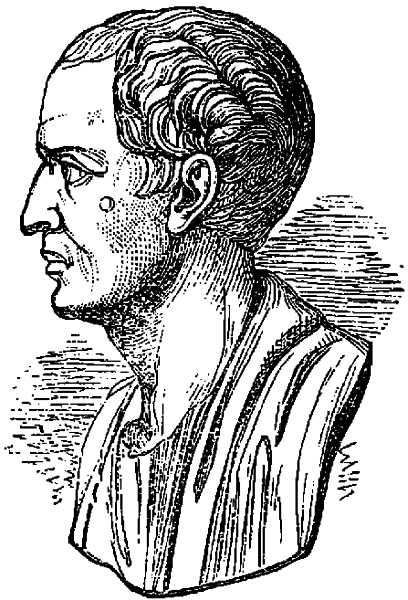
Notwithstanding the restoration of the Tribunate and the alteration in the judicial power in Pompey's Consulship, the popular party had received such a severe blow during Sulla's supremacy, that the aristocracy still retained the chief political influence during Pompey's absence in the East. But meantime a new leader of the popular party had been rapidly rising into notice, who was destined not only to crush the aristocracy, but to overthrow the Republic and become the undisputed master of the Roman world.
C. JULIUS CÆSAR, who was descended from an old Patrician family, was six years younger than Pompey, having been born in B.C. 100. He was closely connected with the popular party by the marriage of his aunt Julia with the great Marius, and he himself married, at an early age, Cornelia, the daughter of Cinna, the most[Pg 215] distinguished of the Marian leaders. Sulla commanded him to divorce his wife, and on his refusal he was included in the list of the proscription. The Vestal virgins and his friends with difficulty obtained his pardon from the Dictator, who observed, when they pleaded his youth and insignificance, "that that boy would some day or another be the ruin of the aristocracy, for that there were many Mariuses in him."
This was the first proof which Cæsar gave of the resolution and decision of character which distinguished him throughout life. He went to Asia in B.C. 81, where he served his first campaign under M. Minucius Thermus, and was rewarded, at the siege of Mitylene, with a civic crown for saving the life of a fellow-soldier. On his return to Rome he accused (B.C. 77) Cn. Dolabella of extortion in his province of Macedonia. Dolabella was acquitted by the senatorial judges; but Cæsar gained great reputation by this prosecution, and showed that he possessed powers of oratory which bade fair to place him among the foremost speakers at Rome. To render himself still more perfect in oratory, he went to Rhodes, which was then celebrated for its school of rhetoric, but in his voyage thither he was captured by pirates, with whom the seas of the Mediterranean then swarmed. In this island he was detained by them till he could obtain fifty talents from the neighboring cities for his ransom. Immediately on obtaining his liberty, he manned some Milesian vessels, overpowered the pirates, and conducted them as prisoners to Pergamus, where he shortly afterward crucified them—a punishment he had frequently threatened them with in sport when he was their prisoner. He then repaired to Rhodes, where he studied under Apollonius for a short time, but soon afterward crossed over into Asia, on the outbreak of the Mithridatic war in B.C. 74. Here, although he held no public office, he collected troops on his own authority, and repulsed the commander of the king, and then returned to Rome in the same year, in consequence of having been elected Pontiff during his absence. His affable manners, and, still more, his unbounded liberality, won the hearts of the people.
Cæsar obtained the Quæstorship in B.C. 68. In this year he lost his aunt Julia, the widow of Marius, and his own wife Cornelia. He pronounced orations over both of them in the forum, in which he took the opportunity of passing a panegyric upon the former leaders of the popular party. At the funeral of his aunt he caused the images of Marius to be carried in the procession: they were welcomed with loud acclamations by the people, who were delighted to see their former favorite brought, as it were, into public again.
Cæsar warmly supported the Gabinian and Manilian Laws,[Pg 216] which bestowed upon Pompey the command against the pirates and Mithridates. These measures, as we have already seen, were opposed by the aristocracy, and widened still farther the breach between them and Pompey. In B.C. 65 Cæsar was Curule Ædile along with M. Bibulus, and still farther increased his popularity by the splendid games which he exhibited. He now took a step which openly proclaimed him the leader of the Marian party. He caused the statues of Marius and the Cimbrian trophies, which had been all destroyed by Sulla, to be privately restored and placed at night in the Capitol. In the morning the city was in the highest state of excitement; the veterans of Marius cried with joy at beholding his countenance once more, and greeted Cæsar with shouts of applause. Q. Catulus brought the conduct of Cæsar before the notice of the Senate, but the popular excitement was so great that they thought it better to let the matter drop.
In Cæsar's Ædileship the first Catilinarian conspiracy occurred, and from this time his history forms a portion of that of the times. But before passing on, the early life of another distinguished man, the greatest of Roman orators, also claims our notice.
M. TULLIUS CICERO was born at Arpinum in B.C. 106, and consequently in the same year as Pompey. His father was of the Equestrian order, and lived upon his hereditary estate near Arpinum, but none of his ancestors had ever held any of the offices of state. Cicero was therefore, according to the Roman phraseology, a New Man (see p. 128). He served his first and only campaign in the Social War (B.C. 89), and in the troubled times which followed he gave himself up with indefatigable perseverance to those studies which were essential to his success as a lawyer and orator. When tranquillity was restored by the final discomfiture of the Marian party, he came forward as a pleader at the age of twenty-five. The first of his extant speeches in a civil suit is that for P. Quintius (B.C. 81); the first delivered upon a criminal trial was that in defense of Sex. Roscius of Ameria, who was charged with parricide by Chrysogonus, a freedman of Sulla, supported, as it was understood, by the influence of his patron. In consequence of the failure of his health, Cicero quitted Rome in B.C. 79, and spent two years in study in the philosophical and rhetorical schools of Athens and Asia Minor. On his return to the city he forthwith took his station in the foremost rank of judicial orators, and ere long stood alone in acknowledged pre-eminence; his most formidable rivals—Hortensius, eight years his senior, and C. Aurelius Cotta, who had long been kings of the bar—having been forced, after a short but sharp contest for supremacy, to yield.
Cicero's reputation and popularity already stood so high that he[Pg 217] was elected Quæstor (B.C. 76), although, comparatively speaking, a stranger, and certainly unsupported by any powerful family interest. He served in Sicily under Sex. Peducæus, Prætor of Lilybæum. In B.C. 70 he gained great renown by his impeachment of Verres for his oppression of the Sicilians, whom he had ruled as Prætor of Syracuse for the space of three years (B.C. 73-71). The most strenuous exertions were made by Verres, backed by some of the most powerful families, to wrest the case out of the hands of Cicero, who, however, defeated the attempt, and having demanded and been allowed 110 days for the purpose of collecting evidence, he instantly set out for Sicily, which he traversed in less than two months, and returned attended by all the necessary witnesses. Another desperate effort was made by Hortensius, now Consul elect, who was counsel for the defendant, to raise up obstacles which might have the effect of delaying the trial until the commencement of the following year; but here again he was defeated by the promptitude and decision of his opponent, who opened the case very briefly, proceeded at once to the examination of the witnesses and the production of the depositions and other papers, which, taken together, constituted a mass of testimony so decisive that Verres gave up the contest as hopeless, and retired at once into exile without attempting any defense. The full pleadings, however, which were to have been delivered had the trial been permitted to run its ordinary course, were subsequently published by Cicero.
In B.C. 69 Cicero was Ædile, and in 66 Prætor. In the latter year he delivered his celebrated address to the people in favor of the Manilian Law. Having now the Consulship in view, and knowing that, as a new man, he must expect the most determined opposition from the Nobles, he resolved to throw himself into the arms of the popular party, and to secure the friendship of Pompey, now certainly the most important person in the Republic.
In the following year (B.C. 65) the first conspiracy of Catiline occurred. The circumstances of the times were favorable to a bold and unprincipled adventurer. A widespread feeling of disaffection extended over the whole of Italy. The veterans of Sulla had already squandered their ill-gotten wealth, and longed for a renewal of those scenes of blood which they had found so profitable. The multitudes whose estates had been confiscated and whose relations had been proscribed were eagerly watching for any movement which might give them a chance of becoming robbers and murderers in their turn. The younger nobility, as a class, were thoroughly demoralized, for the most part bankrupts in fortune as well as in fame, and eager for any change which might[Pg 218] relieve them from their embarrassments. The rabble were restless and discontented, filled with envy and hatred against the rich and powerful. Never was the executive weaker. The Senate and Magistrates were wasting their energies in petty disputes, indifferent to the interests of the Republic. Pompey, at the head of all the best troops of the Republic, was prosecuting a long-protracted war in the East; there was no army in Italy, where all was hushed in a treacherous calm.
Of the profligate nobles at this time none was more profligate than L. SERGIUS CATILINA. He was the descendant of an ancient patrician family which had sunk into poverty, and he first appears in history as a zealous partisan of Sulla. During the horrors of the proscription he killed his brother-in-law, Q. Cæcilius, and is said to have murdered even his own brother. His youth was spent in the open indulgence of every vice, and it was believed that he had made away with his first wife, and afterward with his son, in order that he might marry the profligate Aurelia Orestilla, who objected to the presence of a grown-up step-child. Notwithstanding these crimes, he acquired great popularity among the younger nobles by his agreeable address and his zeal in ministering to their pleasures. He possessed extraordinary powers of mind and body, and all who came in contact with him submitted more or less to the ascendency of his genius. He was Prætor in B.C. 68; was Governor of Africa during the following year; and returned to Rome in B.C. 66, in order to press his suit for the Consulship. The election for B.C. 65 was carried by P. Autronius Pætus and P. Cornelius Sulla, both of whom were soon after convicted of bribery, and their places supplied by their competitors and accusers, L. Aurelius Cotta and L. Manlius Torquatus. Catiline, who was desirous of becoming a candidate, had been disqualified in consequence of an impeachment for oppression in his province preferred by P. Clodius Pulcher. Exasperated by their disappointment, Autronius and Catiline formed a project, along with Cn. Calpurnius Piso, another profligate young nobleman, to murder the new Consuls upon the first of January, when offering up their vows in the Capitol, after which Autronius and Catiline were to seize the fasces, and Piso was to be dispatched with an army to occupy the Spains. This extraordinary design is said to have been frustrated solely by the impatience of Catiline, who gave the signal prematurely before the whole of the armed agents had assembled.
Encouraged rather than disheartened by a failure which had so nearly proved a triumph, Catiline was soon after left completely unfettered by his acquittal upon trial for extortion, a result secured by the liberal bribes administered to the accuser as well as to the[Pg 219] jury. From this time he proceeded more systematically, and enlisted a more numerous body of supporters. In the course of B.C. 64 he had enrolled several Senators in his ranks, among others P. Cornelius Lentulus Sura, who had been Consul in B.C. 71, and C. Cornelius Cethegus, distinguished throughout by his impetuosity and sanguinary violence. He proposed that all debts should be canceled, that the most wealthy citizens should be proscribed, and that all offices of honor and emolument should be divided among his associates. He confidently anticipated that he should be elected Consul for the next year along with C. Antonius, having formed a coalition with him for the purpose of excluding Cicero. The orator, however, was supported, not only by the Equites and Pompey's friends, but even by the Senate, who, though disliking a New Man, were compelled to give him their support in order to exclude Catiline. The consequence was that Cicero and Antonius were returned, the former nearly unanimously, the latter by a small majority over Catiline. As soon as Cicero entered upon his Consulship he renounced his connection with the popular party, and became a stanch supporter of the aristocracy. He successfully opposed an agrarian law proposed by the Tribune Rullus, and defended C. Rabirius, who was now accused by the Tribune Labienus of having been concerned in the death of Saturninus nearly forty years before. Cæsar took an active part in both these proceedings. But the attention of Cicero was mainly directed to Catiline's conspiracy. He gained over his colleague Antonius by resigning to him the province of Macedonia. Meantime he became acquainted with every detail of the plot through Fulvia, the mistress of Q. Curius, one of Catiline's intimate associates. Thus informed, Cicero called a meeting of the Senate on the 21st of October, when he openly denounced Catiline, charged him broadly with treason, and asserted that the 28th was the period fixed for the murder of the leading men in the Republic. The Senate thereupon invested the Consuls with dictatorial power. The Comitia for the election of the Consuls was now held. Catiline, again a candidate, was again rejected. Driven to despair by this fresh disappointment, he resolved at once to bring matters to a crisis. On the night of the 6th of November he summoned a meeting of the ringleaders at the house of M. Porcius Læca, and made arrangements for an immediate outbreak. Cicero, being immediately informed of what took place, summoned, on the 8th of November, a meeting of the Senate in the Temple of Jupiter Stator, and there delivered the first of his celebrated orations against Catiline. Catiline, who upon his entrance had been avoided by all, and was sitting alone upon a bench from which every one had shrunk, rose to reply, but had[Pg 220] scarcely commenced when his words were drowned by the shouts of "enemy" and "parricide" which burst from the whole assembly, and he rushed forth with threats and curses on his lips. He now resolved to strike some decisive blow before troops could be levied to oppose him, and accordingly, leaving the chief control of affairs at Rome in the hands of Lentulus and Cethegus, he set forth in the dead of night, and proceeded to join Manlius at Fæsulæ.
On the 9th, when the flight of Catiline was known, Cicero delivered his second speech, which was addressed to the people in the forum. The Senate proceeded to declare Catiline and Manlius public enemies, and decreed that Antonius should go forth to the war, while Cicero should remain to guard the city. Cicero was now anxious to obtain other evidence, besides that of Fulvia, which would warrant him in apprehending the conspirators within the walls. This was fortunately supplied by the embassadors of the Allobroges, who were now at Rome, having been sent to seek relief from certain real or alleged grievances. Their suit, however, had not prospered, and Lentulus, conceiving that their discontent might be made available for his own purposes, opened a negotiation with them and disclosed to them the nature of the plot. But they thought it more prudent to reveal all to Q. Fabius Sanga, the patron of their state, who in his turn acquainted Cicero. By the instructions of the latter the embassadors affected great zeal in the undertaking, and obtained a written agreement signed by Lentulus, Cethegus, and others. They quitted Rome soon after midnight on the 3d of December, accompanied by one T. Volturcius, who was charged with dispatches for Catiline. The embassadors were seized, as they were crossing the Mulvian bridge, by two of the Prætors, who had been stationed in ambush to intercept them.
Cicero instantly summoned Lentulus, Cethegus, and the other conspirators to his presence. Lentulus being Prætor, the Consul led him by the hand to the Temple of Concord, where the Senate was already met; the rest of the accused followed closely guarded. Volturcius, finding escape impossible, agreed, upon his own personal safety being insured, to make a full confession. His statements were confirmed by the Allobroges, and the testimony was rendered conclusive by the signatures of the ringleaders, which they were unable to deny. The guilt of Lentulus, Cethegus, and seven others being thus established, Lentulus was forced to abdicate his office, and then, with the rest, was consigned to the charge of certain Senators, who became responsible for their appearance.
These circumstances, as they had occurred, were then narrated by Cicero in his Third Oration, delivered in the forum. On the nones (5th) of December the Senate was again summoned to de[Pg 221]termine upon the fate of the conspirators. Cæsar, in an elaborate speech, proposed that they should be kept in confinement in the different towns of Italy, but Cato and Cicero strongly advocated that they should be instantly put to death. Their views were adopted by a majority of the Senate, and a decree passed to that effect. On the same night Lentulus and his associates were strangled by the common executioner in the Tullianum, a loathsome dungeon on the slope of the Capitol.
While these things were going on at Rome, Catiline had collected a force amounting to two legions, although not above one fourth part were fully equipped. When the news of the failure of the plot at Rome reached his camp many deserted. He thereupon attempted to cross the Apennines and take refuge in Cisalpine Gaul, but the passes were strictly guarded by Metellus Celer with three legions. Finding, therefore, that escape was cut off in front, while Antonius was pressing on his rear, Catiline determined, as a last resource, to hazard an engagement. Antonius, in consequence of real or pretended illness, resigned the command to M. Petreius, a skillful soldier. The battle was obstinate and bloody. The rebels fought with the fury of despair; and when Catiline saw that all was lost, he charged headlong into the thickest of the fight and fell sword in hand (B.C. 62).
Cicero had rendered important services to the state, and enjoyed for a time unbounded popularity. Catulus in the Senate and Cato in the forum hailed him as the "Father of his Country;" thanksgivings in his name were voted to the gods; and all Italy joined in testifying enthusiastic admiration and gratitude. Cicero's elation knew no bounds; he fancied that his political influence was now supreme, and looked upon himself as a match even for Pompey. But his splendid achievement contained the germ of his humiliation and downfall. There could be no doubt that the punishment inflicted by the Senate upon Lentulus and his associates was a violation of the fundamental principles of the Roman Constitution, which declared that no citizen could be put to death until sentenced by the whole body of the people assembled in their Comitia, and for this act Cicero, as the presiding magistrate, was held responsible. It was in vain to urge that the Consuls had been armed with dictatorial power; the Senate, in the present instance, assuming to themselves judicial functions which they had no right to exercise, gave orders for the execution of a sentence which they had no right to pronounce. Nor were his enemies long in discovering this vulnerable point. On the last day of the year, when, according to established custom, he ascended the Rostra to give an account to the people of the events of his Consulship, Metellus Ce[Pg 222]ler, one of the new Tribunes, forbade him to speak, exclaiming that the man who had put Roman citizens to death without granting them a hearing was himself unworthy to be heard. But this attack was premature. The audience had not yet forgotten their recent escape; so that, when Cicero swore with a loud voice that "he had saved the Republic and the city from ruin," the crowd with one voice responded that he had sworn truly.
It was rumored that many other eminent men had been privy to Catiline's conspiracy. Among others, the names of Crassus and Cæsar were most frequently mentioned; but the participation of either of these men in such an enterprise seems most improbable. The interests of Crassus were opposed to such an adventure; his vast wealth was employed in a variety of speculations which would have been ruined in a general overthrow, while he had not the energy or ability to seize and retain the helm in the confusion that would have ensued. Of Cæsar's guilt there is no satisfactory evidence, and it is improbable that so keen-sighted a man would have leagued with such a desperate adventurer as Catiline. Cato, in his speech respecting the fate of the conspirators, hinted that Cæsar wished to spare them because he was a partner of their guilt; and in the following year (B.C. 62), when Cæsar was Prætor, L. Vettius, who had been one of Cicero's informers, openly charged him with being a party to the plot. Thereupon Cæsar called upon Cicero to testify that he had of his own accord given the Consul evidence respecting the conspiracy; and so complete was his vindication that Vettius was thrown into prison.
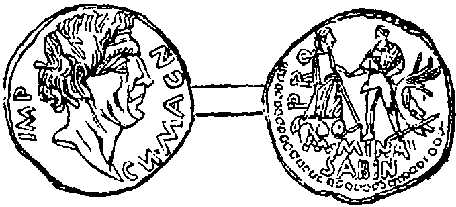
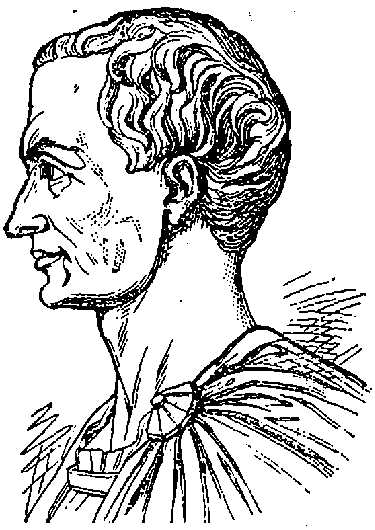
Pompey, as we have already seen, reached Italy in B.C. 62. It was generally feared that he would seize the supreme power, but he soon calmed these apprehensions by disbanding his army immediately after landing at Brundusium. He did not, however, enter Rome in triumph till the 30th of September, B.C. 61. The triumph lasted two days, and surpassed in splendor every spectacle that Rome had yet seen. The tablets carried in the procession, on which his victories were emblazoned, declared that he had taken 1000 strong fortresses, 900 towns, and 800 ships; that he had founded 39 cities; that he had raised the revenue of the Roman people from 59 millions to 85 millions; and that he had brought into the public treasury 20,000 talents. Before his triumphal car walked 324 captive princes.
With this triumph the first and most glorious part of Pompey's life may be said to have ended. Hitherto he had been employed almost exclusively in war; but now he was called upon to play a prominent part in the civil commotions of the Republic—a part for which neither his natural talents nor his previous habits had in the[Pg 224] least fitted him. From the death of Sulla to the present time, a period of nearly twenty years, he had been unquestionably the first man in the Roman world, but he did not retain much longer this proud position, and soon discovered that the genius of Cæsar had reduced him to a second place in the state. It would seem as if Pompey, on his return to Rome, hardly knew to which party to attach himself. He had been appointed to the command against the pirates and Mithridates in opposition to the aristocracy, and they still regarded him with jealousy and distrust. He could not, therefore, ally himself to them, especially too as some of their most influential leaders, such as M. Crassus and L. Lucullus, were his personal enemies. At the same time he seems to have been indisposed to unite himself to the popular party, which had risen into importance during his absence in the East, and over which Cæsar possessed unbounded influence. But the object which engaged the immediate attention of Pompey was to obtain from the Senate a ratification of his acts in Asia, and an assignment of lands which he had promised to his veterans. In order to secure this object, he had purchased the Consulship for one of his officers, L. Afranius, who was elected with Q. Metellus for B.C. 60. But L. Afranius was a man of slender ability; and the Senate, glad of an opportunity to put an affront upon a person whom they both feared and hated, resolutely refused to sanction Pompey's measures in Asia. This was the unwisest thing they could have done. If they had known their real interests, they would have yielded to all Pompey's wishes, and have sought by every means to win him over to their side, as a counterpoise to the growing and more dangerous influence of Cæsar. But their short-sighted policy threw Pompey into Cæsar's arms, and thus sealed the downfall of their party. Pompey was resolved to fulfill the promises he had made to his Asiatic clients and his veteran troops.
Cæsar had returned from Spain in the middle of this year. He had been in that province for one year as Proprætor, during which time he displayed that military ability which was soon to be exhibited on a still more conspicuous field. He subdued the mountainous tribes of Lusitania, took the town of Brigantium in the country of the Gallæci, and gained many other advantages over the enemy. His troops saluted him as Imperator, and the Senate honored him by a public thanksgiving. He now laid claim to a triumph, and at the same time wished to become a candidate for the Consulship. For the latter purpose his presence in the city was necessary; but, as he could not enter the city without relinquishing his triumph, he applied to the Senate to be exempted from the usual law, and to become a candidate in his absence. As this[Pg 225] was refused, he at once relinquished his triumph, entered the city, and became a candidate for the Consulship. He was elected without difficulty, but the aristocracy succeeded in associating with him in the Consulship M. Bibulus, who belonged to the opposite party, and who had likewise been his colleague in the Ædileship and Prætorship.
Cæsar now represented to Pompey the importance of detaching from the aristocracy M. Crassus, who, by his connections and immense wealth, possessed great political influence. Pompey and Crassus had for a long time past been deadly enemies, but they were now reconciled, and the three entered into an agreement to divide the power between themselves. This first Triumvirate, as it is called, was therefore merely a private arrangement between the three most powerful men at Rome, which remained a secret till the proceedings of Cæsar in his Consulship showed that he was supported by a power against which it was in vain for his enemies to struggle.
As soon as Cæsar had entered upon his Consulship he proposed an agrarian law for the division of the rich Campanian land. The execution of the law was to be intrusted to a board of twenty commissioners. The opposition of the aristocratical party was in vain. Porapey and Crassus spoke in favor of the law; and the former declared that he would bring both sword and buckler against those who used the sword. On the day on which it was put to the vote, Bibulus and the other members of the aristocracy were driven out of the forum by force of arms: the law was carried, the commissioners appointed, and about 20,000 citizens, comprising, of course, a great number of Pompey's veterans, received allotments subsequently. Bibulus, despairing of being able to offer any farther resistance to Cæsar, shut himself up in his own house, and did not appear again in public till the expiration of his Consulship.
Cæsar obtained from the people a ratification of all Pompey's acts in Asia, and, to cement their union more closely, gave his only daughter Julia in marriage to Pompey. His next step was to gain over the Equites, who had rendered efficient service to Cicero in his Consulship, and had hitherto supported the aristocratical party. An excellent opportunity now occurred for accomplishing this object. In their eagerness to obtain the farming of the public taxes in Asia, the Equites had agreed to pay too large a sum, and accordingly petitioned the Senate for more favorable terms. This, however, had been opposed by Metellus Celer, Cato, and others of the aristocracy; and Cæsar, therefore, now carried a law to relieve the Equites from one third of the sum which they had agreed to pay. Having thus gratified the people, the Equites, and Pom[Pg 226]pey, he was easily able to obtain for himself the provinces which he wished.
It is not attributing any extraordinary foresight to Cæsar to suppose that he already saw that the struggle between the different parties at Rome must eventually be terminated by the sword. The same causes were still in operation which had led to the civil wars between Marius and Sulla; and he was well aware that the aristocracy would not hesitate to call in the assistance of force if they should ever succeed in detaching Pompey from his interests. It was therefore of the first importance for him to obtain an army which he might attach to himself by victories and rewards. Accordingly, he induced the Tribune Vatinius to propose a bill to the people granting him the provinces of Cisalpine Gaul and Illyricum for five years (B.C. 58-54). Transalpine Gaul was shortly afterward added. Cæsar chose the Gallic provinces, as he would thus be able to pass the winter in Italy and keep up his communication with the city, while the disturbed state of Farther Gaul promised him sufficient materials for engaging in a series of wars in which he might employ an army that would afterward be devoted to his purposes. In addition to these considerations, Cæsar was also actuated by the ambition of subduing forever that nation which had once sacked Rome, and which had been, from the earliest times, more or less an object of dread to the Roman state.
The Consuls of the following year (B.C. 58) were L. Calpurnius Piso and A. Gabinius. Piso was Cæsar's father-in-law, and Gabinius in his Tribunate had proposed the law conferring upon Pompey the command against the pirates. Cæsar saw that it was evident they would support whatever the Triumvirs might wish. Cicero was now threatened with destruction.
In B.C. 62, while the wife of Cæsar was celebrating in the house of her husband, then Prætor and Pontifex Maximus, the rites of the Bona Dea, from which all male creatures were excluded, it was discovered that P. Clodius Pulcher, a profligate noble, whom we have seen inciting the army of Lucullus to insurrection, had found his way into the mansion disguised in woman's apparel, and, having been detected, had made his escape by the help of a female slave. The matter was laid before the Senate, and by them referred to the members of the Pontifical College, who passed a resolution that sacrilege had been committed. Cæsar forthwith divorced his wife. Clodius was impeached and brought to trial. In defense he pleaded an alibi, offering to prove that he was at Interamna at the very time when the crime was said to have been committed; but Cicero came forward as a witness, and swore that he had met and spoken to Clodius in Rome on the day in question.[Pg 227] In spite of this decisive testimony, and the evident guilt of the accused, the Judices pronounced him innocent by a majority of voices (B.C. 61). Clodius now vowed deadly vengeance against Cicero. To accomplish his purpose more readily, he determined to become a candidate for the Tribunate, but for this it was necessary, in the first place, that he should be adopted into a plebeian family by means of a special law. This, after protracted opposition, was at length accomplished through the interference of the Triumvirs, and he was elected Tribune for B.C. 58.
One of the first acts of Clodius, after entering upon office, was to propose a bill interdicting from fire and water any one who should be found to have put a Roman citizen to death untried. Cicero changed his attire, and, assuming the garb of one accused, went round the Forum soliciting the compassion of all whom he met. For a brief period public sympathy was awakened. A large number of the Senate and the Equites appeared also in mourning, and the better portion of the citizens seemed resolved to espouse his cause. But all demonstrations of such feelings were promptly repressed by Piso and Gabinius. Cæsar had previously made overtures to Cicero, which the orator, overrating his influence and relying upon the support of Pompey, had rejected. The Triumvirs now left him to his fate, and Cicero, giving way to despair, quitted Rome at the beginning of April (B.C. 68), and reached Brundusium about the middle of the month. From thence he crossed over to Greece. The instant that the departure of Cicero became known, a law was passed pronouncing his banishment, forbidding any one to entertain or harbor him, and denouncing as a public enemy whosoever should take any steps toward procuring his recall. His mansion on the Palatine, and his villas at Tusculum and Formiæ, were at the same time given over to plunder and destruction. Clodius, having thus gratified his hatred, did not care to consult any longer the views of the Triumvirs. He restored Tigranes to liberty, whom Pompey had kept in confinement, ridiculed the great Imperator before the people, and was accused of making an attempt upon his life. Pompey, in revenge, resolved to procure the recall of Cicero from banishment, and was thus brought again into some friendly connections with the aristocratical party. The new Consuls (B.C. 57) were favorable to Cicero; but, though Clodius was no longer in office, he had several partisans among the Tribunes who offered the most vehement opposition to the restoration of his great enemy. One of the chief supporters of Cicero was the Tribune T. Annius Milo, a man as unprincipled and violent as Clodius himself. He opposed force to force, and at the head of a band of gladiators attacked the hired ruffians of Clodius. The streets of[Pg 228] Rome were the scenes of almost daily conflicts between the leaders of these assassins. At length the Senate, with the full approbation of Pompey, determined to invite the voters from the different parts of Italy to repair to Rome and assist in carrying a law for the recall of Cicero. Accordingly, on the 4th of August, the bill was passed by an overwhelming majority. On the same day Cicero quitted Dyrrhachium, and crossed over to Brundusium. He received deputations and congratulatory addresses from all the towns on the line of the Appian Way; and having arrived at Rome on the 4th of September, a vast multitude poured forth to meet him, while the crowd rent the air with acclamations as he passed through the Forum and ascended the Capitol to render thanks to Jupiter (B.C. 57).
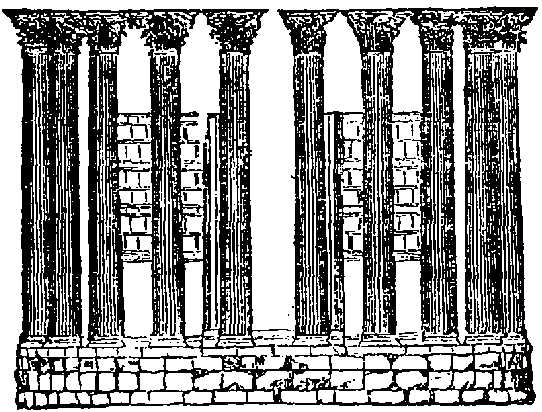
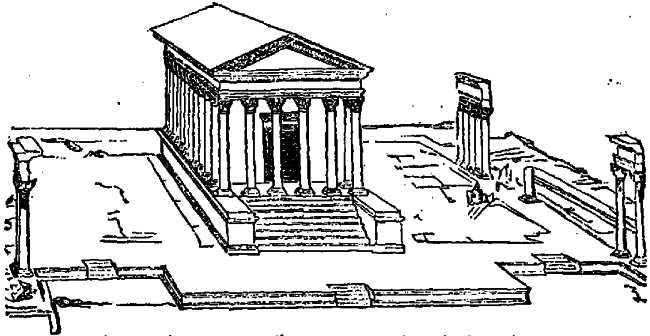
Cæsar set out for his province immediately after Cicero had gone into exile (B.C. 58). During the next nine years he was occupied with the subjugation of Gaul. In this time he conquered the whole of Transalpine Gaul, which had hitherto been independent of the Romans, with the exception of the part called Provincia. Twice he crossed the Rhine, and carried the terror of the Roman arms beyond that river. Twice he landed in Britain, which had been hitherto unknown to the Romans. We can only offer a very brief sketch of the principal events of each year.
First Campaign, B.C. 58.—Cæsar left Rome toward the latter end of April, and arrived in Geneva in eight days. His first campaign was against the Helvetii, a Gallic people situated to the north of the Lake of Geneva, and between the Rhine and Mount Jura. This people, quitting their homes, had passed through the country of the Sequani, and were plundering the territories of the Ædui. Three out of their four clans had already crossed the Arar (Saône); but the fourth, which was still on the other side of the river, was surprised by Cæsar and cut to pieces. He then threw a bridge across the Arar, followed them cautiously for some days, and at length fought a pitched battle with them near the town of Bibracte (Autun). The Helvetii were defeated with great slaughter, and the remnant compelled to return to their former homes.
This great victory raised Cæsar's fame among the various tribes of Gauls, and the Ædui solicited his assistance against Ariovistus,[Pg 230] a German king who had invaded Gaul, and was constantly bringing over the Rhine fresh swarms of Germans. Cæsar commanded Ariovistus to abstain from introducing any more Germans into Gaul, to restore the hostages to the Ædui, and not to attack the latter or their allies. A haughty answer was returned to these commands, and both parties prepared for war. Cæsar advanced northward through the country of the Sequani, took possession of Vesontio (Besançon), an important town on the Dubis (Doubs), and some days afterward fought a decisive battle with Ariovistus, who suffered a total defeat, and fled with the remains of his army to the Rhine, a distance of fifty miles. Only a very few, and, among the rest, Ariovistus himself, crossed the river; the rest were cut to pieces by the Roman cavalry.
Second Campaign, B.C. 57.—The following year was occupied with the Belgic war. Alarmed at Cæsar's success, the various Belgic tribes which dwelt between the Sequana (Seine) and the Rhine, and were the most warlike of all the Gauls, had entered into a confederacy to oppose him, and had raised an army of 300,000 men. Cæsar opened the campaign by marching into the country of the Remi, who submitted at his approach. He then crossed the Axona (Aisne), and pitched his camp in a strong position on the right bank. The enemy soon began to suffer from want of provisions, and they came to the resolution of breaking up their vast army, and retiring to their own territories. Hitherto Cæsar had remained in his intrenchments, but he now broke up from his quarters and resumed the offensive. The Suessiones, the Bellovaci, and Ambiani were subdued in succession, or surrendered of their own accord; but a more formidable task awaited him when he came to the Nervii, the most warlike of all the Belgic tribes. In their country, near the River Sabis (Sambre), the Roman army was surprised by the enemy while engaged in fortifying the camp. The attack of the Nervii was so unexpected, that before the Romans could form in rank the enemy was in their midst: the Roman soldiers began to give way, and the battle seemed entirely lost. Cæsar freely exposed his own person in the first line of the battle, and discharged alike the duties of a brave soldier and an able general. His exertions and the discipline of the Roman troops at length triumphed, and the Nervii were defeated with such immense slaughter, that out of 60,000 fighting men only 500 remained in the state. When the Senate received the dispatches of Cæsar announcing this victory, they decreed a public thanksgiving of fifteen days—a distinction which had never yet been granted to any one.
Third Campaign, B.C. 56.—In the third campaign Cæsar completed the subjugation of Gaul. He conducted in person a naval[Pg 231] war against the Veneti, the inhabitants of the modern Brittany, and, by means of his lieutenants, conquered the remaining tribes who still held out. In the later part of the summer Cæsar marched against the Morini and Menapii (in the neighborhood of Calais and Boulogne). Thus all Gaul had been apparently reduced to subjection in three years; but the spirit of the people was yet unbroken, and they only waited for an opportunity to rise against their conquerors.
Fourth Campaign, B.C. 55.—In the following year Cæsar determined to attack the Germans. The Gauls had suffered too much in the last three campaigns to make any farther attempt against the Romans at present; but Cæsar's ambition would not allow him to be idle. Fresh wars must be undertaken to employ his troops in active service. Two German tribes, the Usipetes and the Tenchtheri, had been driven out of their own country by the Suevi, and had crossed the Rhine with the intention of settling in Gaul. This, however, Cæsar was resolved to prevent, and accordingly prepared to attack them. The Germans opened negotiations with him, but, while these were going on, a body of their cavalry defeated Cæsar's Gallic horse. On the next day all the German chiefs came into Cæsar's camp to apologize for what they had done; but Cæsar detained them, and straightway led his troops to attack the enemy. Deprived of their leaders and taken by surprise, the Germans, after a feeble resistance, took to flight, and were almost all destroyed by the Roman cavalry. After this victory Cæsar resolved to cross the Rhine, in order to strike terror into the Germans. In ten days he built a bridge of boats across the river, probably in the neighborhood of Cologne; and after spending eighteen days on the eastern side of the Rhine, and ravaging the country of the Sigambri, he returned to Gaul and broke down the bridge.
Although the greater part of the summer was now gone, Cæsar resolved to invade Britain. His object in undertaking this expedition at such a late period of the year was more to obtain some knowledge of the island from personal observation than with any view to permanent conquest at present. He accordingly took with him only two legions, with which he sailed from the port Itius (probably Witsand, between Calais and Boulogne), and effected a landing somewhere near the South Foreland, after a severe struggle with the natives. Several of the British tribes hereupon sent offers of submission to Cæsar; but, in consequence of the loss of a great part of the Roman fleet a few days afterward, they took up arms again. Being, however, defeated, they again sent offers of submission to Cæsar, who simply demanded double the number of[Pg 232] hostages he had originally required, as he was anxious to return to Gaul before the autumnal equinox.
The news of these victories over the Germans and far-distant Britons was received at Rome with the greatest enthusiasm. The Senate voted a public thanksgiving of twenty days, notwithstanding the opposition of Cato, who declared that Cæsar ought to be delivered up to the Usipetes and Tenchtheri, to atone for his treachery in seizing the sacred persons of embassadors.
Fifth Campaign, B.C. 54.—The greater part of Cæsar's fifth campaign was occupied with his second invasion of Britain. He sailed from the port Itius with an army of five legions, and landed, without opposition, at the same place as in the former year. The British states had intrusted the supreme command to Cassivellaunus, a chief whose territories were divided from the maritime states by the River Tamesis (Thames). The Britons bravely opposed the progress of the invaders, but were defeated in a series of engagements. Cæsar crossed the Thames above London, probably in the neighborhood of Kingston, took the town of Cassivellaunus, and conquered great part of the counties of Essex and Middlesex. In consequence of these disasters, Cassivellaunus sued for peace; and after demanding hostages, and settling the tribute which Britain should pay yearly to the Roman people, Cæsar returned to Gaul toward the latter part of the summer. He gained no more by his second invasion of Britain than by his first. He had penetrated, it is true, farther into the country, but had left no garrisons or military establishments behind him, and the people obeyed the Romans as little afterward as they had done before.
In consequence of the great scarcity of corn in Gaul, Cæsar was obliged to divide his forces, and station his legions for the winter in different parts. This seemed to the Gauls a favorable opportunity for recovering their lost independence and destroying their conquerors. The Eburones, a Gallic people between the Meuse and the Rhine, near the modern Tongres, destroyed the detachment under the command of T. Titurius Sabinus and L. Aurunculeius Cotta. They next attacked the camp of Q. Cicero, the brother of the orator, who was stationed among the Nervii. Cicero repulsed the enemy in all their attempts, till he was at length relieved by Cæsar in person, who came to his assistance with two legions as soon as he heard of the dangerous position of his legate. The forces of the enemy, which amounted to 60,000, were defeated by Cæsar, who then joined Cicero, and praised him and his men for the bravery they had shown.
Sixth Campaign, B.C. 63.—In the next year the Gauls again took up arms, and entered into a most formidable conspiracy to recover[Pg 233] their independence. The destruction of the Roman troops under Sabinus and Cotta, and the unsettled state of Gaul during the winter, had led Cæsar to apprehend a general rising of the natives; and he had accordingly levied two new legions in Cisalpine Gaul, and obtained one from Pompey, who was remaining in the neighborhood of Rome as Proconsul with the imperium. Being thus at the head of a powerful army, he was able to subdue the tribes that revolted, and soon compelled the Nervii, Senones, Carnutes, Menapii, and Treviri to return to obedience. But as the Treviri had been supported by the Germans, he crossed the Rhine again a little above the spot where he had passed over two years before, and, after receiving the submission of the Ubii, ravaged the country of the Suevi. On his return to Gaul he laid waste the country of the Eburones with fire and sword. At the conclusion of the campaign he prosecuted a strict inquiry into the revolt of the Senones and Carautes, and caused Acco, who had been the chief ringleader in the conspiracy, to be put to death.
Seventh Campaign, B.C. 52.—The unsuccessful issue of last year's revolt had not yet damped the spirits of the Gauls. The execution of Acco had frightened all the chiefs, as every one feared that his turn might come next; the hatred of the Roman yoke was intense; and thus all the materials were ready for a general conflagration. It was first kindled by the Carnutes, and in a short time it spread from district to district till almost the whole of Gaul was in flames. Even the Ædui, who had been hitherto the faithful allies of the Romans, and had assisted them in all their wars, subsequently joined the general revolt. At the head of the insurrection was Vercingetorix, a young man of noble family belonging to the Arverni, and by far the ablest general that Cæsar had yet encountered. Never before had the Gauls been so united: Cæsar's conquests of the last six years seemed to be now entirely lost. The campaign of this year, therefore, was by far the most arduous that Cæsar had yet carried on; but his genius triumphed over every obstacle, and rendered it the most brilliant of all. He concentrated his forces with incredible rapidity, and lost no time in attacking the chief towns in the hands of the enemy. Vellaunodunum (in the country of Château-Landon), Genabum (Orléans), and Noviodunum (Nouan, between Orleans and Bourges), fell into his hands without difficulty. Alarmed at his rapid progress, Vercingetorix persuaded his countrymen to lay waste their country and destroy their towns. This plan was accordingly carried into effect; but, contrary to the wishes of Vercingetorix, Avaricum (Bourges), the chief town of the Bituriges, and a strongly-fortified place, was spared from the general destruction. This town Cæsar accordingly[Pg 234] besieged, and, notwithstanding the heroic resistance of the Gauls, it was at length taken, and all the inhabitants, men, women, and children, were indiscriminately butchered.
Cæsar now divided his army into two parts: one division, consisting of four legions, he sent, under the command of T. Labienus, against the Senones and Parisii; the other, comprising six legions, he led in person into the country of the Arverni, and with them laid siege to Gergovia (near Clermont). The revolt of the Ædui shortly afterward compelled him to raise the siege, and inspired the Gauls with fresh courage. Vercingetorix retired to Alesia (Alise, in Burgundy), which was considered impregnable, and resolved to wait for succors from his countrymen. Cæsar immediately laid siege to the place, and drew lines of circumvallation around it. The Romans, however, were in their turn soon surrounded by a vast Gallic army which had assembled to raise the siege. Cæsar's army was thus placed in imminent peril, and on no occasion in his whole life was his military genius so conspicuous. He was between two great armies. Vercingetorix had 70,000 men in Alesia, and the Gallic army without consisted of between 250,000 and 300,000 men. Still he would not raise the siege. He prevented Vercingetorix from breaking through the lines, entirely routed the Gallic army without, and finally compelled Alesia to surrender. Vercingetorix himself fell into his hands. The fall of Alesia was followed by the submission of the Ædui and Arvemi. Cæsar then led his troops into winter quarters. After receiving his dispatches, the Senate voted him a public thanksgiving of twenty days, as in the year B.C. 55.
Eighth Campaign, B.C. 51.—The victories of the preceding year had determined the fate of Gaul; but many states still remained in arms, and entered into fresh conspiracies during the winter. This year was occupied in the reduction of these states, into the particulars of which we need not enter. During the winter Cæsar employed himself in the pacification of Gaul, and, as he already saw that his presence would soon be necessary in Italy, he was anxious to remove all causes for future wars. He accordingly imposed no new taxes, treated the states with honor and respect, and bestowed great presents upon the chiefs. The experience of the last two years had taught the Gauls that they had no hope of contending successfully against Cæsar, and, as he now treated them with mildness, they were the more readily induced to submit patiently to the Roman yoke.
Cicero returned from banishment an altered man. Though his return had been glorious, he saw that his position was entirely changed, and he was forced to yield to a power which he no longer dared to resist. He even lent his support to the Triumvirs, and praised in public those proceedings which he had once openly and loudly condemned. Meantime the power of Pompey had been shaken at Rome. A misunderstanding had sprung up between him and Crassus, and Cato and the other leaders of the aristocracy attacked him with the utmost vehemence. The Senate began to entertain hopes of recovering their power. They determined to support L. Domitius Ahenobarbus, who, in B.C. 56, had become a candidate for the Consulship for the following year, and who threatened to deprive Cæsar of his provinces and armies. Under these circumstances Cæsar invited Pompey and Crassus to meet him at[Pg 236] Luca (Lucca) in the spring of B.C. 56. He reconciled them to each other, and arranged that they were to be Consuls for the next year, and obtain provinces and armies, while he himself was to have his government prolonged for another five years, and to receive pay for his troops. On their return to Rome, Pompey and Crassus became candidates for the Consulship; but Domitius Ahenobarbus, supported by Cato and the aristocracy, offered a most determined opposition. The Consul Lentulus Marcellinus likewise was resolved to use every means to prevent their election; and, finding it impossible to carry their election while Marcellinus was in office, they availed themselves of the veto of two of the Tribunes to prevent the Consular Comitia from being held this year. The elections, therefore, did not take place till the beginning of B.C. 55, under the presidency of an interrex. Even then Ahenobarbus and Cato did not relax in their opposition; and it was not till the armed bands of Pompey and Crassus had cleared the Campus Martius of their adversaries that they were declared Consuls for the second time (B.C. 55).
They forthwith proceeded to carry into effect the compact that had been made at Luca. They induced the Tribune C. Trebonius to bring forward two bills, one of which gave the province of the two Spains to Pompey, and that of Syria to Crassus; the other prolonged Cæsar's government for five years more, namely, from the 1st of January, B.C. 53, to the end of the year 49. Pompey was now at the head of the state; and at the expiration of his year of office would no longer be a private man, but with the command of an army and in possession of the imperium. With an army he felt sure of regaining his former influence. He had now completed the theatre which he had been some time building, and, as a means of regaining the popular favor, he resolved to open it with an exhibition of games of unparalleled splendor and magnificence. The building itself was worthy of the conqueror of the East. It was the first stone theatre that had been erected at Rome, and was sufficiently large to accommodate 40,000 spectators. The games exhibited lasted many days. Five hundred African lions and eighteen elephants were killed. A rhinoceros was likewise exhibited on this occasion for the first time. Pompey sent an army into Spain under the command of his lieutenants, L. Afranius and M. Petreius, while he himself remained in the neighborhood of Rome as Proconsul.
Before the end of the year Crassus set out for Syria, with the intention of attacking the Parthians. He was anxious to distinguish himself in war, like Pompey and Cæsar, and, though upward of sixty years of age, he chose rather to enter upon an undertaking[Pg 237] for which he had no genius than to continue the pursuit of wealth and influence at home. He crossed the Euphrates in B.C. 54, but, hesitating to proceed at once against Parthia, he gave the enemy time to assemble his forces, and returned to Syria without accomplishing any thing of importance. He spent the winter in Syria, where, instead of exercising his troops and preparing for the ensuing campaign, he plundered the temples, and employed his time in collecting money from every quarter. In the following spring (B.C. 53) he again crossed the Euphrates, and plunged into the sandy deserts of Mesopotamia. He trusted to the guidance of an Arabian chieftain, who promised to lead him by the shortest way to the enemy. But this man was in the pay of Surenas, the Parthian general; and when he had brought the Romans into the open plains of Mesopotamia, he seized a frivolous pretext, and rode off to inform Surenas that the Roman army was delivered into his hands. The Parthians soon appeared. They worried the densely-marshaled Romans with showers of arrows; and by feigned retreats, during which they continued to discharge their arrows, they led the Romans into disadvantageous positions. The son of Crassus, who had distinguished himself as one of Cæsar's lieutenants in Gaul, was slain, and the Romans, after suffering great loss, retreated to Carrhæ, the Haran of Scripture. On the following day they continued their retreat; and Surenas, fearing that Crassus might after all make his escape, invited him to an interview. He was treacherously seized, and, in the scuffle which ensued, was slain by some unknown hand. His head was carried to the Parthian king Orodes, who caused melted gold to be poured into the mouth, saying, "Sate thyself now with that metal of which in life thou wert so greedy." Twenty thousand Roman troops were slain, and ten thousand taken prisoners, in this expedition, one of the most disastrous in which the Romans were ever engaged. Only a small portion of the Roman army escaped to Syria under the command of L. Cassius Longinus, afterward one of Cæsar's assassins, who had displayed considerable ability during the war, but whose advice Crassus had constantly refused to follow.
The death of Crassus left Pompey and Cæsar alone at the head of the state, and it became evident that sooner or later a struggle would take place between them for the supremacy. The death of Julia, in B.C. 54, to whom both her father and husband were strongly attached, broke a link which might have united them much longer. Pompey considered that he had been the chief means of raising Cæsar to power, and he appeared long to have deemed it impossible that the conqueror of Mithridates could be thrown into the shade by any popular leader. Such a result, however, was now im[Pg 238]minent. Cæsar's brilliant victories in Gaul were in every body's mouth, and Pompey saw with ill-disguised mortification that he was becoming the second person in the state. Though this did not lead him to break with Cæsar at once, it made him anxious to increase his power and influence, and he therefore now resolved, if possible, to obtain the Dictatorship. He accordingly used no effort to put an end to the disturbances at Rome between Milo and Clodius in this year, in hopes that all parties would be willing to accede to his wishes in order to restore peace to the city. Milo was a candidate for the Consulship and Clodius for the Prætorship. Each was attended by a band of hired ruffians; battles took place between them daily in the Forum and the streets; all order and government were at an end. In such a state of things no elections could be held, and the confusion at length became downright anarchy, when Milo murdered Clodius on the 20th of January in the following year (B.C. 52). The two rivals had met near Bovillæ, accompanied, as usual, by their armed followers. A fray ensued. The party of Milo proved the stronger, and Clodius took refuge in a house. But Milo attacked the house, dragged out Clodius, and having dispatched him, left him dead upon the road. His body was found by a Senator, carried to Rome, and exposed naked to the people. They were violently excited at the sight, and their feelings were still farther inflamed by the harangues of the Tribunes. The benches and tables of the Senate-house were seized to make a funeral pile for their favorite; and not only the Senate-house, but several other public buildings, were reduced to ashes. As the riots still continued, the Senate had no longer any choice but to call in the assistance of Pompey. They therefore commissioned him to collect troops and put an end to the disturbances. Pompey, who had obtained the great object of his desires, obeyed with alacrity; he was invested with the supreme power of the state by being elected sole Consul on the 25th of February; and, in order to deliver the city from Milo and his myrmidons, he brought forward laws against violence and bribery at elections. Milo was put upon his trial; the court was surrounded with soldiers; Cicero, who defended him, was intimidated, and Milo was condemned, and went into exile at Massilia.[67] Others shared the same fate, and peace was once more restored to the state.
Pompey's jealousy of Cæsar brought him into connection with the aristocratical party. After Julia's death he had married Cor[Pg 239]nelia, the daughter of Metellus Scipio, whom he made his colleague on the first of August. His next step was to strike a blow at Cæsar. He brought forward an old law that no one should become a candidate for a public office while absent, in order that Cæsar might be obliged to resign his command, and to place himself in the power of his enemies at Rome, if he wished to obtain the Consulship a second time.[68] But the renewal of this enactment was so manifestly aimed at Cæsar that his friends insisted he should be specially exempted from it; and as Pompey was not yet prepared to break openly with him, he thought it more expedient to yield. At the same time, Pompey provided that he himself should remain in command of an army after his rival had ceased to have one, by obtaining a senatus consultum, by which his government of the Spains was prolonged for another five years. And, in case Cæsar should obtain the Consulship, he caused a law to be enacted, in virtue of which no one could have a province till five years had elapsed from the time of his holding a public office. Such were the precautions adopted against Cæsar, the uselessness of which time soon showed.
In the following year (B.C. 51) Pompey declared himself still more openly on the side of the Senate; but still he shrank from supporting all the violent measures of the Consul M. Claudius Marcellus, who proposed to send a successor to Cæsar, on the plea that the war in Gaul was finished, and to deprive him of the privilege of becoming a candidate for the Consulship in his absence. The Consuls for the next year (B.C. 50), L. Æmilius Paullus and C. Claudius Marcellus, and the powerful Tribune C. Curio, were all reckoned devoted partisans of Pompey and the Senate. Cæsar, however, gained over Paullus and Curio by large bribes, and with a lavish hand distributed immense sums of money among the leading men of Rome. It was proposed in the Senate by the Consul C. Marcellus that Cæsar should lay down his command by the 13th of November. But this was an unreasonable demand; Cæsar's government had upward of another year to run; and if he had come to Rome as a private man to sue for the Consulship, there can be no doubt that his life would have been sacrificed. Cato had declared that he would bring Cæsar to trial as soon as he laid down his command; but the trial would have been only a mockery, for Pompey was in the neighborhood of the city at the head of an army, and would have overawed the judges by his soldiery as at Milo's trial. The Tribune Curio consequently interposed his veto[Pg 240] upon the proposition of Marcellus. The Senate, anxious to diminish the number of his troops, had, under pretext of a war with the Parthians, ordered that Pompey and Cæsar should each furnish a legion to be sent into the East. The legion which Pompey intended to devote to this service was one he had lent to Cæsar in B.C. 53, and which he now accordingly demanded back; and, although Cæsar saw that he should thus be deprived of two legions, which would probably be employed against himself, he complied with the request. Upon their arrival in Italy, they were not sent to the East, but were ordered to pass the winter at Capua. Cæsar took up his quarters at Ravenna, the last town in his province bordering upon Italy.
Though war seemed inevitable, Cæsar still showed himself willing to enter into negotiations with the aristocracy, and accordingly sent Curio with a letter addressed to the Senate, in which he expressed his readiness to resign his command if Pompey would do the same. Curio arrived at Rome on the 1st of January, B.C. 49, the day on which the new Consuls, L. Cornelius Lentulus and C. Claudius Marcellus, entered upon their office. It was with great difficulty that the Tribunes, M. Antonius, afterward the well-known Triumvir, and Q. Cassius Longinus, forced the Senate to allow the letter to be read. After a violent debate, the motion of Scipio, Pompey's father-in-law, was carried, "that Cæsar should disband his army by a certain day, and that if he did not do so he should be regarded as an enemy of the state." On the 6th of January the Senate passed the decree investing the Consuls with dictatorial power. Antonius and Cassius, considering their lives no longer safe, fled from the city in disguise to Cæsar's army, and called upon him to protect the inviolable persons of the Tribunes. This was the crisis. The Senate intrusted the management of the war to Pompey, determined that fresh levies of troops should be held, and voted a sum of money from the public treasury to Pompey. Pompey all along had no apprehensions as to the war; he thought it impossible that Cæsar should ever march against him; he was convinced that his great fame would cause a multitude of troops to flock around him whenever he wished. In addition to this, he had been deceived as to the disposition of Cæsar's troops: he had been led to believe that they were ready to desert their general at the first opportunity. Consequently, when the war broke out, Pompey had scarcely any troops except the two legions which he had obtained from Cæsar, and on the fidelity of which he could by no means rely.
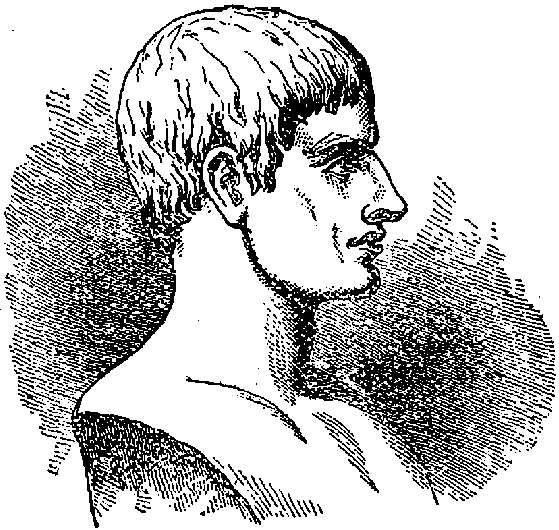
As soon as Cæsar learned at Ravenna the last resolution of the Senate, he assembled his soldiers, informed them of the wrongs he had sustained, and called upon them to support him. Finding them quite willing to support him, he crossed the Rubicon,[69] which separated his province from Italy, and occupied Ariminum, where he met with the Tribunes. He commenced his enterprise with only one legion, consisting of 5000 foot-soldiers and 300 horse; but others had orders to follow him from Transalpine Gaul, and he was well aware of the importance of expedition, that the enemy might have no time to complete their preparations. Though it was the middle of winter, he pushed on with the utmost rapidity, and such was the popularity of his cause in Italy, that city after city opened its gates to him, and his march was like a triumphal progress. Arretium, Pisaurum, Fanum, Ancona, Iguvium, and Auximum fell[Pg 242] into his hands. These successes caused the utmost consternation at Rome; it was reported that Cæsar's cavalry were already at the gates; a general panic seized the Senate, and they fled from the city without even taking with them the money from the public treasury. Cæsar continued his victorious march through Picenum till he came to Corfinium, which M. Domitius Ahenobarbus held with a strong force; but, as Pompey did not march to his assistance, Domitius was unable to maintain the place, and fell himself into Cæsar's hands, together with several other Senators and distinguished men. Cæsar, with the same clemency which he displayed throughout the whole of the Civil War, dismissed them all uninjured. He then hastened southward in pursuit of Pompey, who had now resolved to abandon Italy. He reached Brundusium before Cæsar, but had not sailed when the latter arrived before the town. Cæsar straightway laid siege to the place, but Pompey abandoned it on the 17th of March, and embarked for Greece. Cæsar was unable to follow him for want of ships. He accordingly marched back from Brundusium, and repaired to Rome, having thus in three months become the master of the whole of Italy.
The only opposition which Cæsar met with in Rome was from L. Metellus the Tribune, who attempted to prevent him from entering the public treasury, though the people had given him permission to take from it as much money as he pleased. "Stand aside, young man," said Cæsar; "it is easier for me to do than to say." After remaining in the neighborhood of Rome for a short time, he set out for Spain, leaving M. Lepidus in charge of the city, and M. Antonius in command of the troops in Italy. He sent Curio to drive Cato out of Sicily, Q. Valerius to take possession of Sardinia, and C. Antonius to occupy Illyricum. Curio and Valerius obtained possession of Sicily and Sardinia without opposition; and the former then passed over into Africa, which was in possession of the Pompeian party. Here, however, he encountered strong opposition, and at length was defeated, and lost his life in a battle with Juba, king of Mauretania, who supported P. Atius Varus, the Pompeian commander. C. Antonius also met with ill success in Illyricum, for his army was defeated, and he himself taken prisoner. These disasters were more than counterbalanced by Cæsar's victories in the mean time in Spain. Leaving Rome about the middle of April, he found, on his arrival in Gaul, that Massilia refused to submit to him. He besieged the place forthwith, but, unable to take it immediately, he left C. Trebonius and D. Brutus, with part of his troops, to prosecute the siege, and continued his march to Spain. On the approach of Cæsar, L. Afranius and M. Petreius, the lieutenants of Pompey in Spain, united their forces, and took[Pg 243] up a strong position near the town of Ilerda (Lerida, in Catalonia), on the right bank of the Sicoris (Segre). After experiencing great difficulties at first and some reverses, Cæsar at length reduced Afranius and Petreius to such straits that they were obliged to surrender. They themselves were dismissed uninjured, part of their troops disbanded, and the remainder incorporated among Cæsar's troops. The conqueror then proceeded to march against Varro, who commanded two legions in the Farther Province; but, after the victory over Afranius and Petreius, there was no army in Spain capable of offering resistance, and Varro accordingly surrendered to Cæsar on his arrival at Corduba (Cordova). Having thus subdued all Spain in forty days, he returned to Gaul. Massilia had not yet yielded; but the siege had been prosecuted with so much vigor, that the inhabitants were compelled to surrender the town soon after he appeared before the walls.
During his absence in Spain Cæsar was appointed Dictator by the Prætor M. Lepidus, who had been empowered to do so by a law passed for the purpose. On his return to Rome Cæsar assumed the new dignity, but laid it down again at the end of eleven days, after holding the Consular Comitia, in which he himself and P. Servilius Vatia were elected Consuls for the next year. But during these eleven days he caused some very important laws to be passed. The first was intended to relieve debtors, but at the same time to protect, to a great extent, the rights of creditors. He next restored all exiles; and, finally, he conferred the full citizenship upon the Transpadani, who had hitherto held only the Latin franchise.
After laying down the Dictatorship, Cæsar went in December to Brundusium, where he had previously ordered his troops to assemble. He had lost many men in the long march from Spain, and also from sickness arising from their passing the autumn in the south of Italy. Pompey during the summer had raised a large force in Greece, Egypt, and the East, the scene of his former glory. He had collected an army consisting of nine legions of Roman citizens, and an auxiliary force of cavalry and infantry; and his forces far surpassed in number those which Cæsar had assembled at Brundusium. Moreover, Pompey's fleet, under the command of Bibulus, Cæsar's colleague in his first Consulship, completely commanded the sea. Still Cæsar ventured to set sail from Brundusium on the 4th of January, and he arrived the next day in safety on the coast of Epirus. In consequence, however, of the small number of his ships, he was able to carry over only seven legions, which, from the causes previously mentioned, had been so thinned as to amount only to 15,000 foot and 500 horse. After landing[Pg 244] this force he sent back his ships to bring over the remainder; but part of the fleet was intercepted in its return by M. Bibulus, who kept up such a strict watch along the coast that the rest of Cæsar's army was obliged for the present to remain at Brundusium. Cæsar was thus in a critical position, in the midst of the enemy's country, and cut off from the rest of his army; but he knew that he could thoroughly rely on his men, and therefore immediately commenced acting on the offensive. After gaining possession of Oricum and Apollonia, he hastened northward, in hopes of surprising Dyrrhachium, where all Pompey's stores were deposited; but Pompey, by rapid marches, reached this town before him, and both armies then encamped opposite to each other, Pompey on the right, and Cæsar on the left bank of the River Apsus. Cæsar was now greatly in want of re-enforcements, and such was his impatience that he attempted to sail across the Adriatic in a small boat. The waves ran so high that the sailors wanted to turn back, till Cæsar discovered himself, telling them that they earned Cæsar and his fortunes. They then toiled on, but the storm at length compelled them to return, and with difficulty they reached again the coast of Greece. Shortly afterward M. Antonius succeeded in bringing over the remainder of the army. Pompey meantime had retired to some high ground near Dyrrhachium, and, as he would not venture a battle with Cæsar's veterans, Cæsar began to blockade him in his position, and to draw lines of circumvallation of an extraordinary extent. They were nearly completed when Pompey forced a passage through them, and drove back Cæsar's legions with considerable loss. Cæsar thus found himself compelled to retreat from his present position, and accordingly commenced his march for Thessaly. Pompey's policy of avoiding a general engagement with Cæsar's veterans till he could place more reliance upon his own troops was undoubtedly a wise one, and had been hitherto crowned with success; but he was prevented from carrying out the prudent plan which he had formed for conducting the campaign. His camp was filled with a multitude of Roman nobles, unacquainted with war, and anxious to return to their estates in Italy and to the luxuries of the capital. His unwillingness to fight was set down to love of power and anxiety to keep the Senate in subjection. Stung with the reproaches with which he was assailed, and elated in some degree by his victory at Dyrrhachium, he resolved to bring the contest to an issue. Accordingly, he offered battle to Cæsar in the plain of Pharsalus, or Pharsalia, in Thessaly. The numbers on either side were very unequal: Pompey had 45,000 foot-soldiers and 7000 horse, Cæsar 22,000 foot-soldiers and 1000 horse. The battle, which was fought on the 9th of August, B.C. 48, ac[Pg 245]cording to the old calendar,[70] ended in the total defeat of Pompey's army.
The battle of Pharsalia decided the fate of Pompey and the Republic. Pompey was at once driven to despair. He made no attempt to rally his forces, though he might still have collected a considerable army; but, regarding every thing as lost, he hurried to the sea-coast with a few friends. He embarked on board a merchant-ship at the mouth of the River Peneus, and first sailed to Lesbos, where he took on board his wife Cornelia, and from thence made for Cyprus. He now determined to seek refuge in Egypt, as he had been the means of restoring to his kingdom Ptolemy Auletes, the father of the young Egyptian monarch. On his death in B.C. 51 Ptolemy Auletes had left directions that his son should reign jointly with his elder sister Cleopatra. But their joint reign did not last long, for Ptolemy, or, rather, Pothinus and Achillas, his chief advisers, expelled his sister from the throne. Cleopatra collected a force in Syria, with which she invaded Egypt. The generals of Ptolemy were encamped opposite her, near Alexandria, when Pompey arrived off the coast and craved the protection of the young king. This request threw Pothinus and Achillas into great difficulty, for there were many of Pompey's old soldiers in the Egyptian army, and they feared he would become master of Egypt. They therefore determined to put him to death. Accordingly, they sent out a small boat, took Pompey on board with three or four attendants, and rowed for the shore. His wife and friends watched him from the ship, anxious to see in what manner he would be received by the king, who was standing on the edge of the sea with his troops. Just as the boat reached the shore, and Pompey was in the act of rising from his seat in order to step on land, he was stabbed in the back by Septimius, who had formerly been one of his centurions. Achillas and the rest then drew their swords; whereupon Pompey, without uttering a word, covered his face with his toga, and calmly submitted to his fate. He had just completed his 58th year. His head was cut off, and his body, which was cast naked upon the shore, was buried by his freedman Philippus, who had accompanied him from the ship. The head was brought to Cæsar when he arrived in Egypt soon afterward, but he turned away from the sight, shed tears at the untimely end of his rival, and put his murderers to death.
When news of the battle of Pharsalia reached Rome, various laws were passed which conferred supreme power upon Cæsar. Though absent, he was nominated Dictator a second time, and for a whole year. He appointed M. Antonius his master of the Horse;[Pg 246] and entered upon the office in September of this year (B.C. 48). He was also nominated to the Consulship for the next five years, though he did not avail himself of this privilege; and he was invested with the tribunicial power for life.
Cæsar went to Egypt in pursuit of Pompey, and upon his arrival there he became involved in a war, which detained him several months, and gave the remains of the Pompeian party time to rally and to make fresh preparations for continuing the struggle. The war in Egypt, usually called the Alexandrine War, arose from Cæsar's resolving to settle the disputes respecting the succession to the kingdom. He determined that Cleopatra, whose fascinations completely won his heart, and her brother Ptolemy, should reign in common, according to the provisions of their father's will; but as this decision was opposed by the guardians of the young king, a war broke out between them and Cæsar, in which he was for some time exposed to great danger on account of the small number of his troops. But, having received re-enforcements, he finally prevailed, and placed Cleopatra and her younger brother on the throne, the elder having perished in the course of the contest. Cleopatra afterward joined Cæsar at Rome, and bore him a son named Cæsarion.
After bringing the Alexandrine War to a close, toward the end of March, B.C. 47, Cæsar marched through Syria into Pontus in order to attack Pharnaces, the son of the celebrated Mithridates, who had defeated Cn. Domitius Calvinus, one of Cæsar's lieutenants. This war, however, did not detain him long; for Pharnaces, venturing to come to an open battle with the Dictator, was utterly defeated on the 2d of August near Zela. It was in reference to this victory that Cæsar sent the celebrated laconic dispatch to the Senate, Veni, vidi, vici, "I came, I saw, I conquered." He then proceeded to Rome, caused himself to be appointed Dictator for another year, and nominated M. Æmilius Lepidus his Master of the Horse. At the same time he quelled a formidable mutiny of his troops which had broken out in Campania.
Cæsar did not remain in Rome more than two or three months. With his usual activity and energy he set out to Africa before the end of the year (B.C. 47), in order to carry on the war against Scipio and Cato, who had collected a large army in that country. Their forces were far greater than those which Cæsar could bring against them; but he had too much reliance on his own genius to be alarmed by mere disparity of numbers. At first he was in considerable difficulties; but, having been joined by some of his other legions, he was able to prosecute the campaign with more vigor, and finally brought it to a close by the battle of Thapsus, on the[Pg 247] 6th of April, B.C. 46, in which the Pompeian army was completely defeated. All Africa now submitted to Cæsar with the exception of Utica, which Cato commanded. The inhabitants saw that resistance was hopeless; and Cato, who was a sincere Republican, resolved to die rather than submit to Cæsar's despotism. After spending the greater part of the night in perusing Plato's Phædo, a dialogue on the immortality of the soul, he stabbed himself. His friends, hearing him fall, ran up, found him bathed in blood, and, while he was fainting, dressed his wounds. When, however, he recovered feeling, he tore off the bandages, and so died.
Cæsar returned to Rome by the end of July. He was now undisputed master of the Roman world. Great apprehensions were entertained by his enemies lest, notwithstanding his former clemency, he should imitate Marius and Sulla, and proscribe all his opponents. But these fears were perfectly groundless. A love of cruelty was no part of Cæsar's nature; and, with a magnanimity which victors rarely show, and least of all those in civil wars, he freely forgave all who had borne arms against him, and declared that he should make no difference between Pompeians and Cæsarians. His object was now to allay animosities, and to secure the lives and property of all the citizens of his empire. As soon as the news of his African victory reached Rome a public thanksgiving of forty days was decreed in his honor; the Dictatorship was bestowed upon him for ten years; and the Censorship, under the new title of "Præfectus Morum," for three years. Cæsar had never yet enjoyed a triumph; and, as he had now no farther enemies to meet, he availed himself of the opportunity of celebrating his victories in Gaul, Egypt, Pontus, and Africa, by four magnificent triumphs. None of these, however, were in honor of his successes in the civil war; and consequently his African triumph was to commemorate his victory over Juba, and not over Scipio and Cato. These triumphs were followed by largesses of corn and money to the people and the soldiers, by public banquets, and all sorts of entertainments.
Cæsar now proceeded to correct the various evils which had crept into the state, and to obtain the enactment of several laws suitable to the altered condition of the commonwealth. He attempted, by severe sumptuary laws, to restrain the extravagance which pervaded all classes of society. But the most important of his changes this year (B.C. 40) was the reformation of the Calendar, which was a real benefit to his country and the civilized world, and which he accomplished in his character as Pontifex Maximus. The regulation of the Roman calendar had always been intrusted to the College of Pontiffs, who had been accustomed to lengthen[Pg 248] or shorten the year at their pleasure for political purposes; and the confusion had at length become so great that the Roman year was three months behind the real time. To remedy this serious evil, Cæsar added 90 days to the current year, and thus made it consist of 445 days; and he guarded against a repetition of similar errors for the future by adapting the year to the sun's course.
In the midst of these labors Cæsar was interrupted by intelligence of a formidable insurrection which had broken out in Spain, where the remains of the Pompeian party had again collected a large army under the command of Pompey's sons, Cneius and Sextus. Cæsar set out for Spain at the end of B.C. 46. With his usual activity he arrived at Obulco, near Corduba, in 27 days from the time of his leaving Rome. He found the enemy able to offer stronger opposition than he had anticipated; but he brought the war to a close by the battle of Munda, on the 17th of March, B.C. 46, in which he entirely defeated the enemy. It was, however, a hard-fought battle: Cæsar's troops were at first driven back, and were only rallied by their general's exposing his own person, like a common soldier, in the front line of the battle. Cn. Pompeius was killed shortly afterward, but Sextus made good his escape. The settlement of the affairs in Spain detained Cæsar in the province some months longer, and he consequently did not reach Rome till September. At the beginning of October he entered the city in triumph on account of his victories in Spain, although the victory had been gained over Roman citizens. The Senate received him with the most servile flattery. They had in his absence voted a public thanksgiving of fifty days, and they now vied with each other in paying him every kind of adulation and homage. He was to wear, on all public occasions, the triumphal robe; he was to receive the title of "Father of his Country;" statues of him were to be placed in all the temples; his portrait was to be struck on coins; the month of Quintilis was to receive the name of Julius in his honor, and he was to be raised to a rank among the gods. But there were still more important decrees than these, which were intended to legalize his power, and confer upon him the whole government of the Roman world. He received the title of Imperator for life; he was nominated Consul for the next ten years, and both Dictator and Præfectus Morum for life; his person was declared sacred; a guard of Senators and Knights was appointed to protect him, and the whole Senate took an oath to watch over his safety.
If we now look at the way in which Cæsar exerted his sovereign power, it can not be denied that he used it in the main for the good of his country. He still pursued his former merciful course: no proscriptions or executions took place; and he began to revolve vast[Pg 249] schemes for the benefit of the Roman world. At the same time he was obliged to reward his followers, and for that reason he greatly increased the number of senators and magistrates, so that there were 16 Prætors, 40 Quæstors, and 6 Ædiles, and new members were added to the priestly colleges. Among other plans of internal improvement, he proposed to frame a digest of all the Roman laws, to establish public libraries, to drain the Pomptine marshes, to enlarge the harbor of Ostia and to dig a canal through the isthmus of Corinth. To protect the boundaries of the Roman Empire, he meditated expeditions against the Parthians and the barbarous tribes on the Danube, and had already begun to make preparations for his departure to the East. In the midst of these vast projects he entered upon the last year of his life, B.C. 44, and his fifth Consulship and Dictatorship. He had made M. Antonius his colleague in the Consulship, and M. Lepidus the Master of the Horse. He had for some time past resolved to preserve the supreme power in his family; and, as he had no legitimate children, he had fixed upon his great-nephew Octavius (afterward the Emperor Augustus) as his successor. Possessing royal power, he now wished to obtain the title of king, and accordingly prevailed upon his colleague Antonius to offer him the diadem in public on the festival of the Lupercalia (the 15th of February). But the very name of king had long been hateful at Rome; and the people displayed such an evident dislike to the proposal that it was dropped for the present.
The conspiracy against Cæsar's life had been formed as early as the beginning of the year. It had been set on foot by C. Cassius Longinus, a personal enemy of Cæsar's, and more than sixty persons were privy to it. Private hatred alone seems to have been the motive of Cassius, and probably of several others. Many of them had taken an active part in the war against Cæsar, and had not only been forgiven by him, but raised to offices of rank and honor. Among others was M. Junius Brutus, who had been pardoned by Cæsar after the battle of Pharsalia, and had since been treated almost as his son. In this very year Cæsar had made him Prætor, and held out to him the prospect of the Consulship. Brutus, like Cato, seems to have been a sincere Republican, and Cassius persuaded him to join the conspiracy, and imitate his great ancestor who freed them from the Tarquins. It was now arranged to assassinate the Dictator in the Senate-house on the Ides or 15th of March. Rumors of the plot got abroad, and Cæsar was strongly urged not to attend the Senate. But he disregarded the warnings which were given him. As he entered, the Senate rose to do him honor; and when he had taken his seat, the conspirators pressed[Pg 250] around him as if to support the prayer of Tillius Cimber, who entreated the Dictator to recall his brother from banishment. When Cæsar began to show displeasure at their importunity, Tillius seized him by his toga, which was the signal for attack. Casca struck the first blow, and the other conspirators bared their weapons. Cæsar defended himself till he saw Brutus had drawn his sword, and then exclaiming, "And thou, too, Brutus!" he drew his toga over his head, and fell pierced with three-and-twenty wounds at the foot of Pompey's statue.
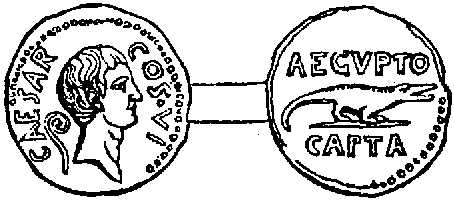
Cæsar's death was undoubtedly a loss not only to the Roman people, but the whole civilized world. The Republic was utterly lost. The Roman world was now called to go through many years of disorder and bloodshed, till it rested again under the supremacy of Augustus. The last days of the Republic had come, and its only hope of peace and security was under the strong hand of military power.
Cæsar was in his 56th year at the time of his death. His personal appearance was noble and commanding; he was tall in stature, of a fair complexion, and with black eyes full of expression. He never wore a beard, and in the latter part of his life his head was bald. His constitution was originally delicate, and he was twice attacked by epilepsy while transacting public business; but, by constant exercise and abstemious living, he had acquired strong and vigorous health, and could endure almost any amount of exertion. He took pains with his person, and was considered to be effeminate in his dress.
Cæsar was probably the greatest man of antiquity. He was at one and the same time a general, a statesman, a lawgiver, a jurist, an orator, a poet, a historian, a philologer, a mathematician, and an architect. He was equally fitted to excel in every thing, and has given proofs that he would have surpassed almost all other men in any subject to which he devoted the energies of his extraordinary mind. One fact places his genius for war in a most striking light. Till his 40th year, when he went as Proprætor into Spain, he had been almost entirely engaged in civil life and his military expe[Pg 251]rience must have been of the most limited kind. Most of the greatest generals in the history of the world have been distinguished at an early age: Alexander the Great, Hannibal, Frederick of Prussia, and Napoleon Bonaparte, gained some of their most brilliant victories under the age of 30; but Cæsar, from the age of 23 to 40, had seen nothing of war, and, notwithstanding, appears all at once as one of the greatest generals that the world has ever seen.
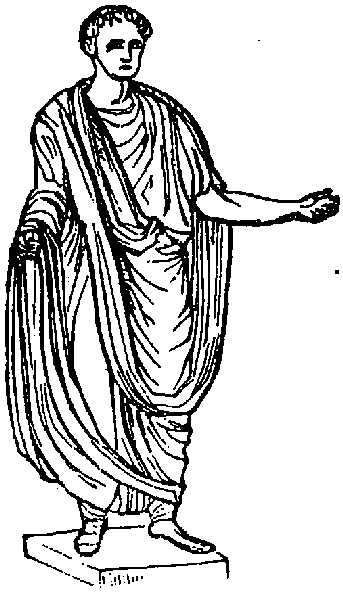
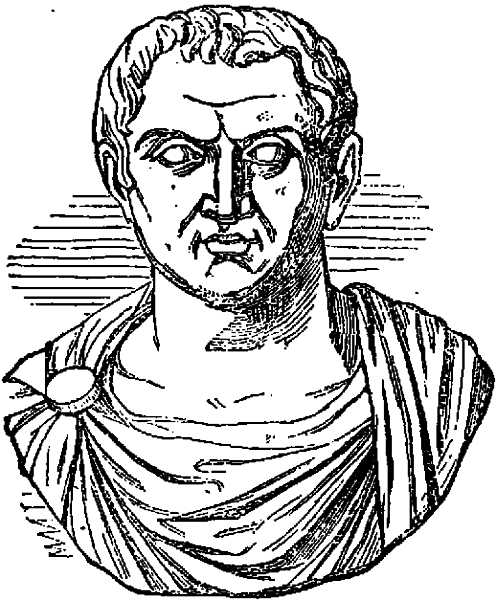
When the bloody deed had been finished, Brutus and the other conspirators rushed into the forum, proclaiming that they had killed the Tyrant, and calling the people to join them; but they met with no response, and, finding alone averted looks, they retired to the Capitol. Here they were joined by Cicero, who had not been privy to the conspiracy, but was now one of the first to justify the murder. Meantime the friends of Cæsar were not idle. M. Lepidus, the Master of the Horse, who was in the neighborhood of the city, marched into the Campus Martius in the night; and M. Antony hastened to the house of the Dictator, and took possession of his papers and treasures. But both parties feared to come to blows. A compromise was agreed to; and at a meeting of the Senate it was determined that Cæsar's murderers should not be punished, but, on the other hand, that all his regulations should remain in force, that the provisions of his will should be carried into effect, and that he should be honored with a public funeral. The con[Pg 253]spirators descended from the Capitol; and, as a proof of reconciliation, Cassius supped with Antony and Brutus with Lepidus.
This reconciliation was only a pretense. Antony aspired to succeed to the power of the Dictator; and, to rouse the popular fury against the conspirators, Cæsar's will was immediately made public. He left as his heir his great-nephew Octavius, a youth of 18, the son of Atia, the daughter of his sister Julia. He bequeathed considerable legacies to his murderers. He gave his magnificent gardens beyond the Tiber to the public, and to every Roman citizen he bequeathed the sum of 300 sesterces (between £2 and £8 sterling). When this became known a deep feeling of sorrow for the untimely fate of their benefactor seized the minds of the people. Their feelings were raised to the highest point two or three days afterward, when the funeral took place. The body was to be burned in the Campus Martius, but it was previously carried to the forum, where Antony, according to custom, pronounced the funeral oration over it. After relating the exploits of the great Dictator, reciting his will, and describing his terrible death, he lifted up the blood-stained robe which Cæsar had worn in the Senate-house, and which had hitherto covered the corpse, and pointed out the numerous wounds which disfigured the body. At this sight a yell of indignation was raised, and the mob rushed in every direction to tear the murderers to pieces. The conspirators fled for their lives from the city. The poet Helvius Cinna, being mistaken for the Prætor Cinna, one of the assassins, was sacrificed on the spot before the mistake could be explained.
Antony was now master of Rome. Being in possession of Cæsar's papers, he was able to plead the authority of the Dictator for every thing which he pleased. The conspirators hastened to take possession of the provinces which Cæsar had assigned to them. Dec. Brutus repaired to Cisalpine Gaul, M. Brutus to Macedonia, and Cassius to Syria. Antony now made a disposition of the provinces, taking Cisalpine Gaul for himself, and giving Macedonia to his brother C. Antonius, and Syria to Dolabella.
Meantime a new actor appeared upon the stage. Octavius was at Apollonia, a town on the coast of Illyricum, at the time of his uncle's death. Cæsar had determined to take his nephew with him in his expedition against the Parthians, and had accordingly sent him to Apollonia, where a camp had been formed, that he might pursue his military studies. The soldiers now offered to follow him to Italy and avenge their leader's death, but he did not yet venture to take this decisive step. He determined, however, to sail at once to Italy, accompanied by only a few friends. Upon arriving at Brundusium he heard of the will of the Dictator, and[Pg 254] was saluted by the soldiers as Cæsar. As the adopted heir of his uncle his proper name was now C. Julius Cæsar Octavianus, and by the last of these names we shall henceforth call him. He now made up his mind to proceed to Rome and claim his uncle's inheritance, in opposition to the advice of his mother, who dreaded this dangerous honor for her son. Upon arriving at Rome he declared before the Prætor, in the usual manner, that he accepted the inheritance, and he then promised the people to pay the money bequeathed to them. He even ventured to claim of Antony the treasures of his uncle; but, as the latter refused to give them up, he sold the other property, and even his own estates, to discharge all the legacies. Antony threw every obstacle in his way; but the very name of Cæsar worked wonders, and the liberality of the young man gained the hearts of the people. He had, indeed, a difficult part to play. He could not join the murderers of his uncle; and yet Antony, their greatest enemy, was also his most dangerous foe. In these difficult circumstances the youth displayed a prudence and a wisdom which baffled the most experienced politicians. Without committing himself to any party, he professed a warm attachment to the Senate. Cicero had once more taken an active part in public affairs; and Octavian, with that dissimulation which he practiced throughout his life, completely deceived the veteran orator. On the 2d of September Cicero delivered in the Senate the first of his orations against Antony, which, in imitation of those of Demosthenes against Philip, are known by the name of the Philippics. Antony was absent at the time, but shortly afterward attacked the orator in unmeasured terms. Cicero replied in the Second Philippic, one of the most violent invectives ever written. It was not spoken, but was published soon after Antony had quitted Rome.
Meantime the emissaries of Octavian had been sounding the disposition of the soldiers, and had already enlisted for him a considerable number of troops in various parts of Italy. Antony saw that the power was slipping from under his feet. Two of the legions which he had sent from Epirus passed over to Octavian; and, in order to keep the remainder under his standard, and to secure the north of Italy to his interests, Antony now proceeded to Cisalpine Gaul, which had been previously granted to him by the Senate. Upon entering the province toward the end of November, Dec. Brutus threw himself into Mutina (Modena), to which Antony laid siege.
Soon after Antony's departure Cicero prevailed upon the Senate to declare Antony a public enemy, and to intrust to the young Octavian the conduct of the war against him. Cicero was now at the[Pg 255] height of his glory. His activity was unceasing, and in the twelve remaining "Philippics" he encouraged the Senate and the people to prosecute the war with vigor. The two new Consuls (B.C. 48) were A. Hirtius and C. Vibius Pansa, both of whom had been designated by the late Dictator. As soon as they had entered upon their office, Hirtius, accompanied by Octavian, marched into Cisalpine Gaul, while Pansa remained in the city to levy troops. For some weeks no movement of importance took place in either army; but when Pansa set out to join his colleague and Octavian, Antony marched southward, attacked him at Forum Gallorum, near Bononia (Bologna), and gained a victory over him (April 14). Pansa was mortally wounded; but Hirtius retrieved this disaster by suddenly attacking Antony the same evening on his return to the camp at Mutina. A few days afterward (April 27th) a more decisive battle took place before Mutina. Antony was defeated with great loss, but Hirtius fell in leading an assault on the besiegers' camp. The death of the two Consuls left Octavian the sole command; and so timely was their removal that he was accused by many of murdering them.
Antony now found it impossible to continue the siege of Mutina, but he retreated in good order northward, crossed the Alps, and was well received in Farther Gaul by Lepidus, who had promised him support. Meantime the good understanding between Octavian and the Senate had come to an end. The latter, being resolved to prevent him from obtaining any farther power, gave the command of the Consular armies to D. Brutus; and Cicero talked of removing the boy. But the "boy" soon showed the Senate that he was their master. He gained the confidence of the soldiers, who gladly followed the heir of Cæsar to Rome. Though only 20 years of age, he demanded of the Senate the Consulship. At first they attempted to evade his demand; but his soldiers were encamped in the Campus Martius, and in the month of August he was elected Consul with his cousin Q. Pedius. The first act of his Consulship showed that he had completely broken with the Senate. His colleague proposed a law declaring all the murderers of Cæsar to be outlaws. Octavian then quitted Rome to march professedly against Antony, leaving Pedius in charge of the city; but it soon appeared that he had come to an understanding with Antony, for he had hardly entered Etruria before the unwilling Senate were compelled, upon the proposal of Pedius, to repeal the sentence of outlawry against Antony and Lepidus. These two were now descending the Alps at the head of 17 legions. Octavian was advancing northward with a formidable army. Between two such forces the situation of D. Brutus was hopeless. He was deserted by his own[Pg 256] troops, and fled to Aquileia, intending to cross over to Macedonia, but was put to death in the former place by order of Antony.
Lepidus, who acted as mediator between Antony and Octavian, now arranged a meeting between them on a small island near Bononia, formed by the waters of the River Rhenus, a tributary of the Po. The interview took place near the end of November. It was arranged that the government of the Roman world should be divided between the three for a period of five years, under the title of "Triumvirs for settling the affairs of the Republic."[71] Octavian received Sicily, Sardinia, and Africa; Antony the two Gauls, with the exception of the Narbonese district, which, with Spain, was assigned to Lepidus. Octavian and Antony were to prosecute the war against Brutus and Cassius, who were in possession of the eastern provinces. Lepidus was to receive the Consulship for the following year, with the charge of Italy.
The Triumvirs next proceeded to imitate the example of Sulla by drawing up a Proscription—a list of persons whose lives were to be sacrificed and property confiscated. But they had not Sulla's excuse. He returned to Italy exasperated to the highest degree by the murder of his friends and the personal insults he had received. The Triumvirs, out of a cold-blooded policy, resolved to remove every one whose opposition they feared or whose property they coveted. In drawing up the fatal list, they sacrificed without scruple their nearest relatives and friends. To please Antony, Octavian gave up Cicero; Antony, in return, surrendered his own uncle, L. Cæsar; and Lepidus sacrificed his own brother Paullus. As many as 300 Senators and 2000 Equites were entered on the lists.
As soon as the Triumvirs had made their secret arrangements they marched toward Rome. Hitherto they had published the names of only 17 of the Proscribed; but the city was in a state of the utmost alarm, and it was with difficulty that Pedius could preserve the peace. So great were his anxiety and fatigue that he died the night before the entry of the Triumvirs into the city. They marched into Rome at the head of their legions, and filled all the public places with their soldiery. No attempt at resistance was made. A law was proposed and carried conferring upon the Triumvirs the title and powers they had assumed. The work of butchery then commenced. Lists after lists of the Proscribed were then published, each more numerous than the former. The soldiers hunted after the victims, cut off their heads, and brought them to the authorities to prove their claims to the blood-money. Slaves were rewarded for betraying their masters, and whoever har[Pg 257]bored any of the Proscribed was punished with death. Terror reigned throughout Italy. No one knew whose turn would come next.
Cicero was included in the first 17 victims of the Proscription. He was residing in his Tusculan villa with his brother Quintus, who urged him to escape to Brutus in Macedonia. They reached Astura, a small island off Antium, when Quintus ventured to Rome to obtain a supply of money, of which they were in need. Here he was apprehended, together with his son, and both were put to death. The orator again embarked, and coasted along to Formiæ, where he landed at his villa, resolving no longer to fly from his fate. After spending a night in his own house, his attendants, hearing that the soldiers were close at hand, forced him to enter a litter, and hurried him through the woods toward the shore, distant a mile from his house. As they were passing onward they were overtaken by their pursuers, and were preparing to defend their master with their lives; but Cicero commanded them to desist, and, stretching his head out of the litter, called upon his executioners to strike. They instantly cut off his head and hands, which were carried to Rome. Fulvia, the widow of Clodius and now the wife of Antony, gloated her eyes with the sight, and even thrust a hair-pin through his tongue. Antony ordered the head to be nailed to the Rostra, which had so often witnessed the triumphs of the orator. Thus died Cicero, in the 64th year of his age. He had not sufficient firmness of character to cope with the turbulent times in which his lot was cast, but as a man he deserves our admiration and love. In the midst of almost universal corruption he remained uncontaminated. He was an affectionate father, a faithful friend, and a kind master.
Many of the Proscribed escaped from Italy, and took refuge with Sextus Pompey in Sicily, and with Brutus and Cassius in the East. After the death of Cæsar, the Senate appointed Sextus Pompey to the command of the Republican fleet. He had become master of Sicily; his fleet commanded the Mediterranean; and Rome began to suffer from want of its usual supplies of corn. It was arranged that Octavian should attempt the conquest of Sicily, while Antony was preparing for the campaign in the East. A fleet under Salvidienus Rufus was sent against Pompey, but was defeated by the latter in the Straits of Sicily, in sight of Octavian. But the war against Brutus and Cassius was more urgent, and accordingly Octavian and Antony sailed shortly afterward to the East, leaving Pompey undisputed master of the sea.
On quitting Italy, Brutus had first gone to Athens. The remains of the Pompeian legions, which continued in Greece after[Pg 258] the battle of Pharsalia, gathered round him; Hortensius, the governor of Macedonia, acknowledged him as his successor; and C. Antonius, whom his brother had sent over to take the command of the province, was obliged to surrender to Brutus.
His colleague had been equally fortunate in Syria. Dolabella, to whom Antony had given this province, was besieged in Laodicea by Cassius, and put an end to his own life.
These events took place in B.C. 43. Brutus and Cassius were now masters of the Roman world east of the Adriatic. It was evident that their enemies before long would cross over into Greece; but, instead of concentrating their forces in that country, they began to plunder the cities of Asia Minor, in order to obtain money for their troops. Brutus pillaged Lycia, and Cassius Rhodes. The inhabitants of the Lycian town of Xanthus refused to submit to the exactions of Brutus, made an heroic defense when they were attacked, and preferred to perish in the flames of their city rather than to yield. Brutus and Cassius were thus engaged when the news of the Triumvirate and the Proscription reached them; but they continued some time longer plundering in the East, and it was not till the spring of B.C. 42 that the Republican chiefs at length assembled their forces at Sardis, and prepared to march into Europe. So much time, however, had now been lost, that Antony and Octavian landed upon the coast of Greece, and had already commenced their march toward Macedonia before Brutus and Cassius had quitted Asia.
Brutus seems to have had dark forebodings of the approaching struggle. He continued his studious habits during the campaign, and limited his sleep to a very short time. On the night before his army crossed over into Europe he was sitting in his tent, the lamp burning dim, and the whole camp in deep silence, when he saw a gigantic and terrible figure standing by him. He had the courage to ask, "Who art thou, and for what purpose dost thou come?" The phantom replied, "I am thy evil genius, Brutus; we shall meet again at Philippi!" and vanished.
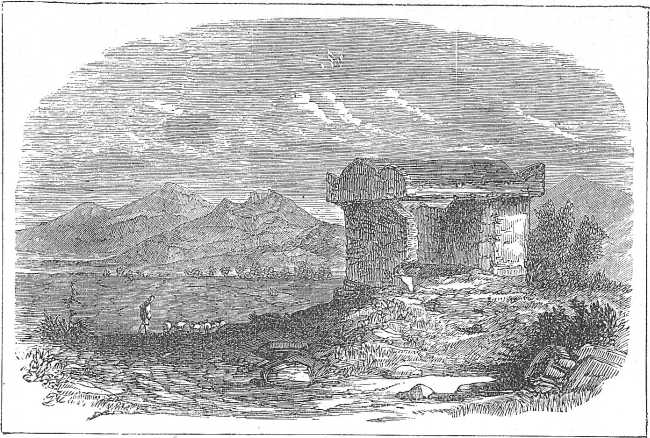
Brutus and Cassius marched through Thrace and Macedonia to Philippi, where they met the army of the Triumvirs. The Republican leaders took up their positions on two heights distant a mile from each other, Brutus pitching his camp on the northern, and Cassius on the southern, near the sea. The camps, though separate, were inclosed with a common intrenchment, and midway between them was the pass which led like a gate from Europe to Asia. The Triumvirs were on the lower ground, in a less favorable position—Octavian opposite Brutus, and Antony opposite Cassius. Their troops began to suffer from want of provisions, and they en[Pg 261]deavored to force the Republican leaders to an engagement. Cassius was unwilling to quit his strong position, and recommended that they should wait for their fleet; but Brutus was anxious to put an end to this state of suspense, and persuaded the council to risk an immediate battle. Brutus himself defeated the army opposite to him, and penetrated into the camp of Octavian, who was lying ill, unable to take part in the battle. His litter was seized, and brought forth covered with blood, and a report spread that he had been killed. Meantime, on the other side of the field, Antony had driven back Cassius, and taken his camp. Cassius had retired to a neighboring hill with some of his men, when he saw a large body of cavalry approaching. Thinking that they belonged to the enemy and that every thing was lost, he ordered one of his freedmen to put an end to his life. But the cavalry had been sent by Brutus to obtain news of Cassius; and when he heard of the death of his colleague, he wept over him as "the last of the Romans," a eulogy which Cassius had done nothing to deserve.
Twenty days after the first battle Brutus again led out his forces; but this time he was completely defeated, and with difficulty escaped from the field. He withdrew into a wood, and in the night-time fell upon his sword, which Strato, who had been his teacher in rhetoric, held for him. His wife Porcia, the daughter of Cato, resolved not to survive her husband; and, being closely watched by her relations, she put an end to her life by thrusting burning charcoal into her mouth. Brutus was doubtless a sincere Republican, but he was a man of weak judgment, deficient in knowledge of mankind, and more fitted for a life of study than the command of armies and the government of men.
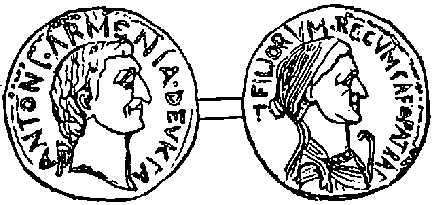
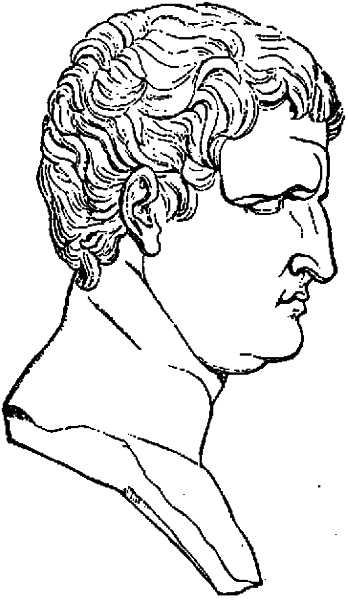
The battle of Philippi scaled the fate of the Republic. Antony remained in the East to collect money for the soldiers. Octavian, who was in ill health, returned to Italy to give the veterans the lands which had been promised them. Antony traversed Asia Minor, plundering the unfortunate inhabitants, who had already suffered so severely from the exactions of Brutus and Cassias. In the voluptuous cities of Asia he surrendered himself to every kind of sensual enjoyment. He entered Ephesus in the character of Bacchus, accompanied by a wild procession of women dressed like Bacchantes, and men and youths disguised as Satyrs and Pans. At Tarsus, in Cilicia, whither he had gone to prepare for the war against the Parthians, he was visited by Cleopatra. He had summoned her to his presence to answer for her conduct in supplying Cassius with money and provisions. She was now in her 28th year, and in the full maturity of her charms. In her 15th year her[Pg 263] beauty had made an impression on the heart of Antony, when he was at Alexandria with Gabinius, and she now trusted to make him her willing slave. She sailed up the Cydnus to Tarsus in a magnificent vessel with purple sails, propelled by silver oars to the sound of luxurious music. She herself reclined under an awning spangled with gold, attired as Venus and fanned by Cupids. The most beautiful of her female slaves held the rudder and the ropes. The perfumes burnt upon the vessel filled the banks of the river with their fragrance. The inhabitants cried that Venus had come to revel with Bacchus. Antony accepted her invitation to sup on board her galley, and was completely subjugated. Her wit and vivacity surpassed even her beauty. He followed her to Alexandria, where he forgot every thing in luxurious dalliance and the charms of her society.
Meantime important events had been taking place in Italy. Octavian found immense difficulties in satisfying the demands of the veterans. All Italy was thrown into confusion. Though he expelled thousands from their homes in Cisalpine Gaul, in order to give their farms to his soldiers, they still clamored for more. Those who had obtained assignments of land seized upon the property of their neighbors, and those who had not were ready to rise in mutiny. The country people, who had been obliged to yield their property to the rude soldiery, filled Italy with their complaints, and flocked to Rome to implore in vain the protection of Octavian. Even if he had the wish, he had not the power to control his soldiers. Fulvia, the wife of Antony, who had remained behind in Italy, resolved to avail herself of those elements of confusion, and crush Octavian. She was a bold and ambitious woman; she saw that, sooner or later, the struggle must come between her husband and Octavian; and, by precipitating the war, she hoped to bring her husband to Italy, and thus withdraw him from the influence of Cleopatra. L. Antonius, the brother of the Triumvir, who was Consul this year (B.C. 41), entered into her views. They proclaimed themselves the patrons of the unfortunate Italians, and also promised to the discontented soldiery that the Triumvir would recompense them with the spoils of Asia. By these means they soon saw themselves at the head of a considerable force. They even obtained possession of Rome. But Agrippa, the ablest general of Octavian, forced them to quit the city, and pressed them so hard that they were obliged to take refuge in Perusia (Perugia), one of the most powerful cities of Etruria. Here they were besieged during the winter, and suffered so dreadfully from famine that they found themselves compelled to capitulate in the following spring. The lives of L. Antonius and Fulvia were spared, but the chief cit[Pg 264]izens of Perusia itself were put to death, and the town burnt to the ground.
While Antony's friends were thus unfortunate in Italy, his own forces experienced a still greater disaster in the East. Q. Labienus, the son of Cæsar's old lieutenant in Gaul, had been sent by Brutus and Cassius to seek aid from Orodes, the king of Parthia. He was in that country when the news arrived of the battle of Philippi, and had remained there up to the present time. The war in Italy, and Antony's indolence at Alexandria, held out a favorable opportunity for the invasion of the Roman provinces. Orodes placed a large army under the command of Labienus and his own son Pacorus. They crossed the Euphrates in B.C. 40, and carried every thing before them. Antony's troops were defeated; the two powerful cities of Antioch and Apamea were taken, and the whole of Syria overrun by the Parthians. Pacorus penetrated as far south as Palestine, and Labienus invaded Cilicia. Such alarming news, both from Italy and the East, at length aroused Antony from his voluptuous dreams. Leaving his lieutenant Ventidius in Syria to conduct the war against the Parthians, Antony sailed to Athens, where he met his brother and wife. He now formed an alliance with Sextus Pompey, sailed to Italy, and laid siege to Brundusium. Another civil war seemed inevitable; but the soldiers on both sides were eager for peace, and mutual friends persuaded the chiefs to be reconciled, which was the more easily effected in consequence of the death of Fulvia at Sicyon. A new division of the Roman world was now made. Antony was to have all the eastern provinces and Octavian the western, the town of Scodra, in Illyricum, forming the boundary between them. Italy was to belong to them in common. Lepidus was allowed to retain possession of Africa, which he had received after the battle of Philippi, but he had ceased to be of any political importance. It was agreed that Antony should carry on the war against the Parthians, and that Octavian should subdue Pompey, whom Antony readily sacrificed. The Consuls were to be selected alternately from the friends of each. To cement the alliance, Antony was to marry Octavia, the sister of Octavian and widow of C. Marcellus, one of the noblest women of her age. The two Triumvirs then repaired to Rome to celebrate the marriage. These events took place toward the end of B.C. 40.
Discontent, however, prevailed at Rome. Sextus Pompey, who had been excluded from the peace, still continued master of the sea, and intercepted the ships which supplied the city with corn. The people were in want of bread, and became so exasperated that Octavian and Antony found it necessary to enter into negotiations with Pompey. An interview took place between the chiefs at[Pg 265] Cape Misenum. It was agreed that Pompey should receive Sicily, Sardinia, Corsica, and Achaia, and that he should send to Rome an immediate supply of corn. The chiefs then feasted one another, and Pompey entertained Octavian and Antony on board his own galley. When the banquet was at its height, a Greek named Menas, or Menodorus, one of Pompey's captains, whispered to him, "Shall I cut off the anchors of the ship, and make you master of the Roman world?" To which Pompey made the well-known reply, "You ought to have done it without asking me." The two Triumvirs, on their return to Rome, were received with shouts of applause. The civil wars seemed to have come to an end (B.C. 39).
Antony, with Octavia, returned to the East, where he found that his legate Ventidius had gained the most brilliant success over the Parthians. This man was a native of Picenum, and originally a mule-driver. He was taken prisoner in the Social War, and walked in chains in the triumphal procession of Pompeius Strato. He was made Tribune of the Plebs by Julius Cæsar, and was raised to the Consulship in B.C. 43. In the Parthian War he displayed military abilities of no ordinary kind. He first defeated Labienus, took him prisoner in Cilicia, and put him to death. He then entered Syria, and drove Pacorus beyond the Euphrates. In the following year (B.C. 38) the Parthians again entered Syria, but Ventidius gained a signal victory over them, and Pacorus himself fell in the battle.
The treaty between Sextus Pompey and the Triumvirs did not last long. Antony refused to give up Achaia, and Pompey therefore recommenced his piratical excursions. The price of provisions at Rome immediately rose, and Octavian found it necessary to commence war immediately; but his fleet was twice defeated by Pompey, and was at last completely destroyed by a storm (B.C. 38). This failure only proved the necessity of making still more extensive preparations to carry on the war with success. The power of Octavian was insecure as long as Pompey was master of the sea, and could deprive Rome of her supplies of corn. Nearly two years were spent in building a new fleet, and exercising the newly-raised crews and rowers. The command of the fleet and the superintendence of all the necessary preparations for the war were intrusted to Agrippa. In order to obtain a perfectly secure and land-locked basin for his fleet, and thus secure it against any sudden surprise, he constructed the celebrated Julius Portus on the coast of Campania, near Baiæ, by connecting the inland Lake Avernus, by means of a canal, with the Lake Lucrinus, and by strengthening the latter lake against the sea, by an artificial dike or dam. While he was engaged in these great works, Antony sailed to Taventum, in B.C. 37, with 300 ships. Mæcenas hastened thither from Rome, and suc[Pg 266]ceeded once more in concluding an amicable arrangement. He was accompanied on this occasion by Horace, who has immortalized, in a well-known satire, his journey from Rome to Brundusium. Octavian and Antony met between Tarentum and Metapontum; the Triumvirate was renewed for another period of five years; Antony agreed to leave 120 ships to assist in the war against Pompey, and Octavian promised to send a land force to the East for the campaign against the Parthians.
Octavian, now relieved of all anxiety on the part of Antony, urged on his preparations with redoubled vigor. By the summer of B.C. 36 he was ready to commence operations. He had three large fleets at his disposal: his own, stationed in the Julian harbor; that of Antony, under the command of Statilius Taurus, in the harbor of Tarentum; and that of Lepidus, off the coast of Africa. His plan was for all three fleets to set sail on the same day, and make a descent upon three different parts of Sicily; but a fearful storm marred this project. Lepidus alone reached the coast of Sicily, and landed at Lilybæum; Statilius Taurus was able to put back to Tarentum; but Octavian, who was surprised by the storm off the Lucanian promontory of Palinurus, lost a great number of his ships, and was obliged to remain in Italy to repair his shattered fleet. As soon as the ships had been refitted, Octavian again set sail for Sicily. Agrippa defeated Pompey's fleet off Mylæ, destroying 30 of his ships; but the decisive battle was fought on the 3d of September (B.C. 36), off Naulochus, a sea-port between Mylæ and the promontory of Pelorus. Agrippa gained a brilliant victory; most of the Pompeian vessels were destroyed or taken. Pompey himself fled to Lesbos with a squadron of 17 ships. Octavian did not pursue him, as Lepidus, who was at the head of a considerable force, now claimed Sicily for himself, and an equal share as Triumvir in the government of the Roman world; but Octavian found means to seduce his soldiers from their allegiance; and Lepidus was at last obliged to surrender to Octavian, and to throw himself upon his mercy. His life was granted, but he was deprived of his Triumvirate, his army, and his provinces, and was compelled to retire to Italy as a private person. He was allowed, however, to retain his property and the dignity of Pontifex Maximus. He lived till B.C. 13.
In B.C. 35 Pompey crossed over from Lesbos to Asia, with the view of seizing that province; but he was easily crushed by the lieutenants of Antony, was taken prisoner as he attempted to escape to Armenia, and was put to death at Miletus. By the death of Pompey and the deposition of Lepidus, Antony and Octavian were now left without a rival, and Antony's mad love for Cleopatra soon made Octavian the undisputed master of the Roman world.[Pg 267]
After Antony's marriage with Octavia in B.C. 40, he seems for a time to have forgotten, or, at least, conquered the fascinations of the Egyptian queen. For the next three years he resided in Athens with his wife; but after his visit to Italy, and the renewal of the Triumvirate in B.C. 37, he left Octavia behind at Tarentum, and determined to carry out his long-projected campaign against the Parthians. As he approached Syria, "that great evil," as Plutarch calls it, his passion for Cleopatra, burst forth with more vehemence than ever. From this time she appears as his evil genius. He summoned her to him at Laodicea, and loaded her with honors and favors. He added to her dominions Phœnicia, Cœle-Syria, Cyprus, a large part of Cilicia, Palestine, and Arabia, and publicly recognized the children she had borne him. Although he had collected a large army to invade the Parthian empire, he was unable to tear himself away from the enchantress, and did not commence his march till late in the year. The expedition proved most disastrous; the army suffered from want of provisions, and Antony found himself compelled to retreat. He narrowly escaped the fate of Crassus, and it was with the utmost difficulty that he succeeded in reaching the Armenian mountains, after losing the best part of his troops.
Antony returned to Alexandria, and surrendered himself entirely to Cleopatra. In B.C. 34 he made a short campaign into Armenia, and succeeded in obtaining possession of Artavasdas, the Armenian king. He carried him to Alexandria, and, to the great scandal of all the Romans, entered the city in triumph, with all the pomp and ceremonial of the Roman pageant. He now laid aside entirely the character of a Roman citizen, and assumed the state and dress of an Eastern monarch. Instead of the toga he wore a robe of purple, and his head was crowned with a diadem. Sometimes he assumed the character of Osiris, while Cleopatra appeared at his side as Isis. He gave the title of kings to Alexander and Ptolemy, his sons by Cleopatra. The Egyptian queen already dreamed of reigning over the Roman world.
While Antony was disgusting the Romans and alienating his friends and supporters by his senseless follies, Octavian had been restoring order to Italy, and, by his wise and energetic administration, was slowly repairing the evils of the civil wars. In order to give security to the frontiers and employment to the troops, he attacked the barbarians on the north of Italy and Greece, and subdued the Iapydes, Pannonians, and Dalmatians. He carried on these wars in person, and won the affection of the soldiers by sharing their dangers and hardships.
The contrast between the two Triumvirs was sufficiently strik[Pg 268]ing, but Octavian called attention to the follies of Antony. Letters passed between them full of mutual recriminations, and both parties began to prepare for the inevitable struggle. Toward the end of B.C. 32 the Senate declared war against Cleopatra, for Antony was regarded as her slave.[72] The five years of the Triumvirate had expired on the last day of this year; and on the 1st of January, B.C. 31, Octavian, as Consul of the Republic, proceeded to carry on the war against the Egyptian queen. The hostile fleets and armies assembled on the western coasts of Greece. Antony's fleet was superior both in number and size of the ships, but they were clumsy and unmanageable. They were anchored in the Ambraciot Gulf, in the modern Bay of Prevesa. (See Plan, P.) The army was encamped on the promontory of Actium (Plan, 3), which has given its name to the battle. The fleet of Octavian consisted of light Liburnian vessels, manned by crews which had gained experience in the wars against Sextus Pompey. It was under the command of the able Agrippa, who took up his station at Corcyra, and swept the Adriatic Sea. Octavian in person took the command of the land forces, which were encamped on the coast of Epirus opposite Actium, on the spot where Nicopolis afterward stood. (Plan, 1.) The generals of Antony strongly urged him to fight on land; but the desertions among his troops were numerous; Cleopatra became alarmed for her safety; and it was therefore resolved to sacrifice the army, and retire with the fleet to Egypt. But Agrippa was on the watch, and Antony had no sooner sailed outside the strait than he was compelled to fight. The battle was still undecided and equally favorable to both parties, when Cleopatra, whose vessels were at anchor in the rear, taking advantage of a favorable breeze which sprang up, sailed through the midst of the combatants with her squadron of 60 ships, and made for the coast of Peloponnesus. When Antony saw her flight, he hastily followed her, forgetting every thing else, and shamefully deserting those who were fighting and dying in his cause. The remainder of the fleet was destroyed before[Pg 269] night-time. The army, after a few days' hesitation, surrendered, and Octavian pardoned all the officers who sued for his favor. The battle of Actium was fought on the 2d of September, B.C. 31, from which day the reign of Octavian is to be dated.
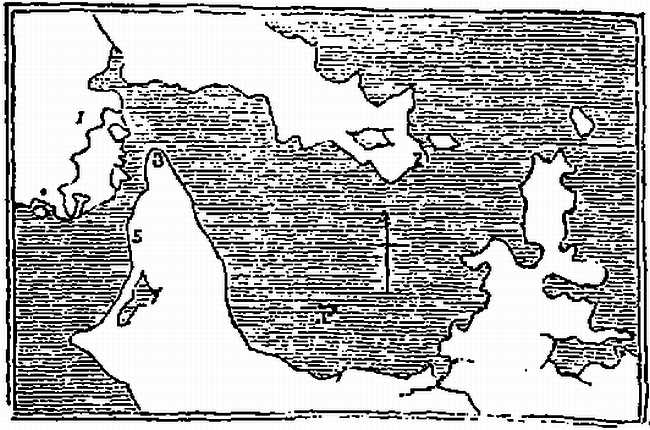
Octavian did not follow Antony to Alexandria for nearly twelve months after the battle of Actium. He sent Agrippa to Italy with his veteran troops, and himself passed the winter at Samos; but he could not satisfy the demands of the soldiers, who broke out into open mutiny. Octavian hastened to Brundusium, and with difficulty raised a sufficient sum of money to calm their discontent.
This respite was of no service to Antony and Cleopatra. They knew that resistance was hopeless, and therefore sent embassadors to Octavian to solicit his favor. To Antony no answer was given, but to Cleopatra hopes were held out if she would betray her lover. She began to flatter herself that her charms, which had fascinated both Cæsar and Antony, might conquer Octavian, who was younger than either. Octavian at length appeared before Pelusium, which surrendered to him without resistance. He then marched upon Alexandria. Antony, encouraged by some slight success in an action with the cavalry, prepared to resist Octavian both by sea and land; but as soon as the Egyptian ships approached those of Octavian, the crews saluted them with their oars and passed over to their side. Antony's cavalry also deserted him, his infantry was easily repulsed, and he fled to Alexandria, crying out that he was betrayed by Cleopatra.
The queen had shut herself up in a mausoleum which she had built to receive her body after death, and where she had collected her most valuable treasures. Hearing of Antony's defeat, she sent persons to inform him that she was dead. He fell into the snare; they had promised not to survive one another, and Antony stabbed himself. He was drawn up into the mausoleum, and died in her arms. She was apprehended by the officers of Octavian, and a few days afterward had an interview with the conqueror. Her charms, however, failed in softening the colder heart of Octavian. He only "bade her be of good cheer and fear no violence." Soon afterward she learned that she was to be sent to Rome in three days' time. This news decided her. On the following day she was found lying dead on a golden couch in royal attire, with her two women lifeless at her feet. The manner of her death was unknown. It was generally believed that she had died by the bite of an asp, which a peasant had brought to her in a basket full of figs. She was 39 years of age at the time of her death. Egypt was made a Roman province. Octavian did not return to Rome till B.C. 29, when he celebrated a threefold triumph over the Pan[Pg 270]nonians, Dalmatians, and Egypt. The Temple of Janus was closed for the third time in Roman history. The exhausted Roman world, longing for repose, gladly acquiesced in the sole rule of Octavian. The Senate conferred upon him numerous honors and distinctions, with the title of Imperator for life.
Thus ended the Roman Republic, an end to which it had been tending for the last hundred years. The corruption and demoralization of all classes had rendered a Republic almost an impossibility; and the civil dissensions of the state had again and again invested one or more persons with despotic authority. The means which Augustus employed to strengthen and maintain his power belong to a history of the Empire. He proceeded with the caution which was his greatest characteristic. He refused the names of King and Dictator, and was contented with the simple appellation of Princeps, which had always been given to one of the most distinguished members of the Senate. He received, however, in B.C. 27, the novel title of Augustus, that is, "the sacred," or "the venerable," which was afterward assumed by all the Roman emperors as a surname. As Imperator he had the command of the Roman armies; and the tribunitian and proconsular powers which the Senate conferred upon him made him absolute master of the state. He made a new division of the provinces, allowing the Senate to appoint the governors of those which were quiet and long-settled, like Sicily, Achaia, and Asia, but retaining for himself such as required the presence of an army, which were governed by means of his Legati. On the death of Lepidus in B.C. 13, he succeeded him as Pontifex Maximus, and thus became the head of the Roman religion. While he thus united in his own person all the great offices of state, he still allowed the Consuls, Prætors, and other magistrates of the Republic to be annually elected. "In a few words, the system of Imperial government, as it was instituted by Octavian, and maintained by those princes who understood their own interest and that of the people, may be defined as an absolute government, disguised by the form of a commonwealth. The masters of the Roman world surrounded their throne with darkness, concealed their irresistible strength; and humbly professed themselves the accountable ministers of the Senate, whose supreme decrees they dictated and obeyed."[73]
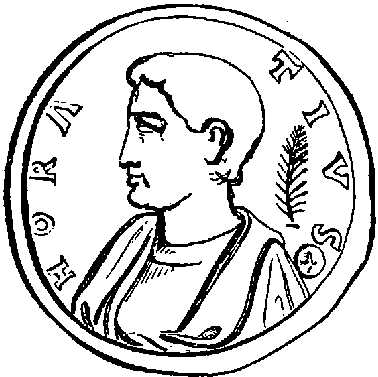
For many centuries after the foundation of the city the Romans can hardly be said to have had any literature at all. There may have existed, at an early period, some songs or ballads, recounting, in rude strains,[74] the exploits of the heroes of Roman story, but all trace of these has disappeared. It was not till the conquest of the Greek cities in Southern Italy, shortly before the First Punic War, that we can date the commencement of the Roman literature. It began with the Drama. Dramatic exhibitions were first introduced at Rome from Etruria in B.C. 363, on the occasion of a severe pestilence, in order to avert the anger of the gods. But these exhibitions were only pantomimic scenes to the music of the flute, without any song or dialogue. It was not till B.C. 240 that a drama with a regular plot was performed at Rome. Its author was M. LIVIUS ANDRONICUS, a native of Magna Græcia, who was taken prisoner at the capture of Tarentum, and carried to Rome, where he became the slave of M. Livius Salinator. He was afterward set free, and, according to Roman practice, took the gentilic name of his master. He acquired at Rome a perfect knowledge of the Latin language, and wrote both tragedies and comedies, which were borrowed, or, rather, translated from the Greek. He also wrote an Odyssey in the Saturnian metre, and some hymns. He may be[Pg 273] regarded as the first Roman poet. His works were read in schools in the time of Horace.
CN. NÆVIUS, the second Roman poet, was a Campanian by birth. He served in the First Punic War, and, like Livius, wrote dramas borrowed from the Greek. His first play was performed in B.C. 235. He was attached to the Plebeian party; and, with the license of the old Attic comedy, he made the stage a vehicle for assailing the aristocracy. In consequence of his attacks upon the Metelli he was thrown into prison. He obtained his release through the Tribunes, but was soon compelled to expiate a new offense by exile. He retired to Utica, where he died about B.C. 202. In his exile he wrote, in the Saturnian metre, an epic poem on the First Punic War, in which he introduced the celebrated legends connected with the foundation of Rome. This poem was extensively copied both by Ennius and Virgil.
Q. ENNIUS, however, may be regarded as the real founder of Roman literature. Like Livius, he was a native of Magna Græcia. He was born at Rudiæ, in Calabria, B.C. 239. Cato found him in Sardinia in B.C. 204, and brought him in his train to Rome. He dwelt in a humble house on the Aventine, and maintained himself by acting as preceptor to the youths of the Roman nobles. He lived on terms of the closest intimacy with the elder Scipio Africanus. He died B.C. 169, at the age of 70. He was buried in the sepulchre of the Scipios, and his bust was allowed a place among the effigies of that noble house. His most important work was an epic poem, entitled the "Annals of Rome," in 18 books, written in dactylic hexameters, which, through his example, supplanted the old Saturnian metre. This poem commenced with the loves of Mars and Rhea, and came down to the age of Ennius. Virgil borrowed largely from it; and, down to his time, it was regarded as the great epic poem of the Latin language. He also wrote numerous tragedies, a few comedies, and several other works, such as Satiræ, composed in a great variety of metres, from which circumstance they probably received their name.
The comic drama of Rome, though it continued to be more or less a translation or an imitation of the Greek, was cultivated with distinguished success by two writers of genius, several of whose plays are still extant.
T. MACCIUS PLAUTUS was a native of Sarsina, a small village in Umbria, and was born about B.C. 254. He probably came to Rome at an early age, and was first employed in the service of the actors. With the money he had saved in this inferior station he left Rome, and set up in business; but his speculations failed: he returned to Rome, and his necessities obliged him to enter the service of a[Pg 274] baker, who employed him in turning a hand-mill. While in this degrading occupation he wrote three plays, the sale of which to the managers of the public games enabled him to quit his drudgery, and begin his literary career. He was then about 30 years of age (B.C. 224), and continued to write for the stage for about 40 years. He died in B.C. 184, when he was 70 years of age. The comedies of Plautus enjoyed unrivaled popularity among the Romans, and continued to be represented down to the time of Diocletian. Though they were founded upon Greek models, the characters in them act, speak, and joke like genuine Romans, and the poet thereby secured the sympathy of his audience more completely than Terence. It was not only with the common people that Plautus was a favorite; educated Romans read and admired his works down to the latest times. Cicero places his wit on a level with that of the old Attic comedy; and St. Jerome used to console himself with the perusal of the poet, after spending many nights in tears on account of his past sins. The favorable impression which the ancients entertained of the merits of Plautus has been confirmed by the judgment of modern critics, and by the fact that several of his plays have been imitated by many of the best modern poets. Twenty of his comedies are extant.
P. TERENTIUS AFER, usually called TERENCE, was born at Carthage, B.C. 195. By birth or purchase he became the slave of P. Terentius, a Roman senator, who afforded him the best education of the age, and finally gave him his freedom. The Andria, which was the first play of Terence acted (B.C. 166), was the means of introducing him to the most refined and intellectual circles of Rome. His chief patrons were Lælius and the younger Scipio, both of whom treated him as an equal, and are said even to have assisted him in the composition of his plays. He died in the 36th year of his age, in B.C. 159. Six comedies are all that remain to us. The ancient critics are unanimous in ascribing to Terence immaculate purity and elegance of language. Although a foreigner and a freedman, he divides with Cicero and Cæsar the palm of pure Latinity.
There were two other comic poets, whose works are lost, but who enjoyed a great reputation among the Romans. Q. CÆCILIUS was a native of Milan, and, like Terence, came to Rome as a slave. He was the immediate predecessor of Terence, and died B.C. 108, two years before the representation of the Andria. L. AFRANIUS flourished B.C. 100, and wrote comedies describing Roman scenes and manners, called Comœdiæ Togatæ, to distinguish them from those depicting Grecian life, which were termed Palliatæ, from pallium, the national dress of the Greeks.
There were two tragic poets contemporary with Terence, who also[Pg 275] enjoyed great celebrity, though their works have likewise perished. M. PACUVIUS, son of the sister of Ennius, was born about B.C. 220, and died in the 90th year of his age. He is praised by the Latin writers for the loftiness of his thoughts, the vigor of his language, and the extent of his knowledge. Hence we find the epithet doctus frequently applied to him. Most of his tragedies were taken from the Greek writers; but some belonged to the class called Prætextatæ, in which the subjects were taken from Roman story. One of these, entitled Paullus, had as its hero L. Æmilius Paullus, the conqueror of Perseus, king of Macedonia. L. ACCIUS, a younger contemporary of Pacuvius, was born B.C. 170, and lived to a great age. Cicero, when a young man, frequently conversed with him. His tragedies, like those of Pacuvius, were chiefly imitations of the Greek; but he also wrote some on Roman subjects, one of which was entitled Brutus.
Though the Roman Drama, properly so called, was derived from the Greeks, there were some kinds of dramatic exhibitions which were of Italian origin. The first of these were the Atellanæ Fabulæ, or Atellane Plays, which took their name from Atella, a town in Campania. They were composed in the Oscan dialect, and were at first rude extemporaneous farces, but were afterward divided into acts like a regular drama. They seem to have been the origin of the Policinello of modern Italy. The Oscan dialect was preserved even when they were introduced at Rome. The Mimes were another species of comedy, of which only the name seems to have been derived from the Greek. They were a species of low comedy of an indecent description, in which the dialogue was subordinate to mimicry and gesture. The Dictator Sulla was very fond of these performances. The two most distinguished writers of Mimes were DEC. LABERIUS, a knight, and P. SYRUS, a freedman, and originally a Syrian slave, both of whom were contemporaries of Julius Cæsar. At Cæsar's triumphal games in October, B.C. 45, P. Syrus challenged all his craft to a trial of wit in extemporaneous farce, and Cæsar offered Laberius 500,000 sesterces to appear on the stage. Laberius was 60 years old, and the profession of a mimus was infamous, but the wish of the Dictator was equivalent to a command, and he reluctantly complied. He had, however, revenge in his power, and took it. His prologue awakened compassion, and perhaps indignation; and during the performance he adroitly availed himself of his various characters to point his wit at Cæsar. In the person of a beaten Syrian slave he cried out, "Marry! Quirites, but we lose our freedom," and all eyes were turned upon the Dictator; and in another mime he uttered the pregnant maxim, "Needs must he fear who makes all else[Pg 276] adread." Cæsar, impartially or vindictively, awarded the prize to Syrus.
The Fescennine Songs were the origin of the Satire, the only important species of literature not derived from the Greeks, and altogether peculiar to Italy. These Fescennine Songs were rude dialogues, in which the country people assailed and ridiculed one another in extempore verses, and which were introduced as an amusement in various festivals. They were formed into the Satire[75] by C. LUCILIUS, who wrote in hexameter verse, and attacked the follies and vices both of distinguished persons and of mankind in general. He was born B.C. 148, at Suessa Aurunca, and died at Naples in B.C. 103. He lived upon terms of intimacy with the younger Scipio and Lælius, and was the maternal ancestor of Pompey the Great. Lucilius continued to be admired in the Augustan age; and Horace, while he censures the harsh versification and the slovenly haste with which Lucilius threw off his compositions, acknowledges with admiration the fierceness and boldness of his attacks upon the vices and follies of his contemporaries.
Between Lucilius and the poets of the Augustan age lived Lucretius and Catullus, two of the greatest—perhaps the greatest—of all the Roman poets.
T. LUCRETIUS CARUS was born B.C. 95, and died about B.C. 51. He is said to have been driven mad by a love-potion, and to have perished by his own hand. The work which has immortalized his name is a philosophical didactic poem, in heroic hexameters, entitled De Rerum Natura, divided into six books, and addressed to C. Memmius Gemellus, who was prætor in B.C. 58. Its object is to state clearly the leading principles of the Epicurean philosophy in such a form as might render the study attractive to his countrymen. He attempts to show that there is nothing in the history or actual condition of the world which does not admit of explanation without having recourse to the active interposition of divine beings. The work has been admitted by all modern critics to be the greatest of didactic poems. The most abstruse speculations are clearly explained in majestic verse, while the subject, which in itself is dry and dull, is enlivened by digressions of matchless power and beauty.
VALERIUS CATULLUS was born at Verona or in its immediate vicinity, B.C. 87. He inherited considerable property from his father, who was the friend of Julius Cæsar; but he squandered a great part of it by indulging freely in the pleasures of the metropolis. In order to better his fortunes, he went to Bithynia in the[Pg 277] train of the Prætor Memmius, but it appears that the speculation was attended with little success. It was probably during this expedition that his brother died in the Troad, a loss which he deplores in the affecting elegy to Hortalus. On his return he continued to reside at Rome, or at his country seats on the promontory of Sirmio and at Tibur. He died about B.C. 47. His poems are on a variety of topics, and composed in different styles and metres. Some are lyrical, others elegies, others epigrams; while the Nuptials of Peleus and Thetis is an heroic poem. Catullus adorned all he touched, and his shorter poems are characterized by original invention and felicity of expression. His Atys is one of the most remarkable poems in the whole range of Latin literature, distinguished by wild passion and the noblest diction.
Among the poets of the Augustan age Virgil and Horace stand forth pre-eminent.
P. VIRGILIUS (more properly VERGILIUS) MARO was born B.C. 70, at Andes, a small village near Mantua, in Cisalpine Gaul. His father left him a small estate, which he cultivated. After the battle of Philippi (B.C. 42) his property was among the lands assigned by Octavian to the soldiers. Through the advice of Asinius Pollio, who was then governor of Cisalpine Gaul, and was himself a poet, Virgil applied to Octavian at Rome for the restitution of his land, and obtained his request. The first Eclogue commemorates his gratitude. Virgil lived on intimate terms with Mæcenas, whom he accompanied in the journey from Rome to Brundusium, which forms the subject of one of the Satires of Horace. His most finished work, the Georgics, was undertaken at the suggestion of Mæcenas.[76] The poem was completed after the battle of Actium, B.C. 31, while Octavian was in the East.[77] The Æneid was the occupation of his latter years. His health was always feeble, and he died at Brundusium in B.C. 19, in his 51st year. His remains were transferred to Naples, which had been his favorite residence, and placed on the road from Naples to Puteoli (Pozzuoli), where a monument is still shown, supposed to be the tomb of the poet. It is said that in his last illness he wished to burn the Æneid, to which he had not given the finishing touches, but his friends would not allow him. He was an amiable, good-tempered man, free from the mean passions of envy and jealousy. His fame, which was established in his lifetime, was cherished after his death as an inheritance in which every Roman had a share; and his works became school-books even before the death of Augustus, and continued such for centuries after. He was also the great poet of the Middle Ages. To him Dante paid the homage of his superior genius, and owned[Pg 278] him for his master and model. The ten short poems called Bucolics, or Eclogues, were the earliest works of Virgil, and probably all written between B.C. 41 and B.C. 37. They have all a Bucolic form and coloring, but some of them have nothing more. Their merit consists in their versification, and in many natural and simple touches. The Georgics is an "Agricultural Poem" in four books. Virgil treats of the cultivation of the soil in the first book, of fruit-trees in the second, of horses and other cattle in the third, and of bees in the fourth. This poem shows a great improvement both in his taste and in his versification. Neither in the Georgics nor elsewhere has he the merit of striking originality; his chief excellence consists in the skillful handling of borrowed materials. The Æneid, or adventures of Æneas after the fall of Troy, is an epic formed on the model of the Homeric poems. It was founded upon an old Roman tradition that Æneas and his Trojans settled in Italy, and were the founders of the Roman name. In the first six books the adventures of Ulysses in the Odyssey are the model, and these books contain more variety of incident and situation than those which follow. The last six books, the history of the struggles of Æneas in Italy, are based on the plan of the battles of the Iliad. Latinus, the king of the Latini, offers in marriage to the Trojan hero his daughter Lavinia, who had been betrothed to Turnus, the warlike king of the Rutuli. The contest is ended by the death of Turnus, who falls by the hand of Æneas. The fortunes of Æneas and his final settlement in Italy are the subjects of the Æneid, but the glories of Rome and the Julian house, to which Augustus belonged, are indirectly the poet's theme. In the first book the foundation of Alba Longa is promised by Jupiter to Venus, and the transfer of empire from Alba to Rome; from the line of Æneas will descend the "Trojan Cæsar," whose empire will only be limited by the ocean, and his glory by the heavens. The ultimate triumphs of Rome are predicted.
Q. HORATIUS FLACCUS, usually called HORACE, was born at Venusia, in Apulia, B.C. 65. His father was a freedman. He had received his manumission before the birth of the poet, who was of ingenuous birth, but who did not altogether escape the taunt which adhered to persons even of remote servile origin. His father's occupation was that of a collector (coactor) of taxes. With the profits of his office he had purchased a small farm in the neighborhood of Venusia. Though by no means rich, he declined to send the young Horace to the common school, kept in Venusia by one Flavius, to which the children of the rural aristocracy resorted. Probably about his twelfth year his father carried him to Rome to receive the usual education of a knight's or senator's son. He fre[Pg 279]quented the best schools in the capital. One of these was kept by Orbilius, a retired military man, whose flogging propensities have been immortalized by his pupil. The names of his other teachers are not recorded by the poet. He was instructed in the Greek and Latin languages: the poets were the usual school-books—Homer in the Greek, and the old tragic writer, Livius Andronicus, in the Latin. In his eighteenth year Horace proceeded to Athens, in order to continue his studies at that seat of learning. When Brutus came to Athens after the death of Cæsar, Horace joined his army, and received at once the rank of a military tribune and the command of a legion. He was present at the battle of Philippi, and shared in the flight of the republican army. In one of his poems he playfully alludes to his flight, and throwing away his shield. He now resolved to devote himself to more peaceful pursuits; and, having obtained his pardon, he ventured at once to return to Rome. He had lost all his hopes in life; his paternal estate had been swept away in the general forfeiture; but he was enabled to obtain sufficient money to purchase a clerkship in the Quæstor's office, and on the profits of that place he managed, with the utmost frugality, to live. Meantime some of his poems attracted the notice of Varius and Virgil, who introduced him to Mæcenas (B.C. 39). Horace soon became the friend of Mæcenas, and this friendship quickly ripened into intimacy. In a year or two after the commencement of their friendship (B.C. 37) Horace accompanied his patron on the journey to Brundusium already alluded to. About the year B.C. 34 Mæcenas bestowed upon the poet a Sabine farm, sufficient to maintain him in ease, comfort, and even in content, during the rest of his life. The situation of this farm was in the valley of Ustica, within view of the mountain Lucretilis, and near the Digentia, about 15 miles from Tibur (Tivoli). A site exactly answering to the villa of Horace, and on which were found ruins of buildings, has been discovered in modern times. Besides this estate, his admiration of the beautiful scenery in the neighborhood of Tibur inclined him either to hire or to purchase a small cottage in that romantic town; and all the later years of his life were passed between the metropolis and these two country residences. He died, B.C. 8, in his 57th year. He was buried on the slope of the Esquiline Hill, close to his friend and patron Mæcenas, who had died before him in the same year. Horace has described his own person. He was of short stature, with dark eyes and dark hair, but early tinged with gray. In his youth he was tolerably robust, but suffered from a complaint in his eyes. In more advanced life he grew fat, and Augustus jested about his protuberant belly. His health was not always good, and he seems to[Pg 280] have inclined to be a valetudinarian. In dress he was rather careless. His habits, even after he became richer, were generally frugal and abstemious; though on occasions, both in youth and maturer age, he seems to have indulged in conviviality. He liked choice wine, and in the society of friends scrupled not to enjoy the luxuries of his time. He was never married. The Odes of Horace want the higher inspirations of lyric verse. His amatory verses are exquisitely graceful, but they have no strong ardor, no deep tenderness, nor even much light and joyous gayety; but as works of refined art, of the most skillful felicities of language and of measure, of translucent expression, and of agreeable images embodied in words which imprint themselves indelibly on the memory, they are unrivaled. In the Satires of Horace there is none of the lofty moral indignation, the fierce vehemence of invective, which characterized the later satirists. It is the folly rather than the wickedness of vice which he touches with such playful skill. In the Epodes there is bitterness provoked, it should seem, by some personal hatred or sense of injury; but the Epistles are the most perfect of the Horatian poetry, the poetry of manners and society, the beauty of which consists in its common sense and practical wisdom. The Epistles of Horace are, with the Poem of Lucretius, the Georgics of Virgil, and, perhaps, the Satires of Juvenal, the most perfect and the most original form of Roman verse. The Art of Poetry was probably intended to dissuade one of the younger Pisos from devoting himself to poetry, for which he had little genius, or, at least, to suggest the difficulties of attaining to perfection.
Three celebrated Elegiac poets—Tibullus, Propertius, and Ovid—also belong to the Augustan age.
ALBIUS TIBULLUS was of equestrian family, and possessed an hereditary estate between Tibur and Præneste. His great patron was Messala, whom he accompanied in B.C. 31 into Aquitania, whither Messala had been sent by Augustus to suppress a formidable insurrection which had broken out in this province. In the following year (B.C. 30) Messala, having pacified Gaul, was sent into the East. Tibullus set out in his company, but was taken ill, and obliged to remain in Corcyra, from whence he returned to Rome. So ceased the active life of Tibullus. He died at an early age soon after Virgil. The poetry of his contemporaries shows Tibullus as a gentle and singularly amiable man. To Horace especially he was an object of warm attachment. His Elegies, which are exquisite small poems, celebrate the beauty and cruelty of his mistresses.
SEXTUS AURELIUS PROPERTIUS was a native of Umbria, and was born about B.C. 51. He was deprived of his paternal estate by an agrarian division, probably that in B.C. 33, after the Sicilian War.[Pg 281] He began to write poetry at a very early age, and the merit of his productions soon attracted the attention and patronage of Mæcenas. The year of his death is altogether unknown. As an elegiac poet a high rank must be awarded to Propertius, and among the ancients it was a disputed point whether the preference should be given to him or to Tibullus. To the modern reader, however, the elegies of Propertius are not nearly so attractive as those of Tibullus. This arises partly from their obscurity, but in a great measure, also, from a certain want of nature in them. The fault of Propertius was too pedantic an imitation of the Greeks. His whole ambition was to become the Roman Callimachus, whom he made his model. He abounds with obscure Greek myths, as well as Greek forms of expression, and the same pedantry infects even his versification.
P. OVIDIUS NASO, usually culled OVID, was born at Sulmo, in the country of the Peligni, on the 20th of March, B.C. 43. He was descended from an ancient equestrian family, and was destined to be a pleader; but the bent of his genius showed itself very early. The hours which should have been spent in the study of jurisprudence were employed in cultivating his poetical talent. It is a disputed point whether he ever actually practiced as an advocate after his return to Rome. The picture Ovid himself draws of his weak constitution and indolent temper prevents us from thinking that he ever followed his profession with perseverance, if, indeed, at all. He became, however, one of the Triumviri Capitules; and he was subsequently made one of the Centumviri, or judges who tried testamentary, and even criminal causes. Till his 50th year he continued to reside at Rome, where he had a house near the Capitol, occasionally taking a trip to his Pelignian farm. He not only enjoyed the friendship of a large circle of distinguished men, but the regard and favor of Augustus and the imperial family; notwithstanding, in A.D. 9, he was suddenly commanded by an imperial edict to transport himself to Tomi, a town on the Euxine, near the mouths of the Danube, on the very border of the empire. He underwent no trial, and the sole reason for his banishment stated in the edict was his having published his poem on the Art of Love (Ars Amatoria). The real cause of his banishment is unknown, for the publication of the Art of Love was certainly a mere pretext. Ovid draws an affecting picture of the miseries to which he was exposed in his place of exile. He complains of the inhospitable soil, of the severity of the climate, and of the perils to which he was exposed, when the barbarians plundered the surrounding country, and insulted the very walls of Tomi. In the midst of all his misfortunes he sought some relief in the exercise of his poetical talents.[Pg 282] He died at Tomi in the 60th year of his age, A.D. 18. Besides his amatory poems, Ovid wrote the Metamorphoses in 15 books, which consist of such legends or fables as involved a transformation, from the Creation to the time of Julius Cæsar, the last being that emperor's change into a star; the Fasti in 12 books, of which only the first six are extant, a sort of poetical Roman calendar, with its appropriate festivals and mythology; and the Elegies, written during his banishment. Ovid undoubtedly possessed a great poetical genius, which makes it the more to be regretted that it was not always under the control of a sound judgment. He exhibits great vigor of fancy and warmth of coloring, but he was the first to depart from that pure and correct taste which characterizes the Greek poets and their earlier Latin imitators.
We now turn to the history of prose literature among the Romans. The earliest prose works were Annals, containing a meagre account of the principal events in Roman history, arranged under their respective years. The earliest Annalists who obtained reputation were Q. FABIUS PICTOR and L. CINCIUS ALIMENTUS, both of whom served in the Second Punic War, and drew up an account of it, but they wrote in the Greek language. The first prose writer in the Latin language, of whom any considerable fragments have been preserved, is the celebrated Censor, M. Porcius Cato, who died B.C. 149, and of whose life an account has been already given. He wrote an important historical work entitled Origines. The first book contained the history of the Roman kings; the second and third treated of the origin of the Italian towns, and from these two books the whole work derived its title; the fourth book treated of the First Punic War, the fifth book of the Second Punic War, and the sixth and seventh continued the narrative to the year of Cato's death. There is still extant a work on agriculture (De Re Rustica) bearing the name of Cato, which is probably substantially his, though it is certainly not exactly in the form in which it proceeded from his pen. There were many other annalists, of whom we know little more than the names, and whose works were used by Livy in compiling his Roman history.
Oratory was always cultivated by the Romans as one of the chief avenues to political distinction. Cicero, in his work entitled Brutus, has given a long list of distinguished Orators whose speeches he had read, but he himself surpassed all his predecessors and contemporaries. In his works the Latin language appears in the highest perfection. Besides his numerous orations he also wrote several treatises on Rhetoric, of which the most perfect is a systematic treatise on the art of Oratory (De Oratore), in three books.[Pg 283] His works on Philosophy were almost the first specimens of this kind of literature ever presented to the Romans in their own language. He does not aim at any original investigation or research. His object was to present, in a familiar and attractive form, the results at which the Greek philosophers had arrived, not to expound any new theories. His Epistles, of which more than eight hundred have come down to us, are among the most valuable remains of antiquity. Cicero, during the most important period of his life, maintained a close correspondence with Atticus, and with a wide circle of political friends and connections. These letters supply the most ample materials for a history of the Roman Republic during its last struggles, and afford a clear insight into the personal dispositions and motives of its chief leaders.
The most learned Roman under the Republic was M. TERENTIUS VARRO, a contemporary and friend of Cicero. He served as Pompey's lieutenant in Spain in the Civil Wars, but was pardoned by Cæsar after the battle of Pharsalia, and was employed by him in superintending the collection and arrangement of the great library designed for public use. Upon the formation of the second Triumvirate, Varro's name appeared upon the list of the proscribed; but he succeeded in making his escape, and, after having remained for some time in concealment, he obtained the protection of Octavian. His death took place B.C. 28, when he was in his 80th year. Not only was Varro the most learned of Roman scholars, but he was likewise the most voluminous of Roman authors. We have his own authority for the assertion that he had composed no less than 490 books, but of these only two have come down to us, and one of them in a mutilated form: 1. De Re Rustica, a work on Agriculture, in three books, written when the author was 80 years old; 2. De Lingua Latina, a grammatical treatise which extended to 24 books, but six only have been preserved, and these are in a mutilated condition. The remains of this treatise are particularly valuable. They have preserved many terms and forms which would otherwise have been altogether lost, and much curious information connected with the ancient usages, both civil and religious, of the Romans.
C. JULIUS CÆSAR, the great Dictator, was also distinguished as an author, and wrote several works, of which the Commentaries alone have come down to us. They relate the history of the first seven years of the Gallic War in seven books, and the history of the Civil War down to the commencement of the Alexandrine in three books. Neither of these works completes the history of the Gallic and Civil Wars. The history of the former was completed in an 8th book, which is usually ascribed to Hirtius. The history[Pg 284] of the Alexandrine, African, and Spanish Wars was written in three separate books, which are also ascribed to Hirtius, but their authorship is uncertain. The purity of Cæsar's Latin and the clearness of his style have deservedly obtained the highest praise.
C. SALLUSTIUS CRISPUS, a contemporary of Cæsar, and one of his supporters, was also distinguished as a historian. He was born B.C. 86 at Amiternum, in the country of the Sabines, and died in B.C. 34. After the African War (B.C. 46) he was left by Cæsar as governor of Numidia, where he acquired great riches by his oppression of the people. Two of his works have come down to us, the Catilina, the history of the suppression of Catiline's conspiracy, and the Jugurtha, the history of the war against Jugurtha. Sallust made Thucydides his model, and took great pains with his style.
CORNELIUS NEPOS, the contemporary and friend of Cicero and Atticus, was the author of numerous works, all of which are lost, with the exception of the well-known Lives of Distinguished Commanders (Vitæ Excellentium Imperatorum). But even these Lives, with the exception of that of Atticus, are probably an abridgment of the original work of Nepos, made in the fourth century of the Christian era.
Of the prose writers of the Augustan age the most distinguished was the historian TITUS LIVIUS, usually called LIVY. He was born at Patavium (Padua), B.C. 59. The greater part of his life appears to have been spent in Rome, but he returned to his native town before his death, which happened at the age of 76, in the fourth year of Tiberius, A.D. 17. His literary talents secured the patronage and friendship of Augustus; and his reputation became so widely diffused, that a Spaniard traveled from Cadiz to Rome solely for the purpose of beholding him; and, having gratified his curiosity in this one particular, he immediately returned home. Livy's "History of Rome" extended from the foundation of the city to the death of Drusus, B.C. 9, and was comprised in 142 books. Of these 35 have descended to us. The whole work has been divided into decades, containing 10 books each. The First decade (bks. i.-x.) is entire. It embraces the period from the foundation of the city to the year B.C. 294, when the subjugation of the Samnites may be said to have been completed. The Second decade (bks. xi.-xx.) is altogether lost. It included the period from B.C. 294 to B.C. 219, comprising an account, among other matters, of the invasion of Pyrrhus and of the First Punic War. The Third decade (bks. xxi.-xxx.) is entire. It embraces the period from B.C. 219 to B.C. 201, comprehending the whole of the Second Punic War. The Fourth decade (bks. xxxi.-xl.) is entire, and also one half of the Fifth (bks. xli.-xlv.). These 15 books continue the[Pg 285] history from B.C. 201 to B.C. 167, and develop the progress of the Roman arms in Cisalpine Gaul, in Macedonia, Greece, and Asia, ending with the triumph of Æmilius Paullus. Of the remaining books nothing is extant except inconsiderable fragments. The style of Livy may be pronounced almost faultless. In judging of his merits as a historian, we are bound to ascertain, if possible, the end which he proposed to himself. No one who reads his work with attention can suppose that he ever conceived the project of drawing up a critical history of Rome. His aim was to offer to his countrymen a clear and pleasing narrative, which, while it gratified their vanity, should contain no startling improbabilities or gross amplifications. To effect this purpose, he studied with care the writings of some of his more celebrated predecessors in the same field; but in no case did he ever dream of ascending to the fountain-head, and never attempted to test the accuracy of his authorities by examining monuments of remote antiquity.
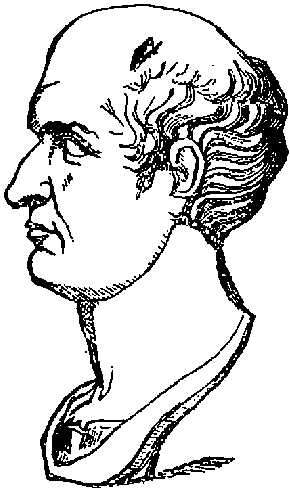
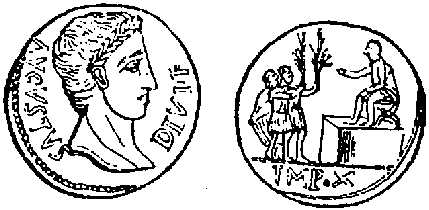
Augustus, being now the emperor of Rome, sought to win the affections of his people. He lived with republican simplicity in a plain house on the Palatine Hill, and educated his family with great strictness and frugality. His public conduct was designed to conceal his unbounded power. He rejected all unworthy members from the Senate, and limited the number of the Senators to six hundred. The Comitia of the Centuries was still allowed to pass laws and elect magistrates, but gradually these powers were taken away, until, in the reign of Tiberius, they are mentioned no more. The emperor's chief counselors in public affairs were his four friends, M. Vipsanius Agrippa, C. Cilnius Mæcenas, M. Valerius Messala, and Asinius Pollio, all persons of excellent talents, and devoted to their master. Agrippa aided him greatly in embellishing the city of Rome with new buildings, and the Pantheon, which was built in the Campus Martins, still bears the inscription, M. Vipsanius Agrippa, consul tertium. Augustus was accustomed to say that he found Rome a city of brick, and left it a city of marble.
To secure the peace of the capital, and to extirpate the robbers who filled its streets, Augustus divided Rome into fourteen regions, and each region into several smaller divisions called Vici: a magistrate was placed over each Vicus, and all these officers were under the command of the city prefect. A police force, Vigiles, seven hundred in number, was also provided, who succeeded in restoring the public peace. Italy, in a similar manner, was divided into regions, and local magistrates were appointed, who made life and property every where secure.
We must notice briefly the extent and condition of that vast empire, over which Augustus ruled—too vast, in fact, to be subjected to the control of a single intellect. Italy, the peculiar province of the emperor, had lost a large part of its free population,[Pg 287] whose place was supplied by slaves; military colonies were numerous, a kind of settlement which never tended to advance the prosperity of the country; the cities were declining, and many of them almost abandoned. The north of Italy, however, still retained a portion of its former prosperity; its great droves of swine supplied the people of Rome with a large part of their food; vineyards also abounded there, and the wine-vats of upper Italy were said to be often larger than houses. Coarse woolen cloths were manufactured in Liguria, and a finer wool was produced near Mutina. But Italy, once so fertile, could no longer produce its own corn, for which it depended chiefly upon Sicily, Africa, and Egypt.
The island of Sicily, too, had suffered greatly during the civil wars. Its cities were fallen into ruin, and the woods and mountains were filled with fugitive slaves, who, when captured, were taken to Rome and exposed to wild beasts in the amphitheatres. A Roman colony was planted by Augustus in the almost deserted city of Syracuse.
The condition of the extensive province of Gaul was more promising, its savage tribes having begun to adopt the arts of civilization. The Gauls purchased from southern traders such articles as they were unable to produce at home, and supplied Italy, in return, with coarse wool and cargoes of bacon. Several Roman colonies established in Gaul enjoyed various political privileges, but the people in general were oppressed with taxes and burdened with debts. The religion of the Druids was discouraged by laws which forbade human sacrifices, and, indeed, all rites opposed to the Roman faith. In Southern Gaul the city of Massilia (Marseilles) had imparted civilization to the neighboring tribes: they learned to use the Greek characters in writing, while many of the Gallic cities invited Greek teachers to open schools in their midst.
Spain, rich in gold and silver, in fine wool, and a prolific soil, traded largely with Rome. The valley of the Bætis, or Guadalquiver, was renowned for its uncommon fertility. Many of the Spaniards had already adopted the language and manners of their conquerors. Spain was divided into three provinces, Bætica, Lusitania, and Hispania Tarraconensis. Gades, or Cadiz, was one of the richest cities of the empire, and, according to Dion Cassius, had received the privilege of Roman citizenship from Julius Cæsar, whom its people had aided against Pompey's officers. The tribes in the northwest of Spain, however, were savage and unquiet, and their language, the Basque, which still exists, shows that they were never perfectly conquered by the Romans.
The northern coast of Africa, opposite to Spain, was held by Juba, a native prince, while the Roman province of Africa em[Pg 288]braced ancient Carthage, together with a considerable territory around it. This province possessed a large trade. Cyrenaica, to the eastward, included the island of Crete, and was termed a prætorian province.
Egypt was ruled by a governor, who was always taken from the equestrian order. Two legions only were stationed in that province. Being the centre of the trade between Italy and the Indies, Egypt accumulated great wealth, and was renowned for its extensive commerce. It exported large quantities of corn to Italy, and also papyrus, the best writing material then known. The two finest kinds of papyrus were named the Augustan and the Livian. Alexandria, the sea-port of Egypt, was the second city of the empire. Its commerce was immense; and its museum, colleges, library, and literary men made it also the centre of Greek literature. Alexandria, too, was famous for its superstition and its licentiousness: the festivals and rites of Serapis had long excited the contempt of the wiser Romans.
The trade between Alexandria and the Indies was carried on through two routes: one was the famous canal which, begun by Pharaoh Necho, was completed under the government of the Ptolemies. Leaving the Nile near the southern point of the Delta, the canal, after a somewhat circuitous course, joined the Red Sea at the town of Arsinoe, near the modern town of Suez. Another route was overland from Coptos, on the Nile, across the desert, to Berenice and Myos Hormos. Along this road wells were dug or reservoirs of water provided, and thus an easy communication was kept up with the East. Heavy duties, however, were laid upon all goods entering or leaving Alexandria, and its extensive trade afforded a great revenue to the government.
From Egypt to the Ægean Sea, various provinces were created in Syria and Asia Minor. The most extensive of these were the two provinces of Syria and Asia, which were governed by lieutenants of the emperor. Judea retained a nominal independence, under the government of Herod; Jerusalem was adorned by Herod with magnificent buildings; and Antioch, Tyre, and several other eastern cities were still prosperous and luxurious. They were, however, heavily taxed, and suffered from the tyranny and exactions of their Roman rulers.
Greece, in the age of Augustus, seems to have been a scene of desolation. It was divided into two provinces, Macedonia and Achaia, both belonging to the jurisdiction of the Senate and the people. Greece had suffered greatly during the civil wars, and had never recovered its ancient prosperity. The peninsula was partly depopulated. Laconia had long lost its importance, and Messenia[Pg 289] and Arcadia were almost deserted. Corinth and Patræ, however, were flourishing Roman colonies; Thebes was a mere village; Athens still retained its literary renown, and was always a favorite resort for cultivated Romans; but its harbor was deserted, its walls thrown down, and the energy of its people forever gone.
Macedonia had suffered equally with Greece, and no trace remained of its former power. Thus we find that the civilized world, at the accession of Augustus, was every where marked by desolation and decay.
The Roman empire, at this period, was bounded on the north by the Euxine, the Danube, the Rhine, and the British Channel; westward it reached to the Atlantic; on the south it was confined by the deserts of Africa, and on the east by Assyria and Mesopotamia. The Mediterranean Sea was wholly within the empire, and afforded an easy mode of communication with the different provinces.
The government which Augustus now established was designed to preserve the memory of the republic, while the real power remained with the emperor alone. The people were deprived of all their former importance; the Comitia were only suffered to pass upon laws proposed by the Senate, which was now wholly under the control of the emperor. Consuls and other magistrates were still chosen annually, and Augustus, in the earlier years of his reign, was accustomed to solicit votes for his favorite candidates, who, however, were always elected; later he contented himself with furnishing them with a written recommendation. The Senate met twice in every month, instead of three times, as was the former custom, except during September and October, when no meetings were held. The provinces were governed by proconsuls, several of whom were appointed by the Senate and the people; but all of them were carefully observed by the emperor. Rome itself was governed by a prefect, whose duty it was to preserve the public peace.
In this manner Augustus, by the aid of his proconsuls, held a despotic rule over all his dominions. He controlled the Senate, too, through his authority as censor, and appointed or deposed its members; and he raised the property qualification of each Senator to about $50,000. A large part of the people of the capital were maintained by the free distribution of corn; but Augustus reduced the number from 320,000 to 200,000, providing for the poorer citizens by settling them in new colonies, and his measures seem to have produced general contentment.
He was also sincerely desirous to reform the morals of the nation. Several laws were passed encouraging marriage, and in B.C. 18 he obliged the Senate to decree that marriage should be imperative upon every citizen of suitable age. Celibacy was punished by an[Pg 290] incapacity to receive bequests, and even the childless married man was deprived of half his legacy; these efforts, however, failed, and a general license prevailed. As censor, he sought to restrain extravagance, and limited the sum to be expended upon entertainments. He insisted that the toga, the national dress, be worn at least at the public spectacles; he endeavored to preserve the distinctions of rank by providing each of the three orders with its own seats in the circus; and he plainly sought to elevate the aristocracy, and to withdraw all political power from the people. It is said, however, that he once entertained the design of resigning his authority, but was prevented from doing so by the advice of his friends, who represented to him that the Romans were no longer capable of governing themselves.
The Prætorian guard, which Augustus provided for his own protection, consisted of ten cohorts, each containing 800 or 1000 men, both cavalry and foot: of these only three cohorts were kept in the city, the others being distributed through the Italian towns. These soldiers received double pay, and were commanded by the præfectus prætorii: at a later period they became the masters of the empire.
The whole army, amounting to about 350,000 men, was encamped in various portions of his dominions. His fleet, which numbered 500 ships, was stationed chiefly at Misenum and Ravenna. His revenues arose from the contributions of the provinces, from various taxes, and from the rent of the public domain. An excise was imposed upon all goods exposed for sale, and there was also a tax upon all bachelors.
Augustus encouraged commerce and industry, built new roads, and provided the capital with an abundance of food. Games and public spectacles were exhibited to amuse the people, a free distribution of corn relieved the indigent, literature was encouraged, the arts flourished with new vigor, and the people and the Senate, pleased with present tranquillity, bestowed upon Augustus the title of the Father of his Country.
Several conspiracies, however, alarmed the emperor. In B.C. 30, Lepidus, a son of the former triumvir, had formed a plot for his destruction, which was detected by Mæcenas, and its author put to death. Another, in B.C. 22, was also unsuccessful. In A.D. 4, Cinna, a grandson of Pompey, was discovered in a similar attempt, and was pardoned at the request of Livia; he was afterward even raised to the consulship. But so intimidated was Augustus by the fear of assassination, that, toward the close of his life, he never went to a meeting of the Senate without wearing a breastplate under his robe.
The military enterprises of Augustus were in general successful.[Pg 291] He led an army into Spain, and subdued the Cantabri and Astures, returning to Rome B.C. 24. While in Spain he founded several cities, among others Augusta Emerita (Merida), and Cæsar Augusta (Saragossa). Phraates, king of the Parthians, fearful of the Roman arms, gave up the Roman standards taken from Crassus and Antony, B.C. 20, and this event was celebrated by striking medals and by the verses of the Augustan poets. The emperor hung up the standards in a temple which he had built at Rome to Mars, the Avenger.
Tiberius and Drusus, the two sons of Livia by her former husband, were distinguished commanders, and gained many victories over the Germans; but, in B.C. 9, Drusus died from a fall from his horse. Tiberius then took the command of the army, and gained a great victory over the Sigambri. He returned to Rome B.C. 6, and triumphed; was saluted Imperator, and received the tribunitian power for five years.
Soon after, indignant at the dissolute conduct of his wife Julia, and the honors bestowed upon her sons by Agrippa, he withdrew to Rhodes, where he remained for seven years, a discontented exile. He returned to Rome in A.D. 2, and, two years after, was adopted by Augustus as his son. He next conquered a large part of Germany, and defeated several large bodies of the Marcomanni in what is now the territory of Bohemia.
But, while he was employed upon this expedition, Arminius, the German hero, excited an insurrection of his countrymen against the cruel Romans, cut off Varus, their leader, with his army, and filled Rome with alarm. Germany seemed lost. Augustus, when he heard of the disaster, exclaimed, "Varus! Varus! give me back my legions!"
Tiberius, however, together with Germanicus, the brave son of Drusus, returned to the defense of the frontier, but did not venture to penetrate into the forests beyond the Rhine.
In his domestic life Augustus was singularly unfortunate. Livia, his wife, for whom he entertained a sincere affection, was a person of strong intellect and various accomplishments; but she was descended from the Claudian family, and inherited all the pride, ambition, and love of political intrigue which marked the descendants of Appius Claudius. She was also married to a Claudius, and thus her two sons by her first husband, Tiberius and Drusus, were even more than herself Claudians. On them all Livia's affections were fixed; to secure their aggrandizement she hesitated at no effort and no crime; and when Drusus died, her son Tiberius, who resembled his mother in disposition, became the chief object of her regard. Her husband and his family wore looked upon with jeal[Pg 292]ousy and dislike, and the darkest suspicions were aroused at Rome by the death, one by one, of every person who stood between Tiberius and the throne.
Livia had no child by her second marriage, and the only heir of Augustus was Julia, the daughter of his former wife, Scribonia. Julia was beautiful, intelligent, and highly educated; and Augustus, who was strongly attached to his own family, looked upon his daughter with singular affection and pride. He hoped to see her grow up pure, wise, and discreet—a new Lucretia, the representative of the ideal Roman matron; and he early accustomed Julia to practice moderation in dress, to spend hours at the spinning-wheel, and to look upon herself as destined to become the model and example of Roman women.
Julia was first married to her cousin Marcellus, the son of Octavia, a young man of excellent character, whom Augustus adopted, and probably destined as his successor; but, in B.C. 23, Marcellus died, amid the sincere grief of all the Romans. Marcellus has been made immortal by a few touching lines of Virgil.
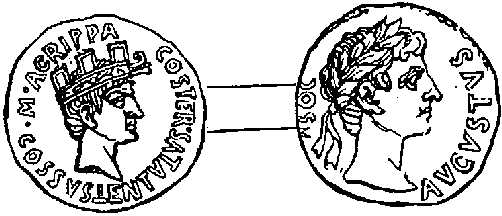
Not long after, Augustus married Julia to his friend Agrippa, and they had five children—three sons, Caius, Lucius, and Agrippa Postumus, the latter being born after the death of his father, and two daughters, Julia and Agrippina. These children were now the hope of the people and the emperor, and objects of jealousy and dislike to Livia and Tiberius.
In B.C. 12 Agrippa died. Augustus then prevailed upon Tiberius to divorce his own wife, to whom he was sincerely attached, in order to marry Julia. Their union was an unhappy one, and, after living together for about a year, they separated forever.
The conduct of Julia, in fact, had long been marked by gross immoralities, and Augustus alone was unconscious of her unworthiness. He refused to believe that his daughter, whom he had destined to become an example of purity, had so deceived and dishonored him. At length, however, he became convinced of her guilt, and banished her (B.C. 2) to the island Pandataria (Santa Maria), off the coast of Campania, where she was treated with just[Pg 293] severity. Her daughter Julia, who had shared in her excesses, was also sent into exile.
Meanwhile Caius and Lucius Cæsar both died suddenly. Caius was sent to the East in B.C. 1, to improve himself in military affairs, and there died, A.D. 3, from the effects of a wound given him by an assassin. Lucius, the younger, having gone on a mission to Spain in A.D. 2, fell sick and died at Massilia. About this time Tiberius had been recalled from Rhodes and intrusted with the chief care of public affairs. It was believed at Rome that Livia and her son had removed the two Cæsars by poison and assassination.
All happiness must now have fled from the breast of the emperor. He still, however, attended carefully to the duties of his station. In A.D. 4 he adopted Tiberius, together with Agrippa Postumus; Tiberius was obliged at the same time to adopt Germanicus, the eldest son of his brother Drusus. In A.D. 7 Augustus was induced to banish Agrippa Postumus, who proved unworthy of his favor, to the island of Planasia, and this act was ratified by a decree of the Senate; it was thought, however, that Livia was again the cause of this unnatural act. In A.D. 8 the poet Ovid was banished for some unknown crime.
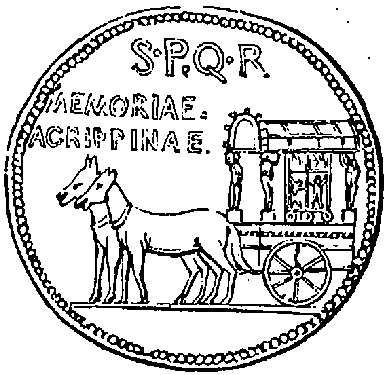
It was in the year 5 or 7 B.C., for the true date is unknown, that Jesus Christ, the Savior of the world, was born at Bethlehem, in Judea.
In A.D. 14, Augustus, aided by Tiberius, took a census—the third during his reign. His health, which had always been delicate, now rapidly declined. He had long borne with patience the infirmities of old age, and he now retired to Nola, where he died, August 19, A.D. 14, in the same room where his father had died before him.[Pg 294] It is said that as he was dying he exclaimed to those around him, "Have I not acted my part well? It is time for the applause."
He was seventy-six years old. His subjects lamented his death with sincere grief, since they had felt the happy effects of his care. His funeral rites were performed in great solemnity; his body was burned on the Campus Martius, and his ashes were placed in the splendid mausoleum which he had built for himself and his family. The Senate ordered him to be numbered among the gods of Rome.
In appearance Augustus was of middle stature, his features regular, and his eyes of uncommon brilliancy. He was a tolerable writer, and capable of distinguishing literary merit; his chosen friends were all men of letters; and his fame with posterity rests, in a great degree, upon that circle of poets, historians, and eminent scholars by whom he was surrounded. The Augustan Age, indeed, forms one of the most remarkable periods in the history of the human intellect.
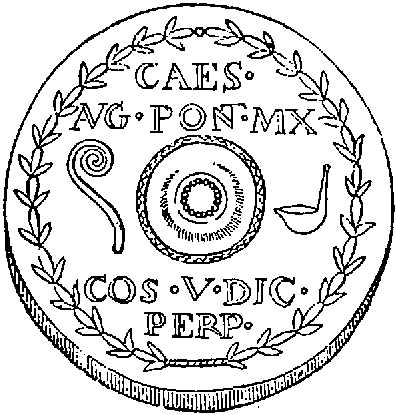
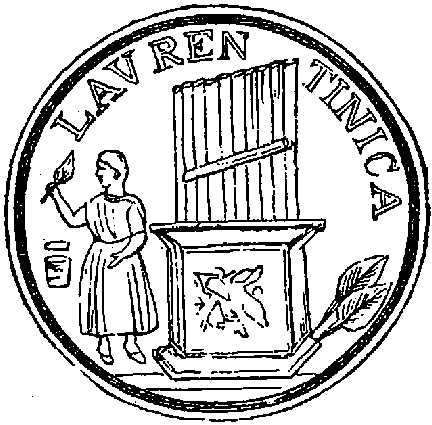
A feeling resembling loyalty had grown up at Rome toward the family of Augustus, and no one ventured to dispute the claim of Tiberius to the throne. Livia, however, who had attended the death-bed of the emperor, concealed his death until her son arrived, and then proclaimed, at the same moment, the death of Augustus and the accession of his successor. The first event of the new reign was the assassination of Agrippa Postumus, grandson of Augustus, and, according to the modern rule of descent, the proper heir to the throne. The guilt of this act was shared between Tiberius and his mother, who were also accused of having hastened the death of Augustus.
Tiberius summoned the Senate to assemble, announced the death of the emperor, and pretended a wish to be relieved from the cares of empire; the Senate, however, refused to accept his feigned resignation, and he yielded to their wishes. This body now became the chief source of legislation. Tiberius took away from the people the power of making laws and of electing magistrates. The senatus consulta, or decrees of the Senate, were made the source of law, without any authority from the Comitia. The Senate selected the Consuls from four candidates presented to them by the emperor, and thus the last trace of the popular power passed away.
Meanwhile two mutinies occurred among the soldiers, which[Pg 296] seemed at first to threaten a change in the government. The legions of Pannonia, complaining of long service and indifferent pay, rose against their commander Blæsus, but were induced to return to their duty by Drusus, the son of Tiberius. A more important insurrection broke out among the legions of the Rhine, who sought to prevail upon Germanicus, the son of Drusus, to accept the imperial crown. Germanicus, however, who was adorned with many noble qualities, refused to yield either to their entreaties or their threats. Agrippina, his wife, with the infant Caius, joined Germanicus in imploring the soldiers not to forget their duty; and they at length relented, and even gave up their leaders.
Germanicus had now deserved the hatred of the jealous and treacherous Tiberius. He was beloved by the people and the army, was frank, generous, and brave; he had married Agrippina, the daughter of Julia and Agrippa, and was the adopted son of the emperor himself. His mind had been highly cultivated, and he excelled in all elegant exercises. He seems, in fact, to have been one of the noblest of the Romans.
In A.D. 14 he led an army across the Rhine, but the next year planned a more important expedition, in which he defeated the Germans under Arminius, and buried the remains of the army of the unfortunate Varus under an earthen mound. His third campaign was still more successful. In A.D. 16 he gained an important battle in the valley of the Weser, and recovered the last of the eagles lost by Varus.
Tiberius, jealous of his fame, now recalled him, and resolved that the limits of the empire should not be enlarged. In A.D. 17 Germanicus triumphed, surrounded in his chariot by his five sons. The same year he was sent to the East to settle the affairs of the Eastern provinces. Meanwhile a war broke out in Germany between Arminius and Marboduus. Drusus was sent thither to contrive the destruction of both leaders, which he seems to have effected, since Marboduus was driven to seek protection from the Romans, while the brave Arminius was soon after slain by the hands of his fellow-Germans.
Germanicus, in A.D. 18, visited Athens, sailed up the Nile the same year, and then, having returned to Syria, died of poison administered to him by Cn. Piso, a friend of the Empress Livia. His death excited great grief at Rome, where he was buried with solemnity in A.D. 20. Piso, meanwhile, being tried before the Senate, and finding himself about to be condemned, sought a voluntary death.
Tiberius was cold and unpopular in his manners, awkward and even timid in his carriage, but a master of dissimulation. The only[Pg 297] person of whom he stood in awe was his mother Livia; but he lived in constant fear of insurrection. The Lex Majestas, which he enlarged and enforced with unusual severity, was now the source of great evil to his country. This law defined treason against the emperor. Tiberius made it include words as well as acts, and thus he who spoke lightly of the emperor's person or authority might be punished with death.
From this law grew up the Delatores, or informers, persons who made it their chief occupation to denounce those who were obnoxious to the emperor. The informers soon grew numerous: some of them were persons of high rank, who sought to display their eloquence, and to win the favor of the emperor, by denouncing his opponents in envenomed rhetoric, while others were common spies. No man's life was safe at Rome from this moment, and the purest and wisest citizens were exposed to the attacks of an infinite number of delators. Tiberius encouraged the informers. Ælius Saturninus was flung from the Tarpeian Rock for a libel upon the emperor. Silanus was banished for "disparaging the majesty of Tiberius."
Tiberius, who professed to imitate the policy of Augustus in every particular, seems to have governed with firmness and ability. He improved the condition of the provinces, restrained the avarice of the provincial governors, maintained good order in the capital, and strove to check the growth of luxury; but the morals of the capital were now hopelessly depraved, and the vice and corruption of the whole world flowed into the streets of Rome.
Ælius Sejanus, the Præfect of the Prætorians, had long been the friend and chief adviser of the emperor. He was cruel, unscrupulous, and ambitious—the proper instrument of a tyrant. In A.D. 21 an insurrection broke out in Gaul, which was scarcely subdued when the Germans rose against the Romans. The Gauls, too, led by Sacrovir, a Druid, who exercised a superstitious influence over his countrymen, once more rebelled. Drusus, who had been made Consul with his father, was sent against them, and reduced them to subjection. The Druid Sacrovir burned himself in a house to which he had fled. In A.D. 22 Drusus received the tribunitian power. He was the only son of Tiberius, and was married to Livia, or Livilla, as she was sometimes called.
Sejanus had now conceived a design which led him to resolve upon the destruction of all the imperial family, since he himself began to aspire to the throne; and the elevation of Drusus filled him with disgust. In A.D. 23 he prevailed upon Tiberius to remove all the Prætorian Guards, about nine or ten thousand in number, to a camp near the city. He appointed their officers,[Pg 298] won the soldiers with bribes and flatteries, and thus believed he had gained a sure support.
Drusus stood in his path, and he resolved to destroy him. He won the affections of Livilla, and prevailed upon her to poison her husband. The unhappy prince died in 23. Tiberius received the news of his son's death with a composure almost incredible. He told the Senate, who put on mourning robes, that he had given himself to his country. A splendid funeral procession was prepared for Drusus, in which the statues of Attus Clausus, the Sabine chief, the founder of the Claudian Gens, and of Æneas, and the Alban kings, were carried side by side, thus recalling the memories of the early regal dynasty, as well as of the severe founders of the Republic.
Agrippina, the widow of Germanicus, together with her numerous family, next aroused the hostility of Sejanus, and he resolved upon their destruction. In A.D. 25 he proposed for the hand of Livilla, but Tiberius refused to sanction the connection. In A.D. 26 eleven cities contended for the privilege of making Tiberius their tutelar deity, but he declined this honor. Soon after, the emperor, as if anxious to escape from the sarcasms and the scandal of Rome, retired from the city, accompanied by a single Senator, Cocceius Nerva, and at length, in A.D. 27, hid himself in the island of Capreæ, on the coast of Campania. Here he built twelve villas in different parts of the island, and lived with a few companions, shut out from mankind. No one was allowed to land upon the shores of Capreæ, and even fishermen who broke this rule through ignorance were severely punished. Every day, however, dispatches were brought from the continent, and he still continued to direct the affairs of his vast empire.
Sejanus was left to govern Rome, but frequently visited the Emperor at his island. In A.D. 29, Livia, the widow of Augustus, died, at the age of eighty-six years, having retained her powerful intellect and her love of political intrigue to the close of her life. It is said that her private charities were great, and that she remained faithful to the memory of her imperial husband. The family of Germanicus, meanwhile, were crushed by the arts of Sejanus. In A.D. 29 Tiberius directed the Senate to banish Agrippina and her son Nero, and they were confined separately upon two barren islands. Drusus, the second son, was soon after imprisoned; while Caius, the youngest, by his flatteries and caresses, preserved the favor of Tiberius, and was admitted into Capreæ. The emperor now began to doubt the fidelity of his chosen friend Sejanus, although their statues had been placed together in the Temple of Friendship on the island; and he sent a letter to the Senate in which he de[Pg 299]nounced him as a traitor. Such was the end of a guilty friendship. Sejanus was flung into the Mamertine Prison, and there strangled. The people threw his body into the Tiber, A.D. 31. Great numbers of his friends or relatives perished with him, and a general massacre filled Rome with terror. He was succeeded in his power by Sertorius Macro, who had aided in his destruction.
Tiberius, meanwhile, seems to have become a raging madman. He put to death his niece Agrippina, with her two children, and ruled over the Senate with pitiless cruelty. His companion, Cocceius Nerva, filled with melancholy at the misfortunes of his country, resolved upon suicide; nor could all the entreaties or commands of Tiberius prevail upon him to live. In A.D. 35 Tiberius made his will, dividing his estate between Caius, the youngest son of Germanicus, and Tiberius Gemellus, the son of the second Drusus. Macro, probably fearing the fate of Sejanus, had formed a close intimacy with Caius, and they now planned the death of the emperor, whose feeble health, however, since he was near seventy-seven years of age, promised Rome a speedy deliverance. Tiberius died March 16, A.D. 37, Macro, it is said, having smothered him with a pillow.
If we may trust the account of the Jew Philo, he left the empire in a prosperous condition. His cruelty, in fact, seems to have been exercised upon the great and the rich, while the people lived in security. His administration may be said to have been a fortunate one. His character and his crimes disgrace human nature.
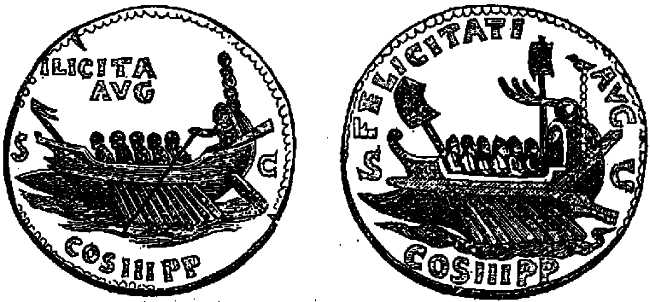
REIGN OF CAIUS CALIGULA, A.D. 37-41.—Caius Cæsar, known as Caligula, was the son of Germanicus and Agrippina, and men fondly hoped that he had inherited the virtues of his father, whom he resembled in his personal appearance. The soldiers proclaimed him emperor, and the Senate and the people acknowledged him with unfeigned joy. He was now twenty-five years of age, and his[Pg 300] first acts were generous and humane. He recalled many exiles, abolished various taxes, and gratified the people with spectacles and gifts. He also buried the remains of his mother and brother, who had died in exile, with decent solemnity.
But, having been seized with a severe illness after he had reigned eight months, upon his recovery his mind seemed to have been fatally injured. He abandoned himself to cruelty and lust; he surpassed the vices of Tiberius; and at length, declaring himself to be a god, would often go through the streets of Rome dressed as Bacchus, Venus, or Apollo: he compelled the people to worship him, and made the wealthiest citizens his priests. He even conferred the consulship on his favorite horse.
His boundless wastefulness soon consumed the public treasures, and he was forced to resort to every kind of extortion to obtain money. Having exhausted Rome and Italy, in A.D. 39 he led a large army across the Alps for the purpose of plundering Gaul, where the richest citizens were put to death and their property confiscated. He was assassinated in his palace January 24, A.D. 41.
REIGN OF TIBERIUS CLAUDIUS DRUSUS NERO, A.D. 41-54.—The Emperor Claudius was the son of Drusus and Antonia, and the brother of Germanicus. He was fifty-one years old when, after the murder of Caligula, the Prætorian Guard raised him to the throne. His health had always been delicate, his mind feeble, and he had never taken any part in public affairs. His first acts were popular and mild, but, having fallen under the control of his wife Messalina, who was a monster of wickedness, he put to death many of the best of the Romans. When, however, Messalina ventured to marry C. Silius, a young Roman knight, Claudius directed her execution. He then married his niece Agrippina, who prevailed upon him to set aside his son Britannicus, and to adopt her own son Nero, who was now destined for the throne. Nero was educated by the philosopher Seneca, together with Burrus Afranius, præfect of the Prætorians. Claudius, however, becoming suspicious of the designs of his wife, she resolved upon his death. Locusta, a noted poisoner, was hired to prepare a dish of poisoned mushrooms, of which Claudius ate: but the poison not proving fatal, the physician Xenophon forced a larger quantity into his throat, and he died October 13, A.D. 54.
Claudius was fond of letters, and wrote memoirs of his own time and histories in Greek of Etruria and of Carthage. He also made various useful laws, and carried out several public works of importance. He completed the Claudian aqueduct, begun by Caligula, and built a fort and light-house at Ostia, and a tunnel from Lake Lucinus to the River Liris. Colonia Agrippina (Cologne) was[Pg 301] raised by his orders to the most important military station in Lower Germany.
In A.D. 43 a Roman army invaded Britain. Claudius himself entered that country soon after, and returned to Rome to triumph. But Vespasian, afterward emperor, together with his son Titus, overran Britain, defeated Caractacus, the brave British chieftain, and sent him and his family prisoners to Rome. Claudius, pleased with his manly conduct, gave him his liberty.
NERO, A.D. 54-68.—The first five years of the reign of Nero were marked by the mildness and equity of his government. He discouraged luxury, reduced the taxes, and increased the authority of the Senate. His two preceptors, Seneca and Burrus, controlled his mind, and restrained for a time the constitutional insanity of the Claudian race. At length, however, he sank into licentiousness, and from licentiousness to its necessary attendants, cruelty and crime. From a modest and philosophic youth, Nero became the most cruel and dissolute of tyrants. He quarreled with his mother Agrippina, who for his sake had murdered the feeble Claudius; and when she threatened to restore Britannicus to the throne, he ordered that young prince to be poisoned at an entertainment. In order to marry Poppæa Sabina, a beautiful and dissolute woman, wife of Salvius Otho, he resolved to divorce his wife Octavia, and also to murder his mother Agrippina. Under the pretense of a reconciliation, he invited Agrippina to meet him at Baiæ, where she was placed in a boat, which fell to pieces as she entered it. Agrippina swam to the shore, but was there assassinated by the orders of her son. The Roman Senate congratulated Nero upon this fearful deed, while the philosopher Seneca wrote a defense of the matricide. The philosopher, the Senate, and the emperor seem worthy of each other.
It would be impossible to enumerate all the crimes of Nero. In A.D. 64 a fire broke out in Rome, which lasted for six days, consuming the greater part of the city. Nero was supposed to have ordered the city to be fired, to obtain a clear representation of the burning of Troy, and, while Rome was in flames, amused himself by playing upon musical instruments. He sought to throw the odium of this event upon the Christians, and inflicted upon them fearful cruelties. The city was rebuilt upon an improved plan, and Nero's palace, called the Golden House, occupied a large part of the ruined capital with groves, gardens, and buildings of unequaled magnificence.
In A.D. 65 a plot was discovered in which many eminent Romans were engaged. The poet Lucan, Seneca, the philosopher and defender of matricide, together with many others, were put to[Pg 302] death. In A.D. 67 Nero traveled to Greece, and performed on the cithara at the Olympian and Isthmian games. He also contended for the prize in singing, and put to death a singer whose voice was louder than his own. Stained with every crime of which human nature is capable, haunted by the shade of the mother he had murdered, and filled with remorse, Nero was finally dethroned by the Prætorian Guards, and died by his own hand, June 9, A.D. 68. He was the last of the Claudian family. No one remained who had an hereditary claim to the empire of Augustus, and the future emperors were selected by the Prætorian Guards or the provincial legions.
During this reign, Boadicea, the British queen, A.D. 61, revolted against the Romans and defeated several armies; but the governor, Suetonius Paulinus, conquered the insurgents in a battle in which eighty thousand Britons are said to have fallen. Boadicea, unwilling to survive her liberty, put an end to her life.
On the death of Nero, Servius Sulpicius Galba, already chosen emperor by the Prætorians and the Senate, was murdered in the Forum, January, A.D. 69. He was succeeded by Salvius Otho, the infamous friend of Nero, and the husband of Poppæa Sabina. The legions on the Rhine, however, proclaimed their own commander, A. Vitellius, emperor, and Otho's forces being defeated in a battle near Bedriacum, between Verona and Cremona, he destroyed himself.
Vitellius, the new emperor, was remarkable for his gluttony and his coarse vices. He neglected every duty of his office, and soon became universally contemptible. Vespasian, the distinguished general, who had been fighting successfully against the Jews in Palestine, was proclaimed emperor by the governor of Egypt. Leaving his son Titus to continue the war, Vespasian prepared to advance upon Rome. His brave adherent, Antonius Primus, at the head of the legions of the Danube, without any orders from Vespasian, marched into Italy and defeated the army of Vitellius. The Prætorians and the Roman populace still supported Vitellius; a fearful massacre took place in the city, and the Capitoline Temple was burned; but Antonius Primus took the Prætorian camp, and Vitellius was dragged from his palace and put to death, December 20, A.D. 69.
REIGN OF T. FLAVIUS VESPASIANUS, A.D. 69-79.—Vespasian, the founder of the first Flavian family of emperors, was a soldier of fortune, who had risen from a low station to high command in the army. He was brave, active, free from vice, and, although fond of money, was never charged with extortion or rapacity. Toward the close of the summer, A.D. 70, he arrived in Rome, and received[Pg 303] the imperium from the Senate. He began at once to restore discipline in the army, and raised to the rank of Senators and Equites illustrious men from the provinces, as well as from Italy and Rome, thus giving to the provincials a certain share in the government. The courts of justice were purified, the Delatores, or spies, were discountenanced, and trials for treason ceased. To increase his revenues, Vespasian renewed the taxes in several provinces which had been exempted by Nero, and he introduced economy and good order into the administration of the finances. Yet he expended large sums in rebuilding the Capitoline Temple, and also in completing the Colosseum, whose immense ruins form one of the most remarkable features in the modern scenery of Rome. He built, too, the Temple of Peace and a public library. He appointed lecturers upon rhetoric, with a salary of 100 sesterces, but was possessed himself of little mental cultivation. He is even said to have disliked literary men, and, in the year A.D. 74, expelled the Stoic and Cynic philosophers from Rome.
In A.D. 70, September 2, his son Titus took the city of Jerusalem, after a brave defense by the Jews, who were finally betrayed by their own factions. The city was totally destroyed, and nearly half a million of the Jews perished in the siege. Those who survived, being forbidden to rebuild their city, were scattered over the empire, and each Jew was compelled to pay a yearly tax of two drachmæ, which was appropriated to rebuilding the Capitoline Temple. The Arch of Titus, which still exists at Rome, was erected in commemoration of the fall of Jerusalem.
Vespasian's generals repressed an insurrection of the Germans, and in A.D. 71 C. Julius Agricola, father-in-law of the historian Tacitus, entered Britain as legate to Petilius Cerialis. He was made governor of the province in A.D. 77, and led his victorious armies as far north as the Highlands of Scotland. This excellent character, by his justice and moderation, reconciled the Britons to the Roman yoke.
By his first wife, Flavia Domatilla, Vespasian had three children—Titus, Domitian, and Domatilla. When she died he formed an inferior kind of marriage with Cœnis, a woman of low station, who, however, seems to have deserved his esteem. He died 23d of June, A.D. 79, at the age of seventy. Although never a refined or cultivated man, Vespasian, by his hardy virtues, restored the vigor of the Roman government, and gave peace and prosperity to his subjects; while he who founded a library and established schools of rhetoric can not have been so wholly illiterate as some writers have imagined.
Titus was one of the most accomplished and benevolent of men. Eloquent, warlike, moderate in his desires, he was called Amor et deliciæ humani generis, "The love and the delight of the human race." In early life he had been thought inclined to severity, and his treatment of the Jews, at the fall of their city, does not seem in accordance with his character for humanity. But no sooner had he ascended the throne than he won a general affection. Such was the mildness of his government that no one was punished at Rome for political offenses. Those who conspired against him he not only pardoned, but took into his familiarity. He was so generous that he could refuse no request for aid. He was resolved, he said, that no one should leave his presence sorrowful; and he thought that day lost in which he had done no good deed. Titus wrote poems and tragedies in Greek, and was familiar with his native literature. During his reign, A.D. 79, occurred a violent eruption of Vesuvius, together with an earthquake, by which Herculaneum, Stabiæ, and Pompeii, three towns on the Bay of Naples, were destroyed. The emperor was so touched by the sufferings of the inhabitants that he expended nearly his whole private fortune in relieving their wants. Pompeii and Herculaneum, which were covered by lava or ashes, were thus preserved from farther decay, and, having been partially excavated and restored, enable us to form a truthful conception of the domestic life of the Roman cities in the age of Titus. We here enter the villas of the rich or the humble homes of the poor, and find every where traces of comfort, elegance, and taste.
The next year after the destruction of these cities, a fire broke out in Rome, which raged for three days, desolating the finest regions of the city. The Capitoline Temple was again destroyed, together with many buildings in the Campus Martius. A pestilence followed soon after, which ravaged Rome and all Italy.
In A.D. 81 Titus dedicated the Colosseum, which was now completed, and also his famous baths, the ruins of which may still be visited at Rome. Splendid games and spectacles were exhibited in honor of these events. Few military events occurred during this reign, the empire being perfectly quiet, except where the active Agricola was subduing the wandering tribes of Scotland.
At length Titus, having gone to the Sabine villa where his father Vespasian died, was himself suddenly arrested by death. It was believed that his brother Domitian was the cause of this unhappy event, and all the people lamented their emperor as if they had lost a father or a friend. Titus died September 13, A.D. 81.
Domitian, who was proclaimed emperor by the soldiers upon his brother's death, possessed the mental ability of the Flavian family, joined to the vices and cruelty of the Claudian. In him Nero or Caligula seemed revived. His first political acts, however, were often useful, and for several years he concealed his true disposition. But he soon surrounded himself with spies and informers, and put to death the noblest men of his time. To preserve the fidelity of the soldiers he doubled their pay, while he won the populace by games and donations. But, to maintain his expenditure, he confiscated the property of the richer citizens, and no man of wealth was safe from an accusation of treason.
Agricola, who had gained a great victory over the Caledonians at the foot of the Grampion Hills, and who was about to subdue all Scotland, Domitian recalled, being jealous of his military fame; and that brave leader passed the last eight years of his life in retirement at Rome, in order to avoid the suspicions of the tyrant. Meanwhile, the Dacians, led by their king Decebalus, having crossed the Danube, Domitian took the field against them, and, in A.D. 90, was defeated, and forced to conclude a humiliating peace. Yet, on his return to Rome, he celebrated a triumph, assuming the name of Dacicus. The next year an insurrection broke out among the German legions, which was, however, suppressed.
Domitian now ordered himself to be styled the "Lord and God," and was worshiped with divine honors. A ferocious jealousy of all excellence in others seemed to possess him with rage against the wise and good. The most eminent of the nobility were put to death. All philosophers, and among them the virtuous Epictetus, were banished from Rome. The Christians, which name now included many persons of high station, were murdered in great numbers. At last the tyrant resolved to put to death his wife Domitia, but she discovered his design, and had him assassinated, 18th September, A.D. 96. The Senate passed a decree that his name should be erased from all public monuments, and refused to yield to the wishes of the soldiers, who would have proclaimed him a god.
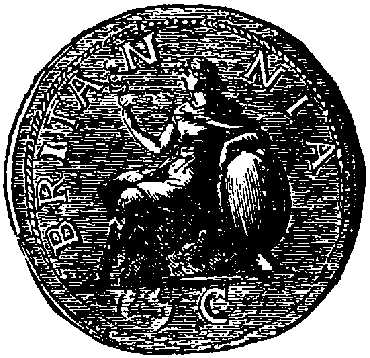
This venerable man was sixty-four years old when he was proclaimed emperor upon the death of Domitian. He was a native of the town of Narnia, in Umbria, and his virtues had won him a general esteem. The Prætorians, who had not been consulted in his election, never looked upon him with favor, and Nerva was obliged to act with great caution. He stopped trials for high treason, pardoned political offenders, diminished taxes, recalled exiles, and strove by every honest art to attain popularity. But the Prætorians, becoming mutinous, not only put the murderers of Domitian to death, but forced the emperor to approve of their act publicly. This insult was deeply felt by Nerva, who now resolved to adopt a colleague, in order to increase his own authority. He therefore selected M. Ulpius Trajan, a distinguished general, who was in command of the army of Lower Germany.
We now enter upon the most pleasing period in the history of the Roman Empire. During the next eighty years a general prosperity prevailed. The emperors were all men worthy to command, and capable of giving tranquillity to their vast dominions. Several of them were of the purest morals, of high mental cultivation, and are still looked upon as ornaments of the human race; and while they could not check the decline of their people, these virtuous emperors prevented, for a time, the fall of the Roman Empire.
Nerva, in order to elevate the condition of his people, purchased lands, which he distributed among them, and he sought to make them feel the necessity of labor and of self-dependence. But it was too late to reform the manners of the indolent, licentious plebs, corrupted by the indulgence of their tyrants. Nerva died of a fever, January 27, A.D. 98.
Trajan, the first emperor who was not a native of Italy, was born at Italica, in Spain, and was about forty years of age at the death of Nerva. His memory was so much revered among the Romans, that, two hundred and fifty years later, the Senate hailed the accession of the new emperor with the prayer that he might be happier than Augustus, better than Trajan. He was free from every vice except an occasional indulgence in wine. His mind was naturally strong, his manners pleasing, his appearance noble and imposing. He desired only to restore the simple manners and virtuous habits of an earlier age.
Trajan, after his adoption by Nerva, entered upon his high office at Cologne, and then traveled toward Rome. In A.D. 99 he entered that city on foot, followed by a small retinue, and was received with general good will. He abolished the trials for high treason, judicia majestatis, which had made Rome so often a scene of terror, restored freedom of speech to the Senate, revived the Comitia for the election of magistrates, and bound himself by oath to observe the laws. He punished the principal informers, banishing many of them to the barren islands around Italy, while he at once, by severe measures, reduced the turbulent Prætorians to obedience. His wife Plotina, who was a woman of excellent character, with her sister Marcina, revived by their virtues the dignity of the Roman matron. The society of the city was purified, and the family of the emperor offered an example of propriety that produced an excellent effect upon the manners of the higher ranks.
Among the first acts of Trajan was the foundation of public schools for the education and maintenance of poor children in various parts of Italy. He founded, too, the Ulpian Library at Rome, and adorned every part of his empire with magnificent buildings, roads, bridges, and various useful improvements. He seemed to live, in fact, wholly for his people, and passed his life in devising and executing plans for their advantage.

When Decebalus, king of the Dacians, sent to demand the tribute which had been promised him by Domitian, Trajan refused to be bound by the disgraceful treaty, and, having levied an army of 60,000 men, marched against the Dacians, who had boldly advanced across the Danube. A terrible battle took place, in which the Romans were victorious; but so great was the slaughter that sufficient linen could not be obtained to dress the wounds of the soldiers, and Trajan tore up his imperial robes to supply their wants. He took the capital of the Dacian king, defeated him in various encounters, and compelled him (A.D. 102) to make peace,[Pg 308] giving up a part of his territory. Having returned to Rome, Trajan received from the Senate the surname of Dacicus. But in A.D. 104 the Dacians again rose in arms, and the Senate declared Decebalus a public enemy. Trajan led an army in person against the barbarians, and, to provide for an easy access to their territory, built a stone bridge across the Danube of immense size and strength, fortified at each end with towers. He next advanced into the midst of the hostile country, took the capital of the Dacians, and reduced them to subjection. Decebalus, in despair, fell by his own hand. All Dacia, comprising the modern countries of Moldavia, Wallachia, and Transylvania, was made a Roman province; and several Roman colonies were planted among the barbarians, thus for the first time preparing for the spread of civilization in that savage country. Trajan now returned to Rome, to triumph a second time for his Dacian successes. He also began that famous Column in commemoration of his victories which still stands at Rome, and which shows in its rich sculpture the various captives and spoils of the Dacian war.
Arabia Petræa was also at this time added to the Roman Empire, after which a peace of several years succeeded. In A.D. 114, a Parthian war breaking out, Trajan hastened to the East, and, having passed the winter at Antioch, witnessed a severe earthquake, which shook that city as well as all Syria. He himself escaped with difficulty from a falling house. In the spring, at the head of his legions, he overran Armenia and formed it into a province. He next built a bridge across the Tigris, resembling that upon the Danube, and led his army into Assyria, a country never yet visited by a Roman general. He took Babylon and Ctesiphon, the capital of the Parthian kingdom, and, sailing down the Tigris, passed through the Persian Gulf, and annexed a large portion of Arabia Felix to his empire. The[Pg 309] Jews, too, about this time revolted, but were subdued, after a brave resistance, and treated with great severity. His Eastern conquests, however, proved by no means secure, and his new subjects revolted as soon as his armies were gone. In A.D. 117 Trajan entered Southern Arabia to complete the subjection of that country, when he was seized with a dropsy and forced to return to Rome. He did not reach that city, but died, August 9th, A.D. 117, at Selinus, in Cilicia. His ashes were carried to Rome, and placed under the magnificent column which recorded his Dacian victories.
During Trajan's reign, the empire, already too extensive, was made more unwieldy by his various conquests. He was evidently ambitious of the fame of a conqueror, and possessed many of the qualities of an able general. He was also a skillful ruler of his immense dominions, leaving no portion unprotected by his vigilance. The only stain upon his fame is his persecution of the Christians, whom he continued to treat with severity even when convinced of their perfect innocence.
After the conclusion of the Dacian war he celebrated games and spectacles, which are said to have lasted through four months, and in which ten thousand gladiators fought and suffered for the entertainment of the people—a proof that the Romans were yet, in some respects, barbarians. Trajan, however, forbade the performance of indecent pantomimes. Trajan's bridge across the Danube is described by Dion Cassius as of greater importance than any of his other works. He designed it to form an easy access to his Dacian province. It was formed of twenty stone piers, distant about 170 feet from each other, and sixty feet wide: they were probably connected by arches of wood. Trajan also began to make roads across the Pontine Marshes, and founded several public libraries. Pliny the younger, who lived during this reign, was the most eminent literary man of the time, and wrote a fine panegyric upon his friend the emperor. Pliny saw the first eruption of Vesuvius, in which his uncle and adopted father, the elder Pliny, perished. He was a person of great wealth and uncommon generosity, having given 300,000 sesterces yearly to maintain the children of the poor in his native town of Comum. His letters to Trajan show that he was an excellent master, husband, and friend, and we may well believe that in this happy period many Romans resembled Trajan and his learned correspondent.
Hadrian, descended from a family of Hadria, in Picenum, was a military commander, distinguished for his courage and activity.[Pg 310] His father had married an aunt of the late emperor, who, upon the father's death, was appointed one of Hadrian's guardians. Yet it is supposed Trajan made no nomination of a successor to the throne, and that his wife Plotina forged the will by which the world was made to believe that he had adopted Hadrian. This will was, however, published, and Hadrian entered upon his government at Antioch, August 11th, A.D. 117, and was there proclaimed emperor. The Senate, to whom he wrote a letter announcing his appointment, at once confirmed him in his power. He now made peace with the Parthians, and restored to Chosroes, their king, Assyria and Mesopotamia. He adopted the policy of Augustus, refusing to extend the limits of the empire. In A.D. 118 he returned to Rome, but was soon forced to march to the defense of the province of Mœsia, which had been invaded by the Sarmatæ and Roxolani. His object being merely to preserve the boundaries of the empire, he concluded a peace with the Roxolani, and probably purchased their submission. He was about to march against the Sarmatæ, when the news of a conspiracy at Rome was brought to him. He seems to have ordered the leaders to be put to death, although he afterward denied that he had done so. Having returned to Rome, he endeavored to win the affections of the people by donations, games, and gladiatorial shows. He also canceled a large amount of unpaid taxes, now due for fifteen years, and promised the Senators never to punish one of their body without their approval. He divided Italy into four regions, a Consular Magistrate being placed over each; and he introduced a new system of administration into the palace, the army, and the state, which lasted until the reign of Constantine the Great.
In A.D. 119 he began a journey through all the provinces of his empire, in order to examine into their condition, and to discover and amend any faults in the system of government. Hadrian, too, was fond of travel, and was never content to remain long in repose. A large part of his reign was occupied with this important journey. He first visited Gaul and Germany, and thence, in A.D. 121, passed over into Britain. Here he found the Britons already partially civilized, but unable to defend themselves from the incursions of their neighbors the Caledonians. To protect them from these forays, he built a wall across the island from the mouth of the Tyne to Solway, remains of which are still shown to the traveler. On his return he adorned the town of Nemausus (Nismes) with fine buildings, and then went into Spain, where he passed the winter. He returned to Rome A.D. 122, but soon after went to Athens, where he spent three years. During his residence in that city he began many magnificent buildings, and he seems to have looked[Pg 311] upon Athens with singular affection and reverence. He visited Sicily, returned to Rome, set out for Africa, whence, after a brief visit, he once more visited Athens, to view the completion of his architectural designs. He finished the Temple of the Olympian Jupiter, the largest and most magnificent in the world, which had been commenced by Pisistratus, and left many other fine works behind him. Then he passed through Asia, inspecting the conduct of the provincial officers, and next traveled through Syria into Egypt, where his favorite Antinous, a beautiful youth, was drowned. This event seems to have filled him with a lasting grief. At length, in A.D. 131, he returned to Rome.
Here he published the Edictum Perpetuum, a codification of the edicts of the Roman Prætors, which was composed by Salvius Julianus, an eminent lawyer. The design of this work was to condense the vast body of the law into a convenient form.
A revolt broke out among the Jews, Hadrian having established a colony called Ælia Capitolina on the site of Jerusalem, and, not content with introducing pagan worship into the holy city, had even issued an edict forbidding the practice of circumcision.[Pg 312] These imprudent measures produced a revolt among the Jews, who, under their leader Barcochab, fought with their usual courage and desperation. The war continued for several years, during which more than half a million of Jews are said to have perished. At length Julius Severus came from Britain to lead the Roman armies, and the rebellion was suppressed. The Jews were now forbidden to live in Jerusalem or its neighborhood, and the nation was scattered over the habitable world.
A war which seemed about to break out with the Albanians and Iberians in the East was prevented by Hadrian, who, with his usual policy, sent large presents to his enemies, and thus converted them into friends. He now returned from his travels to Rome, where he built his magnificent villa at Tibur, the extensive ruins of which may still be seen; and he passed the remainder of his life either at Tibur or in Rome. His health had been affected by his incessant labors, and in A.D. 135 he was seized with dropsy. Having no children, he adopted L. Ceionius, under the name of L. Ælius Verus, a young noble, who, however, died on the first day of the year A.D. 138. Hadrian then adopted Arrius Antoninus (afterward the Emperor Antoninus Pius), and presented him as his successor to the Senators assembled around his bed. At the same time he obliged him to adopt L. Commodus Verus, the son of the former Verus, and also M. Annius Verus, the future Emperor Marcus Aurelius. Ill health seems now to have fatally affected the mind and disposition of Hadrian. He became morose and cruel. He put many eminent nobles to death, and is said to have sunk into debauchery at his Tiburtine villa. His disease proving incurable, he several times attempted suicide; but having removed to Baiæ, hoping for some relief in that fine climate, he died there July 10th, A.D. 138, aged sixty-three. He was buried in the villa of Cicero, near Puteoli. When the Senate, enraged at his cruelties in the latter part of his life, wished to annul his acts, and would have refused him divine honors, Antoninus interposed, and excused his adopted father on the plea that ill health had disordered his mind. For this filial conduct he received the name of Pius. The Senate not only numbered Hadrian among the deities, but ordered temples to be erected in his honor. He left the empire prosperous and at peace. During his reign the Senate lost its importance in the administration of affairs, since Hadrian supplied its place by a Consistorium Principis, or council, composed of eminent men, presided over by a distinguished lawyer. Hadrian was fond of letters and the arts, and adorned every part of his empire with fine buildings or useful works. Wherever he traveled he did something for the benefit of his subjects.
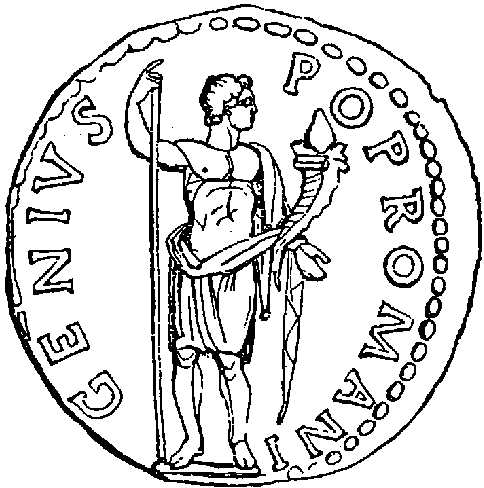
This excellent man was born at Lanuvium, September 19th, A.D. 86, but his family came from the town of Nemausis (Nismes), in Gaul. Soon after his accession to the empire he married his daughter Faustina to Marcus Aurelius, procured for him the tribunitian and proconsular power from the Senate, and made him his associate in the labors of the government. His tranquil and prosperous reign is the most pleasing period in the history of the Roman Empire. The world enjoyed a general peace, and the emperor endeavored, by every wise measure, to secure the prosperity of his subjects. Like Numa, to whom he has often been compared, Antoninus was the peacemaker between distant nations, who were accustomed to submit their differences to him, and to abide implicitly by his award. He checked the persecutions to which the Christians had been exposed in former reigns, and to him Justin Martyr addressed his apology for Christianity. He watched carefully the conduct of the provincial governors, and applied the public revenues to founding schools, repairing roads and harbors, and encouraging every where industry and trade. When Asia and Rhodes were devastated by an earthquake, Antoninus expended large sums in relieving the sufferers by that calamity, as well as those who were reduced to indigence by the great fires which nearly destroyed Carthage, Narbonne, and Antioch, in A.D. 153. He appointed teachers of rhetoric in various cities of the empire, conferred honors and emoluments upon men of letters, and in A.D. 141 founded a charity-school for orphan girls, whom he styled Puellæ Alimenta[Pg 314]riæ Faustinianæ, in memory of his wife Faustina, who had died the year before. Faustina, however, does not seem to have merited his esteem, and the emperor was well acquainted with her faults; yet he generously overlooked them while she lived, and upon her death paid unusual honors to her memory. His piety, his devotion to the national religion, and his various virtues, seem to have won for him universal love and veneration, and his successors during the next century assumed the name of Antoninus as their worthiest title.
Antoninus made no attempt to extend the boundaries of the empire. The barbarous races who were now beginning to swarm upon the frontiers, the Germans and the Dacians, were held in check; and although the Brigantes made several inroads into Britain, they were defeated by A. Lollius, the Legate, in A.D. 141; and a wall of turf was raised beyond the former wall built by Agricola to check the incursions of the Caledonians. This peaceful reign, however, seems to have increased the general indolence of the people, and the martial spirit of the Roman soldiers declined in the idleness of their stationary camps. After a reign of twenty-three years, Antoninus died, March 7th, A.D. 161, in his villa at Lorium, aged seventy-five years.
He was succeeded by Aurelius, who was born at Rome A.D. 121. This prince is known as the Philosopher; and the wish of Plato that philosophers might be kings, or kings philosophers, seems to have been fulfilled at his accession. Aurelius had been from his youth a lover of truth. His morals and his intellect were trained by the purest and wisest men of his age. He had studied under Herodes Atticus and Cornelius Fronto, two famous rhetoricians, and also under the Stoic philosophers Junius Rusticus and Apollonius; and he had been constantly employed by his adopted father Antoninus as an associate in all his useful and benevolent designs. His health was, however, delicate, and he now admitted to a share in the empire his adopted brother, L. Verus, who possessed a vigorous constitution, but was addicted to licentious pleasures.
The general peace which had prevailed during the reign of Marcus Antoninus was forever passed away, and the world was in future to be desolated by almost perpetual hostilities. The Parthian king Vologeses III. having invaded the eastern provinces, and cut to pieces a Roman legion, L. Verus was sent to oppose his advance; but upon arriving at Antioch, Verus remained there, plunged in dissipation, while his brave lieutenant Avidius Cassius drove back[Pg 315] the Parthians, invaded Mesopotamia, destroyed Seleucia, and penetrated to Babylon. Another Roman general conquered Armenia, and restored the legitimate king Soæmus to his throne. At the close of the war, Verus, A.D. 166, returned to Rome, and triumphed. His army brought the plague with it from the East, which now desolated Italy and Rome. Many illustrious men died; but the famous physician Galen (Claudius Galenus), who had come from Pergamus to Rome, was now enabled to exhibit his uncommon professional skill. This pestilence lasted for several years.
Verus died of intemperance A.D. 171, and Aurelius prevailed upon the Senate to rank him among the gods. He now marched against the Marcomanni, but was defeated in a great battle, and, in order to provide a new army, sold the imperial plate and jewels. He now took up a position at Sirmium (Sirmich), and endeavored to wear out the barbarians by skirmishes and sudden attacks, without venturing far from his strong-hold. At length, however, upon one occasion, having been drawn into a defile, the Roman army was relieved by a fierce storm of thunder and rain, which terrified the barbarians. Tradition attributes this sudden storm to the prayers of a Christian legion. The barbarians now submitted, and withdrew beyond the Danube.
Soon after, an insurrection broke out in Syria, where Avidius Cassius, at the instigation, it is said, of the emperor's wife Faustina, had proclaimed himself emperor. But Cassius, by his severity, disgusted his own soldiers, and was assassinated by a centurion. Aurelius lamented this event, since it deprived him of an opportunity of showing clemency to an erring friend. He at once set out for the East, and there freely forgave all those who had conspired against him. He took the young family of Cassius under his protection, and ordered the papers of that officer to be destroyed, lest they might disclose the names of the conspirators. Faustina, who had accompanied her husband to Cilicia, died soon after, it is said, by her own hand.
It is remarkable that this philosophic emperor should have permitted a cruel persecution of the Christians in A.D. 177, perhaps at the instigation of the Stoic philosophers—the only blot upon his general humanity and benevolence. Among the victims of this persecution was Justin Martyr, the author of the Apologies for Christianity, addressed to Antoninus, as well as to Aurelius himself. Toward the close of his reign, having become convinced of the falseness of the charges made against the Christians, Aurelius became once more tolerant and philosophic.
In A.D. 176 the emperor triumphed at Rome for his various successes. He gave a donation of eight pieces of gold to every citi[Pg 316]zen, and made his son Commodus his colleague. In the mean time the barbarians in the interior of Europe, moved by a general impulse, began to press upon the frontiers of the empire, and from this time seem never to have ceased their inroads until the final destruction of the Roman power. Aurelius marched, A.D. 177, to the frontier, defeated the barbarians in various engagements, and had perhaps proved the savior and second founder of Rome, when he was seized with a fever at Vindobona (Vienna), A.D. 180, and died after a few days' illness. He was the last of the Roman emperors who labored for the welfare of his people. He was, no doubt, the greatest and wisest of them all, and he united the different talents of a man of learning, a fine writer, a skillful soldier, and a benevolent, judicious ruler. His "Meditations," which have made him known to posterity, are among the most delightful productions of the human intellect, while his private character seems to have been no less attractive than his writings.
The depraved Commodus succeeded his virtuous father at the age of twenty. He had been educated with singular care, but was wholly given up to coarse sensuality. The people, however, still hoped that he might be worthy of his father, and received him, upon his accession, with loud expressions of joy. For a short time he concealed his true disposition; but his sister Lucilla, jealous of her brother's wife Crispina, formed a conspiracy against him in A.D. 182, and he escaped with difficulty from the hand of the assassin. From this moment he threw off all disguise, and indulged his natural vices without restraint. He put to death the most illustrious men of the time, encouraged informers and false accusations, and filled Rome with terror. In the midst of these cruelties he often sang, danced, or played the buffoon in public, fought as a gladiator in the circus, and ordered the people to worship him as a second Hercules. His lieutenant Marcellus, in A.D. 184, defeated the Caledonians, after they had passed the long wall of Hadrian, and had ravaged the northern part of Britain; and in A.D. 191 an invasion of the Frisians was repelled. Commodus, however, paid no attention to the affairs of the empire. In A.D. 189 Italy suffered from a pestilence and famine, when the people of Rome rose against the emperor's præfect, Cleander, and tore him to pieces. Commodus still continued his murders, and was at last assassinated by the directions of his mistress, Marcia, whose death he had resolved upon. He died December 31st, A.D. 192. The Senate ordered his memory to be held infamous, and his body to be dragged[Pg 317] by iron hooks through the streets, and then to be thrown into the Tiber; but his successor Pertinax prevailed that it should be placed in the mausoleum of Hadrian. Such was the son of Marcus Aurelius.
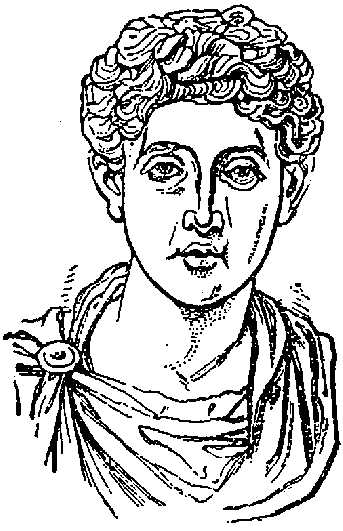
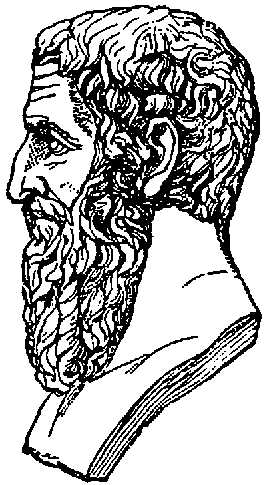
Pertinax, an aged senator of consular rank, and now Præfect of the city, was summoned by the conspirators, who came to his house late at night, after the murder of Commodus, to ascend the vacant throne. He was one of the few friends and ministers of Marcus Aurelius who yet survived, and, having filled many important offices, had always been distinguished for firmness, prudence, and integrity. The rumor was spread that Commodus had died of apoplexy, and that Pertinax had succeeded him; but the Prætorian Guards were dissatisfied at his election. The Senate, however, confirmed the choice of the conspirators, and Pertinax lived among his own order rather as an equal than a master. His manners were simple, his mode of life frugal, and he sought to revive the pleasing simplicity of the early Republic.
Pertinax administered justice with strictness, released those who had been left in prison by Commodus, reformed the finances and introduced economy, redivided the uncultivated lands among those who would till them, removed oppressive restrictions upon trade, and deserved the respect of the wiser portion of his subjects.
But the Prætorians were never reconciled to his rule, and on the 28th of March, A.D. 193, eighty-six days after his election, they[Pg 319] broke into the imperial palace, and struck down the emperor with innumerable blows. His head was separated from his body, and, being placed upon a lance, was carried in triumph to the Prætorian camp, while the people silently lamented the death of this virtuous ruler.
The soldiers, meanwhile, proclaimed from the ramparts of their camp that the throne of the world would be sold at auction to the highest bidder. Didius Julianus, a wealthy Senator, whose age had not quenched his vanity and ambition, offered about a thousand dollars to each man for the possession of the prize. He was declared emperor, and, surrounded by the armed Prætorians, was carried to the Senate, who were forced to accept the selection of the soldiers. But the Senators and the people felt deeply the disgrace of their country, and even the Prætorians were ashamed of their unworthy choice. Julianus found himself on the throne of the world without a friend.
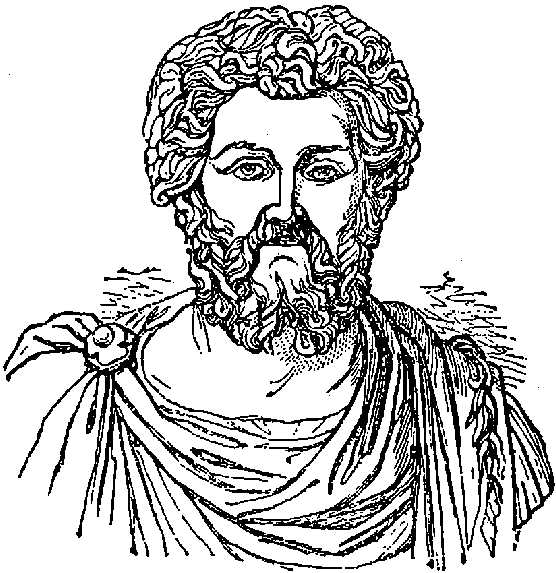
The armies in the provinces, when they heard of these transactions at the capital, rose in revolt, and refused to acknowledge the authority of Julian. Clodius Albinus commanded the legions in Britain, Septimius Severus those in Pannonia, and Pescennius Niger the army of the East. Severus, more active than his competitors, was saluted by his soldiers as emperor, and marched rapidly toward Rome. Julian, deserted by the Prætorians, was condemned to death by the Senate, and was executed as a common criminal[Pg 320] after a reign of only sixty-six days. Severus was acknowledged as their lawful emperor by the Senate, June 2, A.D. 193, and his first act was to disarm the Prætorian Guards and banish them from the capital.
He next marched against Niger, and defeated him in two battles, while he was also successful in a severe contest with Clodius Albinus at Lyons. Both of his competitors were put to death, and Severus, now set free from fear of rivalry, began to show the native cruelty of his disposition. Forty-one Senators, whom he accused of having favored Albinus, were executed, with their wives and children; and many of the provincial nobles of Spain and Gaul shared their fate. Yet Severus was in many respects a useful ruler; strict in the administration of the laws, careful to correct abuses, and restraining his subjects with stern impartiality. Peace returned to the provinces, cities were repeopled, roads repaired, Rome abounded in provisions, and the people were satisfied. Severus changed the constitution of the Prætorian Guards, and filled up their ranks with the bravest soldiers of the legions of the frontier. These barbarians, he thought, would be able to suppress any rebellion that might arise; and he increased the number to fifty thousand men. The Præfect of the Prætorians, who had at first been a simple soldier, now became the chief minister of the emperor, and was at the head of the finances and even of the law. The celebrated lawyer Papinian was appointed Præfect after the fall of Plautianus; and several great jurisconsults, particularly Paulus and Ulpian, flourished under the reign of Severus or his family.
Severus, however, was a military despot, and, despising the feeble Senate, assumed both the legislative and the executive power. The jurisconsults, in fact, from this reign, begin to treat the emperor as the source of all law, the Senate and the people being no longer considered in the state. But this arbitrary rule, introduced by Severus, is thought to have tended more than any thing else to destroy the vigor of the Roman Empire, by leading the people to an abject dependence upon their rulers.
The wife of Severus, Julia Domna, a Syrian lady of great beauty and various accomplishments, became the mother of two sons, Caracalla and Geta, and the emperor hoped that they would prove worthy of the high office to which they were born. They soon, however, showed themselves incapable of any serious study or employment, and were chiefly remarkable for the hatred they bore toward each other. The court was already divided into two factions, composed of the adherents of either son; and the emperor, who in vain strove to remove their rivalry, foresaw that one must fall a victim to the hatred of the other.[Pg 321]
In A.D. 208 a war broke out in Britain, and Severus, although now more than sixty years of age, and afflicted with the gout, so that he was carried on a litter, set out at the head of his army, attended by his two sons, and penetrated into the interior of Scotland. This was his last enterprise, for he died at York, February 4, A.D. 211. He left his empire to his two sons, who returned to Rome, and were acknowledged by the Senate and the army.
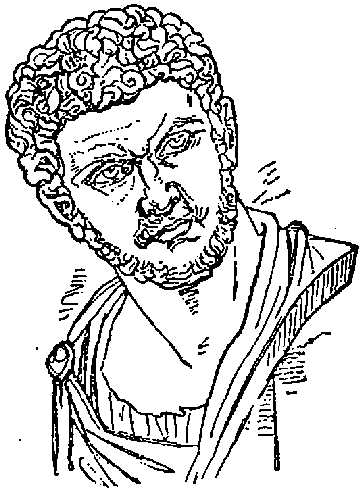
Their discord, however, still continued, and they planned a division of the empire, a measure which was then distasteful to all the Romans, and which was only prevented from taking place by the tears and entreaties of their mother, Julia Domna. Geta, the younger son, who was of a gentle disposition, soon after, in A.D. 212, February 27th, was murdered by the cruel and relentless Caracalla. Twenty thousand of his friends are said to have been put to death at the same time, and his unhappy mother, Julia Domna, was forced to receive her guilty son with feigned smiles and words of approbation. Remorse, however, fastened upon Caracalla, and the shade of Geta haunted him wherever he went. His cruelties now redoubled. He put to death Papinian, the Prætorian Præfect, the splendid ornament of the Roman bar; and his massacres filled every part of the empire with mourning and terror. In A.D. 213 he left the city of Rome, and never returned thither again; the rest of his reign was passed in the provinces, and wherever he came he indulged himself in endless murders, confiscations, and acts of violence. "He was," says Gibbon, "the common enemy of mankind." He directed a general massacre of the people of Alexan[Pg 322]dria, who had lampooned him, and viewed the scene from a secure post in the Temple of Serapis. To retain the affections of his army, he lavished upon them immense sums, the plunder of his empire; and he was at length assassinated, March 8, A.D. 217, at the instigation of Macrinus, one of the Prætorian Præfects, who had discovered that the tyrant had planned his own death.
Macrinus, Præfect of the Prætorian Guard, was elected emperor March 11, A.D. 217, and the Senate and the provinces submitted without a murmur. But the new emperor was disliked by the nobles on account of his humble origin, and soon offended his army by endeavoring to reform their discipline. The Empress Julia now withdrew by a voluntary death from the sorrow which surrounded her, and the family of Severus became extinct. A rebellion broke out in the Syrian army, who proclaimed Bassianus, the grandson of Julia Mæsa, sister of the late empress, and who assumed the name of Antoninus. He pretended that he was the natural son of Caracalla. A battle took place, in which Macrinus was defeated, and soon after put to death; and Elagabalus, for that is the name under which this monster is commonly known, ascended the throne.
He at once plunged into every vice. The sun was worshiped at Emessa under the name of Elagabalus, from whence the new emperor derived his surname, having been a priest in the temple; and he now introduced the lascivious rites of the Syrian deity into the capital of the world. A magnificent temple of the god Elagabalus was raised on the Palatine Mount, and the grave and dignified nobles of Rome were forced to take part in the ceremonies, clothed in long Phœnician tunics.
It would be impossible to describe the vices of this wretched being, who seems to have sunk to the very extreme of depravity. His cousin, however, Alexander Severus, as if to show that human nature had not wholly declined, was amiable, virtuous, and learned. Elagabalus was murdered by the Prætorians March 10, A.D. 222, and Alexander placed upon the throne.
Alexander Severus seems to have inclined toward the Christian faith, which was now very widely extended throughout the empire. He revoked all former edicts against the Christians, and ordered the words "Do unto others as you would have them do to you" to be inscribed upon his palaces and other buildings. The Persian Empire was now arising in new strength under the house of the Sassanides, and a war having broken out with them, Alexander marched against the Persians, and gained a considerable victory. He returned to Rome in triumph, and entered the city in a chariot drawn by four elephants. Soon after, the Germans having invaded[Pg 323] Gaul, he led his army to the defense of the frontier; but, while attempting to reform the discipline of the Gallic legions, he was assassinated by a band of discontented soldiers, and Maximin, a Thracian peasant of great personal strength, who had risen to a high command in the army, was raised to the throne.
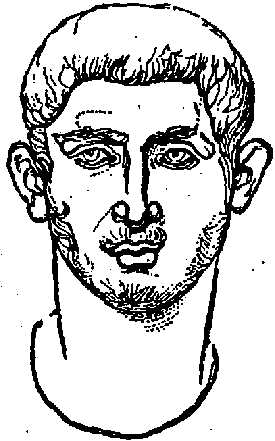
Maximin, A.D. 235, began his reign by massacring many of the friends of the late emperor, and even all those who showed any regret for his death. He was a fierce, ignorant barbarian, but was very successful in his wars against the Germans, having ravaged their country, and sent great numbers of them to be sold as slaves in Italy. He also defeated the Dacians and Sarmatians. But his severities produced a revolt in Africa, where the legions proclaimed their proconsul Gordian emperor, then in the eightieth year of his age. The Senate now revolted against Maximin, and ordered all his friends in Rome to be put to death. Maximin now made peace with the barbarians, and marched toward Italy, while, in the mean time, Gordian and his son were defeated and slain in Africa. The Senate immediately elected Papianus and Balbinus emperors, to whom, in order to gratify the people, they joined the younger Gordian, then only twelve years of age. Maximin entered Italy and besieged Aquileia, but his soldiers, weary of the length of the siege, put him to death, A.D. 238. The Goths on the Danube and the Persians in the East now assailed the empire, and at the same time the Prætorian Guards murdered his two associates, leaving Gordian sole emperor of Rome. Gordian was married to the daughter of Misitheus, Præfect of the Prætorians, an excellent minister and commander. Together they marched to the East, and[Pg 324] defeated the Persians under their king Sapor, in various engagements. Misitheus now died, and Gordian appointed the Arab Philip his prime minister. Sapor was again defeated; but the Arab conspired against Gordian, his benefactor, who was assassinated in A.D. 244.
Philip, having made peace with the Persians, returned to Rome, where he won the favor of the people by his mild conduct. In his reign the secular games were celebrated, it being reckoned one thousand years since the foundation of the city. Philip ruled with mildness, and was an enemy to persecution. In A.D. 249, however, the Illyrian army revolted, and proclaimed their commander, Trajanus Decius, emperor, who defeated Philip near Verona, and put him to death. His son, who had remained at Rome, was slain by the Prætorian Guards.
In A.D. 250 the Goths invaded the empire. These fierce barbarians came from the north of Europe, and were among the chief instruments of the fall of Rome. Decius, who does not seem to have wanted skill and courage, was finally defeated and slain by them, together with his son. Decius is remembered as one of the most cruel persecutors of the Christians. The innocent victims of his rage were subjected to torture, driven to hide in the wilderness among rocks and forests, and were glad to live among the wild beasts, more humane than man. The Bishop of Rome, Fabian, the bishops of Antioch and Alexandria, and many more eminent in the Church, suffered from the unrelenting severity of this persecutor.
A son of Decius, Hostilianus, together with Gallus, an experienced soldier, were now made emperors. They concluded a disgraceful, but probably necessary peace with the Goths. But Hostilianus soon after died, and Gallus was defeated and slain by Æmilianus, who was himself assassinated, and Valerian, the Censor, in A.D. 253, was made emperor. A very high character is given of this ruler, whose reign, however, was filled with disasters. Having joined his son Gallienus with him, Valerian vainly sought to repel the attacks of innumerable enemies on every side of the empire—the Goths, the Franks, the Scythians, and the Persians. In a campaign against the latter Valerian was taken prisoner, and for nine years languished in captivity, his unnatural son making no effort for his liberation.
The Allemanni, meanwhile, had entered Italy, ravaged its northern territory, and even threatened Rome. They withdrew, loaded with plunder. To gain allies among the barbarians, Gallienus now married the daughter of the king of the Marcomanni. Every part of the empire seems now to have been laid open to the invad[Pg 325]ers. Greece was ravaged by the Goths; the famous Temple of Diana at Ephesus was burned by them, together with that fine city; and Sapor, king of the Persians, overran Syria and Asia. He was, however, finally repelled by the brave Odenatus, who, with his queen Zenobia, ruled at Palmyra.
Valerian died in captivity, while a crowd of usurpers rose in arms against the weak Gallienus. There were nineteen pretenders to the throne according to Gibbon, but this period is usually known as that of the Thirty Tyrants. This melancholy period was also marked by a pestilence, which raged for fifteen years in every province. Five thousand persons are said to have died daily at Rome for some time; cities were depopulated, and the number of the human species must have sensibly declined. A famine preceded and attended the pestilence, earthquakes were common, and the third century is, no doubt, the most melancholy period in the history of Europe.
Gallienus was murdered in A.D. 268, and was succeeded by Marcus Aurelius Claudius, who died of a pestilence which had broken out in his army in Egypt. Aurelian, a native of Pannonia, was the next emperor. His reign lasted four years and nine months, but was filled with remarkable events. He abandoned Dacia to the Goths, defeated the Alemanni, and drove them out of Italy. But he foresaw the danger of future invasions, and surrounded Rome with new walls about twenty-one miles in extent. In A.D. 272 he marched against Zenobia, queen of Palmyra, who ventured to defy the power of Rome. This illustrious woman was not only learned, beautiful, and an agreeable writer, but governed the East for five years with discretion and success. Aurelian was amazed at her warlike preparations upon the fall of Palmyra, and treated her beautiful city with lenity; but the Palmyrenians having rebelled, the city was taken by storm, and its people put to death. The ruins of Palmyra are still among the most remarkable of the ancient world.
Aurelian now returned to Rome to celebrate his triumph. The spoils of every climate were borne before him; his captives were from Germany, Syria, and Egypt, and among them were the Emperor Tetricus and the beautiful Zenobia, bound with fetters of gold. A whole day was consumed in the passage of the triumphal procession through the streets of Rome. But Aurelian, who was illiterate, unpolished, and severe, failed to win the regard of his people, and was plainly more at his ease at the head of his army than in the cultivated society of Rome. He returned, therefore, to the East, where he died, as was usual with so many of the em[Pg 326]perors, by the hand of an assassin, in A.D. 275. He restored vigor to the empire, and preserved it from instant destruction.
The army, filled with sorrow for the loss of the emperor, revenged his death by tearing his assassin in pieces; and they then wrote a respectful letter to the Senate, asking the Senators to select his successor. The Senate, however, passed a decree that the army should name the new emperor. The soldiers, in their turn, refused, and thus for eight months an interregnum prevailed while this friendly contest continued. At last the Senate appointed the virtuous Tacitus, who claimed a descent from his namesake, the famous historian. Tacitus, however, who was seventy years old, sank under the hardships of his first campaign, and died A.D. 276, at Tyania, in Cappadocia.
His brother Florian then ascended the throne, but was defeated and put to death by Probus, the best soldier of the age, who, in six years, once more repelled the barbarians from every part of the empire. He delivered Gaul from the ravages of the Germans, pursued them across the Rhine, and every where defeated them. He suppressed, also, several insurrections, and employed his soldiers in various useful works. But at length, weary of these labors, they put Probus to death, A.D. 282.
Carus, the next emperor, was singularly frugal in his mode of life. When the Persian embassadors visited him in his tent they found him sitting upon the grass, clothed in a coarse robe, and eating his supper of bacon and hard pease. Carus gained many victories over the Persians, but died suddenly in A.D. 283. His two sons, Carinus and Namerian, succeeded him, but were soon assassinated, giving place to the more famous Diocletian.
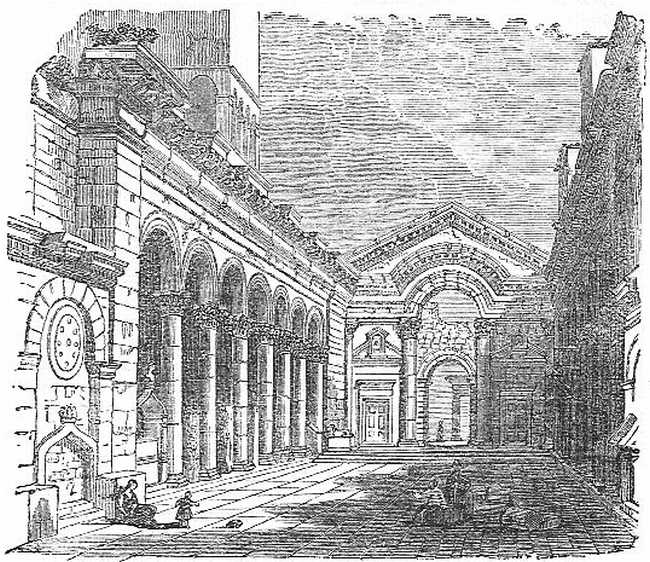
Diocletian began to reign A.D. 284, and once more revived the vigor of the declining empire, which now seemed more than ever to depend for its existence upon the qualities of a single ruler. It seems, indeed, to have required an intellect of no common order to preserve the unity of the empire, composed of so many different nations, of territories separated by such vast distances, and threatened on every side by innumerable foes; but, of all his contemporaries, Diocletian was best suited to this task. His parents had been the slaves of a Roman Senator, and he had himself risen from this low station to the highest positions in the army. He acted with generosity toward the servants of the former emperor, not only suffering them to remain in safety under his rule, but even to retain[Pg 328] their offices. Finding the empire too large to be governed by a single ruler, he selected as his colleague Maximian, a brave, but fierce and ignorant soldier, who, like himself, had risen to a high rank in the army. Maximian, however, always admitted the intellectual superiority of Diocletian. The emperor assumed the title of Jovius, and Maximian that of Herculius. Diocletian also appointed two Cæsars, Constantius and Galerius, to aid him in the defense of the empire, which was divided between the four princes. Gaul, Spain, and Britain were intrusted to the care of Constantius, Italy and Africa to Maximian, Galerius commanded the legions on the Danube, while Diocletian reserved for himself Thrace, Egypt, and Asia. The four rulers seemed to have labored together in harmony, but the establishment of four courts in different parts of the empire obliged them to increase the taxes, and every province suffered under new impositions. Even Italy, which had always been favored in this particular, was now heavily burdened, and every where lands were abandoned and left uncultivated because their owners could not pay the taxes and impositions. In A.D. 287 a rebellion occurred in Gaul, which was suppressed by Maximian; soon after, Carausius, having become master of Britain, and possessing a considerable fleet, defied the power of the emperor; but when Constantius was appointed Cæsar he prepared to reduce the island to subjection. In A.D. 294 Carausius was put to death by Allectus, a new usurper. Constantius now crossed the Channel and recovered the island, which, after a separation of ten years, was once more reunited to the empire. During this reign the Goths, Vandals, and other northern barbarians wasted their strength in destructive contests with each other; but whenever, in intervals of peace, they invaded the Roman territory, they were driven back by the valor of the two Cæsars. Maximian, in the mean time, subdued a revolt in Africa; and Diocletian himself suppressed one of those seditions to which Egypt was constantly exposed. The emperor besieged Alexandria for eight months, cut off the aqueducts which conveyed water to the city, and, having taken it, put many thousands of its citizens to death. One remarkable edict which he now published forbade the study of alchemy in Egypt, and ordered all books upon that subject to be burned. He also made a treaty with the Nubians, in order to protect the frontiers of Egypt.
It gives us, indeed, a clear view of the immense extent of the Roman power when we reflect that its commanders were, almost at the same moment, struggling successfully against its enemies in Africa, Britain, Germany, and the East. A war with Persia now arose, in which Galerius was at first defeated, A.D. 296. But the[Pg 329] next year he passed through the mountains of Armenia at the head of twenty-five thousand chosen men, and, having surprised the Persian army in the night, slaughtered great numbers of them; the booty, too, was immense. A barbarian soldier, finding a bag of shining leather filled with pearls, threw away the contents and preserved the bag; and the uncultivated savages gathered a vast spoil from the tents of the Persians. Galerius, having taken prisoners several of the wives and children of the Persian monarch Narses, treated them with such tenderness and respect that Narses made peace. Mesopotamia was now added to the empire, being taken from the King of Armenia, who received in its place a considerable Persian province.
The two emperors returned to Rome and celebrated their triumph November 20, A.D. 303, the last spectacle of that kind which the world has witnessed. Romulus, more than a thousand years before, had ascended the Capitoline Mount on foot, bearing in his arms the spoil of Acron, and his example had been followed by a long line of Roman heroes. In the last triumph, the two emperors were attended by the spoils of Africa and Britain, of the East and the West.
During this reign also occurred the last persecution of the Christians, who were soon to become the masters of the empire. It began A.D. 303, and continued for ten years; and such multitudes of the Christians perished that the emperors boasted that they had wholly extirpated the sect!
Diocletian introduced an Eastern pomp into his court, assumed the titles of "Lord and Emperor," and wore a diadem set with pearls. His robes were of silk and gold. He required his subjects to prostrate themselves before him, and to adore him as a divinity.
In A.D. 305, like Charles V., he resolved to abdicate his power, having persuaded his colleague Maximian to do the same: he lived in retirement for nine years, and amused himself cultivating his garden. "I wish you would come to Salona" (Spalatro), he wrote to Maximian, who sought to draw him from his retirement, "and see the cabbages I have planted: you would never again mention to me the name of empire." But the close of his life was embittered by the ingratitude of Constantine and Licinius, and the dangers of the empire. It is not known whether he died by disease or by his own hand.
Upon the abdication of Diocletian and his colleague, the two Cæsars, Constantius and Galerius, assumed the title of Augustus. Constantius retained his former provinces, Gaul, Spain, and Britain. He was moderate, amiable, and lived with Roman simplicity. Galerius, on the other hand, was haughty, severe, and ambitious. He[Pg 330] had married a daughter of Diocletian, and hoped that the death of Constantius would soon leave him the sole emperor of Rome. The two emperors now appointed two Cæsars, Maximin and Severus, the first nephew to Galerius, and the latter devoted to his interests. Constantius died at York, in Britain, A.D. 306, and his son Constantine was proclaimed Augustus by the soldiers.
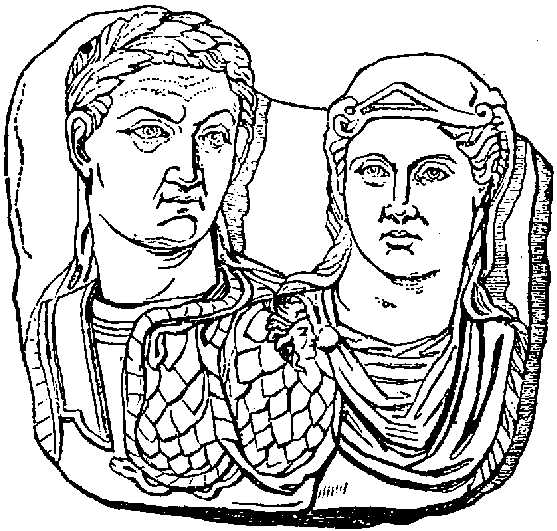
This prince, afterward Constantine the Great, was the son of Constantius and Helena, who was said to have been the daughter of an inn-keeper. When Constantius became Cæsar he divorced Helena, and her son was, in a measure, neglected. Constantine, however, soon distinguished himself as a soldier, and won the affection of the army. In appearance he was tall, dignified, and pleasing; he excelled in all military exercises, was modest, prudent, and well informed. He soon attracted the jealousy of Galerius, who would have put him to death had he not escaped to his father in Britain; and now Galerius refused to allow him any higher title than that of Cæsar.
Maxentius, the son of the abdicated emperor Maximian, was also proclaimed Augustus by his soldiers, and prevailed upon his father once more to ascend the throne. Severus, who marched against them, was defeated and put to death; and Constantine now married Fausta, the daughter of Maximian. Galerius led a large army from the East, but was repulsed from Rome and retreated, leaving Maximian and his son masters of the capital. Galerius next asso[Pg 331]ciated Licinius with him in his power, and there were now six sovereigns upon the throne.
In A.D. 310, however, Maximian, having conspired against the life of Constantine, was put to death; Galerius died the next year; in A.D. 312 Maxentius fell before the arms of Constantine, and was drowned in the Tiber while attempting to make his escape. It was during this campaign that Constantine is said to have seen the miraculous cross in the heavens.
The Roman Senate paid unusual honors to Constantine; games and festivals were instituted in memory of his victory over Maxentius, and a triumphal arch was erected, whose imperfect architecture shows the decline of ancient taste. The Arch of Trajan was stripped of its ornaments to adorn that of Constantine.
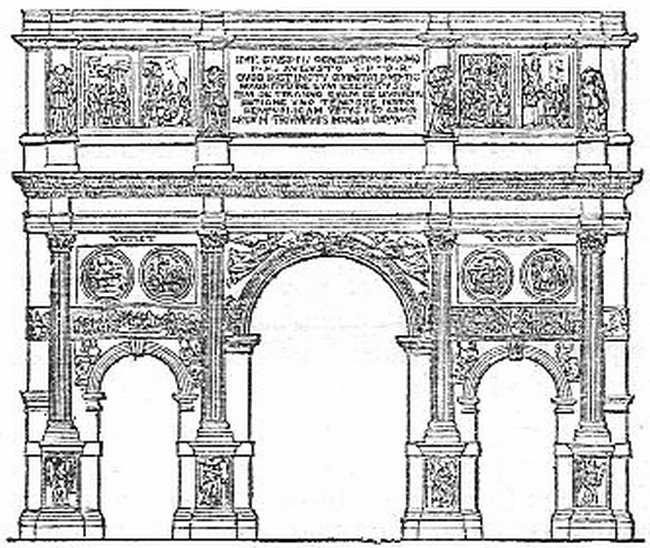
The new emperor introduced good order into the administration of the West, revived the authority of the Senate, and disbanded the Prætorian Guards; he revoked the edicts against the Christians, and paid unusual deference to the bishops and saints of the Church. The Emperor Licinius, who had married his sister, in A.D. 313 defeated and put to death Maximin, so that the empire was now shared between Constantine and Licinius.
The former now summoned a council of bishops at Arles to suppress the heresy of the Donatists, but, before it met, was forced to march against Licinius, who had conspired against him. Licinius was defeated in two battles, and forced to give up a large part of his dominions to his conqueror. Constantine next defeated the[Pg 332] Goths and Sarmatæ. Licinius had assumed the defense of Paganism, while Constantine raised the standard of the Cross. The last struggle between them took place near Adrianople; the Pagan army was defeated and put to flight, and in A.D. 324 Licinius was put to death. Thus Constantine reigned alone over the empire of Augustus.
At the famous Council of Nice, which met in A.D. 325, the doctrine of the Trinity was established, Arianism condemned, and at the same time the emperor was, in effect, acknowledged to be the spiritual head of the Church. But an event now occurred which must have destroyed forever the happiness of Constantine. He was induced to put to death his virtuous son Crispus, through the false accusations of his wife Fausta, and when afterward he discovered the falseness of the charges made against Crispus, he directed Fausta and her accomplices to be slain.
Rome, which had so long been the capital of the world, was now to descend from that proud position and become a provincial city. When Constantine returned to Rome after the Council of Nice, he found himself assailed with insults and execrations. The Senate and the people of the capital saw with horror the destroyer of their national faith, and they looked upon Constantine as accursed by the gods. The execution of his wife and son soon after increased the ill feeling against the emperor, and Constantine probably resolved to abandon a city upon which he had bestowed so many favors, and which had repaid him with such ingratitude. He was conscious, too, that Rome, seated in the heart of Italy, was no longer a convenient capital for his empire, and he therefore resolved to build a new city on the site of ancient Byzantium. The Bosphorus, a narrow strait, connects the Black Sea and the Sea of Marmora; and here, on a triangular piece of ground, inclosing on one side an excellent harbor, Constantine laid the foundations of his capital. It was situated in the forty-first degree of latitude, possessed a temperate climate, and a fertile territory around it; while, being placed on the confines of both Europe and Asia, it commanded the two divisions of the empire.
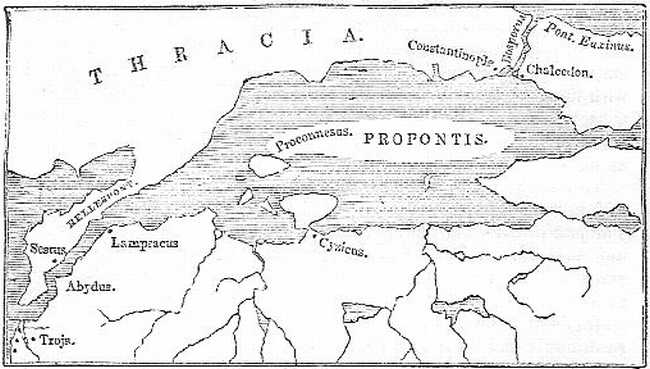
Constantinople was adorned with all the architectural elegance of the age, but the arts of sculpture and of decoration had so declined that Constantine was forced to rob the cities of Greece of their finest works in order to supply the deficiencies of his own artists: Athens and Asia were despoiled to adorn his semi-barbarous capital. The city was provided with a forum, in which was placed a column of porphyry upon a white marble base, in all one hundred and twenty feet high, upon which stood a bronze figure of Apollo. A hippodrome, or circus of great size, and the baths and pleasure-[Pg 333]grounds, recalled the memory of those of Rome. Schools and theatres, aqueducts, fourteen churches, fourteen palaces, and a great number of magnificent private houses, added to the splendor of the new city. Constantine designed, it is said, to have called his capital the SECOND OR NEW ROME, but his own name has always been preferred.
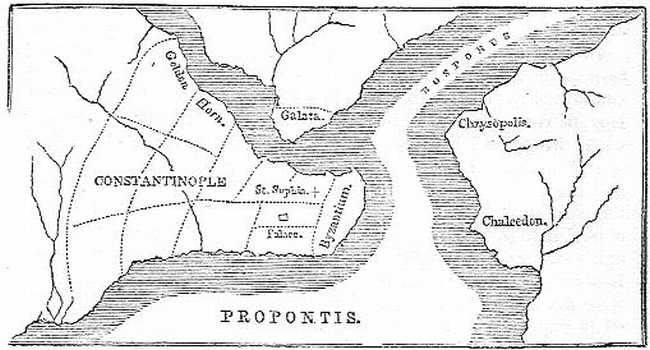
Having thus provided a capital, Constantine next began to form a new constitution for his empire; he established, therefore, a com[Pg 334]plete despotism, all the power being lodged in the emperor, and all honors and titles being conferred by him alone. The name of Consul was still preserved, these officers being yearly appointed by the emperor; but we now notice the titles of Count and Duke joined with those of Quæstors and Proconsuls. All the civil magistrates were taken from the legal profession. The law was now the most honorable of the professions, and the law school at Berytus, in Phœnicia, had flourished since the reign of Alexander Severus.
The Roman Empire was divided into four great præfectures, which were themselves subdivided into dioceses and provinces. The præfectures were named that of the East, of Illyricum, of Italy, and of Gaul. A Prætorian Præfect had charge of each præfecture, and regulated its civil government; took care of the roads, ports, granaries, manufactures, coinage; was the supreme legal magistrate, from whose decision there was no appeal. Rome and Constantinople had their own Præfects, whose courts took the place of those of the ancient Prætors, while a considerable police force preserved the quiet of each city. The magistrates of the empire were divided into three classes, the Illustrissimi, or illustrious; the Spectabiles, or respectable; and the Clarissimi, or the honorable.
Constantine also made Christianity the established religion of the state, and appropriated a large portion of the revenues of the cities to the support of the churches and the clergy. His standing army was very large, but the ranks were now filled chiefly by barbarians, the Roman youth having lost all taste for arms. It is said the young men of Italy were in the habit of cutting off the fingers of the right hand in order to unfit themselves for military service.
In order to support this extensive system, Constantine was forced to impose heavy taxes upon his people. Every year the emperor subscribed with his own hand, in purple ink, the indiction, or tax levy of each diocese, which was set up in its principal city, and when this proved insufficient, an additional tax, or superindiction, was imposed. Lands, cattle, and slaves were all heavily taxed, and the declining agriculture of the empire was finally ruined by the exorbitant demands of the state. In Campania alone, once the most fertile part of Italy, one eighth of the whole province lay uncultivated, and the condition of Gaul seems to have been no better. Besides this, merchants, manufacturers, mechanics, and citizens were taxed beyond their power of endurance, while those who failed to pay were shut up in prison. Every fourth year these taxes on industry were levied, a period to which the people looked forward with terror and lamentation. Gifts were also demanded from the cities or provinces on various occasions, such as the accession of an emperor, the birth of an emperor's heir, the free gift of the[Pg 335] city of Rome, for example, being fixed at about three hundred thousand dollars; and, in fine, the imperial despotism reduced the people to want, and hastened, even more than the inroads of the barbarians, the destruction of civil society.
Constantine in his old age adopted the luxury and pomp which Diocletian introduced from the East; he wore false hair of various colors carefully arranged, a diadem of costly gems, and a robe of silk embroidered with flowers of gold. His family, at an earlier period, consisted of Crispus, a son by his first wife Minervina, and the three sons of Fausta, Constantine, Constantius, and Constans. Besides these there were three daughters. Crispus, however, who was beloved by the people and the army, excited the jealousy of Fausta. Constantine was led to believe that his son was engaged in a conspiracy against his life, and Crispus was executed by his father's orders, together with Cæsar Licinius, the son of Constantine's favorite sister. Helena, the aged mother of Constantine, undertook to avenge her grandson. Fausta was finally proved to be unfaithful to her husband, and put to death, with many of her friends and followers. These fearful scenes within the palace recalled to the Roman people the memory of Nero and Caligula.
The three sons of Fausta were now the heirs of the throne, and, with their two cousins, Dalmatius and Hannibalianus, were carefully instructed by Christian professors, Greek philosophers, and Roman jurisconsults, the emperor himself teaching them the science of government and of man. They also studied the art of war in defending the frontiers of the empire; but no important war disturbed the last fourteen years of this reign. Constantine reigned thirty years, the longest period of any since Augustus; and he died May 22, A.D. 337, at his palace at Nicomedia, aged sixty-four years.
Constantine, although professing the Christian faith, was not baptized until a short time before his death, when he received that solemn rite with many professions of penitence, and of a desire to live in future according to the precepts of religion. He seems to have possessed many excellent qualities, was brave, active, and untiring, ruled with firmness, and gave a large portion of his time to the cares of state.
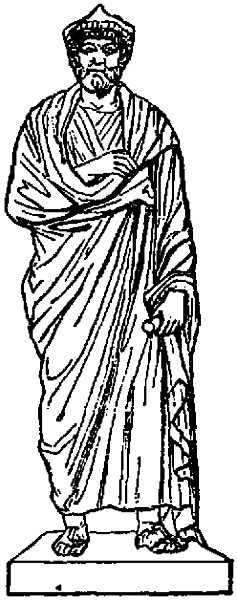
The three sons of the late emperor, Constantine, Constantius, and Constans, as soon as their father was dead, put to death their two cousins, Hannibalianus and Dalmatius, with many more of their relatives; only Gallus and Julian, the children of Julius Constantius, being left alive. They then divided the empire, A.D. 337, Constantine, the elder, retaining the new capital, Constans receiving the western provinces, while to Constantius was left Syria and the East. Sapor, king of Persia, invaded the Eastern provinces, and defeated the Romans in various battles. Meanwhile a quarrel broke out between Constantine and Constans, and the former, having invaded his brother's provinces, was defeated and slain, A.D. 350. Ten years afterward Constans was himself put to death by Magnentius, an ambitious soldier, who at once assumed the name of emperor. Constantius marched against him, but found that Vetranio, præfect of Illyricum, had joined him, instigated by the Princess Constantina. He finally, however, defeated Magnen[Pg 337]tius, and deposed the aged Vetranio, and thus became the master of Rome. Having recalled Gallus and Julian from banishment, the emperor gave them the title of Cæsars. Gallus proved unfit for public affairs, while Julian won the esteem of all men by his conduct and valor. He drove the Germans out of Gaul, which they had invaded, and even crossed the Rhine, in imitation of Julius Cæsar.
Constantius now became jealous of the rising fame of Julian, who was beloved by the Western legions, and commanded him to send the finest part of his army to the East. Julian prepared to obey, but the soldiers rose in revolt, proclaiming him Julian Augustus. He sent messengers to the emperor demanding the recognition of his election; but war could not long be averted. Julian abjured Christianity, which he had hitherto professed, together with his allegiance to the emperor, and led a small army of well-chosen soldiers against his rival. Meantime Constantius, in A.D. 361, November 3d, died of a fever in Syria, while Julian entered Constantinople December 11th, amid the applause of the people. He was acknowledged emperor. He was now in his thirty-second year, in many particulars the most remarkable of the second Flavian family.
Julian had been educated by the Platonic philosophers, and resolved to restore the ancient form of religion. He sacrificed to the pagan gods, rebuilt their temples, revived the practice of augury, or divination, and vainly strove to impose upon the human mind a superstition which it had just thrown off. In order to mortify the Christians, he resolved to rebuild the Temple of Jerusalem, and restore the Jews to their ancient seat. But some natural phenomenon interposed; the workmen were driven away by balls of fire, and Julian abandoned his design.
Except this unphilosophical hostility toward the Christians, whose faith he had once professed, Julian seems to have made a sincere attempt to improve the condition of his people. He lived with frugality, rewarded merit, and encouraged learning, except where it was employed in the defense of Christianity. He was also successful in his wars against the Germans and the Persians, but at length was defeated by the latter, and was killed A.D. 363, June 26th.
Julian affected in his dress and manners the rudeness and indifference of a philosopher, was free from vice, possessed considerable learning, and wrote a work of some value, in which he compared and studied the characters of the long line of his predecessors.
Jovian was now proclaimed emperor by the Eastern army, and concluded a dishonorable peace with the Persians. He next pub[Pg 338]lished an edict restoring Christianity, but was found dead in his bed, A.D. 364.
Valentinian was next chosen emperor, who gave the Eastern provinces to his brother Valens. He made Milan the seat of his own government, while Valens reigned at Constantinople; and the empire was from this time divided into the Eastern and the Western. The whole of the Western world was distressed by the invasion of barbarous tribes, and Valentinian now made his son Gratian his heir, in order to remove all doubt as to the succession. The Saxon pirates, meantime, harassed all the coasts of Gaul, while Britain was invaded by the Picts and Scots. Theodosius, however, defeated them, and was soon after sent to quell an insurrection in Africa. This he succeeded in doing, when Valentinian died suddenly, A.D. 375.
Valens, his brother, meantime had suppressed a rebellion in the East, led by Procopius; and then, having become an Arian, commenced a severe persecution of the orthodox, of whom no fewer than eighty ecclesiastics were put to death for supporting the election of a bishop of their own faith at Constantinople. Valens also succeeded in repelling the attacks of the Persians.
In the West Valentinian had been succeeded by his sons Gratian and Valentinian II. The brave Theodosius, meanwhile, whose valor had preserved the peace of the nation, was executed by order of Gratian, and soon after the Huns appeared upon the Danube. These savages are thought to have entered Europe from Tartary. Their faces were artificially flattened and their beards plucked out. They left the cultivation of their fields to the women or slaves, and devoted their lives to warfare. A wandering race, they built no cities nor houses, and never slept beneath a roof. They lived upon horseback. The Huns first attacked their fellow-barbarians, the Ostrogoths, and made a fearful carnage, putting all the women and children to death.
The Gothic nation now begged permission from the Romans to cross the Danube, and settle within the Roman territory. Their request was granted, upon condition that they should surrender all their arms; but this condition was imperfectly fulfilled. The celebrated Bishop Ulphilas about this time converted the Goths to Arianism, invented a Gothic alphabet, and infused among the Goths a hatred for the Catholic faith, which served to increase their zeal in all their future conflicts with the Romans. Ill-treated by the Roman commissioners who had been sent by the Emperor Valens to superintend their settlement, the Goths marched against Constantinople. Valens wrote to Gratian for aid, and the latter, although his own dominions were harassed by the Germans, marched[Pg 339] to the aid of his uncle, but died at Sirmium. Valens encountered Fritigern, the Gothic leader, near Adrianople, in A.D. 378, and was defeated and slain. Nearly the whole of the Roman army was destroyed upon this fatal field.
Gratian now chose as his colleague Theodosius, the son of the former brave commander of that name, and Theodosius for a time restored the Roman empire. He defeated the Goths, won their affections by his clemency, and induced them to protect the frontiers of the Danube. Gratian was defeated and put to death, A.D. 383, by a usurper, Maximus, who also deprived Valentinian II. of his province of Italy. Theodosius, however, defeated the usurper in A.D. 388, and generously restored Valentinian to his throne. Valentinian was murdered by a Frank, Arbogastes, in A.D. 392, but Theodosius marched against him, and defeated and destroyed the rebels Arbogastes and Eugenius, A.D. 394.
Theodosius the Great, who had thus reunited the empire under his own sway, belonged to the orthodox faith, and sought to suppress Arianism, as well as many other heresies which, had crept into the Christian Church. He was a prudent ruler, and resisted successfully the inroads of the barbarians. He divided his empire between his two sons, Honorius and Arcadius, the former becoming Emperor of the West, the latter, who was the elder, succeeding his father at Constantinople; and Theodosius soon after died, lamented by his subjects. Rufinus, who became the chief minister of Arcadius, oppressed and plundered the Eastern empire. He was universally hated by the people. Stilicho, on the other hand, who also became the chief minister of Honorius, was a very different character. He was a brave and active commander, and restored the former glory of the Roman arms. His chief opponent was the famous Alaric, who now united the Gothic forces under his own command, and, having penetrated into Greece, ravaged and desolated that unhappy country. The barbarians plundered Athens, Corinth, Sparta, and Argos; and those cities, once so renowned for valor, seemed to offer him no resistance, so fallen was the ancient spirit of the Greeks. Stilicho, however, pursued Alaric into Elis, and would, perhaps, have totally destroyed the barbarians had not the feeble Arcadius not only made peace with Alaric, but appointed him to the command of Illyricum. Alaric, not long after, invaded Italy, but was defeated by his rival. In A.D. 403 he again invaded Italy, and was induced to retreat by a considerable bribe.
The Emperor Honorius removed from Rome to Ravenna, where he believed himself more secure; and when a new horde of barbarians invaded Italy in A.D. 406, and had besieged Florence, they were totally defeated and destroyed by Stilicho. A portion of the[Pg 340] invaders escaped into Gaul, where they committed great ravages, until Constantine, the governor of Britain, was proclaimed emperor, who wrested Gaul and Spain from the dominion of Honorius. This weak prince, in A.D. 408, consented to the murder of Stilicho. His new minister, Olympius, directed the slaughter of the families of the barbarians throughout Italy, a cruelty which was fearfully avenged.
Alaric, the scourge of Rome, marched into Italy, and in A.D. 408 besieged the capital. Pestilence and famine soon raged within the walls of Rome, until the Senate purchased a respite from their calamities by an enormous ransom. Honorius refused to confirm the treaty, and the next year Alaric once more appeared before the city. He took possession of Ostia, the port of Rome, reduced the Senate to surrender, and proclaimed Attalus emperor. Honorius still refusing to yield to his demands, Alaric resolved to punish Rome for the vices of its emperor. The sack of that city now followed, one of the most fearful tragedies in history.
No foreign enemy had appeared before the gates of Rome since the invasion of Hannibal, until Alaric made his successful inroad into Italy. The city still retained all that magnificence with which it had been invested by the emperors. The Colosseum, the baths, the aqueducts, the palaces of the Senators, the public gardens, and the ancient temples, still remained; but its people were lost in luxury and vice. Learning was no longer respected among them, the gamester or the cook being more esteemed than philosophers or poets; and the luxurious Senators passed their lives in frivolous and degrading amusements. The indolent people were maintained by a daily distribution of bread, baked in the public ovens; and oil, wine, and bacon were also provided for them during a part of the year. The public baths were open to the people, and for a small copper coin they might enter those scenes of luxury where the walls were incrusted with precious marble, and perpetual streams of hot water flowed from silver tubes. From the bath they passed to the Circus, where, although the combats of gladiators had been suppressed by Christian princes, a succession of amusements was still provided. In this manner the luxurious nobles and people of Rome passed their tranquil, inglorious lives.
The wealth of the capital was such as might well attract the barbarous invader. The palaces of the Senators were filled with gold and silver ornaments, and the churches had been enriched by the contributions of pious worshipers. Many of the nobles possessed estates which produced several hundred thousand dollars a year, and the wealth of the world was gathered within the walls of its capital.[Pg 341]
We have no means of estimating accurately the population of Rome. Its walls embraced a circuit of twenty-one miles, and it is probable that nearly a million of people were contained within the walls and the suburbs.
Such was the condition of Rome when it was about to fall before the arms of the barbarians. August 24th, A.D. 410, Alaric approached the city, and the gates being opened to him by some Gothic slaves, his troops began at night a fearful scene of pillage and destruction. Men, women, and children were involved in a general massacre; nobles and plebeians suffered under a common fate. The Goths, as they entered, set fire to the houses in order to light their path, and the flames consumed a large part of the city. Great numbers of the citizens were driven away in hordes to be sold as slaves; others escaped to Africa, or to the islands on the coast of Italy, where the Goths, having no ships, were unable to follow them. But Alaric, who was an Arian, spared the churches of Rome, and was anxious to save the city from destruction. From this time, however, A.D. 410, began that rapid decay which soon converted Rome into a heap of ruins.
Alaric, after six days given to plunder, marched out of the city, to the southern part of Italy, where he died. His body was buried under the waters of a rivulet, which was turned from its course in order to prepare his tomb; and, the waters being once more led back to their channel, the captives who had performed the labor were put to death, that the Romans might never discover the remains of their Gothic scourge.
The brother of Alaric, Adolphus, who succeeded him, was married to the Princess Placidia, and now became the chief ally of Honorius. He restored Gaul to the empire, but was murdered while upon an expedition into Spain. Wallia, the next Gothic king, reduced all Spain and the eastern part of Gaul under the yoke of the Visigoths. The empire of the West was now rapidly dismembered. The Franks and Burgundians took possession of Gaul. Britain, too, was from this time abandoned by the Romans, and was afterward, in A.D. 448, overrun and conquered by the Angles and the Saxons, and thus the two great races, the English and the French, began.
Arcadius, the Eastern emperor, governed by his minister, the eunuch Eutropius, and by the Empress Eudoxia, was led into many cruelties; and St. Chrysostom, the famous bishop and orator, was one of the illustrious victims of their persecutions. Arcadius died in A.D. 408, and was succeeded by the young Theodosius, who was controlled in all his measures by his sister Pulcheria, and for forty years Pulcheria ruled the East with uncommon ability. Honorius[Pg 342] died in A.D. 423, when Valentinian III., son of Placidia, his sister, was made Emperor of the West. He was wholly governed by his mother, and thus Placidia and Pulcheria ruled over the civilized world.
The Vandals, who had settled in the province of Andalusia, in Spain, were invited into Africa by Count Boniface, who had been led into this act of treachery by the intrigues of his rival Ætius. Genseric, the Vandal king, conquered Africa, although Boniface, repenting of his conduct, endeavored to recover the province; and thus Italy was now threatened on the south by the Vandal power in Africa.
The Huns, meantime, who had been detained upon the upper side of the Danube, now crossed that river, being united under the control of Attila, and became the terror of the civilized world. Attila first threatened an attack upon the Eastern empire, but at length turned his arms against the West. He was defeated by Ætius and the Visigoths in A.D. 451, but the next year he invaded Italy, demanded the Princess Honoria in marriage, and destroyed many of the Italian cities. He spared the city of Rome, however, and finally died in A.D. 453. His death alone saved the empire from complete ruin.
Valentinian III., who had put to death the brave commander Ætius, was murdered by the patrician Maximus in A.D. 455. The Vandals now besieged and plundered Rome, and sold many thousands of the citizens as slaves. Avitus, a Gaul, next became emperor by the influence of Theodoric, king of the Visigoths, but was soon deposed by Count Ricimer, and was followed by Majorian, a man of merit, who endeavored to reform the nation. He died in A.D. 461. Count Ricimer then declared Severus emperor, but was forced to apply for aid against the Vandals to the court of Constantinople, where Leo was now emperor. Leo appointed Anthemius to the throne of the West, and sent an army against the Vandals in Africa, which was totally defeated. Ricimer then deposed Anthemius, and declared Olybrius emperor; but both Ricimer and Olybrius died in A.D. 472. Leo next appointed Julius Nepos his colleague. Glycerius, an obscure soldier, made an effort to obtain the throne, but yielded to Nepos, and became Bishop of Salona. Orestes, who had succeeded Count Ricimer as commander of the barbarian mercenaries, deprived Nepos of his throne; and Nepos, having fled into Dalmatia, was executed by his old rival Glycerius.
Orestes gave the throne to his son Romulus, to whom he also gave the title of Augustus, which was afterward changed by common consent to Augustulus. But Odoacer, the leader of the German tribes, put Orestes to death, sent Augustulus into banishment[Pg 343], with a pension for his support, and, having abolished the title of emperor, in A.D. 476 declared himself King of Italy.
Romulus Augustus was the last emperor of the West, and bore the name of the founder of the monarchy as well as of the empire, a singular circumstance.
In this manner fell the Roman Empire, a noble fabric, which its founder hoped would endure forever. Its destruction, however, gave rise to the various kingdoms and states of modern Europe, and thus civilization and Christianity, which might have remained confined to the shores of the Mediterranean, have been spread over a large portion of the world.
Roman literature, which had risen to its highest excellence under Augustus, declined rapidly under his successors, and was finally lost with the fall of the Western empire. The language was no longer pure, and neither prose nor poetry retained the harmony and elegance of the Augustan age. A certain sadness and discontent, which marks all the later literature, forms also a striking contrast with the cheerful tone of the earlier writers. Every part of the empire, however, abounded with men of letters, and a high degree of mental cultivation seems every where to have prevailed.
Epic poetry continued to nourish, and Virgil found many imitators. The best epic writer of this period was M. Annæus Lucanus, who was born at Corduba, in Spain, in the year A.D. 38. Lucan was educated at Rome under the Stoic Cornutus, and was introduced by his uncle Seneca to the Emperor Nero. Having for a time enjoyed the patronage of Nero, he at length became the object of his jealousy and hatred, was accused of having taken part in Piso's conspiracy, and was condemned to death. He was allowed, as a favor, to put an end to his own life, and thus died, A.D. 65. Although so young, for he was scarcely twenty-seven years of age, Lucan, besides several shorter poems, produced the Pharsalia, an epic, of which he finished only ten books: it relates the wars between Cæsar and Pompey, and contains many fine thoughts and striking images. He evidently prefers Pompey to Cæsar, and possessed a strong love for liberty, which lends vigor to his verses. His language is pure, his rhythm often harmonious, but he never attains the singular delicacy and sweetness of his master, Virgil.
C. Silius Italicus, the place of whose birth is unknown, also lived during the reign of Nero, and was Consul in the year A.D. 68. He was a Stoic, and put an end to his own life in the year A.D. 100, when he was about seventy-five years of age. His poem, the Punica, is an account of the second Punic War in verse, and is chiefly valuable to the historical student. He had little inventive power, and takes but a low rank in poetry.
P. Papinius Statius, the son of the teacher of the Emperor Domitian, was carefully educated at Rome, and became renowned at an early age for his poetical talents. He spent the last years of his life at Naples, which was also the place of his birth, and died there[Pg 345] in the year A.D. 96. He wrote the Thebais, in twelve parts; the Achilleis, in two books; the Sylvæ, a collection of poems; a tragedy, and other works. He seems to have borrowed much from earlier Greek writers, but was possessed of considerable poetical fervor.
Claudius Claudianus, who lived under Theodosius the Great and his two sons, was probably born and educated at Alexandria, but we know little of his history. He came to Rome about A.D. 395, and, under the patronage of Stilicho, rose to a high position in the state. The time and place of his death are unknown. His chief works were, 1. Raptus Proserpinæ, an unfinished poem in three parts; 2. Gigantomachia, another unfinished work; 3. De Bello Gildonico, of which we possess only the first book; and, 4. De Bello Getico, in which the poet sings the victory of Stilicho over Alaric at Pollentia. His poems have a rude vigor which sometimes strikes the attention, but are chiefly valued for the light they throw upon the Gothic wars. They are marked by many faults of taste.
Lyric poetry was little cultivated at Rome after the death of Horace; but satire, which was peculiar to the Romans, reached its highest excellence under the empire. Juvenal is still the master of this kind of writing, although he has been imitated by Boileau, Pope, and Johnson; and his contemporary Persius was also a writer of great power.
Aulus Persius Flaccus was born at Volaterræ, in Etruria, in the year A.D. 34, of a distinguished family of the equestrian rank. He was educated at Rome under the best masters, particularly under the Stoic Cornutus, with whom he lived in close friendship, as well as with Lucan, Seneca, and the most distinguished men of his time. He died at the early age of twenty-eight, leaving behind him six satires and a brief preface. Persius possessed a generous, manly character, was the foe of every kind of vice, and formed one of that graceful band of writers who maintained their independence under the terrors of a despotic government.
Decimus Junius Juvenalis, of whose life we have few particulars, was born at Aquinum A.D. 38 or 40, and came up to Rome, where he at first studied eloquence with great ardor, but at length gave himself wholly to satirical writing. He offended Domitian by his satires, it is said, and was sent by that emperor to the extreme boundary of Egypt, where he died of grief and exile; but scarcely any fact in the history of this great man has been perfectly ascertained.
We possess sixteen satires of Juvenal, the last of which, however, is of doubtful authenticity. These satires are full of noble appeals to the purest emotions of virtue, and of severe rebukes for triumphant vice. Juvenal's language is often harsh and his taste impure; but his ideas are so elevated, his perception of truth, honor, and[Pg 346] justice so clear, that he seldom fails to win the attention of his readers.
Epigrams seem to have been a favorite mode of expressing thought at the court of Augustus, and almost every eminent Roman from the time of Cicero has left one or more of these brilliant trifles behind him. M. Valerius Martialis, the chief of the epigrammatists, was born about A.D. 40, at Bibilis, in Spain, from whence he came to Rome, when about twenty, to perfect his education. Here he lived for thirty-five years, engaged in poetical pursuits, and patronized by Titus and Domitian. He seems finally to have returned to his native land, where he was living in the year A.D. 100. His poems are about fifteen hundred in number, divided into fourteen books, and are altogether original in their design. They are always witty, often indecent, and contain many personal allusions which can not now be understood. Martial is one of the most gifted of the Roman writers.
The practice of writing epigrams was preserved until a very late period. Seneca, Pliny the younger, Hadrian, and many others, were fond of composing them; and in modern times the epigram has been a favorite kind of poetry with most good writers.
Phædrus, who lived under Augustus and Tiberius, wrote pleasing fables. Calphurnius and Ausonius imitated Virgil's bucolics, and fragments of many other poets are preserved, whom we can not mention here.
Historical writers also abounded under the empire. Velleius Paterculus, an excellent historian descended from a patrician family, was born about B.C. 19. He was the friend and flatterer of Tiberius, and rose, in consequence, to several high offices. He was Quæstor in perhaps A.D. 7, and Prætor in A.D. 15. His Historicæ Romanæ, two books of which remain, is an abridgment of the history of the world, written in a clear and pleasing style, and is, in general, trustworthy. He flatters his benefactors, Augustus and Tiberius, but his fine tribute to the memory of Cicero shows that he felt a strong sympathy with that chief of the Republicans.
Valerius Maximus, who also lived under Tiberius, wrote a considerable work, composed of remarkable examples of virtue, and other anecdotes, collected from Roman or foreign history. He had plainly a just conception of moral purity, although he dedicates his book to Tiberius. His style is inflated and tasteless, but the work is not without interest.
Next after Valerius arose Tacitus, the chief of the imperial prose writers. Tacitus, a plebeian by birth, was born at Interamna. The year of his birth is not known, but must have lain between A.D. 47 and A.D. 61. Tacitus served in the army under Vespasian and[Pg 347] Titus. He rose to many honors in the state, but in A.D. 89 left Rome, together with his wife, the daughter of the excellent Agricola. He returned thither in A.D. 97, and was made Consul by the Emperor Nerva. His death took place, no doubt, after A.D. 117. So few are the particulars that remain of the life of this eminent man; but the disposition and sentiments of Tacitus may be plainly discovered in his writings. He was honest, candid, a sincere lover of virtue. He lamented incessantly the fall of the old republic, and does not spare Augustus or Tiberius, whom he believed to be its destroyers. Like Juvenal, whom he resembled in the severity of his censure as well as the greatness of his powers, Tacitus wrote in a sad, desponding temper of mind, as if he foresaw the swift decline of his country.
His style is wholly his own—concise, obscure, strong, forever arousing the attention. He could never have attained the easy elegance of Livy, and he never tells a story with the grace of that unequaled narrator, but he has more vigor in his descriptions, more reality in his characters.
The life of his father-in-law Agricola is one of the most delightful of biographies. His account of the Germans was a silent satire upon the corrupt condition of the Roman state. The Historiarum Libri is a history of his own age, from the fall of Galba to the death of Domitian, and was probably designed to embrace the reigns of Nerva and Trajan. A small portion only of this work is preserved. The Annales relate the history of Rome from the death of Augustus to that of Nero, but are also imperfect. A treatise upon the orators is also attributed to the historian. Tacitus and Juvenal are the last great names in Roman literature.
Quintus Curtius Rufus, an interesting writer, who lived perhaps under Claudius or Tiberius, his true period being uncertain, wrote, in ten books, an account of the exploits of Alexander the Great. He was succeeded by C. Suetonius Tranquillus, who came to Rome during the reign of Domitian, and there studied rhetoric and grammar. Under Hadrian he fell into disgrace and went into exile: the period of his death is unknown. Suetonius wrote the lives of the twelve Cæsars, ending with Domitian. His language is good, and he paints with uncommon minuteness the vices as well as the virtues of his subjects; he abounds, too, in particulars which throw light upon the manners of the Romans. Suetonius also wrote several short treatises, while various biographies have been attributed to him which probably belong to inferior writers.
L. Annæus Florus, who perhaps lived under Trajan, wrote an epitome of Roman history. Justin, whose period is unknown, wrote or abridged from an earlier author, Trogus, a history of the[Pg 348] world. The Scriptores Historiæ Augustæ is a collection of writers of little merit, who flourished in different periods of the empire. Aurelius Victor, who was probably Præfect of Rome under Theodosius, wrote Origo Gentis Romanæ, only a small portion of which has been preserved, and several other historical works. Eutropius, who served under Julian against the Persians, composed a brief history of Rome, written in a pure and natural style.
Ammianus Marcellinus, who lived under Valens, Valentinian, and Theodosius until A.D. 410, and was a Greek by birth, wrote a history of the empire from Nerva to the death of Valens, A.D. 378. A large part of this work is lost. Ammianus abounds in digressions and descriptions, and is, on that account, the more entertaining. His manner can not be praised.
The Spaniard Orosius concludes the list of the Latin historians. Orosius was a Christian presbyter, and, while defending Christianity, paints a lamentable picture of the condition of the pagan world. He borrowed from Justin and other writers, and lived in the fifth century.
Rhetoric continued to be cultivated, but eloquence no longer possessed the power which it held under the Republic. The speeches now delivered were chiefly declamations upon unimportant themes. M. Annæus Seneca, the father of the philosopher, came to Rome from his native city Corduba, in Spain, during the reign of Augustus, and became a famous rhetorician. M. Fabius Quintilianus, a greater name in literature, was born A.D. 42, at Calgurris, in Spain, but, as was customary with men of merit at that period, went up to Rome, and became celebrated as a teacher of rhetoric. He was a person of excellent character, and, besides practicing at the bar, rose to the consulship. Having passed many years in politics or the law, Quintilian at last returned to his old profession, and in the close of his life gave himself wholly to letters. He now wrote his work upon oratory, Libri duodecim Institutionis Oratoriæ. In this valuable work he seeks to restore the purity of the language, inculcates simplicity, and shows an excellent taste. The younger Pliny was also a famous orator or declaimer.
The Romance, or modern novel, is also thought to have begun in the first century with the satirical tale ascribed to Petronius Arbiter, or perhaps with the translation of the Milesian tales of Aristides from the Greek by Sisenna. The Petronii Arbitri Satiricon is a romance in prose and verse, and was probably written in the first century by an author of whom nothing is known. It relates the adventures of a certain Encolopius, and satirizes the vices and follies of the age. The language of this work is pure, the wit lively, but indecent: only a portion, however, of the Satiricon has been[Pg 349] preserved. During the age of the Antonines arose Appuleius, the best known of the ancient writers of tales. He was born at Madaura, in Africa, but went to Carthage, and from thence to Athens, where he was initiated into the Grecian mysteries, and studied the Platonic philosophy. Appuleius was an agreeable speaker, and had filled his mind with the learning of his age; but his fame with posterity rests upon his novel Metamorphoseon, in which he strives to correct the vices of his contemporaries. In this work a vicious young man is transformed into an ass, under which form he goes through many amusing adventures, but is at last changed to a new man through the influence of the mysteries. The story is full of episodes, the moral good, but the language shows the decline of literary taste.
Philosophy, since the time of Cicero, had become a favorite study with the Romans, although they produced no remarkable philosopher. Seneca, the most eminent of them, was the son of M. Annæus Seneca, the rhetorician. He was probably born at Corduba, in Spain, soon after the Christian era, and was educated by the best masters at Rome. He possessed an active intellect, was early renowned, and held various high offices in the state. Having been the preceptor of Nero, he was finally condemned to death by that monster, and put an end to his life A.D. 65. Seneca was a Stoic, and taught self-control, tranquillity of mind, and contempt for the changes of fortune. His various essays and other writings have always been admired, although he wanted a correct taste, and is often affected and rhetorical. He possessed great wealth, which he either inherited or accumulated. His town house was adorned with marbles and citron-wood, and his country villas, of which he had several, were filled with costly luxuries; yet his morals were probably pure, and he was much beloved for his generosity and fidelity to his many friends.
The elder Pliny, Plinius Secundus Major, another famous philosopher, was born in the year A.D. 23, either at Como or Verona. He served with the army in Germany, and rose high in office under Vespasian. Being in command of the fleet at Misenum during the first eruption of Vesuvius in A.D. 79, in order to gratify his curiosity he remained too long near the burning mountain, and was suffocated by its exhalations. Pliny passed his whole life in study, and was never satisfied unless engaged in acquiring knowledge. His Historia Naturalis resembles the Cosmos of Humboldt, and passes in review over the whole circle of human knowledge. It treats of the heavens, of the earth and its inhabitants, of the various races of man, of animals, trees, flowers, minerals, the contents of the sea and land, of the arts and sciences; and shows that the au[Pg 350]thor possessed an intellect of almost unequaled activity. His nephew, the younger Pliny, who lived under Trajan, and was the favorite correspondent of that emperor, is remembered for his agreeable letters, and the purity and dignity of his character.
Grammatical studies and critical writings also afforded employment for many intelligent Romans; and every part of the empire seems to have been filled with cultivated men, who, possessing wealth and leisure, gave themselves to literary studies. Aulus Gellius, one of the best known of the grammarians, lived during the period of the Antonines. His Noctes Atticæ is a critical work in twenty books, in which he discusses many questions in language, philosophy, and science. He seems to have passed his life in traveling over Italy and Greece, collecting materials for this work, and, wherever he goes he never fails to meet with agreeable, intelligent friends, who delight, like himself, in improving conversation.
Aurelius Macrobius, another well-known grammarian, lived during the fifth century. His Commentary on the Dream of Scipio is full of the scientific speculations of his age. His Saturnalia contains many extracts from the best Roman writers, with criticisms upon them, in which he detects the plagiarisms of Virgil, and observes the faults as well as the beauties of the orators and poets of Rome. The works of other grammarians have been preserved or are partly known to us, among which are those of Servius, Festus, Priscianus, and Isidorus.
The study of the law, too, flourished in uncommon excellence under the emperors, and nearly two thousand legal works were condensed in the Digests of Justinian, few of which belonged to the Republican period. Under Augustus and Tiberius, Q. Antistius Labeo founded the famous school of the Proculians. He left four hundred volumes upon legal subjects. His rival, C. Ateius Capito, founded the school of the Sabinians, and was also a profuse writer. Under Hadrian, Salvius Julianus prepared the Edictum Perpetuum, about the year A.D. 132, which condensed all the edicts of former magistrates into a convenient code. Papinianus, Ulpianus, and Paulus were also celebrated for their legal writings. The only complete legal work, however, which we possess from this period, is a Commentary by Gaius, who lived probably under Hadrian. This valuable treatise was discovered in the year 1816 by the historian Niebuhr, in the library of Verona. It contains a clear account of the principles of the Roman law, and the Institutes of Justinian are little more than a transcript of those of Gaius.
Various medical writers also belong to the Imperial period, the most important of whom is A. Cornelius Celsus. Works on agriculture were also written by Columella, Palladius, and others, which[Pg 351] serve to show the decline of that pursuit among the Romans. Geography, mathematics, and architecture were also cultivated; but of most of these scientific authors only the name is preserved.
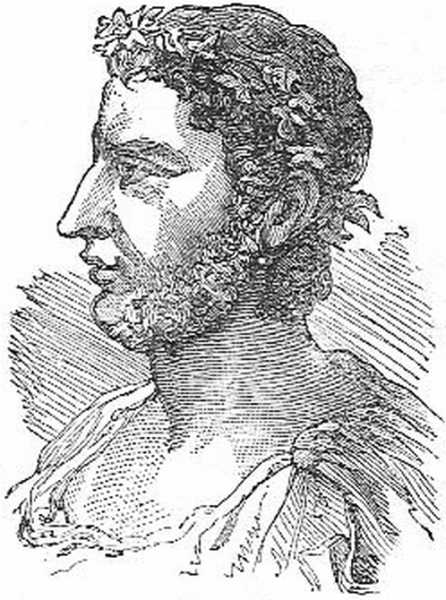
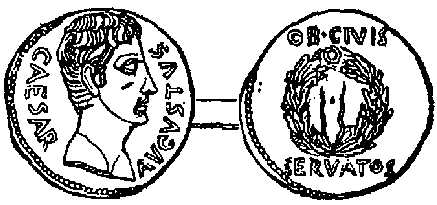
[1] The description which follows in the text must be compared with the map of Italy given in this work.
[2] The name "Bruttium," given to the country by modern writers on ancient geography, is not found in any classical author.
[3] The Palladium was a statue of Pallas, or Minerva, which was said to have fallen from heaven, and was preserved at Rome with the most sacred care.
[4] The Sabines were called Quirites, and this name was afterward applied to the Roman people in their civil capacity.
[5] The Flamen of Jupiter was called Flamen Dialis.
[6] These shields were called Ancilia. One of these shields is said to have fallen from heaven; and Numa ordered eleven others to be made exactly like it, that it might not be known and stolen.
[7] The As was originally a pound weight of copper of 12 ounces.
[8] The following table will show the census of each class, and the number of centuries which each contained:
| Equites.—Centuriæ | 18 | ||
| First Class.—Census 100,000 asses and upward. | |||
| Centuriæ Seniorum | 40 | } | 82 |
| Centuriæ Juniorum | 40 | ||
| Centuriæ Fabrum (smiths and carpenters) | 2 | ||
| Second Class.—Census, 75,000 asses and upward. | |||
| Centuriæ Seniorum | 10 | } | 20 |
| Centuriæ Juniorum | 10 | ||
| Third Class.—Census, 50,000 asses and upward. | |||
| Centuriæ Seniorum | 10 | } | 20 |
| Centuriæ Juniorum | 10 | ||
| Fourth Class.—Census, 25,000 asses and upward. | |||
| Centuriæ Seniorum | 10 | } | 20 |
| Centuriæ Juniorum | 10 | ||
| Fifth Class.—Census, 12,500 asses and upward. | |||
| Centuriæ Seniorum | 15 | } | 32 |
| Centuriæ Juniorum | 15 | ||
| Centuriæ cornicinum, tubicinum | 2 | ||
| Centuriæ capita censorum | 1 | ||
| Sum total of the centuriæ | 198 |
[9] The celebrated seven hills upon which Rome stood were the Palatine, Aventine, Capitoline, Cælian, Quirinal, Viminal, and Esquilian. The Mons Pincius was not included within the Servian Wall.
[10] The following genealogical table exhibits the relationship of the family:
| Demaratus of Corinth. | ||||||||||||
| TARQUINIUS PRISCUS. | Aruns. | |||||||||||
| Tarquinia, | Tarquinia, | L. TARQUINIUS | Aruns. | Egerius, | ||||||||
| married | married | SUPERBUS. | commander of | |||||||||
| Servius Tullius. | M. Brutus. | Collatia. | ||||||||||
| M. Brutus, | L. Brutus, | Titus. | Sextus. | Aruns. | Tarquinius | |||||||
| put to | the | Collatinus, | ||||||||||
| death by | Consul. | married | ||||||||||
| Tarquinius. | Lucretia. | |||||||||||
[11] The Lictors were public officers who attended upon the Roman magistrate. Each consul had twelve lictors. They carried upon their shoulders fasces, which were rods bound in the form of a bundle, and containing an axe in the middle.
[12] There is, however, reason to believe that these brilliant stories conceal one of the earliest and greatest disasters of the city. It appears that Rome was really conquered by Porsena, and lost all the territory which the kings had gained on the right side of the Tiber. Hence we find the thirty tribes, established by Servius Tullius, reduced to twenty after the war with Porsena.
[13] The Dictator was an extraordinary magistrate appointed by one of the Consuls in seasons of great peril. He possessed absolute power. Twenty-four lictors attended him, bearing the axes in the fasces, even in the city; and from his decision there was no appeal. He could not hold the office longer than six months, and he usually laid it down much sooner. He appointed a Magister Equitum, or Master of the Horse, who acted as his lieutenant. From the time of the appointment of the Dictator, all the other magistrates, even the Consuls, ceased to exercise any power.
[14] Debtors thus given over to their creditors were called Addicti.
[15] This was called the right of intercession, from intercedo, "to come between."
[16] The Tribunes were originally elected at the Comitia of the Centuries, where the influence of the Patricians was predominant; but by the Publilian Law, proposed by the tribune Publilius Volero, and passed B.C. 471, the election was transferred to the Comitia of the Tribes, by which means the Plebeians obtained the uncontrolled election of their own officers.
[17] See note on p. 31.
[18] The Censorship was regarded as the highest dignity in the state, with the exception of the Dictatorship. The duties of the Censors were numerous and important. They not only took the census—or the register of the citizens and their property—hut they also chose the members of the Senate, exercised a superintendence over the whole public and private life of the citizens, and, in addition, had the administration of the finances of the state.
[19] This remarkable work, which, after the lapse of more than two thousand years, still continues to serve the purpose for which it was originally designed, is cut through the soft volcanic tufa of which the Alban Hill is composed. The length of the tunnel is about 6000 feet, and it is 4 feet 6 inches wide.
[20] A Rogatio differed from a Lex, as a Bill from an Act of Parliament. A Rogatio was a law submitted to the assembly of the people, and only became a Lex when enacted by them.
[21] A Jugerum was rather more than half an acre.
[22] Ut plebiscita omnes Quirites tenerent.
[24] According to the Roman expression, the Jus Connubii and Jus Commercii were forbidden.
[26] The Phœnicians were called by the Latins Pœni, whence the adjective punicus, like munire from mœnia, and punire from pœna.
[27] Probably the same as the Hebrew Shofetim, i.e., Judges.
[28] The inscription upon this column, or, at any rate, a very ancient copy of it, is still preserved in the Capitoline Museum at Rome.
[29] Barca is the same as the Hebrew word Barak, "lightning."
[30] Gallicus ager.
[31] The pass of the Alps which Hannibal crossed was probably the Graian Alps, or Little St. Bernard. See note "On the Passage of Hannibal across the Alps" at the end of this chapter.
[32] At this time the Consuls entered upon their office on the Ides of March. It was not till B.C. 153 that the consulship commenced on the Kalends of January.
[33] See the map in the "Smaller History of Greece," p. 117.
[34] The story that Archimedes set the Roman ships on fire by the reflected rays of the sun is probably a fiction, though later writers give an account of this burning mirror.
[35] Upon his tomb was placed the figure of a sphere inscribed in a cylinder. When Cicero was Quæstor in Sicily (B.C. 75), he found his tomb near one of the gates of the city, almost hid among briers, and forgotten by the Syracusans.
[36] See the "Smaller History of Greece," p. 214.
[38] Two Plebeian Consuls were first appointed in B.C. 172, and two Plebeian Censors in B.C. 131.
[40] Hence their name, from Ædes, a temple.
[41] This was done by the well-known formula "Videant," or "Dent operam Consules, ne quid res publica detriment capiat."
[42] These farmers of the public revenue were called Publicani.
[43] It is not easy to define with accuracy the respective duties of the Censors and Ædiles in relation to the public buildings; but it may be stated in general that the superintendence of the Ædiles was more in the way of police, while that of the Censors had reference to all financial matters.
[44] A Senatus consultum was so called because the Consul who brought a matter before the Senate was said Senatum consulere.
[46] The technical word for this appeal was Provocatio. The word Appellatio signified an appeal from one magistrate to another.
[50] We anticipate the course of events in order to give under one view the history of the Roman legion.
[51] Hence the frequent occurrence of such phrases as expediti, expediti milites, expeditæ cohortes, and even expeditæ legiones.
[52] Called Supplicatio.
[54] The Nobiles were distinguished from the Ignobiles. The outward distinction of the former was the Jus Imaginum. These Imagines were figures with painted masks of wax, representing the ancestors who had held any of the curule magistracies. They were placed in cases in the atrium or reception-hall of the house, and were carried in the funeral procession of a member of the family. Any one who first obtained a curule magistracy became the founder of the nobility of his family. Such a person was himself neither a Nobilis nor an Ignobilis. He was termed a Novus Homo, or a new man.
[55] The Latin word for bribery is ambitus, literally canvassing. It must not be confounded with repetundæ, the offense of extortion or pecuniary corruption committed by magistrates in the provinces or at Rome.
[57] This story must appear to strange to those who know not that it was a custom for Roman Senators, when called upon for their vote, to express—no matter what the question—any opinion which they deemed of great importance to the welfare of the state.
[62] Od., i. 47.
[63] It must be recollected that the mob at Rome consisted chiefly of the four city tribes, and that slaves when manumitted could be enrolled in these four tribes alone.
[65] This canal continued to exist long afterward, and bore the name of Fossa Mariana.
[66] A law of the Consul Pompeius bestowed the Latin franchise upon all the citizens of the Gallic towns between the Po and the Alps, so that they now entered into the same relations with Rome as the Latins had formerly held.
[67] Cicero sent to Milo at Massilia the oration which he meant to have delivered, the one which we still have. Milo, after reading it, remarked, "I am glad it was not delivered, for I should then have been acquitted, and never have known the delicate flavor of these Massilian mullets."
[68] Cæsar's government would expire at the end of B.C. 49, and he had therefore determined to obtain the Consulship for B.C. 48, since otherwise he would become a private person.
[69] The crossing of this stream was in reality a declaration of war against the Republic, and later writers relate that upon arriving at the Rubicon Cæsar long hesitated whether he should take this irrevocable step, and that, after pondering many hours, he at length exclaimed, "The die is cast," and plunged into the river. But there is not a word of this in Cæsar's own narrative.
[70] In reality on the 6th of June.
[71] Triumviri Reipulicæ constituendæ.
[72] Antony retaliated by sending Octavia a bill of divorce.
[73] Gibbon.
[74] These were probably composed in the Saturnian metre, the oldest species of versification among the Romans, in which much greater license was allowed in the laws of quantity than in the metres which were borrowed from the Greeks.
[75] The name signifies a mixture or medley. Hence a lex per saturam lata is a law which contained several distinct regulations at once.
[76] Georg., iii., 41.
[77] Comp. Georg., iv., 560, and ii., 171.
[78] This mausoleum, begun by Hadrian, is now the Castle of St. Angelo.
End of the Project Gutenberg EBook of A Smaller History of Rome, by
William Smith and Eugene Lawrence

*** END OF THIS PROJECT GUTENBERG EBOOK A SMALLER HISTORY OF ROME ***

***** This file should be named 19694-h.htm or 19694-h.zip *****
This and all associated files of various formats will be found in:
        http://www.gutenberg.org/1/9/6/9/19694/

Produced by Alicia Williams, Taavi Kalju and the Online
Distributed Proofreading Team at http://www.pgdp.net


Updated editions will replace the previous one--the old editions
will be renamed.

Creating the works from public domain print editions means that no
one owns a United States copyright in these works, so the Foundation
(and you!) can copy and distribute it in the United States without
permission and without paying copyright royalties.  Special rules,
set forth in the General Terms of Use part of this license, apply to
copying and distributing Project Gutenberg-tm electronic works to
protect the PROJECT GUTENBERG-tm concept and trademark.  Project
Gutenberg is a registered trademark, and may not be used if you
charge for the eBooks, unless you receive specific permission.  If you
do not charge anything for copies of this eBook, complying with the
rules is very easy.  You may use this eBook for nearly any purpose
such as creation of derivative works, reports, performances and
research.  They may be modified and printed and given away--you may do
practically ANYTHING with public domain eBooks.  Redistribution is
subject to the trademark license, especially commercial
redistribution.


*** START: FULL LICENSE ***

THE FULL PROJECT GUTENBERG LICENSE
PLEASE READ THIS BEFORE YOU DISTRIBUTE OR USE THIS WORK

To protect the Project Gutenberg-tm mission of promoting the free
distribution of electronic works, by using or distributing this work
(or any other work associated in any way with the phrase "Project
Gutenberg"), you agree to comply with all the terms of the Full Project
Gutenberg-tm License (available with this file or online at
http://gutenberg.org/license).


Section 1.  General Terms of Use and Redistributing Project Gutenberg-tm
electronic works

1.A.  By reading or using any part of this Project Gutenberg-tm
electronic work, you indicate that you have read, understand, agree to
and accept all the terms of this license and intellectual property
(trademark/copyright) agreement.  If you do not agree to abide by all
the terms of this agreement, you must cease using and return or destroy
all copies of Project Gutenberg-tm electronic works in your possession.
If you paid a fee for obtaining a copy of or access to a Project
Gutenberg-tm electronic work and you do not agree to be bound by the
terms of this agreement, you may obtain a refund from the person or
entity to whom you paid the fee as set forth in paragraph 1.E.8.

1.B.  "Project Gutenberg" is a registered trademark.  It may only be
used on or associated in any way with an electronic work by people who
agree to be bound by the terms of this agreement.  There are a few
things that you can do with most Project Gutenberg-tm electronic works
even without complying with the full terms of this agreement.  See
paragraph 1.C below.  There are a lot of things you can do with Project
Gutenberg-tm electronic works if you follow the terms of this agreement
and help preserve free future access to Project Gutenberg-tm electronic
works.  See paragraph 1.E below.

1.C.  The Project Gutenberg Literary Archive Foundation ("the Foundation"
or PGLAF), owns a compilation copyright in the collection of Project
Gutenberg-tm electronic works.  Nearly all the individual works in the
collection are in the public domain in the United States.  If an
individual work is in the public domain in the United States and you are
located in the United States, we do not claim a right to prevent you from
copying, distributing, performing, displaying or creating derivative
works based on the work as long as all references to Project Gutenberg
are removed.  Of course, we hope that you will support the Project
Gutenberg-tm mission of promoting free access to electronic works by
freely sharing Project Gutenberg-tm works in compliance with the terms of
this agreement for keeping the Project Gutenberg-tm name associated with
the work.  You can easily comply with the terms of this agreement by
keeping this work in the same format with its attached full Project
Gutenberg-tm License when you share it without charge with others.

1.D.  The copyright laws of the place where you are located also govern
what you can do with this work.  Copyright laws in most countries are in
a constant state of change.  If you are outside the United States, check
the laws of your country in addition to the terms of this agreement
before downloading, copying, displaying, performing, distributing or
creating derivative works based on this work or any other Project
Gutenberg-tm work.  The Foundation makes no representations concerning
the copyright status of any work in any country outside the United
States.

1.E.  Unless you have removed all references to Project Gutenberg:

1.E.1.  The following sentence, with active links to, or other immediate
access to, the full Project Gutenberg-tm License must appear prominently
whenever any copy of a Project Gutenberg-tm work (any work on which the
phrase "Project Gutenberg" appears, or with which the phrase "Project
Gutenberg" is associated) is accessed, displayed, performed, viewed,
copied or distributed:

This eBook is for the use of anyone anywhere at no cost and with
almost no restrictions whatsoever.  You may copy it, give it away or
re-use it under the terms of the Project Gutenberg License included
with this eBook or online at www.gutenberg.org

1.E.2.  If an individual Project Gutenberg-tm electronic work is derived
from the public domain (does not contain a notice indicating that it is
posted with permission of the copyright holder), the work can be copied
and distributed to anyone in the United States without paying any fees
or charges.  If you are redistributing or providing access to a work
with the phrase "Project Gutenberg" associated with or appearing on the
work, you must comply either with the requirements of paragraphs 1.E.1
through 1.E.7 or obtain permission for the use of the work and the
Project Gutenberg-tm trademark as set forth in paragraphs 1.E.8 or
1.E.9.

1.E.3.  If an individual Project Gutenberg-tm electronic work is posted
with the permission of the copyright holder, your use and distribution
must comply with both paragraphs 1.E.1 through 1.E.7 and any additional
terms imposed by the copyright holder.  Additional terms will be linked
to the Project Gutenberg-tm License for all works posted with the
permission of the copyright holder found at the beginning of this work.

1.E.4.  Do not unlink or detach or remove the full Project Gutenberg-tm
License terms from this work, or any files containing a part of this
work or any other work associated with Project Gutenberg-tm.

1.E.5.  Do not copy, display, perform, distribute or redistribute this
electronic work, or any part of this electronic work, without
prominently displaying the sentence set forth in paragraph 1.E.1 with
active links or immediate access to the full terms of the Project
Gutenberg-tm License.

1.E.6.  You may convert to and distribute this work in any binary,
compressed, marked up, nonproprietary or proprietary form, including any
word processing or hypertext form.  However, if you provide access to or
distribute copies of a Project Gutenberg-tm work in a format other than
"Plain Vanilla ASCII" or other format used in the official version
posted on the official Project Gutenberg-tm web site (www.gutenberg.org),
you must, at no additional cost, fee or expense to the user, provide a
copy, a means of exporting a copy, or a means of obtaining a copy upon
request, of the work in its original "Plain Vanilla ASCII" or other
form.  Any alternate format must include the full Project Gutenberg-tm
License as specified in paragraph 1.E.1.

1.E.7.  Do not charge a fee for access to, viewing, displaying,
performing, copying or distributing any Project Gutenberg-tm works
unless you comply with paragraph 1.E.8 or 1.E.9.

1.E.8.  You may charge a reasonable fee for copies of or providing
access to or distributing Project Gutenberg-tm electronic works provided
that

- You pay a royalty fee of 20% of the gross profits you derive from
     the use of Project Gutenberg-tm works calculated using the method
     you already use to calculate your applicable taxes.  The fee is
     owed to the owner of the Project Gutenberg-tm trademark, but he
     has agreed to donate royalties under this paragraph to the
     Project Gutenberg Literary Archive Foundation.  Royalty payments
     must be paid within 60 days following each date on which you
     prepare (or are legally required to prepare) your periodic tax
     returns.  Royalty payments should be clearly marked as such and
     sent to the Project Gutenberg Literary Archive Foundation at the
     address specified in Section 4, "Information about donations to
     the Project Gutenberg Literary Archive Foundation."

- You provide a full refund of any money paid by a user who notifies
     you in writing (or by e-mail) within 30 days of receipt that s/he
     does not agree to the terms of the full Project Gutenberg-tm
     License.  You must require such a user to return or
     destroy all copies of the works possessed in a physical medium
     and discontinue all use of and all access to other copies of
     Project Gutenberg-tm works.

- You provide, in accordance with paragraph 1.F.3, a full refund of any
     money paid for a work or a replacement copy, if a defect in the
     electronic work is discovered and reported to you within 90 days
     of receipt of the work.

- You comply with all other terms of this agreement for free
     distribution of Project Gutenberg-tm works.

1.E.9.  If you wish to charge a fee or distribute a Project Gutenberg-tm
electronic work or group of works on different terms than are set
forth in this agreement, you must obtain permission in writing from
both the Project Gutenberg Literary Archive Foundation and Michael
Hart, the owner of the Project Gutenberg-tm trademark.  Contact the
Foundation as set forth in Section 3 below.

1.F.

1.F.1.  Project Gutenberg volunteers and employees expend considerable
effort to identify, do copyright research on, transcribe and proofread
public domain works in creating the Project Gutenberg-tm
collection.  Despite these efforts, Project Gutenberg-tm electronic
works, and the medium on which they may be stored, may contain
"Defects," such as, but not limited to, incomplete, inaccurate or
corrupt data, transcription errors, a copyright or other intellectual
property infringement, a defective or damaged disk or other medium, a
computer virus, or computer codes that damage or cannot be read by
your equipment.

1.F.2.  LIMITED WARRANTY, DISCLAIMER OF DAMAGES - Except for the "Right
of Replacement or Refund" described in paragraph 1.F.3, the Project
Gutenberg Literary Archive Foundation, the owner of the Project
Gutenberg-tm trademark, and any other party distributing a Project
Gutenberg-tm electronic work under this agreement, disclaim all
liability to you for damages, costs and expenses, including legal
fees.  YOU AGREE THAT YOU HAVE NO REMEDIES FOR NEGLIGENCE, STRICT
LIABILITY, BREACH OF WARRANTY OR BREACH OF CONTRACT EXCEPT THOSE
PROVIDED IN PARAGRAPH F3.  YOU AGREE THAT THE FOUNDATION, THE
TRADEMARK OWNER, AND ANY DISTRIBUTOR UNDER THIS AGREEMENT WILL NOT BE
LIABLE TO YOU FOR ACTUAL, DIRECT, INDIRECT, CONSEQUENTIAL, PUNITIVE OR
INCIDENTAL DAMAGES EVEN IF YOU GIVE NOTICE OF THE POSSIBILITY OF SUCH
DAMAGE.

1.F.3.  LIMITED RIGHT OF REPLACEMENT OR REFUND - If you discover a
defect in this electronic work within 90 days of receiving it, you can
receive a refund of the money (if any) you paid for it by sending a
written explanation to the person you received the work from.  If you
received the work on a physical medium, you must return the medium with
your written explanation.  The person or entity that provided you with
the defective work may elect to provide a replacement copy in lieu of a
refund.  If you received the work electronically, the person or entity
providing it to you may choose to give you a second opportunity to
receive the work electronically in lieu of a refund.  If the second copy
is also defective, you may demand a refund in writing without further
opportunities to fix the problem.

1.F.4.  Except for the limited right of replacement or refund set forth
in paragraph 1.F.3, this work is provided to you 'AS-IS' WITH NO OTHER
WARRANTIES OF ANY KIND, EXPRESS OR IMPLIED, INCLUDING BUT NOT LIMITED TO
WARRANTIES OF MERCHANTIBILITY OR FITNESS FOR ANY PURPOSE.

1.F.5.  Some states do not allow disclaimers of certain implied
warranties or the exclusion or limitation of certain types of damages.
If any disclaimer or limitation set forth in this agreement violates the
law of the state applicable to this agreement, the agreement shall be
interpreted to make the maximum disclaimer or limitation permitted by
the applicable state law.  The invalidity or unenforceability of any
provision of this agreement shall not void the remaining provisions.

1.F.6.  INDEMNITY - You agree to indemnify and hold the Foundation, the
trademark owner, any agent or employee of the Foundation, anyone
providing copies of Project Gutenberg-tm electronic works in accordance
with this agreement, and any volunteers associated with the production,
promotion and distribution of Project Gutenberg-tm electronic works,
harmless from all liability, costs and expenses, including legal fees,
that arise directly or indirectly from any of the following which you do
or cause to occur: (a) distribution of this or any Project Gutenberg-tm
work, (b) alteration, modification, or additions or deletions to any
Project Gutenberg-tm work, and (c) any Defect you cause.


Section  2.  Information about the Mission of Project Gutenberg-tm

Project Gutenberg-tm is synonymous with the free distribution of
electronic works in formats readable by the widest variety of computers
including obsolete, old, middle-aged and new computers.  It exists
because of the efforts of hundreds of volunteers and donations from
people in all walks of life.

Volunteers and financial support to provide volunteers with the
assistance they need, is critical to reaching Project Gutenberg-tm's
goals and ensuring that the Project Gutenberg-tm collection will
remain freely available for generations to come.  In 2001, the Project
Gutenberg Literary Archive Foundation was created to provide a secure
and permanent future for Project Gutenberg-tm and future generations.
To learn more about the Project Gutenberg Literary Archive Foundation
and how your efforts and donations can help, see Sections 3 and 4
and the Foundation web page at http://www.pglaf.org.


Section 3.  Information about the Project Gutenberg Literary Archive
Foundation

The Project Gutenberg Literary Archive Foundation is a non profit
501(c)(3) educational corporation organized under the laws of the
state of Mississippi and granted tax exempt status by the Internal
Revenue Service.  The Foundation's EIN or federal tax identification
number is 64-6221541.  Its 501(c)(3) letter is posted at
http://pglaf.org/fundraising.  Contributions to the Project Gutenberg
Literary Archive Foundation are tax deductible to the full extent
permitted by U.S. federal laws and your state's laws.

The Foundation's principal office is located at 4557 Melan Dr. S.
Fairbanks, AK, 99712., but its volunteers and employees are scattered
throughout numerous locations.  Its business office is located at
809 North 1500 West, Salt Lake City, UT 84116, (801) 596-1887, email
business@pglaf.org.  Email contact links and up to date contact
information can be found at the Foundation's web site and official
page at http://pglaf.org

For additional contact information:
     Dr. Gregory B. Newby
     Chief Executive and Director
     gbnewby@pglaf.org


Section 4.  Information about Donations to the Project Gutenberg
Literary Archive Foundation

Project Gutenberg-tm depends upon and cannot survive without wide
spread public support and donations to carry out its mission of
increasing the number of public domain and licensed works that can be
freely distributed in machine readable form accessible by the widest
array of equipment including outdated equipment.  Many small donations
($1 to $5,000) are particularly important to maintaining tax exempt
status with the IRS.

The Foundation is committed to complying with the laws regulating
charities and charitable donations in all 50 states of the United
States.  Compliance requirements are not uniform and it takes a
considerable effort, much paperwork and many fees to meet and keep up
with these requirements.  We do not solicit donations in locations
where we have not received written confirmation of compliance.  To
SEND DONATIONS or determine the status of compliance for any
particular state visit http://pglaf.org

While we cannot and do not solicit contributions from states where we
have not met the solicitation requirements, we know of no prohibition
against accepting unsolicited donations from donors in such states who
approach us with offers to donate.

International donations are gratefully accepted, but we cannot make
any statements concerning tax treatment of donations received from
outside the United States.  U.S. laws alone swamp our small staff.

Please check the Project Gutenberg Web pages for current donation
methods and addresses.  Donations are accepted in a number of other
ways including checks, online payments and credit card donations.
To donate, please visit: http://pglaf.org/donate


Section 5.  General Information About Project Gutenberg-tm electronic
works.

Professor Michael S. Hart is the originator of the Project Gutenberg-tm
concept of a library of electronic works that could be freely shared
with anyone.  For thirty years, he produced and distributed Project
Gutenberg-tm eBooks with only a loose network of volunteer support.


Project Gutenberg-tm eBooks are often created from several printed
editions, all of which are confirmed as Public Domain in the U.S.
unless a copyright notice is included.  Thus, we do not necessarily
keep eBooks in compliance with any particular paper edition.


Most people start at our Web site which has the main PG search facility:

     http://www.gutenberg.org

This Web site includes information about Project Gutenberg-tm,
including how to make donations to the Project Gutenberg Literary
Archive Foundation, how to help produce our new eBooks, and how to
subscribe to our email newsletter to hear about new eBooks.