
The Project Gutenberg EBook of How to Live, by Irving Fisher and Eugene Fisk

This eBook is for the use of anyone anywhere at no cost and with
almost no restrictions whatsoever.  You may copy it, give it away or
re-use it under the terms of the Project Gutenberg License included
with this eBook or online at www.gutenberg.org


Title: How to Live
       Rules for Healthful Living Based on Modern Science

Author: Irving Fisher and Eugene Fisk

Release Date: October 21, 2006 [EBook #19598]

Language: English

Character set encoding: ISO-8859-1

*** START OF THIS PROJECT GUTENBERG EBOOK HOW TO LIVE ***


Produced by Audrey Longhurst, Laura Wisewell and the Online
Distributed Proofreading Team at http://www.pgdp.net
PREVENT LIFE-WASTE— | |
|---|---|

Hon. William H. Taft |
|
The Institute was established by a group of scientists, publicists, and business men, who desired to provide a self-supporting central institution of national scope devoted to the science of disease prevention—a responsible and authoritative source from which the public might draw knowledge and inspiration in the great war of civilization against needless sickness and premature death.
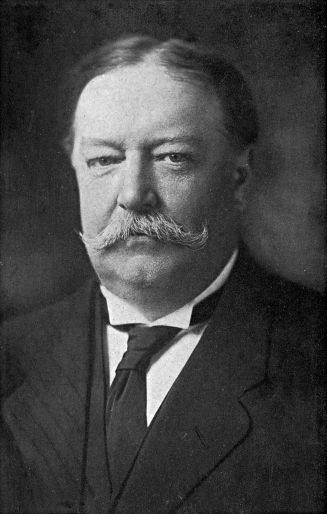
COPYRIGHT MOFFETT STUDIO
Hon. William Howard Taft
Chairman, Board of Directors Life Extension Institute, Inc.
AUTHORIZED BY AND PREPARED IN COLLABORATION
WITH THE HYGIENE REFERENCE BOARD OF THE
LIFE EXTENSION INSTITUTE, INC.
BY
IRVING FISHER, Chairman,
PROFESSOR OF POLITICAL ECONOMY, YALE UNIVERSITY
AND
EUGENE LYMAN FISK, M.D.,
DIRECTOR OF HYGIENE OF THE INSTITUTE
NINTH EDITION
FUNK & WAGNALLS COMPANY
NEW YORK AND LONDON
1916
Copyright, 1915, by
FUNK & WAGNALLS COMPANY
(Printed in the United States of America.)
Published, October, 1915
Second Edition, November, 1915
Third Edition, December, 1915
Fourth Edition, March, 1916
Fifth Edition, April, 1916
Sixth Edition, May, 1916
Seventh Edition, June, 1916
Eighth Revised Edition, September, 1916
Ninth Edition, September, 1916
To one who has been an eye-witness of the wonderful achievements of American medical science in the conquest of acute communicable and pestilential diseases in those regions of the earth where they were supposed to be impregnably entrenched, there is the strongest possible appeal in the present rapidly growing movement for the improvement of physical efficiency and the conquest of chronic diseases of the vital organs.
Through the patient, intelligent and often heroic work of our army medical men, and the staff of the United States Public Health Service, death-rates supposedly fixed have been cut in half.
While it is true that to the public mind there is a more lurid and spectacular menace in such diseases as small-pox, yellow fever and plague, medical men and public health workers are beginning to realize that, with the warfare against such maladies well or ganized, it is now time to give attention to the heavy loss from lowered physical efficiency and chronic, preventable disease, a loss exceeding in magnitude that sustained from the more widely feared communicable diseases.
The insidious encroachment of the chronic diseases that sap the vitality of the individual and impair the efficiency of the race is a matter of increasing importance. The mere extension of human life is not only in itself an end to be desired, but the well digested scientific facts presented in this volume clearly show that the most direct and effective means of lengthening human life are at the same time those that make it more livable and add to its power and capacity for achievement.
Many years ago, Disraeli, keenly alive to influences affecting national prosperity, stated: “Public Health is the foundation on which reposes the happiness of the people and the power of a country. The care of the public health is the first duty of a statesman.” It may well be claimed that the care of individual and family health is the first and most patriotic duty of a citizen.
These are the considerations that have in fluenced me to co-operate with the life extension movement, and to commend this volume to the earnest consideration of all who desire authoritative guidance in improving their own physical condition or in making effective the knowledge now available for bringing health and happiness to our people.
WM. H. TAFT.
New Haven, June 12, 1915.
The purpose of this book is to spread knowledge of Individual Hygiene and thus to promote the aims of the Life Extension Institute. These may be summarized briefly as: (1) to provide the individual and the physician with the latest and best conclusions on individual hygiene; (2) to ascertain the exact and special needs of the individual through periodic health examinations; (3) to induce all persons who are found to be in need of medical attention to visit their physicians.
A sad commentary on the low health-ideals which now exist is that to most people the expression “to keep well” means no more than to keep out of a sick-bed. Hitherto, the subject-matter of hygiene has been considered in its relation to disease rather than to health. In this manual, on the other hand, it is treated in its relation to (1) the preservation of health; (2) the improvement in the physical condition of the individual, and (3) the increase of his vitality. In short, the objects of the manual are positive rather than negative. It aims to include every practical procedure that, according to the present state of our knowledge, an athlete needs in order to make himself superbly “fit,” or that a mental worker needs in order to keep his wits sharpened to a razor-edge. For this reason some suggestions, which might otherwise be regarded as of minor importance, have been included and emphasized. While it is true that a moderate infraction of some of the minor rules of health is not inconsistent with maintaining good health in the sense of keeping out of a sick-bed, such infraction, be it ever so moderate, is utterly inconsistent with good health in the sense of attaining the highest physical and mental efficiency and power.
Future advances of knowledge will doubtless occasion additions to, or modifications of, the conclusions stated herein, and these will form the subject of subsequent publications by the Institute.
In order that the Institute may have at its disposal the latest and most authoritative results of scientific investigations, its Hygiene Reference Board was created. The present book is the first general statement of the conclusions of this Board after a year of careful consideration. These conclusions are the joint product of the members of the Board, with the active co-operation of the Director of Hygiene of the Institute. They may fairly be said to constitute the most authoritative epitome thus far available in the great, but hitherto neglected, realm of individual hygiene.
The Chairman of the Board has exercised the function of editor, and is responsible for the order and arrangement of the material.
Friends of the Institute may help its work by spreading the ideas given in the following pages and by increasing the number of its readers. Such profits as may be received by the Institute from the sale of this book will be devoted to further philanthropic effort by the Institute.
Irving Fisher,
Eugene L. Fisk.
New York, Sept., 1915.
IRVING FISHER, Chairman
Professor of Political Economy
Yale University

Dr. Lewellys F. Barker, Dr. John F. Anderson, Dr. Hermann M. Biggs, Dr. Alexander Graham Bell, Dr. William G. Anderson, Dr. John B. Andrews, Samuel Hopkins Adams
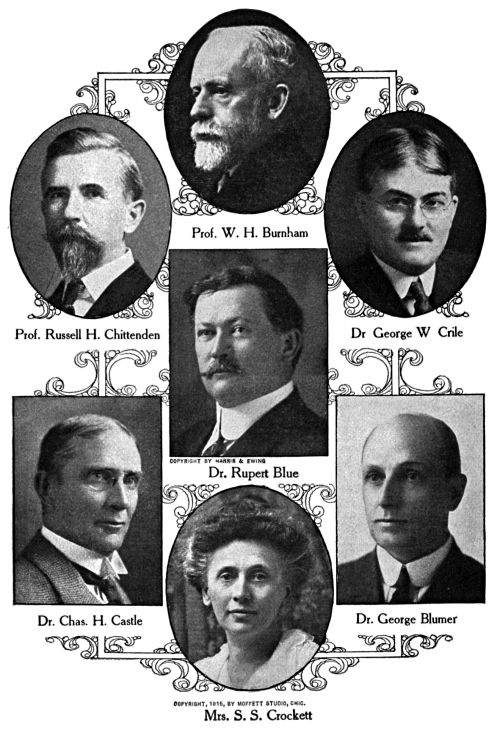
Prof. W. H. Burnham, Prof. Russell H. Chittenden, Dr. George W. Crile, Dr. Rupert Blue, Dr. Chas. H. Castle, Dr. George Blumer, Mrs. S. S. Crockett

Dr. Samuel G. Dixon, Prof. Henry W. Farnam, Dr. W. A. Evans, Dr. C. B. Davenport, Dr. W. G. Ebersole, Dr. Norman E. Ditman, Dr. Oscar Dowling

Dr. Eugene L. Fisk, Dr. Otto Folin, Dr. George J. Fisher, Prof. Irving Fisher, Dr. Alfred C. Fones, Dr. Burnside Foster, Dr. Henry B. Favill

Dr. Luther H. Gulick, Mr. Norman Hapgood, Mr. Lee K. Frankel, Gen. Wm. C. Gorgas, Dr. Frederick R. Green, Dr. S. S. Goldwater, Dr. John S. Fulton
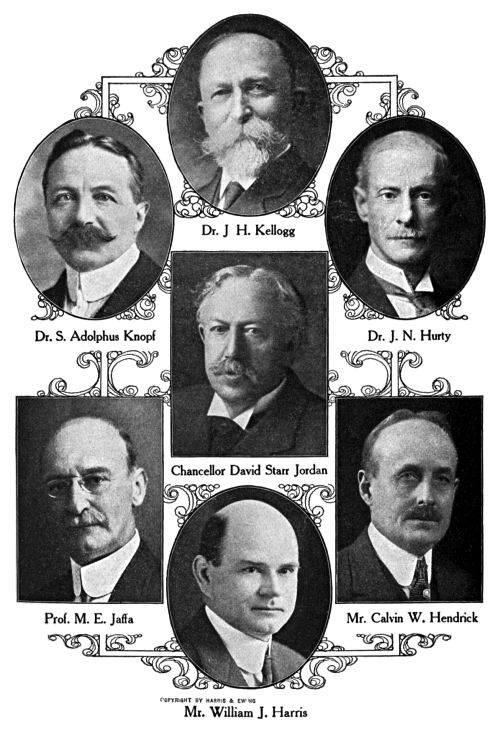
Dr. J. H. Kellogg, Dr. S. Adolphus Knopf, Dr. J. N. Hurty, Chancellor David Starr Jordan, Prof. M. E. Jaffa, Mr. Calvin W. Hendrick, Mr. William J. Harris

Hon. Walter H. Page, Dr. Geo. M. Kober, Dr. J. N. McCormack, Prof. Lafayette B. Mendel, Dr. W. S. Rankin, Mr. Edward Bunnell Phelps, Prof. R. Tait McKenzie

Dr. Dudley A. Sargent, Dr. M. J. Rosenau, Prof. Leo. F. Rettger, Mr. Wickliffe Rose, Dr. Theodore B. Sachs, Dr. Edward A. Rumely, Prof. Mazyck P. Ravenel

Dr. J. W. Schereschewsky, Dr. Wm. Jay Schieffelin, Dr. Elmer E. Southard, Prof. Alonzo A. Stagg, Major Louis L. Seaman, Dr. W. F. Snow

Prof. A. E. Taylor, Dr. Chas. W. Stiles, Dr. Victor C. Vaughan, Dr. Thomas A. Storey, Prof. George C. Whipple, Dr. William H. Tolman
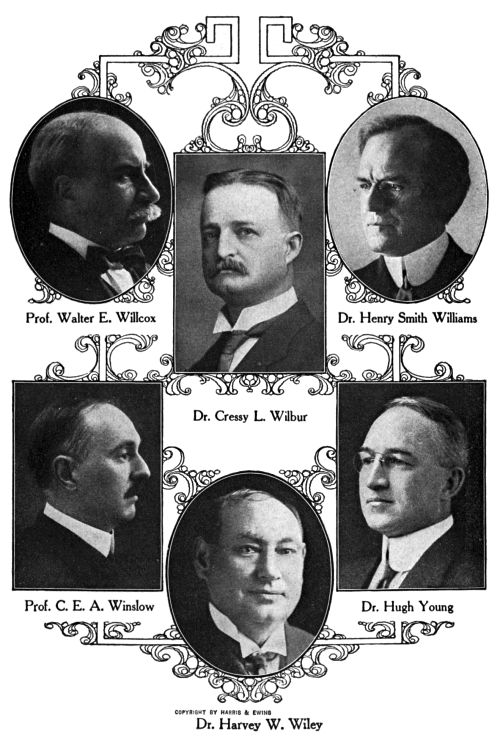
Prof. Walter E. Willcox, Dr. Henry Smith Williams, Dr. Cressy L. Wilbur, Prof. C. E. A. Winslow, Dr. Hugh Young, Dr. Harvey W. Wiley
The purpose of the Life Extension Institute embraces the extension of human life, not only as to length, but also, if we may so express it, as to breadth and depth. It endeavors to accomplish this purpose in many ways, but especially through individual hygiene.
Thoroughly carried out, individual hygiene implies high ideals of health, strength, endurance, symmetry, and beauty; it enormously increases our capacity to work, to be happy, and to be useful; it develops, not only the body, but the mind and the heart; it ennobles the man as a whole.
We in America inherit, through centuries of European tradition, the medieval indifference to the human body, often amounting to contempt. This attitude was a natural outgrowth of the theological doctrine that the “flesh is in league with the devil” and so is the enemy of the soul. In the Middle Ages saintliness was often associated with sickliness. Artists, in portraying saints, often chose as their models pale and emaciated consumptives.
We are beginning to cut loose from this false tradition and are working toward the establishment of more wholesome ideals. It is probably true, for instance, that the man or the woman who is unhealthy is now handicapped in opportunities for marriage, which may be considered an index to the ideals of society.
A great health movement is sweeping over the entire world. Hygiene has repudiated the outworn doctrine that mortality is fatality and must exact year after year a fixed and inevitable sacrifice. It aims instead to set free human life by applying modern science. Science, which has revolutionized every other field of human endeavor, is at last revolutionizing the field of health conservation.
The practise of medicine, which for ages has been known as the “healing art,” is undergoing a gradual but radical revolution. This is due to the growing realization that an ounce of prevention is worth a pound of cure. As teachers and writers on hygiene, as trainers for college athletes, as advisers for the welfare departments of large industrial plants, and in many other directions, physicians are finding fields for practising preventive medicine. Even the family physician is in some cases being asked by his patients to keep them well instead of curing them after they have fallen sick.
Furthermore, the preventive methods of modern medicine are being applied by the people themselves, as witness the great vogue to-day of sleeping out of doors; the popularity, not always deserved, of health foods and drinks; the demand for uncontaminated water supplies, certified milk, inspected meat and pure foods generally; the world-wide movement against alcohol, and the legislation to correct wrong conditions of labor and to safeguard the laborer.
Labor itself to-day is being held in honor, and idleness in dishonor. Ideals are being shifted from those of “leisure” to those of “service.” Work was once considered simply a curse of the poor. The real gentleman was supposed to be one who was able to live without it. The king, who set the styles, was envied because he “did not have to work,” but had innumerable people to do work for him. His ability to work, his efficiency, his endurance, were the last things to which he gave consideration. To-day kings, emperors, presidents are trying to find out how they can keep in the fittest condition and accomplish the greatest possible amount of work. Even among society women, some kind of work is now “the thing.”
One of the most satisfying tasks for any man or woman to-day is to take part in this movement toward truer ideals of perfect manhood and womanhood. Our American ideals, though improving, are far inferior to those, for instance, of Sweden; and these, in turn, are not yet worthy to be compared with those of ancient Greece, still preserved for our admiration in imperishable marble. With our superior scientific knowledge, our health ideals ought, as a matter of fact, to excel those of any other age. They should not stop with the mere negation of disease, degeneracy, delinquency, and dependency. They should be positive and progressive. They should include the love of a perfect muscular development, of integrity of mental and moral fiber.
There should be a keen sense of enjoyment of all life’s activities. As William James once said, simply to live, breathe and move should be a delight. The thoroughly healthy person is full of optimism; “he rejoiceth like a strong man to run a race.” We seldom see such overflowing vitality except among children. When middle life is reached, or before, our vital surplus has usually been squandered. Yet it is in this vital surplus that the secret of personal magnetism lies. Vital surplus should not only be safeguarded, but accumulated. It is the balance in the savings bank of life. Our health ideals must not stop at the avoidance of invalidism, but should aim at exuberant and exultant health. They should savor not of valetudinarianism, but of athletic development. Our aim should be not to see how much strain our strength can stand, but how great we can make that strength. With such an aim we shall, incidentally and naturally, find ourselves accomplishing more work than if we aimed directly at the work itself. Moreover, when such ideals are attained, work instead of turning into drudgery tends to turn into play, and the hue of life seems to turn from dull gray to the bright tints of well-remembered childhood. In short, our health ideals should rise from the mere wish to keep out of a sick bed to an eagerness to become a well-spring of energy. Only then can we realize the intrinsic wholesomeness and beauty of human life.
Air is the first necessity of life. We may live without food for days and without water for hours; but we cannot live without air more than a few minutes. Our air supply is therefore of more importance than our water or food supply, and good ventilation becomes the first rule of hygiene.
Living and working rooms should be ventilated both before occupancy and while occupied.
It must be remembered that the mere construction of the proper kind of buildings does not insure ventilation. We may have model dwellings, with ideal window-space and ventilating apparatus, but unless these are actually used, we do not benefit thereby.
The most important features of ventilation are motion, coolness, and the proper degree of humidity and freshness.
There is an unreasonable prejudice against air in motion. A gentle draft is, as a matter of fact, one of the best friends which the seeker after health can have. Of course, a strong draft directed against some exposed part of the body, causing a local chill for a prolonged time, is not desirable; but a gentle draft, such as ordinarily occurs in good ventilation, is extremely wholesome.
It goes without saying that persons unaccustomed to ventilation, and consequently over-sensitive to drafts, should avoid over-exposure while they are in process of changing their habits. But after even a few days of enjoyment of air in motion, with cautious exposure to it, the likelihood of cold is greatly diminished; and persons who continue to make friends with moving air soon become almost immune to colds.
The popular idea that colds are derived from drafts is greatly exaggerated. A cold of any kind is usually a catarrhal disease of germ origin, to which a lowered vital resistance is a predisposing cause.
The germs are almost always present in the nose and throat. It is exposure to a draft plus the presence of germs and a lowered resistance of the body which produces the usual cold. Army men have often noted that as long as they are on the march and sleep outdoors, they seldom or never have colds, but they develop them as soon as they get indoors again. See Supplementary Notes, “Avoiding Colds.”
Of course, one must always use common sense and never grow foolhardy. It is never advisable that a person in a perspiration should sit in a strong draft.
The best ventilation is usually to be had through the windows. We advise keeping windows open almost always in summer; and often open in winter.
One should have a cross-current of air whenever practicable; that is, an entrance for fresh air and an exit for used air at opposite sides of the room. Where there can not be such a cross-current, some circulation can be secured by having a window open both top and bottom.
In winter, ventilation is best secured by means of a window-board. This is a board the edge of which rests on the edge of the window-sill, the ends being attached firmly to the window-frame. It affords a vertical surface three or four inches high and situated three or four inches in front of the window, so as to deflect the cold air upward when the window is slightly opened. The air will then reach the breathing-zone, instead of flowing on to the floor and chilling the feet, which is the usual consequence of opening a window in winter. It seems tragic to think that for lack of some such simple device, which anyone can make or buy, there is now an almost complete absence of winter ventilation in most houses.
Air should never be allowed to become stagnant. When there is no natural movement in the air, it should be put in motion by artificial means. This important method of practising air-hygiene is becoming quite generally available through the introduction of electric currents into dwellings and other buildings and the use of electric fans. Even a hand fan is of distinct hygienic value.
A wood or grate fire is an excellent ventilator. A heating-system which introduces warmed new air is better than one acting by direct radiation, provided the furnace is well constructed and gas-proof.
The importance of coolness is almost as little appreciated as the importance of motion. Most people enervate themselves by heat, especially in winter. The temperature of living-rooms and work-rooms should not be above 70 degrees, and, for people who have not already lost largely in vigor, a temperature of 5 to 10 degrees lower is preferable. Heat is depressing. It lessens both mental and muscular efficiency. Among the employes of a large commercial organization in New York who were examined by the Life Extension Institute, some of the men in one particular room were suffering from an increase of body temperature and a skin rash. On investigation it was found that the room in which they worked was overheated. There was no special provision for ventilation. A window-board was installed, with the result that the men recovered and no other cases of skin rash occurred in that room.
As to dryness of air, there is little which the individual can do except to choose a dry climate in which to live or spend his vacations. Unfortunately, there is not as yet any simple and cheap way of drying house air which is too moist, as is often the case in warm weather.
In the cold season, indoor air is often too dry and may be moistened with advantage. This may be done, to some extent, by heating water in large pans or open vessels. But for efficient moistening of the air, either a very large evaporating-surface or steam jets are required. The small open vessels or saucers on which some people rely, even when located in the air-passages of a hot-air furnace, have only an infinitesimal influence. Vertical wicks of felt with their lower ends in water kept hot by the heating apparatus yield a rapid supply of moisture. Evaporation is greatly facilitated if the water or wicks are placed in the current of heated air entering the room. By a suitable construction, the water may be replenished automatically. In very cold dry weather, the air-supply of an ordinary medium-sized house requires the addition of not less than 10 gallons of moisture every 24 hours, and sometimes much more.
Some authorities doubt any ill effects from extreme dryness. This is a subject yet to be cleared by experimental research.
It is obvious that fresh pure air is preferable to impure air. Air may be vitiated by poisonous gases, by dust and smoke, or by germs. Dust and smoke often go together.
Lighting by electricity is preferable to lighting by gas, as some of the gas is liable to escape and vitiate the air.
A very common and at the same time injurious form of air-vitiation is that from tobacco smoke. Smoking, especially in a closed space such as a smoking-room or smoking-car, vitiates the air very seriously, for smoker and non-smoker alike.
As to dust, the morbidity and mortality rates in certain occupations, particularly those known as the dusty trades, are appreciably and even materially greater than in dustless trades.
An accumulation of house-dust should be avoided. The dust should be removed—not by the old-fashioned feather duster which scatters the dust into the air—but by a damp or oiled cloth. Dust-catching furniture and hangings of plush, lace, etc., are not hygienic. A carpet-sweeper is more hygienic than a broom, and a vacuum cleaner is better than a carpet-sweeper. The removable rug is an improvement hygienically over the fixed carpet.
The bacteria in air ride on the dust-particles. In a clean hospital ward, when air was agitated by dry sweeping, the number of col onies of bacteria collected on a given exposure rose twenty-fold, showing the effect of ordinary broom-sweeping.
The air we breathe should be sunlit when possible. Many of our germ enemies do not long survive in sunlight.
Air may be shut out not only by tight houses but also by tight clothes. It follows that the question of clothing is closely related to the question of ventilation. In fact it is a reasonable inference from modern investigations that air-hygiene concerns the skin quite as much as the lungs. Therefore the hygiene of clothing assumes a new and hitherto unsuspected importance. A truly healthy skin is not the waxy white which is so common, but one which glows with color, just as do healthy cheeks exposed to the open air.
The hygiene of clothing includes ventilation and freedom from pressure, moderate warmth, and cleanliness. Loose, porous underclothes are already coming into vogue. But effective ventilation, namely such as will allow free access of air to the skin, requires that our outer clothes—including women’s gowns and men’s shirts, vests, vest-linings, and coat-linings—should also be loose and porous. Here is one of the most important but almost wholly neglected clothing reforms. Most linings and many fabrics used in outer clothes are so tightly woven as to be impervious to air. Yet porous fabrics are always available, including porous alpacas for lining. To test a fabric it is only necessary to place it over the mouth and observe whether it is possible or easy to blow the breath through it.
At times we can enjoy relief from clothing altogether. An air-bath promotes a healthy skin and aids it in the performance of its normal functions. Not every one can visit air-bath establishments or outdoor gymnasia or take the modern nude cure by which juvenile consumptives are sometimes treated (even in winter, after becoming gradually accustomed to the cold); but any one can spend at least a little time in a state of nature. Both at the time of rising in the morning and upon retiring at night, there are many things which are usually done while one’s clothes are on which could be done just as well while they are off. Brushing the teeth, washing the hands, shaving, etc., necessarily consume some time during which the luxury of an air-bath can be enjoyed. Exercises should also be taken at these times. Exercising in cold air, if not too cold, with clothing removed, is an excellent means of hardening the skin and promoting good digestion.
The constriction from rigid or tight corsets, belts (the latter in men as well as in women), tight neckwear, garters, etc., interferes with the normal functions of the organs which they cover. All such constriction should be carefully avoided. The tight hats generally worn by men check the circulation in the scalp. Tight shoes with extremely high heels deform the feet and interfere with their health. The barefoot cure is not always practicable, but any one can wear broad-toed shoes with a straight inner edge and do his part to help drive pointed toes out of fashion. Such a reform should not be so difficult as to rid the women of China of their particular form of foot-binding. Several anatomical types of shoes, that is, shoes made to fit the normal foot instead of to force the foot to fit them, are now available. In all except cold weather, low shoes are preferable to high shoes. When possible, sandals, now fortunately coming into fashion, are preferable to shoes, especially in early childhood (but the adult, whose calf-muscles and foot-structure are not often adapted to such foot-gear, must be cautious in their use lest flat-foot result).
Only the minimum amount of clothing that will secure warmth should be worn. Woolens protect most, but they require the least exercise of the temperature-regulating apparatus of the body. While wool is also highly absorbent of moisture, it does not give off that moisture quickly enough. Hence, if worn next to the skin, it becomes saturated with perspiration, which it long retains to the disadvantage of the skin. Consequently woolen clothing is best confined to overcoats and outer garments, designed especially for cold weather. The underclothes should be made of some better conducting and more quickly drying material, such as cotton or linen. In winter light linen-mesh and medium wool over that, or “double-deck” linen and wool underclothes, can be worn by those who object to either linen or wool alone.
As to color, the more nearly white the clothes the better. This is especially true in summer, but there is believed to be some advantage in white at all seasons.
Those who have learned to clothe themselves properly find that they have grown far more independent of changing weather conditions. They do not suffer greatly from extreme summer heat nor extreme winter cold. Especially do they note that “raw” or damp cold days no longer tax their strength.
But we must not depend altogether on ventilating our houses and our clothes. We must turn our thoughts toward an outdoor life. The air of the best ventilated house is not as good as outdoor air. Those who spend much of their lives in the open enjoy the best health and the greatest longevity. It is a great advantage to go into camp in summer and to live in the country as much as possible.
Climate, of itself, is a secondary consideration. Not every one can choose the best climate in the world, and, after all, the main advantages of fresh air can be enjoyed in almost any locality. Even in a city, outdoor air is, under ordinary circumstances, wonderfully invigorating.
The common prejudice against damp air greatly exaggerates its evils. While moderate dryness of air is advantageous, it seems nevertheless true that to live in damp, even foggy, air out-of-doors is, in general, more healthful than to live shut up indoors.
Observations have shown that the pupils in outdoor and open-window schools are not only kept more healthy but learn more quickly than those in the ordinary schools. It is even claimed that tuberculous children in an outdoor school may make more rapid progress in their studies than the more normal children in a badly ventilated school. Parents should insist on fresh air for their children when at school. They should also insist on outdoor playgrounds.
For themselves, also, they should not neglect outings, picnics, and visits to parks. Whenever practicable, outdoor recreation should be chosen in preference to indoor recreation.
Above all, outdoor occupations should, when possible, be chosen in preference to indoor occupations, such as working on a farm rather than in a factory. It would help solve some of the greatest problems of civilization, if, in consequence of an increased liking for outdoor life, larger numbers of our population should join the “back-to-the-farm” movement. Leaving the country for the city is often disastrous even for the purpose in view, namely to gain wealth. For wealth gained at the expense of health always proves in the end a bitter joke. The victim proceeds through the rest of his life to spend wealth in pursuit of health.
Unfortunately most people can not live out of doors all of the time, and many are so situated that they can not even secure ventilation, granted that they want it. But there is one important part of the twenty-four hours when most people can completely control their own air supply. This is at night. We spend a third of our time in bed. Most of us live such confined lives during the day that we should all the more avail ourselves of our opportunities to practise air hygiene at night.
It is the universal testimony of those who have slept out-of-doors that the best ventilated sleeping-room is far inferior in healthfulness to an outdoor sleeping-porch, open tent, or window tent (large enough to include the whole bed). For generations, outdoor sleeping has occasionally been used as a health measure in certain favorable climates and seasons. But only in the last two decades has it been used in ordinary climates and all the year round. Dr. Millet, a Brockton physician, began some years ago to prescribe outdoor sleeping for some shoe-factory workmen who were suffering from tuberculosis. As a consequence, in spite of their insanitary working-places (where they still continued to work while being treated for tuberculosis), they often conquered the disease in a few months. It was largely this experience which led to the general adoption, irrespective of climate, of outdoor sleeping for the treatment of tuberculosis. The practise has since been introduced for nervous troubles and for other diseases, including pneumonia. Latterly the value of outdoor sleeping for well persons of all classes, infants and children as well as adults, has come to be widely recognized.
Outdoor sleeping increases the power to re sist disease, and greatly promotes physical vigor, endurance, and working power.
Many people are still deterred from sleeping out by a mistaken fear of night air and of the malaria which they imagine this dreaded night air may bring. To-day we know that malaria is communicated by the bite of the anopheles mosquito and never by the air. The moral of this is not to shut out the night air, but, when necessary, to shut out the mosquito by screens. The experiment has been made of sleeping out-of-doors in screened cages in the most malarial of places and no malarial infection resulted, though those who were unprotected and were consequently bitten by mosquitoes contracted malaria as usual. The truth is that night air, especially in cities, is distinctly purer than day air, on account of the fact that there is much less traffic at night to stir up dust.
It is very important, in any sleeping balcony, to be protected from the wind by a sash on one or two or—in very windy places—three sides. But of course sleeping out-of-doors does not reach its maximum efficiency if there is too much protection, that is, if the sleeping-out place is so shut in that very free currents of air are not secured. An outdoor porch really ceases to be an outdoor porch, when enclosed on four sides.
A roll curtain (preferably rolling from the bottom) can be arranged on the open side or sides, to be used in case of storms only. In cold weather a thick mattress, or two mattresses, should be used. It is not only what is over the sleeper, but also what is under him, that keeps him warm. The body should be warmly clad, and the head and neck protected by a warm cap or helmet or hood. To prevent the entrance of cold air under the bedclothes, one or more blankets should be extended at least two feet beyond the head, with a central slit for the head. Early awakening by the light may, if necessary, be prevented by touching the eyelids with burnt cork, or by bandaging the eyes with a black cloth or stocking. Sheets should be well warmed in the winter-time before being used. They can easily be warmed with a hot-water bag, flat-iron, or soapstone. Blankets next to the skin are not hygienic.
Sleeping out is really much easier than most people imagine. In fact, few, if any, of the other cardinal rules of hygiene are so easy to obey. Where a sleeping-porch is not available, an inward window tent can always be had which puts the sleeper practically out-of-doors and at the same time cuts off his tent from the rest of the room.
An outdoor tent must be kept well opened. Otherwise it fails of its purpose. The common opinion that a tent is ventilated through the “meshes” of the canvas is erroneous. Canvas is a tightly woven fabric and impervious to air. That is why it makes good sails. One of the most modern boys’ camps has given up the use of tents altogether, employing instead open wooden “shacks,” because of the difficulty of keeping the tents sufficiently open, especially in rainy weather.
Complete directions for convenient out-of-door sleeping will be furnished, upon application, by the Life Extension Institute.
Ordinarily breathing should be unconscious, but every day deep breathing exercises should be employed. “A hundred deep breaths a day” is one physician’s recipe for avoiding tuberculosis. A Russian author, who suffered a nervous breakdown, found—after trying many other aids to health without success—that a retired life for several months in the mountains in which simple deep-breathing exercises practised systematically every day formed the central theme, effected a permanent cure. Deep breathing is a great resource for people who are shut in most of the day. If they will seize the chance, whenever it offers, to step out-of-doors and take a dozen deep breaths, they can partly compensate for the evils of indoor living.
In ordinary breathing only about 10 per cent. of the lung contents is changed at each breath. In deep breathing a much larger percentage is changed, the whole lung is forced into action, and the circulation of the blood in the abdomen is more efficiently maintained, thus equalizing the circulation throughout the body. The blood-pressure is also favorably influenced, especially where increased pressure is due to nervous or emotional causes.
Breathing exercises should be deep, slow, rhythmic, and through the nose, not through the mouth. A certain Oriental deep-breathing exercise is particularly valuable to insure slowness and evenness of the breath. It con sists of pressing a finger on the side of the nose, so as to close one nostril, breathing in through the other nostril, breathing out of the first nostril in the same manner and then reversing the process. Attention to the slight sound of the air, as it passes through the nose, enables one to know whether the breathing is regular or is slightly irregular. Such breathing exercises can be taken at the rate of three breaths per minute, and the rate gradually reduced until it is only two or even less per minute.
Muscular exercises stimulate deep breathing, and, in general, the two should go together. But deep breathing by itself is also beneficial, if very slow. Forced rapid breathing is comparatively valueless, and indeed may be positively harmful. Oxygen is absorbed only according to the demand for it in the body and not according to the supply.
Singing requires deep breathing, and is for that and other reasons an excellent hygienic practise.
The mode of our breathing is closely related to our mental condition; either influences the other. Agitation makes us catch our breath, and sadness makes us sigh. Con versely, slow, even breathing calms mental agitation. It is not without reason that, in the East, breathing exercises are used as a means of cultivating mental poise and as an aid to religious life.
The body has often been compared to a blacksmith’s forge, the lungs being the bellows and food the coal. The comparison is a good one, for food is actually burned in the body by the aid of the air we breathe.
All food is capable of being used as body-fuel and by far the greater part of it is so used. Consequently, food is measured in fuel-units, called calories. Many people eat too much, that is, too many calories; some eat too little, that is, too few calories. In both cases the person is usually unaware of the fact, because he makes the mistake of measuring his food by its weight or bulk. Some foods are concentrated, that is, contain many calories of food value in a given bulk; others are bulky, that is, contain few calories in a given bulk. For instance, olive oil is concen trated, and most vegetables are bulky. A third of an ounce of olive oil contains 100 calories, which is as much as is contained in a pound or more of tomatoes, lettuce, celery, cucumbers, string beans, asparagus, or watermelon.
It will help to give a picture of food values if, before going further, we note how much it takes of some of the common foods to make a given amount of food value, say 100 calories. It is surprising in how many cases the ordinary amount of food served at table happens to contain about 100 calories. We find 100 calories in a small lamb chop (weighing about an ounce); in a large egg (about 2 ounces); in a small side-dish of baked beans (about 3 ounces); in 1½ cubic inches of cheese (about an ounce); in an ordinary side-dish of sweet corn (about 3½ ounces); in one large-sized potato (if baked, about 3 ounces; if boiled, about 4 ounces); in an ordinary thick slice of bread (about 1½ ounces); in one shredded wheat biscuit (about an ounce); in a very large dish of oatmeal (about 6 ounces); in a small piece of sponge-cake (about an ounce); in a third of an ordinary piece of pie (about 1½ ounces); in three tea spoonfuls or 1½ lumps of sugar (about 1 ounce); in a dozen peanuts (about ⅔ of an ounce); in eight pecans (about ½ an ounce); in four prunes (about 1 ounce); in two apples (about 7 ounces); in a large banana (about 4 ounces) in half a cantaloup (about 9 ounces); in seven olives (about 1½ ounces); in a very large orange (about 10 ounces); in an ordinary pat of butter (about ½ an ounce); in a quarter of a glass of cream (about 2 ounces); in a small glass of milk (about 5 ounces). (See Supplementary Notes for “Table of Food Values.”)
The ordinary sedentary man needs about 2,500 calories per day. But the larger the person (provided the bulk is due to muscle and active tissue and not to fat) or the more muscular the work he does, the more food he needs. It has been found that the number and activity of cells forming the organs and muscles and blood affect the food requirement.
Life insurance experience has clearly shown that weight, especially in relation to age, is an important factor in influencing longevity.
Except in the earlier ages of life, overweight (reckoned relatively to the average for that age) is a more unfavorable condition, in its influence on longevity, than underweight.
The question of whether an individual is really underweight or overweight can not be determined solely by the life insurance tables. (See Supplementary Notes, “Influence of Build on Longevity.”) Some types who are of average weight according to the table, may be either underweight or overweight when considered with regard to their framework and general physical structure. Nevertheless, it should be remembered that notwithstanding the effort of life insurance companies to carefully select the favorable types of overweight and underweight, the mortality experience on youthful underweights has been unfavorable, and the mortality experience on middle aged and elderly overweights has been decidedly unfavorable. The lowest mortality is found among those who average, as a group, a few pounds over the average weight before age 35, and a few pounds under the average weight after age 35. That is, after the age of 35, overweight is associated with an increasingly high death rate, and at middle life it becomes a real menace to health, either by reason of its mere presence as a physical handicap or because of the faulty living habits that are often responsible for its development.
If there is a family tendency to overweight, one should begin early to form habits that will check this tendency. If considerable overweight is already present, caution is necessary in bringing about a reduction. Barring actual disease, this can usually be done without drugs if the person will be persevering and faithful to a certain regime.
Constant vigilance is necessary, yet it is worth while when one considers the inconvenience as well as the menace of obesity.
After the age of 35, 15 to 20 pounds over the average weight should prompt one to take careful measures for reducing weight. Habits should be formed that will keep the weight down automatically, instead of relying upon intermittent attempts that are more than likely to fail. No matter how well one feels, one should take steps to keep out of the class that life insurance companies have found to be undesirable as risks.
One reason why many people eat great quantities of food without realizing it, is the common delusion that many articles such as candy, fruits, nuts, peanuts, popcorn, often eaten between meals, “do not count.” Another common oversight is to overlook accessories, such as butter and cream, which may contain more actual food value than all the rest of a meal put together. Ice-cream and other desserts also have more food value than is usually realized. Nature counts every calory very carefully. If the number of calories taken in exceeds the number used by the body (or excreted unused), the excess accumulates in fat or tissue. Thus, if some 3,000 calories are taken in each day and the calories used up or excreted are only 2,800, then 200 must be retained and accumulated in the body.
A person who is not heavy enough can usually gain weight by following the general rules of hygiene, especially in the matter of increasing the fuel or energy foods. But he should not force himself to eat beyond his natural capacity to digest and assimilate the food, while overfatigue and exhausting physical exertion should be carefully avoided.
As age advances, the consumption of meat and all flesh foods should be decreased and that of fruit and vegetables, especially those of bulky character and low food value, such as lettuce, tomatoes, carrots, turnips, salsify, oyster-plant, watercress, celery, parsnips, should be increased.
Generally the quantity of food should be slightly decreased in hot weather, when fewer calories are needed to sustain the heat of the body. In particular, less meat should be eaten in the summer, on account of what is called the “specific dynamic action of protein,” that is, the special tendency of meats and like foods to produce immediate heat.
Each individual must decide for himself what is the right amount of food to eat. In general, that amount is right which will maintain the most favorable condition of weight. If the weight, endurance, and general feeling of well-being are maintained, one may assume that sufficient food is taken.
It is physical, not mental work, which uses up the greater part of our food. The common impression that brain-work or expenditure of mental energy creates a special need for food is erroneous. The sedentary brain-worker often gains weight without eating very much. What he really needs is exercise, to use up the food, but if he will not take exercise, then he should reduce his food even below the small amount on which he gains weight.
Which meal in the day should be heavy and which light depends largely on one’s daily program of work, the aim being to avoid heavy meals just before heavy work. When very tired it is sometimes advisable to skip a meal or to eat only lightly, as of fruits and salads. A man who eats heartily when he is very tired is likely to be troubled afterward with indigestion.
(See Supplementary Notes for specific directions regarding diet for underweight and overweight.)
In the last section it was stated that food is fuel. But there is one constituent of food which, while it can be used as fuel, is especially fitted for an entirely different purpose, namely, to build tissue, that is, to serve for the growth and repair of the body. This tissue-building constituent in food is called protein. The two other chief constituents in food are fat and carbohydrate, the last term embracing what are familiarly known as starch and sugar. Fats and carbohydrates are only for fuel and contain carbon as the essential element. Protein contains nitrogen as the essential element in tissue-building. The white of egg and the lean of meat afford the most familiar examples of protein. They consist entirely of protein and water. But meat and eggs are not the only foods high in protein. In fact, most ordinary foods contain more or less protein. The chief exceptions are butter, oleomargarine, oil, lard, and cream—which consist of fat (and water)—and sugar, sirups, and starch, which consist of carbohydrate (and water).
Foods should be so selected as to give to the ration the right amount of protein, or repair-foods, on the one hand, and of fats and carbohydrates, or fuel-foods, on the other. A certain amount of protein is absolutely essential. While, for a few days, protein may be reduced to little or nothing without harm, if the body be long deprived of the needed protein it will waste away and ultimately death will result. Therefore, too little protein would be a worse mistake than too much.
The right proportion of protein has been the subject of much controversy. According to what are regarded as the best investigations, it is generally about 10 per cent. of the total number of heat-units consumed. This does not, of course, mean 10 per cent. of the total weight nor 10 per cent. of the total bulk, but 10 per cent. of the total nutriment, that is, 10 calories of protein out of every 100 calories of food.
Most persons in America eat much more protein than this. But that 10 calories out of 100 is not too small an allowance is evidenced by the analysis of human milk. The growing infant needs the maximum proportion of protein. In the dietary of the domestic animals, the infant’s food, the mother’s milk, is richer in protein than the food of the grown animal. Consequently an analysis of human mother’s milk affords a clue to the maximum protein suitable for human beings. Of this milk 7 calories out of every 100 calories are protein. If all protein were as thoroughly utilized as milk-protein or meat-protein, 7 calories out of 100 would be ample, but all vegetable proteins are not so completely available. Making proper allowance for this fact, we reach the conclusion that 10 calories out of every 100 are sufficient.
A chief and common error of diet consists, then, in using too much protein. Instead of 10 calories out of every 100, many people in America use something like 20 to 30. That is, they use more than double what is known to be ample. This excessive proportion of protein is usually due to the extensive use of meat and eggs, although precisely the same dietetic error is sometimes committed by the excessive use of other high-protein foods such as fish, shell-fish, fowl, cheese, peas and beans, or even, in exceptional cases, by the use of foods less high in protein when combined with the absence of any foods very low in protein. The idea of reducing the protein in our diet is still new to most people.
Prof. Rubner of Berlin, one of the world’s foremost students of hygiene, said, in a paper on “The Nutrition of the People,” read before the recent International Congress on Hygiene and Demography:
“It is a fact that the diet of the well-to-do is not in itself physiologically justified; it is not even healthful. For, on account of false notions of the strengthening effect of meat, too much meat is used by young and old, and by children, and this is harmful. But this meat is publicly sanctioned; it is found in all hotels; it has become international and has supplanted, almost everywhere, the characteristic local culinary art. It has also been adopted in countries where the European culinary art was unknown. Long ago the medical profession started an opposition to the exaggerated meat diet, long before the vegetarian propaganda was started. It was maintained that flour foods, vegetables, and fruits should be eaten in place of the overlarge quantities of meat.”
When protein is taken in great excess of the body’s needs, as is usually the case in the diet of Americans, added work is given the liver and kidneys, and their “factor of safety” may be exceeded.
Flesh food—fish, shell-fish, meat, fowl—when used in great abundance, are subject to additional objections. They tend to produce an excess of acids, are very prone to putrefaction, and contain “purins” which lead to the production of uric acid. This is especially true of sweetbreads, liver and kidney. The well-known deficiency in flesh foods of lime often needs to be taken into consideration in the dietary. Some of the vegetable foods, such as peas and beans, rich in protein, are likewise not free from objection. Their protein is not always easily digested and is, there fore, likewise liable to putrefaction. Unlike most vegetable foods, they contain some purins. These foods are, however, rich in iron, which renders them a more valuable source of protein for children and anemic people than meat. Also, an excess of protein is not so likely to be derived from such bulky foods as from meat, which is a concentrated form of protein.
We have spoken thus far only of the needed proportion of protein. The remainder of the diet, say 90 per cent. of the calories, may be divided according to personal preference between fats and carbohydrates in almost any proportion, provided some amount of each is used. A good proportion is 30 per cent. fat and 60 per cent. carbohydrate.
The wise choice of foods does not consist entirely in balancing the ration as to protein, fat, and carbohydrate.
Hard foods, that is, foods that resist the pressure of the teeth, like crusts, toast, hard biscuits or crackers, hard fruits, fibrous vege tables and nuts, are an extremely important feature of a hygienic diet. Hard foods require chewing. This exercises and so preserves the teeth, and insures the flow of saliva and gastric juice. If the food is not only hard, but also dry, it still further invites the flow of saliva. Stale and crusty bread is preferable to soft fresh bread and rolls on which so many people insist. The Igorots of the Philippines have perfect teeth so long as they live on hard, coarse foods. But civilization ruins their teeth when they change to our soft foods.
Most of the ordinary foods lack bulk; they are too concentrated. For this purpose it is found that we need daily, at the very least, an ounce of cellulose, or “woody fiber.” This is contained in largest measure in fibrous fruits and vegetables—lettuce, celery, spinach, asparagus, cabbage, cauliflower, corn, beets, onions, parsnips, squash, pumpkins, tomatoes, cucumbers, berries, etc.
Until recently would-be food reformers have made the mistake of seeking to secure concentrated dietaries, especially for army rations. It was this tendency that caused Kipling to say, “compressed vegetables and meat bis cuits may be nourishing, but what Tommy Atkins needs is bulk in his inside.”
Cooking is an important art; but some foods when cooked lose certain small components called vitamins, which are also found in the skin or coating of grains, especially rice, also in yolk of egg, raw milk, fresh fruit, and fresh vegetables, especially peas and beans. These vitamins are very important to the well-being of the body. Their absence is probably responsible for certain diseases, such as beriberi, scurvy, and possibly pellagra, as well as much ill health of a less definite sort. Some raw or uncooked foods, therefore, such as lettuce or tomatoes, celery, fruits, nuts, and milk, should be used in order to supply these minute and as yet not well-understood substances which are destroyed by the prolonged cooking at the temperature which is employed in order to sterilize canned foods. They are also diminished and often destroyed by ordinary cooking, except in acid fruits and acid vegetables.
It is true that only very clean milk is entirely safe in an absolutely raw state, and that heat is usually needed to kill the germs. But this heat, even at the comparatively low tem perature of pasteurization, has been found to destroy the vitamins that prevent scurvy. Orange juice should always be given to infants over one month old who are fed pasteurized milk.
Not all foods can be taken raw with advantage. Most starchy foods, such as cereals and potatoes and unripe fruit must, of course, be cooked in order to be made fit to eat.
Raw foods have dangers of their own in carrying germs and parasites, and it is extremely advisable that all raw foods should be very thoroughly washed before eating.
In addition to protein, fat, carbohydrate, and vitamins, there are other elements which the body requires to maintain chemical equilibrium, and for the proper maintenance of organic functions. These are the fruit and vegetable acids and inorganic salts, especially lime, phosphorus, and iron. These substances are usually supplied, in ample amounts, in a mixed diet, containing a variety of fruits and vegetables and an adequate amount of milk and cream. Potatoes, feared by some in acid condition (such as gout), are actually valuable because of their alkalinity.
Whether it be from lack of hard foods, requiring prolonged chewing, or from the nervous hurry of modern life, or from other causes, it is undoubtedly a fact that most people in America eat too rapidly. The correction of this habit will go far toward reforming an individual’s diet in every way.
Thorough mastication means masticating up to the point of involuntary swallowing. It does not mean forcibly holding the food in the mouth, counting the chews, or otherwise making a bore of eating. It merely means giving up the habit of forcing food down, and applies to all foods, even to liquid foods, which should be sipped.
The consequences and evils of insufficient mastication are many, and may be enumerated as follows: Insufficient use of the teeth and jaws (and hence dental decay as well as other and worse dental evils); insufficient saliva mixed with the food (and hence imperfect digestion of the starchy substances); insufficient subdivision of food by mastication (and hence slow digestion); the failure of the taste nerves to telegraph ahead, as it were, to the stomach and other digestive organs an intimation of the kind and amount of digestive juices required (and hence indigestion); the overseasoning of food to make it relishable even when bolted (and hence overeating and irritation of the mucous lining); the excessive use of meat and eggs and like foods, which can be eaten rapidly with relative impunity, and the corresponding neglect of other foods, like bread, grains, vegetables, and salads, which require more mastication (and hence intestinal poisoning).
The habit of insufficient mastication is subtle, because it has become “second nature” with most of us. To free ourselves of it we must first of all allow plenty of time for our meals and rid our minds of the thought of hurry. A boy’s school in which the principal is endeavoring to fight the habit of food-bolting has wisely ordained that no boy may leave the dining-room until a certain hour, even if he has finished eating long before. In this way the boy soon learns that there is nothing to be gained by fast eating, and, in fact, that the pleasantest way of spending the meal-time is to prolong the relish of the food. It would be well if all of us would adopt a simi lar rule for ourselves. Mr. Gladstone did something of the sort and was noted for the slow mastication of his food. Latterly Mr. Horace Fletcher set such a rule for himself, and revived the interest of the public in the subject.
At first one must give some conscious attention to his efforts to reform; but if one will merely attend carefully to the first three mouthfuls of a meal, the slow pace can often be established for the rest of the meal without further thought.
Slow eating is important not merely as a matter of mastication, but also as a matter of taste and enjoyment. Food must have a pleasing taste and flavor and then must be enjoyed in order to be most readily assimilated.
There is a mistaken notion that the hygiene of food means “giving up all the things that taste good.” While it is true that, in many cases, sacrifices have to be made, the net result of reforming one’s diet is not to diminish but to increase the enjoyment of food. In general, it is extremely unhygienic to eat foods which are not relished. Experiments by Pavlov and others have shown that the taste and enjoyment of food stimulate the flow of digestive juices.
Finally, slow eating is a great aid in the proper choice of foods. Some suggestions have already been given as to the wise choice of foods, but no rules can be formulated which will completely insure such a choice. Even the wisest physiologist can not depend altogether on his knowledge of food values, while, to the layman, the problem is so complicated that his main reliance must be on his own instincts. Animals depend exclusively on instinct except when under domestication. Civilized man should not and can not altogether depend upon instinct, but his food instincts are far more keen and correct if he obeys the rule of eating slowly than if he bolts his food.
In the choice of foods it is as difficult to distinguish absolutely between what are “good” and “bad” foods as it is to classify human beings into “good” and “bad.” All we can say is that some foods are better than others, remembering that it is usually more important to be satisfied, even if the foods are not “ideal,” than to be unsatisfied with what in the abstract seem “ideal” foods.
Among the best foods for most people are fruits, potatoes, nuts (if well masticated), milk, sour milk, and vegetables. Among the worst foods are putrefactive cheeses, sweetbreads, liver, kidneys, “high” game or poultry.
But a fastidious study of foods will find some faults as well as some virtues in almost any food. The best way to help the ordinary man choose his foods is to advise him to use as much as possible of the “better” and as little as possible of the “worse” without attempting to draw a hard and fast line between the “good” and “bad.”
Salt, pepper, and hot condiments should be used very sparingly, if at all.
A great cause of ill health is overuse of sugar in concentrated form, candy, etc., especially by the sedentary. One reason why sugar has a high food value is that it is readily utilized for combustion, and if taken between meals greatly increases the calories and may lead to overnourishment.
There is, for normal people, no objection to drinking a moderate amount of water at meals—say one or two glassfuls—provided it is not taken when food is in the mouth and used for washing it down.
The science of dietetics will develop rapidly in the future, and in a few years it will probably be possible to be more definite than we have been here. At present there is much unknown, especially as to how far our rules have to be modified for the particular individual. Personal idiosyncrasies have to be taken into account. Sometimes “What is one man’s meat is another man’s poison.” On the other hand, many have mistaken ideas as to their own idiosyncrasies. For instance, many people think that nuts never agree with them, when the trouble really is that they do not masticate them properly. Many think peanuts indigestible, not realizing either the importance of mastication or the importance of avoiding over-roasting. The ordinary peanuts are over-roasted. Peanuts very slightly roasted and very thoroughly masticated seldom disagree with one. Others believe that bananas never agree with them, when the fact is they eat them too green. The banana vender usually finds that the ignorant public buys his fruit best when its color is an even yellow, and he puts aside for himself the only bananas ripe and fit to eat, namely those which are mottled with black.
Each individual must use his own intelligence and common sense, avoiding so far as he can the mistake of following a “fad” and accepting a theory without sufficient evidence; and the opposite mistake of accepting as hygienic the customs about him simply because they are customs, and thus mistaking for fads any conclusions of science which are discordant with current custom.
It is a good idea to consult a physician in regard to one’s diet, and endeavor intelligently to follow his advice and not insist on one’s own diet, selected from the standpoint of mere self-indulgence or custom. Moreover, since many, without being aware of the fact, are affected with Bright’s disease, diabetes, etc., in their early stages, in which dietetic precautions are especially necessary, it is well, even for those who are apparently in good health, to be medically examined as a preliminary to a rearrangement of their diet along the best lines.
If the human body be likened to a steam-engine, its wastes correspond to the ashes.
The injury which comes from the retention of the body’s waste products is of the greatest importance. The intestinal contents become dangerous by being too long retained, as putrefying fecal matter contains poisons which are harmful to the body. Abnormal conditions of the intestines are largely responsible for the common headache malady, and for a generally lowered resistance, resulting in colds and even more serious ailments. Constipation is extremely prevalent, partly because our diet usually lacks bulk or other needed constituents, but partly also because we fail to eliminate regularly, thoroughly, and often.
Constipation, long continued, is by no means a trifling matter. It represents a constant and cumulative tax which often ends in very serious consequences.
Free water-drinking when the stomach is empty, especially before breakfast, is beneficial in constipation. Free water-drinking at meals may prove constipating. Excess of water should be avoided by the very feeble or those suffering from heart trouble or dropsy.
The best regulators of the bowels are foods. Foods should possess sufficient bulk to promote the action of the intestines and should contain a due amount of laxative elements. Foods which are especially laxative are prunes, figs, most fruits except bananas, fruit juices, all fresh vegetables, especially greens of all sorts, wheat, bran, and the whole grain cereals. Oils and fats are also laxative but can not be used in sufficiently large quantities to produce very laxative effects without producing loss of appetite. Foods which have the opposite tendency are rice, boiled milk, fine wheat-flour in bread, corn-starch, white of egg.
The use of wheat-bran in cereals, in bread, and even in vegetables is a preventive of constipation, as is also the use of agar-agar, a Japanese seaweed product. This is not di gested and absorbed, but acts as a water-carrier and a sweep to the intestinal tract. It should be taken without admixture with laxative drugs.
Paraffin oil is especially good as an intestinal lubricant to assist the food to slip through the intestinal tube at the proper rate of progress, provided the oil is first freed, by long-continued shaking with water, from certain dangerous impurities. Many refined preparations are on the market for use in constipation. Underweight people should not use these oils unless properly prescribed by a physician.
It is advisable, in general, to avoid cathartics except under medical supervision, since certain drugs are often very harmful when their use is long continued and the longer they are used the more dependent on them the user becomes. Laxative drugs, even mineral waters, should never be used habitually.
The occasional, but not habitual, use of an enema (with warm water followed always by a second enema of cool water, to prevent relaxation) is a temporary expedient.
Massage of the abdomen, deep and thorough, with a creeping movement of the ends of the fingers on the left side of the abdomen from above downward, also promotes the process of defecation.
The normal man and woman should find no difficulty in having complete movements regularly two or three times a day by merely living a reasonable life, being careful especially to avoid overfatigue, to include sufficient bulk in the food, to take regular exercise, including, in particular, breathing exercises, and to maintain an erect carriage.
High-seated water closets, so often found in institutions, hotels and private houses, often favor constipation, as they do not permit of the proper physiological attitude in defecation. They prevent the individual from exercising abdominal pressure so essential for this function. Such seats should be made much lower than they are, or the feet should rest on a foot stool, in order to attain the proper attitude for thorough emptying of the intestine.
Observations on the manlike apes show that they defecate three or four times a day. Few of the human family have such ideal movements. Millions are conscious of some shortcoming in this regard, and doubtless millions more suffer from some shortcomings of which they are not conscious. Many believe they have free movements when actually they are suffering from a sluggishness in the rectum and other parts of the lower intestine. A rectal examination often reveals unsuspected fecal residues.
The natural instinct to defecate, like many other natural instincts, is usually deadened by failure to exercise it. Civilized life makes it inconvenient to follow this instinct as promptly as, for instance, a horse does. The impulse to go to stool, if neglected even five minutes, may disappear. There are few health measures more simple and effective than restoring the normal sensitiveness of this important impulse. It may require a few weeks of special care, during which cold water enemas at night, following evacuation by paraffin oil injection, may be needed. It would be an excellent rule to visit the closet immediately after the noon and evening meals, as faithfully as most people do after the morning meal, until the reflex is trained to act at those, the most natural, times for its action.
Before leaving the subject of intestinal poisoning, we may here again mention the im portance of avoiding the poisoning which comes from too much protein. This poisoning is probably due largely to the decomposition of protein in the colon.
One proposed method for reducing this decomposition of protein is through the use of sour milk. Lactic acid, the acid of sour milk, constitutes a medium in which putrefactive germs do not thrive. Hence, if sufficient sour-milk germs can be kept in the intestines to constantly manufacture lactic acid, putrefaction will be reduced. But, as Professor Rettger and others have shown, the mere swallowing of a little sour milk or of sour-milk tablets is seldom sufficient. The “good germs” swallowed die of starvation before they do much good. To keep them alive and enable them to multiply, we must feed them. The free use of milk and of milk sugar, a little raw starch, or partially cooked cereal such as Scotch brose (oatmeal cooked only ten minutes) will feed the germs.
The odor and character of the stools are indicative of the extent to which our diet is injuring us. The odor is less offensive if the diet is low in protein and thoroughly masticated.
One of the simplest and most effective methods of avoiding self-poisoning is by maintaining an erect posture. In an erect posture the abdominal muscles tend to remain taut and to afford proper support or pressure to the abdomen, including the great splanchnic circulation of large blood-vessels. In an habitual slouching posture, the blood of the abdomen tends to stagnate in the liver and the splanchnic circulation, causing a feeling of despondency and mental confusion, headache, coldness of the hands and feet, and chronic fatigue or neurasthenia, and often constipation.
A slouching attitude is often the result of disease or lack of vitality; but it is also a cause.
There is some reason to believe that “the consumptive stoop” leads to tuberculosis partly through the lowering of resistance resulting from the poisoning produced by a chronically relaxed abdomen.
Many persons who have suffered for years from the above-named symptoms have been relieved of them after a few weeks of correct posture, sometimes reenforced by the artificial pressure of an abdominal supporter and by special exercises to strengthen the abdominal muscles.
Lying face downward with a pillow under the abdomen presses the blood out of the congested splanchnic circulation.
Breathing exercises are also very useful for correcting the chronic evils of bad posture. Exercises taken when lying on the back, by raising the legs or head, strengthen the abdominal muscles. Slow, deep breathing, through the nose, while lying on the back, with a weight on the abdomen, such as a bag of sand—2 to 4 lbs.—is beneficial.
In walking, the most common error is to slump, with the shoulders rounded, the stomach thrust out, the head thrust forward, chin up, and the arms hanging in front of the body. To those who walk or stand in this fashion, let it be known that this is the “habitus enteroptoticus,” or asthenic droop. It is characteristic of those with weak muscular and nervous systems.
To set the shoulders back and square them evenly, to keep the chest high and well arched forward, the stomach in and the neck per pendicular, like a column, and the chin in, are simple fundamental measures that most people know and many people disregard.
One should have a sense of the firmness or tautness of the abdominal muscles and not of flabby relaxation. When one changes a slouching posture into an erect posture, there is a sense of having reversed the way the body hangs, as it were, on the spinal column.
Whether sitting, standing, or walking, these principles, that involve a correct and pleasing carriage and a healthful relation of the organs and structures of the body, should be observed by both men and women.
This perfect physical poise which places the muscles, organs, circulation, and even the brain and nervous system in harmonious relationship, adjusted for the best achievement, is well expressed in sculpture dating back to 500–600 B. C., when the Spartans attained supremacy in Greece. This same poise and symmetry is shown in modern sculpture of fine types of manhood and womanhood.
It is not enough to have an erect carriage and a well-poised head. We must also have well-directed feet. It is pitiable to think how the work of a fine head may be spoiled by mis directed feet. Weak foot, and its final stage, flat foot, are more common among women than they are among men, because it is not a purely local condition in the arch of the foot, as so many suppose, but primarily due to a general weakened condition of the leg muscles that support the arch. The more vigorous exercise of boys as compared to that of girls protects them in some degree from this malady.
Weak feet are gradually converted into flat feet by faulty standing and walking posture and lack of leg exercise. Toeing out, whether walking or standing, so commonly noted among girls and women, places a great strain upon the arches of the foot. The correction of this fault by persistent toeing in, Indian fashion, and daily exercise of the leg muscles (rising on the toes twenty to forty times night and morning), will do much to prevent flat foot.
Not only in standing, but in sitting, erect posture has been found to be a much more important factor in the maintenance of good health than is generally supposed. A rocker, or any other chair which tilts, is restful to the abdominal circulation, if the lower back is properly supported. Bad posture is com mon among sedentary people. The ordinary chair invites it. Every chair should be modeled like most modern automobile seats, on a curve to fit the back. Almost any chair can be corrected by placing a cushion so as to support the hollow of the back of the sitter. The responsibility for correct posture rests, however, on the individual and not on the chair.
In sitting at a desk or table, when reading or working, the common fault is to adopt a sprawling attitude, with the shoulders hunched up, the elbows stretched outward, the body too far away from the desk or table, and the weight resting on the buttocks. Very often the desk or table is too high and the arms can not rest easily upon it, thus causing a continuous strain on the structures around the shoulder-joints.
To correct this fault, use if possible a chair with a back that curves forward. Sit well back in the chair, but close to the desk, so that the fleshy inner part of the forearms may rest easily upon its surface without pushing up the shoulders.
When it is necessary to lean over a desk, acquire the habit of inclining the body for ward by bending at the hips and not by distorting the chest.
The arms should hang easily from the shoulder and the elbows should not rest upon the table. The shoulders should be evenly square, as in the correct standing posture. In right-handed people, the light should fall over the left shoulder or directly from above. The body should rest upon the full length of the thighs, not solely on the buttocks, and the feet (not legs) be crossed and resting lightly on the ground on their outer edges. In other words, the position should be freed from strain, especially strain of special groups of muscles.
Pains, erroneously ascribed to rheumatism or sciatica, are often due to faulty posture. Writer’s cramp and many other needless miseries are caused by neglect to develop proper postural habits in working or reading.
In children faulty posture may mar the future of the individual by causing spinal curvature and physical deformities that interfere with physical and mental efficiency throughout life, and often lower the resistance to disease. Deep breathing through the nose and “setting up” exercises are of incalculable importance in such cases.
The various types of faulty posture are so numerous that they can not be listed here. Having once grasped the meaning of correct posture, however, we can form a standard for ourselves, and any departure from this standard should be looked upon as a menace to health. As in the case of eye-strain, flat foot, work, worry, and drink, much depends on the original physical and mental endowment of the individual as to how much harm results from faulty posture. But always some harm results.
The teaching of proper standing, proper walking and proper sitting should be a part of all school discipline as it is at military schools, especially as there is the temptation to crouch over the school-desk—which is usually the source of the first deviation from natural posture. An infant before it goes to school usually has a beautiful, erect carriage, with the head resting squarely on the shoulders.
An erect posture is attractive from an esthetic point of view, and for that reason is sure again to become fashionable with women, after a due reaction from the present slouching vagary. It is also closely associated with self-respect. We know that any physical expression of an emotion tends reflexly to produce that emotion. Therefore, not only does self-respect naturally tend to brace a man’s shoulders and straighten his spine, but, conversely, the assumption of such a braced-up attitude tends to “brace up” the man’s mind also. Tramps and other persons who have lost their self-respect almost invariably slouch, while an erect carriage usually accompanies those feeling their respectability. We jokingly refer to those whose self-respect verges on conceit as “chesty,” while we compliment one who is not so extreme by saying, “He is no slouch.”
Between the slouch and slink of the derelict and the pompous strut of the pharisee, or the swagger of the bully or the dandy, there is the golden mean in posture, which stands for self-respect and self-confidence, combined with courtesy and consideration for others.
The poisons which hitherto have been mentioned are those developed within the body, especially in the intestine. It is not alone important to keep down the total amount of poisons produced within the body. It is equally important to exclude the entrance of any additional poisons from outside.
Among the poisons which must be kept out of the body should be mentioned habit-forming drugs, such as opium, morphine, cocain, heroin, chloral, acetanilid, alcohol, caffein, and nicotin. The best rule for those who wish to attain the highest physical and mental efficiency is total abstinence from all substances which contain poisons, including spirits, wine, beer, tobacco, many much-advertised patent drinks served at soda-water fountains, most patent medicines, and even coffee and tea. Many so-called patent or proprietary medicines contain habit-forming drugs, especially morphine, coal-tar preparations, caffein, and alcohol, and depend largely for their sale upon the effects of these harmful substances. Harmful preservatives and adulterants in foods, such as saccharin, should also be avoided.
For some persons the inevitable mode of improvement will be by substituting the milder drugs for the stronger—beer for spirits, weak tea for beer. The exact extent to which the milder poisons are injurious has not yet been scientifically settled. Tea, for instance, if very weak and used moderately, is, presumably, not injurious to any marked degree to healthy persons. The trouble is, however, that sensitive people do not keep moderate. In fact, the natural tendency of drug-craving is in the opposite direction, from weak drugs to strong ones, as from beer to spirits. In actual fact, it is much easier to abstain than to be moderate. It should also be noted that the lax spirit in which many people make an exception to the rules of health in favor of some mild indulgence is very likely to lead to the making of many other exceptions until they are, without knowing it, carrying a heavy load made up of scores of little items of harmful indulgence. Moreover, experiments at the Pasteur Institute have shown that the long-continued use of very minute doses of poison ultimately produces appreciable harm. Each person must decide for himself how far he chooses to depart from previous habits or common customs for the sake of physical efficiency. The object here is to state exactly what, in our present state of knowledge, is believed to be the truth.
Those with feeble digestions or unstable nervous systems are especially harmed by these poisons. A family history of nervously inclined people calls for rigid care in such matters.
Scientific experiments have resulted in the interesting discovery that the alleged “strength” obtained from beer, ales, and all intoxicating beverages is a delusion and a snare. The poison simply gives a temporary feeling of greater strength through paralysis of the sense of fatigue. But the strength does not exist. On the contrary, the user of alcohol in excess is weaker after taking it. Special classes of workmen have been tested as to their efficiency under liquor in small amounts and without it entirely, and it was invariably found that the liquor was a handicap, but that, also invariably, the workmen thought they could work harder by its aid! Alcohol numbs the sense of fatigue and so deceives the user. It is not a stimulant but a narcotic. The habit of taking a cocktail before meals is doubly harmful, because it is often taken on an empty stomach and because it poisons the system more quickly than when mixed with food and retained in the intestines.
It is well known that people who indulge in alcohol show less resistance to infectious diseases than abstemious individuals. The paralysis of the white blood-corpuscles is one of the strong arguments against the use of alcohol. The experience of life insurance companies in England and America has clearly shown that even the “moderate” use of alcoholic beverages shortens human life. (See “Alcohol” in Supplementary Notes.)
Dr. Stockard has also shown in mice, on which he has experimented, that the effect of alcohol on the germ-plasm is distinctly injurious. It is a fair inference that the use of alcohol by parents tends to damage their offspring.
The evils of tobacco have not been so much studied and are not so well understood as those of alcohol. But every athletic trainer observes that the use of tobacco lessens physical fitness. The ordinary smoker is unconscious of this and often denies it. He sometimes says, “I’ll stop smoking when I find it hurting me; it doesn’t hurt me now.” The delusive impression that one is well may continue long after something has been lost from the fitness of the body, just as the teeth do not ache until the decay has gone far enough to reach the nerve.
At Yale and at Amherst it has been found, by actual measurement, that students not using tobacco during the college course had gained over the users of tobacco in weight, height, growth of chest, and lung capacity.
Prof. Pack, of the University of Utah, finds that tobacco-using athletes are distinctly inferior to those who abstain. Prof. Lombard, of the University of Michigan, finds that tobacco lessens the power of the voluntary muscles, presumably because of the depressing effect on the central nervous system. There is also much experimental evidence to show that tobacco in animals induces arterial changes. The present well-marked upward trend of mortality from diseases of the arteries offers a good reason for heeding such evidence and taking the safe side in every controversy regarding it. (See “Tobacco” in Supplementary Notes.)
The poisons so far mentioned are limited to the amounts taken. Infections with germs, however, bring in poisons, the quantities of which tend to increase with the multiplication of the germs. It is, therefore, especially important to avoid infections. We should not depend altogether on the protection of our health officers. We must guard our own individual bodies.
Infections enter the body through the skin or mucous lining. The common cold is believed to enter by the nose. We may avoid exposure to infection from grippe and common colds by keeping away from congested public places when there is an epidemic of grippe or colds, or when we are ourselves fatigued or for any reason likely to catch cold.
The infections of common colds are always to be found in the nasal passages and become active when the individual is subject to fatigue or indigestion or both. The liability of catching cold is greater when the mucous lining is injured. Nasal douches are injurious and impair the protective ability of the mucous membrane. They should be used only on prescription. A very gentle, warm spray of weak salt and water may be used when the nose is filled with soot and dust. The fingers should be kept from the nose. Handkerchiefs should be frequently changed, or small squares of gauze used and subsequently burned.
The germ of tuberculosis is probably conveyed oftenest through the sputum of consumptives, when this sputum has been allowed to dry, has become pulverized and is breathed into the system. All sputum should be burned. It is well to avoid rooms occupied by consumptives who are not careful with their sputum.
Suitable wire netting will guard us from malaria and yellow fever, the infections brought by mosquitoes and flies. The mosquito often carries malaria, and in the tropics carries yellow fever and other diseases. As some one has said: “A yard of screen in the window is better than a yard of crape on the door.” The greatest triumph in connection with the building of the Panama Canal was not the engineering but the reduction in the death-rate among the workers, which, on account of these insect-borne diseases, had previously prevented the successful execution of the undertaking.
Not only is it desirable to screen from mosquitoes, but to put oil on any body of water where they breed. Even a small puddle can breed millions of mosquitoes. No empty tin cans should be allowed to collect about the kitchen door; they gather rain-water and soon breed mosquitoes.
We take in many disease germs through food or drink. Every year 300,000 people in the United States enlist under the typhoid banner. To elude the typhoid-germ we need first of all pure water. But when one is in doubt as to the purity of water, it is advisable to boil water in order to destroy possible typhoid germs and other dangerous germs and impurities. Where hygienic water has been used a very large proportion of the deaths from typhoid has been eliminated. Where this is not feasible, it is desirable to use chlorinated lime (ordinary bleaching powder) in the drinking water (one part to 200,000—shake up and leave several minutes). If water of doubtful quality has to be drunk, it should be at the middle or end of a meal when the healthy stomach contains plenty of gastric juice, which to a limited extent has the power to kill germs.
It is safer to keep out of swimming tanks that are not filtered or refilled constantly, or chemically purified as by chlorinated lime.
Another measure for avoiding typhoid is to pasteurize milk. Food that is liable to contain typhoid or other dangerous germs, such as raw oysters, and milk from typhoid-infected localities, should be avoided.
In protecting the food against all kinds of impurities which injure the body, we must remember that the carrier of typhoid fever, the common house-fly, deposits typhoid germs on the food, through which the germ is taken into the system. The most effective method of fighting flies is by preventing their breeding. Their favorite places for this are horse-manure, but they will breed in almost any mass of fermenting organic material. Manure piles and stables should be screened, and the manure removed at least once in seven days. Garbage-pails should be kept tightly covered. Fly-paper and fly-traps should be used. Houses should be screened, and, in particular in the pantry, the food itself should be screened. Flies are usually thirsty in the morning. By exposing a saucer of one per cent. of formalin solution, the flies will be tempted to drink this morning cocktail and pay the death-penalty.
A fly-trap has been invented by Professor Clifton F. Hodge, of the University of Oregon, Eugene, Ore., which any one is free to construct and which, if used universally about stables early in the season, would greatly help toward banishing the fly altogether.
Flies occasionally gain entrance to the house in spite of the most careful screening. The fumes of burning Pyrethrum powder (Persian insect powder), used in the proportion of 2 lbs. per 1,000 cubic feet of air space, will either kill or stupefy flies and mosquitoes, so that they may be swept up and effectually destroyed. It may be distributed in pots and pans, and ignited after sprinkling with alcohol.
Ticks should also be carefully exterminated, as they are sometimes responsible for such diseases as Rocky Mountain spotted fever, African tick fever, and other infections. The bedbug is also by no means the harmless creature which it is generally regarded. To its credit are placed such maladies as relapsing fever. The flea has been responsible for such terrible diseases as the plague. It often operates by means of rats as its carrier to the human being. The louse is one of the direst offenders in the insect line, as it must take the responsibility not only for many cases of typhoid fever, but for the dread plague of typhus, which is ravaging the European armies.
Hookworm disease is to be avoided by not treading barefoot on ground polluted by victims of the disease, by preventing soil-pollution through the proper disposal of human excrement, and by screening all water-closets.
Cleanliness is important for avoiding infections, and bathing is important for cleanliness. The hands, the face, and finger-nails should be kept clean, especially before meals. Any cut or crack in the skin or mucous membrane may let in germs when the spot is dirty or is touched by dirty hands. This is why surgeons are so scrupulously clean. Super-cleanliness probably also explains the extraordinarily low mortality of Jewish rabbis as a class.
The need of cleanliness is particularly great for those who work in factories, mines, and other places where dirt is likely to be carried to the mouth by the hands. Probably many diseases get a foothold in this way without the victim realizing in the least that they were due to his carelessness and lack of cleanliness.
Here, as elsewhere, esthetics and health go hand in hand. A person who does not bathe daily is pretty certain to carry on his skin some perspiration which, while he may be unaware of it, gives forth an offensive odor.
Cleanliness is promoted by perspiring prior to bathing. Every one knows the exhilaration which follows a healthy perspiration. Of course, the most beneficial method of securing perspiration is the method applied to the trotting horse—vigorous exercise. In fact, one of the benefits of exercise is perspiration. When a person can not or will not take exercise, perspiration can be induced by hot baths. Such extreme measures ought not, however, to be taken too often. How often will depend on the corpulence and other circumstances of each individual. Sweating may be overdone, and should never be pushed to the extent of exhaustion. The function of the skin in removing wastes from the body is much less important than formerly supposed. The advice of a physician is desirable. It should be remembered that all of us perspire insensibly as well as visibly.
Some of the most serious and widespread although usually unmentioned infections are those from the venereal diseases, with a whole train of terrible consequences, such as blindness, joint-diseases with heart-complications, peritonitis, paralysis, and insanity. They are to be avoided by living a life hygienic and clean, not only in body but in mind and heart. From even the narrowest interpretation of hygiene, a decent life is necessary for the maintenance of health. This is a special subject on which most people are extremely ignorant. It is seldom realized, for instance, that all prostitutes are diseased. This was found to be the case in an investigation in Glasgow.
Dr. Rosenau says: “Every boy and girl, before reaching the age of puberty should have a knowledge of sex, and every man and woman before the marriageable age should be informed on the subject of reproduction and the dangers of venereal diseases. Superficial information is not true education. On the other hand, it is a mistake to dwell unduly upon the subject, for in many instances the imagination and passion of youth are inflamed by simply calling attention to the subject.”
The Life Extension Institute can furnish special pamphlets covering this important topic.
The loss of citizens to the State from the sterilizing influence of gonorrhea upon the productive energy of the family, and the blighting destructive effect of syphilis upon the offspring offer extremely serious problems for preventive work.
There is one source of poisoning and infection so universal as to need special mention. This is infection through the mouth. Considered from the standpoint of efficiency, the modern mouth is out of adjustment with modern conditions—or, perhaps we should say, modern conditions are out of adjustment with it. Notwithstanding the numerous bacteria that flourish within its portals, mouth secretions and the mucous membranes do not seem to have the protecting power which is often manifest in other regions of the body and which protects an animal in a state of nature. Wild animals are not subject to caries or dental decay, as are man and domesticated animals.
There are two forms of mouth-danger that should be clearly differentiated. Dental caries, or decay, is at first largely a chemical process and affects the tooth proper. Pyorrhea, or Riggs’s disease, affects the tissues surrounding the root of the tooth, and is accompanied with infection by pus bacteria, and possibly also by animal parasites, termed endameba. Scrupulous cleanliness of the mouth largely prevents both of these maladies.
In caries, or dental decay, plaques or films of mucin from the saliva form on the tooth-surfaces and enclose bacteria and particles of carbohydrate food, which undergo fermentation with the formation of lactic acid, which dissolves the lime salts on the surface of the teeth, leaving only the organic matter. This organic matter is then attacked by bacteria. Putrefaction sets in, and you have a cavity. This cavity is, of course, a menace, as it harbors various forms of bacteria, which may infect the general system through the root canals, or the digestive system by being swallowed with the food, and also gives rise to abscesses at the root-tips.
Pyorrhea is an infection of the gums or tooth-sockets. It begins beneath the edges of the gums that have been injured and especially where there has been an accumulation of tartar or lime-deposit. As the infection progresses and destroys the membranes that attach the root of the tooth to the socket, a pocket is formed around the root, and the tooth becomes loosened. It is said that this disease is responsible for far more loss of teeth than is decay.
But this is not the only evil. In the pocket pus is continually being formed and discharged into the mouth and swallowed. Also, as the teeth rise and fall in their diseased sockets in ordinary chewing, bacteria are forced into the circulation and may be carried to distant parts, where they work harm according to their nature, selecting tissues for their operation in which they can best thrive.
It was formerly supposed that the ill effects from such conditions as dental abscess and other pus foci were wholly due to the toxins or poisonous products thrown into the blood-stream by the bacteria at the focus. It is now known, however, that the bacteria migrate into outside tissues through the blood- and lymph-streams. In joint affections, they clog and obstruct the small blood-vessels, inter fering with the nutrition of the joint-tissues, causing deformity and enlargement, as in arthritis deformans, as well as in acute inflammation, such as rheumatic fever. Indeed, this condition of subinfection, or “focal infection,” is coming to be recognized as a far more important cause of disease than the time-honored autointoxication, a term which has been greatly abused and misused.
The term “autointoxication” should properly be restricted to conditions where poison arises from changes in the tissues or in the activities of cells or organs, whereby substances are released into the circulation in quantities harmful to the organism; in other words, where the secretions of the body are altered, either in character or quantity, to such a degree as to cause injurious effects, such as overactivity or underactivity of the thyroid gland, or suprarenal gland.
The poison from undigested food, or from decomposing intestinal contents, should be termed “intestinal intoxication,” or “toxæmia,” rather than “autointoxication,” or “self-poisoning,” as it is actually due to infection from outside sources. Intestinal toxemia is, no doubt, a fairly frequent cause of ill ness, but it has lately been shown that stagnant bowels may cause true infection by micro-organisms that penetrate the tissues, and that many conditions ascribed to intestinal stagnation and the resultant chemical poisoning may actually be due to focal infection, or subinfection, arising in other regions.
The light that has lately been thrown on chronic sources of focal infection has cleared up many of the mysteries surrounding the causation of certain obscure affections—chronic rheumatism, arthritis deformans, certain forms of anemia, goitre, chronic heart and kidney troubles, diabetes, ulcer of the stomach, duodenum, etc., and other forms of chronic disease, especially those that have proved resistant to known methods of treatment.
There are many cases where the so-called focus has apparently become established because of general bodily neglect and a general lowering of resistance, in which the focus, even though it be the mouth, has participated, and permitted the successful activities of germs or parasites. After the focus has been established, however, it is often an important and may be a deciding factor in keeping up the general diseased condition of the body.
This principle of focal infection, well established as it is, should not be accepted too literally, or given too wide an application, but no one can question the importance of preventing the bacterial hosts of the mouth from getting into the system, or the importance of getting them out, if we have unwarily permitted them to enter.
All the ills that flesh is heir to are not caused by mouth-infection, but enough of them are to more than justify a vigorous and world-wide campaign for the better care of the teeth and for a thorough search for mouth-infection in every case of obscure disease.
Gum infection is not always due to conscious neglect. Some people do not know how to properly cleanse the teeth. Others have tissues of low resistance, and need to give extra care to tooth- and gum-cleansing under the closest dental supervision. Others have spent large sums for dental work that has filled the mouth with crowns and bridges difficult to keep aseptic or surgically clean. There are various means which the individual can use to prevent or cure these dental evils.
First, the importance of thorough attention to general personal hygiene, in order that a general resistance to mouth-infection may be built up, can not be overemphasized.
The cultivation of normal eating habits with respect to the vigorous use of the jaws by thorough mastication, and the eating of hard, resistant, crusty foods every day is the next desirable means of tooth and gum hygiene.
A leading dentist expresses the hope that some day the human animal, like other animals, will, through a correct diet, be able to get along without the aid of the tooth-brush; but he adds that, in the meantime, we need to advocate more tooth-, gum- and tongue-cleaning rather than less. They should be cleaned night and morning and after each meal if possible by rapid rotary brushing. Strong pressure is not advisable. Rapidity of movement is the important point. This stimulates the circulation and increases the resistance of the gums and cleanses the teeth at the gum margins from the accumulations of tartar which are at first soft and easily removable by a brush.
A brush should be used with bristles that are stiff and of different lengths, so that the innermost crevices of the teeth may be reached. If the gums are sensitive, a moderately stiff brush can be used until the gums can bear the more vigorous treatment.
The tongue should also be carefully cleansed with the tooth-brush. By taking care not to hit the roof of the mouth, gagging is avoided.
Tooth-powders and -pastes may be used, but should not be the main reliance. Perhaps once a day for their use is often enough. Some powders, if used too freely, are liable to unduly thin the enamel of the teeth.
The use of dental floss silk between the teeth, provided care is taken not to press it against the gums, is also helpful.
A number of investigators have reported the presence of an animal parasite, the endameba buccalis, in all cases of pyorrhea, and it is thought that this parasite may be one of the principal causes of this disease. Emetin, the active principle of ipecac, which has been successfully used in amebic dysentery, is now employed in the treatment of this trouble. Such a remedy should only be used in connection with thorough surgical treatment and dental prophylaxis. It is claimed that in the early stages of pyorrhea a mouth-wash composed of two drops of fluid extract of ipecac to a half-glass of water is very serviceable, and as at that stage a mouth-wash is entirely harmless, it should be tried, especially as it is now claimed that some degree of pyorrhea or of endamebic infection is almost universally present.
For an alkaline dentifrice, there is nothing better than lime-water, made from coarse, unslaked lime. Alkaline washes are very superficial in their action, however, while fruit acids curdle and thus render removable the mucin plaques and prevent the formation of tartar. They also cleanse the tongue and membranes of the mouth generally, which may be important sources of infection. These acids are found in grape-juice, orange-juice, apples, and vinegar. Such mechanical cleansing is particularly important before retiring, as it is usually during the night that the most damage is wrought.
The advice of the dentist should be sought as to the condition of the teeth, especially as to whether there is any erosion or destruction of enamel, before using either acid or alkaline washes exclusively.
Periodic examinations and cleanings by the dentist are the only safe measures. If the dentist has facilities for giving preventive treatment by specially cleaning the teeth, he should be visited every other month. If such a program is adopted, it will generally be found unnecessary to visit him for any other purpose.
Some dentists and physicians have until lately given too much attention to the saving of teeth, without fully realizing the dangers of infection from the mechanical devices employed. The teeth should not be extracted on mere suspicion and without proper effort to save them, but it is far more important to save a heart or a kidney or a set of joints than it is to save a tooth. This is not to say that all bridge- and crown-work is improper, but that such work should only be of a character that will permit of surgical cleanliness in the mouth, and that such teeth should always be examined by the X-Ray, when there is evidence of systemic disease in order to be sure that the roots and sockets are not infected.
In early life the jaws should be carefully examined by both dentist and doctor in order to determine whether or not the proper development is taking place. If upper and lower teeth fail to fit well together, extra strain is placed upon certain teeth and the sockets are liable to injury and infection. Faulty development can often be corrected and deformities that interfere with proper mastication and place a strain on certain teeth can thus be avoided.
The temporary teeth should not be allowed to be removed by decay. Thorough dental and home care should prevent this. If cavities form, they should be filled under proper precautions and the teeth should be saved until the last minute, unless they are causing infection.
Amazingly good results from teeth-hygiene have been shown in a Boston asylum, which cares for over 300 children. Before the introduction of a dental clinic into this asylum, infectious diseases—diphtheria, mumps, scarlet fever, pneumonia, measles, whooping cough, tonsillitis, chicken-pox, croup, etc.—had been occurring for four years at the rate of over 80 cases per year, but for three years after the dental clinic was established the average was only 3 per year.
In order to live a hygienic life it is not only necessary, as shown in the foregoing three chapters, to supply the body with wholesome substances and to exclude unwholesome substances, but it is also necessary that the body should at times act, and at other times be inactive. There are two great forms of activity, work and play; and two great forms of inactivity, rest and sleep. All four of these are needed in the healthy life and in due relation to each other.
The whole personality should be utilized and energized in a daily rhythm. When, as too often happens, the equilibrium and mutual proportions of the various wholesome elements in a well-rounded life have been lost, the balance should be restored if possible the next day. If a physician has had his sleep broken, he should aim to make it up at the earliest opportunity. If the afternoon exercise has had to be omitted, an extra amount should be taken as soon as possible. Some people find that while it is difficult to live a complete life every single day, it is quite within their power to give every element its due proportion in each week, taken as a whole. To go a step farther, when the balance has not been kept even in a week as a whole, the next week should be modified to compensate. But it is ideal to make the day, not the week, the unit. It is almost as absurd to relegate all our exercise to Saturday afternoon as to do all our eating on Sunday.
It is distinctly unhealthful either to overdo or to underdo work, play, rest, or sleep. “Moderation in all things” is a rule that is particularly important in this realm. Not all people are in need of exercise, nor are all in need of rest; but almost every one needs to change his proportion between the two. To-day many people are suffering from too much or too little work. For instance, the increase in diseases of the heart is often due to nervous overstrain combined with either too much or too little physical exertion.
The remedy for the evils of idleness is obviously to find some useful work which will inspire real interest and enthusiasm. There are few things more necessary to a normal healthy life than to have purposeful work. A great dream or ambition in life often obviates personal ailments and nullifies their potency. Work, when done with zest, is a wonderful tonic. Exertion of any kind is usually pleasurable at first, and becomes drudgery only when too far protracted.
Normal work is one of the greatest blessings of life, but too many miss the joy of it, some because their work has gone to the extreme of drudgery and others because it has shrunk into nothingness and futility. Sometimes people become ill because their personality, hungry for work, is given nothing but introspection to feed upon. This is the self-imposed curse of the idle rich.
Methods of preventing or correcting overstrain vary greatly, according to the kinds of overstrain. In general, overstrain of any kind tends to overfatigue. Overstrain is to be avoided, therefore, by paying heed to Nature’s fatigue-signals as soon as they appear. A very moderate degree of fatigue is perhaps normal, but anything that approaches ex haustion should be avoided with the utmost care.
Working hours should be so arranged as to enable the worker to fully recuperate overnight, partly from sleep and partly from the recreation enjoyed in leisure between work and sleep.
Variety of work is especially needed in modern times, when specialization tends to lead men to extremes. Changes in work which prevent a sense of monotony will greatly increase the power to work. A clerk will do more work, and do it more effectively, if he is occasionally allowed something else to do than to foot up columns.
If the monotonous strain of performing numerical additions is interrupted a few times daily, the adding faculty of the brain is given much needed rest. Many men in the higher rank of workers complain of the many interruptions which they suffer, but if they would welcome these interruptions instead of allowing themselves to be irritated by them, each interruption would serve the purpose of a vacation. It is in this way that some of the greatest workers, like Gladstone, have been enabled to accomplish so much.
The strain of modern life is sometimes special rather than general. Often the strain comes on some one muscle or organ. Modern industry is so constituted that the individual strains one part of the body while other parts are in need of exercise.
One of the organs which is most commonly strained in modern life is the eye. In its modern use, the eye is constantly focusing at a short distance. To look at the horizon is a rest. The reflex evils from eye-strain are great and numerous and are often incorrectly ascribed to entirely different causes. Headaches, nausea, and dizziness are especially frequent results of eye-strain. Probably some of the breakdowns in middle life are due primarily to the reflex effect of eye-strain.
Eye-strain is to be prevented by scientifically adapted spectacles, by care to secure the right kind of illumination, and in some cases by systematically resting the eyes. Reading on moving trains or looking for a long time at moving pictures may overstrain the eye. One should be especially careful not to read in a waning light or, on the other hand, to read in the glare of the sun. If one works facing a window, it is advisable to wear an eye-shade; otherwise there is a struggle between the tendency of the bright light to close the pupil and the tendency of the work requirement to keep it open.
To offset the evils of a sedentary life, it is advisable to spend one hour daily, or at least 15 minutes, in some kind of vigorous physical exercises.
The rowing-machine is probably the most beneficial form of mechanical home exercise that is likely to be followed faithfully. Simple stretching in bed when one wakes up is helpful, especially if combined with breathing exercises.
The most beneficial exercise, as a rule, is that which stimulates the heart and lungs, such as running, rapid walking, hill-climbing and swimming. These should, of course, be graduated in intensity with varying age and varying degrees of vitality.
Gentle muscular activity after meals promotes normal digestion and should be practised for a quarter or half an hour after each meal, but violent exercises immediately after meals should be avoided, as a large amount of blood is then engaged by the digestive system.
A very important fact for the average man to take into consideration is that, whereas he naturally gets considerable out-of-door exercise in summer, he allows it to lapse in the winter. Such a decided change in the amount of exercise is dangerous and should be avoided by taking regular gymnasium exercise. Even though a gymnasium is not elaborately equipped, use can be made of such games as hand-ball, volley-ball and other available games.
Systematic exercise is important and beneficial, even when the individual finds it uninteresting. The idea, which is now spread abroad, that exercise in which one is not emotionally interested is of no benefit, is quite incorrect. A gentleman who had this opinion was challenged to test it and speedily changed his mind. For an entire winter he faithfully attended a gymnasium, though it was an unceasing bore to him. To his surprise, he found that he had never spent a winter in such good health.
But, although exercise when self-imposed is wholesome, exercise to which one is naturally attracted is more so. Golf, horse-back riding, tennis, usually inspire enthusiasm, and enthusiasm itself is healthful. Walking may also do so, if the walk has an object, as in mountain-climbing, when often the artistic feelings may be enlisted in the sport. Working out an ideal stroke in rowing, perfecting one’s game in polo or other sports, are other examples.
The Greeks lifted their sports to a higher level than ours by surrounding them with imagination and making them a training in esthetics as well as in physical excellence. The American idea is too closely connected with the mere wish to win and the performance of mere “stunts” and not enough with the idea of beauty of physique and control of the body. There is accumulating considerable evidence that college athletics often seriously injure those who engage in them, although they were originated and encouraged for precisely the opposite effect. The value of exercise consists not in developing large muscles nor in accomplishing athletic feats, but in attaining physical poise, symmetry of form, and the harmonious adjustment of the various parts of the body, as well as in furthering the proper activity of cell-tissues and organs and the elimination of waste products.
Even those whose work is largely muscular, unless it involves most of the muscular system, may do well to exercise the unused muscles—although Nature herself produces to some extent the necessary compensation by what is known as the “law of synergic movement,” by which unused muscles profit by the exercise of those which are used.
Not only the functions of the body but those of the mind require exercise—exercise in thinking, feeling, and willing. A person who does not read or think loses some of his ability to read or think. The physical worker, for instance, often allows his mind to become dull and sodden. The accountant adds up figures all day and has no chance to exercise his judgment or other mental faculties. In the same way a person who does not exercise his artistic, poetic, or affectional side will suffer its atrophy. The plaint of Darwin that he had allowed his taste for music and poetry to atrophy could to-day be made by many intellectual specialists. Good music is especially healthful.
The exercise of the will is of first importance. Many young people to-day are brought up so well protected that they have lost the power to decide for themselves. Will is ex ercised every time a decision is made. One of the advantages of all games is that they require decision by the players. A game like baseball calls out the exercise of almost every power. It requires the mind to play, the emotions to enjoy, the will to decide, the muscles to act, and all in mutual coordination.
Since the work of most people is likely to produce some unhygienic element which can not be avoided, a compensation should be sought in an avocation or “hobby,” to be practised out of regular working hours. The avocation should be far removed from the nature of the regular work. Often the avocation can serve a productive purpose. Gladstone and Horace Greeley sawed wood or chopped down trees for recreation. A well-known engineer divided his recreation between writing stories and painting pictures.
But one should beware of turning his play itself into work. Some people read Shakespeare to “improve their mind,” and make as hard work of it as though they were studying geometry. We should enjoy our recreations for their own sake, or else they are not recreations. All work and no play make not only dull boys but dull men and women.
In some form, every one can secure recreation. If one can not play golf, or polo, or tennis, or swim, or climb the Alps, at least he can walk, and, if he tries, he can do so in good company on interesting highways and byways.
Recreations in which more persons than one take part are far superior in this respect to those of a solitary nature. They require a give and take, a matching of wits, a feeling of rivalry, and at the same time, companionship.
Plays and moving pictures of the right character and free from morbid suggestions, if enjoyed in moderation, are hygienic. Comedy is generally more wholesome than tragedy. Laughter lengthens life; tears do not.
The proper kind of reading is often a most beneficial type of recreation.
It is best for the average individual to avoid literature that deals with the morbid and pathological, that depicts and analyzes abnormal psychological conditions. Such studies are better left for alienists. Literature of mawkish sentimentality should also be avoided. Within the range of sound literature there is a wide choice of abundant material affording healthful mental suggestions.
Dancing combines wholesome exercise, so cial enjoyment, and the acquirement of skill and grace, but it is seldom of much hygienic value because it is frequently overdone, and often involves bad air and loss of sleep. In one large plant where the employes were examined by the Life Extension Institute, the management regarded the harmful effect of dancing as their chief obstacle to efficiency. Many of the large force of girls and women were accustomed to dance until late in the night, bringing on a condition of chronic fatigue.
Card-playing and similar games afford wholesome mental recreation for some persons. However, they, too, are liable to be associated with late hours, and other disadvantages even when they do not degenerate into gambling. Card-playing, dancing, and many other popular forms of amusement often border on dissipation.
Amusements which weaken and degrade are not hygienic. Many who need amusement make the fatal mistake of getting it in suicidal ways, in the saloons, dives, and the low dance-halls.
Play is simply a half way stage between work and rest. In a hygienic life there must be a certain amount of actual rest. Every bodily power requires rest after exertion. The heart rests between beats. The muscles require relaxation after every contraction. The man who is always tense in muscle and nerve is wearing himself out.
The power to relax, when fatigue requires it, is one of the most important safeguards one can possess. Lying down when tired is a good rule. A very hard-working college president when asked about the secret of his working-power and length of life replied, “My secret is that I never ran when I could walk, never walked when I could stand, never stood when I could sit, and never sat when I could lie down.”
Such rules as these are valuable, of course, only when the requirements of one’s occupation tend toward ceaseless activity. For idle and lazy people the rule should be reversed—never to lie down when one could sit, never to sit when one could stand, never to stand when one could walk, and never to walk when one could run! A complete life must have all in due proportion. Relaxation is only a short vacation, as it were, between two activities.
Bathing and swimming supply, in their nu merous forms, examples of both healthful activity and relaxation. A cold spray or shower, alternated with hot, affords excellent gymnastics for the skin. A very hot bath, lasting only a minute, or even a hot foot-bath, is restful in cases of general fatigue. The most restful of all is a neutral, that is, tepid, bath of about the body-heat (beginning at 97 or 98 degrees and not allowed to drop more than 5 degrees and continued as long as convenient).
The wonderful nervous relaxation induced by neutral baths is an excellent substitute for sleep in case of sleeplessness, and often induces sleep as well. Neutral baths are now used not only in cases of insomnia and extreme nervous irritability, but also in cases of acute mania. When sleep occurs in a neutral bath, it is particularly restful. A physician who often sleeps in the bath tub expresses this fact by saying that “he sleeps faster” there than in bed.
Sleep may also be induced by monotonous sound, or lack of sound, or the monotonous holding of the attention. Keeping awake is due to continued change and interruption or arrest of the attention.
Exercise taken in the afternoon will often promote sleep at night in those who find sleep difficult. Slow, deep, rhythmic breathing is useful when wakeful, partly as a substitute for sleep, partly as an inducer of sleep.
Sleep is Nature’s great rejuvenator, and the health-seeker should avail himself of it to the full. Our sleep should not only be sufficient in duration but also in intensity, and should be regular.
The number of hours of sleep generally needed varies with circumstances. The average is seven to nine. In general one should sleep when sleepy and not try to sleep more. Growing children require more sleep than grown-ups. Parents often foolishly sacrifice their children’s sleep by compelling them to rise early for farm “chores,” or in order to sell papers, or for other “useful” purposes.
One’s best sleep is with the stomach empty. It is true that food puts one to sleep at first, by diverting blood from the head; but it disturbs sleep later. Water, unless it induces bladder-action during the night, or even fruit, may be taken without injury before retiring. If one goes to bed with an empty stomach, he can often get along well with six or seven hours’ sleep, but if he goes to bed soon after a hearty meal, he usually needs from eight to ten hours’ sleep.
It has already been pointed out that sleeping outdoors is more restful than sleeping indoors.
A pillow is not a necessity if one sleeps lying prone with one arm extended above the head and the leg opposite drawn up. This sleeping attitude can easily be reversed to the opposite side. It has one advantage over pillow-sleeping, that of not tending to round shoulders. This prone position is often used now for infants, but is seldom enjoyed by adults.
A modern “hard” bed is far preferable to the old-fashioned soft (and hot) feather bed.
The character of sleep depends largely on the mental attitude on going to bed. One should get into the habit of absolutely dropping work and cares at bed-time. If then one suggests to himself the pleasantest thought which memory or imagination can conjure up, his sleep is likely to be far more peaceful and restful than if he takes his worries to bed, to keep him awake until sleep comes in spite of them, and to continue to plague him in his dreams. If one is worried, it is a good plan to read something diverting, but not exciting, just before retiring.
As we have seen, not only the body but the mind needs its due activity and rest. As to the mind, the important question is the quality of the activity rather than the quantity. If we are to be really healthy, our mental attitude must be healthy. A healthy mental attitude implies many elements, but they are all roughly summed up in the word “serenity.” Probably no other one hygienic requirement is of greater importance than this. Moreover, the attitude of “healthymindedness” should be striven for not only in order to produce health, but as an end in itself, for which, in fact, even health itself is properly sought. In short the health of the body and the health of the mind act and react on each other.
We may generally keep serene through following the other measures already described. Discontent is undoubtedly very often the consequence of wrong conditions in the body, and though melancholy, worry, peevishness, fear generally appear as arising from outward conditions, there are usually real physical sources, existing within the body itself. These are at times most difficult of recognition. A person who is physically ill is likely to be ill-satisfied with everything, without suspecting the fundamental cause of the discontent. When the apparent “cause” is removed, the discontent remains none the less, and fastens itself on the next thing that comes along.
Although some little event such as the mistake of a tradesman or a cross word of a friend may seemingly “cause” a disagreeable reaction in a man if he is ill (whether he knows he is or not), the same “cause” does not necessarily produce that same reaction at all times. When he is in a healthy mood, the “cause” may be entirely inadequate to bring about the same result.
The near approach to the menstrual period in women is often accompanied by mental depression and physical fatigue which it is almost impossible for the sufferer to recognize at the time as caused by anything but “real” or outside misfortunes.
Other physical conditions act in the same way. The hidden cause may be constipation, eye-strain, or the effects of alcohol or other drugs, a sedentary life, a bad posture, or weak abdominal muscles; and the proper remedy may be an enema, a pair of glasses, a vigorous swim, deep breathing exercises or an abdominal supporter, an erect carriage or a general change of daily habits. A young man returning from a surveying trip in the mountains of Colorado in which an ideal hygienic out-of-door life was lived, said, “I never saw so good-natured a crowd of rough men. Nothing ever seemed to make them angry. They were too full of exultant health.”
Health for the body awakens mental capacities where they exist. Failure in mental work can often be traced to failure in physical health; and the restoration of bodily health is often essential to success in the tasks of the mind. This is especially true of the artistic professions, where the kind of product is dependent so largely upon the state of the emotions, upon exhilaration and enthusiasm. A noted sculptor who, a number of years ago, was “down and out” in the artistic world, after a period of years “came back” with a masterpiece, having adopted a more hygienic life.
Epictetus taught that no one could be the highest type of philosopher unless in exuberant health. Expressions of Emerson’s and Walt Whitman’s show how much their spiritual exaltation was bound up with their health conditions and ideals. “Give me health and a day,” said Emerson, “and I will make the pomp of emperors ridiculous.”
But what most concerns us in this section is that the mind has an important influence over the condition of the body. A Kansas poultryman, who owns a hen which he claims to value at $10,000 because of her qualities as a breeder, a few years ago knew a great deal more about how to maintain the health of his poultry than he did about how to maintain his own health. Long and bitter experience had taught him that he obtained freedom from sickness among hens only by being very careful to feed them on a special diet; to give them drinking water at regular intervals—warmed in winter; to supply them with well ventilated and cleanly houses, and so on. But, after all this, he found there was one condition, which, if unfulfilled, still precluded the realization of maximum possibilities. “A discontented hen won’t lay eggs,” was the startling discovery. “When I see a man go into the yard and ‘holler’ loudly at the hens, and wave his arms, making them scatter, frightened, in all directions, I say to that man: ‘You call at the office and get your pay and go.’ But when I see a man go into the yard, and call gently to the hens, so that they all gather around him and coo and cluck and eat out of his hand, I raise that man’s pay.”
It can not be too much emphasized that mental perturbation affects the body in many ways. Shame fills our cheeks with blood. Fear drives the blood away. Excitement quickens the heart-beat. Grief brings tears, the reaction of glands about the eyes, and sighs, the disturbances of regular breathing. A great shock to the mind may cause fainting, the rush of blood from the head into the abdomen. Worry will interfere with digestion and sleep. The X-ray has detected the arrest of the peristaltic movement of the stomach and intestines because of a strong emotion. Some peculiarly constituted people, who take their work and obligations with a kind of seriousness that amounts almost to fear, can not eat anything of consequence un til their day’s work is ended. The digestive processes seem to be at a standstill until then. A curious fact is that strong emotion may lead to a great increase in the sugar in the blood, sometimes enough to cause its appearance in the urine as though the person had diabetes. One man expresses this by saying, “bitterness of soul banishes sweetness even from the body.”
It is doubtless on account of such influences of the mind on the body that some persons who have attempted to improve their health by what they call “thoroughly masticating” their food—but who have interpreted this phrase as having a purely mechanical meaning—have wondered why they were not benefited when they forcibly held their food in their mouths until they performed a certain number of chews, while in fact they were making a bore of eating and were forgetting to taste and enjoy. The mind and the emotions refuse to be ignored in this way, and exact due penalty from the body when they are not satisfied. To attain the desired results from any hygienic measure, it is apparently necessary, in some degree at least, to satisfy the mind along with the body.
There is in fact a danger to which some people are especially subject—the danger of becoming hypochondriacs from paying too much attention to physical hygiene. Such a person becomes fearful lest he is not doing exactly the right thing. He looks suspiciously at every article of food and fears that it will disagree. He fears that he has strained his heart; he worries over the loss of an hour’s sleep; he chafes because his employer has not given him a vacation at the right time or of the right length. The hypochondriac thus neutralizes practically all the benefit of other hygienic measures by disregarding this special measure of keeping serene. It might, in many cases, be better to disregard some rules of hygiene than to worry over them.
On this theory the devotees of mind-cure cults have derided every hygienic measure but one—their “mind-cure.” They sometimes succeed in the “real cure of imaginary ailments,” and the “imaginary cure of real ailments.” In the latter case, the mental contentment lasts only until the real ailment becomes too aggressive to be ignored. But it is a great mistake to stake everything on the simple resource of mental equanimity. In some cases it is criminal, as for instance to refuse surgery for cancer, or outdoor living for tuberculosis.
In its proper place, “mind-cure” is an essential part of individual hygiene. In order to get the benefit of the other rules, there must be no worrying or watching of symptoms. After the regimen of exercise, baths, diet, etc., has been selected, it must be followed as a matter of course, with confidence that it will help, and with patience as to the rate of improvement which will follow.
It would seem that incessant, even if mild, worry is more exhausting than occasional fits of intense anger or fright or overexcitement, just as we waste more water from a spigot left slightly open all the time than from one which is alternately closed and wide open. Worry, if unceasing, will often drain away the largest store of nervous energy. Worry seems, as it were, to short-circuit nerve currents in the brain, which normally form a long circuit through the body. One man, with this simile before him, has found he can stop worrying almost at will, avoid the supposed continuous short circuit and save up his nervous energy until it is needed.
We must rejoice at things as they are; they might be worse! If we should count up we should be surprised to find how seldom the things we fear or worry about really happen. It is a true proverb that “half the trouble never comes.”
Each must learn for himself how best to avoid anger, fear, worry, excitement, hate, envy, jealousy, grief, and all depressing or abnormal mental states. To do so is an art which must be practised, like skating or bicycle-riding. It can not be imparted merely by reading about it.
When, as unfortunately is often the case, the difficulty of maintaining one’s serenity seems insuperable, the battle can often be won by “living one day at a time.” Almost any one in ordinary conditions of adversity has it within his or her power, for merely one day or at any rate one hour, or one minute, to eliminate the fear, worry, anger, or other unwholesome emotions clamoring to take possession. At the expiration of say the hour, or minute, the same power can be exercised for the next ensuing period, and so on until one is caught napping, after which he must pick himself up and patiently try again.
In modern life, which has been gradually speeded to the breaking-point, many people are suffering from a constant oppressive sense of hurry. Most people have “so much to do,” that they can not do it. This fact is of much annoyance and at the same time spurs them on in the vain endeavor to catch up. When once it is realized that the sense of hurry actually reduces the effective speed of work—in other words, that “the more haste, the less speed”—the situation has been reached in which the individual can teach himself some practical philosophy.
An immense help in the field of mental hygiene is to be obtained from religion and philosophy, although this is not the place to advocate any particular form of either, and from the standpoint of hygiene, it does not greatly matter! One may get his chief help from the Bible, from faith-healing cults, from writers like Emerson, from Tagore and other Orientals, or from Marcus Aurelius and Epictetus.
Professor William James commends the adoption of a “religion of healthymindedness” in which we renounce all wrong or diseased mental states, cultivating only the healthy ones, such as courage, patience, optimism, and reverence.
When the mind turns from shadow to sunshine, the body will tend also to assume the radiance of health. Stevenson said that there is no duty we so much underrate as the duty of being happy. The habit of being happy enables one to be freed, or largely freed, from the domination of outward conditions. Though the trait is apparently totally lacking in some, while existing to a high degree in others, experience has shown that conscious cultivation will develop it to an appreciable degree, even in very stubborn cases. As in little Pollyanna’s “Glad Game,” it is possible to find something to be glad about in every situation in life.
The secret of equanimity consists not so much in repressing the fear or worry, as in dropping or ignoring it—that is, diverting and controlling the attention. It does no good to carry a mental burden. “Forget it!” The main art of mental hygiene consists in the control of attention. Perhaps the worst defect in the Occidental philosophy of life is the failure to learn this control. The Oriental is superior in such self-training. The ex ceptional man in Western civilization who learns this control can do the most work and carry the most responsibility. On much the same principle as the Indians used when their young men were trained to endure pain self-inflicted, we might well devote a few minutes each day to the difficult task of changing at will our attention from the thing which is engrossing it to anything else we choose; or, what is more difficult still, to blank nothingness. When we have sufficiently strengthened this power, we can turn off the current of our thoughts as we turn off the lights and lie down to sleep in peace, as a trained sailor does in a storm.
If a person’s work is drudgery but has to be endured, the making up of the mind to endure it cheerfully, the relinquishment of the doubtful but fascinating pleasure of dwelling upon one’s misery, is found to largely obviate the burden. It is the making up of the mind which presents the difficulty. The truth is that we instinctively shrink from making, without reservation, important decisions as to our future course of conduct. We balk even at really committing ourselves not to worry. A man who, when he complained of his lot, was advised to “grin and bear it,” replied that he’d have to bear it, but he’d be hanged if he’d grin!
The decision which is perhaps the hardest to make and, at the same time, the most important from the standpoint of health and working-power, is the decision not to care too much about the objects we are seeking to achieve. We need not subscribe to the Nirvana philosophy. A certain intensity of desire is normal, but modern life tends to a morbid frenzied intensity. Most of us need, in the interest of mental health or sanity, to moderate our desires. A business man who had set his heart on fulfilling a large responsibility nearly wrecked his health from worry over the outcome. His wise physician prescribed that, before sitting down to his desk each day, he should spend five minutes repeating and impressing on his mind the words, “I don’t give a hang! I don’t give a hang!” The truth is many people fail because of over-anxiety lest they fail. Some invalids die from an exaggerated desire not to die.
A helpful precept, when one is failing in some crucial undertaking from his very over-anxiety to succeed, is to replace the ambition to succeed by a determination to pass the crisis unruffled, whether one succeeds or fails, “He that ruleth himself is greater than he that taketh a city,” and incidentally if we rule ourselves we are far more likely than otherwise to take the city, if that be possible at all.
An ideal course of conduct implies a constant readiness, after all has been done which can be done, to renounce one’s feverish desires and accept whatever higher powers decree, even if it be death. This is one of the supreme aims of every great philosophy or religion. Job (13:15) said, “Though He slay me, yet will I put my trust in Him,” and Christ exclaimed, “If it be possible let this cup pass from me; nevertheless, not as I will, but as Thou wilt.”
The aids to health discussed in the preceding chapters may be summarized in specific formulas classified under the four heads, Air, Food, Poisons, and Activity, corresponding to the four chapters, and under fifteen sub-heads, corresponding to the fifteen sections.
The application of these rules to one’s daily life must be varied with each individual. The most practical method is for the individual to begin the improvement he would seek by constructing a typical day’s program in which time is provided for, say, breathing and other exercises in bed, bath, toilet, walk to business, meals, amusement, etc., with special notes and memoranda as to the particular faults of omission and commission to be corrected. One might also, as Benjamin Franklin records in his autobiography, keep a daily record for a week as to how nearly the program is lived up to. By dint of such and other stimuli, the transition in habits can be made, after which the “rules” cease to be rules, as carrying any sense of restriction, and become automatic like putting on or taking off one’s clothes.
The above rules embody our preachment on individual hygiene. We have stated them as fifteen separate kinds of procedure. In actual life, however, our acts can not be so separated. The neglect or observance of one rule carries with it, to some extent, the neglect or observance of other rules. For instance, one can not take muscular exercise without, to some extent, taking breathing exercises. Swimming serves as a means of cleanliness, of skin gymnastics, of general exercise and of amusement. A game of tennis implies the practise, to some extent, of at least five of the fifteen rules.
The human body is a “harp of a thousand strings,” which are intended to harmonize. If one of them is out of tune, it is likely to cause discord throughout, while to tune up one helps the harmony of all.
Any one ailment has a far-reaching effect throughout the system. It is because of this far-reaching effect that the “one idea” specialist in medicine has so often thought his particular specialty to be the one and only gateway to all therapeutics and hygiene. The oculist is liable to look at all ailments as related to the eyes; the dentist as related to the teeth; the mental hygienist as related to wrong attitudes of mind. If we examine their claims, we find that they are usually right in their affirmations, though wrong in their denials. It is their affirmations in which we are here interested. They find that the ailments within their own special province extend in unsuspected ways, and to a surprising degree into seemingly remote fields; and that to remedy the special defect which they can treat, will often go a long way toward remedying numerous other ailments.
It has already been noted that eye-strain leads to an astonishing number of serious nervous affections, and that corrective eyeglasses will often work wonders for remedying those ailments and improving the general health. There may be other unhygienic conditions equally responsible for these symptoms, and the correction of which may produce equally wonderful improvement. Vertigo may be due to eye-strain, or it may be due to wrong posture or to pressure of wax on the ear-drum. Diabetes may be aggravated by too much sugar, by infected tooth-sockets, or by too much worry. Tuberculosis may be due jointly to indoor-living, lack of exercise, wrong diet, wrong posture, sexual excess, alcohol, nerve-strain, and numerous other preconditions, besides infection with the tubercle bacillus. The social evil can be fought not only directly by attack on prostitution, and by appeals to self-control and moral ideals, but also indirectly by diminishing the consumption of alcohol and other drugs, for alcohol not only produces abnormal sexual desire but reduces the strength of will by which that desire is repressed. Forel asserts that the social evil can not be controlled until the use of alcohol as a beverage is abolished.
It is not uncommon for people to attribute their ailments to the less important rather than the more important cause, and so fail to get the best benefits of hygiene. Many people bemoan the fact that they sat in a draft and “therefore” caught cold, when what they most needed was not to keep out of drafts but to keep in such condition that drafts would do them good, not harm. Benjamin Franklin, a century ago, believed, what we now know to be true, “that people who live in the forest, in open barns, or with open windows, do not catch cold, and that the disease called ‘a cold’ is generally caused by impure air, lack of exercise, or overeating.”
Most people who are “overworked” are, more properly speaking, simply the victims of bad air, bad diet, poisons, or worry. They believe that because they are tired it must be work which is hurting them. The man who breaks down in middle life commonly imagines that he has ruined his health by overwork. The college girl thinks she has ruined her health by study. All these “overworked” people prove their case by showing that they improve in health when given a vacation. This simply shows that a bad condition can often be remedied by improving the general health in any way whatever, even if the primary source of the difficulty is not reached. They are undoubtedly working beyond their working capacity; but their working capacity is only a fraction of what it would be if they took exercise, were not constipated, did not eat too much, abjured alcohol, or ceased to worry continually. If they lived hygienically in these respects, the work which was a drag might be an inspiration. A physician of wide experience says that every day men come to him broken down in health, invariably telling him that they have overworked; and yet upon questioning them he finds that none of them works as hard as he. Their breakdown was due to the terrible load of unphysiological habits which they had been carrying—a load so great that scarcely any work could be carried in addition.
Other examples might be given of ascribing ailments and disabilities to the less important instead of the more important causes. The error is almost always made of resting the blame on only one cause. In consequence most health-seekers make the mistake of making only one correction in their daily regime of life. One will cease alcohol drinking, another will give up tobacco smoking, another will give up coffee; a third will cease using all “red meats,” another turns vegetarian, another adopts a raw food diet; another takes up outdoor sleeping; another adopts a daily game of golf; another embraces a mental healing cult; another takes up mastication. But great and permanent results require the adoption of an all-round, well-balanced regime.
It is not enough that the individual should know how to live. Knowledge is of no avail without practise. Mr. Moody, the evangelist, once said of religious conversion, “Merely to know is not to be converted. I once boarded a train going in the wrong direction. Some one told me my mistake. I then had knowledge, but I did not have ‘conversion’ until I acted on that knowledge—seized my traveling-bag, got off that train, and boarded one going in the opposite direction.” Many people are on the wrong train in hygiene, as in religion, and know it. They are traveling fast to that kind of perdition which in the end unhygienic living always brings. In fact, a great many people practise unhygienic habits more through indifference than through ignorance. Most people have acquired, by imitation of their neighbors, a great number of unhygienic habits and have continued in these habits for so many years, that they can not get rid of them, except through a great effort of will. This effort they are usually unable or unwilling to put forth unless very strong incentives are brought to bear. Often—in fact, if the truth were known, usually—they wait until ill health supplies the incentive. The man who is most receptive on the subject of health conservation, is, in the majority of cases, the man who has just had some ominous warning of coming ill health; although there is now a small but increasing number who do not wait so long, men who pride themselves on keeping “in the pink of condition.” These are the men who are rewarded for their efforts by enjoying the highest reaches of working-power.
The ordinary man, in ordinary good health, does not want or thinks he does not want to live hygienically. He sees all sorts of imaginary objections to adopting a hygienic life, and closes his eyes to its real and great advantages. One of the objections often trumped up is that the practise of hygiene costs too much—that it can only be a luxury of the rich. It is quite true that here, as elsewhere in human life, wealth confers great advantages. The death-rate among the rich is always less than that among the poor. And yet the rich have unhygienic temptations of their own, while the poor, on their part, are far from living up to their opportunities.
There are really only two material disadvantages from which the poor suffer in their opportunities to live a healthy life: One is unhygienic housing, both at home and at work; the other is unhygienic toil. It must be admitted that millions of unfortunates are unable individually to remedy these two disadvantages in their lot in life. Yet they can, even in these two respects, accomplish much if they take an intelligent interest in hygiene. The graduates of tuberculosis sanatoria are largely among the poor and they are doing much good missionary work in securing better ventilation, both in the home and in the workroom. They find this possible partly by insisting on more open windows in home and workshops, partly by changing their home to one better equipped with windows or situated in the suburbs instead of in the city, partly by changing their occupations, partly by getting the cooperation of their employer or simply by cooperating with him when he is ready to do his part. The workman can also accomplish something through the Trades Unions, especially in regard to hours of work. Employers will increasingly cooperate in this movement, as they come to realize that the securing of efficiency in their workmen is to their interest, and that monotony, long hours, and other unhygienic elements which are now, through sheer carelessness, often imposed on their workmen, bring back in the end big financial losses on themselves.
Except for the evils mentioned—those of housing and working conditions—there are few people so poor that they can not buy the means of living a healthy life. In fact, hygiene is one of the few precious gifts which can be had almost for the asking. Most people can sleep out-of-doors, if they will—if in no other way than by the so-called indoor window-tent—or can take deep-breathing exercises without cost. It costs nothing to stand, sit, and walk erect, to evacuate thoroughly, regularly, and frequently. It costs less than nothing to avoid overeating and overweight, and to be totally abstinent from alcohol and tobacco.
Almost all can allow enough time for meals to eat slowly. Coarse and raw foods are al ways to be had and are usually cheaper than the conventional soft, concentrated cooked foods. In fact, meat, eggs, and like foods are among the most expensive and the least desirable. If we compare the cost of flour and of the other cheapest food materials, with the cost of oysters, one of the dearest, we find that the latter is fifty times as expensive as the former for the same food value. This takes no account, of course, of the expenses involved in cooking either of them. It has been proved by actual experience that one can live in the best of health on food costing as low as ten cents a day, exclusive of the labor of preparing, cooking and serving. Mrs. Richards, in her “Cost of Food,” says that this is possible anywhere in America within fifty miles of a railroad. The only real objection to living on this minimum expense is the lack of variety. The following is a brief list of foods in ascending order of cost per 100 calories of food value, the cheapest being at the beginning and the dearest at the end: glucose, corn-meal, wheat-flour, oatmeal, cane-sugar, salt pork, rice, wheat bread, oleomargarine, beans, peas, potatoes, butter, milk, cheese, beef-stew, ham, mutton-chops, beef, eggs, and oysters. If the foods in this list be looked up in the table given in the Supplementary Notes for their protein, fat, and carbohydrate contents, it will be seen that a well-balanced ration is possible without the use of expensive foods. In fact, among the cheap foods are some consisting mostly of protein, some consisting mostly of fat, and some consisting mostly of carbohydrate. For instance, cheap sources of protein are skim milk, beans, cheese, and peanuts. Cheap sources of fat are oleomargarine and cottonseed-oil. Cheap sources of carbohydrate, i.e., starch and sugar, are bread, bananas, potatoes, glucose, and even ordinary sugar. If a diet, selected for cheapness, is not at first well balanced, a judicious admixture of one or more of the foods just mentioned, will restore equilibrium. A cheap bulky food is cabbage.
Most of the rules of hygiene cost nothing to observe. But even when hygiene is costly at first, the cost is usually repaid in the end many times over. To ventilate a house in winter always costs a certain additional expenditure for coal, but it is better to pay the coal bill than the doctor’s bills. To sleep out-of-doors costs some extra blankets, bedding, clothing, and roll curtains, but these not only save the cost of heating an indoor sleeping-room, but save also the cost of ill-health. There is no better economy than to keep one’s working-power. To lose it means to lose its earnings and to have, in addition, the heavy expenses of medical attendance, medicines, and nursing, and often to lose life itself with its potential earnings of every sort. In short, an unhygienic life, for the sake of economy, is “penny-wise and pound-foolish.”
Many busy men object to hygiene because, they say, they have no time for it. They imagine that to devote an hour each day to exercise or relaxation is a waste of time and that they are really economizing their time by working that hour instead. We are here referring, not to those who can not control their working-time, but to those who deliberately choose to work when hygiene would require them to play. It is often those who fix their own working-hours, rather than those whose working-hours are fixed for them, who overwork the most. If these could know the suffering which sooner or later follows inevitably as the consequence of this mistaken policy, they would not pursue it for a single day. A slight loss of working-power comes immediately. A careful observer of mental workers found that an hour invested in exercise in the afternoon often pays for itself within a day, by rendering possible more rapid work. He also found an improvement in the quality of his work. The razor-edge of the mind needs daily honing through physical exercise. The same principle applies to all work. It is just as necessary to stop, at intervals, our physical and mental machinery for oiling and repairs, as to stop the machinery of a factory.
Another objection is that the practise of hygiene is “too much trouble.” It is undoubtedly true, that no one who has unhygienic habits can overcome them without a certain amount of “trouble.” The people who get the best results are those who are never deterred by trouble so long as the trouble is worth while. For those who have not the necessary enthusiasm or self-control to break their unwholesome habits by sheer will power, the best advice is to so arrange their lives as to make the practise of hygiene inevitable. One physician in Chicago deliberately got rid of his automobile and other means of locomotion in order to force himself to walk to all his patients, and so secure enough physical exercise. Another man in New York City, with the same object in view, selected the location for his dwelling so that there was no rapid transportation available to take him to his office, making the walking back and forth a necessity from which he could not escape.
The only difficulty lies in overcoming the inertia of acquired habits. After one has changed his habits, it is just as easy to live rightly as to live wrongly. The rules of hygiene are not restrictive, but liberating. They may seem at first restrictive, for they prohibit many things which we have been in the habit of doing; but they are really liberating, for the things we were doing were unrealized restrictions on our own power to work, to be useful, or even to enjoy life. The “rules” of hygiene are thus simply the means of emancipating us from our real limitations. These so-called rules, when tried, will prove to be not artificial but natural, not difficult but easy, not complicated but simple. They are almost as simple as the direction to bathe in the river Jordan. It is, in fact, their very simplicity and availability to which is largely due their deplorable neglect and the failure to realize the wonderful benefits following their careful and continued observance.
Not only a healthy mental attitude toward life, but a healthy mental attitude toward one’s own unhygienic habits is essential. It is a very common thing for a man to romance over his shortcomings, or his unhealthy physical conditions, to make humor of them to his friends. Very often the first step toward a better physical condition is a change in this mental attitude.
Certain it is that more people would practise hygiene if they could be made to realize in some vivid way how much they needed it. Few persons, even when they read and accept the statistics on the subject, really have a picture of the imperative need of hygiene as an integral part of every human life. It is not brought home to them how widespread is illness, how numerous are preventable deaths, how many are the tendencies toward individual and racial deterioration.
The report of the Roosevelt Conservation Commission on National Vitality, indicates that annually there are in the United States over 600,000 deaths which might be prevented if existing knowledge of hygiene were properly applied; that at least half of the 3,000,000 and more sick-beds constantly kept filled in the United States are unnecessary; that the financial loss from earnings cut off by preventable disease and premature death amounts to over $1,500,000,000 annually; and that over 15 years are lost to the average life through the lack of application of knowledge which already exists but which simply has not yet been disseminated and applied.
The health examinations of the Life Extension Institute have revealed unsuspected ailments in persons who considered themselves well, and to an extent which has astonished even those who have long been familiar with these subjects. Among large groups of clerks and employes of banks and commercial houses in New York City with an average age of 27 and all supposedly picked men and women, only 1 per cent. were found free of impairment or of habits of living invit ing impairment. Of those with important physical impairments, 89 per cent. were, prior to the examination, unaware of impairment; 16 per cent. of the total number examined were affected with organic heart trouble, 42 per cent. with arterial changes, ranging from slight thickening to advanced arteriosclerosis, 26 per cent. with high or low blood pressure, 40 per cent. had sugar, casts, or albumin in the urine, 24 per cent. had a combination of urinary and other serious impairment, 47 per cent. had decayed teeth or infected gums, 31 per cent. had faulty vision uncorrected.
Among industrial groups, not exposed to any special occupational hazard or poisoning, the figures were as follows: With an average age of 33, none were found to be free of impairment or habits of living inviting impairment. Of those with important physical impairments, 89 per cent. were, prior to the examination, unaware of impairment; 3 per cent. of the total number examined were affected with organic heart trouble; 53 per cent. with arterial changes, ranging from slight thickening to advanced arteriosclerosis; 23 per cent. with high or low blood pressure; 45 per cent. had sugar, albumin or casts in their urine; 26 per cent. had a combination of urinary and other serious impairment; 69 per cent. had decayed teeth or infected gums; 41 per cent. had faulty vision uncorrected.
There are few persons in America to-day who reach the age of forty sound and normal in every part of the body, especially if we include among abnormalities the minor ailments. The extent to which minor ills are prevalent among those who pass for “well” people is not generally appreciated. Once we penetrate beneath conventional acquaintance we almost invariably learn of some functional trouble, such as impairment of heart, circulation, liver, kidneys, stomach; or gallstones, constipation, diarrhea; or insomnia, neurasthenia, neuritis, neuralgia, sick-headache; or tonsillitis, bronchitis, hay fever, catarrh, grippe, colds, sore throat; or rupture, enlarged glands, skin eruptions; or rheumatism, lumbago, gout, obesity; or decayed teeth, baldness, deafness, eye ailments, spinal curvature, flat foot, lameness; or sundry other “troubles.”
These ailments, though regarded as “mi nor,” should be recognized promptly and accepted as the signal that the person is moving in the wrong direction. There is no need for alarm provided this warning is heeded. Otherwise disaster is almost certain sooner or later to follow. The laws of physiology are just as inexorable as the laws of physics. There is no compromising with Nature. No man can disobey the laws of health to which he has been bred by Nature without paying for it—any more than a man can sign a check against his bank account without reducing the amount. He may not be immediately bankrupt, and until he exhausts his account he may not experience any inconvenience from his great extravagance, but Nature keeps her balances very accurately, and in the end all claims must be paid.
It is true, of course, that some persons have greater resistance than others. If we had a convenient barometer by which to measure daily the state of our vitality, we might register the effect of every unhygienic act. But it is so seldom that endurance is accurately measured that few people appreciate the enormous differences in people and the variations of the same person at different times. These differences and variations have a range of many hundred per cent. Some people can not walk upstairs or run across the street without being out of breath, while others will climb the Matterhorn without overstrain. The fact that certain people have lived to the century-mark in spite of unhygienic living is sometimes cited to prove that hygiene is ineffective. One might as well cite the fact that certain trees are not blown down in a gale or are not quickly destroyed by insect-pests to prove that gales have no tendency to blow down or insects to destroy trees.
The truth is that a person who has so much vitality as to lead him to defy the laws of health and to boast that he pays no price no matter how he lives, is likely to be the very man to exhaust his account of health prematurely. There was, a few years ago, a famous American, possessed of prodigious bodily vigor. He ought to have lived a century. Unfortunately he had this “insolence of health.” He was warned several times against overwork, lack of sleep, and abuse of his digestion. But he merely smiled and claimed that such warnings were for others, not for him. He met an untimely end, due as his physicians be lieved and as he himself acknowledged, when too late, to his abuse of the great powers with which Nature had endowed him and to the neglect of personal hygiene.
Conversely, an observance of the laws of hygiene affords wonderful results in producing vitality and endurance. Insurance companies are discovering that even weak and sick people, will, if they take good care of themselves, outlive those with robust constitutions who abuse them.
To those unfamiliar with the subject in its larger aspects, the possibilities seem almost beyond belief. As an example of the wonderful gains which can be secured by obeying the laws of hygiene may be cited the case of a young man who a few years ago was scarcely able to drag himself into the sun in Colorado, where he was endeavoring to rid himself of tuberculosis. He not only succeeded, but subsequently, by dint of following substantially all of the rules of hygiene here laid down, became an athlete and capable of running twenty-five miles for sheer love of sport and apparently without the overstrain experienced by “Marathon” runners. Kant and Humboldt are cases typical in different fields of achievement of many of the world’s most vital men who have actually made over their constitutions from weakness to strength. Cornaro says that it was the neglect of hygienic laws which made him all but a dead man at thirty-seven, and that the thoroughgoing reform of his habits which he then effected made him a centenarian. His rules, drawn up four hundred years ago and described in his interesting work “The Temperate Life,” are, so far as they are explained, almost identical with those given in this book. It is difficult to assign a limit to the good which can be accomplished by practising these rules and so minimizing the poisons which usually narrow and shorten our lives.
So far as science can reveal, there seems to be no principle limiting life. There are many good and bad reasons why men die, but no underlying necessary reason why they must die. The brilliant Carrel has kept tissue cells of animals alive outside of the body for the past three years. These cells are multiplying and growing, apparently unchanged by time, to all appearances immortal so long as they are periodically washed of poison and nourished in a proper medium. If we could at intervals thoroughly wash man free of his poisons and nourish him, there seems to be no reason why he should not live indefinitely.
In view of the vast extent of human misery from ill health, the question naturally arises, How does it happen that the world is burdened with so colossal a load? Is it no more than is biologically normal? Is it true that in other organisms, animals and plants, ill health is the rule rather than the exception? Are all races of men subject to the same heavy load?
These questions have not yet received sufficient attention. The answer seems to be that man is suffering from his own mistakes made unconsciously and in ignorance. He has upset the equilibrium which Nature had established among the various powers and activities of his body, and between himself and the outside world. Man has done mischief for his own body similar to what he has done for the natural resources on which he lives. In Professor Shaler’s epoch-making little book, “Man and the Earth,” he shows, for instance, that the little layer of soil on the surface of the earth from which plants and animals derive their nutriment was, before the advent of man, replenished quite as fast as it was washed away, but that after man had put his plow into it and had taken off the protective mat of vegetation, he unconsciously despoiled the accumulation of ages. “In a plowed field, an hour’s torrential rain may wash off to the sea more than would pass off in a thousand years in the slow process of erosion which the natural state of the earth permits.” He also shows that the constant croppings of the soil rob it of nitrogen, phosphorus, and other elements faster than Nature restores them. The problem of conservation is to reestablish the balance which has been lost through the depredations of man, for instance, to lessen soil-wash by terracing, and to restore to the soil the lost elements by supplying nitrates and phosphates and by other methods of scientific farming.
In the same way man has upset his pristine animal mode of living and needs to find scientific ways to restore the equilibrium. Most of the present-day problems of hygiene arise from introducing, uncompensated, the effects of certain devices of civilization. The inventions of civilization have done so much for man that he is apt to unduly glorify them and to overlook the injurious by-products. These by-products are often of prodigious significance to the race. The invention of houses introduced the problem of house hygiene; the invention of clothing, the problem of clothing hygiene; that of cooking, the problem of food hygiene; that of division of labor, the problem of industrial hygiene; and so on. To make these statements more concrete, we may consider some of them in more detail.
The invention of houses has made it possible for men to live in all climates, yet this indoor living is responsible for much disease. The houses give comfortable shelter and warmth and protect us from the elements and from wild animals. But the protection has been overdone. Like his cousin, the anthropoid ape, man is biologically an outdoor animal. His attempt at indoor living has worked him woe, but so gradually and subtly has it done so that only recently have we come to realize the fact. At first, dwellings were really outdoor affairs, caves, lean-tos, tents, huts with holes in the roof and the walls. These holes served to ventilate, though they were not intended for that purpose. The hole in the roof was to let out the smoke and the holes in the walls to let in the light. Gradually the roof-hole developed into a chimney with an open fireplace, which, in turn, gradually changed into a small flue for stoves whereupon it almost ceased to serve any ventilating function. The stove in turn has largely gone and is replaced in many cases by the hot-water or steam radiator, without any attempt at ventilation. The holes in the wall gave way, after the invention of glass, to windows which let in the light without letting in the air. Weather-strips, double windows, vestibule-doors, interior rooms, completed the process of depriving man of his outdoor air, shutting him into a cell in which he now lives—a sickened but complaisant prisoner—often twenty hours of the twenty-four. Tuberculosis, one of the worst scourges of mankind, is primarily a house disease. It is prevalent as indoor living is prevalent, and reaches its maximum in the tenement quarter of a great city.
Only by generations of natural selection could we expect to make man immune to the evils of bad air. The robust Indian and the Negro, whose races, until the last generation or two, roamed in the open, fell easy prey to tuberculosis as soon as they adopted the white man’s houses and clothes. The Anglo-Saxons who have withstood the influence of indoor living for several generations have, probably by the survival of the fittest, become a little better able to endure it, while the Jews, a race which has lived indoors longer than any other existing race, are now, probably by the same law of survival, the least liable to tuberculosis, except when exposed to especially unfavorable conditions of life.
But we, of this generation, can not afford to wait for natural selection to fit the race to an indoor environment; hence the supreme importance to us of air hygiene. We must compensate for the construction of our houses by insisting on open windows, or forced drafts, or electric fans, or open-air outings, or sleeping porches, or the practise of deep breathing, or all of these things.
In the same way, clothing has protected our bodies from the cold but enervated or constricted them as well. The aboriginal tribes, even in cold climates, seldom used clothing. The Eskimo is an exception. The tribes toward the South Pole in similarly cold climates often have little more clothing than a blanket which they hang over their shoulders toward the wind. The weak, pale skin—to whose lack of adaptability we owe the chilling preceding a cold—the bald head, the distorted foot, the corns upon it, the cramped waist, are among the results of clothing ourselves wrongly. Hence we are discovering the need of restoring, as far as we can, the original conditions by making our clothes more light, more loose, and more porous, and, when possible, by taking the “barefoot cure,” or the air bath.
We come next to foods, and note that civilization has invented cooking and artificial foods. These inventions have greatly widened the variety of man’s diet, but the foods of civilization are largely responsible for the decay of our teeth and the abuse of our digestive and eliminating organs.
Judging from man’s teeth and digestive apparatus as well as his general kinship to the anthropoid ape, it is reasonable to believe that, before fire was discovered, man was primarily a frugivorous animal, whose ordinary diet consisted of fruits, nuts, and tender shoots. While man still uses these fruits, nuts, and salads, his chief reliance is on prepared food, bread, butter, meat, and cooked vegetables. The diet of our progenitors must have been largely one requiring chewing, consisting, as it did, of hard fruits and stalks and perhaps also grains and flesh. Observation of manlike apes shows that they chew their food more thoroughly than man. Doubtless nuts constituted a considerable part of primitive food and required cracking by the teeth. The work we now do in flour-mills or the kitchen or with the knife and fork, was then done with the teeth. We even have our cook mash our potatoes and make puddings and pap of our food after it reaches the kitchen. Having already shirked most of the task of mastication by softening and cutting our food before it reaches our mouths, we shirk the rest of it by washing it down with water, or worse. An Italian dentist, who has had a wide range of observation, says that the knife and fork have committed “unpardonable crimes” by robbing the front teeth of their work of cutting. He sometimes prescribes for loose teeth the task of cutting a pound of bread daily. Whether any of it is swallowed or not is not important, but he insists that it must be cut by the teeth.
The deplorable lack of residue in modern food is one of the consequences of civilized life, for the bulky foods have been crowded out by concentrated foods, and, in many cases, the concentrated foods have been formed by getting rid of residue. Instead of chewing the sugar-cane, we use sugar, a concentrated extract which leaves no residue. We crush the juices from our fruits and throw away the pulp. We take the bran out of our grain and with it the vitamins essential to health. The bulky foods—fruits and fibrous vegetables—are often dropped from our menus.
The hurry habit, another unfortunate by-product of civilized life, is one of the chief promoters of indigestion. In civilization we live by the clock. We schedule our trains and crowd our meal-time to catch them. We make engagements in neglect of the requirements of digestion. We have, in consequence, as one of the institutions of civilization, the “quick-lunch counter.” At first we bolted a meal purposely and consciously. Later we formed the habit of food-bolting, and it now seems quite natural.
To the door of the hurry habit may also be laid the excessive use of flesh foods. Carnivorous animals bolt their food. Frugivorous animals, to which class the human race properly belongs, eat slowly. But when, through the perversions of civilized life, frugivorous man is forced to eat as fast as the carnivores, he instinctively adopts a similar diet. As someone has expressed it “when we eat as fast as a dog, we naturally crave the food of a dog.” Our apelike progenitors had few, if any, flesh foods and only those which they could catch with the hand and eat raw. Our eliminating organs, the liver and the kidneys, have been framed to meet the demands of man’s natural diet, but not adapted to handle the diet of civilized men in the excessive use of flesh foods and the use of alcohol. These organs are, fortunately or unfortunately, provided with a large factor of safety and can stand a great deal of abuse, but the cumulative effect of this abuse, especially when combined with an unhygienic life in general, sooner or later leads to disaster. Our tastes have also been perverted. The appetite is very likely to be innocently misled by the delicacies which civilization has invented, as well as by the tricks of cooking, seasoning, and preparing. For this reason, we can not trust, as thoroughly as we would like, the ordinary leadings of taste. The solution of this problem of nutrition, like the solution of the housing problem, must be sought by retaining the advantageous food customs which we now find about us and substituting scientific customs for the disadvantageous ones.
It would be impossible to enumerate all the inventions of civilization which have brought us difficult problems of individual hygiene. We shall name only a few more. The invention of chairs, though adding to human convenience, has tended to produce wrong posture, from which spinal, nervous and digestive disturbances follow. The invention of the alphabet and of printing has made possible the accumulation of knowledge, but has promoted eye-strain with a great train of attendant evils. The device of division of labor has created much wealth, but destroyed the normal balance of mental and physical work, recreation and rest. From this follow occupational diseases of overstrain, bad posture, industrial poisons, and a craving for narcotics. A com bination of conditions has lessened the opportunities for prompt discharge of the body waste, and so led to dulling of the reflex which promotes defecation. We are only just beginning to realize how serious are the consequences.
We have described many of the unhygienic practises common to-day as direct results of upsetting Nature’s equilibrium. Others are indirect results. These latter practises may be described as attempts to remedy the evils of the former, the “remedies,” however, being often worse than the diseases. Much of our drugging, some of our wrong food habits and not a little of our immorality are simply crude and unscientific attempts to compensate for disturbances or deviations from a normal life. We wake ourselves up, as it were, with caffein, move our bowels with a cathartic, induce an appetite with a cocktail, seek rest from the day’s fatigue and worries in nicotin, and put ourselves to sleep with an opiate. In these practises we are evidently trying in wrong ways to compensate respectively for insufficient sleep, insufficient peristalsis, indigestion, overfatigue, and insomnia—evils due, as previously explained, to upsetting Nature’s balance, between work, play, rest and sleep.
So also our overeating is largely an unscientific effort to compensate for overconcentration of diet,—that is, an effort to get bulk. Again, too much protein is in large measure due to the need of compensating for rapid eating, for as has been remarked, protein is the one kind of food which can be eaten fast with impunity.
Again, a large part of our moral derelictions is due to an unbalanced life from which amusements are largely omitted. The “bad” boy in the city streets is usually following his instinct for amusement, of which the lack of playgrounds has deprived him. Dissipations of many kinds are explained in a similar way. It is largely because workmen are so often drudges and lack normal recreations that they seek amusement in the concentrated form they find in saloons, gambling places, dives and dance halls.
Finally those economic and social conditions of civilization which have resulted in deferring marriage beyond the best physiological age, lie behind prostitution and its terrible train of consequences including the venereal diseases.
The worst of it is that these wrong remedies, instead of helping, aggravate the disease. They become part of a vicious circle, which continues in an endless round.
The combined effects of all the unhygienic modes of living are undoubtedly greatly to shorten human life. Most other mammals live about five times the growing period. In man, this would mean that the normal life-span should be about a century and a quarter, an age which is now reached only in one case out of millions.
Yet it would be foolish, even if it were possible, to attempt a complete “return to Nature” by abolishing all the ways and conventions of civilization. This would be throwing away our social inheritance and returning to barbarism. We must go forward, not backward. Just as the cure for the evils of Democracy is said to be more Democracy; so the cure for the evils of civilization must be more civilization. The equilibrium of Nature having been upset by civilization, science, one of the great products of civilization, must now work out the remedies. Just as the waste of the soil which civilization has brought is to be compensated by that great product of civ ilization, scientific agriculture, so the waste of vital resources is to be compensated by scientific hygiene. The saving of civilization depends on following not those who repudiate it, like Thoreau, but those who make use of it, like Pasteur. What the world needs is not to abolish houses, but to ventilate them; not to go naked, but to devise better clothes, which have all the advantages and none of the disadvantages of those we now wear; not to return to the diet of the anthropoid apes, but to remodel that which we have; not to give up chairs, but to improve the form of chairs; not to abandon reading, but to employ corrective eyeglasses and clear printing; not to abrogate division of labor, but to shorten the hours of labor and provide wholesome recreations and special compensating advantages when needed. When, in future centuries, these come to be reckoned among the great triumphs of civilization, we may expect human life to be longer and perhaps stronger than in any primitive state of Nature, just as where modern scientific forestry has been applied we find longer lived and better trees than ever grew in Nature’s jungles.
The object of this book is primarily to instruct the individual as to what he can do to maintain his own individual health. But individual hygiene is only one particular branch of hygiene, and it is well for the individual, partly out of public spirit, partly in self-defense, to have some idea of the other important branches, namely, public hygiene, the hygiene practised by the health officer, semipublic hygiene, the hygiene of schools, institutions, and industrial establishments, and race hygiene or eugenics, the most important of all.
All these branches are so closely related that it is impossible to mark any exact dividing-line. But, in a general way, there is a broad distinction between eugenics, which is the hygiene of future generations, and the other two, which relate to the present generation, as also between these two themselves. Thus public hygiene is that which is practised by the government for its citizens, while individual hygiene is that which is practised by the citizens for themselves. Public hygiene consists chiefly in efforts by the government to maintain a wholesome environment in which to live, including good outdoor air—without smoke or foul odors—clean streets, pure water, good sewers, quarantine, and legal regulations concerning houses, schools, prisons, hospitals, and other public institutions, foods sold in markets, and conditions of employment. It is chiefly useful in preventing acute or infectious diseases, such as typhoid fever, scarlet fever, measles, whooping-cough, small-pox, yellow fever, and diphtheria, and in preventing accidents and occupational diseases. Individual hygiene is chiefly useful in preventing the chronic or degenerative diseases, that is, diseases of nutrition and of circulation, such as heart and kidney affections, nervous prostration, insanity.
Public hygiene has made much progress during recent years. In consequence, the number of deaths from the acute or infectious diseases has been greatly diminished. Health officers are beginning to demonstrate the truth of Pasteur’s words, “It is within the power of man to rid himself of every parasitic disease.”
It is this work which has reduced the general death-rate in civilized countries and sometimes cut it in two, as at Panama. The United States Public Health Service, on invitation of the Peruvian Government, recently cut the death-rate in two in one of Peru’s disease-ridden cities.
Individual hygiene, on the other hand, has been greatly neglected, especially in the United States, and, doubtless largely as a consequence, the death-rates from the chronic or degenerative diseases are increasing rapidly. A further consequence is that, in the United States, while the death-rate in the early years of life (when infectious diseases do most of the killing) has been decreasing, the death-rate in later life (when the chronic diseases do most of the killing) is increasing. In Sweden, on the other hand, where individual hygiene is more generally applied, the death-rate is declining at all times of life. (See “Signs of Increase of the Degenerative Diseases,” Supplementary Notes.)
Both public and individual hygiene are being invoked in the fight against tuberculosis, a disease at once infectious and chronic, due to germs and to wrong methods of living.
No matter how thoroughly an individual attempts to care for his own health, he will find it almost impossible to avoid infections, at times, without the organized help of the community in which he lives. A man may do his best to keep his windows open, to breathe deeply, to eat hygienically, to hold his activities within the limits of overfatigue, to screen his house against flies and leave no tin cans about his kitchen door to breed mosquitoes; but if the city in which he lives has no good air for him to breathe, if his city’s water supply is contaminated, if neighboring malarial swamps are not drained or covered with oil, if flies alight on the food before it comes to his own house, if the food contains disease germs or dangerous preservatives, or if his next-door neighbor visits him and leaves infection behind him, mere personal defenses will hardly be adequate.
Even in so private a matter as moving the bowels, sometimes the fault lies partly with circumstances beyond the control of the individual. Unfortunately in most of our cities and small towns “Comfort Stations” are rare or unknown, and when they are available they are often in such an insanitary condition as to be a source of danger through the spread of communicable disease. Constipation, as we have seen, is a far more serious matter than it is sometimes thought to be.
It is therefore incumbent on the individual to contribute his share to the hygienic work of society as a whole, in particular to take an active interest in health legislation and administration. A man can not live to the best advantage in a life isolated from all social obligations, any more than could Robinson Crusoe, who was unable to launch his canoe in the ocean, after he had been at great pains to construct it, because he had no one to help him. Each man should take part in the great social hygienic struggle, if he is to reap the highest rewards in his own personal hygienic struggle. And he can do a great deal if he will be patient and persistent. If, for instance, he would always insist on suitable air conditions in public buildings, electric cars, theaters, and churches, and encourage others to do so, it would not take long to make air reform general.
In fact, it is the common public, constituting the consumer, who has it in his power to bring about most of the necessary reforms in public hygiene. When the consumer really values hygienic environment, the producer will supply it. The great improvement in recent years in drinking water was brought about through the appreciation, by the consumer, of the danger from impure water. His complaints produced the change. Hotels found it profitable to provide and advertise pure water. So also the education of the public as to the dangers of a common public drinking cup led to the invention of bubbling fountains and cheap individual cups and to the introduction of these conveniences in railway stations and other public places.
We need to concern ourselves particularly with the character of our public water supply, air supply and food supply, the number of bacteria in milk, the fitness for human consumption of the meat, fowl, fish, and shell-fish sold in the public markets, and the use of adulterants and preservatives in canned and bottled goods.
Quacks and quackery should be vigorously fought by laymen as well as physicians. Quacks live by lying and misleading advertisements. Every one should cooperate to encourage the movement by which newspapers and magazines are giving up quack and immoral advertisements and the advertisements of alcoholic beverages. Especially should we refuse to patronize the quack advertiser. When no one is deceived by him, he will cease to advertise. A more immediate method is to change from the newspaper containing such advertising to one which does not. We should also appeal to the editors to reform their advertising, as many of them are now doing.
Vaccination is now a known preventive against smallpox, typhoid fever, and other germ maladies. Its use should be advocated and the ignorant prejudice against it should be overcome.
Last but not least, the individual should cooperate in the great movement against the social evil.
As soon as an individual becomes interested in caring for his own health and for the health of his family, his interest will not cease at individual hygiene; he will wish to improve the efficiency of the public health service by increased appropriations, improved equipment and personnel; and to cooperate with the health officer.
Race hygiene or eugenics, which has been mentioned as the third and most important branch of hygiene, aims to conserve the health of future generations, through the action of those now living. Hygiene (individual and public) teaches us how to create for ourselves healthful conditions of living, but on every side we see evidences of the fact that we cannot entirely control conditions of health through hygiene only. Not all maladies by any means can be attributed to unnatural or unhygienic conditions of living. It is true that if followed out faithfully, the rules of hygiene will enable a man to live out his maximum natural life-span, with the maximum of well-being, and to run no risk of allowing any inherent weakness to be brought out. But some persons, even if they followed what is very nearly the normal code for the human being, would scarcely be able to avoid dire physical and mental fates. In short, we find that besides the hygienic factor in life which we may call environment, there is something else on which the health of the individual depends. This something else is heredity, or “the nature of the breed.” Back of all the individual can do by hygiene lies his inheritance. To change this the individual can do nothing, but the parents of the individual can affect his inheritance, and we as parents can affect the inheritance of our offspring.
First, we can carry through life uninjured the essential germ plasm which has been entrusted to our care. We should never forget that this germ plasm, which we receive and transmit, really belongs, not to us, but to the race; and that we have no right, through alcoholic or other unhygienic practises, to damage it; but that, on the contrary, we are under the most solemn obligation to keep it up to the highest level within our power. We are the trustees of the racial germ plasm that we carry.
Second, we can affect the life of our offspring by our choice in marriage. The basis of the development of desirable or undesirable tendencies or traits lies, of course, in the mating from which the individual springs. On the kind of combinations of germinal traits that are made by marriage depends whether or not undesirable traits shall reappear in the offspring. For instance, a man may inherit a defect from his father because his father married a certain type of woman. Had the father selected a different type, the children might not have inherited the father’s defect. The importance of choice in marriage results from certain laws of inheritance, which make it clear that by proper combinations of individuals certain bad traits may be entirely “bred out.”
As soon as men and women acquire the knowledge that their choices in marriage largely determine whether or not their physical and mental faults and virtues will reappear in children, they feel a sacred responsibility in that act of choosing. A little conscious knowledge of what kind of combinations of traits bring about their reappearance in offspring can not help but modify a person’s taste, and thus automatically direct the choice of a mate, which choice will still be, and rightfully, an instinctive one. Upon the wisdom with which choices in marriage are now made depends in large degree the health and efficiency of all the individuals who will constitute society in the coming generations. As the science of eugenics gathers a greater wealth of evidence and subjects it to vigorous analysis, its ability to guide the race to higher levels will become more positive and far-reaching. This can be done without surrendering the general principle of individual freedom. It will not reduce but increase the number of natural love-marriages. The errors of crude and superficial or overenthusiastic eugenists should not obscure the enormous possibilities of the science for the human race. Eugenic knowledge is, therefore, not only a personal advantage but a social necessity.
For society as a whole, a thoroughgoing eugenic program must include:
(1) The prevention of reproduction by the markedly unfit, such as the feeble-minded, by sterilization of the most unfit and by segregating the remainder in public institutions.
(2) The enactment of wise marriage laws.
(3) The development of an enlightened sentiment against improper marriages and the putting at the disposal of individuals contemplating marriage the data accumulated and principles worked out by eugenic students.
The Eugenics Record Office of Cold Spring Harbor, Long Island, N. Y., is now engaged in collecting such material.
For us of the present generation, hygiene is of immediate concern; but if we are to build for future generations, hygiene must give way to, or grow into, eugenics. The accomplishment of a true eugenic program will be the crowning work of the health movement and the grandest service of science to the human race. (For further comments on this subject see “Eugenics” in Supplementary Notes.)
It will help to balance the ration and to avoid an excess of protein and also to avoid a deficiency of either fat or carbohydrate, if we take a bird’s-eye view of the various common foods in respect to the protein, fat and carbohydrate they contain. For this purpose the following table has been constructed.
| Poor in Fat. | Rich in Fat. | Very rich in Fat. | |
|---|---|---|---|
| Very high in Protein | White of Eggs Cod Fish Lean Beef Chicken Veal |
||
| High in Protein | Shell-fish Skim Milk Lentils Peas Beans |
Most Fish Most Meats Most Fowl Whole Egg Cheese |
|
| Moderate or Deficient in Protein | Most Vegetables Bread Potatoes Fruits Sugar |
Peanuts Milk Cream Soups Most Pies Doughnuts |
Fat Meats Yolk of Eggs Most Nuts Cream Butter |
The foods given in the uppermost compartment are those “very high” in protein (above 40 per cent. of their total calories, or food value, being protein). Those in the two compartments next below are merely “high” in protein (20 to 40 per cent.), while the lowest three compartments contain those “moderate or deficient” in protein (zero to 20 per cent.).
The compartment farthest to the right contains a list of those foods “very rich in fat.” The two compartments next to the left contain those “rich in fat,” and the three compartments to the extreme left contain those “poor in fat.”
With reference to carbohydrates (starch or sugar), we can say that the foods in the lower left compartment are very rich in carbohydrate. Those in the two neighboring compartments (the one beginning “shell-fish” and the one beginning “peanuts”) are moderate, and those in the remaining compartments are those poorest in carbohydrate.
Thus, practically, the nearer the name of any food is to the upper corner of this triangular table, the more protein that food contains; the nearer it is to the right hand corner, the more fat; and the nearer to the re maining corner (lower left), the more carbohydrate (starch and sugar).
An ideal proportion of the three food elements is to be had only in the middle compartment of the lowest row. But it is by no means necessary or advisable to confine one’s diet to the few foods which happen to fall in that compartment, provided foods chosen from other compartments balance each other. Thus, fruit and nuts balance each other, the one being at the left and the other at the right of the ideal compartment. In the same way, potatoes and cream balance each other, as do bread and butter. Instinctively these combinations have been chosen, especially bread and butter. This combination is, however, slightly too low in protein, and a better balance is obtained by adding a little from the compartment vertically above the ideal. In this way we obtain the familiar meat-, egg-, or cheese-sandwich, constituting of itself a fairly well-balanced meal.
In short, in order to maintain a diet correct as to protein, it is only necessary to make our main choices from the lowest row and, in case the foods so chosen are near the bottom, to supplement these by a moderate use from the row above and a still more sparing use of those in the top compartment.
The following more detailed and specific table of food values will prove helpful to those who desire intelligently to balance their diet or to provide balanced menus for their families. A very little attention to this subject will enable one to acquire sufficient knowledge of dietetic needs to successfully govern the diet in a general way without weighing or measuring the food. In the following table the number of calories available in ordinary food portions is stated. Such a table should not, of course, be memorized, but an occasional reference to it will enable one soon to acquire a working knowledge of the food values of the main articles in the dietary.
| Name of Food | “Portion” Containing 100 Calories Roughly Described | Wgt. of 100 Calories | Percent of | ||||
|---|---|---|---|---|---|---|---|
| Gram | Ounce | Protein | Fat | Carbo- hydrate |
|||
| VEGETABLES | |||||||
| [B] | Artichokes, as purchased, average, canned | 430 | 15. | 14 | 0 | 86 | |
| [B] | Asparagus, as purchased, average, canned | 540 | 19. | 33 | 5 | 62 | |
| [B] | Asparagus, as purchased, average, cooked | 206 | 7.19 | 18 | 63 | 19 | |
| [B] | Beans, baked, canned | Small side dish | 75 | 2.66 | 21 | 18 | 61 |
| [B] | Beans, Lima, canned | Large side dish | 126 | 4.44 | 21 | 4 | 75 |
| [B] | Beans, string, cooked | Five servings | 480 | 16.66 | 15 | 48 | 37 |
| [B] | Beets, edible portion, cooked | Three servings | 245 | 8.7 | 2 | 23 | 75 |
| [B] | Cabbage, edible portion | 310 | 17. | 20 | 8 | 72 | |
| [B] | Carrots, edible portion, average, fresh | 215 | 7.6 | 10 | 8 | 82 | |
| Carrots, cooked | Two servings | 164 | 5.81 | 10 | 34 | 56 | |
| [B] | Cauliflower, as purchased, average | 312 | 11. | 23 | 15 | 62 | |
| [B] | Celery, edible portion, average | 540 | 19. | 24 | 5 | 71 | |
| Corn, sweet, cooked | One side dish | 99 | 3.5 | 13 | 10 | 77 | |
| [B] | Cucumbers, edible portion, average | 565 | 20. | 18 | 10 | 72 | |
| [B] | Egg plant, edible portion, average | 350 | 12. | 17 | 10 | 73 | |
| Lentils, cooked | 89 | 3.15 | 27 | 1 | 72 | ||
| [B] | Lettuce, edible portion, average | 505 | 18. | 25 | 14 | 61 | |
| [B] | Mushrooms, as purchased, average | 215 | 7.6 | 31 | 8 | 61 | |
| [B] | Onions, fresh, edible portion, average | 200 | 7.1 | 13 | 5 | 82 | |
| [B] | Onions, cooked | Two large servings | 240 | 8.4 | 12 | 40 | 48 |
| [B] | Parsnips, edible portion, average | One and a half servings | 152 | 5.3 | 10 | 7 | 83 |
| Parsnips, cooked | 163 | 5.74 | 10 | 34 | 56 | ||
| [B] | Peas, green, canned | Two servings | 178 | 6.3 | 25 | 3 | 72 |
| [B] | Peas, green, cooked | One serving | 85 | 3. | 23 | 27 | 50 |
| Potatoes, baked | One good sized | 86 | 3.05 | 11 | 1 | 88 | |
| [B] | Potatoes, boiled | One large sized | 102 | 3.62 | 11 | 1 | 88 |
| [B] | Potatoes, mashed (creamed) | One serving | 89 | 3.14 | 10 | 25 | 65 |
| [B] | Potatoes, steamed | One serving | 101 | 3.57 | 11 | 1 | 88 |
| [B] | Potatoes, chips | One-half serving | 17 | .6 | 4 | 63 | 33 |
| [B] | Potatoes, sweet, cooked | Half of average potato | 49 | 1.7 | 6 | 9 | 85 |
| [B] | Pumpkins, edible portion, average | 380 | 13. | 15 | 4 | 81 | |
| Radishes, as purchased | 480 | 17. | 18 | 3 | 79 | ||
| Rhubarb, edible portion, average | 430 | 15. | 10 | 27 | 63 | ||
| [B] | Spinach, cooked, as purchased | Two ordinary servings | 174 | 6.1 | 15 | 66 | 19 |
| [B] | Squash, edible portion, average | 210 | 7.4 | 12 | 10 | 78 | |
| [B] | Succotash, canned, as purchased, average | Ordinary serving | 100 | 3.5 | 15 | 9 | 76 |
| [B] | Tomatoes, fresh, as purchased, average | Four average tomatoes | 430 | 15. | 15 | 16 | 69 |
| [B] | Tomatoes, canned | 431 | 15.2 | 21 | 7 | 72 | |
| [B] | Turnips, edible portion, average | Two large servings | 246 | 8.7 | 13 | 4 | 83 |
| Vegetable oysters | 273 | 9.62 | 10 | 51 | 39 | ||
| FRUITS (FRESH OR COOKED) | |||||||
| [B] | Apples, as purchased | Two apples | 206 | 7.3 | 3 | 7 | 90 |
| Apples, baked | 94 | 3.3 | 2 | 5 | 93 | ||
| Apples, sauce | Ordinary serving | 111 | 3.9 | 2 | 5 | 93 | |
| [B] | Apricots, edible portion, average | 168 | 5.92 | 8 | 0 | 92 | |
| Apricots, cooked | Large serving | 131 | 4.61 | 6 | 0 | 94 | |
| [B] | Bananas, yellow, edible portion, average | One large | 100 | 3.5 | 5 | 5 | 90 |
| [B] | Blackberries, as purchased, average | 170 | 5.9 | 9 | 16 | 75 | |
| Blueberries | 128 | 4.6 | 3 | 8 | 89 | ||
| [B] | Blueberries, canned, as purchased | 165 | 5.8 | 4 | 9 | 87 | |
| Cantaloupe | Half ordinary serving | 243 | 8.6 | 6 | 0 | 94 | |
| [B] | Cherries, edible portion, average | 124 | 4.4 | 5 | 10 | 85 | |
| [B] | Cranberries, as purchased, average | 210 | 7.5 | 3 | 12 | 85 | |
| [B] | Grapes, as purchased, average | 136 | 4.8 | 5 | 15 | 80 | |
| Grape fruit | 215 | 7.57 | 7 | 4 | 89 | ||
| Grape juice | Small glass | 120 | 4.2 | 0 | 0 | 100 | |
| Gooseberries | 261 | 9.2 | 5 | 0 | 95 | ||
| [B] | Lemons | 215 | 7.57 | 9 | 14 | 77 | |
| Lemon juice | 246 | 8.77 | 0 | 0 | 100 | ||
| Nectarines | 147 | 5.18 | 4 | 0 | 96 | ||
| Olives, ripe | About seven olives | 37 | 1.31 | 2 | 91 | 7 | |
| [B] | Oranges, as purchased, average | One very large | 270 | 9.4 | 6 | 3 | 91 |
| Oranges, juice | Large glass | 188 | 6.62 | 0 | 0 | 100 | |
| [B] | Peaches, as purchased, average | Three ordinary | 290 | 10. | 7 | 2 | 91 |
| Peaches, sauce | Ordinary serving | 136 | 4.78 | 4 | 2 | 94 | |
| Peaches, juice | Ordinary glass | 136 | 4.80 | 0 | 0 | 100 | |
| [B] | Pears | One large pear | 173 | 5.40 | 4 | 7 | 89 |
| Pears, sauce | 113 | 3.98 | 3 | 4 | 93 | ||
| [B] | Pineapples, edible portion, average | 226 | 8. | 4 | 6 | 90 | |
| Raspberries, black | 146 | 5.18 | 10 | 14 | 76 | ||
| Raspberries, red | 178 | 6.29 | 8 | 0 | 92 | ||
| [B] | Strawberries, as purchased, average | Two servings | 260 | 9.1 | 10 | 15 | 75 |
| [B] | Watermelon, as purchased, average | 760 | 27. | 6 | 6 | 88 | |
| COOKED MEATS | |||||||
| [C] | Beef, round, boiled (fat), 1099[D] | Small serving | 36 | 1.3 | 40 | 60 | 00 |
| [C] | Beef, round, boiled (lean), 1206[D] | Large serving | 62 | 2.2 | 90 | 10 | 00 |
| [C] | Beef, round, boiled (med.), 1188[D] | Small serving | 44 | 1.6 | 60 | 40 | 00 |
| [C] | Beef, 5th right rib, roasted, 1538[D] | Half serving | 18.5 | .65 | 12 | 88 | 00 |
| [C] | Beef, 5th right rib, roasted, 1616[D] | Small serving | 32 | 1.2 | 25 | 75 | 00 |
| [C] | Beef, 5th right rib, roasted, 1615[D] | Very small serving | 25 | .88 | 18 | 82 | 00 |
| [C] | Beef, ribs, boiled, 1169[D] | Small serving | 30 | 1.1 | 27 | 73 | 00 |
| [C] | Beef, ribs, boiled, 1170[D] | Very small serving | 25 | .87 | 21 | 79 | 00 |
| [B] | Calves foot jelly, as purchased | 112 | 4. | 19 | 00 | 81 | |
| [B] | Chicken, as purchased, canned | One thin slice | 27 | .96 | 23 | 77 | 00 |
| [B] | Lamb chops, boiled, edible portion, average | One small chop | 27 | .96 | 24 | 76 | 00 |
| [B] | Lamb, leg, roast | Ordinary serving | 50 | 1.8 | 40 | 60 | 00 |
| [C] | Mutton, leg, boiled, 1184[D] | Large serving | 34 | 1.2 | 35 | 65 | 00 |
| [C] | Pork, ham, boiled (fat), 1174[D] | Small serving | 20.5 | .73 | 14 | 86 | 00 |
| [C] | Pork, ham, boiled, 1192[D] | Ordinary serving | 32.5 | 1.1 | 28 | 72 | 00 |
| [C] | Pork, ham, roasted (fat), 1484[D] | Small serving | 27 | .96 | 19 | 81 | 00 |
| [C] | Pork, ham, roasted (lean), 1511[D] | Small serving | 34 | 1.2 | 33 | 67 | 00 |
| [B] | Turkey, as purchased, canned | Small serving | 28 | .99 | 23 | 77 | 00 |
| [C] | Veal, leg, boiled, 1182[D] | Large serving | 67.5 | 2.4 | 73 | 27 | 00 |
| CAKES, PASTRY, PUDDING AND DESSERTS | |||||||
| [B] | Cake, chocolate layer, as purchased | Half ordinary square piece | 28 | .98 | 7 | 22 | 71 |
| [B] | Cake, gingerbread, as purchased | Half ordinary square piece | 27 | .96 | 6 | 23 | 71 |
| [B] | Cake, sponge, as purchased | Small piece | 25 | .89 | 7 | 25 | 68 |
| Custard, caramel | 71 | 2.51 | 19 | 10 | 71 | ||
| Custard, milk | Ordinary cup | 122 | 4.29 | 26 | 56 | 18 | |
| Custard, tapioca | Two-thirds ordinary | 69.5 | 2.45 | 9 | 12 | 79 | |
| [B] | Doughnuts, as purchased | Half a doughnut | 23 | .8 | 6 | 45 | 49 |
| [B] | Lady fingers, as purchased | 27 | .95 | 10 | 12 | 78 | |
| [B] | Macaroons, as purchased | 23 | .82 | 6 | 33 | 61 | |
| Pie, apple, as purchased | One-third ordinary piece | 38 | 1.3 | 5 | 32 | 63 | |
| [B] | Pie, cream, as purchased | One-fourth ordinary piece | 30 | 1.1 | 5 | 32 | 63 |
| [B] | Pie, custard, as purchased | One-third ordinary piece | 55 | 1.9 | 9 | 32 | 59 |
| [B] | Pie, lemon, as purchased | One-third ordinary piece | 38 | 1.35 | 6 | 36 | 58 |
| [B] | Pie, mince, as purchased | One-fourth ordinary piece | 35 | 1.2 | 8 | 38 | 54 |
| [B] | Pie, squash, as purchased | One-third ordinary piece | 55 | 1.9 | 10 | 42 | 48 |
| Pudding, apple sago | 81 | 3.02 | 6 | 3 | 91 | ||
| Pudding, brown betty | Half ordinary serving | 56.6 | 2. | 7 | 12 | 81 | |
| Pudding, cream rice | Very small serving | 75 | 2.65 | 8 | 13 | 79 | |
| Pudding, Indian meal | Half ordinary serving | 56.6 | 2. | 12 | 25 | 63 | |
| Pudding, apple tapioca | Small serving | 79 | 2.8 | 1 | 1 | 98 | |
| Tapioca, cooked | Ordinary serving | 108 | 3.85 | 1 | 1 | 98 | |
| FRUITS (DRIED) | |||||||
| [B] | Apples, as purchased, average | 34 | 1.2 | 3 | 7 | 90 | |
| Apricots, as purchased, average | 35 | 1.24 | 7 | 3 | 90 | ||
| [B] | Dates, edible portion, average | Three large | 28 | .99 | 2 | 7 | 91 |
| [B] | Dates, as purchased | 31 | 1.1 | 2 | 7 | 91 | |
| [B] | Figs, edible portion, average | One large | 31 | 1.1 | 5 | 0 | 95 |
| [B] | Prunes, edible portion, average | Three large | 32 | 1.14 | 3 | 0 | 97 |
| [B] | Prunes, as purchased | 38 | 1.35 | 3 | 0 | 97 | |
| [B] | Raisins, edible portion, average | 28 | 1. | 3 | 9 | 88 | |
| [B] | Raisins, as purchased | 31 | 1.1 | 3 | 9 | 88 | |
| CEREALS | |||||||
| [B] | Bread, brown, as purchased, average | Ordinary thick slice | 43 | 1.5 | 9 | 7 | 84 |
| [B] | Bread, corn (johnnycake) as purchased, average | Small square | 38 | 1.3 | 12 | 10 | 72 |
| [B] | Bread, white, home made, as purchased | Ordinary thick slice | 38 | 1.3 | 13 | 6 | 81 |
| Corn flakes, toasted | Ordinary cereal dishful | 27 | .97 | 11 | 1 | 88 | |
| [B] | Corn meal, granular, average | 27 | .96 | 10 | 5 | 85 | |
| [B] | Corn meal, unbolted, edible portion, average | 26 | .92 | 9 | 11 | 80 | |
| [B] | Crackers, graham, as purchased | Two crackers | 23 | .82 | 9 | 20 | 71 |
| [B] | Crackers, oatmeal, as purchased | Two crackers | 23 | .81 | 11 | 24 | 65 |
| [B] | Hominy, cooked | Large serving | 120 | 4.2 | 11 | 2 | 87 |
| [B] | Macaroni, average | 27 | .96 | 16 | 2 | 83 | |
| [B] | Macaroni, average, cooked | Ordinary serving | 110 | 3.85 | 14 | 15 | 71 |
| [B] | Oatmeal, average, boiled | One and a half serving | 159 | 5.6 | 18 | 7 | 75 |
| [B] | Popcorn, average | 24 | .86 | 11 | 11 | 78 | |
| [B] | Rice, uncooked | 28 | .98 | 9 | 1 | 90 | |
| [B] | Rice, boiled, average | Ordinary cereal dish | 87 | 3.1 | 10 | 1 | 89 |
| [B] | Rice, flakes | Ordinary cereal dish | 27 | .94 | 8 | 1 | 91 |
| [B] | Rolls, Vienna, as purchased, average | One large roll | 35 | 1.2 | 12 | 7 | 81 |
| [B] | Shredded wheat | One biscuit | 27 | .94 | 13 | 4.5 | 82.5 |
| [B] | Spaghetti, average | 28 | .97 | 12 | 1 | 87 | |
| [B] | Wheat flour, entire wheat average | 27 | .96 | 15 | 5 | 80 | |
| [B] | Wheat flour, graham, average | 27 | .96 | 15 | 5 | 80 | |
| [B] | Wheat flour, patent roller process, family and straight grade spring wheat, average | 27 | .97 | 12 | 3 | 85 | |
| [B] | Zwieback | Size of thick slice bread | 23 | .81 | 9 | 21 | 70 |
| DAIRY PRODUCTS | |||||||
| [B] | Butter, as purchased | Ordinary pat or ball | 12.5 | .44 | .5 | 99.5 | 00 |
| [B] | Buttermilk, as purchased | One and a half glass | 275 | 9.7 | 34 | 12 | 54 |
| [B] | Cheese, American, pale, as purchased | One and a half cubic in | 22 | .77 | 25 | 73 | 2 |
| [B] | Cheese, cottage, as purchased | Four cubic in | 89 | 3.12 | 76 | 8 | 16 |
| [B] | Cheese, full cream, as purchased | One and a half cubic in. | 23 | .82 | 25 | 73 | 2 |
| [B] | Cheese, Neufchatel, as purchased | One and a half cubic in. | 29.5 | 1.05 | 22 | 76 | 2 |
| [B] | Cheese, Swiss, as purchased | One and a half cubic in. | 23 | .8 | 25 | 74 | 1 |
| [B] | Cheese, pineapple, as purchased | One and a half cubic in. | 20 | .72 | 25 | 73 | 2 |
| [B] | Cream | One quarter ordinary glass | 49 | 1.7 | 5 | 86 | 9 |
| Kumyss | 188 | 6.7 | 21 | 37 | 42 | ||
| [B] | Milk, condensed, sweetened, as purch. | 30 | 1.06 | 10 | 23 | 67 | |
| [B] | Milk, condensed, unsweetened (evap. cream) as purchased | 59 | 2.05 | 24 | 50 | 26 | |
| [B] | Milk, skimmed, as purchased | One and a half glasses | 255 | 9.4 | 37 | 7 | 56 |
| [B] | Milk, whole, as purchased | Small glass | 140 | 4.9 | 19 | 52 | 29 |
| Whey, as purchased | Two glasses | 360 | 13 | 15 | 10 | 75 | |
| SWEETS AND PICKLES | |||||||
| [B] | Catsup, tomato, as purchased, average | 170 | 6. | 10 | 3 | 87 | |
| [B] | Honey, as purchased | Four teaspoonfuls | 30 | 1.05 | 1 | 0 | 99 |
| [B] | Marmalade (orange peel) | 28.3 | 1. | .5 | 2.5 | 97 | |
| [B] | Molasses, cane | 35 | 1.2 | .5 | 0 | 99.5 | |
| [B] | Olives, green, edible portion | Seven olives | 32 | 1.1 | 1 | 84 | 15 |
| [B] | Olives, ripe, edible portion | Seven olives | 38 | 1.3 | 2 | 91 | 7 |
| [B] | Pickles, mixed, as purchased | 415 | 14.6 | 18 | 15 | 67 | |
| [B] | Sugar, granulated | Three teaspoonfuls or one and a half lumps | 24 | .86 | 0 | 0 | 100 |
| [B] | Sugar, maple | Four teaspoonfuls | 29 | 1.03 | 0 | 0 | 100 |
| [B] | Sirup, maple | Four teaspoonfuls | 35 | 1.2 | 0 | 0 | 100 |
| NUTS | |||||||
| [B] | Almonds, edible portion, average | About eight | 15 | .53 | 13 | 77 | 10 |
| [B] | Beechnuts | 14.8 | .52 | 13 | 79 | 8 | |
| [B] | Brazil nuts, edible portion | Three ordinary size | 14 | .49 | 10 | 86 | 4 |
| [B] | Butternuts | 14 | .50 | 16 | 82 | 2 | |
| [B] | Cocoanuts | 16 | .57 | 4 | 77 | 19 | |
| [B] | Chestnuts, fresh, edible portion, average | 40 | 1.4 | 10 | 20 | 70 | |
| [B] | Filberts, edible portion, average | Ten nuts | 14 | .48 | 9 | 84 | 7 |
| [B] | Hickory nuts | 13 | .47 | 9 | 85 | 6 | |
| [B] | Peanuts, edible portion, average | Thirteen double | 18 | .62 | 20 | 63 | 17 |
| [B] | Pecans, polished, edible portion | About eight | 13 | .46 | 6 | 87 | 7 |
| [B] | Pine nuts (pignolias), edible portion | About eighty | 16 | .56 | 22 | 74 | 4 |
| [B] | Walnuts, California, edible portion | About six | 14 | .48 | 10 | 83 | 7 |
| MISCELLANEOUS | |||||||
| [B] | Eggs, hen’s, boiled | One large egg | 59 | 2.1 | 32 | 68 | 00 |
| [B] | Eggs, hen’s whites | 181 | 6.4 | 100 | 0 | 00 | |
| [B] | Eggs, hen’s, yolks | Two yolks | 27 | .94 | 17 | 83 | 00 |
| [B] | Omelet | 94 | 3.3 | 34 | 60 | 6 | |
| [B] | Soup, beef, as purchased, average | 380 | 13. | 69 | 14 | 17 | |
| [B] | Soup, bean, as purchased, average | Very large plate | 150 | 5.4 | 20 | 20 | 60 |
| [B] | Soup, cream of celery, as purch., average | Two plates | 180 | 6.3 | 16 | 47 | 37 |
| [B] | Consomme, as purchased | 830 | 29. | 85 | 00 | 15 | |
| [B] | Clam chowder, as purchased | Two plates | 230 | 8.25 | 17 | 18 | 65 |
[A] Abstracted from A Graphic Method of Practical Dietetics, Irving Fisher, Journal of A. M. A., Vol. xlviii, pp. 1316–1324.
[B] Chemical Composition of American Food Materials. Atwater and Bryant. U. S. Department of Agriculture Bulletin, No. 28.
[C] Experiments on Losses in Cooking Meats. (1900103, Grindley, U. S. Department of Agriculture Bulletin, No. 141.)
[D] Laboratory number of specimen, as per Experiments on Losses in Cooking Meat.
The following table, adapted from one compiled by Gephart and Lusk (“Analysis and Cost of Ready to Serve Foods”), shows in convenient form the relative energy values and cost of the more commonly used articles of food.
A brief glance at this table will show how easily one might slowly starve on very expensive food, and yet how easily the energy food needed can be secured at a very low cost.
It would, of course, be a great mistake to regulate the diet solely with regard to fuel value. Digestibility, as well as protein, mineral and vitamin requirements, must also be considered. Nevertheless, the main requirement is for fuel, and this, as the table shows, can be secured at a surprizingly low cost.
| Name of Food. | No. of Calories in One Order.[E] |
Cost of One Order “Quick Lunch” Restaurant. |
|
|---|---|---|---|
| Napoleon | 418.6 | $0.05 | |
| Crullers | 416.6 | .05 | |
| Cabinet pudding and vanilla sauce | 416.6 | .05 | |
| Cocoanut pie | 357 | .05 | |
| [F][G] | Roast beef sandwich with roll | 357 | .05 |
| Bath buns | 357 | .05 | |
| Bread custard pudding | 357 | .05 | |
| Pineapple pie | 357 | .05 | |
| Corn muffins | 357 | .05 | |
| Apple pie | 357 | .05 | |
| New England pudding with vanilla sauce | 312.5 | .05 | |
| Chocolate spiced cakes. | 312.5 | .05 | |
| Walnut layer cake with marshmallow icing | 312.5 | .05 | |
| Milk crackers | 312.5 | .05 | |
| Bread pudding with vanilla sauce | 312.5 | .05 | |
| Pumpkin pie | 312.5 | .05 | |
| [G] | Lamb croquettes and mashed potatoes | 833.3 | .15 |
| Coffee cake | 277.7 | .05 | |
| Rhubarb pie | 277.7 | .05 | |
| [G] | German meat cakes and French fried potatoes | 833.3 | .15 |
| Old-fashioned molasses cake | 277.7 | .05 | |
| Lemon pie | 277.7 | .05 | |
| [F][G] | Vienna roast with French fried potatoes | 833.3 | .15 |
| Butter cakes | 277.7 | .05 | |
| Minced ham sandwich | 277.7 | .05 | |
| Pork and Boston beans | 833.3 | .15 | |
| Cornmeal cakes with maple cane sirup | 500 | .10 | |
| [G] | Ham croquettes | 500 | .10 |
| Cold rice pudding | 277.7 | .05 | |
| Ham sandwich with roll | 250 | .05 | |
| Banana layer cake | 250 | .05 | |
| [F][G] | Creamed chipped beef on toast | 833.3 | .15 |
| Cocoa | 250 | .05 | |
| [F][G] | Roast beef cutlet with tomato sauce | 833.3 | .15 |
| [F][G] | German meat cakes with lyonnaise potatoes | 833.3 | .15 |
| [F][G] | Swiss cheese sandwich | 250 | .05 |
| [F] | Boston baked beans | 500 | .10 |
| [G] | Vienna roast, spaghetti and potatoes | 625 | .15 |
| Chocolate cornstarch with cream | 227.2 | .05 | |
| Wheat cakes with maple cane sirup | 500 | .10 | |
| Milk crackers and milk | 500 | .10 | |
| [F][G] | American cheese sandwich | 227.2 | .05 |
| [F] | New York baked beans | 500 | .10 |
| Hot corn bread | 416.6 | .10 | |
| [F][G] | Country sausage | 227.2 | .05 |
| Indian pudding with maple sauce | 227.2 | .05 | |
| [F][G] | Minced tongue sandwich with tea biscuits | 227.2 | .05 |
| Cream roll | 227.2 | .05 | |
| [G] | Beef cakes with brown gravy and macaroni | 625 | .15 |
| [F] | New York beans, on the side | 227.2 | .05 |
| Graham crackers | 227.2 | .05 | |
| [G] | Broiled ham | 833.3 | .20 |
| [G] | Roast beef hash, browned | 625 | .15 |
| Oyster pie | 625 | .15 | |
| [F][G] | Minced chicken sandwich | 227.2 | .05 |
| Apple tapioca pudding | 227.2 | .05 | |
| Potato salad | 416.6 | .10 | |
| Chocolate layer cake | 208.3 | .05 | |
| [F][G] | Breaded veal cutlet and tomato sauce | 833.3 | .20 |
| Egg plant fried in butter | 625 | .15 | |
| Buckwheat cakes with maple cane sirup | 417.6 | .10 | |
| [G] | Roast beef croquettes with macaroni | 625 | .15 |
| [G] | Fried bacon with French fried potatoes | 833.3 | .20 |
| [G] | Sardine sandwich | 208.3 | .05 |
| [F][G] | Minced ham sandwich with olives | 208.3 | .05 |
| [F][G] | Ham and New York Beans | 625 | .15 |
| Vanilla cornstarch with cream | 208.3 | .05 | |
| [F][G] | Roast beef cutlet and mashed potatoes | 625 | .15 |
| [G] | Lamb cutlet and mashed potatoes | 625 | .15 |
| Cocoanut cake | 208.3 | .05 | |
| Cream cheese walnut sandwich | 208.3 | .05 | |
| [F] | New York baked beans with tomato sauce | 416.6 | .10 |
| [G] | Ham and Boston beans | 625 | .15 |
| [G] | Liver and onions with French fried potatoes | 833.3 | .20 |
| [F][G] | Beef stew | 625 | .15 |
| [F][G] | Pork and New York beans | 625 | .15 |
| [F][G] | Ham sandwich | 192.3 | .05 |
| Rice croquette with bacon | 625 | .15 | |
| Baked apple with cream | 416.6 | .10 | |
| [G] | Frankfurters and potato salad | 625 | .15 |
| Baked beans with macaroni | 625 | .15 | |
| Cup of coffee (containing cream and sugar) | 192.3 | .05 | |
| [G] | Mince pie | 417.6 | .10 |
| [F][G] | Lamb stew | 625 | .15 |
| [F][G] | Broiled salt mackerel with mashed potatoes | 833.3 | .20 |
| Cherry pie | 357 | .10 | |
| Pound cake | 357 | .10 | |
| [G] | Chicken cutlet and mashed potatoes | 625 | .20 |
| [F][G] | Shredded wheat and milk | 357 | .10 |
| Cream tapioca pudding | 192.3 | .05 | |
| Soda crackers and milk | 357 | .10 | |
| Strawberry pie | 357 | .10 | |
| Chocolate eclair | 192.3 | .05 | |
| [F][G] | Baked lamb pie (individual) | 625 | .15 |
| [F][G] | Corned beef sandwich | 192.3 | .05 |
| [G] | Broiled bacon | 833.3 | .20 |
| Rice cakes with maple cane sirup | 625 | .15 | |
| [G] | Cold ham | 500 | .15 |
| [G] | Roast beef croquettes and spaghetti | 500 | .15 |
| [F][G] | Chipped beef and scrambled egg | 833.3 | .20 |
| [G] | Minced ham with scrambled eggs | 833.3 | .20 |
| Peach pie | 357 | .10 | |
| [G] | Baked macaroni and cheese | 357 | .10 |
| Huckleberry pie | 357 | .10 | |
| French toast with maple cane sirup. | 625 | .15 | |
| [F][G] | Corned beef and New York beans | 500 | .15 |
| Blackberry pie | 357 | .10 | |
| [F][G] | Veal pot pie with dumplings | 500 | .15 |
| [F][G] | Creamed codfish on toast | 500 | .15 |
| [G] | Vienna roast with stewed tomatoes | 500 | .15 |
| [F][G] | Tomato omelet | 625 | .20 |
| [G] | Small oyster fry | 625 | .20 |
| Hot rice with cream | 500 | .15 | |
| [G] | Plain oyster fry with bacon | 625 | .20 |
| [F][G] | Hamburger steak | 625 | .20 |
| [G] | Corned beef hash, browned in pan | 500 | .15 |
| [G] | Corned beef hash, steamed | 500 | .15 |
| Cream | 500 | .15 | |
| [F][G] | Chicken wings on toast | 625 | .20 |
| [G] | Country sausage and French fried potatoes | 500 | .15 |
| [F][G] | Corned beef and Boston beans | 500 | .15 |
| [F][G] | Two fried eggs | 500 | .15 |
| [F][G] | Ham omelet | 625 | .20 |
| [F][G] | Plain omelet | 500 | .15 |
| [F][G] | Fried liver and mashed potatoes | 500 | .15 |
| [F][G] | Creamed chipped beef | 500 | .15 |
| [G] | Large oyster fry | 833.3 | .25 |
| Apple fritters with fruit sauce | 312.5 | .10 | |
| [G] | Fish cakes with tomato sauce | 500 | .15 |
| French fried potatoes, extra order | 312.5 | .10 | |
| Chocolate cornstarch with whipped cream | 156.25 | .05 | |
| Shredded wheat and cream | 416.6 | .15 | |
| [G] | Chicken croquette and French fried potatoes | 500 | .15 |
| [F][G] | Corned beef hash with poached egg | 625 | .20 |
| [F][G] | Ham and eggs | 833.3 | .25 |
| [G] | Ham and potato salad | 625 | .20 |
| [F][G] | Baked shad and dressing | 625 | .20 |
| [F][G] | Hamburger steak with Spanish sauce | 625 | .20 |
| Charlotte russe | 156.25 | .05 | |
| [F][G] | Creamed eggs on toast | 625 | .20 |
| [G] | Bacon and eggs | 833.3 | .25 |
| Strawberry fruit jelly with whipped cream | 156.25 | .05 | |
| [F][G] | Buckwheat cakes with country sausage | 625 | .20 |
| [G] | Oyster sandwich | 312.5 | .10 |
| [F] | Chicken giblets on toast | 625 | .20 |
| Hot rice with butter | 312.5 | .10 | |
| Pimento olive cheese sandwich | 156.25 | .05 | |
| [F][G] | Liver and bacon with lyonnaise potatoes | 833.3 | .25 |
| [F][G] | Corned beef hash, browned, with two poached eggs | 833.3 | .25 |
| Buttered toast | 312.5 | .10 | |
| [F][G] | Liver and bacon | 833.3 | .25 |
| [F][G] | Chicken hash | 416.6 | .15 |
| [G] | Two scrambled eggs | 416.6 | .15 |
| [F][G] | Milk | 277.7 | .10 |
| Apple sauce with whipped cream | 147.05 | .05 | |
| Hot rice with poached egg | 416.6 | .15 | |
| [F][G] | Corned beef with potato salad | 416.6 | .15 |
| Fish cakes with poached egg | 625 | .20 | |
| [F][G] | Cold roast beef | 416.6 | .15 |
| [G] | Hot rice with milk | 277.7 | .10 |
| [F][G] | Small steak | 833.3 | .30 |
| Baked apple | 138.8 | .05 | |
| Baked apple with ice cream | 277.7 | .10 | |
| [G] | Two lamb chops | 833.3 | .30 |
| [G] | Chicken salad sandwich | 277.7 | .10 |
| [F][G] | Corned beef hash, steamed, with poached egg | 500 | .20 |
| [F] | Boston beans on side | 131.57 | .05 |
| Tomato sandwich | 131.57 | .05 | |
| [G] | Lamb chops, breaded, with mashed potatoes | 500 | .20 |
| [F][G] | Maple flakes with milk | 277.7 | .10 |
| [F][G] | Corned beef | 416.6 | .15 |
| [F][G] | Bulgarzoon | 131.57 | .05 |
| [G] | Spanish omelet with French fried potatoes | 625 | .25 |
| Baked apple custard with whipped cream | 250 | .10 | |
| Boiled rice, side order | 131.57 | .05 | |
| [F][G] | Fried egg sandwich | 250 | .10 |
| [F][G] | Onion omelet | 500 | .20 |
| [F][G] | Baked weak fish with dressing | 500 | .20 |
| [F][G] | Sirloin steak | 1250 | .50 |
| Fresh cooked oatmeal with cream | 416.6 | .15 | |
| [F][G] | Fish cakes with macaroni | 500 | .20 |
| Sliced bananas with cream | 250 | .10 | |
| [F] | Macaroni, side order | 125 | .05 |
| [F][G] | Roast sirloin of beef and mashed potatoes | 500 | .20 |
| [G] | Tomato omelet with potatoes | 625 | .25 |
| [F][G] | Two boiled eggs | 357 | .15 |
| [F][G] | Fish cakes with spaghetti | 500 | .20 |
| [F][G] | Macaroni omelet and tomato sauce | 625 | .25 |
| [F][G] | Small steak with onions | 833.3 | .35 |
| [F][G] | Fish cake sandwich | 227.2 | .10 |
| [F][G] | Egg salad | 500 | .20 |
| [F][G] | Parsley omelet | 500 | .20 |
| Green split pea soup | 227.2 | .10 | |
| Vanilla ice cream | 227.2 | .10 | |
| [F][G] | Tenderloin steak with onions | 1250 | .55 |
| [F][G] | Cornflakes and milk | 227.2 | .10 |
| Strawberry tart | 227.2 | .10 | |
| [F][G] | Tuna fish salad | 500 | .25 |
| [F][G] | Sirloin steak with onions | 1250 | .55 |
| Pineapple fruit jelly with whipped cream | 108.69 | .05 | |
| [F][G] | Cup custard | 227.2 | .10 |
| [F][G] | Roast beef with potato salad | 500 | .25 |
| [F][G] | Tenderloin steak | 1250 | .60 |
| [G] | Milk toast | 312.5 | .15 |
| Strawberry cornstarch with whipped cream | 104.16 | .05 | |
| Strawberry ice cream | 208.3 | .10 | |
| [F][G] | Clam chowder | 416.6 | .20 |
| [F] | Chicken soup | 312.5 | .15 |
| [F][G] | Crab meat salad | 416.6 | .20 |
| Vegetable soup | 192.3 | .10 | |
| Stewed rhubarb | 92.59 | .05 | |
| [F][G] | Creamed chicken on toast | 357 | .20 |
| Strawberries with cream | 277.7 | .15 | |
| Strawberry short cake | 277.7 | .15 | |
| [F][G] | Chicken omelet | 416.6 | .20 |
| [F][G] | Deviled crab | 277.7 | .20 |
| Sliced bananas | 89.28 | .05 | |
| [F][G] | Spaghetti and cheese | 178.57 | .10 |
| [F][G] | Fried ham | 416.6 | .25 |
| [G] | Minced chicken sandwich with lettuce | 166.66 | .10 |
| [F] | Bean soup with croutons | 166.66 | .10 |
| [F][G] | Hot roast beef sandwich | 250 | .15 |
| [F][G] | Club sandwich | 416.6 | .25 |
| [F][G] | Sliced chicken sandwich | 156.25 | .10 |
| [F][G] | Poached eggs on toast | 500 | .20 |
| Strawberries with ice cream | 192.3 | .15 | |
| [F] | Cream of wheat | 125 | .10 |
| Blackberries and cream | 113.63 | .10 | |
| Stewed corn | 52.08 | .05 | |
| [F] | Creamed asparagus on toast | 192.3 | .20 |
| Watermelon | 125 | .15 | |
| [F] | Tomato soup with rice | 73.52 | .10 |
| Sliced pineapple | 35.21 | .05 | |
| Grape Fruit | 78.12 | .15 | |
| [F][G] | Raw oysters | 55.55 | .15 |
| Sliced tomatoes with lettuce | 50 | .15 | |
| [F] | Sliced tomatoes | 30.48 | .10 |
| Tomatoes and lettuce with dressing | 53.19 | .20 | |
| Cantaloupe | 36.23 | .15 | |
| Champagne[H] | 357 | 1.00 | |
[E] These values cover the whole portion as served, including bread and butter.
[F] Contains 15 per cent. or over of heat in protein.
[G] contains the protein of meat, milk, eggs or cheese.
[H] Not purchased in the restaurant.
Professor Graham Lusk has very kindly contributed the following comments and additional table, derived from this material:
“The above are analyses of 350 different samples of foods purchased over the counters of a company which maintains a chain of restaurants in New York City, and obtained without knowledge on the part of these restaurants that the analyses were contemplated.
“One may reliably assume that for the man of ordinary size, who lives without doing any special muscular exercise, the fuel requirement of the body each day amounts to 2,500 calories of heat. Translated into common terms, this is the quantity of heat which would be required to raise about 25 quarts of water from the freezing to the boiling point. Miss Cauble, a special investigator of the Association for the Improvement of the Condition of the Poor, kindly estimated the cost at wholesale prices of the ingredients of different portions sold in the restaurants. These are given in Table 9 beginning on page 64 of the pamphlet from which the above table was derived. The data enable one to construct a new table which gives the estimated wholesale cost of 2,500 calories in the various familiar forms of food sold in the restaurant. This represents the minimum cost of fuel for the support of an adult during twenty-four hours without taking into consideration labor, fuel or rent which, in the case of the restaurant, must be included in the cost of the foods when they are eaten. It represents the minimal cost of food in the home.
“It appears from the table given below that the cost of 2,500 calories in the wholesale market varies from $.04 in the case of boiled rice to $.61 for shad. About half of the dishes can be obtained at wholesale at a price less than $.25 for 2,500 calories, or less than a cent per hundred calories, a cost which is the standard striven for in school lunches. The table is given on the next page.
| Apple tapioca pudding | $.04 | |
| Rice, boiled (side order) | .04 | |
| Bath buns | .06 | |
| Pie, apple | .07 | |
| Pie, rhubarb | .08 | |
| Apple, baked | .09 | |
| Pie, strawberry | .09 | |
| Cocoa | .09 | |
| Crullers | .10 | |
| [I] | Fish cakes with tomato sauce | .13 |
| Muffins, corn | .13 | |
| [I] | Lamb croquette and mashed potatoes | .14 |
| [I] | Beans, Boston baked | .15 |
| [I] | Beef, corned | .15 |
| Pie, lemon | .15 | |
| Chicken wings on toast | .16 | |
| Napoleon | .16 | |
| [I] | Salad, potato | .16 |
| Toast, buttered | .16 | |
| Cream roll | .17 | |
| [I] | Beef, creamed, chipped, on toast | .18 |
| Cakes, butter | .19 | |
| [I] | Roast, Vienna, and spaghetti and potatoes | .19 |
| Pudding, tapioca, creamed | .20 | |
| Sandwich, oyster | .20 | |
| [I] | Veal cutlet, breaded and tomato sauce | .20 |
| [I] | Beef, corned, hash browned in pan | .21 |
| [I] | Liver and bacon | .21 |
| [I] | Roast, Vienna, with French fried potatoes | .21 |
| [I] | Stew, lamb | .21 |
| [I] | Beans, New York, baked | .22 |
| Cakes, buckwheat, with maple cane sirup | .22 | |
| Coffee, cup of (contained cream and sugar) | .22 | |
| Pudding, bread, with vanilla sauce | .24 | |
| [I] | Beef, corned, hashed, steamed | .25 |
| Oatmeal, fresh cooked, with cream | .25 | |
| [I] | Stew, beef | .25 |
| Pie, oyster | .26 | |
| Potatoes, French fried, extra order | .26 | |
| [I] | Sandwich, ham | .26 |
| [I] | Beef, creamed, chipped | .27 |
| [I] | Sandwich, corned beef | .27 |
| [I] | Beef, corned, hashed, steamed, with poached egg | .28 |
| [I] | Mackerel, broiled salt, with mashed potatoes | .28 |
| Milk | .29 | |
| Pudding, rice, cold | .29 | |
| [I] | Rice, hot, with poached egg | .29 |
| Soup, bean, with croutons | .29 | |
| [I] | Sandwich, minced chicken | .30 |
| Cornstarch, chocolate, with cream | .31 | |
| Ice cream, strawberry | .31 | |
| [I] | Omelet, ham | .32 |
| Sandwich, cream cheese walnut | .32 | |
| [I] | Omelet, plain | .33 |
| Cornstarch, vanilla, with cream | .34 | |
| [I] | Omelet, onion | .34 |
| [I] | Oyster fry, small | .34 |
| [I] | Eggs, fried (2) | .35 |
| [I] | Sandwich, fried egg | .35 |
| Sausage, country | .35 | |
| [I] | Chicken croquette and French fried potatoes | .36 |
| [I] | Eggs, creamed, on toast | .36 |
| [I] | Omelet, parsley | .37 |
| [I] | Omelet, Spanish, with French fried potatoes | .37 |
| [I] | Sandwich, tomato | .39 |
| [I] | Eggs, scrambled (2) | .40 |
| [I] | Lamb chops (2) | .40 |
| Sandwich, club | .40 | |
| [I] | Salad, tuna fish | .41 |
| Custard | .43 | |
| [I] | Sandwich, chicken, sliced | .43 |
| [I] | Steak, tenderloin | .43 |
| [I] | Ham, fried | .44 |
| [I] | Sandwich, roast beef, hot | .44 |
| Strawberries with cream | .44 | |
| Toast, milk | .45 | |
| [I] | Eggs, boiled (2) | .47 |
| [I] | Omelet, chicken | .47 |
| [I] | Sandwich, minced chicken with lettuce | .49 |
| [I] | Eggs, poached on toast (2) | .59 |
| [I] | Shad, baked, and dressing | .61 |
[I] These orders contained bread and butter, which are figured in the food values. Of the orders containing bread the fractional part of the nutritional energy of the order from this source averaged 43.7 per cent. of the total.
“Contemplation of these results may be made after the housekeeper has carefully gone through the monthly hills for food, divided the cost of the total food by the number of days in the month and then divided this figure by the number of people in the family, counting children between five and fifteen years of age at two-thirds of an adult.
“It would be interesting to know whether the cost of food for the adult as determined in this fashion was $.25, $.50 or $1.00 per day. Wherever the higher values are reached it is certain that extravagant profits are paid to middlemen or great waste exists in the kitchen.
“The theme might still further be elaborated, but the essential data for those interested in food economics can be obtained from the table itself. Wholesale prices are used for the reason that retail prices are subject to great variation. The fluctuation of retail prices does not make it feasible to give their equivalents for the wholesale list, but the relationship can be judged by noting the equivalents for the extremes. In this table, for example, the retail price of 2500 calories of rice would be about 13 cents as against 4 cents wholesale, and for shad about $1.50, retail as against 61 cents wholesale.”
[J] Skandinavisches Archiv für Physiologie XXXI. Band. 1., 2 u. 3. Heft, Leipzig, Verlag Von Veit & Comp., 1914.
The following table is derived from data produced by Becker and Hamalainen of the University of Helsingfors, Finland, from actual experiment with individuals alternately resting and working at their respective trades while in the “respiration calorimeter.”
| Occupation | Age | Height Ft.–Ins. |
Wgt. Lbs. |
During Rest | During Work | Total Calories per Day (8 Hrs Work, 16 Hrs. Rest) | |
|---|---|---|---|---|---|---|---|
| Calories per Hour | Calories per Hour per Lb. of Body Weight | Calories per Hour | |||||
| MEN | |||||||
| Shoemaker | 56 | 5–0 | 145 | 73 | .50 | 172 | 2544 |
| Shoemaker | 30 | 5–8 | 143 | 87 | .60 | 171 | 2760 |
| Tailor | 39 | 5–5 | 141 | 72 | .50 | 124 | 2144 |
| Tailor | 46 | 5–10½ | 161 | 102 | .63 | 135 | 2712 |
| Bookbinder | 19 | 6–0 | 150 | 87 | .58 | 164 | 2704 |
| Bookbinder | 23 | 5–4½ | 143 | 85 | .59 | 163 | 2664 |
| Metalworker | 34 | 5–4 | 139 | 81 | .58 | 216 | 3024 |
| Metalworker | 27 | 5–5 | 130 | 99 | .76 | 219 | 3336 |
| Painter | 25 | 5–11 | 154 | 104 | .67 | 231 | 3512 |
| Painter | 27 | 5–8 | 147 | 111 | .79 | 230 | 3616 |
| Joiner | 42 | 5–7 | 154 | 81 | .50 | 204 | 2928 |
| Joiner | 24 | 5–5½ | 141 | 85 | .60 | 244 | 3312 |
| Stone-worker | 27 | 5–11 | 156 | 90 | .57 | 408 | 4704 |
| Stone-worker | 22 | 5–8 | 141 | 85 | .60 | 366 | 4288 |
| Sawyer | 42 | 5–5 | 167 | 86 | .50 | 501 | 5384 |
| Sawyer | 43 | 5–5 | 143 | 84 | .59 | 451 | 4952 |
| WOMEN | |||||||
| Hand-sewer | 53 | 5–3 | 139 | 75 | .54 | 83 | 1864 |
| Hand-sewer | 35 | 5–6 | 143 | 64 | .45 | 88 | 1728 |
| Machine-sewer | 53 | 5–3 | 139 | 75 | .54 | 103 | 2024 |
| Machine-sewer | 19 | 5–3 | 110 | 64 | .58 | 119 | 1976 |
| Wash-woman | 43 | 5–3 | 125 | 75 | .60 | 285 | 3480 |
| Wash-woman | 19 | 5–3 | 110 | 64 | .58 | 186 | 2512 |
| Waitress | 43 | 5–3 | 125 | 75 | .60 | 228 | 3024 |
| Waitress | 19 | 5–3 | 110 | 64 | .58 | 143 | 2168 |
| Bookbinder | 22 | 5–4 | 105 | 70 | .65 | 98 | 1904 |
| Bookbinder | 22 | 5–3 | 112 | 61 | .54 | 127 | 1992 |
For example, for sawyers (an active occupation), the heat production and consequent requirement in calories worked out as follows:
| During rest 84 calories × 16 h. | 1344 |
| During work 451 calories × 8 h. | 3608 |
| Total calories | 4952 |
The tailor (sedentary occupation) showed the following heat production and calorific requirement:
| 72 calories × 16 h. | 1152 |
| 124 calories × 8 h. | 992 |
| Total calories | 2144 |
These figures show the wide variation in food requirements according to age, weight and occupation.
Francis G. Benedict and his co-workers at the Nutrition Laboratory of the Carnegie Institution of Washington, and Prof. Graham Lusk of Cornell University, have also made a large number of experiments to ascertain what is termed the basal metabolism or heat production of the body at perfect rest, and also that under varying degrees of activity. The results are closely in agreement with the above.
Benedict has lately produced evidence to show that the basal metabolism, or heat pro duction, at rest is not governed entirely by such factors as body weight and body surface, but by the amount and activity of the active protoplasmic cells of the body—the cells that compose the organs and muscles and blood. The condition of these cells when the measurements are taken (which may be influenced by age, sleep, previous muscular exercise and diet) materially affects the amount of heat production and the requirements in energy food. Such experiments show why a man must literally burn up his own body, if he takes in no fuel in the form of food. Benedict’s views also account for the higher energy requirement of men as compared to women, who, as a rule, have more fat and less muscular tissue than men.
We have quoted Rubner (vide page 38) as condemning the very old popular idea that meat is very “strengthening.” Actual experiments on this point have shown exactly the opposite to be the case. Meat eating and a high-protein diet instead of increasing one’s endurance, have been shown, like alcohol, to actually reduce it.
An experiment was made by one of the authors to determine this question. The ex periment consisted of endurance tests made on 49 persons representing the two types of dietetic habits. The persons experimented upon constituted three classes: first, athletes accustomed to high-protein and full-flesh dietary; second, athletes accustomed to a low-protein and non-flesh dietary; third, sedentary persons accustomed to a low-protein and non-flesh dietary. The subjects consisted of Yale students and instructors, a Connecticut physician, and several other physicians and nurses. All of the low-protein and non-flesh subjects except one had abstained from flesh foods for periods of 4 to 20 years, and 5 of them had never eaten such foods.
The experiments furnished a severe test of the claims of the flesh-abstainers. Two comparisons were planned, one between flesh-eating athletes and flesh-abstaining athletes, and the other between flesh-eating athletes and flesh-abstaining sedentary workers. The results would indicate that the users of low-protein and the non-flesh dietaries have far greater endurance than those who are accustomed to the ordinary American diet.
In the absence of any exact mechanical method of measuring endurance, simple en durance tests were employed, such as holding the arms horizontally as long as possible and deep knee bending. The tests were made before witnesses.
The comparison for arm holding shows a great superiority on the side of the flesh-abstainers. Only 2 of the 15 flesh-eaters succeeded in holding their arms out over a quarter of an hour, whereas 22 of the 32 abstainers surpassed that limit. None of the flesh-eaters reached half an hour, but 15 of the 32 abstainers exceeded that limit. Of these 9 exceeded an hour, 4 exceeded 2 hours and 1 exceeded 3 hours.
In respect to deep knee bending, if we take the number 325 for reference, we find that, of the 9 flesh-eaters only 3 surpassed this figure, while of the 21 abstainers, 17 surpassed it. Only 1 of the 9 flesh-eaters reached 1,000 as against 6 of the 21 abstainers. None of the former surpassed 2,000 as against 2 of the latter.
Similar results have been found in other investigations. It is probable that the inferiority of meat-eaters in staying power is due primarily to high protein, not to meat per se.
In 1906, nine Yale students under the direction of one of the authors experimented with Mr. Horace Fletcher’s method of thorough mastication and instinctive eating. The experiment began with an endurance test on January 14, and consisted mainly of two parts, each of which lasted about ten weeks.
The object of the first half of the experiment was to test the claims which have been made as to the effects upon endurance of thorough mastication combined with implicit obedience to appetite. Our conclusion in brief is that these claims, so far as they relate to endurance, are justified.
The method may be briefly expressed in two rules.
1. Mastication.—Thorough mastication of all food up to the point of involuntary swallowing, with the attention directed, however, not on the mechanical act of chewing, but on the tasting and enjoyment of the food; liquid foods to be sipped and tasted, not drunk down like water. There should be no artificial holding of food in the mouth beyond the time of natural swallowing, even if, as is to be expected at the start, that swallowing is premature. It is not intended to “count the chews,” or to hold the food forcibly in the front of the mouth, or to allow the tongue muscles to become fatigued by any unnatural effort or position, or in any other way to make eating a bore. On the contrary, every such effort distracts one from the natural enjoyment of food. Pavlov has shown that without such attention and enjoyment of the taste of food, the secretion of gastric juice is lessened. The point of involuntary swallowing is thus a variable point, gradually coming later and later as the practise of thorough mastication proceeds, until the result is reached that the food remains in the mouth without effort and becomes practically tasteless. Thus the food, so to speak, swallows itself, and the person eats without thought either of swallowing or of not swallowing it; swallowing is put into the same category of physiological functions as breathing, which ordinarily is involuntary.
2. Following instinct.—Never to eat when not hungry, even if a meal (or more than one, for that matter) is skipped. And when a meal is taken, not to be guided by the quantity of food offered, or by past habit, or by any theories as to the amount of food needed. The natural taste or appetite is alone consulted, and the subject selects, from the food available, only those kinds and amounts which are actually craved by the appetite. After practise, the appetite gradually becomes more definite and discriminating in its indications.
During the second half of the experiment the two rules above mentioned were continued in force, but a third rule was added, namely, when the appetite was in doubt, to give the benefit of that doubt to low-protein and non-flesh foods. In other words, the influence of suggestion was invoked to hasten the change which had been inaugurated by arousing the natural appetite. Suggestion was introduced merely because the experiment was limited in time. In no case was it allowed to override the dictates of appetite.
Careful records of the amount of food taken and the constituents in (1) protein, (2) fats and (3) starches and sugars, were kept for each man for each day. In order to avoid weighing the food at the table and the annoyance which such a procedure involves, the food was all weighed in the kitchen and served in definite portions of known food value. From the records thus supplied, it was easy, by means of a “mechanical diet indicator” devised for the purpose, to find the proportions of food elements. The first result of the experiment was a reduction in the amount of protein consumed.
During the first four weeks, the men consumed an average of from 2,760 to 3,030 calories per day, of which 120 to 240 were in the flesh foods, such as meats, poultry, fish and shell-fish, and that 2.4 to 2.7 calories of protein were ingested for each pound of body-weight. Translating Professor Chittenden’s figures for the physiological requirement of ingested protein, we find it to be from 1.3 to 1.7 calories per pound of body-weight. Thus the men were at this time consuming nearly double the Chittenden allowance. During the last four weeks of the experiment all these magnitudes were lower. The per capita calories ranged from 2,220 to 2,620, of which only 40 were in flesh foods, and the protein had fallen to 1.4 to 1.9 calories per pound of body-weight, which corresponds closely to the Chittenden standard.
Gymnasium tests were made at the beginning, middle and end of the experiment. These tests were of two kinds—tests of strength and tests of endurance.
During the first period there was a slight increase in strength (from an average “total” strength of 1,076 to 1,118), and during the second period a slight fall to 995, which is about 12 per cent. from the mid-year’s 1,118, and about 8 per cent. from the original 1,076. Thus the strength of the men remained nearly stationary throughout the experiment.
It is fortunate that the strength of the men remained so nearly stationary; for it demonstrates the more clearly that the increase in endurance which will be shown below was an increase in endurance per se, and not in any degree due to an increase in strength. Strength and endurance are entirely distinct and should be separately measured. The strength of a muscle is measured by the utmost force which it can exert once; its endurance by the number of times it can repeat a given exertion well within its strength.
After much consideration and consultation it was decided not to place reliance on the ordinary ergographs as a means of measuring endurance. Instead, seven simple gymnastic tests of physical endurance were employed, and one of mental endurance. The seven physical tests were:
(1) Rising on the toes as many times as possible.
(2) Deep knee bending, or squatting as far as possible and rising to the standing posture, repeating as often as possible.
(3) While lying on the back, raising the legs from the floor to a vertical position and lowering them again, repeating to the point of physical exhaustion.
(4) Raising a 5-lb. dumb-bell (with the triceps) in each hand from the shoulder up to the highest point above the head, repeating to the point of physical exhaustion.
(5) Holding the arms from the sides horizontally for as long a time as possible.
(6) Raising a dumb-bell (with the biceps) in one hand from a position in which the arm hangs down, up to the shoulder and lowering it again, repeating the motion to the point of physical exhaustion. This test was taken with four successive dumb-bells of decreasing weight, viz., 50, 25, 10 and 5 lbs. respectively.
(7) Running on the gymnasium track at a speed to suit the subject, to as great a distance as possible.
The mental test consisted of adding specified columns of figures as rapidly as possible, the object being to find out whether the rapidity of performing such work tended to improve during the experiment.
| Average. | ||||||||
|---|---|---|---|---|---|---|---|---|
| B | Lq. | Lw. | M | P | R | T | W | |
| Jan.–Mar. | 33+ | 36 | 50 | — | 26 | 18+ | 66+ | 33 |
| Jan.–June | 84+ | 84+ | 181 | 29 | 56+ | 89+ | 80+ | 107+ |
The figures of this table show an undoubted increase in endurance, both for the first half and more especially for the whole period of the experiment.
Three methods of estimating the increase of endurance between January and June were used. These may be put together in the following table:
| Average Six Tests. | ||||||||
|---|---|---|---|---|---|---|---|---|
| B | E | Lq. | Lw. | M | P | R | T | W |
| 85 | 13 | 194 | 95 | 212 | 56+ | 73 | 66 | 109 |
| Omitting Doubtful Cases “+” | ||||||||
| 84+ | ... | 84+ | 181 | 29+ | 56+ | 89 | 80 | 107+ |
| “Pure” Endurance of Biceps. | ||||||||
| ... | ... | 62 | ... | 50 | ... | 170 | 200 | 100+ |
The first line of this table tells us the average of the recorded improvement in endurance shown for each man. The average of these averages is 101 per cent. for the entire club, and is probably within the truth; for most of the individual figures which go to make up this result are understatements, not overstatements.
The second line shows the average improvement in tests in which there is no doubt that the figure is at least not too high, though it may be too low. The average of these is 89 per cent., and is therefore certainly too low an estimate of the average improvement for the eight men who improved at all.
The third line shows the increase of pure endurance (that is, endurance considered apart from strength) for the five men for whom the figures were available. The average of these is 116 per cent.
We are quite safe in saying, therefore, that the average improvement of the eight men who improved was 90 per cent.
The phenomena observed during the experiment may be summarized as a slight reduction of total food consumed, a large reduction of the protein element, especially of flesh foods, a lessened excretion of nitrogen, a reduction in the odor, putrefaction, fermentation and quantity of the feces, a slight loss of weight, a slight loss of strength, an enormous increase of physical endurance, a slight increase in mental quickness. These phenomena varied somewhat with different individuals, the variations corresponding in general to the varying degree in which the men adhered to the rules of the experiment.
That we are correct in ascribing the results, especially in endurance, to dietetic causes alone, cannot reasonably be doubted when it is considered that no other factors of known significance were allowed to aid in this result.
While the results of the present experiment lean toward “vegetarianism,” they are only incidentally related to its propaganda. Meat was by no means excluded; on the contrary, the subjects were urged to eat it if their appetite distinctly preferred it to other foods.
The sudden and complete exclusion of meat is not always desirable, unless more skill and knowledge in food matters are employed than most persons possess. On the contrary, disaster has repeatedly overtaken many who have made this attempt. Pavlov has shown that meat is one of the most and perhaps the most “peptogenic” of foods. Whether the stimulus it gives to the stomach is natural, or in the nature of an improper goad or whip, certain it is that some stomachs which are accustomed to this daily whip have failed, for a time at least, to act when it was withdrawn.
Nor is it necessary that meat should be permanently abjured, even when it ceases to become a daily necessity. The safer course, at least, is to indulge the craving whenever one is “meat hungry,” even if, as in many cases, this be not oftener than once in several months. The rule of selection employed in the experiment was merely to give the benefit of the doubt to the non-flesh food; but even a slight preference for flesh foods was to be followed.
Adami, J. G.: Autointoxication and Sub-Infection, British Medical Journal, January 24, 1914, p. 177; Jour. A. M. A., XII, No. 9, p. 701.
Benedict, F. G., and Carpenter, Thorne M.: The Metabolism and Energy Transformation of Healthy Man During Rest, Carnegie Institution of Washington, D. C., 1910.
Benedict, F. G.: The Nutritive Requirements of the Body, Amer. Jour. of Physiology, 1906, XVI, pp. 409–437.
Benedict, F. G.: The Factors Affecting Normal Basal Metabolism, Proc. Nat. Acad. Sc., 1915, I, p. 105.
Benedict, F. G., and Smith, H. M.: The Influences of Athletic Training upon Basal Metabolism, Proc. Nat. Acad. Sc., 1915, I, p. 102.
Benedict, F. G., and Emmes, L. E.: A Comparison of the Basal Metabolism of Normal Men and Women, Proc. Nat. Acad. Sc., 1915, I, p. 104.
Benedict, F. G., and Cathcart, Edward P.: Muscular Work, Carnegie Institution of Washington, D. C., 1913.
Bryce, Alexander: Modern Theories of Diet, New York, Longmans, Green & Company, 1912; London, Edward Arnold, 1912.
Cannon, Walter B.: Bodily Changes in Pain, Hunger, Fear and Rage, D. Appleton & Company, New York and London, 1915.
Chittenden, Russell H.: Physiological Economy in Nutrition, Frederick A. Stokes & Company, New York, 1904.
Chittenden, Russell H.: The Nutrition of Man, Frederick A. Stokes & Company, New York, 1907.
Editorial: Newer Aspects of Metabolism, Jour. A. M. A., 1915, LXIV, p. 1327.
Fisher, Irving: A Graphic Method in Practical Dietetics, Jour. A. M. A., 1907, XLVIII, pp. 1316–1324.
Fisher, Irving: The Effect of Diet on Endurance, Transactions of the Connecticut Academy of Arts and Sciences, 1907, XIII, pp. 1–46.
Fisk, Eugene Lyman: A Sensible Diet for the Average Man and Woman, New York Medical Journal, July 4, 1914.
Gephart, F. C., and Lusk, Graham: Analysis and Cost of Ready-to-Serve Foods, Press of the American Medical Association, Chicago, 1915.
Gouraud, F. X.: What Shall I Eat? Rebman Company, New York, 1911.
Hall, Winfield S.: Nutrition and Dietetics, D. Appleton & Company, New York and London, 1910.
Higgins, Robert: Is Man Poltophagic or Psomophagic? The Lancet, London, 1905, I, pp. 1334–1337.
Hindhede, M.: What to Eat and Why, Ewart, Seymour & Company, Ltd., London, 1914.
Hutchison, Robert: Food and the Principles of Dietetics, William Wood & Company, New York, 1911, third edition.
Kinne, Helen, and Cooley, Anna M.: Foods and Household Management, The Macmillan Company, New York, 1914.
Lusk, Graham: The Elements of the Science of Nutrition, W. B. Saunders & Company, Philadelphia and London, 1909, second edition.
Mendel, Lafayette B.: The Relation of Foodstuffs to Alimentary Functions, Amer. Jour. of Med. Sciences, 1909, CXXXVIII, pp. 522–526.
Pavlov, I. P.: The Work of the Digestive Glands, Charles Griffin & Company, Ltd., London, 1910, second English edition, translated by W. H. Thompson.
Rose, Mary Swartz: A Laboratory Hand-Book for Dietetics, Macmillan & Company, New York and London, 1914.
Sherman, H. C.: Chemistry of Food and Nutrition, The Macmillan Company, New York, 1913.
Sherman, H. C.: Food Products, The Macmillan Company, New York, 1914.
Stiles, Percy Goldthwaite: Nutritional Physiology, N. B. Saunders Company, Philadelphia and London, 1912.
Tigerstedt, Robert: A Text-Book of Human Physiology, D. Appleton & Company, New York and London, 1906, third German edition, translated by John N. Murlin.
Taylor, Alonzo Englebert: Digestion and Metabolism, Lea & Febiger, Philadelphia and New York, 1912.
Von Noorden, Carl: Metabolism and Practical Medicine, William Heinemann, London, 1907.
How many people after age 35 have a conformation of body that is in accord with proper ideals of health and symmetry? The average individual, as age progresses, gains weight until he reaches old age, when the weight usually decreases.
This movement of weight is so universal that it has been accepted as normal, or physiological, whereas it is not normal, and is the result of disease-producing and life-shortening influences.
The standards for weight at the various ages and heights have been established by life insurance experience, but these standards, which show an increase in weight as age advances, by no means reflect the standards of health and efficiency. They merely indicate the average condition of people accepted for life insurance, whose death rate—while covered by life insurance premiums—is yet far above that obtaining among people of the best physical type, who live a thoroughly hygienic life.
| Ages at Entry | Overweight, 5 to 10 lbs. |
Overweight, 15 to 20 lbs. |
Overweight, 25 to 45 lbs. |
Overweight, 50 to 80 lbs. |
||||
|---|---|---|---|---|---|---|---|---|
| Death Rate Below Stand- ard.[L] |
Death Rate Above Stand- ard. |
Death Rate Below Stand- ard. |
Death Rate Above Stand- ard. |
Death Rate Below Stand- ard. |
Death Rate Above Stand- ard. |
Death Rate Below Stand- ard. |
Death Rate Above Stand- ard. |
|
| 20–24 | 4% | ... | 4% | ... | ... | 1% | ... | 3% |
| 25–29 | 7% | ... | 10% | ... | ... | 12% | ... | 17% |
| 30–34 | 1% | ... | 14% | ... | ... | 19% | ... | 34% |
| 35–39 | 0% | ... | ... | 1% | ... | 31% | ... | 55% |
| 40–44 | 6% | ... | ... | 10% | ... | 40% | ... | 75% |
| 45–49 | ... | 3% | ... | 9% | ... | 31% | ... | 51% |
| 50–56 | ... | 2% | ... | 21% | ... | 24% | ... | 49% |
| 57–62 | ... | 2% | ... | 25% | ... | 12% | ... | 38% |
The heaviest mortality (75 per cent. above the standard), is found among those aged 40 to 44 who are 50 to 80 pounds overweight.
[K] Medico-Actuarial Mortality Investigation, Volume II, page 13, compiled and published by The Association of Life Insurance Medical Directors and The Actuarial Society of America.
[L] The standard death rate is that experienced by average insurance risks of the same age, according to the Medico-Actuarial Committee.
It seems reasonable to deduce from these figures that the usual gain in weight with advancing years is not an advantage but a handicap. We should endeavor to keep our weight at approximately the average weight for age 30, the period of full maturity, as experience shows that those so proportioned exhibit the most favorable mortality. This weight, for the various heights, is shown in the following table:
| Height. | Pounds. | Height. | Pounds. | Height. | Pounds. | |||
|---|---|---|---|---|---|---|---|---|
| Ft. | In. | Ft. | In. | Ft. | In. | |||
| 5 | 126 | 5 | 7 | 148 | 6 | 1 | 178 | |
| 5 | 1 | 128 | 5 | 8 | 152 | 6 | 2 | 184 |
| 5 | 2 | 130 | 5 | 9 | 156 | 6 | 3 | 190 |
| 5 | 3 | 133 | 5 | 10 | 161 | 6 | 4 | 196 |
| 5 | 4 | 136 | 5 | 11 | 166 | 6 | 5 | 201 |
| 5 | 5 | 140 | 6 | 172 | .......... | ......... | ||
| 5 | 6 | 144 | ....... | ...... | .......... | ......... | ||
| Height. | Pounds. | Height. | Pounds. | Height. | Pounds. | |||
|---|---|---|---|---|---|---|---|---|
| Ft. | In. | Ft. | In. | Ft. | In. | |||
| 4 | 8 | 112 | 5 | 2 | 124 | 5 | 8 | 146 |
| 4 | 9 | 114 | 5 | 4 | 127 | 5 | 9 | 150 |
| 4 | 10 | 116 | 5 | 4 | 131 | 5 | 10 | 154 |
| 4 | 11 | 118 | 5 | 5 | 134 | 5 | 11 | 157 |
| 5 | 120 | 5 | 6 | 138 | 6 | 161 | ||
| 5 | 1 | 122 | 5 | 7 | 142 | .......... | ......... | |
In fat people, the number of working cells is relatively less in proportion to the weight than in thin people, as fat cells do not work. Also, there is less body surface exposed in proportion to the body weight, and consequently less heat loss. Likewise, fat people are less active, and their little cell-engines do not call for so much fuel; but in most cases the fuel is furnished right along in the ordinary diet, and what is not burned up is stored up.
For extreme overweight, diet should be prescribed accurately by the physician to suit the needs of each individual case. Certain general principles may be stated, however, as applicable to the average case.
Meals should be light and frequent, rather than hearty and infrequent. A little fruit may be taken on rising and a glass of hot water.
A light breakfast is advisable; one or two poached eggs, no sugar, bread and butter in small quantity.
For dinner, choice may be made of chicken, game, lean meat, fish not cooked in fat, in moderate portions, and of such vegetables as celery, spinach, sea-kale, lettuce, string beans, cucumbers, carrots, tomatoes, cabbage, Brussels sprouts, turnips, bulky vegetables of low food value. Tapioca or similar pudding may be used for desserts, and melon, and other cooked unsweetened fruits.
A glass of hot water on retiring is advisable.
It is surprising what an enormous fuel value certain foods have which are eaten very care lessly, and what a very low fuel value others have which are quite satisfying to hunger. For example: One would have to eat $9.00 worth of lettuce and tomato salad to furnish 2,500 calories, the amount of fuel for the day’s requirements (Lusk), while about 30 cents’ worth of butter, or 10 cents’ worth of sugar would furnish the same amount of energy. No one would think of feeding exclusively on any one of these foods, but it is easy to see how the elimination of butter and sugar and the introduction of such foods as lettuce, tomatoes, celery, carrots, spinach and fruits, all of which have a low fuel value, would enormously reduce the available energy and therefore the fat-forming elements in the diet, yet fill the stomach and satisfy the hunger-craving. Hunger is largely dependent upon the contractions of the empty stomach and not upon a general bodily craving for food.
Foods to avoid, in cases of overweight, are sugar, fats, milk as a beverage, salmon, lobster, crabs, sardines, herring, mackerel, pork and goose, fat meats, nuts, butter, cream, olive oil, pastry and sweets, water at meals. Alcohol, which is not a food, although often so called, should be avoided, as it is a fuel. It is good to burn in a stove, but not in the human body.
Walking, swimming, golf, billiards, hill-climbing, are all beneficial forms of exercise for the middle-aged and elderly, who are chiefly affected by overweight.
Irksome and monotonous forms of exercise, while difficult to follow regularly, are usually of more benefit, as they are less likely to create an appetite. Simple exercises, if repeated from twenty to forty times, night and morning, will accomplish much. No apparatus is required, and any movements that bring into play the entire muscular system, and especially the muscles of the trunk, with deep breathing, are sufficient. (See “Setting-up” exercises described in the “Notes on Posture,” page 221.) The main reliance should be upon dietetic regulation rather than upon exercise. A very moderate increase of exercise and a persistent adherence to a proper diet will work wonders in weight reduction.
It is unwise to attempt a sudden reduction in weight. Profound nervous depression may be caused by too rapid reduction in people of nervous temperament, especially if they have long been overweight. By gradually modify ing the diet and moderately increasing the exercise, the results can be obtained with mathematical precision and without undue hardship. It may be necessary to forego certain pet dietetic indulgences, but such indulgences, are, after all, a mere matter of habit and a liking for new forms of food can usually be acquired. One can not have the cake and penny too. One can not safely reduce one’s weight by any mysterious method that will leave one at liberty to continue the indulgences, whether of sloth or of appetite, that are responsible for its accumulation.
The reduction of weight is really a very simple matter. No mysterious or elaborate “systems” or drugs are needed.
If a reduction in the amount of energy food and an increase in the amount of exercise is made, no power on earth can prevent a reduction in weight.
Even a sedentary worker uses up about 2,500 calories a day. By reducing the food to 1,200 calories (this can be done without decreasing its bulk) and increasing the exercise to the point of burning up 3,000 calories, the tissues are drawn upon for the difference, and a reduction in weight must be experienced just as surely as a reduction in a bank account is made by drawing checks on it.
| Ages at Entry | Underweight, 5 to 10 lbs. |
Underweight, 15 to 20 lbs. |
Underweight, 25 to 45 lbs. |
|||
|---|---|---|---|---|---|---|
| Death Rate Below Stand- ard.[N] |
Death Rate Above Stand- ard. |
Death Rate Below Stand- ard. |
Death Rate Above Stand- ard. |
Death Rate Below Stand- ard. |
Death Rate Above Stand- ard. |
|
| 20–24 | ...... | 7% | ...... | 15% | ...... | 34% |
| 25–29 | 1% | ...... | ...... | 8% | ...... | 16% |
| 30–34 | ...... | 4% | ...... | 0% | ...... | 8% |
| 35–39 | 9% | ...... | ...... | 3% | ...... | 2% |
| 40–44 | 15% | ...... | 13% | ...... | 3% | ...... |
| 45–49 | 3% | ...... | 1% | ...... | 11% | ...... |
| 50–56 | 10% | ...... | 8% | ...... | 9% | ...... |
| 57–62 | 7% | ...... | 18% | ...... | 19% | ...... |
The most favorable mortality (19 per cent. below the average) is found among those aged 57 to 62 who are extremely light in weight, compared with the average weight for those ages. The next lowest mortality in any other age group (15 per cent. below the average) is among those aged 40 to 44 who are 5 to 10 pounds under the average weight.
[M] Medico-Actuarial Mortality Investigation, Volume 11, page 10.
[N] The standard death rate is that experienced by average insurance risks of the same age, according to the Medico-Actuarial Committee.
Thin people lose heat more readily than stout people, as they have a larger percentage of active tissue and expose more skin surface in proportion to the body weight. They require, therefore, an abundant supply of energy food, or fuel foods, fats, starch and sugar. Butter and olive oil are better than other fats and less likely to disturb the digestion. Sugar is a valuable fuel food, but should not be taken in concentrated form into an empty stomach. Sweets are best taken at the end of a meal, but in such cases the teeth should be well cleansed. Fruit at the end of a meal tends to prevent any injury to the teeth from sugar and starches.
Potatoes, cereals, bread and all starchy vegetables are fattening, but should be well chewed and tasted before swallowing. Thin, anemic people derive much benefit from egg lemonade or egg-nogs (without alcohol) made from the yolks, which contain fat, iron and other valuable elements.
Overfatigue and exhausting physical exertion should be avoided.
Moderate systematic exercises, with deep breathing, and sleeping out of doors, or approaching as near to it as one can, are advisable. At middle life and after, underweight, unless extreme or accompanied by evidence of impaired health, should not give any concern. Other things being equal, the old motto “A lean horse for a long race,” holds good.
Among simple exercises recommended for strengthening the abdominal muscles and restoring the organs to normal position are the following:
Lie flat on the back and rise to a sitting posture; squat until the thighs rest upon the calves of the legs. Lie flat on the back, head downward on an inclined plane (an ironing board, uptilted, will do) and make a bridge at intervals by arching the abdomen and resting on shoulders and heels.
From the fundamental standing posture described in this section, a number of exercises can be developed.
1. Yard-arm.—While deeply inhaling (through the nose) slowly raise the arms to horizontal position, straight out from the sides; let the arms fall slowly to the sides while exhaling. The chest should be well arched forward, hips drawn backward and arms hung back of thighs while performing this exercise.
These movements should be performed at the rate of about 10 per minute.
3. Tree-swaying.—While in the standing position, thrust the arms straight above the head, then sway from side to side, moving from the hips upward, the arms loosely waving like the branches of a tree. (Sargent.)
4. Leg-lifting.—Assume the standing position, but with hands resting on the hips. Raise the right thigh until at right angles with the body, leg at right angles with thigh, thrust the leg straightforward to a horizontal position, then sweep the leg back to standing posture. Repeat with the left leg. (Sargent.)
5. Signal Station.—Assume the standing posture with hands on hips. Thrust the right arm straight upward, while lifting the left leg outward and upward and rigidly extended. Lower the limbs and repeat on other side. (Sargent.)
6. Crawling Position.—Rest on hands and knees, thighs and arms at right angles to the body, spine straight. Reach forward with arm and follow with thigh and leg of same side; repeat on other side. Knee protectors can be worn during this exercise.
Draw two parallel chalk lines about three-fourths the length of one foot apart and practise walking on them until the habit of toeing straight is acquired.
When standing, do not keep the heels together and toes out, as in the ordinary attitude prescribed by athletic manuals, and the military attitude of “attention.” Correct posture is more like the military attitude “at rest”—namely, heels apart, toes straight forward, the sides of the feet forming two sides of a square. This attitude gives stability and poise and insures a proper distribution of the weight of the body upon the structures of the feet.
This straightforward direction of the feet with heels apart is also noted in Spartan sculpture.
Those who stand a great deal should avoid distorted positions, such as resting the weight on the sides of the feet, or on one foot with the body sagging to one side. The body weight should be kept evenly supported on both feet.
When the condition of flat foot is found, the advice of an Orthopedic surgeon (specialist on bone deformities, etc.) should be sought, as often a plaster cast of the foot is required in order that a proper brace be adjusted to assist in the cure. In some cases, operative treatment may be needed.
The condition is one which should be treated by a physician or surgeon, and not by a shoemaker. The ordinary arch supports supplied by shoemakers do not cure flat foot. Shoes for such feet should be made to order, and have a straight internal edge.
All such measures must be supplemented by proper exercises, and the correction of faulty position of the feet while walking.
Unless “toeing out” is corrected by exercise and a proper shoe, an arch brace will do more harm than good.
The disturbances of health due to weak feet are manifold, just as are those due to eye-strain. Pain in the feet, legs and back, often mistaken for rheumatism, and improperly treated with drugs and liniment, chronic general fatigue and nervous depression are often due to this rather common affection.
To detect weak feet, note whether there is a tendency to toe out when walking, and a bending inward of the ankles when standing or walking, or a disposition to walk on the inner side of the feet, as shown by the uneven wearing of the shoe. This condition may be present with a high instep, and no evidence of flat foot. As flat foot develops the inward bend of the ankle is easily apparent. The inner hollow of the foot disappears and the entire sole rests flat upon the ground when the shoes are removed.
The earlier in life this condition of weak feet is detected, the better for the individual. After middle life, a cure, especially in extremely heavy people, may be difficult or impossible, if the arches are completely broken down. Much relief, however, can be afforded by proper braces, fitted scientifically, by means of a plaster cast.
In young people, a cure can almost invariably be effected, and after a time braces and supports are not needed.
It is a very grave mistake to suppose that in such cases so-called arch supports will either cure flat foot or that people with weak feet are necessarily condemned to wear such supports throughout life.
The cure is sometimes effected in a short time, but it may take a year or two, and with proper management it can usually be accomplished, unless there is some unusual complication.
The prevention of flat foot consists largely in affording due exercise of the leg and foot muscles and tendons by plenty of walking and running, especially in childhood, and especially on rough ground. Flat pavements are, indirectly, one cause of flat foot.
The influence of alcohol on longevity can be most satisfactorily determined by the records of life insurance companies wherein the death-rates among those abstaining from alcohol have been computed as compared to those of the general class of insured lives. In considering such figures it is well to bear in mind that the general or non-abstaining class comprises only those who were accepted as standard healthy risks and so far as could be determined were moderate in their use of alcohol. Such experiences have been carefully compiled by the following companies:
United Kingdom Temperance and General Provident Institution of London;[1][O] The Sceptre Life;[2] The Scottish Temperance Life of Glasgow;[3] The Abstainers and General Life of London;[4] The Manufacturers’ Life of Canada;[5] Security Mutual Life of Binghamton, N. Y.[6]
[O] The notes (“[1]” etc.) refer to the publications listed at the close of the section.
The comparative mortality among abstainers and non-abstainers in several of these companies is shown in the charts exhibited in this section.
It is probable that the heavier mortality among non-abstainers as compared to abstainers is not wholly due to the chemical effect of alcohol on the tissues, but in some degree to collateral excesses (especially those resulting in infection from the diseases of vice) and a more careless general manner of living engendered by alcoholic indulgence; that, furthermore, those who indulge in so-called moderation are open to greater temptation to increased indulgence and final excess than those who abstain altogether.
It has often been alleged, however, that the lower mortality among abstainers was due solely to a more conservative habit of living, and that this class is largely composed of people in favorable or preferred occupations, such as clergymen and teachers.
The experience of the Security Mutual of Binghamton, N. Y., does not support such a postulate. During a twelve years’ experience the mortality among the abstainers was one-third that of the tabular expectation, and their occupations were classified as follows:
| Clergymen | 4 | per cent. |
|---|---|---|
| Farmers | 19 | " " |
| Clerks | 15 | " " |
| Miscellaneous (earning $15 to $25 per week) | 62 | " " |
Mr. Roderick McKenzie Moore, Actuary of the United Kingdom Temperance and General Provident Institution,[7] has this to say regarding the abstainers’ class in that company:
The total abstainer class was not “nursed” or favored to produce a low mortality. So far as could be determined (and many of the risks came in personal contact with the officers) they were of the same general class as the non-abstainers. They were written by the same group of agents, for the same kind of policies, for the same average amounts, and were in the same general walks of life, and of the same general financial condition. They were almost equal in numbers to the general class and did not form a small high grade section of the policyholding body. On the contrary, greater care was exercised in the selection of the non-abstainers because of the less favorable experience anticipated on them, and many borderline risks were accepted in the abstaining class because of a feeling that their abstinence would neutralize some unfavorable factor.

| EXPECTED MORTALITY | 100% | |
|---|---|---|
| NON-ABSTAINERS, RATIO ACTUAL TO EXPECTED MORTALITY | – – – – – – | 91% |
| [P]ABSTAINERS, RATIO ACTUAL TO EXPECTED MORTALITY | — - — - — | 66% |
MORTALITY AMONG NON-ABSTAINERS—STANDARD RISKS—37.7% HIGHER THAN AMONG ABSTAINERS
[P] THAT IS, WHERE—ACCORDING TO THE MORTALITY TABLES UPON WHICH PREMIUMS ARE BASED—100 WERE EXPECTED TO DIE, ONLY 66 ACTUALLY DIED.

| EXPECTED MORTALITY | 100% | |
|---|---|---|
| NON-ABSTAINERS, RATIO ACTUAL TO EXPECTED MORTALITY | – – – – – – | 80% |
| ABSTAINERS, RATIO ACTUAL TO EXPECTED MORTALITY | — - — - — | 52% |
MORTALITY AMONG NON-ABSTAINERS—STANDARD RISKS—51.8% HIGHER THAN AMONG ABSTAINERS
THE LIFE EXTENSION INSTITUTE, INC.
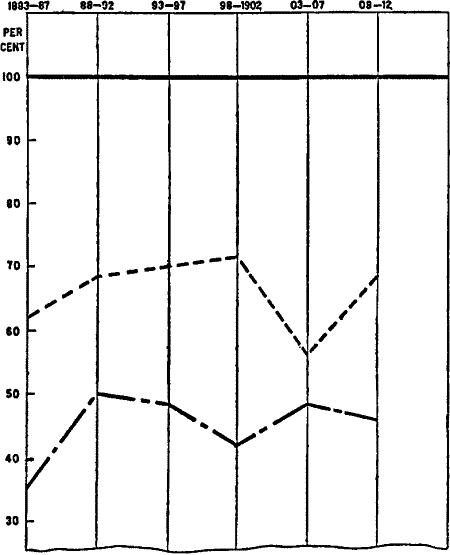
| EXPECTED MORTALITY | 100% | |
|---|---|---|
| NON-ABSTAINERS, RATIO ACTUAL TO EXPECTED MORTALITY | – – – – – – | 66% |
| ABSTAINERS, RATIO ACTUAL TO EXPECTED MORTALITY | — - — - — | 48% |
MORTALITY AMONG NON-ABSTAINERS—STANDARD RISKS—43.5% HIGHER THAN AMONG ABSTAINERS
| DEATH RATE AMONG INSURED LIVES GENERALLY—MEDICO ACTUARIAL TABLE | 100 | ||||||||||||||||||||||||| |
|---|---|---|
| DEATH RATE AMONG POLICYHOLDERS USING 2 GLASSES OF BEER OR 1 GLASS OF WHISKEY DAILY | 118 | |||||||||||||||||||||||||||||| |
| DEATH RATE AMONG POLICYHOLDERS GIVING HISTORY OF PAST INTEMPERANCE, BUT APPARENTLY CURED | 150 | |||||||||||||||||||||||||||||||||||||| |
| DEATH RATE AMONG POLICYHOLDERS USING MORE THAN 2 GLASSES OF BEER OR 1 GLASS OF WHISKEY DAILY, BUT, REGARDED AS TEMPERATE & STANDARD RISKS | 186 | ||||||||||||||||||||||||||||||||||||||||||||||| |
Now that accurate laboratory evidence is available regarding the physiological effect of alcohol in so-called moderate doses the insurance experience seems consistent, and the higher mortality among so-called moderate drinkers is only what we would naturally expect to find in the light of the most recent knowledge regarding its effects upon the human organism, not only in the direct causation of disease, but in lowering the defense to disease and increasing the liability to accident, and the tendency to careless living.
In the recent medico-actuarial investigation[8], including forty-three American life insurance companies, the combined experience on users of alcohol has been compiled, with very interesting results. It may be subdivided as follows:
First: Those who were accepted as standard risks but who gave a history of occasional alcoholic excess in the past. The mortality in this group was 50 per cent. in excess of the mortality of insured lives in general, equivalent to a reduction of over four years in the average lifetime of the group.
Second: Individuals who took two glasses of beer, or a glass of whisky, or their alcoholic equivalent, each day. In this group the mortality was 18 per cent. in excess of the average.
Third: Men who indulge more freely than the preceding group, but who were considered acceptable as standard insurance risks. In this group the mortality was 86 per cent. in excess of the average. In short, we find the following increase of mortality over the average death rate among insured risks generally:
| Steady moderate drinkers but accepted as standard risks | 86 | per cent. |
| Having past excesses | 50 | " " |
| Very moderate drinkers | 18 | " " |
This means that steady drinkers who exceed two glasses of beer or one glass of whisky daily are not, on the evidence, entitled to standard insurance, but should be charged a heavy extra premium.
In these groups, the death rates from Bright’s disease, pneumonia and suicide were higher than the normal.
The per capita consumption of alcohol has greatly increased in the United States in recent years, while in the United Kingdom it has materially decreased, as shown in the following table. This factor must be considered in assigning a cause for the increasing mor tality from degenerative diseases in this country as compared to a decreasing mortality from these maladies in Great Britain.
| 1896–1900. | 1908–1912. | |||||||
|---|---|---|---|---|---|---|---|---|
| Beer. | Wine. | Spirits. | Total. | Beer. | Wine. | Spirits. | Total. | |
| Germany | 25.4 | 1.37 | 1.66 | 28.43 | 22.4 | 1.09 | 1.29 | 24.78 |
| United Kingdom | 31.6 | .39 | 1.05 | 33.04 | 26.65 | .26 | .71 | 27.62 |
| France | 5.5 | 19.9 | 1.7 | 27.1 | 8.6 | 24.7 | 1.42 | 34.72 |
| United States | 13.01 | .30 | .81 | 14.12 | 16.62 | .52 | 1.02 | 18.16 |
To interpret correctly the mortality statistics relating to moderate drinkers and total abstainers, one must have some knowledge of the physiological effects of alcohol in so-called moderate doses, a knowledge which is often lacking in those who assume to interpret such statistics.
For example: If it could be shown that small doses of alcohol produce no ascertainable ill effects upon the human organism, the higher mortality among the moderate drinkers as compared to total abstainers might have to be explained as due to some as yet unrecognized cause or causes other than alcohol. But if laboratory and clinical evidence shows that alcohol in so-called moderate quantities (social moderation) produces definite ill effects, such as lowering the resistance to disease, increasing the liability to accident and interfering with the efficiency of mind and body and thus lessening the chances for success in life, to say nothing of any toxic degenerative effect upon liver, kidneys, brain and other organs, the excess mortality that unquestionably obtains among moderate drinkers as compared to total abstainers must be ascribed chiefly to alcohol.
It is not possible here to give all the evidence, but the following items will serve to clarify these questions.
Kraepelin[10] and his pupils have contributed most extensively to our knowledge on this subject. According to such authorities, a half to a whole liter of beer is sufficient to lower intellectual power, to impair memory, and to retard simple mental processes, such as the addition of simple figures. Habitual association of ideas, and free association of ideas are interfered with.
As far back as 1895, Smith demonstrated the influence of small doses of alcohol in impairing memory, and these results have been confirmed by Kraepelin and quite recently by Vogt[11] in experiments on his own person—15 cc. (about 4 teaspoonfuls) of whisky on an empty stomach, or 25 cc. with food, being sufficient to distinctly impair the power to memorize.
Careful and exact experiments have shown the influence of moderate doses of alcohol in lessening the amount of work performed by printing compositors. There has also been shown a disturbance in the sequence of ideas. The time that elapses between an irritation and the beginning of a responsive movement can be measured within one one-thousandth of a second. According to Aschaffenburg,[12] under the influence of even very small doses of alcohol this reaction period is disturbed and shortened. It is below the normal, the acceleration being attained at the expense of precision and reliability. Indeed, the reaction is often premature, and constitutes a false reaction—“the judgment of the reason comes limping along after the hasty action.”
It is now conceded that alcohol is not a real brain stimulant, but acts by narrowing the field of consciousness. By gradually overcoming the higher brain elements the activities of the lower ones are released, hence the so-called stimulation and the lack of judgment and common sense often shown by those even slightly under the influence of alcohol. The man who wakes up under alcohol is really going to sleep, as far as his judgment and reason are concerned. Complete abolition of consciousness is brought about by sufficient doses as when ether or chloroform is taken.
Under moderate doses, muscular efficiency is at first increased a little and then lowered, the total effect being a loss in working power, as shown by the experiments of Dubois, Schnyder,[13] Hellsten,[14] and others.
Muller, Wirgin and others[15] have shown that alcohol restricts the formation of antibodies (the function of which is to resist infection in the blood) in rabbits, and Laitinen[16] has shown that the prolonged administration of small doses in men (15 cc.) is sufficient to lower vital resistance, especially to typhoid fever.
Rubin[17] has demonstrated that alcohol, ether and chloroform, injected under the skin, render rabbits more vulnerable to streptococ cus (blood poison) and pneumnococcus infection (pneumonia); Stewart,[18] that small amounts lower the resistance to tuberculosis and streptococcus infection; Craig and Nichols,[19] that moderate doses of whisky were sufficient to cause a negative Wassermann reaction in syphilitic subjects; Fillinger[20] found the resistance of red blood cells much reduced after the administration of champagne to healthy human subjects. Similar results were found in dogs and rabbits.
Weinburg[21] confirmed these results by the same methods, showing that 20 per cent. of the red cells lose their resistance after the administration of 450 cc. of champagne.
Parkinson,[22] in a series of careful tests, failed to establish any influence on phagocytosis (capacity of the white blood cells to destroy bacteria), except when large doses or continuous moderate doses were taken.
On the heart and circulation, alcohol acts as a depressant, increasing the rate, but not the force, of the pulse. It causes depression of the nerve center controlling the blood vessels and thus lowers blood pressure. Large doses cause paralysis of these nerves and of the heart.
Miller and Brooks[23] found from small doses (6 to 12 cc. absolute alcohol) an increase in blood pressure in conscious (unanesthetized) animals, contrary to the findings of Crile,[24] Cabot,[25] Dennig,[26] Hindelang and Grünbaum, Alexandroff[27] and others, in man; but the amounts were small and variable, according to individual susceptibility, thus showing the drug to be, even on such evidence, uncertain and unserviceable as a heart stimulant.
Atwater and Benedict,[28] and Beebe[29] and Mendel,[30] have shown that alcohol is a “protein sparer,” and can, to some extent, take the place of fats and carbohydrates. This is what is meant by calling alcohol a “food.” Always, however, it fails to pass some test by which true foods are measured. Apart from its effect on the nervous system, among which must be figured its action on the blood vessels which causes a loss of body heat, Mendel has shown that in moderate doses (96 cc. daily) it increases the output of uric acid and allied (purin) bodies derived from the tissues, a fact which distinguishes it from all other foods. These poisonous or drug effects must always be considered, together with any alleged nourishing effects. Alcohol is still used by some as a rapidly available fuel-food in fevers, and when ordinary foods cannot be readily digested and made available. But this is done to a much less degree than formerly, now that its narcotic and poisonous effects are more fully understood. Sugar and water often serve quite as useful a purpose.
It seems reasonable, on the evidence herein presented, to class alcohol among the narcotic or “deadening” drugs, such as ether or chloroform. Indeed, Aschaffenburg[31] has recently called attention to the growth of the ether habit in eastern Germany, where this drug is used as a so-called stimulant, while in reality the effects are well known to be narcotic, or deadening.
The laboratory and the life insurance records simply give exact expression to what has long been a matter of common knowledge to the employer of labor and to leaders and commanders of men; to wit, that the influence of alcohol on any large group of men, whether they be artisans or soldiers, is harmful and lowers the efficiency of the group. Individual susceptibility varies, but the man who thinks he is an exception and can indulge with safety may find that he is mistaken only after serious damage to the body has been done and perhaps a definite loss sustained in happiness and achievement.
Stockard,[32] in his experiments on animals, has demonstrated conclusively that the germ cells of males can be so injured by allowing the subjects to inhale the fumes of alcohol that they give rise to defective offspring, although mated with vigorous untreated females. The offspring of those so treated when reaching maturity are usually nervous and slightly undersize. These effects are apparently conveyed through the descendants for at least three generations. Such evidence establishes at least the probability of the transmission of serious ill effects to human offspring through alcoholic indulgence of the male parent.
Much of the statistical evidence that has been produced on both sides of this question of the transmissibility of the effect of alcohol is misleading unless very critically analyzed, but the results of exact laboratory experiments can hardly be gainsaid.
Those who trifle with alcohol should at least take the precaution to be periodically examined in order to detect the earliest signs of ill-effect. One’s own feelings are not safe guides, and may fail to warn of danger until serious damage has been done.
In 1914, at the annual meeting of the National Council of Safety, at which there were present representatives from several hundred large industries, the members unanimously voted to abolish liquor from their plants. It has been well stated by Quensel[33] that “work and alcohol do not belong together, especially when the work demands wideawakeness, attention, exactness and endurance.”
The restrictive and prohibitive measures of the French and Russian governments, the well known opposition of the Kaiser to alcohol and the warnings uttered by Lord Kitchener and leading British statesmen, are sufficient evidence that the condemnation of alcohol represents the deliberate judgment of the world’s strong men.
[1] United Kingdom Temperance and General Provident Institution of London, Annual Report, 1910.
[2] Sceptre Life Association, Annual Report, 1912.
[3] Scottish Temperance Life Assurance Company, Annual Report, 1912.
[4] The Abstainers and General Insurance Company, Ltd., Annual Report, 1912.
[5] McMahon, T. F.: The Use of Alcohol and the Life Insurance Risk. Proceedings of the Association of the Life Insurance Medical Directors of America, 1911, Twenty-second Annual Meeting, p. 473; Medical Record, LXXX, p. 1121.
[6] Lounsberry, R. L.: Proceedings of the Life Assurance Medical Directors. October, 1913.
[7] Moore, Roderick McKenzie: On the Comparative Mortality Among Assured Lives of Abstainers and Non-Abstainers from Alcoholic Beverages. Transactions of the Institute of Actuaries, 1913, XXXVIII, pp. 248–272.
[8] Report of Medico-Actuarial Mortality Investigation, IV, pp. 11–13.
[9] Statistical Abstract for the United Kingdom, Sixty-first Number, 1809–1913 (Wyman & Sons), London, 1914, p. 173; Statistical Abstract for the Principal and Other Foreign Countries, 1901–1912, Thirty-ninth Number, pp. 505, 506, 507; Statistical Abstract of the United States, Thirty-sixth Number, 1913, p. 516.
[10] Kraepelin, Emil: Ueber die Beeinflussung einfacher psychischer Vorgänge durch einige Arzneimittel, Verlag von Gustav Fisher, Jena, 1892; Aschaffenburg, Gustav: Praktische Arbeit unter Alkoholwirkung, Psychologische Arbeiten, 1896, I, pp. 608–626; Kurz, Ernest, and Kraepelin, Emil: Ueber die Beeinflussung psychischer Vorgänge durch regelmässigen Alkoholgenuss, Psychologische Arbeiten, 1901, III, pp. 417–457; Mayer, Martin: Ueber die Beeinflussung der Schrift durch den Alkohol, Psychologische Arbeiten, 1901, III, pp. 535–586; Rudin, Ernst: Ueber die Dauer der psychischen Alkoholwirkung, Psychologische Arbeiten, IV, pp. 1–44.
[11] Vogt, R.: Om virkningen af 15–50 cm3 koncentrert spiritus paa erindringsevnen, Norsk. Mag. f. Laegevidensh., 1910, LXXI, pp. 605–626; The Lancet (London), 1910, II, p. 1040.
[12] Aschaffenburg, Gustav: Crime and Its Repression, Little, Brown & Company, Boston, 1913, p. 84.
[13] Schnyder, L.: Alkohol und Muskelkraft, Archiv für Physiologie, 1902–3, XCIII, p. 451.
[14] Hellsten, A. F.: Ueber den Einfluss von Alkohol, Zucker und Thee auf die Leistungsfähigkeit des Muskels, Munchen Med. Wchnschr., 1914, LI, pp. 18–94.
[15] Bastedo, Walter A.: Materia Medica Pharmacology and Therapeutics, W. B. Saunders Company, Philadelphia and London, 1913, p. 333.
[16] Laitinen, T.: The Norman Kerr Lecture on The Influence of Alcohol on Immunity, Med. Rec., LXXVI, 1909, pp. 445–446. Read before the Twelfth International Anti-Alcoholic Congress, held in London, July, 1909; Uber die Einwirkung der kleinsten Alkoholengen auf die Widerstandsfähigkeit des tierischen Organismus mit besonderer Berücksichtigung der Nachkommenschaft, Ztschr. f. Hyg. u. Infections-krankheiten, LVIII, 1907–8, p. 139.
[17] Rubin, George: The Influence of Alcohol, Ether, and Chloroform on Natural Immunity in its Relation to Leucocytosis and Phagocytosis, Jour. Infct. Dis., 1904, I, pp. 425–444.
[18] Stewart, Chas. E.: The Influence of Alcohol on the Opsonic Power of the Blood, Mod. Med., 1907, XVI, pp. 241–246. Read before the American Society for the Study of Alcohol and Drug Neuroses, Atlantic City, June 4, 1907, and published in the Jour. of Inebriety.
[19] Craig, Chas. F., and Nichols, Henry J.: The Effect of the Ingestion of Alcohol on the Result of the Complement Fixation Test in Syphilis, Jour. A. M. A., 1911, LVII, pp. 474–76.
[20] Fillinger, F. V.: Weitere Mitteilungen über Resistenzverminderung der Erythrozyten nach Alkoholgenuss, Deutsch. Med. Wchnschr., 1912, XXXVIII, p. 999.
[21] Weinburg, W. W.: The Lowering of Stability of Erythrocytes in Alcoholic Intoxication, Russky Vratch, 1912, II, p. 1324; New York Med. Jour., 1912, XCVI, p. 1040.
[22] Parkinson, P. R.: The Relation of Alcohol to Immunity, The Lancet (London), 1909, VII, pp. 1580–82.
[23] Brooks, Clyde: The Action of Alcohol on the Normal Intact Unanesthetized Animal, Jour. A. M. A., 1910, LV, pp. 372–73. Read in the Section on Pathology and Physiology of the A. M. A. at the Sixty-first Session, St. Louis, June, 1910.
[24] Crile, George W.: Blood Pressure in Surgery, J. B. Lippincott Company, Philadelphia, 1903. Cartwright Prize of the Alumni Ass’n of the College of Physicians and Surgeons, New York City.
[25] Cabot, Richard C.: Studies of the Action of Alcohol in Disease, Especially upon the Circulation, Med. News, LXXXIII, 1903, pp. 145–153. Read before the Association of American Physicians, May 13, 1903.
[26] Dennig, Hindelang und Grünbaum: Uber den Einfluss des Alkohols auf den Blutdruck und die Herzarbeit in pathologischen Zuständen, Namentlich beim Fieber, Deutsch. Arch. f. klin. Med., 1909, XCVI, pp. 153–162.
[27] Alexandroff, Emilie: Ueber die analeptische Wirkung des Alkohols bei pathologischen Zuständen, Cor. Bl. f. schweiz. Aerzte., 1910, XL, pp. 465–475; Action of Alcohol During Febrile and other Pathologic Conditions, Jour. A. M. A., 1910, LV, p. 174.
[28] Atwater, W. A., and Benedict, F. G.: An Experimental Inquiry Regarding the Nutritive Value of Alcohol, National Academy of Science, 1902, Sixth Memoir.
[29] Beebe, L. B.: The Effect of Alcohol and Alcoholic Fluids Upon the Excretion of Uric Acid in Man, Amer. Jour. Physiol., 1904, XII, pp. 13–37.
[30] Mendel, L. B., and Hilditch, Warren W.: The Influence of Alcohol Upon Nitrogenous Metabolism in Men and Animals, Amer. Jour. Physiol., 1910, XXVII, pp. 1–23.
[31] Aschaffenburg, Ibid.
[32] Stockard, C. R.: A Study of Further Generations of Mammals from Ancestors Treated with Alcohol, Proc. Soc. Exper. Biol. and Med., 1914, XI, p. 136.
[33] Quensel, Ulrik: The Alcohol Question from a Medical Viewpoint—Studies in the Pathology of Alcoholism, Year Book, United States Brewers’ Association, 1914, p. 168.
Bastedo, Walter A.: Materiel Medico, Pharmacology and Therapeutics, W. B. Saunders Company, Philadelphia and London, 1913, p. 318.
Bertillon, Jacques: On Mortality and the Causes of Death According to Occupations, Proceedings of the Fifteenth International Congress on Hygiene and Demography, Washington, 1912, I, p. 345.
Boos, William F.: The Relation of Alcohol to Industrial Accidents and to Occupational Diseases, Proceedings of the Fifteenth International Congress on Hygiene and Demography, Washington, 1912, I, p. 829.
Cabot, Richard C.: The Consumption of Alcohol and of Other Medicines at the Massachusetts General Hospital, Boston Med. Jour., CLX, 1909, pp. 480–81.
Dixon, W. E.: Alcohol in Relation to Life, The Nineteenth Century, 1910, LXVII, pp. 516, 523.
“Ethyl Alcohol,” The Dispensatory of the United States of America, J. B. Lippincott & Company, Philadelphia, 19th edition, p. 102.
Ewald: Alcohol in Relation to Infectious Diseases, Med. Rec., 1913, LXXXIV, p. 75. Read before the Fourth National Congress on Physiotherapy, Berlin, March 26, 1913.
Horsley, Sir Victor: Discussion on Alcohol in Therapeutics, Med. Rec., 1912, LXXI, p. 951. Read before the Hunterian Society.
Hunter, Arthur: Can Insurance Experience be Applied to Lengthen Life? Proceedings of the Association of Life Insurance Presidents, Eighth Annual Meeting, 1914, pp. 27–37.
Kelynak, T. M.: The Drink Problem, London, Methuen & Company, 1907.
Landau, Anastazy: Beitrage zur hehre vom Purinstoffwechsel und zur Frage über den Alkoholeinfluss auf die Harnsaureausscheidung, Deutsch. Arch. f. klin. Med., XCV, 1908–9, pp. 280–328.
Miller, Joseph L.: The Physiologic Action, Uses and Abuses of Alcohol in the Circulatory Disturbance of the Acute Infection, Jour. A. M. A., 1910, LV, pp. 2034–2037. Read in the joint session of the Sections of Practice of Medicine and Pharmacology and Therapeutics of the A. M. A., Sixty-first Annual Session, held at St. Louis, June, 1910.
Neff, Irwin H.: The Problem of Drunkenness, Proceedings of the Fifteenth International Congress on Hygiene and Demography, Washington, 1912, IV, p. 510.
Phelps, Edward Bunnell: The Mortality from Alcohol in the United States, Proceedings of the Fifteenth International Congress on Hygiene and Demography, Washington, 1912, Vol. I, p. 813.
Proceedings: Association of Life Insurance Medical Directors, October, 1911.
Report of the Committee of Fifty on: Physiological Aspects of the Liquor Problem, Houghton, Mifflin & Company, two volumes, 1903.
Togel, O., Brezina, E., and Durig, A.: Ueber die kohlenhydratsparende Wirkung des Alkohols, Biochem. Ztschr., 1913, I, 296; Editorial, Jour. A. M. A., 1913, LXI, p. 967.
Williams, Henry Smith: Alcohol, How it Affects the Individual, the Community and the Race, The Century Company, New York, 1909.
Woods, Robert A.: The Prevention of Inebriety: Community Action, Proceedings of the Fifteenth International Congress on Hygiene and Demography, Washington, 1912, IV, p. 517.
There has lately been undertaken at the Nutrition Laboratory of the Carnegie Institution at Washington a very broad and comprehensive study of the effect of moderate doses of alcohol on the healthy and normal human body. The immense scope of the investigation planned may be judged by the fact that under the physiological division of the research, as laid out by Professors Raymond Dodge and E. C. Benedict, there are seven main sections and one hundred and sixty subdivisions. The program has been arranged after conferences, either in person or by letter, with the leading physiologists of the world, and may take ten years to complete.
The psychological program, carried out with the co-operation of Dr. F. Lyman Wells, has already been completed and the results recently published.[34] These results must be accepted as the testimony of pure science, free from all bias or even remote suggestion of propaganda. They were based upon experiments with moderate doses of alcohol (30 cubic centimeters, or about 8 teaspoon fuls, and 45 cubic centimeters) upon ten normal subjects, very moderate users of alcohol, and may be summarized as follows:
A very simple reflex act, the “knee-jerk,” a nervous mechanism controlled by a center at the lower level of the spinal cord, was markedly depressed, the time of response being increased 10 per cent. and the thickening of the muscles concerned in the act decreased 45 per cent. In some subjects the larger dose, 45 cubic centimeters, practically abolished the knee-jerk.
The eye-lid reflex, elicited by a sudden noise, showed the next largest effect, the time of response being increased 7 per cent. and the degree of movement decreased 19 per cent.
Other nervous mechanisms, or reflex arcs, at the higher levels of the cord, were next investigated: (1) eye-reaction to suddenly appearing stimulus, and (2) speech reaction to visual word stimuli. Dose A (30 cubic centimeters), accelerated the eye-reaction, while dose B (45 cubic centimeters) positively depressed it, agreeing with the simple reaction experiments of Kraepelin. This was the only instance of acceleration of movement of the voluntary muscles through alcohol, all the other tests showing it to be a consistent depressant. The speech reaction showed a positive depressant effect of 3 per cent.
Free association of ideas and memory tests were also made, and showed practically no effect from alcohol, but, unfortunately, the smaller dose only was used in these tests.
The sensitiveness to electrical stimulation was decreased 14 per cent.
Motor co-ordination, as evidenced by eye-movements in fixating seen objects, was next investigated. The velocity of these movements was decreased 11 per cent. Finger-movements, measured in an exceedingly delicate way, were reduced in speed 9 per cent.
The effect on the pulse while these tests were made was observed, and electrocardiograms taken. The pulse was found to be accelerated, but not increased in force, that is, the “brake” was taken off the heart, but no driving force supplied by alcohol. The condition of the circulation was impaired by the narcotic effect of alcohol on the cardio- inhibitory center which holds the heart action in check.
According to the investigators, the effect is to “decrease organic efficiency.” This should shut off such little debate as still persists with respect to alcohol having any value as a heart stimulant.
While these investigations only confirm in part the contention of the Kraepelin school that alcohol first acts by depressing the higher centers, and tend to show that its first and most profound effect is on the lower levels of the spinal cord and the simpler nervous mechanisms, it confirms the view of these and other investigators, that the total effect of alcohol is that of a narcotic, depressing drug, even in the smallest doses usually taken as a beverage.
The possible reactions are more complex than those supposed by Kraepelin, and there is evident in the higher centers (the effect on highest brain functions, were not measured by Dodge and Benedict) a power of “autogenic reinforcement,” which is well exemplified by the ability of a half-intoxicated person to sober up under some shock or strong incentive. When social conditions do not stimulate this reinforcement, but, on the contrary, dull and retard it, as in convivial company, there is reinforcement of the lower, more animal mechanisms of the nervous system, and we have exhibited revolting and foolish reactions to alcohol, which are consistent with these findings.
The slight effect on memory and free association is explained partly by the methods used in the laboratory (difference in time of recognizing words suddenly exposed a second time), which are more in the nature of “short cuts” and perhaps not so accurate a reproduction of normal memorizing as those employed by Kraepelin and Vogt (memorizing numbers and verse), and partly by the power of “autogenic reinforcement,” which it is difficult to eliminate in a laboratory test.
This, the latest contribution of science to the study of alcohol, gives added proof that the higher mortality among so-called moderate users of alcohol is largely due to the unfavorable effect on the protective mechanism of the body.
This has been further emphasized by the studies of Reich[35] at the University of Munich, who found that the resistance of blood cells to salt solution and to typhoid bacilli was less among alcohol users than among total abstainers.
Konrádi[36] has found that comparatively few antibodies against cholera germs develop in persons who consume alcohol daily in fairly large quantities and who had been inoculated against cholera. Pampoukis[37] has observed that alcoholics are not favorable subjects for inoculation against rabies. The Pasteur Institute in Budapest has made similar observations, based on twenty-five years’ experience.
[34] Benedict, E. C.: The Psychological Effects of Alcohol, The Carnegie Institution, Washington, D. C., 1916.
Benedict, E. C.: The Psychologic Effect of Alcohol on Man, The Journal A. M. A., 1916, lxvi, p. 1424.
[35] Reich, H. W.: Ueber den Einfluss des Alkoholgenusses auf Bakterizidie, Phagozytose und Resistenz der Erythrocyten, beim Menschen, Arch. f. Hyg., 1916, lxxxiv, 337.
[36] Konradi: Ueber den Wert der Choleraschutzimpfungen, Centralbl. f. Bakteriol., I. O., 1916, lxxvii, 339.
[37] Alcohol and Immunity, Jour. A. M. A., 1916, lxvi, p. 962, p. 1122.
It is the purpose of this section to present as fairly as possible the evidence relating to the effects of tobacco on the human body, so that those who smoke may correctly measure the probable physical cost of the indulgence. The extremes of opinion on this subject are well expressed in the following verses:
“Hail! Social Pipe—Thou foe to care,
Companion of my elbow chair;
As forth thy curling fumes arise,
They seem an evening sacrifice—
An offering to my Maker’s praise
For all His benefits and grace.”
Dr. Garth.
“A custom loathsome to the eye, hateful to the nose, harmful to the brain, dangerous to the lungs, and the black stinking fume thereof nearest resembling the horrible Stygian smoke of the pit that is bottomless.”
James I.
Tobacco is a plant, Nicotiana Tabacum of the order Solanaceæ, which includes Atropa Belladonna, or “Deadly Nightshade,” Hyoscyamus, or “Henbane,” Solanum Dulcamara, or “Bitter Sweet,” all powerful poisons, and likewise the common potato and tomato, which are wholesome foods. The cured leaves are used for smoking and chewing, or when powdered, as snuff.
Prior to the middle of the 16th Century, the use of tobacco was confined to the American Indians. In 1560 the Spaniards began to cultivate tobacco as an ornamental plant, and Jean Nicot, the French Ambassador at Lisbon, introduced it at the court of Catherine de Medici in the form of snuff. Smoking subsequently became a custom which spread rapidly throughout the world, although often vigorously opposed by Governments. In the 17th Century, smoker’s noses were cut off in Russia.
Tobacco contains a powerful narcotic poison, nicotin, which resembles prussic acid in the rapidity of its action, when a fatal dose is taken.
The percentage of nicotin present varies according to the brand and the conditions under which it is cultured.
The following figures have been given by the various authorities.
| London Lancet[38] | .64 to 5.3 | per cent. |
| French Dept. of Agriculture[39] | .22 to 10.5 | " " |
| Connecticut Agricultural Experiment Station[40] | 2.89 | " " |
| (Home grown—after fermentation.) | ||
|---|---|---|
| U. S. Dept. of Agriculture[40] | .94 to 5. | " " |
| (Domestic.) | ||
Aside from nicotin it also contains small quantities of related substances—nicotellin, nicotein, a camphoraceous substance termed nicotianin, said to give tobacco its characteristic flavor, and likewise a volatile oil developed during the process preparation. On heating, pyridin (a substance often used to denature alcohol), picolin, collidin, and other bases are formed, as well as carbolic acid, ammonia, marsh gas, cyanogen and hydrocyanic acid, carbon monoxide (coal gas) and furfural. Furfural is a constituent of fusel oil, which is so much dreaded in poor whisky. The smoke of a single cigaret may contain as much furfural as two ounces of whisky.
The complex constitution of tobacco and the smoke from its combustion has caused much debate as to the substances that are responsible for its charm and its ill effects, which are to be described. No one can doubt the serious injurious effects from such a powerful poison as nicotin if taken in any but the most minute quantities (one to three milligrams have produced profound poisoning in man).
It has been maintained by some that nicotin is practically destroyed in the process of smoking, and that the effects of tobacco are limited to the decomposition products resulting from the burning tobacco, especially pyridin. But pyridin is also formed in the burning of cabbage leaves, and cabbage leaves do not possess any attractions for smokers, neither do they produce the well-known effects that smoking and chewing tobacco produce. No doubt pyridin and furfural are factors in the drug effects of tobacco, but recent painstaking experiments by high authorities have shown the presence of nicotin in tobacco smoke, and when we reflect that there is sometimes sufficient nicotin in an ordinary cigar to kill two men, it is not strange that enough of it may be absorbed from the smoke passing over the mucous membranes of the nose, throat and lungs to produce a distinct physiological effect.
Investigators who claim to show by experi ments the absence of nicotin from tobacco smoke must explain why the palpable effects of smoking, in those who have not established a “tolerance,” are those of nicotin poisoning, and why the symptoms produced by chewing tobacco are identical with those following the smoking of tobacco, which are: mild collapse, pallor of the skin, nausea, sweating, and perhaps vomiting, diarrhea, muscular weakness, faintness, dizziness, and rise in blood pressure followed by lowered blood pressure.
Nicotin is undoubtedly decomposed by burning, but it may become volatilized by heat and a certain amount absorbed before decomposition takes place.
Lehmann,[41] in 1908, found in tobacco smoke the following percentages of the nicotin contained in the tobacco:
| Cigaret smoke | 82 | per cent. |
|---|---|---|
| Cigar smoke | 85 to 97 | " " |
The London Lancet[42] (1912) gives the following figures:
| Cigaret smoke | 3.75 to 84 | per cent. |
|---|---|---|
| Pipe mixture smoke, smoked as cigarets | 79 | " " |
| Pipe smoke | 77 to 92 | " " |
| Cigar smoke | 31 to 63 | " " |
The United States Department of Agriculture[43] found in tobacco smoke about 30 per cent. of the nicotin originally present in the tobacco.
Contrary to general opinion, Havana cigars contain less nicotin than the cheaper brands, which augurs ill for the large class of people who cannot afford to smoke higher priced brands. Many of the cheaper grades do, however, show a low percentage of nicotin.
By means of an ingenious apparatus, Zhebrovski,[44] a Russian investigator, compelled rabbits to smoke cigaret tobacco for a period of 6 to 8 hours daily. Some died within a month, and showed changes in the nerve-ganglia of the heart. Others established a tolerance similar to that exhibited by habitual smokers, but upon being killed at the end of five months, degenerative changes similar to those produced by the injection of nicotin were found, viz., hardening of the blood vessels. There is, indeed, no difficulty in producing the characteristic effects of nicotin by administering tobacco smoke, either in man or in animals.[45]
Nicotin causes brief stimulation of brain and spinal cord, followed by depression. There is an increased flow of saliva, followed by a decrease (large doses diminish it at once) and often nausea, vomiting and diarrhea. The heart action is at first slowed and the blood pressure increased. Subsequently there is a depression of the circulation, with rapid heart action and lowered blood pressure. In habitual smokers, this preliminary stimulation may not occur. The stimulating effect on the brain is so brief that tobacco can not properly be termed a stimulant. Its effect is narcotic or deadening. Those who fancy that their thoughts flow more readily under the use of tobacco are in the same case with any other habitué whose thoughts can not flow serenely except under his accustomed indulgence. That a sound healthy man, who has never been accustomed to the use of tobacco, can do better mental or physical work with tobacco than without it has never been shown. Indeed, such experiments as have been made on students and others show to the contrary.[46]
The statistics presented by Prof. Fred. J. Pack are of interest in this connection.
In six educational institutions the students competing for places on the football team were grouped as follows:
| Institution. | Smoker. | Non-smoker. | Institution. | Smoker. | Non-smoker. |
|---|---|---|---|---|---|
| A | 65.2 | 69.8 | G | 74.0 | 75.0 |
| B | 64.7 | 74.6 | H | 75.2 | 79.4 |
| C | 78.8 | 81.1 | I | 81.6 | 88.4 |
| D | 75.8 | 77.6 | J | 78.5 | 81.3 |
| E | 84.6 | 84.8 | K | 74.0 | 84.6 |
| F | 69.6 | 71.3 | L | 77.3 | 77.6 |
The following table shows the relative scholastic standing of smokers and non-smokers:
| Number of Men. |
Total Mark. |
Average Mark. |
|
|---|---|---|---|
| Smokers | 81 | 6,034 | 74.5 |
| Non-smokers | 101 | 8,021 | 79.4 |
Twelve institutions reporting:
| Number of Men. |
Highest Marks. |
Lowest Marks. |
|
|---|---|---|---|
| Smokers | 81 | 4 | 12 |
| Non-smokers | 101 | 11 | 6 |
| Number of Men. |
Highest Marks. |
Lowest Marks. |
|
| 101 non-smokers furnish | 11 | 6 | |
| 101 smokers would furnish | 5 | 15 | |
| Number of Men. |
Total Conditions and Failures. |
Average | |
| Smokers | 82 | 70 | .853 |
| Non-smokers | 98 | 48 | .439 |
Prof. Pack’s conclusions were as follows:
There have of course been many notable instances of high scholarship and prodigious mental achievement by heavy smokers. Such exceptions, however, do not affect conclusions derived from the study of average groups.
Hitherto figures on smoking and athletics have been open to question because comparisons were made between groups that are not of necessity of the same physical and mental type, having no important difference except in the use of tobacco. But Prof. Pack has sought to avoid this objection. As he points out, the football squad is probably as nearly a homogeneous group as it is possible to find. It seems reasonable to account for the inferior physical and mental work of these particular groups of smokers on the theory that in the main the well known toxic effects of tobacco are sufficient to create this difference.
Dr. George J. Fisher,[47] in a series of careful tests found:
Bush,[48] in a series of tests on each of 15 men in several different psychic fields found the following conditions among smoking students immediately after the period of smoking was completed:
Bush ascribed these effects to pyridin, claiming that his experiments failed to reveal nicotin in the tobacco smoke, except in a very small proportion in that of cigarets.
Tests for nicotin in smoke are beset with many difficulties and possible fallacies which have in the past misled investigators into apparently determining that tobacco smoke con tained no nicotin, but simply decomposition products.
Pyridin is unquestionably present in tobacco smoke, and is a poisonous substance, although less so than nicotin. It is not found, however, in chewing tobacco, and as the clinical effects of chewing tobacco are apparently identical with those of smoking tobacco, very strong and universally accepted chemical proof of the absence of nicotin from tobacco smoke must be awaited before accepting such a conclusion. (See [41], [42], [43] in bibliography.)
Cigaret smoking is a time waster; that is, it breaks up the power of attention, as few smokers are satisfied with one cigaret and the mere physical act of lighting a fresh cigaret disturbs the continuity of thought and work. Dr. W. J. Mayo[49] calls attention to the fact that according to his observations research scholars who smoke cigarets have not done well.
Only one insurance company, the New England Mutual,[50] has published any experience on tobacco users. This covered a period of 60 years and a body of 180,000 policyholders, as follows:
| Abstainers. | Rarely Use. | Temperate. | Moderate. |
|---|---|---|---|
| Tobacco, 59% | 71% | 84% | 93% |
| Alcohol, 57% | 72% | 84% | 125% |
[Q] The standard here used is the American Experience Table, which is largely an artificial table upon which premiums are based, but which provides for a much higher mortality than the average companies sustain. For example, the actual mortality of the New England Mutual in 1913 was 57 per cent. of the expected.
Fifty-nine per cent. of the expected mortality means that where, according to the premium tables, 100 were expected to die, only 59 actually died.
The general class of risks in this company were of excellent quality, as the figures show. Nevertheless, the abstainers exhibited a far lower mortality than that experienced by the general class.
Dr. Edwin Wells Dwight, who presented the figures, urged caution in their interpretation, suggesting that the low mortality among abstainers, both from alcohol and tobacco, might well be due to a more conservative habit of living. Furthermore, as the abstainers from alcohol were not separated from the abstainers from tobacco in this analysis a perfect com parison can not be made; but our knowledge of the toxic effects of both these narcotics and the preceding statistics of Doctor Pack justify us in assigning to tobacco a positively unfavorable effect.
Experiments on animals with nicotin extracts from tobacco and inhalation of tobacco smoke have produced hardening of the large arteries. Clinical observation by some of the world’s best authorities indicates that the same conditions are brought about in man by heavy smoking.[51]
Disturbance of the blood pressure, rapid heart action, shortness of breath, palpitation of the heart, pain in the region of the heart, are important effects. Tobacco heart is often lightly spoken of because the abandonment of the habit will often restore the heart to its normal condition, but tobacco heart sometimes causes death, especially under severe physical strain or in the course of acute disease, such as typhoid or pneumonia. Surgeons[52] have noted failure to rally after operation in tobacco users, who are, of course, deprived of their accustomed indulgence immediately before and after operation. It is probable that many such cases pass unrecognized, although the alcoholic is usually supplied the narcotic his system demands.
Cannon, Aub, and Binger[53] have also shown that nicotin stimulates the adrenal glands, small organs adjacent to the kidneys, which secrete a substance that in excess powerfully affects the blood vessels, constricting them and temporarily increasing the blood pressure. This influence may be partly responsible for the change in the blood vessels noted in heavy smokers.
Excessive smoking is often an important factor in causing insomnia.
Blindness or tobacco amblyopia, a form of neuritis, is not an uncommon affection among smokers. There is also often an irritant effect on the mucous membranes of eyes from the direct effect of the smoke.
Catarrhal conditions of the nose, throat and ear have also been noted.
Acid dyspepsia is a common affection among smokers.
Few people realize that so many ingredients in tobacco and tobacco smoke are deadly poisons. Few people know that one drop of nicotin on the unbroken skin of a rabbit will produce death.[54] Two drops on the tongue of a dog or cat will prove fatal; moreover, fatal poisonings have occurred in man from swallowing tobacco and even from external application of strong solutions. A case was recently reported from New Haven of fatal poisoning in a baby,[55] who had been fed from a milk bottle and milk-mixture in which some tobacco had been accidentally spilled.
From the mass of evidence and opinion with which medical literature is loaded, a few salient facts stand out:
First: Tobacco and its smoke contain powerful narcotic poisons.
Second: It has never been shown to exert any beneficial influence on the human body in health, and it is not even included in the United States Pharmacopœia as a remedy for disease, notwithstanding the claims that are made for its sedative effects and its value as a solace to mankind. If these benefits are real and dependable, they should be made available in exact dosage and applied therapeutically. If they are not real and dependable in a medical sense, they are not real and safe as a mere drug indulgence.
Third: The symptoms following tobacco-smoking are identical with the effects of tobacco-chewing among those not accustomed to its use; hence, any collateral psychic effect, such as the sight of smoke, the surrounding, etc., are of minor importance in establishing the habit. The main charm to the smoker is the drug effect, as in any other similar indulgence. Nicotinless tobacco is not popular, notwithstanding the efforts of the French and Austrian Governments to make it so.
Fourth: Fortunately, the sedative drug effect is so slight, as compared to that of other narcotics—opium, alcohol, cocaine, etc.—that the tobacco habit is less seductive and may be broken with comparative ease and is therefore less harmful morally. Men who have smoked or chewed steadily for 40 years have been known to give up the habit without experiencing much physical discomfort. Like any other habit, however, there is a tendency to increasing indulgence, and this is a risk that the smoker takes, just as does the alcohol user or the opium habitué who begins with so-called moderate indulgence.
Fifth: The well-known effects of tobacco on the heart and circulation should lead one to pause and consider the possible cost of this indulgence, especially as—
Sixth: It is difficult to determine, years in advance, whether or not one is endowed with sufficient resistance to render so-called moderate smoking comparatively harmless.
Seventh: The vital statistics show that diseases of the heart and circulation are rapidly increasing in this country in which—
Eighth: The per capita consumption has rapidly increased in recent years, while—
Ninth: In the United Kingdom, where these diseases are decreasing, there has been no material increase in the use of tobacco, and the per capita consumption is less than one-third that of the United States.
In 1880 the annual per capita consumption of tobacco in the United States was about 5 lbs., while in 1914 it had risen to more than 7 lbs. In the United Kingdom the per capita consumption is about 2 lbs., and there has been no material increase in recent years.
The cigaret bill, in particular, has grown enormously, having more than doubled in the past five years, while there has been a slight increase in the consumption of cigars, smoking tobacco, chewing tobacco and snuff, as shown in the following table:[56]
| Fiscal Year | Cigars | Cigarets | Tobacco, Chewing and Smoking |
Snuff |
|---|---|---|---|---|
| 1910 | 8,213,356,504 | 7,884,748,515 | 436,608,898 | 31,969,111 |
| 1911 | 8,474,962,786 | 9,254,351,722 | 380,794,673 | 28,146,833 |
| 1912 | 8,350,119,103 | 11,239,536,803 | 393,785,146 | 30,079,482 |
| 1913 | 8,732,815,703 | 14,294,895,471 | 404,362,620 | 33,209,468 |
| 1914 | 8,707,625,230 | 16,427,086,016 | 412,505,213 | 32,766,741 |
| Total | 42,478,879,326 | 59,100,618,527 | 2,028,056,550 | 156,171,635 |
Tenth: The poetic effusions of the lovers of the weed are no safer guide than the exaggerated and intemperate denouncements of people who have idiosyncrasies against tobacco and simply hate it.
Eleventh: Those who now smoke should have a thorough physical examination to determine the condition of the heart and blood vessels. This examination should be repeated at least annually, in order to detect any adverse influence on the circulation.
[38] The Toxic Factor in Tobacco, The Lancet (London), 1912, I, p. 944.
[39] French Department of Agriculture, Compt. Rend. Acad. de Science, CLI, p. 23.
[40] Garner, W. W.: The Relation of Nicotin to the Burning Quality of Tobacco, U. S. Department of Agriculture, Bureau of Plant Industry, Bulletin No. 141, Sept. 30, 1909, p. 15; A New Method for the Determination of Nicotin in Tobacco, U. S. Department of Agriculture, Bureau of Plant Industry, Bulletin No. 102, July 6, 1907, p. 12.
[41] Lehmann, K. B.: Untersuchungen über das Tabakrauchen, Munchen, med. Wchnschr., 1908, LV, pp. 723–25; The Physiological Action of Tobacco Smoke, Med. Rec., 1908, LXXIII, pp. 738, 739.
[42] The Toxic Factor in Tobacco, The Lancet (London), 1912, II, pp. 944–947.
[43] Garner, W. W.: The Relation of Nicotin to the Burning Quality of Tobacco, U. S. Department of Agriculture, Bureau of Plant Industry, Bulletin No. 141, Sept. 30, 1909, p. 15.
[44] Zhebrovsky, E. A.: The Effect of Tobacco Smoke upon the Blood Vessels of Animals, Russky Vratch, 1907, VI, p. 189; 1908, VII, pp. 429–431; Med. Rec, 1908, LXXXIV, pp. 408, 409.
[45] John, H.: Editorial, Jour. A. M. A., 1914, LXII, pp. 461–2; Ueber die Beeinflussung des systolischen und diastolischen Blutdrucks durch Tabakrauchen, Ztschr. f. exper. Path. u. Therap., 1913, XIV, pp. 352–365; Pawinski, J.: Ueber den Einfluss unmassigen Rauchens (des Nikotins) auf die Gefässe und das Herz, Ztsch. f. klin. Med., Berl., 1914, LXXX, pp. 284–305.
[46] Pack, Frederick J.: Smoking and Football Men, Popular Science Monthly, 1912, LXXXI, p. 336.
[47] Fisher, George J. [Monograph not yet published.]
[48] Bush, Arthur D.: Tobacco Smoking and Mental Efficiency, N. Y. Med. Jour., 1914, XCIX, pp. 519, 529.
[49] Mayo, Wm. J.: Personal communication.
[50] Dwight, Edwin Wells: Proc. Assoc. Life Ins. Med. Dir., Oct., 1911, II, p. 474.
[51] Favarger, Heinrich: Experimentelle und klinische Beiträge zur chronischen Tabakvergiftung, Wien. klin. Wchnschr., 1914, XXVII, pp. 497–501; Experimental and Clinical Study of Chronic Tobacco Poisoning, Jour. A. M. A., 1914, LXII, p. 1764; Pekanovits. Effects of Tobacco Smoking, Jour. A. M. A., 1914, LXXII, p. 1907.
[52] Bangs, L. Bolton: Some Observations on the Effects of Tobacco in Surgical Practice, Medical Record, LXXIII, March 4, 1908, pp. 421–23–51.
[53] Cannon, Aub. Binger: Effect of Nicotin Injection on Adrenal Secretion, Jour. Pharm. and Exper. Therap., 1912, p. 381; Editorial, Nicotin and Adrenals, Jour. A. M. A., 1912, LXIII, p. 1287.
[54] Hare, Hobart Amory: Fiske Prize Dissertation, No. 34, p. 1884. Dixon, A. S.: Proceedings of the Academy of Natural Sciences, Philadelphia, Nov. 11, 1884.
[55] Reynolds, H. S.: Jour. A. M. A., May 30, 1914, LXII, p. 1723.
[56] Annual Report of the Commissioner of Internal Revenue, 1914, p. 34, Government Printing Office, Washington, D. C.
Bamberger, J.: Hygiene of Cigar Smoking, Abstr. Jour. A. M. A., 1904, XLIII, p. 706; Zur Hygienie des Rauchens, Munchen. med. Wchnschr., 1904, LI, pp. 1344–1345.
Current Comment: Some New Evidence on the Tobacco Question, Jour. A. M. A., 1912, LIX, p. 1798.
Editorial: The Pharmacology of Tobacco Smoke, Jour. A. M. A.. 1909, LII, p. 386.
Editorial: The Use of Tobacco, Jour. A. M. A., 1910, LX, p. 32.
Editorial: Tobacco-Smoking and Circulation, Jour. A. M. A., 1914, XLII, p. 461.
Hochwart, L. Von Frankl: Die Nervösen, Erkrankungen der Tabakraucher, Deutsch. med. Wchnschr., 1911, XXXVII, pp. 2273, 2321.
Index Catalogue of the Library of the Surgeon-General’s Office, second series, XVIII, pp. 297–306.
Larrabee, R. C.: Tobacco and the Heart, Abstr. Jour. A. M. A., 1903, XLI, p. 50. Read before the Massachusetts Medical Society, June, 1903.
Pel: Un cas de psychose tabagique, Ann. med. Chir., 1911, XIX, p. 171.
Bacteria play a part in most colds. In some cases there is a general infection, with local symptoms, as in grippe; in others there is a local infection, with mixed classes of bacteria. It is probable that these various forms of bacteria are constantly present in the nasal secretions, but do not cause trouble until the local resistance or the general resistance is in some way lowered.
In many, the susceptibility to colds is due to abnormalities in the nose or throat. Nasal obstruction is a very common condition. The nose, like the eye, is usually an imperfect organ. These obstructions are often the result of adenoids in childhood, which interfere with the proper development of the internal nasal structures. Malformation of the teeth and dental arches in childhood are frequent and often neglected causes of nasal obstruction. Such malformations are caused by the arresting of the growth of the upper jaw and nasal structures. Correction of the deformity of the arches often renders nasal surgery unnecessary. Such conditions not only predispose to colds, but increase their severity and the danger of complicating infection of the bony cavities in the skull that communicate with the nose. They also increase the liability to involvement of the middle ear and of the mastoid cells which are located in the skull just behind the ear. The importance, therefore, of having the nose and throat carefully examined, and of having any diseased condition of the mucous membrane or any obstruction corrected must be apparent. All who suffer from recurrent colds should take this precaution before winter sets in.
If the nasal passages are put in a healthy condition, strict obedience to the rules of individual hygiene will almost wholly prevent colds. In fact, except where actual nasal defects exist, the frequency of colds is usually a fair indication of how hygienically a person is living. The following points need especial emphasis, though they repeat in some cases what has already been said in the text.
It is a familiar fact that exposure and chilling will often produce a cold. This is usually due to the fact that the nerve centers controlling the circulation of the skin are over-sensitive, and exhibit a sort of hair-trigger reaction to exposure, causing a disturbance of the circulation, and of the heat-regulating machinery of the body of which the spongy shelf-like turbinated bones in the nose are an important part. Skin training, then, appears to be the first hygienic steps toward establishing a resistance to colds.
Such training for the skin may be secured by various means. One should first accustom himself to a gentle draft.
Cool bathing, to a point that produces a healthy reaction, is another important feature of skin training.
Cold bathing, by those affected with kidney trouble, is not advisable, but delicate individuals, who cannot react well to the cold bath, can greatly increase their resistance by graduated cool bathing performed as follows: Standing in about a foot of hot water, one may rub the body briskly with a wash cloth wrung out of water at about 80 degrees F. and reduced day by day until it is down to 50 degrees F. Following this the cold douche or affusion may be taken (water quickly dashed from a pitcher) beginning at 90 degrees F. and daily reducing until 50 degrees F. is reached, or just before the point where an agreeable reaction ceases to follow.
The wearing of loose, porous clothing, and the air bath—exercise in a cool room without clothing—are also valuable measures in skin training. Very heavy wraps and fur coats should be worn only during unusual exposure, as in driving or motoring. Outer clothing should be adapted to the changes in the weather, and medium-weight underclothing worn throughout the winter season. Office-workers and others employed indoors are, during the greater part of the day, living in a summer temperature. The wearing of heavy underclothing under such conditions is debilitating to the skin and impairs the resisting power.
Overheated rooms should also be avoided for the same reason. In rooms where people are moving about, the temperature should not be allowed to rise above 65 degrees. In ordinary offices or dwelling rooms, the temperature should not be allowed to rise above 68 degrees and adequate ventilation should be provided.
Living out of doors, especially sleeping out, gives the skin exercise, and further keeps fresh air in the lungs. It is one of the foremost methods of prevention against colds. Army men remark that so long as they are out of doors, even if exposed to bad weather, they almost never catch cold, but do so often as soon as they resume living in houses.
Long breaths taken slowly and rhythmically, say ten at a time and ten times a day are helpful.
Constipation predisposes to colds, and should be vigorously combated by proper diet and exercise, and regular habits of attention to the bowel function.
Overeating frequently leads to nasal congestion. Eat lightly, using little meat or other high protein foods such as white of eggs, and thoroughly masticate the food.
Avoiding undue fatigue will help greatly in preventing colds.
The regular use of nasal douches is not advisable. The mucous membrane of the nose is intolerant of watery solutions, and a chronic congested condition or even infection of air cavities in the skull can be brought about by the constant use of sprays and douches. Where special conditions render it necessary, these should be used only on the advice of a physician. When the nose is clogged with soot or dust, a very gentle spray of a warm, weak solution of salt and water, in the anterior nostrils, may do no harm. Picking of the nose should be strictly avoided. This is a fertile cause of infection. In blowing the nose care should be taken to close one nostril completely and to blow through the other without undue force. Otherwise, infection may be carried into the ear passages or the cavities communicating with the nose and give rise to serious trouble. When suffering from a cold, gauze or cheese-cloth should be used instead of a handkerchief and burned after use. Sneeze into the gauze, and thus avoid spraying infection into the surrounding atmosphere.
After one has actually caught cold the rules above given for preventing a cold are in most particulars reversed. One should then avoid drafts, variable temperature and any severe “skin gymnastics.” The paradox, that exposure to drafts is preventive of colds, but is likely to add to the cold after it is caught, is not more surprizing than the paradox that exercise keeps a man well, but that when he is sick it is better to rest.
After a cold has actually been contracted, the great effort should be to keep the body thoroughly warm, especially the feet. To accomplish this it is often the wisest course for one who has a cold to remain in bed a full day at the outset.
Medical treatment by a physician can always mitigate and shorten the duration of a cold and lessen the danger of complications, the symptoms of which can not always be appreciated by the patient.
Among the most effective home remedies for a cold are the hot foot-bath, 110–115 degrees F., a hot drink (e.g. hot flaxseed tea), a thorough purge, and rubbing the neck and chest with camphorated oil. The hot foot-bath should usually last 20 minutes, and be taken in a very thorough manner, the body enveloped in a blanket. After taking the bath, the patient should go directly to bed, and not move about and neutralize its good results.
A general neutral bath not above 100 or below 95 degrees is very restful to the skin and nerves as they have absolutely nothing to do to cope with temperatures above or below that of the body, since the neutral bath has the same as that of the body. One can remain in such a bath even for hours, if one has the time, but in getting out, it is very important to be in a very warm room and to dress quickly. In fact there is very considerable danger of catching cold at this time if great care is not taken.
If one does not remain in bed, it is generally safer to keep indoors. The air of the room should be kept as fresh as possible without subjecting one’s self to a draft and should also be kept humidified, especially in winter when it is apt to be exceedingly dry. Either excessive dryness or excessive moisture is a strain on the mucous membrane, which is the directly diseased organ in the case of a cold. If the day is still and sunny, being out of doors, if well protected from any chill, may help to get rid of one’s cold, but on a damp windy day the chances are one will add to the cold.
As to eating, it is sometimes wise to absolutely fast by skipping a meal or two, using nothing but water or water with agar-agar, or food which has bulk but little food value, such as green vegetables or fruit. The common idea that one should “stuff a cold and starve a fever” is most erroneous and comes apparently from a misunderstanding of the meaning of this adage which, originally, it would appear, was not meant in the imperative sense at all, but as follows: “If you stuff a cold, you will have to starve a fever.”
It should be added that whisky and heavy doses of quinine are distinctly deleterious and should be avoided, as should all quack remedies and catarrh cures; there are more effective remedies which carry no possibilities of harm.
When one is getting over a cold it is a good time to resolve to avoid catching colds altogether, which for the average person can be substantially accomplished by following the above suggestions. The tax on one’s time thus required is far less than the tax required by the colds themselves. The authors of this book know of persons who have scarcely lost a day’s work from colds or other ailments for decades at a time simply by using a little self-control and common sense at critical times.
The fact that in the United States the general death rate has steadily fallen for the past several decades, a phenomenon common to all civilized countries, is accepted by many as evidence of a steady gain in National Vitality. That there has been a gain in vitality in the younger age groups is unquestionably true, but this gain has served to mask a loss in vitality at the older age periods.
This latter phenomenon, a rising mortality in elderly life, is something almost peculiar to the United States. It is not exhibited in the mortality statistics of the leading European countries. In those countries the fall in the death rate has not been due solely to a reduction of mortality in infancy and adult life through the conquest of diseases of children, tuberculosis and other communicable diseases. England and Wales, Denmark, Norway, Sweden and Prussia show improved mortality at every age period.
The charts in this section show the trend of mortality in this country during 30 years at the various ages of life, and also the trend of mortality in the two great classes of diseases: the communicable, which affect more emphatically the young lives, and the degenerative or regressive class of diseases, which affect chiefly those in middle life and old age.
It seems evident that unless this increased mortality is due to some unknown biologic influence or to the amalgamation of the various races that constitute our population, it must be ascribed, in a broad sense, to lack of adaptation to our rapidly developing civilization.
Whether or not there is one principal cause that determines the unfavorable trend of mortality in this country as compared to other civilized nations has not yet been conclusively shown.

INCREASES AND DECREASES IN DEATH RATE BY AGE PERIODS
MASS. & N.J. 1880–1910
L.E.I. Inc.
ENGLAND & WALES IN BROKEN LINE
This chart exhibits the trend of the death rate from all causes, by age periods. The decreases are below the center line and the increases above it.
It will be noted that the American decreases in the younger ages were not as great as in England and Wales, that they changed to increases about age 45 and continued to increase in each age group thereafter, while in England and Wales the decline occurred at all ages.
Note.—Massachusetts and New Jersey are used as a basis because they were the only States in 1880 where sufficiently reliable comparative statistics could be had. These records were accepted by the national government, and these States really constituted the registration area in that year. There were also fifteen cities outside these States where comparisons were possible.

DEATH RATE REGISTRATION AREA
(PER 10,000 LIVING)
ORGANIC DISEASES
L.E.I. INC
ENGLAND & WALES DOTTED LINES
This chart shows that in the United States registration area, the mortality from diseases of the heart, blood vessels and kidneys increased 41 per cent. during the period 1890–1910, while in England and Wales (shown by the dotted lines) during the same period there was a decrease in the mortality from these maladies.
This chart comparing 1900 with 1890 (1900–1910 not yet available) shows the sharp upward trend in the mortality from organic disease among males in gainful occupations, and the downward trend in the mortality from communicable disease in the same group. This heavy and increasing loss from chronic disease occurs among our most valuable lives—those of the breadwinners.
| Ages | U. S. Reg. Area 1900 P’sons | Prussia 1900–01 | France 1899–1902 | Italy 1899–1902 | Sweden 1891–00 | ||||
|---|---|---|---|---|---|---|---|---|---|
| Males | Fem. | Males | Fem. | Males | Fem. | Males | Fem. | ||
| Under 1 | 165.4 | 221.8 | 189.4 | ... | ... | 174.8 | 158.3 | ... | 101.6 |
| 1 | 46.6 | ... | ... | ... | ... | ... | ... | ... | ... |
| 2 | 20.5 | ... | ... | ... | ... | ... | ... | ... | ... |
| 3 | 13.2 | ... | ... | ... | ... | ... | ... | ... | ... |
| 4 | 9.4 | ... | ... | ... | ... | ... | ... | ... | ... |
| Under 5 | 52.1 | 24.3 | 23.4 | 56.9 | 48.5 | 38.4 | 39.8 | ... | 36.9 |
| 5–9 | 5.2 | 4.9 | 5.1 | 4.6 | 4.6 | 6.1 | 6.7 | ... | 5.9 |
| 10–14 | 3.3 | 2.7 | 3.0 | 2.9 | 3.5 | 3.2 | 3.8 | ... | 3.6 |
| 15–19 | 5.2 | 4.2 | 3.7 | 4.9 | 5.2 | 4.6 | 5.4 | 4.6 | 4.7 |
| 20–24 | 7.5 | 5.8 | 4.7 | 7.8 | 6.4 | 6.8 | 7.0 | 6.7 | 5.7 |
| 25–29 | 8.6 | 5.8 | 6.0 | 8.0 | 8.0 | 6.7 | 7.6 | 6.6 | 6.1 |
| 30–34 | 9.4 | 6.7 | 6.7 | 8.5 | 7.8 | 6.7 | 7.9 | 6.7 | 6.5 |
| 35–39 | 11.0 | 9.0 | 7.8 | 10.5 | 8.8 | 7.5 | 8.6 | 7.6 | 7.2 |
| 40–44 | 12.2 | 12.1 | 8.6 | 12.7 | 9.7 | 9.3 | 9.1 | 8.8 | 7.9 |
| 45–49 | 15.2 | 15.9 | 10.0 | 15.1 | 10.9 | 11.4 | 9.6 | 10.7 | 8.6 |
| 50–54 | 19.1 | 21.2 | 13.8 | 19.1 | 14.5 | 15.7 | 12.9 | 13.7 | 10.9 |
| 55–59 | 26.3 | 28.3 | 20.4 | 26.6 | 20.5 | 21.0 | 17.7 | 18.6 | 14.3 |
| 60–64 | 35.1 | 39.5 | 31.4 | 37.4 | 30.5 | 33.5 | 30.9 | 26.1 | 21.3 |
| 65–69 | 52.2 | 57.8 | 50.3 | 54.5 | 47.1 | 50.2 | 48.8 | 39.5 | 33.8 |
| 70–74 | 75.2 | 87.0 | 78.9 | 86.9 | 77.7 | 85.4 | 87.4 | 62.0 | 54.8 |
| 75–79 | 110.5 | 132.5 | 125.3 | 130.7 | 120.6 | 134.3 | 138.5 | 101.3 | 90.1 |
| 80–84 | 165.8 | 199.3 | 186.6 | ... | ... | 214.5 | 215.6 | ... | ... |
| 85–89 | 241.3 | 283.6 | 271.4 | 221.9 | 219.8 | 317.1 | 307.3 | 197.8 | 179.6 |
| 90–94 | 339.2 | 395.2 | 345.6 | ... | ... | ... | ... | ... | ... |
| 95–over | 418.9 | 404.8 | 402.1 | ... | ... | 391.7 | 369.1 | ... | ... |
Note: In 1900 or thereabouts, the death rates at the middle ages of life were heavier in the United States than in Prussia, France, Italy, and Sweden. Since then the death rates in the United States at these ages have grown even greater.
In the foreign countries the death rate by persons can be approximated by adding the rates for males and females of same age and dividing by two.
[R] 12th Census. U. S., 1900, iii. Vital Statistics, p. LXXIX.
[S] F. Prinzing Medizinische Statistik, Verlag von Gustav Fischer in Jena, 1906.
| Year | All Ages (Stand- ard- ized) |
Deaths per 1,000 Persons at Subjoined Ages | ||||||||||||
|---|---|---|---|---|---|---|---|---|---|---|---|---|---|---|
| 0–5 | 5–10 | 10–15 | 15–20 | 20–25 | 25–30 | 35–45 | 45–55 | 55–65 | 65–75 | 75–85 | 85 and up- wards |
Deaths of Infants under 1 yr. of Age per 1,000 Births | ||
| 1841–45 | 20.6 | 63.7 | 8.7 | 5.0 | 7.2 | 8.8 | 9.7 | 12.1 | 16.1 | 28.7 | 62.0 | 137.1 | 295.3 | 148 |
| 1846–50 | 22.4 | 68.7 | 9.4 | 5.6 | 7.7 | 9.8 | 10.9 | 13.6 | 18.1 | 31.4 | 65.9 | 145.8 | 306.6 | 157 |
| 1851–55 | 21.7 | 68.9 | 8.6 | 5.2 | 7.4 | 9.0 | 10.1 | 12.7 | 17.2 | 29.6 | 62.9 | 143.2 | 299.5 | 156 |
| 1856–60 | 20.7 | 66.9 | 8.3 | 4.7 | 6.7 | 8.3 | 9.4 | 12.0 | 16.1 | 28.4 | 60.9 | 136.6 | 293.4 | 152 |
| 1861–65 | 21.4 | 69.1 | 8.4 | 4.7 | 6.6 | 8.4 | 9.8 | 12.6 | 17.1 | 30.2 | 62.4 | 139.1 | 298.8 | 151 |
| 1866–70 | 21.2 | 68.1 | 7.6 | 4.3 | 6.2 | 8.0 | 9.9 | 12.9 | 17.6 | 30.6 | 63.2 | 141.7 | 294.3 | 157 |
| 1871–75 | 20.9 | 64.9 | 6.9 | 4.0 | 5.8 | 7.7 | 9.6 | 13.1 | 18.0 | 31.6 | 65.3 | 141.6 | 305.2 | 153 |
| 1876–80 | 19.8 | 61.9 | 6.1 | 3.5 | 4.9 | 6.5 | 8.4 | 12.3 | 17.5 | 31.6 | 64.7 | 142.9 | 311.5 | 145 |
| 1881–85 | 18.7 | 56.6 | 5.7 | 3.2 | 4.6 | 6.0 | 8.0 | 11.8 | 17.2 | 31.0 | 63.5 | 136.1 | 277.7 | 139 |
| 1886–90 | 18.5 | 56.9 | 4.9 | 2.8 | 4.1 | 5.3 | 7.2 | 11.1 | 17.1 | 31.8 | 66.3 | 139.0 | 290.3 | 143 |
| 1891–95 | 18.5 | 57.8 | 4.6 | 2.6 | 4.0 | 5.0 | 6.8 | 11.0 | 17.3 | 32.5 | 67.3 | 140.8 | 274.1 | 151 |
| 1896–1900 | 17.6 | 57.6 | 4.1 | 2.4 | 3.5 | 4.5 | 6.0 | 10.1 | 16.2 | 30.5 | 64.1 | 133.6 | 267.5 | 156 |
| 1901–05 | 16.0 | 50.2 | 3.7 | 2.2 | 3.1 | 4.0 | 5.4 | 8.9 | 14.9 | 28.7 | 59.4 | 127.3 | 258.6 | 138 |
| 1906–10 | 14.4 | 41.7 | 3.4 | 2.0 | 2.9 | 3.6 | 4.8 | 7.8 | 13.7 | 27.5 | 58.1 | 127.0 | 262.4 | 117 |
Note improvement since 1890 in death rate at every age period of life.
[T] Seventy-fifth Annual Report of the Registrar General of the Births, Deaths, and Marriages in England and Wales, 1912, p. 28.
[U] Willcox, Walter F., Special Report on Vital Statistics, 33d annual report, State Department of Health, State of New York, 1912.
| Age Period. | Native White. | Foreign Born White. | Coloured. | |||
|---|---|---|---|---|---|---|
| 1900 Death Rate. | 1910 Death Rate. | 1900 Death Rate. | 1910 Death Rate. | 1900 Death Rate. | 1910 Death Rate. | |
| All ages | 18.6 | 17.3 | 20.6 | 17.0 | 27.9 | 26.5 |
| Under 1 | 180.3 | 154.9 | 166.6 | 104.6 | 410.5 | 313.2 |
| 1–4 | 23.0 | 17.5 | 31.6 | 21.7 | 57.0 | 46.6 |
| 5–9 | 5.0 | 4.0 | 5.3 | 3.4 | 11.0 | 7.4 |
| 10–14 | 3.0 | 2.3 | 2.5 | 2.5 | 8.1 | 7.1 |
| 15–19 | 4.6 | 3.9 | 4.9 | 4.3 | 10.2 | 11.3 |
| 20–24 | 7.4 | 5.9 | 6.8 | 5.2 | 13.8 | 11.2 |
| 25–29 | 9.4 | 7.5 | 7.9 | 5.6 | 14.0 | 11.8 |
| 30–34 | 11.3 | 9.6 | 9.3 | 6.9 | 15.5 | 19.6 |
| 35–39 | 12.4 | 12.3 | 12.2 | 9.8 | 15.1 | 19.8 |
| 40–44 | 13.6 | 13.7 | 15.0 | 13.2 | 19.3 | 23.9 |
| 45–49 | 14.7 | 16.6 | 19.8 | 17.7 | 30.9 | 28.7 |
| 50–54 | 17.2 | 19.6 | 26.0 | 23.6 | 32.0 | 32.4 |
| 55–59 | 22.3 | 27.0 | 34.3 | 35.4 | 43.8 | 45.3 |
| 60–64 | 31.0 | 37.4 | 43.4 | 46.9 | 40.5 | 57.4 |
| 65–69 | 46.3 | 53.5 | 61.9 | 65.6 | 72.4 | 76.5 |
| 70–74 | 67.5 | 72.3 | 82.2 | 85.2 | 90.2 | 77.5 |
| 75–79 | 109.4 | 118.1 | 119.4 | 115.7 | 125.0 | 130.6 |
| 80–84 | 156.1 | 163.9 | 182.4 | 190.7 | 163.1 | 163.5 |
| 85–89 | 243.8 | 246.0 | 239.0 | 243.3 | 122.8 | 183.7 |
| 90 &over | 366.7 | 394.9 | 351.0 | 367.6 | 280.0 | 263.2 |
The tables on this and the opposite page show the same general trend of mortality in New York State that is exhibited in the Registration States generally and wherever reliable statistics are obtainable. It will be noted, however, that there is little change in the mortality rate among women until age sixty, when a decidedly increased mortality rate is shown comparing 1910 with 1900. It will also be noted that this unfavorable trend in mortality in later life is manifested among native whites, foreign born and colored citizens alike.
| Ages | New York City[V] 1909–1911. |
England and Wales[W] 1910–1912. |
London[W] 1911–1912. |
|||
|---|---|---|---|---|---|---|
| Males | Females | Males | Females | Males | Females | |
| At birth | 44.55 | 48.8 | 51.50 | 55.35 | ... | ... |
| 10 | 46.95 | 50.4 | 53.08 | 55.91 | ... | ... |
| 20 | 38.26 | 41.7 | 44.21 | 47.10 | 42.35 | 46.71 |
| 30 | 30.34 | 33.6 | 35.81 | 38.54 | 33.87 | 37.94 |
| 40 | 23.34 | 26.2 | 27.74 | 30.30 | 26.03 | 29.67 |
| 50 | 17.11 | 19.1 | 20.29 | 22.51 | 19.09 | 22.17 |
| 60 | 11.71 | 12.9 | 13.78 | 15.48 | 13.09 | 15.39 |
| 70 | 7.66 | 8.2 | 8.53 | 9.58 | 8.17 | 9.57 |
| 80 | 4.66 | 4.9 | 4.90 | 5.49 | 4.79 | 5.39 |
| 90 | 2.24 | 2.8 | 2.87 | 3.16 | 2.75 | 3.10 |
The above tables show, both among males and females, that the expectation of life is greater at every ago period in England and Wales and in London than in New York.
[V] Annual Report, Department of Health, City of New York, 1912, pp. 176–177.
[W] Supplement to the Seventy-Fifth Annual Report of the Registrar-General of Births, Deaths and Marriages in England and Wales. Part I—Life Tables, pp. 56–85.
| Ages | 1875–1880.[X] | 1881–1890.[X] | 1891–1900.[X] | 1901–1910.[Y] | ||||
|---|---|---|---|---|---|---|---|---|
| Males | Females | Males | Females | Males | Females | Males | Females | |
| 1–2 | 71.8 | 69.1 | 70.2 | 68.0 | 58.0 | 55.5 | 45.3 | 43.1 |
| 2–3 | 37.1 | 36.1 | 36.3 | 34.6 | 24.7 | 23.8 | 16.5 | 16.0 |
| 3–5 | 22.2 | 21.7 | 20.8 | 20.7 | 14.2 | 13.9 | 8.9 | 8.8 |
| 5–10 | 9.3 | 9.2 | 8.8 | 9.0 | 5.9 | 6.1 | 4.2 | 4.4 |
| 10–15 | 3.9 | 4.3 | 3.8 | 4.3 | 2.9 | 3.3 | 2.4 | 2.7 |
| 15–20 | 5.1 | 4.6 | 4.8 | 4.5 | 4.3 | 3.8 | 4.0 | 3.6 |
| 20–25 | 7.7 | 6.3 | 7.0 | 5.8 | 6.0 | 5.1 | 5.2 | 4.6 |
| 25–30 | 8.6 | 8.2 | 7.6 | 7.5 | 6.1 | 6.1 | 5.3 | 5.5 |
| 30–40 | 10.9 | 10.3 | 10.6 | 9.7 | 8.3 | 7.9 | 7.0 | 6.7 |
| 40–50 | 16.7 | 12.3 | 16.3 | 11.7 | 14.3 | 10.0 | 12.5 | 8.6 |
| 50–60 | 27.6 | 20.7 | 26.9 | 19.8 | 24.2 | 17.5 | 23.5 | 16.0 |
| 60–70 | 53.0 | 46.3 | 51.4 | 44.8 | 48.7 | 42.0 | 45.5 | 37.4 |
| 70–80 | 113.3 | 106.2 | 110.2 | 113.9 | 102.5 | 97.1 | 100.6 | 102.0 |
| 80 & over | 236.4 | 227.2 | 238.2 | 229.0 | 233.1 | 223.3 | 214.4 | 202.6 |
Note that in both sexes there was a steady and substantial decline in the death rate at all age periods of life after 1875.
[X] Königlich Statistisches Bureau in Berlin Preussische Statistik. Hft. 184, p. iv. ff., Berlin.
[Y] Zeitschrift des Königlich Preussichen Statistichen Landesamts, Berlin, 1912, p. xvii.
| Ages | 1880–1889 | 1890–1900 | ||
|---|---|---|---|---|
| Males | Females | Males | Females | |
| 0–5 | 53.1 | 46.0 | 48.5 | 40.8 |
| 5–10 | 7.2 | 7.7 | 5.6 | 6.0 |
| 10–15 | 4.4 | 5.6 | 3.6 | 4.6 |
| 15–20 | 4.9 | 5.8 | 4.5 | 4.7 |
| 20–25 | 7.0 | 6.1 | 6.0 | 4.9 |
| 25–30 | 6.5 | 7.4 | 5.5 | 5.6 |
| 30–35 | 6.8 | 7.9 | 6.1 | 6.5 |
| 35–40 | 7.8 | 8.4 | 7.7 | 7.5 |
| 40–45 | 9.8 | 9.3 | 9.3 | 8.2 |
| 45–50 | 12.6 | 10.2 | 11.6 | 9.1 |
| 50–55 | 16.8 | 12.2 | 15.7 | 11.8 |
| 55–60 | 22.6 | 17.0 | 22.0 | 16.4 |
| 60–65 | 33.3 | 26.1 | 30.7 | 24.2 |
| 65–70 | 46.9 | 39.2 | 44.7 | 36.7 |
| 70–75 | 70.0 | 58.3 | 74.5 | 65.0 |
| 75–80 | 104.9 | 92.9 | 115.0 | 98.9 |
| 80–85 | 178.7 | 157.4 | 169.4 | 151.6 |
| 85–90 | 246.7 | 210.9 | 250.1 | 226.5 |
| 90-over | 392.3 | 350.1 | 425.6 | 373.2 |
Note the improvement in mortality at nearly every age period of life, in both sexes.
Befolkningsforholdene i. Denmark i. 19. Arrhundrede, p. 125. Denmark Statistiske Tabelvaerk, Ser. 5, Litra A. no. 5.
| Ages | 0–5 | 5–10 | 10–15 | 15–25 | 25–35 | 35–45 | 45–55 | 55–65 | 65 over |
|---|---|---|---|---|---|---|---|---|---|
| Years | |||||||||
| 1801–10 | 79.0 | 12.1 | 7.2 | 8.5 | 11.0 | 14.9 | 22.7 | 40.8 | 111.4 |
| 1811–20 | 76.0 | 9.7 | 5.6 | 7.2 | 9.9 | 14.3 | 21.0 | 37.6 | 102.9 |
| 1821–30 | 63.1 | 7.6 | 4.5 | 6.1 | 9.4 | 13.6 | 20.1 | 35.4 | 96.9 |
| 1831–40 | 60.3 | 7.5 | 4.7 | 6.0 | 9.8 | 14.3 | 20.8 | 35.6 | 102.1 |
| 1841–50 | 56.8 | 7.8 | 4.4 | 5.5 | 8.0 | 12.2 | 18.1 | 31.8 | 97.1 |
| 1851–60 | 60.5 | 10.9 | 5.5 | 6.1 | 8.4 | 11.9 | 17.9 | 32.1 | 91.6 |
| 1861–70 | 57.3 | 9.1 | 4.4 | 5.4 | 7.2 | 10.1 | 15.1 | 28.7 | 87.2 |
| 1871–80 | 52.3 | 8.5 | 4.2 | 5.3 | 7.4 | 9.3 | 13.1 | 23.6 | 79.4 |
| 1881–90 | 43.6 | 7.7 | 4.0 | 5.2 | 6.6 | 8.2 | 11.5 | 21.1 | 71.4 |
| 1891–00 | 36.9 | 6.0 | 3.6 | 5.4 | 6.5 | 7.8 | 10.9 | 19.7 | 71.3 |
Note the pronounced fall in the death rate at every age period during the past century.
[Z] F. Prinzing Medizinische Statistik, Verlag von Gustav Fischer in Jena, 1906.
The remedies, however, are plainly indicated:
Cancer, another disease heavily on the increase in all civilized countries, may be combated by similar measures.
“How to Live” deals mainly with personal hygiene, that is, the proper care of the individual. Hygienic improvement is limited, however, to the attainment of the best of which an individual is capable. Eugenics deals with the even more vital subject of improving the inherent type and capacities of the individuals of the future. It has been but briefly touched upon in this volume.
Eugenic improvement is attainable through the control of heredity. By heredity is meant the action of elements which control the development of the individual, and determine his constitution or makeup. The laws of Nature governing this action are now known in part, so that advantage can be taken of them to bring about the hereditary improvement of the race, generation by generation.
Eugenics is not simply sex hygiene, as many have come to consider it, owing to the liberal use of the word Eugenics by the sex hygienists. Sex hygiene is, of course, one of the considerations in eugenic improvement.
Eugenics is not, furthermore, the science of improving the physical organism only, as has been erroneously assumed by certain uninformed publicists, a point of view which has been promoted by cartoonists, who find it good sport for their pens.
Eugenics does not require the old Spartan practise of infanticide, nor does Eugenics propose to do violence in any other way to humanitarian or religious feeling.
Eugenics does not mean, as some have imagined, compulsory or government-made marriages.
Nor is Eugenics the science of improving the human stock by matings that are academically ideal, but which lack the element of individual attraction and instinctive love.
There was a time when the inherent personality of a man, the color of his eyes, the capacity of his mind, the quality of his character, seemed clearly subject to the caprice of forces beyond the reach of mortal perception. In attempting to trace the source of a personality, hereditarily, no constancy could be detected in its relation to the lives from which it arose. A child was never absolutely like brother, sister, mother, father or grandparent.
An epoch-making discovery in 1865 by an Austrian monk named Mendel,[57] and later discoveries by a number of other scientists, revealed the subdivisibility of each individual into many distinct units or traits, the hereditary sources of which were clearly traceable, leading to various individuals of the family line, and not to one individual alone. Furthermore, it was found that the lack of a certain trait sometimes appears as a trait in itself, just as darkness seems like a condition in itself rather than as an absence of light.
These discoveries changed the whole current of thought regarding heredity, and the constancy of its action, as well as its controllability. It also emphasized the fact that it does make a difference whom one marries as to the character of the resulting offspring. Their makeup is not subject to the caprice of forces beyond human perception, but is in some degree subject to control.
Out of these discoveries has arisen the science of Eugenics. Sir Francis Galton, of England, was the first to start a world move ment for its application toward conscious betterment of the human stock.
From the known laws governing the inheritability of unit-traits, it is apparently necessary, in the betterment of the race, to follow a few important rules:
Some of the characteristics in Man’s com plex known to act hereditarily and to be traceable to distinct sources on family lines are as follows:[58]
Physical Traits.—Character of the facial features, color of the eyes, hair and skin, stature, weight, energy, strength, endurance, quickness, commanding presence, vivacity of manner, general bodily soundness; also defects of many kinds, such as those of the nervous system, of the speech, eyes, ears, skin, also baldness, defects of the muscular system, blood, thyroid glands, vascular system, respiratory system, digestive system, reproductive organs; also defects and peculiarities of the skeleton, etc. This does not mean that all shortcomings are inherited. It does mean, however, that the type of organism is inheritable which lacks resistance to the germs and other precipitating factors in bringing about the disease.
Mental Traits.—Among the mental characteristics known to arise from traceable hereditary sources may be mentioned factors in musical ability, artistic composition, literary ability, mechanical skill, calculating ability, inventive ability, memory, ability to spell, fluency in conversation, aptness in languages, military talent, acquisitiveness, attention, story-telling, poetic ability; and, on the other hand, insanity, feeble-mindedness of many types, epilepsy. These are suggestive of the inheritability of many other mental traits not yet studied.
Moral Traits.—Among the moral traits known to possess inheritable elements are generosity, piousness, independence, industry, will-power, faithfulness, fairness, sociability, reliability, self-reliance, tendency to work hard, perseverance, carefulness, impulsiveness, temperance, high-spiritedness, joviality, benignity, quietness, cheerfulness, hospitality, sympathy, humorousness, love of fun, neighborliness, love of frontier life, love of travel and of adventure. The same may be said of immoral traits, such as criminality, pauperism, delinquency, irascibility, lying, truancy, superstition, clannishness, secretiveness, despondency, slyness, exclusiveness, vanity, cunning, cruelty, quickness to anger, revengefulness, etc.
These physical, mental and moral peculiarities are not scattered evenly through the population, but exist on certain family lines only.
For instance, one-tenth of the deaths that occur in the United States are from tuberculosis. But this does not mean that one-tenth of all families die of the disease. On the contrary, some families lose more than half their numbers from it, while other families lose almost none at all. The 10 per cent. is simply the average of all. The percentage is high among the Irish, and low among the Jews. Life insurance companies take consideration of this fact in examining applicants for insurance. A family history of tuberculosis counts against even a healthy applicant, not because of a belief that tuberculosis is directly inheritable, but because non-resistant types, especially light-weights, are known to be transmitted. A profound influence toward checking this malady would evidently be exerted if the matings on the family lines exhibiting the characteristic of susceptibility were to cease, and thus the perpetuation of susceptible types checked.
The same is true of crime. The 80,000 prisoners constantly supported in the United States are recruited not evenly from the general population, but mainly from certain family breeds.[59] Criminality among “The Jukes” is a rule, among Jonathan Edwards’ descendants, the exception. The same is true of mental abilities of different kinds. Galton showed that the prominent English judges, statesmen, chancellors, etc., were furnished by certain family lines only, and were not drawn evenly from all families.[60] The same is true of feeble-mindedness.[61]
The question of what traits are desirable and what traits are undesirable might seem, on first thought, rather a difficult matter to determine. Few of us would like to have our neighbor’s taste in the matter constituted as a standard of judgment upon our own traits. There is one standard of judgment, however, that is so broad and impersonal and so founded on the elements in society to which all individuals are subject, that it can justly serve as a line of division between the desirability and undesirability, broadly speaking, of individual traits for perpetuation. This is the measurement by the standard of social worth and service commonly designated as “fitness.”[62] Above this dividing line may be roughly grouped the genius, the specially skilled, the mediocre, who are a service to society, or at least not a burden. Below this line may be grouped those feeble-minded, paupers, criminals, insane, weak and sick, who are a burden, economically and socially. That is, a person’s traits are desirable of perpetuation if so balanced as to render the individual not a burden to others.
It must undoubtedly be true that many families possess, inherently, traits of ability which have never had an opportunity to exhibit themselves. This may account for the apparently sudden appearance of great men and women without obvious hereditary background. It is plainly possible, furthermore, to bring about a special combination of two family lines, the mental traits on neither of which exhibit remarkableness, but which, when combined, bring an extremely happy result.
Mental ability does not depend upon education. Education can only enable an individual to utilize more fully his inherent ability; it cannot increase capacity.
The same is true, of course, of physical capacity. Sandow has an extraordinary muscular ability, developed by certain exercises. Similar exercises will not, however, develop all men into Sandows, no matter how constant their faith and persistent their efforts. Sandow was, we may assume, hereditarily gifted with a superior muscular capacity, which his exercises have enabled him to fully develop. It is true, however, that few people ever realize their full physical and mental capacities, owing to lack of opportunity, inclination, etc., and that there generally exist untold possibilities for improvement for those who wish to get the most out of themselves.
It is apparent that the make-up of an individual is the result of a very complex combination of traits. For this reason, the makeup is not likely to fall heir to all “bad” traits, any more than it is to all “good” traits. Even the feeble-minded, who have fallen heir to such an intensely undesirable trait—or rather, to the lack of intensely desirable traits—in many instances have simultaneously inherited many desirable traits, such as kindness, gentleness and generosity, often lacking in those possessed of scholarly capacities. Many women of the border-line type of feeble-mindedness, where mental incapacity often passes for innocence, possess the qualities of charm felt in children, and are consequently quickly selected in marriage. If a mentally able man possess as an ideal of womanhood other traits than mental capacity, no amount of schooling for his child can make up for the difference between the mental capacity of the offspring of such a mating, and the offspring of a mating with an able-minded woman. Although the trait of able-mindedness is dominant, so that the mating of an able and a feeble mind will result in fairly able-minded offspring, who may even be above the average, mentally, such offspring carry in their own germ plasm the defect derived from their feeble-minded parent, which defect may then be passed on to future generations through the germ plasm from which their children get their inheritance. A mother’s hereditary influence on the child is just as important a factor as the father’s, generally speaking. Where feeble-mindedness exists on a family line, care should be exercised by the able-minded members of that line not to mate with another line possessing cases of feeble-mindedness, lest the offspring then fall heir to feeble-mindedness, which can skip a generation. An appreciation of what is feeble-minded, and a realization of its inheritability can not help but modify a man or a woman’s admiration for the traits or lack of traits which it embraces.
Persons possessing weak physical makeups may possess strong mental capacities, and vice-versa. Persons of superior mental capacities may lack loftiness of character. It might happen that in so mating as to prevent the perpetuation of an undesirable trait, physical, mental or moral, a desirable trait would be lost along with it. In any mating transaction, therefore, choice must necessarily compromise upon the favorable hereditary action of a majority of the traits on the two family lines. One must relinquish any quest for perfection. After eliminating the individuals possessing the grossly unsocial traits below the dividing line of social fitness, one must choose with respect to a majority of socially fit traits, in addition to the elements of personal congeniality and affinity. The two last-named elements, however, generally serve as useful narcotics in blinding the mating individuals to the existence of the compromise, and the real becomes the ideal.
Each trait in the mosaic of one person is transmitted or not transmitted to a child according to the mating of that particular trait —mating with trait or lack of trait—rather than according to the mating of the two persons as a whole. That is, when a man and woman marry and bear offspring, it is not the mating of two units, but it is the mating of myriads of pairs of units—the units being the constituent traits and lack of traits (contained in some mysterious way in the germ plasm), each trait-mating producing its own trait-offspring. The collection of these trait-offspring makes up the child.
It has been observed that traits differ with respect to their action in mating. Given a specific type of trait-mating, say of a trait with like trait, or trait with the lack of that trait, some types always reappear in the next generation or else are lost entirely from the family line unless reinfused, whereas other types of traits may not reappear in the next generation, but still appear in a generation further removed. Another type of trait is transmissible only by one sex of a family line, and can not be transmitted by the other sex.
From these facts, it is readily understandable how important becomes the consideration of the marriage of relatives, such as cousins,[63] who are, of course, individuals of the same family line, whose mating brings together like groups of traits, thus strengthening the existence of these traits, whether desirable or undesirable. Cousin marriages, when the family possess traits of mental ability, may result in children who are geniuses; but cousin marriages, when the family line possesses traits of mental inability, may result disastrously with respect to offspring. Family lines possessing traits of mental weakness should most assuredly join only to family lines possessing traits of strength in those regards.
In calculating the inheritability of traits, it is also necessary to consider that certain physical, mental and moral traits flower at the arrival of certain ages only. It is necessary to look along the whole line of a life, as traits may exist at one age and not at another. A boy’s beard does not appear until puberty. Likewise, other physical and mental and moral traits sometimes do not manifest themselves until specific ages, according to the type of the family breed. Because a parent dies before the development of the trait does not preclude its transmissibility to his offspring. Huntington’s chorea, an extremely undesirable trait, does not develop until middle life, but is transmissible to offspring even though the father dies from some other cause before the period when the disease in his own person would be expected to appear.
We can best understand the laws governing the inheritance of traits by taking a few concrete cases. The first case is that of an Andalusian fowl. We shall consider the two species, pure bred black and pure bred white, and confine ourselves to observing the inheritance of the single characteristic, plumage color. Of course, as long as the black mate only with the black their children will be black, and as long as the white mate with white the children will be white. But if a white mates with a black, the children will not be either black or white, but blue. All will be blue. But the most interesting facts appear in the next generation, when these hybrid blue fowls mate with black or white, or with each other. The original of the cross between the white and the black is an entirely new color blue, which may be considered a sort of amalgam of black and white. But a cross between the blue and the black will not be any new color, but will be either black or blue—and the chances are even. That is, in the long run about half of the children of the blue and black parents will be blue and half will be black. None of the children will be white. So also crossing the blue with the white will result in half of the children being blue and half, white. Still more curious is the result of mating blue with blue. One might imagine that in this case all the children would be blue, but only half will be blue, while a quarter will be black and a quarter white.
These laws are a curious mixture of chance and certainty. In certain circumstances, as we have seen, we can predict with certainty that the offspring will be black, white, blue, or whatever the case may be. In other circumstances we can only state what the chances are. But these chances can be definitely stated as one in two, one in four or whatever it may be, and where there are large numbers of offspring this amounts to a practical certainty that definite proportions will have this or that color, or other characteristics.
Two parents are like two baskets or bundles of traits from which the child takes its traits at random. In the wonderful play of Maeterlinck’s, called the “Bluebird,” we are taken to the “land before birth,” where the children are waiting to be born, having selected their parents to be. Of course, this is only a pleasant fancy, like the advice of Oliver Wendell Holmes to children to choose good grandparents, but it is a useful fancy which will help us to understand the laws of heredity. The child of the Andalusian fowl takes its color from its two parents on the same principle as a lottery in which it would take two beans, white or black as the case might be, from each of two baskets. Every individual is a sort of basket containing two beans, as it were. It took one of these two beans from each parent and will give one to each child.
With this picture of a bean lottery before us it is very easy to understand how the colors of Andalusian fowls are inherited. When two black fowls mate, the offspring must be black, because in this case each parent basket contains a pair of black beans, so to speak, so that the child taking one black bean from each basket will necessarily have a black pair. For the same reason the child of two white fowls must be white, but when a black and white fowl mate, the child takes a white bean from one parent and a black from the other, its own color being resultant or amalgam of the two, which in the case of the Andalusian fowl is blue. Since every such hybrid child has this same combination of a white and a black bean, all these hybrids are alike. All are blue. It is important to remember that this hybrid blue is only a sort of mechanical mixture of black and white, and that the black and white are still separate beans, as it were.
But now suppose a hybrid or blue fowl to mate with a white. This means that the child takes from the white parent or basket one of the two white beans and from the blue parent or basket, one of the two beans, of which one is white and the other, black; the bean taken from the first or white basket must be white, but that taken from the second or blue or hybrid basket may be either white or black. It is a lottery with an even chance of drawing white or black. In the long run, half of the children will draw white and half, black. Those which draw the white will, since they also drew white from the other parent, be wholly white, but those which drew the black will be blue, since they will have one black and one white bean. We see, too, that the white child is just as truly white as though it had not had a hybrid parent; for of the two elements or beans which the hybrid carried, the black one was left behind untaken. We see that the blue child is a hybrid exactly like its hybrid parent, and not any new kind of cross between the blue and the white. In short, the children of a blue and white are either the one or the other and not a mixture. In the same way if a blue mates with a black, half of the children will be black and half blue.
Finally we come to the mating of a blue with a blue. Here the lottery is to pick a bean from two baskets, each basket containing both white and black beans in equal numbers. When at random one is taken from either of these two baskets there is an even chance that the bean from the father is white or black and an even chance that the bean from the mother is white or black.
Now, what is the chance that the child draws a white bean from both baskets? Evidently it is one chance in four; for there are four ways equally probable in which you can take these beans, viz.: (1) black from the father basket and black from the mother, (2) white from the father and white from the mother, (3) white from the father and black from the mother, (4) black from the father and white from the mother. So the children could draw both white once in four times, both black once in four, and a white and a black in the other two cases. And that is why from two blue Andalusian fowls, on the average you will have one-quarter of the children black, one-quarter white, and the other two-quarters, blue. Again let us stop to emphasize the fact that the black children of these hybrids are just as pure blooded as their black grandparent, and will mate with other pure-blooded black in exactly the same way as though there had never been any white in their ancestry. The white strain has been left behind, or been “bred out.”
We have spoken of one character or characteristic—color. The same laws apply to other characters. Often different characters are inherited quite independently of one another. Each of us is a basket or bundle of very many qualities, each quality being a little compartment of the basket with two beans in it. There is, as it were, a pair of beans for every unit trait, whether that trait relates to color, to musical ability, or to any one of hundreds of other kinds.
To summarize the laws of inheritance of the unit character called color, in Andalusian fowl, we have really six ways in which we can consider mating of the three colored fowls (black, white, blue): (1) black may mate with black, in which case all the offspring will be black, (2) white may mate with white, in which case all the offspring will be white, (3) a black may mate with a white, in which case the offspring will all be blue—a hybrid containing both black and blue elements, (4) blue may mate with a black, in which case half the offspring will be pure bred black, and half hybrid blue, (5) a blue may mate with a white, in which case half the offspring will be white and half blue, (6) blue may mate with blue in which case a quarter of the offspring will be white, a quarter black and a half blue.
These results are the fundamental laws discovered by Mendel. But the results are not always as clear as in the case of the Andalusian fowl. In that case the hybrids were not like either parent, but were a new color, blue, so that they were labeled at once and recognizable as hybrids—but this is not generally the case. Take, for instance, guinea pigs. What will be the result of mating an “albino” white with a black guinea pig? Quite exactly the same principle applies as in the case of the Andalusian fowl, but the principle is not as clear to see. All the offspring are hybrid, but they will not be blue: they will be black. They will look like the black parent, but they are different. The black color predominates; i.e., black is “dominant” over white, while the white recedes out of sight, or is “recessive.” This hybrid black guinea pig is like the hybrid blue Andalusian fowl. It is a hybrid, a combination of white and black, but in the guinea pig the black covers up the white so that nothing in the color reveals the fact that it is a hybrid. Now if the hybrid black offspring of these black and white guinea pigs mate with each other, the result will follow exactly the same Mendelian law as applied to the Andalusian fowl. But this will not be so clear, because now we have two kinds of black instead of a black and a blue. One child in four will be pure bred black like the grandparent and two out of the four will be hybrid black. So to the eye we shall simply have, out of four children, one white and three black. But those three black are not all alike. One is a thoroughbred and two are half-breeds.
But how then are we to distinguish between the one pure bred black, the thoroughbred, and the two blacks that are hybrids so that we can be sure which is which? The only way they can be distinguished is to wait to see what their offspring will be in the next succeeding generations.
The one that is a thoroughbred will behave like a thoroughbred. For instance, if mated with white they will have nothing but black children. But if one that is hybrid black mate with one that is white, only half of the children will be white; these white children reveal the fact that their black parent was a half breed. Then we can put a tag on that black parent. If proper tags are put on the blacks so as to distinguish between the pure-blooded and the half-blooded—say a blue tag on the hybrids and a black on the thoroughbreds—we shall get exactly the same results as described in the case of the Andalusian fowl, in the six cases mentioned. The same principles apply to qualities of the guinea pigs other than color. Thus, if a long-haired guinea pig mates with a short-haired guinea pig, all the offspring will be short-haired, because short hair is dominant over long hair. Again, if a smooth-coated guinea pig mates with a rough-coated one, the result will be rough coated, because a rough coat is dominant over a smooth coat.
The same principles undoubtedly apply to the human race, although as yet only a few traits have been carefully studied. Eye color is one of these. Imagine a marriage of a thoroughbred, black-eyed Italian with a thoroughbred, blue-eyed Irish. What will be the result? All the children will be black-eyed, black being dominant over blue; but these black eyes are not the genuine article that the Italian parent possessed. They are a blend, and it is only because the black element dominates over or conceals the blue element that we can not see on the surface that there is any blue there. But it may come out in the next generation; for, if these half-blooded individuals marry among themselves one-quarter of their children on the average will be blue-eyed. The other three-quarters will be black-eyed, but only one-quarter will be “really and truly” black-eyed, i.e., black-eyed like the Italian. The remaining half are hybrid black, like the parents. It is only a sort of imitation black so to speak.
The appearance of blue eyes in the second generation is the long observed but formerly mysterious “atavism,” or reversion to the grandparent.
Suppose the children of an Italian and an Irish parent intermarry with pure bred Italians. We immediately know what will be the result. All the children will be black-eyed, but among a large number only half will be thoroughbred black-eyed. The other half will be “imitation” black-eyed. The case is just like the mating of hybrid black guinea pigs with thoroughbred black guinea pigs, or of the blue fowl with the black. Similarly, if the Irish-Italian hybrids marry with pure Irish, half the offspring will be blue-eyed and half will be hybrid black-eyed.
Black eyes are “dominant” over blue eyes because the black color is due to a pigment, while the blue color is due to the absence of this pigment. In general a quality which is due to the presence of some positive element is dominant over a quality due to the absence of that element. A child inheriting from a blue-eyed person simply draws a blank from that side in the lottery.
In order to understand how these principles of Mendel apply in any given case we need first to know what traits are “dominant” and what are “recessive.”
Among traits known to be “dominant” are, besides pigmentation of the eye, certain peculiarities of the skeleton, such as short-fingeredness (two phalanges only on each digit), Huntington’s chorea, presenile cataract, congenital thickening of the skin, early absence of hair, diabetes insipidus, stationary night-blindness, liability to periodic outbreak of temper, etc.
Among traits known to be “recessive” are albinism (or lack of pigmentation), a certain degenerative disease of the eye, deafmutism, imbecility, insanity of certain types, certain nervous diseases; also mental traits, such as musical ability.
Suppose now that a normal or “strong-minded” person, if we may use that term as distinct from feeble-minded, marries a feeble-minded person. Assuming that the “strong-minded” person is a “thoroughbred” all of the children will be apparently normal. None will be feeble-minded. “Strong-mindedness” is dominant over weak-mindedness. Yet all these children that seem to be perfectly normal lack something in their bodies. This deficiency is simply covered up but can crop out in later generations. If two of these hybrids between the weak-minded and the strong-minded marry each other, one-quarter of the children will be feeble-minded, one-quarter thoroughbred strong-minded and the remaining half, though apparently strong-minded, will carry the taint in them just as their parents did. They are half-breeds. On the other hand, if two feeble-minded people marry, all of the children will be feeble-minded. Certainly we can and ought to forbid and prevent such marriages.
But feeble-mindedness is a recessive quality, so that if the feeble-minded marry only with normal individuals, the feeble-mindedness does not blight the next generation, and if these apparently normal children of such marriages take pains to marry only really normal individuals, avoiding not only the feeble-minded but even those like themselves who have feeble-mindedness on one side of their family tree, there will be no feeble-mindedness cropping out in future generations.
But not all human abnormalities are recessive. Thus Huntington’s chorea is dominant, so that every child of the unfortunate victim of this malady will contract it when it reaches the right age. Marriages of such people should, therefore, never be allowed, even with normal individuals.
But when we propose to restrict marriages or mating of those unfit to marry, people are apt to say, “That is a dream. It can’t be done.” But it can be done and it has been done. Every one has heard of the cretins in Switzerland. They are a kind of idiot who are short in stature and afflicted in all cases with goitre in the neck. Of course, many people have goitre who are not cretins, but there is no cretin who has not goitre. These cretins are peculiarly a feeble-minded people. They are common still in many towns of Switzerland; they are loathsome objects, helpless as children, with silly smiles, unable to take care of themselves in even the simplest toilet ways, and have to be looked after like domestic animals, or even more closely.
A gentleman very much interested in Eugenics visited Aosta, in Italy, just outside of Switzerland, once in 1900 and again in 1910. In 1900 he found many of these creatures among the beggars in the streets, in the asylums, in the home, in the orphan asylum—everywhere he ran across these awful apologies for human beings. But in 1910 he found only one! What had happened? Simply that a few resolute intelligent reformers had changed the entire situation. An isolation institution, or rather two institutions, one for the men and the other for the women, were established. In these the best care of the inmates was taken as long as they lived, and they do not live long. But pains were taken to see that by no possibility could marriage or mating of those people take place. They forfeited any such rights in return for the care that they received from the State.
Thus is it possible to apply the laws of heredity as laid down by Mendel in a thoroughly practical way and to get results immediately in one short generation. It seems, and it is, a colossal task to change average human nature one iota. Yet in the light of modern eugenics we could make a new human race in a hundred years if only people in positions of power and influence would wake up to the paramount importance of what eugenics means. And this could be done quietly and simply without violence to existing ideas of what is right and proper. It could be done by segregation of the sexes for defectives, feeble-minded, idiots, epileptics, insane, etc. By this kind of isola tion we can save the blood-stream of our race from a tremendous amount of needless contamination.
And it is being done. The growing tendency to put defectives in institutions, though originally with no such object, will reduce the transmission of defects, especially when it is recognized that the sexes must be separated and that the inmates should be kept at the institution through the reproductive period of life.
It is inconceivable that the average individual will deliberately and consciously make his calculations regarding the character of possible offspring before he allows himself to fall in love to the point of desiring marriage. Yet unconsciously an educational influence on love and on marriage selection has been operating through centuries. The sick, the feeble-minded, the immoral, and members of their families, have at all times been socially handicapped, and have always been the first to be eliminated in marriage selection. And it is conceivable that this already developed wisdom in mate-choosing can easily be augmented by a further knowledge of heredity which is now available. It unconsciously favorably modifies the individual taste.
Certain races of men, without consciousness of their action, have varied in the character of their choices (sex selection) in such a way as to bring about varied conditions in their races, with respect to resistance to disease, of mental capacity and to moral quality. The Mongolian differs from the Hebrew, the Anglo-Saxon differs from the African.
It depends largely upon the action of those now upon the earth, who are now making their choices of marriage, as to whether the races of the future shall be physical, mental or moral weaklings, or whether they shall be physically brave and hardy, mentally broad and profound, and morally sterling.
To summarize: There are three main lines along which eugenic improvement of the race may be attained:
(1) Education of all people on the inheritability of traits; (2) segregation of defectives so that they may not mingle their family traits with those on sound lines; (3) sterilization of certain gross and hopeless defectives, to preclude the propagation of their type.
There would seem to be great need of State Eugenic Boards, to correlate and to promote these activities, in the interests of the future population, and to give expert advice as to how to legislate wisely, and individual advice as to how to mate wisely. The latter function now falls entirely upon the Eugenics Record Office at Cold Spring Harbor, where the work is being carried on with great efficiency with the funds at command.
[57] Darbishire, A. D.: Breeding and the Mendelian Discovery, Cassell & Company, Ltd., London, New York, Toronto and Melbourne, 1911.
[58] Davenport, Chas. B.: Heredity in Relation to Eugenics, Henry Holt & Company, New York, 1911.
[59] Dugdale, Robert L.: The Jukes, G. P. Putnam’s Sons, New York and London, 1910.
[60] Galton, Francis: Hereditary Genius, D. Appleton & Company, New York, 1870.
[61] Goddard, Henry H.: The Kallikak Family, The Macmillan Company, New York, 1912.
[62] Kellicott, William E.: The Social Direction of Human Evolution, D. Appleton & Company, New York and London, 1911.
[63] Huth, Alfred Henry: Marriage of Near Kin, Longmans, Green & Company, London, 1887.
For further bibliographic lists, see bulletins entitled “Books and Journals,” and “Publications” issued by the Eugenics Record Office, Cold Spring Harbor, N. Y.
| A | B | C | D | E | F | G | H | I | J | K | L | M |
| N | O | P | Q | R | S | T | U | V | W | X | Y | Z |
Transcriber’s note: Three typographical errors have been corrected, which are marked in the text by underlining and mouse hovers. The same has been done with missing footnote or reference marks. The inconsistent hyphenation of the words borderline, cooperation, coordination, cornstarch, healthymindedness, makeup and smallpox, and the inconsistent accenting of Beiträge, employes and regimé has been left as in the original.
End of Project Gutenberg's How to Live, by Irving Fisher and Eugene Fisk

*** END OF THIS PROJECT GUTENBERG EBOOK HOW TO LIVE ***

***** This file should be named 19598-h.htm or 19598-h.zip *****
This and all associated files of various formats will be found in:
        http://www.gutenberg.org/1/9/5/9/19598/

Produced by Audrey Longhurst, Laura Wisewell and the Online
Distributed Proofreading Team at http://www.pgdp.net


Updated editions will replace the previous one--the old editions
will be renamed.

Creating the works from public domain print editions means that no
one owns a United States copyright in these works, so the Foundation
(and you!) can copy and distribute it in the United States without
permission and without paying copyright royalties.  Special rules,
set forth in the General Terms of Use part of this license, apply to
copying and distributing Project Gutenberg-tm electronic works to
protect the PROJECT GUTENBERG-tm concept and trademark.  Project
Gutenberg is a registered trademark, and may not be used if you
charge for the eBooks, unless you receive specific permission.  If you
do not charge anything for copies of this eBook, complying with the
rules is very easy.  You may use this eBook for nearly any purpose
such as creation of derivative works, reports, performances and
research.  They may be modified and printed and given away--you may do
practically ANYTHING with public domain eBooks.  Redistribution is
subject to the trademark license, especially commercial
redistribution.


*** START: FULL LICENSE ***

THE FULL PROJECT GUTENBERG LICENSE
PLEASE READ THIS BEFORE YOU DISTRIBUTE OR USE THIS WORK

To protect the Project Gutenberg-tm mission of promoting the free
distribution of electronic works, by using or distributing this work
(or any other work associated in any way with the phrase "Project
Gutenberg"), you agree to comply with all the terms of the Full Project
Gutenberg-tm License (available with this file or online at
http://gutenberg.org/license).


Section 1.  General Terms of Use and Redistributing Project Gutenberg-tm
electronic works

1.A.  By reading or using any part of this Project Gutenberg-tm
electronic work, you indicate that you have read, understand, agree to
and accept all the terms of this license and intellectual property
(trademark/copyright) agreement.  If you do not agree to abide by all
the terms of this agreement, you must cease using and return or destroy
all copies of Project Gutenberg-tm electronic works in your possession.
If you paid a fee for obtaining a copy of or access to a Project
Gutenberg-tm electronic work and you do not agree to be bound by the
terms of this agreement, you may obtain a refund from the person or
entity to whom you paid the fee as set forth in paragraph 1.E.8.

1.B.  "Project Gutenberg" is a registered trademark.  It may only be
used on or associated in any way with an electronic work by people who
agree to be bound by the terms of this agreement.  There are a few
things that you can do with most Project Gutenberg-tm electronic works
even without complying with the full terms of this agreement.  See
paragraph 1.C below.  There are a lot of things you can do with Project
Gutenberg-tm electronic works if you follow the terms of this agreement
and help preserve free future access to Project Gutenberg-tm electronic
works.  See paragraph 1.E below.

1.C.  The Project Gutenberg Literary Archive Foundation ("the Foundation"
or PGLAF), owns a compilation copyright in the collection of Project
Gutenberg-tm electronic works.  Nearly all the individual works in the
collection are in the public domain in the United States.  If an
individual work is in the public domain in the United States and you are
located in the United States, we do not claim a right to prevent you from
copying, distributing, performing, displaying or creating derivative
works based on the work as long as all references to Project Gutenberg
are removed.  Of course, we hope that you will support the Project
Gutenberg-tm mission of promoting free access to electronic works by
freely sharing Project Gutenberg-tm works in compliance with the terms of
this agreement for keeping the Project Gutenberg-tm name associated with
the work.  You can easily comply with the terms of this agreement by
keeping this work in the same format with its attached full Project
Gutenberg-tm License when you share it without charge with others.

1.D.  The copyright laws of the place where you are located also govern
what you can do with this work.  Copyright laws in most countries are in
a constant state of change.  If you are outside the United States, check
the laws of your country in addition to the terms of this agreement
before downloading, copying, displaying, performing, distributing or
creating derivative works based on this work or any other Project
Gutenberg-tm work.  The Foundation makes no representations concerning
the copyright status of any work in any country outside the United
States.

1.E.  Unless you have removed all references to Project Gutenberg:

1.E.1.  The following sentence, with active links to, or other immediate
access to, the full Project Gutenberg-tm License must appear prominently
whenever any copy of a Project Gutenberg-tm work (any work on which the
phrase "Project Gutenberg" appears, or with which the phrase "Project
Gutenberg" is associated) is accessed, displayed, performed, viewed,
copied or distributed:

This eBook is for the use of anyone anywhere at no cost and with
almost no restrictions whatsoever.  You may copy it, give it away or
re-use it under the terms of the Project Gutenberg License included
with this eBook or online at www.gutenberg.org

1.E.2.  If an individual Project Gutenberg-tm electronic work is derived
from the public domain (does not contain a notice indicating that it is
posted with permission of the copyright holder), the work can be copied
and distributed to anyone in the United States without paying any fees
or charges.  If you are redistributing or providing access to a work
with the phrase "Project Gutenberg" associated with or appearing on the
work, you must comply either with the requirements of paragraphs 1.E.1
through 1.E.7 or obtain permission for the use of the work and the
Project Gutenberg-tm trademark as set forth in paragraphs 1.E.8 or
1.E.9.

1.E.3.  If an individual Project Gutenberg-tm electronic work is posted
with the permission of the copyright holder, your use and distribution
must comply with both paragraphs 1.E.1 through 1.E.7 and any additional
terms imposed by the copyright holder.  Additional terms will be linked
to the Project Gutenberg-tm License for all works posted with the
permission of the copyright holder found at the beginning of this work.

1.E.4.  Do not unlink or detach or remove the full Project Gutenberg-tm
License terms from this work, or any files containing a part of this
work or any other work associated with Project Gutenberg-tm.

1.E.5.  Do not copy, display, perform, distribute or redistribute this
electronic work, or any part of this electronic work, without
prominently displaying the sentence set forth in paragraph 1.E.1 with
active links or immediate access to the full terms of the Project
Gutenberg-tm License.

1.E.6.  You may convert to and distribute this work in any binary,
compressed, marked up, nonproprietary or proprietary form, including any
word processing or hypertext form.  However, if you provide access to or
distribute copies of a Project Gutenberg-tm work in a format other than
"Plain Vanilla ASCII" or other format used in the official version
posted on the official Project Gutenberg-tm web site (www.gutenberg.org),
you must, at no additional cost, fee or expense to the user, provide a
copy, a means of exporting a copy, or a means of obtaining a copy upon
request, of the work in its original "Plain Vanilla ASCII" or other
form.  Any alternate format must include the full Project Gutenberg-tm
License as specified in paragraph 1.E.1.

1.E.7.  Do not charge a fee for access to, viewing, displaying,
performing, copying or distributing any Project Gutenberg-tm works
unless you comply with paragraph 1.E.8 or 1.E.9.

1.E.8.  You may charge a reasonable fee for copies of or providing
access to or distributing Project Gutenberg-tm electronic works provided
that

- You pay a royalty fee of 20% of the gross profits you derive from
     the use of Project Gutenberg-tm works calculated using the method
     you already use to calculate your applicable taxes.  The fee is
     owed to the owner of the Project Gutenberg-tm trademark, but he
     has agreed to donate royalties under this paragraph to the
     Project Gutenberg Literary Archive Foundation.  Royalty payments
     must be paid within 60 days following each date on which you
     prepare (or are legally required to prepare) your periodic tax
     returns.  Royalty payments should be clearly marked as such and
     sent to the Project Gutenberg Literary Archive Foundation at the
     address specified in Section 4, "Information about donations to
     the Project Gutenberg Literary Archive Foundation."

- You provide a full refund of any money paid by a user who notifies
     you in writing (or by e-mail) within 30 days of receipt that s/he
     does not agree to the terms of the full Project Gutenberg-tm
     License.  You must require such a user to return or
     destroy all copies of the works possessed in a physical medium
     and discontinue all use of and all access to other copies of
     Project Gutenberg-tm works.

- You provide, in accordance with paragraph 1.F.3, a full refund of any
     money paid for a work or a replacement copy, if a defect in the
     electronic work is discovered and reported to you within 90 days
     of receipt of the work.

- You comply with all other terms of this agreement for free
     distribution of Project Gutenberg-tm works.

1.E.9.  If you wish to charge a fee or distribute a Project Gutenberg-tm
electronic work or group of works on different terms than are set
forth in this agreement, you must obtain permission in writing from
both the Project Gutenberg Literary Archive Foundation and Michael
Hart, the owner of the Project Gutenberg-tm trademark.  Contact the
Foundation as set forth in Section 3 below.

1.F.

1.F.1.  Project Gutenberg volunteers and employees expend considerable
effort to identify, do copyright research on, transcribe and proofread
public domain works in creating the Project Gutenberg-tm
collection.  Despite these efforts, Project Gutenberg-tm electronic
works, and the medium on which they may be stored, may contain
"Defects," such as, but not limited to, incomplete, inaccurate or
corrupt data, transcription errors, a copyright or other intellectual
property infringement, a defective or damaged disk or other medium, a
computer virus, or computer codes that damage or cannot be read by
your equipment.

1.F.2.  LIMITED WARRANTY, DISCLAIMER OF DAMAGES - Except for the "Right
of Replacement or Refund" described in paragraph 1.F.3, the Project
Gutenberg Literary Archive Foundation, the owner of the Project
Gutenberg-tm trademark, and any other party distributing a Project
Gutenberg-tm electronic work under this agreement, disclaim all
liability to you for damages, costs and expenses, including legal
fees.  YOU AGREE THAT YOU HAVE NO REMEDIES FOR NEGLIGENCE, STRICT
LIABILITY, BREACH OF WARRANTY OR BREACH OF CONTRACT EXCEPT THOSE
PROVIDED IN PARAGRAPH F3.  YOU AGREE THAT THE FOUNDATION, THE
TRADEMARK OWNER, AND ANY DISTRIBUTOR UNDER THIS AGREEMENT WILL NOT BE
LIABLE TO YOU FOR ACTUAL, DIRECT, INDIRECT, CONSEQUENTIAL, PUNITIVE OR
INCIDENTAL DAMAGES EVEN IF YOU GIVE NOTICE OF THE POSSIBILITY OF SUCH
DAMAGE.

1.F.3.  LIMITED RIGHT OF REPLACEMENT OR REFUND - If you discover a
defect in this electronic work within 90 days of receiving it, you can
receive a refund of the money (if any) you paid for it by sending a
written explanation to the person you received the work from.  If you
received the work on a physical medium, you must return the medium with
your written explanation.  The person or entity that provided you with
the defective work may elect to provide a replacement copy in lieu of a
refund.  If you received the work electronically, the person or entity
providing it to you may choose to give you a second opportunity to
receive the work electronically in lieu of a refund.  If the second copy
is also defective, you may demand a refund in writing without further
opportunities to fix the problem.

1.F.4.  Except for the limited right of replacement or refund set forth
in paragraph 1.F.3, this work is provided to you 'AS-IS' WITH NO OTHER
WARRANTIES OF ANY KIND, EXPRESS OR IMPLIED, INCLUDING BUT NOT LIMITED TO
WARRANTIES OF MERCHANTIBILITY OR FITNESS FOR ANY PURPOSE.

1.F.5.  Some states do not allow disclaimers of certain implied
warranties or the exclusion or limitation of certain types of damages.
If any disclaimer or limitation set forth in this agreement violates the
law of the state applicable to this agreement, the agreement shall be
interpreted to make the maximum disclaimer or limitation permitted by
the applicable state law.  The invalidity or unenforceability of any
provision of this agreement shall not void the remaining provisions.

1.F.6.  INDEMNITY - You agree to indemnify and hold the Foundation, the
trademark owner, any agent or employee of the Foundation, anyone
providing copies of Project Gutenberg-tm electronic works in accordance
with this agreement, and any volunteers associated with the production,
promotion and distribution of Project Gutenberg-tm electronic works,
harmless from all liability, costs and expenses, including legal fees,
that arise directly or indirectly from any of the following which you do
or cause to occur: (a) distribution of this or any Project Gutenberg-tm
work, (b) alteration, modification, or additions or deletions to any
Project Gutenberg-tm work, and (c) any Defect you cause.


Section  2.  Information about the Mission of Project Gutenberg-tm

Project Gutenberg-tm is synonymous with the free distribution of
electronic works in formats readable by the widest variety of computers
including obsolete, old, middle-aged and new computers.  It exists
because of the efforts of hundreds of volunteers and donations from
people in all walks of life.

Volunteers and financial support to provide volunteers with the
assistance they need, is critical to reaching Project Gutenberg-tm's
goals and ensuring that the Project Gutenberg-tm collection will
remain freely available for generations to come.  In 2001, the Project
Gutenberg Literary Archive Foundation was created to provide a secure
and permanent future for Project Gutenberg-tm and future generations.
To learn more about the Project Gutenberg Literary Archive Foundation
and how your efforts and donations can help, see Sections 3 and 4
and the Foundation web page at http://www.pglaf.org.


Section 3.  Information about the Project Gutenberg Literary Archive
Foundation

The Project Gutenberg Literary Archive Foundation is a non profit
501(c)(3) educational corporation organized under the laws of the
state of Mississippi and granted tax exempt status by the Internal
Revenue Service.  The Foundation's EIN or federal tax identification
number is 64-6221541.  Its 501(c)(3) letter is posted at
http://pglaf.org/fundraising.  Contributions to the Project Gutenberg
Literary Archive Foundation are tax deductible to the full extent
permitted by U.S. federal laws and your state's laws.

The Foundation's principal office is located at 4557 Melan Dr. S.
Fairbanks, AK, 99712., but its volunteers and employees are scattered
throughout numerous locations.  Its business office is located at
809 North 1500 West, Salt Lake City, UT 84116, (801) 596-1887, email
business@pglaf.org.  Email contact links and up to date contact
information can be found at the Foundation's web site and official
page at http://pglaf.org

For additional contact information:
     Dr. Gregory B. Newby
     Chief Executive and Director
     gbnewby@pglaf.org


Section 4.  Information about Donations to the Project Gutenberg
Literary Archive Foundation

Project Gutenberg-tm depends upon and cannot survive without wide
spread public support and donations to carry out its mission of
increasing the number of public domain and licensed works that can be
freely distributed in machine readable form accessible by the widest
array of equipment including outdated equipment.  Many small donations
($1 to $5,000) are particularly important to maintaining tax exempt
status with the IRS.

The Foundation is committed to complying with the laws regulating
charities and charitable donations in all 50 states of the United
States.  Compliance requirements are not uniform and it takes a
considerable effort, much paperwork and many fees to meet and keep up
with these requirements.  We do not solicit donations in locations
where we have not received written confirmation of compliance.  To
SEND DONATIONS or determine the status of compliance for any
particular state visit http://pglaf.org

While we cannot and do not solicit contributions from states where we
have not met the solicitation requirements, we know of no prohibition
against accepting unsolicited donations from donors in such states who
approach us with offers to donate.

International donations are gratefully accepted, but we cannot make
any statements concerning tax treatment of donations received from
outside the United States.  U.S. laws alone swamp our small staff.

Please check the Project Gutenberg Web pages for current donation
methods and addresses.  Donations are accepted in a number of other
ways including checks, online payments and credit card donations.
To donate, please visit: http://pglaf.org/donate


Section 5.  General Information About Project Gutenberg-tm electronic
works.

Professor Michael S. Hart is the originator of the Project Gutenberg-tm
concept of a library of electronic works that could be freely shared
with anyone.  For thirty years, he produced and distributed Project
Gutenberg-tm eBooks with only a loose network of volunteer support.


Project Gutenberg-tm eBooks are often created from several printed
editions, all of which are confirmed as Public Domain in the U.S.
unless a copyright notice is included.  Thus, we do not necessarily
keep eBooks in compliance with any particular paper edition.


Most people start at our Web site which has the main PG search facility:

     http://www.gutenberg.org

This Web site includes information about Project Gutenberg-tm,
including how to make donations to the Project Gutenberg Literary
Archive Foundation, how to help produce our new eBooks, and how to
subscribe to our email newsletter to hear about new eBooks.
