Project Gutenberg's The Discovery of a World in the Moone, by John Wilkins

This eBook is for the use of anyone anywhere at no cost and with
almost no restrictions whatsoever.  You may copy it, give it away or
re-use it under the terms of the Project Gutenberg License included
with this eBook or online at www.gutenberg.org


Title: The Discovery of a World in the Moone
       Or, A Discovrse Tending To Prove That 'Tis Probable There
              May Be Another Habitable World In That Planet

Author: John Wilkins

Release Date: August 23, 2006 [EBook #19103]

Language: English

Character set encoding: UTF-8

*** START OF THIS PROJECT GUTENBERG EBOOK WORLD IN THE MOONE ***


Produced by Louise Hope, Robert Shimmin and the Online
Distributed Proofreading Team at http://www.pgdp.net
A few typographical errors have been corrected. They have been
noted in the text with mouse-hover popups. Invisible letters and punctuation
have been marked without further
explanation.
Words in Greek and Hebrew include mouse-hover transliterations: ὥς.
In addition to the ordinary page numbers, the printed text labeled
the recto (odd) pages of the first four leaves of each 16-page
signature. These will appear in the right margin as A, A2, A3...
OR,A DISCOVRSETendingTO PROVEthat ’tis probable theremay be another habitableWorld in that Planet. |
|
Quid tibi inquis ista proderunt? |
|
LONDON,Printed by E. G. for Michael Sparland Edward Forrest, 1638. |
|
Perlegi hæc παράδοξα
Mart. 29. 1638. |

 F
If amongst thy leisure houres thou
canst spare any for the perusall of this discourse, and dost looke to
finde somewhat in it which may serve for thy information and benefit:
let me then advise thee to come unto it with an equall minde, not swayed
by prejudice, but indifferently resolved to assent unto that truth which
upon deliberation shall seeme most probable unto thy reason, and then I
doubt not, but either thou wilt agree with mee in this assertion, or at
least not thinke it to be as farre from truth, as it is from common
opinion.
F
If amongst thy leisure houres thou
canst spare any for the perusall of this discourse, and dost looke to
finde somewhat in it which may serve for thy information and benefit:
let me then advise thee to come unto it with an equall minde, not swayed
by prejudice, but indifferently resolved to assent unto that truth which
upon deliberation shall seeme most probable unto thy reason, and then I
doubt not, but either thou wilt agree with mee in this assertion, or at
least not thinke it to be as farre from truth, as it is from common
opinion.
Two cautions there are which I would willingly admonish thee of in the beginning.
|| 1. That thou shouldst not here looke to find any exact, accurate Treatise, since this discourse was but the fruit of some lighter studies, and those too hudled up in a short time, being first thought of and finished in the space of some few weekes, and therefore you cannot in reason expect, that it should be so polished, as perhaps, the subject would require, or the leisure of the Author might have done it.
2. To remember that I promise onely probable arguments for the proofe of this opinion, and therefore you must not looke that every consequence should be of an undeniable dependance, or that the truth of each argument should be measured by its necessity. I grant that some Astronomicall appearances may possibly be solved otherwise then here they are. But the thing I aime at is this, that probably they may so be solved, as I have here set them downe: Which, if it be granted (as I thinke it must) then I || doubt not, but the indifferent reader will find some satisfaction in the maine thing that is to be proved.
Many ancient Philosophers of the better note, have formerly defended this assertion, which I have here laid downe, and it were to be wished, that some of us would more apply our endeavours unto the examination of these old opinions, which though they have for a long time lien neglected by others, yet in them may you finde many truths well worthy your paines and observation. Tis a false conceit, for us to thinke, that amongst the ancient variety and search of opinions, the best hath still prevailed. Time (saith the learned Verulam) seemes to be of the nature of a river or streame, which carrieth downe to us that which is light, or blowne up, but sinketh that which is weighty and solid.
It is my desire that by the occasion of this discourse, I may raise up some more active spirit to a search || after other hidden and unknowne truthes. Since it must needes be a great impediment unto the growth of sciences, for men still so to plod on upon beaten principles, as to be afraid of entertaining any thing that may seeme to contradict them. An unwillingnesse to take such things into examination, is one of those errours of learning in these times observed by the judicious Verulam. Questionlesse there are many secret truths, which the ancients have passed over, that are yet left to make some of our age famous for their discovery.
If by this occasion I may provoke any reader to an attempt of this nature, I shall then thinke my selfe happy, and this work successefull.
Farewell.
1 B

That the strangenesse of this opinion is no sufficient reason why it should be rejected, because other certaine truths have beene formerly esteemed ridiculous, and great absurdities entertayned by common consent.
 H
There is an earnestnesse and hungering
after novelty, which doth still adhere unto all our natures, and it is
part of that primative image, that wide extent and infinite capacity at
first created in the heart of man, for this since its depravation in
2
Adam perceiving it selfe altogether emptied of any good doth now
catch after every new thing, conceiving that possibly it may finde
satisfaction among some of its fellow creatures. But our enemy the
divell (who strives still to pervert our gifts, and beate us with our
owne weapons) hath so contriv’d it, that any truth doth now seeme
distastefull for that very reason, for which errour is
entertain’d—Novelty, for let but some upstart heresie be set
abroach, and presently there are some out of a curious humour; others,
as if they watched an occasion of singularity, will take it up for
canonicall, and make it part of their creede and profession; whereas
solitary truth cannot any where finde so ready entertainement; but the
same Novelty which is esteemed the commendation of errour and makes that
acceptable, is counted the fault
3
B2
of truth, and causes that to bee rejected. How did the incredulous World
gaze at Columbus when hee promised to discover another part of
the earth, and he could not for a long time by his confidence, or
arguments, induce any of the Christian Princes, either to assent unto
his opinion, or goe to the charges of an experiment. Now if he who had
such good grounds for his assertion, could finde no better
entertainement among the wiser sort, and upper end of the World; ’tis
not likely then that this opinion which I now deliver, shall receive any
thing from the men of these daies, especially our vulgar wits, but
misbeliefe or derision. It hath alwaies beene the unhappinesse of new
truths in Philosophy, to be derided by those that are ignorant of the
causes of things, and reiected by others whose perversenesse ties them
to the contrary
4
opinion, men whose envious pride will not allow any new thing for truth
which they themselves were not the first inventors of. So that I may
iustly expect to be accused of a pragmaticall ignorance, and bold
ostentation, especially since for this opinion Xenophanes, a man
whose authority was able to adde some credit to his assertion could not
escape the like censure from others. For Natales Comes speaking
of that Philosopher,
Mytholog. lib. 3. c. 17.
and this his opinion, saith thus, Nonnulli ne nihil scisse videantur,
aliqua nova monstra in Philosophiã introducunt, ut alicujus rei
inventores fuisse appareant.
H
There is an earnestnesse and hungering
after novelty, which doth still adhere unto all our natures, and it is
part of that primative image, that wide extent and infinite capacity at
first created in the heart of man, for this since its depravation in
2
Adam perceiving it selfe altogether emptied of any good doth now
catch after every new thing, conceiving that possibly it may finde
satisfaction among some of its fellow creatures. But our enemy the
divell (who strives still to pervert our gifts, and beate us with our
owne weapons) hath so contriv’d it, that any truth doth now seeme
distastefull for that very reason, for which errour is
entertain’d—Novelty, for let but some upstart heresie be set
abroach, and presently there are some out of a curious humour; others,
as if they watched an occasion of singularity, will take it up for
canonicall, and make it part of their creede and profession; whereas
solitary truth cannot any where finde so ready entertainement; but the
same Novelty which is esteemed the commendation of errour and makes that
acceptable, is counted the fault
3
B2
of truth, and causes that to bee rejected. How did the incredulous World
gaze at Columbus when hee promised to discover another part of
the earth, and he could not for a long time by his confidence, or
arguments, induce any of the Christian Princes, either to assent unto
his opinion, or goe to the charges of an experiment. Now if he who had
such good grounds for his assertion, could finde no better
entertainement among the wiser sort, and upper end of the World; ’tis
not likely then that this opinion which I now deliver, shall receive any
thing from the men of these daies, especially our vulgar wits, but
misbeliefe or derision. It hath alwaies beene the unhappinesse of new
truths in Philosophy, to be derided by those that are ignorant of the
causes of things, and reiected by others whose perversenesse ties them
to the contrary
4
opinion, men whose envious pride will not allow any new thing for truth
which they themselves were not the first inventors of. So that I may
iustly expect to be accused of a pragmaticall ignorance, and bold
ostentation, especially since for this opinion Xenophanes, a man
whose authority was able to adde some credit to his assertion could not
escape the like censure from others. For Natales Comes speaking
of that Philosopher,
Mytholog. lib. 3. c. 17.
and this his opinion, saith thus, Nonnulli ne nihil scisse videantur,
aliqua nova monstra in Philosophiã introducunt, ut alicujus rei
inventores fuisse appareant.
Some there are who least they might seeme to know nothing, will bring up monstrous absurdities in Philosophy, that so afterward they may bee famed for the invention of somewhat.
The same author doth also in another place accuse Anaxagoras Lib. 7. c. 1. 5 B3 of folly for the same opinion, Est enim non ignobilis gradus stultitiæ, vel si nescias quid dicas, tamen velle de rebus propositis hanc vel illam partem stabilire. “’Tis none of the worst kindes of folly, boldly to affirme one side or other, when a man knows not what to say.”
If these men were thus censur’d, I may iustly then expect to be derided by most, and to be believed by few or none; especially since this opinion seemes to carry in it so much strangenesse, so much contradiction to the generall consent of others. But how ever, I am resolved that this shall not be any discouragement, since I know that it is not the common opinion of others that can either adde or detract from the truth. For,
1. Other truths have beene formerly esteemed altogether as ridiculous as this can be.
6 2. Grosse absurdities have beene entertained by generall opinion.
I shall give an instance of each, that so I may the better prepare the Reader to consider things without a prejudice, when hee shall see that the common opposition against this which I affirme cannot any way derogate from its truth.
1. Other truths have beene formerly accounted as ridiculous as this, I shall specifie that of the Antipodes, which have beene denied and laught at by many wise men and great Schollers, such as were Herodotus, St. Austin, Lactantius, the Venerable Bede, Lucretius the Poet, Procopius, and the voluminous Abulensis with others. Herodotus counted it so horrible an absurdity, that hee could not forbeare laughing to thinke of it. Γελῶ δὲ ὁρῶν γῆς περιόδος γράψαντας, πολλοὺς 7 B4 ἤδη καὶ οὐδένα νόον ἔχοντας ἐξηγησάμενον ὃι Ὠκεανόν τε ῥεόντα γράφουσι, πέριξ τήν τε γὴν ἐοῦσαν κυκλοτερέα ὡς ἀπὸ τόρνου.1
I cannot choose but laugh, (saith he) to see so many men venture to describe the earths compasse, relating those things that are without all sense, as that the Sea flowes about the World, and that the earth it selfe is round as an Orbe.
But this great ignorance is not so much to be admired in him, as in
those learneder men of later times, when all sciences began to flourish
in the World. Such was Saint Austin who censures that relation of
the Antipodes to be an incredible fable,
De civit. Dei. lib. 16. cap. 9.
Institut. l. 3. c. 24.
and with him agrees the eloquent Lactantius,
quid illi qui esse contrarios vestigiis nostris Antipodes putant? num
aliquid loquuntur? aut est quispiam tam ineptus, qui credat esse
homines, quorum vestigia sunt superiora quàm capita? aut ibi quæ apud
nos jacent inversa
8
pendere? fruges & arbores deorsum versus crescere, pluvias &
nives, & grandinem sursum versus cadere in terram? & miratur
aliquis hortor pensiles inter septem mira narrari, quum Philosophi,
& agros & maria, & urbes & montes pensiles faciunt?
&c.
What (saith he) are they that thinke there are Antipodes, such as walke with their feet against ours? doe they speake any likelyhood? or is there any one so foolish as to believe that there are men whose heeles are higher than their heads? that things which with us doe lie on the ground doe hang there? that the Plants and Trees grow downewards, that the haile, and raine, and snow fall upwards to the earth? and doe wee admire the hanging Orchards amongst the seven wonders, whereas here the Philosophers have made the Field and Seas, the Cities and 9 Mountaines hanging.
What shall wee thinke (saith hee in Plutarch) that men doe clyng to that place like wormes, or hang by their clawes as Cats, or if wee suppose a man a little beyond the Center, to bee digging with a spade? is it likely (as it must bee according to this opinion) that the earth which hee loosened, should of it selfe ascend upwards? or else suppose two men with their middles about the center, the feete of the one being placed where the head of the other is, and so two other men crosse them, yet all these men thus situated according to this opinion should stand upright, and many other such grosse consequences would follow (saith hee) which a false imagination is not able to fancy as possible. Upon which considerations, Bede De ratione temporum, Cap. 32. also denies the being of any Antipodes, Neque enim Antipodarum 10 ullatenus est Fabulis accommodandus assensus, “Nor should wee any longer assent to the Fable of Antipodes.” So also Lucretius the Poet speaking of the same subject, sayes: De nat. rerum, lib. 1.
Sed vanus stolidis hæc omnia finxerit error.
That some idle fancy faigned these for fooles to believe. Of this
opinion was Procopius Gazæus,
Comment. in 1. Cap. Gen.
Psal. 24. 2.
but he was perswaded to it by another kinde of reason; for he thought
that all the earth under us was sunke in the water, according to the
saying of the Psalmist,
Hee hath founded the Earth upon the Seas, and therefore hee accounted it
not inhabited by any. Nay Tostatus a man of later yeeres and
generall learning doth also confidently deny that there are any such
Antipodes, though the reason which hee urges for it bee not so absurde
as the former, for the Apostles, saith hee,
Comment. in 1. Genes.
travelled through the whole
11
habitable world, but they never passed the Equinoctiall; and if you
answer that they are said to goe through all the earth, because they
went through all the knowne world, hee replies, that this is not
sufficient, since Christ would have all men to be saved, and come to the
knowledge of his truth,
1 Tim. 2. 4.
and therefore ’tis requisite that they should have travelled thither
also, if there had been any inhabitants, especially since he did
expressely command them to goe and teach all nations, and preach the
Gospell through the whole world,
Mat. 28. 19
and therefore he thinkes that as there are no men, so neither are there
seas, or rivers, or any other conveniency for habitation: ’tis commonly
related of one Virgilius, that he was excommunicated and
condemned for a Heretique by Zachary Bishop of Rome,
because hee was not of the same opinion. But
12
Baronius saies,
Annal. Eccles. A.D. 748.
it was because hee thought there was another habitable world within
ours. How ever, you may well enough discerne in these examples how
confident many of these great Schollars were in so grosse an errour, how
unlikely, what an incredible thing it seemed to them, that there should
be any Antipodes, and yet now this truth is as certaine and plaine, as
sense or demonstration can make it. This then which I now deliver is not
to be rejected; though it may seeme to contradict the common
opinion.
2. Grosse absurdities have beene entertained by generall consent. I might instance in many remarkeable examples, but I will onely speake of the supposed labour of the Moone in her eclipses, because this is neerest to the chiefe matter in hand, and was received as a common opinion amongst many 13 of the ancients, and therefore Plutarch speaking of a Lunary eclipse, relates, that at such times ’twas a custome amongst the Romanes (the most civill and learned people in the world) to sound brasse Instruments, and hold great torches toward the heaven. Τῶν δὲ Ρωμαίων (ὥσπερ ἐστω ἐνομισμένον) χαλκοῦ τε πατάγοις ἀνακαλουμένων τὸ φῶς αὐτὸς καὶ πυρὰ πολλὰ δαλοῖς καὶ δασσὶν ἀνεχόντων πρὸς τὸν οὐρανὸν, In vita Paul. Æmil. for by this meanes they supposed the Moone was much eased in her labours, and therfore Ovid calls such loud Instruments the auxiliaries or helpes of the Moone. Metam. l. 4.
Cum frustra resonant æra auxiliaria Lunæ.
and therefore the Satyrist too describing a loud scold, saies, she was able to make noise enough to deliver the labouring Moone. Iuven. Sat. 6
Vna laboranti poterit succurrere Lunæ.
Now the reason of all this their ceremonie, was, because they feared the world would fall 14 asleepe, when one of its eyes began to winke, and therefore they would doe what they could by loud sounds to rouse it from its drowsinesse, and keepe it awake by bright torches, to bestow that light upon it which it began to lose. Some of them thought hereby to keepe the Moone in her orbe, whereas otherwise she would have fallen downe upon the earth, and the world would have lost one of its lights, for the credulous people believed, that Inchanters, and Witches could bring the Moone downe, which made Virgil say,
Cantus & è cœlo possunt deducere Lunam.
And those Wizards knowing the times of her eclipses, would then threaten to shew their skill, by pulling her out of her orbe. So that when the silly multitude saw that she began to looke red, they presently feared they should lose the benefit of her light, and therefore made a great noise that 15 she might not heare the sound of those Charmes, which would otherwise bring her downe, and this is rendered for a reason of this custome by Pliny and Propertius:
Cantus & è curru lunam deducere tentant,
Et facerent, si non æra repulsa sonent.
Nat. hist. lib. 2. c. 12.
Plutarch gives another reason of it, and he sayes, ’tis because they would hasten the Moone out of the darke shade wherein shee was involv’d, that so she might bring away the soules of those Saints that inhabit within her, which cry out by reason they are then deprived of their wonted happinesse, and cannot heare the musicke of the Spheares, but are forced to behold the torments, and wailing of those damned soules which are represented to them as they are tortured in the region of the aire, but whether this or what ever else was the meaning of this superstition, yet certainly ’twas a very ridiculous custome, 16 and bewrayed a great ignorance of those ancient times, especially since it was not onely received by the vulgar, such as were men of lesse note and learning, but believed also, by the more famous and wiser sort, such as were those great Poets, Stesichorus and Pindar. And not onely amongst the more sottish heathens, who might account that Planet to be one of their Gods, but the primitive Christians also were in this kinde guilty; which made S. Ambrose so tartly to rebuke those of his time, when he said, Tum turbatur carminibus Globus Lunæ, quando calicibus turbantur & oculi. “When your heads are troubled with cups, then you thinke the Moone to be troubled with charmes.”
And for this reason also did Maximus a Bishop, Turinens. Episc. write a Homily against it, wherein hee shewed the absurditie of that 17 C foolish superstition. I remember, that Ludovicus Uives relates a more ridiculous story of a people that imprisoned an Asse for drinking up the Moone, whose image appearing in the water was covered with a cloud, as the Asse was drinking, for which the poore beast was afterward brought to the barre to receive a sentence according to his deserts, where the grave Senate being set to examine the matter, one of the Counsell (perhaps wiser than the rest) rises up, and out of his deepe judgement, thinkes it not fit that their Towne should lose its Moone, but that rather the Asse should be cut up, and that taken out of him, which sentence being approved by the rest of those Politicians, as the subtillest way for the conclusion of the matter was accordingly performed. But whether this tale were true or no I will not question, however 18 there is absurdity enough in that former custome of the ancients, that may confirme the truth to be proved, and plainly declare the insufficiency of common opinion to adde true worth or estimation unto any thing. So that from that which I have said may be gathered thus much.
1. That a new truth may seeme absurd and impossible not onely to the vulgar, but to those also who are otherwise wise men, and excellent schollers; and hence it will follow, that every new thing which seemes to oppose common Principles is not presently to be rejected, but rather to be pry’d into with a diligent enquiry, since there are many things which are yet hid from us, and reserv’d for future discovery.
2. That it is not the commonnesse of an opinion that can priviledge it for a truth, the 19 C2 wrong way is sometime a well beaten path, whereas the right way (especially to hidden truths) may bee lesse trodden and more obscure.
True indeed, the strangeness of this opinion will detract much from its credit; but yet we should know that nothing is in its selfe strange, since every naturall effect has an equall dependance upon its cause, and with the like necessity doth follow from it, so that ’tis our ignorance which makes things appeare so, and hence it comes to passe that many more evident truths seeme incredible to such who know not the causes of things: you may as soone perswade some Country peasants that the Moone is made of greene Cheese (as wee say) as that ’tis bigger than his Cart-wheele, since both seeme equally to contradict his sight, and hee has not reason enough to leade him farther than 20 his senses. Nay, suppose (saith Plutarch) a Philosopher should be educated in such a secret place, where hee might not see either Sea or River, and afterwards should be brought out where one might shew him the great Ocean telling him the quality of that water, that it is blackish, salt, and not potable, and yet there were many vast creatures of all formes living in it, which make use of the water as wee doe of the aire, questionlesse he would laugh at all this, as being monstrous lies & fables, without any colour of truth. Just so will this truth which I now deliver appeare unto others; because we never dreamt of any such matter as a world in the Moone, because the state of that place hath as yet been vailed from our knowledge, therefore wee can scarcely assent to any such matter. Things are very hardly received which are altogether 21 C3 strange to our thoughts and our senses. The soule may with lesse difficulty be brought to believe any absurdity, when as it has formerly beene acquainted with some colours and probabilities for it, but when a new, and an unheard of truth shall come before it, though it have good grounds and reasons, yet the understanding is afraid of it as a stranger, and dares not admit it into its beliefe without a great deale of reluctancy and tryall. And besides things that are not manifested to the senses, are not assented unto without some labour of mind, some travaile and discourse of the understanding, and many lazie soules had rather quietly repose themselves in an easie errour, then take paines to search out the truth. The strangenesse then of this opinion which I now deliver will be a great hinderance to its beliefe, but this is not to be respected 22 by reason it cannot bee helped. I have stood the longer in the Preface, because that prejudice which the meere title of the booke may beget cannot easily be removed without a great deale of preparation, and I could not tell otherwise how to rectifie the thoughts of the Reader for an impartiall survey of the following discourse.
I must needs confesse, though I had often thought with my selfe that it was possible there might be a world in the Moone, yet it seemed such an uncouth opinion that I never durst discover it, for feare of being counted singular and ridiculous, but afterward having read Plutarch, Galilæus, Keplar, with some others, and finding many of mine owne thoughts confirmed by such strong authority, I then concluded that it was not onely possible there might bee, but probable that there was another 23 C4 habitable world in that Planet. In the prosecuting of this assertion, I shall first endeavour to cleare the way from such doubts as may hinder the speed or ease of farther progresse; and because the suppositions imply’d in this opinion may seeme to contradict the principles of reason or faith, it will be requisite that I first remove this scruple, shewing the conformity of them to both these, and proving those truths that may make way for the rest, which I shall labour to performe in the second, third, fourth, and fifth Chapters, and then proceede to confirme such Propositions, which doe more directly belong to the maine point in hand.
24That a plurality of worlds doth not contradict any principle of reason or faith.
Tis reported of Aristotle that when hee saw the bookes of Moses he commended them for such a majesticke stile as might become a God, but withall hee censured that manner of writing to be very unfitting for a Philosopher because there was nothing proved in them, but matters were delivered as if they would rather command than perswade beliefe. And ’tis observed that hee sets downe nothing himselfe, but he confirmes it by the strongest reasons that may be found, there being scarce an argument of force for any subject in Philosophy which may not bee picked out of 25 his writings, and therefore ’tis likely if there were in reason a necessity of one onely world, that hee would have found out some such necessary proofe as might confirme it: Especially since hee labours for it so much in two whole Chapters. But now all the arguments which he himselfe urges in this subject, De Cœlo l. 1. c. 8. 9. are very weake and farre enough from having in them any convincing power. Therefore ’tis likely that a plurality of worlds doth not contradict any principle of reason. However, I will set downe the two chiefe of his arguments from his owne workes, and from them you may guesse the force of the other. The 1. is this, Ibid. since every heavy body doth naturally tend downwards, and every light body upwards, what a hudling and confusion must there bee if there were two places for gravity and two places for lightnesse: for it 26 is probable that the Earth of that other World would fall downe to this Center, and so mutually the aire and fire here ascend to those Regions in the other, which must needes much derogate from the providence of nature, and cause a great disorder in his workes. To this I answere, that if you will consider the nature of gravity, you will plainely see there is no ground to feare any such confusion, for heavinesse is nothing else but such a quality as causes a propension in its subject to tend downewards towards its owne Centre, so that for some of that earth to come hither would not bee said a fall but an ascension, since it moved from its owne place, and this would bee impossible (saith Ruvio) because against nature, De Cœlo l. 1. c. 9. q. 1. and therefore no more to bee feared than the falling of the Heavens.
27
Another Argument hee had from his master Plato,
Metaphys. l. 12. c. 8.
Diog. Laert. lib. 3.
that there is but one World, because there is but one first mover,
God.
But here I may deny the consequence, since a plurality of worlds doth not take away the unity of the first mover. Vt enim forma substantialis, sic primum efficiens apparentem solummodo multiplicitatem induit per signatam materiam (saith a Countreyman of ours.) Nic. Hill. de Philosop. Epic. partic. 379. As the substantiall forme, so the efficient cause hath onely an appearing multiplicity from its particular matter. You may see this point more largely handled, and these Arguments more fully answered by Plutarch in his Booke (why Oracles are silent) and Iacob Carpentarius in his comment on Alcinous.
But our opposites the Interpreters themselves, (who too often doe jurare in verba magistri) will grant that there is not any 28 strength in these consequences, and certainely their such weake arguments could not convince that wise Philosopher, who in his other opinions was wont to bee swayed by the strength and power of reason: wherefore I should rather thinke that he had some by-respect, which made him first assent to this opinion, and afterwards strive to prove it. Perhaps it was because hee feared to displease his scholler Alexander, of whom ’tis related Plutarch. de tranq. anim. that he wept to heare a disputation of another world, since he had not then attained the Monarchy of this, his restlesse wide heart would have esteemed this Globe of Earth not big enough for him, if there had beene another, which made the Satyrist say of him,
Æstuat infœlix angusto limite mundi. Iuvenal.
That he did vexe himselfe and sweate in his desires, as being pend up in a narrow roome, 29 when hee was confin’d but to one world.
Before he thought to seate himselfe next the Gods, but now when hee had done his best, hee must be content with some equall, or perhaps superiour Kings.
It may be, that Aristotle was moved to this opinion, that hee might thereby take from Alexander the occasion of this feare and discontent, or else, perhaps, Aristotle himselfe was as loth to hold the possibility of a world which he could not discover, as Alexander was to heare of one which he could not conquer. Tis likely that some such by-respect moved him to this opinion, since the arguments he urges for it are confest by his zealous followers and commentators, to be very sleight and frivolous, and they themselves grant, what I am now to prove, that there is not any evidence in the light of naturall reason, which can sufficiently 30 manifest that there is but one world.
But however some may object, would it not be inconvenient and dangerous to admit of such opinions that doe destroy those principles of Aristotle, which all the world hath so long followed?
This question is much controverted by the Romish Divines; Campanella hath writ a Treatise Apologia pro Galilæo. in defence of it, in whom you may see many things worth the reading and notice.
To it I answer, that this position in Philosophy, doth not bring any inconvenience to the rest, since tis not Aristotle, but truth that should be the rule of our opinions, and if they be not both found together, wee may say to him, as hee said to his Master Plato, ἀμφοῖν γὰρ ὄντοιν φίλοιν, ὅσιον προτιμᾶν τὴν ἀλήθειαν. Ethic. l. 1. c. 6.
Though Plato were his friend, yet hee would rather adhere to truth than him.
31 I must needs grant, that wee are all much beholden to the industry of the ancient Philosophers, and more especially to Aristotle, for the greater part of our learning, but yet tis not ingratitude to speake against him, when hee opposeth truth; for then many of the Fathers would be very guilty, especially Iustin, who hath writ a Treatise purposely against him.
But suppose this opinion were false, yet ’tis not against the faith, and so it may serve for the better confirmation of that which is true; the sparkes of errour, being forc’d out by opposition, as the sparkes of fire, by the striking of the flint and steele. But suppose too that it were hereticall, and against the faith, yet may it be admitted with the same priviledge as Aristotle, from whom many more dangerous opinions have proceeded: as that the world is 32 eternall, that God cannot have while to looke after these inferiour things, that after death there is no reward or punishment, and such like blasphemies, which strike directly at the fundamentalls of our Religion.
So that it is justly to be wondred why some should be so superstitious in these daies, as to sticke closer unto him, than unto Scripture, as if his Philosophy were the onely foundation of all divine truths.
Upon these grounds both St. Uincentiusand Senafinus de firmo (as I have seene them quoted) thinke that Aristotle was the viol of Gods wrath, which was powred out upon the waters of Wisedome by the third Angel; Rev. 16. 4. But for my part, I thinke the world is much beholden to Aristotle for all its sciences. But yet twere a shame for these later ages to rest our selves meerely upon the labours of our Fore-fathers, 33 D as if they had informed us of all things to be knowne, and when wee are set upon their shoulders, not to see further then they themselves did. ’Twere a superstitious, a lazie opinion to thinke Aristotles workes the bounds and limits of all humane invention, beyond which there could be no possibility of reaching. Certainly there are yet many things left to discovery, and it cannot be any inconvenience for us, to maintaine a new truth, or rectifie an ancient errour.
But the position (say some) is directly against Scripture, for
1. Moses tells us but of one world, and his History of the creation had beene very imperfect if God had made another.
2. Saint John speaking of Gods workes, saies he made the world, in the singular number, and therefore there is but one: Part 1. Q. 47. Art. 3. ’tis the argument of Aquinas, and he thinks that none will oppose it, but such 34 who with Democritus esteeme some blinde chance, and not any wise providence to be the framer of all things.
3. The opinion of more worlds has in ancient time beene accounted a heresie, and Baronius affirmes that for this very reason, Virgilius was cast out of his Bishopricke, and excommunicated from the Church. Annal. Eccl. A.D. 748.
4. A fourth argument there is urged by Aquinas, if there be more worlds than one, then they must either be of the same, or of a diverse nature, but they are not of the same kinde, Ibid. for this were needlesse, and would argue an improvidence, since one would have no more perfection than the other; not of divers kinds, for then one of them could not be called the world or universe, since it did not containe universall perfection, I have cited this argument, because it is so much stood upon by Iulius Cæsar la Galla, De Phænom. in orbe lunæ. one that has purposely 35 D2 writ a Treatise against this opinion which I now deliver, but the Dilemma is so blunt, that it cannot cut on either side, and the consequences so weake, that I dare trust them without an answer; And (by the way) you may see this Author in that place, where he endeavours to prove a necessity of one world, doth leave the chiefe matter in hand, and take much needlesse paines to dispute against Democritus, who thought that the world was made by the casuall concourse of atoms in a great vacuum. It should seeme, that either his cause, or his skill was weake, or else he would have ventured upon a stronger adversary. These arguments which I have set downe, are the chiefest which I have met with against this subject, and yet the best of these hath not force enough to endanger the truth that I have delivered.
Unto the two first it may be 36 answered, that the negative authority of Scripture is not prevalent in those things which are not the fundamentalls of Religion.
But you’le reply, though it doe not necessarily conclude, yet ’tis probable if there had beene another world, wee should have had some notice of it in Scripture.
I answer, ’tis as probable that the Scripture should have informed us of the Planets they being very remarkable parts of the Creation, and yet neither Moses nor Job, nor the Psalmes (the places most frequent in Astronomicall observations) mention any of them but the Sunne and Moone, and moreover, you must know, that ’tis besides the scope of the Holy Ghost either in the new Testament or in the old, to reveale any thing unto us concerning the secrets of Philosophy; ’tis not his intent in the new Testament, since 37 D3 we cannot conceive how it might any way belong either to the Historicall exegeticall or propheticall parts of it: nor is it his intent in the old Testament, as is well observed by our Countrey-man Master Wright. In Epist. ad Gilbert. Non Mosis aut Prophetarum institutum fuisse videtur Mathematicas aliquas aut Physicas subtilitates promulgare, sed ad vulgi captum & loquendi morem quemadmodum nutrices infantulis solent sese accommodare.
’Tis not the endeavour of Moses or the Prophets to discover any Mathematicall or Philosophicall subtilties, but rather to accõmodate themselves to vulgar capacities, and ordinary speech, as nurses are wont to use their infants.
True indeede, Moses is there to handle the history of the
Creation, but ’tis observed that he does not any where meddle with such
matters as were very hard to be apprehended, for being to informe the
common people as well
38
as others, he does it after a vulgar way, as it is commonly noted,
declaring the originall chiefely of those things which were obvious to
the sense, and being silent of other things, which then could not well
be apprehended. And therefore Aquinas observes,
Part 1. Q. 68. Art. 3.
that Moses writes nothing of the aire, because that being
invisible, the people knew not whether there were any such body or no.
And for this very reason Saint Austin also thinkes that there is
nothing exprest concerning the creation of Angels which notwithstanding
are as remarkable parts of the creatures, and as fit to be knowne as
another world. And therefore the Holy Ghost too uses such vulgar
expressions which set things forth rather as they appeare, then as they
are,
Gen. 1. 16
as when he calls the Moone one of the greater lights המארת הגדלים whereas ’tis
the least, but one that wee can see in the whole heavens.
39
D4
So afterwards speaking of the great raine which drowned the world,
Gen. 11.
he saies, the windowes of heaven were opened, because it seemed to come
with that violence, as if it were, poured out from windows in the
Firmament.
Sr. W. Rawly c. 7. §. 6.
So that the phrases which the Holy Ghost uses concerning these things
are not to be understood in a literall sense; but rather as vulgar
expressions, and this rule is set downe by Saint Austin, where
speaking concerning that in the Psalme, who stretched the earth upon
the waters,
l. 2. in Gen.
Psal. 136. 6.
hee notes, that when the words of Scripture shall seeme to contradict
common sense or experience, there are they to be understood in a
qualified sense, and not according to the letter. And ’tis observed that
for want of this rule, some of the ancients have fastened strange
absurdities upon the words of the Scripture. So Saint Ambrose
esteemed it a heresie, to thinke, that the Sunne
40
and starres were not very hot, as being against the words of Scripture,
Wisd. 2. 4. 17. 5.
Ecclus. 43. 3. 4.
Psalm. 19. 6. where the Psalmist sayes that there is
nothing that is hid from the heate of the Sunne. So others there are
that would prove the heavens not to be round, out of that place,
Psal. 104. 2. Hee stretcheth out the heavens like a
curtaine.
Com. in c. 1. Gen.
So Procopius also was of opinion, that the earth was founded upon
the waters, nay, he made it part of his faith, proving it out of
Psal. 24. 2. Hee hath founded the earth upon the seas, and
established it upon the flouds. These and such like absurdities have
followed, when men looke for the grounds of Philosophie in the words of
Scripture. So that from what hath beene said, I may conclude that the
silence of Scripture concerning any other world is not sufficient
argument to prove that there is none. Thus for the two first
arguments.
41 Unto the third, I may answer, that this very example is quoted by others, to shew the ignorance of those primative times, who did sometimes condemne what they did not understand, and have often censur’d the lawfull & undoubted parts of Mathematiques for hereticall, because they themselves could not perceive a reason of it, and therefore their practise in this particular, is no sufficient testimony against us.
But lastly I answer to all the above named objections, that the terme World, may be taken in a double sense, more generally for the whole Universe, as it implies in it the elementary and æthereall bodies, the starres and the earth. Secondly, more particularly for an inferiour World consisting of elements. Now the maine drift of all these arguments, is to confute a plurality of worlds in the first sense, and if there were any such, it might, perhaps, seeme strange, 42 that Moses, or St. John should either not know, or not mention its creation. And Virgilius was condemned for this opinion, because he held, quòd sit alius mundus sub terrâ, aliusque Sol & Luna, (as Baronius) that within our globe of earth, there was another world, another Sunne and Moone, and so he might seeme to exclude this from the number of the other creatures.
But now there is no such danger in this opinion, which is here delivered, since this world said to be in the Moone, whose creation is particularly exprest.
So that in the first sense I yeeld, that there is but one world, which is all that the arguments do prove, but understand it in the second sense, and so I affirme there may be more nor doe any of the above named objections prove the cõtrary.
Neither can this opinion derogate from the divine Wisdome (as Aquinas thinkes) but rather advance 43 it, shewing a compendium of providence, that could make the same body a world, and a Moone; a world for habitation, and a Moone for the use of others, and the ornament of the whole frame of Nature. For as the members of the body serve not onely for the preservation of themselves, but for the use and conveniency of the whole, as the hand protects the head as well as saves it selfe, Cusanus de doct. ignor. l. 2. c. 12. so is it in the parts of the Universe, where each one may serve, as well for the conservation of that which is within it, as the helpe of others without it.
I have now in some measure, shewed that a plurality of worlds does not contradict any principle of reason or place of Scripture, and so cleared the first part of that supposition which is applied in the opinion.
It may next be enquired; whether ’tis possible there may be a globe of elements in that which 44 we call the æthereall parts of the Universe; for if this (as it is according to the common opinion) be priviledged from any change or corruption, it will be in vaine then to imagine any element there, and if we will have another world, we must then seeke out some other place for its situation. The third Proposition therefore shall be this.
That the heavens doe not consist of any such pure matter which can priviledge them from the like change and corruption, as these inferiour bodies are liable unto.
It hath beene often questioned amongst the ancient Fathers and Philosophers, what kind of matter that should be, of which the heavens are framed, whether or no of any fifth substance distinct from the foure elements, as Aristotle De Cœlo., l. 1. cap. 2. 45 holds, and with him some of the late Schoolemen, whose subtill braines could not be content to attribute to those vast glorious bodies, but common materialls, and therefore they themselves had rather take paines to preferre them to some extraordinary nature, whereas notwithstanding, all the arguments they could invent, were not able to convince a necessity of any such matter, as is confest by their owne* * Colleg. Cannimb. De Cœlo. l. 1. c. 2. q. 6. art. 3. side. It were much to be desired, thst these men had not in other cases, as well as this, multiplied things without necessity, and as if there had not beene enough to be knowne in the secrets of nature, have spun out new subjects from their owne braines to finde more worke for future ages, I shall not mention their arguments, since ’tis already confest, that they are none of them of any necessary consequence, and besides, you may see them set downe in any of the bookes de Cœlo.
46 But is it the generall consent of the Fathers, and the opinion of Lombard, that the heavens consist of the same matter with these sublunary bodies. St. Ambrose is confident of it, that hee esteemes the contrary a heresie. In Hexam. lib. 4. True indeed, they differ much among themselves, some thinking them to be made of fire, others of water, but herein they generally agree, that they are all framed of some element or other. For a better confirmation of this, you may see Ludovicus Molina, Euseb. Nirembergius, with divers others. In opere 6. dierum. disput. 5. The venerable Bede thought the Planets to consist of all the foure elements, and ’tis likely that the other parts are of an aereous substance, In lib. de Mundi constit. as will be shewed afterward; however, I cannot now stand to recite the arguments for either, I have onely urged these Authorities to countervaile Aristotle, and the Schoolemen, and the better to make way for a proof of their corruptibility.
47 The next thing then to be enquired after, is, whether they be of a corruptible nature, 2 Pet. 3. 12. not whether they can be destroyed by God, for this Scripture puts out of doubt.
Nor whether or no in a long time they would weare away and grow
worse, for from any such feare they have beene lately priviledged.
By Doctor Hackwell
Apol.
But whether they are capable of such changes and vicissitudes, as this
inferiour world is liable unto.
The two chiefe opinions concerning this, have both erred in some extremity, the one side going so farre from the other, that they have both gone beyond the right, whilest Aristotle hath opposed the truth, as well as the Stoicks.
Some of the Ancients have thought, that the heavenly bodies have
stood in need of nourishment from the elements, by which they were
continually fed, and so had
48
divers alterations by reason of their food, this is fathered on
Heraclitus,
Plutarch. de plac. philos. l. 2. c. 17.
Nat. Hist. l. 2. c. 9.
followed by that great Naturalist Pliny,
and in generall attributed to all the Stoicks. You may see Seneca
expressely to this purpose in these words, Ex illa alimenta omnibus
animalibus, omnibus satis, omnibus stellis dividuntur, hinc profertur
quo sustineantur tot Sydera tam exercitata, tam avida, per diem,
noctemque, ut in opere, ita in pastu.
Nat. Quæst. lib. 2. cap. 5.
Speaking of the earth, he saies, from thence it is, that nourishment is
divided to all the living creatures, the Plants and the Starres, hence
were sustained so many constellations, so laborious, so greedy both day
and night, as well in their feeding as working. Thus also Lucan
sings,
Necnon Oceano pasci Phœbumque polumque credimus.
Unto these Ptolome Io Apost.2 also that learned Egyptian seemed to agree, when he affirmes that the body of the Moone is moister, and cooler than any of the other Planets, by 49 E reason of the earthly vapours that are exhaled unto it. You see these ancients thought the Heavens to be so farre from this imagined incorruptibility, that rather like the weakest bodies they stood in need of some continuall nourishment without which they could not subsist.
But Aristotle and his followers were so farre from this, De cœlo. l. 1. cap. 3. that they thought those glorious bodies could not containe within them any such principles, as might make them lyable to the least change or corruption, and their chiefe reason was, because we could not in so long a space discerne any alteration amongst them; but unto this I answer.
1. Supposing we could not, yet would it not hence follow De Cœlo. l. 2. cap. 3. that there were none, as hee himselfe in effect doth confesse in another place; for speaking concerning our knowledge of the Heavens, hee sayes ’tis very imperfect and 50 difficult, by reason of the vaste distance of those bodies from us, and because the changes which may happen unto it, are not either bigge enough or frequent enough to fall within the apprehension and observation of our senses; no wonder then if hee himselfe bee deceived in his assertions concerning these particulars.
2. Though we could not by our senses see such alterations, yet our reason might perhaps sufficiently convince us of them. Nor can we well conceive how the Sunne should reflect against the Moone, and yet not produce some alteration of heate. Diogenes the Philosopher was hence perswaded that those scorching heates had burnt the Moone into the forme of a Pumice-stone.
3. I answer that there have been some alterations observed there; witnesse those comets which have beene seene above the Moone. 51 E2 So that though Aristotles consequence were sufficient, when hee proved that the heavens were not corruptible, because there have not any changes being observed in it, yet this by the same reason must bee as prevalent, that the Heavens are corruptible, because there have beene so many alterations observed there; but of these together with a farther confirmation of this proposition, I shall have occasion to speake afterwards; In the meane space, I will referre the Reader to that worke of Scheiner a late Jesuit which hee titles his Rosa Vrsina, lib. 4. p. 2. cy. 24, 35. where hee may see this point concerning the corruptibility of the Heavens largely handled and sufficiently confirmed.
There are some other things, on which I might here take an occasion to enlarge my selfe, but because they are directly handled by many others, and doe not immediately belong to the chiefe 52 matter in hand, I shall therefore referre the Reader to their authors, and omit any large proofe of them my selfe, as defining all possible brevity.
1. The first is this: That there are no solid Orbes. If there be a habitable World in the Moone (which I now affirme) it must follow, that her Orbe is not solid, as Aristotle supposed; and if not her, why any of the other? I rather thinke that they are all of a fluid (perhaps aereous) substance. Saint Ambrose, and Saint Basil Isa. 51. 6. did endeavour to prove this out of that place in Isay, Ant. lect. l. 1. c. 4. where they are compared to smoake, as they are both quoted by Rhodiginus, Eusebius, Nierembergius Hist. nat. l. 2. c. 11. 13. doth likewise from that place confute the solidity and incorruptibility of the Heavens, and cites for the same interpretation the authority of Eustachius of Antioch; and Saint Austin, In lib. sup. Gen. ad lit. I am sure seemes to assent unto this opinion, though he does often 53 E3 in his other workes contradict it. The testimony of other Fathers to this purpose you may see in Sixtus Senensis. l. 5. Biblioth. annot. 14. but for your better satisfaction herein, I shall referre you to the above named Scheiner in his Rosa Ursina, lib. 4. p. 11, 2. c. 7. 26, 30. in whom you may see both authorities and reason, and very largely and distinctly set downe for this opinion, for the better confirmation of which hee adjoynes also some authenticall Epistles of Fredericus Cæsius Lynceus a Noble Prince written to Bellarmine, containing divers reasons to the same purpose, you may also see the same truth set downe by Johannes Pena in his preface to Euclids Opticks, and Christoph. Rothmannus, both who thought the Firmament to bee onely aire: and though the noble Tycho De stella. 15. 72. l. 6. c. 9. doe dispute against them, yet he himselfe holds, Quod propius ad veritatis penetralia accedit hæc opinio, quam Aristotelica vulgariter approbata, 54 quæ cœlum pluribus realibus atque imperviis orbibus citra rem replevit.
That this opinion comes neerer to the truth than that common one of Aristotle which hath to no purpose filled the heavens with such reall and impervious Orbes.
2. There is no element of fire, which must be held with this opinion here delivered; for if wee suppose a world in the Moone, then it will follow, that the spheare of fire, either is not there where ’tis usually placed in the concavity of his Orbe, or else that there is no such thing at all, which is most probable, since there are not any such solid Orbs, that by their swift motion might heare and enkindle the adjoyning aire, which is imagined to be the reason of that element. Concerning this see Cardan, Iohannes Pena that learned Frenchman, the noble Tycho, with divers others who have purposely handled this proposition.
55 E4 3. I might adde a third, viz. that there is no Musicke of the spheares, for if they be not solid, how can their motion cause any such sound as is conceived? I doe the rather medle with this, because Plutarch speaks as if a man might very conveniently heare that harmony, if he were an inhabitant in the Moone. But I guesse that hee said this out of incogitancy, and did not well consider those necessary consequences which depended upon his opinion. However the world would have no great losse in being deprived of this Musicke, unlesse at some times we had the priviledge to heare it: Then indeede Philo the Jew De somniis. thinkes it would save us the charges of diet, and we might live at an easie rate by feeding at the eare onely, and receiving no other nourishment; and for this very reason (saies he) was Moses enabled to tarry forty daies and forty nights in the Mount without eating any 56 thing, because he there heard the melody of the Heavens,—Risum teneatis. I know this Musicke hath had great patrons both sacred and prophane authours, such as Ambrose, Bede, Boetius, Anselme, Plato, Cicero and others, but because it is not now, I thinke affirmed by any, I shall not therefore bestow either paines or time in arguing against it.
It may suffice that I have onely named these three last, and for the two more necessary, have referred the Reader to others for satisfaction. I shall in the next place proceede to the nature of the Moones body, to know whether that be capable of any such conditions, as may make it possible to be inhabited, and what those qualities are wherein it more neerely agrees with our earth.
57That the Moone is a solid, compacted, opacous body.
I shall not need to stand long in the proofe of this proposition, since it is a truth already agreed on by the generall consent of the most and the best Philosophers.
1. It is solid in opposition to fluid, as is the ayre, for how otherwise could it beare backe the light which it receives from the Sunne?
But here it may be questioned, whether or no the Moone bestow her
light upon us by the reflection of the Sunne-beames from the superficies
of her body, or else by her owne illumination. Some there are who
affirme this latter part. So Averroes, Cælius Rhodiginus,
Iulius Cæsar, &c. and their
58
reason is because this light is discerned in many places,
De cœlo. l. 2. com. 49.
Ant. lection. l. 20. c. 4.
De phænom. lunæ. c. 11.
whereas those bodies which give light by reflexion can there onely be
perceived where the angle of reflexion is equall to the angle of
incidence, and this is onely in one place, as in a looking-glasse those
beames which are reflected from it cannot bee perceived in every place
where you may see the glasse, but onely there where your eye is placed
on the same line whereon the beames are reflected.
But to this I answere, that the argument will not hold of such bodies, whose superficies is full of unequall parts and gibbosities as the Moone is. Wherefore it is as well the more probable as the more common opinion, that her light proceedes from both these causes, from reflexion and illumination; nor doth it herein differ from our earth, since that also hath some light by illumination: for 59 how otherwise would the parts about us in a Sunne-shine day appeare so bright, when as all the rayes of reflexion cannot enter into our eye?
2. It is compact, and not a spungie and porous substance.
Plut. de pla. phil. l. 2. c. 13.
Opt. l. 4.
Com. Purbac. Theo. p. 164.
But this is denied by Diogenes, Vitellio, and
Reinoldus, and some others, who held the Moone to bee of the same
kind of nature as a Pumice-stone, and this, say they, is the reason why
in the Suns eclipses there appeares within her a duskish ruddy colour,
because the Sunne-beames being refracted in passing through the pores of
her body, must necessarily be represented under such a colour.
But I reply, if this be the cause of her rednesse; then why doth she not appeare under the same forme when she is about a sextile aspect, and the darkned part of her body is discernable? for then also doe the same rayes passe through her, and therefore in all likelihood 60 should produce the same effect, and notwithstanding those beames are then diverted from us, that they cannot enter into our eyes by a streight line, yet must the colour still remaine visible in her body, Scaliger exercit. 80. § 13. and besides according to this opinion, the spots would not alwaies be the same, but divers, as the various distance of the Sunne requires. Againe, if the Sunne-beames did passe through her, why then hath she not a taile as the Comets? why doth she appeare in such an exact round? and not rather attended with a long flame, since it is meerely this penetration of the Sunne beames that is usually attributed to be the cause of beards in blazing starres.
3. It is opacous, not transparent or diaphanous like Chrystall or glasse, Plut. de fa. lunæ. as Empedocles thought, who held the Moone to bee a globe of pure congealed aire, like haile inclosed in a spheare of fire, for then.
61 1. Why does shee not alwaies appeare in the full? since the light is dispersed through all her body?
2. How can the interposition of her body so darken the Sun, or cause
such great eclipses as have turned day into night,
Thucid.
Livii.
Plut. de fa. Lunæ.
that have discovered the stars, and frighted the birds with such a
sudden darknesse, that they fell downe upon the earth, as it is related
in divers Histories? And therefore Herodotus telling of an
Eclipse which fell in Xerxes time, describes it thus:
Herodot. l. 7 c. 37.
ὁ ἥλιος ἐκλιπὼν
τὴν ἐκ τοῦ οὐρανοῦ ἕδρην ἀφανὴς ἦν. The Sunne leaving his wonted
seate in the heavens, vanished away: all which argues such a great
darknesse, as could not have beene, if her body had beene perspicuous.
Yet some there are who interpret all these relations to bee
hyperbolicall expressions, and the noble Tycho thinkes it
naturally impossible, that any eclipse should cause such darknesse,
because
62
the body of the Moone can never totally cover the Sunne; however, in
this he is singular, all other Astronomers (if I may believe
Keplar) being on the contrary opinion, by reason the Diameter of
the Moone does for the most part appeare bigger to us then the Diameter
of the Sunne.
But here Julius Cæsar De phænom. Lunæ. c. 11. once more, puts in to hinder our passage. The Moone (saith he) is not altogether opacous, because ’tis still of the same nature with the Heavens, which are incapable of totall opacity: and his reason is, because perspicuity is an inseparable accident of those purer bodies, and this hee thinkes must necessarily bee granted, for hee stops there, and proves no further; but to this I shall deferre an answere, till hee hath made up his argument.
We may frequently see, that her body does so eclipse the Sunne, as our earth doth the Moone; since 63 then the like interposition of them both, doth produce the like effect, they must necessarily be of the like natures, that is a like opacous, which is the thing to be shewed; and this was the reason (as the Interpreters guesse) why Aristotle affirmed the Moone to be of the earths nature, In lib. de animalib. because of their agreement in opacity, whereas all the other elements save that, are in some measure perspicuous.
But the greatest difference which may seeme to make our earth altogether unlike the Moone, is, because the one is a bright body, and hath light of its owne, and the other a grosse dark body which cannot shine at all. ’Tis requisite therefore, that in the next place I cleare this doubt, and shew that the Moone hath no more light of her owne than our earth.
64That the Moone hath not any light of her owne.
Twas the fancy of some of the Jewes, and more
especially of Rabbi Simeon, that the Moone was nothing else but a
contracted Sunne,
Tostatus in 1. Gen.
Hieron. de 5. Hide.
Hebræonia l. 2. c. 4.
and that both those planets at their first creation were equall both in
light and quantity, for because God did then call them both great
lights, therefore they inferred, that they must be both equall in
bignesse. But a while after (as the tradition goes) the ambitious Moone
put up her complaint to God against the Sunne, shewing, that it was not
fit there should be two such great lights in the heavens, a Monarchy
would best become the place of order and harmony. Upon this God
commanded her to contract her selfe into a narrower compasse, but she
being
65
F
much discontented hereat, replies, What! because I have spoken that
which is reason and equity, must I therefore be diminished? This
sentence could not chuse but much trouble her; and for this reason was
shee in much distresse and griefe for a long space, but that her sorrow
might be some way pacified, God bid her be of good cheere, because her
priviledges and charet should be greater then the Suns, he should
appeare in the day timeonely, shee both in the day and night, but her
melancholy being not satisfied with this, shee replyed againe, that that
alas was no benefit, for in the day-time she should be either not seene,
or not noted. Wherefore, God to comfort her up, promised, that his
people the Israelites should celebrate all their feasts and holy daies
by a computation of her moneths, but this being not able to content her,
shee has looked very melancholy ever since; however
66
shee hath still reserved much light of her owne.
Others there were, that did thinke the Moone to be a round globe, the
one halfe of whole body was of a bright substance, the other halfe being
darke, and the divers conversions of those sides towards our eyes,
caused the variety of her appearances: of this opinion was
Berosus, as he is cited by Vitruvius,
Lib. 9. Architecturæ.
in enarrat. Psalmorum.
and St. Austin thought it was probable enough, but
this fancy is almost equally absurd with the former, and both of them
sound rather like fables, then philosophicall truths. You may commonly
see how this latter does contradict frequent and easie experience, for
’tis observed, that that spot which is perceived about her middle, when
she is in the increase, may be discern’d in the same place when she is
in the ful: whence it must follow, that the same part which was before
darkened, is after inlightened, and that the one part
67
F2
is not alwaies darke, and the other light of it selfe, but enough of
this, I would be loth to make an enemy, that I may afterwards overcome
him, or bestow time in proving that which is already granted. I suppose
now, that neither of them hath any patrons, and therefore need no
confutation.
’Tis agreed upon by all sides, that this Planet receives most of her light from the Sunne, but the chiefe controversie is, whether or no she hath any of her owne? The greater multitude affirme this. Cardan amongst the rest, is very confident of it, and he thinkes that if any of us were in the Moone at the time of her greatest eclipse, De Subtil. lib. 3. Lunam aspiceremus non secus ac innumeris cereis splendidissimis accensis, atque in eas oculis defixis cæcutiremus; “wee should perceive so great a brightnesse of her owne, that would blind us with the meere sight,” and when shee is enlightened by the Sunne, 68 then no eagles eye if there were any there, is able to looke upon her. This Cardan saies, and hee doth but say it without bringing any proofe for its confirmation. However, I will set downe the arguments that are usually urged for this opinion, and they are taken either from Scripture or reason; from Scripture is urged that place, 1 Cor. 15. where it is said, There is one glory of the Sunne, and another glory of the Moone. Vlysses Albergettus urges, that in Math. 24. 22. ἡ σελήνη οὐ δώσει τὸ φέγγος αὐτῆς, The Moone shall not give her light: therefore (saies he) she hath some of her owne.
But to these wee may easily answer that the glory and light there spoken of, may be said to be hers, though it be derived, as you may see in many other instances.
The arguments from reason are taken either
1. From that light which is 69 F3 discerned in her, when there is a totall eclipse of her owne body, or of the Sunne.
2. For the light which is discerned in the darker part of her body, when she is but a little distant from the Sunne.
1. For when there are any totall eclipses, there appeares in her body a great rednesse, and many times light enough to cause a remarkeable shade, as common experience doth sufficiently manifest: but this cannot come from the Sunne, since at such times either the earth, or her owne body shades her from the Sun-beames, therefore it must proceede from her owne light.
2. Two or three daies after the new Moone, wee may perceive light in her whole body, whereas the rayes of the Sun reflect but upon a small part of that which is visible, therefore ’tis likely that there is some light of her owne.
In answering to these objections, 70 I shall first shew, that this light cannot be her owne, and then declare that which is the true reason of it.
That it is not her own, appeares
1. From the variety of it at divers times; for ’tis commonly observed, that sometimes ’tis of a brighter, sometimes of a darker appearance, now redder, and at another time of a more duskish colour. The observation of this variety in divers eclipses, you may see set downe by Keplar Opt. Astron. c. 7. num. 3. and many others, but now this could not be if that light were her owne, that being constantly the same, and without any reason of such an alteration: So that thus I may argue.
If there were any light proper to the Moone, then would that Planet appeare brightest when she is eclipied in her Perige, being neerest to the earth, and so consequently more obscure and duskish when she is in her Apoge or farthest 71 F4 from it; the reason is, because the neerer any enlightened body comes to the sight, by so much the more strong are the species and the better perceived. This sequell is granted by some of our adversaries, and they are the very words of noble Tycho, De nova stella lib. 1. c. 10. Si luna genuino gauderet lumine, utique cum in umbra terræ esset, illud non amitteret, sed eò evidentiùs exereret, omne enim lumen in tenebris, plus splendet cum alio majore fulgore non præpeditur. If the Moone had any light of her owne, then would she not lose it in the earths shadow, but rather shine more clearely, since every light appeares greater in the darke, when it is not hindered by a more perspicuous brightnesse.
But now the event falls out cleane contrary, (as observation doth manifest, and our opposites themselves doe grant) Reinhold comment. in Purb. Theor. pag. 164. the Moone appearing with a more reddish and cleare light when she is eclipsed 72 being in her Apoge or farthest distance, and a more blackish yron colour when she is in her Perige or neerest to us, therefore shee hath not any light of her owne. Nor may we thinke that the earths shadow can cloud the proper light of the Moone from appearing, or take away any thing from her inherent brightnesse, for this were to thinke a shadow to be a body, an opinion altogether mis-becomming a Philosopher, as Tycho grants in the fore-cited place, Nec umbra terræ corporeum quid est, aut densa aliqua substantia, aut lunæ lumen obtenebrare possit, atque id visui nostro præripere, sed est quædam privatio luminis solaris, ob interpositum opacum corpus terræ. Nor is the earths shadow any corporall thing, or thicke substance, that it can cloud the Moones brightnesse, or take it away from our sight, but it is a meere privation of the Suns light, by reason of the interposition of the earths opacous body.
73 2. If shee had any light of her owne then that would in it selfe be, either such a ruddy brightnesse as appeares in the eclipses, or else such a leaden duskish light as wee see in the darker parts of her body, when shee is a little past the conjunction. (That it must be one of these may follow from the opposite arguments) but it is neither of these, therefore she hath none of her owne.
1. ’Tis not such a ruddy light as appeares in eclipses, for then why can wee not see the like rednesse, when wee may discerne the obscurer parts of the Moone?
You will say, perhaps, that then the neerenesse of that greater light, takes away that appearance.
I reply, this cannot be, for then why does Mars shine with his wonted rednesse, when he is neere the Moone? or why cannot her greater brightnesse make him appeare white as the other Planets? 74 nor can there be any reason given why that greater light should represent her body under a false colour.
2. ’Tis not such a duskish leaden light, as we see in the darker part
of her body, when shee is about a sextile Aspect distant from the Sunne,
for then why does shee appeare red in the eclipses, since the more shade
cannot choose such variety, for ’tis the nature of darknesse by its
opposition, rather to make things appeare of a more white and cleare
brightnesse then they are in themselves, or if it be the shade, yet
those parts of the Moone are then in the shade of her body, and
therefore in reason should have the like rednesse. Since then neither of
these lights are hers, it followes that she hath none of her owne. Nor
is this a singular opinion, but it hath had many learned patrons, such
was Macrobius,
Somn. Scip. l. 1. c. 20.
Lect. antiq. l. 1. c. 15.
who being for this quoted of Rhodiginus, he calls him
75
vir reconditissimæ scientiæ,
a man who knew more than ordinary Philosophers, thus commending the
opinion in the credit of the Authour. To him assents the Venerable
Bede, upon whom the glosse hath this comparison.
In lib. de natur. rerum.
As the Looking-glasse represents not any image within it selfe, unlesse
it receive some from without; so the Moone hath not any light, but what
is bestowed by the Sun. To these agreed Albertus Magnus,
Scaliger, Mæslin, and more especially Malapertius,
De 4r. Coævis. Q. 4ª. Art.
21.
Exercit. 62.
1. Epitome. Astron. lib. 4. p. 2.
whose words are more pat to the purpose then others, and therefore I
shall set them downe as you may finde them in his Preface to his
Treatise concerning the Austriaca sydera; Luna, Venus, &
Mercurius, terrestris & humidæ sunt substantiæ ideoque de suo non
lucere, sicut nec terra. The Moone, Venus, and
Mercurie (saith he) are of an earthly and moyst substance, and
therefore have no more light of
76
their owne, then the earth hath. Nay, some there are who thinke that all
the other Starres doe receive that light, whereby they appeare visible
to us from the Sunne, so Ptolomie, Isidore Hispalensis,
Albertus Magnus and Bede, much more then must the Moone
shine with a borrowed light.
Originum l. 3. c. 60.
De Cœlo. l. 2.
De ratione tempor. c. 4.
But enough of this. I have now sufficiently shewed what at the first I promised, that this light is not proper to the Moone. It remaines in the next place, that I tell you the true reason of it. And here, I thinke ’tis probable that the light which appeares in the Moone at the eclipses is nothing else but the second species of the Sunnes rayes which passe through the shadow unto her body: and from a mixture of this second light with the shadow, arises that rednesse which at such times appeares unto us. I may call it Lumen crepusculum, the Aurora of 77 the Moone, or such a kinde of blushing light, that the Sunne causes when he is neere his rising, when he bestowes some small light upon the thicker vapours. Thus wee see commonly the Sunne being in the Horizon, and the reflexion growing weake, how his beames make the waters appeare very red.
The Moabites in Iehorams time when they rose early in the morning, and beheld the waters a farre off, mistooke them for blood. 2 King. 3. 22. Et causa hujus est, quia radius solaris in aurora contrahit quandam rubedinem, propter vapores combustos manentes circa superficiem terræ, per quos radii transeunt, & ideo cum repercutiantur in aqua ad oculos nostros, trahunt secum eundem ruborem, & faciunt apparere locum aquarum, in quo est repercussio esse rubrum, saith Tostatus. 2ª. Quæst. in hoc cap. The reason is, because of his rayes, which being in the lower vapours, those doe convey an imperfect mixed 78 light upon the waters. Thus the Moone being in the earths shadow, and the Sunne beames which are round about it, not being able to come directly unto her body, yet some second raies there are, which passing through the shadow, make her appeare in that ruddy colour: So that she must appeare brightest, when shee is eclipsed, being in her Apoge, of greatest distance from us, because then the cone of the earths shadow is lesse, and the refraction is made through a narrower medium. So on the contrary, she must be represented under a more darke and obscure forme when she is eclipsed, being in her Perige, or neerest to the earth, because then she is involved in a greater shadow, or bigger part of the cone, and so the refraction passing through a greater medium, the light must needes be weaker which doth proceed from it. If you aske now what the reason may be of that light which we 79 discerne in the darker part of the new Moone: I answer, ’tis reflected from our earth which returnes as great a brightnesse to that Planet, as it receives from it. This I shall have occasion to prove afterward.
I have now done with these propositions which were set downe to cleare the passage, and confirme the suppositions implied in the opinion, I shall in the next place proceed to a more direct treating of the chiefe matter in hand.
That there is a world in the Moone, hath beene the direct opinion of many ancient, with some moderne Mathematicians, and may probably be deduced from the tenents of others.
Since this opinion may be suspected of singularity, I shall 80 therefore first confirme it by sufficient authority of divers authours, both ancient and moderne, that so I may the better cleare it from the prejudice either of an upstart fancy, or an absolute errour. This is by some attributed to Orpheus, one of the most ancient Greeke Poets, who speaking of the Moone, saies thus, ἡ πολλ᾽ οὔρεα ἔχει, πολλ᾽ ἄστεα, πολλὰ μέλαθρα, Plut. de plac. phil. l. 2. c. 13. That it hath many mountaines and cities, and houses in it. To him assented Xenophanes, Anaxagoras, Democritus, and Heraclitus, Ibid. c. 25. all who thought it to have firme solid ground, like to our earth, Diog. Laert. l. 2. & l. 9. containing in it many large fields, champion grounds, and divers inhabitants, unto these agreed Pythagoras, who thought that our earth was but one of the Planets which moved round about the Sunne, (as Aristotle De Cœlo. l. 2. cap. 13. relates it of him) and the Pythagoreans in generall did affirme, that the Moone also was terrestriall, that she was inhabited 81 G as this lower world. That those living creatures & plants which are in her, exceed any of the like kind with us in the same proportion, as their daies are longer than ours: viz. by 15 times. This Pythagoras Plut. ibid. cap. 30. was esteemed by all, of a most divine wit, as appeares especially by his valuation amongst the Romans who being cõmanded by the Oracle to erect a statue to the wisest Grecian, the Senate determined Plin. Nat. Hist. l. 34. cap. 6. Pythagoras to be meant, preferring him in their judgements before the divine Socrates, whom their Gods pronounc’d the wisest. Some think him a Iew by birth, but most agree that hee was much conversant amongst the learneder sort, & Priests of that Nation, by whom he was informed of many secrets, and perhaps, this opinion, which he vented afterwards in Greece, where he was much opposed by Aristotle in some worded disputations, but never confuted by any solid reason.
To this opinion of Pythagoras
82
did Plato also assent, when hee considered that there was the
like eclipse made by the earth, and this, that it had no light of its
owne, that it was so full of spots. And therefore wee may often reade in
him and his followers,
Plat. de conviviis.
Macrob. Somn. Scip. lib. 1. ca. 11.
of an ætherea terra, and lunares populi, an æthereall
earth, and inhabiters in the Moone; but afterwards this was mixed with
many ridiculous fancies: for some of them considering the mysteries
implied in the number 3. concluded that there must necessarily bee a
Trinity of worlds, whereof the first is this of ours, the second in the
Moone whose element of water is represented by the spheare of
Mercury, the aire by Uenus, and the fire by the Sunne. And
that the whole Universe might the better end in earth as it began, they
have contrived it, that Mars shall be a spheare of the fire,
Iupiter of aire, Saturne of water; and above all these,
the Elysian fields, spacious
83
G2
and pleasant places appointed for the habitation of those unspotted
soules, that either never were imprisoned in, or else now have freed
themselves from any commerce with the body. Scaliger
Exercit. 62.
speaking of this Platonicke fancie, quæ in tres trientes
mundum quasi assem divisit, thinks ’tis confutation enough, to say,
’tis Plato’s. However for the first part of this assertion, it
was assented unto by many others, and by reason of the grossnesse and
inequality of this planet, ’twas frequently called quasi terra
cœlestis, as being esteemed the sediment and more imperfect part of
those purer bodies, you may see this proved by Plutarch,
De facie Lunæ.
in that delightfull work which he properly made for the confirmition of
this particular. With him agreed Alcinous
Instit. ad discip. Plat. Cæl. Rhodig. l. 1. c. 4.
and Plotinus, later Writers. Unto these I might also adde the
imperfect testimony of Mahomet, whose authority of grant can adde
but little credit to this opinion,
84
because hee was an ignorant imposter, but yet consider that originall,
from whence hee derived most of his knowledge, and then, perhaps, his
witnesse may carry with it some probablity. He is commonly thought by
birth to be an Ismaelite, being instructed by the Jewes in the secrets
of their Philosophy,
Azoara. 57. & 65.
and perhaps, learned this from those Rabbies, for in his Alcaron,
hee talkes much of mountaines, pleasant fields, and cleare rivers in the
heavens, but because he was for the maine very unlearned, he was not
able to deliver any thing so distinctly as he was informed.
Cusa. de doct. ign. l. 2. cap. 12.
The Cardinall Cusanus and Iornandus Bunus, held a
particular world in every Starre, and therefore one of them defining our
earth, he saies, it is stella quædam nobilis, quæ lunam & calorem
& influentiam habet aliam, & diversam ab omnibus aliis
stellis; a “noble starre having a distinct light, heat and influence
from all
85
G3
the rest.” Unto this Nichol. Hill, a country man of ours was
inclined, when he said Astrea terræ natura probabilis est: “That
’tis probable the earth hath a starry nature.”
Philos. epicur. part. 434.
But the opinion which I have here delivered was more directly proved
by Mæslin,
Keplar, and Galilæus, each of them late writers, and
famous men for their singular skill in Astronomy.
In Thesibus
dissertatio cum Nic.
Hill.
Nuncius Sydereus.
As for those workes of Mæslin and Keplar wherein they doe
more expresly treate of this opinion, I have not yet had the happinesse
to see them. However their opinions appeare plaine enough from their
owne writings, and the testimony of others concerning them. But
Iulius Cæsar, whom I have above quoted, speaking of their
testimony whom I now cite for this opinion,
De phænom. lunæ. c. 4.
viz. Keplar and Galilæus affirmes that to his
knowledge they did but jest in those things which they write concerning
this, and as for any such world, he assuredly
86
knowes they never so much as dreamt of it. But I had rather believe
their owne words, then his pretended knowledge.
’Tis true indeed, in many things they doe but trifle, but for the maine scope of those discourses, ’tis as manifest they seriously meant it, as any indifferent Reader may easily discerne; otherwise sure Campanella (a man as well acquainted with his opinion, and perhaps his person as Cæsar was) would never have writ an apologie for him. And besides ’tis very likely if it had beene but a jest, Galilæus would never have suffered so much for it as afterwards he did. But as for the knowledge which hee pretends, you may guesse what it was by his confidence (I say not presumption) in other assertions, and his boldnesse Cap. 7. in them may well derogate from his credit in this. For speaking of Ptolome’s Hypothesis he pronounces this verdict, Impossibile est 87 G4 excentricorum & epicyclorum positio, nec aliquis est ex Mathematicis adeo stultus qui veram illam existimet.
The position of Excentricks and Epicycles is altogether impossible, nor is there any Mathematician such a foole as to thinke it true.
I should guesse hee could not have knowledge enough to maintaine any other Hypothesis who was so ignorant in Mathematicks, as to deny that any good Authour held this. For I would faine know whether there were never any that thought the Heavens to be solid bodies, and that there were such kindes of motion as is by those feined Orbes supplyed; if so, then Cæsar la Galla was much mistaken. I thinke his assertions are equally true, that Galilæus and Keplar did not hold this, and that there were none which ever held that other.
But in my following discourse I shall most insist on the observation of Galilæus, the inventour of 88 that famous perspective, whereby we may discerne the heavens hard by us, whereby those things which others have formerly guest at are manifested to the eye, and plainely discovered beyond exception or doubt, of which admirable invention, these latter ages of the world may justly boast, and for this expect to be celebrated by posterity. ’Tis related of Eudoxus, that hee wished himselfe burnt with Phaeton, so he might stand over the Sunne to contemplate its nature; had hee lived in these daies, he might have enjoyed his wish at an easie rate, and scaling the heavens by this glasse, might plainely have discerned what hee so much desired. Keplar considering those strange discoveries which this perspective had made, could not choose but cry out in a προσωποπεία and rapture of admiration. O multiscium & quovis sceptro pretiosius perspicillum! an qui te dextra tenet, ille non dominus 89 constituatur operum Dei? And Johannes Fabricius De macula in sole obser. an elegant writer, speaking of the same glasse, and for this invention preferring our age before those former times of greater ignorance, saies thus; Adeo sumus superiores veteribus, ut quam illi carminis magici pronunciatu de missam representâsse putantur nos non tantum innocenter demittamus, sed etiam familiari quodam intuitu ejus quasi conditionem intueamur.
So much are wee above the ancients, that whereas they were faine by their magical charms to represent the Moones approach, wee cannot onely bring her lower with a greater innocence, but may also with a more familiar view behold her condition.
And because you shall have no occasion to question the truth of those experiments, which I shal afterwards urge from it; I will therefore set downe the testimony of an enemy, and such a witnesse hath alwaies beene accounted 90 prevalent: you may see it in the abovenamed Cæsar la Galla, De phænom. c. 1. whose words are these: Mercurium caduceum gestantem, cœlestia nunciare, & mortuorum animas ab inferis revacare sapiens finxit antiquitas. Galilæum verò novum Iovis interpretem Telescopio caducæo instructum Sydera aperire, & veterum Philosophorum manes ad superos revocare solers nostra ætas videt & admiratur. Wise antiquity fabled Mercury carrying a rodde in his hand to relate newes from Heaven, and call backe the soules of the dead, but it hath beene the happinesse of our industrious age to see and admire Galilæus the new Embassadour of the Gods furnished with his perspective to unfold the nature of the Starres, and awaken the ghosts of the ancient Philosophers. So worthily and highly did these men esteeme of this excellent invention.
Now if you would know what 91 might be done by this glasse, in the sight of such things as were neerer at hand, the same Authour will tell you, ibid. c. 5. when hee sayes, that by it those things which could scarce at all bee discerned by the eye at the distance of a mile and a halfe, might plainely and distinctly bee perceived for 16 Italian miles, and that as they were really in themselves, without any transposition or falsifying at all. So that what the ancient Poets were faine to put in a fable, our more happy age hath found out in a truth, and we may discerne as farre with these eyes which Galilæus hath bestowed upon us, as Lynceus could with those which the Poets attributed unto him. But if you yet doubt whether all these observations were true, the same Authour may confirme you, Cap. 1. when hee saies they were shewed, Non uni aut alteri, sed quamplurimis, neque gregariis hominibus, sed præcipuis atque disciplinis omnibus, 92 necnon Mathematicis & opticis præceptis, optimè instructis sedulâ ac diligenti inspectione.
Not to one or two, but to very many, and those not ordinary men, but to those who were well vers’d in Mathematickes and Opticks, and that not with a meere glance but with a sedulous and diligent inspection.
And least any scruple might remaine unanswered, or you might thinke the men who beheld all this though they might be skilfull, yet they came with credulous minds, and so were more easie to be deluded. He addes that it was shewed, Cap. 5. vius qui ad experimenta hæc contradicendi animo accesserant.
To such as were come with a great deale of prejudice, and an intent of contradiction.
Thus you may see the certainety of those experiments which were taken by this glasse. I have spoken the more concerning it, because I shall borrow many things in my farther 93 discourse, from those discoveries which were made by it.
I have now cited such Authors both ancient and moderne, who have directly maintained the same opinion. I told you likewise in the proposition that it might probably be deduced from the tenent of others: such were Aristarchus, Philolaus and Copernicus, with many other later writers who assented to their hypothesis, so Ioach. Rlelicus, David Origanus, Lansbergius, Guil. Gilbert, and (if I may believe Campanella) Apologia pro Galilæo. Innumeri alii Angli & Galli. Very many others both English and French, all who affirmed our Earth to be one of the Planets, and the Sunne to bee the Centre of all, about which the heavenly bodies did move, and how horrid soever this may seeme at the first, yet is it likely enough to be true, nor is there any maxime or observation in Opticks (saith Pena) that can disprove it.
94 Now if our earth were one of the Planets (as it is according to them) then why may not another of the Planets be an earth?
Thus have I shewed you the truth of this proposition: Before I proceede farther, ’tis requisite that I informe the Reader, what method I shall follow in the proving of this chiefe assertion, that there is a World in the Moone.
The order by which I shall bee guided will be that which Aristotle à 1º. cap. ad 10m. uses in his booke De mundo (if that booke were his.)
First, περὶ τῶν ἐν αὐτῇ of those chiefe parts which are in it; not the elementary and æthereall (as he doth there) since this doth not belong to the elementary controversie, but of the Sea and Land, &c. Secondly, περὶ αὐτὴν παθῶν, of those things which are extrinsecall to it, as the seasons, meteors and inhabitants.
95That those spots and brighter parts which by our sight may be distinguished in the Moone, doe shew the difference betwixt the Sea and Land in that other World.
For the cleare proofe of this proposition, I shall first reckon up and refute the opinions of others concerning the matter and forme of those spots, and then shew the greater probability of this present assertion, and how agreeable it is to that truth, which is most commonly received; as for the opinions of other concerning these, they have beene very many, I will only reckon up those which are common and remarkeable.
Some there are that thinke those spots doe not arise from any deformity 96 of the parts, but a deceit of the eye, which cannot at such a distance discerne an equall light in that planet, but these do but onely say it, and shew not any reason for the proofe of their opinion: Others think So Bede in d*.3 de Mund. constit. that there be some bodies betwixt the Sunne and Moone, which keeping off the lights in some parts, doe by their shadow produce these spots which wee there discerne.
Others would have them to be the figure of the mountaines here below represented there as in a looking-glasse. But none of those fancies can bee true, because the spots are stil the same, & not varied according to the difference of places, and besides, Cardan thinks it is impossible that any image should be conveyed so farre as there to be represented unto us at such a distance, De subtil. lib. 3. but tis commonly related of Pythagoras, that he by writing, what he pleased in a glasse, by the reflexiõ of the same species, would 97 H make those letters to appeare in the circle of the Moone, where they should be legible by any other, who might at that time be some miles distant from him.* * Occulta ad Philos. l. 1. cap. 6. Agrippa affirmes this to be possible, and the way of performing it not unknowne to himselfe, with some others in his time. It may be that our Bishop did by the like meanes performe those strange conclusions which hee professes in his Nuncius inanimatus, where hee pretends that hee can informe his friends of what he pleases, though they be an hundred miles distant, forte etiam, vel milliare millesimum, they are his owne words, and, perhaps, a thousand, and all this in a minutes space, or little more, quicker than the Sunne can move.
Now, what conveyance there should be for so speedy a passage, I cannot conceive, unlesse it be carried with the light, then which wee know not any thing quicker; but of this onely by the way; 98 however, whether those images can be represented so or not, yet certaine it is, those spots are not such representations. Some thinke that when God had at first created too much earth to make a perfect globe, not knowing well where to bestow the rest, he placed it in the Moone, which ever since hath so darkened it in some parts, but the impiety of this is sufficient confutation, since it so much detracts from the divine power and wisedome.
The
* Plut. de placit. phil. l. 2. c. 25.
*Stoicks held that planet to be mixed of fire and aire, and in their
opinion, the variety of its composition, caused her spots:
Anaxagoras thought all the starres to be of an earthly nature,
mixed with some fire, and as for the Sunne, hee affirmed it to be
nothing else but a fiery stone; for which later opinion, the
Athenians sentenc’d him to death;
Iosephus l. 2. con. App.
August. de civit. Dei. l. 18. c. 41.
those zealous Idolaters counting it a great blasphemy, to make their
99
H2
God a stone, whereas not withstanding, they were so senslesse in their
adoration of Idolls, as to make a stone their God, this
Anaxagoras affirmed the Moone to be more terrestriall then the
other, but of a greater purity then any thing here below, and the spots
hee thought were nothing else, but some cloudy parts, intermingled with
the light which belonged to that Planet, but I have above destroyed the
supposition on which this fancy is grounded: Pliny
Nat. Hist. lib. 2. c. 9.
thinkes they arise from some drossie stuffe, mixed with that moysture
which the Moone attracts unto her selfe, but hee was of their opinion,
who thought the starres were nourished by some earthly vapours, which
you may commonly see refuted in the Commentators on the bookes,
de Cœlo.
Vitellio and Reinoldus
Opt. lib. 9.
Comment. in Purb. pag. 164.
Ex qua parte luna est transpicua non
totum secundum superficiem, sed etiam
secundum substantiam, eatenus clara, ex qua autem parte opaca est,
eatenus obscura videtur.
De Phænom. cap. 11.
affirme the spots to be the thicker parts of the Moone, into which the
Sunne cannot infuse much light,
100
and this (say they) is the reason, why in the Sunnes eclipses, the spots
and brighter parts are still in some measure distinguished, because the
Sunne beames are not able so well to penetrate through those thicker, as
they may through the thinner parts of the Planet. Of this opinion also
was Cæsar la Galla, whose words are these,
The Moone doth there appeare clearest, where shee is transpicuous, not onely through the superficies, but the substance also, and there she seemes spotted, where her body is most opacous.
The ground of this his assertion was, because hee thought the Moone did receive and bestow her light by illumination onely, and not at all by reflexion, but this, together with the supposed penetration of the Sunne beames, and the perspicuity of the Moones body I have above answered and refuted.
101
H3
The more common and generall opinion
Albert. mag. de coævis. Q. 4. Art.
21.
Colleg. Con.
is, that the spots are the thinner parts of the Moone, which are lesse
able to reflect the beames that they receive from the Sunne, and this is
most agreeable to reason, for if the starres are therefore brightest,
because they are thicker and more solid then their orbes, then it will
follow, that those parts of the Moone which have lesse light, have also
lesse thickenesse. It was the providence of nature (say some) that so
contrived that planet to have these spots within it, for since that is
neerest to those lower bodies which are so full of deformity, ’tis
requisite that it should in some measure agree with them, and as in this
inferiour world the higher bodies are the most compleat, so also in the
heavens perfection is ascended unto by degrees, and the Moone being the
lowest, must be the least pure, and therefore Philo the Jew
De Somniis.
interpreting
102
Iacobs dreame concerning the ladder, doth in an allegory shew,
how that in the fabricke of the world, all things grow perfecter as they
grow higher, and this is the reason (saith hee) why the Moone doth not
consist of any pure simple matter, but is mixed with aire, which shewes
so darkely within her body.
But this cannot be a sufficient reason, for though it were true that nature did frame every thing perfecter as it was higher, yet is it as true, that nature frames every thing fully perfect for that office to which shee intends it. Now, had she intended the Moone meerly to reflect the Sunne beames and give light, the spots then had not so much argued her providence, as her unskilfulnesse and imperfection, Scalig. exercit. 62. as if in the haste of her worke shee could not tell how to make that body exactly fit, for that office to which she appointed it.
Tis likely then that she had some 103 H4 other end which moved her to produce this variety, and this in all probability was her intent to make it a fit body for habitation with the same conveniencies of sea and land, as this inferiour world doth partake of. For since the Moone is such a vast, such a solid and opacous body like our earth (as was above proved) why may it not be probable, that those thinner and thicker parts appearing in her, doe shew the difference betwixt the sea and land in that other world; and Galilæus doubts not, but that if our earth were visible at the same distance, there would be the like appearance of it.
As for the forme of those spots, some of the vulgar thinke they represent a man, and the Poets guesse ’tis the boy Endimion, whose company shee loves so well, that shee carries him with her, others will have it onely to be the face of a man as the Moone is usually pictured, but Albertus thinkes rather, 104 that it represents a Lyon with his taile towards the East, and his head the West, and * Eusebius Nioremb. Hist. Nat. lib. 8. c. 15. *some others have thought it to be very much like a Fox, & certainly ’tis as much like a Lyon as that in the Zodiake, or as Vrsa major is like a Beare.
I should guesse that it represents one of these as well as another, and any thing else as well as any of these, since ’tis but a strong imagination, which fancies such images as schoole-boyes usually doe in the markes of a wall, whereas there is not any such similitude in the spots themselves, which rather like our Sea, in respect of the land, appeares under a rugged and confused figure, and doth not represent any distinct image, so that both in respect of the matter and the forme it may be probable enough, that those spots and brighter parts may shew the distinction betwixt the Sea and Land in that other world.
The spots represent the Sea, and the brighter parts the Land.
When I first compared the nature of our earth and
water with those appearances in the Moone; I concluded contrary to the
proposition, that the brighter parts represented the water, and the
spots the land; of this opinion likewise was Keplar at the first;
but my second thoughts, and the reading of others,
Opt. Astro. c. 6. num. 9.
Dissert. cum nuncio Gal.
have now convinced me (as after he was) of the truth of that Proposition
which I have now set downe. But before I come to the confirmation of it,
I shall mention those scruples which at first made mee doubt of the
truth of this opinion.
1. It may be objected, ’tis probable, if there be any such sea and land as ours, that it bears some proportion and similitude with ours: but now this Proposition takes 106 away all likenesse betwixt them, for whereas the superficies of our earth is but the third part of the whole surface in the globe, two parts being overspread with the water (as Scaliger Exercit. 38. observes) yet here according to this opinion, the Sea should be lesse then the Land, since there is not so much of the bespotted, as ther is of the enlightened parts, wherefore ’tis probable, that either there is no such thing at all, or else that the brighter parts are the Sea.
2. The water, by reason of the smoothnesse of its superficies, seemes better able to reflect the Sun beames then the earth, which in most places is so full of ruggednesse of grasse and trees, and such like impediments of reflection, and besides, cõmon experience shewes, that the water shines with a greater and more glorious brightnesse then the earth, therefore it should seeme that the spots are the earth, and the brighter parts the water.
107 But to the first it may be answered.
1. There is no great probability in this consequence, that because ’tis so with us, therefore it must be so with the parts of the Moone, for since there is such a difference betwixt them in divers other respects, they may not, perhaps, agree in this.
2. That assertion of Scaliger is not by all granted for a truth. Fromondus De Meteoris l. 5. c. 1. Art. 1. with others, thinke, that the superficies of the Sea and Land in so much of the world as is already discovered, is equall, and of the same extension.
3. The Orbe of thicke and vaporous aire which encompasses the Moone, makes the brighter parts of that Planet appeare bigger then in themselves they are; as I shall shew afterwards.
To the second it may be answered, that though the water be of a smooth superficies, and so may seeme most fit to reverberate the 108 light, yet because ’tis of a perspicuous nature, therefore the beames must sinke into it, and cannot so strongly and clearely be reflected. Sicut in speculo ubi plumbum abrasum fuerit, (saith Cardan) as in Looking-glasses where part of the lead is raized off, and nothing left behind to reverberate the image, the species must there passe through and not backe againe; so it is where the beames penetrate and sinke into the substance of the body, there cannot be such an immediate and strong reflection as when they are beate backe from the superficies, and therefore the Sunne causes a greater heate by farre upon the Land then upon the water. Now as for that experiment, where ’tis said, that the waters have a greater brightness then the Land: I answer, ’tis true onely there where they represent the image of the Sunne or some bright cloud, and not in other places, as is very 109 plaine by common observation.
So that notwithstanding those doubts, yet this Proposition may
remaine true, that the spots may be the Sea, and the brighter parts the
Land. Of this opinion was Plutarch: unto him assented
Keplar and Galilæus, whose words are these, Si quis
veterum Pythagoræorum sententiam exsuscitare velit,
lunam scilicet esse quasi
tellurem alteram, ejus pars lucidior terrenam superficiem, obscurior
verò aqueam magis congruè repræsentet. Mihi autem dubium fuit numquam terrestris globi à longè conspecti, atque a
radiis solaribus perfusi, terream superficiem clariorem, obscuriorem
verò aqueam sese in conspectum daturam.
De facie lun.
Dissertatio.
Nunc. Syd.
If any man have a minde to renew the opinion of the Pythagoreans, that the Moone is another earth, then her brighter parts may fitly represent the earths superficies, and the darker part the water: and for my part, I never doubted 110 but that our earthly globe being shined upon by the Sunne, and beheld at a great distance, the Land would appeare brightest and the Sea more obscurely.
The reasons may be.
1. That which I urged about the foregoing Chapter, because the water is the thinner part, and therefore must give the lesse light.
2. Because observation tels us, that the spotted parts are alwaies smooth and equall, having every where an equality of light, when once they are enlightened by the Sunne, whereas the brighter parts are full of rugged gibbosities and mountaines having many shades in them, as I shall shew more at large afterwards.
That in this Planet there must be Seas, Campanella Apologia pro Galilæo. indeavours to prove out of Scripture interpreting the waters above the Firmament spoken of in Genesis to be meant of the Sea in this world. For (saith he) ’tis not likely that 111 there are any such waters above the Orbes to moderate that heate which they receive from their swift motion (as some of the Fathers thinke) nor did Moses meane the Angells which may be called spirituall waters, as Origen and Austin Confession. l. 13. c. 32. would have it, for both these are rejected by the generall consent: nor could he meane any waters in the second region, as most Commentators interpret it. For first there is nothing but vapours, which though they are afterwards turned into water, yet while they remaine there, they are onely the matter of that element, which may as well be fire or earth, or aire. 2. Those vapors are not above the expansum, but in it. So that hee thinkes there is no other way to salve all, but by making the Planets severall worlds with Sea & Land, with such Rivers and Springs, as wee have here below: Especially since Esdras 2 Esdr. 4. 7. speakes of the springs above the 112 Firmament, but I cannot agree with him in this, nor doe I thinke that any such thing can be proved out of Scripture.
Before I proceede to the next Position, I shall first answer some doubts which might be made against the generality of this truth, whereby it may seeme impossible that there should be either Sea or Land in the Moone; for since she moves so swiftly as Astronomers observe, why then does there nothing fall from her, or why doth shee not shake something out by the celerity of her revolution? I answer, you must know that the inclination of every heavie body, to its proper Center doth sufficiently tie it unto its place, so that suppose any thing were separated, yet must it necessarily returne againe, and there is no more danger of their falling into our world then there is feare of our falling into the Moone.
But yet there are many fabulous 113 I relations of such things as have dropped thence. There is a tale of the Nemean Lyon that Hercules slew, which first rushing among the heards out of his unknowne den in the Mountaine of Cytheron in Bœotia, the credulous people thought he was sent from their Goddesse the Moone. And if a whirle-winde did chance to snatch any thing up, and afterwards raine it downe againe, the ignorant multitude are apt to believe that it dropt from Heaven. Thus Avicenna relates the story of a Calfe which fell downe in a storme, the beholders thinking it a Moone-calfe, and that it fell thence. So Cardan travelling upon the Apennine Mountaines, a sudden blast tooke off his hat, which if it had beene carryed farre, he thinkes the peasants who had perceived it to fall, would have sworne it had rained hats. After some such manner many of our prodigies come to passe, and the people are willing 114 to believe anything, which they may relate to others as a very strange and wonderfull event. I doubt not but the Trojan Palladium, the Romane Minerva, and our Ladies Church at Loretto, with many sacred reliques preserved by the Papists might droppe from the Moone as well as any of these.
But it may be againe objected, suppose there were a bullet shot up in that world, would not the Moone runne away from it, before it could fall downe, since the motion of her body (being every day round our earth) is farre swifter than the other, and so the bullet must be left behinde, and at length fall downe to us? To this I answer,
1. If a bullet could be shot so farre till it came to the circumference of those things which belong to our center, then it would fall downe to us.
2. Though there were some 115 I2 heavie body a great height in that ayer, yet would the motion of its centre by an attractive vertue still hold it within its convenient distance, so that whether their earth moved or stood still, yet would the same violence cast a body from it equally farre. That I may the plainer expresse my meaning, I will set downe this Diagramme.
116
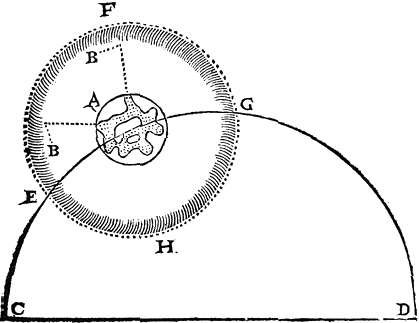
Suppose this earth were A, which was to move in the circle C, D. and let the bullet be supposed at B. within its proper verge; I say, whether this earth did stand stil or move swiftly towards D, yet the bullet would still keepe at the same distance by reason of that Magneticke vertue of the center (if I may so speake) whereby all things within its spheare are attracted 117 I3 with it. So that the violence to the bullet, being nothing else but that whereby ’tis removed from its center, therefore an equall violence can carry a body from its proper place, but at an equall distance whether or no the center stand still or move.
The impartiall Reader may finde sufficient satisfaction for this and such other arguments as may be urged against the motion of that earth in the writings of Capernicus and his followers, unto whom for brevities sake I will referre them.
That there are high Mountaines, deepe vallies, and spacious plains in the body of the Moone.
Though there are some who thinke Mountaines to bee a deformity in the earth, as if they 118 were either beate up by the flood, or else cast up like so many heaps of rubbish left at the creation, yet if well considered, they will be found as much to conduce to the beauty and conveniency of the universe as any of the other parts. Nature (saith Pliny) Nat. hist. l. 36. c. 1. purposely framed them for many excellent uses: partly to tame the violence of greater Rivers, to strengthen certaine joynts within the veines and bowels of the earth, to breake the force of the Seas inundation, and for the safety of the earths inhabitants, whether beasts or men. That they make much for the protection of beasts the Psalmist Psal. 104. v. 18. testifies, The highest hils are a refuge for the wilde Goats, and the rockes for Conies. The Kingly Prophet had learned the safety of these by his owne experience, when he also was faine to make a mountaine his refuge from the fury of his Master Saul, who persecuted him in the wildernesse.
119 I4 True indeed, such places as these keepe their neighbours poore, as beeing most barren, but yet they preserve them safe, as being most strong, witnesse our unconquered Wales and Scotland, whose greatest protection hath beene the naturall strength of their Countrey, so fortified with Mountaines, that these have alwaies been unto them sure retraites from the violence and oppression of others, wherefore a good Authour doth rightly call them natures bulwarkes cast up at God Almighties owne charges, the scornes and curbs of victorious armies, which made the Barbarians in Curtius so confident of their owne safety, when they were once retired to an inaccessible mountaine, that when Alexanders Legate had brought them to a parley and perswading them to yeeld, told them of his masters victories, what Seas and Wildernesses hee had passed, they replyed that all that might 120 be, but could Alexander fly too? Over the Seas he might have ships, and over the land horses, but hee must have wings before he could get up thither. Such safety did those barbarous nations conceive in the mountaines whereunto they were retyred, certainely then such usefull parts were not the effect of mans sinne, or produced by the Worlds curse the flood, but rather at the first created by the goodnesse and providence of the Almighty.
So that if I intend to prove that the Moone is such a habitable world as this is, ’tis requisite that I shew it to have the same conveniences of habitation as this hath, and here if some Rabbi or Chymicke were to handle the point they would first prove it out of Scripture, from that place in Moses his blessing, Deut. 33. 15 where hee speakes of the ancient mountaines and lasting hils, Deut. 33 הררי קדם וגבעות עולם 121 for having immediately before mentioned those blessings which should happen unto Ioseph by the influence of the Moone, he does presently exegetically iterate thẽ in blessing him with the chiefe things of the ancient Mountaines and lasting hils; you may also see the same expression used in Iacobs blessing of Ioseph. Gen. 49. 26
But however we may deale pro or con in Philosophy, yet
we must not jest with divine truths, or bring Scripture to patronize any
fancy of our owne, though, perhaps, it be truth. For the better proofe
of this proposition, I might here cite the testimony of Diodorus,
who thought the Moone to bee full of rugged places, vel ut
terrestribus tumulis superciliosam, but he erred much in some
circumstances of this opinion, especially where he saies, there is an
Iland amongst the Hyperboreans, wherein those hils may to the eye
bee plainely discovered, and for this
122
reason.
* Lect. ant. l. 1. c. 15.
Plut. de plac. l. 2. c. 25.
De cœlo. l. 2. p. 49.
*Cælius calls him a fabulous Writer, but you may see more
expresse authority for the proofe of this in the opinions of
Anaxagoras and Democritus,
who held that this Planet was full of champion grounds, mountains and
vallies, and this seemed likewise probable unto Augustinus Nifus,
whose words are these: Forsitan non est remotum dicere, lunæ partes
esse diversas, veluti sunt partes terræ, quarum aliæ sunt vallosæ, aliæ
montosæ, ex quarum differentia effici potest facies illa lunæ; nec est
rationi dissonum, nam luna est corpus imperfectè Sphæricum, cum sit
corpus ab ultimo cœlo elongatum, ut supra dixit Aristoteles.
Perhaps, it would not be amisse to say that the parts of the Moone were divers, as the parts of this earth, whereof some are vallies, and some mountaines, from the difference of which, some spots in the Moone may proceed, nor is this against reason, for that 123 Planet cannot be perfectly sphericall, since ’tis so remote a body from the first orbe, as Aristotle had said before.
You may see this truth assented unto by Blancanus the Jesuit,
De Mundi fab. pars 3ª. c. 4.
Astron. Opt. c. 6. num 9.
that the division of her enlightened part from the shaded, was made by a
and by him confirmed with with divers reasons. Keplar hath
observed in the Moones eclipses,
crooked unequall line, of which there cannot be any probable cause
conceived, unlesse it did arise from the ruggednesse of that planet, for
it cannot at all be produc’d from the shade of any mountains here upon
earth, because these would be so lessned before they could reach so high
in a conicall shadow, that they would not be at all sensible unto us (as
might easily be demonstrated) nor can it be conceived what reason of
this difference there should be in the Sunne. Wherefore there being no
other body that hath any thing to doe in eclipses, we must necessarily
124
conclude, that it is caused by a variety of parts in the Moone it selfe,
and what can there be but its gibbosities? Now if you should aske a
reason why there should be such a similitude of these in that Planet,
the same Keplar shall jest you out an answere, for supposing
(saith he) those inhabitants are bigger than any of us in the same
proportion, as their daies are longer than ours, viz. by fifteen times
it may bee for want of stones to erect such vast houses as were
requisite for their bodies, they are faine to digge great and round
hollowes in the earth, where they may both procure water for their
thirst, and turning about with the shade, may avoid those great heats
which otherwise they would be lyable unto; or if you will give Cæsar
la Galla leave to guesse in the same manner, he would rather think
that those thirsty nations cast up so many and so great heaps of earth
in digging of their wine cellars,
125
but this onely by the way.
I shall next produce the eye-witnesse of Galilæus, Nuncius Sydereus. on which I most of all depend for the proofe of this Proposition, when he beheld the new Moone through his perspective, it appeared to him under a rugged and spotted figure, seeming to have the darker and enlightned parts divided by a tortuous line, having some parcels of light at a good distance from the other, and this difference is so remarkable, that you may easily perceive it through one of those ordinary perspectives, which are commonly sold amongst us, but for your better apprehending of what I deliver, I will set downe the Figure as I find it in Galilæus:
126
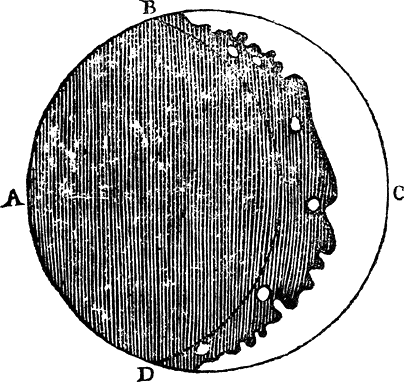
Suppose ABCD to represent the appearance of the Moones body being in a sextile, you may see some brighter parts separated at a pretty distance from the other, which can bee nothing else but a reflexion of the Sunne-beames upon some parts that are higher then the rest, and those obscure gibbosities 127 which stand out towards the enlightened parts must bee such hollow and deepe places whereto the rayes cannot reach, but when the Moone is got further off from the Sunne, and come to that fulnesse, as this line BD doth represent her under, then doe these parts also receive an equall light, excepting onely that difference which doth appeare betwixt their sea and land. And if you do consider how any rugged body would appeare, being enlightned, you would easily conceive that it must necessarily seeme under some such gibbous unequall forme, as the Moone is here represented. Now for the infallibility of these appearances, I shall referre the reader to that which hath beene said in the 6th Proposition.
But Cæsar la Galla affirmes, that all these appearances may consist with a plaine superficies, if wee suppose the parts of the body to be some of them, Diaphanous, and 128 some opacous; and if you object that the light which is conveyed to any diaphanous part in a plaine superficies must be by a continued line, whereas here there appeare many brighter parts among the obscure at some distance from the rest. To this he answers, it may arise from some secret conveyances and channels within her body, that doe consist of a more diaphanous matter which being covered over with an opacious superficies, the light passing through them may breake out a great way off, whereas the other parts betwixt may still remaine darke. Just as the River Arethusa in Sicile which runnes under ground for a great way, and afterwards breakes out againe. But because this is one of the chiefest fancies whereby hee thinkes hee hath fully answered the arguments of this opinion, I will therefore set downe his answere in his owne words, lest the Reader might suspect more in 129 K them then I have expressed. Cap. 11. Non est impossibile cœcos ductus diaphani & perspicui corporis, sed opacâ superficie protendi, usque in diaphanam aliquam ex profundo in superficiem, emergentem partem, per quos ductus lumen longo postmodum interstitio erumpat, &c. But I reply, if the superficies betwixt these two enlightened parts remaine darke because of its opacity, then would it alwaies be darke, and the Sunne could not make it partake of light more then it could of perspicuity: But this contradicts all experience as you may see in Galilæus, who affirmes that when the Sunne comes nearer to his opposition, then that which is betwixt them, both is enlightned as well as either. Nay this opposes his owne eye-witnesse, for he confesses himselfe that he saw this by the glasse. He had said before that he came to see those strange sights discovered by Galilæus his glasse with an intent of contradiction, and you 130 may reade that confirmed in the weakenesse of this answere, which rather bewrayes an obstinate then a perswaded will, for otherwise sure hee would never have undertooke to have destroyed such certaine proofes with so groundlesse a fancy.
But it may bee objected, that ’tis almost impossible, and altogether unlikely that in the Moone there should be any mountaines so high as those observations make them, for doe but suppose according to the common principles, that the Moones diameter unto the Earths is very neere to the proportion of 2. to 7, suppose withall that the Earths diameter containes about 7000 Italian miles, and the Moones 2000 (as is commonly granted) now Galiæus hath observed that some parts have been enlightened when they were the twentieth part of the diameter distant from the common terme of illumination, so that 131 K2 hence it must necessarily follow that there may bee some Mountaines in the Moone so high, that they are able to cast a shadow a 100 miles off. An opinion that sounds like a prodigie or a fiction; wherefore ’tis likely that either those appearances are caused by somewhat else besides mountaines, or else those are fallible observations, from whence may follow such improbable inconceiveable consequences.
But to this I answere:
1. You must consider the height of the Mountaines is but very little, if you compare them to the length of their shadowes. Sr. Walter Rawleigh Hist. l. 1. c. 7. § 11. observes that the Mount Athos now called Lacas casts its shadow 300 furlongs, which is above 37 miles, and yet that Mount is none of the highest, nay Solinus Poly. histor. c. 21. (whom I should rather believe in this kinde) affirmes that this Mountaine gives his shadow quite over the Sea, from 132 Macedon to the Ile of Lemnos which is 700 furlongs or 84 miles, and yet according to the common reckoning it doth scarce reach 4 miles upwards, in its perpendicular height.
2. I affirme that there are very high Mountaines in the Moone. Keplar and Galilæus thinke that they are higher than any which are upon our earth. But I am not of their opinion in this, because I suppose they goe upon a false ground whilst they conceive that the highest mountaine upon the earth is not above a mile perpendicular.
Whereas ’tis the common opinion and found true enough by observation,
that Olympus, Atlas, Taurus and Emus4, with many others are
much above this height. Tenariffa in the Canary Ilands is proved
by computation to bee above 8 miles perpendicular, and about this height
is the mount Perjacaca in America. Sr.
Walter
133
K3
Rawleigh seemes to thinke, that the highest of these is neere 30
miles upright: nay Aristotle
Meteor. l. 1. c. 11.
speaking of Caucasus in Asia, affirmes it to bee visible
for 560 miles, as some interpreters finde by computation, from which it
will follow, that it was 78 miles perpendicularly high, as you may see
confirmed by Jacobus Mazonius,
Comparatio Arist. cum Platone, Sect. 3. c. 5.
Exposi. in loc. Math. Artis. loc. 148.
and out of him in Blancanus the Jesuite. But this deviates from
the truth more in excesse then the other doth in defect. However though
these in the moone are not so high as some amongst us, yet certaine it
is they are of a great height, and some of them at the least foure miles
perpendicular. This I shall prove from the observation of
Galilæus, whose glasse can shew this truth to the senses, a
proofe beyond exception and certaine that man must needs be of a most
timerous faith who dares not believe his owne eye.
By that perspective you may 134 plainely discerne some enlightned parts (which are the mountaines) to be distant from the other about the twentieth part of the diameter. From whence it will follow, that those mountaines must necessarily be at the least foure Italian miles in height.
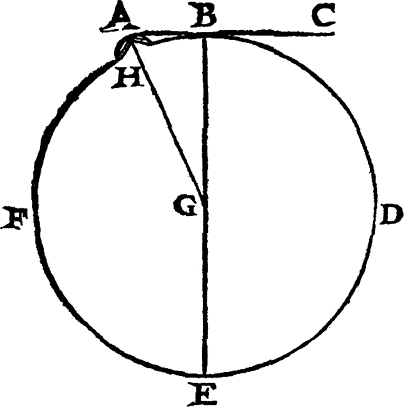
For let BDEF be the body of the moone, ABC will be a ray or beame of the Sunne, which enlightens a mountaine at A and 135 K4 B is the point of contingency, the distance betwixt A and B must bee supposed to be the twentieth part of the diameter which is an 100 miles, for so far are some enlightened parts severed from the common terme of illumination. Now the aggregate of the quadrate from A B a hundred, and B G a 1000 will bee 1010000, unto which the quadrate arising from A G must be equall according to the 47th proposition in the first booke of elements. Therefore the whole line A G is somewhat more than 104, and the distance betwixt H A must be above 4 miles, which was the thing to be proved.5
But it may be againe objected, if there be such rugged parts, and so high mountaines, why then cannot wee discerne them at this distance, why doth the moone appeare unto us so exactly round, and not rather as a wheele with teeth?
136 I answere, by reason of too great a distance, for if the whole body appeare to our eye so little, then those parts which beare so small a proportion to the whole will not at all be sensible.
But it may be replied, if there were any such remarkeable hils, why does not the limbe of the moone appeare like a wheele with teeth to those who looke upon it through the great perspective on whose witnesse you so much depend? or what reason is there that she appeares as exactly round through it as shee doth to the bare eye? certainely then either there is no such thing as you imagine, or else the glasse failes much in this discovery.
To this I shall answere out of Galilæus.
1. You must know that there is not meerely one ranke of mountaines about the edge of the moone, but divers orders, one mountaine behind another, and 137 so there is somewhat to hinder those void spaces which otherwise, perhaps, might appeare.
Now where there be many hils, the ground seemes even to a man that can see the tops of all. Thus when the sea rages, and many vast waves are lifted up, yet all may appeare plaine enough to one that stands at the shore. So where there are so many hils, the inequality will be lesse remarkable, if it be discerned at a distance.
2. Though there be mountains in that part which appeares unto us, to be the limbe of the Moone, as well as in any other place, yet the bright vapours hide their appearance: for there is an orbe of thicke vaporous aire that doth immediatly compasse the body of the Moone, which though it have not so great opacity, as to terminate the sight, yet being once enlightened by the Sunne, it doth represent the body of the Moone under a greater forme, and hinders 138 our sight from a distinct view of her true circumference. But of this in the next Chapter.
I have now sufficiently proved, that there are hills in the Moone, and hence it may seeme likely that there is also a world, for since providence hath some speciall end in all its workes, certainly then these mountaines were not produced in vaine, and what more probable meaning can wee conceive there should be, than to make that place convenient for habitation.
That there is an Atmo-sphæra, or an orbe of grosse vaporous aire, immediately encompassing the body of the Moone.
As that part of our aire which is neerest to the earth, is of a thicker substance than the other, by reason tis alwaies mixed with 139 some vapours, which are continually exhaled into it. So is it equally requisite, that if there be a world in the Moone, that the aire about that should be alike qualified with ours. Now, that there is such an orbe of grosse aire, was first of all (for ought I can reade) observed by Meslin, afterwards assented unto by Keplar and Galilæus, Vide Euseb. Nierem. de Nat. Hist. l. 2. c. 11. and since by Baptistae Cisatus, Sheiner with others, all of them confirming it by the same arguments which I shall onely cite, and then leave this Proposition.
1. ’Tis observed, that so much of the Moone as is enlightened, is alwaies part of a bigger circle then that which is darker. Their frequent experience hath proved this, and an easie observation may quickely confirme it. But now this cannot proceede from any other cause so probable, as from this orbe of aire, especially when we consider how that planet shining with a borrowed light, doth not 140 send forth any such rayes as may make her appearance bigger then her body.
2. ’Tis observed in the Solary eclipses, that there is a great trepidation about the body of the Moone, from which we may likewise argue an Atmo-sphæra, since we cannot well conceive what so probable a cause there should be of such an appearance as this, Quod radii Solares à vaporibus Lunam ambientibus fuerint intercisi, Scheiner. Ros. Vrs. l. 4. pars 2. c. 27. that the Sun beames were broken and refracted by the vapours that encompassed the Moone.
3. I may adde the like argument taken from another observation which will be easily tried and granted. When the Sunne is eclipsed, wee discerne the Moone as shee is in her owne naturall bignesse, but then she appeares somewhat lesse then when shee is in the full, though she be in the same place of her supposed excentrick and epicycle, and therefore Tycho 141 hath calculated a Table for the Diameter of the divers new Moones. But now there is no reason so probable to salve this appearance, as to place an orbe of thicker aire, neere the body of that Planet, which may be enlightened by the reflected beames, and through which the direct raies may easily penetrate.
But some may object that this will not consist with that which was before delivered, where I said, that the thinnest parts had least light.
If this were true, how comes it to passe then, that this aire should be as bright as any of the other parts, when as tis the thinnest of all?
I answer, if the light be received by reflection, then the thickest body hath most because it is best able to beare backe the raies, but if the light be received by illumination Hist. l. 1. c. 7. § 11. (especially if there be an opacous body behinde, 142 which may double the beames by reflexion) as it is here, then I deny not but a thinne body may retaine much light, and perhaps, some of those appearances which wee take for fiery comets, are nothing else but a bright cloud enlightened, so that probable it is, there may be such aire without the Moone, and hence it comes to passe, that the greater spots are onely visible towards her middle parts, and none neere the circumference, not but that there are some as well in those parts as else where, but they are not there perceiveable, by reason of those brighter vapours which hide them.
143That as their world is our Moone, so our world is their Moone.
Ihave already handled the first thing that I promised according to the Method which Aristotle uses in his Booke de Mundo, and shew’d you the necessary parts that belong to this world in the Moone. In the next place ’tis requisite that I proceed to those things which are extrinsecall unto it, as the Seasons, the Meteors, and the Inhabitants.
And if there be such a world in the Moone, ’tis requisite then that their seasons should be some way correspondent unto ours, that they should have Winter and Summer, night and day, as wee have.
Now that in this Planet there is some similitude of Winter and
144
Summer is affirmed by Aristotle
De gen. animal. l. 4. 12.
himselfe, since there is one hemispheare that hath alwaies heate and
light, and the other that hath darknesse and cold. True indeed, their
daies and yeeres are alwaies of one and the same length, but tis so with
us also under the Poles, and therefore that great difference is not
sufficient to make it altogether unlike ours, nor can we expect that
every thing there should be in the same manner as it is here below, as
if nature had no way but one to bring about her purposes. Wee may easily
see what great differences there are amongst us, betwixt things of the
same kinde. Some men (say they)
Plat. de fac.
De naturâ populorum. c. 3.
there are, who can live onely upon smells, without eating any thing, and
the same Plant, saith Besoldus, hath sometimes contrary effects.
Mandragora which growes in Syria inflames the lust, wheras
Mandragora which grows in other places doth coole the blood &
quench lust.
145 L Now if with us there be such great difference betwixt things of the same kinde, we have no reason then to thinke it necessary that both these worlds should be altogether alike, but it may suffice if they bee correspondent in something onely, however it may be questioned whether it doth not seeme to be against the wisedome of providence, to make the night of so great a length, when they have such a long time unfit for worke? I answere no, since tis so, and more with us also under the poles; and besides, the generall length of their night is somewhat abated in the bignesse of their Moone which is our earth. For this returnes as great a light unto that Planet, as it receives from it. But for the better proofe of this, I shall first free the way from such opinions as might otherwise hinder the speede of a clearer progresse.
Plutarch Plut. de fac. lunæ. one of the chiefe patrons 146 of this world in the Moone, doth directly contradict this proposition; affirming, that those who live there may discerne our world as the dregges and sediment of all other creatures, appearing to them through clouds and foggy mists, and that altogether devoid of light, being base and unmoveable, so that they might well imagine the darke place of damnation to be here situate, and that they onely were the inhabiters of the world, as being in the midst betwixt Heaven and Hell.
To this I may answere, ’tis probable that Plutarch spake this inconsiderately, and without a reason, which makes him likewise fall into another absurditie, when he sayes our earth would appeare immoveable, whereas questionlesse though it did not, yet would it seeme to move, and theirs to stand still, as the Land doth to a man in a Shippe; according to 147 L2 that of the Poet:
Provehimur portu, terræque urbesque recedunt.
And I doubt not but that ingenuous Authour would easily have recanted if hee had beene but acquainted with those experiences which men of latter times have found out, for the confirmation of this truth.
2. Unto him assents Macrobius, whose words are these; Terra accepto solis lumine clarescit, tantummodò, non relucet.
The earth is by the Sunne-beames made bright, but not able to enlighten any thing so farre.
And his reason is, because this being of a thicke and grosse matter, the light is terminated in its superficies, and cannot penetrate into the substance; whereas the moone doth therefore seeme so bright to us, because it receives the beames within it selfe. But the weaknesse of this assertion, may bee easily manifest by a common experience, 148 for polished steele (whose opacity will not give any admittance to the rayes) reflects a stronger heate then glasse, and so consequently a greater light.
3. ’Tis the generall consent of Philosophers, that the reflection of the Sunne-beames from the earth doth not reach much above halfe a mile high, where they terminate the first region, so that to affirme they might ascend to the moone, were to say, there were but one region of aier, which contradicts the proved and received opinion.
Unto this it may be answered:
That it is indeed the common consent, that the reflexion of the Sunne-beames reach onely to the second region, but yet some there are, and those too Philosophers of good note, who thought otherwise. Thus Plotinus is cited by Cælius, Ant. lect. l. 1. c. 4. Si concipias te in sublimi quopiam mundi loco, unde oculis subjiciatur terræ moles aquis circumfusa, 149 L3 & solis syderumque radiis illustrata, non aliam profecto visam iri probabile est, quam qualis modo visatur lunaris globi species.
If you did conceive your selfe to bee in some such high place, where you might discerne the whole Globe of the earth and water, when it was enlightned by the Sunnes rayes, ’tis probable it would then appeare to you in the same shape as the moone doth now unto us.
Thus also Carolus Malapertius, whose words are these, Præfat. ad Austrica syd. Terra hæc nostra si in luna constituti essemus, splendida prorsus quasi non ignobilis planeta, nobis appareret.
If wee were placed in the moone, and from thence beheld this our earth, it would appeare unto us very bright, like one of the nobler Planets.
Unto these doth Fromondus assent, when he sayes, Meteor. l. 1. c. 2. Art. 2. Credo equidem quod si oculus quispiam in orbe lunari foret, globum terræ & aquæ instar ingentis syderis 150 à sole illustrem conspiceret.
I believe that this globe of earth and water would appeare like some great Starre to any one, who should looke upon it from the moone.
Now this could not be, nor could it shine so remarkably, unlesse the beames of light, were reflected from it. And therefore the same Fromondus expresly holds, that the first region of ayre is there terminated, where the heate caused by reflexion begins to languish, whereas the beames themselves doe passe a great way further. The chiefe argument which doth most plainely manifest this truth, is taken from a common observation which may be easily tryed.
If you behold the Moone a little before or after the conjunction, when she is in a sextile with the Sunne, you may discerne not onely the part which is enlightned, but the rest also to have in it a kind of a duskish light, but if you 151 L4 chuse out such a scituation, where some house or chimney (being some 70 or 80 paces distant from you) may hide from your eye the enlightned hornes, you may then discerne a greater and more remarkeable shining in those parts unto which the Sunne beames cannot reach; nay there is so great a light, that by the helpe of a good perspective you may discerne its spots. Inso much that Blancanus the Jesuite speaking of it sayes De mundi fab. p. 3ª. c. 3. Hæc experientia ita me aliquando fefellit, ut in hunc fulgorem casu ac repente incidens, existimarim novo quodam miraculo tempore adolescentis lunæ factum esse plenilunium.
This experiment did once so deceive mee, that happening upon the sight of this brightnesse upon a sudden, I thought that by some new miracle the Moone had beene got into her full a little after her change.
But now this light is not proper 152 to the Moone, it doth not proceed from the rayes of the Sunne which doth penetrate her body, nor is it caused by any other of the Planets and Starres. Therefore it must necessarily follow, that it comes from the earth. The two first of these I have already proved, and as for the last, it is confidently affirmed by Cælius, Progym. 1. Quod si in disquisitionem evocet quia, an lunari syderi lucem fœnerent planetæ item alii, asseveranter astruendum non fœnerare.
If any should aske whether the other Planets lend any light to the Moone; I answer they doe not.
True indeed, the noble Tycho l. 20. c. 5.6 discussing the reason of this light attributes it to the Planet Uenus, and I grant that this may convey some light to the Moone; but that it is not the cause of this whereof wee now discourse, is of itselfe sufficiently plaine, because Uenus is sometimes over the Moone, when as shee cannot convey any light to that 153 part which is turned from her.
It doth not proceede from the fixed starres, for then it would retaine the same light in eclipses, whereas the light at such times is more ruddy and dull. Then also the light of the Moone would not be greater or lesser, according to its distance from the edge of the earths shadow, since it did at all times equally participate this light of the starres.
Now because there is no other body in the whole Universe, save the earth, it remaines that this light must necessarily be caused by that which with a just gratitude repaies to the Moone, such illumination as it receives from her.
And as loving friends equally participate of the same joy and griefe, so doe these mutually partake of the same light from the Sunne, and the same darkenesse from the eclipses, being also severally helped by one another in 154 their greatest wants: For when the Moone is in conjunction with the Sunne, and her upper part receives all the light, then her lower Hemispheare (which would otherwise be altogether darke) is enlightened by the reflexion of the Sunne beames from the earth. When these two planets are in opposition, then that part of the earth which could not receive any light from the Sunne beames, is most enlightened by the Moone, being then in her full; and as she doth most illuminate the earth when the Sunne beames cannot, so the gratefull earth returnes to her as great, nay greater light when shee most wants it; so that alwaies that visible part of the Moone which receives nothing from the Sunne, is enlightened by the earth, as is proved by Galilæus, with many more arguments, in that Treatise which he calls Systema mundi. True indeed, when the Moone comes to a quartile, then 155 you can neither discerne this light, nor yet the darker part of her body, but the reason is, because of the exuperancy of the light in the other parts. Quippe illustratum medium speciem recipit valentiorem, Scal. exerc. 62. the clearer brightnesse involves the weaker, it being with the species of sight, as it is with those of sound, and as the greater noise drownes the lesse, so the brighter object hides that which is more obscure. But they doe alwaies in their mutuall vicissitudes participate of one anothers light; so also doe they partake of the same defects and darknings, for when our Moone is eclipsed, then is their Sunne darkened, and when our Sunne is eclipsed, then is their Moone deprived of its light, as you may see affirmed by Mæslin. Epit. Astro. l. 4. part. 2. Quod si terram nobis ex alto liceret intueri, quemadmodum deficientem lunam ex longinquo spectare possumus, videremus tempore eclipsis solis terræ 156 aliquam partem lumine solis deficere, eodem planè modo sicut ex opposito luna deficit,
If wee might behold this globe of earth at the same distance as we doe the Moone in her defects, wee might discerne some part of it darkened in the Sunnes eclipses, just so as the Moone is in hers.
For as our Moone is eclipsed by the interposition of our earth, so is their Moone eclipsed by the interposition of theirs. The manner of this mutuall illumination betwixt these two you may plainly discerne in this Figure following.
157
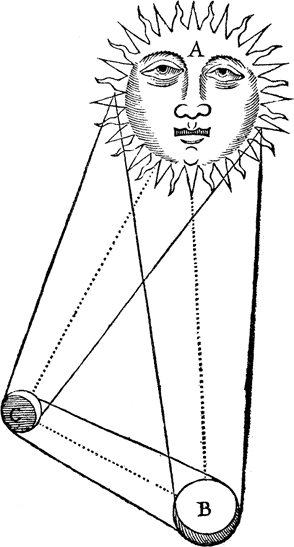
158 Where A represents the Sun, B the Earth, and C the Moone; Now suppose the Moone C to be in a sextile of increase, when there is onely one small part of her body enlightened, then the earth B will have such a part of its visible Hemispheare darkened, as is proportionable to that part of the Moone which is enlightened; and as for so much of the Moone, as the Sun beames cannot reach unto, it receives light from a proportionall part of the earth which shines upon it, as you may plainly perceive by the Figure.
You see then that agreement and similitude which there is betwixt our earth and the Moone. Now the greatest difference which makes them unlike, is this, that the Moone enlightens our earth round about, whereas our earth gives light onely to that Hemispheare of the Moone which is visible unto us, as may be certainly gathered from the constant 159 appearance of the same spots, which could not thus come to passe, if the Moone had such a diurnall motion about its own axis, as perhaps our earth hath. And though some suppose her to move in an epicycle, yet this doth not so turne her body round, that we may discerne both Hemispheares, for according to that hypothesis, the motion of her eccentrick, doth turne her face towards us, as much as the other doth from us.
But now if any question what they doe for a Moone who live in the upper part of her body? I answer, the solving of this is the most uncertaine and difficult thing that I know of concerning this whole matter. But yet I will give you two probable conjectures.
1. Perhaps, the upper Hemispheare of the Moone doth receive a sufficient light from those planets about it, and amongst these Venus (it may be) bestowes a more especiall 160 brightnesse, since Galilæus hath plainly discerned that she suffers the same increase and decreases, as the Moone hath, and ’tis probable that this may be perceived there without the help of a glasse, because they are farre neerer it than wee. When Venus (saith Keplar) lies downe in the Perige or lower part of her supposed Epicycle, then is she in conjunction with her husband the Sunne, from whom after she hath departed for the space of ten moneths, shee gets plenum uterum, and is in the full.7
But you’ll reply, though Venus may bestow some light when she is over the Moone, and in conjunction, yet being in opposition, she is not visible to them, and what shall they then doe for light?
I answer, then they have none: nor doth this make so great a difference betwixt those two Hemispheares as there is with us, betwixt the places under the poles, 161 M and the line, but if this bee not sufficient, then I say in the second place that
2. Perhaps there may be some other enlightened body above the Moone which we cannot discerne, nor is this altogether improbable because there is almost the like observed in Saturne, who appeares through this glasse with two lesser bodies on each side, which may supply the office of Moones, unto each hemispheare thus:
So in this world also there may be some such body, though wee cannot discerne it, because the Moone is alwaies in a streight line, betwixt our eye and that. Nor is it altogether unlikely that there should bee more moones to one Orbe, because Jupiter also is observed to have foure such 162 bodies that move round about him.
But it may seeme a very difficult thing to conceive, how so grosse and darke a body as our earth, should yeeld such cleare light as proceedes from the Moone, and therefore the Cardinall de Cusa De doct. ig. l. 2. c. 12. (who thinkes every Starre to be a severall world) is of opinion that the light of the Sunne is not able to make them appeare so bright, but the reason of their shining is, because wee behold them at a great distance through their regions of fire which doe set a shining lustre upon those bodies that of themselves are darke. Vnde si quis esset extra regionem ignis, terra ista in circumferentia suæ regionis per medium ignis lucida stella appareret.
So that if man were beyond the region of fire, this earth would appear through that as a bright Starre.
But if this were the onely reason then would the Moone bee 163 M2 freed from such increases and decreases as shee is now lyable unto.
Keplar thinkes that our earth receives that light whereby it shines from the Sunne, but this (saith he) is not such an intended cleare brightnesse as the Moone is capable of, and therefore hee guesses, that the earth there is of a more chokie soyle like the Ile of Creete, and so is better able to reflect a stronger light, whereas our earth must supply this intention with the quantity of its body, but this I conceive to be a needlesse conjecture, since our earth if all things were well considered, will be found able enough to reflect as great a light. For
1. Consider its opacity, if you marke these sublunary things, you shall perceive that amongst them, those that are most perspicuous, are not so well able to reverberate the Sunne beames as the thicker bodies. The rayes passe singly 164 through a diaphanous matter, but in an opacous substance they are doubled in their returne and multiplyed by reflexion. Now if the moone and the other Planets can shine so clearely by beating backe the Sunne beames, why may not the earth also shine as well, which agrees with them in the cause of this brightnesse their opacity?
2. Consider what a cleare light wee may discerne reflected from the earth in the middest of Summer, and withall conceive how much greater that must bee which is under the line, where the rayes are more directly and strongly reverberated.
3. Consider the great distance at which wee behold the Planets, for this must needs adde much to their shining and therefore Cusanus (in the above cited place) thinkes that if a man were in the Sunne, that Planet would not appeare so bright to him, as now 165 M3 it doth to us, because then his eye could discerne but little, whereas here wee may comprehend the beames as they are contracted in a narrow body. Keplar beholding the earth from a high mountaine when it was enlightned by the Sunne confesses that it appeared unto him of an incredible brightnesse, whereas then the reflected rayes entered into his sight obliquely; but how much brighter would it have appeared if hee might in a direct line behold the whole globe of earth and these rayes gathered together? So that if wee consider that great light which the earth receives from the Sunne in the Summer, and then suppose wee were in the Moone, where wee might see the whole earth hanging in those vast spaces where there is nothing to terminate the sight, but those beames which are there contracted into a little compasse; I say, if wee doe well consider this, wee may easily 166 conceive, that our earth appeares as bright to those other inhabitants in the Moone, as theirs doth to us.
That tis probable there may bee such Meteors belonging to that world in the Moone, as there are with us.
Plutarch discussing this point affirmes that it is not necessary there should be the same meanes of growth and fructifying in both these worlds, since nature might in her policy finde out more waies then one how to bring about the same effect. But however he thinks its probable that the Moone her selfe sendeth forth warme winds, and by the swiftnesse of her motion there should breathe out a sweet and comfortable ayer, pleasant dewes and gentle moysture, 167 M4 which might serve for the refreshing and nourishment of the inhabitants and plants in that other world.
But since they have all things alike with us, as sea and land, and vaporous ayer encompassing both, I should rather therefore thinke that nature there should use the same way of producing meteors as she doth with us (and not by a motion as Plutarch supposes) because shee doth not love to vary from her usuall operations without some extraordinary impediment, but still keepes her beaten path unlesse she be driven thence.
One argument whereby I shall manifest this truth, may be taken from those new Starres which have appeared in divers ages of the world, and by their parallax have beene discerned to have been above the Moone, such as was that in Cassiopeia, that in Sagittarius, with many others betwixt the Planets. Hipparchus in his time 168 tooke especiall notice of such as these, Plin. nat. hist. l. 2. c. 26. and therefore fancied out such constellations in which to place the Starres, shewing how many there were in every asterisme, that so afterwards posterity might know, whether there were any new Starre produced or any old one missing. Now the nature of these Comets may probably manifest, that in this other world there are other meteors also; for these in all likelihood are nothing else but such evaporations caused by the Sunne, from the bodies of the Planets. I shall prove this by shewing the improbabilities and inconveniences of any other opinion.
For the better pursuite of this ’tis in the first place requisite that I deale with our chiefe adversary, Cæsar la Galla, who doth most directly oppose that truth which is here to bee proved. Hee endeavouring to confirme the incorruptibility of the Heavens, 169 and being there to satisfie the argument which is taken from these comets, He answers it thus: Aut argumentum desumptum ex paralaxi non est efficax, aut si est efficax, eorum instrumentorum usum decipere, vel ratione astri vel medii, vel distantiæ, aut ergo erat in suprema parte aeris, aut si in cœlo, tum forsan factum erat ex reflectione radiorum Saturni & Jovis, qui tunc in conjunctione fuerant.
Either the argument from the paralax is not efficacious, or if it be, yet the use of the instruments might deceive either in regard of the starre or the medium, or the distance, and so this comet might be in the upper regions of the aire, or if it were in the heavens, there it might be produced by the reflexion of the rayes from Saturne and Jupiter, who were then in conjunction.
You see what shifts hee is driven to, how he runnes up and downe to many starting holes, that hee may find 170 some shelter, and in stead of the strength of reason, he answers with a multitude of words, thinking (as the Proverbe is) that hee may use haile, when hee hath no thunder, Nihil turpius (saith * Epist. 95. *Seneca) dubio est incerto, pedem modo referente, modo producente.
What can there bee more unseemely in one that should be a faire disputant, then to be now here, now there, and so uncertaine, that one cannot tell where to find him.
He thinkes that there are not Comets in the heavens, because there may be many other reasons of such appearances, but what he knowes not, perhaps (he saies) that argument from the parallax is not sufficient, or if it be, then there may be some deceit in the observation. To this I may safely say, that hee may justly be accounted a weake Mathematician who mistrusts the strength of this argument, nor can hee know much in Astronomy, who understands 171 not the parallax, which is the foundation of that Science, and I am sure that hee is a timorous man, who dares not believe the frequent experience of his senses, or trust to a demonstration.
True indeed, I grant tis possible, that the eye, the medium, and the distance may al deceive the beholder, but I would have him shew which of all these was likely to cause an error in this observation? Meerely to say they might be deceived is no sufficient answer, for by this I might confute the positions of all Astronomers, and affirme the starres are hard by us, because ’tis possible they may be deceived in their observing that distance. But I forbeare any further reply; my opinion is of that Treatise, that either it was set forth purposely to tempt a confutation, that hee might see the opinion of Galilæus confirmed by others, or else it was invented with as much haste and negligence as it was printed, there 172 being in it almost as many faults as lines.
Others thinke that these are not any new Comets, but some ancient starres that were there before, which now shine with that unusuall brightnesse, by reason of the interposition of such vapors which doe multiply their light, and so the alteration will be here onely, and not in the heavens. Thus Aristotle thought the appearance of the milkie way was produced, for he held that there were many little starres, which by their influence did constantly attract such a vapour towards that place of heaven, so that it alwaies appeared white. Now by the same reason may a brighter vapor be the cause of these appearances.
But how probable soever this opinion may seeme, yet if well considered, you shall finde it to be altogether absurd and impossible: for,
1. These starres were never 173 seene there before, and tis not likely that a vapour being hard by us can so multiply that light which could not before be at all discerned.
2. This supposed vapour cannot be either contracted into a narrow compasse or dilated into a broad: 1. it could not be within a little space, for then that starre would not appeare with the same multiplied light to those in other climates: 2. it cannot be a dilated vapour, for then other starres which were discerned through the same vapour would seeme as bigg as that; this argument is the same in effect with that of the paralax, as you may see in this Figure.
174
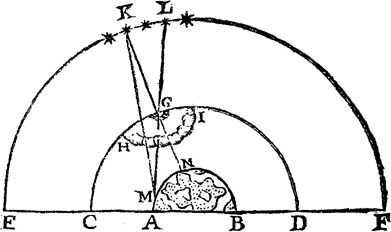
Suppose A B to be a Hemispheare of one earth, C D to be the upper part of the highest region, in which there might be either a contracted vapour, as G, or else a dilated one, as H I. Suppose E F likewise to represent halfe the heavens, wherein was this appearing Comet at K. Now I say, that a contracted vapour, as G, could not cause this appearance, because an inhabitant at M could not discerne the same starre 175 with this brightnesse, but perhaps another at L, betwixt which the vapour is directly interposed. Nor could it be caused by a dilated vapour, as H I, because then all the starres that were discerned through it would be perceived with the same brightnesse.
Tis necessary therefore that the cause of this appearance should be in the heavens. And this is granted by the most and best Astronomers. But, say some, this doth not argue any naturall alteration in those purer bodies, since tis probable that the concourse of many little vagabond starres by the union of their beames may cause so great a light. Of this opinion were Anaxagoras and Zeno amongst the ancient, and Baptista Cisatus, Blancanus, with others amongst our moderne Astronomers. For, say they, when there happens to be a concourse of some few starres, then doe many other flie unto them from all the parts of heaven 176 like so many Bees unto their King. But 1. tis not likely that amongst those which wee count the fixed starres there should be any such uncertaine motions, that they can wander from all parts of the heavens, as if Nature had neglected them, or forgot to appoint them a determinate course. 2. If there be such a conflux of these, as of Bees to their King, then what reason is there that they doe not still tarry with it, that so the Comet may not be dissolved? But enough of this. You may commonly see it confuted by many other arguments. Others there are, who affirme these to be some new created stars, produced by an extraordinary supernaturall power. I answer, true indeed, tis possible they might be so, but however tis not likely they were so, since such appearances may be salved some other way, wherefore to fly unto a miracle for such things, were a great injury to nature, and to derogate 177 N from her skill, an indignitie much mis-becomming a man who professes himselfe to be a Philosopher, Miraculum (saith one) est ignorantiæ Asylum, a miracle often serves for the receptacle of a lazy ignorance which any industrious Spirit would be ashamed of, it being but an idle way to shift off the labour of any further search. But here’s the misery of it, wee first tie our selves unto Aristotles Principles, and then conclude, that nothing could contradict them but a miracle, whereas ’twould be much better for the Common-wealth of learning, if we would ground our Principles rather upon the frequent experiences of our owne, then the bare authority of others.
Some there are, who thinke that these Comets are nothing else, but exhalations from our earth, carried up into the higher parts of the Heaven. So Peno, 178 Rothmannus & Galilæus, Tycho Progym. l. 1. cap. 9. but this is not possible, since by computation ’tis found that one of them is above 300 times bigger than the whole Globe of Land and Water. Others therefore have thought that they did proceed from the body of the Sun, and that that Planet onely is Cometarum officina, unde tanquam emissarii & exploratores emitterentur, brevi ad solem redituri: The shop or forge of Comets from whence they were sent, like so many spies, that they might in some short space returne againe, but this cannot be, since if so much matter had proceeded from him alone, it would have made a sensible diminution in his body. The Noble Tycho therefore thinkes that they consist of some such fluider parts of the Heaven, as the milkie way is framed of, which being condenst together, yet not attaining to the consistency of a Starre, is in 179 N2 some space of time rarified againe into its wonted nature. But this is not likely, for if there had beene so great a condensation as to make them shine so bright, and last so long, they would then sensibly have moved downewards towards some center of gravity, because whatsoever is condenst must necessarily grow heavier, whereas these rather seemed to ascend higher, as they lasted longer. But some may object, that a thing may be of the same weight, when it is rarified, as it had while it was condenst: so metalls, when they are melted, and when they are cold: so water also when it is frozen, and when it is fluid, doth not differ in respect of gravity. But to these I answer: First, Metalls are not rarified by melting, but molified. Secondly, waters are not properly condensed, but congealed into a harder substance, the parts being not 180 contracted closer together, but still possessing the same extension.
And beside, what likely cause can we conceive of this condensation,
unlesse there be such qualities there, as there are in our ayre, and
then why may not the Planets have the like qualities, as our earth? and
if so, then ’tis more probable that they are made by the ordinary way of
nature, as they are with us, and consist of exhalations from the bodies
of the Planets. Nor is this a singular opinion; but it seemed most
likely to Camillus Gloriosus, Th. Campanella,
Fromondus,
De Comet. l. 5. c. 4.
Apolog.
Meteor. l. 3. c. 2. Art. 6.
Iohan. Fabr.
Carolus Malaptius de Heliocyc.
Scheiner. Rosa Vrsina.
with some others. But if you aske whither all these exhalations shall
returne, I answer, every one into his owne Planet: if it be againe
objected,
that then there will be so many centers of gravity, and each severall
Planet will be a distinct world; I reply, perhaps all of them are
181
N3
so except the Sunne, though Cusanus thinkes there is one also,
and later times have discovered some lesser Planets moving round about
him. But as for Saturne, he hath two Moones on each side.
Jupiter hath foure, that incircle his body with their motion.
Venus is observed to increase and decrease as the Moone.
Mars, and all the rest, derive their light from the Sunne onely.
Concerning Mercury, there hath beene little or no observation,
because for the most part, he lies hid under the Sunne beames, and
seldome appeares by himselfe. So that if you consider their quantity,
their opacity, or these other discoveries, you shall finde it probable
enough, that each of them may be a severall world. But this would be too
much for to vent at the first: the chiefe thing at which I now
ayme in this discourse, is to
182
prove that there may be one in the Moone.
It hath beene before confirmed that there was a spheare of thicke vaporous aire encompasing the Moone, as the first and second regions doe this earth. I have now shewed, that thence such exhalations may proceede as doe produce the Comets: now from hence it may probably follow, that there may be wind also and raine, with such other Meteors as are common amongst us. This consequence is so dependant, that Fromondus De meteor. l. 3. c. 2. Art. 6. dares not deny it, though hee would (as hee confesses himselfe) for if the Sunne be able to exhale from them such fumes as may cause Comets, why not then such as may cause winds, and why not such also as cause raine, since I have above shewed, that there is Sea and Land as with us. Now raine seemes to be more especially requisite for them, 183 N4 since it may allay the heate and scorchings of the Sunne, when he is over their heads. And nature hath thus provided for those in Peru, with the other inhabitants under the line.
But if there be such great, and frequent alterations in the Heavens, why cannot wee discerne them?
I answer:
1. There may be such, and we not able to perceive them, because of the weaknesse of our eye, and the distance of those places from us, they are the words of Fienus, as they are quoted by Fromondus in the above cited place,8 Possunt maximæ permutationes in cœlo fieri, etiamsi a nobis non conspiciantur, hoc visus nostri debilitas & immensa cœli distantia faciunt. And unto him assents Fromondus himselfe, when a little after hee saies, Si in sphæris planetarum degeremus, plurima forsan cœlestium nebularum vellere toto æthere passim 184 dispersa videremus, quorum species jam evanescit nimia spatii intercapedine.
If we did live in the spheares of the Planets, wee might there, perhaps, discerne many great clouds dispersed through the whole Heavens, which are not now visible by reason of this great distance.
2. Mæslin and Keplar affirme, that they have seene some of these alterations. The words of Mæslin are these (as I finde them cited.) Disser. 2. cum nunc. Galil.9 In eclipsi Lunari vespere Dominicæ Palmarum Anni 1605, in corpore Lunæ versus Boream, nigricans quædam macula conspecta fuit, obscurior cætero toto corpore, quod candentis ferri figuram repræsentabat; dixisses nubila in multam regionem extensa pluviis & tempestuosis imbribus gravida, cujusmodi ab excelsorum montium jugis in humiliora convallium loca videre non rarò contingit.
In that lunary eclipse which happened in the even of Palme-sunday, 185 in the yeere 1605, there was a certaine blackish spot discerned in the Northerly part of the Moone, being darker than any other part of her body, and representing the colour of red hot yron; you might conjecture that it was some dilated cloud, being pregnant with showers, for thus doe such lower clouds appeare from the tops of high mountaines.
Unto this I may adde another testimony of Bapt. Cisatus, as he is quoted by Nierembergius, Hist. Nat. l. 2. c. 11. grounded upon an observation taken 23. yeeres after this of Mæslin, and writ to this Euseb. Nieremberg. in a letter by that diligent and judicious Astronomer. The words of it runne thus: Et quidem in eclipsi nupra solari quæ fuit ipso die natali Christi, observavi clarè in luna soli supposita, quidpiam quod valde probat id ipsum quod Cometæ quoque & maculæ solares urgent, nempe cœlum non esse 186 à tenuitate & variationibus aeris exemptum, nam circa Lunam adverti esse sphæram seu orbem quendam vaporosum, non secus atque circum terram, adeoque sicut ex terra in aliquam usque sphæram vapores & exhalationes expirant, ita quoque ex luna.
In that late solary eclipse which happened on Christmas day, when the Moone was just under the Sunne, I plainly discerned that in her which may clearely confirme what the Comets and Sunne spots doe seeme to prove, viz. that the heavens are not solid, nor freed from those changes which our aire is liable unto, for about the Moone I perceived such an orbe of vaporous aire, as that is which doth encompasse our earth, and as vapours and exhalations, are raised from our earth into this aire, so are they also from the Moone.
You see what probable 187 grounds and plaine testimonies have brought for the confirmation of this Proposition: many other things in this behalfe might be spoken, which for brevity sake I now omit, and passe unto the next.
That tis probable there may be inhabitants in this other World, but of what kinde they are is uncertaine.
I have already handled the Seasons and Meteors belonging to this new World: ’tis requisite that in the next place I should come unto the third thing which I promised, and to say somewhat of the inhabitants, concerning whom there might be many difficult questions raised, as whether that place be more inconvenient for habitation 188 then our World (as Keplar thinkes) whether they are the seed of Adam, whether they are there in a blessed estate, or else what meanes there may be for their salvation, with many other such uncertaine enquiries, which I shall willingly omit, leaving it to their examination, who have more leisure and learning for the search of such particulars.
Being for mine own part content only to set downe such notes belonging unto these which have observed in other Writers. Cum tota illa regio nobis ignota sit, remanent inhabitores illi ignoti penitus, (saith Cusanus) De doct. ign. l. 2. c. 12. since we know not the regions of that place, wee must be altogether ignorant of the inhabitants. There hath not yet beene any such discovery concerning these, upon which wee may build a certainty, or good probability: well may wee guesse at them, and 189 that too very doubtfully, but we can know nothing, for if we doe hardly guesse aright at things which be upon earth, if with labour wee doe finde the things that are at hand, Wisd. 9. 16. how then can wee search out those things that are in Heaven? What a little is that which wee know? in respect of those many matters contained within this great Universe, this whole globe of earth and water? though it seeme to us to be of a large extent, yet it beares not so great a proportion unto the whole frame of Nature, as a small sand doth unto it; and what can such little creatures as wee discerne, who are tied to this point of earth? or what can they in the Moone know of us? If wee understand any thing (saith Esdras) 2 Esd. 4. 22. ’tis nothing but that which is upon the earth, and hee that dwelleth above in the Heavens, may onely understand 190 the things that are above in the heighth of the heavens.
So that ’twere a very needelesse thing for us, to search after any particulars, however, wee may guesse in the generall, that there are some inhabitants in that Planet: for why else did Providence furnish that place with all such conveniences of habitation as have beene above declared?
But you will say, perhaps, is there not too great and intollerable a heate, since the Sunne is in their Zinith every moneth, and doth tarry their so long before hee leaves it?
I answer, 1. This may, perhaps, be remedied (as it is under the line) by the frequencie of mid-day showers, which may cloud their Sunne, and coole their earth: 2. The equality of their nights doth much temper the scorching of the day, and the extreme cold that comes 191 from the one, require some space before it can be dispelled by the other, so that the heate spending a great while before it can have the victory, hath not afterwards much time to rage in. Wherfore notwithstanding this, yet that place may remaine habitable. And this was the opinion of the Cardinal de Cusa, when speaking of this Planet, he saies, De doct. ign. l. 2. c. 12. Hic locus Mundi est habitatio hominum & animalium atque vegetabilium.
This part of the world is inhabited by men and beasts, and Plantes.
To him assented Campanella, but hee cannot determine whether there were men, or rather some other kinde of creatures. If they were men, then he thinkes they could not be infected with Adams sinne; yet, perhaps, they had some of their owne, which might make them liable to the same misery with us, out of which, perhaps, they were delivered 192 by the same means as we, the death of Christ, and thus he thinkes that place of the Ephesians may be interpreted, where the Apostle saies, Eph. 1. 10. God gathered all things together in Christ, both which are in earth, and which are in the heavens: So also that of the same Apostle to the Colossians, where hee saies, Col. 1. 20. that it pleased the Father to reconcile all things unto himselfe by Christ, whether they be things in earth, or things in heaven.
But I dare not jest with Divine truthes, or apply these places according as fancy directs. As I thinke this opinion doth not any where contradict Scripture, so I thinke likewise, that it cannot be proved from it, wherefore Campanella’s second conjecture may be more probable, that the inhabitants of that world, are not men as wee are, but some other kinde of creatures which beare some proportion 193 O and likenesse to our natures, and Cusanus too thinkes they differ from us in many respects; I will set downe his words as they may bee found in the abovecited place, Suspicamus in regione solis magis esse solares, claros & illuminatos intellectuares habitatores, spiritu aliores etiam quam in lunâ, ubi magis lunatici, & in terra, magis materiales, & grossi, ut illi intellectualis naturæ solares sint multum in actu & parum in potentia; terreni vero magis in potentia, & parum in actu, lunares in medio fluctuantes. Hoc quidem opinamur ex influentia ignili solis aquatica simul & aeria lunæ, & gravedine materiali terræ, & consimiliter de aliis stellarum regionibus suspicantes, nullam habitatoribus carêre, quasi tot sint partes particulares mundiales omnius universi, quot sunt stellæ quarum non est numerus, nisi apud eum qui omnia in numero creavit.
194
Wee may conjecture (saith he) the inhabiters of the Sunne are like to the nature of that Planet, more cleare and bright, more intellectuall and spirituall than those in the Moone where they are neerer to the nature of that duller Planet, and those of the earth being more grosse and materiall than either, so that these intellectuall natures in the Sun, are more forme than matter, those in the earth more matter than forme, and those in the Moone betwixt both. This wee may guesse from the fiery influence of the Sunne, the watery and aereous influence of the Moone, as also the matereall heavinesse of the earth. In some such manner likewise is it with the regions of the other Starres, for wee conjecture that none of them are without inhabitants, but that there are so many particular 195 O2 worlds and parts of this one universe, as there are Stars which are innumerable, unlesse it bee to him who created all things in number.
For he held that the stars were not all in one equall Orbe as we commonly suppose, but that some were farre higher than others which made them appeare lesse and that many others were so farre above any of these, that they were altogether invisible unto us. An opinion (which as I conceive) hath not any great probability for it, nor certainty against it.
The Priest of Saturne relating to Plutarch (as he faignes it) the nature of the Selenites, told him they were of divers dispositions, some desiring to live in the lower parts of the Moone, where they might looke downewards upon us, while others were more surely mounted aloft, all of them shining like the rayes of 196 the Sun, and as being victorious are crowned with garlands made with the wings of Eustathia or Constancie.
It hath beene the opinion amongst some of the Ancients, that their Heavens and Elysian fields were in the Moone where the aire is most quiet and pure. Thus Socrates, thus Plato, Nat. Com. lib. 3. c. 19. with his followers, did esteeme this to bee the place where those purer soules inhabit, who are freed from the Sepulchre, and contagion of the body. And by the Fable of Ceres, continually wandring in search of her daughter Proserpina, is meant nothing else but the longing desire of men, who live upon Ceres earth, to attaine a place in Proserpina, the Moone or Heaven.
Plutarch also seemes to assent unto this, but hee thinkes moreover, that there are two places of happinesse answerable to those two parts which hee fancies to 197 O3 remaine of a man when hee is dead, the soule and the understanding; the soule he thinkes is made of the Moone, and as our bodies doe so proceede from the dust of this earth, that they shall returne to it hereafter, so our soules were generated out of that Planet, and shall bee resolved into it againe, whereas the understanding shall ascend unto the Sunne, out of which it was made where it shall possesse an eternity of well being, and farre greater happinesse than that which is enjoyed in the Moone. So that when a man dies, if his soule bee much polluted, then must it wander up and downe in the middle regions of the aire where hell is, and there suffer unspeakable torments for those sinnes whereof it is guilty. Whereas the soules of better men, when they have in some space of time beene purged from that impurity which they did derive from the body, 198 then doe they returne into the Moone, where they are possest with such a joy, as those men feele who professe holy misteries, from which place (saith he) some are sent downe to have the superintendance of Oracles, being diligent either in the preservation of the good, either from or in all perils, and the prevention or punishment of all wicked actions, but if in these imployments they mis-behave themselves, then are they againe to be imprisoned in a body, otherwise they remaine in the Moone till their body be resolved into it, & the understanding being cleared from all impediments, ascends to the Sunne which is its proper place. But this requires a diverse space of time according to the diverse affections of the soule. As for those who have beene retired and honest, addicting themselves to a studious and quiet life, these are quickly preferred to a 199 O4 higher happinesse. But as for such who have busied themselves in many broyles, or have beene vehement in the prosecution of any lust, as the ambitious, the amorous, the wrathfull man, these still retaine the glimpses and dreames of such things as they have performed in their bodies, which makes them either altogether unfit to remaine there where they are, or else keepes them long ere they can put off their soules. Thus you see Plutarchs opinion concerning the inhabitants and neighbours of the Moone, which (according to the manner of the Academickes) hee delivers in a third person; you see he makes that Planet an inferiour kind of heaven, and though hee differ in many circumstances, yet doth hee describe it to be some such place, as wee suppose Paradise to be. You see likewise his opinion concerning the place of damned spirits, 200 that it is in the middle region of the aire, and in neither of these is hee singular, but some more late and Orthodox Writers have agreed with him. As for the place of hell, many thinke it may be in the aire as well as any where else.
True indeed, Saint Austin affirmes that this place cannot bee
discovered;
De civit. Dei. lib. 22. ca. 16.
But others there are who can shew the situation of it out of Scripture;
Some holding it to bee in some other world without this, because our
Saviour calls it σκότος
ἐξώτερον, outward darkenesse.
Mat. 25. 30
But the most will have it placed towards the Center of our earth,
because ’tis said,
Eph. 4. 9.
Christ descended into the lower parts of the earth, and some of these
are so confident, that this is its situation, that they can describe you
its bignes also, and of what capacity it is. Francis Ribera in
his Comment on the Revelations, speaking of those
201
words, where ’tis said,
Rev. 14. 20.
that the blood went out of the Wine-presse, even unto the horses
bridles by the space of one thousand and sixe hundred furlongs,
interprets them to bee meant of Hell, and that that number expresses
the diameter of its concavity, which is 200 Italian miles; but
Lessius thinkes that this opinion gives them too much
roome in hell,
De Morib. div. l. 13. c. 24.
and therefore hee guesses that ’tis not so wide; for (saith hee) the
diameter of one league being cubically multiplied, will make a spheare
capable of 800000 millions of damned bodies, allowing to each sixe foote
in the square, whereas (saies hee) ’tis certaine that there shall not be
one hundred thousand millions in all that shall bee damned. You see the
bold Iesuit was carefull that every one should have but roome
enough in hell, and by the strangenesse of the conjecture, you may
guesse that he had
202
rather bee absurd, than seeme either uncharitable or ignorant. I
remember there is a relation in Pliny, how that
Dionisiodorus a Mathematician, being dead, did send a letter from
his place to some of his friends upon earth, to certifie them what
distance there was betwixt the center and superficies: hee might have
done well to have prevented this controversie, and enformed them the
utmost capacity of that place. However, certaine it is, that that number
cannot bee knowne, and probable it is, that the place is not yet
determined, but that hell is there where there is any tormented soule,
which may bee in the regions of the aire as well as in the center; but
of this onely occasionally, and by reason of Plutarchs opinion
concerning those that are round about the Moone; as for the Moone it
selfe, hee esteemes it to bee a lower kinde of Heaven, and
203
therefore in another place hee cals it a terrestriall starre,
Cur silent oracula.
and an Olympian or celestiall earth answerable, as I conceive, to the
paradise of the Schoolemen, and that Paradise was either in or neere the
Moone, is the opinion of some later Writers, who derived it (in all
likelihood) from the assertion of Plato, and perhaps, this of
Plutarch. Tostatus
S. W. Raw. lib. 1. cap. 3. § 7.
in Gen.
laies this opinion upon Isioder. Hispalensis, and the venerable
Bede; and Pererius fathers it upon Strabus and
Rabanus his Master. Some would have it to bee situated in such a
place as could not be discovered, which causes the penman of
Esdras to make it a harder matter to know the outgoings of
Paradise, then to weigh the weight of the fire, or measure the blasts of
wind, or call againe a day that is past.
2 Esd. 4. 7.
But notwithstanding this, there bee some others who thinke that it is on
the top of some high mountaine under
204
the line, and these interpreted the torrid Zone to be the flaming Sword
whereby Paradise was guarded. ’Tis the consent of divers others, who
agree in this, that Paradise is situated in some high and eminent place.
In Genes.
So Tostatus: Est etiam Paradisus situ altissima, supra omnem
terræ altitudinem,
Paradise is situated in some high place above the earth:
and therefore in his Cõment upon the 49. of Genesis, hee understands the blessing of Iacob concerning the everlasting hills to bee meant of Paradise, and the blessing it selfe to bee nothing else but a promise of Christs comming, by whose passion the gates of Paradise should bee opened. Unto him assented Rupertus, Scotus, and most of the other Schoolemen, as I find them cited by Pererius, Comment. in 2. Gen. v. 8. lib 1. cap. 3. § 6 7. and out of him in Sr. W. Rawleigh. Their reason was this: because in probability this place was not overflowed 205 by the flood, since there were no sinners there which might draw that curse upon it. Nay Tostatus thinkes that the body of Enoch was kept there, and some of the Fathers, as Tertullian and Austin have affirmed, that the blessed soules were reserved in that place till the day of judgement, and therefore ’tis likely that it was not overflowed by the flood; and besides, since all men should have went naked if Adam had not fell, ’tis requisite therefore that it should be situated in some such place where it might bee priviledged from the extremities of heat and cold. But now this could not bee (they thought) so conveniently in any lower, as it might in some higher aire. For these and such like considerations have so many affirmed that Paradise was in a high elevated place, which some have conceived could bee no where but in the Moone: For 206 it could not be in the top of any mountaine, nor can we thinke of any other body separated from this earth which can bee a more convenient place for habitation than this Planet, therefore they concluded that it was there.
It could not bee on the top of any mountaine.
1. Because wee have expresse Scripture, that the highest of them was overflowed. Gen. 7. 19.
2. Because it must bee of a greater extension, and not some small patch of ground, since ’tis likely all men should have lived there, if Adam had not fell. But for a satisfaction of these arguments, together with a farther discourse of Paradise, I shall referre you to those who have written purposely upon this subject. Being content for my owne part to have spoken so much of it, as may conduce to shew the opinion of others concerning the inhabitants of the 207 Moone, I dare not my selfe affirme any thing of these Selenites, because I know not any ground whereon to build any probable opinion. But I thinke that future ages will discover more; and our posterity, perhaps, may invent some meanes for our better acquaintance with these inhabitants. ’Tis the method of providence not presently to shew us all, but to lead us along from the knowledge of one thing to another. ’Twas a great while ere the Planets were distinguished from the fixed Stars, and sometime after that ere the morning and evening starre were found to bee the same, and in greater space I doubt not but this also, and farre greater mysteries will bee discovered. In the first ages of the world the Islanders either thought themselves to be the onely dwellers upon the earth, or else if there were any other, yet they could not possibly 208 conceive how they might have any commerce with them, being severed by the deepe and broad Sea, but the after-times found out the invention of ships, in which notwithstanding none but some bold daring men durst venture, there being few so resolute as to commit themselves unto the vaste Ocean, and yet now how easie a thing is this, even to a timorous & cowardly nature? So, perhaps, there may be some other meanes invented for a conveyance to the Moone, and though it may seeme a terrible and impossible thing ever to passe through the vaste spaces of the aire, yet no question there would bee some men who durst venture this as well as the other. True indeed, I cannot conceive any possible meanes for the like discovery of this conjecture, since there can bee no sailing to the Moone, unlesse that were true which the Poets doe but feigne, 209 P that shee made her bed in the Sea. We have not now any Drake or Columbus to undertake this voyage, or any Dædalus to invent a conveyance through the aire. However, I doubt not but that time who is still the father of new truths, and hath revealed unto us many things which our Ancestours were ignorant of, will also manifest to our posterity, that which wee now desire, but cannot know. Veniet tempus (saith Seneca) Nat. Quæst. l. 7. c. 25. quo ista quæ nunc latent, in lucem, dies extrahet, & longioris ævi diligentia. Time will come when the indeavours of after-ages shall bring such things to light, as now lie hid in obscurity. Arts are not yet come to their Solstice, but the industry of future times assisted with the labours of their forefathers, may reach unto that height which wee could not attaine to. Ueniet tempus quo posteri nostri nos tam aperta nescisse 210 mirentur. As wee now wonder at the blindnesse of our Ancestors, who were not able to discerne such things as seeme plaine and obvious unto us. So will our posterity admire our ignorance in as perspicuous matters. Keplar doubts not, but that as soone as the art of flying is found out, some of their Nation will make one of the first colonies that shall inhabite that other world. But I leave this and the like conjectures to the fancie of the reader; Desiring now to finish this Discourse, wherein I have in some measure proved what at the first I promised, a world in the Moone. However, I am not so resolute in this, that I thinke tis necessary there must be one, but my opinion is that ’tis possible there may be, and tis probable there is another habitable world in that Planet. And this was that I 211 P2 undertooke to prove. In the pursuit whereof, if I have shewed much weaknesse or indiscretion; I shall willingly submit my selfe to the reason and censure of the more judicious.
The Propositionsthat are provedin this Discourse. |
That the strangenesse of this opinion is no sufficient reason why it should be rejected, because other certaine truths have beene formerly esteemed ridiculous, and great absurdities entertayned by common consent.
That a plurality of worlds doth not contradict any principle of reason or faith.
213That the heavens doe not consist of any such pure matter which can priviledge them from the like change and corruption, as these inferiour bodies are liable unto.
That the Moone is a solid, compacted opacous body.
That the Moone hath not any light of her owne.
That there is a world in the Moone, hath beene the direct opinion of many ancient, with some moderne Mathematicians, and may probably be deduced from the tenents of others.
214That those spots and brighter parts which by our sight may be distinguished in the Moone, doe shew the difference betwixt the Sea and Land in that other world.
That the spots represent the Sea, and the brighter parts the Land.
That there are high Mountaines, deepe vallies, and spacious plaines in the body of the Moone.
That there is an Atmo-sphæra, or an orbe of grosse vaporous aire, immediately encompassing the body of the Moone.
215That as their world is our Moone, so our world is their Moone.
That tis probable there may bee such Meteors belonging to that world in the Moone, as there are with us.
That tis probable there may be inhabitants in this other World, but of what kinde they are is uncertaine.
Spelling and punctuation are as in the original, including the consistently “modern” use of V and U. Italic capital V has two forms, used interchangeably. Since italic capital U does not occur, the rounded form has been transcribed as U.


The element -que in Latin passages was almost always printed with a ligature resembling “q3”:
Translations of Latin and Greek passages were usually printed with marginal quotation marks. These passages have been shown as block quotes (indented) with quotation marks.
The incorrect pagination on pages 177-192 (printed as 175-190) is all one error: The eight pages printed on one side of the sheet forming signature N— 177, 180, 181, 184, 185, 188, 189, 192— were misnumbered by -2.
This is not intended to be a comprehensive list. A few sources could not be identified; others are so well-known, they did not need to be marked.
The following spellings and name forms are used consistently:
Austin = Augustine
Blancanus the Jesuit(e) = Josephus Blancanus, Giuseppe Biancani
Caelius = Lodovicus Caelius Rhodiginus
Tycho = Tycho Brahe
Nicholas Hill “a country man of ours”. Hill the early atomist, not Hill (Montanus, van de Bergh) the printer.
Keplar = Kepler (Johannes)
Julius Caesar = Cæsar la Galla, Giulio Cesare La Galla, Lagalla
Mæslin = Maestlin (Michael)
Rawleigh, Rawly = Raleigh (Sir Walter)
Verulam = Francis Bacon (1st Baron Verulam)
Note also “sydera” for “sidera”.
Albertus Magnus: De quattuor coaequaevis
—: De caelo et mundo
Aristotle: De Caelo
Bede: De ratione temporum
Christopher Besoldus: De Natura Populorum ejusque variatione, et de Linguarum ortu atque immutatione (1632)
Josephus Blancanus (Giuseppe Biancani): Sphaera mundi (Full Title: Sphaera Mundi seu Cosmographia. Demonstrativa, ac facili Methodo tradita: In qua totius Mundi fabrica, una cum novis, Tychonis, Kepleri, Galilaei, aliorumque; Astronomorum adinventis continetur)
—: Aristotelis loca mathematica ex universes ipsius operibus collecta et explicata
Tycho (Brahe): Astronomiae instauratae progymnasmata
Th. (Tommaso) Campanella: Apologia pro Galileo (1622)
Collegium Conimbricenses (Jesuits of Coimbra University): Commentarii Collegii Conimbricensis Societatis Jesu in quattuor libros physicorum Aristotelis de Coelo (1592)
Cardinal de Cusa, Cusanus (Nicholas of Cusa/Kues, Nicolaus Cryffts): De Docta Ignorantia
Johannes Fabricius: De Maculis in Sole Observatis, et Apparente earum cum Sole Conversione Narratio (1611)
Text not identified by name.
Libertus Fromondus (Libert Froidmont): Meteorologicorum libri sex (1627)
Galileo: Nuncius Sidereus
Camillus Gloriosus (Giovanni Camillo Glorioso): De Cometis dissertatio astronomico-physica (1624)
Isidore: Originum
Johannes Kepler: Dissertatio cum Nuncio Sidereo
The name “Galileo” (or “Galilei”) is sometimes included in the title, as “Diss. cum Nunc. Syd. Galil.”
—: Epitome astronomiae Copernicanae
—: Astronomiae Pars Optica
Julius Caesar (Giulio Cesare La Galla): De Phenomenis in Orbe Lunae (1612)
Leonard Lessius: De perfectionibus moribusque divinis (1620)
This work is often cited as “De Moribus”; other early mentions are found in Tristram Shandy and The Anatomy of Melancholy.
Mæslin (Michael Maestlin): Epitome Astronomiae (1610)
Carolus Malapertus, Malapertius (Charles Malapert): Austriaca sidera heliocyclia astronomicis hypothesibus illigata (1633)
Jacobus Mazonius (Jacopo Mazzoni): In universam Platonis et Aristotelis philosophiam praeludia sive de Comparatione Platonis et Aristotelis
Johannes Eusebius (Juan Eusebio) Nieremberg: Historia Naturae (1635)
Augustinus Nifus (Niphus, Agostino Nifo)
Quoted text not identified by name.
Benedictus Pererius (Benito Pereira): Commentariorum et disputationum in Genesim tomi quattuor (1591-99)
Plutarch: De facie in orbe lunae
—: De tranquillitate animi
Erasmus Reinhold: Commentary (1542, 1553) on Georg Purbach’s Theoricae novae planetarum
Caelius = Lodovicus Caelius Rhodiginus (Lodovico / Luigi Ricchieri): Lectionum antiquarum libri triginta
Ruvio (Antonio Rubio): Commentary on Aristotle’s De Caelo
(Julius Caesar) Scaliger: Exotericae exercitationes ad Hieronymum Cardanum
Christoph Scheiner: Rosa Ursina sive Sol ex Admirando Facularum & Macularum suarum Phoenomeno varius
Tostatus (Alonso Tostado): In Genesis
End of the Project Gutenberg EBook of The Discovery of a World in the Moone, by
John Wilkins

*** END OF THIS PROJECT GUTENBERG EBOOK WORLD IN THE MOONE ***

***** This file should be named 19103-h.htm or 19103-h.zip *****
This and all associated files of various formats will be found in:
        http://www.gutenberg.org/1/9/1/0/19103/

Produced by Louise Hope, Robert Shimmin and the Online
Distributed Proofreading Team at http://www.pgdp.net


Updated editions will replace the previous one--the old editions
will be renamed.

Creating the works from public domain print editions means that no
one owns a United States copyright in these works, so the Foundation
(and you!) can copy and distribute it in the United States without
permission and without paying copyright royalties.  Special rules,
set forth in the General Terms of Use part of this license, apply to
copying and distributing Project Gutenberg-tm electronic works to
protect the PROJECT GUTENBERG-tm concept and trademark.  Project
Gutenberg is a registered trademark, and may not be used if you
charge for the eBooks, unless you receive specific permission.  If you
do not charge anything for copies of this eBook, complying with the
rules is very easy.  You may use this eBook for nearly any purpose
such as creation of derivative works, reports, performances and
research.  They may be modified and printed and given away--you may do
practically ANYTHING with public domain eBooks.  Redistribution is
subject to the trademark license, especially commercial
redistribution.


*** START: FULL LICENSE ***

THE FULL PROJECT GUTENBERG LICENSE
PLEASE READ THIS BEFORE YOU DISTRIBUTE OR USE THIS WORK

To protect the Project Gutenberg-tm mission of promoting the free
distribution of electronic works, by using or distributing this work
(or any other work associated in any way with the phrase "Project
Gutenberg"), you agree to comply with all the terms of the Full Project
Gutenberg-tm License (available with this file or online at
http://gutenberg.org/license).


Section 1.  General Terms of Use and Redistributing Project Gutenberg-tm
electronic works

1.A.  By reading or using any part of this Project Gutenberg-tm
electronic work, you indicate that you have read, understand, agree to
and accept all the terms of this license and intellectual property
(trademark/copyright) agreement.  If you do not agree to abide by all
the terms of this agreement, you must cease using and return or destroy
all copies of Project Gutenberg-tm electronic works in your possession.
If you paid a fee for obtaining a copy of or access to a Project
Gutenberg-tm electronic work and you do not agree to be bound by the
terms of this agreement, you may obtain a refund from the person or
entity to whom you paid the fee as set forth in paragraph 1.E.8.

1.B.  "Project Gutenberg" is a registered trademark.  It may only be
used on or associated in any way with an electronic work by people who
agree to be bound by the terms of this agreement.  There are a few
things that you can do with most Project Gutenberg-tm electronic works
even without complying with the full terms of this agreement.  See
paragraph 1.C below.  There are a lot of things you can do with Project
Gutenberg-tm electronic works if you follow the terms of this agreement
and help preserve free future access to Project Gutenberg-tm electronic
works.  See paragraph 1.E below.

1.C.  The Project Gutenberg Literary Archive Foundation ("the Foundation"
or PGLAF), owns a compilation copyright in the collection of Project
Gutenberg-tm electronic works.  Nearly all the individual works in the
collection are in the public domain in the United States.  If an
individual work is in the public domain in the United States and you are
located in the United States, we do not claim a right to prevent you from
copying, distributing, performing, displaying or creating derivative
works based on the work as long as all references to Project Gutenberg
are removed.  Of course, we hope that you will support the Project
Gutenberg-tm mission of promoting free access to electronic works by
freely sharing Project Gutenberg-tm works in compliance with the terms of
this agreement for keeping the Project Gutenberg-tm name associated with
the work.  You can easily comply with the terms of this agreement by
keeping this work in the same format with its attached full Project
Gutenberg-tm License when you share it without charge with others.

1.D.  The copyright laws of the place where you are located also govern
what you can do with this work.  Copyright laws in most countries are in
a constant state of change.  If you are outside the United States, check
the laws of your country in addition to the terms of this agreement
before downloading, copying, displaying, performing, distributing or
creating derivative works based on this work or any other Project
Gutenberg-tm work.  The Foundation makes no representations concerning
the copyright status of any work in any country outside the United
States.

1.E.  Unless you have removed all references to Project Gutenberg:

1.E.1.  The following sentence, with active links to, or other immediate
access to, the full Project Gutenberg-tm License must appear prominently
whenever any copy of a Project Gutenberg-tm work (any work on which the
phrase "Project Gutenberg" appears, or with which the phrase "Project
Gutenberg" is associated) is accessed, displayed, performed, viewed,
copied or distributed:

This eBook is for the use of anyone anywhere at no cost and with
almost no restrictions whatsoever.  You may copy it, give it away or
re-use it under the terms of the Project Gutenberg License included
with this eBook or online at www.gutenberg.org

1.E.2.  If an individual Project Gutenberg-tm electronic work is derived
from the public domain (does not contain a notice indicating that it is
posted with permission of the copyright holder), the work can be copied
and distributed to anyone in the United States without paying any fees
or charges.  If you are redistributing or providing access to a work
with the phrase "Project Gutenberg" associated with or appearing on the
work, you must comply either with the requirements of paragraphs 1.E.1
through 1.E.7 or obtain permission for the use of the work and the
Project Gutenberg-tm trademark as set forth in paragraphs 1.E.8 or
1.E.9.

1.E.3.  If an individual Project Gutenberg-tm electronic work is posted
with the permission of the copyright holder, your use and distribution
must comply with both paragraphs 1.E.1 through 1.E.7 and any additional
terms imposed by the copyright holder.  Additional terms will be linked
to the Project Gutenberg-tm License for all works posted with the
permission of the copyright holder found at the beginning of this work.

1.E.4.  Do not unlink or detach or remove the full Project Gutenberg-tm
License terms from this work, or any files containing a part of this
work or any other work associated with Project Gutenberg-tm.

1.E.5.  Do not copy, display, perform, distribute or redistribute this
electronic work, or any part of this electronic work, without
prominently displaying the sentence set forth in paragraph 1.E.1 with
active links or immediate access to the full terms of the Project
Gutenberg-tm License.

1.E.6.  You may convert to and distribute this work in any binary,
compressed, marked up, nonproprietary or proprietary form, including any
word processing or hypertext form.  However, if you provide access to or
distribute copies of a Project Gutenberg-tm work in a format other than
"Plain Vanilla ASCII" or other format used in the official version
posted on the official Project Gutenberg-tm web site (www.gutenberg.org),
you must, at no additional cost, fee or expense to the user, provide a
copy, a means of exporting a copy, or a means of obtaining a copy upon
request, of the work in its original "Plain Vanilla ASCII" or other
form.  Any alternate format must include the full Project Gutenberg-tm
License as specified in paragraph 1.E.1.

1.E.7.  Do not charge a fee for access to, viewing, displaying,
performing, copying or distributing any Project Gutenberg-tm works
unless you comply with paragraph 1.E.8 or 1.E.9.

1.E.8.  You may charge a reasonable fee for copies of or providing
access to or distributing Project Gutenberg-tm electronic works provided
that

- You pay a royalty fee of 20% of the gross profits you derive from
     the use of Project Gutenberg-tm works calculated using the method
     you already use to calculate your applicable taxes.  The fee is
     owed to the owner of the Project Gutenberg-tm trademark, but he
     has agreed to donate royalties under this paragraph to the
     Project Gutenberg Literary Archive Foundation.  Royalty payments
     must be paid within 60 days following each date on which you
     prepare (or are legally required to prepare) your periodic tax
     returns.  Royalty payments should be clearly marked as such and
     sent to the Project Gutenberg Literary Archive Foundation at the
     address specified in Section 4, "Information about donations to
     the Project Gutenberg Literary Archive Foundation."

- You provide a full refund of any money paid by a user who notifies
     you in writing (or by e-mail) within 30 days of receipt that s/he
     does not agree to the terms of the full Project Gutenberg-tm
     License.  You must require such a user to return or
     destroy all copies of the works possessed in a physical medium
     and discontinue all use of and all access to other copies of
     Project Gutenberg-tm works.

- You provide, in accordance with paragraph 1.F.3, a full refund of any
     money paid for a work or a replacement copy, if a defect in the
     electronic work is discovered and reported to you within 90 days
     of receipt of the work.

- You comply with all other terms of this agreement for free
     distribution of Project Gutenberg-tm works.

1.E.9.  If you wish to charge a fee or distribute a Project Gutenberg-tm
electronic work or group of works on different terms than are set
forth in this agreement, you must obtain permission in writing from
both the Project Gutenberg Literary Archive Foundation and Michael
Hart, the owner of the Project Gutenberg-tm trademark.  Contact the
Foundation as set forth in Section 3 below.

1.F.

1.F.1.  Project Gutenberg volunteers and employees expend considerable
effort to identify, do copyright research on, transcribe and proofread
public domain works in creating the Project Gutenberg-tm
collection.  Despite these efforts, Project Gutenberg-tm electronic
works, and the medium on which they may be stored, may contain
"Defects," such as, but not limited to, incomplete, inaccurate or
corrupt data, transcription errors, a copyright or other intellectual
property infringement, a defective or damaged disk or other medium, a
computer virus, or computer codes that damage or cannot be read by
your equipment.

1.F.2.  LIMITED WARRANTY, DISCLAIMER OF DAMAGES - Except for the "Right
of Replacement or Refund" described in paragraph 1.F.3, the Project
Gutenberg Literary Archive Foundation, the owner of the Project
Gutenberg-tm trademark, and any other party distributing a Project
Gutenberg-tm electronic work under this agreement, disclaim all
liability to you for damages, costs and expenses, including legal
fees.  YOU AGREE THAT YOU HAVE NO REMEDIES FOR NEGLIGENCE, STRICT
LIABILITY, BREACH OF WARRANTY OR BREACH OF CONTRACT EXCEPT THOSE
PROVIDED IN PARAGRAPH F3.  YOU AGREE THAT THE FOUNDATION, THE
TRADEMARK OWNER, AND ANY DISTRIBUTOR UNDER THIS AGREEMENT WILL NOT BE
LIABLE TO YOU FOR ACTUAL, DIRECT, INDIRECT, CONSEQUENTIAL, PUNITIVE OR
INCIDENTAL DAMAGES EVEN IF YOU GIVE NOTICE OF THE POSSIBILITY OF SUCH
DAMAGE.

1.F.3.  LIMITED RIGHT OF REPLACEMENT OR REFUND - If you discover a
defect in this electronic work within 90 days of receiving it, you can
receive a refund of the money (if any) you paid for it by sending a
written explanation to the person you received the work from.  If you
received the work on a physical medium, you must return the medium with
your written explanation.  The person or entity that provided you with
the defective work may elect to provide a replacement copy in lieu of a
refund.  If you received the work electronically, the person or entity
providing it to you may choose to give you a second opportunity to
receive the work electronically in lieu of a refund.  If the second copy
is also defective, you may demand a refund in writing without further
opportunities to fix the problem.

1.F.4.  Except for the limited right of replacement or refund set forth
in paragraph 1.F.3, this work is provided to you 'AS-IS' WITH NO OTHER
WARRANTIES OF ANY KIND, EXPRESS OR IMPLIED, INCLUDING BUT NOT LIMITED TO
WARRANTIES OF MERCHANTIBILITY OR FITNESS FOR ANY PURPOSE.

1.F.5.  Some states do not allow disclaimers of certain implied
warranties or the exclusion or limitation of certain types of damages.
If any disclaimer or limitation set forth in this agreement violates the
law of the state applicable to this agreement, the agreement shall be
interpreted to make the maximum disclaimer or limitation permitted by
the applicable state law.  The invalidity or unenforceability of any
provision of this agreement shall not void the remaining provisions.

1.F.6.  INDEMNITY - You agree to indemnify and hold the Foundation, the
trademark owner, any agent or employee of the Foundation, anyone
providing copies of Project Gutenberg-tm electronic works in accordance
with this agreement, and any volunteers associated with the production,
promotion and distribution of Project Gutenberg-tm electronic works,
harmless from all liability, costs and expenses, including legal fees,
that arise directly or indirectly from any of the following which you do
or cause to occur: (a) distribution of this or any Project Gutenberg-tm
work, (b) alteration, modification, or additions or deletions to any
Project Gutenberg-tm work, and (c) any Defect you cause.


Section  2.  Information about the Mission of Project Gutenberg-tm

Project Gutenberg-tm is synonymous with the free distribution of
electronic works in formats readable by the widest variety of computers
including obsolete, old, middle-aged and new computers.  It exists
because of the efforts of hundreds of volunteers and donations from
people in all walks of life.

Volunteers and financial support to provide volunteers with the
assistance they need, is critical to reaching Project Gutenberg-tm's
goals and ensuring that the Project Gutenberg-tm collection will
remain freely available for generations to come.  In 2001, the Project
Gutenberg Literary Archive Foundation was created to provide a secure
and permanent future for Project Gutenberg-tm and future generations.
To learn more about the Project Gutenberg Literary Archive Foundation
and how your efforts and donations can help, see Sections 3 and 4
and the Foundation web page at http://www.pglaf.org.


Section 3.  Information about the Project Gutenberg Literary Archive
Foundation

The Project Gutenberg Literary Archive Foundation is a non profit
501(c)(3) educational corporation organized under the laws of the
state of Mississippi and granted tax exempt status by the Internal
Revenue Service.  The Foundation's EIN or federal tax identification
number is 64-6221541.  Its 501(c)(3) letter is posted at
http://pglaf.org/fundraising.  Contributions to the Project Gutenberg
Literary Archive Foundation are tax deductible to the full extent
permitted by U.S. federal laws and your state's laws.

The Foundation's principal office is located at 4557 Melan Dr. S.
Fairbanks, AK, 99712., but its volunteers and employees are scattered
throughout numerous locations.  Its business office is located at
809 North 1500 West, Salt Lake City, UT 84116, (801) 596-1887, email
business@pglaf.org.  Email contact links and up to date contact
information can be found at the Foundation's web site and official
page at http://pglaf.org

For additional contact information:
     Dr. Gregory B. Newby
     Chief Executive and Director
     gbnewby@pglaf.org


Section 4.  Information about Donations to the Project Gutenberg
Literary Archive Foundation

Project Gutenberg-tm depends upon and cannot survive without wide
spread public support and donations to carry out its mission of
increasing the number of public domain and licensed works that can be
freely distributed in machine readable form accessible by the widest
array of equipment including outdated equipment.  Many small donations
($1 to $5,000) are particularly important to maintaining tax exempt
status with the IRS.

The Foundation is committed to complying with the laws regulating
charities and charitable donations in all 50 states of the United
States.  Compliance requirements are not uniform and it takes a
considerable effort, much paperwork and many fees to meet and keep up
with these requirements.  We do not solicit donations in locations
where we have not received written confirmation of compliance.  To
SEND DONATIONS or determine the status of compliance for any
particular state visit http://pglaf.org

While we cannot and do not solicit contributions from states where we
have not met the solicitation requirements, we know of no prohibition
against accepting unsolicited donations from donors in such states who
approach us with offers to donate.

International donations are gratefully accepted, but we cannot make
any statements concerning tax treatment of donations received from
outside the United States.  U.S. laws alone swamp our small staff.

Please check the Project Gutenberg Web pages for current donation
methods and addresses.  Donations are accepted in a number of other
ways including checks, online payments and credit card donations.
To donate, please visit: http://pglaf.org/donate


Section 5.  General Information About Project Gutenberg-tm electronic
works.

Professor Michael S. Hart is the originator of the Project Gutenberg-tm
concept of a library of electronic works that could be freely shared
with anyone.  For thirty years, he produced and distributed Project
Gutenberg-tm eBooks with only a loose network of volunteer support.


Project Gutenberg-tm eBooks are often created from several printed
editions, all of which are confirmed as Public Domain in the U.S.
unless a copyright notice is included.  Thus, we do not necessarily
keep eBooks in compliance with any particular paper edition.


Most people start at our Web site which has the main PG search facility:

     http://www.gutenberg.org

This Web site includes information about Project Gutenberg-tm,
including how to make donations to the Project Gutenberg Literary
Archive Foundation, how to help produce our new eBooks, and how to
subscribe to our email newsletter to hear about new eBooks.