IRISH PLAY AND PLAYWRIGHTS
Chapter I
The Celtic Renaissance
To the general reader the Celtic Renaissance was a surprise, and even to
Irish writers deeply interested in their country the phenomenon or
movement, call it which you will, was not appreciated as of much
significance at its beginning. Writing in 1892, Miss Jane Barlow was not
hopeful for the immediate future of English literature in Ireland;—it
seemed to her "difficult to point out any quarter of the horizon as a
probable source of rising light." Yet Mr. Yeats had published his
"Wanderings of Oisin" three years before; Mr. Russell had already
gathered about him a group of eager young writers; and Dr. Hyde was
organizing the Gaelic League, to give back to Ireland her language and
civilization, and translating from the Gaelic "The Love Songs of
Connacht" (1894) into an English of so new and masterful a rhythm, that
it was to dominate the style of many of the writers of the movement, as
the burden of the verse was to confirm them in the feelings and
attitudes of mind, centuries old and of to-day, that are basic to the
Irish Gael. Even in 1894, when Mrs. Katherine Tynan Hinkson wrote the
article that for the first time brought before America so many of the
younger English poets, all that she said of the Renaissance was, "A very
large proportion of the Bodley Head poets are Celts,—Irish, Welsh,
Cornish." She had scarcely so spoken when there appeared the little
volume, "The Revival of Irish Literature," whose chapters, reprinted
addresses delivered before she had spoken by Sir Charles Gavan Duffy and
Dr. George Sigerson and; Dr. Douglas Hyde, turned the attention of the
younger men to literature, the fall of Parnell and the ensuing decline
of political agitation having given them a chance to think of something
else than politics. In 1895 all the English-speaking world that heeds
letters was talking of the Celtic Renaissance, so quickly did news of it
find its way to men, when it was once more than whispered of abroad. It
was as frequently referred to then as "The Irish Renaissance," because
Ireland contributed most to it and because it was in Ireland that it
acquired its most definite purpose. This purpose was to retell in
English the old Irish legends and the still current Irish folk-songs,
and to catch and preserve the moods of Irish men and women of to-day,
especially those moods which came to them out of their brooding over
Ireland, its history, its landscape, the temper of its people. It would
be absurd, of course, to regard all of the writing of the movement as a
result of a definite literary propaganda, but the very fact that we
instinctively speak of the Celtic Renaissance as a movement rather than
as a phenomenon proves that it was that in part. But even that part of
it that was a result of propaganda came not from an intention to realize
the
tenets of the propaganda, but from the kindling of Irish hearts by
thoughts that came of the propaganda, thoughts of the great past of
Ireland, of its romance of yesterday and to-day, of its spirituality.
It is not so easy to account for the less quickening of the other Celtic
countries by the forces that brought about the Renaissance. Renan, in
his "Poetry of the Celtic Races" (1859), and Arnold, in his "On the
Study of Celtic Literature" (1867), had roused all the Celtic countries
to an interest in their old literature, an interest that extended much
further than discussion of the authenticity of Macpherson's "Ossian" or
of the proper treatment of Arthurian stories, until then the Ultima
Thule of talk on things Celtic. Frenchman and Englishman both had spoken
to Wales and Brittany, the Highlands of Scotland and the Isle of Man, as
well as to Ireland, and it does not altogether explain to say that
Ireland listened best because in Ireland there was a greater sense of
nationality than in these other lands. Ireland did listen, it is true,
and, listening, developed popularizers of the old tales such as Mr.
Standish James O'Grady and Dr. P.W. Joyce, to pass knowledge of them
along to the men of letters. It is hardly true, indeed, to say that
Ireland had a greater sense of nationality than Brittany or Wales.
Brittany, of course, since her tongue other than her native Breton was
French, gave what was given to the movement in other than Breton in
French. Cornwall may hardly be called a Celtic country, but if it may it
is easy to account for its slight interest in the movement by the little
that was preserved of its old literature and by the
little it had of
distinctive oral tradition to draw upon. And yet, I think, had Sir
Arthur T. Quiller-Couch been born ten years later Cornwall had not
wanted a shanachie. Wales, too, gave little to English literature as the
result of the Renaissance, because, perhaps, her chiefest literary
energy is in her native language. Wales was proud of George Meredith,
whose Welsh ancestry is more evident in his work than is his Irish
ancestry, but not only is his writing representative of Great Britain
rather than of any one part of Great Britain, but his say had been said
before the movement began. The writing of Mr. Ernest Rhys underwent a
change because of his interest in the Celtic Renaissance, but Wales has
little writing outside of his to point to as a result of the awakening.
In Scotland, William Sharp, whose "Lyra Celtica" (1896) was a prominent
agent in bringing the Renaissance before the world, was transformed into
another writer by it. His work as "Fiona Macleod," both prose and verse,
was very different from his earlier work in prose and verse. Mr. Neil
Munro, too, was affected by the Renaissance, and in the tales of "The
Lost Pibroch" (1896) and in the novels of "John Splendid" (1898) and
"Gillian the Dreamer" (1899) and "The Children of Tempest" (1903) he
reveals an intimacy with Highland life such as informs the writing of no
other novelist of our day. Of recent years Mr. Munro has wandered
farther afield than his native Argyll, and, I feel, to the lessening of
the beauty of his writing. In the Isle of Man, T.E. Brown had been
striving for years to put into his stories in verse the fast-decaying
Celtic life of his country, but even with his example
and with all that
has been done since the Renaissance began, in the preservation of Manx
folk-lore and in the recording of vanishing Manx customs, no writer of
Brown's power has been developed, or in fact any writer of powers equal
to those of the best men of the younger generation in the other Celtic
lands. It is with the Celtic Renaissance as it appears in Ireland, then,
that I have to deal chiefly in this book, as it is only in Ireland, of
the countries that retain a Celtic culture, that the movement is the
dominating influence in writing in English; and it is with the drama
only that I have now to deal, though when a playwright is a poet or a
story-teller, too, I have written of his attainment in verse and tale
also. Had I been writing five years ago, I should have said that it was
in poetry that the Celtic Renaissance had attained most nobly, but since
then the drama has had more recruits of power than has poetry, and it is
a question as to which of the two is greater as art. There is no doubt,
however, but that the drama has made a stronger and wider appeal,
whatever its excellence, than has the verse, and it is therefore of
greater significance for its time than is the poetry, whatever the
ultimate appraisement will be. Of the men I have written of here, Mr.
Yeats and Mr. Russell are to me poets before they are dramatists, and
Lionel Johnson, whose only direct connection with the dramatic movement
was his beautiful prologue in verse to the first performances of "The
Irish Literary Theatre" in 1899, is to me a poet of a power as great as
theirs.
One wonders, at first thought, that Ireland had never until our day
given to English literature a novelist of
first rank. The Irishman is
famous the world over as a story-teller, but neither in romance nor in
the story of character had he reached first power, reached a position
where he might be put alongside of other Europeans as a novelist. No
Irishman from the time of Scott on, until Mr. George Moore wrote "Esther
Waters" (1894), had written a story that might stand the inevitable
comparison with the work of Thackeray and Dickens, Meredith and Mr.
Hardy. Of Mr. George Moore I have written in detail below.
Miss Edgeworth may have taught Scott his manner of delineating peasant
character, but her comparatively little power is revealed when you put
her beside Miss Austen, and so it is all the way down the list to our
own day. There are many contemporary story-tellers who have managed well
the tale, but what Irish novelist of to-day other than Mr. Moore bulks
big, can be compared to even lesser men, like Scotland's Mr. Neil Munro
or Dartmoor's Mr. Phillpotts?
Lady Gilbert (Rosa Mulholland) has written many, pleasant stories of
Irish life, and Mrs. Katherine Tynan Hinkson has followed worthily in
her footsteps. Equally pleasant, but lighter and more superficial, is
the writing of the two ladies who subscribe their names "E.OE.
Somerville and Martin Ross." Their "Some Experiences of an Irish R.M."
(1899) and their "All on the Irish Shore" (1903) are like so much of the
Irish writing of a generation ago,—Irish stories by Irish people for
English people to laugh at.
The Hon. Emily Lawless has written many kinds of
stories about the West
Coast, reaching almost to greatness in her "Grania" (1892). In the short
story, Miss Jane Barlow, accused of superficiality by many Irish critics
and as eagerly declared to get the very quality of Connemara peasant
life by others, has sure power and a charm all her own. No one who reads
"Irish Idylls" (1892) will stop at that collection. Mr. Seumas MacManus
is as truly a shanachie as the old story-tellers that yet tell the old
tales about peat fires in Donegal. "Through the Turf Smoke" (1899) and
"In Chimney Corners" (1899) and "Donegal Fairy Stories" (1900) are alike
in having the accent of the spoken story, but when the last word is said
you cannot admit their author to be more than a clever entertainer. The
Rev. Dr. Sheehan, although you will find him writing about the effect of
the Irish Renaissance in remote parishes in the South, has not
subscribed to its ideals, but continues the fashion of story-writing of
an earlier generation. "Luke Delmege" (1900) is, however, an interesting
character study, and "My New Curate" (1899) very illuminative of the
conservatism of the peasantry.
Mr. Shan Bullock, writing of the farmers and farm laborers of the North,
has not unwisely gone to Mr. Hardy to learn his art. "Irish Pastorals"
(1901) is racy of Fermanagh as "Tess" is of Wessex. "The Squireen"
(1903) is a strong and gloomy story. From "By Thrasna River" (1895) to
"Dan the Dollar" (1905), Mr. Bullock did no story without power in it.
Ireland still looks to him as it looked to Mr. William Buckley, ten
years ago, for better work. "Croppies Lie Down" brought Mr. Buckley
before the public in 1903, but his writing since then has fallen far
short of this his best book. Now, however, the young man with a future,
in the estimation of many is Mr. James Stephens. There is more hope in
him, in his twenties, than there is now in "George A. Birmingham" (Rev.
J.O. Hannay), another man who ten years ago was like Mr. Buckley, a
young man of promise. "The Seething Pot" (1904) was a serious study of
conditions in Ireland but since its author conceived of the character of
the Rev. Joseph John Meldon, he has found it more discreet to continue
the adventures of that clergyman than to write seriously out of his own
varied experience of West-Country Irish life.
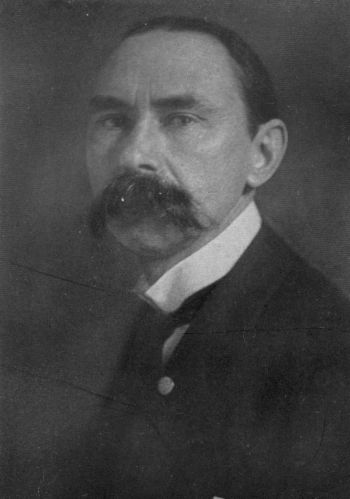
Douglas Hyde
It is perhaps because the energy that in many countries goes into the
writing of the essay is absorbed in controversy in Ireland that in the
past Ireland has produced few essayists. In the battles of the dramatic
movement with the patriotic societies and with the official class, Mr.
Yeats and Mr. Moore have dealt good blows, and Mr. Russell and "John
Eglinton" (Mr. W.K. Magee) have led the disputants out of their
confusion. Among these men, "John Eglinton" is the one who has thrown
his greatest energy into the essay, almost all his energy, and in it, in
the chapters of "Two Essays on the Remnant" (1896), "Pebbles from a
Brook" (1901), and "Bards and Saints" (1906), he has written with
subtlety and illumination.
In the collection and clarification and retelling of folk-literature
William Larminie and Lady Gregory and Dr. Hyde stand out as the leading
workers. Mr. Larminie's
"West Irish Folk-Tales" (1895) are model work
of their kind as are Lady Gregory's several books, of which I speak in
detail later. The work of Dr. Hyde is the most important work of this
sort, however, and it is not too much to say, as I intimated at the
outset, that, without his translation of "The Love Songs of Connacht"
(1894) and "The Religious Songs of Connacht" (1906), the prose of the
movement would never have attained that distinction of rhythm which
reveals English almost as a new language. I would gladly have written at
length of Dr. Hyde, but he has chosen to write his plays in Irish as
well as most of his verses. Yet so winning are the plays as translated
by Lady Gregory, and so greatly have they influenced the folk-plays in
English of the Abbey Theatre, that there is almost warrant for including
him. I cannot, of course, but I must at least bear testimony to the many
powers of these plays. Dr. Hyde can be trenchant, when satire is his
object, as in "The Bursting of the Bubble" (1903); or alive with
merriment when merriment is his desire, as in "The Poorhouse" (1903); or
full of quiet beauty when he writes of holy things, as in the "Lost
Saint" (1902). There are many other playwrights in Irish than Dr. Hyde,
but as no other plays in Irish than his have reacted to any extent on
the plays in English of the movement, I do not consider them, my object
in this book being to consider the dramatic writing in English of the
Celtic Renaissance, with relation to its value as a contribution to the
art of English letters. That there is a great deal else in the Celtic
Renaissance than its drama, I would, however, emphasize, though it is
true that
every man of first literary power in the movement, except
Lionel Johnson and "John Eglinton," has tried his hand on at least one
Irish play. That Johnson would have come to write drama I firmly
believe, for in drama he could have reconciled two of the four loves
that were his life. He could not have put his love of Winchester, his
school, or his love of the classics into plays, but his love of Ireland
and his love of the Catholic Church would have blended, I believe, into
plays, still with the cloistered life of the seventh century, that would
have rivaled "The Hour-Glass," and plays about "Ninety-Eight" that would
have rivaled "Cathleen Houlihan."
There are many other poets, though, of the Celtic Renaissance that are
of powers only short of greatness, Nora Hopper Chesson chief among them.
Only Mr. W.B. Yeats of them all has more "natural falterings" in his
verse than she. Mrs. Hinkson, too, whose name has come inevitably into
these pages from time to time, is a poet with as sure a place in English
literature to-day as has Mrs. Meynell. Beginning, like Mr. Yeats, as an
imitator of the Pre-Raphaelites, Mrs. Hinkson found herself in little
poems on moods of her own and moods of landscape She writes also of her
love of God, of St. Francis, and of Ireland. "Moira O'Neill" (Mrs.
Skrine), too, has a sure place, her verses crying out her homesickness
for Ireland, and redolent, every line of them, of the countryside. "The
Passing of the Gael" is known wherever there are Irish emigrants, but
there are other verses of "Ethna Carberry" (Mrs. Anna Johnstone
MacManus) that are
as fine as this. Mrs. Dora Sigerson Shorter is a
balladist of stark power, and Miss Eva Gore-Booth a lyric poet whose
natural lilt no preoccupation with mysticism can for more than a moment
obscure.
Mr. Herbert Trench has of recent years surrendered to theatrical
management, but there is to his credit a substantial accomplishment of
lyrical verse that George Meredith would have approved. Mr. Colum's
verse I have spoken of below, incidentally, in considering his plays. A
distinct talent, too, is Mr. Seumas O'Sullivan's, whose "Twilight
People" (1905) indicates by its title the quality of his verse.
I have mentioned all these writers, some known in America, but others
utterly unknown, not only to indicate the relation of the drama to the
other literary forms of the Renaissance, but to account, perhaps in some
measure, for the literary quality of the plays themselves. They are
written, as plays in English during the past century have too seldom
been written, by writers who have read widely in all forms of literature
and to whom words are, if not "the only good," at least a chief good.
Mr. Russell and Mr. Yeats have sent all the younger men who would write
to the masterpieces of the world, telling them to get what they need of
the technique of the centre, to know the best in the world, but to write
of the ground under their feet. The plays are, as I have said, written,
many of them, by men who are widely read, and by men whose friends are
writers of some other form of literature, by men who wish their work in
drama to be of as high intention as the work of their friends who are
poets or
essayists or writers of stories. All the other writing the
Renaissance has, then, contributed to make of the drama what it is, and
one must, if one would see the drama in relation to the Ireland of our
day, know what is the accomplishment of the other sorts of writing of
the Renaissance.
Chapter II
The Players And Their Plays, Their Audience And Their Art
The drama of the Celtic Renaissance is of an ancestry as mixed as is
that of the people of Ireland themselves. There is less in it perhaps of
the Gael than in them, for Gaelic literature, until to-day, never
approached nearer to the drama than the dialogue, the racy give-and-take
of two characters, alike of lively imagination, whether gentle or
simple. But even had the colloquies of St. Patrick and Oisin, of Dean
Swift and his man Jack, of the Lout and his Mother, been developed, by
1890, to a drama as finished as that of Congreve or Goldsmith, Sheridan
or Wilde, those who would have their plays abreast of our time would
have gone, just as, with the conditions as they are, the dramatists of
the Renaissance did go, to Ibsen and M. Maeterlinck, like all the rest
of the world. It is a matter of reproach, in the estimation of many
patriotic Irishmen, that Mr. Martyn learned his art of Ibsen, and Mr.
Yeats a part of his of M. Maeterlinck, but that attitude is as
unreasonable as that which would reproach the Irish Industries
Organization Society for studying Danish dairy farms or Belgian
chickeries. It is only the technique of the foreigners, modern or
ancient, Scandinavian or Greek, that the Abbey dramatists have acquired
or have adapted to Irish usage. Stories
are world-wide, of course, the
folk-tale told by the Derry hearthside being told also in the tent in
Turkestan—Cuchulain kills his son as Rustum does, and the Queen of
Fairy lures Bran oversea as Venus lures Tannhäuser to the Hörselberg. It
is in character, in ideals, in atmosphere, in color, that drama must be
native, and in color and in atmosphere, in ideals and in character the
Abbey Theatre drama is Irish. Reading of life and style are personal
qualities, qualities of the artist himself, though they, too, may take
tone and color from national life, and in the drama of many of the Abbey
dramatists they do. These dramatists have been more resolutely native,
in fact, many of them, than the national dramatists of other countries
have been, of France and Germany to-day, of the Spain or the England of
the Renaissance. It would seem idle to be saying this were not the
contention being raised all the time by certain patriotic groups of
Irishmen in America as well as in Ireland that the new drama is not a
native drama. It is, as a matter of fact, no less natively Irish than
the Elizabethan drama is natively English; it is really more native, for
no part of it of moment veils its nationality under even so slight a
disguise as "the Italian convention" of that drama. The new Irish drama
is more native in its stories than is the Elizabethan drama, as these
stories, even when they are stories found in variant forms in other
countries, are given the tones of Irish life. The structural forms and
the symbolic presentation of ideas of which the Abbey dramatists have
availed themselves have no more denationalized their plays than has the
Church, a Church from oversea, to
which most of them belong,
denationalized the Irish people.
Synge, the master dramatist of the new movement, while he does not
reproduce the average Irishman, is just as natively Irish in his
extravagance and irony as the old folk-tale of the "Two Hags"; Lady
Gregory in her farces is in a similar way representative of the riot of
West-Country imagination; and Mr. Yeats, if further removed from the
Irishmen of to-day, is very like, in many of his moods, to the riddling
bards of long ago. The later men, many of them, are altogether Irish,
representative of the folk of one or another section of the country, Mr.
Murray and Mr. Robinson of Cork, Mr. Mayne and Mr. Ervine of Down, Mr.
Colum and Mr. Boyle of the Midlands.
One need not say that the Irishman is a born actor; all the Celts are
famed for "the beautiful speaking"; for eloquence; for powers of
impersonation; for quick changes of mood; for ease in running the gamut
of the emotions. Of these things come art of the stage, and these things
are the Irishman's in fullest measure. The Abbey Players have, however,
gone abroad for some elements of their art, perhaps for their repose of
manner, a quietude that is not the quietude of moodiness, a condition
not unusual in the Irishman; and in addition to this repose of manner,
which is fundamental and common to their presentation of realistic
modern plays and of poetic plays of legendary times, for a slowness and
dignity of gesture in the plays of legend, which is perhaps a borrowing
from the classic stage. Their repose of manner may come from modern
France; at least so held Mr. Yeats, pointing to such a source in
"Samhain" of 1902.
The other day [he writes] I saw Sara
Bernhardt and DeMax in "Phèdre," and understood where Mr. Fay, who
stage-manages the National Theatrical Company, had gone for his
model. For long periods the performers would merely stand and pose,
and I once counted twenty-seven quite slowly before anybody on a
fairly well-filled stage moved, as it seemed, so much as an eyelash.
The periods of stillness were generally shorter, but I frequently
counted seventeen, eighteen, or twenty before there was a movement.
I noticed, too, that the gestures had a rhythmic progression. Sara
Bernhardt would keep her hands clasped over, let us say, her right
breast for some time, and then move them to the other side, perhaps,
lowering her chin till it touched her hands, and then, after another
long stillness, she would unclasp them and hold one out, and so on,
not lowering them till she had exhausted all the gestures of
uplifted hands. Through one long scene DeMax, who was quite as fine,
never lifted his hand above his elbow, and it was only when the
emotion came to its climax that he raised it to his breast. Beyond
them stood a crowd of white-robed men who never moved at all, and
the whole scene had the nobility of Greek sculpture, and an
extraordinary reality and intensity. It was the most beautiful thing
I had ever seen upon the stage, and made me understand, in a new
way, that saying of Goethe's which is understood everywhere but in
England, "Art is art because it is not nature." Of course, our
amateurs were poor and crude beside those great actors, perhaps the
greatest in Europe, but they followed them as well as they could,
and got an audience of artisans, for the most part, to admire them
for doing it.
With these words of Mr. Yeats, written ten years ago, in my memory, it
was arresting to hear ten years later a somewhat similar comparison of
the acting of the Irish Players to the acting of yesterday on the French
stage.
A man who in the late eighties and early nineties had spent
seven years as an art student in Paris saw the Abbey Players in Boston.
In Paris he had gone frequently to the Théâtre Français, and only there,
he said, before he saw the Irish Players, had he seen acting so full of
dignity, but never at all before acting so natural.
There is possible, too, however, a native origin for this repose of
manner, or perhaps it would be truest to say that it is a blending, like
the dramas themselves, of native and foreign elements. Speaking of
"Cathleen ni Houlihan" in the notes to his "Collected Works" of 1908,
Mr. Yeats says, "I cannot imagine this play, or any folk-play of our
school, acted by players with no knowledge of the peasant, and of the
awkwardness and stillness of bodies that have followed the plow, or too
lacking in humility to copy these things without convention or
caricature." Here, too, he refers to the "quiet movement and careful
speech which has given our players some little fame" as "arising partly
out of deliberate opinion and partly out of the ignorance of the
players."
Undoubtedly Mr. Fay knew the still ways of the peasant, and I do not
doubt that he was influenced by such knowledge and did in some degree
train his actors to bring their movements on the stage in accord with
the "awkwardness and stillness of bodies that have followed the plow."
But since there are ways of the peasant that are far from still, it is
likely, too, that he was led to select such movements, instead of the
vehement gesture and lively facial expression that are just as
characteristic of the peasant, by a memory of the restrained acting of
the
French stage. It is likely, too, that the very inexperience and
lack of knowledge of artifice to which Mr. Yeats refers was an element
in making the art of the company what it became. But it is not
altogether impossible that certain traditions of the English stage—of
the statuesque acting of the Kembles, for instance—had come down into
the time of Mr. Fay's stage experience, to those days before he became
stage manager of the performances of "The Daughters of Erin" in 1900,
and that these traditions influenced his training of the company that
was to attain to a new art of the stage.
Before this there had been two series of performances in Dublin, each of
a week's duration, by "The Irish Literary Theatre," one in 1899, and the
other in 1900, with English actors gathered together in London by Mr.
George Moore; and another week's series followed in 1901 by the Benson
Company and some amateurs of the Gaelic League under the leadership of
Dr. Douglas Hyde. It was the performances of "The Countess Cathleen" of
Mr. Yeats and of "The Heather Field" of Mr. Martyn at the Antient
Concert Rooms in Dublin, respectively May 8 and 9, 1899, by "The Irish
Literary Theatre," that inaugurated the drama of the Celtic Renaissance,
fully a year before there came into being the group of amateurs that
were to bring that drama home to Ireland as no players who inherited the
standards and conventions of the English stage could possibly have
brought it home.
It is Mr. Fay's distinction to have been, as I have intimated, the
leader who started these players on the long way to their new art. Such
leadership his record hardly
augered. It was in the very lowest forms
of vaudeville, in what is the analogue abroad of our negro minstrelsy,
that Mr. Fay had his stage experience, a stage experience that had made
him well enough known in burlesque rôles to make it difficult for him to
assume with success serious rôles in the early years of the National
Dramatic Company. Because of this old association, Dublin audiences
insisted in 1902 in seeing humor in his Peter Gillane in "Cathleen ni
Houlihan." For all this past, however, Mr. Fay was intent on serious
drama, and, with the precept and example of Mr. Russell and Mr. Yeats
always present to him in the early days of the National Theatre Company,
and with what he had gathered from the experimental performance of Irish
plays by "The Irish Literary Theatre," he advanced surely in his art
until his withdrawal from the company in January, 1908. His loss was
compensated for only by the results of his training of other actors,
such as Miss Sara Allgood and Mr. Arthur Sinclair, who on certain roads
have outrun their master. When I saw Mr. Fay in 1902, in the little hall
in Camden Street, Dublin, with no knowledge of what his stage experience
had been, I accepted him at once for what he was, a finished "character"
actor of poise and confidence, a dignified figure for all his stature
and his predilection for comedy, and the possessor of a speaking voice
whose natural pleasantness he had made into something higher than
pleasantness by his art in the use of it, if it never attained the
resonance and nobility of phrasing of that of his brother, Mr. Frank J.
Fay. It was a memorable experience to me, that of that August evening in
1902 on
which I was taken to Camden Street to a rehearsal of the Irish
National Dramatic Company. Our guide was Mr. James H. Cousins, whose
"Racing Lug" and "Connla" were among the plays produced in the following
autumn and which that night were in rehearsal. He piloted us to an
entranceway by the side of a produce shop. We knocked on the door and
waited, and waited. We knocked again, and at last heard steps coming
nearer and nearer. The door opened and revealed a young man in
work-a-day black suit and derby, with a candle in one hand and a
property spear in the other. He conducted us down a narrow, drafty
hallway, into a hall in which were wooden benches as rude as those in
the bandstand of a backwoods country fair in the States, and a slightly
raised platform at the farther end. We were soon in eager conversation
with young store clerks and typists and artisans who were about to set
to work at that in which their hearts lay, the interpreting of plays out
of Ireland's heart. It was good talk we listened to from those young men
and women, boys and girls all of them in their fervor and zest and high
aim. Their enthusiasm carried through "Connla," "The Racing Lug," and
"Deirdre" with real impressiveness. Of Mr. Cousins's two plays one was
realistic of the north of Ireland shore life of to-day, and the other,
"Connla," like Mr. Russell's "Deirdre," made out of Ireland's heroic
age.
Of the actors we met that night, but Miss Walker (Maire ni Shiubhlaigh)
was with the Irish Players on their American tour of 1911-12, and even
she has not been continuously with them since 1902. The amateurs had
then
but begun, under the direction of Mr. Fay, on the slow fashioning
of themselves into the finished folk-actors they proved themselves in
America. But even this acting, so little removed from that of amateurs
at these rehearsals, had distinction, the distinction of fidelity to
life in "The Racing Lug," the distinction of possession by dream in
"Deirdre"; and let it be remembered, too, that it was a rehearsal
without costume, and that one had to be carried away from the
conventional dress of the Dublin streets, and had to be made to feel
that the characters in "The Racing Lug" were primitive fishermen, and
the people of "Connla" and "Deirdre" the people of Ireland's Homeric
age.
Miss Maire T. Quinn, Mr. T. Dudley Digges, Mr. P.J. Kelly, with Miss
Walker and the brothers Fay,—Mr. W.G. Fay and Mr. Frank J. Fay,—were
then the leading actors of the company. The playwrights, too, took part
in their own or their fellows' plays in the lesser rôles, Mr. Russell
sometimes playing the druid in his "Deirdre" and Mr. Colum carrying a
spear or wearing a pea-jacket as need was. One circumstance or another,
politics or need, gradually lost the company every one of these actors
that took part in its first performances in 1902. There were
comparatively few changes, though, until 1904, the year in which Miss
Horniman, "a generous English friend," took for them the old Mechanic
Institute Theatre and, rebuilding it in part, turned it over to the
Irish National Dramatic Company for six years. Up to this time the
actors had received no pay, giving their services for love of country
and of art, but with the more
frequent performances and their attendant
rehearsals it became necessary to take a large part of the time of the
leading men and women, and then, of course, they had to be paid. Before
the opening of the Abbey Theatre, three of the chief actors, Miss Quinn
and Mr. Digges and Mr. Kelly, came to this country to appear in Irish
plays in the Irish Section of the St. Louis Fair. The public that
gathered in St. Louis was not prepared for the new drama, being more
used to the musical play of the type Mr. Olcott has made familiar in
America, or to the Bowery Irishman of the Harrigan plays, or to the
gross caricatures, Galwayed and ape-accoutred, of the before-curtain
interlude of the variety show. As a result the former National Players
protested against the policy of the Irish Section and returned to New
York. Miss Walker was the principal actress of the company after Miss
Quinn's departure to America, and upon Miss Walker's withdrawal in 1905
the burden of the chief women's rôles fell upon Miss Allgood.
Mr. W.G. Fay and Mr. Frank J. Fay were still the leading men of the
company, creating the principal characters of all the plays of Synge and
of those of Mr. Yeats and Lady Gregory that were produced before 1908.
Early in this year, as I have said, Mr. and Mrs. W.G. Fay and Mr. F.J.
Fay left the company, and, coming to America in the spring, played "The
Rising of the Moon" and "A Pot of Broth" in New York. They made,
unfortunately, no great success in their appearances, as their plays
were not presented in bills devoted solely to Irish plays, but as
curtain-raisers to the usual conventional farce. Almost all the
actors
whom I have mentioned as leaving the National Players eventually found
their way into the conventional plays, but almost none of them made
successes there comparable in any degree to their successes in
folk-drama or in plays out of old Irish legend. Nor can it be said that
actors trained in the dominant forms of present-day English drama, even
when so skilled as Mrs. Patrick Campbell, were wholly satisfying in
their assumption of rôles in the plays of the Renaissance. It was Miss
Allgood, chief musician in the London performances of Mr. Yeats's
"Deirdre" in 1908, who won the greatest approval from the London
critics, and not Mrs. Campbell as Deirdre herself.
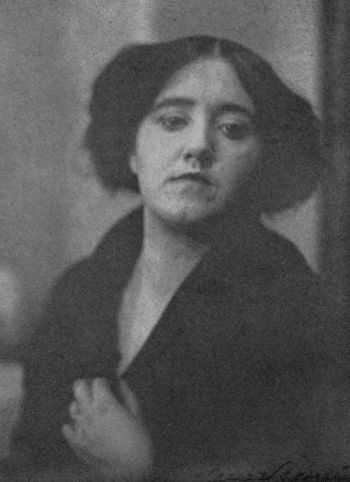
Sara Allgood
Miss Allgood had played principal parts with the Abbey Company from 1904
on. In 1906, her sister, who plays under the name of Miss Maire O'Neill,
came into the company, assuming the more romantic rôles with a success
as great as that of Miss Allgood in character parts and comedy. From
1906 they have shared the principal women's rôles, but, owing to Miss
O'Neill's inability to come to America in the fall of 1911, Miss McGee
fell heir to many of her rôles. After the departure of the Messrs. Fay,
Mr. Sinclair, Mr. O'Donovan, and Mr. Kerrigan became the leading men. It
is not altogether accurate, however, to speak of any actor or actress of
the company as leading man or leading woman, for not only is one "a
leading lady" one night, as was Miss McGee as Pegeen Mike in "The
Playboy of the Western World" on the American tour, and one of the
village girls in "The Well of the Saints" the next night, but the men
and women
alternate in the same parts on different nights, as, for
instance, on the American tour Cathleen ni Houlihan was played now by
Miss Allgood and now by Miss Walker.
The fact that few of the actors who have learned their art with the
Irish National Dramatic Society have achieved greatly in other drama is
perhaps a proof that their powers are limited to the folk-drama and the
legendary drama that comprises almost the entire repertoire of the
company. Miss Allgood was, it is true, lent to Mr. Poel for the
performances of "Measure for Measure" in the spring of 1908, and won an
unquestioned success as Isabella, but actors so skilled as the Messrs.
Fay have attained no notable success in other than Irish plays. During
the American tour of 1911-12 both Mr. Sinclair and Miss Allgood were
much importuned by the managers to accept American engagements, and it
is hardly to be doubted but that both could win success in conventional
comedy. And yet one feels it was the part of wisdom as well as of
loyalty for them to withstand the lure.
The distinguishing characteristic of the art of the Abbey Players is
naturalness. It is not that their personalities happen to coincide with
certain types of Irish character, but that they know so well the types
of the folk-plays, and even the characters who are not types that appear
in the folk-plays, that they are able to portray them to the life. The
Abbey Players have discarded most of the tricks of the stage, or perhaps
it would be truer to say they do not inherit the tricks of the stage or
any traditional characterizations of parts. They are taught to allow
their demeanor and gesture and expression to rise
out of the situation,
to "get up" their parts from their own ideas; and these ideas are
interfered with only if they run definitely counter to the ideas of
stage-manager or author. The smallness of the Abbey Theatre has saved
them from the necessity of heightening effects that they may carry to
the farthest corners of a large house, a necessity that leads so often
to over-emphasis by our own actors. There are less than six hundred
seats in the Abbey theatre (five hundred and sixty-two by actual count),
and it is so arranged that the words uttered on the stage carry easily
without emphasis all over the house.
It is an old saying that the English of Dublin is the most beautiful
English in the world. However that may be, there can be no doubt
whatsoever but that the English that is spoken in Dublin falls on the
ear with a mellowness of sound that is a joy to all who cherish proper
speech. In the earlier years of the company Mr. Yeats was very desirous
of having his dramatic verse spoken with "the half chant men spoke it
[poetry] with in old times." It was in some such way that Mr. Yeats had
tried to have his lines in "The Land of Heart's Desire" spoken when it
was put on at the Avenue Theatre, London, in 1894; and thirteen years
later Miss Florence Farr, whom he believes to speak English more
beautifully than anybody in the world, spoke his dramatic verses in a
"half chant," and his lyrical verses, many of them, to a definite
musical notation, on her American tour of 1907. It was noticeable,
however, when she played one of the musicians in his "Deirdre" on its
later presentations, that he method of intoning the verses differed a
great deal from
their delivery by the regular members of the company.
If Mr. Yeats has not changed his views somewhat in regard to the
speaking of dramatic verse, he no longer insists on the half chant as it
was practiced by Miss Farr, but is content if the actors reproduce its
rhythm in "the beautiful speaking" that is characteristic of their art.
The most beautiful English that I have ever listened to is the English
of Synge as spoken by Mr. O'Donovan in Christy's "romancin'" to Pegeen
Mike in the third act of "The Playboy of the Western World." His voice,
full and mellow by nature, and in perfect control, responds to all the
many changes of emotion that the part demands, the unmatched rhythm of
the prose rendered as he renders it carrying one clean out of one's self
as one listens. It is only when one comes to one's self on the
curtain-fall that one finds one's self wondering, Can this be prose?
Surely, never before was prose, English prose, as beautiful to the ear
as English verse.
As Miss O'Neill did not come with the Abbey Players to America, we did
not have a chance to hear Pegeen Mike's lines spoken with a beauty
comparable to Christy's. The part is not one to which Miss Allgood is
physically adapted, and Miss McGee is as yet too new to the stage to
speak with the confident abandon the lines demand. We did, however, have
a chance to hear Miss Allgood's very beautiful musical utterance of the
verses given to Cathleen ni Houlihan in this first of the movement's
folk-plays, and her equally beautiful speaking of the prose lines of the
play. This part of Cathleen ni Houlihan is sufficiently removed from the
other parts of the play,
folk-parts, and from the parts of the other
folk-plays, to give us an insight into the versatility of Miss Allgood;
and we saw enough of Mr. Sinclair and Mr. O'Donovan and Mr. Kerrigan to
realize that they, too, could worthily bear parts in heroic romance.
The rendering of the songs in the plays—it is chiefly in the plays of
Mr. Yeats that they appear—is a distinguishing characteristic of their
production. Mr. Yeats will not have them rendered by what, in the
ordinary sense, is singing. Writing in the notes to volume III of his
"Collected Works" he says:—
No vowel must ever be prolonged unnaturally,
no word of mine must ever change into a mere musical note, no singer
of my words must ever cease to be a man and become an
instrument.
The degree of approach to ordinary singing depends on the
context, for one desires a greater or lesser amount of contrast
between the lyrics and the dialogue according to situation and
emotion and the qualities of players. The words of Cathleen ni
Houlihan about the "white-scarfed riders" must be little more than
regulated declamation; the little song of Leagerie when he seizes
the "Golden Helmet" should in its opening words be indistinguishable
from the dialogue itself. Upon the other hand Cathleen's verses by
the fire, and those of the pupils in "The Hour-Glass," and those of
the beggars in "The Unicorn," are sung as the country people
understand song. Modern singing would spoil them for dramatic
purposes by taking the keenness and the salt out of the words. The
songs in "Deirdre," in Miss Fair's and in Miss Allgood's setting,
need fine speakers of verse more than good singers: and in these,
and still more in the song of the Three Women in "Baile's Strand,"
the singers must remember the natural speed of words. If the lyric
in "Baile's
Strand" is sung slowly it is like church-singing, but if
sung quickly and with the right expression it becomes an incantation
so old that nobody can quite understand it. That it may give this
sense of something half-forgotten, it must be sung with a certain
lack of minute feeling for the meaning of the words, which, however,
must always remain words. The songs in "Deirdre," especially the
last dirge, which is supposed to be the creation of the moment, must
upon the other hand, at any rate when Miss Farr's or Miss Allgood's
music is used, be sung or spoken with minute passionate
understanding. I have rehearsed the part of the Angel in "The
Hour-Glass" with recorded notes throughout, and believe this is the
right way; but in practice, owing to the difficulty of finding a
player who did not sing too much the moment the notes were written
down, have left it to the player's own unrecorded inspiration,
except at the "exit," where it is well for the player to go nearer
to ordinary song.
At times Irish actresses who have not come to the stage through the
Abbey Company, as has every one of its regular actresses, and every one
of its men save Mr. W.G. Fay, have lent it their assistance, as in the
instance of Mrs. Patrick Campbell referred to above, and as Miss Darragh
did in productions of "The Shadowy Waters" and of "Deirdre" in 1906. It
was four years earlier than this, however, that an Irishwoman, better
known in her country than either Miss Darragh or Mrs. Patrick Campbell,
lent her art to the performance of Cathleen ni Houlihan. "Miss Maud
Gonne played very finely," writes Mr. Yeats in recording the incident,
"and her great height made Cathleen seem a divine being fallen into our
mortal infirmity." With these three exceptions, so far as I have been
able to find out, no actors or actresses
outside of the company have,
since 1902, essayed any other than a subordinate part. Yet such is the
versatility of the company, men and women both, within the range of
plays the company feels called upon to present,—folk-drama of to-day
and of yesterday in Ireland, folk-history plays, morality plays, and
plays in verse out of old legends,—that though there have never been as
many as twenty actors in the company there has very seldom been much
difficulty in casting a part. Molly Byrne in "The Well of the Saints"
and the Wandering Friar of the same play have given the most trouble to
the stage directors.
From the very beginning of the Irish National Dramatic Company, Mr.
Yeats has been an advocate of scenery that is background chiefly, and in
no way divertive of attention from the play itself, its thought, its
words, its acting. He would have it, in a way, decorative, but subdued
and in harmony with the subject of the play. A very few simple sets
suffice for the plays of peasant life, a cottage interior, a village
street, a crossroads in a gap of the hills, all to serve the action and
the words as background, and to be no more obtrusive than the background
of a portrait. It may be that this attitude of Mr. Yeats is in a measure
due to his talks with Mr. Gordon Craig, but it is equally true, I think,
that some of Mr. Gordon Craig's ideas are due in part to his talks with
Mr. Yeats. Equally simple, though of another sort of simplicity, would
Mr. Yeats have the scenery for plays out of old legend. "I would like to
see," writes Mr. Yeats in "Samhain" of 1902, "poetic drama, which tries
to keep at a distance from daily life, that it may keep its emotion
untroubled,
staged with but two or three colors." Old reds, misty
blues, imperial purples, greens that have about them the dimness of
haunted woods, and dulled golds have been among the colors used in the
legendary plays of Mr. Yeats and in the folk-histories of Lady Gregory,
the color schemes being generally either those of Mr. Yeats or of Mr.
Robert Gregory, Lady Gregory's son. Scenery and costumes alike are
simple. No audience at the Abbey has ever marveled at cycloramic
landscape, and no audience and no actress has ever been able to take the
joy of the dressmaker and the dressed, of the milliner and the
millinered, in gown or hat.
The National Theatre Society, Limited, which is the legal name of the
organization that controls the Abbey Theatre Company, may not play what
plays it will at the Abbey; the two leading theatres of commerce in
Dublin, the Gaiety and the Theatre Royal, having, as Mr. Yeats records,
"vigorously opposed" the Abbey being given "a patent as little
restricted" as their own. "The Solicitor-General," Mr. Yeats continues,
"to meet them halfway, has restricted our patent to plays written by
Irishmen or on Irish subjects or to foreign masterpieces, provided these
masterpieces are not English." This restriction has not interfered with
any feature of the work of the Abbey Theatre, Mr. Yeats believes, save
in the building-up of an audience, some people remaining away, perhaps,
who might have been attracted had "such bodies as the Elizabethan Stage
Society, which brought 'Everyman' to Dublin some years ago, been able to
hire the theatre."
No phase of the dramatic movement has been more
interesting and none
has been more important than this building-up of an audience to
appreciate the plays. Whether with the poetic plays of Mr. Yeats and the
ironic extravaganzas of Synge alone, such an audience as has been built
up—an audience estimated by Mr. Yeats in 1906 to consist of four
thousand young men and women—could have been won is problematical; that
is, it may be doubted that the very best the movement has produced would
have attracted a sufficient audience to enable the company to keep
together after the expiration in 1910 of Miss Horniman's guarantee.
Certain it is, however, that Lady Gregory's farces were a great help,
both in building up and in holding the Abbey audience. It was for the
purpose of affording comic relief to the plays of Mr. Yeats and to the
first plays of Synge that Lady Gregory started to create them. They
attracted all who loved laughter and merriness and a loving caricature
of country-folk,—and who do not?—and one of them, "The Rising of the
Moon" (1907), had a distinct patriotic appeal, as had Mr. Yeats's
"Cathleen ni Houlihan," which brought some who would not otherwise have
come to the Abbey Theatre. The third most definitely "national" play of
the movement, "The Piper" (1908) of Mr. O'Riordan, may have also drawn
some who would not otherwise have come to the theatre, but if it did so
it brought them there, as did "The Playboy of the Western World" (1907),
to object.
The first appeal of the Irish Players, in April, 1902, was trough the
"Deirdre" of "A.E.," a play out of old legend, national legend, and
"Cathleen ni Houlihan," a
symbolic national play of '98. Then followed
Mr. Cousins's two little plays above referred to; "The Laying of the
Foundations," by Mr. Frederick Ryan,—a realistic satire of Dublin life;
and Mr. Yeats's incursion into farce, "A Pot of Broth." The appeal of
the repertoire was widened in 1903 by the inclusion of plays by Lady
Gregory, Mr. Colum, and Synge. "Twenty-five" could give offense to none
in its story of self-sacrificing love, and Mr. Colum's "Broken Soil,"
coming as it did after "In the Shadow of the Glen," would have escaped
hostile criticism in such a situation even had it been much more severe
in its portrayal of peasant life in the Midlands than it was.
From the time of "The Countess Cathleen" (1899) to the time of "In the
Shadow of the Glen" (1903), no one of the plays in the movement had
seriously offended any large section of the public, and the younger
generation of all classes was contributing largely of its intellectual
members to the audience of the National Dramatic Company. The West
Britons, the Dublin Castle set, the Trinity College group, were not much
interested, and, indeed, that portion of the theatrical audience that
fills the stalls in the average theatre the English-speaking world over
has never taken very much interest in the plays of the movement, save to
protest against "The Rising of the Moon" as disloyal to England, and to
approve, misunderstanding its purpose, "The Playboy of the Western
World" as a savage satire of the Irish Irishman. The audience that the
movement has built up is an audience of free intelligences, largely from
the poorer elements of the public, an audience that fills the cheaper
places in the house. "The
Pit" of the Abbey Theatre is the envy of all
the theatrical managers of Dublin. It is a pit of people young in years
or young in heart and mind, who are interested in intellectual things, a
group of people largely self-taught, or taught by the Celtic
Renaissance, to appreciate fine things. With these has come that element
of the intellectuals among the Trinity College set that is interested
above all things in Ireland, but this element is not large.
This play and that have attracted, either for purposes of approval or
for purposes of disapproval, groups of people outside of the faithful
pit that is interested in every sincere portrayal of Irish life. Such a
group, from the patriotic societies, prevented the rest of the house
from hearing "The Playboy of the Western World," after its first
performance on January 26, 1907, for four performances more; and such a
group similarly protested against "The Piper," a little more than a year
later, because it seemed to the members of the group to be an
unpatriotic revelation of the lack of cohesion among Irish political and
patriotic factions.
Despite opposition, however, and with new dramatists one by one gaining
a place in the repertoire of the company, Mr. Boyle in 1905 and Mr.
Robinson in 1908, Mr. Murray in 1910 and Mr. Ervine in 1911, more and
more people continued to become interested in the new drama, and by the
time Miss Horniman's support, promised in 1904 for six years, was
withdrawn at the expiration of that period, the Abbey Theatre was
apparently a fixture in the artistic life of Ireland.
It has been the custom, of recent years, for the Abbey
Theatre to begin
its Dublin season In October and to continue it on until May, when the
company goes to London for a month. In the earlier years, before the
company had a home at the Abbey, and even for a year or two after that,
performances were not so continuous. Nor are they now given every week
or always on every night of a week, the theatre being turned over to the
Theatre of Ireland or some other dramatic organization occasionally, and
being let, now and then, for lectures or concerts or the like. The
London season in May is followed, or preceded sometimes, by visits to
other English cities, Manchester and Leeds, Oxford and Cambridge among
them; and at home in Ireland, in the intervals between weeks at the
Abbey, the company goes to Cork or Belfast for a few performances.
In this country the audiences that attended the performances of the
plays of the Abbey Theatre Players were of a very different composition.
At their average they included a certain proportion of the younger
intellectuals among the Irish-Americans, but very many of these were
kept away from the performances, as many, indeed, in Ireland and in
England, too, are kept away from the performances, by the opposition in
the patriotic societies. In America, as in London and in Manchester, and
in the English university towns, it has been largely from among those
who are seriously interested in a literary drama that the audiences have
been drawn. It was such people as do not habitually go to the theatre,
but that are to be found at revivals of old English comedy and Ibsen
plays and symphony concerts, that made up the audiences
of the Irish
Players in America, whether in Boston or in Philadelphia or Chicago.
These audiences approximated to the Dublin audiences only in the fact
that they were constant in attendance at all the plays of the
repertoire. There were, of course, some who came out of curiosity and
the love of ruction, but these after all were few. The plays appealed on
their merits and won the success that they did win because of their art
and their reading of life, and not because of the sensational incidents
that had occurred at some of the productions of the company.
The Abbey Theatre has been able to maintain itself successfully in the
years that have elapsed since the arrangement between Miss Horniman and
the National Theatre Society came to an end. It has begotten many other
companies, the Ulster Literary Theatre, best of them all; the Theatre of
Ireland; the National Players; the Cork Dramatic Society. It has brought
into being a kind of folk-drama that, despite its avowed and evident
Scandinavian origin, is a new folk-drama, and it has brought into being,
too, a school of dramatists. It has done much more than Mr. Yeats
claimed it had done in 1908 when he wrote, "We know that we have already
created a taste for sincere and original drama and for sincere, quiet,
simple acting. Ireland possesses something which has come out of its own
life, and the many failures of dramatic societies which have imitated
our work, without our discipline and our independence, show that it
could not have been made in any other way." But even were this all it
had done, it had done much. What it has done I have attempted to put
down in some detail, and to put values
upon, in the following pages.
Here I wish further to say but this: that I think the dramatic movement
the most significant part of the Celtic Renaissance, a movement to me
the most original movement in letters the world has known since that
movement in Norway which so definitely stimulated it, a movement that
gave Björnson and Ibsen to the world.
Chapter III
Mr. William Butler Yeats
There has never been a poet who used better the gifts his country gave
him than Mr. Yeats. The heroic legends of Ireland are in his poetry,
Irish folk-lore is there, and the look of the country; and a man moulded
as only Irish conditions, of old time and of to-day, could mould him,
Irish conditions spiritual, intellectual, and physical; a man with eyes
on a bare countryside in the gray of twilight, thinking of the stories
the peasants tell and of the old legends whose setting this is before
him. At this hour, with such surroundings, and in such thought, the
Other World is as near to all men as their natures will let it come, and
to Mr. Yeats it is very near. Waking dreams come to him at such hours,
and he puts them into his verse, waking dreams of his country's
legendary past and of its fairy present, and waking dreams born of books
of old magic he has read indoors. Now it will be one sort of dream is
present, now the other, and now the third, and often two or even all
three sorts of dream are intermingled. His volume of prose sketches,
"The Celtic Twilight" (1893), gives the title some of his countrymen
have fastened on his verse, and the verse of others that take his
attitude and use like material, "The Twilight School of Poetry." It is
not inapt as giving the quality of most of his writing; but some of his
verses have warm
sunlight in them, which, strangely, since it is
sunlight as it visits Irish shore and mountain, he has deplored. The
explanation may be that Mr. Yeats is of those who do not live intensely
until the oncoming of night, and so holds out of harmony with his genius
the coloring of its moments of lesser energy.
Legends and folk-tales and landscapes and books of mysticism and magic
not only give Mr. Yeats the material of his poetry, but suggest its
images, its color, and in part its rhythms; but before he found the
"faint and nervous" rhythms best fitted to his poetry, and put in it the
gray-greens and browns and soft purples and bright whites of Irish
landscape, and the symbols from fairy-lore and mythology, he had paid
patient heed to certain of the great poets of his language, to Spenser
and Blake, to Shelley and William Morris. And in learning the art of
drama, which he began to study very carefully after his early plays were
tested in "The Irish Literary Theatre," Mr. Yeats has very evidently
pondered a good deal on the English morality and taken into account the
effects of Greek tragedy as he had before explored M. Maeterlinck and
the earlier Ibsen.
As a boy Mr. Yeats wrote in the "Dublin University Review" that the
"greatest of the earth" often owned but two aims, "two linked and
ardorous thoughts—fatherland and song." Twenty-six years have gone
since then and Mr. Yeats is still devoted to poetry and to his country,
for all that the Nationalists deplore that his greater interest is now
in his art. His art, indeed, he cherishes with an ardor that is akin to
the ardor of patriotism;
to him, as to Spenser, the master of his
youth, poetry is a divine enthusiasm. At first eager to paint, as did
and does his father, Mr. J.B. Yeats, he studied in Dublin Arts Schools,
but as Nature "wanted a few verses" from him, she sent him "into a
library to read bad translations from the Irish, and at last down into
Connaught to sit by turf fires." He read, too, Sir Samuel Ferguson, the
poet who had done most with Irish legend, and Allingham, who wrote of
Irish fairies, and the patriotic poets of the young Ireland group, Davis
chief among them. His father, an admirer of Whitman, preached to him the
doctrine embodied in the text—
"Will you seek afar off? You surely come back at last,
In things best known to you finding the best."
Many influences thus conspired to make Mr. Yeats find his inspiration in
Ireland, overcoming, for the time, the denationalizing influences that
the art of the centre must always exert. Not only were the national
legends and folk-lore constantly with him in these years, but the
interest in magic and all things that are hidden. He was one of the
Hermetic Society, of which Mr. George W. Russell was the high priest, as
early as 1886, but this interest, which has dominated so often in his
later poetry, is not to the forefront in "The Wanderings of Oisin" of
1889. The material of the title poem of this volume Mr. Yeats found in
the libraries. It recounts the Fenian poet's three hundred years of
"dalliance with a demon thing" oversea in three wondrous lands, where
were severally pleasure and fighting and forgetfulness, and in each of
which Oisin spent a century. It has a half-dramatic framework of
question and answer between St. Patrick, who appears as upbraider, and
the poet, who laments joys gone and the Christian present of Ireland
and his own feeble age. Although it is a story Mr. Yeats is telling,
the beauties of the poems are lyrical beauties. In exuberance and
richness of color it is Mr. Yeats's most typically Irish poem based on
legend, and nowhere do his lines go with more lilt, or fall oftener
into inevitability of phrase, or more fully diffuse a glamour of
otherworldliness. "The Wanderings of Oisin" revealed poetry as
unmistakably new to his day as was Poe's to the earliest Victorian
days. Beside the title poem another from legend had this new quality,
"The Madness of King Goll," with its refrain that will not out of
memory, "They will not hush, the leaves a-flutter round me, the beech
leaves old." "Down by the Salley Gardens" and "The Meditation of the
Old Fisherman" bear witness to talks before turf fires, or in herring
boats off Knocknarea, and other developments of folk-song or tale have
the place-names of his home county of Sligo; but this distinctive
quality is theirs in less measure, and few others in the little volume
have it at all.
In the years just before "The Wanderings of Oisin," Mr. Yeats had been
eager to unite the young writers of Ireland in a movement to give the
country a national literature in English. This project developed side
by side with Dr. Hyde's to give Ireland its own language again and a
modern literature in it. Neither leader was the first to advance
either idea, but each was the first to estab
lish the movement in
which he was most interested; Mr. Yeats's "Wanderings of Oisin" (1889)
is the starting-point of the Celtic Renaissance, and Dr. Hyde's
"Leabhar Sgeuluigheachta" (1889), the starting-point of the Gaelic
League, though this was not organized until 1893. From that day to
this these two men and Mr. George W. Russell ("A.E.") have been the
great forces in the literature of the Renaissance. Mr. Yeats was busy
in those early days with editing fairy and folk-tales and short
stories from the Irish novelists, and in reading these it was but
natural that he should be led to write stories. First came "John
Sherman" and "Dhoya" in 1891, the one a condensed novel with the
slightest of plots about a slow-pulsed young man's troubles with love
and laziness in Sligo and London, and the other a sketch of Irish
faery in old time. Some of the sketches of "The Celtic Twilight"
(1893) approach the tale, but such narrations are not told for their
own sake, but as illustrations of fairy-lore, or they have too little
body to win for themselves the title of tale. In "The Secret Rose"
(1897) there are true tales, some out of Ireland's legendary past,
some out of her fairy present, and, akin to both, the Hanrahan series.
These last Mr. Yeats so rewrote in 1904 as to be "nearer to the mind
of the country places where Hanrahan and his like wandered and are
remembered." As they stand now they are his best prose, rid almost
entirely of preciousness, and simple and full of mystery as the
countryside they reflect. In "The Secret Rose" are two "alchemical"
tales and in "The Tables of the Law" (1904), two others of like
subject. To me, for all the qualities
they share with poetry of his of similar inspiration, they do not seem
to be mastered by him. Alone among his writings they are incomplete.
Mr. Yeats was unable until the last few years to give himself up to the
writing nearest his heart, drama. He continued to edit Irish literature,
to write on literature and fairy-lore for the magazines. The articles
about fairies he has published, and a great mass of belief collected but
as yet unprinted, he will gather some day into a great book. Known now
in the Irish countryside as a man with a power to exorcise spirits, he
will then no doubt attain a reputation that will put him well above that
of the Irish-American archbishop who was his only rival in that practice
in the belief of many Irish peasants. Other of his magazine writing Mr.
Yeats has gathered into "The Celtic Twilight" and more of it into the
later edition (1900) of this book. Still other of these articles are to
be found in "Ideas of Good and Evil" (1903), some of them stating his
philosophy, never too definitely formulated. These two collections are
very interesting in themselves, but both, like his "Discoveries" (1907),
are more interesting as commentary on his powers. Mr. Yeats has used
many notes to explain obscure allusions in his poems, though the most
obscure he, perhaps with premeditation, fails to explain. Yet the reader
unacquainted with his use of symbols will find much interpretation in
these essays, especially those in "Ideas of Good and Evil."
Up to 1899, when Mr. Yeats's serious efforts to build up an Irish
national drama began with "The Irish Literary Theatre," he devoted his
happiest moments to lyric
poetry, though the play of "The Countess
Cathleen" made half of his second volume of verse, and the third was
wholly given to the little play, "The Land of Heart's Desire." Since
1899, in which year "The Wind among the Reeds" appeared, Mr. Yeats has
published, of other than dramatic verse, only the little volume of "In
the Seven Woods," the little series on Flamel, and a few snatches, in
all about a thousand lines. Some of this verse Mr. Yeats wrote for the
psaltery, and in 1902 he was determined to write all his shorter poems
for recitation to this instrument and "all his longer poems for the
stage."
Mr. Yeats was thirty-four when he practically gave up lyrical poetry for
dramatic poetry. From the beginning he had written plays, but they were
lyrical plays, dramatic only in form, and they were, as soon as he had
mastered the technique of verse, great lyrical poems. In the plays he
has written since he has striven at that hardest of literary tasks, to
make true dramatic speech high poetry, he has written nothing more
beautiful than "The Countess Cathleen" and "The Land of Heart's Desire."
He has rewritten and rewritten these later plays, and in almost every
rewriting made them more dramatic, but sometimes the later versions have
lost as poetry, not in the mere decorative features and "lyrical
interbreathings," but in the accent of the play and in the sheer
poetical qualities. To me it seems a pity, inevitable though it be, that
the poet who has struck the most distinctly new note of all the English
poets since Swinburne should, at thirty-four, have changed from an art
he knew to an art he did not know. That is a ripe age
for a poet to
begin to learn to write in a form barely essayed before. Unlike so many
of the English poets, who as public school boys were bred up to write
verse, Mr. Yeats had to teach himself to write verse. Overcoming
triumphantly this handicap, though losing by it years usually fullest of
impulse to write, Mr. Yeats greatly attained, and for the ten years from
1889 to 1899 devoted himself to the writing of lyrics. For the past
thirteen years he has been busiest with dramas, in none of which has he
more than approximated to a dramatic quality that is as great as the
quality of his lyrics. He has owned himself one reason of such
shortcoming, in the notes to "Deirdre."
"The principal difficulty
with the form of dramatic literature I have adopted is that, unlike the
loose Elizabethan form, it continually forces one by its rigour of logic
away from one's capacities, experiences, and desires, until, if one have
not patience to wait for the mood, or to rewrite again and again till it
comes, there is rhetoric and logic and dry circumstance where there
should be life."
It may be that Mr. Yeats will one day overcome the difficulties that he
alludes to here, but he is now forty-seven, and I, for one, doubt if, at
his age, he can overcome them. As they are, his plays are beautiful in
ideas and words, and striking in a lyric and decorative way, if not all
of them in a dramatic way, though in some he has in vain sacrificed
poetry to attain true dramatic speech attaining instead only "rhetoric
and logic and dry circumstance." One values the plays of Mr. Yeats
highest
when one thinks of them as a new kind of drama, as a
redevelopment of epic and lyric poetry into drama, an epic and lyric
poetry illustrated by tableaux against backgrounds out of faery. Let us
not forget that there is one effect which is of "The Tempest," and
another effect which is of "Lear," and that it is after all something of
a convention to call the latter a success of drama and the former a
success of something other than drama. Yet it is just as necessary to
remember that drama does mean a definite sort of literature, and the
success of a new sort of drama, whether it be a "static" drama, as M.
Maeterlinck has called his early drama, or whether it be the kind of
drama that Mr. Yeats has created, is the success of something other than
what we conventionally term drama. It is curious that no matter how
great may be the success of an author in a form he has invented, he will
almost invariably attempt also the accepted form from which he has
diverged. Impelled by a desire to see his wife in a drama of his own but
of the old dramatic sort, M. Maeterlinck made "Monna Vanna" in accord
with the usual rules of the theatre, but to find it fall far short of
the strange new beauty of his earlier plays. As yet Mr. Yeats has not
compromised with the current taste in drama, but it may be that a desire
to see some such actress as Mrs. Patrick Campbell in a part of his may
lead to such compromise, as the thought of her acting his Deirdre
inspired him to rewrite that part for Mrs. Campbell.
Mr. Yeats has not yet passed beyond the danger of falling between two
stools. If it prove that he has really
attained in a drama in which the
verse is true dramatic speech and not lyric ecstasy or decoration, the
success of such drama will be worth the sacrifice of the lyric poetry
that he has not written because of the absorption of all of his energy
in his dramatic writing. If it prove he has not so attained, we shall
have no adequate compensation for the lost lyrics that he is now too old
to write. I say no "adequate compensation," for compensation there is in
the lyrical passages that no play of his is without, lyrical passages
that arrest us as do his poems of the nineties; but, after all, these are
but passages, not poems with unity and finality of form.
Another question altogether, a question outside of the question of the
value as art of the writing of Mr. Yeats which is what I am considering,
is the question as to whether there would have been a dramatic movement
at all comparable to what has been, if Mr. Yeats had not devoted so
large a portion of his time to drama. I believe there would have been a
dramatic movement, but I am sure, from what I know of the other dramatic
organizations in Dublin, that they would not have amounted to much
unless some other great writer as loyal to art as Mr. Yeats had played
for them the beneficent tyrant. And other such great writers, as loyal
to art, and as devoted to drama, are far to seek in Ireland as in other
countries. It is not in Mr. Russell's nature so to act; it is not in Dr.
Hyde's plan of life to foster in others other than propagandist
literature; it is more than likely that had Mr. Martyn attempted it it
had come to the end to which he has come as playwright. Without Mr.
Yeats as moving
power, Synge had not been, without Mr. Yeats to
interest her in the movement, Lady Gregory had not written her farces
and folk-histories; and without the Abbey Theatre's plays as standard,
the younger playwrights of Cork and Belfast would have written plays
very other than those they have written.
No wonder Mr. Yeats wants to see his dreams take on bodily reality upon
the stage, and to hear beautifully spoken the words in which he has
caught them. There can be no greater pleasures than these to a writer
when he is past the imaginative intensity of youth. In youth his
imaginings are so real to him he needs no objective embodiment to see
them, and the roll and sing of their lines are always sounding to his
inner ear, but as he passes "out of a red flare of dreams," such as is
youth's, "into a common light of common hours" in middle age, his
imaginative life grows less intense and needs the satisfaction of seeing
itself concretely represented.
Mr. Yeats leaves out of his collected poems the plays of his boyhood,
"The Island of Statues" (1885) and "Mosada" (1886). They were not of
Ireland, but the Arcady of the one and the mediæval Spain of the other
he could easily have paralleled in Irish legend, where anything
wonderful and tragic is possible. Nor is "The Countess Cathleen"
(1892-99), in its presentation of the drama of a woman that sells her
soul that the souls of her tenantry may be saved, essentially Irish. It
is curious that among English poets of Mr. Yeats's generation it should
be Mr. Kipling that has happened upon the same legend, which he adapts
to his ends in "The Sacrifice of Er-Heb." The
background of "The
Countess Cathleen" in the earlier versions was not more essentially
Irish than the story. "The great castle in malevolent woods" and the
country about it is very like the part of fairyland that M. Maeterlinck
refound by following the charts of early discoverers in Arthurian
legend. In its later versions "The Countess Cathleen" is more Irish and
perhaps more dramatic, though its greatnesses, after that of atmosphere,
the great lines we may no more forget than those about "the angel
Israfel"
"Whose heart-strings are a lute";
or about
"magic casements, opening on the foam
Of perilous seas, in fairy lands forlorn";
or about
"old, unhappy, far-off things
And battles long ago";
or about hearing
"the far-off curfew sound
Over some wide-watered shore
Swinging slow with sullen roar,"
were most of them in the earlier versions. There were those lines of
Maire's denouncement of the two demons and her prophecy to them:—
"You shall at last dry like dry leaves, and hang
Nailed like dead vermin to the doors of God";
and those wonderful lines of Cathleen dying:—
"Bend down your faces, Oona and Aleel:
I gaze upon them as the swallow gazes
Upon the nest under the eave, before
He wander the loud waters";
and those last lines of all, great as only the greatest lines are
great,—
"The years like great black oxen tread the world,
And God the herdsman goads them on behind,
And I am broken by their passing feet."
It was about this time, too, that Mr. Yeats wrote that most startling of
all his lines,—
"And God stands winding his lonely horn",
and "The Lake Isle of Innisfree," that so charmed Stevenson that he had
to write its author, and say it cast over him a spell like that of his
first reading of the "Poems and Ballads" of Swinburne and the "Love in
the Valley" of Meredith.
There is no greater lyric poetry anywhere in the writing of Mr. Yeats
than in "The Land of Heart's Desire" (1894), that little folk-play whose
constant boding and final tragedy cannot overcome, either while it is
playing or as you remember it, the sing and lilt that are in the lines.
It tells of the luring away by a fairy child of the soul of a newly
married bride on May-Eve, and of her death when her soul has passed to
the "Land of Heart's Desire"—
"Where nobody gets old and crafty and wise,
Where nobody gets old and godly and grave,
Where nobody gets old and bitter of tongue,
And where kind tongues bring no captivity."
It is a story out of folk-lore, and so far back in time, and so far away
from the life that we know is it, that all that happens seems not only
possible but inevitable.
"The Land of Heart's Desire" was the first play of
Mr. Yeats to be put
on the stage, being presented at the Avenue Theatre in London in 1894;
and it was also the first play of Mr. Yeats to be put on in America,
being presented with Miss Mabel Taliaferro in the fairy's rôle as the
curtain-raiser to Mrs. Le Moyne's production of "In a Balcony," in the
spring of 1901. Fragile as is its charm, it crossed the footlights and
made itself felt as a new beauty of the theatre. It was the lyrical
interbreathings that appealed most to me, but the strife of priest and
fairy for Maire Bruin's soul was very real drama. It was the fairy's
song, however, that haunted me after I left the theatre, as it could not
but be. It haunts me still, coming into my mind whenever I think of Mr.
Yeats, as inevitably as the last lines of "The Countess Cathleen," or as
"The Lake Isle of Innisfree," or "The Valley of the Black Pig," or "The
Rose of the World," or the ecstasies of Forgael and Dectora, or the song
in "Deirdre." "The lonely of heart is withered away" is its burden, a
burden that will not out of mind.
"The Land of Heart's Desire" has probably been most often played,
counting American performances as well as performances in Ireland and
England, being played as frequently by amateurs as by professionals in
this country, but the prose play "Cathleen ni Houlihan," because of its
national theme, has had more playings in Ireland. Its effect upon the
stage is very different from its effect in the study. Read, it seems
allegory too obvious to impress. The old woman, Cathleen ni Houlihan,
with "too many strangers in the house" and with her "four beautiful
green fields" taken from her, is so patently Ireland
possessed by
England, all four provinces, that one fails to feel the deep humanity of
the sacrifices of Michael Gillane for her, his country, even though that
sacrifice be on his wedding eve. Seen and listened to, "Cathleen ni
Houlihan" brings tears to the eyes and chokes the throat with sobs, so
intimately physical is the appeal of its pathos. He is, indeed, dull of
understanding or hard of heart who can witness a performance of this
play and not feel that something noble has come his way. It seizes hold
of the Irishmen of the patriotic societies as does "The Wearing of the
Green," and even the outlander, little sympathetic to the cause of
Ireland and holding patriotism a provincial thing, is moved in some
strange way he does not understand. Performance brings out its
homeliness, its touches of humor, its wistfulness, its nobility. It is
with this thought of its nobility that every thought of "Cathleen ni
Houlihan" ends, that is every thought of it on the stage. Off the stage
it is, except to him to whom the cause is all, something that falls
short of nobility, to many little more than eloquent allegory. In the
autumn of 1904 Miss Margaret Wycherly played "The Land of Heart's
Desire" and "Cathleen ni Houlihan" a few times in America, and "The
Countess Cathleen"; and "The Hour-Glass" (1903) and "A Pot of Broth"
(1902), both plays in prose. "The Hour-Glass," a morality, was written
after "Everyman" had won Mr. Yeats, and "A Pot of Broth" was written,
perhaps, to prove that its author could do farce.
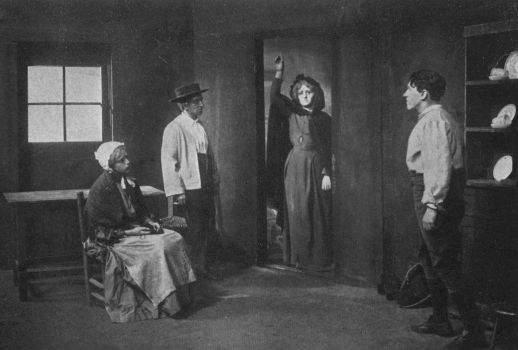
Scene From "Cathleen Ni Houlihan"
"The Hour-Glass" is based on a story that Mr. Yeats found in Lady
Wilde's "Ancient Legends of Ireland"
(1887), the story of a wise man
who is saved from eternal damnation by the faith of a child. Mr. Yeats
leaves the wise man the great scholar that he was in the old tale, a
scholar whose teaching had taken away the faith of a countryside, but he
changes the child who saved the scholar into Teig the Fool, and infuses
into the record of the frantic hour, in which the wise man knows his
life ebbing away as the sand falls, a spirit that is as reverent as the
spirit of the old religious drama.
"A Pot of Broth" is a variant of a widely spread folk-tale in which a
beggarman tricks a provident housewife out of a meal. He pretends a
stone that he has, and which he gives her after his meal, makes good
broth, but it is her chicken that has made the broth. It is a trifle,
amusing enough, but remarkable chiefly for its difference from other
work of Mr. Yeats. There is little doubt, I take it, in the mind of any
one that it is not chiefly Lady Gregory's, as it surely is in its
wording, and in its intimacy with the details of cottage life.
Prose also is "Diarmid and Grania," written in collaboration with Mr.
George Moore and played at the last year's performance (1901) of "The
Irish Literary Theatre." As this play as performed was in tone more like
the writings of Mr. Moore than of Mr. Yeats, I have considered it among
his plays rather than among the plays of Mr. Yeats.
His other prose play, "Where there is Nothing" (1903), is a statement of
revolt against "the despotism of fact" that is perhaps as characteristic
of the artist as of the Celt. The world would say that its hero, Paul
Ruttledge,
was mad, but no one that reads can deny him a large share of
sympathy. This play was produced by the Stage Society in London in 1904.
Lady Gregory having had a share in its creation, Mr. Yeats has since
relinquished the theme to her; and now rewritten by her alone as "The
Unicorn from the Stars," it would hardly be recognized as the same play.
His Paul Ruttledge, gentleman, becomes her Martin Hearne, coach-builder.
Both are alike at the outset of their frenzy, in that they would be
destroyers of Church and Law, both use tinkers as their agents of
destruction, and both die despised of men. Both are "plunged in trance,"
but their trances differ. That of Lady Gregory's hero is cataleptic and
directly productive of his revolt, from a revelation, as he thinks it
is, that comes to him while he is "away." Paul Ruttledge, on the other
hand, deliberately gives up his conventional life, and that as largely
because of boredom as because of belief in its wrongness. One cannot, as
one reads "Where there is Nothing," fail to see in its hero much of Mr.
Yeats himself. He is not the professional agitator, literary or social,
as was Oscar Wilde and as is Mr. Shaw, but he here delights in turning
things topsy-turvy, just as they do, in a fashion that has been
distinctive of the Irishman for many generations. Mr. Yeats is himself,
often, like his hero, "plunged in trance," if one may call trance his
"possessed dream," such as that in which "Cap and Bells" or "Cathleen ni
Houlihan" came to him. The lyric came to him, he says, as a "vision,"
and so, too, the play. It is in the dedication to volumes I and II of
"Plays for an Irish
Theatre," volumes containing "Where there is
Nothing," "The Hour-Glass," "Cathleen ni Houlihan," and "A Pot of
Broth," that he tells us of the latter vision, and of the beginnings of
that collaboration with Lady Gregory that taught her her art, and so
profoundly influenced his. So informing is it that I quote it in full.
MY DEAR LADY GREGORY:—
I dedicate to you two volumes of plays that are in part your
own.
When I was a boy I used to wander about at Rosses Point and
Ballisodare listening to old songs and stories. I wrote down what I
heard and made poems out of the stories or put them into the little
chapters of the first edition of the "Celtic Twilight," and that is
how I began to write in the Irish way.
Then I went to London to make my living, and though I spent a
part of every year in Ireland and tried to keep the old life in my
memory by reading every country tale I could find in books or old
newspapers, I began to forget the true countenance of country life.
The old tales were still alive for me, indeed, but with a new,
strange, half-unreal life, as if in a wizard's glass until at last,
when I had finished "The Secret Rose," and was halfway through "The
Wind among the Reeds," a wise woman in her trance told me that my
inspiration was from the moon and that I should always live close to
water, for my work was getting too full of those little jewelled
thoughts that come from the sun and have no nation. I have no need
to turn to my books of astrology to know that the common people are
under the moon, or to Porphyry to remember the image-making power of
the waters. Nor did I doubt the entire truth of what she said to me,
for my head was full of fables that I had no longer the knowledge
and emotion to write. Then you brought me with you to see your
friends in the cottages, and to talk to old wise men on Slieve
Echtge, and we gathered together, or you gathered for me, a great
number of stories and traditional beliefs.
You taught me to
understand again, and much more perfectly than before, the true
countenance of country life.
One night I had a dream, almost as distinct as a vision, of a
cottage where there was well-being and firelight and talk of a
marriage, and into the midst of that cottage there came an old woman
in a cloak. She was Ireland herself, that Cathleen ni Houlihan for
whom so many songs have been sung and about whom so many stories
have been told and for whose sake so many have gone to their death.
I thought if I could write this out as a little play I could make
others see my dream as I had seen it but I could not get down out of
that high window of dramatic verse, and in spite of all you had done
for me I had not the country speech. One has to live among the
people, like you, of whom an old man said in my hearing, "She has
been a serving-maid among us," before one can think the thoughts of
the people and speak with their tongue. We turned my dream into the
little play, "Cathleen ni Houlihan," and when we gave it to the
little theatre in Dublin and found that the working-people liked it,
you helped me to put my other dramatic fables into speech. Some of
these have already been acted, but some may not be acted for a long
time; but all seem to me, though they were but part of a summer's
work, to have more of that countenance of country life than anything
I have done since I was a boy.
I should like also to quote in full Mr. Yeats's account of how "Where
there is Nothing" passed into "The Unicorn from the Stars," as that
account throws much light on the methods of collaboration that have
added so greatly to the success of the dramatic movement, and that are
especially valuable to beginners, whose plays, without reshaping in
collaboration, might never win their way to the boards. But I have not
the space for it all, and I must content myself with that portion of it
in which Mr. Yeats confesses that belief of his in the rapprochement
of scholar and tinker that one notes so often in Irish life. Speaking
of
Lady Gregory's rewriting of "Where there is Nothing" into "The
Unicorn from the Stars," he says:—
Her greatest difficulty was that I had given
her for chief character a man so plunged in trance that he could not
be otherwise than all but still and silent, though perhaps with the
stillness and the silence of a lamp; and the movement of the play as
a whole, if we were to listen to hear him, had to be without hurry
or violence. The strange characters, her handiwork, on whom he sheds
his light, delight me. She has enabled me to carry out an old
thought for which my own knowledge is insufficient and to commingle
the ancient phantasies of poetry with the rough, vivid,
ever-contemporaneous tumult of the roadside; to create for a moment
a form that otherwise I could but dream of, though I do that always,
an art that prophesies though with worn and failing voice of the day
when Quixote and Sancho Panza long estranged may once again go out
gaily into the bleak air. Ever since I began to write I have awaited
with impatience a linking, all Europe over, of the hereditary
knowledge of the countryside, now becoming known to us through the
work of wanderers and men of learning, with our old lyricism so full
of ancient frenzies and hereditary wisdom, a yoking of antiquities,
a marriage of Heaven and Hell.
Interesting, however, as these plays in prose are, and significant of
their author's desire to do work in a medium that was perhaps more
immediately acceptable to the audience of the National Dramatic Society
in its then culture, there is no doubt at all that the plays in verse
are nearer his heart. They are himself, and in all of the prose plays
there is a good deal of Lady Gregory. All this time that he was
collaborating in these prose plays he was still dreaming over "The
Shadowy Waters," retouching it,
rearranging it, until it became in
detail a very different play from the play that was published under that
name in 1900. Its hero and heroine, Forgael and Dectora, are much as
they were then, their fateful meeting in misty northern seas remains the
central incident, and the climax is still their choice to be left alone
in the Viking ship at the world's end; but more than half the lines are
changed. "The Shadowy Waters" was staged in 1904, and with telling
weirdness, but like many another author's best-loved and most elaborated
work, it has not made the appeal of plays less favorite to him. Mr.
Yeats has written that he has been brooding over "The Shadowy Waters"
ever since he was a boy, and he told me, when I asked him once which
writing of his he cared most for, "That I was last working at, and then
'The Shadowy Waters.'" It is too much to say that it expresses the dream
of his life, but it is not too much to say that a dream that has haunted
all his life is told here, or half told, for dream such as this eludes
complete expression. "The Shadowy Waters" is a poem so long considered,
so often returned to, so loved and elaborated and worked over, so often
dreamed and redreamed, that one would expect to find in it its author's
credo, if its author is one who could hold to one confession of faith.
Few authors can, few authors should, and Mr. Yeats is not one of them
that can or should. He wrote once that he would be accounted
"True brother of that company
That sang to lighten Ireland's wrong,
Ballad and story, rann and song,"—
and Nationalist though he still is he has grown more and more
preoccupied with art. There was a time when a love of the occult
threatened his art, but from that the theatre has saved him, if it has
taken him from the writing lyrics, in which his powers are at their
highest. To old Irish legend, Mr. Yeats has, however, been true from the
start, and from the start, too, there has never been a time the two he
has not been preoccupied with dream. And if the two loves to which he
has been constant cannot be said with exactitude to be in the story of
Forgael and Dectora, because that story is not a reshaping of any one
legend out of old Irish legend, it is of the very spirit of the journeys
oversea in which that legend abounds, and it is steeped in dream. It
would be here, then, that one would look for an expression as like a
credo as is possible to Mr. Yeats, and here we do find it on the lips
of Forgael, his hero, who, can we doubt? speaks also for the poet
himself:—
"All would be well
Could we but give us wholly to the dreams,
And get into their world that to the sense
Is shadow, and not linger wretchedly
Among substantial things; for it is dreams
That lift us to the flowing changing world
That the heart longs for. What is love itself,
Even though it be the lightest of light love,
But dreams that hurry from beyond the world,
To make low laughter more than meat and drink,
Though it but set us sighing?"
"On Baile's Strand" (1903) follows very closely the story of Cuchulain's
slaying of his own son as retold Lady Gregory in her "Cuchulain of
Muirthemne" (1902).
Like Rustum he does not know who is the youth he is
fighting until he has given him his death wound. Its high tragedy rends
the more by the ironic setting of Blind Man and Fool, two wastrels, one
of whom might have prevented the tragedy, but would not because the
fight would give him and his fellow a chance to rob the larders in
houses whose owners were watching it. No one can doubt the high
intention of "On Baile's Strand," no one can deny that its story is
essentially dramatic, no one can pass by certain passages without
realization that here is great verse, blank verse that is true dramatic
speech. Men remember Cuchulain's description of Aoife as men remember
Maud Gonne.
"Ah! Conchubar, had you seen her
With that high, laughing, turbulent head of hers
Thrown backward, and the bowstring at her ear.
Or sitting at the fire with those grave eyes
Full of good counsel as it were with wine,
Or when love ran through all the lineaments
Of her wild body."
One remembers these things, but if one has not seen the play on the
stage, he does not bear with him memories of beauty such as one bears
always with him from even the reading of "The Countess Cathleen" or of
"The Land of Heart's Desire." Nor is one moved by "On Baile's Strand" as
one is moved by other tellings of the same world story, as one is moved
by the epic telling of it by Matthew Arnold in "Sohrab and Rustum," or
even by such a casual telling of it as is Mr. Neil Munro's in "Black
Murdo." If it were not for "Deirdre," in fact, one would have to say
that the verse plays of
Mr. Yeats after "The Shadowy Waters" grow, play
by play, less in poetic beauty, and that their gain in dramatic
effectiveness does not compensate for such a loss.
"The King's Threshold" (1904) is as near a play with a purpose as Mr.
Yeats has written. It vindicates the right of the poet in Ireland's
Heroic Age to sit at the highest table of the King, and as it was
written and played in 1903, when its author was being accused of caring
more for his art than for his country, it looks very like a defense.
Seanchan, the poet, removed from his high seat at the request of
"Bishops, Soldiers, and Makers of the Law," takes his stand on the
King's threshold, with the intention of starving himself to death there,
as there is, as the King says,—
"a custom,
An old and foolish custom, that if a man
Be wronged, or think that he is wronged and starve
Upon another's threshold till he die,
The common people, for all time to come,
Will raise a heavy cry against that threshold,
Even though it be the King's."
It was at this time that the clamor against "In the Shadow of the Glen"
had stirred up a great deal of feeling against Mr. Yeats and the other
managers of the Irish National Theatre Society. And Mr. Yeats, it may
be, wrote the play not only to symbolize his contention that the poet is
as important to society as is the man of action, but also to assert that
poetry cultivated for its own sake, the sake of art, is as necessary to
a nation, to Ireland, as what Ireland calls patriotism. By the way, he
illustrated the fact that that kind of patriotism that assumes
the King
can do no wrong,—that is, that the Irish people can do no wrong,—and
that whoever exposes their wrongdoing is no patriot, is a mistaken sort
of patriotism.
Late in 1906 his "Deirdre" was successfully produced at the Abbey
Theatre, Dublin. It presents only the last chapter of this, the saddest
tale of the three heart-burdening tales that are known as "The Three
Sorrows of Story-Telling," but it presents it so poignantly and with so
keen an emphasis on the quick-passing of all things sweet, that it takes
place, for all its slightness, with the world's greatest tragedies that
are tragedies because of the overthrow therein of "queens ... young and
fair." There are few Irish writers whose concern is with things Irish
who have not retold this, the greatest love story of Ireland, but none
of them, from Sir Samuel Ferguson down to our own day, have retold it so
nobly as Mr. Yeats, save only Synge, and his restatement of it, of the
whole story from Deirdre's girlhood to her death, has about it a
grandeur and triumphing beauty that make further retellings not to be
tolerated.
It is not lines, "purple patches," one remembers from "Deirdre," but the
whole play, its every situation, its setting. That setting so
quintessentializes, in the words Mr. Yeats used to describe it, the
romance of the old haunted woods where any adventure is possible, that I
must quote it in full:—
A Guest-house in a wood. It is a rough house
of timber; through the doors and some of the windows one can see the
great spaces of the wood, the sky dimming, night closing in. But a
window to the left shows the thick leaves of a coppice; the
landscape
suggests silence and loneliness. There is a door to right
and left, and through the side windows one can see anybody who
approaches either door, a moment before he enters. In the centre, a
part of the house is curtained off; the curtains are drawn. There
are unlighted torches in brackets on the walls There is, at one
side, a small table with a chessboard and chessmen upon it, and a
wine flagon and loaf of bread. At the other side of the room there
is a brazier with a fire; two women, with musical instruments beside
them, crouch about the brazier: they are comely women of about
forty. Another woman, who carries a stringed instrument, enters
hurriedly; she speaks, at first standing in the doorway.
But if one does not carry in memory so many lines of "Deirdre" as one
does of the earlier less dramatic plays, there are passages in plenty
that arrest and exalt. One such is those lines of Fergus that so well
describe one phase of the imagination of Mr. Yeats—
"wild thought
Fed on extravagant poetry, and lit
By such a dazzle of old fabulous tales
That common things are lost, and all that's strange
Is true because 't were pity if it were not."
Another such is the song of the musicians, of Queen Edain's tower, "When
the Winds are Calling There"; and another such, the crying of a woman's
heart in Deirdre's offer to go with Conchubar that Naisi may be saved:—
"It's better to go with him.
Why should you die when one can bear it all?
My life is over; it's better to obey.
Why should you die? I will not live long, Naisi.
I'd not have you believe I'd long stay living;
Oh, no, no, no! You will go far away.
"You will forget me. Speak, speak, Naisi, speak,
And say that it is better that I go.
I will not ask it. Do not speak a word,
For I will take it all upon myself.
Conchubar, I will go."
This is true dramatic speech, this has the accent of high tragedy, and
weakly human as it is it does not take away at all from the queenliness
of Deirdre. There are other passages that have such a tendency, however,
true though they may be to the life they depict and to human nature of
all time when in such a frenzy of fear and sorrow. Longer even than this
heart's cry, however, I think I shall remember that line so near the
opening of the play—
"She put on womanhood and he lost peace."
Lines greater than that are far to seek in English drama.
"The Green Helmet" (1910), a rewriting in a form of verse alien to the
stage of the earlier prose "Golden Helmet" (1908), is hardly done out of
any high intention, and although it is not wanting in a kind of strange
and grotesque fascination, it is in result no higher than it was in
intention. In fact the past five years, years much of whose time has
been spent in forwarding the work of the Abbey Theatre, have not
inspired Mr. Yeats to much work of importance. Mr. Yeats promises us
more plays, but one cannot help wishing, if he must do verses other than
lyric, he would put his hand now to a great epic. His "Wanderings of
Oisin" is nearest this, near enough, for all the preponderance of lyric
in it, to show that he could do it, were we without such lines of "large
accent" as I have quoted
from "The Countess Cathleen" to prove that
beyond doubt. There is no better material for epic as yet unused than
Irish legends, but there is none the old bard developed into epic
proportions. There would be here the largest scope for the shaping power
of the poet. Mr. Yeats must, of course, have thought of epic, but
preferred drama as more in harmony with our time. Lionel Johnson said
that Mr. Yeats took to drama because he liked to hear his lines finely
spoken, but, surely, if that were his greatest delight, he could invent
some way in which to bring story in verse to listeners. It were surely a
lesser task than that of stimulating Mr. Dolmetsch to make a psaltery to
which his lyrics may be musically spoken.
From the beginning, the verse of Mr. Yeats has had vocal quality, a
quality that is unfortunately often rarer in good poetry than in verse
that is good rhetoric. I cannot see that his interest in the psaltery,
that developed after 1900, has brought about any change in the quality
of his verse. There have been constant to it since "The Wanderings of
Oisin" all the qualities that distinguish it to-day,—its eloquence, its
symbols that open up unending vistas through mysteries, its eeriness as
of the bewildering light of late sunset over gray-green Irish bog and
lake and mountain, its lonely figures as great in their simplicity as
those of Homer, its plain statement of high passion that breaks free of
all that is occult and surprises with its clarity where so much is dim
with dream. First one and then another of these qualities has most
interested him. He has written in explanation of patriotic
verse, of
folk-verse, of verse based on the old court romances, of symbolism, of
Rosicrucianism, of essences, of speaking to the psaltery, of dramatic
art; and all the time he has practiced poetry, the interest of the time
resulting in now the greater emphasis on one quality in the poetry, and
now on another quality. It would be superfluous to do more than point
out most of these qualities, but a word on his use of symbols may help
to a fuller understanding of his poetry. I am very sure that I read
wrong meanings from many of these symbols, as one who has not the
password must. They require definite knowledge of magical tradition, and
of the poet's interpretation of Celtic tradition, for a full
understanding. As the years go by, I think their exact meaning will
escape more and more readers until they will have no more significance
than Spenser's allegories have to us. Only to the student deeply read in
Elizabethan politics do these mean to-day what must have been patent to
the inner circle at Elizabeth's court. Those symbols of Mr. Yeats that
we may understand intuitively, as we may "The white owl in the belfry
sits," other generations also may understand, but hardly those that have
meanings known only to a coterie. But we may read Spenser with enjoyment
even if all the inner allegories are missed, and so, too, many read Mr.
Yeats to-day, neglectful of the images of a formal symbolism.
I do not know that I get more enjoyment from the poetry of the verses
entitled "The Valley of the Black Pig" because Mr. Yeats's note tells us
that it is the scene of Ireland's Götterdämmerung, though it is an
unquestionable
gratification to the puzzle interest I have with my
kind, and I would at times be more comfortable were I sure that the
"Master of the Still Stars and of the Flaming Door" was he who keeps the
gates of the Other World, the real world we shall enter when death sets
us free of that dream men call life. Mr. Yeats is not so kind to the men
"in the highway" as the old Irish bards. When they wrote enigmas they
were apt to explain them fully, as does the poet of "The Wooing of Emer"
when he tell what was meant by the cryptic questions and answers
exchanged between that princess and Cuchulain. When the symbolism is of
the kind found in "Death's Summons" of Thomas Nash, which of all poems
Mr. Yeats quotes oftenest, all cultivated men may understand—
"Brightness falls from the air;
Queens have died young and fair;
Dust hath closed Helen's eye."
The difference between the symbol Helen and each one of the several
symbols Mr. Yeats employs in "The Valley of the Black Pig" is the
difference between a symbol universally recognized throughout the world
and a symbol recognized by one people; but there is the further
difference that one is intimately associated with the thing symbolized,
is the name of a woman the context tells us is a queen and beautiful,
and the other is only the scene of a battle that symbolizes the ending
of the world. It is more natural to use a beautiful woman as a symbol of
all beauty than to use a black boar that shall root up all the light and
life of the world as a symbol of the ending of the world. But neither of
these is a symbol that would be understood
intuitively, as the rose
used as a symbol of beauty or the wind as a symbol of instability.
Sometimes Mr. Yeats's symbols are very remote, but perhaps they were
remote in the old stories in which he found them. The details in
"the phantom hound
All pearly white, save one red ear,"
and "the hornless deer" which it chases, seem arbitrary. The hound, it
is true, is known of all men as the pursuer, and the deer as the
pursued; but does this knowledge suggest immediately "the desire of the
man which is for the woman, and the desire of the woman which is for the
desire of the man"? Mr. Yeats does not, as I take it, expect all his
symbols to be understood so definitely as this hound and deer, which, of
course, are not only symbols, but figures from the tapestry of
fairyland. It is often enough, perhaps, that we understand emotionally,
as in "Kubla Khan" or "The Owl." From some of his writing it would
appear he believed many symbols to be of very definite meaning and to be
understood by generation upon generation. In the note to "The Valley of
the Black Pig" he writes, "Once a symbol has possessed the imagination
of large numbers of men, it becomes, as I believe, an embodiment of
disembodied powers, and repeats itself in dreams and visions, age after
age."
This is but another phase of Mr. Yeats's belief that when a poem stirs
us as by magic, it is a real magic has been at work. The words have
loosened the seals that the flesh has fastened upon the universal memory
which is subconscious in all of us, until that memory possesses us and
we are one with all that has been since the beginning
of time, and may
in such moments live over all that has been lived. He thinks that in
such moments the poet's magic brings before us the past and the unseen
as the past and the unseen were brought before our pagan ancestors by
the magical rites of their priests.
In his younger years Mr. Yeats held that poetry is "the words that have
gathered up the heart's desire of the world." His heart's desire was
simpler in those days than his heart's desire of after years. Then he
had a child's wistfulness for little things and put lines in his poems
of Blake-like innocence and freshness. "The brown mice" that
"bob
Round and round the oatmeal chest"
are out of memories of childhood, and many other of the similes of these
early poems are out of the ways of wild little things that appeal so to
children, perhaps because they are wild little things themselves. A
later mood of Mr. Yeats is to hold of less account the things of
out-of-doors, but still he uses as similes the ways of birds, as did the
old Irish bards whose stories have so informed his. He never did
describe nature for its own sake, but natural things gave him more
figures than they do now, although always there have been in his lines
many out of mythology. Summer days between Slieve Echtge and the western
sea are, however, bringing the plovers and curlews and peewits back to
his poetry. In the country of the Countess Cathleen, as everywhere in
Ireland, you may hear "wind cry and water cry and curlew cry," and
there, as all the world over,—
"Ill bodings are as native unto our hearts
As are their spots unto the woodpeckers."
It is from such knowledge of country things come the fine lines about
"The dark folk, who live in souls
Of passionate men like bats in the dead trees";—
and such lines are coming again into his verse, even into the blank
verse of his plays. The poems in which "the strong human call" is heard
are more than the many who read Mr. Yeats hurriedly will think, and to
those who know his story they reveal again and again a great and common
sorrow. Whole poems and plays are often symbols of the poet's life. So
may "The Countess Cathleen" be taken as well as "The King's Threshold."
"Ephemera," "The Dedication to a Book of Stories," "In the Seven Woods,"
"The Old Age of Queen Maeve," "The Folly of Being Comforted," "Old
Memory," "Adam's Curse," as well as the folk-poems of the first volumes,
are but little "dream-burdened," and passages elsewhere have the human
call. The feeling of Oisin nearing the coast of Ireland is, for
instance, the common joy on nearing the shore of the homeland at the end
of exile:—
"Remembrance, lifting her leanness, keened in the gates of my heart.
Till, fattening the winds of the morning, an odour of new-mown hay
Came, and my forehead fell low, and my tears like berries fell down;
later a sound came, half lost in the sound of a shore far away,
From the great grass-barnacle calling, and later the shore-weeds brown."
It is true, though, that the dream-drenched poems are those most
characteristic of the author, those that give a note entirely new to
English poetry. It is impossible
to pick out one as more representative
than another where so many are representative and where all are of
highest achievement. Nowhere is his own individual note better
sustained, however, than in the Michael Robartes poems or in "The Rose
of Battle" or "Into the Twilight"; and the hold that dream has of him
and the hold that human things have, chief among them love of country,
are told with utmost distinction and inevitability of phrase in "To
Ireland in the Coming Times" and in "To the Rose upon the Rood of Time."
I sometimes wonder, is the reason for the poet's holding so devotedly to
spiritual things of his kind not the very same holding of his peasant
countryman to the folk-tales that take him to a world as rich and
gorgeous-hued as the Ireland about him is bare and gray, and to a church
that prepares him for a better world after death? A large part of all
poetry is the realization of the brevity of all beautiful things,—of
bloom, of youth, of life; but no poet has more often lamented "Fate and
Time and Change" than Mr. Yeats. It is, he says, "our narrow rooms, our
short lives, our soon ended passions and emotions put us out of conceit
with sooty and feeble reality." So the poet seeks refuge in his own
dream and in contemplation of the life from which he came and to which
he will return, and—one almost dare say—in communication with which he
now knows such joy. The poet's life is little because he has found out
the littleness of earthly things; the peasant holds life little because
his share of it has been so poor. If the peasant acquires riches by
chance or by emigration, he sees as the poet that all he can have is as
nothing, so
short is the time he may hold it. Irish writers of the past
have made this peasant only the jarvey wit; but if you read the old
romances, or listen to the folk-tales still alive, you will learn that
Mr. Yeats is at one with his countryman in this basic likeness.
There is a side of Irish life, the side the world knows best, that Mr.
Yeats does not present, but that which he does present is true, though
the poet's personality is so dominant that we get more of this than of
Ireland in his poetry. So it should be, so it is with every artist. All
the world can ask of him is his interpretation of what he knows. Yet so
native is Mr. Yeats that the atmosphere of his poetry is the very
atmosphere of Ireland. The artist and the setting of his art are in an
unwonted harmony. No reader of Mr. Yeats who knows the brooding
landscape of West Ireland can escape that realization, but only he who
has met the poet amid the scenes that inspired his verse may know how
complete is their accord. Such a meeting was mine one lowering August
day, in whose late afternoon we walked in the Woods of Coole. Then I
knew at last what Mr. Yeats meant by "druid charm" and "druid light." I
felt the "druid charm" that was potent in gray skies over gray water and
gray rock and gray-green woods; the bewildering "druid light" flashed
out as the sun followed westward the trail to Hy Brasil, leaving in the
Atlantic skies wild after-glow of winter yellow.
Chapter IV
Mr. Edward Martyn And Mr. George Moore
The announcement of Mr. Edward Martyn as playwright of "The Irish
Literary Theatre" was, outside of the narrow circle of his friends, a
great surprise to all interested in letters in Ireland. But the almost
simultaneous announcement that Mr. George Moore was lending his aid to
the adventure was an even greater surprise. Mr. Moore had, of course,
written more than once of Ireland, and there were many who had not
forgotten the unpleasantnesses of "A Drama in Muslin" (1886), and Mr.
Martyn, though the author of "Morgante the Lesser" (1890), was not known
as its author, as he had published it anonymously, and as it had not
made enough of a stir for its anonymity to be disclosed. Yet for the
landlord-author, who had turned his back on Ireland, to return to his
country with a greater interest in its life and its writers than he had
ever betrayed, was more remarkable than for another landlord of the same
family connection, comparatively a stay-at-home landlord, to turn from
sport and religion to the stage. Mr. Martyn had lived in London and his
love of music had taken him to the Continent, but he had been something
of a Nationalist, whereas Mr. Moore had lost few opportunities to scoff
at the country his father had striven so unselfishly to aid. What of Mr.
Moore that was not French in 1899 was confessedly English.
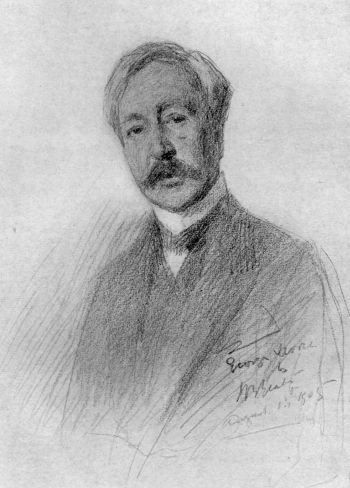
George Moore
Now that those interested have read "Ave," the first volume of the three
of "Hail and Farewell," in which Mr. Moore is confessing the reasons of
his return to Ireland and of his second departure from Ireland, they
know that he had been mildly interested in Ireland as material for art
as far back as 1894, and that it was Mr. Martyn who had interested him
in the things of home. Mr. Moore tells us all about it more than
explicitly in the "Overture" to his trilogy. In the first chapter he
tells us that the interest faded away gradually, to be reawakened in
1899 by a visit paid him in London by Mr. Martyn and Mr. Yeats, who came
to ask his help in founding a "Literary Theatre in Dublin." Then Mr.
Moore learned the story of that theatre's inception, a story to him
"disappointingly short and simple. When Yeats had said that he had spent
the summer at Coole with Lady Gregory, I saw it all. Coole is but three
miles from Tillyra [Mr. Martyn's estate in Galway]; Edward is often at
Coole; Lady Gregory and Yeats are often at Tillyra; Yeats and Edward had
written plays—the drama brings strange fowls to roost."
It takes Mr. Moore many pages to tell why it was he joined the three in
their project, and many more pages to tell of their collaboration during
the first two years of the three years that were the life of "The Irish
Literary Theatre." The four are, indeed, the principal characters of Mr.
Moore's "Ave"—I had almost said his novel "Ave"—himself, Mr. Martyn,
Mr. Yeats, and Lady
Gregory, to mention them in the order of prominence
that Mr. Moore gives them.
Lady Gregory and Mr. Yeats have learned their art, the highest and most
difficult of all forms of literary art, so that each is sure in the
shaping of fable and emotion to the stage, though neither is to drama
native-born as was Synge. Mr. Martyn and Mr. Moore have neither of them,
however, learned the art of the playwright. Mr. Martyn has the root of
the matter in him, but he remains the amateur. Mr. Moore was once the
amateur, even in the novel, in "A Modern Lover" (1883), for instance,
true as that story is to the London art life and aristocratic life it is
intended to reflect, but he has since then won his way, book by book, to
the position, now that Mr. Hardy has given up the novel, of first
novelist of the English-speaking peoples. Had he studied the play as
painfully and as long as he has studied the novel, it may be that Mr.
Moore had conquered it, too, though I doubt it, for the concentration
necessary to drama is alien to his method as a novelist. As it is, his
best plays are but the good journeyman work of one who is a skilled
literary craftsman. Mr. Martyn has more originality of theme, more
intimacy with Irish character, a surer instinct for effective situation,
and more nobility of intention, though Mr. Moore's greater power over
words gives his plays a dignity as art that the plays of Mr. Martyn do
not attain.
Alone of the quartette that founded "The Irish Literary Theatre," Mr.
Martyn is possessed of none of the instincts of the publicist. Lady
Gregory has edited articles
about ideals in Ireland at home, and on the
lecture platform she has stoutly fought the battles of "The Playboy of
the Western World" in America; Mr. Yeats has ever delighted in writing
letters to the newspapers and he has preached the evangel of the
Renaissance from Edinburgh to San Francisco; and Mr. George Moore is a
controversialist pamphleteer even before he is a novelist. In the few
articles about the movement that Mr. Martyn has written, brief articles
all of them, there is, however, clear indication of the spirit in which
he wrote his plays, if comparatively little discussion of his art. In
the second number of "Beltaine" (February, 1900), in an article entitled
"A Comparison between Irish and English Theatrical Audiences," Mr.
Martyn declares that he sees in Ireland, instead of the "vast
cosmopolitanism and vulgarity" of England, "an idealism founded upon the
ancient genius of the land." It is wholly in accord with the spirit of
this declaration that Mr. Martyn has written his more important plays,
all of them, in fact, but the satires on weaklings and officials he
calls "A Tale of a Town" (1902) and "The Place Hunters" (1905). He
writes little of the peasants, being less interested in them than are
Mr. Yeats and Lady Gregory, and therefore less acquainted with them. If
one may judge from his writings the intimates of Mr. Martyn have been
among his own landlord class, the priests, and the politicians. It is
the landlords and middle-class people that occupy the foreground of his
plays, Peg Inerny in "Maeve" (1899) being the only important character a
peasant, unless Mrs. Font in "The Enchanted Sea" (1902) can be called a
member of a class
that she was born to, but from which her marriage
removed her.
This question of the class the plays should present was one of those
that led to the withdrawal of Mr. Martyn from the dramatic movement. A
more definite cause, perhaps, was the unanimous determination of Lady
Gregory, Mr. Yeats, and Mr. Moore that his "A Tale of a Town" could not
be presented by "The Irish Literary Theatre" as he wrote it if the
standards of that theatre were to be preserved. Its author's magnanimity
in turning it over to Mr. Moore to be rewritten,—as it was, being
presented as "The Bending of the Bough" (1900),—was revealed by Mr.
Moore in "Samhain" (October, 1901), and very much more fully, if less
kindly, in "Ave" (1911).
In its way their refusal to play Mr. Martyn's "A Tale of a Town" was as
creditable to the other powers in the theatre as was his magnanimity in
giving them the play to do with as they would. They knew their refusal
to play it might lead him to withdraw his support of the theatre and, in
the end, it was a factor in bringing about that result. After their
rejection of "A Tale of a Town," however, he still gave "The Irish
Literary Theatre" his support, allowing it to put on his "Maeve," and in
1901 contributing to "Samhain" (October), "A Plea for a National Theatre
in Ireland." Such a theatre Mr. Martyn had the power to give Ireland,
but he did not give it, when it was thought he might, and in 1902 all
hope of his giving his money for such a purpose was destroyed by his
transference of a fund of fifty thousand dollars to the Catholic
Pro-Cathedral in Dublin "for the purpose of founding and supporting a
Palestrina choir."
That Mr. Martyn was still a force to be reckoned with is revealed by the
trouble Mr. Yeats went to, in "Samhain" of October, 1902, to explain why
it was that the plays of the Irish National Dramatic Company were either
folk-drama or drama whose life was the "life of poetry" Mr. Martyn had
argued in "The United Irishmen," which up to the time of the
presentation of "In the Shadow of the Glen" was a stanch supporter of
the dramatic policies of Mr. Yeats, that the actors of the company
should be trained to the drama of modern society. "The acting of plays
like 'Deirdre,' and of 'Cathleen ni Houlihan,'" writes Mr. Yeats, "with
its speech of the country people, did not seem to him a preparation. It
is not, but that is as it should be. Our movement is a return to the
people, like the Russian movement of the early seventies, and the drama
of society could but magnify a condition of life which the countryman
and the artisan could but copy to their hurt. The play that is to give
them a quite natural pleasure should either tell them of their own life
or of that life of poetry where every man can see his own image, because
there alone does human nature escape from arbitrary conditions. Plays
about drawing-rooms are written for the middle classes of great cities,
for the classes who live in drawing-rooms, but if you would uplift the
man of the roads you must write about the roads, or about the people of
romance, or about great historical people."
Neither "Maeve" nor "The Enchanted Sea" can be
called a drawing-room
play, though both introduce us to "drawing-room people," but "The
Heather Field" (1899), Mr. Martyn's first play, and his greatest success
is a drawing-room play, as in a minor way are "A Tale of a Town" and
"The Place Hunters." These last two plays are failures; but they are not
failures, I think because they are drawing-room plays, but because Mr.
Martyn is less effective with a full stage than with two couples or so
and, principally, because he is less successful with social and
political questions than with those that concern the individual.
Whatever value one puts upon "The Heather Field" it cannot be denied
that it was a popular success and that it was praised by critics whose
judgment is discerning. It is perhaps because it is a variant of the old
theme of the war between man the idealist and woman the materialist that
it so appealed to young men, troubled themselves as to whether to follow
their star or to accept the chains that; wife and children impose. It
was enough for the audience that witnessed its first performances in the
Antient Concert Rooms, Dublin, May 9, 10, 13, 1899, that it showed a man
at war with the despotism of fact, as Ireland, preeminently the Celtic
Land, has so long been. It was not remarkably acted, by an
insufficiently rehearsed and not very understanding scratch company, and
yet it impressed its audiences more favorably than "The Countess
Cathleen" (1892), an unequivocally great poetic drama; and these
audiences were the most cultivated Dublin can boast.
"The Heather Field" is the story of the going-mad of
Carden Tyrrell, a
landlord of the west of Ireland. From the first he is represented to us
as a man to whom as to so many of his countrymen dream is reality and
reality dream. His wife, to whom the realities are very instant, urges
him to do as others do, to entertain, to hunt, at least to do something
practical. For her he has abandoned the ideal world he had built up for
himself from his books and his dreams and is trying farming. Yet his
temperament is such that he must idealize even this. When the curtain
rises he is still busy with the project, long since undertaken, of
reclaiming a wind-swept heather field fronting the Atlantic and of
making it into the best of pasture land. That reclamation and
transformation has become a passion with him, and soon we feel that it
is the symbol of that quality in him that is untamed, incurably "ideal."
To free that field of rocks and to drain its bogs he has mortgaged his
estate, and, in the play, before the success or failure of his
undertaking is proved, he mortgages almost all that remains to him to
improve the land below, which the draining of the heather field has
turned into a swamp. His wife, to prevent this last folly, strives to
have control of his property taken away from him, but his friend, Barry
Ussher, believing that restraint would make Tyrrell mad indeed, so
intimidates a hesitating physician that Mrs. Tyrrell fails in her most
natural plan to save herself and her child from ruin by having her
husband declared incompetent, and, if necessary, restrained. With his
friend's assistance Tyrrell has won his fight against his wife.
Obstinacy in the treatment of some tenants that his debts have driven
him to evict
rouses such hatred against Tyrrell, until then a loved
landlord, that the police hold it necessary to follow him with an escort
that he may not be shot by his people. To avoid being so followed,
Tyrrell keeps within doors and so intensifies his malady. The
catastrophe comes when, on his boy's first spring search for wild
flowers, the child brings him a handful of heather buds from the heather
field. Their message is that the mountain will revert to waste again.
Even in his "ideal domain" reality has asserted itself. His ideal world
crumbles for the instant, and his reason with it, and forever. But after
a moment's agony ideality triumphantly reasserts itself, and in mad
ecstasy Tyrrell, his years fallen from him, passes from sight crying out
at the beauty of a world that is to him now forever a world of mornings
in which, as he says, "the rain across a saffron sun trembles like gold
harpstrings through the purple Irish spring.... The voices—I hear them
now triumphant in a silver glory of song!" Such is the play, "aching and
lofty in its loveliness."
Is this ending, or is it not, sadder than the catastrophe of "Ghosts"?
Certainly to "Ghosts" it owes something, and to "The Wild Duck" more
than something. A quality as of Ibsen pervades the play, and it has,
too, back of it a background of nature and of thought that is beautiful
in the way the background of nature and of thought is beautiful and
compensating in the plays of Ibsen.
In his introduction to "The Heather Field," which was published before
its presentation, Mr. Moore writes, "Although all right and good sense
are on the wife's side, the sympathy is always with Carden." So it was
on the
presentation of the play in Dublin, Mr. Yeats writing in "The
Dome," "Our Irish playgoers sympathized with this man so perfectly that
they hissed the doctors who found that he was mad." Such an attitude is
characteristically Irish; and equally characteristically English was the
reception of this play when Mr. Thomas Kingston presented it at a
matinee at the Strand Theatre in London. Mr. Yeats is again the
authority: "The London playgoers ... sympathized with the doctors, and
held the divine vision a dream." Mr. Moore praises "The Heather Field"
more forthrightly in "Samhain" of October, 1901, holding that "'The
Heather Field' has been admitted to be the most thoughtful of modern
prose plays written in English, the best constructed, the most endurable
to a thoughtful audience." Patriotism or kinship, love of paradox or
desire to assuage feelings hurt by the rough treatment of "A Tale of a
Town," may any or all of them be called upon to explain so sweeping a
statement. But none of such motives could account for its praise by Mr.
Beerbohm in the London "Saturday Review." "Max" is often paradoxical,
but he is not paradoxical here: "Not long ago this play was published as
a book, with a preface by Mr. George Moore, and it was more or less
vehemently disparaged by the critics. Knowing that it was to be produced
later in Dublin, and knowing how hard it is to dogmatize about a play
until one has seen it acted, I confined myself to a very mild
disparagement of it. Now that I have seen it acted, I am sorry that I
disparaged it at all. It turns out to be a very powerful play indeed." I
have quoted Mr. Yeats and Mr. Moore and Mr. Beerbohm,
not only because
I have not seen the play on the stage but because, on reading it, its
effect is one that puts my judgment at sea. Years ago as I read it it
gripped me hard, but when I read it now and think it over now, I am at a
loss to see why, done as it is done, I should have been so moved by it.
Now I am moved greatly by but two situations. Both of these are in the
last act. One of them is Tyrrell's revulsion against the bad news that
his brother Miles brings from Dublin of the mortgagee's refusal to
extend. His wife tells their friends that she is ruined, that "pretty
nearly all" their property is mortgaged, but Tyrrell cries out, "All, do
you say? No—not all. This vulture cannot touch the heather field! My
hope,—it is my only hope, and it will save me in the end. Ha, ha! These
wise ones! They did not think the barren mountain of those days worth
naming in their deed. But now that mountain is a great green field worth
more than all they can seize, (with a strange intensity) and it is
mine—all mine!"
The other situation that moves me greatly is that at the very close of
the play, that from which I quoted a while back, in which Tyrrell's
madness becomes evident in his belief that he is a youth again, with all
the world before him to do with as he will.
The characters in "The Heather Field" are less rigid than those in the
later plays, but even in this play you feel about them, as you feel so
often about the characters of Hawthorne, that they are characters chosen
to interpret an idea rather than children of the imagination or
portraits done from observation of life.
As one recalls the motive and situations and background and symbolism
of "The Heather Field," not having read the play for some time, it seems
far finer than when one returns to it. Fine, too, it must seem to any
one reading a scenario of it and not offended, as one reading it
constantly is by the inability of its dialogue to represent more of the
person speaking than his point of view. The dialogue of Mr. Martyn is
almost never true dramatic speech, and not only not true dramatic
speech, but despite the very clear differentiation of the characters,
with little of their personality or temperament in it.
"Maeve" has always seemed to me a lesser play than "The Heather Field,"
and it now leaves me even colder than of old. Nor, though I can see how
fine in conception was the character of Mrs. Font in "The Enchanted
Sea," does that one character seem to me, now, to redeem the undeveloped
possibilities of the situations of the play, the incomplete characters
of Guy and Mask and the failure of the dialogue assigned to the
characters to approach true dramatic speech. "Maeve" is the better play
of the two. With all its shortcomings it has about it an unearthliness
of atmosphere, a quiet coldness of beauty that has come of the thought
Mr. Martyn had, as he wrote it, of the moonlight on the Burren Hills in
his home country. In this one respect Mr. Martyn has done what he would,
for he holds that "the greatest beauty like the old Greek sculptures is
always cold."
Mr. Martyn calls "Maeve" "a psychological drama in two acts." It relates
the story of the last day and night in the life of a visionary girl, the
hereditary princess
of Burren in Clare, in the west of Ireland. On the
eve of her marriage to Hugh Fitz Walter, a rich young Englishman, whom
she will wed only for her father's sake to reestablish him in his
position as "The O'Heynes" among the neighboring gentry, she wanders off
into the Burren Hills with her old nurse Peg Inerny. Peg has fascinated
Maeve O'Heynes with tales of "the other people," convincing Maeve, as
she is convinced herself, that she changes from the old vagrant peasant
whom the countryside half fears into Queen Maeve, the great Amazon of
the Cuchulain legends. Maeve O'Heynes in her own dreams has seen great
heroes and heroines of Ireland's legendary past, and she believes that
they still live among the fairies as many a peasant to-day beside Peg
Inerny believes. So Maeve follows Peg to the mountains, though it is her
wedding-eve, to see these great people of old time and to meet a lover
she has seen in vision, the ideal man of her dreams. She finds her way
home several hours later through the white moonlight of the bitter March
night. Then, in a sort of trance, looking out of her window in the
half-ruined castle to the ruined abbey, the mysterious round tower, the
stony mountains, she beholds the vision of Queen Maeve, with an
attendant troupe of harpers and pages, rise from the cairn and approach
the castle. As the troupe returns from castle to cairn Maeve's spirit
passes with it under the Northern lights into the land of the ever-young
of Tir-nan-Ogue. When her sister goes to call her to make ready for her
wedding, she finds Maeve sitting still and cold at the open casement.
Maeve has found the supernatural lover, once human, of "boyish
face
closehooded with short gold hair," and again only "a symbol of ideal
beauty," to be truly a "Prince of the hoar dew," for he is death. Maeve
has renounced life and sought "perfection in what unfolds as death."
Mr. Yeats explains the play ("Beltaine," February, 1900) to "symbolize
Ireland's choice between English materialism and her own natural
idealism, as well as the choice of every individual soul." Does it
follow that the lesson of "Maeve" is that it were better for Ireland to
be depopulated in her pursuit of national individuality, of ideal
beauty, than to drift along to complete Anglicanization, even though
that bring riches, peace, and content? An austere policy, surely, if I
read rightly the meaning of Mr. Yeats.
"Maeve" was not so well played at its production during the second
season's performances of "The Irish Literary Theatre" in February, 1900,
as "The Heather Field" had been performed in 1899, but it was almost as
enthusiastically received. It has not won for itself, however,
reproduction outside of Dublin, as did Mr. Martyn's first play, which
was played in New York, at the Carnegie Lyceum, in April, 1900, and
which was revived in London in 1903.
If objection be made to "The Enchanted Sea" as a reflection of "The Lady
from the Sea," it can be replied that the call of the sea that may not
be resisted is as old as the heart of man. Sea fairies, mermaids and
mermen, and the voice of the waters tugging as irresistibly on the tired
spirit as the undertow on the body tired with long swimming, are in
Gaelic literature from the beginning, and
before Mr. Martyn had written
of the sea enchantment it had lent its charm to many of the stories of
"Fiona Macleod." It was two years after its publication in 1902 that, on
April 18 and 19, 1904, "The Enchanted Sea" was put on at the Antient
Concert Rooms, Dublin by "The Players' Club." It was not well played,
but according to Mr. Standish James O'Grady it was much better, seen and
listened to, than read. Writing, in his "All Ireland Review," of its
production, he puts it on record "I never saw an audience so attentive
and at the same time so undemonstrative. It was like being in church."
The audience probably felt the dignity of conception back of the
insufficiency of execution in the play and its ineffectiveness of
presentation. The story that Mr. Martyn dreamed to carry over the
footlights is of Mrs. Font, a peasant woman who has sent her husband, a
gentleman, to his grave a broken-spirited man because of her sacrifice
of his honor to advance their material position. When the curtain rises,
Mrs. Font has been thwarted, by the death of her son, in her lifelong
dream of obtaining possession of the Font estates. The estates have
reverted to her nephew, Guy Font, a strange boy, who has been brought up
by the peasantry of the west coast and so has come to share many of
their beliefs. He is fascinated by the sea by which he lives, and his
family's friend, Lord Mask, has been drawn to him, although there is
such disparity in their years, by this love of the sea which he and the
boy have in common. Mrs. Font wishes her daughter to marry Mask, but the
young people are but half in love with each other. Agnes Font cannot
share his visionariness, as her other
lover, Commander Lyle, plainly
sees. So the North of Ireland man never gives up hope of winning her.
Mrs. Font vulgarly throws Mask and Agnes together, in her determination
that they shall make a match of it, and as vulgarly tells Lyle the girl
is not for him. Mask cannot but marry Agnes, Mrs. Font thinks, if Agnes
has a large fortune. To secure the fortune and the lord for her
daughter, Mrs. Font determines to get Guy Font out of the way. Her
purpose coincides with her peasant belief that he is a "changeling," and
is really of the sea people. So she goes with him to a sea cave he is
fond of visiting, and only she comes from the cave. She is suspected,
but before the officers come for her, she learns that her crime has
defeated its own end. Mask is driven mad by the loss of his friend and,
seeking to join him by the sea, is overwhelmed and drawn out by the
undertow. As the officers come to arrest her, Mrs. Font hangs herself
from the landing of the great staircase of Font Hill with the rope Guy
used there as a swing.
"The Enchanted Sea" is cruder, colder, more amateurish than the two
other plays of its class, full of the sort of talk that falls from the
lips of a boy of seventeen just awakened to ideals. Its characters act
as openly and as petulantly as children. Mrs. Font, really fine in
conception, is in realization only a typical villain of the cheap
melodrama; and Commander Lyle, of the Royal Navy, a man of thirty, is as
childish in love as a schoolboy whose beloved takes an ice from his
rival at a church festival.
What Mr. Martyn could have done with "A Tale of a Town," had he been
willing to learn when opportunity
was his with Mr. Yeats and Mr. Moore
and Lady Gregory, is partially shown in the rewriting of the play by Mr.
Moore into "The Bending of the Bough." The motives remain as they were,
and, in essentials, the action is the same, the first act being little
different in the two plays The four other acts, however, Mr. Moore has
almost entirely rewritten, and though everywhere the fundamental
brainwork is Mr. Martyn's, the last acts are finer in the revised
version. Mr. Moore makes far more plausible the girl, Millicent Fell,
for love of whom, and a life of ease, the political leader Jasper Dean
gives up a leadership through which he could largely right his country's
wrongs. Not only does Mr. Moore make believable the action of the play,
but he puts words on it, which, if not true dramatic speech, reveal,
after the manner of the novelist, just what are the thought and emotion
of the characters, and the words are in themselves beautiful.
In "A Tale of a Town" the political situation from which evolves the
action of the play is the unification by Jasper Dean of the corporation
of a town, unnamed, on the west coast of Ireland, to prosecute a lawsuit
against an English town, Anglebury, which owes the Irish town a large
indemnity, promised the Irish town when it gave up a line of steamers in
the interest of the Anglebury line of steamers. After uniting all the
various elements save the place hunter Alderman Lawrence against
Anglebury, Dean gives up the leadership because his fiancée, whose uncle
is the mayor of the English town, turns against him because he is
opposed to the interests of her set. To hold her he betrays his town.
"A Tale of a Town" is so crude, so naked, so obvious, so uninspired,
one wonders why it can be taken seriously at all. But the reason is not
far to seek. The play is true, in the main, to the life it depicts, and
there is vehement feeling back of its satire; and truth and intensity of
feeling cannot be denied effect on the stage any more than on the
rostrum. Where it falls short of reality is in the dialogue of the
aldermen. No politicians, even when egged by their envious womankind,
would ever give themselves away as do these of "A Tale of a Town." They
are as frankly self-revelatory as if they were characters in a morality
play.
It would, perhaps, be inexact to call Mr. Martyn a misogynist, but he
has that attitude toward women of some priests his countrymen, as of
many priests of all creeds, that there is something belittling if not
degrading in absorbing association with women. His feeling is not at all
the commoner feeling of men that leads them all to cry, "The woman
tempted me." Women tempt Mr. Martyn no more than they did Ruskin, but he
seems to feel that the majority of them are nuisances if not baggages.
So strong is this feeling in "A Tale of a Town" that it leads him to
make Millicent behave in a way no Jasper Dean in real life would ever
stand, for Jasper Dean is not a man pronouncedly uxorious until his
abject surrender at the end of Act IV.
There are almost as many indictments of women as there are of England in
the plays of Mr. Martyn: Mrs. Tyrrell in "The Heather Field" and Mrs.
Font in "The Enchanted Sea," as well as all of the women in "A Tale
of
a Town" save Miss Arabella Dean. In "Maeve," the heroine and Finola are
sympathetically presented, and there is a kind of attraction as well as
decided repulsion in Peg Inerny. But such sympathy as Mr. Martyn does
express here seems to be expressed not because the women are fellow
human beings, but because Maeve and Peg Inerny symbolize Ireland's
resistance to English ways and because Finola is filled with
loving-kindness for Maeve. Agnes Font in "The Enchanted Sea" escapes the
pillory rather inexplicably, for she is poor, weak girlhood unable to
understand the other-worldly idealism of her cousin and Lord Mask. But
since Mrs. Font was altogether repulsive and the men either too dreamy
for "common nature's daily food" or too hard in the way of the Black
North, Mr. Martyn felt, I suppose, that his hearers would be utterly
alienated were there not some one in the play sympathetic in the
ordinary way of human nature.
"A Tale of a Town" was put on for the first time at Molesworth Hall,
Dublin, late in October of 1905, by Cumann nan Gaedheal, not very
notably, but it was hailed by the Irish Ireland newspapers as admirable
propagandist material, "The United Irishmen" declaring that "an Irish
play which brings home to us, as this does, the secret of the endurance
of foreign government in this country, is a national asset."
Mr. Martyn has not cared enough for "The Place Hunters" (1905) to
publish it in book form, contenting himself with its printing in a
little periodical. It is, as its title indicates, a fellow of "A Tale of
a Town," but it has
not back of it intensity of feeling enough to lift
itself out of farce.
Between "The Place Hunters" and "Grangecolman" is an interval of seven
years, but it is the Mr. Martyn of earlier plays, still faithful to
Ibsen and still of a dialogue more formal than that of life, that we
find in this play of his middle age. As you read "Grangecolman" you
think of "Rosmersholm," as you thought of "The Wild Duck" when you read
"The Heather Field." "Grangecolman" is the story of a daughter's
frustration of her elderly father's intention to marry his young
amanuensis, by playing the rôle of the family ghost, long fabled but
never seen, and being shot by the girl she feels is driving her out of
her home. Katherine Devlin is another creature of her maker's misogyny.
She is a bitter, barren woman of suffragette type, whose marriage and
career as a doctor have been alike failures, and who has alienated
herself from all, even her mild father, by her selfishness and
discontent. It is she who has brought Miss Clare Farquhar into her
father's home to render him those services in his pursuit of heraldry
and genealogy that were irksome to her, and so she herself is
responsible for his dependence on his secretary, which, when once the
daughter recognizes it, threatens annihilation of what little pleasure
she has in her life. Her husband is a dreamy sort of man, slack-fibred
and pottering, who goes about waving the banner of the ideal and
refusing to work. The fifth character of the play is the butler, Horan.
All are clearly characterized, but if the dialogue is less stiff than
that of the earlier plays, it is little more distinctive of the
people
who speak it, and in the latter part of the play labored and stodgy.
"Grangecolman" is a picture of life as we all know it, and there is in
it a fidelity of purpose that gives it a kind of effectiveness. There is
not in it, however, any keenness of vision, any deep reading of life,
any great underlying emotion, to relieve its abject sordidness. There is
no gusto, no beauty, no intensity of bitterness even, to make its
sordidness interesting in any other than a pathological way.
As one reads "Hail and Farewell," one might readily come to believe that
Mr. Martyn is only an eccentric character, "gotten up" by Mr. Moore for
a novel. Mr. Martyn is, in reality, a very vital force working for the
nationalization of Irish art, if not an artist himself. The pity is that
he is not wholly an artist, for he might have been. He knows and is
interested in classes of Irish society that the dramatists of the Abbey
Theatre have not tried to depict, and had he realized twelve years ago
what a chance was his to learn the art of the stage, with the help and
collaboration of Mr. Moore, Mr. Yeats, and Lady Gregory, he might now be
what he seemed to be after the triumphant production of "The Heather
Field," the Irish playwright who had adapted the modes of Ibsen to the
presentation of the life of Irish landlords and bourgeois politicians.
But Mr. Martyn would not realize that ideas—and he is rich in
ideas—constitute the larger part of originality; he thought technique
in drama must come from the man himself, too. Such technique, of course,
comes most often from the study of other drama. Certainly it
was an
original possession of none of the dramatists of the Celtic Renaissance,
and Mr. Martyn might have been content to be a fellow learner, along
with the rest of them, from one another, and from all the great
dramatists of the world. It may be that Mr. Martyn never would have
attained style, but he could, I think, have learned to make his
characters express themselves in a way nearer to true dramatic speech
than the lifeless dialogue of his that only just manages to give you
their thought, with none of their mood of the moment or of their
personality.
In every one of Mr. Martyn's plays the plot is interesting, save in "The
Place Hunters"; in every other play it is significant; and in all it is
come largely of his individual experience of life. Back of all the plays
but these two political satires there is brooding that is deep if not
passionate. In all the characters are natural, though some of them are
unusual in the way of the unusual characters of Ibsen. And all the plays
are marred, "The Heather Field" less than any other, by the fumbling
touch of the amateur. Ironically, Mr. Martyn is strong where most
Irishmen are weak—in his plot construction: even Mr. Yeats, who never
praises with his tongue in his cheek, owning to "the triumphant
construction of the 'The Heather Field'"; and weak, where most Irishmen
are strong, in the dialogue. It would not have aided Mr. Martyn, for the
kind of play he prefers, to have listened to the speech of the peasant
as Lady Gregory has listened to it, but he might have learned, with such
compeers, how to select and to condense from actual upper-class speech a
speech that would represent the thoughts and emotions
and personalities
of his characters. It is far more difficult, of course, to write
dialogue for upper-class people, save humorous dialogue, since, as many
from Wordsworth's day on have pointed out, upper-class people do not
express their thoughts and emotions as frankly as do the folk. As Mr.
Yeats puts it, they look into the fire instead.
Amateur as he is, however, Mr. Martyn has one play to his credit that he
who has read will remember, "The Heather Field." It is often thus with
the amateur. We need go no further than Mr. Martyn's countryman who gave
us "The Burial of Sir John Moore" for witness. Mr. Martyn has, too, like
other amateurs, given suggestions to others that they have realized as
fine art. It is more than likely, for instance, that Mr. Yeats had in
his mind some memory of Peg Inerny when he created Cathleen ni Houlihan.
There is, too, about the best plays of Mr. Martyn, a quality of a
certain kind. They have the distinctness of objects seen under the
bright hard light of late winter, when the sun grows strong, but when
the winds are still keen from the northwest and there are no leaves as
yet on the trees.
There are many characterizations of Mr. Martyn in his kinsman's "Ave."
He is now "a fellow ... with an original streak of genius in him, and
very little literary tact"; but he is more generally characterized in
some such fashion as this, which Mr. Moore makes a deliverance of his
own: "A good fellow—an excellent one, and a man who would have written
well if his mother hadn't put it into his head that he had a soul. The
soul is a veritable pitfall." However that may be, it was the discovery,
or
at least suppositious discovery, that he had a soul, a soul in
harmony with the melancholy soul of Ireland, that drove Mr. Moore back
to Dublin, and, for moments, even farther west to the home country of
his family about Lough Gara in Mayo. This discovery was foreshadowed in
"Evelyn Innes" (1898), in which Mr. Moore grows curious about the belief
in ancestral memory and other esoteric beliefs of Mr. Yeats; it is
latent in the introductions to "The Heather Field" and "The Bending of
the Bough"; and it is made manifest in the parts of the latter play that
are Mr. Moore's. Who most helped him to the discovery it is not easy to
say, but an interest in his country entered into and possessed him as
Kirwan's ideas entered into and possessed Dean. No doubt Mr. Yeats
helped him to find his soul, and Mr. Russell, but it must be it was Mr.
Martyn through whose agency the first glimmerings of such a recognition
began to break upon his mind. Is it only dramatically that Mr. Moore
wrote when he put upon Kirwan's lips in 1900 the words, "Life is the
enemy—we should fly from life"? But whether this is only a dramatic
repetition of what he might have heard any time from "A.E." had he
chosen to listen, there is no doubt that Mr. Moore did discover a new
quality in himself in the late nineties after he became intimately
associated with the new Irish movement. There is a wistfulness of
feeling and a beauty of thought in his writing, from "Evelyn Innes" on,
that there was not in it before "Evelyn Innes."
There are those who think the greatest excellence of Mr. Moore is as an
art critic, and that "Modern Painting"
(1893) is his great book. Mr.
Moore himself says that "Esther Waters" (1894) is his only book that he
can read with admiration and content; and those particularly interested
in the Renaissance will hold out for "Evelyn Innes" or "The Lake"
(1905). To me "A Drama in Muslin" (1886) is the best story of Mr. Moore
in his earlier realistic manner and "The Lake" in his later manner, a
manner that is now wistful and now mellow, as in "A Drama in Muslin" his
manner is uniformly as hard as winter sunshine.
Mr. Moore is, as I said at the outset, a hard-working amateur in "A
Modern Lover"; three years later, in "A Drama in Muslin," he writes with
authority and insight; as he does, too, in "Parnell and his Island"
(1887), though here with scant sympathy; but it is not until "Evelyn
Innes" that he becomes deeply concerned with beauty of subject or beauty
of background, or, except at haphazard, possessed of any mastery of
style. "Evelyn Innes" is very well written,—in spots,—but "The Lake"
is of a wholeness of good tissue that is attainable only through an art
that has labored long and earnestly to achieve beauty. Had Mr. Moore
never recaptured his ancestral tradition, had he remained the writer
that Paris and London had made him, he had never written so finely as he
writes in "The Lake." An infancy and boyhood in Ireland; a youth in
London; the ten years from twenty-one to thirty-one in Paris; eleven
years of hard writing in London, years comparatively lean after those of
luxury that anteceded them, brought Mr. Moore at forty-two to a
knowledge of what was beautiful and significant in his
home country. He
and Mr. Martyn were not many years apart when they began to write about
Ireland, but Mr. Moore had back of him not only ten years of writing,
but back of that ten years of living life as an art in Paris and his
attempts in the art of painting and his years of discussion of art in
the studios. Mr. Martyn, at home, had been more concerned with religion
and nationality and politics, and a shift to art as the principal career
of life after forty—"Morgante the Lesser" was no more than an incursion
into art, about as much of his life as a trip to Bayreuth—is only in
rare instances productive of results interesting to others than the
"artist." The difference in the achievements of the two men is not so
much the result of the difference of the powers with which both were
gifted as the result of the difference of time at which the will began
to work to realize those powers. Had Mr. Martyn begun soon enough and
had he been enough interested in his writing he might have made drama as
full of insight and beauty and as true to human nature as are the novels
of his kinsman. It is another irony of Mr. Martyn's life that it was he
who should have led Mr. Moore to the subject on which Mr. Moore was to
do his most harmonious and beautiful work, though it is possible,
judging from "Parnell and his Island," that Mr. Moore might in the end
have found his own way back.
After his wont Mr. Moore puts his intimates into books made out of Irish
life. In "Evelyn Innes" Ulick Dean, fashioned in the first version of
the novel after Mr. Yeats, is the only wholly Irish character. Evelyn is
not Irish at
all, and her Scotch father is given the musical interests
of Mr. Dolmetsch, a Bohemian, I believe. But Sir Owen Asher has in him
much of Mr. Moore himself, though most of Mr. Moore that is there is the
English Mr. Moore. There is something of Mr. Martyn in Monsignor Mostyn,
though an actual and not a potential ecclesiastic is drawn upon for the
basic characteristics of the character In the second version of "Evelyn
Innes" there is more of Mr. Russell than of Mr. Yeats in Ulick Dean, at
least in his appearance and sayings, though Mr. Moore could not divest
his composer of the personality of Mr. Yeats. There is less of Ireland
in "Sister Theresa" (1901) than in "Evelyn Innes," but "The Untilled
Field," short stories written after the removal of Mr. Moore to Dublin
and gathered together in 1903, are wholly concerned with Ireland. As Mr.
Moore makes Jasper say to Millicent in "The Bending of the Bough": "It
is the land underfoot that makes the Celt. Soon you will feel the
fascination of this dim, remote land steal over you." It was when this
æsthetic homesickness overtook Mr. Moore that he grew to feel lonely in
England, at least momentarily, and to believe that "we are lonely in a
foreign land because we are deprived of our past life; but the past is
about us here [he is speaking through the mouth of Dean and in Ireland];
we see it at evening glimmering among the hollows of the hills."
In "Memoirs of my Dead Self" (1906) there are chapters which tell of the
return of his thought to his boyhood in the west and that record his
wish to be buried with his father by Lough Gara; and all three volumes
of "Hail and
Farewell," the first of which was published in 1911 as
"Ave," and the second in 1912 as "Salve," are the fruit of his ten
years' partial residence in Ireland, 1901-11.
Our concern with Mr. Moore here, however, is with Mr. Moore the
dramatist, so I shall not dwell on the short stories and the novels save
to say that they, more than any writing of his, reveal his inherent
dramatic power. By dramatic power I mean not his power of situation and
evolution of dramatic technique, but his power to change his point of
view with the character he is creating A sensual exquisite himself whose
predominant thought is of woman, and of woman from a standpoint closely
akin to an epicure's toward an ideal meal, Mr. Moore can identify
himself with people in whom there is none of himself but the essential
humanity common to mankind. Most wonderful of many wonderful
realizations of viewpoint so different from what is his personally is
his realization of the attitude of Father MacTurnan, an old priest,
celibate by nature, who put aside his books, as ministering to the pride
of the intellect, and sat, night after night, with them by his side in
the study, but always unopened, while he was knitting socks for the poor
of his parish. Better known, of course, than this character of Father
MacTurnan is that of Father Gogarty in "The Lake," but for all his
sympathetic elaboration of this bemused and distraught cleric the
character is never wholly opposed to that of Mr. Moore himself as is the
character of Father MacTurnan.
It is this power of Mr. Moore that makes him the great novelist that he
is, this power of identifying himself with
the personality and this
looking out on life from the viewpoint of Esther Waters or Lewis
Seymour, or Edward Dempsey or Rose Leicester, of Kate Lennox or Mr.
Innes. Such a power is akin to one of the greatest powers of the Gael,
his quick sympathy with what appeals to him in others, his momentary
absorption in their interests and his passing possession by their
purpose. It is this habit of his nature that makes the Gael tell people
what they wish to hear, it is this that makes him so courteous, it is
this that makes him so good an actor. And the power that makes one man a
good actor, a real actor,—not one who happens to fit a part, but one
who can change his personality from part to part,—is but another
manifestation of the power that enables a man to identify himself
wholly, now with this character, now with that, in a story which he is
writing. If a man can express such identification in dialogue, he can,
if he master dramatic construction, make himself into a dramatist; if he
express it in subtle analytic writing about the character, it gives him
one of the great powers of the novelist, a power which, if it is united
with the power of story-telling, makes him a great novelist, and,
oftentimes, even if he be but a fair story-teller, a great novelist. The
English novel has been famously deficient in story-telling ability since
Scott's day, and Mr. Moore is no exception to the rule. As, however, the
emphasis of all his stories is on character, his deficiency in narrative
power matters hardly at all.
Mr. Moore is, then, Ireland's greatest novelist because he has in
greatest measure—in full measure—this greatest gift of the Gael, the
gift of dramatic impersonation
of all manner of men in all their
changing moods. A personality as intense as was that of Meredith, as is
that of Mr. Hardy, Mr. Moore has not always one attitude, as have both
Welshman and Saxon of the Saxons, however completely they write from the
standpoint of each character they create. By the side of the characters
of Meredith is always Meredith, high-hearted and confident, and by the
side of the characters of Mr. Hardy is always Mr. Hardy, lamenting what
woe fate has brought them, but by the side of Ned Carmady or Oliver
Gogarty, the Mummer or Montgomery, Sir Owen Asher or Ulick, there is
seldom Mr. Moore. He almost never plays chorus to his characters, either
through a commenting character or by direct interposition in the manner
of Thackeray, though, of course, the characters again and again express
his views. So in "The Wild Goose," in which Ned Carmady represents one
year's outlook of Mr. Moore, there is only one choric observation.
When one considers how alien to Ireland were all the interests of Mr.
Moore for years, his rendering of the Irish characters of "The Untilled
Field" and "The Lake" is realized to be all the more remarkable. It is
not easy to pick up threads that one has dropped in a period of one's
life that is dead and done, but Mr. Moore has picked them up more than
once. From time to time he had, of course, made visits home, writing "A
Mummer's Wife" in Galway in 1884 and finding there then, no doubt, the
material for "A Drama in Muslin" and the sketches of "Parnell and his
Island"; but these visits were none of them of long duration until his
"return" in 1901.
It is far easier to paint in the background of landscape remembered
from childhood than it is again to get into touch with people parted
from in childhood. The landscape changes little in far-off, lonely
places, but people nowhere are what they were when the past years
sufficient to bring up beside the old folks a new generation with ideals
changed. Ireland, for all the agitation of the Land League, was landlord
Ireland when Mr. Moore got "A Drama in Muslin" from Ireland; Ireland was
passing to the peasant proprietor when Mr. Moore returned to it to write
"The Untilled Field" and "The Lake." Social and economic questions,
however, interest Mr. Moore only as they concern the individual, but the
changing conditions in Ireland cannot be prevented from finding their
way here and there into his writing through the changes they have
brought about in the people of whom he writes, though many of those he
writes of are survivals from an older generation.
There are glimpses in his writing of many phases of Irish life, his
characters varying all the way from such old-timers as his Cousin Dan,
who, as he himself intimates, might have come out of the pages of Lever
or Lover, to the very modern Father Gogarty, whose outlook is on an
Ireland that "perhaps, more than any other country, had understood the
supremacy of spirit over matter, and had striven to escape through
mortifications from the prison of the flesh." One wonders, at times, if
Mr. Moore, who joined the cause of Mr. Martyn and Mr. Yeats,
self-confessedly, to have his finger in a new literary pie, really felt
the landscape as he says he
does in his books, or whether he just
momentarily caught the power of seeing it through their eyes. Can one
who was once so resolute a realist really appreciate "faint Celtic haze;
a vision of silver mist and distant mountain and moor"? Perhaps he can,
as a good actor appreciates a part alien to his sympathy, that he is
playing. But whether or not Mr. Moore learned to love the lonely
landscape for a while, he eventually tired of it, as his Father Gogarty
tired of it. Surely Mr. Moore is speaking personally as well as
dramatically when he writes, "This lake was beautiful, but he was tired
of its low gray shores; he was tired of those mountains, melancholy as
Irish melodies, and as beautiful."
Almost any novelist, sooner or later in his career, dabbles in drama,
and Mr. Moore no doubt would have attempted drama in the natural course
of things, even if he had not been interested in "The Independent
Theatre" and thus led to a situation in which consistency demanded that
he write a play. It was his articles on the drama, gathered into
"Impressions and Opinions" (1891), that provoked Mr. G.R. Sims to taunt
him into "The Strike at Arlingford" (1893). In "Our Dramatists and their
Literature," one of these papers, Mr. Moore, in hitting all the heads of
all the contemporaneous dramatists, so stung Mr. Sims that he said he
would give a hundred pounds for a stall from which to witness a
performance of "an unconventional play" written by Mr. Moore. Mr. Moore
accepted the challenge, and "The Strike at Arlingford," as I have said,
was the result, Mr. Sims having agreed to withdraw the word
"unconventional" on Mr.
Moore's objection that he would be at the mercy
of Mr. Sims' judgment if the word was retained. "The Independent
Theatre" played the play and Mr. Sims paid the money. It was perhaps
just as well for Mr. Moore that the adjective was withdrawn, for the
play was little less conventional than "The Second Mrs. Tanqueray" or
"Sowing the Wind," to mention two successes of that year by play-makers
that took their art a little more seriously than Mr. Sims. In a way,
too, "The Strike at Arlingford" is unoriginal. Lady Ann Travers is only
a more fortunate Hedda Gabler who in the end accepts the protection of
her Chancellor Brack, the capitalist Baron Steinbach, after her Lövberg
turned labor agitator, John Reid has, like his prototype, made a wreck
of his life. "The Strike at Arlingford" has its excellences: its plot is
logically unfolded; it is believable; it is true to human nature; it has
moments of intensity. Had Mr. Moore power of dialogue it might have been
a fine play, for the characterization is what one would expect from so
conscientious a depicter of life as Mr. Moore, and the problem, a man's
choice between his love and his duty, one that has never failed to
appeal to men. Mr. Moore is careful to tell us that, in his own
conception of the play, "the labor dispute is an externality to which I
attach little importance."
Its performance and publication, though neither event was of very much
more than journalistic importance, served to give Mr. Moore something of
a position as an authority on the drama, coming as they did after his
association, since 1891, with "The Independent Theatre." So it is that
we find him collaborating with Mrs. Craigie
in "Journeys End in Lovers
Meeting" (1894), which served for a year or so as one of the little
plays that characterized the repertoire of the Irving-Terry Company.
Just what was Mr. Moore's share in this play I do not know, but that,
slight as it is, it served as apprentice work in the art of
collaboration there can be no doubt, or that it added to his familiarity
with the stage.
It is certain that Mr. Martyn and Mr. Yeats were glad of the assistance
of Mr. Moore in founding "The Irish Literary Theatre," not only for the
prominence of his name as novelist and as Moore of Moore Hall, and for
his known provocativeness in pamphleteering and his capacity for drawing
the fire of opponents, but for what knowledge he had of playwriting and
for what experience he had in getting together and training actors for
special performances such as those of "The Independent Theatre."
I have already spoken of what Mr. Moore did to "A Tale of a Town" to
make it "The Bending of the Bough." From the beginning of Act II on to
the end, he rewrote almost all of it, retaining only now and then an
eloquent or a biting line from Mr. Martyn's play. Mr. Moore changes the
scene of the play from Ireland to Scotland, that its allegory may not be
so obvious; he develops Kirwan's character until he becomes not only a
sort of composite spiritual portrait of the leaders of the Renaissance
but a believable leader of men; and he makes Millicent's moulding of
Dean to her will human, as I have said, and—Dean being the weakling
that he was—inevitable. Mr. Moore cuts the play down where it is
stodgy, he expands
it where expansion realizes for you more of
character and motives of his people, he infuses into it more of the
spirit of the movement, and he makes its patriotism wider in its appeal,
a bigger and a better thing at once more concrete and more concerned
with the things of the spirit.
"Diarmid and Grania" (1901), the prose play written in collaboration by
Mr. Yeats and Mr. Moore, I write of here rather than in the chapter
devoted to Mr. Yeats because, as the legend is shaped in the play, it
has more of Mr. Moore than of Mr. Yeats in it. As neither of the
collaborators was satisfied with the play as produced, and as neither
has been willing to give it up to the other to rewrite, "Diarmid and
Grania" has never been published. The notices of its production, on
October 21, 1901, at the Gaiety Theatre, Dublin, are so full, however,
and the legend on which it is based so familiar, that it is possible to
say as I have said, when one knows well the work of both authors, whose
influence is dominant in it. It seems, from the notices, to have been
finely played by the Benson Company, which was brought over from England
especially to produce it. The results of "the scratch company" of the
second year's performances, even though these were transferred from the
Antient Concert Rooms to the better stage of the Gaiety Theatre, were
not very satisfactory artistically, but the third year's experiment was
in every way more successful. "The Daily Express" of Dublin, in those
days very much interested in Irish Ireland, thus records, on October 22,
1901, the impressions of the first night. "The 'house' was not merely
crowded but representative. We counted among the audience the heads of
all the great professions in Dublin, a considerable number of literary
critics, and an extremely large representation of 'le monde où l'on
s'amuse.' The Gaelic League, which flooded the gallery, was very
friendly to Mr. Moore and Mr. Yeats, and became enthusiastic over Dr.
Douglas Hyde ['The Twisting of the Rope,' by Dr. Hyde, was played by him
and company of amateurs, in Irish]. Between the acts of 'Diarmid and
Grania' several members of the 'gods' sang number of Gaelic songs with
great gusto and a good deal of musical ability."
There are several versions of the old legend, some of them cynical,
leaving Grania in the end lighter even than Helen of Troy; others
closing with Diarmid slain by the boar as Adonis is slain, and Grania
weeping his death. In all it is Grania who tempts Diarmid to take her
away from Finn on the eve of her wedding to the old king. In some he
goes willingly, in love with her, in others unwillingly, ashamed of his
disloyalty to Finn, but under giesa not to refuse a woman's request.
In the play of Mr. Moore and Mr. Yeats Diarmid and Grania "do not live,"
says the "Daily Express," "the exciting life of flight from cromlech to
cromlech. They settle down very comfortably in the monotony of a
prosperous farm. Diarmid busies himself with his sheep. Grania ...
begins to pine for the society from which she has wilfully cut herself
off, and to think more and more of the grim old warrior Finn. Then Finn
comes upon the scene, patches up a sort of truce with Diarmid, and
becomes more friendly with
Grania, his lost sweetheart, than Diarmid is
able to tolerate. Mutual recriminations ensue between Diarmid and
Grania, and finally Diarmid goes forth to his portended death, with the
taunts of Grania and the rude jeers of the Fianna ringing in his ears.
As the play closes, the Fianna bear away the body of Diarmid, Finn
comforts the weeping Grania, and we remember the words of the legend
that 'some say she was married to Finn.' The curtain falls—a happy
touch of purely modern cynicism—upon the solitary figure of Conan, the
Thersites of the play, the prophet of evil chances, the scorner of high
things, the prompter of foul suggestions."
As the play was being written a good deal of discussion about it found
its way into the newspapers. It was rumored that it would be translated
into Irish, and then back again, by Lady Gregory, into English, but no
such fantastic scheme as that Mr. Moore tells us of in "Ave" was
suggested in any of the paragraphs that came my way. Because they could
not agree on the kind of diction they were to use in the play, Mr.
Yeats, who wanted a peasant Grania, agreed, writes Mr. Moore, to his
suggestion that he write the play in French. Mr. Moore gives these as
the words of Mr. Yeats: "Lady Gregory will translate your text into
English. Taidgh O'Donoghue will translate the English text into Irish,
and Lady Gregory will translate the Irish text back into English." "And
then," Mr. Moore makes himself reply to Mr. Yeats, "you'll put style
upon it."
More remarkable than the scheme was the actual attempt of Mr. Moore to
realize it. On leaving Galway,
where he and Mr. Yeats had been
collaborating at Coole, Mr. Moore began the second act in French. He
gives us enough of the dialogue (pages 370 to 376 of "Ave") to show us
his high pride in his French, the tolerance of his humor, and his idea
of the kind of style the play should have.
If Mr. Moore had given the subject to Mr. Yeats and to Lady Gregory, as
he had some thought of doing, it would only have been a return of a
subject already theirs by right of their long discussion of it together.
Lady Gregory was not yet working upon it for "Gods and Fighting Men"
(1904); but it was she who had reduced it to the proportions of a
scenario for them to work upon. This scenario was published in "Samhain"
of October, 1901, that all of the audiences of the play might be in
possession of the story as a Grecian audience was in possession of the
story of Elektra. And did not Mr. Moore say in his speech at the dinner
given to the supporters of "The Irish Literary Theatre" in February,
1900, in speaking of his collaboration with Mr. Yeats in "Diarmid and
Grania": "It would be difficult to name any poet that Ireland has yet
produced more truly elected by his individual and racial genius to
interpret the old legend than the distinguished poet whose contemporary
and collaborateur I have the honor to be"?
The story, of course, had been retold only less often than the story of
Deirdre by Irish writers, in one form or another, but there had been no
memorable play made out of it. Mr. Yeats had met it in "The Death of
Dermid," which Sir Samuel Ferguson included in "The Lays of the
Western
Gael" (1864), as well as in the direct translations of such scholars as
Mr. Standish Hayes O'Grady and in the versions of such popularizers as
Dr. Joyce. One cannot, not having read the play, declare it is not what
Mr. Moore would have it, "that dramatic telling of the story which
Ireland has been waiting for these many years," but it does not seem so
to have impressed those who saw it and heard it at the performances in
the Gaiety Theatre.
Now that Lady Gregory has done her "Grania" (1912), it is hardly likely
that Mr. Yeats will return to the story, and with the waning of Mr.
Moore's interest in old Irish legend it is very unlikely that he will
wish to rewrite the play. It would seem we have lost it, whatever its
value, until the "literary remains" of Mr. Moore are given to the
public.
The quarrel with Mr. Yeats over "Diarmid and Grania," coming as it did
at the end of the three years' venture of "The Irish Literary Theatre,"
explains why Mr. Moore wrote no plays for the Irish National Dramatic
Company and its successors on through the Abbey Theatre Players. He was
still interested, however, in the "cause" as far as it was possible for
one of his temperament and taste, and he was conspicuous on first nights
at the Abbey Theatre down to the time of his departure from Dublin in
1911.
Since "Diarmid and Grania" (1901) Mr. Moore has published the two books
of his that since "A Drama in Muslin" (1886) reveal his deepest
knowledge of Irish life, the volume of stories of varying length to
which he gives
that title, so symbolic, "The Untilled Field" (1903),
and "The Lake" (1905), but there are few incidents in either that he is
likely to develop into plays. "The Lake" could not be dramatized, but if
it could be dramatized, it would be as little likely to be presented in
Ireland as "The Tinker's Wedding." Mr. Moore, for all that he was born a
Catholic, would not hesitate any more than did the son of the Protestant
minister to put a priest into a realistic modern play, and that, of
course, would be a mild audacity for Mr. Moore now that he has published
the scenario of "The Apostle" (1911). His Paul, in "The Apostle," a
"thick-set man, of rugged appearance, hairy in the face and with a
belly," is wonderfully alive, and his Jesus is a distinct and realizable
personality, if not the Jesus of Christian dream. It is a curious
illustration of Mr. Moore's almost disciple-like attitude toward Mr.
G.W. Russell that he should make his Christ talk like "A.E." It seemed
to me, as I read the words that Mr. Moore puts first on the lips of
Jesus, that they were phrases that I had heard on the lips of Mr.
Russell. They are of the very quality of his speech and writing: "How
beautiful is the evening light as it dies, revealing every crest; the
outline of the hills is evident now, evident as the will of God." And
now each time, as I re-read them, they sound in my ears to the
remembered rhythm of Mr. Russell's voice. Should Mr. Moore ever evolve a
play from this scenario, and the play be played—and why should it not,
now that the way is so plainly blazed by the score and more of miracle
plays of the past decade?—it will have to be chanted as
"A.E." chants
his verse, as one would wish mass to be chanted.
Only a year ago Mr. Moore made his last adventure of the theatre. With
the help of Mr. Lennox Robinson he dramatized "Esther Waters," but later
he threw out the latter's work, feeling, no doubt, about it as Mr.
Martyn felt about Mr. Moore's rewriting of his "A Tale of a Town"; and
when it was put on, in the early winter of 1911-12 by the Stage Society,
"Esther Waters" the play was like "Esther Waters" the novel, solely the
work of Mr. Moore. The critics seem agreed that it was long drawn out
and undramatic, but that it was well written and well acted. I suppose
that the preoccupation with "Esther Waters" that this dramatization
reveals is because "Esther Waters" was written in that period of his
life when Mr. Moore was most himself. After ten years in London he had
escaped considerably from the French influence of his young manhood, and
his genius had not been warped out of its true plane, as he would
doubtless now say, by Irish mists. Mr. Moore must have felt that there
was something not wholly himself in much of "The Untilled Field" and in
much of "The Lake," that the minds of Mr. Yeats and Mr. Russell had in a
way dominated his mind, and that not even the hardly tolerated Mr.
Martyn had been without influence upon him.
Such a realization is not the professed motive for the return of Mr.
Moore to England, but I have no doubt at all that it is somewhere in the
back of his mind, where he would like it to be hidden and forgot. At any
rate, by the time of his return to England, Mr. Moore had come
to see
clearly that the Celtic episode of his maturity was closed.
It is not, I think, particularly difficult for one who understands the
old-fashioned camp-meeting "getting of religion" to understand this
"Celtic episode." Mr. Moore got Celtomania; a sort of "spiritual
consumption," he calls his possession in one place, as a certain other
type of sinner "got religion" in the old shouting days. That is, Mr.
Moore wrought himself up partly in the spirit of the Playboy, and was
wrought up to some degree willy-nilly until he could write his speech of
February, 1900, on "Literature and the Irish Language," and, finally, a
little later, could return happily to the country that until then he
could endure only now and again.
But as a matter of fact the motive that led Mr. Moore back to Ireland
matters not at all to literature. What beauty of writing that return led
to matters a great deal. Had he not returned to Ireland, we should not
have had a good deal that adds to the joy we win from satiric laughter,
we should not have had "Hail and Farewell"; had he not returned we
should not have had a book that adds to the treasure of beautiful
feeling and beautiful writing there is in English literature, a treasure
that there is no chance of ever having too large; we should not have had
"The Lake," which is Ireland, West Ireland, Catholic Ireland, a land
under gray skies that the priests its masters would, too many of them,
make a land of gray lives.
Chapter V
Mr. George W. Russell ("A.E.")
Synge is the one instinctive dramatist of the earlier group of writers
of the Celtic Renaissance, the one to whom drama was the inevitable
medium for the expression of the best that was in him. Yet even Synge
came to write plays only through an external stimulus, the urging of Mr.
Yeats on their meeting in Paris. It was fortunate for the Irish drama,
this meeting, and fortunate for Synge. If he had not been brought to the
theatre of his own country, he would probably never have written
anything of first importance. Mr. Yeats himself, of course, had been
interested in verse plays from boyhood, but he, for all the energy he
has expended in learning his own particular art of the stage, speaks
more beautifully through his lyrics and the lyrical passages of his
plays than through their passages that are dramatic speech, and not only
more beautifully but with more of dignity and power. Nor is Lady
Gregory, any more than Mr. Yeats, essentially a dramatist. Her great
power is the power of dialogue, and dialogue, of course, is as often
employed in the service of the story as in the service of the play. Yet
it is not difficult to understand how in Lady Gregory the dialogue and
in Mr. Yeats the love of the spoken word led, when opportunity was made,
to writing for the stage, and for success on the stage. But in the case
of "A.E." it is as difficult
to find a foreshadowing of the playwright
in the mystical poet as it would be to see in all but all of the essays
of "The Treasure of the Humble," any proof that their author was a
playwright. To those who knew Mr. Russell only through his verses, and
were unaware of the versatility of the man, his turning dramatist was as
surprising as Emerson turned dramatist would have been to the America of
anti-slavery days.
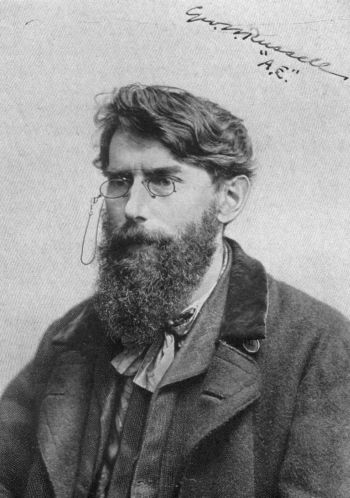
George W. Russell
It was not, of course, because of an impulse from within that Mr.
Russell attempted drama in "Deirdre" (1902), but because the young
enthusiasts of Ireland's national literary movement wanted plays that
should be at once native in quality and the work of writers of standing.
It did not seem a strange request to Cumann nan Gaedheal to ask Mr.
Russell for a play. What if he had never written a play? He was hardly
in their estimation more of an amateur than Mr. Yeats or Mr. Moore or
Mr. Martyn, who had written plays for "The Irish Literary Theatre" that
had achieved success of a kind, and he was surely as ardent a
Nationalist as any of these. So he was asked for a play to be played at
the Spring Festival of 1902 by the Irish National Dramatic Company that
was forming, and he did what he was asked to do, blocking it all out in
six hours, and finishing it sufficiently in three days for it to be put
in rehearsal. It was in the summer following its first presentation that
I saw it again in rehearsal in a little hall back of a produce shop in
Dublin, and got to know Mr. Russell as playwright before I read his
play. One of the actors, himself maker of verses and plays, gave me his
copy of "Deirdre," with cues marked. I had seen
notices of its first
performance in the Irish papers and I had written Mr. Russell to see if
I could get a copy, but he had not yet published it. Then he wrote me of
young poets I met this night in Dublin, and the names on the lips of the
enthusiasts we talked to, and their names were names Mr. Russell had
written me of four months before. Here were they introducing me to his
work as he had thus introduced me to theirs: "There are many poets here
who write beautiful lyrics who are quite unknown out of Ireland because
they never collected them from the pages of obscure magazines.... I have
seen many verses signed 'I.O,' 'Alice Milligan,' 'Ethna Carberry,'
'Oghma,' 'Paul Gregan,' which I enviously wish I could claim as my
own.... I think myself many of these unknown poets and poetesses write
verses which no living English writer could surpass." The best of the
verses of some of these and of others among his following Mr. Russell
collected in "New Songs" (1904), which bore out much that he claimed for
them.
It was to six of these young poets he dedicated his last volume of
verse, "The Divine Vision" (1904), as he had dedicated his two earlier
volumes to poet-mystics, "Homeward" (1894) to Mr. Charles Weekes and
"The Earth Breath" (1898) to Mr. Yeats. The young writers (for they were
almost all writers as well as actors) we met this Saturday night in
Dublin, one and all, looked to "A.E." as leader, and some of them looked
to him as high priest of their cult, as seer of that ancient type that
combined as its functions the deliverance of religious dicta, prophecy,
and song. My thoughts went back to
our Concord of half a century ago,
yet I wondered was Emerson's fascination as compelling as this.
It was in a commonplace-looking editorial sanctum that I found "A.E." on
the following morning, at 22, Lincoln Place, to which he had descended
from his office in the Irish Agricultural Organization Society, to edit
"The Homestead" in its editor's absence. I was to see him, in the hour I
was to spend with him there, in many rôles. First was that of one of the
beginners of the Irish Literary Revival. He has himself given the credit
to Mr. Standish James O'Grady for furnishing the initial stimulus to the
movement, in his "Heroic Period" and "Cuchulain and his Contemporaries"
of 1878 and 1880; but to "A.E." and Mr. Yeats and Dr. Hyde also is due
much of the credit. Mr. Russell said that when he came up to Dublin, a
boy from Lurgan, there was no independent thought in Dublin, but now he
thought there was a good deal, and he and his fellows of the Hermetic
Society, he took mild pride in believing, had had something to do with
the change. Even then, as a boy, he could not read most English
literature, and so he took to reading the literature of the East, the
Bhagavad-Gîta and the Sufis. From his reading of these, with other young
men that somehow found each other out, came the Hermetic Society, at
whose meetings everything mystic from the Upanishads to Thomas Taylor
was discussed. From the study of the universal, he said, they came at
last to the national, to the study of the ancient folk-lore and stories
of their people, which, had it not been for the Danes and Normans, would
have been shaped into literary form
long before now, when, he said,
they were only being so shaped.
His disciples had told me the night before that "A.E." had helped them
much in the National Dramatic Company, painting scenery for them,
designing costumes, and aiding in a hundred other ways. He was silent
about these matters and not very proud of the play. "Of course," he said,
"I was very familiar with the story of Deirdre, and I had thought of its
dramatic effectiveness, but I knew nothing of the stage and I was very
much surprised it went so well." That it went well, I, who had seen it
but the night before, could testify, though that rehearsal could give
but a suggestion of the beautiful stage pictures it presents when played
in the costume of the Heroic Age. Despite its intensely dramatic
situations, it is, however, essentially a decorative rather than a
dramatic play, and its exalted prose is seldom true dramatic speech. But
you carry from it the memory of beautiful pictures, and a feeling that
something noble has passed your way, to enter into and become a part of
you.
As we were talking of the "movement," in came a young Roscommon
landlord, and with him another of its phases and my discovery of Mr.
Russell, man of business, organizer of the Irish Agricultural
Organization Society. The talk was now of the erection of a hall, and
Mr. Russell seemed as familiar with stone and lime and sand as with
mysticism and poetry, which we had discussed, and with painting, which
we were considering in a few minutes, when Mr. J.B. Yeats, Jr., arrived,
to talk over an exhibition of his pictures to be held in Dublin the
following
week. A few days later I was reading Mr. Russell's review of
Mr. Yeats's pictures, but before I left 22, Lincoln Place, I had a
mental picture of "art critic" added to the already long list of titles
after "A.E.'s" name, and I had still another evidence of his
impressiveness. Mr. J.B. Yeats, Sr., his son said, would be around to
have Mr. Russell sit for him next morning, in order to get on with the
two orders he had of portraits of the mystic, one of them from an
admirer in America. It was pleasant on leaving him to go away with his
laugh ringing in my ears as a surety that the high seriousness of his
purpose, and the higher seriousness with which some of his admirers take
him, had not dulled his sense of humor.
Eight o'clock the next evening saw us in the eminently Philistine
suburban street where was the little house of conventional exterior that
sheltered the high dreams of "the Irish Emerson." Once entered, his
embodied visions attract you from all four walls of the study. Piles of
them in corners make you wonder is Mrs. Russell a saint. The pictures
are of Irish landscape; of "the Other People"; of heroes and heroines of
Ireland's prehistoric days; of souls that have yet to be born; of souls
that have passed through incarnation after incarnation, never to rise
above an animal existence; of souls whose every rebirth has taken them
to higher spirituality, and that now wait to pass along the "path of
liberation" into that immortality from which they shall never be born
again. These visions have come to him, as the visions whose presence he
records in his poetry, in all places—as he left the office and looked
down the sun-gilded streets at close of day; as he
wandered in the
mountains under the stars with peasants who had "second sight"; as he
talked with fellow Hermetists in meeting-rooms in back streets whose
shabby interiors grew rosy gloom as the talk turned on mysteries.
To us Mr. Russell talked much, talked kindly of all men, talked well of
many things, said startling things of society and art and poetry so
gently that you did not think until afterwards that in another you would
hold them gages of combat. I can hear him yet, as I sat and tried at the
same time to listen to him and to look at his flaming-hearted spirits
with luminous angel wings and flashing halos enveloped in an atmosphere
in which "the peacock twilight rays aloft its plumes and blooms of
shadowy fire"—I can hear him saying, "You can't read Shakespeare, can
you?" As I thought over this question later, I understood. Then I was
too far rapt by the pictures to wonder at it greatly. Later came to mind
Emerson's declaration that Homer, Milton, and Shakespeare "do not fully
content us," that the "heavenly bread" is to be found in Zoroaster,
Plato, St. John, and Menu. Both Emerson and Mr. Russell fail to use art
as the standard. To the mystic, to whom this world is not reality, what
appeal may have its seeming truths and shows as compared to the certain
truth of the idealists and the beauties of the eternal life? The deep
human knowledge, the great pageants of Shakespeare's kings and queens,
are but "glories of our blood and state ... shadows, not substantial
things."
Mr. Russell talked very simply of his pictures, of how their subjects
came to him, and of his enjoyment in thus
recording them. He does not
consider himself a painter, but he thinks there was the making of a
painter in him had he had instruction in his earlier years. This
attitude towards his various powers, as well as the attitude towards him
of ardent young countrymen of his, came out in a story he told us of a
boy that he found waiting for him one night at a street corner near his
home. The boy timidly asked him was he not Mr. Russell, and then walked
silently by his side until the house was reached. They entered and the
boy mustered up courage to say he had waited for him two hours at the
head of the street. "A.E." had been waiting for the boy to say what
brought him, but he was obliged to encourage the boy before he would out
with it. Said "A.E.," "You came here to talk with me. You must be
interested in one of the three interests I have given much time to. Is
it economics?" "No," replied the boy, indignantly. "Is it mysticism?"
continued "A.E." "No," cried the boy, almost angry at such an interest
being attributed to him. "It must be literary art, then?" "Yes," said
the boy, with a sigh, his haven reached at last. "A.E." soon found the
boy an exquisite who thought the literary movement was becoming
vulgarized through so many people becoming interested in it. Finally the
boy turned questioner and found that "A.E." was seeking the Absolute.
Having found this out, he again sighed, this time regretfully, and said
decidedly that "A.E." could not be his Messiah, as he abhorred the
Absolute above everything else. He was infected with Pater's Relative,
said Mr. Russell, "which has fallen like a blight on all English
literature." So the
boy—he was not yet twenty-one—went out into the
night with, I suppose, another of his idols fallen.
As this boy came to "A.E.," so come scores of others, and most of those
that have real troubles go away comforted, to return for advice and
counsel and friendship, as their need is. This I knew before I met
"A.E.," and his kindness I felt and certain magnetism, but the qualities
that make him the leader of men, and hierophant to his personal
following, do not lie on the surface to be quickly distinguished by
every comer. Neither, we are told, did Emerson's, who was leader of men
and hierophant. I thought often of "A.E.'s" pictures as I looked at the
pictures of Watts in the Tate Gallery in London, and I have thought more
often of them since I have come to know haloed Rosicrucian drawings and
strange symbols in such books as our own Wissahickon mystics, Kelpius
and his brethren, brought with them to "The Woman in the Wilderness"
from Germany late in the seventeenth century. How notable the impression
of Mr. Russell's paintings and visions upon two Irish writers the
English-speaking world reads to-day may be learned from their
exploitation in Mr. Stephen Gwynn's "The Old Knowledge" (1901), whose
Owen Conroy owes being to "A.E." and his pictures, and from Mr. George
Moore's "Evelyn Innes" (revised edition, 1901), whose Ulick Dean has his
appearance and his power of seeing visions.
As the evening wore on, Mr. Russell picked up a manuscript collection of
poems—that we were to have two years later as "The Divine Vision"—and
read us several. Most distinctly of these I remember "Reconciliation"
which he chanted most lovingly of all he read. It is a poem I do not
pretend to understand in detail, but I do feel its drift, and I can
never read out its stately music, or even read it silently, without
hearing his sonorous chanting. Many of his poems are like this poem in
that you must content yourself with their general drift and not insist
on understanding their every phrase. I suppose to the initiate mystic
they are more definite, but I doubt whether some of them are more than
presentations of emotions that need not be translated into terms of
thought for their desired effect.
To Mr. Russell poetry is a high and holy thing; like his friend Mr.
Yeats he is at one with Spenser in believing it the fruit of a "certain
enthousiasmos and celestial inspiration"; it is his religion that Mr.
Russell is celebrating in his verses, many of which are in a sense hymns
to the Universal Spirit, and all of which are informed by such sincerity
that you do not wonder that his followers make them their gospel. In his
own words:—
The spirit in man is not a product of
nature, but antecedes nature, and is above it as sovereign, being of
the very essence of that spirit which breathed on the face of the
waters, and whose song, flowing from the silence as an incantation,
summoned the stars into being out of chaos. To regain that spiritual
consciousness, with its untrammelled ecstasy, is the hope of every
mystic. That ecstasy is the poetic passion.... The act which is
inspired by the Holy Breath must needs speak of things which have no
sensuous existence, of hopes all unearthly, and fires of which the
colors of day are only shadows.
About a score of the less than tenscore poems of "A.E." are definitely
declarations of belief, but declarations
so personal, so undogmatic,
that you would hardly write him down a didactic poet at first reading "A
New Theme" tells of his desertion of subjects "that win the easy
praise," of his venturing
"in the untrodden woods
To carve the future ways."
Here he acknowledges that the things he has to tell are "shadowy," that
his breath in "the magic horn" can make but feeble murmurs. In the
prologue to "The Divine Vision" he states the conditions of his
inspiration:—
"When twilight over the mountains fluttered
And night with its starry millions came,
I too had dreams: the songs I have uttered
Came from this heart that was touched by the flame";—
that is, the flame of his being that, "mad for the night and the deep
unknown," leaps back to the "unphenomenal" world whence his spirit came
and blends his spirit into one with the Universal Spirit. This same
union through the soul's flame "A.E." presents in his pictures, and in
his prologue to "The Divine Vision" he writes that he wishes to give his
reader
"To see one elemental pain,
One light of everlasting joy."
This elemental pain, as I take it, is the pain of the soul shut up in
its robe of clay in this physical, phenomenal world, and so shut off
from the spiritual world, the world of the unphenomenal or unknowable.
The "everlasting joy" I take to be the certainty of eventual union with
the Universal Spirit in the unphenomenal world, a union and a joy
anticipated in the occasional temporary absorptions
of the soul into
the Universal Spirit in moments Emerson experienced as "revelation" and
Plotinus as ecstasy.
"A.E.'s" friend, Mr. Charles Johnston, records the two young Irishmen's
joint attempts to attain ecstasy, when he writes of those days when "we
lay on our backs in the grass, and, looking up into the blue, tried to
think ourselves into that new world which we had suddenly discovered
ourselves to inhabit." Do not think this ecstasy too rare and wonderful
a thing. To Plotinus it meant an utter blotting-out of self, a rapture
of peace, and to Mr. Russell it frequently means that he is entirely
"heart-hidden from the outer things," but I suspect it means sometimes
mere lift of the heart through lungs full of fresh air, or through green
fields for tired eyes, or through mountain air for worn nerves, or
through skies thick-sown with stars for the vexed spirit.
The typical poem of "A.E." is that in which the sight of beautiful
things of this phenomenal world in which we live lifts his soul to
participation in the Universal Spirit. It is most often through some
beauty of the sky at sunset, when
"Withers once more the old blue flower of day,"
as in "The Great Breath"; or at twilight, when
"Dusk wraps the village in its dim caress,"
as in "Dusk"; or at night, when
"The yellow constellations shine with pale and tender glory
In the lilac-scented stillness,"
as in "The Singing Silences"; or at sunrise, when there is
"Fire on the altar of the hills,"
as in "Dawn";—it is most often through some beauty of the sky at such
times that he becomes one with the Universal Spirit in "the rapture of
the fire," that he is "lost within the 'Mother's Being,'" he would say
that the soul returns to the Oversoul, Emerson would There are ways by
which the soul homes other than these—sometimes it is
"By the hand of a child I am led to the throne of the King."
but it is most often by way of beauties of the sky. Some reasons are not
far to seek. From sunset to sunrise the poet is free as he may be from
the treadmill of the "common daily ways," and the high moods he tries to
express are most easily symbolized by skyey images—massed clouds and
sweeping lights of diamond, sapphire, amethyst; the still blue black of
heaven thrilling with far stars; the purples of twilight horizons. In
his use of these splendid symbols he is but following Proclus, whom he
found quoted by Emerson as saying that "the mighty heaven exhibits, in
its transfiguration, clear images of the splendor of intellectual
perceptions, being moved in conjunction with the unapparent period of
intellectual natures."
How important the symbol is to "A.E."—as important as it is to
Emerson—may be gathered from "Symbolism," which, read in the light of
what I have quoted, needs, I hope, no further interpretation.
"Now when the giant in us wakes and broods,
Filled with home-yearnings, drowsily he flings
From his deep heart high dreams and mystic moods.
Mixed with the memory of the loved earth things:
Clothing the vast with a familiar face;
Reaching his right hand forth to greet the starry race.
"Wondrously near and clear the great warm fires
Stare from the blue; so shows the cottage light
To the field laborer whose heart desires
The old folk by the nook, the welcome bright
From the housewife long parted from at dawn—
So the star villages in God's great depths withdrawn.
"Nearer to Thee, not by delusion led,
Though there no house-fires burn nor bright eyes gaze:
We rise, but by the symbol charioted,
Through loved things rising up to Love's own ways:
By these the soul unto the vast has wings
And sets the seal celestial on all mortal things."
In this poem is the proof of how intimately "A.E." could write of the
sweet things of earth did he so choose. But he does not so choose,
except rarely, and sometimes he leaves out the statement of beautiful
material things by which he customarily bids farewell to earth in his
aspiration to spiritual things, and writes only of unearthly things—as
of some girl that he, an Irishman living in the Dublin of to-day, loves
in the Babylon of three thousand years ago, to the annihilation of space
and time. This is written in the very spirit of Emerson's declaration
that "before the revelations of the soul, Time, Space, and Nature shrink
away." Need I quote further to show that "A.E.," like Emerson, holds
that the true poet is he who "gives men glimpses of the law of the
Universe; shows them the circumstance as illusion; shows that Nature is
only a language to express the laws, which are grand and beautiful; and
lets them, by his songs, into some of the realities"? Emerson yearns
that "the old forgotten splendors of the Universe should glow again for
us," and "A.E." believes that we at times attain "the high
ancestral
Self"; his restless ploughman, "walking through the woodland's purple"
under "the diamond night"
"Deep beneath his rustic habit finds himself a King"
"A.E.'s" poems on death are little different from those in which he
celebrates the soul's absorption into the Universal Spirit, since death
means to him only a longer absorption into the Universal Spirit or
sometimes such absorption forever. In the event of this last, he in some
moods sees
"Life and joy forever vanish as a tale is told.
Lost within the 'Mother's Being,'"
or no sense of individuality in souls in heaven; in other moods he sees
individuality preserved after death among those "High souls," that,—
"Absolved from grief and sin,
Leaning from out ancestral spheres,
Beckon the wounded spirit in."
So sustained is the habitual altitude of Mr. Russell's thought, so
preoccupied his mood with spiritual things, that the human reader must
feel lonely at times, must feel the regions of the poet's thought alien
to him. At such times it is a positive relief to find the poet yearning
for the concrete sweet things of earth. It is perhaps only in
"Weariness" that Mr. Russell's high mood does fail, but I rejoice when
that failure makes him acknowledge—
"Fade the heaven-assailing moods:
Slave to petty tasks I pine
For the quiet of the woods,
And the sunlight seems divine.
"And I yearn to lay my head
Where the grass is green and sweet;
Mother, all the dreams are fled
From the tired child at thy feet."
It is love, love of country, love of countryside, and love of woman that
he writes of when he does write of "loved earth things." "A Woman's
Voice" and "Forgiveness" are poems so simple that none may
misunderstand; they have the human call so rare in "A.E.," but it is not
a strong human call. Of such love songs he has written but few—poems
out of the peace and not out of the passion of love; of passion other
than spiritual ecstasy and rapt delight in nature there is none in his
verse. Although he has been given "a ruby-flaming heart," he has been
given also "a pure cold spirit." Only about a fourth of his poems have
the human note dominant, and even when it is so dominant, as when he
writes of his country, he is very seldom content to rest with a
description of the beauty of place or legend; the beautiful place must
be threshold to the Other World, as "The Gates of Dreamland," which he
finds at the end of "the lonely road through bogland to the lake at
Carrowmore," Carrowmore, the great cemetery of the great dead of
prehistoric Ireland under Knocknarea near Sligo; or the legend must be
symbol of some mystic belief—"Connla's well is a Celtic equivalent of
the First Fountain of mysticism."
He can draw starkly, when he will, a picture of bare Irish landscape:—
"Still rests the heavy share on the dark soil:
Upon the black mould thick the dew-damp lies:
The horse waits patient: from his lowly toil
The ploughboy to the morning lifts his eyes.
The unbudding hedgerows dark against day's fires
Glitter with gold-lit crystals: on the rim
Over the unregarding city's spires
The lonely beauty shines alone for him."
In "In Connemara" and "An Irish Face," poems with earthly titles, you
expect only things earthly, but in these too, he uses the picture of the
concrete only as the symbol of the universal. The reason Mr. Russell
must take you to the supernatural in these poems is because he sees
spirits everywhere he goes in Ireland. "Never a poet," he writes, "has
lain on our hillsides, but gentle, stately figures, with hearts shining
like the sun, move through his dreams, over radiant grasses, in an
enchanted world of their own." Start "The Memory of Earth" and you think
you are to read one of the many fine poems of twilight in our
literature, but the fourth line undeceives you:—
"In the wet dusk silver sweet,
Down the violet-scented ways,
As I moved with quiet feet
I was met by mighty days.
"On the hedge the hanging dew
Glassed the eve and stars and skies;
While I gazed a madness grew
Into thundered battle-cries.
"Where the hawthorn glimmered white,
Flashed the spear and fell the stroke—
Ah, what faces pale and bright
Where the dazzling battle broke!
"There a hero-hearted queen
With young beauty lit the van.
Gone! the darkness flowed between
All the ancient wars of man.
"While I paced the valley's gloom
Where the rabbits pattered near,
Shone a temple and a tomb
With the legend carven clear.
"Time put by a myriad fates
That her day might dawn in glory;
Death made wide a million gates
So to close her tragic story."
And so it is in "A.E.'s" score and more poems that are suggested by
Irish places and Irish legends and Irish loves. Never an Irish exile but
will have a dear home place brought before him by such lines as
"The Greyhound River windeth through a loneliness so deep
Scarce a wild fowl shakes the quiet that the purple boglands keep";
and a story of the home place brought before him by such lines as
"Tarry thou yet, late lingerer in the twilight's glory;
Gay are the hills with song: earth's fairy children leave
More dim abodes to roam the primrose-hearted eve,
Opening their glimmering lips to breathe some wondrous story";
and a girl of the home place brought before him by such lines as
"Dusk, a pearl-grey river, o'er
Hill and vale puts out the day—
What do you wonder at, asthore,
What's away in yonder grey?"
but all these poems, of which these lines are the fine onsets, lead past
"the dim stars" and "unto the Light of Lights."
A man that believes that his spirit is one with the Universal Spirit
cannot but be an optimist if he believe that Spirit is the Spirit of
Good, and that a Platonist must
believe. Yet "A.E." so longs to be rapt
into everlasting union with the Universal Spirit that he tires of the
earth, where that union is interrupted by the necessities of daily life.
The fairies call to him and he would away—
"'Come away,' the red lips whisper, 'all the world is weary now;
'Tis the twilight of the ages and it's time to quit the plough.
Oh, the very sunlight's weary ere it lightens up the dew,
And its gold is changed and faded before it falls to you.'"
But it is not always twilight to him, and there are many blither moods.
Over against these lines you may put,
"I always dwell with morning in my heart,"
and
"Oh, but life is sweet, is sweet."
Earth is not an unhappy place, but he sighs sometimes for the happiness
unalloyed of heaven.
When we come to consider the technique of Mr. Russell's art, we find him
anything but Emersonian. Mr. Russell has, in general, command of form,
melody, harmony, distinction. Who reads carefully will remember many
fine lines; who reads only once will be as one lost in sun-filled fog
like that of "A E.'s" own Irish mountains, but he should be patient, he
should wait and look again and again, and finally he will see, even if
earth be still dimmed with fogbanks, much of the heavens, free of fog,
and radiant with cold white light.
"Forest glooms
Rumorous of old romance"
and
"But joy as an Arctic sun went down"
the kind of lines rarest in his verse; more characteristic are,
"Hearts like cloisters dim and grey,"
"the great star swings
Along the sapphire zone,"
"The Angel childhood of the earth,"
"Glint the bubble planets tossing in the dead black sea of night,"
"The old enchantment lingers in the honey heart of earth."
There are comparatively few "purple patches" in Mr. Russell's poetry,
for the reasons that each poem depends for its chief appeal on one mood
or thought or dream immanent in it, rather than on any fine phrasing.
The effort to catch the meaning of the verse—seldom apparent at first
glance—prevents the noting of as many purple lines as there are. Nor
when noted are such lines readily memorable, since they are apt to lack
association with known and loved things to bring them home to the
reader. And again the poems are very short,—intimations, suggestions
rather than expressions,—and their intangible themes are often much
alike, and poem becomes confused with poem in the memory.
It may be that to those to whom the Other World is very instant, as it
is to many Irishmen, or to those that go about daily preparing for the
world beyond the grave, as did our Puritan ancestors of the seventeenth
century, these poems of Mr. Russell's speak familiar language, as they
of a certainty do to the mystic, but to the many modern art lovers who
hold to Pater's "New Cyrenaicism,"—as
Mr. Russell would say, "those
under the blight of the Relative,"—as well as to the man in the street
their language is new and difficult to understand. But the poems have
found their audience—there is no doubt about that—and they are
regarded as oracular by hundreds. This is the more curious in that there
is so little personality in them, surprisingly little when one knows how
strong is the personality of the man that made them But this lack of
personality follows naturally on the mystic's creed—he must put into
his writings chiefly his relation with God,—for all other relations are
as nothing to that,—and if he attain his desire he is rapt away from
himself and his fellows into oneness with God.
Quality, a very definite quality, these verses of Mr. Russell's have,
but it is an almost unchanging sameness of quality; almost all his
verses, as I have said, have the same theme. So there is a monotony
about them, and their reader is apt to cry out that mysticism is
inimical to art. It may well be that this unswerving following of one
theme is of definite purpose; that Mr. Russell feels that he as Irishman
and mystic has a mission, as indeed Mr. Charles Johnston owns. Speaking
of Irishmen, in "Ireland" (1902), he says,—
We live in the invisible world. If I rightly
understand our mission and our destiny, it is this: To restore to
other men the sense of that invisible; that world of our
immortality; as of old our race went forth carrying the Galilean
Evangel. We shall first learn and then teach, that not with wealth
can the soul of man be satisfied; that our enduring interest is not
here but there, in the unseen, the hidden, the immortal, for whose
purposes exist all the visible beauties of the world. If this
be our
mission and our purpose, well may our fair mysterious land deserve
her name: Inis Fail, the Isle of Destiny.
Very like Emerson this, too, but very Irish. Let us not forget that
Berkeley and Scotus Erigena were Irishmen.
I do not wish to overemphasize the influence of Emerson on "A.E.," and
indeed it is no greater than Emerson's influence over M. Maeterlinck. I
believe Emerson was as much guide as master, that he pointed "A.E." the
way to the mystics. I might dwell on the resemblance between thoughts
common to the two much more than I have—there are even lines of the
younger man's that show the influence of lines of the elder. But that is
not my object. I wish to point out that Puritanism in Ireland has
flowered up into the mystic poetry of "A.E.," into poetry of that
strange quality, cold ecstasy, as Puritanism in America has flowered up
into the mystic poetry of Emerson, poetry of cold ecstasy. In England,
so far as I know, Puritanism, that has given us so great a poet as
Milton, has never so flowered. Crashaw was born of a Puritan father, but
it was through the Old Faith his greatest inspiration came, and his
ecstasy, as that of his latter-day disciple, Francis Thompson, is warm
ecstasy, not cold like that of the two Puritan poets. Henry More,
Platonist and seer of visions, never attained ecstasy in his poetry. It
may be that it required transplantation of Englishmen into Ireland and
into America to bring about this phenomenon. Nor is it the only quality
these two earliest bodies of English colonists alike developed. But it
is more than dangerous to dogmatize where so many races went
to the
making of a people as went to the making of Anglo-Irishmen and
Americans.
How different are the types of Anglo-Irish I could not but ponder as we
left "A E.'s" home and went out into the chill rain of that August
night. To the right hand, as we walked with "A.E.'s" disciples, they
pointed to Maud Gonne's house. "Irish Joan of Arc" they call her, leader
of men whom men worship at first sight; most exciting of Ireland's mob
orators, all proclaim her, a very Pytho whose prophecies stir unrest and
tumult! And here next door the Quietist, the man of dreams and visions,
to whom all the war of the world is of as little moment as all other
unrealities, since here in this world he has begun already the real, the
spiritual life. Both are types that have been as long as Ireland has
been; both Pytho and priest were among the high order of druid and
druidess of old time; agitator and reconciler, by Mr. Russell's belief,
might well be reincarnations of the wise women and wise men of
prehistoric days. To the world Maud Gonne is more representative of
Ireland than Mr. Russell, but he is just as truly a symbol of Ireland as
she: to those who know Irish history the thought of her quiet
monasteries of the seventh century, whence she sent out teachers to all
of Europe, is as recurrent as her political agitation of the nineteenth,
and to those who know her countryside the memories of soft sunny rains
and moonlit evenings are as lingering as those of black angry days and
wild blind nights. Her very colors, her grays and greens and purples,
proclaim her peace. It is of this peace and of the greater peace of that
unphenomenal or spiritual world,
that lies nearer to Ireland than to
any Western land, that Mr. Russell is interpreter.
You may think of Mr. Russell as you will, as organizer of the Irish
Agricultural Organization Society, as stimulator of the Irish Literary
Revival, as economist, playwright, poet, painter, preacher, but always
as you put by his books you will think of him as mystic, as stargazer,
wandering, as he so often tells us in his poems, on the mountains by
night, with his eyes keener with wonder at the skies than ever
shepherd's under the Star of Bethlehem; you will see him, the human
atom, on the bare Dublin mountains, thrilling as he watches the sweep of
world beyond world; and yet, atom that he is, the possessor of it
all;—you will think of him as stargazer whose "spirit rolls into the
vast of God."
Chapter VI
Lady Gregory
When one stops to think how much of the blood of the Gael, Irish and
Scotch, there is in us in America, one realizes that we owe a debt of
gratitude to Lady Gregory second only to that owed her by "The Men of
Ireland and Alban" themselves. For it is Lady Gregory, in her "Cuchulain
of Muirthemne" (1902) and in her "Gods and Fighting Men" (1904) and in
her "Book of Saints and Wonders" (1908), who has done more than any
other writer of the Gaelic countries to bring home to us the wonders of
Gaelic romance. That they should have to be brought home to us is a
shame to us. With so much of Irish and Scotch blood in us the names of
the heroes of the Red Branch and Fenian Cycles should not be so foreign
in aspect and sound as they undoubtedly are, and their deeds should be
as familiar as those of Robin Hood. A hundred years ago our grandfathers
had, indeed, "Ossian" on their shelves, as we had in boyhood Dean
Church's stories of Greece and Rome, or, in some cases, the stories of
his doings in their memories, learned from their parents were they
old-country born, or of their nurses were it their privilege, as it was
that of many more Americans of the second half of the nineteenth
century, to have as foster mothers "kindly Irish of the Irish."
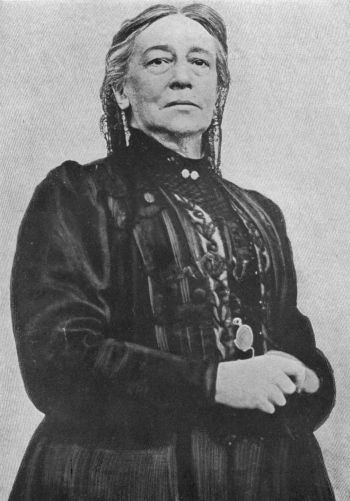
Lady Gregory
To her own countrymen the work of Lady Gregory, valuable as it is, is
not the revelation it is to us. Those of them that have not been brought
up on the stories that she translates could read at least many of them
in the "Old Celtic Romances" (1879) of Dr. P.W. Joyce, or in the
versions of the Cuchulain and the Finn legends by Mr. Standish James
O'Grady (1878 and 1880), books that somehow or other never came to be
widely read in America. Mr. Yeats admits it was Mr. O'Grady that
"started us all," that is, the writers who began the Renaissance in the
late eighties. It may be, of course, that the added beauty and dignity
the stories take on in the versions of Lady Gregory will inspire to
nobler writing poets and dramatists and novelists that already owe much
to Mr. O'Grady or Dr. Joyce or to the scholars they were sent back to by
these popularizers. It is certain that the writers of the younger group,
the group of those that are only now nearing distinction, owe much to
Lady Gregory. After all is said, however, her work is to be judged not
for its value to others, but as in itself an art product, of a class
kindred to "The Wanderings of Oisin" of Mr. Yeats, although differing in
form. I am not forgetting, of course, that she is following faithfully,
or rather as faithfully as an artist may follow, the old legends. She
has, she owns, clarified them, condensed them, left out contradictory
episodes, woven now and then a Scotch version of an incident into a
cycle arranged in one complete whole from many Irish versions. When Lady
Gregory has owned this she has owned that she has added something more
of her own than a "connecting sentence."
Although she has labored
carefully to keep herself out of the stories, and although, if you have
read only her versions of them, you may feel that she has succeeded in
keeping herself out of them, you will recognize, if you turn to her
originals in O'Curry or in Whitley Stokes or in Standish Hayes O'Grady,
that she has added that all-important thing, a personality. Some
scholars object to this as "too literary." And some literary men would
rather have the old stories, they say, "just as they are" There is the
crux. How can we get them, even in an exact translation, "just as they
are"? We cannot. This is not the place to discuss this most vexed
question of translation, but I must go into it so far as to point again
to the fact that we are more likely to have made upon us, by an
interpretative translation, an effect more nearly like that made upon
the listener contemporary to the time of the making of the story than if
the translation were literal. We are always forgetting the so obvious
fact that the kind of metaphor or descriptive epithet of this sort or
that, which would make a certain effect on the listener of the tenth
century, will make a very different effect on the reader of to-day. As
Lady Gregory points out, the description of the contortion of Cuchulain
in his fight with Ferdiad seems very unheroic to us, and is therefore
best left out of the translation, or, if retained, conveyed in terms
that will make an effect on us similar to the effect the detailed
description had on the audience of the old bards. Here again, however,
is trouble. How can we get that effect? We cannot surely, but an
imaginative translation by one who is scholar and littérateur both
will
take us nearest to it. We want, as a matter of fact, both kinds of
translations, the interpretative and artistic translation of Lady
Gregory and the literal translation of Mr. Standish Hayes O'Grady. The
one is needed to check the other. We would have a gauge by which to
measure how much such such a translator as Lady Gregory has taken from
and added to the old story. We would know how great is the freedom in
which we willingly acquiesce, remembering that the translations which we
treasure as great in literature are in greater or less measure "free."
So checking Lady Gregory's translations we find that they represent a
fair measure of freedom, as so checking the verses of FitzGerald's "Omar
Khayyám" we find in them the utmost measure of freedom, a freedom indeed
that, in certain verses, is virtually a re-creation.
Many, both scholars and literary men, object to the kind of English into
which Lady Gregory translates the stories of Ireland's heroic age, her
"Kiltartan English," the English of the people of her home country on
the borders of Clare and Galway, the English made by a people who think
in Irish. This familiar language, they say, has lessened the dignity of
the old tales, bringing them all to one level by a diction and style
that is one, whether they are romance or folk-tale. This objection can
be taken, however, only to the Cuchulain stories, which were court
romance, and not to the Finn stories, which come out of the thatched
houses. This "Kiltartan English" seems to me in its more familiar
moments, less imposing than that in which I first heard stories of Finn
McCool told by our old gardener, Lawrence Kelly of County Wexford, but
it
may be I remember less clearly the homeliness of his "discourse"
than its "grand speaking." It is, however, as peasant English, a fitting
medium for the telling of the stories of Brigit and St. Patrick in her
"Book of Saints and Wonders," for Brigit and Patrick are still household
words among all the children of the Gael. But by its very difference
from the English of all other artists in words save of a few of her own
country and generation, and from such conversational English as I know
well, this "Kiltartan English" brings me a foreign quality. I feel that
the art of these tale-tellers is an art of another race than the
English, just as I feel that the art of the teller of Beowulf is an art
of another race than the English. The literature in our ancestral tongue
is not to me English until it sloughs off the Germanic
sentence-structure of Anglo-Saxon. Here lies, I think, the greatest
difficulty in translating Old English literature. And it will not be
successfully translated, I think, without the use of the syntax of some
dialect that preserves an archaic sentence-structure.
To me, then, it seems singularly fortunate for Lady Gregory to have her
"Kiltartan English" to fall back upon to give that foreign flavor that
we intuitively feel the need of in a translation. There may be a slight
loss of dignity through its use, but there is a great gain in folk
atmosphere.
In quoting to show the style of Lady Gregory I should quote description
rather than narrative, as the description seems to me better as well as
briefer. The three famous tales of Old Irish literature, "The Three
Sorrows of Story-Telling," are "The Fate of the Children
of Usnach,"
comparable, in the great wars it led to, to the rape of Helen; "The Fate
of the Children of Lir," a story that has as its base the folk-tale that
underlies "Lohengrin," but which takes us back farther into the past in
its kinship to "Medea"; and "The Sons of Tuireann," which has been
called the Irish Odyssey. Of these the first is incomparably the finest
story, and Lady Gregory has told it nobly in "Cuchulain of Muirthemne,"
but it alone of all the stories in her three books of translations has
enough of humanity in it to put it side by side with the story of Sigurd
and Brunhilde or the story of Paris and Helen. When one remembers that
Greek and Scandinavian literature may boast five stories each, at least,
but little short of these their greatest stories, and that Irish
literature has but "Diarmuid and Grania" to boast as in any way
comparable to the story of Deirdre, it must be admitted that early Irish
literature representing Ireland's heroic age is not so beautiful as the
literature that represents the heroic ages of Scandinavia and Greece.
"The Fate of the Children of Usnach" is rich in beautiful detail of
incident and of description of nature; it preserves for us much of the
inner life of old time; and it has dignity of proportion. It has not the
fundamental weakness, as great art, of most of these old Irish stories,
their characters' lack of interest because of their lack of body, their
lack of personality, their running to type rather than moulding into
individuals; yet the feats performed by Cuchulain are so wholly
superhuman, most of them, that they often put their doer beyond our
sympathy, and at their worst make him absurd.
If these stories were simply extravagant folk-fancy, such as the Jack
the Giant Killer story, to delight children, we should not quarrel with
this quality in them, but there is so much in them of dignity that we
must take them seriously, as we take Homer. When their heroes are
definitely gods we can accept almost any of their deeds, so we can
delight in the earlier stories of "Gods and Fighting Men," the stories
of the Tuatha de Danaan, Lugh and Angus, Midhir and Etain, Bran and
Connla, as we cannot in those of Finn and Goll and Cuchulain and
Conchubar, who, because of their historical setting and more definite
characterization, have more of the appeal of humanity. We know
Cuchulain, in Lady Gregory's pages, as a small dark man, constant in
love in comparison with his fellows, faithful to his friends, loyal to
his king; and we know Finn as a fair old man of ruddy countenance, a
lover of women, somewhat pompous and somewhat quarrelsome; but neither
hero is a clear-cut personality like Sigurd or Ajax. If either Cuchulain
or Finn were surely a god we should accept his deeds as now we cannot
accept them, and were either brought home to us as wholly human and
divested of his supernatural powers, and given a personality, we should
be far more moved by his fortunes.
It is in enchantments, visits to worlds oversea and under wave, and in
praises of the beauties of this world, its woods, its waters, its real
wonders, and in the celebration of sorrow and delight that "Gods and
Fighting Men" is at its best, not in the celebration of happy loves, or
of wild loves, or of great victories. So it is that
Gabhra, where the
Fianna were broken, is finer than "The Battle of the White Strand,"
where they won against great odds.
Finer, however, than any narrative power possessed by the old Irish
bards is their power in the lyrical passages so freely interspersed
throughout the stories, and in the lyrics that come into them on the
lips of the poets and warriors and on the lips of the women who have
lost their lovers in fight. The farewell of Deirdre to Alban and her
lament over Naoise, the song of the woman from oversea to Bran, the poem
Finn made to prove his power of poetry, the sleepy song of Grania over
Diarmuid, the lament of Neargach's wife, the song of Tir-nan-Og that
Niave made to Oisin, and Oisin's own praise of the good times of the
Fianna—these are the passages in which the old tales reach their
highest poetry. Once read, these remain in memory, but certain episodes
and certain sayings remain also. Mr. Yeats has picked out one of the
sayings in his introduction to "Gods and Fighting Men" that will do for
sample. It is the answer of Osgar dying, to the man who asks him how he
is: "I am as you would have me be." Starker even, perhaps, is the
absolute simplicity of the description of that last fight in "The Battle
of the White Strand," in which Cael and Finnachta go, locked in each
other's arms, to their death under the waves without a word.
Wild nature is always about these warriors. The storm in the trees, the
sorrow of the sea, the clatter of wild geese and the singing of swans
find echo in the poems that praise them. We see, too, at times, fields
heavy with harvest,
and often the apple trees in bloom and the cuckoo
calling among them,—indeed, the sweet scent of apple gardens, like the
keenness of the winds of spring, beautiful as are the phrases that
present them, become almost stock phrases. Always, too, there are
wonders of the other world about the heroes; women from undersea and
underground come into their halls as naturally as the members of their
own clans, and the twilight mists unfolding from familiar hills will
reveal their marvelous duns, whitewalled with silver or marble, and
thatched with the wings of white birds.
There has been frequent quarreling in certain quarters with Mr. Russell
and Mr. Johnston and Mr. Yeats for introducing mysticism and a definite
symbolism and the ways of Eastern thought into their versions of Irish
mythic tales and their records of Irish mood. There will be found some
justification for such practices in Lady Gregory's translations.
Manannan, the sea-god, is here presented doing tricks like those of the
East Indian fakirs; Finn is reincarnated in later great leaders of the
Gael; and in "The Hospitality of Cuanna's House" there is out-and-out
allegory, to say nothing of a possible symbolistic interpretation of
episodes in almost every other story. Even the willful obscurity of the
modern poetry can be paralleled by the riddling of Cuchulain and Emer.
It is, perhaps, because Lady Gregory has found the old stories not only
in the dignity of their bardic presentation, but also in the happy
familiarity of their telling by the people of the thatched houses in her
own district, that she has been able to bring them so near to us. From
these
same people, too, she has got some of her stories of St. Bride
and Columba and poems and stories of recent and contemporary
inspiration, poems and stories that have to do with humble life as well
as with the highly colored heroic life that those who live bare lives
themselves are so fond of imagining. In her "Poets and Dreamers" (1903)
are records of this collecting and of her study of local ways about
Coole and on the Connemara coast and in the Aran Isles. One of the most
interesting of her chapters is that on the poet Raftery, whose poems Dr.
Hyde has published. Blind and bitter, Raftery wandered about Connacht
until about 1840, when death took him, an old man, but still vigorous in
mind and spirit. Another chapter of "Poets and Dreamers" is "On the Edge
of the World." Each reading of this is to me like a return to West
Ireland, the very quality of whose life it gives. It should be the first
chapter of the book turned to by the reader, for it gives one the note
on which to read all. As Lady Gregory drives by the sea, people about
her on the roadside and in the cabins are singing in Irish. The little
experiences of the day are, for them, experiences to brood over; and for
her, too. And this thought is the last of her brooding: "The rising
again of Ireland, of her old speech, of her last leader [Parnell],
dreams all, as we are told. But here on the edge of the world, dreams
are real things, and every heart is watching for the opening of one or
another grave."
There is creative writing in these essays of Lady Gregory's, for all
that she is playing middleman between her people and the reading public
of the English-speaking world in many of them; and, as I would emphasize
again,
in her three books of translations. But, after all translation
will not content, and the essay that is not self-revelation will not
content, the writer who would have his writing a "reading of life." So
it is not surprising that Lady Gregory turned toward drama. And yet I do
not ever feel, after many readings of her plays, that Lady Gregory took
to drama because of any overmastering impulse toward this most difficult
of all literary forms. She has learned to handle some orders of drama
pleasantly, the farce more than pleasantly, and, very recently, the
folk-tragedy nobly; but had it not been that plays of other than
romantic tone were needed for the Abbey Theatre as a foil to those of
Mr. Yeats and of Synge, I doubt whether it is drama that Lady Gregory
would have chosen as the medium through which to express her reading of
life. I can just as well imagine her shrewd kindliness of judgment upon
the foibles and virtues of her countrymen in stories whose form is very
like that employed by Miss Barlow in her "Irish Idylls" (1892) as in
these so original little plays that she has wrought out without
precedent, under the tutelage of Mr. Yeats.
It is more than likely, as I say, that had it not been that drama was
needed for the Abbey Theatre she would not have attempted drama. But
more than likely it is, too, that had she written plays not made to
order they had reached wider through Irish society and plumbed deeper
into Irish life. Lady Gregory knows Irish life, from bottom to top, as
few Irishwomen and few Irishmen of her day know it; she has large heart,
wide tolerance, and abounding charity; and yet she was long content
to
limit her plays of modern Ireland to farce, at times of a serious enough
purpose, but because it is farce, not of the first seriousness. It may
be, of course, that Lady Gregory knows best of any one her own powers,
and it is true that in the plays she has written she is at her best when
they are at their merriest. I cannot, however, but feel that this is a
success of intention rather than a success of instinct. She would have
them the most successful in a quality as far removed as might be from
that quality of troubled dreaminess which is the best of the dramas of
Mr. Yeats. Synge, it must be remembered, did not begin as a writer of
comedy, and there is little of that ripe irony that has no precedent in
English literature in that first play that he wrote for the Abbey
Theatre, "Riders to the Sea" (1903). Is it a coincidence that later, as
he found his bent for that sort of writing that culminated in "The
Playboy," Lady Gregory turned at times to historical drama and a farce
that grew as serious as comedy? There is, of course, in all her plays
serious indictment of national weaknesses, sometimes obvious indictment,
as in "The Deliverer" (1911), which records, in terms of folk-biblical
allegory, his countrymen's desertion of Parnell; sometimes indictment
not so obvious, as in "The Canavans" (1906), which rebukes that
shoneenism in high places which has for generations been one of the
curses of Ireland. To him who knows only a little of Irish life it is
easy to see the meaning but superficially concealed by the farcical
bustle, the laughter, and the lamentations. But to him who looks but on
the surface there is merriness enough and wittiness enough and wisdom
enough
to make his loss of the deeper meaning, for him, but a little
loss.
There are enough characters presented, too, peasants generally and
townsfolk of the lower class, to make the farces a "reading of life."
What is wanting to him who looks for more than what farce may do is the
largeness of utterance that will make a "reading of life" memorable.
Take "the image" (1910), for instance, in which Lady Gregory is
attempting more than in "Spreading the News" (1904) or "Hyacinth Halvey"
(1906). This play, the longest that Lady Gregory has written, is what
the stage would call the character farce. She owns it a presentation of
dreams of old men and old women which crumble at the touch of reality,
but it is not only this, but a symbolizing of the proneness of all
ireland to accept as certainties on the eve of realization what are
really only signs that point to possibilities in a far to-morrow. In the
play four old men of a little village on the west coast are debating
what they will do with their share of a windfall that has come to the
village in the shape of two whales that have drifted up on the beach.
When the priest determines that all the proceeds from the sale of the
oil from the whales be spent on something that will benefit the whole
community they plan a statue (one of them is a stone-cutter) to some
great celebrity. The motives that lead them to choose Hugh O'Lorrha are
telling satire not only of Irishmen, but of all men. It would hardly be,
however, in any other country than ireland that the name of the one come
at by way of accident would, unidentified for some time by any, be
finally revealed as that of the hero of
a folk-tale. Four days after the
whales had come ashore, days wasted in planning what the village will do
with the prize money, and unutilized in securing the blubber and
rendering out the oil, the quartette learned that "the Connemara lads
have the oil drawn from the one of them, and the other one was swept
away with the spring tide."
Though "The Image" be farce, its characters are the characters of
comedy, and its purpose whole-heartedly serious. And even "Spreading the
News" has its lesson, of rumor's wild riot in Irish crowds. On the
slightest grounds the reciting of an errand of helpfulness is turned by
quick imagination into a story of a murder. Lightly sketched as are the
people here, from a caricature of a magistrate to the more serious
presentment of Mrs. Fallon's "nice quiet little man," they are very true
to Ireland. Slighter even are the butcher and the postmistress and the
model sub-sanitary inspector in "Hyacinth Halvey," though all are fully
understood and fully blocked out in their author's mind, if impossible
of complete realization within limits so narrow; but the farce itself is
not lifted into dignity by any noble underlying attitude. "The Jack Daw"
(1907) has rumor again as its motive, as had "Spreading the News," but
it is not the motive of the play or any of its incidents that is the
best thing about it, but the character of Michael Cooney, of the
"seventh generation of Cooneys who trusted nobody living or dead." He
is, of course, caricatured, but he has possibilities of personality, and
he could have been worked into the fullness of a universal character had
"The Jack Daw" been comedy, we will say, instead of farce. Of all her
characters, that of
Hyacinth Halvey is most nearly rounded out, but
then Lady Gregory has taken two little plays in which to present his
portrait, "The Full Moon" (1911) recording some of his later experiences
in Cloon and his final departure from the town, his introduction to
which was recorded in the play bearing his name.
"The Workhouse Ward" (1908), reaching from wild farce to sentimental
comedy, is hardly more than a dialogue, but it is given body by the
truth to Irish life out of which it is written, that quarreling is
better than loneliness. Lady Gregory has disowned "Twenty-five" (1902),
which is frankly melodrama, her only other experiment in which, in her
plays of modern Ireland, is "The Rising of the Moon" (1903). This play
relates the allowed escape from a police officer of a political prisoner
through that prisoner's persuading the officer that "patriotism" is
above his sworn duty to England.
Of the plays that may be called historical, "The Canavans" (1906) is the
best, because it is of the peasantry, I suppose, who change so little
with the years, and whom Lady Gregory presents so amusingly and so truly
in her modern farce comedy. "Kincora" (1903) takes us all the way back
to the eleventh century, deriving its name from Brian's Seat on the
Shannon and ending with his death at Clontarf. It is undistinguished
melodrama. "The White Cockade" (1905) is better only in so far as it
involves farce, farce in the kitchen of an inn on the Wexford coast just
after the Battle of the Boyne. "Devorgilla" (1908) is of a time between
the times of the two other historical plays, of the time a generation
later than
the coming of the Normans to Ireland. It is pitched to a
higher key than any other of her historic plays, and it is held better
to its key, but its tragedy is far less impressive than the tragedy of
"The Gaol Gate" (1906) which pictures the effects upon his wife and his
mother of the imprisonment of an Irish lad of to-day, and their learning
that "Denis Cahel died for his neighbor." This little play is out of the
life that Lady Gregory knows and can deal with; it is finely conceived
and finely executed, lingering in the mind as does the keen heard rising
from some bare graveyard fronting the Atlantic.
Just why Lady Gregory, who has rendered in prose so well old legends,
should render old Irish historic life so much less well I cannot
explain. Sometimes I think it is because she has found less of that
history than of that legend among the people. Yet in "A Travelling Man"
(1907), her little miracle, somewhat in the manner of Dr. Hyde's, that
brings Christ into a modern peasant home, she has made a play of a
tender and reconciling beauty. With the success of "A Travelling Man"
and "The Gaol Gate" before me I cannot say it is because her genius is
for farce; and to say that it is because her genius is for the plays of
modern peasant life does not help to account for the fact.
The idiom of all these plays is racy of the soil, and when it need be,
eloquent with the eloquence that is almost always in the English of the
Irish. It is full of wise saws and proverbs, quips and quirks of
expression, the picturesquenesses and homelinesses of speech that are
characteristic of a peasant to whom talk is the half of life. These
range from sayings like those of the clowns of
Elizabethan drama, such
as "He had great wisdom I tell you, being silly-like, and blind," and
such country wisdom as "What would the cat's son do but kill mice," up
through the elaborate maledictions of the two old paupers in "The
Workhouse Ward" and such delightful asperities as that of Maelmora anent
his bitter sister Gormleith, "You were surely born on a Friday, and the
briars breaking through the green sod," to aphorisms that have an accent
of eternity, as, "It is the poor know all the troubles of the world,"
and "The swift, unflinching, terrible judgment of the young."
The characters, even when they are purposely almost caricatures, have in
them the possibility of complete portrayals. There is no flagging of the
invention in any of them, no slipshod or careless composition. Her
technique, too, at least in farce, is masterful, and in her plays of
modern life of other form adequate. That she could master historical
drama, as I have said, I must doubt, but that she need restrict herself
so largely to farce and farce comedy in her plays of modern life, I do
not for a moment believe. "The Gaol Gate," in fact, proved that she need
not so restrict herself, and "MacDaragh's Wife" (1911), written by Lady
Gregory at sea on her way to America, but perhaps for that all the
fuller of the wild old life of her native Connacht. It would almost seem
that with "Grania" (1912), a tragedy too, following "MacDaragh's Wife,"
Lady Gregory is widening the scope of her work, as she well can, now
that there are other dramatists to provide comedies and farces for the
Abbey Theatre. It is a haunting story that "MacDaragh's
Wife" tells,
and largely a true story, the story of a piper who, though a pauper,
draws all the countryside to the funeral of his wife, draws them,
through the wild lamenting of his pipes, from the fair where they are
sporting to follow, with a full fellowship, to the grave, her who died
all but alone. Lady Gregory tells us in a note just what of it she
gathered from old people about her girlhood's home at Roxborough, and
what about her home of to-day at Coole, how she has shaped it, and what
emotion is back of it, the "lasting pride of the artist of all ages."
As Lady Gregory had restricted herself, until recently, in the forms of
modern life which she wrote of and in the kinds of people she selected
to write of, so, too, she had restricted herself, until recently, in the
motives she considered. It is true that the motive most recurrent in her
plays, that of fear of the opinion of the neighbor, an attitude probably
sprung of the clan system, is dominant in Irish life; and it is equally
true that the motive most notably absent, love, was until yesterday far
from a dominant motive in the Irish life that Lady Gregory presents: yet
there are many other motives that, in true comedy, and even in farcical
comedy, might well have place. That these motives are not there is, I
think, not only that Lady Gregory, self-effacingly, put into her plays
what was wanted to make them foils to the plays of Mr. Yeats and Synge,
but also because of the practice of one type of gentlewoman in
literature, of which Jane Austen is characteristic. And yet the mere
mention of Jane Austen increases the wonderment that Lady Gregory
has
not written of people of every condition in her neighborhood, whether
that be London or Dublin or Gort, as Miss Austen did of people of every
condition in her neighborhood, whether that be Steventon or Bath or
Chawton. It can hardly be said, even, that "Grania" her last play, is a
play about love. In her note to the play, Lady Gregory declares, "Love
itself, with its shadow Jealousy, is the true protagonist!" And yet, I
think it is Jealousy only that is the true protagonist. There is much
talk about love, but it is not from love, but from jealousy that the
action of the play arises. Among all this talk about love, among many
eloquent sayings about love, true readings of love, there stands out
most clearly in my memory this part of a speech of Finn, a speech
uttered before Grania had turned from him to Diarmuid—
And as for youngsters, they do not know how
to love because there is always some to-morrow's love possible in
the shadow of the love of to-day. It is only the old it goes through
and through entirely because they know all the last honey of the
summer-time has come to its ferment in their cup, and there is no
new summer coming to meet them forever.
This I remember not only for its thought but for its style, the rhythm
of its prose. It is Lady Gregory at her best, as "Grania" as a whole is
Lady Gregory at her best in tragedy. If "Grania" in every detail were as
inspired as its explanation of the queen's quick turn from Diarmuid to
Finn, it would be a great play, indeed. Grania is no light woman, and
yet she turns, in the old legend, from the man who sacrificed all but
all for her, on his death,
to the High King who brought about his
death, with a suddenness inexplicable. Lady Gregory makes that sudden
turn plausible, for two reasons. One is that for seven years of
wandering all over Ireland, Diarmuid by his own will and because of
loyalty to Finn, had kept Grania a maid, making her his wife only after
he found her being carried off by the King of Foreign. The other reason
is that as Diarmuid lies dying, wounded to death by that King of Foreign
whom he has killed, his thoughts are all of his long-delayed disloyalty
to Finn, and not at all of Grania. Thus, she justifies herself, speaking
to Finn:—
Grania. He had no love for me at any time.
It is easy to know it now. I knew it all the while, but I would not
give in to believe it. His desire was all the time with you yourself
and Almhuin. He let on to be taken up with me, and it was but
letting on. Why would I fret after him that so soon forgot his wife,
and left her in a wretched way?
Finn. You are not judging him right. You are distracted with
the weight of your loss.
Grania. Does any man at all speak lies at the very brink of
death, or hold any secret in his heart? It was at that time he had
done with deceit, and he showed where his thought was, and had no
word at all for me that had left the whole world for his sake, and
that went wearing out my youth, pushing here and there as far as the
course of the stars of Heaven. And my thousand curses upon death not
to have taken him at daybreak, and I believing his words! It is then
I would have waked him well and would have cried my seven
generations after him! And I have lost all on this side of the
world, losing that trust and faith I had, and finding him to think
of me no more than of a flock of stars would cast their shadow on
his path. And I to die with this scald upon my heart; it is hard
thistles would spring up out of my grave.
I have spoken of Lady Gregory as translator, as collector of folk-lore,
as essayist, and as dramatist; but there is another rôle in which she
has brought no less advantage to the Celtic Renaissance, though it is a
rôle that has not brought her, as have these other, the joys of
recapturing or of creating beautiful things. Always objective, though
never wholly able to subordinate personality, however near she may have
come to effacing it in her plays, Lady Gregory has in this rôle
considered herself solely as an agent in the service of Irish letters.
The Irishman is naturally a pamphleteer, and Mr. Yeats, poet of the
Other World though he be, can give as good blows in controversy as Mr.
George Moore. Almost all who have part in the Renaissance have skill in
the art of publicity. They have needed no publicists to fight their
battles as the Pre-Raphaelites needed Ruskin. Still, in some measure in
the way of publicity, and in large measure in other ways, Lady Gregory
has been to the Celtic Renaissance what Ruskin was to that last
renaissance of wonder. She has edited pamphlets on things national and
artistic in Ireland, she has helped Dr. Hyde and Mr. Yeats in their
collecting of folk-lore and to a deeper knowledge of the people; she has
been one of the forces that have made possible the Abbey Theatre, giving
to it her power of organization as well as plays and patronage. More
than this, she has welcomed to Coole Park many a worker in the movement,
who in the comfort of a holiday there has been refreshed by the gray and
green land so near the sea and reinspired by the contact with that Irish
Ireland so close to her doors. Like Ruskin, Lady Gregory is a great
patron of letters, but like Ruskin she is much more. Lady Gregory is an
artist in words who is to be valued as a presenter of Irish life, past
and present, with a beauty that was not in English literature before she
made it.
Chapter VII
John Millington Synge
It is Synge himself who puts the just phrase on what his life was to
him, and it is, as it could not else be, from the lips of his Deirdre
that it falls. "It should be a sweet thing to have what is best and
richest, if it's for a short space only." It is Deirdre alone of his men
and women that is introspective at all, Deirdre—and Naisi when he is
mastered by thoughts of home that will not down. Synge wrote the play of
her triumph over death as he himself was dying, and he wrote it with
high heart, and, what is higher, gladness, despite his foreknowledge of
his doom. It was to fulfill his dream of the most queenly girl of old
Irish legend that he wrote "Deirdre of the Sorrows," but he could not
keep out of his writing, had he wished to keep it out, his own love that
death was so soon to end, and the thoughts of what was the worth of
life. "It should be a sweet thing to have what is best and richest, if
it's for a short space only." It is not a new saying, but it is not to
be identified with the proverbial "a short life and a merry," with which
some confuse it, and of Synge it was a true saying. There are those who,
because of the irony of his writing, an irony that is new to literature,
and, maybe, to some cruel, or at least disillusionizing, may think there
was little joy for him; but the truth is there was never a writer in
whom there was more joy. This "strange still
man" as he was even to
those who knew him best, gentle or simple, found all life that was
natural life, even of the barest and rudest, as thrilling as first love.
It is this man, his enemies at home the sated Parisian, who knew a gusto
in living greater than that of any English writer since Borrow. Let no
one forget those lines with which Christy Mahon cries defiance to the
Mayo folk who have known his greatness and his fall: "Ten thousand
blessings upon all that's here, for you've turned me a likely gaffer in
the end of all, the way I'll go romancing through a romping lifetime
from this hour to the dawning of the judgment day." I do not deny that
these words are in a sense wrung from the Playboy, but what I do hold is
that they prove how vital was the genius of the man who wrote them, who
saw the joy there was yet in life for this braggart wastrel just as he
saw that even such a miserable boyhood as Christy's knew a kind of
poacher's joy in running wild on the bogs. Even for poor Nora, turned
out on the roads with a tramp for companion, there is the joy of the
road once she learns to know it. The tramp knows it surely:—
You'll be hearing the herons crying out over
the black lakes, and you'll be hearing the grouse and the owls with
them, and the larks and the big thrushes when the days are warm: and
it's not from the like of them you'll be hearing a tale of getting
old like Peggy Cavanagh, and losing the hair off you and the light
of your eyes, but it's fine songs you'll be hearing when the sun
goes up, and there'll be no old fellow wheezing the like of a sick
sheep, close to your ear.
Of like gusto, too, is the joy of Martin Doul and Mary Doul in their
blindness; and the joy of the three tinkers in
the escape of themselves
and their half-sovereign from the priest and in the prospect of "A great
time drinking that bit with the trampers in the green of Clash." And
from such joys as these, wild and earthy and rallying, his exultations
range to the exalted serenity and sadness of Naisi and Deirdre as they
look back on their seven year of love in Glen Masain, of love almost too
perfect and too happy to be human.
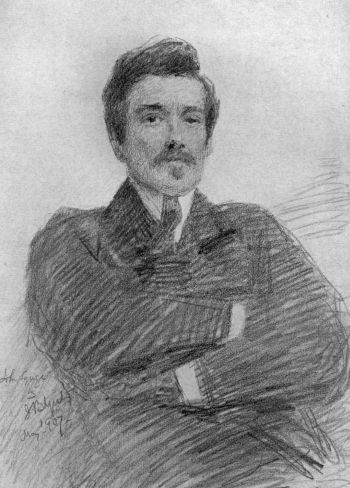
John Millington Synge
Yes, joy is as distinctive as irony and extravagance of the writing of
Synge, joy in mere living, in life even at the worst, and joy, too, in
life at the best. "It should be a sweet thing to have what is best and
richest, if it's for a short space only." It was for a short space of
years that Synge had "what is best and richest," hardly for the seven
years of his great lovers. He did not have it when his thought homed to
Ireland in 1899, as a result of a meeting with Mr. Yeats in Paris. His
writing, then, was of little moment, but it grew better when, at home
again, he realized what Irish life was to him, when once renewed contact
with the Irish peasant brought back the familiarity that had been his in
the nursery. It was the Wicklow glens, to which memories of his people
drew him, and the Aran Islands, where he went to study Irish—until then
little more than a book language to him—and to live a life perhaps
"more primitive than any in Europe," that enabled him to find himself.
Further 'prentice work, though of a new sort, followed his sojourns in
Wicklow and Aran, but by 1903 his art had matured to the ripe power of
"In the Shadow of the Glen" and "Riders to the Sea," which, after
adjustment to the stage, were
put on respectively October 8, 1903, and
February 25, 1904, at Molesworth Hall, Dublin. "The Tinker's Wedding"
which has been played only once, and then in London, dates from about
the same time. "The Well of the Saints" was produced on February 4,
1905, at the Abbey Theatre, Dublin, and "The Playboy of the Western
World" on January 26, 1907, at the same place, to the accompaniment of
an uproar that a certain element of Irishmen have considered it proper
to create ever since on its first appearance in all cities whatsoever,
whether in Great Britain or America. One wonders what they would have
done had he made it as biting as Ibsen made "Peer Gynt." "Deirdre of the
Sorrows," which Synge left unrevised, was first produced at the Abbey
Theatre on January 13, 1910, the last of the six plays of his maturity.
It was in the years from 1902 to 1909 that he had "what is best and
richest"—a full life, lived largely in the Ireland that he loved; the
artist's joy in making that life into a new beauty, a beauty that was
all compact of exaltation and extravagance and irony; and love for a
woman in whom his man's life and his artist's life were united, for her
who embodied his dream of Pegeen Mike and added her life and her art of
the stage to his dream of Deirdre, as day by day it emerged from his
mind. And so great was his joy in these good things that his precarious
health, and even his year—long last illness, could not, while he had
any strength, lessen the high spirit of his writing. There is none of
his plays more vital than "Deirdre of the Sorrows."
And yet this joy that is basic in Synge, this exaltation,
is no more
basic than emotions and attitudes of mind that are often, in other men,
at war with joy and exaltation—irony and grotesquerie, keen insight
into "the black thoughts of men," and insistent awareness of the quick
passing of all good things, diablerie and mordancy. Strange, then,
should be his love passages and strange too, they are at times, ranging
from the bizarre delight of "In Kerry" to the triumphing nobility of
Deirdre's farewell to Alban. One thinks of Mr. Hardy and one thinks of
Donne as one reads "In Kerry":—
"We heard the thrushes by the shore and sea,
And saw the golden stars' nativity,
Then round we went the lane by Thomas Flynn,
Across the church where bones lie out and in;
And there I asked beneath a lonely cloud
Of strange delight, with one bird singing loud,
What change you'd wrought in graveyard, rock and sea,
This new wild paradise to wake for me ...
Yet knew no more than knew those merry sins
Had built this stack of thigh-bones, jaws and shins."
One thinks of no other writer at all, however, when one reads Christy's
wooing of Pegeen, even when one puts down the book in the quiet that
always comes on one in the presence of something great; one thinks of no
other writer, of course, when one sees the lovers and listens to their
words, on the stage, for one is rapt out of one's self by the perfect
accord of drama and actors at one in the service of beauty:—
Christy (indignantly). Starting from
you, is it? (He follows her.) I will not, then, and when the airs
is warming, in four months or five, it's then yourself and me should
be pacing
Neifin in the dews of night, the times sweet smells do be
rising, and you'll see a little, shiny new moon, maybe, sinking on
the hills.
Pegeen (looking at him playfully). And it's that kind of a
poacher's love you'd make, Christy Mahon, on the sides of Neifin,
when the night is down?
Christy. It's little you'll think if my love's a poacher's, or
an earl's itself, when you'll feel my two hands stretched around
you, and I squeezing kisses on your puckered lips, till I'd feel a
kind of pity for the Lord God is all ages sitting lonesome in His
golden chair.
Pegeen. That'll be right fun, Christy Mahon, and any girl
would walk her heart out before she'd meet a young man was your like
for eloquence, or talk at all.
Christy (encouraged). Let you wait, to hear me talking, till
we're astray in Erris, when Good Friday's by, drinking a sup from a
well, and making mighty kisses with our wetted mouths, or gaming in
a gap of sunshine, with yourself stretched back unto your necklace,
in the flowers of the earth.
Pegeen (in a low voice, moved by his tone). I'd be nice, so,
is it?
Christy (with rapture). If the mitred bishops seen you that
time, they'd be the like of the holy prophets, I'm thinking, do be
straining the bars of Paradise to lay eyes on the Lady Helen of
Troy, and she abroad, pacing back and forward, with a nosegay in her
golden shawl.
Borrow, who comes to mind more often than any other writer as one reads
Synge, chose to avoid love scenes, and Borrow's follower, Mr. Hewlett,
for all his gusto, has no such exaltation as this. Had Harry Richmond
taken to the road with Kiomi we might have known something like it. A
chapter out of the early life of Juggling Jerry and his "Old Girl," done
in the manner of "Love in the Valley," would be still nearer to it. As
it is, this passage
of the third act of "The Playboy of the Western
World" stands alone. I doubt if Synge had read Meredith, and even had
he, the life of the roads and their cottages that Synge knew so well was
his master, and no writer at all. In a way, of course, the Irish-English
of Dr. Hyde's translations of "The Love Songs of Connacht" was an
influence, and you will find many expressions common to them and Synge.
It is not important, however, whether these expressions have a common
source, or whether Synge took them from "The Love Songs" rather than
from his own note-book. Whatever their source it was Synge who made out
of them a great style, his peasant style. It is another and a severer
style that he uses in his "Deirdre of the Sorrows," the courtly subject
demanding dignity and restraint. This latter style has borrowed some of
the bare simplicity of the personal style of Synge, that style, I mean,
in which he records his own experience in the Aran Islands or in Wicklow
and Kerry.
Romancing, which is the very atmosphere of "The Playboy of the Western
World," would be out of place in any telling of the greatest of old
Irish legends; so it is that Synge has found for "Deirdre of the
Sorrows," or rather for its great moments, an austere epic speech that
seems native to the story. The passionate words are nobly adequate to
the passionate resignation they have to tell, a resignation that has
come of the unwilling belief of the lovers that so great a love as
theirs cannot last longer "without fleck or flaw" than the seven years
it has lasted. Says Deirdre, when she has come to know it is fate that
they will return to Ireland, and death:—
The dawn and evening are a little while, the
winter and the summer pass quickly, and what way would you and I,
Naisi, have joy forever.... It's this hour we're between the daytime
and a night where there is sleep forever, and isn't it better thing
to be following on to a near death than to be bending the head down,
and dragging with the feet, and seeing one day a blight showing upon
love where it is sweet and tender?
Naisi (his voice broken with distraction). If a near death
is coming what will be my trouble losing the earth and the stars
over it, and you, Deirdre, are their flame and bright crown? Come
away into the safety of the woods.
Deirdre (shaking her head slowly). There are as many ways to
wither love as there are stars in a night of Samhain; but there is
no way to keep life, or love with it, a short space only.... It's
for that there's nothing lonesome like a love is watching out the
time most lovers do be sleeping.... It's for that we're setting out
for Emain Macha when the tide turns on the sand.
Naisi (giving in). You're right, maybe. It should be a poor
thing to see great lovers and they sleepy and old.
Deirdre (with a more tender intensity). We're seven years
without roughness or growing weary; seven years so sweet and
shining, the gods would be hard set to give us seven days the like
of them. It's for that we're going to Emain, where there'll be a
rest forever, or a place for forgetting, in great crowds and they
making a stir.
Naisi (very softly). We'll go, surely, in place of keeping a
watch on a love had no match and it wasting away. (They cling to
each other, then Naisi looks up.)
And this is from the unfinished second act, that Synge thought would
scarcely be worth preserving. I have quoted it rather than the great
keen over the body of Naisi that brings the play to a close, because
that must of necessity follow the old poem, and this is as Synge
imagined it. Each is "a thing will be a joy and triumph to the ends of
life and time."
I have thrown what I have to say about the exaltation of Synge to the
forefront of what I have to say of him, that all may be read in the
memory of this emphasis and of the exaltation of what I quote, no matter
how fantastic or grotesque or disillusionizing or even ghoulish it may
be. Whatever other quality may be dominant at any moment in Synge there
is always, along with it, exaltation.
It is the extravagance and grotesquerie, of both language and situation,
that is the most immediately arresting of the qualities of Synge. And
this extravagance and grotesquerie have marked his writing from the
start. The old husband playing dead, that he may catch his young wife
with her lover, of his first play, "In the Shadow of the Glen," is a
very old motive, and familiar in the meliorized form that made it known
to the theatre in "Conn the Shaughraun" (1875). Before that, Crofton
Croker had given it currency, in "The Corpse Watchers," among those
outside of the circles in which it was a familiar folk-story. It might,
indeed, be said of "In the Shadow of the Glen" that it begins in the
manner of Boucicault and ends in the manner of Ibsen, for Nora Burke is
in a way a peasant Hedda Gabler. Such a criticism would, of course, be
very superficial. The story is a folk-story of many countries and Synge
was told the version he worked from by the old shanachie of Inishmaan
whom he calls Pat Dirane in "The Aran Islands." At moments the play
approaches farce, as when the supposed corpse rises
from the bed where
he is stretched and drinks whiskey with a tramp who has happened in
while Nora is gone to meet her young man. From such a situation it turns
to keen pathos, as Nora sits with tramp and lover and the old husband
she thinks dead, and listens to the wind and rain sweeping through the
high glens about the hut and thinks of "the young growing behind her,"
and the old passing. Where else will you find cheek by jowl such
sardonic humor as this and such poignancy of lament for the passing of
youth? Nora speaks as she pours out whiskey for her young man:—
Why would I marry you, Mike Dara? You'll be
getting old and I'll be getting old, and in a little while, I'm
telling you, you'll be sitting up in your bed—the way himself
was sitting—with a shake in your face, and your teeth falling,
and the white hair sticking out round you like an old bush where
sheep do be leaping a gap.
(Dan Burke sits up noiselessly from under the sheet, with his
hand to his face. His white hair is sticking out round his head.
Nora goes on slowly without hearing him.)
It's a pitiful thing to be getting old, but it's a queer thing
surely. It's a queer thing to see an old man sitting up there in his
bed with no teeth in him, and a rough word in his mouth, and his
chin the way it would take the bark from the edge of an oak board
you'd have building a door.... God forgive me, Michael Dara, we'll
all be getting old, but it's a queer thing surely.
Michael. It's too lonesome you are from living a long time
with an old man, Nora, and you're talking again like a herd that
would be coming down from the thick mist (he puts his arm round
her), but it's a fine life you'll have now with a young man—a
fine life, surely.
(Dan sneezes violently. Michael tries to get to the door, but
before
he can do so Dan jumps out of the bed in queer white clothes,
with the stick in his hand, and goes over and puts his back
against it.)
Michael. Son of God deliver us!
Equal extravagance and equal grotesquerie, and irony biting beyond any
in any other of his plays, you will find in "The Well of the Saints."
This, too, is built up out of Synge's experience of life in Aran and
Wicklow. Old Mourteen, a "dark man," who taught him Gaelic on Aranmor,
suggested Martin Doul, the chief character of the play, and it was
Mourteen told him, too, the story of the well whose water would give
sight to blind eyes. A story told Synge on Inishere supplied the saint,
and a tramp in Wicklow the thoughts of Martin Doul and Mary Doul as to
the glory their hair would be to them in age. As you read his travel
sketches, in fact, you are always coming on passages that very evidently
are the suggestions for situations in this play or that, and sometimes
more than suggestions—stories and situations and very phrases that you
remember as on the lips of the peasants in his plays. In these travel
sketches, too, you find the background of the plays. There is but the
germ of "The Playboy of the Western World" in the story told Synge in
Inishmaan of the hiding there from the police of the man that killed his
father, but there is old Mourteen's comparison of an unmarried man to
"an old jackass straying in the rocks," which later we find transferred
to Michael James Flaherty almost as Synge heard it—"an old braying
jackass straying upon the rocks."
It may be, too, that the famous Lynchehaun case confirmed Synge in
taking the Aran story of the man who killed his father as the basis of
"The Playboy," but it is little he got for his plays from his reading of
"the fearful crimes of Ireland," and little that he got for them from
any of his reading. There are situations in "The Tinker's Wedding"—the
tying-up of the priest in the bag, for instance—that suggest as source
"The Lout and his Mother," included by Dr. Hyde in his "Religious Songs
of Connacht," but Synge records, in "At a Wicklow Fair," that a herd
told him the story of the tinker couple that would be wed, as he and the
herd met the man in the case in Aughrim.
No one who knows Ireland at all would hold that Synge's plays are
typical of the Irish peasant generally, but any one who knows Irish
literature at all, and the life of the roads in Ireland, will admit that
wildness and extravagance are to be found in that literature from the
beginning and in that life even at this day of supposed civilization.
You will find one kind of extravagance in the distortions of Cuchulain
in bardic literature, another kind of extravagance in "Little Red Mary
and the Goat with the Chime of Bells" that your gardener tells you in a
prosaic American suburban town; you will find the primitiveness of
prehistoric life in the burning of poor old Mrs. Cleary by her neighbors
in Tipperary (1895), to drive a demon out of her, and the savage that is
but under the skin of all men in the description of the Spinsters' Ball
at Ballinasloe in "A Drama in Muslin." Said an old shanachie to Synge on
Inishere, when Synge had told him of a
stock exchange trick, "Isn't it
a great wonder to think that those men are as big rogues as ourselves?"
It is idle to pretend that it is not true that, in some moods, all men
the world over have sympathy for the rogue. Why do we read of Reynard
the Fox with delight, and Robin Hood, and Uncle Remus, and not only in
the days of our own infantile roguery, but as grown men and women? This
man or that may say it is because of the cleverness of Reynard, the
daring of Robin Hood or his wild-woods setting, and the resourcefulness
of Bre'r Rabbit; but the honest man will admit it is because of an
innate and deeply rooted human sympathy with roguery as well as our
natural human sympathy with the under dog and the man hunted by a
merciless or an alien law. Very often, if the roguery is very great, or
we are brought face to face with its effects and realize it is a real
thing in real life, we will be shocked out of our sympathy with it, and
realize, as did Pegeen Mike, the difference between a "gallous story and
a dirty deed." But sometimes, if we are a people living a primitive
life, we will no more awaken to the reality of the wrong of roguery than
we would as children have been able to sympathize with the farmer whose
pumpkin patch we raided on the eve of Hallowe'en. A sneaking sympathy
with roguery, however, is a very different thing from a delight in
extravagance. That, too, is a universal passion, but not so native to
the Teuton as to Celt or Finn or Oriental. Its absence is what most
differentiates Old Norse literature from Old Irish, with which it so
early came into contact. It is in travelers' tales and in the tales of
seamen and in the writing that
was based on these, in rare moments of
religious or romantic ecstasy, or in borrowings from Celt or Oriental
that you will find the most of what extravagance there is in English
literature. In America you find extravagance in our humor, and this
humor, perhaps, owes as much of its extravagance to an Irish ancestry as
to an environment of new wonders that could not be well expressed save
in hyperbole.
It is not only the extravagance of the change wrought in Christy by
unexpected hero-worship and an awakening of self-confidence through love
for the first time known and returned that we wonder at, and the
extravagance of that hero-worship, but the extravagance of the
imagination of his creator, and the beautiful extravagance of his
speech. The freshness and audacity of that imagination, and the
beautiful extravagance of that speech, a speech modulated to a rhythm
that Synge was the first to catch, are in themselves enough to give
distinction to almost any subject. There was granted Synge more than
this, however,—a keenness of vision into the pathetic humanity of ugly
things and a power to realize this with a beauty that was granted to no
one before, though to Swift it was granted to see the ugliness as a
bitter thing. Borrow had, indeed, a glimpse now and then of the pathetic
beauty there is in ugliness, as in the story of Isopel Berners and the
Flaming Tinman, and Whitman, too; but no man before Synge had the power
at once to see the ugly subject as beautiful from a new angle of vision,
humanize it, irradiate it with a new glow of imagination, reveal it
through a style that for the first time ennobles English
prose drama as
blank verse has long ennobled English verse drama.
Take "The Tinker's Wedding," for instance. The theme is the desire of a
tinker woman, youngish if not young, to wed the man who has long been
her mate; his mother's unstudied frustration of that scheme by stealing,
to swap for drink, the can they were to give to the priest along with a
half-sovereign for marrying them; and their joy, in the end, that they
have escaped matrimony and the wasting of good money. And yet this theme
is underlaid with an emotion so vital, the emotion of a wild free life,
and invested with a pathos so poignant of the quick passing of all good
things, that no understanding heart can but be profoundly moved by that
pathos and racily rejoiced at that wildness.
It is thus, for instance, soliloquizes Mary Byrne, the rapscalliony old
tinker woman of outrageous behavior of "The Tinker's Wedding." She is
stealing the aforesaid can, in the absence of her son and his Sarah "to
get two of Tim Flaherty's hens": "Maybe the two of them have a good
right to be walking out the little short while they'd be young; but if
they have itself, they'll not keep Mary Byrne from her full pint when
the night's fine, and there's a dry moon in the sky." One thinks, as one
reads, of Villon's old woman and her lament for yesteryear, but there
are not many writers anywhere in the world, of old time or of to-day,
who have such power of blending pathos and ugliness into beauty, and no
other one that I know who can infuse humor into the blend, and make one
at the one time laugh ironically and be thrilled as with great poetry.
There are those, of course, to whom this earthiness and wildness are
repulsive, to whom old Martin Doul's love pleading to Molly Byrne is
unendurable. A dirty "shabby stump of a man," a beggar, blind and
middle-aged, is asking a fine white girl, young, and as teasing as an
ox-eyed and ox-minded colleen may be, to go away with him. Not an
exalting situation, exactly, as you read of it or see it on the stage,
but once you see it on the stage, where its animality you would expect
would be heightened, you realize—and it is strange to you that you do
so realize—first of all its pathos, and again its pathos, and always,
the scene through, its pathos. Had Molly gone with old Martin it would
have revolted you, for it would have been unnatural, but since she did
not, and since she was not the sort to be easily insulted, you only
wonder at the power of passion and realize its pathos, and the irony of
it.
There is, however, a situation ironical of love in "In the Shadow of the
Glen" that is more appalling to some than any irony of "The Well of the
Saints." I mean the scene at the end, where Nora, turned out by her
husband and forsaken by her lover, goes out into the rain with the
tramp, leaving husband and lover drinking together in utmost amity. The
pathos of this and the irony of it are of a part with the pathos of the
close of "Hedda Gabler." Hedda and Nora, selfish and willful both, if
you like, are yet fine women both, and human, as Zenobia and Eustacia
are human, and pathetic in their fates, with a pathos that even
Hawthorne and Mr. Hardy have seldom the power to make us feel. But the
fate of Nora was ironic as the fate of none of the others, for all
three of them escaped the ennui and misery of life, while Nora but
begins a new life, freer for the moment than her old life, but
promising, in the end, only the old dull round.
The irony of it! "The irony of it" is always in Synge's writing even in
its most exalted moments. A seven years' love "without fleck or flaw" is
"surely a wonder," but it is just as surely ironical that it, like all
good things, shall so soon come to an end. That, of course, is but the
way of nature, and so we much question if, after all, the irony of Synge
is more insistent than the irony of nature. If it is it is because he
takes more care to uncover it, but basically his irony is but the irony
of nature. He is in reality less ironical than Mr. Hardy, the great
ironist of English literature of our day, and he is never bitter, for
bitterness comes seldom except to the writer who is interested in
morals, and morals interest Synge only in so far as they are natural. It
is life—not any conventional way of life, or any ideal of life—that
interests Synge, so he escapes ensnarement in any of the questions of
the day. So frankly does he accept life that there is in him no note of
protest whatsoever, which is again fortunate, for protest, too, will
lead a man to morals and leave on his work the taint of a passing system
of morality as it did even on Ibsen.
If there is symbolism to be found in Synge, it is there only by
accident, never as the result of definite intent. He may have had, in
the back of his mind, as he wrote "The Playboy of the Western World,"
the thought of chance making a man, of a man finding himself through
others believing in him who has no belief in himself but that there is
in the play any parable of young Ireland losing its allegiance to a
previous ideal of Ireland, I do not for a moment believe. There is, of
course, in "The Well of the Saints" the old and oft-uttered truth that
men prefer blindness in many things to correct vision of them, that
truth that drives Mr. Shaw to blind anger. Synge has no resentment
against that truth, only interest in it as a fact that is true of people
as he sees them. The play is an unforgettable symbol of that truth, but
to make it such was not why Synge wrote it. He wrote it with a purpose
akin to that which inspired Burns to write his "Jolly Beggars." He wrote
it to make something beautiful out of the life of the beggars of the
Wicklow mountains, and I have no doubt he had a wild joy in the idea of
it, in the irony of its truth, in the grotesquerie of the situations he
garnered from his memory to illustrate its beauty and truth.
Many wonders are possible even to-day in the wild life of the roads and
of the sea-haunted islands that Synge knew, but he was wise to put "The
Well of the Saints" back a hundred years or more. Aran islanders told
him of rye that turned to oats in their fields and of phantom ships that
passed them at sea, but a miracle of healing such as that of "The Well
of the Saints" they were familiar with only in folk-song such as "Mary's
Well," and such a miracle, too, would hardly be attempted by a priest of
to-day.
Synge had the great advantage of writing all his plays, after the
earliest, for the stage. He knew as he wrote that
he could test that
writing's stage effect in rehearsal and change it if need be. So he did
change "The Playboy of the Western World," revealing the incident of the
supposed patricide as a bit of narrative addressed by Christy to the
admiring girls of the Mayo village, instead of, as he had intended, a
scene on the stage in "a windy corner of rich Munster land." Had he
written "Riders to the Sea" later, Synge would surely never have crowded
into it incidents that took far longer in the happening than in the
portrayal of that happening on the stage. It is this technical
shortcoming that for me takes away somewhat from the exceeding beauty of
this tragedy of Aran. The story of the finding of the clothes that tell
of the death at sea of the last but one of the five sons of Maurya, and
of the death on the very shore itself of the last son, is in its very
nature a dirge, and demands a slower movement than is possible with its
incidents arranged as he was content to leave them in the play as we
have it. "Riders to the Sea" is less representative of Synge, moreover,
than any other of his plays, for it is written on one note, the note of
the dirge, of the dirge of the tides that sound their menace of the sea
through Inishmaan. It is less representative of Synge because it has in
it no humor, no quick changes of mood, no revelation of tumult of soul.
It is less representative of Synge in that it is less original than any
other of his plays, reminiscent in fact in all but its style, now of
Ibsen, now of M. Maeterlinck, now even of Mr. Edward Martyn. And his
style itself is not what his style was in "In the Shadow of the Glen,"
nor what it became again in "The Well of the Saints."
One wonders where that speech came from, that speech that is, as he
would have it, "fully flavored as a nut or apple." Mr. Yeats and Lady
Gregory tell us that he did not have it until he had been made free,
through residence there, of the life of the Aran Islands. If one has
read, however, the English of the prose translations of Dr. Hyde's "Love
Songs of Connacht," one may see in their style the genesis of the style
of "Riders to the Sea," and if one has read the "Dialogue between Two
Old Women" of "The Religious Songs of Connacht," and "The Lout and his
Mother," one may come to believe that these turned Synge toward the even
more fully flavored and more rhythmic speech of the other plays.
Perhaps, too, there were memories of the rhythm and of the flavor of the
speech of him who made these words for Jasper Petulengro: "Life is
sweet, brother, ... there's night and day, brother, both sweet things;
sun, moon, and stars, brother, all sweet things; there's likewise a wind
on the heath. Life is very sweet, brother; who would wish to die!"
The speech of Connacht folk-song rendered into the English of Connacht
by Dr. Hyde, however, and the speech of Borrow were no more than the
start, if they were as much as the start, that put him on the right
road. If ever a man made his style himself, it was Synge. He made it out
of his memory and out of his imagination, using "one or two words only
that I have not heard," he said, "among the country people of Ireland,
or spoken in my own nursery before I could read the newspaper," but
evolving from that memory by his imagination a speech
that is in
harmony with the imagination of the people an imagination that is, he
tells us, "fiery and magnificent and tender," though no such actual
speech would be possible of reproduction from any one of them.
Synge is very definite in his statement of what he believes drama should
be, and what he would make his own drama of Irish life, expressing his
belief in the preface to "The Tinker's Wedding":—
The drama is made serious ... not by the
degree in which it is taken up with problems that are serious in
themselves, but by the degree in which it gives the nourishment, not
very easy to define, on which our imaginations live....
We should not go to the theatre as we go to a chemist's or a
dramshop, but as we go to a dinner where the food we need is taken
with pleasure and excitement....
The drama, like the symphony, does not teach or prove
anything....
Of the things which nourish the imagination, humor is one of the
most needful and it is dangerous to limit or destroy it. Baudelaire
calls laughter the greatest sign of the Satanic element in man; and
where a country loses its humor, as some towns in Ireland are doing,
there will be a morbidity of mind, as Baudelaire's mind was morbid.
In the greater part of Ireland, however, the whole people, from the
tinkers to the clergy, have still a life, and view of life, that are
rich and genial and humorous. I do not think that these country
people, who have so much humor themselves, will mind being laughed
at without malice, as the people in every country have been laughed
at, in their own comedies.
In the preface to "The Playboy of the Western World" is this paragraph,
completing his credo as to drama:—
On the stage one must have reality, and one
must have joy; and that is why the intellectual modern drama has
failed, and
people have grown sick of the false joy of the musical
comedy, that has been given them in place of the rich joy found only
in what is superb and wild in reality.
Although there are only about forty characters, all told, in the six
plays of Synge, and ten of these are in "Deirdre of the Sorrows," which
for all its humanity is a play out of a life that is gone, there are men
and women a-plenty to give us this "rich joy found only in what is
superb and wild in reality." Nora is "superb and wild" in her longings,
and Maurya in her sorrow; and old Martin Doul "superb and wild" in his
dream of life in the South; Sarah Casey and Pegeen Mike "superb and
wild" in the most direct sense of the phrase; and these are all real, if
not representative of the poorer peasantry. And in the high way of
romance who has dreamed what is more superb and wilder than the lament
of Deirdre over Naisi! In the creation of character, as in style, and in
technique of drama, Synge has done what he would. In only one of his
plays, in "Riders to the Sea," are his leading characters representative
Irish peasants; and even Maurya and her children, not only because of
the isolation of their home in Aran, but because of the fate which has
marked her mankind for death at sea, are somewhat apart from the
fisher-people of the west coast. In all his four other plays of modern
life, Synge has chosen characters who are, in his own words, "variations
from the ordinary types of manhood,"—chosen them because of his
deep-seated love of the unconventional. In "In the Shadow of the Glen,"
Michael Dara, the herd, is a common type, and Dan Burke, the old sheep
farmer, not an uncommon type,
but the tramp and Nora, the one by his
wandering and the other by her brooding, are "variations," though very
human both. Of the cottager class, too, are Timmy the Smith, Molly
Byrne, and the "villagers" of "The Well of the Saints," as are, too, the
girls and men of "The Playboy of the Western World" other than the
Mahons and Michael James. Shawn Keogh, indeed, is a cut above cottagers,
being almost a strong farmer, and Michael James himself was, no doubt,
of a similar cottager respectability before he took to shebeen-keeping.
Almost all the other characters of these modern plays are, with the
exception of the priest of "The Tinker's Wedding" and the saint of "The
Well of the Saints," squatters, beggars, and tinkers. Among them, few as
they are all told, are very differing personalities—Christy the Playboy
and his father, "a dirty man, God forgive him, and he getting old and
crusty"; Martin Doul, a "shabby stump of a man," "of queer talk,"
middle-aged and blind and a beggar; Michael Byrne, the hardy, thieving,
unimaginative tinker; and the romancing young tramp who gallants Nora
when her own husband turns her out on the road;—"variations" all,
perhaps, but human, and compelling, all of them, our interest, and
greater or less sympathy. And the women! Nora, whom we leave as
road-woman, I have likened to Hedda Gabler, and Sarah Casey in externals
to Isopel Berners, but I do not know to whom to compare the others save
Mary Byrne, as slightly suggestive of Villon's old woman. Mary Doul,
blind Martin's blind wife, has a general likeness to some old witch out
of a fairy tale, but she is far from being a witch; and
Widow Quinn the
incomparable might be compared, were she not too high-hearted, to the
hag of "The Lout and Mother" in being
"indecent-spoken, carneying, lying,
Plausible, full of poems and prophecies and sharp edged."
Of the women of the cottager class, Nora, for all her wildness and
bitterness, is the most lovable, and Molly Byrne the least lovable; the
girls of "Riders to the Sea" are not fully enough individualized to make
us feel we know them; but Pegeen Mike, Synge has put before us in
appearance and temperament, character and personality. "A wild-looking
but fine girl," he describes her, "with a divil's own temper," "the
fright of seven town-lands"—as she says—"for my biting tongue," but
susceptible of softening toward a boy of good looks and coaxing ways
such as Christy. He gets around her with "his poet's talking" and his
popularity, his "mighty spirit" and "gamey heart" until she gives him
"words would put you thinking on the holy Brigid speaking to the infant
saints."
There might be incongruity, if one were writing of any other than Synge,
in speaking of Deirdre in such a company. Incongruity, however, is of
the very texture of Synge's art, which has reconciled qualities, as I
have said, never before reconciled in English literature. It is on
Deirdre that Synge has lavished all the ideality that was in him, not
because he had a dream of woman he wished to fulfill, but because to him
Deirdre was all that was queenly. And yet even Deirdre is a "variation,"
as nobility and beauty must ever be. So lofty is she that
words even in
praise of her are almost impertinent. Just how lofty her words that I
quoted at the outset show, as does also, by way of contrast, the mention
of her here among these half-tragic, half-grotesque women of the
cottages and of the roads. There is scarcely a poet, of all that have
written of Ireland from the time of Ferguson to our time, that has not
written his dream of Deirdre as he finds her in the old legends of
Ireland, but to my mind no one of them has dreamed her so triumphantly
as has Synge.
It is not, however, of such "variations" as Deirdre that the critics
fall foul, but of the "variations" he puts on Irish roads and in Irish
cottages when he presents the life of to-day. Why he replied to this
criticism when to most criticism he was, if not indifferent, at least
impervious, it is not easy to say. It is more than likely, however, that
it was rather to explain his ideas than to justify his characters that
he did answer. This criticism of the reality of his peasants began with
his "Shadow of the Glen" and is still to be heard in many places to-day.
It rose to its highest pitch of denunciation at the time of the
production of "The Playboy of the Western World" in Dublin, but it was
before that that he answered it fully, in the last paragraph of "The
Vagrants of Wicklow," a travel sketch he made out of his wanderings in
his native country. Here it is, as effective in its answer to subsequent
criticism as to that which it was definitely intended to answer:—
In all the circumstances of this tramp life
there is a certain wildness that gives it romance and a peculiar
value for those who look at life in Ireland with an eye that is
aware of the arts
also. In all the healthy movements of art,
variations from the ordinary types of manhood are made interesting
for the ordinary man, and in this way only the higher arts are
universal. Beside this art, however, founded on the variations which
are a condition and effect of all vigorous life, there is another
art—sometimes confounded with it—founded on the freak of
nature, in itself a mere sign of atavism or disease. This latter
art, which is occupied with the antics of the freak, is of interest
only to the variation from ordinary minds, and, for this reason, is
never universal. To be quite plain, the tramp in real life, Hamlet
and Faust, in the arts, are variations; but the maniac in real life,
and Des Esseintes and all his ugly crew in the arts, are freaks
only.
It is well to consider all his characters in the light of this
statement, I think, and to re-read, keeping in mind a possible further
application of it, those phrases in the plays that so outrage many at
their hearing in the theatre, I would not for a moment seem to want to
soften the hardness of the life he pictures or to explain away his
delightfully sardonic humor as in reality a reconciling sort of humor,
but I do wish to say that the more I read him the less cruel and
sardonic that humor seems. The impersonality of the man as dramatist
grows on you as you read, you realize more and more his abstention from
playing chorus to his characters, and you come to know that the seeming
cruelty and sardonic joy are largely only the direct outcome of his
courage in allowing Nature to speak for herself. If you turn again to
the plays after learning of their background from his travel sketches,
you see many things in a new light. The irony, the grotesquerie, the
tonic earthiness never grow less, but one learns to discount somewhat
the effect of the hardness of speech on
the recipients of that speech,
as through experience one learns—after one's second attendance at a
wake—to discount something of the too voluble sorrow of keening.
That the candor of Synge, in allowing his people of hard nature or of
careless nature to say the ruthless things native to their minds and
temper, hurts many, there is proof every time one sees a play of his on
the stage. You will hear women about you gasp with mingled surprise and
disgust, their sensibilities wholly outraged, but unwilling laughter in
their minds when the Widow Quinn says to Christy, after his praise of
Pegeen, "There's poetry talk for a girl you'd see itching and
scratching, and she with a stale stink of poteen on her from selling in
the shop." Such gasps are nothing, however, to those they utter when
they hear Mary Doul tell Molly Byrne "when the skin shrinks on your
chin, Molly Byrne, there won't be the like of you for a shrunk hag in
the four quarters of Ireland."
Very different is the kind of laughter aroused by the sly malice, native
to the rogue story from the days in which its characters masqueraded as
animals, that is revealed in the remark of Mary Byrne to the priest,
"It's destroyed you must be hearing the sins of the rural people in a
fine spring"; and different again the childish delight in the
extravagance at Christy's threat to send Shawn Keogh "coaching out
through Limbo with my father's ghost"; and still different the
breathless, delighted wonderment in the sense of moral values exhibited
by Michael James, when, fearing that Christy's threatened murder of
Shawn, if carried out, would give his secret trade away, he jumps
up
with a shriek, exclaiming, "Murder is it? Is it mad you's are? Would you
go making murder in this place, and it piled with poteen for our drink
to-night?" Different too, is the laughter at the Rabelaisian touches and
at the farcical situations in which the plays abound.
If ever there were characters that lived a life apart from their
author's, those characters are Synge's. It is in the verses and in the
travel sketches that we get the man himself, the man back of the
dramatist that gives to his characters a life independent of his own, a
life that he knows partly in reality and partly in imagination, but that
he himself has lived chiefly as an observer and imaginer. There is no
humor in these verses and travel sketches, not even when he is
describing a humorous scene such as that of the upsetting by pigs
running wild of the constabulary busy about evictions on Inishmaan. We
get the man himself, I say, in these verses and travel sketches, a man
exulting in primitiveness, in wildness, in beauty of woman and child, in
beauty of landscape; but exulting, more than in all else, in his own
moods aroused by these things that he loved. Even here, however, he is
at times almost impossibly impersonal, so that you feel in a certain
description that there is no man between you and the thing described,
but that, to adapt a phrase of Thoreau, it is the hills and the sea and
the atmosphere writing. This impersonality persists even in "The Aran
Islands," so large a part of which is very personal in that it is a
statement of his daily life on Inishmaan. It is not, however, from the
impersonal writing that I would quote,—though I would emphasize this
impersonality because it
is part of the very nature of the man,—but
from the personal parts, because they reveal more of the positive part
of him. After a day of storm on Inishmaan, the middle island of the
three that make up the Aran group, Synge writes: "About the sunset the
clouds broke and the storm turned to a hurricane. Bars of purple cloud
stretched across the sound where immense waves were rolling from the
west, wreathed with snowy fantasies of spray. Then there was the bay
full of green delirium and the Twelve Pins touched with mauve and
scarlet in the east." That is the Connacht coast, and this the next
paragraph is Synge: "The suggestion from this world of inarticulate
power was immense, and now at midnight, when the wind is abating, I am
still trembling and flushed with exultation." And here is Synge again,
in another temper, which came to him on the seas about Inishmaan: "The
black curagh working slowly through this world of gray, and the soft
hissing of the rain, gave me one of the moods in which we realize with
immense distress the short moment we have left us to experience all the
wonder and beauty of the world."
"The Aran Islands" is most memorable of his travel writings, because he
spent more time on these rocks at the world's end and came closest here
to the soul of Irish life. There are passages, however, in his
description of the Kerry coast, and even in his newspaper sketches of
the coast of Connemara, that tell not only of the places but of their
visitor. "I got on a long road running through a bog," he writes in "In
West Kerry," "with a smooth mountain on one side and the sea on the
other, and Brandon
in front of me, partly covered with clouds. As far
as I could see there were little groups of people on their way to the
chapel at Ballyferriter, the men in homespun and the women wearing blue
cloaks, or, more often, black shawls twisted over their heads. This
procession along the olive bogs, between the mountains and the sea, on
this gray day of autumn, seemed to wring me with the pang of emotion one
meets everywhere in Ireland, an emotion that is partly local and
patriotic, and partly a share of the desolation that is mixed everywhere
with the supreme beauty of the world."
The comment on Ireland, her ways and her place among the peoples, that
many a dramatist would have permitted himself to express through some
character chosen to play chorus to the action, Synge now and then
permits himself in the travel sketches. In "From Galway to Gorumna,"
which he wrote for the "Manchester Guardian's" investigation of the
congested districts, is one of such rare avowals, an avowal to treasure
along with those of his all too short prefaces: "It is part of the
misfortune of Ireland that nearly all the characteristics which give
color and attractiveness to Irish life [he has been speaking of 'men
dressed in homespuns of the gray natural wool, and the women in deep
madder-dyed petticoats and bodices, with brown shawls over their heads']
are bound up with a social condition that is near to penury, while in
countries like Brittany the best external features of the local
life—the rich embroidered dresses, for instance, or the carved
furniture—are connected with a decent and comfortable social
condition."
It is this penury, perhaps, and its gray background that by way of
contrast emphasize so strongly the moments of splendor that Irish
landscape knows. One such moment Synge saw as he looked southward across
the bay from the Dingle peninsula toward Killarney: "The blueness of the
sea and the hills from Carrantuohill to the Skelligs, the singular
loneliness of the hillside I was on, with a few choughs and gulls in
sight only, had a splendor that was almost a grief in the mind."
This splendor Synge found also in his own Wicklow, a lonelier country
than Aran, if loneliness comes from absence of human life. And if there
is not the loneliness of the sea in the inland glens that Synge knew so
well, there is in them the equal loneliness of the mountains. It is this
county of Wicklow that is the background of "In the Shadow of the Glen"
and of "The Well of the Saints" and of "The Tinker's Wedding." And
perhaps had not the Abbey Theatre grown to be a theatre for folk-drama
and for poetic drama of court romance alone, Synge would have made
Wicklow the background of dramas of a high life of yesterday. Certain it
is that in these passages he is thinking of it:—
Every one is used in Ireland to the tragedy
that is bound up with the lives of farmers and fishing-people; but
in this garden one seemed to feel the tragedy of the landlord class
also, and of the innumerable old families that are quickly dwindling
away. These owners of the land are not much pitied at the present
day, or much deserving of pity; and yet one cannot quite forget that
they are the descendants of what was at one time, in the eighteenth
century, a high-spirited and highly cultivated aristocracy. The
broken greenhouses and mouse-eaten
libraries, that were designed and
collected by men who voted with Grattan, are perhaps as mournful in
the end as the four mud walls that are so often left in Wicklow as
the only remnants of a farmhouse. The desolation of this life is
often of a peculiarly local kind, and if a playwright chose to go
through the Irish country houses he would find material, it is
likely, for many gloomy plays that would turn on the dying away of
these old families, and on the lives of the one or two delicate
girls that are left so often to represent a dozen hearty men who
were alive a generation or two ago.
I have dwelt on these travel sketches of Synge not alone for their own
sake, but because they are, as I have said, the background of the plays,
and because they contain what are in a sense the diary notes out of
which the plays grew. In a sense, too, they are a commentary on the
plays, and as I have also said a revelation of the playwright. All must
be read for a thorough understanding of the plays, though these alone
should be a delight to all, even if they know no more of Ireland than
that share of human nature which is axiomatically the same in all men of
all races. If you do not read the travel sketches, you may fail to see
how deeply sympathetic Synge is with the Irish peasant, and in no
patronizing way. In "The Aran Islands" he takes the greatest care to
disguise the identity of those he knew intimately lest they be pained by
anything he wrote of them. No one could write with higher courtesy of
those whose guest he had been than Synge. You, reading, are made one of
their home circle, but no family secrets are betrayed. You are made
aware of their weaknesses, but there is never any disloyalty; and always
in his records of them their virtues of courage and endurance,
of
adaptiveness and simplicity, of family stanchness and communal
helpfulness, outweigh the drunkenness and roguery that one expects from
the primitive. Synge is, indeed, not only loyal, but full of respect and
liking for the Aran Islanders, and of admiration for their rich
humanity.
It was out of his island life and out of his life of the roads, and out
of his mood, once he knew his doom, that he made the twenty-two poems of
his that are retained of a great deal that he had written, most of it in
his younger years. That Synge faced his fate with bravery the triumphant
tone of "Deirdre of the Sorrows" that I have instanced is proof, but
there could not but be moments when the thought of death was too instant
to be denied. It was in such mood he wrote, either toward the end, or in
earlier moments of anticipation of it, "Queens," "On an Anniversary,"
"To the Oaks of Glencree," "A Question," and "I've Thirty Months." There
is in these verses a certain morbidity, an almost ghoulishness, that is
very seldom present elsewhere in his writing. And yet I may be wrong in
attributing it to his certainty of approaching death, for there is a
more intense preoccupation with death in the plays of M. Maeterlinck's
youth and a greater ghoulishness in the verse of Mr. Hardy's youth. It
is of Mr. Hardy's verses that one thinks oftenest as one reads these
verses of Synge, and not only because of certain likenesses in
subject-matter, but because of the imperfect mastery of both over the
verse forms and a certain epigrammatic gnomic quality common to both.
The verses of Synge are not relatively so important in comparison
with
the rest of his writing as Mr. Hardy's verses are in comparison with the
rest of his writing, for they are not needed to explain a philosophy of
life as are Mr. Hardy's verses. Fortunately, Synge attempted no
philosophy, had the rare wisdom to rest content with observation.
In regard to poetry, as to all his art, Synge had, however, definite
views, though his verse is almost too little in bulk to exemplify them.
It was the poetry of exaltation, as it was the drama of exaltation, as
it was the exaltation in living, of change and speed and danger and
love, that meant most to him. He held further that "in these days poetry
is usually a flower of evil or good; but it is the timber of poetry that
wears most surely, and there is no timber that has not strong roots
among the clay and worms." The verse of Synge, as all his art, was so
rooted, surely. "Even if we grant," he continues, "that exalted poetry
can be kept successful by itself, the strong things of life are needed
in poetry also, to show that what is exalted or tender is not made by
feeble blood. It may almost be said that before verse can be human again
it must learn to be brutal."
It is sayings of this sort that bring to mind his kinship with Whitman,
to whom he is also bound by the freemasonry of the roads. Both men felt
the call of the road; both loved the changing landscape and the little
adventures of the caravansaries; both loved most of all the men and
women they met. Once only Synge seems to have forgotten humanity when he
took to the road, that time which he has recorded in "Prelude":—
"Still south I went and west and south again,
Through Wicklow from the morning till the night,
And far from cities, and the sights of men,
Lived with the sunshine, and the moon's delight.
"I knew the stars, the flowers, and the birds,
The gray and wintry sides of many glens,
And did but half remember human words,
In converse with the mountains, moors, and fens."
It is to this, to the wandering wayside life of Synge that one's thought
of him always returns, and rightly, for it was the road that most
inspired him. It is the memory of the road that most kindles him; and so
it is always to the man of the road that he gives his most lyric
passages; or, perhaps, I should say it is the speech that the thought of
the man of the roads or of the woman of wild heart raises in his mind
that is his most beautiful speech, with the very wildness of the
wandering heart in it, and with the long swing that comes, with second
wind, when you have been a day abroad on the road.
What if the words have now the clauber of the roads upon them, and even
the muck, and now the reek of the shebeen or of the tinker's fire in a
roadside ditch; they have, too, the bog smell, and the smell of the
whin, the smell of ploughed land and of the sea, and they fall into
cadences that are cadences of the wind and of the tides, of full rivers
and clucking streams that sudden rains have filled, as well as the
cadences of the voices of boy and girl and they love-making, and of the
voices of the wild folk of the roads coaxing or loudly quarreling, and
the voices of women and men, young and old, lamenting the hard way of
life and of the sorrow that waits for all in the end.
Why quarrel with
Synge, in short, because his style is of the very essence of life, and
of nature, which is the background of life?
To attain a style that is his very self, that is of the very color of
his life, and of the very color of the extravagant phases of the life of
his country, to attain a style that embodies all this, and that for the
first time sets English dramatic prose to a rhythm as noble as the
rhythm of blank verse, is surely in itself title to greatness. But Synge
has other titles, too. In the few characters that he has created, forty
in all, characters all natively Irish, he has attained universality,
because these Irish men and women, Nora and Martin Doul, Sarah Casey and
Christy Mahon, Maurya and Deirdre, are so human that they are prototypes
of men and women the world over. And of dialogue, where style and
characterization blend, he has sure control. Each character of the six
great characters that I have just mentioned speaks and acts just as such
a character would, and not only these, but every other character that
occupies the stage for more than a moment. Michael Dara and Timmy the
Smith, the Priest or Philly Cullen, Bartley and Owen, each one has an
individuality clearly defined.
There is less that is great in the structure of his plays than in any
other component of them, but that structure always clearly reveals the
action which arises from the emotion and theme underlying each,—the
menacing sea in "Riders to the Sea"; the loneliness of the mountain
glens that drives men fey in "The Shadow of the Glen"; the blindness,
the blessed self-delusion of mankind, in
"The Well of the Saints"; the
wildness of the life of the roads that law may not tame, in "The
Tinker's Wedding"; the boy's finding of himself through his having to
live up to a community's mistaken ideal of him, in "The Playboy of the
Western World"; and the benison of death that prevents a great love from
dying, in "Deirdre of the Sorrows."
Always the joy of making something beautiful out of his experience and
dream of life is what inspires Synge to write, and though the intention
to read life truly is a passion with him, there is never a suggestion of
didacticism, or even of moralizing, though "The Well of the Saints" is
unquestionably, whether he wills it so or not, a symbol of man's
discontent with things as they are, his preference in some things of the
lie to the truth. I think that Synge did not will to make "The Well of
the Saints" a symbol, and that the play was to him but a reading of
life, as life is, in his characteristic, exalted, ironic, extravagant
way of writing, and that if he was aware of the symbolism, he was not
keenly aware of it or much interested in it. He gives us life untroubled
by the passing agitation of the day, and for that we should be thankful,
and thankful, too, that he has given in his plays "the nourishment, not
very easy to define, on which our imaginations live." His irony, as
desolating to some as the irony of Swift, gives pause to all, as insight
always will, but to me his extravagance is a joy unalloyed, and his
exaltation, so rare a thing in modern literature, should bring to all
men delight and refreshment of spirit. No reading, or seeing and
hearing, of his plays leaves me without
a feeling of richness or
without wonder and large content. He gives back my youth to me, both in
the theatre and in my library, and, in the glow that is mine in such
recapture, I call him the greatest dramatist in English that our stage
has known in a century. That I know him to be on sober second thought,
second thought that has been concerned with his art, as I followed it
developing during the slow years from "Riders to the Sea" to "Deirdre of
the Sorrows."
Chapter VIII
The Younger Dramatists—Mr. Padraic Colum—Mr. William Boyle—Mr. T.c.
Murray—Mr. S. Lennox Robinson—Mr. Rutherford Mayne—"Norreys
Connell"—Mr. St. John G. Ervine—Mr. Joseph Campbell
One wonders whether it is not of himself Mr. Padraic Colum is writing as
"The dawn-man ... in the sunset." That phrase arrests one on the first
page of his little book of verse "Wild Earth" (1909), in the first poem,
"The Plougher." It refers, of course, to an elemental man of to-day, to
the peasant of the great central plain of Ireland, who is "brute-tamer,
plough-maker, earth-breaker," just as truly as it does to the breaker of
horses who drove furrows with a tree-knee through primordial mould; and
it carries us in imagination back to the man of the Stone Age by way of
many other ploughmen, by way of the last man we saw between
plough-handles who appealed to our imagination, a man limned against an
April sky from which the sun had passed to leave all the west that
gold-green that the greatest of Westmoreland dalesmen loved; by way of
that Dumfries peasant whose
"conquering share
Upturned the fallow fields of truth anew";
by way of Wayland Smith, whose anvils dot the shores
of Britain; by way
of Tubal Cain, "an artificer in brass and iron," of the seed of Cain, "a
tiller of the ground."
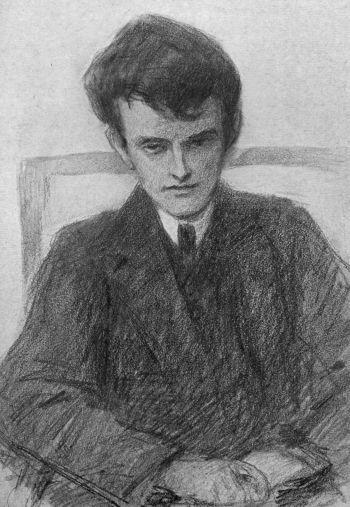
Padraic Colum
One wonders is it not of himself that the poet writes, though what he
writes takes us far from him, carrying us in thought halfway round the
world and back through civilizations that have passed. But whether it is
of himself that Mr. Colum writes or not, he is certainly, in a sense,
"The dawn-man ... in the sunset." The "Glory of the Gael" that is
to-day, if it is "glory," is glory of sunset, of "purples and splendors"
that pass; there are those who hold that the race that "went forth to
battle," but "always fell," is already passed beyond the sunset, into
the twilight, that twilight that is the time of day so surely symbolical
of the writing of the many Irish poets that have followed after Mr.
Yeats. Mr. Colum, however, whether his race be in twilight or sunset, is
of the dawn. He is of the dawn not only because he is the youth, at
oldest the young man, in his writing, who sees the world freshly and
fresh, none the less fresh because he knows it old; but he is of the
dawn because it is chiefly those things that are fundamentals, that come
out of the beginnings of things, that interest him profoundly, that stir
him deeply. Subtleties and complexities, decadent things, are not for
him, but simplicities, primordial things, the love of wandering, and
what is only less old, the love of land; and love of woman. These three
things, and youth, and little else, concern him. Mr. Colum writes,
indeed, in the dedication to "Thomas Muskerry" (1910) that he has set
down "three characters that stood as first types in my human comedy, the
peasant, the artist, the official, Murtagh
Cosgar, Conn Hourican,
Thomas Muskerry." It is not, however, the official that Mr. Colum
emphasizes in "Thomas Muskerry," but the man who longs for a quiet
little place where he may be free from the nagging of his daughter and
her children; and in Myles Gorman, in this same play, is sounded that
other call that is recurrent in his work, the call of the road. We see
more of wanderer than of artist, too, in Conn Hourican, though Mr. Colum
calls the play he made for him "The Fiddler's House"; and here, too, the
love of land is a motive—love of land and the wander-love battle in
"The Land" (1905), with love of woman the deciding factor in the
latter's victory.
Mr. Colum would not be an Irishman if nationality and religion were not
also motives in his plays and poems, but it is only in his 'prentice
work that either appears as a leading motive. From a good deal of
writing, most of which appeared originally in "The United Irishmen," he
has republished only the three plays before mentioned, "The Land"
(1905), "The Fiddler's House" (1907), "Thomas Muskerry" (1910), his
miracle play, "The Miracle of the Corn," and two stories in "Studies"
(1907), and what he wishes to preserve of his verse in "Wild
Earth" (1909).
It was through "The Daughters of Erin" that Mr. Colum came in touch with
the dramatic movement. Their plays and tableaux in the Antient Concert
Rooms in 1900 attracted his attention, and he wrote to the secretary,
inclosing with the note copies of two plays that he had written—the
dramatic achievements of his late 'teens. These plays were about the
"Children of Lir," that one
of "The Three Sorrows of Story-Telling"
that is less poignant than the story of Deirdre only because it is less
human, and about Brian Boru, the high king that beat back the Danes at
Clontarf. Faery and mediæval history were not destined, however, to be
Mr. Colum's field, and Mr. Fay, then stage manager of the Association
productions, probably helped him on the way to his true field, the life
of the peasant of the Midlands, by declaring them rubbish. Two years
later Mr. Colum had learned enough about life and about the stage to
write a play against enlistment in the English army that held the
attention of audiences and was regarded as good propagandist "stuff."
"The Saxon Shillin'," produced May 15, 1903, Mr. Colum has not
republished, nor "The Kingdom of the Young" (1902), which like its
predecessor was published in "The United Irishmen." With this last play,
as its title indicates, Mr. Colum found his way to that subject of
youth, which, whatever other one of his dominant motives his plays may
involve, is always present. The hardness of youth is the theme of "The
Kingdom of the Young," the hardness that came into the heart of a
daughter, when driven into revolt by the older generation. She turns on
her father in the end, determined that she will not be cheated of the
joy of life as was he.
In "The Foleys," another little play of the same year, 1902, a play that
for all its crudity and incompleteness is full of insight into Catholic
Ireland, youth is again the theme, or the intolerance and
self-righteousness of youth. "Eoghan's Wife" (1902) is only a monologue,
only the old story of the woman who finds her home lonely and
depressing because the wrong man is the man of the house. She looks out
over "brown bogs with black water," wondering what is the way of escape
from it all.
"Broken Soil," put on at the Abbey Theatre on December 4, 1903, is the
first play of Mr. Colum with which, in after years, he was in any way
content, but he was not too content with it, rewriting it in 1907 as
"The Fiddler's House," and, I think, in the main improving it.
Mr. Colum, a youth with an appetite for reading as insatiable as his
impulse to write, read not only his Ibsen but his M. Maeterlinck. Back
of "Broken Soil" is Ibsen, back of "The Miracle of the Corn" is M.
Maeterlinck. "The Miracle of the Corn" was put in rehearsal by the Irish
National Theatre Society in 1904, but so far as I know it was never
played by that organization, its first staging I have record of being by
"The Theatre of Ireland" at the Abbey Theatre on May 22, 1908. Here
again is youth a leading theme, the power youth has, if it be wistful
and tender and pleading, to soften the heart of age. It may seem to some
that the girl Aislinn is only a symbol, only the dream of his youth
returned to the farmer Fardorrougha, who has hardened his heart even in
famine time, but whether apparition, or child of the flesh and symbol,
too, Aislinn is the bringer-back to Fardorrougha of the soft heart of
youth.
As the Irishman in America is preferably a city dweller, it may be a
little difficult for his fellow Americans of other ancestry to
understand why the Irishmen at home were so concerned with Mr. Colum's
next play, whose theme, as whose title, is "The Land." The cry for a
home and a bit
of land, a cottage around a hearth and around the
cottage a few acres of your own, is a cry that has been heard in all
ages and among all people. It is a cry that we all have cried at times,
gypsy-hearted though we be; it is a cry that even the city-loving
eighteenth century raised in all the "Mine be a cot" poems, whether of
Pomfret or Pope or any other of the many who followed the same fashion,
and it is a cry that is especially loud in present-day America. But none
of us can feel the call of the land, none of us can desire it with more
intensity than the Irishman of to-day, city-dweller though we find his
kin in America; there is no one class of people anywhere in the world
who want the land as the Irish peasants of to-day want it. Their fathers
and grandfathers saw the fields that they had farmed turned into
pastures for cattle, as the Scotch crofters saw their holdings turned
into deer-parks; the two generations of Irishmen now respectively in old
age and middle age have known what it is to be taxed out of the places
their improvements as tenants made more valuable; and to-day those of
the old folk that are still alive and those of the middle years that are
still in Ireland are getting back to the land, along with the younger
generation that desires it almost as ardently, but were not born upon
it, profiting by legislation that compels landlords to sell to the
Government, which in turn sells to the small proprietors.
The Irish peasant loves his bit of land far more than his language, and
even more, I think, in the bottom of his heart, than he loves his
church, although allegiance to his church is a duty that he puts before
any love. A boreen
in bogland is not a lonely place to the Irish
peasant if he have neighbors of long standing. It is the big city that
to him at home seems the lonely place, despite the glamour of its
lights, and its shops, and its ceaseless excitements.
The story of "The Land" is, as I have said, the story of the struggle
between love of land and the Wanderlust, with the love of woman as the
decisive factor in the latter's victory. Matt Cosgar is the son of a
peasant farmer, the last of many that the hardness of Murtagh has driven
to America, and he, too, goes in the end, after his father's will is
broken, because the girl of his choice is restless and will not be
content as a farmer's wife. Matt and Ellen, the fit and the strong, go
to America, Cornelius and Sally, the hair-brained and the drudge,
remain. Symbolic this is, of course, of the situation in Ireland to-day,
or at least yesterday, but the characters are strongly individualized
and show no tendency to harden into types. In "The Land" the
restlessness of youth, its call to wander, is the motive that clashes
with love of the home and of the home place. In "The Fiddler's House"
there is youth desiring peace, and youth afraid of love, in Annie and
Maire Hourican; and the call of the road to old Conn, the fiddler.
Sacrifice is rare in youth, and if it were not that Maire is afraid of
her love for Brian McConnell, and gives up her home and takes to the
road with her father partly because she fears her love for her lover,
fears her powerlessness with him, it would hardly be in the course of
nature that she would sacrifice so much for her sister. It was a sure
instinct that guided Mr. Colum so to make believable a sacrifice at
first view seemingly so
great. Even in this play, which Mr. Colum
intends as a study of the artistic temperament, the land is a motive
second only to the call of the road. Maire cared somewhat for the land,
less than her sister cared, more than her father cared, though he too
loved it in so far as the artist's gypsy nature will permit. It is the
road and his music, however, that Conn cares for most, and in his
expression of such love he attains to an eloquence that is Mr. Colum at
his best: "I'm leaving the land behind me, too; but what's the land,
after all, against the music that comes from the far strange places,
when the night is on the ground, and the bird in the grass is quiet?" As
one reads, aloud, as one must, one thinks now of the Old Testament and
now of Synge.
Although Mr. Colum determined to put aside thoughts of dramas of old
Ireland in 1900, he evidently could not keep the old legends out of his
mind. They intrude now and then into his verses for all his modernity,
and one of them, "The Destruction of the House of Da Derga," forced him
to turn it into a play. "The Destruction of the Hostel" has not been
published, but it seems to have pleased those who saw and heard it as
played by the boys of St. Enda's School on February 5, 1910.
In the last play, too, of Mr. Colum, the ending is a parting, here the
parting that death brings. Telling the fortunes of poor old Thomas
Muskerry, who in the end dies a pauper in the workhouse where once he
was master, the play opens our eyes to that life of the small town,
deadliest of lives the world over, a life knowing neither the freedom of
the farm nor the freedom of the city, as
such life is lived in Ireland.
In "Thomas Muskerry," in "The Land" and "The Fiddler's House," the
characterization is sure and true. One may take it that this is Ireland,
Ireland on the average, as one cannot take it that that we have in the
plays of Synge or Lady Gregory is Ireland on the average. Crofton
Crilly, the son-in-law of the master, soft and big and blond, is an
unsympathetic but memorable portrait. Unsympathetic and memorable, too,
are the portraits of his son Albert and his daughter Anna, the one
tricky and the other grasping, and the workhouse porter and the old
piper haunt my memory as strange men I have met haunt my memory, year in
and year out.
All three of these plays are, as I have said, sprung of domestic
problems, sure proof that Mr. Colum is the peasant's son. The family, as
he has pointed out in an article in "The United Irishmen," is not only
what the family is, ordinarily, in northwestern Europe, but that plus
that which the Irish family has inherited of the clan spirit. It was
only yesterday in Ireland that the girl and boy were married to whom
their fathers would, by a process of barter in which their own wishes
were not for a moment considered. They submitted, or came to America. It
was a patriarchal system of society.
It is not, then, difficult to see how it came about that Mr. Colum, who
began to write so young, came to write so much about youth and the
rebellion of youth, and to write about those other themes of his, themes
all of them made more intense by the youth that is concerned with
them—the land that obsesses the life of the man of the
house all
Ireland over, and through him obsesses the lives of his family; and love
of woman.
Mr. Colum does not intrude his own personality into his plays, but it is
felt, as it should be felt, in every one of lyrics. Reading them one has
a sense of a youth like the youth of some characters in his plays; a
youth more manly than Cornelius's, less restless than Ellen's; a youth
serious and troubled with thought; a youth in revolt against much in the
old order, but tolerant of the passing generation that fears it
"knocking at the door." It is a youth impassioned rather than
passionate, more pronouncedly a youth of mind than a youth of heart.
When I say youth of mind, I mean not immaturity of mind, but the outlook
of the young mind; not radicalism, but a fixed determination to think
things out afresh and not to accept them because of any convention.
Eloquence one always looks for in the writing of an Irishman, and humor
and power over dialogue, but Mr. Colum is too serious with youth to care
much for humor, and, like Mr. Martyn, though not to the same extent, he
has trouble with his dialogue. The feeling for the situation, the
understanding of what is in the characters' minds, is in Mr. Colum, but
the dialogue does not always accommodate itself to situation and
thought. What Mr. Colum makes his characters say has in it the thought
and the sentiment of what they would say, but the words as often lack
life as have it. It is this difficulty with dialogue that has prevented
Mr. Colum, in his plays, true and finely planned as they are, from
reaching great achievement. As dramatist he is still more full of
promise than
of achievement, and to be a dramatist of promise after ten
years of playwriting is to be at a standstill. In lyric poetry it is
otherwise with Mr. Colum. There he has attained. You will find his real
value in "Wild Earth" slight though the book may seem. Here is reading
of life, here is imagination, here is lyric cry. Read these little poems
once and they will be your familiars forever.
MR. WILLIAM BOYLE
One wonders if justice has been done Mr. William Boyle. If it has not it
is because he is a playwright of one play, "The Building Fund" (1905).
He has written three other plays that count, "The Eloquent Dempsey"
(1906), "The Mineral Workers" (1906), and "Family Failings" (1912), but
"The Building Fund" is of a higher power than any of these. "Family
Failings," produced in the spring of 1912, I have not read, but
according to all accounts it does not mark any advance upon "The Mineral
Workers" or "The Eloquent Dempsey." "The Mineral Workers," essentially a
propagandist play, and "The Eloquent Dempsey," essentially a satire, are
hardly, even in intention, of the first order of seriousness in art.
There are characters in these two plays faithful to human nature, and
faithful to the ways of eastern Galway, where the scenes of all of the
plays of Mr. Boyle are laid. But there are so many other characters in
them that are either caricatures or "stock" that, funny as the plays
seem upon the stage, they do not impress the deliberate judgment as
real. The many characters of "The Mineral Workers" and its several
motives are too much for Mr. Boyle; he
loses his grip and the play
falls to pieces. "The Eloquent Dempsey" suffers from the caricaturing of
its characters, and its action degenerates into unbelievable farce
almost on the curtain-rise. "The Building Fund," however, is serious and
true, and at the same time just as full of wit and just as biting in
satire and just as effective on the stage as "The Eloquent Dempsey." Its
characterization is recognized as distinctive and authentic even on
reading. Revealed through the almost perfect work of the players trusted
with its presentation by the Abbey Theatre on their American tour of
1911-12, it seemed even more than distinctive and authentic, it seemed
inspired by profound insight.
"The Building Fund" tells the story of the outgeneraling of grasping son
and conniving daughter's daughter by a hard old woman of the strong
farmer class in the west of Ireland. Mrs. Grogan is approached as the
curtain rises by Michael O'Callaghan, an elderly farmer, and Dan
MacSweeney, a young farmer, in the rôle of collectors for the fund for
the new Catholic church. They are sent away by her and by her son Shan
without any contribution, but their visit suggests to her a way by which
she can disinherit her son and her granddaughter, wishful for her death,
she thinks, in their eagerness for her fortune. Shan is open in his
concern as to her disposal of her money; and although the girl hides her
purpose under pretended solicitude for her grandmother's health and is a
great help to the old woman, Mrs. Grogan believes her also to be
plotting for the fortune and is equally resentful toward both. So when
the collectors call again, Mrs. Grogan
makes a will, in which we learn,
on her death shortly after, she has left all her fortune away from her
family to the church. For all their plotting, the audience feels that
the old woman is more malevolent than either son or granddaughter, and,
after all, the son had worked hard on the home place and the
granddaughter, slyboots as she was, undoubtedly was really kind. Both
are of her blood, and it is human to feel that parents should leave
their money to their children rather than to charity. There is some
amelioration of the condition of Shan and Sheila in the thought that
they may stay on, with Father Andrew's permission, as managers of the
old farm, henceforth the church farm. But sympathize with them though
you may, you feel it is only right that selfishness should over-reach
itself.
The play is not any more complimentary to Catholic Galway than "The
Drone" of Mr. Mayne is complimentary to Protestant Down, but it is
seldom that comedy is complimentary to human nature, and "The Building
Fund" is comedy. That is, it is comedy as Ibsen sees drama, or character
farce as Coleridge defines it. It is, in the Greek sense, perhaps even
tragedy; certainly, it is tragedy from the standpoint of Shan and
Sheila, for circumstances certainly get the better of them. From Mrs.
Grogan's standpoint it is comedy, for she, through her will, even though
she is now dead, has got the better of circumstances as represented by
the plotting of her son and granddaughter. If we look at "The Building
Fund" from the standpoint of Shan and Sheila, but without sympathy for
them, it is only character farce, for although
circumstances get the
better of them, we do not then care for them, and a play in which
characters are overwhelmed by fate, but in which our sympathy is not
with them, is, if we follow Coleridge, really farce. Whatever "The
Building Fund" is, its characterization is admirable. Some might say its
men and women approximate to types, that Mrs. Grogan is the avaricious
old woman, Shan the sanctimonious miser, Sheila the sly minx, Michael
the benevolent old man, and Dan the gay blade. Types or not, you will
find all of them in Ireland, and all of them wherever human nature is
human nature. If they are types, however, each has a personality, but
whether all of them would stand out with such individuality had one not
seen them so fully realized on the stage, I cannot say. The tottering,
bitter old woman of Miss Allgood and the miserly, fearful son of Mr.
Sinclair are more memorable than the other impersonations only in that
they are fatter parts than Sheila, Michael O'Callaghan, and Dan
MacSweeney, played respectively by Miss McGee, Mr. O'Rourke, and Mr.
O'Donovan.
Mother and son are, I am sure, just as complete in the writing of Mr.
Boyle as in the acting of Miss Allgood and Mr. Sinclair. Both are,
indeed, as finely imagined and as faithfully realized as any characters
in modern English comedy. And you may have to go further afield than
modern English comedy to find such a minute study of resentful and
malevolent age as this portrait of Mrs. Grogan. We all know that
perversity that will not allow its possessor to be satisfied with any
effort to please. Here is an illustration of it as Mr. Boyle has seen
it:—
Sheila. Will I boil an egg for your
breakfast, granny?
Mrs. Grogan (sarcastically). Oh, to be sure! More
extravagance. You know very well I couldn't eat it, and you'll have
it for yourself. Waste, waste; nothing but idleness and waste all
round. God help me! (Coughs.)
Sheila pours out a cup of tea and hands it to Mrs. Grogan.
Sheila. Drink that drop of tea, granny—it's fresh
made.
Mrs. Grogan. What did you do with the bottom of the pot? Threw
it to the ducks, I suppose?
Sheila (pointing to the table). I have it here for myself,
granny.
Mrs. Grogan (sipping tea). When I was a girl I never got a
sup o' tea from year's end to year's end.
Sheila. It was very dear, then; wasn't it?
Mrs. Grogan. It's dear enough still with everybody using it
all day long. Did you feed the hens?
Sheila. Long ago, and let the ducks out, too.
Mrs. Grogan. I suppose it's in the oats they'll be by this
time. What about the calves? Grogan goes out.
Sheila. I gave them their milk and put them in the bawn.
Mrs. Grogan. With the linen on the hedge? Why, they'll chew it
into rags, and, maybe, choke themselves.
Sheila. No, granny, dear; I spread the linen in the upper
garden, where the sun comes the earliest.
Mrs. Grogan. I see it's stole ye want it. There's half a dozen
tinkers squatted in the quarry.
Sheila (wearily.) They went a week ago.
Mrs. Grogan. Ah, dear! There's what it is to be old! I never
hear anything that's going on now till it's all over. Is that egg
boiled?
Sheila. Granny, dear, I thought you couldn't take one.
Mrs. Grogan. It's the little bit I eat that's grudged me now,
I see.
Though there is little of it in this passage that I quote, the
picturesque phrase that no Irish writer is without is Mr. Boyle's, as a
matter of course, but there is no particular
individuality in his
handling of it. Style he has not, nor any background of romance, or
beauty of that sort that illumines the grayness of the comedies of
Ibsen, or of any other sort of beauty than that approach to beauty there
is in skilled craftsmanship.
Admirably arranged, too, are the situations of "The Eloquent Dempsey," a
satire on the man who straddles all questions, as at one time, at any
rate, did so many Irish politicians. Dempsey might have continued his
career of straddling indefinitely had he not a mania for speech-making
that he could not control. In the end, however, he was undone by a
well-intentioned conspiracy, arranged by his wife, to get him out of
politics altogether and out of his liquor-selling and into farming far
from town. I cannot identify Dempsey with any one prominent Irish
statesman, but the lesser fry on both Nationalist and Unionist sides are
as easy to identify as the men that suggested the characters of "A Tale
of a Town." In "The Eloquent Dempsey" all the art of Mr. Boyle has been
lavished on the central figure, which, when all is said, remains a
caricature, and caricature uncompensated for by any great or noble
characteristic of the play, whose primal quality is but cleverness.
Effective as its satire is, and provocative of laughter as it always is
on the stage, it is altogether cheaper in its quality than "The Building
Fund."
"The Mineral Workers," with its chief portrait that of a returned
Irish-American mining engineer, takes us to certain phases of society
not met among the publicans and politicians and peasants of Mr. Boyle's
earlier plays.
Other than these are not only the hero, Stephen J.
O'Reilly, but the aristocrat, Sir Thomas Musgrove, and his sister, Mrs.
Walton, who is of the family connection of Sir Arthur Wing Pinero's
Georgianna Tidman. Dan Fogarty, the holdback, unprogressive farmer, is
the sharpest-cut and truest to life of all the characters, so clear-cut
and true, in fact, that one thinks of him as almost a fellow of Shan
Grogan in "The Building Fund." Uncle Bartle is sentimentalized, and
Kitty Mulroy has no such personality as Sheila O'Dwyer. Contrast "The
Mineral Workers" with a novel of the returned American, "Dan the Dollar"
of Mr. Bullock, and the calibre of Mr. Boyle's play is quickly revealed.
What Mr. Boyle had been had he come into touch with the movement ten
years earlier, it is of course beside the point to speculate. He was not
a young man when he first became acquainted with the art of the Abbey
Theatre in London and was impelled to write plays for it. He was,
though, able to adapt the experience he had had as a story-writer to the
stage in "The Building Fund." That being so, why is it that his later
plays, successful though they have been as vehicles for the purveying of
amusement on the stage, have not taken rank by their art or by their
reading of life with "The Building Fund "? It may be that it was the one
theme susceptible of dramatic presentation that he had brooded over long
enough to transmute into terms of drama, and that the later plays, full
of successful stage tricks though they are, did not come out of his
knowledge of Irish life. Knowledge of Ireland he ought to have, for he
is said to have
lived for comparatively long periods in various places
in country as an excise officer. As such Mr. Boyle was himself one of
the principal types, that of the official, that exist in Ireland, and in
a position to learn much of many other types, surprisingly few of which
he has realized with any depth of insight in his plays.
It would seem with his great success seven years back and his newer
plays less effective, that we cannot look to Mr. Boyle with great hope
for the future, as we can to Mr. Robinson or Mr. Murray. When we so say,
however, let us remember that Lady Gregory did not attempt plays until
she was close on fifty.
MR. T.C. MURRAY
The North is generally held to be another country than the rest of
Ireland. Ulster is alien alike in race and religion and economic
conditions from Connacht and Leinster and Munster. It is Scotch Ireland,
Protestant Ireland, industrial Ireland. It is, moreover,—many of its
citizens say therefore,—prosperous Ireland. Certainly men would not
divide all Irishmen into "Irishmen" and "Scotch Irishmen" were there not
many grounds for such a distinction. All other of the immigrants into
Ireland have, as a people, disappeared. The Norman has left his mark on
the land in his castles and his names, but as a distinctive element of
the population he no longer exists, any more than does Welshman or
Englishman or Palatinate. Apart from distinctions of class the men of
Ireland are "Irishmen" and "Scotch Irishmen," and until yesterday,
therefore, Nationalists and Unionists.
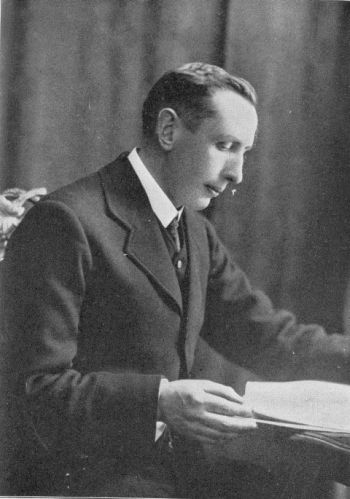
T.C. Murray
And yet, definite as are these distinctions, life in the various parts
of Ireland seems much alike, class for class, as it is represented by
the many contemporaneous playwrights, whether the scenes of their plays
are Down or Kerry, Galway or Wicklow. A tinker is a tinker wherever you
find him, a strong farmer a strong farmer, a landlord a landlord. The
same emotions dominate rival brothers in "The Turn of the Road" and in
"Birthright," though the Orangeman turned actor wrote the one and the
Cork schoolmaster the other. Mr. T.C. Murray is one of those to whom Mr.
Yeats has given the name "Cork Realists." His first play, "The Wheel o'
Fortune," was produced by the Cork Dramatic Society at the Dun, Cork,
December 2, 1909. It has not been published, so far as I know, and all
that I learn from the references to it in newspapers is that it is a
one-act ironic comedy about matchmaking. Mr. Murray brought his next
play, "Birthright," to the Abbey Theatre, where it was performed on
October 27, 1910. If "Maurice Harte" (1912) stands the test of time and
travel as has "Birthright," Mr. Murray has come to the Abbey Theatre to
take a place of prominence among its playwrights. Some of the appeal of
"Birthright" is in its story, the story of Cain and Abel, if you like, a
story that is as lasting in its appeal as is "The Eternal Triangle," but
there is as much appeal in the characterization, which you feel as you
read almost as intimately as you come to know it on the stage. There are
many plays that are altogether colorless in the reading unless you have
unusual power of visualization and can see them as you sit in your study
as if they were embodied before you
on the stage. Such plays,
visualized or unvisualized in the study, are often real enough on the
stage. "Birthright," as I have said, is not one of these. It visualizes
itself for you, with no effort on your part, as you read it, though of
course, as every real play will, it moves you more in the playing. It
was admirably cast on its first production at the Abbey Theatre, and it
was just as admirably cast on the American tour of 1911-12, Miss
O'Doherty's Maura and Mr. Morgan's Bat Morrissey being wonderful
pictures of a doting mother and a stern father troubled by their
preferences, the one for the elder, the other for the younger son. The
rival sons were done to the life by Mr. O'Donovan and Mr. Kerrigan, and
the neighbor of Mr. O'Rourke was, too, a complete realization of the
Irish peasant of the valley of the Lee. It is a stern and patient
realism this of Mr. Murray in telling of how Hughie, the elder son, the
apple of his mother's eye, the idol of the parish for his hurly playing,
and his verse-making, and his free and pleasant ways, is disinherited
and condemned to seek his fortune in America by his father because his
younger son was the better man on the farm. There was back of Bat's
decision, too, his feeling that his eldest-born was more of his mother,
whose blood was part gentle, than of himself, the grubber of the earth.
Shane, like his father, was the peasant plowman, Hughie something of the
sporting gentleman. The end of it all is murder, the younger son killing
the elder with the hurly when he is accused by his brother of plotting
to grab the farm. Many who saw "Birthright" in America were moved by it
more than by any other play in the repertoire
of the company, and I
have heard more than one whose supreme interest is the theatre say that
it was the best play new to America presented in America during the
winter of 1911-12. I do not so hold, for "The Well of the Saints" and
"In the Shadow of the Glen" were new to America in the winter of
1911-12, and "The Playboy of the Western World" was new to every city in
America save to Chicago, where Mr. Hart Conway presented it at his
dramatic school in the spring of 1909. I can, however, understand why
"Birthright" so appealed. It is because of the theme, because of the
beautiful character of Maura Morrissey, because of the absolute
faithfulness to life, as all the world knows it, of the play. I have
traveled the road to Macroom that these farmers traveled, and so I know
the externals of the life they lead: I have known intimately and I know
intimately just such people as these, Irish peasants, some of whom
spoiled their children, thinking the boy they loved must not be
"crossed," and some of whom preferred one child to another even to the
extent of reversing the custom of primogeniture that is as fixed a rule
among them as if their property was entailed, and so I can vouch for the
absolute fidelity of Mr. Murray's art. It is a realism little relieved
by humor; unrelieved either by any background of romance, but gaming a
dignity from its intensity of conception and its simplicity of unfolding
that makes you feel, as you read, or as you watch and listen, that you
are in the presence of nobility. Its style, maybe, is homespun, but it
is none the worse for that, and it never approaches at all to the cheap
or mean.
The appeal of this realism is as poignant in "Maurice Harte" (1912) as
in "Birthright," though the story of the later play is not so universal
as is that of the play that brought Mr. Murray his share of fame.
"Maurice Harte" tells of the disaster that comes to a young divinity
student of Maynooth whose parents drive him back to college to seek
ordination even after he tells them that he has no vocation for the
priesthood. The curtain rises on Maurice, a youth of twenty-two, trying
to tell his mother, whose youngest he is, and the child of her middle
age that it would be sacrilege for him to take orders with no vocation.
His courage fails him, as it had on previous occasions on which he tried
to confess his agony because of his false position, and he finally begs
the Parish Priest to break the desolating news to the family. They are
only farmers in a small way, the Hartes: and the father and mother, the
son at home, Owen, and the three older brothers in Boston, have all made
sacrifices to give Maurice his education. When the priest tells of the
boy's decision not to return to Maynooth, mother and father and brother
all insist that he must stick to his earlier intention, vocation or no
vocation.
They are in monetary difficulties because of him, and if the story went
out that he was not back at Maynooth his mother declares it "wouldn't be
east in Macroom when we'd have the bailiffs walking in that door." She
tells him, too, his being a spoiled priest will cost his brother his
bride and her fortune that would help them to pay off their debts. The
boy cannot withstand their pleading, and the first act ends with his
promise that he
will go back to Maynooth, a promise wrung from him even
though he knows at the time of its making that his return may bring him
to madness in the end.
Act II, nine months later, shows us again the kitchen of the farmhouse
of West Cork, with happiness in the hearts of all there, save some
slight apprehension on the father's part over his new clothes and the
terrors of a journey with Father Mangan to Maynooth. In this relaxing of
the tension of the play humor is not out of place, and its attainment
here by Mr. Murray shows that he could write comedy did he choose. We
hear that the marriage settlement between Bride Burke and Owen has been
made, and that Maurice is to marry them; and that he has bested all his
classmates in his final examinations. Upon the pride and happiness in a
son sure of a good match, and the glory of another son about to be
"priested" and to say mass in the local church, breaks in word that he
cannot be ordained because of illness. And close upon this bad news
comes Maurice himself, broken down mentally from the strain of driving
himself to do what he knows to be wrong, from the strain of committing,
as he believes, sacrilege. Father and mother and brother realize that it
is they who have driven him mad, but such is human nature that mother
and brother, at least, have thoughts of themselves even at this moment,
as well as thoughts for Maurice with "his mind that's gone." His brother
fears that Bride will not come into a house so disgraced, and his
mother, her years-long dream of her youngest a priest gone on the wind,
is struck dumb with horror at the thought of what her life will be from
this out.
The full significance of the tragedy of Maurice's fate can be realized
only by those who know intimately the ambitions hugged close to heart by
the Irish Catholic mother. It is more to her to have her boy a priest
even than it was yesterday to the Scotch Presbyterian mother to have her
boy a minister of the Kirk. It is the greatest glory that can come to
such a peasant mother to give one of her sons to the priesthood.
There is, I think, no propaganda in the play, and no intentional satire,
although in a way "Maurice Harte" affords a parallel to so definitely a
propagandist satire as Mr. Robinson's "Harvest." It is not education
that is the curse, however, in "Maurice Harte," but the belief that only
priesthood in the end can justify the sacrifices without which a college
education is almost impossible for an Irish peasant. Certain it is that
it is only for the pride of having their boy a priest that the typical
Irish Catholic peasant parents would make such sacrifices as the Hartes
have made, sacrifices involving them in debt to the extent of a thousand
dollars, to secure their son an education.
In a sense "Maurice Harte" is far other than the provincial study I have
here outlined. Its theme is allied, unquestionably, to that theme so
much larger in its relations than that of the spoiled priest, the theme
of the rebellious son, the son who will live his own life no matter what
may be his parents' will. It is only allied to it, however, not to be
identified with it, because Maurice is too fearful of disappointing his
parents, and too shrinking and ineffectual, to go against his parents'
will. In Ireland, as I have said elsewhere, such parental will, by a
survival
of authority from the days of the clan system, was law until
yesterday, and there will therefore be those, I have no doubt, who will
find in the play a conflict of the old order and the new, but I do not
believe such conflict was the author's intent. Indeed, the play is
wholly of the old order. No love of man and woman figures as motive in
it as none had figured in "Birthright." There is parental love, of
course, in both plays, though in the case of both parents in "Maurice
Harte" and in the father in "Birthright" parental pride is a stronger
motive than parental love. Very true to Irish life is this absence of
passion as a deciding factor in the fates of man and woman, this
insistence upon the importance of the family, this subordination of the
rights of the individual. Mr. Murray wished to write in "Maurice Harte"
a play of the very heart of Irish Catholic life, and such a play he has
written, a play that marks no decline, either in characterization or
situation, from "Birthright," and to say that is to give "Maurice Harte"
praise of the highest.
MR. S. LENNOX ROBINSON
Mr. Lennox Robinson, like most of the Abbey Theatre dramatists, has
chosen to write about the ground under his feet. The son of a clergyman
whose charges have been in the southwest of Ireland, Mr. Robinson spent
his boyhood and youth in the Bandon Valley. He had been trying his hand
at writing from the time that he was ten years old, editing an amateur
magazine as he grew older, feeling about for the thing that he could do.
A visit of the Abbey Theatre Company to Cork was the awakening. He
saw
a new acting, he saw a new art of the stage, and he knew as he saw that
it was in drama his work lay. It was not, however, for the Cork Dramatic
Society that he did his first play, but for the Abbey Theatre. "The
Clancy Name" was put on on October 8, 1908, when its author was but four
days past his twenty-second birthday. What this first version was like I
do not know, but Mr. Robinson has reprinted the second version, put on
with the full strength of the National Theatre Society at the Abbey
Theatre on September 30, 1909. As printed, it is an ironic little play,
recording the great day in the life of the Widow Clancy, the day on
which she pays off a five years' loan and stands without a debt of any
kind, her farm all her own, the Clancy name respected throughout her
world. But on this day of her triumph, when she would add to her
happiness by making a match for her son, John cannot rejoice with her,
and on her questioning him as to his moodiness he blurts out that he is
the man who killed James Power, a quiet man whose unexplained
disappearance is the mystery of the countryside. Worse yet, John insists
that he will give himself up to the authorities. It is terrible to know
one's son a murderer; it is intolerable to think of a Clancy being
hanged and of the glory of the name forever departed. She persuades him
finally not to tell, but he fears he will, so, when the chance comes, he
finds the only way out, the way of peace for his mother and peace for
himself. A car driven by a drunken neighbor is threatening the life of a
little child playing in the middle of the road. John Clancy pushes him
out of the way and allows himself to be driven down. They
bring him to
his mother's house still alive and raving incoherently of the murder,
but he dies before he tells his secret and the Clancy name is saved. It
is not a very gripping theme, but the play brings to us an acute
character study of the typical managing woman of the small farmer class.
We feel her tireless energy, her drive, her high pride, assets of worth
in the fight to live. There is a little humor, natural and unforced,
some picturesqueness of phrase, a revelation of knowledge of life in one
corner of Ireland. There is nothing, however, in the play to make it
comparable with the three that followed it on the stage of the Abbey
Theatre, "The Crossroads" (1909); "Harvest" (1910); and "Patriots"
(1912). "The Lesson of Life," a little one-act comedy, presented at the
Dun Theatre, Cork, December 2, 1909, Mr. Robinson has disowned. Why I do
not know, though the fact that it was not produced at the Abbey may
indicate that even at the time of its production he felt that it was not
up to the level of his work. Mr. Robinson has not republished "The
Lesson of Life," but the reviews state that it was an amusing little
play, though in no way a serious reading of life.
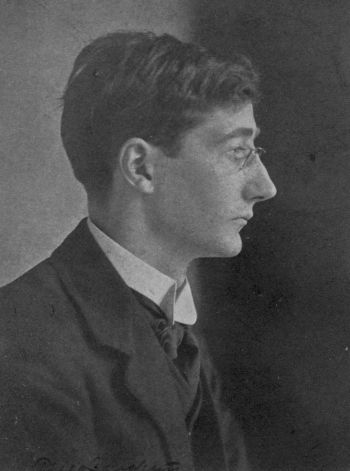
Lennox Robinson
"The Clancy Name," "The Crossroads," "Harvest," and "Patriots" are all
on themes that hit home at Irish institutions, and yet it would be wrong
to say any one of them is basically either satirical or propagandist.
All are primarily readings of life. "The Crossroads" alone, perhaps, is
more than a reading of life. Certainly, after its needless prologue, it
is fine art through to the end. This scene, with its satire of Irish
debating societies, is now, wisely, dropped when the play is produced.
We can
learn enough of Ellen in the play itself to understand why she
does as she does without this picture of her in Dublin. Her story is
that of a woman who hates the much talk of patriotism in Dublin and the
lack of doing anything tangible for Ireland. In Dublin she has worked
her way up from servant to assistant in a bookshop, but she goes back
happily to the country to give her sister a chance in town such as she
has had, thinking that perhaps she herself can lead her people into
better ways of farming and of ordering their lives generally through the
knowledge she has got in town. It is through such as Ellen that the
Irish Industries Organization Society in actual life accomplishes an
important part of its work.
In the first act of "The Crossroads" we find Ellen at home, in her old
peasant dress, having made the hens lay so well in winter as to arouse
wonder in a neighbor as to whether, "Is it right for hens to be laying
that way so early in the year?" A match is being made for her by her
mother with a man that has a good farm. Ellen desires the match very
much, for this is just the farm on which to try the new methods that
shall bring prosperity to the people of the valley and so stem the
emigration to America. She does not love Tom Dempsey, this strong
farmer, and she does half-love Brian Connor, whom she had known in
Dublin, but now that he has come down to ask her to marry him she
chooses the farmer, brutal though she knows him, because as his wife she
can do the work for Ireland that she has imagined for herself. The
loveless marriage, so universal an institution all over Ireland, made it
nothing out of the way for Ellen to act as she did,
even though at the
time of the action of the play a higher ideal of marriage than that of
the old matchmaking had come in. It is this institution that Mr.
Robinson, from one point of view, might be thought to be attacking in
the play; it is this institution, certainly, that is the theme of the
play. Is it a tribute to Irishmen and Irishwomen to acknowledge that
this loveless marriage has worked on the whole as well as the marriage
of sentiment, or as the marriage of sexual infatuation, or as the
marriage of comrade hearts that we believe we have in America? As a
matter of fact there were not as many loveless marriages as might seem
at first thought. The match made up between the father of the girl and
the father of the boy was the usual sort of marriage among the
stay-at-home Irish girls and boys up to 1880, but how many girls and
boys for the past one hundred and fifty years have come to America to
escape it? Look up your family traditions, you who have Irish ancestors,
and find is it not true that these ancestors, whether Reeds of Down or
Nolans of Meath, fled to America because they would wed the mate of
their choice. Even to-day boys and girls come here from the same motive,
though of course it would be preposterous to deny that to many it is
rather Eldorado than the land of freedom.
Act II reveals poor Ellen seven years later. She has lost her two boys
by fever; she has failed in her work on her own farm, though she has
brought untold blessings of progressiveness to the other farms around
Ballygurteen; she has lost the appreciation of her husband. She whom we
loved for a personality as winning as that of an Emma
or a Tess is now
a drudge, almost a slattern, gray-haired, hopeless, almost hated by a
brutal husband. The loveless marriage has proved a curse. Upon the woman
of his dreams so dethroned comes Brian Connor, now a successful
novelist, and, finding how things are, falls, for all his intended
restraint, into a fight with Tom, whom but for Ellen he would have
choked to death. Brian urges Ellen to go away with him, but, after a
moment's faltering, she refuses to go. This is the last scene. Tom, who
has heard Brian's proposal and his wife's rejection of it, comes slowly
down the room.
Tom. Was it me you saved or was it the
young man? When you pulled him off me, did you save me, or was it
him you saved from being hung? Tell me that, Ellen McCarthy.
[Silence.
Ah! 't is aisy seen.
[Puts his hat on, and goes to the door, and takes
the key out of the lock.
Ellen (looking round). What are you doing? (Frightened.)
What are you doing?
Tom. I'll tell you what I'm doing. I'm locking the door the way
you won't go after that young man; an' I'm going to step down to the
village now for a sup of drink. An' then—I'm coming back; an',
by God, I'll make you pay for this night's work, Ellen McCarthy,
till you'd wish you were dead—for the black curse you brought
on this farm, an' for the liking you have to the young man.
[Goes out. Ellen remains sitting at the table,
staring in front of her with sad, hopeless eyes.
The turning of the key in the lock ends the play, leaving brutality
unimaginable as the fate of Ellen.
It is a severe reading of the Irish peasant, this of Tom
Dempsey.
Murder may come of his blackness of heart. He is a far worse man, of
course, than poor John Clancy, who killed a man in an unpremeditated
fight, sure murderer though Clancy be. Yet despite such heroes or at
least such characters in his plays, no one would say that in either "The
Clancy Name" or "The Crossroads" Mr. Robinson held a brief against the
Irish peasant. He most certainly does not. He likes the Irish peasant.
His plays are "stories of mine own people" faithfully told. He does not
spare the Cork farmer, but he does not distort him. Why however, his
"Harvest" was allowed to be played unmolested in New York, after the
"The Playboy of the Western World" met with organized opposition, can be
explained only by recognition of the fact that the Irishmen of the
patriotic societies are slaves of precedent. "The Playboy of the Western
World" had always met with opposition, so it should meet with opposition
in New York. "Harvest" escaped in New York because its uncomplimentary
personages were unheralded. Not that there is anything in "Harvest," any
more than in "The Playboy of the Western World," that any
self-respecting Irishman need object to. "Harvest" shows the disastrous
effects the wrong sort of primary education, as taught by the country
schoolmaster of the old type, the type that was prevalent before the
present type, brought about. The present-day schoolmaster is in sympathy
with system of education that will keep the children on the land or in
an industry near the home place; the older type would give them an
education that would send them to the cities to be priests and lawyers
and secretaries
and typists and chemists and what-nots. Old William
Lordan, the schoolmaster, had, evidently, in the opinion of the
playwright, the sins of many on his shoulders, and yet one, knowing that
it is the system and not the man that is at fault, cannot help feeling
that Mr. Robinson is rather severe on what is in life a really lovable
though mistaken sort of man.
"Harvest" shows that of the six children of Tim Hurley, but the three
that come into the play are loyal to their father: Maurice, who works
the home farm; Jack, the apothecary's clerk from Dublin, who tries to
help with the farmwork, but is too much of a weakling to be anything of
a help; and Mary, who from typist has turned mistress, now to this man,
now to that. Mary, come home to get away from her wrong life, is called
back to London by the excitement of its life, which has become a
necessity to her. Jack, the chemist, in the end deserts the home; and is
off at the end of the play, with his upper-class wife, for America or
the colonies. Only Maurice is more than half-entitled to our respect.
The son who is the priest is in America to collect for the Church at the
time of his family's need, and so is not helpful to his family; the
solicitor son is climbing socially, and, needing a motor-car to help him
to position, prefers to spend his money on himself rather than on the
home place that was robbed to pay for his education; and the secretary
son is so ashamed of "the ditch out of which he was digged" that he has
changed both his name and his religion.
All five of the children who went out from the home educated, as the
schoolmaster wished them to go, have
been educated at the expense of
those that remained on the farm, Maurice the hard-working farmer and old
Timothy the father. But the father, too, is far from what he should be,
as one must suspect, not believing that education alone can account for
so many gone wrong. Timothy burns down some unimportant farm buildings
for the insurance upon them. This practice is so common in all parts of
the world civilized sufficiently to have insurance that I wonder
insurance companies take risks on backwoods farms anywhere. An old man
with whom I have talked often in the mountains of northeastern
Pennsylvania answered me one day, when I asked him how it was his barn
caught fire, "The insurance got too hot." He was a German, a man in his
prime a good worker and not a bad representative of the mountaineer of
his state. One must not, then, fasten on old Timothy as a character
distinctively Irish, at least in this phase of his character. He surely
is universal, a representative of one type of disingenuous countryman.
The characterization in "Harvest" falls short of that of "The
Crossroads," but perhaps it had to be if Mr. Robinson was to make his
point. As one realizes that perhaps these people are but pawns with
which to win the game that Mr. Robinson has set out, one remembers that
their creator spent some weeks with Mr. Shaw and Mr. Barker in London,
and one understands, too, many other of the failings of "Harvest." It is
but another of many illustrations of the blight that Mr. Shaw has
brought upon the modern English stage.
It is a two-edged satire that Mr. Robinson employs in
his "Patriots"
(1912), a satire that cuts into the sham agitation of some political
leagues, an agitation that is talk only, and at the same time cuts with
almost equal sharpness into the physical force party. It is true that it
is not the motives but the wisdom of these latter men that Mr. Robinson
satirizes in the failure of James Nugent, the returned political
prisoner, to stir his townsmen with the kind of talk that set them to
arming in 1893. That their propaganda is no longer possible, if it was
ever possible, is a corollary to the play, even if it could overcome the
inertia that has come to Irishmen with their greater prosperity since
the Land Purchase Act went into force.
The revolt of the patriot who hates talk and is willing to sacrifice
personal happiness for country is recorded here as it was in "The
Crossroads," and the uselessness of the sacrifice made only too plain.
To one not an Irishman it would perhaps seem that the real drama there
is in the play is smothered by the political satire and that the
politics satirized are of too local an interest for it to have so
universal an appeal as "The Crossroads" or "Harvest." There is an
universal story in "Patriots" that is but slightly developed—the story
of the prisoner's wife, Ann; her love for her daughter, who is a cripple
because of her mother's being dragged here and there by James Nugent in
his campaigning just before her birth; Ann Nugent's turning against her
husband, on his liberation from an eighteen years' imprisonment for
political murder, because of the wrong done her so long ago and because
of the danger to Rose's health that campaigning
with her father would
entail. The turning of Ann Nugent from her husband is the really
significant part of the play,—and in thoughts of that we pay scant heed
to the political satire and even to the pathos of the desertion of a
leader by almost all he expected to follow him, and the reduction of his
life, as he puts it bitterly, "to an anecdote—a thing to be told
stories about." And in the end that is the fate he will meet. Time and a
wife that he wronged have broken him. As he staggers off at the end of
the play, a stricken man and older than his forty-five years, this is
his cry:—
I've killed a man, I've crippled a child,
I've got myself shut up for eighteen years—God knows what good
came of it all—but—Peter—I meant—I tried ...
I know I meant right—and in prison my cell used to be filled
with the sad faces of men like me who had given everything for
Ireland—they wouldn't have come to me, would they? if I hadn't
been of their company. They are here now—I see them all around
me—there is Wolfe Tone, and there is ... oh, quiet watching
faces, I have tried—tried as you tried—and been
broken....
With this ability of his to pick out a theme that is basic in Irish
life, and with the years bringing him an experience of life that will
dominate any propagandist purpose, Mr. Robinson should grow in
seriousness of intention and accomplishment. He hates sham, he has sane
and cleansing satire of pretension, he writes good dialogue, his
experience as stage manager of the Abbey Theatre is teaching him the
stage; he is only twenty-five. Do not these things augur a future?
MR. RUTHERFORD MAYNE
It so happened that the last time I was reading the plays of Mr.
Rutherford Mayne, I was also reading the plays of Sir Arthur Wing
Pinero. All the world has heard of the one; only the little band
scattered here and there through the English-speaking countries to whom
letters are a real part of life has heard of the other. I laughed over
"Dandy Dick"; I thought of Miss Rehan playing Georgianna Tidman with all
that gush of spirits that was hers; I thought of Miss Nethersole in her
wonderful youth playing Paula Tanqueray; and as I thought of these two,
each in her way inimitable in her part, thoughts of past moments with
the characters of Mr. Mayne's plays, plays I have never seen on the
stage, came back to me. Had I seen them on the stage would my thoughts
of them have been thoughts of the theatre, as were all my thoughts of
Sir Arthur's plays? It may be, but I think not, I think the great
strength of Mr. Mayne is that he takes you to life; I think the great
weakness of the wide-heard author is that he takes you immediately, in
almost all of his plays, to the theatre, and only secondarily, if at
all, after the memory of his artificiality has died away, to life
itself.
William John Granahan and John Smith the Tory,—will you forget them, or
Robbie John whom the fiddle called away, or Ebenezer McKie and Francey
Moore, Protestant and Catholic, who together lay in wait for the hated
landlord and shot him as he passed through the glen; or John Murray,
good man, and his bauchle of a brother?
You will not forget them, for
they are from life; you have known them, all save Francey, if you have
known Scotchmen who are Lowlanders and Presbyterians, or such North of
Ireland men as are unalterably opposed to Home Rule. They are very like
the Orangemen of the novels of Mr. Shan Bullock, very like the peasants
the English-speaking world outside of Scotland first met in the verse of
Burns; harsher than the Baillie Nicol Jarvies and Dugald Dalgettys of
the kindly Sir Walter, but akin to them and to his Davie Deans and
Dumbiedikeses.
We are in a more familiar world in the plays of Mr. Mayne than in those
of most of the other writers in the movement—that is, I mean most
American readers are—simply because of Burns and Scott. Had Ireland had
a peer of either in his generation as satirist or romancer the
Irish-Irish would to-day be as familiar to us as are the Scotch-Irish,
who are, of course, transplanted Scotch. The women of this world are
not, however, of types so well known to us as are the men, because the
chivalry of Sir Walter prevented him from giving us his peasant
Scotswomen in as full detail as he gave us his men; but it is not
difficult for us to appreciate Mrs. Granahan and her daughter; Mrs.
McKie, a "woman with a dead soul"; Mary Murray with her daftness over
the boys; and even Sarah McMinn, so true in her managing and meanness,
qualities necessary to the prosperity of her folk. Puritan America can
understand these women and men because they are Puritan, too, with the
ignoble that is in the Puritan as well as with the noble that is just as
surely there.
It is in the first three plays of Mr. Mayne that we meet these people I
have named, County Down folk all of them, and all Protestant but Francey
Moore. They are the leading characters in "The Turn of the Road" (1906),
"The Drone" (1908), and "The Troth" (1908). The motive of Mr. Mayne's
first play is the old call to wander, the unrest of the vagrant heart,
here the heart of the musician. It is the story of Robbie John Granahan,
who, after burning his fiddle at the desire of a strong farmer whose
daughter he wished to marry, is driven out into the world to try his
fortune with another through her determination that her lover should
follow his star. There is more beauty in "The Turn of the Road" than in
either of the other plays of the North of Ireland, more beauty of theme,
more beauty of thought, more beauty of expression. Its themes are not
new, Wanderlust and the Puritans' hatred of art; its thoughts are not
new, but they are beautiful, and the words themselves are freshly used.
Its phrases that hold in memory are given to Robbie John and to his
father and to his grandfather, most of them to the grandfather. This is
the grandfather's lament for the boy gone on the roads with his fiddle
and his father's curse:—
It's the wee things you think nothing of,
but that make your home a joy to come back till, after a hard day's
work. And you've sent out into the could and wet the one that was
making your home something more than the common. D'ye think them
proud city folk will listen to his poor ould ballads with the heart
of the boy singing through them? It's only us—it's only us. I
say, as knows the long wild nights, and the wet and the rain and the
mist of nights on the boglands—it's only us, I say,
could
listen him in the right way. And ye knowed, right well ye knowed,
that every string of his fiddle was keyed to the crying of your own
heart.
There is no beauty at all in "The Drone." There is little beauty
possible to such a subject realistically treated as that of the exposure
of the utter sham that is the pretended inventor of a bellows, a man who
has for years fattened on a brother's tolerance and family pride. There
might have been beauty of construction, but dramatic construction is not
Mr. Mayne's strongest quality. Let that not be held too much against
him, for many an English dramatist, like almost every English novelist,
is weak in the architectonic qualities of his work. Yet such is the
hardness of the people that exposed Daniel Murray that you rejoice in
his duping of them at the end through his sale to them of his pretended
invention, especially as that frees his brother John, and John's
daughter, artful coax that she is, from Sarah McMinn, who is determined
to marry the one and manage the two. The ideals of the people of the
play and the grim humor of Mr. Mayne are well illustrated by this
declaration of John Murray, the best of them all, anent the suit for
breach of promise with which Sarah threatens him: "I would as soon do
without the marrying if I could. I don't want the woman at all, but I'll
marry her before she gets a ha'penny off me."
The people here are the people of "The Squireen" of Mr. Bullock,—hard,
grasping, resentful, passionate, brutal even, but doers of the world's
work. All that differentiates them from the Fermanagh Protestants is the
different conditions of County Down and a slightly lower social
position.
In "The Troth" the theme is the shooting of a landlord by two peasants
whom his agents are to evict on the morrow. To the cottage of the
Protestant McKie comes his Catholic neighbor, Francey Moore, whose wife
is dying. Here there is no turf for the fire, and no hope in the heart
of father or mother, for the child of the house has died, and, they
think, because of the landlord's hardness to them. The two men swear a
troth that they shall lie in wait for Colonel Fotheringham, and that if
but one escapes, as is likely, the one arrested shall hold his tongue as
to his companion. You do not see the murder on the stage, but you hear
the shot and see McKie return to his home, and you know it was he killed
the landlord. The tension of the last scene is almost unendurable. His
wife's providential lie for McKie, her agony in her knowledge of his
guilt when she sees his face on his return, the man's terror, are
handled with masterly firmness and sureness. To see this scene on the
stage in the hands of actors worthy of it must be to know real tragedy.
In this play, too, brief as is the glimpse we have into these four lives
of small farmer and his wife, his farmhand and his neighbor, a neighbor
of alien race and hated faith, you get to know them as if they were
friends of long standing. Character creation and character presentation
in pithy, tense dialogue are the great gifts of Mr. Mayne. Francey
Moore, the "dark man," with his sensibility, his eloquence, and his
flaming rage, is not of the characteristic men of Mr. Mayne. They are
men of slow ways all
un-Celtic and with smouldering hearts like those
of the Northmen we read about in the tales of "Origines Islandicæ."
In "Red Turf" (1911) Mr. Mayne turns away from County Down to the Galway
bogs, admirably symbolizing the hot land feud between neighbors in his
title. There are but five characters in the play, Martin Burke, farmer,
and his spitfire of a wife; and his neighbors the Flanagans, father and
son, who have won away from the Burkes, by the surveyor's decision,
their bank of stone turf that had come to Mary Burke from her father;
and an old fellow little better than a beggar. Mary taunts her husband
until he shoots the elder Flanagan as he is working away on the "great
stone bank." It was not his own gun Burke had, but, ironically, it was
one just brought to his house by the poor old man whom they had often
befriended, John Heffernan, brought that it might not be found in his
house by the gauger, and he unable to pay the license. It is not made
clear that there was malevolence in the leaving of the gun at the Burkes
by the old fellow, malevolent as are some of his remarks. Akin to him,
not in his malevolence but in that each is in a way a bit of a prophet,
is the grandfather in "The Turn of the Road," but more nearly akin to
old Granahan is Uncle Bartle of "The Mineral Workers" of Mr. Boyle.
Synge records old men of prophecy and tales in his travel sketches, but
he put none such who were gentle in his plays, or I would say that
Grandfather Granahan, like the old gaffer in Mr. Masefield's "Nan," was
a part of the influence of Synge that is felt by both Mr. Masefield and
Mr. Mayne. Their styles, respectively, in "Nan" and "Red Turf," have in
them more than echoes of the style of Synge. The "wambling" old men of
Mr. Hardy come also to mind as one thinks of these old men of Mr.
Masefield and Mr. Mayne and Mr. Boyle. All in a sense play "chorus" to
the action of the play, but there is no one of them that is in the story
or play in which he appears on such grounds only. There are, of course,
old men everywhere, in all life they are an integral part, and
everywhere they are commentators on life once they feel that their day
is done, spectators of a pageant from the forefront of which they have
dropped to watch the following troupe pass by.
There is little mating in these plays of Mr. Mayne, and love of woman
worthy of the name of love only in "The Turn of the Road"; there is
parental love, too, but perhaps more of parental tyranny. Such parental
love as there is, however, actually expressed, makes one of the
memorable passages of Mr. Mayne. Mary Burke, after taunting her husband
to madness, tries to turn him from murder when she sees him, gun in
hand, by crying: "For the love of God, would you leave it down. Leave it
down and go in and look at the child sleeping. It would take the badness
from your mind the same as it did with me."
Though Mr. Mayne is a writer for the Ulster Literary Theatre of Belfast,
his allegiance to the Abbey group is clearly indicated in "Red Turf,"
which is the result of a study of Synge. I do not mean to say that Mr.
Mayne is not familiar with the speech of Connacht, but that it is Synge
who has taught him how to listen to it. There is
little of the
influence of Synge in his three plays of the Black North, but when he
turns to Galway in "Red Turf," it is but natural that, writing of other
than his own people, he should write in a speech that has in it an echo
of that of him who has transmuted this speech into prose of the most
beautiful rhythm that English dramatic prose has known. The Bible is the
book of books in Ulster, and there is no page of Mr. Mayne's Ulster
plays but shows him acquainted with its great rhythms. Mr. Boyle,
skillful artificer of situation, and truthful depicter of character that
he is, and Mr. Colum, too, for all his closeness to the earth, are now
and then betrayed, Mr. Boyle more often than now and then, into the
English of the newspaper or of the public speaker; but the English of
Mr. Mayne is all but always an unworn English, an English used freshly,
or if with reminiscences in it, reminiscences of the seventeenth-century
English that has survived in the Bible or in the memory of the folk from
the time of King James.
Mr. Mayne has, then, style, and his dialogue is living speech; he has
knowledge of the people of North Ireland, earnestness and sincerity; and
having these qualities, he has more that is precious to art than have
most of the dramatists his countrymen. There is no consistent reading of
life in his plays, no great power over the unrolling of plot, but
perhaps these will come with the years. An actor himself, he knows the
stage; and this knowledge has given him power over situation. Once he
learns to lead situation into situation, once he ripens into fuller
knowledge of life, Mr. Mayne will be a dramatist to reckon with, indeed.
"NORREYS CONNELL"
There have been many other dramatists than these I have mentioned who
have had one or more plays produced at the Abbey Theatre. Some of these,
like Mr. Bernard Shaw, are Irishmen abroad that have gained the ear of
the world and do a play for Dublin out of a sense of duty It was thus
that "John Bull's Other Island" came into being, but that play, being
considered "beyond the scope" of the National Theatre Society, was not
produced at the Abbey, but at the Court Theatre, London, November 1,
1904. When "The Showing-up of Blanco Posnet" was "censored" in London,
however, the Abbey opened its doors to it, the "crude melodrama"
receiving its premier in late August, 1909. Little as "John Bull's Other
Island" was in the Abbey tradition, with moral purpose and unhumanity of
its very essence, it was at least a newspaper leader on an Irish
subject, but "The Showing-up of Blanco Posnet," a sort of
sentimentalized travesty of Bret Harte preaching the usual Shavian
evangel, has no more relation to Irish life than it has to literature.
It marred the repertoire the Abbey Company brought to America, as would
a camp-meeting hymn the music of the pipes.
Out of the Abbey tradition, too, are the plays of "Norreys Connell" (Mr.
Conal O'Riordan), whose "Piper" had its day of lesser notoriety of
Playboy-like quality on its presentation on February 13, 1908. It is a
very obvious allegory, outlining under guise of an incident of '98 the
weaknesses of contemporaneous Ireland, its love of talk; its lack of
hold-together; its refusal to see things as
they are; its incapacity in
practical matters; the reckless temper of this faction of its people,
the subjection to clerical influence of that, the suicidal patriotism of
a third; in short, the Celts' willful rebellion against the despotism of
fact. It was not pleasant listening to, or seeing, "The Piper," to many
groups of Irishmen, for it cut alike at the Parliamentary Nationalists,
the Sein Feiner, and the shoneen. Even though one admires the courage of
the Piper and Black Mike, one realizes the futility of both, and of
Larry the Talker, Tim the Trimmer, and Pat Dennehy, all typical of too
many men in Ireland to be endurable to the usual theatre audience. There
is a white heat of feeling, however, under the play that to some degree
makes one forget its rather indifferent writing, its failure to attain
true dramatic speech, its obviousness as of a morality play.
Another little drama of Mr. O'Riordan, "Time," is almost a morality
play. It was produced shortly after its author became director of the
Abbey Theatre, succeeding Mr. Synge in the spring of 1909. Mr. O'Riordan
does not include "Time" among the plays of his volume of 1912,
"Shakespeare's End, and Other Irish Plays," but one cannot but feel
there was room for it there, if there was room for the play that gives
title to the volume. "Shakespeare's End," however, was doubtless
included because it gives its author's ideas as to the mission of
Ireland in the world. "An Imaginary Conversation," the second play of
the volume, was performed at the Abbey Theatre May 13, 1909, following
shortly after "Time"; a discussion of art and patriotism and love among
Tom
Moore, and his sister Kate and Robert Emmet, with a little, a very
little, of the intensity that made "The Piper" something more than
second-rate.
MR. ST. JOHN G. ERVINE
Mr. St. John G. Ervine I know through two plays, "Mixed Marriage,"
produced at the Abbey Theatre on March 30, 1911, and "The Magnanimous
Lover," produced in the same playhouse on October 17, 1912. Like his
fellow from County Down, the master dramatist of the Ulster Literary
Theatre, Mr. Mayne, Mr. Ervine excels in characterization. You remember
his people, even after one reading of the plays, so clearly are they
distinguished, so definite are their personalities. With the five men
and women of "The Magnanimous Lover," you pass but a few minutes, as it
is only a one-act play, but you remember them as well as you do the six
of "Mixed Marriage," though you follow their fortunes through four acts.
All these characters are typical of the artisan class of the North of
Ireland, the five Protestants of "The Magnanimous Lover" and the four
Protestants and two Catholics of "Mixed Marriage." It is the troubles
that arise from the difference in religion of the Protestant Raineys,
mother, father, and the two young men; the Catholic betrothed, Nora, of
the elder son Hugh; and their common friend the Catholic labor agitator,
O'Hara, that are the motive forces of the latter play. Faintest etched
is Tom, the younger son, and most like a stock character. Nora and
O'Hara are well done, but one
remembers both as stage parts rather than
as characterizations. Hugh is still better done, but the two absolute
creations are the father and mother. Tom Rainey, the Orangeman, forgets
his bitterness against "Cathliks" for a moment to help win the strike in
which his fellow workmen of Belfast, "Cathlik an' Prodesans," both are
fighting side by side. He is all the more bitter, however, when he
learns that his eldest son is going to marry out of his faith, and his
speeches, hitherto devoted to smoothing out the troubles between the men
of different faith, turn to bitter denunciations of the strike as "a
Popish Plot." In the end Tom Rainey is responsible for riots his wild
words have stirred up, the calling-out of the soldiery, and the death of
Nora, who is shot down by a volley as she runs out of the Rainey house
into the rioting street. On the stage, of course, Mrs. Rainey is the
more sympathetic character, her tolerance, her tact, her humor, her
infinite kindliness winning an audience as it is given to few characters
to win it. She is less like a type, too, than her husband, but for all,
I cannot but think he is better drawn.
Mr. Ervine has not a style like Mr. Mayne, nor such a rhythm to his
prose, but he has more humor, and it is natural humor, a humor that
arises out of the situation and is not simply dragged in for the
purposes of comic relief. Mr. Ervine evidently knows the life he depicts
in and out. He ought to know it, for he was born to it, being the son of
a workingman in the shipyards of Belfast. And knowing it well he finds
it far from hopeless. It is a pleasure to come upon a play of the North
written in a spirit other than that of revolt against its Puritanism.
There
are "kindly Irish of the Irish" in the Black North as well as in
the three other provinces, but most of the authors of the North are
content to picture its hardness, its hypocrisy, its bigotry, its love of
wife and child remorselessly concealed as a weakness of the flesh.
It is to this darker picturing of the North, however, that Mr. Ervine
turns in "The Magnanimous Lover," which indicts the self-righteousness
of the Ulster Protestant with a severity such as is possible only to a
man bitter against a weakness of his own people. It is an old theme Mr.
Ervine has to handle, the refusal of the wronged woman to wed her
betrayer, when, after years of disloyalty, he is willing, by marrying
her, to make her again an "honest woman." To speak only of recent plays
of similar plot, there is "The Last of the De Mullens" of St. John
Hankin, and "A Woman of No Importance" of Wilde. Mr. Ervine, it is true,
handles the theme freshly, but the real power of the play is in his
creation of the heroine, Maggie Cather. The danger with such a character
is that it will be only a mouthpiece for woman's demand for a common
moral standard for men and women; but Maggie is not a mouthpiece but a
real woman, triumphantly alive, with hot anger in her heart at the
injustice of the world, and at the "unco guidness" of her old-time
lover, Henry Hinde. Ten years before the time of the action of the play
Henry Hinde had fled, just as her child was to be born, to Liverpool,
and there he has prospered, and so risen in the world that it is
possible for him to wed a minister's daughter. Fear of God's wrath has
now driven him home to make such amends as he can,
but there is in him
no pity for the woman or love for his child. Maggie has faced it out
alone all these years in the seaside village of Down as Hester faced it
out in the seaside village of Massachusetts, while Henry forgot it all
until he was "saved" and "convicted of sin." If no more cowardly than
Dimmesdale, Henry is more heartless, utterly callous, indeed,—as he
confesses, in "the devil's grip." And yet Mr. Ervine is so true to the
life that he is depicting, a life at once passionate and prosaic, that
he makes anger for the past and fear of a nagged future with Henry as
effective agents in her rejection of him as are self-respect and right
feeling. It is a "big" part that Mr. Ervine has created for the leading
actress, and though the story is unequivocally "unpleasant" and may
prevent "The Magnanimous Lover" from being a favorite play, there can be
no two minds as to its success as drama. It is very real drama, of
elemental human emotion all unveiled. With such a play as this, and with
"Mixed Marriage" to his credit, I look forward eagerly to the promised
production and publication of "The Eviction."
MR. JOSEPH CAMPBELL
Another dramatist from the North and of promise is Mr. Joseph Campbell.
His "Judgment" is of the northwest, however, the whole breadth of Ulster
between its Donegal mountains and the Belfast of "Mixed Marriage"; and
it is of the country, not of the city; and of an Ireland wholly
Catholic, not of an Ireland of Protestant and Catholic at war over
religion. There are moments of real drama in "Judgment," but no such
inevitable rise
to climax as in "Mixed Marriage." Its undoubted power
is in the feeling underlying it, in its characterization, and in its
style. Mr. Campbell was already known when his play was put on at the
Abbey Theatre, April 15, 1912, as the author of "The Mountainy Singer"
(1909), a volume of freshly felt and singing verse; and of "Mearing
Stones" (1911), little prose records of things seen and of moods felt in
a corner of Donegal. Many a striking phrase of "Judgment," indeed, is
already written down in the paragraphs of "Mearing Stones" as actual
talk heard in the roads, and several of the situations of the plays are
workings-up of situations of which its author found himself a spectator
on the streets of Andara or on the highway between Slieve a-Tooey and
the sea.
I first came upon his verses, if I remember rightly, in "The United
Irishmen," but I was first impressed by him as an illustrator, his name
being always signed in those days after the Irish fashion, Seosamh
MacCathmhaoil. A Dublin friend sent me at Christmas in 1907 a "Calendar
of the Saints," for which Mr. Campbell did the illustrations,
illustrations akin to those of Miss Althea Gyles, which so surely take
one back to Ireland's heroic age, instinct as they are with the
primitive aloofness of antiquity.
It is not antiquity, however, that Mr. Campbell has chosen for his play.
Indeed, he rejects antiquity, deliberately "using peasants as ...
protagonists instead of kings—who, like Pharaoh, are 'but a cry in
Egypt,' outworn figures in these days with no beauty and no
significance." "Judgment" is made out of the story of the countryside
concerning "a tinker's woman," Peg Straw,
and we may well believe Mr.
Campbell has changed it but little, as he says, for the purposes of his
play. It had been a better play, perhaps, had he changed more the facts
of the story. As it stands, the first act of the play is adequate
dramatically, and beautiful with that sort of wild and outworld beauty
Synge brought into English literature in Ireland; and the second act
beautiful with that beauty, and inadequate dramatically.
Peg Straw is an old, worn woman of the roads whom the people hold little
better than a witch, even attributing to her the power fabled of the
witches in folk-tales of turning themselves into hares. Her nickname
"Straw" indicates the nature of the mild dementia that sets the children
and the idlers at her heels. She goes about picking up "straws" until
"she'd have a bunch in her hand ... every little stalk bit off as neat
as neat, and it like a scrubber or dandy brush you'd put to a horse."
Peg speaks no word at all in the play, coming into sight in it only to
die, but always she is in the background. Talk of her comes up early in
the first act, and we learn that Nabla, the woman whose cabin is the
play's first scene, has turned Peg away from the door only that morning;
and from the moment we first hear of her most of the talk is of her, and
the action because of her. Toward this first act's end you hear her
cries as the tinkers beat her, and at its end she crawls into the cabin
to die, and in dying to shock the woman of the house so that her child
comes before its time. All the second act Peg lies in sight in the room
just off the stage with candles stuck around her, bringing the horror
and dignity of death into the wild
scenes of her wake. These are wild
not because of drinking for no one is drunk and only one "had drink
taken," but because of the wildness of nature of these men of
westernmost Europe, and because of the wildness of the roads that a
"traveling man" brings with him out of the night. There is no action in
this second and last act save that sprung of this stranger's entrance
and quarrelsomeness, and his interruptions of an old, old man's story of
what he knows of Peg's life. The stranger listens while Parry Cam tells
of the cause of her madness, but when he repeats what for years has been
the gossip of the countryside about her supposed killing of her babe,
the "traveling man" interrupts and declares he is the son whom it was
rumored she had drowned. In the end he is turned out of the house, not
altogether unkindly, but as much for decency's sake as for his own. That
the son, for any motive at all, should be turned out of the house where
his mother lies dead, even though he had not stood by her living, is
hard enough in the estimation of any people, but in the estimation of
the Irish peasant it is intolerably tragic. If we realize this, the
ending of the play will be on a note deeper and more significant than if
we fail to realize it, but not even the utmost sympathy with the
intention of the author and a full realization of the significance to
Donegal peasants of the action can bring this act to an intensity
comparable to that of the end of Act I, where two mysteries confront one
another—"the passing of a life from this world, the coming of a life
into it."
All the characters in "Judgment" are "created." The personality of each
colors his words and puts him before
you distinct from every other.
Owen Ban the weaver, who takes in Peg when his wife Nabla, heavy with
her first child, and nervous because of her condition and fearful of the
birth, would keep out the outcast; old Parry Cam; John Gilla Carr; Colum
Johnston and Father John; Nabla herself; and Kate Kinsella the
midwife—each is himself or herself, each remains as distinct in your
mind the unforgettable scenes of the play. Somehow or other, too, the
country is suggested; you are aware that you are on a wild hillside
above a glen,—you are aware of this not because the author tells us at
the outset that the scene of the play is in the mountains of western
Donegal, south of Lochros Beg Bay, but through the dialogue of the play
itself. Both scenes of the play are indoors, and on dark nights of
midwinter, but so instinct with many phases of the life of the people is
it that its background of landscape rises before you only less
distinctly than the visualization of its characters. Atmosphere the play
has, and quality, both sprung of the sincerity of its feeling and
imagination. So true are these, and so keen the author's reading of
human nature, and so sure his character drawing, that for all his
weakness of construction we may speak of his play alongside of the best
Irish plays. The future promises finer things: meanwhile we are thankful
for what is, for "Judgment,"—especially for its far-offness, its
desolateness as of the world's end and the wind crying.
Chapter IX
William Sharp ("Fiona Macleod")
There were relations other than that of a common purpose between William
Sharp and the Irish writers of the Celtic Renaissance. He was a friend
of Mr. Yeats, a correspondent of Mr. Russell, and the chief commentator
in the English reviews on the work of the Irish group of its writers. At
one time, after 1897, the relationship promised to be very close,
indeed. William Sharp, experimenting in psychics with Mr. Yeats, found
occasion to interest him in "Fiona Macleod," and as a result of that
interest Mr. Yeats came to think the new writer might write Celtic plays
for performances he intended to arrange for Irish literary
organizations. Thus it is that Mrs. Sharp has to include in her memoir
of her husband a long letter to "Fiona Macleod" from Mr. Yeats, in which
he suggests: "The plays might be almost in some cases modern mystery
plays. Your 'Last Supper,' for instance, would make such a play." Mr.
Sharp, apparently, did not follow up this suggestion, but shortly after
the first performances of "The Irish Literary Theatre" in 1899 he wrote
the two plays that, together with "Vistas," comprise all the dramatic
writing that he has to his name. That "The Immortal Hour" and "The House
of Usna" were intended for "The Irish Literary Theatre," I think there
is little doubt, and it was only, I take it, when circumstances
dictated
that only plays by Irish writers should be put on by that
theatre that Mr. Sharp looked elsewhere for their presentation. Only
"The House of Usna" was, however, placed,—in the spring performances in
London of The Stage Society, on April 29, 1900. Two months later "The
House of Usna" was published in the July number of "The National
Review." It pleased more, if we are to judge by the reviews, in the
pages of the magazine than on the stage, but I hardly know why. "The
House of Usna" is profoundly moving read in the study, surely, and if
acted in such simplicity and enthusiasm as is that of the Abbey Theatre
Players, I should think it would appeal as do the verse plays of Mr.
Yeats. No play I have read carries me further into antiquity than this,
none preserves more of what imagination tells us must have been the
wilder beauty of what still are places of wild beauty, of the savagery
of that old life of the hero tales of Ireland. Mr. Yeats's plays do not
so recapture the past, they take us rather to places out of time, where
all things are possible, because the world we know is put aside and all
but forgot. Even on the stage, however, the new beauty of "The House of
Usna" was recognized, a beauty as distinctive as that of the two plays
of M. Maeterlinck that were produced with it, "Interior" and "The Death
of Tintagiles," but it was adjudged not to be drama in the accepted
sense of the word. "The House of Usna" is written in a prose that has
many of the effects of verse, but that is less luxuriant than the prose
of "Vistas." "The Immortal Hour," published shortly afterwards in the
"Fortnightly Review" (1900), is written in blank verse
that shows its
author has been carefully attentive to the rhythms of the blank verse of
Mr. Yeats, but it is neither so poetic nor so dramatic as "The House of
Usna." Both plays are written out of the old legends that are the common
property of Irish and Scottish Gael, and in both Sharp has treated his
material with his wonted freedom of adaptation, a freedom that is
generally justified by his results, his instinctive surety of
reconstruction of myths being such as to make one wonder, with Mr.
Russell, if Sharp is not, in some fashion, a reincarnation of a
shanachie that sang as contemporary in the wars of Gael and Gall.
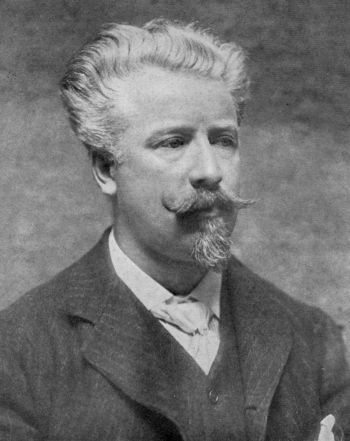
William Sharp
A common preoccupation with the plays of M. Maeterlinck is another bond
between the founder of the Abbey Theatre and Sharp, a preoccupation
passing rather quickly from Mr. Yeats, but long retaining its hold on
the changing selves of Sharp. For all his early interest in "spiritual
things," an interest very definitely expressed in "Romantic Ballads"
(1888), Sharp would not have come to "Vistas" (1894) without the
guidance of M. Maeterlinck, and he admits as much in his preface to
these "psychic episodes." "Vistas" he often referred to as heralding a
"great dramatic epoch," and he evidently regarded them as, in a way,
drama, but it is hardly likely that he dreamed of their enactment on the
stage. Many of them are essentially dramatic, but their method of
presentation is almost always lyric or narrative rather than dramatic,
even in the Maeterlinckian sense of the word.
It is possible, however, that Sharp might have written
other of his
projected plays, "The Enchanted Valleys," "The King of Ys," "Drosdan and
Yssul," and their many fellows he had projected by title, and others,
too, had not developments in Dublin, as I have said, carried Mr. Yeats
away from him during 1899 and 1900, and had Sharp himself not during
this drifting written that article "Celtic" which so aroused many in
Ireland on its appearance in "The Contemporary Review." In this essay,
basically a literary protest, "Fiona Macleod" declared "herself" against
Separatist politics and affirmed "her" belief, as "she" had in "The
House of Usna," that the future greatness of Ireland was to come, not
through independence, but through the rebirth of her ancient
spirituality in other nations to whom she had given her children.
The Celtic element in our national life
[wrote "Fiona Macleod"] has a vital and great part to play. We have
a most noble ideal if we will but accept it. And that is, not to
perpetuate feuds, not to try to win back what is gone away upon the
wind, not to repay ignorance with scorn, or dullness with contempt,
or past wrongs with present hatred, but so to live, so to pray, so
to hope, so to work, so to achieve, that we, what is left of the
Celtic races, of the Celtic genius, may permeate the greater race of
which we are a vital part, so that, with this Celtic emotion, Celtic
love of beauty, and Celtic spirituality, a nation greater than any
the world has seen may issue, a nation refined and strengthened by
the wise relinquishings and steadfast ideals of Celt and Saxon,
united in a common fatherland, and in singleness of pride and
faith.
There was, however, if less intimacy with the Irish writers in these
later years, no less admiration of their art, an admiration that led not
only to praise of them in critical
articles, but to a greater praise of
imitation of their art. So possessed, indeed, was Sharp by the verse of
the younger Irish poets as he read them to write of them, that when he
turned to verse as "Fiona Macleod," he fell into their rhythms and
reproduced the colors of their styles. Writing in prose as a critic of
Mr. Yeats, Sharp came to write in verse as Mr. Yeats wrote, as in "The
Dirge of the Four Cities": writing of "A.E." in prose as critic, Sharp
came to write in verse as "A.E." wrote, as in "Flame on the Wind":
writing of "Moira O'Neill," in prose as critic, Sharp came to write in
verse as "Moira O'Neill" wrote, as in "I—Brasil": writing in prose as
critic, of "Ethna Carberry," Sharp came to write in verse as "Ethna
Carberry" wrote, as in "The Exile." So it was, also, that, coming to
write of Celtic literature after study of Renan and Arnold, Sharp
attained to something of their large utterance.
Sharp sees the Celtic Renaissance, however, always in relation to
English literature, and always, it should be added, with French
literature and Greek literature in the background. In this wide outlook,
in his freedom from political prejudice, in his sympathy with Celtic
literature and his knowledge of it, is his greatest strength as a critic
of the Celtic Renaissance. His greatest weakness is his willingness in
this writing, as elsewhere in his writing, to abide by first
impressions, to abide also by the first-come phrase or epithet, banes of
the ready writer. But read his essay "Celtic" after you have read the
great essays of Renan and Arnold, and read it alongside of what Mr.
Yeats has to say of that literature, and you will find it, as
I said,
of the stature of these. You will at the same time find in this writing
the answer to the contention that there were really two personalities in
William Sharp. Even Mrs. Sharp, who writes so restrainedly about this
question of dual personality, believes the analytical faculty belonged
to William Sharp, the imaginative to "Fiona Macleod." But in this
criticism of the Celtic Renaissance which is signed "Fiona Macleod,"
there is as much analysis as is to be found anywhere in his work as
William Sharp. So obviously was he identifying "F.M." with "W.S." in
this critical writing that Mrs. Janvier, of those in the secret, wrote
to him to take warning lest he betray himself. She pointed out to him
that such a display of learning as he was making in the later "Fiona
Macleod" work would surely lead to discovery. But he did not heed. The
truth probably was that he wrote about Celtic things as "Fiona Macleod"
because he perhaps felt about them, as "Fiona Macleod," as one who is
bilingual thinks about work he is doing, say in German, in German, and
about work he is doing in English, in English; but just as surely I
believe, because what "Fiona Macleod" wrote commanded more respect than
what William Sharp wrote, readier entrance into the magazines, and
better pay. If there are those to whom such an explanation seems
belittling to William Sharp, I can only say that they cannot have
realized that he was a driven man earning his living by his pen. I am
not, I confess, a sentimentalist in such matters, and while I do not
wholly like his procedure in maintaining the fiction of "Fiona Macleod,"
it does not seem to me a very heinous sin.
He who would write of the work of William Sharp, indeed, must be
resolute to remember that it is to be considered as an essay in the art
of letters. There are so many temptations toward writing of it as a
scientific problem,—for who is not interested in "dual
personality"?—or as a "psychic revelation," if one is bitten—and who
is not?—by curiosity about hidden "things"; or as an irritating hoax,
if one has been befooled—and who, for one moment or another has not
been?—into believing that this writing under the pseudonym of "Fiona
Macleod" was the confession of a woman. The romance of it remains, no
matter from what point of view you consider it, and, despite your
preoccupation with this or that phase of it, the beauty of literary art
of parts of it. Parts of it, I say, for to me no writer of our time was
more uneven in his work. My point of view, indicated perhaps brutally,
and with a firstly and secondly is:—
Firstly, that until he was nearly forty, William Sharp was no more than
a skillful literary practitioner, a higher sort of hack, who had done
some better writing of a tenuous kind of beauty but imitative in
substance and art, in "Sospiri di Roma" and "Vistas," and that after
forty, when he was developing one undeveloped side of himself as "Fiona
Macleod," he developed another undeveloped side of himself in "Silence
Farm." That he attained in a sort of writing, and greatly, that he had
not attained in before, in "Silence Farm,"
has not been acknowledged, so
easy has it been to those interested in his work to lose sight of all
else in their pursuit of the "Fiona Macleod" side of his nature. It is
true of "Silence Farm," as of almost all his other work done under the
name of William Sharp, that it is imitative; but it is equally true that
a large part of the "Fiona Macleod" work is imitative, too. "Silence
Farm" is done under the influence of the later work of Mr. Hardy, but
the material of "Silence Farm" is its author's own, and the color of the
writing is as distinctly of the Lowlands as the color of "Tess" is of
Wessex. That "Silence Farm" is better work in its kind, though that kind
is less original than some of his writing as "Fiona Macleod," I have
been forced against my prejudices to believe. If I did not so believe I
would not have spoken of it side by side with "Tess."
Secondly, that as "Fiona Macleod," William Sharp did much good writing
in almost everything published under the pseudonym, achieving wholeness
of good tissue in certain sketches and tales and verses on rather
varying kinds of subjects, but that his work as "Fiona Macleod" that is
really distinguished is in stories of prehistoric Scotland and Ireland,
and of Scotland and Ireland in the earliest historic time. In these
tales of the Gaels of old time he for the first time breaks ground for
others. Before he wrote "Silk o' the Kine," and "The Harping of
Cravetheen," "The Annir Choile," and "Enya of the Dark Eyes," there were
no short tales of like temper and content and style in literature.
To me little is significant in the early verse of "Fiona Macleod," as
little was significant in all the verse of William Sharp until the time
of "Sospiri di Roma." And for all the beauty of these pictures in words
of the Campagna it is but a transient beauty. It was not until he was
mastered
by the new beauty that Mr. Yeats brought into English poetry
that the verse of William Sharp won to itself abiding beauty and glamour
and inevitable phrase. "The House of Usna" (1900) brought to me "Dim
face of beauty haunting all the world," and the 1901 edition of "From
the Hills of Dream," "The Enchanted Valleys,"; but it was not until
after his death that I came upon his best verse of all, the verse of his
last five years, which was gathered together posthumously in the 1907
edition of "From the Hills of Dream," and included as "The House of
Beauty" in "The Poems and Dramas" of 1911. Who does not know these sets
of verses and "The Dirge of the Four Cities," does not know the ultimate
accomplishment of William Sharp in poetry.
That the "'Fiona Macleod' mystery" ended with the death of William Sharp
is, then, my belief, as it is that it began before he conceived of
exploiting a feminine sub-self he had long been aware of in himself. The
beginnings of that sort of writing that made "Fiona Macleod" a
reputation are to be found very early in his writing, in "The Son of
Allan" of 1881, in the "Record" of 1884, in the preface to the "Romantic
Ballads" of 1888, in the "Vistas" of 1894. That these earlier
expressions of "spiritual" states and guesses at mysteries are not,
except for certain parts of "Vistas," so well written as the best
writing of similar kind by "Fiona Macleod," is true, and perhaps, at
first glance, a matter of wonder. It is, however, I think, not difficult
to find an explanation of the better quality of the later work, and that
explanation is afforded, firstly and most largely, by the Celtic
Renaissance.
A man of thirty-five, to all who know him a very vital
force, a very original personality, who has all his life wanted to make
beautiful things in words out of his dream of life, has disappointed
himself and his friends. He is suddenly afforded the opportunity, by the
interest in Gaelic subjects that the Celtic Renaissance has awakened, to
gain a hearing for work of a kind he has long wanted to do. He had not
done such work previously, because he had to live by his pen and could
work consistently only at the sort of thing that would sell. He was well
known as a journeyman of letters, so well known for bookmaking, and the
ways of getting commissions from London editors and publishers, that his
knowledge of Highland life would be questioned. All in London knew him
as a Londoner. It would be useless for him to say that the Celtic
Renaissance had brought back his childhood to him, a childhood as
definitely dominated by a Highland nurse as Stevenson's was by the
Lowland Alison Cunningham. It would be useless to tell of his summers in
Argyllshire and among the inner isles, his intimacy with fishermen who
were as elemental as his own dreams of old time. It would have been cast
up to him that the editor of "The Canterbury Poets" could not be an
original writer, and the very nine days' wonder of "Vistas" would have
been pointed to to prove that he might now do well enough, as an
imitator, perhaps of Mr. Yeats, as he was in "Vistas;" successful as an
imitator of M. Maeterlinck, but that an original Highland writer could
not come out of Hampstead. There is no doubt in my mind that it was the
part of wisdom for Sharp to put out the new work under a
pseudonym,
worldly wise if you will, but wise, too, with a higher wisdom. If he
could keep the side of him he had never yet exhausted through hackwork
apart from his other work, it would grow as it could not if it were a
part of his daily stint.
Why Sharp chose a woman's name for his pseudonym has troubled many, but
this choice was, I think, as was the assumption of a pseudonym, the part
of wisdom. I do not believe, as he at times liked to believe, that he
attained a woman's standpoint. He had been complimented on all sides for
his composition of the wife's letters in "A Fellowe and his Wife"
(1892), in which Mrs. von Teuffel wrote the husband's. Sharp enjoyed
their writing as a tour de force and he probably believed they were
very womanly. I should say that they showed insight into womanly ways of
looking at things rather than a dramatic identification of himself with
woman such as is George Meredith's. Sharp had already been experimenting
with pseudonyms, that of "H.P. Siwaarmill," an anagram on his own name,
being that he recurred to most often. He had written the whole of "The
Pagan Review" in 1892 under eight different pseudonyms, and though, in
the estimation of those to whom "Fiona Macleod" is all but a sacred
name, it be sacrilegious to say it, William Sharp loved all sorts of
fantastic tricks, hoaxes, mystifications, though in almost all his
writing save in "Wives in Exile" he was seriousness itself. But the
chiefest reason of all, in my estimation, for his assumption of a
woman's name as his pseudonym was that it afforded greater protection
against discovery. There are those who
believe that he chose it because
he wanted a chance to express that womanly element of human nature there
is in all men, and there are others who believe that he was the
possessor of a real dual personality in which the "Fiona Macleod's self"
was a woman's consciousness; but he very infrequently, after "The
Mountain Lovers" (1895), kept in mind in the writings he published as
"Fiona Macleod's" that their author was supposed to be a woman, and it
is wonderful, indeed, that he was able to preserve the secret until the
end. In the earlier "Fiona Macleod" writing there is no revelation of
the wide acquaintance with literature that was Sharp's, but despite his
harassment by the constant identification of himself with "Fiona
Macleod," he gradually allowed to creep into that writing more and more
of what was known to be the knowledge of William Sharp, a knowledge
unlikely to be also that of a Highland lady who lived apart from the
world. His friends pointed out to him the danger he was running in
writing from what was obviously a man's standpoint, as in his tales of
the wars of Gael and Gall, and of revealing several sorts of interest
that were known to be his, but their warnings were in vain. He was
apparently unable to limit himself to the restrictions of the part of
himself he had essayed to restrict himself to.
For my own part I was now sure the writing must be Sharp's and now sure
it could not be his. I did not know of his intimate concern with
questions of feminism until I read Mrs. Sharp's "Memoir," so that
outspoken chant, the "Prayer of Women" in "Pharais," "Fiona Macleod's"
first book, colored my outlook on all the writing that followed.
I had
no doubt at all but that "Pharais" was written by a woman, but "The
Dan-nan-Ron" and "Silk o' the Kine" in "The Sin-Eater" (1895) seemed to
me hardly a woman's. "The Washer of the Ford" (1896) was written from
the man's point of view, too, but "Green Fire" (1896) seemed feminine
again. So I wobbled in my opinion until "The Divine Adventure" (1900)
and the critical writings of the volume that story gives title to, and
the critical writing in "The Winged Destiny" (1905), made me believe
again that "Fiona Macleod" was surely Sharp. I did not come upon the
articles that now make up "Where the Forest Murmurs" (1907) until after
the death of Sharp and the disclosure of the secret. Had his death not
divulged the secret of the identity of "Fiona Macleod," it seems to me
that collection must have disclosed it. Had Sharp lived after this there
would not have been possible for him much further work from the
seclusion his pseudonym gave him, and I doubt, once the secret was out,
it would have been possible for him to write of things Celtic with the
old gusto.
After all has been said it must be confessed, I think, that Sharp did
not know the Highlander, either of the mainland or of the islands, very
intimately. He wrote much better of his dream of life on the west coast
in prehistoric times—out of his imagination of what that life must have
been, an imagination founded on the reading of the old legends and
modern collections of folk-lore, such as the "Carmina Gadelica" of Mr.
Carmichael—than he did out of his knowledge of Highland life of to-day.
The Achannas are in many of his tales of modern
times, and wherever
they are there is unreality, if not melodrama. Unreality, too, there is,
in many phases, in the modern tales, and "highfalutinness" everywhere in
them. And both unreality and "highfalutinness" offend in these modern
tales as they would not in the tales of far times, though in these, as a
matter of fact, they are not so much in evidence.
It would almost seem that the approach to reality drove Highland
atmosphere from the stories. In "The Sin-Eater," one of the best of his
writings that might be classed as a short story, the sin-eater and his
confidant are Highlanders, but the description of the scene of his
misfortune, the steading of the Blairs, might well have been that
nearest to "Silence Farm." It is faithfully described, the scenes about
the little home, whose owner lies dead, having the very smack of
realism. In the latter part of the story the scene shifts to the coast
and the tang of the story turns Gaelic and unreal. Was it thus, I
wonder, always to the imagination of William Sharp, Lowland life real,
Highland life mystical?
Sharp was handicapped, of course, in coming to the subject material he
could best handle late in life, "Pharais" (1894) and "The Mountain
Lovers" (1895), the first books published as by "F.M.," being just as
definitely 'prenticework in their kind as was "Children of To-morrow"
(1890) in its kind. Of the long stories other than "Children of
To-morrow" published in his own name, "A Fellowe and his Wife" (1892)
and "Wives in Exile" (1896) have no very serious intention, though both
are well done after their kind, records of imaginings, respectively
of
experiences of art life in Rome, and of yachting experiences in the
Irish Sea. It was not until "Silence Farm" (1899), as I have said, that,
as William Sharp, he found himself.
"The Gypsy Christ" (1896), which might well have been developed into a
full-fledged romance, is less original than any of his longer writings.
It is, like "The Weird of Michael Scott" and "A Northern Night," closely
allied to essays of his other rôle, that of "F.M.," to catch and express
"the tempestuous loveliness of terror," such as the catastrophe of "The
Mountain Lovers," "The Barbaric Tales," and those short stories in which
Gloom Achanna is hero-villain. It is in such work that Sharp shows his
affinities to Poe, affinities which are not elsewhere as obvious as his
affinities to De Quincey. Narrative was not native to De Quincey any
more than it was to Sharp, though Sharp was led toward it by his
interest in character, an interest that was not in any large measure
given to De Quincey, who, when he turned to narrative other than that
which relates what had happened to him or what he had dreamed had
happened to him, makes the reader feel he did so as a concession to the
public. Another interest that was Sharp's, an interest amounting to a
passion,—out-of-doors,—De Quincey had not at all, for all his devotion
to Wordsworth and to Wordsworth's interests. Like De Quincey, on the
other hand, Sharp delights in "fine writing," in both senses of the
phrase, in the "highfalutin" that is objectionable, and in the ornately
beautiful that is one fitting expression of romantic thought. Both men
preferred the mouth-filling
word to the simple one, the Latinical
adjective to the Saxon; both had rather see visions and dream dreams
than write about the "common light of common hours"; both goad their
imaginations until they run riot and so confuse their possessors, who
should control them, that they are unable to distinguish between what is
fact and what is fancy. You could carry the analogy further, to events
of their lives—the runnings-away in boyhood; the devoted friendships to
poets in youth; the incredible amount of hard work achieved in manhood
despite of often recurring illnesses.
Of the long stories published as by "F.M.," Sharp repudiated "Flora
MacDonald" because it was too much in the way of "ordinary romance," and
"Green Fire" for the same reason and because it was largely about
Brittany, a country with which, by some strange chance, he did not make
himself familiar, though he had visited and learned to know well at
least parts of all the other Celtic countries. It is to my mind,
however, if not so definitely of a wholeness of texture as "Pharais" or
"The Mountain Lovers," or so singular, less monotonous than either. All
three of these stories disappoint my memory of them when I again read
them. This is, I believe, because all three of them—and for that matter
many of the short stories as well—are incompletely realized, or
because—in the case of two of them, "The Mountain Lovers" and "Green
Fire"—they are unevenly written. Their high intention and atmosphere
remain with you after you have put the books aside, and in the course of
time you forget their hurried writing, their inconsistencies, and
their
qualities of the "Shilling Shocker," the result of their author's
failure to attain "the tempestuous loveliness of terror" that are in so
many of them, long or short. As aids to this effacement of the
cheapening elements are the very materials of the tales, their
characters, now elemental, now other-worldly, and their background of
mountains that uplift the spirit, and of menacing sea.
That Sharp wrote less exactly of the present-day people of the Highlands
than of the background of their lives was largely because he had few
opportunities to learn to know them intimately. There was a basis for
such intimacy laid in his childhood, in the fact that his nurse was a
Highland woman; there was something built on this basis by his boyhood's
vacations in many parts of Argyllshire and voyages elsewhere along the
west coast. Youth spent in Arran and Skye would have counted for much
more, for the boy, once he is no longer child and before he has reached
his youth and is awakening man, is not much more interested in people in
real life for what they are than he is in minute description of their
characters in books. He likes men for the sportsmanlike and adventurous
things they can do, and he likes to read records of things sportsmanlike
and adventurous, but men as men, unless they are eccentric to
grotesqueness, do not arrest his attention. Even the dreamy boys, the
artistic boys, are not likely to learn much of others, so preoccupied
are they with themselves.
It was thus, I think, that Sharp's childhood was not what he would in
later years have had it, not what in "The Laughter of Peterkin" he
alleges the childhood of
"Fiona Macleod" to have been. For all the
influence of "Barabal," his nurse, it seems from his writing that her
stories remain with him more as suggestions to imagination than as
definite memories, and that the fisherman referred to in "Sheumas" left
with him little more than "Barabal." How fresh and wonderful to him was
actual contact with Highland life is almost pathetically revealed in a
letter he wrote to Mrs. Sharp from Kilcreggan in the summer of 1894. In
this letter he is all but exultant in the recording of the securing of
"Celtic" material from a "Celtic Islesman from Iona." Of the actual life
of the Islesmen and Glensmen he could have known but little, for long
living among them is necessary to their understanding,—they are, as he
wrote in this same letter, "passionately reticent." It was not the way
of Sharp to fall back, in this deficiency of experience, on old legends
and folk-tales collected in his own day, but to trust to his imagination
as that was quickened by what knowledge he had of life in the inner
isles and in Argyllshire, and by the very atmosphere of known places
there that seemed to demand, as Stevenson put it, to have stories
invented to fit them.
It is said, too,—Mrs. Sharp gives her authority to the story,—that
friendship with the woman to whom he dedicated "Pharais," "E.W.R.,"
stimulated him to the work. "Because of her beauty, her strong sense of
life, and of her joy of life," writes Mrs. Sharp in her memoir of her
husband, "because of her keen intuitions and mental alertness, her
personality stood for him as a symbol of the heroic women of Greek and
Celtic days, a symbol that,
as he expressed it, unlocked new doors in
his mind and put him in touch with the ancestral memories of his race."
And Mrs. Sharp quotes him further as declaring "without her there would
have been no 'Fiona Macleod.'" Perhaps; but I doubt if, after the Celtic
Renaissance had won a hearing, anything could have prevented Sharp from
following what was, after all, a natural bent. I am not going to argue
the matter out, but he himself admitted that his development as "Fiona
Macleod" began "while I was still a child," and there is proof in almost
every volume he published, even before he knew Mrs. Rinder ("E.W.R.,"
must of course be the author of "The Shadow of Arvor"), that his
tendency was toward what became characteristic of "Fiona Macleod."
It was the love that Sharp had for all sorts of "psychic things," the
mysterious, the unaccountable, the hidden, that led him to believe that
"without her there would have been no 'Fiona Macleod.'" Sharp himself,
when his "other self," with sense of humor alert, was more than willing
to admit that it is easy to believe what one wishes to believe; and he
delighted to tell a story at the expense of Mr. Yeats illustrative of
the trite fact. Sharp went one day, in London, to call on Mr. Yeats.
When lunch-time came, they set about cooking eggs. Mr. Yeats held them
in a frying-pan over the little fire in the grate. As they slipped
about, Mr. Yeats, all the while looking back in the room away from the
fire as he talked to Sharp, allowed the pan to tip too far and the eggs
fell out into the fire. So absorbed was he in the topic of conversation,
most appropriately the disappearance of material things,
that he did
not notice the catastrophe or the quick disappearance of the eggs among
the coals. When his perfervidness subsided for a moment, he turned to
see if they were done. "There, what did I tell you!" said he; "our talk
of these things has conjured up the powers and the eggs are gone." Sharp
did not tell him of the accident. And there were no more eggs in the
room to have for lunch.
One of the reasons that led William Sharp to write "Silence Farm" (1899)
was to have something under his own name that might be very different
from the stories of "Fiona Macleod." And "Silence Farm" is very
different, a story without the distinguishing qualities of "Pharais" or
"The Divine Adventure," and suggesting kinship to the work of his other
self only through certain likenesses of domestic irregularity in the
family of Archibald Ruthven to other domestic irregularity in the family
of Torcall Cameron of "The Mountain Lovers." Though not of so original a
kind, perhaps, as the best of the "Fiona Macleod" work, "Silence Farm"
has to it a "wholeness of good tissue" that belongs to little work of
this most uneven writer. "Silence Farm," I would emphasize again as I
emphasized at the opening of this paper, is better written, both as
regards style and architectonic quality, and it is a truer reading of
life, than any of the Highland stories. Though it is a story of to-day,
and about a life much like that made familiar by the writers of the
Kailyard school, it is not to them, but to such kindred
unsentimentalized work as Mr. Shan Bullock's, that you instinctively
compare it. The people, indeed, are the same
dour Presbyterians, though
the one writes of Scotland and the other of the North of Ireland. And as
you compare the material of "Silence Farm" with that of "The Squireen,"
for instance, you note, too, that the art of both is the art of Mr.
Hardy.
There is little modern writing with which to compare the Highland
stories of Sharp. It is not that the Highlands have not been much
written about, but that they have been written about intimately by but
few. No part of the world so out of the world as their outlying islands,
the Hebrides, has been so bewritten by travelers from Martin's time to
our own; but comparatively few have known either islands or mainland
well enough to dare novels of their life, and of those who have so dared
no one up to the time of Sharp had written a great realistic story of
the Highlands, and but one or two great romances. Now we have Mr. Neil
Munro, like Sharp a very uneven writer, whose "Children of Tempest"—to
take one of his best stories—now delights and now tortures you; and
yesterday we had William Black, famous for sunsets. Black knew the
Hebrides well, very well for a Lowlandman turned Londoner, and he
labored hard to make his books true and beautiful. Unfortunately it was
not in him to do fine work, not even the best sort of the second order
of novelists,—such work as Trollope's, for instance, which by dint of
faithfulness and humanity almost persuades you now and then that it is
of higher than second order. Black was faithful to what he saw and
broadly sympathetic, but his writing not only lacks distinction, but,
even at its best, as in "The Princess of Thule," home thrust to one's
interest. Yet, such as it is, it is all but all that we have which
attempts to put before us any broad view of Highland life. The one man
of the generation older than the generation of Mr. Sharp who might have
drawn Highland life greatly, Robert Buchanan, was diverted all his life,
as Sharp was in the twenties and thirties, from doing what he would to
what would boil the pot, but he left at least one story, a story of
Sutherland, "A Child of Nature," to prove to us what his reading of
Highland life might have been. Had Stevenson been born a Highlander, he
might have given us both novels of the Highlands of the order of "Weir
of Hermiston," and romances really Highland in quality, as "Kidnapped"
and "Catriona" are not.
I suppose that, back of all the failure to deal realistically with
Highland life, this rare attainment of a romance of Highland life at all
faithful to it, is the making of the Highlander into a stage hero by
Scott. There are those to-day who fail to find any glamour in "Waverley"
or "Rob Roy" or "The Legend of Montrose," but it is still there to me,
investing the figures of Fergus MacIvor and the MacGregor and the
Children of the Mist as it did in childhood, when I was so fascinated
that I prized my Campbell plaided paper soldiers next to my Continentals
in blue and buff. In going through an old trunkful of school-books only
the other day, I came upon one of these bonneted fellows, still
wonderfully preserved, in an old atlas of the heavens, and then I knew
all of a flash why it was that the poor boy soldiers that I saw in
Highland accoutrement in the yard of Edinburgh Castle during the Boer
War so disappointed me by their appearance and
bearing. They were not
half so brave as the piper who used to make the rounds of my boyhood's
town and bring tears to my eyes with his "Campbells are Comin'." I write
this that my quarrel with much of what Sharp has written of the
Highlands, that portion that seems to me sentimentalized or one-sided,
may not be put down to lack of appreciation of the romance, the
eeriness, and otherworldliness that there unquestionably are in that
life.
It is their aloofness from the everyday story, their unusual use of the
supernatural that has given the longer stories written out of the "Fiona
mood," as Mr. Sharp once spoke of his possession, their appeal to most
readers, but there is here in America a class who put the highest
valuation on the shorter stories Mr. Sharp called "spiritual tales." To
those who hold this view "The Divine Adventure" is of the nature of
revelation. To me it is hardly this, but very interesting, not so much
for its putting of the relations of Body, Will, and Spirit to one
another in life and at death, as for its beautiful writing, and for its
definite betrayal, when its author is writing most intimately, of a
man's attitude, though he published the story as the work of "Fiona
Macleod." These "spiritual tales" do not belong, all of them, to his
"Fiona Macleod" period, for "Vistas" (1894) contains many of them,
though they are cast here in dialogue form, and there are others among
the work published under his own name. In fact, the writing under the
two names never becomes liker in quality and intention than when it is
"spiritual." The sketch from Part II of "The Dominion of Dreams" (1899),
entitled "The Book of the Opal," for
instance, is written on the very
key of "Fragments of the Lost Journals of Piero di Cosimo" (1896), far
apart their subject material, and "The Hill-Wind" by "W.S." dedicated
as it is to "F.M.," might well be a rejected passage from "The Mountain
Lovers." There is the color of the Highlands and Islands about many of
these mystical stories, about "The Hill-Wind," by "W.S." and "The Wind,
the Shadow, and the Soul," the epilogue "F.M." wrote to the "Dominion of
Dreams"; but most of these shorter mystical tales have not the tang and
savor of farm-home on lonely moors, or fisher's hut on the lonelier
machar, that is characteristic of most of the tales long and short, that
deal with modern days.
Nor are the meanings of these "spiritual tales" consistently indicated
in symbols taken from Scottish life, nor is their supernaturalism native
to it. Mrs. Spoer (Ada Goodrich-Freer), in her "Outer Isles" (1902),
tells us "The Celtic Gloom" amuses the Hebridean. If so, what effect
would such discussion as that of "The Lynn of Dreams" and "Maya" have
upon him? But if such essays are not written out of Highland life, they
are none the less interesting, and in the case of "Maya," with its
consideration of waking dream, beautiful as art, and valuable, too, as a
contribution to science.
So far does Sharp go in his belief as to the apprehension of thought
through powers other than those of the senses, that in "The Winged
Destiny" he can look forward to a time "when the imagination shall lay
aside words and pigments and clay, as raiment needless during the
festivals of the spirit, and express itself in the thoughts which
inhabit words—as light inhabits water or as greenness inhabits grass."
Not only does he foresee such a time, but he foreshadows it, heralds it
in some of his sketches, "Aileen" for one, by attempting it. Perhaps he
has succeeded, perhaps not. To me the attempt is a failure, not, I
think, because he is writing for to-morrow, for that age when the
spiritual awakening he so often prophesied shall have come, but because
he is attempting what cannot be done in any age. If he were seeking only
suggestion, well and good. But he seeks more, and fails, I think, to
attain more. It seems to me impossible that the suggestions he creates
can ever be more than suggestions. They cannot become definite concepts
that will mean the same thing to all men. Suggestion, the opening-up of
vistas, is a high attribute of the art he follows; but he is not content
with suggestion, he would seek more definite expression of what, after
all, is not thought but mood. So it is that he is most successful when
conveying mood and less successful when conveying esoteric thought. As a
critic, of course, on a plane easier for the conveyance of thought,
Sharp is definite enough, completely successful in conveying the ideas
that he intends to convey.
Often, I fear, when Sharp intends "spiritual history," either in a tale
wholly devoted to this purpose, as "The Divine Adventure," or as
explanatory to the incidents of some more tangible tale, he is really
only playing with words, beautiful words, words sometimes so beautiful
that we are apt to forget that words are to be used not alone for
beauty's sake. Often, again, I fear, he will introduce beautiful symbols
simply for their beauty and not because
they have a real purpose, not
because they will more intimately convey, even to the initiated, the
intent of his writing. That these practices are the result of
carelessness, sometimes, as well as of his subservience to beauty, the
fascination that words merely as words or visions merely as visions
exert upon him, is, I think, true. It is but seldom, I believe, that the
underlying thought is incoherent. In almost all of his earlier writing,
however, even in the earlier "Fiona" writing, he is very careless. He
contradicts himself in his short stories as to facts, he gets his family
relationships tangled in a way that cannot be explained by any process
of nature, and so, too, I think, he gets his symbols mixed, or deludes
himself into the belief that something that was hastily written "came to
him" that way and so should be preserved in that exact expression, even
though to him at the second reading it meant nothing definite. He jumps
to conclusions again and again in what he writes about birds, where I
can follow him on a certain footing of knowledge. If he is so careless
about facts, if he can, even though it is a slip, confuse Mary Magdalene
and the Virgin Mary, if he can mention birds in a description of
Highland landscape that is characteristic of a certain time of year when
birds of that species would be in the Highlands only by accident at that
time of year, it is more than likely, slips though these may be, that
there will be similar slips in all he writes, no fewer, it is likely, in
his writings of psychic things than elsewhere.
There is possible, of course, no hard-and-fast classification of his
writings. Class shades into class almost imperceptibly.
It is
particularly difficult to draw the line between the several kinds of
stories and sketches he writes that involve supernaturalism of one kind
and another. There is possible, however, a rough-and-ready distinction
between those stories of his which are esoterically mystical and those
which, while concerned with the supernatural, are concerned with it in
the way familiar in old romance. Of this "usual supernatural" are those
in which "second sight" is the motive, second sight which is always to
be looked for as the commonest supernatural motive in the writing of all
Gaels, either Alban or Irish. Sharp introduced "second sight" into "The
Son of Allan" (1881); it is in "Pharais" (1894), the first of his "F.M."
work; it is developed at some length in "Iona" (1900), which is a
microcosm of all his writing. In "Iona," Sharp puts himself on record as
holding stoutly belief in the reality of the power:—
The faculty itself is so apt to the
spiritual law that one wonders why it is so set apart in doubt. It
would, I think, be far stranger if there were no such faculties.
That I believe, it were needless to say, were it not that these
words may be read by many to whom this quickened inward vision is a
superstition, or a fantastic glorification of insight.
The Achannas, in the uncanny stories in which they are heroes and
villains, are all possessed by the power of the second sight, but second
sight is not the most remarkable of their supernatural powers. Hypnotic
suggestion Gloom uses as an everyday agent in his affairs. It is through
hypnotic suggestion that he puts madness upon Alasdair M'Ian, playing to
him the Pibroch of the Mad,
Alasdair M'Ian, in telling whose story
"Fiona Macleod" revealed—I suppose, by chance—something of the
struggle of William Sharp to succeed in letters. Much more frequently,
however, he uses a supernatural power that is further removed from those
in which modern science is interested, such as the machination of
fairies that made Allison Achanna the "Anointed Man"—that, in plain
speech, had driven him fey; or such as the lure of the serpent goddess
that drove to his death the piper hero of "By the Yellow Moon Rock," or
the exchanging of human child for fairy child that is the burden of
"Faraghaol."
It is much more likely that William Sharp would have made more of this
changeling motive had it not come so near to the question of dual
personality, which it would be dangerous to him to discuss, as would
that question so closely akin, the question of people who are
"away,"—that is, with the fairies,—a kindly explanation of insanity,
chronic or recurrent. As William Sharp he has touched on the question of
dual personality several times in his verses, and very definitely in "A
Fellowe and his Wife." In this last-named book he says, in a letter that
the Countess Ilse writes to her husband in Rügen: "This duality is so
bewildering. I to be myself, whom you know, and whom I know—and then
that other I, whom you do not know at all and whom I only catch glimpses
of as in a mirror, or hear whispering for a moment in the twilight."
That he could not take up the topic so definitely in his later writings
must have, indeed, been a cross to him, for there was hardly any other
question, unless perhaps that of "ancestral memory," which interested
him more deeply. It might be argued, I suppose, that he did discuss it
in "The Divine Adventure," in considering the relations of Spirit, Will,
and Body. Mrs. Sharp, I take it, so holds when she says in her "Memoir"
that the William Sharp work was that of the Will and the "Fiona Macleod"
work beyond the control of the Will. And it is true that these three,
the Spirit, Will, and Body, though each is given a distinctive
personality, each a memory distinct from the memory of the others, are
all but the component parts of one man. Mrs. Sharp does not, however,
anywhere avow directly a belief in the possession of a real dual
personality by her husband, and she definitely contradicts Mr. Yeats for
his expression of belief that "William Sharp could not remember what as
'Fiona Macleod' he had said to you in conversation."
Very different from these short stories I have been discussing are three
of the four contained in the volume entitled "Madge o' the Pool" (1896),
published as by William Sharp. Of the one that is somewhat in the manner
of certain of the "F.M." stories, the "Gypsy Christ," I have spoken.
Two, "The Coward" and "The Lady in Hosea," are but "the usual thing."
"Madge o' the Pool" is the one really worth while. In this story, with
such river pirates as we have met, sentimentalized, in "Our Mutual
Friend," as material, Sharp writes as realistically as he does in
"Silence Farm," and with a sympathy and pathos that his objective method
cannot exclude.
There are episodes or sketches, some of them what sharp calls "prose
imaginings," throughout his many books, that one may hardly call short
stories, or myths,
or studies in folk-lore, or criticism, or any of the
other many kinds of writing that he essayed. Perhaps "memories" would be
the proper general term for writing of this kind. In almost every one of
these episodes or sketches there is a germ of a story, and some, I
suppose, regard them as but unrealized art. But I for one am glad Mr.
Sharp did not "work them up." In them are some of his best writing and
some of that most personal and intimate. I have spoken of "Aileen" and
"Barabal"; "Sheumas, a Memory," is another that is memorable, and
memorable too, are "The Sea Madness" and "The Triad." "The Triad" is
almost his credo, certainly a statement of the things he holds "most
excellent"—"primitive genius, primitive love, primitive memory." Here
Sharp recurs, as so often in his writing, to "ancestral memory," that
possession of men by which they are aware of what was in the world
before they were, through oneness with the universal memory into which
they are absorbed in dream or vision or of which they become aware by
what we call intuition. If such a power be restricted so that its
possessor recalls only certain parts of antiquity, he is virtually in
the state of him who believes he remembers what he remembers because of
previous incarnations. I have no personal opinion to express on the
subject, but if such memories exist in us because of our participation
in a universal memory or because of reincarnation, it is easy to explain
why Sharp is best in his writing of myths, his pictures of the wild
beauties of love and war and dream in barbaric Erin and Alba. It is
because he is the reincarnation of the shanachie of the Dark Ages. When
he thought of reincarnation,
however, in relation to himself, he
thought, I have no doubt, of himself as the reincarnation of a druid,
one who had been aware of mysteries; but what he really was, in life,
with his magnificent enthusiasm and bravado,—picturesque raiment after
all and no more for the high-hearted and inherently ailing body of
him,—was this reincarnation of the shanachie, such an one as his own
Oran the Monk turned tale-teller. If you doubt that he was shanachie,
not druid, compare the two legends in "Beyond the Blue Septentrions."
The ordered beauty of the legend that tells of the derivation of the
name of Arthur from Arcturus falls familiarly on our ears. It is
evidently made under a lamp by one who has read many old legends. It is
no druidic revelation. The other, that which ends with the three great
hero-leaps of Fionn from the Arctic Floes to the Pole, from the Pole up
to Arcturus, from Arcturus to the Hill of Heaven itself, is fantastic,
bizarre, extravagant to grotesqueness, with the very flamboyance of old
Irish legend and modern Irish folk-tale. In other words, it is in the
very manner of the shanachie of the Dark Ages, whether his work was
recorded then as court poem or has been handed down by word of mouth
among the folk. Nor is there anything inconsistent in this wild
imagining with a very different power displayed in "moralities" like his
"Last Supper." I have heard stories as incongruous, one uproarious,
another of cloistral quiet and piety, from the old Irish gardener with
whom I spent a large part of my happier days, the days from seven to
seventeen. Lawrence lost his life doing a "retreat" morning after
morning on the cold
stone floor of a Vincentian church, not in any
sudden repentance at fourscore and three for the sins of his youth for
they had been fewer than those of almost all I know, but in the usual
way of his austere life. Yet Lawrence was just as much himself when he
was telling me stories of Dean Swift that were full of malice and
brutality and orgiac ecstasy.
The range of the shanachie is wide, and wide, too, the range of Sharp in
the rôle of shanachie of barbaric life on both sides of the Moyle. Among
such writings there are few tellings of the order of the folk-tale, more
of the order of the hero saga, many—perhaps the best of them—of an
order all his own that has developed, it is likely, from the old
"Saints' Lives," but to which he has given a ring of authenticity that
makes them seem descended from an antiquity as remote as that of
folk-tale or hero-tale. "The Flight of the Culdees" brings before you
with vividness what must have been the life of the Celtic missionaries
in the days when the men out of Lochlin began to seek the Summer Isles;
and "The Annir Choile" and "The Woman with the Net," what was the fate
they meted out to those among themselves who slipped back into the
pleasant old ways of paganism. These are written out of his own
revisualization of the past. More immediately sprung of the old legends
are "The Three Marvels of Hy," which tells of the inner life of Columba
and his brethren on Iona, and "Muime Chriosd," which utilizes folk-lore
as old or older than the legends collected by Mr. Alexander Carmichael
in his pursuit of the stories of St. Bride among the peasantry of the
Outer Isles. "The Song of
the Sword" and "Mircath" have in them the
battle-madness of the Viking, whetted to its keenest intensity as he
meets the hard resistance of the Hebrideans; and "The Laughter of
Scathach" and "The Sad Queen," that more terrible fury of the Amazon who
ruled in Skye. Than this last-named story Sharp has done no starker
writing, but it is so evidently from a man's point of view that it
confirmed many in the belief that "Fiona Macleod" could not be a woman.
"The Washer of the Ford" has its roots in folk-lore, but it is so
remoulded in the mind of the writer that it is rather a re-creation of
the old belief than a restoration of it. There are those who would
rather have had Sharp follow the tales as they are told by Campbell of
Islay, Cameron of Brodick, and Carmichael of South Uist, but to me,
unless the tale is one familiar to many readers, such a remoulding, if
done with power, is surely a prerogative of the artist. But when he
takes a well-known legendary character, as well known among the Gaels as
Achilles among English school-boys, and changes his hair from black to
golden and his stature from short to tall, utterly transforming not only
our picture of him, but the significance of his deeds, then I object, as
I would object if he had made the fair-haired and great-statured
Achilles into such "a little dark man" as the Red Branch legends record
Cuchullin to have been. Nor would I quarrel even with his changing of
the spirit of the old tales if he had always, as he has almost always,
substituted a new beauty for the old beauty of the legend in its bardic
or folk form. It is in the few instances in which his dream of
the old
tale does not lift to so great a power in its way as the old tale
possessed in its way that I protest. Of such a nature are some of the
changes Sharp made in his retelling of the "Three Sorrows of
Story-Telling" in "The Laughter of Peterkin," which, it must be
remembered, however, was hurried work, almost hackwork.
Sharp was particularly successful, I think, in his handling, in the
three tales—he calls them "legendary moralities"—in which he brings
Christ to the straths of Argyll. These three are "The Last Supper," "The
Fisher of Men," and "The Wayfarer." The last is the least successful of
the three, but significant in its attack on certain forms of
Presbyterianism for their attempts to kill out, as un-Christian, the old
ways of life among the Highlanders. This charge was made fifty years ago
by Campbell of Islay, and it had been repeated only yesterday by Mr.
Carmichael. William Black and Mr. Munro confirm it, too, in their
novels, and, in fact, it is only what one expects of Puritanism, whether
in its dominating of the Scotch Presbyterian minister or of the Irish
Catholic priest. The latter is to-day doing as much to kill the joy of
life in Connacht as did even the minister of the Free Kirk yesterday on
the Lews. It may have been partly to hide his identity that Sharp
assumed what some thought an anti-Presbyterian attitude in his "Fiona
Macleod" writing; it may have been the sympathy of the artist toward a
church that has conserved art that led him to what some thought a
pro-Catholic attitude; but scratch this gypsy artist and you find,
surprising as it may be, moral prejudice for Protestantism. Does he not
admire
Torcall Cameron and Archibald Ruthven, stern Calvinists both?
"The Fisher of Men," and "The Last Supper" have in them the austere
beauty of the old morality plays, a beauty that is akin to the beauty of
the Puritan imagination of Bunyan, and a tenderness that we may in vain
look for there. They are written in all reverence and simplicity, and it
is no wonder we find Mr. Yeats suggesting that "Fiona Macleod" turn them
into plays for the Irish Theatre.
I do not care so much for "The Birds of Emar," myths he has rewoven from
the "Mabinogion" into Gaelic texture, or the series that purport to be
collected among the Isles and are found to be very like certain
well-known Greek legends. These, too, seem to me reweavings, and the
"Treud-nan-Ron" and "The Woman at the Crossways"; and "The Man on the
Moor," though its origin is far from their origins, is also a reweaving.
In certain of his writing of this time Sharp passes over virtually into
criticism or comparative mythology, as in "Queens of Beauty" and
"Orpheus and Oisin," and in many of the papers of "Where the Forest
Murmurs." These all have interest; but some smell much of the lamp; and
none of them are to be compared to the best of his "Seanchas," to "The
Harping of Cravetheen," or "Enya of the Dark Eyes," or "Silk o' the
Kine," or "Ula and Urla"; or to his Plays "The House of Usna" and "The
Immortal Hour," in which, for all the savagery, there is nobility, the
nobility that was in the old legends themselves, that nobility that
withstood even the hand of Macpherson, that nobility that has been
reproduced most nobly of all in the "Deirdre" of Synge.
I am not so sure that the tone of these old myths is always
distinctively Celtic, as it is undoubtedly in "The Annir Choile," and in
other "Seanchas" that reveal him at his best. There was viking blood in
Sharp, and it comes out, I think, in such tales as "The Song of the
Sword." How he came to write these barbaric tales I do not know, though
I have sometimes thought that the "Dhoya" (1891) of Mr. Yeats may have
suggested them, as the Hanrahan stories may have suggested certain of
the more modern tales. But whatever their genesis, the heroes and
heroines of the "Seanchas" seem to him like the heroes and heroines of
Homer and the Greek tragedians; and his friend whom he thought inspired
him to much of the "F.M." work stood, we must remember, as symbolical to
him of the women of Greek as well as of Celtic legend.
There are many indications, in his last writing, not only in that
unpublished book on "Greek Backgrounds" and in his articles in the
magazines on Sicily, all by William Sharp, but in the "Fiona Macleod"
work, that he would have come to write of Greek antiquity with an
enthusiasm very like that with which he wrote of Gaelic antiquity.
"W.S." is speaking with the voice of "F.M." when he says in a letter to
Mrs. Sharp, dated Athens, January 29, 1904: "It is a marvelous
homecoming feeling I have here. And I know a strange stirring, a kind of
spiritual rebirth."
One reason, perhaps, that the best work of Sharp has come out of his
consideration of the Celts of antiquity is that the stark stories he has
to tell of them restrain
his style, a style too flamboyant when there
is in what he is writing a large opportunity for description of
landscape or exhibition of great emotion in his characters. Another
reason is, perhaps, that his tendency to introduce the supernatural is
more in harmony with the subject material got out of antiquity than of
the subject material got out of to-day. We can accept magic in these old
tales, even to the incantations of Bobaran the White that swayed the
waves of the sea so that Gaer, the son of Deirdre, was saved from the
men of Lochlin. That is as it should be in druidic times. It is
impossible, of course, that Bobaran had power over the waves, but in
such a story such an episode seems more probable than the possible
hypnotic suggestion of Gloom Achanna's pipe-playing that sent Manus
MacOdrum to his death among the fighting seals, because to-day we do not
often come upon such things. It is even less easy to accept the piping
to madness of Alasdair in "Alasdair the Proud." Hypnotic suggestion may
drive to death in the sea a man half fey because of sorrow long endured
and the superstition that he is descended from seals, but pipe-playing
cannot believably in modern tales drive a man insane, whatever it may do
in the famous old "Pied Piper of Hamelin" or other folk-tale.
So, too, in the verse of Sharp, whether lyric or dramatic, it is the
Celt that inspires him to his best work. Nowhere does his verse win so
much of beauty and glamour as when his thought turns to the four cities
of Murias and Finias and Falias and Glorias, or when it breaks into a
chant on the lips of Etain, in "The Immortal Hour."
Though there is less unevenness of technique, both in the style and in
the unfolding of the story, in these "Seanchas" than elsewhere in his
writing, the technique breaks down at times here, too, more usually
through sins of omission than through sins of commission. Sharp realized
the something wanting that so many find in much of his writing, even in
much that is most beautiful, realized it so keenly that he felt called
upon to explain. He explained not directly, it is true, as if in answer
to criticism, but none the less definitely in thus affirming his
attitude toward legends in the "Sunset of Old Tales": "We owe a debt,
indeed, to the few who are truly fit for the task [the collecting of
tales from oral tradition], but there are some minds which care very
little to hear about things when they can have the things themselves."
This statement explains in part why it is that the life of the people,
even that part of their life that fronts the past, has escaped him. He
prefers his dream, thinking that it is their dream, or the dream of
their ancestors. He has, indeed, the thing itself, the Highlander's
dream, and when it is given to him to impart that dream fully we forgive
him the proud words I have just quoted. The pity of it is he has not
always so succeeded through the way he has chosen, and then it is, of
course, that we condemn him for the lack of that humility the great
dramatic artist must have whereby he must forget himself and so
subordinate himself that tradition or life speaks through him.
It is not to be wondered, then, that there is little direct record of
folk-lore of his own collecting in his writing,
even when he is writing
of folk-topics. There are borrowings in plenty, especially in "Where the
Forest Murmurs," and even when the collecting seems his own, as it does
in "Earth, Fire, and Water," "Children of Water," and "Cuilidh Mhoire,"
it is diamond dust, not diamonds, to which he gives so beautiful
setting.
Just as appealing to Sharp as the old myths themselves are the
localities that tradition or the stories themselves assign as background
to them. He loves Iona not only for its gray and barren beauty, but
because it was here Columba wrought his wonders. "Iona," which fills the
major part of the volume "The Divine Adventure" gives title to, is the
finest in quality as well as the longest of his writings that may be
called, prosaically, topographical. They, in their varying ways, are
much more than merely topographical, whether done in the way of "F.M.,"
as "Iona" is, and as "From the Hebrid Isles" is, and several papers from
"Where the Forest Murmurs"; or in the way of "W.S.," as "Literary
Geography" is. In this last-named book, Scott and Stevenson, among
others, are put against the background that inspired their work, as in
"Iona" certain stories are imagined so as to fit their surroundings and
certain legendary history narrated that is fitting to these surroundings
with an appropriateness almost too exact to be believable. In "Iona,"
because he loved the island that inspired its writing beyond any other
of the places he loved greatly, is to be found some of his very best
work, and examples of all kinds of his writing, as I have said; and even
when this "topographical writing," as in some of his magazine articles,
is evidently
of the sort initially intended to "float cuts," it is very
well done, done most often with distinction. At times, of course, it
suffers from over-emphasis, as do the descriptive portions of his long
stories, but generally he attunes his writing to the genius of the
place. This is as true of his letters as of what he wrote for the
public, especially true of that series on Algiers from which Mrs. Sharp
quotes in her "Memoir." Papers of this sort, papers giving the genius of
place, Sharp was happier in, I think, than in those which are more
definitely the out-of-door essay. Sharp knew much of birds and small
mammals, of trees and plants, with a knowledge that evidently began in
childhood, but, as with so much else in his life, this knowledge he
never had time to fill out and deepen through patient observation. You
must not, then, turn to "Where the Forest Murmurs" to find writing of a
kind with that in which Thoreau and Jefferies so finely attained, much
less that loving intimacy with the personal side of birds and animals
that so humanly tempers the scientific spirit in White of Selborne. Nor
is there in them the racy earthiness of Mr. Burroughs. Their greatest
asset is their enthusiasm over the beauty of the world they are written
to praise; the next greatest their power of catching in words the mood
of a landscape; their next greatest their distinction of style, though
there are several in which the style is wholly without distinction. Now
and then, too, they are valuable for their guesses at the whys and
wherefores of things. There are to-day many explanations of what is
commonly called "The Lure of the Wild." Is not this as revelatory as
any?—
Is this because, in the wilderness, we
recover something of what we have lost?... Because we newly find
ourselves as though surprised into an intimate relationship of which
we have been unaware or have indifferently ignored? What a long way
the ancestral memory has to go, seeking, like a pale sleuth-hound,
among obscure dusks and forgotten nocturnal silences, for the lost
trails of the soul! It is not we only, you and I, who look into the
still waters of the wilderness and lonely places, and are often
dimly perplext, are often troubled we know not how or why: some
forgotten reminiscence in us is aroused, some memory, not our own,
but yet our heritage is perturbed, footsteps that have immemorially
sunk in ancient dusk move furtively along obscure corridors in our
brain, the ancestral hunter or fisher awakes, the primitive hillman
or woodlander communicates again with old forgotten intimacies and
the secret oracular things of lost wisdoms. This is no fanciful
challenge of speculation. In the order of psychology it is as
logical as in the order of biology is the tracing of our upright
posture or the deft and illimitable use of our hands, from
unrealizably remote periods wherein the pioneers of man reach slowly
forward to inconceivable arrivals.
The weakness of these essays that are like out-of-door essays, but are
not out-of-door essays, is their dearth of freshly observed fact. This
dearth would not matter so much if there were not so many of them, but a
book full of such essays with little original observation will pall, no
matter how well written, no matter how interesting the personality of
the writer. Thus it is that some of the essays of Jefferies pall, some
of those written in his last days, of Jefferies who had in his earlier
writing been so objective. In Thoreau there is a happy combination of
freshly observed fact with personal comment, and in Mr.
Burroughs a
personal element greatly subdued, and presented in most of the essays
only through the selective art that has preserved the incidents he
relates out of many of a vast store of their kind.
In these "nature studies" of Sharp, as in so much of his writing, there
is a great deal of generalization from phenomena superficially observed.
He is not so often inaccurate, but he is very often merely repetitive,
giving us in beautiful and oftentimes distinguished phrase what others
have given us before. Sharp wrote sometimes, I have no doubt, with the
thing he describes before him but oftener, it would seem, from notes,
and oftenest, I take it, from memory. Sometimes it is best to write thus
from memory. The unessential will fade out, the essential remain; but
with Sharp the trouble is that the first observation has often been
hurried. He was content with the beauty that he saw when he first
noticed the incident; he did not wait to observe what in the further
actions of the life observed would make that beautiful incident more
significant. It may, of course, be said that all he was after was the
impression that the passing incident made upon him. Perhaps so, and if
so, more is the pity, because, while, as I have said, one out-of-door
essay with little or even with nothing but the personality of the writer
may interest, or perhaps two such, or even ten, a book full will be
monotonous. At its best, however, his writing of "natural romance" is of
great beauty. "Still Waters," for one, is almost perfect, as perfect as
this sort of thing may be. It is wrought of his own experiences
with
just enough of mythological data to give it the texture of old and
lasting things.
"The Rainy Hyades," on the other hand, is largely a rehash of folk-lore
notes, second-hand work with very little added from experience and very
little finely imagined or recaptured by way of ancestral memory. At
times it would seem that, poor, tired man, he had to feed his flagging
invention from a dictionary of quotations. So, it appears, he has done
in his "Winter Stars" as well as in "The Rainy Hyades." As I think over
the unevenness of these essays, the beauty of "Still Waters," and the
obviousness of these others, I am brought back again to wondering what
Sharp would have done had all his time been his to do as he would with.
Such wonderment is, of course, idle, idle as that as to what Keats would
have done had he lived, for a man's art is judged by what it is, with no
tempering of the appraisement by what the man's life has been.
Fortunately there is inspiring work in plenty in Sharp, in this, as in
other phases of his work, to make readers turn to him when interest in
him as a phenomenon of current literature has passed away. It is hard to
think of the time when writing so beautiful as that of "Still Waters"
will not be sought by lovers of beauty in words and by lovers of beauty
in landscape, and when the opening of "The Coming of Dusk" will not be
turned to, as the opening of Emerson's "Nature" is turned to to-day.
Were I to attempt to enumerate the critical writings of Sharp, from the
"Rossetti" of 1882 to "The Winged Destiny" of 1904, I should run up a
catalogue that would
exceed any even of Walt Whitman's. For years Sharp
lived by criticism, as editor of "The Canterbury Poets" and as reviewer
for many of the London journals. To me none of this critical work is
significant until he came to write of the movement that carried him to
fame,—to fame, I say, because "Fiona Macleod" was famous for a decade,
and not only as a mystery, but as a revealer of a new beauty in words,
and as a widener of horizons.
I have, I think, by this time made clear what to me is the great
strength of William Sharp—his power to revisualize the Celtic past of
Scotland and to imagine stories of that past that are as native to it as
those handed down in Bardic legend or folk-lore. I have emphasized my
belief that in other kinds of writing his attainment is less original,
though often beautiful in its imitativeness, and this imitativeness I
will explain as being due partly to that quality of the play-actor that
was in him as in so many of Celtic blood, partly to his lack of time to
hew out for himself a way of his own, and partly to his quick
responsiveness to any new beauty pointed out by work that he admired. It
was not altogether, however, lack of time that prevented his attainment
of a larger originality, an originality in other sorts of writing than
the "Seanchas." Sharp had an unfortunate disbelief in early life in the
value of technique. In the preface to the "Romantic Ballads" (1888), for
instance, he expressed the belief that "the supreme merit of a poem is
not perfection of art, but the quality of the imagination which is the
source of such real or approximate perfection." This, as I interpret
it
means that a poem, when of perfect art, has back of that perfect art a
high imaginative quality; but by his own practice Sharp knows that he
thought the quality would suffice without the highest art in its
expression. It was this belief that made him leave his work incomplete;
he read his verses, no doubt, with the glow in which he wrote them
recalled to memory, and without the realization that he had not got down
on paper for others half of the creative force that was in him as he
wrote.
I have found a reason for a lesser success than the early work of "Fiona
Macleod" promised to him in his imitativeness, but in some ways he was
handicapped, too, by lack of models to follow. Granted he could have
blazed other ways for himself than that of the "Seanchas," he lessened
the originality of his attainment by imitation, but if he could not have
so blazed other ways he just as surely could have gone further had he
had models, or rather good models, to follow, models, for instance, in
novels of Highland life. The very fact of there being great realistic
stories of Highland life might have made it possible for him to have
written a Highland "Silence Farm."
But enough of what might have been: what is is good enough, good enough
at its best to treasure among those things that are a lasting part of
our lives. However great may be the reaction against his work because of
the nine days' wonder about the identity of its creator, certain parts
of it, certain tales and certain verses and a play, will hold their own
against the years. Through such tales
as "The Sad Queen," and such
verses as "The Dirge of the Four Cities," and "The House of Usna" even
eyes of little vision may see "eternal beauty wandering on her way,"
leaving about them a glamour as recurrent to the mind as sunset to the
skies.
THE END
Appendix
PLAYS PRODUCED, IN DUBLIN, BY THE ABBEY THEATRE COMPANY AND ITS
PREDECESSORS, WITH DATES OF FIRST PERFORMANCES
| IRISH LITERARY THEATRE AT ANTIENT CONCERT ROOMS |
| May 8, 1899. | "The Countess Cathleen." | W.B. Yeats. |
| May 9, 1899. | "The Heather Field." | Edward Martyn. |
| IRISH LITERARY THEATRE AT THE GAIETY THEATRE |
| Feb. 19, 1900. | "The Bending of the Bough." | George Moore. |
| Feb. 19, 1900. | "The Last Feast of the Fianna." | Alice Milligan. |
| Feb. 20, 1900. | "Maeve." | Edward Martyn. |
| Oct. 21, 1901. | "Diarmuid and Grania." | W.B. Yeats and George Moore. |
| Oct. 21, 1901. | "The Twisting of the Rope." | Douglas Hyde. (The first Gaelic play produced in any theatre.) |
| MR. W.G. FAY'S IRISH NATIONAL DRAMATIC COMPANY AT ST. TERESA'S HALL, CLARENDON STREET |
| Apr. 2, 1902. | "Deirdre." | "A.E." |
| Apr. 2, 1902. | "Kathleen ni Houlihan." | W.B. Yeats. |
| IRISH NATIONAL DRAMATIC COMPANY AT ANTIENT CONCERT ROOMS |
| Oct. 29, 1902. | "The Sleep of the King." | Seumas O'Cuisin. |
| Oct. 29, 1902. | "The Laying of the Foundations." | Fred Ryan. |
| Oct. 30, 1902. | "A Pot of Broth." | W.B. Yeats. |
| Oct. 31, 1902. | "The Racing Lug." | Seumas O'Cuisin. |
| IRISH NATIONAL THEATRE SOCIETY, MOLESWORTH HALL |
| Mar. 14, 1903. | "The Hour-Glass." | W.B. Yeats. |
| Mar. 14, 1903. | "Twenty-Five." | Lady Gregory. |
| Oct. 8, 1903. | "The King's Threshold." | W.B. Yeats. |
| Oct. 8, 1903. | "In the Shadow of the Glen." | J.M. Synge. |
| Dec. 3, 1903. | "Broken Soil." | Padraic Colum. |
| Jan. 14, 1904. | "The Shadowy Waters." | W.B. Yeats. |
| Jan. 14, 1904. | "The Townland of Tamney." | Seumas McManus. |
| Feb. 25, 1904. | "Riders to the Sea." | J.M. Synge. |
| IRISH NATIONAL THEATRE SOCIETY AT THE ABBEY THEATRE |
| Dec. 27, 1904. | "On Baile's Strand." | W.B. Yeats. |
| Dec. 27, 1904. | "Spreading the News." | Lady Gregory. |
| Feb. 4, 1905. | "The Well of the Saints." | J.M. Synge. |
| Mar. 25, 1905. | "Kincora." | Lady Gregory. |
| Apr. 25, 1905. | "The Building Fund." | William Boyle. |
| June 9, 1905. | "The Land." | Padraic Colum. |
| NATIONAL THEATRE SOCIETY, LTD. (ABBEY COMPANY) |
| Dec. 9, 1905. | "The White Cockade." | Lady Gregory. |
| Jan. 20, 1906. | "The Eloquent Dempsey." | William Boyle. |
| Feb. 19, 1906. | "Hyacinth Halvey." | Lady Gregory. |
| Oct. 20, 1906. | "The Gaol Gate." | Lady Gregory. |
| Oct. 20, 1906. | "The Mineral Workers." | William Boyle. |
| Nov. 24, 1906. | "Deirdre." | W.B. Yeats. |
| Dec. 8, 1906. | "The Canavans." | Lady Gregory. |
| Dec. 8, 1906. | New Version of "The Shadowy W.B. Yeats. Waters." |
| Jan. 26, 1907. | "The Playboy of the Western J.M. Synge. World." |
| Feb. 23, 1907. | "The Jackdaw." | Lady Gregory. |
| Mar. 9, 1907. | "The Rising of the Moon." | Lady Gregory. |
| Apr. 1, 1907. | "The Eyes of the Blind." | Miss W.M. Letts. |
| Apr. 3, 1907. | "The Poorhouse." | Douglas Hyde and Lady Gregory. |
| Apr. 27, 1907. | "Fand." | Wilfred Scawen Blunt. |
| Oct. 3, 1907. | "The Country Dressmaker." | George Fitzmaurice. |
| Oct. 31, 1907. | "Devorgilla." | Lady Gregory. |
| Nov. 21, 1907. | "The Unicorn from the Stars." | W.B. Yeats and Lady Gregory. |
| Feb. 13, 1908. | "The Man who missed the Tide." | W.F. Casey. |
| Feb. 13, 1908. | "The Piper." | "Norreys Connell." |
| Mar. 10, 1908. | "The Piedish." | George Fitzmaurice. |
| Mar. 19, 1908. | "The Golden Helmet." | W.B. Yeats. |
| Apr. 20, 1908. | "The Workhouse Ward." | Lady Gregory. |
| Oct. 1, 1908. | "The Suburban Groove." | W.F. Casey. |
| Oct. 8, 1908. | "The Clancy Name." | Lennox Robinson. |
| Oct. 15, 1908. | "When the Dawn is come." | Thomas MacDonogh. |
| Oct. 21, 1908. | New Version of "The Man who W.F. Casey. missed the Tide." |
| Feb. 11, 1909. | Revised Version of "Kincora." | Lady Gregory. |
| Mar. 11, 1909. | "Stephen Grey." | D.L. Kelleher. |
| Apr. 1, 1909. | "The Crossroads." | Lennox Robinson. |
| Apr. 1, 1909. | "Time." | "Norreys Connell." |
| Apr. 29, 1909. | "The Glittering Gate." | Lord Dunsany. |
| May 27, 1909. | "An Imaginary Conversation." | "Norreys Connell." |
| Aug. 25, 1909. | "The Showing-up of Blanco Posnet." Bernard Shaw. |
| Sept. 16, 1909. | "The White Feather." | R.J. Ray. |
| Oct. 14, 1909. | "The Challenge." | Miss W.M. Letts. |
| Nov. 11, 1909. | "The Image." | Lady Gregory. |
| Jan. 13, 1910. | "Deirdre of the Sorrows." | J.M. Synge. |
| Feb. 10, 1910. | "The Green Helmet." | W.B. Yeats. |
| Mar. 2, 1910. | "The Travelling Man." | Lady Gregory. |
| May 12, 1910. | "Thomas Muskerry." | Padraic Colum. |
| May 26, 1910. | "Harvest." | Lennox Robinson. |
| Sept. 28, 1910. | "The Casting-out of Martin R.J. Ray. Whelan." |
| Oct. 27, 1910. | "Birthright." | T.C. Murray. |
| Nov. 10, 1910. | "The Full Moon." | Lady Gregory. |
| Nov. 24, 1910. | "The Shuiler's Child." | Seumas O'Kelly. |
| Dec. 1, 1910. | "Coats." | Lady Gregory |
| Jan. 12, 1911. | "The Deliverer." | Lady Gregory. |
| Jan. 26, 1911. | "King Argimenes and the Lord Dunsany. Unknown Warrior." |
| Feb. 16, 1911. | "The Land of Heart's Desire." | W.B. Yeats. |
| Mar. 30, 1911. | "Mixed Marriage." | St. John G. Ervine. |
| Nov. 23, 1911. | "The Interlude of Youth." | Anon., first printed 1554. |
| Nov. 23, 1911. | "The Second Shepherds' Play." | Anon., circa 1400. |
| Nov. 30, 1911. | "The Marriage." | Douglas Hyde. |
| Dec. 7, 1911. | "Red Turf." | Rutherford Mayne. |
| Dec. 16, 1911. | Revival of "The Countess W.B. Yeats. Cathleen." |
| Jan. 4, 1912. | "The Annunciation." | circa 1400. |
| Jan. 4, 1912. | "The Flight into Egypt." | circa 1400. |
| Jan. 11, 1912. | "MacDarragh's Wife." | Lady Gregory. |
| Feb. 1, 1912. | Revival of "The Country George Fitzmaurice. Dressmaker." |
| Feb. 16, 1912. | "The Tinker and the Fairy." | Douglas Hyde. (Played in Gaelic.) |
| Feb. 29, 1912. | "The Worlde and the Chylde." | 15th century. |
| Mar. 28, 1912. | "Family Failings." | William Boyle. |
| Apr. 11, 1912. | "Patriots." | Lennox Robinson. |
| June 20, 1912. | "Maurice Harte." | T.C. Murray. |
| July 4, 1912. | "The Bogie Men." | Lady Gregory. |
| Oct. 17, 1912. | "The Magnanimous Lover." | St. John G. Ervine. |
| Nov. 21, 1912. | "Damer's Gold." | Lady Gregory. |
| TRANSLATIONS OF THE FOLLOWING HAVE BEEN PRODUCED |
| Apr. 16, 1906. | "The Doctor in spite of Himself." | (Molière.) Translated by Lady Gregory. |
| Mar. 16, 1907. | "Interior." | (Maeterlinck.) |
| Mar. 19, 1908. | "Teja." | (Sudermann.) Translated by Lady Gregory. |
| Apr. 4, 1909. | "The Rogueries of Scapin." | (Molière.) Translated by Lady Gregory. |
| Jan. 21, 1909. | "The Miser." | (Molière.) Translated by Lady Gregory. |
| Feb. 24, 1910. | "Mirandolina." | (Goldini.) Translated by Lady Gregory. |
| Jan. 5, 1911. | "Nativity Play." | (Douglas Hyde.) Translated by Lady Gregory. |
Index
Abbey Theatre, organization of company, 13-36.
All Ireland Review, 86.
All on the Irish Shore, 6.
Allgood, Sara, 19, 22, 23, 24, 26, 27, 28, 211.
Allingham, William, 39.
Ancient Legends of Ireland, 51.
Antient Concert Rooms, the, 18, 78, 86, 106, 200.
Apostle, The, 111.
Aran Islands, The, 168, 187, 188, 191.
Aran Islands, the, 147, 162, 166, 170, 171, 177, 178, 179, 181, 187, 188, 190, 191, 192.
Argyll, 4, 267, 268.
Arnold, Matthew, 3, 59, 255.
Arran, 267.
Arthurian stories, 3, 48.
Austen, Jane, 155, 156.
Ave, 73, 76, 94, 99, 108, 109.
Avenue Theatre, London, 25, 50.
Bards and Saints, 8.
Barker, Granville, 230.
Barlow, Jane, 1, 7, 148.
Beerbohm, Max, 81.
Belfast, 47.
Beltaine, 75, 85.
Bending of the Bough, The, 76, 88, 95, 98, 105.
Benson, Sir Frank, 18.
Benson Company, the, 106.
Beowulf, 142.
Berkeley, George, 135.
Bernhardt, Sara, 16.
Bhagavad-Gîta, 117.
Birmingham, George A. (The Rev. Dr. James O. Hannay), 8.
Birthright, 216, 217, 218, 219, 222.
Björnson, Björnstjerne, 36.
Black, William, 271, 284.
Blake, William, 38.
Bodley Head, the, 2.
Book of Saints and Wonders, 138, 142.
Borrow, George, 161, 165, 173, 179.
Boucicault, Dion, 168.
Boyle, William, 15, 33, 208-215, 238, 239, 240.
Building Fund, The, 209-213;
Eloquent Dempsey, The, 208, 209, 213;
Family Failings, 208;
Mineral Workers, The, 208, 213-214, 238.
Brigit, St., 142, 147, 282.
Brittany, 3, 266. Broken Soil, 32, 202.
Brown, T.E., 4, 5.
Browning, Robert, 50.
Buchanan, Robert, 272.
Buckley, William, 7, 8. Building Fund, The, 208, 209-213, 214.
Bullock, Shan, 7, 214, 234, 236, 270.
Bunyan, John, 285.
Burns, Robert, "Jolly Beggars," 177, 234.
Burroughs, John, 290, 292.
Bursting of the Bubble, The, 9.
By Thrasna River, 7.
Calendar of the Saints, 247.
Cameron, Dr., of Brodick, 283.
Campbell, John F., of Islay, 283, 284.
Campbell, Joseph (Seosamh MacCathmhaoil), 246-250.
Judgment, 247-250;
Mearing Stones, 247;
The Mountainy Singer, 247.
Campbell, Mrs. Patrick, 23, 28, 45.
Canavans, The, 149, 152.
"Carberry, Ethna" (Anna Johnston MacManus), 10, 216, 255.
Carmichael, Alexander, 263, 282, 283, 284.
Carmina Gadelica, 263.
Carnegie Lyceum, The, New York, 85.
Cathleen ni Houlihan, 10, 17, 19, 31, 50-51, 53, 54, 55, 77.
Catriona, 272.
"Celtic Gloom, The," 274.
Celtic Literature, On the Study of, 3.
Celtic Renaissance, The, 1-12, 13, 18, 33, 36, 41, 93, 105, 114, 158, 251, 256, 259, 260.
Celtic Twilight, The, 37, 41, 42, 54.
Chesson, Nora Hopper, 10.
Child of Nature, A, 272.
Children of Lir, 200.
Children of Tempest, The, 4, 271.
Children of To-morrow, 264.
Church, Richard William, 138.
Clancy Name, The, 223, 224, 228.
Clare, 84, 141.
Coleridge, Samuel Taylor, 210, 211.
Colum, Padraic, 11, 15, 21, 198-208, 240.
Broken Soil, 32, 202;
Children of Lir, 200;
Eoghan's Wife, 201;
The Fiddler's House, 200, 202, 204-205, 206;
The Foleys, 201;
The Kingdom of the Young, 201;
The Land, 200, 202, 204, 206;
The Miracle of the Corn, 200, 202;
The Saxon Shillin', 201;
Studies, 200;
Thomas Muskerry, 199, 200, 206;
Wild Earth, 200, 208.
Columba, 147, 282, 289.
Congreve, William, 13.
Conn the Shaughraun, 168.
Connacht, 39, 154, 179, 188, 215, 239.
"Connell, Norreys" (Conal O'Riordan), 31, 241-243.
An Imaginary Conversation, 242;
Piper, 31, 33, 242, 243;
Shakespeare's End, 242;
Time, 242.
Connemara, 7, 147, 188.
Connla, 20, 21.
Conway, Hart, 218.
Cork, 15, 47, 220, 222.
Cork Dramatic Society, The, 35, 216, 223.
Cork Realists, 216.
Cornwall, 2, 3, 4.
Countess Cathleen, The, 18, 32, 43, 47, 48-49, 50, 51, 59, 64, 69, 78.
Court Theatre, London, The, 241.
Cousins, James H., 20, 32.
Craig, Gordon, 29.
Craigie, Pearl Teresa ("John Oliver Hobbes"), 104, 105.
Crashaw, Richard, 135.
Croker, Crofton, 168.
Croppies Lie Down, 7.
Crossroads, The, 224-228, 230, 231.
Cuchulain of Muirthemne, 58, 138, 143.
Cumann nan Gaedheal, 90, 115.
Dan the Dollar, 7, 214.
Dandy Dick, 233.
Darragh, Miss, 28.
Dartmoor, 6.
Daughters of Erin, The, 18, 200.
Davis, Thomas, 39.
Death of Dermid, The, 109.
Death of Tintagiles, The, 252.
Deirdre (G.W. Russell), 20, 21, 31, 77, 115.
Deirdre (W.B. Yeats), 23, 27, 28, 44, 50, 61-63.
Deirdre of the Sorrows, 160, 163, 166, 168, 181, 183, 192, 196, 197, 285.
Deliverer, The, 149.
DeMax, 16.
De Quincey, Thomas, 265.
Derry, 14.
Destruction of the Hostel, The, 205.
Devorgilla, 152.
Dhoya, 41, 286.
Diarmid and Grania, 32, 106-110, 143.
Dickens, Charles, 6.
Digges, T. Dudley, 21, 22.
Discoveries, 42.
Divine Adventure, The, 263, 270, 273, 275, 279, 289.
Divine Vision, The, 116, 122.
Dolmetsch, Arnold, 64, 98.
Dome, The, 81.
Dominion of Dreams, The, 273, 274.
Donegal, 7, 246, 247, 249, 250.
Donegal Fairy Stories, 7.
Donne, John, 164.
Down, 15, 210, 216, 226, 235, 237, 238, 243.
Drama in Muslin, A, 96, 101, 102, 110, 171.
Drone, The, 210, 235, 236.
Drosdan and Yssul, 254.
Dual personality, 278.
Dublin Castle, 32.
Dublin University Review, 38.
Duffy, Sir Charles Gavan, 2.
Dun Theatre, the, Cork, 224.
Earth Breath, The, 116.
Edgeworth, Maria, 6.
"Eglinton, John." (See Magee, W.K.)
Elizabethan Stage Society, the, 30.
Eloquent Dempsey, The, 208, 209, 213.
Emerson, R.W., 115, 120, 122, 125, 126, 127, 135, 293.
Enchanted Sea, The, 75, 77, 83, 85-87, 89, 90.
Enchanted Valleys, The, 254.
Eoghan's Wife, 201.
Ervine, St. John G., 15, 33, 243-246.
The Eviction, 246;
The Magnanimous Lover, 243, 245, 246;
Mixed Marriage, 243, 246, 247.
Esther Waters, 6, 96, 112.
Evelyn Innes, 95, 96, 97, 98, 122.
Everyman, 30, 51.
Eviction, The, 246.
Fairies, 39, 41.
Family Failings, 208.
Farr, Florence, 25, 26, 27, 28.
Fay, Frank J., 19, 21, 22, 23, 24.
Fay, William G., 16, 17, 18, 19, 20, 21, 22, 23, 24, 28, 201.
Fellowe and his Wife, A, 261, 264, 278.
Ferguson, Sir Samuel, 39, 61, 109, 184.
Fermanagh, 7.
Fiddler's House, The, 200, 202, 204-205, 206.
FitzGerald, Edward, 141.
Flamel, 43.
Flora MacDonald, 266.
Foleys, The, 201.
Folk-plays, 17, 29, 35, 49.
Folk-songs, 2, 40.
Folk-tales, 283.
From the Hills of Dream, 259.
Full Moon, The, 152.
Gaelic League, the, 1, 18, 41, 107.
Gaiety Theatre, the, Dublin, 30, 106, 110.
Galway, 73, 101, 108, 141, 189, 208, 210, 216, 238, 240.
Gaol Gate, The, 153, 154.
Ghosts, 80.
Gilbert, Lady (Rosa Mulholland), 6.
Gillian the Dreamer, 4.
Gods and Fighting Men, 109, 138, 141, 145.
Golden Helmet, The, 27, 63.
Goldsmith, Oliver, 13.
Gonne, Maud, 27, 59, 136.
Gore-Booth, Eva, 11.
Grangecolman, 91-92.
Grania (Lady Gregory), 110, 154, 156-157.
Grania (The Hon. Emily Lawless), 7.
Greek Backgrounds, 286.
Green Fire, 263, 266.
Green Helmet, The, 63.
Gregory, Lady, 8, 9, 15, 22, 30, 31, 32, 47, 53, 54, 56, 58, 73, 74, 75, 76, 88, 92, 93, 108, 109, 110, 114, 138-159, 179, 206, 215.
Book of Saints and Wonders, 138, 142;
The Canavans, 149, 152;
Cuchulain of Muirthemne, 58, 138, 143;
The Deliverer, 149;
Devorgilla, 152;
The Full Moon, 152;
The Gaol Gate, 153, 154;
Gods and Fighting Men, 109, 138, 141, 145;
Grania, 110, 154, 156-157;
Hyacinth Halvey, 150, 151;
The Image, 150, 151;
The Jack Daw, 151;
Kincora, 152;
MacDaragh's Wife, 154, 155;
Poets and Dreamers, 147;
The Poorhouse, 9;
The Rising of the Moon, 22, 31, 32, 152;
Spreading the News, 150, 151;
A Travelling Man, 153;
Twenty-five, 32, 152;
The Unicorn from the Stars, 27, 53-56;
The White Cockade, 152;
The Workhouse Ward, 152, 154.
Gregory, Robert, 30.
Grundy, Sydney, 104.
Gwynn, Stephen, 122.
Gyles, Althea, 247.
Gypsy Christ, The, 265, 279.
Hail and Farewell, 73, 92, 98, 113.
Hankin, St. John, 245.
Hardy, Thomas, 6, 7, 101, 164, 175, 176, 192, 193, 239, 258, 271.
Harrigan plays, the, 22.
Harte, Bret, 241.
Harvest, 221, 224, 228, 229, 230, 231.
Hawthorne, Nathaniel, 82, 175.
Heather Field, The, 18, 78-83, 85, 89, 91, 92, 93, 95.
Hebrides, the, 271, 274, 283.
Hedda Gabler, 104, 175.
Hermetic Society, the, 39, 117, 120.
Hewlett, Maurice, 165.
Highlands of Scotland, the, 3, 4, 260, 263, 264, 267, 268, 270, 271, 272, 274, 276, 284, 295.
Hinkson, Katherine Tynan, 1, 6, 10.
Homer, 64, 120, 144, 286.
Homestead, The, 117.
Homeward, 116.
Horniman, Miss, 21, 31, 33, 35.
House of Usna, The, 251, 252, 253, 254, 259, 285.
Hyacinth Halvey, 150, 151.
Hyde, Douglas, 1, 2, 8, 18, 40, 41, 46, 107, 147, 153, 158, 166, 171, 179.
Hypnotic suggestion, 278.
Ibsen, Henrik, 13, 34, 36, 38, 80, 93, 163, 168, 178, 213.
Ideas of Good and Evil, 42.
Image, The, 150, 151.
Imaginary Conversation, An, 242.
Immortal Hour, The, 251, 252, 285, 287.
Impressions and Opinions, 103.
In a Balcony, 50.
In Chimney Corners, 7.
Independent Theatre, The, London, 103, 104, 105.
Iona, 277, 289.
Iona, 282.
"I.O.," 116.
Irish Idylls, 7, 148.
Irish Agricultural Organization Society, the, 13, 117, 118, 137, 225.
Irish Literary Theatre, The, 5, 18, 19, 42, 52, 73, 74, 76, 85, 105, 109, 110, 115, 251.
Irish Pastorals, 7.
Irving Terry Company, the, 105.
Island of Statues, The, 47.
Jack Daw, The, 151.
Janvier, Mrs. Thomas A., 256.
Jefferies, Richard, 290, 291.
John Bull's Other Island, 241.
John Sherman and Dhoya, 41.
John Splendid, 4.
Johnson, Lionel, 5, 10, 64.
Johnston, Charles, 125, 134, 146.
Journeys End in Lovers Meeting, 105.
Joyce, Dr. P.W., 3, 110, 139.
Judgment, 246, 249, 250.
Kailyard School, the, 270.
Keats, John, 48, 293.
Kelley, P.J., 21, 22.
Kelpius, 122.
Kembles, the, 18.
Kerrigan, J.M., 23, 27, 217.
Kerry, 166, 188, 190, 216.
Kidnapped, 272.
Kiltartan English, 141, 142.
Kincora, 152.
King of Ys, The, 254.
Kingdom of the Young, The, 201.
King's Threshold, The, 60, 69.
Kingston, Thomas, 81.
Kipling, Rudyard, 47.
Lady from the Sea, The, 85.
Lake, The, 96, 99, 101, 102, 111, 112, 113.
Land, The, 200, 202, 204, 206.
Land League, the, 102.
Land of Heart's Desire, The, 25, 43, 49-50, 51, 59.
Larminie, William, 8.
Last of the De Mullins, The, 245.
Last Supper, The, 251.
Laughter of Peterkin, The, 267, 284.
Lawless, The Hon. Emily, 6.
Laying of the Foundations, The, 32.
Lays of the Western Gael, The, 110.
Leabhar Sgeuluigheachta, 41.
Lear, 45.
Legend of Montrose, The, 272.
Leinster, 215.
Le Moyne, Mrs., 50.
Lesson of Life, The, 224.
Lever, Charles James, 102.
Literary Geography, 289.
Lost Pibroch, The, 4.
Lost Saint, The, 9.
Love in the Valley, 49.
Love Songs of Connacht, The, 1, 9, 166, 179.
Lover, Samuel, 101.
Lowlands of Scotland, the, 258, 260, 264.
Luke Delmege, 7.
Lynchehaun case, the, 171.
Lyra Celtica, 4.
Mabinogion, 285.
MacDaragh's Wife, 154, 155.
McGee, Eithne, 23, 26, 211.
"Macleod, Fiona." (See Sharp, William.)
MacManus, Anna Johnstone. (See "Ethna Carberry.")
MacManus, Seumas, 7.
Macpherson, James, 3, 285.
Madge o' the Pool, 279.
Maeterlinck, Maurice, 13, 38, 45, 48, 113, 135, 178, 192, 202, 252, 253, 260.
Magee, W.K. ("John Eglinton"), 8, 10.
Magic, 67.
Magnanimous Lover, The, 243, 245, 246.
Man, Isle of, 3, 4, 5.
Martin, Martin, 271.
Martyn, Edward, 13, 18, 46, 72, 73, 74-95, 97, 98, 102, 105, 112, 115, 178, 207.
The Enchanted Sea, 75, 77, 83, 85-87, 89, 90;
Grangecolman, 91-92;
The Heather Field, 18, 78-83, 85, 89, 91, 92, 93, 95;
Maeve, 75, 76, 77, 83-85, 90; Morgante the Lesser, 97;
The Place Hunters, 75, 78, 90, 93;
A Tale of a Town, 75, 76, 78, 81, 87-90, 105, 112, 213.
Masefield, John, 238, 239.
Maurice Harte, 216, 219-221, 222.
Mayne, Rutherford, 15, 210, 233-240, 244.
The Drone, 210, 235, 236;
Red Turf, 238, 239, 240;
The Troth, 235, 237;
The Turn of the Road, 216, 235, 238, 239.
Mayo, 95.
Mearing Stones, 247.
Measure for Measure, 24.
Meath, 226.
Memoirs of My Dead Self, 98.
Meredith, George, 4, 11, 101, 165, 166, 261.
Meynell, Alice, 10.
Milligan, Alice, 116.
Milton, John, 48, 120, 135.
Mineral Workers, The, 208, 213, 214, 238.
Miracle of the Corn, The, 200, 202.
Mixed Marriage, 243, 246, 247.
Modern Lover, A, 74, 96.
Modern Painting, 95.
Molesworth Hall, 163.
Monna Vanna, 45.
Moore, George, 6, 8, 18, 52, 72, 73, 74, 75, 80, 81, 88, 92, 94, 95-113, 122, 158.
The Apostle, 111;
The Bending of the Bough, 76, 88, 95, 98, 105;
Diarmid and Grania, 32, 106-110, 143;
A Drama in Muslin, 96, 101, 102, 110, 111;
Esther Waters, 6, 96, 112;
Evelyn Innes, 95, 96, 97, 98, 122;
Hail and Farewell, 73, 92, 98, 113;
Ave (vol. I), 73, 76, 94, 99, 108, 109;
Salve (vol. II), 99;
Impressions and Opinions, 103;
The Lake, 96, 99, 101, 102, 111, 112, 113;
Memoirs of My Dead Self, 98;
A Modern Lover, 74, 96; Modern Painting, 95;
A Mummer's Wife, 101;
Parnell and his Island, 96, 97, 101;
Sister Teresa, 98;
The Strike at Arlingford, 103, 104;
The Untilled Field, 101, 102, 111, 112;
The Wild Goose, 101.
More, Henry, 135.
Morgan, Sydney J., 217.
Morgante the Lesser, 97.
Morris, William, 38.
Mosada, 47.
Mountain Lovers, The, 262, 264, 265, 266, 270, 274.
Mountainy Singer, The, 247.
Mulholland, Rosa. (See Lady Gilbert.)
Mummer's Wife, A, 101.
Munro, Neil, 4, 6, 59, 271, 284.
Munster, 178, 215.
Murray, T.C., 15, 215-222.
Birthright, 216, 217, 218, 219, 222;
Maurice Harte, 216, 219-221, 222;
The Wheel o' Fortune, 216.
My New Curate, 7.
Mysticism, 11, 123, 134, 135, 273, 274, 275.
Nan, 238, 239.
Nash, Thomas, 66.
National Dramatic Company, the 16, 19, 20, 21, 29, 32, 56, 77, 110, 115, 118.
National Players, the, 35.
National Theatre Society, the Ltd., 30, 35, 60, 202, 223, 241.
Nethersole, Olga, 233.
New Songs, 116.
Norway, 36.
O'Curry, Eugene, 140.
O'Doherty, Eileen, 217.
O'Donoghue, Taidgh, 108.
O'Donovan, Fred, 23, 26, 27, 211, 217.
"Oghma," 116.
O'Grady, Standish Hayes, 110, 140, 141.
O'Grady, Standish James, 3, 86, 117, 139.
Oisin, 13, 40, 69.
Olcott, Chauncey, 22.
Old Celtic Romances, 139.
Old Knowledge, The, 122.
Omar Khayyám, 141.
On Baile's Strand, 27, 28, 58, 59.
O'Neill, Maire, 23, 26.
"Moira O'Neill" (Mrs. Nesta Higginson Skrine), 10, 255.
Origines Islandicæ, 238.
O'Riordan, Conal. (See "Norreys Connell.")
O'Rourke, J.A., 211, 217.
Ossian, 3, 138.
O'Sullivan, Seumas, 11.
Our Dramatists and their Literature, 103.
Our Mutual Friend, 279.
Outer Isles, The, 274.
Pagan Review, The, 261.
Palestrina, 77.
Parnell, Charles Stewart, 2, 147, 149.
Parnell and his Island, 96, 97, 101.
Pater, Walter, 121, 133.
Patrick, St., 13, 40, 142.
Patriots, 231-232.
"Paul Gregan," 116.
Pebbles from a Brook, 8.
Peer Gynt, 163.
Pharais, 262, 263, 264, 266, 270, 277.
Phèdre, 16.
Phillpotts, Eden, 6.
Pinero, Sir Arthur Wing, 104, 214, 233.
Piper, The, 31, 33, 242, 243.
Place Hunters, The, 75, 78, 90, 93.
Playboy of the Western World, The, 23, 26, 31, 32, 33, 75, 149, 163, 164, 166, 170, 171, 176, 178, 180, 182, 184, 196, 218, 228.
Players Club, The, 86.
Plotinus, 125.
Poe, Edgar Allan, 40, 48, 265.
Poel, William, 24.
Poems and Ballads, 49.
Poetry of the Celtic Races, The, 3.
Poets and Dreamers, 147.
Pomfret, John, 203.
Poorhouse, The, 9.
Pope, Alexander, 203.
Porphyry, 54.
Pot of Broth, A, 22, 32, 51, 52, 54.
Pre-Raphaelites, The, 10, 158.
Princess of Thule, The, 271.
Proclus, 126.
Psaltery, 64.
Puritanism, 135, 234, 235, 244, 285.
Quiller-Couch, Sir Arthur, 3.
Quinn, Maire T., 21, 22.
Racing Lug, The, 20, 21.
Raftery, 147.
Red Turf, 238, 239, 240.
Rehan, Ada, 233.
Religious Songs of Connacht, The, 9, 171, 179.
Renan, Ernest, 3, 255.
Revival of Irish Literature, The, 2.
Rhys, Ernest, 4.
Riders to the Sea, 149, 162, 178, 179, 181, 183, 195, 197.
Rinder, Edith Wingate, 268, 269.
Rising of the Moon, The, 22, 31, 32, 152.
Robin Hood, 138.
Robinson, S. Lennox, 15, 33, 112, 215, 221, 222-232.
The Clancy Name, 223-224, 228;
The Crossroads, 224-228, 230, 231;
Harvest, 221, 224, 228-230;
Lesson of Life, 224;
Patriots, 231-232.
Rob Roy, 272.
Romantic Ballads, 253, 259, 294.
Rosmersholm, 91.
Ross, Martin. (See Somerville, E. Oe.)
Rossetti, Dante Gabriel, 293.
Ruskin, John, 89, 158, 159.
Russell, G.W. ("A.E."), 1, 5, 8, 11, 19, 20, 21, 39, 41, 46, 95, 98, 111, 112, 114-137, 146, 251, 253, 255.
Deirdre, 20, 21, 31, 77, 115;
The Divine Vision, 116, 122;
The Earth Breath, 116;
Homeward, 116;
"Symbolism," 126;
"Weariness," 128;
"Memory of Earth," 130.
Ryan, Frederick, 32.
Salve, 99.
Samhain, 16, 29, 76, 81, 109.
Saturday Review, The, London, 81.
Saxon Shillin', The, 201.
Scotch Irish, the, 215, 234.
Scott, Sir Walter, 6, 100, 234, 272, 289.
Scotus Erigena, 135.
Second Mrs. Tanqueray, The, 104.
Secret Rose, The, 41, 54.
Seething Pot, The, 8.
Seven Woods, In the, 43.
Shadow of the Glen, In the, 32, 60, 77, 162, 168, 169, 175, 178, 181, 184, 190, 195, 218.
Shadowy Waters, The, 28, 56-58, 60.
Shakespeare, 120.
Shakespeare's End, 242.
Sharp, William ("Fiona Macleod"), 4, 86, 251-296.
A Child of Nature, 272;
Children of To-morrow, 264;
"The Dan-nan-Ron," 263, 287;
"The Dirge of the Four Cities," 255, 259, 287, 296;
"Dim face of beauty haunting all the world," 259;
The Divine Adventure, 263, 270, 273, 275, 279, 289;
The Dominion of Dreams, 273, 274;
Drosdan and Yssul, 254;
The Enchanted Valleys, 254;
A Fellowe and his Wife, 261, 264, 278;
Flora MacDonald, 266;
From the Hills of Dream, 259;
Greek Backgrounds, 286;
Green Fire, 263, 266;
The Gypsy Christ, 265, 279;
The House of Usna, 251, 252, 253, 254, 259, 285;
The Immortal Hour, 251, 252, 285, 287;
Iona, 277, 289;
The King of Ys, 254;
The Last Supper, 251;
The Laughter of Peterkin, 267, 284;
Literary Geography, 289;
Lyra Celtica, 4;
Madge o' the Pool, 279;
The Mountain Lovers, 262, 264, 265, 266, 270, 274;
The Pagan Review, 261;
Pharais, 262, 263, 264, 266, 270, 277;
Romantic Ballads, 253, 259, 294;
Silence Farm, 257, 258, 264, 265, 270, 271, 279, 295;
The Sin-Eater, 263;
Sospiri di Roma, 257, 258;
Vistas, 251, 252, 253, 259, 260, 273;
The Washer of the Ford, 263, 283;
Where the Forest Murmurs, 263, 285, 289, 290;
The Winged Destiny, 263, 274, 293;
Wives in Exile, 261, 264.
Sharp, Mrs. William, 251, 256, 262, 268, 279, 286, 290.
Shaw, George Bernard, 53, 177, 230, 241.
Sheehan, Canon, 7.
Shelley, P.B., 38.
Sheridan, Richard Brinsley, 13.
Shorter, Dora Sigerson, 11.
Showing-up of Blanco Posnet, The, 241.
Sigerson, Dr. George, 2.
Silence Farm, 257, 258, 264, 265, 270, 271, 279, 295.
Sims, George Robert, 103, 104.
Sinclair, Arthur, 19, 23, 24, 27, 211.
Sin-Eater, The, 263.
Sister Teresa, 98.
Skrine, Nesta Higginson. (See "Moira O'Neill.")
Skye, 267, 283.
Sligo, 40, 41.
Sohrab and Rustum, 59.
Some Experiences of an Irish R.M., 6.
Somerville, E. Oe., and Martin Ross, 6.
Sospiri di Roma, 257, 258.
Sowing the Wind, 104.
Spenser, Edmund, 38, 39, 123.
Spoer, Ada Goodrich-Freer, 274.
Spreading the News, 150, 151.
Squireen, The, 7, 236, 271.
Stage Society, the, London, 53, 112, 252.
Stephens, James, 8.
Stevenson, Robert Louis, 49, 260, 272, 289.
Stokes, Whitley, 140.
Strand Theatre, the, London, 81.
Strike at Arlingford, The, 103, 104.
Studies, 200.
Sutherland, 272.
Swift, Jonathan, 13, 173, 196, 282.
Swinburne, Algernon Charles, 43, 49.
Symbolism, 65-67, 126, 176.
Synge, John Millington, 15, 22, 26, 31, 32, 47, 61, 114, 148, 149, 155,
160-197, 205, 206, 238, 239, 240, 242, 285.
Aran Islands, 168, 187, 188, 191;
Deirdre of the Sorrows, 163, 166-168, 181, 183, 192, 196, 197, 285;
"In Kerry," 164; verse, 192-194;
"Preludes," 193;
Playboy of the Western World, 23, 26, 31, 32, 33, 75, 149, 163, 164, 166, 170, 171,
176, 178, 180, 182, 184, 196, 218, 228;
Riders to the Sea, 149, 162, 178, 179, 181, 183, 195, 197;
In the Shadow of the Glen, 32, 60, 77, 162, 168, 169, 175, 178, 181, 184, 190, 195, 218;
The Tinker's Wedding, 111, 163, 171, 174, 180, 182, 190, 196;
Well of the Saints, 23, 29, 164, 170, 175, 177, 178, 182, 190, 196, 218.
Tables of the Law, The, 41.
Tale of a Town, A, 75, 76, 78, 81, 87-90, 105, 112, 213.
Taliaferro, Mabel, 50.
Taylor, Thomas, 117.
Tempest, The, 45.
Tess of the D'Urbervilles, 7, 258.
Thackeray, W.M., 6, 101.
Théâtre Français, 17.
Theatre of Ireland, the, 35, 202.
Theatre Royal, Dublin, 30.
Thomas Muskerry, 199, 200, 206.
Thompson, Francis, 135.
Thoreau, Henry David, 290, 291.
Through the Turf Smoke, 7.
Time, 242.
Tinker's Wedding, The, 111, 163, 171, 174, 180, 182, 190, 196.
Tipperary, 171.
Travelling Man, A, 153.
Treasure of the Humble, The, 115.
Trench, Herbert, 11.
Trinity College, 32, 33.
Trollope, Anthony, 271.
Troth, The, 235, 237.
Turn of the Road, The, 216, 235, 238, 239.
Twenty-five, 32, 152.
Twilight People, The, 11.
Twisting of the Rope, The, 107.
Two Essays on the Remnant, 8.
Ulster, 215, 240, 245, 246.
Ulster Literary Theatre, the, 35, 239, 243.
Unicorn from the Stars, The, 27, 53-56.
Untilled Field, The, 101, 102, 111, 112.
Upanishads, 117.
Villon, François, 182.
Vistas, 251, 252, 253, 259, 260, 273.
Von Teuffel, Mrs., 261.
Wales, 2, 3, 4.
Walker, Mary, 20, 21, 22.
Wanderings of Oisin, The, 1, 39, 40, 41, 63, 64, 139.
Washer of the Ford, The, 263, 283.
Watts, George Frederic, 122.
Waverley, 272.
Weekes, Charles, 116.
Weir of Hermiston, 272.
Well of the Saints, The, 23, 29, 164, 170, 175, 177, 178, 182, 190, 196, 218.
Wessex, 7, 258.
West Britons, 32.
West Irish Folk-Tales, 9.
Wexford, 141, 152.
Wheel o' Fortune, The, 216.
Where the Forest Murmurs, 263, 285, 289, 290.
Where there is Nothing, 52, 53, 54, 55, 56.
White, Gilbert, 290.
White Cockade, The, 152.
Whitman, Walt, 39, 173, 193, 294.
Wicklow, 162, 166, 170, 177, 184, 190, 216.
Wild Duck, The, 80, 91.
Wild Earth, 200, 208.
Wild Goose, The, 101.
Wilde, Oscar, 13, 53, 245.
Wilde, Lady, 51.
William Sharp: A Memoir, 262, 279, 290.
Wind among the Reeds, The, 43, 54.
Winged Destiny, The, 263, 274, 293.
Wives in Exile, 261, 264.
Wolfe, Charles, 94.
Woman of no Importance, A, 245.
Wordsworth, 48, 94, 265.
Workhouse Ward, The, 152, 154.
Wycherly, Margaret, 51.
Yeats, J.B., Sr., 38, 119.
Yeats, J.B., Jr., 118, 119.
Yeats, W.B., 1, 5, 8, 10, 11, 13, 15, 16, 17, 18, 19, 22, 23, 25, 26, 27, 28, 29, 30,
31, 32, 36, 37-71, 73, 74, 75, 76, 77,
81, 85, 88, 92, 94, 95, 97, 98, 102, 105, 106, 107, 108, 109, 110, 112, 114, 115, 116,
117, 123, 139, 145, 146, 148, 155, 158, 162, 179, 199, 251,
252, 253, 255, 259, 269, 279, 285, 286.
Cathleen ni Houlihan, 10, 17, 19, 31, 50-51, 53, 54, 55, 77;
Celtic Twilight, 37, 41, 42, 54;
Countess Cathleen, 18, 32, 43, 47, 48-49, 50, 51, 59, 64, 69, 78;
Deirdre, 23, 27, 28, 44, 56, 61-63;
Dhoya, 41, 286;
Diarmid and Grania, 32, 106-110, 143;
Discoveries, 42;
The Golden Helmet, 27, 63;
The Green Helmet, 63;
The Hour-Glass, 10, 27, 28, 51-52, 54;
Ideas of Good and Evil 42;
The Island of Statues, 47;
John Sherman and Dhoya, 41;
The King's Threshold, 60, 69;
The Land of Heart's Desire, 25, 43, 49-50, 51, 59;
Mosada, 47;
On Baile's Strand, 27, 28, 58, 59;
A Pot of Broth, 22, 32, 51, 52, 54;
The Secret Rose, 41, 54;
In the Seven Woods, 43;
The Shadowy Waters, 28, 56-58, 60;
The Tables of the Law, 41;
"The Valley of the Black Pig," 50, 65, 66, 67;
Wanderings of Oisin, 1, 39, 40, 41, 63, 64, 139;
Where there is Nothing, 52, 53, 54, 55, 56;
The Wind among the Reeds, 43.