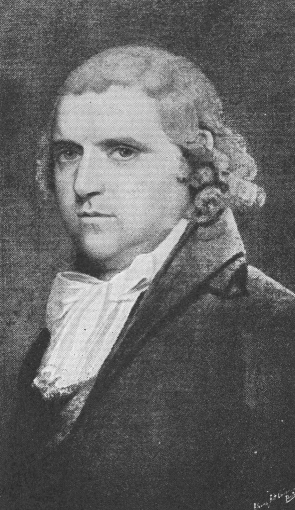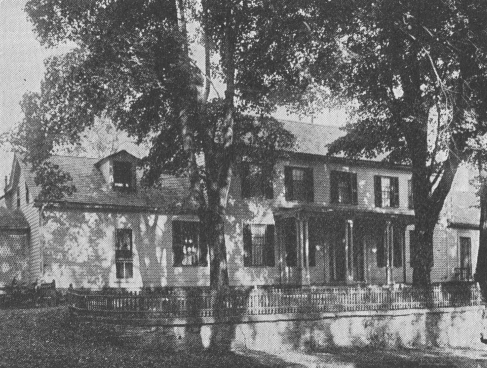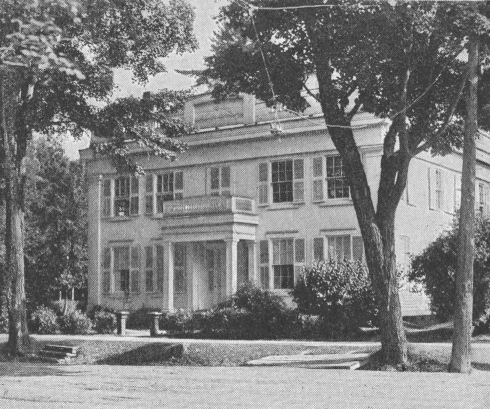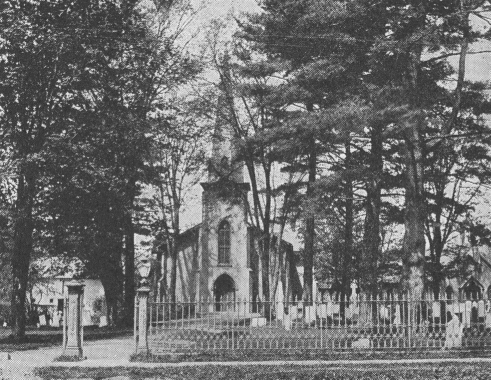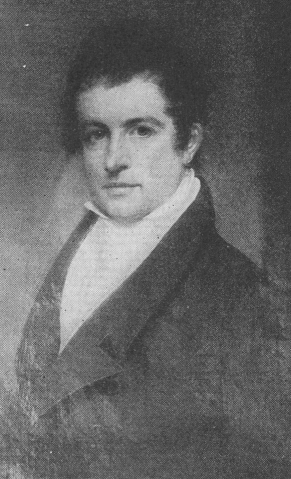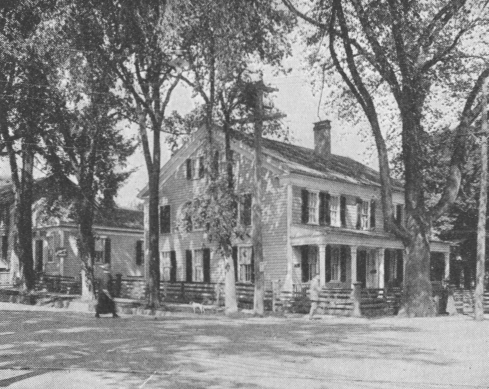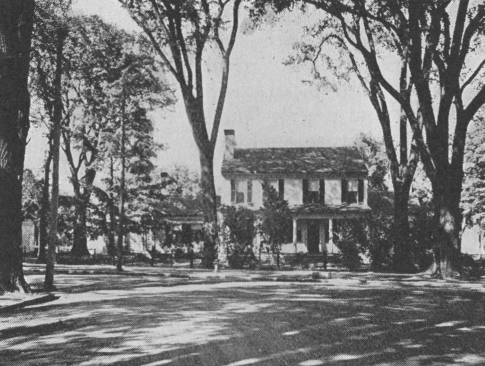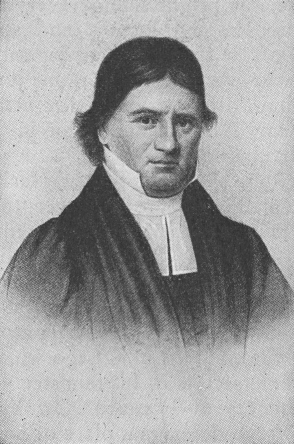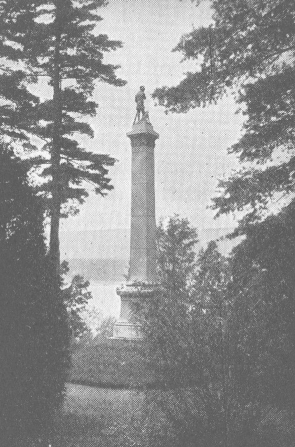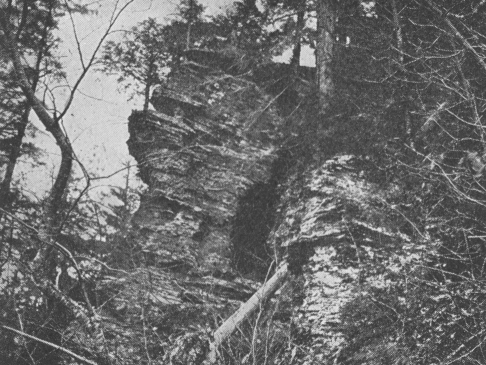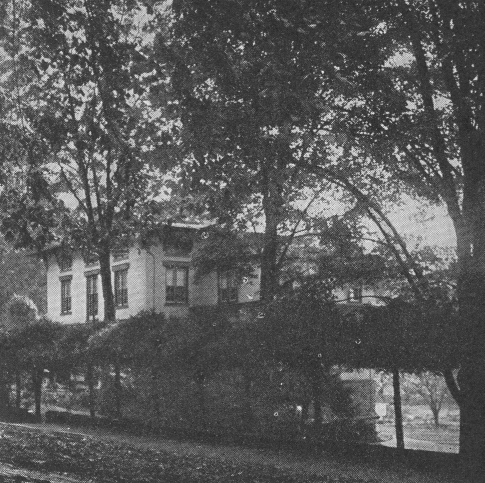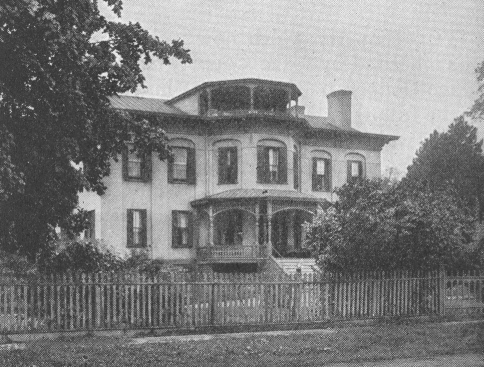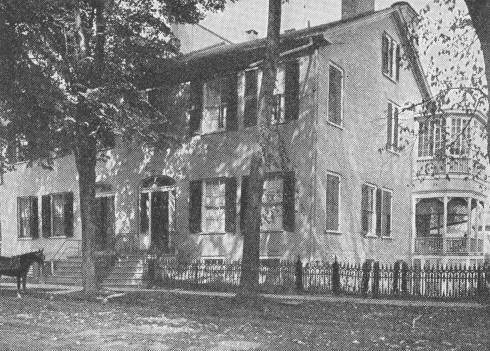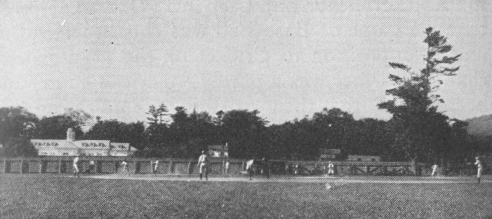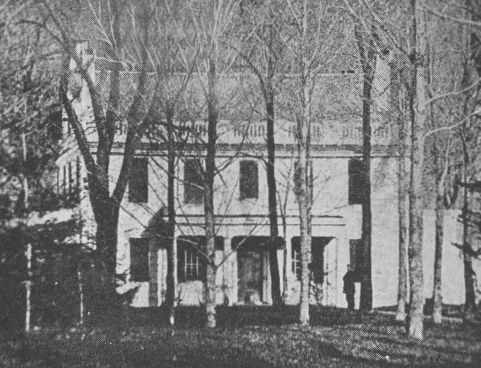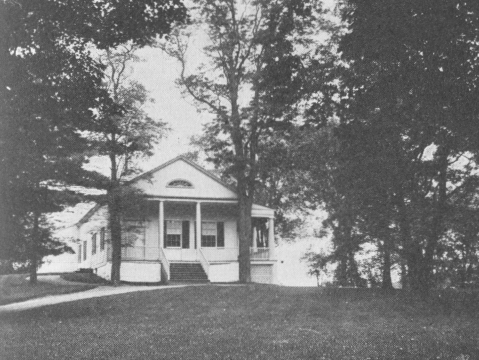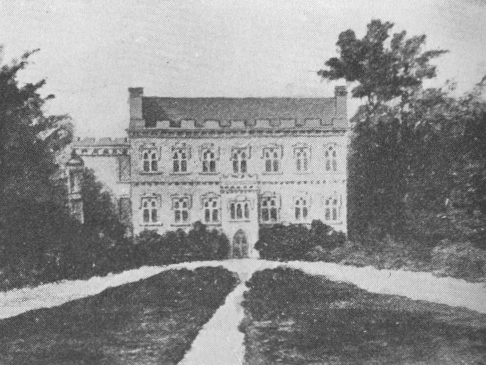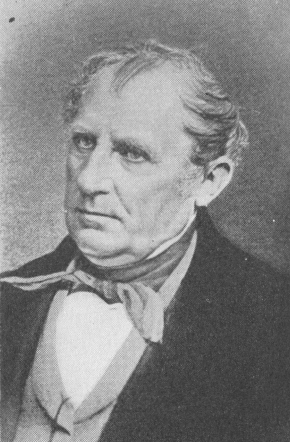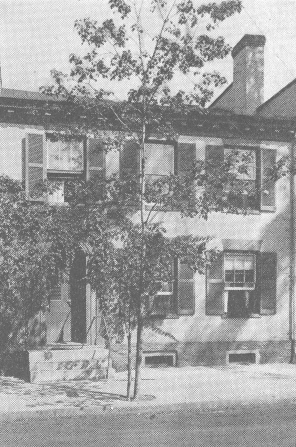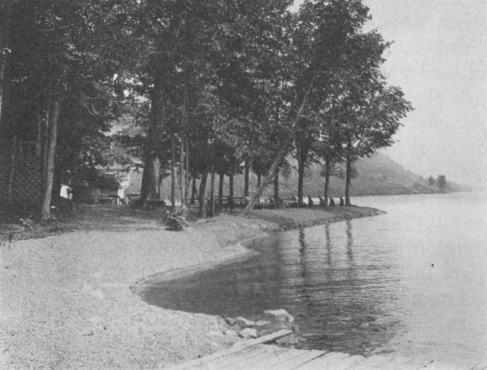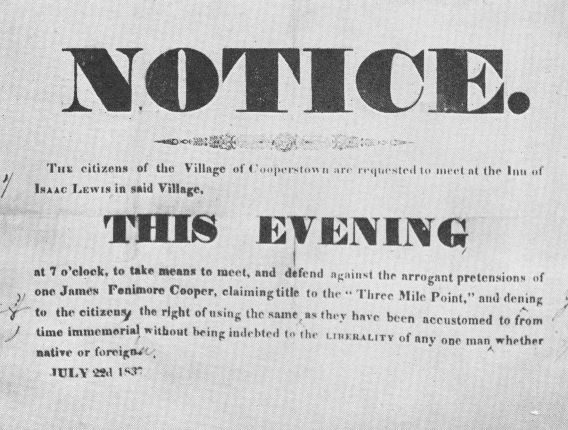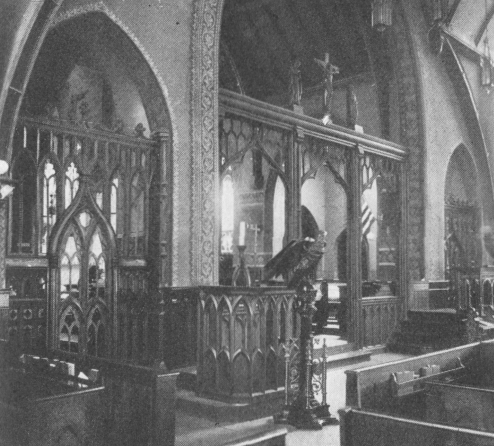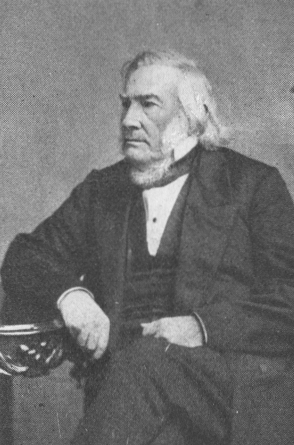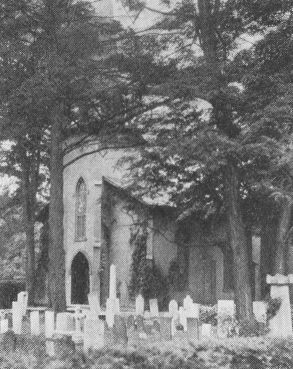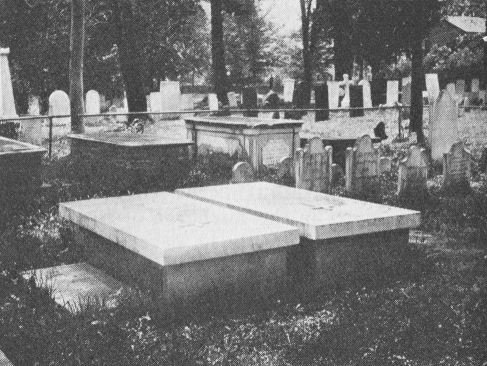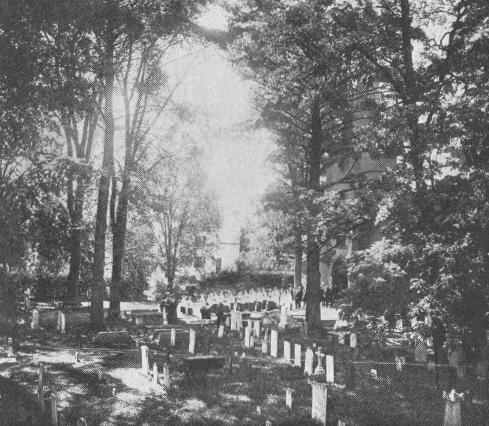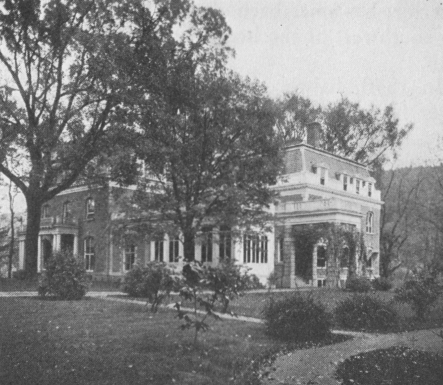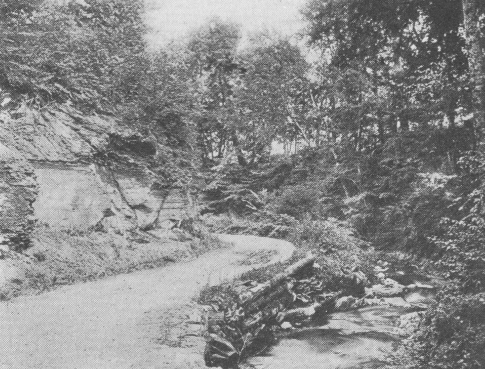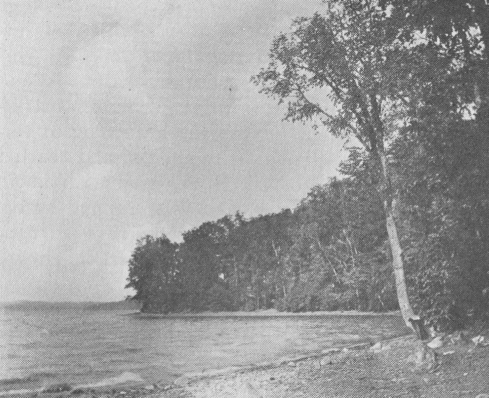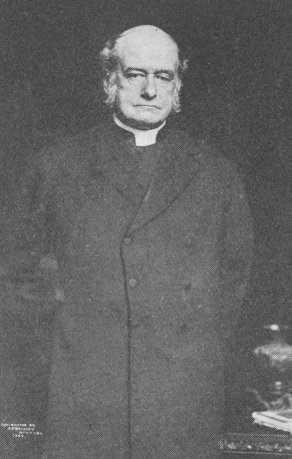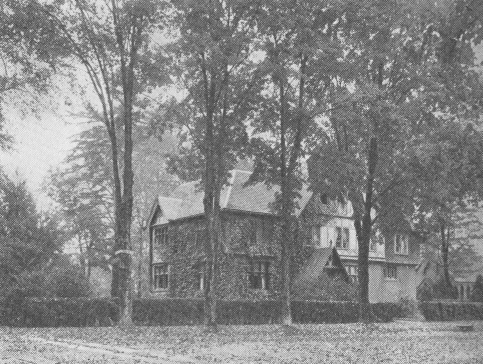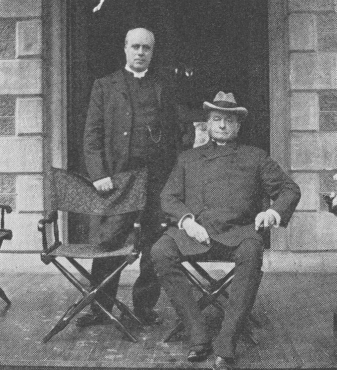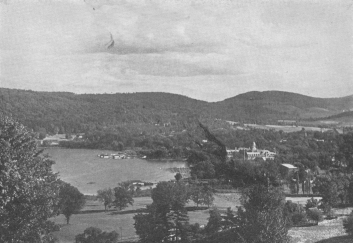
Joseph B. Slote
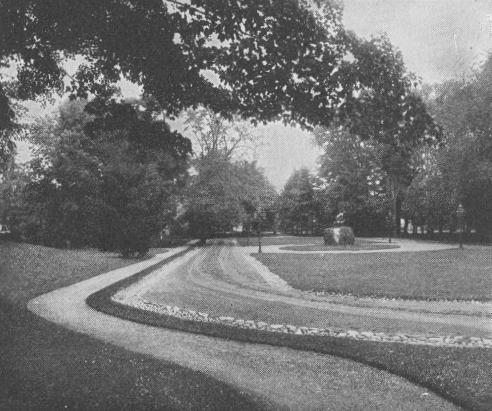
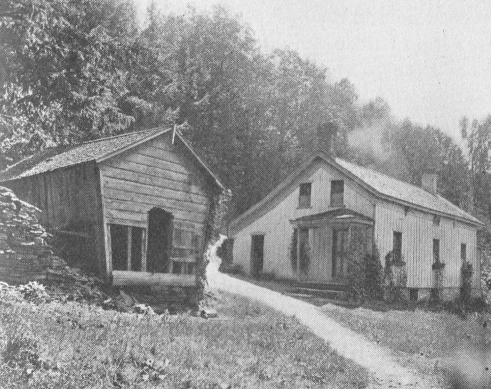
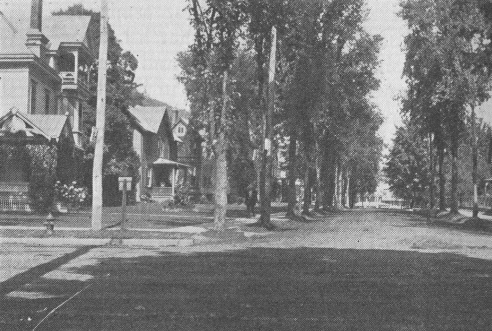
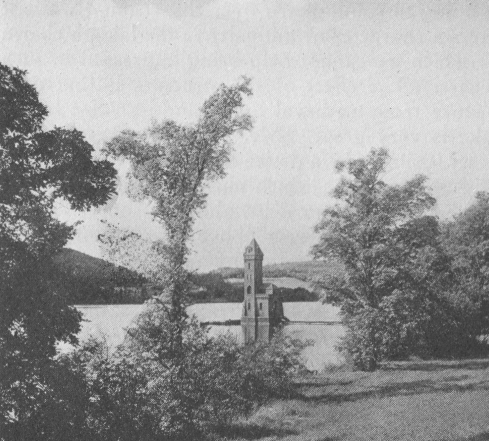
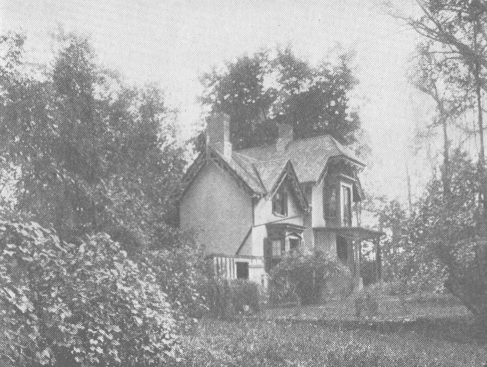
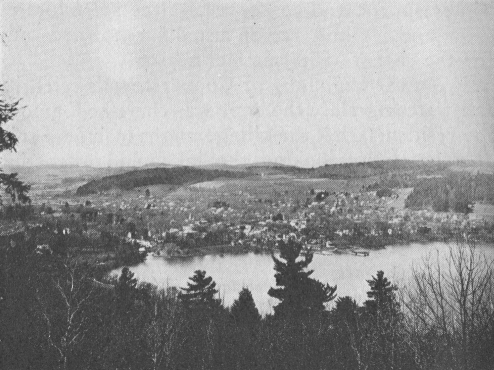
Cooperstown From the Northwest
The Project Gutenberg EBook of The Story of Cooperstown, by Ralph Birdsall

This eBook is for the use of anyone anywhere at no cost and with
almost no restrictions whatsoever.  You may copy it, give it away or
re-use it under the terms of the Project Gutenberg License included
with this eBook or online at www.gutenberg.org


Title: The Story of Cooperstown

Author: Ralph Birdsall

Release Date: June 19, 2006 [EBook #18621]

Language: English

Character set encoding: ISO-8859-1

*** START OF THIS PROJECT GUTENBERG EBOOK THE STORY OF COOPERSTOWN ***


Produced by Lisa Reigel, Curtis Weyant, Michael Zeug and
the Online Distributed Proofreading Team at
http://www.pgdp.net (This file was produced from images
generously made available by Cornell University Digital
Collections)
With Sixty-eight Illustrations from Photographs
NEW YORK,
CHARLES SCRIBNER'S SONS,
1925
Copyright, 1917, by
Ralph Birdsall
First printing, July, 1917
Second printing, December, 1917
Third printing, August, 1920
Fourth printing, August, 1925
Printed in the United States of America
The ensuing narrative is a faithful record of life in Cooperstown from the earliest times, except that the persons and events to be described have been selected for their story-interest, to the exclusion of much that a history is expected to contain. The dull thread of village history has been followed only in such directions as served for stringing upon it and holding to the light the more shining gems of incident and personality to which it led. Trivial happenings have been included for the sake of some quaint, picturesque, or romantic quality. Much of importance has been omitted that declined to yield to such treatment as the writer had in view. The effort has been made to exclude everything that seemed unlikely to be of interest to the general reader. Those who seek family records, or the mention of all names worthy to be recorded in the history of the village, will find the book wanting.
The local history has been already three times recorded, first in 1838 by Fenimore Cooper, whose work was brought down to date by S. T. Livermore in 1863, and by Samuel M. Shaw in 1886. While now out of print many copies of these books are still accessible.
| CHAPTER | PAGE | |
| I. | The Indians | 1 |
| II. | The Coming of the White Men | 26 |
| III. | A Bypath of the Revolution | 51 |
| IV. | The Beginning of the Settlement | 74 |
| V. | A Village in the Making | 89 |
| VI. | Old-Time Love and Religion | 109 |
| VII. | Homes and Gossip of Other Days | 130 |
| VIII. | The Pioneer Court Room | 150 |
| IX. | Father Nash | 163 |
| X. | The Immortal Natty Bumppo | 174 |
| XI. | Strange Tales of the Gallows | 192 |
| XII. | Solid Survivals | 211 |
| XIII. | The Birthplace of Base Ball | 247 |
| XIV. | Fenimore Cooper in the Village | 258 |
| XV. | Mr. Justice Nelson | 299 |
| XVI. | Christ Churchyard | 326 |
| XVII. | From Apple Hill to Fernleigh | 339 |
| XVIII. | The Lake of Romance and Fishermen | 364 |
| XIX. | Twentieth Century Beginnings | 393 |
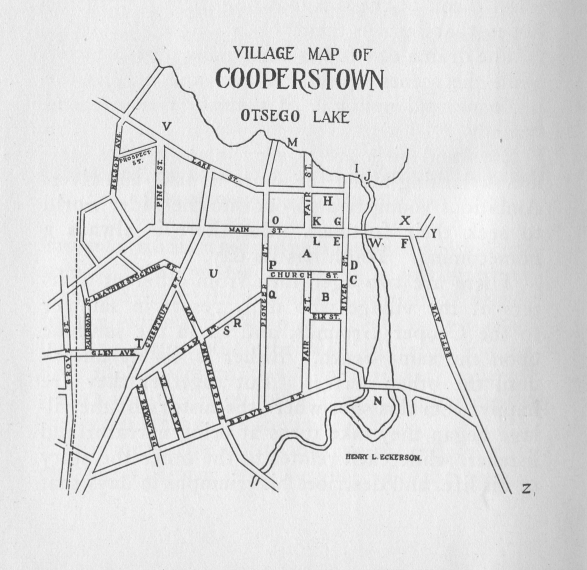
| Village Map and Guide | 432 |
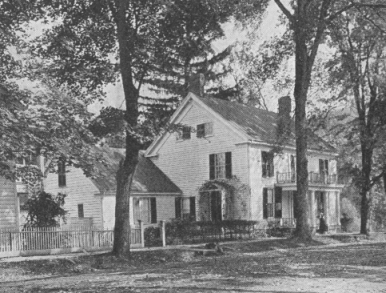
The main street of Cooperstown traverses the village in a direction generally east and west. While the street and its shops are far superior to those of most small towns, the business centre, from which the visitor gains his first impression, gives no hint of the quaint and rustic beauty that makes Cooperstown one of the most charming villages in America.
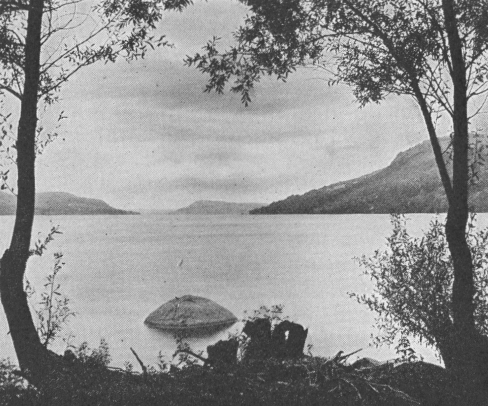
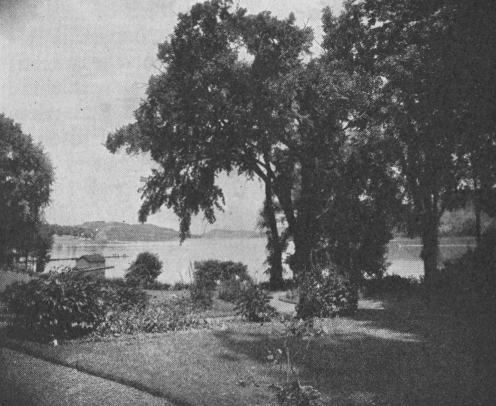
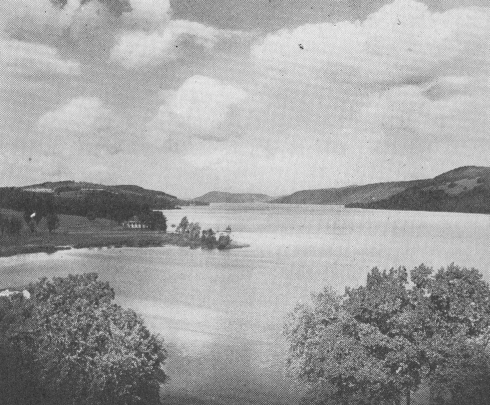
Following the main street toward the east, one reaches the original part of the settlement, and the prospect is more gratefully reminiscent of an old-time village. In summer the gateway of the Cooper Grounds opens a pleasing vista of shaded greensward, while the cross street which runs down to the lake at this point attracts the eye to a half-concealed view of the Glimmerglass, with the Sleeping Lion in the distance at the north.
The historical associations of the village, from the earliest times, are centered in the Cooper Grounds. Within this space, when the first white man came, were found apple trees, in full bearing, which Indians had planted, showing an occupation by red men in the late Iroquois period. On these grounds the first white settler, Col. George [Pg 2]Croghan, built in 1769 his hut of logs. During the Revolutionary War it was upon this spot that Clinton's troops were encamped for five weeks before their spectacular descent of the Susquehanna River. On this site William Cooper, the founder of the village, built his first residence, and afterward erected Otsego Hall, which later became the home of his son, James Fenimore Cooper, the novelist.
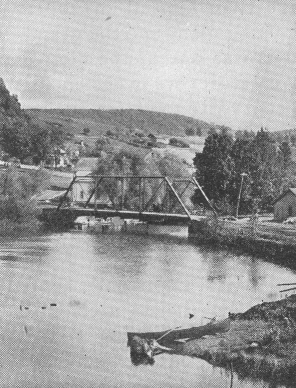
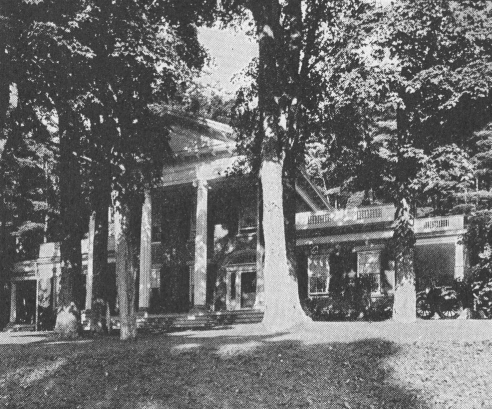
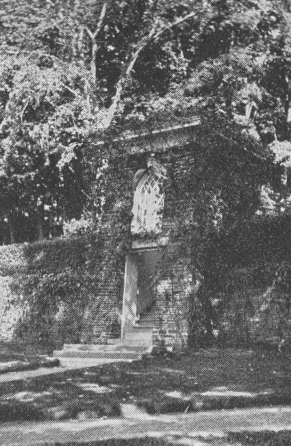
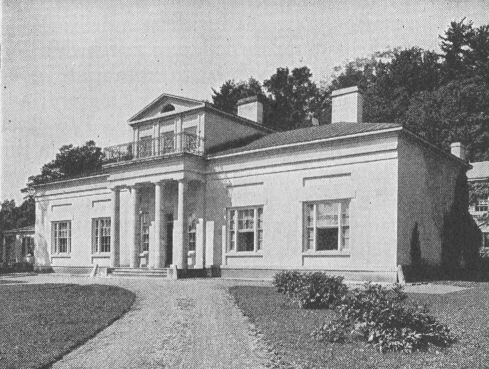
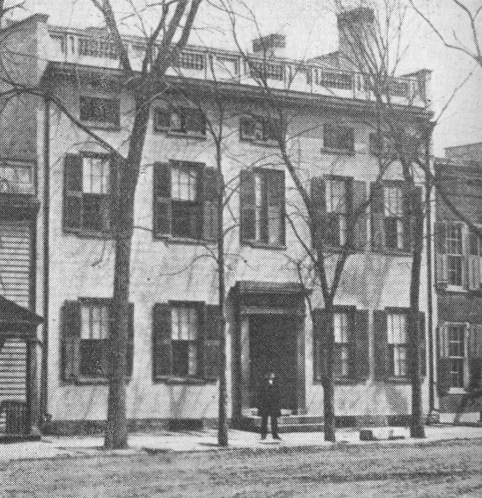
Beyond the Cooper Grounds, on the main street, the buildings seen on either hand belong to the earlier period of village history, except the Village Club and Library, which gracefully [Pg 3]conforms to the older style. After passing the next cross-street, the main thoroughfare leads across the Susquehanna River, and, beyond the bridge, becomes identified with the old road to Cherry Valley. Keeping on up the incline, one finds Mount Vision rising before him, and begins to gain fascinating glimpses into the grounds of Woodside Hall, whose white pillars gleam amid the pines above the Egyptian gate-tower, and whose windows, commanding the whole length of the main street westward, reflect the fire of every sunset.
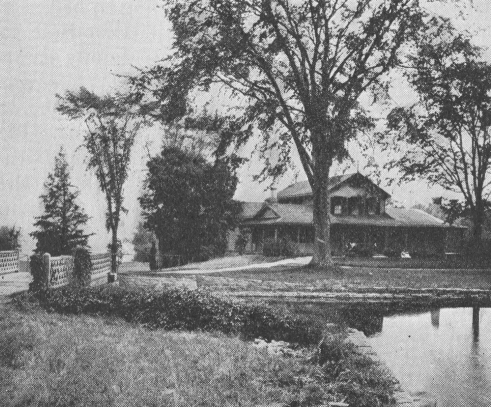
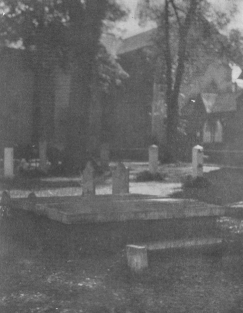
Just before reaching Woodside, one observes a road which makes off from the highway at the right, and runs south. Opening from this road to Fernleigh-Over, and quite close to the corner, is a small iron gate that creaks between two posts of stone. The gate opens upon a path which leads, a few paces westward, to a large, terraced mound, well sodded, and topped by two maple trees.
Sunk into the face of this mound is a slab of granite which bears this inscription:
These lines offer a fitting introduction to the story of Cooperstown. There is enough of truth and poetry in them to touch the heart of the most [Pg 4]indifferent passer-by. No sense of pride stirs the soul of any white man as he reads this pathetic memorial of an exiled race and its vanished empire. From this region and from many another hill and valley the Indians were driven by their white conquerors, banished from one reservation to another, compelled to exchange a vast empire of the forest for the blanket and tin cup of Uncle Sam's patronage.
The mound in Fernleigh-Over is probably an Indian burial site of some antiquity. In 1874, when the place was being graded, a number of Indian skeletons were uncovered in various parts of the grounds. The owner of the property, Mrs. Alfred Corning Clark, caused all the bones to be collected and buried at the foot of the mound. Some years afterward she marked the mound with the granite slab and its inscribed epitaph.
The lines were composed by the Rev. William Wilberforce Lord, D.D., a former rector of Christ Church, in this village, once hailed by Wordsworth as the coming poet of America. He had written some noble verse, but wilted beneath the scathing criticism of Edgar Allan Poe,[1] and after becoming a clergyman published little poetry. This epitaph alone, however, fully justifies Dr. Lord's earlier ambition, for no poet of his time could have included more of beauty and truth and pathos within the compass of so brief an inscription.
In a comment upon the placing of this tablet, Mrs. Clark afterward wrote: "The position of the stone is misleading, and gives one an idea that the mound contains the bones—whereas they are buried at the foot of the mound. I have sometimes wondered if this rather curiously shaped mound, with the two maple trees thereon, might not contain undisturbed skeletons; and I feel sure that throughout this strip of land, which the grading only superficially disturbed, there are many bones of the Iroquois, for in 1900, when we cut down some trees, a skull was found in the fork of a root."
Mrs. Clark's record shows that the mound existed prior to 1874, and since this particular corner of ground was unoccupied before that date except, for a period, by the barns and stables of Lakelands across the way, it is reasonable to suppose that the mound was made by the Indians. While the mounds of New York State cannot be compared in size and extent with those of the West, writers on Indian antiquities, from Schoolcraft[2] onward, have identified as the work of red men many such formations within the Empire State. The mounds were commonly used by the Indians as places of burial, and sometimes as sites for houses, or as fortifications.[3] The mound in Fernleigh-Over may be reasonably regarded as a monument erected by the Indians to the memory of their dead.
Two Indian skeletons were found in Fernleigh grounds in 1910, when a tennis court was being made, and the skeletons of Indians have been unearthed in some other parts of the village. A concealed sentry keeps vigil not far away from Fernleigh. The garden at the northwest corner of River and Church streets, nearly opposite to Fernleigh, has had for many years, on the River Street side, a retaining wall. When Fenimore Cooper owned the property this wall was his despair. For at a point above Greencrest, the wall, which then consisted of dry field stone, could never be kept plumb, but obstinately bulged toward the east; and as often as it was rebuilt, just so often it tottered to ruin. There was a tradition that this singular freak was caused by the spirit of an Indian chief whose grave lay in the garden, and whose resentment toward the village improvements of a paleface civilization found vigorous expression in kicking down the wall. It was at last decided to replace the retaining wall with one of heavier proportions and more solid masonry. On tearing down the wall the tradition of former years was recalled, for there sat the grim skeleton of an Indian, fully armed for war! The new wall included him as before, but to this day there is a point in the wall where stone and mortar cannot long contain the Indian spirit's wrath. This Indian sentinel was first discovered by William Cooper when River Street was graded, and four generations of tradition in the Cooper family testified to his tutelary character.
The banks of the Susquehanna, near the village, [Pg 7]and the shores of Otsego Lake, have yielded a plentiful harvest of Indian relics in arrow-heads and spearpoints, with an occasional bannerstone, pipe, or bit of pottery. Often as the region has been traversed in search of relics, there seems always to be something left for the careful gleaner; and the experienced eye, within a short walk along riverbank or lakeshore, is certain to light upon some memento of the vanished Indian, while every fresh turning of the soil reveals some record of savage life.
Morgan describes an Indian trail as being from twelve to eighteen inches wide, and, where the soil was soft, often worn to a depth of twelve inches. Deeply as these trails were grooved in the earth by centuries of use, it is to be doubted if many traces of them now remain, although over the summit of Hannah's Hill, sheltered by thick pine woods, just west of the village, there runs toward the lake a trail, which, though long disused, is clearly marked, and is believed to have been worn by the feet of Indians. It is indeed possible that this is a remaining segment of the great trail from the north, which, as Morgan's map[4] shows, here touched Otsego Lake, and bent toward the southwest. For, in 1911, a likely trace of it was found by Frank M. Turnbull while clearing the woods on the McNamee property west of the village. In line with the trail on Hannah's Hill, and southwest of it, were two huge hemlocks that bore upon their trunks the old wounds of blazes made as if [Pg 8]by the axes of Indians. The blazes were vertical, deeply indented, and the thick bark had grown outward and around them, forming in each a pocket into which a man might sink his elbow and forearm. These patriarchal trees of the forest were about four feet in diameter at the base, and on being felled showed, by count of the rings, an age of nearly three hundred years.
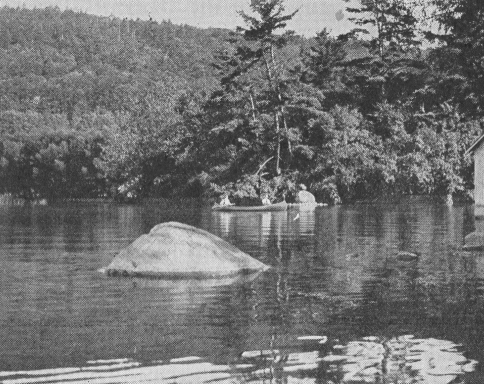
When Fenimore Cooper, in The Deerslayer, describes Council Rock as a favorite meeting place of the Indians, where the tribes resorted "to make their treaties and bury their hatchets," he claims a picturesque bit of stage setting for his drama, [Pg 9]but also records an early tradition. This rock, sometimes called Otsego Rock, standing forth from the water where the Susquehanna emerges from the lake, had been a favorite landmark for the rendezvous of Indians. As one views it now, from the foot of River Street, it lifts its rounded top not quite so high above the water as when Cooper described it in 1841. The damming of the Susquehanna to furnish power for the village water supply has raised the whole level of Otsego Lake, and gives an artificial fullness to the first reaches of the long river.
Whether Cooperstown stands upon the site of an old Indian village is a debated question. Richard Smith's journal describes his visit at the foot of Otsego Lake in 1769, before the time of any considerable settlement by white men, and makes no mention of any Indian residents of the place. He saw many Indians here, but gives the impression that they were come from a distance to visit the Indian Agent whose headquarters lay at the foot of Otsego Lake. On the other hand, a stray hint comes from the papers of William Cooper, among which is a memorandum including various notes relating to population and other statistics, jotted down apparently in preparation for a speech or article on early conditions here, and containing the item, "Old Indian Village." A more significant record appears in the Chronicles of Cooperstown, published in 1838, in which Fenimore Cooper asserts that "arrow-heads, stone hatchets, and other memorials of Indian usages, [Pg 10]were found in great abundance by the first settlers, in the vicinity of the village." In The Pioneers, his description of Cooperstown includes, in a location to be identified with the present Cooper Grounds, fruit trees which he says "had been left by the Indians, and began already to assume the moss and inclination of age," when the first settlers came.
The fruit trees would indicate permanent though late occupation of this site by Indians; "stone hatchets in great abundance" would suggest that a prehistoric village was here. But it is difficult to understand how so little trace should now remain of the one-time "great abundance" of hatchets. Such is not the case at any other permanent prehistoric site in the general region, where pestles and hatchets continue to be found even in streets, as well as in yards, and well-tilled gardens.
Every few years the inhabitants of ancient villages in the east were wont, for various reasons, to build new cabins on new ground, though not far removed from the old. Not all the sites of ancient Otesaga, if ancient Otesaga existed, can have been covered by Cooperstown. Some fields should still produce something out of "an abundance" of village debris. Yet only one hatchet has come, in many years, from all the foot of the lake.[5] Many points, spear and arrow, have been found on all shores of Otsego; for beyond doubt the lake, from very early time, was a resort for [Pg 11]aboriginal hunters and fishermen. But points indicate only camp sites.
On the whole, by reason of the notable absence at this time of stone relics indicating permanent residence, it seems possible that the statement concerning their original abundance was exaggerated, and there is no good reason for supposing, on the strength of this statement alone, that there was a prehistoric village on the site of Cooperstown. Perhaps in early times, during the contests with Southern Indians, the place lay too much in the way of war parties. But the apple trees, concerning which there is no doubt, would indicate rather conclusively an occupation by Indians within the historic period, which, as in the case of many another of the later villages, might have left small trace.[6]
In 1895 two young men of Cooperstown who afterward adopted callings in other fields of science, Benjamin White, Ph.D., and Dr. James Ferguson, conducted amateur archeological expeditions which resulted in the discovery of a regular camp site formerly used by the Indians. This lies within the present village of Cooperstown, on a level stretch along the west bank of the Susquehanna, in what used to be called the Hinman lot, but now belongs to Fernleigh, a few rods south of Fernleigh House. It includes an even floor of low land not far above the level of the river, containing a spring on its margin, and [Pg 12]forming a plot perhaps two hundred yards in length and half as much in breadth. The ground begins thence to rise rather steeply toward the north and west, sheltering from wind and storm the glen below, while affording points of observation, looking up and down the stream.
The young explorers went carefully over the surface of this ground, digging to a considerable depth in some parts, and using an ash-sifter for a thorough examination of the debris. "We found spearheads, game and war points in large numbers," says Dr. White, "as well as drills, punches or awls, scrapers, knives, hammer-stones, and sinkers. Deer horn, bones, and thick strata of ashes were found, the latter in one place only. Whether or no this was the site of an Indian village, I cannot say. Altogether it must have yielded six or eight hundred implements of various sorts. Fernleigh-Over, Riverbrink, and Lakelands yielded arrow-heads and sinkers, but no other implements. The present site of the Country Club was a profitable field for arrow-heads."
Dr. Ferguson, referring to the same spot, writes, "I have long had an idea that there had been a small Indian village located in what we knew as Hinman's lot. After the land was ploughed we found many arrow-heads, awls of bone and flint, and fragments of pottery. There were several areas where fires had been located, the soil being well baked, with mingled charcoal and burned bones. There were also about the fire sites fragments of deer horn, bears' teeth, and much broken pottery. Spear heads were [Pg 13]rather few, sinkers and hammer-stones more numerous. I never found any perfect axes, but did find fragments."
The great number of imperfect arrow-heads and flint chips found here, as well as on the flat northeast of Iroquois Farm house, and on the low land between the O-te-sa-ga and the Country Club house, shows the frequent occupation of these places as Indian camps.
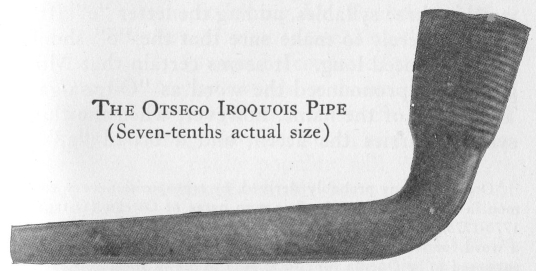
In 1916 David R. Dorn conducted a more intensive examination of the plot explored by Dr. White and Dr. Ferguson. His investigation revealed a site that showed two distinct layers of Indian relics, the lower and more ancient being of Algonquin type, while the signs of later occupancy were Iroquois. At about eighteen inches beneath the surface was found the complete skeleton of an Iroquois Indian. With the skeleton was unearthed a pipe, of Iroquois manufacture, which Arthur C. Parker, the State archeologist, declared to be one of the most perfect specimens known.
Taking all the evidence together, it may be asserted that the present site of Cooperstown was from ancient times the resort of Indian hunters and fishermen, and at a later period, more than a generation before its settlement by white men, as indicated by the size of the apple trees which they found, included a settled Indian village.
On Morgan's map of Iroquois territory as it existed in 1720, he shows a village at the foot of Otsego Lake to which he gives the Indian name Ote-sa-ga.[7] Our present form, Otsego, is a variant of the same original. Morgan wrote the word in three syllables, adding the letter "e" after the "t" merely to make sure that the "o" should be pronounced long. It seems certain that Morgan never pronounced the word as "O-te-sa-ga." This form of the name, however, when the third syllable carries the accent and a broad "a," is [Pg 15]defensible on the ground of its majestic euphony, for it should be permitted to take some liberties with a name that has been spelled by high authorities in a dozen different ways.
The explanation of Otsego, or Otesaga, as signifying "a place of meeting" has been generally abandoned by scholars, in spite of the vogue which Fenimore Cooper gave it along with the interpretation of Susquehanna as meaning "crooked river." But as to the latter the doctors disagree, some claiming that Susquehanna, which is not an Iroquois but an Algonquin word, means "muddy stream"; others, following Dr. Beauchamp, that it is a corruption of a word meaning "river with long reaches." It must be confessed that Cooper credited the Indian words with intelligible and appropriate meanings, so that, in the absence of agreement among the specialists, the interpretations which he made popular will continue to satisfy the ordinary thirst for this sort of knowledge.
Assuming the existence of an Indian village on the present site of Cooperstown, before the coming of the white man, the question of the probable character of its inhabitants opens another field of study. Most of the relics found in this region belong to the Algonquin type. On the other hand Otsego is an Iroquois word, and it seems to be generally agreed that the Otsego region was included, in the historic period, in the possessions of the Iroquois, as the league of the Five Nations was called by the French. The league included the Mohawks, Oneidas, Onondagas, Cayugas, and [Pg 16]Senecas; and took in also, in the eighteenth century, as the sixth nation, the Tuscaroras.[8] While the village at the foot of the lake would properly be called Mohawk, owing obedience to the council of the original Mohawk towns, it might well have been composed largely of Indians from other tribes. Fragments of shattered tribes found refuge with the Iroquois in the latter days. Some were adopted; some stayed on sufferance. The Minsis, a branch of the Delawares, as well as the Delawares proper, were allowed to occupy the southern part of the Iroquois territory. It will be recalled, in this connection, that Cooper's favorite Indian heroes, Chingachgook and Uncas, are of Delaware stock.
It is quite possible that, near the beginning of the eighteenth century—basing the date, among other things, on the appearance of the apple trees when the first white man came—there was a cosmopolitan Indian community at the foot of Otsego Lake. Besides Mohawks, there would have been included Oneidas, their nearest neighbors on the west; and probably Delawares, or Mohicans. There might have been also some one-time prisoners, adopted by the Iroquois, but belonging originally to distant nations.[9]
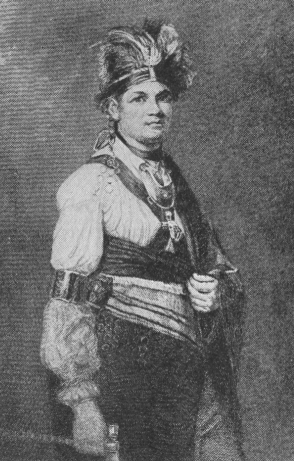
All writers on the history of the Eastern Indians agree in assigning the highest place to the Iroquois. Parkman asserts that they afford [Pg 17]perhaps an example of the highest elevation which man can reach without emerging from the primitive condition of the hunter. Morgan declares that in the width of their sway they had reared the most powerful empire that ever existed in America north of the Aztec monarchy. The home country of the Iroquois included nearly the whole of the present State of New York, but at the era of their highest military supremacy, about 1660, they made their influence felt from New England to the Mississippi, and from the St. Lawrence to the Tennessee. Within this league, the tribal territory of the Mohawks extended to the Hudson River and Lake Champlain on the east, northward to the St. Lawrence, and westward to a boundary not easily determined, but which included Otsego Lake. In the great league of the Iroquois the name of the Mohawk nation always stood first, and of all the Iroquois nations they were the most renowned in war. Joseph Brant, whom John Fiske calls the most remarkable Indian known to history, was a Mohawk chief.
Although the field of Iroquois influence was so wide, and their military fame so great, it is a mistake to imagine that the forests of their time were thickly peopled with red men, or that they were perpetually at war. The entire population of the Iroquois throughout what is now the State of New York probably never numbered more than 20,000 souls. Of these the whole Mohawk nation counted only about 3,000, grouped in small [Pg 18]villages over their wide territory.[10] The avowed object of the Iroquois confederacy was peace. By means of a great political fraternity the purpose was to break up the spirit of perpetual warfare which had wasted the Indian race from age to age.[11] To a considerable degree this purpose was realized. After the power of the Iroquois had become consolidated, their villages were no longer stockaded, such defences having ceased to be necessary.
Otsego has witnessed other aspects of Indian life than those of war and the chase. The Iroquois were agriculturists, and they, or rather their women, cultivated not only fruit trees, but corn, melons, squash, pumpkins, beans, and tobacco.[12] They had other human interests also, not unlike our own. As the young people grew up amid sylvan charms that are wont to stir romantic feelings in the heart of youth to-day, one is tempted to imagine the trysts in the wood, the flirtations, the courtships, among Indian braves and dusky maidens, that touched life with tender sentiment in the days of the red man's glory. During many summers before the white man came the breath of nature sighing through the pines of Otsego, the winding river murmuring lovelorn secrets to the flowers that nodded on its margin, the moon rising over Mount Vision and shedding its splendor upon the lake, were subtle influences in [Pg 19]secret meetings between men and maidens, in whispered vows beneath the trees, in courtships on the border of the Glimmerglass, in lovemaking along the shores of the Susquehanna.
The greater part of the Iroquois were allies of the British in the Revolutionary War, although some Mohawks remained neutral, and most of the Oneidas and Tuscaroras became engaged on the side of the Americans. It is not strange that, in a war whose causes they could not understand, the Iroquois should have been loyal to the King of England, with whom their alliances had been made for nearly two centuries. The Indians had nothing to gain in this war, and everything to lose. They lost everything, and after the war were thrown upon the mercies of the victorious Americans. The Iroquois confederacy came to an end, and few of the Mohawks ever returned to the scene of their council fires, or to the graves of their ancestors.[13]
Many friendly relationships were established between the white men and the Indians, both before and after the Revolutionary War. In 1764 there was a missionary school of Mohawk Indian boys at the foot of Otsego Lake under the instruction of a young Mohawk named Moses, who had been educated at a missionary institution for Indians at Lebanon. A report of one of the missionaries, the Rev. J. C. Smith, written at this time, gives a glimpse of the Indians as they came [Pg 20]under civilizing influence on the very spot where Cooperstown was afterward to flourish:
"I am every day diverted and pleased with a view of Moses and his school, as I can sit in my study and see him and all his scholars at any time, the schoolhouse being nothing but an open barrack. And I am much pleased to see eight or ten and sometimes more scholars sitting under their bark table, some reading, some writing and others studying, and all engaged to appearances with as much seriousness and attention as you will see in almost any worshipping assembly and Moses at the head of them with the gravity of fifty or three score."[14]
Miss Susan Fenimore Cooper, daughter of the novelist, says that for some years after the village was commenced, Mill Island was a favorite resort of the Indians, who came frequently in parties to the new settlement, remaining here for months together. Mill Island lies in the Susquehanna a short distance below Fernleigh, near the dam, where the river reaches out two arms to enclose it, and with so little effort that it is difficult to distinguish the island from the mainland. In the early days of the village the island was covered with woods, and the Indians chose it for their camp, in preference to other situations. Miss Cooper thinks it may have been a place of resort to their fishing and hunting parties when the country was a wilderness. In Rural Hours, writing in 1851, she gives a curious description of a visit [Pg 21]made at Otsego Hall by some Indians who had encamped at Mill Island. There were three of them,—a father, son, and grandson,—who made their appearance, claiming a hereditary acquaintance with the master of the house, Fenimore Cooper.
"The leader and patriarch of the party," says Miss Cooper, "was a Methodist minister—the Rev. Mr. Kunkerpott. He was notwithstanding a full-blooded Indian, with the regular copper-colored complexion, and high cheek bones; the outline of his face was decidedly Roman, and his long, gray hair had a wave which is rare among [Pg 22]his people; his mouth, where the savage expression is usually most strongly marked, was small, with a kindly expression about it. Altogether he was a strange mixture of the Methodist preacher and the Indian patriarch. His son was much more savage than himself in appearance—a silent, cold-looking man; and the grandson, a boy of ten or twelve, was one of the most uncouth, impish-looking creatures we ever beheld. He wore a long-tailed coat twice too large for him, with boots of the same size. The child's face was very wild, and he was bareheaded, with an unusual quantity of long, black hair streaming about his head and shoulders. While the grandfather was conversing about old times, the boy diverted himself by twirling around on one leg, a feat which would have seemed almost impossible, booted as he was, but which he nevertheless accomplished with remarkable dexterity, spinning round and round, his arms extended, his large black eyes staring stupidly before him, his mouth open, and his long hair flying in every direction, as wild a looking creature as one could wish to see."
After the period of which Miss Cooper writes, Indians were even more rarely seen in Cooperstown, and their visits soon ceased altogether. It is a far cry from the Chingachgook and Uncas whom Fenimore Cooper imagined to the Rev. Mr. Kunkerpott and other Indians whom his daughter saw and described. So much so that Cooper has been accused of creating, in his novels, a sort of Indians which never existed either here or elsewhere. There is no doubt, however, that [Pg 23]he studied carefully such Indians as were in his day to be found, and had some basis of fact for the qualities which he imparted to the Indians of his imagination. Miss Cooper says that her father followed Indian delegations from town to town, observing them carefully, conversing with them freely, and was impressed "with the vein of poetry and of laconic eloquence marking their brief speeches."
Brander Matthews says that if there is any lack of faithfulness in Cooper's presentation of the Indian character, it is due to the fact that he was a romancer, and therefore an optimist, bent on making the best of things. He told the truth as he saw it, and nothing but the truth; but he did not tell the whole truth. Here Cooper was akin to Scott, who chose to dwell only on the bright side of chivalry, and to picture the merry England of Richard Lionheart as a pleasanter period to live in than it could have been in reality. Cooper's red men are probably closer to the actual facts than Scott's black knights and white ladies.[15]
Cooper himself comes to the defense of his Indians in the preface of the Leather-Stocking Tales. "It is the privilege of all writers of fiction," he declares, "more particularly when their works aspire to the elevation of romances, to present the beau-ideal of their characters to the reader. This it is which constitutes poetry, and to suppose that the red man is to be represented only in the squalid misery or in the degraded moral state that [Pg 24]certainly more or less belongs to his condition, is, we apprehend, taking a very narrow view of an author's privileges. Such criticism would have deprived the world of even Homer."
Our early history has been less sympathetic toward the Indian. The story of the massacre which occurred at Cherry Valley, not many miles from Cooperstown, in 1778, although the Tories who took part in it were quite as savage as their Indian allies, has made memorable the darker side of Indian character. But although many innocent victims were exacted by his revenge both here and elsewhere, it was not without cause that the Indian resorted to bloody measures against the whites. Americans of to-day can well afford a generous appreciation of the once powerful race who were their predecessors in sovereignty on this continent. The league of the Iroquois is no more, but in the Empire State of the American Republic the scene of their ancient Indian empire remains. It is left for the white man to commemorate the Indian who made no effort to perpetuate memorials of himself, erected no boastful monuments, and carved no inscriptions to record his many conquests. Having gained great wealth by developing the resources of a land which the Indians used only as hunting grounds, the white man may none the less appreciate the lofty qualities of a race of men who, just because they felt no lust of riches, never emerged from the hunter state, but found the joy of life amid primeval forests.
The League of the Iroquois has had a strange [Pg 25]history, which is part of the history of America—a history which left no record, except by chance, of a government that had no archives, an empire that had no throne, a language that had no books, a citizenship without a city, a religion that had no temple except that which the Great Spirit created in the beginning.
[1] Poe. Works, "William W. Lord," Vol. vii, p. 217 (Amontillado Ed). Edmund Clarence Stedman, in his Poets of America, p. 41, 123, champions Lord.
[2] Notes on the Iroquois, Henry R. Schoolcraft, Chap. vi.
[3] Major J. W. Powell, The Forum, January, 1890.
[4] Lewis H. Morgan's map, 1851, in the League of the Iroquois.
[5] From Fernleigh garden, near the river, 1895.
[6] These opinions are quoted from a communication kindly written by Willard E. Yager, of Oneonta.
[7] Ote-sa-ga was probably derived, by transposition very common in like case, from the first map name of Ostega (Ostaga), 1770-1775. Dr. Beauchamp sought to derive this from "otsta," a word for which Schoolcraft was his authority, and which was supposed to be Oneida for "rock," the Mohawk form "otsteara." But Schoolcraft, as Beauchamp himself elsewhere shows (Indian Names, p. 6), sometimes took liberties with original Indian forms of words. The Mohawk word for "rock" is "ostenra"; the Oneida would be "ostela." The first with the locative terminal "ga," gives "ostenraga"; the second, "ostelaga." Both are far removed from "Ostaga." Ostaga is more naturally derived from the Mohawk "otsata," or "osata," both which forms occur in Bruyas. Otsataga, by elision, readily becomes Otstaga, and again Ostaga. The change is even simpler with Osataga. The meaning of Ostaga, thus explained, would be "place of cloud," by extension "place of storm"—in contrast, perhaps, with the little lakes, which were waiontha, "calm." (Bruyas, 64).—Willard E. Yager.
[8] League of the Iroquois, Lewis H. Morgan, Lloyd's Ed., Vol. I, p. 93.
[9] Yager.
[10] The Old New York Frontier, Francis W. Halsey, 16. League of the Iroquois, II. 227.
[11] League of the Iroquois, I. 87.
[12] do., I. 249-251.
[13] The Old New York Frontier, 150.
[14] The Old New York Frontier, 75, 160.
[15] Address at the Cooperstown Centennial.
Within six years after Hendrik Hudson sailed up the river which bears his name, and some five years before the Pilgrim fathers landed at Plymouth, the first white men looked upon Otsego Lake, and saw the wooded shore upon which Cooperstown now stands. It was in 1614, or in the year following, that two Dutchmen set out from Fort Orange (Albany) to explore the fur country, and crossing from the Mohawk to Otsego Lake, proceeded down the Susquehanna.[16] From this time, first under the Dutch, then under English rule, traders came frequently to the foot of Otsego Lake. Soon after the traders, Christian missionaries ventured into the wilderness, ministering at first chiefly to the Indians. Later came the first settlers.
That the influence of traders was not always helpful to Christian missionaries is illustrated by an incident in the missionary journey of the Rev. Gideon Hawley, a Presbyterian divine, who, with some zealous companions, came from New England to preach to the Indians of the [Pg 27]Susquehanna in 1753. They reached the river at a point where was a small Indian settlement near the present village of Colliers, seventeen miles below Cooperstown. Here they were joined by a trader named George Winedecker, who had come down from Otsego Lake with a boat-load of goods, including rum, to supply the Indian villages down the river. During the night the red men, full of Winedecker's rum, became embroiled in a murderous orgy. The missionaries were awakened by the howling of the Indians over their dead, and in the morning saw Indian women skulking in the bushes, hiding guns and hatchets, for fear of the intoxicated Indians who were drinking deeper. "Here, in one party, were missionaries with the Bible and a trader with the rum—the two gifts of the white man to the Indian."[17]
Susquehanna lands were first conveyed to white men by the Indians in 1684 as a part of a treaty of alliance with the English, although the Indians retained the right to live and hunt on the river. The granting of land titles by the Provincial government began not long afterward.[18] The first recorded patent on Otsego Lake was obtained in 1740 by John J. Petrie at the northern end. John Groesbeck, an officer of the court of chancery, acquired in 1741 a patent lying northeast of the lake, including what afterward became the Clarke property and the site of Hyde Hall. Nearly the whole east side of the lake, with the present [Pg 28]Lakelands tract just east of the Susquehanna at its source, was covered by the patent which Godfrey Miller obtained in 1761, and upon which, according to the journal of Richard Smith, twelve persons were resident eight years later.[19]
Early in the eighteenth century it is probable that traders were from time to time resident at the foot of Otsego, but the first attempt toward a permanent settlement on the present site of Cooperstown was made by John Christopher Hartwick in 1761. In that year Hartwick obtained from the Provincial government a patent to the lands which, southwest of Cooperstown, still perpetuate his name, and began a settlement at the foot of Otsego Lake under the misapprehension that the site was included in his patent. It was not long before Hartwick discovered his error, and withdrew to the proper limits of his tract, but this attempt to found a village upon the spot which William Cooper afterward selected connects with the history of Cooperstown a unique character and memorable name.
Hartwick, who was born in Germany in 1714, came to America at about thirty years of age as a missionary preacher, and in his time was as famous for his eccentricities, as he afterward became for his pious benefactions. He held some settled charges, but, except for twelve years at Rhinebeck, he seems for the most part to have been a wandering preacher, and the records of his pastorates extend from Philadelphia to Boston, [Pg 29]and from Virginia and Maryland to the distant coast of Maine.
If Hartwick would not be long tied down to a settled pastorate, he was even more fearful of matrimonial bondage, and shunned women as a plague. It was not an uncommon thing for him, if he saw that he was about to meet a woman in the road, to cross over, or even to leap a fence, in order to avoid her. On one occasion when he was disturbed in preaching by the presence of a dog, he exclaimed with much earnestness that dogs and children had better be kept at home, and it would not be much matter, he added, if the women were kept there too![20] Seeking shelter one night at a log hut not far from the present Hartwick village, he was cheerfully received by the occupants, a man and his wife, who gave up to their guest the one bed in the only bedroom, and stretched themselves for the night upon the floor before the kitchen fire. The night grew bitter cold, and the wife, awaking, bethought her of the guest, whether he might not be too lightly covered. She went silently to his room, and spread upon his bed a part of her simple wardrobe. Hartwick promptly arose, dressed himself, made his way out of the house to the stable, saddled his horse, and rode away in the darkness.
His contemporaries agree in representing Hartwick as slovenly in his habits, often preaching in his blanket coat, and not always with the cleanest [Pg 30]linen; eccentric in his manners, curt, and at times irritable in his intercourse with others—an exceedingly undesirable addition to the social and domestic circle, so that his hosts were accustomed to tell him plainly, at the beginning of a visit, "You may stay here so many days, and then you must go."[21] In some quarters his visits were dreaded because of his excessively long prayers at family worship.[22]
One may dwell without malice upon the eccentricities of this singular man, for they are qualities that set him forth from his more staid contemporaries, without detracting from the virtues which gave permanence to his work. Hartwick was a lover of God and men. Although rough and unpolished, he was a man of learning, being well versed in theology, and as familiar with the Latin language as with his own.
The great purpose of Hartwick's career was the founding of a community for the promotion of religion and education, the building in the wilderness of a Christian city whose halls of learning should influence the coming ages. The roving life that brought Hartwick into contact with the Indians awakened his desire to Christianize and educate them, and the influence which he gained among them opened the way, through the acquirement of land, for the carrying out of his favorite project. The patent that he obtained from the Provincial government in 1761 covered a tract of land, substantially the present town of [Pg 31]Hartwick, which he had purchased from the Indians for one hundred pounds in 1754. In settling the land Hartwick required each tenant to agree to a condition in the lease by which the tenant became Hartwick's parishioner, and acknowledged the authority of Hartwick, or his substitute, as "pastor, teacher, and spiritual counsellor." Owing to his desultory business methods and the weight of advancing years, Hartwick after a time found himself unequal to the management of this estate, and in 1791 William Cooper, the founder of Cooperstown, became his agent, with authority to dispose of the property to tenants. By this arrangement Hartwick was cut off from his original design of being the spiritual director of his tenants, and came to the end of his life without building the city of which he dreamed.
Hartwick's last will and testament, however, shows that he never abandoned his design, but determined that it should be carried out after his death. The will is one of the most curious documents ever penned, a mixture of autobiography, piety, and contempt of legal form. A lawyer to whom he submitted it pronounced it "legally defective in every page, and almost in every sentence." But Hartwick's only amendment of it was to add a perplexing codicil to seven other codicils which already had been appended.[23] The will provides for the laying out of a regular town, closely built, to be called the New Jerusalem, with buildings and hall for a seminary.
Hartwick died in 1796, in his eighty-third year. The task of administering the estate according to the will was found to be almost hopeless. The executors, aided by a special act of legislature, set about to carry out its evident spirit. Preliminary to the establishment of a seminary, the executors sent the Rev. John Frederick Ernst, a Lutheran minister, to Hartwick patent, to preach to the inhabitants, and to assist in the education of their youth. In connection with this work Mr. Ernst came to Cooperstown in 1799, held religious services in the old Academy, on the present site of the Universalist church, and had some youngsters of the village under his instruction. His descendants lived in Cooperstown for more than a century after him.
The main building of Hartwick Seminary was erected in 1812, at the present site, near the bank of the Susquehanna River, about five miles southward of Cooperstown, and some four miles eastward from Hartwick village. The school was opened in 1815, and received from the legislature a charter in 1816. It is the oldest theological school in the State of New York, and the oldest Lutheran theological seminary in America. In addition to being a theological school, Hartwick Seminary is now devoted to general education, and includes among its pupils not only boys, but, in spite of the prejudice of its founder, young women.
Among the original trustees named in the charter of Hartwick Seminary was the Rev. Daniel [Pg 33]Nash, the first rector of Christ Church, Cooperstown. Judge Samuel Nelson, and Col. John H. Prentiss, of Cooperstown, were afterward trustees for many years, and in their time there was among the people of this village a lively interest in Hartwick Seminary, the literary exercises at the end of each scholastic year being largely attended by visitors from Cooperstown. It is significant of the close relation which formerly existed between the two villages that the street which runs westward from the Presbyterian church in Cooperstown, now called Elm Street, was at one time known to the inhabitants as "the Hartwick Road."
Local history has wronged[24] the memory of John Christopher Hartwick by the oft repeated statement that he committed suicide. It is true that a man named Christianus Hartwick took his own life in 1800, and that his grave lies in Hinman Hollow, only a few miles from Hartwick Seminary. But John Christopher Hartwick, after whom the town and seminary are named, died a natural death at Clermont, N. Y., four years before the suicide.
A wanderer in life, Hartwick after his death was long in quest of a peaceful grave. His remains were first buried in the graveyard of the Lutheran church in East Camp. Two years later, in accordance with the wish expressed in Hartwick's will, the body was removed and entombed beneath the pulpit of Ebenezer church, [Pg 34]at the corner of Pine and Lodge streets, in Albany, deposited in a stone coffin, secured by brickwork, and covered with an inscribed slab of marble. In 1869, when the church was rebuilt, the body was removed to the public cemetery in Albany. When this cemetery was converted into Washington Park, Hartwick's body was transferred to the lot of the First Lutheran church in the Albany Rural Cemetery on the Troy road, where his dust is now contained in an unknown and forgotten grave. The board of trustees of Hartwick Seminary afterward ordered that Hartwick's remains should be disinterred and brought for burial to the town to which he gave his name, but the remains could not be found.
The marble slab that once covered the body of Hartwick in Ebenezer church lay for many years beneath the basement floor of the First Lutheran church, which succeeded the older building. In 1913 this relic of Hartwick's sepulchre was sent to the seminary which he founded, where it occupies once more a place of honor. Besides Hartwick's name, and the record of his birth and death, the marble bears, inscribed in German, this sentiment:
The village of Hartwick is distantly connected with another religious movement which the [Pg 35]founder of Hartwick Seminary would have viewed with the utmost abhorrence. In 1820, and for several years thereafter, first in the house of John Davison, and afterward in Jerome Clark's attic, lay an old trunk containing the closely handwritten pages of a romance entitled The Manuscript Found, by the Rev. Solomon Spaulding. This was written in 1812, in Conneaut, Ashtabula county, Ohio, where the exploration of earth mounds containing skeletons and other relics fired Spaulding's imagination, and suggested the character of his tale. It was written in Biblical style, and for the purpose of the romance was presented as a translation from hieroglyphical writing upon metal plates exhumed from a mound, to which the author had been guided by a vision. It purported to be a history of the peopling of America by the lost tribes of Israel. Spaulding frequently read the manuscript to circles of admiring friends, and afterward carried it to Pittsburgh, leaving it, in the hope of having it published, in the care of a printer named Patterson. The manuscript was finally rejected. Spaulding died, and in 1820 his widow married John Davison of Hartwick, to which place the old trunk containing her first husband's manuscript was sent.
In 1823 Joseph Smith gave out that he had been directed in a vision to a hill near Palmyra, New York, where he discovered some gold plates curiously inscribed, and containing a new revelation. This supposed revelation he published in 1830 as the "Book of Mormon."
Mormonism flourished and moved westward. [Pg 36]In the course of time a Mormon meeting was held in Conneaut, Ohio, and out of curiosity was largely attended by the townspeople. Some readings were given from the Book of Mormon, and certain of the hearers were astonished at the similarity between Joseph Smith's book and The Manuscript Found, which Solomon Spaulding had read aloud to friends in the same town many years before. They recognized the same peculiar names, unheard of elsewhere, such as Mormon, Maroni, Lamenite, and Nephi. It was learned, it is said, that Smith had closely followed Spaulding's story, adding only his own peculiar tenets about marriage, and inventing the theory of the great spectacles by means of which he professed to have deciphered the mysterious characters.
Spaulding's friends raised a question which has never been cleared up and was at last forgotten. It was pointed out that Sidney Rigdon, who figured as a preacher and as an adviser of Smith among the first of the "Latter Day Saints," happened to have been an employé in Patterson's printing office in Pittsburgh during the very period when Spaulding's manuscript was there awaiting approval or rejection. But the matter was never brought to a definite issue, and nothing more came of it except a rather curious episode. Mrs. Davison removed from Hartwick about 1828, leaving the trunk in charge of Jerome Clark. In 1834 a man named Hurlburt sought Mrs. Davison, and said that he had been sent by a committee to procure The Manuscript Found, written by Solomon [Pg 37]Spaulding, so as to compare it with the Mormon Bible. He presented a letter from her brother, William H. Sabine, of Onondaga Valley, upon whose farm Joseph Smith had been an employé, requesting her to lend the manuscript to Hurlburt, in order "to uproot this Mormon fraud." Hurlburt represented that he himself had been a convert to Mormonism, but had given it up, and wished to expose its wickedness. On Hurlburt's repeated promise to return the work, Mrs. Davison gave him a note addressed to Jerome Clark of Hartwick, requesting him to open the old trunk and deliver the manuscript. This was done. Hurlburt took the manuscript, and not only did he never return it, but he never replied to any of the many letters requesting its return. The Spaulding manuscript has utterly disappeared.[25]
The year 1768 brings another unique personage into the field of our local history. In that year the English met the Indians at Fort Stanwix (Rome, Oneida county) in a conference which resulted in establishing a formally acknowledged boundary between the territory of the red men and the land which the colonists had begun to make their own. The lands of the upper Susquehanna thus became, prior to the Revolution, the extreme western frontier of old New York, and Otsego Lake was included within English territory by a margin, at the west, of about twenty miles. Sir William Johnson, Superintendent of Indian Affairs, conducted the negotiations, and [Pg 38]the securing of the Fort Stanwix deed was one of the most astute accomplishments of his long career.
An interested party to these proceedings was Sir William's deputy agent for Indian affairs, Colonel George Croghan, who had accompanied him to the conference. Nearly twenty years before, Croghan had obtained from the Indians a tract of land near Fort Pitt (Pittsburgh), in Pennsylvania. During this Fort Stanwix conference which established the new frontier Croghan succeeded in getting confirmation of the former grant, with the privilege of making an exchange for a tract of equal extent in the region now ceded to the English. Under this agreement Croghan and certain associates afterward took up 100,000 acres of land in what are now Otsego, Burlington, and New Lisbon townships, Otsego county.[26] And so it came about that in the next year, 1769, Colonel George Croghan came to the foot of Otsego Lake, built him a hut, and was the first settler on the present site of Cooperstown.
The story of the fortune and failure of Croghan, who was a remarkable and picturesque character, reads like a romance. He so far surpassed all men of his time in genius for commerce with the Indians, and in skillful marketing of Indian products, that Hanna calls him "The King of the Traders." Lavish in his expenditures, big in his ventures, he made and lost fortunes with equal facility. He alternated between the height [Pg 39]of opulence and the verge of bankruptcy. Like Sir William Johnson, Croghan had a special aptitude for making friendships with the Indians, so that, according to his own statement, "he was in such favor and confidence with the councils of the Six Nations that he was, in the year 1746, admitted by them as a Councillor into the Onondaga Councill, which is the Supreme Councill of the Six Nations. He understands the Language of the Six Nations and of several other of the Indian nations."[27]
Long before the sojourn in Otsego, Croghan had become, during his fits of prosperity, a power in the Pennsylvania region, and probably deserved the pungently qualified praise of Hassler, who, in his Old Westmoreland, declares that "the man of most influence in this community [Fort Pitt, or Pittsburgh] was the fat old Trader and Indian-Agent, Colonel George Croghan, who lived on a pretentious plantation about four miles up the Allegheny River—an Irishman by birth and an Episcopalian by religion, when he permitted religion to trouble him."
Two documents relating to Croghan illustrate his extremes of fortune; the one a petition to protect him against imprisonment for debt, the other a complaint against him as a monopolist of the fur trade. It seems that in 1755 Croghan had been compelled by impending bankruptcy and fear of the debtor's prison to remove from settled parts of Pennsylvania, and to take refuge in the [Pg 40]Indian country. Here he was in great danger from the French and their Indians, but wrote to the Governor of Pennsylvania that he was more afraid of imprisonment for debt than of losing his scalp. At a meeting of the Pennsylvania Assembly in November, 1755, fifteen creditors of Croghan presented a petition that Croghan and his partner, William Trent, be rendered free from debt for a space of ten years. The petition recited that there should be taken into consideration "the great knowledge of said George Croghan in Indian affairs, his extensive influence among them, and the service and public utility he may be of to this Province in these respects."[28] In accordance with this petition a bill was passed by which Croghan was freed from the danger of arrest for debt, and, although the act was vetoed by King George II three years later, Croghan evidently made profitable use of his liberty.
On July 9, 1759, less than four years after Croghan so narrowly escaped the debtor's prison, a complaint from Philadelphia was addressed to the Governor of Pennsylvania protesting against Croghan's policy of crushing competitors in the trade with Indians by a control of prices in skins and peltry.[29] The complaint was signed by the eight Provincial Commissioners for the Indian Trade newly appointed by the Assembly, including Edward Pennington, the celebrated Quaker merchant of Philadelphia; Thomas Willing, afterward [Pg 41]a member of the Continental Congress, and the first president of the Bank of North America, the earliest chartered in the country; and William Fisher, who was mayor of Philadelphia just before the Revolution. Such formidable opposition shows that Croghan, from being an object of pity to his creditors, had risen to affluence as the head of a "trust."
Owing to his business methods, some of the Quakers were not well disposed toward Croghan. At a conference with the Delawares and Six Nations held at Easton, in 1758, one of the Quakers present wrote home an account of the proceedings in a tone not favorable to Croghan. "He treats them [the Indians] with liquor," wrote the Quaker, "and gives out that he himself is an Indian.... At the close of the conference one Nichos, a Mohawk, made a speech.... This Nichos is G. Croghan's father-in-law."
If Croghan is to be believed, however, he was opposed to giving liquor to the Indians. While arranging for this very conference he had written to Secretary Richard Peters of Pennsylvania, "You'll excuse boath writing and peper, and guess at my maining, fer I have at this minnitt 20 drunken Indians about me. I shall be ruined if ye taps are not stopt."
Although Croghan had come to America in 1741, this letter, with its "guess at my maining," and another in which he has "lase" for "lease," suggest that, if his pronunciation may be judged from his spelling, he retained a rich Irish brogue. Certainly his Irish wit and good nature served [Pg 42]him well in his dealing with the Indians. He was frequently useful in outwitting the French Indian-agents, and in maintaining the friendship of the red men for the English as against the French. General Bouquet, who seems to have detested Croghan, wrote to General Gage, at a time when new powers had been conferred upon Indian-agents, "It is to be regretted that powers of such importance should be trusted to a man illiterate, impudent, and ill-bred." Nevertheless, within a few months, Bouquet wrote to Gage recommending Croghan as the person most competent to negotiate with the Western Indians for British control of the French posts in the Illinois country—a mission upon which Croghan was wounded, captured, and pillaged by the Indians. In 1768 the General Assembly in Philadelphia put upon record, in a message to the Governor, a high opinion of Croghan, referring to "the eminent services he has rendered to the Nation and its Colonies in conciliating the affections of the Indians to the British interest."
At the end of a stormy voyage from America, being shipwrecked on the Norman coast, Croghan reached England in February, 1764, bearing an important letter on Indian affairs from Sir William Johnson to the Lords of Trade. One might expect to find Croghan gratified by the comforts of London life as compared with the rough hardships of America. A scout under Washington's command, a captain of Indians under Braddock, a border ranger upon the western frontier, a trader upon the banks of the Ohio, a pioneer in [Pg 43]many a wilderness, Croghan had seen all kinds of hard service in the twenty-three years since he left Ireland. But in the midst of metropolitan splendors he grew homesick for the wild life of the New World. Writing in March, and again in April, to American friends, he expressed his disgust with the city's pride and pomp, declared that he was sick of London and its vanities, and set forth as his chief ambition a desire to live on a little farm in America. In the autumn of the same year Croghan shipped for the long journey across the Atlantic. It is five years later that he appears at the foot of Otsego Lake, apparently in fulfillment of his desire to make a home and to be the founder of a settlement.
In 1769 Richard Smith came to the Susquehanna region from Burlington, New Jersey. The immediate purpose of his tour was to make a survey of the Otsego patent in which he, as one of the proprietors, was interested. Smith traveled up the Hudson River to Albany, thence along the Mohawk to Canajoharie, from which point his carefully kept journal[30] abounds in interesting allusions to Otsego:
"13th. May. ... Pursuing a S. W. Course for Cherry Valley [from Canajoharie]. We met, on their Return, Four Waggons, which had carried some of Col. Croghan's Goods to his Seat at the Foot of Lake Otsego.... Capt. Prevost ... is now improving his Estate at the Head of the Lake; the Capt. married Croghan's Daughter....
"14th. ... Distance from Cherry Valley to Capt. Prevost's is 9 miles.
[Pg 44]"15th. ... We arrived at Capt. Prevost's in 4 Hours, the Road not well cleared, but full of Stumps and rugged, thro' deep blac Mould all the Way.... Mr. Prevost has built a Log House, lined with rough Boards, of one story, on a Cove, which forms the Head of Lake Otsego. He has cleared 16 or 18 acres round his House and erected a Saw Mill. He began to settle only in May last.... The Capt. treated us elegantly. He has several Families seated near him....
"16th. We proceeded in Col. Croghan's Batteau, large and sharp at each end, down the Lake,... The Water of greenish cast, denoting probable Limestone bottom; the Lake is skirted on either side with Hills covered by White Pines and the Spruce called Hemloc chiefly. We saw a Number of Ducks, some Loons, Sea-gulls, and Whitish coloured Swallows, the Water very clear so that we descried the gravelly Bottom in one Part 10 or 12 Feet down. The rest of the Lake seemed to be very deep; very little low Land is to be seen round the Lake. Mr. Croghan, Deputy to Sir William Johnson, the Superintendent for Indian Affairs, is now here, and has Carpenters and other Men at Work preparing to build Two Dwelling Houses and 5 or 6 Out Houses. His Situation [on the site of the Cooper Grounds, within the present village of Cooperstown] commands a view of the whole Lake, and is in that Respect superior to Prevost's. The site is a gravelly, stiff clay, covered with towering white Pines, just where the River Susquehannah, no more than 10 or 12 yards broad, runs downward out of the Lake with a strong Current.[31] Here we found a Body of Indians, mostly from Ahquhaga,[32] come to pay their Devoirs to the [Pg 45]Col.; some of them speak a little English.... We lodged at Col. Croghan's.
"23rd. ... At Col. Croghan's ... being rainy, we staid here all day.
"24th. It rained again. The Elevated Hills of this country seem to intercept the flying vapors and draw down more moisture than more humble places.... With 3 carpenters felled a white Pine Tree and began a Canoe.... Some Trout were caught this Morng. 22 Inches long; they are spotted like ours with Yellow Bellies, yellow flesh when boiled & wide mouths. There are Two species, the Common & the Salmon Trout. Some Chubs were likewise taken, above a Foot in length. The other Fish common in the Lake & other Waters, according to Information, are Pickerel, large and shaped like a Pike, Red Perch, Catfish reported to be upwards of Two feet long, Eels, Suckers, Pike, a few shad and some other Sorts not as yet perfectly known. The Bait now used is Pidgeon's Flesh or Guts, for Worms are scarce. The Land Frogs or Toads are very large, spotted with green and yellow, Bears and Deer are Common.... Muscetoes & Gnats are now troublesome. We observed a natural Strawberry Patch before Croghan's Door which is at present in bloom, we found the Ground Squirrels and small red squirrels very numerous and I approached near to one Rabbit whose Face appeared of a blac Colour.
"25th. We finished and launched our Canoe into the Lake. She is 32 feet 7 inches in Length and 2 Feet 4 inches broad....
"27th. ... We engaged Joseph Brant, the Mohawk, to go down with us to Aquahga. Last night a drunken Indian came and kissed Col. Croghan and me very joyously. Here are Natives of different Nations almost continually. They visit the Deputy Superintendent as Dogs to the Bone, for what they can get....
[Pg 46]"We found many petrified Shells in these Parts, & sometimes on the Tops of High Hills.... Col. Croghan showed us a piece of Copper Ore, as supposed. The Indian who gave it to him said he found it on our Tract.... Col. C says that some of his Cows were out in the Woods all last Winter without Hay, and they now look well....
"The Col. had a Cargo of Goods arrived to-day, such as Hogs, Poultry, Crockery ware, and Glass. The settled Indian Wages here are 4s a Day, York Currency, being Half a Dollar.
"28th. Sunday. I had an Opportunity of inspecting the Bark Canoes often used by the Natives; these Boats are constructed of a single sheet of Bark, stripped from the Elm, Hiccory, or Chesnut, 12 or 14 Feet long, and 3 or 4 Feet broad, and sharp at each End, and these sewed with thongs of the same Bark. In Lieu of a Gunnel, they have a small Pole fastned with Thongs, sticks across & Ribs of Bark, and they deposit Sheets of Bark in her Bottom to prevent Breaches there. These vessels are very light, each broken and often patched with Pieces of Bark as well as corked with Oakum composed of pounded Bark.
"The Col. talks of building a Saw Mill and Grist Mill here on the Susquehannah, near his House, and has had a Millwright to view the Spot.
"29th. Myself, with Joseph Brant, his wife and Child, and another Young Mohawk named James, went down in the new Canoe to our upper Corner.... This River ... is full of Logs and Trees, and short, crooked Turns, and the Navigation for Canoes and Batteaux requires dexterity."
The household which Smith visited at the foot of Otsego Lake was an interesting one, and had some remarkable connections. There was not only "the fat old trader, and Indian-agent, [Pg 47]Colonel George Croghan," but also his Indian wife, daughter of the Mohawk chief Nichos, or Nickas, of Canajoharie. Catherine,[33] the Colonel's little daughter, then ten years old, helped her Indian mother with the household tasks, or danced in her play about the cabin door, little dreaming that she was afterward to become the third wife of Joseph Brant, the famous chieftain who had just guided Richard Smith down the Susquehanna.
Croghan's elder daughter, Susannah, who had married Captain Augustine Prevost, was the child of Croghan's first wife, a white woman. Capt. and Mrs. Prevost lived at the head of Otsego Lake, in a house where Swanswick now stands. Before the coming of Prevost, a settlement had been made here as early as 1762,[34] the earliest permanent settlement on Otsego Lake. Captain Augustine Prevost, or Major Prevost, as he afterward became, was born at Geneva, Switzerland, in 1744, and died at the age of 77 years, at Greenville, N. Y., where the Prevost mansion still stands. He was twice married, and had twenty-two children. Prevost was beloved as a bosom friend and companion by Joseph Brant, and their intimacy was interrupted, much to the Mohawk's sorrow, only when Prevost was ordered to join his regiment in Jamaica in 1772. This friendship with Croghan's son-in-law seems to have brought the famous Mohawk chieftain as a frequent visitor to Otsego Lake, and may account for his attachment and subsequent marriage to Croghan's [Pg 48]younger daughter. Thus is completed the circle of intimates that gathered at Croghan's hut, on the present site of Cooperstown, in 1769—the Irish trader; his Indian squaw; the British officer and his wife; the young half-Indian girl; and the Mohawk warrior whose name was to become a terror to settlers throughout the Susquehanna Valley—the same who afterward was received at court in London, who dined with Fox, Burke, and Sheridan, was lionized by Boswell, and had his portrait painted by Romney.[35]
Croghan's attempted settlement was not a success. He began to show signs of failing health and waning fortune. On July 18, 1769, he wrote from Lake Otsego to Thomas Wharton of Philadelphia, "Eight days ago I was favored with yours. I should have answered it before now, but was then lying in a violent fit of the gout, for ye first time, wh. has confin'd me to bed for 18 days, & now am only able to sit up on ye bedside." During the next winter Croghan was in New York and Philadelphia, but in March and April, 1770, he was again at Otsego, whence he wrote to Sir William Johnson concerning financial difficulties. In May he wrote of a proposed journey southward for his health and business interests.
But Croghan was never in business for his health. In October he was once more on his old plantation near Fort Pitt, where Washington, on an exploring expedition, visited him and dined [Pg 49]with him. It seems that he was trying to persuade Washington to buy land of him in the West, and, according to Washington's surveyor, Captain William Crawford, was using Washington's prospective purchases as an inducement to others, at the same time not being very sure of his title, "selling any land that any person will buy of him, inside or outside of his line."
Croghan never returned to Otsego. He mortgaged his tract of land to William Franklin, son of Benjamin Franklin, and lost it under foreclosure in 1773. The title later passed to William Cooper and Andrew Craig, both of Burlington, New Jersey, which was also the home of Richard Smith, who had visited Croghan at Otsego.
Appended to one of Croghan's deeds is a map purporting to show the improvements which he had made at the foot of the lake, but, says Fenimore Cooper, "it is supposed that this map was made for effect." When William Cooper first visited the spot, in 1785, the only building was one of hewn logs, about fifteen feet square, probably Croghan's hut, deserted and dismantled, standing in the space now included in the Cooper Grounds, near the site of the present Clark Estate office. Except for the visit of Clinton's troops in 1779, the place had been abandoned for fifteen years. The only signs of "improvements" were seen in a few places cleared of underbrush, with felled and girdled trees, and in the remains of some log fences already falling into ruin. Silence and desolation had fallen upon "the little [Pg 50]farm in America" upon which Croghan had dreamed of passing his declining years.
In an inventory of the estate of Alexander Ross of Pittsburgh, 1784, appears in the record of effects a promissory note made by George Croghan, with this appended remark: "Dead, and no Property."
[16] The Old New York Frontier, 32.
[17] The Old New York Frontier, 61.
[18] Four Great Rivers, Halsey, lvii.
[19] Four Great Rivers, 35.
[20] Henry M. Pohlman, D.D., Hartwick Seminary Memorial Volume, 1867, p. 21.
[21] Pohlman, 23.
[22] James Pitcher, D.D., Centennial Address, 1897, p. 7.
[23] Hartwick Sem. Mem., 27.
[24] History of Cooperstown, Livermore, 11.
[25] "The Book of Mormon," Scribner's Magazine, August, 1880.
[26] The Wilderness Trail, Chas. A. Hanna, II, 59, 60.
[27] The Wilderness Trail, II, 30.
[28] The Wilderness Trail, II, 8.
[29] do., II, 20.
[30] Published in Four Great Rivers.
[31] This current is now sluggish, owing to the dam of the water works lower down the river.
[32] The largest Indian village in the Susquehanna Valley, about 50 miles in an air line from Otsego, twice as far by water, situated on the river at a point where the present village of Windsor stands, some 14 miles easterly from Binghamton.
[33] The Wilderness Trail, II, 84.
[34] The Old New York Frontier, 125.
[35] The Old New York Frontier, 320.
The settlers on the New York frontier were many of them Scotch-Irish, nursing an inherited hostility to England. The greater part of the Iroquois Indians, more particularly the Mohawks, had a sentimental regard for the covenant which, for a century, had made the red men loyal to the British king. Here was a native antagonism between settlers and Indians which during the Revolution partly contributed to the warfare of torch and scalping knife that raged in the Susquehanna region.
Brant, the Mohawk chief, although himself a full-blooded Indian, known among his own people as Thayendanegea, had become, through long association with Sir William Johnson and his friends, a king's man and churchman. With the doctrines of the Church of England which he had embraced on becoming a communicant, he adopted also the contempt for dissenters which was so common among churchmen. Once, on tasting a crabapple, it is said, Brant puckered up his mouth, and exclaimed, "It is as bitter as a Presbyterian!" While in other parts of the country many churchmen espoused the cause of American independence, [Pg 52]it happened that in the Susquehanna region the patriots were generally Calvinists.
Another contributory cause of trouble between the Indians and frontiersmen had to do with the lands around the Mohawk villages, concerning which there had been frequent disputes since the Fort Stanwix treaty.[36]
In May, 1777, Brant established himself with a band of Indian warriors and some Tories at Unadilla, driving out the settlers, and serving notice upon all that they must either leave the country or declare themselves for the English cause. At a conference held among officers of the American forces it was decided that General Nicholas Herkimer, the military chief of Tryon county, (which then included the region that later became Otsego county), should go to Unadilla to parley with the Indians. Herkimer, with 380 men, came down from Canajoharie through Cherry Valley to Otsego Lake, and thence along the Susquehanna River to Unadilla, which he reached late in June. Thus the Indian trail which passed near Council Rock was first used as the path of the paleface warriors.
The conference at Unadilla found the Indians fully determined for the British cause, and came to an abrupt termination, beneath darkened skies, amid a hubbub of Mohawk war-whoops and the rattle of a sudden hailstorm that swooped down upon the assemblage. Herkimer marched his men back to Cherry Valley.[37]
Six weeks later the battle of Oriskany was fought, a victory for the militia of Tryon County, but a costly victory, for it inflamed their hitherto lukewarm Indian enemies with the spirit of revenge, and set in motion the forces of border warfare which during the next five years desolated [Pg 54]the frontier. The forays along the border had a direct relation to the central conflict of the Revolutionary War. With the Indians for allies it was the policy of the British to harry the settlers on the frontier, in order to draw away to their defense forces that were essential to the strength of the Americans in the Hudson Valley. Aside from motives of private vengeance among Indians and Tories, this was the military purpose which determined the burning of Springfield, at the head of Otsego Lake, in June, 1778, and the massacre of Cherry Valley in November.[38]
To protect the frontier against further raids, an expedition was planned, consisting of two divisions: one under General John Sullivan, which was to cross from Easton to the Susquehanna, and thence ascend the river to Tioga Point (Athens, Pa.); the other, under General James Clinton, was to proceed from Albany up the Mohawk to Canajoharie, crossing to Otsego Lake, and going thence down the Susquehanna to Tioga Point, where the two divisions were to unite in a combined attack upon the Indian settlements in Western New York.[39] This expedition involved one-third of Washington's whole army.
General Clinton's force included about 1,800 men, bringing three months' provisions and 220 boats from Schenectady up the Mohawk to Canajoharie, where the brigade went into camp.
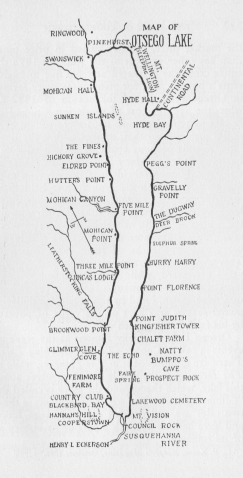
The twenty miles overland to Otsego Lake was [Pg 55]traversed during the latter part of June, 1779, the boats and stores being carried in wagons, several hundred horses having been made ready for this purpose at Canajoharie. Part of the brigade reached the lake by means of the Continental road, of which traces still remain, leading to the shore near the mouth of Shadow Brook in Hyde Bay.[40] Here they launched their fleet of bateaux and floated down the lake to their landing at the present site of Cooperstown. "This passage down the lake was made on a lovely summer's day, and the surrounding hills being covered with living green, every dash of the oar throwing up the clear, sparkling water, a thousand delighted warblers greeting them from the shores as the response of the martial music from the boats—the whole being so entirely novel—the effect must have been truly enchanting and picturesque."[41]
Apparently not all the regiments took the same route. Lieut. Erkuries Beatty, of the Fourth Pennsylvania Regiment, says in his journal[42] that "the regiment marched by Cherry Valley to the lower end of the lake," while the baggage of the detachment went to the Springfield landing, with a proper guard. From this point, himself being in the party, "we put the baggage on board boats," he says, "and proceeded to the lower end of the lake, and found the regiment there before us."
During the first week in July the entire brigade had become encamped at the foot of the lake, to remain here, as it turned out, for a period of five weeks. The present Cooper Grounds, where the Indians, long before, had planted their apple trees, and where Colonel Croghan, in 1769, had built his hut, now became the scene of a military encampment. Lieut. Beatty's journal describes the location of the various regiments in Camp Lake Otsego, as it was called. Croghan's house, which stood near the site of the present Clark Estate office, was used as a magazine, and around it was encamped a company of artillery, under Capt. Thomas Machin. Here also the stores were gathered. On the right of the artillery, facing the lake, the Fourth Pennsylvania Regiment was encamped, while on the left were the tents of Colonel Peter Gansevoort's Third New York Regiment. At the latter's rear, in the second line, was the Fifth New York, under command of Col. Lewis Dubois; behind the artillery camp lay Col. Alden's Sixth Massachusetts Regiment; and the Fourth New York, under Lieut.-Col. Weissenfels, occupied the space at the rear of the Fourth Pennsylvania. A few Oneida Indians came with Col. Alden's regiment and encamped on the banks of the lake, where "they all soon got drunk," says Beatty, "and made a terrible noise."
On the Fourth of July, which fell upon Sunday, the third anniversary of the American Independence was celebrated at Camp Lake Otsego, General Clinton "being pleased to order that all [Pg 57]troops under his command should draw a gill of rum per man, extraordinary, in memory of that happy event." The troops assembled at three o'clock in the afternoon and paraded on the bank at the south end of the lake. The brigade was drawn up in one line along the shore, with the two pieces of artillery on the right. The ceremony of the occasion is described by Lieut. van Hovenburgh as a "fudie joy."[43] A salute of thirteen guns was fired by the artillery, and three volleys from the muskets of the infantry, with three cheers from all the troops after each fire. The troops were then drawn up in a circle by columns on a little hill, and the Rev. John Gano, a Baptist minister, chaplain of the brigade, preached from Exodus xii, 14: "This day shall be unto you for a memorial ... throughout your generations." After the dismissal of the troops, Col. Rignier, the Adjutant General, gave an invitation to all the officers to come and drink grog with him in the evening. "Accordingly," says Lieut. Beatty, "a number of officers (almost all) assembled at a large Bowry which he had prepared on the bank of the lake. We sat on the ground in a large circle, and closed the day with a number of toasts suitable and a great deal of mirth for two or three hours, and then returned to our tents."
The stay at Otsego Lake seems to have been for the most part a pleasant experience. There [Pg 58]was plenty to eat. A drove of fat cattle was brought from the Mohawk valley for the use of the troops. The Sixth Massachusetts improved upon the culinary equipment of camp life by the construction of a huge oven. Lieut. McKendry writes enthusiastically of the delicious apples and cucumbers gathered near the camp.[44] Col. Rignier was a leader of fishing parties, and quantities of trout were taken from the lake to be served sizzling hot from the coals to hungry soldiers. There was much liquid refreshment, for the officers at least, which came not from lake or river. On June 28th there had been a luncheon of officers at Camp Liberty, Low's Mills (near Swanswick), greatly enlivened by the toasts that were drunk, for General Clinton had given to each officer a keg of rum containing two gallons. On July 7, Lieut. Beatty records that "all the officers of the line met this evening at the large Bower, and took a sociable drink of grog given by Col. Gansevoort's officers." This sociable drink seems to have created an appetite for more. Under date of July 8, the next day, this laconic entry appears in the journal of Lieut. McKendry: "The officers drew each one keg more of rum."
Had the journals of the officers been more confiding in their records, an intimate view of the camp life might have been disclosed to posterity. For example, judging from McKendry's journal alone, Sunday, August 1, was decorously uneventful. He has this entry:
"August 1, Sunday—Mr. Gano delivered a sermon."
Lieut. Beatty also remembers the sermon, but frankly subordinates it to other incidents of the day to which Lieut. McKendry was indifferent, or thought best not to allude. Beatty has this comment:
"August 1, Sunday—To-day at 11 o'clock the officers of the brigade met agreeable to general orders to learn the Salute with the Sword. The General's curiosity led him out to see how they saluted.
"After they were dismissed the officers formed a circle round the General and requested of him to give them a keg of rum to drink. We little expected to have the favour granted us, but we happened to take the General in one of his generous thoughts, which he is but seldom possessed of, and instead of one he gave us six. We gratefully acknowledged the favour with thanks, and immediately repaired to the cool spring[45] where we drank two of our kegs with a great deal of mirth and harmony, toasting the General frequently—and then returned to our dinners. In the afternoon Parson Gano gave us a sermon."
On the next morning at 11 o'clock the officers again assembled at the spring "to finish the remainder of our kegs," says Beatty, "which we did with the sociability we had done the day before," [Pg 60]and, he might have added, with twice as much rum.
To the troops in general rum was measured out with a more sparing hand. Their pleasures were of a simpler kind, and they seem to have contented themselves with fishing in the lake, hunting and roaming through the woods, inviting an occasional attack from stray Indians, which added the zest of adventure to the routine of camp life. One Sunday afternoon some soldiers found, concealed in a thicket of bushes and covered with bark, near one of the pickets, "a very fine chest of carpenter's tools, and some books, map, and number of papers. It is supposed," says Beatty, "that it was the property of Croghan who formerly lived here, but is now gone to the enemy. Therefore the chest is a lawful prize to the men that found it."
The five weeks at the foot of Otsego Lake were not, however, passed in idleness. The troops were drilled every day. Target practice for the musketry is recorded by the journals of officers, and a brass cannon-ball marked "J. C.," found more than a century later in the Glen road, west of the village, suggests that the artillery was also engaged in the perfecting of its marksmanship, which must have awakened strange echoes amid the hills of Otsego.
There were two incidents of camp life that were long remembered among Clinton's troops, the one a bit of comedy, the other a grim commonplace of martial law. The latter related to the discipline of deserters, to whom various degrees of punishment were meted out by court-martial. On July 20 two deserters were brought into camp, [Pg 61]and on the next day three others. The more fortunate were sentenced to be whipped. Sergeant Spears, of the Sixth Massachusetts, was tied to a tree, and the woods resounded to the blows of the lash, until one hundred strokes had fallen upon his naked back. Another soldier received five hundred lashes. Three were sentenced to be shot—Jonathan Pierce, soldier in the Sixth Massachusetts Regiment; Frederick Snyder, of the Fourth Pennsylvania; Anthony Dunnavan, of the Third New York.
On July 28, at nine o'clock in the morning, the whole brigade was ordered out on grand parade to witness the execution of the three men. The condemned deserters were required to stand, with their backs to the river, on the rise of land at the west side of the lake's outlet. The troops were drawn up facing them. A firing squad made ready.
All stood motionless, expectant, silent. It was a day that blazed with sunshine, intensely hot.[46] The air was breathless. Shore and sky were reflected, as in a mirror, from the unruffled surface of the lake. Meantime information had come to General Clinton that Dunnavan had previously deserted from the British army to join the Americans, and afterward had persuaded the two younger men to desert with him from the American forces. Clinton, manifestly glad of an excuse for leniency, pardoned Pierce and Snyder on the spot.
Concerning Dunnavan he was obdurate. "He is good for neither king nor country," exclaimed the General; "Let him be shot."
A crash of musketry, with a puff of smoke, and Dunnavan dropped. The troops marched back to camp. The deserter's body was buried in an unmarked grave.[47]
The other incident relates to some negro troops who were included in the brigade. That they might readily be distinguished the negroes wore wool hats with the brim and lower half of the crown colored black—the remainder being left drab, or the native color. A company or two of these black soldiers were included in a part of the brigade that was one day being drilled by Col. Rignier, the popular French officer, a large, well-made, jovial fellow, who was acting as Adjutant General. One of the negro soldiers, from inattention, failed to execute a command in proper time.
"Halloo!" cried the colonel, "you black son of a—wid a wite face!—why you no mind you beezness?"
This hasty exclamation in broken English so pleased the troops that a general burst of laughter followed. Seeing the men mirthful at his expense, the colonel good-humoredly gave the command to order arms.
"Now," said he, "laugh your pelly full all!"
The French colonel himself joined in the shout [Pg 63]that followed, while hill and dale echoed the boisterous merriment.[48]
Clinton's expedition is chiefly memorable in Cooperstown for the exploit by which the heavily laden bateaux, when the brigade departed for the south, were carried down the Susquehanna. The river was too shallow and narrow, in the first reaches of its course, to offer easy passage for the heavy boats, and for some distance the stream was clogged with flood-wood and fallen trees. This difficulty was overcome by building a dam at the outlet of Otsego Lake, raising its level to such a point that, when the water was released, the more than two hundred bateaux were readily guided down the swollen stream.
The preparation for this feat preceded the encampment of the brigade on the shore of the lake. On June 21, before Clinton had left Canajoharie, Colonel William Butler, who had marched his Fourth Pennsylvania Regiment over from Cherry Valley to Springfield, "ordered a party of men to the foot of the Lake to dam the same,[49] that the water might be raised to carry the boats down the Susquehanna River; Captain Benjamin Warren, of the Sixth Massachusetts Regiment, commanded the party.... The water in the Lake was raised one foot." General Clinton says "at least two," while another account claims that the surface of the lake was raised as much as three feet.
Another reference to this exploit is found in the journal of Lieut. Beatty, who says, under date of June 22, "On the lower end of the lake we found two companies of Col. Alden's (Sixth Mass.) Reg't, who had made a dam across the neck that runs out of the lake, so as to raise the water to carry the boats down the creek."
On Friday, August 6, the following conversation took place at a conference between General Clinton and Chaplain Gano:[50]
"Chaplain," said the General, "you will have your last preaching service here day after to-morrow."
"Ah indeed! Are we to march soon? Before another Sunday?"
"Yes, but I do not want the men to know it."
"Nor shall I tell them; but General, am I at liberty to preach from any text I choose?"
"Certainly, Chaplain."
"And you will not, in any event, tax me with violation of confidence?"
"No! only stick to your Bible, and I'll give the official orders."
On the following Sunday, beneath the arches of their forest cathedral, the brigade of nearly two thousand men was gathered for religious service. Chaplain Gano chose the text of the sermon from Acts xx. 7: "Ready to depart on the morrow."
Immediately on the conclusion of the religious [Pg 65]service, before the congregation had dispersed, "the general rose up," says the chaplain's record, "and ordered each captain to appoint a certain number of men out of his company to draw the boats from the lake and string them along the Susquehanna below the dam, and load them, that they might be ready to depart the next morning." At six o'clock in the evening the sluice-way was broken up, and the water filled the river, which was almost dry the day before.[51]
On Monday morning the start was made. Each of the boats was manned by three men. The light infantry and rifle corps under Colonel Butler formed an advance guard. The soldiers marched on either side of the river. Another guard of infantry marched in the rear, and in the centre of the land lines the horses and cattle were driven. "The first day," says McKendry, "the boats made thirty miles, and the troops marching each side of the river made sixteen."
The freshet caused by the sudden release of the pent-up water swelled the stream for a distance of more than a hundred miles. Campbell says that as far south as Tioga the rise in the water was great enough to flow back into the western branch, causing the Chemung River to reverse its course. The Gazetteer of New York said that the Indians upon the banks of the Susquehanna, witnessing the extraordinary rise of the river in midsummer, without any apparent cause, were struck with superstitious dread, and [Pg 66]in the very outset were disheartened at the apparent interposition of the Great Spirit in favor of their foes. Stone observes that the sudden swelling of the river, bearing upon its surge a flotilla of more than two hundred vessels, through a region of primitive forests, was a spectacle which might well appall the untutored inhabitants of the region thus invaded.
Clinton's brigade joined General Sullivan's division at Tioga Point on the 22nd of August. From this place the combined forces began a campaign of ruthless destruction against the Indians of the Genesee country. Stone says the Indians were hunted like wild beasts, their villages were burned, their corn was destroyed, their fruit trees were cut down; till neither house, nor field of corn, nor inhabitants remained in the whole country. The power of the Iroquois was gone. Homeless in their own land, the Indians marched to Niagara, where they passed the winter under the protection of the English.[52]
The Sullivan expedition had accomplished its purpose, with the loss of only forty men.
In 1788, in the digging of the cellar of William Cooper's first house, which stood on Main Street at the present entrance of the Cooper Grounds, a large iron cannon was discovered, said to have been buried by Clinton's troops. For ten or twelve years after the settlement of the place, this cannon, which came to be affectionately known as [Pg 67]"the Cricket," was the only piece of artillery used for the purposes of salutes and merrymakings in the vicinity of Cooperstown. After about fifty years of this service it burst in the cause of rejoicing on a certain Fourth of July. At the time of its final disaster (for it had met with many vicissitudes), it is said that there was no perceptible difference in size between its touchhole and its muzzle.[53]
In 1898, a building which stood in the Cooper Grounds next east of the Clark Estate office was removed, and in grading the land workmen found, just beneath the surface, the stump of a locust tree about two feet in diameter. This was about twenty-five feet east of the office building, and about the same distance from Main Street. The stump was pulled out by teams of horses, and beneath it, at a depth of about four feet from the surface, some charred material was found, and a mass of what proved to be, when cleansed of adhesions, American Army buttons of the Revolutionary period. The find was made by Charles J. Tuttle, a well-known mason and contractor of the village, and veteran of the Civil War. The buttons were of different sizes and shapes, some plated in silver, others in gold, while many were of brass. Within a short time the news of the find had spread through the village, and a troop of relic hunters gathered at the spot, but the hole had been filled up without further investigation. At the time of Clinton's encampment, in 1779, there must have been a building [Pg 68]whose cellar had been used as a storeroom for military supplies. The charred material suggests that the building was at some time burned. The locust stump tells of a tree that sprang up amid the ruins, flourished, and died, within a hundred and twenty years after the departure of Clinton's troops.
Fenimore Cooper, writing in 1838, said that traces of Clinton's dam were still to be seen. The last of the logs that remained of the old dam were removed on October 26, 1825, in connection with a curious local celebration of the opening of the Erie Canal, which on that day was the occasion of general rejoicing throughout the State of New York. Cannon, placed a few miles apart, from Buffalo to Albany, and thence to Sandy Hook, were proclaiming that Governor DeWitt Clinton, whose influence had so large a share in this great enterprise, had entered the first canal boat at Buffalo, and was on his way to New York. Since Governor Clinton was the son of General James Clinton, under whose command the dam at the outlet of Otsego Lake had been built, it seemed appropriate to the inhabitants that Cooperstown should have a celebration of its own, and could thus most auspiciously begin a project which some bold spirits then had in mind, nothing less than the construction of a Susquehanna Canal, to connect Cooperstown with the Erie Canal at the north, and with the coal fields of Pennsylvania at the south.
On this occasion the villagers gathered in Christ Church for a religious service and to hear [Pg 69]an address delivered by Samuel Starkweather, after which they marched in procession to the Red Lion Inn. Here a public banquet was served, and "after the removal of the cloth," says the contemporary account, "toasts were drunk under the discharge of cannon, most of them being succeeded by hearty cheering and animated airs from the band." The hopes which gave importance to this celebration are expressed in two of the toasts proposed, one by Henry Phinney, "The contemplated Susquehanna River Canal"; the other by Elisha Foote, "A speedy union of the pure waters of Otsego Lake with the Erie Canal."
When the company had left the table the whole village marched to the river, and assembled on the shore near the site of Clinton's dam. Boat horns, (sometimes called canal horns) about six feet long, typical of the "long ditch," were then common, and furnished blasts of martial music amid the crowd. The multitude was mustered somewhat after the order of a brigade. One company, consisting of over forty men with wheelbarrows and shovels, known as "sappers, miners and excavators," commanded by Captain William Wilson, marched with their comrades boldly to the scene of action. Lawrence McNamee, president of the day, personating Governor Clinton, threw the first shovelful of dirt. When the last remaining log of the old dam had been removed the procession marched back to the village, while the air was "rent with the huzzas of those who witnessed the first practical essay toward rendering the waters of the Susquehanna navigable for [Pg 70]the purposes of commerce," and a nine-pounder upon the top of Mount Vision, at regular intervals, told the hills and valleys around that Cooperstown was rejoicing.[54]
It is almost needless to say that the development of railway transportation put an end to this project for a canal.
On September 2, 1901, another generation of people assembled near the outlet of the lake to witness the unveiling of a marker placed by Otsego Chapter, Daughters of the American Revolution, Mrs. Isabella Scott Ernst, regent, to indicate the site and to commemorate the fame of Clinton's dam.[55] The crowd approached the bank of the Susquehanna by descending from River Street, where an arch of bunting had been erected. A large float anchored near the western bank was trimmed with flags, bunting, and vines. Directly across the river, on the eastern point of the outlet, the newly erected marker was concealed beneath the folds of an American flag. While a band played "The Stars and Stripes Forever," the spectators who lined the shore saw approaching from beneath the green foliage down the river a canoe paddled by a young man who wore the gay dress and war-paint of a Mohawk brave. Seated with him in the canoe were two little girls, attired in patriotic colors. The three in the canoe were lineal descendants of Revolutionary stock. [Pg 71]The young girls were Jennie Ordelia Mason and Fannie May Converse, both descendants of James Parshall, an orderly sergeant who was present at the building of the dam in 1779. The Indian was impersonated by F. Hamilton McGown, a descendant of John Parshall, private, a brother of James Parshall. The canoe was paddled close to the eastern shore, and the three occupants drew aside the flag which concealed the marker, amid the applause of the spectators assembled on the banks. The trio in the canoe then drifted back down the river, and were soon lost to view beyond the overhanging branches.
The marker is a large boulder placed a few feet from the eastern bank of the river at the very outlet of the lake. Surmounting the rock is a ten-inch siege mortar thirty inches in length and weighing 1971 pounds, which did service at Fort Foote, Maryland, during the Civil War. On the western side of the boulder is a bronze tablet marked by the insignia of the Daughters of the American Revolution, and bearing this inscription:
Here was built a Dam the summer
of 1779 by the Soldiers under Gen.
Clinton to enable them to join
the Forces of Gen. Sullivan
at Tioga.
Four years after Clinton's troops had made their famous journey down the Susquehanna, the site of Cooperstown was visited by the most distinguished citizen and soldier in America. For in 1783, at the conclusion of the war, George Washington, on an exploring expedition, passed a few hours at the foot of Otsego Lake. In a letter to the Marquis de Chastellux he says that he "traversed the country to the head of the eastern branch of the Susquehannah, and viewed the lake Otsego, and the portage between that lake and the Mohawk River at Canajoharie." In the same letter he says, "I am anxiously desirous to quit the walks of public life, and under my own vine and my own fig-tree to seek those enjoyments, and that relaxation, which a mind that has been continually on the stretch for more than eight years, stands so much need of."
Weary of war, and longing for some tranquil retreat from the cares of his exalted station, as he looked upon the scene which has become familiar to all lovers of Cooperstown—the peaceful lake, with verdant hills surrounding, and the Sleeping Lion at the end of the vista—the calm beauty of this view, rather than the splendid images of martial triumph, was reflected in the soul of Washington.
[36] The Old New York Frontier, pp. 148, 161, 165.
[37] The Old New York Frontier, Chapters III and IV.
[38] The Old New York Frontier, p. 197.
[39] do., p. 257.
[40] The Old New York Frontier, p. 259.
[41] History of Schoharie County, Jeptha R. Simms, 298.
[42] Sullivan's Indian Expedition, Frederick Cook, p. 19.
[43] Journal of Lieut. Rudolphus van Hovenburgh, 4th New York Reg't., Sullivan's Indian Expedition, p. 276.
[44] Sullivan's Indian Expedition, p. 201.
[45] There is a spring in the present grounds of Averell cottage; another in the grounds of the O-te-sa-ga, and a third at the foot of Nelson Avenue.
[46] Lieut. Beatty's journal.
[47] Lieut. McKendry's journal.
[48] History of Schoharie County, 299.
[49] Journal of Lieut. William McKendry, of the 6th Mass. Reg't, of which he was Quartermaster.
[50] Pathfinders of the Revolution, William Elliott Griffis, p. 95. Sullivan's Indian Expedition, p. 386.
[51] McKendry's journal.
[52] The Old New York Frontier, p. 283.
[53] Chronicles of Cooperstown.
[54] History of Cooperstown, Livermore, p. 17. The Freeman's Journal, Oct. 31, 1825.
[55] Otsego Farmer, Sept. 6, 1901.
On an autumn day in the year 1785 a solitary horseman might have been seen emerging from the forest near Otsego Lake. The old-fashioned novelist who invented the "solitary horseman" as a means of introducing a romance could not have found a better use for his favorite phrase than to describe the approach of this visitor. For with his coming the history of Cooperstown began. Following the trail from Cherry Valley, the horseman came over the hill which rises toward the east from the foot of Otsego Lake. Before descending into the vale, he dismounted and climbed a sapling, in order to gain a glimpse beyond the dense screen of intervening trees. From this elevation he looked down upon an enchanting view of glimmering waters and wooded shores. While he gazed, a deer came forth from the woods near Otsego Rock and slaked its thirst in the liquid that flamed with the reflected red and gold of autumnal foliage. The beauty of this first view always lingered in the heart of William Cooper, and the hill from which he gained it he afterward called "the Vision," in memory of his first impression. To this day the hill is known as "Mount Vision."
In a letter written some years afterwards, William Cooper thus describes his venture into this region:
In 1785 I visited the rough and hilly country of Otsego, where there existed not an inhabitant, nor any trace of a road; I was alone, three hundred miles from home, without bread, meat, or food of any kind; fire and fishing tackle were my only means of subsistence. I caught trout in the brook and roasted them in the ashes. My horse fed on the grass that grew by the edge of the waters. I laid me down to sleep in my watch coat, nothing but the melancholy Wilderness around me. In this way I explored the country, formed my plans of future settlement, and meditated upon the spot where a place of trade or a village should afterward be established.[56]
The Cooper family had settled in America in 1679, coming from Buckingham, in England, and for a century made their home in Bucks County, Pennsylvania. William Cooper was born in Byberry township, Pennsylvania, December 2, 1754. He afterward became a resident of Burlington, New Jersey, where he married Elizabeth Fenimore, daughter of Richard Fenimore, whose family came from Oxfordshire, in England.
William Cooper was associated with Andrew Craig, also of Burlington, in acquiring the title of the Otsego tract of land which Croghan had mortgaged to William Franklin, son of Benjamin Franklin, and had lost under foreclosures in 1773. In January, 1786, Cooper took possession of that [Pg 76]portion of the Croghan tract which has since been known as Cooper's patent, under a deed given by the sheriff of Montgomery county, which had been set off from Tryon county, and included the later Otsego. The patent included 29,350 acres, and cost the new proprietors, to obtain it, about fifty cents an acre. Cooper bought out his partner's share in the tract, and soon became sole owner.
It is characteristic of Cooper's energy that he began the settlement of his land in the midst of winter, and had many families resident upon it before the snow had melted, in the spring of 1786. Deeds were given to Israel Guild and several others, who, during the summer, established themselves on spots that are now within the limits of the village of Cooperstown. These places were originally intended as farms, the village having been planned to extend from the lake in a narrow strip southward, rather than across the valley, as its later growth actually determined.
Besides the blockhouse built by Croghan on a site included in the present Cooper Grounds, a log house at this period stood near the corner of Main and River streets, and was occupied by a Mrs. Johnson, a widow, who, with her family, was among the first residents. Near her home she constructed a frame house, the first to be erected in the place. It was purchased by William Ellison, a surveyor, who, during the summer of 1786, removed it to a position near the outlet of the lake, on what are now the grounds of Edgewater. The building was of good size, having two stories, and was used as a tavern until it was pulled down [Pg 77]in 1810, when Edgewater was built. In June, 1786, John Miller came, and reaching the bank of the river near the outlet on the east side, felled a large pine across the stream to answer the purpose of a bridge. The stump of this tree was for many years a relic within the grounds of Lakelands. There was a small colony of settlers during this summer, and William Cooper himself came once or twice in the course of the season; but none passed the succeeding winter within the village plot except Israel Guild, who had taken possession of the blockhouse, William Ellison at his tavern, and Mrs. Johnson in her hut of logs.
In the spring of 1787 Cooper arrived, accompanied by his wife, who came, however, only for a short visit. They reached the head of the lake in a chaise, and descended to the foot in a canoe. Mrs. Cooper felt so much alarm during this passage that she disliked returning in a boat, and the chaise was brought to the foot of the lake, astride two canoes, for her homeward journey. Mrs. Cooper's timidity occasioned the building of the first real bridge across the Susquehanna, an improvement which had already been contemplated as a public service. The road beyond the bridge was so rude, and difficult to pass, that when the chaise left the village men accompanied it with ropes, to prevent it from upsetting.
During the spring and summer of 1787 many settlers arrived, a good part of them from Connecticut; and most of the land on the patent was taken up. Several small log tenements were constructed on the site of the village, and the permanent [Pg 78]residents numbered about twenty souls. Meantime Cooper had been extending his holdings in adjacent patents, until he had the settlement of a large part of the present county more or less subject to his control. In other parts of the State also he came to own or control large areas of land, until, toward the end of his life, he had "settled more acres than any man in America."
Early in 1788, Cooper erected a house for his own residence. Aside from the log huts it was the second dwelling erected in the place. It stood on Main Street at the present entrance of the [Pg 79]Cooper Grounds, looking down Fair Street, and commanding a view of the full length of the lake. The building was of two stories, with two wings. It is represented on the original map of the village, where it is marked "Manor House." This house was removed a short distance down the street in 1799, on the completion of Otsego Hall, William Cooper's second residence in Cooperstown, and was destroyed by fire in 1812.
In 1788 John Howard came, and established a tannery on the north side of Lake Street west of Pioneer Street, near the waters of Willow Brook, which there gurgles to the lake. Howard, who was distinguished as the father of the first child born in the settlement, afterward became captain of the local militia, and is commemorated as a hero in Christ churchyard, where his epitaph recites that he was drowned, July 13, 1799:
It was in the summer of 1788 that William Cooper made a definite plan for the village. Three streets were laid out running south from the lake, and six streets that crossed them at right angles. The street along the margin of the lake was called Front Street (now Lake Street), and the others parallel to it were numbered from Second (the present Main Street) up to Sixth. Of the streets running south, that next to the river was called Water Street (now River Street), and that at the opposite side of the plot, West Street, [Pg 80]which is the present Pioneer Street. The parallel street between these two was divided by the Cooper Grounds; the section near the lake was called Fair Street, while south of the Cooper Grounds it was known as Main Street. This last never gained the importance which its name seemed to demand, and is now known as part of Fair Street. The map showing the original plan of the village is dated September 26, 1788.
Aside from the Foot of the Lake, as the settlement was sometimes called, it was known as Cooperton, and Cooperstown,[57] until 1791, when the latter name came into general use, on the designation of this village as the county seat of the newly created Otsego county.
The settlers upon Cooper's tract were mostly poor people, and it happened that their first efforts were followed by a season of dearth. In the winter of 1788-9, grain rose in Albany to a price before unknown. The demand swept all the granaries of the Mohawk country, and a famine aggravated the privations of the Otsego settlers. In the month of April, Cooper arrived with several loads of provisions intended for his own use and that of the laborers he had brought with him; but in a few days all was gone, and there remained not one pound of salt meat, nor a single biscuit. Many were reduced to such distress as to live upon the root of wild leeks; some, more fortunate, lived upon milk, whilst others found nourishment [Pg 81]in a syrup made of maple sugar and water. The quantity of leeks eaten by the people had such an effect upon their breath that they could be smelled at many paces distant, and when they came together there was an odor as from cattle that had been pastured in a field of garlic. "Judge of my feelings at this epoch," wrote Cooper, "with two hundred families about me, and not a morsel of bread."
"A singular event seemed sent by a good Providence to our relief," Cooper's letter continues; "it was reported to me that unusual shoals of fish were seen moving in the clear waters of the Susquehanna. I went, and was surprised to find that they were herrings. We made something like a small net, by the interweaving of twigs, and by this rude and simple contrivance we were able to take them in thousands. In less than ten days each family had an ample supply, with plenty of salt. I also obtained from the Legislature, then in session, seventeen hundred bushels of corn."
Those who settled the first farms in the Otsego region had not the means of clearing more than a small spot in the midst of thick and lofty woods, so that their grain grew chiefly in the shade; their maize did not ripen; their wheat was blasted; and for the grinding of what little they gathered there was no mill within twenty miles, while few were owners of horses. Some walked to the mill at Canajoharie, twenty-five miles away, carrying their grist on their shoulders.
William Cooper, after coming to live here, realized that the situation of the settlers was [Pg 82]precarious. He brought a stock of goods to the new settlement, and established a general store under Richard R. Smith, son of the Richard Smith who had visited Croghan at Otsego Lake twenty years before. Cooper also erected a storehouse, and filled it with large quantities of grain purchased at distant places. He borrowed potash kettles, which he brought here, and established potash works among the inhabitants. He obtained on credit a large number of sugar kettles. By these means he was able to exchange provisions and tools for the labor of the settlers, giving them credit for their maple sugar and potash, until in the first year he had collected in one mass forty-three hogsheads of sugar, and three hundred barrels of pot and pearl ash, worth about nine thousand dollars. These industries held the colonists together.
Cooper collected the people at convenient seasons, and under his leadership they constructed such roads and bridges as were then suited to their purposes. Perhaps it was at this time that Cooper devised the cunning method which he afterward confided to William Sampson: "A few quarts of liquor, cheerfully bestowed, will open a road, or build a bridge, which would cost, if done by contract, hundreds of dollars."
In 1789 Cooper set up at his newly finished Manor House a frontier establishment that became famous for its hospitality. For a year before bringing his family from Burlington he kept bachelor's hall, and the festive joys of the place were long memorable among all lovers of [Pg 83]good cheer. Shipman, the Leather-Stocking of the region, could at almost any time furnish the table with a saddle of venison; the lake abounded with the most delicious fish; while the cellar of the Manor House was stored with the imprisoned sunshine of distant lands.
At Christmastide, in 1789, a house-party entertained by William Cooper celebrated the season with high revelry. Among the guests was Colonel Hendrik Frey, the boniface of Canajoharie, a famous fun-lover and merrymaker. A large lumber sleigh was fitted out, with four horses, and the whole party sallied forth for a morning drive upon the frozen lake. On the western bank of the lake resided, quite alone, a Frenchman known as Monsieur Ebbal, a former officer of the army of France, whose real title was said to be L'Abbe de Raffcourt.[58] Perceiving the sleigh and four nearing his house, this gentleman, with the courtesy of his nation, went forth upon the ice to greet the party in a manner befitting the pomp of its approach. Cooper cordially invited the Frenchman to join him, promising him plenty of game, with copious libations of Madeira, by way of inducement. Though a good table companion in general, no persuasion could prevail on M. Ebbal to accept this sudden invitation, until, provoked by his obstinacy, the party laid violent [Pg 84]hands on him, and brought him to the village by force.
The unwilling guest took his captivity in good part, and was soon as buoyant and gay as any of his companions. He habitually wore a long-skirted surtout, or overcoat, which at that time was almost the mark of a Frenchman, and this he pertinaciously refused to lay aside, even when he took his seat at table. On the contrary, he kept it buttoned to the very throat, as if in defiance of his captors. The Christmas joke, a plentiful board, and heavy potations, however, threw the guest off his guard. Warmed with wine and the blazing fire of logs, he incautiously unbuttoned; when his delighted companions discovered that the accidents of the frontier, the establishment of a bachelor who kept no servant, and certain irregularities in washing days, together with the sudden abduction of his person, had induced the gallant Frenchman to come abroad without his shirt. He was uncased on the spot, amid the shouts of the merrymakers, and incontinently put into linen. "Cooper was so polite," added the mirth-loving Hendrik Frey, as he used to tell the story for many years afterward, "that he supplied a shirt with ruffles at the wristbands, which made Ebbal very happy for the rest of the night. Mein Gott, how his hands did go, after he got the ruffles!"[59]
In the summer of 1790 the house at the northwest corner of Main and River streets was erected [Pg 85]by Benjamin Griffin. It now survives as the oldest house in the village. Not long after its erection the house became the residence of the Rev. John Frederick Ernst, the Lutheran minister who came here in connection with the work of the projected seminary at Hartwick; and for many years the old cottage was the homestead of the Ernst family.[60]
In this year William Cooper decided to give up his residence in New Jersey, and to bring his family to Cooperstown for their permanent home. Accordingly he returned to Burlington, and early in the autumn completed arrangements for the transportation of his family and belongings to Otsego. Only in one quarter did he find any opposition to his project, but that opposition was [Pg 87]serious. His wife positively refused to go.
Three years before, Mrs. Cooper had had a brief experience of the new settlement. She remembered the tippy boat, the rough pioneers, and the carriage that had to be steadied with ropes as it careened through the woods. In Burlington there was a well-established society, congenial friends, an atmosphere of culture, and such comforts as civilization was then able to afford. Mrs. Cooper had no mind to exchange her residence in Burlington for the wild uncertainties of life in the wilderness; and so with the conveyance ready and waiting at the door, and with her husband pleading, she sat firmly in the chair at the desk in the library of her Burlington home, and positively refused to budge.
Mrs. Cooper was a strong-minded woman, but William Cooper was a stronger-minded man. He seized the chair, with his wife seated in it, and putting her aboard the wagon, chair and all, began the long journey to Otsego. Thus William Cooper carried his point, while his wife also carried hers, for she travelled the whole distance in the chair from which she vowed she would not move. The chair itself, sacred to the memory of two strong minds, is still in use in the Cooper family.
This journey had much to do with the shaping of another mind which was not at the time consulted or considered. For Mrs. Cooper brought with her the baby boy of the household, thirteen months old, whose whole life, because of this change of residence, was cast in a new mould. This child was called James, but in later years [Pg 88]he adopted also his mother's family name, so that he honored both father and mother in the fame which he gave to the name of James Fenimore Cooper. All his first impressions, he said long afterward, were obtained in the Otsego region. It is to be doubted whether Fenimore Cooper would have gained such wide celebrity as a novelist if he had not discovered the unique field of romance which the lake and hills of Otsego began to open to his vision. Had Fenimore Cooper remained in Burlington he might have written good novels, but not The Leather-Stocking Tales, for which he is most renowned. So that when William Cooper took up his residence in Otsego, he not only became the founder of a town, but he brought to the town the founder of American romance.
[56] A Guide in the Wilderness, a series of letters to William Sampson, published in Dublin, 1810, reprinted by James Fenimore Cooper, grandson of the novelist, 1897.
[57] The names "Cooper" and "Cooperstown" are pronounced by the Cooper family and by natives of the village with a short oo, as in the word book, not as in moon.
[58] Ebbal is L'Abbe, spelled backward. His last years were spent near New Berlin, beside a lonely waterfall, where he had a flower garden, and kept bees. His grave was four miles south of New Berlin, until relatives came and removed his remains to France.
[59] The account of this incident is quoted from Fenimore Cooper's Chronicles of Cooperstown.
[60] In his Chronicles of Cooperstown, (1838), Fenimore Cooper says, "The house standing at the southeast corner of Second and Water streets, [now called Main and River street], and which for the last forty years has belonged to the Ernst family, was erected this summer [1790] by Mr. Benjamin Griffin. It is now the second oldest house in the village." Cooper had already referred to the house of Israel Guild, erected in 1788, as the oldest house standing in the village (in 1838). Guild's house was burned in the fire of 1862, and therefore the house erected by Griffin has been, ever since that time, the oldest house. By some inadvertence, Cooper incorrectly designated the location of the Griffin house. He placed it at the southeast corner of Main and River streets, when he meant to say northwest. That Cooper writing of what was perfectly familiar to him, should have overlooked so palpable an error, seems most improbable; yet that he did so is now beyond doubt, although for many years his authority was cited to disprove the claims of the oldest house in Cooperstown. At the time of Cooper's writing, the house standing nearest to the southeast corner of Main and River streets, afterward torn down, had been built by Richard Cooper, and never had belonged to the Ernst family. Furthermore, in a letter dated May 23, 1805, Rev. John Frederick Ernst, in reply to an inquiry concerning the location of his property in Cooperstown, wrote to his son—"Here is a copy from the deed: 'The house-lot—being the northwest corner of Water Street and Second Street, is seventy-five feet front on the said streets, and seventy-five feet in rear on the west and north by [then] vacant lots, belonging [then both] to Wm. Cooper, Esq.'" It is clear that this is the same property which Fenimore Cooper, by some slip, described as being at the southeast corner. Some of the earlier charts of Cooperstown were drawn with the lake front at the bottom of the map, for convenience of reference, thus reversing the north and south of the usual cartography. It may plausibly be conjectured that Cooper had one of these maps before him as he wrote, and unthinkingly recorded, in this instance, its transposed points of the compass. This labored exposition of a small matter would be an inexcusable pedantry, except that the location of the oldest house in the village is of particular interest.
The county of Otsego was formed February 16, 1791, being carved out of Montgomery county. Cooperstown was designated as the county seat, and William Cooper was appointed the first judge of the county court. A court-house and jail was built at the southeast corner of Main and Pioneer streets, the lower story, of logs, being used as a prison, and the upper story, of framed work, as court room. A tavern was erected on the same lot, and contained the jury rooms, conveniently near to the sources of refreshment.
During the summer of this year the Red Lion Tavern[61] was erected at the southwest corner of Main and Pioneer streets, and was kept by Major Joseph Griffin. It projected more than half way across Main Street, and at that time marked the western limit of the village. For more than three score years and ten, even after the village grew westward beyond it, this projecting building gave a unique character to the main street, intercepted all thirsty wayfarers, and held an important place [Pg 90]in the life of the community. Its first crude sign, representing a red lion rampant, was painted by Richard R. Smith,[62] the first storekeeper of the village, and first sheriff of the county.
Judge Cooper was the lord of the manor, as it were, in the new community, yet maintained a relation of comradeship with the settlers. Enjoying the friendship of some of the most eminent men of his time, himself superior in intelligence and culture to most of his local contemporaries, Cooper had qualities that won the affection and loyalty of the sturdy pioneers. It is characteristic of him that he once offered a lot, consisting of one hundred and fifty acres of land, to any man on the patent who could throw him in a wrestling match. The wrestling took place in front of the Red Lion Inn. One contestant was finally successful, and the land was duly conveyed to the victor. It is possible that some of the lots owned by Judge Cooper were of no great value, for it is related that when his eldest son was showing the sights of New York to the youngster of the family he took him to a pasty shop, and after watching the boy eat pasty after pasty said, "Jim, eat all you want, but remember that each one costs the old man a lot."
Some idea of the position that the "old man" occupied in the village which he founded may be gained from the novel that the eater of the pasties afterward entitled The Pioneers. In this book, [Pg 91]while historical accuracy is disclaimed, Judge Temple is easily identified as an idealized Judge Cooper, and a faithful picture of life in the early village may be recognized; for, as the author says in his introduction, while the incidents of the tale are purely fiction, "the literal facts are chiefly connected with the natural and artificial objects, and the customs of the inhabitants." The village of Templeton, in the novel, is the Cooperstown of [Pg 92]reality in its early days. The spirit of the times, and the character of the men who lived here are thus distinctly reflected in the placid current of Fenimore Cooper's first Leather-Stocking tale. At the present day the personal appearance of Judge Cooper himself is vividly recalled from the past through the existence of three portraits, one by Gilbert Stuart, one by Copley, and a third by an unknown artist. From these likenesses one gains an impression of his kindly gray eye, firm countenance, and robust figure. His keen sense of humor relieved the strain of many a hardship in the life of the frontier, for he is remembered as "noble-looking, warm-hearted, and witty, with a deep laugh, sweet voice, and fine rich eye, as he used to lighten the way with his anecdotes and fun."
During the twenty-five years that followed the close of the Revolutionary War, Judge Cooper was a speculator in lands on a large scale, and was steadily engaged in the settlement of the tracts which he owned and those in which he had a joint interest with others. His judgment concerning land values was keen and far-sighted. That he was not infallible is shown by his payment of ten dollars an acre for land in the North Woods which is hardly worth a quarter of that price to-day. On the other hand, in February, 1803, he bought the town of De Kalb, in St. Lawrence county, about 64,000 acres, for the sum of $62,720, and within three months had sold 56,886 acres for $112,226. It was for successful ventures of this sort that Judge Cooper became widely known, and was brought into [Pg 93]correspondence with foreign investors, such as Necker and Madame de Staël, who appear to have become owners of lands, through Cooper, in the northern counties of New York.
Much of Cooper's success in the settlement of new lands was owing to his system of selling to settlers on the installment plan, instead of binding tenants to the payment of perpetual rent, as some proprietors of great estates attempted to do, involving endless litigation and the "anti-rent war."
Judge Cooper's friendly relation to the settlers extended, in many instances, to the relief of individual needs by loans of money, which was not always repaid. One of the French settlers, often a guest at Judge Cooper's house, borrowed of him fifty dollars. As time went on Judge Cooper noticed that his debtor's visits became less and less frequent, until finally they ceased. Meeting the man one day, he remonstrated with him, telling him that so small a matter should not cause him annoyance, and urging him not to allow it to interfere with his visits at the Cooper homestead. The Frenchman, however, felt that the fifty dollars weighed heavily on his honor, and that he could not partake of the Judge's hospitality until the debt was paid. Not long afterward Judge Cooper saw his debtor approaching him with every manifestation of joy, waving his hat, and shouting, "Judge Cooper! Judge Cooper! My mother is dead! My mother is dead! I pay you the fifty dollars."
Before the close of his career Judge Cooper had amassed a large fortune. After having been [Pg 94]engaged for twenty years in the improvement of lands he declared that the work which he had undertaken for the sole purpose of promoting his interest had become fastened upon him by habit, and remained as the principal source of his pleasure and recreation. Within this period the settlement which he began at Otsego Lake reached a high degree of prosperity. "This was the first settlement I made," writes Judge Cooper, "and the first attempted after the Revolution; it was, of course, attended with the greatest difficulties; nevertheless, to its success many others have owed their origin."
Judge Cooper's political career reflects another aspect of pioneer life in the new settlements. Besides his election as first judge of the Court of Common Pleas of Otsego county, an office which he held from 1791 to 1800, he was elected to Congress in 1795, and again in 1799. The Otsego Herald of June 23, 1796, describes the reception given by the people of the village to Judge Cooper on his return from Congress. When it was known that his carriage was nearing the village, a mounted escort went forth to meet him on the road that skirted Mount Vision, and when the procession crossed the bridge and entered the main street it passed through "a double row of citizens" assembled to greet the congressman, while "sixteen cannon" roared a welcome.
Judge Cooper was a prominent member of the Federalist party, and devoted much of his time to its cause. He was on intimate terms with its leaders, and in constant correspondence with many [Pg 95]of them. Although the franchise, at this period, was restricted by a property qualification, and the voters were comparatively few, the interest in politics entered largely into the life of all the inhabitants, and the political enthusiasm was unlimited. The polls could be kept open five days, to accommodate all who desired to vote, and as there was no secret ballot the excitement during elections was constant and intense. Nearly every elector seems to have been a politician, and the letters of the time are full of politics and party animosity. The shout of battle still resounds in the title of a little book published by Elihu Phinney in 1796: "The Political Wars of Otsego: or, Downfall of Jacobinism and Despotism; Being a Collection of Pieces, lately published in the Otsego Herald. To which is added, an Address to the Citizens of the United States; and extracts from Jack Tar's Journals, kept on board the ship Liberty, containing a summary account of her Origin, Builders, Materials, Use—and her Dangerous Voyage from the lowlands of Cape Monarchy to the Port of Free Representative Government. By the author of the Plough-Jogger."[63]
In the political correspondence of Judge Cooper and his contemporaries there are frequent complaints of fraud, and of the influence and prominence of foreigners, especially the Irish, with grave expressions of fear for the future of the country and the stability of property. The Federalists describe themselves as "friends of order," [Pg 96]and refer to their opponents as "anti-Christians," and "enemies of the country." One of Judge Cooper's friends who had removed to Philadelphia writes: "We are busy about electing a senator in the state legislature. The contest is between B. R. M.——, a gentleman, and consequently a Federalist, and a dirty stinking anti-federal Jew tavern-keeper called I. I——. But, Judge, the friends to order here don't understand the business, they are uniformly beaten, we used to order these things better at Cooperstown."
It is evident that Judge Cooper had gained some reputation for his skill in electioneering in Otsego county. Philip Schuyler, writing to Judge Cooper of the election of 1791, says: "I believe fasting and prayer to be good, but if you had only fasted and prayed I am sure we should not have had seven hundred votes from your country—report says that you was very civil to the young and handsome of the sex, that you flattered the old and ugly, and even embraced the toothless and decrepid, in order to obtain votes. When will you write a treatise on electioneering? Whenever you do, afford only a few copies to your friends."
Judge Cooper's chief political opponent in the county was Jedediah Peck, who settled in Burlington, Otsego county, in 1790, a man of an entirely different type from Judge Cooper, yet equally famous in the political life of the times. Coarse and uneducated, Peck overcame all disadvantages by his shrewdness, intellectual power, [Pg 97]and great natural ability. He gained much influence with the people of the county by his homely skill as a traveling preacher, going about distributing tracts, and preaching wherever he could gather an audience. He was an aggressive supporter of the political views and administrative policies of Thomas Jefferson, and violently antagonized the Federalists of the county, who were under the leadership of Judge Cooper. This opposition culminated during the administration of President Adams in 1798, when Peck was arrested under the Alien and Sedition Act for circulating petitions against that Act. He was indicted and taken to New York in irons, but was never brought to trial, and upon the repeal of the Act was discharged. Peck's arrest and imprisonment fastened attention upon him, and, together with his continued denunciation of the federal administration, made him the recognized leader of the Republican (Jeffersonian) party of Otsego county, so that he dictated its policy and nominations for many years thereafter. Indeed, the overthrow of the Federal party in this State, with the consequent success of Jefferson in the presidential canvass, is attributed to the excitement and indignation aroused by the spectacle of this little dried up man, one-eyed but kindly in expression and venerable, a veteran of the Revolutionary War, being transported through the State in the custody of federal officials, and manacled, the latter an unnecessary and outrageous indignity.
Jedediah Peck was a member of Assembly [Pg 98]from 1798 to 1804, and State Senator until 1808. Although looked up to by multitudes as the political leader of his time, Peck was noted at Albany for his shabbiness of dress. He wore coarse boots, which he never blackened. On one occasion, on the eve of an important debate, some wag at the tavern blackened one of Peck's boots. Peck, in dressing for the fray, did not recognize the shining boot, and having put on one began to search high and low for the other. At last, enlightened by the laughter of his comrades, he drew on the polished boot, and with his feet thus ill-matched strode into the Assembly chamber, where he delivered one of his most powerful speeches.
For many years Jedediah Peck unsuccessfully urged a bill for the abolition of imprisonment for debt, which was later adopted. His most permanent and valuable contribution to the welfare of posterity was the scheme for the common school system of the State, which he had long advocated, and of which, as chairman of the five commissioners appointed by the Governor in 1811, he became the author.[64]
Some of the asperities of political life in the early days of Otsego county may be inferred from certain affidavits, printed copies of which, such as were apparently used as campaign documents, were found among Judge Cooper's papers, endorsed in his handwriting, "Oath how I whipped Cochran." The Cochran referred to was a political opponent.
Jessie Hyde, of the town of Warren, being duly sworn, saith, that on the sixteenth day of October in the year 1799, he this deponent, did see James Cochran make an assault upon one William Cooper in the public highway. That the said William Cooper defended himself, and in the struggle Mr. Cochran, in a submissive manner, requested of Judge Cooper to let him go.
Sworn this sixteenth day of
October, 1799, before me
Richard Edwards, Master in Chancery
Otsego County. SS.
Personally appeared Stephen Ingalls, one of the constables of the town of Otsego, and being duly sworn, deposeth and saith, that he was present at the close of a bruising match between James Cochran Esq., and William Cooper Esq., on or about the sixteenth of October last, when the said James Cochran confessed to the said William Cooper these words: "I acknowledge you are too much of a buffer for me," at which time it was understood, as this deponent conceives, that Cochran was confessedly beaten.
Sworn before me this
sixth day of November, 1799,
Joshua Dewey, Justice of the Peace.
The same incident, viewed from another angle, appears in a letter written by the Rev. John Frederick Ernst to his son in Albany, and dated at Cooperstown, October 20, 1799.
"There is nothing of any particular news here, except that a Mr. Cochran, late member of Congress, in whose place I. Cooper is now elected, came here last week, and [Pg 100]on one of the court-days, with a great deal of brass had the impertinence to assault our honorable Wm. Cooper in the street, & to give him a Cowskinning—because, as it is reported, he should have told lies about Cochran. As both fell a clinging & beating one another Mr. Mason stepped between and parted them."
Still another account of the episode is given by Levi Beardsley. He says that the trouble arose over Cochran's use of his fiddle during a political campaign. Cochran stayed over night at Canandaigua, and when a dance was got up, he obliged and amused the company by fiddling for them. He beat Judge Cooper at the election for Congress, but whether from the influence of music and dancing it is now too late to inquire. However, it was alleged that Judge Cooper had either published or remarked that Cochran had been through the district with his violin, and had fiddled himself into office. This came to Cochran's ear and brought him from Montgomery county to Cooperstown. He came on horseback, and arrived while Judge Cooper was presiding as judge of the court of common pleas. As Cooper issued from the court house, Cochran met him, and after alluding to the election, informed the Judge that he had come from the Mohawk to chastise him for the insult. When Cooper remarked that Cochran could not be in earnest the latter replied by a cut with his cowskin. Cooper then closed with his adversary, but Cochran being a large, strong man they were pretty well matched for the scuffle. They were separated by friends, and Cochran was [Pg 101]afterward fined a small amount for breach of the peace.[65]
At the early organization of the county there was considerable strife between Cooperstown and Cherry Valley in regard to the location of public buildings. It is said that Judge Cooper playfully remarked that the court house should be placed in Cooperstown, the jail in Newtown Martin (Middlefield), and the gallows in Cherry Valley.[66]
When Judge Cooper began holding court in Cooperstown in 1791 a number of lawyers were attracted to the county seat, the first to take up residence here being Abraham Ten Broeck of New Jersey, soon followed by Jacob G. Fonda of Schenectady. Ten Broeck was the original of Van der School, the parenthetical lawyer in The Pioneers, his compositions having been remarkable for parentheses. A year later two others of the legal profession were added to the village community, Joseph Strong, and Moss Kent, brother of the celebrated Chancellor Kent. Dr. Nathaniel Gott and Dr. Farnsworth coming at about the same time gave the villagers a choice among three physicians, Dr. Thomas Fuller being the senior in practice. The development of Cooperstown as a trading centre brought Peter Ten Broeck and several other merchants here in 1791, followed shortly afterward by Rensselaer Williams and Richard Williams of New Jersey, whose collateral descendants are still identified with the village.
The early shopkeepers of Cooperstown included some who had been engaged in more distinguished callings. A merchant who excited the most lively curiosity among the settlers was a Frenchman known as Mr. Le Quoy who kept a small grocery store in the village, and seemed to be altogether superior to such an occupation. After much speculation concerning his past the village was set agog by an incident which accidentally brought to light the story of his career. Among the early settlers in Otsego county was a French gentleman named Louis de Villers, who, in 1793, happened to be in Cooperstown at a time when a fellow countryman named Renouard, who afterward settled in the county, had recently reached the place. Renouard, who was a seaman, and an incessant user of tobacco, found himself out of his favorite weed, and his first concern was to inquire of de Villers where tobacco might be purchased in the village. De Villers directed him to the shop kept by Le Quoy, saying that he would help a compatriot by making his purchase there. In a few minutes Renouard returned from the shop, pale and agitated.
"What is it? Are you unwell?" inquired de Villers.
"In the name of God," burst out Renouard, "who is the man that sold me this tobacco?"
"Mr. Le Quoy, a countryman of ours."
"Yes, Mr. Le Quoy de Mersereau."
"I know nothing about the 'de Mersereau'; he calls himself Le Quoy. Do you know anything of him?"
"When I went to Martinique to be port captain of St. Pierre," answered Renouard, "this man was the civil governor of the island, and refused to confirm my appointment."
Subsequent inquiry confirmed this story, Le Quoy explaining that the influence of a lady stood in the way of Renouard's preferment. Le Quoy had been driven from Martinique by the French Revolution, and his choice of Cooperstown as a retreat came about through a friendly office which he had performed, while governor of the island, in liberating one of the ships of John Murray & Sons of New York. The act brought about an exchange of civilities between the head of this firm and Le Quoy, so that when the latter came to New York, desiring to invest in a country store until his fortunes should revive, Murray referred him to his friend Judge Cooper, under whose advice the Frenchman established himself in Cooperstown. He at length made his peace with the new French government, and, closing his grocery in Cooperstown, was ultimately restored to his office as civil governor of Martinique.[67] He appears as one of the characters in Fenimore Cooper's novel, The Pioneers.
The house on Lake Street known as Averell Cottage was erected in 1793, the central part of it, with chimneys at each end, constituting the original structure. It has ever since been in possession of lineal descendants of the first owner, James Averell, Jr. James Averell settled on the patent in 1787, and in 1792 exchanged his farm [Pg 104]for John Howard's tannery on Lake Street just west of Pioneer Street.
In 1794 a state road was laid out between Albany and Cooperstown. This road came over Mount Vision and descended toward the village by a route that may still be traced down the hillside from Prospect Rock. Cooperstown was then first included in a post route, and a post office was opened in the village, with Joseph Griffin as postmaster. The mail arrived weekly for some years; it then came twice a week; then thrice. The daily mail was not established until 1821.
The arrival of the mail was something of a ceremony in the early days of Cooperstown. [Pg 105]Toward evening the sound of the postman's horn was faintly heard as he rounded the slopes of Mount Vision; the blasts grew louder as he descended the hill and approached the village; then the thunder of the four post-horses as they crossed the bridge was heard, and the postman drew up with a flourish at the post office, where the villagers had gathered to await the news of the outer world. The Otsego Herald publishes a letter from an indignant citizen, complaining that the mails were opened in a bar-room. Since the first postmaster was also a tavern keeper, the charge was probably true.
Among the new houses built in 1796 was one that has survived to the present time, and stands on Main Street adjoining the Second National Bank on the east. This house, distinguished for the quaint beauty of its doorway, was first occupied by Rensselaer and Richard Williams. At about this time the Academy was erected on the hill at the corner of Pioneer and Church streets, where the Universalist church now stands. It was "65-1/2 feet long, 32 wide, and 25 feet posts," while the summit of its belfry was seventy feet high. It was erected by public subscription, at a cost of about $1,450. "It was one of those tasteless buildings that afflict all new countries," says Fenimore Cooper, "and contained two school rooms below, a passage and the stairs; while the upper story was in a single room."
The first school in the village had been opened a year or two earlier by Joshua Dewey, a graduate of Yale, who taught Fenimore Cooper his [Pg 106]A B C's. He was succeeded as village schoolmaster by Oliver Cory. The latter assumed charge of the new Academy. The school exhibitions of this institution in which Brutus and Cassius figured in hats of the cut of 1776, blue coats faced with red, of no cut at all, and matross swords, were long afterward the subject of mirth in the village. Fenimore Cooper, at one time a pupil in the Academy, took part in a school exhibition, and at the age of eight years became the pride of Master Cory for his moving recitation of the "Beggar's Petition"—acting the part of an old man wrapped in a faded cloak and leaning on his staff.
A reminiscence of old Academy days is connected with the first considerable musical instrument in the village. Judge Cooper had brought from Philadelphia a large mechanical organ of imposing appearance, which he placed in the hall of the Manor House. When the organ was first put up and adjusted a rehearsal of country dances, reels, and more serious music, was enjoyed not only by the family gathered to hear it, but the loud tones floated from the windows and into the school room of the Academy in the next street. As the strains of Hail Columbia poured into the school room, Master Cory skillfully met a moment of open rebellion with these words: "Boys, that organ is a remarkable instrument. You never heard the like of it before. I give you half an hour's intermission. Go into the street and listen to the music."[68]
The Academy, containing at that time the largest room in the village, was as much used for other purposes as for those of education. The court, on great occasions, was sometimes held here. It was used impartially for religious meetings and for balls. The Free Masons of the village, who had secured a charter for Otsego Lodge in 1795, held a religious service, followed by dinner, and a ball, in the Academy, on the Feast of St. John the Evangelist, December 27, 1796. Of this occasion Jacob Morris writes, "The brilliancy exhibited at Cooperstown last Tuesday—the Masonic festival—was the admiration and astonishment of all beholders. Upwards of eighty people sat down to one table—some very excellent toasts were drunk and the greatest decency and decorum was observed.... In the evening we had a splendid ball, sixty couple, thirty in a set, both sets on the floor at the same time, pleasant manners and good dancing."
A centre of convivial resort at this period was the Blue Anchor tavern, which was established as a rival of the Red Lion inn, and diagonally across the way from it, at the northeast corner of Main and Pioneer streets. The Blue Anchor, according to Fenimore Cooper, was for many years in much request "among all the genteeler portion of the travelers." Its host was William Cook, from whom the character of Ben Pump, in The Pioneers, was drawn, a man of singular humors, great heartiness of character, and perfect integrity. He had been the steward of an English East-Indianman, and enjoyed an enviable reputation [Pg 108]in the village for his skill in mixing punch and flip. On holidays, a stranger would have been apt to mistake him for one of the magnates of the land, as he invariably appeared in a drab coat of the style of 1776 with buttons as large as dollars, breeches, striped stockings, buckles that covered half his foot, and a cocked hat large enough to extinguish him. The landlord of the Blue Anchor was a general favorite; his laugh and his pious oaths became famous.
In 1796 Judge Cooper commenced the construction of his new residence, Otsego Hall, which he completed and began to occupy, in June, 1799. The new house stood near the centre of what are now known as the Cooper Grounds, on the site marked by the statue of the Indian Hunter. Otsego Hall was for many years the largest private residence in the newer parts of the State, and remained as the finest building in the village until it was destroyed by fire in 1852. It is said to have been originally of the exact proportions of the van Rensselaer Manor House at Albany, where Judge Cooper was a frequent visitor.
On one occasion, in early days, when Judge Cooper was away from home, fire broke out in the Hall, and an alarm given by the neighbors brought the volunteer fire department to the scene. Mrs. Cooper firmly took charge of the situation. Locking the doors of the house she called out to the servants, "You look out for the fire, and I'll attend to the fire department!" With this she poured hot water from a second-story window upon the firemen, and quickly drove them away.
[61] "The Bold Dragoon" of Fenimore Cooper's novel, The Pioneers.
[62] The original of Richard Jones, in The Pioneers.
[63] Plough-Jogger was the pseudonym of Jedediah Peck.
[64] Address at Cooperstown Centennial, Walter H. Bunn.
[65] Reminiscences, Levi Beardsley, p. 89.
[66] Beardsley's Reminiscences.
[67] Chronicles of Cooperstown.
[68] James Fenimore Cooper, Mary E. Phillips, p. 26. The organ is now at Fynmere.
Enough has been recorded to show the general character of Cooperstown as it existed at the close of the eighteenth century. A more intimate view of its life at this period is suggested by a package of faded letters, some of which are here printed, not as supplying historical data, for in this they are quite lacking, but because whoever reads them with imagination begins to breathe the atmosphere of the time of their writing, and in the charm of their feminine confidences discovers a side of frontier life that is not otherwise revealed.
The letters were written to Chloe Fuller, who visited in Cooperstown for some years at the home of Dr. Thomas Fuller. The doctor's wife before her marriage, although not related to him, had the same family name, and Chloe Fuller was her younger sister. Chloe Fuller became celebrated as a village belle, and it was said that she had more beaus in constant attendance than any other girl in Otsego. Dr. Fuller was a favorite with two generations of young men in the village, for he had also two young daughters, who, a few years later, became noted for their qualities of [Pg 110]mind and daintiness of apparel. Eliza and Emma Fuller were blue-stockings who knew the value of pretty bonnets and gowns. In the early days of the Presbyterian church, the sabbath splendor of their entrance at divine service, always a little late, and with the necessity of being ushered to the very front pew, divided the devotion of the worshippers. Eliza Fuller became the wife of Judge Morehouse, and established the traditional hospitality of Woodside Hall.
Chloe Fuller married Trumbull Dorrance, a descendant of Governor Jonathan Trumbull of Connecticut, and her daughter, becoming the wife [Pg 111]of John R. Worthington, was long identified with Cooperstown as mistress of the White House, the Worthington homestead built in 1802 on Main street. The letters belong to the period of Chloe Fuller's girlhood:
ELIZA MACDONALD TO CHLOE FULLER.
Albany, November 20th, 1798.
Believe me, my very dear Friend, that your letter by Mr. Williams afforded me great pleasure in the perusal, and it should most undoubtedly have been answered 'ere now had not I been deprived of opportunities; and at all events I must write by the good Man! I think the epithet you bestowed a very judicious one—but I really believe, Chloe, you have made a conquest there—when he delivered me your letter, 'It is from Miss Chloe,' said he with a (methought) significant smile.
I have been well ever since my departure. Now and then the involuntary sigh escapes when my imagination presents me Cooperstown, and some of its dear inhabitants! I already long to see you all. Oh! for an hour with your sister and you.
My dear Chloe, convince me that I am sometimes present to your memory by writing long and frequent letters. Don't wait for answers. Write whenever you find a conveyance; and I shall with pleasure follow your example.
'Tis past one o'clock. Let my writing at this late, or rather, early hour convince you that I wish to cultivate a correspondence with you. I must quit. So Good night, my friend. May Jove grant you pleasant dreams, and may Heavenly blessings enliven your waking hours is the wish of your sincerely affectionate Friend.
[Pg 112]ELIZA MACDONALD TO CHLOE FULLER.
Albany, Novbr. 28th. 1798
Just before we sat down to Tea, Mr. French called and brought your letter. I immediately recognized the already well-known hand of my fondly remembered Friend. I was all impatience to open it, which out of politeness I dispensed with till his departure.
I was highly gratified with the perusal! Happy, my Chloe, should I esteem myself were it in my power to 'revive your drooping spirits'. But why, my dear Friend, are they drooping? What is the cause? Believe me, nothing but my friendship for you induces me to interrogate you so; and let me beg you in the name of friendship to answer me candidly. You may, my dear Friend, unbosom yourself to me. I shall sympathize with you and make your griefs mine. I wish you would write fully, and long letters. This time I will excuse you, but let me beg of you not to wait till an opportunity is going—but when you retire to your chamber think of Eliza, and dedicate a few moments to writing, since we can no longer chat together.
I am happy to hear you have found so agreeable an acquaintance as Miss Cooper. I doubt not but that I should like her. So you were a sleighing with the Doctor? Remember there are two Doctors in Cooperstown, and you leave me to conjecture which!
You would make me believe Mr. K.—— sometimes talks of me. I fear it is only when you remind him that there is such a person in existence.
Mr. Ten Broeck spent the evening with us. He brought me a letter from my Father. By his conversation I understand Mr. K.—— will not be in Albany this year!
The clock has already struck one; my eyes feel quite heavy; my writing will evince this. My best respects to the Miss Williams. I hope you are intimate with them. [Pg 113]They are fine women! A close intimacy with them will convince you of this. Tell Mrs. Morgan, Delia, and all those whom love will make me remember, that I very frequently think of them. Good night! Pleasant dreams to you! I will endeavor to dream of you and some others in Cooperstown who are dear to the heart of
Your unfeigned Friend,
P. S. I have sent all over the City, but cannot procure any ingrained silks of the color you intended to work your shawl. Should you fancy any other, let me know, and I will with pleasure send it. Accept of this ribbon for the sake of Eliza, who wishes oft she was with you.
ELIZA MACDONALD TO CHLOE FULLER.
Friday night, December 28th, 1798.
My dear Chloe,
Mr. Williams delivered me your short yet pleasing letter.... I hope you passed Christmas agreeably.... I can assure you I did, being favored with the company of Mr. K. and his sister. I regret that her stay in town is so short. Ever since her arrival my time has been so occupied that my moments for writing were few. Tis now late—they leave early in the morning—so you must accept a few lines this time. I have sent my little namesake a New Year's frock, which I beg your sister will let her accept of. The ribbon I before mentioned accompanies this. Good night—and Happy New Year to you all.
Write soon, and a long letter. Remember me to my friends, and think of
Yours affectionately and in great haste,
ELIZA MACDONALD TO CHLOE FULLER.
Albany, February 10, 1799.
Why, my dear Chloe, do you preserve this long silence? To forgetfulness of me, or want of affection I dare not impute it, for even the most distant idea of this is too painful. No, I will judge more favorably of my lovely Friend, and think want of time has been hitherto the cause. Yet let me urge you not to continue this painful silence, but think of, and write to your absent friend. Cooperstown and its inhabitants will ever afford a pleasing subject to Eliza. Tell me how you spend your time, your most intimate companions, whether you often see my father, and if any of my friends ever talk of me.... All our family is now in bed, yet cannot I let Mr. Strong go without writing a few lines. I wish you felt as anxious to write me.
Does your Hat please you? I am almost afraid it will not, tho' I know I have used my utmost endeavors. If it does not, you must take the Will for the Deed.
My best love to your dear Sister. Kiss my little namesake for me. Remember me to all enquiring friends, and think of me as ever
Your truly affectionate
Mr. Kent is still at Poughkeepsie; it I fear has more powerful attractions than Albany.
HANNAH COOPER TO CHLOE FULLER.
My dear Chloe—Your sister informs me—she sets out to-morrow upon her visit to you. I profit by her going to write a few lines to you. I have nothing very material to communicate—except that I often think of you—and continue to love you—which I hope you did not doubt—before I mentioned it.
[Pg 115]We jog along much after the old way here—you know there are but three articles of news worth mentioning—Births—Deaths—and Marriages—for this last you know we were never renowned—from the second, thank Heaven, we are in a great measure exempted, and atone by the multitude of our first—for the deficiency of both.
We have some hopes of seeing you this Winter—either with your sister or by another mode—which I hope may be better—A certain Person—who occasionally visited Coopers Town—has not been here lately—it consoles me, though, that whilst his back is turned upon us—he is looking the right way. Come then, my child, and be induced by his looks, or smiles, or attentions, to make us another visit—We will meet you with smiles and pleasure—Mama desires to be remembered to your Mother. The Boys send their love to Norvey—and I—my dear Chloe—beg to be thought of—by you—with affection—and that you will accept of much love from
Coopers Town, January 5th, 1800.
ELIZA MACDONALD TO CHLOE FULLER.
Cooperstown, August 4th. 1801.
My beloved Chloe,
Again I date my letter from this place in which I formed for you that friendship which neither revolving time, change of place or circumstances has been able to alter. Would that I had you as personally at my side as your dear image is constantly present to my imagination. Perhaps now that I am on the verge of departure it is happier for me that you are more remote, as parting with you would prove an additional pang to that which I now feel at the thought of leaving my respected friend, your dear, dear Sister. I have been here three weeks yesterday, and expect in a few minutes more to take my [Pg 116]exit. You will say, perhaps, my stay is short compared to my former ones. It is so, but, Chloe, ah! how fast our friends decrease! Our mutual friend, our pious pattern!—Miss Cooper—is here no more! narrow is the cell in which her lovely form is laid! but her mind, her soul, I trust is gone to a soil more kind, more congenial, to a Friend in whom while here its best affections and confidences appear'd to be placed! In every place in which I used to meet with her—in her Father's Hall, which she highly graced—the vacant chair, the trifling conversation, my own absence of mind tell me, death has robbed me of a treasure that empires cannot give! Reflection, however, and daily experience, not only inspire me with resignation to the Wise Ruler of all events, but fill me with gratitude that God in compassion has removed her from a scene of afflictions, from new trials, from growing evils, which a tender sensibility like hers too keenly felt long to survive.
Richard, you may have heard, has married one of Col. Cary's Daughters—Nancy—a young, giddy Girl. I fear she will never supply the place of a Daughter to Mrs. Cooper! I have hardly a fonder desire for you or for myself than that we might be and live like her, whose memory, I trust, we shall ever cherish....
But, Chloe, a word or two about yourself. Are not you almost married? You are so far away there is no such thing as hearing about it. Miss Betsy Williams is well & speaks of you with affection. Nancy at present is in Trenton. Do let me hear from you soon. I must go. Burn this scrawl. Kiss little Mary for me. Adieu. May God bless you and your truly affectionate friend
Hannah Cooper was Judge Cooper's eldest daughter, of whom Fenimore Cooper afterward wrote that she "was perhaps as extensively and [Pg 117]favorably known in the middle states as any female of her years." In 1795, when she was seventeen years of age, Talleyrand was a guest at Otsego Hall, and the following acrostic on Hannah Cooper's name is attributed to the pen of the celebrated diplomat:
Hannah Cooper afterward attended school in New York City, and passed the winter of 1799 in Philadelphia while her father was a member of Congress. Also a member of that Congress was William Henry Harrison, later the hero of Tippecanoe, and afterward President of the United States. In this connection Fenimore Cooper, just before Harrison's inauguration as President, uncovered a long forgotten bit of romance which he related confidentially in a letter to his old mess-mate Commodore Shubrick as a "great political discovery." "Miss Anne Cooper was lately in Philadelphia,"—the letter is dated February 28, 1841,—"where she met Mr. Thomas Biddle, who asked if our family were [Pg 118]not Harrison men. The reason of so singular a question was asked, and Mr. Biddle answered that in 1799 Mr. Harrison was dying with love for Miss Cooper, that he (Mr. Biddle) was his confidant, and that he thinks but does not know that he was refused. If not refused it was because he was not encouraged to propose.... Don't let this go any further, however. I confess to think all the better of the General for this discovery, for it shows that he had forty years ago both taste and judgment in a matter in which men so often fail."[69]
In the twenty-third year of her age, Hannah Cooper was killed by a fall from a horse, September 10, 1800. She and her brother, Richard Fenimore Cooper, had set out on horseback to pay a visit at the home of General Jacob Morris at Butternuts (now Morris), some twenty miles from Cooperstown, and having arrived within about a mile of their destination, the horse on which Miss Cooper rode took fright at a little dog, which rushed forth barking from a farm house, and Miss Cooper was thrown against the root of a tree, being almost instantly killed. Her brother rode back to Cooperstown with the sad news.
A monument still stands near the public highway to mark the spot where Miss Cooper met her death. She had many admirers, but the inscription on this monument is said to have been written by her best beloved, Moss Kent, referred to in Eliza MacDonald's letters.
Hannah Cooper's tomb in Christ churchyard, [Pg 119]within the Cooper family plot, is inscribed with some plaintive verses that her father composed and caused to be carved upon the slab, with the singular omission of her name, which was not added until many years afterward.
Miss Cooper was a perfect type of the kind of feminine piety most admired in her day. She shared largely in the benevolences of her father, and was often seen on horseback carrying provisions to the poor people of the settlement. "She visited the prisoners in the jail frequently, giving them books, and sometimes talked with them through the grates of their windows, endeavoring to impress upon their minds the truths of morality and religion. By her winning, tender and persuasive conversation, their hard hearts, at times, were deeply affected."
This elder sister of the novelist was the first tutor of his childhood, and he held her memory in great reverence. In the preface of a reprint of The Pioneers Cooper took occasion to deny a statement that in the character of the heroine of his romance he had delineated his sister, a suggestion in which he seemed to find a serious reflection upon his fineness of feeling. "Circumstances rendered this sister singularly dear to the author," he wrote. "After a lapse of half a century, he is writing this paragraph with a pain that would induce him to cancel it, were it not still more painful to have it believed that one whom he regarded with a reverence that surpassed the love of a brother, was converted by him into the heroine of a work of fiction."
Although Hannah Cooper was thus excluded, [Pg 120]by her brother's delicacy, from the place which rumor had assigned to her among the characters of his first Leather-Stocking tale, her name is commemorated in the actual scene of the story, for the pine-clad summit which overlooks the village of Cooperstown from the west is still called in her honor, "Hannah's Hill."
The position of the grave that lies next south of Hannah Cooper's tomb in Christ churchyard is a tribute to the reverent affection which she inspired. It is the grave of Colonel Richard Cary, one of General Washington's aides, and his burial in a plot otherwise exclusively reserved for interments of the Cooper family is attributed by tradition to Colonel Cary's fervent admiration for the piety of Hannah Cooper. Colonel Cary at the close of the Revolutionary War settled in Springfield, at the head of Otsego Lake. Often a visitor in Cooperstown he became acquainted with Miss Cooper, and was inspired by a devotion to her character entirely becoming in a man old enough to be her father, and already blessed with a family of his own. He is described as "an upright, well-bred and agreeable gentleman, possessed of wit and genius, and good humor." Six years after Hannah Cooper's death Colonel Cary suffered severe reverses of fortune, and was "put on the limits," as the penalty of unpaid debt was then described, being an exile from his home in Springfield, and required to remain within the village bounds of Cooperstown. As winter drew on Colonel Cary died. His dying request was that he might be buried near Miss Cooper's [Pg 121]grave, "for," he said, "nobody can more surely get to Heaven than by clinging to the skirts of Hannah Cooper!"
At Hannah Cooper's funeral a singularly noble and picturesque character was brought into the history of Cooperstown, for the officiating clergyman was Father Nash, who then for the first time held service in the village, and afterward became the first rector of Christ Church, being for forty years the most noted apostle of religion in Otsego county.
During the first ten years of the existence of the village, the people depended on rare visits of missionaries for the little religious instruction they received. The settlers in the region were divided as to religious faith; the Presbyterians, though the most numerous, were the least able to offer financial support for any regular religious establishment. Missionaries occasionally penetrated to this spot, and now and then a travelling Baptist, or a Methodist, preached in a tavern, schoolhouse or barn. On August 28, 1795, a letter appeared in the Otsego Herald deploring the general indifference to religion which prevailed in the settlement, and calling for a public meeting to organize a church congregation. The Rev. Elisha Mosely, a Presbyterian minister, was thereupon engaged for six months, and during that period held the first regular religious services in Cooperstown. He preached the first Thanksgiving sermon in the village, on November 26, 1795, in the Court House.
Through the vigorous efforts of the Rev. [Pg 122]Nathaniel Stacy, an itinerant preacher, the doctrine of Universalism gained a strong foothold in this region. Under his ministrations the society at Fly Creek was organized in 1805, said to be the first society of the Universalist denomination established in this State. Stacy was a man of small stature, a rapid speaker, full of Biblical quotations, apt in comparing the Old and New Testaments, and happy in the use of vivid illustrations. The vehemence and rapidity of his utterance sometimes sprinkled with saliva the hearers seated near him, which gave occasion for a famous taunt flung at Ambrose Clark, one of Stacy's converts and an early settler of Pierstown, when his brother Abel said that "Ambrose had rather be spit upon by Stacy than to hear the gospel preached."
In 1797, the Rev. Thomas Ellison, rector of St. Peter's Church, Albany, with the Patroon, both regents of the university of the State, visited the Cherry Valley academy, and then extended their journey to Cooperstown, where Dr. Ellison held service and preached in the Court House. This was the first time that the services of the Episcopal Church were held in the village. Dr. Ellison was an Englishman, a graduate of Oxford, a king's man, and a staunch defender of the Church against all dissent. He was a sporting parson, of convivial habits, and after his first visit to Cooperstown frequently enjoyed the hospitality of Judge Cooper, whom he joined in sundry adventures.
The Presbyterians and Congregationalists in [Pg 123]and about Cooperstown formed themselves into a legal society on December 29, 1798. This church was regularly organized with the Rev. Isaac Lewis, a Presbyterian minister, as pastor, on October 1, 1800, and the Presbyterian organization has ever since continuously existed in Cooperstown. The Presbyterian church building was erected in 1805, and has not been materially altered since 1835, when some changes in the structure were made. The carpenters who built the church were twin brothers, Cyrus and Cyrenus Clark. They were assisted by Edmund Pearsall, who was noted for his rapid work and skill, as well as for his daring exploits at "raisings." When the steeple of the church was raised Pearsall astounded the village by standing on his head on the top of one of the posts near the summit.
The pastor of this church for more than twenty years during its early days was the Rev. John Smith, a tall, strongly-built man, who loomed large in the pulpit as a champion of old-fashioned orthodoxy. His manner of delivery was soporific, his voice thick and monotonous, but none could gainsay the learning and intellectual power of his discourses.
Mony Groat was sexton of the church. He performed also the office of policeman in the gallery during the service, going about with a cane, and rapping the heads of disorderly boys. In winter his duties were multiplied. The church was heated by a stove placed above the middle alley, supported by a platform sustained upon four posts, and those having pews near the pulpit [Pg 124]had to walk directly underneath. Several times during the service on cold days the sexton used to come up the aisle with his ladder and basket of fuel, place his ladder in position, mount the platform, replenish the fire, descend the ladder, and make his exit, ladder and all.
Perhaps because it was the first church edifice in the village the Presbyterian church came into use sometimes for celebrations of a civic nature. The first Otsego County Fair, Tuesday, October 14, 1817, was held in this house of worship. The Otsego County Agricultural Society had been organized in January of that year, and the officers of the first fair were: president, Jacob Morris; recording secretary, John H. Prentiss; corresponding secretary, James Cooper, who had not yet begun his literary career.
The exercises in the church followed an elaborate programme, including prayers, vocal and instrumental music, and the formal award of premiums.
After the premiums had been awarded the corresponding secretary read a letter from Governor Dewitt Clinton which accompanied a bag of wheat that had been "raised by Gordon S. Mumford, Esq., on his farm on the island of New York." While this letter was being read by James Cooper the bag of wheat was brought to the pulpit of the church, and deposited at the foot of it.
Within the Presbyterian burying ground, at the rear of the church, lie the remains of some of the best known of the early settlers. A strange [Pg 125]perversity of fate, however, has singled out for the attention of the tourist a tombstone that has no other claim to distinction than a surprising feature of the epitaph. This tallish slab of marble stands not far from the northeast corner of the burying ground. It is decorated at the top with the conventionally chiseled outlines of urn and weeping willow, and bears an inscription in memory of "Mrs. Susannah, the wife of Mr. Peter Ensign, who died July 18, 1825, aged 54 years," and whose praises are sung in some verses that begin with this astonishing comment:
It seems that the stonecutter omitted a final "e" in the last word, and tried in vain to squeeze it in above the line.
The permanent legal establishment of Christ Church was made on January 1, 1811, when a meeting was held "in the Brick church in Cooperstown," and it was resolved "that this church be known hereafter by the name and title of Christ's Church."
The erection of the brick church had been commenced in 1807, and it was consecrated in 1810. The present nave, exclusive of the transept and chancel, is of the original structure. In the sacristy of the church a wooden model may be seen, made by G. Pomeroy Keese, showing both exterior and interior of the church as it existed in 1810.
The Methodists held occasional services in the village for many years, and erected their first church, not far from the site of their present building, in 1817.
The Universalists were organized in Cooperstown on April 26, 1831, with the Rev. Job Potter as pastor. On the site of the old Academy, which had been destroyed by fire, their house of worship was erected in 1833, and stands practically unchanged at the present time. That there was a somewhat strong rivalry between the Universalists and the Presbyterians, whose places of worship stand so near to each other on the same street, is suggested by an incident which occurred during the Rev. Job Potter's pastorate. The Universalists had organized a Sunday School picnic, and the children had gathered at the church in goodly numbers. The sidewalk was thronged. A procession was formed, headed by the ice cream cans, together with sundry huge baskets, all appetizingly displayed. Just as the procession was about to move down the hill to embark for Three-Mile Point, a small-sized Universalist, stirred by generous impulse, hailed young Dick, a small-sized Presbyterian, who stood on the opposite side of the street gazing with assumed stoicism on the fascinating pageant.
"Hello, Dick! Come up to our picnic. We're going to have ice cream and cake and pies, and lots of good things."
To this cordial invitation Dick, thrusting his clenched fists deep into his pockets, responded at the top of his voice:
"No, sir-ee! I believe in a hell!"[70]
As early as the beginning of the nineteenth century the Baptists were accustomed to immerse [Pg 127]their converts with appropriate services near Council Rock. They organized on January 21, 1834, with the Rev. Lewis Raymond as pastor. Their church building was erected during the next year.
The Roman Catholic congregation was organized in September, 1847, with the Rev. Father Kilbride as pastor. Their first church was built in 1851, at the corner of Elm and Susquehanna streets. The present St. Mary's Church, the "Church of Our Lady of the Lake," was built in 1867.
Toward the middle of the century the three most conspicuous steeples in the village scene were those of Christ Church, the Presbyterian, and the [Pg 128]Baptist. From the shape of their towers, which have since been modified, they were known as the "Casters," and distinguished as salt, pepper, and mustard respectively.[71]
The land for the Presbyterian church as well as for Christ Church was given by Judge Cooper. Within Christ churchyard he reserved a space, including his daughter's grave, as a family burial plot, where he himself was buried in 1809, cut down in the full vigor of his fifty-five years. While leaving a political meeting in Albany, as he was descending the steps of the old state capitol, after a session abounding in stormy debate, Judge Cooper was struck on the head with a walking stick by a political opponent, and died as a result of the blow.
Judge Cooper was originally a Quaker, but that he afterward found himself out of sympathy with the Society of Friends is shown in a formal document by which his relations to that denomination were severed. He was instrumental in the erection of Christ Church, for a letter written by him shows that he conducted the negotiations with the corporation of Trinity parish, New York, which, in 1806, gave $1,500 toward the construction of the edifice. An obituary notice published in the Cooperstown Federalist at the time of his death says that Judge Cooper "was thoroughly persuaded of the truth of Revelation."
The rood-screen in Christ Church commemorates [Pg 129]Judge Cooper, and a dignified sarcophagus covers his grave in the churchyard. Recalling the story of his career, one is disposed to claim for his simple epitaph a share of the attention bestowed upon the tomb of his more illustrious son. For here lies the foremost pioneer of Cooperstown, notable among the frontiersmen of America.
[69] James Fenimore Cooper, by Mary E. Phillips, p. 15.
[70] Reminiscences, Elihu Phinney, 1890.
[71] A few Omitted Leaves in the History of Cooperstown, G. Pomeroy Keese, 1907.
Early in the century activities were renewed, just across the river from Cooperstown, in the development of what was known as the Bowers Patent, originally owned by John R. Myer of New York, whose daughter became the wife of Henry Bowers. For some years after their marriage Mr. and Mrs. Bowers lived at Brighton, near Boston, in a residence that was one of the finest relics of Colonial days, commanding a fine view of Boston, Cambridge, Charleston, and the bay, with its numerous islands. They afterward removed to New York City, and Henry Bowers made journeys thence to the Otsego region, where a settlement had been commenced in Middlefield, then called Newtown Martin,[72] some years before the founding of Cooperstown.
In 1791, Henry Bowers surveyed and laid out a proposed village of "Bowerstown," across the river from Cooperstown. It was to extend from the Susquehanna to the base of the hill on the [Pg 131]east, and from the lake to a point about 1,000 feet south. The projected village never became a reality, although the name is perpetuated by the present hamlet of Bowerstown, which still flourishes about a mile to the south, on a site that was once included in the Bowers Patent, where a saw-mill was erected on Red Creek in 1791, the first in this part of the country. A modern saw-mill now occupies the same site.
The residences across the river are all in the town of Middlefield, but the village of Cooperstown has extended its corporate limits to include some of them, and virtually claims them all.
After the death of Henry Bowers, his son, John Myer Bowers, married in 1802 Margaretta Stewart Wilson. Young Bowers was said to be the handsomest and most fascinating man in New York, and had inherited a fortune which in that day was regarded as princely. Shortly after the marriage he decided to make his residence on the Bowers Patent in Otsego, and came hither with his bride in 1803, occupying a part of the Ernst house at the northwest corner of Main and River streets, while the present house at Lakelands was under construction. The building was erected during 1804, and Mr. and Mrs. Bowers took possession in 1805. Mrs. Bowers's mother, Mrs. Wilson, made her home with them, and lived at Lakelands for a half a century. These two ladies contributed much to the life of the community, and the younger generation was fascinated by their vivid memories of the leading spirits of the Revolutionary War. Mrs. Wilson occupies a niche of fame in The Women of the American Revolution, by Elizabeth F. Ellet, who said of her that "her reminiscences would form a most valuable contribution to the domestic history of the Revolution." She was in Philadelphia on the day of the Declaration of Independence, and made one of a party entertained at a brilliant fête, given in honor of the event, on board the frigate Washington, at anchor in the Delaware, by Captain Reid, the commander. The magnificent brocade which she wore on this occasion, with its hooped petticoat, flowing train, laces, gimp, and flowers, remained in her wardrobe unaltered for many [Pg 133]years. Mrs. Wilson was Martha Stewart, daughter of Col. Charles Stewart of New Jersey, who was a member of Washington's staff. At the age of seventeen she married Robert Wilson, also closely associated with Washington, and in the midst of the war she was left a widow. During the Revolution Mrs. Wilson was more favorably situated for observation and knowledge of significant movements and events than any other lady of her native state. Her father, at the head of an important department under the commander-in-chief, became familiarly acquainted with the principal officers of the army; and, headquarters [Pg 134]being most of the time within twenty or thirty miles of her residence, she not only had constant communication in person and by letter with him, but frequently entertained at her house many of his military friends. General Washington himself, with whom she had been on terms of friendship since 1775, visited her at different times at her home in Hackettstown. Mrs. Washington also was several times the guest of Mrs. Wilson, both at her own house and at that of her father at Landsdown. Such was the liberality of Mrs. Wilson's patriotism that her gates on the public road bore in conspicuous characters the inscription, "Hospitality within to all American officers, and refreshment for their soldiers," an invitation which, on the regular route of communication between the northern and southern posts of the army, was often accepted.
The hospitality which Mrs. Wilson had the privilege of extending to illustrious guests was returned by marked attentions to her daughter and only child, on her entrance into society in Philadelphia during the presidency of Washington. Mrs. Wilson was the object of much devotion on her own account at the capital, where her appearance was thus described by a lady of Philadelphia in a letter to a friend: "Mrs. Wilson looked charmingly this evening in a Brunswick robe of striped muslin, trimmed with spotted lawn; a beautiful handkerchief gracefully arranged at her neck; her hair becomingly craped and thrown into curls under a very elegant white bonnet, with green-leafed band, worn on one [Pg 135]side." At the same time the debutante daughter, Margaretta Wilson, became a favorite with Mrs. Washington, who distinguished her with courtesies rarely shown to persons of her age. A contemporary letter describes her appearance at a drawing-room given by the President and Mrs. Washington: "Miss Wilson looked beautifully last night. She was in full dress, yet in elegant simplicity. She wore book muslin over white mantua, trimmed with broad lace round the neck; half sleeves of the same, also trimmed with lace; with white satin sash and slippers; her hair elegantly dressed in curls, without flowers, feathers or jewelry. Mrs. Moylan told me she was the handsomest person at the drawing room, and more admired than anyone there."[73]
Such was the belle whom John Myer Bowers carried away as his bride to the wilds of Otsego, where, shortly afterward, at Lakelands, her mother also came to dwell. These two ladies, with their unusual experiences, added a new flavor to the life of Cooperstown.
Eight children born to Mr. and Mrs. Bowers at Lakelands were girls. The father's hopeful anticipations were so well known in the community that when a son and heir, Henry J. Bowers, was born at last, in 1824, the event was signalized by the ringing of the village church bells in Cooperstown, the only birthday in the region that was ever honored by such a demonstration.
John Myer Bowers, in his later years, was far from being the Beau Brummel of his youthful days in New York, and came to be known in the village as a distinct character, ruggedly determined not to yield to the infirmities of old age. When his physical strength began to fail he kept a horse constantly in harness and standing at the door of Lakelands that he might ride to and from the village. This horse, known as "Old Chap," was a familiar figure on the road in those days, and faithful to his master to the advanced age of thirty-seven years.
John M. Bowers died in the year 1846. His widow continued to occupy Lakelands until her death in 1872, and a daughter, Martha S. Bowers, continued the occupancy during her life. After the death of the latter Lakelands was sold in making division of the Bowers estate. Henry J. Bowers married in 1848 a daughter of William C. Crain, a prominent citizen of the adjoining county of Herkimer. She was a woman of large intellectual gifts and undaunted spirit, and personally undertook the education of their eldest son, John Myer Bowers, who sat on the floor before her, while the mother, book in hand, instilled into his mind the importance of the three R's, with much stress upon the principles of fidelity and loyalty as elements of success in business. At the age of sixteen years she sent him to New York to study law under one of the leading attorneys of that city. He became one of the foremost lawyers of the State, and a few years after its sale repurchased Lakelands, with its forty acres [Pg 137]along lake and river, as his summer home. No native son of Cooperstown has had a more successful career than John M. Bowers. In 1915 he won a verdict for Theodore Roosevelt in the celebrated trial at Syracuse in which suit for libel was brought against the former President of the United States by William Barnes, the proprietor of the Albany Evening Journal.
A mansard roof was added to Lakelands at the period during which the property was out of the possession of the Bowers family, but the remainder of the house is of the original building, and the carved wooden doors and mantel-pieces within testify to the skill of old-time workmanship [Pg 138]in Cooperstown. The wide stretches of lawn shaded by venerable trees, and the long sweep of lake shore commanded by Lakelands make it a charming country seat.
In 1801 George Pomeroy, a young man of twenty-two years, arrived from Albany, and set up in business as the first druggist in the village and county. His store stood on Main Street on the site of the present Clark Gymnasium. Some of the hardships of the early settlers to which history may only allude are suggested by a sign which hung in front of the drug store of Dr. Pomeroy, as he was called. This sign depicted a hand pointing to these words: "Itch cured for 2 cts. 4 cts. 6 cts. Unguentum. Walk in."
Dr. Pomeroy had other talents beside his skill in chemistry, and soon became a popular citizen of the village, displaying one accomplishment that was perhaps not so rare then as now in being an expert in the exposition of the Bible. Dr. Pomeroy was not so absorbed in his Bible as to be indifferent to the heavenly qualities which radiated from the person of Ann Cooper, the seventeen-year-old daughter of the founder of the village, for it soon appeared that these two young people had formed a romantic attachment. In aspiring to the hand of the heiress Dr. Pomeroy could not promise to endow her with great riches, but he had a good name in being a grandson of General Seth Pomeroy who fought at Bunker Hill.
It was as a wedding gift to his daughter, on her marriage to George Pomeroy in 1804, that [Pg 139]Judge Cooper built the old stone house which stands at the corner of Main and River streets. It was the first stone house constructed in the village, and the peculiar herring-bone style in which the stone is laid lends to this old residence a quaint and unusual charm. Under the eastern gable of the house is wrought in stone a spread eagle, with the date of the building, and the initials of the young couple who began housekeeping there. The involved order of the initials—G. A. P. C.—the master-mason, Jamie Allen,[74] explained by saying that the lives, like the initials, of the bride and groom, should be so entwined as to make their union permanent. And so it proved, for they lived in peace and harmony to a great age. The house was for many years called "Deacon Place," Dr. Pomeroy being widely known as a deacon of the Presbyterian church, but in later times it was named "Pomeroy Place."
Ten children were born to the first occupants of the old stone house, and it became one of the liveliest centres of hospitality to old and young in Cooperstown. Years afterward there were those whose mouths watered at the recollection of the dining-room in the southwest quarter of the house, where many a merry feast was held, with particularly fond memories of delicious light buckwheat cakes that came hot from the griddle through a sliding window connected with the kitchen.
As years went on Mrs. Pomeroy became famous as a pattern of good works. In days when trained nurses were unknown, in almost every family when sickness came the first call was for "Aunt Pomeroy," who was by many considered wiser than the physicians. In the course of time the surviving children born to Mr. and Mrs. Pomeroy had homes and families of their own, and the old couple were left once more alone in the old stone house. Aunt Pomeroy's favorite place for receiving her friends was in the northeast corner room of the lower floor. There she was accustomed to sit in her rocking-chair, with her book, ordinarily a volume of sermons, or her knitting, usually a shawl to be sold for the benefit of missions to the heathen. She was fond of a game of whist, and her great-grandchildren once attempted to teach her to play euchre. She was getting on very well with the new game, until an opponent took her king in the trump suit with the right bower. She threw down her cards, exclaiming, "No more of a game where a jack takes a king!" She was always ready to receive visitors, of whom there were many, except at one hour of the day, which was sacred to an ancient pact between her husband and herself. Between the hours of five and six Aunt Pomeroy withdrew to her chamber, while Deacon Pomeroy, at his store, refused himself to customers, and retired to his private office, so that each devoted the same space of time to a secluded reading of the Bible.
The old couple were not permitted to end their days in the house which had been made a kind of [Pg 141]symbol of their married happiness, and which they had occupied for nearly half a century. Late in life, owing to financial losses, Mrs. Pomeroy was compelled to sell the property. The aged pair closed the wooden shutters at the windows, fastened the door behind them, and descended the steps of the old stone house, never to return.
Mrs. Pomeroy passed her later years at Edgewater, the home of her grandson. Her death was typical of her life of piety. On a certain afternoon seventy-five women were assembled for Lenten sewing. After greeting them all in the drawing-room Aunt Pomeroy ascended the stairs to [Pg 142]her room, stretched herself upon the bed, and quietly drew her last breath. In accordance with the old custom the clock in the death-chamber was stopped, and a sheet was drawn over the mirror. Down stairs the rector of the parish read a prayer, and the women filed out of the house in silence.
Pomeroy Place was not permanently lost to the family for which it was originally built. When the centennial of the building was celebrated in 1904, the house had already returned to its first estate, having been purchased by the granddaughter of the original owners, Mrs. George Stone Benedict, who with her daughter, Clare Benedict, came to occupy it as their American home between journeys abroad.
Mrs. Benedict's sister, Constance Fenimore Woolson, who made many summer visits in Cooperstown, may be said to have drawn her original literary inspiration from this region, for Otsego appears in her first work, "The Haunted Lake," published in December, 1871, in Harper's Magazine, while Pomeroy Place itself is commemorated in one of her earliest productions, "The Old Stone House." From this period till her death in 1893 the sketches, poems, and novels that came from Miss Woolson's pen reached such a level of literary art that Edmund Clarence Stedman called her one of the leading women in the American literature of the century. Miss Woolson spent the latter years of her life in Europe, changing her residence frequently. Gracefully impulsive and independent, she had a gypsy [Pg 143]instinct for the roving life of liberty out-of-doors; yet in character and demeanor she was so serenely poised, so self-contained, with such inviolable reserve and dignity, that she was, as Stedman put it, "like old lace."
One of the most remarkable men of early times in Cooperstown was Elihu Phinney, publisher of the Otsego Herald, who had brought his presses and type here in the winter of 1795, breaking a track through the snow of the wilderness with six teams of horses. The first number of the Otsego Herald, or Western Advertiser, a weekly journal, appeared on the third day of April. This was the second newspaper published in the State, west of Albany, and its title shows that Cooperstown was then regarded as belonging to the far west of civilization. Like all newspapers of that period, the early files of the Otsego Herald appear to the modern reader to be singularly lacking in local news, and only the rarest mention of what was going on in Cooperstown is to be found in its faded pages. There is much of the news of Europe, and the political news of America admits the printing in full of long speeches delivered in Congress, but the happenings in Cooperstown seem to have been left to the tongues of village gossips, and the advertising columns stand almost alone in reflecting the daily life of the place.
Elihu Phinney was a great favorite in the village, being a man of delightful social qualities, and distinguished for his remarkable wit and satire. His bookstore in Cooperstown furnished a [Pg 144]large section of the country with an elemental literature, and with many historical works. A year after his arrival he was made associate judge of the county. It was in the printing office of Judge Phinney that Fenimore Cooper, when a boy, was in the habit of setting type "for fun," which experience he afterward stated was very useful to him in the oversight of the typographical production of his writings. On the overthrow of John Adams's administration Judge Phinney changed the political policy of his newspaper, The Otsego Herald, and became a supporter of Thomas Jefferson, in opposition to the views of his patron, Judge Cooper, who remained a Federalist. It was this breach of political friendship which brought to Cooperstown Col. John H. Prentiss, who came from the office of the New York Evening Post, in 1808, to conduct a newspaper in opposition to The Otsego Herald. Thus came into being The Impartial Observer, which shortly changed its name to The Cooperstown Federalist, and in 1828 became The Freeman's Journal, under which name it is still published.
Judge Phinney founded a bookselling and publishing business which, through his sons and grandsons, was carried on in Cooperstown for the better part of a century after its establishment. His place of business was on the east side of Pioneer Street, next south of the building that stands at the corner of Main Street, and the present building on the original site of their enterprise was erected by the Phinneys in 1849.
The Phinney establishment became famous for original methods of conducting business. Large wagons were ingeniously constructed to serve as locomotive bookstores. They had movable tops and counters, and their shelves were stocked with hundreds of varieties of books. Traveling agents drove these wagons to many villages where books were scarcely attainable otherwise. The Erie Canal opened even more remote fields of enterprise. The Phinneys had a canal boat fitted up as a floating bookstore, which carried a variety beyond that found in the ordinary village, anchoring in winter at one of the largest towns on the Erie Canal. Up to the year 1849, when the publishing department was moved to Buffalo, and only a bookstore remained of the Phinney enterprise in Cooperstown, their efforts had built up in this village a large publishing business, while they stocked and maintained the largest bookstores in towns as far away as Utica, Buffalo, and Detroit. As early as 1820 their stereotype foundry in Cooperstown had cast a set of plates for a quarto family Bible, one of the first ever made in the United States, and of which some 200,000 copies were printed. Later they published Fenimore Cooper's Naval History, Col. Stone's Life of Brant, several volumes by Rev. Jacob and John S. C. Abbott which were household favorites for a generation afterward, not to mention many school text-books and histories.
The occasion which caused the removal of this publishing business from the village arose out of [Pg 146]the discontent of some workmen whose services were dispensed with when new power presses were substituted for hand-work in printing. The entire manufactory was burned at night by incendiaries in the spring of 1849.
Elihu Phinney, the founder of the business, was the originator in 1796 of Phinney's Calendar, or Western Almanac, which was known in every household of the region, for some three score years and ten. The weather predictions in this calendar were always gravely consulted. In one year it happened, through a typographical displacement, that snow was predicted for the fourth of July. When the glorious Fourth arrived the thermometer dropped below the freezing point, and snow actually fell, a circumstance which greatly increased the already reverent regard for Phinney's Almanac.
A quaint character who established himself in the village before the coming of Elihu Phinney was Dr. Nathaniel Gott. He was a man of fiery spirit. When Dr. Gott's patients, on being restored to health, seemed inclined to forget their indebtedness to him, he threatened them with chastisement, and published the following rhymed notice in the Otsego Herald:
Dr. Gott was an eccentric. He wore short breeches, with long stockings, and always ate his meals from a wooden trencher. Among a company of village men enjoying a convivial evening at the tavern a contest of wit and satire arose between Dr. Gott and Elihu Phinney who had become warm friends. Finally it was proposed that each should compose an impromptu epitaph for the other. In the epitaph which he improvised for Judge Phinney Dr. Gott, adapting the conceit of the schoolmen, made out Judge Phinney's soul to be so small that thousands of such could dance on the point of a cambric needle. Judge Phinney retorted with the following:
Amid shouts of laughter from the onlookers, Dr. Gott, turning jest into earnest, strode from the tavern, and his friendship for Judge Phinney was ended.
The town pump stood on the north side of Main Street a few rods east of Chestnut street. [Pg 148]Its former position is now marked by a tablet set in the sidewalk. On the corner west of the pump Daniel Olendorf kept a tavern. He was a small man, and very lame from a stiff knee. The muscles of the leg were contracted, making it considerably shorter than the other. At one time he was leading a lame horse through the street, when a little dog came following on behind, holding up one leg and limping along on the other three. The sight caused no little merriment along the street when the lame man, the lame horse, and the lame dog were seen marching in procession. Olendorf, wondering at the cause of so much amusement, looked back and saw the uninvited follower. He picked up a stone, and flung it at the dog, exclaiming, "Get along home; there is limping enough here without you, you little lame cuss, coming limping after us!"
Young James Cooper, afterward the novelist, had left the village when a young lad to be tutored by the rector of St. Peter's, Albany, and thereafter spent little of his boyhood in Cooperstown. After his uncompleted course at Yale, and a year's cruise at sea, he returned for a time, in 1807, to his village home, being then a youth of eighteen years. To this period belongs the incident of his participation in a foot-race among some of his former companions in the village. The racecourse agreed upon was around the central square, that is, beginning at the intersection of Main and Pioneer streets, at the Red Lion Inn, the runners were to go up Pioneer Street to Church Street, [Pg 149]thence to River Street, down River Street to Main, and so back to the place of starting.
James Cooper was mentioned as one of the competitors, and his antagonist was selected. The prize was a basket of fruit. Cooper accepted the challenge, but not on even terms. It was not enough for the young sailor to outrun the landsman; he would do more. Among many spectators Cooper caught sight of a little girl. He caught her up in his arms, exclaiming, "I'll carry her with me and beat you!" Thus the race began, the little black-eyed girl clutching Cooper's shoulders. As the contestants rushed up Pioneer Street, and turned the corner where the Universalist church now stands, the amused and excited villagers saw with surprise that the sailor with his burden was keeping pace with the other flying youth. Around the square the runners turned the next two corners almost abreast. After rounding the corner of the Old Stone House, as they came up the main street toward the goal Cooper, bearing the little girl aloft, gave a burst of speed, amid wild cheers, drew away from his opponent, and won the race. The basket of fruit was his, which he distributed among the spectators, and the little girl, afterward the wife of Capt. William Wilson, long lived in the village to tell the story of her ride upon James Cooper's shoulders.
[72] The Otsego Herald of Jan. 14, 1796, contained a notice of warning issued by Henry Bowers against persons who had been cutting down trees "on my patent, in Newtown Martin."
[73] The Women of the Revolution, Elizabeth F. Ellet, published in 1850, pp. 37-67.
[74] A skillful builder and noted character, commemorated by Fenimore Cooper in Wyandotte, or the Hutted Knoll.
In the fore part of the nineteenth century, when public amusements were few, the people of Cooperstown found a pleasant relaxation from the hard tasks of pioneer life in attending the trial of suits at law in the court house. Here were large crowds of interested spectators, and the matters of litigation were widely discussed in the taverns and homes of the village. Cooperstown, as the county seat, was the chief battle ground of an endless warfare among the lawyers of the region, and the forensic struggles of the first twenty years of the century developed an array of legal talent in Otsego county which gained the reputation of being the ablest in the State west of the Hudson. In those days the best lawyers were orators, and some were actors who would have done credit to the dramatic profession. The public had its favorites among them, and their names were known in every household. The trial practice of that day was a keen encounter of wits between men of high native talent who perfectly understood each other's motives, [Pg 151]and showed infinite dexterity in twisting facts and arguments to serve their purposes.[75]
The ablest lawyer in the county from 1813 to 1820, when he removed to Hudson, was Ambrose L. Jordan, who began his career in Cooperstown in partnership with Col. Farrand Stranahan. Jordan was a commanding figure, six feet tall, slim and graceful in figure; blue eyes that were at once keen and kindly added lustre to the [Pg 152]impression produced by the sensitive features of his countenance. He had a profusion of brown curls and a complexion as fine as a woman's. Dignified and courtly in manner, he was as brilliant in conversation as he was impressive and powerful as an orator. In natural eloquence Jordan was a man of the first rank. Added to this he was a close student, and prepared his cases with great care. He had great powers of endurance, and in long trials always appeared fresh and strong after other advocates were exhausted. In his pleadings before a jury he used every resource at his command, indulging in flights of oratory that kindled the imagination, dazzling his hearers with rhetorical tropes and figures, at times humorous and playful, with a tendency to personal allusion most uncomfortable for his opponent. Jordan was terrible in sarcasm. One Asbury Newman, a poor, worthless, drunken fellow, ever ready to testify on either side for a drink of whiskey, was brought upon the witness stand. Jordan knew his man. After exhibiting his character in its true light, ringing all the changes upon his worthlessness, and ridiculing his opponent for bringing him there, he closed by saying, "Gentlemen of the jury, I will convince you that this degenerate specimen of humanity is not the son of the saintly and exemplary Elder Asbury Newman, but that he is the legitimate son of Beelzebub the prince of devils. He is an eyesore to his father, a sore eye to his mother, a vagabond upon earth, and a most damnable liar!" [Pg 153]Poor Asbury never appeared in court as a witness afterwards.[76]
Jordan would never submit to being imposed upon by sharp practice. On one occasion, as he was returning homeward in the early evening from the trial of a case in a neighboring village, his wagon broke down. There was some snow on the ground, and a farmer in a lumber sleigh was gliding by, when Jordan requested his assistance to reach Cooperstown, some five miles away. The two put the broken wagon on the sleigh, and leading the disengaged horse, drove on to Jordan's home. No bargain had been made, and when, at the journey's end, Jordan inquired what he should pay, the sharp farmer named a most extortionate sum. Jordan then declared that the pay demanded was three times as much as the service was worth; yet rather than have any hard feeling about the matter he would pay double price: but more he would not pay. The offer was refused, and the farmer departed, breathing threats.
Within a few days a summons was served on Jordan to appear before a justice who was a near neighbor and friend of the farmer. On the trial the justice gave judgment for the plaintiff for the full amount of the claim, and costs. As soon as the law would permit, execution was issued on this judgment, and placed in the hands of a deputy sheriff for collection.
Jordan managed to have information of the coming of the officer to collect this judgment. His law partner, Col. Stranahan, was the owner of a handsome gold watch and chain, which for that occasion Jordan borrowed, and hung up conspicuously from a nail on the front of the desk at which he was writing, in the little office building which then stood on Main Street, near Jordan's home.
When the officer entered, saying that he had an execution against him, Jordan asserted that he did not intend to pay it.
"Then," said the officer, "my duty requires me to levy on your property, and I shall take this,"—at the same time taking the watch, and putting it into his pocket.
"My friend," said Jordan, "I advise you to put back the watch. If you do not, you will get yourself into trouble."
The deputy was obdurate, however, and left the office, taking with him the watch. With all possible expedition a writ and other papers in a replevin suit were prepared for an action of Stranahan against the deputy sheriff. The sheriff of the county was found, the replevin writ put into his hands, which he at once served on the deputy, took back the watch and delivered it to the owner. The deputy sheriff called on the farmer to indemnify him in the replevin suit, which he felt compelled to do. The result of the affair, which was soon arrived at, was this: the plaintiff succeeded in the replevin suit, the costs of which amounted to over one hundred dollars. [Pg 155]The judgment obtained by the extortionate farmer was about twenty dollars, and he finally had to pay over to Jordan, as Stranahan's attorney, the difference between these sums.[77]
When Ambrose Jordan began the practice of law in Cooperstown he planted an elm tree on Chestnut Street in front of his home, at the northwest corner of Main Street. This elm, grown to mighty proportions, celebrated its one hundredth birthday in 1913. Within a few paces of the corner, facing on Main Street, and in the rear of the dwelling which fronts Chestnut Street, stood the small building that Jordan occupied as an office. This is one of the few remaining examples of the detached law offices which were common in Cooperstown, as in other villages, in early days, and often stood in the dooryard of a lawyer's residence.[78]
Jordan's partner, Col. Stranahan, was less conspicuous as a lawyer than as a soldier and politician. He was in command of a regiment throughout the War of 1812, and received official commendation for gallantry. On his record for military service and personal popularity he was elected senator, from what was then known as the Western District, in 1814, and again in 1823. During this period he became the recognized leader of the Otsego Democracy. Stranahan was a poor man, and his official service was rendered at the sacrifice of his law practice. When [Pg 156]Cooperstown celebrated the fiftieth anniversary of our national independence, Col. Stranahan, because of his debts, was a prisoner in the county jail. A multitude of people from every part of the county had gathered in Cooperstown, and among the guests of honor were two old friends of Stranahan, Alvan Stewart and Levi Beardsley of Cherry Valley, the former being the orator of the day. Stewart and Beardsley, greatly distressed that, on an occasion devoted to the celebration of liberty, Stranahan should be in jail, went to the sheriff and gave their word to indemnify him, if he would bring his prisoner to the celebration. Accordingly Stranahan came, [Pg 157]closely attended by the sheriff, and, after the oration, dined with the celebrating party. After the drinking of many toasts, toward evening the sheriff wished to return with his prisoner to the jail. By this time the party was in a merry mood, and full of the spirit of independence. The sheriff had some difficulty in persuading the banqueters to permit him to withdraw Stranahan from the festivities. Finally it was decided that if Stranahan must return to jail it should be with an escort of honor, and a group under the leadership of Stewart, Beardsley, and Judge Morell agreed to perform this duty. On reaching the jail the members of the escort were seized by another freak of fancy, and insisted upon being locked up with Stranahan. The sheriff having complied with their wishes, the prisoners soon tired of their confinement without further refreshment, and sent for the plaintiff against Stranahan to come to the jail. This being done they affected a compromise with him, by which he agreed to cancel a part of the debt if Stranahan's friends would each pay him twenty dollars. Thus Stranahan was released in triumph, and the rest of the night was passed in celebrating the event.[79]
Ambrose L. Jordan's chief rival among the lawyers of Otsego county was his neighbor Samuel Starkweather, a man of great physical and mental power. He was in many ways to be contrasted with Jordan, more strongly built, swarthy, having dark eyes and hair, with a massive head [Pg 158]set upon broad shoulders, and every feature of his face indicative of strong will and energetic action. Somewhat less of an orator than Jordan, Starkweather equalled him in close logical reasoning.
At the beginning of the century John Russell, Elijah H. Metcalf, and Robert Campbell were resident in Cooperstown. Russell was the second member of Congress to be elected from the place. Col. Metcalf served two years in the legislature of the State. Campbell, of the well-known Cherry Valley family, built for his residence in 1807 the house which still stands on Lake Street facing the length of Chestnut Street. He was a man of stout build, with a full face, slightly retiring forehead, [Pg 159]a trifle bald, urbane and unassuming in deportment. As a pleader at the bar he was only moderately eloquent, but he was popularly designated far and near as "the honest lawyer," and his advice was not only much sought but implicitly relied upon. In a period not much devoted to the amenities of legal procedure one member of this group of lawyers, George Morell, made a reputation not so much as an advocate as for his faultless diction and polished manners.
On the other hand, Alvan Stewart of Cherry Valley was the clown of the court room, and to such good purpose that the ablest lawyers of Cooperstown dreaded him as an opponent. He was a master of absurd wit and ridicule. In Proctor's Bench and Bar he is referred to as "one of the most powerful adversaries that ever stood before a jury." He was not a profound lawyer, and seems never to have studied the arrangement of his cases, nor to have bestowed any care in preparation for their presentation, but his mind was richly furnished with thoughts upon every subject which came up for discussion in the progress of a trial, and his illustrations, although unusual and grotesque were strikingly appropriate. His greatest power lay in that he could be humorous or pathetic, acrimonious or conciliating, denouncing the theories, testimony and pleas of the opposition in lofty declamation, and almost in the same breath convulsing his audience, the court and jury included, by the most laughable exhibitions of ridicule and burlesque.[80]
A case in which Alvan Stewart opposed Samuel Starkweather was long afterward famous in Cooperstown.[81] The case was an important one, and was brought to a climax when the logical and serious Starkweather began summing up for the defense. While he was speaking Stewart took a position so as to gaze continually into the face of his opponent, evidently with the intention of disconcerting him, and of distracting the attention of the jury. Starkweather was not a little irritated at Stewart's absurd look and attitude. In spite of this, however, he grappled with the strong points at issue, and elucidated them with telling logic in his own favor; he kept the closest attention of the jury, producing conviction in the justice of his position; and took his seat well satisfied that he would have a favorable verdict. In his closing words Starkweather made some allusion to Stewart's staring eyes, and cautioned the jury against being influenced by the well-known absurdities which he was wont to introduce.
Stewart in the mean time sat with a pompously assumed calmness and dignity, like a turkey cock beside his brooding mate before awaking the dawn with his matin gobbling. After a time he began to gather himself up, and slowly lengthened out to his full height, about six feet four. His blue frock coat thrown back upon his shoulders sat loosely around him. His arms hanging down beside him like useless appendages to a statue; his white waistcoat all open except one or two buttons [Pg 161]at the bottom; his white necktie wound carelessly about his neck; his shirt collar wide open; his face a kind of oblong quadrilateral containing features grotesquely drawn downward; his eyes, large and prominent, so turned as to show most of the sclerotic white of the eyeballs,—all were combined to present the buffoon in his utmost burlesque of himself.
Alvan Stewart's first movement was to turn his head and roll his eyes so as to fix the attention of his audience, who were ever ready to laugh when his lips opened, whether wit or folly came from them. Then, with an awkward bow, he paid his respects to the court, and, turning to the jury, commenced:
"It appears, gentlemen of the jury, from the remarks of the opposing counsel," here turning to Starkweather, "that my eyes constitute the principal thing at issue"—pausing a moment, then turning again to the jury,—"in the cause pending before us. They are the same eyes that my Maker fashioned for me, and I have used them continually ever since I was a b-o-y,"—drawing the last word out with a deep guttural voice,—"and this is the first time that I have ever heard their legitimacy questioned." He then went on to compare his eyes to two full moons rising upon the scene, a phenomenon made necessary to dispel a little of the darkness that, under the pretence of light and justice, had been ingeniously thrown around the cause they were to decide. For a full half hour this rambling burlesque was continued, with a manner of delivery indescribably [Pg 162]ludicrous, only now and then touching upon the cause on trial, and then only to fling ridicule upon some of the points previously argued for the defendant.
During all this time the spectators were shaking with laughter, while the jury and even the judge had to press their lips to retain their gravity, and were not always successful. More than once Stewart was interrupted by Starkweather for bringing in matters not related to the subject under litigation, or for making statements not warranted by the facts. Stewart stood blinking at him until he had finished, then turned beseechingly to the judge; when the decision was against him he struck out into some other line of buffoonery equally grotesque. In conclusion he came down to argumentation, bringing his logic to bear upon the few points that he had not involved with absurdities, and sat down in triumph.
When the verdict had been rendered in Stewart's favor, Starkweather strode forth from the court room in a rage, muttering fierce imprecations against a man who was capable of overmatching reason and justice by low buffoonery.
But none could be long angry at Stewart. He had no personal enmities and no enemies. Later in life he became an anti-slavery agitator and temperance lecturer pledged to total abstinence, the latter a much needed measure of reform in the case of Alvan Stewart.
[75] Noted Men of Otsego during the Early Years, Walter H. Bunn, Address at the Cooperstown Centennial.
[76] Random Sketches of Fifty, Sixty and More Years Ago, Richard Fry, in the Freeman's Journal, 1878.
[77] History of Otsego County, 1878, p. 283.
[78] Moved to the north of the residence, 1917.
[79] Reminiscences, Levi Beardsley, 223.
[80] Walter H. Bunn.
[81] Richard Fry.
The saintly life and strange personal charm of the Rev. Daniel Nash, the first rector of Christ Church, made a deep impression upon the village of Cooperstown in its early days; and the wide range of his apostolic labors as a missionary gave him a singular fame, during half a century, throughout Otsego county, and far beyond its borders. The grave of Father Nash is in Christ churchyard, marked by the tallest of the monuments along the driveway, at a spot which he himself had chosen for his burial.
Daniel Nash was born in Massachusetts at Great Barrington (then called Housatonic) May 28, 1763.[82] At the age of twenty-two years he was graduated at Yale in the same class with Noah Webster. He was originally Presbyterian in his doctrinal belief, and in polity was sympathetic with the Congregational denomination, of which he was a member. But within ten years after his graduation from college Daniel Nash became a communicant of the Episcopal Church and began to study for Holy Orders. It was one [Pg 164]of the quaint sayings attributed to him in later years that "you may bray a Presbyterian as with a pestle in a mortar, and you cannot get all of his Presbyterianism out of him," and when asked how he accounted for his own experience, "I was caught young," he would reply.
Through the influence of the Rev. Dr. Daniel Burhans, who had made several missionary tours through Otsego and adjoining counties, Nash became fired with zeal for missionary work in this romantic and adventurous field. In 1797, having taken deacon's orders, he was accompanied to Otsego by his bride of a little more than a year, who was Olive Lusk, described as "an amiable lady of benignant mind and placid manners," the daughter of an intimate friend of his father. They made their first home at Exeter, in Otsego, and the early ministerial acts of Daniel Nash were divided between Exeter and Morris, about eighteen miles distant.[83]
The missionary zeal of Daniel Nash was so intense that he was unable to comprehend lukewarmness in such a cause. The first bishop of the diocese of New York, the Rt. Rev. Samuel Provoost, belonged to a type of ecclesiastical life that was characteristic of the century then closing. Orthodox, scholarly, not ungenuinely religious, a gentleman of lofty aims and distinguished manners, Bishop Provoost charmingly entertained at his New York residence the rugged missionary [Pg 165]of Otsego who came to report to him, but he was quite unable to enter into a missionary enthusiasm that appeared to him fanatical, or to understand the character of an educated man who lived by choice among the people of rude settlements and untamed forests. Nash was so indignant at the attitude of his chief that he resolved not to receive from his hands the ordination to the priesthood, and it was not until the autumn of 1801, shortly after the consecration of the Rev. Dr. Benjamin Moore as coadjutor bishop of New York, that he became a priest.
As the result of tireless labor, of much travel through difficult regions, by the maintenance of divine services at many outposts, Father Nash was able little by little to establish self-supporting church organizations throughout Otsego and the neighboring region. In 1801 Zion Church was built at Morris. Eight years later Father Nash organized St. Matthew's parish at Unadilla, and in 1811 completed the formal organization of Christ Church parish in Cooperstown, where the church building had been erected in 1807-10, and where Father Nash now came to be in partial residence as rector during seven years.[84]
Aside from these parishes which so soon became permanently established this extraordinary man was regularly or occasionally visiting and shepherding the people of many other settlements. In Otsego county, besides giving pastoral attention to Exeter, Morris, Unadilla, and Cooperstown, [Pg 166]he held services and preached—to name them in the order of his first visits—in Richfield, Springfield, and Cherry Valley; Westford and Milford; Edmeston, Burlington, and Hartwick; Fly Creek and Burlington Flats; Laurens, LeRoy (now Schuyler's Lake), Hartwick Hill, and Worcester; New Lisbon and Richfield Springs. In Chenango county, after the establishment of the church in New Berlin, he officiated at Sherburne and Mount Upton. Beyond these points he extended his work to Windsor and Colesville in Broome county; to Franklin and Stamford in Delaware county; to Canajoharie and Warren in Montgomery county; to Lebanon in Madison county; to Paris, Verona, Oneida Castle, Oneida, and New Hartford, in Oneida county; to Cape Vincent on Lake Ontario in Jefferson county; and to Ogdensburg in St. Lawrence county, one hundred and fifty miles to the north of the missionary's Otsego home.[85] Such was the field of the priest who officially reported each year to the convention of the diocese of New York as "Rector of the churches in Otsego county."
Here belongs the story of an unusual coincidence. From 1816 to 1831 there lived, in the same general region of New York State, within one hundred miles of the apostle of Otsego, another well known Christian minister whose surname was Nash, whose only Christian name was Daniel—the Rev. Daniel Nash,—always known, [Pg 167]by a title which popular affection had bestowed on him, as "Father" Nash. To the people of Otsego and Chenango counties the name of Father Nash was a household word, while to the residents of Lewis and Jefferson counties the same name signified quite a different person. It is curious that no chronicle of either region betrays any contemporary knowledge of the coincidence. Each prophet was honored in his own country, and unknown in the stronghold of the other. This is the more strange, since their paths almost crossed in the year 1817, when the two men of identical name, title, and profession were within forty-five miles of each other, one being resident as pastor of the Stow's Square church, three miles north of Lowville in Lewis county, while the Otsego missionary was holding services at Verona in Oneida county. At different times they traversed the same counties: it was in 1816 that the Otsego missionary made tours in Jefferson and St. Lawrence counties; the other Father Nash is known to have visited these counties eight years later.[86]
The series of coincidences is made more singular by the fact that each Father Nash had married a wife whose first name was Olive, so that not only were both men called Father Nash, but the wife, after the custom of that day, in each case was addressed as Mrs. Olive Nash.
Aside from these remarkable identities the two [Pg 168]men were quite dissimilar. Both were natives of Massachusetts, but the Otsego Nash came from the extreme west of that State, the other from the farthest east. Both originally belonged to the Congregational denomination, but the Otsego Nash had become a priest of the Episcopal Church, while the other was a Presbyterian minister. The Presbyterian Nash was a famous revivalist. The Otsego missionary detested revivals. He said that the converts "reminded him of little humble-bees, which are rather larger when hatched than they are sometimes afterwards."
There is something almost mysterious in the figure of this second Father Nash rising from the mist of bygone years, and one is quite prepared to read of him[87] that he went forth to labor for souls with a double black veil before his face, like the minister in Hawthorne's weird tale whose congregation was terrified by the "double fold of crape, hanging down from his forehead to his mouth, and slightly stirring with his breath." Three miles north of Lowville in Lewis county, in Stow's Square churchyard, a marble shaft eight feet high, conspicuous from almost any point in the country which stretches away to the Adirondack wilderness, commemorates, in connection with the church that he erected there, the Father Nash who labored in Lewis and Jefferson counties, and in an obscure cemetery, not far distant, a modest headstone marks his grave.
Returning to the story of Cooperstown's [Pg 169]Father Nash, no estimate of his work can fail to take into account the character of the field in which he labored. When he came to this region the country, while partially settled, was mostly a wilderness. The difficulties of travel were great. The manner of life among pioneers was crude. Bishop Philander Chase visited Otsego county in 1799, and gives a vivid impression of the more than apostolic simplicity of Father Nash's surroundings.[88] The Bishop found the missionary living in a cabin of unhewn logs, into which he had recently moved, and from which he was about to remove to another, equally poor, inhabiting with his family a single room, which contained all his worldly goods, and driving nails into the walls to make his wardrobe. The bishop assisted the missionary in his moving, and describes how they walked the road together, carrying a basket of crockery between them, and "talked of the things pertaining to the Kingdom of God."
In his missionary journeys Father Nash rode on horseback from place to place, often carrying one of his children, and Mrs. Nash with another in her arms behind him on the horse's back, for she was greatly useful in the music and responses of the services.
Father Nash held services punctually according to previous appointment, but they were sometimes strangely interrupted. The terror of wolves had not been banished from Otsego, and on one occasion, at Richfield, the entire congregation [Pg 170]disappeared in pursuit of a huge bear that had suddenly alarmed the neighborhood.[89] The bear was captured, and furnished a supper of which the congregation partook in the evening. While the bear hunt had spoiled his sermon, Father Nash cheerfully asserted that it was a Christian deed to destroy so dangerous a brute even on a Sunday, and a venial offense against the canons of the Church. It is further related that Father Nash ate so much bear steak, on this occasion, as to make him quite ill.
Although Fenimore Cooper was usually loath to admit that any character in his novels was drawn from life, Father Nash was generally recognized as the original of the Rev. Mr. Grant in the novel descriptive of Cooperstown which appeared under the title of The Pioneers. If this identification be justified, it must be said that while the author of the Leather-Stocking Tales has well represented the genuine piety of his model, he has disguised him as a rather anaemic and depressing person. Father Nash was a man of rugged health, six feet in height, full in figure, over two hundred pounds in weight, of fresh and fair complexion, wearing a wig of longish hair parted in the middle, and dressed always, as circumstances permitted, with a strict regard for neatness.
The only original portrait of Father Nash now remaining, from which all the extant engravings were taken, hangs in the sacristy of Christ Church. This portrait was given to the church in 1910, [Pg 171]when the parish centennial was celebrated, by Father Nash's granddaughter, Mrs. Anna Marie Holland, of Saginaw, Michigan, and his great grandson, Harry C. Nash, of Buffalo. Mrs. Holland related a quaint incident concerning the portrait as connected with her own childhood. As it hung in her father's house, she used to be both annoyed and terrified at the manner in which the eyes of the portrait followed her about the room with persistent and, as she thought, reproving gaze. Especially when she had been guilty of [Pg 172]some childish prank, the silent reproach in her grandfather's eyes was intolerable. One day she climbed upon a chair before the portrait, and with a pin attempted to blind the eyes. The pin pricks are still visible upon the canvas.
At three score years and ten Father Nash looked upon the bright side of everything, being full of anecdote and humor, and appeared to have more of the simplicity and vivacity of youth than men who were thirty years his junior. One who saw him at this period of life attributed the old missionary's health and vigor in part to his great cheerfulness.[90]
The slightest sketch of Father Nash would be incomplete without some reference to the story of his answer to a farmer who asked him what he fed his lambs. "Catechism," replied Father Nash, "catechism!" And behind the smile that followed this homely sally the analyst of character would have seen the earnest purpose of his mission to the children of Otsego which was one of the sublime secrets of his ministry.
In the history of Western New York Father Nash of Otsego deserves a place of honor among the foremost pioneers. Wherever the most adventurous men were found pushing westward the frontier of civilization, there was Father Nash, uplifting the standard of the Church. Not only had he courage and energy; he displayed remarkable foresight in his manner of laying foundations. Of the Episcopal churches in the Otsego [Pg 173]region the greater number were established by him, and most of them flourish at the present time.
"No Otsego pioneer deserves honor more," says Halsey, in The Old New York Frontier, "not the road builder or leveler of forests, not the men who fought against Brant and the Tories. To none of these, in so large a degree, can we apply with such full measure of truth the sayings that no man liveth himself, and that his works do follow him."
[82] Lives of Phelps and Nash, John N. Norton.
[83] History of Zion Church Parish, Morris, by Katherine M. Sanderson, p. 6.
[84] Historic Records of Christ Church, Cooperstown, G. Pomeroy Keese.
[85] Reports of Rev. Daniel Nash to New York Convention, 1803-1827.
[86] For The Otsego Nash see Reports of Daniel Nash to New York Conventions. For the other see Memoirs of Rev. Charles G. Finney, New York, A. S. Barnes and Co., 1876, pp. 52, 70, 117.
[87] Finney, Memoirs, p. 70.
[88] Bishop Chase's Reminiscences, Vol. I, p. 33.
[89] Reminiscences, Levi Beardsley, p. 42.
[90] The Church Review, New Haven, October, 1848, p. 398.
In the opinion of Sainte-Beuve, Fenimore Cooper possessed the "creative faculty which brings into the world new characters, and by virtue of which Rabelais produced Panurge, Le Sage Gil-Blas, and Richardson Pamela." Thackeray, praising the heroes of Scott's creation, expressed an equal liking for Cooper's, adding that "perhaps Leather-Stocking is better than any one in Scott's lot. La Longue Carabine is one of the great prize-men of fiction. He ranks with your Uncle Toby, Sir Roger de Coverley, Falstaff—heroic figures all, American or British; and the artist has deserved well of his country who devised him." Thackeray proved the sincerity of his admiration when he borrowed a hint from the noble death-scene of Leather-Stocking in The Prairie, and adapted it to describe the passing of Colonel Newcome.
Cooper's wide audience of general readers is here in agreement with Sainte-Beuve the critic and Thackeray the novelist. Whatever else may be said of Cooper's works it is certain that in the man Natty Bumppo, known as "Leather-Stocking," "Pathfinder," "Deerslayer," and "La [Pg 175]Longue Carabine," Cooper created an immortal being. Among heroes of fiction Leather-Stocking stands with the few that are as real to the imagination as the personages of veritable history. Readers of Cooper recall Leather-Stocking with genuine affection; others, without having read a line of the Leather-Stocking Tales have somehow formed an idea of his person and character. Leather-Stocking is a rare hero in being noble without being offensive. "Perhaps there is no better proof of Cooper's genuine power," says Brander Matthews, "than that he can insist on Leather-Stocking's goodness,—a dangerous gift for a novelist to bestow on a man,—and that he can show us Leather-Stocking declining the advances of a handsome woman,—a dangerous position for a novelist to put a man in,—without any reader ever having felt inclined to think Leather-Stocking a prig."
Leather-Stocking was first introduced to the public in The Pioneers, the novel descriptive of early days in Cooperstown which Cooper published in 1823. The character was not yet fully developed, but Nathaniel Bumppo in outward appearance stood at once complete. "He was tall, and so meagre as to make him seem above even the six feet that he actually stood in his stockings. On his head, which was thinly covered with lank, sandy hair, he wore a cap made of fox-skin. His face was skinny, and thin almost to emaciation; but yet it bore no signs of disease; on the contrary, it had every indication of the most robust and enduring health. The cold and the [Pg 176]exposure had, together, given it a color of uniform red. His gray eyes were glancing under a pair of shaggy brows, that overhung them in long hairs of gray mingled with their natural hue; his scraggy neck was bare, and burnt to the same tint with his face. A kind of coat, made of dressed deerskin, with the hair on, was belted close to his lank body, by a girdle of colored worsted. On his feet were deerskin moccasins, ornamented with porcupines' quills, after the manner of the Indians, and his limbs were guarded with long leggings of the same material as the moccasins, which, gartering over the knees of his tarnished buckskin breeches, had obtained for him, among the settlers, the nick-name of Leather-Stocking."
In this story the novelist had presented Leather-Stocking as a finished portrait, with his long rifle, dog Hector, and all. Cooper had described him as a man of seventy years, and intimated no purpose of carrying him over into another volume. Natty Bumppo proved to be so popular, however, that in 1826 Cooper made him an important figure in The Last of the Mohicans, representing him in young manhood, at the age of thirty years, and betrayed a more profound interest in the spirit of the character which he had discovered. The success of this venture encouraged the author, in the next year, to bring Leather-Stocking forward, for what he intended to be the last time, in The Prairie. The closing chapter of that story describes the death and burial of Leather-Stocking.
But the public could not have enough of Natty Bumppo, and the result was that, after leaving him in his grave, Cooper resurrected Leather-Stocking as the hero of two more novels. In The Pathfinder, published in 1840, he described Natty Bumppo at the age of forty years; and The Deerslayer, the last published of the series, gave a youthful picture of Leather-Stocking at the age of twenty. When the Leather-Stocking Tales were afterward published complete they of course followed the logical order in the presentation of the hero's life, without regard to the dates of original publication. The actual order in which they were written, however, suggests an interesting glimpse of Cooper's method of work in developing his most successful character.
It is generally believed that an old hunter named Shipman, who lived in Cooperstown during Fenimore Cooper's boyhood, suggested to the novelist the picturesque character of Leather-Stocking. The persistence of this tradition requires some explanation, for it is not strikingly confirmed by what Cooper himself had to say of the matter. In the preface of the Leather-Stocking Tales, written after the series was complete, he said: "The author has often been asked if he had any original in his mind for the character of Leather-Stocking. In a physical sense, different individuals known to the writer in early life certainly presented themselves as models, through his recollection; but in a moral sense this man of the forest is purely a creation."
In the face of this, the most that can be said for [Pg 178]the current tradition is that Cooper's assertion does not exclude it from consideration. What he lays stress upon is that the inner spirit of Leather-Stocking was the novelist's creation. His statement is not inconsistent with the possibility that he had the hunter Shipman chiefly in mind as the prototype of Leather-Stocking, with some characteristics added from other hunters, of whom there were many in the early days of Cooperstown. The heat with which he denies having drawn upon the character of his own sister in portraying the heroine of The Pioneers seems to betray a feeling, which later writers have not often shared, that an author cannot transfer real persons to the pages of fiction without a violation of good taste. Here lies perhaps a partial explanation of the fact that Cooper never acknowledged a living model for any of his characters. Even Judge Temple in The Pioneers, who occupies exactly the position of Judge Cooper in reference to the village which he actually founded, Fenimore Cooper will not admit to be drawn in the likeness of his father. He disposes of this supposition in the introduction of The Pioneers by observing that "the great proprietor resident on his lands, and giving his name to his estates, is common over the whole of New York." Yet in the same introduction he confesses that "in commencing to describe scenes, and perhaps he may add characters, that were so familiar to his own youth, there was a constant temptation to delineate that which he had known, rather than that which he might have imagined." How far he [Pg 179]yielded to the temptation is a question which, in making as if to reply, he deftly leaves unanswered, and his unwillingness to satisfy curiosity on this point is the one thing that a careful reading of his words makes clear. He is free to admit in a general way that he drew upon life for material, but he will not be pinned down as to any particular character; yet only in the one instance—when his sister was named as the original of Elizabeth Temple—did he flatly deny the identification of a real original with a creature of his fiction. After all, even if Cooper had drawn many of his characters from real life, there would have been so much modification necessary to fit them into the action of a story as to warrant him in the assertion "that there was no intention to describe with particular accuracy any real character"; and if he did not wish to take the public into his confidence regarding these intimate details of his work, he had a perfect right to treat the matter as evasively as the truth would permit.
One can see reasons for Cooper's unwillingness to inform the public that his old neighbors in Cooperstown were to be recognized in his books. There is the creative artist's reason, who does not wish to be regarded as a mere photographer; there is the gentleman's sensitiveness to certain rights of privacy not to be invaded by public print; there is the experience of a writer who was often dismayed at the facility of his pen in stirring neighborly animosities.
As to Leather-Stocking, this is to be said: that in Cooper's boyhood there lived in Cooperstown [Pg 180]a hunter named Shipman whom Cooper himself in the Chronicles of Cooperstown, published in 1838, described as "the Leather-Stocking of the region." Furthermore,—whether owing to any private information from Fenimore Cooper cannot now be ascertained,—the tradition from his time to the present day, in spite of the author's vague disclaimer, persistently clings to Shipman as the original of Leather-Stocking.
Strangely enough, the matter in dispute has not been the identity of Shipman with Leather-Stocking, but the identity of Shipman himself. Who was Shipman? This is the question that has stirred controversy; and two ghosts have arisen from the past, each claiming to be the Shipman whom Cooper idealized, re-christened, and made immortal.
Cooper gave to his hero the name of Nathaniel Bumppo. It has been claimed that Cooper borrowed not only the character but the Christian name of Nathaniel Shipman, a famous hunter and trapper, who came to Otsego Lake at the time of the Revolutionary War, and made his home in a cave on the border of the lake until about 1805.
According to the discoverers of this original of Leather-Stocking, Nathaniel Shipman was a close friend of the Mohican Indians, and fought with them against the French and the Canadian Indians. In the years immediately preceding the American Revolution Shipman was a well known settler of Hoosick, northeast of Albany and near the border of Vermont, where he had built him [Pg 181]a cabin on the banks of the Walloomsac. He was well disposed toward the English, and one of his closest friends was an officer in the British army. When the Revolutionary War began, while Shipman's heart was with the movement for independence, his friendship for the English was such that he determined to be strictly neutral, helping neither one side nor the other. There is nothing to show that he was not genuinely neutral. But his patriot neighbors were intolerant of such neutrality. Anyone who was not for them was against them. Shipman was put down as a Tory, and his neighbors treated him to a coat of tar and feathers.
Soon after this event Nathaniel Shipman disappeared from Hoosick, and not even his own family knew whither he had gone.
In process of time Shipman's daughter married a John Ryan of Hoosick. Ryan served in the Legislature from 1803 to 1806, and at that time became acquainted with Judge William Cooper, founder of Cooperstown, and father of the novelist. In the course of their frequent meetings Judge Cooper told Ryan of an interesting character whom he had seen in Cooperstown, and described the picturesque appearance and quaint sayings of the old hunter who lived on the border of Otsego Lake. At home Ryan told the story to his wife, who soon became convinced that the old white hunter whom Cooper had described was none other than her father, who had been missing for twenty-six years.
Ryan went to Otsego Lake, and, having found [Pg 182]the hunter, learned that he was indeed Nathaniel Shipman who had disappeared from Hoosick at the time of the Revolutionary War. Ryan persuaded the old man to return with him, and brought him back to live in the home which then stood some two miles east of Hoosick Falls. In spite of the devotion of his daughter, however, the aged hunter never felt quite at home beneath her roof, or among the former neighbors. His heart was in the wilds, and it is said that he made frequent visits to the place where he had passed so many years in unrestricted freedom, where there was none to question his sincerity or to doubt his loyalty.
Nathaniel Shipman died at the Ryan home in 1809, and his grave is in the old burying ground on Main Street in Hoosick Falls.
The local tradition in Cooperstown does not recognize Nathaniel Shipman of Hoosick Falls. When a movement was made in 1915 to erect at Hoosick Falls a monument to Nathaniel Shipman as the original of Leather-Stocking, the proposition was made the subject of scornful comment in Cooperstown, and Nathaniel Shipman of Hoosick was referred to as "a spurious Natty Bumppo."
Cooperstown agrees that the original of Leather-Stocking was named Shipman. But the name of the original hunter was not Nathaniel. He was David Shipman. His grave is not far from Cooperstown, in the Adams burying ground between the villages of Fly Creek and Toddsville, and at the beginning of the twentieth century was [Pg 183]marked with a tombstone by Otsego chapter of the Daughters of the American Revolution. David Shipman's descendants live in Cooperstown at the present time. When the Hoosick Falls claim to Leather-Stocking was first published in 1915, it was accompanied with the statement that the facts were known to the people of Hoosick sixty years before. Notwithstanding this the claim was contradicted in Cooperstown by the positive statement that "for over a century David Shipman has held the undisputed honor of being the real Leather-Stocking of Cooper's tales."
David Shipman served in the American army in the Revolutionary War, and was a member of the Fourteenth Regiment of Albany county militia under Col. John Knickerbocker and Lieut.-Col. John van Rensselaer. After the Revolution he lived just over the hills west of Cooperstown in a log cabin on the east bank of Oak's Creek, about equi-distant between Toddsville and Fly Creek village. In 1878 Aden Adams of Cooperstown, aged 81, stated that he well remembered David Shipman. As described by Adams, he was tall and slim, dressed in tanned deerskin, wore moccasins and long stockings of leather fastened at the knee, and carried a gun of great length. He was one of the most famous hunters of the whole country, and with his dogs roamed the forest in search of deer, bear, and foxes. He supplied the Cooper family at Otsego Hall with deer and bear meat, and also assisted Judge Cooper when he was surveying land about Cooperstown in the early days of the settlement. Colonel [Pg 184]Cheney[91] says that after going west, David Shipman returned to his old home in the Fly Creek valley, and lived there for several years. His wife died, and was buried in the Adams cemetery. The ground was wet, and water partially filled the grave. Elder Bostwick, a Baptist minister from the town of Hartwick, officiated at the funeral, and upon remarking to Shipman that it was a poor place to bury the dead, the old hunter answered, "I know it, but if I live to die, I expect to be buried here myself."[92]
Cooper's most famous hero, carved in marble, rifle in hand, and with the dog Hector at his feet, stands at the top of the Leatherstocking monument in Lakewood cemetery, on a rise of ground near the entrance, overlooking Otsego Lake from the east side, about fifteen minutes walk from the village of Cooperstown. That a monument commemorative of Cooper and Leather-Stocking should stand in the public cemetery, in which neither the author nor his supposed model is buried, is sometimes puzzling to visitors. It is said, however, that the site was chosen with [Pg 185]reference to certain scenes in The Pioneers. The monument stands near the spot upon which the novelist, for the purpose of his romance, placed the hut of Natty Bumppo. It is not far below the road referred to in the opening scene of the tale, where the travelers gained their first glimpse of the village, and stands at the foot of the wooded slope upon which, in the same story, Leather-Stocking shot the panther that was about to spring upon Elizabeth Temple.
The monument itself was the result of an unsuccessful effort which was made shortly after [Pg 186]Fenimore Cooper's death in 1851 to erect in his memory a statue or monument in one of the public squares of New York City. To this end, ten days after his death, a public meeting of citizens of New York, at which Washington Irving presided, was held in the City Hall; two weeks later the Historical Society of New York held a meeting in commemoration of Cooper; and on February 24, 1852, there was a great demonstration at Metropolitan Hall, with speeches by Daniel Webster and George Bancroft, and a memorial discourse by William Cullen Bryant. The raising of funds for a memorial, which these meetings set as their object, was not commensurate with the expenditure of rhetoric. The sum of $678 was contributed, chiefly at the meeting in Metropolitan Hall, and the committee organized to solicit subscriptions did nothing further.
Six years later Alfred Clarke and G. Pomeroy Keese of Cooperstown undertook to raise by subscription a sufficient sum to erect a monument in Cooper's memory in or near the village in which he lived, having in view the transfer of whatever sum might be on deposit in New York toward the proposed monument. They raised $2,500, to which Washington Irving, acting for the defunct committee in New York, added the $678 already contributed.
The monument, of white Italian marble, with the statuette of Leather-Stocking at the top, was sculptured by Robert E. Launitz, and erected in the spring of 1860. The small bronze casts of this statuette, which one sees in some of the older [Pg 187]homes in Cooperstown, belong to the same period.
Another attempt to give artistic expression to pride in Natty Bumppo was wrought in less permanent material. Upon the drop-curtain on the stage of the Village Hall was painted the scene from The Pioneers which represents Leather-Stocking, Judge Temple, and Edwards grouped about a deer that has been shot on the border of the lake. In producing this scene the artist enlarged an illustration drawn by F. O. C. Darley for an early edition of The Pioneers. The original scene described by Cooper, and as depicted by Darley, was a wintry one, showing the lake shore in a mantle of snow. This was thought to be a bit too chilly for a playhouse, so the view as transferred to the curtain was brightened up by the addition of green foliage; and deft touches of the scene painter's brush, without altering the pose of any of the figures, changed winter into glorious summer. Many a Cooperstown audience, waiting for the performance to begin, has studied the scene which this curtain displays, not without wonder that Leather-Stocking is in furs, and that Judge Temple, in so radiant a summertime, has taken the precaution to retain his earmuffs.
Natty Bumppo's Cave, a not very remarkable freak of nature which Fenimore Cooper's pen has made one of the chief points of interest in the region of Cooperstown, is about a mile from the village, high up on the hill that rises from the eastern side of the lake. It offers a stiff climb to the inexperienced, but not to others. It is not [Pg 188]much of a cave, being hardly more than a deep and curiously formed cleft between the rocks. From the platform of rock over the cave a magnificent view may be had of the lake and its more distant shores, with the hills beyond.
In The Pioneers Cooper takes advantage of poetic license to enlarge the cave for the purpose of his story, but the description is exact enough to identify it with the present Natty Bumppo's cave. In the summer of 1909 was discovered lower down the hillside another and larger cave, the small entrance of which, in the woods beyond Kingfisher Tower, at Point Judith, had long remained unobserved. Here the name of Natty [Pg 189]Bumppo came near being involved in another controversy, for some local archeologists maintained that the newly discovered cave was the one which Cooper meant to describe as Natty Bumppo's, being better adapted to the requirements of the narrative than the one that tradition had fixed upon.
Cooper might have provided a better cave for Natty Bumppo, but he did not. On this point the testimony of his eldest daughter, Susan Fenimore Cooper, is decisive. She was in many ways her father's confidant, and in his later years closely associated with him in literary work. No other person has written so intimately of him. In Pages and Pictures, which Miss Cooper published in 1861, she gives a drawing of Natty Bumppo's cave, and it is the one that has been associated with the tradition and story of the village down to the present time. It is quite possible, however, that the cave near Point Judith is the one referred to in the tradition of Nathaniel Shipman of Hoosick Falls.
Natty Bumppo will live forever as a symbolic figure, representative of certain indigenous qualities in American life. Lowell found in Leather-Stocking "the protagonist of our New World epic, a figure as poetic as that of Achilles, as ideally representative as that of Don Quixote, as romantic in his relation to our homespun and plebeian myths as Arthur in his to his mailed and plumed cycle of chivalry." Americans themselves do not realize how widely, in other countries, Leather-Stocking is still regarded as typical of [Pg 190]certain qualities in the American character. Among Americans who had half-forgotten their Cooper, there was no little surprise at the exclamation of Gabriel Hanotaux, member of the French Academy, distinguished author and statesman of France, when, in the spring of 1917, on the entrance of the United States into the war against Germany, he expressed his joy in a message that was cabled round the world, "Old Leather-Stocking still slumbers in the depth of the American soul!"
There is a point on Otsego Lake, opposite to Natty Bumppo's cave, from which passing boatmen awaken the famous Echo of the Glimmerglass. For more than half of the nineteenth century there lived in the village a negro whose lungs were renowned for their power to call forth the fullness of this strange echo. "Joe Tom," as he was named, was always called upon, as the guide of lake excursions, to perform this peculiar duty. Stationing his scow at the focal point, the negro would shout across the water, "Natty Bumppo! Natty Bumppo!—Who's there?" And after a moment the cry would be flung back, as by the spirit of Leather-Stocking, from the heights of the steep woods and rocky faces of the hill. On a still summer evening Joe Tom was sometimes able, by a single shout, to call forth three distinct echoes, which were heard in regular succession,—the first from the region of the cave, the second from Mount Vision, and the third from Hannah's Hill on the opposite side of the lake, until the margin of the Glimmerglass seemed to resound [Pg 191]with cries of "Natty Bumppo!—Natty Bumppo!" uttered by eerie voices.
The years pass, and no other name retains such magic power to wake the sleeping echo of the Glimmerglass.
[91] History of Otsego County, 1878, p. 249.
[92] Calvin Graves, who came to Cooperstown in 1794, and lived in the place for 84 years, is quoted as saying that he well knew Shipman, the Leather-Stocking of Cooper's novels, and that Shipman was never married. Graves said that he had often visited the old hunter's cave in company with him. This testimony seems to point to the Hoosick Shipman, who having deserted his family for twenty-six years, might easily pass for a bachelor in Otsego, and who is said to have lived in a cave, concerning which nothing is mentioned in the traditions of David Shipman.
At the eastern end of the main street of the village the bridge across the Susquehanna River commands a view for a short distance up and down the stream, far enough toward the north to glimpse its source in Otsego Lake, while to the south Fernleigh House appears, high amid the trees on the western bank, and the drifting current below is lost in foliage. Nearer at hand, as seen from the south side of the bridge, Riverbrink claims the eastern shore. Here stands a solemn-visaged house that looks down upon the scene of one of the most extraordinary dramas ever enacted beneath the gallows-tree.
In the summer of 1805, on the flat a little below the place where the house now stands, the gibbet was erected for a public execution. The condemned man was Stephen Arnold, whose crime was committed in Burlington, in this county, during the previous winter. Arnold was a school teacher, and having no children of his own, had taken into his home Betsey Van Amburgh, a child six years of age. An ungovernable temper added a kind of ferocious zeal to the duty of educating this child, for it was her inability to pronounce [Pg 193]the word "gig" according to his directions that brought the teacher to the gallows. Betsey insisted on pronouncing the word as "jig," and declared that she could not do otherwise. Whereupon Arnold took her out of the house into the severely cold evening air, and there whipped her naked body until he himself became cold. He then took her indoors to make her pronounce the word correctly, which she failed to do; and again she was taken out and whipped in the same manner. This act of brutality he repeated seven [Pg 194]times, declaring that he "had as lieve whip her to death as not." The poor child languished four days, and expired.
Arnold's trial was held in June, in Cooperstown. He was speedily convicted of murder, and sentenced to die.
The date fixed for the execution, Friday, July 19, 1805, was a gala day in Cooperstown. The infamy of Arnold's crime had stirred public indignation throughout this section of the State, and the prospect of witnessing his execution had been eagerly anticipated, through motives ranging from morbid curiosity to a stern sense of duty, in the most distant hamlets of the region. By seven o'clock in the morning on the day fixed for the hanging the main street of Cooperstown was filled with people who had travelled from so great a distance that not one in twenty was known to any of the villagers. The concourse increased until shortly after noon, when, in the village which normally contained about five hundred people, the crowd included about eight thousand.
The first centre of interest was the county courthouse and jail which stood at the then western limits of the village, on the southeast corner of Main and Pioneer streets. The door of the jail was on the Pioneer street side of the building, and across the way were the stocks and whipping-post. These rude symbols of justice might well be a terror to evil doers. A sample of the punishment meted out to petty offenders is found in the record that in 1791 a local physician was put in the stocks for having mixed an emetic with the [Pg 195]beverage drunk at a ball given at the Red Lion Inn; and four years later a man was flogged at the whipping-post, for stealing some pieces of ribbon. Both culprits were also banished from the village, apropos of which form of punishment Fenimore Cooper at a later day was moved to remark, "It is to be regretted that it has fallen into disuse."
The crowds that gathered to witness the hanging of Stephen Arnold filled the street in the neighborhood of the jail until the prisoner was brought forth at noon, when some remained to watch the parade, while others hurried on to the place of execution to secure good points of view for the spectacle. A procession was formed in front of the court house under the direction of the sheriff. The ministers of religion and other gentlemen, preceded by the sheriff on horseback, moved with funeral music after the prisoner, who was carried on a wagon and guarded by a battalion of light infantry and a company of artillery. In this array the procession moved solemnly down the main street and across the bridge to the place of execution on the east bank of the river. There stood the gallows; at its foot was a coffin.
The condemned man was assisted to a seat upon his coffin. About him gathered the parsons, the representatives of the law, and the soldiery. There was no house on the bank of the river at that time, and the thousands of spectators were massed in the natural amphitheatre which rises, and then rose uninterrupted, toward the east, from the shore of the Susquehanna.
An interested observer who looked down upon the assemblage from the high western bank of the river has recorded a vivid impression of the beauty of the scene and the picturesque and emotional qualities of the occasion.[93] Looking back toward the village, and then sweeping with a glance the north and east, his eye caught the roofs of buildings covered with spectators, windows crowded with faces, every surrounding point of view occupied. The natural amphitheatre across the river was "filled with all classes and gradations of citizens, from the opulent landlord to the humble laborer. Blooming nymphs were there and jolly swains, delicate ladies and spruce gentlemen, fond mothers and affectionate sisters, prattling children and hoary sages, servile slaves and imperious masters." In the elevated background of the landscape carriages appeared filled with people. It was a warm July day, brilliant with sunshine, and splendid in the greenery of summer foliage. The throngs of spectators, tier upon tier, as it were, presented a kaleidoscopic effect of movement and color, in the undulating appearance of silks and muslins of different hues, as the eye traversed the multitude; in the swaying and bobbing of hundreds of umbrellas and parasols of various colors; in the vibration of thousands of fans in playful mediation, while the death-struggle of a man upon the gallows was eagerly awaited. In the foreground, on the bank of the Susquehanna, the gibbet, with the solemn [Pg 197]group about it, relieved only by flashes of color in the military uniforms, and by the gleam of swords and bayonets, fascinated every eye.
A great silence fell upon the multitude when the preliminaries to the execution began with a prayer offered by the Rev. Mr. Williams of Worcester. The Rev. Isaac Lewis, pastor of the Presbyterian church in Cooperstown, then stood forth to deliver the sermon. Few preachers, even in the largest centres of life, have occasion to address congregations numbered by thousands. What an opportunity was here given to an obscure country parson, when he faced an audience of some eight thousand people! Mr. Lewis preached upon the subject of the Penitent Thief, taking as his text the forty-second and forty-third verses of the twenty-third chapter of St. Luke: "And he said unto Jesus, Lord, remember me when thou comest into Thy Kingdom. And Jesus said unto him, Verily I say unto thee, Today shalt thou be with me in Paradise." Nothing is recorded of the sermon beyond that it was "a pathetic, concise, and excellently adapted discourse." Elder Vining closed the religious exercises by a solemn appeal to the throne of grace for mercy and forgiveness, as well for the vast auditory as for the prisoner.
The condemned man seemed deeply affected, and perfectly resigned to the justice of his fate. His penitence was manifest, and drew forth tears of sympathy from the spectators. After the exercises the prisoner seated himself on the coffin for a short space, when he was informed that if [Pg 198]he wished to say anything to the people he might now have opportunity. He arose and addressed a few words to the surrounding multitude, earnestly urging them to be warned by his fatal example to place a strict guard upon their passions, the fatal indulgence of which had brought him to the shameful condition in which they beheld him, notwithstanding he never intended to commit murder. He concluded his address with these words: "It appears to me that if you will not take warning at this affecting scene, you would not be warned though one should arise from the dead."
At the conclusion of this speech the sheriff stepped forward and made ready for the hanging, finally adjusting the fatal cord, except for fastening it to the beam of the gallows.
Near by was a palsied crone, so eager to witness the hanging that she had been carried to the scene in her rocking-chair, which was placed upon an improvised platform. Here she had rocked to and fro in her chair during the whole proceeding, until, when the hangman made ready his noose, the old hag rocked with such nervous violence that she toppled over backward, chair and all, her neck being broken by the fall.
The prisoner remained apparently absorbed in meditation which was entirely abstracted from terrestrial objects. The thousands of spectators waited in silent and gloomy suspense for the final catastrophe. The sheriff stood forth and addressed to the condemned man a few remarks pertinent to the occasion.
Having carried the proceedings to this crucial [Pg 199]point, the sheriff, Solomon Martin, then changed his role, and produced from his pocket a letter from his excellency Morgan Lewis, Governor of the State of New York, containing directions for a respite of the execution until further orders, and announcing that a reprieve, in due form, would soon be forwarded.
It was now long after noon, and the sheriff, having received this letter at nine o'clock in the morning, had kept it in his pocket during the entire proceedings, "conceiving it improper to divulge the respite until the crisis." The sheriff had acted with the advice of a few others who were let into the secret. Even the attending ministers of religion were uninformed of the respite until it was dramatically produced upon the stage. The thing, in fact, outdid all stagecraft, for while it is quite consistent with the traditions of theatrical art that an execution should be stayed at the critical moment by the appearance of a furiously galloping horseman waving a reprieve above his head, probably never elsewhere in the history of the drama or in the annals of the law has the official document been produced at the gallows, after the adjustment of the fatal noose, from the pocket of the hangman!
In the judgment of the sheriff it appeared that since the order for a respite had arrived too late to forestall the gathering of great multitudes to witness the hanging, it was equally clear that it had come too early to be made public at once without causing unnecessary disappointment to thousands who were still enjoying the ecstasies of [Pg 200]anticipation. So he carried out the original programme to the letter, going through with all the preliminaries and forms of the execution, stopping short only of the actual hanging.
When the sheriff made his amazing announcement from the scaffold, the prisoner swooned, and the whole scene was changed. The prisoner was reconducted to the jail with the same pomp and bravery of troops and music that had brought him to the scaffold. The spectators slowly dispersed, and before sunset the village assumed its accustomed tranquility.
The next issue of The Otsego Herald asserted that "the proceedings of the day were opened, progressed, and closed in a manner which reflected honor on the judiciary, the executive, the clergy, the military, and the citizens of the county."
Arnold was never hanged. The State legislature commuted his sentence to imprisonment for life.
Another story of the gallows belongs to a later period. On Friday, August 24, 1827, the hanging of a man named Strang was witnessed in Albany by about thirty thousand spectators. Judging from contemporary accounts, the circumstances of the execution were not edifying. "We are more than ever convinced," said the Albany Gazette, "of the bad effect of public executions. Scenes of the most disgraceful drunkenness, gambling, profanity, and almost all kinds of debauchery, were exhibited in the vicinity of the gallows, and even at the time the culprit was suffering. We do most sincerely hope that some [Pg 201]law may be enacted requiring that executions shall be performed in private." The Albany Argus was more hopeful of some moral benefit from the execution. "Whilst we may question the utility," it said, "of such spectacles, tending as they do in general, to gratify a morbid curiosity, and to excite a sympathy for the criminal rather than an abhorrence, and consequently a prevention of crime; we trust none who were witnesses of the scene, will forget that this ignominious death was the consequence of an indulgence of vicious courses and criminal passions."
Preliminary to the hanging there was the usual speech from the gallows. Addressing the multitude the condemned murderer said he hoped his execution would lead them to reflect upon the effects of sin and lust, and induce them to avoid those acts for which he was about to suffer a painful and ignominious death.
Among the spectators at this hanging was Levi Kelley of Cooperstown, who, in order to witness the spectacle, had covered a distance of 75 miles, drawn by his favorite team of black horses, a noble span, of which he was very proud. Kelley was much depressed in spirit by the dreadful scene at the gallows, and to a friend who accompanied him on the homeward journey remarked that no one who had ever witnessed such a melancholy spectacle could ever be guilty of the crime of murder.
In Christ churchyard in Cooperstown, near the southern border of the burial ground, and about twenty paces from River Street, stands a [Pg 202]tombstone which commemorates a former resident of the village, and is unusual for the precision of terms in which it records the date of his decease; for there is inscribed not merely the day, but the very hour, of death. The inscription reads:
In memory of
Abraham Spafard
who died
at 8 o'clock P. M.
3d. Sept. 1827
in the 49th year of
his age.
The trump shall sound
and the dead shall be raised.
The passer-by who suspects a concealed significance in this desire to emphasize the exact hour of Abraham Spafard's death is not mistaken. Abraham Spafard was murdered, shot to the heart by Levi Kelley, and died almost instantly, at 8 o'clock in the evening, September 3, 1827, just ten days after Kelley had witnessed the hanging in Albany.
The murderer is buried in the same churchyard with his victim. For Kelley, on the maternal side, was a connection of the Cooper family. During his imprisonment before and after the trial he was frequently visited at the jail by Mrs. George Pomeroy, daughter of William Cooper, a lady noted for her many works of Christian charity, and after Kelley had paid the penalty of his crime, she brought it about that his body was interred in the Cooper plot in Christ churchyard, although [Pg 203]no stone was ever raised to mark the place of his burial, and the exact spot is now unknown.
The murder occurred in the house of Levi Kelley, in which Abraham Spafard lived as tenant in Pierstown, about three miles north of Cooperstown. Kelley was noted for his furious outbursts of temper, while Spafard was of an amiable and peaceable disposition. Kelley violently attacked a lame boy who was employed about the place, and when Spafard interposed, Kelley's anger turned against Spafard, so that a struggle ensued. The evidence at the trial showed that Spafard struck no blow and committed no violence, using no more force than was necessary for his defence. He besought Kelley to desist, and at last, unclenching Kelley's hands from his throat, Spafard retired quietly into the house. Kelley then ran for his gun, and following Spafard into his room, shot him to the heart. Kelley's own wife, as well as the members of Spafard's family, were the terrified witnesses of the murder.
Kelley's trial, which was held in Cooperstown, began on the twenty-first of November, and was concluded on the next day. The judge in the case was the Hon. Samuel Nelson, afterward associate justice of the Supreme Court of the United States. In passing sentence Judge Nelson addressed to the prisoner a homily which created a deep impression upon the crowded court room.
The execution of Levi Kelley was attended by an immense concourse of people. The hanging of a murderer was still regarded by many, in that day, not only as fit method of punishment, [Pg 204]but as offering a spectacle of great moral and educational value. It was at once a deterrent from crime and a vindication of the majesty of the law. When the day set for the execution of Kelley was come, there was many a home in which the father of the family announced at breakfast that the children must be duly washed and dressed in Sabbath array, to accompany him, as in duty bound, to the solemn spectacle. Nor were all attracted to the dreadful scene by a sense of duty only, perhaps, at a period when public shows were few.
The gibbet was erected, amid the December snow, at a point about four hundred feet south of the site occupied by the present High School, very near, if not in the midst of, what is now Chestnut Street. Christmas Day was followed by a thaw, and on Friday, the day set for the execution, a torrent of rain fell during the morning hours. Yet before noon the village was thronged with a multitude of men, women and children, keenly anticipating the gruesome tragedy, until more than four thousand people were gathered about the gallows.
The court-house and jail stood then not far from their present site. The procession from the jail to the place of execution was conducted with much military pomp. Two marshals, each mounted on a prancing steed, led a troop of cavalry, a corps of artillery, and four companies of infantry. This formidable array of forces, drawn up in a hollow square at the jail, having enclosed within its ranks the condemned man and the [Pg 205]attending ministers of the Gospel, moved solemnly to the place of execution. The prisoner, apparently in a feeble state of health, lay upon a bed in a sleigh drawn by his favorite black horses, the same that he had driven to Albany to witness the execution of Strang. The ministers of religion, the Rev. Mr. Potter and the Rev. John Smith, pastor of the Presbyterian church, rode in state in the two sleighs that followed.
Near the gallows there had been erected for the accommodation of spectators a staging one hundred feet in length and twelve feet in depth, the front being elevated six feet and the rear eight feet from the ground. From this structure about six hundred people commanded an excellent view of the gibbet, while some three thousand others, lacking this advantage, jostled each other, craning their necks, and standing on tiptoe, to see what was going forward.
The procession from the jail had arrived upon the grounds, and the solemnities were about to commence, when the staging suddenly gave way and fell with a tremendous crash. The spectators upon it were plunged into a confused heap, struggling for freedom amid the broken timbers. The shrieks and groans that arose from the scrimmage terrified the assemblage, and the wild rush of anxious friends and relatives toward the scene of accident resulted almost in a riot. When order had been in some measure restored the work of rescue began. Between twenty and thirty persons were drawn forth from the wreckage severely injured. Elisha C. Tracy, an engraver, was found [Pg 206]to be dead, the upper part of his face being crushed inward to the depth of more than an inch. Daniel Williams, an elderly man resident at Richfield, had a leg and arm broken, and died a few hours later. The dead and wounded were carried from the field, and some of the spectators, having had enough of tragedy, withdrew.
The ceremonies of the execution then proceeded, although amid an atmosphere of intense nervous excitement. The condemned man was taken from his sleigh, and, because of his illness, required assistance in ascending the gallows. As he stood there, the centre of all eyes, he seemed a different man from the passionate murderer of Abraham Spafard. Weak and sick, he looked down upon the multitude assembled to see him die. His look was one of regretful sympathy because of the unexpected accident rather than of fear of his own impending fate. "Who are killed; and how many are injured?" he inquired.
The rope was noosed about Kelley's neck. The Presbyterian minister stepped forward, and commended the convict's soul to the mercy of God in a prayer in which Kelley, with bowed head, seemed to participate. Then the drop fell. After a few twitchings of the limbs, the body quivered, and hung still. The show was over. The crowd dispersed.
The effect of this exhibition was to give voice to a growing sentiment against public hangings. The next issue of the Freeman's Journal protested against such spectacles as demoralizing, and suggested a movement in the State legislature to [Pg 207]amend the law. Kelley's was in fact the last public hanging in Cooperstown.
The execution of Levi Kelley, with its unexpected accompanying catastrophe, was long the talk of the neighborhood. It was commemorated by Isaac Squire, an Otsego rhymester, in some verses that are of curious interest as a survival of the old ballad form in which events were wont to be celebrated. Many years afterward there were those who recalled that the doleful lines were committed to memory by some of the village children, and sung to a droning tune:
[93] Otsego Herald, July 19, 1805.
The property which now includes Edgewater was inherited by Isaac Cooper, the second son of Judge Cooper, on the death of his father in 1809. In the following year he began the erection of the house, which took nearly four years in building. Aside from its now venerable aspect, this solid residence, constructed of old-fashioned brick, preserves much of its original appearance as one of the largest dwellings in the village. It was modeled after a colonial residence in Philadelphia well known to the Cooper family. The style of the entrance hall, with the balanced symmetry of semicircular stairways that ascend to the upper floor, is singularly effective, while the carved wood of the interior, as seen in the doorcaps and mouldings, displays skillful workmanship. No house in Cooperstown commands so fine a general view of Otsego Lake as that which is to be seen from the porch of Edgewater. The surrounding ground includes over two acres, and extends to the waters of the lake, although now traversed by Lake Street, which made its way, by long usage, across the original property. The house is approached through the paths of an old time garden, [Pg 212]thickly grown with shrubs, and shaded by a variety of trees.
Isaac Cooper had married Mary Ann, daughter of General Jacob Morris, of Morris, Otsego county, and took possession of Edgewater as his residence on December 4, 1813. It is not difficult to understand the feeling of satisfaction, on being established in this beautiful home, which prompted Isaac Cooper, at the age of thirty-two years, to record the event in his diary thus:
Moved—where I hope to end my Days—and I pray Heaven to allow this House and this Lot—whereon I this day brought my Family, to descend to my children and to [Pg 213]my children's children, and may they increase in virtue and respectability, and become worthy of the blessings of Heaven.
This diary is hardly more than a record of weather, with a single line of "general observations," under which head, from day to day, he makes brief mention of his doings, social engagements; births, marriages, and deaths among his friends; his own frequent illnesses: occasionally he moralizes, or indulges in a bit of self-criticism. A few entries selected from Isaac Cooper's diary will show its general character. It will be noticed that he refers to himself in the third person as "Mr. C." or "Mr. Cooper."
August 20, 1814—New waggon paraded, to the admiration of the villagers.
August 30—Quilting party at Mrs. Pomeroy's—very pleasant.
January 4, 1815—Cate, Mr. Prentiss married.
February 7—Time passes heavily! Good reason why!
August 8—Laid corner brick of Morrell's & Prentiss' House.
July 30, 1816—Tea Party at Mrs. Poms. Also a party on the Lake. Major Prevost fell overboard.
October 5—Done quilting, thank fortune.
October 25—Mr. C. set out plum trees in back yard.
October 28—Mr. C. fell down stairs last night. Don't feel so well for it.
November 13—Took in some pork.
November 16—Mr. Phinney played backgammon with Mrs. Cooper this evening.
[Pg 214]November 27—A Milliner arrived with an assortment of elegant cheap hats. (Sold a twelve dollar one! I wonder who to?)
November 28—A mystery dissolved. Mrs. Starkweather was the purchaser of the hat.
December 4—Mrs. Cooper's neck washed—good!
December 5—A dinner party at Mr. J. Cooper's.
December 13—Dipped 700 candles.
December 16—Wine and Brandy tap't. Head combed.
February 7, 1817—Tea Party—30 besides us, viz; Mr. and Mrs. Campbell, the Miss Starrs, Mr. and Mrs. Dr. Pomeroys, Mr. and Mrs. George Pomeroy, Mr. and Mrs. E. Phinney, Miss Tiffany, Miss Talmage, Miss Shankland, the Misses Fuller, H. Phinney, Mr. Aitchison, Mr. Lyman, Mr. Crafts, Mr. Stewart, Mr. and Mrs. Morrell, Mr. and Mrs. Webb, Miss Edmonds, Miss Webb, Mrs. Prentiss, Mrs. Dr. Webb, Mrs. Russell, Mrs. Williams.
February 17—72 loads of wood last week, making my supply for 1817, say 200 loads, exclusive of office.
February 22—Dr. Pomeroy, Mr. George Pomeroy, and Col. Seth Pomeroy spent the eve. here.
April 1—A barrel of Pork, this day opened. Robins killed yesterday by A. L. J., a sin.
May 9—Mr. Cooper feels for all mankind.
September 12—The Old Lady very ill.
September 13—Mrs. Elizabeth Cooper departed this life.
October 18—Mr. Gratz breakfasted here.
Concerning some settlements in the region, much has been written of the spirit of democracy in which they were established, and it has been pointed out that all social distinctions were levelled in the common tasks of frontier life. It [Pg 215]does not appear that this was the case in Cooperstown. From the time of the first settlement, apparently, an aristocratic group was formed in the orbit of the Cooper nucleus, and social climbing began before the wolves and bears had been quite driven from the forests of Otsego. The tea party of February 7, 1817, mentioned in the diary, probably names most of those who were at that time admitted to the inner circle of the socially elect; another entry, dated December 31, 1816, relates to a different social sphere, and unconsciously reveals the great gulf which had already been fixed between the one and the other, together with the aristocrat's supercilious astonishment that "that class of society" is in some respects quite as desirable as his own:
This New Year's eve there was a ball at the Hotel (Col. Henry's), a very decently conducted and a very respectable assemblage of the worthy mechanics and that class of society. I was present, and would not wish to see better conduct, better dress, and better looking Ladies!!! There was perfect neatness of dress, without as much Indian finery as I have seen where they suppose they know better.
Another glimpse into the depth of the social gulf is obtained in the back pages of Isaac Cooper's diary, where he records his accounts for wages with the household servants. There is this entry, signed by the humble cross-mark of Betsey Wallby, who "came to work on March 20, 1815, at one dollar a week":
March 20, 1816—By one year's services, faithfully and orderly performed—free from Yankee dignity, and ideas of Liberty—which is insolence only. $52.00.
On New Year's day, 1818, death came to Isaac Cooper at Edgewater, and he was laid at rest in Christ churchyard with the humblest pioneers of the hamlet. Only for a little more than four years had he enjoyed the home which he established at Edgewater.
In Isaac Cooper's diary, by another hand, these words were added:
September, 1823—Sold our house. Necessity compelled us.
Shortly before the house was vacated by the family of Isaac Cooper, the garden of Edgewater was the scene of a pretty romance. Isaac Cooper's second daughter, Elizabeth Fenimore, was a child of rare beauty, and as she began to grow toward womanhood became renowned for wit and loveliness. Strictly guarded by the conventional proprieties, Elizabeth made glorious excursions into the realm of fancy, where errant knights are ever in search of fair ladies to deliver them from castle dungeons. Edgewater, with the freedom of its garden, was a pleasant sort of prison, but Elizabeth was not less gratified when the knight of her dreams actually appeared in the person of a young college student who was spending his summer vacation in Cooperstown—Samuel Wootton Beall, a native of Maryland. Summer [Pg 217]evenings in Edgewater garden passed quickly away, and there came a night of farewell, for on the next day young Beall must return to his college, and to long months of Greek, Latin, and mathematics. On that night the young man brought a Methodist minister into the garden with him. There was a mysterious signal. Elizabeth Fenimore Cooper glided out of the house, and joined the two in darkness. They stood beneath the locust tree which rose just east of the front steps, while in low voices the young lovers took their vows, and the parson pronounced them man and wife. The bride immediately crept back into the house, thrilling with her secret, while the bridegroom went his way, and on the next day was gone.
Nothing was said of the wedding until Samuel Beall was graduated from college, and returned to Cooperstown to claim his wife. Beyond the extreme youth of the couple, there was really no objection to the match. Mrs. Cooper was astonished at the announcement, but gave her blessing to the union. Only one condition she exacted. Shocked at the informality of their wedding, she required them to be remarried with the full rites of the Church.
Young Beall and his wife went West, where he prospered, and, returning to Cooperstown in 1836, purchased Woodside as their residence. After a few years at Woodside, they settled once more in the West.
In Edgewater garden the locust that sheltered the secret marriage was long known as the Bridal [Pg 218]Tree, and grew to lofty size. In the winter of 1908 the first fall of snow came upon the wings of a great wind. During the night the big locust fell crashing to the ground, and in the morning was found covered with a mantle of virgin snow, gleaming white like a bridal veil.
In 1828, Edgewater having passed into the hands of a company which had organized to establish a seminary for girls, the house was rearranged for such occupancy. The numerals which then marked the rooms of the students are still to be seen on the doorways of the top floor. The school was a financial failure, and in 1834 the trustees sold Edgewater as a summer residence to Theodore Keese of New York, who, eight years previously, had married the eldest daughter of George Pomeroy and Ann Cooper, sister of Isaac Cooper. Thus the property came back into the family of the original owner.
In 1836 Mr. and Mrs. Keese came to Cooperstown to live, and their eight-year-old son, George Pomeroy Keese, then began a residence at Edgewater that continued for seventy-four years. In 1849, at the age of twenty-one years, he brought to Edgewater his bride, Caroline Adriance Foote, a daughter of Surgeon Lyman Foote, of the United States Army. In this house their eight children were born, and all of these, with the exception of one who died in infancy, lived to celebrate the sixtieth wedding anniversary which their parents commemorated with a notable gathering of friends at Edgewater in the autumn of 1909. [Pg 219]Living to old age in perfect health of body and mind Mr. and Mrs. Keese made Edgewater a famous centre of hospitality.
During this long residence in Cooperstown Pomeroy Keese stood in the forefront of its affairs, and came to occupy a unique position in the life of the village. In boyhood, as the grand-nephew of Fenimore Cooper, he was brought into close contact with the novelist, and at the beginning of the twentieth century was one of the few residents of the village who distinctly recalled the famous writer's personality. He was best known to the business world as president for nearly forty years of the Second National Bank of Cooperstown, but the qualities that made him so interesting a figure lay rather in the many avocations of his life. He was senior warden of Christ Church at the time of his death, and had been a member of its vestry for more than half a century. Of thirteen successive rectors of Christ Church he had known all but Father Nash, the first. For the old village church, surrounded with its quaint tombs and overshadowing pines, he had a love that seemed about to call forth the response of personality from things inanimate.
On the streets of Cooperstown, in his later years, G. Pomeroy Keese was a picturesque and characteristic figure. His face seemed weather-beaten rather than old; his eye was like that of a sailor, with a focus for distant horizons; the style of thin side-whisker affected by a former generation gave full play to every expression of his countenance. It was a common sight, of a [Pg 220]winter's day, to glimpse his slight and dapper form with quick step ambling to the post-office, while, quite innocent of overcoat, he compromised with the frosty air by clasping his hands, one over the other, across his chest, as a means of keeping warm!
Pomeroy Keese was somewhat contemptuous toward mufflers, arctics, and other toggery which Otsego winters imposed upon his neighbors. He seemed immune against the assault of climatic rigors. His attitude toward the weather was confidential, for he was the most weatherwise of men. He kept a daily record of the weather, with accurate meteorological data, for more than half a century, and for many years furnished the local official figures for the United States weather bureau. From his experience he originated the theory that, while seasons from year to year appear to differ widely in their character, the temperature and precipitation within the compass of each year actually reach the same general average. It seemed to cause him real annoyance when a period of weather departed too widely from the usual average, yet if a cold snap or hot spell was generous enough to break all previous records his enthusiasm was boundless.
An equally substantial though smaller house that antedated Edgewater by a few years was erected in the summer of 1802 by John Miller as a farm house. It was built of bricks, and was the second building in the place that was not constructed of wood. It stands at the southwest corner of Pine Street and Lake Street, facing the [Pg 221]latter, and the dense evergreen hedge which surrounds the house seems to hold it aloof from the later growth of the village. It is said that the house is haunted, for not long after it was built a tenant of the place murdered his wife by smothering her with a pillow in her bedroom, and for many years it was rumored that occupants of the house occasionally were terrified by muffled sounds of moaning as of one in mortal agony.
The building referred to in Isaac Cooper's diary as "Morrell's and Prentiss' house" includes the two brick houses on Main Street which stand conjoined just east of the Village Club and [Pg 222]Library. Judge Morrell went West, and his house, the more westerly of the two, became better known as the property of its later owner, William Holt Averell, whose descendants continued to occupy it a century after him. The adjoining house, built by Col. Prentiss, remained after his death in possession of his family, and his daughter, Mrs. Charlotte Prentiss Browning, lived to celebrate its centennial.
Col. John H. Prentiss, for more than half a century a resident, and for forty years editor of the Freeman's Journal, was a notable figure in Cooperstown. Under his editorial management the Freeman's Journal became a strong political organ, and exercised an influence that made Otsego one of the stanchest Democratic counties in the State of New York. Col. Prentiss represented his district in Congress during the four years of Van Buren's administration, having been reelected at the expiration of his first term. It was at this time that his next door neighbor, William Holt Averell, was a candidate for Congress on the Whig ticket. The first returns indicated that Averell had been elected, and there was a noisy demonstration by Averell's supporters in front of his residence, bringing him forth for a speech which was received with great enthusiasm. The returns came in slowly in those days, and a day or two had passed before it was learned that Prentiss had been elected, and his doorstep became the scene of another jubilation. According to the recollections of some this seesawing of returns occurred more than once, and the two [Pg 223]neighbors, whose friendship was not interrupted by their political antagonisms, each joined in the demonstration in honor of the other.
A large part of the work of publishing his newspaper was done by Judge Prentiss himself. Besides being sole editor, he attended to the financial department, and for forty years, except while in Congress, he gave his personal attention in the printing office to the mechanical department. A later writer recalls often seeing Col. Prentiss in the press-room, with coat off, sleeves rolled up, either inking the type with two large soft balls, or pulling at the lever of the old Ramage press. He describes him as "an industrious, energetic man, a little inclined to aristocratic bearing, but open, frank and cordial with his friends."
The last appearance of Col. Prentiss in public life, from which he had previously kept aloof for several years, was as a delegate to the Democratic State convention which was held in Albany on February 1, 1861. In that body of distinguished and able men, of which he was one of the vice-presidents, he attracted much attention, and the question was frequently asked by those in attendance, referring to Col. Prentiss, "Who is that large, fine-looking old gentleman, with white, flowing hair?"[94]
Colonel Prentiss's next door neighbor, William Holt Averell, son of James Averell, Jr., was for more than half a century one of the most prominent citizens of the village, who did more perhaps [Pg 224]than any other for its financial development. He was one of the first directors and for many years president of the Otsego County Bank, the original of the present First National Bank, and for which the building across the way from his house, now used as the Clark Estate office, was erected in 1831. As he issued every day from the doorway of this building with its portico of fluted columns, his figure was exactly such as the imagination might now devise as most in harmony with the surroundings; for in his youth Averell was extremely punctilious in his dress, being a very handsome man, and for many years it was his custom to wear a white beaver hat, and ruffled shirt, with ruffles at the cuffs that set off to good advantage his small and delicate hands. He did all his reading and work at night. Those who passed his windows at a late hour were sure to glimpse him bending over his desk, and nobody else in Cooperstown went to bed late enough to see his lamp extinguished, for the servants often found him still at work when they came to summon him to breakfast in the morning. He lived long enough to be regarded as a gentleman of the old school, positive and dogmatic in his opinions, which were usually those of a minority, but which he defended with the resourcefulness of a brilliant and well-trained mind.
In 1813 Henry Phinney, one of the two sons of Elihu Phinney, began the construction of the large brick house on Chestnut street now known as "Willowbrook," and completed it three years later. In Cooper's Chronicles of Cooperstown [Pg 225]several houses "of respectable dimensions and of genteel finish" are mentioned as having been erected between the years of 1820 and 1835. Among these is the house of Elihu Phinney, the younger son of the pioneer, which still stands on Pioneer Street opposite to the Universalist church. It is of brick, partly surrounded by a veranda, and exquisite in many details of construction, much of the interior woodwork being notable in excellence of chaste design.
During this same general period several houses of stone were erected that still remain among the most solid and attractive in Cooperstown. William Nichols built Greystone, the fine old residence that stands at the southwest corner of Fair and Lake streets; Ellory Cory erected the house on the west side of Pioneer Street near Lake Street; John Hannay set a new standard for the western part of the village when he put up on the north side of Main Street, not far from Chestnut Street, the dignified residence now occupied by the Mohican Club. In 1827 the low structures of stone which stand on the east side of Pioneer Street, between Main and Church street, were erected; and in 1828 the three-story stone building on the north side of Main Street, midway between Pioneer and Chestnut streets, was an important addition to the business section of the village.
A country-house of classic poise and symmetry was designed in 1829, when Eben B. Morehouse purchased a few acres from the Bowers estate, on the side of Mount Vision, at the point where the old state road made its first turn to ascend the [Pg 226]mountain, and there erected the dwelling called Woodside Hall. For many years an Indian wigwam stood on the site now occupied by Woodside. This old stone house, set on the hillside against a background of dense pine forest, has an air of singular dignity and repose. Standing at the head of the ascending road which continues the main street of the village, Woodside, with its row of columns gleaming white amid the living green of the forest, may be seen from almost any point along the main thoroughfare of Cooperstown. It is approached from the highway by a rise of [Pg 227]ground, where the Egyptian gate-tower adds a fanciful interest to the entrance, with glimpses of the terraced lawn and garden that climb toward the house. In summer, on gaining the porch, one looks back upon a mass of foliage beneath which Cooperstown lies concealed, except for a vista that traverses the length of the village and rises to the pines that crown the hills beyond; while a glance toward the north sweeps across the surface of the lake to its western shore. The woods that come down almost to the house are composed of pines and hemlocks of splendid proportions and great antiquity, lending a shadowy atmosphere of mystery to the environs of Woodside Hall.
The charm and grace of this residence seem to reflect certain qualities in the character of Judge Eben B. Morehouse, who designed it as his home. For he is described as a man of rare personality and unusual culture, whose intellectual ability gave him exceptional rank in his profession. He was district attorney in 1829, member of Assembly in 1831, and became a justice of the Supreme Court of the State in 1847. Mrs. Morehouse, a daughter of Dr. Fuller, one of the pioneer physicians of Cooperstown, was a woman of many social gifts, and established traditions of hospitality and festivity at Woodside.
In 1836 Judge Morehouse suffered reverses of fortune, and when he had sold Woodside to Samuel W. Beall, took up his residence in a modest cottage in the village. It was said of Judge Morehouse that, during this period, in walking about the village streets, he was careful never to raise [Pg 228]his eyes toward Woodside, and, if occasion brought him in the vicinity of his old home, he passed it with averted face. After a few years he was able, to his great joy, to buy Woodside back again, and he continued residence there until his death in 1849.
A President of the United States was once lost in the grounds of Woodside. It was in 1839, when Judge Morehouse gave a large evening reception for President Martin Van Buren. After the reception, when the guests were departed, [Pg 229]Mr. Van Buren and a friend who accompanied him became separated from their companions, and lost their way in attempting to find the gate-tower. For a long time they wandered and groped about in the darkness of the grounds, finally returning to the house for a guide and a lantern, just as the family were going to bed.
In 1856 Mrs. Morehouse sold Woodside to the Hon. Joseph L. White, whose family entertained generously and delightfully. White was a distinguished lawyer of New York, and one of the most famous stump orators of his time. He became identified with the early days of the Nicaragua Canal project. While at work on the isthmus he was killed by the bullet of an assassin.
After the death of White, the place was bought by John F. Scott, whose family were among the earliest settlers in Springfield at the head of the lake.
In 1895 Woodside was purchased by Walter C. Stokes of New York. Mr. and Mrs. Stokes, occupying Woodside as a summer home, gave it new embellishment, and revived the traditions of its hospitality.
At the extreme northwest margin of the lake there is a little cove, with a landing, near which one ascends from the shore by means of a swaying board walk over swampy ground, where flags and forget-me-nots bloom luxuriantly during summer days, and fireflies hold carnival at night. At the top of the slope stands "Swanswick," a cottage-like and rambling house whose rear windows look down the lake, while the low veranda in front [Pg 230]opens upon a lawn and quiet lily-padded pond, a mill-pond originally, for near at hand are the falls that operated Low's mills, in the days of the pioneers. Swanswick stands upon the site of a house erected in 1762, the first ever inhabited by a white man on the shore of Otsego Lake. The present house was built after the Revolution by Colonel Richard Cary, one of Washington's aides, and the place was called Rose Lawn. General Washington was a guest here when he made his visit in Otsego in 1783, and a ball was given in his honor. The daughter of the house was Anne Low Cary who married Richard Cooper, and [Pg 231]after his death became the wife of George Hyde Clarke, who built Hyde Hall. She inherited Rose Lawn from her mother, and gave it to her son, Alfred Cooper Clarke. The latter was childless, and left the place to his nephew, Leslie Pell, who belonged to the well known Pell family of New York and Newport, and who assumed legally the name of Clarke.
Leslie Pell-Clarke married the charming Henrietta Temple, a cousin of Henry James the novelist, and of William James, the psychologist. He changed the name of the place to Swanswick, and lived there from the early 'seventies until his death in 1904. The Pell-Clarkes made Swanswick known as a haven of good cheer for miles around. The old house, simple in its lines and modest in proportions, had an air of singular distinction. The library in the west wing, with its curious skylight, and bookcases well stocked with the classic favorites of an English country gentleman, was a revelation to the connoisseur of old volumes; and the whole house was full of quaintly delightful surprises. It was the master of the house himself who gave to the place its atmosphere. He was ideally the centre of things, especially when he sat in the library reading aloud from some favorite author, which he did always with perfect justice of expression, and in a voice of unrivalled melody. He was a lover of outdoor life, and laid out on his own property at the head of the lake the golf grounds now managed by the Otsego Golf Club, the oldest links of any in America that have been maintained on their original course. [Pg 232]Mr. and Mrs. Pell-Clarke were reckoned and beloved as partly belonging to Cooperstown, for they drove down from the head of the lake almost daily, drawn by the whitish speckled horses, Pepper and Salt, that everybody came to know. Pell-Clarke had the frame and bearing of an athlete. Tall, with clean-cut features, he was one of the handsomest men of his time, a noble and brilliant soul, an exuberant and fascinating personality.
A country-seat that may be described as unique in all America, Hyde Hall, lies nestled in the haunches of the Sleeping Lion, toward the head of Otsego Lake. "The Sleeping Lion" is Cooperstown's nickname for Mount Wellington, the wooded hill that stretches along the northern margin of the Glimmerglass. The formal name was given to Mount Wellington by the builder of Hyde Hall, in honor of his famous classmate at Eton, in England. When this mountain is viewed from Cooperstown the aptness of the more familiar, descriptive term—the Sleeping Lion—becomes evident. In spite of its distance from the village, Hyde Hall has its place not only in the view but in the story of Cooperstown, for its proprietors have been closely associated with the life at the southern end of the lake.
The grounds of Hyde Hall lie toward the head of Otsego, on the eastern side, where Hyde Bay increases the width of the lake by a generous sweep of rounded shore. Into this bay from the east flows Shadow Brook, the most picturesque stream of water in the region, whose pellucid current reflects clear images of foliage and sky, and [Pg 233]offers a favorite resort, in shaded nooks, to the drifting canoes of lovers. In a clearing of the woods farther northward along the shore, and at a good elevation, stands Hyde Hall, facing the southeast across the bay. It is massively constructed of large blocks of stone, and seems designed for a race of giants. The main part of the house, completed in 1815, is two stories high, in the colonial style, and over two hundred feet in length. In 1832 the facade was added, in the Empire style, with two splendid rooms on either [Pg 234]side of a large entrance hall. The doorways and windows, as well as the chambers into which they open, are planned on a big scale. Solidity of construction appears throughout the building, where even the partition walls are of brick or stone. The masons, carpenters, and mechanics who built Hyde Hall lived on the premises while the house was under construction. They quarried and cut the stone from adjacent beds of local limestone; they burnt the brick from clay found at the foot of the hill; they cut the timber in the neighboring forest, and manufactured all the windows, doors, and panel-work.
The house commands a superb view of the lake, and is surrounded by beautiful old trees and forest land. Upwards of three thousand acres belonging to Hyde Hall enclose it on all sides, and the residence is approached by three private roads averaging over a mile in length.
Within the house, as one tries to visualize its spirit, from Trumbull's portrait of the Duke of Wellington, which stands above the fireplace in the great drawing-room, through rambling passages with glimpses of a courtyard and alcoves and wings; up curved stairways to landings that present unexpected steps down and steps up; along halls that beckon amid dim lights to unrevealed recesses of space; down through kitchens where huge pots and cauldrons reflect the glow of living coals, while shadowy outlines of spits and cranes are lifted amid a smoke of savory odors; deeper down into the spacious wine-cellars darkly festooned with cobwebs, and chill as the family [Pg 235]burying-vault where vines and snakes squirm through the bars of its iron gates beneath the hill,—out of these fleeting impressions rises the atmosphere of an old-world tradition strangely created amid the original wilds of Otsego at the beginning of the nineteenth century. It is a house that should be ashamed not to harbor romance, and mystery, and ghosts.
Hyde Hall has the air of an English country-seat, with squire and tenantry, transplanted to the soil of an alien democracy. To comprehend its place in the life of Cooperstown it must be regarded as the symbol of certain ancestral traditions toward which good Americans are expected to be indifferent. George Clarke, who was colonial governor of New York from 1737 to 1744, came to America shortly after being graduated at Oxford, having received an appointment to colonial office from Walpole, then prime minister of England. He came from Swanswick, near Bath. After a few years' residence in New York he met and married Anne Hyde, the daughter of Edward Hyde, royal governor of North Carolina. She subsequently became the heiress of Hyde, in England, in her own right, and by the old English law of coverture, George Clarke became the owner of the estate. The lady died during his term of office as governor of the colony, and was buried, with a public funeral, in the vault of Lord Cornburg in Trinity church, New York.
George Clarke, the builder of Hyde Hall on Otsego Lake, was a great-grandson of the colonial governor, a part of whose large estate of lands [Pg 236]in America he inherited. He came to America in 1791, to comply with the statute requiring all English born subjects who were minors during the War for Independence, and who owned lands in this State subject to confiscation, to become American citizens. After several trips across the water George Clarke decided, in 1809, to make his abode in the New World, and leaving his home, Hyde Hall, at Hyde, in Cheshire, he came to America, married as his second wife Anne Cary, the widow of Richard Cooper, brother of James Fenimore Cooper, and in 1813 began the building of his new Hyde Hall.
The property originally controlled from Hyde Hall was of vast extent. At an early day George Clarke encountered much opposition from his tenantry. The tenure by which they held their lands was not in accordance with the views of American settlers. The estates were leased out, some as durable leases, at a small rent, and others for three lives, or twenty-one years. The settlers disliked the relation of landlord and tenant, and Clarke was frequently annoyed by demands which his high English notions of strict right would not allow him to concede. His prejudices were strong, and if he believed anyone intended to wrong him, he was stubborn in resisting any invasion of his rights. Hence there were many collisions between landlord and tenant in the early days of Hyde Hall. The warm aspect of his nature, which disarmed the enmities of tenants, appeared in his social qualities. He was companionable, gave good dinners, conversed well, told a good story, [Pg 237]delighted in a good one from others, and when in a gay mood would sing an excellent song, generally one that he had brought with him from Merrie England.
In his habits and sentiments Clarke was thoroughly English. He delighted to have his dinner got up in old English style, with the best of roast beef and mutton, garnished with such delicacies as the lake and country afforded, and just such as his countrymen, who knew how to appreciate good things, would order, were they the caterers; and in these particulars he hardly ever failed to excel. Not only were his household arrangements in this style, but he was English in his religious views; unless those matters were held in conformity to the Anglican Church they were not acceptable.
When Clarke's son George, who afterward succeeded to the estate, was baptized, in 1824, Father Nash officiated, and several other clergymen of the Episcopal Church were in attendance, besides some guests from Utica, and many from Cooperstown and the surrounding country who had come to Hyde Hall for the occasion. The christening was performed with suitable gravity, and in due time the dinner was announced, which was in the substantial excellent style that Clarke knew well how to order for such a festivity. The host was talkative and charming; as the dinner proceeded the guests became increasingly good-humored, exceedingly well satisfied with him and with themselves. "In due time the ladies and clergy retired," says Levi Beardsley,[95] who was [Pg 238]present at the feast, "and then the guests were effectually plied with creature comforts."
Nothing seemed more delightful to the first proprietor of Hyde Hall than thus to sit in company with congenial men at the flowing bowl; to begin in the enjoyment of rational conversation; to discuss literature and art and statecraft; to warm up to the telling of rare stories and the singing of good songs; and, in the end, to get his guests, or a portion of them, "under the table." On this occasion, after partaking of the viands and good cheer, the guests left the table in the early part of the evening, and repaired to the plateau in front of the house, where some of [Pg 239]them ran foot-races in the dark, with no great credit to themselves as pedestrians. As they were going back into the house, one of the guests stumbled and fell into the hall, where he lay for some time, obstructing the closing of the outer door. One of the servants came to Clarke, who had retired for the night, and asked what he should do with the large gentleman who had fallen in the doorway, and was unable to rise. "Drag him in, and put him under the table" was the order which was immediately complied with, and under the table the fallen guest remained until morning.
The builder of Hyde Hall died in 1835, and his only American born son, George Clarke, succeeded him in his American estate, thus becoming at the age of twenty-one years the largest landed proprietor in the State of New York. The patents which he held included 1,000 acres in Fulton county, 6,000 acres in Dutchess county, 7,000 acres in Oneida, 12,000 in Montgomery, besides 16,000 acres in Otsego county, and a valuable tract in Greene county including one-half of the village of Catskill. George Clarke married Anna Maria Gregory, daughter of Dudley S. Gregory, the wealthiest man in Jersey City, and their married life was begun in great prosperity, with a town house on Fifth Avenue in New York, in addition to the country-seat on Otsego Lake.
Clarke had three span of fast horses, and was a familiar figure in Cooperstown when he drove to service at Christ Church every Sunday, and [Pg 240]frequently came to the village for the transaction of business, or to meet his friends, making nothing of the seven mile drive from his home.
In his younger days Clarke was quite celebrated as a beau and dandy, and at one time was said to be the best dressed man in New York; but in his later years he became notorious for his carelessness of attire, and few of his tenants wore a cheaper costume. In this matter he was indifferent to public opinion, and went about looking like an old-fashioned farmer. In winter he covered himself with a buffalo coat that had areas of bare hide worn through the fur; in summer his favorite habiliment was a linen duster. For Fifth Avenue in New York he dressed in the same clothes that served him in Cooperstown. When his friends ventured to remonstrate, he put them off by saying that dress was a matter of indifference alike in city or country. "In Cooperstown," said he, "everybody knows me; in New York nobody knows me." When he had become accustomed to a suit of clothes, he was as loath to change them as to alter his friendships or politics. As he was plain in dress, so he was simple and abstemious in habits of life. His bare living probably cost as little as that of any working-man in the country.
George Clarke had an insatiable land-hunger. In looking after his wide estates he allowed the Hyde Hall Property to become dilapidated, and mortgaged the land that he owned to buy more. His land gave him great yields of hops at the height of that industry in Otsego, but he was [Pg 241]always inclined to buy more hops rather than to sell. Little by little, mortgages were foreclosed; Hyde Hall fell into decay; and in 1889 George Clarke died insolvent.
Mrs. Clarke, in her youth, was said to be one of the most beautiful women of her day. Those who knew her in later years can testify to an abiding charm of personality which time could never efface. Hyde Hall in summer she loved, but always the most perfect place in the world to her was Monte Carlo, and there for many years she passed the winter, becoming at last the oldest member of the American colony, having crossed the ocean thirty times from America to Southern France. An old lady tireless of life and all its activities, sprightly in manner, brilliant in conversation, graceful in gesture, gay in dress, decked in jewelry that scintillated with her quick motions, shod in tiny, high-heeled slippers that clicked the measure of an alert step, and sometimes permitted a flash of bright silk stockings; a lover of life and gaiety and beauty to whom Monte Carlo seemed the most homelike spot on earth—her reign as mistress in her younger days gave a color of its own to the story of Hyde Hall.
When George Clarke died in 1889, his son, George Hyde Clarke, having been graduated at the Columbia Law School, had for several years made his home at Hyde Hall, and had restored the place to something like its original condition. He married Mary Gale Carter, granddaughter of William Holt Averell of Cooperstown, and [Pg 242]it was through her inheritance that the old home was saved to the family.
Hyde Clarke inherited some of the English traditions of his grandfather. He was sent to England at the age of fourteen years, and educated at the famous Harrow school. In spite of his later devotion to legal studies, and his admission to the bar of the State of New York, his real tastes inclined to agriculture. Having been trained as a scholar, he added farming to his accomplishments, and when he settled down at Hyde Hall it was as a son of the soil. For the rest of his life, being at once a gentleman and a farmer, he was the better in both characters for being so much in each. The combination of birth and practical aptitude gave him a position quite unique in Cooperstown and the surrounding country. He was a man of wide reading and culture, an exceedingly good talker, and a delightful social companion. He was at the same time respected as a farmer among farmers, who knew him well, and called him by his Christian name. It is related that shortly after her marriage to Hyde Clarke, the stately and distinguished Mrs. Clarke was complaining to her butcher in Cooperstown that he had sent her poor meat. "Very sorry, Mrs. Clarke," replied the butcher "but 'twas one of Hyde's own critters!"
Hyde Clarke had certain mannerisms that added interest to his personality. He would sometimes sit silent in company, without the slightest effort to contribute to the conversation; but when he chose to talk, he talked well and [Pg 243]informingly, and it was a delight to hear him. In a voice well-modulated and even, he selected his words with care, sometimes pausing for the precise expression, which he brought out with a quiet emphasis that made its exactness impressive. Repeatedly in conversation he seemed about to smile, or there was a movement behind the drooping moustache and in the eyes that suggested merriment, which quickly disappeared when one began to smile in return, leaving one with a foolish sense of having smiled at nothing. His deliberation [Pg 244]of speech was significant of his carefulness of thought and judgment, and he was always leisurely in action. If he invited a guest to dine with him at seven o'clock, he was quite likely himself not to reach home until seven-thirty. A tall, calm man, he had the "British stare" to perfection, which in him was not an affectation, but arose from an entire lack of self-consciousness, and from moments of absent-mindedness. He could stare one out of countenance without intending rudeness; he could ignore the social amenities when he chose, without giving offense; while he was the only man in Otsego who could enter a lady's drawing-room in farming togs and with a hat on, without seeming less than well-bred.
His arrival at the services of Christ Church on the Sunday mornings of winter became characteristic. Always late for the service, and often coming in after the sermon had begun, he walked deliberately forward up the main alley, clad in the great fur coat which had served him for the cold drive from Hyde Hall. Arrived at his pew, the front one at the left, he would stand there while he slowly removed his coat, meantime gazing curiously at the preacher, as if wondering what the text might have been. Still standing, his hand described circles over his head while he unreeled the long muffler wrapped about his throat. Then, turning about, he would give a wide stare at the congregation, produce his handkerchief, and with a trumpet-blast sit down to compose himself for the rest of the sermon.
Hyde Clarke was exactly the man to have lived [Pg 245]in what Levi Beardsley called the "Baronial establishment" of Hyde Hall, amid broad acres of wooded hill, and farm, and pasture. Besides being a practical farmer and hop-grower, he was a leader among politicians of the better sort in the Democratic party of the county and State. Through many avenues of interest he reached all sides of life, and gained experiences that saved his culture from dilettanteism, and made him a man among men, a true democrat. In his judgments of men, he was big enough to overlook the little imperfections that often conceal a fundamental soundness of character; he saw the good in all, and spoke evil of none. He had friendships among people of all sorts and conditions. Nor did he limit his friendship to the human race; he knew horses and cows and dogs. He loved all moods of nature, and faced all kinds of weather.
Hyde Hall, in the first century of its existence, measured the lives of three men, passing from father to son, and leaving its traditions to the great-grandson of the builder, another George Hyde Clarke, who, in 1915, married Emily Borie Ryerson, a daughter of Arthur Ryerson of Chicago, a gentleman affectionately remembered as the host of "Ringwood" at the head of the lake, and mourned for his untimely death at sea, in the loss of the Titanic.
Hyde Hall is at its best as the centre of a function, crowded with guests, buzzing with conversation, while the company overflows from the house to the lawn, presenting a kaleidoscope of color in [Pg 246]the shifting throng that moves to and fro in the spacious foreground of the venerable mansion. There are those to whom one scene stands out as typical of Hyde Hall in its glory: a brilliant autumn afternoon in 1907, the wedding day of the daughter of the house; a picturesque concourse of wedding guests upon the lawn before the doorway; a sudden lifting of all eyes to the balcony above the portico, where the bride appears, clad in her wedding gown, stands radiant, with her bridal bouquet poised aloft, and flings it to the bridesmaids grouped below.
[94] History of Otsego County, 1877, p. 285.
[95] Reminiscences, from which the description of Clarke is taken.
The game of Base Ball was invented and first played in Cooperstown in 1839. Few statements of historical fact can be supported by the decision of a commission of experts especially appointed to examine the evidence and render a verdict, but in fixing the origin of Base Ball it is exactly this solemn form of procedure that has placed the matter beyond doubt.
In 1905 a friendly controversy arose, as to the origin of Base Ball, between A. G. Spalding, for many years famous as a patron of the sport, and Henry Chadwick, fondly known as the "Father of Base Ball." Chadwick had long contended that the game of Base Ball derived its origin from the old English pastime called "Rounders." Spalding took issue with him, asserting that Base Ball is distinctively American, not only in development, but in origin, and has no connection with "Rounders," nor any other imported game. Each view enlisted its champions, and, when no agreement could be reached, the contending forces decided to refer the whole matter to a special Base Ball commission for full consideration and final judgment.
The members of the commission were well known in the Base Ball world, and some of them were men of national reputation in more serious fields of achievement. They were A. G. Mills of New York, an enthusiastic ball player before and during the Civil War; the Hon. Arthur P. Gorman, former United States Senator from Maryland; the Hon. Morgan G. Bulkeley, United States Senator from Connecticut, and formerly Governor of that State; N. E. Young of Washington, D. C., a veteran ball player, and the first secretary of the National Base Ball League; Alfred J. Reach of Philadelphia, and George Wright of Boston, both well known business men, and, in their day, famous ball players; James E. Sullivan of New York, president of the Amateur Athletic Union. The last named acted as secretary of the commission, and during three years conducted an extensive correspondence in collecting data, as well as following up various clues that might prove useful in the determination of the question at issue. When all available evidence had been gathered the whole matter was compiled and laid before the special commission, which spent several months in going over the mass of data and argument.
Briefs were addressed to the commission, by Chadwick in support of his contention that Base Ball was developed from the English game of "Rounders," and by his opponents, who claimed a purely American origin for the national game.
The similarity of the two games, Chadwick contended, was shown in the fact that "Rounders" [Pg 249]was played by two opposing sides of contestants, on a special field of play, in which a ball was pitched or tossed to an opposing batsman, who endeavored to strike the ball out into the field, far enough to admit of his safely running the round of the bases before the ball could be returned, so as to enable him to score a run, the side scoring the most runs winning the game. This basic principle of "Rounders," Chadwick contended, is identical with the fundamental principle of Base Ball.
Those who maintained the strictly American origin of Base Ball were unwilling to admit a connection with any game of any other country, except in so far as all games of ball have a certain similarity and family relationship. It was pointed out that if the mere tossing or handling of a ball, or striking it with some kind of stick, could be accepted as the origin of our game, it would carry it far back of Anglo-Saxon [Pg 250]civilization—beyond Rome, beyond Greece, at least to the palmy days of the Chaldean Empire. It was urged that in the early 'forties of the nineteenth century, when anti-British feeling still ran high, it is most unlikely that a sport of British origin would have been adopted in America. It was recalled that Col. James Lee, who was one of the moving spirits in the original effort to popularize Base Ball in New York City, and an organizer of the Knickerbocker Ball Club in 1845, had asserted that the game of Base Ball was chosen instead of and in opposition to Cricket on the very ground that the former was a purely American game, and because of the then existing prejudice against adopting any game of foreign invention. The champions of this theory of American origin further contended that those who would derive Base Ball from "Rounders" had totally ignored the earlier history of both games, and had been misled by certain modern developments of "Rounders," as more recently played in England, after many of the features of Base Ball had been appropriated by the English game.
The American source of Base Ball is traced to the game of "One Old Cat," which was a favorite among the boys in old colonial times. This was played by three boys—a thrower, a catcher, and a batsman. If the batsman after striking the ball could run to a goal about thirty feet distant, and return before the ball could be fielded, he counted one tally. This game was developed to include more players. "Two Old Cat" was played by four boys—two batsmen and two [Pg 251]throwers—each alternating as catchers, and a "tally" was made by the batsman hitting the ball and exchanging places with the batsman at the opposite goal. In the same manner "Three Old Cat" was played by six, and "Four Old Cat" by eight boys. "Four Old Cat," with four batsmen and four throwers, each alternating as catchers, was played on a square-shaped field, each side of which was about forty feet long. All the batsmen were forced to run to the next corner, or "goal," of this square whenever any one of the batsmen struck the ball, but if the ball was caught on the fly or first bound, or any one of the four batsmen was hit by a thrown ball between goals, the runner was out, and his place was taken by the fielding player who put him out.
From this game was developed "Town Ball," so called because it came to be the popular game at all town meetings. This game accommodated a greater number of players than "Four Old Cat," and resolved the individual players into two competing sides. It placed one thrower in the centre of the "Four Old Cat" square field, and had but one catcher. The corners of the field were called first, second, third, and fourth goals. The batsman's position was half way between first and fourth goals. The number of players on a side was at first unlimited, but "three out, all out," had already become the rule, allowing the fielding side to take their innings at bat.
This method of alternating sides at bat was retained in the fully developed game of Base Ball, and marks the most radical difference in the [Pg 252]ancestry of Base Ball and the English "Rounders." For the great feature of "Rounders," from which it derives its name, is the "rounder" itself, meaning that whenever one of the "in" side makes a complete continuous circuit of the bases, or, as it would be called in Base Ball, a "home run," he thereby reinstates the entire side; it then becomes necessary to begin over again to retire each one of the side at bat, until all of them have been put out. If Base Ball had been derived from Rounders, it would be likely to show in its history some trace of this distinctive feature of the English game. But no such feature has ever appeared in Base Ball or its antecedents.[96]
All these considerations, with much else, entered into the discussions of the special Base Ball commission. The final decision of the commission was unanimous, and was published early in 1908.[97] The decision covered two points, the first rejecting the alleged connection with Rounders, the second fixing the time and place of the origin of Base Ball in America. Under the first head the commission decided "that Base Ball is of American origin, and has no traceable connection whatever with 'Rounders,' or any other foreign game."
It was the second point in the decision, however, that added historic lustre to a village already famous in romance. The commission [Pg 253]decided "that the first scheme for playing Base Ball, according to the best evidence obtainable to date, was devised by Abner Doubleday at Cooperstown, N. Y., in 1839."
Up to the time of this investigation it had been supposed that the modern game of Base Ball originated in New York City, where the game was played in a desultory sort of way by the young business men as early as 1842, although the first rules were not promulgated until the organization of the old Knickerbocker Base Ball Club in 1845. But Abner Graves, a mining engineer of Denver, convinced the commission that the real origin of the game must be sought elsewhere.
Graves was a boy playfellow of Abner Doubleday in Cooperstown in 1839. He was present when Doubleday outlined with a stick in the dirt the present diamond-shaped Base Ball field, indicating the location of the players in the field; and afterward saw him make a diagram of the field on paper, with a crude pencil memorandum of the rules for his new game, which he named "Base Ball." Although sixty-eight years had passed since that time Graves distinctly remembered the incident, and recalled playing the game, with other boys, under Abner Doubleday's direction.
Doubleday's game seems to have been an orderly and systematic development of "Town Ball," in which confusion and collision among players in attempting to catch the batted ball were frequent, and injury due to this cause, or to the practice of putting out the runner by hitting him [Pg 254]with the ball, often occurred. Although Doubleday provided for eleven men on a side, instead of nine, using four outfielders instead of three, and stationing an extra shortstop between first and second bases, he had nevertheless invented fundamental principles that became characteristic of Base Ball. He had definitely limited the number of contestants on each side, and had fixed the position of players in the field, allotting certain territory to each, besides adding something like the present method of putting out the baserunner to the old one of "plugging" him with the ball. Under Doubleday's rules a runner not on base might be put out by being touched with the ball in the hand of an opposing player. From this was an easy step to the practice of throwing the ball to a baseman to anticipate the runner. The new importance thus given to the bases, in their relation to both fielders and batters, justified for the game the name of "Base Ball."
"Abner Doubleday," writes Graves, "was several years older than I. In 1838 and 1839 I was attending the 'Frog Hollow' school south of the Presbyterian church, while he was at school somewhere on the hill. I do not know, neither is it possible for anyone to know, on what spot the first game of Base Ball was played according to Doubleday's plan. He went diligently among the boys in the town, and in several schools, explaining the plan, and inducing them to play Base Ball in lieu of the other games. Doubleday's game was played in a good many places around town: sometimes in the old militia muster lot, or training [Pg 255]ground, a couple of hundred yards southeasterly from the Court House,[98] where County Fairs were occasionally held; sometimes in Mr. Bennett's field south of Otsego Academy;[99] at other times over in the Miller's Bay neighborhood,[100] and up the lake.
"I remember one dandy, fine, rollicking game where men and big boys from the Academy and other schools played up on Mr. Phinney's farm, a mile or two up the west side of the lake,[101] when Abner Doubleday and Prof. Green chose sides, and Doubleday's side beat Green's side badly. Doubleday was captain and catcher for his side, and I think John Graves and Elihu Phinney were the pitchers for the two sides. I wasn't in the game, but stood close by Doubleday, and wanted Prof. Green to win. In his first time at bat Prof. Green missed three consecutive balls. Abner caught all three, then pounded Mr. Green on the back with the ball, while they and all others were roaring with laughter, and yelling 'Prof. is out!'"
It is of interest to recall that Abner Doubleday, the inventor of Base Ball went from his school [Pg 256]in Cooperstown to West Point, where he was graduated in 1842, and served with distinction in the Civil War, attaining to the rank of Major General. Base Ball, indeed, owes much of its vogue to the United States Army, for it was played as a camp diversion by the soldiers of the Civil War, who, during the years of peace that followed, spread the fever of this pastime throughout the length and breadth of the United States, and thus gave to the game its national character.
In 1908, at the time of the Base Ball Commission's decision that the game originated at Cooperstown in 1839, there were several old residents of the village whose recollections included that [Pg 257]early period. On the strength of their statements rests a probability that the Cooperstown Classical and Military Academy, which was flourishing in 1839 under Major William H. Duff, was the school attended by Doubleday. This would be in accord with the recollection of Abner Graves that, in 1839, Doubleday was "at school somewhere on the hill." This school was at "Apple Hill," as it was called, in the grounds of the present "Fernleigh," where the Clark residence was built and now stands. Owing to the number of trees and the abrupt slope to the river, it is not likely that a full-sized Base Ball game was ever played within these grounds. But it is pleasant to fancy young Doubleday standing here, surrounded by an eager crowd of boys, amid the golden sunlight and greenery of long ago, as he traces on the earth with a stick his famous diamond, and from these shades goes forth with his companions to begin the national game of America.
[96] Opinion of John M. Ward, a famous player, afterward a lawyer in New York City.
[97] Spalding's Official Base Ball Guide, 1908, p. 48.
[98] The Watkins place on Chestnut Street, opposite the Village Hall, occupies this training ground, which extended east and south to the rear of the buildings on Main Street, and included part of the Phinney lot.
[99] The clergy house of St. Mary's Church occupies the site of the Otsego Academy.
[100] The Country Club grounds.
[101] The present "Brookwood."
The childhood memories of James Fenimore Cooper were associated with the village which his father had settled at the foot of Otsego Lake, for hither he was brought a babe in arms, and remained until, at the age of nine years, he was sent to Albany to be tutored by the rector of St. Peter's Church. After his career at Yale and in the Navy, he was married in 1811 to Susan de Lancey, and brought his bride to Cooperstown on their honeymoon. Three years later they came back to take up their residence at "Fenimore" just out of the village, on Otsego Lake, but, after three seasons of farming, circumstances once more drew Fenimore Cooper away from Cooperstown.
It was in 1834, when he had become a novelist of international fame, and had lived for seven years in Europe, that Cooper, at the age of forty-five years, took steps to make a permanent home in the village of his childhood. Otsego Hall, which his father had built upon the site now marked by the statue of the Indian Hunter, in the Cooper Grounds, was repaired and partly remodeled, and here Fenimore Cooper dwelt until his death in 1851.
Two names of later renown are connected with Fenimore Cooper's reconstruction of Otsego Hall. Among the artisans employed was a lad of seventeen years apprenticed as a joiner, Erastus D. Palmer, who already had begun to attract attention as a wood-carver, and afterward became famous as a sculptor. While the alterations were in progress Cooper had as his guest in Cooperstown Samuel F. B. Morse, who assisted him in carrying out his ideas for the reconstruction of the Hall, and drew the designs which gave it more the style of an English country house.[102] The local [Pg 260]gossips said that Morse aspired to the hand of his friend's eldest daughter, Susan Augusta Fenimore, then twenty-one years of age, but that Cooper had no mind to yield so fair a prize to an impecunious painter, a widower, and already forty-three years old. Morse was at this time experimenting with the telegraph instrument which was afterward to bring him wealth and such fame as an inventor as to overshadow his reputation as an artist.
The Cooper Grounds, now kept as a public park by the Clark Estate, include the property that belonged to Fenimore Cooper. Otsego Hall, which was destroyed by fire in 1852, after the [Pg 261]novelist's death, must be imagined at the centre of the grounds, where its outward appearance, as well as the arrangement of its interior, may be reconstructed by the fancy from the wooden model made from a design by G. Pomeroy Keese, and now to be seen in the village museum. Cooper's favorite garden-seat exists in facsimile in its original situation at the southeast corner of the grounds.
When in 1834 the old mansion of the founder of Cooperstown began once more to be occupied it was a matter of great interest to the people of the village. Many of them well remembered Fenimore Cooper and his bride when, twenty years before, they had lived at Fenimore. They recalled the former resident as James Cooper, for it was not until 1826 that he adopted the middle name, in compliance with a request which his mother had made that he should use her family name.[103] Twenty years had made many changes in Cooperstown, and there was a large proportion of residents who knew Fenimore Cooper only from his writings and by reputation. Therefore when he came back to dwell in the home of his youth he was regarded by many almost as a newcomer in the neighborhood, and to his family as well as to himself a rather cautious welcome was given. It had to be admitted at the outset that [Pg 262]the changes which Fenimore Cooper made in Otsego Hall were disapproved by some of the villagers. They did not like the foreign air which the old house now began to give itself with its battlements and gothic elaborations. Here was the first muttering of the storm that clouded the later years of Fenimore Cooper.
Cooper's personal appearance was in accord with the strong individuality of his character. He was of massive, compact form, six feet in height, over two hundred pounds in weight and rather portly in later years, of firm and aristocratic bearing, a commanding figure: "a very castle of a man" was the phrase which Washington Irving applied to him. The bust[104] made by David d'Angers in Paris in 1828 gives to Cooper a classic splendor of head and countenance which is in agreement with the impression produced upon those who well remembered him. He had a full, expansive forehead, strong features, florid complexion, a mouth firm without harshness, and clear gray eyes. His head, which was set firmly and proudly upon giant shoulders, had a peculiar and incessant oscillating motion. His expressive eyes also were singularly volatile in their movement—seldom at perfect rest. He was always clean shaven, so that nothing was lost of the changes of expression which animated his mobile face in conversation. He had a hearty way of meeting men, a little bustling, and an emphatic frankness of manner which Bryant says startled him at first, [Pg 263]but which he came at last to like and to admire. Cooper was a great talker. His voice was agreeably sonorous. He talked well, and with infinite resource. He could dash into animated conversation on almost any subject, and was not slow to express decided opinions, in which at times he almost demanded acquiescence. His earnestness was often mistaken for brusqueness and violence; "for," says Lounsbury,[105] "he was, in some measure, [Pg 264]of that class of men who appear to be excited when they are only interested." He created a strong impression of vigor, intelligence, impulsiveness, vivacity, and manliness.
When walking Cooper usually carried a stick, but never for support. In his last years he carried a small, slender walking stick of polished wood, having a curved handle, and too short for any purpose but to flourish in the hands. As he walked briskly along the village street, erect, and with expanded chest, this slender stick was often held horizontally across his back with his arms skewered behind it, while at his heels a pet dog trotted, a little black mongrel called "Frisk." In returning from the walk which proved to be his last he stopped at Edgewater, then the home of his niece, and, on leaving, forgot to take his stick. There it has remained, through the years that have passed since his death, just as he left it, hanging by its curved handle from a shelf of one of the bookcases in the library.
During this residence in Cooperstown Fenimore Cooper wrote some twenty of his novels, his Naval History, the Chronicles of Cooperstown, besides many sketches of travel and articles contributed to magazines. This prodigious amount of writing, together with many other activities, made his life a full one. He rose early, and a considerable portion of his writing was accomplished before breakfast. In summer hardly a day passed without a visit to the Chalet farm, on the east side of the lake, where he sought relaxation from his mental labors. Accordingly, [Pg 265]at about eleven o'clock he might be seen issuing from the gate of his residence in a wagon, driving a tall sorrel horse named Pumpkin. This animal was ill suited to the dignity of his driver. He had a singularity of gait which consisted in occasionally going on three legs, and at times elevating both hind legs in a manner rather amusing than alarming; often he persisted in backing when urged to go forward, and always his emotions were expressed by the switching of his very light wisp of a tail. Mrs. Cooper was most frequently Mr. Cooper's companion on these daily excursions, although often the eldest daughter took the place in the vehicle by her father's side.
In the late afternoon Cooper usually devoted some time to the composition of his novels, without touching pen to paper. It was his custom to work out the scenes of his stories while promenading the large hall of his home. Here he paced to and fro in the twilight of the afternoon, his hands crossed behind his back, his brow carrying the impression of deep thought. He nodded vigorously from time to time, and muttered to himself, inventing and carrying on the conversation of his various imaginary characters. After the evening meal he put work aside, and passed the time with the family, sometimes reading, often in a game of chess with Mrs. Cooper, whom, ever since their wedding day, when they played chess between the ceremony and supper, he had fondly called his "check-mate." He never smoked, and seldom drank beyond a glass of wine which he took with his dinner.
In the early morning, when Cooper shut himself in the library, he set down on paper in its final form the portion of narrative that he had worked out while pacing the hall the previous afternoon. The library opened from the main hall, and occupied the southwestern corner of the house. It was lighted by tall, deeply-recessed windows, against which the branches of the evergreens outside flung their waving shadows. The wainscoting was of dark oak, and the sombre bookcases that lined the walls were of the same material. A large fireplace occupied the space between the two western windows. Across the [Pg 267]room stood a folding screen[106] upon which had been pasted a collection of engravings representing scenes known to the family during their tour and residence in Europe, together with a number of notes and autographs from persons of distinction. Attached to the top of one of the bookcases was a huge pair of antlers[107] holding in their embrace a calabash from the southern seas.
The table at which the novelist sat once belonged to his maternal grandfather, Richard Fenimore, and had been brought by Judge Cooper from Burlington at the settlement of Cooperstown. It was a plain one of English walnut, and the chair in which he sat was of the same material. Cooper wrote rapidly, in a fine, small, clear hand, upon large sheets of foolscap, and seldom made an erasure. No company was permitted in the room while he was writing except an Angora cat who was allowed to bound upon the desk without rebuke, or even to perch upon the author's shoulders. Here the cat settled down contentedly, and with half-shut eyes watched the steady driving of the quill across the paper.
Among the many books written in this library The Deerslayer brought the greatest fame to Cooperstown, for it peopled the shores of Otsego Lake with the creatures of Cooper's fancy, and added to the natural beauty of its scenery the glamour of romance. The idea of writing this story came to Fenimore Cooper on a summer afternoon as he drove from the Chalet homeward in his farm wagon, with his favorite daughter by his side, along the shaded road on the east shore of the lake. He was singing cheerily, for, although no musician, often he sang snatches of familiar songs that had struck his fancy, and above the rumbling of the wagon his booming voice frequently was heard along the road in a sudden burst of "Scots, wha ha'e wi' Wallace [Pg 270]bled!" or Moore's "Love's Young Dream"—always especial favorites with him. On this occasion, however, it was a political song that he was singing, a ditty then popular during the campaign of 1840 in the party opposed to his own. Suddenly he paused, as an opening in the woods revealed a charming view of the lake. His spirited gray eye rested a moment on the water, with an expression of abstracted poetical thought, familiar to those who lived with him; then, turning to the companion at his side, he exclaimed: "I must write one more book, dearie, about our little lake!" Again his eye rested on the water and wooded shores with the far-seeing look of one who already had a vision of living figures and dusky forms moving amid the quiet scene. A moment of silence followed. Then Fenimore Cooper cracked his whip, resumed his song, with some careless chat on incidents of the day, and drove homeward. Not long afterward he shut himself in his library, and the first pages of The Deerslayer were written.[108]
There were perhaps many in the village who felt honored in being neighbor to a novelist of international fame. But the general sentiment toward Fenimore Cooper in his home town was not altogether created by his success as a writer. It may be that the aged Miss Nancy Williams, who lived in the house which still stands on Main Street next east of the Second National Bank, was not alone in her estimate of this kind of [Pg 271]success. Her favorite seat was at a front window where she was daily occupied in knitting, and watching all passers-by. Whenever Fenimore Cooper passed, whom she had known as a boy, Miss Williams called out to him: "James, why don't you stop wasting your time writing those silly novels, and try to make something of yourself!"
Whatever may have been the village estimate of his fame as a novelist, there were certain personal traits in Cooper that went farther than [Pg 272]anything he ever wrote to fix the esteem of his fellow citizens. Among acquaintances whom he admitted as his social equals he was universally beloved; to these he showed all the charm and fascination of a gracious personality and brilliant mind. The more intimately Cooper was approached the more unreservedly he was admired, and within his own family he was almost adored. In the humbler walks of life those who habitually recognized Cooper as a superior had nothing to complain of. But there were many in Cooperstown who had no warmth of feeling toward Fenimore Cooper. They were quick to detect in him an attitude of contemptuous superiority toward the villagers. Some of the neighbors felt that he willingly remained a stranger to them. When he passed along the street without seeing people who expected a greeting from him, his friends averred that it was because his mind, abstracted from present scenes and passers-by, was engaged in the dramatic development of some tale of sea or forest. But those who felt snubbed by his indifference were less charitable in their interpretation of his bearing toward them. Cooper had been for seven years a lion in Europe, splendidly entertained by the Princess Galitzin in Paris, where he was overwhelmed with invitations from counts and countesses; dining at Holland House in London with Lord and Lady Holland; a guest of honor at a ball given by a prince in Rome; presented at the brilliant Tuscan court at Florence, for which occasion he was decked in lace frills and ruff, with dress hat and sword;—such [Pg 273]incidents of his foreign life began to be mentioned to account for Cooper's disinclination to encourage familiar acquaintance with the villagers of Cooperstown.
Cooper himself was entirely unconscious of any arrogance in his attitude, and when, in connection with the later controversies, it came to his knowledge that some villagers accused him of posing as an aristocrat in Cooperstown, he resented the imputation with some bitterness. "In this part of the world," he said, "it is thought aristocratic not to frequent taverns, and lounge at corners, squirting tobacco juice."[109] Cooper was strongly democratic in his convictions, and was so far from having been a toady during his residence in Europe that he had made enemies in aristocratic circles abroad by his fearless championship of republican institutions. At the same time he was fastidiously undemocratic in many of his tastes. It is a keen observation of Lounsbury's that Cooper "was an aristocrat in feeling, and a democrat by conviction." His recognition of the worth of true manhood, entirely apart from rank and social refinement, is shown in the noble character of Leather-Stocking. Yet the manners and customs of uncultivated people in real life were most offensive to his squeamish taste, and much of his concern for the welfare of his countrymen had to do with their neglect of the decencies and amenities of social behaviour.
More than half a century after his death there [Pg 274]were some living in Cooperstown who frequently related their childhood memories of Fenimore Cooper. His tendency to lecture the neighbors on their manners was burned into the memory of a child who, as she sat on her doorstep, was engaged with the novelist in pleasant conversation, until he spied a ring that she was wearing upon the third finger of her left hand. This he made the text of a solemn declaration upon the impropriety of wearing falsely the symbol of a sacred relationship. The lesson intended was probably sensible and wholesome, but the effect produced upon the child was a terror of Fenimore Cooper which lasted as long as life. On the other hand, one who was a slip of a girl at the time used afterward to boast that Fenimore Cooper had opened a gate for her when she was riding horseback, and stood hat in hand while she passed through.
Allowance must be made for a somewhat distorted perspective in the impression produced by Cooper upon the memories of not a few children, for, judging from their reminiscences, the Garden of Eden was not more inviting than his, nor its fruits more to be desired, nor was the angel with the flaming sword more terribly vigilant than Fenimore Cooper in guarding the trees from unholy hands. The glimpses of the novelist most vividly remembered by these youngsters relate to attempted invasions of the orchard near his house, and their furious repulse by the irascible owner, who charged upon the trespassers with loud objurgations and a flourishing stick. One who picked a rose without permission long remembered the [Pg 275]"awful lecture" that Cooper gave her, and how he said, "It is just as bad to take my flowers as to steal my money."[110]
Among the children of his own friends there was quite a different opinion of Cooper. Elihu Phinney, who was a playmate of the novelist's son Paul, and a frequent guest at Otsego Hall, had an intense admiration for the author of the Leather-Stocking Tales, although he long remembered a lesson in table manners, by which, on one of these visits, his host had startled him. At dinner young Elihu passed his plate with knife and fork upon it for a second supply, when from the head of the table came this reprimand: "My boy, never leave your implements on the plate. You might drop knife or fork in a lady's lap. Take them both firmly in your left hand, and hold them until your plate is returned." Half a century afterward Elihu Phinney declared that whatever the ruling of etiquette might be in this matter, he had never since failed to heed this bit of advice from Fenimore Cooper. Mrs. Stephen H. Synnott, wife of a one-time rector of Christ Church in Cooperstown, remembered Cooper as a genuine lover of children. She was Alice Trumbull Worthington, and during the novelist's latter years she lived as a child in the White House on Main Street, nearest neighbor to Otsego Hall. "To meet Fenimore Cooper on the street in the village was always a pleasure," says Mrs. Synnott. "His eye twinkled, his face beamed, and his cane [Pg 276]pointed at you with a smile and a greeting of some forthcoming humor. When I happened to be passing the gates of the old Hall, and he and Mrs. Cooper were driving home from his farm, I often ran to open the gate for him, which trifling act he acknowledged with old-time courtesy. His fine garden joined my father's, and once, being in the vicinity of the fence, he tossed me several muskmelons to catch, which at that time were quite rare in the village gardens."
To this same little girl, when she had sent him an appreciation of one of his novels, Fenimore Cooper wrote a letter that certainly shows a benignant attitude toward children. "I am so much accustomed to newspapers," he wrote, "that their censure and their praise pass but for little, but the attentions of a young lady of your tender years to an old man who is old enough to be her grandfather are not so easily overlooked.... I hope that you and I and John will have an opportunity of visiting the blackberry bushes, next summer, in company. I now invite you to select your party, to be composed of as many little girls, and little boys, too, if you can find those you like, to go to my farm next summer, and spend an hour or two in finding berries. It shall be your party, and the invitations must go out in your name, and you must speak to me about it, in order that I may not forget it, and you can have your school if you like or any one else. I shall ask only one guest myself, and that will be John,[111] who knows the road, having been there once already."
Another child who found Fenimore Cooper a most genial friend was Caroline A. Foote, who afterward became Mrs. G. Pomeroy Keese. She was a frequent visitor at Otsego Hall, where the novelist made much of her, and when she was thirteen years old he wrote some original verses in her autograph album, at her request, concluding with these lines:
Encouraged by this success, Caroline Foote afterward asked Cooper to write some verses for her schoolmate, Julia Bryant, daughter of William Cullen Bryant, who was a warm friend of the novelist. With his young petitioner by his side Cooper sat at the old desk in the library of Otsego Hall and laughingly dashed off these lines:
In order to understand the local controversy which divided village sentiment concerning Fenimore Cooper, and gave rise to the long series of libel suits, it is necessary to consider certain influences of more remote origin.
In 1826, when Cooper began his seven years' [Pg 278]residence in Europe, before making his home in Cooperstown, he had become the most widely read of American authors. No other American writer, in fact, during the nineteenth century, enjoyed so wide a contemporary popularity. His works appeared simultaneously in America, England, and France. They were speedily translated into German and Italian, and in most instances soon found their way into the other cultivated tongues of Europe.[112] Cooper's friend Morse said that his novels were published, as soon as he produced them, in thirty-four different places in Europe, and that they had been seen by American travelers in the languages of Turkey and Persia, in Constantinople, in Egypt, at Jerusalem, at Ispahan. At a dinner given in New York in Cooper's honor, just before his departure for Europe, Chancellor Kent, who presided, voiced the general feeling by toasting him as the "genius which has rendered our native soil classic ground, and given to our early history the enchantment of fiction."
Patriotism in Cooper was almost a passion, and it burned in him with new ardor because of the misunderstanding and disparagement of America which he encountered almost everywhere in Europe. The praise which came to him from Europeans irritated him with its air of surprise that anything good could be expected from America or an American. Nor did he much ingratiate himself in British society, where, when the conversation turned upon matters discreditable [Pg 279]to the United States, it became his custom to bring up other matters discreditable to Great Britain. On the Continent he pursued much the same course, and published his first "novels with a purpose," The Bravo, The Heidenmauer, and The Headsman, the object of which was to demonstrate the superiority of democratic institutions over the medieval inheritances of Europe. In his introduction to The Heidenmauer he wrote a sentence that stirred the wrath of the newspaper press of his own country: "Each hour, as life advances," he asserted, "am I made to see how capricious and vulgar is the immortality conferred by a newspaper." This provoked at home the retort "The press has built him up; the press shall pull him down!" He began to be bitterly attacked in some American newspapers, which accused him of "flouting his Americanism throughout Europe."
When Cooper returned to America in 1833 it was with a sore heart. He had tried to set Europe right about America, and the result had been only to arouse resentment abroad and antagonism at home. It is not surprising that he found America much changed in seven years, and not for the better. It had been a period of rapid growth. New men were beginning to push the "old families" to the wall, and social rank was beginning to wait on wealth, in utter indifference to the classifications of the elder aristocracy. To Cooper it seemed that while America had grown in his absence there had been a vast expansion of mediocrity. Manners were dying out; architecture had [Pg 280]become debased; towns were larger but more tawdry. In these observations, although they were furiously resented at the time, Cooper was probably correct. There was a period of about fifty years in the nineteenth century, when, in the development of material resources, there was a large indifference to manners in America, and a decline in the love for beautiful things and in the power to create them. This period of neglect toward the refinements of life set in at just about the time of Cooper's residence abroad.
But America, in this awkward age of its youthful growth, was in no mood either to profit by criticisms or to be indifferent to them. Cooper began to regard the attitude of Americans as pusillanimous. They toadied to foreign opinion, and dared not stand up for America abroad; while at home nothing American was ever to be criticised. When he expressed the opinion that the bay of Naples was more beautiful than the bay of New York, or complained that the streets of New York were ill-paved and poorly lighted as compared with those of foreign cities, he was informed by the hushed voices of friends that it would never do. His criticisms of America were received with deeper umbrage, as coming from an American, than the sarcasms of Dickens which, ten years later, aroused a tempest of indignation.
It was in these circumstances that he returned to the village of his youth, and took up his residence at Otsego Hall, in Cooperstown. Here he wrote the Letter to His Countrymen in which he set out to answer certain criticisms of his writings [Pg 281]that had appeared in New York newspapers, and, in apparent disgust, publicly announced that he had made up his mind to abandon authorship. Into this letter he imported some remarks upon a political controversy which was then agitating the nation, and touched the political situation in such a way, at a time when feeling ran high, that he succeeded in enraging the adherents of both political parties.
A storm of newspaper abuse then fell upon Cooper. He was not the man to realize that, in controversy, silence is sometimes the most effective weapon. He replied to every attack. Nor did he remain on the defensive. He began new hostilities. He abandoned his resolution to abandon authorship. The Monikins, a satirical novel in which men are burlesqued by monkeys, was published in 1835. In the ten volumes of travel published from 1836 to 1838 he dealt out occasional criticisms of both England and America with so impartial a hand that he drew down upon himself the savage vituperation of the press on both sides of the Atlantic. Then came the period during which, from being the most popular American author, he became the most unpopular man of letters to whom the nation has ever given birth. "For years," says Lounsbury, "a storm of abuse fell upon him, which for violence, for virulence, and even for malignity, surpassed anything in the history of American literature, if not in the history of literature itself."
On the western shore of Otsego Lake there is a low, wooded tongue of land which projects for [Pg 282]a short distance into the water, and is called, in reference to its distance from Cooperstown, Three-Mile Point. This has been a favorite resort for picnics and other outings of villagers since 1822. When Fenimore Cooper took up his residence in the village in 1834, after his return from Europe, he found that the free use of Three-Mile Point by the public had given rise to the notion that it was owned by the community. This impression he took pains to correct, saying that while he had no desire to prevent the public from resorting to the Point, he wished it clearly understood that it was owned by the descendants of Judge William Cooper, of whose will he was executor. A defiant attitude toward his claim, [Pg 283]and the destruction of a tree at Three-Mile Point afterward led Cooper to publish in the Freeman's Journal the following warning:
The public is warned against trespassing on the Three-Mile Point, it being the intention of the subscriber rigidly to enforce the title of the estate, of which he is the representative, to the same. The public has not, nor has it ever had any right to the same beyond what has been conceded by the liberality of the owners. J. FENIMORE COOPER.
Immediately upon the publication of this notice, a handbill was put into circulation, which, in sarcastic terms, called for a public meeting of protest. "The citizens of the Village of Cooperstown," it ran, "are requested to meet at the Inn of Isaac Lewis, in said Village, this evening, at 7 o'clock, to take means to meet, and defend against the arrogant pretensions of one James Fenimore Cooper, claiming title to the 'Three-Mile Point,' and denying to the citizens the right of using the same, as they have been accustomed to from time immemorial, without being indebted to the LIBERALITY of any one man, whether native or foreigner."
The meeting was held, and stirring speeches were made. A series of resolutions was passed, following a preamble setting forth the facts as understood by the meeting of citizens:
Resolved, By the aforesaid citizens that we will wholly disregard the notice given by James F. Cooper, forbidding the public to frequent the Three-Mile Point.
Resolved, That inasmuch as it is well known that the [Pg 285]late William Cooper intended the use of the Point in question for the citizens of this village and its vicinity, we deem it no more than a proper respect for the memory and intentions of the father, that the son should recognize the claim of the citizens to the use of the premises, even had he the power to deny it.
Resolved, That we will hold his threat to enforce title to the premises, as we do his whole conduct in relation to the matter, in perfect contempt.
Resolved, That the language and conduct of Cooper, in his attempts to procure acknowledgments of "liberality," and his attempt to force the citizens into asking his permission to use the premises, has been such as to render himself odious to a greater portion of the citizens of this community.
Resolved, That we do recommend and request the trustees of the Franklin Library, in this village, to remove all books, of which Cooper is the author, from said library.
Resolved also, That we will and do denounce any man as sycophant, who has, or shall, ask permission of James F. Cooper to visit the Point in question.
It was said that the meeting resolved to take Cooper's books from the Library and burn them at a public bonfire, but if so, this proposal did not appear in the resolutions as finally drafted.
The actual point at issue in this controversy was soon settled. In a letter to the Freeman's Journal Cooper showed that his father's will, drawn up in 1808, made a particular devise of Three-Mile Point. The words of the document were explicit: "I give and bequeath my place, called Myrtle Grove [Three-Mile Point], on the west side of the Lake Otsego, to all my descendants in [Pg 286]common until the year 1850; then to be inherited by the youngest thereof bearing my name."
But the results of the controversy were far-reaching. The quarrel gave rise to Cooper's unfortunate book Home as Found, to new controversies, and to the long series of libel suits.
Home as Found was intended to set forth in the course of a story the principles involved in the dispute about Three-Mile Point. It gave the author an opportunity also to enlarge upon his criticisms of America, and particularly of New York City. For this purpose the story brought upon the scene an American family long resident in Europe whom the writer called the Effinghams. Against the vulgar background of American life the members of this family were intended to personify all the accomplishments of culture and social refinement.
Cooper's own attitude was astonishing in his failure to realize that in the Effinghams he would be supposed to be representing himself and his own family. The intimation was sufficiently obvious. The family returned from residence abroad; the removal to the village of "Templeton," with direct reference to The Pioneers; the story of the Three-Mile Point controversy—the inference seemed to follow from the parallel that the Effinghams were the Coopers. But Cooper's general unwillingness to acknowledge that any of his characters were drawn from life was here carried to the last extreme. It was evident that he was honestly unconscious of any such inference; his purpose was to deal with principles, not [Pg 287]persons. When the name of Effingham was derisively applied to him, he resented the imputation.
The controversy between Cooper and his critics had now reached a degree of violence that was grotesque. To stand alone, as Cooper stood, against furious assaults that represented the sentiments of nearly the whole public was not conducive to playful moods of the spirit; yet the controversy had its humorous side, and if the novelist had had a keen sense of humor he would have been spared much trouble. Certain aspects of the ludicrous appealed to Cooper, and there was a range of absurdity within which his merriment was easily excited, as when he laughed until the tears ran down his cheeks because his man-of-all-work thought that boiled oil should be called "biled ile"; but his attempts to create and sustain humorous characters, such as the singing-master in The Last of the Mohicans, justify Balzac's comments on Cooper's "profound and radical impotence for the comic." Nothing could be more comic than his rôle of lecturer to the American people upon refinements of social usage and manners. The many who were guilty of the vulgarities which he wished to correct were precisely those who could not be made to see the impropriety of them, and most fiercely resented any attempt to improve their deportment. If Cooper had possessed an acute sense of humor he would never have written Home as Found, nor would he have dignified with a reply the attack of every scribbler who assailed him. But he took all criticisms seriously, and felt it a solemn duty, in justice [Pg 288]to himself and to the principles for which he stood, to defend himself against all and sundry. There is no doubt that in standing alone against the whole world he believed himself to be performing a public service, and displayed a degree of courage which is too rare not to command extraordinary admiration. At the same time those of his friends who described him as borne down by the weight of his sorrow at the misunderstanding and ingratitude which he encountered had not taken the full measure of his character. So splendid a fighter as Fenimore Cooper usually finds some pleasure in fighting, especially if, as in his case, he is habitually victorious. He leaped into the fray of each controversy with such alacrity that it is difficult to avoid the belief that Cooper was animated not only by a sense of justice, but by a joy of battle.
The occasion of the libel suits was the publication in August, 1837, in the Otsego Republican, a Cooperstown newspaper, of an article copied from the Norwich Telegraph, in which Cooper was roundly abused in reference to the Three-Mile Point controversy, and to which the Republican added comments of its own, repeating the disproved statement that the father of the novelist had reserved the Point for the use of the inhabitants of the village. Cooper promptly notified the editor of the Republican, Andrew M. Barber, that unless the statements were retracted he would enter suit for libel. Barber refused to retract; the suit was begun; and in May, 1839, at the final trial, the jury returned a verdict of [Pg 289]four hundred dollars for the plaintiff. The editor sought to avoid the payment of the whole award, and a great outcry was raised against Cooper because the sheriff levied upon some money which Barber had laid away and locked up in a trunk. Cooper sued also the Norwich Telegraph, and when other newspapers took the side of their associates he entered suit promptly against any that published libelous statements. In this way one suit led to another, until Cooper was bringing action against the Oneida Whig, published at Utica; the Courier and Enquirer of New York, edited by James Watson Webb; the Evening Signal of New York, edited by Park Benjamin; the Commercial Advertiser of New York, edited by Col. William L. Stone; the Tribune, edited by Horace Greeley; and the Albany Evening Journal, edited by Thurlow Weed. This list includes the leading Whig journals of the time in the State of New York, which were among the most influential in the whole country. Col. Stone, Thurlow Weed, and Watson Webb were former residents of Cooperstown, the two first named having each served an apprenticeship as printer in the office of the Freeman's Journal. Weed was recognized as the leader of the Whig party in the nation, and his newspaper was correspondingly important. He was Cooper's most persistent opponent, and in 1841 the novelist had commenced five suits against him for various articles published in the Evening Journal. It is a curious fact that Weed was noted as a bigoted admirer of his adversary's novels. Weed himself [Pg 290]afterward related that when about to leave Albany by stage-coach to attend one of these trials, and inquiring at the booksellers for some late publication to read on the journey, he was informed that the only new book was The Two Admirals, which had just been issued. "I took the book," said Weed, "and soon became so absorbed that I had hardly any time or thought for the trial, through which the author who charmed me was trying to push me to the wall."
The libel suits extended over the period from 1838 to 1844. Cooper acted almost wholly as his own lawyer, and argued his own cases in court. He was pitted against leaders of the bar in the greatest State in the Union. He had become personally unpopular, and was engaged in an unpopular cause. He won his verdicts from reluctant juries, but, in nearly every case, he won. The libel law of the State of New York was made, to a great extent, by the Fenimore Cooper cases.
To complete the story, the final disposition of Three-Mile Point, the innocuous cause of all this controversy, must here be anticipated. In 1899 Simon Uhlman, a wealthy hop merchant, purchased a summer home on the lakeside nearest to Three-Mile Point, and, desiring to acquire this tongue of land for his own use, made inquiries of Samuel M. Shaw, the veteran editor of the Freeman's Journal, to ascertain from whom the purchase might be made. Shaw learned from G. Pomeroy Keese that under the terms of Judge Cooper's will, the Point was then owned by William Cooper of Baltimore, and hastily [Pg 291]arranged for the purchase at a moderate price, not for Uhlman, but for the village of Cooperstown. Thus Uhlman lost a desirable water front, and William Cooper a big price for his land, but the citizens of Cooperstown gained a playground, the denial of which to their forebears had nearly caused a riot. Uhlman afterward sold his place, Uncas Lodge, to Adolphus Busch of St. Louis.
Cooper's reputation as an author suffered from his success as a litigant in an unpopular cause, and his prosecution of the libel suits injured the sale of his books, not only then, but for some years after his death. In 1844, just after Cooper had reduced the newspapers of the State to silence, Edward Everett Hale visited Cooperstown, and says that when he tried to buy a copy of The Pioneers at a local bookseller's the dealer coolly declared that he had never heard of the book.[113]
While public attention was engaged by the libel suits, Cooper was occupied with much else. It was during this period that he published his important Naval History, besides ten of his novels. Nor was there any loss of interest in his various avocations, among which, in 1840, he found time to plan and supervise extensive alterations in Christ Church, of which he had become a vestryman in 1835. With his mind full of the Gothic splendor of churches that he had seen in England, he set out to beautify the village church at home. The broad windows with rounded tops he caused to be somewhat narrowed, and pointed, in the [Pg 292]fashion usually described as Gothic. Traces of this change still appear in the exterior brickwork of the church, for the outline of the original windows has never been obliterated. To this alteration Cooper added the buttresses all about the church, not for structural necessity, but as an architectural embellishment. The interior he caused to be entirely remodeled, and finished in native oak. Cooper especially prided himself upon an oaken screen which, as his gift to the church, he erected behind the altar. The alterations in the church are referred to in a letter dated "Hall, Cooperstown, April 22nd, 1840" and addressed to Harmanus Bleecker of Albany:
"I have just been revolutionizing Christ Church, Cooperstown, not turning out a vestry, but converting its pine interior into oak—bona fide oak, and erecting a screen that I trust, though it may have no influence on my soul, will carry my name down to posterity. It is really a pretty thing—pure Gothic, and is the wonder of the country round."
This screen remained in the church, with some alteration, until 1891, when, at the time the chancel was built, it was unfortunately thrown out and not replaced. In 1910 the remnants of the old screen were reconstructed to fit the two archways that open into the church on either side of the chancel, and the panels of the original work were cut out, allowing a vista through the tracery. The screen that stands at the left hand as one faces the chancel is almost entirely of the original design and material.
Amid his manifold interests, Fenimore Cooper at one time amused himself in the study of the so-called occult sciences. Having advocated with apparent enthusiasm a belief in animal magnetism and clairvoyance, he caused public meetings to be held in the old Court House in Cooperstown, where, evening after evening, the mysteries of hypnotism were discussed. On one of these occasions a negro, who had proved at several meetings to be an excellent subject, was hypnotized in the presence of the audience, and pronounced to [Pg 294]be both clairvoyant and insensible to pain. While Cooper was descanting eloquently upon this strange phenomenon, the darkey, suddenly rolling up his eyeballs, and displaying all his ivory, sprung spasmodically into the air, and then tumbled back in his seat. This startling interruption of the lecture remained unexplained for many years, until Elihu Phinney, the young friend and neighbor of Fenimore Cooper, confessed to being responsible for it. It seems that, during the course of the lectures, Phinney had had an argument with Harvey Perkins concerning the possibility of a truly hypnotic state, which Perkins affirmed and Phinney denied. Perkins finally said:
"So, you won't admit that the negro is rendered insensible to pain?"
"Never, no, not for a moment," was the reply.
"Well," said Perkins, "here is a darning needle four inches long. Take this with you to the lecture to-night, and at the first opportunity thrust it slyly for a full inch into his thigh. If he flinches, I will give up; if not, you will believe."
"Most assuredly," said Phinney, and it was this test which caused the interruption of Fenimore Cooper's lecture on hypnotism.[114]
In the summer of 1843, at about eleven o'clock every morning, Fenimore Cooper was seen coming forth from the gates of Otsego Hall escorting a strange-looking companion. The figures of the two men offered a singular contrast. Cooper, tall and portly, with the ruddy glow of health upon [Pg 295]his countenance, was swinging a light whip of a cane more ornamental than useful, and stepped forward with a firm and elastic tread. The man by his side was a shriveled and weather-beaten hulk, hobbling, and with halting step pressing heavily upon a crooked stick that served for his support. Sometimes they walked the village streets together. At other times they came down upon the border of the lake for a sail upon its waters in a skiff which Cooper had rigged with a lug-sail in recollection of early Mediterranean days. Here the stranger was more at home, for the man was Ned Myers, an old sailor who had been Cooper's messmate on board the Sterling nearly forty years before. The old salt, who had passed a lifetime on many seas, developed a great respect for Otsego Lake, which he found to be "a slippery place to navigate." "I thought I had seen all sorts of winds before I saw the Otsego," he afterward declared, "but on this lake it sometimes blew two or three different ways at the same time."
It was a strange chance which renewed the acquaintance between Fenimore Cooper and Ned Myers. Their ways were long separated. Myers had continued to follow the sea, and became at last a derelict at the "Sailor's Snug Harbor" at the port of New York. Here it was that having read some of Cooper's sea tales it occurred to the old sailor that the author might be the young James Cooper whom he had known aboard the Sterling. Accordingly he wrote to the novelist at Cooperstown, seeking the desired information, [Pg 296]and received in reply a cordial letter beginning with the words, "I am your old shipmate, Ned."
On his next visit in New York, Cooper got into touch with Myers, and invited the old tar to spend several weeks of the summer as his guest at Otsego Hall in Cooperstown. The novelist had much in common with Ned Myers, for his own experience at sea was sufficient to qualify him as a sailor. "I have been myself," said Cooper, "one of eleven hands, officers included, to navigate a ship of three hundred tons across the Atlantic Ocean; and, what is more, we often reefed topsails with the watch." While in Cooperstown as the guest of the novelist the old sailor who had shipped on seventy-two different craft, and had passed a quarter of a century out of sight of land, spun the yarn of his experience which Cooper wove into the story of Ned Myers.
It is remarkable that one whose writings evince so strong an orthodoxy of Christian faith, with a championship of churchly doctrines too rigid for many of his readers, did not himself become a communicant of the Church until the last year of his life. On Sunday, July 27, 1851, Bishop de Lancey visited Christ Church, Cooperstown, and among those to whom he administered the sacrament of Confirmation, in the presence of a large congregation, was his brother-in-law, James Fenimore Cooper. The novelist's family pew was one which stood sidelong at the right of the chancel. He had by this time become quite infirm, and the bishop, after receiving the other candidates at the sanctuary rail, left the chancel, and [Pg 298]administered Confirmation to Fenimore Cooper kneeling in his own pew.
Fenimore Cooper died less than two months later, on Sunday, September 14, 1851, aged sixty-two years lacking one day. The body lay in state at Otsego Hall, and on Wednesday the funeral services were held in Christ Church, the interment being made in the Cooper plot in Christ churchyard. This grave, covered by the prostrate slab of marble marked by a cross, and bearing an inscription that sets forth nothing beyond the novelist's name, with dates of birth and death, has become a shrine of literary pilgrimage. The hurried tourist is disappointed in not being greeted by some conspicuous monument to beckon him at once to the famous tomb; but a more genuine tribute to the novelist's memory appears when the visitor's eye lights upon the path leading from the gate of the enclosure, and deeply worn in the sod by the feet of wayfarers in many a long journey, through the years, to Cooper's grave.
[102] James Fenimore Cooper, by Mary E. Phillips, p. 262.
[103] In 1826 he applied to the legislature to change his name to James Cooper Fenimore, since there were no men of his mother's family to continue the name. The request was not granted, but the change was made to James Fenimore-Cooper. He soon dropped the hyphen.
[104] Now in the hall at Fynmere, the home built in Cooperstown by the novelist's grandson, James Fenimore Cooper of Albany.
[105] James Fenimore Cooper, by Thomas R. Lounsbury, American Men of Letters series, p. 80.
[106] Now at Fynmere.
[107] Now at Edgewater.
[108] Pages and Pictures, Susan Fenimore Cooper, p. 322.
[109] James Fenimore Cooper, W. B. Shubrick Clymer, p. 90.
[110] Livermore, p. 204.
[111] John Worthington, afterward United States Consul in Malta.
[112] Lounsbury.
[113] Cooperstown Centennial Book, p. 133.
[114] Reminiscences, Elihu Phinney, 1890.
Samuel Nelson, LL.D., who became a resident of Cooperstown in 1824, made this village his home for nearly fifty years. At the time of his death in 1873, he had long been recognized not only as the first citizen of Cooperstown, but as a man of national reputation.
Before taking up his residence in Cooperstown, Nelson had become judge of the Sixth circuit, which included Otsego county; in 1831 he was promoted to the bench of the Supreme Court of the State, of which, six years later, he became chief justice. In 1845 he went upon the bench of the Supreme Court of the United States, and served with distinction until his voluntary retirement in 1872, which brought to a close the longest judicial career in history, covering a period of half a century. In 1871 Judge Nelson was one of five members representing the United States in the Joint High Commission appointed to devise means to settle differences between the American and British governments, and contributed not a little to bringing about the agreement which resulted in the Treaty of Washington.
During this long public career, Judge Nelson retained his home in Cooperstown, where he was in residence much of the time. In that day the drift of successful men to the cities had not yet become a law of growth, and many a big man dwelt by choice in a small community. So it was with Judge Nelson, who, on retiring from the highest tribunal of the nation, could imagine nothing more grateful than to spend all his time in the village from which the pressure of judicial duty had kept him too much away.
Judge Nelson first became widely known in [Pg 301]1837, when he was appointed chief justice of the Supreme Court of the State of New York. The court was then composed of three judges, whose principal duty it was to hear and decide questions of law. It was a judicial body of great dignity and learning, with a fame so illustrious that its decisions had long been cited as authority in Westminster Hall, and in all the States of the Union where the common law prevailed.
In the Supreme Court of the United States, when he was promoted to that tribunal, and in the United States Circuit Courts, Judge Nelson was called upon to administer branches of law with which he was not in practice familiar, and some fears were expressed that these untried duties might cause him embarrassment. It was suggested that his long and severely critical administration of the common law, through its pleadings and practice, might have so educated him that he would fail in appreciating the more liberal and expansive systems of Equity, Maritime, Admiralty, and international jurisprudence administered in the national courts; and it was also thought improbable that a judge who had been early in professional life elevated to the bench of a common law court, would be able to explore and understand the complicated mechanical, chemical, and other scientific questions, which in Patent causes were constantly arising for exclusive adjudication in the federal courts.
But these apprehensions were all disappointed. Judge Nelson had no sooner taken his seat on the [Pg 302]bench of the Circuit Court in New York City,[115] than he perceived that the cases on the calendar, though few in number, were so complicated, and embraced so many intricate questions, that they must be mastered according to a method that his former experience did not furnish. He investigated every new question as it arose. He listened earnestly to the arguments of counsel, and ever seemed resolved, before they concluded, to understand the points on which the case must finally turn. Often he descended from the bench when complicated machinery, or specimens illustrative of science, or models of vessels intended to develop the relations of colliding ships, were before him, and by their close and repeated study strove to understand the real points in controversy.
Thus Judge Nelson built up a sound knowledge of the principles and practice of every branch of law which he was called upon to administer. An appeal or writ of error from his decisions was seldom taken. So familiar did he become with the jurisprudence involved in the administration of the Patent laws of this country, so thoroughly did he investigate questions of science and mechanics, and so sound a judgment was he known to form on these subjects, that his opinions concerning them were by courts and counsel accepted as of greater authority than those of any other judge. For many years before the close of [Pg 303]his labors at the Circuit, patentees felt that when he had judicially passed upon their rights they were substantially settled, and hence there came before him repeatedly from distant points cases involving the validity of the most valuable patents in the country, and to his decision the parties generally submitted without appeal. On questions of admiralty and maritime law also he came to be considered a great authority. In his later years he was so adept in reaching the essential points of complicated cases that he was generally credited with a marvellous faculty of intuition. He was not guided by any intuition, however, but by the results of his careful study and legal experience.
In 1857 the Supreme Court of the United States rendered the famous Dred Scott decision, which became one of the contributory causes of the Civil War. Only two members of the court dissented. Justice Nelson concurred in the conclusion of Chief Justice Taney, who delivered the decision, dissenting on one point only, and adding that, in his opinion, the power of Congress could not be one-sided; if it existed to destroy slavery, it could also establish slavery.
Judge Nelson had gained some acquaintance with slavery in his own home town, for, when first he took up his residence in Cooperstown, in 1824, there were a number of slaves in the village. Some of the earliest settlers had negroes in bondage. Among these was James Averell, Jr., who worked his tannery by slave labor. One of his slaves, known as Tom Bronk, was for many years [Pg 304]well known in Cooperstown as the servant of the former owner's son, William Holt Averell, and lived to a great age. The clumsily written bill of sale by which Tom Bronk became the property of James Averell, Jr., is still in existence:
Know all men by these Presents, that I, George Henry Livingston, of the town of Sharon, County of Schoharie and State of New York, for and in Consideration of the Sum of three hundred Dollars Lawful money of the State of New York to me in hand paid by James Averill Jr of the town and County of Otsego and State Aforesaid At or before the Sealing and delivery of these Presents, the Receipt whereof, I the said George Henry Livingston do hereby acknowledge, have granted, bargained and sold, and by these presents, do grant, bargain and sell, unto the said James Averill Jr, his Executors, Administrators, and assigns, one negro man About thirty Six years of age and known by the name of Tom to have and to hold the said negro man Tom to the said James Averill Jr. his Executors, Administrators, and assigns forever; and I the said George Henry Livingston for myself, my heirs Executors, and Administrators the Said negro man unto the said James Averill Jr. his Executors, administrators, and assigns, against me the said George Henry Livingston, my Executors, and Administrators, and against all and every other person or persons Whomsoever Shall and will warrent. And forever Defend by these presents. And also warrent the said negro man to be Sound and in health. According to the best of my knowledge in witness whereof I have hereunto set my hand and Seal the Second Day of October in the year of our Lord one thousand Eight hundred Fifteen.
Signed, Sealed, and Delivered
In Presence of
ZACHARIAH HUGER
KOERL VAN SCHAYCK
GEORGE X HENRY LIVINGSTON.
his mark
A group of settlers who came from the Barbadoes brought with them slaves, who were afterward freed, and the tombstone of Joseph Stewart, in the Cooper family plot in Christ churchyard, emphasizes, in capital letters, the fact that, although born a slave, he was for twenty years a free servant of Judge Cooper. These instances, and an advertisement in the Otsego Herald in 1799, show that slavery was not uncommon here in the early days:
A YOUNG WENCH—For Sale—She is a good cook, and ready at all kinds of housework. None can exceed her if she is kept from liquor. She is 24 years of age—no husband nor children. Price $200; inquire of the printer.
The act which entirely abolished slavery in the State of New York did not take effect until July 4th, 1827, on which occasion about sixty Cooperstown negroes marched with a flying banner and martial music to the Presbyterian church, where Hayden Waters, a village darkey, delivered an address that was heard not only by his colored brethren, but by a large assemblage of white citizens.
Justice Nelson's concurrence in the Dred Scott decision did not necessarily register his approval of slavery, but only his interpretation of the law as it then existed. He never owned any slaves, and was regarded by the negroes in Cooperstown as a powerful friend of their race. A favorite servant of his household for some years was a free negro named Jenny York, who had been a [Pg 306]slave in her youth. She was a unique character, famous as a cook, having an unusually keen appreciation of a cook's perquisites. Choice provisions and delicacies disappeared through systematic dole at Judge Nelson's kitchen door, or sometimes being reserved against a holiday, reappeared to furnish a banquet in the servants' hall, to which Jenny's many dusky friends were bidden. The current story is that, when Jenny died, the negroes of the village chose for her grave an epitaph which, at their request, Judge Nelson caused to be inscribed upon her tomb exactly as they had worded it. This inscription may still be seen upon a tombstone that faces the street at the eastern end of Christ churchyard, in the part which was reserved for the burial of negroes. Jenny was sincerely mourned at the time of her death, but with the passing of the years no tears are shed at her grave but those of sympathetic laughter. A just appreciation of the delicate balance of mercy and justice in her unusual epitaph requires some definite knowledge of both the virtues and weaknesses of Jenny York. The enigmatical eulogy reads as follows:
JENNY YORK
DIED FEB. 22, 1837.
AET. 50 YEA.
SHE HAD HER FAULTS
BUT
WAS KIND TO THE POOR.
When Nelson went upon the bench of the national Supreme Court he became acquainted with [Pg 307]Stephen A. Douglas, who was then springing into prominence in Congress; and it was said that the "little giant" got much of the legal ammunition for his speeches from the new associate justice. More than once Justice Nelson was suggested as the Democratic candidate for President of the United States, and at the Democratic national convention held in Chicago during the Civil War Governor Horatio Seymour of New York attempted to carry his nomination. It was known, however, that Judge Nelson had declined to allow the use of his name, and had expressed the opinion that a justice of the federal supreme court never should be regarded as a possible candidate for political office. Nelson at this time was in many ways the strongest man on the bench of the Supreme Court, and Salmon P. Chase, who was appointed chief justice in 1864, placed great reliance upon his advice and judgment. On one occasion at the table of John V. L. Pruyn in Albany, when his host addressed Chase as "Mr. Chief Justice," the latter pleasantly interrupted him—"Your friend Nelson is Chief Justice," he said.
During the Civil War, although a member of the Democratic party, Justice Nelson won and retained the confidence of the party in power, and his loyalty was never questioned. He disapproved of what he held to be invasions of the rights of citizens which were made under military authority, but never by word or act obstructed the maintenance of the federal government. President Lincoln and Secretary Seward reposed great [Pg 308]faith in Judge Nelson's wisdom, and in critical emergencies consulted him upon delicate questions of international law which arose during the progress of the war.
An episode of the Civil War period in Cooperstown, although the truth of the matter was a state secret at the time, had a relation to Justice Nelson that is of interest in this connection. In a visit of the diplomatic corps from Washington the village enjoyed such memorable emotions of civic pride that the date of the event, the twenty-first of August, 1863, was long afterward referred to, by the oldest inhabitants, as "Cooperstown's great day."
It was said that the entertainment of the legations at Cooperstown was included as part of an excursion through New York State which Secretary Seward had planned to impress upon foreign governments the strength and resources of the North.
The party arrived from Sharon Springs, and had luncheon at the Inn at Five-Mile Point, on Otsego Lake. Secretary Seward's guests included Lord Lyons, of England; Baron Gerolt, of Prussia; M. Mercier, of France; Baron Stroeckel, of Russia; M. Tassara, of Spain; M. Molina, of Nicaragua; together with the representatives of Italy, Sweden, and Chili; and several secretaries and attachés of various legations. A few citizens of Cooperstown, including Judge Nelson, were invited to take luncheon with the visitors. The master of ceremonies was the Hon. Levi C. Turner of Cooperstown, who was at that time [Pg 309]Judge advocate in the War Department, and had accompanied the party from Washington.
The luncheon passed without incident, except that a weighty citizen of the village undertook to demonstrate, for the benefit of the foreigners, the American method of eating corn on the cob, to the great disgust of a dapper attaché of the British legation, who was horrified by the performance. When the guests had left the table, which had been set beneath the trees, and were lounging about in peaceful enjoyment of the forest shade and lakeland view, there appeared upon the scene a person who impressed the foreigners as being a veritable pioneer. He was a tall, loose-jointed creature, bearded and long-haired; he wore a slouch hat and a hickory shirt, while one suspender supported blue jean overalls, which disappeared in a pair of cowhide boots of huge proportions. This uninvited guest calmly inspected the assembled company, drew near to the deserted tables, helped himself to a tumbler and a bottle of brandy, from which he poured out four fingers of the fiery liquid, and drank it raw. He seemed thoughtful for a moment; then repeated the dose. Thus agreeably stimulated the stranger made himself at home in the company, and became talkative.
"I say," he said, bustling alongside the French minister, "you're goin' to stand right by us in this muss, ain't you?"
The polite diplomat hastened to assure him that the French government desired nothing but the most friendly relations. The man drew nearer [Pg 310]than was necessary for diplomatic intercourse:
"Honor bright, now, and no foolin'?"
The ambassador repeated his assurance of friendship, and edged away from the pioneer, whose gesticulations became alarming as he shouted,
"You've got to, don't you see—"
What he wanted the Frenchman to see was the power of the Union Government, and, as words failed him to describe it, the uninvited guest attempted to make visible, in his own person, the frightfulness of the god of War. He leaped into the air, flung his hat on the ground, struck a pugilistic attitude, and began to dance around the ambassador, squaring off with his fists, as though preparing a knockout blow for the French Republic. The two were quickly surrounded by a ring of diplomats and citizens of Cooperstown, the foreigners being doubtful whether the matter should be taken in jest or earnest, while the villagers were hesitating between enjoyment of the comedy and a sense of duty toward their guests. As for M. Mercier, he was aghast at the rudeness of the challenge. He folded his arms, drew himself up, shrugged his shoulders, puffed out his cheeks, and stared at the adversary with eyes aflame.
Before the pugilistic stranger could execute his threats Judge Hezekiah Sturges of Cooperstown interposed his burly form; at a nod from him two muscular citizens of the village seized the invader by the back of the neck and the seat of his overalls, made him "walk Spanish" quickly to the shore, and heaved him into the lake.
In the late afternoon the party of diplomats were conveyed by carriages to Cooperstown, where they became severally the guests of various citizens. The distinguished visitors were greeted by a salute of guns; while fireworks and bonfires were the order of the evening. The Fly Creek Band, accompanied by a large crowd of villagers, under the leadership of James I. Hendryx, serenaded the foreign ministers at their various places of sojourn, and speeches were called for, which were loudly applauded. Judge Turner's house, the old Campbell homestead, which stands on Lake Street, facing Chestnut Street, was first visited, for there William H. Seward, Secretary of State, was the guest of honor. The band played a waltz, and the crowd cheered. Judge Turner soon appeared, and introduced the Secretary of State, who made a brief speech. He said that the weather in Washington had become exasperatingly hot; matters of complex nature and of international importance had to be discussed; there was danger that he and the foreign minsters might become fretful and peevish; and so he had asked the entire diplomatic corps to take a vacation, and meanwhile affairs of State might go hang.
The speech pleased the crowd. The band played another waltz, to the tune of which the procession marched through the main street and across the river to Woodside, where Lord Lyons, the British minister, was the guest of John F. Scott. Here the band played a third waltz, while hundreds of cheering men clambered up the [Pg 312]terraced slope of the garden. Some one called for Lord Lyons, and the whole crowd took up the cry, "Lord Lyons! Lord Lyons!" This soon became "Lyons! Lyons!" although one enthusiastic Irishman of great vocal power kept crying, "Misther Lynes! Misther Lynes!"
At this point the leader of the band was instructed to play "God Save the Queen," as a compliment to the guest of Woodside.
"My heaven!" he whined, "we can't play nothing but three waltzes!"
One of the waltzes was then repeated, and the host of Woodside appeared. He explained that Lord Lyons had been paying a visit across the river, but was expected to return at any moment. Just then Lord Lyons himself came hopping up the steps of the terrace, short, fat, lively, a man of talent, who soon recovered his breath, and made a speech that elicited hearty cheers.
The Russian ambassador was the guest of Edward Clark at Apple Hill, where Fernleigh now stands. The diplomat had retired when the crowd of serenaders arrived, and was awakened by the blare of the band and loud demands for "a speech from the great Roosian bear!" The guest was assisted by his host to crawl through the window over the porch, in scanty raiment, to speak to the assembled citizens. At the residence of Jedediah P. Sill, which stands on Chestnut Street next to the Methodist parsonage, the Italian ambassador received the crowd with bows and smiles.
Similar visits were paid at the places of sojourn [Pg 313]of the other representatives of foreign powers; but the most uproarious assembly was that which gathered before the home of George L. Bowne, where the Spanish ambassador was being entertained. This house stands on the west side of Chestnut Street, next south of Willow Brook, which here ducks beneath a culvert to cross the highway.
The representative of the Queen of Spain had only a limited knowledge of the English language, but what he lacked in vocabulary he made up in gestures, shrugging his shoulders up to his ears.
"Gentlemen," he began, "you will excuse me from a speech. In my country, we, the nobility, do not make speeches to the common people."—(Vigorous cheers greeted this statement, and Judge Turner, who stood near the speaker, remarked, "True, every word.") "I the English language not well do speak,"—("Go on, go on; you're a daisy, that's what you are," cried voices from the crowd, while Judge Turner kept saying with judicial gravity, "Every word true.") At this point the Spaniard became incoherent, but, although nobody could understand a word, wild cheers greeted him at every pause in his discourse. He let loose a flood of eloquence, which being consistently endorsed by Judge Turner, was applauded until the speaker stopped from sheer exhaustion.[116]
It was long after midnight when the last speech had been made and the crowds dispersed.
A pair of small boys, who had made the occasion an excuse for staying out a good part of the warm summer night, passed Justice Nelson's residence on Main Street, as they strolled homeward, and noticed that here a light was still burning. The deserted street was feebly lit by a few gas lamps, but the other houses in the neighborhood were dark, and the boys were attracted as moths to a flame by the glimmering through the blinds of [Pg 315]Judge Nelson's windows. The lighted room was the one on the ground floor at the right of the doorway. Because of the warmth of the night, the window-sashes had been raised, and the curtains drawn back, so that the interior of the room was screened from passers-by only by the closed slats of the blinds. These were temptingly near to the sidewalk, and the young imps, standing on tiptoe, did not hesitate, when they had discovered a chink between the slats, to peek into the apartment.
They saw a room lined with rows of books bound in law-calf, for it was Judge Nelson's library. In the midst a student's lamp shed a mellow light upon the usual paraphernalia of a lawyer's desk, and dimly illuminated the features of two men who sat facing each other across the table. The large form, massive head, and long gray hair of Judge Nelson, who sat with his back to the fireplace, were instantly recognized by the peering eyes at the window. The man who faced him was of a different type, a rather small figure, with nothing commanding in his appearance; he had a shock of sandy hair, blue eyes, and a smoothly shaven mouth and chin somewhat receding from a finely chiseled nose. He was speaking earnestly, and in a tone of conviction. His voice was harsh, but his manner was suave, agreeable, and persuasive.
"Who's he?" whispered one of the boys.
"That's Mr. Seward from Washington," replied the other, "I heard him make a speech in front of Judge Turner's house."
The eavesdroppers continued to listen, but the conversation between Judge Nelson and Mr. Seward was carried on in such low tones that they could make little of it. Now and again they caught a phrase—"more troops"—"President Lincoln"—"save the Union,"—but the purport of the matter was beyond them.
The spying youngsters crept into their beds that night laden with a sense of mystery in this weird consultation, of which they had been witnesses, between the senior justice of the Supreme Court of the United States and the Secretary of State of the United States. Next day they boasted among their comrades of having discovered some secret affair of state.
Years afterward, through Justice Nelson's son, Judge R. R. Nelson of St. Paul, Minnesota, it came out that these young spies had rightly divined the truth. The conference which the Secretary of State held with Justice Nelson during the small hours of the morning of August 22nd, 1863, was had at the instance of President Lincoln, and was importantly related to the conduct of the Civil War. The conference itself, in fact, was the secret motive of the diplomatic excursion, which had been designed especially to divert attention from it.
It seems that the administration at Washington had become greatly worried over a situation that had developed concerning the drafting of troops. A heavy draft had been ordered,—Otsego county had been called upon to furnish nearly a thousand men,—and there was great excitement throughout [Pg 317]the northern states. At this critical juncture one of Justice Nelson's associates on the bench, who was sitting in the United States Circuit in Pennsylvania, had granted a writ of habeas corpus directing a certain drafted man to be brought before him, and the position taken by counsel was that the draft was unconstitutional and illegal. This justice, like Nelson, belonged to the Democratic party, and was therefore in many ways opposed to the Lincoln administration. He was known to entertain opinions which might lead him to decide that the draft was unconstitutional.
President Lincoln became apprehensive, and sent for Secretary Seward.
"We must have more troops," said the President, "and we can get them in only one way. Now if this draft should be declared unconstitutional, it would create a most serious state of affairs at the North, and would greatly encourage the South; it might even defeat our efforts to save the Union. In some way, if possible, this situation of affairs must be prevented."
"I know of but one man who can prevent it," replied Seward. "He is a strong personal friend of the Pennsylvania justice, and of the same political party, though more loyal to the Union. I think he can influence him. I refer to Justice Nelson of the Supreme Court, who is now at his home in Cooperstown."
When the President urged the Secretary to confer with Judge Nelson without delay, Seward was somewhat taken aback. To summon Nelson to Washington in order to ask of him so delicate a [Pg 318]favor was not to be thought of. On the other hand for the Secretary of State to go to Cooperstown to confer with the Democratic justice would be certain to provoke political gossip and newspaper speculation, at the risk of defeating the object desired.
But President Lincoln was determined.
"In some way it must be done," he said. "You must see Justice Nelson."
The upshot of the matter was that the fertile brain of the Secretary evolved and carried out the plan that brought the diplomatic corps from Washington to Cooperstown on an excursion, under color of which he had his interview with Justice Nelson.
The result was all that the Secretary of State had hoped for. Judge Nelson held that the draft was not unconstitutional, and promptly so informed his friend in Pennsylvania, whose opinion was soon given in accordance with the views of his learned associate.
Thus "Cooperstown's great day" turned out to be of wider import than the cheering crowds of villagers imagined.
Justice Nelson's appointment by President Grant in 1871 as one of the five American members of the Joint High Commission to negotiate a treaty with Great Britain was a just tribute to his personal character as well as to his knowledge of international law. The matters in dispute concerned British possessions in North America, as well as the so-called Alabama claims arising out of the Civil War. Justice Nelson was already [Pg 319]known by reputation to the British members of the commission, and they accorded him the fullest respect and confidence. In this controversy, which rankled in the hearts and affected the judgment of millions of people, Judge Nelson brought to the solution such wisdom and acuteness, accompanied by persuasive manners, frankness, conscientiousness, and learning, that all accorded to him the highest consideration and regard. His brilliant and successful service in the Joint High Commission during the seventy days of its sessions was regarded as a fitting culmination of half a century of public office. For his signature of the Treaty of Washington turned out to be his last official act. During the final hours of the session the chill of the rooms in which the commissioners sat was the cause of an illness from which Justice Nelson never fully recovered, and which occasioned his resignation from the bench of the Supreme Court in 1872. In commenting upon his resignation, the New York Tribune said, "It would be difficult to exaggerate the respect and regard which will follow this able and incorruptible jurist from the post he has so long filled with honor to himself and profit to the commonwealth, when he retires to the well-earned repose which his gifts of mind and heart will enable him so perfectly to enjoy."
In the village of Cooperstown the street called Nelson Avenue is named in honor of the distinguished jurist, and three different places of residence are associated with his memory. When in 1825 he married, as his second wife, Catharine A. [Pg 320]Russell, daughter of Judge John Russell of Cooperstown, they began housekeeping at Apple Hill, on the site now occupied by Fernleigh. In 1829 they removed to Fenimore, which still stands just outside of the village, near the western shore of the lake, and lived there until 1838, when they took up their residence at Mrs. Nelson's homestead, the large brick house on the north side of Main Street near the corner of Pioneer Street, and made it their home for the rest of their lives.
Although Judge Nelson survived Fenimore Cooper by more than twenty years, he was only three years his junior, and the two men became intimate personal friends in Cooperstown. They were often seen together on the street, and in fine personal presence and noble bearing they bore [Pg 321]some resemblance to each other. In the old stone Cory building on Main Street, when the lower part was conducted as a hardware store, Judge Nelson and Fenimore Cooper used often to spend an evening, sitting about the stove in a circle of admiring auditors gathered to hear the great men talk. It was shortly after Fenimore Cooper's return to Cooperstown to live at Otsego Hall that Judge Nelson was appointed Chief Justice of the State, and Cooper ever thereafter spoke of his friend as "the Chief." The novelist had a good deal of the lawyer in his composition, and he often discussed legal matters with Judge Nelson, as well as political affairs of state. Both were fond of farming and rural pursuits, and as their farms lay on opposite sides of the lake, Judge Nelson's at Fenimore, and Cooper's at the Chalet, they were able frequently to compare notes of their success as agriculturists, perhaps with the more interest because Cooper himself had formerly owned the farm at Fenimore.
Judge Nelson was not seldom seen on horseback in Cooperstown, and continued this form of exercise long after he had passed the limit of three score years and ten. In his later years he was described as a broad-shouldered and magnificent figure, with a massive head crowned with a wealth of gray hair. He was simple and unaffected in his manners, and never assumed any magniloquence because of his exalted position. On returning from Washington to Cooperstown for the summer, he seemed to delight in holding a kind of indiscriminate levee in the main street of the village, [Pg 322]greeting old neighbors, shopkeepers, and farmers alike, and remembering most of them by their Christian names. In those days the merchants were accustomed to leave their empty packing-boxes on the sidewalk in front of their shops, and it was no uncommon sight to see this Justice of the Supreme Court of the United States seated carelessly on a dry-goods box, while he chatted with a group of admiring villagers. His conversation was always entertaining, not only because of his wealth of mind, but on account of his prodigious memory of men and events. His gift of memory was undoubtedly of great use to him on the bench, for he could restate complicated facts in cases so long since heard by him that the issues had been forgotten by the counsel concerned in them.
Judge Nelson was for many years a vestryman, and later a warden, of Christ Church in Cooperstown. In his day there was no thoroughfare through the Cooper Grounds, and he walked to church by way of River Street. Above the stone wall on the west side of River Street was an abundant growth of tansy. It was Judge Nelson's invariable habit to pick a sprig of tansy on his way to Sunday morning service, and he entered the church absently holding the pungent herb to his nostrils, as he made his way to the pew now marked by a tablet in the north transept.
On February 13, 1873, the honors paid to Judge Nelson on his retirement from the bench of the United States Supreme Court were of a character never before known in America, and [Pg 323]not in England since Lord Mansfield was the recipient of similar honors at the hands of Erskine and the other lights of the British bar. A committee which included several of the foremost lawyers in New York City, and officially representing the Bar of the Third District, came in a special car from New York to Cooperstown to present to Judge Nelson an address expressive of appreciation of his long service on the bench, and of regret at his retirement, in sympathy with similar resolutions adopted in Albany and Washington.
It was a gala day in Cooperstown when its most distinguished citizen was so honored. The streets, glistening with snow, were filled with people careering about in sleighs. The American flag flapped in the breeze from the tall liberty-pole which then stood at the midst of the cross-roads where Main and Pioneer streets intersect. A horse-race upon the frozen lake had been arranged for the entertainment of the visitors, and some of the young people had bob-sleds ready, prepared to give the distinguished metropolitan lawyers a thrilling ride down the slope of Mt. Vision when the ceremonies should be over.
In the early afternoon the legal and judicial delegation walked quietly two by two to the residence of Judge Nelson, which, although now invaded by the business requirements of the village, still holds its place on Main Street. In the procession were three federal judges, and a dozen chosen members of the bar of New York. The door of the old house, at which nobody stops to [Pg 324]knock any more, was thrown open to receive the distinguished delegation. The villagers had gathered in the drawing-room, at the left of the entrance, to take part in the ceremonies. Among many ladies who graced the scene the three daughters of Fenimore Cooper were particularly noted by the visitors. The retired judge sat in his armchair, arrayed in black, wearing a high choker necktie, while Mrs. Nelson, a lovely old lady with a face as fresh at seventy as a summer rain, supported herself on the arm of the chair. The judicial delegation came into the parlor led by Judge Woodruff, E. W. Stoughton, Judge Benedict, and Judge Blatchford, while Clarence A. Seward, Sidney Webster and others followed. Judge Nelson retained his seat, and the most impressive silence prevailed. Then Stoughton, chairman of the committee, after some introductory remarks, read the address which had been prepared by the Bar of New York.
At the conclusion of this address Judge Nelson drew out his spectacles and read his reply, in a voice that trembled with emotion. Then he rose slowly and received the personal congratulations of the delegation and of the village friends assembled.
When, a few months later, Samuel Nelson was dead, and the press of the nation was printing lengthy eulogies of his career as a jurist, a few lines in the little weekly newspaper of his own home town gave the highest estimate of his life that can be accorded to any man:
"In his home Judge Nelson was a great man. [Pg 325]The almost extreme modesty which characterized his public life had its counterpart in thoroughly developed domestic virtues, which not only made him beloved to devotion by all the members of his family, but endeared him to all with whom he was brought into contact. There was in his disposition a placidness of temper which made him always easy of approach, and rendered intercourse with him a permanent spring of pure enjoyment."
[115] From the beginning justices of the Supreme Court of the United States sat, from time to time, as circuit judges. (Stuart v. Laird, 1 Cranch, p. 308.) Justice Nelson was assigned to the Second Circuit, which includes New York.
[116] Perry P. Rogers.
When in 1856 Frederick A. Lee and Dorr Russell formed the Lakewood Cemetery Association, and purchased the beautiful tract that lies along the hill on the east side of the lake, a half-mile from the village, the older burying-grounds within the town began gradually to be disused. Christ churchyard, which contains the oldest graves of the original settlement, has long since ceased to be used for burials, beyond those occasionally permitted, for special reasons, by act of the Vestry of the parish. This disuse has secured to the churchyard the right to grow old gracefully, without the too frequent intrusion of recent death, and to acquire the picturesque charm of antiquity which in cemeteries seems to dispel all the terrors of mortality.
The love of old burial-grounds belongs to a distinct type of mind and temperament. To some minds all cemeteries are equally devoid of interest. Among visitors in Christ churchyard, of whom there are thousands during every summer, the classification of sightseers is automatic. Some glance at Cooper's grave, peep into the church to glimpse the memorials of the novelist, and hurry [Pg 327]away with an air of duty done. The lovers of churchyards linger, and stroll thoughtfully among the tombs. They find a charm in the most obscure memorials of the dead. They read aloud to each other the quaint inscriptions. Now and again they pause, note-book in hand, to copy some chiseled epitaph that strikes the fancy. They kneel or lie prone upon the turf before a crumbling tomb to decipher its doleful couplets, thrusting aside the concealing grasses, lest a word be missed. They wander here and there beneath the shadow of the venerable elms and pines, and, before departing, enter the old church, to rest and pray within the stillness of its fane.
Aside from the part of the churchyard reserved [Pg 328]for the burials of the Cooper family, the only enclosed plot is the small one just south of it, squared in by a low fence of rusty iron. This belonged to the family of the Rev. Frederick T. Tiffany, who succeeded Father Nash as rector of Christ Church, and afterward became a chaplain in Congress.
The oldest tomb in the churchyard holds an inconspicuous place two tiers east of the Tiffany enclosure. It is the grave of Samuel Griffin, the inn-keeper's child, who died at the Red Lion Tavern. The gravestone is dated 1792, which is ancient for this part of the country.
In the first burials within these grounds, it was the intention to regard the old Christian tradition in accord with which the dead are buried with the feet toward the east. Yet, since the graves naturally follow the parallel of the enclosure, which is not exactly east and west, but conforms to the general bent of the village, they fall short, by a few points of the compass, of facing due east.
Among the early settlers of Cooperstown there was one family not to be put off with any vagueness of orientation. It was that of Joshua Starr, a potter, whom Fenimore Cooper describes as "a respectable inhabitant of the village." To the mind of Joshua Starr, who survived the other members of his family, it was plain that if a proper grave should face east, it should face the east, and not east by south. Accordingly, the graves of the Starr family, a few steps northward from Samuel Griffin's, are notable among [Pg 329]the tombs of Christ churchyard in being set with the foot due east, as by a mariner's compass. The wide headstones split the plane of the meridian; their edges cleave the noonday sun and the polar star. To the casual observer these three tombstones, as compared with all others in the churchyard, seem quite awry. In reality they alone are meticulously correct, a standing tribute to the exact eye of Joshua Starr, the potter.
Southward from Samuel Griffin's grave, in the next tier to the east, a curious use of verse appears upon two stones, whereby Capt. Joseph Jones and his wife Keziah, both dying in 1799, seem to converse in responsive couplets. Mrs. Jones avers, majestically,
To which the hero of the Revolution quite meekly replies,
The crudeness of some epitaphs gives them a grotesque touch of realism. Here is one just south of the squared-in Tiffany plot:
Northward of this tomb is a sarcophagus that shows a well laid plan in a state of perpetual incompletion. Besides serving as a monument of the dead, the tomb was intended to be a kind of family record. The names of children and grandchildren were inscribed, and as they departed this life their names were marked with a chiseled asterisk referring to a foot-note which pronounced them "dead." Four deaths were so recorded; then the sculptured enrollment was discontinued. Written still among the living there remain four names, of those who have been long dead, while the name of one born after the monument was erected, and survivor of all the others, was never included in the memorial.
Near the orientated tombs of the Starrs the grave of an infant who died in 1794 bears this epitaph:
A more severe view of the Deity appears upon a gravestone six rows east of this, commemorating James and Tamson Eaton, who died in 1846. Tamson was fifteen years old, and, as the verse reveals, was a girl:
Tamson's brother James was killed by lightning [Pg 331]a few months later, and the event is thus versified:
Near the driveway and toward the church is the tombstone of Mary Olendorf, which bears these feeling lines:
A short distance eastward from the centre of the churchyard, and nearly abreast of the obelisk commemorating Father Nash, stands somewhat apart the rugged tombstone of Scipio, an old slave. Aside from the graves of Fenimore Cooper and his father, the founder of the village, not forgetting the grave of Jenny York,[117] which is the joy of the churchyard, no tomb in the enclosure receives more attention from strangers than that of Scipio, with its quaint verses descriptive of the aged slave.
North of this stone, after passing three intervening tombs, one comes upon an odd inscription [Pg 332]that marks the grave of a fourteen-year-old boy, who was drowned December 3, 1810:
What this act of industry was that cost the life of young Garrett Bissell is not related.
A number of those buried in Christ churchyard died violent deaths; one was murdered, and another was hanged, but that story has been already told.
"Joe Tom," a negro whose tomb fronts the east end of the churchyard, where the members of his race were buried apart from the whites, was for more than a score of years sexton of Christ Church, and when he died, in 1881, had been for a half a century a unique figure in the life of the village. "Joe Tom" was always the general factotum at public entertainments, and had won a title as "the politest negro in the world." Music of a lively sort he scraped from the fiddle or beat upon the triangle. He was head usher at meetings, chief cook at picnics, a stentorian prompter at dances, and chief oar at lake excursions.
On one occasion there was to be a burial in the churchyard in the afternoon, for which Joe had made no preparation before escorting a picnic party to Three-Mile Point in the morning. Suddenly he remembered the funeral. Seizing a boat [Pg 333]he rowed hastily back to the village, commenced digging the grave, tolled the bell, and, while the funeral service was being held in the church, completed his task, standing ready with solemn visage to perform the final duty of casting the earth upon the coffin. He then went back to the Point, and finished the day by escorting his party home. Not infrequently his day's work was protracted far into the night. If there was a midnight country dance the tinkle of his triangle could be heard until near sunrise, and often he was seen returning by daylight from some nocturnal festivity, fast asleep in a farmer's wagon.[118]
If his versatile life rendered him somewhat uncertain at times in the discharge of his duties as sexton of Christ Church, he never failed to disarm criticism by his plausible and polite excuses. In his day the bell rope was operated from the vestibule of the church, and Joe Tom, arrayed in Sunday finery, was a familiar figure to church-goers, as he stood in the church porch tolling the bell with measured stroke, and inclining his woolly head with each motion to the entrance of every worshipper.
Joe was born in slavery in the island of Barbadoes, and was brought, when quite young, to Cooperstown, by Joseph D. Husbands. Few persons in his day were better known than Joe Tom, yet, in his latter years, ill health withdrew him from public notice, and at his funeral he was laid away in the churchyard, unsung, if not unwept. [Pg 334]A contemporary expressed a hope that the dead can have no knowledge of their own obsequies, for "poor Joe, who was the very soul of music, would hardly have been satisfied with a service in which not a key was struck, or note raised for one who had so often tuned his harp for others."
Within the Cooper enclosure in Christ churchyard, the grave of Susan Fenimore Cooper attracts the attention of all who are familiar with local history. A daughter of the novelist, Miss Cooper's memory is revered in Cooperstown for qualities all her own. After her father's death her home was at Byberry Cottage. She gained more than local fame, in her time, as a graceful writer, and was distinguished for her knowledge [Pg 335]of the birds and flowers of Otsego hills. But her life-work was given to the Orphan House of the Holy Saviour, which she established in 1870, where homeless and destitute children were cared for and educated, and where now, on the broader basis of the Susan Fenimore Cooper Foundation, unusual opportunities for vocational training are extended to boys and girls. Nor shall it be forgotten that, while others gave more largely of funds, the Thanksgiving Hospital, founded in gratitude for the close of the Civil War, originated in Miss Cooper's heart and mind.
A memorial window in Christ Church idealizes in form and color the spirit of this noble woman, without attempting portraiture. A real likeness of Miss Cooper, as she appeared in her ripest years, would recall a sweet face framed in dangling curls, a manner somewhat prim, but always gentle and placid, a figure slight and spare, with a bonnet and Paisley shawl that are all but essential to the resemblance. She would best be represented in the midst of orphan children whom she catechises for the benefit of some visiting dignitary, while the little rascals, taking advantage of her growing deafness, titter forth the most palpable absurdities in reply, sure of her benignant smile and commendatory "Very good; very good indeed!"
One of Miss Cooper's most devoted helpers in the early days of the Orphan House was Dr. Wilson T. Bassett, who for many years gave his professional services without charge, and greatly interested himself in the welfare of the children. [Pg 336]Dr. Bassett was for a long time the most widely known physician and surgeon of the region, while his wife, who followed the same profession, was the pioneer woman physician of Otsego county, and did much to allay the popular prejudice against women in the field of medicine. Dr. Wilson Bassett became noted as an expert witness in medical cases that were carried to court, and in murder trials when insanity had been set up as a defence. The resourcefulness which he displayed on such occasions led to his being described as "the most accomplished witness that has ever been placed upon the stand in Otsego county." Dr. Bassett's personal appearance marked him as belonging to the old school. He was the last man in Cooperstown to wear a black stock about his collar. His face suggested both firmness and a sense of humor. The quality of decision appeared in the mouth which the smooth-shaven upper lip displayed above the white chin-whisker, while the tousled shock of white hair and twinkling blue eyes were indicative of the whimsical turn of mind that manifested itself in witty and sententious sayings. His long experience in the court-room made him alive to the vast expense which the trial and punishment of criminals imposes upon the State, and led to his belief that criminality is usually to be attributed to lack of proper training in youth. His favorite plea for the support of the children in Miss Cooper's orphanage was "It's cheaper to educate 'em than to hang 'em!" The daughter of the two physicians, Dr. Mary Imogene Bassett, inherited the [Pg 337]talent of both parents, and later enjoyed the singular distinction, while still in active practice, of having a monument erected to commemorate her professional career, when, in 1917, Edward Severin Clark began to build the Mary Imogene Bassett Hospital and Pathological Laboratory, merging with it the traditions of the older Thanksgiving Hospital.
Christ churchyard has been the scene of many impressive funerals, when, as in olden times, the unity of design in the order for Burial has been carried out, so that the outdoor function appears [Pg 338]as a natural sequence to the service of the sanctuary, and is connected with it by an orderly processional from the church to the churchyard. Here, in the glory of summer foliage, is a superb setting for such a service; and the rare occasions of interments within this quaint God's acre are long remembered by those who witness them. After the service in the church the procession of choir and clergy, headed by the crucifer, issues from the doorway, followed by stalwart men carrying the bier upon their shoulders. The mourners and congregation come reverently after, and with the thrilling chorus of some hymn of triumph over death the procession moves slowly to the grave. The sunshine sifts through the foliage of the over-arching trees, glitters upon the processional cross, gleams upon the white robes of the choristers, and transforms into a mantle of glory the pall that drapes the body of the dead. A solemn hush falls upon the company as the priest steps forward for the formal act of burial. The dust flashes in the sunbeams as it falls from his hand into the open grave, while the rhythmic phrases of the committal float once again over the consecrated ground. No words in the English tongue have vibrated more deeply in human hearts than the majestic and exultant avowal of faith with which the Church consigns to the grave the bodies of her dead.
Cooperstown had its representation in the Civil War, for, aside from the soldiers who enlisted from the village, it was a former schoolboy of Apple Hill, Captain Abner Doubleday, in command of the batteries at Fort Sumter, who aimed the first big gun fired in defence of the Union. Another officer from Cooperstown, Lieut. Marmaduke Cooper, died at Fortress Monroe; a third, Lieut. Morris Foote, was taken prisoner, and escaped, with thrilling experiences, from a detention camp in South Carolina; while his brother, Lieut. Frank Foote, lost a leg in the battle of the Wilderness, for three months was mourned as dead by his family, and had the pleasure, on his return to Cooperstown, of reading his own obituary.
Among the citizens who stayed at home during the war were some who did much to stir up Union sentiment in Cooperstown, where the political opinions of not a few had taken the form of opposition to the Northern cause. Among these enthusiasts was John Worthington, who was cashier in the bank established by his father, John R. Worthington, in a building which stood on the [Pg 340]north side of Main Street not far west of Fair Street. There were then two divisions of the Democratic party, known as "War Democrats" and "Peace Democrats." The motto of the latter, as applied to the Southern States, was "Erring sisters, go in peace." This was too much for Worthington, who caused a large banner to be stretched across the entire front of the Worthington Bank, surmounted by the Stars and Stripes, and the words, "Victory will bring Peace."
Worthington had a strong spirit of adventure in his composition, and, just before the war, had astonished the village by one of his characteristic exploits. In July a traveling aeronaut had appeared on the Fair Grounds, which were then in the region of the village south of Christ Church, proposing to make a series of flights for the entertainment of the public. He had an enormous balloon which was floated by being filled with heated air and smoke. The first ascension was a great success, and the aeronaut landed safely beyond the top of Mount Vision. When the next flight was to be made, just as the inflation was completed, John Worthington stepped out of the crowd, and asked to take the place of the aeronaut, who readily consented. There was a southerly breeze, and the balloon, as it sailed over the village, barely escaped the top of Christ Church spire. It then rose straight upward and, as the air within it cooled, began rapidly to descend. By a strange coincidence the balloon dropped in the main street, within a short distance of the Worthington Bank, at the very [Pg 341]moment when its proprietor was descending the steps. The street was agog at the sudden appearance of the balloon, but none was more amazed than the elder Worthington when he saw his own son extricating himself from the folds of smoking cloth.
"John," he called out in astonishment, "Did you go up in that balloon?"
"I came down in it," said John, and would admit no more.
John Worthington was many years afterward included as a belated member of the Shakespeare Reading Club, an organization which began in 1877, and held regular meetings, with reading of the plays and of original papers by the members, during a period of thirty years. This organization, with the Cooperstown Literary Association, kept up the intellectual traditions of the village during the latter part of the nineteenth century.
The Shakespeare Club included the choice minds of the town, and the study of the master poet was undertaken with becoming reverence. While Worthington's sisters were already members of the club, and Worthington himself was second to none in the village in keenness of literary appreciation, he was notorious for eccentricities of whimsical wit and humor, and it was only after long deliberation that it was finally decided to elect him to membership. His first appearance at a meeting of the club gave rise to an unforeseen situation, for the order in which the members sat about the table had become fixed by traditions of precedence, and the attempt to place another [Pg 342]chair caused a flutter of debate in politely subdued voices. Worthington was kept standing while this discussion was going on, and suddenly astounded the company by gravely seating himself upon the floor.
John Worthington was appointed United States consul in Malta under President Arthur, and continued in office under Cleveland's first administration. This was the heyday of his life. In Malta he made friends in the army and navy and diplomatic service of many nations. His conversational gifts and capricious drollery gave him great social popularity in the brilliant shifting throng that passed through the gates of the Mediterranean, and his wife, who was Cora Lull, of New Berlin, was charmingly adapted by nature and acquirements to the graces of diplomatic life. During his term of service at Malta in 1883 Worthington was instrumental in removing the body of John Howard Payne, author of "Home, Sweet Home," from the cemetery in Carthage, Tunis, to the United States. He made a stubborn effort to procure a band to play Payne's song as the remains left Tunis aboard the ship homeward bound, but not anyone could play "Home, Sweet Home," although Worthington had brought the notes with him. However, after the disinterment, of which Worthington was a witness, the body was placed in the chapel of the little English church, and a few Americans and English reverently gathered there, while Mrs. Worthington, who was known as "Cooperstown's sweetest singer," sang touchingly the famous song of home, written by [Pg 343]the man who had no home during the last forty years of his life, and whose body, thirty years after his death, was going home at last to be interred in its native soil.
While traveling in Egypt, Worthington had an audience with the Khedive, Tewfik Pasha Mohammed, in his palace on the Nile. The conversation was formal and perfunctory, until, in reply to an amiable inquiry, Worthington stated that his home was in a village, in New York State, named Cooperstown. At the mention of this name the Khedive exhibited genuine interest.
"Cooperstown," he repeated, "Is not Cooperstown the home of Fenimore Cooper, the great author?"
It was now Worthington's turn to exhibit interest, for in boyhood he had been next door neighbor to Cooper; and he asked if his Highness was acquainted with the writings of the novelist. The Khedive had read all of Cooper's books. Some of them he cared little for, but those he did care for he loved. The Leather-Stocking Tales had opened a new world to him, and he was charmed. The Deerslayer he "adored." The sublime and shadowy forests, the silent lakes high up in evergreen hills, the cool rivers—how they captivated his imagination! how they invited his soul! He would, he exclaimed, give a year of his life if he might view the Glimmerglass, if he might tread a forest trail. In his library the Khedive showed to his visitor, with evident satisfaction, his three magnificent sets of Cooper's works, in French, in German, and in English.
John Worthington's later days were passed in Cooperstown, where he lived to be the village man of letters, delighting his contemporaries with contributions of picturesque prose and graceful verse that would have given him a wider renown had he written otherwise than, as it seemed, for the mere pleasure of writing for the entertainment of his friends. His twelve years of service at Malta, with many excursions in the ancient world, developed in him an oriental color of mind, and gave even to the Otsego of his childhood, when he returned hither to live, the dreamy glamour of the mystic East. At home he lived altogether among books, and in the companionship of poetic imagination passed the years of almost exile from Malta, his fondest retrospect. A winning soul was John Worthington, widely beloved for what he was, and mourned for all that he might have been.
During the Civil War a girl of extraordinary beauty and vivacity, skilled as a musician, drew many suitors to her home, the house which still stands at the southwest corner of Pioneer and Elm streets. Her name was Elizabeth Davis, and her happy disposition made her a universal favorite in the community. Toward the close of the war she suffered a disappointment in love, the exact nature of which was not made known, but so seriously affecting her attitude toward life that she registered a solemn vow never again to be seen in public. From this time forth she kept to the house, although it was said that she sometimes walked about at night. Years passed. [Pg 345]Father, mother, brother, and sister, followed one another to the grave, until Elizabeth Davis became the only inhabitant of the old house. Nobody ever saw her except a negro who brought her supplies. In the village there grew up a new generation to which she was a stranger. The windows of the house showed an abundance of the choicest plants, always carefully tended. Passers-by often arrested their steps to listen to the sound of a piano splendidly played within. But nobody ever caught a glimpse of a face or form. The most that the nearest neighbors saw was a hand and arm that were stretched forth from the windows every evening to close the blinds. Thus Elizabeth Davis lived for more than thirty years after the close of the war, and carried her secret to the grave.
In the time of the Civil War the favorite reading matter of the soldiers in camp and hospital throughout the northern armies was supplied by the enterprise of Erastus F. Beadle, who had learned the publishing business in the employment of the Phinneys in Cooperstown, himself being a native of Pierstown, just over the hill. He became known throughout the United States as the publisher of "Beadle's Dime Novels," and on his retirement from business in 1889 purchased "Glimmerview," the residence which overlooks the lake next east of the O-te-sa-ga. Here he died in 1894. This inventor of the "dime novel" made an amazing success of publishing paper-covered books adapted to the popular taste on a scale of cheapness and in quantities which had never [Pg 346]before been dreamed of. After leaving Cooperstown, he began business for himself in Buffalo, publishing magazines, and on his removal to New York, in 1858, discovered, in the publication of "The Dime Song Book," the field which he afterward made so profitable. To the song books were added, in rapid succession, the "Household Manual," the "Letter Writer," and the "Book of Etiquette." In the summer of 1860 the Dime Novels were started. These little salmon-covered books became immediately popular all over the country, and the business grew to vast proportions, until Beadle had about twenty-five writers employed in the composition of stories for his imprint. The business was afterward expanded to include the publication of popular "Libraries,"—the Dime Library, the Boy's Library, the Pocket Library, and the Half-Dime Library. After his retirement from business, as a resident of Cooperstown, Beadle did much for the development of the village.
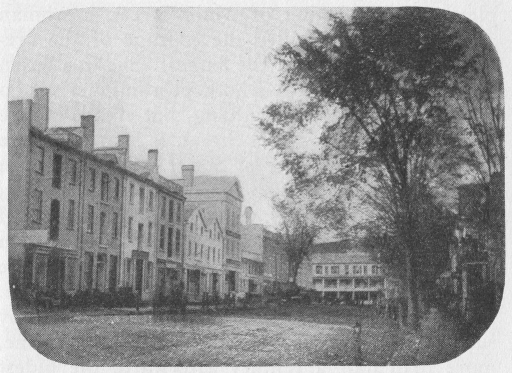
Main Street
Looking west from Fair Street, 1861. The Clark Gymnasium displaces the
two buildings at the left.
The village had troubles of its own during the progress of the war. In the spring of 1862, a disastrous fire, the largest conflagration in the history of Cooperstown, destroyed at least a third of the business district. The fire started near the Cory stone building, which alone survived of the stores and shops in the path of the flames that spread on the north side of Main Street, and extended from the building next to the present Mohican Club as far east as Pioneer Street. The fire then crossed to the south side of Main Street, destroying the old Eagle Tavern, originally the Red [Pg 347]Lion, and burning westward as far as the present Carr's Hotel. Up Pioneer Street, on the west side the flames ate their way as far south as the Phinney residence. The buildings at the eastern corners of Main and Pioneer streets were several times on fire, and were saved only by supreme efforts of the village firemen. The survival of the Cory building was due in part to its solid stone construction, but chiefly to the efforts of two plucky men, David P. House and George Newell, who stationed themselves on the roof, and while the fire worked its way around the rear of the building, succeeded in defending their position, [Pg 348]although so terribly scorched that for weeks afterward they went about swathed in bandages.
A few nights later the Otsego Hotel and adjacent buildings, which stood on the site of the present Village Library, were also destroyed by fire. At this conflagration, which seemed about to complete the destruction of Main Street, a woman appeared, who equalled the courage of the firemen in her defiance of the flames. She was Susan Hewes, a maiden lady who kept a milliner's shop in the little one-story building that stands on the north side of the Main Street, a short distance west of the corner of Fair Street. Emulating the example of the men who saved the Cory building, she appeared on the roof of her little shop, and presented a dramatic spectacle as she stood forth in the glare of the flames, crying out that she would save her property at the cost of her life. Fortunately the flames were checked without any such sacrifice, and Susan Hewes lived to become, more than half a century afterward, the oldest native inhabitant of the village, famous for the old-fashioned tangled garden on Pine Street, where she dwelt so long among her favorite flowers. During the Civil War period she was a marked figure in the village, for her outspoken independence in expressing sympathy for the Southern cause led to a visit of remonstrance with which a committee of leading citizens honored her in her little milliner's shop; while her refusal to submit to the dictates of fashion when the huge hoop-skirts came into vogue caused her to be gazed upon as a marvel of incompleteness in dress.
For a time Cooperstown was much depressed by the ruin which fire had wrought in the village, but, before long, a new business section began slowly to rise from the ashes of the old. West of Pioneer Street, where the Eagle Tavern had narrowed the width of the main thoroughfare to the dimensions of a mere lane, the street was now made of uniform width, and new business blocks were erected. By the close of the Civil War all signs of destruction had disappeared, and the Main street of Cooperstown, if far less picturesque than before, had assumed the appearance of brand new prosperity.
This period, in fact, marks the beginning of a gradual change in the character of Cooperstown, by which an elderly village, typical in its inherited traditions, has taken on the airs of a summer resort, and has become the residence, for a part of each year, of wealthy families whose chief interests lie elsewhere, and to whom Otsego is a playground. While much of the older character of the village remains, the contact with the outer world has had a far-reaching effect upon its inhabitants.
Some of the old-fashioned merchants were at first inclined to resent the demands made by city folk in excess of the time-honored customs of trade in Cooperstown. Seth Doubleday kept a store at the northwest corner of Main and Pioneer streets. One day a lady from the city came in airily, ordered a mackerel delivered at her summer home in the village, and was out again before Doubleday could recover his breath. At [Pg 350]that period all villagers went to market with a basket, and carried their own goods home. Nobody thought of having purchases delivered by the merchant. Doubleday was enraged at what seemed to him an insolent demand, and the longer he reflected on the matter the more furious did he become. At last, leaving his shop unattended, he went in person to the customer's house to deliver the mackerel. The lady herself opened the door. Doubleday took the fish by the tail, and slapped it down vigorously upon the doorstep, exclaiming, "There, madam, is your damned three-cent mackerel, and delivered!"
The new phase of village life may perhaps be dated from the purchase of the Apple Hill property by Edward Clark of New York, who, in 1856, made his summer home here, and after the close of the Civil War erected his mansion. The establishment of this country-seat was but the beginning of the extension of Edward Clark's estate in this region, and created a relationship to the village which his descendants have ever since continued.
"Apple Hill," as the place was called before Edward Clark's purchase, or "Fernleigh," as he renamed it, is thus a connecting link between the old and the new in Cooperstown. It has a story that brings the elder traditions of the village into touch with the newer spirit of modern enterprise.
Apple Hill was originally the property of Richard Fenimore Cooper, eldest son of the founder of the village. In the summer of 1800 he built the house which stood until displaced by [Pg 351]Fernleigh House in 1869. Fenimore Cooper described the site as "much the best within the limits of the village," no doubt with reference to the superb view of the Susquehanna which the veranda at the rear of the house commands. Richard Cooper planted the black walnut and locust trees, some of which are yet standing in front of the house at Fernleigh. To the home at Apple Hill he brought from the head of the lake as a bride, Anne Cary, who after his death became the wife of George Clarke of Hyde Hall.
From 1825 to 1828 Apple Hill was the residence of the afterward distinguished Judge Samuel Nelson, and during the next five years was owned and occupied by General John A. Dix, who had resigned from the army, and settled down in Cooperstown to practise law. His first cases were prepared in a little office that stood near the gate of the Apple Hill property. At that time it is said that he made a poor impression as a public speaker, and gave small promise of his later fame. In 1833 he became secretary of state of New York, and afterward was United States Senator. During the Civil War he raised seventeen regiments, and as Secretary of the Treasury at the outbreak of the war issued the famous order which first convinced the country that the executive government at Washington was really determined to meet force with force: "If anyone attempts to pull down the American flag, shoot him on the spot!" After the war General Dix was minister to France, and in 1872 was elected Governor of the State of New York. [Pg 352]Among the children of General Dix who played hide-and-seek amid the trees of Apple Hill was Morgan Dix, afterward the distinguished rector of Trinity parish, New York, who in later years passed many summers in Cooperstown. It was remembered of Dr. Dix's childhood that when his mother sent him away from Cooperstown to school, being apprehensive of his safe conduct on the journey, she put him into the stage-coach completely enveloped in a green baize bag that she had made for the purpose, with nothing but the boy's head emerging from the opening which was snugly tied around his neck. Dr. Dix's last visit to Cooperstown was in 1891 when he was a guest at the Cooper House, and was driven forth, with two hundred and fifty other guests, by the fire which burned it to the ground in the early dawn of the eighth of August. This summer hotel stood within the grounds occupied by the Present High School. Its burning was a calamity to Cooperstown, for under the management of Simeon E. Crittenden it had become widely famous, and drew guests from every part of the country.
From 1833 to 1839 Apple Hill was the home of Levi C. Turner, who married the daughter of Robert Campbell, and afterward was for some years county judge. During the Civil War Turner was Judge Advocate in the War Department under President Lincoln, concerning whom he had many intimate reminiscences.
In early days, before the common school system was developed, there were many attempts [Pg 353]to establish private schools in Cooperstown, with more or less success. John Burroughs, the famous naturalist, received the last of his schooling in the spring and summer of 1856 at the Cooperstown Seminary, afterward converted into the summer hotel known as the Cooper House.
But of all the private schools in the village the most noted was established at Apple Hill in 1839 by William H. Duff, a former officer of the British Army, and a graduate of Trinity College, Dublin. Duff had a romantic history, involved in a good deal of mystery. He had emigrated from England to Canada, bringing with him a beautiful young wife,—an elopement, it was said. Mrs. Duff was evidently of gentle birth, while her husband was of commanding presence, military bearing, and captivating manners. Whether he was entitled to the rank of Major, which he assumed, was always doubted.
Duff was well informed in all branches of army tactics, and the school that he established was well known as a military academy. The institution became popular, and the boys in their uniforms gave a new and welcome touch of color to the life of the village. The afternoon drills were witnessed by many spectators, and when the school increased until a mounted field-piece, drawn by four horses, was added to the equipment, the exhibit became quite sensational. Few pupils of that day could ever forget the winter drills on the frozen lake, with the thermometer near zero, as requiring an endurance worthy of hardier veterans.
One incident connected with the school made a sensation at the time. During the winter of 1840 a strong party of Indians found their way to the village, and remained for several days. One of them got into a drunken bout, and died quite suddenly. Shortly after the departure of the band the rumor was circulated among the loungers in the streets that the friends of the dead Indian suspected foul play, and were coming from their encampment on the following night to wreak vengeance upon the village. These flying rumors came to the ears of some of the pupils of Duff's Academy, who hastened to communicate the alarming intelligence to their principal. Whether Duff really accepted the truth of the reports, or wished to test the military efficiency and courage of his pupils, he promptly called his troops together, delivered an impressive harangue on the danger of the situation and the glory to be won by rallying to the defence of the village against a savage foe. Plans were soon made to repel the attack. Muskets were made ready for service. Some boys were sent into the village for powder, others for lead from which they were soon actively engaged in moulding bullets. A detachment was sent to remove to the house all effects from the schoolroom which stood near the gate, and the doors and windows of the house were strongly barricaded. Preparations were made to patrol the village at night, and the school was detailed into squads, who were to protect the principal streets. Sentries paced from the house to the gate, and from Christ churchyard [Pg 355]to the corner of Main Street, while outposts were stationed across the river who were to give warning of the enemy's approach by the discharge of a musket. The younger boys were left at home on guard at the doors and windows of the house. As the midnight hour approached Major Duff sallied forth and inspected the disposal of his forces. During the long winter darkness of that night the boys marched up and down the village streets, with imaginations so fearfully wrought up as to deny the need of sleep which lay heavy upon them. If any of the inhabitants of the village sympathized in this watchfulness in their behalf, or kept awake to see what was going on, there was no evidence of it. The boys were left to their vigil. They passed the night in anxious watching. No Indians appeared, and all danger was dispelled by the rays of the rising sun.
Too much prosperity was the ruin of Duff's school. It became so successful that the principal neglected duty for pleasure, leaving the school in charge of subordinates. Then, in less than five years from its beginning, it failed. At the outbreak of the Mexican War, Duff obtained a captain's commission in the United States Army, and when last seen by his old friends he presented an imposing appearance as he rode down Broadway in New York at the head of his company, with martial music and flying colors, to embark for Vera Cruz.[119]
George A. Starkweather purchased Apple Hill in 1847, and lived there until he sold it in 1856 to Edward Clark. The latter had been attracted to Cooperstown as at one time the home of his distinguished father-in-law, and law-partner, Ambrose L. Jordan. Mrs. Clark, who was Jordan's eldest child, was born while the Jordans were resident in Cooperstown in the house which still stands at the northwest corner of Main and Chestnut streets, and after they removed to Hudson the daughter was sent back to Cooperstown to attend the boarding school which was conducted for a time in Isaac Cooper's old house at Edgewater. It was through these associations that Edward Clark and his bride, after their marriage in 1836, began to be frequent visitors in Cooperstown.
In the year 1848 Isaac M. Singer had become a client of Jordan & Clark in New York City. He was an erratic genius, and had taken up various occupations without much success, besides having invented valuable mechanical devices which had brought him no profit. The form of sewing-machine that he invented, and which has ever since been associated with his name, was not profitable at first, and under Singer's management the title to the invention became involved, and was likely to be lost. In this emergency the inventor applied to his legal adviser, Clark, to advance the means to redeem an interest of one-third in the sewing-machine invention and business, and to hold that share as security for money advanced. Afterward was formed the co-partnership of I. [Pg 357]M. Singer & Co., in which Clark was the legal adviser and half owner. The business was carried on by this firm with great success from 1851 to 1863, during which period Edward Clark established his residence in Cooperstown. After Singer's death Clark became president of the Singer Manufacturing Company.
Edward Clark spent many winters in Europe, residing at different times in Paris and in Rome, but his summers were usually devoted to Cooperstown, and the present stone house at Fernleigh was his summer home for twenty-three years. When this house was erected it was regarded as a wonder. It took four years in building, and [Pg 358]was indeed of remarkable workmanship, with substantial masonry and the most exquisite elaborations of woodwork. But it had the misfortune to be built in the "black walnut period," when taste in domestic architecture was at a low ebb, so that much of the interior, and some of the exterior, has since been altered. The stone building southwest of the house was built as a Turkish bath.
In 1873, Edward Clark purchased Fernleigh-Over from the Bowers estate, and from time to time added to his property in Cooperstown, notably in the purchase of farms on either side of the lake. He became much identified with the interests of the village, and built the Hotel Fenimore.
Edward Clark was entranced by Otsego Lake, upon which he spent much time in sailing. His Nina and Elise were beautiful sailing yachts, and would have been an ornament to any waters. Clark was described by village contemporaries as a man of somewhat peculiar temperament. He was naturally reticent, and seemed to be most highly appreciated by his intimates. In educational matters he was greatly interested, having given largely to Williams College, of which he was a graduate and Doctor of Laws. He contributed generously to the welfare of the schools of Cooperstown, in which he established the Clark Punctuality prizes. In Cooperstown, and elsewhere, he did much charitable work in a quiet way.
In 1876 Kingfisher Tower was completed, [Pg 359]which Edward Clark had caused to be erected at Point Judith, about two miles from Cooperstown, on the eastern shore of Otsego Lake. It was said that Clark's motive in building the tower was to furnish work for many in the community who were out of employment. Scoffers referred to the building derisively as "Clark's folly." At the request of a village newspaper, Clark himself wrote an account of it which was published anonymously.
"Kingfisher Tower," he wrote, "consists of a [Pg 360]miniature castle, after the style of the eleventh and twelfth centuries, standing upon the extremity of the Point and rising out of the water to a height of nearly sixty feet. It forms an objective point in the scene presented by the lake and surrounding hills; it adds solemnity to the landscape, seeming to stand guard over the vicinity, while it gives a character of antiquity to the lake, a charm by which we cannot help being impressed in such scenes. The effect of the structure is that of a picture from medieval times, and its value to the lake is very great. Mr. Clark has been led to erect it simply by a desire to beautify the lake and add an attraction which must be seen by all who traverse the lake or drive along its shores. They whose minds can rise above simple notions of utility to an appreciation of art joined to nature, will thank him for it."
When Edward Clark died, in 1882, his youngest and only surviving son, Alfred Corning Clark, much of whose life had been spent abroad, inherited the greater part of his father's property, and became proprietor of Fernleigh.
Alfred Corning Clark possessed in a magnified degree certain qualities which had distinguished his father. He was more retiring, more reticent, more inclined to find the full joy of life only among intimates. He became a patron of art and music, and himself an amateur in singing. He built Mendelssohn Hall, in New York, for the use of a musical organization to which he belonged. Of books he was not only a lover, but a student, devoted to the classics, and well versed [Pg 361]in modern languages. In the village of Cooperstown he was known as a bookworm. He enjoyed walking about his own grounds, but hardly ever went into the village, and there were many residents of Cooperstown who had never seen his face. The proprietor of the corner book store in his day remarked that he had never but once seen Alfred Corning Clark in the village street, and this was when he had an errand at the book store to make an inquiry concerning a newly published volume.
In the use of his great fortune Clark was extremely liberal in charities and toward such other objects as commended themselves to his judgment; while he was correspondingly powerful in opposition to whatever involved a principle with which he disagreed.
Mrs. Clark, who was Elizabeth Scriven, was a woman of exceptional gifts of mind and benignance of character, well qualified to assume the responsibilities which fell upon her when Alfred Corning Clark died, at the age of fifty-three years, in 1896. With cultivated tastes, she had also a practical talent for business, and, although well served by agents in the management of her large interests, was always thoroughly informed and full of initiative. In New York, among men of affairs, she was regarded as one of the most far-seeing judges of real estate values in the city. In the management of her domestic and other concerns she had an extraordinary faculty for administration, which failed of attaining genius only through the effort which she put forth to give [Pg 362]personal attention to details. This amiable weakness nevertheless added the interest of her personality to undertakings that might have failed for the lack of such a spirit as hers; and in her many charities the personal touch which she took the trouble to give added infinitely to the happiness and self-respect of those to whom her kindness, as in neighborly thoughtfulness, was extended.
In Cooperstown Mrs. Clark became an arbiter of the social and moral virtues, and the things that she frowned upon were usually not done. She had a wholesome influence in resisting certain excesses which not seldom appear in communities partly given over to the pursuit of pleasure. In some innovations against which she protested, Mrs. Clark at last gracefully yielded to the inevitable. This was the case with automobiles, which, when they first appeared upon the country roads, she regarded with the alarm and disgust of one devoted to a carriage and horses, and would have banished them from Otsego if she had had the power. In that period of transition few country roads were adapted to the use of motors, and to meet one of the new machines while driving in a carriage along the lake shore was to suffer the apprehension of imminent death from the fury of plunging horses, and to be nearly choked in a cloud of dust.
Mrs. Clark was fond of walking, and she was a familiar figure in the residence streets of the village in summer, usually dressed in white, without a bonnet, and carrying a white parasol above [Pg 363]her head, as she moved with quick step upon some errand.
The homestead at Fernleigh represents much that has contributed to the development of Cooperstown. The greater part of the industry controlled by the Clark estates is managed from the offices of the Singer Building in New York, which when it was erected in 1909 was the tallest office building in the world. But a large part of the interests of the estates is centered in the picturesque old building, originally built for a bank, which stands near the entrance of the Cooper Grounds in Cooperstown. The Cooper Grounds themselves were rescued from a condition of desolation in which they had lain for many years after the death of Fenimore Cooper, and are maintained by the Clark estates for the benefit of the public. The Village Club and Library across the way is a creation of the Clark estates. On the hills east and west of the village, and along the eastern shore of the lake for a stretch of nearly six miles, the same ownership has preserved for all lovers of nature the noble forests that lend a charm of wildness to the region.
[119] A Few Omitted Leaves, Keese, p. 12; History of Cooperstown, Livermore, p. 46.
The period from 1870 to 1880 was one of rapid growth and development in Cooperstown. The permanent population increased to over two thousand souls, and a number of fine summer residences were erected. Almost all of its natural advantages Cooperstown owes to Otsego Lake. These had been long appreciated by residents of the village, and now began to be generally sought by visitors from afar. In summer, the shores of the lake come to be dotted with the camp-houses and tents of those who sought relief from the swelter of cities in the cool forests of Otsego, and found delight in the sailing and fishing for which the Glimmerglass is famous.
In the summer of 1870 Capt. Daniel B. Boden began regular steam navigation of Otsego Lake by means of a small steamboat which he had brought to Cooperstown by railroad, and which had been used as a gunboat in Southern waters during the Civil War. The boat was renamed the Mary Boden. In the following summer a rival steamboat was launched, much larger than the former, called the Natty Bumppo, and owned principally by A. H. Watkins and Elihu Phinney. [Pg 365]At the beginning of the next season the conservative folk of the village were scandalized by the Mary Boden, which then commenced to make lake trips on Sunday, a breach of ancient custom in which the owners of the Natty Bumppo indignantly declined to compete. On a night early in July there was an alarm of fire, a great blaze at the lake front, and villagers running to the scene found that one of the steamboats was in flames and beyond hope of salvage. A small child at a front window of Edgewater, watching the fire, clapped her hands, and cried out, "It's the wicker [Pg 366][wicked] boat! It's the wicker boat!" But it was not the wicked boat that was ablaze. It was the Natty Bumppo, which burned to the water's edge a total loss, the boat that had never left its dock on Sunday. The event was long recalled by some in the village as an instance of grave error in the usually correct dispensations of Providence. The Natty Bumppo was replaced, in the next season, by a new steamboat bearing the same name. The new Natty Bumppo and the old Mary Boden were the famous boats of the lake until they were succeeded by the Pioneer and the Cyclone, and later by the Deerslayer, the Pathfinder, and the Mohican.
Aside from the use of canoes, the first general navigation of the lake was undertaken in 1794 by a man known as Admiral Hassy, who in his day was the most celebrated fisherman of Otsego. He had a large flat boat which he called the ship Jay, and upon which he used boards for sails. This craft was safe, but not speedy.
Some thirty years later a group of enterprising individuals built a horse-boat as a means of transporting lake parties. The boat had at each end a high cabin topped by a platform. These excrescences caught whatever breeze was blowing, and made the craft unmanageable. The struggles of the two poor horses who were expected to propel the boat were not equal to a gale of Pierstown trade-winds. More than once a lake party starting for Three-Mile Point, aboard this vessel, found itself stranded on the opposite shore.
During the first half of the century a "general [Pg 367]lake party" in the summer corresponded to the "select ball" of each winter as constituting one of the two great social events of the year in Cooperstown. It ought to be said that the term "lake party" had a distinct social significance, and the word "picnic," which came later to be used to describe the same thing, meant to the elder inhabitants an affair that had quite lost the flavor of the older custom, and the use of the word was regarded as one of the signs of social decadence.
The means of navigation most often used by the lake parties was a huge scow propelled by long oars. A typical lake party was given in July of 1840, when Governor Seward visited Cooperstown. On the way home upon the lake the old scow, according to custom, was stopped opposite to the Echo, and several persons tried their voices to show off the wonderfully clear reverberations that would be flung back from the eastern hillside. But the master of this art was "Joe Tom," the negro who had been chief cook of the lake party, and was now at one of the long oars of the scow. On being asked to awaken the famous echo, Joe Tom shouted, "Hurrah for Governor Steward!" and when the echo came back, "You've got it to a 't,' Joe!" exclaimed Governor Seward.
At this period the authority in aquatic affairs, and the most renowned fisherman of the lake, was Commodore Boden. Miss Cooper says of her father's novel Home as Found that the one character in it "avowedly and minutely drawn from life" was that of the Commodore, "a figure [Pg 368]long familiar to those living on the lake shores—a venerable figure, tall and upright, to be seen for some three score years moving to and fro over the water, trolling for pickerel or angling for perch, almost any day in the year, excepting when the waters were icebound in winter."[120] The commodore was of quite imposing appearance, handsome alike in form and figure, straight as an arrow, and lithe as an Indian, with silvery locks that hung gracefully down upon his shoulders. His method of fishing was fascinating to watch. Standing erect in his boat, the commodore would paddle from the outlet of the lake to some inviting patch of weeds, and there, in quite shallow water, noiselessly drop his anchor. Then, wielding a rod nearly twenty feet in length, he would "skip" his tempting bait—generally the side of a small perch—with amazing vigor and marvellous dexterity, oftentimes taking fifteen or twenty pickerel in less than an hour. To see him strike, manipulate and land a fish weighing three or four pounds, his pliant rod bending nearly to a semicircle, was a spectacle not to be forgotten.[121]
In 1850 Peter P. Cooper brought from the Lake Ontario a little schooner, and became so famous as a boatman and fisherman that he was regarded as the successor of Admiral Hassy and Commodore Boden. Capt. Cooper established a boat livery which included five sailboats and twenty rowboats. He developed the fisheries of [Pg 369]Otsego Lake on a big scale, having introduced the gill net as a means of catching bass. In the spring of 1851 there were taken from the lake 25,000 bass. The gill net which Capt. Cooper introduced is made of the best kind of linen thread, with meshes from two to two and a half inches square. The net is about three feet wide, having leads attached to one edge, and corks fastened to the other. The leaded edge is carried to the bottom of the lake, while the other is buoyed up by the corks, making a complete fence across the lake at its bottom, even where it is very deep. The fish swim against the fence, which at once yields to their force, but as it yields, forms a sack whose meshes gather about their fins and tail, making it impossible to back out or otherwise escape. Their efforts serve only to entangle the fish more deeply in the net. Elihu Phinney, the most expert amateur fisherman of the period, denounced Capt. Cooper's gill net as the "most deadly and abominable of all devices."
The Otsego bass never exceed about six pounds in weight, the average being much smaller. Occasionally a lake trout of larger size is caught. With hook and line trout of great size are not often taken. On Friday, August 21, 1908, Alexander S. Phinney caught with hook and line, near Kingfisher Tower, a trout thirty-six inches long and weighing twenty pounds. He tussled with this trout for an hour, with six hundred feet of line, before he succeeded in landing him in the boat. In the next season the same fisherman caught a trout weighing eighteen pounds. So far as [Pg 370]authentic records go, these two trout are the largest fish ever caught in the lake with hook and line.
The conditions in Otsego Lake are favorable for the artificial propagation of fish, and many plantings have been made, at first by private enterprise, and afterward by the State. The lake extends in a direction from N. N. East to S. S. West about nine miles, varying in width from about three quarters of a mile to a mile and a half. The surface of the lake is 1,194 feet above tide-water. The average depth is about fifty feet, although about two miles north of the village soundings have been taken to a depth of one hundred and fifty feet, while toward the midst of the lake the depths are greater. In many places the water deepens gradually from the shore, but along the eastern bank there are points at which, Fenimore Cooper declared, "a large ship might float with her yards in the forest." The lake is chiefly supplied from cold bottom springs. Its only constant tributaries are two small streams, whose entire volume is not half that of its outlet, the Susquehanna River, which here begins its long journey to Chesapeake Bay. The upper and lower portions of the lake, being shallow and weedy, afford ample pickerel grounds, while the middle portion and whole eastern shore are admirably adapted, by deep water and soft marl bottom, to the coregoni and salmon trout, and nearer shore, by rocky bottom and sharp ledges, to the rock bass, black bass, and yellow perch. Large fish find an abundant food supply in the "lake shiner," an exquisitely beautiful creature [Pg 371]and dainty morsel, about four inches long.
The fish for which the lake has become famous among epicures is the "Otsego bass." In The Pioneers, published in 1823, Fenimore Cooper expressed the general opinion when he put into the mouth of one of his characters this eulogy of the Otsego bass: "These fish are of a quality and flavor that in other countries would make them esteemed a luxury on the tables of princes. The world has no better fish than the bass of Otsego; it unites the richness of the shad to the firmness of the salmon." More than sixty years later much the same opinion prevailed, when Elihu Phinney described Otsego bass as "beyond all peradventure the very finest fresh water fish that swims."
There has long been a difference of opinion as to whether the so-called Otsego bass is to be regarded as a distinct species. Louis Agassiz, the highest authority of his time, after careful analysis pronounced the Otsego bass to be "in its organic structure a distinct fish, not found in any other waters of the world." In 1915 Dr. Tarleton H. Bean, the New York State fish culturist, declared that the so-called Otsego bass "is merely the common Labrador whitefish which has become dwarfed in size by some peculiarities of its habitat." De Witt Clinton, a former governor of New York, wrote the first scientific description, accompanied by a drawing, of this fish, which he called "the Salmo Otsego, or the Otsego Basse."[122] [Pg 372] At the time when Clinton wrote, the whitefishes were placed in the genus Salmo. In 1911, in the bulletin of the United States bureau of fisheries,[123] Dr. Evermann asserted concerning Clinton's drawing of Otsego bass, which he had examined, that "the cut, although crude, plainly shows Coregonus clupeaformis. The form is elliptical, and the back shows the dark streaks along the rows of scales usually characteristic of that species." The same author, in collaboration with Dr. Jordan,[124] says concerning the common whitefish: "This species, like others of wide distribution, is subject to considerable variations, dependent upon food, waters, etc. One of these is the so-called Otsego bass, var Otsego (Clinton), a form landlocked in Otsego Lake at the head of the Susquehanna River."
There are Otsego fishermen who are not impressed by this array of learning, and still insist that the Otsego bass is quite different from any other fish in the world. The Otsego Farmer in 1915 summed up the matter thus: "Otsego bass is not what is ordinarily termed whitefish, but is probably a species of the same family. As a matter of fact, Otsego Lake has been stocked with whitefish fry from the Great Lakes, and now the nets of fishermen are always filled with a mixture of whitefish and Otsego bass. Whatever Dr. Bean may think about it, any Otsego Lake fisherman can tell the difference, and any epicure having [Pg 373]once tasted Otsego bass is never again deceived by whitefish."
A view which seems to reconcile these diverse opinions is that of Alexander S. Phinney, the most famous amateur fisherman of Otsego at the beginning of the twentieth century. He holds that Otsego bass is quite distinct from whitefish, but believes that the true Otsego bass has disappeared, giving place to a hybrid fish, now called Otsego bass, but really a cross between that variety and the whitefish with which Otsego has been stocked from the Great Lakes.
As many as five thousand Otsego bass have been taken with one draught of the seine, but in view of the great difficulty of catching any with hook and line, the following suggestion from an old authority, Seth Green, is still of interest: "The Otsego bass can be taken with small minnows or red angle worms. I think if your tackle is very fine, and you do not twitch when they bite, they will swallow the bait. Put five or ten hooks (O'Shaunessy 8's, forged) on a fine snell, and loop them five feet apart; with a small sinker at the end. Bait some with small minnows (an inch or so in length) and some with worms. Cast out as far as you can from the boat, and let it lie half or three quarters of an hour on the bottom, feeling now and then to see if you have one on. The best way is to let them hook themselves. The angle worms, if used for bait, should be strung on to the hook with both ends left dangling. A light stroke must be made and the fish handled very carefully."
Many fishermen are successful in taking Otsego bass with hook and line in winter, by fishing through the ice. No sooner has the lake become frozen from shore to shore, usually after Christmas, than the whole surface becomes dotted with the shanties of fishermen, which remain until the ice begins to weaken in the spring. The typical fisherman's shanty on the ice-bound lake is about five by six feet in floor space, and six feet high. It has a window, and the floor is so arranged that it can be raised to keep the fisherman above the water that sometimes floods the surface of the ice. Holes are cut through the floor, and through the ice beneath, for the admission of the fishing [Pg 375]lines. The shanty is warmed by a small stove, with its stove-pipe sticking out through the roof. A chair and a coal box complete the furniture.
Two methods of fishing through the ice for Otsego bass are used by the occupants of the shanties. According to one method the hook is dropped to the bottom of the lake, and the fish are attracted to its vicinity by bait strewn on the bottom. The other method is used nearer shore, where the baited hook is let down part way toward the bottom, to tempt the fish that move amid the grass and weeds.
There are others besides fishermen to whom the frozen surface of Otsego Lake offers the means of pleasure and occupation. In some seasons the freezing of the lake occurs within a few hours, after a great and sudden fall in temperature, during a night of calm and intense cold. At such times, before snow has fallen upon the surface, the lake presents a scene of splendor. The ice is quite transparent, and has the effect of a great sheet of glass spread out amid the hills. This offers a perfect surface for skating, and attracts not only the boys and girls of the village, but a large number of their elders. The lake grows lively with the gracefully gliding promenade of skaters, with here and there a group playing at hockey, while others disport themselves at "crack the whip." The friction of so many gliding feet imparts to the frozen surface a low and weirdly humming sound, and the droning note is echoed by the hills, until the valley resounds with monotonous music. There [Pg 376]are times when the lake is so well frozen that skaters traverse the entire length. In some seasons ice-boats have been used, slanting from end to end of the lake with prodigious speed. As the winter advances and the ice grows stronger, driving upon the lake becomes common, and horse-races upon the ice have sometimes been included among the winter sports.
At about five miles above the foot of the lake, and extending across it from shore to shore, a large fissure in the ice usually appears during the winter. This fissure is sometimes so wide that a team cannot cross it, and many years ago a span of horses was accidentally driven into it. The crevice in the ice has caused much speculation. The lake is narrow at the place where the crack appears, and the fissure is supposed to be created by expansion from the north and from the south, causing the ice to rise several feet in gable-like form until the ridge cracks, for fragments of ice are found on each side of the crevice.[125]
The tremendous forces exerted by the expansion of the freezing lake cry aloud on still winter nights, whenever, after a period of thawing weather, the mercury suddenly drops to a point far below zero. On such nights, while the trees of the surrounding forest here and there begin to be so penetrated with the fierce cold that they crack like rifle-shots, the ice-bound lake sets up an unearthly groaning, and the cavernous sound [Pg 377]of its bellowing echoes dismally over the sleeping village, like the trumpetings of some huge leviathan in agony.
Cooperstown has a winter harvest-time, in January or February, when ice is cut from the lake for the summer supply. This industry occupies a large force of men, with plows, saws, hooks, crowbars, horses and bob-sleds, for several weeks. The ice taken from Otsego Lake, from ten to twenty inches thick, according to the severity of the winter, is always pure as mountain dew, and clear as crystal.
The midsummer view of Otsego Lake at one time included, in the clearings along the western shore and hillsides, a great luxuriance of hop-vines. The golden wreaths of hops, as they hang ripening in the August sunshine, sweeping in graceful clusters from the tall poles, or swinging in the breeze in umbrella-like canopies, add a more picturesque feature to the landscape than any other growing crop.
Hops have a part in the story of Cooperstown, which was at one time the centre of the most important hop-growing industry in America. Hop culture was introduced into Otsego county about the year 1830. In 1845 only 168,605 pounds were produced. In 1885, within a radial distance of forty miles from Cooperstown was included more than half of the hop-producing region of the United States.
The hop-picking season, during the latter part of August, has given a picturesque character of its own to the life of the village and environs. In [Pg 378]the primitive days of the industry, when the harvesting of the crop did not require any additional help from outside of the immediate region, the task of hop-picking was lightened by the enjoyment of social pleasures and romantic excitements that came to be associated with it by the young people of Otsego. At the beginning of the picking season, in those days, anyone passing through the country would meet wagon after wagon, of the style known as a "democrat," loaded down with gay and lively maidens, with one or two young men to each load. On reaching the hop-yard to which they were assigned, these frolicsome parties exchanged their holiday attire for [Pg 379]broad-rimmed hats and working dresses. Boxes were placed about the hop-yard, four pickers to each, the boxes being divided into four sections holding ten bushels apiece, and into these were dropped the clusters picked from the vines by nimble fingers. Experienced hands can fill two or more boxes in a day, for which as much as fifty cents a box used to be paid.
The midday lunch was taken beneath the shade of the nearest tree, or, in case the pickers were boarded by the grower, all adjourned to the largest room in an out-building, where a rural feast was spread with no niggard hand. Hop-pickers expect to live on the fat of the farmer's land, and as a rule they are not disappointed. Whole sheep and beeves vanish like manna before the Israelites in the short three weeks of the picking season, while gallons of coffee, firkins of butter, barrels of flour, and sugar by the hundred weight are swallowed up in the capacious maw of the small army. The nightly hop-dance used to be an indispensable adjunct of the picking season, much counted upon by the gay throng, but rather frowned upon, as an occasion of scandal, by staid and proper seniors.
With the great increase in hop-production during the early 'eighties, the romance of hop-picking, on many farms, gave place to a picturesque but undesirable invasion of vagabondage from the large cities. Some farmers continued to choose their pickers from among the better sort of young men and maidens of the neighborhood, but many large growers, requiring a great number of hands [Pg 380]for a short season, resorted to the unemployed of neighboring cities, and the result was an annual immigration from Albany, Troy, Binghamton, and other cities farther north, which taxed the capacity of the railways. Among these workers many were honest and capable, but a large part of them were attracted by the prospect of three weeks of board and lodging, with an amount of pay which, if small, was sufficient for a glorious spree. It became the custom in Cooperstown to augment the village police force during the hop-picking season, for city thugs were likely to be abroad, and when the pickers were paid off their revels were apt to become both obnoxious and dangerous.
Hops will be seen growing in the summer along the shores and hillsides of Otsego Lake, so long as beer is made; for, aside from the very limited amount required to leaven bread, and the comparatively small amount used in druggists' preparations, there is no use for hops except in the making of beer. But never again will there be in Otsego such luxuriance of hop-culture as that which developed in the 'eighties before the Pacific coast learned to compete successfully with the hop-growers of New York State.
Hop-culture is a gamble which in Otsego county has made fortunes for some farmers and brought ruin to others. The growth of the product is singularly at the mercy of freaks of weather, and its preparation for the market is beset by many possibilities of failure. It is a crop of which it is most difficult to count the final cost, or to predict[Pg 382]the market price. It has varied in price more than any other product of the soil. In 1878 the entire crop was marketed at from five to twelve cents a pound. But for many years every farmer in Otsego remembered the season of 1882-83, when the average cost of producing a pound of hops was ten cents, and hops were selling at a dollar a pound, so that, as was said at the time, "five pounds of hops could be exchanged for a barrel of flour."[126] Many farmers made money at this time, but some held their hops for an even higher price, and lost. One farmer held thousands of pounds of hops in his great barn, and kept buying in the crops of other farmers, awaiting a price of $1.20, at which he had resolved to sell. Two years later the hops were still in the barn, and nine-tenths of their value was lost. There were other tragedies of this sort, yet for years afterward, while some continued to grow hops at a fair profit, many a farmer in the vicinity of Cooperstown, lured by the hope of a dollar-a-pound season, was kept on the verge of poverty by his faith in the golden vine.
Otsego Lake is chiefly famous as the scene of events in two of Cooper's Leather-Stocking Tales. There are glimpses of it in The Pioneers, while in The Deerslayer the whole action revolves about this lake, which throughout the story is called the "Glimmerglass." The scenes of incidents in these two tales are still pointed out on Otsego Lake, and have become as much a part of its history as of its romance.
To begin with points described in The Deerslayer, the beehive-shaped rock where the youthful Leather-Stocking had his rendezvous with Chingachgook is that now known as Council Rock, and still juts above the water at the outlet of the lake, near the western shore of the Susquehanna's source. Here it was that exactly at sunset, to keep his appointment with Leather-Stocking, the tall, handsome, and athletic young Delaware Indian suddenly appeared in full war-paint, standing upon the rock, having escaped his lurking foes. Not far from this point, at a short distance down the river, Deerslayer got his first glimpse of the beautiful Judith Hutter, as she peered from the [Pg 384]window of the "ark," which had been moored beneath the screening foliage of overhanging trees. It was through these waters, and through the outlet, soon afterward, that Floating Tom Hutter and Hurry Harry, aided by Deerslayer, drew the ark back into the lake in the nick of time to escape a band of hostile Iroquois.
On the western side of the lake, just beyond the O-te-sa-ga as one travels northward, the first little bay that indents the shore, now called Blackbird Bay, and somewhat changed in shape and aspect by fillings of soil and other improvements at the Country Club, is the "Rat's Cove," where Floating Tom Hutter was fond of keeping his ark anchored behind the trees that covered the narrow strip of jutting land. Here it was, at the beginning of the story, that Deerslayer and Hurry Harry sought Tom in vain, and on this margin of the lake the buck appeared at which Hurry took the shot that awakened the echoes of the Glimmerglass. Adjacent to this bay, in the midst of the stretch of land between the O-te-sa-ga and the Country Club house, was the Huron camp in which Hutter and Hurry were captured by the redskins; and the quantities of arrowheads found here in later times suggest that it actually was a favorite place of Indian encampment.
North of Blackbird Bay and the Country Club, and beyond Fenimore Farm, are Glimmerglen Cove and Brookwood Point, where charming residences that overlook the lake add their own attractions to the names of "Glimmerglen" and "Brookwood," by which they are known. The [Pg 385]stream that gushes into the lake from Brookwood is the one in which Hetty Hutter made her ablutions, and from which she drank, while on her lonely way southward to the Huron camp, in her simple-minded scheme for the rescue of her father and Hurry Harry.
A short distance north of Brookwood there empties into the lake a stream which is worth tracing toward its source as far as the hillside beyond the road that skirts the lake, for here the water comes tumbling down from the height in the beautiful Leatherstocking Falls. A shady glen is here, a favorite resort of small picnic parties, and while nothing of Cooper's romance has been added to the scene except the name, some interest may be found in the traces of an old mill which once got its power from Leatherstocking Falls.
Some tense situations in the story of the Deerslayer are associated with Three-Mile Point, the present picnic resort of Cooperstown; and a full understanding of the events described as having taken place on this spot almost depends upon some reference to the actual conformation of the land. It was on the northern side of the projecting point that Hetty had landed on the errand just referred to, setting her canoe adrift. Wah-ta-wah promised to meet her Delaware lover, Chingachgook, at the same landing-place, on the next night, at the moment when the planet Jupiter should top the pines of the eastern shore. Here came Chingachgook and Deerslayer in their canoe, at the appointed time, to steal the maiden [Pg 386]from the Hurons, but found that she could not keep the tryst. Around this point Deerslayer gently propelled his canoe southward until he gained a view of the fire-lit camp, which the Hurons had moved from the region of Blackbird Bay to the southern slope of Three-Mile Point. Back again to its northern side he paddled softly, and having joined Chingachgook, they left the canoe on the beach near the point, and made their stealthy detour, approaching the camp from the west, in the shadow of the trees, informing Wah-ta-wah of their presence by Chingachgook's squirrel-signal. The spring that still bubbles for the refreshment of picnickers on the northern shore of the Point was the one which Wah-ta-wah made a pretext to draw away from the camp the old squaw who guarded her, and here Deerslayer throttled the vigilant hag, while Chingachgook and his Indian sweetheart raced for the canoe. Here, when Deerslayer released his grip to follow them, the squaw alarmed the camp. Along the stretch of beach he ran eastward to the place where the lovers were already in the canoe awaiting him, and from this point Deerslayer pushed their canoe to safety, yielding himself to capture.
It was at Five-Mile Point that the Hurons were afterward encamped when Deerslayer, whom they had released on parole, returned at the appointed hour to redeem his plighted word. Back of Five-Mile Point is a picturesque rocky gorge called Mohican Canyon, through which a brook ripples, with clumps of fern and rose peeping[Pg 388]from the crevices of its rugged walls. Having fulfilled his pledge, Deerslayer soon ventured the dash for liberty that so nearly succeeded; and, after making a circuit of the slope, it was along the ridge of Mohican Canyon that he ran at top speed to try a plunge for the lake, with the whole band of Indians in pursuit.
In the open area of Five-Mile Point, after his recapture, Deerslayer was bound to a tree, and became a target for the hairbreadth marksmanship of Huron tomahawks, preliminary to being put to torture.
North of this spot, and along the shore, [Pg 389]Hutter's Point is of interest to the reader of the Leather-Stocking Tales, for here is the path by which Deerslayer reached the lake at the beginning of his romantic history, and gained his first view of the Glimmerglass. In the second chapter of the Deerslayer, Cooper's famous description of the lake as it was when the first white man came, based upon his own recollection of it when nine-tenths of its shores were in virgin forest, was conceived from the angle of Hutter's Point.
Not far from the northern end of the lake a faint discoloration of the water, with a few reeds projecting above the surface, reveals the location of the so-called "sunken island," where the waters [Pg 390]of the lake shoal from a great depth, and offer the site upon which, at the southern end of the shoal, Cooper's imagination built the "Muskrat Castle" of Tom Hutter, at which the terrific struggle with the Indians occurred when Hutter was killed. At the northern end of the sunken island was the watery grave in which the mother of Judith and Hetty lay, and which afterward became the grave of Hutter, and finally of Hetty herself.[127]
Across the lake, on its eastern shore, south of Hyde Bay, is Gravelly Point, to which Hutter's lost canoe drifted, and where Deerslayer killed his first Indian. Farther south is Point Judith, now marked by Kingfisher Tower, where Deerslayer, returning to the Glimmerglass fifteen years after the events described in the story, found the stranded wreck of the ark, and saw fluttering from a log a ribbon that had been worn by the lovely Judith Hutter. Here "he tore away the ribbon and knotted it to the stock of Killdeer, which had been the gift of the girl herself."
Toward the foot of the lake the eastern hills and shore belong to scenes of Leather-Stocking's elder days, as described in The Pioneers. North of Lakewood Cemetery a climb up the precipitous mountainside leads to Natty Bumppo's Cave, which, with some poetic license in his treatment [Pg 391]of its dimensions, the novelist employs as a setting for the final climax of his story. To the platform of rock over the cave, as a refuge from the forest fire, Leather-Stocking guided Elizabeth Temple and Edwards, and carried the dying Chingachgook. On this spot, with his glazing eyes fixed upon the western hills, the last of the Mohicans yielded up his spirit. Here was the scene of Captain Hollister's charge at the head of the Templeton Light Infantry, so swiftly followed by the revelation of the mystery which the cave concealed.
Not far from the spot upon which the Leather-Stocking[Pg 392] monument now stands, near the main entrance of Lakewood cemetery, the log hut of Leather-Stocking stood, and afterward, according to the story, Chingachgook was buried there. Farther southward, the road that branches off to ascend Mount Vision is the one by which Judge Temple and his daughter approached the village in the opening scene of the story, and it was during their descent from the upper level of this road that the buck was shot by Edwards and Leather-Stocking, when Judge Temple's marksmanship had failed. Near the branching of this road a stairway climbs the mountain, and reaches the pathway of Prospect Rock, where Elizabeth found the old Mohican, and was trapped by the forest fire. Upon this natural terrace a rustic observatory now stands, which offers a superb view of the lake and village.
It was on the summit of Mount Vision, overlooking the village, that Elizabeth Temple was faced by a panther crouching to spring upon her, and had resigned herself to a cruel death, when she heard the quiet voice of old Leather-Stocking, followed by the crack of the rifle that saved her life, as he said:
"Hist! hist! Stoop lower, gal; your bonnet hides the creatur's head!"
[120] Pages and Pictures, 301.
[121] Elihu Phinney in Shaw's History of Cooperstown.
[122] Letter to John W. Francis, 1822.
[123] Vol xxix, p. 35.
[124] U.S. National Museum, Bulletin 47, p. 465.
[125] Livermore, History of Cooperstown, p. 133.
[126] G. P. Keese, Harper's Magazine, October, 1885.
[127] For the purpose of the story, as he explains in the preface of The Deerslayer, Cooper places the "sunken island" farther south, nearly opposite to Hutter's Point, and at a greater distance from the shore than its real situation.
A man of national reputation made Cooperstown his summer home in 1903, when the Rt. Rev. Dr. Henry C. Potter, seventh Bishop of New York, who had married Mrs. Alfred Corning Clark, took up his residence at Fernleigh. In his administration of the most populous diocese in America, Bishop Potter had gained wide renown as an ecclesiastic; added to which his prominence in civic affairs, and in matters of national importance, together with a public championship of workingmen's rights at which many wealthy churchpeople stood aghast, made him one of the most notable figures in American life. He passed his summers in Cooperstown until his death at Fernleigh in July, 1908, and the near view of his big personality caused him to be as greatly beloved in the village as he was honored in the city. He entered with zest into the interests of the village, gave a new impetus to many of its activities, and made friends in all walks of life.
When Bishop Potter came to dwell in Cooperstown, the village had already made up its mind that he was a rather austere and distant man, an official person, the quintessence of ecclesiastical [Pg 394]statesmanship,—urbane, but unyielding. He looked the part. Tall, erect, and of splendid figure, his countenance had the aristocratic beauty of a family noted for its handsome men. The noble head and the poutingly compressed lips of a wide mouth gave an impression of power, while a slight droop of the left eyelid, and a thin rim of white around the iris of the eyes, imparted a veiled and filmy coldness to his glance. The personal dignity of the Bishop, his commanding presence, a certain picturesque magnificence, the rich and well-modulated voice, the incisiveness of his manner of speech, with the clear-cut value given to every word and syllable, were characteristics that marked him as a leader of men.
But Cooperstown soon came to realize the lovable traits and real simplicity of its most distinguished resident. He placed many villagers in his debt by personal acts of kindness, and charmed all by his genial friendliness. In any company he was the chief source of entertainment. Although he applied himself intensely to official work during certain hours of every day in the summer, when the hour of relaxation came he laid aside his task. With all his cares, he was never the grim man forcing himself to be gay. His contribution to the pleasure of a company was spontaneous and contagious. Not the least highly developed of his qualities was the Bishop's sense of humor. He was an incomparable raconteur, and many an incident of village life gave him material for a story which, with certain poetic license of embellishment that he sometimes allowed [Pg 395]himself, set his hearers in a roar. He was as ready to hear a good story as to tell one, and his ringing laugh was a delight. The Bishop talked much and well. His use of the pause in speaking, with a momentary compression of the lips now and then between clauses, heightened the effect of crispness in his felicitously chosen phrases. He was a good listener if one had anything to say, but he was not averse to presiding in monologue over a number of people, and often did so, for his fund of talk was so rich that others, in his [Pg 396]presence, were sometimes slow to offer any contribution of their own. He was most adroit at this sort of entertainment, and had a way of apparently bringing others of the company into the conversation—usually those who seemed rather shy and overawed,—without requiring them to utter so much as a word. In the midst of his talk the Bishop would interject such a remark as, "You will understand me, Mr. So-and-So, when I say"., or "Mrs. Blank, you will be particularly interested to know"., turning earnestly toward the person addressed. Of course Mr. So-and-So and Mrs. Blank brightened up at being singled out by the great man, and beamed with pleasure at having thus contributed to the conversation.
In the morning of every week-day, just as the village clock struck nine, the Bishop could be seen issuing from Fernleigh, whence, after passing the Rectory, he pursued a slow and stately course down the curved path of the Cooper Grounds to the Clark Estate building, where he had an office on the upper floor at the southwest corner. On warm summer days, he discarded broadcloth, and was dressed in flannels of spotless white. He walked with a stick, and there was a slight limp of the left leg, due to an injury received in riding. So strong and erect was his bearing, however, in spite of his more than three score years and ten, that the slow gait seemed to be caused rather by preference than necessity, and the limp really appeared to add to the majesty of his measured pace. Anyone who joined him was obliged to walk as slowly as the Bishop, who never hastened his steps, but conversed affably; now and then, as some thought struck him forcibly, he paused abruptly in his walk, and stood still to utter what was in his mind, moving forward again, by way of emphasis, at the end of a sentence. In these walks through the Cooper Grounds, and about the village, the Bishop assumed acquaintance with everyone, and frequently stopped to enter into conversation with a neighbor, a passing tourist, or some workman toiling in a ditch. It was because of his genuine interest in everyone that the village came to regard Bishop Potter no longer as a distinguished metropolitan, but as a genial neighbor. A stable-boy who at this period drove the village rector to a country funeral expressed [Pg 398]the sentiment of many when he said: "I used to think the Bishop was stuck up; but he is really just as common as me or you!"
Bishop Potter took great delight in amusing occurrences in which he shared as he went about the village. In fact he seemed deliberately to invite them, and afterward described the incidents with contagious merriment. One day as he was about to enter a car of the trolley road on Main Street, an enormously fat countrywoman was standing on the platform, bidding farewell to her her friends. She had much to say, and completely blocked the entrance to the car. After waiting patiently for some moments the Bishop addressed the woman in his most gracious manner. "Madam," said he, "I don't wish to interfere with your conversation, but if you will kindly move either one way or the other, so that I may enter the car, I shall be greatly obliged." The woman glared at him. "Are you the conductor of this car?" she snapped, "Because if you be, you're the sassiest conductor that ever I see!"
In the late summer of 1904, "Doc" Brady, a lovable old Irish heart, who used to peddle portraits of the Pope, corn salve, and various trifles, encountered Bishop Potter in front of the Village Library, and invited a purchase of his wares, which at this time included campaign buttons of Col. Roosevelt and Judge Parker, attached to packages of chewing-gum. "Here ye are, Bishop," he cried; "Get a button for your favorite candidate!" The Bishop impartially selected a button of each kind, and pushed the chewing-gum [Pg 399]aside. "Take your goom, Bishop, take your goom," urged Brady, as the Bishop moved away. "No, certainly not," was the firm reply. But Doc Brady was insistent, and hurrying after the Bishop forced the gum upon him. "There," said he, "if you don't chew it yourself, take it home to Mrs. Potter!" The Bishop's laugh rang aloud through the Cooper Grounds as he slowly ascended the path, taking home the chewing-gum to Fernleigh.
The Bishop usually left his office in the Clark Estate building toward one o'clock, and Mrs. Potter often walked down to join him on the way home. Sometimes, as she passed the office, she hailed the Bishop, and conversed with him as he stood at the open window above. On one occasion, when Mrs. Potter had several ladies as guests, they all chatted with the Bishop through the window on their way to Fernleigh. A moment later, recalling something that he had neglected to mention, he summoned a gardener who was at work close at hand, and asked him to request the ladies kindly to step back to the window, as the Bishop had something to say to them. Shortly afterward, in response to the gardener's summons, there was lined up beneath the window a happy group of female excursionists carrying lunch-baskets, entire strangers to the Bishop, and in a quite a flutter of anticipation of what the distinguished prelate might have to communicate. The Bishop was equal to the situation. He gave them some information concerning points of interest in and about Cooperstown, with [Pg 400]a brief summary of the history of the Cooper Grounds in which they then stood, and sent them away rejoicing in knowledge that added greatly to the pleasure of their visit.
A frequent guest at Fernleigh at this time was the Rev. Dr. W. W. Lord, formerly rector of Christ Church, and for many years one of the most beloved friends of the Clark family. This aged clergyman and poet was a scholar of the old-fashioned type, well-versed in the elder philosophies, and fond of quoting Greek, Latin, and Hebrew authors in the original tongues. Dr. Lord admired Bishop Potter, but the two men were of different schools, and the old priest was inclined to stir up good-humored controversies in which he pitted his scholasticism against the Bishop's more facile and modern if less profound learning. The New York prelate entered with great zest into the contest of wits, and let slip no opportunity to score a point on Dr. Lord.
Although usually numbered among the evangelicals, Bishop Potter in his latter years was sympathetic with certain aspects of Catholic ceremonial. He believed in the enrichment of the services of the Church by light, color, and symbolism, so far as might be consistent with the law of the Anglican communion in America. Dr. Lord belonged to the school of churchmanship which abhorred anything beyond the most severe simplicity in the services of the Church, and had a large contempt for the badges and symbols of ritualism.
On the festival of St. John the Baptist, in 1903, [Pg 401]Bishop Potter and Dr. Lord were the chief figures at a service held in Christ Church to which the Masonic lodges of Cooperstown and vicinity were invited. Both the Bishop and Dr. Lord were thirty-third degree Masons. Dr. Lord, because of the infirmities of age, at that period seldom officiated in church, but for this occasion was to have a place of honor in the chancel, and to pronounce the benediction. Bishop Potter was to deliver the sermon.
Dr. Lord came early to the sacristy of the church, and, having vested in his long flowing surplice and black stole, seated himself to await service time. In conversation with the rector, Dr. Lord recalled the days when more of the clergy were simple in their apparel, and he deplored the tendency to adopt brilliant vestments, colored stoles, and academic hoods. A hood, said Dr. Lord, echoing the sentiments of a witty English prelate, was often a falsehood. Any man could wear a red bag dangling down his back, but nothing except sound scholarship could really make a Doctor of Divinity. For his part, said Dr. Lord, he was content to be a Doctor of Divinity, by virtue of scholastic learning, without wearing a hood to proclaim it.
At this moment the Bishop appeared, having walked from Fernleigh to the church fully arrayed in his vestments. He was a resplendent figure. In addition to the episcopal robes of his office, he wore an Oxford cap, and a hood of flaming crimson, which an expert in such matters would have identified as belonging to Union College, or Yale, [Pg 402]or Harvard, or Oxford, or Cambridge, or St. Andrew's, all of which institutions of learning had conferred the doctorate on Bishop Potter.
It still lacked a few moments of service time, and when the Bishop was seated in the bright light of the sacristy, another feature of decoration in his dress appeared. Depending from a chain about the neck there glittered upon his breast what the Masons call a "jewel." To the non-Masonic eye it was more than a jewel. It suggested rather a shooting star, emitting a shower of scintillations from the facets of a hundred jewels. When the coruscations of this Masonic emblem caught the eye of Dr. Lord, he became uneasy, and began to finger an imaginary token of rank upon his own breast. "I ought to have a jewel to wear to-night," he said musingly, and muttered of the splendid jewel that he had forgotten to bring, given to him years before by the Grand Lodge. By this time the hour of service had come; the aproned Masons had marched to their seats in the nave of the church, and all available space was thronged by an expectant congregation. Nevertheless Dr. Lord requested the rector to go forth from the sacristy, and ask the master of the Lodge whether any of the brethren present had a jewel to lend for the occasion. This was done, but no jewel was forthcoming. The Bishop seemed absorbed in his own thoughts.
The choir and clergy entered the chancel, and the service began. Dr. Lord had a seat of honor in the sanctuary at the right of the altar. When evensong was finished, Bishop Potter preached [Pg 403]the sermon, after which he returned to the sanctuary, and stood at the left of the altar opposite to Dr. Lord. Just before the benediction, which Dr. Lord was to pronounce, the Bishop caught the rector's eye, and beckoned. When the rector came near, the Bishop removed the Masonic jewel, with its chain, and handed it to him.
"Put it around the old man's neck," the Bishop whispered.
This was done, and the venerable clergyman, decorated with the flashing symbol, seemed to grow in stature beyond his usual great height, as he ascended the steps of the altar, where he uplifted his hands, and in an age-worn but magnificent and sonorous voice pronounced the solemn blessing.
In the early autumn of 1904 the Rt. Hon. and Most Rev. Dr. Randall T. Davidson, Archbishop of Canterbury and Primate of all England, the first occupant of the chair of St. Augustine to visit America, was a guest at Fernleigh. The Archbishop and Mrs. Davidson, with the Archbishop's two chaplains, were met at the station by Bishop Potter together with a delegation of Cooperstown citizens. The first carriage that left the station contained the English and American bishops; the second carried the two chaplains, escorted by the village rector. As this carriage left the station, David H. Gregory, the perennial wit of the summer colony, called out,
"Don't forget to show the gentlemen the Indian in the Cooper Grounds."
The chaplains of the Archbishop exchanged [Pg 404]glances of pleased anticipation. What they had heard suggested that Cooperstown kept a live Indian on view as a symbol of its history and romance, just as Rome maintains always its pair of wolves at the Capitoline hill. The rector tried in vain to divert their thoughts toward other objects. When the carriage rolled through the Cooper Grounds the chaplains insisted upon seeing the Indian. There was nothing to do but to point out J. Q. A. Ward's sculptured Indian which stands in the midst of the park, a replica of the one in Central Park, New York, and better mounted, altogether a fine work of art, but—
"Oh, I say," exclaimed one of the chaplains, as they looked at one another in deep disappointment, "Not alive; not alive!"
During the Archbishop's stay in Cooperstown he attended daily services in Christ Church, and enjoyed visiting points of interest on the lake and in the village. That a souvenir of the visit might be preserved the Archbishop and the Bishop were photographed together on the front porch of Fernleigh. Apparently some prosaic adviser had represented to the Archbishop that his usual costume would make him undesirably conspicuous in America, for during his tour of this country the Primate of all England abandoned the picturesque every-day dress of an English bishop, with its knickerbockers and gaiters, in favor of the international hideousness of pantaloons. At the time of the photograph Bishop Potter was wearing leggings, having just returned from riding, so that the two bishops appeared to have exchanged costumes.
The Archbishop desired not to have anything like a public reception, but it was intimated to a few neighbors that they would be welcomed at Fernleigh on a certain evening. At this gathering the most regal figure, who, in the ancient finery of her apparel, wearing a headdress topped with an ostrich plume, may be said to have eclipsed the most distinguished guests, was Susan Augusta Cooper, granddaughter of the novelist, representing, as it were, the very foundation of the village. Miss Cooper was one of the most characteristic survivals of the old régime in Cooperstown. She lived next door to Fernleigh in Byberry Cottage, which had been built as a home for the two unmarried daughters of the novelist shortly after [Pg 406]the burning of Otsego Hall, and largely out of material rescued from it, including the oaken doors, the balusters of the stairway, and two bookcases from Cooper's library which were transferred to the cottage. Susan Augusta Cooper took up her residence there with her mother and aunts in 1875, and when she died in 1915 had been the sole occupant of the cottage for many years. She was a type of old-fashioned neighborliness, and made a specialty of ministration to the needs of sick and poor throughout the village. One frequently met her on some errand of mercy; the basket on her arm contained good things prepared with her own hands for the needy; the large and stately figure had grown rather mountainous with advancing years, and the dignity of her slow and measured pace suggested the steady progress of a ship moving in calm waters. The solemnity of her countenance, and the grave manner of her carefully chosen words, were lovably familiar to those who knew her warm and generous heart.
When Miss Cooper's health failed she was obliged to undergo an operation which left her a cripple, unable to get about except in a wheel-chair propelled by an attendant. Always a faithful communicant of Christ Church, her disability occasioned what came to be almost a parochial ceremony, for when Miss Cooper made her communion she was wheeled to the chancel steps, and the priest came forward to administer to her, while the other communicants respectfully waited until she had withdrawn.
Added to her other infirmities, an affection of the eyes gradually darkened her vision until she became totally blind. In a condition of helplessness which would seem to make existence unendurable, Miss Cooper found much to make her happy, and life was sweet to her to the end. She enjoyed the society of friends, and it gave her keen pleasure, blind and crippled as she was, to be seated in state at large social functions. Such was her habitual solemnity of manner that few gave her credit for the sense of humor which lightened many of her dark days. She uttered her jests with so much gravity that they were often taken in earnest. Now and again she made sport [Pg 408]of her own infirmities. Meeting her one day in her wheel-chair, after her eyesight had begun to fail, a neighbor inquired for her health. "Quite comfortable," replied Miss Cooper, in solemn tones, "except for my eyes. They tell me it is a fine day, with beautiful blue sky. The sky is blue, but to my eyes it is shrunk to the size of a bachelor's-button!" Miss Cooper was very reluctant in consenting to the amputation which prolonged her life for several years. Even after the surgeons stood ready in the operating-room she for a time declined to submit to the ordeal. There was a prolonged discussion which resulted at last, on the advice of friends, in obtaining her consent. The chief surgeon entering the room approached the bedside rubbing his hands and, grasping at something to say to reassure the patient, remarked in silken tones, "Well, Miss Cooper, I'm glad to hear that you prefer to have the amputation." The situation seemed desperate, and nerves were at a high tension among Miss Cooper's friends. "Well, doctor," was her tart rejoinder, "I must say that 'prefer' is hardly the word that I should use!" With this she gave a chuckle that proved her spirit undaunted, and relieved the strain.
Miss Cooper had great respect for the clergy, and for a bishop her reverence was unbounded. When Bishop Potter dedicated the monument at the grave of Leslie Pell-Clarke, in Lakewood Cemetery, a terrific thunderstorm arose during the ceremonies, and Miss Cooper was taken home in the carriage with the distinguished prelate to escape the deluge. The various conveyances [Pg 409]plunged down the hillside post-haste, with lightning crashing on every side. Some of the ladies in the party became hysterical. Miss Cooper alone was perfectly calm. "With a bishop by my side," she exclaimed, "I am not in the least afraid to die!"
In the summer of 1904 Bishop Potter unwittingly acted as the accomplice of a burglar who robbed the safe of the Clark Estate office in Cooperstown, and escaped with a quantity of jewels. The newspapers estimated the value of the stolen jewels at from $20,000 to $100,000, and the robbery became a celebrated case in police annals. The burglary was unusual in [Pg 410]having taken place in broad daylight, with Bishop Potter calmly at work at his desk on the second floor of the small building. When the clerks left the office for luncheon at noon they locked the outside door, but did not close the vault in which the papers and valuables were kept. It was a brilliant summer day, the seventh of July; villagers and tourists were passing and repassing through the adjacent Cooper Grounds; the clerks were to return within an hour, and in the mean time the Bishop was there. Nobody dreamed of the possibility of a burglary, but it was the unexpected that happened. When the vault was to be closed and locked at the end of the day, a tin box containing a casket of jewels was missing. In the basement of the building the tin box which had contained the jewel-case was found empty, and near by was a hatchet usually kept in the basement, and with which the box had been pried open.
The news of the robbery caused intense excitement in the community. The village policeman together with the county sheriff and his deputies met in conference at the Clark Estate office; knots of people gathered upon the streets in earnest discussion; the village press was busy turning out handbills announcing the robbery and offering a large reward for the apprehension of the thief; the telegraph wires hummed with messages to the police of the state and nation. Next morning Pinkerton detectives arrived under the leadership of George S. Dougherty, afterward deputy police commissioner of the city of New York.
The clues discovered by the detectives were not encouraging. In the office nothing appeared beyond the fact that the box of jewels had been removed from the safe. In the basement the discarded tin box that had contained the casket of jewels lay upon the floor not far from the hatchet with which it had been opened, and the only remarkable circumstance was that the floor all about the empty box was bespattered with blood. The detectives said also that they noticed the frequent appearance of a woman's footprints which were well defined and seemed to encircle the spot where the empty jewel-box lay.
The blood-stains appeared to offer the most serviceable clue, and to account for them three theories were suggested. First: The robber had been caught in the act by someone who had disappeared in pursuit, after one or the other had been wounded in the struggle. Second: There was more than one robber, and there had been a bloody quarrel over the division of the booty. Third: In opening the tin box containing the jewels the robber had cut himself either with the hatchet or with the jagged tin. Since the Bishop, who had been in the building during the robbery, heard no sound of any struggle, the first two theories were abandoned, and the third alone seemed probable. Advices were accordingly telegraphed to the police of various cities to look out for a man with a bandaged hand. For several days thereafter suspicious-looking men in remote parts of the country who had had the misfortune to injure a hand suffered the added misfortune [Pg 412]of being detained by the police; but nothing came of it.
In order to aid in the recovery of the property, and to make it difficult for the thief to dispose of it, a description of the stolen jewelry was given out, and summarized as follows: a pearl collar; a diamond bow-knot with pear-shaped pearl pendant; a ring set with two diamonds and a ruby; a ring set with diamond and ruby; a small diamond ring; a solitaire diamond ring; a diamond marquise ring; a ring set with two diamonds crosswise; a diamond bracelet; a diamond and pearl bracelet.
Dougherty the detective had another method of procedure in reserve. He had brought with him to Cooperstown an album containing photographs of the most noted bank-sneaks and yegg-men. After studying the "job" at the Clark Estate office he came to the conclusion that it was the work of a professional, and began to run over in his mind the various crooks who might have planned and carried out a robbery of this particular sort. Many of these were gradually eliminated for one reason or another, until he had narrowed the field to a few suspects. Dougherty then began to make inquiries about the village to learn whether anyone had noticed a stranger loitering in the neighborhood of the Clark Estate offices on the day of the robbery. His search was rewarded by finding several persons who remembered such a stranger. One of them described the loiterer as a man about sixty years old, with "pleasant, laughing eyes." Dougherty already [Pg 413]had in mind Billy Coleman, alias Hoyt, alias Grant, alias Holton, alias Houston, a man with an international police record. He produced Coleman's photograph, and the likeness was promptly identified as that of the loiterer. Another who remembered seeing the stranger picked out from the entire gallery of rogues the likeness of Coleman.
Although he had no real evidence against him the detective was now sure of his man, and felt certain that, somewhere in the mazes of New York City, Coleman and the missing jewels would be found. Returning to New York, Dougherty roamed the streets of the city, day and night, looking for Coleman. After two weeks of fruitless search he met one of Coleman's "pals" coming up Eighth Avenue. Acting on the theory that this man would ultimately get in touch with Coleman, the detective determined to keep him in sight. He shadowed him all night, following him from haunt to haunt. The next morning, when Coleman's friend retired to a rooming-house, and asked for a bed, Dougherty put two subordinates on guard, while he himself snatched a few hours of sleep. The detective proved to be upon the right track, for within thirty-six hours the shadowed man joined Billy Coleman.
The suspected thief occupied a flat at 271 West 154th Street. From this time Dougherty or one of his deputies followed every movement of Billy Coleman. Day after day they tracked him through the city from one resort to another. In the evening they followed him home, and kept a [Pg 414]watchful eye on the premises. Coleman's actions were provokingly innocent. At nightfall he frequently left home, accompanied by his wife, but only to take their little dog out for an airing. On a Sunday evening while Dougherty was shadowing Coleman and his wife, hoping that they might lead him to some clue to the robbery, he was amazed to see them enter an Episcopal church, where they remained throughout the service. Bishop Potter, to whom Dougherty had confided his suspicions of Coleman, laughed heartily when the detective mentioned this incident.
"Surely, Dougherty, you don't want me to believe that one good churchman would rob another, do you?" the Bishop exclaimed.
Dougherty felt that as the case stood he was making no headway. Coleman, who perhaps realized that he might be under suspicion, made no false moves. The detective resolved upon another plan of action. He decided to have Coleman charged with the robbery and arrested, after which he was certain to be released for lack of evidence. He calculated that an official discharge from any complicity in the stealing of the jewels would so reassure Coleman that he might afterward betray himself, through lack of caution, to watchful detectives. Coleman was accordingly arrested, and held for the grand jury in Cooperstown. The case against him was too weak to stand. The grand jurors were much absorbed in conclusions drawn from the blood-stains found on the floor of the basement of the Clark Estate [Pg 415]office, and when it was shown that Coleman bore no sign of scratch or scar they promptly discharged him. Coleman left Cooperstown a free man, and chatted amicably with Dougherty as they rode together on the train to New York. On reaching the city they parted company at the Christopher Street elevated station, and Coleman rode on up town to his home, serenely confident of Dougherty's failure and of his own security.
This was in October. From the moment of his arrival in the city Coleman was shadowed day and night. Detectives rented a room in a house across the street from Coleman's flat. Whenever he left his home they cautiously followed him. For a time he seemed to be making tests to learn whether or not he was being followed. Sometimes he would enter a large department-store, mingle with the crowds, and suddenly find his way out of a side door into a little-frequented street. But the detectives were equally wily. They adopted various disguises, and never let him out of their sight. After about two months they observed that Coleman began to make frequent trips toward Morningside Park. He made always for the same region, where he appeared to walk aimlessly about, but with his eyes fixed on the ground, as though counting his steps. On the morning of the third of January, during a heavy snowstorm, Coleman was followed to West 155th Street and Eighth Avenue, where, in a little open space near an iron-foundry, he scraped aside the snow, and began a small excavation of the earth. For some reason he failed to find the object of [Pg 416]his search, and returned home with an air of dejection. One detective shadowed him homeward; the others did not wait for the falling snow to obliterate the traces of his excavation. They began digging in the same spot on a more generous scale, and eighteen inches below the surface unearthed a glass fruit-jar. The jar, on being lifted to the light, dazzled the eyes of the detectives, for it contained the missing jewels, which for six months had lain there in the earth where thousands of people had daily passed them by.
The detectives, having removed the jewels, placed in the jar a note addressed to Billy Coleman, signed by Dougherty and his assistants, McDonals and Wade, stating that they had the jewels, and would call upon him at the earliest opportunity. They reburied the jar, and restored the surroundings to their former condition. Coleman, as had been foreseen, afterward returned to the spot, and dug up the jar. The detectives were near enough to witness the wretched man's distress when, on reading the note, he realized that the fortune had escaped him and that the prison awaited him. He was immediately placed under arrest, and confessed all. Concerning a few pieces of jewelry that were missing from those found in the jar he gave information that led to their recovery. Coleman was once more taken to Cooperstown, and, with the additional evidence, was easily convicted of the robbery.
Coleman was a man of such remarkable intelligence and engaging personality that Bishop Potter, whose near presence at the time of the [Pg 417]robbery the burglar little suspected, became much interested in him. There is no doubt that Coleman was really touched by the kindness which Bishop and Mrs. Potter showed to him and to his wife, and his resolution to reform was quite sincere.
"There is nothing in being a crook," he said. "I am sixty years old, and have been in prison half my life. My advice to young men is 'Don't steal.'"
At Bishop Potter's request the sentence of the court was lighter than Coleman's record might have warranted, and he was sent to Auburn prison for six years and five months, a term which discounts for good behaviour reduced to four years and four months.
Coleman's explanation of the blood-stains which had played so important a part in the various theories of the robbery was one that nobody had thought to venture. He said that before he opened the jewel-casket in the basement he really had no idea what it contained, and when he saw the fortune in gems that had come into his possession his great excitement brought on a nose-bleed.[128] His clothes were so blood-stained that he was in mortal fear of being arrested on that account, but, as he wore a black suit, the stains were not conspicuous. As to the woman's footprints, which the detectives said they found, no explanation was ever made.
Ten years later an elderly man was arrested in [Pg 418]New York, charged with robbing a Wells-Fargo Express wagon on Broadway. With the aid of an umbrella handle he had drawn from the rear of the wagon a package containing $100,000 in cancelled cheques—not a very successful haul. His age and apparent harmlessness so much impressed the justices in Special Sessions that he would undoubtedly have been released on suspended sentence had not a detective who had been engaged in the Clark robbery case passed his cell in the Tombs. The detective recognized the famous Billy Coleman, whose police record dated back to 1869, showing thirteen arrests and a total period of twenty-eight years in prison.
Bishop Potter's last notable public appearance in Cooperstown was at the Village Centennial Celebration in August of 1907. He was the most picturesque figure in a scene rich in kaleidoscopic color and historic significance when, on the Sunday afternoon which began the week's festivities, multitudes listened beneath the sunlit trees upon the green of the Cooper Grounds, while the Bishop, mantled in an academic gown of crimson, described his vision of the future of religion in America.
The Cooperstown Centennial celebration was remarkable for its great success in calm defiance of the fact that the year of its observance was not really the centennial of anything worth commemorating in the history of the village. The psychological moment seemed to have arrived when the people of the village were resolved to devote themselves to some high effort in praise of [Pg 419]Cooperstown, and so they gloriously celebrated, in 1907, the centennial which a former generation had neglected, and which succeeding generations might indolently ignore. A disused act of village incorporation passed in 1807 was seized upon as suggesting a convenient antiquity, but there was no slavish conformity to mere accidents of date, and the whole history of Cooperstown was included in this elastic centenary. The entire community was united in the desire and effort to make the celebration a success, and the sticklers for historical propriety became quite as enthusiastic as the others. The commemoration was planned and carried out on a really dignified scale, with an avoidance of tawdriness; and the elements of the celebration, with religious, historical, literary exercises, and pageantry, were well proportioned in their appeal to the mind, to the romantic emotions, and to the love of the spectacular. Some of the addresses such as that of Brander Matthews on Fenimore Cooper, were valuable contributions to the literary annals of America. Throngs of spectators were attracted to Cooperstown by the celebration, and in one day there were at least 15,000 people in the village which included only about 2,500 in its normal population. The old village and lake offered an effective background to the scenes of carnival. Natty Bumppo at home in his log cabin, Chingachgook with his canoe, appeared in living representation in the line of floats that paraded the village to set forth the historic and romantic memories of the place. A chorus of village schoolgirls dressed in white, and [Pg 420]with flowing hair, presented an exquisite scene at Cooper's grave in Christ churchyard, bringing their tribute of flowers, and singing the lyric written by Andrew B. Saxton to the music of Andrew Allez. Otsego Lake offered a superb spectacle in the calm summer night, reflecting the glare of rockets and the bursting into bloom of aerial gardens of flame. There were moments of utter darkness suddenly dispelled by dazzling cataracts of fire that made one aware of thousands of pallid faces thronging the shore, while the effulgence set the waters ablaze from Council Rock to the Sleeping Lion, and flung a weird splendor upon the forests of the surrounding hills.
A lovable patriarch of the village was Samuel M. Shaw, well known throughout the state as editor of the Freeman's Journal. He had once been an editor of the Argus, in Albany, and became editor and proprietor of the Freeman's Journal in Cooperstown in 1851. In this position he continued more than half a century, and had a history almost unique in village journalism. When he began his work Shaw was regarded as an innovator, for he was one of the first editors in the country to introduce columns of local news and personal items, a practice which, at a time when newspapers were wholly devoted to politics, speeches, foreign affairs and literary miscellany, was widely ridiculed. He survived long enough to be regarded as an exemplar of conservative and old-fashioned journalism, and became the Nestor of Cooperstown. In the office of the Freeman's Journal, with its clutter of old machinery, piles of grimy books, its floor littered with newspapers, its wall streaked with cobwebs, the aged editor seemed exactly to fit into the surroundings. Here he received his friends, for the bed-ridden wife at Carr's Hotel, where he had rooms, was unequal to much social duty. The printing-office was his kingdom, and here, at the battered desk, he reigned supreme, a benevolent-looking man, with white beard closely enough trimmed to show a firm mouth, while the bald head shone above the desk as he bent his eyes closely to the pen in writing, and the left hand occasionally stroked the cluster of silvery locks that overhung the back of his collar. Late every afternoon he put aside [Pg 422]his pen and proof-sheets, and with a coat held capewise about his bent shoulders, toddled to the Mohican Club to play bottle-pool with his old friend, G. Pomeroy Keese. Every Sunday the editor's venerable figure was conspicuous in a front pew of the Baptist church, in which he was a pillar, and always held up as an example to the youth of the village.
When Samuel Shaw died, in 1907, occurred a dramatic episode which only a village community can produce. During his long career Shaw had accumulated a fair amount of property, and in his will had made kindly bequests to certain friends. Not until his death did it become generally known that his means had been dissipated by unfortunate speculations in the stock market, which was then in a depressed condition, and that margins upon which he had made purchases had been wiped out, hastening his death by financial worry, and leaving his estate almost bankrupt.
At his funeral the Baptist church was crowded by a congregation which represented the tribute of a whole village to a man who had been a leader in its affairs for more than fifty years. The pastor of the church, the Rev. Cyrus W. Negus, had not been long in the village, but already was known for his earnestness and sincerity. To deliver a funeral sermon over the body of so distinguished a member of his church offered an opportunity to make an impression upon the entire community. He began his sermon with the usual expressions of Christian faith in the presence of death, and passed to a commendation of Samuel [Pg 423]Shaw's many good deeds in public service and private life during his long career. Then he changed his tone, and, to the amazement of every hearer, expressed his deep disapproval of the speculations in the stock market which had brought the veteran editor in sorrow to the grave, and declared that he was unable to indorse the qualities in the character of a man so prominent in religious and civic life which permitted him to resort to slippery methods of financial gain. In this respect Samuel Shaw was to be held up not as an example, but as a warning to the youth of the village.
Never was a congregation more astonished than when the speaker proceeded to develop such a theme in the face of the mourning friends of the dead. Probably the great majority of the congregation felt that the pastor's view of the iniquity of such stock speculations was utterly mistaken. Certainly all the friends of the dead editor were too indignant to realize in that hour that they were witnesses of an unusual exhibition of moral courage on the part of a preacher. It was some months later, when the Rev. Cyrus W. Negus himself lay dead, and all the bells of the village rang his requiem, that a friend and admirer of Samuel Shaw could also fairly recognize the mettle of this preacher who had the pluck to speak out what he believed to be his message, with every worldly reason to be silent. He had dared to defy the conventions of indiscriminate eulogy at funerals, to stand practically alone against public opinion, and to turn an opportunity [Pg 424]of winning popular applause into an occasion for speaking out the necessary truth as he saw it. Some of his best friends felt that he had blundered, but no one who saw and heard this frail and pale-faced Baptist minister, as he stood by the coffin of Samuel Shaw uttering the quiet words that fell like lead upon the tense and breathless audience, may honestly deny his courage.
In some respects the most remarkable man in Cooperstown at this period was Dr. Henry D. Sill. It is perhaps a singular distinction in a Christian community that Dr. Sill should have been chiefly renowned for being a Christian. It was not that the Christianity of the village was below the average of Christian communities. It was rather that Dr. Sill so strikingly personified the Christian virtues as to become a saint among Christians. By common consent he was put in a class by himself. Christians were exhorted to imitate him, but nobody was expected really to equal him. He was at this time only forty years old, but was revered not only by the young, but by the aged, as wise unto salvation. He was the son of Jedediah P. Sill, a respected and influential business man of Cooperstown, and after graduation at Princeton and at the College of Physicians and Surgeons, he settled down to practise in his own village. Dr. Sill lived with his sister at "The Maples," in the spacious house which stands on Chestnut Street, with sculptured lions guarding the doorway, next to the Methodist parsonage. His office occupied the little wing at the north. Unlike some who pass for philanthropists in the [Pg 425]outer world, Henry Sill was regarded as a saint in his own household. Mrs. Robe, the aged aunt who made one of the family, and cultivated the art of growing old beautifully and gracefully, herself a Unitarian, used always to conclude her frequent arguments against Calvinistic theology by saying, "Well, Henry wouldn't treat people so, and I believe that God is as good as Henry!"
Dr. Sill was a man of some means, but spent very little on himself. It had been his ambition to be a missionary, but since circumstances made it impossible to carry out this design, he annually contributed the entire salary of a foreign missionary whom he called his "substitute." He spent large sums of money in the improvement of Thanksgiving Hospital, in which he was deeply interested, and the equipment of that institution, especially of the operating-room, which gave it a rank far above the hospitals in many larger towns, was chiefly owing to his generosity.
Dr. Sill was a physician, but specialized in surgery, and, while he never developed any spectacular rapidity of technique, became known as one of the most capable and conscientious surgeons in central New York. He always told patients what he believed to be the exact truth, and without the untoward results which some practitioners apprehend from such a policy. A surgeon who prayed with patients just before resorting to the knife was sometimes rather disconcerting to the irreligious, but his attitude was a comfort to many in the dire distress of illness, and in all it inspired confidence in the man himself. In many an [Pg 426]isolated farm house of Otsego the only religious ministrations came with Dr. Sill's medical attendance, and there were unnumbered cases in which his call to heal the body resulted in the regeneration of a soul.
Where patients were able to pay, Dr. Sill charged a good price for his services, but the fees were adjusted upon a sliding scale, and the amount of his professional service without pay is incalculable. In this respect he was not unlike his colleagues in a profession which probably gives more for nothing than any other, but, having independent means, he was able to go farther in this direction than most practitioners, and he counted it a pleasure to give away his time and skill without reward.
There was a tinge of Puritanism in Dr. Sill's Christianity which to some minds imported an unnecessary strictness of view, but none could quarrel with it, for he practised his austerities upon himself, not toward others. Certain precepts of the Sermon on the Mount usually interpreted in a figurative sense he took literally as rules of action. "Give to him that asketh thee, and from him that would borrow of thee turn not thou away" was one of these. His literal fidelity to this precept afforded him the deep satisfaction of giving aid to honest neighbors in distress; it enabled him to come to the rescue in the emergencies which sometimes face the most industrious and deserving. But also it gave him the pain of learning how many plausible persons are eager to make fair promises that mean nothing, and [Pg 427]taught him that there are human beings to whom acts of loving-kindness are as pearls before swine. The honest man in trouble came to Dr. Sill, the drunkard to take the pledge, the sorrowful to be comforted, the desperate to be advised. But so came also the rogue, and the wheedling hypocrite, and all such as desired to obtain something for nothing. The doctor had a large acquaintance among unfortunate outcasts, for he regularly visited the county jail to talk and pray with its inmates. The extent to which Dr. Sill aided the worthless was a cause of grief to the judicious, but he was not really, as some supposed, the dupe of impostors. He was well aware of the probably unworthy character of many to whom he gave assistance, but there was always an element of doubt in such cases, and his theory was that it was better to aid ninety-nine humbugs than to take the risk of closing the door against one who was deserving of help.
Dr. Sill was much consulted in relation to the civic and religious welfare of the community. His conscientious habit of deciding in all things, great and small, upon the absolutely right course of action gave him an air of slowness and hesitation in manner. He would stand listening intently, without comment, to violent arguments for and against a project, turning toward each speaker the frank dark eyes that illumined his pale countenance. When it came to his decision he had a way of planting his right heel forward, and compressing his lips, which he then opened with a slight smack of determination, giving quiet utterance [Pg 428]to his judgment. It was usually quite impossible to move him from a decision thus made, and those who misinterpreted the mildness of his manner soon learned that the man himself was adamant.
The first years of the twentieth century included an era of new buildings. Just above Leatherstocking Falls, in 1908, William E. Guy of St. Louis built and established the beautiful summer home at Leatherstocking Farm. The remains of the old grist mill at the falls were torn down, and the stones from the foundation were used in the new building.
In 1910, James Fenimore Cooper of Albany, grandson of the novelist, built Fynmere (the name being an old form of the word Fenimore) as a country residence. Its site on the hillside above the road that curves about the southern end of Mount Vision commands a superb view down the Susquehanna Valley, while the eastern windows of the house look into the heart of the ascending forest. The use of native field stone in the construction of this house is most effective, and at once gave to the residence, when fresh from the builder's hands, the air of being long habituated to the spot, and quite in harmony with the antiquities that abound in the appointments and ornamentation of the place. Within a niche of the main hall of the house is the bust of Fenimore Cooper which David d'Angers made in Paris in 1828; and embedded in the foundation of the building is the corner-stone with the original marking that Cooper carved in 1813 for the [Pg 429]house that he built, but which was burned before he could move into it, at Fenimore. Fynmere has contributed to the revival of pleasures that belonged to an elder day in Cooperstown, for it has drawn hither large house-parties of young people to enjoy the holidays of Christmastide, to join in winter sports, and to appreciate the splendors of snow and ice in a region usually renowned only for the charm of its summer season.
From the beginning of Cooperstown's celebrity as a watering-place the hope was cherished, among the residents, that the village might include a suitable hotel overlooking the lake, and attracting visitors to linger on its shores. This dream was realized in 1909 when the O-te-sa-ga opened, having been built by Edward S. Clark and his brother Stephen C. Clark. The hotel was planned to accommodate three hundred guests, and occupies the old site of Holt-Averell, commanding a magnificent view of the full length of the lake.
Cooperstown is a village of incomparable charm. There is not the like of it in all America. It has a character of its own sufficiently distinctive to prevent it from becoming the leech-like community into which, through the slow commercializing of native self-respect, a summer resort sometimes degenerates, stupidly enduring the winter in order to batten upon the pleasures of the rich in summer. Cooperstown is old enough and wise enough to have a juster appreciation of lasting values. It has tradition and atmosphere. It is a village that rejoices in the simple virtues of life peculiar to a small community, while its fame as [Pg 430]a summer resort annually brings its residents within reach of far influences and wide horizons.
All lovers of Cooperstown know a favorite summer walk that passes from the village up the hill on the eastern border of the lake, rises beyond Prospect Rock, winds over a wooded summit, descends, turns westerly through a shady grove, crosses a farm, then threads a stretch of densest foliage, when suddenly one emerges upon a clearing, and unexpectedly beholds, glittering far below, the waters of the Glimmerglass, with the homes and spires of the village gleaming amidst the green leafage of the valley.
It is impossible not to idealize the village when one views it from this height. To the tourist, [Pg 431]who comes merely to admire, it is a view that possesses the glamour of enchantment. How happy should be the people who dwell in this peaceful village, surrounded by such charming scenery! How lofty should be their ideals, and how pure their lives, who abide amid such glories of nature!
But for residents of Cooperstown this view is one that has more than beauty. It grips the heart. As the resident looks down upon the streets and houses amongst the trees it is with a sympathetic knowledge of the dwellers there, and of the joys that delight them, of the sorrows that crush them, of the sins that dog them, and of the hopes that inspire them.
The drama of life has been many times enacted amid the scenes of this village, and here is the prologue and epilogue of many a romance and tragedy.
Boys and girls are at play in the streets, and are skylarking along the shore of lake and river. Ambitious youngsters go out into the wider world to seek their fortunes. But there is always a homecoming. Youth has its day.
There are two aged men from different quarters of the village who daily resort in summer to the Cooper Grounds, and sit in the sunshine upon the same bench. Either is visibly uneasy until the other arrives. But together they are happy. On this spot where the history of the village began they take turns at being narrator and listener, while each relates to the other the story of his life, and describes his triumphs in days that [Pg 432]are gone. They give no heed to passers-by, or to the traffic of neighboring streets. But a village church bell tolls, and they fall silent, lifting their heads to watch the funeral train as it passes the Cooper Grounds and winds slowly upward from the main street to the quiet garden by the lake, on the slope of the eastern hills.
[128] George S. Dougherty, in Chicago Saturday Blade, January 8, 1916.
Chief points of interest are indicated on the village map, in the order most convenient for a short tour, by letters from A to M.
A—Cooper Grounds. Site of Fenimore Cooper's residence.
B—Cooper's grave in Christ churchyard. Christ Church, erected 1807, in which he worshipped.
C—Fernleigh, the Clark residence, where Bishop Potter died.
D—Byberry Cottage, built for the daughters of Fenimore Cooper, 1852.
E—Pomeroy Place, "the old stone house," 1804.
F—Indian Mound, in the northeast corner of Fernleigh-Over.
G—Oldest house in the village, 1790.
H—Edgewater, 1810.
I—Council Rock, mentioned in The Deerslayer as the meeting-place of the Indians.
J—Mortar marking site of Clinton's Dam, during the Revolution, 1779.
K—Village Library and Museum.
L—Clark Estate Offices, 1831.
M—Public Boat Landings.
N—Mill Island.
O—Former residence of Justice Nelson, U.S. Supreme Court.
P—Universalist church.
Q—Presbyterian church, 1805.
R—Baptist church.
S—Church of St. Mary, Our Lady of the Lake.
T—Methodist church.
U—Grounds upon which the first game of Base Ball was played.
V—O-te-sa-ga.
W—Riverbrink.
X—Lakelands, 1804.
Y—Woodside, 1829.
Z—Fynmere, 1910.
End of Project Gutenberg's The Story of Cooperstown, by Ralph Birdsall

*** END OF THIS PROJECT GUTENBERG EBOOK THE STORY OF COOPERSTOWN ***

***** This file should be named 18621-h.htm or 18621-h.zip *****
This and all associated files of various formats will be found in:
        http://www.gutenberg.org/1/8/6/2/18621/

Produced by Lisa Reigel, Curtis Weyant, Michael Zeug and
the Online Distributed Proofreading Team at
http://www.pgdp.net (This file was produced from images
generously made available by Cornell University Digital
Collections)


Updated editions will replace the previous one--the old editions
will be renamed.

Creating the works from public domain print editions means that no
one owns a United States copyright in these works, so the Foundation
(and you!) can copy and distribute it in the United States without
permission and without paying copyright royalties.  Special rules,
set forth in the General Terms of Use part of this license, apply to
copying and distributing Project Gutenberg-tm electronic works to
protect the PROJECT GUTENBERG-tm concept and trademark.  Project
Gutenberg is a registered trademark, and may not be used if you
charge for the eBooks, unless you receive specific permission.  If you
do not charge anything for copies of this eBook, complying with the
rules is very easy.  You may use this eBook for nearly any purpose
such as creation of derivative works, reports, performances and
research.  They may be modified and printed and given away--you may do
practically ANYTHING with public domain eBooks.  Redistribution is
subject to the trademark license, especially commercial
redistribution.


*** START: FULL LICENSE ***

THE FULL PROJECT GUTENBERG LICENSE
PLEASE READ THIS BEFORE YOU DISTRIBUTE OR USE THIS WORK

To protect the Project Gutenberg-tm mission of promoting the free
distribution of electronic works, by using or distributing this work
(or any other work associated in any way with the phrase "Project
Gutenberg"), you agree to comply with all the terms of the Full Project
Gutenberg-tm License (available with this file or online at
http://gutenberg.org/license).


Section 1.  General Terms of Use and Redistributing Project Gutenberg-tm
electronic works

1.A.  By reading or using any part of this Project Gutenberg-tm
electronic work, you indicate that you have read, understand, agree to
and accept all the terms of this license and intellectual property
(trademark/copyright) agreement.  If you do not agree to abide by all
the terms of this agreement, you must cease using and return or destroy
all copies of Project Gutenberg-tm electronic works in your possession.
If you paid a fee for obtaining a copy of or access to a Project
Gutenberg-tm electronic work and you do not agree to be bound by the
terms of this agreement, you may obtain a refund from the person or
entity to whom you paid the fee as set forth in paragraph 1.E.8.

1.B.  "Project Gutenberg" is a registered trademark.  It may only be
used on or associated in any way with an electronic work by people who
agree to be bound by the terms of this agreement.  There are a few
things that you can do with most Project Gutenberg-tm electronic works
even without complying with the full terms of this agreement.  See
paragraph 1.C below.  There are a lot of things you can do with Project
Gutenberg-tm electronic works if you follow the terms of this agreement
and help preserve free future access to Project Gutenberg-tm electronic
works.  See paragraph 1.E below.

1.C.  The Project Gutenberg Literary Archive Foundation ("the Foundation"
or PGLAF), owns a compilation copyright in the collection of Project
Gutenberg-tm electronic works.  Nearly all the individual works in the
collection are in the public domain in the United States.  If an
individual work is in the public domain in the United States and you are
located in the United States, we do not claim a right to prevent you from
copying, distributing, performing, displaying or creating derivative
works based on the work as long as all references to Project Gutenberg
are removed.  Of course, we hope that you will support the Project
Gutenberg-tm mission of promoting free access to electronic works by
freely sharing Project Gutenberg-tm works in compliance with the terms of
this agreement for keeping the Project Gutenberg-tm name associated with
the work.  You can easily comply with the terms of this agreement by
keeping this work in the same format with its attached full Project
Gutenberg-tm License when you share it without charge with others.

1.D.  The copyright laws of the place where you are located also govern
what you can do with this work.  Copyright laws in most countries are in
a constant state of change.  If you are outside the United States, check
the laws of your country in addition to the terms of this agreement
before downloading, copying, displaying, performing, distributing or
creating derivative works based on this work or any other Project
Gutenberg-tm work.  The Foundation makes no representations concerning
the copyright status of any work in any country outside the United
States.

1.E.  Unless you have removed all references to Project Gutenberg:

1.E.1.  The following sentence, with active links to, or other immediate
access to, the full Project Gutenberg-tm License must appear prominently
whenever any copy of a Project Gutenberg-tm work (any work on which the
phrase "Project Gutenberg" appears, or with which the phrase "Project
Gutenberg" is associated) is accessed, displayed, performed, viewed,
copied or distributed:

This eBook is for the use of anyone anywhere at no cost and with
almost no restrictions whatsoever.  You may copy it, give it away or
re-use it under the terms of the Project Gutenberg License included
with this eBook or online at www.gutenberg.org

1.E.2.  If an individual Project Gutenberg-tm electronic work is derived
from the public domain (does not contain a notice indicating that it is
posted with permission of the copyright holder), the work can be copied
and distributed to anyone in the United States without paying any fees
or charges.  If you are redistributing or providing access to a work
with the phrase "Project Gutenberg" associated with or appearing on the
work, you must comply either with the requirements of paragraphs 1.E.1
through 1.E.7 or obtain permission for the use of the work and the
Project Gutenberg-tm trademark as set forth in paragraphs 1.E.8 or
1.E.9.

1.E.3.  If an individual Project Gutenberg-tm electronic work is posted
with the permission of the copyright holder, your use and distribution
must comply with both paragraphs 1.E.1 through 1.E.7 and any additional
terms imposed by the copyright holder.  Additional terms will be linked
to the Project Gutenberg-tm License for all works posted with the
permission of the copyright holder found at the beginning of this work.

1.E.4.  Do not unlink or detach or remove the full Project Gutenberg-tm
License terms from this work, or any files containing a part of this
work or any other work associated with Project Gutenberg-tm.

1.E.5.  Do not copy, display, perform, distribute or redistribute this
electronic work, or any part of this electronic work, without
prominently displaying the sentence set forth in paragraph 1.E.1 with
active links or immediate access to the full terms of the Project
Gutenberg-tm License.

1.E.6.  You may convert to and distribute this work in any binary,
compressed, marked up, nonproprietary or proprietary form, including any
word processing or hypertext form.  However, if you provide access to or
distribute copies of a Project Gutenberg-tm work in a format other than
"Plain Vanilla ASCII" or other format used in the official version
posted on the official Project Gutenberg-tm web site (www.gutenberg.org),
you must, at no additional cost, fee or expense to the user, provide a
copy, a means of exporting a copy, or a means of obtaining a copy upon
request, of the work in its original "Plain Vanilla ASCII" or other
form.  Any alternate format must include the full Project Gutenberg-tm
License as specified in paragraph 1.E.1.

1.E.7.  Do not charge a fee for access to, viewing, displaying,
performing, copying or distributing any Project Gutenberg-tm works
unless you comply with paragraph 1.E.8 or 1.E.9.

1.E.8.  You may charge a reasonable fee for copies of or providing
access to or distributing Project Gutenberg-tm electronic works provided
that

- You pay a royalty fee of 20% of the gross profits you derive from
     the use of Project Gutenberg-tm works calculated using the method
     you already use to calculate your applicable taxes.  The fee is
     owed to the owner of the Project Gutenberg-tm trademark, but he
     has agreed to donate royalties under this paragraph to the
     Project Gutenberg Literary Archive Foundation.  Royalty payments
     must be paid within 60 days following each date on which you
     prepare (or are legally required to prepare) your periodic tax
     returns.  Royalty payments should be clearly marked as such and
     sent to the Project Gutenberg Literary Archive Foundation at the
     address specified in Section 4, "Information about donations to
     the Project Gutenberg Literary Archive Foundation."

- You provide a full refund of any money paid by a user who notifies
     you in writing (or by e-mail) within 30 days of receipt that s/he
     does not agree to the terms of the full Project Gutenberg-tm
     License.  You must require such a user to return or
     destroy all copies of the works possessed in a physical medium
     and discontinue all use of and all access to other copies of
     Project Gutenberg-tm works.

- You provide, in accordance with paragraph 1.F.3, a full refund of any
     money paid for a work or a replacement copy, if a defect in the
     electronic work is discovered and reported to you within 90 days
     of receipt of the work.

- You comply with all other terms of this agreement for free
     distribution of Project Gutenberg-tm works.

1.E.9.  If you wish to charge a fee or distribute a Project Gutenberg-tm
electronic work or group of works on different terms than are set
forth in this agreement, you must obtain permission in writing from
both the Project Gutenberg Literary Archive Foundation and Michael
Hart, the owner of the Project Gutenberg-tm trademark.  Contact the
Foundation as set forth in Section 3 below.

1.F.

1.F.1.  Project Gutenberg volunteers and employees expend considerable
effort to identify, do copyright research on, transcribe and proofread
public domain works in creating the Project Gutenberg-tm
collection.  Despite these efforts, Project Gutenberg-tm electronic
works, and the medium on which they may be stored, may contain
"Defects," such as, but not limited to, incomplete, inaccurate or
corrupt data, transcription errors, a copyright or other intellectual
property infringement, a defective or damaged disk or other medium, a
computer virus, or computer codes that damage or cannot be read by
your equipment.

1.F.2.  LIMITED WARRANTY, DISCLAIMER OF DAMAGES - Except for the "Right
of Replacement or Refund" described in paragraph 1.F.3, the Project
Gutenberg Literary Archive Foundation, the owner of the Project
Gutenberg-tm trademark, and any other party distributing a Project
Gutenberg-tm electronic work under this agreement, disclaim all
liability to you for damages, costs and expenses, including legal
fees.  YOU AGREE THAT YOU HAVE NO REMEDIES FOR NEGLIGENCE, STRICT
LIABILITY, BREACH OF WARRANTY OR BREACH OF CONTRACT EXCEPT THOSE
PROVIDED IN PARAGRAPH F3.  YOU AGREE THAT THE FOUNDATION, THE
TRADEMARK OWNER, AND ANY DISTRIBUTOR UNDER THIS AGREEMENT WILL NOT BE
LIABLE TO YOU FOR ACTUAL, DIRECT, INDIRECT, CONSEQUENTIAL, PUNITIVE OR
INCIDENTAL DAMAGES EVEN IF YOU GIVE NOTICE OF THE POSSIBILITY OF SUCH
DAMAGE.

1.F.3.  LIMITED RIGHT OF REPLACEMENT OR REFUND - If you discover a
defect in this electronic work within 90 days of receiving it, you can
receive a refund of the money (if any) you paid for it by sending a
written explanation to the person you received the work from.  If you
received the work on a physical medium, you must return the medium with
your written explanation.  The person or entity that provided you with
the defective work may elect to provide a replacement copy in lieu of a
refund.  If you received the work electronically, the person or entity
providing it to you may choose to give you a second opportunity to
receive the work electronically in lieu of a refund.  If the second copy
is also defective, you may demand a refund in writing without further
opportunities to fix the problem.

1.F.4.  Except for the limited right of replacement or refund set forth
in paragraph 1.F.3, this work is provided to you 'AS-IS' WITH NO OTHER
WARRANTIES OF ANY KIND, EXPRESS OR IMPLIED, INCLUDING BUT NOT LIMITED TO
WARRANTIES OF MERCHANTIBILITY OR FITNESS FOR ANY PURPOSE.

1.F.5.  Some states do not allow disclaimers of certain implied
warranties or the exclusion or limitation of certain types of damages.
If any disclaimer or limitation set forth in this agreement violates the
law of the state applicable to this agreement, the agreement shall be
interpreted to make the maximum disclaimer or limitation permitted by
the applicable state law.  The invalidity or unenforceability of any
provision of this agreement shall not void the remaining provisions.

1.F.6.  INDEMNITY - You agree to indemnify and hold the Foundation, the
trademark owner, any agent or employee of the Foundation, anyone
providing copies of Project Gutenberg-tm electronic works in accordance
with this agreement, and any volunteers associated with the production,
promotion and distribution of Project Gutenberg-tm electronic works,
harmless from all liability, costs and expenses, including legal fees,
that arise directly or indirectly from any of the following which you do
or cause to occur: (a) distribution of this or any Project Gutenberg-tm
work, (b) alteration, modification, or additions or deletions to any
Project Gutenberg-tm work, and (c) any Defect you cause.


Section  2.  Information about the Mission of Project Gutenberg-tm

Project Gutenberg-tm is synonymous with the free distribution of
electronic works in formats readable by the widest variety of computers
including obsolete, old, middle-aged and new computers.  It exists
because of the efforts of hundreds of volunteers and donations from
people in all walks of life.

Volunteers and financial support to provide volunteers with the
assistance they need, is critical to reaching Project Gutenberg-tm's
goals and ensuring that the Project Gutenberg-tm collection will
remain freely available for generations to come.  In 2001, the Project
Gutenberg Literary Archive Foundation was created to provide a secure
and permanent future for Project Gutenberg-tm and future generations.
To learn more about the Project Gutenberg Literary Archive Foundation
and how your efforts and donations can help, see Sections 3 and 4
and the Foundation web page at http://www.pglaf.org.


Section 3.  Information about the Project Gutenberg Literary Archive
Foundation

The Project Gutenberg Literary Archive Foundation is a non profit
501(c)(3) educational corporation organized under the laws of the
state of Mississippi and granted tax exempt status by the Internal
Revenue Service.  The Foundation's EIN or federal tax identification
number is 64-6221541.  Its 501(c)(3) letter is posted at
http://pglaf.org/fundraising.  Contributions to the Project Gutenberg
Literary Archive Foundation are tax deductible to the full extent
permitted by U.S. federal laws and your state's laws.

The Foundation's principal office is located at 4557 Melan Dr. S.
Fairbanks, AK, 99712., but its volunteers and employees are scattered
throughout numerous locations.  Its business office is located at
809 North 1500 West, Salt Lake City, UT 84116, (801) 596-1887, email
business@pglaf.org.  Email contact links and up to date contact
information can be found at the Foundation's web site and official
page at http://pglaf.org

For additional contact information:
     Dr. Gregory B. Newby
     Chief Executive and Director
     gbnewby@pglaf.org


Section 4.  Information about Donations to the Project Gutenberg
Literary Archive Foundation

Project Gutenberg-tm depends upon and cannot survive without wide
spread public support and donations to carry out its mission of
increasing the number of public domain and licensed works that can be
freely distributed in machine readable form accessible by the widest
array of equipment including outdated equipment.  Many small donations
($1 to $5,000) are particularly important to maintaining tax exempt
status with the IRS.

The Foundation is committed to complying with the laws regulating
charities and charitable donations in all 50 states of the United
States.  Compliance requirements are not uniform and it takes a
considerable effort, much paperwork and many fees to meet and keep up
with these requirements.  We do not solicit donations in locations
where we have not received written confirmation of compliance.  To
SEND DONATIONS or determine the status of compliance for any
particular state visit http://pglaf.org

While we cannot and do not solicit contributions from states where we
have not met the solicitation requirements, we know of no prohibition
against accepting unsolicited donations from donors in such states who
approach us with offers to donate.

International donations are gratefully accepted, but we cannot make
any statements concerning tax treatment of donations received from
outside the United States.  U.S. laws alone swamp our small staff.

Please check the Project Gutenberg Web pages for current donation
methods and addresses.  Donations are accepted in a number of other
ways including checks, online payments and credit card donations.
To donate, please visit: http://pglaf.org/donate


Section 5.  General Information About Project Gutenberg-tm electronic
works.

Professor Michael S. Hart is the originator of the Project Gutenberg-tm
concept of a library of electronic works that could be freely shared
with anyone.  For thirty years, he produced and distributed Project
Gutenberg-tm eBooks with only a loose network of volunteer support.


Project Gutenberg-tm eBooks are often created from several printed
editions, all of which are confirmed as Public Domain in the U.S.
unless a copyright notice is included.  Thus, we do not necessarily
keep eBooks in compliance with any particular paper edition.


Most people start at our Web site which has the main PG search facility:

     http://www.gutenberg.org

This Web site includes information about Project Gutenberg-tm,
including how to make donations to the Project Gutenberg Literary
Archive Foundation, how to help produce our new eBooks, and how to
subscribe to our email newsletter to hear about new eBooks.