This eBook is for the use of anyone anywhere at no cost and with
almost no restrictions whatsoever.  You may copy it, give it away or
re-use it under the terms of the Project Gutenberg License included
with this eBook or online at www.gutenberg.org
Title: The Most Ancient Lives of Saint Patrick
Including the Life by Jocelin, Hitherto Unpublished in America, and His Extant Writings
Author: Various
Editor: James O'Leary
Release Date: June 1, 2006 [eBook #18482]
Language: English
Character set encoding: ISO-8859-1
***START OF THE PROJECT GUTENBERG EBOOK THE MOST ANCIENT LIVES OF SAINT PATRICK***
The present volume has three objects in view: first, to present the life of Saint Patrick without writing a history of the national church which he founded or introducing irrelevant matter; secondly, to place his life and character before the reader as they have been handed down to us in the most ancient extant documents, without overcoating or withholding anything in the originals; and, thirdly, to deliver to the public at as low a price as possible the original documents grouped together.
At first I had intended to present the Seven Lives of St. Patrick as published by Colgan; but, to my knowledge, there is no copy of the Acta Triadis Thaumaturgae in this country, and the four lives which I have omitted—that is, by Benignus, Patrick Junior, Eiselan the Wise, and Probus—are of little consequence. The metrical life by St. Fiech is undoubtedly the most ancient and the most removed from saintly imaginings of miracles. The other two, that by Saint MacEvin and that by Jocelin, appear to have been elaborate compendiums of stories written in antecedent ages, and extant in their time, concerning Saint Patrick. Of the life by Saint Fiech I have made a rude translation corresponding with the original; of the Tripartite I have given Professor Hennessy's version; and of the extraordinary biography by Jocelin I reproduce, for the first time in this country, the rendering from Colgan by Mr. Swift, as published by the Hibernia Press Company, at Dublin, in 1809. Colgan's Latin version of the Life of Saint Patrick by Jocelin is given by the Bollandists, and may be seen in many libraries in this country; but the original Lives, as published at Louvain, are at the Irish College in Rome and at Trinity College, Dublin. A copy may be found elsewhere, but, if so, it is exceedingly valuable, forasmuch as it is exceedingly rare. The Life of Saint Patrick by Saint Fiech will convey an estimate of his character about the time of his death; the Tripartite life by Saint MacEvin will probably impart the notions of the eighth century; and the life by Jocelin will communicate the exaggerations of mediaeval times in the twelfth century. The public will thus have fairly placed before them the thoughts of ages about Saint Patrick through seven centuries after his death. I supply the reader with the Confession and Epistle attributed to Saint Patrick, though I incline to the opinion that they are the issue of an age subsequent to that of Ireland's Saint. The Chronotaxis or Chronological Table at the end of the book I have made out from the work by the Bollandists, which seems to have been prepared with scholarly and judicious diligence.
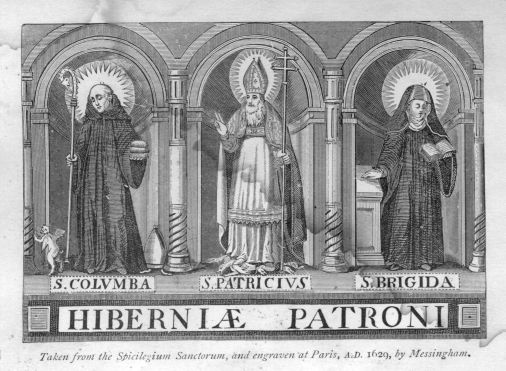
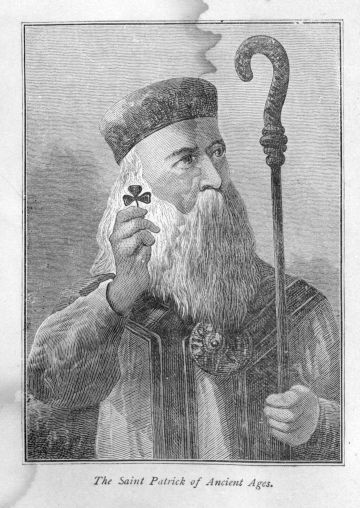
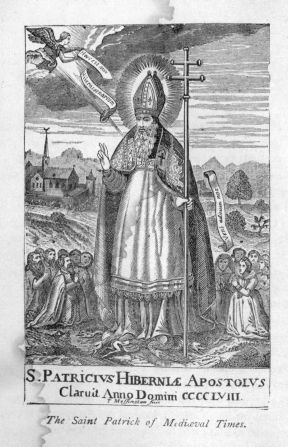
Of the illustrations, it is to be stated that the one prefixed to the life of St. Fiech has been an heirloom in the family of Counsellor Shechan, of this city, and is taken from an old Irish prayer-book, supposed to be between three and five hundred years old. The frontispiece and the illustration fronting the Tripartite Life are taken from the Spicelegium, were engraved by Messengham, with the approbation of the French King and the Paris Archbishop, at Paris, in 1629, and were reproduced at Dublin in 1809. They are now re-engraved for the first time in this country. The illustration prefixed to the life by Jocelin is of ancient date, and supposed to have been suggested by the representation of St. Patrick in the Kilkenny Cathedral.
I hold myself responsible in no way whatsoever for the statements of St. Fiech, St. MacEvin, or Jocelin, but I present to the reader what they asserted they had received from antiquity. Their narratives may be pronounced fables, or legends, or inventions, or superstitions, or histories. On their intrinsic merits I am silent, except inasmuch as they breathe a firm belief in the omnipresence of God amongst men, strangely at variance with the lifeless, frosty indifference of our own day, and are, in addition, savored with a holy heat of charity and a high moral tone. Without comment, then, from me, I present to you in America, kind readers, Saint Patrick, the Apostle and Patron of Ireland and the Irish race, as I received him from my ancestors. I neither overstate, nor under-estimate, nor withheld anything. Judge for yourselves.
REV. JAMES O'LEARY, D.D.
I, Patrick, a sinner, the rudest and least of all the faithful, and most contemptible to very many, had for my father Calpornius, a deacon, the son of Potitus, a priest, who lived in Bannaven Taberniae, for he had a small country-house close by, where I was taken captive when I was nearly sixteen years of age. I knew not the true God, and I was brought captive to Ireland with many thousand men, as we deserved; for we had forsaken God, and had not kept His commandments, and were disobedient to our priests, who admonished us for our salvation. And the Lord brought down upon us the anger of His Spirit, and scattered us among many nations, even to the ends of the earth, where now my littleness may be seen amongst strangers. And there the Lord showed me my unbelief, that at length I might remember my iniquities, and strengthen my whole heart towards the Lord my God, who looked down upon my humiliation, and had pity upon my youth and ignorance, and kept me before I knew him, and before I had wisdom or could distinguish between good and evil, and strengthened and comforted me as a father would his son.
Therefore I cannot and ought not to be silent concerning the great benefits and graces which the Lord has bestowed upon me in the land of my captivity, since the only return we can make for such benefits is, after God has reproved us, to extol and confess His wonders before every nation under heaven.
For there is no other God, nor ever was, nor shall be hereafter, except the Lord, the unbegotten Father, without beginning, by whom all things have their being, who upholds all things, as we have said; and His Son, Jesus Christ, whom, together with the Father, we testify to have always existed before the origin of the world, spiritually with the Father, ineffably begotten before every beginning; and by Him were the visible things made—was made man, death being overthrown, in the heavens. And he hath given Him all power over every name of things in heaven and earth and hell, that every tongue should confess to Him that Jesus Christ is Lord, and whose coming we expect ere long to judge the living and dead; who will render to every one according to his works; who hath poured forth abundantly on us both the gift of His Spirit and the pledge of immortality; who makes the faithful and obedient to become the sons of God and coheirs with Christ; whom we confess and adore one God in the Trinity of the holy Name. For He Himself has said by the prophet: "Call upon me in the day of thy trouble: I will deliver thee, and thou shalt magnify me." And again he says: "It is honorable to reveal and confess the works of God."
Although I am imperfect in many things, I wish my brothers and acquaintances to know my dispositions, that they may be able to understand the desire of my soul. I am not ignorant of the testimony of my Lord, who declares in the psalm: "Thou wilt destroy all that speak a lie." And again: "The mouth that belieth, killeth the soul." And the same Lord: "Every idle word that men shall speak, they shall render an account for it in the Day of Judgment." Therefore I ought, with great fear and trembling, to dread this sentence in that day when no one shall be able to withdraw or hide himself, but all must give an account, even of the least sins, before the judgment-seat of the Lord Christ.
Therefore, although I thought of writing long ago, I feared the censure of men, because I had not learned as the others who studied the sacred writings in the best way, and have never changed their language since their childhood, but continually learned it more perfectly, while I have to translate my words and speech into a foreign tongue; and it can be easily proved from the style of my writings how I am instructed in speech and learning, for the Wise Man says: "By the tongue wisdom is discerned, and understanding and knowledge and learning by the word of the wise." But what avails an excuse, however true, especially when accompanied with presumption? For I, in my old age, strive after that which I was hindered from learning in my youth. But who will believe me? And if I say what I have said before, that as a mere youth, nay, almost a boy in words, I was taken captive, before I knew what I ought to seek and to avoid. Therefore I blush to-day and greatly dread to expose my ignorance, because I am not able to express myself briefly, with clear and well-arranged words, as the spirit desires and the mind and intellect point out. But if it had been given to me as to others, I would not have been silent for the recompense; and although it may seem to some who think thus that I put myself forward with my ignorance and too slow tongue, nevertheless it is written, "The tongues of stammerers shall speak readily and plain"; how much more ought we to undertake this who are the epistle of Christ for salvation unto the ends of the earth, written in pure heart, if not with eloquence, yet with power and endurance, "not written with ink, but with the Spirit of the living God"; and again the Spirit testifies, "Husbandry, it was ordained by the Most High."
Therefore I undertook this work at first, though a rustic and a fugitive, and not knowing how to provide for the future; but this I know for certain: that before I was humbled, I was like a stone lying in deep mire, until He who is powerful came, and in his mercy raised me up, and indeed again succored and placed me in His part; and therefore I ought to cry out loudly, and thank the Lord in some degree for all his benefits, here and after, which the mind of man cannot estimate. Therefore be amazed, both great and small who fear God; rhetoricians and ye of the Lord, hear and enquire who aroused me, a fool, from the midst of those who seem to be wise, and skilled in the law, and powerful in speech and in all things, and hath inspired me (if indeed I be such) beyond others, though I am despised by this world, so that, with fear and reverence and without murmuring, I should faithfully serve this nation, to whom the charity of Christ hath transferred me, and given me for my life, if I shall survive; and that at last with humility and truth I should serve them.
In the measure, therefore, of the faith of the Trinity it behoves me to distinguish without shrinking from danger, and to make known the gift of God and everlasting consolation, and, without fear, confidently to spread abroad the name of God everywhere, so that after my death I may leave it to my Gallican brethren and to my sons, many thousands of whom I have baptized in the Lord. And I was neither worthy nor deserving that the Lord should so favor me, his servant, after such afflictions and great difficulties, after captivity, after many years, as to grant me such grace for this nation—a thing which, still in my youth, I had neither hoped for nor thought of.
But after I had come to Ireland, I was daily tending sheep, and I prayed frequently during the day, and the love of God, and His faith and fear, increased in me more and more, and the spirit was stirred; so that in a single day I have said as many as a hundred prayers, and in the night nearly the same; so that I remained in the woods, and on the mountain, even before the dawn, I was roused to prayer, in snow, and ice, and rain, and I felt no injury from it, nor was there any slothfulness in me, as I see now, because the spirit was then fervent in me. And there one night I heard a voice, while I slept, saying to me: "Thou dost fast well; fasting thou shalt soon go to thy country." And again, after a very short time, I heard a response, saying to me: "Behold, thy ship is ready." And the place was not near, but perhaps about two hundred miles distant, and I had never been there, nor did I know any one who lived there.
Soon after this, I fled, and left the man with whom I had been six years, and I came in the strength of the Lord, who directed my way for good; and I feared nothing until I arrived at that ship. And the day on which I came the ship had moved out of her place; and I asked to go and sail with them, but the master was displeased, and replied angrily: "Do not seek to go with us." And when I heard this, I went from them to go thither where I had lodged; and I began to pray as I went; but before I had ended my prayer, I heard one of them calling out loudly after me, "Come quickly, for these men are calling you"; and I returned to them immediately, and they began saying to me; "Come, we receive thee in good faith; make such friendship with us as you wish." And then that day I disdained to supplicate them, on account of the fear of God; but I hoped of them that they would come into the faith of Jesus Christ, for they were Gentiles; and this I obtained from them; and after three days, we reached land, and for twenty-eight days we journeyed through a desert, and their provisions failed, and they suffered greatly from hunger; and one day the master began to say to me: "What sayest thou, O Christian? Your God is great and all-powerful; why canst thou not, then, pray for us, since we are perishing with hunger, and may never see the face of man again?" And I said to them plainly: "Turn sincerely to the Lord my God, to whom nothing is impossible, that He may send us food on your way until ye are satisfied, for it abounds everywhere for Him." And with God's help it was so done; for, lo! a flock of swine appeared in the way before our eyes, and they killed many of them, and remained there two nights, much refreshed and filled with their flesh; for many of them had been left exhausted by the wayside. After this, they gave the greatest thanks to God, and I was honored in their eyes.
They also found wild honey, and offered me some of it, and one of them said: "This is offered in sacrifice, thanks be to God"; after this, I tasted no more. But the same night, while I was sleeping, I was strongly tempted by Satan (of which I shall be mindful as long as I shall be in this body), and there fell, as it were, a great stone upon me, and there was no strength in my limbs. And then it came into my mind, I know not bow, to call upon Elias, and at the same moment I saw the sun rising in the heavens; and while I cried out Elias with all my might, behold! the splendor of the sun was shed upon me, and immediately shook from me all heaviness. And I believe that Christ my Lord cried out for me; and I hope that it will be so in the day of my adversity, as the Lord testifies in the Gospel: "It is not you that speak," etc.
Some time after, I was taken captive; and on the first night I remained with them I heard a divine response, saying: "You shall be two months with them"; and so it was. On the sixtieth night the Lord delivered me out of their hands, and on the road He provided for us food, and fire, and dry weather daily, until on the fourteenth day we all came. As I have above mentioned, we journeyed twenty-eight days through a desert, and on the night of our arrival we had no provisions left.
And again, after a few years, I was with my relations in Britain, who received me as a son, and earnestly besought me that then, at least, after I had gone through so many tribulations, I would go nowhere from them. And there I saw, in the midst of the night, a man who appeared to come from Ireland, whose name was Victorious, and he had innumerable letters with him, one of which he gave to me; and I read the commencement of the epistle containing "The Voice of the Irish"; and as I read aloud the beginning of the letter, I thought I heard in my mind the voice of those who were near the wood of Focluti, which is near the western sea; and they cried out: "We entreat thee, holy youth, to come and walk still amongst us." And my heart was greatly touched, so that I could not read any more, and so I awoke. Thanks be to God that, after very many years, the Lord hath granted them their desire!
And on another night, whether in me or near me God knows, I heard eloquent words which I could not understand until the end of the speech, when it was said: "He who gave His life for thee is He who speaks in thee"; and so I awoke full of joy. And again, I saw one praying within me, and I was, as it were, within my body, and I heard, that is, above the inner man, and there he prayed earnestly with groans. And I was amazed at this, and marvelled, and considered who this could be who prayed in me. But at the end of the prayer it came to pass that it was a bishop, and I awoke and remembered that the apostle said: "Likewise the Spirit also helpeth our infirmity, for we know not what we should pray for as we ought, but the Spirit Himself asketh for us with unspeakable groanings." And again: "The Lord is our advocate, who also maketh intercession for us." [And when I was tried by some of my elders, who came and spoke of my sins as an objection to my laborious episcopate, I was on that day sometimes strongly driven to fall away here and for ever. But the Lord spared a proselyte and a stranger for His name's sake, and mercifully assisted me greatly in that affliction, because I was not entirely deserving of reproach. I pray God that they may not be found guilty of giving an occasion of sin; they found me after thirty years, and brought against me words that I had confessed before I was a deacon; from anxiety, with sorrow of mind, I told my dearest friend what I had done in my youth, in one day, nay, rather in one hour, because I was not then able to overcome. I know not, God knows, if I was then fifteen years of age, and from my childhood I did not believe in the living God, but remained in death and unbelief until I was severely chastised, and, in truth, I have been humbled by hunger and nakedness; and even now I did not come to Ireland of my own will until I was nearly worn out. But this proved a blessing to me, for I was thus corrected by the Lord, and he made me fit to be to-day that which was once far from my thoughts, so that I should care for the salvation of others, for at that time I had no thought even for myself.
And in the night of the day in which I was reproved for the things above mentioned, I saw in the night.] I saw in a vision of the night a writing without honor before me. And then I heard an answer saying to me, "We have heard with displeasure the face of the elect without a name." He did not say, "Thou hast badly seen," but "We have badly seen," as if he had there joined himself to me, as he said: "He that touches you is as he who toucheth the apple of my eye." Therefore I give thanks to Him who comforted me in all things that He did not hinder me from the journey which I had proposed, and also as regards my work which I had learned of Christ. But from this thing I felt no little strength, and my faith was approved before God and man.
Therefore I dare to say that my conscience does not reproach me now or for the future. I have the testimony of God now that I have not lied in the words I have told you. [But I feel the more grieved that my dearest friend, to whom I would have trusted even my life, should have occasioned this. And I learned from certain brethren that, before this defence, when I was not present, nor even in Britain, and with which I had nothing to do, that he defended me in my absence. He had even said to me with his own lips: "Thou art going to be given the rank of bishop," though I was not worthy of it. How, then, did it happen to him that afterwards, before all persons, good and bad, he should detract me publicly, when he had before this freely and gladly praised me? And the Lord, who is greater than all? I have said enough. Still, I ought not to hide the gift of God which he gave me in the land of my captivity, for I sought him earnestly then, and found him there, and He preserved me from all iniquity, I believe, through the indwelling of His Spirit, which worketh within me unto this day more and more. But God knows, if it were man who spoke this to me, I would perhaps be silent for the love of Christ.
Therefore I give unceasing thanks to my God, who preserved me faithful in the day of my temptation, so that I can to-day offer him sacrifice confidently—the living sacrifice of my soul to Christ my Lord, who preserved me from all my troubles, so that I may say to Him: "Who am I, O Lord! or what is my calling, that divine grace should have so wrought with me, so that to-day I can so rejoice amongst the nations, and magnify Thy name, wherever I am, not only in prosperity, but also in adversity?" and I ought to receive equally whatever happens to me, whether good or evil, giving God thanks in all things, who hath shown me that I should, undoubtingly, without ceasing, believe in Him who hath heard me though I am ignorant, and that I should undertake, in those days, so holy and wonderful a work, and imitate those of whom our Lord predicted of old that they should preach His Gospel to all nations for a testimony before the end of the world; which has been accomplished, as we have seen. Behold, we are witnesses that the Gospel has been preached to the limits of human habitation.]
But it is too long to detail my labors particularly, or even partially. I will briefly say how the good God often delivered me from slavery and from twelve dangers by which my soul was threatened, besides many snares, and what in words I cannot express, and with which I will not trouble my readers. But God knows all things, even before they come to pass [as he does me, a poor creature. Therefore the divine voice very often admonished me to consider whence came this wisdom, which was not in me, who neither knew God nor the number of my days. Whence did I obtain afterwards the great and salutary gift to know or love God, and to leave my country and my relations, although many gifts were offered to me with sorrow and tears. And I offended many of my seniors then against my will. But, guided by God, I yielded in no way to them—not to me, but to God be the glory, who conquered in me, and resisted them all; so that I came to the Irish people to preach the Gospel, and bear with the injuries of the unbelieving, and listen to the reproach of being a stranger, and endure many persecutions, even to chains, and to give up my freedom for the benefit of others. And if I be worthy, I am ready to give up my life unhesitatingly and most cheerfully for His name, and thus, if the Lord permit, I desire to spend it even until my death.]
For I am truly a debtor to God, who has given me so much grace that many people should be born again to God through me, and that for them everywhere should be ordained priests for this people, newly come to the faith, which the Lord took from the ends of the earth, as He promised formerly by His prophets: "Our fathers falsely prepared idols, and there is no profit in them, to thee the Gentiles come and will say." And again: "I have set thee to be the light of the Gentiles, that thou mayest be for salvation unto the utmost parts of the earth." And thus I wait the promise of Him who never fails, as He promises in the Gospel: "They shall come from the east and the west [from the north and from the south], and shall sit down with Abraham and Isaac and Jacob." So we believe that the faithful shall come from all parts of the world.
Therefore we ought to fish well and diligently; as the Lord taught and said: "Come ye after me, and I will make you fishers of men." And again: "Behold, saith the Lord, I send many fishers and many hunters," etc. Therefore we should, by all means, set our nets in such a manner that a great multitude and a crowd may be caught therein for God, and that everywhere there may be priests who shall baptize and exhort a people who so need it and desire it; as the Lord teaches and admonishes in the Gospel, saying: "Going, therefore, teach ye all nations, baptizing them in the name of the Father and of the Son and of the Holy Ghost, even to the consummation of the world." And again: "Go ye into the whole world, and preach the Gospel to every creature; he that believeth and is baptized shall be saved, but he that believeth not shall be condemned." The rest are examples. [And again: "This Gospel of the kingdom shall be preached in the whole world for a testimony to all nations, and then shall the consummation come." And again, the Lord, speaking by the prophet, says: "And it shall come to pass in the last days, saith the Lord, that I will pour out my spirit upon all flesh, and your sons and your daughters shall prophesy, your old men shall dream dreams, and your young men shall see visions. Moreover, upon my servants and handmaids in those days I will pour forth my spirit, and they shall prophesy." And Osee saith: "And I will say to that which was not my people: Thou art my people: and to her who hath not found mercy; and they shall say; Thou art my God. And in the place where I said to them, You are not my people, it shall be said to them, Ye are the sons of the living God."]
Wherefore behold how in Ireland they who never had the knowledge of God, and hitherto only worshipped unclean idols, have lately become the people of the Lord, and are called the sons of God. The sons of the Scoti and the daughters of princes are seen to be monks and virgins of Christ. [And there was one blessed Irish maiden, of adult age, noble and very beautiful, whom I baptized, and after a few days she came to us for a reason, and gave us to understand that she had received a command from God, and was informed that she was to become a virgin of Christ, and to draw near to God. Thanks be to God, six days after this she most excellently and eagerly entered on this state of life, which all the virgins of God now adopt, even against the will of their parents, even enduring reproaches and persecution from them, and notwithstanding they increase in number; and as for those who are born again in this way, we know not their number, except the widows and those who observe continency. But those who are in slavery are most severely persecuted, yet they persevere in spite of terrors and threats. But the Lord has given grace to many of my handmaids, for they zealously imitate him as far as they are able.
Therefore, though I could have wished to leave them, and had been ready and very desirous to go to Britannia, as if to my country and parents, and not that alone, but to go even to Gallia, to visit my brethren, and to see the face of my Lord's saints; and God knows that I desired it greatly. But I am bound in the spirit, and he who witnesseth will account me guilty if I do it, and I fear to lose the labor which I have commenced—and not I, but the Lord Christ, who commanded me to come and be with them for the rest of my life; if the Lord grants it, and keeps me from every evil way, that I should not sin before him. But I hope that which I am bound to do, but I trust not myself as long as I am in this body of death, for he is strong who daily tries to turn me from the faith, and from the sincere religious chastity to Christ my Lord, to which I have dedicated myself to the end of my life, but the flesh, which is in enmity, always draws me to death—that is, to unlawful desires, that must be unlawfully gratified—and I know in part that I have not led a perfect life like other believers. But I confess to my Lord, and do not blush before him, because I tell the truth, that from the time I knew him in my youth the love of God and his fear increased within me, and until now, by the favor of the Lord, I have kept the faith.
Let him who pleases insult and laugh at me; I will not be silent, neither do I conceal the signs and wonders that the Lord hath shown to me many years before they took place, as he who knew all things even before the world began. Therefore I ought to give thanks to God without ceasing, who often pardoned my uncalled-for folly and negligence, who did not let his anger turn fiercely against me, who allowed me to work with him, though I did not promptly follow what was shown me and what the Spirit suggested; and the Lord had compassion on me among thousands and thousands, because he saw my good-will; but then I knew not what to do, because many were hindering my mission, and were talking behind my back, and saying: "Why does he run into danger among enemies who know not God?" This was not said with malice, but because they did not approve of it, but, as I now testify, because of my rusticity, you understand; and I did not at once recognize the grace which was then in me, but now I know I should have known before.
Therefore I have simply related to my brethren and fellow-servants who have believed me why I have preached and still preach to strengthen and confirm your faith. Would that you also might aim at higher things and succeed better. This shall be my glory, because a wise son is the glory of his father. You know and God knows how I have lived among you from my youth up, both faithful in truth and sincere in heart; also, I have given the faith to the people among whom I dwell, and I will continue to do so. God knows I have not overreached any of them, nor do I think of it, because of God and his Church, lest I should excite persecution for them and all of us, and lest the name of the Lord should be blasphemed through me; for it is written, "Woe to the man through whom the name of the Lord is blasphemed." For though I am unskilled in names, I have endeavored to be careful even with my Christian brethren, and the virgins of Christ, and devout women, who freely gave me gifts, and cast of their ornaments upon the altar; but I returned them, though they were offended with me because I did so. But I, for the hope of immortality, guarded myself cautiously in all things, so that they could not find me unfaithful, even in the smallest matter, so that unbelievers could not defame or detract from my ministry in the least.
But when it happened that I baptized so many thousand men, did I expect even half a "screpall" from them? Tell me, and I will return it to you. Or when the Lord ordained clergy through my humility and ministry, did I confer the grace gratuitously? If I asked of any of them even the value of my shoe, tell me, and I will repay you more. I rather spent for you as far as I was able; and among you and everywhere for you I endured many perils in distant places, where none had been further or had ever come to baptize, or ordain the clergy, or confirm the people. By the grace of the Lord I labored freely and diligently in all things for your salvation. At this time also I used to give rewards to kings, whose sons I hired, who travelled with me, and who understood nothing but [to protect] me and my companions. And on one day they wished to kill me; but the time had not come yet; but they put me in irons, and carried off all we possessed. But on the fourteenth day the Lord released me from their power, and what was ours was restored to us through God and through the friends we had before secured.
You know how much I expended on the judges in the districts which I visited most frequently. For I think I paid them not less than the hire of fifteen men, that you might have the benefit of my presence, and that I might always enjoy you in the Lord. I do not regret it, nor is it sufficient for me. I still spend, and will still spend, for your souls.] Behold, I call God to witness on my soul that I do not lie, neither that you may have occasion, nor that I hope for honor from any of you; sufficient for me is the honor of truth. But I see that now in the present world I am greatly exalted by the Lord; and I was not worthy nor fit to be thus exalted, for I know that poverty and calamity are more suitable for me than riches and luxury. But even Christ the Lord was poor for us.
Truly, I, a poor and miserable creature, even if I wished for wealth, have it not; neither do I judge myself, because I daily expect either death, or treachery, or slavery, or an occasion of some kind or another. [But I fear none of these things, relying on the heavenly promise; for I have cast myself into the hands of the omnipotent God, who rules everywhere; as the prophet says: "Cast thy care upon the Lord, and He shall sustain thee."
Behold, now I commend my soul to my most faithful God, whose mission I perform, notwithstanding my unworthiness; but because He does not accept persons, and has chosen me for this office, to be one of the least of His ministers. "What shall I render to Him for all the things that He hath rendered to me?" But what shall I say or promise to my Lord? For I see nothing unless He gives Himself to me; but He searches the heart and reins, because I ardently desire and am ready that He should give me to drink His cup, as He has permitted others to do who have loved Him. Wherefore may my Lord never permit me to lose His people whom He has gained in the ends of the earth. I pray God, therefore, that He may give me perseverance, and that He may vouchsafe to permit me to give Him faithful testimony for my God until my death. And if I have done anything good for my God, whom I love, I beseech Him to grant to me that with those proselytes and captives I may pour out my blood for His name, even if my body should be denied burial, and be miserably torn limb from limb by dogs or fierce beasts, or that the birds of heaven should devour it. I believe most certainly that if this should happen to me, I have gained both soul and body; for it is certain that we shall rise one day in the brightness of the sun—that is, the glory of Christ Jesus our Redeemer—as sons of God but as joint heirs with Christ, and to become conformable to His image.
For that sun which we see rises daily for us; but it will not rule or continue in its splendor for ever, and all who adore it shall suffer very miserably. But we who believe in and adore the true sun, Christ, who will never perish, neither he who shall do His will, but even as Christ shall abide for ever, who reigns with God the Father Almighty, and with the Holy Spirit, before the ages, and now, and for ever and ever. Amen.
Behold, again and again, I shall briefly declare the words of my confession. I testify in truth and in joy of heart, before God and His holy angels, that I never had any occasion, except the Gospel and its promises, for returning to that people from whom I had before with difficulty escaped.]
But I beseech those who believe in and fear God, whoever may condescend to look into or receive this writing, which Patrick, the ignorant sinner, has written in Ireland, that no one may ever say, if I have ever done or demonstrated anything, however little, that it was my ignorance. But do you judge, and let it be believed firmly, that it was the gift of God. And this is my confession before I die.
Thus far is what Patrick wrote with his own hand; he was translated to heaven on the seventeenth of March.
I, Patrick, a sinner and unlearned, have been appointed a bishop in Ireland, and I accept from God what I am. I dwell amongst barbarians as a proselyte and a fugitive for the love of God. He will testify that it is so. It is not my wish to pour forth so many harsh and severe things; but I am forced by zeal for God and the truth of Christ, who raised me up for my neighbors and sons, for whom I have forsaken my country and parents, and would give up even life itself, if I were worthy. I have vowed to my God to teach these people, though I should be despised by them, to whom I have written with my own hand to be given to the soldiers to be sent to Coroticus—I do not say to my fellow-citizens, nor to the fellow-citizens of pious Romans, but to the fellow-citizens of the devil, through their evil deeds and hostile practices. They live in death, companions of the apostate Scots and Picts, blood-thirsty men, ever ready to redden themselves with the blood of innocent Christians, numbers of whom I have begotten to God and confirmed in Christ.
On the day following that in which they were clothed in white and received the chrism of neophytes, they were cruelly cut up and slain with the sword by the above mentioned; and I sent a letter by a holy priest, whom I have taught from his infancy, with some clerics, begging that they would restore some of the plunder or the baptized captives; but they laughed at them. Therefore I know not whether I should grieve most for those who were slain, or for those whom the devil insnared into the eternal pains of hell, where they will be chained like him. For whoever commits sin is the slave of sin, and is called the son of the devil.
Wherefore let every man know who fears God that they are estranged from me, and from Christ my God, whose ambassador I am—these patricides, fratricides, and ravening wolves, who devour the people of the Lord as if they were bread; as it is said: "The wicked have dissipated thy law," wherein in these latter times Ireland has been well and prosperously planted and instructed. Thanks be to God, I usurp nothing; I share with these whom He hath called and predestinated to preach the Gospel in much persecution, even to the ends of the earth. But the enemy hath acted invidiously towards me through the tyrant Coroticus, who fears neither God nor His priests whom He hath chosen, and committed to them the high, divine power: "Whomsoever they shall bind on earth shall be bound in heaven."
I beseech you, therefore, who are the holy ones of God and humble of heart, that you will not be flattered by them, and that you will neither eat nor drink with them, nor receive their alms, until they do penance with many tears, and liberate the servants of God and the baptized hand-maids of Christ, for whom he was crucified and died. "He that offereth sacrifice of the goods of the poor, is as one that sacrificeth the son in the presence of the father." "Riches, he saith, which the unjust accumulate shall be vomited forth from his belly, the angel of death shall drag him away, he shall be punished with the fury of dragons, the tongue of the adder shall slay him, inextinguishable fire shall consume him." Hence, "Woe to those who fill themselves with things which are not their own." And "what doth it profit a man if he gain the whole world and suffer the loss of his soul?" It were too long to discuss one by one, or to select from the law, testimonies against such cupidity. Avarice is a mortal sin. "Thou shall not covet thy neighbor's goods." "Thou shall not kill." The homicide cannot dwell with Christ. "He who hateth his brother is a murderer," and "and he who loveth not his brother abideth in death." How much more guilty is he who hath defiled his hands with the blood of the sons of God, whom He hath recently acquired in the ends of the earth by our humble exhortations!
Did I come to Ireland according to God or according to the flesh? Who compelled me? I was led by the Spirit, that I should see my relatives no more. Have I not a pious mercy towards that nation which formerly took me captive? According to the flesh, I am of noble birth, my father being a Decurio. I do not regret or blush for having bartered my nobility for the good of others. I am a servant in Christ unto a foreign people for the ineffable glory of eternal life, which is in Christ Jesus my Lord; though my own people do not acknowledge me: "A prophet is without honor in his own country." Are we not from one stock, and have we not one God for our Father? As He has said: "He that is not with me is against me, and he that gathereth not with me scattereth." Is it not agreed that one pulleth down and another buildeth? I seek not my own.
Not to me be praise, but to God, who hath put into my heart this desire that I should be one of the hunters and fishers whom, of old, God hath announced should appear in the last days. I am reviled—what shall I do, O Lord? I am greatly despised. Lo! thy sheep are torn around me, and plundered by the above-mentioned robbers, aided by the soldiers of Coroticus: the betrayers of Christians into the hands of the Picts and Scots are far from the charity of God. Ravening wolves have scattered the flock of the Lord, which, with the greatest diligence, was increasing in Ireland; the sons of the Irish and the daughters of kings who are monks and virgins of Christ are too many to enumerate. Therefore the oppression of the great is not pleasing to thee now, and never shall be.
Who of the saints would not dread to share in the feasts or amusements of such persons? They fill their houses with the spoils of the Christian dead, they live by rapine, they know not the poison, the deadly food, which they present to their friends and children; as Eve did not understand that she offered death to her husband, so are all those who work evil: they labor to work out death and eternal punishment.
It is the custom of the Christians of Rome and Gaul to send holy men to the Franks and other nations, with many thousand solidi, to redeem baptized captives. You who slay them, and sell them to foreign nations ignorant of God, deliver the members of Christ, as it were, into a den of wolves. What hope have you in God? Whoever agrees with you, or commands you, God will judge him. I know not what I can say, or what I can speak more of the departed sons of God slain cruelly by the sword. It is written: "Weep with them that weep." And again: "If any member suffers anything, all the members suffer with it." Therefore the Church laments and bewails her sons and daughters, not slain by the sword, but sent away to distant countries, where sin is more shameless and abounds. There free-born Christian men are sold and enslaved amongst the wicked, abandoned, and apostate Picts.
Therefore I cry out with grief and sorrow. O beautiful and well-beloved brethren and children! whom I have brought forth in Christ in such multitudes, what shall I do for you? I am not worthy before God or man to come to your assistance. The wicked have prevailed over us. We have become outcasts. It would seem that they do not think we have one baptism and one Father, God. They think it an indignity that we have been born in Ireland; as He said: "Have ye not one God? Why do ye each forsake his neighbor?" Therefore I grieve for you—I grieve, O my beloved ones! But, on the other hand, I congratulate myself I have not labored for nothing—my journey has not been in vain. This horrible and amazing crime has been permitted to take place. Thanks be to God, ye who have believed and have been baptized have gone from earth to paradise. Certainly, ye have begun to migrate where there is no night or death or sorrow; but ye shall exult like young bulls loosed from their bonds and tread down the wicked under your feet as dust.
Truly, you shall reign with the apostles and prophets and martyrs, and obtain the eternal kingdom, as He hath testified, saying: "They shall come from the east and the west, and shall sit down with Abraham and Isaac and Jacob in the kingdom of heaven." Without are dogs, and sorcerers, and murderers, and liars, and perjurers, and they shall have their part in the everlasting lake of fire. Nor does the apostle say without reason: "If the just are scarcely saved, where shall the sinner, the impious, and the transgressor of the law appear?" Where will Coroticus and his wicked rebels against Christ find themselves when they shall see rewards distributed amongst the baptized women? What will he think of his miserable kingdom, which shall pass away in a moment, like clouds or smoke, which are dispersed by the wind? So shall deceitful sinners perish before the face of the Lord, and the just shall feast with great confidence with Christ, and judge the nations, and rule over unjust kings, for ever and ever. Amen.
I testify before God and His angels that it shall be so, as He hath intimated to my ignorance. These are not my words that I have set forth in Latin, but those of God and the prophets and apostles, who never lied: "He that believeth shall be saved, but he that believeth not shall be condemned."
God hath said it. I entreat whosoever is a servant of God that he be a willing bearer of this letter, that he be not drawn aside by any one, but that he shall see it read before all the people in the presence of Coroticus himself, that, if God inspire them, they may some time return to God, and repent, though late; that they may liberate the baptized captives, and repent for their homicides of the Lord's brethren; so that they may deserve of God to live and to be whole here and hereafter. The peace of the Father, and of the Son, and of the Holy Ghost. Amen.
At Nemthur Saint Patrick was born,
As history handed it down;
And when but sixteen years of age,
A captive was led from that town.
Siccoth was Saint Patrick's first name;
His father Calphurn without miss;
His grandfather Otide was styled;
He was nephew of Deacon Odisse.
Six years did he live in dark bonds,
And the food of the Gentile ate not;
And Cathraige by men he was called,
Since to work for four homes was his lot.
To the servant of Milcho 'twas said
To pass o'er the seas and the plain;
Then stood angel Victor on rock,
And his footprints to this day remain.
Departed Saint Patrick o'er Alps--
On his way all successful he hies;
And with German remained in the South
'Neath Letavia's wide-spreading skies.
In the isles of the Tyrrhenian sea
Saint Patrick some period awaits,
And as canon with German he reads,
As his history still to us states
To Hibernia Saint Patrick returned,
By visions from angels induced;
For visions to him appeared oft,
And his mind to subjection reduced.
Soul-saving was Patrick's intent,
For 'twas to far Foclut's dark flood;
He had heard the entreaty and wail
Of children in Foclut's far woods.
For asked they the saint to make haste
And Letavia's wide lands desert,
That from error's dark ways Eire's men
He might in life's pathways direct.
Foretold Eire's seers years of peace,
Which were to remain through all time;
But the grandeurs of Tara the proud
Were to vanish in dust, as earth's slime.
To Leary, the monarch, Druids told
Of the advent of Patrick the saint;
And their visions were true, as we know
From the facts which his histories paint.
Renowned was Saint Patrick through life,
And of error he was a dire foe;
Hence for ever his name shall be grand
Among the nations, as ages shall flow.
The Apocalypse sang he, and hymns,
And three fifty full psalms, day by day;
He instructed and praised and baptized,
And all time he continued to pray.
Nor could any cold e'er prevent
That he stayed in the water o'er nights;
And to gain the grand kingdom of heaven,
Through the day he used preach on the heights.
By the far-famous fount of the North,
Benibarka! thy waters sha'n't cease;
For a hundred full psalms he used sing
Each night the Lord's praise to increase.
Then he slept on a cold bed of stone,
And with a wet cover was dressed;
A stone was his pillow each night--
Such, such was the saint's nightly rest.
To the people the Gospel was preached,
With power and with miracles signed;
The blind and the lepers were cured,
And Death his dead subjects resigned.
Saint Patrick did preach to the Scots,
And in Letavia much he endured,
That whom he had won to the Lord
In Judgment's dread day be secured.
Emir's and proud Erimon's sons
A demon contrived to ensnare;
And them did dread Satan engulf
In the dark, fearful depths of his lair,
Until our apostle arrived,
Who rescued and set them all free,
Through sixty long years of his life
To Christ's cross the brave Fenians flee.
Great darkness o'er Eire was spread,
And its people their idols adored,
Nor in the true Godhead believed,
Nor the Trinity, too, of the Lord.
At Armagh the realm's throne has been placed,
To Emania a glory to be;
And far-famed is Dundalethglas church,
Nor let fame from Temoria flee.
To Armagh, in his infirm old age,
Saint Patrick desired much to go;
But God's angel at noon met the saint,
And induced him his wish to forego.
Southward to the angel he came
(For Victor had been his good guide),
And the bush in which Victor appeared
Burned bright, and a voice from it cried:
"At Armagh let the government be,
And to Christ let all glory be brought;
Indeed, thou shalt come unto heaven;
Thou obtainedst, because thou hadst sought.
"A hymn which you sing while alive
Shall to Celts a proud armament be;
And at judgment the Irish surround
Their father, their patron, in thee."
After Patrick, good Tassach remained;
When Patrick to Tassach Christ gave,
Tassach said: "He from me shall receive";
And the prediction of Tassach was grave.
For the night was installed a bright day,
And that day for one year did remain;
So that over all Eire the fair
Light's brilliance and brightness did reign.
Bethoron a battle beheld
Of great Nun against Chanaan's sons,
In which Gabaon saw the sun stand,
As the Scriptural narrative runs.
For brave Josue stood the bright sun
To witness the wicked all slain;
Why not for Saint Patrick thrice more
To illumine Hibernia's plain?
For all Eire's good clergy were come
To bury Saint Patrick with pride;
And the sounds of the singing from heaven
Cast them sleeping all round, far and wide.
Saint Patrick's pure soul fled his frame
(His works immortality make);
And on the first night after death,
The angels of God watched his wake.
And when Patrick departed from life,
To the other Saint Patrick came he;
And to Jesus, of Mary the Son,
The two passed, bright and pure, great and free.
In Patrick pride's stain was not found;
And great were the works that adorn
This good son of Christ, Mary's Son!
With God's blessing Saint Patrick was born.
The people who sat in darkness saw a great light, and they who were in the land and in the shadow of death received light by which came their illumination.
Patrick, then, was of the Britons of Alcluaid by origin. Calpurnn was his father's name. He was a noble priest. Potid was his grandfather's name, whose title was a deacon. Conceis was his mother's name. She was of the Franks, and a sister to Martin. In Nemtur, moreover, the man St. Patrick was born; and the flag (stone) on which St. Patrick was born would give forth water when any one swore a false oath upon it, as if it were lamenting the false testimony. If the oath was true, however, the stone would continue in its natural condition.
When the man St. Patrick was born, he was taken to a blind, flat-faced man to be baptized. Gornias was the priest's name; and he had no water out of which he could perform the baptism until he made the sign of the cross over the ground with the infant's hand, when a fountain of water burst forth. Gornias washed his face, and his eyes were opened to him; and he, who had learned no letter, read the baptism. God wrought three miracles through Patrick in this place—viz., the fountain of water through the ground, his eyesight to the blind man, and his reading the ordo of the baptism without knowing a letter up to that time. And Patrick was subsequently baptized. A church was founded, moreover, over this well in which Patrick was baptized; and the well is at the altar, and it has the form of the cross, as the learned report.
Many prodigies and miracles were wrought through Patrick in his youth, but we shall only relate a few out of many of them. One time Patrick was in his nurse's house, in winter time, when a great flood and rain filled his nurse's residence, so that the vessels and furniture of the house were floating about, and the fire was extinguished. Patrick then cried to his nurse, as usual with children when desiring food. Then his nurse said to him: "That is not what troubles us; there is something else we would rather do than to prepare food for thee; even the fire is extinguished." When Patrick heard these words, truly, he sought a certain spot in the house to which the water had not reached; and he dipped his hand in the water, and five drops fell from Patrick's fingers, and they were suddenly changed into five sparks, and the fire glowed, and the water rose not. The names of God and of Patrick were magnified thereby. Another time, as Patrick was playing amongst his companions, in the time of winter and cold in particular, he collected his armful of pieces of ice, which he brought home to his nurse. Then his nurse said: "It would be better for you to bring us withered brambles to warm ourselves with than what you have brought." Thereupon he said to his nurse:
"Believe thou, because God is powerful thereto, that even the sheets of ice will burn like faggots." And no sooner were the pieces of ice placed on the fire, and he had breathed on them, than they burned like faggots. The names of God and Patrick were magnified through this miracle.
One time, when Patrick and his sister (i.e., Lupait) were herding sheep, the lambs came suddenly to their dams, as is customary with them, to drink milk. When Patrick and his sister saw this, they ran quickly to prevent them. The girl fell, and her head struck against a stone, so that death was nigh unto her. As soon as Patrick perceived that his sister was lying down, and that death was nigh unto her, he wept loudly; and he raised her up immediately, and made the sign of the cross over the wound, and it healed without any illness. (Nevertheless, the signs of the "white wound" would appear there.) And they came home as if no evil had happened to them. Another time, Patrick was with the sheep, when a wolf took away a sheep from him. His nurse reproved him greatly therefor. The wolf brought the sheep whole to the same place on the morrow; and the restoration in this way was wonderful—viz., the wolf's dislike regarding the habitual food.
When Patrick's nurse, therefore, saw him magnified by God in prodigies and miracles, she used to love him very much, and would not wish to go anywhere without him. One time his nurse went to milk the cow. He went with her to get a drink of new milk. The cow [became mad] in the booley, and killed five other cows. The nurse was much grieved, and asked him to resuscitate the cows. He resuscitated the cows, then, so that they were quite well, and he cured the mad cow; and the names of God and Patrick were magnified through this miracle.
There was a great assembly held by the Britons. He went to the assembly with his nurse and his guardian. It happened that his guardian died in the assembly. All were hushed into silence thereat; and his relatives cried, and his friends wept, and they said, "Why, thou gilla, didst thou let the man who was carrying thee die?" As regards the gilla moreover, he ran to his guardian, and placed his hands about his neck, and said to him, "Arise, and let us go home." He arose forthwith at Patrick's word, and they went home safe afterwards.
The boys of the place in which Patrick was nursed were wont to bring honey to their mothers from the bees' nests. Then his nurse said to Patrick: "Although every other boy brings honey to his nurse, you bring none to me." Patrick afterwards carried off a bucket to the water, and filled it, and blessed the water, so that it changed into honey; and it healed every disease and ailment to which it was applied.
One time the King of Britain's steward went to command Patrick and his nurse to go and clean the hearth of the royal house in Al-Cluaid. Patrick and his nurse went. Then it was that the angel came, and said to Patrick: "Pray, and it will not be necessary for you to perform that work." Patrick prayed. The angel afterwards cleaned the hearth. Then Patrick said: "Though all the firewood in Britain were burned in that fireplace, there would be no ashes of it on the morrow." And this, indeed, is fulfilled yet. Another time, the King of Britain's steward went to demand tribute of curds and butter from Patrick's nurse; and she had nothing that she would give for the rent. Then it was that Patrick made curds and butter of the snow, and they were taken to the king; and the moment they were exhibited to the king, afterwards they changed into the nature of snow again. The king thereupon forgave the rent to Patrick for ever.
The cause of Patrick's coming to Erinn was as follows: The seven sons of Fechtmad—viz., the seven sons of the King of Britain—were on a naval expedition, and they went to plunder in Armoric-Letha; and a number of the Britons of Srath-Cluaidh were on a visit with their kinsmen, the Britons of Armoric-Letha, and Calpurn, son of Potit, Patrick's father, and his mother—i.e., Conches, daughter of Ocbas of the Galls—i.e., of the Franks—were killed in the slaughter in Armorica. Patrick and his two sisters—viz., Lupait and Tigris—were taken prisoners, moreover, in that slaughter. The seven sons of Fechtmad went afterwards on the sea, having with them Patrick and his two sisters in captivity. The way they went was around Erinn, northwards, until they landed in the north; and they sold Patrick to Miliuc, son of Buan—i.e., to the King of Dal-Araidhe. They sold his sisters in Conaille-Muirthemhne. And they did not know this. Four persons, truly, that purchased him. One of them was Miliuc. It was from this that he received the name that is Cothraige, for the reason that he served four families. He had, indeed, four names. . .
[Here a leaf is missing from both the Bodleian and British Museum MSS. of the Tripartite Life, the contents of which would fill eight pages of similar size to the foregoing.]
When Patrick had completed his sixtieth year, and had learned knowledge, his auxiliary angel, Victor (for he was of assistance to him when he [Patrick] was in bondage with Miliuc, and regarding everything besides which he might wish), went to him, and said to him: "You are commanded from God to go to Erinn, to strengthen faith and belief, that you may bring the people, by the net of the Gospel, to the harbor of life; for all the men of Erinn call out your name, and they think it seasonable and fit that you should come." Patrick afterwards bade farewell to Germanus, and gave him a blessing; and a trusted senior went with him from Germanus, to guard him and testify for him; his name was Segetius, and he was by grade a priest, and he it was who usually kept the Ordo of the church besides Germanus.
Patrick went subsequently on the sea, his company being nine. Then he went upon an island, where he saw a withered old woman on her hands at the door of a house. "Whence is the hag?" asked Patrick; "great is her infirmity." A young man answered, and said: "She is a descendant of mine," said the young man; "if you could see the mother of this girl, O cleric! she is more infirm still." "In what way did this happen?" enquired Patrick. "Not difficult to tell," said the young man. "We are here since the time of Christ. He came to visit us when He was on earth amongst men; and we made a feast for him, and he blessed our house and blessed ourselves; but this blessing reached not our children; and we shall be here without age or decay for ever. And it is long since thy coming was foretold to us," said the young man; "and God 'left it with us' [i.e., prophesied to us] that thou wouldst come to preach to the Gaeidhel; and He left a token with us, i.e., His bachall (crozier), to be given to thee." "I will not take it," said Patrick, "until He Himself gives me His bachall." Patrick remained three days and three nights with them; and he went afterwards into Sliabh-Hermoin, near the island, where the Lord appeared unto him, and commanded him to go and preach to the Gaeidliel; and He gave him the Bachall-Isa, and said that it would be of assistance to him in every danger and every difficulty in which he would be. And Patrick besought three requests of him—viz., (1) to be at His right hand in the kingdom of heaven; (2) that he (Patrick) might be the judge of the Gaeidhel on the Day of Judgment; and (3) as much as the nine companions could carry of gold and silver to give to the Gaeidhel for believing.
The Airchinnech that was in Rome at that time was Celestinus, the forty-second man from Peter. He sent Palladius, a high deacon, with twelve men, to instruct the Gaeidhel (for to the comarb of Peter belongs the instruction of Europe), in the same way as Barnabas went from Peter to instruct the Romans, etc. When Palladius arrived in the territory of Leinster—i.e., at Inbher-Dea—Nathi, son of Garchu, opposed him, and expelled him. And Palladius baptized a few there, and founded three churches—viz., Cill-fine (in which he left his books, and the casket with the relics of Paul and Peter, and the tablet in which he used to write), and Tech-na-Roman, and Doinhnach-Airte, in which Silvester and Solonius are. On turning back afterwards, sickness seized him in the country of the Cruithne, and he died of it.
When Patrick heard this thing, and knew that it was for him God designed the apostleship of Erinn, he went subsequently to Rome to receive grade; and it was Celestinus, Abbot of Rome, who read grada (orders, degrees) over him; Germanus and Amatho, King of the Romans, being present with them.
When Patrick came from Rome, where he arrived was at Inbher-Dea, in Leinster. Nathi, son of Garchu, came also against him. Patrick cursed him. Sinell, moreover, the son of Finnchadh, was the first who believed in Erinn through Patrick's teaching. Hence it was that Patrick blessed him and his seed. On the same day Auxilius and Eserninus, and others of Patrick's people, were ordained; and it was then, also, that the name Patricius—i.e., a name of power with the Romans—was given to him; i.e., a hostage-liberating man. It was he, moreover, who loosened the hostageship and bondage of the Gaeidhel to the devil. And when they were reading the grada (orders, degrees), the three choirs responded—viz., the choir of the men of heaven, and the choir of the Romans, and the choir of the children from the woods of Fochlud—all whom cried out, "Hibernienses omnes," etc. In illis diebus autem gesta sunt in predictis ita. In that time there was a fierce pagan king in Erinn—i.e., Laeghaire Mac Neill—and his seat and royal hold was in Tara. In the fifth year of the reign of Laeghaire Mac Neill Patrick came to Erinn. The eighth year of the reign of Lughaidh he died. The eighth year of the reign of Theodosius, the forty-fifth man from Augustus, Patrick came; eight years Celestine was then prince, as Gelasius said.
This valiant king, then—i.e., Laeghaire Mac Neill—possessed druids and enchanters, who used to foretell through their druidism and through their paganism what was in the future for them. Lochru and Luchat Mael were their chiefs; and these two were authors of that art of pseudo-prophecy. They prophesied, then, that a mighty, unprecedented prophet would come across the sea, with an unknown code of instructions, with a few companions, whom multitudes would obey, and who would obtain dignity and reverence from the men of Erinn; and that he would expel kings and princes from their governments, and would destroy all the idolatrous images; and that the faith which would arrive would live for ever in Erin. Two years, or three, before the arrival of Patrick, what they used to prophesy was [as follows];
"A Tailcend (i.e., Patrick) shall come across the stormy sea.
His garment head-pierced, his staff head-bent,
His mias (i.e., altar) in the east of his house;
His people all shall answer, Amen, amen."
Baile-Cuinn (the Ecstasy of Conn, a rhapsody so called) dixit: "A Tailcend shall come who will found cemeteries, make cells new, and pointed music-houses, with conical caps [bencopar], and have princes bearing croziers." "When these signs shall come," said they, "our adoration and our gentility (paganism) will vanish, and faith and belief will be magnified." As it was foretold then and represented, so it happened and was fulfilled.
When Patrick completed his voyage, and his ship entered the harbor at Inbher-Dea, in the territory of Leinster, he brought his ships to the shore. Then it was that he decided to go to instruct Miliuc. He thought fit as he labored at first for his body, that he should labor for his soul. He then put stick to shore, and proceeded on a prosperous voyage, past the coast of Erinn, eastwards, until he stopped in Inbher-Domnand. He found no fish there, and cursed it. He went to Inis-Patrick: and he sent to Inbher-Nainge, where nothing was found for him. He cursed this also, and both are unfruitful. Then it was that Benen came into his company. Soon after, Patrick slept awhile, and all the odoriferous flowers that the youth could find, he would put them into the cleric's bosom. Patrick's people said to Benen: "Stop doing that, lest thou shouldst awake Patrick." Patrick said: "He will be the heir of my kingdom." He went to Inbher-Boindi, where he found fish. He blessed it, and the Inbher is fruitful. He found druids in that place who denied the virginity of Mary. Patrick blessed the ground, and it swallowed the druids. Patrick went afterwards from Inis-Patrick, past Conaille, and past the coast of Ulster, until he stopped at Inbher-Brena. He went afterwards to Inbher-Slani, where the clerics hid their ships; and they went ashore to put off their fatigue, and to rest; so that there it was the swine-herd of Dichu, son of Trichim, found them, where Sabhall-Patrick is to-day. When he saw the divines and the clerics, he thought they were robbers or thieves, and he went to tell his lord; whereupon Dichu came, and set his dog at the clerics. Then it was that Patrick uttered the prophetic verse, "Ne tradas bestis, etc., et canis obmutuit." When Dichu saw Patrick, he became gentle, and he believed, and Patrick baptized him; so that he was the first in Ulster who received faith and baptism from Patrick. Then it was that Dichu presented the Sabhall to Patrick. Patrick said:
"The blessing of God on Dichu,
Who gave to me the Sabhall;
May he be hereafter
Heavenly, joyous, glorious.
"The blessing of God on Dichu--
Dichu with full folds (flocks);
No one of his sept or kindred
Shall die, except after a long life."
Patrick went to preach to Miliuc, as we have said, and took gold with him to prevail on him to believe; for he knew that he (Miliuc) was covetous regarding gold. But when Miliuc heard that Patrick had arrived, he wished not to believe for him, and to abandon the pagan religion. He thought it unbecoming to believe for his servant, and to submit to him. The counsel that a demon taught him was this: He went into his royal house with his gold and silver; and he set the house on fire, and was burned with all his treasures, and his soul went to hell. Then it was that Patrick proceeded past the northern side of Sliabh-Mis (there is a cross in that place), and he saw the fire afar off. He remained silent for the space of two or three hours, thinking what it could be, and he said, "That is the fire of Miliuc's house," said Patrick, "after his burning himself in the middle of his house, that he might not believe in God in the end of his life. As regards the man who persuaded him thereto," added he, "there shall not be a king or righdamhna of his family, and his seed and race shall be 'in service' for ever, and his soul shall not return from hell to the judgment, nor after judgment." After he had said these words, he turned deisel (right-hand-wise) and went back again into the territory of Uladh, until he arrived at Magh-inis, to Dichu, son of Trichim, and he remained there a long time disseminating faith, so that he brought all the Ulidians, with the net of the Gospel, to the harbor of life.
Patrick went subsequently from Sabhall southwards, that he might preach to Ros, son of Trichim. He it was that resided in Derlus, to the south of Dun-leth-glaise (Downpatrick). There is a small city (cathair, i.e., civitas, but also meaning a bishop's see) there this day—i.e., Brettain, ubi est Episcopus Loarn qui ausus est increpare Patricium tenentem manum pueri ludentis justa Ecclesiam suam. As Patrick was then on his way, he saw a tender youth herding pigs. Mochae his name. Patrick preached to him, and baptized him, and cut his hair, and gave him a copy of the gospels and a reliquary. And he gave him also, another time, a bachall which had been given them from God—viz., its head into Patrick's bosom, and its end in Mochae's bosom; and this is the Detech-Mochae of Noendruim; and Mochae promised Patrick a shorn pig every year. And this, indeed, is still given.
When the solemnity of Easter approached, Patrick considered that there was no place more suitable to celebrate the high solemnity of the year—i.e., the Easter—than in Magh-Bregh, the place where the head of the idolatry and druidism of Erinn was—viz., in Temhair. They afterwards bade farewell to Dichu, son of Trichim, and put their vessels on the sea; and they proceeded until they anchored in Inbher-Colptha. They left their vessels in the Inbher, and went by land until they reached Ferta-fer-féc, and Patrick's tent was fixed in this place, and he cut the Easter fire. It happened, however, that this was the time in which the great festival of the Gentiles—i.e., the Fes of Tara—was usually celebrated. The kings and princes and chieftains were wont to come to Laeghaire Mac Neill to Tara, to celebrate this festival. The druids and the magicians were also wont to come to prophesy to them. The fire of every hearth in Erinn was usually extinguished on that night, and it was commanded by the king that no fire should be lighted in Erinn before the fire of Tara, and neither gold nor silver would be accepted from any one who would light it, but he should suffer death for it. Patrick knew not this thing; and if he knew it, it would not prevent him.
As the people of Tara were thus, they saw the consecrated Easter fire at a distance which Patrick had lighted. It illuminated all Magh-Bregh. Then the king said: "That is a violation of my prohibition and law; and do you ascertain who did it." "We see the fire," said the druids, "and we know the night in which it is made. If it is not extinguished before morning," added they, "it will never be extinguished. The man who lighted it will surpass the kings and princes, unless he is prevented." When the king heard this thing, he was much infuriated. Then the king said: "That is not how it shall be; but we will go," said he, "until we slay the man who lighted the fire." His chariot and horses were yoked for the king, and they went, in the end of the night, to Ferta-fer-féc. "You must take care," said the druids, "that you go not to the place where the fire was made, lest you worship the man who lighted it; but stay outside, and let him be called out to you, that he may know you to be a king, and himself a subject; and we will argue in your presence." "It is good counsel," said the king; "it shall be done as you say." They proceeded afterwards until they unyoked their horses and chariots in front of the Ferta. Patrick was "whispered" out to them; and it was commanded by them that no one should rise up before him, lest he should believe in him. Patrick rose and went out; and when he saw the chariots and horses unyoked, he sang the prophetic stanza:
"Hi in curribus et hi in eorus (equis),
Nos autem, in nomine Domini Dei nostri ma."
They were then before him, and the rims of their shields against their chins; and none of them rose up before him, except one man alone, in whom was a figure from God—i.e., Ere, son of Dega. He is the Bishop Ere who is [commemorated] in Slaine of Magh-Bregh to-day. Patrick blessed him, and he believed in God, and confessed the Catholic faith, and was baptized; and Patrick said to him: "Your seat (cathair, chair or city) on earth shall be noble"; and Patrick's (comarb) successor is bound to bend the knee before his comarb in consideration of his submission.
Each then questioned the other—viz., Patrick and Laeghaire. Lochru went fiercely, enviously, with contention and questions, against Patrick; and then he began to denounce the Trinity and the Catholic faith. Patrick looked severely at him, and cried out to God with a loud voice, and he said: "Domine qui omnia potes et in tua potestate consistit quidquid est, quique nos misisti huc ad nomen tuum gentibus praedicandum hic impius qui blasphemat nomen tuum, elevatur nunc foras, et cito moriatur. Et his dictis elevatus est magus in aëra et iterum desuper cito dejectus sparso ad lapidem cerebro comminutus et mortus fuerat coram eis." The pagans became afraid at this. But the king was much infuriated against Patrick, and he determined to kill him. He told his people to slay the cleric. When Patrick observed this thing—the rising up against him of the pagans—he cried out with a loud voice, and said: "Et exurget Deus et dissipentur inimici ejus, et fugiant qui oderunt eum a facie ejus, sicut defecit fumus deficit sic deficiant sicut fluit caera a facie ignis; sic pereint peccatorus facie Domini." Immediately darkness went over the sun, and great shaking and trembling of the earth occurred. They thought it was heaven that fell upon the earth; and the horses started off, frightened, and the wind blew the chariots across the plains, and all rose against each other in the assembly; and they were all attacking each other, so that fifty men of them fell in this commotion through Patrick's malediction. The Gentiles fled in all directions, so that only three remained—viz., Laeghaire, and his queen, and a man of his people; et timuerunt valde, veniensque regina ad Patricium (i.e., Angass, daughter of Tassagh, son of Liathan), dixit: "Ei homo juste et potens ne perdas regem. The king will go to thee, and will submit to thee, and will kneel, and will believe in God." Laeghaire went then, and knelt before Patrick, and gave him a "false peace." Not long after this, the king beckoned Patrick aside, and what he meditated was to kill him; but this happened not, because God had manifested this intention to Patrick. Laeghaire said to Patrick, "Come after me, O cleric! to Tara, that I may believe in thee before the men of Erinn"; and he then placed men in ambush before Patrick in every pass from Ferta-fer-féc to Tara, that they might kill him. But God did not permit it. Patrick went, accompanied by eight young clerics (maccleirech), and Benen as a gilla, along with them; and Patrick blessed them before going, and a dicheltair (garment of invisibility) went over them, so that not one of them was seen. The Gentiles who were in the ambuscades, however, saw eight wild deer going past them along the mountain, and a young fawn after them, and a pouch on his shoulder—viz., Patrick, and his eight [clerics], and Benen after them, and his (Patrick's) polaire (satchel, or epistolary) on his back.
Laeghaire went afterwards, about twilight, to Tara, in sorrow and shame, with the few persons who escaped in his company. On the day succeeding Easter Sunday the men of Erinn went to Tara to drink the feast; for the Fes of Tara was a principal day with them. When they were banqueting, and thinking of the conflict they waged the day before, they saw Patrick, who arrived in the middle of Tara, januis clausis ut Christus in cennaculum; because Patrick meditated: "I will go," said he, "so that my readiness may be manifested before the men of Erinn. I shall not make a candle under a bushel of myself. I will see," said he, "who will believe me, and who will not believe me." No one rose up before him inside but Dubhtach Mac Ua Lugair alone, the king's royal poet, and a tender youth of his people (viz., his name was Fiacc; it is he who is [commemorated] in Slebhte to-day). This Dubhtach, truly, was the first man who believed that day in Tara. Patrick blessed him and his seed. Patrick was then called to the king's bed, that he might eat food, and to prove him in prophecy (i.e., in Venturis rebus). Patrick did not refuse this, because he knew what would come of it. The druid Luchat Mael went to drink with him, for he wished to revenge on Patrick what he had done to his (the druid's) companion the day before. The druid Luchat Mael put a drop of poison into the goblet which was beside Patrick, that he might see what Patrick would do in regard to it. Patrick observed this act, and he blessed the goblet, and the ale adhered to it, and he turned the goblet upside-down afterwards, and the poison which the druid put into it fell out of it. Patrick blessed the goblet again, and the ale changed into its natural state. The names of God and Patrick were magnified thereby. The hosts then went and took up their station outside Tara. "Let us work miracles," said Luchat Mael, "before the multitude in this great plain." Patrick asked; "What are they?" The druid said: "Let us bring snow upon the plain, so that the plain may be white before us." Patrick said to him: "I do not wish to go against the will of God." The druid said: "I will bring the snow upon the plain, though you like it not." He then began the druidic poetry and the demoniacal arts until the snow fell so that it would reach the girdles of men; and all saw and wondered greatly. Patrick said: "We see this; send it away, if you can." The druid answered: "I cannot do that thing until this time to-morrow." "By my debhro," said Patrick, "in evil is thy power, and not in good." Patrick blessed the plain before him, towards the four points, and the snow immediately disappeared, without rain, without sun, without wind, at Patrick's word. Darkness afterwards went over the face of the earth, through the incantations of the druid. The multitudes cried out thereat. Patrick said: "Expelli tenebras." The druid answered: "I am not able to-day." Patrick prayed the Lord, and blessed the plain, and the darkness was expelled, and the sun shone out, and all gave thanks. They were for a long time contending thus before the king—i.e., as Nero said to Simon and Peter—et ait rex ad illos, "Libros vestros in aqua mittite, et ilium cujus libri illesi evaserint adorabimus." Respondit Patricius: "Faciam ego"; et dixit magus: "Nolo ego ad judicium ire aquae cum ipso; aquam etiam Deum habet"; because he heard that it was through water Patrick used to baptize. Et respondit rex: "Mittite igitur in igne"; et ait Patricius: "Promptus sum;" at magus nolens dixit; "Hic homo versa vice in alternos annos nunc aquam nunc ignem deum veneratur." "It is not this that shall be done," said Patrick; "for since you say that it is the fire I adore, go you, if you wish, into a house apart, and well closed, and a student of my people along with you, and let my casula be about you, and your druidic tunic about my student (mac cleirech); and fire will be applied to the house, that God may decide between you there." This counsel was agreed to by the men of Erinn, including Laeghaire. The house was then made, one-half of dry faggots, and the other half of fresh materials. The druid was put into the fresh part, and Patrick's casula about him. Benen, however, was put into the dry part, with the druid's tunic about him. The house was afterwards closed and fastened on the outside, before the multitude, and fire was applied to it. A great prodigy occurred there through Patrick's prayers. The fresh part of the house was burned, as well as the druid under the casula, and not a bit of the casula was destroyed. The dry portion, in which was Benen, however, was not burned, and God preserved Benen under the druid's tunic, and the tunic was burned, so that it was reduced to ashes. The king was greatly enraged against Patrick for the killing of his druid. He arose, and would like to slay Patrick; but God did not permit it, through the intercession of Patrick. The anger of God fell afterwards on the impious multitude, so that great numbers of them died—viz., twelve thousand in one day. Patrick said to Laeghaire: "If you do not believe now, you shall die quickly; for the anger of God will come upon your head." When the king heard these words, he was seized with great fear. The king went into a house afterwards to take counsel with his people. "It is better for me," said he, "to believe in God than [to suffer] what is threatened to me—my death." It was after this that Laeghaire knelt to Patrick, and believed in God, and many thousands believed in that day.
Then it was that Patrick said to Laeghaire: "Since you have believed in God, and have submitted to me, length of life in thy sovereignty will be given thee. As a reward for thy disobedience some time ago, however, there will be no king nor roydamhna from thee for ever, except Lughaidh," the son of Laeghaire; for his mother implored Patrick that he would not curse the infant that was in her womb, when Patrick said: "I will not, until he comes against me." Lughaidh then assumed the sovereignty; and he went to Achadh-farcha. There he said: "Is not that the church of the cleric who said that there would be neither king nor roydamhna from Laeghaire?" After this, darts of lightning descended from the heavens on his head, which killed him, and hence is [the name] Achadh-farcha. These miracles live to this day. These are the miracles the divines of Erinn knew, and through which they put a thread of narration. Columcille, son of Fedhlidhmidh, Ultan, the grand-son of Conchobhar, Adamnan, the grandson of Tinne, Eleran the Wise, Ciaran of Belach-duin, Cruimther Collait from Druim-Railgech, knew Patrick's miracles in the first place, and composed them.
A man of truth, indeed, was this man, with purity of mind like the Patriarchs; a true pilgrim like Abraham; gentle and forgiving of heart like Moses; a praise-singing psalmist like David; a shrine of wisdom like Solomon; a chosen vessel for proclaiming truth like Paul the Apostle; a man full of grace and knowledge of the Holy Ghost like John; the root of a holy herb-garden towards the children of faith; a vine branch with fruitfulness; a sparkling fire, with power to heat and warm the sons of life, in founding and dispensing charity. A lion in strength and might; a dove in gentleness and humility. A serpent in wisdom and cunning in regard to good; gentle, humble, mild, towards sons of life; dark, ungentle, towards sons of death. A slave in work and labor for Christ; a king in dignity and power, for binding and releasing, for enslaving and freeing, for killing and reviving. Appropinquante autem hora obitus sui, sacrificium ab Episcopo Tassach sumpsit quod viaticum vitae aeternae ex consilio Victoris acceperat, et deinceps post mortuos suscitatos, post multum populum ad Deum conversum, et post Episcopos et presbyteros in ecclesiis ordinatos, et
Euntes ergo docete omnes gentes baptizantes eos in nomine Patris, et Filii, et Spiritus Sancti, docentes eos observare omnia quaecumque mandavi vobis, etc.
When Patrick came with his fleet to Erinn, to preach to the Gaeidhel, and went to Tara, he left Lomman in Inbher-Boinne, to take care of his ships, during the forty nights of the Lent. Patrick commanded him to row his vessel against the [current of the] Boyne, until he would arrive at the place were to-day Ath-Truim [Trim] is—at that time the dún of Fedhlimidh, where he (Lomman) found the son of Laeghaire MacNeill—i.e., at Ath-Truim. And in the morning, Fortchern, Fedhlimidh's son, went and found Lomman, and his gospels before him. He wondered at the precepts he heard. He believed, and was baptized by Lomman. And Fortchern was listening to the instruction, until his mother went to seek him. She welcomed the clerics, for she was of the Britons, viz.: Scoth, daughter of the king of Britain. Fedhlimidh himself came to converse with Lomman; and he believed, and presented Ath-Truim to God and Patrick, and to Lomman, and to Fortchern. Patrick himself went and founded Ath-Truim [Trim], twenty-five years before the foundation of Ard-Macha. Of the Britons, moreover, was the origin of Lomman, and his mother was the sister of Patrick.
Lomman's brethren were, moreover, Bishop Munis in Forgnidhe in Cuircne—i.e., in the north of Meath, to the south of the Ethne (Inny); Broccaidh in Imlech-Achaidh, in Ciarraighe of Connacht; Broccan in Brechmagh, in Ui-Dorthain; Mughenoc in Cill-Dumagloin, in the south of Bregia. They were the relatives, moreover, who were dear to Patrick by consanguinity, and faith, and baptism, and instruction; and they presented to Patrick whatever they possessed, land and churches, for ever. But, after some time, when Lomman's death drew nigh, Lomman and his foster-son, i.e., Fortchern, went to converse with his brother, i.e., Broccaid, and he committed his church to Patrick and Fortchern; and Fortchern opposed it, that he might not inherit his father's possessions, who gave the place to God and Patrick. But Lomman said, "You shall not receive my benediction unless you assume the abbacy of my church." Fortchern took upon him the abbacy after the death of Lomman, for three days, when he went to Trim; and afterwards gave his church to Cathlai, a pilgrim. These are the offerings of Fedhlimidh, son of Laeghaire, to St. Patrick, and to Lomman, and to Fortchern, viz., Ath-Truim, in the territory of Laeghaire of Bregia, and Imghae, in the territory of Laeghaire of Meath. The way in which all these offerings were presented to Patrick, and to Lomman, and to Fortchernd, per (sic) omnibus regibus majoribus et minoribus usque indiem judicii. Prima feria venit Patricius ad Taltenam, where the regal assembly was, to Cairpre, the son of Niall. It was he who desired the murder of Patrick, and who drove Patrick's people into the river Sele, wherefore Patrick called him the enemy of God, and said to him, "Thy seed shall serve thy brother's seed," and there shall not be salmon in that river, through Patrick's malediction. Patrick went afterwards to Conall, the son of Niall, whose residence was where Donagh-Patrick is this day, who received him with great joy; and Patrick baptized him, and confirmed his royal seat for ever. And Patrick said to him: "Thy brother's seed shall serve thy seed for ever; and strive to exercise charity towards my successors after me, and the sons of thy sons, that they may be perpetual subjects to my sons of faith." Then it was that Conall measured a church for God and Patrick, sixty feet in extent; and Patrick said: "Whichsoever of your race diminishes this church shall not have a long reign, and he shall not be prosperous." They went early on Sunday morning to Rath-Airthir, Cinaed and Dubhdaleithe, the two sons of Cerbhall, son of Maelodhra, son of Aedh-Slaine, when they saw a young man lying down—i.e., the son of Bresal. One of them plunged a sword into him, and then throttled him. The murderer then went past Tailten, up, on his straight road, and the other went to Domnach-Patrick. It was then that Patrick blessed that part of the plain of Tailte, so that dead bodies are never borne off from it.
[A few lines of the MS. at this place are damaged.]
The Pasch being therefore finished, on the next day Patrick came to vadum duarum forcarum (Ath-da-laarg, near Kells; county Meath), and founded a church there, and left the three brothers there with their sister, viz., Cathaceus, and Cathurus, and Catnean; and Catnea, the sister, who used to milk the deer. He went afterwards to Druim Corcortri, and founded a church there, and he left in it Diarmaid, son of Restitutus.
When Patrick was going eastwards to Tara, to Laeghaire (for they had formed a friendship), from Domhnach-Patrick, he blessed Conall, son of Niall. When he was going away, he threw his flagstone (lec) behind him eastwards into the hill, i.e., where ……
[A folio of the original MS. is missing here.]
And Maine knelt to Patrick and performed penance, and Patrick said, "Rex non erit qui te non habebit; and thy injunctions shall be the longest that will live in Erinn. The person whom I have blessed also shall be a king, i.e., Tuathal [Maelgarbh]." And he [Tuathal] assumed the sovereignty afterwards, and banished Diarmaid MacCerbhaill, so that he was on Loch-Ri, and on Derg-Derc, and on Luimnech.
One day as Diarmaid went in his boat past the shore of Cluainmic-Nois, Ciaran heard the noise and motion of the craft, and called him ashore, and Ciaran said, "Come to me, for thou art a king's son, and mark out the Redes [a church] and the Eclais-bec [a little church], and grant the place to me." He said, "I am not a king." To whom Ciaran said, "You will be a king to-morrow." In that day, the king, Tuathal, came with great bands to banish Diarmaid, when Maelmor (of the Conaille), Diarmaid's foster-brother, killed him; and Maelmor was immediately slain. Hence the old saying, "the feat of Maelmor." Diarmaid afterwards assumed the sovereignty of Erinn, through Ciaran's blessing when Diarmaid was marking the site of Eclais-bec, and bowed down thrice. He went to Tara, and gave Ciaran an offering for every tairlim, along with Druimraithe. Ocurrit nobis hic virtus etsi per ancificatione [recte anticipationein].
Another time Patrick heard, through the malice of the vulgar, that Bishop Mel had sinned with his sister, for they were wont to be in the same house, praying to the Lord. When Bishop Mel saw Patrick coming towards him to Ard-Achadh [Ardagh] to reprove him, Bishop Mel went out to a hill to fish in the pools and furrows. When it was told to Patrick that he had caught a salmon in this way, Patrick uttered the famous saying: "Seorsim viri et seorsim foeminae ne occasionem dare intirmis inveniantur et ne nomen Domini per nos blasphemetur, quid absit a nobis," for God does not assist any unjust, false man; i.e., non temptabis Dominum Deum tuum. Bishop Mel's sister then went with fire in her casula, Patrick then knew there was no sin between them, dicens, "Seorsum feminis ne occasione dare infirmis inveniamur et ne non Domini per nos blasfemaretur quod absit a nobis, et sic reliquit eos," i.e., Bri-Leith between them: she in Druim-Cheu to the west of Bri-Leith; he (Bishop Mel) to the east of it, in Ard-Achadh.
Patrick went afterwards into northern Tethbha, i.e., to the territory of Cairbre, where Granard was presented to him by the sons of Cairbre, and he left there Bishop Guessacht, son of Milchu, his foster-brother, and the two sisters Emir, who first put up at Cluain-Bronaigh; and this is the reason why the sides of the churches are joined to each other; and it is the airchinnech (superior) of Granard that always ordains the head nun in Cluain-Bronaigh. The moment that Patrick blessed the veil on the aforesaid virgins, their four feet sank into the rock, and the traces exist in it always. Patrick went afterwards across the water to Magh-Slechta, where the arch-idol of Erinn was, i.e., Cenn Cruach, made of gold and silver, surrounded by twelve other idols formed of bronze. When Patrick saw the idols from the waters called Guthard (i.e., he raised his voice—guth, voice; ard, high), and when he approached it, he lifted his hand to lay the Bachall-Isa on it; but he could not, as the idol inclined over to its right side (for towards the south its face was turned), and the mark of the bachall lives yet in its left side, although the bachall did not leave Patrick's hand. And the ground swallowed the other twelve idols as far as their heads; and they are in that condition in commemoration of the prodigy. And he cursed the demon (idol), and banished him to hell; and he called all the people, with king Laeghaire, who worshipped the idols; and all saw him (the demon), and feared death unless Patrick would banish him to hell. His graif (fibula) fell from Patrick's garment whilst maintaining the conflict and valor against the idol. He cut away all the heath in the place until he found his graif, and no heath grows in that place, nor in the plain besides. And he founded a church in that place, i.e., Domhnach-Maighe-Slecht, and left there Mabran Barbarus, Patrick's relative and prophet, and Patrick's well is there, ubi baptizavit multos. Patrick went afterwards into the territory of Connacht, over Snamhda-en, across the Shannon, where he found a ford, viz.: the land (bed of the river) rose up under Patrick in the ford, and the learned will yet find that esker. And Patrick landed (i.e., on the Connacht side of the Shannon) immediately, and then it was that Buadmael, Patrick's charioteer, died, and was buried there. Cill-Buaidhmael is the name (of the church), and it is appropriate to Patrick. When Laeghaire Mac Neill's druids (i.e., Mael and Caplait, two brothers, who had fostered Laeghaire's two daughters, Ethne the Fair, and Feidelm the Red) heard all that Patrick had done, they brought thick darkness over all Magh-Nai, through the power of the demon, for the space of three days and three nights. Patrick thereupon prayed to God, and bent his knees, and blessed the plain, so that there was darkness for the druids, and light for all others. And he gave thanks to God, and all the darkness was banished from Magh-Ai. And they went past the Shannon to Duma-graidh, where he ordained Ailbhe, a noble priest, who is [commemorated] in Senchua in Ui-Ailella; and Patrick instructed him regarding a stone altar [which was] in the mountain of Ui-Ailella, underground, and four glass Chalices at its four corners: et dixit cavendum ne frangerantur orae fossurae. Inter nepotes etiam Ailello fuit, et baptizavit Maineum sanctum quem ordinavit Episcopus Bronus filius Iccni qui est i Caisel-Irra, servus Dei socius Patricii. Patrick went to Magh-glas, where he founded Cill-mor of Magh-glas; and he left two of his people there, viz., Conleng and Ercleng. Deinde venit in fines Corcu-Achland, to the south of Ui-Ailella, and to the north of Badhghna. There were two brothers there, viz., Id and Hono, who were druids. Hono asked Patrick, "What will you give me for this land?" Patrick answered "Eternity." Hono said, "You possess gold: give it to me for it." Patrick replied, "I have given much, but God will give more." He afterwards found a mass of gold in the place where the pigs had been rooting, and Patrick gave the mass of gold to him (i.e., to Hono) for his land. Tir-in-brotha is its name now. Dixit Patricius, "Nec rex eris nec de semine tuo regnabit in aeternum." Illius vero lacrimis misertus est Patricius, dicens, "Non erit rex quem tua progenies non jurabit," etc., quod impletur. Cenel Maic Erce is the strongest and most powerful [sept] in Connacht, but they do not govern like high-kings. Ona, son of Aengus, son of Ere Derg (Ere the Red), son of Brian, de quo Ui-Honach, presented his house to Patrick; and Imlech-Onon was its name at that time: Ailfinn, moreover, [is its name] this day; from the ail (rock) taken out of the well which was made by Patrick in the fair green, and which is on the brink of the well, the place has been named. Et dixit illi Patricius: "Thy seed shall be blessed, and the palm of laics and clerics shall be of thee for ever, and the inheritance of this place shall belong to them." Et posuit ibi Assicum et Bite filium fratris Assicus (Assici?) et Cipiam matrem Bitei. Episcopus Assicus sanctus episcopus, faber aereus Patricii: and he made altars, and four-cornered book-cases, and four-cornered dishes, in honor of Patrick; and a four-cornered dish of them was in Ard-Macha, and another in Ailfinn, and another in Domnach-mor of Magli-Seola, on the altar of the holy bishop Felanus in Ui-Briuin-Seola, far westwards from Ailfinn. Assicus, however, fled northwards to Sliabh-Liag, in Tir-Boghaine, where he was on an island for seven years. And his monks sought him, and found him, after much trouble, in the mountain glens; and they brought him away with them; and Assicus died with them in the desert, and they buried him in Rath-Cunga, in Seirthe. And the king of that county gave to him, and to his monks after his death, the pasture of one hundred cows with their calves, and twenty oxen, as a perpetual offering; for he said that he would not again go to Magh-Ai, on account of the falsehood which had been said there of him. His remains are in Rath-Cunga, and to Patrick belongs the church, upon which the people of Colum-Cilleand of Ard-Sratha have encroached. Patrick went from Elphin to Dumacha (the mounds) of Ui-Ailella, and built a church there, i.e., Senchell-Dumaighe, and he left Machet in it, and Cetchen, and Rodan, a noble priest, and Mathona, Benen's sister, who received the veil from Patrick and from Rodan, and who was a servitor to them.
When Patrick was at Dumha-graidh, ordaining the great multitude, he smiled. "What is that?" asked Benen. "Bron, and the monk Olcan," said Patrick, "who came towards me along Traig-Eothaili, and my foster-son, Mac-Erca, with them; a wave of the sea made a great dash, and tried to carry off the youth." This was a prophecy. He (Patrick) went through the territory of Ui-Oilella, and founded the church eastwards in Tamhnagh, and it was built by God and men: et ipsa fecit amicitiam ad reliquias Assici Rodani; et successores eorum epulabantur invicem. Post hoc autem possuerunt episcopum Cairellum juxta sanctam Ecclesiam in Tamhnagh, quem ordinaverunt Episcopum Patricii, viz., Bronus et Biteus. Patrick went afterwards to the fountain, i.e., Clibech, on the slopes of Cruachan, at sunrise. The clerics sat down at the fountain. Laeghaire Mac Neill's two daughters, viz., Eithne the Fair, and Feidelm the Red, went early to the fountain to wash their hands, as they were wont to do, when they found the synod of clerics at the well, with white garments, and their books, before them. They wondered at the appearance of the clerics, and imagined they were fir-sidhe, or phantoms. They questioned Patrick. "Whence are you, and whither have you come? Is it from the sidhe? Are you gods?" Patrick said to them, "It would be better for you to believe in God than to ask regarding our race." The elder daughter said, "Who is your God, and in what place is he, in heaven or in earth? is it under the earth, or on the earth, or in seas, or in streams, or in hills, or in valleys? Has He sons and daughters? has He gold and silver? Is there a profusion of every good in his kingdom? Tell us plainly how we shall see Him, and how is He to be loved, and how is He to be found. Is He young or old? or is He ever-living? Is He beautiful, or have many fostered His son, or is His daughter handsome, and dear to men of the world?" St. Patrick, full of the Holy Spirit, responded, "Our God is the God of all, the God of heaven and earth, the God of the seas and rivers, the God of the sun and moon, and all the other planets; the God of the high hills and low valleys; God over heaven, in heaven, and under heaven; and He has a mansion, i.e., heaven, and the earth, and the sea, and all things that are in them. He inspireth all things. He quickeneth all things. He enkindleth all things. He giveth light to the sun, and to the moon. He created fountains in the dry land, and placed dry islands in the sea, and stars to minister to the greater lights. He hath a Son, coeternal and coequal with Himself; and the Son is not younger than the Father, nor is the Father older than the Son. And the Holy Ghost breatheth in them. And the Father, and the Son, and the Holy Ghost are not divided. I desire, moreover, to unite you to the Son of the heavenly king, for ye are daughters of an earthly king." And the daughters said, as if with one mouth and one heart, "How shall we come to believe in that king? Teach us duly, that we may see the Lord face to face—teach us, and we will do as you will say to us." Et dixit Patrici: "Do you believe that through baptism the sin of your mother and of your father shall be put away from you?" They answered, "We believe." "Do you believe in repentance after sin?" "Yes." And they were baptized. And Patrick blessed a white veil upon their heads; and they desired to see Christ face to face. And Patrick said to them: "You cannot see Christ except that you first taste death, and unless you receive the body of Christ and His blood." And the daughters replied, saying: "Give us the Communion, that we may be able to see the Prophesied One." And they after this received the Communion, and fell asleep in death, and Patrick placed them under covering, and in one bed [grave]; and their friends made a great lamentation over them. The druids then entered into conflict with Patrick, on account of the daughters having believed, and having gone to heaven, i.e., Mael and Caplait. Caplait came crying against Patrick, for it was he [Caplait] who fostered the second daughter. Patrick preached to him, and he believed, and he cut off his hair. After this the other druid came, i.e., Mael, and said to Patrick: "My brother has believed for thee," said he; "it shall not serve nor strengthen him," said he; "I will again lead him into paganism." And he was thus insulting Patrick; but Patrick preached to him, and the druid believed in God and Patrick. And Patrick shaved him; and hence "Mael is like Caplait" is a proverb; for it was together that they believed. And the day of weeping was finished, and the maidens were interred there; and Sen-Donahnagh of Magh-Ai was presented to Patrick for ever. And others say the relics of the maidens were brought to Ard-Macha, where they await the resurrection.
Patrick went afterwards to Tir-Caireda, and he founded a church at Ard-lice, i.e., Sen-Domhnach, and he left Deacon Caeman in it. And Patrick erected Ard-Senlis, ubi posuit Lalloc sanctam et tenuit locum in Campo Nento; and they went with Bishop Cethech to his country. Of the race of Ailill was his mother; of Cenel-Sai [nigh] of Cinacht, from Domhnach-Sairigi at Damhliac-Cianain; and it was Bishop Cethech's custom to celebrate the great pasch in Domhnach-Sairigi; and in Ath-da-lorg, in Kells, he celebrated the little pasch, with Comgilla; for Cethech's people used to say that Comgilla was Cethech's servitor. Patrick went afterwards to the territory of Ui-Maine, and he left there an arch-priest (or deacon) of his people, i.e., Deacon Juis, and he erected Fidharta; and Patrick left his books of orders and baptism with him; and he baptized the Ui-Maine; and Deacon Juis, in his old age, baptized Ciaran mac-int-sair, from Patrick's book, quia cxl anni fuit quando Ciaran baptizavit, ut aiunt peritissimi. Patrick's Franks, moreover, left him, viz., fifteen brothers and one sister, viz., Bernicius and Hibernicius, and Hernicus, etc., and Nitria, the sister. And many places were given to them. One of these is Imgoe of Baislic, between Hy-Maine and Magh-Nai. Patrick described to them the likeness of the place with his finger, from Cill-Garad, quia venerunt ad Patricium ut obteret illis de locis quos invenerent. Patrick also founded Cill-Garad, where Cethech [was left], and Ferta-gethich together. Then it was that Patrick made the well which is called Uaran-garad, and he loved this water very much, ut ipse dixit:
"Uaran-gar--[Uaran-gar]--
O well! which I have loved, which loved me;
Alas! my cry, O dear God!
That my drink is not from the pure well."
Patrick went afterwards to Magh-Selcae, i.e., to Dumha-Selca, where there were young men, the six sons of Brian, viz., Bolcderc, Derthacht, Echen, Cremthann, Caelcharna, Echuid; and Patrick wrote three names there in three stones, viz., Jesus, Soter, Salvator. Patrick blessed the Ui-Briuin from Dumha-Selca, and Patrick's seat is there between the stones in quibus scripsit literas, et nona (sic) episcoporum cum illo illic fuerunt, viz., Bronus of Caisel-Irra, Sachelus of Baislic-mor in Ciarraighe, Brocaid of Imlech-ech (brother to Lomman of Ath-truim), Bronachus, presbyter, Rodan, Cassan, Benen, comarb of Patrick, and Benen, brother of Cethech, Felartus, bishop, and his sister, a nun there, and another sister, quae sit insola in mari Conmaicne, i.e., Croch-Cuile-Conmaicne. And he founded a church on Loch-Selca, i.e., Domhnach-mor of Magh-Selca, in quo baptizavit Ui-Briuin et benedixit. Patrick went to Gregraidhe of Loch-Techet, and founded a church there in Drumma, and dug a well thereat, and no stream went into or came out of it, but it was always full, and its name is Bithlan (i.e., ever full). He afterwards founded Cill-Atrachta in Gregraidhe, and [left] Talan's daughter in it, who received a veil from Patrick's hand. And he left a teisc and chalice with Atracht, the daughter of Talan, son of Cathbadh, of the Gregraidhe of Loch-Teched, sister of Caemhan of Airdne-Caemhain. Patrick blessed a veil on her head. Drummana was the name of the place in which they were; Machaire is its name to-day. A casula was sent down from heaven on Patrick's breast. "You shall have this casula, O nun!" said Patrick. "No," said she, "not to me was it given, but to thyself."
He then went to the sons of Erc; they carried off Patrick's horses, and Patrick cursed them, saying: "Your seed shall serve the seed of your brother for ever." Patrick went into Magh-Airtich, and blessed a place,;i.e., Ailech-Airtigh, in Telach-na-cloch. And he went afterwards into Drummut of Ciarraighe-Airtigh, where he found two brothers fighting regarding the father's land after his death, viz, Bibar and Lochru, Tamanchend's two sons. Patrick stretched out his arms, and their hands became fixed to the swords, so that they were not able to lift or lower them, "Sit ye," said Patrick; and he blessed them, and made peace between them. And they gave the land to Patrick, for their father's soul. And Patrick founded a church there, where Conu the artifex is, the brother of Bishop Sechnall. Patrick went subsequently to Ciarraighe-Airne, where he met Ernaisc and his son Loarn under a tree, and Patrick wrote an alphabet for him, and stayed a week with them, with his twelve men. And Patrick founded a church there, et tenuit ilium abbatem (sic), et fuit quidem spiritu sancto plenus.
And Patrick went to Tobar-Mucno, and advanced to Senchill et fuit Secundinus solus sub ulmo frondosa separatim, et est signum crucis in eo loco usque in hunc diem. And he afterwards went into the country of Conmaicne, into Cuil-Tolaigh, and he founded four-cornered churches in that place. One of these is Ard-Uscon, etc. He went to Magh-Cera, and stopped at Cuil-Corra, and founded a church in that place, et baptizavit multos.
Afterwards Patrick proceeded to Magh-Foimsen, where he met two brothers, viz., Luchtae and Derclam. Derclam sent his servant to kill Patrick, but Luchtse prevented him, to whom Patrick said: "There shall be priests and bishops of thy seed, and the race of thy brother shall be cursed, and shall be few." And he left in that place Cruimther-Conan, and went afterwards to Tobar-Stringle in the desert, and he was two Sundays [living] on that well.
Patrick went to the men of Umhall, to Achadh-Fobhair where Bishop Senach was ordained. The name Patrick conferred on him was "Agnus Dei." And he it was who asked the three requests of Patrick—viz., that he should not oppose him as regards orders, that the place should not be called after him, and that what was wanting to complete his age should be added to the age of Mac Aenghusa. It was for him (Mac Aenghusa) that Patrick wrote an alphabet the day that Bishop Senach was ordained. Patrick desired truly to erect a see at Achadh-Fobhair, when he said: "I would remain here, on a small plot of land, after circumambulating churches and fastnesses; for I am infirm, I would not go." The angel said to Patrick:
"Everything you select shall be yours--
Every land, whether plain or rough,
Both hills and churches,
Both glens and woods,
After circumambulating churches and fastnesses
Though infirm, that you shall select."
Then Patrick left two trout alive in the well, and they will be there for ever, as he said:
"The two inseparable trout,
Which would advance against perpetual streams,
Without obligation, without transgression--
Angels will be along with them in it."
Patrick went to Cruachan-Aighle on the Saturday of Whitsuntide. The angel went to converse with him, and said to him: "God will not give thee what thou demandest; for He thinks the demands weighty and immense and great." "Is that His decision?" said Patrick. "It is," answered the angel. "This is my decision, then," said Patrick: "I shall not leave this Cruachan until I die or all the demands shall be given." Patrick was afterwards with illness of mind in Cruachan, without drink or food, from Shrove Saturday to Easter Saturday, just like Moses, son of Amra; for they were alike in many things. God accosted them both out of the fire; six score years was the age of each; the place of sepulture of both is uncertain. At the end of those forty nights and forty days the mountain around him was filled with black birds, so that he could see neither heaven nor earth. He sang cursing psalms at them, but they went not away from him. He then became angry with them; he rang his bell at them, so that the men of Erinn heard its sound. And he flung it at them, so that a gap was broken out of it, and that [bell] is Bernan-Brighte.
Patrick afterwards cried until his face and the front of his casula (cowl) were wet. No demon came after this to Erinn for the space of seven years, and seven months, and seven days, and seven nights.
The angel subsequently went to protect Patrick, and he cleaned his casula, and brought white birds about the Cruachan; and they used to chant sweet melodies for him. "I will bring so many souls from pain," said the angel, "and as many as would cover as far as your eye could reach on the sea." "That is no great boon for me," said Patrick; "not far can my eye reach over the sea." "You shall have between sea and land, then," added the angel. "Is there anything more granted to me besides that?" asked Patrick. "There is," said the angel; "you can bring seven every Saturday from the pains of hell for ever." "If anything be granted to me," observed Patrick, ["let me have] my twelve men." "You shall have it," said the angel; "and depart from Cruachan." "I shall not depart," said Patrick, "because I have been tormented, until I am recompensed. Is there anything else, then, to be granted to me?" asked Patrick. "Yes," said the angel; "you shall have seven every Thursday, and twelve every Saturday, from pains; and depart from Cruachan." "I will not depart," answered Patrick, "because I have been tormented, until I am recompensed. Is there anything else granted to me?" asked Patrick. "There is," answered the angel; "the great sea to come over Erinn seven years before the Judgment; and depart from the Cruachan."
"I will not depart," said Patrick, "since I have been tormented, until I am gratified." "Is there anything more you demand?" asked the angel. "There is," answered Patrick; "that Saxons may not occupy Eriu, by consent or force, whilst I shall be in heaven." "It shall be granted thee," said the angel; "and depart from Cruachan." "I will not depart," said Patrick, "since I have been tormented, until I am gratified. Is there anything more granted to me?" asked Patrick. "There is," said the angel; "every one who repeats thy hymn from one day to the other shall not suffer pains." "The hymn is long and difficult," said Patrick. "Every one who repeats from Crist illum" (recte Crist lim, "Christ with me") "to the end, and every one who repeats the name, and every one who observes penitence in Eriu, their souls shall not go to hell; and depart from Cruachan" [said the angel].
"I will not depart," said Patrick, "for I have been tormented, until I am gratified. Is there anything more?" asked Patrick. "Yes," said the angel; "you shall have one man for every hair in your casula from pains on the Day of Judgment." "Which of the other saints who labor for God," said Patrick, "that would not bring that number to heaven? I shall not accept that," said Patrick.
"What will you accept, then?" asked the angel. "Here it is," said Patrick: "that I should bring from hell on the Day of Judgment seven persons for every hair in this casula." "It shall be granted to you," said the angel; "and depart from this Cruachan." "I will not depart," said Patrick, "for I have been tormented, until I am gratified." "Is there anything else you demand?" asked the angel. "There is," said Patrick: "the day that the twelve royal seats shall be on the Mount, and when the four rivers of fire shall be about the Mount, and when the three peoples shall be there—viz., the people of heaven, the people of earth, and the people of hell—that I myself may be judge over the men of Eriu on that day." "This thing cannot be obtained from the Lord," said the angel. "Unless this is obtained from Him, I will not consent to leave this Cruachan from this day for ever; and even after my death there shall be a caretaker from me there," answered Patrick.
The angel went to heaven. Patrick went to his offering. The angel came in the evening. "How now?" asked Patrick. "Thus," answered the angel: "all the creatures, visible and invisible, including the twelve apostles, entreated, and they have obtained. The Lord said that there came not, and would not come, after the apostles, a man more illustrious, were it not for the hardness of the request which is granted thee. Strike thy bell," said the angel; "thou art commanded from heaven to fall on thy knees, that it may be a blessing to the people of all Eriu, both living and dead." "A blessing on the bountiful king that gave," said Patrick; "the Cruachan shall be left."
Patrick proceeded afterwards until he was in Achadhfobhair, where he celebrated the ordo at Easter. There are, moreover, "keepers" of Patrick's people in Eriu living still. There is a man from him in Cruachan-Aigle. The sound of his bell is heard, but it [the bell] is not found. And there is a man from him in Gulban-Guirt; and the third man from him is to the east of Cluain-Iraird, together with his wife. Both entertained Patrick in the reign of Laeghaire Mac Neill, and they are, and will be for ever, the same age. There is a man from him in Dromanna-Bregh; there is another man from him in Sliabh-Slainge—i.e., Domangart, son of Eochaidh. It is he that will raise Patrick's relics a little before the Judgment. His cell is Rath-Murbhuilg, at the side of Sliabh-Slainge; and there is always a shin (of beef), with its accessories, and a pitcher of ale, before him every Easter, which is given to Mass people on Easter Monday always. Patrick's charioteer died, moreover, and was buried between Cruachan and the sea. Patrick went afterwards into the country of the Corco-Themne, and baptized many thousand persons there, and he founded four churches there, viz., in the three Tuagha.
Patrick went then to Tobar-Finnmaighe—i.e., a well. It was told to Patrick that the pagans honored this well as a god. The well was four-cornered, and there was a four-cornered stone over its mouth, and the foolish people believed that a certain dead prophet made it, bibliothecam sibi in aqua sub petra ut dealbaret ossa sua semper, quia timuit ignem, et zelavit Pat. de Deo vivo, dicens non vere dicitis quia rex aquarum fons erat hoc necnon cum eis habuit rex aquarum, et dixit Patricius petram elivari et non potuerunt elevavit autem eam petram; Cainnech, que, baptizavit Patricius, et dixit erit semen tuum benedictum in secula. Cill-Tog, in the territory of Corco-Themne—it was this church that Bishop Cainnech, Patrick's monk, founded. One time, as Patrick was travelling in the plains of Mac-Ercae—i.e., in Dichuil and Erchuil—he saw a large sepulchre there, viz., 120 feet in length. The brothers desiring that the dead man might be resuscitated, Patrick thereupon "awoke" the dead man who was in the sepulchre, and questioned him quando, et quomodo, et quo genere, et quo nomine esset. Respondit sibi, dicens, "Ego sum Cass, filius of Glassi, qui fui subulcus Lugair Iruatae, and Mac Conn's fiann killed me in the reign of Cairpre Niafer, in the hundredth year. I am here until to-day." Patrick baptized him, and he went again into his sepulchre.
Quis comprehendere valet modi (sic) diligentise orationis ejus omnes, namque psalmos, et ymnos et Apocalipsi, ac omnia cantica spiritualia scripturarum cotidie (quotidie) decantabat seu in uno loco seu in itinere gradiens. From vespers on Sunday night until tierce on Monday Patrick would not come from the place where he might be.
One Sunday Patrick was in a cold, damp place, when great rain fell on the earth, but it rained not in the spot where Patrick was, sicut in concha et vellere Gideoni accederat. It was a custom with Patrick to place the cross of Christ over himself one hundred times each day and night; and he would go aside from his path, even though the cross were one thousand paces away, provided that he saw it or knew it to be in his vicinity; whether he was in a chariot or on a horse, he would proceed to each cross. One day Patrick omitted to visit a cross which was on his way, but he knew not that it was there. His charioteer said to him in the evening: "You left a cross which was on your way to-day without visiting." Patrick left his guest-house and his dinner, and went back to the cross. When Patrick was praying at the cross, "This is a sepulchre," said Patrick; "who was buried here?" A voice answered out of the sepulchre: "I am a poor pagan," it said, "and I was buried here; whilst living, I was injuring my soul until I died; and I was buried here afterwards." "What was the reason," asked Patrick, "that the sign of Christianity—i.e., the cross—was placed over thy grave?" "This," answered the voice: "a certain woman that was in foreign lands, and her son was buried here in this country in her absence; and she came from foreign lands, and placed this cross over my grave. She thought it was over the grave of her son it was placed; for she was not able through grief to recognize her son's grave." "This is the reason that I missed the cross," said Patrick—"i.e., its being over the grave of a pagan." The cross was afterwards raised by Patrick over the Christian's grave.
One time Patrick's charioteer wanted his horses; he could not find them, owing to the darkness of the night. Patrick lifted up his hand; his five fingers illuminated all the place as if they were five torches, and the horses were immediately found.
Patrick went across the Muaidh to Hy-Amhalghaidh; the twelve sons of Amhalgaidh, son of Fiachra, son of Eochaidh, came to meet him, viz., Aengus, Fergus, Fedhlimidh, Enna Crom, Enna Cullom, Connac, Cairbre, Echui Dianimh, Oena, Eoghan Coir, Dubchonall, Ailill of the rough face. The sons of Amhalghaidh were disputing about the sovereignty: twenty-four tribes (i.e., old tribes) that were in the country; and they objected that they would not admit any man asking over them with an additional [nick] name. Aengus then imposed additional names upon his brothers. This Aengus was the proudest of Amhalghaidh's sons. Laeghaire, son of Niall, son of Eochaidh, King of Tara, and his brother Eoghan, son of Niall, decided the dispute. The sons of Amhalghaidh went to Tara in twelve chariots, sicut in libris Patricii inventus, quod exirent in judicium tamen vii fratres de eis. They were welcomed by the king at Tara. Aengus was foster-son to Laeghaire. He got a special welcome there. Aengus prayed the door-keepers that they would not admit Conall, the son of his brother—i.e., the son of Enna Crom—into the fort; for Aengus feared his wisdom in arguing his right. Aengus obtained this request from the door-keepers. As Conall was outside the lis, he heard the sound of Patrick's bell from Tobar-Patrick at the fort. Conall went to him and saluted him. "O cleric!" said he, "do you know this expression which I have in commemoration—i.e., 'Hibernenses omnes clamant ad te pueri,' etc.—which two girls uttered in their mother's womb in our country?" "I am he whom that refers to," said Patrick; "and I heard it when I was in the islands of the Tyrrhene Sea, et nescivi utrum in meam vel extra locuta sunt verba, et ibo tecum in regionem tuam baptizare, docere, evangelizare." Interrogat autem Patricius qua causa venit Conall, and Conall related the reason to Patrick, and he said that he was not allowed to enter Tara; to whom Patrick said: "Go in now, as the doors are open; and go to my faithful friend, Eoghan Mac Neill, who will assist you, if you lay hold, secretly, of the finger next his little finger, which is always a sign between us." And so it was done.
"Welcome," said Eoghan. "What is Patrick's wish?" Conall said: "That you assist me." Conall afterwards observed: "If it is according to youth precedence in a king's house or land is to be given, I am the youngest; if according to mother's age, Enna Cromm is the oldest." To which Laeghaire replied: "Honor to the senior, truly," said he, "and converse with the learned; but if jewels and treasures are given to any one, however, I will not deprive him of them." They came away, and Patrick with them, and Patrick gave his chariot to Conall, so that it was the thirteenth charlot. They went their way afterwards, and there was not good-will with Aengus for his brother's son and for Patrick. He told his two brothers—viz., Fergus and Fedhlimidh—to kill Patrick and Conall, as he had agreed on parting Laeghaire, after Laeghaire had instigated him thereto. They went northwards towards their country. The place which Aengus had fixed upon for the fratricide was in Corann. Fergus simulated sleep. His brothers refused what they had promised. "We will not kill the innocent," said they, "and will not commit murder upon our brother." Aengus went towards him (Patrick) to kill him, accompanied by two bands and two druids—-viz., Reon and Rechred, of the race of Faelan the warrior. It is not more than a mile from the place whence Patrick saw the enemies, from the cross to the west of Cross-Patrick, to Cill-Forclann. Reon said that the ground would swallow Patrick on the place where he would see him. This was related to Patrick. "It is I who shall see him first," said Patrick. When Patrick saw him, the ground swallowed him up. "I will believe," said he, "if I am rescued." The ground flung him up until he was above the winds, and he fell down half alive. He believed, and was baptized. Rechred was also lifted up and let down until his head was broken against the rock, and fire from heaven burned him. The druid's rock is there. There is a church there. Cross-Patrick is its name, to the east of Coill-Fochlaidh. Telach-na-Druadh is the name of the place where the pagans were, to the west of Cross-Patrick. Glas-Conaigh is between them. Aengus said: "I will believe if my sister is resuscitated"—i.e., Feidelm, daughter of Amhalgaidh, who died long before.
One time a blind man went to meet Patrick; he went in haste with the desire of being healed. One of Patrick's people laughed at him. "My debroth," said Patrick, "it would be fit that you were the blind person." The blind man was healed, and the hale was made blind, quod utrimque factum est. Mignae is the name of the person who was blinded; and he is the second man of Patrick's people who remained in Disert-Patrick, which is near the well at Cross-Patrick, and Donnmall was the other. Ruan, son of Cucnamha, Amhalgaidh's charioteer, that was healed there. Roi-Ruain is the name of the place where the blind was healed, and it belonged to Patrick afterwards. He met two bacachs in Ochtar-Caerthin. They complained to him of their infirmity, for they found it difficult to proceed through mountain or plain. What more shall I say? They were healed. He went to Domhnach-Mor, where Bishop Mucna is. He went afterwards to Cross-Patrick, where Aedh Fota, son of Eochaidh, son of Oengus, came to him; and he healed him from lameness at the fountain to the west of Cross-Patrick; and he (Aedh) presented to him a plot of land there, where he founded a residence, and he left two of his family there—viz., Teloc and Nemnall. Enna saw the druids (magi) wishing to kill Patrick, and he said to his son Conall, "Go and protect Patrick, that the magi may not kill him." Patrick perceived them, and ethereal fire burned them, to the number of nine.
He then founded Cill-Alaidh, and he left an illustrious man of his family there—i.e., Bishop Muiredhach. Patrick baptized women—viz., Crebriu and Lesru, the two daughters of Glerann, son of Cummen. It was they that called upon Patrick from their mother's womb when he was in the islands of the Tyrrhene Sea. They are patronesses of Cill-Forglainn, in Hy-Amhalghaidh or Tirawley, to the west of Muaidh.
He went to Forrach-mac-Amalghaidh. Seven sons of Amalgaidh believed, including Enna and the king. It was then he baptized the pregnant woman and her offspring, and resuscitated another. Patrick and Conall went to the grave where the dead pregnant woman was, by the lower road to Cill-Alaidh. Aengus, however, went by the upper road. They reached the grave, and Patrick resuscitated the woman, and her son in her womb; and both were baptized in the well Aen-adharcae (from the little hillock of land that is near it the well was named). Being resuscitated, she preached to the multitudes of the pains of hell and the rewards of heaven, and with tears prayed her brother that he would believe for God and Patrick, which was done, and he was baptized. And in that day twelve thousand were baptized in the well of Aen-adharcae, ut dicitur: "On one day were baptized six great thousands, with the seven sons of Amhalgaidh. This was the number." Twelve thousand, truly, that believed for Patrick in Ui-Amhalghadha, and of those of Caille-Fochladh. And Patrick left Magister Manchen with them. He went southwards to the ford of Loch-Daela. The place was the property of Aengus. Patrick intended to found a residence for himself there. Aengus came quickly when he saw him (Patrick), for it was not from his heart that he believed when he was baptized and confessed the faith. "My debroth," said Patrick, "'twere right that thy houses should not be exalted, nor thy descendants after thee. Thy successors shall be seldom just, and there shall be fratricide through it."
He went to the east, to Lec-finn, where Patrick made the cross in the stone over Cill-mor-uachtair-Muaidh, to the west. But Lia-na-manach is its name at this day—i.e. Cruimther Monach's, or Olcan's church; but there was no church there at that time. And he baptized Eochaidh, son of Nathi, son of Fiachra, and resuscitated his wife Echtra, at Ath-Echtra, the little stream at the very door of Cill-mor. And Echtra's grave is on the margin of the ford. It is a sign of knowledge with them in their history to remember this grave. He (Patrick) sent Bishop Olcan to build where the church is to-day. Thus he came with an axe on his back, and Patrick told him that he should put up at the place where the axe would fall off his back; quod factum est where Cill-mor-uachtair-Muaidh is. He went afterwards to the north, to Lec-Balbeni, where he found and blessed the sons of Amhalgaidh; and he went out of the country from [the western] Bertlacha to the eastern Bertlacha, and passed it eastwards to the estuary of the Muaidh, towards the mouth of the sea. A young woman was drowned there before him; and he blessed the place, and said that no person should be drowned there for evermore. Patrick prophesied that the eastern Bertlacha should be with him, as it is in their history; and in the day of war the king of that region will be victorious, if true to Patrick. It was there, at the stream, the Gregraighe flung stones at Patrick and his people. "My debroth," said Patrick, "you shall be beaten in every conflict in which you may be; and you shall be subject to insult and contumely in every assembly in which you may be." "Arise, O Conall!" said Patrick, "that you may assume the bachall." Conall said, "If it please thee, I shall do so." "That shall not be," said Patrick; "but I will support thy valor, and will give comarbs to thy race, and thou shall be the Conall Sciath-bachall. The palm of laics and clerics shall be from thee; and every one of thy descendants in whose shield the sign of my bachall shall be will not be subdued."
All this Patrick did to him. He went eastwards into the territory of Hy-Fiachrach, by the sea. A water opposed his passage—i.e., there was an unusually large rock in it—and he cursed it. On the water there is a place, Buaile-Patrick is its name—i.e., a little mound—with a cross there, where Patrick rested a short time. Then the holy bishop, Bron of Caisel-Irra, and the holy Mac Rime of Cill-Corcaraidhe; and there he wrote an alphabet for him; and I have heard from another that in the said place he gave a tooth from his jaw to Bishop Bron, for he was dear to Patrick. Immediately on coming from the west, across the Muaidh, into Gregraighe, he met three virulent druids at Rath-Righbhaird, who were able to do nothing to him; and he said that there never would be wanting of this people a man of such magical knowledge.
Mac Erca, the son of Draighen, who is in Cill-roe-mor, in the territory of Hy-Amhalgadha. Patrick baptized the seven sons of Draighen, and he selected of them Mac Erca, and gave him to Bishop Bron to be fostered; for it would not be easy to take him far away, in consequence of the love of his father for him.
Patrick marked out the site of Caisel-Irra, and the flag on which Patrick's tooth fell is in the middle of the lis. Bishop Bron founded the place, and Patrick prophesied that the place would be deserted by Gentiles, quod factum est.
Then Patrick desired the fishermen to set their nets for him in the river—i.e., in Sligech. They said to him, "A salmon is not taken in this period of the winter; but as you desire it, however," said the fishermen, "we will do so." They placed their nets, and caught large salmon; and they gave them to Patrick; and he blessed the river, so that Sligech is the most fruitful river of Erinn, for fish is caught in it every quarter (of the year).
Bishop Rodan, the herd—Patrick left him in Muirisk, in Cill-espuig-Rodain. His calves would only do what he counselled; wherefore the harpers and musicians had a proverb. The Callraighe of Cul-Cernadhan were in a secret place before Patrick, and they brought their spears close to their shields to assault Patrick and his people. "My debroth," said Patrick, "what you did is not good. Every battle and every conflict which you wage, and your children after you, will be gained over you." They forthwith knelt to Patrick, except five. Patrick said: "In any battle that may be won against you, though all Connacht be after you, no greater number than five shall fall of you." And so is it observed.
One time he was after going by Bernas-Ui-Oilella to go to Magh-Luirg, when he fell into water—i.e., a river that goes into (recte, from) Loch-Techet. Ath-carpait is the name of the ford, near to Ess-mic-Eirc. Patrick cursed the eastern half of the water. "And the half from the ford westwards, why do you spare it?" asked his people. "A son of life will come who will set up there hereafter," said Patrick, "who will like fruitful water at his place"—i.e., Colum-Cille, son of Fedhlimidh, at Ess-mic-Eirc. From the ford up to the lake the best fishing in Erinn is found there by all. From the ford down not much is taken there.
Patrick went afterwards into the territory of Magh-Luirg, when his horses were carried off by Cenel-Mic-Erca. And Patrick cursed the people of that country; but Bishop Maine of the Hy-Ailella, who prayed Patrick regarding forgiveness for his kinsmen, and Patrick modified the malediction. And Bishop Maine washed Patrick's feet with his hair and tears, and drove the horses into a meadow, and cleaned their hoofs in honor of Patrick. And Patrick said, "There shall be weeping, and wailing, and mourning with the inhabitants of that country; and there will not be neighborship there in saecula saeculorum"; ut impletur. And Patrick also said that a great part of that country should afterwards belong to him; which was fulfilled in the case of Nodain of Loch-Uama. Bishop Maine is also of Patrick's people, and Geintene in Echainech in Hy-Ailella.
Patrick went after that into the territory of Callraidhe to Druim-dara, where Druim-lias is to-day. It was then he baptized Mac Caerthinn; and that place was presented to Patrick for ever. Patrick afterwards established himself on the offering in Druim-dara, Druim-lias to-day—i.e., from Patrick's seats and from the sheds it was named. Patrick left his dalta Benen there in abbotship during the space of twenty years. He journeyed into the glens eastward, where Cenel-Muinremur is to-day. His two nostrils bled on the way. Patrick's flag (Lee-Patrick) is there, and Patrick's hazel (Coll-Patrick), a little distance to the west of the church. He put up there. Srath-Patrick it is named this day; Domhnach-Patrick was its former name. Patrick remained there one Sunday; et hoec est una ecclesia illius regionis. Patrick went afterwards past Druim-cliabh, from Caisel-Irra, by the Rosses eastwards, along Magh-Eni, and founded Domhnach-mor of Magh-Eni. Then it was that he cursed the Dubh River for the refusal which the fishermen gave him. He blessed Drobhais, however, on account of the kindness which the little boys who were fishing there did to him.
Thrice Patrick went across the Shannon into the land of Connacht. Fifty bells, and fifty altar chalices, and fifty altar cloths he left in the land of Connacht, each of them in his church. Seven years was he preaching to the men of Connacht; and he left them a blessing, and bade them farewell.
Patrick went to Es-Ruaidh. He desired to establish himself there, where Disert-Patrick is, and Lec-Patrick. Cairbre opposed him, and sent two of his people, whose names were Carbacc and Cuangus, to seize his hands. "Not good is what you do," said Patrick; "if I were permitted to found a place here, the second to Rome of Letha, with its Tiber running through it, would be my establishment with its Es-Ruaidh through it; and your descendants would be comarbs in it." Cairbre declined then, as Patrick had foretold. Thereupon Cairbre incited a dog to attack Patrick. Cuangus struck the dog with a rod. Patrick said that Cairbre's race should not exceed a small band, and that the palm of laics or clerics would not be from him, quod impletur. But as to Cuangus, since he agreed to seize Patrick's hands for Cairbre, Patrick said that his race should not be more numerous than a company, and that illustrious men would be of them, quod impletum est. Cairbre promised to Cuangus, for seizing Patrick's hands, as much as he could see to the north of Sliabh-Cise. When he turned to take a view about him, a dark cloud closed around Cuangus, so that he only saw to the sea westwards, and to the ash eastwards. "This river, which God gave you, Cairbre," said Patrick, "your share of it shall not be fruitful as regards fish" (i.e., the northern half of the river in length was Cairbre's share—i.e., the half next to Cenel-Conaill—for Crich-Conaill belonged to Cairbre at that time as far as Rath-Cunga); "but Conall's share (the southern half) will be fruitful"; sic impletum est, until Murghins, son of Maelduin, son of Scannal, an illustrious king of Cairbre's race, presented the unfruitful part to Colum-Cille; and it is now fruitful with Colum-Cille.
He (Patrick) went afterwards between Es-Ruaidh and the sea into Crich-Conaill, where Rath-Chunga is at this day. He fixed a stake there, and said that it would be an abode and establishment for seven bishops; and there Bite is now, the brother's son of Aisicus from Elphin.
It was then also that he foretold of Domhnall, son of Aedh, son of Ainmire—viz., he fixed a pole in Ard-fothaidh, and on the morrow it was bent; and Patrick said that the place would be the seat of a king, which was fulfilled in Domhnall. On Sith-Aedha Patrick blessed Conall Mac Neill, when Patrick's hands would fall on the head of Fergus. Conall wondered at this thing, when Patrick said:
"A youth (i.e., Colum-Cille) shall be born of his tribe,
Who will be a sage, a prophet, and poet,
A glorious, bright, clear light,
Who will not utter falsehood."
After Patrick had blessed the Cenel-Conaill, and had left a blessing on their forts and rivers and churches, he went into the country of Eoghan, the son of Niall, across Bernas of Tir-Aedha into Magh-Itha, and to Domhnachmor of Magh-Itha, where he left Dudubae, son of Corcan, of his people. And Patrick said to his people: "Take care that you meet not with the lion, Eoghan, son of Niall." Muiredhach, the son of Eoghan, who was in the front of the youths, met on the way Sechnall, who was in the rear of the host of clerics. Sechnall said to Muiredhach: "You would have a reward from me, if you would persuade your father to believe." "What reward?" asked he. "The sovereignty of thy tribe shall for ever belong to thy heirs," said Sechnall. "I will," answered Muiredhach. In Fidhmor it was that Eoghan met with Patrick, where the flag (lec) is. "If you would believe in your country," said Patrick, "the hostages of the Gaedhil would come to you."
"I am not good-looking," said Eoghan; "my brother precedes me on account of my ugliness." "What form do you desire?" asked Patrick. "The form of the young man who is under (i.e.., who is bearing) your satchel—i.e., Rioc of Inis-bo-finde," said Eoghan. Patrick covered them over with the same garment, the hands of each being clasped round the other. They slept thus, and afterwards awoke in the same form, with the difference of the tonsure. "I don't like my height," said Eoghan. "What size do you desire to be?" asked Patrick. Eoghan reached up his hand with his sword. "I should like this height," said he; and he immediately grew to that height. Patrick afterwards blessed Eoghan, with his sons. "Which of your sons is dearest to you?" asked Patrick. "Muiredhach," said he. "Sovereignty from him for ever," said Patrick. "And next to him?" asked Patrick. "Fergus," answered he. "Dignity from him," said Patrick. "And after him?" asked Patrick. "Eocha Bindech," said Eoghan. "Warriors from him," said Patrick. "And after him?" asked Patrick. "They are all alike to me," answered Eoghan. "They shall have united love," said Patrick.
Patrick went to Ailech of the kings, when he blessed the fort and left his flag there; and he prophesied that kingship and pre-eminence should be over Erinn from Ailech. "When you lift your foot out of your bed to approach it, and your successor after you," said Patrick, "the men of Erinn shall tremble before you."
He blessed the whole island (Inis-Eoghain) from Belach-ratha; and he gave a blessing of valor to Eoghan. Then it was that Patrick said:
"My blessing on the tuatha (territories)
I give from Belach-ratha,
On you, you descendants of Eoghan,
Until the day of judgment.
"Whilst plains are under crops,
The palm of battle shall be on their men.
The armies of Fail (Ireland) shall not be over your plains;
You shall attack every telach (tribe).
"The race of Eoghan, son of Niall,
Bless, O fair Brigid!
Provided they do good,
Government shall be from them for ever.
"The blessing of us both
Upon Eoghan Mac Neill,
On all who may be born from him,
Provided they are obedient."
Eochaidh, son of Fiachra, son of Eoghan, was baptized with Eoghan, and Patrick's covenant was made between them; and whosoever transgresses it shall not have children born to him, and his body will not rot in the clay.
Where Patrick went after this was into Daigurt in Magh-Dula. He built seven Domhnachs (churches) about Fochaine (i.e., flumen), namely, Domhnach-Dola, Domhnach-Seinlis, Domhnach-Dara, Domhnach-Senchua, Domhnach-Minchluane, Domhnach-Catte, Both-Domhnaigh.
Patrick proceeded into Tir-Eoghain of the Islands—namely, into the territory governed by Fergus—and he took to build a disert at a certain place; Achadh-Driman was the proper name of the land in which he built it. But Coelbhadh, son of Eoghan, drove him from thence, and Patrick said that in consequence thereof his race should never have a goodly house there. Quod probatum est super by Comman, son of Algasach, of the race of Coelbhadh, who was at Eas-nac-Eire, who made a house there, but, before he had the roof on it, it was broken down by a young cleric of the family of Domhnach-mor-Maighe Tochair.
"Thou shalt receive welcome from me," said Aedh, son of Fergus. There is neither bank nor wall between him and the aforesaid, and it was there that he erected Domhnach-mor-Maighe-Tochair, ribi xl, dubas mansit et Mac Cairthin reliquit.
Patrick proceeded from Domhnach-mor-Maighe-Tochair into Bredach, and there he met the three Deachans, the sons of Patrick's sister, in the country of Ailell, son of Eoghan, and he ordained Oengus, the son of Ailell, in that place, and he remained there on Sunday; Domhnach-Bile is its name.
When Patrick was at Ailech-Airtich in Sonnacht, in Cinel-Enda, Enda came to him. "Da mihi hunc locum," said Patrick. "Quasi non babussemus clericos," said Enda. On the morrow venit Enda et suus filius secum, Echu Caech. Patrick had turned off to pray, and his people to baptize, to confer orders, and to propagate the faith. The two Maccairthinns were there at the time, namely, qui est at Clochar et qui est at Domhnach-mor-Maighe-Tochair. "Confer ye the degree of bishop upon my son," said Enda. "Let Patrick be consulted," said Patrick's champion, Maccairthinn of Clochar. "It is our duty," said the other; "I will confer the order." When Patrick, he said, "Ye have conferred orders in my absence on the son of the Wolf; there shall be strife in the church of the one for ever; there shall be poverty in the church of the other." Quod impletur: strife at Clochar; Domhnach-mor-Maighe-Tochair, poverty is there. "The son upon whom the degree was conferred, two persons, after committing murder, shall profane his relics. One hundred and twenty years until a son shall be born in the southern parts [who shall reconsecrate his church], and it shall be restored to me again." Quod totum impletum est. The first place where his relics were was a high and beautiful spot, but they were carried thence after a short time to a lower place; and the first place where they were is deserted, and robbers and murderers are accustomed to dwell there, through Patrick's curse. And his church was ceded to Ciaran Mac-an-tsair, but was restored to Patrick again. This Echu, son of Enda, is at this day called Bishop Echan.
As Patrick was in Tir-Enda-Airtich at Tulach-liag, in Leitir, he stuck [wattles for] a church there, which afterwards became a bush. After this he went to the Lei, on the east of the Bann, ubi non capiebant homines pieces nisi in nocte usque ad illud tempus. Deinde imperavit eis Patricius ut in die caperent, et sic erit in finem seculi.
Patrick went afterwards into Dal-Araidhe and Dal-Riada. Then he proceeded to Ror to Carn-Setna, southwards, where he heard the screams of an infant from out of the ground. The carn was demolished, the sepulchre was laid bare, and a smell of wine arose around them out of the sepulchre. They saw the living child with the dead mother. A woman that died of ague; she was brought across the sea to Eriu, and the child was born after death; and seven days, it is said, it lived in the tumulus. "That is bad (olc)," said the king. "That shall be his name (Olcan)" said the druid. Patrick baptized him; and he is Bishop Olcan, of the community of Airther-Maighe, in the district of Dal-Riada. And Mac Nisse; of Condere, read his psalms with Patrick.…
Patrick received welcome in the district from Erc's twelve sons. And Fergus Mor Mac Erca said to Patrick: "If I am preferred before my brothers in the division of our land, I will offer some to you." And Patrick gave to Bishop Olcan this part—i.e., Airther-Maighe. Patrick said to Fergus: "Though thy esteem with thy brothers is not great to-day, it is thou that shall be king. The kings of this land and of Fortren shall be from thee for ever"; and this is what was fulfilled in Aedan Mac Gabhrain, who possessed Alba by force. Patrick left many cells and establishments in the territory of Dal-Riada.
He founded Fothraidh, and left two of his people in it—viz., Presbyter Cathbadh, and the monk Dimman; and he founded Rath-Mudhain, and left Presbyter Erclach in it; he left Bishop Nem in Telach-Ceniul-Aenghusa; Dachen-nindan in Domhnach-Cainri, in Cothraighe; Enan in Druim-Indich; and Bishop Fiachra in Cuil-Echirainn. And Patrick blessed Dun-Sobhairce; and Patrick's well is there, and he left a blessing upon it.
He went afterwards to Dal-Araidhe. He found Caelbadh's twelve sons before him. He proposed to found a place where Cill-glas is. He was repelled from it; and it belongs to him yet; and he left two of his people there—viz., Glaisiuc and Presbyter Libur. And he determined that he would found a place where Lathrach-Patraic is. It is there Daniel, Patrick's angel and dwarf, is. It is there Patrick's well is—Slan is its name—which Patrick discovered there. Saran, the son of Caelbad, seized his hand to expel him; and Patrick took heaven and land from him. Connia, the son of Caelbadh, however, received Patrick with humility, and gave him Domhnach-Combair; and Patrick blessed him, and declared that kings and chieftains should be of his race for ever. And he founded many churches in Dal-Araidhe—viz., Domhnach-mor of Magh-Damhairne, and Rath-Sithe (and he left two of his people there), and Telach-Conadain, and Gluaire in Latharna (and Mac Laisre is in it). He founded Glenn-indechta, and Imlech-[c]luana, in Semhne (where Caemhan was left), and Rath-Escuip-Indich, in the territory of Ui-Erca-chein.
After some time the aforesaid Saran bore off some men in captivity from the district of Dal-Riada. Bishop Olcan met him, and the poor people were grievously complaining to him. Olcan interceded, but it was of no avail, unless he would assure heaven to Saran. "I cannot do so, indeed," said he, "for Patrick has deprived thee of it." "I will kill thy people about thee but thee alone," said he, "and I will slay all these captives; and wherever I shall find a priest (tailcend), I shall bring him under the edge of the sword."
Whereupon Bishop Olcan promised him heaven. He came afterwards from the north to offer submission to Patrick. It was reported to Patrick that Bishop Olcan had promised baptism and heaven to the person to whom he had denied them. They met to the north of Cluain-Fiachna, on the way, going different directions. "The chariot over him," said Patrick. "It is not allowable," said the charioteer, "that it should go over a bishop." He told him (Bishop Olcan) that his establishment on earth would not be high, and that it would be thrice destroyed; as was afterwards fulfilled, for it was ruined by Scandal, King of Dal-Araidhe, and by Cucuaran, and by fire also. "Laech-dich, son of Bresal, and his land, shall belong to the young boy bearing the satchel," said Patrick, "one of thy own people—i.e., Mac Nisse of Condere—and to one not born yet—i.e., Senan of Inis-Altich. Thy merit in heaven will be illustrious."
Saran's guilt it was that was here laid upon Bishop Olcan. Saran's brother, Nadsluagh, was submissive to Patrick; and he was in captivity on Patrick's arrival. "You shall have from me," said he, "the site of your regles." "Where will you give it me?" asked Patrick. "On the brink of the Bann, in the west," said Nadsluagh, "where the boys are burning the ratha (ferns)." "It shall be mine, truly," said Patrick; "a descendant of mine and thine shall be there"—i.e., Bishop Coirpre, son of Deggell, son of Nadsluagh; it is he that is in Cul-rathain, on the eastern brink of the Bann. Bishop Brugach, who is in Ratha-Maighe-Aenaigh, in Crich-Conaill, it was that conferred orders on Bishop Coirpre. Patrick, also, it was that conferred orders on Bishop Brugach; so that he (Bishop Coirpre) is a descendant of Patrick in this wise. Patrick gave no malediction to any of the twelve sons of Caelbad, except to the king alone—i.e., Saran. It was he that had acted disobediently to him. It was on this occasion that Patrick brought with him Bishop Guasacht, son of Milchu, from the territory of Dal-Araidhe; it was he whom Patrick left in Granard, and the two Emirs also, Milchu's two daughters; it is they that are in Cluam-Bronaigh, ut diximus.
The way Patrick went was into the territory of Dal-Araidhe, across Fertais-Tuama, to Ui-Tuirtre. He was forty nights in Finnobair, and determined to build a city there for its suitability—Loch-Nechach being on one side of it, and Sliabh-Calland on the other. Cairthen Mor, king of the country, went to him, and ordered him off. He (Patrick) deprived him and his children of the sovereignty. Patrick afterwards gave the sovereignty to Cairthend Beg, who was in exile from his brother; and Patrick baptized him, and blessed his wife and the being that was in her womb. "My debroth," said Patrick, "the being that is in thy womb shall be full of the grace of God; and it is I that twill bless a veil upon her head." The woman was Mogan, daughter of Fergus Mor Mac Nissi, King of Dal-Riada; and Trea, daughter of Cairthend, was the daughter who was in her womb; and it was Patrick who blessed a veil on her head, as he prophesied. The angels, moreover, that brought the veil from heaven, and placed it on her head, down over her eyes; and Patrick began to raise it up. "Why is it not good to leave it as it was placed?" asked Trea. "It is good indeed," answered Patrick. She never saw anything during her life except what she saw through that veil.
Patrick had seven Domhnachs in Ui-Tuirtre—viz., Domhnach-Fainre, Domhnach-Riascad, Domhnach-Fothirbe, Domhnach-Righduinn, Domhnach-Brain, Domhnach-Maelain, Domhnach-Libuir.
Where Patrick went afterwards was to Feara-Gabrae, and they were not obedient to him. Patrick said that they would go afterwards with tribute to his church in winter-time, and that extern tribes would get their country; quod impletum est. Patrick went afterwards to Fera-Imchlair, and he baptized and blessed them; and he left with them Cruimther Colum, and Patrick's book of orations, and his bell therewith; they are miraculous things unto this day.
When Patrick concluded his triumphant career in the present life, as the Apostle Paul said, "I have fought the good fight; I have finished my course; I have kept the faith; as to the rest, there is laid up for me a crown of justice, which the Lord the just judge will render to me in that day," he received communion and sacrifice from Bishop Tassach. His remains and relics are here regarded with honor and veneration by the earthly church. Though great his honor and veneration on the earth, greater still will they be in the Day of Judgment, when the fruit of his preaching will be committed to him as to each other high apostle, with the apostles and disciples of Jesus, in the union of the nine choirs of angels, in the union of the Divinity and the Humanity of the Son of God, in the unity which is nobler than all unity—in the unity of the Holy Trinity, Father, Son, and Holy Spirit. I beseech mercy through the intercession of Patrick. We ask that we may all ourselves obtain this union in soecula soeculorum. Amen.
[It should be observed that, at the commencement of each of the three parts of the Tripartite Life, there are several pages of Latin, which were intended by the author as a sort of introduction or preface to what follows in each part. They are made up principally of Scriptural quotations strung loosely together. These quotations have general reference to the establishment of Christ's kingdom upon earth, and are obviously intended to bear upon the happy introduction of Christianity into Ireland through the labors of our glorious apostle. At the end of each of the parts, in like manner, are some paragraphs, by way of peroration, devoted chiefly to the praises of the great saint, who dedicated the greater part of an unusually long life to the service of God, by the regeneration of our pagan ancestors. The language of both prefaces and perorations, whether corrupted by the copyists in transcription, or originally so written, is a most barbarous Latin. For the reasons indicated it has been deemed better to omit the pages alluded to, merely giving a few words of the commencement of each. In the Irish original, also, as was usual in early Irish manuscripts, there are a considerable number of Latin quotations or sentences, which in some cases
Mirabilis Deus in sanctis suis. Spiritus Sanctus, à quo omne donum, et gratiarum charismata utrique, et novi et veteris Testamenti Ecclesias, data, haec protulit per os Regii Psalmistae Davidis filii, etc.
Patrick left Presbyter Conaedh in Domnach-Airther-Maighe, in the territory of Hy-Briuin of the north. He rested there on Sunday, and then went after Patrick from that place as far eastwards as the wood. "What brought you?" asked Patrick. "I cannot bear your absence, holy man," said he. "No wonder," observed Patrick; "the place around thee is not the place of a son of life, but a place for pig-eaters; the soil of the place shall never be reddened" (which we have proved when Connacan, son of Colman, son of Niall Frossach, went into the district with an army, nine men moved off from a tree which Artifex, a pilgrim, selected. He was beheaded; eight were liberated, however, in his land).
Patrick went afterwards to Telach-Maine, and received a welcome from Maine, son of Conlaedh, who humbled himself to him; and Patrick blessed him, and blessed his wife, so that she was fruitful, and brought forth two daughters. Patrick baptized them, and blessed veils on their heads, and left a senior with them to instruct them.
Patrick did not visit Ard-Macha on that occasion, but went into the territory of Hy-Cremthand, where he founded churches and residences. One time, as Patrick was coming from Clochar, from the north, his strong man—i.e., Bishop Mac Carthend—carried him across a difficult place; and after lifting up Patrick, he said: "Uch, uch." "My debroth," said Patrick, "you were not accustomed to say that word." "I am old and infirm," said Bishop Mac Carthend, "and you have left all my early companions in churches, whilst I am still on the road." "I will leave thee in a church," said Patrick, "that shall not be too near us for familiarity, that shall not be too distant for intercourse between us." And Patrick afterwards left Bishop Mac Carthend in Clochar, and the Domhnach-Airgid with him, which was sent to Patrick from heaven when he was on the sea coming to Erinn.
Patrick went after that to Lemhuin. Finnabhair is the name of the hill on which Patrick preached. Three days and three nights was he at the preaching, and each day did not seem to them longer than one hour. Then it was that Brigid slept at the preaching, and Patrick did not allow her to be awakened. Patrick asked her afterwards what she had seen. She said: "I saw fair synods and white oxen and fair cornfields; behind them spotted oxen, and black oxen after these. I afterwards saw sheep and pigs, and dogs and wolves, fighting amongst themselves. I saw subsequently two stones, one little and the other big. A drop was shed on each of them. The little stone increased at the 'drop,' and silvery sparks burst from it. The large stone withered, moreover." "They were the two sons of Eochaidh, son of Crimthann," said Patrick. Cairpre Damhairgit believed, and Patrick blessed him, and blessed his seed. Bresal, moreover, refused, and Patrick cursed him. Patrick also explained the whole vision of Brigid in an admirable manner.
He resuscitated Eochaidh, son of Crimthann, from death. Eochaidh possessed a daughter—i.e., Cinnu—whom her father wished to marry to a man of noble family—i.e., to the son of Cormac, son of Cairpre Mac Neill; she, walking along, met Patrick with his companions on the way. Patrick preached to her that she unite herself to the spiritual prophet; and she believed, and Patrick instructed her, and baptized her, afterwards. When her father was subsequently seeking for her, to give her to her man, she and Patrick went to converse with him. Patrick requested that he would permit her to wed the Eternal Spouse; Eochaidh agreed to this, if heaven would be given to him therefor, and he himself not be compelled to be baptized. Patrick then promised these two conditions, though he thought it hard. The king afterwards consented that his daughter—i.e., Cinnu—should be united to Christ, and Patrick made her a female disciple to him, and commanded a certain virgin to instruct her i.e., Cechtumbar of Druim-Dubhain, in which place both virgins rest.
After many years, moreover, the aforesaid Eochaidh reached the end of his life; and when his friends would remain by him, he said: "Let me not be buried," said he, "until Patrick comes." And when Eochaidh finished these words, his spirit departed. Patrick, moreover, was at this time in Ulster, at Sabhall-Patrick; and the death of Eochaidh was manifested to him, and he decided on going to Clochar-mac-Daimhin, where he found Eochaidh, who had been inanimate twenty-four hours. When Patrick went into the house where the body was, he sent out the persons who were about the body. He bent his knees to the Lord, and shed tears; and he prayed, and said in a clear voice: "Rise, O King Eochaidh! in the name of Almighty God"; and immediately, at the voice of the servant of God, he arose. When he had composed himself, he spoke, and the grief and lamentations of the people were changed to joy. And forthwith Patrick instructed the king in the rule of faith, and baptized him. He also commanded him, before the people, that he would describe the pains of the impious and the joy of the saints, and that he would speak to the people, that they might believe all that is said of the pains of hell and the joys of the blest to be true. And he spoke of these things, as he was commanded. And Patrick offered him a choice—i.e. fifteen years in the chief kingship of his country, if he would live piously and truthfully, or to go to heaven, if he preferred it. But the king said: "Though the sovereignty of the entire globe were given to me, and though I might live for many years, I would count it all as nothing in comparison with the good shown to me. Hence it is that I pray more and more that I may be freed from the miseries of the present life, and sent to the eternal joys exhibited to me." To whom Patrick said, "Go in peace, and journey to the Lord." Echu (or Eochaidh) gave thanks to God in the presence of his people, and he commended his soul to the Lord and Patrick, and his spirit departed to heaven.
Where Patrick went afterwards was to the territory of Ui-Meith-Tire, to Tech-Thalain; and he left Bishop Cilline there, and other holy men of his people, and the relics of saints which he brought with him across the sea from the east. Then it was that three robbers of Ui-Meith-Tire carried off the second goat that was wont to be bringing water, and they came to swear falsely to Patrick respecting him, but the goat cried from the bodies of the three who had acted treacherously. "My debroth," said Patrick, "the goat himself announces you as thieves. From this day forth goats shall stick to your children and kindred"; which has been fulfilled.
Eoghan, son of Brian, son of Muiredach, son of Imchadh, son of Colla-fo-Crich, was King of Ui-Meith when the people believed, and he (Patrick) blessed them. Eoghan besought Patrick to resuscitate his grandfather, i.e., Muiredach. Patrick afterwards resuscitated him, and buried him again in the Erende, on the borders of Mughorna and Ui-Meith; but the place belongs to Mughorna. Then Patrick went into the district of Mughorna, to Domhnach-Maighen especially. When Victor, who was in that place, heard that Patrick had come to it, Victor went, to avoid Patrick, from the residence to a thorny brake at the side of the town. God performed a prodigy for Patrick. He lighted up the brake in the dark night, so that everything therein was visible. Victor went afterwards to Patrick, and gave him his submission; and Patrick gave him the church, and imposed the degree of bishop on Victor, and left him in Domhnach-Maighen. And Patrick blessed Mudhorna, and said that the most illustrious of laics and clerics should be of them. And he bade farewell to them, and left a blessing with them. Afterwards Patrick went to Fera-Ros, to Enach-Conglais, where he remained a Sunday. There it was that the Ui-Lilaigh gave the poison to Patrick in the lumps of curds. Patrick blessed the pieces, and made stones of them.
When Patrick went on Monday across the ford southwards, the Ui-Lilaigh went with fifty horsemen upon the ford after him to slay him. Patrick turned towards them upon the bank to the south of the ford, and he raised his left hand, and said: "You shall neither come out of the ford here nor go the other way; but you shall be in that water for ever." The water immediately went over them. Ath-O'Lilaigh is the name of the ford for ever, and the stone lumps are at Enach-Conglaise, in commemoration of the miracle, to this present day.
He afterwards went to Rath-Cuile, where he blessed the Fera-Cuile—i.e., the Ui-Seghain. He went to Bile-Tortan after that, and constructed a church for Presbyter Justin near Bile-Tortan, which is near the community of Ard-Breccan. When Patrick was journeying to the territory of Leinster from Domhnach-Tortan, he remained a night at Drum-Urchaille. Patrick went afterwards to Naas. The site of his tent is in the green of the fort, to the east of the road, and his well is to the north of the fort (dún), where he baptized Dunlaing's two sons, Ailill and Illann, and where he baptized Ailill's two daughters, Moghain and Feidelm. And their father dedicated them to God and Patrick, from their consecrated virginity, and he (Patrick) blessed the veil on their heads.
Messengers went from Patrick to call the steward of the fort of Naas—i.e., Fallen. He avoided Patrick; and he pretended to be asleep, through enmity and ridicule of Patrick. And Patrick was told that the steward was asleep. "My debroth," said Patrick, "I should not be surprised if it were his last sleep." His people went to awake him, and they found him dead, through the disobedience he showed to Patrick. And hence is the proverb amongst the Irish: "Fallen's sleep in the fort of Naas."
Dricriu was the King of Ui-Garchon at Patrick's coming, and the daughter of Laeghaire Mac Neill was his wife. And he refused Patrick regarding his feast at Rath-Inbhir, on Laeghaire's account. But Cilline gave him welcome, and killed his own cow for him, and gave to Patrick the quantity of flour that he brought for his support from the king's house, whereupon he (Patrick) prophesied that Cilline's son should be king of Ui-Garchon.
He went afterwards to Magh-Life, and founded cells and houses there; and he left Usail in Cill-Usaille, and Iserninus and Mac Tail in Cella-Cuilinn, and other saints. On his going into Western Life, the sons of Laighis prepared water-pits in the way before him, and a covering over them. "For God's sake," said the little boys, "drive on your horses." "Drive on, then, for God's sake, your horses," said Patrick. But no injury was done to them; and he cursed Laighis (i.e., Laighis, son of Find) where Moin-Choluim is to-day; and Patrick said that there would be neither a king nor a bishop from them, and that a foreign lord should be over them for ever.
Brig, the daughter of Fergnad, son of Cobtach, of the Ui-Ercain, went to report to Patrick the enmity that was in store for him. Patrick blessed her, and her father, and her brothers, and the Ui-Ercain altogether, and he said that they would never be without distinguished laics and clerics of them.
Then Patrick alighted on the hillock which was then called Bile-Mac-Cruaich; to-day, however, it is called Forrach-Patrick; and he said that there would never be a foreign king or steward over them; and when the King of Leinster would be distributing the feast in his royal house, he would have one shin (of beef), and the King of Ui-Ercan the other; they should have Patrick's respect, Patrick's forrach (seat), the dignity of laics and clerics, wealth, and immortality. Eight princes they had up to the reign of Conchobhar, son of Donnchadh, in Tara. Laighis, moreover, was the tribe-name of the youths who committed the misdeed; and neither king nor bishop shall be from them, but strange lords shall govern them, and they shall never have rest from persecution and complaints.
Patrick went from Tara until he met Dubhtach Mac Ui-Lugair at Domhnach-mór of Magh-Criathar, in Ui-Cinnse-laigh, who believed for Patrick. Patrick requested from him a handsome youth who would not be of low family—a man of one wife, for whom but one son was born. "Hem," said Dubhtach, "that is Fiacc, son of Ere, I am afraid—the man of those qualities, who went from me to the territory of Connacht with poems for the kings." At these words he (Fiacc) came. "What are you considering?" asked Fiacc. "Dubhtach for the crozier," said Patrick. "That will be a blemish to many, indeed," said Fiacc; "why should not I be taken in place of him?" "You will be received, indeed," said Patrick. He was tonsured, baptized, an alphabet was written for him, and he read his psalms in one day, as has been related to me. He was ordained in the grade of bishop, and the bishopric of Leinster was given to him by Patrick; and his only son, Fiachra, was also ordained. This Fiacc was, therefore, the first bishop ordained in Leinster. Patrick gave Fiacc a case—viz., a bell, a reliquary, a crozier, and a book-satchel; and he left seven of his people with him—viz., Mochatoc of Inis-Fail, Augustin of Inis-Bec, Tecan, and Diarmait, and Nainnid, Paul, and Fedilmidh.
He (Fiacc) afterwards resided in Domnach-Feic, and he was there until threescore of his people died with him. Then the angel went to him, and said to him: "It is on the west of the river (Barrow) thy (place of) resurrection is, in Cul-maighe"; and he said that where they would meet a boar, there they should build their refectory; but where they would meet a hind, there they should place the church. Fiacc said to the angel that he would not go until Patrick would come to mark out the boundary of his place, and to consecrate it, and that he might get the place from him. Patrick went then to Fiacc, and marked out his place with him, and fixed his site. And Crimthan presented that place to Patrick, for it was Patrick that baptized him; and it is in Sleibhte he is buried. It was there, afterwards, Fiacc was ordained.
They (the Ui-Ercan) were at that time persecuted by the King of Leinster, Crimthann, son of Enna Ceinnselach, so that they went into exile. Of them are the manachs in Hy-Crimthann, and the manachs in Ulster, and Cenel-Enna in Munster. Of them is Fiacc, of whom we have spoken before. Fiacc, Aengus, Ailill Mar, Conall, and Etirscel were five brothers. Their father was the son of Ere.
Through the action of Patrick, the king granted him (Fiacc) land, the fifth part of his father's possessions, and thereon it was that he built Sleibhte.
The Aengus in question afterwards killed the king, Crimthann, son of Enna Ceinnselach, to avenge his exile. In thirties and forties are the churches which he gave to Patrick in the east of Leinster, and in Ui-Cennselaigh, including Domnach-mor of Magh-Criathar and Inis-Fail, where Mochonoc and Mochatoc are, and Erdit and Augustin in the smaller island (but their shrines are in Sleibhte, since the place was occupied by Gentiles); Domnach-mór of Magh-Reta. Patrick was a Sunday here (i.e., in Domnach-mór of Magh-Reta), and they were on that Sunday building Rath-Baccain, the royal fort of the district. Patrick sent to prevent this, but no notice was taken thereof. Patrick said, "Its building shall be troublesome, unless 'offering' is done there every day." He also said that the fort would not be inhabited until the wind (gaeth) would come from the lower part of hell. This was Gaithini, son of Cinaed, who rebuilt the fort in the time of Fedhlimidh, and of Conchobhar in Tara.
After that Patrick had founded churches and establishments in Leinster, moreover, he left a blessing upon Ui-Cennselaigh, and upon the Leinstermen all; and he afterwards ordained Fiacc Find in Sleibhte, as bishop of the province.
He then went along Bealach-Gabhran, into the district of Ossory, and founded churches and establishments there; and he said that distinguished laics and clerics should be of them, and that no province should have command over them, whilst they remained obedient to Patrick. Patrick took leave of them afterwards, and he left the relics of holy men with them, and some of his people, in the place where Martar-tech is this day in Magh-Roighne. At Druim-Conchind, in Mairge, the cross-beam of Patrick's chariot broke when he was going to Munster. He made another of the wood of the druim. It broke immediately. He made one again, and it broke also. Patrick said that there should never be any implement made of the timber of that wood, which has been fulfilled, for even a pin is not made of it. Patrick's Disert is there, but it is waste.
Patrick went afterwards to the territory of Munster, to Cashel of the Kings. When Aengus, son of Nadfraech, got up in the morning, all their idols were prostrate; and Patrick and his people came to the side of the fort, and he (Aengus) bade them welcome, and took them into the fort to the place where Lee-Patrick is to-day. And Patrick after that baptized the sons of Nedfraech, and the men of Munster besides, and left a blessing and prosperity upon them. And he blessed the fort—i.e., Cashel—and said that only one race should be there for ever. And he was seven years in Munster. The learned calculate that he made an offering on every seventh ridge that he traversed in Munster.
When Patrick was baptizing Aengus, the point of the crozier went through Aengus's foot. Patrick asked, "Why was it that you did not tell me?" "Because," said he, "I thought it was the rule of the faith." "You shall have its reward," said Patrick; "your successors from this day forth shall not die of wounds." No one is King of Cashel until Patrick's comarb ordains him and imposes the grade on him. Patrick said:
"The sons of Nadfraech, of sounding fame,
Of them shall be kings and chieftains;
Aengus, from the lands of Feimhen,
And Ailill, his brother."
And twenty-eight kings, of the race of Ailill and Aengus, reigned in Cashel, ordained with the crozier, until the time of Cenngegan.
Patrick went after this to Muscraidhe-Breogain, and founded churches and establishments there.
One day he was washing his hands at a ford there, when a tooth fell out of his mouth into the ford. Patrick went upon the hillock to the north of the ford; and persons went from him to look for the tooth, and forthwith the tooth glistened in the ford like a sun; and Ath-fiaclai is the name of the ford, and Cill-fiacia is the name of the church where Patrick left the tooth and four of his people—viz., Cuircthe and Loscan, Cailech and Bedan. He bade them (i.e., the Muscraidhe) farewell, and left them a blessing.
He went afterwards to Aradha-Cliach until he was in Iochtar-Cuillenn in Ui-Cuanach; and Ailill, son of Cathbadh, son of Lughaidh, of the Eoghanacht of Airther-Cliach, met him. His wife went on the hillock where they (the clerics) were, and said: "The pigs have eaten our son Ailill through savageness," said she. And Ailill said: "I will believe if you resuscitate my son for me." Patrick commanded the boy's bones to be collected, and he directed a Céle-Dé of his people—i.e., Malach Britt—to resuscitate him. "I will not offend the Lord," said he. (He was seized with doubt.) Patrick said: "That is pitiful, O Malach! thy house on earth shall not be high; thy house shall be the house of one man." His house is in the northeastern angle of the southern Deise; its name is Cill-Malaich. Five persons can never be supported there.
Patrick afterwards commanded Bishops Ibar and Ailbhe to resuscitate the boy; and he prayed the Lord with them. The boy was afterwards resuscitated through Patrick's prayers. The boy subsequently preached to the hosts and multitudes in Patrick's presence. Ailill and his wife thereupon believed; and all the Ui-Cuanach believed, and were baptized in that place. And the seat of the four—i.e., of Patrick, Ailbhe, Bishop Ibar, and the young boy—is in the place where the boy was resuscitated. His father said: "God cures by the hand of the physician." Four persons stole Patrick's horses southwards. Patrick forgave it. One of them was a leech, whose name was Caencomhrac; another was a carpenter; another was a bondman; but the fourth was a groom, whose name was Aedh. Patrick called the latter, and blessed his hands, and told him that his name should be Lamaedh from that day; and from him are the Lamhraighe.
It was then that disease seized Ailill's wife, who was enciente, so that death was nigh unto her. Patrick asked what was the matter. The woman answered: "An herb I saw in the air, and I saw not the like of it on the earth; and I shall die, or the being in my womb shall die, or we shall both die, unless I taste that herb." Patrick asked her of what kind was the herb. "Like rushes," said the woman. Patrick thereupon blessed rushes, so that they were apparently the same. The woman then ate them, and was forthwith whole; and after some time she gave birth to a son, and blessed Patrick; and it is reported that Patrick said that all women who should eat of this herb would be healed.
He desired to remain by the side of Clar, at the fort of Coirpre and Brocan, but he was not permitted; and Patrick said that there never would be a king or bishop of the race of Colman, who opposed him. He also said that the place would belong to himself afterwards, and left a man of his people there, after a long period—i.e., Caemhan of Cill-Rath.
Ibar then selected a place of residence in Grian, in Aradha-Cliach. Dola opposed him. Patrick said that there would not be a house of his (Dola's) there, or, if there should be, it would be only for (the lives of) two or three. This was fulfilled. They (Dola's descendants) removed to Airther-Cliach, and Dal-Modola is their name until this day.
Nena went to him (Patrick), who refused to receive him, and said that he would not be prosperous. No successors of his occupied the place there since, but they are enslaved by Muscraighe-Mittine. "Menraighe" they are called.
As Patrick was leaving this place, the women of Grian came to bewail his departure from them. Patrick blessed them, and said that the children they would bear to extern tribes would be illustrious.
Patrick was in Aradha-Cliach, at Tedil (the name of a hill). When he was bidding farewell, two of his people remained behind. They were sent for, and found asleep under a bush there. This was told to Patrick. "Here their resurrection will be," said he; which is true. Muin and Lomchu [who are] in Cill-Tidil [were left there] by Patrick.
He went after this to Hy-Fidhgente, where Lonan, son of Mac Eire, provided a banquet for him. Mullach-Cae, over against Carn-Feradhaigh on the south; and a man of Patrick's people was preparing the banquet along with the king—i.e., Deacon Mantan. A band of artists came up to Patrick to solicit food, and would have no excuse. "Go to Lonan and to Deacon Mantan, that they may relieve me," said Patrick. Who answered, "No, until our banquet is blessed." Then Patrick said:
"The youth who comes from the north,
To him is vouchsafed the triumph;
To Cothraige he comes,
With his little wether on his back."
At that very time came another youth, attended by his mother, carrying on her back a cooked wether to the king's supper. Patrick begged of him to give him the wether to save his honor. The son at once gave it cheerfully, though the mother was unwilling to do so, through fear of the king. Patrick gave the food to the players; and immediately the earth swallowed them. Derc, son of Scirire, of the southern Desi, was their chief; and Patrick said there would not be a king, or heir apparent, or bishop of his family of Lonan for ever; and he assured Mantan, the deacon, that his church would not be exalted on earth, but should be the abode of the dregs of the people, and that swine and sheep would trample on his own remains; but to Nessan, who had saved his honor, he promised that he should be honored among the nations. And he baptized him, ordained him deacon, and founded for him a church—i.e., Mungarit. His mother excused herself, and he said she should not be buried in her son's church. This came to pass, for her grave is to the west of Mungarit, and the bell of the great church is not heard in that place; they are almost together, only separated by a wall.
The men of North Munster, to the north of Luimnech, went in fleets of boats to meet Patrick southwards as far as Domhnach-mor of Magh-Aine—i.e., to Dun-Nocfene, then and now so called; and he baptized them in Tir-glass, to the southeast of it. He afterwards went to Finnine, to the northwest of Domhnach-mor, a hill from which he could see the country to the north of Luimnech, when he gave a blessing to the men of North Munster, who had gone with a profusion of gifts to meet Patrick.
Cairthend, son of Blat, the senior of the Clann-Toirdhelb-haigh, believed in the Lord, and Patrick baptized him at Sangul (i.e., a different angel that went to converse with him that day, and not Victor). No children were born to Cairthenn, except deformities, up to that time. It was then that Eochu Ballderg was born to Cairthenn. Patrick that procured this; and he formed a clot of gore, which was on his (Eochu's) body, as a sign of that miracle. Patrick himself did not go into the country, but he saw from him about Luimnech to the west and to the north; and he blessed the district and its islands, and prophesied of the saints who would appear in them, of their names, and the time in which they would come. "The green island in the west," said Patrick, "in the mouth of the sea; the lamp of the people of God shall come into it, who will be the head of counsel to this district—i.e., Senan of Inis-Cathaigh—six score years from this." (Senan, son of Gerrgenn, son of Dubhthach.) He did not go across Luachair, indeed, into West Munster. He prophesied of Brenainn, son of Ua-Altae, who was to be born 120 years after, which was fulfilled.
Patrick then went into the southern Desi, and set about building a church in Ard Patrick; and Lec-Patrick (Patrick's flag) is there, and the limits of his church. Derball, son of Aedh, opposed him. Derball said to Patrick: "If you would remove that mountain there, so that I could see Loch-Lunga across it to the south, in Fera-Maighe-Feine, I would believe." Cenn-Abhrat is the name of the mountain, and Belach-Legtha (melted pass) is the name of the pass which was melted there. When the mountain began to dissolve, Derball said that whatever he (Patrick) did would be of no use. Patrick said to Derball: "There shall be no king nor bishop of your family, and it will be allowable to the men of Munster to plunder you all every seventh year for ever as bare as a leek."
As Patrick was in the district of the Desi, awaiting the king of the country—i.e., Fergair, son of Rossa—Patrick said to him, after his arrival: "How slowly you come!" "The country is rough" [said he]. "True indeed," said Patrick. "There shall be no king from you for ever. What delayed you to-day?" asked Patrick. "The rain delayed us," said the king. "Your meetings shall be showery for ever," said Patrick. Patrick's well is there, and also the church of Mac Clairidh, one of Patrick's people. And assemblies are not held by the Desi except at night, because Patrick left that sentence upon them, for it was towards night they went to him. Patrick then cursed the streams of that place, because his books were drowned in them, and the fishermen gave his people a refusal. Patrick said that they would not be fruitful, and that there would never be any mills upon them, except the mills of strangers, notwithstanding their great profusion up to that time. He blessed the Suir, moreover, and the country around; and it is fruitful in fish, except the places where those streams (glaise) flow into it.
Patrick went into Muscraighe-thire, and to preach and plant the faith there. He met three brothers of that nation, men of power—Furic and Muinnech and Mechar, the sons of Forat, son of Conla. Muinnech believed at once, and Patrick baptized and blessed him, and said that illustrious heroes and clerics should descend from him for ever; and that the chief kingship of his country should be [filled up] from him for ever, as the poet said:
"Muinnech the Great believes
In Patrick, before all;
That there might be over his country
Chieftains of his race for ever.
"Mechair believed,
For he was a true, just man.
Patrick gave him a lasting blessing--
The companionship of a king.
"Fuirec, the furious man,
Opposed, though he was hoary and old;
His ultimate fate, after this world,
Is not to be deplored.
"When Cothraige imposed
A tribute (cain) upon noble Eri,
On the host of this island
He conferred a lasting blessing.
"Choice was this blessing
Which he conferred seven-fold
On each one who would observe
His plain rule, his law.
"Whoever would disobey
The noble, just rule,
Should not see him, he said,
In the region of the saints.
"Patrick's cain in great Munster
Was imposed on each family,
Until Dungalach violated it,
[Who was] of the race of Failbhe Flann.
"Dungalach, son of Faelghus,
Grandson of just Nadfraech,
Was the first who transgressed
Patrick's cain from the beginning.
"It is related in histories,
All ages know it,
That his successorship is not found
In Cashel of the Kings.
"There is not of his progeny
(Though he won battles)
A noble bishop or herenagh,
A prince or a sage.
"Saergus the Young, also--
* * * * *
Violated the cain he had adopted,
For the vehement Dungalach.
"It is seen that illustrious men
Are not of his wondrous family;
If there are now, they will not
Be found till judgment comes."
Now, after that Patrick had founded cells and churches in Munster, and had ordained persons for every grade, and healed all sick persons, and resuscitated the dead, he bade them farewell, and left his blessing with them. He then went to Brosnacha, and the men of Munster followed after him, as if with one accord; and their households (hillocks? telcha) followed them, to go after Patrick. Patrick thereupon blessed the households (hillocks?), and they remained in their places.
Where the men of Munster overtook Patrick, men, youths, and women, was at Brosnacha, when they raised great shouts of joy at seeing him; hence it is called Brosnacha. It was here Patrick resuscitated Fot, son of Derad, a Munsterman, who had been twenty-seven years dead. It was here, too, he blessed the banquet of the youth at Craibhecha, with Bishop Trian, a pilgrim of the Romans, by which the men of Munster were satisfied, and the saints of Eri besides. He again bade farewell to the men of Munster, and gave them his blessing, saying:
"A blessing on the men of Munaani
Men, sons, women.
A blessing on the land
That gives them food.
A blessing on all treasures
Produced upon the plains.
A blessing upon Munster.
A blessing on their woods
And on their sloping plains.
A blessing on their glens.
A blessing on their hills.
As the sands of the seas under ships--
So numerous be their homesteads,
In slopes, in plains,
In mountains, in peaks,
A blessing."
Patrick afterwards went to the territory of Hy-Failge, and Foilge Berrad boasted that, if he met Patrick, he would kill him, in revenge of the idol Cenn Cruach; for it was this that was a god to Foilge. This boast of Foilge was kept back from Patrick by his people. One day Odran, his charioteer, said to Patrick: "Since I have been a long time driving for you, O Patrick! let me take the chief seat for this day. Be you the charioteer, O father!" Patrick did so. After this Foilge came, who dealt a thrust through Odran, in the guise of Patrick. "My curse," said Patrick. "Upon the tree of Bridam," said Odran. "Be it so," replied Patrick. Foilge died at once, and went to hell. As to Foilge Ross, indeed, it is his children who are in the district at this day; and Patrick blessed him, and from him is the sovereignty of the district filled for ever.
On one occasion, as Patrick was going the way of Midluachair, in order to come to Uladh, he met carpenters cutting down trunks of yew. Patrick saw their blood ooze from their palms in the operation. "Whence are ye?" said Patrick. "We are slaves belonging to Trian, son of Fiac, son of Amalgad—i.e., brother to Trichem—who are in subjection and affliction, so much so that we are not allowed to sharpen our axes (irons), in order that our work may be the heavier and more difficult, so that blood flows from our hands." Patrick blessed the irons, so that they could easily cut with them; and he went to the king, to Trian's fort. Patrick fasts on him. He disobeyed. He returns on the morrow from the fort. He spat on the rock which was there on his way, so that it broke into three pieces; one third part was cast to a distance of one thousand paces. Patrick said: "Two-thirds of the fast on the rock, another third on the fort and king, and on the district. There will not be a king nor roydamhna of the children of Trian. He shall die prematurely himself, and shall go down to a bitter hell." The wife of the king came, following Patrick. She performed penance, and knelt. Patrick blessed her womb and the beings in it—i.e., Setna, son of Trian, and Iarlaid, son of Trian. Sechnall that baptized Setna, Patrick that baptized Iarlaid, and Patrick said that he would be his successor afterwards. Trian himself proceeded to bind and maltreat the slaves who reported him. His horses bore him off in the chariot, and his driver, so that they went into the lake. Loch-Trena is its name. This was his last fall. He will not arise out of the lake till the vespers of judgment; and it will not be to happiness even then. There was a certain wicked man in the country of Uladh—i.e., Magh-Inis—at that time, an impious man, and a son of death—i.e., Mac Cuill—who was plundering and killing the people. On one occasion Patrick and his companions passed by him a certain day, and he desired to kill Patrick. This is what he (Mac Cuill) said to his followers: "Behold the tailcenn and false prophet, who is deceiving every one; let us arise and make an attack on him, to see if perhaps his God will assist him." This is what they planned afterwards: to bring one of their people on a bier, as if dead, to be resuscitated by Patrick, and to deceive Patrick; and they threw a cover over his body and over his face. "Cure," said they to Patrick, "our companion for us, and beseech your God to awake him from death." "My debroth," said Patrick, "I would not wonder if he were dead." Garban was the name of the man; and it is of him Patrick said: "The covering of Garban shall be the covering of a dead body; but I shall tell you more: it is Garban who will be under it." His friends removed the covering from his face, so that they found it so. They afterwards became mute, and then said: "Truly this is a man of God." They all believed at once. Mac Cuill believed also; and he went on sea in a cot of one hide, by the command of Patrick. Garban was awakened from death through the prayers of Patrick. Mac Cuill, however, went that very day on sea, and his right hand towards Magh-Inis, until he reached Manann; and he found two venerable persons before him on the island. It was they who preached the word of God in Manann, and it is through their teaching that the people of that island were baptized and believed; their names are Coninnri and Romael. When those men saw Mac Cuill in his cot, they took him off the sea; they received him kindly; and he learned the divine knowledge with them, and spent his whole time with them, until he got the episcopacy of the place after them. This is Mac Cuill, of Mann, famous bishop and abbot. May his holy favor assist us!
One time Patrick slept on a Sunday, on a hill over the sea, at Drombo, when he heard the noise of Gentiles digging a rath on the Sabbath. He called them, and told them to cease. They heeded him not, but began to mock him. And Patrick said: "My debroth, your labor shall not profit you." This was fulfilled; for on the following night a great tempest arose and destroyed their work, according to the word of Patrick.
Patrick said to Eochaidh, son of Muiredach that there should never be a king from him, nor enough of his race to constitute an assembly or army in Ulster, but that his tribe would be scattered and dispersed, that his own life would be short, and that he would meet a tragic fate. This was the cause Patrick had against Eochaidh, as the learned say: Two virgins, who had offered their virginity to the Lord, he bound and sent on the waves to be drowned, as they refused to adore idols and to marry. When Patrick heard this, he besought the king regarding them, but in vain. "Your brother Cairell has got thy luck, since he granted me a good request," said Patrick, "and you have lost it through your disobedience. He (Cairell) shall be a king, and there shall be kings and chiefs of his race over your children and over all Ulster"; so that of him sprang the race of kings, and of his son Deman, son of Cairell, son of Muiredhach, according to the words of Patrick. Eochaidh's wife cast herself at the feet of Patrick. He baptized her, and blessed the child in her womb—i.e., the excellent and illustrious son, Domangart, the son of Eochaidh. He it was whom Patrick left in his body, and he will be there for ever. He turned back to the Fera-Ross, and commenced a church in Druim-Mor, in the territory of Ross, over Cluain-Cain. It was here the angel went to him and said: "It is not here you have been destined to stay." "Where shall I go?" said Patrick. "Pass on to Macha northwards," said the angel. "The cluain below is fairer," replied Patrick. "Be its name Cluain-Cain" (fair cluain), answered the angel. "A pilgrim of the Britons shall come and occupy there, and it shall be yours afterwards." "Deo gratias ago," said Patrick. Where Patrick went then was to Ard-Phadraig, on the east of Lughmadh, and he proposed to build an establishment there. The Dal-Runter went after him to keep him, as one presented him to another. He blessed them afterwards, and prophesied that distinguished chiefs and clerics should be of them, and that they should have possessions outside their territory, because they went forth out of their own country after him. Patrick used to come every day from the east, from Ard-Phadraig, and Mochta used to come from the west, from Lughmadh, that they might converse together every day at Leac-Moctae. One day the angel placed an epistle between them. Patrick read the epistle, and what was in it was: "Mochta, the devoted, the believing, let him be in the place he has taken." Patrick goes, by the order of his king, to smooth Macha, and he assigned the twelve lepers left in Ard-Phadraig to Mochta, and their food used to be given to them each night by Mochta. Patrick went afterwards to the macha, by order of the angel, to a place where Rath-Daire is this day. There was a certain prosperous and venerable person there. Daire was his name—i.e., Daire, son of Finchad, son of Eogan, son of Niallan. Patrick asked for a site for his regles from him. Daire answered: "What place do you desire?" "In this great hillock below," says Patrick, where Ardmacha is to-day. "I will not give it," said Daire, "but I will give you a site for your regles in the strong rath below," where the ferta are to-day. Patrick founded a church there, and remained a long time. One day two steeds of Daire's were brought to him, to his regles, for the relig was grassy. Patrick became very angry. The horses died at once. His servant told this to Daire, saying: "That Christian," said he, "killed your steeds, because they ate the grass that was in his regles." Daire was angry at this, and ordered his servants to plunder the cleric, and expel him from his place—i.e., the ferta. A colic seized on Daire immediately, so that death was near him. His wife recalled the plunder of Patrick, and told Daire that the cause of his death was the attack on Patrick. She sent messengers to beg prayer-water for Daire from Patrick. Patrick said: "Only for what the woman has done, there would never be any resurrection from death for Daire." Patrick blessed the water, and gave it to the servants, with orders to have it sprinkled over the horses and over Daire. They did so, and immediately they all returned from death. A brazen caldron was brought to Patrick as an offering from Daire. "Deo gratias," said Patrick. Daire asked his servants what Patrick said. They answered, "Gratzicum." "This is little reward for a good offering and a good caldron," said Daire. He ordered his cauldron to be brought to him. "Deo gratias," said Patrick. Daire asked what Patrick said when they were bringing the caldron from him. The servants answered: "It was the same thing he said when we were bringing it away from him—Gratzicum." "This is a good word with them, this Gratzicum," said Daire; "Gratzicum when giving it to him, and Gratzicum when taking it away from him." Daire and his wife then went with his submission to Patrick, and gave Patrick the caldron willingly back again, and the hill which he before asked; and Patrick accepted and blessed them, and founded a church in that place called Ard-Macha. Patrick and his divines, and Daire, with the nobles of Airther besides, came to the hill to mark out its boundaries, and to bless it, and consecrate it. They found a doe, with its fawn, in the place where the Sabhall is to-day, and his people went to kill it. Prohibuit Patricius, et dixit, "Serviat sibi postea," and sent it out of the hill northward, to the place where Telac-na-licce is to-day, ibi magna mirabilia fecit.
Daire's daughter loved the person Benen; sweet to her was the sound of his voice in chanting. Disease seized her, so that she died of it. Benen carried cretra to her from Patrick, and she suddenly afterwards arose alive, and loved him spiritually. She is Ercnait, the daughter of Daire, who is in Tamlaght-bo.
One time there came nine daughters of the King of the Longbards and the daughter of the King of Britain on a pilgrimage to Patrick; they stopped at the east side of Ard-Macha, where Coll-na-ningean is to-day. There came messengers from them to Patrick to know if they should proceed to him. Patrick said to the messengers that three of the maidens would go to heaven, and in that place (i.e., Coll-na-ningean) their sepulchre is. "And let the other maidens go to Druim-fenneda, and let one of them proceed as far as that hill in the east." And so it was done.
Cruimthir went afterwards, and occupied Cengobd; and Benen used to carry fragments of food to her every night from Patrick. And Patrick planted an apple-tree in Achadh-na-elti, which he took from the fort, in the north of the place—i.e., Cengoba; and hence the place is called Abhall-Patrick, in Cengoba. It was the milk of this doe, moreover, that used to be given to the lap-dog that was near the maiden—i.e., Cruimthir.
Another time, when Patrick was at rest in the end of night, at Tiprad-Cernai, in Tir-Tipraid, the angel went to him and awoke him. Patrick said to him: "Is there anything in which I have offended God, or is His anger upon me?" "No," said the angel; "and you are informed from God," added the angel, "if it is it you desire, that there shall be no share for any else in Eriu, but for you alone. And the extent of the termon of your see from God is to Droma-Bregh, and to Sliabh-Mis, and to Bri-Airghi." Patrick replied: "My debroth, truly," said Patrick, "sons of life will come after me, and I wish they may have honor from God in the country after me." The angel responded: "That is manifest. And God gave all Eriu to you," said the angel, "and every noble that will be in Eriu shall belong to you." "Deo gratias," said Patrick.
Patrick was enraged against his sister—i.e., Lupait—for committing the sin of adultery, so that she was pregnant in consequence. When Patrick came into the church from the eastern side, Lupait went to meet him, until she prostrated herself before the chariot, in the place where the cross is in Both-Archall. "The chariot over her," said Patrick. The chariot passed over her thrice, for she used still to come in front of it; so that where she went to heaven was at the Ferta; and she was buried by Patrick, and her ecnaire (requiem) was sung. Colman, grandson of Ailill, of the Ui-Bresail, that fixed his attention on Lupait at Imduail. Aedan, son of Colman, saint of Inis-Lothair, was the son of Lupait and Colman. Lupait implored of Patrick that he would not take away heaven from Colman with his progeny. Patrick did not take it away; but he said they would be sickly. Of the children of this Colman, moreover, are the Ui-Faelain and Ui-Dubhdara.
One time Patrick's people were cutting corn in Trian-Conchobhair. They were seized with great thirst, whereupon a vessel of whey was taken to them from Patrick, who persuaded them to observe abstinence from tierce to vesper time. It happened that one of them died; and he was the first man that was buried by Patrick—i.e., Colman Itadach, at the cross by the door of Patrick's house. What Patrick said when it was told to him was: "My debroth, there will be abundance of food and ale and prosperity in this city after us."
Once the angels went, and took from off the road the stone which was before the chariot, and its name is Lec-na-naingel. It was from that place—i.e., from Druim-Chaile—that Patrick with his two hands blessed the macha. The way in which Patrick measured the rath—i.e., the angel before him, and Patrick behind, with his people, and with the holy men of Eriu, and the Bachall Isa in Patrick's hand. And he said that great would be the crime of any one who would transgress in it, as the reward would be great of such as fulfilled the will of God in it.
The way in which Patrick measured the ferta was thus, viz., one hundred and forty feet in the lis, and twenty feet in the great house, and seventeen feet in the kitchen, and seven feet in the chamber; and it was thus he always constructed the establishment.
The angel went to Patrick in Ard-Macha. "This day," said he, "the relics of the apostles are distributed in Rome throughout the four parts of the globe; and it would be becoming in you that you should go there." And the angel bore Patrick in the air. At the southern cross, in Aenach-Macha, it was that four chariots were brought to Patrick; at the northern cross, moreover, it was that God manifested to him the form he will have in the Day of Judgment. And he went in one day to Comur-tri-nuisce. He left Sechnall in the episcopacy with the men of Eriu until the ship would come which would bear him from the shore of Letha.
Patrick went subsequently, and arrived at Rome; and sleep came over the inhabitants of Rome, so that Patrick brought away a sufficiency of the relics. These relics were afterwards taken to Ard-Macha with the consent of God and with the consent of the men of Eriu.
What was brought were the relics of three hundred and sixty-five martyrs, and the relics of Peter and Paul, and Lawrence, and Stephen, and of many more; and a cloth in which was the blood of Christ and the hair of the Virgin Mary. Patrick left this collection in Armagh, according to the will of God, of the angel, and of the men of Eriu.
His relics—the relics of Letha—were stolen from Patrick. Messengers went from him to the Abbot of Rome. They brought an epistle from him, directing that they should watch the relics with lamps and torches by night for ever, and with Mass and psalmody by day, and prayers by night, and that they should elevate them every year (for multitudes desired to see them).
Two brothers of the Ulstermen, Dubhan and Dubhaedh, stole Patrick's two garrons from the land (tir) to the east of the Nemhed (Tir-suidhe-Patrick is its name). They carried them off into the moor to the south. Dubhan said; "I will not take what belongs to the tailcenn." "I will take what comes to me," said Dubhaedh. Dubhan went and did penance. "Your comrade's journey is not a good one," said Patrick. He got a fall, so that his head was broken, and he died. Dubhan became a disciple, and was ordained; and Patrick said: "Here thy resurrection shall be." Another time, in carrying a bag of wheat from Setna, son of Dallan, to Patrick, the manna which dropped from heaven, in a desert place, over Druim-mic-Ublae, Patrick's horse [fell] under it. A grain of the wheat dropped out of the bag, and the horse could not rise until there came from Patrick. "This is the reason," said Patrick through prophecy, "a grain of wheat that fell out of the sack, in the spot where the cross is on the way southwards to the Nemhed." "Nenihed then will be the name of the place where the horse stopped," said Patrick; and so it is.
Another time Sechnall went to Armagh, and Patrick was not there. He saw before him two of Patrick's horses unyoked, and he said: "It were fitter to send those horses to the bishop—i.e., to Fiacc." When Patrick returned, this thing was told to him. The chariot was attached to the horses; and he sent them on without a man with them until they were in the disert with Mochta. They went right-hand-wise on the morrow to Domhnach-Sechnaill. They then went eastwardly to Cill-Auxili. They went afterwards to Cill-monach; then, after that, to Fiacc to Sleibhte. The reason for giving the chariot to Fiacc was because he used to go every Whit-Saturday as far as the hill of Druim-Coblai, where he had a cave. Five cakes with him, as report says. On Easter-Saturday he used to come to Sleibhte, and used to bring with him a bit of his five cakes. The cause of giving the chariot to Fiacc was that a chafer had gnawed his leg, so that death was nigh unto him.
Sechnall said to Patrick: "When shall I make a hymn of praise for thee?" "You are not required," observed Patrick. "I have not said to thee, 'Shall it be done?'" said Sechnall, "for it will be done, truly." "My debroth," said Patrick, "it is time it were finished now"; for Patrick knew that it would not be long until Sechnall's time [arrived], for he was the first bishop who went under the clay of Eriu.
When he was composing the hymn, they were holding an assembly near him. It was commanded to them from him that they should go away from the place. They began to mock him. He told them that the ground would swallow them; and it swallowed twelve chariots of them at once. Sechnall said to Patrick's people at Ferta-Marta: "A good man is Patrick, but for one thing." When he heard these words with his people, he asked Sechnall for the previous message, and Sechnall said; "O my lord! the reason I have said it is because little do you preach of charity." "Young man," said Patrick, "it is for charity that I preach not charity; for if I did preach it, I would not leave a stud of two chariot horses to any of the saints, present or future, in this island; for all belong to me and them."
Sechnall went with his hymn to Patrick, and Patrick went along Belach-Midhluachra into the territory of Conaille. He returned along the mountain westwards. He met Sechnall. They saluted one another. "I should like that you would hear a [hymn of] praise which I have made for a certain man of God," said Sechnall. "The praise of the people of God is welcome," answered Patrick. Sechnall thereupon began "Beata Christi custodit," fearing that Patrick would prohibit him at once if he heard his name. When he sang "Maximus namque," Patrick arose. The place where he sang so far is called Elda. "Wait," said Sechnall, "until we reach a secret place which is near us; it is there the remainder will be recited." Patrick enquired on the way how "Maximus in regno coelorum" could be said of a man. Sechnall replied: "It [maximus] is put for the positive [magnus]," or because he excelled the men of his race of the Britons or Scoti. They came then to a place called Dal-Muine, where he, Patrick, prayed and sat; and Sechnall afterwards sang the remainder of the hymn; and Patrick heard his name, and thereupon thanked him. Three pieces of cheese, and butter, were brought up to him from a religious couple—viz., Berach and Brig. "Here is for the young men," said the woman. "Good," said Patrick. A druid came there, whose name was Gall-drui ("foreign druid"), who said: "I will believe in you if you convert the pieces of cheese into stones"; which God performed through Patrick. "Again convert them into cheese"; and he did. "Convert them into stones again"; and he did. "Convert them again." Patrick said: "No, but they will be as they are, in commemoration, until the servant of God, who is Dicuill of the Ernaidhe, shall come here." The druid (magus) believed.
Patrick flung his little bell under a dense bush there. A birch grew through its handle. This it was that Dicuill found, the betechan, Patrick's bell—a little iron bell—which is in the Ernaidhe of Dicuill. And two of the stones made of the cheese are there; the third one was, moreover, carried by Dicuill to Lughmagh when he was abbot there. It is to-day in Gort-Conaidh.
Sechnall asked something for the hymn. "As many as there are hairs in your casula," said Patrick, "if they are pupils of yours, and violate not rules, shall be saved. The clay of your abode has also been sanctified by God," said Patrick. "That will be received," said Sechnall. "Whosoever of the men of Eriu," said Patrick, "shall recite the three last chapters, or the three last lines, or the three last words, just before death, with pure mind, his soul will be saved." "Deo gratias ago," said Sechnall. Colman Ela recited it in his refectory thrice. Patrick stood in the middle of the house, when a certain plebeian asked, "Have we no other prayer that we could recite except this?" And Patrick went out afterwards. Cainnech, on the sea, in the south, saw the black cloud of devils passing over him. "Come here on your way," said Cainnech. The demons subsequently came, stating, "We went to meet the soul of a certain rich rustic observing the festival of Patrick; but his sons and people ate, and he sang two or three chapters of the hymn of Patrick; and, by your dignity, we thought it more a satire than praise of Patrick as they sang it; but by it we have been vanquished."
The miracles of Patrick are these—viz.: The hound in the territory of Gailenga, at Telach-Maine; the buck speaking out of the bodies of the thieves in the territory of Ui-Meith; the travelling of the garron without any guide to Druimmic-Ublae, when he lay down beside the grain of wheat; the chariot, without a charioteer, [going] from Armagh to Sleibhte; the appearance of the King of Britain in the form of a fox in his country, an ever-living miracle; a part of Aenach-Tailten, from which nothing dead is taken; the King of Cashel not to be killed by wounding, provided that he be of the race of Aenghus, son of Nad-fraech; these bare residences not to lie demolished—viz., Rath-Airthir, and Sen-domhnach of Magh-Ai ("Eccor Sen-domhnaigh" is an old saying); Dun-Sobhairce charmed to the herenaghs—viz., an altar-sop with the Forbraige; and the dominica of Naas, and Magh-itir-da-glas in Macha; the navigation from Bertlach to Bertlach of Calry-Cuile-Cernadha; the streams which the gilla blessed at Drob-hais; the take [of fish] at Eastern Bann; the take at Sligo every quarter [of the year]; the Samer, which goes from the loughs of Erne to the sea—its eastern half, against Cenel-Conaill, is fruitful; its western part, towards Cenel-Cairbre, is unfruitful, through Patrick's word; Finn-glas, at the martyr-house of Druim-Cain, and Druim-Cruachni; the taking of his kingship from Laeghaire, from Cairbre, from Fiacha, from Maine; the grant of his kingship to Eoghan, to Conall, to Crimthann, to Conall Erball; the smiths making the bells—i.e., Mac Cecht, and Cuana, and Mac Tail; the artificers making the dishes and reliquaries and the altar chalices—viz., Tassach, and Essa, and Bitiu; the nuns making the altar-cloths—viz., Cochnass, and Tigris, and Lupait, and Darerca.
After these great miracles, however, the day of Patrick's death and of his going to heaven approached. What he began to do was to go to Armagh, that it might be there his resurrection would be. The angel Victor came to him. What he said to Patrick was: "It is not there thy resurrection has been decreed; go back to the place from whence you came (i.e., to the Sabhall), for it is there God has decreed that you shall die—not in Macha. God has granted thee," said the angel, "that thy dignity and rule, thy devotion and teaching, shall be in Ard-Macha, as if thou thyself wert alive there."
The angel left advice with Patrick as to how he would be buried, saying: "Let two young, active oxen be brought," said he, "of the herds of Conall, from Finnabndir—i.e., from Clochar; and let your body be placed in a wagon after them; and what way soever these young oxen go by themselves, and the place where they will stop, let it be there your interment shall be; and let there be a man's cubit in your grave, that your remains be not taken out of it." It was so done after his death. The oxen carried him to the place where to-day is Dun-da-leth-glas; and he was buried there with all honor and respect. And for a space of twelve nights—i.e., whilst the divines were waking him with hymns and psalms and canticles—there was no night in Magh-inis, but angelic light there; and some say there was light in Magh-inis for the space of a year after Patrick's death, quia nulli adanti viri meritum declarandum accidisse dubium est, et ita non visa nox in tota ilia regione in tempore luctus Patricii, qualiter Ezechiae langenti in horologio Achaz demonstrato sanitatis indicio, sol per xv lineas reversus est, et sic sol contra Gabon, et luna contra vallem Achilon stetit.
In the first night the angels of the Lord of the elements were watching Patrick's body with spiritual chants. The fragrant odors of the divine grace which issued from the holy body, and the music of the angels, gave tranquillity and joy to the chief clerics of the men of Erin who were watching the body on the nights following; so that the blessing of Jacob to his son was kept regarding him—i.e., "Ecce odor filii mei sicut odor agri pleni, quem benedixit dicens," etc.
There was, moreover, a great attempt at conflict and battle between the provinces of Erin—viz., the Ulidians and the Ui-Neill and Airghialla—contending for Patrick's body. The Airghialla and Ui-Neill were trying to take it to Ard-Macha; the Ulidians were for keeping it with themselves. Then the Ui-Neill went to a certain water [river] there, when the river rose against them through the power of God. When the flood left the river, the hosts proceeded to quarrel—viz., the Ui-Neill and the Ulidians. It appeared then to each party of them that they were bringing the body to their own country, so that God separated them in this wise through the grace of Patrick.
The miracles so far shall be unto to-day. They are the miracles which the divines of Eriu heard, and which they put into order of narration. Colum-Cille, the son of Fedhlimidh, firstly, narrated and compiled the miracles of Patrick; Ultan, the descendant of Conchobhar; Adamnan, the grandson of Atinne; Eleran the wise; Ciaran of Belach-Duin; Bishop Ermedach of Clogher; Colman Uamach; and Cruimther Collaith of Druim-Roilgech.
A just man, indeed, was this man; with purity of nature like the patriarchs; a true pilgrim like Abraham; gentle and forgiving of heart like Moses; a praiseworthy psalmist like David; an emulator of wisdom like Solomon; a chosen vessel for proclaiming truth like the Apostle Paul. A man full of grace and of the knowledge of the Holy Ghost like the beloved John. A fair flower-garden to children of grace; a fruitful vine-branch. A sparkling fire, with force of warmth and heat to the sons of life, for instituting and illustrating charity. A lion in strength and power; a dove in gentleness and humility. A serpent in wisdom and cunning to do good. Gentle, humble, merciful towards sons of life; dark, ungentle towards sons of death. A servant of labor and service of Christ. A king in dignity and power for binding and loosening, for liberating and convicting, for killing and giving life.
After these great miracles, therefore—i.e., after resuscitating the dead; after healing lepers, and the blind, and the deaf, and the lame, and all diseases; after ordaining bishops, and priests, and deacons, and people of all orders in the Church; after teaching the men of Eriu, and after baptizing them; after founding churches and monasteries; after destroying idols and images and druidical arts—the hour of death of St. Patrick approached. He received the Body of Christ from the bishop, from Tassach, according to the advice of the angel Victor. He resigned his spirit afterwards to heaven, in the one hundred and twentieth year of his age. His body is here still in the earth, with honor and reverence. Though great his honor here, greater honor which will be to him in the Day of Judgment, when judgment will be given on the fruits of his teaching, like every great apostle, in the union of the apostles and disciples of Jesus; in the union of the nine orders of angels, which cannot be surpassed; in the union of the divinity and humanity of the Son of God; in the union which is higher than all unions—in the union of the Holy Trinity, Father, Son, and Holy Ghost. I beseech mercy through the intercession of Patrick. May we all arrive at that union; may we enjoy it for ever and ever. Amen.
These miracles, then, which we have related, the Lord performed for Patrick. Though one should attempt to recount them, he could not. Nevertheless, they are but a few of many related in commemoration; for there is no one who could remember them all. And there is no writer who could write all the prodigies and miracles he wrought in the countries he reached.
After the foundation, then, of numerous churches; after the consecration of monasteries; after baptizing the men of Eriu; after great abstinence and great labor; after destroying idols and images; after degrading numerous kings who would not obey him, and raising up those who obeyed him; and after he had three hundred and fifty or three hundred and seventy bishops; and after ordaining three thousand priests and persons of all other orders in the Church; after fasting and prayer; after showing mercy and mildness; after gentleness and sweetness towards sons of life; after the love of God and his neighbor, he received the body of Christ from the bishop, from Tassach; and he afterwards resigned his spirit to heaven. His body, lowever, is here on earth still, with honor and reverence. And though great his honor here, his honor will be greater in the Day of Judgment, when he will shine like a sun in heaven, and when judgment will be given regarding the fruit of his teaching, like Peter or Paul. He will be afterwards in the union of the patriarchs and prophets; in the union of the saints and virgins of the world; in the union of the apostles and disciples of Jesus Christ; in the union of the Church, both of heaven and earth; in the union of the nine orders of heaven, which cannot be surpassed; in the union of the divinity and humanity of the Son of God; in the union which excels every union—in the union of the Trinity, the Father, and the Son, and the Holy Ghost, for ever and ever. Amen. I beseech the mercy of God, through the intercession of Patrick. May we all reach that union; may we deserve it; may we inhabit it for ever and ever.
These are the four-and-twenty who were in orders with Patrick—viz., Sechnall, his bishop; Mochta, his priest; Bishop Ere, his brehon; Bishop MacCairthen, his strong man; Benen, his psalmist; Caemhan of Cill-Ruada, his youth; Sinell, from Cill-Daresis, his bell-ringer; Athgein of Both-Domhnach, his cook; Cruimther Mescan, from Domhnach-Mescan at Fochan, his brewer; Cruimther Bescna, from Domhnach-Dala, his mass-priest; Cruimther Catan and Cruimther Ocan, his two waiters; Odhran, from Disert-Odhran in Hy-Failghe, his charioteer; Cruimther Manach, his wood-man; Rodan, his shepherd; his three smiths, MacCecht, Laeban from Domhnach-Laebhan (who made the Findfaithnech), and Fortchern in Rath-Adiné. Essa and Bite and Tassach were his three artists. His three embroiderers were Lupait, and Ere, daughter of Daire, and Cruimthiris in Cenn-Gobha. And this is the number that were in the company of Joseph; and it is the number that is allowed at the table of the King of Cashel, down from the time of Fedhlimidh, son of Crimthann—i.e., the king of the two provinces of Munster, etc.
The Annals of the Lord Jesus Christ, the year this Life of St. Patrick was written, 1477; and to-morrow will be Lammas Night. And in Baile-in-Miónín, in the house of O'Troightigh, this was written by Domhnall Albanach O'Troightigh; et Deo gratias Jesu.
It has been, from ancient times, the object and the design of most writers to perpetuate, with a pen worthy of their virtues, the lives of holy men, that the fervor of sanctity so deserving our veneration might not be buried in oblivion, but rather that it might shine before all as in a glass, to the end that posterity might imitate its brightness—as was commanded from above, that in the breast-plate of the chief priest the names of the twelve patriarchs, the sons of Israel, should be engraven on twelve precious stones, so that by the sight thereof the faithful might be moved to imitate the acts of the holy fathers; for it is most fitting that of those in whose titles we glory, in whose praises we delight, by whose patronage we are protected, we should endeavor to conform to the manners, and be confirmed by the examples; but since the dearth of literature has so much increased, and the slothfulness to learning so much abounded, very many, fools and ignorant persons, have ofttimes, lest they should perish from the memory of the faithful, written the lives of the saints, certainly with a pious intent, but in a most unhandsome style. Wherefore, in reading the lives and acts of the saints composed in a rude manner or barbarous dialect, disgust is often excited, and not seldom tardiness of belief. And hence it is that the life of the most glorious priest Patrick, the patron and apostle of Ireland, so illustrious in signs and miracles, being frequently written by illiterate persons, through the confusion and obscurity of the style, is by most people neither liked nor understood, but is held in weariness and contempt. Charity therefore urging us, we will endeavor, by reducing them to order, to collect what are confused, when collected to compose them into a volume, and, when composed, to season them, if not with all the excellence of our language, at least with some of its elegance. To this our endeavor the instruction of the threefold instrument which is described to belong to the candlestick of the tabernacle giveth aid; for we find therein the tongs, the extinguisher, and the oil-cruse, which we must properly use, if, in describing the lives of the saints, who shone in their conversation and example like the candlestick before the Lord, we should labor to clear away the superfluous, extinguish the false, and illuminate the obscure, which, though by the devotion we have toward St. Patrick we are bound to do, yet are we thereto enjoined by the commands of the most reverend Thomas, Archbishop of Armagh and Primate of all Ireland, and of Malachy, the Bishop of Down; and to these are added the request of John de Courcy, the most illustrious Prince of Ulidia, who is known to be the most especial admirer and honorer of St. Patrick, and whom we think it most becoming to obey. But if any snake in the way, or serpent in the path, watching our steps, shall rashly accuse us herein of presumption, and shall attack our hand with viper tooth, yet do we, with the blessed Paul, collect the vine-twigs for the fire, and cast the viper into the flame. Wherefore, in describing the saints that sleep, which were the branches of the true vine, so that the minds of the faithful may be inflamed toward the love and belief of Christ, we little regard the tongue of the scorner and of the slanderer; for if we are to be judged of such, with the apostle setting them at small account, we commit all to the divine judgment.
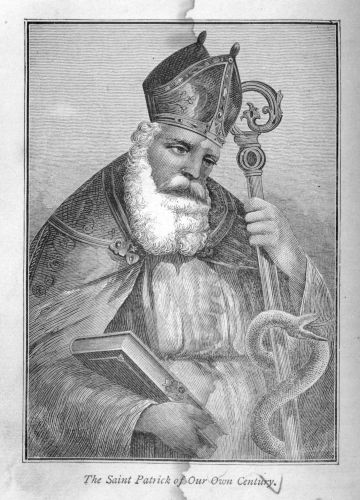
There was once a man named Calphurnius, the son of Potitus, a presbyter, by nation a Briton, living in the village Taburnia (that is, the field of the tents, for that the Roman army had there pitched their tents), near the town of Empthor, and his habitation was nigh unto the Irish Sea. This man married a French damsel named Conchessa, niece of the blessed Martin, Archbishop of Tours; and the damsel was elegant in her form and in her manners, for, having been brought from France with her elder sister into the northern parts of Britain, and there sold at the command of her father, Calphurnius, being pleased with her manners, charmed with her attentions, and attracted with her beauty, very much loved her, and, from the state of a serving-maid in his household, raised her to be his companion in wedlock. And her sister, having been delivered unto another man, lived in the aforementioned town of Empthor.
And Calphurnius and his wife were both just before God, walking without offence in the justifications of the Lord; and they were eminent in their birth, and in their faith, and in their hope, and in their religion. And though in their outward habit and abiding they seemed to serve under the yoke of Babylon, yet did they in their acts and in their conversation show themselves to be citizens of Jerusalem. Therefore, out of the earth of their flesh, being freed from the tares of sin and from the noxious weeds of vice by the ploughshare of evangelic and apostolic learning, and being fruitful in the growth of all virtues, did they, as the best and richest fruit, bring forth a son, whom, when he had at the holy font put off the old man, they caused to be named Patricius, as being the future father and patron of many nations; of whom, even at his baptism, the God which is three in one was pleased, by the sign of a threefold miracle, to declare how pure a vessel of election should he prove, and how devoted a worshipper of the Holy Trinity. But after a little while, this happy birth being completed, they vowed themselves by mutual consent unto chastity, and with an holy end rested in the Lord. But Calphurnius first served God a long time in the deaconship, and at length closed his days in the priesthood.
A certain man named Gormas, who had been blind even from his mother's womb, heard in a dream a voice commanding him that he should take the hand of the boy Patrick, then lately baptized, and make on the ground the sign of the cross—adding that at the touch a new fountain would burst forth, with the water whereof, if he bathed his eyes, he would forthwith receive his sight. And the blind man, instructed by the divine oracle, went to the little boy, made with his right hand on the ground the sign of salvation, and immediately did a new fountain burst forth. And his darkened eyes, being bathed with this healing stream, perceived the day poured in, and the virtue of Siloe renewed; and, that the mercies of the Lord might be acknowledged, and the wonders that he doeth for the children of men, while the outward blindness of Gormas was enlightened, his inward sight received the revealing gift of science; and he who was before unlearned, having experienced the power of the Lord, read and understood the Scriptures, and as by the outward mercy from being blind he became able to see, so by the inward grace from unlearned he became learned. But the fountain flowing forward with a more abundant stream, even unto this day pouring forth its clear waters, sweet to the draught and wholesome to the taste, is honored with the name of Saint Patrick, and, as is said, gives health or relief to many laboring with divers diseases; and it rises near the seaside, and over it the devotion of posterity has erected an oratory, with an altar built in the form of a cross.
Near this place is a stone which the inhabitants call Saint Patrick's Rock; for some believe that he was born thereon, and others that on it he celebrated Mass. As often as any controversy arises between the villagers or the neighbors which is thought fit to be determined by an oath, it is brought to this stone, and there, the sacrament being taken, the cause is decided. But if any perjurer or false witness laid his hand thereon, immediately it was wont to pour forth water, and the holiness of Patrick openly showed unto all how accursed was the crime of perjury or of false testimony; yet at any other time it did not use to exude one drop, but always remained in its natural dryness. Which opinion of the people, however, as to this stone, is the more probable, we know not, though the latter may seem the nearer unto the truth. Let it suffice, therefore, to record the miracle which the Bishop Saint Mel testifies that he had oftentimes beheld.
As he grew in age, he was seen also to grow in grace, and, as from the full store of divine ointment flowing within him, he perfumed all around with the abundance of his manifold miracles. And Patrick, the child of the Lord, was then nursed in the town of Empthor, in the house of his mother's sister, with his own sister Lupita. And it came to pass in the winter season, the ice being thawed, that a well overflowed and threatened to overturn many houses in the town; and the rising of the waters filled the mansion wherein Patrick abided, and overturned all the household stuff, and caused all the vessels to swim. And the little boy, being an hungered, asked in his infantine manner for bread; yet found he not any who would break bread for him, but jeeringly was he answered that he was nearer to being drowned than fed. When the boy dipped three of his fingers into the swelling water, and, standing on a dry place, he thrice sprinkled the water in the form of a cross, and in the name of the Holy Trinity commanded the well that forthwith it should subside. And behold a miracle! Immediately all the flood retired with a refluent course, and the dryness returned, nor was there hurt or damage seen in the vessels or in the furniture of his dwelling. And they who looked on saw that sparks of fire instead of drops of water were sprinkled from the fingers of the holy child, and that the waters were licked up and absorbed thereby; and the Lord, "who collects the waters as in a heap, and lays up the depths in his treasury," who had worked such great works through his beloved child Patrick, is praised of all; and the child also is magnified who was so powerful in Him, great and worthy of all praise.
Though Saint Patrick, in his childish years, sometimes thought as a child and acted as a child, yet do his illustrious works declare how precious was he in the eyes of Him who was for us born a child. And on a certain day, the winter then freezing everything, the boy Patrick, being engaged in their sports with boys of his own age, gathered many pieces of ice in his bosom, and bore them home, and cast them down in the court-yard; but his nurse, seeing this, said to him that it were better he had collected wood for the hearth than have played with pieces of ice. And the boy, speaking with the tongue of an aged man, answered unto her: "It is easy for the Lord, who created all things, even from these to supply the hearth; and at His nod, so that faith be not wanting, it is easy for fire to prevail over water; and that thou mayest know," said he, "how possible are all things to them who believe, thy faith shall be an eye-witness of that which I say unto thee." And he heaped together the pieces of ice, like brands for the fire, and he prayed, and, making the sign of the cross, he breathed on them, and immediately fire went forth, and, lighting the ice, produced long streams of flame; yet not only did the hearth give warmth to all who came near, but it ministered much cause of admiration, for out of the mouth of the boy Patrick was seen to issue flame instead of breath, that he might plainly appear to be illuminated within by the infinite light of the divine grace. Nor does this miracle much fall short of that ancient miracle which the Scripture records to have been performed by Nehemias; for when he brought back into the land of Juda the people of the Hebrews after their long captivity, restored to freedom by Cyrus, the King of Persia, he commanded the place to be searched out wherein their fathers had hidden the fire of the sacrifice; in which, when discovered, the fire was not found, but thick water; the which Nehemias commanded to be brought, and the sacrifice to be sprinkled therewith; and immediately a great fire was kindled, and it consumed the holocaust and burned the hard stones. So was the congealed water burned up by the power of the same fire which, proceeding from water, did burn to ashes the sacrifice and the stones of the altar. Therefore is the strangeness of this miracle to be admired, the holiness of Patrick to be venerated, and in all these things the power of the omnipotent God to be adored; and herein by a most evident sign did the Lord illustrate Saint Patrick, whose preaching afterward inflamed many that had been frozen in unbelief with the fire of faith and of the charity of God.
On a certain day the sister of Saint Patrick, the aforementioned Lupita, being then of good stature, had run about the field, at the command of her aunt, to separate the lambs from the ewes, for it was then weaning time, when her foot slipped, and she fell down and smote her head against a sharp flint, and her forehead was struck with a grievous wound, and she lay even as dead; and many of the household ran up, and her kindred and her friends gathered together to comfort the maiden wounded and afflicted; and her brother came with the rest, compassionating his sister, but confiding in the divine medicine; for, drawing near, he raised her, and, touching with his spittle the thumb of his right hand, he imprinted on her forehead, stained with blood, the sign of the cross, and forthwith he healed her; yet the scar of the wound remained as a sign, I think, of the miracle that was performed, and a proof of the holiness of him who, by his faith in the cross of Christ, had done this thing.
The husband of Saint Patrick's nurse, who had often-times borne him an infant in his arms, being seized with a sudden death, expired. And his wife, with many others of the household, ran thither, and to Patrick, who was standing nigh, bursting into tears, she thus spake: "Behold, O Patrick! thy foster-father, the bearer of thine infancy, lieth dead; show now, therefore, on him thine enlivening virtue, even that which hath been wont to heal others!" And the boy of holy disposition, compassionating the tears of his nurse and the miserable state of his foster-father, approached him lying there lifeless, and he prayed over him and blessed him, and signed him on his head and on his breast with the sign of life, and he embraced him, and raised him up, and restored him unto her alive and safe. And all who beheld this miracle gave praise to God, who worked such works in Patrick.
While Saint Patrick was a little boy, his aunt entrusted him with the care of the sheep, and to these he diligently attended with his aforementioned sister. For in that age no reproach was attached to such employments when the sons of the chief men discharged the duties of a shepherd; as the patriarch Jacob and his sons truly declared before Pharao, that they, like their forefathers, were keepers of sheep; and as the lawgiver Moses and the illustrious King David long time labored in the shepherd's occupation. But as the boy Patrick was one day in the fields with his flock, a wolf, rushing from the neighboring wood, caught up a ewe-lamb, and carried it away. Returning home at evening from the fold, his aunt chided the boy for negligence or for sloth; yet he, though blushing at the reproof, patiently bore all her anger, and poured forth his prayers for the restoration of the ewe-lamb. In the next morning, when he brought the flock to the pasture, the wolf ran up, carrying the lamb in his mouth, laid it at Patrick's feet, and instantly returned to the wood. And the boy gave thanks to the Lord, who, as he preserved Daniel from the hungry lions, so now for his comfort had saved his lamb uninjured from the jaws of the wolf.
The aunt who had nursed Saint Patrick had many cows, one of which was tormented with an evil spirit; and immediately the cow became mad, and tore with her feet, and butted with her horns, and wounded five other cows, and dispersed the rest of the herd. And the owners of the herd lamented the mishap, and the cattle fled from her fury as from the face of a lion. But the boy Patrick, being armed with faith, went forward, and, making the sign of the cross, freed the cow from the vexation of the evil spirit; then drawing near to the wounded and prostrate cows, having first prayed, he blessed them and restored them all even to their former health. And the cow, being released from the evil spirit, well knowing her deliverer, approached with bended head, licking the feet and the hands of the boy, and turned every beholder to the praise of God and the veneration of Patrick.
The nurse of Saint Patrick, being oppressed with illness, longed much for honey, by the taste whereof she trusted that her health might be restored. It was sought by all who stood round her, but obtained not; and when she was told thereof, she longed so much the more earnestly for that which she could not have, and complained that she was remembered and assisted of none. But her young charge, the illustrious boy Patrick, was grieved for her, and, putting his trust in the Lord, he commanded that a vessel might be filled with fresh water from the fountain, and brought unto him; and he bended his knees in prayer, and, rising, blessed it with the sign of the cross, and gave it to the woman desiring honey. And immediately the water was changed into the best honey; and the woman tasted, and her soul was satisfied, and she was relieved from her infirmity. Thus did Patrick change water into honey in the name of Him who, at Cana in Galilee, changed water into wine.
On a certain promontory overhanging the aforementioned town of Empthor was erected a fort, the ruins of whose walls may yet be traced. And the governor thereof had reduced the nurse of Saint Patrick under the yoke of slavery, and compelled her to be a servant unto him. And among other servile works enjoined to her, he had commanded her to clean with shovels all the offices within the fort, and to carry forth the soil from the stables. But the woman, having an ingenuous mind, and understanding that all power was from God, and that all things were ordained of God, made of her necessity a virtue, and patiently bore the servitude imposed on her. Then the boy Patrick, compassionating his nurse's affliction, besought the Lord that he would vouchsafe to set her free from the labor of this servile work; and behold, as he prayed, all the dwelling-places therein were cleansed without an human hand, and neither within nor without could any remains of the soil be found. And the governor and all who saw or heard this miracle marvelled; and the nurse was released from slavery through the merits of her foster-child. Nor is this miracle beheld only at stated seasons, or once in every year; for even to this day does it appear to be continued. And the dwellers and the neighbors bear witness that if within the precincts of the fort as many cattle as the place could hold were gathered to abide there together, not even the least portion of soil could therein be found. And the place, being in the Valley of Clud, is called in the language of that people Dunbreatan—that is, the Mountain of the Britons; and the miracle cannot be unknown to those who desire to be informed thereof, inasmuch as so often it is published abroad by all the dwellers in that country.
And the boy Patrick grew up precious in the sight of the Lord, in the old age of wisdom, and in the ripeness of virtue. And the number of his merits multiplied beyond the number of his years; the affluence of all holy charities overflowed in the breast of the boy, and all the virtues met together made their dwelling in his youthful body. Entering, therefore, and going forward in the slippery paths of youth, he held his feet from falling, and the garment that nature had woven for him, unknowing of a stain, he preserved whole, abiding a virgin in the flesh and in the spirit. And although the divine unction had taught him above all, the fit time being now come, he was sent from his parents to be instructed in sacred learning. Therefore he applied his mind to the study of letters, but chiefly to psalms and to hymns and to spiritual songs, and retaining them in his memory, and continually singing them to the Lord; so that even from the flower of his first youth he was daily wont to sing devoutly unto God the whole psaltery, and from the vial of his most pure heart to pour forth the odor of many prayers. Thus wearing out his tender body in fastings, in many watchings, and in the pious exercise of holy labors, he offered up himself a living sacrifice, holy and acceptable to God; and thus passing his days in the flesh, against the flesh, and above the flesh, in his conversation he represented an angel.
As, according to the testimony of Holy Writ, the furnace tries gold and the fire of tribulation proves the just, so did the hour of his trial draw near to Patrick, that he might the more provedly receive the crown of life. For when the illustrious boy had perlustrated three lustres, already attaining his sixteenth year, he was, with many of his countrymen, seized by the pirates who were ravaging those borders, and was made captive and carried into Ireland, and was there sold as a slave to a certain pagan prince named Milcho, who reigned in the northern part of the island, even at the same age in which Joseph is recorded to have been sold into Egypt. But Joseph, being sold as a slave, and being after his humiliation exalted, received power and dominion over all Egypt. Patrick, after his servitude and his affliction, obtained the primacy of the especial and spiritual dominion of Ireland. Joseph refreshed with corn the Egyptians oppressed by famine; Patrick, in process of time, fed with the salutary food of the Christian faith the Irish perishing under idolatry. To each was affliction sent for the profit of his soul, as is the flail to the grain, the furnace to the gold, the file to the iron, the wine-press to the grape, and the oil-press to the olive. Therefore it was that Patrick, at the command of the forementioned prince, was appointed to the care of the swine, and under his care the herd became fruitful and exceedingly multiplied. From whence it may well be learned that as the master's substance is often increased and improved by the attention of a diligent and fortunate servant or steward, so, on the other hand, is it reduced and injured under an idle or unprosperous hand. But the holy youth, heartily embracing in his soul the judgments of the Lord, made of his necessity a virtue, and, having in his office of a swineherd obtained solitude, worked out his own salvation. For he abode in the mountains, and in the woods, and in the caves of the wilderness, and having leisure for prayer, and knowing how kind was the Lord, freely and more freely did he pour forth the incense of his supplications in the presence of the Most High; and an hundred times in the day and an hundred times in the night did he on his bended knees adore his Creator, and often did he pray for a long time fasting, and, nourishing himself with the roots of herbs and with the lightest food, did he mortify his members which were stretched upon the earth. Nor him could heat, nor cold, nor snow, nor hail, nor ice, nor any other inclemency of the air compel from his spiritual exercises. Therefore went he forward daily increasing and confirming himself more strong in the faith and love of Christ Jesus; and the more weak and infirm he appeared, so much the steadier and more powerful was he in fulfilling the commands of the Lord.
And Milcho beheld a vision in the night; and behold, Patrick entered his palace as all on fire, and the flames issuing from his mouth, and from his nose, and from his eyes, and from his ears, seemed to burn him. But Milcho repelled from himself the flaming hair of the boy, nor did it prevail to touch him any nearer; but the flame, being spread, turned aside to the right, and, catching on his two little daughters who were lying in one bed, burned them even to ashes; then the south wind, blowing strongly, dispersed their ashes over many parts of Ireland. And Milcho, awaking, meditated with himself on his couch what prodigy might this remote vision portend. On the morrow, Patrick being called before him, he declared unto him his dream, entreating and abjuring him that if he knew he would unfold its interpretation. And Patrick, being filled with the grace of the Holy Spirit, answered unto Milcho: "The fire which thou sawest to issue from me is the faith of the Holy Trinity, with which I am entirely illumined, and which I shall endeavor to preach unto thee; but my speech will find in thee no place, for thou wilt, in the blindness of thine heart, repel from thee the light of the divine grace, and thou wilt die in the darkness of thy unbelief; but thy daughters shall at my preaching believe in the true God, and, all the days of their lives serving God in holiness and in justice, shall, in a pious end, rest in the Lord; and their ashes, that is, their relics, the Lord revealing them and making of them signs, shall be carried into many places through Ireland, and shall give the blessing of health to many who are infirm; and thy dream is true, and its interpretation is true, and all shall be fulfilled in due time." Thus having said, Patrick departed to his accustomed labor; and all these things happened unto Milcho and unto his daughters even as Patrick had foretold.
And six years had now passed when, under the direction of the Lord, he had thoroughly learned the Irish tongue, and with prayers and with tears he unceasingly besought of God that he might be released from slavery and restored to his country. And on a certain day appeared unto him, while praying, an angel of the Lord, standing on the crag of an overhanging rock, and announcing that his prayers and his fastings had ascended as a memorial before God; and the angel added thereto that he should soon cast from his neck the yoke of servitude, and, after a prosperous voyage, return to his own parents. And the servant of God looked on the angel of God, and, conversing with him face to face familiarly, even as with a friend, asked who he was, and by what name was he called. And the heavenly messenger answered that he was the ministering spirit of the Lord, sent into the world to minister unto them who have the heritage of salvation; that he was called Victor, and especially deputed to the care of him, and he promised to be his helpmate and his assistant in doing all things. And although it is not needful that heavenly spirits should be called by human names, yet the angel, being beautifully clothed with an human form composed of the air, called himself Victor, for that he had received from Christ, the most victorious King, the power of vanquishing and binding the powers of the air and the princes of darkness; who had also given to his servants made of the potter's clay the power of treading on serpents and scorpions, and of vanquishing and bruising Satan. And in their mutual colloquy the angel showed unto Patrick an opening in the ground that had been delved up by the swine, and therein he directed him to look for gold with which he might redeem himself from the hands of his cruel master; and he added that a ship to carry him over to Britain was ready in a harbor two hundred miles distant, and which, by the divine will, could not have a favorable wind until he should arrive. And the vision of the angel, thus saying, disappeared, and his speech ended; and, as the inhabitants assert, the marks of his feet appear even to this day imprinted on the rock in the Mountain Mis, in the borders of Dalnardia; and an oratory is erected there in honor of St. Patrick, wherein the devotion of the faithful is wont to watch and pray.
And Patrick went to the place which the angel had pointed out unto him, and he found therein no small weight of gold. Wherefore he addressed for his ransom his hard and cruel master, and with the offering of the yellow metal induced his mind, greedy of gold, to grant unto him his freedom. Therefore, being by the aid of Mammon solemnly released from his servitude, he went his way rejoicing, and hastened toward the sea, desiring to return to his own country. But Milcho repented that he had dismissed a servant so very necessary unto him, and, falsifying his agreement, pursued Patrick that he might bring him back and reduce him to his former slavery, as Pharao pursued the Hebrews. But by the divine will, wandering both in his mind and in his course, he found not him whom he sought. Foiled, therefore, in his attempt, he returned with grief and with shame. And his sorrow was much increased, for that not only Patrick, having obtained his freedom, had escaped, but the gold which was the price of his freedom, on returning home, he found not. And with this the law accords; for to him who has served six years in slavery, the law directs that in the seventh year shall his freedom be restored.
And Saint Patrick, guided by his angelic guide, came unto the sea, and he there found the ship that was to carry him to Britain, and a crew of heathens who were in the ship freely received him, and, hoisting their sails with a favorable wind, after three days they made land. And being come out of the ship, they found a region desert and inhabited of none, and they began to travel over the whole country for the space of twenty-four days; and for the want of food in that fearful and wide solitude were they perishing of hunger. And Patrick, through their whole journey, was preaching unto those pagans the Word of God, and disputing with them and persuading them unto the faith of the Holy Trinity and the kingdom of heaven; but they, even as the deaf adder that listens not to the voice of the charmer charming wisely, closed their ears against the Word of God until misery gave them understanding to hear. For hunger yet more heavily assailing and oppressing them, the greater part are said to have thus spoken: "Behold, O worshipper of Christ! how wretched are we with want and misery, and our eyes fail us for every need; now, therefore, implore for us thy God, whom thou describes! and exaltest as all-powerful, that His bounty may relieve us, and we will adore and glorify His greatness." And Saint Patrick answered unto them: "Believe in and confess the God who giveth food unto all flesh, and by whom, when He openeth His hand, ye shall be satisfied from His goodness." And he prayed earnestly, and behold, as he prayed for them, suddenly an herd of swine appeared, and they saw wild honey, and therewith they were sufficed even to fulness, nor from that day through their whole journey did ever a supply of food fail unto them. And this great miracle being seen, they all gave thanks unto God and held Saint Patrick in the highest reverence.
And all things succeeding prosperously, and their provision much abounding, these men soon forgot the Lord who had saved them from the straitness of hunger, and, ungrateful for the benefits extended unto them by the divine bounty, they sacrificed of their food to devils, and not unto God, imitating herein those Samaritans whom the Book of Kings records to have worshipped God, yet not to have the service of their idols. Wherefore it seemed good to Saint Patrick to eat no earthly food for twenty continual days, and, albeit he was much entreated thereto, he would in no wise join with them in their meals, lest he should appear to be contaminated with their sacrifices. And the power to endure this abstinence was given unto Patrick by the Lord, who had theretofore enabled Elias the prophet to fast forty days.
The wonderful Ruler of all things, the more he exalts with signs and with wonders his elect whom he loveth, the more does he, according to the Apostle, suffer them to fall into divers temptations, that they may learn and know how to preserve their strength in God, who is their maker, and trust to nothing in themselves or of themselves. Wherefore Patrick, the beloved and the elect of God, is suffered by the divine will to be grievously tempted of Satan, to increase the confusion of the tempter and the glory of him who was tempted, and lest he should be lifted up by the greatness of his miracles or his fastings. For in the night season the prince of darkness rushed on him, and oppressed him as with the weight of a huge stone, and, falling on him, the tempter took from him all sense and motion, causing to him darkness and heaviness, and for the space of three days ceased not to torment and lash him beyond human power to endure. But the saint in his tribulation cried unto the Lord, thrice in His name invoking Elias, the prince of prophets, unto his aid. And Elias, being sent of the Lord with a great brightness, freed him from the pressure of the enemy that hemmed him round, and, wonderfully illumining him both within and without, refreshed the powers of his limbs and his senses. And the enemy of mankind, being put to confusion, was compelled to own himself vanquished by Patrick, and that ever after he could have no power to prevail against him.
But Patrick, departing from the company of his fellow-travellers that he might prove how many are the tribulations of the just through which they must enter into the kingdom of heaven, fell into the hands of strangers, by whom he was taken and detained; and while his spirit was afflicted within him, the Father of mercies and God of all consolation sent the angel Victor in the wonted manner to comfort him, promising that in a short time he should be released from the hands of his captors; and how truly was made the angelic promise did its speedy fulfilment show, which followed even in the space of two months; for the barbarians sold him to a certain man in the neighborhood for a kettle—how small a purchase for so precious a merchandise! But when the vessel that had been bought with such a price was filled with water, and placed as usual on the hearth to dress their victual, behold it received no heat; and so much the hotter the fire burned, so much the colder did it become; and fuel being heaped thereon, the flame raged without, but the water within was frozen, as if ice had been placed under instead of fire. And they labored exceedingly thereat; but their labor was vain, and the rumor went everywhere through the country; and the purchaser, thinking it to have been done by enchantment, returned his kettle to the seller, and took Patrick again into his own power. And the vessel thereon received the heat, and did its accustomed office even naturally, and showed to all that this miracle happened because Patrick had been unjustly oppressed; and forthwith they who had taken him let him go free. Thus, by the heavenly power being released from the hands of strange children, was he, after his long captivity, restored to his parents; and they, beholding him, rejoiced with exceeding great joy, and at the return of their son did their spirits revive as the spirits of one awakening from a heavy sleep, and they besought of him, with entreaty of many prayers and the abundance of many tears, that he would not again bereave them of his presence. Therefore, that he might show the honor and the submission due unto his parents, he abided with them certain days.
And a short space of time being passed, the while he was settled in his lather's house, he beheld in a vision of the night a man of comely garb and countenance, bearing many letters as if from Ireland, and holding out to him one of them for him to read—which taking, he read, and found therein thus written: "THIS IS THE VOICE OF THE IRISH." But when he would have continued to read, he seemed in the spirit to hear the Irish infants which were yet unborn crying unto him with a loud voice, "O holy youth Patrick! we beseech thee come unto us, and abide with us, and release us!" And Patrick, being pierced therewith in his heart, could not finish the letter; but awaking, he gave infinite thanks to God, for he was assured by the vision that the Lord had set him apart, even from his mother's womb, had by His grace called him to convert and to save the Irish nation, which seemed to desire his presence among them. And on this he consulted the angel of great counsel, and through the angel Victor he received the divine command that, quitting his father and his country, he should go unto France, there to learn the doctrine and the discipline of the Christian faith.
Being thus instructed and directed of heaven, though both his parents resisted and would have detained him, he, with the faithful Abraham, quitted his country, his kindred, and his father's house, and, passing through his native Britain, he went into France. And lest his labor should be fruitless, or that he might not attempt to teach what he had not thoroughly learned, he attached himself to the blessed Bishop Germanus, and, for his greater progress in the Christian faith and learning, abided with him for the space of eighteen years, reading and imbibing the Holy Scriptures (as in the acts of the blessed Germanus is recorded). And each had received the divine command—Patrick that he should abide with Germanus, and the holy bishop that he should retain and instruct the youth. For he was a prelate, in his descent, in his nobility, in his life, in his learning, in his office, and in his miracles most illustrious; and from him the several degrees of the holy orders, and at length the sacerdotal dignity according to the canons, did Patrick receive. With the like purpose did he some time abide with the blessed Martin, Archbishop of Tours, who was the uncle of his mother, Conquessa. And as this holy luminary of the priesthood was a monk, he gave to his nephew, Patrick, the monastic habits and rules, the which he most devoutly assumed, and adorned by his life, and persevered therein. And bidding farewell, they departed the one from the other, forasmuch as Martin was enjoined by the angel to go into a certain island. And Saint Patrick, returning to the blessed Germanus, remained with him many days.
But Patrick, having now become a monk, forgetting all things that were past, applied to the future, and, as if little accounting his former conversation, hastened to the height of perfection. For by incredible abstinence, by his lengthened fasts, and by the exercise of his other virtues, he afflicted himself, and continually bore in his heart and on his body the mortification of that cross which his habit displayed. But the most high Pastor, who intended to raise him to the head of the holy Church, that he might learn to think humbly of himself, to walk with the lowly, and to bear with the weak, permitting him to feel his own inferiority; so that the more deeply he was fixed on the foundation of true humility, the more firmly he might stand in the height of perfection. For a desire of eating meat came upon him, until, being ensnared and carried away by his desire, he obtained swine's flesh, and concealed it in a certain vessel, thinking rightly that he might thus satisfy his appetite privily, which should he openly do he would become to his brethren a stone of offence and a stumbling-block of reproach. And he had not long quitted the place when, lo! one stood before him having eyes before and eyes behind, whom when Patrick beheld, having his eyes so wonderfully, even so monstrously, placed, he marvelled who he was, and what meant his eyes fixed before and fixed behind, did earnestly ask; and he answered, I am the servant of God. With the eyes fixed in my forehead I behold the things that are open to view, and with the eyes that are fixed in the hinder part of my head I behold a monk hiding flesh-meat in a vessel, that he may satisfy his appetite privily. This he said, and immediately disappeared. But Patrick, striking his breast with many strokes, cast himself to the earth, and watered it with such a shower of tears as if he had been guilty of all crimes; and while he thus lay on the ground, mourning and weeping, the angel Victor, so often before mentioned, appeared to him in his wonted form, saying, Arise, let thine heart be comforted; for the Lord hath put away thine offence, and henceforward avoid backsliding. Then St. Patrick, rising from the earth, utterly renounced and abjured the eating of flesh-meat, even through the rest of his life; and he humbly besought the Lord that He would manifest unto him His pardon by some evident sign. Then the angel bade Patrick to bring forth the hidden meats, and put them into water; and he did as the angel bade; and the flesh-meats, being plunged into the water and taken thereout, immediately became fishes. This miracle did St. Patrick often relate to his disciples, that they might restrain the desire of their appetites. But many of the Irish, wrongfully understanding this miracle, are wont, on St. Patrick's Day, which always falls in the time of Lent, to plunge flesh-meats into water, when plunged in to take out, when taken out to dress, when dressed to eat, and call them fishes of St. Patrick. But hereby every religious man will learn to restrain his appetite, and not to eat meat at forbidden seasons, little regarding what ignorant and foolish men are wont to do.
And being desirous that his journey and all his acts should by the apostolic authority be sanctioned, he was earnest to travel unto the city of Saint Peter, and there more thoroughly to learn the canonical institutes of the holy Roman Church. And when he had unfolded his purpose unto Germanus, the blessed man approved thereof, and associated unto him that servant of Christ, Sergecius the presbyter, as the companion of his journey, the solace of his labor, and the becoming testimony of his holy conversation. Proceeding, therefore, by the divine impulse, or by the angelic revelation, he went out of his course unto a solitary man who lived in an island in the Tuscan Sea; and the solitary man was pure in his life, and he was of great desert and esteemed of all, and in his name and in his works he was Just; and after their holy greetings were passed, this man of God gave unto Patrick a staff which he declared himself to have received from the hands of the Lord Jesus.
And there were in the island certain other solitary men, who lived apart from him, some of whom appeared to be youths, and others decrepit old men, with whom when Patrick had conversed, he learned that the oldest of them were the sons of the youths; and when Saint Patrick, marvelling, enquired of them the cause of so strange a miracle, they answered unto him, saying: "We from our childhood were continually intent on works of charity, and our door was open to every traveller who asked for victual or for lodging in the name of Christ, when on a certain night we received a stranger having in his hand a staff; and we showed unto him so much kindness as we could, and in the morning he blessed us, and said, I am Jesus Christ, unto whose members ye have hitherto ministered, and whom ye have last night entertained in His own person. Then the staff which He bore in His hand gave He unto yonder man of God, our spiritual father, commanding him that he should preserve it safely, and deliver it unto a certain stranger named Patrick, who would, after many days were passed, come unto him. Thus saying, He ascended into heaven; and ever since we have continued in the same youthful state, but our sons, who were then infants, have, as thou seest, become decrepit old men."
And Patrick, giving thanks unto God, abided with the man of God certain days, profiting in God by his example yet more and more; at length he bade him farewell, and went on his way with the staff of Jesus, which the solitary man had proffered unto him. O excellent gift! descending from the Father of light, eminent blessing, relief of the sick, worker of miracles, mercy sent of God, support of the weary, protection of the traveller! For as the Lord did many miracles by the rod in the hand of Moses, leading forth the people of the Hebrews out of the land of Egypt, so by the staff that had been formed for His own hands was He pleased, through Patrick, to do many and great wonders to the conversion of many nations. And the staff is held in much veneration in Ireland, and even unto this day it is called the staff of Jesus.
The God of our salvation having prospered Patrick's journey, he arrive at the city which is the capital of the world; and often, with due devotion, visiting the memorials of the apostles and the martyrs, he obtained the notice and the friendship of the chief Pontiff, and found favor in his sight. In the apostolic chair then sat Pope Celestine, of that name the first, but from the blessed Apostle Peter the forty-third; but he, keeping Saint Patrick with him, and finding him perfect and approved in faith, in learning, and in holiness, at length consecrated him a bishop, and determined to send him to the conversion of the Irish nation. But Celestine had sent before him, for the sake of preaching in Ireland, another doctor named Palladius, his archdeacon, to whom, with his coadjutors, he gave many books, the two Testaments, with the relics of the Apostles Peter and Paul and of numberless martyrs; and the Irish not listening to, but rather obstinately opposing, Palladius in his mission, he quitted their country, and, going towards Rome, died in Britain, near the borders of the Picts; yet, while in Scotland, converting some to the faith of Christ, he baptized them and founded three churches built of oak, in which he left as prelates his disciples Augustine, Benedict, Sylvester, and Sulomus, with the parchments and the relics of the saints which he had collected. To him with more profitable labor did Saint Patrick succeed, as is said in the Irish proverb, "Not to Palladius, but to Patrick, the Lord vouchsafed the conversion of Ireland." And the Pope, being certified of Palladius's death, immediately gave to Patrick the command, which hitherto, keeping more secret counsel, he had delayed, to proceed on his journey and on the salutary work of his legation.
And shortly after he had received the episcopal dignity, the angel Victor appeared unto him, then abiding in Rome, and commanded him that he should hasten his journey into Ireland, that he might gain unto Christ the people of that country, as the Lord had willed. But Patrick, judging himself to be unequal to such a work and to such a labor, answered that he could not and would not attempt it unless he should first behold and salute the Lord. Therefore was he conducted by the angel unto the mountain Morion, bordering on the Tuscan Sea, nigh unto the city of Capua; and there, even as Moses, did he merit to behold and salute the Lord, according to his earnest desire. Who, I pray you, can estimate in his mind the merit of Patrick? What tongue can sufficiently praise him to whom, while yet living on earth, it was given to behold the King of Glory, whom the angels desire to behold face to face, and who was permitted to declare unto men what he had been taught from the lips of the Most Highest? And the Lord promised unto Patrick that He would hear his prayers, and that He would be his assistant in all his acts to be done by him. Therefore, being by the vision and by the divine colloquy strengthened unto the ministry enjoined to him of heaven and confided to him by our lord the Pope, he vehemently longed to complete the same, and speeded his journey toward Ireland with twenty men deputed unto his assistance by the Sovereign Pontiff, and who were renowned for their lives and for their wisdom. Yet turned he out of his way unto the blessed Germanus, from whom he received chalices, and priestly vestments, and many books, and other matters unto the divine worship and ministry pertaining.
When the blessed Patrick, speeding his journey toward Ireland; was about to embark with his disciples at a British port, a certain leper standing on the shore met the holy man, beseeching in the name of the Lord Jesus that he would carry him over in his ship. The man of God, abounding with the bowels of compassion, listened to the prayers of the poor leper; but the sailors and the others that were of the ship forbade him, saying that the vessel was already enough loaded, and that he would be to them all at once an encumbrance and a horror. Then the saint, confiding in the power of the divine mercy, cast into the sea an altar of stone that had been consecrated and given to him by the Pope, and on which he had been wont to celebrate the holy mysteries, and caused the leper to sit thereon. But the pen trembles to relate what, through the divine power, happened. The stone thus loaded was borne upon the waters, guided by Him, the head-stone of the corner, and, diverse from its nature, floating along with the ship, held therewith an equal course, and at the same moment touched at the same shore. All, then, having happily landed, and the altar being found with its freight, the voice of praise and thanksgiving filled the lips of the holy prelate, and he reproved his disciples and the sailors for their unbelief and hardness of heart, endeavoring to soften their stony hearts into hearts of flesh, even to the exercising the works of charity.
And when the saint with his people drew nigh unto the shore, he beheld a multitude of devils gathered together in the form of a globe, surrounding the whole island, and setting themselves against him even as a wall to defend their own citadel and to oppose his entrance. But his heart was not moved, nor did he tremble at the presence of these deformed ones, knowing that there were many with him more powerful than with them, even unto his triumph and their overthrow. Therefore stood he fixed in faith as Mount Sion, because mountains of angels were around him, and the Lord encompassed His servant great and mighty unto the battle. And the holy prelate, knowing that all those enemies were to be quelled by him through the virtue of the cross of Christ, raised his sacred right hand, and made the sign of the cross, and, telling unto his people what he beheld, and confirming them in the faith, unhurt and unterrified passed he over. Thus clothed with strength from on high, mightily did he exercise the armor of the power of God to the overturning of the powers of the air, who raised themselves against all height and against the wisdom of the Lord, being always ready to punish their disobedience and their rebellion, as will more plainly in the following chapters appear.
The man of God landed with the companions of his voyage within the borders of Leinster, in the port of Innbherde, where a river flowing into the sea then abounded with many fishes. And the fishermen were quitting the water, and drawing after them to the bank their loaded nets, when the servants of the holy prelate, being wearied with their travel and with hunger, earnestly besought that they would bestow on them some of their fishes; but they, barbarous, brutal, and inhuman, answered the entreaty, not only with refusal, but with insult. Whereat the saint, being displeased, pronounced on them this sentence, even his malediction: that the river should no longer produce fishes, from the abundance of which idolaters might send empty away the worshippers of the true God. From that day, therefore, is the river condemned to unfruitfulness, so that the sentence uttered by the mouth of Patrick might be known to proceed from the face of the Lord.
And going forward, he arrived at a place which was called Aonach Tailltion, and there he made ready to refresh himself and his people, and to announce the office of his ministry. But the idolatrous inhabitants, not enduring the presence of the man of God, gathered together and violently drove him thence, as the light of the sun is intolerable to the weak-eyed. Yet the God whom Patrick bore about him, and glorified in his body, permitted not that an affront offered unto His servant for the sake of His name should go unpunished; but quickly did he bring on them his deserved wrath, inasmuch as for the wickedness of them who dwelt therein the Lord converted their fruitful land into a salt marsh; and the sea, with the foreflowing of an unwonted tide, covered it, and, that it might even for ever be unhabitable, changed the dry land into a plashy lake. Then the saint, going unto a small island not far from the main shore, abided there certain days, and it is called unto this time Saint Patrick's Island.
And the blessed Patrick, embarking with his people, steered toward the northern parts of the island, that he might overcome the northern enemy, and expel him from those hearts where he had fixed his seat. And the north wind fell, and the south wind arose, that he might go into the quarters of the north, and plant therein the garden of the Lord, breathing sweet odors; and the desire had come into his mind to bring unto the knowledge of truth the king, Milcho, who was yet living, to whom he had formerly been a servant, and to make him a servant of the true King, whose service is a kingdom. But forasmuch as the ways of man are not in his own power, but as his steps are directed of the Lord, he landed on the coast of Ulidia, that the vessels of mercy might there be gathered together. But Patrick being come forth on the dry land, a multitude of heathens met him who were waiting and expecting his coming; for the magicians and soothsayers, either by divination or by prophecy, had foreknown that the island would be converted by the preaching of Patrick, and had long before predicted his arrival in these words: "One shall arrive here, having his head shaven in a circle, bearing a crooked staff, and his table shall be in the eastern part of his house, and his people shall stand behind him, and he shall sing forth from his table wickedness, and all his household shall answer, So be it! so be it! And this man, when he cometh, shall destroy our gods, and overturn their temples and their altars, and he shall subdue unto himself the kings that resist him, or put them unto death, and his doctrine shall reign for ever and ever." Nor let it seem strange or incredible that if the Lord inspired or even permitted the magicians should thus foretell the arrival and the several acts of Saint Patrick, since the soothsayer Balaam and the King Nabuchodonosor plainly prophesied the coming of Christ, and since the devils that bore testimony to the Son of God. But when they said that he should from his table sing forth wickedness, evidently doth it appear that he who never stood on the truth, but who from the beginning was a liar and the father of lies, did in his blasphemy utter these things through their mouths.
But the chief King of Ireland, named Leogaire, the son of Neyll, recollecting the prophecy, gave command unto his subjects that as soon as Patrick should land they should forthwith expel him from the country. And the saint, being then in the harbor called Innbherslan, went alone out of the ship, and immediately the people, infidel and dog-like in their manners, excited a very fierce dog to bite him even unto death. But the dog, being at the sight of the man of God entirely stiffened like a stone, stood fixed and without motion, plainly showing that the worshippers of stones were like unto the gods which they worshipped. The which, when a certain man named Dichu, who was powerful of strength, gigantic of stature, and savage of mind, beheld, he brandished his sword to destroy the saint. But the Lord interposed His protecting arm, and all his strength withered in him, and he entirely stiffened, so that he could move neither his foot to go forward nor his hand to strike. And he, experiencing in himself such a miracle, suddenly is changed into another man, and from proud becoming humble, mild from fierce, from an infidel a believer, he is, with all his household, at the preaching of Patrick, baptized in the Christian faith. Thus he who had been in that country its first and principal opposer became its first professor, and even to his latest age continued its most devoted follower. And as his soul was loosed from the chains of sin, so were his limbs loosed from their heaviness, and all their strength was restored unto him. Behold, therefore, the miracle which the Book of Kings relates to have been formerly wrought on Jeroboam did Patrick more profitably renew on Dichu; for when that king was sacrificing unto idols, and stretched out his hand to seize on the prophet who was reproving him, forthwith his arm stiffened, which on his repentance the prophet healed, yet did not he when healed forsake his error; but Dichu, for the increase and for the evidence of his devotion toward his new faith, gave unto Saint Patrick the place wherein this miracle had been declared, to erect thereon a new church.
In this place, at the request of Dichu (but for what cause I know not), did the saint build the church, having its aspect against the north, and looking toward the southern point. Perchance that by this mystical structure the worshippers of idols might be persuaded from the northern coldness of unbelief unto the meridian fervor of the faith and the charity of Christ—the which to this day is called Sabhall Phadruig, that is, the Barn of Patrick; for in process of time he builded there a fair monastery, into which he introduced monks that had passed their novitiate; and for their use he not long afterward, by his prayers, produced a fountain out of the earth. Of this monastery did he appoint his disciple, Saint Dunnius, to be the abbot, wherein when he had returned from his mission, he abided with him not a few days.
And in that church the holy prelate stood before the altar on a certain day, celebrating the divine mysteries, when an evil-doer, a bondsman of Satan, thrusting with accursed boldness a rod through the window, overturned the chalice, and sacrilegiously poured out on the altar the holy sacrifice. But the Lord instantly and terribly avenged this fearful wickedness, and in a new and unheard-of manner destroyed the impious man. For suddenly the earth, opening her mouth (as formerly on Dathan and Abiron), swallowed up this magician, and he descended alive into hell. And the earth, thus disjoined and rent asunder, closed on him again; but to this day a ditch yet remaining declareth the judgment of the divine wrath. But the holy sacrificer, being struck with sorrow, mourned with heavy mourning over the chalice that had been filled; and the chalice, with the divine sacrifice entire therein, stood erect before him, being raised by the divine Power, nor did any trace of the offering remain to be seen.
And Dichu had a brother named Rius, far advanced in years and in unbelief, the tabernacle of whose body, for very age, was bending unto the grave; and this man heavily grieved for the death of the magician and for the conversion of his brother. And his wisdom was wholly of this world, and he believed in no life but the present life; for he thought that he had lost his brother, who, believing in Christ, labored with all his strength after the glory to come, which he had revealed to his followers. Therefore for many days he opposed and troubled Patrick, and strove to stop his mouth, lest he should spread abroad the Word of God, and increase the number of the believers. But the saint, desiring to gain him unto Christ, met him with true and lively arguments, persuading him from the very kinds and natures of all created things to believe that God was the Creator of all; and, that he might the more thoroughly lead him into the way of truth, he promised unto him a miracle, saying, "Now that the power of all thy limbs and of all thy senses fail thee, and are nearly dead, and that thy life is almost gone from thee, if Christ should restore unto thee the strength of the grace of thy early youth, wouldst thou not be bound of right to believe in Him?" And the man answered: "If thou canst through Christ perform on me such a miracle, forthwith will I believe in him." Then Saint Patrick prayed, and, laying his hand on him, he blessed him, and immediately he became beautiful and strong, and flourished again as in his early youth. And great marvel seized on all who witnessed this miracle, and their mouths were opened to the praise of Christ and to the veneration of Saint Patrick.
And Rius, being renewed outwardly in his body and inwardly in his spirit, brought with him his three brothers, and came with very many to be purified at the healing font. And after these things, Saint Patrick, observing him to be thoroughly freed from sin, and knowing how sin besets the slippery path of human life, inspired of the Holy Spirit, said unto him: "Choose, now, whether in this valley of tears, this world of tribulation and sorrow, shall thy years be prolonged, or whether, the misery of this life being instantly ended, thou wilt be carried up by the angels of light, and enter into the joy of the Lord thy God." But he, trusting that he should behold the mercies of the Lord in the land of eternal life, answered: "I choose, and I desire to be dissolved, and to be with Christ for ever, rather than to continue in the habitations of sinners." And he received the sacrament from the hands of the holy bishop, and, commending his spirit unto the Lord, he was brought unto eternal rest.
But Saint Patrick, confiding his affairs to his beloved Dichu, set forward to visit Milcho, his former master, even his tormentor; for so had he long intended in his mind, that by his preaching he might truly convert unto the infancy of the Christian faith him now grown old in his evil days. And Milcho, this man of envious heart, this minister of death feared lest the preaching of Patrick should penetrate a breast of stone, and that by his clear and fiery eloquence, or by some irresistible miracle, he should be compelled to believe. Therefore held he it as base and shameful to submit unto the doctrine of one who had formerly been his servant, and to be bound unto the unused worship of the Creator rather than his accustomed idolatry. So when he heard that the priest of the Most High was approaching, this child of perdition gathered together all his substance, and cast it into the fire; and then, throwing himself on the flames, made himself an holocaust for the infernal demons. And the holy prelate, beholding from a neighboring mountain the deadly end of this wicked prince, saw his soul, in the form of a fiery serpent, plunged into hell; when, contemplating the infinite depths of the judgments of God, with heavy tears and sighs uttered he these words: "Of this king, who, lest he should believe in the Creator of heaven and earth, hath thus doubly damned himself, the posterity shall not inherit his kingdom, but shall be bound in servitude that never may be loosed." And all this came to pass even according to the word of the man of God, for none of his race ascended after him to the throne of his kingdom; but in a short time all his generation quickly perished; from the face of the earth by the sword or by famine, or by captivity and the lowest servitude. Thus visiteth the Lord the sins of the fathers on their children; and thus is put the axe unto the tree of death, lest it should bring forth branches of iniquity. Yet as God is able of stones to raise up sons unto Abraham, and to produce from thorns roses, the two daughters of Milcho were, by the inspiration of the Lord and by the preaching of Patrick, converted unto the faith. And each, after they were purified by the healing water, was called Emeria; and they lived a holy and religious life, and after their deaths they were buried in the place which is called Cluainbroin, and, as Patrick had long before prophesied, were celebrated for many miracles. Then the saint returned unto the house of Dichu, where he abided not a few days, and by preaching the Christian faith, and by working signs and miracles, he profited much people.
And there was a youth of virtuous disposition named Mochna, and he was a swine-herd whom Saint Patrick had met near the town of Ereattan while he was preaching in those parts, and to him, the Spirit having revealed that he was destined to be a vessel of election, did the saint preach the way of salvation. And the youth, even at his first preaching, believed; and Patrick, when he had baptized him, taught unto him the alphabet, and, having blessed him, sent him to be instructed in learning, and went his way. But the youth, through the divine grace, learned in one month the whole Psaltery, and, before the year had ended, arrived he at the knowledge of the Holy Scriptures. And after some time Patrick returned to the aforementioned village, and Mochna met him there. And while sitting together, they conversed on holy things; behold, a staff sent from heaven fell between them, and the head thereof rested on the bosom of Patrick, and the point thereof on the bosom of Mochna. And the saint, gratulating the youth on the gift thus miraculously bestowed, said unto him: "Now, my best-beloved son, shalt thou know by this pastoral staff that the guardianship of souls will be committed unto thee." But he refusing and alleging his ignorance and the imperfection of his youth, the saint is reported thus to have said: "Seek not thou to excuse thyself for that thou art a boy, since unto all those parts whither the Lord sendeth thee shalt thou go; and what he commandeth unto thee, that shalt thou speak." Therefore through the several degrees did Patrick at length consecrate him a bishop, and placed him over the church of Edrum. And he profited much the church of God by his conversation and by his example, and, being renowned in virtues and in miracles, was called to heaven. And he was buried in that church wherein he had worthily served the Lord, and wherein, adorned with manifold miracles, he had accustomed himself to live in Christ. And the staff is in that church still preserved, and is called by the Irish "the flying staff." And as Saint Patrick had advanced this man from the care of swine unto the episcopate, a swine is yearly taken from that territory, and paid unto the church of Down.
Leogaire, a man of leonine fierceness, with a high and swelling heart, rose above himself in the pride of his exploits, for that he seemed to himself to hold the land by the strength of his arm and the firmness of his valor. And he took hostages of all the provincial chiefs bordering on his kingdom, and among others he held in his power the sons of Dichu, lest any of them should raise the head to defend themselves, or the heel to offend him. For he, being rooted in the errors of idolatry, strenuously favored the magicians and the soothsayers; and his neck was stiff and his head was stubborn against the true religion. But when he understood that Dichu, with all his household and kindred and people, had turned unto Christ, and renounced the gods of their country, even the devils, his mind and his eye were inflamed with the fury of his wrath. Therefore, being moved in his mind, he gave order that the hostages of Dichu should be punished in a manner mainly destructive; for he forbade drink to be given to them, to the end that they might perish of thirst. And the Spirit revealed this unto the saint, and he disclosed it unto Dichu, and advised him to seek from Leogaire the respite of at least ten days until Patrick should appear before him. Yet could he not, as directed by the man of God, obtain the respite even of one day, but rather did his entreaties more vehemently blow up the flame, and exasperate the heart of the king with the fire of fiercer rage, which when the prelate heard he betook himself to his accustomed arms of prayer; and behold, on the following night an angel appeared and gave unto them to drink, and satisfied their thirst. And from that hour not any suffering of thirst came on them; and when a few days had passed, at the prayers of the saint, the angel again appeared, and freed them from their prison-house and from the power of their enemies. And from the place wherein they were confined he bore them through the air, as was formerly the prophet; and he left one of them in a place in Down, where is now erected the church of Saint Patrick, and the other on a neighboring hill surrounded by a marsh of the sea; and he broke asunder the chains wherewith they were bound, and each place is even to this day, from the broken chains, called Dun-daleathglas.
And the Passover was nigh, the festival of the Christians, whereon the Life that died, arising from the dead, became the first-fruits of the resurrection of the dead. Therefore was it near to the heart of the holy prelate to solemnize this solemn day, which the Lord had appointed a day of joyfulness to the dwellers on earth and the dwellers in heaven, on the fair and spacious plain called Breagh, and there, by evangelizing the kingdom of God, and baptizing the people of his conversion, to gather together the elect race unto Christ. And he embarked in a vessel, and arrived in a harbor nigh unto this plain, and, committing the care of the vessel unto his nephew, Saint Lumanus, he there landed, and went to the mansion of a certain venerable man named Sesgnen, therein to pass the night. And he gladly received the saint, hoping that salvation would be brought unto his house by such a guest, nor did his hope fail unto him, for when Patrick preached the word of salvation he and all his household believed and were baptized. And the venerable man had a son, whom the saint purified with the healing water, and, taking the name from the occasion, called Benignus; and as was his name, so were his life and his manners; and he was beloved of God and of man, worthy of honor and of glory on earth and in heaven, and he steadfastly adhered to the holy prelate, nor ever could be separated from him; for when the saint, being weary, would lie down to rest, this unspotted youth, flying from his father and from his mother, would cast himself at the feet of the holy man, and enfold them in his bosom, and ever and anon would he kiss them, and there would he abide. But on the morrow, when the saint was arrayed for his journey, and, with one foot in his sandal, the other on the ground, was ascending his chariot, the boy caught his foot with fast-closing hands, and besought and implored that he might not leave him. And when his parents would have separated him from the saint, and retained him with themselves, the boy, with wailing and lamentation, cried out, Away, away, I entreat ye! Release me, that I may go with my spiritual father. And the saint, observing such devotion in his tender heart and body, blessed him in the name of the Lord, and, bidding him ascend with him the chariot, prophesied that he would be, as indeed he was, the successor of his ministry. And this Benignus succeeded Saint Patrick in the primacy of all Ireland, and, being illustrious for his virtues and his miracles, at length he rested in the Lord.
And the saint, on that most holy Sabbath preceding the Vigil of the Passover, turned aside to a fit and pleasant place, called Feartfethin, and there, according to the custom of the holy church, lighted the lamps at the blessed fire. And it happened on that night that the idolaters solemnized a certain high festival called Rach, which they, walking in darkness, were wont to consecrate to the prince of darkness. And it was their custom that every fire should be extinguished, nor throughout the province should be relighted until it was first beheld in the royal palace. But when the monarch, Leogaire, being then with his attendants at Teomaria, then the chief court of the kingdom of all Ireland, beheld the fire that was lighted by Saint Patrick, he marvelled, and was enraged, and enquired who had thus presumed. And a certain magician, when he looked on the fire, as if prophesying, said unto the king: "Unless yonder fire be this night extinguished, he who lighted it will, together with his followers, reign over the whole island." Which being heard, the monarch, gathering together a multitude with him, hastened, in the violence of his wrath, to extinguish the fire. And he brought with him thrice nine chariots, for the delusion of foolishness had seduced his heart and persuaded him that with that number he would obtain to himself a complete triumph; and he turned the face of his men and his cattle toward the left hand of Saint Patrick, even as his magicians had directed, trusting that his purpose could not be prevented. But the saint, beholding the multitude of chariots, began this verse: "Some in chariots, and some on horses; but we will invoke the name of the Lord." And when the king approached the place, the magicians advised him not to go near Saint Patrick, lest he should seem to honor him by his presence, and as if to reverence or adore him. Therefore the king stayed, and, as these evil-doers advised, sent messengers unto Patrick, commanding that he should appear before him; and he forbade all his people that when he came any one should stand up before him. So the prelate, having finished his holy duties, appeared; and no one stood up before him, for so had the king commanded.
But a certain man named Hercus, the son of Degha, who had heard many things of Saint Patrick, rose up in the sight of all, and did him honor. Therefore the prelate blessed him, and promised eternal life unto him; and he, believing in God, received the grace of baptism, and, leading his life renowned for virtues and for miracles, after a while he was made a bishop, and died in the city of Slane.
And there was in that place a certain magician named Lochu, who was highly favored with the king, and he uttered blasphemies against the Lord and his Christ. For being driven mad by the delusions of devils, he declared himself to be a god; and the people, being dazzled with his cheats, and stubbornly adhering to his pernicious doctrine, worshipped him even as a deity. Therefore he continually blasphemed the ways of the Lord, and those who were desirous to be converted from idolatry did he labor to subvert in their faith, and to pervert from Christ. And almost in the same manner as Simon Magus resisted Saint Peter did he oppose Saint Patrick. And on a certain time, when he was raised from the earth by the prince of darkness and the powers of the air, and the king and the people beheld him as if ascending into the heavens, Saint Patrick thus prayed unto the Lord: "O omnipotent God! destroy this blasphemer of Thine holy name, nor let him hinder those who now return or may hereafter return unto Thee!" And he prayed, and the magician fell from the air to the earth at the feet of the man of God, and his head was stricken against a stone, and, bruised and wounded, he expired, and his spirit descended into hell.
But the king, being much grieved at the death of the magician, burned with anger, and, with all the manifold multitude of his people, he arose to destroy the saint. And he, beholding their violence, and singing forth with a loud voice, began this verse from the Psalms: "Let God arise, and let His enemies be scattered, and let them who hate His face be put to confusion." Then the Lord, the protector of His chosen ones in the time of need, saved from this multitude his faithful servant; for, with a terrible earthquake, and with thundering and the stroke of the thunderbolt, some he destroyed, some he smote to the ground, and some he put to flight. Thus, as was said by the prophet, "The Lord shot forth His arrows, and He scattered them; He poured forth His lightnings, and He overturned them." For He sent among them, according to the prophecy of Isaiah, the spirit of giddiness; and He set the idolaters against the idolaters, like the Egyptians against the Egyptians; each man rushed on his fellow, and brother fought against brother, and the chariots and their riders were cast to the ground and overturned; and forty and nine men were slain, and hardly did the rest escape. But the king trembled at the rebuke of the Lord, and at the breath of the spirit of His anger, and ran into a hiding-place with only four of his people, that he might conceal himself from the terrors of the face of the Lord. But the queen, entreating for the pardon of the king, reverently approached, and, bending her knee before Saint Patrick, promised that her consort should come unto him and should adore his God. And the king, according to her promise, yet with a designing heart, bended his knees before the saint, and simulated to adore the Christ in which he believed not. There, with the tongue of iniquity and the heart of falsehood, he promised that if on the morrow he would vouchsafe to visit his palace, he would obey all his precepts. But the man of God, though the Lord suffered not the wickedness which this unworthy king had conceived in his heart, confidently trusting in the protection of the Lord, assented to his entreaty.
And the king, bidding farewell to the bishop, returned to his palace, and in the several places through which the saint was to pass he laid an ambush; and divers rivers crossed the road, which might in many parts be forded, nigh unto the shallows whereof he placed nine chariots with some of his murderous servants, that if the saint should escape the one he might meet with the other, and so that in no wise could he pass unharmed. But on the morrow Patrick, with eight persons only and the boy Benignus, going in a straight road to Teomaria, where the king then resided, passed through them who had laid snares for his life; and their eyes were bound, that they could not behold him; but to their sight appeared eight stags with one hind passing over the mountains; and thus, the Lord being his protector, did the saint and his companions escape the contrivers of his destruction. Therefore he came unto the royal city, and found the king at supper with his companions. And at his entrance no one arose excepting a certain bard of the king named Dubhtach, who devoutly saluted the saint, and besought and obtained of him that he should be made a Christian. And Dubhtach the first among them all believed in the Lord, and it was remembered to his justification; for, being baptized and confirmed in the faith of Christ, the strains that erewhile he had poured forth in the praise of his false gods, now converting to a better use, he composed more excellent poems unto the praise of the All-powerful and the honor of His saints.
But the King Leogaire, fermenting with the gall of wickedness and deceit, knowing and marvelling how often the saint had escaped his snares, turned himself to other inventions, and whom he could not slay with the sword he plotted to destroy with poison. Therefore, by the hand of a certain evil-doer named Lugaich Mael, he gave his cup unto Patrick, whereof, that servant of Satan mingling poison with the wine, did the saint drink. But the man of God, taking the cup and invoking the name of the Lord, bended it forward, and all that was deadly therein poured he into the hollow of his hand unmixed with the rest of the liquor; then making the sign of the cross, what remained he blessed, and, to the confusion of the poisoner and the admiration of all who sat around, drinking thereout, he received neither hurt nor damage.
Then, being utterly covered with shame, did the magician more and more grieve; and lest he should appear to be vanquished, he challenged Patrick to bring down signs from heaven. And the saint answered that he would not tempt the divine will; but the magician by his enchantments sprinkled all those parts with the coldest snow, and afflicted all the inhabitants with cold. And the saint urged him, urging and pressing that he would remove the snow from the earth and the cold from the inhabitants; and thus compelled, the magician confessed that by all his enchantments he could not do that thing. Therefore, O impious man! said the saint, out of thine own mouth will I judge thee, and prove that thou art the worker of wickedness and minister of Satan; thou who canst cause evil only, and canst not at all produce good. Then raising his consecrated hand, blessed he the plain and all the places around in the name of the Holy Trinity; and forthwith all the fantastic snow which could not melt in the accustomed manner vanished. And all around marvelled, confessing the hand of the Lord working in Patrick, and detesting the deceitful works of the magician.
And the magician, beholding how his art was scorned and set at small account, once again by his enchantments covered the places that had been whitened with snow, even with a palpable cloud of thick darkness. And fear and trembling came on all whom it covered, or at least they experienced how closely it shaded them from the brightness of the true faith. Nor let it be marvelled that strangers to the darkness of the true light which illuminates every man entering this world should be involved in the darkness of magicians, who, with blind and hardened heart, worshipped the prince of darkness. And Patrick in his wonted words addressed the magician, that he would make this cloud to pass away; but the magician answered even as before. Then did the son of light pour out a prayer unto the Eternal Light, the Sun of Justice, and immediately the material sun arose and shone forth, and the darkness was dispersed. And the people which had hitherto sat in darkness, now beholding the great light, proclaimed their thanks and their praises, and magnified Patrick, who was the preacher of the Eternal Light.
But the magician, loving darkness rather than light, and darkening himself in the delusions of his darkness, stubbornly persevered in his malice, and still contentiously affirmed that his wicked and perverse opinions excelled the doctrines of the saint. And the king feared that the works of the magician would be overturned, and he proposed a certain trial to be made between them: "Let your books be plunged into the water, and he whose writings are blotted or effaced, let his preaching be disbelieved; but he in whose writings no blemish shall be found, let his preaching be admitted and confirmed." And Patrick assented to this decision, but the magician refused; for he affirmed that Patrick worshipped the element of water for a god, inasmuch as he baptized with water in the name of his God. Then the king changed the trial, and appointed that each book should be cast into the fire, and that of him whose book should remain unhurt the doctrine should be received of all. And the saint accorded to this sentence, but the magician, distrusting himself, accorded not; for he said that Patrick worshipped, in their turn, now the fire, now the water, and that therefore he held propitious to him either element. And Patrick replied that he adored no element, but that he worshipped the Creator of all the elements. While, therefore, the dispute waxed high, and the people varied from the one side unto the other, the wisdom of the Lord inspiring them to distinguish the light of the true faith from the darkness of idolatry, and the soundness of holy doctrine from the vanity of magical delusion, a new trial by fire is sought out. Then with the agreement of all, and Patrick and the evil-doer consenting, in a new manner a new house is builded, whereof the one-half is made of wood which was green, the other of wood which was dry and eaten of worms; and the boy Benignus and the magician, each being bound hand and foot, are placed over against each other, the boy, arrayed in the magician's garment, is placed in the dry part of the building, and the magician, clothed in the robe of Saint Patrick, is placed in the green part, and the fire is put thereto. And behold an event marvellous and much unwonted! The fire, furiously raging, consumed the magician, even to ashes, with the green part of the building wherein he stood; and the robe of the saint wherewith he was clad was neither scorched nor soiled; but the blessed youth Benignus, standing in the dry part thereof, the fire touched not, yet reduced to a cinder the garment of the magician that wrapped him round. Behold, therefore, herein repeated the miracles which are recorded in the Holy Writ, as when the three youths were cast into the furnace, the fire burned only their bonds, and hurted not themselves; so destroyed it the magician, with the green part of the house, yet hurted not the vest of Patrick, and, leaving the boy with the dry part of the house uninjured, it consumed the garment of the evil-doer.
But the heart of Leogaire was hardened, as was formerly the heart of Pharao before Moses against the commands of the Lord. For though so many miracles had been wrought, he feared not to provoke the high God, and to offend his servant Patrick. Therefore, showing himself to be a second Nero, in revenge for the death of the evil-doer, he appointed several of his people to destroy the saint. And, as is testified by the Holy Writ, a wicked prince always hath wicked ministers, many of his servants put themselves forward, voluntary, prompt, and earnest to so great a sacrilege. But God, the all-powerful protector of His beloved, armed the zeal of the creature against these senseless idolaters, and ere they could effect their wickedness he swept them from the earth and destroyed them. For the earth opened and swallowed them up, and so many of the people of Teamhrach as were consenting thereto; and the abyss opened its mouth and devoured them, even alive. And they who remained, and all the dwellers of that land seeing or hearing of these things, feared with mighty fear; and, lest they should be punished with the like punishment, they believed in Christ, and crowded together unto the font. And the king trembled, and threw himself at the feet of Patrick, and besought pardon, and promised that he would thenceforth obey him. And the saint forgave him; yet, though he a long time instructed him in the faith of the Lord Jesus, in no wise could he persuade him unto baptism. Therefore he dismissed him, that, following his free will, he might go on in the inventions of his own heart, nor seem to be compelled unto the faith; yet, at the revelation of the Spirit, what he foreknew of the king and his posterity thus was prophesied by the saint: "Since thou hast always resisted my doctrine, nor ceased to afflict me beyond measure; moreover, since thou thoughtest scorn to believe in the Creator of all things, therefore art thou the child of perdition, and thou, with all that were partners in thine offence, shouldst justly, even at this instant, go into eternal punishment; but since thou humbly besought of me forgiveness, and, like the King Achab, hast humbled thyself before my God, the Lord will not at this time bring on thee the evil which thou hast deserved; yet shall none of thy seed sit on thy throne after thee, but they shall become servants unto thy brother, who will believe in Christ, and to his posterity for ever and ever." But the queen believed in Christ, and was baptized and blessed of Patrick, and at length, with a pious end, rested in the Lord. And he went forward with his people, baptizing in the name of the Holy Trinity all those who believed, while the Lord assisted and confirmed his labors with manifold miracles.
And the saint had three sisters, memorable for their holiness and for their justice, and they were pleasing unto the Lord; and of these the names were Lupita, Tygridia, and Darercha. And Tygridia was blessed with a happy fruitfulness, for she brought forth seventeen sons and five daughters. And all her sons became most wise and holy monks, and priests, and prelates; and all her daughters became nuns, and ended their days as holy virgins; and the names of the bishops were Brochadius, Broichanus, Mogenochus, and Lumanus, who, with their uncle, Saint Patrick, going from Britain into Ireland, earnestly laboring together in the field of the Lord, they collected an abundant harvest into the granary of heaven. And Darercha, the youngest sister, was the mother of the pious bishops, Mel, Moch, and Munis, and their father was named Conis. And these also accompanied Saint Patrick in his preaching and in his travel, and in divers places obtained the episcopal dignity. Truly did their generation appear blessed, and the nephews of Saint Patrick were a holy heritage.
And Saint Patrick, having sailed over from Ulidia, came unto the territory of Midia, at the mouth of the river Boinn, among barbarians and idolaters; and he committed his vessel and its tackle unto his nephew, Saint Lumanus, enjoining him that he should abide there at the least forty days, the while he himself would go forward to preach in the interior parts of the country. But Lumanus, abiding there the messenger of light, and being made obedient through the hope of obtaining martyrdom, doubled the space of time that was enjoined unto him, which no one of his companions, even through the fear of their lives, dared to do. Yet was not this child of obedience disappointed of his reward. For while he received the seed of obedience, he brought forth unto himself the fruit of patience, and deserved to fertilize strange lands, even with the seed of the divine Word, to the flourishing of the flowers of faith and the fruits of justice; and the more devotedly he obeyed his spiritual father, the more marvellously did the elements obey him. And having fulfilled there twice forty days, and being wearied with the continual expectation of the saint's return, on a certain day, the wind blowing strongly against him, he hoisted the sails, and, trusting in the merits of Saint Patrick, even by the guidance of the vessel alone passed he over unto the place where he was appointed to meet him. O miracle till then unheard and unknown! The ship, without any pilot, sailed against the wind and against the stream, at the bidding of the man of God, and bore him with a prosperous course from the mouth of the Boinn even to Athtrym; and He who formerly turned back the stream of Jordan unto its fountain did, for the merits of Patrick, guide the vessel against the wind and against the stream.
And Saint Lumanus having landed at the aforementioned town of Athtrym, he converted unto the faith of Christ first Forkernus, the son of a certain great man who there ruled, then his mother, a Britoness by nation, and lastly his father, Fethleminus, and in a fountain which by his prayers he produced out of the earth, even before their eyes, did he baptize them and many others. And these things being done, the holy prelate, in the twenty-fifth year before the foundation of Ardmachia, there builded a church, to the endowment and the enrichment whereof Fethleminus, that faithful servant of Christ, gave by solemn gift Athtrym and Midia, with many farms, and then crossing the river, he builded a habitation for himself and for his people, and there did he piously finish his days. And Lumanus, being consecrated the bishop of this church, sent his novice, Forkernus, to be instructed in letters, and, when he was sufficiently learned, advanced him to the priesthood. And as the day of his death approached, he went with Forkernus unto his brother Brocadius, and commanded Forkernus on his obedience that he should, after his decease, take on himself the government of the church over which he presided. But he, refusing and protesting that it accorded neither to reason nor to justice that he should in the church of his father take on himself the guidance of souls, lest he should seem to hold in heritage the sanctuary of the Lord, his father and pastor bound him thereto by his iterated commands. Why need we many words? Lumanus would not bless him until he had promised to undertake this office. And at length Lumanus, having departed from this light unto the mansion of eternal light, Forkernus, as enjoined, took on himself the care of his church; and after he had presided over it only three days, he committed it unto a certain stranger, by birth a Briton, named Cathladius. Thus did the man of God fulfil the command of his father, and thus he took care that he should not set the example of selling the rights of the church or the heritage of his parents. But all the revenues of this church were by Lumanus transferred to Saint Patrick and his successors, and for ever after given unto the church of Ardmachia.
And Leogaire had two brothers, the elder of whom was named Coyrbre, like unto him in cruelty and unbelief, if, indeed, any one could in that country be found like him, who contemned and condemned the law of the Most High; and the younger was named Conallus, who retained no more of his birth than does the fish of the sea or the rose of the thorn. But Patrick having gone to Coyrbre, who then abided in the place called Tailltion, that he might convert him unto the Christian faith, if in any wise from that stone could a son be raised up unto Abraham, yet he, his heart being hardened against belief, intended the death of the preacher who would have preached life unto him, and even in the middle of the river he scourged the servants of Patrick; and the saint, knowing him to be obstinate in his error, and to be abandoned of God, thus prophesied unto him: "Since thou hast refused to bear the yoke of Christ, whose service is freedom, no one of thy posterity shall attain the throne of thy kingdom, but in perpetual servitude shall they serve the seed of thy younger brother, Conallus. And this shall be to thee a sign that the Lord will fulfil the word which He has spoken through my mouth: the river near thy mansion, which, with the abundance of its fishes, is wont to feed thee and thine household, from henceforward, even for ever, shall produce no fishes." And the word of the man of God obtained, for all his posterity became subject unto the posterity of his brother Conallus, and they came unto the throne of his kingdom; and the river, which is called Seyle, even to this day beareth no fishes.
And the saint, leaving those children of darkness in the anger and blindness of their hearts, and the depth of their error, turned his steps towards Conallus, who was to be the child of the truth. And he, rejoicing and giving thanks, received him as the angel of peace and of delight, and opened the ears of his hearing unto the words of salvation, and, through the laver of the regeneration and renovation of the Holy Spirit, deserved he to be incorporated with Christ. Whereby are we plainly showed that the Heavenly Potter out of the same clay can form at His will one vessel unto reproof and another unto honor. Then Conallus, being comforted and confirmed in the Catholic verity, offered unto the saint his dwelling-house, and his land, and his farm, and besought of him with many prayers that for the spreading of the Christian faith he there would build a city for him and for his people; and he said he would build a habitation for himself on the borders thereof. And the saint, praising so great charity in his novice, lest he should seem to reject his entreaty, builded there a city, which is now called Domnhach Phadruig—that is, the City of Patrick; and touching it with his staff, he marked out the dwelling-place of Conallus, which is now called Rathyr-tair. And the saint blessed him in the name of the Lord; and among other things which were to happen unto him, thus did he prophesy: "Happy and prosperous shall be this dwelling-place, and happy shall be they who dwell therein; nor shall the blood of any man, save only one, be shed in it; and the Lord, giving His blessing, shall bless thee, and He shall confirm thy throne and multiply thine empire, and the seed of thy brother shall serve thy seed for ever and ever." And all these things which the saint prophesied were not in the event disproved.
And it was near to the heart of the saint to visit Connactia; and chiefly for the vision which he had heretofore beheld in his sleep, wherein he was called by the infants of that country, even in their mothers' wombs, he desired there to evangelize the kingdom of God. And he purposed to travel round the whole island, that he might convert it unto Christ; and the saint, being prepared to his journey, blessed Conallus, and in memorial of himself he left in the aforementioned city his altar of stone, for the relieving of the sick and for the working of miracles; but when he proceeded on his journey, the altar followed, nor to the eyes of any man was it visible how it was carried; but, as I account, it was carried along the path of the saint by the power and the virtue of Him at whose nod the prophet was carried from Judea into Chaldea. Thus did the Corner-Stone, Christ, that He might show unto all the holiness of Patrick, cause this holy stone to be moved without human hand. And the prelate, looking back, beheld the altar thus marvellously borne after him, and exulted in the Lord, and returned, and placed it in a fitting place. And from that day did it remain fixed, yet ceased it not to shine in miracles, as if the virtue of Patrick had remained in it or flowed from it.
And the King Leogaire, being devoted to the worship of devils, with a great part of his people who much desired to please him adored a certain idol magnificently formed of silver and gold, and which was raised in a field called Maghfleidh. And the idol was named Ceancroithi—that is, the head of all the gods, for that it was by that foolish people accounted to utter responses. And around this image stood twelve inferior gods, made of brass, as if subject unto it. Therefore Saint Patrick turned toward this place, that he might overturn the idol, and by his preaching convert its worshippers to the worship of the Creator. But when he could not prevail, neither could he recall those idolaters from the folly that was fixed in their minds, he betook himself to his accustomed arms of prayer. And from a neighboring hill beholding the idol, he stretched forth in prayer his spotless hands unto God, and lifted against it the staff of Jesus, when suddenly, by the power of God, the idol fell on its left side, and all the silver and the gold poured from it broken and powdered into dust; but on the hard stone of the image was seen impressed the mark of the staff, though it had touched it not; and the earth swallowed up the twelve inferior gods, even to their necks, and their heads continue above the ground unto this day. Thus what human strength could not accomplish was done by the divine power; and many beholding it believed in the true and living God, and being baptized, according to the apostle, put on Christ, And in that place Saint Patrick by his prayers produced out of the earth a fountain of the clearest water, wherein many were afterward baptized.
And the saint, having overturned the idols, held on the way that he purposed; and the fame of his holiness, going before him, announced his coming. And when he drew nigh unto Connactia, two magicians, the sons of Neyll, the one whereof was named Mael, the other Cabhlait, heard of his approach; and they were both bound in the bonds of Satan, nor were they less germane in the exercise of their evil deeds than in the germ of their native generation. These men by their enchantments covered the whole country with thick darkness for three continual days, whereby they hoped to prevent the entrance of Patrick into that place. But the son of light, in whose heart the morning star that never sets perpetually shone, while he lifted up unto heaven his heart and his hand and his tongue in prayer, the light-streaming rays of the sun, shining forth, dispersed the magic darkness; and, finding free entrance into Connactia, with all his strength he labored to open to those unworthy enemies of the truth the door of faith.
And of Leogaire were born two daughters, like roses growing in a rose-bed. And the one was of a ruddy complexion, and she was called Ethne; and the other was fair, and she was called Fedella; and they were educated by these magicians. And early on a certain morning, the sun having just arisen, they went to bathe in a clear fountain, on the margin whereof they found the saint sitting with other holy men; and regarding his countenance and garb, they were struck with wonder, and enquired of his birth and his residence, taking him for an apparition. But the saint admonished them rather to believe in his God than to enquire of his descent or his dwelling-place. Then the damsels, desiring to know more assuredly of God, earnestly questioned about His power, and His riches, and His glory. And the Saint instructed them in the Catholic faith, truly affirming him to be the Creator and Ruler of the heavens, and the earth, and the sea, and of all that is therein; and that He had one Son, with Himself coeternal, coeval, and consubstantial—everywhere reigning, governing all things, possessing all things; and promised he also unto them that they should exchange an earthly and transitory kingdom for a heavenly and eternal kingdom; for that if they obeyed his counsel, they should unite with the Celestial King in pure and indissoluble union. And when he had thus preached unto them with persuasive eloquence, the damsels believed in Christ, and he baptized them even in that fountain. Thus being made Christians, they besought the saint that according to his promise he would show unto them the face of Christ, their beloved Spouse. And the saint thus answered: "Ye must first, with the mouth of your heart and of your body, devoutly receive the flesh and the blood of your Spouse, so that, being quickened with the living food, and having tasted of death, ye may pass from this impure world unto the starry bride-chamber." Then the virgins, believing in the word of the man of God, devoutly entreated and received the Eucharist, and, immediately falling asleep in the Lord, they quitted their earthly tabernacles, and went unto their heavenly Spouse. And their friends and their kindred gathered together and bewailed them for three days, as was the custom of the country, and returned their sacred remains unto the womb of the mother of all human kind. And on that spot was erected a church, which is now collated to the metropolitan seat of Ardmachia. And the two magicians, for that they had educated the damsels, were sorely grieved at their deaths, and reproached the saint with bitter and angry words; but he, touching the harp of David, and preaching unto them the kingdom of God, converted them unto the faith, and they were baptized.
And after these things had come to pass, a great and solemn council was held in a solemn place by the people of that province gathered there together, whereat the seven sons of Amhlaich, a man eminent for his birth, his dignity, his riches, and his power, were present with a numerous train of their followers. Then the saint, that he might gain many of that multitude unto Christ, threw himself into the midst of the assembly, and took the spiritual armor of the power of God unto the extirpation of idolatry. But when this renowned preacher unsheathed the sword of the Spirit to the destruction of devils and the salvation of man, a certain magician named Rochait with all his strength endeavored to slay him. Lest, however, his wicked attempt should accomplish the yet more wicked deed, the hand of the Almighty, sending on him fire from above, consumed this child of hell, and smote him with lightning, even in the presence of all. And beholding this marvellous and fearful miracle, the seven sons of Amlaich, with twelve thousand of the people, believed in Christ, and were baptized, and constantly remained in the Catholic faith which they had taken on them. And the two daughters of a certain nobleman named Glerannus, who were then unborn, are said to have invoked the saint, and were with the rest converted unto Christ, and were baptized even in their mother's womb. And they afterward, living a holy and religious life, in a pious end rested in the Lord, and after their deaths proved by many miracles that they were with the saints in heaven. And Saint Patrick placed over this newly-converted people a prelate named Mancenus, and he was learned and religious, and well versed in the Holy Scriptures.
And the Lord ordained unto Saint Patrick strong and frequent conflicts with the magicians, that he might conquer and know how prevailing was the wisdom of Him in whose name all their endeavors were foiled. For as, according to the apostle, Iannes and Mambres resisted Moses, so did very many evil-doers resist Patrick. Therefore, on another day, in the place of the aforementioned council, another but not a different evil-doer, at the instigation of Satan, arose with the like fury against the saint, that he might destroy him. But the right hand of the Lord, which erewhile had smote his enemy with consuming fire, was magnified in strength, and in His manifold power swept this evil-doer from the face of the earth. For the earth, cleaving asunder, opened her mouth and swallowed up the magician who had so often defiled himself with so many evil deeds, and, closing again, plunged him into the abyss.
And the deadly end of this evil-doer being discerned by one who was germane unto him in his flesh and in his mind, and who was not able to succor his brother when perishing, therefore sought he to avenge his destruction on Patrick as his destroyer; and being enraged against the saint, he sought to put him to death. But the Lord fought for Patrick, and the earth in like manner opened and swallowed up the magician, even to his ears. Then the man, being almost swallowed up in the earth, implored pardon of the saint, and promised that he would believe in Christ, and that he would obey his doctrine. And the saint, being moved with pity, prayed for him unto the Lord; and immediately the earth cast him forth, and raised him. And the unmerciful man, being mercifully saved, gave thanks unto the power that had saved him, and believed in Christ, and received the grace of baptism. Thus doth the Lord, distinguishing between the light and darkness, severely condemn the reprobate and obstinate in evil, and mercifully saveth those who fly unto his mercy.
And the saint, passing along on a certain day, beheld a multitude of men gathered together, that they might move from its place a very large stone; and they had labored a long time, but in vain; for they were wearied in their strength and fatigued with the unequal attempt, and to raise the stone they prevailed not. Then the saint approached, even as a builder of the temple of the living God to be builded in the Lord; and having prayed and blessed their work, that huge stone, which could not be stirred by an hundred hands, did he alone remove and raise and place in its fit place. And the men who stood around marvelled at this marvellous work, and were converted to believe in the God of Saint Patrick; and they who hitherto, having stony hearts, worshipped stones, this stone being raised by the saint, believed in the living Stone, the precious Stone, the Corner-Stone, the elect Stone, the Stone which is placed in the foundations of Sion; and this Stone had they long time rejected; but now becoming themselves living stones, joined together with the cement of the Christian faith, and following the sacred doctrine, and being polished and purified in baptism, they grew in the temple of the Lord.
And wheresoever in his preaching went Patrick, the man of God, his lips diffused the healing knowledge, and the number of the believers was daily increased. And the Lord assisted his faithful servant with manifold miracles, and confirmed his doctrine, for that he falsified not the word of God, but always sought His praise and His glory. And on a certain day he came to a place called Fearta, where at the side of a hill two women who had deceased were buried. Then the man of God, approaching the grave, commanded the earth to be removed, and, having invoked the name of Christ, he raised them up to life. And the women thus raised up, even in the presence of all around, proclaimed that their idols were vain, and that their gods were devils, Christ alone being the true God; and in His name they besought to be baptized, and they attained their prayer. And the bystanders glorified God, and devoutly received his faith and baptism. Thus did the most holy prelate revive from double death the two women who were dead in the flesh; and their resurrection from bodily death gave unto many resurrection from the death of the soul.
And in these parts was a certain woman named Fidelina, yet knew she not how to confide in Christ; and she was pregnant, and even at the instant other travail, for lack of strength, she expired. But as a city builded on a mountain cannot be hidden, nor a candle placed in a candlestick, nor the fragrance of a sweet-smelling garden, so, though ever so much he desired it, could not the virtue of the blessed Patrick be concealed. For proceeding from him it drew after him many who had been evil-disposed; and for the odor of his ointments many followed him, so by the grace thereof the friends of the departed woman, being attracted, brought her lifeless body unto the saint, and entreated with lamentable entreaties that he would show now on her the power which erewhile he had shown on others. And forthwith the man full of God betook himself unto prayer; and he restored the dead woman unto life; and afterwards she brought forth a son, and in a convenient season thereafter, with her child, received baptism; and thus was each from the death of the body and of the soul revived by Patrick before the people. And all the multitude who beheld these things believed and gave praise unto God. And the woman related what during her death she had seen of the glories of heaven and of the pains of hell; and her testimony was believed, and converted unto Christ many thousands. And shortly after this miracle was renewed on another woman, who also died in travail, and who was in like manner revived by the saint, and with her child was baptized.
And Saint Patrick journeyed round Connactia, spreading through all that region the Word of God; nor ceased he from his preaching nor from his working of miracles until all the inhabitants thereof were converted unto the true faith. And in many places builded he churches, and appointed therein priests and other ecclesiastical ministers unto the government of souls and the holy ministry. And on a time when the saint was intent on his wonted work, he came unto a certain plain, which, by its fair and pleasant site, was fitted unto the building of a church; but neither wood nor stone could be found therein. For the forest was a long way distant, and no axe could be found in those parts, nor even, if found, did any of the inhabitants understand its use. Therefore did this holy man offer up his prayers, and, being helped of heaven, he builded there a church of clay alone, and it was fashioned for that time in very handsome form, and it was endowed with the divine grace. For well is it known to have suffered naught, neither from the wind, nor from the snow, nor from the hail, nor from the rain, nor from any other inclemency of the air; but from thence even to this day is it seen to continue in its original state. And the seat of Saint Patrick, wherein sitting he was wont to preach, is still shown; and manifold and marvellous miracles are reported to have been done there.
In that country were two rivers, whereof the one was called Dubh, and the other Drobhaois; and the river Dubh was wont to abound with fishes, but the other produced them not. And the saint, passing nigh the bank of the fruitful river, entreated the fishermen that out of a great draught which they had taken they would bestow their kindness unto him. But they, wanting charity toward the beloved of the Lord, sent him away empty, and wholly refused unto him even one fish. Therefore God, the author and the lover of charity, from these fishermen, narrowed in their hearts, and frozen with covetousness, withdrew their wonted gain, and deprived that river of its perpetual abundance of fishes; and the other river, which was called Drobhaois, did he immediately enrich therewith. And this river, as being more fruitful, so is it clearer than all the other rivers in Ireland. From whence a wise man may understand that we should show charity unto every member of Christ, and receive the friends of God and relieve them with all kindness. For whatever honor, whatever kindness, we show unto them, that do we assuredly show unto Christ; so whatever we unjustly take from or deny unto them, of that doth God attest us to have defrauded Him.
The holy standard-bearer of the Lord was accustomed to stop at the head-stone of every Christian who was buried outside of a burial-place, there to erect a cross; for he knew that in that country, then only lately converted unto the faith, all the dead, by reason of the fewness of the churches, could not be buried in consecrated ground; and therefore the good pastor wished by that blessed token to distinguish the sheep from the goats—namely, the Christians that were buried from the pagans. So might the worshippers of Christ, beholding the sign of life, understand that a servant of the faith of the cross was there buried, and so might they not delay to offer unto the Creator their prayers for his soul. Truly, a pious custom, and worthy is it of general observance that all who were baptized in the death of Christ, and are dead in his faith, should, when buried, have on them or near them the ensign of the death of Him.
And it came to pass that Patrick, in going out of Connactia, beheld outside of a burying-place which was consecrated to God the graves of two men who had been lately buried, and he observed that at the head of the one was a cross erected. And sitting in his chariot, as was then the custom, he bade his charioteer to stay, and, speaking to the dead man as to one living, he asked him who and of what religion he had been? And the voice answered unto him from the grave that he had been a pagan, altogether ignorant of the Christian faith. "Why, then," said the saint, "bearest thou the cross of Christ, thou who didst never worship or acknowledge Him?" And the voice answered: "He who is buried near me was a Christian; and some one of your faith, coming hither, placed the cross at my head." Thus the voice spake, and was silent. Then the saint descended from his chariot, and removed the cross from that place, and fixed it at the head-stone of him who had been baptized, and prayed for him, and went his way.
And going out of Connactia, after having confirmed that country in the Christian faith, he went toward the northern part of Ireland, which is called Dalnardia; and the people therein dwelling, by his conversation, and by his example, and by his miracles, did he convert unto the faith of Christ and the sacraments of the faith. Then he passed over the mountain Ficoth, even to the great plain of Bregh, thus traversing through Midia into Lagenia; and everywhere he preached the kingdom of God, and certain of his disciples he advanced in fit places unto the episcopal dignity. But by how many miracles his journey was graced, how many diseased persons he healed, severally to relate, not even the pen of the most eloquent could suffice. For divers received health, not only by his touch or by his prayer, but even by the passing of his shadow, as were he another Peter. So many as were not purified by the healing water did he labor to persuade unto baptism; so many as were already baptized, lest their faith should be perverted by the old enemy or subverted by heretical doctrines, did he therein confirm. And since faith, according to the Apostle James, is "dead without works," and since a dead faith is no faith, this blessed preacher earnestly persuaded the believers unto a holy and sincere faith by their diligent working of good works. But they who, proceeding in all wickedness, condemned his doctrine, and, rebelling against God, obstinately persevered in the worship of devils, often at his prayer were they by the suddenness of divine justice destroyed, as our relation has hitherto declared, and will declare in the following pages.
And the saint, departing from Midia, directed his course toward Lagenia, for the purpose of preaching there; and on his journey he crossed a river named Finglas to a certain hill distant about one mile from the village Athcliath, the which is now called Dublinia; and looking on this place and on the country around it, and blessing it, thus spake he, prophesying: "This village, now so small, in time shall be renowned, and it shall be increased in riches and in dignity until it be advanced the royal seat of a kingdom." How truly he spake the proof of this time manifestly showeth. And he entered the village, and the dwellers therein, having heard of the miracles which he had wrought in the Lord, came forth joyfully to meet him; and the son of the lord of that place, his only son, was even at the point of death, so that many said he had already expired. Then, at the entreaty of the father and of the rest who flocked around him, the saint went unto the sick man's bed, and bended his knees on the earth, and prayed, and blessed him then dying, and snatched him from the jaws of death, and in the sight of them all restored him. And they who beheld this miracle believed in the Author of life, and by the holy prelate were baptized in His name.
And Saint Patrick, while abiding in this village, was entertained at the house of a woman who often in his presence complained of the want of fresh water. For the river that ran near it was, by the flowing in of the tide of the sea, made wholly salt of taste; nor before the return thereof could any fresh water be obtained, unless drawn at a great distance. But the saint, who continually thirsted after God, the living fountain, compassionated the grievance of his hostess and of the multitude then newly born unto Christ, and, the rather that they might the more ardently pant toward the fountain of life, thought he fit to show its virtue. Therefore on the morrow he went unto a certain place, and in the presence of many standing around he prayed, and touched the earth with the staff of Jesus, and in the name of the Lord produced from it a clear fountain. Thus with the staff in the hand of his preacher Saint Patrick did the Lord renew the miracle which of old time he had deigned to work by the rod in the hand of Moses striking the rock; there the rock twice struck flowed forth abundant waters; here the earth once pierced poured forth a pure fountain. And this is the fountain of Dublinia, wide in its stream, plenteous in its course, sweet to the taste, which, as is said, healeth many infirmities, and even to this day is rightly called the fountain of Saint Patrick.
The divine Providence bestoweth on this transitory world the desire of letters, to the end that the human race, which when death arrives cannot long continue in the memory, may through distant ages preserve the record of great events, and recall them as if passing before their eyes. Therefore do those things appear to me very worthy of remembrance which were done by Patrick, the illustrious preacher unto the Irish nation, the holy prelate, who, by the grace of God, in his evidences, his miracles, and his virtues, became the conqueror of the old enemy, even to the gathering together the people of Ireland and her kings, that they might serve the Lord; and at length he came unto the noble city which is now called Dublinia. And it was inhabited by the Norwegians and by the people of the Isles, having been conceded by the King of Ireland unto the dominion of the queen, who was the daughter of the King of Norwegia; and in course of time was it one while allied to, and other while warring against, the kings of Ireland. Hither Saint Patrick coming, found the city defiled with the abominations of idols, and unknowing of the true Creator. And He who burst asunder the gates of death and of hell smoothed the path for his servant; for the king and the people, who erewhile had said unto the Lord, Depart Thou from us, we will not the knowledge of Thy ways, so cast down were they, so saddened with weeping and with lamentation, that all memory of their wonted fierceness, all their barbarous rudeness, and all the pride of their idolatry, were utterly subdued. Wretched was the spectacle on that day! The twin hope of the kingdom, the delight of the city, the solace of the old, the companion of the young, the son of the King of Dublinia, lay in his chamber dead; and his sister, who had gone to bathe in the neighboring river, had that day perished in the mid-stream. And a tumult arose through the whole city; and the funeral rites of the king's son being wholly neglected, all ran confusedly to the shore; some, not even casting off their garments, plunge into the river, some dive into its lowest depths, and others sail down the course of the tide, lest haply the body of the royal damsel might thitherward be hurried down. But they who had gone out to seek beheld in the water the damsel lying down, even as one sleeping. They delay not; they raise the royal maiden from the stream; they bear her unto the chamber of her brother for her obsequies; and, according to the superstition of the pagans, the tombs are prepared. And a rumor gathers in the palace that he, Patrick of Ardmachia, who in the name of the unknown God had already raised many that were even dead, had on that day arrived in the city. This the king hearing rejoiced mightily; and he caused him to come where his two children lay, and, being already full of faith, he promised that if God at the prayers of the saint would restore the children of his age, he and all his people would worship him. And all the nobles confirm the promise of the king, and the whole city yearneth toward the faith, so that the children may but be revived. Then the saint, beholding the gain of souls which was there prepared for him, poured forth his prayers, and in the sight of the king and of the people restored to life the royal children; and they, being made the assistants unto the faith, rising again in their bodies, assisted in their father and in the people the resurrection of souls. And this king was called Alphinus, and his son was called Cochadh, and his daughter Dublinia, and from her the city received its name. And he and all his people, rejecting their idols and all the abominations of the devils, were converted unto Christ, and were baptized at the fountain of Saint Patrick, at the southern side of the city, which the saint, striking the earth with the staff of Jesus, had caused to arise, to the increase of the faith of the believers; wherefore did the saint offer there the sacrifice unto salvation; and there, even to this day, is honor and reverence paid Saint Patrick and his successors, the primates of Ardmachia. And from that time the King Alphinus and all the citizens of Dublinia vowed themselves and all their posterity to the service of Saint Patrick and the primates of Ardmachia, and builded one church near this fountain, and another near the Church of the Holy Trinity, and in the city westward of the archbishop's palace. And they appointed a tribute unto Saint Patrick their patron, which was unto the Archbishop of Ardmachia from every merchant ship a sufficient cask of wine or of honey, a hook of iron, or a measure of salt; from every tavern a vessel of mead or of ale; and from every shop a gift of shoes, or gloves, or knives, or combs, with many gifts of such kind. And on that day the king and his nobles each offered unto him a talent of gold; but the people offered even as they could, the which did Patrick, the poor in Christ, give unto the poor, having retained a part unto the building of churches. Then blessed he them with the blessings of Jacob the patriarch, and of Moses the servant of God, like unto the age and spiritual bearing of whom he appeared, prophesying, and praying, if their deeds agreed with their words, that they might be unconquered and fortunate, but weak and unhappy if ever they falsified their vows. Which plainly was proved when this people, becoming proud and regardless of the blessing of the saint, neglected to pay the appointed tribute.
And the saint having blessed and bidden farewell unto the inhabitants of Dublinia, then by the power of his miracles confirmed in the faith, preparing himself for the like work, set forward on his journey. And he came unto a neighboring town, which is now called the Castle Cnoc, where a certain infidel named Murinus governed. Him did the saint desire to lead into the path of life; but this son of death, hearing the fame of his virtue and of his wisdom, which he feared no one could resist, absented himself from the saint, even as from a fierce enemy. And the saint required him that he would at the least give unto him of his abundance; but he, concealing himself in an inner chamber, required him that he would at the least suffer him to sleep. The which commands being of each oftentimes repeated, the saint, at the inspiration of the Spirit, understanding him to be a child of perdition, exclaimed: "Let him sleep, let him sleep; nor until the day of judgment let him awaken or arise!" Then the saint departed, and the wretched man sank into the sleep of death. Thus when the sleeper, covered with the darkness of unbelief, refused to awake at the heavenly voice which called him from the dead, that he might be illuminated of Christ, he descended into the dark grave, there to remain for ever covered with the darkness of death. Therefore, even to this day, it is among the Irish a frequent imprecation on a feigned sleeper, Mayest thou sleep, as at the word of Saint Patrick Murinus slept!
And in Lagenia was a certain wicked idolater named Foylge, who was an eminent adversary of Christ, so far forth as he was able; this child of Belial frequently sought occasion to lay on Patrick, the anointed of the Lord, his impious hands, for to him it was very grievous not only to see but even to hear the saint. To this inveterate malice was he urged, for that the man of God had destroyed the aforementioned idol Ceancroythi, unto the abominable worship whereof he was especially bound. But when he could not effect his wicked purpose, he one day attacked the charioteer of Saint Patrick, who was named Odranus; for he seized him sitting in the chariot, and strangled him, so that by the one act of blood his fury might be the more fiercely excited toward another. And the saint, wounded in his heart, cast the weapon of his malediction on this child of hell, who, pierced thereby, even at the moment breathed out his soul into the infernal regions. Of some it is said that Odranus, foreknowing the servant of Satan to be intent on the death of the saint, obtained that in his stead he might on that day hold the reins. And this he did, earnestly desiring to lay down his life for the saint, lest, so bright a lamp being extinguished, the people of Ireland should again walk in darkness. And the saint beheld his soul borne into heaven by the angels, and placed in the seat of the martyrs. But the old enemy, entering the dead body, showed to all a false and feigned Foylge, as if revived unto life, and dwelled therein as returned to his possessions and to his people. And after some days, as Patrick was passing nigh unto the dead man's dwelling, he called unto him certain of the family, and asked where Foylge was; and they answered that he was then within in the house, when the saint replied: "The soul of Foylge, for that he unjustly slew my chariot-driver, God justly judging and vindicating my cause, hath gone cut of his body, and descended into hell; but Satan, to the delusion and the seduction of mankind, hath entered into his corpse, and occupieth it as his own proper vessel." Then the saint forbade Satan that in that vessel he should longer abide, or deceive mankind with so wicked a phantom. And forthwith, at the command of the man of God, the deceiving spirit quitted his habitation of clay; the which, covered with worms, and raising horror and offence to all, was carried into instant sepulture. Nor let it be wondered that the devil should show himself in the visible form of his accustomed instrument, the God permitting whose judgments are an abyss; but rather let Him be feared who can destroy both body and soul in hell.
And the saint, going out of Lagenia, journeyed prosperously forward into the country of Momonia. And the king thereof, who was named Oengus, met the holy prelate, rejoicing and giving thanks in the exultation of his heart, as on that day occasion was ministered unto him of joy and of belief, for that in the morning, when he entered the temple to adore his idols, he beheld them all prostrate on the ground. And so often as he raised them, so often by the divine power were they cast down; nor could they stand upright, but continually were they overthrown. And as Dagon could not stand at the approach of the ark of the testament, so neither could the idols stand at the approach of Saint Patrick. And he may truly be called the ark of the covenant, who in his pure heart, as in a golden urn, bore the manna of heavenly contemplation, the tables of the heavenly law, and the rod of the heavenly discipline. And the king brought him, with great reverence and honor, unto his palace in the city of Cassel, because his mind and his eye had long time longed for him, by reason of the manifold miracles which he knew had been worked by the saint. And at his preaching the king believed in the Holy Trinity, in the name of which he is regenerated in the healing water of baptism. And after he had blessed the king by touching his head, at his earnest and devout entreaty the saint pierced his foot with the point of the staff of Jesus. But the king, receiving his blessing with ardent desire, felt in his body no pain of the wound, so much did he rejoice in the salvation of his soul. Then did the saint behold the wounded foot of the king, and imprinted on it the sign of the cross, and blessed it, and healed the wound; and, full of the prophetic spirit, thus prophesied he unto the king: "The blood of any king of thy race who shall sit on thy throne shall never be shed, save of one alone." And the inhabitants of this region, assert the prophecy to have been proved by undeniable truth, inasmuch as history recordeth not one king of all his posterity, even to the tenth generation, to have been slain, but only one. And there remained in that place a tablet of stone, whereon the saint is said to have celebrated the holy mysteries; and it is called by the Irish Leac Phadruig—that is, the Stone of Saint Patrick; and on this stone, for reverence of him, the kings of Cassel are wont to be crowned and to be advanced unto the throne of their kingdom.
And thence the saint speeded unto Urmonia, that out of that place he might pluck the thorns and the branches of error which, being planted by the craft of the old enemy, had flourished there, and sow in their stead the spiritual harvest. And a certain man of Comdothan, named Lonanus, freely received him, and made unto him and the companions of his journey a great supper. And the saint deemed right to impart the spiritual and eternal food unto those who had prepared for him the food which was perishing and earthly. And during supper, while the saint labored to fill their minds with the word of life, a certain wicked man named Dercardius approached, and with rude and importunate speech, nay, even with clamor, wearying the ears of the saint, afflicting his mind, and stopping his mouth, demanded of him food. The which the saint not having at hand, blushed, and took unkindly the irreverence that prevented him from preaching. But a certain man named Nessan, who beheld how the just man's spirit was vexed, offered unto him a ram, which the saint bade him give to the bold importuner. This receiving, Dercardius returned to his companions, boasting that by his importunity he had penetrated the stony heart of Patrick, even as the continual dropping of water weareth out a stone. And they slay the ram, and dress and eat it. And while the meat was yet in their mouths the anger of God came on them, and suddenly avenged His servant; for the meat turned to instant poison, and destroyed them all; wherein are we sufficiently admonished not to offend the servants of God, lest we offend the Almighty Himself, who will protect and defend them in the time of their trouble.
The blessed Patrick, as the angel of peace, announcing by the blood of Christ that peace which passeth all understanding, journeyed through Ciarraghus. And as he journeyed, he beheld two brothers named Bibradius and Locradius, who, their father having then lately been buried, were dividing the inheritance; and they at first disputed with their tongues, and at length they attacked each other very fiercely. And when each brandished the sword unto the death of the other, the saint feared exceedingly, lest even in his sight the crime of fratricide should happen. Therefore unto the pity of these unpitying men did he address his heart, unto prayer his mouth, unto blessing his hand; and making their arms immovable as wood or as stone, he stayed them in the air. And they, beholding themselves thus miraculously prevented, ceased from the fury of their conceived sin, and, at the bidding of the saint telling good tidings of peace and preaching salvation, returned unto the mutual kindness of brotherly love. Then he, the brothers being appeased, and his blessing being given unto them, restored the power of their arms; and they offered him for the building of a church the field wherein was worked this miracle.
And after that Patrick, the illustrious worker of miracles, had fortified with his most holy admonitions the inhabitants of Momonia, whom he had already filled with the faith, he turned to visit the northern part of the island, the territories of the sons of Neyll, that he might convert or confirm the dwellers therein. And the aforementioned King Oengus, with twelve of his tributary kings, and other of the chiefs who were subject unto him, followed the saint with fourteen thousand men, desiring to be fed with the bread of life and of understanding. And when they came unto the river Brosnach, where Triamus the bishop, by birth a Roman, companion unto Saint Patrick in his journey and his labors, dwelled in a place called Choibeach, he desired to refresh all this multitude. Therefore he first fed them all with spiritual food, and then bade them sit down unto supper. And Triamus had one cow, by the milk of which he was wont to be sustained, and he caused her to be slain for their repast. But what was this one among so many? Then Patrick, the beloved of the Lord, addressed a prayer unto heaven; and behold, two stags issued from one part of the wood, and two boars issued from another part, and came unto him as tamed and domestic. And these; giving thanks unto the most high Giver, he in like manner bade to be killed, and, having blessed, he placed before the multitude. And all the people ate, and were abundantly filled; and the remnants, that nothing might be lost, were gathered up; thus with the flesh of five animals did Patrick most plenteously feed fourteen thousand men in the name of Him who, with five loaves and two fishes, did feed four thousand. For he said: "He who believeth in me, the works that I do, these shall he do, and greater than these," that the Father may be glorified in the Son. And these miracles differ not, though they vary in their number, for each was worked of the Lord, this in Himself, that in His servant. Nevertheless, on the morrow was found in that field a cow like unto the one that was killed and eaten, and it was given unto Triamus, that he might be nourished of her milk. And the rumor went forth among very many, affirming this to have been the same cow revived by Saint Patrick. We, however, say that nothing is impossible unto God, but that this was done we neither deny nor assert.
But to these wonderful acts succeed yet more wonderful, and evidently show in His saint the wonderful God; for the next miracle deserveth even higher admiration. And as Patrick was one day preaching eternal punishment to those who resisted the commands of God, and the reward of eternal life to those who obeyed, his words were confirmed by the argument of an unheard miracle. For, lest any scruple of doubt should arise in their hearts, he revived, in the sight of all, nineteen men who had been dead and buried in their graves, one of whom, named Fotus, had lain in his narrow house for the space of ten years. And all these related the pains which they had suffered, and with one voice declared that the God whom Patrick preached was the true and the living God. Then the King Oengus and all his people, beholding these things, glorified the God who is glorious in His saints, wonderful in His majesty, and eminent in His miracles, such as are never seen on earth; and they honored Patrick as the priest of the high God and His peculiar apostle. And each returned unto his home, saying, This day we have beheld a miracle. And they who had been revived were by Patrick baptized, and, professing a penitent life, they took on them the monastic habit, and, abiding with the blessed Triamus, they remained in holiness and in faith even to their lives' end.
And Patrick came unto the country of Neyll, wherein reigned a king named Echu, and he had one beloved daughter named Cynnia, whom he intended at a fitting time to give in fitting marriage. And the damsel unfolded to the saint her father's purpose, and he exhorted her to deserve the reward of virginity even an hundred-fold; therefore, rejecting worldly nuptials, she determined to offer herself an undefiled offering unto her celestial Spouse, and to cherish Him in her heart. And the king, beholding her thus steadily to preserve her virgin purity, called unto him the saint, and thus he spake: "I had determined that my daughter should continue unto me a long-descending progeny for the confirmation of my kingdom and the solace of mine age; but the succession is cut off, and mine hope is defeated by thee; if, therefore, thou wilt promise unto me the heavenly kingdom, yet not compel me unwillingly to receive baptism, my daughter shall become the servant of thy God, even as thou hast exhorted her; otherwise will I not be stopped of my desire, nor shall thy preaching prevail." And the saint, confiding in, and committing all unto, the Lord, faithfully promised what the king required. Then the damsel, being veiled and consecrated, and serving the Lord in virginity and in the exercise of all other virtues, brought by her example many unto His devotion; and during her life and after her death she was renowned by divers miracles. And the saint commended her unto the care of the holy virgin Cethuberis, who first of all the women of Ireland had received from him the veil, and to whom, being placed over the Monastery of Druimduchan, with a great multitude of virgins serving Christ, the saint himself addressed an exhortatory epistle. And in this monastery did Cynnia abide, until at length with many holy virgins she rested there in the Lord.
And after some time had passed, the King Echu was reduced to the bed of sickness, and when he perceived that his strength failed, and the day of his death approached, he sent a messenger to call Saint Patrick unto him. And he strictly forbade that his body should be buried until the arrival of the saint; for that he had promised unto him the heavenly kingdom, and especially, that the king desired to receive from him the heavenly baptism. Thus saying, he expired, and his body was kept for the space of one day and one night unburied, in expectation of the saint. And he, then abiding in the Monastery of Saballum, which was distant two days' journey, knew in the spirit of the king's death, and, ere the messenger could arrive, had made ready for the journey. And the saint came, and mourned over the king, especially for that he had died without baptism. Therefore prayed he unto the Lord, and loosed him from the bonds of double death, and forthwith instructed in the faith him restored unto life, and baptized him, and bade him that for the edification of the people and for the proof of his preaching he should relate what he had seen of the pains of the wicked and of the joys of the just. And he told unto them many wonders, and there among that in that heavenly country he had beheld the place which Patrick had promised unto him; but, because he was not then baptized, he could not enter therein; and so at the prayers of the saint his body was revived. Then the saint enquired of him whether would he longer live in this world, or instantly go into that place which was prepared for him; and he answered that all the power, all the riches, all the delights of the whole world, were to him but as the emptiest smoke compared with those celestial joys which he had proved with the eye of faith. But I entreat, said he, that I may be loosed from the body of this death, and delivered instantly from this prison-house; for earnestly I desire to be dissolved and to be with Christ. Thus having said, he received the Eucharist, and, falling asleep in the Lord, went unto the place of immortality.
And Patrick was journeying on a certain day for the wonted purpose of his preaching; and he found near the road a sepulchre of wondrous length. And his brethren who journeyed with him beheld it; but with their very admiration could they not believe that the body of any man was buried in such a tomb. But the saint affirmed that God could prove it by the resurrection of this gigantic man, so that they did not falter in the faith; for there was then no small doubting of the general resurrection. Then prayed the saint earnestly that his acts might be accorded with his words, and that thereby he might remove from their hearts every scruple of doubt. Wonderful was the event, and to past ages wholly unknown! The holy prelate, having first prayed, signed the sepulchre with the staff of Jesus, and awakened from the dust the buried man. Then stood one before them horrible in stature and in aspect; and he looked on the saint, and, bitterly weeping, said unto him: "How great thanks do I give unto thee, O beloved and chosen of God! who even for one hour hast released me from unspeakable torments and from the gates of hell!" And he besought the saint that he might go along with him; but the saint refused, for that no man for very terror could stand before his countenance. And being asked by Patrick who he had been, he replied that he was the son of Chaiis, by name Glarcus, formerly a swineherd of the King Leogaire; and that when he was an hundred years of age, he was slain in an ambush by a certain man named Fynnan Mac Con. Then the saint admonished him that he should believe in the three-in-one God, and in His name receive baptism unto salvation, so that he might escape that place of torment. And he answered that he firmly believed in the God, whom he knew to be almighty, and in his name desired to receive baptism. And he said that while he had lived he understood of the Creator from the likeness of the created; and though he knew Him not, yet loved he Him according to his ability. Therefore he was baptized by Patrick, and forthwith he expired, and was buried in his former sepulchre; and according to the word of the saint, he was freed from his punishment. And the saint, considering and commending the inestimable riches of the goodness of God, exhorted them all earnestly, faithfully, and continually to love God, and chiefly those who knew and understood Him, affirming that this man had obtained so great a mercy through the earnestness of the love which, though ignorant, he held toward God.
And a certain prince who reigned in Humestia at the preaching of Patrick believed, and, with all his people, was baptized. But when the saint would have instructed him as to the general resurrection, he could not easily bend thereto his faith, for in nowise could he believe that the body which was once reduced into dust could ever be raised again in the pristine state of its proper but improved nature. So when the man of God, that he might reclaim him from his error, showed divers testimonies of the Holy Writ, examples, signs, and miracles, he is said to have thus replied; "If, by the virtue of Christ Jesus, thou shall revive my grandfather, who has now been buried many days, then will I believe in the resurrection of the dead which thou preachest." Then the saint, being accompanied of the prince and all his people, went unto the tomb, and signed it with the staff of Jesus; and he caused the tomb to be opened, and, having prayed, to the admiration of all present, and to the confirmation of the Catholic faith, he raised to life the buried man. And he was of exceeding height and of terrible countenance, yet much inferior to the aforementioned in his stature. And him, relating the torments of hell, and devoutly asking baptism in the name of Christ, did the saint baptize, and, when baptized, gave unto his entreaty the Holy Eucharist; and placed him again, falling to sleep, but sleeping in the Lord, in his former sepulchre. Then no one of those present doubted of the resurrection of the dead, since it was proved before their eyes by a testimony so credible, a miracle so apparent. And this and the aforementioned miracle hath the saint recorded in an epistle, addressed to a certain friend who dwelled in a country beyond the sea, wherein, among other things, he sayeth: "The Lord hath given unto me, though humble, the power of working miracles among a barbarous people, such as are not recorded to have been worked by the great apostles; inasmuch as in the name of our Lord Jesus Christ I have raised from the dead bodies that have been buried for many years; but, I beseech you, let no one believe that for these or the like works I am to be at all equalled with the Apostles, or with any perfect man, since I am humble and a sinner, and worthy only to be despised." Now, let the hearer admire to what a point of perfection this man had raised his mind, who, working so many and so great works, yet thought so humbly of himself. And I truly admire in the saint his extreme humility, beyond even his raising up of the dead.
And another prince, named Elelius, strenuously resisted the doctrine of the saint, nor ever opened his ears unto his preaching until misery gave him understanding. For on a certain day his best-beloved son was trampled on by the swine, and torn in pieces and almost devoured. Which when the father heard, he rent his garments, and cast himself at Patrick's feet, and, weeping, told unto him what had happened, and promised him to believe in his God and obey his precepts, if, in His name, the saint would revive his son. Then the saint commanded one of his disciples, by name Malachia, by nation a Briton, that he should restore unto life the dead and mangled youth. But he, disobeying and disbelieving the word of the saint from the faint-heartedness of his faith, thus answered: "Who is the man that may replace the bones which are broken in pieces, renew the nerves, and restore the flesh, recall the spirit to the body, and the life to the dead corpse? I will not endeavor it, nor will I with such rashness tempt the Lord, nor essay a work which I cannot finish." And the saint answered unto him: "Hast thou not read the promise of the Lord? If ye ask anything from my Father in my name, He will grant it unto ye: and again, If ye have faith, though but as a grain of mustard-seed, ye shall say unto this mountain, Move thou hence, and cast thyself into the sea, and it shall be done." And he answering that often had he so read, the saint rejoined: "Since, as much as in thee lieth, thou hast rendered naught the word of the Lord, I prophesy unto thee that thou shalt possess on earth but a poor and slender household, and in thy church shall be the dwelling of one man only." Then commanded he two bishops, his disciples Elbeus and Hibarus, that they should revive the dead youth, adding that he would assist them with his prayers. And they obeyed the commands of their father, and, being aided by his prayers, they restored the torn and mangled boy not merely unto life, but unto his former health and unto his beauty and his strength. Therefore the prince believed, and with all his household and with all his people was baptized. And in the place where this miracle was worked he builded a church, and, in memory of Saint Patrick, and of the two bishops, and of the revived youth, he erected four very huge stones. But what the saint foretold of his disciple Malachia happened in due time. Why, however, he did not this miracle himself, but willed it to be done by his disciples, is, I confess, to me and many such as I, utterly unknown. Yet by these things a wise man will understand that as Saint Patrick, in the name of the Lord, raised this dead body and divers others, so, what is still more excellent, his disciples, when enjoined by his commands and assisted by his prayers, were enabled to work this great miracle.
And among the chief men of Hibernia was one named Eugenius, who had long resisted the preaching of the saint, but, being at length compelled by the argument of the living Word, and convinced by indisputable miracles, he at length believed, and, by the water of the holy font, was renewed in Christ. And this man was rich and powerful, but in his countenance and his person he was more deformed than all his people. And after complaining of his deformity unto the saint, he besought him to banish by the sending up of his prayers the hideous ugliness of his face, and thereby show the omnipotence of his God, on whom all the people believed. At length the saint, being moved with the entreaties of the man thus ashamed of himself, asked to whose form he would desire to be likened. Then he, regarding the people placed around him, preferred the form of Roichus, an ecclesiastic, the keeper of Saint Patrick's books; and this man was by birth a Briton, by degree a deacon, a kinsman of the holy prelate, and beautiful in his form above all men in those countries dwelling. Nevertheless was he a man of most holy life, so that he might say with the Psalmist, "Lord, by thy will thou hast added righteousness to my beauty!" But the saint caused them to sleep in one bed and under one covering; and, standing over them, he lifted his pure hands in prayer. Wonderful and unwonted event! When they awaked and arose, not any difference appeared in their countenance; the tonsure alone distinguished the one from the other. And all who beheld admired; but more exceedingly joyful was he who experienced in himself this miracle.
And since the saint had gratified Eugenius by his form being thus improved, he, confiding in his prayers, added another entreaty. For he was of very low stature; and therefore he besought the holy prelate that, as man can nothing prevail by his own merits, he would, in the name of his God, add to his stature one cubit. Then Patrick bade him to show the height which he desired; and he raised himself on tiptoe, leaning on his erected spear, and stretched the ends of his fingers as far upward as he could, and desired that his stature might reach unto the measure of that height; and behold, at the prayers of the saint, the man, erewhile a dwarf, increased thereto; and, lest the miracle should be deemed the work of magic or of falsehood, in that stature and in that form did he continue unto his life's end.
A certain prince, going on a journey, heard, not without much amazement, a voice as if the voice of an infant weeping in a sepulchre, and, staying, he bade his people to open the sepulchre; and within he found a living boy nigh unto the dead mother. Him, by general advice, did the prince raise out of the chamber of death, and bear unto Saint Patrick, who, baptizing the child, named him Olcanus, for that he had suffered much evil, and in a fit season sent him to be instructed in letters. And he, being arrived at good stature, and being desirous of learning, went into Gaul; and having long abided there, and acquired much learning, he returned to his country; and being so returned, he instituted schools, and taught many scholars who in after-time were holy bishops. But this renowned teacher attained the episcopal dignity, and, at length closing his life in much sanctity, was illustrious even for many miracles.
And on a time the saint, with his holy company, passed over a certain river named Dabhall; and for that the day declined and the evening came on, he prepared to pass the night near the bank, and pitched his tent on a fair plain. And approaching the water, he washed his hands and his mouth, and with his most pious fingers he rubbed his gums and his teeth; but through age or infirmity one of his teeth, by chance, or rather by the divine will, dropped out of his mouth into the water; and his disciples sought it diligently in the stream, yet with all their long and careful search found they it not. But in the darkness of the night the tooth lying in the river shone as a radiant star, and the brightness thereof attracted all who dwelled near to behold and to admire. And the tooth so miraculously discovered is brought unto the saint, and he and all around him offer thanks to the Almighty, who had brought this thing to pass; and on that spot he builded a church, and deposited the tooth beneath the altar. The which is famed for divers miracles, and even to this day is called Cluayn Fiacal—that is, the Church of the Tooth. And the tooth of Saint Patrick, like a radiant star, shone by the same divine grace whereby, at the prayer of Samson, the conqueror of the Philistines, a fountain of water streamed forth from the jaw-bone of an ass. And this church is distant about five miles from the metropolitan city of Ardmachia.
While on a certain time the saint was baptizing in the holy font a chief named Cartanus, together with his wife, he foretold unto the woman that she should bring forth a daughter, unto whom he would give the veil and consecrate a virgin to the heavenly Spouse. And in the appointed time the woman bore a daughter, who at her baptism was named Treha; and when her tenth year was completed, the damsel journeyed toward Saint Patrick for the purpose of her consecration, but a marsh that crossed the way prevented her. Fatigued, therefore, and anxious, she sat upon the bank, and beheld afar off, with a longing eye and a wistful mind, the place where the prelate abided. And he, at the revelation of the Holy Spirit, knew of the damsel's journey and of her desire; and he prayed, and removed thence the marsh, and; passing over with unsoiled feet, he went unto her. And while the saint was consecrating the virgin Treha, a veil is dropped on her head by the angel of the Lord, and reaching even unto her lips, covering her eyes; and the saint stretched forth his hand, willing to remove the veil from her eyes; but the damsel humbly prevented him, saying, "I beseech thee, my father, let the veil remain, even as it is placed on the head of thine handmaid, that mine eyes may no longer behold the vanity of this world, but rather may, looking inward, contemplate the brightness of mine heavenly Spouse!" Therefore Patrick, rejoicing at the pious purpose of the damsel, let fall her veil; and as it was at first placed on her from heaven, through all her life, covering her eyes like a dove and her knees like a turtle-dove, it remained as if it were joined to her face. Thus did the covering of the sacred veil exclude every alluring object from her eye, lest death should enter therewith.
A certain prince named Conallus sought and obtained a blessing from the saint. And with the like purpose came also his younger brother, Fergus, who was one of the most powerful chiefs of the country. And him, the holy prelate, having prayed, blessed, and laid his hand upon his head with much solemnity and with peculiar devotion. But Conallus, who was elder in birth and in dominion, seeing that the saint had blessed his brother more earnestly and more devoutly than himself, wondered and grieved mightily. Therefore Patrick, observing his face unusually clouded, explained the cause of this so solemn benediction, and, prophesying, said unto him: "I have blessed thy brother Fergus for the sake of the blessed child that will be born of his race. For his son Fedhleminus will beget a son who will be called Columba—a name well fitted to his birth, since even in his mother's womb will he be filled with the Holy Spirit. Forasmuch as he will be enriched with the treasures of the divine wisdom and grace, rightly will he be called the bright and shining lamp of his generation, and the prophet of the Most Highest; and from the time that he cometh to the age of understanding never shall a purposed falsehood issue from his lips." How truly was this prophecy made of Saint Columba, who is called Coluimcille, and was the founder of an hundred monasteries, he who would more fully know, let him read the volume that has been written of the saint's life.
On a certain time Saint Patrick came unto a deep and impassable river named Boallus; and as neither boat nor vessel was at hand, he prayed and divided the river in twain, and made unto himself and his followers a free passage. And raising his right hand, he blessed the river, and even to this day the eastern part of the stream can be passed by horsemen and by footmen; yet over the western part cannot any pass unless in some vessel. And being so blessed, this river abounded in fishes beyond all others. Then to his disciples marvelling, and seeking to know the cause of this so great miracle, did the saint answer: "The yet unborn son of life, who will be named Columba, after the lapse of many years will live in this place, and the water thus divided will, for several purposes, be needful unto him and his fellow-militants in Christ, while its abundance of fishes will minister food unto his brethren." And Saint Columba being after many years born, when he became a man builded there a stately monastery, and by his dwelling and by his works approved the prophecy of Patrick.
And Saint Patrick visited the country of the Turturini, where he abided for the space of seven weeks; and in that little space builded he seven churches, one whereof he called the Lord's Church. For this was his custom: that wheresoever he abided on the Lord's day, if he founded a church there, he called it Domnhach—that is, belonging to the Lord. And over one of these seven churches he appointed one of his disciples named Connedus, a good and holy man, by degree a presbyter, and learned in the divine law. And he, undertaking the government of this church rather from obedience than from ambition, abided there only one week, and then quitting it hastened to Saint Patrick. And the saint enquiring the cause of his so speedy return, he answered that he could not patiently endure the absence of his beloved father. "Nor is it to be wondered," replied the saint, "since in that place there are not children of life, but men of blood and devourers of cattle, of whose sword thou standest in dread, and fearest that thy blood will be poured out. Return, return securely, nor tremble before their face; for the blood of no man shall in that place be shed, even from generation to generation." Therefore, receiving this answer of Saint Patrick, the venerable Connedus returned unto the government of his church; and, as the dwellers in that country declare, the word of the saint has been confirmed by many proofs.
The saint, beholding in Hibernia that the harvest was great, but the laborers few, passed over into Britain to obtain assistance in the field of the Lord. And forasmuch as the pest of the Pelagian heresy and the Arian faithlessness had in many places denied that country, he, by his preaching and working of miracles, recalled the people unto the way of truth. And many are the places therein which even to this day bear witness to his miracles and are imbued with his sanctity. And he brought away with him many learned and religious men, thirty of whom he afterward advanced unto the episcopal office. Returning to Hibernia, he touched at the islands of the sea, one whereof, Eubonia—that is, Mannia—at that time subject unto Britain, he by his miracles and by his preaching converted unto Christ. And among his miracles very conspicuous was this: a certain evil-doer named Melinus, like Simon the magician, asserting himself to be a god, and attempting the air with a diabolical flight, at the prayers of the saint fell headlong, and was dashed in pieces, and so perished. And the saint placed as bishop over the new church of this nation a wise and holy man named Germanus, who placed his episcopal seat in a certain promontory unto this day called Saint Patrick's Island, for that the saint had there some time abided. And the other islands being converted unto the faith, he placed over them bishops from among his disciples—one over some, many over others—and then he returned to Hibernia; for the saint was accustomed to appoint bishops not only in cities, but even in towns and the more crowded places, lest any who had been baptized should be deprived of episcopal confirmation. And this did he provide that the faithful might always have present unto them one who could minister the episcopal office; while the diocese, being not too extended, needed not to withdraw from them the presence and the care of their pastor. But the dwellers in some of these islands, being aliened from the faith, afterward renounced the law of God which Patrick preached unto them; and therefore unto this day are they deprived of the special gift of God which, through the prayers of Patrick, freed from all venomous animals the islands that persevered in their faith.
Six priests, who were led by their unanimous desire of learning the Scripture and of visiting holy places, quitted Hibernia to travel beyond the sea, when by a happy chance they met the saint returning out of Britain; and he blessed them with bended knees entreating his benediction, and foretold that they all would be bishops. And the saint observing one of them, who appeared elder and stronger than the rest, carrying in his bosom all their volumes, for that he had nothing wherein he might bear them in his hand, bade that a seal-skin should be given unto him on which he was wont to stand while he was celebrating the Mass, that he might make thereof a satchel. And they, receiving with manifold thanks the gift of the holy man, prosperously journeyed; nor from that day forth was there among them any want; but whether in travelling or abiding in the schools, they always found an honest sufficiency. Therefore they knew that the saint assisted them with his prayers, and that the Lord, through his merits, continued unto them His mercy. But in process of time, having thoroughly acquired all holy learning, they returned to their own country; and shortly after, according to the word of the saint, they were all made bishops. And the names of these holy prelates were Lugacius, Columbanus, Meldanus, Lugadius, Cassanus, Ceranus; but to mention the names of the bishoprics we for good reason omit—for in many instances we avoid the names of places and of persons, that we may not, by their uncouth barbarousness, occasion disgust or horror to cultivated ears. However, these prelates profited much the church of God by their conversation and by their example, and closed their lives in much holiness; for they were wont to relate many miracles to have been worked by the aforementioned seal-skin, the which even to this day remaineth entire, and is preserved as a relic in memory of Saint Patrick.
And Saint Patrick preached to many people gathered together from divers parts unto a place in Hibernia called Fionnabhair, which, being interpreted, is the White Field. And for three continual days and nights he read and explained to them in their order the four holy books of the evangelists; and all who heard him accounted that not more time had passed than the space but of one day—so happily were they deceived, so profitably were they delighted, by the words of grace which proceeded out of his mouth. O profitable, delightful deception! whereby falsehood is excluded and truth induced; whereby the time is beguiled, and the night is stolen away, and one day is made to appear as three days. Nor let the reader admire for that I call it a deception when the prophet exclaimeth unto his Creator, "O Lord! Thou hast deceived me," and when the Apostle Paul sayeth unto certain of his disciples, "Being crafty, I deceived you with guile." Kind deception which saveth souls! Blessed seduction which induces unto God!
And the blessed Brigida was at these meetings; and at one, having reclined her head, she slept. And the holy prelate forbade that any one should arouse the beloved of God until she herself would awaken; so did it appear how evidently what is said in the Canticles agreed with her; "I sleep, but mine heart waketh"; for that his heavenly Spouse revealed unto her all His mysteries. And when the holy virgin awaked, he enjoined her that she should tell unto them all what she had beheld in her vision. And she, obeying the command of the saint, said: "I beheld an assembly of persons clothed in white raiment; and I beheld ploughs, and oxen, and standing corn, all white, and immediately they became all spotted, and afterward they became all black; and in the end I beheld sheep and swine, dogs and wolves, fighting all and contending together." Then Saint Patrick expounded the vision, and said that the whiteness pertained unto the state of the world as it then was; for all the prelates and servants of the church were then fruitful and diligent in faith and in good works, even according to the evangelic and apostolic doctrine. And the things which were spotted belonged, as he said, to the time of the succeeding generation, which would be pure in faith, but stained with evil works. And the blackness, he said, was the season of the following generation, when the world would be profaned, not only with evil works, but with the renunciation of the Christian faith. And the contest of the sheep and the swine, of the dogs and the wolves, he pronounced to be the controversy of the pure and impure prelates, of good and of bad men, which, after the lapse of many years, would at length come to pass. And having said, he departed. Now, that the vision of the virgin and the interpretation of the saint are proved by indisputable truths no one, I think, will doubt.
The blessed Patrick was accustomed to visit frequently all parts of Hibernia, and, as opportunity permitted or discretion required, to abide therein. Wherefore he abided for seven years in Momonia, and as many in Connactia; but he dwelled a much longer time in Ultonia, wherein, first announcing the kingdom of God, he had brought its inhabitants unto the faith of Christ, and whose country he had more frequently in his perlustrations illustrated with his holy presence. And whithersoever he went he converted unto the faith or confirmed in the faith all his hearers. And on a certain time he was journeying through that part of Ultonia which is called Dalnardia; became unto a place named Mucoomuir, when his disciple, the aforementioned Benignus, stayed his steps, and gazed upward, as contemplating something wonderful in the heavens. For he beheld radiant choirs of angels surrounding the place with heavenly brightness; and he heard them with unspeakable melody singing the praises of the Creator. And he, intently contemplating these wonders, was filled with inward joy; yet understood he not what meaned the angelic presence, the glittering light, the celestial psalmody. But after a short season it vanished from before his eyes, and he, following the holy prelate, hastened his course, that he might overtake him. And when the saint enquired of his delay, he related unto him his heavenly vision. Then the saint, instructed of heaven, expounded this effusion of light and this angelic choir: "Know ye, beloved children, in that place shall a certain son of life, named Colmanclus, build a church, and gather together many who will be the children of light and fellow-citizens of the angels. And he will become the prelate and the legate of all Hibernia; and being eminent in his virtues and his miracles, after he shall have closed the darkness of this life, he will be conveyed by the angels of God unto eternal light and eternal rest." And in that place, after the process of time, all those things happened according to the prophecy of the saint.
The venerable Benignus, among the other endowments wherewith the divine grace had endowed him, excelled in the song of a sweet voice, so that he penetrated the hearts and the ears of all who heard him. But as a virtue or gift which is given from on high becometh unto many the odor of life unto life, yet unto others the odor of death unto death, so out of the melody of his voice did the tempter minister the occasion of sin. For a certain nun, while she was delighted with the sweet singing of Benignus, entertained at length a more earnest desire toward the man of God, who nothing knew of this unhallowed flame, which hardly could she control in her bosom. And the more vehemently did it burn for that the strict discipline which was instituted by Saint Patrick, and the difficulty of the very attempt, prevented the damsel from any secret conversation with Benignus. Therefore, taught by woman's cunning, feigned she extreme illness, and withdrew as unto her sick-bed, and besought that from Benignus she might receive spiritual counsel and the holy communion. For he had then attained the priesthood, and was held in great veneration as one who adorned with his holy life the priestly office. But Saint Patrick, at the revelation of the Spirit, was not ignorant of what distemper did the nun labor. Whereupon he called unto him Benignus, and bade him that he should visit the sick damsel and minister unto her soul's health. And he, obedient unto his spiritual father, having besought and obtained his blessing, entered the house of the complaining damsel, and made the sign of the cross, as was Saint Patrick's custom at entering any house, that so he might overcome the snares of the enemy of man's salvation. Wonderful was the event, and marvellous; unwonted, indeed, yet exceedingly profitable. The damsel, raising her eyes at his entrance, beheld Benignus, very terrible in his stature, and his face as breathing forth flames; and she beheld herself bright with fire both within and without, and Saint Patrick standing nigh, and covering his head with his hands. And from that hour, even unto the end of her life, was the fire of human love extinguished in her bosom, as if her body were of stone or wood, and not of flesh. And afterward she loved Saint Benignus with a pure and a saintly love, and she confessed that through his merits Saint Patrick had snatched her from the fire of hell. Now, for me, I do much more admire this quickening and refreshing of the soul unto life than the raising up of any man from death.
Oftentimes did Saint Patrick travel through Ultonia, very earnestly teaching unto its inhabitants the Catholic faith. And not seldom he turned, for the sake of rest for himself and his holy company, unto a certain hill situated in a valley where afterward was builded the Monastery of Beannchor. And sitting there, they beheld the valley filled with heavenly light and with a multitude of the host of heaven; and they heard, as chanted forth from the voice of angels, the psalmody of the celestial choir. Then did all who beheld this wondrous vision earnestly entreat of Saint Patrick that in that place, consecrated of heaven, he would build a church. But the saint refused, and prophesied unto them: "When threescore years have passed away, then shall a son of life be born, and his name shall be Comhgallus, which is, being interpreted, the Beautiful Pledge; for he shall be beloved of God and of man, and beautiful in his manners and in his merits; and he shall happily go forward, and reign with Christ, and be accounted among His pledges. And in this place, which is fore-showed by the heavenly light, shall he build a church, wherein he shall collect innumerable troops of the children of life, to be bound by the yoke of Christ." And of all these things which Patrick foretold, not one jot hath passed unfulfilled. But at the prophesied time Comhgallus was born, and in the ripeness of his years and of his virtues, even in that place named Beannchor, he builded a most stately monastery, wherein he brought forth unto Christ many thousands of holy monks. And this saintly place, so fruitful of saints, even as a vine increasing the sweetness of its odor, extended its shoots unto the sea and its branches beyond the sea; for it filled with monasteries and with pious monks Hibernia, Scotia, and many islands, and even foreign regions, inasmuch as we gather from ancient writers that one of the children of Beannchor, Luanus by name, founded of himself an hundred monasteries. And another, named Columbanus, a man most holy, and filled with the abundance of all graces, as having instituted many monasteries, may be accounted the father of innumerable monks. And he first presided over the renowned Monastery of Luxovia, in Gaul, and then over that of Bobi, beyond the Alps, wherein, having shone with many miracles, he now resteth in peace. Thus is the prophecy of Saint Patrick seen to be fulfilled. But of the antiquity of the church of Beannchor needless is it to speak further here, inasmuch as it is most amply described in the acts of those holy saints, Comhgallus, who was the first abbot of that place, and Malachia, the bishop, who was the legate in Hibernia of the apostolic chair.
And the saint came unto Assul, which was within the territories of Midia, where it seemed good to him in a fitting place to build a church. But a certain wicked man, named Fergus, who therein dwelled, was to him an especial hindrance, that he might not accomplish his purpose. Then the saint, willing to express the hard-heartedness of this man rather by signs than by words, with the staff of Jesus made the sign of the cross on a stone there placed, and immediately the surface of the stone appeared divided into four parts, and showed the form of the cross thereon portrayed. Yet did this man, stiff-necked, and of heart more hard than stone, refuse to be melted unto penitence; but his wife, who was then in travail, entreated pardon of the saint, and fell at his feet. And the saint, beholding him thus hardened in perverseness, spake unto him with prophetic voice: "Even thus, had it so willed, could the power of God have dissolved thee at the word of my mouth. But since thou canst not, nay, wilt not, believe, though the long-suffering of God hath led thee unto repentance, shalt thou, according to thine impenitent heart and the hardness of thine obstinacy, treasure up stores of wrath which right soon shall come upon thee. Quickly shall God consume thee from the face of the earth, nor shall any of thy seed reign ever in this land, nor in any other land shall they prosper, save only the infant alone which thy wife now beareth in her womb, for on him shall my blessing come." And all these things which were prophesied of the lips of the saint unto the father and unto the offspring did happen.
And with the like intention of building a church, this servant of Christ turned unto a certain very renowned place named Usneach. But two brothers, by name Fiechus and Enda, ruled in those parts; and unto them and unto their offspring the saint prophesied, if they would so permit him, many blessings in this world and in the next; yet not only turned they their ears from his entreaty and from his preaching, but violently expelled him from the place. Then the saint, more grievously taking the hindrance of his purpose than his own expulsion, began to cast on them and on their seed the dart of his malediction. And Secundinus, his disciple, caught the word of his lip, and, ere he could finish, entreated and said unto him: "I beseech thee, my father, that thy malediction be not poured forth on these men, but on the stones of this place!" And the saint was patient, and he was silent, and he assented. Wonderful was the event! From that day forth are these stones found useful unto no building; but if should any one thereunto dispose them, suddenly would the whole work fall down and tumble into pieces. And they admit not the heat of any fire, nor, when plunged into water, do they hiss like other stones; whence it hath become a proverb in that country, when at any time a stone falleth from a building, that it is one of the stones of Usneach. But Enda repented of the injury which he had offered unto the saint, and cast himself at his feet, and besought his pardon, and obtained and deserved it. And he had nine sons, the youngest of whom, named Cormacus, he offered unto Saint Patrick, to be subject to the divine command, together with the ninth part of all his land; and another brother of his, named Leogerus, was converted unto the faith, and gave unto the saint, with his nephew, fifteen villages. And Saint Patrick baptized the boy, and educated and instructed him; and the boy increased in years, in wisdom, and in holiness, and at length, being renowned in virtue and in miracles, rested he in the Lord.
A certain prince, named Brendanus, who was then lately baptized, earnestly besought the saint that he would bless a certain pregnant woman; for he believed that his blessing would much avail unto her and her offspring. And the saint, assenting to his petition, raised his hand; but suddenly, before he had given the word of blessing or had made the sign of the cross, he drew it back. For, at the revelation of the Spirit, he knew that her child was conceived of Coirbre, of whom he had prophesied that not one of his succession should remain. But why the saint thus did the prince marvelled, and unto him the man of God delayed not to declare the mystery nor the cause thereof. Then did he the more earnestly entreat the saint that at least he would in some other manner vouchsafe to bless the woman and her offspring. And Patrick, raising his right hand, blessed her, and said: "The infant which thou bearest in thy womb shall not reign, for the word that in the name of the Lord I have spoken on Coirbre and on his seed shall stand fixed; yet shall he be one of the chiefs of the land, and very needful shall he be unto the king and unto the kingdom." And what the saint foretold without doubt happened.
And the aforementioned Mel, a man of exceeding desert, who with his most holy brothers, Munius and Kiochus, had come from Britannia unto Hibernia, being promoted by Saint Patrick himself unto the episcopal degree, became the assistant in the preaching. And he, like the Apostle Paul, labored to live by the labor of his own hands; and what was given unto him by the rich bestowed he on the poor. And with this blessed man, as being her nephew, Lupita, the sister of Saint Patrick, abided in one house (for such was the custom of the primitive church), that by his conversation and example she might profit in the exercise of all holy duties. And after some time had passed, when the pious prelate, as he was wont, would arise in the middle of the night to confess unto the Lord, this holy woman would compose herself to sleep and cover herself with the skins in his bed. And they suspected not that any evil suspicion would be formed thereof, for they accounted of the minds of others from the purity of their own conscience. But some one, holding this her familiarity with the bishop to be naught, divulged it abroad. And as the tongue of the people is ever open unto the spreading of scandal, it could not long lie hidden from Saint Patrick. Then he, desiring to try whether so the matter was, repaired unto the house of the bishop. But Mel, preferring to prove his innocence by a token rather than by an oath, ploughed up the earth on a certain hill, and took by the ploughshare many and large fishes out of the dry land; and these he offered unto the saint as a miracle, that no suspicion might continue in the beholders, inasmuch as such a token could not ever be showed by an impure hand. And the sister of Saint Patrick, gathering her vest around her bosom, filled it with live coals; and these she carried a sufficient way, and shook them thereout before the saint without any mark of a scar or of other hurt, proving thus her innocence. Then the saint, beholding these evident proofs, pronounced each to be pure and justified; yet took he care to ordain what to them and to many others would be right profitable. And first addressing the bishop, he bade him that he should thenceforth plough on the land, and fish in the water, lest he should seem to tempt the Lord his God; then, that he should not presume to glory in any miracle worked by him through the divine grace; and, lastly, the saint gave command that the men should be divided from the women, and that distinct dwellings and oratories should be builded for either sex. Thus truly, as Saint Patrick said, the name of God would not through them be dishonored among the nations to whom they preached it; nor would in such case occasion of scandal be given unto the weak, nor cause of reproach afforded. And what he ordained and appointed, that did Saint Patrick make to be observed.
And on a certain day the saint veiled and consecrated and espoused unto the heavenly Spouse four virgins standing on one stone. Then did an event marvellous and unwonted appear. Even unto this day are seen impressed on the hard stone the footprints of the virgins which were consecrated unto God, that to all it might be seen how deeply could the prayer or the preaching of the saint penetrate even stony hearts. And hereby may we understand that they who, for the love of Christ, contemn the world, should continue in the hard way, that they might attain Him unto whom they have approved themselves. And the place wherein these virgins were consecrated is called Tedna; and for the servants of the Lord is there builded a church, which at this day pertaineth unto the metropolitan seat of Ardmachia.
And Saint Patrick, for the sake of passing thereover, came unto a very great river named Synnia, between Midia and Connactia, which was impassable of all, save only by vessels. And he long time sought a vessel, but found it not. Then prayed he unto the Lord, who erewhile had made a way through the sea and a path through the deep waters, and immediately the earth at the divine bidding was raised in the middle of the stream, and to the saint and his company it afforded a free passage. And when they had reached the bank, his charioteer dropped dead; and on that spot was a church builded, which to the church of Ardmachia now of right belongeth.
In that place where the prayers of Saint Patrick had dispersed the darkness which had been raised by the magicians, a church was builded, wherein he promoted one of his disciples, named Ailvius, unto the priesthood, that he there might minister. And he complained unto the saint that the matters needful for his ministry were wanting unto him. Then the saint, instructed of heaven, showed him under ground an altar of wonderful workmanship, having at its four corners four chalices of glass, and enjoined him to dig them forth carefully, lest perchance they should be broken; and the priest did accordingly, and found all things as the saint had foretold. But by whom this altar was made, or with the chalices there deposited, to me is yet unknown. Some, however, think that they were placed there by Palladius or his associates, being placed there after his departure.
It seemed good unto the saint to build in a certain plain a church, wherein he might gather together unto God the people of his conversion; for the which purpose he entreated from the owner of the inheritance that a place should be prepared, promising unto him the portion of eternal life. But the man, accustomed to the magicians' arts, held as naught that portion so worthy to be desired, requiring rather gold, for the which he cherished an accursed appetite. And the saint replied that at that season gold had he none, for that he had expended all which he had possessed in the building of churches and in relieving the poor. But when he could no otherwise prevail, having first prayed, he went unto a hole in the earth which had been delved up by swine, and therein found he as much gold as he required, and gave it in exchange for the land. And there was another man possessing a neighboring field, the which the saint earnestly entreated might be given unto the said church. Wherefore this man answering as even did the other, again the saint repaired unto the delved hole, and found therein an equal weight of gold, and gave it to the man for the purchase of his field. Thus did the Lord thrice show unto Saint Patrick gold in the earth delved up by swine: once for his own redemption from captivity, twice in this place for the enrichment and endowment of a church. And the latter of the two brothers, Ono by name, was touched in his heart, and not only restored the gold unto the saint, but even gave unto him for the founding and building of a church his own house, his inheritance, and all his substance; and the place is called Alfind, wherein to this day is held the seat of a bishop.
But what the saint at the revelation of the Spirit foretold of the two brothers should not be passed over in silence. For to the elder, who had preferred Mammon and gold before his prayers, he predicted that he and his seed should in a little time lose the possession of their inheritance; and to the younger, for the devotion of his soul toward him, predicted he many good things—that he should in that land be the coadjutor of kings, and that of his race the holiest priests of the Lord should be born. And none of those things which the saint foretold in anywise failed in the event.
And over this church Saint Patrick placed one of his disciples named Asycus, who was both in habit and demeanor a monk, the first bishop. And he, at the advice of the saint, instituted therein a college of monks, the which he governed with the privileges of an abbot. But this man, on a certain time, while he ought to have spoken the truth, backsliding with a slippery tongue, uttered forth a falsehood. And immediately he set himself against his own face, and in the bitterness of his sorrow banished he himself, and, flying from human-kind, remained in solitude, and abided he there seven years beheld of none. And his monks sought him long time; and at the end of the seventh year they found him in the depth of a valley, and they strove even by force to bring him thence unto his church, and to compel him as a bridegroom unto the bosom of his spouse. But the bishop in nowise yielded unto them, accounting himself no longer worthy to exercise the priestly office; since from his mouth had issued a purposed falsehood, the which the sacred canons define to be sacrilege in the mouth of a priest. Whereby it is to be considered how deeply should they repent who of their own fault have fallen into the heaviest offences, when this holy man so deeply repented of, and so strictly atoned for, one falsehood alone. Alas! what hearts of clay do they bear unto the resistance of sin, but what hearts of stone unto repentance! For many men, wicked, sinful, abandoned in their lives (the which cannot be observed without grief), take on themselves the cure of souls, and think to wash away the guilt of others with their own denied hands; who, being themselves bound with the chain of mortal sin, desire to loose others' bonds, and thus heap on themselves increased offence. These men, being placed under the spiritual control, can repent of and atone for their own guiltiness, but, when seated in the pastoral chair, bound are they to account for the faith of all those who are entrusted to their charge. Since, then, the words of a priest must be either a truth or a sacrilege, terrible is the judgment on those priests whose tongue is defiled with falsehoods and with perjuries. Thus much let us show, as speaking by digression, how earnestly not only crimes and evil deeds, but even falsehoods, are to be avoided by all Christian men, and especially by the pastors of souls. Now let us return unto the thread of our sacred story. The aforementioned monks, unwilling to separate from Saint Asycus, continued with him even unto the end of his life; and after he was buried, building there a monastery, served they the Lord in holiness and in truth.
While on a certain time Saint Patrick was preaching unto the heathens, for the sake of instructing and baptizing them, he made in that place a long stay. But his disciple Benignus was grieved thereat; and the saint declared that he would not depart until his disciples and pupils should arrive from foreign regions. And one day he beheld the sky to grow dark, and the ocean to be perturbed and shaken with a strong wind. Then the saint, covering his face for very sorrow, showed unto his attendants his sons which were born unto him in Christ laboring under grievous peril; and he was sorely afflicted for them, and feared he chiefly for his young pupil, the son of Erchus; but when every one said that the vessel could not endure so violent a storm, forthwith the saint betook himself unto prayer. And after a short space, even in the hearing of them all, he bade the winds and the waves, in the name of his God, to rest from their wrath. O wonderful event! and worthy of admiration. Forthwith the wind surceased, the ocean became silent, the tempest is appeased, and a great calm is made. And on that day the aforementioned brothers happily landed, and told unto all around what they had suffered from the elements which were turned unto their destruction, but afterward composed by the powerful prayers of the saint.
And at another time the aforementioned brothers, for the purpose of visiting Saint Patrick, took their way on foot over the sands of the sea-shore. And as they walked along, communing on the way together, behold, the flowing-in of the tide surrounded them, and, preventing all escape, smote them with the fear of death. Then the saint, instructed of heaven, saw their peril, and, showing it unto his disciples, professed that he grieved for them. Then, having prayed, he commanded the tide of the sea, by the powerful virtue of his word, speaking in the name of the Lord God, that it should instantly retire, and leave unto his sons who were about to visit him a safe and quiet passage. And forthwith the sea obeyed the voice of the man of God, and retired; and this company of brothers, rejoicing and lauding God, came unto Saint Patrick, and, for so great a miracle, turned the hearts of all which heard them unto the praise of the God who worked such wonders in His saints.
And on a time, having sailed on a certain way, Saint Patrick landed with his religious men, and, going out on the dry land, perchance he left his cowl on the shore. And being landed, they sat together, and conferred on heavenly things, and refreshed themselves with the comfort of mutual colloquy. Then the sea, rising as it was wont, covered the surface of the sands, and was nigh unto bearing with it and carrying away the cowl of the prelate. And this the saint observing, in the name of Him who hath power in heaven and on the earth, in the sea and in all the deeps, enjoined the tide of the sea that it should not touch his cowl or bear it away. Wonderful was the event! The flowing-forward of the sea filled the whole accustomed space, save that spot alone whereon the cowl lay, and that did it leave untouched. And after the tide had receded, the saint caused the cowl to be brought unto him; and the miracle excited all who beheld it unto the praise of God and the veneration of Saint Patrick. And thenceforward were they all more ready to submit unto Him whose commands the mute element was thus sent to obey.
And there was a time when Patrick was about to consecrate two virgins in a field within the territory of Cregrus, and a veil sent from heaven dropped into the bosom of the saint, the which, devoutly receiving, he offered unto the virgin so soon as she was consecrated. But she, deeming herself unworthy of a commendation so holy, said unto him: "Since this most excellent and powerful gift, descending from the Father of Light, is not sent unto me a sinner, I account it right that thou, on whom it has fallen, shouldst keep it or bestow it on another who is worthier than me." Then the saint, applauding the virgin's lowliness, placed the veil on her head, enjoining that she should wear it continually until she should be introduced unto the chamber of her heavenly Spouse. And the virgin obeyed the command of the saint, and, living a holy life, at length she rested in the Lord.
And Saint Patrick, induced by his holy custom, retained with him a certain leper, unto whom with intent devotion he ministered all things needful for the sake of Christ. Even with his own hands cleansed he his sores, and refreshed in him either man with fitting food. For the leper, the health of his body being almost destroyed, earnestly studied to preserve the health of his soul, and was continually intent on prayer and on rendering thanks unto God. But when wasted with his leprosy, he feared lest he should become an offence unto all, and privily and humbly he withdrew himself from society, and lived solitary in a hollow tree that he by chance had found. And while he sat there alone he beheld a certain man passing by, and he called the man unto him, and asked him of his religion; whom, answering that he was a Christian, he besought that for the love of Him in whom he believed he would not delay to go unto the nearest place which was full of bulrushes, and, pulling up the bulrushes by the roots, to bring unto him a bundle thereof. And at his entreaty, or rather, at his adjuration, the man went unto the place; he pulled up a bulrush, and immediately a clear fountain burst forth; and he bore the bulrush unto the leper, and related of the new fountain. Then the leper rejoiced and gave thanks unto God, and said unto him: "Knowest thou not, most dear brother, that our Lord Jesus Christ brought thee hither that thou mayest wash my body in the water of that fountain, and bury me there?" Thus the leper said, and, raising his eyes and his hands towards heaven, he expired; and the man washed his body in the fountain, and beheld no mark of leprosy thereon, and committed it without spot to the sepulchre, and departed. And after some days Saint Munis, the devout bearer of many relics of saints, was returning from Rome, and of necessity abided there for one night. And in the silence of the night-season he beheld a great light to cover the place, and he heard angels hymning and watching even until the morn around the tomb of the buried leper. And all these things reported he unto Saint Patrick, saying that he wished to remove the body from that desert place. But Saint Patrick forbade this to be done, foretelling that a certain son of life, named Keranus, but as yet unborn, should there dwell, who should fill that place with a worthy company of holy men, and exalt the body of the saint with much honor. And what Patrick foretold in the course of time came to pass; the place is between Midia and Connactia, and therein is situated the city of Cluane, in which even to this day is an episcopal seat.
The aforementioned Saint Munis, being returned from Rome, disliking after so long a journey the fatigue of any further travel, besought Saint Patrick that as he had provided rest for his brethren who possessed churches, so he would provide for him a dwelling suited unto contemplation. Therefore the saint, knowing that although he loved internal quiet, nevertheless he would be right profitable unto the salvation of many, offered unto him a fitting place, saying: "Behold a hill; behold a valley; build and inhabit where it seemeth pleasant unto thine eyes; yet know thou this: if thou wilt build in the valley, thou mayest bring many souls unto God; but if thou abidest in the hill, thou wilt gain not so many, by reason of the vanities and delights which will attract their eyes, and for very many other causes and reasons." And Munis, foreadvised and forewarned by the Holy Spirit, answered thus: "Neither of the hill nor of the valley do I complain, but of the neighboring lake, nigh unto which is a royal dwelling; for the crowding thither of courtiers and of other secular persons would unto me be an exceeding trouble, and a disturbance unto the Sabbath rest of my mind." Then Saint Patrick, encouraging him, said that God would easily remedy this trouble, and, retiring a little space, poured he forth powerful and prevailing prayers in the presence of God. And on the following night the Lord removed the lake, with all its dwellings and dwellers thereon, so far distant that his servant sustained thence neither trouble nor damage. And Saint Munis, abiding there, builded a church, unto which Saint Patrick bestowed certain relics of the holy Apostles Peter and Paul, and of very many saints, and other ornaments, the which were necessary unto its ecclesiastical ministry. And for his conspicuous virtues he was afterward, although reluctant thereto, advanced unto the episcopal office, for he was renowned for many miracles; and at length he rested in the Lord.
There was a certain youth, named Fiechus, a scholar of Dubhtachus the bard, and he was docile of disposition, subtle of wit, florid of eloquence, and beauteous of form. And a few years before he espoused a damsel who then had lately deceased, of whom was born unto him one only son. Him walking with his aforementioned tutor did the saint meet, and, the Spirit revealing it unto him, at the moment, even with the glance of his eye, understood his conscience, and in the presence of all exclaimed: "Behold the husband of one wife, who, according to the apostle, may worthily be advanced unto the priesthood, nay, even unto the episcopate!" Then began he to expound unto Fiechus the doctrines of the faith, and advised him unto baptism. And the youth marvelled at the words of grace which proceeded from the lips of Saint Patrick; and chiefly for that so soon the saint had divined his secret and understood all the passages of his life. Therefore he believed, and took on him baptism; and after his tutor had long time withstood, but at length consented, he devoted himself unto the direction of the holy bishop. And the holy bishop blessed him, and gave unto him the alphabet written with his own hand. And being thus blessed, in one day he learned the whole Psaltery, and in a short time, the spirit of wisdom and knowledge inspiring him, he sufficiently understood the Scriptures; for no delay can there be where the Holy Spirit descends to be the teacher. And Saint Patrick advanced him unto the ecclesiastical order, and, after he had worthily ministered in each degree, consecrated him the bishop of the Church of Scleptus. And Fiechus was eminent in his life, in his learning, and in his miracles; and being directed by the angelic command, he took on him the habit of a monk, and builded in his episcopal seat a stately monastery.
The blessed Patrick gave order that a chariot should be prepared unto Saint Fiechus, for that he, being weighed down by infirmity, could not go on foot to visit his diocese and discharge his episcopal duties. For he was reduced with exceeding abstinence, and moreover he was afflicted with a disease in his hip. And Saint Secundinus, this observing, felt in his mind certain worldly feelings, and was displeased, and insisted that the chariot should rather be given unto himself than unto Fiechus. And the holy prelate, seeing his displeasure, sought rather to satisfy him with a sign than by argument, saying: "Be not displeased, most dear brother, at this little gift which we have given unto our brother and fellow-bishop, lest occasion of reproach should be afforded to the evil one; for this our brother, who is infirm, needeth the chariot more than doth any one among us. But that I may not seem to err in my judgment, let this matter be left to the heavenly decision." Then the angel, appearing at the prayer of the saint, bade the horses to be yoked unto the chariot, and to be sent forward without a charioteer; and at whichsoever they should stop, to him should the chariot be given. And it was done as the angel commanded, and the saint bade the chariot to be yoked; but the horses, no man guiding them, went through irregular and devious paths, and came in the evening to the dwelling of Secundinus, and, being unyoked, were turned there to pasture. And in the morning, no man yoking them, they were yoked to the chariot, and in like manner going unto the mansion of a certain other saint, there they stayed the night. And on the third day they hastened unto Saint Fiechus, and stayed there, and evidently showed that they were intended for him. Yet would not the saint ascend the chariot, until the angel had certified him that unto him the gift was sent. And at another time was this miracle in like manner repeated of two horses which were by Saint Patrick himself intended for Fiechus, and to be yoked unto his chariot.
And at another time the angel commanded the aforementioned Fiechus that he should build a monastery on the other side of the river, assigning unto all the offices their fit and proper place; that where a boar should appear unto him, there should he build a refectory, and where a stag should be seen, an oratory. And the saint replied unto the angel that he in no wise could undertake such a work, unless Patrick, his father and pastor, should come and approve thereof. And his words displeased not the angel; for in them he saw the affection and the obedience which Fiechus bore in Christ unto the man of God. And after a few days were past, the angel so advising, Patrick assisted Fiechus, and in the place which is called Forrach builded they a monastery, even according to the direction of the angel. And therein Fiechus presided as abbot; nevertheless throughout his diocese did he fully exercise the episcopal office. And every year, at the beginning of the fast of the Lent time, he went alone out of the monastery, with five barley loaves mixed with ashes for his support, and abided in the wilderness through all that sacred season. But on the Sabbath day which is called Palm-Sunday, or sometimes at the Supper of the Lord, he was wont to return unto his monastery for the discharge of his holy office, always bringing with him the half of one loaf yet uneaten. And he sent before him unto God threescore saints, whom when he followed he was buried in Scleptus. And his son aforementioned imitated his father in wisdom and holiness; and having in another place attained the episcopal degree, he rested in the Lord.
And while Saint Patrick earnestly pursued his preaching of the divine Word, certain armed men of Callria met him, and violently expelled this angel of peace from their borders. But what the man of God beheld of them in the Spirit, deemed he that should not be concealed in silence. "Since ye have raised your arms against an unarmed man, and driven from your borders him announcing unto ye peace and preaching salvation, ye and your seed shall turn your backs in the day of battle." And they, hearing this, feared his face mightily, even as a sword, and repenting their rashness, save only five alone, bended their knees before the saint with lamentable prayers, and besought forgiveness. Then the saint awhile deliberated within himself, and once again spoke unto them with prophetic speech: "The word which, at the inspiration of the Holy Spirit, hath gone out of my mouth on ye and on your seed shall be fulfilled; but since ye have repented in your hearts, though ye shall be turned to flight, shall none of ye, save only five alone, fall in any conflict of battle." And the people of Hibernia vouch that this prophecy of the saint hath been evinced by continual proofs.
And certain wicked and envious men, who lived in the country of Ferros, contriving to destroy the life of the saint, offered unto him poisoned cheeses, as if for his benediction; the which he blessed, and immediately converted into stones, to the admiration of many, the honor of God, the veneration of himself, and the confusion of the poisoners. And unto this day remain these stones in the place where the miracle was done, and show the virtue of Patrick, though mute, because they underwent mutation. Then did these poisoners, seeing that their machinations redounded to the glory of the saint and to the shame of themselves, gather together fifty armed men to spill the blood of this just one. And they, being assembled against him, entered the ford of a certain river, journeying along the bank whereof the man of God met them; and when he beheld their countenances, he understood their thoughts, and raising against them his left hand, with a clear voice he cried out, "Ye shall not come unto us, nor shall ye return unto your own people, but in this river shall your bodies remain, even to the day of judgment." Then, according to the word of the man of God, immediately they sank as lead in the mighty waters; nor even to this day were their bodies found, though long and often sought. Thus, at the divine mandate, did the water punish them who conspired the death of Saint Patrick, as erewhile the fire from heaven punished them which were sent by King Achab to the prophet. And the place wherein they sank in the waters is called even to this day the Ford of the Drowned Men.
And certain other sons of darkness, dwelling in the plain called Liffy, digged deep pitfalls in many parts of the public pathway, the which they covered with branches and green sods, that the saint when journeying might fall unawares therein. But a certain damsel discovered the contrived snare, and she hastened to show it unto the man of God, that he might avoid the mischief. Then he, trusting in the Lord, commanded his people to drive forward the horses, and, having blessed them, he passed over with unfailing foot. For the soft and tender herbage supported them like the solid earth, inasmuch as the holy troop bore in their hearts and on their bodies Him who bore all things. And the priest of God sent the damsel unto her father, that she might bring him into his presence to receive the salvation of his soul. And the damsel did even as he commanded, and brought before him her father; and at the preaching of the saint the man believed, and with his ten sons and his three daughters was baptized. Then did Patrick consecrate the virgins unto God, and gave to them the sacred veil; and he prophesied that of the sons five should be happy and prosperous in a secular life, and that the other five should first enter the clerical order, and at length holily live and die in the monastic habit; but unto them who had treacherously prepared the pit for him and for his people he foretold that they and their seed should pass their life in providing their sustenance and continually digging in the ground, and that, according to the Scripture, poverty should come on them like water. And all these things which the saint prophesied did the event prove.
And Saint Patrick went unto a certain village, near the island of Inchenn, and he found therein a place fitting for the erection of a church; the which when he had begun, a crowd of rustics issued from the village, and impeded the work. Then the saint, being filled of the spirit of prophecy, foretold unto them with the voice of truth, "Since ye have made yourselves a hindrance unto me, that I may not build a habitation to the Lord my God, never shall the smoke go out of the houses which ye or your generation shall build in this place." And the testified proof of the words of the saint even to this day evinceth its truth, for many have oftentimes begun to build houses there, but for the rudeness of these men never could they be finished.
A certain man named Dengo, who was wicked and perverse, and powerful in iniquity, prevented the saint from building a church in a convenient place; to whom the saint attesting his Judge, nay, prophesying, said, "In a short time shall thine house be destroyed, and thy substance wasted away; and thy sons that issue from thine impious loins shall of the greater part defile themselves by mutual fratricide; while the remnant of them shall never attain unto dignity or power, but shall be strangers and wanderers on the earth." And the prophecy of Saint Patrick was proved by the subsequent misery visited on the man and on his children.
A certain powerful man had endowed with lands and possessions a church that he was about to build on his own estate; the which to govern, Saint Patrick would have appointed one among his disciples who was able unto the gaining of souls. But the man refused, saying that in his own family he had a priest whom he willed to place over his own church. Then the saint, deeming it unworthy to contend for such a matter, departed from the man. And he on the morrow brought unto the saint his son, desiring that he might be consecrated unto the bishopric of that church. And for that the saint apart from his companions pursued in solitude his studies and his prayers, the man, turning from him, went unto two of his disciples, who were elsewhere appointed bishops, and addressed them for the consecration of his son. And one of them denied his request, saying that he could do no such thing without the consent and the approbation of the saint; but the other, induced either by entreaty or reward, presumed to do what the man required. The which having discovered, Saint Patrick, afflicting the presumer with the affliction of penance sufficiently severe, foretold that through all his life he should suffer the want of bread. And he declared that the bishop so consecrated was worthy of degradation and contempt, and that his church should be exceeding poor, so that it should not be able to defend itself even from two men. And that which the saint foretold unfailingly came to pass—whereby a prudent man may take heed, lest misled by ambition he should ever attempt the like.
A certain man named Domhhaldus, who was blind even from his birth, hearing the saint passing by, placed himself in his way; for he trusted that through him should he receive the light so much desired. But forasmuch as the darkness was before his steps and the light was withdrawn from his eyes, while running forward he fell, and when he would have arisen no one was there who would help him with their hand. And a certain priest in the company of the saint seeing him to fall, laughed, and mocked the mischance of the blind man. The which Saint Patrick observing, was offended, and lest any among his disciples should so again presume, he checked the foolishness of the scorner with reproof and with punishment, saying, "Verily I say unto thee, since in the name of my God the eyes of this man, which are closed in darkness, shall now be opened, the eyes of thee, which are opened only to evil, shall now be closed." Thus he said, and making the sign of the cross, he removed the darkness from the blind man, and the light from the bad man who saw. And herein was the word of the Saviour, recorded in the Holy Scriptures, fulfilled: "That they which see not might see, and that they which see might be blind." And even on the same day healed he three lame men who besought his aid; and according to the prophet, he made the lame to leap as a hart, and run on their way rejoicing.
And nine evil-doers contriving the death of Patrick, the herald of life, pretended to be monks and ministers of righteousness; and they put on them white cowls, that the easier might they destroy the saint, who was clothed in the same habit. And herein did they imitate their preceptor, Satan, the angel of darkness, who sometimes transfigureth himself into an angel of light, and unto whom in their arts and in their acts they paid obedience. But an illustrious man named Enda, the friend of the holy prelate, observing the treachery of these wicked men, sent unto them his own son named Conallus, that he might prevent their endeavor, and repulse their violence from the man of God. And the son did even as his father commanded, and stood, the son of light, among these sons of darkness. And Saint Patrick, warned of heaven, knew these ravens under the wings of the dove, these wolves under the fleece of the lamb; but well he knew that as the Ethiop cannot change his skin, no, not though washed with fine linen, so could not these magicians quit their inborn wickedness, though clothed in white raiment. Therefore with the sign of the cross he fortified himself, and opposed it to the enemies of Christ; and fire marvellously descending from heaven consumed the evil-doers, and left Conallus standing among them, unhurt of the flame, as he was guiltless of their sin. Thus was the cross of Christ a protection to the faithful even for their salvation, and to the idolaters a punishment even for their perdition. And afterward the saint impressed on the earth the sign of the cross, and a clear and salubrious fountain issued forth. And on the spot where this miracle was worked by the cross did he build a church, which even unto this day is called the Cross of Saint Patrick.
And at another time another magician, but in wickedness not differing, bound himself by a sacrilegious oath before the heathens which were gathered together unto evil deeds, that he would destroy the saint. But ere the accursed crime could be attempted, the saint, raising his left hand, imposed in the name of the Lord his malediction on the malefactor; and he was consumed by fire from heaven, and even like the other nine he perished. Then the people which were collected to behold the death of the saint, fearing that a like destruction might descend on themselves, escaped by flight, or rather by the sufferance of the divine mercy.
And Patrick was on a certain day speeding his journey for the ministry of his wonted preaching, when the wheel of the chariot wherein he sat was broken in twain. And his attendants hastened unto a neighboring grove, wherein was seen wood that seemed fit unto their purpose; and the wood is hewed down, and smoothed, and shaped to repair the wheel. Nevertheless they long time labored with useless toil, for still did the wheel appear broken as before; and ever and anon as they endeavored to repair it, yet still, as touched of heaven, again did it fall in twain. Then the man of God well knowing that this could not uncausedly happen, enquired of the grove, and unto whom it belonged; and he was told that it had been consecrated unto the infernal spirits. Wherefore, knowing the divine will, and agreeing with the sentence of heaven, he raised his left hand, and cursed the grove. Wonderful was the event! Forthwith, like the fig-tree in the Gospel, it withered; nor from that time was it ever fit unto any use, save only to be hewed down and cast into the fire.
A certain prince and his people, which dwelled in a place called Nadese, within the country of Momonia, appointed a day and an hour whereon they might meet in the presence of Saint Patrick to deliberate concerning the erection of churches. And the saint came at the fixed time, and he waited during the whole day until the evening, but no man, at least no man thereunto deputed, came to meet him. And in this manner did they oftentimes deceive the servant of God. Nevertheless the Holy Spirit dwelling in Patrick concealed not from these men the reward of their presumption delivered through his mouth; for when on another evening they came, he said openly unto them, "Since ye have not only deceived me, but the Holy Spirit, neither ye nor your children shall ever in this place finish any your business until the evening." And according to the common saying, this the sentence of the saint is continually fulfilled, for if the people of this place begin any business in the early morning, never can they finish it until the latest evening.
And among the chiefs of Momonia was a certain wicked man named Cearbhallus, and he always hindered Saint Patrick, so that a church could not be builded in the lands of his inheritance. And not far from this man's dwelling was a lake which was fair and pleasing to the eye, but a lofty mountain which stood between intercepted all the delight from his view. Him did the saint address for the building of a church, exhorting and entreating; but long time he resisted. And on a certain day this wicked man, endeavoring with subtle argument to circumvent the saint, said unto him: "If in the name of the Lord thy God thou wilt remove yonder mountain, so that mine eyes may be freely satisfied with this desired lake, then shall thou build a church on my land wheresoever thou mayest please." This he required, because he deemed it impossible to be done. Then the saint having prayed raised his eyes of faith and love unto the prepared Mountain which is exalted on the top of the mountains; and forthwith the mountain was laid low, and swallowed in the earth, and permitted unto the man a free view of the lake. But when Saint Patrick began to build the church, this man of hardened heart would not suffer it to be finished, for he feared where no fear was, and dreaded lest thereby he should be deprived of his inheritance. Then the saint prayed again unto the Lord, and the mountain was lifted up unto its former height. And he foretold that the wicked man should in a short space lose the possession of his land, and that no one of his race should ever be a prince or a bishop. And the prophecy of the saint was fulfilled, for as his eyes were prevented from the sight of the lake, so was his life closed by death.
A certain wicked tyrant, named Euchodius, reigned in Ulydia; and he commanded two holy virgins, for that they rejected wedlock, to be bound with chains and cast into the water; and he set at naught Saint Patrick interceding for them. Wherefore the saint punished him with the sentence of his malediction, and foretold that not one of his seed should reign after him, but that his kingdom should be transferred to Kerellus, his younger brother. And his wife, who was then in travail, earnestly besought the saint that he would bless her and the child which she carried in her womb. Then the saint blessed them both, and prophesied that she would bring forth a most holy son, whose death should be doubtful and unsearchable. And the woman brought forth a son, who was named Dovengardus; and he was renowned for his sanctity and his miracles, whereof many and wondrous traditions are told among that people. And Euchodius in a short time lost both his life and hit kingdom, and thereto not one of his race succeeded. But his aforementioned brother and his descendants through many years possessed the kingdom of Ulydia.
In the place which is named Achadhfobhair Saint Patrick built and endowed a church with fair possessions; and thereover he appointed and consecrated a bishop, Sennachus, who for the innocency of his heart was called a lamb of God. And he, being so consecrated, entreated of the saint that with unceasing prayer he would labor with the Lord to shield him in this his office from the commission of all sin; and furthermore he suppliantly besought that the church over which he presided might not be called by his name, as was in many places the custom among the Irish people. And this did he to preserve his lowliness, and to avoid vainglory, which is the fretting moth of all virtues. Then Saint Patrick, understanding the worthiness of Sennachus and the simplicity of his heart, promised unto him all his desire; and blessing him and his flock, prophesied that thereout should proceed many holy and eminent priests. And Sennachus, serving in exceeding holiness the Holy One of all holies, and being renowned for his miracles and for his virtues, entered at length into the heavenly sanctuary.
And Saint Patrick in his journeying passed with his people through a forest in Midernia, and he met therein certain slaves that were hewing wood; and these men were under the yoke of a hard and cruel master, named Tremeus; and they hewed the wood with blunt axes, nor had they whetstones nor had they any other means whereon to sharpen them. Wherefore their strength failed, their arms stiffened, and the flesh fell from their hands, and the naked sinews were seen, and the miserable men wished rather for death than for life. But when the man of God beheld their misery, he compassionated them, and he touched them, and he blessed their hands and their instruments. Then at the touch and the word of his blessing, all their strength is restored, their hands are healed, their instruments become sharpened, the hardest oaks are hewed down without toil, even as the tenderest twigs; and in these men did the miracle continue until the saint had wondrously obtained for them their freedom.
And Patrick the pious father addressed the master, nay, rather the tormentor of these slaves, yet found he him stubborn and inexorable. Wherefore betaking himself unto his accustomed arms, he fasted and prayed for three days; and once again approaching the man, he humbly besought their liberation, and once again found he him a new Pharao. Then the saint spat on a stone by chance before them lying, and for the softening, the reproving, and the confounding of his hard-heartedness, the stone immediately splitted in three parts. But Tremeus becoming the more hardened by that which should have softened him, forthwith ascended his chariot, and scorning and rejecting the prayer of the saint, commanded these slaves to be afflicted with yet severer toil. Wherefore the Lord suffering not that this insult to Patrick, the second Moses, should go unavenged, now punished the contemner of his servant, even as formerly he punished Pharao and his host; for the horses which were yoked to the chariot of Tremeus, rushing forward, plunged into a neighboring lake, and drowned in its waters the chariot and him who sat therein. Then, this child of Belial being so destroyed, Saint Patrick without hindrance freed these afflicted men brought out of the house of bondage, and gave unto them their long-desired freedom.
The blessed Patrick purposed to build a church in a place sufficiently fair and fitting, which is now called Ludha. But an angel appearing unto him, enjoined that he should desist therefrom, saying; "Soon shall a servant of the Lord arrive from Britain, named Moccheus, who for the sake of God deserting his country and his parents, shall come into Hibernia; and in this place shall he build and dwell, and finish his days in piety." Then the saint obeying the angel, turned unto the left side of the place, and there builded unto the God of Jacob a tabernacle which is yet known by the name of Saint Patrick. And Moccheus coming thither, erected an oratory and all places fitting, and lived there a life abundant in virtue; and often Saint Patrick was wont to visit him, and confer with him on things pertaining unto God. And on a certain day, while they were sitting together and communing of God, the angel appeared and proffered unto them an epistle; the which Saint Patrick reading, found to be an exhortation, nay, rather a command, unto him especially directed, that he should absolutely confer on Moccheus the place which he had builded, with all matters pertaining thereunto, and that he himself should fix his cathedral seat in Ardmachia. And Patrick willingly did as the angel, nay, rather as the Lord, had enjoined and thence retiring, he commended unto Moccheus twelve lepers, to whom he had ministered in Christ; and Moccheus assumed the care and the custody of all these matters.
And after some days, while Moccheus heard the Book of Genesis read before him, wherein he is told that the patriarchs before the Flood lived for nine hundred years and more, and that after the Flood many lived for three hundred years, he did not readily believe in the sacred history; for he said that this tabernacle of clay, the human body, of flesh so weak, covered with skin, and framed with bones and sinews, could in no wise so long endure. The which when Saint Patrick observed, he came unto him, that with true reason he might drive all such scruples from his mind; for he said that the whole canonical Scripture was dictated and written by the finger of God, and therefore should in no wise be derogated or disbelieved; inasmuch as it was not more difficult for the Creator of all things to extend the life of man unto a thousand years, if so he willed, than unto one day, as according to the Psalmist: A thousand years in thy sight are but as yesterday, which is passed. But even on these things Moccheus still doubting, the saint thus pronounced, or rather prophesied: "Since thou disbelievest the Holy Scriptures, by thine own experience shalt thou prove the truth of its records; for even to the length of three hundred years shall thy life be prolonged, nor until that time is passed shalt thou enter into the joy of the Lord." And Moccheus afterward repented him of his want of faith, but the sentence pronounced by the Holy Spirit through the mouth of Patrick could not be revoked. And he lived for the space of three hundred years; and then paying the debt of nature, and shining in virtues and in miracles, at length he passed out of the world unto Christ.
And Saint Patrick coming out of Dalnardia, began to build a church in a place called Elum, where twelve brothers, the sons of Killadius, then ruled. And one of these, named Seranus, governed there, who preventing the saint from his purpose, violently drove him away. But the saint, though patiently would he bear an injury offered to himself, yet grievously taking the hindrance of his holy work, prophesied what through God he knew would happen, and said unto him: "Yet a little while, and thou shalt be driven from this land, and the rule shall be given to a better than thee." Then Colladius, the younger brother of this perverse man, gave unto the saint a place which is called Domhnachcumbuir, and even until the church was builded gave unto him sufficient aid. And the saint blessed him, prophesying what the Lord had determined for him, saying; "Unto this land shalt thou succeed, and from thy loins shall kings proceed, and reign through many generations." And in that place did the saint by his prayers produce out of the heart of the earth a pure fountain, which to this day is called Slan, that is, healing; for that it relieveth many laboring under multiplied diseases. And for his perverseness Seranus was driven from that land; and according to the word of the saint, the kingdom was given to his younger brother, Colladius.
Twelve brothers, whose father, a ruler in Dalnardia, was then lately dead, met together to divide the inheritance; but holding in scorn their youngest brother, Fergusius, without his portion they turned him empty away. Therefore the youth addressed Saint Patrick, that by his prayers he might be admitted unto his share; promising that he would give unto the building and the maintaining a church the better part thereof. And the saint prevailing for him, Fergusius receiveth his share of the inheritance; of the which the larger half he gave to the holy prelate for the erection of a church; but this, lest he should seem to have sold his interference, he refused to receive himself, and bade it be given unto the aforementioned Olcanus. And he builded a church within that territory, in a place which is called Derkan, and being there made bishop, continued in justice and in holiness. But Saint Patrick blessed Fergusius, and prophesying said unto him, "Though this day thou appeared humble and despised in the sight of thy brothers, yet in a short time shalt thou be chief over them all; for from thee shall kings proceed, who not only in this land, but even in distant regions, shall hold rule." And after a short space, according to the prophecy of the holy man, did Fergusius obtain the government of all that country, and his seed ruled therein for many generations. And thence was born Edan, the son of Gabranus, who reduced Scotia, which is called Albania, and other islands wherein his posterity yet reigneth.
And Saint Patrick addressed his well-beloved, the Prince Conallus; and he enquired of him whether would he assume the habit of a monk. And the prince replied that his heart was prepared to do whatsoever the saint would command. Then the saint rejoicing at his devotion said unto him, "For the sign of power and protection, and for the proof of thy spiritual worth, shall thou bear thy shield and thy sceptre; the name of a laic shalt thou show; but the mind and the merit of a monk shall thou possess, inasmuch as many saints shall proceed from thee, and many nations shall in thy seed be blessed." And he signed his shield with the sign of the staff of Jesus, declaring that no one of his progeny who should carry this shield in battle should ever by any one be vanquished. And the chronicles of Hibernia declare, and her bards record, that this the saint's prophecy unto Conallus and his seed duly came to pass.
And Saint Patrick coming into the territory of Mogharnd, went toward the town of Domnhach Maghin, over which a man named Victor ruled. And he hearing of the saint's arrival, yet loving darkness rather than light, concealed himself in the shades of a thick grove, for much he feared, lest being driven from the darkness of his unbelief, he should though unwilling be compelled to believe in the true light. But the shadows of the night season came on, nor yet did Patrick the son of light therefore delay his journey. And when the curtain of deep night had covered all things with surrounding darkness, it darkened not the course of Patrick, who was the precursor of light; for unto him the night was as day, and the deep shadows were as brightness. And the light piercing through the darkness poured around the man concealing himself, nor could he longer hide from before the face of the light. Then Victor by so signal a sign being vanquished, and being even as bound with the chains of the fear of the Lord, came unto Saint Patrick, and devoutly entreated and received from him the holy baptism. And being with all his household and all his people baptized, he gave unto the saint his inheritance for the erection of a church, and among his disciples he abided. And after a while he increased in holiness and in the knowledge of the divine law, and being at length consecrated by Saint Patrick, he received in that church the episcopal degree, and for his virtues and his merits was he very renowned.
A certain man of the servants of Saint Patrick carelessly lost a cymbal; when lost he sought it, when sought he found it not, when found not he therefore sorely repented. And the saint forgave him, and directed that no longer he should seek for the cymbal, until in that place a church should be builded. And after a long time had passed, a certain religious man named Dicullus builded there a church, and there found the aforementioned cymbal; and in that church placed he it. And many who were infirm, drinking out of or being sprinkled with water from this cymbal, often received instant health; and when this instrument was tuned, they experienced the holiness of the saint breathing forth and sounding through its music.
And a certain disciple of Saint Patrick, named Volchanus, was eminent in faith and in religion, but especially surpassing in the virtue of obedience; and Saint Patrick willing that this his piety, which was so well known unto him and unto God, should also be known unto his fellow-disciples for an example unto them, commanded him that he should build a church wheresoever God should vouchsafe to direct. And hearing the word of the saint, he obeyed, and carrying a hatchet on his shoulder, went forth to seek a fitting place for the erection of a church. Then the spiritual father observing him to go forth with the hatchet in his cowl, prophesied unto him with the words of consolation: "Do not, well-beloved Volchanus, doubt of a fitting place; but wheresoever thine hatchet shall fall, there securely build and inhabit, and there shalt thou be among a great nation paying worship unto God!" Thus having heard, he retired from the presence of his honored father, knowingly unknowing, and wisely untaught, yet persuaded in his mind to go whithersoever the most true teacher had directed him. Therefore the whole day did he go forward, nor did he aught, save to lift up his hands and his heart in prayer. And as the day declined eveward, the hatchet fell from his shoulder unexpectedly, yet moved of heaven, in a place neither intended nor foreseen. Then the man of God understanding this to be the appointed place, with great labor builded there a monastery, and gathered together unto one holy society many sons of God, who were dispersed; and therein dwelling, holily and religiously finished he his life, and at length, renowned in his virtues and his miracles, he rested in the Lord.
And Saint Patrick had a certain herdsman named Rodanus, and he was exceeding religious; and this man in his pastoral duty lived a hermit's life, and often being absorbed in prayer, he pastured the cows and the young calves together. And at the command of Saint Patrick, the whole herd was wondrously retained under his control, nor was any disturbance or confusion there among, for never did the calves approach their mothers, nor depart from them, other than at the bidding of Rodanus; and this he did by the authority and the power of his father, Saint Patrick. And he after a while learning letters, acquired sufficiently the knowledge thereof, and attaining the episcopal degree, he flourished during his life and after his death by manifold miracles.
And Kertennus, a disciple of Saint Patrick, bore the saint, now worn with age, on his shoulders, for so necessity required; and by his panting showed he his weakness or weariness. And the saint said unto him, "Often hast thou carried me, yet never before have I perceived thee thus to pant." Then answered Kertennus, "Wonder not, holy father, for now hath mine age come on me, and my companions whose years are as mine have from the forecast of thy bounty received the refreshment of a little rest; and mine head is covered with gray hairs, and I labor with daily toil, and earnestly do I long for quiet, which above all things else I need." Therefore Saint Patrick compassionating Kertennus, promised unto him a place fitted for contemplation, yet not unsuited to the exercise of pious duties. And as he much desired the presence of so worthy a disciple, he provided for him a church; yet not too remote from the archiepiscopal seat, which at the angel's command he had builded in Ardmachia; nor yet too near, lest by succeeding archbishops he should be oppressed; thus was it done, that in his frequent visits to Saint Patrick the man of God should not by the distance be wearied, nor his church appear contemptible by too close a neighborhood. And after some days he placed him over the church of Clochor, which the saint himself then ruled; and when he had thereto consecrated him, he gave unto him a chrismatory, which he had received from heaven. And Saint Kertennus there dwelling, and exercising within doors the office of an abbot, and abroad the office of a bishop, cherished his gray hairs, and finished his life in holiness.
And a certain woman, who was strong in the faith, brought unto the saint her little son named Lananus, to be instructed in letters; and for that she believed his blessing would render the child more docile and ready unto learning, humbly she besought on her son the benediction of his grace. Nor was she deceived in her faith, inasmuch as the saint covered him with the aspiration of his blessing, and assisted him with the divine favor; and he impressed on the boy the sign of the cross, and committed him unto Saint Cassanus, that he might be instructed in virtue and in learning. And the boy thus blessed, in fifteen days learned the whole Psaltery; and afterwards he became a man of most holy life, and shining in miracles rested he at length in the Lord.
And Ethra, the wife of a noble man named Euchadius, lay dead; and he, carrying her body placed on a bier, met Saint Patrick near a certain ford in Connactia. And with many prayers he besought the saint that he would recall her to life; and promised that he and all his people would then believe in the Christ whom he preached. And the saint delayed not, but revived the dead woman, and baptized her husband, who at so wonderful a miracle thoroughly believed. And from the revived woman is it called unto this day the Ford of Ethna; and the fluid element affording a passage unto all travellers, showeth the merit of her reviver. And often the saint visited Connactia and Momonia, working miracles in each; and in each he dwelled for the space of seven years.
And even unto the evening of his days did the saint continue his wonted labor and his accustomed work; sowing the field of the Lord with the seed of the divine word, from the fruit whereof he might gather eternal life. This the devoted ones of Satan perceiving and envying, they gnashed with their teeth, and one to the other they said in their malice: "What shall we do? This man, the destroyer of our gods, the persecutor, nay the extirpator of our sect, worketh many miracles; if we let him go thus, all the people of Hibernia through him will believe in his God, and the Christians will come and they will remove our laws." Then took they counsel together, how they should destroy him with their snares, and under the pretence of justice bring him unto the death. And a certain woman was washing flax nigh unto the place where the saint was to pass; and her they directed to hide much of the flax in a hollow tree, and when the saint and his company passed by to accuse him as of the theft. And the woman did according as she was induced, nay rather as she was seduced; and loudly crying out, called these children of Belial, and with wicked tongue accused him thereof. And they, as before they had contrived, rushed forth from their hiding-place, and seized the saint and his disciples as robbers, and exclaimed that they were guilty unto the death. And in the place where this accursed band were gathered together, was a tomb, and therein a man was buried. Him did Saint Patrick, having first prayed, awaken from the sleep of death; and by the virtue of the truth, which is God, commanded that he should bear true witness of this their accusation. And the revived man, openly protesting the innocence of the saint and of his disciples, exposed the deceits of these wicked ones, and showed in the presence of all where they had concealed the flax. Thus was Saint Patrick and his people marvellously freed from the hands of the destroyers, and his blood was in that day preserved, and brought salvation to many which were evil-doers: for they who had contrived the death of the herald of life, were by this miracle converted unto God and obtained his mercy.
And Saint Patrick was accustomed, wheresoever in his journeying he beheld the triumphal sign of the cross, to descend from his chariot, and to adore it with faithful heart and bended head, to touch it with his hands, and embrace it with his arms, and to imprint on it the repeated kiss of devout affection. And on a certain day sitting in his chariot, most unwontedly he passed by a cross which was erected near the wayside, unsaluted; for his eyes were held, that he saw it not. This the charioteer observing, marvelled; but he held his peace, until they arrived at their dwelling. But when they began to pray, as was their custom before dinner, then spake he of the cross which he had seen, and of the place where he beheld it. Then Saint Patrick, the preacher of the cross, leaving his meal prepared, went forth of his dwelling, and returned unto the place on the road which he had passed along. And diligently he sought for the sign of life, and he found nigh unto it a certain sepulchre. And drawing near, he prayed in the sight of the Lord, and enquired who therein was sepultured. And a voice answered from within, that he had been a heathen, and that a Christian man was buried at his side, whose mother had been absent when her son died, and when he was returned into the bosom of the common mother: and that after some days she had come hither to wail, but knowing not the burial-place of her son, had placed over him the Christian sign. Therefore the man of God averred that he could not behold the cross, because it was placed over a heathen who had been an enemy of the cross of Christ. And removing the cross, he placed it at the head of the baptized man, and commending his soul to God, he walked back unto his own dwelling.
The blessed Patrick had a goat, which carried water for his service; and to this the animal was taught, not by any artifice but rather by a miracle. And a certain thief stole the goat, and eat, and swallowed it. And the author or instigator of the theft is enquired: and one who by evident tokens had incurred suspicion, is accused; but not only denieth he the fact, but adding perjury unto theft, endeavoreth he to acquit himself by an oath. Wondrous was the event to be told, yet more wonderful to come to pass. The goat which was swallowed in the stomach of the thief bleated loudly forth, and proclaimed the merit of Saint Patrick. And to the increase of this miracle it happened, that at the command, nay rather at the sentence of the Saint, all the posterity of this man were marked with the beard of a goat.
And that he might the more entirely profit unto God by their conversation and their example, the saint was used to seek the society of holy men, and to join himself unto them in the most strict friendship. For, as Solomon witnesseth, as iron is sharpened by iron, so are the lives of holy men by conversation and by example enflamed into a firm faith, and more fervent love of God; the which how acceptable is it to the Lord, vouchsafed he to show by the token of an evident miracle. Therefore on a certain day, when Saint Patrick and a venerable man named Vinnocus sate together, they conferred of God and of things pertaining unto God; and they spake of garments which by their works of mercy had been distributed among the poor; when behold, a cloak sent from Heaven fell among them, even as the present eulogy of the Divine gift and the promise of future reward. And the saint rejoiced in the Lord, and what had happened each ascribed to the merit of the other. And Patrick averred that it was sent unto Vinnocus, who had for the Lord renounced all the things of this world: and Vinnocus insisted it to have been sent unto Patrick, who though possessing all things retained nothing, but clothing many which were poor and naked, left himself naked for the sake of the Lord. Then from these holy men thus friendlily disputing, suddenly the cloak disappeared; and in the stead thereof the Lord sent down by an angel two cloaks, one truly unto each, that even in charity they might no longer contend.
In that part of Britain which is now called Vallia, lived a certain tyrant named Cereticus; and he was a deceiver, an oppressor, a blasphemer of the name of the Lord, a persecutor and a cruel destroyer of Christians. And Patrick hearing of his brutal tyranny, labored to recall him into the path of salvation, writing unto him a monitory epistle, for his conversion from so great vices. But he, that more wicked he might become from day to day, laughed to scorn the monition of the saint, and waxed stronger in his sins, in his crimes, in his falsehoods and in his cruelties. The which when Patrick heard, taught by the Divine Spirit, he knew that the vessel of evil was hardened in reprobation, prepared in no wise for correction, but rather for perdition; and thus he prayed unto the Lord: "O Lord God, as thou knowest this vulpine man to be monstrous in vice, do thou in a monstrous mode cast him forth from the face of the earth, and appoint an end unto his offences!" Then the Lord, inclining his ear unto the voice of his servant, while on a certain time the tyrant stood in the middle of his court surrounded by many of his people, suddenly transformed him into a fox; and he, flying from their sight, never more appeared on the earth. And this no one can reasonably disbelieve, who hath read of the wife of Lot who was changed into a pillar of salt, or the history of the King Nabuchodonoser.
And in Ulydia was Magiul, a heathen, who was also called Machaldus; and he was eminent in wickedness and notorious in cruelty; and forasmuch as like always accordeth with like, he gathered unto himself no small company, well practised in theft, in rapine, and in blood. And this man placed on his own head and on his companions' certain diabolical signs which are called Deberth; that all might behold how devoted was their brotherhood unto the service of Satan. And it happened on a time that the blessed Patrick was journeying with his people through the place where lurked this band of evil-doers, waiting and watching for any traveller on whom they might rush forth to destroy and to despoil. And beholding the saint, they thought at first to slay him as the seducer of their souls and the destroyer of their gods: but suddenly their purpose being changed by the Divine will, they thought it shame to shed the blood of a peaceful, weak, and unarmed old man; yet counselling to prove or rather to mock the power of Christ, and the holiness of Patrick, they placed one of their companions named Garbanus on a couch, and though he was in perfect health they feigned him as dead; and they covered him with a cloak, and with deriding prayers they besought the man of God that he would provide the funeral rites, or, as he was wont, restore unto life the dead man. But the saint, at the revelation of the Spirit, understood what they had done, and pronounced that these scorners had deceivingly, yet not falsely, declared of their companion's death. Therefore disregarding their entreaties he prayed unto God for the soul of the derider, and went on his way. And the saint had not journeyed far, when they uncovered the cloak from their companion; and lo! they found him not feignedly but really dead. And they, affrighted at this fearful chance, and dreading lest the same should happen unto themselves, followed the saint, and fell at his feet, and acknowledged their offence, and by their contrition obtained pardon. And they all believed in the Lord, and in his name were they baptized. Then did the saint, at their humble entreaty, revive the dead man; and washing him in the holy font, associated him unto them in the faith of Christ.
And Machaldus their chief falling at Saint Patrick's feet, confessed his sins and entreated with many tears that a life of penitence might be appointed unto him, whereby he might attain the life of eternity. And the saint, inspired of Heaven, enjoined him that he should utterly renounce his native soil and give all his substance to the poor; and he clothed Machaldus in a vile and rough garment, and chained him with chains of iron, and cast the key thereof into the ocean. Likewise he commanded him to enter, alone, without oars, into a boat made only of hides, and that on whatsoever country he should land under the guidance of the Lord there should he serve Him even unto the end of his days. And the man, truly repenting, did as his pastor enjoined; for he, alone, chained with iron chains, bearing on his head the tonsure as the token of penitence, entered the boat; and under the protection of God he committed himself unto the waves, and was borne by them unto the Island Eubonia, which is called Mannia. And therein were two bishops, named Connidrius and Romulus, whom Saint Patrick himself had consecrated and appointed to rule over the people of that island and to instruct them in the faith of Christ after the death of Germanus the first bishop. And they, beholding Machaldus, marvelled much, and they pitied his misery; and when they understood the cause, received him kindly and retained him with themselves. And after he had for some space there abided, a fish was one day taken in the sea and brought unto their dwelling; and when the fish was opened before them, a key was found in its belly, and Machaldus being released from his chains, gave thanks unto God, and went thenceforth free. And he, increasing in holiness, after the deaths of these holy bishops attained the episcopal degree; and being eminent in his miracles and in his virtues, there did he rest. And in that island was a city after him named of no small extent; the remains of whose walls may yet be seen. And in the cemetery of its church is a sarcophagus of hollowed stone, whereout a spring continually exudeth, nay, sufficiently floweth forth; the which is sweet to the draught, wholesome to the taste, and healeth divers infirmities, but chiefly the stings of serpents and the deadliness of poison: for whoso drinketh thereof, either receiveth instant health, or instantly he dieth. And in that stone are the bones of Saint Machaldus said to rest, yet therein is nothing found, save only clear water. And though many have oftentimes endeavored to remove the stone, and especially the king of the Norici, who subdued the island, that he might at all times have sweet water, yet have they all failed in their attempt: for the deeper they have digged to raise up the stone, so much the more deeply and firmly did they find it fixed in the heart of the earth.
At another time the blessed Patrick being fatigued with travel, turned aside for the sake of a little rest, and for pasturing his horses, into a grassy meadow near Roscomaira in Connactia. But when he had sate down and his horses had begun to feed, a certain wicked and perverse plebeian, the owner of the place, rushed forward in the fury of anger to expel him forth. And first he attacked the saint with reproachful words, and at length he cast stones at the horses and drove them from the field: wherefore the hurt done unto them, increased the injury and the affront offered unto their master. And as Saint Patrick was one, and chief among those horses, with which according to the prophet Habacuc the Lord made his way in the sea, therefore was the Lord wroth at an injury offered unto him, and therefore at his command the meadow withered up, and the sea flowing forward covered it, and it remained unfruitful for ever. Fitting and just was this judgment of God, that the people which hated him, and refused his servant one blade of grass, should lose the whole harvest; and that as this man despitefully entreated Saint Patrick, and drove him from his field, he should thenceforward lose the place for which so contentiously he had striven.
And one who had long time been a servant unto many evil-doers, hearing of the virtues and the miracles of Saint Patrick, came unto him, for the purpose of contending with him in working signs. And many false signs did he multiply, the which the saint, having prayed and made the sign of the cross, dispersed. Then the magician seeing all his inventions to be frustrated, required of Patrick that he should work signs to evince the power of his God; and the saint delayed not to do what might prove the virtue of Christ, and instruct in the faith many Christians: for he changed an hard stone into a soft mass of curdled milk, and of this milk, in the name of Christ, he changed two soft pieces into hard stones. But lest these should be accounted false and like unto the signs of the magicians, the stones continued in the same hardness whereunto they were transformed. But this which was corporally done before the eyes of men, doth the divine virtue spiritually do in the conversion of believers; inasmuch as the worshippers of stones, men of hardened hearts, become soft unto the faith and love of Christ, and as if again born infants, they desire the milk of the apostolic doctrine, that thereby they may grow up unto salvation. So did it happen unto the magician, who beholding this miracle believed in the Lord and was baptized.
And Saint Patrick requested of a certain man, that he would bring unto him two wagons laden with twigs, for that such were required for certain needful uses. And the man fulfilled his request, and brought the twigs unto the appointed place. But a fire seized the two wagons and burned one thereof, yet left it the other unharmed of the flame. And all the beholders marvelled, that the fire should exercise its natural power over the one wagon, and on the other have no effect; as of yore it happened unto the three children which were cast into the fiery furnace, but which were saved from the fire, nor did any hurt come on them. We however admire in this miracle the merit of the saint; but in no wise think that the cause thereof needs to be discussed.
The man of God was wont to observe with singular devotion the Lord's day, for the remembrance of that great solemnity, which the life of death reviving unto resurrection, hath made worthy of rejoicing in heaven, in earth, and in the grave. Wherefore this holy custom was fixed in his mind, even as a law, that wheresoever the Sabbath-eve arrived, he for reverence thereto passed the night and the next holy day in hymns, and in psalms, and in spiritual songs; and heartily devoting himself unto divine contemplation, so he continued until the morning of the succeeding day. And on a time the observance of this holy custom caused the blessed Patrick to celebrate the vigil under the open air; and a violent fall of rain inundated all the field around: but the place whereon the holy watchman, the guardian of the walls of Jerusalem, stood with his companions, was not wetted even with the dropping of one drop thereof. Thus was in Patrick repeated the miracle, which formerly appeared in the fleece of Gideon, when the whole ground was wet with dew, and the fleece was found dry and undamped.
But the brightness of the eternal light, that He might prove with how radiant a light of His grace the inward vessel of His saint was illumined, glorified him by another miracle of yet higher marvel. For on the same night which Patrick had passed under the open air, lauding and praising God, the field wherein he stood was covered with thickest darkness. And the chariot-driver of the holy prelate long time sought for the steeds which he had loosed unto pasture, that he might reyoke them to the chariot: but when for the darkness he could not find them, he wailed with much lamentation. Which the saint compassionating, drew forth his right hand from his sleeve, and raised up his fingers. Wonderful was the event, and unheard of through ages! Immediately his fingers shone even as sunbeams, and wonderfully illumining the whole country, turned darkness into light, and night into day. Then by the aid of this radiant miracle the chariot-driver found his steeds, and led them rejoicing to the father, and yoked them unto the chariot. And he, the bearer and the preacher of the heavenly light, his fingers ceasing to shine, yet ceasing not to pour forth the purest and freshest myrrh, ascended the chariot on the morning of the succeeding day, as was his custom; and hastened on, whithersoever he was called by the will of Him, who directed him, and dwelled in him. Thus by a very beautiful but sufficiently convincing miracle his fingers outwardly shone; so working in them the finger of the God, who so frequently had healed and saved and protected by his works of light.
And he preached the word of God unto a certain great man, to whom it seemed that fire issuing from the mouth of the saint entered into his ears and mouth, and filled him internally with its heat. And this fire was not consuming, but illumining; not burning, but shining; as he who so experienced related unto the saint, saying, "I behold a flaming fire to issue from thy mouth, and penetrate my body and my inmost heart." Then to him the saint: "Our God is the true light illumining every man at his entrance into the world; our God, who came to send upon earth that fire which He desireth should burn in the hearts of the faithful: for the word of the Lord is bright, and his speech is as fire; whereof by my preaching hast thou had in thyself the proof."
There was a noble and beautiful damsel, named Memhessa, the daughter of a prince who reigned in a certain part of Britain. And she, being occupied with the grace of the Holy Spirit, through the virtue which is innate in a good disposition, and from the divers species of all created creatures, understood the Creator; and Him, being so understood, she affected with all her heart and with all her soul; for the love and desire of the which affection she looked down on all the riches, and all the delights, and all the splendors, and all the charms of this world's glory, and she despised them in her heart. Yet had she not been washed in the holy font, though in her manners she represented the purity of the Christian faith. And her parents being heathens, mainly endeavored with words and with stripes to frustrate and to shake her purpose; but the column of her virgin heart being builded on the rock of Christ, could neither be subverted by their persuasions, nor shaken by their threats, nor could she by any their evil doings at all be moved from her fixed firmness. And forasmuch as the spring-time of her youth made her beautiful, and the elegance of her form made her right lovely, while in her countenance the lilies and the roses of the garden were mingled together, very many princes of royal stock desired her in marriage; however in no wise could she thereunto be persuaded or compelled. Wherefore having a long time vainly labored, her parents by general consent brought her unto Saint Patrick, the fame of whose holiness was proved and published through all that country by many signs and miracles. Then they unfolded unto the saint the purpose of the damsel, earnestly entreating him that he would bring her unto the sight of his God whom she so loved and toward whom her heart yearned. This the saint hearing, rejoiced in the Lord, giving thanks unto Him, whose breath doth blow even whither and how he listeth; and who oftentimes calleth unto himself without any preaching those whom he had predestinated unto life. Then, having expounded to the damsel the rules of the Christian faith, he catechised her, and baptized her confessing her belief, and strengthened her with the sacraments of the body and blood of Christ. And she, having received the viaticum, fell to the ground in the midst of her prayers and breathed forth her spirit: thus ascending from the font spotless and washed of all sin, and being led by the angels unto the sight of her fair and beautiful Beloved, went she into his embraces. Then did Patrick, and all who were present, glorify God; and with honorable sepulture they committed her holy remains unto the earth.
And at a certain time Saint Patrick on the Lord's day entered a harbor on the northern coast of Hibernia, opposite the town of Druimbo; yet would he not go forth of the ship, but remaining therein he solemnized the day with his wonted devotion. And now was the mid-hour of the day passed, when he heard no little noise; whereby he understood that the heathens were violating the Sabbath with their profane labors (the which was right contrary to his custom and command); and that they were then employed in a certain work which is called rayth; that is, a wall. And thereat being somewhat moved, he ordered that they should be bidden before him, and imperatively commanded them on that day to surcease from their labor. But this profane and foolish generation received the prohibition of the saint not only with contempt, but with scorn and laughter. Then did he, understanding the perverseness of those scorners, repeat his prohibition, and thus did he say unto them, "Though mightily shall ye labor unto your purpose, never shall it come to any effect, nor ever shall ye derive any profit therefrom." And how true were his words, the event showed: for on the next night was the sea wondrously raised with a tempest, and spreading thereover scattered all the work of the heathens; and lest ever it should be recollected or rebuilded, dispersed it with irreparable dispersion.
A certain illustrious man, named Darius, gave unto Saint Patrick at his request a dwelling-place together with a small field, whither he might betake himself with the fellowship of his holy brethren. And this was a small place near Ardmachia, in modern time called the Feast of Miracles. And after a season, the charioteer of Darius sent his horse into this field, there to pasture during the night; the which when on the morrow he would lead forth of the field, found he dead. Which when Darius heard, he was moved with wrath, and preventing all excuse, all delay, all revocation, commanded that Patrick should be slain, as the slayer of his horse. But scarcely had the word issued from his lips, when lo, suddenly came on him a monitory, nay, a minatory weakness of death, and cast him on his sickbed; and as suddenly were his feet which were prompt unto mischief, and his hands which were accustomed unto evil, recalled from the shedding of innocent blood; for misery alone gave him understanding. Which things being told unto the saint, he bade that the steed and the man should be sprinkled with water which had been blessed of him: and being so sprinkled, each arose; the horse from death, and Darius from the bed of sickness.
And Darius being thus healed, sent unto the saint by the hands of his servants a large brazen vessel, the which contained thrice twelve gallons, and was most needful unto him and his companions for the dressing of their food. And he, much requiring such a vessel, kindly received it; yet said he only: this "I thank him." And the servants, returning unto their master, when he enquired of the saint's answer, replied that he said nothing other than, "I thank him." Then Darius thereat wondering, accused the saint of rashness and of rudeness; yet desiring to try the virtue of the word, commanded that they should take the vessel from Patrick and bring it back again. Which when they did, the saint, as he was thereto accustomed in his words and in works, said, "I thank him." And again Darius demanded what Patrick had this time said: and hearing that even then he had only spoken as before, "I thank him," and admiring and understanding his firmness, pronounced he the saint to be a man of consummate constancy, and that the word of his mouth was most excellent. "Truly," said he, "this is a magnanimous man and of unalterable mind, whose countenance and whose word could not be changed, whether the vessel be given unto him or taken from him; but ever do they continue the same." Then did he, following his servants, salute the saint with appeasing speech, and gave unto him a field near his dwelling-place, about which dispute might possibly have arisen.
And after a short time the noble Darius, that he might show unto the saint yet greater favor, brought him out of a low place unto a place which was high; from a narrow dwelling unto one which was spacious and fair, which was foreshown unto him by an angelic miracle, at that time named Druymsaileach, but which is now called Ardmachia. And Saint Patrick, considering the pleasantness and convenience of the place, and walking around it, found therein a doe lying down with her fawn, which they who accompanied the saint willed to slay; but this the pious father would in no wise suffer to be done. And that he might show the bowels of pity, which he had unto God's creatures, he bore the fawn in his own arms, and caressed and cherished it, and carried it unto a park at the northern side of Ardmachia; and the doe, even as the tamest sheep, followed the compassionate bearer of her youngling, until he placed it down at her side. And on that day did the saint, for the praise of God and for the benefit of the people, bring forth out of the earth by his prayers, even for the seventh time, a clear fountain.
When the lamp of the daily light was extinguished in the shades of nocturnal darkness, the man of God beheld in a vision of the night angels measuring the form and the extent of the city which was to be builded in that high place, and one of the angels enjoined him, that on the morrow he should go unto the fountain near Ardmachia, which is now called Tobar Patraic, that is, the Fountain of Patrick; and there he should heal in the name of the Lord sixteen lepers, who were come thither from many places to experience the mercy of the Lord, and to receive his faith. And Patrick obeyed the voice of the angel; and early in the morning he found those men, and by his preaching he converted them unto the faith, and being converted, he baptized them in that fountain, and when baptized, he purified them from the leprous taint of either man. And this miracle when published abroad, was accounted a fair presage and a present sanction of the future city. And the angel, at the prayers of Patrick, removed far from thence an exceeding huge stone which lay in the wayside, and which could not be raised by the labor or the ingenuity of man; lest it should be an hindrance to passengers approaching the city.
Then Patrick founded, according to the direction of the angels, a city, fair in its site, its form, and its ambit, and when by the divine assistance it was completed, he brought to dwell therein twelve citizens, whom he had from all parts diligently and discreetly chosen: and these he instructed in the Catholic doctrines of the Christian faith. And he beautified the city with churches builded after a becoming and spiritual fashion; and for the observance of divine worship, for the government of souls, and for the instruction of the Catholic flock, he appointed therein clerical persons; and he instituted certain monasteries filled with monks, and others filled with nuns, and placed them under the regulations of all possible perfection. And in one of these monasteries was a certain brother, who would not take either food or drink before the hour appointed by the saint; and he perished of thirst; and Patrick beheld his soul ascending into heaven, and placed among the martyrs. And in the convent of the handmaidens of God, was a certain virgin, the daughter of a British king, with nine other holy damsels, who had come with her unto Saint Patrick, and of these, three in his presence went unto heaven. And in this city placed he an archiepiscopal cathedral; and determined in his mind that it should be the chief metropolis, and the mistress of all Hibernia; and that this his purpose might remain fixed and by posterity unaltered, he resolved to journey unto the apostolic seat, and confirm it with authentic privileges.
And the angel of the Lord appearing unto Patrick, approved the purpose of his journey, and showed him that the Pope would bestow and divide among many churches the relics of the Apostles Peter and Paul, and of many saints. And as carriages were haply then wanting unto him, the angels provided him with four chariots, as if sent from heaven, the which conveyed him and his people unto the sea-side. Then the glorified prelate Patrick; after that the urgency of his laborious preaching was finished, and the abundance of so many and so great miracles had converted the whole island, blessed and bade farewell to the several bishops and presbyters and other members of the church whom he had ordained: and with certain of his disciples, led by his angelic guide, he sailed toward Rome. Whither arriving, while in the presence of the supreme pontiff he declared the cause of his coming, supreme favor he found in his eyes; for, embracing and acknowledging him as the apostle of Hibernia, he decorated the saint with the pall, and appointing him his legate, by his authority confirmed whatsoever Patrick had done, appointed or disposed therein. And many parting presents, and precious gifts, which pertained unto the beauty, nay, unto the strength of the church, did the Pope bestow on him; where-among were certain relics of the Apostles Peter and Paul, and of Stephen the proto-martyr, and of many other martyrs; and moreover, gave he unto the saint a linen cloth, which was marked with the blood of our Lord the Saviour Jesus Christ. Gift excelling all other gifts! And with these most holy honors the saint being returned unto Hibernia, fortified therewith this metropolitan church of Ardmachia (unto the salvation of souls and the safety of the whole nation), and reposited them in a chest behind the great altar. And in that church even from the time of Saint Patrick the custom obtained that on the days of the Passover and of the Pentecost these relics should be thereout produced, and venerated in the presence of the people.
But the miracles which Saint Patrick wrought, when going to Rome, or returning thence, or after he had returned, are beyond our ability to relate either one by one or all together. For wheresoever he remained through the night, or made any abiding, left he behind him the proofs of his sanctity, in the healing of some diseased person; inasmuch as churches and oratories which were builded in those places and entitled after his name are yet to be seen; and which even to this day are redolent of his holiness, and impart the benefit of his miracles to many who sought the same with the desert of faith. And in his return he some time abided in his own country of Britain, and founded there many monasteries, and rebuilded many others which had been destroyed of the heathens; and he filled them with convents of holy monks who assented unto that form of religion which he thereto appointed; many events also, prosperous and adverse, which were to happen unto Britain, did he prophesy in the spirit; and especially he foresaw and foretold the holiness of the blessed David, who was then in his mother's womb. For there were many country places and towns, the inhabitants whereof rudely drove away the saint while journeying, lest he should abide the night among them; and these and their posterity could never prosper or become rich therein, but strangers and aliens always possessed of them the wealth and the dominion. But the groves into which the saint was by those wicked ones driven to pass the night, and which before produced but few and fruitless copses, were seen, by the blessing of such a holy guest, to thicken and to flourish with so great abundance of trees that in no future time could they be entirely destroyed. And in the rivers, where the deceivers, fraudful both in heart and word, had shown unto the saint a deep abyss instead of a safe ford, passed he over safely, having first blessed the passage, and changed the abyss into a ford; and the ford which before was pervious unto all changed he unto a deep abyss.
And after his long journey was finished, he consoled his people with his presence; and he appointed unto the Lord's field thirty bishops which he had chosen and in foreign countries had consecrated, for that the harvest was many, and the laborers few. Therefore began he the more frequently to assemble holy synods of bishops, to celebrate solemn councils, and whatsoever he found contrary to the ecclesiastical institutes or the Catholic faith, that did he take away and annul; and whatsoever he found accordant to the Christian law, to justice, or to the sacred canons, and consonant to good morals, that did he direct and sanction. And daily he shone with innumerable miracles, and whatsoever with his lips he appointed or taught, that did he confirm by most signal miracles; whence it came to pass that all deservedly admired him, by whose kindness all the inhabitants of that island are through ages blessed; as in the sequel more fully shall we endeavor to show.
Even from the time of its original inhabitants, did Hibernia labor under a threefold plague: a swarm of poisonous creatures, whereof the number could not be counted; a great concourse of demons visibly appearing; and a multitude of evil-doers and magicians. And these venomous and monstrous creatures, rising out of the earth and out of the sea, so prevailed over the whole island that they not only wounded men and animals with their deadly sting, but slayed them with cruel bitings, and not seldom rent and devoured their members. And the demons, who by the power of idolatry dwelled in superstitious hearts, showed themselves unto their worshippers in visible forms; often likewise did they, as if they were offended, injure them with many hurts; unto whom, being appeased with sacrifices, offerings, or evil works, they seemed to extend the grace of health or of safety, while they only ceased from doing harm. And after was beheld such a multitude of these, flying in the air or walking on the earth, that the island was deemed incapable of containing so many; and therefore was it accounted the habitation of demons, and their peculiar possession. Likewise the crowd of magicians, evil-doers, and soothsayers had therein so greatly increased as the history of not any other nation doth instance.
And the most holy Patrick applied all his diligence unto the extirpation of this threefold plague; and at length by his salutary doctrine and fervent prayer he relieved Hibernia of the increasing mischief. Therefore he, the most excellent pastor, bore on his shoulder the staff of Jesus, and aided of the angelic aid, he by its comminatory elevation gathered together from all parts of the island all the poisonous creatures into one place; then compelled he them all unto a very high promontory, which then was called Cruachan-ailge, but now Cruachan-Phadruig; and by the power of his word he drove the whole pestilent swarm from the precipice of the mountain headlong into the ocean. O eminent sign! O illustrious miracle! even from the beginning of the world unheard, but now experienced by tribes, by peoples, and by tongues, known unto all nations, but to the dwellers in Hibernia especially needful! And at this marvellous yet most profitable sight, a numerous assembly was present; many of whom had flocked from all parts to behold miracles, many to receive the word of life.
Then turned he his face toward Mannia, and the other islands which he had imbued and blessed with the faith of Christ and with the holy sacraments; and by the power of his prayers he freed all these likewise from the plague of venomous reptiles. But other islands, the which had not believed at his preaching, still are cursed with the procreation of those poisonous creatures. And he converted innumerable evil-doers unto the faith; but many who continued obstinate, and hardened in their perverseness, he destroyed from the face of the earth (as we have already recorded); and from the men of Hibernia, whom he made servants unto the true and living God, prayed he of the Lord that the visions of the demons and their wonted injuries should be driven away; and he obtained his prayer.
And that in Hibernia or in the other islands which had received his blessing no poisonous animal should continue or revive, nor the wonted troop of demons therein abide, the saint completed without earthly food a fast of forty days. For he desired to imitate in his mystical fast Moses, who was then bound by the natural law, or rather Elias the prophet, appointed under the law; but most principally desiring to please the great Founder of nature, the Giver of the law and of grace, Jesus Christ, who in Himself had consecrated such a fast. Therefore he ascended the high mountain in Conactia, called Cruachan-ailge, that he might there more conveniently pass the Lent season before the Passion; and that there, desiring and contemplating the Lord, he might offer unto Him the holocaust of this fast. And he disposed there five stones, and placed himself in the midst; and therein, as well in the manner of his sitting as in the mortification of his abstinence, showed he himself the servant of the cross of Christ. And there he sat solitary, raising himself above himself; yet gloried he only in the cross, which constantly he bore in his heart and on his body, and ceaselessly he panted toward his holy Beloved; and he continued and hungered in his body, but his inward man was satisfied, and filled, and wounded with the sweetness of divine contemplation, the comfort of angelic visitation, and the sword of the love of God: "For the word of God is quick and powerful, and sharper than a two-edged sword, piercing even unto the separation of the body and the spirit," wherewith the saint was wounded, even unto holy love.
And the demons grieved for their lost dominion, and assailing the saint they tormented him in his prayers and his fastings; and they fluttered around him like birds of the blackest hue, fearful in their form, their hugeness, and their multitude, and striving with horrible chatterings to prevent his prayer, long time they disturbed the man of God. But Patrick being armed with His grace, and aided by His protection, made the sign of the cross, and drove far from him those deadly birds; and by the continual sounding of his cymbal, utterly banished them forth of the island. And being so driven away, they fled beyond the sea, and being divided in troops among the islands which are alien unto the faith and love of God, there do they abide and practise their delusions. But from that time forward, even unto this time, all venomous creatures, all fantasies of demons, have through the merits and the prayers of the most holy father Patrick entirely ceased in Hibernia. And the cymbal of the saint, which from his frequent percussions thereof appeared in one part broken, was afterward repaired by an angel's hand; and the mark is beheld on it at this day. Likewise on the summit of this mountain many are wont to watch and to fast, conceiving that they will never after enter the gates of hell; the which benefit they account to be obtained to them of God through the merits and the prayers of Patrick. And some who have thereon passed the night relate them to have suffered grievous torments, whereby they think themselves purified of all their sins; and for such cause many call this place the Purgatory of Saint Patrick.
And God, the ruler of all, who after darkness bringeth light, compassionated his servant; and so soon as the evil spirits were driven forth, a multitude of angels poured around the place with exceeding brightness, and with wondrous melody they comforted the saint. And he, having finished his fast of forty days, offered the sacrifice of praise and thanksgiving unto God, who had vouchsafed to mortal man the virtue of so great abstinence, and had bestowed such mercies through the intercession of Him. And moreover he rejoiced in the angelic salutation. Then being led by the angels, he descended from the mountain, and smote his cymbal, the sound whereof the Lord caused to be heard through all parts of Hibernia. Thence, let none of the faithful doubt that every man even over the whole world will hear the sound of the last trumpet. And raising his hands, Saint Patrick blessed the island and all the dwellers therein, and commended them unto Christ.
Now understand ye how it was the custom of Patrick, as of the other ancient saints who abided in the islands, to have with them cymbals, for the expulsion of evil spirits, for their own bodily exercise, to proclaim the hours of the day and night, and for I know not what other causes. One thing, however, is certain, that many miracles are known to have been performed by the sound or the touch of these cymbals. Therefore at the Lord's Supper, the blessed Patrick going forth of his retirement into public view, rejoiced with his presence the whole church of the saints who were born of his preaching unto Christ. And there he discharged his episcopal office, the which he always joined with those sacred seasons; and thus went he forward in the work of salvation.
Then at the Paschal tide, his accustomed devotions being finished, he went round the whole island with a holy multitude of his sons whom he had brought forth unto Christ; and everywhere teaching the way of the Lord, he converted to, or confirmed in, the faith the dwellers therein. And all the islanders, unto whom had come even the knowledge of his name, for this so strange and wondrous miracle surrendered themselves to him and to his doctrine, as to an angel of light, and devoutly they obeyed him for their peculiar apostle. Then this most excellent husbandman, seeing the hardness of the Lord's field to be softened, and the thorns, the thistles, and the tares rooted forth, labored to fertilize it so much the more abundantly with the increase of profitable seed, that it produced good fruit not only to the increase of thirty or sixty, but even of an hundred-fold. Therefore he caused the whole island to be divided with a measuring line, and all the inhabitants, both male and female, to be tithed; and every tenth head, as well of human kind as of cattle, commanded he to be set apart for the portion of the Lord. And making all the men monks, and the women nuns, he builded many monasteries, and assigned unto them for their support the tithe of the land and of the cattle. Wherefore in a short space so it was that no desert spot, nor even any corner of the island, nor any place therein, however remote, was unfilled with perfect monks and nuns; so that Hibernia was become rightly distinguished by the especial name of the Island of Saints. And these lived according to the rule of Saint Patrick, with a contempt of the world, a desire of heaven, a holy mortification of the flesh, and an abandonment of all pleasure; equalling the Egyptian monks in their merit and in their number, so that with their conversation and example they edified far distant countries. And in the days of Saint Patrick, and for many ages of his successors, no one was advanced unto the episcopal degree or the cure of souls, unless by the revelation of the divine Spirit or by some other evident sign he was proved worthy thereof.
And the man of God anxiously desired and earnestly prayed that he might be certified of the present and the future state of Hibernia, to the end that he might be assured of the faith, or of the value that his labors bore in the sight of God. Then the Lord heard the desire of his heart, and manifested the same unto him by an evident revelation; for while he was engaged in prayer, and the heart of his mind was opened, he beheld the whole island as it were a flaming fire ascending unto heaven; and he heard the angel of God saying unto him: "Such at this time is Hibernia in the sight of the Lord." And after a little space he beheld in all parts of the island even as mountains of fire stretching unto the skies. And again after a little space he beheld as it were candles burning, and after a while darkness intervened; and then he beheld fainter lights, and at length he beheld coals lying hidden here and there, as reduced unto ashes, yet still burning. And the angel added: "What thou seest here shown, such shall be the people of Hibernia." Then the saint, exceedingly weeping, often repeated the words of the Psalmist, saying: "Whether will God turn himself away for ever, and will he be no more entreated? Shall his mercy come to an end from generation to generation? Shall God forget to be merciful, and shut up his mercy in his displeasure?" And the angel said, "Look toward the northern side, and on the right hand of a height shalt thou behold the darkness dispersed from the face of the light which thenceforth will arise." Then the saint raised his eyes, and behold, he at first saw a small light arising in Ulydia, the which a long time contended with the darkness, and at length dispersed it, and illumined with its rays the whole island. Nor ceased the light to increase and to prevail, even until it had restored to its former fiery state all Hibernia. Then was the heart of the saint filled with joy, and his heart with exultation, giving thanks for all these things which had been shown unto him: and he understood in the greatness of this fiery ardor of the Christian faith the devotion and the zeal of religion, wherewith those islanders burned. By the fiery mountains he understood the men who would be holy in their miracles and their virtues, eminent in their preachings and their examples; by the lessening of the light, the decrease of holiness; by the darkness that covered the land, the infidelity which would prevail therein; by the intervals of delay, the distances of the succeeding times. But the people think the period of darkness was that in which Gurmundus and Turgesius, heathen princes of Norwegia, conquered and ruled in Hibernia; and in those days, the saints, like coals covered with ashes, lay hidden in caves and dens from the face of the wicked, who pursued them like sheep unto the slaughter. Whence it happened that differing rites and new sacraments, which were contrary to the ecclesiastical institutes, were introduced into the church by many prelates who were ignorant of the divine law. But the light first arising from the north, and after long conflict exterminating the darkness, those people assert to be Saint Malachy, who presided first in Dunum, afterward in Ardmachia, and reduced the island unto the Christian law. On the other hand, the people of Britain ascribe this light to their coming, for that then the church seemed under their rule to be advanced unto a better state; and that then religion seemed to be planted and propagated, and the sacraments of the church and the institutes of the Christian law to be observed with more regular observance. But I propose not the end of this contention, neither do I prevent it, thinking that the discussion and the decision thereof should be left unto the divine judgment.
And oftentimes the Saint Secundinus sat in the assembly of the holy men, conversing together of the acts and the virtues of Saint Patrick. And when one of them affirmed that Patrick was the most holy of all living men, Secundinus answered, "Verily, he would be the most holy, had he not too little of that brotherly charity which it becometh him to have." And this saying, uttered in the presence of so many of his disciples, was not long concealed from the saint. Therefore it came to pass that when Saint Patrick and Secundinus afterward met together, the master enquired of his disciple, the metropolitan of his suffragan, why he had spoken such a word of him, or rather against him. And Secundinus replied, "So did I say, because thou refusest the gifts offered unto thee of rich men, and wilt not accept farms and inheritances, wherewith thou mightest sustain the great multitude of the saints which are gathered unto thee." Then Saint Patrick answered and said, "For the increase of charity is it that I do not accept these works of charity; inasmuch as were I to receive all that are offered unto me, I should not leave even the pasturage of two horses for the saints which will come after us." Then Secundinus repenting of the word which he had spoken, entreated forgiveness of the saint; and he, with his wonted kindness, accorded it unto his penitence.
And Secundinus, who was exceeding wise and learned, said unto Saint Patrick that he desired to compose a hymn in honor of a saint who was yet living. This he said, for that the saint of whom he purposed to write was Patrick himself; and therefore concealed he the name in silence. Then answered the saint: "Verily, it is worthy, and fit, and right, and profitable, that the people should tell the wisdom of the saints, and that the congregation should speak of their praise; but yet is it more becoming that the subject of our praise should not be praised until after his death. Praise thou therefore the clearness of the day, but not until the evening cometh; the courage of the soldier, but not until he hath triumphed; the fortune of the sailor, but not until he hath landed; for the Scripture saith, Thou shalt praise no man in his lifetime. Nevertheless, if so thy mind is fixed, what thou proposest to do, that do thou quickly; for death draweth nigh unto thee, and of all the bishops which are in Hibernia, shalt thou be the first to die." Therefore Secundinus composed a hymn in honor of Saint Patrick, and after a few days, according to the word of the saint, he died; and he was buried in his own church, in a place which he called Domnhach-Seachlainn, and by manifold miracles showeth himself to live in Christ. And this hymn are many of the islanders daily wont to sing, and from its repetition they affirm many and great wonders to have happened; for divers, while singing this hymn, have passed unseen through their enemies who were thirsting for their blood, and who were stricken with that sort of blindness which physicians term acrisia.
And on a time a certain saint, named Kaennechus, saw in Hibernia troops of demons passing along, armed with infernal instruments; whom having adjured in the name of the Holy Trinity, he compelled to declare the cause of their coming thither. And they, thus adjured, confessed, though unwillingly, that they came to bear away the soul of a certain most wicked sinner, who for his sins deserved to be carried into hell. Then Kaennechus enjoined them in the name of the Lord to return unto him, and to tell him what they had done. And after some hours had passed, the demons returned with confusion, and declared that by the power of Patrick they had lost their expected prey; for that this man had in every year during his life celebrated with a great feast the festival of Saint Patrick, and had every day repeated certain chapters of the hymn which had been composed in his honor; and therefore, they said, had Saint Patrick snatched him from their hands, as his own proper right. Thus saying, the demons vanished into thin air; and Kaennechus rejoiced in these things, and by the relation excited many unto the frequent repetition of this hymn in honor of Saint Patrick.
A certain abbot, a disciple of Saint Patrick, named Colmanus, was accustomed frequently to repeat this hymn; and when he was asked of the disciples why he would not rather sing the appointed offices and psalms, inasmuch as once to sing this hymn ought to suffice him, he continually beheld the face of his beloved father, Patrick, nor could he ever be satisfied with the contemplation thereof. This, though happening long after the death of Saint Patrick, we have written and recorded among his acts; that we may show how this hymn was esteemed among the people of Hibernia, and how ready was he in the hour of necessity and tribulation to aid those who honored him, and who frequently celebrated his memory.
As Saint Patrick, the preacher of truth, while yet living in the flesh, recalled and incited by his example and conversation many living men, who yet were dead, unto the true life, so did he by his prayers bring many who were buried unto the land of the living. For divers which were deceased, he by his powerful prayers snatched from the depths of eternal punishment, and from the roaring lions which were prepared for their food, and bringing them to the expiatory place, restored them unto salvation. And he, being often made the contemplator of the divine mysteries, beheld the heavens opened, and the Lord Jesus standing in the middle of the multitude of angels; and this, while he offered the holy immolation of the Son of God, and devoutly sang the Apocalypse of John, did Patrick merit to behold. For while in his meditations he admired these admirable visions, unto the sight of their similitude was he lifted up in the Lord. And the angel Victor, so often before named, thrice in each week appeared unto him, and comforted and consoled him with mutual colloquy.
Oftentimes did the saint behold the souls of men going forth of their bodies, some unto places of punishment, others unto places of reward; one instance whereof we think worthy to record, inasmuch as the saint was wont to relate it for the purpose of edification. There was a man who had a great name, according as names are in this world accounted great; and he had flocks of sheep, and herds of oxen, and his possessions increased on the earth. And this man died; and a long assembly of his children and his kindred celebrated his obsequies with much pomp and honor according to the estimation of men, and so committed him unto the common mother. And they who account blessed the man unto whom these things are given, declared him happy, whose life was so fortunate, and whose death so honorable; and they thought that he very much had pleased the Lord. But the other man was a beggar, who having lived all his life in wretchedness and in poverty, went the way of all flesh. And his body long time lay without the ministry of the funeral rites, unburied, and mangled by the birds of prey; and at length was it dragged by the feet into a pit-hole, and covered with turf; and they who judge according to outward show esteemed this man most miserable and unfortunate. But the saint pronounced the opinion of men to differ from the righteousness of Him who searcheth the reins and the heart, whose judgments are a deep abyss; and he declared that he saw the soul of that rich man plunged by the demons into hell; but the spirit of the poor man, whose life was accounted as foolishness, and his end without honor, was reckoned among the children of God, and his lot of blessedness was among the saints. "Truly," said he, "the sons of men are vain, and their judgments are false in the weight; but the just God loveth justice, and his countenance beholdeth righteousness; and in the balance of his righteousness weigheth he the pleasures and the riches of this evil man, and the sins of this poor man, haply whereby he hath merited the wrath and the misfortunes which he bore; and the one from his honor and his glory he adjudged unto present torment; and the other, which had atoned in the furnace of poverty and of affliction, mercifully sent he unto the heavenly joys." Nor did the saint behold this of these men only, but often of many others did he behold and relate such things. Thus what the word of truth had before told of the rich man clothed in purple and the poor man covered with sores did this friend of truth declare himself to have beheld of other.
And in Lesser Britain lived a venerable man, named Vinvaloeus, who was even from his infancy renowned for signs and wonders; for as his acts are recorded, very many exceeding great miracles are attested to have been done by him. And he, the south wind so blowing that all his perfumes breathed forth, heard the holy name of Saint Patrick, and earnestly desired he to hasten unto the odor of his virtues. And long time he pondered and desired; and at length determined he to leave his country and his parents, and to go unto Hibernia to serve Christ under the discipulate and disciplinate of Saint Patrick; but when the night came, with the morrow whereof he purposed to begin his journey, he beheld in a vision that most illustrious man standing before him, clothed in his pontifical vestments; and then said he unto him: "Know thou me, beloved Vinvaloeus, to be the Patrick unto whom thou purposest to travel; yet weary thou not thyself, nor seek thou him whom thou canst not find; for the hour of my dissolution draweth nigh, when I shall go the way of all flesh. Therefore it is the will of God that thou leavest not this place; but by thy conversation and example shalt thou endeavor to gain over a people acceptable unto him, and which shall follow good works; forasmuch as the crown of life is yet to be seen, which he hath promised unto those who love him." Thus saying, the vision disappeared, and Vinvaloeus did as he was bidden of heaven. Now let the hearer admire his perfection, who by the spirit which was in him saw the desire of the holy man dwelling in Armorica, and thus wondrously changed him from the purpose of his intended journey.
And now, the cloud of unbelief, by whose eclipse the people of Hibernia so long had wanted the warmth and the light of the true sun, being dispersed, now did the tongue, the life, the virtue of the blessed Patrick, so long as the breath and the Spirit of God were in his nostrils, avail unto the things which were begun, continued, and ended in the Lord; giving the knowledge of salvation, affording the example of holiness, extending the remedy of all diseases. And verily, this peculiar habit of life, which he exercised in secret, was daily and perpetual; inasmuch as every day was he wont diligently to sing the entire Psaltery, with many songs and hymns, and the Apocalypse of the Apostle John, and two hundred prayers before God; three hundred times did he bend his knees in adoration of the Lord; every canonical hour of the day did he one hundred times sign himself with the sign of the cross. Nevertheless did he not omit every day worthily and devoutly to offer up unto the Father the sacrifice of the Son; and never ceased he to teach the people or instruct his disciples.
And in a wondrous manner dividing the night season, thus did this wakeful guardian and laborer in the Lord's vineyard distinguish that also. For in the earliest part thereof having with two hundred genuflexions and one hundred psalms praised God, then applied he unto study and in the latter part, he plunged himself into cold water, and raising his heart, his voice, his eyes, and his hands towards heaven, offered he one hundred and fifty prayers. Afterward he stretched himself on a bare stone, and of another stone making a pillow, he rested his most sanctified body with a short sleep; or, that more clearly we may speak, he refreshed himself unto the labor of his continual conflict. With such rest indulging, he girded his loins with roughest hair-cloth, the which had been dipped in cold water; lest haply the law of the flesh, warring in his members against the law of the Spirit, should excite any spark of the old leaven. Thus did Saint Patrick with spare and meagre food, and with the coarsest clothing, offer himself a holy and living sacrifice, acceptable unto God; nor suffered he the enemy to touch in him the walls of Jerusalem, but he inflicted on his own flesh the penance of perpetual barrenness; and that he should not bring forth children which might hereafter be worthy of death, made he his spirit fruitful of abundant fruit.
And until the five and fiftieth year of his age, wherein he was advanced in Hibernia unto the episcopal degree, did he after the manner of the apostles continually travel on foot; and thenceforth, by reason of the difficulty of the journey, he used a chariot, according to the manner of the country. And over his other garments he was clothed with a white cowl, so that in the form and the candid color of his habit he showed his profession, and proved himself the candidate of lowliness and purity. Whence it came to pass that the monks in Hibernia following his example, for many years were contented with the simple habit which the wool of the sheep afforded unto them, untinged with any foreign dye. And he kept his hands clear from any gift, ever accounting it more blessed to give than to receive; therefore when any gift was given unto him by any rich man, he hastened so soon as might be to give it unto the poor, lightening himself thereof as of a heavy burden. In his countenance, in his speech, in his gait, in all his members, in his whole body, did he edify the beholders; and his discourse was well seasoned, and suited unto every age, sex, rank, and condition. In four languages, the British, the Hibernian, the Gallic, and the Latin, was he thoroughly skilled; and the Greek language also did he partly understand. The little Book of Proverbs, which he composed in the Hibernian tongue, and which is full of edification, still existeth; and his great volume, called Canoin Phadruig, that is, the canons of Patrick, suiteth every person, be he secular, be he ecclesiastic, unto the exercise of justice and the salvation of souls. Whensoever he was addressed for the exposition of profound questions or difficult cases, always, according to the custom of his lowliness, did he answer: "I know not, God knoweth "; but when great necessity compelled him to certify the word of his mouth, he always confirmed it by attesting his Judge. So excellent was he in the spirit of prophecy that he foretold divers future things even as if they were present; things absent he well knew, and whatsoever fell from his lips, without even the smallest doubt did that come to pass. So evidently did he foretell of the saints which for an hundred years thereafter would be born in Hibernia, but chiefly in Momonia and Conactia; that he showed even their names, their characters, and the places of their dwelling. Whomsoever he bound, them did the divine justice bind; whosoever he loosed, them did the divine justice loose; with his right hand he blessed, with his left hand he cursed; and whom he blessed, on them came the blessing of the Lord; whom he cursed, on them came the heavenly malediction; and the sentence which issued from his lips, unshaken and fixed did it remain, even as had it gone forth of the eternal judgment-seat. Whence doth it plainly appear, that this holy man being faithful unto God, was with Him as one spirit. Yet though in his manifold virtues he equalled or excelled all other saints, in the virtue of lowliness did he excel even himself; for in his epistles he was wont to mention himself as the lowest, the least, and the vilest of all sinners; and little accounting the signs and the miracles which he had wrought, he thought himself to be compared not to any perfect man; and being but of small stature, he used often to call himself a dwarf. And not seldom, after the manner of the Apostle Paul, he toiled with manual labor, fishing, and tilling the ground; but chiefly in building churches, to the which employment he much urged his disciples, both by exhortation and example. Nevertheless, right earnestly did he apply himself unto baptizing the people and ordaining the ministers of the church. Three hundred bishops and fifty did he consecrate with his own hand; seven hundred churches did he endow; five thousand clerical men did he advance unto the priestly rank. But of the other ministers whom he appointed unto the inferior orders, of the monks and the nuns whom he dedicated unto the divine service, God alone knoweth the number.
Therefore under this most sanctified rule of life did he shine in so many and so great miracles that he appeared second to no other saint. For the blind and the lame, the deaf and the dumb, the palsied, the lunatic, the leprous, the epileptic, all who labored under any disease, did he in the name of the Holy Trinity restore unto the power of their limbs and unto entire health; and in these good deeds was he daily practised. Thirty and three dead men, some of whom had many years been buried, did this great reviver raise from the dead, as above we have more fully recorded. And of all those things which so wondrously he did in the world, sixty and six books are said to have been written, whereof the greater part perished by fire in the reigns of Gurmundus and of Turgesius. But four books of his virtues and his miracles yet remain, written partly in the Hibernian, partly in the Latin language; and which at different times four of his disciples composed—namely, his successor, the blessed Benignus; the Bishop Saint Mel; the Bishop Saint Lumanus, who was his nephew; and his grand-nephew Saint Patricius, who after the decease of his uncle returned into Britain, and died in the church of Glascon. Likewise did Saint Evinus collect into one volume the acts of Saint Patrick, the which is written partly in the Hibernian and partly in the Latin tongue. From all which, whatsoever we could meet most worthy of belief, have we deemed right to transmit in this our work unto after-times.
And Patrick, the beloved of the Lord, being full of days and of good works, and now faithfully finishing the time of his appointed ministry, saw, as well by the divine revelation as by the dissolution of his earthly tabernacle, that the evening of his life was drawing near. And being then nigh unto Ulydia, he hastened his journey toward the metropolitan seat, Ardmachia; for earnestly he desired to lay in that place the remains of his sanctified body, and in the sight of his sons whom he had brought forth unto Christ to be consigned unto the common mother. But the event changed the purpose of the holy man; that all might know, according to the testimony of the Scriptures, that the way of man is not in his own power, but that his steps are directed of God. For the Angel Victor met him while on his journey, and said unto him: "Stay thou, O Patrick, thy feet from this thy purpose, since it is not the divine will that in Ardmachia thy life should be closed or thy body therein be sepultured; for in Ulydia, the first place of all Hibernia which thou didst convert, hath the Lord provided that thou shalt die, and that in the city of Dunum thou shall be honorably buried. And there shall be thy resurrection; but in Ardmachia, which thou so lovest, shall be the successive ministry of the grace which hath been on thee bestowed. Therefore remember thy word, wherewith thou gavest hope unto thy first converts, the sons of Dichu; when, instructed of heaven, thou didst foretell unto them that in their land thou wouldest die and be buried." And at the word of the angel the saint was grieved; but quickly returning unto himself, embraced he the divine Providence with much devotion and thanksgiving, and submitting his own will unto the will of God, he returned into Ulydia.
And after a few days Patrick, the most holy old man, rested on a place not far distant from the mother church of the city of Dunum; and with him was Brigida, the spotless Pearl of Hibernia, and no small assembly of religious and ecclesiastical persons. And while the saint discoursed unto them of the glory of the saints, a great light descended from heaven, and poured round a certain spot on the eastern side of the cemetery; at the which marvelling, they enquired of the saint what meant that light, and the holy prelate bade the blessed Brigida to explain to them the meaning thereof. Then the virgin openly declared that the so great light denoted and sanctified the burial-place of a certain saint most illustrious and dear unto God, who therein would shortly be buried. And the holy woman, Ethembria, who first of all the nuns in Hibernia had been consecrated by Patrick, privily enquired of Brigida who was the saint. And she answered that Saint Patrick himself, the father and apostle of Hibernia, would soon be buried in that place, but that in process of time he would be removed from thence; and further she pronounced that she would be happy if she might enshroud his most holy body in a linen cloth, which she had made with her own hands and woven for his obsequies. This said she secretly unto her sister nun, nor deemed she her words overheard of any. Then the light which appeared from heaven was taken up from their eyes, and foreshowed the ascension of the saint unto heaven.
And Saint Patrick, being instructed of heaven, understood the desire of the heart of Brigida, and the words of her mouth, and her preparation of the garment, and that she would enshroud therewith his body, as the spiritual token of their mutual love in Christ. And he himself returned unto the monastery of Saballum, which he had filled with a fair assembly of monks; and there, down lying on the bed of sickness, awaited he with a happy hope the termination of his life, nay, rather of his pilgrimage, and his entrance into the life eternal. And the venerable virgin obeyed the word of her father and bishop; and she went unto the monastery, and took the garment, and with four virgins in her train hastened she to return unto the saint; but forasmuch as they were afflicted with too long abstinence and with the difficulty of the journey, for very weariness they stayed on their way, nor could they speed thereon as they had purposed. Yet the saint, while in Saballum, knew at the revelation of the Spirit the weariness of the virgin; and he commanded his charioteer to meet them on their way with four chariots, and the charioteer obeyed, and met them at the place exceeding wearied, and brought them unto the saint. And they offered unto him the garment, the which he kindly received; and kissing his feet and his hands, they obtained his benediction.
Now, the sickness of his body increasing, age pressing on, or rather the Lord calling him unto his crown, the blessed Patrick perceived he was hastening unto the tomb; and much he rejoiced to arrive at the port of death and the portal of life. Therefore, being so admonished by the angel, his guardian, he fortified himself with the divine mysteries from the hand of his disciple, the Bishop Saint Thasach, and lifting up his eyes he beheld the heavens opened, and Jesus standing in the multitude of angels. Then raising his hands, and blessing his people, and giving thanks, passed he forth of this world, from the faith unto the proof, from his pilgrimage unto his country, from transitory pain unto eternal glory. Oh! how blessed Patrick. Oh! how blessed he, who beheld God face to face, whose soul is secured in salvation! Happy, I say, is the man, unto whom the heavens opened, who penetrated into the sanctuary, who found eternal redemption, whom the blessed Mary with the spotless choirs of virgins welcomed, whom the bands of angels admitted into their fellowship! Him the wise assembly of prophets attendeth, the venerable senate of apostles embraceth, the laurelled army of martyrs exalteth, the white-robed company of confessors accepteth, and the innumerable number of the elect receiveth with all honor and with all glory. Nor wondrous was it, nor undeserved; seeing that he was the angel of God, though not by his birth, yet by his virtue and by his office—he, whose lips were the guard of knowledge, and declared unto the people the law of life which was required of God. Rightly is he called the prophet of the Most Highest, who knew so many things absent, who foretold so many and such things future, as seldom have any of the prophets prophesied! Rightly is he called, and is, the apostle of Hibernia, seeing that all the people thereof, and the other islanders, are the signs of his apostolate! Rightly is he called a martyr, who, bearing continually in his heart and in his body the name of Christ, showed himself a living sacrifice unto God; who having suffered so many snares, so many conflicts, from magicians, from idolaters, from rulers, and from evil spirits, held his heart always prepared to undergo any and every death! Rightly is he called the confessor of God, who continually preached the name of Christ, and who by his words, his examples, and his miracles excited peoples, tribes, and tongues unto the confession of his name, of human sin, and of divine promise! Rightly is he called a virgin, who abided a virgin in his body, in his heart, and in his faith; and by this threefold virginity pleaseth he the Spouse of virgins and the Virgin of virgins! Rightly is he numbered among the angelic choirs and the assemblies of all saints, who was the sharer in all holy acts and all virtues!
On the seventeenth day of March, in the one hundredth and twentieth and third year of his age, departed he forth of this world; and thus the years of his life are reckoned. Ere he was carried into Hibernia by the pirates, he had attained his sixteenth year; oppressed beneath a most cruel servitude, six years did he feed swine; four years did he feed with the sweet food of the Gospel those who before were swine, but who, casting away the filth of their idolatry, became his flock of unspotted lambs; eighteen years did he study under Saint Germanus, the Bishop of Auxerres. When he had reached his fiftieth and third year, he was invested with the episcopal dignity, and returned unto Hibernia, therein to preach; in the space of thirty and five years converted he unto Christ all that country and many other islands; and during the thirty and three years which remained unto him, leading a life of contemplation, abided he chiefly in Saballum, or in the monastery which he had founded in Ardmachia. Nor did he willingly leave those holy places, unless some cause of inevitable urgency called him forth; nevertheless, once in every year did he celebrate a council, that he might bring back unto the right rule those things which he knew to need reformation.
And as Saint Patrick expired, the surrounding circle of monks commended his spirit unto God, and enwrapped his body in the linen cloth which Saint Brigida had prepared. And the multitude of the people and of the clergy gathered together, and mourned with tears and with sighs the dissolution of Patrick, their patron, even as the desolation of their country, and paid in psalms and in hymns the rites which unto his funeral were due. But on the following night a light-streaming choir of angels kept their heavenly watch, and waked around the body; and illumining the place and all therein with their radiance, delighting with their odor, charming with the modulation of their soft-flowing psalmody, poured they all around their spiritual sweetness. Then came the sleep of the Lord on all who had thither collected, and while the angelic rites were performed, held them in their slumber even until the morning. And when the morning came, the company of angels reascended into heaven, leaving behind them the sweet odor which excelled all perfumes; the which, when the sleepers awakened, they and all who came unto the place experienced even for twelve succeeding days. For during that time was the sanctified body preserved unsepultured, inasmuch as the controversies of the people with the clergy permitted it not to be buried in that holy place.
And this was the reason of the controversy. A great and wondrous light appeared, such as never in any time preceding had been beheld. Over that whole country the light continued for twelve days, without any intervention of night; for the night was illuminated, and shone even as the day. Whereby was it plainly given to be understood that the darkness of night obscured not Patrick, the son of life, the inhabiter of eternal brightness, while the night was to him the illumination of his joys, while he ascended unto the light without spot, the day without night, the sun without eclipse. And this miracle seemeth like unto that ancient miracle which was wrought by Joshua in Gibeon, though much extended in its duration. For the sun, as is written, stood still over Gibeon, and the moon stood still over the valley of Ajalon, one day for the space of two days, gave by the divine virtue the victory unto a faithful people; and by the same power the continued shining of twelve days' light showed the merit of Patrick, triumphant over this world and the prince of this world.
And at the sight of such a miracle, the people could not be restrained from their contention, for the fury of their wrath and the violence of their minds which governed them they imputed to their devotion toward the saint. And on the twelfth day a deadly and perilous contention arose between the two people of Ulydia and Ardmachia about the sacred body. And while arrayed in armor they rose unto arms, they heard a voice from heaven, which seemed as the voice of Saint Patrick, staying their violence; and the sea, rising above its wonted bounds, reared itself as a wall, and separated the contending people, so that they could neither behold nor attack one the other; and thus corporeally separated, united them unto the concord of mutual peace. Then the people being restrained from their fury, the waters surceased from their fury also.
Then, the swelling waves of the sea being reduced and returned unto themselves, two oxen appear, seeming to draw toward Dunum a wain laden with a noble burden, the holy body; the which the people and clergy of Ultonia followed with exceeding devotion, with psalms, and hymns, and spiritual songs. And plainly it showed that vehicle which formerly bore the ark of the covenant from Acharon unto Getht. But by all these wonders the fury of the Ardmachians is not appeased; for still is their hand prepared unto battle, that the body of their prelate, their primate, their patron, might not be riven from them. Nevertheless, the divine Providence took heed that occasion of contest should not any more be ministered; for another wain appearing, drawn by two oxen, went before the Ardmachians, even like the former wain which had borne the sacred body unto Dunum; and they stayed not to follow its track, believing that it carried the precious burden, until it came within the borders of Ardmachia, unto a certain river which is named Caucune. Then the visionary wain disappeared; and the people, frustrated of their hope, unsatisfied and sad, returned unto their dwellings.
And the people of Ultonia, having entered Dunum, celebrated the solemnities of the Mass, and in the place foreshown by the heavenly light buried the venerable body with all due veneration, and this desirable treasure, this most precious jewel, they deposited beneath a stone, five cubits deep in the heart of the earth, lest haply by stealth it might be conveyed thence. But by how many and how great miracles the bones of this most holy saint were graced therein, we find not recorded; either because the pen of the negligent preserved them not, or being written, they were destroyed by some of the many heathen princes who ruled in Hibernia. Now, Saint Patrick died in the four hundredth and ninetieth and third year of Christ's incarnation, Felix being then pope, in the first year of the reign of Anastasius the emperor, Aurelius Ambrosius ruling in Britain, Forchernus in Hibernia, Jesus Christ reigning in all things and over all things.
Now unto Him be glory, and praise, and honor, and empire, through infinite ages, for ever and ever! Amen!
HERE END THE ACTS OF SAINT PATRICK.
| A.D. | ||
| 1. | St. Patrick was born in North Britain, near the Clyde, |
376 or thereabouts. |
| 2. | In the sixteenth year of his age he and Lupita, his sister, were made captive by Scotch marauders, and, being led into Ireland, were sold to Milcho in Dalaradia, now Ulster, | 392 |
| 3. | After six years' captivity, and being twenty-one years old, he returns to his home in Britain, | 397 |
| 4. | After three months he went to Aremorica with his parents, and was taken by the Picts two months into captivity. He was taken captive a third time, and taken to Bordeaux, where he was set at liberty, | 398 |
| 5. | Passing thence to Tours, he became a monk in the Monastery of St. Martin, and after four years of monastic life returned to the Island of Temar, which is supposed to be the same as Ireland, | 402 |
| 6. | St. Patrick was called by visions into Gaul, and proceeded into Italy, | 403 |
| 7. | According to the customs of monks at that time, he spent seven years in wanderings over mountains and through islands, and, obeying the admonition of an angel, was ordained priest by Bishop S. Senior, | 410 |
| 8. | Having studied three years, St. Patrick is called by visions into Ireland to preach the Gospel, | 413 |
| 9. | St. Patrick, through love of solitude, returns into Britain to Valle Rosina, | 414 |
| 10. | Being received at Antissiodorum by St. Amator, A.D. 414, he remains there four years, and passes to St. Germanus in the forty-second year of his age, | 418 |
| 11. | Having spent nearly four years with St. Germanus, St. Patrick departed for the Isle of Lerina, | 421 |
| 12. | St. Patrick spent nine years in the Island of Lerina, opposite Norbonne, and, knowing that the time for his mission to Ireland was at hand, returned to Germanus at Aries, now Orleans, | 430 |
| 13. | Palladius returned from Ireland, his mission having failed, | 431 |
| 14. | St. Patrick is sent by St. Celestine in Ireland, | 432 |
| 15. | Being consecrated bishop by the Bishop of Tours, he bids farewell to St. Germanus in passing through Gaul, and, having landed on the shore of Leinster, baptizes Sinellum in the autumn of the same year, | 432 |
| 16. | St. Patrick proceeds to Ulster, preaches the faith to Milcho, and makes many converts, | 433 |
| 17. | St. Patrick preaches to King Leary at Tara, | 436 |
| 18. | St. Patrick returned to Rome, and sent St. Kranie and his five companions to preach the Gospel, | 445 |
| 19. | St. Patrick gives St. Bridget the veil in the fourteenth year of her age, | 450 |
| 20. | Armagh is made a metropolitan see, and councils are celebrated, | 454 |
| 21. | St. Patrick again visits Rome, probably for the confirmation of his council, | 455 |
| 22. | St. Patrick dies, the eighty-second year of his age, at Down, attended by St. Bridget, who had, he was conscious, foreknown the time of his death, | 458 |
| Some chronologies extend the life of St. Patrick by forty or forty-five years. | ||
| 23. | The Confession of St. Patrick was written, | 455 |
| 24. | The Epistle to Coroticus, | 456 |
| 25. | The Metrical Life of St. Patrick by St. Fiech, | 493 |
| 26. | The Tripartite Life of St. Patrick by St. McEvin, | 510 |
| 27. | The Life of St. Patrick by Jocelyn, | 1185 |
***END OF THE PROJECT GUTENBERG EBOOK THE MOST ANCIENT LIVES OF SAINT PATRICK***
******* This file should be named 18482-h.txt or 18482-h.zip *******
This and all associated files of various formats will be found in:
http://www.gutenberg.org/1/8/4/8/18482
Updated editions will replace the previous one--the old editions will be renamed.
Creating the works from public domain print editions means that no one owns a United States copyright in these works, so the Foundation (and you!) can copy and distribute it in the United States without permission and without paying copyright royalties. Special rules, set forth in the General Terms of Use part of this license, apply to copying and distributing Project Gutenberg-tm electronic works to protect the PROJECT GUTENBERG-tm concept and trademark. Project Gutenberg is a registered trademark, and may not be used if you charge for the eBooks, unless you receive specific permission. If you do not charge anything for copies of this eBook, complying with the rules is very easy. You may use this eBook for nearly any purpose such as creation of derivative works, reports, performances and research. They may be modified and printed and given away--you may do practically ANYTHING with public domain eBooks. Redistribution is subject to the trademark license, especially commercial redistribution.
*** START: FULL LICENSE ***

THE FULL PROJECT GUTENBERG LICENSE
PLEASE READ THIS BEFORE YOU DISTRIBUTE OR USE THIS WORK

To protect the Project Gutenberg-tm mission of promoting the free
distribution of electronic works, by using or distributing this work
(or any other work associated in any way with the phrase "Project
Gutenberg"), you agree to comply with all the terms of the Full Project
Gutenberg-tm License (available with this file or online at
http://www.gutenberg.org/license).


Section 1.  General Terms of Use and Redistributing Project Gutenberg-tm
electronic works

1.A.  By reading or using any part of this Project Gutenberg-tm
electronic work, you indicate that you have read, understand, agree to
and accept all the terms of this license and intellectual property
(trademark/copyright) agreement.  If you do not agree to abide by all
the terms of this agreement, you must cease using and return or destroy
all copies of Project Gutenberg-tm electronic works in your possession.
If you paid a fee for obtaining a copy of or access to a Project
Gutenberg-tm electronic work and you do not agree to be bound by the
terms of this agreement, you may obtain a refund from the person or
entity to whom you paid the fee as set forth in paragraph 1.E.8.

1.B.  "Project Gutenberg" is a registered trademark.  It may only be
used on or associated in any way with an electronic work by people who
agree to be bound by the terms of this agreement.  There are a few
things that you can do with most Project Gutenberg-tm electronic works
even without complying with the full terms of this agreement.  See
paragraph 1.C below.  There are a lot of things you can do with Project
Gutenberg-tm electronic works if you follow the terms of this agreement
and help preserve free future access to Project Gutenberg-tm electronic
works.  See paragraph 1.E below.

1.C.  The Project Gutenberg Literary Archive Foundation ("the Foundation"
or PGLAF), owns a compilation copyright in the collection of Project
Gutenberg-tm electronic works.  Nearly all the individual works in the
collection are in the public domain in the United States.  If an
individual work is in the public domain in the United States and you are
located in the United States, we do not claim a right to prevent you from
copying, distributing, performing, displaying or creating derivative
works based on the work as long as all references to Project Gutenberg
are removed.  Of course, we hope that you will support the Project
Gutenberg-tm mission of promoting free access to electronic works by
freely sharing Project Gutenberg-tm works in compliance with the terms of
this agreement for keeping the Project Gutenberg-tm name associated with
the work.  You can easily comply with the terms of this agreement by
keeping this work in the same format with its attached full Project
Gutenberg-tm License when you share it without charge with others.

1.D.  The copyright laws of the place where you are located also govern
what you can do with this work.  Copyright laws in most countries are in
a constant state of change.  If you are outside the United States, check
the laws of your country in addition to the terms of this agreement
before downloading, copying, displaying, performing, distributing or
creating derivative works based on this work or any other Project
Gutenberg-tm work.  The Foundation makes no representations concerning
the copyright status of any work in any country outside the United
States.

1.E.  Unless you have removed all references to Project Gutenberg:

1.E.1.  The following sentence, with active links to, or other immediate
access to, the full Project Gutenberg-tm License must appear prominently
whenever any copy of a Project Gutenberg-tm work (any work on which the
phrase "Project Gutenberg" appears, or with which the phrase "Project
Gutenberg" is associated) is accessed, displayed, performed, viewed,
copied or distributed:

This eBook is for the use of anyone anywhere at no cost and with
almost no restrictions whatsoever.  You may copy it, give it away or
re-use it under the terms of the Project Gutenberg License included
with this eBook or online at www.gutenberg.org

1.E.2.  If an individual Project Gutenberg-tm electronic work is derived
from the public domain (does not contain a notice indicating that it is
posted with permission of the copyright holder), the work can be copied
and distributed to anyone in the United States without paying any fees
or charges.  If you are redistributing or providing access to a work
with the phrase "Project Gutenberg" associated with or appearing on the
work, you must comply either with the requirements of paragraphs 1.E.1
through 1.E.7 or obtain permission for the use of the work and the
Project Gutenberg-tm trademark as set forth in paragraphs 1.E.8 or
1.E.9.

1.E.3.  If an individual Project Gutenberg-tm electronic work is posted
with the permission of the copyright holder, your use and distribution
must comply with both paragraphs 1.E.1 through 1.E.7 and any additional
terms imposed by the copyright holder.  Additional terms will be linked
to the Project Gutenberg-tm License for all works posted with the
permission of the copyright holder found at the beginning of this work.

1.E.4.  Do not unlink or detach or remove the full Project Gutenberg-tm
License terms from this work, or any files containing a part of this
work or any other work associated with Project Gutenberg-tm.

1.E.5.  Do not copy, display, perform, distribute or redistribute this
electronic work, or any part of this electronic work, without
prominently displaying the sentence set forth in paragraph 1.E.1 with
active links or immediate access to the full terms of the Project
Gutenberg-tm License.

1.E.6.  You may convert to and distribute this work in any binary,
compressed, marked up, nonproprietary or proprietary form, including any
word processing or hypertext form.  However, if you provide access to or
distribute copies of a Project Gutenberg-tm work in a format other than
"Plain Vanilla ASCII" or other format used in the official version
posted on the official Project Gutenberg-tm web site (www.gutenberg.org),
you must, at no additional cost, fee or expense to the user, provide a
copy, a means of exporting a copy, or a means of obtaining a copy upon
request, of the work in its original "Plain Vanilla ASCII" or other
form.  Any alternate format must include the full Project Gutenberg-tm
License as specified in paragraph 1.E.1.

1.E.7.  Do not charge a fee for access to, viewing, displaying,
performing, copying or distributing any Project Gutenberg-tm works
unless you comply with paragraph 1.E.8 or 1.E.9.

1.E.8.  You may charge a reasonable fee for copies of or providing
access to or distributing Project Gutenberg-tm electronic works provided
that

- You pay a royalty fee of 20% of the gross profits you derive from
     the use of Project Gutenberg-tm works calculated using the method
     you already use to calculate your applicable taxes.  The fee is
     owed to the owner of the Project Gutenberg-tm trademark, but he
     has agreed to donate royalties under this paragraph to the
     Project Gutenberg Literary Archive Foundation.  Royalty payments
     must be paid within 60 days following each date on which you
     prepare (or are legally required to prepare) your periodic tax
     returns.  Royalty payments should be clearly marked as such and
     sent to the Project Gutenberg Literary Archive Foundation at the
     address specified in Section 4, "Information about donations to
     the Project Gutenberg Literary Archive Foundation."

- You provide a full refund of any money paid by a user who notifies
     you in writing (or by e-mail) within 30 days of receipt that s/he
     does not agree to the terms of the full Project Gutenberg-tm
     License.  You must require such a user to return or
     destroy all copies of the works possessed in a physical medium
     and discontinue all use of and all access to other copies of
     Project Gutenberg-tm works.

- You provide, in accordance with paragraph 1.F.3, a full refund of any
     money paid for a work or a replacement copy, if a defect in the
     electronic work is discovered and reported to you within 90 days
     of receipt of the work.

- You comply with all other terms of this agreement for free
     distribution of Project Gutenberg-tm works.

1.E.9.  If you wish to charge a fee or distribute a Project Gutenberg-tm
electronic work or group of works on different terms than are set
forth in this agreement, you must obtain permission in writing from
both the Project Gutenberg Literary Archive Foundation and Michael
Hart, the owner of the Project Gutenberg-tm trademark.  Contact the
Foundation as set forth in Section 3 below.

1.F.

1.F.1.  Project Gutenberg volunteers and employees expend considerable
effort to identify, do copyright research on, transcribe and proofread
public domain works in creating the Project Gutenberg-tm
collection.  Despite these efforts, Project Gutenberg-tm electronic
works, and the medium on which they may be stored, may contain
"Defects," such as, but not limited to, incomplete, inaccurate or
corrupt data, transcription errors, a copyright or other intellectual
property infringement, a defective or damaged disk or other medium, a
computer virus, or computer codes that damage or cannot be read by
your equipment.

1.F.2.  LIMITED WARRANTY, DISCLAIMER OF DAMAGES - Except for the "Right
of Replacement or Refund" described in paragraph 1.F.3, the Project
Gutenberg Literary Archive Foundation, the owner of the Project
Gutenberg-tm trademark, and any other party distributing a Project
Gutenberg-tm electronic work under this agreement, disclaim all
liability to you for damages, costs and expenses, including legal
fees.  YOU AGREE THAT YOU HAVE NO REMEDIES FOR NEGLIGENCE, STRICT
LIABILITY, BREACH OF WARRANTY OR BREACH OF CONTRACT EXCEPT THOSE
PROVIDED IN PARAGRAPH F3.  YOU AGREE THAT THE FOUNDATION, THE
TRADEMARK OWNER, AND ANY DISTRIBUTOR UNDER THIS AGREEMENT WILL NOT BE
LIABLE TO YOU FOR ACTUAL, DIRECT, INDIRECT, CONSEQUENTIAL, PUNITIVE OR
INCIDENTAL DAMAGES EVEN IF YOU GIVE NOTICE OF THE POSSIBILITY OF SUCH
DAMAGE.

1.F.3.  LIMITED RIGHT OF REPLACEMENT OR REFUND - If you discover a
defect in this electronic work within 90 days of receiving it, you can
receive a refund of the money (if any) you paid for it by sending a
written explanation to the person you received the work from.  If you
received the work on a physical medium, you must return the medium with
your written explanation.  The person or entity that provided you with
the defective work may elect to provide a replacement copy in lieu of a
refund.  If you received the work electronically, the person or entity
providing it to you may choose to give you a second opportunity to
receive the work electronically in lieu of a refund.  If the second copy
is also defective, you may demand a refund in writing without further
opportunities to fix the problem.

1.F.4.  Except for the limited right of replacement or refund set forth
in paragraph 1.F.3, this work is provided to you 'AS-IS,' WITH NO OTHER
WARRANTIES OF ANY KIND, EXPRESS OR IMPLIED, INCLUDING BUT NOT LIMITED TO
WARRANTIES OF MERCHANTIBILITY OR FITNESS FOR ANY PURPOSE.

1.F.5.  Some states do not allow disclaimers of certain implied
warranties or the exclusion or limitation of certain types of damages.
If any disclaimer or limitation set forth in this agreement violates the
law of the state applicable to this agreement, the agreement shall be
interpreted to make the maximum disclaimer or limitation permitted by
the applicable state law.  The invalidity or unenforceability of any
provision of this agreement shall not void the remaining provisions.

1.F.6.  INDEMNITY - You agree to indemnify and hold the Foundation, the
trademark owner, any agent or employee of the Foundation, anyone
providing copies of Project Gutenberg-tm electronic works in accordance
with this agreement, and any volunteers associated with the production,
promotion and distribution of Project Gutenberg-tm electronic works,
harmless from all liability, costs and expenses, including legal fees,
that arise directly or indirectly from any of the following which you do
or cause to occur: (a) distribution of this or any Project Gutenberg-tm
work, (b) alteration, modification, or additions or deletions to any
Project Gutenberg-tm work, and (c) any Defect you cause.


Section  2.  Information about the Mission of Project Gutenberg-tm

Project Gutenberg-tm is synonymous with the free distribution of
electronic works in formats readable by the widest variety of computers
including obsolete, old, middle-aged and new computers.  It exists
because of the efforts of hundreds of volunteers and donations from
people in all walks of life.

Volunteers and financial support to provide volunteers with the
assistance they need, is critical to reaching Project Gutenberg-tm's
goals and ensuring that the Project Gutenberg-tm collection will
remain freely available for generations to come.  In 2001, the Project
Gutenberg Literary Archive Foundation was created to provide a secure
and permanent future for Project Gutenberg-tm and future generations.
To learn more about the Project Gutenberg Literary Archive Foundation
and how your efforts and donations can help, see Sections 3 and 4
and the Foundation web page at http://www.gutenberg.org/fundraising/pglaf.


Section 3.  Information about the Project Gutenberg Literary Archive
Foundation

The Project Gutenberg Literary Archive Foundation is a non profit
501(c)(3) educational corporation organized under the laws of the
state of Mississippi and granted tax exempt status by the Internal
Revenue Service.  The Foundation's EIN or federal tax identification
number is 64-6221541.  Contributions to the Project Gutenberg
Literary Archive Foundation are tax deductible to the full extent
permitted by U.S. federal laws and your state's laws.

The Foundation's principal office is located at 4557 Melan Dr. S.
Fairbanks, AK, 99712., but its volunteers and employees are scattered
throughout numerous locations.  Its business office is located at
809 North 1500 West, Salt Lake City, UT 84116, (801) 596-1887, email
business@pglaf.org.  Email contact links and up to date contact
information can be found at the Foundation's web site and official
page at http://www.gutenberg.org/about/contact

For additional contact information:
     Dr. Gregory B. Newby
     Chief Executive and Director
     gbnewby@pglaf.org

Section 4.  Information about Donations to the Project Gutenberg
Literary Archive Foundation

Project Gutenberg-tm depends upon and cannot survive without wide
spread public support and donations to carry out its mission of
increasing the number of public domain and licensed works that can be
freely distributed in machine readable form accessible by the widest
array of equipment including outdated equipment.  Many small donations
($1 to $5,000) are particularly important to maintaining tax exempt
status with the IRS.

The Foundation is committed to complying with the laws regulating
charities and charitable donations in all 50 states of the United
States.  Compliance requirements are not uniform and it takes a
considerable effort, much paperwork and many fees to meet and keep up
with these requirements.  We do not solicit donations in locations
where we have not received written confirmation of compliance.  To
SEND DONATIONS or determine the status of compliance for any
particular state visit http://www.gutenberg.org/fundraising/pglaf

While we cannot and do not solicit contributions from states where we
have not met the solicitation requirements, we know of no prohibition
against accepting unsolicited donations from donors in such states who
approach us with offers to donate.

International donations are gratefully accepted, but we cannot make
any statements concerning tax treatment of donations received from
outside the United States.  U.S. laws alone swamp our small staff.

Please check the Project Gutenberg Web pages for current donation
methods and addresses.  Donations are accepted in a number of other
ways including checks, online payments and credit card donations.
To donate, please visit: http://www.gutenberg.org/fundraising/donate


Section 5.  General Information About Project Gutenberg-tm electronic
works.

Professor Michael S. Hart is the originator of the Project Gutenberg-tm
concept of a library of electronic works that could be freely shared
with anyone.  For thirty years, he produced and distributed Project
Gutenberg-tm eBooks with only a loose network of volunteer support.

Project Gutenberg-tm eBooks are often created from several printed
editions, all of which are confirmed as Public Domain in the U.S.
unless a copyright notice is included.  Thus, we do not necessarily
keep eBooks in compliance with any particular paper edition.

Each eBook is in a subdirectory of the same number as the eBook's
eBook number, often in several formats including plain vanilla ASCII,
compressed (zipped), HTML and others.

Corrected EDITIONS of our eBooks replace the old file and take over
the old filename and etext number.  The replaced older file is renamed.
VERSIONS based on separate sources are treated as new eBooks receiving
new filenames and etext numbers.

Most people start at our Web site which has the main PG search facility:

http://www.gutenberg.org

This Web site includes information about Project Gutenberg-tm,
including how to make donations to the Project Gutenberg Literary
Archive Foundation, how to help produce our new eBooks, and how to
subscribe to our email newsletter to hear about new eBooks.

EBooks posted prior to November 2003, with eBook numbers BELOW #10000,
are filed in directories based on their release date.  If you want to
download any of these eBooks directly, rather than using the regular
search system you may utilize the following addresses and just
download by the etext year.

http://www.gutenberg.org/dirs/etext06/

    (Or /etext 05, 04, 03, 02, 01, 00, 99,
     98, 97, 96, 95, 94, 93, 92, 92, 91 or 90)

EBooks posted since November 2003, with etext numbers OVER #10000, are
filed in a different way.  The year of a release date is no longer part
of the directory path.  The path is based on the etext number (which is
identical to the filename).  The path to the file is made up of single
digits corresponding to all but the last digit in the filename.  For
example an eBook of filename 10234 would be found at:

http://www.gutenberg.org/dirs/1/0/2/3/10234

or filename 24689 would be found at:
http://www.gutenberg.org/dirs/2/4/6/8/24689

An alternative method of locating eBooks:
http://www.gutenberg.org/dirs/GUTINDEX.ALL

*** END: FULL LICENSE ***