The Project Gutenberg EBook of The Complete Poems of Paul Laurence Dunbar, by 
Paul Laurence Dunbar

This eBook is for the use of anyone anywhere at no cost and with
almost no restrictions whatsoever.  You may copy it, give it away or
re-use it under the terms of the Project Gutenberg License included
with this eBook or online at www.gutenberg.org


Title: The Complete Poems of Paul Laurence Dunbar

Author: Paul Laurence Dunbar

Commentator: William Dean Howells

Release Date: May 7, 2006 [EBook #18338]

Language: English

Character set encoding: ISO-8859-1

*** START OF THIS PROJECT GUTENBERG EBOOK POEMS OF DUNBAR ***


Produced by Leonard Johnson and the Online Distributed
Proofreading Team at http://www.pgdp.net


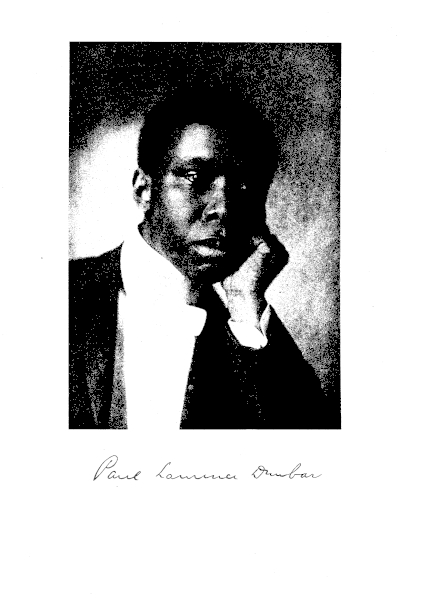
Paul Lawrence Dunbar.

THE COMPLETE POEMS

OF

PAUL LAURENCE DUNBAR

WITH THE INTRODUCTION TO
"LYRICS OF LOWLY LIFE"

BY

W. D. HOWELLS

NEW YORK

DODD, MEAD AND COMPANY

1922

Copyright 1895, 1896, 1897, 1898, 1901, 1902, 1903, 1904, 1905
By The Century Co.

Copyright 1897, 1898, 1901, 1902, 1903, 1904, 1905
By The Curtis Publishing Co.

Copyright 1898
By The Outlook Co.

Copyright 1898
By J. B. Walker

Copyright 1903
By W. H. Gannett

Copyright 1896, 1899, 1903, 1905, 1913
By DODD, MEAD AND COMPANY

PRINTED IN U. S. A.


DEDICATIONS

LYRICS OF LOWLY LIFE

TO

MY MOTHER


LYRICS OF THE HEARTHSIDE

TO

ALICE


LYRICS OF LOVE AND LAUGHTER

TO

MISS CATHERINE IMPEY


LYRICS OF SUNSHINE AND SHADOW

TO

MRS. FRANK CONOVER WITH THANKS FOR HER LONG BELIEF


INTRODUCTION TO LYRICS OF LOWLY LIFE

I think I should scarcely trouble the reader with a special appeal in behalf of this book, if it had not specially appealed to me for reasons apart from the author's race, origin, and condition. The world is too old now, and I find myself too much of its mood, to care for the work of a poet because he is black, because his father and mother were slaves, because he was, before and after he began to write poems, an elevator-boy. These facts would certainly attract me to him as a man, if I knew him to have a literary ambition, but when it came to his literary art, I must judge it irrespective of these facts, and enjoy or endure it for what it was in itself.

It seems to me that this was my experience with the poetry of Paul Laurence Dunbar when I found it in another form, and in justice to him I cannot wish that it should be otherwise with his readers here. Still, it will legitimately interest those who like to know the causes, or, if these may not be known, the sources, of things, to learn that the father and mother of the first poet of his race in our language were negroes without admixture of white blood. The father escaped from slavery in Kentucky to freedom in Canada, while there was still no hope of freedom otherwise; but the mother was freed by the events of the civil war, and came North to Ohio, where their son was born at Dayton, and grew up with such chances and mischances for mental training as everywhere befall the children of the poor. He has told me that his father picked up the trade of a plasterer, and when he had taught himself to read, loved chiefly to read history. The boy's mother shared his passion for literature, with a special love of poetry, and after the father died she struggled on in more than the poverty she had shared with him. She could value the faculty which her son showed first in prose sketches and attempts at fiction, and she was proud of the praise and kindness they won him among the people of the town, where he has never been without the warmest and kindest friends.

In fact from every part of Ohio and from several cities of the adjoining States, there came letters in cordial appreciation of the critical recognition which it was my pleasure no less than my duty to offer Paul Dunbar's work in another place. It seemed to me a happy omen for him that so many people who had known him, or known of him, were glad of a stranger's good word; and it was gratifying to see that at home he was esteemed for the things he had done rather than because as the son of negro slaves he had done them. If a prophet is often without honor in his own country, it surely is nothing against him when he has it. In this case it deprived me of the glory of a discoverer; but that is sometimes a barren joy, and I am always willing to forego it.

What struck me in reading Mr. Dunbar's poetry was what had already struck his friends in Ohio and Indiana, in Kentucky and Illinois. They had felt, as I felt, that however gifted his race had proven itself in music, in oratory, in several of the other arts, here was the first instance of an American negro who had evinced innate distinction in literature. In my criticism of his book I had alleged Dumas in France, and I had forgetfully failed to allege the far greater Pushkin in Russia; but these were both mulattoes, who might have been supposed to derive their qualities from white blood vastly more artistic than ours, and who were the creatures of an environment more favorable to their literary development. So far as I could remember, Paul Dunbar was the only man of pure African blood and of American civilization to feel the negro life aesthetically and express it lyrically. It seemed to me that this had come to its most modern consciousness in him, and that his brilliant and unique achievement was to have studied the American negro objectively, and to have represented him as he found him to be, with humor, with sympathy, and yet with what the reader must instinctively feel to be entire truthfulness. I said that a race which had come to this effect in any member of it, had attained civilization in him, and I permitted myself the imaginative prophecy that the hostilities and the prejudices which had so long constrained his race were destined to vanish in the arts; that these were to be the final proof that God had made of one blood all nations of men. I thought his merits positive and not comparative; and I held that if his black poems had been written by a white man, I should not have found them less admirable. I accepted them as an evidence of the essential unity of the human race, which does not think or feel, black in one and white in another, but humanly in all.

Yet it appeared to me then, and it appears to me now, that there is a precious difference of temperament between the races which it would be a great pity ever to lose, and that this is best preserved and most charmingly suggested by Mr. Dunbar in those pieces of his where he studies the moods and traits of his race in its own accent of our English. We call such pieces dialect pieces for want of some closer phrase, but they are really not dialect so much as delightful personal attempts and failures for the written and spoken language. In nothing is his essentially refined and delicate art so well shown as in these pieces, which, as I ventured to say, described the range between appetite and emotion, with certain lifts far beyond and above it, which is the range of the race. He reveals in these a finely ironical perception of the negro's limitations, with a tenderness for them which I think so very rare as to be almost quite new. I should say, perhaps, that it was this humorous quality which Mr. Dunbar had added to our literature, and it would be this which would most distinguish him, now and hereafter. It is something that one feels in nearly all the dialect pieces; and I hope that in the present collection he has kept all of these in his earlier volume, and added others to them. But the contents of this book are wholly of his own choosing, and I do not know how much or little he may have preferred the poems in literary English. Some of these I thought very good, and even more than very good, but not distinctively his contribution to the body of American poetry. What I mean is that several people might have written them; but I do not know any one else at present who could quite have written the dialect pieces. These are divinations and reports of what passes in the hearts and minds of a lowly people whose poetry had hitherto been inarticulately expressed in music, but now finds, for the first time in our tongue, literary interpretation of a very artistic completeness.

I say the event is interesting, but how important it shall be can be determined only by Mr. Dunbar's future performance. I cannot undertake to prophesy concerning this; but if he should do nothing more than he has done, I should feel that he had made the strongest claim for the negro in English literature that the negro has yet made. He has at least produced something that, however we may critically disagree about it, we cannot well refuse to enjoy; in more than one piece he has produced a work of art.

W. D. HOWELLS.


INDEX OF TITLES


INDEX OF FIRST LINES


[Pg 3]

LYRICS OF LOWLY LIFE

ERE SLEEP COMES DOWN TO SOOTHE THE WEARY EYES

Ere sleep comes down to soothe the weary eyes,
Which all the day with ceaseless care have sought

The magic gold which from the seeker flies;

Ere dreams put on the gown and cap of thought,

And make the waking world a world of lies,—

Of lies most palpable, uncouth, forlorn,

That say life's full of aches and tears and sighs,—

Oh, how with more than dreams the soul is torn,

Ere sleep comes down to soothe the weary eyes.

Ere sleep comes down to soothe the weary eyes,

How all the griefs and heart-aches we have known

Come up like pois'nous vapors that arise

From some base witch's caldron, when the crone,

To work some potent spell, her magic plies.

The past which held its share of bitter pain,

Whose ghost we prayed that Time might exorcise,

Comes up, is lived and suffered o'er again,

Ere sleep comes down to soothe the weary eyes.

Ere sleep comes down to soothe the weary eyes,

What phantoms fill the dimly lighted room;

What ghostly shades in awe-creating guise

Are bodied forth within the teeming gloom.

What echoes faint of sad and soul-sick cries,

And pangs of vague inexplicable pain

That pay the spirit's ceaseless enterprise,

Come thronging through the chambers of the brain,

Ere sleep comes down to soothe the weary eyes.

Ere sleep comes down to soothe the weary eyes,

Where ranges forth the spirit far and free?

Through what strange realms and unfamiliar skies

Tends her far course to lands of mystery?[Pg 4]

To lands unspeakable—beyond surmise,

Where shapes unknowable to being spring,

Till, faint of wing, the Fancy fails and dies

Much wearied with the spirit's journeying,

Ere sleep comes down to soothe the weary eyes.

Ere sleep comes down to soothe the weary eyes,

How questioneth the soul that other soul,—

The inner sense which neither cheats nor lies,

But self exposes unto self, a scroll

Full writ with all life's acts unwise or wise,

In characters indelible and known;

So, trembling with the shock of sad surprise,

The soul doth view its awful self alone,

Ere sleep comes down to soothe the weary eyes.

When sleep comes down to seal the weary eyes,

The last dear sleep whose soft embrace is balm,

And whom sad sorrow teaches us to prize

For kissing all our passions into calm,

Ah, then, no more we heed the sad world's cries,

Or seek to probe th' eternal mystery,

Or fret our souls at long-withheld replies,

At glooms through which our visions cannot see,

When sleep comes down to seal the weary eyes.

THE POET AND HIS SONG

A song is but a little thing,

And yet what joy it is to sing!

In hours of toil it gives me zest,

And when at eve I long for rest;

When cows come home along the bars,

And in the fold I hear the bell,

As Night, the shepherd, herds his stars,

I sing my song, and all is well.

There are no ears to hear my lays,

No lips to lift a word of praise;

But still, with faith unfaltering,

I live and laugh and love and sing.

What matters yon unheeding throng?

They cannot feel my spirit's spell,

Since life is sweet and love is long,

I sing my song, and all is well.

My days are never days of ease;

I till my ground and prune my trees.[Pg 5]

When ripened gold is all the plain,

I put my sickle to the grain.

I labor hard, and toil and sweat,

While others dream within the dell;

But even while my brow is wet,

I sing my song, and all is well.

Sometimes the sun, unkindly hot,

My garden makes a desert spot;

Sometimes a blight upon the tree

Takes all my fruit away from me;

And then with throes of bitter pain

Rebellious passions rise and swell;

But—life is more than fruit or grain,

And so I sing, and all is well.

RETORT

"Thou art a fool," said my head to my heart,

"Indeed, the greatest of fools thou art,

To be led astray by the trick of a tress,

By a smiling face or a ribbon smart;"

And my heart was in sore distress.

Then Phyllis came by, and her face was fair,

The light gleamed soft on her raven hair;

And her lips were blooming a rosy red.

Then my heart spoke out with a right bold air:

"Thou art worse than a fool, O head!"

ACCOUNTABILITY

Folks ain't got no right to censuah othah folks about dey habits;

Him dat giv' de squir'ls de bushtails made de bobtails fu' de rabbits.

Him dat built de gread big mountains hollered out de little valleys,

Him dat made de streets an' driveways wasn't shamed to make de alleys.

We is all constructed diff'ent, d'ain't no two of us de same;

We cain't he'p ouah likes an' dislikes, ef we'se bad we ain't to blame.

Ef we 'se good, we need n't show off, case you bet it ain't ouah doin'

We gits into su'ttain channels dat we jes' cain't he'p pu'suin'.

But we all fits into places dat no othah ones could fill,

An' we does the things we has to, big er little, good er ill.

John cain't tek de place o' Henry, Su an' Sally ain't alike;

Bass ain't nuthin' like a suckah, chub ain't nuthin' like a pike.[Pg 6]

When you come to think about it, how it 's all planned out it 's splendid.

Nuthin 's done er evah happens, 'dout hit 's somefin' dat 's intended;

Don't keer whut you does, you has to, an' hit sholy beats de dickens,—

Viney, go put on de kittle, I got one o' mastah's chickens.

FREDERICK DOUGLASS

A hush is over all the teeming lists,

And there is pause, a breath-space in the strife;

A spirit brave has passed beyond the mists

And vapors that obscure the sun of life.

And Ethiopia, with bosom torn,

Laments the passing of her noblest born.

She weeps for him a mother's burning tears—

She loved him with a mother's deepest love.

He was her champion thro' direful years,

And held her weal all other ends above.

When Bondage held her bleeding in the dust,

He raised her up and whispered, "Hope and Trust."

For her his voice, a fearless clarion, rung

That broke in warning on the ears of men;

For her the strong bow of his power he strung,

And sent his arrows to the very den

Where grim Oppression held his bloody place

And gloated o'er the mis'ries of a race.

And he was no soft-tongued apologist;

He spoke straightforward, fearlessly uncowed;

The sunlight of his truth dispelled the mist,

And set in bold relief each dark hued cloud;

To sin and crime he gave their proper hue,

And hurled at evil what was evil's due.

Through good and ill report he cleaved his way.

Right onward, with his face set toward the heights,

Nor feared to face the foeman's dread array,—

[Pg 7]
The lash of scorn, the sting of petty spites.

He dared the lightning in the lightning's track,

And answered thunder with his thunder back.

When men maligned him, and their torrent wrath

In furious imprecations o'er him broke,

He kept his counsel as he kept his path;

'T was for his race, not for himself he spoke.

He knew the import of his Master's call,

And felt himself too mighty to be small.

No miser in the good he held was he,—

His kindness followed his horizon's rim.

His heart, his talents, and his hands were free

To all who truly needed aught of him.

Where poverty and ignorance were rife,

He gave his bounty as he gave his life.

The place and cause that first aroused his might

Still proved its power until his latest day.

In Freedom's lists and for the aid of Right

Still in the foremost rank he waged the fray;

Wrong lived; his occupation was not gone.

He died in action with his armor on!

We weep for him, but we have touched his hand,

And felt the magic of his presence nigh,

The current that he sent throughout the land,

The kindling spirit of his battle-cry.

O'er all that holds us we shall triumph yet,

And place our banner where his hopes were set!

Oh, Douglass, thou hast passed beyond the shore,

But still thy voice is ringing o'er the gale!

Thou 'st taught thy race how high her hopes may soar,

And bade her seek the heights, nor faint, nor fail.

She will not fail, she heeds thy stirring cry,

She knows thy guardian spirit will be nigh,

And, rising from beneath the chast'ning rod,

She stretches out her bleeding hands to God![Pg 8]

LIFE

A crust of bread and a corner to sleep in,

A minute to smile and an hour to weep in,

A pint of joy to a peck of trouble,

And never a laugh but the moans come double;

And that is life!

A crust and a corner that love makes precious,

With a smile to warm and the tears to refresh us;

And joy seems sweeter when cares come after,

And a moan is the finest of foils for laughter;

And that is life!

THE LESSON

My cot was down by a cypress grove,

And I sat by my window the whole night long,

And heard well up from the deep dark wood

A mocking-bird's passionate song.

And I thought of myself so sad and lone,

And my life's cold winter that knew no spring;

Of my mind so weary and sick and wild,

Of my heart too sad to sing.

But e'en as I listened the mock-bird's song,

A thought stole into my saddened heart,

And I said, "I can cheer some other soul

By a carol's simple art."

For oft from the darkness of hearts and lives

Come songs that brim with joy and light,

As out of the gloom of the cypress grove

The mocking-bird sings at night.

So I sang a lay for a brother's ear

In a strain to soothe his bleeding heart,

And he smiled at the sound of my voice and lyre,

Though mine was a feeble art.

But at his smile I smiled in turn,

And into my soul there came a ray:

In trying to soothe another's woes

Mine own had passed away.

THE RISING OF THE STORM

The lake's dark breast

Is all unrest,

It heaves with a sob and a sigh.

Like a tremulous bird,

From its slumber stirred,

The moon is a-tilt in the sky.[Pg 9]

From the silent deep

The waters sweep,

But faint on the cold white stones,

And the wavelets fly

With a plaintive cry

O'er the old earth's bare, bleak bones.

And the spray upsprings

On its ghost-white wings,

And tosses a kiss at the stars;

While a water-sprite,

In sea-pearls dight,

Hums a sea-hymn's solemn bars.

Far out in the night,

On the wavering sight

I see a dark hull loom;

And its light on high,

Like a Cyclops' eye,

Shines out through the mist and gloom.

Now the winds well up

From the earth's deep cup,

And fall on the sea and shore,

And against the pier

The waters rear

And break with a sullen roar.

Up comes the gale,

And the mist-wrought veil

Gives way to the lightning's glare,

And the cloud-drifts fall,

A sombre pall,

O'er water, earth, and air.

The storm-king flies,

His whip he plies,

And bellows down the wind.

The lightning rash

With blinding flash

Comes pricking on behind.

Rise, waters, rise,

And taunt the skies

With your swift-flitting form.

Sweep, wild winds, sweep,

And tear the deep

To atoms in the storm.

And the waters leapt,

And the wild winds swept,

And blew out the moon in the sky,

And I laughed with glee,

It was joy to me

As the storm went raging by!

SUNSET

The river sleeps beneath the sky,

And clasps the shadows to its breast;

The crescent moon shines dim on high;

And in the lately radiant west

The gold is fading into gray.

Now stills the lark his festive lay,

And mourns with me the dying day.

While in the south the first faint star

[Pg 10]Lifts to the night its silver face,

And twinkles to the moon afar

Across the heaven's graying space,

Low murmurs reach me from the town,

As Day puts on her sombre crown,

And shakes her mantle darkly down.

THE OLD APPLE-TREE

There's a memory keeps a-runnin'

Through my weary head to-night,

An' I see a picture dancin'

In the fire-flames' ruddy light;

'Tis the picture of an orchard

Wrapped in autumn's purple haze,

With the tender light about it

That I loved in other days.

An' a-standin' in a corner

Once again I seem to see

The verdant leaves an' branches

Of an old apple-tree.

You perhaps would call it ugly,

An' I don't know but it's so,

When you look the tree all over

Unadorned by memory's glow;

For its boughs are gnarled an' crooked,

An' its leaves are gettin' thin,

An' the apples of its bearin'

Would n't fill so large a bin

As they used to. But I tell you,

When it comes to pleasin' me,

It's the dearest in the orchard,—

Is that old apple-tree.

I would hide within its shelter,

Settlin' in some cosy nook,

Where no calls nor threats could stir me

From the pages o' my book.

Oh, that quiet, sweet seclusion

In its fulness passeth words!

It was deeper than the deepest

That my sanctum now affords.

Why, the jaybirds an' the robins,

They was hand in glove with me,

As they winked at me an' warbled

In that old apple-tree.

It was on its sturdy branches

That in summers long ago

I would tie my swing an' dangle

In contentment to an' fro,

Idly dreamin' childish fancies,

Buildin' castles in the air,

Makin' o' myself a hero

Of romances rich an' rare.

I kin shet my eyes an' see it

Jest as plain as plain kin be,

That same old swing a-danglin'

To the old apple-tree.

There's a rustic seat beneath it

That I never kin forget.

It's the place where me an' Hallie—

[Pg 11]Little sweetheart—used to set,

When we 'd wander to the orchard

So 's no listenin' ones could hear

As I whispered sugared nonsense

Into her little willin' ear.

Now my gray old wife is Hallie,

An' I 'm grayer still than she,

But I 'll not forget our courtin'

'Neath the old apple-tree.

Life for us ain't all been summer,

But I guess we 'we had our share

Of its flittin' joys an' pleasures,

An' a sprinklin' of its care.

Oft the skies have smiled upon us;

Then again we 've seen 'em frown,

Though our load was ne'er so heavy

That we longed to lay it down.

But when death does come a-callin',

This my last request shall be,—

That they 'll bury me an' Hallie

'Neath the old apple tree.

A PRAYER

O Lord, the hard-won miles

Have worn my stumbling feet:

Oh, soothe me with thy smiles,

And make my life complete.

The thorns were thick and keen

Where'er I trembling trod;

The way was long between

My wounded feet and God.

Where healing waters flow

Do thou my footsteps lead.

My heart is aching so;

Thy gracious balm I need.

PASSION AND LOVE

A maiden wept and, as a comforter,

Came one who cried, "I love thee," and he seized

Her in his arms and kissed her with hot breath,

That dried the tears upon her flaming cheeks.

While evermore his boldly blazing eye

Burned into hers; but she uncomforted

Shrank from his arms and only wept the more.

Then one came and gazed mutely in her face

With wide and wistful eyes; but still aloof

He held himself; as with a reverent fear,

As one who knows some sacred presence nigh.

And as she wept he mingled tear with tear,

That cheered her soul like dew a dusty flower,—

Until she smiled, approached, and touched his hand![Pg 12]

THE SEEDLING

As a quiet little seedling

Lay within its darksome bed,

To itself it fell a-talking,

And this is what it said:

"I am not so very robust,

But I 'll do the best I can;"

And the seedling from that moment

Its work of life began.

So it pushed a little leaflet

Up into the light of day,

To examine the surroundings

And show the rest the way.

The leaflet liked the prospect,

So it called its brother, Stem;

Then two other leaflets heard it,

And quickly followed them.

To be sure, the haste and hurry

Made the seedling sweat and pant;

But almost before it knew it

It found itself a plant.

The sunshine poured upon it,

And the clouds they gave a shower;

And the little plant kept growing

Till it found itself a flower.

Little folks, be like the seedling,

Always do the best you can;

Every child must share life's labor

Just as well as every man.

And the sun and showers will help you

Through the lonesome, struggling hours,

Till you raise to light and beauty

Virtue's fair, unfading flowers.

PROMISE

I grew a rose within a garden fair,

And, tending it with more than loving care,

I thought how, with the glory of its bloom,

I should the darkness of my life illume;

And, watching, ever smiled to see the lusty bud

Drink freely in the summer sun to tinct its blood.

My rose began to open, and its hue

Was sweet to me as to it sun and dew;

I watched it taking on its ruddy flame

Until the day of perfect blooming came,

Then hasted I with smiles to find it blushing red—

Too late! Some thoughtless child had plucked my rose and fled![Pg 13]

FULFILMENT.

I grew a rose once more to please mine eyes.

All things to aid it—dew, sun, wind, fair skies—

Were kindly; and to shield it from despoil,

I fenced it safely in with grateful toil.

No other hand than mine shall pluck this flower, said I,

And I was jealous of the bee that hovered nigh.

It grew for days; I stood hour after hour

To watch the slow unfolding of the flower,

And then I did not leave its side at all,

Lest some mischance my flower should befall.

At last, oh joy! the central petals burst apart.

It blossomed—but, alas! a worm was at its heart!

SONG

My heart to thy heart,

My hand to thine;

My lip to thy lips,

Kisses are wine

Brewed for the lover in sunshine and shade;

Let me drink deep, then, my African maid.

Lily to lily,

Rose unto rose;

My love to thy love

Tenderly grows.

Rend not the oak and the ivy in twain,

Nor the swart maid from her swarthier swain.

AN ANTE-BELLUM SERMON

We is gathahed hyeah, my brothahs,

In dis howlin' wildaness,

Fu' to speak some words of comfo't

To each othah in distress.

An' we chooses fu' ouah subjic'

Dis—we'll 'splain it by an' by;

"An' de Lawd said, 'Moses, Moses,'

An' de man said, 'Hyeah am I.'"

Now ole Pher'oh, down in Egypt,

Was de wuss man evah bo'n,

An' he had de Hebrew chillun

Down dah wukin' in his co'n;

'T well de Lawd got tiahed o' his foolin',

An' sez he: "I' ll let him know—

Look hyeah, Moses, go tell Pher'oh

[Pg 14]
Fu' to let dem chillun go."

"An' ef he refuse to do it,

I will make him rue de houah,

Fu' I'll empty down on Egypt

All de vials of my powah."

Yes, he did—an' Pher'oh's ahmy

Wasn't wuth a ha'f a dime;

Fu' de Lawd will he'p his chillun,

You kin trust him evah time.

An' yo' enemies may 'sail you

In de back an' in de front;

But de Lawd is all aroun' you,

Fu' to ba' de battle's brunt.

Dey kin fo'ge yo' chains an' shackles

F'om de mountains to de sea;

But de Lawd will sen' some Moses

Fu' to set his chillun free.

An' de lan' shall hyeah his thundah,

Lak a blas' f'om Gab'el's ho'n,

Fu' de Lawd of hosts is mighty

When he girds his ahmor on.

But fu' feah some one mistakes me,

I will pause right hyeah to say,

Dat I 'm still a-preachin' ancient,

I ain't talkin' 'bout to-day.

But I tell you, fellah christuns,

Things'll happen mighty strange;

Now, de Lawd done dis fu' Isrul,

An' his ways don't nevah change,

An' de love he showed to Isrul

Was n't all on Isrul spent;

Now don't run an' tell yo' mastahs

Dat I's preachin' discontent.

'Cause I isn't; I'se a-judgin'

Bible people by deir ac's;

I 'se a-givin' you de Scriptuah,

I 'se a-handin' you de fac's.

Cose ole Pher'oh b'lieved in slav'ry,

But de Lawd he let him see,

Dat de people he put bref in,—

Evah mothah's son was free.

An' dahs othahs thinks lak Pher'oh,

But dey calls de Scriptuah liar,

Fu' de Bible says "a servant

Is a-worthy of his hire."

An' you cain't git roun' nor thoo dat,

An' you cain't git ovah it,

Fu' whatevah place you git in,

Dis hyeah Bible too 'll fit.

So you see de Lawd's intention,

Evah sence de worl' began,

Was dat His almighty freedom

Should belong to evah man,

But I think it would be bettah,

Ef I'd pause agin to say,

Dat I'm talkin' 'bout ouah freedom

In a Bibleistic way.

But de Moses is a-comin',

[Pg 15]An' he's comin', suah and fas'

We kin hyeah his feet a-trompin',

We kin hyeah his trumpit blas'.

But I want to wa'n you people,

Don't you git too brigity;

An' don't you git to braggin'

'Bout dese things, you wait an' see.

But when Moses wif his powah

Comes an' sets us chillun free,

We will praise de gracious Mastah.

Dat has gin us liberty;

An' we 'll shout ouah halleluyahs,

On dat mighty reck'nin' day,

When we 'se reco'nised ez citiz'—

Huh uh! Chillun, let us pray!

ODE TO ETHIOPIA

O Mother Race! to thee I bring

This pledge of faith unwavering,

This tribute to thy glory.

I know the pangs which thou didst feel,

When Slavery crushed thee with its heel,

With thy dear blood all gory.

Sad days were those—ah, sad indeed!

But through the land the fruitful seed

Of better times was growing.

The plant of freedom upward sprung,

And spread its leaves so fresh and young—

Its blossoms now are blowing.

On every hand in this fair land,

Proud Ethiope's swarthy children stand

Beside their fairer neighbor;

The forests flee before their stroke,

Their hammers ring, their forges smoke,—

They stir in honest labour.

They tread the fields where honour calls;

Their voices sound through senate halls

In majesty and power.

To right they cling; the hymns they sing

Up to the skies in beauty ring,

And bolder grow each hour.

Be proud, my Race, in mind and soul;

Thy name is writ on Glory's scroll

In characters of fire.

High 'mid the clouds of Fame's bright sky

Thy banner's blazoned folds now fly,

And truth shall lift them higher.

Thou hast the right to noble pride,

Whose spotless robes were purified

By blood's severe baptism.

Upon thy brow the cross was laid,[Pg 16]

And labour's painful sweat-beads made

A consecrating chrism.

No other race, or white or black,

When bound as thou wert, to the rack,

So seldom stooped to grieving;

No other race, when free again,

Forgot the past and proved them men

So noble in forgiving.

Go on and up! Our souls and eyes

Shall follow thy continuous rise;

Our ears shall list thy story

From bards who from thy root shall spring,

And proudly tune their lyres to sing

Of Ethiopia's glory.

THE CORN-STALK FIDDLE

When the corn 's all cut and the bright stalks shine

Like the burnished spears of a field of gold;

When the field-mice rich on the nubbins dine,

And the frost comes white and the wind blows cold;

Then it's heigho! fellows and hi-diddle-diddle,

For the time is ripe for the corn-stalk fiddle.

And you take a stalk that is straight and long,

With an expert eye to its worthy points,

And you think of the bubbling strains of song

That are bound between its pithy joints—

Then you cut out strings, with a bridge in the middle,

With a corn-stalk bow for a corn-stalk fiddle.

Then the strains that grow as you draw the bow

O'er the yielding strings with a practised hand!

And the music's flow never loud but low

Is the concert note of a fairy band.

Oh, your dainty songs are a misty riddle

To the simple sweets of the corn-stalk fiddle.

When the eve comes on, and our work is done,

And the sun drops down with a tender glance,

With their hearts all prime for the harmless fun,

Come the neighbor girls for the evening's dance,

And they wait for the well-known twist and twiddle[Pg 17]

More time than tune—from the corn-stalk fiddle.

Then brother Jabez takes the bow,

While Ned stands off with Susan Bland,

Then Henry stops by Milly Snow,

And John takes Nellie Jones's hand,

While I pair off with Mandy Biddle,

And scrape, scrape, scrape goes the corn-stalk fiddle.

"Salute your partners," comes the call,

"All join hands and circle round,"

"Grand train back," and "Balance all,"

Footsteps lightly spurn the ground.

"Take your lady and balance down the middle"

To the merry strains of the corn-stalk fiddle.

So the night goes on and the dance is o'er,

And the merry girls are homeward gone,

But I see it all in my sleep once more,

And I dream till the very break of dawn

Of an impish dance on a red-hot griddle

To the screech and scrape of a corn-stalk fiddle.

THE MASTER-PLAYER

An old, worn harp that had been played

Till all its strings were loose and frayed,

Joy, Hate, and Fear, each one essayed,

To play. But each in turn had found

No sweet responsiveness of sound.

Then Love the Master-Player came

With heaving breast and eyes aflame;

The Harp he took all undismayed,

Smote on its strings, still strange to song,

And brought forth music sweet and strong.

THE MYSTERY

I was not; now I am—a few days hence

I shall not be; I fain would look before

And after, but can neither do; some Power

Or lack of power says "no" to all I would.

I stand upon a wide and sunless plain,[Pg 18]

Nor chart nor steel to guide my steps aright.

Whene'er, o'ercoming fear, I dare to move,

I grope without direction and by chance.

Some feign to hear a voice and feel a hand

That draws them ever upward thro' the gloom.

But I—I hear no voice and touch no hand,

Tho' oft thro' silence infinite I list,

And strain my hearing to supernal sounds;

Tho' oft thro' fateful darkness do I reach,

And stretch my hand to find that other hand.

I question of th' eternal bending skies

That seem to neighbor with the novice earth;

But they roll on, and daily shut their eyes

On me, as I one day shall do on them,

And tell me not the secret that I ask.

NOT THEY WHO SOAR

Not they who soar, but they who plod

Their rugged way, unhelped, to God

Are heroes; they who higher fare,

And, flying, fan the upper air,

Miss all the toil that hugs the sod.

'Tis they whose backs have felt the rod,

Whose feet have pressed the path unshod,

May smile upon defeated care,

Not they who soar.

High up there are no thorns to prod,

Nor boulders lurking 'neath the clod

To turn the keenness of the share,

For flight is ever free and rare;

But heroes they the soil who 've trod,

Not they who soar!

WHITTIER

Not o'er thy dust let there be spent

The gush of maudlin sentiment;

Such drift as that is not for thee,

Whose life and deeds and songs agree,

Sublime in their simplicity.

Nor shall the sorrowing tear be shed.

O singer sweet, thou art not dead!

In spite of time's malignant chill,

With living fire thy songs shall thrill,[Pg 19]

And men shall say, "He liveth still!"

Great poets never die, for Earth

Doth count their lives of too great worth

To lose them from her treasured store;

So shalt thou live for evermore—

Though far thy form from mortal ken—

Deep in the hearts and minds of men.

TWO SONGS

A bee that was searching for sweets one day

Through the gate of a rose garden happened to stray.

In the heart of a rose he hid away,

And forgot in his bliss the light of day,

As sipping his honey he buzzed in song;

Though day was waning, he lingered long,

For the rose was sweet, so sweet.

A robin sits pluming his ruddy breast,

And a madrigal sings to his love in her nest:

"Oh, the skies they are blue, the fields are green,

And the birds in your nest will soon be seen!"

She hangs on his words with a thrill of love,

And chirps to him as he sits above

For the song is sweet, so sweet.

A maiden was out on a summer's day

With the winds and the waves and the flowers at play;

And she met with a youth of gentle air,

With the light of the sunshine on his hair.

Together they wandered the flowers among;

They loved, and loving they lingered long,

For to love is sweet, so sweet.


Bird of my lady's bower,

Sing her a song;

Tell her that every hour,

All the day long,

Thoughts of her come to me,

Filling my brain

With the warm ecstasy

Of love's refrain.

Little bird! happy bird!

Being so near,

Where e'en her slightest word

Thou mayest hear,

Seeing her glancing eyes,

Sheen of her hair,

Thou art in paradise,—

[Pg 20]Would I were there.

I am so far away,

Thou art so near;

Plead with her, birdling gay,

Plead with my dear.

Rich be thy recompense,

Fine be thy fee,

If through thine eloquence

She hearken me.

A BANJO SONG

Oh, dere 's lots o' keer an' trouble

In dis world to swaller down;

An' ol' Sorrer 's purty lively

In her way o' gittin' roun'.

Yet dere's times when I furgit em,—

Aches an' pains an' troubles all,—

An' it's when I tek at ebenin'

My ol' banjo f'om de wall.

'Bout de time dat night is fallin'

An' my daily wu'k is done,

An' above de shady hilltops

I kin see de settin' sun;

When de quiet, restful shadders

Is beginnin' jes' to fall,—

Den I take de little banjo

F'om its place upon de wall.

Den my fam'ly gadders roun' me

In de fadin' o' de light,

Ez I strike de strings to try 'em

Ef dey all is tuned er-right.

An' it seems we 're so nigh heaben

We kin hyeah de angels sing

When de music o' dat banjo

Sets my cabin all er-ring.

An' my wife an' all de othahs,—

Male an' female, small an' big,—

Even up to gray-haired granny,

Seem jes' boun' to do a jig;

'Twell I change de style o' music,

Change de movement an' de time,

An' de ringin' little banjo

Plays an ol' hea't-feelin' hime.

An' somehow my th'oat gits choky,

An' a lump keeps tryin' to rise

Lak it wan'ed to ketch de water

Dat was flowin' to my eyes;

An' I feel dat I could sorter

Knock de socks clean off o' sin

Ez I hyeah my po' ol' granny

Wif huh tremblin' voice jine in.

Den we all th'ow in our voices

Fu' to he'p de chune out too,

Lak a big camp-meetin' choiry

Tryin' to sing a mou'nah th'oo.

An' our th'oahts let out de music,

Sweet an' solemn, loud an' free,

'Twell de raftahs o' my cabin

Echo wif de melody.

Oh, de music o' de banjo,

Quick an' deb'lish, solemn, slow,

Is de greates' joy an' solace

[Pg 21]
Dat a weary slave kin know!

So jes' let me hyeah it ringin',

Dough de chune be po' an' rough,

It's a pleasure; an' de pleasures

O' dis life is few enough.

Now, de blessed little angels

Up in heaben, we are told,

Don't do nothin' all dere lifetime

'Ceptin' play on ha'ps o' gold.

Now I think heaben 'd be mo' homelike

Ef we 'd hyeah some music fall

F'om a real ol'-fashioned banjo,

Like dat one upon de wall.

LONGING

If you could sit with me beside the sea to-day,

And whisper with me sweetest dreamings o'er and o'er;

I think I should not find the clouds so dim and gray,

And not so loud the waves complaining at the shore.

If you could sit with me upon the shore to-day,

And hold my hand in yours as in the days of old,

I think I should not mind the chill baptismal spray,

Nor find my hand and heart and all the world so cold.

If you could walk with me upon the strand to-day,

And tell me that my longing love had won your own,

I think all my sad thoughts would then be put away,

And I could give back laughter for the Ocean's moan!

THE PATH

There are no beaten paths to Glory's height,

There are no rules to compass greatness known;

Each for himself must cleave a path alone,

And press his own way forward in the fight.

Smooth is the way to ease and calm delight,

And soft the road Sloth chooseth for her own;

But he who craves the flower of life full-blown,

Must struggle up in all his armor dight!

What though the burden bear him sorely down

And crush to dust the mountain of his pride,

Oh, then, with strong heart let him still abide;

For rugged is the roadway to renown,

Nor may he hope to gain the envied crown,

Till he hath thrust the looming rocks aside.[Pg 22]

THE LAWYERS' WAYS

I 've been list'nin' to them lawyers

In the court house up the street,

An' I 've come to the conclusion

That I'm most completely beat.

Fust one feller riz to argy,

An' he boldly waded in

As he dressed the tremblin' pris'ner

In a coat o' deep-dyed sin.

Why, he painted him all over

In a hue o' blackest crime,

An' he smeared his reputation

With the thickest kind o' grime,

Tell I found myself a-wond'rin',

In a misty way and dim,

How the Lord had come to fashion

Sich an awful man as him.

Then the other lawyer started,

An' with brimmin', tearful eyes,

Said his client was a martyr

That was brought to sacrifice.

An' he give to that same pris'ner

Every blessed human grace,

Tell I saw the light o' virtue

Fairly shinin' from his face.

Then I own 'at I was puzzled

How sich things could rightly be;

An' this aggervatin' question

Seems to keep a-puzzlin' me.

So, will some one please inform me,

An' this mystery unroll—

How an angel an' a devil

Can persess the self-same soul?

ODE FOR MEMORIAL DAY

Done are the toils and the wearisome marches,

Done is the summons of bugle and drum.

Softly and sweetly the sky over-arches,

Shelt'ring a land where Rebellion is dumb.

Dark were the days of the country's derangement,

Sad were the hours when the conflict was on,

But through the gloom of fraternal estrangement

God sent his light, and we welcome the dawn.

O'er the expanse of our mighty dominions,

Sweeping away to the uttermost parts,

Peace, the wide-flying, on untiring pinions,

Bringeth her message of joy to our hearts.

Ah, but this joy which our minds cannot measure,

What did it cost for our fathers to gain!

Bought at the price of the heart's dearest treasure,

[Pg 23]
Born out of travail and sorrow and pain;

Born in the battle where fleet Death was flying,

Slaying with sabre-stroke bloody and fell;

Born where the heroes and martyrs were dying,

Torn by the fury of bullet and shell.

Ah, but the day is past: silent the rattle,

And the confusion that followed the fight.

Peace to the heroes who died in the battle,

Martyrs to truth and the crowning of Right!

Out of the blood of a conflict fraternal,

Out of the dust and the dimness of death,

Burst into blossoms of glory eternal

Flowers that sweeten the world with their breath.

Flowers of charity, peace, and devotion

Bloom in the hearts that are empty of strife;

Love that is boundless and broad as the ocean

Leaps into beauty and fulness of life.

So, with the singing of paeans and chorals,

And with the flag flashing high in the sun,

Place on the graves of our heroes the laurels

Which their unfaltering valor has won!

PREMONITION

Dear heart, good-night!

Nay, list awhile that sweet voice singing

When the world is all so bright,

And the sound of song sets the heart a-ringing,

Oh, love, it is not right—

Not then to say, "Good-night."

Dear heart, good-night!

The late winds in the lake weeds shiver,

And the spray flies cold and white.

And the voice that sings gives a telltale quiver—

"Ah, yes, the world is bright,

But, dearest heart, good-night!"

Dear heart, good-night!

And do not longer seek to hold me!

For my soul is in affright

As the fearful glooms in their pall enfold me.

See him who sang how white

[Pg 24]
And still; so, dear, good-night.

Dear heart, good-night!

Thy hand I 'll press no more forever,

And mine eyes shall lose the light;

For the great white wraith by the winding river

Shall check my steps with might.

So, dear, good-night, good-night!

RETROSPECTION

When you and I were young, the days

Were filled with scent of pink and rose,

And full of joy from dawn till close,

From morning's mist till evening's haze.

And when the robin sung his song

The verdant woodland ways along,

We whistled louder than he sung.

And school was joy, and work was sport

For which the hours were all too short,

When you and I were young, my boy,

When you and I were young.

When you and I were young, the woods

Brimmed bravely o'er with every joy

To charm the happy-hearted boy.

The quail turned out her timid broods;

The prickly copse, a hostess fine,

Held high black cups of harmless wine;

And low the laden grape-vine swung

With beads of night-kissed amethyst

Where buzzing lovers held their tryst,

When you and I were young, my boy,

When you and I were young.

When you and I were young, the cool

And fresh wind fanned our fevered brows

When tumbling o'er the scented mows,

Or stripping by the dimpling pool,

Sedge-fringed about its shimmering face,

Save where we 'd worn an ent'ring place.

[Pg 25]
How with our shouts the calm banks rung!

How flashed the spray as we plunged in,—

Pure gems that never caused a sin!

When you and I were young, my boy,

When you and I were young.

When you and I were young, we heard

All sounds of Nature with delight,—

The whirr of wing in sudden flight,

The chirping of the baby-bird.

The columbine's red bells were rung;

The locust's vested chorus sung;

While every wind his zithern strung

To high and holy-sounding keys,

And played sonatas in the trees—

When you and I were young, my boy,

When you and I were young.

When you and I were young, we knew

To shout and laugh, to work and play,

And night was partner to the day

In all our joys. So swift time flew

On silent wings that, ere we wist,

The fleeting years had fled unmissed;

And from our hearts this cry was wrung—

To fill with fond regret and tears

The days of our remaining years—

"When you and I were young, my boy,

When you and I were young."

UNEXPRESSED

Deep in my heart that aches with the repression,

And strives with plenitude of bitter pain,

There lives a thought that clamors for expression,

And spends its undelivered force in vain.

What boots it that some other may have thought it?

The right of thoughts' expression is divine;

The price of pain I pay for it has bought it,

I care not who lays claim to it—'t is mine!

And yet not mine until it be delivered;

The manner of its birth shall prove the test.

Alas, alas, my rock of pride is shivered—

[Pg 26]
I beat my brow—the thought still unexpressed.

SONG OF SUMMER

Dis is gospel weathah sho'—

Hills is sawt o' hazy.

Meddahs level ez a flo'

Callin' to de lazy.

Sky all white wif streaks o' blue,

Sunshine softly gleamin',

D'ain't no wuk hit's right to do,

Nothin' 's right but dreamin'.

Dreamin' by de rivah side

Wif de watahs glist'nin',

Feelin' good an' satisfied

Ez you lay a-list'nin'

To the little nakid boys

Splashin' in de watah,

Hollerin' fu' to spress deir joys

Jes' lak youngsters ought to.

Squir'l a-tippin' on his toes,

So 's to hide an' view you;

Whole flocks o' camp-meetin' crows

Shoutin' hallelujah.

Peckahwood erpon de tree

Tappin' lak a hammah;

Jaybird chattin' wif a bee,

Tryin' to teach him grammah.

Breeze is blowin' wif perfume,

Jes' enough to tease you;

Hollyhocks is all in bloom,

Smellin' fu' to please you.

Go 'way, folks, an' let me 'lone,

Times is gettin' dearah—

Summah's settin' on de th'one,

An' I 'm a-layin' neah huh!

SPRING SONG

A blue-bell springs upon the ledge,

A lark sits singing in the hedge;

Sweet perfumes scent the balmy air,

And life is brimming everywhere.

What lark and breeze and bluebird sing,

Is Spring, Spring, Spring!

No more the air is sharp and cold;

The planter wends across the wold,

And, glad, beneath the shining sky

We wander forth, my love and I.

And ever in our hearts doth ring

This song of Spring, Spring!

For life is life and love is love,

'Twixt maid and man or dove and dove.

Life may be short, life may be long,

But love will come, and to its song

Shall this refrain for ever cling

Of Spring, Spring, Spring!

TO LOUISE

Oh, the poets may sing of their Lady Irenes,

And may rave in their rhymes about wonderful queens;

But I throw my poetical wings to the breeze,[Pg 27]

And soar in a song to my Lady Louise.

A sweet little maid, who is dearer, I ween,

Than any fair duchess, or even a queen.

When speaking of her I can't plod in my prose,

For she 's the wee lassie who gave me a rose.

Since poets, from seeing a lady's lip curled,

Have written fair verse that has sweetened the world;

Why, then, should not I give the space of an hour

To making a song in return for a flower?

I have found in my life—it has not been so long—

There are too few of flowers—too little of song.

So out of that blossom, this lay of mine grows,

For the dear little lady who gave me the rose.

I thank God for innocence, dearer than Art,

That lights on a by-way which leads to the heart,

And led by an impulse no less than divine,

Walks into the temple and sits at the shrine.

I would rather pluck daisies that grow in the wild,

Or take one simple rose from the hand of a child,

Then to breathe the rich fragrance of flowers that bide

In the gardens of luxury, passion, and pride.

I know not, my wee one, how came you to know

Which way to my heart was the right way to go;

Unless in your purity, soul-clean and clear,

God whispers his messages into your ear.

You have now had my song, let me end with a prayer

That your life may be always sweet, happy, and fair;

That your joys may be many, and absent your woes,

O dear little lady who gave me the rose!

THE RIVALS

'T was three an' thirty year ago,

When I was ruther young, you know,

I had my last an' only fight

About a gal one summer night.

'T was me an' Zekel Johnson; Zeke

'N' me 'd be'n spattin' 'bout a week,

Each of us tryin' his best to show

That he was Liza Jones's beau.[Pg 28]

We could n't neither prove the thing,

Fur she was fur too sharp to fling

One over fur the other one

An' by so doin' stop the fun

That we chaps did n't have the sense

To see she got at our expense,

But that's the way a feller does,

Fur boys is fools an' allus was.

An' when they's females in the game

I reckon men's about the same.

Well, Zeke an' me went on that way

An' fussed an' quarrelled day by day;

While Liza, mindin' not the fuss,

Jest kep' a-goin' with both of us,

Tell we pore chaps, that's Zeke an' me,

Was jest plum mad with jealousy.

Well, fur a time we kep' our places,

An' only showed by frownin' faces

An' looks 'at well our meanin' boded

How full o' fight we both was loaded.

At last it come, the thing broke out,

An' this is how it come about.

One night ('t was fair, you'll all agree)

I got Eliza's company,

An' leavin' Zekel in the lurch,

Went trottin' off with her to church.

An' jest as we had took our seat

(Eliza lookin' fair an' sweet),

Why, I jest could n't help but grin

When Zekel come a-bouncin' in

As furious as the law allows.

He 'd jest be'n up to Liza's house,

To find her gone, then come to church

To have this end put to his search.

I guess I laffed that meetin' through,

An' not a mortal word I knew

Of what the preacher preached er read

Er what the choir sung er said.

Fur every time I 'd turn my head

I could n't skeercely help but see

'At Zekel had his eye on me.

An' he 'ud sort o' turn an' twist

An' grind his teeth an' shake his fist.

I laughed, fur la! the hull church seen us,

An' knowed that suthin' was between us.

Well, meetin' out, we started hum,

I sorter feelin' what would come.

We 'd jest got out, when up stepped Zeke,

An' said, "Scuse me, I 'd like to speak[Pg 29]

To you a minute." "Cert," said I—

A-nudgin' Liza on the sly

An' laughin' in my sleeve with glee,

I asked her, please, to pardon me.

We walked away a step er two,

Jest to git out o' Liza's view,

An' then Zeke said, "I want to know

Ef you think you 're Eliza's beau,

An' 'at I 'm goin' to let her go

Hum with sich a chap as you?"

An' I said bold, "You bet I do."

Then Zekel, sneerin', said 'at he

Did n't want to hender me.

But then he 'lowed the gal was his

An' 'at he guessed he knowed his biz,

An' was n't feared o' all my kin

With all my friends an' chums throwed in.

Some other things he mentioned there

That no born man could no ways bear

Er think o' ca'mly tryin' to stan'

Ef Zeke had be'n the bigges' man

In town, an' not the leanest runt

'At time an' labor ever stunt.

An' so I let my fist go "bim,"

I thought I 'd mos' nigh finished him.

But Zekel did n't take it so.

He jest ducked down an' dodged my blow

An' then come back at me so hard,

I guess I must 'a' hurt the yard,

Er spilet the grass plot where I fell,

An' sakes alive it hurt me; well,

It would n't be'n so bad, you see,

But he jest kep' a-hittin' me.

An' I hit back an' kicked an' pawed,

But 't seemed 't was mostly air I clawed,

While Zekel used his science well

A-makin' every motion tell.

He punched an' hit, why, goodness lands,

Seemed like he had a dozen hands.

Well, afterwhile they stopped the fuss,

An' some one kindly parted us.

All beat an' cuffed an' clawed an' scratched,

An' needin' both our faces patched,

Each started hum a different way;

An' what o' Liza, do you say,

Why, Liza—little humbug—dern her,

Why, she 'd gone home with Hiram Turner.

THE LOVER AND THE MOON

A lover whom duty called over the wave,

[Pg 30]
With himself communed: "Will my love be true

If left to herself? Had I better not sue

Some friend to watch over her, good and grave?

But my friend might fail in my need," he said,

"And I return to find love dead.

Since friendships fade like the flow'rs of June,

I will leave her in charge of the stable moon."

Then he said to the moon: "O dear old moon,

Who for years and years from thy thrown above

Hast nurtured and guarded young lovers and love,

My heart has but come to its waiting June,

And the promise time of the budding vine;

Oh, guard thee well this love of mine."

And he harked him then while all was still,

And the pale moon answered and said, "I will."

And he sailed in his ship o'er many seas,

And he wandered wide o'er strange far strands:

In isles of the south and in Orient lands,

Where pestilence lurks in the breath of the breeze.

But his star was high, so he braved the main,

And sailed him blithely home again;

And with joy he bended his footsteps soon

To learn of his love from the matron moon.

She sat as of yore, in her olden place,

Serene as death, in her silver chair.

A white rose gleamed in her whiter hair,

And the tint of a blush was on her face.

At sight of the youth she sadly bowed

And hid her face 'neath a gracious cloud.

She faltered faint on the night's dim marge,

But "How," spoke the youth, "have you kept your charge?"

The moon was sad at a trust ill-kept;

The blush went out in her blanching cheek,

And her voice was timid and low and weak,

As she made her plea and sighed and wept.

[Pg 31]
"Oh, another prayed and another plead,

And I could n't resist," she answering said;

"But love still grows in the hearts of men:

Go forth, dear youth, and love again."

But he turned him away from her proffered grace.

"Thou art false, O moon, as the hearts of men,

I will not, will not love again."

And he turned sheer 'round with a soul-sick face

To the sea, and cried: "Sea, curse the moon,

Who makes her vows and forgets so soon."

And the awful sea with anger stirred,

And his breast heaved hard as he lay and heard.

And ever the moon wept down in rain,

And ever her sighs rose high in wind;

But the earth and sea were deaf and blind,

And she wept and sighed her griefs in vain.

And ever at night, when the storm is fierce,

The cries of a wraith through the thunder pierce;

And the waves strain their awful hands on high

To tear the false moon from the sky.

CONSCIENCE AND REMORSE

"Good-bye," I said to my conscience—

"Good-bye for aye and aye,"

And I put her hands off harshly,

And turned my face away;

And conscience smitten sorely

Returned not from that day.

But a time came when my spirit

Grew weary of its pace;

And I cried: "Come back, my conscience;

I long to see thy face."

But conscience cried: "I cannot;

Remorse sits in my place."

IONE

I

Ah, yes, 't is sweet still to remember,

Though 'twere less painful to forget;

For while my heart glows like an ember,

Mine eyes with sorrow's drops are wet,

And, oh, my heart is aching yet.

[Pg 32]It is a law of mortal pain

That old wounds, long accounted well,

Beneath the memory's potent spell,

Will wake to life and bleed again.

So 't is with me; it might be better

If I should turn no look behind,—

If I could curb my heart, and fetter

From reminiscent gaze my mind,

Or let my soul go blind—go blind!

But would I do it if I could?

Nay! ease at such a price were spurned;

For, since my love was once returned,

All that I suffer seemeth good.

I know, I know it is the fashion,

When love has left some heart distressed,

To weight the air with wordful passion;

But I am glad that in my breast

I ever held so dear a guest.

Love does not come at every nod,

Or every voice that calleth "hasten;"

He seeketh out some heart to chasten,

And whips it, wailing, up to God!

Love is no random road wayfarer

Who where he may must sip his glass.

Love is the King, the Purple-Wearer,

Whose guard recks not of tree or grass

To blaze the way that he may pass.

What if my heart be in the blast

That heralds his triumphant way;

Shall I repine, shall I not say:

"Rejoice, my heart, the King has passed!"

In life, each heart holds some sad story—

The saddest ones are never told.

I, too, have dreamed of fame and glory,

And viewed the future bright with gold;

But that is as a tale long told.

Mine eyes have lost their youthful flash,

My cunning hand has lost its art;

I am not old, but in my heart

The ember lies beneath the ash.

I loved! Why not? My heart was youthful,

My mind was filled with healthy thought.

[Pg 33]He doubts not whose own self is truthful,

Doubt by dishonesty is taught;

So loved I boldly, fearing naught.

I did not walk this lowly earth;

Mine was a newer, higher sphere,

Where youth was long and life was dear,

And all save love was little worth.

Her likeness! Would that I might limn it,

As Love did, with enduring art;

Nor dust of days nor death may dim it,

Where it lies graven on my heart,

Of this sad fabric of my life a part.

I would that I might paint her now

As I beheld her in that day,

Ere her first bloom had passed away,

And left the lines upon her brow.

A face serene that, beaming brightly,

Disarmed the hot sun's glances bold.

A foot that kissed the ground so lightly,

He frowned in wrath and deemed her cold,

But loved her still though he was old.

A form where every maiden grace

Bloomed to perfection's richest flower,—

The statued pose of conscious power,

Like lithe-limbed Dian's of the chase.

Beneath a brow too fair for frowning,

Like moon-lit deeps that glass the skies

Till all the hosts above seem drowning,

Looked forth her steadfast hazel eyes,

With gaze serene and purely wise.

And over all, her tresses rare,

Which, when, with his desire grown weak,

The Night bent down to kiss her cheek,

Entrapped and held him captive there.

This was Ione; a spirit finer

Ne'er burned to ash its house of clay;

A soul instinct with fire diviner

Ne'er fled athwart the face of day,

And tempted Time with earthly stay.

Her loveliness was not alone

[Pg 34]
Of face and form and tresses' hue:

For aye a pure, high soul shone through

Her every act: this was Ione.

II

'T was in the radiant summer weather,

When God looked, smiling, from the sky;

And we went wand'ring much together

By wood and lane, Ione and I,

Attracted by the subtle tie

Of common thoughts and common tastes,

Of eyes whose vision saw the same,

And freely granted beauty's claim

Where others found but worthless wastes.

We paused to hear the far bells ringing

Across the distance, sweet and clear.

We listened to the wild bird's singing

The song he meant for his mate's ear,

And deemed our chance to do so dear.

We loved to watch the warrior Sun,

With flaming shield and flaunting crest,

Go striding down the gory West,

When Day's long fight was fought and won.

And life became a different story;

Where'er I looked, I saw new light.

Earth's self assumed a greater glory,

Mine eyes were cleared to fuller sight.

Then first I saw the need and might

Of that fair band, the singing throng,

Who, gifted with the skill divine,

Take up the threads of life, spun fine,

And weave them into soulful song.

They sung for me, whose passion pressing

My soul, found vent in song nor line.

They bore the burden of expressing

All that I felt, with art's design,

And every word of theirs was mine.

I read them to Ione, ofttimes,

[Pg 35]
By hill and shore, beneath fair skies,

And she looked deeply in mine eyes,

And knew my love spoke through their rhymes.

Her life was like the stream that floweth,

And mine was like the waiting sea;

Her love was like the flower that bloweth,

And mine was like the searching bee—

I found her sweetness all for me.

God plied him in the mint of time,

And coined for us a golden day,

And rolled it ringing down life's way

With love's sweet music in its chime.

And God unclasped the Book of Ages,

And laid it open to our sight;

Upon the dimness of its pages,

So long consigned to rayless night,

He shed the glory of his light.

We read them well, we read them long,

And ever thrilling did we see

That love ruled all humanity,—

The master passion, pure and strong.

III

To-day my skies are bare and ashen,

And bend on me without a beam.

Since love is held the master-passion,

Its loss must be the pain supreme—

And grinning Fate has wrecked my dream.

But pardon, dear departed Guest,

I will not rant, I will not rail;

For good the grain must feel the flail;

There are whom love has never blessed.

I had and have a younger brother,

One whom I loved and love to-day

As never fond and doting mother

Adored the babe who found its way

From heavenly scenes into her day.

Oh, he was full of youth's new wine,—

A man on life's ascending slope,

Flushed with ambition, full of hope;

And every wish of his was mine.

A kingly youth; the way before him

[Pg 36]
Was thronged with victories to be won;

So joyous, too, the heavens o'er him

Were bright with an unchanging sun,—

His days with rhyme were overrun.

Toil had not taught him Nature's prose,

Tears had not dimmed his brilliant eyes,

And sorrow had not made him wise;

His life was in the budding rose.

I know not how I came to waken,

Some instinct pricked my soul to sight;

My heart by some vague thrill was shaken,—

A thrill so true and yet so slight,

I hardly deemed I read aright.

As when a sleeper, ign'rant why,

Not knowing what mysterious hand

Has called him out of slumberland,

Starts up to find some danger nigh.

Love is a guest that comes, unbidden,

But, having come, asserts his right;

He will not be repressed nor hidden.

And so my brother's dawning plight

Became uncovered to my sight.

Some sound-mote in his passing tone

Caught in the meshes of my ear;

Some little glance, a shade too dear,

Betrayed the love he bore Ione.

What could I do? He was my brother,

And young, and full of hope and trust;

I could not, dared not try to smother

His flame, and turn his heart to dust.

I knew how oft life gives a crust

To starving men who cry for bread;

But he was young, so few his days,

He had not learned the great world's ways,

Nor Disappointment's volumes read.

However fair and rich the booty,

I could not make his loss my gain.

For love is dear, but dearer duty,

[Pg 37]
And here my way was clear and plain.

I saw how I could save him pain.

And so, with all my day grown dim,

That this loved brother's sun might shine,

I joined his suit, gave over mine,

And sought Ione, to plead for him.

I found her in an eastern bower,

Where all day long the am'rous sun

Lay by to woo a timid flower.

This day his course was well-nigh run,

But still with lingering art he spun

Gold fancies on the shadowed wall.

The vines waved soft and green above,

And there where one might tell his love,

I told my griefs—I told her all!

I told her all, and as she hearkened,

A tear-drop fell upon her dress.

With grief her flushing brow was darkened;

One sob that she could not repress

Betrayed the depths of her distress.

Upon her grief my sorrow fed,

And I was bowed with unlived years,

My heart swelled with a sea of tears,

The tears my manhood could not shed.

The world is Rome, and Fate is Nero,

Disporting in the hour of doom.

God made us men; times make the hero—

But in that awful space of gloom

I gave no thought but sorrow's room.

All—all was dim within that bower,

What time the sun divorced the day;

And all the shadows, glooming gray,

Proclaimed the sadness of the hour.

She could not speak—no word was needed;

Her look, half strength and half despair,

Told me I had not vainly pleaded,

That she would not ignore my prayer.

And so she turned and left me there,

And as she went, so passed my bliss;

[Pg 38]
She loved me, I could not mistake—

But for her own and my love's sake,

Her womanhood could rise to this!

My wounded heart fled swift to cover,

And life at times seemed very drear.

My brother proved an ardent lover—

What had so young a man to fear?

He wed Ione within the year.

No shadow clouds her tranquil brow,

Men speak her husband's name with pride,

While she sits honored at his side—

She is—she must be happy now!

I doubt the course I took no longer,

Since those I love seem satisfied.

The bond between them will grow stronger

As they go forward side by side;

Then will my pains be jusfied.

Their joy is mine, and that is best—

I am not totally bereft;

For I have still the mem'ry left—

Love stopped with me—a Royal Guest!

RELIGION

I am no priest of crooks nor creeds,

For human wants and human needs

Are more to me than prophets' deeds;

And human tears and human cares

Affect me more than human prayers.

Go, cease your wail, lugubrious saint!

You fret high Heaven with your plaint.

Is this the "Christian's joy" you paint?

Is this the Christian's boasted bliss?

Avails your faith no more than this?

Take up your arms, come out with me,

Let Heav'n alone; humanity

Needs more and Heaven less from thee.

With pity for mankind look 'round;

Help them to rise—and Heaven is found.[Pg 39]

DEACON JONES' GRIEVANCE

I 've been watchin' of 'em, parson,

An' I 'm sorry fur to say

'At my mind is not contented

With the loose an' keerless way

'At the young folks treat the music;

'T ain't the proper sort o' choir.

Then I don't believe in Christuns

A-singin' hymns for hire.

But I never would 'a' murmured

An' the matter might 'a' gone

Ef it was n't fur the antics

'At I've seen 'em kerry on;

So I thought it was my dooty

Fur to come to you an' ask

Ef you would n't sort o' gently

Take them singin' folks to task.

Fust, the music they 've be'n singin'

Will disgrace us mighty soon;

It 's a cross between a opry

An' a ol' cotillion tune.

With its dashes an' its quavers

An' its hifalutin style—

Why, it sets my head to swimmin'

When I 'm comin' down the aisle.

Now it might be almost decent

Ef it was n't fur the way

'At they git up there an' sing it,

Hey dum diddle, loud and gay.

Why, it shames the name o' sacred

In its brazen wordliness,

An' they 've even got "Ol' Hundred"

In a bold, new-fangled dress.

You 'll excuse me, Mr. Parson,

Ef I seem a little sore;

But I 've sung the songs of Isr'el

For threescore years an' more,

An' it sort o' hurts my feelin's

Fur to see 'em put away

Fur these harum-scarum ditties

'At is capturin' the day.

There 's anuther little happ'nin'

'At I 'll mention while I 'm here,

Jes' to show 'at my objections

All is offered sound and clear.

It was one day they was singin'

An' was doin' well enough—

Singin' good as people could sing

Sich an awful mess o' stuff—

When the choir give a holler,

An' the organ give a groan,

An' they left one weak-voiced feller

A-singin' there alone!

But he stuck right to the music,

[Pg 40]
Tho' 't was tryin' as could be;

An' when I tried to help him,

Why, the hull church scowled at me.

You say that's so-low singin',

Well, I pray the Lord that I

Growed up when folks was willin'

To sing their hymns so high.

Why, we never had sich doin's

In the good ol' Bethel days,

When the folks was all contented

With the simple songs of praise.

Now I may have spoke too open,

But 'twas too hard to keep still,

An' I hope you 'll tell the singers

'At I bear 'em no ill-will.

'At they all may git to glory

Is my wish an' my desire,

But they 'll need some extry trainin'

'Fore they jine the heavenly choir.

ALICE

Know you, winds that blow your course

Down the verdant valleys,

That somewhere you must, perforce,

Kiss the brow of Alice?

When her gentle face you find,

Kiss it softly, naughty wind.

Roses waving fair and sweet

Thro' the garden alleys,

Grow into a glory meet

For the eye of Alice;

Let the wind your offering bear

Of sweet perfume, faint and rare.

Lily holding crystal dew

In your pure white chalice,

Nature kind hath fashioned you

Like the soul of Alice;

It of purest white is wrought,

Filled with gems of crystal thought.

AFTER THE QUARREL

So we, who 've supped the self-same cup,

To-night must lay our friendship by;

Your wrath has burned your judgment up,

Hot breath has blown the ashes high.

You say that you are wronged—ah, well,

I count that friendship poor, at best

A bauble, a mere bagatelle,

That cannot stand so slight a test.

I fain would still have been your friend,

[Pg 41]
And talked and laughed and loved with you;

But since it must, why, let it end;

The false but dies, 't is not the true.

So we are favored, you and I,

Who only want the living truth.

It was not good to nurse the lie;

'T is well it died in harmless youth.

I go from you to-night to sleep.

Why, what's the odds? why should I grieve?

I have no fund of tears to weep

For happenings that undeceive.

The days shall come, the days shall go

Just as they came and went before.

The sun shall shine, the streams shall flow

Though you and I are friends no more.

And in the volume of my years,

Where all my thoughts and acts shall be,

The page whereon your name appears

Shall be forever sealed to me.

Not that I hate you over-much,

'T is less of hate than love defied;

Howe'er, our hands no more shall touch,

We 'll go our ways, the world is wide.

BEYOND THE YEARS

I

Beyond the years the answer lies,

Beyond where brood the grieving skies

And Night drops tears.

Where Faith rod-chastened smiles to rise

And doff its fears,

And carping Sorrow pines and dies—

Beyond the years.

II

Beyond the years the prayer for rest

Shall beat no more within the breast;

The darkness clears,

And Morn perched on the mountain's crest

Her form uprears—

The day that is to come is best,

Beyond the years.

III

Beyond the years the soul shall find

That endless peace for which it pined,

For light appears,

And to the eyes that still were blind

With blood and tears,

Their sight shall come all unconfined

[Pg 42]
Beyond the years.

AFTER A VISIT

I be'n down in ole Kentucky

Fur a week er two, an' say,

'T wuz ez hard ez breakin' oxen

Fur to tear myse'f away.

Allus argerin' 'bout fren'ship

An' yer hospitality—

Y' ain't no right to talk about it

Tell you be'n down there to see.

See jest how they give you welcome

To the best that's in the land,

Feel the sort o' grip they give you

When they take you by the hand.

Hear 'em say, "We 're glad to have you,

Better stay a week er two;"

An' the way they treat you makes you

Feel that ev'ry word is true.

Feed you tell you hear the buttons

Crackin' on yore Sunday vest;

Haul you roun' to see the wonders

Tell you have to cry for rest.

Drink yer health an' pet an' praise you

Tell you git to feel ez great

Ez the Sheriff o' the county

Ez the Gov'ner o' the State.

Wife, she sez I must be crazy

'Cause I go on so, an' Nelse

He 'lows, "Goodness gracious! daddy,

Cain't you talk about nuthin' else?"

Well, pleg-gone it, I 'm jes' tickled,

Bein' tickled ain't no sin;

I be'n down in ole Kentucky,

An' I want o' go ag'in.

CURTAIN

Villain shows his indiscretion,

Villain's partner makes confession.

Juvenile, with golden tresses,

Finds her pa and dons long dresses.

Scapegrace comes home money-laden,

Hero comforts tearful maiden,

Soubrette marries loyal chappie,

Villain skips, and all are happy.

THE SPELLIN'-BEE

I never shall furgit that night when father hitched up Dobbin,

An' all us youngsters clambered in an' down the road went bobbin'

To school where we was kep' at work in every kind o' weather,

But where that night a spellin'-bee was callin' us together.

'Twas one o' Heaven's banner nights, the stars was all a glitter,

The moon was shinin' like the hand o' God had jest then lit her.[Pg 43]

The ground was white with spotless snow, the blast was sort o' stingin';

But underneath our round-abouts, you bet our hearts was singin'.

That spellin'-bee had be'n the talk o' many a precious moment,

The youngsters all was wild to see jes' what the precious show meant,

An' we whose years was in their teens was little less desirous

O' gittin' to the meetin' so 's our sweethearts could admire us.

So on we went so anxious fur to satisfy our mission

That father had to box our ears, to smother our ambition.

But boxin' ears was too short work to hinder our arrivin',

He jest turned roun' an' smacked us all, an' kep' right on a-drivin'.

Well, soon the schoolhouse hove in sight, the winders beamin' brightly;

The sound o' talkin' reached our ears, and voices laffin' lightly.

It puffed us up so full an' big 'at I 'll jest bet a dollar,

There wa'n't a feller there but felt the strain upon his collar.

So down we jumped an' in we went ez sprightly ez you make 'em,

But somethin' grabbed us by the knees an' straight began to shake 'em.

Fur once within that lighted room, our feelin's took a canter,

An' scurried to the zero mark ez quick ez Tam O'Shanter.

'Cause there was crowds o' people there, both sexes an' all stations;

It looked like all the town had come an' brought all their relations.

The first I saw was Nettie Gray, I thought that girl was dearer

'N' gold; an' when I got a chance, you bet I aidged up near her.

An' Farmer Dobbs's girl was there, the one 'at Jim was sweet on,

An' Cyrus Jones an' Mandy Smith an' Faith an' Patience Deaton.

Then Parson Brown an' Lawyer Jones were present—all attention,

An' piles on piles of other folks too numerous to mention.

The master rose an' briefly said: "Good friends, dear brother Crawford,

To spur the pupils' minds along, a little prize has offered.

To him who spells the best to-night—or 't may be 'her'—no tellin'[Pg 44]

He offers ez a jest reward, this precious work on spellin'."

A little blue-backed spellin'-book with fancy scarlet trimmin';

We boys devoured it with our eyes—so did the girls an' women.

He held it up where all could see, then on the table set it,

An' ev'ry speller in the house felt mortal bound to get it.

At his command we fell in line, prepared to do our dooty,

Outspell the rest an' set 'em down, an' carry home the booty.

'T was then the merry times began, the blunders, an' the laffin',

The nudges an' the nods an' winks an' stale good-natured chaffin'.

Ole Uncle Hiram Dane was there, the clostest man a-livin',

Whose only bugbear seemed to be the dreadful fear o' givin'.

His beard was long, his hair uncut, his clothes all bare an' dingy;

It wasn't 'cause the man was pore, but jest so mortal stingy;

An' there he sot by Sally Riggs a-smilin' an' a-smirkin',

An' all his children lef' to home a diggin' an' a-workin'.

A widower he was, an' Sal was thinkin' 'at she 'd wing him;

I reckon he was wond'rin' what them rings o' hern would bring him.

An' when the spellin'-test commenced, he up an' took his station,

A-spellin' with the best o' them to beat the very nation.

An' when he 'd spell some youngster down, he 'd turn to look at Sally,

An' say: "The teachin' nowadays can't be o' no great vally."

But true enough the adage says, "Pride walks in slipp'ry places,"

Fur soon a thing occurred that put a smile on all our faces.

The laffter jest kep' ripplin' 'roun' an' teacher could n't quell it,

Fur when he give out "charity" ole Hiram could n't spell it.

But laffin' 's ketchin' an' it throwed some others off their bases,

An' folks 'u'd miss the very word that seemed to fit their cases.

Why, fickle little Jessie Lee come near the house upsettin'

By puttin' in a double "kay" to spell the word "coquettin'."

An' when it come to Cyrus Jones, it tickled me all over—

Him settin' up to Mandy Smith an' got sot down on "lover."[Pg 45]

But Lawyer Jones of all gone men did shorely look the gonest,

When he found out that he 'd furgot to put the "h" in "honest."

An' Parson Brown, whose sermons were too long fur toleration,

Caused lots o' smiles by missin' when they give out "condensation."

So one by one they giv' it up—the big words kep' a-landin',

Till me an' Nettie Gray was left, the only ones a-standin',

An' then my inward strife began—I guess my mind was petty—

I did so want that spellin'-book; but then to spell down Nettie

Jest sort o' went ag'in my grain—I somehow could n't do it,

An' when I git a notion fixed, I 'm great on stickin' to it.

So when they giv' the next word out—I had n't orter tell it,

But then 't was all fur Nettie's sake—I missed so's she could spell it.

She spelt the word, then looked at me so lovin'-like an' mello',

I tell you 't sent a hunderd pins a shootin' through a fello'.

O' course I had to stand the jokes an' chaffin' of the fello's,

But when they handed her the book I vow I was n't jealous.

We sung a hymn, an' Parson Brown dismissed us like he orter,

Fur, la! he 'd learned a thing er two an' made his blessin' shorter.

'T was late an' cold when we got out, but Nettie liked cold weather,

An' so did I, so we agreed we 'd jest walk home together.

We both wuz silent, fur of words we nuther had a surplus,

'Till she spoke out quite sudden like, "You missed that word on purpose."

Well, I declare it frightened me; at first I tried denyin',

But Nettie, she jest smiled an' smiled, she knowed that I was lyin'.

Sez she: "That book is yourn by right;" sez I: "It never could be—

I—I—you—ah—" an' there I stuck, an' well she understood me.

So we agreed that later on when age had giv' us tether,

We 'd jine our lots an' settle down to own that book together.[Pg 46]

KEEP A-PLUGGIN' AWAY

I 've a humble little motto

That is homely, though it 's true,—

Keep a-pluggin' away.

It's a thing when I 've an object

That I always try to do,—

Keep a-pluggin' away.

When you 've rising storms to quell,

When opposing waters swell,

It will never fail to tell,—

Keep a-pluggin' away.

If the hills are high before

And the paths are hard to climb,

Keep a-pluggin' away.

And remember that successes

Come to him who bides his time,—

Keep a-pluggin' away.

From the greatest to the least,

None are from the rule released.

Be thou toiler, poet, priest,

Keep a-pluggin' away.

Delve away beneath the surface,

There is treasure farther down,—

Keep a-pluggin' away.

Let the rain come down in torrents,

Let the threat'ning heavens frown,

Keep a-pluggin' away.

When the clouds have rolled away,

There will come a brighter day

All your labor to repay,—

Keep a-pluggin' away.

There 'll be lots of sneers to swallow,

There 'll be lots of pain to bear,—

Keep a-pluggin' away.

If you 've got your eye on heaven,

Some bright day you 'll wake up there,—

Keep a-pluggin' away.

Perseverance still is king;

Time its sure reward will bring;

Work and wait unwearying,—

Keep a-pluggin' away.

NIGHT OF LOVE

The moon has left the sky, love,

The stars are hiding now,

And frowning on the world, love,

Night bares her sable brow.

The snow is on the ground, love,

And cold and keen the air is.

I 'm singing here to you, love;

You 're dreaming there in Paris.

But this is Nature's law, love,

Though just it may not seem,

That men should wake to sing, love,

While maidens sleep and dream.

Them care may not molest, love,

[Pg 47]
Nor stir them from their slumbers,

Though midnight find the swain, love,

Still halting o'er his numbers.

I watch the rosy dawn, love,

Come stealing up the east,

While all things round rejoice, love,

That Night her reign has ceased.

The lark will soon be heard, love,

And on his way be winging;

When Nature's poets wake, love,

Why should a man be singing?

COLUMBIAN ODE

I

Four hundred years ago a tangled waste

Lay sleeping on the west Atlantic's side;

Their devious ways the Old World's millions traced

Content, and loved, and labored, dared and died,

While students still believed the charts they conned,

And revelled in their thriftless ignorance,

Nor dreamed of other lands that lay beyond

Old Ocean's dense, indefinite expanse.

II

But deep within her heart old Nature knew

That she had once arrayed, at Earth's behest,

Another offspring, fine and fair to view,—

The chosen suckling of the mother's breast.

The child was wrapped in vestments soft and fine,

Each fold a work of Nature's matchless art;

The mother looked on it with love divine,

And strained the loved one closely to her heart.

And there it lay, and with the warmth grew strong

And hearty, by the salt sea breezes fanned,

Till Time with mellowing touches passed along,

And changed the infant to a mighty land.

III

But men knew naught of this, till there arose

That mighty mariner, the Genoese,

Who dared to try, in spite of fears and foes,

The unknown fortunes of unsounded seas.

O noblest of Italia's sons, thy bark[Pg 48]

Went not alone into that shrouding night!

O dauntless darer of the rayless dark,

The world sailed with thee to eternal light!

The deer-haunts that with game were crowded then

To-day are tilled and cultivated lands;

The schoolhouse tow'rs where Bruin had his den,

And where the wigwam stood the chapel stands;

The place that nurtured men of savage mien

Now teems with men of Nature's noblest types;

Where moved the forest-foliage banner green,

Now flutters in the breeze the stars and stripes!

A BORDER BALLAD

Oh, I have n't got long to live, for we all

Die soon, e'en those who live longest;

And the poorest and weakest are taking their chance

Along with the richest and strongest.

So it's heigho for a glass and a song,

And a bright eye over the table,

And a dog for the hunt when the game is flush,

And the pick of a gentleman's stable.

There is Dimmock o' Dune, he was here yester-night,

But he 's rotting to-day on Glen Arragh;

'Twas the hand o' MacPherson that gave him the blow,

And the vultures shall feast on his marrow.

But it's heigho for a brave old song

And a glass while we are able;

Here 's a health to death and another cup

To the bright eye over the table.

I can show a broad back and a jolly deep chest,

But who argues now on appearance?

A blow or a thrust or a stumble at best

May send me to-day to my clearance.

Then it's heigho for the things I love,

My mother 'll be soon wearing sable,

But give me my horse and my dog and my glass,

[Pg 49]
And a bright eye over the table.

AN EASY-GOIN' FELLER

Ther' ain't no use in all this strife,

An' hurryin', pell-mell, right thro' life.

I don't believe in goin' too fast

To see what kind o' road you 've passed.

It ain't no mortal kind o' good,

'N' I would n't hurry ef I could.

I like to jest go joggin' 'long,

To limber up my soul with song;

To stop awhile 'n' chat the men,

'N' drink some cider now an' then.

Do' want no boss a-standin' by

To see me work; I allus try

To do my dooty right straight up,

An' earn what fills my plate an' cup.

An' ez fur boss, I 'll be my own,

I like to jest be let alone;

To plough my strip an' tend my bees,

An' do jest like I doggoned please.

My head's all right, an' my heart's meller,

But I 'm a easy-goin' feller.

A NEGRO LOVE SONG

Seen my lady home las' night,

Jump back, honey, jump back.

Hel' huh han' an' sque'z it tight,

Jump back, honey, jump back.

Hyeahd huh sigh a little sigh,

Seen a light gleam f'om huh eye,

An' a smile go flittin' by—

Jump back, honey, jump back.

Hyeahd de win' blow thoo de pine,

Jump back, honey, jump back.

Mockin'-bird was singin' fine,

Jump back, honey, jump back.

An' my hea't was beatin' so,

When I reached my lady's do',

Dat I could n't ba' to go—

Jump back, honey, jump back.

Put my ahm aroun' huh wais',

Jump back, honey, jump back.

Raised huh lips an' took a tase,

Jump back, honey, jump back.

Love me, honey, love me true?

Love me well ez I love you?

An' she answe'd, "'Cose I do"—

Jump back, honey, jump back.

THE DILETTANTE: A MODERN TYPE

He scribbles some in prose and verse,

And now and then he prints it;

He paints a little,—gathers some

Of Nature's gold and mints it.

He plays a little, sings a song,

Acts tragic roles, or funny;

He does, because his love is strong,

[Pg 50]
But not, oh, not for money!

He studies almost everything

From social art to science;

A thirsty mind, a flowing spring,

Demand and swift compliance.

He looms above the sordid crowd—

At least through friendly lenses;

While his mamma looks pleased and proud,

And kindly pays expenses.

BY THE STREAM

By the stream I dream in calm delight, and watch as in a glass,

How the clouds like crowds of snowy-hued and white-robed maidens pass,

And the water into ripples breaks and sparkles as it spreads,

Like a host of armored knights with silver helmets on their heads.

And I deem the stream an emblem fit of human life may go,

For I find a mind may sparkle much and yet but shallows show,

And a soul may glow with myriad lights and wondrous mysteries,

When it only lies a dormant thing and mirrors what it sees.

THE COLORED SOLDIERS

If the muse were mine to tempt it

And my feeble voice were strong,

If my tongue were trained to measures,

I would sing a stirring song.

I would sing a song heroic

Of those noble sons of Ham,

Of the gallant colored soldiers

Who fought for Uncle Sam!

In the early days you scorned them,

And with many a flip and flout

Said "These battles are the white man's,

And the whites will fight them out."

Up the hills you fought and faltered,

In the vales you strove and bled,

While your ears still heard the thunder

Of the foes' advancing tread.

Then distress fell on the nation,

And the flag was drooping low;

Should the dust pollute your banner?

No! the nation shouted, No!

So when War, in savage triumph,

Spread abroad his funeral pall—

Then you called the colored soldiers,

[Pg 51]
And they answered to your call.

And like hounds unleashed and eager

For the life blood of the prey,

Sprung they forth and bore them bravely

In the thickest of the fray.

And where'er the fight was hottest,

Where the bullets fastest fell,

There they pressed unblanched and fearless

At the very mouth of hell.

Ah, they rallied to the standard

To uphold it by their might;

None were stronger in the labors,

None were braver in the fight.

From the blazing breach of Wagner

To the plains of Olustee,

They were foremost in the fight

Of the battles of the free.

And at Pillow! God have mercy

On the deeds committed there,

And the souls of those poor victims

Sent to Thee without a prayer.

Let the fulness of Thy pity

O'er the hot wrought spirits sway

Of the gallant colored soldiers

Who fell fighting on that day!

Yes, the Blacks enjoy their freedom,

And they won it dearly, too;

For the life blood of their thousands

Did the southern fields bedew.

In the darkness of their bondage,

In the depths of slavery's night,

Their muskets flashed the dawning,

And they fought their way to light.

They were comrades then and brothers,

Are they more or less to-day?

They were good to stop a bullet

And to front the fearful fray.

They were citizens and soldiers,

When rebellion raised its head;

And the traits that made them worthy,—

Ah! those virtues are not dead.

They have shared your nightly vigils,

They have shared your daily toil;

And their blood with yours commingling

Has enriched the Southern soil.

They have slept and marched and suffered

'Neath the same dark skies as you,

They have met as fierce a foeman,

[Pg 52]
And have been as brave and true.

And their deeds shall find a record

In the registry of Fame;

For their blood has cleansed completely

Every blot of Slavery's shame.

So all honor and all glory

To those noble sons of Ham—

The gallant colored soldiers

Who fought for Uncle Sam!

NATURE AND ART

TO MY FRIEND CHARLES BOOTH NETTLETON

I

The young queen Nature, ever sweet and fair,

Once on a time fell upon evil days.

From hearing oft herself discussed with praise,

There grew within her heart the longing rare

To see herself; and every passing air

The warm desire fanned into lusty blaze.

Full oft she sought this end by devious ways,

But sought in vain, so fell she in despair.

For none within her train nor by her side

Could solve the task or give the envied boon.

So day and night, beneath the sun and moon,

She wandered to and fro unsatisfied,

Till Art came by, a blithe inventive elf,

And made a glass wherein she saw herself.

II

Enrapt, the queen gazed on her glorious self,

Then trembling with the thrill of sudden thought,

Commanded that the skilful wight be brought

That she might dower him with lands and pelf.

Then out upon the silent sea-lapt shelf

And up the hills and on the downs they sought

Him who so well and wondrously had wrought;

And with much search found and brought home the elf.

But he put by all gifts with sad replies,

And from his lips these words flowed forth like wine:

"O queen, I want no gift but thee," he said.

She heard and looked on him with love-lit eyes,

Gave him her hand, low murmuring, "I am thine,"

[Pg 53]
And at the morrow's dawning they were wed.

AFTER WHILE

A POEM OF FAITH

I think that though the clouds be dark,

That though the waves dash o'er the bark,

Yet after while the light will come,

And in calm waters safe at home

The bark will anchor.

Weep not, my sad-eyed, gray-robed maid,

Because your fairest blossoms fade,

That sorrow still o'erruns your cup,

And even though you root them up,

The weeds grow ranker.

For after while your tears shall cease,

And sorrow shall give way to peace;

The flowers shall bloom, the weeds shall die,

And in that faith seen, by and by

Thy woes shall perish.

Smile at old Fortune's adverse tide,

Smile when the scoffers sneer and chide.

Oh, not for you the gems that pale,

And not for you the flowers that fail;

Let this thought cherish:

That after while the clouds will part,

And then with joy the waiting heart

Shall feel the light come stealing in,

That drives away the cloud of sin

And breaks its power.

And you shall burst your chrysalis,

And wing away to realms of bliss,

Untrammelled, pure, divinely free,

Above all earth's anxiety

From that same hour.

THE OL' TUNES

You kin talk about yer anthems

An' yer arias an' sich,

An' yer modern choir-singin'

That you think so awful rich;

But you orter heerd us youngsters

In the times now far away,

A-singin' o' the ol' tunes

In the ol'-fashioned way.

There was some of us sung treble

An' a few of us growled bass,

An' the tide o' song flowed smoothly

With its 'comp'niment o' grace;

There was spirit in that music,

An' a kind o' solemn sway,

A-singin' o' the ol' tunes

[Pg 54]
In the ol'-fashioned way.

I remember oft o' standin'

In my homespun pantaloons—

On my face the bronze an' freckles

O' the suns o' youthful Junes—

Thinkin' that no mortal minstrel

Ever chanted sich a lay

As the ol' tunes we was singin'

In the ol'-fashioned way.

The boys 'ud always lead us,

An' the girls 'ud all chime in

Till the sweetness o' the singin'

Robbed the list'nin' soul o' sin;

An' I used to tell the parson

'T was as good to sing as pray,

When the people sung the ol' tunes

In the ol'-fashioned way.

How I long ag'in to hear 'em

Pourin' forth from soul to soul,

With the treble high an' meller,

An' the bass's mighty roll;

But the times is very diff'rent,

An' the music heerd to-day

Ain't the singin' o' the ol' tunes

In the ol'-fashioned way.

Little screechin' by a woman,

Little squawkin' by a man,

Then the organ's twiddle-twaddle,

Jest the empty space to span,—

An' ef you should even think it,

'T is n't proper fur to say

That you want to hear the ol' tunes

In the ol'-fashioned way.

But I think that some bright mornin',

When the toils of life air o'er,

An' the sun o' heaven arisin'

Glads with light the happy shore,

I shall hear the angel chorus,

In the realms of endless day,

A-singin' o' the ol' tunes

In the ol'-fashioned way.

MELANCHOLIA

Silently without my window,

Tapping gently at the pane,

Falls the rain.

Through the trees sighs the breeze

Like a soul in pain.

Here alone I sit and weep;

Thought hath banished sleep.

Wearily I sit and listen

To the water's ceaseless drip.

To my lip

Fate turns up the bitter cup,

Forcing me to sip;

'T is a bitter, bitter drink,

Thus I sit and think,—

Thinking things unknown and awful,

Thoughts on wild, uncanny themes,

Waking dreams.

Spectres dark, corpses stark,

Show the gaping seams

Whence the cold and cruel knife

Stole away their life.[Pg 55]

Bloodshot eyes all strained and staring,

Gazing ghastly into mine;

Blood like wine

On the brow—clotted now—

Shows death's dreadful sign.

Lonely vigil still I keep;

Would that I might sleep!

Still, oh, still, my brain is whirling!

Still runs on my stream of thought;

I am caught

In the net fate hath set.

Mind and soul are brought

To destruction's very brink;

Yet I can but think!

Eyes that look into the future,—

Peeping forth from out my mind,

They will find

Some new weight, soon or late,

On my soul to bind,

Crushing all its courage out,—

Heavier than doubt.

Dawn, the Eastern monarch's daughter,

Rising from her dewy bed,

Lays her head

'Gainst the clouds' sombre shrouds

Now half fringed with red.

O'er the land she 'gins to peep;

Come, O gentle Sleep!

Hark! the morning cock is crowing;

Dreams, like ghosts, must hie away;

'Tis the day.

Rosy morn now is born;

Dark thoughts may not stay.

Day my brain from foes will keep;

Now, my soul, I sleep.

THE WOOING

A youth went faring up and down,

Alack and well-a-day.

He fared him to the market town,

Alack and well-a-day.

And there he met a maiden fair,

With hazel eyes and auburn hair;

His heart went from him then and there,

Alack and well-a-day.

She posies sold right merrily,

Alack and well-a-day;

But not a flower was fair as she,

Alack and well-a-day.

He bought a rose and sighed a sigh,

"Ah, dearest maiden, would that I

Might dare the seller too to buy!"

Alack and well-a-day.

She tossed her head, the coy coquette,

[Pg 56]
Alack and well-a-day.

"I'm not, sir, in the market yet,"

Alack and well-a-day.

"Your love must cool upon a shelf;

Tho' much I sell for gold and pelf,

I 'm yet too young to sell myself,"

Alack and well-a-day.

The youth was filled with sorrow sore,

Alack and well-a-day.

And looked he at the maid once more,

Alack and well-a-day.

Then loud he cried, "Fair maiden, if

Too young to sell, now as I live,

You're not too young yourself to give,"

Alack and well-a-day.

The little maid cast down her eyes,

Alack and well-a-day.

And many a flush began to rise,

Alack and well-a-day.

"Why, since you are so bold," she said,

"I doubt not you are highly bred,

So take me!" and the twain were wed,

Alack and well-a-day.

MERRY AUTUMN

It's all a farce,—these tales they tell

About the breezes sighing,

And moans astir o'er field and dell,

Because the year is dying.

Such principles are most absurd,—

I care not who first taught 'em;

There's nothing known to beast or bird

To make a solemn autumn.

In solemn times, when grief holds sway

With countenance distressing,

You'll note the more of black and gray

Will then be used in dressing.

Now purple tints are all around;

The sky is blue and mellow;

And e'en the grasses turn the ground

From modest green to yellow.

The seed burrs all with laughter crack

On featherweed and jimson;

And leaves that should be dressed in black

Are all decked out in crimson.

A butterfly goes winging by;

[Pg 57]
A singing bird comes after;

And Nature, all from earth to sky,

Is bubbling o'er with laughter.

The ripples wimple on the rills,

Like sparkling little lasses;

The sunlight runs along the hills,

And laughs among the grasses.

The earth is just so full of fun

It really can't contain it;

And streams of mirth so freely run

The heavens seem to rain it.

Don't talk to me of solemn days

In autumn's time of splendor,

Because the sun shows fewer rays,

And these grow slant and slender.

Why, it's the climax of the year,—

The highest time of living!—

Till naturally its bursting cheer

Just melts into thanksgiving.

WHEN DE CO'N PONE'S HOT

Dey is times in life when Nature

Seems to slip a cog an' go,

Jes' a-rattlin' down creation,

Lak an ocean's overflow;

When de worl' jes' stahts a-spinnin'

Lak a picaninny's top,

An' yo' cup o' joy is brimmin'

'Twell it seems about to slop,

An' you feel jes' lak a racah,

Dat is trainin' fu' to trot—

When yo' mammy says de blessin'

An' de co'n pone 's hot.

When you set down at de table,

Kin' o' weary lak an' sad,

An' you 'se jes' a little tiahed

An' purhaps a little mad;

How yo' gloom tu'ns into gladness,

How yo' joy drives out de doubt

When de oven do' is opened,

An' de smell comes po'in' out;

Why, de 'lectric light o' Heaven

Seems to settle on de spot,

When yo' mammy says de blessin'

An' de co'n pone 's hot.

When de cabbage pot is steamin'

An' de bacon good an' fat,

When de chittlins is a-sputter'n'

So 's to show you whah dey's at;

Tek away yo' sody biscuit,

Tek away yo' cake an' pie,

Fu' de glory time is comin',

An' it's 'proachin' mighty nigh,

An' you want to jump an' hollah,

Dough you know you 'd bettah not,

When yo' mammy says de blessin'

[Pg 58]
An' de co'n pone 's hot.

I have hyeahd o' lots o' sermons,

An' I 've hyeahd o' lots o' prayers,

An' I 've listened to some singin'

Dat has tuck me up de stairs

Of de Glory-Lan' an' set me

Jes' below de Mastah's th'one,

An' have lef my hea't a-singin'

In a happy aftah tone;

But dem wu'ds so sweetly murmured

Seem to tech de softes' spot,

When my mammy says de blessin',

An' de co'n pone's hot.

BALLAD

I know my love is true,

And oh the day is fair.

The sky is clear and blue,

The flowers are rich of hue,

The air I breathe is rare,

I have no grief or care;

For my own love is true,

And oh 'the day is fair.

My love is false I find,

And oh the day is dark.

Blows sadly down the wind,

While sorrow holds my mind;

I do not hear the lark,

For quenched is life's dear spark,—

My love is false I find,

And oh the day is dark!

For love doth make the day

Or dark or doubly bright;

Her beams along the way

Dispel the gloom and gray.

She lives and all is bright,

She dies and life is night.

For love doth make the day,

Or dark or doubly bright.

THE CHANGE HAS COME

The change has come, and Helen sleeps—

Not sleeps; but wakes to greater deeps

Of wisdom, glory, truth, and light,

Than ever blessed her seeking sight,

In this low, long, lethargic night,

Worn out with strife

Which men call life.

The change has come, and who would say

"I would it were not come to-day"?

What were the respite till to-morrow?

Postponement of a certain sorrow,

From which each passing day would borrow!

Let grief be dumb,

[Pg 59]
The change has come.

COMPARISON

The sky of brightest gray seems dark

To one whose sky was ever white.

To one who never knew a spark,

Thro' all his life, of love or light,

The grayest cloud seems over-bright.

The robin sounds a beggar's note

Where one the nightingale has heard,

But he for whom no silver throat

Its liquid music ever stirred,

Deems robin still the sweetest bird.

A CORN-SONG

On the wide veranda white,

In the purple failing light,

Sits the master while the sun is lowly burning;

And his dreamy thoughts are drowned

In the softly flowing sound

Of the corn-songs of the field-hands slow returning.

Oh, we hoe de co'n

Since de ehly mo'n;

Now de sinkin' sun

Says de day is done.

O'er the fields with heavy tread,

Light of heart and high of head,

Though the halting steps be labored, slow, and weary;

Still the spirits brave and strong

Find a comforter in song,

And their corn-song rises ever loud and cheery.

Oh, we hoe de co'n

Since de ehly mo'n;

Now de sinkin' sun

Says de day is done.

To the master in his seat,

Comes the burden, full and sweet,

Of the mellow minor music growing clearer,

As the toilers raise the hymn,

Thro' the silence dusk and dim,

To the cabin's restful shelter drawing nearer.

Oh, we hoe de co'n

Since de ehly mo'n;

Now de sinkin' sun

Says de day is done.

And a tear is in the eye

Of the master sitting by,

As he listens to the echoes low-replying

To the music's fading calls

As it faints away and falls

Into silence, deep within the cabin dying.

Oh, we hoe de co'n

Since de ehly mo'n;

Now de sinkin' sun

[Pg 60]
Says de day is done.

DISCOVERED

Seen you down at chu'ch las' night,

Nevah min', Miss Lucy.

What I mean? oh, dat 's all right,

Nevah min', Miss Lucy.

You was sma't ez sma't could be,

But you could n't hide f'om me.

Ain't I got two eyes to see!

Nevah min', Miss Lucy.

Guess you thought you's awful keen;

Nevah min', Miss Lucy.

Evahthing you done, I seen;

Nevah min', Miss Lucy.

Seen him tek yo' ahm jes' so,

When he got outside de do'—

Oh, I know dat man 's yo' beau!

Nevah min', Miss Lucy.

Say now, honey, wha 'd he say?—

Nevah min', Miss Lucy!

Keep yo' secrets—dat's yo' way—

Nevah min', Miss Lucy.

Won't tell me an' I'm yo' pal—

I'm gwine tell his othah gal,—

Know huh, too, huh name is Sal;

Nevah min', Miss Lucy!

DISAPPOINTED

An old man planted and dug and tended,

Toiling in joy from dew to dew;

The sun was kind, and the rain befriended;

Fine grew his orchard and fair to view.

Then he said: "I will quiet my thrifty fears,

For here is fruit for my failing years."

But even then the storm-clouds gathered,

Swallowing up the azure sky;

The sweeping winds into white foam lathered

The placid breast of the bay, hard by;

Then the spirits that raged in the darkened air

Swept o'er his orchard and left it bare.

The old man stood in the rain, uncaring,

Viewing the place the storm had swept;

And then with a cry from his soul despairing,

He bowed him down to the earth and wept.

But a voice cried aloud from the driving rain;

"Arise, old man, and plant again!"[Pg 61]

INVITATION TO LOVE

Come when the nights are bright with stars

Or when the moon is mellow;

Come when the sun his golden bars

Drops on the hay-field yellow.

Come in the twilight soft and gray,

Come in the night or come in the day,

Come, O love, whene'er you may,

And you are welcome, welcome.

You are sweet, O Love, dear Love,

You are soft as the nesting dove.

Come to my heart and bring it rest

As the bird flies home to its welcome nest.

Come when my heart is full of grief

Or when my heart is merry;

Come with the falling of the leaf

Or with the redd'ning cherry.

Come when the year's first blossom blows,

Come when the summer gleams and glows,

Come with the winter's drifting snows,

And you are welcome, welcome.

HE HAD HIS DREAM

He had his dream, and all through life,

Worked up to it through toil and strife.

Afloat fore'er before his eyes,

It colored for him all his skies:

The storm-cloud dark

Above his bark,

The calm and listless vault of blue

Took on its hopeful hue,

It tinctured every passing beam—

He had his dream.

He labored hard and failed at last,

His sails too weak to bear the blast,

The raging tempests tore away

And sent his beating bark astray.

But what cared he

For wind or sea!

He said, "The tempest will be short,

My bark will come to port."

He saw through every cloud a gleam—

He had his dream.

GOOD-NIGHT

The lark is silent in his nest,

The breeze is sighing in its flight,

Sleep, Love, and peaceful be thy rest.

[Pg 62]
Good-night, my love, good-night, good-night.

Sweet dreams attend thee in thy sleep,

To soothe thy rest till morning's light,

And angels round thee vigil keep.

Good-night, my love, good-night, good-night.

Sleep well, my love, on night's dark breast,

And ease thy soul with slumber bright;

Be joy but thine and I am blest.

Good-night, my love, good-night, good-night.

A COQUETTE CONQUERED

Yes, my ha't 's ez ha'd ez stone—

Go 'way, Sam, an' lemme 'lone.

No; I ain't gwine change my min'—

Ain't gwine ma'y you—nuffin' de kin'.

Phiny loves you true an' deah?

Go ma'y Phiny; whut I keer?

Oh, you need n't mou'n an' cry—

I don't keer how soon you die.

Got a present! Whut you got?

Somef'n fu' de pan er pot!

Huh! yo' sass do sholy beat—

Think I don't git 'nough to eat?

Whut's dat un'neaf yo' coat?

Looks des lak a little shoat.

'T ain't no possum! Bless de Lamb!

Yes, it is, you rascal, Sam!

Gin it to me; whut you say?

Ain't you sma't now! Oh, go 'way!

Possum do look mighty nice,

But you ax too big a price.

Tell me, is you talkin' true,

Dat 's de gal's whut ma'ies you?

Come back, Sam; now whah 's you gwine?

Co'se you knows dat possum's mine!

NORA: A SERENADE

Ah, Nora, my Nora, the light fades away,

While Night like a spirit steals up o'er the hills;

The thrush from his tree where he chanted all day,

No longer his music in ecstasy trills.

Then, Nora, be near me; thy presence doth cheer me,

Thine eye hath a gleam that is truer than gold.

I cannot but love thee; so do not reprove me,

[Pg 63]
If the strength of my passion should make me too bold.

Nora, pride of my heart—

Rosy cheeks, cherry lips, sparkling with glee,—

Wake from thy slumbers, wherever thou art;

Wake from thy slumbers to me.

Ah, Nora, my Nora, there 's love in the air,—

It stirs in the numbers that thrill in my brain;

Oh, sweet, sweet is love with its mingling of care,

Though joy travels only a step before pain.

Be roused from thy slumbers and list to my numbers;

My heart is poured out in this song unto thee.

Oh, be thou not cruel, thou treasure, thou jewel;

Turn thine ear to my pleading and hearken to me.

OCTOBER

October is the treasurer of the year,

And all the months pay bounty to her store;

The fields and orchards still their tribute bear,

And fill her brimming coffers more and more.

But she, with youthful lavishness,

Spends all her wealth in gaudy dress,

And decks herself in garments bold

Of scarlet, purple, red, and gold.

She heedeth not how swift the hours fly,

But smiles and sings her happy life along;

She only sees above a shining sky;

She only hears the breezes' voice in song.

Her garments trail the woodlands through,

And gather pearls of early dew

That sparkle, till the roguish Sun

Creeps up and steals them every one.

But what cares she that jewels should be lost,

When all of Nature's bounteous wealth is hers?

Though princely fortunes may have been their cost,

Not one regret her calm demeanor stirs.

Whole-hearted, happy, careless, free,

She lives her life out joyously,

Nor cares when Frost stalks o'er her way

[Pg 64]
And turns her auburn locks to gray.

A SUMMER'S NIGHT

The night is dewy as a maiden's mouth,

The skies are bright as are a maiden's eyes,

Soft as a maiden's breath the wind that flies

Up from the perfumed bosom of the South.

Like sentinels, the pines stand in the park;

And hither hastening, like rakes that roam,

With lamps to light their wayward footsteps home,

The fireflies come stagg'ring down the dark.

SHIPS THAT PASS IN THE NIGHT

Out in the sky the great dark clouds are massing;

I look far out into the pregnant night,

Where I can hear a solemn booming gun

And catch the gleaming of a random light,

That tells me that the ship I seek is passing, passing.

My tearful eyes my soul's deep hurt are glassing;

For I would hail and check that ship of ships.

I stretch my hands imploring, cry aloud,

My voice falls dead a foot from mine own lips,

And but its ghost doth reach that vessel, passing, passing.

O Earth, O Sky, O Ocean, both surpassing,

O heart of mine, O soul that dreads the dark!

Is there no hope for me? Is there no way

That I may sight and check that speeding bark

Which out of sight and sound is passing, passing?

THE DELINQUENT

Goo'-by, Jinks, I got to hump,

Got to mek dis pony jump;

See dat sun a-goin' down

'N' me a-foolin' hyeah in town!

Git up, Suke—go long!

Guess Mirandy'll think I's tight,

Me not home an' comin' on night.

What 's dat stan'in' by de fence?

Pshaw! why don't I lu'n some sense?

Git up, Suke—go long!

Guess I spent down dah at Jinks'

Mos' a dollah fur de drinks.

Bless yo'r soul, you see dat star?

Lawd, but won't Mirandy rar?

[Pg 65]
Git up, Suke—go long!

Went dis mo'nin', hyeah it 's night,

Dah 's de cabin dah in sight.

Who's dat stan'in' in de do'?

Dat must be Mirandy, sho',

Git up, Suke—go long!

Got de close-stick in huh han',

Dat look funny, goodness lan',

Sakes alibe, but she look glum!

Hyeah, Mirandy, hyeah I come!

Git up, Suke—go long!

Ef 't had n't a' b'en fur you, you slow ole fool, I 'd a' be'n home long fo' now!
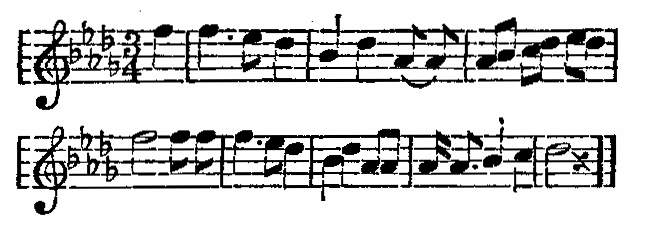
DAWN

An angel, robed in spotless white,

Bent down and kissed the sleeping Night.

Night woke to blush; the sprite was gone.

Men saw the blush and called it Dawn.

A DROWSY DAY

The air is dark, the sky is gray,

The misty shadows come and go,

And here within my dusky room

Each chair looks ghostly in the gloom.

Outside the rain falls cold and slow—

Half-stinging drops, half-blinding spray.

Each slightest sound is magnified,

For drowsy quiet holds her reign;

The burnt stick in the fireplace breaks,

The nodding cat with start awakes,

And then to sleep drops off again,

Unheeding Towser at her side.

I look far out across the lawn,

Where huddled stand the silly sheep;

My work lies idle at my hands,

My thoughts fly out like scattered strands

Of thread, and on the verge of sleep—

Still half awake—I dream and yawn.

What spirits rise before my eyes!

How various of kind and form!

Sweet memories of days long past,

The dreams of youth that could not last,

Each smiling calm, each raging storm,

That swept across my early skies.

Half seen, the bare, gaunt-fingered boughs

Before my window sweep and sway,

And chafe in tortures of unrest.[Pg 66]

My chin sinks down upon my breast;

I cannot work on such a day,

But only sit and dream and drowse.

DIRGE

Place this bunch of mignonette

In her cold, dead hand;

When the golden sun is set,

Where the poplars stand,

Bury her from sun and day,

Lay my little love away

From my sight.

She was like a modest flower

Blown in sunny June,

Warm as sun at noon's high hour,

Chaster than the moon.

Ah, her day was brief and bright,

Earth has lost a star of light;

She is dead.

Softly breathe her name to me,—

Ah, I loved her so.

Gentle let your tribute be;

None may better know

Her true worth than I who weep

O'er her as she lies asleep—

Soft asleep.

Lay these lilies on her breast,

They are not more white

Than the soul of her, at rest

'Neath their petals bright.

Chant your aves soft and low,

Solemn be your tread and slow,—

She is dead.

Lay her here beneath the grass,

Cool and green and sweet,

Where the gentle brook may pass

Crooning at her feet.

Nature's bards shall come and sing,

And the fairest flowers shall spring

Where she lies.

Safe above the water's swirl,

She has crossed the bar;

Earth has lost a precious pearl,

Heaven has gained a star,

That shall ever sing and shine,

Till it quells this grief of mine

For my love.

HYMN

When storms arise

And dark'ning skies

About me threat'ning lower,

To thee, O Lord, I raise mine eyes,

To thee my tortured spirit flies

For solace in that hour.

The mighty arm

Will let no harm

Come near me nor befall me;

Thy voice shall quiet my alarm,

When life's great battle waxeth warm—

[Pg 67]
No foeman shall appall me.

Upon thy breast

Secure I rest,

From sorrow and vexation;

No more by sinful cares oppressed,

But in thy presence ever blest,

O God of my salvation.

PREPARATION

The little bird sits in the nest and sings

A shy, soft song to the morning light;

And it flutters a little and prunes its wings.

The song is halting and poor and brief,

And the fluttering wings scarce stir a leaf;

But the note is a prelude to sweeter things,

And the busy bill and the flutter slight

Are proving the wings for a bolder flight!

THE DESERTED PLANTATION

Oh, de grubbin'-hoe 's a-rustin' in de co'nah,

An' de plow 's a-tumblin' down in de fiel',

While de whippo'will 's a-wailin' lak a mou'nah

When his stubbo'n hea't is tryin' ha'd to yiel'.

In de furrers whah de co'n was allus wavin',

Now de weeds is growin' green an' rank an' tall;

An' de swallers roun' de whole place is a-bravin'

Lak dey thought deir folks had allus owned it all.

An' de big house stan's all quiet lak an' solemn,

Not a blessed soul in pa'lor, po'ch, er lawn;

Not a guest, ner not a ca'iage lef' to haul 'em,

Fu' de ones dat tu'ned de latch-string out air gone.

An' de banjo's voice is silent in de qua'ters,

D' ain't a hymn ner co'n-song ringin' in de air;

But de murmur of a branch's passin' waters

Is de only soun' dat breks de stillness dere.

Whah 's de da'kies, dem dat used to be a-dancin'

Evry night befo' de ole cabin do'?

Whah 's de chillun, dem dat used to be a-prancin'

Er a-rollin' in de san' er on de flo'?

[Pg 68]Whah 's ole Uncle Mordecai an' Uncle Aaron?

Whah 's Aunt Doshy, Sam, an' Kit, an' all de res'?

Whah 's ole Tom de da'ky fiddlah, how 's he farin'?

Whah 's de gals dat used to sing an' dance de bes'?

Gone! not one o' dem is lef' to tell de story;

Dey have lef' de deah ole place to fall away.

Could n't one o' dem dat seed it in its glory

Stay to watch it in de hour of decay?

Dey have lef' de ole plantation to de swallers,

But it hol's in me a lover till de las';

Fu' I fin' hyeah in de memory dat follers

All dat loved me an' dat I loved in de pas'.

So I'll stay an' watch de deah ole place an' tend it

Ez I used to in de happy days gone by.

'Twell de othah Mastah thinks it's time to end it,

An' calls me to my qua'ters in de sky.

THE SECRET

What says the wind to the waving trees?

What says the wave to the river?

What means the sigh in the passing breeze?

Why do the rushes quiver?

Have you not heard the fainting cry

Of the flowers that said "Good-bye, good-bye"?

List how the gray dove moans and grieves

Under the woodland cover;

List to the drift of the falling leaves,

List to the wail of the lover.

Have you not caught the message heard

Already by wave and breeze and bird?

Come, come away to the river's bank,

Come in the early morning;

Come when the grass with dew is dank,

There you will find the warning—

A hint in the kiss of the quickening air

Of the secret that birds and breezes bear.[Pg 69]

THE WIND AND THE SEA

I stood by the shore at the death of day,

As the sun sank flaming red;

And the face of the waters that spread away

Was as gray as the face of the dead.

And I heard the cry of the wanton sea

And the moan of the wailing wind;

For love's sweet pain in his heart had he,

But the gray old sea had sinned.

The wind was young and the sea was old,

But their cries went up together;

The wind was warm and the sea was cold,

For age makes wintry weather.

So they cried aloud and they wept amain,

Till the sky grew dark to hear it;

And out of its folds crept the misty rain,

In its shroud, like a troubled spirit.

For the wind was wild with a hopeless love,

And the sea was sad at heart

At many a crime that he wot of,

Wherein he had played his part.

He thought of the gallant ships gone down

By the will of his wicked waves;

And he thought how the church-yard in the town

Held the sea-made widows' graves.

The wild wind thought of the love he had left

Afar in an Eastern land,

And he longed, as long the much bereft,

For the touch of her perfumed hand.

In his winding wail and his deep-heaved sigh

His aching grief found vent;

While the sea looked up at the bending sky

And murmured: "I repent."

But e'en as he spoke, a ship came by

That bravely ploughed the main,

And a light came into the sea's green eye,

And his heart grew hard again.

Then he spoke to the wind: "Friend, seest thou not

Yon vessel is eastward bound?

[Pg 70]Pray speed with it to the happy spot

Where thy loved one may be found."

And the wind rose up in a dear delight,

And after the good ship sped;

But the crafty sea by his wicked might

Kept the vessel ever ahead.

Till the wind grew fierce in his despair,

And white on the brow and lip.

He tore his garments and tore his hair,

And fell on the flying ship.

And the ship went down, for a rock was there,

And the sailless sea loomed black;

While burdened again with dole and care,

The wind came moaning back.

And still he moans from his bosom hot

Where his raging grief lies pent,

And ever when the ships come not,

The sea says: "I repent."

RIDING TO TOWN

When labor is light and the morning is fair,

I find it a pleasure beyond all compare

To hitch up my nag and go hurrying down

And take Katie May for a ride into town;

For bumpety-bump goes the wagon,

But tra-la-la-la our lay.

There's joy in a song as we rattle along

In the light of the glorious day.

A coach would be fine, but a spring wagon's good;

My jeans are a match for Kate's gingham and hood;

The hills take us up and the vales take us down,

But what matters that? we are riding to town,

And bumpety-bump goes the wagon,

But tra-la-la-la sing we.

There's never a care may live in the air

That is filled with the breath of our glee.

And after we've started, there's naught can repress

The thrill of our hearts in their wild happiness;

The heavens may smile or the heavens may frown,

And it's all one to us when we're riding to town.

For bumpety-bump goes the wagon,

[Pg 71]
But tra-la-la-la we shout,

For our hearts they are clear and there 's nothing to fear,

And we've never a pain nor a doubt.

The wagon is weak and the roadway is rough,

And tho' it is long it is not long enough,

For mid all my ecstasies this is the crown

To sit beside Katie and ride into town,

When bumpety-bump goes the wagon,

But tra-la-la-la our song;

And if I had my way, I 'd be willing to pay

If the road could be made twice as long.

WE WEAR THE MASK

We wear the mask that grins and lies,

It hides our cheeks and shades our eyes,—

This debt we pay to human guile;

With torn and bleeding hearts we smile,

And mouth with myriad subtleties.

Why should the world be over-wise,

In counting all our tears and sighs?

Nay, let them only see us, while

We wear the mask.

We smile, but, O great Christ, our cries

To thee from tortured souls arise.

We sing, but oh the clay is vile

Beneath our feet, and long the mile;

But let the world dream otherwise,

We wear the mask!

THE MEADOW LARK

Though the winds be dank,

And the sky be sober,

And the grieving Day

In a mantle gray

Hath let her waiting maiden robe her,—

All the fields along

I can hear the song

Of the meadow lark,

As she flits and flutters,

And laughs at the thunder when it mutters.

O happy bird, of heart most gay

To sing when skies are gray!

When the clouds are full,

And the tempest master

Lets the loud winds sweep

From his bosom deep

[Pg 72]
Like heralds of some dire disaster,

Then the heart alone

To itself makes moan;

And the songs come slow,

While the tears fall fleeter,

And silence than song by far seems sweeter.

Oh, few are they along the way

Who sing when skies are gray!

ONE LIFE

Oh, I am hurt to death, my Love;

The shafts of Fate have pierced my striving heart,

And I am sick and weary of

The endless pain and smart.

My soul is weary of the strife,

And chafes at life, and chafes at life.

Time mocks me with fair promises;

A blooming future grows a barren past,

Like rain my fair full-blossomed trees

Unburden in the blast.

The harvest fails on grain and tree,

Nor comes to me, nor comes to me.

The stream that bears my hopes abreast

Turns ever from my way its pregnant tide.

My laden boat, torn from its rest,

Drifts to the other side.

So all my hopes are set astray,

And drift away, and drift away.

The lark sings to me at the morn,

And near me wings her skyward-soaring flight;

But pleasure dies as soon as born,

The owl takes up the night,

And night seems long and doubly dark;

I miss the lark, I miss the lark.

Let others labor as they may,

I'll sing and sigh alone, and write my line.

Their fate is theirs, or grave or gay,

And mine shall still be mine.

I know the world holds joy and glee,

But not for me,—'t is not for me.

CHANGING TIME

The cloud looked in at the window,

And said to the day, "Be dark!"

And the roguish rain tapped hard on the pane,

To stifle the song of the lark.

[Pg 73]The wind sprang up in the tree tops

And shrieked with a voice of death,

But the rough-voiced breeze, that shook the trees,

Was touched with a violet's breath.

DEAD

A knock is at her door, but she is weak;

Strange dews have washed the paint streaks from her cheek;

She does not rise, but, ah, this friend is known,

And knows that he will find her all alone.

So opens he the door, and with soft tread

Goes straightway to the richly curtained bed.

His soft hand on her dewy head he lays.

A strange white light she gives him for his gaze.

Then, looking on the glory of her charms,

He crushes her resistless in his arms.

Stand back! look not upon this bold embrace,

Nor view the calmness of the wanton's face;

With joy unspeakable and 'bated breath,

She keeps her last, long liaison with death!

A CONFIDENCE

Uncle John, he makes me tired;

Thinks 'at he's jest so all-fired

Smart, 'at he kin pick up, so,

Ever'thing he wants to know.

Tried to ketch me up last night,

But you bet I would n't bite.

I jest kep' the smoothes' face,

But I led him sich a chase,

Could n't corner me, you bet—

I skipped all the traps he set.

Makin' out he wan'ed to know

Who was this an' that girl's beau;

So 's he 'd find out, don't you see,

Who was goin' 'long with me.

But I answers jest ez sly,

An' I never winks my eye,

Tell he hollers with a whirl,

"Look here, ain't you got a girl?"

Y' ought 'o seen me spread my eyes,

Like he 'd took me by surprise,

An' I said, "Oh, Uncle John,

Never thought o' havin' one."

An' somehow that seemed to tickle

Him an' he shelled out a nickel.

Then you ought to seen me leave

Jest a-laffin' in my sleeve.

Fool him—well, I guess I did;

He ain't on to this here kid.

Got a girl! well, I guess yes,

Got a dozen more or less,

But I got one reely one,[Pg 74]

Not no foolin' ner no fun;

Fur I 'm sweet on her, you see,

An' I ruther guess 'at she

Must be kinder sweet on me,

So we 're keepin' company.

Honest Injun! this is true,

Ever' word I 'm tellin' you!

But you won't be sich a scab

Ez to run aroun' an' blab.

Mebbe 't ain't the way with you,

But you know some fellers do.

Spoils a girl to let her know

'At you talk about her so.

Don't you know her? her name 's Liz,

Nicest girl in town she is.

Purty? ah, git out, you gilly—

Liz 'ud purt 'nigh knock you silly.

Y' ought 'o see her when she 's dressed

All up in her Sunday best,

All the fellers nudgin' me,

An' a-whisperin', gemunee!

Betcher life 'at I feel proud

When she passes by the crowd.

'T 's kinder nice to be a-goin'

With a girl 'at makes some showin'—

One you know 'at hain't no snide,

Makes you feel so satisfied.

An' I 'll tell you she 's a trump,

Never even seen her jump

Like some silly girls 'ud do,

When I 'd hide and holler "Boo!"

She 'd jest laff an' say "Git out!

What you hollerin' about?"

When some girls 'ud have a fit

That 'un don't git skeered a bit,

Never makes a bit o' row

When she sees a worm er cow.

Them kind 's few an' far between;

Bravest girl I ever seen.

Tell you 'nuther thing she 'll do,

Mebbe you won't think it 's true,

But if she 's jest got a dime

She 'll go halvers ever' time.

Ah, you goose, you need n't laff;

That's the kinder girl to have.

If you knowed her like I do,

Guess you 'd kinder like her too.

Tell you somep'n' if you 'll swear

You won't tell it anywhere.

Oh, you got to cross yer heart

Earnest, truly, 'fore I start.

Well, one day I kissed her cheek;

Gee, but I felt cheap an' weak,

'Cause at first she kinder flared,

'N', gracious goodness! I was scared.

But I need n't been, fer la!

Why, she never told her ma.

That's what I call grit, don't you?

Sich a girl's worth stickin' to.

PHYLLIS

Phyllis, ah, Phyllis, my life is a gray day,

Few are my years, but my griefs are not few,

[Pg 75]Ever to youth should each day be a May-day,

Warm wind and rose-breath and diamonded dew—

Phyllis, ah, Phyllis, my life is a gray day.

Oh for the sunlight that shines on a May-day!

Only the cloud hangeth over my life.

Love that should bring me youth's happiest heyday

Brings me but seasons of sorrow and strife;

Phyllis, ah, Phyllis, my life is a gray day.

Sunshine or shadow, or gold day or gray day,

Life must be lived as our destinies rule;

Leisure or labor or work day or play day—

Feasts for the famous and fun for the fool;

Phyllis, ah, Phyllis, my life is a gray day.

RIGHT'S SECURITY

What if the wind do howl without,

And turn the creaking weather-vane;

What if the arrows of the rain

Do beat against the window-pane?

Art thou not armored strong and fast

Against the sallies of the blast?

Art thou not sheltered safe and well

Against the flood's insistent swell?

What boots it, that thou stand'st alone,

And laughest in the battle's face

When all the weak have fled the place

And let their feet and fears keep pace?

Thou wavest still thine ensign, high,

And shoutest thy loud battle-cry;

Higher than e'er the tempest roared,

It cleaves the silence like a sword.

Right arms and armors, too, that man

Who will not compromise with wrong;

Though single, he must front the throng,

And wage the battle hard and long.

Minorities, since time began,

Have shown the better side of man;

And often in the lists of Time

One man has made a cause sublime!

IF

If life were but a dream, my Love,

[Pg 76]
And death the waking time;

If day had not a beam, my Love,

And night had not a rhyme,—

A barren, barren world were this

Without one saving gleam;

I 'd only ask that with a kiss

You 'd wake me from the dream.

If dreaming were the sum of days,

And loving were the bane;

If battling for a wreath of bays

Could soothe a heart in pain,—

I 'd scorn the meed of battle's might,

All other aims above

I 'd choose the human's higher right,

To suffer and to love!

THE SONG

My soul, lost in the music's mist,

Roamed, rapt, 'neath skies of amethyst.

The cheerless streets grew summer meads,

The Son of Ph[oe]bus spurred his steeds,

And, wand'ring down the mazy tune,

December lost its way in June,

While from a verdant vale I heard

The piping of a love-lorn bird.

A something in the tender strain

Revived an old, long-conquered pain,

And as in depths of many seas,

My heart was drowned in memories.

The tears came welling to my eyes,

Nor could I ask it otherwise;

For, oh! a sweetness seems to last

Amid the dregs of sorrows past.

It stirred a chord that here of late

I 'd grown to think could not vibrate.

It brought me back the trust of youth,

The world again was joy and truth.

And Avice, blooming like a bride,

Once more stood trusting at my side.

But still, with bosom desolate,

The lorn bird sang to find his mate.

Then there are trees, and lights and stars,

The silv'ry tinkle of guitars;

And throbs again as throbbed that waltz,

Before I knew that hearts were false.

Then like a cold wave on a shore,[Pg 77]

Comes silence and she sings no more.

I wake, I breathe, I think again,

And walk the sordid ways of men.

SIGNS OF THE TIMES

Air a-gittin' cool an' coolah,

Frost a-comin' in de night,

Hicka' nuts an' wa'nuts fallin',

Possum keepin' out o' sight.

Tu'key struttin' in de ba'nya'd,

Nary step so proud ez his;

Keep on struttin', Mistah Tu'key,

Yo' do' know whut time it is.

Cidah press commence a-squeakin'

Eatin' apples sto'ed away,

Chillun swa'min' 'roun' lak ho'nets,

Huntin' aigs ermung de hay.

Mistah Tu'key keep on gobblin'

At de geese a-flyin' souf,

Oomph! dat bird do' know whut's comin';

Ef he did he 'd shet his mouf.

Pumpkin gittin' good an' yallah

Mek me open up my eyes;

Seems lak it's a-lookin' at me

Jes' a-la'in' dah sayin' "Pies."

Tu'key gobbler gwine 'roun' blowin',

Gwine 'roun' gibbin' sass an' slack;

Keep on talkin', Mistah Tu'key,

You ain't seed no almanac.

Fa'mer walkin' th'oo de ba'nya'd

Seein' how things is comin' on,

Sees ef all de fowls is fatt'nin'—

Good times comin' sho 's you bo'n.

Hyeahs dat tu'key gobbler braggin',

Den his face break in a smile—

Nebbah min', you sassy rascal,

He 's gwine nab you atter while.

Choppin' suet in de kitchen,

Stonin' raisins in de hall,

Beef a-cookin' fu' de mince meat,

Spices groun'—I smell 'em all.

Look hyeah, Tu'key, stop dat gobblin',

You ain' luned de sense ob feah,

You ol' fool, yo' naik 's in dangah,

Do' you know Thanksgibbin 's hyeah?

WHY FADES A DREAM?

Why fades a dream?

An iridescent ray

Flecked in between the tryst

Of night and day.

Why fades a dream?—

Of consciousness the shade

Wrought out by lack of light and made

Upon life's stream.

Why fades a dream?

That thought may thrive,

[Pg 78]
So fades the fleshless dream;

Lest men should learn to trust

The things that seem.

So fades a dream,

That living thought may grow

And like a waxing star-beam glow

Upon life's stream—

So fades a dream.

THE SPARROW

A little bird, with plumage brown,

Beside my window flutters down,

A moment chirps its little strain,

Ten taps upon my window-pane,

And chirps again, and hops along,

To call my notice to its song;

But I work on, nor heed its lay,

Till, in neglect, it flies away.

So birds of peace and hope and love

Come fluttering earthward from above,

To settle on life's window-sills,

And ease our load of earthly ills;

But we, in traffic's rush and din

Too deep engaged to let them in,

With deadened heart and sense plod on,

Nor know our loss till they are gone.

SPEAKIN' O' CHRISTMAS

Breezes blowin' middlin' brisk,

Snow-flakes thro' the air a-whisk,

Fallin' kind o' soft an' light,

Not enough to make things white,

But jest sorter siftin' down

So 's to cover up the brown

Of the dark world's rugged ways

'N' make things look like holidays.

Not smoothed over, but jest specked,

Sorter strainin' fur effect,

An' not quite a-gittin' through

What it started in to do.

Mercy sakes! it does seem queer

Christmas day is 'most nigh here.

Somehow it don't seem to me

Christmas like it used to be,—

Christmas with its ice an' snow,

Christmas of the long ago.

You could feel its stir an' hum

Weeks an' weeks before it come;

Somethin' in the atmosphere

Told you when the day was near,

Did n't need no almanacs;

That was one o' Nature's fac's.

Every cottage decked out gay—

Cedar wreaths an' holly spray—

An' the stores, how they were drest,

Tinsel tell you could n't rest;

Every winder fixed up pat,

Candy canes, an' things like that;

Noah's arks, an' guns, an' dolls,

An' all kinds o' fol-de-rols.

Then with frosty bells a-chime,

Slidin' down the hills o' time,

Right amidst the fun an' din

Christmas come a-bustlin' in,

Raised his cheery voice to call

Out a welcome to us all;[Pg 79]

Hale and hearty, strong an' bluff,

That was Christmas, sure enough.

Snow knee-deep an' coastin' fine,

Frozen mill-ponds all ashine,

Seemin' jest to lay in wait,

Beggin' you to come an' skate.

An' you 'd git your gal an' go

Stumpin' cheerily thro' the snow,

Feelin' pleased an' skeert an' warm

'Cause she had a-holt yore arm.

Why, when Christmas come in, we

Spent the whole glad day in glee,

Havin' fun an' feastin' high

An' some courtin' on the sly.

Bustin' in some neighbor's door

An' then suddenly, before

He could give his voice a lift,

Yellin' at him, "Christmas gift."

Now sich things are never heard,

"Merry Christmas" is the word.

But it's only change o' name,

An' means givin' jest the same.

There 's too many new-styled ways

Now about the holidays.

I 'd jest like once more to see

Christmas like it used to be!

LONESOME

Mother 's gone a-visitin' to spend a month er two,

An', oh, the house is lonesome ez a nest whose birds has flew

To other trees to build ag'in; the rooms seem jest so bare

That the echoes run like sperrits from the kitchen to the stair.

The shetters flap more lazy-like 'n what they used to do,

Sence mother 's gone a-visitin' to spend a month er two.

We 've killed the fattest chicken an' we've cooked her to a turn;

We 've made the richest gravy, but I jest don't give a durn

Fur nothin' 'at I drink er eat, er nothin' 'at I see.

The food ain't got the pleasant taste it used to have to me.

They 's somep'n' stickin' in my throat ez tight ez hardened glue,

Sence mother's gone a-visitin' to spend a month er two.

The hollyhocks air jest ez pink, they 're double ones at that,

An' I wuz prouder of 'em than a baby of a cat.

But now I don't go near 'em, though they nod an' blush at me,

Fur they 's somep'n' seems to gall me in their keerless sort o' glee

An' all their fren'ly noddin' an' their blushin' seems to say:

"You 're purty lonesome, John, old boy, sence mother 's gone away."[Pg 80]

The neighbors ain't so fren'ly ez it seems they 'd ort to be;

They seem to be a-lookin' kinder sideways like at me,

A-kinder feared they 'd tech me off ez ef I wuz a match,

An' all because 'at mother 's gone an' I 'm a-keepin' batch!

I 'm shore I don't do nothin' worse 'n what I used to do

'Fore mother went a-visitin' to spend a month er two.

The sparrers ac's more fearsome like an' won't hop quite so near,

The cricket's chirp is sadder, an' the sky ain't ha'f so clear;

When ev'nin' comes, I set an' smoke tell my eyes begin to swim,

An' things aroun' commence to look all blurred an' faint an' dim.

Well, I guess I 'll have to own up 'at I 'm feelin' purty blue

Sence mother's gone a-visitin' to spend a month er two.

GROWIN' GRAY

Hello, ole man, you 're a-gittin' gray,

An' it beats ole Ned to see the way

'At the crow's feet's a-getherin' aroun' yore eyes;

Tho' it ought n't to cause me no su'prise,

Fur there 's many a sun 'at you 've seen rise

An' many a one you 've seen go down

Sence yore step was light an' yore hair was brown,

An' storms an' snows have had their way—

Hello, ole man, you 're a-gittin' gray.

Hello, ole man, you 're a-gittin' gray,

An' the youthful pranks 'at you used to play

Are dreams of a far past long ago

That lie in a heart where the fires burn low—

That has lost the flame though it kept the glow,

An' spite of drivin' snow an' storm,

Beats bravely on forever warm.

December holds the place of May—

Hello, ole man, you 're a-gittin' gray.

Hello, ole man, you 're a-gittin' gray—

Who cares what the carpin' youngsters say?

For, after all, when the tale is told,

Love proves if a man is young or old!

Old age can't make the heart grow cold[Pg 81]

When it does the will of an honest mind;

When it beats with love fur all mankind;

Then the night but leads to a fairer day—

Hello, ole man, you 're a-gittin' gray!

TO THE MEMORY OF MARY YOUNG

God has his plans, and what if we

With our sight be too blind to see

Their full fruition; cannot he,

Who made it, solve the mystery?

One whom we loved has fall'n asleep,

Not died; although her calm be deep,

Some new, unknown, and strange surprise

In Heaven holds enrapt her eyes.

And can you blame her that her gaze

Is turned away from earthly ways,

When to her eyes God's light and love

Have giv'n the view of things above?

A gentle spirit sweetly good,

The pearl of precious womanhood;

Who heard the voice of duty clear,

And found her mission soon and near.

She loved all nature, flowers fair,

The warmth of sun, the kiss of air,

The birds that filled the sky with song,

The stream that laughed its way along.

Her home to her was shrine and throne,

But one love held her not alone;

She sought out poverty and grief,

Who touched her robe and found relief.

So sped she in her Master's work,

Too busy and too brave to shirk,

When through the silence, dusk and dim,

God called her and she fled to him.

We wonder at the early call,

And tears of sorrow can but fall

For her o'er whom we spread the pall;

But faith, sweet faith, is over all.

The house is dust, the voice is dumb,

But through undying years to come,

The spark that glowed within her soul

Shall light our footsteps to the goal.

She went her way; but oh, she trod

The path that led her straight to God.[Pg 82]

Such lives as this put death to scorn;

They lose our day to find God's morn.

WHEN MALINDY SINGS

G'way an' quit dat noise, Miss Lucy—

Put dat music book away;

What's de use to keep on tryin'?

Ef you practise twell you 're gray,

You cain't sta't no notes a-flyin'

Lak de ones dat rants and rings

F'om de kitchen to be big woods

When Malindy sings.

You ain't got de nachel o'gans

Fu' to make de soun' come right,

You ain't got de tu'ns an' twistin's

Fu' to make it sweet an' light.

Tell you one thing now, Miss Lucy,

An' I 'm tellin' you fu' true,

When hit comes to raal right singin',

'T ain't no easy thing to do.

Easy 'nough fu' folks to hollah,

Lookin' at de lines an' dots,

When dey ain't no one kin sence it,

An' de chune comes in, in spots;

But fu' real melojous music,

Dat jes' strikes yo' hea't and clings,

Jes' you stan' an' listen wif me

When Malindy sings.

Ain't you nevah hyeahd Malindy?

Blessed soul, tek up de cross!

Look hyeah, ain't you jokin', honey?

Well, you don't know whut you los'.

Y' ought to hyeah dat gal a-wa'blin',

Robins, la'ks, an' all dem things,

Heish dey moufs an' hides dey faces

When Malindy sings.

Fiddlin' man jes' stop his fiddlin',

Lay his fiddle on de she'f;

Mockin'-bird quit tryin' to whistle,

'Cause he jes' so shamed hisse'f.

Folks a-playin' on de banjo

Draps dey fingahs on de strings—

Bless yo' soul—fu'gits to move em,

When Malindy sings.

She jes' spreads huh mouf and hollahs,

"Come to Jesus," twell you hyeah

Sinnahs' tremblin' steps and voices,

Timid-lak a-drawin' neah;

Den she tu'ns to "Rock of Ages,"

Simply to de cross she clings,

An' you fin' yo' teahs a-drappin'

When Malindy sings.

Who dat says dat humble praises

[Pg 83]
Wif de Master nevah counts?

Heish yo' mouf, I hyeah dat music,

Ez hit rises up an' mounts—

Floatin' by de hills an' valleys,

Way above dis buryin' sod,

Ez hit makes its way in glory

To de very gates of God!

Oh, hit's sweetah dan de music

Of an edicated band;

An' hit's dearah dan de battle's

Song o' triumph in de lan'.

It seems holier dan evenin'

When de solemn chu'ch bell rings,

Ez I sit an' ca'mly listen

While Malindy sings.

Towsah, stop dat ba'kin', hyeah me!

Mandy, mek dat chile keep still;

Don't you hyeah de echoes callin'

F'om de valley to de hill?

Let me listen, I can hyeah it,

Th'oo de bresh of angels' wings,

Sof an' sweet, "Swing Low, Sweet Chariot,"

Ez Malindy sings.

THE PARTY

Dey had a gread big pahty down to Tom's de othah night;

Was I dah? You bet! I nevah in my life see sich a sight;

All de folks f'om fou' plantations was invited, an' dey come,

Dey come troopin' thick ez chillun when dey hyeahs a fife an' drum.

Evahbody dressed deir fines'—Heish yo' mouf an' git away,

Ain't seen no sich fancy dressin' sence las' quah'tly meetin' day;

Gals all dressed in silks an' satins, not a wrinkle ner a crease,

Eyes a-battin', teeth a-shinin', haih breshed back ez slick ez grease;

Sku'ts all tucked an' puffed an' ruffled, evah blessed seam an' stitch;

Ef you 'd seen 'em wif deir mistus, could n't swahed to which was which.

Men all dressed up in Prince Alberts, swaller-tails 'u'd tek yo' bref!

I cain't tell you nothin' 'bout it, y' ought to seen it fu' yo'se'f.

Who was dah? Now who you askin'? How you 'spect I gwine to know?

You mus' think I stood an' counted evahbody at de do.'

Ole man Babah's house-boy Isaac, brung dat gal, Malindy Jane,

Huh a-hangin' to his elbow, him a-struttin' wif a cane;

My, but Hahvey Jones was jealous! seemed to stick him lak a tho'n;[Pg 84]

But he laughed with Viney Cahteh, tryin' ha'd to not let on,

But a pusson would 'a' noticed f'om de d'rection of his look,

Dat he was watchin' ev'ry step dat Ike an' Lindy took.

Ike he foun' a cheer an' asked huh: "Won't you set down?" wif a smile,

An' she answe'd up a-bowin', "Oh, I reckon 't ain't wuth while."

Dat was jes' fu' Style, I reckon, 'cause she sot down jes' de same,

An' she stayed dah 'twell he fetched huh fu' to jine some so't o' game;

Den I hyeahd huh sayin' propah, ez she riz to go away,

"Oh, you raly mus' excuse me, fu' I hardly keers to play."

But I seen huh in a minute wif de othahs on de flo',

An' dah wasn't any one o' dem a-playin' any mo';

Comin' down de flo' a-bowin' an' a-swayin' an' a-swingin',

Puttin' on huh high-toned mannahs all de time dat she was singin':

"Oh, swing Johnny up an' down, swing him all aroun',

Swing Johnny up an' down, swing him all aroun',

Oh, swing Johnny up an' down, swing him all aroun'

Fa' you well, my dahlin'."

Had to laff at ole man Johnson, he 's a caution now, you bet—

Hittin' clost onto a hunderd, but he 's spry an' nimble yet;

He 'lowed how a-so't o' gigglin', "I ain't ole, I 'll let you see,

D'ain't no use in gittin' feeble, now you youngstahs jes' watch me,"

An' he grabbed ole Aunt Marier—weighs th'ee hunderd mo' er less,

An' he spun huh 'roun' de cabin swingin' Johnny lak de res'.

Evahbody laffed an' hollahed: "Go it! Swing huh, Uncle Jim!"

An' he swung huh too, I reckon, lak a youngstah, who but him.

Dat was bettah 'n young Scott Thomas, tryin' to be so awful smaht.

You know when dey gits to singin' an' dey comes to dat ere paht:

"In some lady's new brick house,

In some lady's gyahden.

Ef you don't let me out, I will jump out,

So fa' you well, my dahlin'."

Den dey 's got a circle 'roun' you, an' you's got to break de line;

Well, dat dahky was so anxious, lak to bust hisse'f a-tryin';[Pg 85]

Kep' on blund'rin' 'roun' an' foolin' 'twell he giv' one gread big jump,

Broke de line, an lit head-fo'most in de fiah-place right plump;

Hit 'ad fiah in it, mind you; well, I thought my soul I 'd bust,

Tried my best to keep f'om laffin', but hit seemed like die I must!

Y' ought to seen dat man a-scramblin' f'om de ashes an' de grime.

Did it bu'n him! Sich a question, why he did n't give it time;

Th'ow'd dem ashes and dem cindahs evah which-a-way I guess,

An' you nevah did, I reckon, clap yo' eyes on sich a mess;

Fu' he sholy made a picter an' a funny one to boot,

Wif his clothes all full o' ashes an' his face all full o' soot.

Well, hit laked to stopped de pahty, an' I reckon lak ez not

Dat it would ef Tom's wife, Mandy, had n't happened on de spot,

To invite us out to suppah—well, we scrambled to de table,

An' I 'd lak to tell you 'bout it—what we had—but I ain't able,

Mention jes' a few things, dough I know I had n't orter,

Fu' I know 't will staht a hank'rin' an' yo' mouf 'll 'mence to worter.

We had wheat bread white ez cotton an' a egg pone jes like gol',

Hog jole, bilin' hot an' steamin' roasted shoat an' ham sliced cold—

Look out! What's de mattah wif you? Don't be fallin' on de flo';

Ef it 's go'n' to 'fect you dat way, I won't tell you nothin' mo'.

Dah now—well, we had hot chittlin's—now you 's tryin' ag'in to fall,

Cain't you stan' to hyeah about it? S'pose you'd been an' seed it all;

Seed dem gread big sweet pertaters, layin' by de possum's side,

Seed dat coon in all his gravy, reckon den you 'd up and died!

Mandy 'lowed "you all mus' 'scuse me, d' wa'n't much upon my she'ves,

But I's done my bes' to suit you, so set down an' he'p yo'se'ves."

Tom, he 'lowed: "I don't b'lieve in 'pologisin' an' perfessin',

Let 'em tek it lak dey ketch it. Eldah Thompson, ask de blessin'."[Pg 86]

Wish you 'd seed dat colo'ed preachah cleah his th'oat an' bow his head;

One eye shet, an' one eye open,—dis is evah wud he said:

"Lawd, look down in tendah mussy on sich generous hea'ts ez dese;

Make us truly thankful, amen. Pass dat possum, ef you please!"

Well, we eat and drunk ouah po'tion, 'twell dah was n't nothin' lef,

An' we felt jes' like new sausage, we was mos' nigh stuffed to def!

Tom, he knowed how we 'd be feelin', so he had de fiddlah 'roun',

An' he made us cleah de cabin fu' to dance dat suppah down.

Jim, de fiddlah, chuned his fiddle, put some rosum on his bow,

Set a pine box on de table, mounted it an' let huh go!

He's a fiddlah, now I tell you, an' he made dat fiddle ring,

'Twell de ol'est an' de lamest had to give deir feet a fling.

Jigs, cotillions, reels an' breakdowns, cordrills an' a waltz er two;

Bless yo' soul, dat music winged 'em an' dem people lak to flew.

Cripple Joe, de old rheumatic, danced dat flo' f'om side to middle,

Th'owed away his crutch an' hopped it; what's rheumatics 'ginst a fiddle?

Eldah Thompson got so tickled dat he lak to los' his grace,

Had to tek bofe feet an' hol' dem so 's to keep 'em in deir place.

An' de Christuns an' de sinnahs got so mixed up on dat flo',

Dat I don't see how dey 'd pahted ef de trump had chanced to blow.

Well, we danced dat way an' capahed in de mos' redic'lous way,

'Twell de roostahs in de bahnyard cleahed deir th'oats an' crowed fu' day.

Y' ought to been dah, fu' I tell you evahthing was rich an' prime,

An' dey ain't no use in talkin', we jes had one scrumptious time![Pg 87]


[Pg 89]

LYRICS OF THE HEARTHSIDE

LOVE'S APOTHEOSIS

Love me. I care not what the circling years

To me may do.

If, but in spite of time and tears,

You prove but true.

Love me—albeit grief shall dim mine eyes,

And tears bedew,

I shall not e'en complain, for then my skies

Shall still be blue.

Love me, and though the winter snow shall pile,

And leave me chill,

Thy passion's warmth shall make for me, meanwhile,

A sun-kissed hill.

And when the days have lengthened into years,

And I grow old,

Oh, spite of pains and griefs and cares and fears,

Grow thou not cold.

Then hand and hand we shall pass up the hill,

I say not down;

That twain go up, of love, who 've loved their fill,—

To gain love's crown.

Love me, and let my life take up thine own,

As sun the dew.

Come, sit, my queen, for in my heart a throne

Awaits for you!

THE PARADOX

I am the mother of sorrows,

I am the ender of grief;

I am the bud and the blossom,

I am the late-falling leaf.

I am thy priest and thy poet,

I am thy serf and thy king;

I cure the tears of the heartsick,

When I come near they shall sing.

White are my hands as the snowdrop;

Swart are my fingers as clay;

Dark is my frown as the midnight,

Fair is my brow as the day.

Battle and war are my minions,

Doing my will as divine;

I am the calmer of passions,

Peace is a nursling of mine.

Speak to me gently or curse me,

Seek me or fly from my sight;

I am thy fool in the morning,

[Pg 90]
Thou art my slave in the night.

Down to the grave will I take thee,

Out from the noise of the strife;

Then shalt thou see me and know me—

Death, then, no longer, but life.

Then shalt thou sing at my coming.

Kiss me with passionate breath,

Clasp me and smile to have thought me

Aught save the foeman of Death.

Come to me, brother, when weary,

Come when thy lonely heart swells;

I 'll guide thy footsteps and lead thee

Down where the Dream Woman dwells.

OVER THE HILLS

Over the hills and the valleys of dreaming

Slowly I take my way.

Life is the night with its dream-visions teeming,

Death is the waking at day.

Down thro' the dales and the bowers of loving,

Singing, I roam afar.

Daytime or night-time, I constantly roving,—

Dearest one, thou art my star.

WITH THE LARK

Night is for sorrow and dawn is for joy,

Chasing the troubles that fret and annoy;

Darkness for sighing and daylight for song,—

Cheery and chaste the strain, heartfelt and strong.

All the night through, though I moan in the dark,

I wake in the morning to sing with the lark.

Deep in the midnight the rain whips the leaves,

Softly and sadly the wood-spirit grieves.

But when the first hue of dawn tints the sky,

I shall shake out my wings like the birds and be dry;

And though, like the rain-drops, I grieved through the dark,

I shall wake in the morning to sing with the lark.

On the high hills of heaven, some morning to be,

Where the rain shall not grieve thro' the leaves of the tree,[Pg 91]

There my heart will be glad for the pain I have known,

For my hand will be clasped in the hand of mine own;

And though life has been hard and death's pathway been dark,

I shall wake in the morning to sing with the lark.

IN SUMMER

Oh, summer has clothed the earth

In a cloak from the loom of the sun!

And a mantle, too, of the skies' soft blue,

And a belt where the rivers run.

And now for the kiss of the wind,

And the touch of the air's soft hands,

With the rest from strife and the heat of life,

With the freedom of lakes and lands.

I envy the farmer's boy

Who sings as he follows the plow;

While the shining green of the young blades lean

To the breezes that cool his brow.

He sings to the dewy morn,

No thought of another's ear;

But the song he sings is a chant for kings

And the whole wide world to hear.

He sings of the joys of life,

Of the pleasures of work and rest,

From an o'erfull heart, without aim or art;

'T is a song of the merriest.

O ye who toil in the town,

And ye who moil in the mart,

Hear the artless song, and your faith made strong

Shall renew your joy of heart.

Oh, poor were the worth of the world

If never a song were heard,—

If the sting of grief had no relief,

And never a heart were stirred.

So, long as the streams run down,

And as long as the robins trill,

Let us taunt old Care with a merry air,

And sing in the face of ill.

THE MYSTIC SEA

The smell of the sea in my nostrils,

[Pg 92]
The sound of the sea in mine ears;

The touch of the spray on my burning face,

Like the mist of reluctant tears.

The blue of the sky above me,

The green of the waves beneath;

The sun flashing down on a gray-white sail

Like a scimitar from its sheath.

And ever the breaking billows,

And ever the rocks' disdain;

And ever a thrill in mine inmost heart

That my reason cannot explain.

So I say to my heart, "Be silent,

The mystery of time is here;

Death's way will be plain when we fathom the main,

And the secret of life be clear."

A SAILOR'S SONG

Oh for the breath of the briny deep,

And the tug of the bellying sail,

With the sea-gull's cry across the sky

And a passing boatman's hail.

For, be she fierce or be she gay,

The sea is a famous friend alway.

Ho! for the plains where the dolphins play,

And the bend of the mast and spars,

And a fight at night with the wild sea-sprite

When the foam has drowned the stars.

And, pray, what joy can the landsman feel

Like the rise and fall of a sliding keel?

Fair is the mead; the lawn is fair

And the birds sing sweet on the lea;

But the echo soft of a song aloft

Is the strain that pleases me;

And swish of rope and ring of chain

Are music to men who sail the main.

Then, if you love me, let me sail

While a vessel dares the deep;

For the ship 's my wife, and the breath of life

Are the raging gales that sweep;

And when I 'm done with calm and blast,

A slide o'er the side, and rest at last.

THE BOHEMIAN

Bring me the livery of no other man.

I am my own to robe me at my pleasure.

[Pg 93]
Accepted rules to me disclose no treasure:

What is the chief who shall my garments plan?

No garb conventional but I 'll attack it.

(Come, why not don my spangled jacket?)

ABSENCE

Good-night, my love, for I have dreamed of thee

In waking dreams, until my soul is lost—

Is lost in passion's wide and shoreless sea,

Where, like a ship, unruddered, it is tost

Hither and thither at the wild waves' will.

There is no potent Master's voice to still

This newer, more tempestuous Galilee!

The stormy petrels of my fancy fly

In warning course across the darkening green,

And, like a frightened bird, my heart doth cry

And seek to find some rock of rest between

The threatening sky and the relentless wave.

It is not length of life that grief doth crave,

But only calm and peace in which to die.

Here let me rest upon this single hope,

For oh, my wings are weary of the wind,

And with its stress no more may strive or cope.

One cry has dulled mine ears, mine eyes are blind,—

Would that o'er all the intervening space,

I might fly forth and see thee face to face.

I fly; I search, but, love, in gloom I grope.

Fly home, far bird, unto thy waiting nest;

Spread thy strong wings above the wind-swept sea.

Beat the grim breeze with thy unruffled breast

Until thou sittest wing to wing with me.

Then, let the past bring up its tales of wrong;

We shall chant low our sweet connubial song,

Till storm and doubt and past no more shall be!

HER THOUGHT AND HIS

The gray of the sea, and the gray of the sky,

A glimpse of the moon like a half-closed eye.

The gleam on the waves and the light on the land,[Pg 94]

A thrill in my heart,—and—my sweetheart's hand.

She turned from the sea with a woman's grace,

And the light fell soft on her upturned face,

And I thought of the flood-tide of infinite bliss

That would flow to my heart from a single kiss.

But my sweetheart was shy, so I dared not ask

For the boon, so bravely I wore the mask.

But into her face there came a flame:—

I wonder could she have been thinking the same?

THE RIGHT TO DIE

I have no fancy for that ancient cant

That makes us masters of our destinies,

And not our lives, to hold or give them up

As will directs; I cannot, will not think

That men, the subtle worms, who plot and plan

And scheme and calculate with such shrewd wit,

Are such great blund'ring fools as not to know

When they have lived enough. Men court not death

When there are sweets still left in life to taste.

Nor will a brave man choose to live when he,

Full deeply drunk of life, has reached the dregs,

And knows that now but bitterness remains.

He is the coward who, outfaced in this,

Fears the false goblins of another life.

I honor him who being much harassed

Drinks of sweet courage until drunk of it,—

Then seizing Death, reluctant, by the hand,

Leaps with him, fearless, to eternal peace!

BEHIND THE ARRAS

As in some dim baronial hall restrained,

A prisoner sits, engirt by secret doors

And waving tapestries that argue forth

Strange passages into the outer air;

So in this dimmer room which we call life,

Thus sits the soul and marks with eye intent[Pg 95]

That mystic curtain o'er the portal death;

Still deeming that behind the arras lies

The lambent way that leads to lasting light.

Poor fooled and foolish soul! Know now that death

Is but a blind, false door that nowhere leads,

And gives no hope of exit final, free.

WHEN THE OLD MAN SMOKES

In the forenoon's restful quiet,

When the boys are off at school,

When the window lights are shaded

And the chimney-corner cool,

Then the old man seeks his armchair,

Lights his pipe and settles back;

Falls a-dreaming as he draws it

Till the smoke-wreaths gather black.

And the tear-drops come a-trickling

Down his cheeks, a silver flow—

Smoke or memories you wonder,

But you never ask him,—no;

For there 's something almost sacred

To the other family folks

In those moods of silent dreaming

When the old man smokes.

Ah, perhaps he sits there dreaming

Of the love of other days

And of how he used to lead her

Through the merry dance's maze;

How he called her "little princess,"

And, to please her, used to twine

Tender wreaths to crown her tresses,

From the "matrimony vine."

Then before his mental vision

Comes, perhaps, a sadder day,

When they left his little princess

Sleeping with her fellow clay.

How his young heart throbbed, and pained him!

Why, the memory of it chokes!

Is it of these things he 's thinking

When the old man smokes?

But some brighter thoughts possess him,

For the tears are dried the while.

And the old, worn face is wrinkled

In a reminiscent smile,

From the middle of the forehead

[Pg 96]
To the feebly trembling lip,

At some ancient prank remembered

Or some long unheard-of quip.

Then the lips relax their tension

And the pipe begins to slide,

Till in little clouds of ashes,

It falls softly at his side;

And his head bends low and lower

Till his chin lies on his breast,

And he sits in peaceful slumber

Like a little child at rest.

Dear old man, there 's something sad'ning,

In these dreamy moods of yours,

Since the present proves so fleeting,

All the past for you endures.

Weeping at forgotten sorrows,

Smiling at forgotten jokes;

Life epitomized in minutes,

When the old man smokes.

THE GARRET

Within a London garret high,

Above the roofs and near the sky,

My ill-rewarding pen I ply

To win me bread.

This little chamber, six by four,

Is castle, study, den, and more,—

Altho' no carpet decks the floor,

Nor down, the bed.

My room is rather bleak and bare;

I only have one broken chair,

But then, there's plenty of fresh air,—

Some light, beside.

What tho' I cannot ask my friends

To share with me my odds and ends,

A liberty my aerie lends,

To most denied.

The bore who falters at the stair

No more shall be my curse and care,

And duns shall fail to find my lair

With beastly bills.

When debts have grown and funds are short,

I find it rather pleasant sport

To live "above the common sort"

With all their ills.

I write my rhymes and sing away,

And dawn may come or dusk or day:

Tho' fare be poor, my heart is gay.

And full of glee.

Though chimney-pots be all my views;

'T is nearer for the winging Muse,

So I am sure she 'll not refuse

[Pg 97]
To visit me.

TO E. H. K.

ON THE RECEIPT OF A FAMILIAR POEM

To me, like hauntings of a vagrant breath

From some far forest which I once have known,

The perfume of this flower of verse is blown.

Tho' seemingly soul-blossoms faint to death,

Naught that with joy she bears e'er withereth.

So, tho' the pregnant years have come and flown,

Lives come and gone and altered like mine own,

This poem comes to me a shibboleth:

Brings sound of past communings to my ear,

Turns round the tide of time and bears me back

Along an old and long untraversed way;

Makes me forget this is a later year,

Makes me tread o'er a reminiscent track,

Half sad, half glad, to one forgotten day!

A BRIDAL MEASURE

Come, essay a sprightly measure,

Tuned to some light song of pleasure.

Maidens, let your brows be crowned

As we foot this merry round.

From the ground a voice is singing,

From the sod a soul is springing.

Who shall say 't is but a clod

Quick'ning upward toward its God?

Who shall say it? Who may know it,

That the clod is not a poet

Waiting but a gleam to waken

In a spirit music-shaken?

Phyllis, Phyllis, why be waiting?

In the woods the birds are mating.

From the tree beside the wall,

Hear the am'rous robin call.

Listen to yon thrush's trilling;

Phyllis, Phyllis, are you willing,

When love speaks from cave and tree,

Only we should silent be?

When the year, itself renewing,

All the world with flowers is strewing,

Then through Youth's Arcadian land,

Love and song go hand in hand.

Come, unfold your vocal treasure,

Sing with me a nuptial measure,—

Let this springtime gambol be

[Pg 98]
Bridal dance for you and me.

VENGEANCE IS SWEET

When I was young I longed for Love,

And held his glory far above

All other earthly things. I cried:

"Come, Love, dear Love, with me abide;"

And with my subtlest art I wooed,

And eagerly the wight pursued.

But Love was gay and Love was shy,

He laughed at me and passed me by.

Well, I grew old and I grew gray,

When Wealth came wending down my way.

I took his golden hand with glee,

And comrades from that day were we.

Then Love came back with doleful face,

And prayed that I would give him place.

But, though his eyes with tears were dim,

I turned my back and laughed at him.

A HYMN

AFTER READING "LEAD, KINDLY LIGHT."

Lead gently, Lord, and slow,

For oh, my steps are weak,

And ever as I go,

Some soothing sentence speak;

That I may turn my face

Through doubt's obscurity

Toward thine abiding-place,

E'en tho' I cannot see.

For lo, the way is dark;

Through mist and cloud I grope,

Save for that fitful spark,

The little flame of hope.

Lead gently, Lord, and slow,

For fear that I may fall;

I know not where to go

Unless I hear thy call.

My fainting soul doth yearn

For thy green hills afar;

So let thy mercy burn—

My greater, guiding star!

JUST WHISTLE A BIT

Just whistle a bit, if the day be dark,

And the sky be overcast:

If mute be the voice of the piping lark,

Why, pipe your own small blast.

And it's wonderful how o'er the gray sky-track

The truant warbler comes stealing back.

But why need he come? for your soul's at rest,

And the song in the heart,—ah, that is best.[Pg 99]

Just whistle a bit, if the night be drear

And the stars refuse to shine:

And a gleam that mocks the starlight clear

Within you glows benign.

Till the dearth of light in the glooming skies

Is lost to the sight of your soul-lit eyes.

What matters the absence of moon or star?

The light within is the best by far.

Just whistle a bit, if there 's work to do,

With the mind or in the soil.

And your note will turn out a talisman true

To exorcise grim Toil.

It will lighten your burden and make you feel

That there 's nothing like work as a sauce for a meal.

And with song in your heart and the meal in—its place,

There 'll be joy in your bosom and light in your face.

Just whistle a bit, if your heart be sore;

'Tis a wonderful balm for pain.

Just pipe some old melody o'er and o'er

Till it soothes like summer rain.

And perhaps 't would be best in a later day,

When Death comes stalking down the way,

To knock at your bosom and see if you 're fit,

Then, as you wait calmly, just whistle a bit.

THE BARRIER

The Midnight wooed the Morning-Star,

And prayed her: "Love come nearer;

Your swinging coldly there afar

To me but makes you dearer!"

The Morning-Star was pale with dole

As said she, low replying:

"Oh, lover mine, soul of my soul,

For you I too am sighing.

"But One ordained when we were born,

In spite of Love's insistence,

That Night might only view the Morn

Adoring at a distance."

But as she spoke the jealous Sun

Across the heavens panted.

"Oh, whining fools," he cried, "have done;

[Pg 100]
Your wishes shall be granted!"

He hurled his flaming lances far;

The twain stood unaffrighted—

And Midnight and the Morning-Star

Lay down in death united!

DREAMS

Dream on, for dreams are sweet:

Do not awaken!

Dream on, and at thy feet

Pomegranates shall be shaken.

Who likeneth the youth

Of life to morning?

'Tis like the night in truth,

Rose-coloured dreams adorning.

The wind is soft above,

The shadows umber.

(There is a dream called Love.)
Take thou the fullest slumber!

In Lethe's soothing stream,

Thy thirst thou slakest.

Sleep, sleep; 't is sweet to dream.

Oh, weep when thou awakest!

THE DREAMER

Temples he built and palaces of air,

And, with the artist's parent-pride aglow,

His fancy saw his vague ideals grow

Into creations marvellously fair;

He set his foot upon Fame's nether stair.

But ah, his dream,—it had entranced him so

He could not move. He could no farther go;

But paused in joy that he was even there!

He did not wake until one day there gleamed

Thro' his dark consciousness a light that racked

His being till he rose, alert to act.

But lo! what he had dreamed, the while he dreamed,

Another, wedding action unto thought,

Into the living, pulsing world had brought.

WAITING

The sun has slipped his tether

And galloped down the west.

(Oh, it's weary, weary waiting, love.)

The little bird is sleeping

In the softness of its nest.

Night follows day, day follows dawn,

And so the time has come and gone:

And it's weary, weary waiting, love.

The cruel wind is rising

[Pg 101]
With a whistle and a wail.

(And it's weary, weary waiting, love.)

My eyes are seaward straining

For the coming of a sail;

But void the sea, and void the beach

Far and beyond where gaze can reach!

And it's weary, weary waiting, love.

I heard the bell-buoy ringing—

How long ago it seems!

(Oh, it's weary, weary waiting, love.)

And ever still, its knelling

Crashes in upon my dreams.

The banns were read, my frock was sewn;

Since then two seasons' winds have blown—

And it's weary, weary waiting, love.

The stretches of the ocean

Are bare and bleak to-day.

(Oh, it's weary, weary waiting, love.)

My eyes are growing dimmer—

Is it tears, or age, or spray?

But I will stay till you come home.

Strange ships come in across the foam!

But it's weary, weary waiting, love.

THE END OF THE CHAPTER

Ah, yes, the chapter ends to-day;

We even lay the book away;

But oh, how sweet the moments sped

Before the final page was read!

We tried to read between the lines

The Author's deep-concealed designs;

But scant reward such search secures;

You saw my heart and I saw yours.

The Master,—He who penned the page

And bade us read it,—He is sage:

And what he orders, you and I

Can but obey, nor question why.

We read together and forgot

The world about us. Time was not.

Unheeded and unfelt, it fled.

We read and hardly knew we read.

Until beneath a sadder sun,

We came to know the book was done.

Then, as our minds were but new lit,

It dawned upon us what was writ;

And we were startled. In our eyes,[Pg 102]

Looked forth the light of great surprise.

Then as a deep-toned tocsin tolls,

A voice spoke forth: "Behold your souls!"

I do, I do. I cannot look

Into your eyes: so close the book.

But brought it grief or brought it bliss,

No other page shall read like this!

SYMPATHY

I know what the caged bird feels, alas!

When the sun is bright on the upland slopes;

When the wind stirs soft through the springing grass,

And the river flows like a stream of glass;

When the first bird sings and the first bud opes,

And the faint perfume from its chalice steals—

I know what the caged bird feels!

I know why the caged bird beats his wing

Till its blood is red on the cruel bars;

For he must fly back to his perch and cling

When he fain would be on the bough a-swing;

And a pain still throbs in the old, old scars

And they pulse again with a keener sting—

I know why he beats his wing!

I know why the caged bird sings, ah me,

When his wing is bruised and his bosom sore,—

When he beats his bars and he would be free;

It is not a carol of joy or glee,

But a prayer that he sends from his heart's deep core,

But a plea, that upward to Heaven he flings—

I know why the caged bird sings!

LOVE AND GRIEF

Out of my heart, one treach'rous winter's day,

I locked young Love and threw the key away.

Grief, wandering widely, found the key,

And hastened with it, straightway, back to me,

With Love beside him. He unlocked the door

And bade Love enter with him there and stay.

And so the twain abide for evermore.

LOVE'S CHASTENING

Once Love grew bold and arrogant of air,[Pg 103]

Proud of the youth that made him fresh and fair;

So unto Grief he spake, "What right hast thou

To part or parcel of this heart?" Grief's brow

Was darkened with the storm of inward strife;

Thrice smote he Love as only he might dare,

And Love, pride purged, was chastened all his life.

MORTALITY

Ashes to ashes, dust unto dust,

What of his loving, what of his lust?

What of his passion, what of his pain?

What of his poverty, what of his pride?

Earth, the great mother, has called him again:

Deeply he sleeps, the world's verdict defied.

Shall he be tried again? Shall he go free?

Who shall the court convene? Where shall it be?

No answer on the land, none from the sea.

Only we know that as he did, we must:

You with your theories, you with your trust,—

Ashes to ashes, dust unto dust!

LOVE

A life was mine full of the close concern

Of many-voiced affairs. The world sped fast;

Behind me, ever rolled a pregnant past.

A present came equipped with lore to learn.

Art, science, letters, in their turn,

Each one allured me with its treasures vast;

And I staked all for wisdom, till at last

Thou cam'st and taught my soul anew to yearn.

I had not dreamed that I could turn away

From all that men with brush and pen had wrought;

But ever since that memorable day

When to my heart the truth of love was brought,

I have been wholly yielded to its sway,

And had no room for any other thought.

SHE GAVE ME A ROSE

She gave a rose,

And I kissed it and pressed it.

I love her, she knows,

And my action confessed it.

She gave me a rose,

[Pg 104]
And I kissed it and pressed it.

Ah, how my heart glows,

Could I ever have guessed it?

It is fair to suppose

That I might have repressed it:

She gave me a rose,

And I kissed it and pressed it.

'T was a rhyme in life's prose

That uplifted and blest it.

Man's nature, who knows

Until love comes to test it?

She gave me a rose,

And I kissed it and pressed it.

DREAM SONG I

Long years ago, within a distant clime,

Ere Love had touched me with his wand sublime,

I dreamed of one to make my life's calm May

The panting passion of a summer's day.

And ever since, in almost sad suspense,

I have been waiting with a soul intense

To greet and take unto myself the beams,

Of her, my star, the lady of my dreams.

O Love, still longed and looked for, come to me,

Be thy far home by mountain, vale, or sea.

My yearning heart may never find its rest

Until thou liest rapt upon my breast.

The wind may bring its perfume from the south,

Is it so sweet as breath from my love's mouth?

Oh, naught that surely is, and naught that seems

May turn me from the lady of my dreams.

DREAM SONG II

Pray, what can dreams avail

To make love or to mar?

The child within the cradle rail

Lies dreaming of the star.

But is the star by this beguiled

To leave its place and seek the child?

The poor plucked rose within its glass

Still dreameth of the bee;

But, tho' the lagging moments pass,

Her Love she may not see.

If dream of child and flower fail,

Why should a maiden's dreams prevail?[Pg 105]

CHRISTMAS IN THE HEART

The snow lies deep upon the ground,

And winter's brightness all around

Decks bravely out the forest sere,

With jewels of the brave old year.

The coasting crowd upon the hill

With some new spirit seems to thrill;

And all the temple bells achime.

Ring out the glee of Christmas time.

In happy homes the brown oak-bough

Vies with the red-gemmed holly now;

And here and there, like pearls, there show

The berries of the mistletoe.

A sprig upon the chandelier

Says to the maidens, "Come not here!"

Even the pauper of the earth

Some kindly gift has cheered to mirth!

Within his chamber, dim and cold,

There sits a grasping miser old.

He has no thought save one of gain,—

To grind and gather and grasp and drain.

A peal of bells, a merry shout

Assail his ear: he gazes out

Upon a world to him all gray,

And snarls, "Why, this is Christmas Day!"

No, man of ice,—for shame, for shame!

For "Christmas Day" is no mere name.

No, not for you this ringing cheer,

This festal season of the year.

And not for you the chime of bells

From holy temple rolls and swells.

In day and deed he has no part—

Who holds not Christmas in his heart!

THE KING IS DEAD

Aye, lay him in his grave, the old dead year!

His life is lived—fulfilled his destiny.

Have you for him no sad, regretful tear

To drop beside the cold, unfollowed bier?

Can you not pay the tribute of a sigh?

Was he not kind to you, this dead old year?

Did he not give enough of earthly store?

Enough of love, and laughter, and good cheer?

Have not the skies you scanned sometimes been clear?[Pg 106]

How, then, of him who dies, could you ask more?

It is not well to hate him for the pain

He brought you, and the sorrows manifold.

To pardon him these hurts still I am fain;

For in the panting period of his reign,

He brought me new wounds, but he healed the old.

One little sigh for thee, my poor, dead friend—

One little sigh while my companions sing.

Thou art so soon forgotten in the end;

We cry e'en as thy footsteps downward tend:

"The king is dead! long live the king!"

THEOLOGY

There is a heaven, for ever, day by day,

The upward longing of my soul doth tell me so.

There is a hell, I 'm quite as sure; for pray,

If there were not, where would my neighbours go?

RESIGNATION

Long had I grieved at what I deemed abuse;

But now I am as grain within the mill.

If so be thou must crush me for thy use,

Grind on, O potent God, and do thy will!

LOVE'S HUMILITY

As some rapt gazer on the lowly earth,

Looks up to radiant planets, ranging far,

So I, whose soul doth know thy wondrous worth

Look longing up to thee as to a star.

PRECEDENT

The poor man went to the rich man's doors,

"I come as Lazarus came," he said.

The rich man turned with humble head,—

"I will send my dogs to lick your sores!"

SHE TOLD HER BEADS

She told her beads with down-cast eyes,

Within the ancient chapel dim;

[Pg 107]
And ever as her fingers slim

Slipt o'er th' insensate ivories,

My rapt soul followed, spaniel-wise.

Ah, many were the beads she wore;

But as she told them o'er and o'er,

They did not number all my sighs.

My heart was filled with unvoiced cries

And prayers and pleadings unexpressed;

But while I burned with Love's unrest,

She told her beads with down-cast eyes.

LITTLE LUCY LANDMAN

Oh, the day has set me dreaming

In a strange, half solemn way

Of the feelings I experienced

On another long past day,—

Of the way my heart made music

When the buds began to blow,

And o' little Lucy Landman

Whom I loved long years ago.

It 's in spring, the poet tells us,

That we turn to thoughts of love,

And our hearts go out a-wooing

With the lapwing and the dove.

But whene'er the soul goes seeking

Its twin-soul, upon the wing,

I 've a notion, backed by mem'ry,

That it's love that makes the spring.

I have heard a robin singing

When the boughs were brown and bare,

And the chilling hand of winter

Scattered jewels through the air.

And in spite of dates and seasons,

It was always spring, I know,

When I loved Lucy Landman

In the days of long ago.

Ah, my little Lucy Landman,

I remember you as well

As if 't were only yesterday

I strove your thoughts to tell,—

When I tilted back your bonnet,

Looked into your eyes so true,

Just to see if you were loving

Me as I was loving you.

Ah, my little Lucy Landman

It is true it was denied

You should see a fuller summer

And an autumn by my side.

But the glance of love's sweet sunlight

Which your eyes that morning gave

Has kept spring within my bosom,

Though you lie within the grave.

THE GOURD

In the heavy earth the miner

Toiled and laboured day by day,

Wrenching from the miser mountain

[Pg 108]
Brilliant treasure where it lay.

And the artist worn and weary

Wrought with labour manifold

That the king might drink his nectar

From a goblet made of gold.

On the prince's groaning table

Mid the silver gleaming bright

Mirroring the happy faces

Giving back the flaming light,

Shine the cups of priceless crystal

Chased with many a lovely line,

Glowing now with warmer colour,

Crimsoned by the ruby wine.

In a valley sweet with sunlight,

Fertile with the dew and rain,

Without miner's daily labour,

Without artist's nightly pain,

There there grows the cup I drink from,

Summer's sweetness in it stored,

And my lips pronounce a blessing

As they touch an old brown gourd.

Why, the miracle at Cana

In the land of Galilee,

Tho' it puzzles all the scholars,

Is no longer strange to me.

For the poorest and the humblest

Could a priceless wine afford,

If they 'd only dip up water

With a sunlight-seasoned gourd.

So a health to my old comrade,

And a song of praise to sing

When he rests inviting kisses

In his place beside the spring.

Give the king his golden goblets,

Give the prince his crystal hoard;

But for me the sparkling water

From a brown and brimming gourd!

THE KNIGHT

Our good knight, Ted, girds his broadsword on

(And he wields it well, I ween);

He 's on his steed, and away has gone

To the fight for king and queen.

What tho' no edge the broadsword hath?

What tho' the blade be made of lath?

'T is a valiant hand

That wields the brand,

So, foeman, clear the path!

He prances off at a goodly pace;

'T is a noble steed he rides,

That bears as well in the speedy race

As he bears in battle-tides.

What tho' 't is but a rocking-chair

That prances with this stately air?

'T is a warrior bold

The reins doth hold,

Who bids all foes beware![Pg 109]

THOU ART MY LUTE

Thou art my lute, by thee I sing,—

My being is attuned to thee.

Thou settest all my words a-wing,

And meltest me to melody.

Thou art my life, by thee I live,

From thee proceed the joys I know;

Sweetheart, thy hand has power to give

The meed of love—the cup of woe.

Thou art my love, by thee I lead

My soul the paths of light along,

From vale to vale, from mead to mead,

And home it in the hills of song.

My song, my soul, my life, my all,

Why need I pray or make my plea,

Since my petition cannot fall;

For I 'm already one with thee!

THE PHANTOM KISS

One night in my room, still and beamless,

With will and with thought in eclipse,

I rested in sleep that was dreamless;

When softly there fell on my lips

A touch, as of lips that were pressing

Mine own with the message of bliss—

A sudden, soft, fleeting caressing,

A breath like a maiden's first kiss.

I woke-and the scoffer may doubt me—

I peered in surprise through the gloom;

But nothing and none were about me,

And I was alone in my room.

Perhaps 't was the wind that caressed me

And touched me with dew-laden breath;

Or, maybe, close-sweeping, there passed me

The low-winging Angel of Death.

Some sceptic may choose to disdain it,

Or one feign to read it aright;

Or wisdom may seek to explain it—

This mystical kiss in the night.

But rather let fancy thus clear it:

That, thinking of me here alone,

The miles were made naught, and, in spirit,

[Pg 110]
Thy lips, love, were laid on mine own.

COMMUNION

In the silence of my heart,

I will spend an hour with thee,

When my love shall rend apart

All the veil of mystery:

All that dim and misty veil

That shut in between our souls

When Death cried, "Ho, maiden, hail!"

And your barque sped on the shoals.

On the shoals? Nay, wrongly said.

On the breeze of Death that sweeps

Far from life, thy soul has sped

Out into unsounded deeps.

I shall take an hour and come

Sailing, darling, to thy side.

Wind nor sea may keep me from

Soft communings with my bride.

I shall rest my head on thee

As I did long days of yore,

When a calm, untroubled sea

Rocked thy vessel at the shore.

I shall take thy hand in mine,

And live o'er the olden days

When thy smile to me was wine,—

Golden wine thy word of praise,

For the carols I had wrought

In my soul's simplicity;

For the petty beads of thought

Which thine eyes alone could see.

Ah, those eyes, love-blind, but keen

For my welfare and my weal!

Tho' the grave-door shut between,

Still their love-lights o'er me steal.

I can see thee thro' my tears,

As thro' rain we see the sun.

What tho' cold and cooling years

Shall their bitter courses run,—

I shall see thee still and be

Thy true lover evermore,

And thy face shall be to me

Dear and helpful as before.

Death may vaunt and Death may boast,

But we laugh his pow'r to scorn;

He is but a slave at most,—

Night that heralds coming morn.

I shall spend an hour with thee

Day by day, my little bride.

True love laughs at mystery,

Crying, "Doors of Death, fly wide."

MARE RUBRUM

In Life's Red Sea with faith I plant my feet,

[Pg 111]
And wait the sound of that sustaining word

Which long ago the men of Israel heard,

When Pharaoh's host behind them, fierce and fleet,

Raged on, consuming with revengeful heat.

Why are the barrier waters still unstirred?—

That struggling faith may die of hope deferred?

Is God not sitting in His ancient seat?

The billows swirl above my trembling limbs,

And almost chill my anxious heart to doubt

And disbelief, long conquered and defied.

But tho' the music of my hopeful hymns

Is drowned by curses of the raging rout,

No voice yet bids th' opposing waves divide!

IN AN ENGLISH GARDEN

In this old garden, fair, I walk to-day

Heart-charmed with all the beauty of the scene:

The rich, luxuriant grasses' cooling green,

The wall's environ, ivy-decked and gray,

The waving branches with the wind at play,

The slight and tremulous blooms that show between,

Sweet all: and yet my yearning heart doth lean

Toward Love's Egyptian fleshpots far away.

Beside the wall, the slim Laburnum grows

And flings its golden flow'rs to every breeze.

But e'en among such soothing sights as these,

I pant and nurse my soul-devouring woes.

Of all the longings that our hearts wot of,

There is no hunger like the want of love!

THE CRISIS

A man of low degree was sore oppressed,

Fate held him under iron-handed sway,

And ever, those who saw him thus distressed

Would bid him bend his stubborn will and pray.

But he, strong in himself and obdurate,

Waged, prayerless, on his losing fight with Fate.[Pg 112]

Friends gave his proffered hand their coldest clasp,

Or took it not at all; and Poverty,

That bruised his body with relentless grasp,

Grinned, taunting, when he struggled to be free.

But though with helpless hands he beat the air,

His need extreme yet found no voice in prayer.

Then he prevailed; and forthwith snobbish Fate,

Like some whipped cur, came fawning at his feet;

Those who had scorned forgave and called him great—

His friends found out that friendship still was sweet.

But he, once obdurate, now bowed his head

In prayer, and trembling with its import, said:

"Mere human strength may stand ill-fortune's frown;

So I prevailed, for human strength was mine;

But from the killing pow'r of great renown,

Naught may protect me save a strength divine.

Help me, O Lord, in this my trembling cause;

I scorn men's curses, but I dread applause!"

THE CONQUERORS

THE BLACK TROOPS IN CUBA

Round the wide earth, from the red field your valour has won,

Blown with the breath of the far-speaking gun,

Goes the word.

Bravely you spoke through the battle cloud heavy and dun.

Tossed though the speech toward the mist-hidden sun,

The world heard.

Hell would have shrunk from you seeking it fresh from the fray,

Grim with the dust of the battle, and gray

From the fight.

Heaven would have crowned you, with crowns not of gold but of bay,

Owning you fit for the light of her day,

Men of night.

Far through the cycle of years and of lives that shall come,

There shall speak voices long muffled and dumb,

Out of fear.

And through the noises of trade and the turbulent hum,

Truth shall rise over the militant drum,

Loud and clear.

Then on the cheek of the honester nation that grows,[Pg 113]

All for their love of you, not for your woes,

There shall lie

Tears that shall be to your souls as the dew to the rose;

Afterward thanks, that the present yet knows

Not to ply!

ALEXANDER CRUMMELL—DEAD

Back to the breast of thy mother,

Child of the earth!

E'en her caress can not smother

What thou hast done.

Follow the trail of the westering sun

Over the earth.

Thy light and his were as one—

Sun, in thy worth.

Unto a nation whose sky was as night,

Camest thou, holily, bearing thy light:

And the dawn came,

In it thy fame

Flashed up in a flame.

Back to the breast of thy mother—

To rest.

Long hast thou striven;

Dared where the hills by the lightning of heaven were riven;

Go now, pure shriven.

Who shall come after thee, out of the clay—

Learned one and leader to show us the way?

Who shall rise up when the world gives the test?

Think thou no more of this—

Rest!

WHEN ALL IS DONE

When all is done, and my last word is said,

And ye who loved me murmur, "He is dead,"

Let no one weep, for fear that I should know,

And sorrow too that ye should sorrow so.

When all is done and in the oozing clay,

Ye lay this cast-off hull of mine away,

Pray not for me, for, after long despair,

The quiet of the grave will be a prayer.

For I have suffered loss and grievous pain,

The hurts of hatred and the world's disdain,

And wounds so deep that love, well-tried and pure,

Had not the pow'r to ease them or to cure.

When all is done, say not my day is o'er,[Pg 114]

And that thro' night I seek a dimmer shore:

Say rather that my morn has just begun,—

I greet the dawn and not a setting sun,

When all is done.

THE POET AND THE BABY

How's a man to write a sonnet, can you tell,—

How's he going to weave the dim, poetic spell,—

When a-toddling on the floor

Is the muse he must adore,

And this muse he loves, not wisely, but too well?

Now, to write a sonnet, every one allows,

One must always be as quiet as a mouse;

But to write one seems to me

Quite superfluous to be,

When you 've got a little sonnet in the house.

Just a dainty little poem, true and fine,

That is full of love and life in every line,

Earnest, delicate, and sweet,

Altogether so complete

That I wonder what's the use of writing mine.

DISTINCTION

"I am but clay," the sinner plead,

Who fed each vain desire.

"Not only clay," another said,

"But worse, for thou art mire."

THE SUM

A little dreaming by the way,

A little toiling day by day;

A little pain, a little strife,

A little joy,—and that is life.

A little short-lived summer's morn,

When joy seems all so newly born,

When one day's sky is blue above,

And one bird sings,—and that is love.

A little sickening of the years,

The tribute of a few hot tears

Two folded hands, the failing breath,

And peace at last,—and that is death.

Just dreaming, loving, dying so,

The actors in the drama go—

A flitting picture on a wall,

Love, Death, the themes; but is that all?[Pg 115]

SONNET

ON AN OLD BOOK WITH UNCUT LEAVES

Emblem of blasted hope and lost desire,

No finger ever traced thy yellow page

Save Time's. Thou hast not wrought to noble rage

The hearts thou wouldst have stirred. Not any fire

Save sad flames set to light a funeral pyre

Dost thou suggest. Nay,—impotent in age,

Unsought, thou holdst a corner of the stage

And ceasest even dumbly to aspire.

How different was the thought of him that writ.

What promised he to love of ease and wealth,

When men should read and kindle at his wit.

But here decay eats up the book by stealth,

While it, like some old maiden, solemnly,

Hugs its incongruous virginity!

ON THE SEA WALL

I sit upon the old sea wall,

And watch the shimmering sea,

Where soft and white the moonbeams fall,

Till, in a fantasy,

Some pure white maiden's funeral pall

The strange light seems to me.

The waters break upon the shore

And shiver at my feet,

While I dream old dreams o'er and o'er,

And dim old scenes repeat;

Tho' all have dreamed the same before,

They still seem new and sweet.

The waves still sing the same old song

That knew an elder time;

The breakers' beat is not more strong,

Their music more sublime;

And poets thro' the ages long

Have set these notes to rhyme.

But this shall not deter my lyre,

Nor check my simple strain;

If I have not the old-time fire,

I know the ancient pain:

The hurt of unfulfilled desire,—

The ember quenched by rain.

I know the softly shining sea

That rolls this gentle swell

Has snarled and licked its tongues at me

And bared its fangs as well;

That 'neath its smile so heavenly,

[Pg 116]
There lurks the scowl of hell!

But what of that? I strike my string

(For songs in youth are sweet);

I 'll wait and hear the waters bring

Their loud resounding beat;

Then, in her own bold numbers sing

The Ocean's dear deceit!

TO A LADY PLAYING THE HARP

Thy tones are silver melted into sound,

And as I dream

I see no walls around,

But seem to hear

A gondolier

Sing sweetly down some slow Venetian stream.

Italian skies—that I have never seen—

I see above.

(Ah, play again, my queen;

Thy fingers white

Fly swift and light

And weave for me the golden mesh of love.)

Oh, thou dusk sorceress of the dusky eyes

And soft dark hair,

'T is thou that mak'st my skies

So swift to change

To far and strange:

But far and strange, thou still dost make them fair.

Now thou dost sing, and I am lost in thee

As one who drowns

In floods of melody.

Still in thy art

Give me this part,

Till perfect love, the love of loving crowns.

CONFESSIONAL

Search thou my heart;

If there be guile,

It shall depart

Before thy smile.

Search thou my soul;

Be there deceit,

'T will vanish whole

Before thee, sweet.

Upon my mind

Turn thy pure lens;

Naught shalt thou find

Thou canst not cleanse.

If I should pray,

I scarcely know

In just what way

My prayers would go.

So strong in me

I feel love's leaven,

I 'd bow to thee

[Pg 117]
As soon as Heaven!

MISAPPREHENSION

Out of my heart, one day, I wrote a song,

With my heart's blood imbued,

Instinct with passion, tremulously strong,

With grief subdued;

Breathing a fortitude

Pain-bought.

And one who claimed much love for what I wrought,

Read and considered it,

And spoke:

"Ay, brother,—'t is well writ,

But where's the joke?"

PROMETHEUS

Prometheus stole from Heaven the sacred fire

And swept to earth with it o'er land and sea.

He lit the vestal flames of poesy,

Content, for this, to brave celestial ire.

Wroth were the gods, and with eternal hate

Pursued the fearless one who ravished Heaven

That earth might hold in fee the perfect leaven

To lift men's souls above their low estate.

But judge you now, when poets wield the pen,

Think you not well the wrong has been repaired?

'Twas all in vain that ill Prometheus fared:

The fire has been returned to Heaven again!

We have no singers like the ones whose note

Gave challenge to the noblest warbler's song.

We have no voice so mellow, sweet, and strong

As that which broke from Shelley's golden throat.

The measure of our songs is our desires:

We tinkle where old poets used to storm.

We lack their substance tho' we keep their form:

We strum our banjo-strings and call them lyres.

LOVE'S PHASES

Love hath the wings of the butterfly,

Oh, clasp him but gently,

Pausing and dipping and fluttering by

Inconsequently.

Stir not his poise with the breath of a sigh;

Love hath the wings of the butterfly.[Pg 118]

Love hath the wings of the eagle bold,

Cling to him strongly—

What if the look of the world be cold,

And life go wrongly?

Rest on his pinions, for broad is their fold;

Love hath the wings of the eagle bold.

Love hath the voice of the nightingale,

Hearken his trilling—

List to his song when the moonlight is pale,—

Passionate, thrilling.

Cherish the lay, ere the lilt of it fail;

Love hath the voice of the nightingale.

Love hath the voice of the storm at night,

Wildly defiant.

Hear him and yield up your soul to his might,

Tenderly pliant.

None shall regret him who heed him aright;

Love hath the voice of the storm at night.

FOR THE MAN WHO FAILS

The world is a snob, and the man who wins

Is the chap for its money's worth:

And the lust for success causes half of the sins

That are cursing this brave old earth.

For it 's fine to go up, and the world's applause

Is sweet to the mortal ear;

But the man who fails in a noble cause

Is a hero that 's no less dear.

'T is true enough that the laurel crown

Twines but for the victor's brow;

For many a hero has lain him down

With naught but the cypress bough.

There are gallant men in the losing fight,

And as gallant deeds are done

As ever graced the captured height

Or the battle grandly won.

We sit at life's board with our nerves highstrung,

And we play for the stake of Fame,

And our odes are sung and our banners hung

For the man who wins the game.

[Pg 119]But I have a song of another kind

Than breathes in these fame-wrought gales,—

An ode to the noble heart and mind

Of the gallant man who fails!

The man who is strong to fight his fight,

And whose will no front can daunt,

If the truth be truth and the right be right,

Is the man that the ages want.

Tho' he fail and die in grim defeat,

Yet he has not fled the strife,

And the house of Earth will seem more sweet

For the perfume of his life.

HARRIET BEECHER STOWE

She told the story, and the whole world wept

At wrongs and cruelties it had not known

But for this fearless woman's voice alone.

She spoke to consciences that long had slept:

Her message, Freedom's clear reveille, swept

From heedless hovel to complacent throne.

Command and prophecy were in the tone

And from its sheath the sword of justice leapt.

Around two peoples swelled a fiery wave,

But both came forth transfigured from the flame.

Blest be the hand that dared be strong to save,

And blest be she who in our weakness came—

Prophet and priestess! At one stroke she gave

A race to freedom and herself to fame.

VAGRANTS

Long time ago, we two set out,

My soul and I.

I know not why,

For all our way was dim with doubt.

I know not where

We two may fare:

Though still with every changing weather,

We wander, groping on together.

We do not love, we are not friends,

My soul and I.

He lives a lie;

Untruth lines every way he wends.

A scoffer he

[Pg 120]
Who jeers at me:

And so, my comrade and my brother,

We wander on and hate each other.

Ay, there be taverns and to spare,

Beside the road;

But some strange goad

Lets me not stop to taste their fare.

Knew I the goal

Toward which my soul

And I made way, hope made life fragrant:

But no. We wander, aimless, vagrant!

A WINTER'S DAY

Across the hills and down the narrow ways,

And up the valley where the free winds sweep,

The earth is folded in an ermined sleep

That mocks the melting mirth of myriad Mays.

Departed her disheartening duns and grays,

And all her crusty black is covered deep.

Dark streams are locked in Winter's donjon-keep,

And made to shine with keen, unwonted rays.

O icy mantle, and deceitful snow!

What world-old liars in your hearts ye are!

Are there not still the darkened seam and scar

Beneath the brightness that you fain would show?

Come from the cover with thy blot and blur,

O reeking Earth, thou whited sepulchre!

MY LITTLE MARCH GIRL

Come to the pane, draw the curtain apart,

There she is passing, the girl of my heart;

See where she walks like a queen in the street,

Weather-defying, calm, placid and sweet.

Tripping along with impetuous grace,

Joy of her life beaming out of her face,

Tresses all truant-like, curl upon curl,

Wind-blown and rosy, my little March girl.

Hint of the violet's delicate bloom,

Hint of the rose's pervading perfume![Pg 121]

How can the wind help from kissing her face,—

Wrapping her round in his stormy embrace?

But still serenely she laughs at his rout,

She is the victor who wins in the bout.

So may life's passions about her soul swirl,

Leaving it placid,—my little March girl.

What self-possession looks out of her eyes!

What are the wild winds, and what are the skies,

Frowning and glooming when, brimming with life,

Cometh the little maid ripe for the strife?

Ah! Wind, and bah! Wind, what might have you now?

What can you do with that innocent brow?

Blow, Wind, and grow, Wind, and eddy and swirl,

But bring her to me, Wind,—my little March girl.

REMEMBERED

She sang, and I listened the whole song thro'.

(It was sweet, so sweet, the singing.)

The stars were out and the moon it grew

From a wee soft glimmer way out in the blue

To a bird thro' the heavens winging.

She sang, and the song trembled down to my breast,—

(It was sweet, so sweet the singing.)

As a dove just out of its fledgling nest,

And, putting its wings to the first sweet test,

Flutters homeward so wearily winging.

She sang and I said to my heart "That song,

That was sweet, so sweet i' the singing,

Shall live with us and inspire us long,

And thou, my heart, shalt be brave and strong

For the sake of those words a-winging."

The woman died and the song was still.

(It was sweet, so sweet, the singing.)

But ever I hear the same low trill,

Of the song that shakes my heart with a thrill,

[Pg 122]
And goes forever winging.

LOVE DESPOILED

As lone I sat one summer's day,

With mien dejected, Love came by;

His face distraught, his locks astray,

So slow his gait, so sad his eye,

I hailed him with a pitying cry:

"Pray, Love, what has disturbed thee so?"

Said I, amazed. "Thou seem'st bereft;

And see thy quiver hanging low,—

What, not a single arrow left?

Pray, who is guilty of this theft?"

Poor Love looked in my face and cried:

"No thief were ever yet so bold

To rob my quiver at my side.

But Time, who rules, gave ear to Gold,

And all my goodly shafts are sold."

THE LAPSE

This poem must be done to-day;

Then, I 'll e'en to it.

I must not dream my time away,—

I 'm sure to rue it.

The day is rather bright, I know

The Muse will pardon

My half-defection, if I go

Into the garden.

It must be better working there,—

I 'm sure it's sweeter:

And something in the balmy air

May clear my metre.

[In the Garden.]

Ah this is noble, what a sky!

What breezes blowing!

The very clouds, I know not why,

Call one to rowing.

The stream will be a paradise

To-day, I 'll warrant.

I know the tide that's on the rise

Will seem a torrent;

I know just how the leafy boughs

Are all a-quiver;

I know how many skiffs and scows

Are on the river.

I think I 'll just go out awhile

Before I write it;

When Nature shows us such a smile,

We should n't slight it.

For Nature always makes desire

By giving pleasure;

And so 't will help me put more fire

Into my measure.

[On the River.]

The river's fine, I 'm glad I came,

That poem 's teasing;

But health is better far than fame,

[Pg 123]
Though cheques are pleasing.

I don't know what I did it for,—

This air 's a poppy.

I 'm sorry for my editor,—

He 'll get no copy!

THE WARRIOR'S PRAYER

Long since, in sore distress, I heard one pray,

"Lord, who prevailest with resistless might,

Ever from war and strife keep me away,

My battles fight!"

I know not if I play the Pharisee,

And if my brother after all be right;

But mine shall be the warrior's plea to thee—

Strength for the fight.

I do not ask that thou shalt front the fray,

And drive the warring foeman from my sight;

I only ask, O Lord, by night, by day,

Strength for the fight!

When foes upon me press, let me not quail

Nor think to turn me into coward flight.

I only ask, to make mine arms prevail,

Strength for the fight!

Still let mine eyes look ever on the foe,

Still let mine armor case me strong and bright;

And grant me, as I deal each righteous blow,

Strength for the fight!

And when, at eventide, the fray is done,

My soul to Death's bedchamber do thou light,

And give me, be the field or lost or won,

Rest from the fight!

FAREWELL TO ARCADY

With sombre mien, the Evening gray

Comes nagging at the heels of Day,

And driven faster and still faster

Before the dusky-mantled Master,

The light fades from her fearful eyes,

She hastens, stumbles, falls, and dies.

Beside me Amaryllis weeps;

The swelling tears obscure the deeps

Of her dark eyes, as, mistily,

The rushing rain conceals the sea.

Here, lay my tuneless reed away,—

I have no heart to tempt a lay.[Pg 124]

I scent the perfume of the rose

Which by my crystal fountain grows.

In this sad time, are roses blowing?

And thou, my fountain, art thou flowing,

While I who watched thy waters spring

Am all too sad to smile or sing?

Nay, give me back my pipe again,

It yet shall breathe this single strain:

Farewell to Arcady!

THE VOICE OF THE BANJO

In a small and lonely cabin out of noisy traffic's way,

Sat an old man, bent and feeble, dusk of face, and hair of gray,

And beside him on the table, battered, old, and worn as he,

Lay a banjo, droning forth this reminiscent melody:

"Night is closing in upon us, friend of mine, but don't be sad;

Let us think of all the pleasures and the joys that we have had.

Let us keep a merry visage, and be happy till the last,

Let the future still be sweetened with the honey of the past.

"For I speak to you of summer nights upon the yellow sand,

When the Southern moon was sailing high and silvering all the land;

And if love tales were not sacred, there's a tale that I could tell

Of your many nightly wanderings with a dusk and lovely belle.

"And I speak to you of care-free songs when labour's hour was o'er,

And a woman waiting for your step outside the cabin door,

And of something roly-poly that you took upon your lap,

While you listened for the stumbling, hesitating words, 'Pap, pap.'

"I could tell you of a 'possum hunt across the wooded grounds,

I could call to mind the sweetness of the baying of the hounds,

You could lift me up and smelling of the timber that 's in me,

Build again a whole green forest with the mem'ry of a tree.

"So the future cannot hurt us while we keep the past in mind,

What care I for trembling fingers,—what care you that you are blind?[Pg 125]

Time may leave us poor and stranded, circumstance may make us bend;

But they 'll only find us mellower, won't they, comrade?—in the end."

THE STIRRUP CUP

Come, drink a stirrup cup with me,

Before we close our rouse.

You 're all aglow with wine, I know:

The master of the house,

Unmindful of our revelry,

Has drowned the carking devil care,

And slumbers in his chair.

Come, drink a cup before we start;

We 've far to ride to-night.

And Death may take the race we make,

And check our gallant flight:

But even he must play his part,

And tho' the look he wears be grim,

We 'll drink a toast to him!

For Death,—a swift old chap is he,

And swift the steed He rides.

He needs no chart o'er main or mart,

For no direction bides.

So, come, a final, cup with me,

And let the soldiers' chorus swell,—

To hell with care, to hell!

A CHOICE

They please me not—these solemn songs

That hint of sermons covered up.

'Tis true the world should heed its wrongs,

But in a poem let me sup,

Not simples brewed to cure or ease

Humanity's confessed disease,

But the spirit-wine of a singing line,

[Pg 127]
Or a dew-drop in a honey cup!


[Pg 129]

HUMOUR AND DIALECT

THEN AND NOW

THEN

He loved her, and through many years,

Had paid his fair devoted court,

Until she wearied, and with sneers

Turned all his ardent love to sport.

That night within his chamber lone,

He long sat writing by his bed

A note in which his heart made moan

For love; the morning found him dead.

NOW

Like him, a man of later day

Was jilted by the maid he sought,

And from her presence turned away,

Consumed by burning, bitter thought.

He sought his room to write—a curse

Like him before and die, I ween.

Ah no, he put his woes in verse,

And sold them to a magazine.

AT CHESHIRE CHEESE

When first of wise old Johnson taught,

My youthful mind its homage brought,

And made the pond'rous crusty sage

The object of a noble rage.

Nor did I think (How dense we are!)

That any day, however far,

Would find me holding, unrepelled,

The place that Doctor Johnson held!

But change has come and time has moved,

And now, applauded, unreproved,

I hold, with pardonable pride,

The place that Johnson occupied.

Conceit! Presumption! What is this?

You surely read my words amiss;

Like Johnson I,—a man of mind!

How could you ever be so blind?

No. At the ancient "Cheshire Cheese,"

Blown hither by some vagrant breeze,

To dignify my shallow wit,

In Doctor Johnson's seat I sit!

MY CORN-COB PIPE

Men may sing of their Havanas, elevating to the stars

The real or fancied virtues of their foreign-made cigars;[Pg 130]

But I worship Nicotina at a different sort of shrine,

And she sits enthroned in glory in this corn-cob pipe of mine.

It 's as fragrant as the meadows when the clover is in bloom;

It 's as dainty as the essence of the daintiest perfume;

It 's as sweet as are the orchards when the fruit is hanging ripe,

With the sun's warm kiss upon them—is this corn-cob pipe.

Thro' the smoke about it clinging, I delight its form to trace,

Like an oriental beauty with a veil upon her face;

And my room is dim with vapour as a church when censers sway,

As I clasp it to my bosom—in a figurative way.

It consoles me in misfortune and it cheers me in distress,

And it proves a warm partaker of my pleasures in success;

So I hail it as a symbol, friendship's true and worthy type,

And I press my lips devoutly to my corn-cob pipe.

IN AUGUST

When August days are hot an' dry,

When burning copper is the sky,

I 'd rather fish than feast or fly

In airy realms serene and high.

I 'd take a suit not made for looks,

Some easily digested books,

Some flies, some lines, some bait, some hooks,

Then would I seek the bays and brooks.

I would eschew mine every task,

In Nature's smiles my soul should bask,

And I methinks no more could ask,

Except—perhaps—one little flask.

In case of accident, you know,

Or should the wind come on to blow,

Or I be chilled or capsized, so,

A flask would be the only go.

Then could I spend a happy time,—

A bit of sport, a bit of rhyme

(A bit of lemon, or of lime,

To make my bottle's contents prime).

When August days are hot an' dry,

I won't sit by an' sigh or die,

I 'll get my bottle (on the sly)

And go ahead, and fish, and lie![Pg 131]

THE DISTURBER

Oh, what shall I do? I am wholly upset;

I am sure I 'll be jailed for a lunatic yet.

I 'll be out of a job—it's the thing to expect

When I 'm letting my duty go by with neglect.

You may judge the extent and degree of my plight

When I 'm thinking all day and a-dreaming all night,

And a-trying my hand at a rhyme on the sly,

All on account of a sparkling eye.

There are those who say men should be strong, well-a-day!

But what constitutes strength in a man? Who shall say?

I am strong as the most when it comes to the arm.

I have aye held my own on the playground or farm.

And when I 've been tempted, I haven't been weak;

But now—why, I tremble to hear a maid speak.

I used to be bold, but now I 've grown shy,

And all on account of a sparkling eye.

There once was a time when my heart was devout,

But now my religion is open to doubt.

When parson is earnestly preaching of grace,

My fancy is busy with drawing a face,

Thro' the back of a bonnet most piously plain;

'I draw it, redraw it, and draw it again.'

While the songs and the sermon unheeded go by,—

All on account of a sparkling eye.

Oh, dear little conjurer, give o'er your wiles,

It is easy for you, you're all blushes and smiles:

But, love of my heart, I am sorely perplexed;

I am smiling one minute and sighing the next;

And if it goes on, I 'll drop hackle and flail,

And go to the parson and tell him my tale.

I warrant he 'll find me a cure for the sigh

That you 're aye bringing forth with the glance of your eye.

EXPECTATION

You 'll be wonderin' whut 's de reason

I 's a grinnin' all de time,

An' I guess you t'ink my sperits

[Pg 132]
Mus' be feelin' mighty prime.

Well, I 'fess up, I is tickled

As a puppy at his paws.

But you need n't think I's crazy,

I ain' laffin' 'dout a cause.

You's a wonderin' too, I reckon,

Why I does n't seem to eat,

An' I notice you a lookin'

Lak you felt completely beat

When I 'fuse to tek de bacon,

An' don' settle on de ham.

Don' you feel no feah erbout me,

Jes' keep eatin', an' be ca'm.

Fu' I's waitin' an' I's watchin'

'Bout a little t'ing I see—

D' othah night I's out a walkin'

An' I passed a 'simmon tree.

Now I's whettin' up my hongry,

An' I's laffin' fit to kill,

Fu' de fros' done turned de 'simmons,

An' de possum 's eat his fill.

He done go'ged hisse'f owdacious,

An' he stayin' by de tree!

Don' you know, ol' Mistah Possum

Dat you gittin' fat fu' me?

'T ain't no use to try to 'spute it,

'Case I knows you's gittin' sweet

Wif dat 'simmon flavoh thoo you,

So I's waitin' fu' yo' meat.

An' some ebenin' me an Towsah

Gwine to come an' mek a call,

We jes' drap in onexpected

Fu' to shek yo' han', dat's all.

Oh, I knows dat you 'll be tickled,

Seems lak I kin see you smile,

So pu'haps I mought pu'suade you

Fu' to visit us a while.

LOVER'S LANE

Summah night an' sighin' breeze,

'Long de lovah's lane;

Frien'ly, shadder-mekin' trees,

'Long de lovah's lane.

White folks' wo'k all done up gran'—

Me an' 'Mandy han'-in-han'

Struttin' lak we owned de lan',

'Long de lovah's lane.

Owl a-settin' 'side de road,

'Long de lovah's lane,

Lookin' at us lak he knowed

Dis uz lovah's lane.

Go on, hoot yo' mou'nful tune,

You ain' nevah loved in June,

An' come hidin' f'om de moon

Down in lovah's lane.

Bush it ben' an' nod an' sway,

Down in lovah's lane,

Try'n' to hyeah me whut I say

'Long de lovah's lane.

But I whispahs low lak dis,

An' my 'Mandy smile huh bliss—

Mistah Bush he shek his fis',

[Pg 133]Down in lovah's lane.

Whut I keer ef day is long,

Down in lovah's lane.

I kin allus sing a song

'Long de lovah's lane.

An' de wo'ds I hyeah an' say

Meks up fu' de weary day

Wen I's strollin' by de way,

Down in lovah's lane.

An' dis t'ought will allus rise

Down in lovah's lane;

Wondah whethah in de skies

Dey 's a lovah's lane.

Ef dey ain't, I tell you true,

'Ligion do look mighty blue,

'Cause I do' know whut I 'd do

'Dout a lovah's lane.

PROTEST

Who say my hea't ain't true to you?

Dey bettah heish dey mouf.

I knows I loves you thoo an' thoo

In watah time er drouf.

I wush dese people 'd stop dey talkin',

Don't mean no mo' dan chicken's squawkin':

I guess I knows which way I's walkin',

I knows de norf f'om souf.

I does not love Elizy Brown,

I guess I knows my min'.

You allus try to tek me down

Wid evaht'ing you fin'.

Ef dese hyeah folks will keep on fillin'

Yo' haid wid nonsense, an' you's willin'

I bet some day dey 'll be a killin'

Somewhaih along de line.

O' cose I buys de gal ice-cream,

Whut else I gwine to do?

I knows jes' how de t'ing 'u'd seem

Ef I 'd be sho't wid you.

On Sunday, you's at chu'ch a-shoutin',

Den all de week you go 'roun' poutin'—

I's mighty tiahed o' all dis doubtin',

I tell you cause I's true.

HYMN

O li'l' lamb out in de col',

De Mastah call you to de fol',

O li'l' lamb!

He hyeah you bleatin' on de hill;

Come hyeah an' keep yo' mou'nin' still,

O li'l' lamb!

De Mastah sen' de Shepud fo'f;

He wandah souf, he wandah no'f,