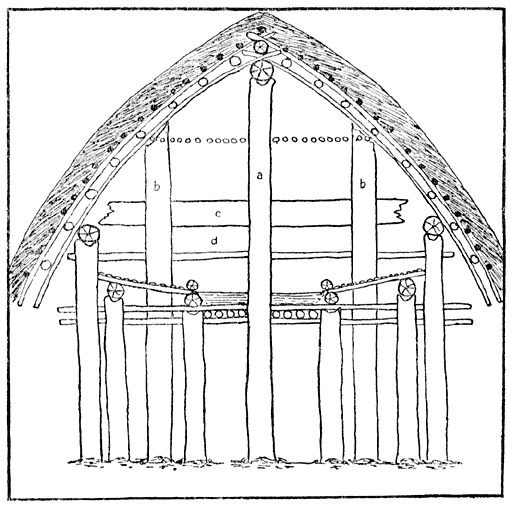
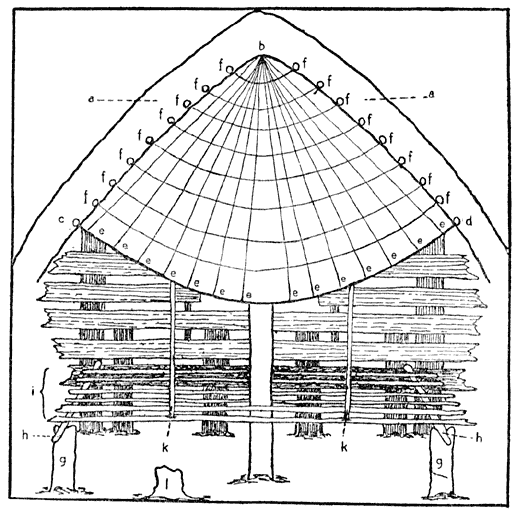
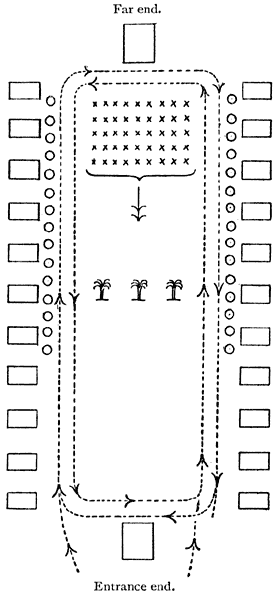
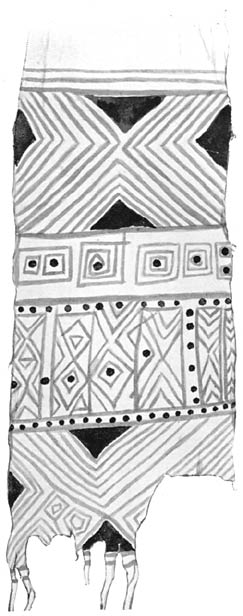
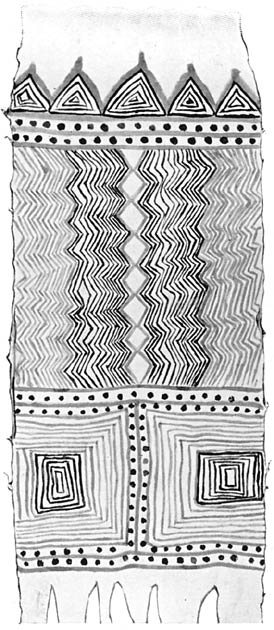
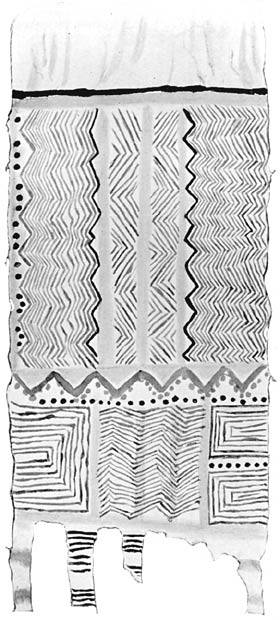
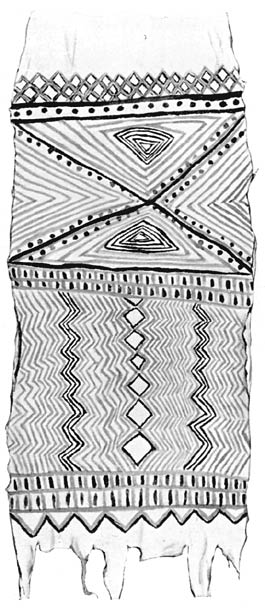
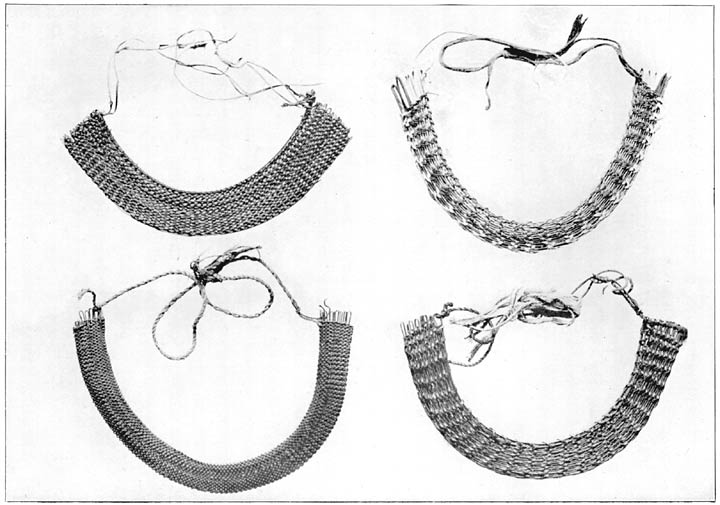
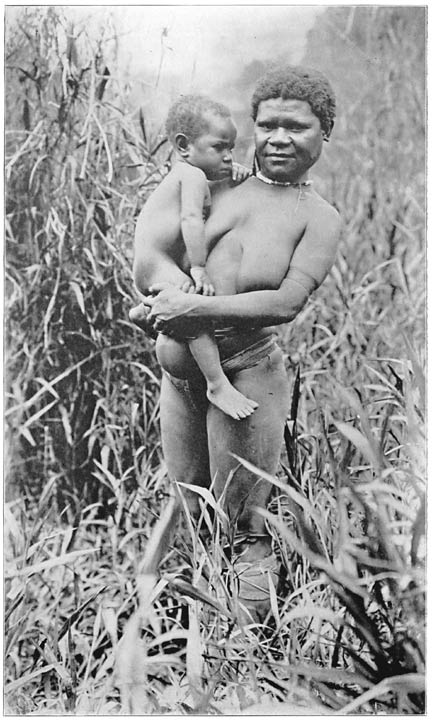
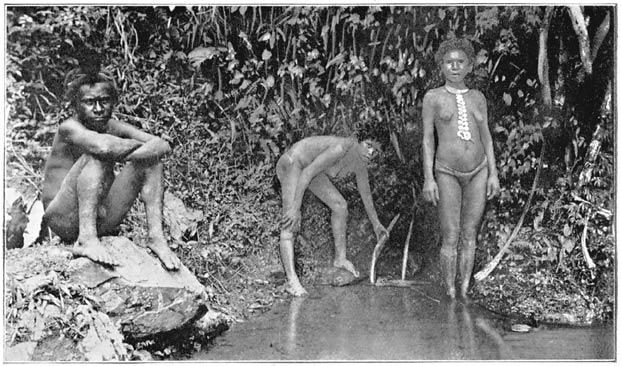
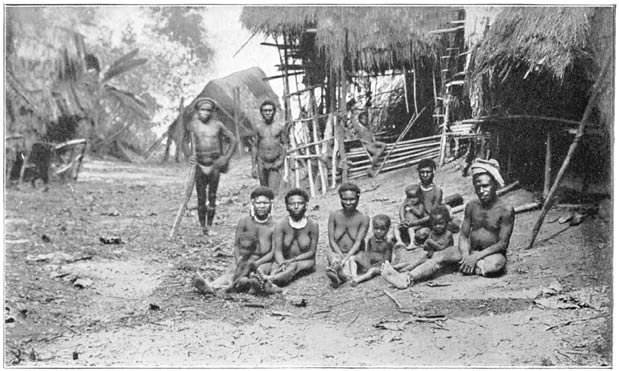
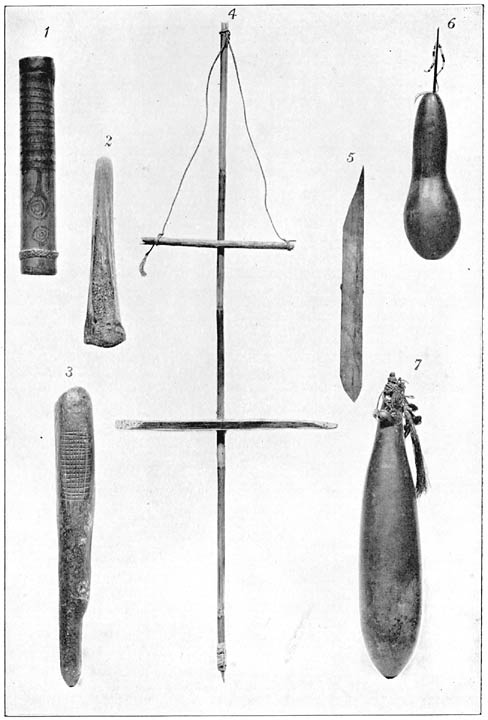
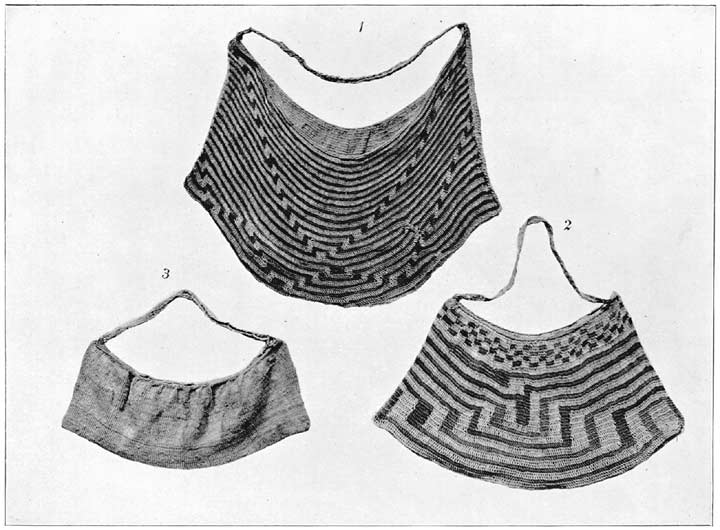
[Contents]
Introductory
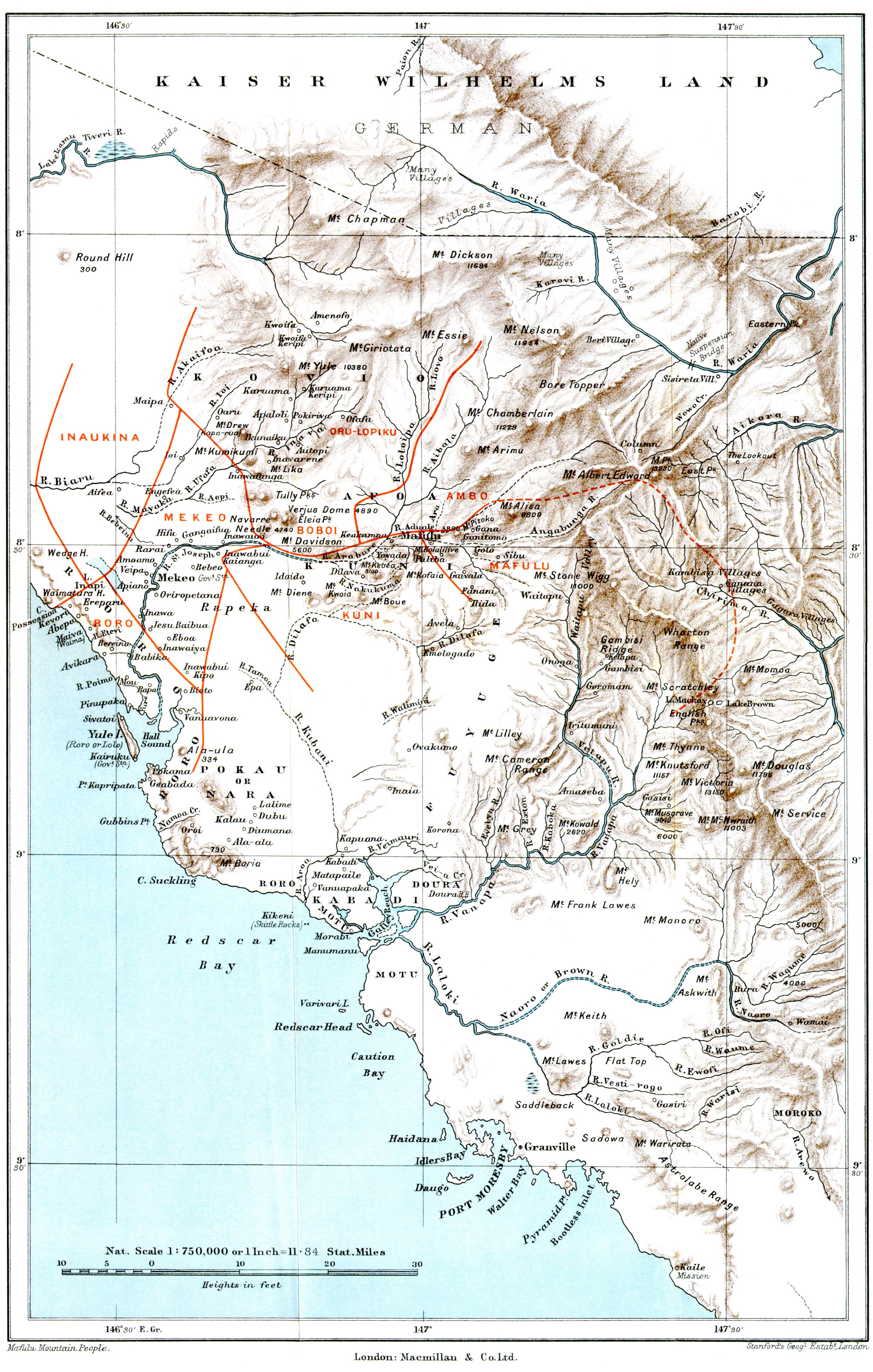
The map appended to this volume is (with the exception of the red lines and red lettering upon it) a reproduction of a portion of
the map relating to the explorations and surveys of Dr. Strong, Mr. Monckton and Captain Barton, which was published in the
Geographical Journal for September, 1908, and the use of which has been kindly permitted me by the Royal Geographical Society. I have eliminated
the red route lines which appear in the original map, so as to avoid confusion with the red lines which I have added. The
unbroken red lines and the red lettering upon my map are copied from a map, also kindly placed at my disposal, which has been
recently prepared by Father Fillodean of the Mission of the Sacred Heart, and these lines mark roughly what the Fathers of
the Mission believe to be the boundaries of the several linguistic areas within the district covered by their map. It will
be observed [2]that some of these lines are not continued so as to surround and complete the definition of the areas which they indicate;
but this defect is unavoidable, as the Fathers’ map only covered a relatively small area, and even in that map the lines were
not all carried to its margin. It will also be noticed that, though the Fathers introduce the two names Oru Lopiku and Boboi
as being linguistically distinct, they have not indicated the boundary line between the two areas. Father Egedi, however,
informed me that this boundary passes along the ridge of hills south of the Ufafa river as far as Mt. Eleia, and thence along
the Ukalama river to the Kuni boundary. The Ukalama river is not shown in the Geographical Society’s map; but I may say that
it is shown in the Fathers’ map as rising in Mt. Eleia, and flowing thence in a south-easterly direction, and so joining the
St. Joseph river close to Dilava. The broken red line upon my map does not appear in the Fathers’ map, but has been added
by me to indicate what, I understand, the Fathers believe to be a continued boundary, so far as ascertained, of the Fuyuge
linguistic area, called by them the Mafulu area, to which I am about to draw attention.
The term Mafulu is the Kuni pronunciation of Mambule, which is the name, as used by themselves, of the people who live in
a group of villages within and near the north-westerly corner of the area of the Fuyuge-speaking people, whose Papuan language,
so far as ascertained, appears, subject to local dialectal differences, to be the same, and may, I was informed, [3]be regarded as one common language throughout the Fuyuge area.
The Fathers of the Mission have adopted the name Mafulu in a wider sense, as including all the people with whom they have
come in contact of the Fuyuge-speaking area; and, though my investigations, which form the subject-matter of this book, have
been conducted only in the neighbourhood of Mafulu itself, I was assured that, so far as the Fathers have been able to ascertain,
all these Fuyuge people not only have similar languages, but also are substantially similar in physique and in culture. My
observations concerning the Mafulu people may therefore, if this statement is correct, be regarded as applying, not only to
the inhabitants of the portion of the north-westerly corner of the Fuyuge area in which the Mafulu group of villages is placed,
but to those of the whole of the north-westerly portion of the area, and generally in a greater or less degree of accuracy
to those of the northerly and north-easterly parts of the area, and possibly the southerly ones also.
The boundaries of this Fuyuge-speaking area can hardly be regarded as definitely ascertained; and the discrepancies, even
as regards the courses of the rivers and the positions of the mountains, which appear in the few available maps make it difficult
to deal with the question. The area, so far as actually ascertained by the Fathers of the Mission, roughly speaking, covers,
and seems to extend also some distance to the south or south-west of a triangle, the western apex of which is the junction
of the river Kea with the [4]river Aduala (a tributary of the St. Joseph),1 whose north-eastern apex is Mt. Albert Edward, and whose south-eastern apex is Mt. Scratchley. It includes the valley of
the Aduala river and its streams (except those flowing into it from the north in the region of the western apex of the triangle)
within its northern boundary, and the valley of the upper Vanapa river and its rivers and streams in the neighbourhood of
its eastern boundary; but this eastern boundary has been found to extend also so as to include the upper valley of the river
Chirima. How far the area extends to the south or south-west of the triangle above mentioned appears to be uncertain.
The linguistic area to the north of the Mafulu or Fuyuge people is that of the Ambo people, who are somewhat similar in appearance
to the Mafulu, and whose language is also Papuan, and, though differing from the Mafulu language, is, I was told, somewhat
similar to it in grammatical construction and as regards a few of its words. The area to the west is that of the [5]Kuni people, whose language is Melanesian, but whose ordinary modes of life are, I was informed, more like those of the Mafulu
than are those of the Papuan-speaking Ambo. The areas to the east and south cannot be so definitely stated, but are dealt
with below.
As regards these Ambo people I may, in view of divergences of names which appear in maps, explain that Ambo is a contraction
of Ambore, and is the name given to the people by their Mafulu neighbours, whilst Afoa is the name given to them by the Kuni
people, and is adopted in the Geographical Society’s map.2 As regards the Kuni people, their name is the one adopted by themselves.
Concerning the boundaries of the Fuyuge linguistic area as above indicated, and the people whose districts adjoin that area,
I propose here to draw attention to four names, and to refer to some observations bearing on the subject of the probable Fuyuge
boundary which are to be found in existing literature.
The term Kovio, though primarily the name of Mt. Yule, and properly applicable to the people living in the neighbourhood of
that mountain, is now, I think, often used to express all the mountain tribes of the hinterland of the Mekeo and Pokau, and
perhaps the Kabadi, districts. But the use of this name has not, I believe, been generally associated with any question of
linguistics.
The area in the map which is called by the Fathers [6]Boboi is occupied by people whose language, I was told by the Fathers, is Papuan, but is distinct from the languages of the
Ambo and the Fuyuge areas.
Kamaweka is a name which appears in several of Dr. Seligmann’s publications. It seems to have been originally used by Captain
Barton to designate the natives of the district of which Inavaurene, to the north-east of the Mekeo plains, is the centre,
but to have been afterwards regarded as a somewhat more general term; and I think Dr. Seligmann uses it in a very general
sense, almost, if not quite, equivalent to the wide application above referred to of the term Kovio, and which might include
the Papuan-speaking Boboi and Ambo people, and even perhaps the people of the northern Mafulu villages.3 But here again the use of the name has, I think, no reference to linguistics.
If the Fathers’ linguistic boundary lines are substantially correct, each of the two terms Kovio and Kamaweka, as now used,
would appear to cover more than one linguistic area; and in any case these terms seem to have widened and to have become somewhat
indefinite. It will be seen on reference to the map and to Father Egedi’s information as to the Oru Lopiku and Boboi boundaries
that both Mt. Yule and Inavaurene are within the area which the Fathers call Oru Lopiku, but that Inavaurene is not far from
[7]their Boboi area. I suggest that it would be convenient for the present, pending further investigation and delimitation on
the spot, and until we know something of the difference between the languages of the Oru Lopiku and Boboi people, to adopt
the term Kovio as a general name for, and confine it to, the two areas Boboi and Oru Lopiku; though for linguistic purposes
the names Boboi and Oru Lopiku, which at present indicate very little to us, may eventually be accepted and come into general
use.
The Koiari people of the foothills and lateral spurs behind the Motu area, also referred to from time to time in Dr. Seligmann’s
writings, must be eastern next door neighbours of the Fuyuge-speaking people, the western boundary of these Koiari being stated
by him to be the Vanapa river,4 and they being in fact regarded by him as being the eastern neighbours of the natives of “the mountains inland of Mekeo Nara
and Kabadi,”5 and being referred to by him as being the people from whose district the Kamaweka and Kuni are reached by “passing westward”—the
word used is “eastward,” but this is obviously a printer’s error—“in the mountains, keeping roughly parallel with the coast.”6
Turning to the question of the Fuyuge boundary, Dr. Strong says that the Fuyuge people occupy the upper waters of the St.
Joseph river,7 and he is quoted by Dr. Seligmann as having stated that the Afoa [8]language “is spoken in the villages on Mt. Pizoko and the northern slopes of Mt. Davidson,” and that “the Afoa villages lie
to the north of the Fuyuge-speaking communities, stretching westward for an unknown distance behind Mt. Davidson.”8 If the information given to me verbally by the Fathers of the Mission of the Sacred Heart and the red linguistic boundary
lines roughly drawn by them, and introduced into my map, be correct, these statements require modification, for according
to the Fathers the Mafulu or Fuyuge-speaking area does not include any part of the St. Joseph river, as its extreme north-westerly
corner lies to the east of the junction—close to the boundary line between the Afoa (Ambo) and the Kuni areas—of the rivers
Alabula and Aduala, and Mt. Pizoko is within the Fuyuge area, and not within that of the Afoa, and Mt. Davidson is within
the Boboi area. I think that, though the Fathers’ lines are admittedly not exact, they and the information supplied by the
Fathers to me are likely to be more trustworthy in these respects, especially as regards boundaries near to the actual Mafulu
villages, than the earlier statements of Dr. Strong, as they are the outcome of recent and careful investigation; and, as
regards Mt. Pizoko, I may mention that Dr. Strong himself seems to have subsequently regarded that mountain as being within
the Mafulu district,9 which brings it into the Fuyuge area.
The inclusion of the upper valley of the river [9]Chirima within the Fuyuge or Mafulu-speaking area is perhaps surprising, as this valley is separated from the general Fuyuge
area by one of the southern ridges of Mt. Albert Edward, and more or less so by the ridges of Mt. Stone Wigg and the Wharton
range, and as the Chirima is a tributary flowing into the Mambare river, which is one of the great watercourses of Northern
New Guinea. The Mafulu Fathers, however, had no doubt as to the correctness of the inclusion, which seems to open out the
possibility of some, at all events, of the Fuyuge people having northern associations; and indeed Monseigneur de Boismenu
told me that he believed that the Mafulu people were in touch with Northern New Guinea, and got some of their shell ornaments,
or the shells from which they were made, from the northern coast.
It is interesting, therefore, to turn for the purpose of comparison to the report of Mr. Monckton’s expedition to Mt. Albert
Edward by way of the Upper Chirima valley in 190610 and the illustrations accompanying it, with which I incorporate a description of the people of this valley given to Dr. Seligmann
by Mr. Money, who was with Mr. Monckton.11
From these it appears that the Upper Chirima people are short in stature and sturdily built. Both sexes wear the perineal
band, the front of which is made (I am not sure whether this applies to women as well as to men) to bulge out by padding.
In some cases the men’s hair is tied up in a bunch with string, [10]and in others it is bound up in various styles with native cloth. Some of the men have their hair done up in small plaits
over the forehead. All the above descriptions, except that of the padding of the band, are applicable to the Mafulu. Some
of the Chirima houses have a curious apse-like roof projection over the front platform, which is a specially distinctive feature
of a Mafulu house, and one with this projection figured by Mr. Monckton is indistinguishable from a typical Mafulu house.
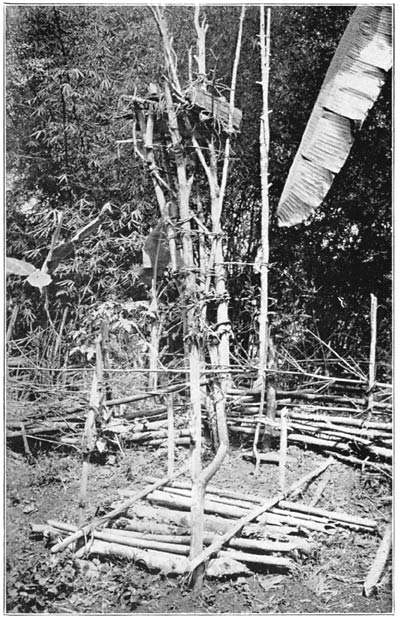
The Chirima people place the bodies of their dead on raised platforms, and apparently sometimes put the body of an infant
on the platform erection of an adult, but below the latter. This also is a practice of the Mafulu; and, though the latter
people confine platform burial (if such it may be called) to chiefs and their families and important persons, it is possible
that some such limitation of the custom exists in the Chirima valley also, but did not come under Mr. Monckton’s notice. A
burial platform figured by him might well be a Mafulu burial platform, except that the curious cone-shaped receptacle for
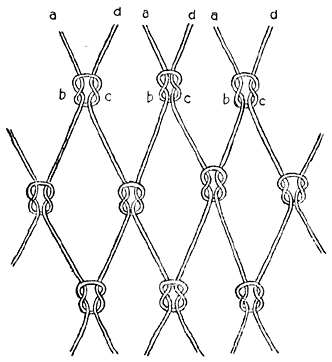
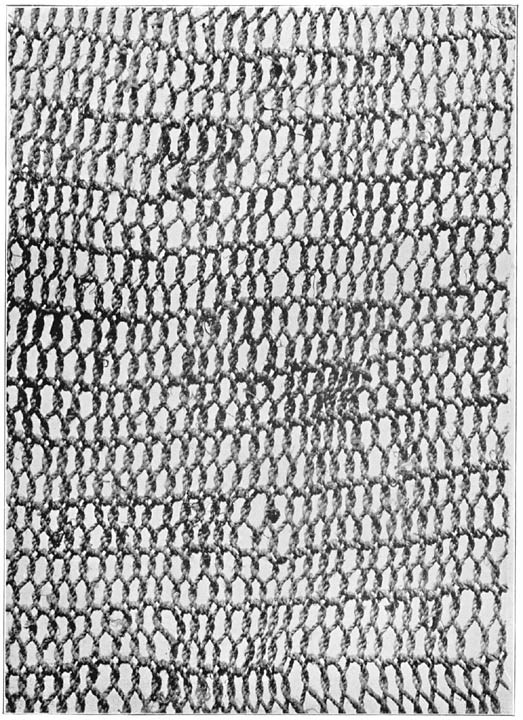
the child is a form for which I cannot vouch as regards the Mafulu. The Chirima have a special and peculiar form of netting,
which Mr. Monckton’s illustration shows to be identical with the special form of Mafulu netting. On the other hand, as regards
the Chirima weapons, implements and utensils, a comparison of Mr. Monckton’s verbal descriptions and figures with what I have
seen in Mafulu, and describe in this book, leads me to the conclusion that, though many of these are similar to those of Mafulu,
[11]some of them are different. As examples of this I may say that the drill implements of the Chirima people are very similar
to, and their stone cloth-beaters appear to be identical with, those used by the Mafulu; whilst on the other hand their war
bows are much longer,12 and their method of producing fire seems to be totally different; also they apparently have bull-roarers, which to the best
of my knowledge are unknown among the Mafulu. Again some of the Chirima weapons, as figured by Mr. Monckton, disclose ideas
of artistic design, including that of the curved line and a rude representation of a man, which I have not met with among
the Mafulu. As regards this last point I draw attention to Mr. Monckton’s figures of carving on a bow and on wooden clubs.
I think, however, that in such matters as these local differences might well arise between people who are really more or less
identical, especially if their respective districts are on opposite sides of the main mountain range of the country, and still
more so if the people of one of the districts (in the present case I refer to the Chirima people) may perhaps have been subject
to the influence of other people beyond them. As to this latter point, however, I should say that these Chirima people seem
to be, so far as dress, ornaments, &c., are concerned, much nearer to the Mafulu than they are to the natives of the Mambare
river itself, as described by Sir William Macgregor.13 It is curious [12]also that the dogs of the Chirima people are not yellow dingoes, but are black and white, as is the case in Mafulu.
I notice that Dr. Seligmann suggests that these Chirima valley people are related to the natives of the neighbourhood of Mt.
Yule,14 a statement which, though probably intended broadly, is in accord with the suggestion that they are connected with the Mafulu-speaking
people.
The natives of Mt. Scratchley (apparently the eastern or south-eastern side), visited by Sir William Macgregor in 1896, appear
from his description of them15 to show a few points of resemblance to the Mafulu people. In particular I refer to their “dark bronze” colour, to the wearing
by women of the perineal band (to which, however, is added a mantle and “in most cases” a grass petticoat, which is not done
in Mafulu), to the absence of tattooing or cicatrical ornamentation, to their “large earrings made out of tails of lizards
covered by narrow straps of palm leaves dyed yellow” (which, though not correctly descriptive of the Mafulu earring, is apparently
something like it), to their use of pigs’ tails as ear ornaments, to their plaiting of the hair and the decoration of the
plaited hair with teeth and shells, to their small charm bags and to the shortness of their bows. Also to the construction
of their houses, with the roof carried down to the ground, with a fireplace about [13]2 feet wide extending down the centre of the building from one end to the other, and having an inclined floor on each side,
and especially to the curious apse-like roof projections in front of these houses (Dr. Haddon calls them “pent roofs”16), Sir William’s figure of which is, like that of the Chirima villages, identical, or nearly so, with that of a Mafulu house.
But Sir William’s description of the physique of these Mt. Scratchley people and other matters make it clear, I think, that
they belong to a type different from that of the Mafulu, though they must be next door neighbours of the Fuyuge-speaking people.
Dr. Seligmann, in commenting upon this description of these people, expresses the opinion that they are Papuo-Melanesians.17
The natives in the region of Mt. Musgrave and Mt. Knutsford, as described by Mr. Thomson,18 appear, at all events so far as dress is concerned, to be utterly different from the Mafulu.
Dr. Seligmann states that Dr. Strong has informed him that the southern boundary of the Fuyuge-speaking area is the Kabadi
country,19 and he had previously referred to Korona, immediately behind the Kabadi and Doura districts, as being within the area,20 and, indeed, the Geographical Society’s map shows the Fuyuge area as at all events extending as far south as Korona. I do
not know how far inland the Kabadi [14]and Doura people extend; but I may say that the Mafulu Fathers expressed grave doubt as to the extension of the Fuyuge area
so far south as is indicated by the map.
If the Fuyuge area does in fact reach the Kabadi boundary, and if my notes on the Mafulu people are, as suggested, broadly
descriptive of the natives of the whole Fuyuge area, there must be a very sudden and sharp differentiation, as the Kabadi
people are apparently an offshoot from Mekeo,21 with apparently other Papuo-Melanesian blood (especially Roro) introduced.22
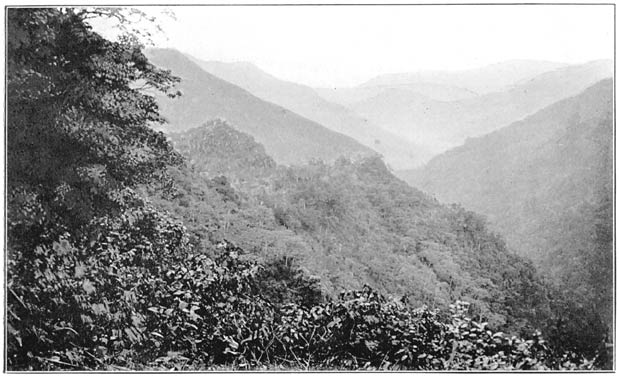
The contour and appearance of the country in the actual Mafulu district of the Fuyuge area is strikingly different from that
of the immediately adjoining Kuni country, the sharp steep ridges and narrow deep-cut valleys of the latter, with their thick
unbroken covering of almost impenetrable forest, changing to higher mountain ranges with lateral ridges among them, and with
frequent gentle undulating slopes and wider and more open valleys; while, interspersed with the forests, are small patches
and great stretches of grass land, sometimes thinly covered or scattered with timber and sometimes quite open and devoid of
trees.23 And this [15]condition continues, I was told, over the greater part of the triangular area above referred to.
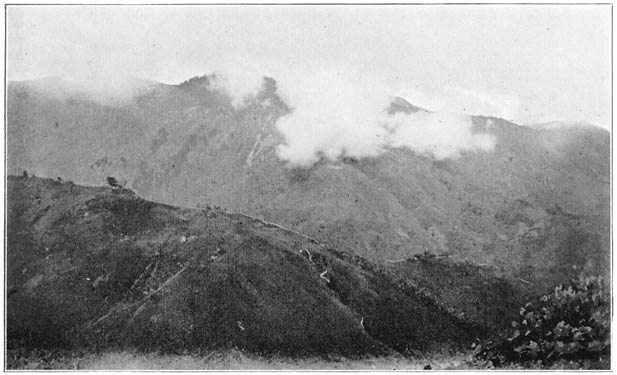
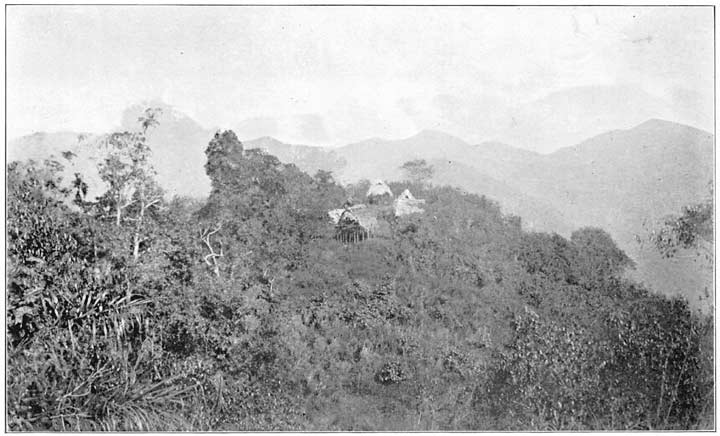
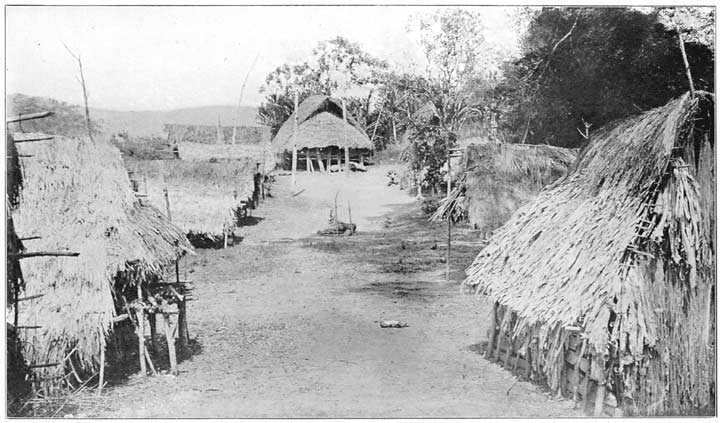
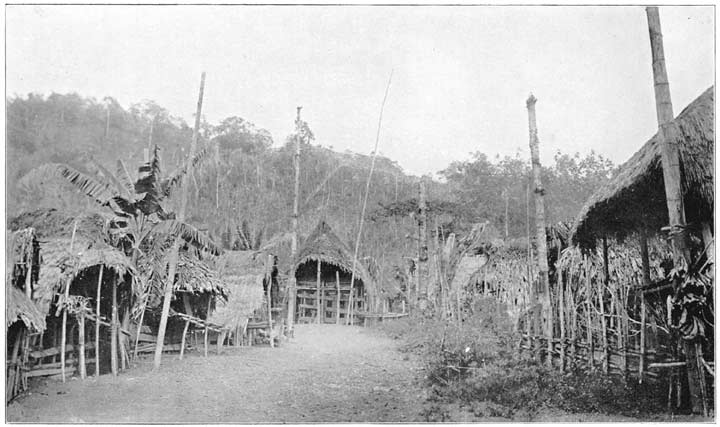
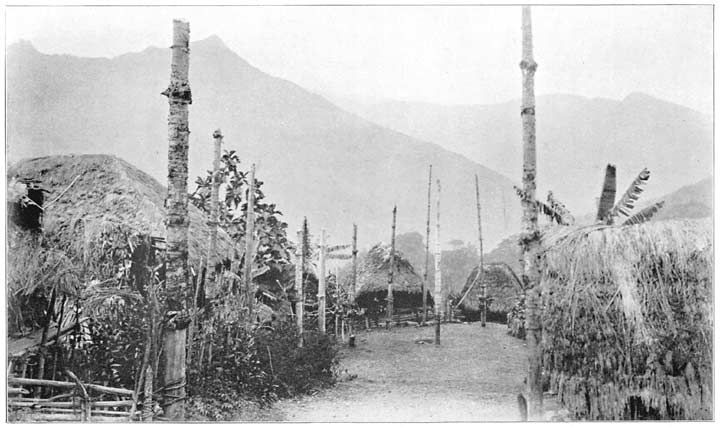
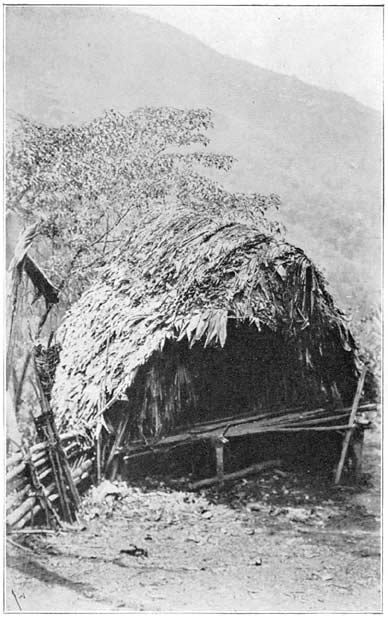
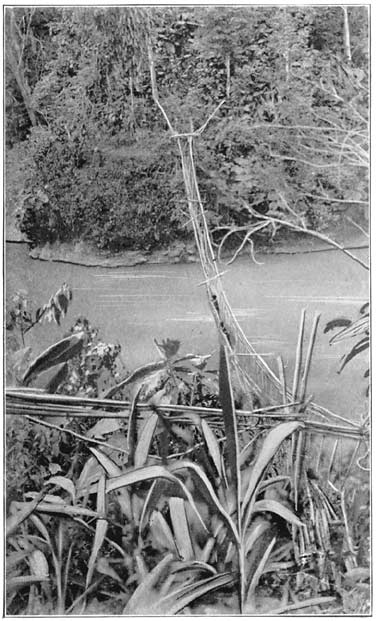
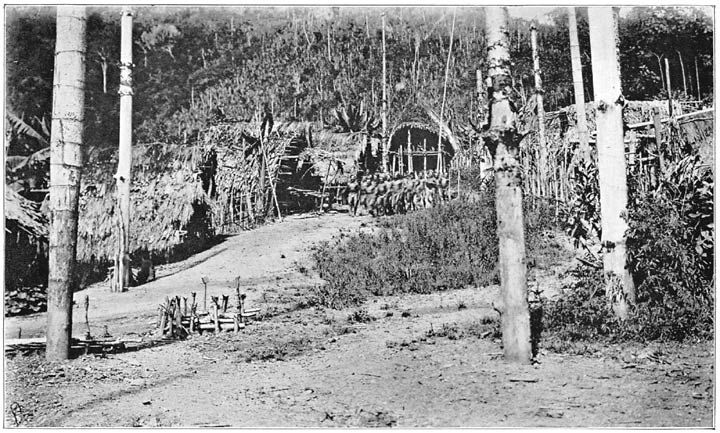
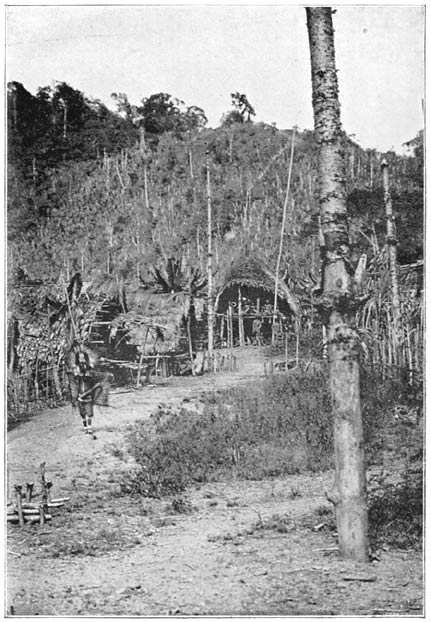
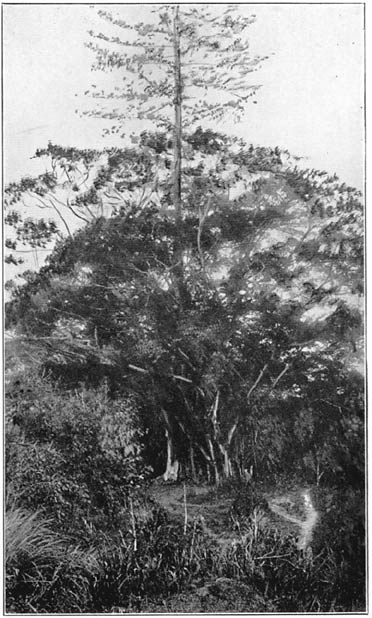
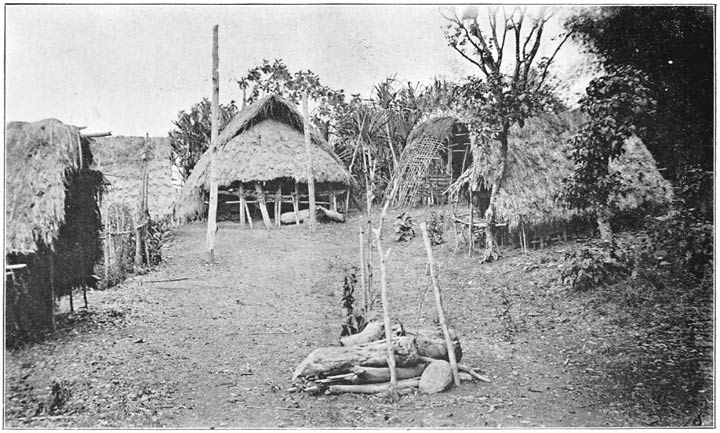
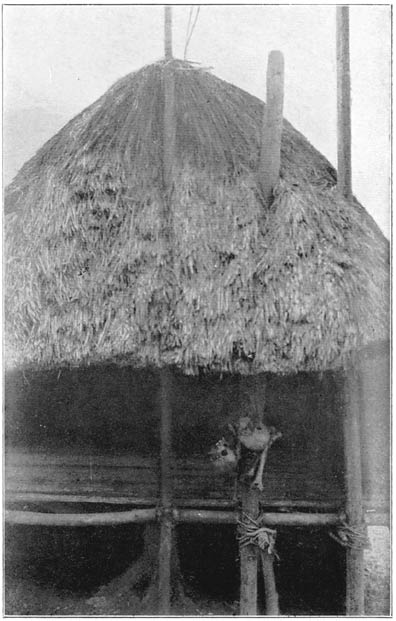
Plates 1 and 2 give, I think, a fair illustration of what I mean, the steep contours and thickly wooded character of the foreground and
nearer middle distance shown by Plate 1 being typical Kuni scenery, and the more open nature of the country displayed by Plate 2 and the comparative freedom from forest of its foreground being typical of the higher uplands of Mafulu.24
It will be noticed that the physical character of the Mafulu country is more favourable to continued occupation than is that
of the Kuni country; and it is a fact that the Mafulu people are not so restless and ready to move as are the Kuni folk; and,
even when they do migrate, it is generally to a spot comparatively near to their old villages.
The geological formation of the lower hills on which the actual Mafulu villages are placed and the intervening valleys is
partly limestone; and I was told that limestone formation was also found further to the east.
Throughout this book I shall use the term “Mafulu” as including, not only the little group of villages near the north-westerly
corner of the Fuyuge linguistic area actually known by that name, but also the other groups of Fuyuge villages in the north-western
[16]portion of that area; and, as above indicated, it is believed by the Fathers of the Mission that I should be substantially
correct if I included the whole of the northern and north-eastern, and probably the southern portions of the known part of
that area, and possibly the entire area.
[17]
[Contents]
Physique and Character
Physique.
The Mafulu people are of short stature, though perhaps a trifle taller than the Kuni.
They are as a rule fairly strong and muscular in build, the women in particular having very strongly developed thighs; but,
speaking generally, their limbs are more slender, and their general development is slighter, than is usually the case among
the Roro and Mekeo people.
They appear to be usually mesaticephalic, but to have a very marked tendency to brachycephaly.
Their noses seemed to me to be generally strong, and of prominent size, varying considerably in width of bridge, but usually
having rather widely distending nostrils; and sometimes the width of the nose was equal to its length, or nearly so.
Referring to the above matters, the following are the results of twenty measurements of Mafulu men. These were obtained from
men of upwards of six different communities or groups of villages, so as to avoid the possible misleading character of measurements
made in only one village or group of villages, in which some family relationship between the persons [18]measured might militate against the true average character of the figures obtained.
| No. |
Stature in cm. |
Length of head in cm. |
Breadth of head in cm. |
Cephalic index |
Cranial index (2 units deducted from cephalic index). |
Nose length in cm. |
Nose breadth in cm. |
Nasal index |
| 1 |
150 |
18.5 |
14.7 |
79.5 |
77.5 |
4.9 |
4.4 |
89.8 |
| 2 |
155 |
18.8 |
15.1 |
80.3 |
78.3 |
4.8 |
4.8 |
100.0 |
| 3 |
155 |
19.5 |
14.8 |
75.9 |
73.9 |
5.3 |
4.3 |
81.1 |
| 4 |
157 |
18.5 |
15.4 |
83.2 |
81.2 |
4.3 |
4.3 |
100.0 |
| 5 |
153 |
18.9 |
14.6 |
77.2 |
75.2 |
4.8 |
4.4 |
91.7 |
| 6 |
151 |
18.6 |
14.3 |
76.9 |
74.9 |
4.9 |
3.8 |
77.6 |
| 7 |
151 |
19.3 |
15.2 |
78.8 |
76.8 |
5.4 |
4.4 |
81.5 |
| 8 |
163 |
19.4 |
14.5 |
74.7 |
72.7 |
5.6 |
4.4 |
78.6 |
| 9 |
162 |
18.8 |
15.2 |
80.9 |
78.9 |
5.3 |
4.0 |
75.5 |
| 10 |
163 |
17.4 |
15.1 |
86.8 |
84.8 |
5.5 |
4.6 |
83.6 |
| 11 |
155 |
18.0 |
14.0 |
77.8 |
75.8 |
5.3 |
4.4 |
83.0 |
| 12 |
157 |
17.4 |
14.6 |
83.9 |
81.9 |
4.6 |
4.0 |
87.0 |
| 13 |
158 |
19.7 |
14.8 |
75.1 |
73.1 |
5.3 |
4.3 |
81.1 |
| 14 |
160 |
17.9 |
14.4 |
80.4 |
78.4 |
5.1 |
4.3 |
84.3 |
| 15 |
153 |
17.7 |
14.7 |
83.1 |
81.1 |
5.2 |
4.1 |
78.8 |
| 16 |
156 |
18.5 |
14.8 |
80.0 |
78.0 |
5.5 |
4.5 |
81.8 |
| 17 |
152 |
17.7 |
14.9 |
84.2 |
82.2 |
5.6 |
4.0 |
71.4 |
| 18 |
154 |
18.6 |
14.9 |
80.1 |
78.1 |
5.2 |
4.5 |
86.5 |
| 19 |
150 |
17.8 |
15.2 |
85.4 |
83.4 |
4.9 |
3.9 |
79.6 |
| 20 |
147 |
18.8 |
14.5 |
77.1 |
75.1 |
4.6 |
3.8 |
82.6 |
Analysing these figures, we get the following results:—
|
Highest number. |
Lowest number. |
Average. |
| Stature1 |
163 cm.(64.2 ins.) |
147 cm.(57.9 ins.) |
155.1 cm.(61.1 ins.) |
| Head length |
19.7 cm. |
17.4 cm. |
18.5 cm. |
| Head breadth |
15.4 cm. |
14.0 cm. |
14.8 cm. |
| Cephalic index |
86.8 |
74.7 |
80.0 |
| Cranial index |
84.8 |
72.7 |
78.0 |
| Nose length |
5.6 cm. |
4.3 cm. |
5.1 cm. |
| Nose breadth |
4.8 cm. |
3.8 cm. |
4.3 cm. |
| Nasal index |
100.0 |
71.4 |
84.32 |
| Number of cranial indices under 75 |
= 4 (20 per cent.). |
| Number of cranial indices between 75 and 80 |
= 10 (50 per cent.). |
| Number of cranial indices over 80 |
= 6 (30 per cent.). |
[19]
There are a few points in connection with these figures to which I would draw attention. The very short man (No. 20—height,
147 cm.) has a cranial index of 75.1, on the border line between dolichocephaly and mesaticephaly. He has also a short nose
(4.6 cm.), and is one of the two with the narrowest noses (3.8 c.m.). The very tall man (No. 8—height, 163 cm.) has a long
head (19.4 cm.), and the lowest dolichocephalic cranial index of 72.7, and is one of two with the longest noses (5.6 cm.).
The other very tall man (No. 10—height, 163 cm.) has one of the two shortest heads (17.4 cm.), and the highest brachycephalic
cranial index of 84.8, and has a long nose (5.5 cm.) The man (No. 2) whose nasal index is 100 has the mesaticephalic cranial
index of 78.3 (almost the average index). The other man (No. 4) whose nasal index is 100 has a head of exactly the average
length (18.5 cm.) and the greatest breadth (15.4 cm.), and the brachycephalic cranial index of 81.2. The man (No. 17) with
the lowest nasal index of 71.4 has a very short head (17.7 cm.), and the brachycephalic cranial index of 82.2.
The following tables, however, illustrate the fact that the measurements of these twenty men do not appear to indicate, as
regards them, any marked [20]connection between stature, cranial index, and nasal index.
Order in stature (beginning with the shortest):
20—1—19—6—7—17—5—15—18—2—3—11—16—4—12—13—14—9—8—10.
Order in progress upwards of cranial indices:
8—13—3—6–20—5—ll—7—1—16—18—2—14—9—15—4—12—17—19—10.
Order in progress upwards of nasal indices:
17—9—6—8—15—19—3—13—7—16—20—11—10—14—18—12—1—5—2—4.
I brought home three Mafulu skulls, which Dr. Keith kindly had measured at the Royal College of Surgeons, with the following
results3:—
| Skull |
Length in cm. |
Breadth in cm. |
Height in cm. |
Cranial Index. |
Proportion of height to length. |
| A |
17.6 |
14.0 |
12.2 |
79.5 |
69.3 |
| B |
18.2 |
14.1 |
13.2 |
77.5 |
72.5 |
| C |
17.3 |
12.7 |
12.5 |
73.4 |
72.3 |
It will be observed that the lowest of these three cranial indices is a trifle higher than the lowest of those of the head
measurements, that the highest of them is much lower than the highest of those of the head measurements, and that their average
(76.8) is a little below the average of those of the head measurements.
Dr. Keith had further measurements made of these [21]skulls from the point of view of prognathism and characters of noses and orbits, with the following results:
| Skull. |
Basi-nasal length. |
Basi-alveolar length. |
Height of nose. |
Width of nose. |
Height of orbit. |
Width of orbit. |
| |
mm. |
mm. |
mm. |
mm. |
mm. |
mm. |
| A |
98 |
102 |
48 |
26 |
40 |
35 |
| B |
99 |
96 |
49 |
25 |
42 |
35 |
| C |
97 |
102 |
47 |
26 |
38 |
35 |
Dr. Keith, referring to these skulls, says that they disclose relatively small brains, the cranial capacity of A being 1,230
c.c., that of B being 1,330 c.c., and that of C being 1,130 c.c. He compares these figures with the average cranial capacity
of the male European, which he puts at 1,500 c.c.
The eyes of the Mafulu people are dark brown and very bright. I never saw among them those oblique eyes, almost recalling
the Mongolian, which, according to Dr. Seligmann, are found, though rarely only, on the coast,4 and of which I saw many instances among the Kuni people.
Their lips are usually not so thick as are those of the Mekeo and Roro people, and are generally finer and more delicate in
shape.
In view of their Papuan language I kept a sharp look out for the curious backward sloping foreheads and projecting brow ridges
and Jewish-looking noses which are so often found among the Western Papuans; but, although I saw a few examples of these,
they were rare, and I did not observe any [22]noticeable tendency in these directions in the faces of the people generally.5
A curious characteristic with them is the big toe, which is usually much developed, and projects outwards at a larger angle
than is the case with the Roro and Mekeo people, and is much used for holding on to roots, &c., whilst travelling along their
rough mountain paths.
Their general colour is a dark sooty brown, a trifle darker, perhaps, than that of the Kuni people, and contrasting forcibly
with the varying shades of chocolate which you find among the Roro and Mekeo people. They are smooth-skinned.
Their hair is frizzly, and generally dark brown, often quite dark, almost even approaching to black, and sometimes perhaps
quite black. But it is frequently lighter; and indeed I was often, when observing men’s hair lit up by sunshine, impressed
by the fact that its brown colour was not even what we should in Europe call dark.6 I often saw marked variations in the depth of hair colour on the head of the same individual. I saw no examples of the comparatively
straight or curly type of hair which is found in the Pokau district and elsewhere.7
[23]
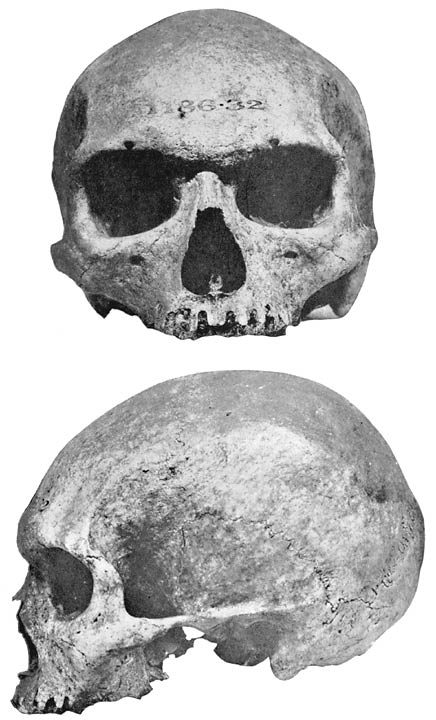
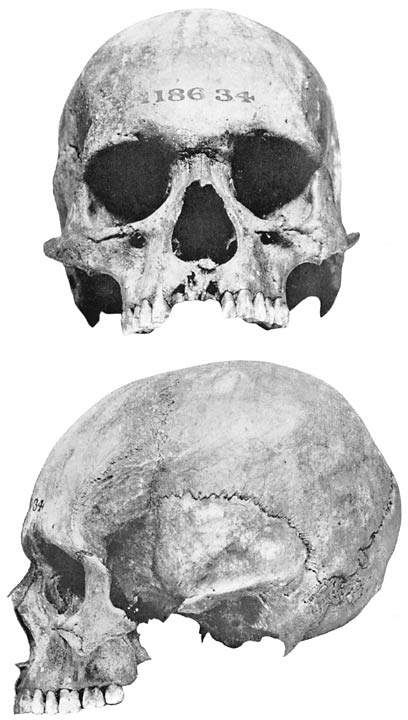
Plate 3 gives front and side views of the mesaticephalic (almost brachycephalic) skull A and Plate 4 gives similar views of the dolichocephalic skull C. All the photographs were made as nearly as possible exactly half the
sizes of the originals; but the photographer has made the front view of skull A about an eighth of an inch too narrow (with,
of course, a corresponding deficiency in height), so that the tendency to roundness of this skull is not quite sufficiently
shown, and the proportion of its height to its length is reduced, in the plate. I am not a craniologist, and so I do not attempt
to discuss the more detailed points of interest which arise in connection with these skulls.
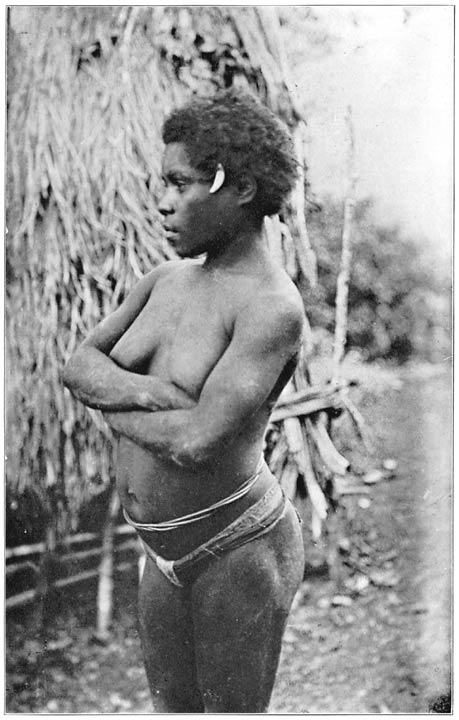
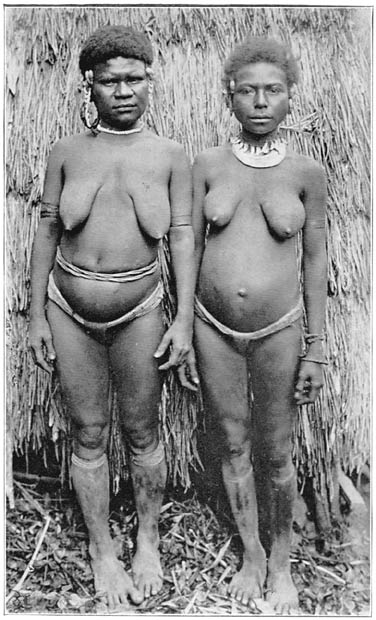
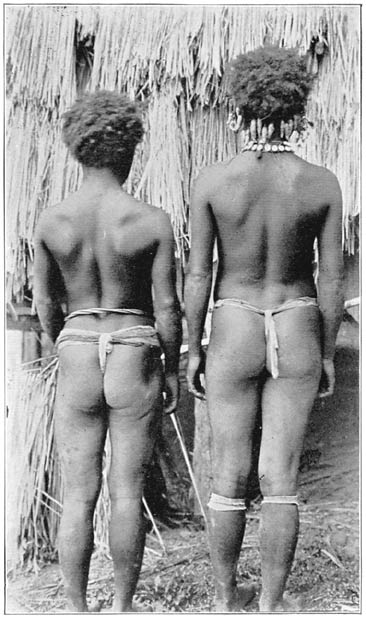
A good idea of the somewhat varying characters of the general physiques and features of the people will be obtained from my
plates; but there are a few of these plates which I may mention here.
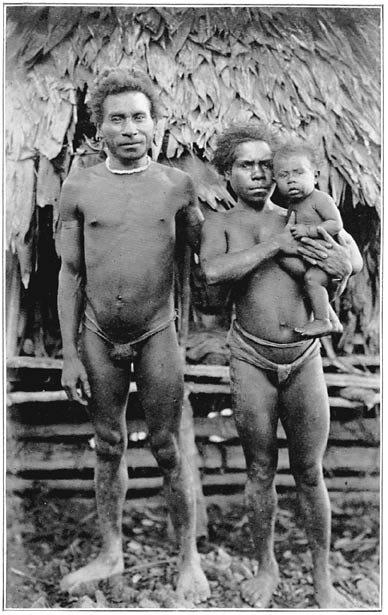
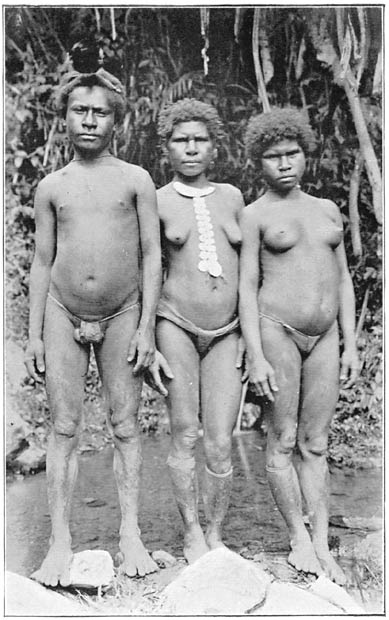
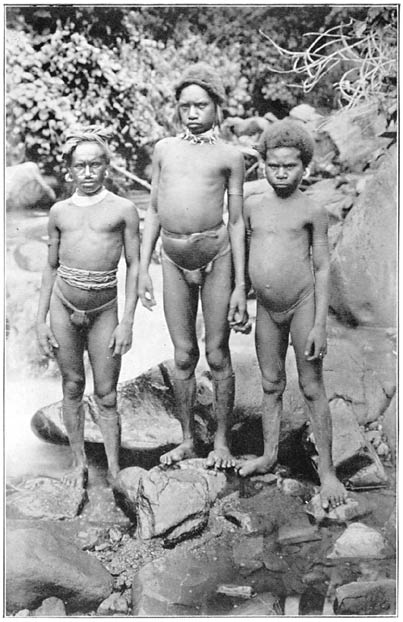
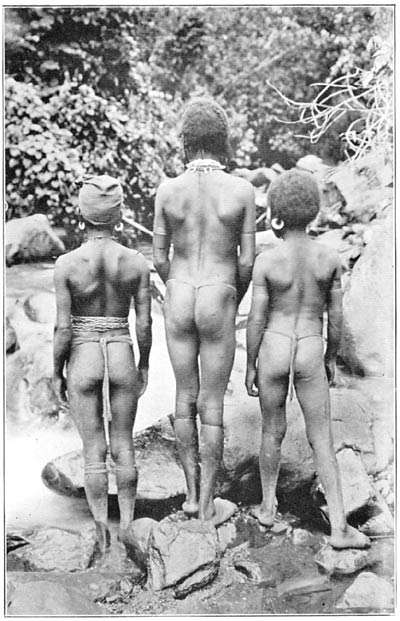
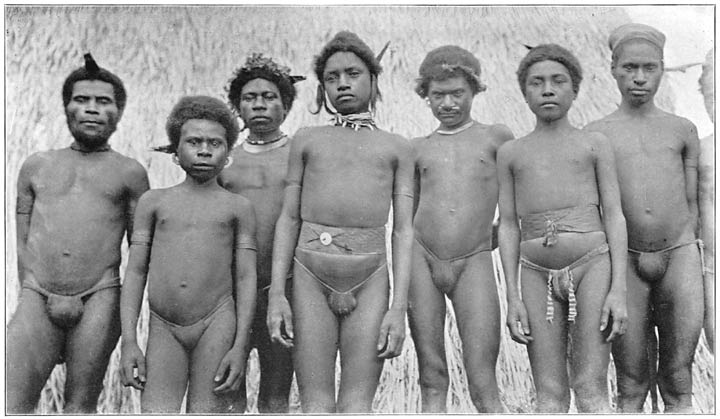
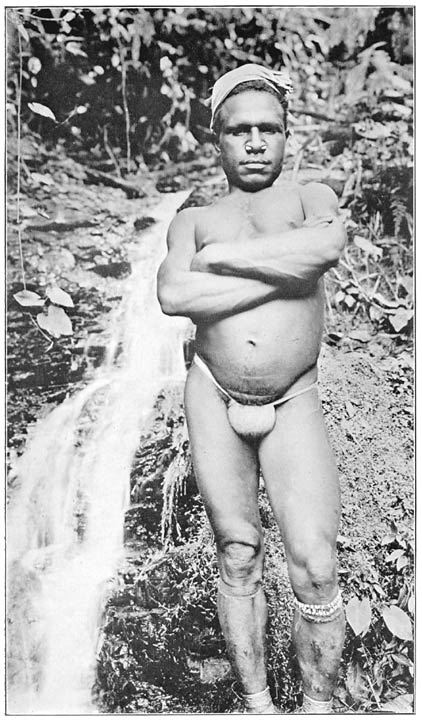
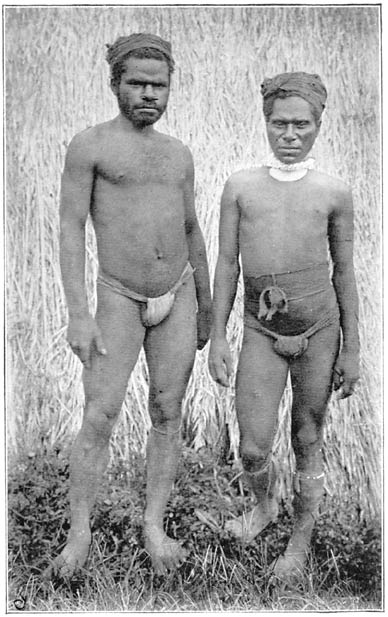
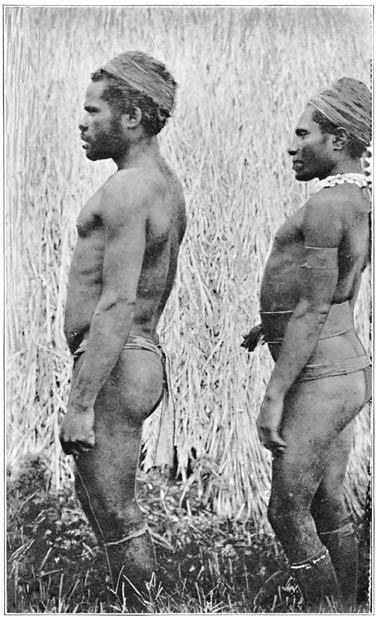
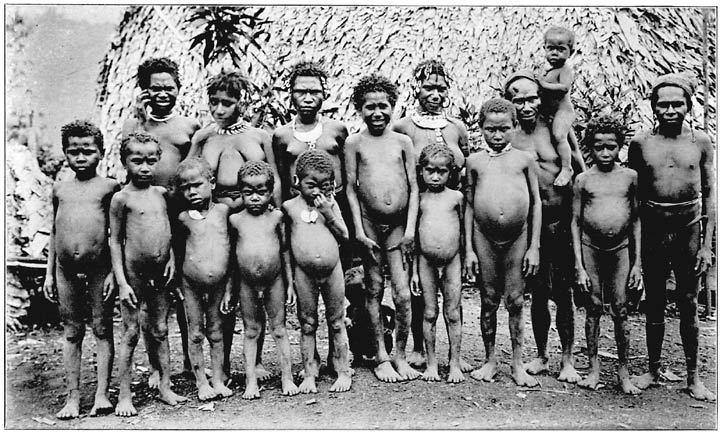
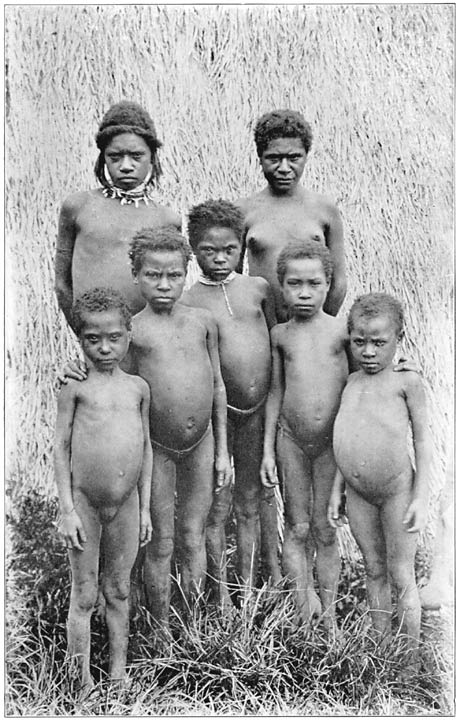
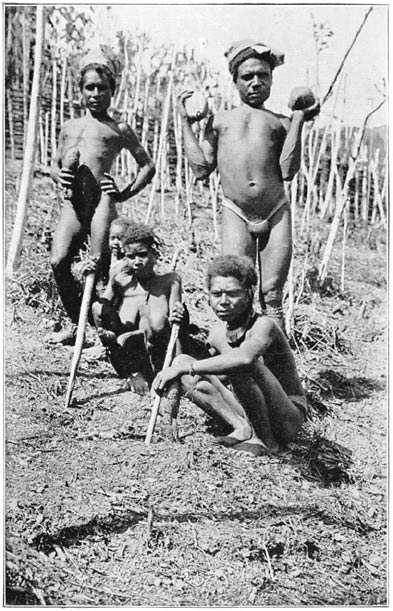
The people shown in Plates 5, 6, 7, 8, 9 and 16 may, I think, be regarded as fairly typical, and I would draw attention to the somewhat Melanesian tendency of feature which
is disclosed by the faces of the man in Plate 6, the young man in the middle in Plate 7 and the fourth and sixth men from the left in Plate 9; also to the great diversity shown in Plate 9. The man shown in Plate 10, with his thick and strong muscular [24]development, is of a type which is occasionally seen, but which is, I believe, unusual. The two men figured in Plates 11 and 12 are, I think, specially interesting. The one to the right, with his somewhat backward sloping forehead, and slightly arched
nose, shows a distinct tendency towards the type of the Western Papuan, to which I have already referred. The other one is
in general shape of head and appearance of features not unlike some of the dwarf people found by the recent expedition into
Dutch New Guinea (see the man to the left in Plate 4 of the page of illustrations in The Illustrated London News for September 2, 1911), and indeed there is almost an Australian tendency in his face. It is noticeable that he has a beard
and moustache, which is quite unusual among the Mafulu. A somewhat similar type of face may be noticed in one or two of the
other plates.
Character and Temperament.
It is difficult to speak with any degree of definiteness on this question. It must be borne in mind that the Mafulu people
have been very little in touch with white people, the missionaries, who have only been there since 1905, and on rare occasions
a Government official or scientific traveller, being almost the only white men whom the bulk of them have ever seen; and they
have been but slightly affected by the outside influences which for some years past have been constantly brought to bear upon
the natives of the adjoining coast line and the people of the Mekeo plains; so that comparisons of these people with their
more up-to-date [25]neighbours as regards their relative natural characters may well be in some respects misleading.
Subject, however, to this caution I would say that they are lazy and easy-going (though not so much so as the Roro and Mekeo
people), lively, excitable, cheerful, merry, fairly intelligent (this being judged rather from the young people), very superstitious,
brave, with much power of enduring pain, cruel, not more revengeful perhaps than is usual among uncivilised natives, friendly
one with another, not quarrelsome, but untrustworthy and not over-faithful even in their dealings with one another, though
honest as regards boundaries and property rights and in the sense of not stealing from one another within their own communities
(this being regarded as a most shameful offence), and of very loose sexual morality.
A difference between them and the Mekeo and Roro natives is that they appear to be not so conservative as the latter, being
more ready to abandon old traditions and adopt new ideas; though this characteristic is one which shows itself in the young
people rather than in the elders with their formed habits.
[26]
[Contents]
Dress and Ornament
Dress.
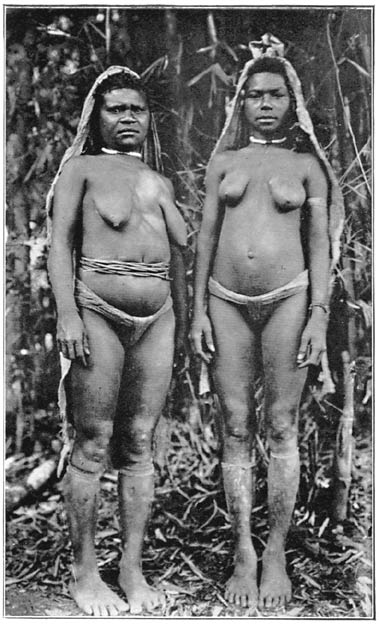
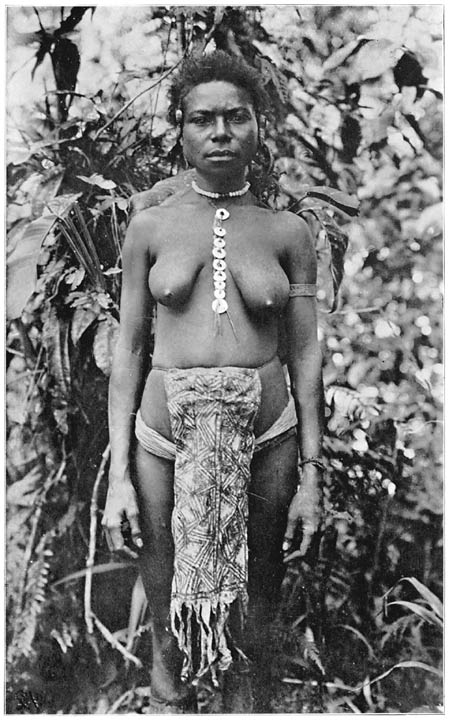
The perineal band, made of bark cloth, is the one article of dress which is universally worn by both men and women.
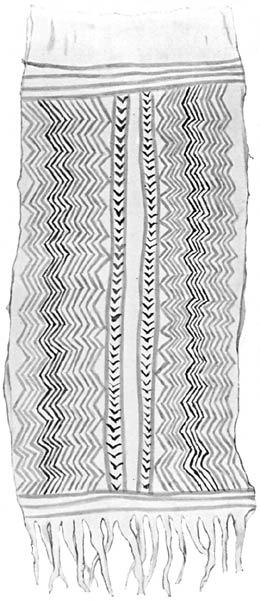
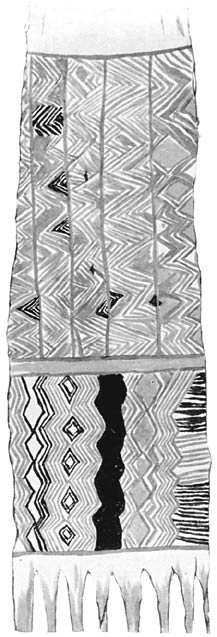
These bands are made by both men and women, but are coloured by men only. They are commonly unstained and undecorated; but
some of them, and especially those worn for visiting and at dances, are more or less decorated. Some that I have noticed are
stained in one colour covering the whole garment; others in two colours arranged in alternate transverse bands, sometimes
with narrow spaces of unstained cloth between; and again others have bands of one colour alternating with bands of unstained
cloth. Some are decorated with lines or groups of lines of one colour, or alternating lines or groups of lines of two colours,
painted transversely across the cloth. Others, while simply stained in one colour or stained or decorated in one of the ways
above described, have another simple terminal design near the end of the garment.
The men’s bands are usually small and narrow, as [27]compared with those worn by the Roro and Mekeo people; and the women’s bands seemed to me to be generally even narrower than
those of the men, particularly in front. Men’s bands, which I have measured, were about 6 inches wide at one end, narrowing
down to about 3 inches at the other; and the widths of women’s bands were 4 or 5 inches or less at one end, narrowing down
to about 2 inches at the other. But the bands of both men and women, especially those of the latter, often become so crumpled
up and creased with wear that the portion passing between the legs dwindles down to about an inch or less in width. One is
tempted to think, as regards both men and women, that, from the point of view of covering, the bands might be dispensed with
altogether. This remark applies still more strongly to the case of young boys and unmarried girls, including among the latter
big full-grown girls, who are in fact fully developed women, whose bands can hardly be regarded as being more than nominal,
and who, especially the girls and young women, and even sometimes married women who are nursing their babies, can really only
be described as being practically naked.
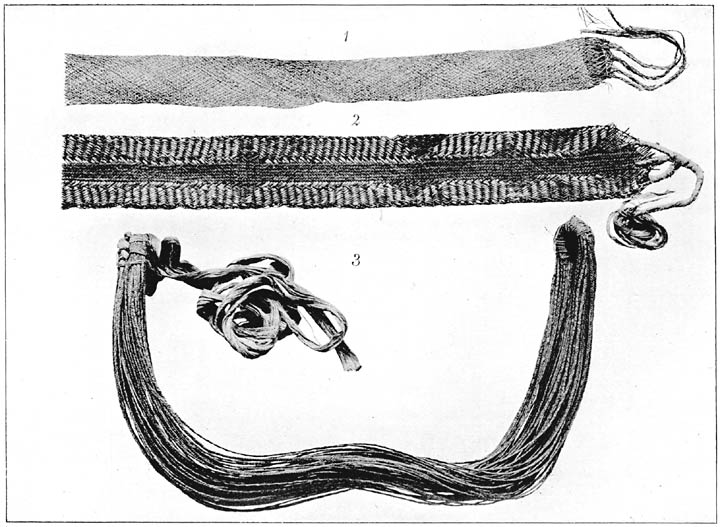
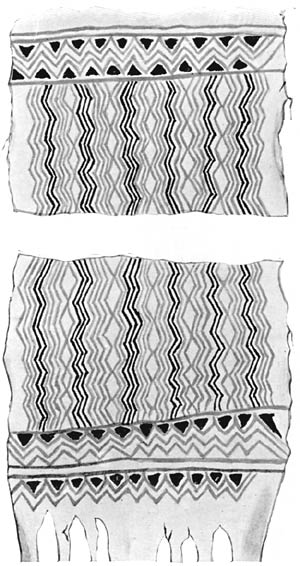
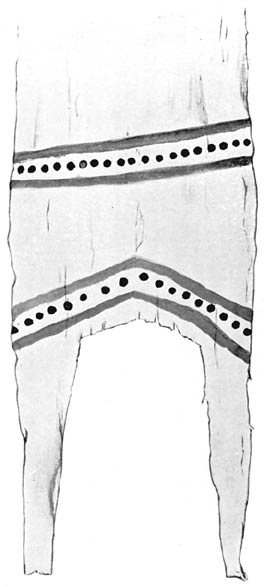
Plate 13 (Figs, 1, 2, and 3) illustrates the staining and decoration of perineal bands.1 Fig. 1 is a section [28]of a man’s band about 6 inches wide. The transverse lines, which extend along the whole length of the band, are in alternate
groups of black and red. The background is unevenly stained yellow behind the black lines; but the background behind the red
lines and the spaces intervening between the groups of lines are unstained. Fig. 2 is the pattern near the end of a woman’s
band about 5 inches wide. The lines are coloured red. There is no pattern on the rest of the band; but the whole of the band,
including the background of the pattern, is stained yellow. Fig. 3 is a section of a woman’s band about 2½ inches wide. The
colouring is in alternate bands of red and yellow with irregular unstained spaces between.
I was struck with the gradual reduction of the women’s dress as I travelled from the coast, with its Roro inhabitants, through
Mekeo, and thence by Lapeka and Ido-ido to Dilava, and on by Deva-deva to Mafulu. The petticoats of the Roro women gave way
to the shorter ones of Mekeo, and these seemed to get shorter as I went further inland. Then at Lapeka they were still shorter.
At Ido-ido, which is Kuni, the petticoats ceased, and there was only the perineal band. Then, again, at Dilava (still Kuni)
this band was narrower, and at Deva-deva, and finally at Mafulu, it was often, as I have said, almost nominal.
I was told that the age at which a boy usually begins to wear his band is about 10 or 12, or in the case of a chief’s son
16 or 17; but that girls assume their bands at a somewhat earlier age, say at 7 or 8. [29]So far as my personal observation went I should have thought that the usual maximum age of nakedness for both boys and girls
was rather younger, and I never saw a naked boy of an age anything like 16.
The assumption of the perineal band is the subject of a ceremony which will be dealt with hereafter.
Caps are very often worn by men, but not by women or children. These are simply pieces of plain unstained bark cloth about
9 inches wide, which are coiled and twisted on the head. The result is often a shapeless mass; but there are methods of arranging
the cloth in definite ways which produce describable results. Sometimes the cloth is merely coiled several times around the
head, so as to produce a tall thin turban-shaped band, the crown of the head being left uncovered. Often this plan is extended
by turning the end of the cloth over, so as to cover the top of the head, thus producing in some cases a result which resembles
a fez, and in other cases one which looks more like a tight skullcap. Again the cap often has its centre terminating in an
end or tassel hanging over, thus making it look like a cap of liberty; and yet again I have seen the cap look almost like
the square paper caps often worn by certain artisans at home. These caps are seen in several of the plates.
Abdominal belts are commonly worn by both men and women, but not as a rule by children. There are several distinct forms of
these:—
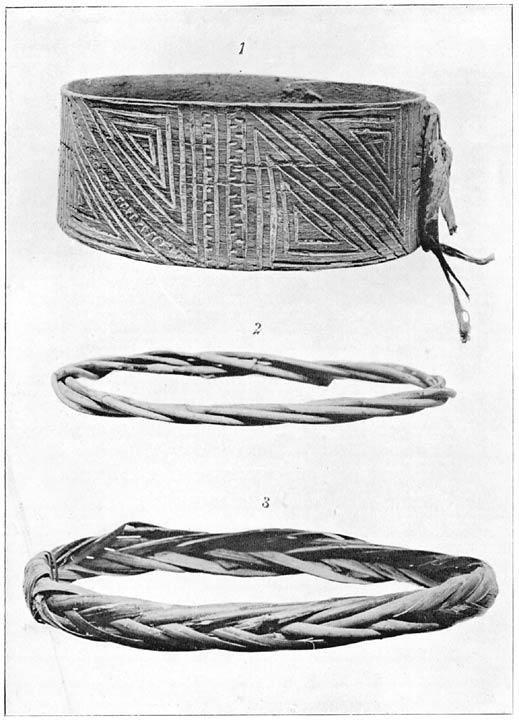
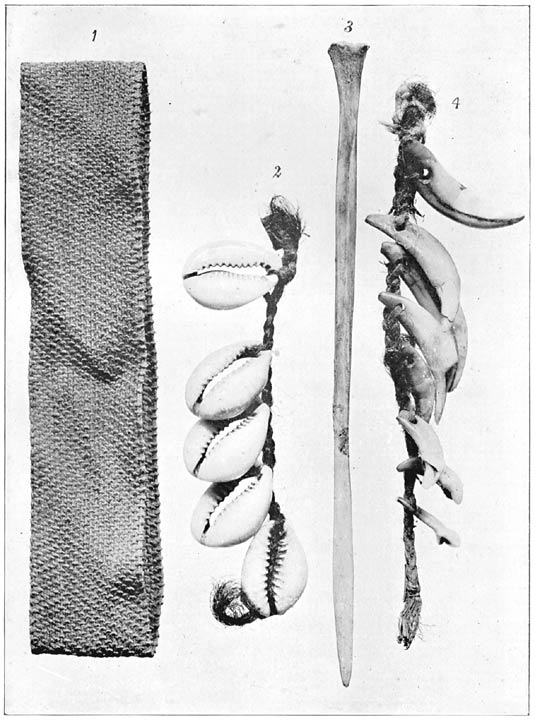
(1) A thick strong dark-coloured belt (Plate 14, Fig. I) made of tree bark; made and worn by men only. The belt is about 3 or more inches wide and is often so [30]long that it passes twice round the body, the outer end being fastened to the coil beneath it by two strings. This form of
belt is sometimes ornamented with simple straight-lined geometric patterns carved into the belt, but it is never coloured.
The process of manufacture is as follows: they cut off a strip of bark large enough for one, two, three, or four belts, and
coil it up in concentric circles, like the two circles of the belt when worn. They then place it so coiled into water, and
leave it there to soak for a few days, after which they strip off the outer part, leaving the smooth inner bark, which they
dry, and finally cut into the required lengths, to which they add the attachment strings made of native fibre.
(2) A belt made of a material looking like split cane and thin strips from the fibre of what I was told was a creeping plant2; made and worn by men only. The latter material is obtained by splitting the fibre into thin strips. These strips and the
strips of split cane-like material are rather coarse in texture. The former are of a dull red-brown colour (natural, not produced
by staining) and the latter are stone-yellow. The two are plaited together in geometric patterns. The width of the belt is
about 2 inches. It only passes [31]once round the man’s body; and the plaiting is finished with the belt on the body, so that it can only afterwards be removed
by unplaiting or cutting it off.
(3) A belt (Plate 14, Fig. 2) made of stone-yellow unsplit cane; made and worn by both men and women. This is the simplest form of belt, being
merely a strip of cane intertwined (not plaited) so as to form a band about half an inch wide, and left the natural colour
of the cane. Both men and women, when short of food, use this belt to reduce the pain of hunger, by tightening it over the
stomach. It is, therefore, much worn during a period of restricted diet prior to a feast. Women also use it, along with their
other ordinary means, to bring about abortion, the belt being for this purpose drawn very tightly round the body. Often two,
or even three, such belts are worn together.
(4) A belt (Plate 14, Fig. 3) made of coarse, sometimes very coarse, stone-yellow split cane or cane-like material; made and worn by men only.
This belt is left the natural colour of the material, which is plaited so as to form a band from half an inch to 2 inches
broad, the two ends of which are bound together with cane. It also, like No. 2, is finished on the body. A man will often
wear two or three of these belts together.
(5) A belt (Plate 15, Fig. i) made out of the inner fibre of a creeping plant3; made and worn by men [32]only. The fibre threads used for this belt are very fine, so the plaiting is minute, instead of being coarse like that of
No. 2; but it is generally done rather loosely and openly. The belt is usually about 2 inches wide or a trifle less and is
often plaited in slightly varying geometric patterns. It is not stained in manufacture, but the natural stone-grey colour
of the fibre soon becomes tinted as the result of wear and the staining of the wearer’s body, and in particular it often becomes
an ornamental red. This belt also is finished on the man’s body.
(6) A belt (Plate 15, Fig. 2) made of the inner fibre of what I was told was another creeping plant4 and the stem of a plant which I believe to be one of the Dendrobiums5; made and worn by men only. The fibres of the former plant are stained black; the reedy stems of the other plant are put
in short bamboo stems filled with water, and then boiled. They are then easily split up into flattish straws, and become a
colour varying from rather bright yellow to brown. For making the belt these two materials, looking rather like black and
bright yellow straw, are plaited together in various geometrical patterns. The width of the belt is 2 inches, or a trifle
more. It is tied at the ends with fibre string.
(7) A rather special form of belt (Plate 15, Fig. 3) [33]used mainly for visiting and dancing; made and worn by both men and women. The belt is made out of a hank of loose separate
strands between 4 and 5 feet long, tied together with string or bark cloth at two opposite points, so as to form a belt of
between 2 feet and 2 feet 6 inches in length. For better description I would liken it to a skein of wool, as it looks when
held on the hands of one person for the purpose of being wound off into a ball by someone else, but which, instead of being
wound off, is tied up at the two points where it passes round the hands of the holder, and is then pulled out into a straight
line of double the original number of strands, and so forms a single many-stranded belt of 2 feet or more in length. It is
fastened round the waist with a piece of bark cloth attached to one of the points where the hank has been tied up.6
The number of strands is considerable. Belts examined by me and counted gave numbers varying from eighteen to thirty-five,
and the number of strands of the belt round the body would be double that. Each strand is made of three parts plaited together,
and is one-eighth of an inch or less in width. Various materials, including all the materials used for armlets (see below),
are employed for making these belts, [34]some for one and some for another. Sometimes a belt has its strands all plaited out of one material only, in which case the
belt will be all of one colour. Sometimes its strands are plaited out of two different coloured materials. There is no colouring
of the belt, except that of its strands.
Belt No. 1, as worn, is seen in Plates 9 and 11. Belt No. 3 is worn by the man at the extreme right in Plate 16. It is worn by many of the women figured in the plates, and several of them have two belts. One of the women figured in Plates
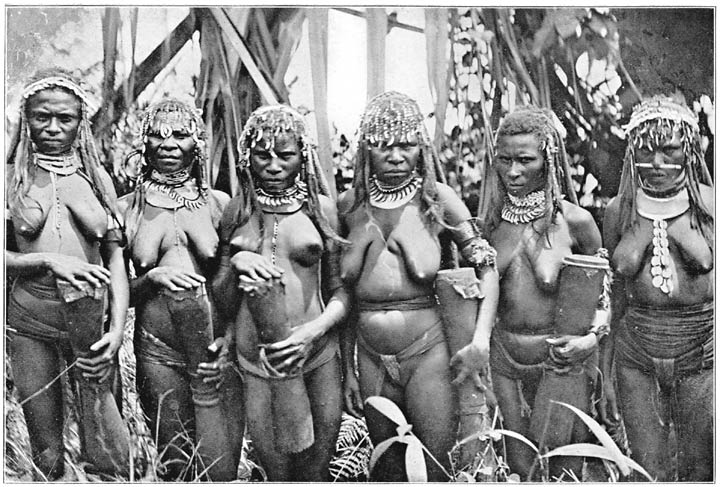
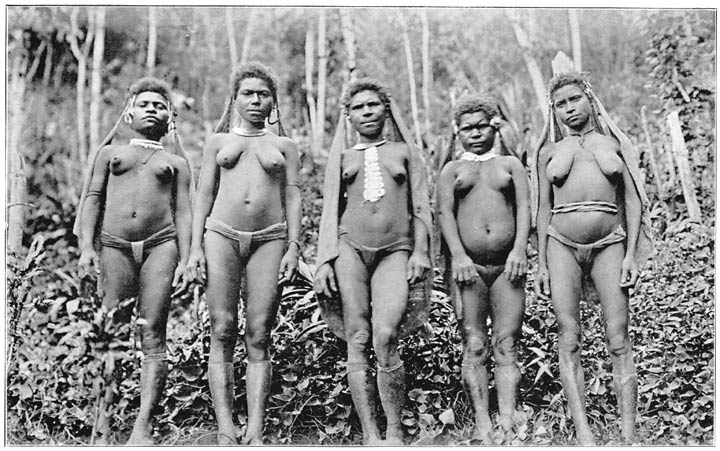
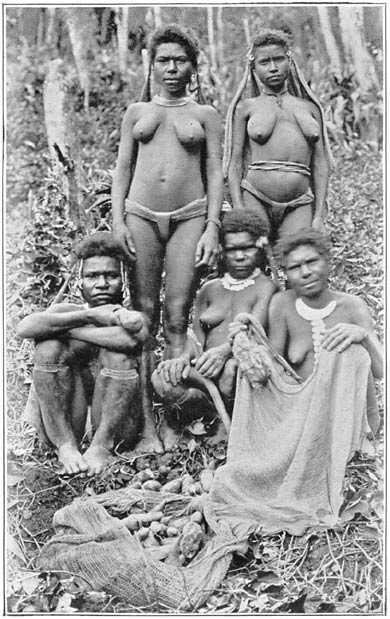
18 and 19 has three of them. Belt No. 4 is worn by one of the men figured in Plates 7 and 8 (he has three of them). Belt No. 7 is worn by one or two of the women figured in the frontispiece, the one to the extreme
right having a many-stranded belt, and it is excellently illustrated in Plate 17.
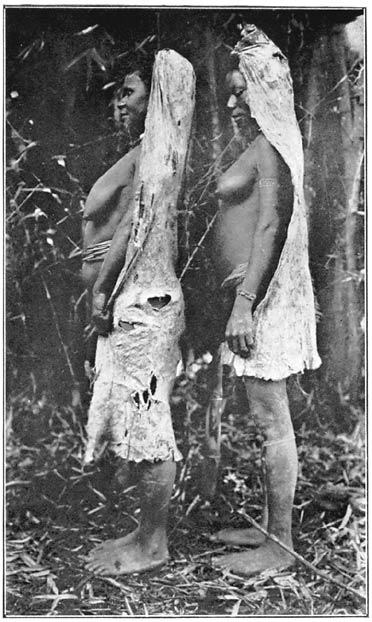
Capes made of bark cloth are made and worn by men and women. They are only put on after recovery from an illness by which
the wearer has been laid up, including childbirth. The cape is simply a plain long narrow piece of undyed bark cloth. The
corners of one end are fastened together, and the whole of that end is bunched up into a sort of hood, which is placed over
the head, whilst the rest of the cloth hangs down as a narrow strip behind. The cape in no way covers or conceals any part
of the body when viewed from the front or side. It is only worn for a few days; but whilst wearing it the wearer discards
all, or nearly all, his or her ornaments. I could learn no reason for the custom. Plates 18 and 19 [35]show these capes, and the way in which they are worn.
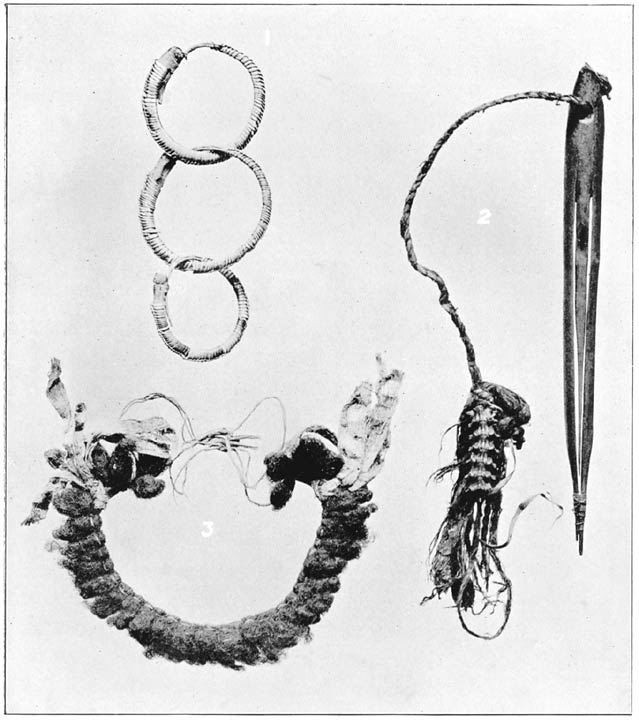
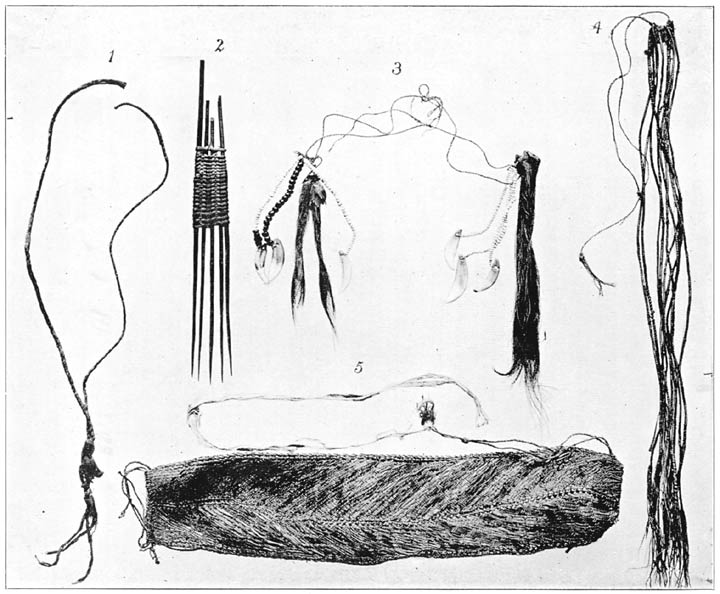
Mourning strings (Plate 30, Fig. 1) are made and worn by both men and women. These are plain undecorated necklaces varying much in size and appearance;
sometimes they are made of undyed twisted bark cloth, and vary in thickness from one-sixteenth of an inch to an inch; sometimes
they are only made of string, and are quite thin. There is always an end or tassel to the necklace, made out of the extremities
of the neck part, and hanging in front over the chest; and, if the necklace is of string, and not of bark cloth, some bark
cloth is twisted round this tassel. This sign of grief is after a death worn by the widow or widower or other nearest relative
(male or female) of the deceased; and at times two people of equal degree of relationship will both wear it. It is worn until
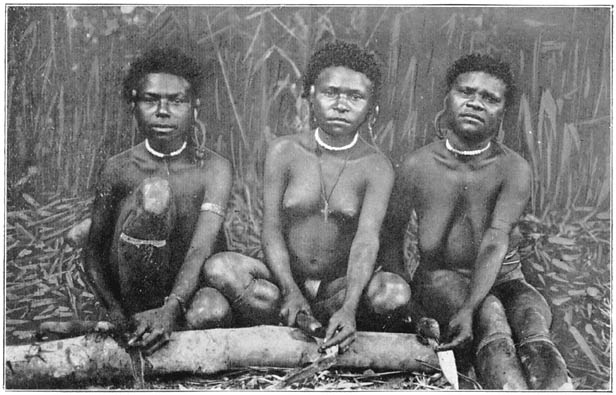
the formal ending of the mourning. The woman to the extreme right in Plate 26 is wearing one of these.
Widows’ vests. These are mourning garments, only worn by the widows of chiefs. The garment, which is made by women, is a vest
made of string network (like a string bag), the mesh of which is the special Mafulu mesh, which will be described hereafter,
and it is not coloured. It is plainly and simply made, with openings at the top for the neck, and at the sides for the arms
(no sleeves), and coming down to about the waist, without any other opening either in front or at the back. This garment is
also worn until the formal end of the period of [36]mourning.7 I was unable to secure a picture of one of these.
There is no special dress for chiefs to distinguish them from other people.
European calico clothing has not been adopted by these people, even in the district where they are in touch with the missionaries.
Indeed I may say that the people, happily for their own health, show no inclination to wear more clothing; and no doubt as
a result of their conservatism in this respect they escape many a fatal cold and attack of pneumonia, and the spread of infectious
skin diseases is somewhat reduced. I may also add that the Bishop and Fathers of the Mission do not attempt, or seem to desire,
to urge the people who come under their influence to endanger their health and their lives for the sake of conforming to views
as to clothing which have played such havoc with tropical natives in many parts of the globe.8
Physical Body Decoration, &c.
Tattooing and body-scarring are not practised by either men or women among the Mafulu.
Depilation. When a young man’s beard begins to grow, the hairs of the beard and moustache and eye-brows [37]are extracted. No other depilation is practised by men, and none whatever by women; and none of them shave any part of the
body. The depilation is effected with two fibre threads twisted round each other, the hair to be extracted being inserted
between the threads. Anyone can do this, and there is no ceremony connected with it.
Nose-piercing. The septa of the noses of both men and women are pierced at or after the age of 15 or 18, and either before
or after marriage. This is done for men by men, and for women by women. There is no special person whose duty it is to do
it, but he or she must be one who knows the incantations which are required. There is no restriction as to diet or otherwise
placed upon the operator prior to the operation, but there is a day’s food restriction imposed upon the person whose nose
is to be pierced.
Two instruments are used for the operation, one being a piercing instrument made of pig bone and sharpened, and the other
being a small wooden plug, also sharpened. The operator first visibly, but silently, engages in two incantations, during the
former of which he holds up the thumb and first finger of his right hand, and during the latter of which he holds up the two
instruments. He then with the thumb and first finger of his right hand holds the septum of the nose of the person to be operated
upon, whom I will call the “patient,” and with the left hand pierces the septum with the bone instrument. He next inserts
the wooden plug into the hole, so as to make it larger, and leaves the plug there. Then [38]he takes a blade of grass, which he also inserts through the hole, by the side of the plug, and, holding the grass by the
two ends, he makes it rotate round and round the plug. This is a painful process, which frequently causes tears and cries
from the patient. He then probably goes through the same process with various other patients, as it is the custom to operate
on several persons at the same time.
The patients are then all lodged in houses built for the purpose, one house being for men and one for women. These are not
houses which are kept permanently standing, but are specially built on each occasion on which the nose-boring operation is
going to be performed. A great swelling of the patients’ noses develops, and this spreads more or less over their faces. The
patients are confined in the special houses until the holes in their noses are large enough and the wounds are healed. During
this confinement each patient has himself to do what is requisite to further enlarge the hole by the insertion into it from
time to time of pieces of wood and by putting in rolled up leaves and pushing pieces of wood inside these leaves. During all
this period he is not allowed to come out of the house, at all events not so as to be seen, and his diet is confined to sweet
potato, cooked in a certain way. The cooking for all the patients, men and women, is done by the woman nose-piercing operator,
assisted by other women. The potatoes are wrapped up in leaves (usually banana), each potato being generally wrapped up separately
in one or more leaves; and, when so wrapped up, they are [39]cooked in red-hot ashes, and then taken to the houses where the patients are.
When the hole in any patient’s nose has reached the requisite size, and the wound is healed, he inserts a large croton leaf9 into the hole; he may then come out and return to his own house, retaining the croton leaf in his nose. He must next occupy
himself in searching for a black non-poisonous snake about 12 or 18 inches long, which is commonly found in the grass. I cannot
say what snake this is, but I am advised that it is probably Tropidonotus mairii. Its native name is fal’ ul’ obe, which means “germ of the ground.” Until he finds this snake he must keep the croton leaf in his nose, and is still under
the same restriction as to food, which is cooked in the same way and by the same persons as before. On finding the snake,
he secures it alive, removes the croton leaf from the hole in his nose, and inserts into it the tail end of the living snake;
then, holding the head of the snake in one of his hands, and the tail in the other, he draws the snake slowly through the
hole, until its head is close to the hole. He then lets the head drop from his hand, and with a quick movement of the other
hand draws it through the nose, and throws the snake, still living, away.10 This [40]completes the nose-piercing; but there still rests upon the patient the duty of going to the river, and there catching an
eel, which he gives to the people who have been feeding him during his illness.
The nose-piercing is generally done at one of the big feasts; and, as these are rare in any one village, you usually find
in the villages many fully-grown people whose noses have not been pierced; though as to this I may say that nose-piercing
is more generally indulged in by chiefs and important people and their families than by the village rank and file. It commonly
happens, however, that a good many people have to be done when the occasion arises. Each person to be operated upon has to
provide a domestic pig for the big feast. I have been unable to discover the origin and meaning of the nose-piercing ceremony.11
Ear-piercing is done to both men and women, generally when quite young, say at seven or twelve years of age. Both the lower
and the upper lobes are pierced, sometimes only one or the other, and sometimes both; but the lower lobe is the one more commonly
pierced. They can do it themselves, or can get someone else to do it. There is no ceremony. The [41]piercing is done with the thorn of a tree, and the hole is afterwards gradually widened by the insertion of small pieces of
wood. They never make large holes, or enlarge them greatly afterwards, as the holes are only used for the hanging of pendants,
and not for the insertion of discs. After the piercing the patient must, until the wound is healed, abstain from all food
except sweet potato; but there is no restriction as to the way in which this food is to be cooked, or the person who is to
cook it. There is as regards ear-piercing no difference between the case of chiefs’ children and those of other people.
Body-staining is usual with both men and women, who do it for themselves, or get others to help them. There is no ceremony
in connection with it. The colours generally adopted are red, greyish-yellow and black. The red stain is procured from an
earth, which is obtained from the low countries; but they themselves also have an earth which is used, and produces a more
bronzy red. The yellow stain is also got from an earth. All these coloured earths are worked into a paste with water, or with
animal fat, if they can get it. I think they also get a red stain from the fruit of a species of Pandanus; but I am not quite
clear as to this. The black stain is obtained from crushed vegetable ashes mixed with fat or water. The staining of the face
is usually of a simple character. It may cover the whole face all in one colour or in different colours, and often one side
of the face is stained one colour, and the other side another colour. They also make stripes and spots or [42]either of them of any colour or colours on any part of the face. The red colour (I think especially that obtained from the
Pandanus fruit) is also often applied in staining the whole body, this being especially done for dances and visiting; though
a young dandy will often do it at other times. The black is the symbol of mourning, and will be referred to hereafter.
Hairdressing may be conveniently dealt with here. The Mafulu hairdressing is quite simple and rough, very different from the
big, spreading, elaborately prepared and carefully combed mops of Mekeo. This is a factor which a traveller in this part of
New Guinea may well bear in mind in connection with his impedimenta, as he has no difficulty in getting the Kuni and Mafulu
people to carry packages on their heads, which the Mekeo folk are unwilling to do.
The modes in which the men dress their hair, so far as I was able to notice, may be roughly divided into the following categories:—(a) A simple crop of hair either cut quite close or allowed to grow fairly long, or anything between these two, but not dressed
in any way, and probably uncombed, unkempt and untidy. This is the commonest form. (b) The same as (a), but with a band round the hair, separating the upper part of it from the lower, and giving the former a somewhat chignon-like
appearance, (c) The hair done up all over the head in three-stranded plaits a few inches long, and about an eighth of an inch thick, having
the appearance of short thick pieces of string, (d) The top of the head undressed, but the sides, and sometimes the back, of the head done up in plaits like (c). (e) A [43]manufactured long shaped fringe of hair, human, but not the hair of the wearer (Plate 20, Fig. 3), is often worn over the forehead, just under the wearer’s own hair, so as to form, as it were, a part of it, pieces
of string being attached to the ends of the fringe and passed round the back of the head, where they are tied. These fringes
are made by tying a series of little bunches of hair close to one another along the double string, which forms the base of
the fringe. Specimens examined by me were about 12 inches long and 1¼ inches wide (this width being the length of the bunches
of hair), and contained about twenty bunches. It is usual to have two or three of these strings of bunches of hair tied together
at the ends, thus making one broad fringe. These fringes are often worn in connection with styles (c) and (d) of hairdressing; but I never noticed them in association with (a) and (b).
I was told that men who have become bald sometimes wear complete artificial wigs, though I never saw an example of this.
The hairdressing of the women seemed to be similar to that of the men, except that I never saw the chignon-producing band,
that they do not wear fringes, and that the entire or partial plaiting of the hair is more frequently adopted by them than
it is by the men. I do not know whether the women ever indulge in entire wigs.
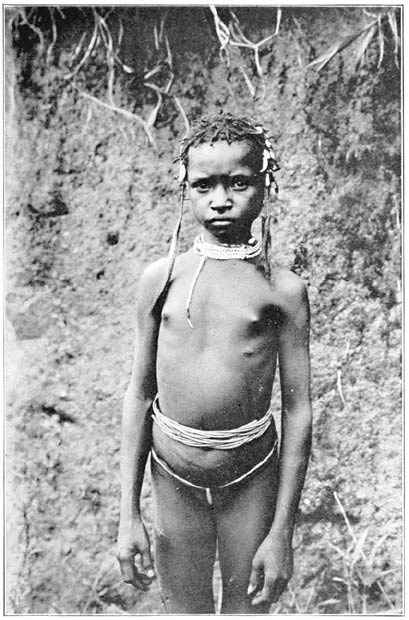
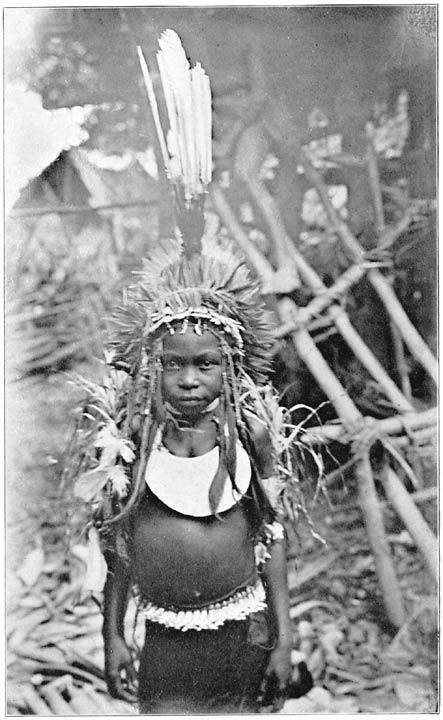
Method (a) is seen in many of the plates. Method (b) is illustrated, though not very well, in Plate 9 (the fourth and fifth man from the left) and in Plate 21 (the young man to the left, behind). Method (c) is adopted [44]by four of the women in the frontispiece, by some of the women in Plate 16, by the woman in Plate 17, and by the little girl in Plates 22 and 23. Method (d) is well illustrated by the second woman from the right in the frontispiece.
The cutting of the hair of both men and women is effected with sharp pieces of stone of the sort used for making adze blades,
or with sharp pieces of bamboo or shell.
Infant deformation is not practised in any form by the Mafulu people; nor do they circumcise their children.
Ornaments.
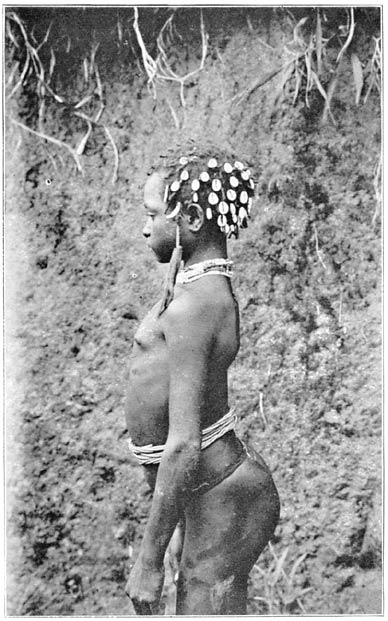
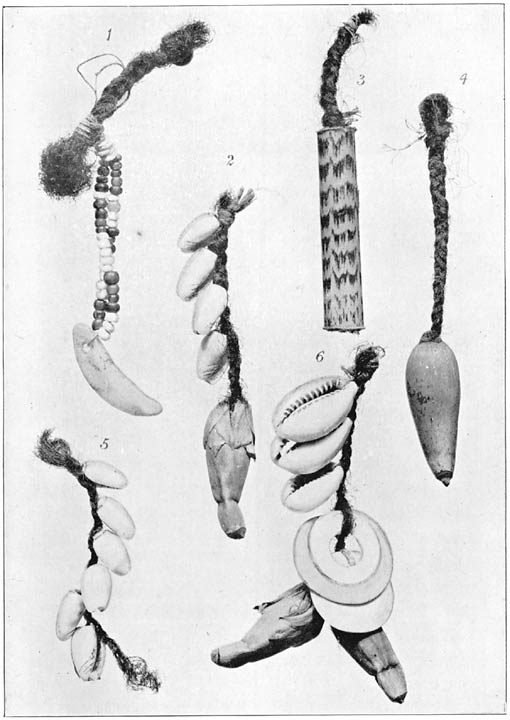
The string-like plaits in which men and women arrange their hair, and especially those of the women, are often decorated with
ornaments. Small cowrie and other shells, or native or European beads, or both, are strung by women on to these plaits, sometimes
in a line along all or the greater part of the length of the plait, sometimes as a pendant at the end of it, and sometimes
in both ways; and any other small ornamental object may be added. Dogs’ teeth are also used by both men and women in the same
way; but these are, I think, more commonly strung in line along the plaits, rather than suspended at the ends of them. Both
men and women wear suspended at the ends of these plaits wild betel-nut fruit, looking like elongated acorns; and men, but
not women, wear in the same way small pieces of cane, an inch or two long, into which the ends of the plaits are inserted.
[45]All these forms of decoration may be found associated together. They are in the case of men usually confined to the plaits
at the sides, being also often attached to the side ends of the artificial fringes; but they are sometimes used for the back
of the head also. The women often wear them also at the top of the head, and in wearing them at the sides sometimes have them
hanging in long strings reaching to the shoulders.
Plate 24 (Figs. 1, 2, 5, and 6) and Plate 25 (Figs. 2 and 4) are ornamented plaits cut off the heads of women. The ornaments shown include beads, shells, discs made out
of shells, dogs’ teeth and betel-nut fruit. Plate 24 (Figs. 3 and 4) are ornamented plaits cut off the heads of men, one of them having a cane pendant, and the other a pendant
of betel-nut.
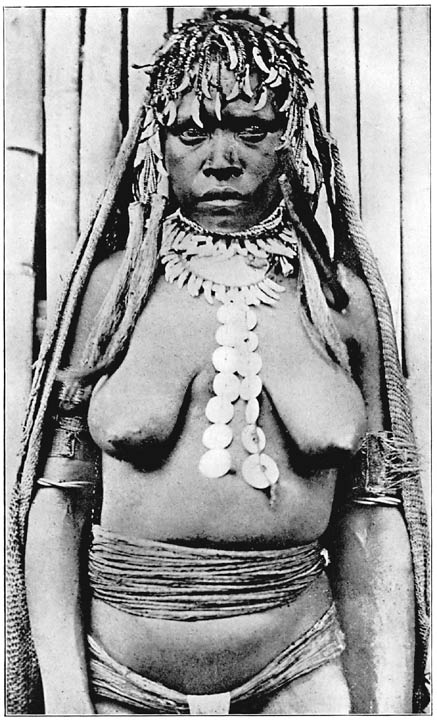
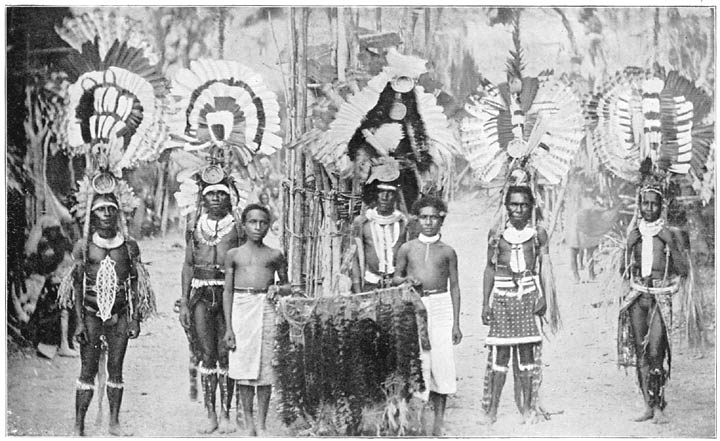
The appearance of these things, as worn, is seen in Plates 16, 26, 27, 28 and 29 (the habit of wearing a single dog-tooth at each side of the head, as shown by 27, being a common one, and 28 showing the equally common habit of wearing a couple of betel-nuts at each side). Their appearance, when worn in abundance
for a festal dance, is excellently shown in the frontispiece and in Plate 17; and the little girl in Plates 22 and 23, though too young to be a dancer, is decorated for an occasion.
Pigs’ tails are a common head decoration for women, and are also worn, though not so frequently, by men. These tails are covered
with the natural hair of the tail, and are brown-coloured. They are suspended by strings passing round the crown of [46]the head or from the plaits at the sides of the head. They are generally only about 6 inches long; but sometimes the ornaments
into which they are made are much longer, and I have seen them worn by women hanging down as far as the level of the breast.
These pigtails are sometimes worn hanging in clusters of several tails. They are also often, in the case of women, decorated
with shells, beads, dogs’ teeth, etc., which are attached like tassels to their upper ends.12
Plate 30, Fig. 3 shows a pigtail ornament for hanging over the head, with the tails suspended on both sides and strings of beads and
dogs’ teeth hanging from the upper ends of the tails. The ornament is worn by the middle man in Plate 9 and by the little girl figured in Plates 22 and 23, and it is seen more extensively worn by women decorated for dancing in the frontispiece and in Plate 17, and by the girl in Plate 71.
A peculiar and less usual sort of head ornament (Plate 30, Fig. 4), worn by both men and women, is a cluster of about a dozen or less of bark cloth strings, about 1½ feet long, fastened
together at the top, and there suspended by a string tied round the top of the head, so as to hang down like the lashes of
a several-thonged whip over the back. The individual strings of the cluster are quite thin, but they [47]are decorated with the yellow and brown straw-like material above referred to in connection with abdominal belt No. 6 (being
prepared from the same plant, apparently Dendrobium, and in the same way), the material being twisted in a close spiral round
the strings, and making them look, when seen from a short distance off, like strings of very small yellow and brown beads,
irregularly arranged in varying lengths of the two colours, shading off gradually from one to the other. Even when so bound
round, these strings are only about 1/16 to ⅛ of an inch thick.
The Mafulu comb (Plate 30, Fig. 2) differs in construction from the wooden combs, all made in one piece, which are commonly used in Mekeo. It is made
of four, five, or six thin pieces of wood, which are left blunt at one end, but are sharpened to points at the other. These
are bound together with straw-like work, sometimes beautifully done, the binding being nearly always near to the blunt ends,
though it is sometimes almost in the middle.13 The combs so made are flat, with the blunt ends converging and generally fastened together, and the long sharp ends, which
are the ends to be inserted into the hair, spreading outwards. The bound-up blunt ends are in fact a point, or, say, half
an inch or less (occasionally more) across. The spread of the sharp ends varies from 1 to 2 inches or more. The [48]straw-like binding may be light or dark brown, or partly one and partly the other. Sometimes only the two outside prongs meet
together at the blunt end, and the inner prongs do not extend much, or at all, beyond the upper edge of the straw-like work
binding. The fastening together of the blunt converging tips is done sometimes with native thread just at the tips, and sometimes
with a little straw work rather further down; occasionally it is missing altogether. The comb figured is not so converging
at the blunt ends or so spreading at the sharp ends as is usual, and its blunt ends are not bound together. These combs are
only worn by men; they are commonly worn in front, projecting forwards over the forehead, as is done in Mekeo; but they are
also worn at the back of the head, projecting sideways to either right or left. A feather (generally a white cockatoo feather),
or sometimes two feathers, are often inserted into the straw-like work of the comb, so as to stand up vertically when the
comb is worn, and there wave, or rather wag, backwards and forwards in the wind. I could not learn any significance in these
feathers, such as applies to many of the upright head feathers worn by the young men of Mekeo. The comb is worn by several
of the men figured in Plate 9, one of them wearing it in front and the others having it standing out sideways at the back.
The almost universal type of earring (Plate 20, Fig. 1), varying from 2 to 3 inches in circumference, is made out of the tail of the cuscus. The ring is made by removing
the hair from the animal’s tail, [49]drying the tail, and fastening the pointed end into or on to the blunt cut-off stump end, tying them firmly together. The
ring is then bound closely round with the yellow and brown material (Dendrobium) of belt No. 6; but a space of 1 or 2 inches
is generally left uncovered at the part where the two ends of the tail are fastened together. The simplest form is a single
earring, which passes through the hole in the ear; but I have seen two rings hanging to the ear; and frequently a second ring
is hung on to the first, and often a third to the second, and sometimes a fourth to the third; or perhaps, instead of the
fourth ring, there may be two rings hanging to the second one. In fact, there are varieties of ways in which the fancy of
the wearer and the number of rings he possesses will cause him to wear them. They are worn by both men and women.14 They may be seen in several plates, but unfortunately are not very clear. The most distinct are, I think, those worn by the
second woman from the left in Plate 26 and the woman on the left in Plate 28. The second woman from the left in the frontispiece has two of them hanging from her right ear.
Pigs’ tails, similar to those worn from the hair, are also worn by both men and women, especially the latter, suspended from
the ears; and here again they vary much in length, and are often decorated with tassel-like hanging ornaments of shells, beads,
etc.
Forehead ornaments (Plate 30, Fig 5) are made by [50]men and worn by them at dances. This ornament is a band, very slightly curved, which is worn across the forehead, just under
and surrounding the basis of the dancing feathers. It is generally about 16 inches long and between 4 and 5 inches broad in
the middle, from which it narrows somewhat towards the ends. Its manufacture consists of a ground basis of the material of
belt No. 5, into which are interplaited in geometric patterns the two black and yellow and brown materials which are used
for belt No. 6. It is fixed on to the forehead by means of strings attached to its two ends, and passing round, and tied at
the back of, the head.
Nose ornaments. These are straight pencil-shaped pieces of shell, generally about 6 inches long, which are passed through
the hole in the septum of the nose. They are only worn at dances and on special occasions; but the people from time to time
insert bits of wood or cane or bone or some other thing into the hole for the purpose of keeping it open. There are temporary
pegs in the noses of the fifth man to the left in Plate 9 and the man in Plate 10. The nose ornament is worn by the woman to the extreme right in the frontispiece.
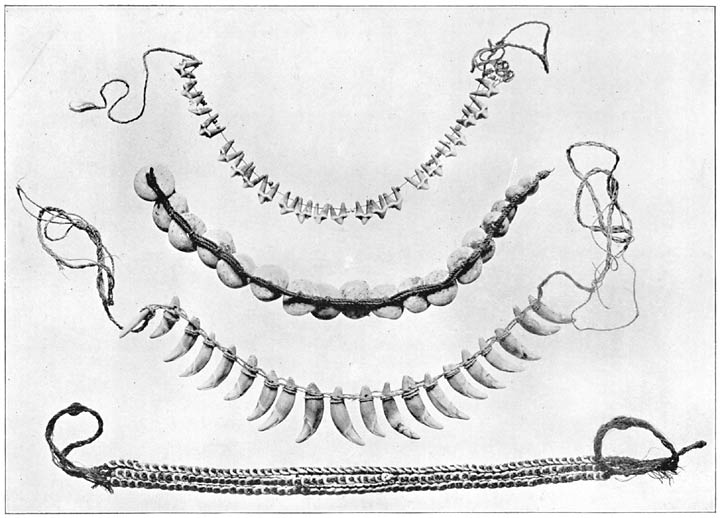
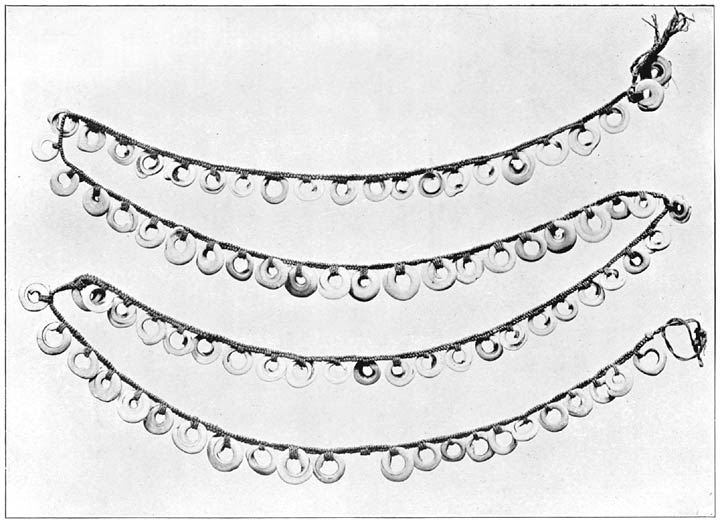
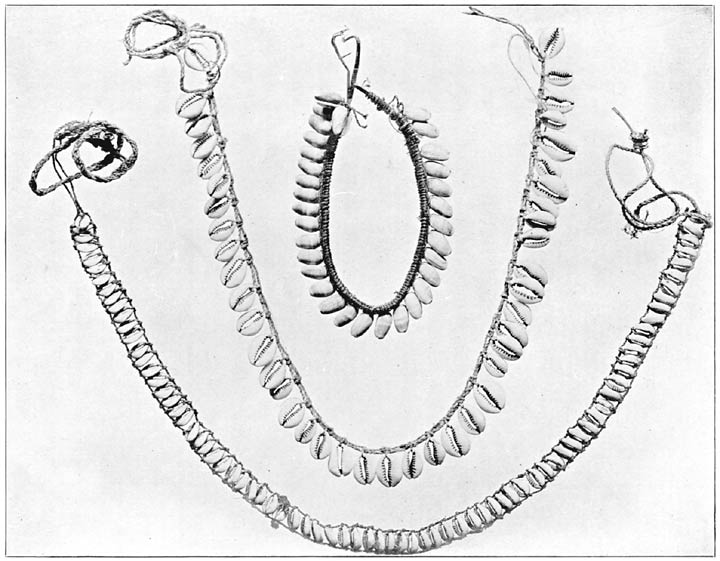
Necklaces and straight pendants, suspended from the neck and hanging over the chest, are common, though they are not usually
worn in anything approaching the profusion seen in Mekeo and on the coast. These are made chiefly of shells of various sorts
(cut or whole), dogs’ teeth and beads, as in Mekeo. The shells include the cowries and the small closely packed overlapping
cut shells so generally [51]used in Mekeo for necklaces, and the flat disc-like shell sections, which are here, as in Mekeo, specially used for straight
hanging pendants; also those lovely large crescent-shaped discs of pearl shell, which are well known to New Guinea travellers.
The shells are, of course, all obtained directly or indirectly from the coast; in fact, these are some of the chief articles
for which the mountain people exchange their stone implements and special mountain feathers, so the similarity in the ornaments
is to be expected; but it is only within a quite recent time that the pearl crescents have found their way to Mafulu. I do
not propose to describe at length the various forms of shell ornament, as they are very similar to, and indeed I think practically
the same as, those of Mekeo. Some of the necklaces are figured in Plates 31, 32 and 33, and they are worn by many of the people figured in other plates, especially the frontispiece and Plate 17. Straight pendant ornaments are seen in the frontispiece and in Plates 6, 17, 26 and others. The crescent-shaped pearl ornaments are seen in the frontispiece and in Plates 6, 7, 16, 28 and others, a very large one being worn by the little girl in Plate 71.
There is, however, one shell necklace which is peculiar to the mountains, and, I think, to Mafulu (I do not know whether the
Kuni people also wear it), where it is worn as an emblem of mourning by persons who are relatives of the deceased, but who
are not sufficiently closely related to him to stain themselves with black during the period of mourning. This necklace is
made of white cowrie shells varying in size [52]from half an inch to an inch long, each of which has its convex side ground away, so as to show on one side the untouched
mouth of the shell and on the other an open cavity. The shells are strung, sometimes closely and sometimes loosely, on to
a double band of thin cord. Specimens of this type of necklace measured by me varied in length from 36 inches (with 97 shells)
to 20 inches (with 38 shells). It is worn until the period of mourning is formally terminated. The middle necklace in Plate
33 is a mourning shell necklace, and it is seen on the neck of the woman to the right in Plate 29.
Pigs’ tail ornaments similar to those already described are also worn suspended by neck-bands over the chest.
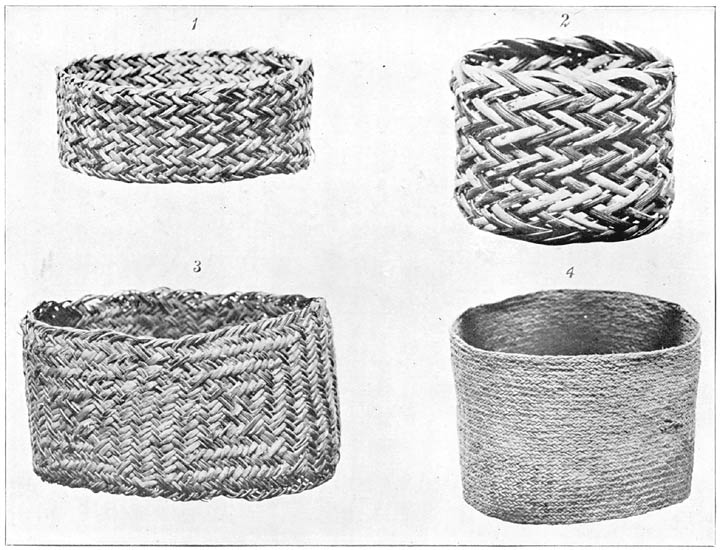
Armlets and wrist-bands are worn by both men and women, and more or less by children, including quite young ones, at the higher
end of the upper arm and just above the wrist. They are made by men only, and vary in width from half an inch to 5 or 6 inches,
the wider ones being generally worn on the upper arm. There are several common forms of these: (1) The more usual form (Plate
34, Fig. 4) is made of the thin and finely plaited stone-grey material described in abdominal belt No. 5, and is made in the
same way, subject to the difference that the plaiting is more closely done. Measured specimens of this armlet varied in width
from 1 to 2¼ inches, and displayed different varieties of diagonal twill stitch. (2) Another common form (Plate 34, Fig. 3) is made of the coarser-plaited black and yellow and brown [53]materials described concerning No. 6 belt, and is made in the same way. Specimens of this armlet varied in width from 1 to
5 inches. (3) There is another form which in fineness of material and plait is between Nos. 1 and 2. I was told that this
is made out of another creeping plant, and is left in its own natural unstained colour, which, however, in this case is a
dull brown red. (4) Another form (Plate 34, Fig. 2) is made of the coarse dull red-brown and stone-yellow materials described with reference to belt No. 2, and is made
in the same way. A specimen of this armlet was 2¼ inches wide. (5) Another form (Plate 34, Fig. 1) is in make something like No. 4, but the two materials used are the stone-yellow material of belt No. 2 and the
black material of belt No. 6, and the plaiting materials are much finer in thickness than are those of armlet No. 4. Specimens
of this armlet varied in width from ¾ to 1¼ inches. (6) The beautiful large cut single-shell wrist ornament, commonly worn
on the coast and plains, whence the Mafulu people procure it. Armlets will be seen worn by many of the people figured in the
plates.
There is no practice of putting armlets on young folk, and retaining them in after life, so as to tighten round and contract
the arm.
Leg-bands (Plate 25, Fig. 1) and anklets are worn by both men and women, and also by children, just below the knee and above the ankle.
There is a form of plaited leg-band somewhat similar in make to armlet No. 5, and between half-an-inch and an inch in width,
though the colour of this [54]leg-band is a dull brown. But the usual form of leg-band and anklet is made by women only out of thread fibre by a process
of manufacture quite distinct from the stiff plait work adopted for some of the belts and for the armlets. They make their
thread out of fine vegetable fibre as they proceed with the manufacture of the band, rolling the individual fibres with their
hands upon their thighs, and then rolling these fibres into two-strand threads, and from time to time in this way making more
thread, which is worked into the open ends of the then working thread as it is required—all this being done in the usual native
method.
I had an opportunity of watching a woman making a leg-band, and I think the process is worth describing. She first made a
thread 5 or 6 feet long by the method above referred to, the thread being a two-strand one, made out of small lengths about
5 or 6 inches long of the original fibre, rolled together and added to from time to time until the full length of 5 or 6 feet
of thread had been made. The thread was of the thickness of very coarse European thread or exceedingly fine string. She next
wound the thread into a triple loop of the size of the proposed leg-band. This triple loop was to be the base upon which she
was to make the leg-band, of which it would form the first line and upper edge. It was only about 11 inches in circumference,
and thus left two ends, one of which (I will call it “the working thread”) was a long one, and the other of which (I will
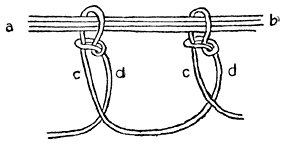
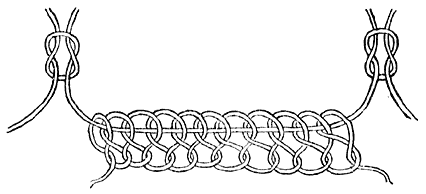
call it “the inside thread”) was a short one. Both these threads [55]hung down together from the same point (which I will call “the starting point”). She then, commencing at the starting point,
worked the working thread round the triple base by a series of interlacing loops in the form shown (very greatly magnified)
in Fig. 1; but the loops were drawn quite tight, and not left loose, as, for the purpose of illustration, I have had to make
them in the figure. This process was carried round the base until she had again reached the starting point, at which stage
the base, with its tightly drawn loop work all around it, was firm and strong, and there were still the two ends of thread
hanging from the starting point. Here and at subsequent stages of the work she added to the lengths of these two ends from
time to time in the way above described when they needed it, and the two ends of thread were therefore always present. Then
began the making of the second line. This was commenced at the starting point, from which the two ends of thread hung, and
was effected by a series of loops made with the working thread in the way already described, except that these loops, instead
of passing round the whole of the base line, passed through holes which she bored with a thorn, as she went on, in the extreme
bottom edge of that line, and also that, in making this second line, she passed the inside thread through each loop before
she drew the latter tight; so that the [56]second line was itself composed of a single internal thread, around which the loops were drawn. The second line was continued
in this way until she again reached the starting point (but, of course, one line lower down), from which the two ends of thread
hung down as before. The third and following lines were made by a process identical with that of the second one, the holes
for each line being pricked through the bottom of that above it. I did not see the completion of the band, but I may say that
the final line is similar to the second and subsequent ones, and is not a triple-threaded line like the first one. It was
amazing to see this woman doing her work. She was an old woman, but she did the whole of the work with her fingers, and she
must have had wonderful eyesight and steadiness of hand, as she made the minute scarcely visible prick holes, and passed the
end of her working thread through them, with the utmost apparent ease and quickness.
The band thus produced is of very small, close, fine work, and is quite soft, flexible and elastic, like European canvas,
instead of being stiff and hard, like the plaited belts and armlets. The band is generally about an inch (more or less) in
width. It is not dyed or coloured in any way, but is often decorated with beads, which are worked into the fabric in one or
more horizontal lines, but as a rule, I think, only at irregular intervals, and not in continuous lines. These bands and anklets
are seen in many of the plates. In Plates 10, 11 and 12 the bead decorations are seen.
[57]
Dancing aprons are made out of bark cloth by both men and women, but coloured by men only. The apron, which is worn at dances
by women only, is about 6 to 12 inches wide. It is worn, as shown in Plate 35, in front of the body, being passed over the abdominal belt or a cord so as to hang over it in two folds, one behind the
other; and the front fold, which is the part which shows (the back fold being more or less concealed), and is generally 18
inches to 2 feet in length, has at its base a fringe made by cutting the end of the cloth up into strips, equal or unequal
in width, the number of which may be only six or less, or may be fifteen or twenty. The front fold is often wholly or partly
stained, the colour of the stain being usually yellow, and is always more or less covered with a decorative design, the colours
of which are usually black and red. The back fold is generally stained yellow, but never has any design upon it. The fringe
is also usually stained yellow, and is without design, except occasionally perhaps a few horizontal lines of colour.
I may say here, as regards these colours, that, so far as my observation went, the colours of the decorative patterns were
always black and red, and the general staining was always yellow; and indeed the last-mentioned colour does not show up against
the natural colour of the cloth sufficiently clearly to adapt it for actual design work. I am not, however, prepared to say
that this allocation of the colours is in fact an invariable one; and, as I know that red is used for general staining of
perineal bands and dancing [58]ribbons, it is possible that it, as well as yellow, is used for aprons.
Numerous variations of design are to be found in these garments; and indeed I may say that it is in these and in the feather
head decorations that the Mafulu people mainly indulge such artistic powers as they possess.
Plates 36 to 43 are examples of decoration of the front folds of these dancing aprons15; and I give the following particulars concerning them, first stating that, subject to what may appear in my particulars,
the darker lines and spots represent black ones in the apron, and the lighter ones represent red ones.
| Plate.
|
Average width of apron in inches.
|
Notes on ground staining and other matters.
|
| 36
|
6½
|
Background of design unstained, but back fold of apron and fringe stained yellow.
|
| 3716
|
7¾
|
Ditto ditto ditto
|
| 38
|
5¼
|
Only a little irregular yellow staining behind the design. Back fold of apron and fringe stained yellow.
|
| 39
|
6
|
Background of design (except fringe part) unstained, but back fold of apron and fringe stained yellow.
|
| 40
|
7
|
Background of upper (zig-zag) part of design unstained, but that of lower (rectangular) part and whole of back fold of apron
and fringe stained yellow.
|
| 41
|
10½
|
Faintly tinted broad horizontal and vertical lines and triangles in figure represent yellow stain. No other staining in the
apron.
|
| 42
|
6¾
|
Background of design unstained, but back fold end of apron and fringe stained yellow.
|
| 43
|
6¾
|
No background staining in the apron. The smallness of the amount of decoration and the substitution of two tails for a fringe
are, I think, unusual.
|
[59]
Dancing ribbons are made out of bark cloth by both men and women, but are coloured by men only. These are worn by both men
and women at dances, the ribbons hanging round the body from the abdominal belt or a cord, three or four or five of them being
worn by one person, and one of these commonly hanging in front. They are generally 2 or 3 inches wide and about 4 feet long,
but a portion of this length is required for hitching the ribbon round the belt. I think their ornamentation is confined to
staining in transverse bands of alternating colour or of one colour and unstained cloth. Plate 13, Fig. 4, illustrates the colouring of two ribbons (each 2 inches wide), the alternation in one case being red and yellow, and in
the other red and unstained cloth; and the men figured in Plate 70 are wearing ribbons, though they are not very clearly shown in the plate.
The feather ornaments for the head, and especially those worn at dances, and the feather ornaments worn on the back at dances
present such an enormous variety of colours and designs that it would be impossible to describe them here without very greatly
increasing the length of the book. The ornaments are often very large, sometimes containing eight or ten or even twelve rows
of feathers, one behind another. They can usually be distinguished from those made by the Mekeo people by a general inferiority
in design and make of the ornament as a whole, the Mafulu people having less artistic skill in this respect than the people
of the lowlands. The ornaments include feathers of parrots, cockatoos, hornbills, [60]cassowaries, birds of paradise, bower birds and some others. One never or rarely sees feathers of sea-birds, or waterfowl,
or Goura pigeons (which, I was told, are not found among the mountains), as the Mafulu people in their trading with the people
of the plains take in exchange things which they cannot themselves procure, rather than feathers, which are so plentiful with
them.
The black cassowary feather is important in Mafulu as being the special feather distinction of chiefs; but, though chiefs
are as a rule possessed of more and better ornaments than are the poorer and unimportant people, they have no other special
and distinctive ornament.
Plates 44 and 45 illustrate some of these head feather ornaments. Plate 44, Fig. 1, shows an ornament made out of the brown fibrous exterior of the wild betel-nut, black pigeon feathers and white
cockatoo feathers, the betel fibre and black pigeon feathers being, I was told, only used in the mountains. Plate 44, Fig. 2, shows one made out of brown feathers of young cassowary, white cockatoo feathers and red-black parrot feathers.
Plate 44, Fig. 3, shows one made out of bright red and green parrot feathers. Plate 45, Fig. 1, shows one made out of black cassowary feathers, white cockatoo feathers, red parrot feathers and long red feathers
of the bird of paradise. Plate 45, Fig. 2, is made of cassowary feathers only. This ornament is worn in front of the head, over the forehead, and is specially
worn by chiefs.
Plate 46, Fig. 1, shows a head feather ornament which is peculiar to the mountains. The crescent-shaped [61]body of the ornament, which is made of short feathers taken from the neck of the cassowary, is worn in front over the forehead,
and the cockade of hawk feathers stands up over the head.
Plate 46, Fig. 2, shows a back ornament of cassowary feathers which is specially intended to be worn by chiefs at dances. The custom
is to have from five to twelve of these ornaments hanging vertically side by side, suspended to a horizontal stick, which
is fastened on the chief’s back at the height of the shoulders, so that the feathers hang like a mantle over his back. The
mode in which feather ornaments for the back are hung on sticks is seen in Plate 70, where a stick with pendant ornaments is being held by two boys in front.
Plaited frames (Plate 47) are worn by men in connection with these head feather ornaments. These frames are flat curved bands, rigid or nearly so,
generally forming half or nearly half a circle of an external diameter of about 9 inches, and being about 1 inch in width.
They are worn at dances and on solemn occasions. They are placed round the top of the forehead, not vertically, but with their
upper edges sloping obliquely forward, and have at their ends strings, which pass over the ears and are tied at the back of
the head. These frames help to support the feather ornaments, and prevent them from falling down over the face. They are made
by men only. A groundwork of small split cane or other material runs in parallel curved lines from end to end, single pieces
of the material being generally doubled back at the [62]ends so as to form several lines; and this is strengthened and ornamented by interplaiting into it either split cane or some
other material obtained from the splitting of the inside fibre of a plant in the way previously referred to. There are varieties
of material and of pattern worked up in different designs of interplaiting. Some of the materials are uncoloured or merely
the natural colour of the material, and others are in two colours, generally brown or reddish-brown and yellow. These frames
display a considerable amount of variety of artistic design.
The feather erections used at special and important dances, and especially those worn by chiefs, are enormous things, towering
6 or 12 feet above the wearer’s head, and are generally larger than those of Mekeo. They are held in a framework, which has
an inverted basket-shaped part to rest on the head, and downward pointing rods, which are tied to the shoulders. The frames
are to a great extent similar to those of Mekeo, but, having a larger burden to bear, they are more strongly made. These feather
erections and their frames are seen in Plate 70.
Here, as in other parts of New Guinea, both men and women, but especially men, love to decorate themselves with bright flowers
and leaves and grasses, these being worn in the hair and in bunches stuck into their belts, armlets and leg-bands, and indeed
in any places where they can be conveniently fastened.
It is not the practice with the Mafulu for mothers to wear the umbilical cords of any of their children, though apparently
the Kuni people do so.
[63]
[Contents]
Daily Life and Matters Connected with It
Daily Life.
The early morning finds the wife and young children and unmarried daughters in the house. The husband has been sleeping either
there or in the emone (clubhouse), but most probably the latter. The unmarried sons are in the emone, except any very young ones, who have not been formally admitted to it in a way which will be hereafter described. The women
cook the breakfast for the whole family inside the house at about six or seven o’clock, and then take the food of the men
to the emone. After breakfast most of the men and women go off to the gardens and the bush. The women’s work there is chiefly the planting
of sweet potatoes, taro and other things, and cleaning the gardens; and in the afternoon they get food from the gardens and
firewood from the bush, all of which they bring home to the village; also they have to clear off the undergrowth from newly
cleared bush. The men’s work is mainly the yam and banana and sugar-cane planting, each in its season, and the cutting down
of big trees and making fences, if they happen [64]to be opening out new garden land. They also sometimes help the women with their work. Or they may have hunting expeditions
in the bush, or go off in fishing parties to the river. In all matters the men of Mafulu, though lazy, are not so lazy as
those of Mekeo and the coast. In the middle of the day the women cook the meal for everyone in the gardens, this being done
on the spot, and there they all eat it. At three, four, or five o’clock all the people of the village have returned to it,
except perhaps when they are very busy taking advantage of good weather for making new clearings or other special work. In
the evening they have another meal cooked in the village. At every meal in the village the pigs have to be fed also, these
sharing the food of the people themselves, or feeding on raw potatoes. Unless there is dancing going on, or they are tempted
by a fine moonlight night to sit out talking, the people all terminate their routine day by going to bed early.
As regards the daily social conduct of the people among themselves, I was told that the members of a family generally live
harmoniously together (subject as regards husbands and wives to the matters which will be mentioned later), that children
are usually treated kindly and affectionately by their parents, and that there is very little quarrelling within a village;
and what I saw when I was among the Mafulu people certainly seemed to confirm all this.
There are various detailed matters of daily life which will appear under their appropriate headings; but I will here deal
with a few of them.
[65]
Food.
The vegetable foods of the Mafulu people are sweet potato and other plants of the same type, yam and other foods of the same
type, taro and other foods of that type, banana of different sorts, sugar-cane, a kind of wild native bean, a cultivated reed-like
plant with an asparagus flavour (what it is I do not know), several plants of the pumpkin and cucumber type, one of them being
very small, like a gherkin, fruit from two different species of Pandanus, almonds, the fruit of the malage (described later on), and others, both cultivated and wild. The sugar-cane is specially eaten by them when working in the
gardens.1
Their animal food consists of wild pig and, on occasions, village pig, a small form of cassowary, kangaroo, a small kind of
wallaby, kangaroo rat, “iguana,” an animal called gaivale (I could not find out what this is), various wild birds, fish, eels, mice, a large species of snake and other things.
Their staple drink is water, but when travelling they cut down a species of bamboo, and drink the watery fluid which it contains.
After boiling any food in bamboo stems they drink the water which has [66]been used for the purpose, and which has become a sort of thin flavoured soup.
Betel-chewing is apparently not indulged in by these people as extensively as it is done in Mekeo and on the coast; but they
like it well enough, and for a month or so before a big feast, during which period they are under a strict taboo restriction
as to food, they indulge in it largely. The betel used by them is not the cultivated form used in Mekeo and on the coast,
but a wild species, only about half the size of the other; and the lime used is not, as in Mekeo and on the coast, made by
grinding down sea-shells, but is obtained from the mountain stone, which is ground down to a powder. The gourds (Plate 51, Figs. 6 and 7) in which the lime is carried are similar to those used in Mekeo, except that usually they are not ornamented,
or, if they are so, the ornamentation is only done in simple straight-lined geometric patterns. The spatulae are sometimes
very simply and rudely decorated. The people spit out the betel after chewing, instead of swallowing it, as is the custom
in Mekeo.
Cooking and Eating and Their Utensils.
They have no cooking utensils, other than the simple pieces of bamboo stem, which they use for boiling.
Their usual methods of cooking are roasting and boiling.
Roasting is usually effected by making a fire, letting [67]it die down into red-hot ashes, and then putting the food without wrap or covering into the ashes, turning it from time to
time. They also roast by holding the food on sticks in the flame of the burning fire, turning it occasionally. Stone cooking
is adopted for pig and other meats. They make a big fire, on the top of which they spread the stones; when the stones are
hot enough, they remove some of them, place the meat without wrap or covering on the others, then place the removed stones
on the meat, and finally pile on these stones a big covering of leaves to keep in the heat. Stone cooking in the gardens is
done in a slightly different way; there they dig in the ground a round hole about 1 foot deep and from 1½ to 2 feet in diameter,
and in this hole they make their fire, on which they pile their stones; and the rest of the process is the same as before.
This hole-making process is never adopted in the village. The only reason for it which was suggested was that the method was
quicker, and that in the gardens they are in a hurry. Of course, holes of this sort dug in the open village enclosure would
be a source of danger, especially at night.
Boiling is done in pieces of bamboo about 4 inches in diameter and about 15 or 18 inches long. They fill these with water,
put the food into them, and then place or hold the bamboo stems in a slanting position in the flames. This method is specially
used for cooking sweet potatoes, but it is their only method of boiling anything. Water, which they keep stored and carry
in bamboo receptacles and hollow pumpkins, is boiled in bamboo stems in the same way. The bamboo [68]storage vessels are generally from 2 to 5 feet long, the intersecting nodes, other than that at one end, having been removed.
The pumpkins (Plate 52, Figs. 2 and 3) are similar to those used by the Roro coast people and in Mekeo, except that the usual form, instead of being
rather short and broad with a narrow opening, is longer and narrower, some of them being, say, 3 feet long, and often very
curved and crooked in shape.
Their only eating utensils are wooden dishes and small pieces of wood, or sometimes of cassowary or kangaroo bone, which are
used as forks, and pieces of split bamboo, which are used for cutting meat; but these latter are used for other purposes,
and rather come within the list of ordinary implements, and will be there described. They also use prepared pig-bones as forks;
but these again are largely used for other purposes, and will be described under the same heading.
The dishes (Plate 52, Fig. 1) are made out of the trunk of a tree called ongome. The usual length of a dish, without its handles, is between 1 and 2 feet; its width varies from 9 inches to 1 foot, and
its depth from 3 to 6 inches. It is rudely carved out of the tree-trunk,2 the work being done with stone adzes—unless they happen to possess European axes—and it generally has a handle at one or
both ends. It is not decorated with carving in any way. The common form of handle is merely a simple knob about 3 inches long
and 1½ inches wide. But it is sometimes less [69]simple, and I have a dish one of the handles of which is divided into two projecting pieces about 7½ inches long and joined
to each other at the end. The handle is always carved out of the same piece of wood as is the dish; never made separately
and afterwards attached. The wooden forks are simply bits cut from trees and sharpened at one end, and they are without prongs.
Their use is only temporary, and they are not permanently stored as household utensils. The cassowary and kangaroo bone implements
(Plate 25, Fig. 3) are also merely roughly pointed unpronged pieces of bone, and otherwise without special form. When eating en famille they do not always use these pointed wooden and bone sticks, but very commonly take the food out of the dish with their hands
only; but if the family had guests with them they would probably use the sticks more, and their hands less. The men and women
often eat together, sitting round the dish and helping themselves out of it, though, if there are too many to do this conveniently,
pieces will be handed out to some of them.
Various Implements.
Besides the cooking and eating implements above described and other things, such as weapons of war and of hunting and fishing,
and implements for manufacture, agriculture and music, which will be dealt with under their own headings, there are a few
miscellaneous things which may be conveniently described here.
Bamboo knives (Plate 51, Fig. 5). These are [70]simple strips made out of a special mountain form of bamboo, and are generally 8 to 10 inches long and about 1 inch wide.
One edge is left straight for its whole length, and the other is cut away near the end, very much as we cut away one side
of a quill pen, so as to produce a sharp point. The side edge which is used for cutting is the one which is not cut away at
the end; and when it gets blunt it is renewed by simply peeling off a length of fibre, thus producing a new edge, bevelled
inwards towards the concave side of the implement, and making a hard and very sharp fresh cutting edge. The point can of course
be sharpened at any time in the obvious way.
Pig-bone implements (Plate 51, Fig. 2). These are the implements which are often used as forks, but they have straight edges also with which they are used
as scraping knives, and they are utilised for many other purposes. The implement, which is, I think, similar to what is commonly
found in Mekeo and on the coast, is made out of the leg-bone of a pig, and is generally from 5 to 8 inches long. One side
of the bone is ground away, so as to make the implement flattish in section, one side (the outside unground part of the bone)
being somewhat convex, and the other (where the bone has been ground away) being rather concave. Some of the joint end of
the bone is left to serve as a handle; and from this the bone is made to narrow down to a blunt, rather flattish and rounded
point, somewhat like that of a pointed paper-cutter. The side edge is used for scraping, and the point for sticking into things.
[71]
Smoking pipes are in the ordinary well-known form of Mekeo and the coast, being made of sections of bamboo stem in which the
natural intersecting node near the mouthpiece end is bored and the node at the other end is left closed, and between these
two nodes, near to the closed one, is a flute-like hole, in which is placed the cigarette of tobacco wrapped up in a leaf.
They are, however, generally not ornamented; or, if they are so, it is merely in a simple geometric pattern of straight lines.
I obtained one pipe (Plate 51, Fig. 1) of an unusual type, being much smaller than is usual. A special feature of this pipe is its decoration, which includes
groups of concentric circles. This is the only example of a curved line which I ever met with among the Mafulu villages, and
it is probable that it had not been made there.
Boring drills (Plate 51, Fig. 4) are also similar to those of Mekeo and the coast, except that there the fly-wheel is, I think, usually a horizontal
circular disc, through the centre of which the upright shaft of the implement passes, whereas in the Mafulu boring instrument
the fly-wheel, through which the shaft passes, is a rudely cut flat horizontal piece of wood about 9 or 10 inches long, 2
inches broad, and half an inch or less thick, and also that in Mafulu the native point, made out of a pointed fragment of
the stone used for making club-heads, adze blades and cloth-beaters, is not generally replaced by a European iron point, as
is so commonly the case in Mekeo and near the coast. These drills are used for boring dogs’ teeth and shells and other similar
hard-substanced [72]things, but are useless for boring articles of wood or other soft substances, in which the roughly formed point would stick.3
Fire-making. This is a question of process, rather than of implement, but may be dealt with here. To produce fire, the Mafulu
native takes two pieces of very dry and inflammable wood, one larger than the other, and some dry bark cloth fluff. He then
holds the smaller piece of wood and the fluff together, and rubs them on the larger piece of wood. After four or five minutes
the fluff catches fire, without bursting into actual flame, upon which the native continues the rubbing process, blowing gently
upon the fluff, until the two pieces of wood begin to smoulder, and can then be blown into a sufficient flame for lighting
a fire.
Carrying bags. These are all made of network. I shall say something about the mode of netting and colouring them hereafter,
and will here only deal with the bags and their use. They are of various sizes,
(1) There are the large bags used by women for carrying heavy objects, such as firewood, vegetables and fruit, which they
bring back to the village on their return in the afternoon from the gardens and bush. These bags are carried in the usual
way, the band over the opening of the bag being passed across the front of the head above the forehead, and the bag hanging
over the back behind. They are curved in [73]shape, the ends of the bag being at both its top and bottom edges higher than are the centres of those edges, so that, when
a bag is laid out flat, its top line is a concave one and its bottom line is a convex one. The network at the two ends of
the top line is continued into the loop band by means of which the bag is carried. The usual dimensions of one of these bags,
as it lies flat and unstretched on a table (the measurements being made along the curved lines) are as follows—top line about
2 feet, bottom line about 3 feet, and side lines about 18 inches. But when filled with vegetables, firewood, etc., they expand
considerably, especially those made of “Mafulu network,” of which I shall speak hereafter. These bags are uncoloured. (2)
There are similar, but somewhat smaller, bags, in which the women carry lighter things, and which in particular they use for
carrying their babies. They frequently carry this bag and the larger one together; and you will often see a woman with a big
bag heavily laden with vegetables or firewood or both, and another smaller bag (perhaps also slung behind over the top of
the big one, or hanging from her head at her side, or over her breast), which contains her baby, apparently rolled up into
a ball. These bags also are uncoloured. (3) There are other bags, similar perhaps in size to No. 2, used for visiting and
at feasts, dances and similar occasions, and also sometimes used for carrying babies. The top line of one of these is generally
about 2 feet long, the bottom line a trifle longer, and the side lines about 1 foot. These are coloured in decorative patterns.
(4) There [74]are small bags of various sizes carried by men slung over their shoulders or arms, and used to hold their betel-nut, pepper
and tobacco and various little implements and utensils of daily life. These are sometimes uncoloured and sometimes coloured.
(5) There are the very small charm bags, only about 2 inches or a trifle more square, which are used by both men and women
(I think only the married ones) for carrying charms, and are worn hanging like lockets from the neck. They are sometimes coloured.
Plate 53 gives illustrations of three of these bags—Fig. 1 being a woman’s ornamented bag No. 3, and Fig. 2 being a man’s ornamented
bag No. 4; but this last-mentioned bag is rather a large one of its type, the usual difference in size between Nos. 3 and
4 being greater than the two examples figured would suggest. The patterns of both these bags, and especially of the larger
one, are more regular than is usually the case. The bag shown in Fig. 3 will be dealt with hereafter under the heading of
netting.
As regards women, the carrying of bags, either full or empty, hanging over their backs is so common that one might almost
regard the bag as an additional article of dress. I may say here in advance of my observations on netting that the distinctive
features of Mafulu bags, as compared with those made in Mekeo and on the coast, are the special and peculiar form of netting
which is commonly adopted for some of them and the curious lines of colouring with which they are often ornamented.
Hammocks are commonly used in the houses and [75]emone for sleeping.4 These also are made of network and will be referred to later. The distinctive feature of network mentioned in relation to
bags applies to these also, but not that of colouring.
Pottery is not made or used in Mafulu.
I may perhaps refer here to what I imagine to be an ancient stone mortar, which I found at Mafulu, and which I have endeavoured
to show in Fig. 2. A portion of the upper part of the original was broken away, and I regret that I did not try to sketch
it just as it was, instead of adopting the easier course of following what had been the original lines. I am also sorry that
its great weight made it impossible for me to bring it down with me to the coast,5 and that by an oversight I did not secure a photograph of it. The vessel was well and evenly shaped. It had perfectly smooth
surfaces, without any trace of cutting or chipping, and must have been made by grinding. It was devoid of any trace of decoration.
Its top external diameter was about 12 inches, its height, when standing upright on its base, was about 8 inches, and the
thickness of the bowl at the lip [76] about 1 inch. I was told that similar things are from time to time found in the district, generally on the ridges, far away
from water. A Mafulu chief said that the Mafulu name for these things is idagafe. The natives have no knowledge of their origin or past use, the only explanation of the latter which was suggested being that
they were used as looking-glasses by looking into the scummy surface of the water inside them.6
European things. The Mafulu people are now beginning, mainly through the missionaries of the Sacred Heart, and also through
their contact with Mekeo and other lowland tribes, to get into touch with European manufactures. Trade beads, knives, axes,
plane irons (used by them in place of stone blades for their adzes), matches and other things are beginning to find their
way directly and indirectly into such of the villages as are nearest to the opportunities of procuring them by exchange or
labour.
Domestic Animals.
Dogs may occasionally, though only rarely, be seen in the villages, but these are small black, brownish-black, or black and
white dogs with very bushy tails, and not the yellow dingo dogs which infest the villages of Mekeo; and even these Mafulu
dogs are, I was told, not truly a Mafulu institution, having been obtained by the people, I think, only recently from their
Kuni neighbours. A tame cockatoo may also [77]very occasionally be seen, and even, though still more rarely, a tame hornbill. There are no cocks and hens.
The universal domestic animal of the Mafulu, however, is the pig, and he is so important to them that he is worthy of notice.
These pigs are “village” pigs, which, though naturally identical with “wild” pigs—being, in fact, wild pigs which have been
caught alive or their descendants—have to be distinguished from wild pigs, and especially so in connection with feasts and
ceremonies.
Village pigs are the individual property of the householders who possess them, there being no system of community or village
ownership; and, when required for feasts and ceremonies, each household has to provide such pig or pigs as custom requires
of it. They are bred in the villages by their owners, and by them brought up, fed and tended, the work of feeding and looking
after them being the duty of the women. No distinguishing ownership marks are put upon the pigs, but their owners know their
own pigs, and still more do the pigs know the people who feed them; so that disputes as to ownership do not arise. The number
of pigs owned by these people is enormous in proportion to the size of their villages, and I was told that a comparatively
small village will be able at a big feast to provide a number of village pigs much in excess of what will be produced by one
of the big Mekeo villages.
These village pigs often wander away into the bush, and may disappear from sight for months; but [78]they nevertheless still continue to be village pigs. If, however, they are not seen or heard of for a very long time (say
six months), they are regarded as having become wild pigs, and may be caught and appropriated as such. It is usual with village
pigs to clip or shorten their ears and tails, or even sometimes to remove their eyes, so as to keep them from wandering into
the gardens.7 But even a village pig thus marked as such would be regarded as having become a wild pig if it had disappeared for a very
long time.
Village pigs (as distinguished from wild pigs) are, as will be seen below, never eaten in their own village on ceremonial
occasions, or indeed perhaps at all, being only killed and cut up and given to the visitors to take away and eat in their
own villages.
Etiquette.
These simple people do not appear to have many customs which come under the heading of etiquette, pure and simple.
A boy must soon, say within a few weeks, after he has received his perineal band leave the parental home, and go to live in
the emone; but this rule only refers to his general life, and does not prohibit him from ever entering his parents’ house. If he receives
his band when he is very young, this rule will not begin to operate until he is ten or twelve years old. He is in no case
under any prohibition from being in [79]or crossing the village enclosure. A girl is allowed to enter the emone, though she may not sleep there, prior to receiving her band, but after that she must never enter it.
A young unmarried man, who has arrived at the marriageable age, must not eat in the presence of women. He can eat in the bush,
or inside the emone, but he must not eat on the platform of the emone, where women might see him. There appear to be no other customs of mutual avoidance, as, for example, that between son-in-law
and mother-in-law, and with reference to other marriage relationships, such as are found in some of the Solomon Islands, and
among various other primitive races.
Children and unimportant adults must always pass behind a chief, not in front of him, and when a chief is speaking, everyone
else, old and young, must be silent.
Young men and girls associate and talk freely together in public among other people, but no young man would go about alone
with a girl, unless he was misconducting himself with her, or wished to do so.
Visiting is purely friendly and social, and there is no personal system of formal and ceremonial visiting, except as between
communities or villages.
There do not appear to be any forms of physical salutation, but there are recognised ways in which men address one another
on meeting and parting. If A and B meet in the bush, A may say to B, “Where do you come from?”, and B will answer, “I come
from———.” A may then say, “Where are you [80]going to?”, and B will reply to this. Then B may put similar questions to A, and will be similarly answered. These questions
are not necessarily asked because the questioner is really anxious for information, but are in the nature of a formality,—the
equivalent of our “How do you do?” The system of asking and answering these questions, though well recognised as a social
form, is not in practice strictly adhered to. Also A, on coming to a village and finding B there, and wishing to salute him,
will call him by name, and B will then call A by name. Then A will say, “You are here,” and B will reply, “I am here.” This
form is more strictly carried out than is the other one. Then when A leaves he will say to B, “I am going,” and B will answer,
“Go.” Then B will call A by his name, and A will call B by name, and the formality is finished. If A, being very friendly
with B, comes to his village to see him, on A’s departure B, and probably B’s family, will accompany A out of the village,
and will stand watching his departure until he is about to disappear round the corner of the path; and then they will call
out his name, and he will respond by calling out B’s name.
Gestures may perhaps be included under this heading, though there is apparently but little to be said about the matter. When
a question is asked, an affirmative reply is indicated by nodding the head, and a negative one by shaking it; and, though
I asked if this was not probably the result of association with people who had been among white men, I was told [81]that it was not so. A negative answer is also often expressed by shrugging the shoulders, and a kind of grimace with the lips.
The nodding of the head to a negative question, such as “Are you not well?” signifies assent to the negative, that is, that
he is not well, and so vice-versa with the shaking of the head.
[82]
[Contents]
Community, Clan, and Village Systems and Chieftainship
Communities, Clans, and Villages.
The native populations of the Mafulu area are scattered about in small groups or clusters of villages or hamlets; and, as
each cluster of villages is for many purposes a composite and connected whole, I propose to call such a cluster a “community.”
Friendships, based on proximity and frequent intercourse and intermarriage, doubtless arise between neighbouring communities,
but otherwise there does not appear to be any idea in the minds of the people of any general relationship or common interest
between these various communities of the area. Each community regards the members of every other community within the area
as outsiders, just as much so as are, say, the Ambo people to the north and the Kuni people to the west. If a community, or
group of communities together, were the subject of an attack from either Ambo or Kuni natives, each of these being people
whose language is different—as regards the Kuni utterly different—from that of the Mafulu, there would apparently [83]be no thought of other Mafulu-speaking communities, as such, coming to assist in repelling the attack. Hence in dealing with
the question of inter-village relationship, I have to fix my mind mainly upon the community and its constituent parts.
Concerning the situation as between one community and another, as they regard themselves as quite distinct and unrelated,
the only question which seems to arise is that of the ownership of, and rights over, the intervening bush and other land.
The boundaries between what is regarded as the preserve of one community, within which its members may hunt and fish, clear
for garden purposes, cut timber, and collect fruit, and that of an adjoining community are perfectly well known. The longitudinal
boundaries along the valleys are almost always the rivers and streams, which form good boundary marks; but those across the
hills and ridges from stream to stream are, I was told, equally defined in the minds of the natives, though no artificial
boundary marks are visible. These boundaries are mutually respected, and trouble and fighting over boundary and trespass questions
are, I was told, practically unknown, the people in this respect differing from those of Mekeo.
A community comprises several villages, the number of which may vary from, say, two to eight. But the relationship between
all the villages is not identical. There is a clan system, and there is generally more than one clan in a community. Often
there are three or more of such clans. Each clan, however, has its own villages, or sometimes one village only, within [84]the community, and two clans are never found represented in any one village,1 or any one clan spread over two or more communities.
Fig. 3 is a diagrammatic illustration of a typical Mafulu community, the circles representing villages of one clan, the squares
those of another clan, and the triangle being the sole village of a third clan.
I have said that the entire community is for many purposes a composite whole. In many matters they act together as a community.
This is especially so as regards the big feast, which I shall describe hereafter. It is so also to a large extent in some
other ceremonies and in the organisation of hunting and fishing parties and sometimes in fighting. And the community as a
whole has its boundaries, within which are the general community rights of hunting, fishing, etc., as above stated.
But the relationship between a group of villages of any one clan within the community is of a much closer and more intimate
character than is that of the community as a whole. These villages of one clan [85]have a common amidi or chief, a common emone or clubhouse, and a practice of mutual support and help in fighting for redress of injury to one or more of the individual
members; and there is a special social relationship between their members, and in particular clan exogamy prevails with them,
marriages between people of the same clan, even though in different villages, being reprobated almost as much as are marriages
between people of the same village.
The Mafulu word for village is emi, but there are no words signifying the idea of a community of villages and that of a group of villages belonging to the same
clan within that community. As regards the latter there is the word imbele, but this word is used to express the intimate social relationship existing between the members of a clan, and not to express
the idea of an actual group of villages. Communities and villages have geographical names. The name adopted for a community
will probably be the name of some adjoining river or ridge. That adopted for a village will probably be the name of the exact
crest or spot on which it is placed, the minuteness of the geographical nomenclature here being remarkable. Clan-groups of
villages, forming part of a community, have, as such, no geographical names, but a member of one such group will distinguish
himself from those of another group by saying that he is a man of———, giving the name of the chief of the clan occupying the
group.
I was assured that, when there are two or more villages of a clan with a common chief and emone, they have originally been
one village which has split up, an [86]event which undoubtedly does in fact take place; while on the other hand the several villages of a clan, presumably the outcome
of a previous splitting-up of a single village, will sometimes amalgamate together into one village, which thus becomes the
only village of the clan. But two villages of different clans could never amalgamate in this way. The following are examples
of these village changes:—
Near to the Mafulu Mission station is a community called Sivu, which includes seven villages occupied by three clans, as follows2:—
| 1. Voitele |
Belonging to a clan whose chief, Jaria, lives at Amalala, where the clan emone is.
|
| 2. Amalala
|
| 3. Kodo-Malabe
|
| 4. Motaligo
|
| 5. Malala |
Belonging to a clan whose chief, Gito-iola, lived at Malala, where the clan emone is. (He has recently retired in favour of his eldest son, Anum’ Iva, who is the present chief, and also lives there.)
|
| 6. Gelva
|
| 7. Seluku |
Being the only village of a clan whose chief, Baiva, has recently died. His eldest son, who has succeeded him, is an infant.
There is no regency.
|
[87]
Also near the Mission station is a community called Alo, which includes four villages occupied by two clans, as follows:—
| 1. Asida |
Belonging to a clan whose chief, Amo-Kau, lives at Asida, where the emone is.
|
| 2. Kotsi
|
| 3. Ingomaunda
|
| 4. Uvande |
Being the only village of a clan whose chief is Iu-Baibe. |
Referring to these villages, in the year 1899 the clan now occupying the four villages Voitele, Amalala, Kodo-Malabe and Motaligo
had only a single village, Kaidiabe, the clan’s chief being the above-mentioned Jaria. Then there was a Government punitive
expedition, following the attack of the natives upon Monseigneur de Boismenu (the present Bishop of the Mission of the Sacred
Heart in British New Guinea) and his friends, who were making their first exploration of the district, in which expedition
a number of natives, including the brother of the chief, were killed. After that the village was abandoned, and the three
villages of Voitele, Amalala and Motaligo arose in its place. Subsequently after a big feast, which was held at Amalala in
the year 1909, that village put out an offshoot, which is the present village of Kodo-Malabe. Also in the year 1909 the village
of Uvande was represented by seven villages, all belonging to one clan under the chieftainship of Iu-Baibe, the names of which
were Ipolo, Olona, Isisibei, Valamenga, Amada, Angasabe and Amambu; [88]but after the feast above mentioned the people of that clan all abandoned their villages, and joined together in forming the
present village of Uvande.
The chief, that is the true chief, of a clan has his house in one of the villages of the clan, and if, as sometimes occurs,
he has houses in two or more of these villages, there is one village in which is what is regarded as his usual residence,
and this is the village in which is the emone of the clan.
As regards the relative predominance of the various clans of a community and their respective chiefs in matters affecting
the whole community (e.g., the arranging and holding of a big feast), there is no rule or system. The predominance will probably, unless there be a
great disparity in the actual size or importance of the clans, and perhaps even to a certain extent notwithstanding such a
disparity, fall to the clan whose chief by his superior ability or courage or force of character, or perhaps capacity for
palavering, has succeeded in securing for himself a predominating influence in the community.
The word imbele and certain other words are used to designate the closeness or otherwise of the connection between individuals. Imbele signifies the close connection which exists between members of one clan, and a man will say of another member of his clan
that he is his imbele. The word bilage signifies a community connection, which is recognised as being not so close as a clan connection; and a man will say of another,
who is outside his own clan, but is a member of his own community, that he is his bilage. [89]The expression a-gata signifies absence of any connection, and a man will refer to a member of another community, Mafulu, Kuni, Ambo, or anything
else (there is no distinction between these in the use of the term) as being a-gata, thereby meaning that he is an outsider.
This brings me to the question of the use by me of the term “clan” to designate the intimate association above referred to.
To begin with, there is a considerable difference between the situation produced by the clan system, if it may be regarded
as such, of Mafulu and that of, say, Mekeo, where one finds several clans occupying one village, and where members of one
clan may be scattered over several more or less distant villages; though this latter difference might perhaps arise in part
from natural geographical causes, the flat lowlands of the Mekeo people being highly favourable to inter-village communication
over their whole areas, and to the holding of their recognised and numerous markets, whilst it may almost be assumed that
such intercommunication would be more restricted, at all events in days gone by, among the Mafulu inhabitants of the mountains.
Then again in Mafulu there are no clan badges, nor are there any realistic or conventional representations of, or designs
which can to my mind be possibly regarded as representing, or having had their origin in the representation of, animals, birds,
fishes, plants, or anything else. As regards this, however, it may be mentioned that the Mafulu people are very primitive
and undeveloped, and have not in their art [90]any designs which could readily partake of this imitative character, their artistic efforts never producing curves, and indeed
not going beyond geometric designs composed of straight lines, rectangular and zig-zag patterns and spots.
Also I was unable to discover the faintest trace of any idea which might be regarded as being totemistic, or having a totemistic
origin. In particular, although enquiry was made from ten independent and trustworthy native sources, I could not find a trace
of any system of general clan taboo against the killing or the eating of any animal, bird, fish, or plant. It is true that
there are various temporary food taboos associated with special conditions and events, and that there are certain things the
eating of which is regarded as permanently taboo to certain individuals; but the former of these restrictions are general
and are not associated with particular clans or communities, and the latter restrictions relate separately to the individuals
only, and apparently are based in each case on the fact that the food has been found to disagree with him; though whether
the restriction is the result of mere common sense based upon individual experience, or has in it an element of superstition
as to something which may be harmful to the individual concerned, is a point upon which I could not get satisfactory explanation.
Again, still dealing with the question of totemism, I may say that the community and village names (as already stated, there
are no clan names) do not appear to be referable to any possible totemistic objects. There [91]is no specific ancestor worship, in connection with which I could endeavour to trace out an association between that ancestor
and a totemistic object, and there is no special reverence paid to any animal or vegetable, except certain trees and creepers,
the fear of which is associated with spirits and ghosts generally, and not with ghosts of individual persons, and except as
regards omen superstitions concerning flying foxes and fireflies, which are general and universal among all these people,
and except as regards the possible imitative character of the Mafulu dancing, which, if existent, is probably also universal.
Moreover, I was told that now, at any rate, the people regard their imbele or clan relationship as a social one, as well as one of actual blood, a statement which is illustrated by the fact that,
if a member of one clan leaves his village to reside permanently in a village of another clan, he will regard the members
of the latter clan, and will himself be regarded by them, as being imbele, although he does not part with the continuing imbele connection between himself and the other members of his original clan.
On the other hand the association between members of a clan is exceedingly close, so much so that a serious injury done by
an outsider to one member of a clan (e.g., his murder, or the case of his wife eloping with a stranger and her family refusing to compensate him for the price which
he had paid for her on marriage) is taken up by the entire clan, who will join the injured individual in full force to inflict
retribution; and, as already stated, the members of a clan [92]share in one common chief and one common emone, intermarriage between them is regarded as wrong, and apparently each group of villages occupied by a single clan has in
origin been a single village, and may well have a common descent. I think, therefore, that I am justified in regarding these
internal sections of a community as clans.
Chiefs, Sub-Chiefs and Notables and Their Emone
At the head of each clan is the amidi, or chief of the clan. He is, and is recognised as being, the only true chief.
He is the most important personage of his clan, and is treated with the respect due to his office; but, though he takes a
leading part in all matters affecting the clan, he is not a person with any administrative or judicial functions, and he has
no power of punishment or control over the members of the clan. In public ceremonial matters of importance, however, he has
functions which rest primarily upon him alone, and he does, in fact, always perform these functions in his own village; and
on the occasion of a big feast (as to which see below), he does so in whatever village of the clan that feast may be held.
The chief lives in one of the villages of the clan, but may have houses in other villages of that clan also. In the village
in which he mainly resides is his emone or club-house, which is the only true emone of the clan; and for the upkeep and repair of this he [93]is responsible. This is the ceremonial emone in his own village, and is always the one used in connection with the ceremony of a big feast in any village of the clan;
and, if the feast be held in a village other than that in which is his then existing emone, another one is built in that village in lieu of his former one in the other village.
There is not in connection with these chiefs and their ceremonies any distinctive difference in importance between the right
and the left as regards the positions occupied by them on the emone platform or the structure of the emone, such as is found among the Roro people.
Next in rank to the chief, and at the head of each village of the clan, there is a sub-chief, or em’ u babe, this term meaning “father of the village.” He is not regarded as a true chief, but he is entitled, and it is his duty, to
perform in his own village all the functions of the chief, except those connected with the big feast. He and the similar sub-chiefs
of the other villages of the clan are the persons who take the prominent part in supporting the chief in any ceremonial function
concerning the whole clan in which the latter may be engaged, and in particular at the big feast. The em’ u babe is usually a relative of the chief, and at all events is an important personage. He also has in his own village his emone, which is the principal emone of that village, and is used for all ceremonial functions in that village except the big feast, but it is not regarded as
being a true emone. The chief holds in his own village of residence both [94]his office of amidi and that of em’ u babe, there being no other person holding the latter office in that village.
Next in rank to the sub-chiefs come a number of ake baibe, which means “great men.” These are the leading people—the aristocracy—of the clan. There are no distinctive social grades
of rank among them. Their number is often very large in proportion to the total number of male inhabitants of a village; indeed
sometimes almost every member of a village will claim to belong to this class. These people are in no sense office-bearers,
and have no special duties to perform, though on a ceremonial occasion they are entitled to have their importance borne in
mind. Each of them also is entitled to have an emone (here again not a true emone) in his village, but in fact their numbers often make this practically impossible, and you rarely see more than two or three
emone in one village.
The above are all the chiefs and notables of the clan. There is no such thing as a war chief.
Aristocracy in its various forms is not a condition to which a man attains on getting older—it is attained by inheritance.
The office of the chief is hereditary in the male line by strict rules of descent and primogeniture. On the death of a chief
his office descends to his eldest son, or if that son has died leaving children, it descends to the eldest son of that son,
and so on for subsequent generations. Failing the eldest son or male issue in the male line of the eldest son, the office
devolves upon the late chiefs second son or his male issue in the [95]male line. And so on for other sons and their issue. Failing such male issue the office passes to a collateral relation of
the late chief on his father’s side (e.g., the late chief’s next eldest brother or that brother’s son, or the late chief’s second brother or that brother’s son), the
ascertainment of the devolution being based upon a general principle of nearest male relationship in the male line and primogeniture.3
The chief holds his office for life, but he may in his lifetime resign it in favour of the person entitled to succeed him,
and this in fact often occurs. He cannot, however, on the appointment of his successor still continue in office himself, so
as to create a joint chieftainship, as is done in Mekeo. He, as chief, is subject to no special taboo, and there is no qualification
for office, other, of course, than hereditary right; but no chief can perform the functions of his office, or build for himself
an emone, until he has married. There is no ceremony on the chiefs accession to office on the death of his predecessor; but there
is a ceremony (to be described hereafter) on a chief’s abdication in favour of his successor. Cases have, I was told, occurred
in which a man has in one way or another forced himself into the position of chief, though not qualified by descent, and has
thus become a chief, from whom subsequent chieftainship descent has been traced, but I could learn nothing of the circumstances
[96]under which this had occurred. Also it has happened that, when a chief has been weak, and has not asserted his position, a
sub-chief has more or less usurped his power and influence, without actually upsetting his chieftainship or supplanting him
in his performance of ceremonial duties.
If the chief on acquiring office by inheritance is a child, or not qualified to act (e.g., unmarried), he is nevertheless chief; but some person will usually act as his guardian, and perform his functions for him
until he has qualified. This person will probably be one of the young chief’s eldest male paternal relations (e.g., the eldest living brother of the last previous chief), and will presumably be a person of consequence; but he will not necessarily
be one of the sub-chiefs.
All the above observations concerning the hereditary nature of a chief’s office and subsequently explained matters apply also
to the case of a sub-chief, except that there is no ceremony on his resigning office in favour of his successor, and that
the usurpation of the office of a sub-chief, of the occurrence of which I found no record, would perhaps be more difficult
of accomplishment. In the event of a village throwing off an offshoot village, or itself splitting up into two villages, the
then existing sub-chief of the original village would continue his office in it or, in case of a division, in one of the villages
resulting from the split, and the other village would have for its sub-chief some one of the ake-baibe of the original village, probably the one who was most active in organising the split. On the other hand, if several villages
united into one, one [97]only of their sub-chiefs could be sub-chief of the village arising from the amalgamation, and the others would sink to the
rank of ake-baibe.
The observations concerning the hereditary nature of a chiefs rank also apply to the ake-baibe. I have no information concerning them on the other points; but these are not so important as regards these people, who have
no official position and have no duties to perform.
There are, as will be seen hereafter, a number of persons who are employed from time to time to perform various acts and functions
of a ceremonious or superstitious character, notably the man who has the important duty of killing pigs at feasts; but these
men are not by virtue of their offices or functions either chiefs or sub-chiefs, or even notables or important personages.
It is in each case a matter of the specific personal power which the man is believed to possess. Any of them might happen
to be an important personage, and the pig-killer, whose office is a prominent one, would probably be one; though in his case
muscular strength would, I understand, be an important element of qualification.4
[98]
[Contents]
Villages, Emone, Houses and Modes of Inter-Village Communication
Villages and Their Emone and Houses.
The Mafulu villages are generally situated on narrow plateaux or ridges, sloping down on each side; but the plateaux are not
usually so narrow, nor the slopes so steep, as are those of the Kuni district, and the villages themselves are not generally
so narrow, as the contour of the country does not involve these conditions to the same extent. Also the Mafulu villages are
on the lower ridges only, and not on the high mountains; but the actual elevations above sea-level of these lower ridges are,
I think, generally higher than those of the top ridges of the Kuni. Plate 54 shows the position and surroundings of the village of Salube (community of Auga), and is a good representative example, except
that the plate does not show any open grassland.
The villages are, or were, protected with stockades and with pits outside the stockades, and sometimes with platforms on trees
near the stockade boundaries, from which platforms the inhabitants can shoot and [99]hurl stones upon an enemy climbing up the slope. The stockade is made of timber, is about 15 to 25 feet high, and is generally
constructed in three or more parallel rows or lines, each of the lines having openings, but the openings never being opposite
to one another. These protections have now, however, been largely, though not entirely, discontinued.1 It is, or was, also the practice, when expecting an attack, to put into the ground in the approaches to the village calthrop-like
arrow-headed objects, with their points projecting upwards.
The average size of the villages is small compared with that of the large villages of Mekeo, some of them having only six
or eight houses, though many villages have thirty houses, and some of them have fifty or sixty or more. The houses and emone are much smaller than those of Mekeo, and much ruder and simpler in construction and they have no carving or other decoration.
There are no communal houses.
The houses are ranged in two parallel rows along the side of the ridge, with an open village space between them, the space
being considerably longer than it is broad, and more or less irregular in shape. The houses are generally built with their
door-openings facing inwards towards the village enclosure.
At one end of the village, and facing down the open space, is the chief’s or sub-chief’s emone. These are, like the Roro marea and the Mekeo ufu, used, not only in connection with ceremonies, but also as living houses [100]for men, especially unmarried men, and for the accommodation of visitors to the village. There are probably also in the village
the emone of one or more of the notables before mentioned, of which one will be at the other end of the village and any others will
be among the houses at the side of, and facing into, the village enclosure. There are not often more than three emone, true or otherwise, in one village.
You of course do not find the surrounding palm groves of Mekeo and the coast; nor do you generally see the waste space behind
the houses, or the ring of garden plots outside the waste space, the position of the village on its ridge being usually hardly
adapted to the latter. You may, however, often find garden plots very near to the village. Each family has its own house,
and, except as regards the emone and their use, there are no separate houses for men or women, or for any class of them.
The Mafulu emone is an oblong building, erected on piles of very varying height, the interior floor being anything from 3 to 15 feet above
the ground. In size also it varies very much, but generally it is internally about 12 to 15 feet long from front to back,
and about 8 to 12 feet in width. The roof, which is thatched with long, rather broad leaves, is constructed on the ridge and
gable principle, with the gable ends facing the front and the back, and the roof sloping on both sides in convex curves from
the ridge downwards. Remarkable and specially distinctive features of the building are the thatched roof appendages projecting
from the tops of the two gable [101]ends (front and back), the forms of which appendages are somewhat like a hood or the convex fan-shaped semicircular roof of
an apse, and in construction are sometimes made as rounded overhanging continuations of the upper part of the roof, and sometimes
as independent additions, not continuous with, and not forming parts of, the actual roof. In front of the building, but not
at the back, is a platform at a level about a foot below that of the inner floor, extending the whole length of the front
of the building, and projecting forwards to a distance of from 2 to 5 feet. The approach from the ground to this platform
in the case of a high-built emone is a rudely constructed ladder, but when the building is only low and near the ground it
is generally merely a rough sloping piece of tree trunk, or even only a stump. The two gable ends are enclosed with walls
made of horizontal tree branches, two or three of which are, at both the front and rear ends of the building, discontinued
for a short distance in the centre, so as to leave openings. These openings are, say, 2 feet or more above the level of the
front outside platform, and 1 foot or more above that of the inside floor, and are usually very small; so that, in entering
or leaving the building, you have to step up to, or even climb, and wriggle yourself through the opening, and then step down
on the other side. Inside the building you find the centre of the floor space occupied by a longitudinal fireplace, about
2 feet broad, extending from front to back of the building; and the floors on each side of this fireplace slope upwards somewhat
from the visible level of the fire-place [102]towards the sides of the building. The fireplace part of the interior is, in fact, dropped to a level below that of the adjoining
floors, so as to form a long trough, which is filled up with soil upon which the fire can burn; and it is the visible top
level of this soil covering which is practically flush with the inside lower level of the adjacent upward-sloping floors.
Some distance below the roof there is usually an open ceiling of reeds, used for the purpose of storing and drying fruits
and other things, and especially, as will be seen hereafter, for drying fruit required in the preparation for the big feast.
[103]
Fig. 4 is a diagram of the front of an emone, disclosing the internal plan of the floor and fireplace, for which purpose the front hood of the roof and the front platform
are omitted from the plan, and of the horizontal front timbers the third up from the bottom is shown at the ends only, the
middle part being omitted, and small portions of the timbers immediately above them are omitted. The words in parentheses
appearing in the explanatory notes to the figure are the Mafulu names for the various parts of the building.
Explanatory Notes to Fig. 4.
(a) Main posts, one at the front of the building, one in the middle, and one at the back (apopo).
(b) Posts supporting roof, a line of them running along each side (tedele).
(c) Posts supporting outer edge of flooring, a line of them on each side (emuje or aje).
(d) Post supporting inner edge of flooring and hearth, a line of them on each side (foj’ ul’ emuje).
(e) Lower ridge pole (tanguve).
(f) Main downward-sloping roof work, strongly made, going all the way back, only four or five of them on each side (loko-loko).
(g) Upper ridge pole (tope).
(h) Main horizontal roof work, resting on f (gegebe).
(i) Upper downward-sloping roof work, not so thick as f resting on h, going all the way back at intervals of about 1 foot (engala).
(k) Upper horizontal roof work, not so thick as h
resting on i (gegebe)
[104]
(l) Thatch made of leaves (asase).
Note.—The roof (excluding the hood) projects forward and overhangs a little beyond the post a, so as to overhang the greater part, but not the whole, of the platform; the hood (not shown in this figure) is really intended
to shelter the platform.
(m) Pole supporting roof (karia).
(n) Pole supporting outer edge of floor (karia).
(o) Pole supporting inner edge of floor and enclosing hearth (jakusube).
(p) Floor, composed of transverse woodwork (koimame) with thin light longitudinal lath work on top of it (ondovo).
(q) Pole above inner edge of floor and edging hearth, not so thick as o (bubuje).
(r) Floor of fireplace, upon which soil is put (foj’ ul maovo).
(s) Pieces of wood supported by c and d, going right across building and over floor of fireplace, but under its earth, all the way back (kooije).
(t) Wall timbers below top of door-opening, at front and back (kautape).
Note.—t(1)goes right across under door-opening, but the middle portion of it is omitted from the diagram, and the lower edges of
timbers t (2) are partly broken off, so as to show floor and fireplace.
(u) Wall timbers above top of door-opening (dibindi).
Note.—t and u together-the whole wall-are called bou.
[105]
(v) Uprights bracing together t and u (Mafulu name unknown).
(w) Ceiling made with reeds and used for storing and drying fruit, etc. It may occupy the whole length of the building and the
whole width of it, or part only of either or both of these (avale).
(x) Space filled up with soil and used as hearth (foje).
(y) Door-opening, one at back also (akomimbe).
Fig. 5 is a diagram of a transverse section across the centre of an emone, showing the internal construction. The explanatory note only deals with portions not explained in those to Fig. 4.
[106]
Explanatory Note to Fig. 5.
Post a is the main central support of the building corresponding with post a in Fig. 4. Posts b b are central side supports to the roof. Poles c and d are attached to posts a b b, and help to strengthen the fabric. These poles are also used for hanging up sleeping hammocks, the other extremities of
which are hung to the loko-loko of the roof (Fig. 4, f). The name for post a is dudu, but this word is often used to express the whole structure a b b c d.
I have endeavoured in the diagrammatic sketch—Fig. 6—to illustrate the apse-like projection of the roof of an emone and the platform arrangements. I have in this sketch denuded the apse roof of its thatch, showing it in skeleton only; and
I have shaded all timber work behind the platform, in order more clearly to define the latter.
Explanatory Notes to Fig. 6.
(a) Front end of thatch (asase) of main roof.
(b c d) Front apse-shaped roof (siafele), the thatch having been removed to show its internal construction.
(b c, b e, b d) Downward-sloping roof work (engala).
(f f, c d] Horizontal roof work (gegebe), carried round in curves.
Note.—Sometimes the apse-shaped roof is constructed as a continuation of the main roof of the building, in which case the gegebe of the former are a continuation of those of the latter. Sometimes the apse roof is a separate appendage, not connected with
[107]the main roof, and in that case the gegebe of the former are separate from those of the latter, and are fixed at their extremities to the loko-loko of the main roof.
(g) Posts supporting the platform (purum’-ul’ emuge).
(h) Horizontal platform supports resting at one end on g and at the other end fixed to either the tedele or the emuje.
(i) Platform (purume).
Note.—It will be seen that the front apopo passes through the platform.
[108]
(k) Additional supports to the apse roof, which are sometimes added, but are not usual. Their lower ends rest on the platform
and they are connected with the apse roof at its outer edge (Mafulu name unknown).
(l) A stump by which to get on to the platform. This is often a rough sloping piece of tree-trunk; where the platform of the
emone is high it is a rudely constructed ladder (gigide).
Note.—The entire façade of the front gable end is called konimbe (which means door) or purume (which means platform). That of the back gable end is called apei.
Note.—The height of the door-opening above the outside platform is shown in this figure.
The houses are in construction very similar to the emone, and in fact the above description of the latter may be taken as a description of a house, subject to the following modifications:
(i.) The house is never raised high, its floor always being within a foot or two of the ground, (ii.) It is smaller than the
emone, its average internal dimensions being about 8 to 12 feet long, and 8 to 10 feet wide, (iii.) The roof generally slopes down
on both sides to the level of the ground (concealing the side structure of the house) or nearly so. (iv.) The projecting hood
of the roof is only added at the front of the building, and not at the rear; and it is usually separate from, and not continuous
with, the real roof.2 (v.) The platform is [109]generally small and narrow, and often only extends for half the length of the front of the house, and, being always within
a foot or two of the ground, it does not possess or require a ladder or tree-trunk approach; it is also narrower. Frequently
there is no platform at all. (vi.) There is no entrance opening at the back of the house, (vii.) The front entrance opening
is smaller and narrower and more difficult of entry. When the family are absent, they generally put sticks across this opening
to bar entry, whereas the entrance opening of the emone is always open, (viii.) The centre house support very often consists of one post only, instead of a combination, (ix.) There
is often on one side of the entrance opening a small space of the inside of the house fenced off for occupation by the pigs,
and there is a little aperture by which they can get into this space from outside, (x.) The avale ceiling is usually absent; and, even if there be one, it will only extend under a small portion of the roof.3
[110]
The following are explanations of my plates of villages and their buildings.
| Plate.
|
Explanation.
|
| 55
|
Village of Seluku (community of Sivu), with chief’s emone at the end facing up the enclosure.
|
| 56
|
Village of Amalala (community of Sivu), with chief’s emone at the end of the enclosure.
|
| 57
|
The same village of Amalala (photographed in the other direction), with secondary emone at the end of the enclosure.
|
| 58
|
Village of Malala (community of Sivu), with secondary emone at the end of the enclosure.
|
| 59
|
Village of Uvande (community of Alo), with chief’s emone at the end of the enclosure.
|
| 60
|
Village of Biave (community of Mambu), with chief’s emone at the end of the enclosure.
|
| 61
|
The chief’s emone in village of Amalala.
|
| 62
|
The chief’s emone in the village of Malala, at the other end of the enclosure.
|
| 63
|
A house in the same village.
|
| 64
|
A house in village of Levo (community of Mambu). |
Communications.
The native paths of the Mafulu people, or at all events those passing through forests, are, like those of most other mountain
natives, usually difficult for white men to traverse. The forest tracks in particular are often quite unrecognisable as such
to an inexperienced white man, and are generally very narrow and beset with a tangle of stems and hanging roots and creepers
of the trees and bush undergrowth, which catch the unwary traveller across the legs or body or hands or face at every turn,
and are often so concealed by the grass and vegetation that, unless he be very careful, he is apt to be constantly tripped
up by them; and moreover these entanglements are often armed with thorns or prickles, or have [111]serrated edges, a sweep of which may tear the traveller’s clothes, or lacerate his hands or face. Then there are at every
turn and corner rough trunks of fallen trees, visible or concealed, often more or less rotten and treacherous, to be got over;
and such things are frequently the only means of crossing ditches and ravines of black rotting vegetable mud. Moreover the
paths are often very steep; and, indeed, it is this fact, and the presence of rough stones and roots, which renders the very
prominent outward turn of the people’s big toes, with their prehensile power, such useful physical attributes.
Their bridges may be divided into four types, namely: (1) A single tree thrown across the stream, having either been blown
down, and so fallen across it accidentally, or been purposely placed across it by the natives. (2) Two or more such trunks
placed in parallel lines across the stream, and covered with a rough platform of transverse pieces of wood. (3) The suspension
bridge. I regret that I am unable to give a detailed description of Mafulu suspension bridges, but I think I am correct in
saying that they are very similar to those of the Kuni people, one of whose bridges is described in the Annual Report for June, 1909, as being 150 feet long and 20 feet above water at the lowest part, and as being made of lawyer vine (I do
not know whether this would be right for Mafulu), with flooring of pieces of stick supported on strips of bark, and as presenting
a crazy appearance, which made the Governor’s carriers afraid of crossing it, though it was in fact perfectly safe, and had
very little [112]movement, even in the middle. I also give in Plate 65 a photograph taken by myself4 of a bridge over the St. Joseph river, close to the Kuni village of Ido-ido, which, though a Kuni bridge, may, I think, be
taken as fairly illustrative of a Mafulu bridge over a wide river.5 Plate 66 is a photograph, taken in Mafulu, of another form of suspension bridge used by them, and adapted to narrower rivers, the
river in this case being the Aduala. (4) The bamboo bridge. This is a highly arched bridge of bamboo stems. The people take
two long stems, and splice them together at their narrow ends, the total length of the spliced pair being considerably greater
than the width of the river to be bridged. They then place the spliced pair of bamboos across the river, with one end against
a strong backing and support on one side of the river and the other end at the other side, where it will extend for some little
distance beyond the river bank. This further end is then forcibly bent backward to the bank by a number of men working together,
and is there fixed and backed. The bamboo stems then form a high arch over the river. They then fix another pair of stems
in the same way, close to and parallel with the first one; and the double arch so formed is connected all the way across with
short pieces of wood, tied firmly to the stems, so as to strengthen the bridge and form a footway, by which it can be crossed.
They then generally add a hand rail on one side.
[113]
One can hardly leave the question of physical communications without also referring to the marvellous system of verbal communication
which exists amongst the Mafulu and Kuni and other mountain people. Messages are shouted across the valleys from village to
village in a way which to the unaccustomed traveller is amazing. It never seemed to me that any attempt was made specially
to articulate the words and syllables of the message, or to repeat them slowly, so as to make them more readily heard at a
distance off, though the last syllable of each sentence is always prolonged into a continuous sort of wail. This system of
wireless telegraphy has, however, been before described by other writers, so I need say no more about it.
[114]
[Contents]
Government, Property, and Inheritance
Government and Justice.
There is, as might be expected, no organised system of government among the Mafulu, nor is there any official administration
of justice.
As regards government, the chiefs in informal consultation with the sub-chiefs and prominent personages deal with important
questions affecting the community or clan or village as a whole, such as the holding of big feasts and important ceremonies,
the migrations or splitting-up or amalgamation of villages, and warlike operations; but events of this character are not frequent.
And as to justice, neither the chiefs nor any other persons have any official duties of settling personal disputes or trying
or punishing wrongdoers. The active functions of the chiefs, in fact, appear to be largely ceremonial.
Concerning the question of justice, it would seem, indeed, that a judicial system is hardly requisite. Personal disputes between
members of a village or clan, or even of a community, on such possible subjects as inheritance, boundary, ownership of [115]property, trespass and the like, and wrongful acts within the village or the community, are exceedingly rare, except as regards
adultery and wounding and killing cases arising from acts of adultery, which are more common.
There are certain things which from immemorial custom are regarded as being wrong, and appropriate punishments for which are
generally recognised, especially stealing, wounding, killing and adultery; but the punishment for these is administered by
the injured parties and their friends, favoured and supported by public opinion, and often, where the offender belongs to
another clan, actively helped by the whole clan of the injured parties.
The penalty for stealing is the return or replacement of the article stolen; but stealing within the community, and perhaps
even more so within the clan or village, is regarded as such a disgraceful offence, more so, I believe, than either killing
or adultery, that its mere discovery involves a distressing punishment to the offender. As regards wounding and killing, the
recognised rule is blood for blood, and a life for a life. The recognised code for adultery will be stated in the chapter on matrimonial matters.
Any retribution for a serious offence committed by someone outside the clan of the person injured is often directed, not only
against the offender himself, but against his whole clan.
There is a method of discovering the whereabouts of a stolen article, and the identity of the thief, through the medium of
a man who is believed to have special [116]powers of ascertaining them. This man takes one of the large broad single-shell arm ornaments, which he places on its edge
on the ground, and one of the pig-bone implements already described, which he places standing on its point upon the convex
surface of the shell. To make the implement stand in this way he puts on the point, and makes to adhere to the shell a small
piece of wild bees’ wax, this being done, I was told, surreptitiously, though I cannot say to what extent the people are deceived
by the dodge, or are aware of it. The implement stands on the shell for a few seconds, after which it falls down. Previously
to doing this he has told his client of certain possible directions in which the implement may fall, and intimated that, whichever
that may be, it will be the direction in which the lost article must be sought. He has also given certain alternative names
of possible culprits, one of such names being associated with each of the alternative directions of falling. The fall of the
implement thus indicates the quarter in which the lost article may be found and the name of the thief. Father Clauser saw
this performance enacted in connection with a pig which had been stolen from a chief; the falling bone successfully pointed
to the direction in which the pig was afterwards found, and there was no doubt that the alleged thief was in fact the true
culprit. Presumably the operator makes private enquiries before trying his experiment, and knows how to control the fall of
the implement.
[117]
Property and Inheritance.
The property of a Mafulu native may be classified as being (1) his movable belongings, such as clothing, ornaments, implements
and pigs; (2) his house in the village; (3) his bush land; (4) his gardens.
The movable belongings are, of course, his own absolute property.
The village house is also his own; but this does not include the site of that house, which continues to be the property of
the village. Every grown-up male inhabitant of the village has the right to build for himself one house in that village; he
is not entitled to have more than one there, but he may have a house in each of two or more villages, and a chief or very
important man is allowed two or three houses in the same village. On a house being pulled down and not rebuilt, or being abandoned
and left to decay, the site reverts to the village, and another person may build a house upon it.1 Houses are never sold, but the ordinary life of a house is only a few years.
The man’s bush land is his own property, and his ownership includes all trees and growth which may be upon it, and which no
other man may cut down, but it does not include game, this being the common property of the community; and any member of the
community is entitled to pass over the land, hunt on it, and fish in streams passing through it, as [118]he pleases. The whole of the bush land of the community belongs in separate portions to different owners, one man sometimes
owning two or more of such portions; and it is most remarkable that, though there are apparently no artificial boundary marks
between the various portions, these boundaries are, somehow or other, known and respected, and disputes with reference to
them are practically unknown. How the original allocations and allotments of land have been made does not appear to be known
to the people themselves.
The man’s garden plot or plots are also his own, having been cleared by him or some predecessor of his out of his or that
predecessor’s own bush land; and he may build in his gardens as many houses as he pleases. His ownership of his garden plot
is more exclusive than is that of his bush land, as other people are not entitled to pass over it. But on the other hand,
if he abandons the garden, and nature again overruns it with growth—a process which takes place with great rapidity—it ceases
to be his garden, and reverts to, and becomes absorbed in, the portion of the bush out of which it had been cleared; and if,
as it may be, he is not the sole owner of that portion of bush, he loses his exclusive right to the land, which as a garden
had been his own sole property.
No man can sell or exchange either his bush land or his garden plots, and changes in their ownership therefore only arise
through death and inheritance. This statement, however, is, I think, subject to the qualification that an owner of bush-land
will sometimes [119]allow his son or other male descendant to clear and make for himself a garden in it; but I am not sure as to the point.
On a man’s death his widow, if any, does not inherit any portion of his property, either movable or immovable, but three things
are allowed to her. She is generally allowed one pig, which will be required by her at a later date for the ceremony of the
removal of her mourning; and she shares with her husband’s children, or, if there be none, she has the sole right to, the
then current season’s crops and fruit resulting from the planting effected by her late husband and herself, though this is
a right which, after her return home to her own people, she would not continue to exercise; and she is allowed to continue
to occupy her husband’s house, but this latter privilege terminates at the mourning removal ceremony, when the house will
be pulled down, and its site will revert to the village, and she will probably return to her own people in her own village,
if she has not done so previously.
Subject to these three allowances, I may dismiss the widow entirely in dealing with the law of inheritance. I may also dismiss
the man’s female children by saying that, if there be male children, the females do not share at all in the inheritance, and
even if there be no male children the female children will only perhaps be allowed, apparently rather as a matter of grace
than of right, to share in his movable effects; and that, subject to this, everything goes to the man’s male relatives. I
may also eliminate the man’s pigs, as [120]apparently any pigs he has, other than that retained for his widow, are killed at his funeral.
On the death of an owner everything he possesses goes, except as above mentioned, to his sons. They divide the movable things
between them, but the bush and garden land pass to them jointly, and there is no process by which either of these can be divided
and portioned among them. The male children of a deceased son, and the male children of any deceased male child of that deceased
son (and so on for subsequent generations), inherit between them in lieu of that son. There does not appear, however, to be
any idea in the Mafulu mind of each son of the deceased owner being entitled to a specific equal fractional share, or of the
descendants of a deceased son of that owner being between them only entitled to one share, per stirpes. They apparently do not get beyond the general idea that these people, whoever they may be and to whatever generations they
may belong, become the owners of the property.
They take possession of and cultivate the existing gardens as joint property. Any one of them will be allowed to clear some
of their portion of bush, and fence it, and plant it as a garden, and it will then become the sole property of that one man,
and if he dies it will pass as his own property to his own heirs; though, as before stated, if he abandons it, and lets it
be swallowed up by the bush, it will cease to be his own garden, and will again be included in the family’s joint portion
of bush land, and on his death his heirs will only come into the joint bush ownership.
[121]
In this way the ownership of a garden must often be in several persons, with no well-defined rights inter se, and the general ownership of bush land which has never been cleared, or which, having been cleared, has been abandoned and
reverted, must often be in a very large number of persons without defined rights. In fact, so far as bush land is concerned,
one only has to remember that on the death of an owner it passes into joint ownership of children—that on the deaths of these
children fresh groups of persons come into the joint ownership—that this may go on indefinitely, generation after generation—that
bush, having once got into the ownership of many people, is hardly likely to again fall by descents into a single ownership—that
indeed the tendency must be for the number of owners of any one portion of bush steadily to increase—and finally that there
is no way by which the extensively divided ownership can be terminated by either partition or alienation—and one then realises
the extraordinary complications of family ownership of bush land which must commonly exist.
As regards both movable effects and gardens and bush land there must be endless occasions for dispute. How are the movable
things to be divided among the inheritors, and, in particular, who is to take perhaps one valuable article, which may be worth
all the rest put together? How are questions of doubtful claims to heirship to bush and garden land to be determined? How
is the joint ownership of the gardens to be dealt with, and how is the work there to be apportioned, and the products of the
gardens [122]divided? How are the mutual rights of the bush land to be regulated, and especially what is to happen if each of two or more
joint owners desires to clear and allocate to himself as a garden, a specially eligible piece of bush? Such situations in
England would bristle with lawsuits, and I tried to find out how these questions were actually dealt with by the Mafulu; but
there is no judicial system there, and the only answer I could get was that in these matters, as in the case of inter-community
bush boundaries and personal bush boundaries, disputes were practically unknown; though it was pointed out to me, as regards
bush land, that the amount of it belonging to any one family was usually so large that crowding out could hardly arise.
If a man dies without male descendants in the male line, then, subject perhaps to some sort of claim of his daughters, if
any, to share in his movable effects, his property goes to his nearest male relative or relatives in the male line. This would
primarily be his father, if living, but the father could hardly be the inheritor of anything but movable things and perhaps
garden land, as the deceased could not be the owner of bush land during the lifetime of his father. Subject as regards movable
things and perhaps gardens to this right of the father, the persons to inherit everything would be deceased’s brothers and
the male descendants in the male line of any such brothers who had died; or in default of these it would be the father’s (not
the mother’s) brothers and their male descendants in the male line, and so on for more distant male relatives, every descent
being traced [123]strictly in the male line only, on a principle similar to that above explained.
Male infants, by which term I mean young children, there being of course no infancy in the defined sense in which the term
is used in English law, like adults, may become possessed of property by inheritance as regards bush and garden land, and
by inheritance or otherwise as regards movable property, but they would hardly be likely to be the owners of houses; and the
descent from these infants is the same as that in the case of adults.
No woman can possess any property, other than movable property, and even this is at best confined to the clothes and ornaments
which she wears. On the death of a married woman all her effects go to her husband, or, if he be dead, they go to her children
or descendants, male and female, equally, If she has no children or descendants, they go to her husband’s father, or, failing
him, to such other person or persons as would have been entitled to inherit if her effects had been those of her husband.
Her own blood relations do not come in, as she had been bought and paid for by her husband. If the deceased woman were a spinster,
then her effects would pass to her father, or, failing him, to her brothers, or, failing them, to her nearest male relatives
on her father’s side.
The guardianship of and responsibility for infant children whose father dies falls primarily upon the children’s mother, and
she, if and when she returned to her own people, would probably take the children away with her, though her sons, who shared
in the inheritance [124]from their father, would usually come back again to their own village when they became grown up, and might do so even when
comparatively young. If there is no mother of the children, the guardianship and responsibility is taken up by one or more
of the relatives of either the deceased father or deceased mother of the children, and it might be that some children would
be taken over by some of such relatives, and some by others. There appears, however, to be no regular rule as to all this,
the question being largely one of convenience.
Adopted children have in all matters of inheritance the same rights as actual children.
From the above particulars it will be seen that there is no system of descent in the female line or of mother-right among
the Mafulu, and I could not find any trace of such a thing having ever existed with them. As to this I would draw attention
to the facts that the mother’s relatives do not come in specially, as they do among the Roro and Mekeo people, in connection
with the perineal band ceremony; that a boy owes no service to his maternal uncle, as is the case among the Koita; that there
is no equivalent of the Koita Heni ceremony; that in no case can a woman be a chief, or chieftainship descend by the female line; that children belong to the
clan of their father, and not to that of their mother; and that no duty or responsibility for orphan children devolves specially
upon their mother’s relations.
[125]
[Contents]
The Big Feast
This is the greatest and most important social function of a Mafulu community of villages. I was unable to get any information
as to its real intent and origin, but a clue to this may, I think, be found in the formal cutting down of the grave platform
of a chief, the dipping of chiefs’ bones in the blood of the slain pigs, and the touching of other chiefs’ bones with the
bones so dipped, which constitute such important features of the function, and which perhaps point to an idea of in some way
finally propitiating or driving away or “laying” the ghosts of the chiefs whose bones are the subject of the ceremony.
The feast, though only to be solemnised in one village, is organised and given by the whole community of villages. There is
no (now) known matter or event with reference to which it is held. It is decided upon and arranged and prepared for long beforehand,
say a year or two, and feasts will only be held in one village at intervals of perhaps fifteen or twenty years. The decision
to hold a feast is arrived at by the chiefs of the clans of the community which proposes to give it. The village at which
the feast is to be held will not necessarily be the largest one of the community, or one in which is a then existing [126]chiefs emone. The guests to be invited to it will be the people of some other (only one other) community, and at the outset it will be
ascertained more or less informally whether or not they will be willing to accept the invitation.
When the feast has been resolved upon, the preparations for it begin immediately, that is a year or two before the date on
which it is to be held. Large quantities will be required of yam, taro and sugar-cane, and of a special form of banana (not
ripening on the trees, and requiring to be cooked); also of the large fruit of the ine, a giant species of Pandanus (see Plate 80—the figure seated on the ground near to the base of the tree gives an idea of the size of the latter and of the fruit head
which is hanging from it), which is cultivated in the bush, and the fruit heads of which are oval or nearly round, and have
a transverse diameter of about 18 inches; and of another fruit, called by the natives malage, which grows wild, chiefly by streams, and is also cultivated, and the fruit of which was described to me as being rather
like an apple, almost round, green in colour, and 4 or 5 inches in diameter.1 And above all things will be wanted an enormous number of village pigs (not wild pigs); and sweet potatoes must be plentiful
for the feeding of these pigs. And finally they will need plenty of native tobacco for their guests. In view of these requirements
it is obvious that a year or two is by no means an excessive period for the preparations for the feast.
[127]
The existing yam and taro gardens, intended for community consumption alone, will be quite insufficient for the purpose, and
fresh bush land is at once cleared, and new gardens are made and planted, the products of these new gardens being allocated
specially for the feast, and not used for any other purpose. There is also an extensive planting of sugar-cane, probably in
old potato gardens. For bananas there will probably be no great need of preparation, as they are grown plentifully, and there
is no specific appropriation of these; but the sufficiency of the supply of the tobacco for the visitors, and of the sweet
potatoes for the pigs, has to be seen to, also that of the ine Pandanus trees, the fruit of which has often to be procured from elsewhere, and of the trees. And finally the village pigs
must be bred and fattened, for which latter purpose it is a common practice to send young pigs to people in other communities;
and these people will be invited to the big feast, and will have pig given to them, though not members of the invited community;
but never in any case will any of them have a part of a pig which he himself has fattened. The cultivated vegetable foods
and the pigs are not provided on a communistic basis, but are supplied by the individual members of the community, each household
of which is expected to do its duty in this respect; and no person who or whose family has not provided at least one pig (some
of them provide more than one) will be allowed to take part in the preliminary feast and subsequent dancing, to be mentioned
below.
The bringing in and storing of the ine and malage [128]fruits commence at an early stage. The ine fruits are collected when quite ripe; they split the large fruit heads up into two or more parts, put these into baskets
roughly made of cane (at least half a fruit head in each basket), and place these baskets in the avale or ceiling of the emone, where the fruits get dried and smoked by the heat and smoke of the fire constantly burning beneath. If, as is sometimes
the case, the emone has no avale one is constructed specially for the purpose. The fruits are left there until required; in fact, if taken away from the smoke,
they would go bad. Sometimes, instead of putting portions of the fruit heads into baskets, they take out from them the almond-shaped
seeds, which are the portions to be eaten, string these together, each seed being tied round and not pierced, and hang them
to the roof of the emone above the avale. The fruits of the malage are gathered and put into holes or side streams by a river, and there left for from seven to ten months, until the pulp,
which is very poisonous, is all rotted away, a terrible smell being emitted during the process; they then take the pips or
seeds, the insides of which, after the surrounding shells have been cracked, are the edible parts, and place these in baskets
made out of the almost amplexicaul bases of the leaves of a species of palm tree, and so store them also on the avale of the emone.2
[129]
Large preparations of a structural and repairing nature are also required in the village where the feast is to be held. The
emone, the true chiefs emone, of the village is repaired or pulled down and entirely rebuilt; or, if that village does not possess such an emone, one is erected in it. In point of fact the usual practice is, I was informed, to build a new emone, the occasion of an intended feast being the usually recognised time for the doing of this.3 The houses of the village are put into repair. The people of the other villages of the same community build houses for themselves
in the feast village, so that on the occasion of the feast all the members of the community (the hosts) will be living in
that village. View platforms, from which the dancing can be watched, are built by all the people of the community. These are
built between the houses where possible, or at all events so as to obstruct the view from the houses as little as possible.
They are built on upright poles, and are generally between 12 and 20 feet high, each platform having a roof, which will probably
be somewhat similar to the roofs of the houses. Sometimes there are two platforms under one roof, but this is not usual. Sometimes
the platforms, instead of being on [130]posts, are in trees, being, however, roofed like the others. Two or more houses may join in making one platform for themselves
and their friends. All the above works are put in hand at an early stage.
The following are done later, perhaps not till after the sending out of the formal invitation (see below), but they may conveniently
be dealt with here. The people erect near to, but outside, the village in which the feast is to be held one or more sheds
for the accommodation of the guests, the number of sheds depending upon the requirements of the case. These are merely gable
and ridge-shaped roofs, which descend on each side down to the ground, or very close to it, being supported by posts, and
there being no flooring. They are called olor’ eme, which means dancers’ houses. Posts about 20 or 25 feet high and 12 inches or nearly so in diameter are erected in various
places in the village enclosure, and each of these posts is surrounded with three, four, or five upright bamboo stems, which
are bound to the post so as together to make a composite post of which the big one is the strong supporting centre. The leaf
branches of these bamboos, starting out from the nodes of the stems, are cut off 3 or 4 inches from their bases, thus leaving
small pegs or hooks to which vegetables, etc., can be afterwards hung; and in the case of each post one only of its surrounding
bamboos has the top branches and leaves left on. Each household is responsible for the erection of one post. I may here say
in advance that upon these post clusters will be hung successively, yams and taro in the upper [131]parts, human skulls and bones lower down, and croton leaves by way of decoration at the bottom. The sugar-cane and banana
and ine and malage are dealt with in another way. There is a further erection of thin poles, which will be mentioned in its proper place.
About six months before the anticipated date of the big feast there is a preliminary festivity, which is regarded as a sort
of intimation that the long-intended feast is shortly to take place. To this festivity people of villages of any neighbouring
communities, say within an hour or two’s walk, are invited. There is no dancing, but there is a distribution among the guests
of a portion of each of the vegetables and fruits which will be consumed at the feast, and a village pig is killed and cut
up, and its parts are also distributed among the guests, who then return home.
After this preliminary festivity dancing begins in the village in which the feast is to be held and in the other villages
of the same community, and this dancing goes on, subject to weather, every day until the evening prior to the day upon which
the feast takes place. The men dance in the villages, beginning at about sundown, and going on through the evening, and perhaps
throughout the night. Only men who or whose families have provided at least one pig for the feast are allowed to join in the
dancing. Bachelors join in the dancing, subject to the above condition. The women dance outside their villages, and, as regards
them, there is no pig qualification.
About a month before the date on which the feast is [132]proposed to be held, a formal invitation is sent out to the community which is to be invited to it, and who, as above stated,
have already been approached informally in the matter. For this purpose a number, perhaps ten, twenty, or thirty, of the men
of the community giving the feast start off, taking with them several bunches of croton leaves—one bunch for each village
of the invited community. These men, if the invited community be some distance off, only carry the croton leaves as far as
some neighbouring community, probably about one day’s journey off, where they stay the night, and then return. During their
progress, and particularly as they arrive at their destination, they are all singing. Then the men of this neighbouring community
carry the croton leaves a stage further; and so on till they reach their ultimate destination. This may involve two or three
sets of messengers, but occasionally one or two of the original messengers may go the whole way. These croton leaves are delivered
to the chiefs of the several clans of the invited community, and they are tied to the front central posts of the village emone, the true emone of the chiefs village, and, as regards other villages, the emone of the sub-chiefs.4
The exact date of the feast depends upon the guests, who may come in a month after receiving the croton leaves, or may be
later; and the community giving the feast do not know on what date their guests will arrive [133]until news comes that they are actually on their way, though in the meantime messengers will be passing backwards and forwards
and native wireless telegraphy (shouting from ridge to ridge) will be employed.
As soon as the formal invitation has been sent the people of the community giving the feast begin to bring in the yams from
the gardens, which they do day by day, singing as they do so; and these yams are stored away in the houses as they are brought
in. When the yams have all been collected, they are brought out and spread in one, two, or three long lines along the centre
of the village open space. The owner of each post knows which are his own yams, and they will go to his post. When the yams
are laid out on the ground, the chiefs inspect them, and select the best ones, which are to be given to the chiefs of the
community invited to the dance. To these selected yams they tie croton leaves as distinguishing marks. Then each man stands
by his own yams, and has a boy standing by his own post; each man picks up his best yams, and whilst holding these they all
(only the men with the yams) begin to sing. The moment the song is over, each man rushes with his selected best yam to his
post, and hands the yam to the boy, who climbs up the post, and hangs up the yam. After this they hang the rest of the yams,
each man running with them to the post, and giving them to the boy, who climbs up and hangs the yam whilst the man runs back
for another, the performance being all in apparent disorder and there being no singing. Some of the best-shaped [134]yams are hung to little cross-sticks about 3 or 4 feet long, which the boys then and there attach to those bamboo stems which
have their top branches and leaves left upon them, the sticks being attached just below these branches. These selected yams
will include those with the croton leaves, which are intended for chiefs. Of the rest the better yams are hung up higher on
the posts, and the poorer ones lower down. The lowest of them will probably be 5 or 6 feet from the ground.
After hanging the yams, the next step is to erect in the ground all round the village enclosure and in front of the houses
a number of tall young slender straight-stemmed tree poles, with the top branches and leaves only left upon them. These poles
are connected with one another by long stems, fixed horizontally to them at a height of 7 or 8 feet from the ground, the stems
thus forming a sort of long line or girdle encircling the village enclosure.
The men then go to their gardens and bring in the sugar-canes, singing as they do so, and these they hang to the horizontal
stems, but without ceremony. The sugar-canes are all in thick bundles, perhaps 12 or 18 inches thick, and these bundles are
hung horizontally end to end immediately under the line of stems, so as also to make a continuous encircling line.
Next they bring in the bananas, again singing, and these they hang up on the tall, slender tree poles, and on the platforms
of the houses, and under the view platforms, but without ceremony.
[135]
Lastly, again singing, they bring in the taro, and hang these up, mixed with the yams (not below them) on the posts, again
without ceremony. The hanging up of the taro is left to the last, and, in fact, is not done till it is known that the guests
are on their way, as the taro would be spoilt by bad weather.
In hanging the yam and the taro the people all work simultaneously—that is, they are all hanging yams at the same time and
all hanging taro at the same time. But as regards the sugar cane and banana each man works in his own time without waiting
for, or being waited for by, the others. Women may help the men in all these things, except the ceremonious hanging up of
the yams.
They do not, however, hang all the yam, sugar-cane, banana and taro, some of each being kept back in the houses for a purpose
which will appear hereafter.
The ine and malage fruits are not hung up at all, but are kept in the avale of the village emone until the day of the actual feast, when the various vegetables and fruits are, as will be seen, put in heaps for distribution
among the guests.
They then further decorate the posts with human skulls and bones, which are hung round in circles below the yams and taro,
but not reaching to the ground. These are the skulls and bones of chiefs and members of their families and sub-chiefs and
important personages only of the community, and the bones used are only the larger bones of the arms and legs; skulls will,
so far as possible, be used for the purpose in preference to the other bones. These skulls and bones are taken [136]from wherever they may then happen to be; some of them will be in burial boxes on trees,5 some may be in graves underground, and some may be hung up in the village emone; though it may here be mentioned that those underground and in the emone are not, as I shall show later, in their original places of sepulture.
Finally croton leaves, tied in sheaves, are arranged round the posts below the skulls and bones, so as to decorate the posts
down to the ground.
One other specially important matter must here be mentioned. There will probably be in or by the edge of the village enclosure
a high box-shaped wooden burial platform,6 supported on poles, and containing the skull and all the bones of a chief, these platforms and a special sort of tree being,
as will be explained later on, the only places where they and their families and important personages are originally buried.
If so, the people add to the bones on this platform such of the other skulls and special arm and leg bones, collected as above
mentioned, as are not required for decorating the posts. If, as is most improbable, there is no such burial platform, then
they erect one, and upon it place all the available skulls and special bones not required for the posts.
These various preparations bring us to the evening before the day of the feast, upon which evening the women, married and
unmarried, of the community, whose families have supplied pigs for the feast, dance [137]together in full dancing decorations in the village enclosure, beginning at about sundown, and, if weather permits, dancing
all through the night. There is no ceremony connected with this dancing.
The next day is the feast day. The guests are in the special guest houses outside the village, where they are dressing for
the dance. They have probably arrived the day before, in which case they may have come into the village to watch the women
dancing in the evening; but they are not regarded as having formally arrived. These guests include married and unmarried men,
women and children, nobody of the invited community being left behind, except old men and women who cannot walk. The women
have brought with them their carrying bags, in which they carry all their men’s and their own goods (e.g., knives, feathers, ornaments, etc.), including not only the things used for the ceremony, but all their other portable property,
which they do not wish to expose to risk of theft by leaving at home.
They have also brought special ornamental bags to be used in the dance as mentioned below.
The people of the village in the meantime erect one, two, or three (generally three) trees in a group in the very centre of
the village enclosure.
And now come the successive ceremonies of the feast, in which both married and unmarried men and women take part; in describing
these ceremonies I will call the people of the community giving the feast the “hosts,” and the visitors attending it the “guests.”
First: All or nearly all the men hosts go in a body [138]out of the village to the guests’ houses, singing as they go. They are all fully ornamented for a feast, but do not wear their
special dancing ornaments, and they do not carry their spears, or as a rule any other weapons. Each chiefs ornaments include
a bunch of black cassowary feathers tied round his head behind, and falling down over his shoulders, this being his distinctive
ornament; but otherwise his ornaments do not differ from those of the rest, except probably as regards quantity and quality.
The object of this visit is to ascertain if the guests are ready, and if they are not ready the men hosts wait until they
are so. Then the men hosts return to the village, singing as before, and all the guests, men and women, follow them; but they
do not sing, and they do not enter the village. The men hosts, on returning, retire to their houses and the view platforms,
where also are the women hosts, thus leaving the village enclosure empty.
Second: All the women guests, except two, then enter the village. They are fully ornamented for the feast, but do not wear
their special dancing ornaments. They all have large carrying bags on their backs, not the common ones of everyday use, but
the ornamental ones; and in these they carry and show off all their own and their husbands’ riches other than what they respectively
are actually wearing. They enter at one end of the village enclosure (I will hereafter call this the “entrance end”) by the
side of the end emone of the village (this may be the chiefs true emone or it may be the secondary emone), [139]and walk in single file along one side of the village enclosure, and half of them walk round the other end (which I will call
the “far end”) in front of the emone there (which also will be either the true one or the other one), and back again along the other side, until there are two
rows of them, vis-à-vis at opposite sides of the enclosure, none of them remaining at the far end in front of the emone there. If they are very numerous, there may be lines on both sides of the enclosure, stretching from end to end; whereas
if they are few only, they would be in facing lines at the far end only of the enclosure. This is all done silently.
Third: All the women hosts, fully ornamented for a feast, but without special dancing ornaments, then enter the enclosure
at the entrance end, and congregate at the far end of it, in front of the far emone and between the two facing lines of women guests, and facing towards the centre of the enclosure. The group of them stretches
as far forward towards the centre of the enclosure as their number allows; but it will never extend beyond the special trees,
which have been last erected in the centre. This also is done in silence.
Fourth: The two women guests excluded from the general entry now come in. They are presumably the wives of chiefs. They are
also decorated for the feast, but without full dancing ornaments. Each of them, however, holds in her mouth something intended
to give her a terrible appearance, probably two pairs of pigs’ tusks, one pair curling, crescent-like, upwards, [140]and the other pair similarly curling downwards, or a piece of cloth; but this is only carried by her for this particular scene
of the performance, and not afterwards. Each of them also carries two spears, one in each hand. These two women rush into
the village enclosure, one entering at each side of the emone at the entrance end. They run along the two sides of the enclosure, one at each side, in front of the lines of women guests
already there (between them and the central group of host women), brandishing their spears as they do so, but in silence.
When they reach the far end of the enclosure they meet each other in front of the emone there; and then, if that happens to be the true (chief’s) emone, they brandish their spears in a hostile manner at the building, the spears sometimes even striking it, though they do not
leave the women’s hands, and there is probably a little pause or halt in their running for the purpose of this attack. They
then pass each other, and return as they had come, still brandishing their spears, but each on the opposite side, until they
are both at the entrance end of the enclosure. If the emone at this end is the true emone, then the attack is made upon it, instead of upon the other one. They then generally again pass each other, and go round
the enclosure a second time, and again attack the emone exactly as before. During the first part of this performance the host women congregated in the far end of the enclosure are
all dancing a sort of non-progressive goose step, there being, however, no singing. But, when the two guest women on the return
journey [141]of their second circuit reach the front row of the host women, the latter advance in a body silently dancing (but not travelling
so fast as the two guest women) down the enclosure, and so following the two guest women, until they are all congregated at
the entrance end of the enclosure. The positions of the dramatis personæ up to and including the stage of proceedings lastly described will be better understood by reference to Fig. 7 and its accompanying notes. At [142]the end of this stage the lines of guest women are still as shown; but the two special guest women and all the host women
are at the entrance end of the enclosure.
Notes to Fig. 7.
 = Two end emone of village.
 = Houses of village.
 = Guest women (general body) in two facing lines.
 = Host women in a group, all facing down the enclosure.
 = Three special trees (to be afterwards knocked down).
 = Courses followed by the two special guest women in stage 4.
 = Course followed by host women in second part of stage 4.
N.B.—The decorated posts are scattered about the village enclosure.
Fifth: Such of the guest men as are not going to join in the real ultimate dance (see heading 9) enter the village at the
entrance end, they also being fully ornamented, but not wearing their special dancing ornaments. They carry their spears,
and perhaps in their other hands their clubs or adzes. Any chiefs who may be among them wear their black cassowary feather
ornaments, like those of the host chiefs. They all advance along the enclosure, jumping and dancing and brandishing their
spears, but not singing; and in front of them go all the host women, dancing as before, also in silence. This double body
of people, host women in front, and guest men behind, advance en masse along the village enclosure. When, in doing this, the guest men reach the three last-erected special trees in the middle
of the enclosure, they attack the trees with their spears, never letting the spears leave their hands, and with kicks, and
thus try to knock the trees down. If they succeed in doing so, then this part of the performance is at an end, and these guest
men disperse and spread about at both sides and ends of the village; but the host and guest women return from wherever they
are to the entrance end. If the guest men’s first attack on the trees is not successful, they pass them, and continue their
advance, as before, to the far end of the enclosure and return back again in the other direction, the host women still dancing
in front of them; and on this return journey [143]they repeat their attack on the trees. If again unsuccessful, they go on to their starting point, and go a second time through
the same performance as before, going up the enclosure, and, if necessary, down again; and, if still unsuccessful, they will
probably try a third time, the host women always dancing in front of them as before. The whole of this is one continuous movement,
going on till the trees are down. If after the third double attempt the guest men have still been unsuccessful, they relinquish
their efforts; and in that case the pig-killer of the hosts’ village (as to whom see below) steps forward, and cuts down the
trees with his adze. When the trees are down, the performance is at an end, the guest men retire, and the host and guest women
return to the entrance end, as above stated.
Sixth: Such of the chiefs of the guests as do not intend to join in the real ultimate dance (heading 9) then step forward
into the enclosure at the entrance end. Their number may be two or three or more. They wear their full dancing ornaments,
including their black cassowary feather ornaments and the enormous feather erections on their heads, which for chiefs are
even larger and heavier than for other people. They carry their drums, but not spears or clubs or adzes. The two special guest
women who have already been mentioned and two other guest women, all with their full dancing ornaments, also come forward.
A line is formed with the chiefs in the middle and the four women at the two ends. In front of this line are all the host
women, still decorated as before, but without special dancing ornaments. Then the whole group, [144]host women in front and the guest chiefs and their four attendant guest women in a line behind, dance forward along the enclosure.
In doing this, they face the direction in which they are progressing, and their progress is slow. This is done to the accompaniment
of the beating by the dancing chiefs of their drums, but there is no singing. When the dancing party reach the far end of
the enclosure, they go back again in the same way; and so on again until the chiefs (with the great weights they are carrying)
are tired; then they stop. But the men hosts thereupon politely press them to go on again, giving them in fact a sort of complimentary
encore, and this they will probably do. After about half-an-hour from the commencement of the dancing they finally stop. Then
the chief of the clan in one of whose villages the dance is held comes forward and removes the heavy head-pieces from the
dancing chiefs.
Seventh: An important ceremony now occurs. The chief of the clan cuts away the supports of the burial platform already mentioned,
whereupon the platform falls to the ground, and the skulls and bones upon it roll on the ground. These are picked up, and
the skulls and big arm and leg bones are put on one side. There is no singing or ceremony in connection with this. The platform
is not rebuilt; and what is afterwards done with the skulls and bones will be seen hereafter.
Eighth: There is now a distribution among the chiefs and more important male guests of the yam, taro, sugar-cane and bananas,
which at the time of the [145]hanging up on the village posts were kept back and put into the houses, and of tobacco. The chief of the clan, with help from
others, makes a number of heaps of these things in the centre of the village enclosure, the number of heaps corresponding
to the number of recipients. Then, standing successively before each of these heaps, he calls out in turn the names of the
men who are to receive them, chiefs being given the first priority, and specially important people the next. Each man comes
forward, usually bringing with him his wife or some other woman with a bag, picks up his heap, and takes it away. And so with
all of them in turn, till all is finished. On each heap there is usually, but not always, a portion of a village pig, which
has that morning been killed under the burial platform, before it was cut down. The guests, men and women, then return to
the guest houses, where the women cook the food which has been given, and it is eaten by the men and themselves.
Ninth: The real dance now takes place, beginning perhaps at 9 or 10 in the evening, and lasting the whole night, and perhaps
till 10 o’clock the following morning. The dancing is done by some only of the guest men, and none of their women, and none
of the hosts, either men or women, join in it. The dancers are all arrayed in full dancing ornaments, including their heavy
head feather erections, and chiefs also wear their cassowary feathers; and they all carry their drums and spears, and sometimes
clubs or adzes. After the dance has begun, the chief of the clan in whose village the dance occurs distributes, [146]with assistance, among the more important of these dancers, especially chiefs, the skulls and bones which had been put on
one side after the cutting down of the burial platform, and probably some or all of the skulls and bones which had been hung
upon the big posts; and the dancers receiving these skulls and bones wear them as additional decoration upon their arms throughout
the dance. Guest chiefs dance with the others, but owing to the heavy weight of the head ornaments they have to carry, they
will be tired sooner than the others. The dancing party enter the village at the entrance end, walking backwards. Directly
after they have entered the village they, still having their backs to it, begin to beat their drums, after doing which for
a short time they turn round, and the dancing begins. The dancers beat their drums whilst dancing, but neither they nor the
other people sing during the actual dancing. There are, however, intervals in the dancing (not the mere rest intervals, such
as they have in Mekeo, and which they also have in Mafulu, but intervals which are themselves an actual part of the dance),
and during these intervals the drums are not being beaten, and the dancers and the other people, hosts, guests, men and women,
all sing. I shall have something more to say about dancing generally later on. At a subsequent stage the skulls and bones
with which the dancers have been decorated, including those which had fallen from the burial platform, are all again hung
up among the other skulls and bones on the big posts.
Tenth: This is the stage at which occur various [147]other ceremonies, which, though themselves quite distinct from that of the big feast, and performed, often several of them
together, when there is no big feast, are also, some or all of them, generally or always introduced into it, as being a convenient
occasion for them. The ceremonies in question are those connected with the assumption of the perineal band, admission to the
emone and the giving of the right to carry a drum and dance, that of nose-piercing, and that on the devolution of chieftainship.
The nose-piercing ceremony has already been described. The others will be dealt with later.
Eleventh: Next comes the general distribution among the guests of the vegetables and fruits, including all those which have
been hung up and displayed, as above described, and the ine fruit, prepared in two ways, and malage fruit. Every male guest who has joined in the real dance is, speaking generally, entitled to have a share; though sometimes,
where there are two or three members of one family, shares may be given to one or two of them only, instead of to each. The
chiefs of the community giving the feast work together in carrying out the distribution. The various things are collected
into a number of heaps about the village, the number of heaps corresponding to the number of portions to be distributed; and
each heap contains something of everything. Excluded from these heaps, however, are the ine seeds which have been put on strings and preserved separately, as before explained. For these are erected stakes about 10
feet high, round which the strings of seeds [148]are twined. The number of these stakes is less than the number of heaps, because they are only planted near to the heaps which
contain none of the ine fruit prepared the other way, so that each dancing guest gets some of this fruit, done in either one way or the other. Then
the chiefs of the hosts’ community stand round one of the heaps and shout wildly, calling upon the recipient. This may be
done by name, or it may in the case of a chief be done by the name of a spot, say a mound or hollow, adjoining the village
from which he comes. Here, again, priority is given first to chiefs, and next to important personages. The man so called upon
comes running forward with his wife or another woman, picks up his vegetables and fruit, and runs back again with them. Then
the chiefs go on to another heap, and again afterwards to the others, one by one, going through the same process in each case,
until everything has been distributed. Some of the women then go back to their own villages, carrying with them a portion
of the food which has been given to their husbands, but leaving the rest with the latter. Sometimes some of the guest men
go home also. But anyone who is proposing to return to the village of the feast must leave some of his food, or bring food
on his return, as no more will be given to him.
Twelfth: The next stage is the collection of the village pigs. This may take some time, as many of them are running about
in the bush, and have to be caught; and some of them have been agisted out as above mentioned, and have to be fetched. This may involve a delay of a week or ten days, during which [149]most or all of the guests remain, sleeping in their guest houses at night, and perhaps roaming about among other villages
in the neighbourhood by day. During this interval there is neither singing nor dancing.
Thirteenth: The village pigs are all brought in alive, and placed under the houses of the village, each pig having its legs
tied up and being tied to the house. When all is ready, the chief of the clan announces that the killing of the pigs will
take place on the following morning.
Fourteenth: The next morning all the people, both hosts and guests, are in the village to watch the pig-killing; and people
from other communities, who are not guests, and will not receive any pig, come too. The pigs are brought out one by one, and
killed by hitting them on the head with clubs or adzes or anything else. This is not a chiefs duty. There is a man who is
the recognised pig-killer, and who, as already stated, will probably be a man of some position, though not either a chief
or a sub-chief. Where there are many pigs, as at the big feast, there will be a number of other men helping him. Each pig
is killed on the site of the burial platform which has been cut down. As the pigs are killed, their bodies are carried away
and placed on the ground in a row, commencing at the end of the village enclosure, and forming a central line along it; and
it is usual also to place upon the row of dead pigs a continuous line of long thin poles, laid end to end, which are afterwards
kept tied to the emone as a record of the total length of the line of pigs, and thus [150]of the number of pigs killed. The number of pigs killed is generally very large in proportion to the size of the community
giving the feast, much more so than is the case in the villages of Mekeo and the coast. It may be anything from fifty to over
one hundred; in fact at a recent feast given by a community of seven villages, having between them about a hundred houses,
they killed 135 pigs. Some chiefs of the hosts’ community then take some of the bones (not skulls) from the big posts, and
dip them into the mouths of the pigs, from which the blood is flowing. They have been seen to dip one bone into several pigs.
There does not appear to be any method of selection of the bones to be dipped. They then touch with the bones which have been
so dipped the skulls and all the other bones on the posts, which include the skulls and other special bones of all the chiefs
and members of their families and other prominent people buried in and by the villages of the community since the last previous
big feast was held there. After this all the bones are again hung up on the posts. I may say here in advance that, when the
feast is over, all the bones are removed from the posts; and, the ceremony as regards those bones having been performed, they
will never again be the subject of ceremonial observance. They, or some of them, may be hung up in the emone, but if so it is known that they are not to be used again for ceremonial purposes; or they may be put in a box in a tree,
or hung up on a tree, not necessarily of the special species used for burying; or they may be simply flung away anywhere in
the bush. Whilst the [151]bodies of the slain pigs lie in a line, and before the cutting up, it is the duty of each man who has had a pig fed up for
him to pay the man who has done so, the payment probably being a string of dogs’ teeth, or head feather ornaments. Next, the
hosts set to work to cut up the pigs. This is not done by a chief or special person, nor is there any ceremony connected with
it. Each pig is cut into seven parts, namely, (1) the head, (2–5) the four legs, (6) the bowels and internal parts, and (7)
the back and sides. I was told that each part of each pig is destined for a certain person, as arranged beforehand. It follows
that, if there are, say, 100 pigs, there are 700 predestined pieces, which are known and remembered, though there are no means
of recording them. It is difficult to believe the truth of this, but I was assured that it was correct. The pieces of each
pig are placed on banana leaves, by the side of the spot where the body had lain, and all the pieces are distributed among
the male guests. Everybody who has given a pig knows the length of each part of it, though he could not express it in numerals.
Each male guest has a piece given to him, which, if the feast be a return feast, will correspond in some way, which I could
not understand, with what he had himself provided at the previous feast. But dancers receive larger and better portions than
do mere singers. People who have fed up pigs for members of the hosts’ community also receive portions. In the distribution
of pig each man is called in turn as before, and in the same order of priority, and runs up and gets his piece of pig, and
[152]runs back with it; but in this case he is not accompanied by a woman.
Fifteenth: The feast is now over, and all the guests return to their homes, taking away with them everything that has been
given to them.
Sixteenth: The village has, however, to undergo a process which I may perhaps call purification. As soon as possible after
the guests have gone, the men of the community go off into the bush and capture wild pigs, for which purpose they may have
to hunt for three or four days, or even for a week or more. They must have at least one pig, and they generally have two or
more, even up to six. When caught, the pigs are brought alive into the village, and are killed upon the site of the cut-down
burial platform, this being done by the pig-killer. The pigs are then cut up and eaten by the members of the villages of the
community, those of the village itself eating their portions there, and those of the other villages taking their portions
away and eating them in their own villages. Except as regards the killing of the pigs on the site of the grave, the whole
performance appears to be quite informal. After the eating of the pigs, perhaps on the same day, or if, as is probable, the
feast lasts until late in the evening, then on the next day, the women of the village clear away the filthy mess of blood
and garbage by which the village enclosure is filled, and sweep the enclosure from end to end with branches of trees. Then
the bulk of the villagers leave the village and go off into the gardens and the bush for a period of about six months. The
feast has [153]denuded the village of food, including even sweet potatoes, to which they have had no time to attend during the period before
the feast, and which have been used up in the feeding of the village pigs required for it. New gardens are needed, and therefore
new bush has to be cut down, and the land must be cleared and planted with various things, and especially with sweet potato.
For this purpose it is requisite or usual for them to build temporary houses on the scene of their labours, in which the people
live. The old people, however, remain in the village, as do also some of the younger ones, who have to tend the gardens close
to it. At the end of the period they all return, and village life goes on as usual. What the idea in the native mind may be
concerning what I have called the purification of the village is a matter upon which I was unable to find any clue, beyond
what may be suspected from the actual facts of the proceeding; but I think it probably has a superstitious origin. Although
in theory all the village pigs have been killed and given to the guests at the big feast, there are always some left wandering
in the bush, which have not been caught. These pigs are, however, never used in the purification ceremony, in which they always
kill wild pigs only. It has been suggested to me that a reason for this may be that, if they killed village pigs, they would
thereby advertise the fact that they had not killed and distributed all their village pigs at the big feast; but this hardly
seems to be a satisfactory explanation. It clearly falls to the ground as regards present intent if, as I was [154]told, there always is an unkilled residue of village pigs after a big feast. The practice of killing wild pigs only would
seem to associate itself with the fact that pigs killed at this ceremony are eaten in the village itself, for there seems
to be no doubt that among the Mafulu people village pigs are never eaten in their own village on ceremonial occasions; and
indeed it seems doubtful whether they are ever eaten there at all.
In fact, it appears to be a general custom in connection with all ceremonial feasts to which outside guests are invited, to
kill village pigs only at the feast, and for these to be given to the guests to be eaten by them in their own villages, and
afterwards to have a second feast, to which outside guests are not invited, and at which wild pigs are killed, and eaten by
the villagers themselves within the village.
The pig-killing is generally, and perhaps always, done in the morning.
It is thought by the Mafulu Fathers of the Mission as regards the subsequent partial desertion of the village that, although
it is only partial, and although there is a practical reason for it, it is based upon superstition, and is regarded by the
people as being a formal leaving of the village, pending its complete purification.
Plates 67 to 70 are reproductions of four photographs which Father Clauser was good enough to give me, the two former ones having been taken
at the big feast held in the village of Amalala in the year 1909 and the two latter prior to and at a big feast held in the
village of Seluku.
[155]
I have thought it better to avoid the insertion of frequent, and perhaps somewhat confusing, references to these plates in
the body of my notes upon the feast, and to take the plates separately, drawing attention to what appear to be points of interest
in them.
Plate 67 represents the scene at Amalala immediately prior to or during the general distribution of vegetables and fruits (ante heading 11). A comparison of this scene with the village in its normal condition, as shown in Plates 56 and 57, gives some idea of the very extensive and elaborate preparations which are made for the feast. On the right hand side are
seen some view platforms, and beyond them on the same side is a normal house. Here and there are the big posts surrounded
with bamboo stems (notice these posts denuded of their bamboo appendages still remaining in the village enclosure as shown
in Plates 56 and 57). Some of the vegetables are seen still hanging upon these post clusters, and near the base of two of them are seen the sheaves
of croton leaves. There are apparently no skulls and bones upon the posts seen in the plate, but possibly the re-hanging of
these had not been attended to when the photo was taken, or perhaps they had been suspended to other posts not shown in the
photograph. Upon the ground are the heaps of vegetables, and close to some of these are the stakes round which are twined
strings of seeds of the ine Pandanus.
Plate 68 is a photograph taken after the subsequent pig-killing, and shows the pigs’ bodies lying in a row along the centre of the
village enclosure, with the [156]measuring line of poles placed above them. It will be noticed that the elaborate view platforms have been cleared away, but
that the bamboo stems have not yet been removed from their central posts.
Plate 69 represents a scene at Seluku prior to a big feast then about to be held. The view platforms have not yet been erected. But
the post clusters have been erected, and the yams and croton leaves have been hung upon them. In the centre of the village
enclosure is the chief’s grave platform, which will be cut down during the festivities in the way above described.
The bones of the chief are in the box-like receptacle at the top of the structure, and the receptacle rather further down
(underneath the other one) contains the bones of a chief’s child.
Plate 70 shows five men at the Seluku feast with full dancing ornaments, including the great feather head ornaments. One of them has
donned a piece of European calico, and the one to the extreme right appears to have done the same. These would doubtless be
regarded as highly decorative additions. A few long thin dancing ribbons can be seen hanging from their belts. The elaborate
carved (turtle?) shell ornament hanging over the breast of the man to the left is certainly not of Mafulu make, and has probably
come from the coast. I never saw anything like it when I was at Mafulu. The two boys in front are holding the ornament of
elaborately prepared strings of feathers hung upon a stick, and worn by dancers on their backs, and into which the best feathers
are generally put.
[157]
[Contents]
Some other Ceremonies and Feasts
Ceremony on Birth.
There is no ceremony on the birth of a child, except in the case of the first-born of a chief. On this occasion the women
of a neighbouring community are invited. They come in their full dancing ornaments, and armed in both hands with spears and
either clubs or adzes. They rush into the village, first to the chiefs house and then to his emone; and at each of these they make a warlike demonstration, actually hurling their spears at the buildings with such force that
the spears sometimes go through the thatch of the roof. Then follows a distribution of vegetables among the visitors, after
which one, two, or three village pigs are killed under a chiefs burial platform or on the site of a past one, cut up in the
ordinary way, as at the big feast, given to the visitors and taken away by them, and the ceremony is over. There is no singing.1
[158]
Ceremony on Assumption of Perineal Band.
This ceremony is performed for both boys and girls, and usually for several at one time.
The children are heavily adorned with ornaments, consisting, as a rule, chiefly of dogs’ teeth, which are hung round their
necks, or over their foreheads; and they usually have belts of dogs’ teeth round their waists. Any persons may decorate the
children.
Prior to the ceremony a number of box-like receptacles are erected in the village by the children’s relatives, there being
one receptacle for each child for whom the ceremony is to be performed. These receptacles are made with upright corner poles
8 or 10 feet high, boxed in with cross-pieces of wood up to a height of 5 or 6 feet. In these receptacles are put yams and
taro, upon their upright poles are hung bananas and upon their cross-pieces of wood are hung lengths of sugar-cane; all this
being done by the families of the children.
Guests are invited from some other community or [159]communities. There is a dance, in which only people from outside communities take part. A village pig must be provided by
the family of each child. Each of these pigs is killed by the pig-killer under a chiefs platform grave, or, if no such platform
then exists, upon the site of one, and is cut up. Before the cutting-up, however, the child in each case stands upon the body
of the pig, and whilst he so stands he is dressed with a feather ornament put over his head, but which, instead of being tied
up in the usual way at the back of the head, is left with the ends hanging down over his shoulders. The putting on of this
ornament is not a chiefs duty, but is done for each child by a certain person who has bought the pig from that child’s family.
Plate 71 shows a little girl upon whom the perineal band ceremony has just been performed. She has a string of dogs’ teeth over her
forehead, and a belt of dogs’ teeth round her waist, an enormous crescent-shell ornament, some long pigtails, and on her head
is the feather ornament, which hangs down at the sides over her shoulders. Plate 72 is a scene taken at the feast held in connection with the performance of the ceremony upon her and some other children.
I could not find out who the person who buys the pig and performs the ceremony would ordinarily be, nor what motive he has
for buying and paying for a pig which is about to be killed and cut up and distributed amongst other people; and I am convinced
that there must be something further behind the matter, which I have been unable to ascertain. I may say [160]that, knowing that among the Roro and Mekeo people a brother or other male relative of the child’s mother takes a prominent
part in the perineal band ceremony, being the recipient of the dog or pig which is killed, and the person who puts the band
upon the boy, I specially enquired as to any similar relationship on the part of the person who buys the pig and performs
the ceremony among the Mafulu, but I could find no trace of anything of the sort.2 Nor, as already stated, could I find any system of service being rendered by a boy to his maternal uncle, such as exists
among the Koita,3 nor anything in the nature of the Koita Heni ceremony, described by Dr. Seligmann.4
It will be seen that this purchasing of the pig by a person who takes a prominent part in the ceremony affecting an individual
appears in other ceremonies of that nature among the Mafulu.
Following this performance there is a general distribution among the people, including both visitors and members of the village,
of the various vegetables and fruits, and among the visitors only of the portions of village pig. The vegetables are eaten
then and there, but the visitors take away the pig for eating in their own villages. The actual putting on by the child [161]of his perineal band is done afterwards without further ceremony.
The same ceremony is observed in the case of the son or daughter of a chief, except that in this case the child is more fully
decorated, the family give two or more pigs, there are more visitors, and the whole ceremony is on a larger scale; also that,
after the performance of standing on the dead pig and receiving the feather ornament, the child is placed standing on a platform,
which may be only 5 or 6 feet high, but may be as much as 15 feet, though no further ceremony appears to be performed whilst
it is on that platform. If children of ordinary people undergo the ceremony at the same time as a chief’s child, they apparently
stand on the platform also.
When the ceremony is performed at a big feast, it is substantially the same as that above described, subject to certain variations,
which almost naturally arise from the change of conditions. There is no special dancing, as distinguished from the dancing
programme of the big feast. The vegetable food provided will be included in the general stock, so that the people of the village
will not share in it; and the ceremony of standing on the pig is postponed till a later day, and on that day, the child, having
worn his special ornaments, other than the feather ornament, at the big feast, will not again wear them when he stands on
the pig, though his feather ornament is put upon him on that later day.
It may be mentioned that this perineal band ceremony and all the other ceremonies relating personally to both [162]children and adults, if not performed at a big feast, may be performed together, the people concerned in each ceremony being
taken more or less in batches; and indeed this generally is so. But in that case each class of ceremony would be performed
separately. One person may have more than one ceremony performed for him on the same occasion, but if so a separate pig must
be provided in respect of each of these ceremonies, and there must be a separate receptacle and a separate supply of food
in respect of each of them, though it does not follow that the total amount of food to be provided, other than pig, is proportionately
increased.
At a subsequent date there will be a purification ceremony, at which a wild pig or pigs will be killed and eaten by the villagers;
though, if the perineal band ceremony has taken place during a big feast, the purification ceremony in connection with the
latter will be the only one to take place.
There is no system of seclusion of either boys or girls on attaining puberty, or in connection with initiation, or on attaining
a marriageable age. Nor is there any initiation ceremony, or wearing of ceremonial masks, or use of bull-roarers. The custom
by which chiefs’ children, when assuming the perineal band, are made to stand on a platform reminds one, however, of the Hood
Peninsular custom for girls to stand on a dubu platform for the initiation ceremony, as referred to by Dr. Seligmann.5
[163]
Ceremony on Admission to Emone.
Both boys and girls must undergo a ceremony before being allowed to enter the emone. It generally takes place when they are two, three, or four years old. The preliminary decoration of the child is similar
to that adopted for the perineal band ceremony, except that, if the child has lost either of its parents, this decoration
is omitted. The erection of receptacles and provision of food and pigs, and the invitation of guests and dancing, and the
killing of the pigs are the same as in the case of the other ceremony; also each child has to stand on the pig which his people
provide for him.
There is, however, no putting on of a feather ornament, but instead of it the following performance takes place:—Each child
has been carried by its mother or father or other relative, but is taken from that person by the man who has bought the pig.
This man places the child on the dead pig; then he immediately picks the child up again, and runs with it to one of the emone, upon the platform of which two rows of men are sitting, and hands it to the man at the end of one of the rows. The child
is then rapidly passed from hand to hand along that row, and then along the other row, after which it is returned to its carrier,
who runs with it to the other emone, on which also two rows of men are sitting, and where a similar performance takes place. During all this performance there
is much shouting and calling out to the child-carrier to hurry. Finally, when the child is [164]again handed back to this man, he returns it to its parents, and the ceremony is finished.
The ceremony in the case of a chief’s child seems to be the same as that for other children, the platform business of the
perineal band ceremony being apparently omitted in this case.
If the ceremony is performed at a big feast, the variations are substantially similar to those of the perineal band ceremony;
and in particular the placing of the child on the pig, and the running with it to the emone, are postponed to a later date.
The observations as to the subsequent purification in connection with the perineal band ceremony apply to this ceremony also.
It will be noticed that girls are included in this admission to the emone. When a girl has undergone the admission ceremony she has free entry into the emone—except that she must not sleep there—until she formally receives her perineal band, upon which her permission to enter the
emone ceases.
Ceremony Conferring Right to Use Drum and Dance.
This ceremony also applies to both boys and girls; but I omitted to ascertain the age at which it usually occurs. It is similar
to the perineal band ceremony, except that the child is dressed in dance ornaments (though not the fullest formal dance ornaments),
until we reach the stage of standing on the pig, and putting on of the feather ornament, which is [165]omitted; and, instead of it, the person who has bought the pig places the child upon it, and then for a short time beats a
drum, after which he gives the drum to the child, who also beats it, and then returns it to him.
I cannot say whether in this case there is any variation of the ceremony as regards a chief’s child; but I do not think there
is.
Here again I believe that, when the ceremony takes place at a big feast, the variations are similar to those above described,
and in particular the standing on the pig and drum-beating are postponed.
The observations as to the subsequent purification in connection with the perineal band ceremony apply to this one also.
Ceremony on Devolution of Chieftainship
When chieftainship devolves on the death of a chief to his successor, there is no ceremony connected with the devolution.6
When a chief resigns in his lifetime, however, there is a ceremony. There does not appear to be a special dance and feast
connected with this, it being always tacked on to some other ceremony or group of ceremonies. This particular ceremony does
not, in fact, begin until after the pig-killing. The retiring chief will have provided one or more pigs for the purpose of
his ceremony, and these will have been killed with the others. He addresses the people and [166]tells them that he is giving up his office and transferring it to his successor; but in doing so he says nothing about that
successor’s title to succeed, that being always known and recognised. He then sits on his pig, and hands to his successor
a bamboo knife, such as is used for the cutting up of pigs. The successor, having received the knife, takes the place of the
retiring chief on the pig, and tells the people that he accepts the office of chief; after which he goes round to all the
pigs which are there in connection with all the various ceremonies to be gone through, one after another, and in each case
makes with the knife just given to him a small slit at the end of the mouth of each pig.7 This act is regarded as a performance by the new chief of a chiefs office; and, as under present customs the killing of the
pig is commonly done by the pig-killer, and the cutting of it up is done by anybody, one is tempted to wonder whether the
ceremony points to some chief’s duty of the past, which has ceased to exist, or to some unknown origin of the status of the
pig-killer.
Ceremony on Building of a New Emone.
The usual occasion for the building of a new emone is an impending big feast, the then existing emone in the village being out of repair, or there being then no [167]true emone in the village. But emone are built at other times also.
The actual building of the emone is carried out by the whole clan without ceremony; but when it is finished they erect tall slender straight-stemmed tree
poles, passing through the roof of the emone, and to these they tie bunches of croton leaves. When the emone is being built in anticipation of a big feast, these poles are like, and in fact are part of the series of, the poles erected
for the purpose of the feast, as above described. Croton leaves are also attached to poles after the repairing of a then existing
emone.
In the case of a new emone, after its completion they light a fire in it, and in that fire cook a wild pig; vegetable food is provided, and the clan,
including members of the village and of other villages, have a little clan feast of the vegetables, followed by a cutting
up and distribution of the pig. But there is no dancing.
[168]
[Contents]
Matrimonial and Sexual
A boy is regarded as having reached a marriageable age at about 16, 17, or 18, and the age for a girl is a few years younger.
They do not as a rule marry before they have received their perineal bands; but there does not appear to be any definite custom
against their doing so; nor are there any acts which must be performed to qualify for marriage, nor any indications by dress
or ornament or otherwise that a boy or girl has attained a marriageable age.
Marriages are usually contracted with women of another community, though sometimes the wife will belong to a village of another
clan in the same community. Very rarely only is she of another village of the same clan, and still more rarely is she of the
same village, clan exogamy being the rule, and marriages within the clan, and still more within the village, being regarded
as irregular and undesirable, and people who have contracted them being considered as having done wrong.
There does not appear to be any system of special matrimonial relationship between any communities; and the mode described
below, by which a youth will [169]by lighting a fire decide in which direction he must travel to seek a wife, would be hardly consistent with any such system.
They have their prohibitive rules of consanguinity; but these are based merely upon the number of generations between either
party and the common ancestor. The number of degrees within which prohibition applies in this way is two, thus taking it to
the grandparent; and the result is that no man or woman may properly marry any descendant of his or her paternal or maternal
grandfather or grandmother, however distant the actual relationship of the persons concerned may be.1 Marriages within the prohibited degree do in fact occur; but they are discountenanced, and are rare.
Polygyny is usual, and is largely practised. A man will often have two or three, or sometimes even four, wives; and a chief
or rich man may have as many as six. In the case of an ordinary person the wives all live with their husband in the same house;
but a chief or rich person may have two or more houses. A man who is already married, and then marries again, goes through
a formality, if it may be so called, similar to that of a first marriage. Opposition from the first wife sometimes occurs,
but this is unusual.
[170]
Infant betrothals are common; but they are quite informal, and not the subject of any ceremony. The parents in such cases,
whether of the same or different communities, are usually intimate friends, and are thus led to offer their children to each
other for intermarriage. There is a known case of a girl of 16 or 17 years of age, who was what I can only call betrothed
to the unborn son of a chief. A curious element in this case was that at the date, prior to the birth of the proposed husband,
of what I call the betrothal, the price for the girl was actually paid—a thing which is never done till the marriage—and that,
as I was most solemnly assured, the living girl and the unborn boy were in fact regarded, not merely as betrothed, but as
actually married, and that, when the boy died, which he did in infancy, long before marital relationship between them was
possible, the girl was regarded as being a widow. I could not ascertain what happened as regards the price which had been
paid for the girl. A couple betrothed in childhood are not subject to any restrictions as to meeting and mutual companionship,
nor is there any mutual avoidance, nor any increased probability, based on their betrothal, of immorality between them; though
in the more usual case of betrothal between children of different communities they in ordinary course are not likely to be
constantly seeing each other.
A young man will speak of his sweetheart, present or prospective, as his ojande, which means his “flower”; and this is so even if he does not yet know her; and, when asked where he is going, he [171]will reply that he is going to seek an ojande. If he is not already betrothed, and is matrimonially inclined, he has various expedients for accomplishing his desires.
A boy who wants to marry, and does not know where to seek a wife, will sometimes light a fire in the bush, or better still
in an open space (not in the village), when the air is still, and wait until a slight breeze blows the flame or smoke a little
in some one direction; and he will then select a community or village which lies in that direction as the spot in which to
seek a wife.
A boy will often carry in a small bag (this does not refer to the special small charm bag already described) some pieces of
wood and stone, and will rub a piece of tobacco between two of these, and send this tobacco to the girl of his choice through
a female relative of hers or some other friend; and he believes that in some mysterious way this will draw her heart towards
him, and make her accept him. The pieces of wood and stone need not be of any particular kind; but he will have carried them
for a considerable time, until they have, as he thinks, acquired the specific odour of his body; and it is then that they
have obtained their special power. It is impossible to induce a boy to part with a piece of wood or stone which has been so
seasoned by time, and would take long to replace. Sometimes a boy will acquire these things by purchase from a magic man,
who professes to be able to impart to them a more effective power.
[172]
A proposal of marriage is usually made by the boy through some female relative of the girl, or other suitable person, and
not directly by him to the girl herself.
Another custom may be mentioned here, though it only relates to a man who is already married, but wants another wife or wives.
In clearing the bush for yam gardens it is usual, as regards the smaller trees, to cut away the side branches only, leaving
the main trunks for posts up which the yams will climb; but the man in question will in the case of one (only one) of these
smaller trees leave uncut one, two, or three of the upper branches, the number so left being the number of the wives he desires;
and everyone understands its meaning.
As regards the relationship of unmarried boys and girls generally, they are allowed to associate together, without any special
precautions to prevent misconduct, and a good deal of general immorality exists.
The marriage ceremony, following a parental betrothal, or with parental acquiescence, is a very informal matter, and in fact
both the bargaining for the wife and the ceremony of the marriage are in striking contrast to the elaborate system of bargaining
and mock raiding by the girl’s family, and the wedding ceremonies, which are adopted in Mekeo. A day is fixed for the marriage,
and on that day the boy goes to the house of the girl’s parents, after which he and she and her parents go to the house of
the boy’s parents, and the girl is paid for then and there. After this the young people immediately live together [173]as a married couple in the house of either his or her parents, until he has been able to build a house for himself. Neither
are there any special ceremonies in connection with the fixing of the price. This is generally very small. Dogs’ teeth, pearl
shell, necklaces, adzes, etc., are the usual things in which it is paid; but there is always a pig, which has been killed
under, or on the site of, the grave platform above referred to. The price, in fact, depends upon the position and wealth of
the girl’s parents, except that there is always only one pig. The price is paid to the father of the girl, or, if dead, to
her eldest brother or other nearest male paternal relative.
A runaway marriage is still simpler. The boy has proposed to the girl through her friend, and she has consented; and they
simply run off into the bush together, and remain in the bush, or the gardens, or a distant village, until the boy’s friends
have succeeded in propitiating the girl’s father, and the price has been paid; and then the couple return to the village.
After marriage, the husband and wife are not as a rule faithful to each other, the marriage tie being only slight. Adultery
on the part of the wife, but not of the husband, is regarded as a serious offence, if discovered. The injured husband will
beat the guilty wife, and is entitled to kill the man with whom she has misconducted herself, and will usually do so; though
nowadays he often dares not do so in districts where he fears Government punishment. Sometimes he will be content if the adulterer
pays him a big [174]price, say a pig; and this compensation is now commonly accepted in districts where the husband dares not kill. In either
case, the husband generally keeps the wife.
Formal divorce or separation does not exist. A husband who wants to get rid of his wife will make her life so miserable that
she runs away from him. But more usually the separation originates with the wife, who, not liking or being tired of her husband,
or being in love elsewhere, will run away and elope altogether with another man. In such a case, the husband may retaliate
on that other man in the way already mentioned; but that is rather the method adopted in cases of incidental adultery, and
as a rule, when the wife actually elopes, she and her paramour go off to some other community, and the husband submits to
the loss. He will, however, claim from the wife’s people the price which he paid for her on his marriage. This is sometimes
paid, but not always; and, as the wife almost always belongs to another clan, and generally to another community, the refusal
to pay this claim is one of the frequent causes of fighting, the members of the husband’s clan, and often the whole community,
joining him in a punitive expedition.
When a man dies, or at all events after the removal by the widow of her mourning, she goes back to her own people, generally
taking with her any of their young children who are then living in the house. There is no devolution of the wife to the husband’s
brother, or anything of that nature. Nor, in case of [175]the death of the wife, does the husband marry her sister.
Speaking of the people generally, it may certainly be said that sexual morality among men, women, boys and girls is very low;
and there is no punishment for immorality, except as above stated.
[176]
[Contents]
Killing, Cannibalism, and Warfare
Killing.
Individual killing in personal quarrel, as distinguished from slaying in warfare, is exceedingly rare, except in cases of
revenge upon adulterers. In these cases, however, it is regarded as the appropriate punishment; and even the family of the
adulterer would hardly retaliate, if satisfied as to his guilt. There is no system of head-hunting, or of killing victims
in connection with any ceremonies, or of burying alive,1 or of killing old and sick people, though the ceremonial blow on the head of a reputed dying man must sometimes be premature.
Abortion and infanticide, however, are exceedingly common, the more usual practice being that of procuring abortion. Although
sexual immorality so largely exists, and young unmarried women and girls are known to indulge in it so freely, and it is not
seriously reprobated, it is regarded as a disgrace for one to give birth to a child; and if she gets into trouble she will
procure abortion or kill the child. The same thing is also common among married [177]women, on the ground that they do not wish to have more children. There is another cause for this among married women, which
is peculiar. A woman must not give birth to a child until she has given a pig to a village feast; and if she does so it will
be a matter of reproach to her. If, therefore, she finds herself about to have a child, and there is no festal opportunity
for her to give a pig, or if, though there be a feast, she cannot afford to give a pig, she will probably procure abortion
or kill the child when born. I was told by Father Chabot, the Father Superior of the Mission, that among the neighbouring
Kuni people a woman would kill her child for extraordinary reasons; and he furnished an example of this in a woman who killed
her child so that she might use her milk for suckling a young pig, which was regarded as being more important. Whether such
a thing would occur in Mafulu appears to be doubtful; but it is quite possible, more especially as the Mafulu women do, in
fact, suckle pigs.
Abortion is induced by taking the heavy stone mallet used for bark cloth beating, and striking the woman on the front of the
body over the womb. It is also assisted by the wearing of the tight cane belt already mentioned. I could not hear of any system
of using drugs or herbs to procure abortion; but herbs are used to produce general sterility, which they are believed to be
effective in doing.
Married women also often kill their children as the result of a sort of superstitious ceremony. The child being born, the
mother, in accordance [178]with the custom of the country, goes down to the river, and throws the placenta into it. She then, however, often takes a
little water from the river, and gives it to the babe. If the latter seems by the movements of its lips and tongue to accept
and take the water into its mouth, it is a sign that it is to live, and it is allowed to do so. If not, it is a sign that
it is to die, and she throws it into the river. This custom, which is quite common, has presumably had a superstitious origin,
and it seems to be practised with superstitious intent now. There appears, however, to be no doubt that it is also followed
for the purpose of keeping or killing the child, according to the wish of the mother. There is further, confirming the last
statement, a well-known practice, when the mother goes down to the river with her baby, for some other woman, who is childless
and desires a child, to accompany the mother, and take from her and adopt the baby; and as to this, there is no doubt that,
before doing so, the woman ascertains from the mother whether or not she intends to keep her child, and only goes with her
to the river if she does not intend to keep it. This is done quite openly, with the full knowledge of the second woman’s husband
and friends; and everyone knows that the child is not really hers, and how she acquired it.2
[179]
Cannibalism.
There is no doubt that the Mafulu people have always been cannibals, and are so still, subject now to the fear in which they
hold the controlling authority of the white man, and which impels such of them as are in close touch with the latter to indulge
in their practice only in secrecy. Their cannibalism has been, and is, however, of a restricted character. They do not kill
for the purpose of eating; and they only eat bodies of people who have been intentionally killed, not the bodies of those
who have been killed by accident, or died a natural death. Also the victim eaten is always a member of another community.
The killing which is followed by eating is always a hostile killing in fight; but this fight may be either a personal and
individual one, or it may be a community battle. The idea of eating the body appears to be a continued act of hostility, rather
than one of gastronomic enjoyment; and I could learn nothing of any belief as to acquiring the valour and power of the deceased
by eating him. I was informed that the man who has killed the victim will never himself share in the eating of him, this being
the case both as regards people killed in private personal fighting and those killed in war.3 I tried to find out if there were any ceremonies connected with the eating of human flesh; but could learn nothing upon the
subject, the natives being naturally not readily communicative with white men on the matter.
[180]
Warfare.
Warfare generally occurs between one community or section of a community (probably a clan) and another community or section
of one; it very rarely occurs within a community. Sometimes two communities join together in opposition to a third one; but
alliances of this sort are usually only of a temporary character. War among these people is now, of course, forbidden by the
British authorities, and indulgence in it is a serious punishable offence; but it cannot be said to be abolished.
The usual ground for an attack is either that some member of the attacked community or section of a community has by personal
violence or by spirit-supported sorcery killed a member of the attacking community or section, or it is of the matrimonial
character above explained. The underlying idea of the war is a life for a life; and in the matrimonial matter one life is
the sum of vengeance required. Hence the primary object of an attack has usually been accomplished when the attacking party
has killed one of their opponents. If there are two or more persons whose deaths have to be avenged, a corresponding number
of lives is required in the battle. Then the attacking party may suffer loss during the fight, in which case this has to be
added to the account; and loss by the attacked is introduced into the other side of it to their credit. The number killed
in a battle is not, however, often great.
When the required vengeance has been accomplished, [181]the attacking party usually cease fighting and return home, if the enemy allow them to do so. They may retire before their
vengeance has been accomplished; but in that case they are probably doing so as a defeated party, with the intention of renewing
the attack on a subsequent occasion. If the attacking party cease fighting and try to return, the enemy may continue their
counter attack, especially if they have themselves suffered loss in the fighting; but I was told that the enemy would not
as a rule follow the attacking party far into the bush. It may be that what is regarded by the attackers as a correct balance
of lives struck, on which they may retire, is not so regarded by the enemy, in which case the latter may try to prolong the
fight; and, if the attackers get away, there will probably be a retaliatory expedition, in which the position of attackers
and attacked is reversed. The primary idea of a life for a life is, however, generally understood and acknowledged; and if
the enemy recognise the truth of the alleged reason for the attack, and have not lost more life than was required to balance
the account, they usually rest satisfied with the result.
No ceremony or taboo appears to be adopted in anticipation of proposed hostilities for the purpose of securing success; but
individual fighters often wear charms, upon whose efficacy they rely. Nor do there appear to be any omens in connection with
them other than certain general ones to be referred to hereafter. The preparations for a fight and its conduct can hardly
be regarded as subjects of much [182]organisation, as the chiefs are not war chiefs, and there are no recognised permanent leaders or commanders of the forces,
and no recognised war councils or systematic organisation, either of the fighting party or of the conduct of the fight. All
adult males of the community engaged are expected to take part, and the leadership will generally fall upon someone who at
the moment is regarded as a strong and wise fighter.
The men start off on their expedition as an armed, but unorganised, body, their arms being spears, bows and arrows,4 clubs, adzes and shields, and none of their weapons being poisoned. During their progress to the enemy’s community they are
generally singing, and their song relates to the grievance the avenging of which is the object of the expedition. The warriors
do not, I was told, as a rule carry a full supply of provisions, as they rely largely upon what they can find in the bush,
and what they hope to raid from their enemy’s plantations. On reaching the scene of battle they adopt methods of spying and
scouting and sentry duty, though only on simple and unscientific lines. They have apparently no generally recognised systems
of signs of truce or truce envoys or hostages. There are certain recognised cries, which respectively signify the killing
of a man and the taking of a prisoner, by which, when such an event occurs, the fighters on both sides are aware of it. An
enemy wounded on the battlefield [183]may be killed at once or may be taken prisoner. All prisoners, wounded or otherwise, are taken home by the party that secures
them, and are then killed, apparently without any prior torture, and generally eaten. A prisoner thus carried off would be
regarded as a man killed, which in fact he shortly will be. The women of a community follow their fighting men in the expedition,
their duty being to encourage the fighters on the way out, and during the fight, by their singing; but they remain in the
rear during the battle, and do not actually fight. These women, of course, also run the risk of being killed or wounded or
taken prisoners.
Fighting between two communities may go on intermittently for years. Then perhaps the communities may get mutually weary of
it, and decide to make peace. This act is ratified by an exchange between the two communities of ceremonial visits, with feasts
and pig-killing, but no dancing, the pigs and vegetables and fruit distributed by the hosts among the visitors on the return
visit being exactly similar in character and quantity to what the latter have given the former on the prior visit.
The Mafulu war spears are made out of a very hard-wooded palm tree and another hard red-wooded tree, the name of which I do
not know. They are round in section, tapering at both ends, and are generally from 10 to 12 feet long, and about three-quarters
of an inch in diameter at the widest part. There are three forms of point. The first (Plate 73, Fig. 1) is simply a tapering off in round section. The second [184](Plate 73, Fig. 2) is made square in section for a distance of 2 to 2½ feet from the tip. The third (Plate 73, Fig. 3) is in section a triangle, of which two sides are equal and the other side is a little larger, this triangular form being
carried for a foot or less from the tip, and the larger surface being barbed bilaterally. This last-mentioned form is also
generally decorated with a little tuft of bright-coloured feathers, just above the point where the barbing begins.
The bows (Plate 74, Fig. 1) are made of split bamboo, the convex side of the bow being the inner section of the split bamboo. These bows are quite short,
generally about 4 feet long when straightened out, and have triangular-shaped knobs at the ends for holding the bowstrings.
The bowstrings are made of what appears to be strong split canes (not sugar-canes). The arrows (Plate 73, Fig. 4) are from 6 to 8 feet long, which is extraordinary in comparison with the length of the bows, and are made in two parts,
the shaft being made of a strong reed, and the point, which is inserted into the reed shaft and is generally a foot or more
long, being single and round-sectioned, and made of the same materials as are used for spears. There are no feathers or equivalents
of feathers, and the shaft end of the arrow is cut square and not notched.
The clubs (Plate 75, Figs, 1 and 2) are stone-headed, the heads being of the pineapple and disc types; but these heads are the same as those used on the plains
and coast, whose people, in fact, get them [185]from the mountains, and as these are so well-known, it is not necessary for me to describe them.
The adzes (Plate 75, Fig. 4) are of the usual type, the stone blade being lashed directly on to the handle. There are two common forms. In one, which
is also used for ordinary adze work, the haft is cut from a natural branch, with the angle of the head part set obliquely.
In the other, which is also used for cutting timber, the haft is cut from a branch with the angle of the head part set at
right angles, or nearly so. I do not know to what extent this second form is common in New Guinea. It is not found in Mekeo.
The shields (Plate 74, Figs. 2 and 3) are thick, heavy, cumbrous weapons, made out of the wood used for making wooden dishes. The outer surfaces are convex, and
the inner ones concave, the natural convexity of the circular trunk of the tree from which they are made being retained. These
shields are 4½ to 5 feet long, and usually about 15 or 16 inches wide in the broadest central part, getting somewhat narrower
towards the two ends, where they are rounded off. Each shield has two strong cane handles in the centre of its internal concave
side, each of which handles is fixed by means of two pairs of holes bored through the shield, and of thongs which are passed
through these holes and attached to the ends of the handles. The shields are carried by passing the left arm through the upper
handle downwards, the left hand holding the lower handle.
[186]
[Contents]
Hunting, Fishing and Agriculture
Hunting.
This is engaged in more or less all the year round, especially as regards wild pigs when wanted for village killing. The animals
chiefly hunted are pigs, kangaroos, wallabies, the “Macgregor bear,”1 large snakes, cassowaries and other birds.
The hunting weapons and contrivances used are spears, bows and arrows, nets and traps; but adzes and clubs are used in connection
with net hunting. The spears are those used for war. The bows and arrows employed for hunting animals and cassowaries are
also the same as those used for war; but these are not much used. For bird-shooting (excluding cassowary-shooting) they generally
use arrows (Plate 73, Fig. 5) the points of which are made of four rather fine pieces of bamboo cane, closely bound together at the place of insertion
into the reed shaft, and also bound together further down, [187]but with a piece of stick or some other material inserted between them inside this second binding, so as to keep them a little
apart and make them spread outwards, thus producing a four-pronged point. The arrows vary in length from 5 to 6 or 7 feet,
and their points vary from 4 to 10 inches. The adzes and clubs are the same as those used for war.
The people generally hunt in large parties for pigs (hunted with either spears or nets), kangaroos and wallabies (hunted with
nets only), and Macgregor bears, cassowaries, and big snakes (hunted with spears only). The hunters may be members of a single
village or of a whole community. They generally return home on the same day, except when hunting the Macgregor bear, which
is only found on the tops of high mountains, and so requires a longer expedition. They usually take out with them large numbers
of young boys, who are not armed, and do not take part in the actual killing, but who, when the party reaches the hunting
ground, spread out in the bush, and so find the animals. While doing this the boys bark like dogs. Sometimes dogs are taken
instead, but this is unusual, as they have not many dogs.
A preliminary ceremony is performed by a person whose special duty it is, and who, I think, is usually the pig-killer. He
takes a particular kind of fragrant grass, makes an incantation over it, rubs it on the noses of the dogs (if there are any),2 and then ties it in several [188]portions to the meshes of the net to be used. If there are dogs, but no net, then, after rubbing the dogs’ noses, he throws
the grass away. If there is a net, but no clogs, then, after making the incantation, he ties the grass on to the net as above
mentioned. This appears to be the only ceremony in connection with hunting; and there is no food or other taboo associated
with it, but some of the charms worn are intended to give success in hunting.
In spear hunting, when children and not dogs are employed, the children shout as soon as the animal has been found, and then
retreat; and, when the animal has been found by either children or dogs, the hunting men attack it with their spears, if possible
surrounding it.
In net hunting, which of course can only be adopted in fairly open spaces, the hunters place their net by means of pole supports
in the form of a crescent, perhaps as much as 50 or 60 yards long, this length, however, requiring several nets put end to
end together, and 2 or 3 feet high. The net is generally put across the base of a narrow ravine, or across a narrow ridge,
these being the routes along which the animals usually travel. The children or dogs search for the animal, as in spear hunting;
and when it is found, most of the hunters place themselves in a crescent-shaped formation behind the animal, so that it is
between them and the net, and then gradually close in upon it, and so drive it into the net. Behind the net are other hunters,
more or less hidden, who kill the animal with club or adze when it is caught in the [189]net. They sometimes use spears in the event of an animal jumping over the net, and so trying to escape; though in net hunting
the spears are more especially carried for purposes of self-defence in case of an attack by the animal.
There is always an enormous amount of shouting all through the hunt. When the animal has been caught, they generally kill
it then and there, except as regards pigs required alive for village ceremony, and which are disabled, but not killed. The
huntings, except when pigs are specially required, are usually general; and when any sort of animal has been killed the hunters
are content. They surround the beast, and make three loud shouting screams, by which the people of the village or community
know, not only that an animal has been killed, but also what the animal is. It is then brought home, and eaten by the whole
village, if the hunt be a village hunt, or by the community, if it be a community hunt.
Individual hunting, in which I include hunts by parties of two or three, is also common. Solitary hunters are generally only
searching for birds (not cassowaries); but parties of two or three will go after larger game, such as pigs, cassowaries, etc.
Such parties hunt the larger game with spears, clubs and adzes, and shoot the birds, other than cassowaries, with bows and
arrows. They kill their victims as they can, and bring them home; and they, and probably some of their friends, eat them.
Trap hunting is much engaged in by single individuals. [190]A common form of trap used for pigs is a round hole about 6 feet deep and 2 feet in diameter, which is dug in the ground anywhere
in the usual tracks of the pigs, and is covered over with rotten wood, upon which grass is spread; and into this hole the
pig falls and cannot get out. The maker of the hole does not necessarily stay by it, but will visit it from time to time in
the hope of having caught a pig. Small tree-climbing animals are often caught by a plan based upon the inclination of an animal,
seeing a continuous line, to go along it. A little pathway of sticks is laid along the ground, commencing near a suitable
tree, and carried up to the base of that tree, and then taken up the trunk, and along a branch, on which it terminates, the
parts upon the tree being bound to it with cane. At the branch termination of this path is either a noose trap, made out of
a piece of native string tied at one end to the branch, and having at the other end a running noose in which the animal is
caught, or a very primitive baitless framework trap, so made that the animal, having once got into it, cannot get out again.
Or instead of a trap, the man will erect a small rough platform upon the same tree, upon which platform he waits, perhaps
all night, until the animal comes, and then shoots it with his bow and arrow. Another form of trap for small animals is a
sort of alley along the ground, fenced in on each side by a palisading of sticks, and having at its end a heavy overhanging
piece of wood, supported by an easily moved piece of stick, which the animal, after passing along the alley, disturbs, so
bringing [191]down the piece of wood on to the top of it; this trap also has no bait. Large snakes are caught in nooses attached to the
ground or hanging from trees.
Birds of all kinds, except cassowaries, are killed with bows and arrows. There is also a method of killing certain kinds of
birds of paradise which dance on branches of trees, and certain other kinds and bower birds, which dance on the ground,3 by means of nooses as above described, these being tied to the branch of the tree, or, in the case of ground nooses, tied
to a stick or something in the ground. The natives know the spots where the birds are dancing, and place the noose traps there.
Another method of killing birds is adopted on narrow forest-covered ridges of the mountains. An open space or passage about
2 or 3 yards wide is cut in the bush, across the ridge; and across this passage are suspended three parallel nets, the inner
or central one being of a close and impassable mesh, and the two outer ones having a mesh so far open that a bird striking
against it can get through. These nets are made of very fine material, and so are not easily seen, especially as they are
more or less in shade from the trees on each side of the passage. A bird flying from the valley on either side towards the
ridge is attracted by this open passage, and flies into and along it; it strikes against one of the more open outer nets,
and gets through it, but is confused and bewildered, and so is easily [192]stopped by the central close-meshed net, where it is shot with bow and arrow.
Fishing.
Fishing is carried on by the Mafulu people by means of weirs placed across streams, the weirs having open sluices with intercepting
nets, and smaller nets being used to catch such fish as escape the big ones. They do not fish with spears, hooks, or bows
and arrows, or with fishing lines, as is done in Mekeo; and even their weir and net systems are different from the Mekeo ones.
Fishing with them is more or less communistic, as it is generally engaged in by parties of ten or twenty men (women do not
fish), and sometimes nearly all the men of a village, or even of a community, join in a fishing expedition; and everyone in
the village or community shares more or less in the spoil. The fishing season is towards the end of the dry season, say in
October or November, when work in the gardens is over, and the rivers are low. I cannot give the names of the fishes caught,
but was told that the chief ones are large full-bodied carp-like fish and eels.
The large weir nets are simply ordinary frameless nets about 3 to 5 yards long, and 1 yard wide, with a fairly small mesh.
The smaller ones are hand nets, made in two forms. One of these is made of ordinary fine netting, and is bag-shaped, being
strung on a round looped end of cane, of which the other end is the handle, the net being about the size of a good-sized [193]butterfly net. The other form is also framed on a looped cane; but the loop in this case is larger and more oval in shape,
and the netting is made of the web of a large spider. To make it they take the already looped cane to where there are a number
of such webs, and twist the looped end round and round among the webs, until there is stretched across the loop a double or
treble or quadruple layer of web, which, though flat when made, is elastic, and when used becomes under pressure more or less
bag-shaped.
The fishers first make a weir of upright sticks placed close together among the stones in the river bed, the weir stretching
across the greater part of, or sometimes only half-way across, the river. The side of the river left open and undammed is
filled up with stones to such a height that the water flowing over it is shallow, and the fish do not escape across it. In
the middle of the weir they leave an open space or sluice, behind which they fasten the big net.4 Plate 76 shows a weir on the Aduala river, a portion of the open sluice being seen on the left. After forming the weir, but before
fixing the net, the fishers all join in a sort of prayer or invocation to the river. For example, on the Aduala river they
will say, “Aduala, give us plenty of fish, that we may eat well.” This is the only ceremony in connection with the fishing,
and there is no food or other taboo associated with it; but here again charms are often relied upon. The big net [194]catches most of the fish which are carried down by the rush of water through the opening in the weir; but a group of fishermen
stand round it with their hand nets, with which they catch any fish that leap out of the big net, and would otherwise escape,
the ordinary hand nets being usually used for larger fish, and the cobweb ones for the smaller fish. They often have two or
three of these weirs in the same stream, at some little distance from each other.
A fishing party will often stay and live for some days at the place where they are fishing, and eat the fish each day as they
catch it; so that what they bring home for the village or community may only be the result of the last day’s sport. But the
women will sometimes come to the fishers, bring them food, and take some fish back to the village or community. Each community
has waters which it regards as being its own; but disputes as to this apparently do not arise.
A solitary individual sometimes goes off to catch fish with one of the hand nets above described or with his hands, and eats
or keeps what he catches; but this is unusual.
Agriculture.
Agriculture is never communistic, being entirely an individual or family matter, men and households and families having their
own gardens and plantations. The trees and plants chiefly cultivated are those already mentioned as being used for food.
[195]
The clearing of the ground is done by men, and is begun about the end of June. The trees and their branches are used for fencing,
the fencing being also done by men. The clearing away of the undergrowth is done by women, who pile it in small heaps, which
are spread over the cleared space, being so close together that they almost touch one another. When these have got quite dry,
which may be in a few days, or not for some time, they burn them, and the ashes add fertility to the soil. There is no general
digging up of the ground, as distinguished from the digging of holes for individual plants. The clearing of the trees is done
with stone adzes, or in difficult cases by fire; but some of the people now have European axes, of which some have been acquired
from white men, and some from plain and coast natives. In clearing for planting yam and plants of the yam type they leave
the upright stems of some of the trees and shrubby undergrowth for the yams, etc., to trail over. Cultivation of some of the
more usual plants is done as follows.
Sweet potatoes and vegetables of similar type are planted by the women in August and September. They make little holes in
the ground about 2 feet apart, and in them plant the potatoes, the roots used being the young sarmentose runners, which they
cut off from the parent plants, the latter being merely cut down to the ground, and the old tubers being left in it. These
runners are left to grow, and in about three or four months the young potatoes are ready for eating, and afterwards there
will be a continuous supply from the runners. The digging up of the day-to-day [196]supply of potatoes is done by the women, the work in this, and in all other digging, being done with small pointed sticks,
roughly made and not preserved; though now they sometimes have European knives, these knives and axes being the two European
implements which they use in agriculture, if they possess them.
Yams and similar vegetables are planted by men in August and September, near to the young tree stems up which they are to
trail, and at distances apart of 2 or 3 yards. In this case, however, there are two plantings. In the first instance the yam
tubers are planted in pretty deep holes, the tubers being long. The yams then grow, and twine over the tree stems, and spread.
After about ten months the men dig up the tubers, which in the meantime have grown larger, and cut away from them all the
trailing green growth, and then hang the tubers up in the houses and emone, to let the new growing points sprout. Then in about another two months the men replant the smaller tubers, while the larger
ones are retained for food.
There are two curious Mafulu practices in connection with yam-planting. First, before planting each tuber they wrap round
it an ornamental leaf, such as a croton, which they call the “sweetheart of the yam.” Against this leaf they press a piece
of limestone. They then plant the tuber with its sweetheart leaf around it and the piece of limestone pressing against its
side, and fill in the soil; but as they do the latter they withdraw the piece of limestone, which they use successively for
other yams, and, indeed, keep in their houses for use [197]year by year. In the villages near the Mafulu Mission Station the limestone used is generally a piece of stalactite, which
they get from the limestone caves in the mountains. The belief is that by planting in this way the yams will grow stronger
and better. Secondly, there is a little small-leafed plant of a spreading nature, only a few inches high, which grows wild
in the mountains, but which is also cultivated, and a patch of which they always plant in a yam plantation. This plant they
also call the “sweetheart of the yam”; and they believe that its presence is beneficial to the plantation.
Yams are ready for supplying food eight or ten months after planting. They are not, like the potatoes, dug up from day to
day, as they can be stored. The usual period of digging and storing is about June or July, and this digging is done by both
men and women, the former dealing with the larger yams, which are difficult to get up, and the latter with the smaller ones.
The yam is apparently regarded by the Mafulu people as a vegetable possessing an importance which one is tempted to think
may have a more or less superstitious origin-witness the facts that only men may plant it and that it is the only vegetable
in the planting of which superstitious methods are employed, and the special methods and ceremonies adopted in the hanging
of the yams at the big feast. But I fancy this idea as to the yam is not confined to the Mafulu; and indeed Chalmers tells
us of a Motu superstition which attributes to it a human origin;5 and a perusal [198]of the chapter on sacrifices in Dr. Codrington’s book, The Melanesians, leaves the impression on one’s mind that among these people the yam is the one vegetable which is specially used for sacrificial
purposes.
Taro and similar vegetables are planted by women in August and September among the yams, at distances of 2 or 3 feet apart.
For this purpose they take the young secondary growths which crop up round the main central plants during the year.6 They are ready for eating in, say, May or June of the following year. They are dug up by women from day to day as wanted,
as they, like the sweet potato, cannot be kept, as the yams are, after being taken up. There is, however, a method when the
taro is ripe and needs digging up, but is not then required for eating, of making a large hole in the ground, filling it with
grass, digging up the taro, putting it on the grass in the hole, covering and surrounding it with more grass, and then filling
up with soil, and so preserving the taro for future use by a sort of ensilage system. I was told that this was not done on
the plains.
Bananas are planted by men, this being done every year, and off and on all through the year, generally in old potato gardens.
In this case they take the young offshoots, which break out near the [199]bases of the stems. The closeness of planting varies considerably. The fruit is gathered all through the year by men. A banana
will generally begin to bear fruit about twelve months after planting, though some sorts of banana take as long as two years.
Sugar-cane is planted by men off and on during the whole year, generally in old potato gardens, the growing points at the
tops of the canes being put into the ground at distances of 5 or 6 feet apart. Each plant produces a number of canes, and
these begin to be edible after six or eight months. They are then cut for eating by both men and women.
As regards both banana and sugar-cane, the people, after planting them in the potato gardens, allow the potatoes to still
go on growing and spreading; but these potatoes are merely used for the pigs, the people only eating those grown in their
open patches.
Beans of a big coarse-growing sort, with large pods from 8 to 18 inches long, are planted by women about September by the
garden fences of the potato and yam gardens, and allowed to creep up these fences. They furnish edible fruit in about three
or four months from the time of planting, and are then gathered by the women. Only the inside seeds are eaten (not the pod);
and even these are so hard that twenty—four hours’ boiling does not soften them—indeed, they are usually roasted.
Pandanus trees are grown in the bush and not in the gardens. The ine which is a large form (Plate 80), is always grown at a height of not less than 5,000 feet; but there is a smaller one which is grown [200]by a river or stream. The malage is always grown in the valleys near brooks and rivers.
As regards the gardens generally, they may be roughly divided into sweet potato gardens and yam gardens. In the former are
also grown bananas, sugar-cane, beans, pumpkin, cucumber and maize; and in the latter taro and beans, and the reed plant with
the asparagus flavour to which I have already referred. The general tending of the bananas and sugar-canes, and to a certain
extent the yams, is done by men; but in other respects the garden produce is looked after by women, who also attend to the
weeding and keeping of the gardens clean, the men looking after the fences.
Having planted a certain crop in a garden, they let it go on until it is exhausted, the period for this being different for
different crops; but afterwards they never again plant the same crop in the same garden. When a crop is exhausted, they may
possibly use the same garden for some other purpose; but as a rule they do not do so, except as regards the use of old potato
gardens for banana and sugar-cane. When fresh gardens are wanted, fresh portions of bush are cleared; and the old deserted
gardens are quickly re-covered by nature with fresh bush, the growth of vegetation being very rapid. Most of the gardens are
bush gardens, and, though these may sometimes be close to the village, you do not find a regular system of gardens within
the village clearing, as you do in the Mekeo district, the situations of the villages being indeed hardly adapted for this.
[201]
[Contents]
Bark Cloth Making, Netting and Art.
Bark Cloth Making and Netting.
I put the two processes of bark cloth making and netting together, as being the only forms in which material is made in pieces
of substantial size.
Bark cloth is used for making perineal bands, men’s caps, illness-recovery capes, bark cloth head strings, mourning strings
and dancing aprons and ribbons. Netting is used for fishing and hunting nets, sleeping hammocks, the various forms of carrying
bags and the mourning vests worn by the widows of chiefs.
Bark Cloth Making.
Bark cloth is made by both men and women out of the bark of three different kinds of tree; but I do not know what these are.
They strip the bark from the tree, and from the bark they strip off the outer layer, leaving the inner fibrous layer, which
is about ⅛th of an inch in thickness. They have no method of fastening two pieces of bark or cloth together, so every garment
has to be a single piece, and the size of the piece to be made depends upon the purpose for [202]which it is wanted. The cloth is made in the usual way by soaking the prepared bark in water for about twenty-four hours,
and then hammering it with a heavy mallet upon the rounded surface of a cut-down tree trunk (Plate 79).
The mallet used (Plate 51, Fig. 3), however, differs from the wooden mallet of Mekeo and the coast. It is a heavy black roller-shaped piece of stone, tapering
a little at one or both ends, and being broader at the beating end than at the holding end. It varies in length from 10 to
18 inches, and has a maximum width of about 2 or 2½ inches. The beating surface is not flattened, as is the case with the
Mekeo beaters, but it is rather deeply scored with a series of longitudinal and transverse lines, crossing each other at right
angles, or nearly so. This scoring generally covers a surface space of about 3 inches by 1 or 2 inches, and is done with pointed
pieces of similar stone, or with the tusks of wild pigs.
As the hammering proceeds the bark becomes thinner and larger in surface, and when this process is finished, the cloth is
hung up to dry.
The colouring of the cloth, if and when this is added, is done by men only, and, like body-staining, is nearly always in either
red, yellow, or black. The red stain is obtained from the two sorts of earth used for red face and body-staining, being, as
in the other case, mixed with water or animal fat, so as to produce a paste. Another source of red stain used for cloth is
the fruit of a wild tree growing in the bush, which fruit they chew and spit out. I do not know what the [203]tree is, but I do not think it is the Pandanus, whose fruit is, I believe, used for body-staining. The yellow stain is obtained
from the root of a plant which I understand to be rather like a ginger. They dry the root in the sun, and afterwards crush
it and soak it in water, and the water so coloured becomes the pigment to be used. The black stain is obtained in the same
way as that used for face-staining. These dyes are put on to the cloth with the fingers, which the men dip into the dye, or
with feathers. In making a design they do not copy from a pattern placed before them, nor do they first trace the design on
the cloth.
Netting.
In dealing with netting, I should begin with the making of the string; but, as I think the method adopted is not confined
to the mountains, it is perhaps sufficient to refer to my previous description of thread-making in connection with the manufacture
of leg-bands; though in most netting the strings are necessarily very much thicker and stronger than are the threads used
for leg-bands, and they are three-stranded.
Hunting and fishing nets are made by men in a simple open form of netting, worked on the common principle of the reef knot,
and having diamond-shaped holes, with a knot at each corner of each hole. I shall refer to this form of netting as “ordinary
network.” The nets are made of thick, strong material, except as regards the hand fishing nets, which are [204]made of the fine material used for making leg-bands. These nets are never coloured.
Hammocks are made by men. They are sometimes done entirely with ordinary network, and are then, I think, similar to Mekeo-made
hammocks; but often only two or three lines of netting are done in this way, the rest of the net being made in a closer and
finer pattern of interlacing knotless network, which is never adopted on the coast and Mekeo plains (all nets of this description
found there having come down from the mountains) and which I will call “Mafulu network.”1 I have watched the making of one of these nets, and will endeavour to describe the process. The ultimate result of the Mafulu
network part of this is shown in Plate 81.
The maker first formed a base line of three strands of native string stretched out horizontally. This base line is marked
a b in Fig. 8. He then wound a long length of netting string round a rough piece of stick to be used as a sort of netting shuttle. He next
worked the netting string on to the base line by a series of loops or slip-knots as shown in Fig. 8, strand c of each loop bending upwards and becoming [205]strand d of the next loop to the right, and the series of loops extending for the whole length of the base line, and thus constituting
the first loop line of the net. The hitches of the loops, which appear loose and open in the figure for the purpose of showing
their construction, were really drawn tight on the base line. On to these loops he then worked one line of ordinary network,
as shown in Fig. 9, the strings a b c d in this figure being the loops above mentioned, and the knots of this also being, of course, drawn tight, and not made loose
and open, as shown in the figure. The base of this line again formed a series made one of these lines of mesh for my instruction;
but it is usual in the making of hammocks to have two or three of them, as appears in the figure. The next stage commenced
the Mafulu network. The form of this is shown in Fig. 10; and here again the actual network was more closely drawn than is shown in the illustration, though it was not drawn tight,
as in the case of the ordinary network. The first line of Mafulu network was worked on to the loops above [206]it, so as to form a continuous line, in which many loops of Mafulu work were attached to each loop of the line of ordinary
work above, the former being considerably smaller than the latter. The rest of the network is similarly made in the Mafulu
method, each loop of each line being connected with a loop of the line above, until the worker almost reaches the other end
of the hammock, which latter is finished off with ordinary network and a final base line, so as to correspond with the commencing
end. Often there are only four or five loops of Mafulu network attached to each loop of ordinary network above them; and I
have seen hammocks in which the mesh of the ordinary network part is much smaller, so that each loop of the bottom line of
this mesh has attached to it only one loop of the top line of Mafulu mesh; and this last variation is common as regards carrying
bags.
The hammocks are never coloured; but they are sometimes decorated with a few Pandanus or malage seeds hung from their borders.
The different forms of carrying bags have already [207]been referred to. I will now deal with their manufacture and colouring. They are made exclusively by women; and the fibres
used in their manufacture are not the same as those employed for making nets and hammocks. I will deal separately with the
five forms already described by me.
Nos. 1 and 2 are made of either ordinary or Mafulu network, and are never coloured. When these, or any other bags, are made
of Mafulu network, their elasticity is very great. No. 3 is always made of Mafulu network, and coloured. No. 4 is made of
Mafulu network, and is sometimes coloured, and sometimes not. No. 5 is made of Mafulu network, and is sometimes coloured.
The string used in making this bag is different from that used for the others, and is obtained from the bark of a small shrub.
The question of manufacture introduces another form of bag (Plate 53, Fig 3), which I may call No. 6. It is used by men for the purposes of No. 4, and No 5 is also sometimes made in the same way. The
method of manufacture of No. 6 is, I was told, an uncommon one; and, though I was able to procure one of these bags, I had
not an opportunity of observing the process by which it was made. The appearance of the bag, however, suggests a process not
unlike that of knitting. Its outer surface displays a series of thick, strong trie ord-plaited, vertical ridges, all close
together, and looking very like the outside ridges of a knitted woollen stocking; but on the inner surface these ridges are
not to be seen, and the general appearance of this inside is one of horizontal lines. [208]The material of this bag is much closer, thicker and heavier than is that of any of the others.
The colouring of Nos. 3, 4 and 5 is not put into the netting after its manufacture, as is done with bark cloth. The string
itself is dyed beforehand, and the lines of colour are worked into the bag in the process of netting. The colouring is confined
to the front of the bag only, being the part which is visible when the bag is worn hanging over the back or shoulder. Speaking
generally, the colouring is black; but there is often a little red introduced along with the black. The pattern is in the
general form of parallel horizontal lines or stripes, which, however, are in places made to recess or turn downwards or upwards
at right angles, and subsequently turn upwards or downwards again, and then continue horizontally as before, thus giving variety
to the mere design of straight horizontal lines; and these rectangular breaks are often introduced at more or less symmetrical
intervals. There are other details in these patterns, which can be observed in the plate. I have one of these bags the lines
in which are blue, red and yellow; but I think this colouring is not usual. The pigments are obtained from the sources described
above with reference to bark cloth.
The colouring of my specimen of No. 6 bag is also worked into the bag in the process of knitting, or whatever that process
should be called. But this colouring merely consists of four faint horizontal lines of pale reddish-brown; and I was told
that these bags are generally uncoloured, or only slightly coloured in thin lines.
[209]
The mourning vests worn by chiefs’ widows are, I believe, made of Mafulu network; but unfortunately I did not see one of these,
and so cannot describe them.
Art, Design, etc.
Art and design among the Mafulu people are only of a simple and primitive type. There is no carving or other decoration on
their houses, or even on their emone, nor is there any on their stone or wooden implements. Art and design, other than the arrangement of feather ornaments, is,
in fact, apparently confined to the very simple designs scratched upon some of their broad abdominal belts, smoking pipes
and lime gourds and perhaps occasionally on one or two other things, and to the plaited designs displayed in the manufacture
of other abdominal belts and of arm and leg ornaments and plaited forehead ornaments and feather frames, and to the very simple
linear patterns in which some of their network is made, and the ground-staining and pattern-colouring of their perineal bands,
dancing aprons and ribbons. As regards the latter, the designs are of a very simple nature, never apparently representing
anything either realistically or conventionally, and being confined to geometric designs of straight lines and bands, rectangular
and zig-zag patterns with coloured triangles within the zig-zag patterns, and spots. The patterns of the perineal bands and
dancing ribbons are very simple indeed; but those of the dancing aprons are more elaborate, covering a considerable surface
of [210]cloth, and often displaying a fair variety of design on the same apron.
The Mafulu have no visible method of recording events or numbers, or sending messages, either by marks or notches on sticks,
or tying of knots in string, or any other method, and they are quite unable to grasp the meaning of a map.
The limited nature of the ideas of artistic design possessed by the Mafulu people is, I think, a matter for surprise. They
are believed to have Papuan or Papuo-Melanesian blood in their veins. But, even if they also have another distinct and more
primitive ancestry of their own, not associated with the Papuo-Melanesian types, or even with the pure Papuan types, found
on the coast and in the plains, one would imagine that contact with these types would have caused the Mafulu people to learn
something of the more advanced art which these other peoples display and that we should not have to record a sudden drop from
artistic designs embodying curves and natural imitative art to a system confined to straight lines, zig-zags, and spots. This
contact with the coast and plain people, or at all events with the latter, has certainly existed for some time back; for,
though the mutual fear and antagonism between coast and mountain natives, which is usually found among savage peoples, has
doubtless existed in this case, and is even now not altogether eradicated,2 direct or indirect trading [211]relationship, including in particular the interchange of the stone implements and feathers of the mountains for the shell
decorations of the coast, is not a mere recent development of the last few years only. It seems to me that the existence of
this decorative hiatus points to a rather small inherent sense of design in the Mafulu mind. It may be, however, that the
absence of imitative art, to which I have already referred in connection with totemism and clan badges, is partly due to the
absence of totemism and of the imitative stimulus, which, as Dr. Haddon has more than once pointed out,3 arises from it.
[212]
[Contents]
Music and Singing, Dancing and Toys and Games
Music and Singing.
The Mafulu people are naturally musical and have good musical ears—much more so than is the case in Mekeo and on the coast,
thus conforming to what I believe to be a general rule that music is usually more indigenous in hill country than it is in
the plains. Their instruments are the drum, the jew’s-harp and a small flute; but the flute is not a true Mafulu instrument,
and has probably been acquired from Mekeo.
The drum (Plate 75, Fig. 3) is like the Mekeo drum, but smaller, and its open end is cut in deep indentations. The wooden body of the drum is made from
various trees. A pine tree is the favourite one; but others are used, including a tree the native name of which is arive, which word is also the native word for a drum. The membrane is made of the skin of a reptile, probably the “iguana.” The
maker of a drum must climb up the tree from the wood of which he is about to make it, and there, until the drum is finished,
he must remain sitting among the [213]branches, or, if these are inconvenient for the purpose, he may erect a scaffold around the trunk of the tree, with a platform
on the top of it, and work upon that. Whilst working, he must always keep the upper or tympanic end of his drum facing the
wind, the idea of this being that the wind gets into the drum, and makes it musical. His food is brought to him, whilst in
his tree, by some woman, probably his mother if he is a bachelor, or his wife if he is married, and he lets down a string
by which he hauls it up; but he is under no special restriction as to the food he may eat. There is no superstition, such
as is found among the Roro and Mekeo people, compelling him, in the event of his seeing a woman during the making of the drum,
to throw it away and begin a new one.
The jew’s-harp (Plate 20, Fig. 2), though seen in Mekeo, is, I was told, as regards its manufacture, an instrument of the mountains. It is made out of bamboo
or palm, or some other tree having a hollow or soft interior, from which is cut a piece about 8 or 10 inches long. A portion
of this piece is cut away longitudinally, leaving for the making of the instrument only two-thirds or half, or even one-third,
of the convex outside stem circumference on one side and the flat surface of the cut-away part on the other, and the latter
is then hollowed out, leaving, however, a solid head an inch or two long at one end. The hollow piece thus produced is cut
into three longitudinal sections or strips, of which the two outside ones are longer than the central one. The two outside
strips are left at their full width from the head downwards to a [214]distance of 2 or 3 inches from the other end, from which point they are cut away, very much as one would cut away the divided
nib of a quill pen, so that the actual tips of these two strips are quite slender, being no broader than their thickness.
These two ends are tied together with fine vegetable fibre. The centre strip, which is generally narrower than the other two
at its commencement by the head, is further reduced in width by a more immediate and gradual process of paring down, and so
becomes a very slender vibrating tongue or reed, the tip of which goes almost up to, but does not quite reach, the point at
which the tips of the two outer strips are bound together. A hole is bored through the solid head; and through this hole is
passed a thick string of native make from 5 to 10 or 12 inches long, secured at one end by a knot on the flat side of the
head, to keep the string from slipping out, and having at the other end a large, rough, ornamental tassel. The tassel is generally
in part composed of the untwisted fibres of the string itself; but to these is added something else, such as a bunch of feathers,
or two smaller bunches of feathers; and among these may be seen such miscellaneous articles as a fragment of dried-up fruit,
or a part of the backbone of a fish. For playing the instrument, they place its tail end, with the hollow side inwards, to
the mouth, holding the extreme tip of that end in the fingers of the left hand, and keep the tongue of the instrument in a
constant state of vibration, by smart, rapid, jerky pullings of the tasselled string.
The flute is merely a small simple instrument made [215]out of a small bamboo stem, with one or two holes bored in it.
All these instruments are played by both men and women; but the jew’s-harp and flute are regarded only as toys.
I believe the Mafulu people occasionally sing at dances to the beating of the drums; but this is quite unusual; and they never
sing to the music of the jew’s-harp or flute. Both men and women sing, generally several or many together, not so often alone.
Their songs are all very simple, and are chiefly sung in unison or octaves. I was told that they sometimes accomplish simple
harmonies, the notes of which may simultaneously rise or fall either with the same or different intervals, or may rise and
fall in contrary motion; or the harmony may be produced by one man or part of the group sustaining a note, whilst another
changes it; and I myself heard an example of the latter of these, and also heard singing in which, while a group of men were
singing the same simple air, some of them were occasionally singing one part of it, whilst the others seemed to be singing
another part, thus producing a very simple catch or canon. I am not, however, quite certain as to this. Their songs are both
cheerful and plaintive; but the latter predominate, and are mainly in the minor key. The subjects of their songs are generally
sentimental love, and include ditties by young men about their sweethearts; and I believe that some of their songs are indecent,
though I am not sure of this. They [216]also have warlike songs; and, when a special event occurs, songs are often composed with reference to it. For example, not
long ago a chief was taken by the authorities to Port Moresby, and died there; and songs about this were sung all through
his district. Anyone will compose a topical song; in fact, a man will begin singing one in the emone, making it up as he goes on, and the others will join. The men have a very pretty custom of singing together very softly when
at the end of the day they have retired to their emone, and have lain down to sleep, the singing being very gentle, and producing what I can only describe as a sort of crooning
sound, like a lullaby or cradle song. I once heard one of these songs sung by my carriers the last thing at night as they
lay beneath the floor of the building in which I was sleeping; and the effect was absolutely charming.
As an example of Mafulu music I give the following, which, though not, I fear, quite accurate, is I think a substantially
correct version of the music of a war song sung by the Mambule and Sivu communities in connection with joint hostilities by
them against another community, and I have so far as possible added the song itself.
[217]
It will be observed that the first line is whistling only. I was informed that it is a common practice to whistle the air
before singing the first verse; though I did not gather that it was always done. It will also be noticed that simple harmonies
occur in the fourth and fifth bars. I cannot say whether the two parts in the music are sustained or taken up by the voices
upon any defined scheme, and, if so, what that scheme is. Nor can I say whether the voices which take the lower notes in the
music are silent after the word la, or repeat that word in the sixth bar, with or without the upper voices, in order to bring the tune to a full close. I have
only given two verses; and, as regards the song in question, I doubt if there were any more. Unfortunately I am unable to
translate the words, and can only give the meanings of the following:—
E! e! e! are merely meaningless exclamatory sounds, such as we have in civilised songs. Sivu is the name of a Fuyuge community close to the Mission Station, being, in fact, the one referred to by me in my chapter on
communities. Mambule is the name of another of these communities, further away from the station, being, as stated in my introductory chapter,
the name of the community from which the name Mafulu arises. I cannot give verbal explanations of any of the other words;
but I may say that a rough translation of the second verse is “My village, your village is alike (or equal.)”
[218]
Dancing.
The Mafulu people, like other New Guinea natives, are fond of dancing, and indulge in it extensively, especially in connection
with feasts and ceremonies.
Their dancing is of an exceedingly active and lively character. The movements of the feet are lively and jumping, often half
a hop and half a run; and, whilst dancing, their heads are actively moving backwards and forwards and to both sides. The general
progressive movement of a dancing party is slow, but not a crawl; and the progress along the village enclosure is usually
accomplished by a series of diagonal advances, by which they zig-zag backwards and forwards across the enclosure, and in this
way gradually travel along it. Very often the dancers divide themselves into two parties, which in their zig-zag progress
alternately approach and recede from each other. The dancers are always facing in the direction in which at that moment they
are moving. Men and women never dance together, except at the big feast, where they do so in the way already described.
This method of dancing is in striking contrast to that of the Mekeo people, whose movements are generally very gentle and
slow, those of the feet, which are accompanied by a corresponding genuflexion, downwards and outwards, being a slow slight
step, usually barely more than a shuffle, the feet being hardly lifted off the ground, and those of the head being confined
to a slow and sedate backwards and forwards nodding. Also the progress of a party of [219]Mekeo dancers is generally very slow,—a crawl,—so much so as often to be barely perceptible, perhaps two or three inches being
accomplished at each step, and the line of progress of a dancing party is usually a straight line down the village enclosure;
and more commonly, though not always, the position of each dancer is sideways to the then actual direction of progression.
And in Mekeo women and men often dance together in one group.
Another difference between Mafulu and Mekeo dancing is that among the Mafulu, though the drum-beating and dancing go on simultaneously,
the singing, in which all the dancers and non-dancers of both sexes join, does not usually take place during the actual dancing,
but only during periodic pauses, in which the drum-beating and dancing cease; whereas in Mekeo the drum-beating, dancing and
singing all go on continuously and simultaneously. As regards these Mafulu pauses in the dancing, I should explain that these
are quite distinct from the resting pauses (in which there is neither drum-beating, dancing, nor singing) which are customary
both among the Mafulu and the Mekeo people.
A further difference arises as regards the dancing decorations. Both Mafulu and Mekeo natives have elaborate high framework
head feather decorations, which are worn by some, but not necessarily all, of the dancers; and they are much ornamented about
their bodies. But the Mafulu people generally wear their finest and most beautiful feathers on their backs, whereas among
the Mekeo natives the head ornament [220]is the chief feature of the decoration; and in Mekeo any man who has not a framework head decoration generally has sticking
in his hair a tall, upright feather, which sways slowly backwards and forwards in response to the slow nodding movements of
his head.
The special dancing ornaments worn by the Mafulu are the aprons worn by women, the ribbons worn by men and women, the forehead
ornaments worn by men, the long shell nose ornaments worn by both, and the huge head feather erections. But for dances the
people generally wear all the decorative finery they possess or are able to borrow; and they usually with special care paint
their faces in various colours, and their bodies red.
The comparison above given between the dancing of the Mafulu people and that of the people of Mekeo brings me to a suggestion,
made to me by Father Clauser, that the Mafulu mode of dancing had its origin in an imitation of that of the red bird of paradise,
and the Mekeo mode in an imitation of that of the goura pigeon. In support of this suggestion he gave me the following information
concerning the dancing of these birds, which may be compared with the description given above of the dancing of the Mafulu
and Mekeo natives respectively:—
The movements of the red birds of paradise, when dancing, are remarkably lively, the birds hopping and jumping about the tree
branches and from branch to branch, and bobbing their heads backwards and forwards and from side to side, almost as though
they had gone mad. The progression along the branches is [221]fairly rapid; but there is not apparently any continuous line of progression in any given direction, and the birds seem to
have a curious way of approaching and receding from each other as they do so. The birds always face in the direction in which
they are at the time moving, and do not dance sideways. Moreover, the dance is an alternation of wild dancing and intermittent
pauses; and during the dancing both the males and females are silent, but during the pauses they are uttering their songs
or cries.
The dancing movements of the goura pigeons are a gentle slow shuffle, and are accompanied by a slow bowing or nodding of the
head. The progressive movement is exceedingly slow, and is always a continuous one in the same direction, and it is usually
a sideways movement. The dancing and accompanying cooing of the pigeons go on continuously and simultaneously, and the rhythm
of the latter is curiously like the more usual rhythm of the Mekeo drums.
I have unfortunately never had opportunities of observing the dancing of either of these birds, and so cannot personally vouch
for the correctness of the above descriptions of them. But Father Clauser has often watched them, and he is undoubtedly a
careful observer, upon whose testimony we may rely; and I may add that my efforts since my return to England to obtain evidence,
confirmatory or otherwise, of these descriptions have produced confirmation of some of the facts stated, and have not produced
any contradictions.
Then again attention must be drawn to the fact [222]that the magnificent feather decoration of the bird of paradise is mainly upon or springing from its back or body, whilst
the goura pigeon’s sole projecting decoration, and perhaps its chief beauty, is the crest upon its head, to which the Mekeo
single upright head feather may be likened.
My efforts to obtain light from native sources upon this question of imitation in Mafulu were fruitless, as the natives questioned
knew nothing of it; and on my return from Mafulu to the coast I did not again pass through the Mekeo villages. But on reaching
the coast I made further enquiries upon the subject from the Fathers there of the Mission, and obtained three interesting
pieces of information. First, I was told that the Mekeo clan Inawae of the Mekeo village Oriropetana, whose clan badge is
the goura pigeon, and who are not allowed to kill and eat it, and whose bird totem it appears to be, say that they are descended
from the goura pigeon, and that an ancestor of theirs, though himself a man, had all the powers and faculties of movement
of those birds, and that he used to dance with them, and so learnt the dance and taught it to his people. Unfortunately no
enquiry had been made as to the question of any imitative character in their present dancing, and the information only emanated
from a particular clan with a particular association with the bird. I therefore do not attach undue general importance to
this case.1
[223]
Secondly, I was told that the Pokau people, whose dance is practically the same as that of the Mekeo people, themselves say
that their dancing is an imitation of that of the goura pigeon. This certainly tends to support Father Clauser’s suggestion
as regards Mekeo. Thirdly, some natives of Kuni, who are undoubtedly very similar and closely related to the Mafulu, and whose
dancing is very similar to that of the latter, were questioned on the subject in my presence, and under my direction. The
question put was, “When Kuni people are dancing, are they in their dance imitating anything, and if so what?” (no mention
or suggestion being made of a bird or of anything else). The answer was that they were imitating the dance of the goloala, which I was told was not the red bird of paradise, but was another small species of that bird with a yellowish-white body,
yellow head and yellowish-white wings. The leading question was then put to them, whether they were sure the bird was the
yellow one described by them, and not the red one; which question was answered definitely in the affirmative. And subsequently,
when, in order to test their definiteness and certainty in what they had told me, I showed them a few postcard pictures of
birds of paradise, which included the red one and others, but not one such as is above described, and almost invited them
to recognise one of these as being the bird they meant, they were firm in [224]their insistence that the bird to which they referred was not shown in any of the pictures. This, I think, helps to support
Father Clauser’s suggestion as regards the Mafulu, subject of course to the question of the variety of bird of paradise which
is imitated.
Dealing with this question of imitation as a whole, and taking into consideration the apparently marked similarities between
the dancing of the two tribes of natives and the two genera of birds, and the further element, perhaps not so strong, as to
the similarities in distribution upon the bodies of their decorations, and bearing in mind the evidence obtained from native
sources, which, though obviously only fragmentary and insufficient in character, is so far as it goes distinctly confirmatory,
I am impelled to suggest that Father Clauser’s theory is not without foundation, and indeed amounts, subject to the question
of the species of bird of paradise, to a very substantial possibility. And it is undoubtedly an interesting one.2
[225]
Toys and Games.
The Mafulu children have neither dolls nor other toys, and do not make cat’s-cradles. The young boys amuse themselves with
small bows and arrows and spears, which they make themselves. One common sport is for the boys, armed with their spears, to
stand in a row and for another boy to roll in front of them a ball, made out of the root of a banana tree, with its many rootlets
intertwined, and for the boys to try to hit it with their spears as it passes them. A similar game is played in Mekeo and
on the coast; but there the ball is often made out of the outer fibre of a cocoanut. Small boys and girls amuse themselves
with glissading down the steep grassy slopes. There is also a sort of fighting game for boys, in which young men sometimes
join. A number of them divide themselves into two opposing groups, all armed with little darts, made of reeds on which a few
leaves are left at the head ends; and these two groups mutually attack each other, advancing and retreating, according [226]to the fortunes of the fight. Boys, and men also, play at tug-of-war, using long canes for ropes; and boys and girls have
swings, constructed either by looping two flexible rope-like tree stems together at the bottom, or with a single rope, with
a loop at the bottom, in which to place their feet. But there are no racing or jumping or gymnastic games, and no group or
singing children’s games.
[227]
[Contents]
Counting, Currency and Trade
Counting.
Mafulu counting is accomplished by the use of two numerals (one and two) and of the word “another” and of their hands and
feet1; and with these materials they have phraseology for counting up to twenty as follows:—
1 = Fida (one).
2 = Gegedo (two).
3 = Gegedo minda (two and another).
4 = Gegedo ta gegedo (two and two).
5 = Gegedo ta gegedo minda (two and two and another) [or Bodo fida (one hand)].
6 = Gegedo ta gegedo ta gegedo (two and two and two).
[228]
7 = Gegedo ta gegedo ta gegedo minda (two and two and two and another) [or Bodo fida ta gegedo (one hand and two) ].
8 = Gegedo ta gegedo ta gegedo ta gegedo (two and two and two and two) [or Bodo fida ta gegedo minda (one hand and two and another) ].
9 = Gegedo ta gegedo ta gegedo ta gegedo minda (two and two and two and two and another) [or Bodo fida ta gegedo ta gegedo (one hand and two and two) ].
10 = Bodo gegedo (two hands).
11 = Bodo gegedov’ u minda (two hands and another). [Note the “v” at the end of gegedo. The full word is really gegedove; but it is shortened to gegedo, unless the next word is a vowel. Also note the “u.” There are two words for “and,” namely ta and une. The “u” here is the une shortened, and put instead of ta for euphony].
12 = Bodo gegedo ta gegedo (two hands and two).
13 = Bodo gegedo ta gegedo minda (two hands and two and another).
14 = Bodo gegedo ta gegedo ta gegedo (two hands and two and two).
15 = Bodo gegedo ta jovari fida (two hands and one foot).
16 = Bodo gegedo ta jovari fidari u minda (two hands and one foot and another). [Note the “n” at the end of fida. The full word is really fidane, and the “n” is introduced here for euphony.]
[229]
17 = Bodo gegedo ta jovari fida ta gegedo (two hands and one foot and two).
18 = Bodo gegedo ta jovari fida ta gegedo minda (two hands and one foot and two and another).
19 = Bodo gegedo ta jovari fida ta gegedo ta gegedo (two hands and one foot and two and two).
20 = Bodo gegedo ta jovari gegedo (two hands and two feet).
As regards these numerals it will be seen that in some cases alternatives are given, whilst in other cases, where corresponding
alternatives would appear to be equally applicable, they are not given; the reason is that in these latter cases the alternatives
do not in fact appear to be used.
There is no numerical phraseology to indicate any number above twenty; and in the ordinary affairs of life, although numeration
can be carried in this cumbrous way up to twenty, they rarely use the numerals beyond ten, and anything over that will be
referred to as tale, tale, tale, tale (which may be translated “plenty, plenty, plenty, plenty”).
Important counting, such as that of pigs at a feast, is accomplished by the actual use of the hands and feet. The fingers
stretched open mean nothing; Closing down the thumb of the right hand indicates one; closing down also the first finger of
that hand indicates two; and so on with the other fingers of the right hand, till you reach the closing down of the thumb
and all the fingers of the right hand, which indicates five. Then, keeping all the right hand closed, they begin with the
left hand also. Closing [230]down only the thumb indicates six; and so on as before, until the thumbs and all the fingers of both hands are closed, which
indicates ten.2
Then they go to the feet. They keep both hands closed and together, and with the right fist they point to the toes, beginning
with the big toe of the right foot, and so along the other toes of that foot, and then go to the big toe of the left foot,
and so along the other toes of that foot, thus reaching the enumerative total of twenty. They do not, when wishing to indicate
a number, simply place their fingers and hands and feet simultaneously in the requisite position for doing so. They always
go through the whole process of finger and toe counting from the beginning. For example, to indicate eight, they turn in the
thumb and all the fingers of the right hand, and afterwards the thumb and two fingers of the left hand, separately, and one
alter another, until the right position is reached; and similarly as regards numbers over ten, they solemnly turn down all
the fingers one after another, and then point to the toes one after another, until they get to the right one for indicating
the desired number. When the fingers and toes of the person counting are exhausted, he has recourse to those of another person,
if he wishes to count further, although he has then passed the limit of numerical phraseology. For the purpose of counting
big numbers they are always sitting, and as in counting they exhaust hands and [231]feet, the latter are put together, If, for example, they reach eighty, there are four men sitting, with all their hands and
feet crowded together; and if the number be eighty-three, there is also a fifth man with a thumb and two fingers of his right
hand closed up. Sometimes a number above ten, but not over twenty, is indicated with the hands only by counting up to ten
in the ordinary way, and then opening all the fingers and counting again, until they reach the requisite amount in excess
of ten.
I do not think it can be said that these people have in their minds any real abstract idea of number, at all events beyond
twenty. Each finger turned down and toe pointed to, in succession, seems to represent to their minds the article (e.g., a pig) which is counted, rather than a step in a process of mental addition. But this is a matter upon which I can only
express myself in a very general way; and indeed the mental stage at which the mere physical idea of the objects counted has
developed into the abstract idea of numbers would in any case be exceedingly difficult to ascertain, or even, perhaps, to
define.
They never use pebbles or sticks or anything else of that kind, and have no method of recording numbers or anything else by
notching sticks; and they have no weights or measures.
Currency and Trade.
The Mafulu people have no currency in the true sense, every transaction being one of exchange; but nevertheless some specific
articles, especially some of [232]the dearer ones, can only be acquired by the offering of certain other specific articles, and certain things have definite
recognised relative values for the purpose of exchange.
As examples of the former of these statements, I may say that a pig used to be always paid for in dogs’ teeth—though this
practice is not now, I think, so strict—and that some of their finer head feather dancing ornaments and ornamental nose pieces
can still only be paid for in dogs’ teeth; also that there is a special kind of feather ornament, composed of many small feathers
fixed in a line on a string, which can only be obtained in exchange for a particular sort of shell necklace.
As examples of recognised relative values, I may state that the proper payment in dogs’ teeth for a pig is a chain of dogs’
teeth equal in length to the body of the pig, the latter being measured from the tip of its nose to the base of its tail;
and that the payment for the special feather ornament is its own length of the corresponding shell necklace.
Exchange and barter is generally only engaged in between members of different communities, and not between those of the same
community. An apparent exception to this arises in the purchase of pigs at certain ceremonies above referred to; but in this
case it is really a matter of ceremony, and not one of ordinary barter. There are no regular markets, such as exist in some
other parts of the country, the exchange of goods being effected by one or more individuals going with their articles of exchange
to some other community, where they hope to get what [233]they require. The nearest approach to a market arises intermittently when there is to be a big feast. Then the communities
giving, and invited to, the feast require a large supply of ornaments, especially for those who are going to dance, and probably
do not possess a sufficient quantity. They therefore have to procure these ornaments elsewhere; and the natural place to go
to is some other community, possibly a long way off, which has recently been in the same want of extensive ornaments for a
feast, and has procured and used them, and now has them, so to speak, in stock, and will be glad to dispose of them again.
Thus ornaments used for feasts are sold and resold and travel about the country very extensively.
[234]
[Contents]
Language
I have been fortunate in having had some interesting and valuable linguistic material placed at my disposal for publication
by Father Egedi and in having had further material added to it by Dr. Seligmann and Mr. Sidney H. Ray. I have thought it better
to deal with it in five appendices, and I am greatly indebted to Mr. Ray for having undertaken the laborious task of their
compilation. I give the following explanation concerning these appendices.
(1) Is a grammar of the Fuyuge language. The original manuscript is the work of Father Egedi, the, materials from which it
was prepared by him having been collected in the Mafulu villages. The appendix is Father Egedi’s Grammar, translated and edited
by Mr. Ray.
(2) Is a short note on the Afoa language prepared by Dr. W. M. Strong, when he was Government Agent in Mekeo, and handed by
him to Dr. Seligmann for publication. To this note Mr. Ray has added a footnote.
(3) Is a note on the Kovio language prepared by Dr. Strong, and handed by him to Dr. Seligmann. [235]This note refers to the languages spoken in the neighbourhoods of Inavarene and the Inava valley and of the Upper Lakekamu
river, all of which were found by Dr. Strong to be somewhat similar. The footnote is by Mr. Ray.
(4) Is a comparative vocabulary, prepared by Mr. Ray, of the languages of some of the different Papuan-speaking people of
the mountain districts of Central British New Guinea. The words in the “Mafulu” column are taken from a very lengthy MS. vocabulary
compiled by Father Egedi in Mafulu. Those in the “Kambisa” column were all collected by the Rev. P. J. Money in the Kambisa
villages of the Upper Chirima valley during Mr. Monckton’s expedition, referred to in my introductory chapter. Most of these
words are taken from the New Guinea Annual Report for 1905–6; but to them have been added other words, which had been collected by Mr. Money. The words in the “Korona” column
are taken from an MS. vocabulary prepared by Dr. Strong at Korona, also mentioned in my introductory chapter, and handed by
him to Dr. Seligmann. Those in the “Afoa” column are taken from an MS. vocabulary prepared by Dr. Strong in connection with
his Afoa notes, to which are added in square brackets some other words taken from Father Egedi’s vocabulary in Anthropos II., 1907, pp. 1016–1021, this vocabulary being there called by him Tauata. The words in the “Kovio” column are taken from
an MS. vocabulary prepared by Dr. Strong in connection with his Kovio notes, to which are added in square brackets some “Oru-Lopiku”
words [236]collected by Father Egedi, and published in Anthropos II., 1907, pp. 1016–1021. As regards this column I must explain that Dr. Strong’s words were all collected within the districts
to which his notes refer, but that Father Egedi’s words, though in part collected there, were, I believe, in part collected
further to the east.
(5) Is a series of notes by Mr. Ray upon the matter contained in the previous appendices.
I am perhaps open to criticism for introducing into a book of my own notes on the Mafulu people such extensive material written
by others, and relating to other mountain districts as well as to that of the Mafulu; but my belief as to the probable similarity
in many respects between the Papuan-speaking natives of these central mountain districts, and the obvious value and importance
of the matter which has been so kindly placed at my disposal, justify me, I think, in introducing it; and indeed I should
be doing but ill service to New Guinea ethnology if I did not take advantage of these opportunities which have been offered
to me.
Though I am not qualified to discuss these materials from the grammatical and scientific linguistic point of view, there are
a few matters to which I should like to draw attention, as affecting statements appearing in this book, and which were written
by me before I received this linguistic material.
Regarding the question raised in my introductory chapter as to the extension of the Fuyuge linguistic area so far south as
Korona, it will be noticed that a [237]large number of the words in the Mafulu and Korona columns are the same, or very similar. Dr. Strong, in some unpublished
MS. notes in Dr. Seligmann’s possession, to which I have had access, says as regards the Mafulu and Korona languages that
“there is nothing to show that the two languages may not be for all practical purposes identical,” and Mr. Ray in his concluding
notes classes Mafulu and Korona together as dialects of Fuyuge. The village of Sikube, mentioned by Mr. Ray, is, I believe,
on the Upper Vanapa river and north of Mt. Lilley, and so is well within the Fuyuge-speaking area as defined by the Fathers.
Concerning the Kambisa (Upper Chirima valley) column, the similarity of many of the words contained in it to those in either
the Mafulu or the Korona column is obvious; and it is curious that some of these words appear to resemble the Korona words
more than they do those of Mafulu. I also think I may say that the similarity between Kambisa words on the one hand, and those
of either Mafulu or Korona on the other, is almost equal to the similarity between Mafulu and Korona; and Mr. Ray classes
Kambisa along with Mafulu and Korona as dialects of Fuyuge. So the statement in the introductory chapter that the valley of
the Upper Chirima river is included in the Fuyuge area has, I think, stood the test of some detailed linguistic comparison.
The note by Dr. Strong upon what he calls the Kovio language and his Kovio vocabulary both relate to a district which is within
the Fathers’ Oru-Lopiku [238]linguistic area; and I venture to repeat the suggestion, made in my introductory chapter, that for the present should adopt
the term Kovio for the two areas which the Fathers call Oru-Lopiku and Boboi, though eventually we may be able to distinguish
between these two areas.
The Afoa or Tauata area is the Fathers’ Ambo area. The Afoa column discloses a very few words which resemble the Fuyuge words;
but it seems obvious that the Afoa language does not belong to the Fuyuge group, and this is the view taken of it by Mr. Ray.
There are two matters in Mr. Ray’s classification in the fifth appendix which I wish to mention. It seems to have been already
assumed that the Rev. James Chalmers’ Kabana language could not have been collected on Mt. Victoria; and I would point out
that this mountain is quite outside what now appears to be the Fuyuge area. As regards the Afoa language the references by
Dr. Strong to Mt. Pizoko and Mt. Davidson bring me back to my observations upon the point in my introductory chapter. If the
Fathers are right in putting Mt. Pizoko within the Fuyuge area, it is hardly correct to say (see introductory chapter) that
the Afoa language is spoken in the villages on Mt. Pizoko; but it might well be, as quoted by Mr. Ray, that a Fuyuge native
in a Mt. Pizoko village spoke Afoa fluently, as this mountain is close to the Fathers’ Fuyuge-Afoa boundary. Also Mt. Davidson
is according to the Fathers in the Boboi area; but Dr. Strong seems to have regarded it as Ambo, and to have treated [239]vocabulary matter collected from a native who came from a village “apparently on the slopes of” that mountain as having been
taken from an Ambo native. In this case, however, there seems to be some doubt as to where this native did in fact come from;
and the eastern slopes of Mt. Davidson are not far from the Fathers’ Afoa boundary.
I think that these linguistic materials, taken as a whole, are, so far as they go, well in accord with the delimitation by
the Fathers of the Fuyuge area, except as regards their view concerning Korona, as to which they did not profess actual knowledge,
and merely expressed a doubt, and subject to the point that, for linguistic purposes at all events, the Fathers’ use of the
word “Mafulu” as representing the whole Fuyuge area is perhaps not desirable, and would be better replaced by the term “Fuyuge,”
with subdivisions of “Mafulu,” “Korona,” and “Kambisa,” as given by Mr. Ray; though probably Sikube might be included in either
Mafulu or Korona, as geographically it is evidently between these two.
[240]
[Contents]
Illness, Death, and Burial
Ailments and Remedies.
All serious ailments occurring up to certain ages, and except in certain cases, are generally assumed to be the work of someone
acting in connection with a spirit; but, speaking generally, no efforts appear to be made by imprecation or other supernatural
method to propitiate or contend against these spirits, except by the use of general charms against illness, and except, so
far as the propitiation or driving out of the spirit is involved, by one or other of the specific remedies for specific ailments
mentioned below. The natives have, however, for common diseases cures of which some are obviously purely fanciful and superstitious,
but some are probably more or less practical.
The chief ailments are colds and complications arising from them, malaria, dysentery, stomach and bowel and similar complaints,
toothache and wounds.
Dysentery has recognised and accredited curers, both men and women. The operator chews and crushes with his teeth the root
of a vegetable (I do not know what it is) which they grow in their gardens, and then [241]wraps it up into a small bundle in a bunch of grass, and gives it to the patient to suck. This remedy does not appear to be
effective.
There are men who are specially skilled in dealing with stomach and bowel troubles. The operator takes in his hand a stone,
and with the other hand he sprinkles that stone over with ashes. He then makes over it an incantation, in which, though his
lips are seen to be moving, no sound comes out of them; after which he takes some of the ashes from the stone, which he still
holds in his hand, and with these ashes he rubs the stomach of the patient, who, I was told, generally at once feels rather
better, or says so.
There are also women who deal with cases believed to be caused by the presence in the stomach of a snake, which has to be
got out. Here the operator takes a piece of bark cloth, with which she rubs the front of the patient’s body, but without any
incantation. Then, as she removes the cloth from the body, she makes a movement as though she were wrapping up in it something,
presumably the escaped snake; and afterwards she carries the cloth away with her, and the cure is thus effected.
A man with toothache will say that “a spirit is eating my teeth.” The people seem to have a knowledge of something inside
the teeth, the nature of which I am not able to state definitely, but which apparently is, in fact, the nerve, and they recognise
that it is in this something that the pain arises; but I could not ascertain the connection between this something and the
spirit which is supposed to cause the [242]trouble. If the aching tooth can be got at, they adopt a method the native explanation of which was translated to me as being
a drawing or driving out of the mysterious something from the tooth. This is done in some way with an ordinary native comb,
without extracting the tooth itself; but how it is done I could not ascertain. There is no incantation connected with the
operation. Another cure is for the patient to chew the leaf of a certain tree (I do not know what tree), so that the sap of
it gets into the hole in the tooth, and thereby, as they think, draws or drives out this nerve, or whatever the something
may be. The Fathers of the Mission told me that both these two remedies do really appear to be effective.
Wounds are the speciality of many healers with special knowledge of the curative properties of various plants, and who gather
the plant, make an incantation over it, boil it in water, and then with that water wash the wound. There are also men who
operate surgically on wounds with knives made of stone or shell or bamboo.
Charms, probably of a poisonous nature, are used generally for the warding off of sickness, these being carried in the little
charm bags.
A general and universal cure for all ailments is a piece of bark, tied with a piece of string to the neck or head, all neck
ornaments having been first removed.
I regret that as regards all these matters I am only able to indicate shortly and generally the methods of cure, and can give
no further explanation concerning them.
[243]
Death and Burial.
(Ordinary People.)
When a man or woman is regarded as dying, he or she is at once attended by a woman whose permanent office it is to do this,
and who has other women and girls with her to assist her, these others including, but not necessarily being confined to, the
females of the dying man’s own family and relatives. The house is full of women; but there is no man there. This special woman
and the others attend the dying man,1 nursing him, washing him from time to time, and keeping the flies away from him; but they apparently do not attempt any measures
for curing him, their offices only beginning when he is regarded as dying. In the meantime they all wail, and there are also
a number of other women wailing outside the house.
The special woman watches the dying person; and when she thinks he is dead she gives him a heavy blow on the side of the head
with her fist, and pronounces him dead. She apparently does not feel his heart, or do more than watch his face; and I should
think it may often be that in point of fact he is not dead when the blow is given, and might perhaps have recovered.
Then the women inside the house say to one another that he is dead, and communicate the news to the people outside; whereupon
the men in the village all commence shouting as loudly as they can. [244]The reason given for this shouting is that it frightens away the man’s ghost; but if so it is apparently only a partial intimidation
of the ghost, who, as will be seen hereafter, is subjected to further alarms at a later stage. The men communicate the news
in the ordinary way adopted by these people of shouting it across the valleys; and so it spreads to other villages, and even
to other communities. The man being dead, the wailing of the women inside and outside the house is changed into a true funeral
wailing song; but this latter only continues for a few minutes. The special woman and some others, probably relatives only,
remain in the house; but they do not touch the body at this stage. The other women, probably non-relatives, go out. The relatives
of the deceased, both men and women, immediately smear their bodies with mud, but no one else in the village does so.
This is the situation until the first party of women, generally accompanied by men, begin to come in from other villages of
the same, and probably of one or more other, communities. These people have been laughing and playing and enjoying themselves
on their way to the village, and do so freely until they get close to it. Then they commence wailing (not the funeral song)
and shouting, calling the deceased by a relationship term, such as father, brother, etc., though they may never have heard
of him before; and, doing this, they enter the village, and go to the house. The incoming women, but not the men, all arrive
smeared with mud. The women crowd into and about the house, still wailing as before, but not the funeral song. [245]They all see the body; and each woman, after seeing it, comes out and sits on the platform of the house or on the ground outside.
The party of outside village women then cease their first wailing, and commence the funeral song, in which they are joined
by the female relatives of the deceased and other women of the village. But again this only lasts for a few minutes, the period
being longer or shorter according to the importance of the person who has died.
Other similar parties, coming in from other villages, go through the same performance as they come into the village; and in
each case, as the women of each fresh party come out of the house after seeing the corpse, there is a fresh outburst of the
funeral song on the part of all the women present, but always only for a few minutes. This goes on till the last batch of
visitors has arrived. The people of the village know when this last batch has come, because they have been told by cross-valley
shouting which villages are sending parties. The total number of women in the village is then generally very large. After
the last batch of visitors has arrived, and until the funeral ceremony, all the women again break out into the funeral song
for a few minutes about once an hour in the daytime, but not so often at night.
The funeral takes place probably about twenty-four hours after death. The body is now wrapped up by the special woman attendant,
helped by the female relatives of the deceased, in leaves, especially banana leaves, and bark of trees, and remains so wrapped
up in the house.
[246]
It is placed with the knees bent up to the chin, and the heels to the buttocks. In the meantime men of the village dig a grave
2 or 3 feet deep in the village open enclosure. When all is ready the funeral song begins again, the singers this time being
the female relatives of the deceased and the women who have come from outside villages, but not the other women of the village
of the deceased. Men of the village then carry the corpse, wrapped and doubled up, and place it, lying on its back, in the
grave. There is no real procession from the house to the grave, though all the people assemble at the latter; but during the
whole of the time, until the body is in the grave, the singing by the women of the funeral song continues. As soon as the
body is in the grave, all the men, both villagers and visitors, shout again as before, and for the same purpose. The grave
is then filled up, the women in the meantime singing as before; and when this is done the funeral is over.
The relatives of the deceased now go into mourning. The widow or widower or other nearest relative wears the mourning string
necklace already described. He or she, and also the other near relatives, smear their faces, and sometimes, but not always,
their bodies, with black, to which, as regards the face, but not the body, is added oil or water. Some more distant relatives,
instead of blackening themselves, wear the mourning shell necklace. And all this will continue, nominally without break, until
the mourning is formally removed, in the way to be explained hereafter. As a matter of fact, the insignia of mourning are
not worn [247]without interruption, and the black smearing is by no means so retained; but on any special occasion the person would take
care to appear in mourning. There is a custom under which the widow or widower or other nearest relative may, instead of wearing
the mourning string necklace, abstain during the period of mourning from eating some particular food, of which deceased was
most fond.2
In connection with mourning, I should also mention a curious custom, which I understand is common, though not universal, for
a woman who has lost a child, and especially a first-born or very clear child, to amputate the top end of one of her fingers,
up to the first joint, with an adze. Having done this once for one child, she will possibly do it again for another child;
and a woman has been seen with three fingers mutilated in this way.3
The family of the deceased invite men and women from some other community, but only one community, to a funeral feast, which
is held after an interval of two or three days from the day of the funeral. On [248]the day appointed these guests arrive. They are all well ornamented, but, with one exception, they do not wear their dancing
ornaments. One of them, however, usually a chief or the son of a chief of the community invited, comes in his full dancing
ornaments. All the guest men bring with them their spears, and perhaps adzes or clubs.
When they arrive the following performances take place, the village enclosure being left by the villagers empty and open:—First
two guest women enter the village enclosure at one end, and run in silence round it, brandishing spears in both hands, as
at the big feast; but they make no hostile demonstration. When these two women have reached their starting point, they again
do the same thing, brandishing their spears as before, and all the guest men, except the specially dressed one, follow them
by advancing with a dancing step along the enclosure, they also brandishing their spears, and also being silent. Thus the
whole group goes to the other end of the village, passing the grave of the deceased as they do so; then they turn round, and
come back again in the same way, but on their return they stop before they reach the grave.
Then the specially ornamented guest man enters alone, without his arms, but with his drum, which he beats. He dances up the
village enclosure in a zigzag course, going from side to side of the enclosure, and always facing in the direction in which
he is at the time moving; and during his advance he beats his drum., but otherwise he and all the other [249]people are silent. When in this way he has reached the grave, the chief of the clan of the village where the funeral takes
place, who does not wear any dancing ornaments, approaches him, and removes his heavy head ornament. This ends the first part
of the ceremony; and the villagers and guests then chat and conduct themselves in the ordinary way.
Plates 82 and 83 illustrate scenes at a funeral feast in the village of Amalala. In the former plate the grave is very clear, and the remains
of an older grave are visible behind the post a little to the left. At the upper end of the village enclosure are the visitors,
who are about to dance along the enclosure past the grave, and then back again up to it. The figures in the emone behind are Amalala men, watching the performance. In the latter plate the visitor chief is seen dancing along the village
enclosure towards the grave.
In the meantime the members of the family of the deceased bring in one or more village pigs and some vegetables. A number
of sticks are laid upon the ground over the grave, the sticks crossing each other so as to form a rude ground platform (this
is not done by any particular person), and these sticks are covered with banana leaves.4 The pigs are placed on this platform, and are then killed by the pig-killer and cut up, and the vegetables and pieces of
pig are distributed by the chief of the clan, helped perhaps by the family of the deceased, among the male [250]visitors. The one specially dressed visitor, being the only one who has really danced, gets much the largest share. For example,
if there be two or more pigs, he will get an entire pig for himself. Then the ceremony is over, and the guests return home.
The wood of the platform is not removed from the grave, but is left to rot there. The killing of the pigs at this ceremony
is regarded as the act which will, they think, finally propitiate or drive away the ghost of the departed.
It will be noticed that, though representatives from several communities may be invited and come to the funeral, only one
community is invited to the subsequent funeral feast, just as only one community is invited to the big feast, which latter
we must, I think, associate with the general superstitious idea of laying the ghosts of past departed chiefs and notables.
I cannot say what is the reason for the confinement of these invitations to one community only, but it must, I think, have
had some definite origin5; and as to this I am struck by the similarity of the Massim idea, referred to by Dr. Seligmann, that an individual’s death
primarily concerns the dead man’s hamlet and one other hamlet of his clan, with which certain death feasts are exchanged,
other members of the clan being comparatively little affected.6
As soon as possible after the funeral pig-killing, they catch some wild pig or pigs, and kill and eat them, and [251]sweep down the village by way of purification ceremony, very much as they do in the case of the big feast, except that it
is on a very much smaller scale, and that the people do not afterwards leave the village.
The ceremony of removal of the mourning may take place after an interval of only a week or two, or of so much as six months,
the date often depending upon the occurrence of some other ceremony, at which the removal of the mourning can be carried out
without necessitating a ceremony for itself only. Visitors from some other community attend. The ceremony only applies to
the nearest relative—the person who wears the string necklace; but, on his or her mourning being ceremoniously removed, the
mourning of all others in respect of the same deceased ceases automatically.7 This nearest relative has to provide a village pig. There is a feast, and dancing and pig-killing and distribution of food
and pig, in the usual way, and this may be in the village of the deceased or in some other village of the community. The pig-killing
is done by the pig-killer under the platform of a chiefs platform grave, or on the site of it. The pig, specially provided
by the nearest relative, is bought and paid for by some person, as in the case of some of the ceremonies already described,
and this person, after the killing of the pig, without special ceremony, cuts off the mourner’s string necklace, dips it in
the blood of the pig, and throws it away; then he takes [252]some coloured paint, usually red, and with it daubs two lines on each side of the face across the cheek of the mourner, who
of course at this ceremony will still have his black paint. If the mourner has been refraining from food, instead of wearing
the necklace, the ceremony is confined to the paint-daubing. Then the mourner pays this ceremonial pig-buyer for his services,
probably in feathers or dog-teeth, and the mourning is at an end.
There will at a later date be a purification ceremony, at which wild pigs will be killed, such as has already been described.8
Death and Burial.
(Chiefs.)
A dying chief is attended by the special woman and others in the way above described, except that many women of the clan are
there, and that this special attendance and its accompanying wailing begin earlier, perhaps two or three days earlier, than
in the case of an ordinary person, and that all the women of the clan who are not in the house wail outside it.
In this case, however, there is a special ceremony for ascertaining whether or not the chief is in fact going to die—a ceremony
which is usually performed at his own request. Some vegetable food, probably sweet potato, or perhaps sugar-cane or taro,
is given him to eat; and this he will do although he may be [253]very ill, and may not have been taking food, though of course, if he were insensible or unable to eat, this special ceremony
could not be carried out. The inedible portions of this food, e.g., the peel of the potato or the hard fibres of the sugar-cane, are then handed to certain magical persons of the community,
whose special duty it is to perform the ceremony about to be described, but as to whom I was unable to ascertain who and what
they are, and whether they have any other special functions besides those of this ceremony. Some of these portions of food
may even be sent to some similar magic person of high reputation in another community, in order that he also may perform the
same ceremony. Each of these magic persons also has handed to him a portion of a perineal band belonging to, and recently
worn by, the ailing chief.
Each of the magic men then wraps up the portion of food which has been given to him in the piece of band; and this he again
wraps up in leaves, and continues doing so until the parcel has become a round ball 4 or 5 inches in diameter. The men then
separate, and each of them goes off alone to a spot outside the village, where he collects some very dry firewood, and heaps
it up against the trunk of a tree to a height of, say, 6 feet. He then engages in an incantation, after which he puts the
ball inside the bottom of the wood pile, and lights the pile at the bottom. Then he lies down by this fire and closes his
eyes. After an interval of perhaps two to five minutes he gets up, as though awakening from a bad dream, and hears [254]the wailing in the adjoining village, and asks himself what all this wailing is about; and he then appears to remember for
what purpose he is there, goes to the fire, and takes out the ball. If the fire has burnt or scorched the food wrapped up
in the ball, it is an indication that the chief is to die. If not, it indicates that he will live. These magic men then return
to the village, and report the result. If their report be that the chief is going to live, the people cease their wailing,
but if it be that he is to die, the wailing continues.
Pausing here for a moment, I may admit that, though I have told the tale of this ceremony, with its private cogitations—real
or pretended—of the magic men, as it was told to me, the tale is open to obvious questions. How can a magic man from a distant
community hear the wailing? What would happen if the results of the ceremonies of the various magic men were to differ? What
would be the situation if a chief whose death was indicated by the ceremony lived, or if one whose recovery was foretold became
worse and died? All these points I tried to elucidate without success; but possibly the answer to the query as to divergence
of results may be that the men take care that the results of their experiments shall not differ.
It is believed by the natives that, if a hostile community can secure some of the food remnants and band, and hand them to
their own magic man, for him to go through the same ceremony, he may maliciously bring about an unfavourable result, and thus
may cause [255]the death of the chief. If the belief that such a thing had happened arose, it would be a casus belli with that other community; and a case is known in which an inter-community fight did occur on this ground.
If the report be that the chief is to die, the special woman attendant will give him the blow on the head, as in the case
of the ordinary villager. The shouting of the men outside when the chiefs death is announced is much louder than in the case
of a commoner; and as they shout they brandish their spears, and strike the roof of the chiefs house with the spear points,
and some of the men strike it with adzes and clubs. The spreading of the news to other communities is on a wider scale, and
the number of people who respond to the news and come to the funeral is very great, and includes a larger number of chiefs
and prominent men; there are more, and much larger, parties of them. The funeral song of the women, commenced on the announcement
of death, lasts much longer—indeed for hours. In fact, as numerous large bodies of people keep coming in, and some of these
coming from a distance may not arrive until just before the funeral, and as the funeral song has to be recommenced as each
fresh party comes in, and lasts so much longer each time, it follows that this funeral song practically continues without
ceasing from the moment when death is announced until the actual funeral. The immediate smearing by men and women of their
bodies with mud is done by all the members of the entire community. When the guests reach the village, they are all, both
[256]men and women, smeared with mud, and they loudly call on the dead chief by his title amidi, or as babe (father). Also the various chiefs’ wives among the guests remain in the house after seeing the body, instead of coming out
with the other guest women.
The funeral does not take place till thirty-six or forty-eight hours after the death. The various chiefs’ wives take part
in the wrapping up of the body; and to the ordinary wrappings are added large pieces of bark cloth.
The grave9 is quite different from that of a commoner. There are two methods of sepulture adopted for chiefs, the grave being in both
cases in or by the edge of the open village enclosure.
The first of these methods is a burial platform, a very rough erection of upright poles from 9 to 12 feet high, the number
of which may be four, or less or more than that, at the top of which erection is a rude wooden box-shaped receptacle, about
2 or 3 feet square, and from 6 inches to a foot deep, and uncovered at the top, in which receptacle the corpse is placed.
Sometimes the supporting structure, instead of being composed of a number of poles, is only a rough tree trunk, on which the
lower ends of the branches are left to support the box.
[257]
The second method is tree burial. The tree in which this is done is a special form of fig tree called gabi, the burial box, similar to the one above described, being placed in its lowest fork, or, if that be already occupied, then
in the next one, and so on.10 A tree has been seen with six of these boxes in it, one above another. This tree is specially used for such burials. The
natives will never cut it down. In selecting a village site they will often specially choose one where one of these trees
is growing; and indeed the presence of such a tree in the bush raises a probability that there is, or has been, a native village
there.11
[258]
If a burial platform afterwards falls down through decay, the people throw away all the bones, except the skull and the larger
bones of the arms and legs; and these they deal with in one of three alternative ways. They either (1) dig a shallow grave
in the ground under the fallen platform, and put the skull and special bones there, and then fill in the grave with soil,
on this put a heap of stones, and on these put the wooden remains of the collapsed platform, planting round them tobacco or
croton, or some other fine-leaved plant, or (2) they put the skull and special bones in a box on the gabi burying tree, or (3) they take them to the emone, and there hang them up till they are wanted for a big feast. In the same way, if a tree box falls, they retain only the
skull and large arm and leg bones, and replace them in a new box in the same tree.
We have already seen a chiefs burial platform in the two plates 69 and 70 relating to the big feast at Seluku, and the following plates are additional illustrations:—Plate 84 is the grave of a chiefs child in the village of Malala. The supports of the grave rise from the village enclosure fence
behind, and are quite distinct from the underground commoner’s grave, which is seen in front. [259]The positions of the two graves can be seen in the general view of the village (Plate 58). Plate 85 is a group of graves of chiefs and chiefs’ relatives in the village of Tullalave (community of Auga). Plate 86 shows the grave of a chiefs child in the village of Faribe (community of Faribe). The form of this grave is quite different
from those of the others, and is not, I think, so common, but a grave somewhat resembling it is seen in Plate 60.
Plate 87 is a gabi fig tree, used for tree burial, near to the village of Seluku, and Plate 88 shows the remains of an old burial box in one of its forks. The bones are still in this box, and indeed one of them may be
just discerned at the extreme left, close to the upright stem of the tree.
Plate 89 illustrates what I have said as to what is done when a burial platform falls down from decay. The skull and larger arm and
leg bones of the body have been buried underground, and upon these have been heaped first stones and then the remains of the
collapsed platform, and one little foliage plant and dried-up looking specimens of others can be seen around it. This picture
was taken in the village of Seluku, and the actual position of the grave in the village enclosure is seen in Plate 55. Plate 90, of an emone in the village of Voitele (community of Sivu) illustrates the alternative plan of hanging the skull and bones up in the emone.
At the funeral all the women present, those of the village and of the whole community and the guests, join in singing the
funeral song; but here again there is [260]no actual procession, and the carrying of the body is not necessarily entrusted to any particular person. When the grave,
whether on a platform or on a tree, is reached, all the men present begin to shout loudly, and there is a terrible noise.
They all have their spears, but there is no brandishing of them. Then some men (anyone may do this) climb up to the box, and
others hand the wrapped body up to them, and they place it lying on its back in the box. This ends the actual burial ceremony.
The black mourning face, and sometimes body-staining is then adopted by all the people of the community, and perhaps also
by chiefs from other communities who have been friends of the dead chief. The special string necklace worn by the nearest
relative and the other family emblems of mourning are the same as in the case of an ordinary person, except that the chiefs
widow will probably also wear the special mourning network vest already described, and that the mourning shell necklace, which
in the case of an ordinary man is only worn by distant relatives, is worn by all the married men and women of the clan who
have or can procure it.
The subsequent ceremony and feast are in this case held one or two days after the funeral, the acceleration in the case of
a chief being necessary in consequence of the retention of the corpse above ground and the foul smell which immediately begins
to emanate from it. This feast is on a very large scale, though here again only one community is invited. The guests enter
the village just as they do in the case of the death of an [261]ordinary person; but they are all specially well decorated, and the one guest who comes in full dancing ornaments will certainly
be a chief, or at least a chiefs son. The subsequent part of the ceremony, up to the removal of the head feather ornament
from the dancer, is the same; but this removal is done by the nearest male relative of the deceased chief, who will probably
be the person to whom the chieftainship has descended. Then follows the feast itself. The vegetables and village pigs for
the feast are provided by the whole clan, and are in very large quantities. No platform of sticks is placed on the grave,
the grave in this case not being underground; but the banana leaves are placed around (not under) the supports of the burial
platform, or around the trunk of the burial tree. The pigs are killed upon these banana leaves by the pig-killer and his helpers,
and the killed pigs are then placed in circles around the platform or tree, and are there cut up. The distribution of food
and pig’s flesh is made by the chiefs nearest male relative, with assistance, here again the special dancer getting the largest
share, and the ceremony is then over, and the guests return to their villages.
And now a true desertion of the village by its inhabitants takes place, as indeed is necessary, as the putrefying body is
becoming so offensive; and it will be at least two or three weeks before the emission of the smells is over. The villagers
all go off into the bush, with the exception of two unhappy men, more or less close relatives of the dead chief, who have
to remain in [262]the village. Whilst there alone they are well ornamented, though not in their full dancing decoration, but in particular,
though not themselves chiefs, they wear on their heads the cassowary feathers which are the distinctive decoration of a chief,
and they carry their spears. There they remain amidst the awful stench of the decomposing body and all the mess and smell
of the pigs’ blood and garbage about the village. It is a curious fact that, in speaking of these two men, the natives do
not speak of them as watching over the body of the chief, but as watching over the blood of the killed pigs.
When the stench is over, the villagers in the bush are informed, and they then return to the village. Then follow the killing
and eating of wild pigs and sweeping down of the village, as in the case of the death of an ordinary person, but again on
a much larger scale.
It will be noticed that, though the desertion of the village after a big feast lasts for six months, that which follows a
chiefs funeral only lasts for a few weeks.
The removal of the mourning takes place after an interval which may be anything between one and six months. This is a special
ceremony, and will not be postponed for the purpose of tacking it on to some other ceremony, as in the case of an ordinary
person’s mourning removal; but other ceremonies will often be tacked on to it. The guests invited are from only one other
community. Here again the person actually dealt with is the chief mourner, and the removal of mourning from him or her terminates
the mourning for [263]everyone. The village pigs for this occasion are provided by the dead man’s family, and not by the whole clan, as in the case
of a chiefs funeral feast. There will probably be two or three of such pigs provided; but, as the ceremony is also available
for various other ceremonies, there may be a considerable number of pigs killed. The dancing and pig-killing and feast are
the same as those of an ordinary mourning-removal ceremony, but on a larger scale. The pig-killing in this case is done round
the platform or tree on which the chief is buried. The buyer of the pig, who cuts off the mourning necklace and daubs the
face of the chief mourner, if not a chief, will at all events be a person of importance; but the ceremonies relating to all
these matters are identical with those already described. There is also the subsequent purification ceremony, at which wild
pigs are killed and eaten as before.
The graves of chiefs’ wives and members of their families, and other persons of special importance, are platform or tree graves,
like those of chiefs, and the funeral ceremonies on the deaths of these people are very similar to those of chiefs, though
they are on a scale which is smaller, in proportion to the relative smallness of the importance of the person to be buried;
and they are subject to a few detailed differences, which the difference of the situation involves. The special magic ceremony
for ascertaining if the patient is or is not going to die is not performed in the case of these people.
[264]
[Contents]
Religion and Superstitious Beliefs and Practices
Religion and Superstitions.
These are subjects which I should hardly have ventured to introduce into this book if I had had to rely exclusively upon enquiries
made only during my stay among the Mafulu villages, without having the benefit of five years’ observation by the Mafulu Fathers
of the Mission. And, notwithstanding this additional facility, my notes on these questions will be found to involve puzzles
and apparent inconsistencies; and there is no part of the book which should be read and accepted with greater reserve and
doubt as to possible misunderstanding. Subject to this caution, I give the information as I have obtained it.
I heard nothing to justify the idea of the Mafulu people having any belief in a universal God or All Father; but there is
a general belief among them in a mysterious individual named Tsidibe, who may be a man, or may be a spirit (they appear to be vague as to this), who has immense power, and who once passed through
their country in a direction from east to west. Wherever you may be, if you speak of this [265]personage, and ask to be told in which direction he travelled, they always point out one which is from east to west. They
believe that it was Tsidibe who taught them all their customs, including dancing and manufacture, and that he ultimately reached and remained in the
land of the white man, where he is now living; and that the superior knowledge of the white man in manufacture, and especially
in the making of clothes, has been acquired from him. The idea of his ultimate association with the white man can hardly,
however, be a very ancient tradition. One of the Fathers was seriously asked by a native whether he had ever seen Tsidibe. They seem to think that he is essentially a beneficent being. They regret his having left their country; but they have no
doubt as to this, and do not regard him as still continuing to exercise any influence over them and their affairs, have no
ceremonies or observances with reference to him, and do not address to him any supplications. As traces of his passage through
their country they will show you extraordinarily shaped rocks and stones, such as fragments which have fallen from above into
the valley, and rocks and stones which have lodged in strange positions. But there are no ceremonies with reference to these
and the natives have no fear of them, and indeed they will proudly point them out to you as evidences of this mysterious being
having been in their country, and of his power. They would not hesitate to touch one of these stones, but they would never
injure it. I learnt nothing about him which would justify me in suggesting that the Mafulu people [266]deified him as an ancestor, or even regarded him as being one, though some of the matters attributed to him are perhaps not
dissimilar from those often attributed to deified ancestors.1
They certainly have a lively belief in ghosts of people who have lived and died, and in spirits which have never occupied
human form, all of whom (ghosts and spirits) are evil disposed, and in sorcery.
Every human being, male and female, has during life a mysterious ghostly self, in addition to his bodily visible and conscious
self; and this ghostly self will on his death survive him as a ghost. There appears to be no idea of this ghostly self leaving
the body in times of sleeping or dreaming; though, if a man dreams of someone who is dead, he thinks that he has been visited
by that person’s ghost.
At death the ghost leaves the body, and becomes, and remains, a malevolent being. There is no idea of re-incarnation, or of
the ghost passing into any animal or plant, though, as will be seen hereafter, it sometimes apparently becomes a plant; and there is no difference in their minds between the case of a person [267]who has died naturally and one who has been killed in battle or otherwise, or between persons who have or have not been eaten,
or who have or have not been buried, though in case of burial there are the methods of getting rid of the ghost; and there
is no superstitious avoidance of graves or fear of mentioning a deceased person by name, and no superstition as to the shadows
of living persons passing over graves and sacred places. Except as above stated, I found no trace of any belief in a future
state.
When on the death of a man or woman or child, the ghostly self leaves the body, or at all events when the funeral pig-killing
has been performed, the ghost goes away to the tops of the mountains, where apparently it exists as a ghost for ever. The
shouting immediately after the death, and afterwards at the funeral, are steps towards driving it there; and the pig-killing
ceremony completes the process. On reaching the mountains the ghost becomes one of two things. The ghost of a young or grown-up person up to, say, forty or forty-five years of age becomes the shimmering
light upon the ground and undergrowth, which occurs here and there where the dense forest of the mountains is penetrated by
the sun’s beams. It is apparently only the light which shimmers on the ground and undergrowth, and not that in the air. The
ghost of an elderly person over forty or forty-five years of age becomes a large sort of fungus, which is indigenous to the
mountains, where alone it is found. Any native who on a hunting expedition or otherwise meets with a glade in which this shimmering
[268]light occurs will carefully pass round it, instead of going across it; and any native finding one of these fungi will neither
eat nor touch, nor even tread upon it; though indeed, as regards the eating, I understand that this particular fungus is one
of the poisonous non-edible forms. A native who, after the recent death of another, is travelling in the mountains, and there
finds a young fungus of this species only just starting into growth, will think that it is probably the ghost of the recently
departed one.
As regards the use by me with reference to both sunbeams and fungi of the word “becomes” I recognise that it may justify much doubt and questioning. The idea of actually becoming the flickering light or the fungus, as distinguished from that of entering into or haunting it, is a difficult one to grasp,
especially as regards the flickering light. I tried to get to the bottom of this question when I was at Mafulu; but the belief
as to actual becoming was insisted upon, and I could get no further. I cannot doubt, however, that there is much room for further investigation
on the point, which is of a character concerning which misapprehension may well arise, especially in dealing with such simple
and primitive people as are the Mafulu natives.
The foods of these ghosts in both their forms are the ghostly elements of the usual native vegetable foods (sweet potato,
yam, taro, banana, and in fact every vegetable food) and the ghostly elements of the excrement of the still living natives;
and the ghosts come down from the mountains to the villages and [269]gardens to procure these foods. Here again the difficulty as to meaning above referred to arises, as they can hardly imagine
that the flickering lights cease to flicker in their mountain glades, or that the fungi cease to exist in their mountain habitats
during these food-seeking incursions; and yet, unless this be so, the superstitious difficulty is increased. A ghost is also
sometimes for some reason or other dissatisfied with his mountain abode; and he will then return to the village (not apparently
in the visible form of a flickering light or a fungus).
As the intentions of the ghost towards living humanity are always evil, his visits, whether for procuring food or in consequence
of dissatisfaction with his habitat, are feared by the people; but I could not ascertain what was the nature of the injuries
by the ghost to themselves of which they were afraid, nor could I hear of any actual instance of a disaster or misfortune
which had been attributed to the machinations of such a ghost. When sleeping in their dark enclosed houses, however, the people
fill up all openings by which the ghost might enter (this does not apply to the emone, the entrance openings of which are not closed at night; but perhaps the fact that a number of men are always sleeping together
there gives them confidence); and when the Mission Station at Mafulu was started the natives were amazed at the missionaries
daring to sleep alone in rooms with open doors and windows, through which the ghosts might enter.
Having by the shouting prior to and at the dead [270]man’s funeral wholly or partially driven his ghost to the mountains, and in some way, as it would seem, further placated or
influenced the ghost by the subsequent pig-killing over or by his grave at the funeral feast, there is no method of which
I could gain information by which the people can actually keep him there, or prevent his periodic returns to the village and
gardens for food, or his return from a mountain home with which he is dissatisfied; and there are apparently no prayers, incantations
or other ceremonies for the purpose of placating, or intimidating, or in any way influencing the ghost. This statement is
subject, however, to the existence of the practice of pig-killing at the various other ceremonies before described (always
apparently done under or by or on the site of a chiefs grave), which is evidently superstitious in character, and must have
reference to the ghosts of the departed chiefs and notables, being intended, or having originally been intended, to placate
or influence them in some way or other; and especially it would seem that this must be so as regards the dipping of the mourner’s
string necklace in dead pigs’ blood at the mourning-removal ceremony, and as regards the pig-killing at the big feast, at
which the skulls and bones of all the then departed chiefs and notables are carefully collected, and made the objects of ceremonious
dipping in blood, or touching with bones so dipped, and after which these skulls and bones may be thrown away, as not requiring
further ceremony. And concerning all these ceremonies, if we bear in mind the special fear which many primitive people [271]seem to have of the ghosts of their great men, as distinguished from those of the unimportant ones, it seems, I think, to
be natural that the graves and the skulls and bones of the great ones should be those which are specially dealt with, and
the dealing with which may possibly, so far as the big feasts are concerned, have been the original purpose for which the
feasts were held.
The mental attitude and conduct of the people towards ghosts may have originated in some form of ancestor worship, but I found
nothing now existing to indicate this; and in particular I could learn nothing of any recognition of, or ceremonial observances
with reference to, the individual ghosts of known persons, as distinguished from the ghosts generally.
I could find no direct information as to any belief in ghosts of animals or plants; but the fact that the living edible plants
have a ghostly self, upon which the human ghosts feed, seems to involve the idea during the life of those plants; and in that
case one sees no reason why the ghost of the plant should not survive the plant itself, just as the ghost of the living person
survives him at his death. Also the existence of a ghostly element in human excrement opens out a wide field of ghostly possibilities.
Spirits which have never been human beings are also malevolent; though when we come to the operations of magic men or sorcerers,
and to incantations and the use of charms, the powers in connection with all of which appear to be ascribed to spirits, it
will be [272]noticed that these are by no means necessarily and invariably engaged or used for malevolent purposes.
I was not able to obtain any satisfactory information as to these spirits, or their supposed attributes, nor, except as regards
illness and death, as to the nature of, and ground for, the fears which the natives feel concerning them; indeed, this is
a subject upon which most natives all over the world are inclined to be reticent, partly or largely from fear. Even as regards
the sacred places which these spirits are supposed to haunt, though the natives are not unwilling to pass them, and will mention
the fact that they are sacred, they are unwilling to talk about them. My notes as to spirits, other than those in connection
with sorcery producing illness and death, must therefore be practically confined to the sacred places haunted by the spirits,
and the demeanour and acts of the natives with reference to, and when they pass, these places.
Speaking generally, any place which has something specially peculiar or unusual in its appearance is likely to be regarded
as the abode of a spirit. A waterfall, or a deep still pool in the course of a river (but not the river itself), or a deep
narrow rocky river ravine, or a strangely shaped rock come under this category. There are also certain trees and creepers
which are regarded as implying the presence of a spirit in their vicinity, although that vicinity has in itself nothing unusual.
I can, however, only give a few illustrative examples of this general idea.
There are three special trees and two or three [273]special creepers which imply the presence of a spirit. What the creepers are I could not ascertain; but the trees are a very
large palm which grows on the mountains and not on the coast, a form of pine tree,2 and the gabi fig-tree, used for burial of chiefs.3 It does not necessarily follow that every specimen of any one of these trees and creepers is spirit-haunted; but some are
known to be so, and all are apparently so much under suspicion that, though the natives will speak of them and will pass them,
they are afraid to cut them down.
At the time when the path near the newly erected Mission Station at Mafulu was being opened some of these creepers had to
be cleared away, and the Mission Fathers had the utmost difficulty with the natives, only two or three of whom could be persuaded
to help in the work, whilst the others stood aloof and afraid. In the same way, when the Fathers wanted to cut down some of
the special palms, only two natives were induced to help in this, and even they only did so on the condition that the Fathers
themselves made the first strokes; and the Fathers were warned by the natives that evil would befall them. It was a curious
coincidence that the Father who did this tree-cutting, being then and having been for a long time past [274]perfectly well in health, was that evening taken ill with a bad sore, which nearly necessitated his being carried down to
the head Mission Station on the coast.
There is a very common ceremony performed when natives, in travelling through the country, pass a spirit-haunted spot. The
leader of the party turns round, and in a low voice tells the others that they are approaching the spot, whereupon they all
become silent, though up to that point they have been chattering. The leader then takes a wisp of grass and ties it in a knot,
and all the others do the same. They then walk on in silence for a period, which may be anything from five to fifteen minutes,
after which, as they pass the spot, the leader turns round and throws his bunch of grass on the ground, and the others do
the same. In this way they avert the danger and afterwards chatter as before.4 Another somewhat similar ceremony commences, like the former one, with silence; but, instead of throwing grass down as they
pass the haunted spot, the visible sign of which in this case is a hole in the ground, the leader stops and looks round at
the others, and then presses the palm of his hand down into the interior of the hole, and the [275]others do the same; and after this all is safe and well, as in the former case. In travelling through the country these holes
with numerous impressions of hands in them are to be seen; and you may in one day’s journey pass several of these signs of
haunted places, of either or both sorts, within a comparatively short distance of one another. The hole in which the people
put their hands may not have originally existed, and may have been produced by the oft-repeated pressure of hands on the ground
as natives passed the haunted spot; but on this point I am unable to make any statement. Nor have I been able to ascertain
what the difference, if any, is, or has been, between the places where they put grass and those in which they merely press
the hands.
I found no evidence of any general idea of supernatural powers being possessed by natural inanimate objects, such as rivers
or rocks; but, as already stated, fishers are in the habit of addressing the stream in supplication for fish, and it is possible
there are other examples of the same sort of thing, which I did not discover.
Magic or sorcery, and those who practise it, and incantations and charms, and those who supply charms, are naturally associated
with either ghosts or spirits, or both. Among the Mafulu people they are, I was assured, associated solely with spirits, and
not with ghosts; and, though I have no confirmatory evidence of the accuracy of this statement, I can only in these notes
assume that it is correct. It may well be, however, that in the minds of the people themselves the [276]distinction between the ghost of a person who has lived and died and the spirit which has never lived in visible human form
is not really quite clearly defined; or that powers which are now regarded by them as spirits have had an origin, possibly
long ago, in what were then believed to be ghosts. I shall revert to this point at a later stage.
Sorcery.
The Mafulu magic men or sorcerers are different from those of the Mekeo plains. There is not among the Mafulu, as there is
in Mekeo, a large body of powerful professional sorcerers, who are a source of constant terror to the other people of their
own villages, and are yet to a certain extent relied upon and desired by those people as a counterpoise to the powers of sorcerers
of other villages; and a Mafulu native, unless prevented by a fear of outside hostility in no way connected with the supernatural,
will travel alone outside his own community in a way in which fear of the sorcerers would make a Mekeo native unwilling to
do so. The Mafulu sorcerers are a somewhat less powerful people; but they claim, and are supposed to have, certain powers
of divination, or actual causation, or both, of certain things. So far as I could learn, the sorcerer’s supernatural powers
would never be exercised in a hostile way against anyone of his own village, or indeed of his own clan, or even, as a rule,
of his own community. Apparently the sorcerer’s victim is nearly always a member of some other community; and the sorcerers
[277]of a community do not appear to be in any way either feared or shunned by the members of that community. And, even as regards
their acts of hostility against members of other communities, these do not seem to be performed to an extent in any way approaching
what is found in Mekeo.
It seemed to me at first, as regards these sorcerers, that there was a confusion in the Mafulu mind between divination and
causation. The question as to this arose specially in connection with the ceremony for ascertaining whether a chief was or
was not going to die. The people of a clan and the ailing chief certainly assume that the sorcerers who perform the ceremony
under instructions, whether they be of the same community or of some other community, will by their magical powers merely
divine the death or recovery of the chief; and the idea does not enter their heads that these sorcerers may actually cause
the death. And yet they will accuse a hostile sorcerer of causing the death by an exactly similar ceremony, and will go to
war over the matter. Probably, however, it is rather a question of the sorcerer’s assumed volition—that is, it is assumed
that the friendly sorcerer does not want the chief to die, and the people rely upon him to confine himself to a divination
ceremony, and not to engage in hostile sorcery; whereas a hostile sorcerer might do the latter. I may add that I was led to
suspect that the burning test was regarded as being only a matter of divination, and that the causation, if it occurred, was
effected by means of the previous incantation.
[278]
There are also, besides the sorcerers, a number of specialists, who can hardly perhaps be called true sorcerers, but who have
certain specific powers, or are acquainted with certain specific forms of incantation, and whose services are from time to
time sought by the people. It is impossible for me to point to any definite line of demarcation between the true sorcerers
and these smaller people; and it cannot be doubted that the powers of the latter, like those of the former, are, or have been,
based upon the supernatural, even though they themselves do not claim to be and are not regarded as being magic men in the
highest sense. I think I may regard them as being more or less the Mafulu equivalents of the Roro individuals whom Dr. Seligmann
calls “departmental experts.”5
Dealing first with the true sorcerers, they undoubtedly include among their number the men who perform the special ceremonial
already described for ascertaining whether a sick chief is or is not destined to die. They also seem to include the makers
or providers of the various charms, including those which are carried in the little charm bags and the love charms used by
young men, as already mentioned. There are also two other matters which are regarded as coming within the province of the
true sorcerers, of which one relates to rain and the other relates to illness and death. I will deal with them separately.
The rain sorcerer is apparently merely a diviner. Dr. Seligmann would perhaps include him among the departmental experts,
but the Fathers of the Mission [279]regard him as being a true sorcerer. He is the man to whom the people go in anticipation of a proposed important event, such
as a big feast, or perhaps a fighting or large hunting expedition, to ascertain and inform them whether the period in which
it is proposed that the event shall occur will be fine or wet; but he does not profess to be able to do more than this, and
they never expect him to prevent or bring about the rain, or in any way hold him responsible for the weather as it may in
fact eventually occur.
The sorcery connected with illness and death is not so simple; and there is no doubt that it is not confined to powers of
divination, but includes powers of actual causation. This department of sorcery obviously includes the ceremonial in connection
with the supposed dying chief. But it is not confined to this ceremony, as it is generally believed by the Mafulu people that
sickness, which does not necessarily end in death, and death itself, can be, and commonly is, brought about by the operation
of sorcerers in one way or another through the medium of certain things. The only things of this nature concerning which I
was able to obtain information are (1) the inedible part of some vegetable food which the victim has recently eaten (e.g., the outside part of a sweet potato or banana or the cane part of a sugar cane), and (2) the victim’s discharged excrement
or urine. I found no trace of any use for purposes of sorcery of the edible remnants of the victim’s food, nor (except as
regards a woman’s placenta, to which I shall refer presently) of any part of his body, such as his hair or nails; and, in
fact, the free way in [280]which the natives throw away their hair when cut is inconsistent with any belief as to its possible use against them.
First, the inedible remnants of recently consumed vegetable food. The use of this as a medium for causing illness and death
is apparently confined to the case of a victim who has passed the stage of very young childhood. Why this is so I could not
learn; though in point of fact a mere infant would hardly be eating such things as a regular practice. A man or woman, however,
never carelessly throws aside his own food remnants of this character; and his reason for this is fear of sorcery. He carefully
keeps them under his control until he can take them to a river, into which he throws them, after which they are harmless as
a medium against him. The fear concerning these remains is that a sorcerer will use them for a ceremony somewhat similar to
that described in connection with the death of a chief, but in a hostile way. No such precautions are taken with reference
to similar food eaten by very young children.
Secondly, the discharged excrement and urine. This, for some reason, only applies to the case of an infant or quite young
child. Here again I could not learn the reason for the limitation; but it is confirmed by the fact that grown-up persons take
no pains whatever to avoid the passing of these things into the possession of other people, whereas, as regards little children,
the mothers or other persons having charge of them always take careful precautions. The mother picks up her little child’s
excrement, and wraps it in a leaf, [281]and then either carefully hides it in a hole in the ground, or throws it into the river, or places it in a little raised-up
nest-like receptacle, which is sometimes erected near the house for this purpose, and where also it is regarded as being safe.
One of these receptacles, shaped like an inverted cone, is shown in Plate 91, and a somewhat similar one is seen in Plate 64. As regards the urine, she pours upon it, as it lies on the ground or on the house floor or platform, a little clean water
which she obtains from any handy source, or sometimes from a little store which, when away from other water supply, she often
carries about with her for the purpose. I could get no information as to the way in which the sorcerer would use the excrement
or urine as a medium for hostile purposes; though there is apparently no process similar to that of the fire used in connection
with the inedible food remnants of the adult.
It will have been noticed that the mode of rendering the inedible food remnants of a grown-up person immune from sorcery,
and one of the methods of making the infants’ excrement immune, is that of throwing them into the river; and even as regards
infants’ urine, which apparently is not, and as a rule hardly could be, actually thrown into the river, the protection is
obtained by pouring water upon it. I think that the belief among the islands of the Pacific in the power of water to protect
against the machinations of spirits or ghosts is not confined to the Mafulu natives, or indeed to those of New Guinea. Dr.
Codrington mentions its existence as regards human excrement in [282]Melanesia.6 I would also refer to a custom of the Mafulu women after childbirth of throwing the placenta into the river, a practice which
is similar to that of the Koita women, who drop the placenta into the sea.7 Probably these practices relating to placenta are also based upon some idea of protection from sorcerers and spirits, although
I was informed that among the Mafulu there is no superstitious fear connected with the matter now. If the custom is in fact
superstitious in origin, the list of media for the use of sorcery already given by me requires enlarging.8
Serious illness or death of either an adult or an infant, if not caused by visible accident, is by the Mafulu, as by other
natives, generally attributed, subject to limitations, to the sorcerers. The belief of the Mafulu as to this arises if the
victim, being an ordinary person, is comparatively young, or in the strength of life, say under forty or forty-five, or if
the victim, being a chief or a member of a chief’s family or a person of very high position, is even over that age, unless
he is very old, and old age is recognised as the natural cause of his illness or death.
If the belief arises that the calamity, especially that of death, has been brought about by spiritualistic [283]influence, the family will probably go to some person who is believed to be in touch with spirits and able to designate the
culprit. I cannot say whether or not the person so employed is regarded as being a sorcerer in the full sense of the word,
or as merely one of the inferior types of magic men above referred to. Probably he is only the latter, as I do not think there
are any juvenile sorcerers among the Mafulu, and this particular person may be quite a young boy; indeed, there is in a village
near to the Mafulu Mission Station a young boy who is supposed to have this power. As a matter of fact this boy is not quite
right in his head; but this state of mind is not among the Mafulu in any way a necessary, or indeed a usual, qualification
for a sorcerer or magic man of any sort. The person appealed to will perhaps tell them who has done the deed, or will make
some oracular statement which will lead to his identification. The culprit identified by him will in any case be a member
of another clan, and most probably of another community. When he has been discovered, there will probably be a fight, in which
the members of the victim’s clan, or even, especially if the victim be a chief or big person, the whole of his community,
will join the injured relatives, this question of suspected causing of death being, like that of non-repayment of the price
paid for a runaway wife, one of the frequent causes of intercommunity fighting.
Reverting here to the matter of ghosts and spirits, one cannot help noting a similarity between, on the one hand, the ghostly
element of living food plants and [284]the ghostly element of human excrement, which constitute the food of the ghosts, and, on the other hand, the physical inedible
remnants of food recently eaten by an adult victim and the physical excrement and urine of an infant victim, which are the
media used for hostile sorcery through the power of spirits; though, as regards the latter, I have no evidence of a belief
that the spirits eat them. I tried to get further into this matter, but was unable to do so. Again one is struck by the fact
that the special gabi tree, which is the tree used for the interment of chiefs and notables, is one of the trees whose presence is regarded as
indicating a place inhabited by spirits. These elements of similarity tend, I think, to suggest the possibility of some confusion
in the native mind as to the difference between ghosts and spirits, or of some originally ghostly origin in what are now regarded
as spirits.
The class of magic men who are something less than sorcerers, and whose powers are perhaps confined to the knowledge of certain
specific forms of incantation, would probably include the person who does the nose-boring, and perhaps the person who detects
the causes of death above referred to. It would also, I think, include the men who ascertain the whereabouts of a stolen article
and discover the thief, and who perform the ceremony in connection with hunting, and the persons who effect, or profess to
effect, cures of a more or less superstitious nature, all of whom are probably not regarded as full sorcerers.
The professional pig-killer is not, as such, either a sorcerer or a magic man in the minor sense; and, if [285]there has originally been anything of a superstitious or magic character associated with him or his functions, I was unable
to find any trace of it, except perhaps as regards the ceremony and incantation in connection with hunting, which apparently
is commonly performed by him.
Charms.
The Mafulu people believe in charms. I have already referred to those used by young men desirous of marrying. But there are
many other more important charms for various purposes, such as averting illness and death, success in hunting and fishing,
and perhaps preservation in time of war. These charms may be stones, small pieces of different sorts of bark, flowers, or
various kinds of poisons, though the poisons appear to be only used for averting illness and death. They are all procured
from sorcerers, who may be of the same or of some other village, or of another community, and there are sorcerers who have
specialities in certain sorts of charms. These charms are often carried inside the small charm bags already mentioned.
Omens.
They believe in omens; but of these I was only able to hear of two examples—namely, flying foxes,9 and fireflies, the latter, though common in the plains, [286]being rare on the mountains, and both of these are bad omens. Any person or party starting off on a journey, or on a hunting
or fishing expedition, and meeting either of these creatures would probably at once turn back; and I was told that even a
full war party starting off on a punitive expedition would turn back, or at least halt for a time, if it met one or other
of them. I cannot help thinking there must be some other omens, which I have failed to discover.
General.
Referring generally to supplications, incantations, and acts of propitiation, the only examples of them which I was able to
discover were the above-mentioned supplication to the river prior to fishing, which is apparently spoken by the fishers themselves,
and not merely by a sorcerer or magic man, and the incantations in connection with nose-piercing, with hunting, with a dying
chief, with the stone operation for stomach complaints, and with the plant remedies for wounds, and the acts of propitiation,
if such they are, in connection with ceremonious pig-killing, and especially with the ceremonies performed at a big feast
and at or following a funeral; and as regards the incantations I could learn nothing as to their nature, nor as to the specific
spiritual powers for the influencing of which they are intended, nor the way in which those powers are moved by them.
In fact, concerning the whole question of ghosts, spirits, sorcery, charms, omens and superstitions, I [287]cannot imagine that I have accomplished more than the mere touching of the fringe of it; and I am sure that, when the Mafulu
people have got rather more into touch with civilisation, and become more accessible and communicative about these things,
there will be much more to be learnt. It may perhaps be that some of the apparently superstitious acts are, like many such
acts performed in England, based upon beliefs which have long since been forgotten, and have themselves become mere formalities,
to which the natives do not attach serious superstitious importance; though their fear of ghosts and spirits is undoubtedly
a very real and general one.
There are no secret societies or mysteries, such as are met with in some of the Solomon Islands, and they have no superstition
as to sneezing.
Taboo.
The subject of taboo may perhaps be referred to under the present heading, for, though there appear to be no totemic taboos,
and though I have no material showing that the Mafulu taboos are based on superstitious ideas, it may, I imagine, be assumed
that, while some of these taboos are possibly partly based on medical common sense, the element of superstition enters more
or less into many of them. I have already referred to a few general restrictions connected with etiquette, and what I now
propose to mention are food taboos.
Young men are not supposed to eat wild pig until [288]they have married, but this is the only food restriction which is put upon them.10 A woman who is about to give birth to a child must eat no food whatever for a day or rather longer (never more than two days),
before the child is born. I have already referred to the food taboo on persons undergoing the nose-piercing operation, and
the optional food taboo to which the nearest relative of a deceased person may submit, in lieu of wearing the mourning string.
There is also a general taboo against any food other than sweet potato and chewing of betel-nuts, with its condiments of lime
and pepper, upon any male person who intends to take part, either as a dancer or singer, in any ceremonial dance. This latter
term includes the dance at a big feast and the women’s dance on the eve of it, but not the dancing during the six months’
interval before it. It also includes the dance at any of the various minor ceremonies above described, and at a funeral ceremony.
The period of restriction in the case of the big feast begins when the formal croton-leaf invitation has gone out to the guests,
about a month before the date of the feast. In the case of a funeral it is necessarily only quite short, and in cases of other
ceremonies it varies, being largely dependent on the length of period during which the approach of the ceremony is known.
During the period of restriction the people avail themselves largely of the privilege of betel-chewing, and prior to a big
feast their mouths get very red. In connection with personal ceremonies upon assumption of the [289]perineal band, admission to the emone (excepting, as regards this, the case of a child of very tender years), qualifying for drumming and dancing, devolution of
chieftainship and nose-piercing, the person concerned, male or female, is under the same food restriction for a day prior
to that of the ceremony, and as regards nose-piercing this taboo is prior to the actual piercing, and is quite distinct from
the subsequent taboo already referred to. There does not appear to be any taboo connected with fishing, hunting or war.
The observance of all these taboos is secured only by superstitious belief or public opinion, or both, there being no method
of enforcing them by punishment or by any exercise of authority by the chiefs.
[290]
[Contents]
Note on the Kuni People
Father Egedi, who has studied the Kuni people, and has written a series of articles about them in numbers of Anthropos, told me that he regarded them as being a cross between the Papuan-speaking Mafulu and the Melanesian-speaking Papuo-Melanesians
of Mekeo and the adjoining coast. Whether or not this is absolutely and strictly correct is a question upon which I will not
venture to express an opinion.
In general physique and appearance the Kuni are distinctly and strongly of the type of the Mafulu, whilst their language is
Melanesian; and, as regards other matters, they in some respects resemble and in other respects differ from the Mafulu.
As regards physique, Father Egedi distinguishes the Kuni from the natives of the adjoining coast by their slighter development,
slender limbs and darker colour of skin, in which respects they resemble the Mafulu; but he regards them as being lower-statured
than the tribes of the interior, which term includes the Mafulu,1[291]with greater regularity of features, and of lighter colour, all of which tallies, I think, with my own observation of them.
But the fact that they are shorter in stature than the Mafulu, who are themselves shorter than the coast natives, is perhaps
a matter for surprise, if they are a cross between the two. I have not measured any Kuni heads; but I should be disposed from
general observation to say that they are very similar to those of the Mafulu, being predominantly mesaticephalic, with tendencies
to brachycephalism.2
Many of the Lapeka people, who are Kuni, but are on the borders of the Upper Mekeo district, seemed to me to have distinctly
flattish faces, with remarkably delicately cut features—some of the women in particular being exceedingly pretty in profile—and
very bright sparkling eyes. Where these local characteristics came from I cannot say, as it could hardly be the result of
an intermixture of Mekeo blood.3
The oblique eye, which is occasionally found on the coast,4 but which I never saw in Mafulu, is, according to Father Egedi, present, though only rare, among the Kuni. His large amount
of opportunity for observation, and his known care and ability in this respect, compel me to assume his accuracy; but I can
say that I saw a good many of these eyes among them, and indeed once, having about twenty of these Kuni [292]people squatting in front of me, I observed that about half of them had distinctly oblique eyes.
Father Egedi speaks of their hair as being “generally black, rarely bright, and more rarely chestnut”; and as to this, I would
refer to the fact that the predominating colour of hair among the Mafulu is dark or darkish brown, so that in this respect
the Kuni apparently tend more to the black-haired coast type of native than do the Mafulu.
Concerning matters other than physique and language, as I only passed through the Kuni district, and did not attempt serious
ethnological investigation there, I can say but little beyond what I learn from Father Egedi’s articles and a few other sources;
and the material thus available only deals with a few questions.
It would appear from Father Egedi’s observations that the relationship between villages arising from the splitting up into
two or more of an original family village is not so permanent as I believe it to be among the Mafulu. Dr. Seligmann says5 that among the Kuni Father Egedi “could find no trace of intermarrying groups, or groups of clans claiming common descent,”
which statement applies to my investigations among the Mafulu. He further says6 that “The Dilava folk” (Dilava is a Kuni village) “marry into all the surrounding villages; and when a death occurs it is
the head of the family of the deceased who says when mourning shall cease”—[293]statements of which the former, and I believe the latter, could hardly be correctly made concerning the Mafulu. He also refers7 to Kuni war chiefs, an office which does not exist among the Mafulu, and apparently understands that the office of these
war chiefs is non-hereditary, a statement which could not be made of any Mafulu chief; and he refers8 to a funeral ceremony which is quite unknown in Mafulu. But his statement9 that the kufu (club-house) system seems less developed than in Mekeo would apply very strongly to the Mafulu.
The Kuni superstitious remedies for illnesses, as described by Father Egedi, are quite different from those of Mafulu, and
their food restrictions, as enumerated by him, are in some respects substantially distinct from those of the Mafulu, though
some of them are more or less similar.
According to him Kuni women, though they may not enter the village kufu or club-house, are allowed upon its platform, which is not the case with the Mafulu emone; and eldest sons of Kuni influential people may not enter into the kufu until their parents have given a specific feast, which custom is apparently not identical with that of the Mafulu above described
by me, and which applies to all sons of all members of the village, and not merely to those of influential people.
The Kuni houses differ from those of the Mafulu, being more or less round or oval in apparent [294]shape, even though the floor is rectangular. Also according to Father Egedi, Kuni kufu are of several various sorts, and some of them are constructed in specific ways, and have specific carved and painted decorations,
some of which are imitative of animals and objects held in veneration; and these different types of club-house, which include
one used only by elderly bachelors and widowers, have specific names—all of which is quite different from what is found in
Mafulu. Among these club-houses Father Egedi includes one built at feast times higher up the ridge, outside the village, for
guests’ accommodation, which, though apparently somewhat similar in purpose to the guests’ houses at a Mafulu feast, differs
from them in form. Indeed, as regards building construction, the only point of strong similarity between the Kuni and the
Mafulu which I can trace is the long fireplace extending from front to back of the building, which with the Kuni is apparently
very like that of the Mafulu.
Father Egedi’s statement as to Kuni cannibalism, that speaking generally it appears to be confined to the bodies of people
killed in war or in private vendetta, and that, though other cases are recorded, they are regarded as a violation of a custom
and are detested, might be equally well said of the Mafulu; though I did not actually hear of any known record there of the
other cases mentioned. Again his statement that the actual killer must not share in the feast holds good with the Mafulu;
but I believe that this idea exists elsewhere also.
[295]
Concerning the Kuni implements I can only refer to Dr. Seligmann’s statement,10 that they do not appear to use bows and shields—which, if correct, is a point of difference between them and the Mafulu—and
to a few other things referred to by Father Egedi in his articles. From his descriptions I should imagine that the Kuni pig-bone
implements and their bamboo cutting knives are similar, and that their wooden vegetable dishes are somewhat similar to those
of the Mafulu. But the Kuni have cooking pots (which they get from the coast), and use forks and spoons and various other
implements and utensils which are not found in Mafulu, and their mode of producing fire is quite different from the Mafulu
mode.
I recognise that the above comparative notes on Kuni culture are only of a very fragmentary character; but Father Egedi expresses
the general opinion that, though the language of the Kuni people is Melanesian, their habits and customs “may be considered
as making one with those of the Mafulu people.”
On the whole question of Kuni relationship it can, I think, hardly be doubted that the Kuni have some characteristics which
are clearly those of the Mafulu and other central mountain tribes, and others which are obviously those of the Papuo-Melanesians
of the adjacent plains and the coast beyond; and the only question seems to be the nature and origin of the Kuni relationship
to these two types of people. It may be, as suggested by Father Egedi, that they are actually a cross between these two mixed
types; or, if [296]the suggestion in my concluding chapter as to the possible presence in these Mafulu and other mountain people of Negrito blood
be correct, it may be that the Kuni people are merely another result of the general Negrito-Papuo-Melanesian intercrossing,
in which the Papuan and Melanesian elements have been more predominant than they have been with the Mafulu.
[297]
[Contents]
Conclusion
What is the origin of these Mafulu people, with their short stature, small and somewhat rounded heads, slight but active build,
sooty brown skin, and frizzly hair, predominantly brown in colour, and with their comparatively primitive ideas of organisation,
and simple arts and crafts?
The question is one of no mere local interest, as the answer to it will probably be the answer to a similar question concerning
most, and perhaps all, of the other Papuan-speaking people of the mountainous interior of the Central District of British
New Guinea, and may even be a key to the past early history of the entire island.
It has, I think, been hitherto believed that all these mountain people had a mixed Papuan and Melanesian ancestry; but it
was impossible to be among them, as I was, for some time without being impressed by the difference in appearance between them
and the people of the adjacent coast and plains, and suspecting that, though they had Papuan and Melanesian blood in [298]their veins, there was also some third element there. And the name which obtruded itself upon my mind, whilst in Mafulu, was
Negrito.
The dark skin and the comparatively rounded heads, and, I think, some shortness of stature are found elsewhere in British
New Guinea; though shortness of stature and rounded heads are unusual, and, I believe, only local, and I do not know whether
even the Papuan skin is ever quite so dark as that of the Mafulu people. But the almost universal shortness of stature, the
comparatively slight, but strong and active, build and the brown colour of the hair seemed entirely different from anything
that I had ever seen or read of as regards either the Papuans or the Melanesians; and all of these, coupled with the tendency
to roundness of head, were consistent with a partial negrito ancestry.
Then on my return to England I learnt that dwarf people had been found by the recent expedition into Dutch New Guinea organised
by the British Ornithologists’ Union. Dr. Haddon has expressed the opinion that these dwarf people and some dwarf people previously
found by Dr. Rudolph Poch in German New Guinea are all negritoes, or negritoes crossed with Papuans.1
Dr. Keith, to whom I submitted all my notes upon the measurements and physique of the Mafulu people, and who measured and
examined the three skulls which I brought home, wrote to me as follows:—
“I have examined the observations you have made on the Mafulu. From your paper one can form, for [299]the first time, a picture of the physical characters of this tribe; but, when I proceed to assign the tribe to its proper
race, I am at once met by difficulties. In my opinion the short stature, the pigmented skin, and the small heads inclined
to brachycephaly indicate a strong negrito element, which we know is widely distributed in the far east, and certainly, as
we should expect, occurs in certain districts of New Guinea. In the three crania there were characters which one could assign
to Papuan, as well as to a Melanesian stock.... A brown or reddish tinge is seen not infrequently in the hair of negritoes.
You will see that I am inclined to look on the Mafulu as showing a very considerable degree of negrito blood, and to regard
the more primitive tribes of New Guinea as being of this nature. If that were so, the Mafulu might be regarded as belonging
to the older population of New Guinea, both Papuan and Melanesian having added something to their civilisation, as well as
their physical characters.”
Dr. Keith then is inclined to agree with my suggestion concerning the origin of the Mafulu; and Dr. Haddon, having seen my
notes upon physique, said that he endorsed the views expressed by Dr. Keith. And if the view suggested be correct as regards
the Mafulu or Fuyuge people, I am prepared to say that from what I have heard of the other mountain Papuan-speaking people
of that part of New Guinea, including the Oru Lopiku (Kovio), Boboi and Ambo people, I am convinced that it must be correct
as regards them [300]also, though the relative predominance of the three strains may well vary with these different people.
I am hardly qualified to enter into the discussion as to the relationship, if any, existing between the principal hitherto
known dwarf races, the Pygmies of Central Africa, the Semang of the Malay Peninsula, the Andamanese and the Aetas of the Philippine
Islands, or to deal with the question whether or not all or some of them are to be grouped together as forming a distinct
and related type, or are to be regarded as unconnected in the sense that each of them is merely a local variation, sharing
a common ancestry with some other taller negroid race.
As, however, my suggestion of a partial negrito origin of the Mafulu people necessarily brings me into contact with this wider
question, and the latter is still one upon which opinions differ, I may perhaps briefly tabulate some of the chief physical
characters of the Andamanese, the Semang, the Aetas, the dwarf people recently found in Dutch New Guinea and the Mafulu. I
think I may omit the African pygmies from my tables.
Stature.
| Andamanese
|
4′ 10½″
|
This is the figure given by Mr. Portman (Journal of Anthropological Institute, vol. 25, p. 366) and by Dr. Haddon (Races of Man and their Distribution, p. 9), and is very near the 4′10¾″ given by Mr. Man (The Andaman Islanders, p. 5), and adopted by Messrs. Skeat and Blagden (Pagan Races of the Malay Peninsula, p. 573).
|
| Semang
|
4′ 10¾″
|
Skeat and Blagden (Pagan Races, &c., p. 573) and Haddon (Races of Man, &c., p. 9).
[301]
|
| Aetas
|
4′ 10″
|
This is Dr. Haddon’s figure (Races of Man, &c., p. 9), and it is within half an inch of the 4′ l0½″ given by Dr. Semper (Journal of Anthropology for October, 1870, p. 135). Dr. Meyer gives a number of varying measurements (see Journal of Anthropological Institute, vol. 25, p. 174), and Reed gives the average of 48 males, some of whom were not pure types, only 4′ 9” (Negritos of Zambales, p. 32).
|
| Dutch New Guinea dwarfs
|
4′ 9″
|
Captain Rawling (Geographical Journal, vol. 38, p. 245).
|
| Mafulu
|
5′ 1″
|
It is merely suggested by me that they are partly negrito, which, if correct, would explain the somewhat higher stature.
|
General Physique.
| Andamanese
|
Well proportioned, and with good muscular development (Man, Journal of Anthropological Institute, vol. 12, pp. 72 and 73).
|
| Semang
|
Sturdily built (Haddon, Races of Man, &c., p. 9).
|
| Aetas
|
Well formed and sprightly (Earle, Papuans, p. 123), and with limbs which, corresponding to their stature, are uncommonly slender, but well formed (Semper, Journal of Anthropology for October, 1870, p. 135). Well-built little men with broad chests, symmetrical limbs, and well-developed muscles (Reed,
Negritos of Zambales, p. 34).
|
| Dutch New Guinea dwarfs
|
Of sturdy build (Rawling, Geographical Journal, vol. 38, p. 241).
|
| Mafulu
|
Fairly strong and muscular, but rather slender and slight in development. |
Cephalic Index.
| Andamanese
|
82
|
This is Dr. Haddon’s figure (Races of Man, &c., p. 9). Messrs. Skeat and Blagden say they are decidedly brachycephalic (Pagan Races, &c., p. 573).
|
| Semang
|
78.9
|
Dr. Haddon’s figure (Races of Man, &c., p. 9). Skeat and Blagden describe them as brachycephalic to mesatecephalic (Pagan Races, &c., p. 34).
|
| Aetas
|
80
|
Dr. Haddon’s figure (Races of Man, &c., p. 9). Skeat and Blagden describe them as decidedly brachycephalic (Pagan Races, &c., p. 573). Reed gives 82 as the average (Negritos of Zambales, p. 34).
|
| Dutch New Guinea dwarfs
|
80.2
|
This figure is calculated by me from the actual length and breadth given by Captain Rawling (Geographical Journal, vol. 38, p. 245).
|
| Mafulu
|
80 |
[302]
Nasal Index.
| Andamanese
|
?
|
| Semang
|
101
|
Calculated by me from average of actual measurements of 5 people given by Skeat and Blagden (Pagan Races, &c., p. 577).
|
| Aetas
|
?
|
Reed records highly varying indices, the bulk of which were hyperplatyrhine (87.9–108.8), and nearly all the others of which
were ultraplatyrhine (109 and over) (Negritos of Zambales, pp. 34, 35).
|
| Dutch New Guinea dwarfs
|
80.9
|
Calculated by me from Captain Rawling’s actual figures.
|
| Mafulu
|
84.3 |
Colour of Skin.
Descriptions of this are so general, and so much depends in each case upon the relative meanings attached by each writer to
the terms used by him, that I prefer to depend as regards the Andamanese, Semang, and Aetas upon Dr. Haddon’s descriptions,
which are doubtless based upon his comparison of those given in previous literature.
| Andamanese
|
Very dark (Races of Man, &c., p. 9).
|
| Semang
|
Dark chocolate brown, approximating to black. (Ibid.).
|
| Aetas
|
Dark sooty brown (Ibid.).
|
| Dutch New Guinea dwarfs
|
Brown (Rawling, Geographical Journal, vol. 38, p. 245).
|
| Mafulu
|
Dark sooty brown. |
Texture of Hair.
This is frizzly in all cases, as with other negroids, the word “woolly” often used being, I imagine, intended to imply frizzly.
[303]
Colour of Hair.
This being a point which seems to me to be rather interesting, I propose to quote various descriptions.
| Andamanese
|
Varies from sooty black to dark brown, old gold, red and light brown; and, though these may be the colours of individual hairs,
the general appearance is sooty black or yellowish-brown.
|
Portman (History of our Relations with the Andamanese, p. 30).
|
| |
Varies between black, greyish-black and sooty, the last perhaps predominating.
|
Man (The Andaman Islanders, p. II).
|
| |
Black, with a reddish tinge.
|
Haddon (Races of Man, &c., p. 9).
|
| Semang
|
Brownish-black, not a bluish-black like that of the Malays.
|
Skeat and Blagden (Pagan Races, &c., p. 46).
|
| |
Brownish-black.
|
Haddon (Races of Man, &c., p. 9).
|
| Aetas
|
Brown-black, shining.
|
Semper (Journal of Anthropology for October, 1870, p. 135).
|
| |
Rich dark brown.
|
Writer of article on Semper’s work (Id.).
|
| |
Varying from a dark seal-brown to black.
|
Meyer (Journal of Anthropological Institute, vol. 25, p. 174).
|
| |
Dirty black colour, in some instances sun-burned at top to a reddish-brown. [The italics are mine.]
|
Reed (Negritos of Zambales, p. 35).
|
| |
Black, sometimes tinged with red.
|
Haddon (Races of Man, &c., P. 9).
|
| Dutch New Guinea dwarfs.
|
Black.
|
Rawling (Geographical Journal, vol. 38, p. 245).
|
| |
The hair of some of the pygmies was decidedly dark brown.
|
Statement made to me by Mr. Walter Goodfellow.
|
| |
Hair of 3 men (out of 24) distinctly not black, a sort of dirty rusty brown or rusty black colour; all others black-haired.
|
Extract supplied to me by Dr. Wollaston from his Diary.
|
| Mafulu.
|
Generally dark brown, often quite dark, approaching to black, and sometimes perhaps quite black. But frequently lighter, and
often not what we in Europe should call dark.
|
|
[304]
I think that the above tables indicate that, though there are differences, there are elements of similarity between (i) the
Mafulu people, (2) the Dutch New Guinea dwarfs, and (3) one or more of the Andamanese, Semang and Aetas; but in my comparison
of the Mafulu and the dwarfs of Dutch New Guinea with the other previously known dwarf races I would specially draw attention
to their similarity in shortness of stature and (as regards most of the Mafulu and a few of the Dutch New Guinea people) colour
of hair; and this impels me to venture to say a few words on the larger question.
I have searched through much existing literature concerning the various hitherto discovered dwarf races of the world with
reference to the question whether, even assuming that these people have an original primary ancestry from which the taller
negroid races also are descended, they must be regarded as having become a related type, separate and distinct from the latter,
as now existing, or whether they must all be treated as merely separate local variations, each of them having failed to develop,
or retrograded, and in other respects become different in type from taller negroid races among or near to whom they are found.
And I am struck by the fact that, though the natural tendency to local variation in stature, shape of head, colour and other
matters is brought forward in support of the latter theory, no one seems, in connection with the general question, to have
noted the fact that, whilst the hair colour of negroes, Papuans and Melanesians is black, the hair of all these various dwarf
people [305]seems to be predominantly brown, and that this variation explanation, if regarded as applying to these dwarf races separately
and independently of one another, involves a remarkable coinciding double variation (in stature and predominant colour of
hair) exhibited by all these dwarf people as compared with the taller negroids.
On the other hand, if there has been an original separation of descendants of common primary ancestors of all the negroid
races, which, through variation, has resulted in two main types, one predominantly full-sized and always black-haired, and
the other always short and predominantly brown-haired, and the pygmies (negritoes and negrilloes) are to be regarded as being
all descendants of the latter type, who have since for some reason become geographically separated, there would appear to
be nothing remarkable in the double variation.
But in that case we are, I take it, justified in regarding the dwarf races as being a separate type, to be distinguished from
the taller races; and, if that be so, there appears to be substantial ground for thinking that the Dutch New Guinea dwarf
people and the Mafulu people are in part descended from people of that type.
I may also draw attention (for what they are worth as points of detail) to the facts already noted, that the Semang and Andamanese,
who bury their ordinary folk under ground, adopt tree burial, and apparently, as regards the Semang, platform burial not on
trees also, as a more honourable method of disposing of the bodies [306]of important people and chiefs; and that as regards these matters the Mafulu custom is similar.
Also the very simple ideas of the Mafulu, as compared with Papuans and Melanesians, in matters of social organization, implements,
arts and crafts, religion and other things may well, I think, be associated with a primitive negrito origin.
If the Mafulu people may be properly regarded as having a negrito ancestry, distinct in type from that of either the Papuans
or the Melanesians, the negrito element would presumably be the earlier one, Papuan and Melanesian infusion having occurred
subsequently. Indeed it may well be believed that the negrito element is derived from an original ancestry who were probably
the earlier inhabitants of New Guinea.
[307]
[Contents]
A Grammar of the Fuyuge Language
Translated and Edited by Sidney H. Ray, M.A., from the Manuscript of the Rev. Father Egedi, S.C.
Phonology.
I. Alphabet.
Vowels: a, e, i, o, u.
Consonants: k, g; t, d; p, b, f, v; m, n; r, l; s; y.
The vowels are pronounced as in Italian, the consonants as in English. The sound of the Italian c is also found, but is rare.
It is sometimes difficult to distinguish between o and u. Ex. ombo(le) or umbo(le), belly.
G, b, and d, are often preceded by a nasal, sometimes constant (and then marked in the vocabulary), sometimes variable according to the
pronunciation of individuals. For the nasals m is employed before p and b, and n before other consonants.
The i and y are very difficult to distinguish, especially when they follow one another. Ex. iye or ye, or ie, tree; iangolo or yangolo, ear. Father Egidi wrote j for y.
The l and r are very difficult to determine. Ex. aliete or ariete, to salute; naul’i and naur’i, my eye. In the vocabulary l is used generally.
The s is often ts. Ex. tsivu and sivu; su(le) and tsu(le grass. Also in the future suffix t or ts. Ex. nati or natsi, I will eat.
II. Elision.
A great number of Fuyuge words terminate in an open syllable of which the vowel is generally e. This [308]syllable is usually omitted at the end of a phrase, and nearly always when the following word commences with a consonant.
But if the following word begins with a vowel the final e only falls away. Thus the complete form of a word is rarely used, except to avoid confusion, or for the sake of emphasis.
The following are examples:
ovo(le), pig: ovol’ ovoge, boar, ovo momombe, sow.
ifa(ne), beautiful: ifa ta, very fine, ifan’ aka, less fine.
da(le), who? nu da? who art thou? dal’ aua? who is this?
i(nde), to give: ne i, give me, ne ind’ u, give it to me.
-a(le), with: andal’ a? with what? indiv’ al’ ongai, cut with the knife.
a(le), here: a mo ma? must I put it here? al’ itatsi, he will sleep here.
u(ne), and: kitoval’ u kene, black parroquet and white, amb’ un’ ale, banana and sugar cane.
Note (1). The b in an elision sometimes changes to p. Ex. obe, bud, op’indie, to bud.
(2). Sometimes two syllables are elided: Ex. taume, tame, from which comes ovo ta, a tame pig, and ovo taum’ ifa, the tame pig is good.
(3). Words which do not end in e, rarely elide a final vowel, and never the last syllable. Ex. kuku, tobacco, kuk’ oko nei, give me a little tobacco; na, I, nu, thee, ongo at the foot of, na n’ ong’ ando, I am at thy feet; umbubi, wash, umbub’ u, wash him.
(4). Some verbs in -ri or -li however often omit this syllable. Ex. ivo(ri) to wipe, na ga kodig’ ivo, I have wiped the plates; tsimi(li), to lick, ama tsimi, lick the salt; itu(lili) to split, ol’ itu, split the wood.
In the grammar and vocabulary the syllable which may be elided is enclosed in a bracket, and in compound words and phrases
the elision is marked with an apostrophe, as in the preceding examples.
III. Vowel Changes.
1. A final o sometimes changes to u if the word following begins with a vowel.
Ex. oko, some, a little, kuk’ oku ind’ uno, give him some tobacco to smoke.
2. An initial o, on the other hand, sometimes changes to u when the preceding word begins with a.
Ex. ongo, under; na ungo ando, remain at my feet.
[309]
3. The final a of the word na, I, becomes e when it is followed by the verb indi in the imperative.
Ex. ne i, ne inde, give me, but nuga na indi, thou hast given me.
Nouns.
I. Gender.
There is no modification or grammatical difference to mark gender.
Sex is indicated by separate words in the case of human beings: an(e) man, me(le) boy, ena(ne) brother, amu(le) woman, ame(le) girl, eta(de) sister.
For mammals the words avoge, male, or momobe, female, follow the noun: ovol’ avoge, boar, ovo’ momobe, sow.
Dr. Strong notes that the sex of birds is sometimes denoted by the adjective ifa(ne), good, i.e., “ornamented,” for the male bird, and ifan’ ul’ amu, the “wife of the ornamented” for the female: uruv’ ifa, the male hornbill; uruv’ ifan ul’ amu, the female hornbill.
II. Number.
Only nouns indicating persons have been found with plurals. These are formed by changing the final e to i. Sometimes the e is changed to a; this may indicate the dual.
Ex. amu(le) woman, plur. amuli and amula; so(le), young man, plur. soli and sola; me(le), child, plur. meli and mela.
Note (1). The word a(ne) man, has a double plural in two different meanings: ani, the men; ake(da) the married men.
(2). The shortened form of the word is often used in the plural. This naturally is the same as the singular.
III. Case.
1. There is no modification of the noun to express case, but the equivalents of cases are shown by suffixes. The vocative
alone often takes a final a as in the interrogative form.
Ex. Tayova, a tsia! Tayo, come here!
The subject, direct object, and indirect object are however easily recognised by their position in the sentence. The subject
comes first, followed by the direct object, then the indirect object if there be one, [310]with the verb at the end. If there are complements they immediately precede the word which governs them.
Ex. naga kuku nu inde, I tobacco to thee gave; Baiv’ u mega nembe u fod’ al’ ema, Baiva’s child bird his bow-with killed; nuni ake mu letsi gatsi, thou men their village-to will-go.
2. The genitive is expressed by means of the possessive adjective.
Ex. ovo’u ma, hair of the pig, lit. pig his hair.
3. Persons belonging to a place sometimes omit the adjective.
Ex. A Kotsi, a man of Kotsi; An’Alol’, a man of Alole; Alol’ amu, a woman of Alole; Ambov’amu, a woman of Ambove; Tseluku ul’ akeda, men of Tseluku.
4. Position in a place, or motion to or from a place is shown in the following ways. When the noun has a shortened for -tsi is suffixed. If there is no short form the final e of the noun is changed to i and -tsi is added.
Ex. nani etsi ando, I am in the house; nuni bulitsi gatsi, thou wilt go to the garden; naga Mambutsi l’a tela, I have come here from Mambo.
Note (1). Some proper names of places do not take the suffix -tsi. Ex. amul’ Alol’ itatsi, the woman will sleep at Alole.
(2). Other proper names, especially those of mountains and the villages built on them, take the suffix -tu (upon) instead of -tsi. Ex. Falitu gatsi, I will go to Faliba, lit. I will go upon Faliba.
IV. Interrogative Nouns.
The noun in Fuyuge has a special form to indicate the interrogative. If the noun ends in e, this vowel is changed to a. If already ending in a, the a takes a strong accent. To any other vowel ending a is added.
Ex. ovo(le) pig: interrog. ovola? is it a pig?
bulomakao, cow, &c.: interrog. bulomakaoa? is it a cow?
kuku, tobacco: interrog. kukua? is it tobacco?
kupa, sweet potato: interrog. kupa? is it a sweet potato?
[311]
V. Demonstrative Nouns.
These are similar to the Interrogative Nouns and are formed by the addition of the syllables -aua, -ana, or -ala instead of a. This form is both affirmative and interrogative.
Ex. oyand’ aua? is it a flower? or, it is a flower.
Tayov’ aua, it is Tayo; kuku aua, it is tobacco; an’ ala, it is a man; Ambov’ ana, it is Ambo.
Adjectives.
I. Adjectives have no Gender. In the expression of Case, Interrogative and Demonstrative forms they are the same as Nouns.
Ex. a baibe, amu baibe, man tall, woman tall; uli baibitsi mau, pot big-in put it, put it in the big pot; ifana? is it good? ifan’ ala, it is good.
II. Adjectives of Quality.
1. Number.
Number is expressed as with nouns by changing e to i. Some adjectives in -a add i. There are no adjectives with the plural in -a. Some adjectives in -a(ne) have the plural -ai.
Ex. kakava(ne) strong, plur. kakavani; safa(le), plur. safa(li); isosonga, idle, plur. isosongai; aka(ne) small, plur. akai.
2. Agreement.
The adjective always follows the noun which it qualifies, and takes the suffix of the noun.
Ex. a sesada, fence long; emo gai, house old; kodige kisiakatsi, plate little-in: indiv’ amoja(le) knife blunt-with; koua baibitu, box big-on.
Sometimes the pronoun u(ne), his, is placed between the noun and the adjective.
The meaning of this is uncertain, but it appears to be more emphatic, as e.g. “the road which is good,” “the house which is bad.”
Ex, enamb’ un’ ifa, the good road, em’ u koi, the bad house.
[312]
The adjective used as predicate immediately follows the noun, without a substantive verb.
Ex. an’ ala gududuba, that man (is) stingy; nuni sesada, thou (art) tall; amu safali, the women (are) weak.
Note.—When the subject is represented by a pronoun of the first or second person dual or plural, the predicate remains singular.
Ex. dini kakava(ne) we (are) strong; yani kapape, you two (are) weak; but, muni isosongai, they (are) idle.
When the predicate expresses a negation the word expressing the quality is followed by the adverb ua(ne) not.
Ex. sesad’ ua, onov’ aka, it is not long, it is short.
3. Comparison.
There is no special form for comparisons. Two positive statements are made, or a superlative may be used.
Ex. My house is larger than yours may be translated: naul’ e baibe, nul’ a kisiaka, my house is large, yours is small, or nul’e baibe, naul’a baibe ta, your house is large, mine is large much.
Equality is expressed by the suffix -umba or -yakala.
Ex. naul’ e, nul’ em’ umba, my house is like your house; nuni sesada, nauyekala, you are tall like me.
A superlative is expressed by the prefix ande, or the suffix -ta. But if the adjective in the superlative expresses a lessening of the quality then -aka(ne) is suffixed.
Ex. baibe, large, ande baibe, larger; ifa, fine, ifata, finer; but ono(ve), short, onov’aka, shorter.
The prefix ande is used only with adjectives which express an idea of extension.
When the adjective expresses an actual state rather than a passive, it is preceded by the sign of past tense, the particle
ga.
Ex. ant g’ifa, the breeches are (have become) good; ena ga ko, the road (is) bad.
[313]
III. Demonstrative Adjectives.
The demonstrative adjectives in Fuyuge are represented by the suffixes -ana, this, -ala, this, here, -vala that, there. The same expressions translate the French “le voici,” “le voilà.”
Ex. indiv’ana, this knife; eni’ala, this house; enavala, that road.
There is no article, but the expression u mane is used in reference to any thing which has been previously spoken about.
Ex. enamb’ ifa, or enamb’ un’ ifa, it (is) a good road; but enamb u man’ ifa, the road (which has been mentioned) is good.
IV. Interrogative Adjectives.
For these. See Pronouns.
V. Indefinite Adjectives.
The indefinite adjectives are oko, some, a little, part of; tale(le), several, many; korio, several; gegeto, a few, several; alu(ve), all; urambe, another; none, together, one with the other; dovavemunge? domamai? how many?
Note.—When oko is followed by a word beginning with i, it becomes oku.
Ex. Kuku oko nei, give me some tobacco; nemb’ oko ematsi, they will spear the birds; bodol’ oko tsia, take one of his hands; indiv’ oko ya, take a knife; kuk oko ua, (there is) no tobacco; indiv’ oku i, give him a knife; ake talel’ ando, there are many men; kupa korio inde, give several potatoes; me’ gegeto indiatsi, some children will come; aked’ aluvi etsi ando, all the men are in the village; nau mel’ alu, all my children; indiv’ urambe ya, take another knife; Pitsoke non’ ade, the Pitsoke strike one another; oye non’ ongete, the dogs keep beside each other; kokol’ ul’ ombo dovavemunge? how many eggs? nu sise domamai? how many dog’s teeth?
VI. Possessive Adjectives.
See Possessive Pronouns.
Numerals.
I. There are only two numerals: fida (ne), one, and gegeto, two. Gegeto is also used for a small number, and gegetom’inda, is little used for three. For more [314]than three, gegeto, meaning “a few,” or tale(le), “many” is used.
II. There are no ordinals and the only distributive is fida fida, one by one.
Pronouns.
I. Personal Pronouns. Simple.
Singular.
| lst Person |
na, nave, nani,
|
I, me |
| 2nd Person |
nu, nove, nuni,
|
thou, thee |
| 3rd Person |
u(ne), ove, uni,
|
he, she, it, him, her |
Dual.
| lst Person |
da, dani,
|
we, or us two |
| 2nd Person |
ya, yani,
|
you two |
| 3rd Person |
tu, tuni,
|
they, or them two |
Plural.
| 1st Person |
di, dini,
|
we, us |
| 2nd Person |
yi yini,
|
you |
| 3rd Person |
mu, muni,
|
they, them |
1. The first form na, nu, u(ne) etc., is used either as subject or object of the verb, the meaning being only indicated by the position of the word.
Ex. na kuku nu inditsi, I will give thee tobacco; na un’ adatsi, I will strike him; ya di ong’ ando, you two are beside us.
When used before the imperative of the verb indi, to give, na becomes ne.
Ex. ne i, ne inde, give me.
2. The forms nave and ove are rarely used. The commonest use is with the words ete, to say, ende, also.
Ex. nav’ elete, I said; ov’ elete, he said; nav’ ende, nov’ ende, ov’ ende, I also, thou also, he also.
3. The forms nani, nuni, etc., are employed when the verb is understood, or to indicate opposition or emphasis.
Ex. da gatsi? dini; who will go? we (will); nuni kakape ta, nani kakava, you are weak, but I am strong; nani a baibe, I am a great man.
4. The dual is generally observed by the natives. Adjectives used with the dual pronoun take the singular form.
Ex. dani sosonga, we (are) idle,
[315]
5. The dual is often employed with two subjects one of which is plural.
Ex. Kakao tu, tsimani u g’anga, Kakao they two, with the policemen, have started.
When dani is used alone it is generally inclusive of the person addressed, and means “I and thou.” If the third person is intended
the name is used: dani Okomi’ u da gatsi, we two Okomi with we will go. Yani is used in a similar way, when one of the persons referred to is not present: ya, Dun’u yani natsi, you two Dune with you will go. The use of the conjunction u(ne) with the second member of the subject does not appear to be constant.
6. The pronoun of the third person singular u(ne) when it is the direct object of the verb usually follows, and often takes the form -unde.
Ex. kodigitsi mau, put it in the dish; nag’ al’ unde, I have seen him.
II. Personal Pronouns. Compound.
From the pronouns na, nu, etc., are derived by means of the suffix -muku, alone, the forms namuku, numuku, etc., with the meanings, “I alone, without company,” etc.
The suffix -mule, is equivalent to self, namule, numule, etc., myself, thyself, etc.
From nani, nuni, etc., come the forms: naniende, or nanienge, etc., meaning myself in person, etc.; nanieke, nunieke, etc., from -eke, alone; naniova, etc., it is my business, nanibila, I by myself, without help. Nani endebila is more emphatic than nanibila.
Ex. numuku andola? art thou quite alone? da gatsi? uniende; who will go? he himself; nu da? nanienge; who art thou? it is myself; amed’ unieke ando, the chief is alone; ake muniova, it is the men’s business; dinieke al’ andetsi, we will stay here alone; isong’ unibila, his own rainbow appears.
III. Possessive Pronouns.
1. These are formed from the simple forms of the personal pronouns by suffixing -ula(ne) literally “his thing.”
| Singular. |
Dual. |
Plural. |
| 1. naula(ne) |
1. daula(ne) |
1. diula(ne) |
| 2. nula(ne) |
2. yaula(ne) |
2. yula(ne) |
| 3. ula(ne) |
3. tula(le) |
3. mula(ne) |
[316]
They translate the English mine, thine, etc. Sometimes in compounds the final n becomes nd. Ex. nauland’ aua, here is mine.
2. The adjectival forms appear without the syllable la.
| Singular. |
Dual. |
Plural. |
| 1. nau(le)
|
1. dau(le)
|
1. diu(le)
|
| 2. nu(le)
|
2. yau(le)
|
2. yu(le)
|
| 3. u(le)
|
3. tu(le)
|
3. mu(le)
|
These adjectives precede the noun which they govern. With personal nouns the forms naula, etc., are sometimes used.
Ex. nau me and naula me, my son; diu vase and diula vase, our guest.
Note.—The form nulu is heard in the phrase nulu babe, thy father.
The suffix mule is also used in the sense of “own.”
Ex. numul’ ul’ i to, n’ alo, your own name, which I know; namul’ ul i, my own name. These suggest that the true possessive is simply ul(e) or ula(ne).
IV. Interrogative Pronouns.
1. These are: Da(le)? dau(ne)? who, which? anda(le)? what? unau? which? They are used also as adjectives.
Ex. Nu da? who art thou? dau ga ne? who has eaten it? anda l’ elete? what did he say? Ivi: unau? Ivi: which one?
2. When the verb is preceded by the particle ga, dau(ne) must be used instead of da(le).
V. Indefinite Pronouns.
These are the same as the Indefinite Adjectives.
VI. Relative Pronouns.
The suffix niu(ne) or u(ne) takes the place of a relative pronoun.
Ex. A yaigegemune, the man who descends; audati itedemu bulitsi jalo tolom elota, in the garden which they are cutting now when the food is ripe; ovo jamun’ imbade, the meat taken from the pig; fal’ itamun’ akeda, the men who have dug the ground.
[317]
Verbs.
I. Conjugation.
The Fuyuge verb is conjugated by modifications of the terminal syllables, or by a particle added to the subject.
II. The Particle, Ga.
The particle ga (often g’ before a vowel) is generally used with the past tense, and is rarely absent in the positive form of the verb. But it may
be used also with the present and future. With the present it seems to indicate reference to a preceding action in the sense
of “being on the point of,” “ready to.” With the future it has almost the sense of “go.”
Ex. Ake ga nembe na, the men have eaten the bird; amu g’anga the women are gone; naga bulitsi gatsi, I am going to go away to the garden; naga sue, I am going away.
Note (1). Ga always immediately follows the subject, except with the past of the verb ange(ge), to go, which always has g’anga.
(2). When the subject is not a pronoun, the pronoun of the 3rd pers. sing. is often expressed.
(3). Ga never appears to be used in a negative expression.
Ex. Naga ipitsial’ uruv’ ema, I have killed with the gun a toucan; mel ul’ etsi g’anga, the child to his village has gone; Okom’ ug’ nemb’ ema, Okome has killed a bird; ake kupa me na, the men have not eaten the potatoes.
III. Person and Number.
These are not expressed by the verb in Fuyuge.
IV. Tense and Mode.
1. There are three principal tenses, present, past and future. The present is found in the indicative and imperative modes,
the past in the indicative only, and the future in the indicative and subjunctive. Besides these, there is a method of expressing
the infinitive, a passive participle, and two forms of verbal adjectives.
[318]
2. Paradigm of tenses and modes.
|
|
ememe, pierce
|
umbubi, wash
|
isiei, follow
|
| Indicative present |
ememe |
umbubi |
isiei |
| Indicative past (1) |
ema(me) |
umbubi(ne) |
isia |
| Indicative past (2) |
emo(ne) |
| Indicative future |
ematsi(me) |
umbubitsi(me) |
isiatsi |
| Imperative (1) |
ema |
umbubi |
isia |
| Imperative (2) |
emau |
umbubu |
| Subjunctive (1) |
emo(le) |
umbubi(ne) |
isio(me) |
| Subjunctive (2) |
emo(me) |
| Infinitive |
ema(me) |
umbubi(me) |
isie(me) |
| Past participle |
emam(ane) |
umbubim(ane) |
| Verbal adjective (1) |
emabul(ane) |
umbubibul(ane) |
| Verbal adjective (2) |
ememond(ana) |
If the Imperative be regarded as the stem, there appear to be three Conjugations, but Dr. Strong gives four based on past
tense, thus: i. Verbs with monosyllabic roots, 2. Verbs with roots in a, 3. Verbs with roots in i, 4. Verbs with roots in e.
His examples are:—
|
1. |
2. |
3. |
4. |
|
nen, eat
|
itede, cut
|
ongai, break
|
bole, leave
|
| Present |
nene |
itede |
ongai |
bolo |
| Past |
na |
ita |
ongai |
bole |
| Future |
natsi |
itatsi |
ongaitsi |
bolatsi |
| Imperative |
nu |
ito |
ongai |
bo(le) |
| Subjunctive |
no |
ito |
ongai |
bolo |
| Infinitive |
namubabe |
itamubabe |
ongaimubabe |
bolamane |
| Past participle |
namane |
itaname |
ongaimane |
bolamane |
| Adjectival |
nab’ula(ne) |
itedondona |
ongaibula(ne) |
bolabula(ne) |
3. Notes on the foregoing paradigms.
a. Indicative present.
Most verbs double the last syllable of the stem, which in the first conjugation always ends in e. There are, however, some exceptions, especially among verbs in i, and those which have a verbal suffix. The syllable -te when doubled is always -tede.
Ex. Nag alili, I see; nani e gadi, I build (tie up) the house; nani okid’ atede, I light the fire.
b. Indicative past.
The difference between the two forms, both of which are preceded by the particle ga, is not yet clearly made out. The ending e seems to refer to the time when the action finished, whilst -a has a more general signification.
Ex. Naga ne, I have eaten, naga kupa na, I ate the potatoes. There is another form which replaces the final syllable of the present tense by -ua. Verbs in -i add -ua to the final syllable. But it is uncertain whether this expresses the near past, or includes an idea of movement.
Ex. na bul’ elelua, I have just worked in the garden; nu a gadi ua, you have just tied up the fence.
[319]
c. Indicative future.
If the syllables preceding the suffix -tsi also contain -tsi-ti. In monosyllabic verbs especially, a second form of the future is often found, which retains the doubling of the present
tense.
Ex. etsiati, will come; nenetsi, will eat; yeyetsi, will take. For ga with the future, see below.
d. Imperative.
The first form of the imperative has less force than the second. In the first conjugation the second form always terminates
in -au, even when the first form is irregular. The last syllable of the imperative is often lost, especially when the ending is
-li.
Ex. aitodede, runs, imperat. aitode and aitodau; itulili, ward off, imperat. itu; bole, leaves, imperat. bole, bo, and bolau; ameme, puts, imperat. a and ama.
The imperative is only used for the second person. In the first and third (sometimes even in the second) it is replaced by
the subjunctive.
Ex. di ango, let us go; to n’alo, speak, that I may know; go di go, go that we may go.
e. Subjunctive.
The two forms of the subjunctive are distinguished only in composition, and have not yet been clearly understood. The last
syllable besides is rarely heard except in questions, and refers then to the interrogative form. The subjunctive without a
conjunction is used in simple phrases consisting only of subject and object.
Ex. kuku gadi, di no, roll the tobacco (make cigarette), that we may smoke (eat).
f. Infinitive.
The forms given as infinitive are uncertain. They may be verbal nouns. They are used in phrases such as: nam’ u babe, father of eating, for ’a great eater’: tsimilim’ u babe, father of licking, cf. andaval’ u babe, father of crying, one who causes crying.
g. Past Participle.
This does not easily lose the final syllable when it ends a sentence. In other cases, when it is followed by the word it qualifies
it loses -ane, if the qualified word begins with a vowel, and -ne in other cases.
Ex. iy’ ongaimane, the cut tree, indiv’ ongaima ya, or ongaim’ indi’ ya, take the broken knife, g’usangaman’ ul’ ande, the thing of death.
The past participle of some verbs has not yet been ascertained.
h. Verbal Adjectives.
The exact difference between the two forms is not accurately ascertained. The first seems to indicate an instrument, and is
[320]equivalent to the phrase “used for,” the second appears to indicate habitual rather than momentary use. When qualifying persons
-onde is used for -ondana.
Ex. indi kupa fifitabula, knife for scraping potatoes; ai safatsilibula, a yam which has rotted; kulule iy’ adedondona, a hammer for striking wood; nuni oyatonde, you are only joking; nani falawa me nonde, I don’t eat bread.
In composition -ande, or at least -nde, is lost when the word qualified follows.
Ex. ai filibulanda, a yam for planting, filibula’ ai ne i, give me the yam for planting; ambe nenondana, the eatable banana, nenond’ ambe ya, take the eatable banana.
V. Negation.
The negative of the verb is formed by the particle me or mi preceding. In the imperative it also precedes, but when emphasis is laid upon the negation mi follows. The difference between me and mi is not clear, but me appears to be used only before verbs beginning with a consonant, and mi with other verbs.
A negative participle or infinitive does not appear. For the verbal adjective the suffix -ua(ne) is used.
Ex. Na mi alele, I do not understand; nani matsine mi engatsi, I will not put on the (shell) bracelet; mi unde, do not fear; kolose mi, do not play; me ya, do not take; nenond’ an’ ua, what is not eaten.
VI. Interrogative.
The interrogative is only employed with reference to the verb itself, not to the complements. It changes with the conjugation
and varies for present, past and future tense.
| Present.
|
Past 1.
|
Past 2.
|
Future 1.
|
Future 2.
|
| ememoma?
|
emama?
|
emena?
|
emolà?
|
emómà?
|
| umbubima?
|
umbibia?
|
umbubina?
|
umbubila?
|
umbubima? |
The present in the first conjugation keeps the reduplication of the stem, and changes the final e to -oma. The second conjugation simply adds -ma. The interrogative in the past simply changes the e of [321]the positive indicative to a in both forms. The future is formed in the same way from the subjunctive with a stress upon the final a in the first conjugation.
Ex. Nuga malele yera? have you taken the book? uga nemb’ emama? has he killed the bird? nu aiti golà? would you start to-morrow? kupa g’ilama? are the potatoes cooked?
Note (1). The future interrogative replies to the question, “Can I...”? or “Should I...”?
(2). The interrogative of the near past (cf.p. 318, 3, b) is formed by substituting -una for -ua.
Ex. nug’ em’ aliluna? Have you just come to see the village?
(3). The form of the second future as umbibia is rarely heard, except with the verb alili, see, from which comes ’Aria? see?
(4). The negative interrogative is formed like the simple negative by me or mi preceding the verb.
The questions “What should I do?” “What should I say,” How should I begin it?” are translated by the expression do(le)... maiti, from do(le)? where?
Ex. dotamaiti? how should I say? dol’ imaiti? what should I do? do yela maiti? how shall I call?
VII. Substantive Verb.
1. In the present tense there is no substantive verb. The predicate and subject are combined as in the examples already given
(cf. p. 312, 2). But when the present indicates a state in opposition to one preceding it, ga is used before the adjective, or if in opposition to a future state, the verb ando follows.
Ex. Kuku ga ko, the tobacco is bad; balava ga ua, the bread is finished; indi ga kouatu, the knife is on the box; ambe g’ifa, the banana is good; ambe gos’ ando, the banana is (still) green (not ripe).
The past is more difficult to express. It always requires an adverb of time.
Ex. Mele maleke ifa, audati ga ko, the child formerly was good, now he is bad.
3. For other tenses the verb is translated only by the auxiliaries -elele and -angege, for which cf. p. 322, 7.
[322]
VIII. Auxiliary Verbs.
1. The particle ga may be used to make any expression whatever attributive.
Ex. Yu g’ua, the water is finished (i.e., is not); malele ga kouatsi, the book is in the box.
In such examples there is almost the sense of a past action, as if it were “The water (has become) nothing,” “the book has
been put (is already in) the box.”
2. The verbs ete, tede, to say, or to do, and elele, to become, are often used to form a noun stem into a verb. Ete and tede give the sense of sounding, elele gives the sense of using whatever the noun expresses.
Ex.
fioli, flute, fioliete, to play the flute.
yuve, water, yuv’ elele, to bathe.
ule, thunder, ulonete, to thunder.
ivule, dye, ivul’ elele, to paint one’s self.
andavale, crying, andav’ ete, to weep.
bule, earth, bul’ elele, to cultivate.
3. The Tenses, etc., of these verbs are found as follows:
| |
1 |
2 |
|
1 |
2 |
| Pres. indic. |
ete or tede. |
elele. |
Imperative. |
ta. |
elau, ele, e. |
| Past indic. |
te(ne). |
elame. |
Subjunctive. |
to(me), to(le). |
elo(me), elo(le). |
| Past indic. |
ta(me). |
elene. |
Infinitive. |
ta(me). |
ela(me). |
| Future indic. |
tatsi(me). |
elatsi(me). |
Verbal adj. |
tond(ana). |
? |
4. The negative is formed regularly by mi.
Ex. nani yu mi elatsi, I shall not bathe; degu mi e, don’t get dirty.
5. The interrogative is regular.
Pres. or past, tena? or tama? elena? or elama? Fut. toma? and tola? eloma? and elola?
6. The auxiliaries ete, tede, elele, should be distinguished from the regular verb, tede or ta, to make. The latter is a distinct verb used when the result of the action is to produce a new thing.
Ex. Sambari tatsi, will make a wall; ombo tatsi, will make a sieve.
7. The verbs elele and angege, both meaning “to become,” may be regarded as auxiliary verbs when they are used with adjectives, often taking the place
of a substantive verb. In this use elele is never, and [323]angege very rarely used in the past tense, the particle ga taking their place.
Both are regular except in the imperative, which has respectively ela and elau, ange and angau.
Ex. Ifan’ eloma? will he become handsome? ifa mi elatsi? he will not be handsome? indi g’ ifa, the knife is good; yuv’ uan angatsi, the water will cease (become nothing); mel g’ us’ anga, or me g’ use, the child is dead.
IX. Verbal Suffixes.
1. The suffix -i, added to a noun stem, forms generally a neuter verb.
Ex. abe, work, abi, to work; iso(ne), smoke, isoni, to give forth smoke; kese, a clean vegetable, kesi, to clean vegetables.
2. The suffix -tede, added to a noun stem, forms usually an active verb.
Ex. foye, ashes, foitede, to cook in ashes; gurube, neck, gurutede, to hang at the neck.
3. The suffix of manner defining the verb, is formed by adding the adjective with the final syllable changed to -i.
Note (1). The suffix of manner is always added to the infinitive form of the preceding verb.
(2). In the negative these compound verbs are considered a single word.
Ex. te, say, ifane, good, tam’ ifani, to say well. i, do, koye, bad, i’koi, to do badly. ilele, cook, akane, small, ilam’akani, to half-cook.
4. The suffix -matede appears to have a causative signification.
Ex. ga koda (perhaps the past of kodede,) pierced, komatede, to pierce (of a man); ga siuda, extinguished, siumatede, to extinguish.
Note. This suffix appears in some examples as a separate verb in the same sense.
Ex. yuv’ olola mata, warm up the water; indi koi matatsi, the knife will become bad.
The negative is not known.
5. The suffixes -meme and -ngo are added to neuter [324]verbs. The first has an active meaning, the second is passive.
Ex. yu, to be upright, yuma, to put upright, yungo, to be upright. yari(?), yarima, to hang, yaringo, to be hanging.
Note (1). Meme is regularly conjugated; -ngo is imperfectly known.
(2). Negative forms are me yumatsi, will not place upright, mi yaringo, not hanging.
6. The auxiliary verbs, except ga, may perhaps be included among the suffixes (see p. 322, VIII.).
X. Verbal Prefixes.
The prefix ya- renders a neuter verb active or causative.
Ex. yaigege, to go down, yeyaigege, to carry down. faikadede, to come back, yefaika(dede), to give back. yu, to stand up, yeyu, to set up.
XI. Irregular Verbs.
1. Many verbs are irregular in the imperative.
Ex.
| angege, imperat.
|
ange, go.
|
| atede, imperat.
|
ade, kindle, burn.
|
| ende, imperat.
|
ende, undo.
|
| etsie, imperat.
|
etsie, come up (ladder).
|
| faikadede, imperat.
|
faika(dede), go back.
|
| idede, imperat.
|
de, gather, pluck.
|
| isie, imperat.
|
isia, follow;
|
| itede, imperat.
|
ide, sting, bite.
|
| itulili, imperat.
|
itu(li), split.
|
| ivori, imperat.
|
ivo(ri), wipe.
|
| kosisi, imperat.
|
kose, turn.
|
| telele, imperat.
|
te(le), come.
|
| yelele, imperat.
|
ye(le), call.
|
2. Other irregular verbs are the following. Only those forms known are entered.
Aitodede, to run: imperat. attode, infin. aitode(me).
ando and ande, to be there: fut. andetsi, imperat. ande, subj. ando, and ande.
bole, to leave: past, bo(le), imperat. bo(le).
ete, to tell: past, ete and elete, imperat. eta and ta.
faduatsiete, to ache (head): fut. faduatatsi.
iei, to throw: fut. iatsi, imperat. ia.
indi, to give;, imperat. i(nde), subj. i(ndi).
ingale, to carry (on shoulder): past, ingala and inge, imperat. inga, subj. ingo.
itede and ito, to lay down: past, ito and ita, near past, itova, imperat. ito.[325]
songe, to go: pres. and past, se, near past, sova, imperat. so(nge), subj. so, interrog. sona?
sue, to walk, go: pres. sue, fut. susuetsi.
utsisi, to draw: fut. utsist, imperat. ude.
Note (1). The verbs ando and ito are not yet accurately understood.
(2). The verb ete has a double conjugation, the initial e being retained or omitted at will. The past elete is used in reporting the words of another person.
(3). The verb faduatsiete is a type of several verbs which end in ete, preceded by the syllable tsi. All these appear to lose tsi in the future, although some have both forms.
Ex. kiovatsiete, to cry (of black parrot): fut. kiovatatsi and kiovatsitatsi.
puatsiete, to make a cracking noise: fut. puatatsi and puatsiatsi.
(4). The verb sue in the meaning “go away” always has ga.
Ex. nu ga sua? na ga sua, are you going away? I am going away.
The verb angege, to go, in the past tense has the particle ga prefixed to the verb instead of suffixed to the pronoun.
Ex. na nul etsi ganga, I went to your village.
XII. Notes on Some Verbs.
1. Tede and i.
There is a difference in the meaning of the verbs tede, (ete) and i, both used for “do” or “make.” The first is used when the object by which one obtains the action is indicated, the second
is used when the action only is expressed, and might then be translated by the phrase “to go to work, to set about.”
Ex. olon’ete, to snore, make a sound with the olo(ne hole, i.e., the nostrils, ung’ul ’olo. na (melauk’) i koitsi, I shall do the thing wrong.
2. Gege, angege, engege, songe.
All of these have the general meaning of “go.” Their differences are not yet clearly understood. Engege appears to mean “go up.” Songe is specially employed when the following phrase indicates a final [326]proposition, or an answer to the questions “Where do you come from?” or “Where are you going?”
Ex. nuni o’ gega, thou hast passed down there; di engo, let us go up; na song’ em’ aritsi, I am going to see the village; nu do sona? where have you been? (or, where do you come from?); na bulitsi sova, I have been in the garden (or, I have come from the garden).
3. Idede.
This verb has a general meaning besides the special one “to gather.”
Ex. fang’ idede, to set a trap; di yu molots’ idoma? should we make a water-pipe?
4. Ameme.
This verb has the general meaning of passing, or making anything pass, through an opening. The object which has the opening
does not take suffixes.
Ex. kupa ulin’ ama, put the potatoes in the pot; na ul’ olol’ amene, I passed it through the hole; iso nu emana? andavete, does the smoke irritate you? you are weeping.
Adverbs.
I. Adverbs generally precede the verb which they modify. The exceptions are the interrogative na? (is it not so?) which always
comes at the end of the sentence, and -ta (at first), which follows the verb.
Ex. aiti balava natsi, to-morrow bread I shall eat; aiti nu inditsi na? to-morrow I will give it you, shall I not? kuku neta, I eat the tobacco at first.
Note.—This ta appears to be almost a conjunction, and the phrase might be translated “when I shall have smoked (eaten) the tobacco.”
II. Adverbs of Place.
do(le)? where.
a(le)), here.
va(ie), there.
ombatsi, underneath.
gisa(le), far.
ime(li)? far.
kugume, near.
tsi, inside.
val’enga, outside.
tu, on, over
ibe(le), down there.
o(me), up there.
yo(le), there above.
[327]
III. Adverbs of Time.
The adverbs of time are not very definite. For example audati, “to-day, now,” means also “in a few days” or “a few days ago.” The latter meaning is also attributed to arima, and the former to aiti.
aida? when?
vomarima, day before yesterday.
arima, yesterday.
male(ke), formerly.
malieke), formerly.
audali), to-day, now.
aiti(me), to-morrow.
vomaiti, day after to-morrow.
talele, often, for ever.
dedi, just now, later (near).
ido(ve), not yet (with fut.) immediately.
ulsienga, later on, in the future.
utsimata, later on, in the future.
utsinenga, later on, in the future.
kelavalage, for a time.
-ta, at first.
vo(ye, again.
IV. Adverbs of Quantity.
dovavemunge? how much? how many?
domamai? how much? how many?
avevemunge, as much, so much, as many, so many.
tale(le), many.
apa(le), enough.
kisiaka, few, little.
oko, few, little.
-ta, very.
ande, very.
boboi, entirely, quite.
gegeto, few.
Note. When apa is used with a numeral it precedes it. Ex. apa gegeto, two are sufficient.
V. Adverbs of Affirmation, Negation and Interrogation.
e, yes.
akai(ge), truly.
g’akai, truly.
me! what! certainly!
ila! I who knows?
ua(ne), not, no.
nà? is it not (French, n’est ce pas?).
óuo! not at all, by no means.
andal’ai(me)? why?
Note. Me, óuo, and ila are almost interjections.
VI. Adverbs of Manner and Likeness.
The adverbs of manner are often replaced by noun suffixes attached to the verb, with the final i. (See Verbal Suffixes, p. 323).
unoi, together.
akaumai(nge), further, beyond, besides.
uneke, only.
ende, also.
elele, quickly.
dedi, slowly
fidefide, continually.
kela, without reason, gratis.
Note. When ende modifies a verb with subject in the third person, it is preceded by the pronoun ove. Ex. nau fud’ ov’ ende fufuli, my bones (they) also ache.
[328]
Prepositions and Postpositions.
I. Prepositions.
Only two prepositions are found in Fuyuge. These are ise, near, and ga, by.
Ex. aked’ is’ okid’ ando, the men are near the fire; ganda? ga ma! by what do you swear? by the thread.
Note. Ga, in the sense of “by,” is much used, and corresponds to a kind of oath.
II. Postpositions.
1. All the postpositions are used as suffixes to the words which they govern. When the noun to which they are suffixed has
a double form, the postposition is added to the short form.
Ex. uli-tsi from uli(ne) pot: fatsi from fa(le), ground.
There are however some exceptions.
2. When the postposition begins with a consonant, the final e of a noun changes to i.
Ex. kodigi-tsi from kodige, plate; bulitsi from bule, garden.
3. The postpositions are often used as nouns.
Ex. balava u tsi ido asi, the inside of the loaf is still raw.
III. List of Postpositions.
-ai(me), because of, for: ovol’ aim’ andavete, I weep for the pig.
-a(le), with, by (instrumental): isong’ al’ oki ya -andal’ a? isong’ ale, take the fire with the tongs—with what? with the tongs; amul’ al’ ul’ese, the woman with her child; uli sond’ al’ ale, a pot with a handle.
-ala, to, adherent to, along: yo’ ata yarima, hang it on the rattan; enamb’ ata malele yatsi, I will take it along the road.
-fendateme, near (within bounds): Sivu Alo fendatem’ ando, Sivu is near Alo.
[329]
-noi, with (?): yini danoi gatsi, you will go with us two.
-ongo, before, at the side of (with an idea of inferiority): na nu ongo ando, I am before thee (at thy service); non’ ongo, one beside the other.
-enga, from the side of, towards: nani Ambov’enga g’anga, I have been (gone) towards Ambove.
-kaine, towards: dedi yi kaine tsiati, later on I will come towards you.
teti, under: sosoeteti ando, he is under the bed.
tsi, to (movement, and time, rest), at, at the place of (Fr. chez): nani etsi andota, u bulitsi g’anga, I am in the house, he has gone into the garden; naga Mambutsil’ a tela, I am come here from Mambo; kouatsi ma, put it in the box; tutsi etsiati, he will come in the night; nu datsi sona? who has he been with?
-tu, upon (to or at places on mountains): kulumitu, ma, put it on the table; Falitu g’anga, he is gone to Faliba.
Note. Ale in the sense of “with” is used when the second substantive is considered as an accessory to the first. Ex. an’ al amu, a married man (man with a wife); uli sondal’ ale, pot with a handle. There are not yet enough examples to distinguish the two forms.
IV. Prepositional Phrases.
u mome, above: kurum’ u mome yarime, hang it over the table; u bane, behind; mel’ an’ u ban’ ando, the child is behind the man; ul’ umbo(le), in the middle of; Veke ul’ umbol’ ando, he is at Vee.
Conjunctions.
I. Copulative.
-u(ne), and, with; naga kitoval’ u kene’ ema, I killed a black and white parrot.
Une is generally only used to connect two nouns, and is placed between the two. But sometimes it comes after the second, especially
when meaning “with,” and the first noun is then followed by the [330]personal pronoun. There are a few doubtful examples of une joining two phrases: ake tale mu, Augustin’ un’ ando, many men are with Augustin.
II. Adversative.
-ta, yet, but: nuni safa’ ta nani kakava, you are weak but I am strong.
Ta, meaning “but,” precedes the phrase which it governs: nuni natsi, ta nani fema, you will eat, but I do not.
III. Sequence.
-ta, when (when a fact is accomplished, or will certainly happen), lest: aked’ indiota, dinoi gatsi, when the men arrive, we will go together.
Ta in this sense follows the verb, which is in the past if the action depends on the person who speaks or is spoken to, in other
cases in the subjunctive: kuku neta, etsi gatsi, when I (or you) have eaten, I will (or you will) go to the village; mulamula angetota, gadiu, lest the medicine fall, tie it up.
-tamai, when (uncertain event): oki finolitamai, na natatsi, when the fire blazes, warn me.
Tamai always requires the subjunctive.
-mai, if: Augusto bubulimai, dimuku e gaditsi. If Augusto delays, we ourselves will build the house.
-umba, so, like: an’ umba ne i, give me (one) like that.
Interjections.
mamu(la)! admiration.
ile! sadness.
fanimo(le), commiseration.
fanikoe! commiseration.
-e (suffix), commiseration.
segoa! joy at another’s misfortune.
biu! contempt.
alaila! a command for silence.
faiamela! expresses the recognition of an error.
Notes on Dependent Clauses.
1. A final proposition with the future is expressed in four ways.
a. By the infinitive preceding the verb which it governs: na nul’ em’ arim’ an gatsi, I will go to see thy village, lit, I thy village to-see will-go.
[331]
b. By the simple future preceded by the verb: na songe, Tsekari aritsi, I go, I shall see Tseka.
c. By the future preceding the verb: ake Mambutsi itatsi m’ ando, the men remain to sleep at Mambo.
d. By the suffix -du(le]: Pe’ Egidi yol’ itadul andemai, puatsitatsi, If Père Egidi stays to sleep up there, he will fire a gun; ake Baidane (gatsi) ame boladu, the men will go to Baidane to leave the girl; muto yetadu, Labao gatsi; I will go to Yule Is to take the sheep, (muto, Fr. mouton). The use of the verb “to go” is not certain.
2. A dependent sentence with the past is expressed in two ways.
a. By the simple past: na so, fang’ an, I went to see the trap.
b. By the suffix -ua, with the omission of the verb: Tsekan’ alilua, I went to see Tseka, which might also be translated: na sova, Tsekan’ ari.
3. Causative sentences appear to be governed by the same rules as the preceding.
Ex. ame nu arim’ undede, the girl is afraid to see you; andal’ un’ arim’ ete, what has he seen to talk about.
4. Conditional sentences precede the principal and have their verb in the subjunctive with the conjunction -mai or -tamai. (See p. 330, III.).
5. A dependent sentence expressing time also precedes the principal sentence. It has its verb in the subjunctive or indicative,
followed by the conjunction -ta or sometimes -tamai. (See p. 330, III.).
[332]
[Contents]
Note on the Afoa Language
By Dr. W. M. Strong
The vocabulary recorded below was obtained from a Fuyuge native who spoke the Afoa language. He had travelled with me to the
Afoa-speaking villages on Mount Pitsoko and I could assure myself that he spoke the language fluently. In spite of the vocabulary
having been obtained through a Fuyuge native there is very little similarity between this and the Fuyuge vocabulary. It should
be noted that the words for “I” and for “thou” are substantially the same in the two languages.
I also obtained a short vocabulary from a native who came down the coast to me, and found that this was substantially the
same as the Pitsoko vocabulary. The native had come from a village which appeared to be situated on the slopes of Mount Davidson
and on the inland side of it. According to native accounts the Afoa language is spoken in numerous villages which stretch
from Mount Davidson to the head of the St. Joseph River in the Mafulu district. All the Afoa villages are situated north of
the St. Joseph and its main branches.
[Dr. Strong gives only the pronoun: nui, thou; and the numerals: koane, one; atolowai, two; atolowai-itima, three; atolowai-atolowai, four; atolowai-atolowai-itima, five.
[333]
The Pronouns given by Father Egidi for Tauata (“Anthropos,” II. 1907, pp. 1009–1015) are:—
| Singular.
|
Plural.
|
Dual.
|
| lst Person, nai, na.
|
lst Person, nanei, nane.
|
lst Person, nonei, none.
|
| 2nd Person, nui, nu.
|
2nd Person, nunei, nune
|
2nd Person, nuvei, nuve.
|
| 3rd Person, omei, ome.
|
3rd Person, otei, ote.
|
3rd Person, olei(?).
|
The Possessives are:—
| Singular.
|
Plural.
|
Dual.
|
| lst Person, ne, neve.
|
lst Person, nane,nanene.
|
lst Person, none.
|
| 2nd Person, ni, nie.
|
2nd Person, nune.
|
2nd Person, nuvene.
|
| 3rd Person, ote, otene.
|
3rd Person, otene.
|
3rd Person, olene.
|
The Interrogatives are: te? who? te? teile? what thing? te? tue? which?
The Numerals, according to Father Egidi, are, kone, one; atolo(ai), two; atoloai-laina, three; talele, memene, many; konekone, few.
S. H. R.]
[334]
[Contents]
Note on the Kovio Language.
By Dr. W. M. Strong.
Substantially the same language is spoken in the whole of the neighbourhood of Mount Yule. I have travelled all around this
mountain and the same interpreter was able to make himself understood everywhere. The vocabulary recorded below was collected
by means of the Motuan from a native of Lopiko in the Inava valley. I have also collected short vocabularies from the village
of Inavarene in the same valley, and from the Kwoifa district of the upper part of the Lakekamu river. These vocabularies
show close similarities with that of Lopiko. The natives around the Pic Eleia also speak much the same language.
The vocabulary of the language bears no resemblance to any other language I am acquainted with. It is peculiar in that a word
often ends in a consonant preceded by a short vowel. There is also an unusual consonant sound in the language. This sound
seems to vary between a “ch” and a “tch” sound.
The pronouns are as follows;—
| First person: |
na.
|
| Second person: |
ni.
|
| Third person: |
pi.
|
These were obtained without much difficulty as well as the corresponding possessives nemai, nimai, and [335]pimai; but plurals could not be obtained. Possibly the above are both singular and plural. The possessive precedes the noun, e.g., nemai tupumagi, my house.1 A binary system of counting is shown in the following numerals:—
| One:
|
uniuni.
|
| Two:
|
karaala.
|
| Three:
|
naralavievi napuevi.
|
| Four:
|
naralavievi naralavievi.
|
| Five:
|
naralavievi naralavievi napuievi.
|
| Ten:
|
kowa.
|
| Eleven:
|
kowa uniuni.
|
| Twelve:
|
kowa karaala.
|
| Twenty:
|
kowakowa.
|
Seven, eight, and nine were also translated by saying naralavievi for each two, and napuevi for one over. The numeral follows the noun, e.g., inai karaala, two spears.2
[336]
[Contents]
A Comparative Vocabulary of the Fuyuge, Afoa, and Kovio Languages
Prepared by Sidney H. Ray, M.A.
[From the MSS. of Rev. Father Egedi, Rev. P.J. Money, and Dr. W.M. Strong. Words in square brackets from “Antropos,” II.,
pp. 1016–1021. Cf. Appendix V.]
| |
Mafulu
|
Kambisa
|
Korona
|
Afoa
|
Kovio |
| Adze
|
so(ve)
|
so(nda)
|
itau
|
kealeve
|
labian)ed |
| Ankle
|
sog’ u’ kodabe1
|
segikanan2
|
—
|
—
|
— |
| Areca-nut
|
kese
|
kesi
|
soroma
|
iluve; [vonuve]
|
koveo; [auliri-koyo] |
| Arm
|
bodo(le); matange (shoulder)
|
ia; kosa (shoulder)
|
ya
|
kalab; [kala(pe)]
|
malau; [malao] |
| Armlet
|
koio(ne) (cane); matsi(ne) (shell)
|
ino (cane)
|
—
|
[torite; litsi]
|
[loria] |
| Arrow
|
fod’ u’ komome
|
—
|
fode
|
—
|
[kilelupa] |
| Ashes
|
foye
|
hoi
|
—
|
enamiro3; pita; [sepe]
|
iziuvate; [itekamite] |
| Backbone
|
bane
|
bano
|
—
|
[momo(pe) (back)]
|
— |
| Bad
|
ko(ye)
|
—
|
ko
|
k=o=ali
|
kep)ip; [amifu] |
| Bag, Basket
|
anon(ne)
|
ha(netted)
|
—
|
[lamui]
|
[lamui] |
| Bamboo
|
bione; e(re) (pipe)
|
e
|
tobo4
|
ila; [vioni; ila (pipe)]
|
nelele; [pidele; nerele (pipe)]
|
| Banana
|
ambe
|
—
|
haba
|
pelai
|
teri; [teli] |
| Barter
|
davani
|
—
|
—
|
tvatava5
|
— |
| Beard
|
anama(le)
|
hanama
|
—
|
—
|
— |
| Belly
|
ombo(le)
|
hombo (stomach)
|
obo
|
aniami; [aniame (abdomen); kutote (belly)]
|
dapoale; [data] |
| Belt (waist string)
|
ganinge; ganingame (bark); tafade (ratan)
|
misu
|
—
|
[terite; afafe; teupe]
|
[tabatsio; talakota] |
| Bird
|
nembe
|
neba
|
nebe
|
kile
|
id)ep; [ite] |
| Bite
|
angale (of men); itede (of dog)
|
—
|
—
|
kanaiva
|
— |
| Black
|
dube
|
—
|
duba
|
lumatu
|
alolamala; [tumuta]. |
| Blood
|
tana(le)
|
—
|
tana
|
ilive
|
uiau-toro; [ueho]. |
| Boat
|
—
|
—
|
asi6
|
—
|
— |
| Body
|
mule
|
—
|
—
|
[kotsi(pe)]
|
ulan-utoro ; [koki]. |
| Bone
|
fude
|
—
|
ufudi
|
kemiabi
|
kateleru. |
| Bow, n
|
fode
|
—
|
fode
|
—
|
— |
| Bowels
|
taride; gige
|
—
|
—
|
[kimu(ve)]
|
[tsikamaki]. |
| Branch
|
bodo(le); gobe (young)
|
—
|
uga
|
ietami
|
litaud |
| Breast
|
ouba
|
duda; kononda7 (chest); bononga (breast-bone)
|
—
|
talate [opipe]
|
apiteu; [apetei (woman’s)].
|
| Bring
|
yetsia (up); yayeitsie (down)
|
—
|
neda
|
ainakava
|
[boale?]. |
| Bury
|
mudi
|
—
|
—
|
alota
|
— |
| Butterfly
|
keneke
|
—
|
kaneke
|
gotaubi
|
— |
| By an Bye
|
dedi; ido(ve) (not yet)
|
gadavi
|
—
|
[epe (not yet)]
|
— |
| Cane
|
yokome; seene (ratan)
|
ongo
|
—
|
—
|
— |
| Charcoal
|
—
|
urugum
|
orugu
|
(ena)imiti8
|
— |
| Cheek
|
omenge
|
hanan
|
—
|
—
|
— |
| Chest
|
kavale
|
kononda
|
konode
|
kaluvi
|
lipat; [ulako]. |
| Chief
|
ame(de)
|
—
|
—
|
—
|
— |
| Child
|
mele; ese (son); ame(le) (girl); ayame(le) (small)
|
isa; isoko (boy); amuri (girl)
|
isia
|
lu [lu; pie (boy); epi (girl)]
|
nekeotoro; [koemala; feimala (boy); nalemala; etaofu (girl)].
|
| Chin
|
ana
|
ana
|
—
|
[natau(pe)]
|
[akumare]. |
| Claw (of bird)
|
fodo(le)
|
—
|
bodo9
|
kila karabe
|
— |
| Cloth (native)
|
kogo(ve)
|
hudo
|
—
|
[etape]
|
[tsimika]. |
| Cloud
|
unu(me)
|
—
|
—
|
ulua; [ponive]
|
unida; [lariatsi]. |
| Club
|
gilise (pineapple); gadaibe (disc); kongomu (wood)
|
hadufa (wood)
|
hadoga (pine-apple)
|
yetikwi
|
ineri (stone)
|
| Coconut
|
fofo(ne)
|
bao
|
fofo
|
—
|
teri. |
| Cold
|
yuyuma
|
—
|
dudure
|
loola
|
delea; [abatata].[338] |
| Come
|
tsia
|
—
|
yeterun
|
lai
|
[imaro] |
| Crocodile
|
fua
|
—
|
fuai
|
—
|
— |
| Cuscus
|
—
|
ano10
|
—
|
—
|
— |
| Darkness
|
tu(be)
|
—
|
gerenama
|
guviti
|
dubare |
| Daylight
|
ev’ ul’ aveve11
|
—
|
—
|
—
|
— |
| Die
|
usangege
|
—
|
usaga
|
lae-elu; [kelui]
|
[nusuaka] |
| Dig
|
tsie
|
—
|
—
|
amatita
|
— |
| Digging-stick
|
itsive
|
—
|
iti
|
—
|
— |
| Dog
|
oi(e)
|
hu
|
ho
|
kovela
|
gad)ep; [katefu] |
| Door
|
akonimbe
|
—
|
—
|
—
|
— |
| Dress (man’s)
|
ganinge
|
haninga
|
—
|
—
|
— |
| Dress (woman’s)
|
yangile (petticoat); yamba(le)
|
iambaro
|
—
|
—
|
— |
| Drink
|
nene
|
—
|
eu’ naida
|
kwaiana
|
[naro] |
| Ear
|
yangolo(me)
|
gadoro
|
i
|
kepapi
|
katoli |
| Earring
|
—
|
kemang
|
—
|
—
|
— |
| Earth (ground)
|
bu(le), fa(le)
|
hoa
|
fa(la)
|
amati
|
kamad; [amatsi] |
| Eat
|
nene
|
—
|
adako’ naida
|
na)nai12; [nai]
|
[naro] |
| Egg
|
ombo(le)
|
—
|
obo
|
kile’ mutube
|
nekeo |
| Elbow
|
bodol’u’ kodabe13
|
hukanan14
|
ya’ koba
|
oma’ kaluve
|
mala-gagoboro |
| Eye
|
i(me)
|
i(ng)
|
yago
|
tabe; [va(pe)]
|
ita-kwaru; [itau] |
| Eyebrow
|
ingob’ u’ male15
|
ing’ ode16
|
—
|
—
|
ita-dunali |
| Eyelash
|
—
|
ing’ uba
|
—
|
—
|
ita-kalam |
| Face
|
mede
|
—
|
yodoge
|
keuwil [keu(ve)]
|
tara-ata; [kawasata] |
| Far off
|
gisa(le)
|
busara
|
—
|
ainioari [ainiole]
|
waladekatch; [lulusivelaka] |
| Father
|
ba(be)
|
—
|
bane
|
ati
|
papai; [fafae; vavafu] |
| Fear
|
undede
|
—
|
—
|
nu)kela17
|
— |
| Feather
|
ma(le); pame (of wing)
|
wasa (cassowary plum)
|
—
|
kili’ amute
|
atch; [akoatsi][339] |
| Finger
|
bodol’ u’ gobe18 (index); bodol’ u’ feneme19 (middle and ring); bodol’ u’ talave20 (little finger); bodol’ u’ mame21 (thumb)
|
naria (thumb)
|
yaro’ goba18
|
lelevai; [kalaopue (index and ring); kimataliope (middle); leleva (little); amo(te) thumb]
|
mala-tiporotch; [obido (index); upurau; kaitaita (middle); upurau; gitaguruita (ring); itarao; taravalara (little); banoe (thumb)]
|
| Fire
|
oki(de)
|
uki
|
oke
|
)enami
|
iziradi; [iti] |
| Fish
|
garume
|
garung
|
unuma (?)
|
gapila; [kapita]
|
rapiamala; [kavila] |
| Flea
|
yo(le)
|
kasin
|
—
|
—
|
— |
| Flesh
|
mise
|
—
|
misa
|
miluti
|
[muditsi] |
| Flower
|
sive; oyande
|
—
|
unida22
|
iadaude
|
[ulatu] |
| Fly, n.
|
sungulu(me)
|
—
|
sigurum
|
tainanu; [tainamu]
|
[muni] |
| Fly, v.
|
iyei
|
—
|
—
|
—
|
— |
| Fog
|
unu(me)
|
hunu
|
—
|
—
|
— |
| Food
|
imbade (animal); yalove (vegetable)
|
—
|
—
|
[nifite (animal); valive; kalai (vegetable)]
|
[muditsi (animal); taraj (vegetable)]
|
| Foot
|
yovali, so(ge); sog’ u’ tobo (sole)23
|
suga; hu tobo’ (sole)
|
sogo
|
lomineti; [lo(ape)]
|
ina-tiporotch; [teporotsi] |
| Forehead
|
mede; ingobe (bone of eyebrow)
|
anone (temple)
|
mida
|
miavi
|
[tavatau] |
| Forest
|
mavane (hunting-ground); siu(le), tsiu(le) (bush)
|
—
|
bu24
|
sule; [kalite]
|
yaped; [buloka] |
| Fowl
|
kokole
|
—
|
—
|
—
|
— |
| Fruit
|
dede
|
—
|
—
|
ietaube; [eadauda]
|
ulau; [kalitu; ulata] |
| Garden
|
bu(le)
|
—
|
—
|
—
|
[volomala; volofu] |
| Ghost
|
sila(le)
|
—
|
—
|
—
|
— |
| Give
|
indi
|
—
|
ide
|
nu)inie25; [ini]
|
[nanara] |
| Go
|
gege
|
—
|
hego
|
lo; [la]
|
[taro] |
| Good
|
ifa(ne)
|
—
|
ifi
|
ladi; [kato]
|
aupumara; [tsimafu] |
| Great
|
baibe
|
mataka
|
baibe
|
kalowo
|
aputep; [tovenaetsi][340] |
| Hair (of head)
|
alome
|
ha; makoko (dressed)
|
—
|
auwataute; [voto(pe)]
|
nanalĕd; [manala; manalreta]. |
| Hair (of body)
|
ma(le)
|
—
|
—
|
auwuti; [avute]
|
ada; [akoatsi] |
| Hand
|
bodo(le); bodol’ u’-tobo (palm)26
|
ia; ia’tobo (palm)
|
yaro’ uba
|
galatopute [kalaopue]
|
mala-kapunatch; [mala=tu portosi] |
| Hard
|
kakava(ne)
|
—
|
—
|
avava
|
maradi; [unamane] |
| Head
|
ade(de)
|
hondu
|
ha
|
ni)adi; [ade]27
|
gagau; [kakao] |
| Head-wrap
|
ogoupe
|
suno
|
—
|
—
|
— |
| Hear
|
alele
|
—
|
—
|
lanita
|
— |
| Hill
|
kume
|
kumo
|
bunga
|
itavi; [maive; lavave (uninhabited); itave (crest)]
|
la-ôâ-uta; [laoaka] |
| Hip
|
ol’u’ga(ye)28
|
huru
|
—
|
—
|
— |
| Hook
|
—
|
—
|
kimai29
|
—
|
— |
| Hot
|
olola
|
—
|
giganfe
|
nunali
|
midilamolamo |
| House
|
e(me); emo(ne) (communal)
|
e(m)
|
e
|
geade; [kia(te); tumute (communal)]
|
tupumagi; [dema(ki); dubumaki (communal)]
|
| Husband
|
a(ne)
|
—
|
—
|
omen)iva; [vale; mu]30
|
anawab |
| Iron
|
tavili31
|
—
|
nani
|
nai
|
— |
| Kill
|
adede; ememe
|
—
|
—
|
[amui]
|
[mavemara] |
| Knee
|
amia
|
amiang
|
—
|
—
|
|
| Knife
|
indi(ve)
|
indi(fa)
|
—
|
[tiveja(ve)]32
|
[vesti] |
| Know
|
tsitsiva
|
—
|
—
|
nu)ali; [ni]
|
[edemaka] |
| Leaf
|
tu(le)
|
idu
|
utu
|
valupi
|
aukwata; [aufu; aubota] |
| Leg
|
yovali; fande (shin); mude (thigh); mise (calf)
|
furo (shin); muda (thigh)
|
mude (thigh)
|
wolupi (thigh); [keniame; kupuame (thigh)]
|
alile (thigh); [inako; apota (thigh)]
|
| Lime
|
abe
|
—
|
hava
|
[kaute]
|
wati. |
| Lip
|
ude
|
uba
|
udu
|
gĕtapi
|
ridokalule (upper); akoitale (lower); [kijtakorutsi]
|
| Live
|
asilando (be alive)
|
—
|
asihera
|
kajli
|
[watara (alive)]
|
| Liver
|
dube
|
—
|
hade
|
kimaule
|
—[341] |
| Long
|
sesada
|
busa
|
—
|
[tsyani]
|
[tovenaemita]. |
| Louse
|
i(ye)
|
—
|
hi
|
iate
|
[inepu].
|
|
| Male
|
avoge
|
—
|
—
|
—
|
— |
| Man
|
a(ne)
|
—
|
a
|
woale;[vale]
|
kalauotoro;[abo(te); mala; abofu]. |
| Many
|
tale; taluvi
|
—
|
harut
|
tatele;[talele]
|
maimitara. |
| Mat
|
—
|
—
|
—
|
unite
|
tau-ud. |
| Milk
|
oubatsinge; oub’indidi33 (to suckle)
|
—
|
obo
|
mulape
|
apiteu. |
| Mirror
|
aveve
|
idida
|
—
|
—
|
— |
| Moon
|
one
|
hama
|
hoana
|
oani;[one]
|
nonitch;[onea, nonitsi]. |
| Morning
|
tutsi
|
—
|
—
|
laliate’ govelai [kuwitue]
|
— |
| Mosquito
|
maingogo
|
—
|
igogesa
|
nipope
|
— |
| Mother
|
ma(me)
|
—
|
uma
|
aumen)ini34; [ine]
|
nei; [nei, nonofu]. |
| Mouth
|
ambode
|
gobang
|
adinu
|
nautabe; [natave, yolote]
|
akwot;[khidatsi].
|
|
| Nail (finger)
|
fodo(le); koko (of cassowary)
|
bodong (of toe)35
|
—
|
[viloipe]
|
[tevetsi]. |
| Name
|
i(ve)
|
—
|
—
|
apete
|
nitiab;[vitane]. |
| Navel
|
kombolu
|
kumburu
|
koboro
|
oatobe; [otove]
|
autau; [koto]. |
| Near
|
kugume
|
kuguraga
|
—
|
amauli;[amavola]
|
kauwari. |
| Neck
|
gurube; kalolo (throat)
|
indu (back); aroro (throat)
|
—
|
[kumulute]
|
neneviro;[nelevio]. |
| Necklace
|
sale, sambu (shell); tsiba, [Dog’s incisors] sise [Dog’s canine] (dogs’ teeth); yakeva (pearl)
|
sa (shell)
|
—
|
[telenate [Dog’s incisors]; lulate [Dog’s canine]
|
[kulolobotsi[Dog’s incisors]; kitetsi[Dog’s canine]]. |
| Night
|
tu(be)
|
—
|
—
|
guve’teletai[kuvite]
|
— |
| Nipple
|
ouba’ ul’ unge36
|
—
|
—
|
oalube; [okobe]
|
apiteu. |
| No
|
mi, ua(ne)
|
—
|
—
|
muinu
|
[nai]. |
| Nose
|
unge
|
unga
|
unga
|
kiti [ki(te)]
|
watarupu;[wata(rube)]. |
| Nostril
|
ung’ ul’ olo37
|
urorong
|
—
|
—
|
—
|
|
[342] |
| Paddle
|
—
|
—
|
bara38
|
—
|
— |
| Pig
|
ovo(le) (wild); ovota (tame); oleda (large); foilange (wild boar).
|
sika
|
o’o
|
polu
|
woromala; [voro(mala)]. |
| Pot
|
uli(ne); kodige (dish);
|
—
|
—
|
[kapite; lua(pe) (dish); nau(pe) (earthen dish)]39
|
kaivitch; [apitsi; kuetsi; kapaitsi (earthen dish)].
|
| Pumpkin
|
botame; tobo(le) (goard).
|
bata
|
—
|
—
|
— |
| Rain
|
yangose
|
—
|
yagosa
|
iti
|
uteli. |
| Rat
|
giliminde
|
—
|
sui
|
keni
|
keniani. |
| Red
|
ilalama
|
—
|
—
|
boratu; [polatu]
|
lolalumala. |
| Rib
|
auale
|
awari
|
—
|
[malupe]
|
[elavotsi]. |
| River
|
yu(ve)
|
—
|
—
|
ipe
|
everi. |
| Road
|
enambe; foida (along flank of mountain)
|
enambo
|
enaba
|
kani
|
abatu. |
| Root
|
okasili
|
—
|
okusi
|
kilu’ mute
|
mudene. |
| Rope
|
knoage
|
—
|
yu
|
pumave; [pumave inate]
|
pemarap; [leka; vilape]. |
| Sago
|
balck’ u; ta(ye)40
|
—
|
—
|
—
|
— |
| Salt
|
ama(ne)
|
hanamo
|
ama
|
limanevi
|
[yota]. |
| Sand
|
sanga(ve)
|
—
|
soana
|
nunu
|
[utsiaio]. |
| Scratch
|
fifiete; sisilimi (one’s self)
|
—
|
—
|
malitana
|
— |
| Sea
|
ise
|
—
|
isa
|
—
|
tapala. |
| See
|
ariri
|
—
|
—
|
na)nukava41
|
[italara]. |
| Shadow
|
sove; abebe; avevene (of object);
|
—
|
—
|
ala
|
utupapu. |
| Sit
|
tegid’ ande42
|
—
|
—
|
na)navi9
|
[ularo]. |
| Skin
|
ode
|
—
|
hode
|
gotipe; [kotsi(pe)]
|
komotoro; [kalukalutsi]. |
| Sky
|
asolo(ne)
|
asoro
|
—
|
[manape]
|
abat; [abatsi]. |
| Sleep
|
imaritade
|
—
|
—
|
utewu; [utevoi]
|
[voile; waro (rest)].
|
| Small
|
kisi; aka(ne); kisiaka(ne) (very)
|
ami’aga
|
kisibaga
|
eveeve
|
peipu; [utsiaitsi].[343] |
| Smoke
|
iso(ne)
|
isong
|
isōā
|
etaivi
|
[itiaulo].
|
| Snake
|
tsivili
|
—
|
hemai43
|
nai; [kovo]
|
toiepe; [toepo].
|
| Soft
|
safe(le)
|
—
|
—
|
tamenu; [oluolue]
|
ketitau; [peopeo].
|
| Sour
|
beekoi (bitter)
|
—
|
—
|
—
|
—
|
| Speak
|
ave(te)
|
—
|
—
|
tananipa; [te]
|
[wade].
|
| Spear
|
eme(le); idika (with barbs of cassowary claws)
|
himi(ra)
|
hemi
|
—
|
inari.
|
| Spit
|
sabete
|
—
|
—
|
luiteta
|
—
|
| Spittle
|
sabe
|
—
|
—
|
—
|
—
|
| Stand
|
yu
|
—
|
—
|
lugila; [kilai]
|
[lavaka].
|
| Star
|
alile
|
duba44
|
harira
|
tui; [imuli]
|
kapu.
|
| Stay
|
vayu
|
—
|
—
|
loia
|
—
|
| Stone
|
bute
|
io
|
butia
|
eviti; [evi(te)]
|
geleo; [kile].
|
| Sugar-cane
|
ale
|
teba45
|
—
|
tu(ami)
|
apiu; [api].
|
| Sun
|
eve
|
ewu(ri)
|
eurima
|
wati; [vata(ve)]
|
stamari; [kita].
|
| Sweet
|
bebena
|
—
|
—
|
—
|
—
|
| Sweet potato
|
kupa
|
kupe
|
gupe
|
gupe; [kupeame; vetoe]
|
kouwai; [vetore].
|
| Taro
|
munde
|
munda
|
mude
|
ku(we)
|
gamach; [gimale].
|
| Taste, v.
|
tovogi
|
—
|
—
|
—
|
—
|
| Thick
|
kakava(ne)
|
—
|
—
|
[evoevotupi]
|
inĕp.
|
| Thin
|
fafale; garibe
|
—
|
—
|
[itape]
|
krawida.
|
| Tobacco
|
vilu (native); kuku (foreign); matsika (stick)
|
ewuta
|
—
|
[emuna(te) (native)]
|
[munamuna (native)].
|
| To-day
|
audati
|
—
|
—
|
kailili
|
[tetefa; vae].
|
| Tomohawk
|
so(ve)
|
so(nda)
|
—
|
[amu(te)]
|
—
|
| To-morrow
|
aiti
|
—
|
—
|
kila
|
[kavokae].
|
| Tongue
|
usese
|
asisino
|
asiesa
|
aivi
|
tananio; [tzinao].
|
| Tooth
|
ato(le)
|
usi46
|
atu
|
noto(ab); [noto(ape)]
|
kitira; [rita (tsi)].
|
| Tree
|
i(ye)
|
i (wood)
|
i
|
enade; [ea(te)]
|
ida.[344] |
| Valley
|
ole (below)
|
horo
|
—
|
—
|
—
|
| Village
|
e(me)
|
haru
|
eda
|
geade; [kia(te); mai(te)]
|
deata; [dela].
|
| Water
|
yu(ve)
|
iu
|
eu(wa)
|
i(pe)
|
eweo; [eveo; evori].
|
| Weep
|
andavel’ete; availili
|
—
|
—
|
kowaitai
|
[inivade].
|
| White
|
kogola; fofoye (ash colour)
|
—
|
foa
|
ilitu
|
unimala; [aela].
|
| Wife
|
amu(le)
|
—
|
—
|
omen)iva47; [iva]
|
anamara.
|
| Wind
|
gubu(le)
|
—
|
gubu(ra)
|
kavi; [oive]
|
tamara; [tsinu].
|
| Wing
|
geoge; fala(le) (feathers); pilulupe (of bat)
|
—
|
—
|
—
|
—
|
| Woman
|
amu(le)
|
mamo48
|
amu
|
iva
|
anakave; [anatemada, anakave; anafu].
|
| Wrist
|
bodul’ u’ gurube49
|
ia’ u’ gidiba
|
—
|
—
|
—
|
| Yam
|
ai(ne)
|
—
|
hain
|
loite
|
darai; [tarae].
|
| Yellow
|
yangogona50
|
—
|
yarem
|
epe
|
katech. |
| Yes
|
e
|
—
|
—
|
namoade
|
— |
| Yesterday
|
arima
|
—
|
—
|
kila
|
[orivafari]. |
[345]
[Contents]
Appendix V
Notes on the Papuan Languages spoken about the Head Waters of the St. Joseph River, Central Papua
By Sidney H. Ray, M.A.
The grammars and vocabularies collected by the Rev. Father Egedi, the Rev. E. P. Money and Dr. W. M. Strong illustrate the
languages spoken in the higher hill country extending from the district about Mount Yule to Mount Albert Edward and the Upper
Vanapa River. They form three distinct groups.
1. Fuyuge, comprising the dialects of Mafulu, Kambisa, Korona and Sikube.
2. Afoa or Ambo, including Tauata.
3. Kovio, including Oru Lopiko.
I. Classification.
1. Fuyuge:—The first specimen of any lanugage of the Fuyuge group was collected by the Rev. James Chalmers in 1879. This was
called by him Kabana, and was printed in a collection of vocabularies in 1888.1 From a note on the original MS., the vocabulary was assumed to be the dialect of a village on Mount Victoria (called by Chalmers
Mount Owen Stanley).2 But as Sir William MacGregor pointed [346]out,3 there are no villages on that mountain, hence Chalmers, in assigning a locality to the vocabulary some time after its collection,
must have been mistaken. The language of Chalmers’ Kabana is nearly the same as that of a vocabulary collected by Mr. A. Giulianetti
at the village of Sikube in the Upper Vetapa or Vanapa valley, north of Mount Lilley. This was published in 1898.4
A few words from the village of Kambisa, in Sirima (Chirima) valley were published in the Annual Report on British New Guinea
for 1905–6,5 and I have since been favoured by the compiler, the Rev. P. J. Money, with a fuller list. The Rev. Father Egedi published
in 1907 a vocabulary of Fuyuge along with his account of the Tauata or Afoa tribe.6 Dr. Strong collected a vocabulary from the natives of Korona, a village situated close to the head of Galley Reach. This
was collected with the help of a Motu-speaking native, and contains a few apparently Melanesian words. Dr. Strong was spontaneously
told that these had been introduced from the coast in quite recent times. (Cf. § III.)
The words in the comparative vocabulary are taken from an extensive collection in Mafulu by the Rev. Father Egedi. They represent
the same dialect as the Grammar in Appendix I.
That Mafulu, Kambisa, and Korona, with Sikube and Kabana, represent the same language is plain.
The Kabana pronoun nahu, I, the Sikube na(nio) I, nu(ni) thou, and the Kambisa na, I, nu, thou, hu, he, agree with the Fuyuge na, na(ni), I, nu, nu(ni) thou, u, he. The Kabana nauera, mine, is the Fuyuge naula. The Kambisa nara-ndo, mine, nura-ndo, thine, hura-ndo his, also show a suffix ndo corresponding to Mafulu ne in naula(ne), mine, nula(ne) thine, [347]ula(ne) his, and in the vocabulary the Kambisa suffix nda corresponds to the Korona de in the word for “chest.” There is, however, no evidence that the Korona de is equivalent to the Mafulu ne. The word given in Sikube for “woman,” amuri, is the Fuyuge plural amuli, “women.”
A few other likenesses appear, as e.g., Kambisa suffix ng represents Mafulu me, ne; Kambisa fa, the Fuyuge ve; Kambisa a, Korona la, Mafulu le.
The following extract shows the likeness of the vocabulary.7
| |
Mafulu. |
Kambisa. |
Sikube. |
Kabana. |
Korona.
|
| Adze |
so |
so |
cho |
— |
itau
|
| Arm, hand |
— |
ia |
ia |
ia |
ya
|
| Belly |
ombo |
hombo |
— |
habe |
obo
|
| Bird |
nembe |
neba |
membe |
— |
nebe
|
| Cassowary plume |
— |
wasa |
vasa |
— |
—
|
| Child, son |
me, ese |
isa |
me |
ese |
isia
|
| Club |
gilise |
hadufa |
adufa, girishia |
— |
hadoga
|
| Dog |
oi |
hu |
hu, fu |
hoa |
ho
|
| Ear |
yangolo |
gadoro |
gaderu |
gadero |
i
|
| Eye |
i |
i |
i |
e |
yago
|
| Forest |
— |
— |
bu = garden |
— |
bu
|
| Father |
ba |
— |
— |
ba |
ba
|
| Fire |
oki |
uki |
okia |
okia |
oke
|
| Foot |
soge |
siga |
suku |
suge |
sogo
|
| Go |
gege |
— |
henga |
inga |
hego
|
| Ground |
bu, fa |
hoa |
bu = garden |
— |
fa
|
| Hair, head |
ade |
ha |
ha |
ha |
ha
|
| House |
e |
e |
— |
e |
e
|
| Knife |
indi |
indi |
indi |
— |
—
|
| Leaf |
tu |
idu |
itu |
idu |
utu
|
| Lip, mouth |
ude |
uba |
ude |
ude |
uau
|
| Moon |
one |
hama |
— |
hama |
hoana
|
| Navel |
kombolu |
kumburu |
— |
habera = belly |
koboro
|
| Nose |
unge |
unga |
hunge |
unuga |
unga
|
| Pig |
ovo |
— |
obu |
— |
o’o
|
| Rain |
yangose |
— |
iangushe |
iangose |
yagosa
|
| Smoke |
iso |
iso |
ishio |
— |
isoa
|
| Stone |
bute |
io |
— |
io |
butia
|
| Sun, day |
eve |
ewuri |
— |
evurima |
eurima
|
| Sugar-cane |
— |
teba |
tebe |
— |
—
|
| Taro |
munde |
munda |
mude |
— |
mude
|
| Thigh |
mude |
muda |
mude |
— |
mude
|
| Tongue |
usese |
asisino |
asese |
asese |
asiesa
|
| Tooth |
ato |
usi |
ado |
ado |
atu
|
| Village |
e |
haru |
e |
— |
eda
|
| Water |
yu |
iu |
iu |
iu |
eu
|
| Woman |
amu |
?mamo = mother |
amu |
amu |
amu |
[348]
The numerals show similar agreements. These will be illustrated in the next section.
2. Afoa.—The Afoa vocabulary was collected by Dr. Strong in the villages on Mount Pitsoko from a Fuyuge native who spoke Afoa
fluently. Dr. Strong also obtained a short vocabulary from a native who came from a village apparently on the slopes of Mount
Davidson. The language is substantially the same as the Tauata or Tauatape of which Rev. Father Egedi has published a Vocabulary
and Grammar.8 There are, however, a few slight differences which seem to confirm Father Egedi’s statement that there is probably a difference
of pronunciation in the various Afoa villages.9 Father Egedi writes: p, v, k, t, l, ts where Dr. Strong has: b, w, g, d, r, t. The latter also has final i for e, ōā for a or o, ia for ea, u for oi ai for ei. Sometimes b represents m or v. Some of Dr. Strong’s words show marks of Afoa grammar, as, e.g., the words for eat, see, sit, give, head, husband or wife, mother, are: na nai, I eat; na nu kava, I thee see; na navi, I sit; nu inie, thou givest; ni adi, your head; omen iva, his wife or her husband; aumen ini, his mother. The Tauata words are added to the Afoa Vocabulary in square brackets.
3. Kovio.—The language called Kovio by Dr. Strong is substantially the same as the Oru Lopiko of Rev. Father Egedi.10 The same or a similar language is said to be found in four places, viz.—
1. Lopiko in the Inava valley.
2. Inavarene in the Inava valley.
3. Kwoifa district on upper Lakekamu River.
4. Villages round Pic Eleia.
Details of these dialects are not given.
[349]
II. Comparison.
The three groups of languages illustrated in these vocabularies present the usual Papuan characteristics of great differences.
A certain amount of resemblance may be found in some of the pronouns, and possibly in a few other words, but generally speaking
the languages are not only quite unconnected with each other, but are also distinct from the known Papuan languages surrounding
them.
| |
|
I. |
Thou. |
He. |
We. |
You. |
They.
|
| I. |
Fuyuge |
na, nani |
nu, nuni |
u, uni |
di, dini |
yi, yini |
tu, tuni
|
| Kambisa |
na |
nu |
u |
— |
— |
ha-ru
|
| Sikube |
na-nio |
nu-ni |
— |
— |
— |
—
|
| Kabana |
nau |
— |
— |
— |
— |
—
|
| II. |
Afoa |
na |
nu-i |
ome |
— |
— |
—
|
| Tauata |
na, nai |
nu, nu-i |
ome, ome-i |
nane, nane-i |
nune, nunei |
ote, ote-i
|
| III. |
Kovio |
na |
ni |
pi |
— |
— |
—
|
| Oru-Lopiko |
na, naro |
ni, niro |
pi, piro |
dae, daro |
ali, alero |
valo, valoro
|
| West |
Toaripi |
ara-o |
a-o |
are-o |
ela-o |
e-o |
ere-o
|
| Namau |
na-i |
ni-i |
u |
ene-i |
noro |
oro
|
| Kiwai |
mo |
ro |
nou |
nimo |
nigo |
nei
|
| North-east, |
Binandele |
na |
imo |
owa |
kaena, nakare |
imomae |
owawa
|
| East, |
Koita |
da |
a |
au |
no |
yai |
yau
|
| South-east, |
Mailu |
ia |
ga |
noa |
gea |
aea |
omoa |
It is interesting here to note the agreement in the forms of the first and second persons singular, with a wide difference
in the other pronouns. Similar words for these two pronouns occur in other Papuan languages as e.g., Kai (Finschhafen) no, Kelana Kai nai, “I,” and Bongu and Bogadjim (Astrolabe Bay), ni, Kelana Kai ne, “thou.”
The widespread use of a suffix, used when the pronoun is emphatic, is noteworthy. The possessive case also is formed as in
some other Papuan languages by a suffix added to the root of the pronoun. Cf.—
| |
My. |
Thy. |
His. |
Our. |
Your. |
Their.
|
| Fuyuge |
nau(le) |
nu(le) |
u(le) |
diu(le) |
yu(le) |
ta(le)
|
| naula(ne) |
nula(ne) |
ula(ne) |
diula(ne) |
yula(ne) |
tala(ne)
|
| Kambisa |
narando |
nurando |
hurando |
— |
— |
haruando
|
| Tauata |
neve |
nie |
omene |
nanene |
nuvene |
otene
|
| Kovio |
nemai |
nimai |
pimai |
— |
— |
—
|
| Oru-Lopiko |
nema |
nima |
pima |
daema |
alima |
valoma
|
| Toaripi |
arave |
ave |
areve |
elave |
eve |
ereve
|
| Binandele |
nato |
ito |
ounda, owanda |
kaenato |
itomane |
omida |
[350]
Sometimes the simple form of the pronoun is prefixed to the noun in Tauata to indicate the possessive, as in Namau and Koita.
Tauata na ate, Koita di omote, Namau, na uku, “my head.”
The numerals also show great differences. As far as “three” they appear as follows:
| |
Fuyuge. |
Korona. |
Sikitbe. |
Afoa. |
Tauata. |
Kovio. |
Oru Lopiko.
|
| 1. |
fida(ne) |
fida(ne) |
fidana |
koane |
kone |
uniuni |
konepu
|
| 2. |
gegeto |
gegeda |
iuara |
atolowai |
atoloai |
karaala |
kalotolo
|
| 3. |
gegeto m’inaa |
gegeda-fidane |
iuara-minda |
atolowai-itime |
atoloai-laina |
naralavievi-napuevi |
konekhalavi |
Some of these words have other meanings. Thus Fuyuge 2, gegeto is given also as “few.” In Tauata 1, kone duplicated as konekone is “few,” whilst onioni, means “alone.” In Oru Lopiko 1, konepu compares with onionipu, “few.”
These numerals are all different from Mailu, Koita, Binandele, Toaripi and Namau.
| |
Mailu. |
Koita. |
Binandele. |
Toaripi. |
Namau. |
Kiwai.
|
| 1. |
omu |
kobua, igagu |
da |
farakeka |
monou |
nao
|
| 2. |
ava |
abu |
tote |
orakoria |
morere |
netowa.
|
| 3. |
aiseri |
abi-gaga |
tamonde |
oroisoria |
morere-monou |
netowa-naobi |
The vocabulary shows very few agreements, and there is very little evidence in support of a connection of any one of these
dialects with its neighbours. The following correspondences may be purely accidental.
Bamboo. Afoa, ila; Namau, ina.
Banana. Korona, haba; Iworo, sabari.
Barter. Afoa, tavatava; Toaripi, tavatava.
Belly. Oru Lop., data; Sogeri, Koiari, detu.
Black. Fuyuge, dube, duba; Neneba, aduve; Koiari, Koita, dubu.
Blood. Fuyuge, tana; Koiari, Koita, tago.
Bone. Fuyuge, fude, &c.; Toaripi, uti.
Child. Fuyuge, me(le); Binandele, mai; Berepo, me.
Fuyuge, isia; Kambisa, isa; Ubere, esi; Neneba, eche.
Coconut. Kambisa, bao; Koiari, bagha.
Crocodile. Fuyuge, fua, fuai; Koiari, fuie.
Dig. Fuyuge, etsia; Toaripi, isei.
Dog. Fuyuge, oi, ho; Agi, Ubere, o; Koiari, &c., to.
Eat, Drink. Fuyuge, na, nene; Namau, na.
Fire. Tauata, ena; Koiari, vene; Koita, veni.
Foot. Fuyuge, &c., soge, suga; Amara, joka.
Male. Tauata, mu; Toaripi, mo. Oru Lopiko, vitapu; Toaripi, vita.
Man. Fuyuge a(ne); Neneba, ana; Koiari, Koita, ata.
Mother. Oru Lopiko, Kovio, nei, Uberi, neia; Koita, neina; Tauata; ine; Koiari, ine.
Pig. Kambisa, sika; Musa River, siko.
[351]
Fuyuge, avo; Koiari, ofo; Koita, oho.
Rope. Fuyuge, konange; Gosisi, goda; Koiari, Koita,gote.
Salt. Fuyuge, ama(ne); Neneba, Iworo, amani.
Taro. Fuyuge, &c., munde, muda; Neneba, muda.
Tree. Fuyuge, i, iye; Kovio, ida; Koiari, Koita, idi.
Water. Fuyuge, &c., yu; Afoa, i(pe); Neneba, ei; Ubere, e.
Woman. Fuyuge, amu; Iworo, Neneba, amuro, wife.
III. Papuan and Melanesian.
Three Melanesian languages are spoken in the country around the lower courses of the St. Joseph and Aroa rivers, and are thus
in immediate contact with the Papuan languages spoken about the upper waters. These Melanesian languages are the Mekeo, Kuni
and Pokau. It is, therefore, of some importance to note whether any apparently non-Melanesian elements in these languages
may be traced to the influence of the neighbouring Papuan tongues.
In Grammar the only non-Melanesian characteristic which appears is the preceding of the substantive by the genitive, but in
the vocabularies a few correspondences are found.
| Bamboo |
Pokau, ileile; Fuyuge, ele; Afoa, ila. Sinaugoro, tobo; Korono, tobo. Kuni, bioni; Mekeo, piengi; Fuyuge, bione.
|
| Big |
Kuni, galoa; Afoa, kalowo.
|
| Bird |
Mekeo, inei; Afoa, kile; Oru Lopiko, ite.
|
| Breast |
Pokau, pede; Oru Lopiko, apetei.
|
| Chest |
Mekeo, olanga; Oru Lopiko, ulako.
|
| Couch |
Kuni, itsifu; Tauata, itsifu.
|
| Crocodile |
Roro, puaea; Kabadi, ua; Fuyuge, fua.
|
| Dog |
Pokau, oveka; Kuni, ojame, obeka; Fuyuge, oi(e); Afoa, kovela.
|
| Fork |
Kuni, ini; Tauata, ini.
|
| Girdle |
Kuni, afafa; Tauata, afafe.
|
| Hammock |
Kuni, totoe; Fuyuge, sosoe; Tauata, totolo; Oru Lopiko, totoki.
|
| Head |
Mekeo, kangia; Oru Lopiko, kakuo.
|
| Hill |
Mekeo, iku; Fuyuge, ku(me).
|
| House |
Mekeo, ea; Fuyuge, e(me).
|
| Knife |
Mekeo, aiva; Kuni, atsiva; Tauata, tiveya; Oru Lopiko, vetsi.
|
| Many |
Kuni, talelea; Afoa, talele; Fuyuge, talele.
|
| Rope |
Mekeo, ue; Korona, yu.
|
| Spoon |
Kuni, nima; Tauata, dima.
|
| Sweet Potato |
Kuni, gubea; Fuyuge, kupa, gupe; Afoa, gupe.
|
| White |
Mekeo, foenga; Korona, foa.
|
But there are many apparently non-Melanesian words in Mekeo, Kuni and Pokau, which are different in each language, and cannot
be traced to the neighbouring [352]Papuan. The inference is that such words may be remnants of other Papuan tongues spoken in the St. Joseph and Aroa Basins,
which have been absorbed by the immigrant Melanesian speech.
Only three Melanesian words in the list appear to have been adopted by the Papuans. These are: Tauata nau (pe), earthen dish, which is Kuni, Motu, Pokau, &c., nau; Fuyuge asi boat, Pokau and Motu asi; and Fuyuge bara, paddle, the Motu, Kabadi bara, Mekeo fanga, oar. The Fuyuge kokole fowl is also probably the Mekeo kokolo.
[Contents]
Plates