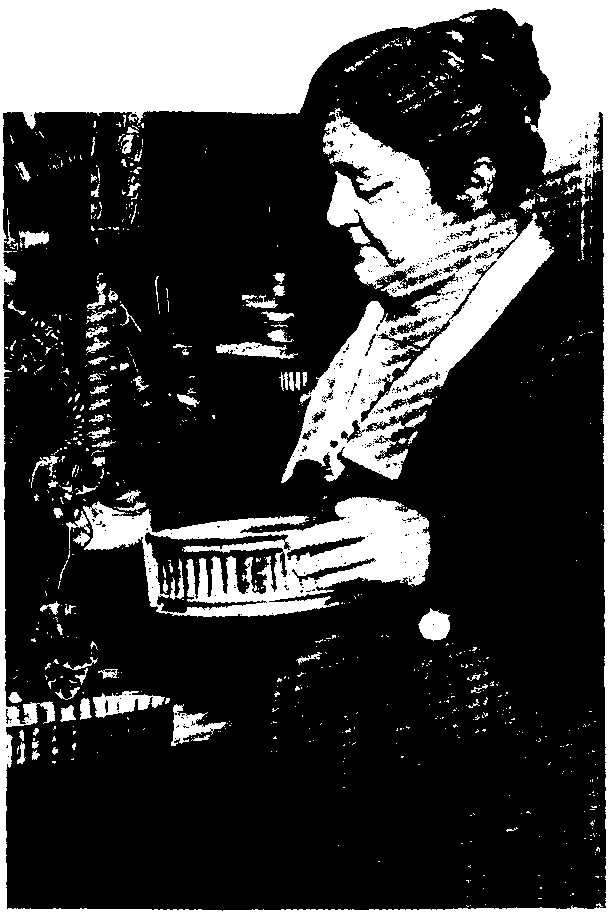
 MRS. M.A. WILSON IN HER OWN WELL-EQUIPPED KITCHEN
The Project Gutenberg EBook of Mrs. Wilson's Cook Book, by Mary A. Wilson

This eBook is for the use of anyone anywhere at no cost and with
almost no restrictions whatsoever.  You may copy it, give it away or
re-use it under the terms of the Project Gutenberg License included
with this eBook or online at www.gutenberg.org


Title: Mrs. Wilson's Cook Book
       Numerous New Recipes Based on Present Economic Conditions

Author: Mary A. Wilson

Release Date: January 1, 2006 [EBook #17438]

Language: English

Character set encoding: ISO-8859-1

*** START OF THIS PROJECT GUTENBERG EBOOK MRS. WILSON'S COOK BOOK ***


Produced by Bethanne M. Simms, William Flis, and the Online
Distributed Proofreading Team at http://www.pgdp.net
Transcriber's Note: The measure of one-half cup of nutmeg in the recipe for Caramel Pudding on p. 236 is undoubtedly an error. One-half teaspoon would likely seem the correct amount.
MRS. M.A. WILSON IN HER OWN WELL-EQUIPPED KITCHENThe influence of well-cooked, palatable food upon the health and general well-being of the family is as certain as that of changes of temperature and more serious in its consequences for lasting good or ill.
The sage old saying "Tell me what you eat and I will tell you what you are" is as full of the "pith o' sense" to-day as in ye days of long ago, for food either makes us physically fit and fully efficient, or miserable failures with physical complications that keep us constantly in the physician's hands.
The vital essences of that which we prepare for eating are "medicinal messengers" bearing light to the eye, vigor to the limb, beauty to the cheek and alertness to the brain, as vitamines, or distorted in the misdirected process are the harsh heralds of pain and debility to the human system. How great then is the influence of the one who prepares it!
Influence, according to astrology, was "a power or virtue flowing from the planets upon men and things," but from the kitchen, as a sun and heat centre, there truly flows a planetary influence that makes or mars us.
Scientific cooking means the elimination of waste, the preservation of edible resources and conservation of their potential energy through the preparation of attractive, vitalizing food with minimum cost and labor, thus providing in wide, deep measure, for harmony, personal comfort and domestic peace.
[pg vi]The preface of a book is too often a flat, spiritless excuse for offering it to the public instead of being a hearty announcement in welcome terms of the arrival of a much-desired provision for a real need, so I will come to the essential point at once by saying that gathered here, in these pages, are my best recipes, truly "tried in the fire," the actual working results of many years' teaching and lecturing, brought "up to the minute" in the interests of that exacting domestic economy now, as rarely before, imperative in its demands.
It will also be noted that the heavy cook-book style is not used here but the recipes are presented as if housewife and author were conversing upon the dish in question, and to her I will say: economical, palatable food is within your reach if you will discard the ideas and methods of long ago. Remember, you would not prefer to ride in a horse car, as a means of conveyance, so why use the recipes of those days?
The capable housewife, whose busy hands bake bread, cake and pastry, spreads forth to the community an influence that is priceless, a largesse not of festal day, holy day, or holiday, but thrice daily, wholesome and welcome as spring's first sunbeam and precious to every home so blessed, ever growing and radiating. May this book help in that growth and a greater radiation!
[pg 1]Bread, the staff of life, must be palatable and good if we are to be satisfied with it when we eat.
Can you think of anything that will spoil a meal more quickly than poor, over moist, doughy or heavy bread?
Bread may truly be called the staff of life, as it will maintain life longer than any other single food.
Yet many women think bread-making is a simple task; that the ingredients can be thrown together helter-skelter and good results obtained; or that any kind of flour will make good bread. This is a great mistake. To make good palatable bread it requires good materials, a reasonable amount of care and attention. But first of all must come the knowledge of the flour.
A good blend of hard winter flour is necessary and it can easily be tested by pressing a small quantity of it in the hand; if the flour is good, it will retain the shape of the hand. Graham or whole wheat flour and rye flours can be used for variety and to advantage in making bread.
Other cereal flours do not contain gluten to allow them to be used alone for making the yeast-raised breads. Keep this in mind and thus prevent failures. The yeast is a single-cell plant and must be given the proper temperature, moisture and food for its successful growth. When this is supplied, each little cell multiples a thousand times, thus pushing and stretching the dough. This makes it rise or become light.
[pg 2]When the yeast cells have absorbed or consumed all the food that they can obtain from the sugar, flour, etc., the dough will recede or fall. Now, if the dough is carefully handled at a given time, this will not take place, and so for this reason the dough is permitted to stand only for a given length of time before it is worked and then placed in the pans.
Few utensils will be required for making bread, but they must be scrupulously clean, if the bread is to have a good flavor. Potatoes and other cooked cereals may be used with good results. Compressed yeast will give the best results, and either the sponge or straight dough method may be used.
Bread made by the sponge method will require a longer time to make than the bread that is made by the straight dough method. Sponge dough consists of setting the sponge and letting it rise until it drops back, usually in two and one-half hours, and then adding sufficient flour to make a dough that can easily be handled.
The straight dough method consists of making a dough at the start. To make bread successfully, do not set the dough over the range, do not set it on the radiators and do not place it where it will be in a draft, to rise. Cold chills the dough and retards the yeast. Yeast grows successfully only in a warm moist temperature from 80 to 85 degrees Fahrenheit.
I would like to tell the housewife about a dough box that I have found to work very successfully. The baker's success in making bread is founded on the fact that he can regulate the temperature of his shop and thus prevent drafts from chilling the dough. This box is just an ordinary cracker box with the lid hinged on it. It is then lined with thick asbestos paper on the inside and then covered with oilcloth on the outside. The [pg 3] bowl with the dough is then placed in the box to retain its temperature and to be free from drafts while it rises. In cold weather this box can be heated by placing a warm iron in it when starting to mix the dough, and then removing the iron before placing the dough in the box. This box will easily pay for the time and cost in a few weeks, and then, too, it will prevent failure.
Now to get the proper temperature—always use a thermometer. Remember that you cannot successfully gauge the correct temperature of liquids that are used for making bread by testing with the finger or by testing them from the spoon. Any plain thermometer that can be found in the house will do for this work. Scrub it with soda and water to remove the paint. Remember, in cold weather to heat the mixing bowl. See that the flour is not lower than 65 degrees Fahrenheit.
All water or half water and milk may be used in making bread. When the milk is used it must be scalded and then allowed to cool. Evaporated or condensed milk does not require scalding. Simply add the hot water to acquire the proper temperature.
Earthen mixing bowls or clean cedar pails make the best utensils to set the bread dough in. These utensils will retain the heat and are easy to clean, and when they are closely covered, prevent a hard crust from forming on the dough.
Do not fail to give the dough plenty of proof—that is, let it rise for a sufficient length of time as given in the recipes.
Use a good grade of blended flour.
Use the ball of the hand, near the wrist, to knead and work the dough. Kneading is most important and should be thoroughly done. Do not be afraid of hurting the dough; you can [pg 4] handle it as roughly as you like. Heavy, active kneading distributes the yeast organisms and develops the elasticity of the gluten and gives body and strength to the dough.
Now, a word about the baking. Bread is baked to kill the fermentation and to hold the glutinous walls of the dough in place and to cook the starch and thus make it palatable and easy to digest.
An oven 350 degrees Fahrenheit is necessary. Do not have it any hotter than this. Too much heat browns the loaf before it has time to bake in the centre.
Salt controls the action of the yeast. It also retards or delays the proper fermentation if too large an amount of it is used. Then again, if not enough salt is added to the mix, the yeast becomes too active and thus produces an overlight loaf of bread. One ounce of salt to each quart of liquid in summer, and three-fourths of an ounce in winter will give the best results to the home baker.
Now turn on a moulding board and cut into five parts or loaves. Allow about nineteen ounces to each loaf. Take the dough up between the hands and work into a round ball. Place on the moulding board and cover for ten minutes. Now with the palm of the hand flatten out the dough and then fold halfway over, pounding well with the hand. Now, take the dough between the hands and stretch out, knocking it against the moulding board, fold in the ends and shape into loaves. Place in well-greased pans and brush the top of each loaf with shortening. Cover and let raise for 45 minutes. Bake in a hot oven for 45 minutes and brush with shortening when removing from the oven. Let cool and then the bread is ready to use.
[pg 5]Generally speaking, the sponge method produces a lighter and whiter loaf than the bread made by the straight dough method. Bread made by the straight dough method has the advantage over bread made by the sponge method in flavor, texture and keeping qualities.
One quart of water or half water and half milk, 80 degrees Fahrenheit,
Two yeast cakes,
Two and one-half quarts or two and one-half pounds of flour,
One ounce of sugar.
Dissolve the sugar and yeast in the water and add the flour. Beat to thoroughly blend and then set aside to raise for three hours, then add
One ounce of salt,
One and one-half ounces of shortening,
One and one-half quarts or one and one-half pounds of flour.
Work to a smooth elastic dough. This takes usually about ten minutes, after the flour is worked into the dough. Place in a greased bowl and then turn over the dough to coat with shortening. This prevents a crust from forming on the dough. Set aside to raise for two hours and then pull the sides down to the centre of the dough and punch down. Turn the dough over and let raise for one and one-quarter hours.
The jar, crock or box in which the bread is kept should be scrupulously clean. It should be scalded and aired one day every week in winter and three times weekly during the spring, summer and early fall. Keep the fact in mind that the bread [pg 6] kept in a poorly ventilated box will mould and spoil and thus be unfit for food.
Place the freshly baked bread on a wire rack to thoroughly cool before storing. Do not put old bread in the box with the new baking. Plan to use the stale bread for toast, dressings, bread and cabinet puddings, croutons and crumbs.
Wheat contains the sixteen needed elements for nutrition, and when made into palatable bread, it forms about 40 per cent. of our total food requirements. Stale bread digests much easier than fresh bread for the reason that when thoroughly masticated in the mouth the saliva acts directly upon the starchy content. Fresh bread, unless thoroughly chewed, so that it may be well broken up, becomes a hard, pasty ball in the stomach, which requires that organ to manufacture the additional gastric juices to break up this dough ball.
Bread from one to three days old easily digests. Graham and whole wheat breads contain a larger percentage of nutriment than the white breads.
Many housewives feel that it is impossible to secure accurate results in baking in the gas range; this is due to the fact that few women really understand the principle of baking with gas.
To secure a slow oven, light both burners and let them burn for five minutes; then turn both of them down low, turning the handle that controls the flow of gas two-thirds off. This will maintain a steady even heat. A slow oven requires 250 to 275 degrees Fahrenheit of heat. A moderate oven is 350 to 375 degrees Fahrenheit of heat. It can be obtained by burning both burners of gas range for eight minutes and then turning them down one-half to maintain this heat.
[pg 7]A hot oven requires 425 to 450 degrees Fahrenheit and will need to have the burners burning twelve minutes and then turned off one-quarter.
This heat is intense and entirely too hot for breads, pastries and cakes. Meats require this heat for one-half of the length of time in the period of cooking. This heat is also necessary for broiling, grilling, etc.
Now, also try to utilize the full oven space when baking by cooking two or more dishes at the same time. Vegetables may be placed in casseroles or earthen dishes or even ordinary saucepans; cover them closely and cook in the oven until tender. This will not injure other foods baking in the oven.
Do not place breads, cakes and pastries upon the top shelf; rather, place them on the lower shelf and cook in moderate oven. Do you know that there are still among us women who firmly believe that placing other foods to cook in oven with cake will surely spoil it? This is a mistake; utilize every bit of oven space.
An oven thermometer soon pays for itself. Pay strict attention to heating the oven; if the oven is too hot, the heat is wasted, while it cools sufficiently. This wastes gas. When food is first placed in the oven, keep oven door closed for first ten minutes and then open when necessary.
Placing food in oven will materially reduce the heat. Do not try to increase the heat; just as soon as the mixture acquires the heat, the baking will begin in the usual manner and the dish will be ready to remove from oven in given time.
Never keep the oven waiting for the food; rather let food remain in cool place while oven is heating.
Before mixing materials select the pans that will best fit the oven. This does not mean that you must discard your present equipment. It means that you should place in groups such pans that entirely fill oven space without crowding. Keep this fact in mind when purchasing new utensils.
[pg 8]The best and whitest rye flour is milled from the centre of the grains in a manner similar to wheat flour. When only the bran is removed from the milling, we have the darker flour, carrying a heavy pronounced flavor. The rye meal is used for making pumpernickel, a Swiss and Swedish rye flour bread.
Wash four potatoes and then cut in slices, without peeling, and place in saucepan, and add three pints of water. Cook until the potatoes are soft and then add
One-half cupful of hops.
Cook slowly for one-half hour. Rub the mixture through a fine sieve and then pour hot mixture on
One and one-half cupfuls of flour,
One tablespoonful of salt,
One-quarter cupful of brown sugar.
Stir until well mixed, beating free from lumps. Cool to 80 degrees Fahrenheit. Now add
One yeast cake dissolved in one cupful of water, 80 degrees Fahrenheit
Stir well to mix and then let ferment in a warm place for ten hours. Now pour into jar or crock and store in a cool place.
Use one and one-half cups of this mixture in place of the yeast cake. Always stir well before using and take care that the mixture does not freeze. This potato ferment must be made fresh every eighteen days in winter and every twelve days in summer.
[pg 9]One quart of water or milk,
One ounce of salt,
One ounce of sugar.
Stir well to thoroughly dissolve, and then add
Two yeast cakes,
Four quarts of flour,
One and one-half ounces of shortening.
Work to a smooth dough and then knead for ten minutes. Then place in a well-greased bowl, turning the dough over to thoroughly coat. This prevents a crust from forming on the dough.
Cover the bowl and set aside to raise for three and one-half hours. Now lay over the dough by pulling in toward the centre, the sides and ends of the dough until it forms a compact mass. Turn over the dough, cover and let rise for one hour. Now place on the moulding board and proceed to form into loaves, using the same method as in the sponge dough.
When the dough is ready to mould into loaves, proceed; using method as given in sponge dough, finally rolling the loaf on the moulding board, making it pointed at the ends. Now place a clean cloth in a deep baking pan and sprinkle the cloth with cornmeal. Place the loaf of dough on the cloth and sprinkle it lightly with cornmeal. Now lift the cloth up close to the dough, making a cloth partition between each loaf.
Let the dough rise, about 45 minutes, and when ready to bake, lift dough carefully from the cloth and lay on a baking sheet and gash slightly with a sharp knife. Wash with an egg and water, wash and back forty-five minutes in a hot oven, adding a small saucepan of boiling water to provide steam to keep the loaf moist while baking.
One-half of above recipes for small family.
[pg 10]Pare and cut in slices two medium-sized potatoes. Cook until very soft in three cups of water. When cooked rub through a sieve and cool. There must be two cups of this mixture. When the mixture is about 80 degrees Fahrenheit, pour in the mixing bowl and add
One yeast cake crumbled in,
One-half ounce of shortening (1 tablespoon),
One ounce of sugar (2 tablespoons),
Three-fourths ounce of salt (2 teaspoons).
Stir to thoroughly dissolve and then add eight cups of flour. Work to a dough and then proceed as in the straight dough method. When the dough is ready for the pans, cut or divide into six pieces and mould into loaves, three inches thick and twelve inches long, and set to rise like the Vienna bread, then bake, using the same method.
Two cupfuls of water, 80 degrees Fahrenheit,
Two tablespoonfuls of sugar,
Two teaspoonfuls of salt.
Mix and then add
One yeast cake,
Five cupfuls of white flour,
Three cupfuls of rye flour,
Two tablespoonfuls of shortening.
Work to a dough and ferment three and one-quarter hours, then proceed as in the straight dough method. When the dough is ready for the pans use the same method as for Vienna bread. Bake in a similar manner, having the oven heated to 450 degrees Fahrenheit. Rye bread requires an oven hotter than for wheat bread. Wash the rye bread when taking from the oven with warm water. Caraway seeds may be added if desired.
[pg 11]Two cupfuls of water, 80 degrees Fahrenheit,
Four tablespoonfuls of syrup,
Two tablespoonfuls of sugar,
Two teaspoonfuls of salt.
Stir until dissolved and then crumble in one yeast cake, dissolve thoroughly, and then add
Four cupfuls of white flour,
Three and one-half cupfuls of graham flour,
Three tablespoonfuls of shortening.
Work to a dough and then proceed as in the straight dough method.
Two cupfuls of water,
Three tablespoonfuls of syrup,
Two tablespoonfuls of sugar,
Two teaspoonfuls of salt.
Mix thoroughly and then crumble in one yeast cake and stir until dissolved, then add
Seven and a half cupfuls of wheat flour.
Work to a smooth elastic dough and proceed as in a straight dough.
Wash to thoroughly cleanse one-half pound of prunes and then stone and with a pair of scissors cut into small pieces the size of a raisin. When the bread is ready to go into the pans add the prunes and knead the dough well to distribute the prunes. Then place in pans and proceed as usual.
[pg 12]Two cupfuls of water, 80 degrees Fahrenheit,
One-half cupful of mashed potatoes,
Three tablespoonfuls of syrup,
Two tablespoonfuls of sugar,
Two teaspoonfuls of salt.
Mix and then crumble in one yeast cake. Stir until dissolved, and then add
Six cupfuls of wheat flour,
Two and one-half cupfuls of bran.
Proceed as in the straight dough method.
Grate the rind of two oranges and then place in a bowl and add
One cup of orange juice, warmed to 80 degrees Fahrenheit,
Two tablespoonfuls of melted shortening,
Four tablespoonfuls of sugar,
One and a half teaspoonfuls of salt,
One egg.
Beat to mix and then dissolve one yeast cake in one cup of water 80 degrees Fahrenheit, and add to the above mixture; then work in sufficient flour to make a smooth elastic dough; usually about eight cups. Place in a greased bowl and turn the dough to thoroughly coat with grease. Cover and let rise for three hours. Pull the corners of the dough to the centre and punch down, turn over and let rise again for one hour. Repeat the punching down and then let rise for three-quarters of an hour. Turn out on a moulding board and mould into three loaves, adding
One-half cupful of seeded raisins to one loaf,
One-half cupful of chopped almonds to second loaf,
and keep the third loaf plain. Place in greased pans and let rise for three-quarters of an hour. Bake in the hot oven for 40 minutes. The temperature of the oven should be 400 degrees Fahrenheit.
This bread is delicious for sandwiches. Undoubtedly one of the causes of the failure in making breads at home is that the process is hurried and the bread is insufficiently baked. The size and shape of the pans affect the quality of the bread. Avoid too deep or shallow pans. A pan, 7½ by 4¼ inches, will give the best results.
Turn the bread on a wire cake rack to cool. This permits the free circulation of air.
Place in a bowl
Two cups of bread crumbs,
One-half cup of syrup,
One teaspoon of baking soda,
One tablespoon of water.
Dissolve the baking soda in the tablespoon of water and add
Two cups of hot water.
Beat to mix and then let cool, add
One-half cup of cornmeal,
One-half cup of graham flour.
Beat to thoroughly mix and then pour in well-greased moulds and cover and steam or boil for one and one-half hours. Remove the cover and place in a slow oven for twenty minutes to dry out. A one-pound coffee can makes a splendid mould.
[pg 14]Place in a mixing bowl
Two-thirds cup of molasses,
Two cups of sour milk,
One and one-half teaspoons of baking soda.
Stir to thoroughly dissolve the soda, then add
Two-thirds cup of graham flour,
One cup of cornmeal,
One cup of rye flour,
One-half cup of seeded raisins.
Beat to thoroughly mix and then grease thoroughly one-pound coffee can and fill two-thirds full with this mixture. Put on the lid and steam for two hours, then remove the lid and place the can in the oven to dry out. One-pound baking-powder cans may be used to replace the coffee cans.
Place in a bowl
One cupful of scalded milk cooled to 80 degrees Fahrenheit,
One cupful of water, 80 degrees Fahrenheit,
One-half cup of syrup,
Two teaspoonfuls of salt.
Crumble in one yeast cake and then mix until the yeast cake is dissolved and then add
Four cupfuls of flour.
Beat to mix and then let the sponge rise for two and a half hours. Now add
Two cupfuls of rolled oats,
Two cupfuls of flour.
Knead to smooth elastic dough and then place in a greased bowl, turning the dough to coat thoroughly with shortening. Let [pg 15] rise for one and three-quarter hours. Pull the corners down to the centre and punch down. Turn over and let rise for one hour. Now turn out on moulding board and cut into loaves. Shape between the hands and place on the moulding board and cover. Let spring for ten minutes and then shape for pans. Place in well-greased pans and brush the tops of loaves with melted shortening. Let rise forty minutes. Bake in hot oven.
Place in a bowl
Three tablespoons sugar,
One and one-half teaspoonfuls salt,
Four tablespoons shortening.
Scald and pour into the bowl
One and one-half cups of milk.
Stir to thoroughly blend; cool to 80 degrees Fahrenheit. Now crumble in one yeast cake, stirring until thoroughly dissolved, then add
Six cups of sifted flour.
Knead to smooth elastic dough; clean out the bowl and grease thoroughly, place in the bowl and press firmly against the bottom, turn over; then cover and set aside to rise for three and one-half hours. Punch or knead down, turn over and let rise one hour. Now turn out on moulding board and shape like a long French loaf, and with scissors or French knife cut into pieces the size of a large egg. Roll quickly between the hands to form a round ball, set on moulding board and let rise for ten minutes. Flatten out, using small rolling pin or palm of hand, brush with shortening, fold pocketbook style and set on well-greased baking sheet two inches apart to rise for twenty minutes; bake in hot oven for fifteen minutes, brush with melted shortening as soon as removed from oven.
[pg 16]Prepare dough as for Parker House rolls, cutting dough in pieces the size of a small orange; round up between the hands, place on moulding board and cover for five minutes. Now roll on moulding board to form a ball, using the palm of the hand; place on well-greased baking sheet; let rise twenty-five minutes, bake in moderate oven twenty minutes—cool, rub each roll over grater to rasp, removing a light coating of the crust.
Prepare dough as for Parker House rolls and cut in pieces the size of small egg; round up and cover and let rise ten minutes, roll between the board and hands, forming points on end of rolls. Finish as for Parker House rolls.
Scald one pint of milk, adding
Four tablespoonfuls of shortening.
Cool to 80 degrees Fahrenheit and then pour into the mixing bowl, and add
Three tablespoonfuls of sugar,
Two teaspoonfuls of salt,
One well-beaten egg,
One yeast cake, dissolved in four tablespoonfuls of water, mix thoroughly
And then add
Three and three-quarter pints or seven and one-half cupfuls of sifted flour.
Work to a smooth elastic dough, grease a clean bowl and place the dough in it. Turn several times to coat the dough thoroughly with the shortening. This prevents a crust from forming. [pg 17] Set in a place free from drafts and let rise for three and one-half hours, then punch down and turn over. Let rise one and one-quarter hours. Punch again and then let rise three-quarters of an hour. Now turn on the pastry board and mould into a long strip not quite as thick as the rolling pin. Break the dough off into pieces weighing about one and one-half ounces. Form into balls and then cover and let spring or rise for ten minutes; take a ball of the dough and round it well on the board, then flatten slightly with the palm of the hand. Now mark a decided crease with the back of a knife down the centre of the roll. Fold over in pocketbook style, patting the turn in the roll hard with the hand. Lay on well-greased tins, brushing the rolls with shortening. Let rise for twenty minutes and then wash with egg and bake in a hot oven.
Use the Parker House roll dough, cutting it into pieces one and one-half ounces in weight. Mould into balls and then set on a board and cover for ten minutes to let spring. Now mould into finger shapes and place on greased pans and proceed as in Parker House rolls.
Prepare as for finger rolls, pointing the dough at both ends by rolling into a shape similar to a sweet potato.
Break off pieces of the dough three-quarters of an ounce in weight and then mould into balls and let spring for five minutes. Now mould out into rope-shaped pieces a little longer than a lead pencil. Fasten the three pieces together and then plait. Process as for finger rolls.
[pg 18]Prepare dough as for Parker House rolls, cut and form in small-sized balls, cover, and let rise ten minutes. Now, round up by rolling between the hands, set very closely together in deep, well-greased pans, let rise forty minutes, bake in a moderate oven; brush with syrup and water and dust with sugar as soon as removed from the oven.
Use the Parker House roll dough and then break off into pieces weighing about twelve ounces. Mould into balls and then cover and let spring for ten minutes. Now roll out the dough one-half inch thick with rolling pin and cut into five-inch squares. Cut each square into a triangle and brush lightly with shortening. Roll from the cut side towards the point, lapping the point closely. Form into crescent when setting in well-greased pan, brush with shortening and cover and let rise for eighteen minutes. Wash with milk and water. Bake for eighteen minutes in a hot oven.
Melt four ounces of butter and then place in a mixing bowl and add
One-half cup of sugar,
One cup of scalding milk, cooled to 80 degrees.
Then add
Two well-beaten eggs,
One teaspoon of salt,
ne-half yeast cake.
Stir to thoroughly mix and then add four cups of flour and work to a smooth elastic dough. Grease the mixing bowl well [pg 19] and then put in the dough. Press down well and then turn over. Cover and set to rise for four hours, then turn on a moulding board and knead for two minutes. Cut into pieces for biscuits. Roll between the hands into round balls and then cover and let set on the moulding board for ten minutes. Now press flat with the hands and let rise on a well-greased baking sheet. Let rise for thirty minutes, then brush with a mixture of
Four tablespoonfuls of syrup,
Two tablespoonfuls of water.
Bake in a hot oven for fifteen minutes.
Place in a mixing bowl
One cup scalded milk, cooled to 80 degrees,
One-half cup sugar,
Four tablespoonfuls of shortening,
One well-beaten egg,
One-half yeast cake crumbled in.
Beat to thoroughly blend, and then add
Two and three-quarter cupfuls of sifted flour,
One teaspoonful of salt.
Beat well, cover and let rise for three hours, beat again. Now grease thoroughly an oblong or round baking pan; take the Sally Lunn and beat for five minutes, pour into the prepared pan, having the dough fill the pan about one-half; let rise twenty minutes in warm place, bake in hot oven twenty-five minutes, then dust with sugar.
Weigh out eighteen ounces of dough and divide into one dozen pieces. Mould into balls and let spring for ten minutes. Now [pg 20] mould up nice and round and then set close together on a well-greased pan. Let rise for thirty-five minutes, and then brush the tops with egg and water; wash and dust lightly with sugar. Bake for eighteen minutes in a hot oven. A small pan of boiling water may be placed in the oven when baking these rolls.
For variety's sake, part of the dough may be baked plain. To the balance add caraway seeds, a little citron, nutmeg or a few currants. If carefully baked and cooled, these rolls may be stored in an air-tight box and they will keep for several days. To reheat, place in an oven with a pan of boiling water for ten minutes to freshen.
Egg wash: One egg and one-fourth cup of milk; beat to mix; apply with small paint brush.
Scald one cup of milk and then place
Four tablespoonfuls of shortening,
One-half cupful of sugar,
One teaspoonful of salt
in the mixing bowl, and pour over it the scalded milk. Stir to thoroughly mix and then cool to 80 degrees Fahrenheit. Now dissolve one-half yeast cake in one-half cupful of water 80 degrees Fahrenheit, and when the milk is at the proper temperature, add six cupfuls of flour and work to a smooth dough. Place in a well-greased bowl, turning the dough around in the bowl so that it will be thoroughly coated with shortening. Cover and let rise three and one-half hours. Now pull the sides of the dough into the centre and punch down, turning the dough over. Let rise again for one hour, then turn on a moulding board and divide the dough in half. Knead each piece into a ball. Cover and let rise or spring for ten minutes. Now roll out one-quarter inch thick, using a rolling pin. Brush with melted shortening and sprinkle well with brown sugar, using [pg 21] about one cupful. Now dust with two teaspoonfuls of cinnamon and spread over the prepared dough one and one-half cupfuls of currants or small seedless raisins. Begin at the edge and roll like a jelly-roll. Cut in pieces one and one-half inches thick and then place in prepared pans and let rise for one hour. Then bake in a moderate oven for forty minutes.
To prepare the pan for the cinnamon buns:
Grease the pan very thickly with shortening and then spread one cupful brown sugar and one-half cupful of currants or small seedless raisins evenly over the bottom of the pan. Place buns in pan and let rise for one hour in a warm place, then bake in a moderate oven for thirty-five minutes.
Now for the trick. When the buns are baked, brush the pastry board with shortening, then place
Two tablespoonfuls of brown sugar,
One tablespoonful of water
in a saucepan, mix thoroughly, and then bring to a boil. Now, just as soon as the buns are baked, turn from the pan at once and brush well with the prepared syrup, brushing the bottom with the syrup, as brushing the candied part of the buns prevents it from hardening. Let cool and then use.
Prepare the dough as for cinnamon buns and when ready to turn on the moulding board add
One cupful of finely shredded citron,
One-half cupful of brown sugar,
One cupful of seeded raisins.
Work well to distribute the fruit and then form into a long roll three inches thick. Cut off pieces about one and one-half ounces and form into buns. Let rest for fifteen minutes and then roll into round buns and place in a well-greased baking pan [pg 22] and let rise for thirty minutes. Make a hole in the centre of each bun with a small wooden stick and wash the buns with egg and milk. Bake in a moderate oven for twenty minutes. Cool, and then fill the centre with jelly, and ice with water icing.
Prepare the dough and roll as for cinnamon buns; cut in slices one-half inch thick; place inch apart in well-greased baking sheet, let rise twenty-five minutes, brush with egg wash; sprinkle with finely chopped peanuts and bake in moderate oven twenty minutes.
You can use part of the dough for cinnamon cake. Cut the dough into pieces and then roll out three-fourths of an inch thick. Place in pans, stretching and rolling the dough to fit pan. Brush with shortening and then cover with crumbs, made as follows:
Six tablespoonfuls of flour,
Four tablespoonfuls of brown sugar,
Two tablespoonfuls of shortening,
Two teaspoonfuls of cinnamon.
Rub the mixture until crumbly and then spread as directed. Let rise thirty-five minutes, bake in hot oven fifteen minutes.
One-half cupful of confectioner's sugar,
One-half cupful of cocoanut,
Sufficient hot water to moisten.
Spread on the buns with a spatula.
[pg 23]Prepare the dough just the same as for cinnamon buns and when ready to turn on a moulding board add
One cupful of cocoanut,
Three tablespoonfuls of shortening.
Knead to mix and then work the dough into a long roll about three inches thick and then break into pieces the size of a large egg. Now mould until round and then let rise on the board for ten minutes. Mould again, shaping oblong. Place on a well-greased pan and brush the buns with melted shortening. Let rise for thirty minutes and then bake in a hot oven and ice with cocoanut icing.
Prepare the dough as given in the recipe, using the balance left for either cinnamon or cocoanut buns. When ready to turn on a moulding board cut the dough in half and roll each piece out one-quarter of an inch thick. Spread with shortening and then lightly with brown sugar and with one-half cupful of finely shredded almonds or peanuts. Roll like a jelly roll. Press flat with a rolling pin until just one inch thick. Cut in pieces six inches long and then place in a well-greased baking pan and let rise thirty-five minutes. When ready to bake, cut a gash three inches long on each cake. Wash with egg and milk and strew with finely shredded almonds. Bake in a moderate oven for twenty-five minutes. Ice with water icing.
Scald one cupful of milk and add one-half cupful of cold water. Cool the mixture to 80 degrees. Now add four tablespoonfuls of sugar, one teaspoonful of salt. Crumble one [pg 24] yeast cake in the mixture and stir thoroughly until the yeast is dissolved. Now add four cupfuls of sifted flour and beat to a light batter. Cover, and set in a place free from drafts, where it will be kept warm in a temperature of 80 degrees and let raise for three hours. Now beat the dough with a spoon and let raise again for three-quarters of an hour. Now, while the dough is raising last time, place one cupful of sugar and one-half cupful shortening in a bowl and cream until light and frothy. Add two eggs, one at a time, and beat until very light. When the dough is ready, add the sugar, eggs, shortening and one and one-half cupfuls of flour; beat this mixture with spoon for twelve minutes until thoroughly mixed. Now pour in prepared mould filling the mould half full. Set in warm place, with a temperature of about 80 degrees Fahrenheit, to raise for one and one-quarter hours or until the mixture fills the mould. Bake in a moderate oven for three-quarters of an hour.
Remove the cake from the mould and cool on a wire rack. This cake may be iced or served plain; or chopped nuts, raisins or citron may be added to the dough with the sugar and eggs.
To prepare the pans: Grease them thoroughly, then coat them with finely chopped nuts or fine cake crumbs before pouring in the dough.
Brioche is a French sweet bread and while different authorities do not agree as to both the consistency and methods, without doubt these cakes figure largely in French cuisines.
One French bakery prepares the brioches in loaf form and when cold it is cut in slices and steeped in orange syrup. Then again the brioche is spread with jam and then covered with icing or the brioche may be steeped with prepared syrup and then dipped in a batter and fried golden brown in hot fat. Spread with jam and serve with orange or lemon sauce.
[pg 25]The actual preparation of the brioche involves very little trouble and can be made from bread dough on baking day. Now one point in making these sweet breads—there is just the same trick as in moulding the loaf of bread. One can learn by careful attention to details and with practice. Some stress may well be laid upon the lightness of the dough; for heavy, overrich dough that is poorly baked is injurious to health.
Six tablespoonfuls of confectioner's sugar and sufficient water (boiling) to moisten.
Roll the dough into three strands about one inch thick and ten inches long. Fasten the three strands together and then braid. Place on a well-greased pan and let rise. Wash with egg and milk and then bake for twenty-five minutes in a moderate oven. Spread with jelly and then ice with water icing. Sprinkle with slightly browned cocoanut.
When the bread is ready to put in the pan cut off one pound and place the dough in a bowl. Now place in a separate bowl
Yolks of two eggs,
One-half cup shortening,
Three-quarter cupful sugar.
Cream until light and frothy, then add the stiffly beaten whites of the eggs, also
One-half cup of milk,
Four cups of flour,
One pound piece of yeast raised dough.
Work or knead until smooth and elastic. Place in a greased bowl and let rise for three hours; now turn on board, divide into eight pieces and mould into balls. Cover and let rise for ten minutes. Now roll out one-half inch thick. Brush with shortening, strew with brown sugar and nuts. Roll like jelly roll and then flatten well with rolling pin. Place in a greased pan, cover and let rise for one-half hour. Now cut down the entire length of the dough, leaving two inches on each end. Wash with egg wash and bake twenty minutes in hot oven. Sprinkle with sugar, then return to oven five minutes.
In the days of long ago, yeast, ammonia, pearl ash, honey water and a treacle mixture were used to lighten cakes—before the time of dependable baking powder.
In Europe the housewife makes from bread dough delicious cakes with yeast. These provide splendid variety. They include savarins, babas, and yeast-raised fruit cakes.
Many women fail in making these delicious goodies because they do not realize that the addition of large amounts of sugar, fruit, shortening and eggs to yeast dough, unless carefully handled, is apt to produce heavy, moist cakes that lack the light, velvety texture which makes cake a success.
The addition of nuts, cake crumbs and fruit will afford a large variety.
A sponge dough is necessary for successful results.
Prepare the dough as for brioche, adding one cupful of finely shredded almonds when ready to mould for the pan. Use a long narrow pan to bake loaf in. When baked, cool and then cut in one-inch slices and toast light brown in the oven.
[pg 27]Scald one cupful of milk and then cool to 80 degrees Fahrenheit and pour in a bowl and add
Three tablespoonfuls sugar,
One-half teaspoonful salt,
One yeast cake dissolved in four tablespoonfuls cool water,
Three cupfuls of flour.
Beat for five minutes with a spoon and let rise for two hours. Now cream
One and one-quarter cupfuls sugar,
One-half cupful of shortening
until very light and creamy and then drop in, one by one, three eggs, beating the eggs for three minutes. Add this to the yeast-raised dough, together with one cupful of sifted flour. Beat with a wooden spoon for fifteen minutes and then pour into a greased and floured pan, filling the pan half full. Put the raisins on the top and then cover and let rise until it fills the pan almost to the edge. Bake in a moderate oven for fifty-five minutes and then cool and ice.
Prepare dough as for brioche and, when ready to pan, mould into loaf shape adding nuts and finely shredded citron. Place in well-greased Boston brown-bread mould; let rise for one hour. Bake in moderate oven forty-five minutes. Then begin to baste the Baba with syrup made from
One cupful syrup,
One-half cupful water,
One tablespoonful vanilla,
One teaspoonful mace.
Cook syrup ten minutes before using to baste the Baba, and bake until the syrup is absorbed, then turn on plate.
[pg 28]One tablespoonful of anise seed,
One-half cupful finely shredded citron.
Add the above ingredients to the brioche dough; mould and bake as for Russian rusk. These crisp slices will keep for a long time if placed in an air-tight box.
This dough may be used for the old English crull cakes, which is nothing more than a doughnut. Prepare a dough as for a brioche and when ready for the pans turn on a molding board. Roll out one-quarter inch thick; cut with doughnut cutter. Set on cloth to rise for fifteen minutes. Stretch to shape and fry in hot fat until golden brown. Roll in pulverized sugar and cinnamon.
These doughs may be moulded in wreaths, crescents and bowknots. When risen, wash with egg wash, then sprinkle with granulated sugar and chopped nuts and then bake in moderate oven.
One cupful cornmeal,
One cupful flour,
One teaspoonful salt,
Three level teaspoonfuls of baking powder,
Two tablespoonfuls of syrup,
One tablespoonful shortening,
One egg,
One and one-quarter cups of milk.
Beat hard to mix and then bake on a hot griddle.
To bring the true nut flavor from the buckwheat we must go back to old-fashioned method of setting the buckwheat to rise overnight. Don't you remember the brownstone crock that [pg 29] was kept in the pantry and each time it was left with just enough of the mixture to start a new batter? The buckwheat would be prepared each night just before bedtime, and in the morning a cup of warm water was added, together with a couple of tablespoonfuls of syrup. The mixture was beaten and then the griddle was put on to heat. Sometimes it was a soapstone or a heavy iron griddle. When well heated it was rubbed with a piece of cut turnip or potato. The batter was poured on in large platter-sized cakes and then as quickly as they browned they were dexteriously turned to brown again.
To make perfect buckwheat cakes you must first of all obtain a stone-ground flour, and then it must be blended in proportion. Good, lively yeast is added, and if milk is used for the mixing it must be scalded and then cooled before using. To prepare the flour for the mixing:
Three pounds of buckwheat flour,
One and one-half pounds of wheat flour,
One pound of corn flour,
One ounce of salt,
One-half ounce of baking soda.
Sift twice to thoroughly mix and then place in a dry container and the flour is then ready to use.
Scald and then rinse out with cold water a large stone crock. Pour in one cupful of scalded and cooled milk and
One and one-half cupfuls of water, 80 degrees Fahrenheit,
Two tablespoonfuls of sugar.
Crumble in one-half of an yeast cake and stir until dissolved, then add three cupfuls of the prepared buckwheat flour. Beat to thoroughly mix and then cover and set aside overnight to rise. In the morning add sufficient lukewarm water to bring the [pg 30] mixture to a pouring consistency. This usually requires about one cupful. Add two tablespoonfuls of syrup. Beat hard for three minutes and then let stand in a warm place while the griddle is heating, then bake.
Rice griddle cakes may be prepared as follows: Wash one-half cup of rice in plenty of water and then place in a saucepan and add three cupfuls of water. Cook until the water is absorbed and the rice is soft. Let cool. Now place in a crock
Two and one-half cupfuls water, 80 degrees Fahrenheit,
Two tablespoonfuls sugar,
One-half yeast cake.
Stir until dissolved and then add
The prepared rice,
Three cupfuls white flour,
One-quarter teaspoonful baking soda.
Beat to mix and then cover and set aside to rise overnight. In the morning add sufficient lukewarm water to make a pouring batter, adding two tablespoonfuls of syrup and one teaspoonful of salt. Beat very hard and then set in a warm place while the griddle is heating.
The use of a small amount of baking soda as given in above recipes is for the purpose of neutralizing the slightly acid flavor of the buckwheat—a flavor to which many folks object.
Either of above mixes may be baked in a waffle iron instead of using the griddle. Try it some morning for the sake of variety. Use salad oil in a new sewing-machine oil can to grease waffle iron.
Almost everyone loves good sweet butter on the hot cakes in the morning. At the present prices of butter the frugal housewife looks upon the fast disappearing pat of butter with alarm. Now try this and save the butter and yet give the [pg 31] folks the butter flavor upon their cakes; place two tablespoonfuls of butter in a pitcher which will hold a cupful of syrup. Add the syrup and then place the pitcher in a pan of warm water and set on the stove to heat. Beat constantly until the butter melts and produces a creamy mix.
Stale bread may be crumbled or soaked in cold water pressed dry and used in place of rice or cornmeal. So may oatmeal or other leftover breakfast cereals, as well as mashed potatoes, be used. Reserve about one cupful of the yeast batter to start the next batter. Use this starter in place of the yeast. Renew the yeast mix every fifth morning.
A word about the griddle may not come amiss. The old-fashioned iron or soapstone may be used and will give good results. Aluminum griddles do not require greasing.
Try these cakes some morning when the folks are tired of the usual breakfast dishes. Place in a pitcher overnight
Two cups of buttermilk or sour milk,
One cup of water,
Two cups of bread crumbs.
Let stand in the kitchen in a cool place. Do not put in the icebox. In the morning add
One teaspoonful baking soda
dissolved in
Three tablespoonfuls of water.
Beat to thoroughly mix and then add
Two tablespoonfuls syrup,
Two tablespoonfuls shortening,
One teaspoonful salt,
One and one-half cups flour,
Two teaspoonfuls baking powder.
Beat hard to mix and then bake on a hot griddle.
[pg 32]Scald one cup of cornmeal with two cups of boiling water, and then let cool. Now add
One and one-half cupfuls water, 80 degrees Fahrenheit,
Three tablespoonfuls of syrup,
One teaspoonful of salt,
One-quarter yeast cake,
Two cupfuls flour,
One-quarter teaspoonful baking soda.
Beat hard and then let rise overnight; then prepare as for buckwheat cakes.
Modern methods have eliminated the yeast and substituted baking powder, thus making a quicker mix. To prepare buckwheat cakes with baking powder, prepare a blend of flour as follows:
Two pounds of buckwheat,
One pound of wheat flour,
One cupful cornmeal,
One ounce of salt,
Three ounces of baking powder,
One-quarter ounce baking soda.
Sift three times to mix and then place in a dry container and use as required.
Use a frying-pan that is perfectly flat; the iron ones are best, as they hold the heat longer and can be regulated so that the cake will not burn.
[pg 33]Yolk of one egg,
Two tablespoonfuls sugar or syrup,
One cupful milk,
One tablespoonful shortening,
One teaspoonful salt,
One teaspoonful vanilla or nutmeg,
One and one-quarter cupfuls flour,
Two level teaspoonfuls baking powder.
Place in a bowl. Beat with a Dover egg-beater to thoroughly mix and then fold in the stiffly beaten white of egg. Pour the mixture into a pitcher and then place two tablespoonfuls of shortening in a frying pan. When smoking hot pour in just sufficient batter to cover the bottom of the pan. When it begins to bubble turn the cake over and bake on the other side. Lift and spread lightly with jelly or roll, or use the following mixture:
Three tablespoonfuls butter,
One-half cupful of XXXX sugar,
Cream well, and then add
One tablespoonful lemon juice,
One tablespoon boiling water.
Beat to blend.
Place in a bowl one quart of milk and then add
Two eggs,
One-half teaspoonful nutmeg,
Five cupfuls sifted flour,
Four tablespoonfuls syrup,
Five level teaspoonfuls baking powder.
Beat to mix and then bake. To insure sufficient cakes use two pans for cooking or bake on a griddle.
[pg 34]One cupful milk,
Two eggs,
One and one-half cupfuls flour,
Two teaspoonfuls baking powder,
Two tablespoonfuls shortening,
One-half teaspoonful nutmeg.
Beat to mix. Now prepare
One-half cupful of nuts, chopped very fine,
One dozen maraschino cherries, well-drained and chopped fine.
Mix well and then pour pancake in hot pan and sprinkle with the above mixture.
Let bake and then lift. Spread with honey and dust with pulverized sugar. Roll and garnish with maraschino cherry.
One egg,
One-quarter cupful milk.
Beat to mix and then add
One-half cupful flour,
One-half teaspoonful salt,
One teaspoonful baking powder.
Beat well to thoroughly mix and then pour in a hot pan containing three tablespoonfuls of shortening: pour just enough to barely cover the bottom of the pan. Cover the pan with a hot lid. Let the cake bake. When ready to turn slip the cake on the hot lid and invert, returning the cake to the pan. Spread with sugar and cinnamon. Bar le duc or currant jelly may be used to spread on the cakes. Fold like an omelet and place a spoonful of jelly on top. Serve. This will make two large pancakes.
[pg 35]One cupful mashed potatoes,
Two cupfuls flour,
One teaspoonful salt,
Three teaspoonfuls baking powder,
Two eggs,
One cupful milk,
Four tablespoonfuls syrup,
One and one-half teaspoonfuls nutmeg.
Beat to thoroughly mix and then bake on a griddle. Spread with butter and sugar.
Two cupfuls of unsweetened thin applesauce,
One well-beaten egg,
Three tablespoonfuls syrup,
Two and one-half cupfuls flour,
Three teaspoonfuls baking powder,
One tablespoonful shortening,
One-half teaspoonful cinnamon.
Beat to mix and then bake in the usual manner. Serve with butter and syrup.
Waffles are made from a thin batter and are baked in a well-heated waffle iron. Many failures to make good waffles are due to the fact that the iron is not sufficiently hot. The iron must be thoroughly cleaned after each baking. Place the iron on the range to heat, turning it several times.
Try this method in greasing the iron. Purchase a large-sized sewing machine oil-can, wash well in plenty of hot water and soap, then rinse thoroughly and dry. Now fill with a good salad oil and when the iron is heated, oil it on both sides. Now you are ready to bake the waffles. Reverse the iron, having [pg 36] the hot side on top, and pour in the batter and then bake about three minutes, reversing the iron once.
When the waffles are baked remove from the iron and then oil and reverse it again, putting the side that was next to the fire on top and then pour in the batter, close and bake as before.
Quick breads include griddle cakes, waffles, muffins, Sally Lunns, shortcakes and biscuits. These doughs are made light or leavened by the use of eggs, baking soda, baking powder and steam created in baking and by air beaten into the mixture. Their entire success depends upon the careful measurement of ingredients, the mixing and the baking. Using all water in place of milk or equal parts of milk and water will give splendid results.
Place the griddle on the range to heat slowly, while mixing the batter.
Place in a bowl or a flat, wide-mouthed pitcher
One cupful milk,
One cupful water,
One teaspoonful salt,
One tablespoonful syrup,
Two and one-half cups of flour,
Two tablespoonfuls shortening,
Four level teaspoonfuls baking powder.
Beat to mix to a smooth batter. This amount of batter will make hotcakes for four persons. For larger amounts, multiply. One egg may be used for every two cupfuls of flour.
Test the griddle by dropping a few drops of water on it; if the water boils, the griddle is sufficiently hot to bake with. Aluminum griddles do not require any grease. Rub with a clean cloth dipped in salt. Grease iron griddles slightly. Pour [pg 37] on the batter; just as soon as the cakes begin to form air bubbles slip a cake-turner under the cakes and turn them.
Now, if large bubbles rise at once to the top of the cakes, the griddle is too hot and the heat should be reduced; while, if the cake stiffens before the underside is brown the griddle is not hot enough. Never turn a griddle cake twice—this makes them heavy. Serve them as soon as baked, piling not more than five or six together. Sour milk may be used in place of sweet milk. Discard the baking powder and use one level teaspoonful of baking soda for each cup of sour milk. One egg and two cupfuls of water may be used in place of two cupfuls of milk.
One cup of milk,
One cup of water,
One egg,
One teaspoonful of salt,
Two and one-quarter cupfuls flour,
Three teaspoonfuls baking powder,
One tablespoonful syrup,
Two tablespoonfuls shortening.
Beat to a smooth batter in a wide-mouthed pitcher. One-half of this amount for two people.
Cold boiled rice, hominy, oatmeal and stale bread that has been soaked in cold water and then pressed dry and rubbed through a sieve may be added to the griddle cakes and waffle batters.
Muffins are made from a drop batter and may be baked in rings, on a griddle, in muffin pans or in custard cups. To bake the muffins in rings on a griddle upon the top of the stove—grease the griddle well, and also have the rings well greased. Put [pg 38] the griddle on to heat when starting to mix the drop batter and keep the rings cool until ready to bake.
Place in a bowl or pitcher
One and one-half cupfuls of milk or equal parts of milk and water,
One egg,
One teaspoonful salt,
Two tablespoonfuls syrup,
Two tablespoonfuls shortening,
Two and three-quarters cupfuls flour,
Five level teaspoonfuls baking powder.
Beat this mixture smooth and then place the rings on a hot griddle and half fill with the drop batter. When well risen and nearly dry, turn over, using the griddle-cake turner to turn the muffins and rings. Bake on the other side. It will require about eighteen minutes to bake these muffins. Tear them apart, butter and serve them at once.
To bake muffins in pans or custard cups, grease the pans or cups well and half fill with the drop batter and then bake in a hot oven for fifteen minutes.
Put two cups of oatmeal through the food chopper into the mixing bowl and then add
One and one-half cups of sour milk,
One teaspoonful baking soda dissolved in one tablespoon of cold water,
One-half teaspoon salt,
Four tablespoonfuls syrup,
Two tablespoonfuls shortening.
One cup of sifted flour.
Beat to mix and then pour into well-greased muffin pans and bake in a hot oven for twenty minutes.
[pg 39]One and one-quarter cups sour milk,
Two tablespoonfuls shortening,
One teaspoonful soda,
One teaspoonful salt.
Mix to thoroughly blend and then add
One cupful white flour,
One and one-half cupfuls graham flour.
Two teaspoonfuls baking powder.
Beat to thoroughly mix and then bake for eighteen minutes on well-greased muffin pans.
Two and one-half cups of bran,
One and one-half cups of flour,
One teaspoonful salt,
Four tablespoonfuls syrup,
Two tablespoonfuls shortening,
One egg,
One and three-quarter cups of buttermilk,
One teaspoonful soda.
Dissolve the soda in the buttermilk and then beat to mix. Fill into well-greased muffin pans and bake in a moderate oven for twenty-five minutes. Toast the left over muffins.
Place in a mixing bowl
Two and one-half cups flour,
One teaspoon of salt,
Two tablespoons of sugar,
Two teaspoons of baking powder.
Sift to thoroughly mix, then add
One and one-half cups of sour milk,
One teaspoon of baking soda.
Dissolve the baking soda in the milk and then mix thoroughly by heating hard. Now place well-greased muffin rings on well-greased hot griddle. Fill the rings half full and bake slowly for fifteen minutes. Turn with a cake-turner when the inner side is nicely browned.
Place in a mixing bowl
One-half cup of brown sugar,
One cup of molasses,
One-half cup of water,
One teaspoon soda,
Two teaspoons ginger,
One teaspoon cinnamon,
One-half teaspoon allspice,
Six tablespoonfuls shortening,
One egg,
Three cups of flour,
Two teaspoons baking powder,
One-half cup finely chopped peanuts.
Beat thoroughly to mix and then fill into well-greased and floured muffin pans, filling the pans little more than half full. Bake in a moderate oven for twenty minutes. This amount will make about eighteen muffins.
Place in a mixing bowl
One-half cup of honey,
One teaspoon of baking soda,
One teaspoon of salt,
Two cups of bran,
One and one-half cups of flour,
Three-quarters cup of finely chopped nuts.
One and one-half cups of milk,
One egg.
Beat hard and thoroughly mix and then bake in well-greased muffin pans in hot oven for twenty-five minutes. Serve with strawberry, orange or pineapple marmalade.
Sally Lunns are made from a drop batter and are usually baked in deep layer-cake pans. To serve cut in wedge-shaped pieces—like pie—and then split and butter and cover with a napkin. Serve at once.
Place in a bowl
One-half cupful sugar,
Four tablespoonfuls shortening.
Cream until light and then add
One egg,
One and one-half cupfuls of equal parts milk and water,
Three cupfuls flour,
Five level teaspoonfuls baking powder.
Beat to a smooth batter and then pour into well-greased pans and bake for twenty-five minutes in a moderate oven. When nearly baked brush the tops quickly with milk and sprinkle well with granulated sugar. One-half cup of finely chopped citron or seeded raisins may be added if desired.
Place in a mixing bowl
Three-quarters cup cornmeal,
One and one-quarter cups flour,
One teaspoon salt,
Two level tablespoons baking powder,
Two tablespoons shortening,
Four tablespoons syrup,
One and one-quarter cups of water.
Beat to mix and bake in well-greased iron muffin pans.
[pg 42]Place in a mixing bowl
One egg,
Two tablespoons of sugar,
Two tablespoons of shortening,
One teaspoon of salt,
One cup of milk,
One and one-half cups of flour,
Four teaspoons of baking powder,
One cup of cold boiled rice.
Beat hard to thoroughly mix and then pour in well-greased muffin pans. Bake twenty-five minutes in a hot oven.
Place in a mixing bowl
Three tablespoonfuls shortening,
One and one-half cups cornmeal.
Pour over
Two and one-half cups boiling water.
Now add
One and one-half cups sour milk or water,
One cup of flour,
One teaspoon salt,
Two level tablespoons baking powder,
Four tablespoons syrup or sugar,
One egg.
Beat to mix, pour in well-greased baking dish and bake in hot oven for forty minutes.
The success of making and baking this delicacy depends entirely upon a thorough beating of the batter and a hot oven. [pg 43] The southern mammy invariably uses the coarse white oatmeal, but you may use the yellow and obtain just as good results.
Place one quart of boiling water in a saucepan and then add one teaspoonful of salt, two tablespoonfuls of shortening and one and one-half cupfuls of cornmeal. Pour the meal in slowly, and just as soon as it boils remove from the fire and let cool. Now add
Yolk of two eggs,
Two cupfuls of sour milk,
One cupful flour.
in which you have dissolved one level teaspoonful of baking soda and one-half cupful of syrup.
Beat this mixture with a large spoon and now cut and fold in the stiffly beaten whites of the eggs. Pour in hot, well-greased baking dish and bake in a quick oven.
To add soda to the sour milk, dissolve the soda in one tablespoonful of the milk before adding to the remainder of the milk, and then use a Dover egg-beater and beat for three minutes to thoroughly mix.
Place in a mixing bowl
One cup of cornmeal,
One and one-quarter cups of flour,
One teaspoon of salt,
Five level teaspoons of baking powder,
Two tablespoons of shortening,
Four tablespoons of syrup,
One egg,
One and one-half cups of milk.
Beat hard to mix and then pour into well-greased square pans. Bake for thirty-five minutes in a hot oven.
[pg 44]Place in a bowl
One cup of cold boiled rice,
One egg,
One-half cup of milk,
Three-quarters cup of flour,
One teaspoon of salt,
Two teaspoons of baking powder,
One teaspoon of shortening,
One tablespoon of syrup.
Beat to mix and then bake on a hot griddle and serve with butter and sugar.
Place in a mixing bowl
Three and one-half cups of flour,
One teaspoon of salt,
Three level tablespoons baking powder,
One level tablespoonful sugar.
Sift to mix; then rub in three tablespoonfuls of shortening and mix to dough with
One cup of milk or water.
Now work in a bowl to a smooth elastic dough, roll out three-quarters of an inch thick, cut, wash tops with milk and bake in hot oven twelve to fifteen minutes.
Add one cup of currants to sweet biscuit dough.
Add one cup of raisins to sweet biscuit dough.
[pg 45]Put one cup of cocoanut through food chopper and add to sweet biscuit dough.
Three and one-quarter cups flour,
One teaspoon salt,
One-half cup sugar,
Three level tablespoons baking powder.
Sift to mix; then rub in four tablespoonfuls shortening. Break egg in cup and fill cup with milk, turn in bowl and beat to mix. Use this for doughing up the sweet biscuits. Work dough in bowl until smooth, turn on lightly floured board, cut, brush tops with milk, bake in hot oven fifteen minutes.
Scones are delicious hot breads that are served for breakfast in the British Isles; they replace the American pancake and for tea replace our hot biscuits. Many varieties of scones are made in Scotland. Currants, citron and raisins are used in the dough, while in other parts of the United Kingdom these cakes are split, buttered and served with marmalade or gooseberry jam.
Place in a mixing bowl
Four cups of sifted flour,
Two tablespoons of baking powder,
Two level tablespoons of sugar,
One-half teaspoon of salt.
Rub between the hands to thoroughly mix and then rub into the flour five level tablespoonfuls of shortening. Now beat up [pg 46] an egg and then add one-half of the beaten egg to one and one-fourth cups of milk. Beat to mix. Use this to make a soft dough. Turn on a lightly floured baking board and knead for three minutes. Now divide into five pieces and mould each piece round like a saucer, and cut each way, making four wedge-shaped pieces; place on a well-greased baking sheet and brush with the remaining half of the egg, and bake in a hot oven for fifteen minutes.
Place in a mixing bowl
Five cups of flour,
One and one-half teaspoons salt,
Three level tablespoons baking powder,
One-half cup of sugar.
Sift to mix and then rub in
One-half cup of shortening,
And mix to a dough with
One and one-fourth cups of milk.
Now work in
One-half cup of currants,
Or
One-half cup of raisins,
One-quarter cup of finely chopped citron,
One teaspoon cinnamon,
One-half teaspoon nutmeg,
One-half teaspoon allspice.
Divide into six pieces and then roll out the size of a saucer and about three-quarters of an inch thick. Make two cuts forming a cross, dividing the dough into four wedge-shaped pieces. Brush with beaten egg and bake for fifteen minutes in a hot oven. This amount will make twenty-four scones. To serve, split and fill with jam and then pile on a wicker basket, cover with a napkin and serve with tea.
[pg 47]Three cups of mashed potatoes,
Three cups of sifted flour,
Two teaspoons of salt,
Two level teaspoons of baking powder,
Three level teaspoons of shortening.
Now place in a bowl
One-half cup of milk,
One egg.
Beat. Use about two-thirds of the egg and milk mixture to form a dough. Knead the dough to a smooth mixture and then divide into four parts. Pat or roll out like a saucer and then make two cuts to form the cross, cutting into four pieces. Brush with part of egg and milk mixture and then place on a baking sheet and bake in a hot oven for eighteen minutes.
Place the popover pan in the oven to heat. When hot start to mix the batter. Place in a measuring cup one egg, then fill with milk. Pour into a mixing bowl and then add
One cup of sifted flour,
One teaspoon of sugar,
One-half teaspoon of salt.
Beat with egg-beater until the mixture is a mass of bubbles on top, when the egg-beater is removed. This usually takes about five minutes. Now grease the hot popover pan well and fill one-half full with the batter. Place in a hot oven and bake for thirty-five minutes. Do not open the oven door for ten minutes after you put the popovers in. Opening the door before this period of time elapses prevents the mixture from springing or popping. After twenty minutes turn down the heat to moderate oven to prevent burning and to dry out the centres.
[pg 48]Take brioche dough, roll out one-half inch thick, cut with biscuit cutter, place on moulding board, cover and let rise fifteen minutes, fry golden brown in hot fat—roll in sugar and cinnamon.
After doughnuts are cut and layed on board to rise, make an opening in side of same and insert one spoonful of jelly, pinch edges together and cover. Let rise and fry in usual manner.
Place in bowl
Five cups of sifted flour,
One teaspoon of salt,
Three level tablespoons baking powder,
One and one-quarter cups sugar.
Rub between the hands to thoroughly mix; then rub in three tablespoonfuls shortening. Then place
One egg,
One cup of milk
in a bowl; beat to mix. Use this to form the dough, roll out one-half inch thick, cut and fry golden brown in hot fat.
When ready to fry place four cups of vegetable oil in a pan. The pan should not be too large and the fat should be deep enough to allow the cruller to swim at least two and one-half inches from the bottom of the pan.
[pg 49]Heat the fat and test before starting to cook by dropping in a small piece of the dough and starting to count 101, 102, 104 and so on until 110 is reached. The sample should now be floating on top and a light brown in color. Do not attempt to start frying before this time, as the fat will not be sufficiently hot and the crullers will soak up the grease. Drop four or five doughnuts in the hot fat at a time, turning constantly, and cook until golden brown, lift, let drain few seconds, lay on paper towelling and then roll in sugar and cinnamon.
Place in mixing bowl
One-half cup sugar,
Yolk of one egg,
One tablespoon butter.
Cream well, then add
Three tablespoons water,
Two-thirds cup of flour,
One teaspoon baking powder,
Pinch salt.
Beat to mix, then fold in the stiffly beaten white of one egg; bake in well-greased and floured pan in slow oven thirty minutes.
Place in mixing bowl
Three-quarters cup of sugar,
Yolks of two eggs.
Cream well and then add
Four tablespoonfuls water,
One cup of flour,
Two teaspoonfuls baking powder,
Pinch salt.
Beat to mix, then cut and fold in stiffly beaten whites of two eggs. Bake in well-greased and floured cake pan in slow oven thirty-five minutes.
[pg 50]Place in a mixing bowl
One cup of sugar,
Yolks of three eggs.
Cream until light lemon color, then add
Six tablespoonfuls cold water,
One and one-quarter cups flour,
Two teaspoonfuls baking powder,
Pinch salt
Beat just enough to mix. Then cut and fold in the stiffly beaten whites of three eggs. Bake in well-greased and floured cake pan with tube in centre in moderate oven forty minutes.
Place in mixing bowl
One-half cupful of brown sugar,
One cupful of molasses,
Two tablespoons of cocoa,
One egg,
One and one-half level teaspoonfuls of baking soda,
One cup cold coffee,
Three and one-half cupfuls sifted flour,
One and one-half teaspoonfuls cinnamon,
One teaspoonful nutmeg,
One cupful seeded raisins,
One-half cupful chopped nuts.
Beat to thoroughly mix and then pour in a greased and floured cake pan and bake in a moderate oven for one hour.
[pg 51]Cover the bottom of an oblong pan with a greased and floured paper and then pour in sponge cake mixture one-quarter of an inch deep. Spread evenly and then bake for ten minutes in a hot oven. Turn on a cloth and then trim the edges. Spread with jelly and roll tightly in a cloth. Set aside to cool and then ice with water icing.
One-half cupful sugar,
One-half cupful flour,
One-half teaspoonful cream of tartar.
Sift four times and then place whites of three large eggs in a bowl and beat until they will hold their shape. Now gently cut and fold in the sugar and flour. Pour into an ungreased tube pan and bake for thirty-five minutes in a moderate oven. When baked remove and turn upside down to cool.
Place in a bowl
Three-quarters cup of sugar,
One egg,
Four level tablespoonfuls of shortening,
Two cups of sifted flour,
Four level teaspoons of baking powder,
One level teaspoonful of flavoring,
Three-quarters cup of water.
Beat hard to mix for five minutes. Pour into prepared loaf-shaped pans and bake in a moderate oven for thirty-five minutes.
To prepare the pan, grease thoroughly and then dust well with flour, then pour in the batter.
To make a raisin cake spread three-quarters cup of raisins [pg 52] on top of the cake when it is in the pan ready to put in the oven. The rising dough will distribute the raisins through the cake.
One-half cup of currants,
One cup finely chopped nuts, or
One-half cup of finely chopped citron
One-half cup of finely chopped citron may replace the raisins. Or this cake may be baked in a tube pan and then cooled and split and filled with custard or sour cream cake filling and then iced with chocolate icing.
For a layer cake grease the layer cake pan, line with plain paper and then grease again. Now divide the dough into the two pans and spread the mixture higher on the sides, leaving the centre shallow. Bake in a moderate oven for eighteen minutes. Put the layers together as follows: spread one layer with jelly and then sprinkle lightly with cocoanut. Now place the top layer in position and then spread the top, then cover thickly with cocoanut. Finely chopped nuts may be used instead of cocoanut.
Place in a mixing bowl
One cup of molasses,
Three-quarters cup of sugar,
Ten tablespoonfuls of shortening,
Three and one-half cups of flour,
One level tablespoon of baking powder,
One cup of cold water,
One teaspoon of baking soda, dissolved in the water,
One egg,
One teaspoon of ginger,
One teaspoon of cinnamon,
One-half teaspoon of cloves.
Beat to thoroughly mix and then divide and add the fruit to one part, the cocoanut or chopped nuts to the second part and bake the other part plain. Pour into well-greased and floured loaf-shaped pans and bake in slow oven for forty minutes.
[pg 53]Place in a mixing bowl
Three-quarters cup of brown sugar,
Two cups of flour,
One teaspoon of salt,
Two tablespoons of baking powder,
One teaspoon of cinnamon,
One teaspoon of ginger,
One-half teaspoon of cloves,
One-half cup of cocoa.
Sift to mix and then rub in
One-half cup of shortening
and
One cup of syrup,
Two cups of sour milk,
Three-quarters teaspoon baking soda,
Two cups of fine bread crumbs,
One package of seedless raisins.
Dissolve the baking soda in the milk. Beat all hard to mix and then pour into well-greased and floured oblong pans and bake in a slow oven for one hour. Cool and ice with water icing. This cake is delicious and will keep, if wrapped in wax paper, for a month.
One cup of sour cream,
One cup of sugar,
One level teaspoonful baking soda,
One level teaspoonful nutmeg,
One egg.
Beat to thoroughly blend and then add four and one-half cupfuls of flour. Roll out on a floured pastry board and then cut and fry in hot vegetable cooking oil until they are golden brown. The temperature for cooking crullers in the oil is 360 degrees Fahrenheit.
[pg 54]One and one-half cups of brown sugar,
Nine tablespoons of shortening,
One egg,
One cup of sour milk,
One teaspoon of baking soda dissolved in the milk,
Two teaspoons of cinnamon,
One teaspoon of ginger,
One-half teaspoon of allspice,
One-half teaspoon of cloves,
Five tablespoons of cocoa,
Three and one-half cups of sifted flour,
One level tablespoon of baking powder,
One-half cup of chopped nuts,
One-half package of seedless raisins.
Beat to mix and then bake in well-greased and floured loaf-shaped pans in moderate oven for forty minutes. Ice with chocolate icing made as follows:
One cup of XXXX sugar,
Six tablespoons cocoa,
One tablespoon of cornstarch.
Sift to mix and then add just sufficient boiling water to make a mixture that will spread.
Place in bowl
One and one-half cups of sugar,
Yolks of two eggs.
Cream, then add
One-half cup of shortening,
Cream again, then add
Three cups of flour,
Two level tablespoons baking powder,
One teaspoonful flavoring,
One cup of water or milk.
Beat just enough to mix, then fold in whites of two eggs, bake in well-greased and floured deep layer-cake pans in moderate oven twenty minutes.
Every variety of layer cake may be made from this foundation. To chocolate layer cake—put together with chocolate icing and cover cake with same icing.
Place in a mixing bowl
Three-quarters cup of sugar,
Yolks of two eggs.
Cream and then add
Four tablespoonfuls of shortening,
One and one-half cups of flour,
Three teaspoonfuls of baking powder,
Stiffly-beaten whites of two eggs.
Drop by the spoonful three inches apart on well-greased and floured baking sheet. Bake in a moderate oven.
Place in a mixing bowl
One and one-half cups of sugar,
Yolks of four eggs.
Cream until well blended and then add
Six ounces of butter.
Cream again and then add
Four cups of flour,
Five teaspoons of baking powder,
One teaspoon of flavoring,
One and one-quarter cups of milk.
Beat to mix and then cut and fold in the stiffly beaten whites of the four eggs. Place in a well-greased and floured loaf-shaped pan and bake fifty minutes in moderate oven.
[pg 56]Place in a mixing bowl
One cup of sugar,
One egg,
Six tablespoons of shortening,
Two and one-half cups of flour,
Five teaspoonfuls of baking powder,
One cup of water.
Beat hard and thoroughly mix and then bake one-half of this mixture in well-greased custard cups for cottage pudding. To the balance of the mixture add a choice of any of the following:
One-half cup cocoanut or
One-half cup of finely chopped nuts,
One-half cup of finely chopped raisins,
One-half cup of currants, candied orange peel or lemon peel,
One-half cup of finely chopped figs, dates or evaporated apricots.
Pour into well-greased and floured loaf-shaped pan and bake in moderate oven for thirty minutes. Cool and ice with water icing.
Place in saucepan
Two and one-half cups of sugar,
One-quarter cup white corn syrup,
One-half cup water.
Stir to dissolve sugar, bring to boil, cook until it forms soft ball when tried in cold water, or 240 degrees Fahrenheit in candy thermometer. Remove from the fire, pour on large well-greased meat platter and let cool; then begin and knead with spatula or spoon until creamy white—when stiff knead like dough, cover and set aside for twenty-four hours. To use, melt in double boiler, adding flavoring desired and just a tablespoon or two of boiling water to make a consistency that will spread.
[pg 57]Place in bowl
One pound XXXX sugar,
Two tablespoons cornstarch,
One-half cup cocoa,
Sufficient boiling water to make mixture spread.
Beat until smooth, then add one tablespoon of melted butter and use.
Wash salt from two ounces of butter, then beat until creamy, then add white of one egg and beat until mixture fluffs, then add
One teaspoonful vanilla extract,
One-half teaspoonful almond or rose extract,
One pound XXXX sugar.
Beat to thoroughly blend, if too thick, add one tablespoonful of boiling water, spread between layers and use for icing the cake. Cakes covered with butter cream icing may also be covered with finely chopped nuts or toasted cocoanut. To toast cocoanut, put cocoanut in pan in hot oven for few minutes, stirring frequently until it just begins to take the color.
One cup of molasses,
One-half cup of sugar,
Eight tablespoons of shortening,
Two and one-half cups of flour,
One teaspoon of soda dissolved in one-half cup of water,
One teaspoon of ginger,
One-half teaspoon of cloves,
Two teaspoons of cinnamon,
Two teaspoons of baking powder.
Beat hard to blend and then pour into well-greased and floured pan and bake in a slow oven for thirty-five minutes.
[pg 58]Place in bowl
One pound XXXX sugar.
Two tablespoonfuls cornstarch,
One teaspoonful lemon juice,
Sufficient hot water to spread.
Beat to mix, then use.
Place in bowl
One pound XXXX sugar,
Two tablespoonfuls cornstarch,
Yolk of one egg,
One teaspoonful grated orange peel.
Sufficient hot orange juice to make a mixture which will spread. Beat hard for a few minutes to make glassy.
Place in a mixing bowl
One-half cup of syrup,
One-half cup of brown sugar,
Six tablespoons of shortening,
One egg.
Cream well and then add
One cup of seeded raisins,
Two and one-half cups of flour,
One-half teaspoon of baking soda dissolved in
One-quarter cup of cold water or milk,
One-quarter teaspoonful mace,
One-quarter teaspoonful cloves,
One-half teaspoonful ginger.
Work to a smooth dough and then roll on a slightly floured board and cut. Brush the tops of the cakes with syrup and sprinkle with finely chopped nuts. Bake for eight minutes in a moderate oven. This makes about three dozen cakes.
[pg 59]Place in saucepan
Two cups of sugar,
One-half cup of corn syrup,
One-half cup of water.
Stir to dissolve sugar; bring to a boil, cook until mixture forms soft ball, then pour in fine stream upon stiffly beaten white of egg. Beat to blend and use while warm.
One cupful of sugar,
Six tablespoonfuls of shortening.
Cream well and then add
Yolk of one egg,
One whole egg,
Three-quarter cupful of milk,
Two cupfuls of flour,
Three teaspoonfuls of baking powder,
One-half cupful of powdered cocoa,
One teaspoonful of cinnamon.
Beat to mix and then bake in two layers in a moderate oven for twenty-five minutes. Now place
Left over white of egg,
One-half glassful of apple jelly
in a bowl and beat with a Dover egg-beater to a heavy meringue that will hold its shape. Use this for filling. For icing use
One cupful of XXXX sugar,
Two tablespoonfuls of cornstarch.
Sift sugar and starch and add sufficient boiling water to moisten, beat smooth and spread on the cake.
[pg 60]Place in a bowl
One cup of sugar,
Yolks of two eggs.
Cream and then add
Six tablespoons of shortening,
Three cups of flour,
Five level teaspoons baking powder,
Two teaspoons of vanilla,
One cup of milk or water.
Beat to mix and then cut and fold in the stiffly beaten whites of two eggs. Bake in two layers in prepared pans and when cool place a chocolate filling between and ice with chocolate butter cream. See chocolate filling recipe.
Place in a saucepan
One cupful of molasses,
Six tablespoons of shortening.
Bring to a boil and then add
One teaspoonful of ginger,
One and one-half teaspoonfuls of cinnamon,
One-half teaspoon of allspice.
Stir to blend and then take from fire and let cool, now add
One egg,
One cupful of sour milk,
One teaspoonful of baking soda.
Beat with a Dover egg-beater to blend and then add sufficient flour to make a soft dough that can be handled, usually about seven cupfuls. Form into balls the size of a walnut and then flatten between the hands. Bake upon a greased and floured inverted baking pan in a moderate oven for about ten minutes.
[pg 61]Bake the sponge cake mixture in muffin pans and then cool. Cut slice from the top, scoop out the crumbs and then fill with whipped cream or fruit whip.
Place two ounces of butter in a bowl and beat to a cream, then add
Two and one-half cups of XXXX sugar,
Three-quarters cup of cocoa,
One-half teaspoon cinnamon,
One teaspoon of vanilla,
Four tablespoonfuls of boiling coffee.
Beat to a smooth cream and then spread on the cake.
Three-quarters cup of sugar,
One egg,
Five tablespoons of shortening,
Two cups of flour,
Four teaspoons of baking powder,
Three-quarters cup of milk,
Two tablespoonfuls of caraway seeds.
Place in a mixing bowl and beat to mix. Pour into a well-greased pan and place the following mixture on top:
Place in a mixing bowl
Six tablespoons of flour,
Four tablespoons of brown sugar,
One and one-half tablespoons of caraway seeds,
Two tablespoonfuls of shortening.
Rub between the fingers until fine and crumbly. Spread over the top of the cake and bake in a moderate oven for thirty-five minutes.
To prepare the pan: Use a deep layer-cake pan and grease it. Then line with paper and grease again.
[pg 62]Place in a mixing bowl
One and one-half cups of brown sugar,
Two-thirds cup of shortening,
Two eggs,
One teaspoon of soda, dissolved in
Four tablespoons of water,
Two teaspoonfuls of cinnamon,
One teaspoonful of nutmeg.
Two and one-half cups of flour,
One and one-half cups of finely chopped nuts,
One and one-half cups of finely chopped raisins.
Mix thoroughly and drop by a teaspoon on a well-greased and floured baking sheet and bake for twelve minutes in a moderate oven.
A handsome and rich fruit cake is usually the accepted cake for weddings and anniversaries. In the days of long ago the young women of the household delighted to show their skill in the making and baking of this queen of cakes. In those days folks felt that it was an indispensable feature of the feast, and the reveler of to-day holds it in equal esteem as did his grandad before him. Here is an old and treasured recipe:
Place one glass of spiced jam in a bowl and add
One tablespoon of cocoa,
One teaspoon of cinnamon,
One-half teaspoon of nutmeg,
Two tablespoons of vanilla extract.
Beat to thoroughly mix and then spread over the cake. Set the cake in a deep aluminum saucepan or stone crock and put in a warm room to ripen, until just before Christmas. Then remove the cake from the crock and wipe with a cloth which has been wrung very dry from hot water, then ice with chocolate icing.
[pg 63]One cup of syrup,
One-half cup of brown sugar,
One-half cup of shortening,
One egg.
Cream well and then add
Three cups of flour,
One-half cup of cocoa,
Three level tablespoons of baking powder,
One cup of black coffee,
One level tablespoon of cinnamon,
One teaspoon of nutmeg,
One-half teaspoon of cloves,
One-quarter teaspoon of ginger,
One package of seedless raisins,
One cup of seeded raisins,
One cup of finely chopped peanuts,
One cup of finely chopped prunes.
Mix well and bake in well-greased and floured pan, which has been lined with a greased and floured paper. Bake in a slow oven for one hour.
This is the richest cake made in Europe during the holiday season and is usually for royalty. The original recipe came to me in a form that is much too large for the ordinary family, so I have divided the proportions so that even the thrifty housewife may feel she can afford this one extravagance. The recipe follows:
Cream together and then add
One-half pint cup of spiced jam,
One-half pint cup of any kind of jelly.
Beat again to blend and then add
Six cups of sifted flour,
Tour tablespoons of baking powder,
Three-quarters cup of strong black coffee.
Beat just enough to mix and then cut and fold in the stiffly beaten whites of three eggs and add
One and one-half cups of seeded raisins,
One cup of seedless raisins,
One-half cup of seeded currants,
One and one-half cups of finely chopped peanuts, or other nuts,
One cup of finely chopped citron,
One-half cup of finely chopped orange or lemon peel, mixed,
One cup of finely chopped figs,
One cup of finely chopped apricots,
One cup of finely chopped and stoned prunes.
Mix in the fruit well and then grease and flour a round pudding pan and line with three thicknesses of greased and floured paper. Pour in the cake mixture and cover the top of the cake with a well-greased paper. Now set the pan containing the cake in a large baking pan, which contains about three cups of boiling water. Place in a slow oven and bake for two and one-half hours. Remove and let cool and then turn from the pan and brush the paper with boiling water to remove. Now to ripen or age.
[pg 65]Place in a saucepan
One cup of syrup,
One cup of coffee,
One-half cup of shortening,
One-half cup of cocoa,
One-half cup of brown sugar,
One package of raisins,
One and one-half cups of finely chopped peanuts,
Two teaspoons of cinnamon,
One-half teaspoon of nutmeg,
One-half teaspoon of allspice,
One-half teaspoon of cloves.
Bring to a boil and then set back on the stove and let cook very slowly for ten minutes. Turn into a mixing bowl and let cool. Now add five cups of sifted flour, four level tablespoons of baking powder; beat to thoroughly mix and then turn into well-greased and floured pan and bake in a slow oven for fifty-five minutes. Cool and store as for Rumanian fruit cake.
Which is commonly called the Bride's Cake.
Eight ounces of creamery butter,
Two cupfuls of sugar.
Cream together until frothy and like snow, and then add, one at a time, six eggs, then add
Five cupfuls of sifted flour,
Two level tablespoonfuls baking powder,
One cupful of seeded raisins,
One cupful of currants,
One cupful of finely chopped citron,
One and one-quarter cups of milk,
One cupful of finely chopped nuts.
Beat to mix and then bake in a slow oven in a prepared pan one and one-half hours. To prepare the pan, grease and flour the pan and then line it with greased and floured paper.
[pg 66]Four ounces of butter,
One and one-half cups of sugar.
Cream until light and frothy, and then add
One cupful of milk,
Three and one-half cupfuls of flour,
Four teaspoonfuls of baking powder,
One teaspoonful of almond extract,
One-half teaspoonful of mace.
Beat for five minutes to blend and then cut and fold in the stiffly beaten whites of five eggs. Bake in prepared pans for one hour in a moderate oven. Use the pans prepared the same as for the fruit cake. Golden cake may be made from this recipe, using the yolks of seven eggs.
To use successfully you must use good shortening, pastry flour, granulated sugar and fresh eggs. Exact care in measuring with the proper methods of compounding and finally careful baking are necessary. Now for another point: do not stir the cake after its final beating.
In filling the cake pan put the mixture well into the corners and leave a slight depression in the centre. This will leave the cake perfectly smooth on top. Now, if the oven is too cool when the cakes go into it the cake will rise over the top of the pans and become coarse-grained. While, on the other hand, if it is too hot it will brown quickly on the top before the cake has had a chance to rise; then when the dough does attempt to rise it will break through and crack the crust. Too much flour will also cause this. Now to break the old hoodoos about cake-baking! You may look at the cake after it is in the oven ten minutes if you will open and shut the oven door gently, and if necessary to remove the cake wait until it has reached its full height and is beginning to brown. Then it may be removed carefully without danger of falling. Sometimes it may be necessary to remove the cakes so that they may brown evenly. Icing the cakes [pg 67] greatly improves their appearance. Should the cake for any reason scorch, don't trim it with a knife. This spoils its appearance; instead use a grater and remove the scorched part.
Turn the cakes to cool upon a sieve or wire cake-rack. Do not attempt to ice a cake until it is cool and then coat the entire cake over with a plain water icing.
Four ounces of butter,
One cupful of sugar.
Place in a warm bowl and cream until light and frothy; now add yolks of four eggs and beat well for ten minutes, then add
Three cupfuls of flour,
Four level teaspoonfuls baking powder,
One cupful of milk,
One teaspoonful of nutmeg.
Beat hard for fifteen minutes and then carefully fold in the stiffly beaten white of an egg and then pour into a prepared pan and bake for sixty minutes in slow oven.
One and one-half cupfuls of sugar,
Eight ounces of shortening.
Cream together until light and fluffy and then add
Yolks of six eggs,
Five cupfuls of sifted flour,
Three level teaspoons of baking powder,
One and one-half cupfuls of milk,
One teaspoonful of mace.
Beat for twenty minutes to blend and then carefully fold in the stiffly beaten whites of the six eggs. Bake in a prepared pan for eighty minutes in a moderate oven.
[pg 68]Select the fruit desired and to one quart of stewed fruit add
One and one-half cups of fine bread crumbs,
One cup of brown sugar,
Three tablespoonfuls of melted shortening,
One teaspoon of nutmeg or cinnamon.
Mix well and then turn into well-greased baking dish and cover with a crust of pastry. Bake in a slow oven for forty minutes. Serve with either fruit or vanilla sauce.
Place in a mixing bowl
Two and one-half cups of sifted flour,
Two tablespoons of baking powder,
One teaspoon of salt,
One-half cup of sugar.
Sift to mix. Now rub in one-half cup of shortening and mix to a dough with three-quarters cup of water. Roll out one-quarter inch thick and fill with the prepared cherries. Roll as for jelly roll and then place in a well-greased and floured pan. Bake in a moderate oven for thirty-five minutes, basting every ten minutes with syrup made from
One-half cup of brown sugar,
Three-quarters cup of boiling water.
To prepare the cherries: Stone two pounds of cherries and place in a saucepan and add
One cup of brown sugar,
Four tablespoons of water.
Cook slowly until the cherries are soft and then add
Two tablespoons of cornstarch dissolved in
Three tablespoons of water.
Bring to a boil and cook for five minutes. Cool and use. This mixture must be very thick.
[pg 69]Place in a saucepan
One cup of corn syrup,
One-half cup of shortening,
One cup of chopped raisins.
Bring to a boil and cook for five minutes and then add
One teaspoon of soda dissolved in
Four tablespoons of cold water,
Two cups of rolled oats,
One-half cup of flour,
One-half teaspoon of nutmeg.
Mix and then drop by the spoonful on a greased and floured baking sheet two inches apart. Bake in a hot oven for ten minutes.
Use level measurements. Place in a saucepan
One cupful of milk,
Two tablespoonfuls cornstarch.
Dissolve the starch in the milk and then bring to a boil. Cook for five minutes. Cool and then rub one and one-half cupfuls of cottage cheese through a sieve. Add
One teaspoonful of nutmeg,
Two yolks of eggs,
One teaspoonful of vanilla extract,
Two-thirds cup of sugar.
Beat to cream and then fill into the oblong cheese-cake pan, which has been lined with plain pastry. Bake in a slow oven for thirty minutes.
[pg 70]One-half cup of brown sugar,
One-half cup of syrup,
Six tablespoons of shortening,
One egg.
Cream and then add
One-half cup of cocoa,
One-half cup of milk,
Two teaspoons of baking powder,
Four cupfuls of flour,
One teaspoon of cinnamon.
Work to a dough and then roll, cut and bake in a moderate oven for eight minutes. Cool and cover with a damp cloth for three minutes. Store in an air-tight container.
One cup of brown sugar,
Five tablespoons of shortening.
Cream well and then add
One-half cup of cocoa,
Two cups of sifted flour,
Four level teaspoons baking powder,
One well-beaten egg,
One cup of milk,
One teaspoon of cinnamon,
One teaspoon vanilla,
One cup of finely chopped nuts.
Peanuts or any other variety selected will do. Beat to mix and then pour into well-greased and floured loaf-shaped pans. Bake for thirty-five minutes in a moderate oven. Ice with water icing. This cake is delicious.
[pg 71]One cupful of brown sugar,
One and one-half cupfuls of flour,
One-quarter teaspoonful of baking soda,
Two teaspoonfuls of baking powder,
One teaspoonful of ginger,
Two teaspoonfuls of cinnamon,
One-half teaspoon of nutmeg.
Mix thoroughly by sifting and then rub into the mixture seven tablespoons of shortening. Mix to dough with
One well-beaten egg,
Six tablespoons of coffee.
Knead dough well and then roll out one-quarter inch on slightly floured pastry board. Cut with animal cutters and then bake on a baking sheet in a moderate oven for ten minutes. Cool and then wash with a mixture of syrup and water and roll in confectioner's sugar.
Note.—The dough must be fairly soft. If necessary, add more coffee.
Syrup Wash:
Three tablespoons syrup,
One tablespoon boiling water.
Mix and use.
Place in a saucepan
One cup of water,
One cup of syrup,
One-half cup of cocoa,
Six tablespoons of cornstarch,
One teaspoon of cinnamon.
Stir until the starch is dissolved and then bring to a boil. Cook slowly for six minutes and then add one teaspoon of vanilla. Cool and use for chocolate filling between cakes, in éclairs or cream puffs, or for chocolate pie.
[pg 72]Allow one large pepper for each person. Cut a slice from the top and remove the seeds and then place in cold water until needed. Now mince fine four onions and then cook until tender but not brown, in four tablespoons of shortening. Place in a bowl and then add
Two ounces of bacon, diced and cooked to a light brown,
One and one-half cups of fine bread crumbs,
Two teaspoons of salt,
One teaspoon paprika,
One-half teaspoon thyme,
Three-quarters cup of milk,
One well-beaten egg.
Mix and then fill into six large peppers. Place in a greased baking pan and add one-half cup of water. Bake for forty minutes in a moderate oven. Five minutes before removing from the oven place a strip of bacon over each pepper. When nicely browned, serve.
Pare the egg plant and then cut in slices and cover with boiling water. Cook until tender and then drain well. Place in a bowl and add
One medium-sized onion grated,
Two green peppers chopped fine,
One well-beaten egg,
One-half cup of fine crumbs,
Two teaspoons of salt,
One teaspoon of paprika.
Mould into croquettes and then dip in flour, then in beaten egg and roll in fine crumbs. Fry in hot fat, serve with cream sauce.
[pg 73]Scrape and thoroughly clean the coarse outside branches of celery, cut into inch pieces and then parboil gently for fifteen minutes. Drain. Now place two tablespoons of butter in a saucepan and add one and one-half cupfuls of the prepared celery. Cover closely and cook until tender, shaking occasionally to prevent sticking to the pan. Season, and when ready to serve cover with espaniole or brown sauce made from stock.
To make sauce: Place two tablespoonfuls of fat in an iron frying pan and add four tablespoonfuls of flour; work to a roux, browning well. Now add one and a half cupfuls of stock and bring to a boil. Cook for five minutes and then strain and return to the saucepan and season. Use a bouillon cube to make the stock if none of the regular stock is on hand.
These tiny limas are most delicious when baked like the ordinary navy bean. Wash one-half pound of beans well and then look over carefully and discard all bruised or damaged ones. Soak overnight in cold water. In the morning wash again and then place in a saucepan and cover with cold water. Bring to a boil and then turn into a colander and let the cold water run on them, then place in a saucepan and cover with boiling water and cook for twenty minutes. Turn into a baking dish and add
One cup of stewed tomatoes,
One onion, minced fine,
One green pepper, minced fine,
One teaspoon of salt,
One tablespoon of paprika,
One-half cup of salad oil,
Four tablespoons of syrup.
Add sufficient water to cover beans one inch deep. Mix well and bake for two hours in a slow oven.
[pg 74]Soak one cupful of dried string beans and then cook until tender or use 1 quart of green snap beans.
Then add
Two onions minced fine,
One green or red pepper minced fine.
When tender drain well and season with
One teaspoonful of salt,
One teaspoonful of paprika,
Three tablespoonfuls of grated cheese.
Pare carrots cut in slices and then cook until tender. Drain and then place a layer of carrots in a baking dish. Sprinkle with fine bread crumbs and salt and paprika and then sift two tablespoons of grated cheese over each layer. Repeat this until the dish is full and then cover with one and one-half cupfuls of cream sauce. Sprinkle with grated cheese and fine bread crumbs. Bake in a hot oven for twenty minutes.
Baby lima beans should be soaked overnight. In the morning look over carefully and then discard all bruised and damaged beans. Place in a saucepan and cover with cold water. Bring to a boil and cook for five minutes. Turn into a colander and rinse under cold water and then return to the saucepan. Cover with boiling water and cook until tender, then add
Two onions, minced fine,
One fagot of soup herbs.
Cool and then drain the beans well, then mash fine, pile in a dish and set in the icebox until needed.
[pg 75]Use both caps and stems. Peel and then parboil for three minutes and drain. Use three-quarters pound of mushrooms. Now make a cream sauce of
Three cups of milk,
One-half cup of flour.
Dissolve the flour in the milk and then bring to a boil. Cook slowly for ten minutes and then add the prepared mushrooms and
One onion, grated,
One-half cup of finely chopped parsley,
Two teaspoons of salt,
One teaspoon of paprika,
Three tablespoons of butter.
Heat to a boiling point and then simmer slowly.
One-half can of crushed corn,
One egg,
One-half cup of water,
One teaspoon of salt,
One teaspoon of paprika,
One grated onion,
One tablespoon of baking powder,
Two cups sifted flour.
Beat to mix and then fry in hot fat. Drain. This amount will serve six persons.
Parboil and then drain three cups of finely chopped onions. Now place one-half cup of shortening in a frying pan and add onions. Cover closely and cook until a light golden brown. Make a border of onions around a hot platter.
[pg 76]Soak the beans—one pound—over night or early in the morning, and at noon place in a kettle and cover with water. Bring to a boil and drain off the water. Cover with water. Bring to a boil and cook for fifteen minutes. Drain. Now add
One can of tomatoes,
One cup of chopped onions,
One-half cup of syrup,
One pound of salt pork cut in pieces,
Two tablespoons of salt,
One tablespoon of paprika.
Add sufficient water to cover beans one inch deep. Mix well and then cover the pot closely and bake in a slow oven for four hours.
Parboil four ounces of liver until tender, and then put through a food chopper. Either beef, pork or lamb liver may be used. Mince three onions very fine. Place four tablespoons of fat in a frying pan and add onions and liver. Cook gently until onions are tender and then lift and turn into a mixing bowl and add
One and one-half cupfuls of dry mashed potatoes,
Two teaspoonfuls of salt,
One teaspoonful of paprika,
One-half teaspoon of thyme,
One and one-half cupfuls of sifted flour,
One teaspoonful of baking powder.
Mix thoroughly and then add
One egg,
Four tablespoons of potato water.
Work to a smooth well-blended mass and then rub your hands with salad oil and then form this mass into balls. Cook [pg 77] for twenty minutes in boiling salted water. Lift with a skimmer on a napkin to drain. Serve with either onion, tomato or creamed sauce, or the dumplings may be rolled in flour, browned quickly in hot fat and served at once.
Place in a mixing bowl
Three-quarters cup of crushed can corn,
One-half cup of fine bread crumbs,
One tablespoon of grated onion,
Two tablespoons of finely minced parsley,
One tablespoon of butter,
One teaspoon of salt,
One-half teaspoon of paprika,
Three tablespoons of flour,
One egg,
Three-quarters cup of milk.
Mix well and then turn into a well-greased baking dish and bake for thirty minutes in a moderate oven.
Place the rabbit in a saucepan and add
One quart of boiling water,
One large onion with two cloves stuck in it,
Fagot of soup herbs.
Bring to a boiling point and cook gently until the meat is tender. The gravy may be thickened with cornstarch.
Season with pepper, salt and finely minced parsley.
To make a rabbit pie place the fricasse of rabbit in a baking dish and cover with a crust. Bake for thirty-five minutes in a hot oven.
[pg 78]Prepare and cook the rabbit as for fricasse and when the meat is tender lift to drain. Cool. Dip in beaten egg and then roll in fine bread crumbs and fry until golden brown in hot fat. Use the liquid for gravy.
Cut the rabbit and then place in a china bowl and add
One cupful of chopped onions,
One bunch of potherbs,
One teaspoonful of sweet marjoram,
Six cloves,
Five allspice,
Two bay leaves.
Now cover, using a mixture of two parts vinegar and one part water. Set in a cool place for three days, turning the rabbit over every day, then put in a casserole dish or stewing pan and cook until tender. Thicken the gravy. Serve potato dumplings with this dish, or it may be eaten cold.
Clean and prepare a pair of rabbits for cooking; cut into suitable pieces. Brown quickly in hot fat; lift to a baking dish and add one quart of hot water.
Two large onions, minced very fine,
Salt and pepper to taste.
Cook very slowly until tender, thicken the gravy and add one cupful of sour cream, then cover the top of the baking dish with mashed and seasoned sweet potatoes, one inch thick. Brush with syrup and dust lightly with cinnamon, and dot with bits of butter. Bake until slightly brown.
[pg 79]One cup of milk,
Two tablespoons of cornstarch.
Stir to dissolve and bring to a boil, cook for three minutes and then add
One-quarter teaspoon of nutmeg,
Five tablespoons of sugar,
Yolk of one egg.
Beat to blend and then cool.
One cup of brown sugar,
Four tablespoons of water,
One tablespoon of butter.
Place in a frying pan and cook until caramelled, then add one and one-half cups of water. Bring to a boil and then add four tablespoons of cornstarch dissolved in five tablespoons of water. Stir until the mixture thickens and cook for five minutes, then add one teaspoon of vanilla and use.
Place in a saucepan
One cup of crushed fresh fruit,
One cup of brown sugar,
One cup of water.
Cook until the fruit is soft and then cool. Rub through a fine sieve and then add
Three tablespoonfuls cornstarch
dissolved in
Three tablespoons of water.
Bring to a boil and cook for five minutes.
[pg 80]Place in a saucepan
Two cups of milk,
Four tablespoons of cornstarch.
Dissolve the cornstarch in cold milk and bring to a boil. Cook for five minutes and then add
One-half cup of sugar,
One-half teaspoon of nutmeg,
One well-beaten egg.
Beat to mix.
Place in a saucepan
One-half cup of sugar,
One-half cup of white corn syrup,
One-half cup of water,
Two tablespoons of cornstarch.
Stir to dissolve and then bring to a boil and cook three minutes. Now add
One tablespoon of vanilla extract.
Place in a saucepan
Grated rind of one lemon,
Two cups of water,
Four tablespoons of cornstarch.
Dissolve the starch and then bring to a boil. Cook slowly for five minutes and then add
One cup of sugar,
Juice of two lemons.
Beat to thoroughly mix and then serve.
[pg 81]Place one-half cup of sugar in a saucepan and add the yolks of two eggs. Cream until light and fluffy and then add one teaspoon of vanilla extract and one-half teaspoon of almond extract. Heat one-half cup of milk to the boiling point and then pour over the eggs and sugar. Stir continually over a slow fire until the mixture is just below the boiling point. Remove and add stiffly beaten whites of two eggs and serve on pudding.
Place in a saucepan
One cup of well-cleaned blackberries,
One cup of sugar,
One cup of water,
and the following spices tied in a little piece of cheesecloth:
One-half teaspoon nutmeg,
One teaspoon cinnamon,
One-quarter teaspoon allspice.
Cook slowly until the fruit is soft and then rub through a fine sieve and thicken with
Three tablespoons of cornstarch
dissolved in
One-quarter cup of cold water.
Bring to a boil and cook for five minutes, cool and serve.
One-half pound of stoned cherries,
One-half cup of sugar,
One cup of water.
Bring to a boil and then cook slowly until the cherries are soft. Now add two tablespoons of cornstarch, dissolved in one-half cup of cold water. Bring to a boil and then cook for five minutes. Cool and use.
[pg 82]One-half cup of white syrup,
One-half cup of water,
One small bottle of maraschino cherries, cut in bits,
One tablespoon of cornstarch.
Dissolve the starch in water and add the syrup and cherries. Bring to a boil and cook for five minutes. Serve.
One-half cup of sugar,
One cup of water,
Seven level tablespoons of chocolate,
Two level tablespoons of cornstarch.
Dissolve the starch and chocolate in the sugar and water and bring to a boil. Cook for five minutes.
One cup of syrup,
One cup of water,
One-half cup of cocoa,
Two tablespoons of cornstarch,
One teaspoon of cinnamon.
Place in a saucepan and stir until the starch is dissolved and then bring to a boil. Cook for five minutes and then cool and add one tablespoon of vanilla. Use the same as sauce made with chocolate.
Place in a saucepan
One and one-half cupfuls of cold stewed fresh fruit,
One cup of milk,
Four level tablespoons of cornstarch.
Stir to dissolve the starch and then bring to a boil, stirring constantly. Cook for five minutes, and add one well-beaten egg and three-quarters of a cup of sugar; beat hard and then cook for two minutes.
[pg 83]Place four ounces of chocolate, cut into fine pieces, in a saucepan and add one pint of water and one and one-half cups of sugar. Stir until the sugar is dissolved and then bring to a boil, cook for ten minutes and then add
Six tablespoonfuls of cornstarch, dissolved in
One-half cup of water,
One teaspoon of cinnamon.
Bring to a boil and stir continually and cook for five minutes. Cool and then add one tablespoon of vanilla. Place in a fruit jar and store in a cool place. This sauce is used for puddings, pastries, cakes, ice cream, sundaes and chocolate sodas.
Juices of two oranges,
One-quarter cup of sugar,
One tablespoon of cornstarch,
Two tablespoons of water,
Yolks of two eggs.
Dissolve the starch in the water. Add the orange juice and cook until thick, about five minutes. Add sugar and yolks of eggs. Remove from fire. Cool and fold in the beaten white of one egg. Use yolk of egg left over for the mousse.
Whites of two eggs,
One glass of apple jelly.
Beat, using a Dover egg-beater, until it forms into a stiff meringue. This amount will serve about ten people liberally.
One-half of this recipe for ordinary family.
[pg 84]Cut four bananas in half; now then place in a bowl
One-half cup of milk,
One-half cup of flour,
One teaspoon baking powder,
One teaspoon of sugar,
One teaspoon of shortening,
Pinch of salt,
Yolk of one egg.
Beat to mix and then dip banana in batter. Fry golden brown in hot fat. Serve with vanilla or fruit sauce.
One quart of cranberries,
One cupful of water.
Cook until the berries are soft and then put through the colander or a coarse sieve. Return to the saucepan and boil for three minutes, then add
Two cupfuls of sugar,
Pinch of salt.
Stir until sugar is dissolved and then boil for ten minutes. Rinse a mould with cold water and then pour in the cranberries and let cool.
Cut one lemon into slices and then remove the seeds and put through the food chopper. Add one and one-quarter cups of water. Bring to a boil and cook slowly until the lemon rind is very soft. This usually takes about one hour. Now add one and one-half cups of sugar and stir to dissolve the sugar. Cook until thick like marmalade. Place an asbestos mat under the saucepan to prevent scorching. Stir frequently.
Use level measurements; they conform to pounds and ounces and give satisfactory results.
[pg 85]Juice of three oranges,
One-half cupful of sugar,
One-half cupful of water,
Two tablespoonfuls of syrup from a bottle of maraschino cherries.
Boil the sugar and water for five minutes and then cool and add the strained orange juice and the maraschino cherry syrup. Now soak two level tablespoonfuls of gelatine in one-half cupful of cold water for thirty minutes and then place in hot water bath to heat. Stir until dissolved and then strain into prepared orange mixture. Now rinse custard cups in cold water and pour in the gelatine and set aside to cool and mould. To serve: Unmold on a saucer and serve with fruit whip.
One and one-half cupfuls of cold coffee,
One cupful of evaporated milk,
One-half cupful of cornstarch.
Place in a saucepan and dissolve the starch in the coffee and then add the milk. Bring to a boil and cook slowly for ten minutes. Remove and add
One cupful of sugar,
One teaspoonful of vanilla,
Yolk of two eggs.
Beat to blend thoroughly and then partly cool and pour into stem glasses, filling nearly to the top. Set on ice to chill. While chilling place the white of two eggs and one-half glass of currant jelly in a bowl. Now use a Dover egg-beater and beat until it holds its shape. When ready to serve pile high on the coffee custards and garnish with maraschino cherries.
[pg 86]Cut a slice of sponge cake. Place on a fruit saucer and pour over it three tablespoons of syrup from a jar of peaches and then place two halves of peaches on the cake and top off with whipped cream and a maraschino cherry.
Shred the leaves of a bunch of mint and place in a saucepan; add one-half cup of water and cook slowly for ten minutes. Now drain and add
One-half cup of sugar,
Three-quarters cup of vinegar.
Stir to thoroughly dissolve and then place one tablespoon of gelatin to soak in one-quarter cup of cold water for ten minutes and add the hot mint preparation. Strain and add two drops of green vegetable coloring into it, and then pour into a pan to mould. Cut into blocks and serve with the meat.
Now it all rests with the cook as to whether we are going to have a cut of pastry that fairly melts in your mouth or a tough doughy mass that is unfit for food.
Any little housewife may turn out delicious, flaky pastry if she will but follow directions carefully. First of all, let us study for a minute just what pastry is. It is a mixture of flour, shortening and water. Each grain of flour is thoroughly coated with shortening and then mixed to a dough with the water. Do I hear you say "Well I know that?" Surely you do. But do you know the real knack of putting it together? For here is the real rub. The minute you knead or squeeze pastry that is the moment you make it tough.
[pg 87]Sift
Three cups of flour,
One teaspoon of salt,
Three teaspoons of baking powder,
together twice, and then cut or rub into this two-thirds cup of shortening. If you cut it in, use your griddle-cake turner or spatula and chop it in rather coarse. Now mix to a dough with one-half cup of ice-cold water, using the cake-turner to mix the water in; just keep chopping and turning over until the mixture is formed into a ball of dough. Do not knead or pat with the hand. You cannot hurt this dough if you will just mix it as a man does when mixing mortar with a hoe. Keep working it back and forth, chopping it each time until well mixed. This amount will make the tops and the bottoms for two pies.
To roll the dough, divide it into four parts and then lift one piece on a slightly floured board and roll out the dough, working the rolling pin to and from you and turning the dough as often as necessary to secure the size and shape desired.
Should the dough tear, or not come to the desired shape, just fold it into squares or oblongs and then roll again.
Place on the tin and then trim the edges. Proceed in the same manner with the top crust, and then when ready to place on the pie, fold from corner to corner, making a bias fold and then cut quarter-inch gashes with a knife in centre to allow steam to escape. Lift and cover the pie and then trim to shape. Now do not form the trimmings into a ball, but lay them one piece upon the other in a pile and flatten them with the rolling pin. Roll and fold into shape, and roll as desired.
You can re-roll pastry as often as desired by this method. Keep in the mind the fact that kneading or squeezing the pastry forms it into a sticky mass. This method will give you a delicious, flaky crust. You may spread two tablespoons of shortening [pg 88] upon the top crust and then fold and roll. Fold again and roll; then use as desired.
Sufficient pastry may be made at one time to last for two or three days. Just wrap the dough in wax-paper so that it does not dry out. Various fillings may be used. Fresh or canned fruits, custards, mince meat, etc. If you use fresh fruits place
One-half cup of sugar,
Three level tablespoons of cornstarch,
in a bowl and rub between the hands to thoroughly mix and then use this by sprinkling over the fruit. This will prevent the juice from boiling out of the pie while it is cooking and it will form into a jelly when cold.
To use canned fruit, drain the fruit free from the liquid and then cut into thin slices. Measure the liquid and then add
Four level tablespoons of cornstarch,
Eight tablespoons of sugar,
to each cupful. Dissolve the starch and sugar in the cold liquid and then bring to a boil. Cook for three minutes and then add the prepared fruit. Cool before placing in the pastry.
To prevent the lower crust from becoming soggy just before putting in the filling, brush it well with a good salad oil, or shortening, taking care that each part is covered. This will give you a tender, flaky lower crust.
Just before the pie is ready to put into the oven brush it well with a wash of egg and milk, using
Yolk of one egg,
One-half cup of milk,
Two teaspoons of sugar.
Stir to dissolve the sugar and mix in the egg. Then wash the pie. This will keep a week in a cool place.
The correct temperature to bake a pie is 300 to 350 degrees Fahrenheit. This means a moderate oven. Too much heat [pg 89] will brown the crust before the filling inside has had the time to cook. Custard pies—this includes those made of eggs, milk, lemon meringes, sweet potato and pumpkin—require a slow oven—250 degrees Fahrenheit.
The most important point in the custard pie is the crust, which will either make or mar the pie. So to begin with, the pastry should be light and delicate. To make pastry for custard pie place in a bowl
Three cups of flour,
One teaspoon of salt,
Three teaspoons of baking powder,
Two tablespoons of sugar.
Sift to mix and then rub in one-half cup of good shortening, and then mix to a dough with one-half cup of ice water. When mixing the pastry to a dough, it is important that it should be cut and folded together much after the method used in cutting and folding the whites into a cake. Care at this point in making the pastry will prevent it from becoming tough. Now wrap the pastry in wax or parchment paper and place on the ice to thoroughly chill for two hours. Now if the pastry is made either the day before or early in the morning and then allowed to blend, it will be delightfully light and flaky.
Now to prepare for the pie: This amount of pastry will be sufficient for two large pies, one custard and one lemon, for variety. The trimmings can be made into little tarts, turnovers or cheese straws. Divide the pastry into two parts and then roll out one part on a lightly floured board until sufficiently large to fully cover the pie tin.
Now fold carefully in half and then in quarters and lift on the pie plate and open covering the pie plate, easing on the pastry. Trim the edges and then roll out the trimmings into a long narrow strip. Cut into strips three-quarters inch wide [pg 90] and then brush the edge of the pastry on the pie plate with water and add this narrow strip as a reinforcement to build up the edge. This will prevent the custard overflowing.
Now brush the pastry in the bottom of the pie plate with melted shortening, taking care to thoroughly coat the entire surface with the shortening. Then pour in the prepared custard. Reserve about one tablespoon of the custard to brush the pastry around the edges. Place in a slow oven and bake until the custard is firm in the centre.
To test if custard is baked, gently insert a silver knife into the custard, taking care that the knife does not pierce the crust.
Brushing the pastry with the shortening before pouring in the custard prevents the moisture from soaking into the crust.
Beat the whites of two eggs in a bowl, which is free from grease, until stiff, and then cut and fold into the stiffly beaten whites of the two eggs
One-half cup of pulverized sugar,
Three tablespoons of cornstarch.
Sift the sugar and cornstarch to thoroughly mix and then carefully cut and fold into the whites of eggs.
On just how careful you are in cutting and folding this mixture will determine the success of your meringues. After the whites are beaten stiff they are full of little air bubbles, which if stirred break down and become watery and then the entire mixture becomes flat and tough. To prevent this, sprinkle the prepared sugar over the stiffly beaten white of egg and then with a spoon cut down through the centre and fold over; turn the bowl half-way around, then cut and fold again. Repeat this until sufficiently mixed, then place on the hot pie, sprinkle with granulated sugar and place in the oven to brown. Open the oven door and let stand for a few minutes, then remove [pg 91] to a place free from drafts where it will cool slowly, so as to prevent a sudden shrinking of the meringue, due to a sudden chill.
To make cocoanut pie, add one-half cup of cocoanut to the custard pie just before putting in the oven.
Crush a sufficient number of pared peaches to measure one cup. Place in a mixing bowl and add
One-half cup of sugar.
Now place in a saucepan
Three-quarters cup of milk,
Two tablespoons of cornstarch.
Stir to dissolve and then bring to a boil. Cook for two minutes and then pour very slowly, while beating hard to blend, on the peaches and sugar that are blending in the mixing bowl.
Add
Yolks of two eggs,
One-quarter teaspoon of cinnamon.
Beat again and then pour into prepared pie plate lined with pastry and bake in a slow oven. Use whites of eggs for meringue.
Now to prepare the filling for the custard pie, place in a mixing bowl
One-half cup of sugar,
One and one-quarter cups of milk,
Yolk of one egg,
Two whole eggs,
One-quarter teaspoon of nutmeg.
Beat with an egg-beater to thoroughly mix and then pour into the prepared pastry lined pie tin. Use white of egg for meringue.
[pg 92]Place in a saucepan
One cup of sugar,
One and one-half cups of water,
One-half cup of cornstarch.
Stir to dissolve and then bring to a boil, and cook for five minutes. Now add
Rind of one-quarter lemon, grated,
Juice of two lemons,
Yolks of two eggs.
Beat to thoroughly mix and then pour into pie plate prepared as for custard pie. Bake in a moderate oven for twenty-five minutes and then cover with meringue made of whites of eggs.
Prepare the pastry and line a pie plate with it, then rub with shortening as directed in the custard pie. Now cover the bottom thickly with sliced peaches and then prepare a custard as follows: Place in a mixing bowl
Three-quarters cup of sugar,
Three-quarters cup of milk,
Yolks of two eggs,
One whole egg,
One-quarter teaspoon of cinnamon.
Beat to thoroughly mix and just before pouring the custard over the peaches dust them well with sifted flour. Pour on the custard and bake in a slow oven until firm. Use whites of eggs for meringue.
Raspberries and plums may be used in place of the peaches for variety. When making these pies, always use the regulation custard pie tin, the ones with the straight sides.
[pg 93]Place in a saucepan
Three-quarters cup of brown sugar,
Two cups of cider,
Eight tablespoons of cornstarch.
Dissolve the starch and then bring to a boil. Cook for three minutes and then remove from the fire and add
One-half teaspoon of cinnamon,
One tablespoon of vinegar.
Beat to mix and then cool and bake between two crusts.
Grease well with shortening a deep pudding pan and then place a layer one inch thick of thinly sliced apples and then sprinkle well with sugar and dust with cinnamon. Repeat this until the dish is full and then cover with a crust of plain pastry. Bake for forty-five minutes in a moderate oven and let cool.
To serve: Loosen the pastry from the sides of the pan, place a large platter over the pie and invert. Cut into wedge-shaped portions and serve with cream, custard or fruit sauce.
Pare the apples and then cut into thin slices. Now place a layer of apples in a pudding pan and sprinkle each layer with
Two tablespoons of flour,
Six tablespoons of brown sugar,
One-quarter teaspoon of cinnamon.
Repeat this until the pan is full. Now place a crust on top and bake in slow oven for forty minutes. To serve: Run a knife around the edge of the pan to loosen the crust. Invert the plate over the pie and turn the pie upside down upon the plate. Cover with fruit, whip and cut into wedge-shaped pieces and serve with custard sauce.
[pg 94]Use an oblong pan similar to that used in making cheesecake. Line with plain pastry and then place three cups of bread crumbs in a bowl and add
Two cups of boiling water,
One-half cup of syrup,
One cup of brown sugar,
Four tablespoons of shortening,
One teaspoon of cinnamon,
One-half teaspoon of nutmeg,
One-half teaspoon of cloves,
One cup of finely chopped nuts,
One cup of raisins or currants,
One cup of marmalade or fruit butter.
Beat to thoroughly mix and then pour into the prepared pan and bake in a slow oven for one-half hour. Cool and then ice with water icing. Cut into two-inch oblongs.
Apples or peaches may be used. Wash the fruit and then pare and cut into thin slices. Measure two pints of the prepared fruit and dust over it so as to thoroughly coat each piece with
One teaspoon of cinnamon,
One-half cup of flour.
Then pat smoothly in baking dish and cover with
One cup of brown sugar,
Four tablespoons cold water.
Cover with a crust the pastry and bake in a moderate oven for forty-five minutes. Let cool and then run a knife around the edge of the baking dish and loosen the crust from the dish. Place a large platter over the dowdy and then invert. Dust the dowdy lightly with nutmeg and serve with fruit or vanilla sauce.
[pg 95]Line a pie tin with plain pastry. Now place one and one-half cups of thick apple sauce in a sauce pan and add
One cup of sugar,
One-third cup of cornstarch,
One-half cup of cold water.
Dissolve starch in water.
Place on the fire and bring to a boil and then cook slowly for five minutes. Cool and then add
One-half teaspoon of nutmeg,
One well-beaten egg.
Pour into prepared tins and bake for twenty-five minutes in a moderate oven.
The shortcake is typical of Scotland. It is a mixture of flour, sugar and shortening worked to a paste and then rolled one-half inch thick and then decorated in various ways. The thrifty Scotsman, after leaving the mother country and settling in the new America, felt that the use of much shortening was too expensive, and so his thrifty housewife, who was willing and even anxious to be a partner to him, coöperated by cutting down on the amount of shortening and still turn out a rich palatable cake. This is how she does it: Place
Two cups of flour,
One-half teaspoon of salt,
Two level tablespoons of sugar,
Two level tablespoons of baking powder,
in a bowl and sift three times. Now rub in six tablespoons of shortening and then add seven tablespoons of water and work to a smooth elastic dough. Turn on a prepared pastry board and mould into shape to fit the pie tin with the hands. Wash the top of the dough with milk and sprinkle with sugar and [pg 96] cinnamon and bake in a moderate oven for twenty-five minutes. Remove, cool and cut into wedge sections like pie and serve with cheese or fruit.
Yolk of one egg,
One-half cup of sugar.
Cream well and then add
Three tablespoons of shortening,
Four tablespoons of water,
One cup of flour,
Two teaspoonfuls of baking powder,
One-half teaspoon of vanilla.
Beat to thoroughly mix and then bake in well-greased deep layer-cake pan in a moderate oven for twenty minutes. Cook and then split and fill with well-drained canned crushed peaches. Place together. Now place white of egg and one-half glass of apple jelly in a bowl; beat with Dover egg-beater until the mixture forms into a stiff meringue.
One-half cup of sugar,
Four tablespoons of shortening,
One egg.
Place in a mixing bowl and then cream well, then add
One and one-quarter cups of sifted flour,
Three level teaspoons of baking powder,
One level teaspoon of vanilla extract,
One-half cup of water.
Beat to mix and pour into well-greased and floured oblong baking pans. Now spread the top of the cake with three bananas sliced very thin. Place in a moderate oven and bake for thirty-five minutes. Use the white of egg and half glass of apple jelly for a meringue.
[pg 97]Sift the flour and then fill a quart measure, using a tablespoon to lift the flour. Care should be taken not to shake or pack the flour down, as the quart of flour should weigh just one pound. Place in a bowl and add
Three level tablespoons of baking powder,
One teaspoon of salt,
Three-quarters cup of sugar.
Sift again to mix and then rub in one-half cup of shortening. Place one and one-half cups of buttermilk in a pitcher and add one teaspoon of baking soda. Stir to thoroughly dissolve the soda and then use this to mix the flour to a dough. Knead well in the bowl with a spoon and then turn on a slightly floured board and roll or pat out one inch thick. Cut with a large biscuit cutter and brush the top with shortening and bake in a hot oven for eighteen minutes.
One-half cup of sugar,
Four tablespoons of shortening,
Yolk of one egg.
Cream until light and frothy, and then add
Four tablespoons of water,
One cup of flour,
Two level teaspoons of baking powder.
Beat to thoroughly mix and then pour into well-greased layer cake pan. Bake for twenty minutes in a moderate oven. Split and fill with cooked apricots and then place in a bowl
White of one egg, left over,
One-half glass of jelly.
Beat to thoroughly mix with the Dover egg-beater until it forms a stiff meringue. Pile on top of cake and garnish with single piece of apricot.
[pg 98]Place in a mixing bowl
Three-quarters cup of sugar,
One egg,
Four tablespoons of shortening,
Two cups of flour,
Four teaspoons of baking powder,
Three-quarters cup of water.
Beat and mix and then pour into well-greased oblong pan and bake in a moderate oven twenty minutes. Cool and then split, and fill with the prepared berries and serve with custard sauce.
To prepare the huckleberries for the shortcake, place in a saucepan
Two cups of stewed huckleberries,
One-half cup of cornstarch,
One cup of brown sugar.
Stir to dissolve and then bring to a boil and cook slowly for five minutes. Add one-half teaspoon of nutmeg and then cool and use for the filling.
Place in a bowl:
One tablespoon of baking powder,
One cup of flour,
One and one-half cups of fine bread crumbs,
One cup of chopped suet,
One cup of brown sugar,
Juice of one lemon,
Two eggs,
Grated rind of one-half lemon,
One and one-half cups of milk.
Beat to thoroughly mix and then pour into well-greased mould and boil for one and one-quarter hours. Serve with lemon sauce.
[pg 99]Place in a mixing bowl
Three-quarters cup of sugar,
One egg,
Four tablespoons of shortening,
Two cups of flour,
Four level tablespoons of baking powder,
Three-quarters cup of water.
Beat just enough to mix and then pour into a deep well-greased and floured layer-cake pan. Cover the top thickly with diced peaches and then place in a small bowl
Six tablespoons of flour,
Four tablespoons of sugar,
Two tablespoons of shortening,
One teaspoon of cinnamon.
Rub between the tips of the fingers until crumbly and then spread on the top of the peaches and bake in a moderate oven for thirty minutes.
Place in a mixing bowl
Two cups of flour,
One teaspoon of salt,
One teaspoon baking powder,
One tablespoon sugar.
Sift to mix and then rub in one-half cup of shortening; then mix to a dough with one-fourth cup of ice-cold water. Set on ice for one hour, then roll out one-eighth inch thick and cut into four-inch squares. Fill with pared and stoned peaches, placing two tablespoons of brown sugar and one-half teaspoon of nutmeg in each dumpling. Brush the edges with water and then fold the pastry together. Place on a well-greased baking sheet and add one-half cup of water to the pan and bake in a moderate oven for thirty minutes.
[pg 100]Place in a bowl
Two cups of flour,
and then add
One-half teaspoon of salt,
Three teaspoons of baking powder,
One and one-half teaspoons of nutmeg.
Sift twice to blend and then rub in five tablespoons of shortening. Break an egg into a cup and then fill cup to the two-thirds mark with milk, beat to blend the egg and milk and then mix into the dough. Roll out one-half inch thick and then line an oblong baking sheet. Pare and cut the apples into quarters and then into thin slices. Place one cup of sugar and one-half cup of water in a saucepan and add the apples, a few at a time, and cook for a few minutes. Lift and lay on the prepared dough. Place in a moderate oven to bake for thirty-five minutes. After the cake is in the oven for eighteen minutes baste frequently with syrup in which the apples were cooked. Ten minutes before removing from the oven sprinkle thickly with brown sugar and cinnamon.
Place in a mixing bowl
One and one-half cups of flour,
and then add
One teaspoon of salt,
Two teaspoons of baking powder,
One-half teaspoon of pepper,
One teaspoon of grated onion.
Add two-thirds cup of water and mix to a dough. Drop by the spoonful into the stew and cover closely and boil for twelve minutes. If you open the lid of the saucepan while the dumplings are cooking they will be heavy.
[pg 101]Wash individual pudding cloths in warm water and then rub with shortening and dust slightly with flour. Now place in a bowl
One cup of sugar,
One and one-half cups of flour,
One-half teaspoon of salt,
Three level teaspoons of baking powder,
One-half cup of fine bread crumbs,
One egg,
One cup of milk,
Two cups of stoned cherries.
Mix and then place one cooking spoon of the mixture into each prepared dumpling cloth. Tie loosely and then plunge into boiling water and cook for twenty minutes. Lift into the colander and let drain for three minutes and then serve with stewed cherries for sauce.
One and one-half cups of flour,
One-half teaspoon of salt,
Three teaspoons of baking powder,
Four tablespoons of sugar.
Place in a mixing bowl and sift to mix. Now rub in four tablespoons of shortening and mix to a dough with a scant two-thirds cup of water. Roll out one-half inch thick and spread with well-cleaned huckleberries and then cover quickly with brown sugar. Roll like for jelly roll and then tie in a cloth and plunge into boiling water or place in a steamer and cook for one hour. Serve with fruit sauce.
If using canned huckleberries, drain them well, then thicken the juice and use for sauce. Any variety of fresh fruit may be used.
[pg 102]Place six nice berries in each custard cup and then place in a mixing bowl
Two cups of milk,
Six tablespoons of sugar,
One-half teaspoon of nutmeg,
Three eggs.
Beat thoroughly to mix and then pour over the berries in the cups. Place in a baking pan containing warm water and bake in a slow oven until firm in the centre.
Wash two-thirds cup of tapioca in four or five waters and then place in a saucepan and add one and one-half cups of water. Cook until the tapioca begins to soften, then add one and one-half cups of milk. Cook until soft and then add
One well-beaten egg,
One-half cup of sugar,
One-half teaspoon nutmeg.
Mix well and cook for a few minutes longer. Remove from the fire and serve ice cold with fruit whip.
Cook one-half package of macaroni in boiling water for fifteen minutes and then turn into a colander and place under cold running water. Now mince
One onion and one tomato
fine and place four tablespoons of fat in a frying pan. When hot, add the onion and tomato, cook until soft and then add the macaroni. Toss gently until hot and then cover it closely to prevent drying out. If too dry, add a couple of tablespoons of boiling water. Season with pepper, salt and one-half cup catsup.
[pg 103]Cook one-quarter pound of macaroni in boiling water for twenty minutes and then drain. Cool and then chop fine. Place in a bowl and add
One-half cup of grated cheese,
Two tablespoons of grated onion,
One tablespoon of finely minced parsley,
Two teaspoons of salt,
One teaspoon of paprika,
One-well-beaten egg.
Mix thoroughly and then mould into croquettes. Roll in flour and then dip in beaten egg. Roll in fine crumbs and fry in hot fat. Place in a hot oven for ten minutes to finish cooking.
Place in a saucepan
Two and one-half cups of boiling water,
One and one-half teaspoons of salt.
Now pour in very slowly
Three-quarters cup of yellow cornmeal.
Stir to prevent lumping and cook until very thick. Add
Three-quarters cup of cheese, cut into fine pieces,
One onion, chopped fine,
One green pepper, chopped fine,
One leek, chopped fine,
One teaspoon of paprika.
Mix thoroughly and then pour into a large bowl to cool. Form into sausages and then roll in flour and brown in hot oil. Serve with tomato sauce. Wheat cereal may be used to replace the cornmeal.
[pg 104]Cook noodles in boiling water and then drain. Now mince fine
Three onions,
Two red peppers,
Two leeks.
Place four tablespoons of cooking oil in a frying pan and when hot add the vegetables. Cook slowly until soft and then add the noodles. Toss constantly until a light brown and then pile in the centre of a large platter. Lay a goulash around for a border. Pour the gravy over all and then garnish with two tablespoons of grated cheese and serve.
Soak large hominy over night and then in the morning wash and cook in plenty of boiling water until tender. Drain well and place in a baking dish and cover with cheese sauce, made as follows:
Place one and one-half cups of milk in a saucepan and add two tablespoons of grated onion and four level tablespoons of cornstarch. Dissolve the starch in the milk and bring to a boil. Cook slowly for five minutes and then add
Two tablespoons of chopped parsley,
Two teaspoons of salt,
Two ounces of cheese,
One teaspoon of Worcestershire sauce,
One teaspoon of paprika.
Mix thoroughly and then heat until the cheese melts. Serve as vegetable.
[pg 105]Cook one package of macaroni in a large kettle of boiling water for twenty minutes and then drain and pour over the macaroni a pan of cold water. Drain again. Now return to the kettle and add
One-half can of tomatoes,
Two teaspoons of salt,
One and one-half teaspoons of paprika,
One-fourth pound of cheese, cut in small pieces,
Eight tablespoons of flour dissolved in
One-half cup of water,
Four onions, chopped fine.
Bring to a boil and cook slowly for ten minutes.
Break into a mixing bowl one egg and then add
Three tablespoons of water,
One-half teaspoon of salt,
Pinch of pepper.
Beat to mix and then add sufficient flour to make a stiff dough. Knead for five minutes and then cover and let stand for ten minutes. Now roll out on a floured pastry board until thin as paper. Roll as for jelly and then cut into thin strips with a sharp knife. Spread out to dry for one-half hour.
Place one cup of water and one cup of milk in a saucepan and bring to a boil. Add slowly seven tablespoons wheat cereal. Cook for ten minutes and stir constantly. Now add
One well-beaten egg.
One-half teaspoon of salt.
Beat well to mix and then pour into loaf-shaped pan to mould. When firm turn out on the moulding board and cut into [pg 106] blocks. Place in a well-greased baking dish; sprinkle with grated cheese and dot tiny bits of butter. Bake in a hot oven until the cheese forms a light brown crust. Serve with tomato sauce.
Cook one-fourth pound of macaroni and then cool and chop fine. Place in a bowl and add
One onion, chopped fine,
One red pepper, chopped fine,
Four bunches parsley, chopped fine,
Yolks of two eggs,
Two cups of cream sauce,
One and one-half teaspoon of salt,
One teaspoon of paprika.
Beat to mix and then cut and fold in the stiffly beaten whites of two eggs. Pour into a greased baking dish and bake in a moderate oven for twenty minutes. Serve at once.
Rice is extensively cultivated in the Orient and supplies the principal food to nearly one-half the population of the entire world. There is every reason why rice should be a daily article of diet in planning the menu. It is more nutritious than the potato and it digests more readily. When properly cooked and served it is an ideal starchy food.
Unpolished rice contains all the nutritions of the grains, which is approximately 6 per cent. fat, 8 per cent. protein, 79 per cent. carbohydrates. The polished variety contains an average of 88 per cent. nutrition. Polished rice has been robbed of its vital life-giving elements.
Rice is graded for size and condition and then prepared [pg 107] for the trade. It is known as fancy head rice, choice, prime, good, medium, common and screenings. Patna rice, the small slender, well-rounded grain, is in great demand in the East, with the Japan, Siam, Java, Rangoon, and Passein varieties closely following. In this country the Carolina, Japan and Honduras are popularly in demand.
The Carolina rice is a large sweet-flavored grain of good color and appearance. Japanese rice is a thick-bodied, soft-grained variety. Honduras variety is the slender, well-shaped grain.
The preparation of rice for the markets involves, first, the threshing, and second, the milling, which removes the husks, and, third, the polishing to produce the pearly white gloss which so many folks think is very desirable.
Polished rice has been robbed of nearly all its fat and mineral content, and thus its food value is lowered and it is deprived of its flavor.
The rice dishes, as prepared in the Oriental countries, are made from fancy unpolished head rice and they form some of the main dishes.
The Oriental first washes his rice in several waters, rubbing it vigorously between the hands. This thoroughly cleanses it. Now, to follow this method, have a saucepan containing boiling water and then add the rice slowly, so that the water continually boils. Cook until tender and then remove the lid from the saucepan and cover the rice with a cloth to absorb the moisture. Set in a warm place for five minutes. This will give the saucepan containing a mass of delicious, fluffy rice, each grain distinct and separate.
Now, if you carefully measure both your rice and then the water, it will not be necessary for you to drain off the excess water and thus lose the valuable mineral and fat content.
[pg 108]Place in a double boiler two and one-half cups of boiling water and then add one teaspoon of salt. Now add slowly one-half cup of well-washed, unpolished rice. Cover and cook until the rice is tender and the water absorbed. Remove the lid and then cover the rice closely with a clean napkin and cook for five minutes. This will fluff each grain of rice.
It is now ready to serve, either as a vegetable to replace the potato or prepared into many delectable dishes that our Oriental neighbors relish so keenly.
Wash and chop fine two medium-sized leeks and then cook tender in one-half cup of water. Drain. Now add
Two cups of cooked rice,
One teaspoon of salt,
One teaspoon of soy.
Mix thoroughly and then dish on a hot baking dish. Cover with slices of hard-boiled eggs. Sprinkle with finely chopped parsley and garnish with slices of smoked salmon. Place in the oven for a few minutes to heat. Soy may be purchased at fancy grocers.
Add three cups of cooked rice to
One quart of chicken stock,
One onion, grated fine,
One and one-half teaspoons of salt,
One-half teaspoon of paprika,
One-half teaspoon of curry powder.
Cook fifteen minutes, and serve very hot, garnish with finely chopped parsley.
[pg 109]Chop one large onion and one green pepper fine, and then place in a saucepan and add
One cup of canned tomatoes rubbed through a sieve,
One-half cup of cold boiled ham chopped fine.
Cook slowly for ten minutes and then add
Three cups of cooked rice,
Two teaspoons of salt,
One teaspoon of paprika.
Mix thoroughly and then heat until very hot and serve. Cold roast pork may be used to replace the ham.
Place three tablespoons of vegetable cooking oil in a frying pan and add four tablespoons of well-washed rice. Toss until the rice is well brown and then add
One and one-half cups of boiling water,
Three onions, chopped fine,
One green pepper, chopped fine,
One cup of strained canned tomatoes.
Cook until the rice is soft and then add
Two teaspoons of salt,
One and one-half teaspoons of paprika,
One-half cup of grated cheese.
Stir until well blended and then serve, garnished with finely chopped parsley.
[pg 110]Place two cups of cooked rice in a bowl and add
One-half cup of currants,
One-half cup of sugar,
One well beaten egg,
One teaspoon of vanilla.
Mix and then form into small balls, about the size of an orange. Dip into beaten egg and then roll in fine bread crumbs. Fry until golden brown in hot fat. Serve with crushed and sweetened fruit.
Place in a baking dish
One quart of milk,
Six tablespoons of well-washed rice,
Two-thirds cup of sugar,
One teaspoon of vanilla extract,
One-half teaspoon of salt,
Two tablespoons of butter, broken into tiny balls.
Bake in a slow oven for one hour and stir two or three times.
The cultivation of rice in Louisiana is more than a hundred years old. Louisiana now produces a crop of this cereal larger than the entire crop of the states of Georgia and Carolina. The tourist who visits Louisiana during the time of the rice market enjoys a scene that is rarely duplicated elsewhere in the civilized world; for here are gathered the buyers from all parts of the country.
The Creole of Louisiana, like the Oriental, has the true secret for making this food a palatable article of diet. The old mammy in New Orleans always tells her children that, of course, le riz must be thoroughly washed and she always insists that the grains be cleansed in four waters—two warm [pg 111] and two cold—and then it is cooked in the same manner as the Orientals use.
Never stir the rice while it is cooking; this will make it mushy. Instead, always shake the sauce-pan. Never flood the rice with water while it is cooking. Always keep the fact in mind that just five times the actual measurements of the rice in water will be required to cook it.
In this way there will be no excess water to drain off. So if you are using one-quarter cup of rice you would use one and one-quarter cups of water. Now you cannot pile up the water; you must be accurate in measuring the rice.
Boiled rice is a delicious accompaniment to chicken, lamb, turkey, shrimp, crabs and lobster—with okra and for oyster, chicken and crab grumbo; as a vegetable to replace potatoes and as a border for stews, goulashes, etc.
Use one tall or two small cans of pimentos.
One cup of cottage cheese,
One onion.
Put the pimento, cheese and onion through the food-chopper and then add four tablespoons of salad dressing and use for sandwich filling.
Pare and core apples and then place in muffin pans and add
Two tablespoons of syrup,
One tablespoon of water,
One-quarter teaspoon of nutmeg.
Bake in a moderate oven until the apples are tender and then cool. To serve: Lift the apples into a small platter and cover with a fruit meringue and then sprinkle with cocoanut.
[pg 112]Place six medium-sized apples in a casserole and then add
One piece of stick cinnamon, broken into pieces,
Four cloves,
Two allspice,
Two blades of mace,
One-half teaspoon of nutmeg,
Three-quarters cup of brown sugar,
One-half cup of cider.
Bake until tender and then serve cold.
The old negro women of the old French quarters in New Orleans used to make a delicious rice cake, which they carried in bowls on their heads. The bowls were covered with an immaculately clean cloth and the cakes were called bella cala—tout chaud of New Orleans.
Wash one-half cup of rice and cook until tender in two and one-half cups of boiling water. Now cool and mash the rice well. Now dissolve one-half yeast cake in one-half cup of water 80 degrees Fahrenheit and pour into a bowl, and add
One-half teaspoon of salt,
Four tablespoons of sugar,
One-half cup of sifted flour,
The mashed rice.
Beat well to mix and then cover and let rise over night. In the morning add
Two well-beaten eggs,
Five tablespoons of sugar,
Four tablespoons of flour,
One teaspoon of nutmeg.
Beat well and then let rise for three-quarters of an hour in a warm room. Now place in the pan one and one-half cups of vegetable oil. Heat until hot enough to brown a crust of bread while you count forty. Drop the rice mixture in by the spoonful and fry until golden brown. Lift to a soft paper to drain. Dish on a hot platter; cover with warm napkin. Dust with pulverized sugar and nutmeg.
Wash six tablespoons or two ounces of rice in several waters and then place in a saucepan and add two cupsful of boiling water. Cook until the water is absorbed and the rice soft. Now wash, then cut into small pieces four small apples and then cover the apples with cold water and cook until soft. Rub through a fine sieve and add
One-half cup of sugar,
One teaspoon of vanilla,
One well-beaten egg,
The cooked rice.
Beat to mix and then pour into the custard cups and bake for fifteen minutes in a moderate oven.
Open a box of sardines and then drain free from oil. Remove the skin and bone and then mash very fine. Add
Two hard-boiled eggs,
One green pepper,
One-quarter onion.
Chop all fine and mix to a paste with six tablespoons of salad dressing, one-half teaspoon of salt and one teaspoon of paprika.
Spread between the prepared bread and then cut into two pieces. Wrap in wax-paper until needed.
[pg 114]Wash one-quarter peck of apples and then cut in pieces and place in a saucepan and add three cups of water.
Cook until soft and then rub through a fine sieve. Sweeten with
One cup of sugar,
One-half teaspoon of nutmeg,
One teaspoon of vanilla.
If red apples are used, this makes a most delicious pink-looking sauce. No need to peal or core apples.
Wash and cut into small pieces six medium-sized apples and then place in a saucepan and add one cup of water; cook slowly until the apples are soft, and then rub through a fine sieve and add
One-half cup of brown sugar,
One teaspoon of nutmeg,
One teaspoon of grated rind of lemon,
Two and one-half cups of bread crumbs,
One-half cupful of finely chopped raisins.
Mix thoroughly and then mould into croquettes and roll in flour, then fry until golden brown in hot fat. Serve with a custard sauce.
Open and drain a can of salmon and then remove the skin and bones. Place the salmon in a bowl and add
One onion, grated,
One-quarter cup of finely chopped parsley,
One-half cup of salad dressing,
Juice of one-half lemon.
Mix and then prepare the bread. Place a leaf of lettuce on the bread and then spread the prepared filling, season and place the top slice of bread in position and cut into triangles.
[pg 115]The first orange crop of the season usually reaches the market about the end of October. The early Floridas are first, and they are closely followed by the Arizona navels, and just before Christmas comes the bulk of California and Florida oranges.
Grate very lightly the rind from one dozen oranges and then place three pounds of sugar and the grated rind and the juice of oranges in a clean aluminum saucepan. Place where it will heat very slowly and then the sugar will melt. Stir frequently and do not let it boil. Cover closely and then strain into sterilized bottles. Place the bottles in a hot-water bath and process for forty minutes. Place the corks in the bottles and when cool dip in melted sealing wax. This recipe may be divided. To be used for making drinks, sauces, etc.
Place in a bowl
Juice of twenty-five oranges,
Grated rind of ten oranges,
One pound sugar
and then allow to stand for three hours. Strain and fill into sterilized bottles and process for forty minutes in a hot-water bath. Cork, and then finish like orange syrup.
Note.—Soak the cork in boiling water for one hour to soften. This will permit you to use a slightly larger cork and insure a good closing.
To use orange syrup: Place four tablespoons in a glass and then fill with carbonated water.
To use orange juice for making orangeade, dilute with equal parts of water and juice and chill, then serve.
[pg 116]Cut twelve oranges in half and then with a sharp knife cut into thin paper-like slices and remove all the seeds. Place in a preserving kettle and add five pints of cold water. Set aside for twelve hours and then bring to a boil and cook until the fruit is tender. Add the juice of four lemons and five cups of apple sauce and then bring to a boil and measure. Add three-quarters cup of sugar for every cup of mixture. Return to the kettle and bring to a boil. Cook until it forms a very thick jam, or until 223 degrees Fahrenheit is reached on the candy thermometer.
Pare and separate nine oranges into sections, taking care to break as little as possible. Now place
Two pints of water,
Four pounds of sugar
in a preserving kettle and bring to a boil. Cook for fifteen minutes and then add the oranges and cook until the oranges are tender. Lift the oranges into a jar and bring the syrup to a boil. Pour over the fruit and then seal and store in a cool, dry place. Any syrup left over may be used on cereal or hot cakes.
Remove the peel from four oranges and then separate the carpels and cut with a sharp scissors into pieces. Place in a bowl and add
One cup of cocoanut.
Toss the bowl gently to coat the fruit with the cocoanut and then fill into a nest of salad, and serve with orange dressing.
[pg 117]Juice of three oranges,
One-half cup of water,
One-half cup of sugar,
Five level tablespoons of cornstarch.
Dissolve the starch and sugar in the water and then add the juice and bring to a boil. Cook for five minutes and then cool. Now add the
Yolks of two eggs,
One orange cut in tiny pieces.
Beat to mix and then carefully cut and fold in the stiffly beaten whites of two eggs. Pour into a well-buttered soufflé dish and set in a pan of warm water. Bake in a moderate oven until firm in the centre. Serve warm, with orange syrup for a sauce.
Line a pie tin with plain pastry and then place in a saucepan
One cup of milk,
One-half cup of water,
Juice of three oranges,
Grated rind of one-half orange,
Six level tablespoons of cornstarch,
Three-quarters cup of sugar.
Dissolve the cornstarch and the sugar in the water and add the milk and fruit juice. Bring to a boil and cook for five minutes, partly cool and then add
One whole egg,
Yolk of one egg.
Beat to thoroughly blend and then pour into prepared tins and bake in a very slow oven for thirty minutes. Cool and cover with a fruit meringue, using one-half glass of orange marmalade and the white of one egg, beaten until it forms a very stiff meringue.
[pg 118]Wash one-half cup of rice and then cook until tender in three cups of water and the water is absorbed. Now add
Grated rind of one orange,
Three oranges cut in tiny pieces,
Three-quarters cup of sugar.
Mix thoroughly and then place in a bowl
Two cups of milk,
Yolks of two eggs.
Beat to mix and then pour over the prepared rice. Mix thoroughly and then pour in either individual custard cups or into a baking dish. Set in a pan of warm water and then bake for thirty minutes in a moderate oven. Cool and serve with orange whip.
One glass of orange marmalade,
Whites of two eggs.
Beat with a Dover egg-beater until very stiff and then pile on rice.
Prepare one pound of prunes for cooking and then place in a casserole dish and add
One cup of water,
One-quarter cup of vinegar,
One cup of brown sugar,
One piece of stick cinnamon,
Six cloves,
Four allspice,
Two blades of mace,
One-half teaspoon of nutmeg.
Cook slowly until the prunes are tender and then drain the syrup and boil ten minutes before pouring over the prunes. Serve cold as a condiment with meat.
[pg 119]Juice of two oranges,
Grated rind of one-half of an orange,
One-half cup of cold water,
One-half cup of sugar,
Two tablespoons of cornstarch.
Dissolve the sugar and the starch in water and add the fruit juice and the grated rind. Bring to a boil and cook for five minutes, and then remove from the fire and drop in yolk of one egg. Beat well to mix. Now beat the white very stiff, and then beat into the mixture and then chill and serve.
Pare and cut into dice three oranges. Place in a bowl and add
One and one-half cups of fine bread crumbs,
One cup of boiling water.
Mix, let cool, and then add
One well-beaten egg,
Three-quarters cup of milk,
Three tablespoons of shortening,
One-half cup of syrup,
One-half cup of sugar,
Three teaspoons of baking powder,
Six tablespoons of flour.
Mix thoroughly and then pour into either individual custard cups or into a pudding mould and set in a pan of hot water. If the Betty is put in custard cups, grease them well and bake for forty minutes in a moderate oven. If put into a mould, bake for one hour.
Pare three oranges and then with a sharp knife cut into one-half inch slices. Dip the slices in flour, then into a batter, and fry until golden brown in hot fat.
[pg 120]Break one egg in a cup land then fill with milk. Place in a bowl and add
One and one-half cups of flour,
Two teaspoons of baking powder,
One-quarter teaspoon of salt,
Two tablespoons of sugar.
Serve orange fritters with orange dressing or orange syrup.
Prepare one-half pound of prunes for cooking and place in a casserole dish. Add one-half of an orange cut in thin paper-like slices. Cover the dish and place in an oven to bake very slowly. Now if the prunes are soaked early in the morning and then prepared for baking and placed in the oven when the fire is slacked off for the night, they will be done very nicely in the morning. This long, slow cooking is just what the prune requires.
Prepare the prunes as for stuffing and then place one-half cup of cottage cheese in a bowl and add
One green pepper chopped fine,
One-half teaspoon of salt,
One-half teaspoon of paprika.
Blend thoroughly and then fill into the pitted prunes. Now arrange the stuffed prunes upon crisp lettuce leaves and sprinkle with lemon juice. Serve with either paprika or mayonnaise dressing. This is very nice for luncheon or supper served as a salad.
[pg 121]One cup of sugar,
Six tablespoons of shortening.
Cream well until light and creamy and then add
Yolks of two eggs,
One cup of water,
Two and three-quarters cups of flour,
Two level tablespoons of baking powder,
One level tablespoon of mace.
Beat to thoroughly blend and then fold in the stiffly beaten whites of the two eggs. Now line a cake pan with greased paper and pour in a layer of the cake batter. Spread evenly. Now spread a layer of finely chopped nuts and then a layer of well-drained and cooked prunes that have been chopped fine. Cover with a layer of the cake batter and then repeat this until the pan, is three-quarters full. Then dust the top of the cake lightly with sugar. Place in a moderate oven and bake for one hour. Cool, and then ice with icing made of
Three-quarters cup of XXXX sugar,
One tablespoon of lemon juice,
and sufficient boiling water to moisten. Then spread on the cake.
Soak three level tablespoons of gelatine in one-half cup of cold water for one-half hour. Now stone sufficient prunes to measure one cup. Add
One-half cup of finely chopped nuts,
One-half cup of sugar,
One cup of prune juice,
Juice of one lemon.
Now place the gelatine in a hot-water bath and then strain into the prune mixture. Stir until thoroughly mixed and then pour into moulds. Set aside to mould and then serve with fruit whip.
[pg 122]Wash the prunes thoroughly and then drain and turn on a cloth to dry. Remove the stones and fill the centres with a mixture of chopped nuts and ginger. Roll in granulated sugar. Prunes may be filled with fondant or fudge.
Soak three level tablespoons of gelatine in one-half cup of cold water for one-half hour. Then set in hot water bath to melt. Strain into a bowl and add
One cup of prune juice,
Juice of one lemon,
One-half cup of sugar.
Heat to dissolve sugar and then cool before adding to the gelatine. Now place a few spoonfuls of the prepared gelatine mixture in a mould and turn to thoroughly coat the mould. Then line the mould with cooked and stoned prunes. Pour a few spoonfuls of the gelatine mixture over the prunes and set them in place before pouring in the remainder of the mixture; then set aside to mould. When ready to serve unmould on platter and serve with prune sauce.
Rub one cup of cooked and stoned prunes through a fine sieve and add
One cup of prune juice,
Juice of one lemon,
Six tablespoons of sugar.
Heat to dissolve sugar and then cool before serving.
[pg 123]To cook rhubarb, cut it into inch pieces and remove the stringy peel. Cook in a glass or earthen casserole dish in the oven until it is soft, adding just enough sugar to sweeten. This will give you a splendid product.
Do not use the leaves of the rhubarb. And do not cook rhubarb in tin; the mineral salt or acid content of the fruit reacts upon the metal and sets up an active poison.
Prepare the rhubarb and then sprinkle well with flour and add sugar, and cook slowly until tender. The flour will thicken the mixture. Then pour into the prepared pie plate and cover with pastry. Bake in a moderate oven for twenty minutes. Pie made in this way will be far superior to that made where the rhubarb is cut and placed in the pie and then cooked.
Wash and peel and then cut the rhubarb into one-half inch pieces. Measure one quart of the cut pieces and place in a baking dish, adding
One cup of seeded raisins,
Two cups of sugar.
Do not add water; cover and cook until the fruit is tender, usually about forty minutes.
Place the whites of two eggs in a bowl and then add one-half glass of jelly. Beat until very stiff and then add one cup of very thick rhubarb sauce.
[pg 124]Place two cups of flour in a bowl and add
One teaspoon of salt,
Four teaspoons of baking powder,
One-half cup of sugar.
Sift to mix and then rub in six tablespoons of shortening. Mix to a dough with two-thirds cup of milk. Cut with a large cookie cutter and then bake in a hot oven for fifteen minutes. Split and butter, and then fill with the cooked rhubarb and serve with either plain or whipped cream or custard sauce.
Place three tablespoons of rhubarb conserve in a cocktail glass. Add layer of thinly sliced bananas and then a layer of shredded orange. Sprinkle with powdered sugar and top with whipped cream or stiffly beaten white of egg. Garnish with maraschino cherries.
Three-quarters cup of sugar,
One-half cup of water,
Five tablespoons of shortening.
Place in a bowl and then add
One egg,
Two cups of flour,
Four teaspoons of baking powder,
One-half teaspoon of salt,
One cup of finely chopped rhubarb (raw).
Beat to mix and then fill into well-greased custard cups and bake for thirty minutes in a hot oven.
[pg 125]Soak stale bread in cold water to soften. Press very dry and then rub through a fine sieve. Now measure two cups and place in a bowl and add
One and one-half cups of sweetened rhubarb,
One egg,
One and three-quarters cups of sifted flour,
Four teaspoons of baking powder,
One teaspoon of salt,
One tablespoon of shortening.
Mix well and then bake on a griddle and serve with sugar, cinnamon and butter or syrup.
Two cups of cold, cooked and sweetened rhubarb.
Add
Four level tablespoons of gelatine,
Juice of one orange,
One-half cup of water.
Add the gelatine to the mixture and then set aside for one-half hour to soften. Then heat slowly until the boiling point is reached, remove from the fire and pour into moulds. Let set until firm and then unmould and serve with whipped cream. Use a china or earthenware mould.
Wash one-half cup of pearl tapioca in plenty of water to remove the starch. Place in a glass or earthenware baking dish and add four cups of cooked and sweetened rhubarb. Cook in the oven until the tapioca is transparent or soft. Place a meringue made of the white of one egg on top. Cool, and then serve.
[pg 126]Roll the pastry out one-quarter inch thick and then cut into four-inch squares. Fill with pieces of rhubarb cut in one-half inch pieces, adding 2 tablespoons sugar. Fold the dough over, pressing it tightly, and then brush with egg-wash and bake in a slow oven for thirty minutes.
Soak one-half package of gelatine in one cupful of cold water for thirty minutes and then add
Juice of one lemon,
One orange,
One-half cup of sugar,
One cup of boiling water.
Beat thoroughly to mix and then let cool. Just before it begins to thicken stir in one-half cup of finely chopped candied ginger.
Soak one-half box of gelatine in one and one-half cups of cold milk for one-half hour. Now add one-half cup of sugar and set in a pan of warm water. Stir until gelatine is dissolved and then set aside to cool. While cooling place
White of one egg,
One-half glass of jelly
in a bowl and beat with a Dover egg-beater until light and fluffy. Add one-half cup of finely shredded candied ginger and then cooled gelatine. Whip until it begins to thicken and then pour into moulds to become firm.
Note.—Do not add the gelatine mixture to the fruit whip until just before it thickens.
[pg 127]The West Indians make and serve many delicious desserts and conserves made with ginger. Either the prepared ginger in pots may be used or the ordinary ginger root may be obtained from the grocery shops. Ask for stem ginger, as this kind is less apt to be stringy and coarse.
To prepare: Soak the ginger in warm water over night and then in the morning wash, using a vegetable brush. Now scrape well and then place in fresh water enough to cover—and cook gently on the back of the stove until tender. Or it may be placed in the fireless cooker over night. When the root is tender, place
Three cupfuls of sugar,
Three-quarters cup of water,
Juice of one lemon
in a saucepan and bring to a boil. Cook for ten minutes and then add the ginger. Now place where it will just keep warm and simmer until the syrup is absorbed. Remove and stand in a cool place for two days. Reheat and then drain on a sieve and roll in sugar. Pack in an air-tight tin box and the ginger will keep indefinitely.
Drain and mince sufficient pineapple fine to measure two cups. Put through a fine sieve and then place in a bowl; place whites of two eggs in a second bowl and add one glass of apple jelly. Beat until very stiff. Whip one cup of cream stiff and add one-half cup of sugar. Gently combine the fruit whip, whipped cream and puree of pineapple by cutting and folding until well mixed. Pour into two-quart mould and cover with wax paper; then place on the lid, and use one pint of salt to two and one-half pints of finely crushed ice, to set the mousse to freeze.
[pg 128]Remove the stones from the dates and then fill the centre With a piece of candied ginger. Press firmly and then roll between the hands to restore to shape of date. Roll the finished date in granulated sugar. Prunes may be used to replace the dates.
Place in soup plate
Two tablespoons evaporated milk,
One-half teaspoon mustard,
One-half teaspoon paprika.
Blend by beating with fork and when smooth add slowly three-quarters cup of salad oil. Beat hard for few minutes. Now add
One teaspoon sugar,
One teaspoon salt,
One teaspoon vinegar.
Then beat again until thoroughly mixed.
One-half cup of vinegar,
Three-quarters cup of water,
Three level tablespoons of cornstarch.
Dissolve the starch in the water and add the vinegar and bring to a boil. Cook for three minutes and then remove, and add
One egg,
One teaspoon of salt,
One teaspoon of paprika,
Three-quarters teaspoon of mustard,
One teaspoon of sugar.
Beat to mix and then beat in one cup of sour cream. This dressing may be used on potatoes, chicken and celery salad and with cold meat or plain lettuce.
[pg 129]Place in a saucepan
One quart of milk,
One-half cup of cornstarch.
Stir until dissolved and then bring to a boil. Cook for ten minutes. Remove from the fire and add
Three well-beaten eggs.
Beat to thoroughly mix, then cool. Now grate the rind lightly from one lemon. Place in a bowl and add
Juice of three lemons,
Juice of one orange,
One and one-half cups of sugar.
Blend well and when ready to freeze beat the lemon mixture into the custard. Add the lemon mixture very slowly. Freeze in the usual manner, using three parts of ice to one of salt. Pack, and then set aside for two hours to ripen.
Soak four tablespoons of gelatine in four tablespoons of cold water for twenty minutes. Now add to the gelatine one-half cup of boiling ginger-ale. Stir until gelatine is dissolved and then strain. Add the balance of the one pint bottle of ginger-ale. Let cool, and then rinse off mould in ice water to thoroughly chill, and then coat the mould with the gelatine by pouring in about one-quarter cup and turning the mould until it is thoroughly coated. Now place pieces of preserved ginger in designs in the bottom of the mould, also using a few maraschino cherries. Pour a little gelatine over this and then when firm pour in sufficient gelatine to form a layer. Repeat this until the mould is filled. In warm weather pack the mould in salt and ice mixture for quick results.
[pg 130]Shred one head of lettuce very fine and then place in a bowl and add
One onion,
One green pepper, chopped very fine,
One cooked carrot, diced,
One cup of mayonnaise.
Mix and then garnish with four hard-boiled eggs, cut in slices. Dust with paprika.
One-half cup salad oil,
Juice of one lemon,
Juice of one orange,
One-half green pepper, chopped fine,
One-half medium sized onion, chopped fine,
Two teaspoons salt,
One teaspoon paprika,
One-half teaspoon mustard,
One pimento chopped fine.
Blend well.
To make mayonnaise dressing, break one egg in a bowl and then add
Two teaspoons of vinegar,
One teaspoon of sugar,
One teaspoon of paprika,
One-half teaspoon of mustard.
Beat with Dover beater to mix and then have some one pour in slowly one cup of oil while you beat the mixture with a steady motion.
[pg 131]Pare the cucumbers and then cut into thin slices and cover with two tablespoons of salt and cracked ice for one hour. Wash and then drain. Now shred fine the coarse green leaves of the lettuce. Arrange the cucumbers on the prepared lettuce and serve with sour cream dressing.
Pare and cut into dice
Two oranges,
Two apples,
Three bananas.
Place in a bowl and add one cup of cocoanut and toss gently to mix. Now place in a nest of lettuce. Prepare a fruit salad dressing of
One cup of sugar,
One cup of water,
Juice of one orange,
Juice of one lemon,
Three level tablespoons of cornstarch.
Dissolve the sugar and starch and bring to a boil. Cook for five minutes and then remove from the fire, and add yolk of one egg. Beat hard to mix and then fold in the stiffly beaten white of one egg. Cool, and then pour over the fruit salad. Garnish with maraschino cherries. This amount of salad will serve eight persons.
Shred a head of cabbage fine and place in salted water for one-half hour. Drain well and then add
Two green peppers, chopped fine,
One cup of mayonnaise,
One tablespoon of salt,
One tablespoon of paprika,
One-quarter cup of vinegar.
Mix.
[pg 132]Open a can of salmon and then drain and remove the bones and add
Two green peppers, chopped fine,
One onion, chopped fine.
Mix, shred the coarse outer green leaves of the lettuce fine and then line a bowl with crisp lettuce. Place the shredded lettuce in the nest and then the prepared salmon. Serve with sliced hard-boiled egg and mayonnaise dressing.
Trim the crust from slices of bread and then dip in the following:
One cup of milk,
One egg.
Beat to mix and then fry the bread until golden brown in hot fat. Poach the eggs and then lift on a napkin to drain. Then roll gently on the French toast. Cover with a cream sauce and garnish with finely shredded parsley.
Hard boil one-half dozen eggs. Cook until tender one bunch of beets. Turn into a pan of cold water and then remove the skins and cut into thick slices. Place in a dish and add four large onions, cut in thin slices. Now place in a saucepan
Four tablespoons of sugar,
One teaspoon of salt,
One-half teaspoon of paprika,
One cup of vinegar,
One-half cup of water.
Bring to a boil and cook for ten minutes. Pour over the beets. Add the hard-boiled eggs.
[pg 133]Place the yolks of three eggs in a bowl and add
Two tablespoons of milk,
One-half cup of prepared bread crumbs,
Two tablespoons of finely minced parsley,
One teaspoon of salt,
One-half teaspoon of pepper.
Mix and then cut and fold in the stiffly beaten whites of three eggs and then place four tablespoons of shortening in a frying pan. When fat is smoking hot pour in the omelet and cook gently until firm, then turn either by lifting or rolling, using the cake-turner or a spatula, or it can be turned into another hot pan, containing one tablespoon of shortening, then fold and roll.
How to prepare the bread: Soak stale bread in hot water to soften and then place in a cloth and squeeze very dry.
Boil one egg hard for each person, cut in half, cutting the length of the egg. Rub the yolks through a fine sieve into a bowl and then add to every six eggs
One-half cup of finely chopped ham,
One onion, grated,
One green pepper, chopped fine,
One and one-half teaspoons of salt,
One teaspoon of paprika,
One-half teaspoon of mustard,
Six tablespoons of mayonnaise dressing.
Mix and then fill back into the whites of the eggs. Mould up very high and then roll in finely grated cheese and dust with paprika. Roll in wax-paper. Set in ice-box until ready to serve.
[pg 134]Place in a bowl
Yolks of four eggs,
One cup of thick cream sauce,
One teaspoon of salt,
One-half teaspoon of paprika,
Two tablespoons of finely chopped parsley.
Beat to mix thoroughly and then cut and fold in the stiffly beaten whites of four eggs. Pour in a baking or casserole dish and bake in a moderate oven until firm in the centre. Garnish with strips of bacon and serve with cheese sauce.
To make cheese sauce: Place three tablespoons of grated cheese in a cup of cream sauce.
Soak one-half cup of sifted stale bread crumbs in one-half cup of milk, adding
One-half teaspoon of salt,
One-quarter teaspoon of pepper,
One teaspoon of grated onion,
One tablespoon of finely minced parsley,
Three well-beaten eggs.
Mix thoroughly and then heat four tablespoons of shortening in a frying pan until smoking hot and then pour in the mixture. Reduce the heat and cook until set. Fold and turn and then roll. Turn on a hot platter. This amount will serve two persons.
[pg 135]Place in a saucepan
One and one-half cups of milk,
Nine level tablespoons of flour.
Stir to dissolve the flour and then bring to a boil. Cook for two minutes and then add
One-quarter pound of cheese, cut fine.
Stir until the cheese is melted and then remove from the fire and add
One small onion grated,
One teaspoon of paprika,
One and one-half teaspoons of salt.
Turn on a greased platter and set to cool. Mould. It takes about four hours to become firm enough to mould into cutlets. Mould into shape and then roll in flour and dip in beaten egg, then in fine crumbs and fry until golden brown in hot fat. Garnish with watercress.
Place one cup of country or buttermilk cheese in a bowl and add
One-half cup of thick mayonnaise,
One onion, chopped very fine,
One green pepper, chopped very fine,
Two teaspoons of salt,
Two teaspoons of paprika,
One-half teaspoon mustard.
Mix thoroughly and then spread the rye bread with English butter, and then spread the filling between the slices of bread and cut into finger-width strips.
[pg 136]Place in a bowl
One-half cup of grated cheese, and then add
One tablespoon of grated onion,
Two tablespoons of finely minced green peppers,
One teaspoon of salt,
One teaspoon of paprika,
One-half teaspoon of mustard,
Six tablespoons of mayonnaise dressing.
Mix thoroughly and then spread between the bread as prepared for bread and butter sandwiches.
Do not oversalt vegetables. Never salt while cooking; too much salt not only toughens the delicate fibres but also neutralizes the valuable mineral content.
Add just sufficient boiling water to cover and then bring to a boil. Then cook slowly until tender. Do not cover the saucepan in which the vegetables are cooking. This condenses the steam which contains the volatile oils and thus darkens the vegetable.
Rub one cup of cooked peas through a sieve and add
One cup of milk,
One-half cup of water,
One tablespoon of cornstarch,
One teaspoon of grated onions,
One teaspoon of finely chopped parsley.
Dissolve the starch in the water and add the balance of the ingredients to the pea puree. Bring to a boil and cook for five minutes. Season with salt and pepper and serve with croutons or toast, slices of bread cut in half-inch blocks.
[pg 137]Place in a bowl
One cup of thick cream sauce,
and then rub
Four tablespoons of cooked peas through a sieve.
Now add
Five tablespoons of bread crumbs,
One teaspoon of grated onion,
One-half teaspoon of salt,
One-quarter teaspoon of pepper,
Yolks of two eggs.
Beat to mix, then fold in the stiffly beaten whites of the two eggs. Pour into a greased baking dish and bake in a moderate oven until firm in the centre. Serve at once. This dish replaces meat.
Put four tablespoons of peas through a sieve and then place in a bowl and add
One cup of thick cream sauce,
Four tablespoons of fine bread crumbs,
One well beaten egg,
One teaspoon of finely minced parsley,
One teaspoon of grated onions,
One-half teaspoon of paprika,
One-half teaspoon of salt.
Mix to blend, then pour in well-greased custard cups. Bake until firm in the centre. Serve in cups, or turn out on a slice of toast and cover with cream of hollandaise sauce.
Note.—Set the pudding in a pan containing warm water while baking.
[pg 138]Soak one and one-half cups of corn over night and then in the morning drain and place in a saucepan and cover with boiling water. Simmer slowly until tender and then drain and season with
One small onion, minced fine,
Two tablespoons of dried parsley,
One teaspoon of salt,
One-half teaspoon of white pepper.
Place in a casserole dish and cover with one and a half cups of cream sauce. Sprinkle with fine bread crumbs and one tablespoon of finely grated cheese. Bake for twenty minutes in the oven. This dish replaces meat for luncheon.
Wash, pare and cut the squash into pieces, discarding the seeds. Steam until tender and then drain well and stand on the back of the range to dry. Now rub the pulp through a sieve. Measure and add to each cup of pulp
One well-beaten egg,
Two tablespoons of butter,
One teaspoon of salt,
One-half teaspoon of paprika,
Two tablespoons of milk,
One tablespoon of finely minced parsley.
Pour into well-greased baking dish and cover with fine bread crumbs and two tablespoons of grated cheese. Bake in a slow oven for twenty minutes.
[pg 139]Wash and cut the squash into pieces and then cook until tender in boiling water, then drain and rub pulp through sieve. Now measure and place in a bowl
One cup of prepared squash,
One well-beaten egg,
One tablespoon of shortening,
One-half cup of milk,
One and one-half cups of flour,
Two tablespoons of baking powder,
One-half teaspoon of salt,
One-half teaspoon of paprika,
One tablespoon of minced parsley.
Beat to mix and then bake as if for griddle cakes on a hot griddle. Serve with maple syrup.
One cup of prepared squash pulp,
One tablespoon of grated onion,
Two tablespoons of finely minced parsley,
One tablespoon of melted butter,
Two teaspoons of salt,
One teaspoon of paprika,
One cup of very thick cream sauce,
Yolks of two eggs.
Beat to blend and then carefully fold in the stiffly beaten whites of two eggs. Pour into well-greased individual custard cups and set in a pan of warm water. Bake slowly in a moderate oven until firm in the centre, usually about twenty minutes. Let stand about three minutes after removing from the oven and then turn on a slice of toast and cover with cheese sauce and serve.
[pg 140]One and one-half cups of prepared squash pulp,
One and one-half teaspoons of salt,
One teaspoon of paprika,
Two tablespoons of finely minced parsley,
Two tablespoons of finely minced onions.
Mix thoroughly and then dice two ounces of salt pork. Brown the salt pork nicely and then drain off about one-half of the fat in the pan. Turn the squash mixture on the salt pork and heat and serve.
Wash and then cut the squash into pieces and then boil until tender and drain; rub the pulp through sieve. Measure, and to each cup add
One cup of sugar,
Two tablespoons of melted butter,
Two well-beaten eggs,
One cup of milk,
One-half teaspoon of nutmeg.
Beat well to mix and then pour in a pie tin which has been lined with plain pastry. Sprinkle one-half cup of currants over the top and bake for one-half hour in a slow oven.
Cut a slice from the top of the squash and remove the seeds and the string fibre. Now add
One tablespoon of melted butter,
One-half teaspoon of salt,
One-half teaspoon of paprika.
Cover closely with a lid and then bake in a slow oven until the pulp is tender, usually about thirty minutes. Remove the lip and scoop out the pulp with a spoon, piling it into a hot vegetable dish, and garnish with finely chopped parsley and then serve.
[pg 141]Place in a bowl
Three and one-half cups of sifted flour,
One teaspoon of salt,
Five teaspoons of baking powder.
Sift to mix and then rub in five tablespoons of shortening and mix to a dough with one cup of prepared squash pulp. Work to a dough and blend evenly, then roll out on a slightly floured board three-quarters of an inch thick. Cut and brush the tops with milk and bake in a hot oven for fifteen minutes.
Squash may be used to replace potatoes when making bread. Add one cup of squash pulp to ginger-bread, or when making small cakes it will be found to be delicious when used this way.
Select firm tomatoes and then cut a slice from the tops and with a spoon carefully remove the centres. Place the tomato in well-greased custard cups and then break in a bowl four eggs; then add
Four tablespoons of water,
One teaspoon of salt,
One-half teaspoon of pepper.
Beat to mix and then fill into the prepared tomato. Sprinkle one teaspoon of fine bread crumbs on top of each tomato and add
One teaspoon of butter,
Dash of paprika.
Set the custard cups in a baking pan and place in a hot oven and bake for twenty minutes. Turn on a slice of toast and cover with cream sauce.
[pg 142]Select firm tomatoes and cut a slice from the tops and scoop out the centres with a spoon. Now grease custard cups and place the tomatoes in the cups. Now shred very fine one ounce of dried beef. Divide into the four tomatoes. Break in a mixing bowl
Two eggs.
Then add
Three-quarters cup of milk,
One-half teaspoon of salt,
One-half teaspoon of paprika,
One teaspoon of grated onion,
Two teaspoons of finely minced parsley.
Beat to mix and then chop fine the pulp from the tomatoes. Place one teaspoon of this pulp in each tomato.
Select smooth, firm tomatoes cut in half and then place in a deep dish. Cover with cracked ice and serve with the following dressing:
Place in a bowl
Three tablespoons of salad oil,
One tablespoon of vinegar,
One teaspoon of sugar,
One teaspoon of salt,
One-half teaspoon of white pepper,
One-quarter teaspoon of mustard.
Beat until creamy and then serve ice cold.
[pg 143]Select firm tomatoes and then cut in one-half inch slices. Dip in the prepared batter and then fry until golden brown. Serve with cream sauce.
How to prepare the batter: Place one egg in a bowl and add
One cup of water,
One teaspoon of salt,
One-half teaspoon of pepper.
Beat to mix and then add
Two tablespoons of grated onions,
One and one-half cups of flour,
Two teaspoons of baking powder.
Beat to a smooth batter and then dip the tomatoes into it. Fry quickly until golden brown.
Let us first begin with the washing of the spinach. Take your cleanser and scour out the sink and then scald it with boiling water. Now place a clean cloth over the drain and turn the spinach into the sink. Use plenty of lukewarm water to wash with. This is necessary to free these crinky little leaves from the sand and grit. Now rinse in plenty of cold water to crisp it. Shake the spinach dry and place in a deep saucepan and cover and then steam gently until tender. Do not add any water. In this manner the spinach is virtually cooked in its own juices. Now turn into a chopping bowl and chop fine and then rub through a coarse sieve and it is ready for use. You must prepare and cook the spinach early in the day, so that you will have time to properly prepare it, and then, when it is wanted, simply reheat it.
[pg 144]Prepare and cook the spinach as given above and then turn into a sieve and let drain, with a weight, for three hours. Now chop fine and then place one tablespoon of bacon or sausage fat in the frying pan and add
One small onion, minced very fine,
The prepared spinach.
Heat slowly until very hot and then season with salt and pepper. Lift to a hot platter and garnish with a slice of hard-boiled egg.
Cook the spinach as directed in the above methods and then add
One cup of creamed sauce,
One tablespoon of grated onion,
One cup of fine bread crumbs,
One and one-half teaspoons of salt,
One teaspoon of paprika.
Mix thoroughly and then pour into well-greased baking dish and bake in a hot oven for twenty minutes.
Make a cream sauce, using
One and one-half cups of milk,
Seven tablespoons of flour.
Place in a saucepan and stir until dissolved, using a fork or wire whip. Bring to a boil. Cook slowly for five minutes and then add
One and one-half teaspoons of salt,
One teaspoon of white pepper,
Two tablespoons of grated onion,
Two well-beaten eggs.
Mix thoroughly and then serve with baked peppers.
[pg 145]Cook the spinach as directed in the method and then place one cup of spinach in a bowl and add
Yolks of two eggs,
One cup of very thick cream sauce,
One tablespoon of grated onion,
Two teaspoons of salt,
One teaspoon of paprika.
Mix thoroughly, and then carefully fold in the stiffly beaten whites of two eggs and then pour into well-greased baking dish. Bake in a moderate oven for twenty-five minutes and serve with cheese sauce in place of meat for luncheon.
Cook spinach as for spinach à la mode and then chop fine and mould into nests. Place on a slice of bread and then break an egg into each nest and cover with two tablespoons of well-seasoned cream sauce and one teaspoon of grated cheese. Place on a baking sheet in a moderate oven for twelve minutes and serve with cream sauce for luncheon in place of meat.
Cook the spinach as given in the method and then when ready to serve, reheat and make the Hollandaise sauce as follows:
Five tablespoons of salad oil,
Three tablespoons of vinegar,
One tablespoon of water,
One teaspoon of grated onion,
One-half teaspoon of paprika.
Place in a small saucepan and bring to the boiling point, and then add the yolk of egg. Stir until thick and then add sufficient salt to taste. Pour over the spinach when ready to serve.
[pg 146]Prepare spinach as for spinach à la mode and then place in a bowl and add
One hard-boiled egg, chopped fine,
One tablespoon of grated onion,
One and one-half teaspoons of salt,
One-half teaspoon of pepper,
One tablespoon of salad oil.
Mix thoroughly and then form into balls and dip in beaten egg, and then roll in fine bread crumbs and fry until golden brown in hot fat. Serve with lamb chops.
Rub one-half cup of spinach through a sieve and then place in a bowl and add
One cup of thick brown gravy,
One teaspoon of grated onion,
One teaspoon of salt,
One-half teaspoon of paprika,
Two tablespoons of grated cheese,
One well-beaten egg,
Five tablespoons of fine bread crumbs.
Mix and then pour into custard cups. Bake in a moderate oven eighteen minutes. This will replace meat for luncheon. Cream sauce may be used instead of gravy.
Prepare the spinach as for spinach à la mode and then chop fine and place in a bowl, and add
One small onion, chopped fine,
One teaspoon of salt,
One-half teaspoon of paprika.
Mix, and then pack in demi-tasse cups to mould. Turn on a bed of crisp lettuce leaves and serve with French dressing.
[pg 147]To one-half cup of leftover spinach add
One tablespoon grated onion,
One cup of cream sauce,
One hard-boiled egg, chopped fine,
One teaspoon of salt,
One-half teaspoon of pepper.
Mix and then place in a baking dish and sprinkle with grated cheese. Bake in a hot oven for eighteen minutes. Serve in place of meat for luncheon.
Place in a bowl
One cup of prepared spinach,
Three-quarters cup of thick brown gravy,
One and one-half teaspoons of salt,
One-half teaspoon of white pepper.
Beat to thoroughly mix and then pour into well-greased baking dish and sprinkle two tablespoons of grated cheese and fine bread crumbs and then bake in a hot oven for twenty minutes.
Select a pot that has a close-fitting lid and keep it for this purpose. The usual proportion is a one-gallon pot for a family of six. You will require one pound of bones to every quart of water, and
One large onion,
One medium sized carrot,
One medium sized turnip,
One faggot of soup herbs,
Also one and one-half pounds lean meat
to every four quarts of water or less. Have the butcher crack the bones well and then rinse them under cold water and [pg 148] place in the pot, together with meat and the seasoning. Add the required amount of cold water and bring to a boil. Cook very slowly for three and one-half hours. Strain the liquid and discard the bones and vegetables. Set the liquid aside to cool and remove the cake of fat when it hardens. Now place the liquid in a saucepan and boil for twenty minutes. It may now be used for stock, soups, broths, gravies and sauces.
Cover the bones in the kettle with cold water again and add any leftover gravies, bits of meat, trimmings and bones that you may have on hand. Cook slowly on the back of the range for four hours, and then strain, and to two quarts of this stock add
One can of tomatoes,
One cupful of diced carrots,
One-half cup of diced onions,
One-half cup of barley,
One cupful of diced potatoes,
One-half cup of diced turnips,
One-quarter teaspoon of powdered thyme,
Two tablespoons of finely chopped parsley,
One tablespoon of dried celery leaves.
Cook slowly for one hour for a good vegetable soup. To give the soup body, add
Three-fourths cup of flour.
Dissolved in
One cup of cold water.
Cook ten minutes and then serve.
Soak one pint of marrow-fat or soup beans over night. In the morning wash and place in soup kettle with two quarts of [pg 149] water, bring to a boil, turn in colander, and let drain and rinse under cold water. Return to soup kettle and add
Four quarts of water,
One faggot soup herbs,
One teaspoon thyme,
One cup finely chopped onions,
One carrot cut in tiny dice.
Cook slowly for four hours, now mince one-half pound of salt pork fine, place in frying pan and cook slowly until nice brown; add to the bean stock, mashing beans well. Serve.
Dried peas, lima beans, soy beans and lentil soup may be prepared in the same manner.
Two and one-half pounds shin beef with bone,
One stock celery,
One carrot, sliced thin,
Two onions,
One clove,
One bay leaf,
One pound veal bones.
Remove bone and cut meat in small pieces, brown quickly in hot pan, place in soup kettle, and add vegetables cut in tiny dice and three quarts of cold water; bring slowly to a boil and cook slowly for three and one-half hours; strain through napkin, season and clarify white of egg and crushed egg shell.
To clarify: Set soup aside until cold, remove fat, return to stock pot, and add white of egg, crushed egg shell and one-half cup of cold water beaten together, then bring slowly to a boil, cook for five minutes and then add one-half cup of water—lift from stove, set aside to settle and strain through piece cheesecloth.
[pg 150]One calf's head.
Clean and thoroughly wash head, removing tongue and brains.
Place the head in stock pot, then add
Five quarts cold water,
Two carrots, cut in dices,
Three-quarter cup sliced onions,
One fagot soup herbs,
One-half teaspoon sweet marjoram,
One-half teaspoon thyme,
One-half cup celery leaves.
Bring to a boil and cook slowly until meat leaves the bones, lift head; cut part head in tiny dice, using about two cups of the meat; do not add to the mock turtle yet.
Now place in frying pan
One-half cup of shortening,
Three-quarters cup of flour.
Brown flour a deep mahogany brown—add part of the stock to blend into thick sauce—bring to a boil and cook slowly for five minutes; then strain into the stock or mock turtle soup. Now add
One tablespoon salt,
One teaspoon white pepper.
Simmer few minutes, strain through cheesecloth into bowl, set aside to cool, remove fat from top; now return stock to kettle and clarify as for bouillon; to serve reheat, add the chopped calf's head meat as prepared, juice of one-half lemon, two slices lemon cut in tiny pieces, two hard-boiled eggs chopped fine.
[pg 151]Have butcher cut tail in pieces; soak ox-tail in warm water for one-half hour. Wash and wipe dry, now roll each joint in flour, place one-half cup of shortening in soup kettle, add the ox-tails and brown well, then add one-half cup flour, browning a deep mahogany brown; now add
Three quarts cold water,
One bunch soup herbs,
Four onions chopped fine,
One carrot cut in dice,
One teaspoon of thyme.
Cook slowly for three hours, season with pepper and salt and juice of one-half lemon.
Place in a saucepan
Three pints of chicken stock,
One cup diced apples,
Four onions chopped fine,
One carrot cut in dice,
One clove,
One-half teaspoon of thyme.
Simmer slowly for one-half hour.
Now place in frying pan
Four tablespoons bacon fat,
One-half cup of flour,
One-half teaspoon curry powder.
Blend together, and then add one pint of cold water, and as soon as it is thoroughly blended turn into the soup; stir to prevent lumping and bring quickly to a boil; cook ten minutes; strain through cheesecloth; add juice one-half lemon and one-half cup of finely chopped chicken meat. Serve.
[pg 152]Soak one cup of dried peas over night and then in the morning drain and place in a saucepan, adding
Two quarts of water.
Simmer gently until tender and then pass through a sieve and add
Two large onions, grated,
Two tablespoons of parsley, minced fine,
Six whole cloves,
One small bay leaf,
One-half cup of strained canned tomatoes.
Simmer slowly for thirty minutes and then serve with toasted strips of bread.
Divide one leek into three parts and cut from the stem up. To this piece of leek add
Four branches of thyme,
Two branches of parsley,
One piece of carrot, cut in a strip three inches long,
Two branches of celery,
One small pepper pod.
Tie with a string and dry in a warm place. When dry put in a glass jar to be used as needed.
Many varieties of soups may be made from the plain stock with just a few minutes' work.
Clear tomato soup: To one quart of stock add one cupful of canned tomatoes, rubbed through a fine sieve. Noodles, macaroni or any cooked vegetable may be added.
For clear soup: Add one teaspoon of kitchen bouquet and any desired vegetables to each quart of stock. When making [pg 153] cream soups, if you will add one cupful of prepared stock to each cup of milk, your soup will have a delicious flavor.
Stock may be made, filled into sterilized jars and then the rubber and lid adjusted; the soup may then be processed for three hours in a hot-water bath. Remove from the bath, fasten the lids securely, and then test for leaks and store in a dry cool place. Where there is a fire kept in the kitchen, it will not add to the costs to can soups, stocks, etc., for future use.
Place in a saucepan
Two calves' feet, cut in pieces,
One pound cooked honeycomb tripe, cut in small blocks,
One cup of finely chopped onions,
One bunch of soup herbs,
One teaspoon of sweet marjoram,
Two whole cloves,
Two whole allspice,
Four quarts of water.
Bring to a boil and cook slowly for three hours. Remove the calves' feet, remove meat from the fat, chop meat fine and return to soup, then add three cups of finely diced potatoes and tiny dumplings made as follows:
Place in a mixing bowl
One cup of flour,
One-half teaspoon of salt,
One-half teaspoon of pepper,
One-half teaspoon of thyme,
One tablespoon of finely minced parsley,
One teaspoon of baking powder,
Four tablespoons of water.
Mix to a dough and then work well to blend. Make into small balls the size of a large pea. Drop into the pepper pot and cook for fifteen minutes. Season with salt and pepper and then serve.
[pg 154]The French, Swiss and Danish housewives serve during the summer a delicious fruit soup. In Normandy, during apple-blossom time, the petals of the fruit are picked as they fall and are used for fruit soup, blossom jelly and perfume and distilled water.
You may use any fruit desired; wash to thoroughly cleanse, and to each pint of crushed fruit allow three pints of water. The fruit must be packed solidly. Place in a kettle and cook until the fruit is soft and then rub through a fine sieve. Now measure and add
One-half cup of sugar,
Three tablespoons of cornstarch, dissolved in
Four tablespoons of cold water to each pint
of the fruit puree. Bring to boil and cook five minutes. Remove from the fire and add yolk of one egg. Beat very hard and then fold in stiffly beaten white of egg; season slightly with nutmeg, chill and serve.
Strawberries, blackberries, raspberries, huckleberries, cherries, grapes, currants, apples, peaches, pears, oranges, lemon and quinces may be used for these soups. They are delicious when served ice cold on a hot day.
Use oven for baking and boiling and then cook your meats in the old-fashioned English way by direct contact with the flame. This means that you must first place one quart of water and one tablespoon of salt in the broiler pan of the gas range; then place in the roast, steak or chops, upon the broiler; turn [pg 155] every few minutes. The roast must be placed farther from the flame to prevent burning. A good rule for this is to keep roasting meat four inches from the flame, steaks and chops two and one-half inches and fish three inches.
The placing of water in the broiler pan prevents fat from catching fire. This liquid may be allowed to cool and then the fat may be removed and clarified and used for other purposes. Baste roast with one pint of boiling water while cooking.
Roasting or grilling is done before open fire, the meat being turned frequently, so that all sides may be cooked alike. The meat is basted with its own fat. This method of cooking meat is used daily in Europe, but not much used in this country.
When a piece of meat is large it is roasted. Meat cooked in an oven by radiated heat is frequently called in this country "roasting." It is well known and needs little description. When baking meat always use a wire rack to lift the meat from the bottom of the pan. This will insure even cooking.
Use the broiling oven in the gas range for roasting, placing rack sufficiently low. Have the oven hot enough to brown the meat quickly, then reduce the heat so that it will cook evenly; turn the roast three times during this process.
Allow one-half an hour after placing meat in the oven before counting time. This is necessary so that the meat may reach the required temperature to start cooking.
To bake (oven roast) use same process, using regular oven.
Start counting time after meat is one-half hour in oven and allow twelve minutes to the pound for very rare, fifteen minutes for rare, eighteen minutes for medium and twenty for well done.
Baste the meat with the liquid in the pan every fifteen minutes. Do not add seasoning to the meat while cooking. It [pg 156] is a well-known fact that salt will cause the juices and flavoring of the meat to dissolve and therefore become lost. Season steaks and chops just before serving. Season roasts five minutes before removing from the oven. Always make the gravy after removing the meat from the pan.
Note.—Never dish meat on a cold platter. The contact of a cold dish with the hot meat will injure its delicate aroma.
In many portions of France and England chops and steaks are served upon platters set over a bowl of hot water or a special fuel that can be burned in a container that holds the platter. When serving a large steak always have a cover of metal or another hot dish turned over the meat to prevent it chilling.
Place the meat in a saucepan of boiling water and then keep the water boiling rapidly for five minutes after the meat is added. Then place the saucepan in a position where it will cook just below the boiling point for the required length of time. Constant and rapid boiling will cause the albumen in the meat to harden; therefore, no amount of cooking afterward will soften the fibre. It will only cause the meat to fall apart without being tender.
It is important to keep the saucepan closely covered. This will prevent the delicate aroma from evaporating.
Braising: Meat is placed in a hot saucepan and turned quickly and frequently. It is cooked in its own juices in a closely covered saucepan.
Steaming: Cooking meat by placing in steam bath or steamer.
Grilling: Cooking meat over a hot fire on a grill made for the purpose.
Broiling: A very hot fire is necessary for this mode of cooking meat. Only the choicest, tenderest, and most delicate cuts are suitable for cooking by this method. The strong heat [pg 157] instantly coagulates the albumen by searing it, thus retaining all its juices and flavor. That this method may be successful it is very necessary that the meat be turned every few minutes. This also insures it being cooked evenly.
Pan Broiling: This is another method of cooking the fine cuts of meat when it is not possible to broil them. Broiled meat is more healthful and also less wasteful than any other form of cooked meat.
Heat an iron frying pan red hot, then place in it the meat. Turn it constantly.
Beef, eighteen minutes to the pound.
Lamb and mutton, twenty-one minutes to the pound.
Veal, twenty-five minutes to the pound.
Chicken or duck, eighteen minutes to the pound without filling and twenty-five minutes to the pound with filling.
Fish, fifteen minutes to the pound.
Au gratin dishes, meat pie and various vegetables may be cooked at the same time.
Pork should be sweet-smelling—the fat clear white and flesh good pinkish color. Loin for chops, crown roast.
Plunge pork in boiling water and cook, allowing twenty-five minutes to the pound.
[pg 158]Wipe with damp cloth, pat in plenty of flour, place in a roasting pan, place in hot oven for thirty minutes. Now reduce heat to moderate and roast, allowing thirty minutes to the pound; baste with boiling water after meat is in oven one-half hour.
Fresh ham and shoulder may be roasted in same manner.
Cut three pork kidneys in one-inch pieces, rejecting the tubes and fat, and then soak in warm water and one tablespoon of lemon juice for one hour. Drain, and then parboil and drain and blanch under cold water. Now return to saucepan and add just sufficient boiling water to cover. Cook until tender, and then add
One-half cupful of chopped onions,
Two red or green peppers, chopped fine,
One cupful of tomatoes,
One-half cup of cornstarch dissolved in
One-half cup of cold water.
Bring to boiling point and then add
One cupful of cooked beans,
One and one-half teaspoons of salt,
One-half teaspoon of paprika,
One-quarter teaspoon of thyme.
Heat to the boiling point and then serve.
Prepare sweetbreads as directed on Page 164 and then remove the tubes and fat and cut into slices. Place two tablespoons of butter in a saucepan and add the sweetbreads and one tablespoon of grated onions, one cup of mushrooms, toss gently until nicely browned and then lift on squares of toast and cover with supreme sauce.
[pg 159]One-quarter pound of pork sausage,
One-half pound of hamburg steak,
Four onions, minced fine,
Three-quarters cup of prepared bread,
Two teaspoonfuls of salt,
One teaspoon of paprika,
Three tablespoons of finely minced parsley.
Mix to thoroughly blend and then form into round sausages. Roll in flour and brown quickly, and then add
One-half cup of boiling water,
One cup of canned tomatoes.
Bring to the boiling point and cook for five minutes. Serve, lift the sausages on fried mush.
To prepare the bread: Soak stale bread in cold water until soft and then press very dry. Measure and then rub through a fine sieve to remove the lumps. All the above may be cooked in the fireless cooker or in casserole dishes.
Mutton is the dressed carcass of the full-grown sheep and is usually prime in animals from three to five years old. If any older than this it lacks flavor and is tough.
The cuts of mutton and of lamb are the same, namely: The meat is divided into fore and hind quarters and then cut into the neck, shoulder, rack, breast, loin and leg.
The shoulder and leg are used for roasting and may be boned and then filled and rolled. For choice rack, cut to the tenth rib as for the chops. Three ribs and the neck for stewing, meat pies, goulashes, etc. The loin for chops.
The French and English have methods of cutting and cooking mutton and lamb that made these cuts delicious.
[pg 160]French chops: Cut two ribs thick from the rack. English chops: Cut two inches thick from the loin, including the kidney.
Trim the chops free from excess fat and then baste with the juice of one lemon. Place in a broiler and cook for ten minutes, turning them frequently.
One tablespoon of Worcestershire sauce,
Two tablespoons of salad oil,
One teaspoon of mustard,
One-half teaspoon of salt,
One-half teaspoon of paprika,
Juice of one-half lemon.
Blend well together and then spread lightly on both sides of the cooked chops. Serve on a hot platter without gravy, with spiced grape or currant jelly.
Trim to remove the excess fat and then dust with flour. Place on the rack in the baking pan. Place in a hot oven to brown for thirty minutes. Baste every ten minutes with boiling water. Cook the meat for eighteen minutes to the pound, not counting the first half hour in which the meat starts to cook. Drain off the fat before making the gravy.
Mutton and lamb chops may be used for frying purposes. It can be blended with equal amounts of ham, bacon, pork or beef fat. Save every bit of fat and use it for making soap. This fat makes a fine soft soap for scouring and cleaning.
[pg 161]Have the butcher cut the neck of mutton into cutlets and then wipe with a damp cloth and place in a saucepan, together with
Two medium sized onions,
One carrot, cut in dice.
Gently brown the meat before adding any water. When meat is browned add
Two cups of boiling water.
Cook until tender and then season and thicken the gravy slightly with cornstarch. Now add
One-half teaspoon of curry powder.
To serve, place a border of cooked noodles around the edge of a large platter and then lift the mutton curry in the centre and garnish with finely chopped parsley.
This is a characteristic dish of the Balkan states. It is made by cutting one-half pound of lean beef (shin) into one-inch thick blocks and three-quarters of a pound of veal cut into small pieces. Roll the meat in flour and then place in a stewing pan. Cover with boiling water and cover closely. Cook the meat until it is tender. Remove the lid and boil the liquid quickly to reduce. Now add:
One-half cup of thick sour cream,
One tablespoon of paprika,
Three tablespoons of grated onion,
Two tablespoons of finely minced parsley,
Two teaspoons of salt.
Bring to a boil and then simmer for ten minutes. Serve with fried noodles.
[pg 162]To make the patty shells place in a bowl two cups of flour and then add
One teaspoon of salt,
Five teaspoons of baking powder.
Rub between the hands to mix and run into the prepared flour
One-half cup of shortening.
Mix to a dough with a scant two-thirds cup of ice-cold water. Turn on a floured moulding board and either roll or pat out one and one-quarter inch thick. Cut as for biscuits, using a water glass to cut with. The biscuit cutter will not permit cutting with this thickness of dough. Now use small cutter and cut out the centre, leaving about one-half inch thickness at the bottom and a wall one-half inch thick around the patty shell. Place on a baking sheet and bake in a hot oven for eighteen minutes. Then fill with braised sweetbreads.
Soak one and one-half cups of dried peas over night and then in the morning parboil. Place in a baking dish, together with
One-half cup of chopped onions,
Two green peppers, chopped fine,
Two prepared oxtails,
One cupful of tomatoes,
Two teaspoons of salt,
One-half teaspoon of pepper,
and sufficient water to cover. Bake in a moderate oven for three hours.
To prepare the ox-tails have the butcher cut the tails in two-inch pieces and then soak for two hours in lukewarm water. Wash well and parboil for fifteen minutes.
[pg 163]Cut one pound of flank steak in one-inch blocks and then roll in flour and brown quickly in hot fat. Now add
Six onions, chopped fine,
Three red pimentoes, chopped fine,
One cup of tomatoes,
One cup of water.
Cook slowly until meat is tender and then season with
Two teaspoons of salt,
One teaspoon of paprika,
and add one cup of cooked beans. Heat to boiling point and then serve.
Two cups of raw meat, minced fine,
One cup of onions, chopped fine,
Two cups of cold cooked oatmeal,
One teaspoon of thyme,
One teaspoon of sweet marjoram,
One tablespoon of salt,
One teaspoon of pepper,
One-half cup of stock to moisten.
Mix thoroughly and then pack into a well-greased and floured loaf-shaped pan. Place this pan in a larger one containing water and bake in a slow oven for one hour. This dish will keep for one week in the icebox. It makes splendid sandwiches.
Select cut from neck then using meat for the loaf
Then cover the bones with cold water and then add
Two onions,
One carrot,
One fagot of soup herbs.
Cook slowly for one hour. Use this liquid for a stock for making gravy.
[pg 164]Select medium-sized sweetbreads, place the sweetbreads in cold water to soak, adding one teaspoon of lemon juice; soak for two hours and then wash and pat dry. Remove the tubes and fatty particles and then place in a saucepan. Cover with boiling water and cook for twenty minutes. Blanch under cold running water and let cool. Pat dry and then place in icebox until needed.
Prepare one pint of cream sauce as follows: Place one pint of milk in a saucepan and add six tablespoons of flour. Stir with a wire spoon or fork to dissolve the flour, then place on the stove and bring to a boil. Now add
One level tablespoon of salt.
One level teaspoon of paprika,
Two tablespoons of lemon juice,
One teaspoon of grated rind of lemon,
One-half teaspoon of mustard,
One well-beaten egg.
Beat to thoroughly mix; then add
One cup of cooked peas,
One tablespoon of grated onion,
The prepared sweetbreads, cut into three-quarter inch pieces.
Mix thoroughly and then fill into the patty shells. Sprinkle the top with fine bread crumbs; place and bake in a moderate oven for twenty-five minutes. Now while the patties are heating, peel and wash one-quarter pound of mushrooms, using the stem and button. Parboil and then drain. Pan for four minutes in a little butter and then serve as a garnish with the patties.
Have the butcher cut two pounds of shin beef, leaving the bone in. Wipe it with a damp cloth and then pat into the meat one-half cupful of flour. Melt five tablespoons of shortening [pg 165] in a deep saucepan, and when hot put in the meat. Brown quickly and then turn on the other side. When both sides are browned add
Two cups of boiling water,
One cup of chopped onions,
Two carrots cut in dice,
One cup of canned tomatoes.
Bring quickly to a boil and cover closely and cook very slowly until tender, usually about two hours. Season and then it is ready to serve; or the pot may be placed in a slow oven for three hours.
Shellfish includes crabs, both hard and soft shell, lobsters, shrimp, terrapin, green turtle, snapper, etc.
All shellfish must be actively alive before cooking. This is the essential point and will prevent ptomaine poisoning. Never cook shellfish if they are dead. Remember, they are deadly.
Place a boiler of water on the stove and bring to a boil. Add one tablespoon of red pepper and one cup of vinegar. To cook lobster, shrimp, crabs, etc., cover and cook rapidly for twenty-five minutes for the medium size, fifteen minutes for the small and thirty minutes for the large ones.
When cooked, remove from the water and place under cold water. Let cool. Place on the ice until needed.
To clean crabs break off the claws and then save the two large ones. Then remove the apron pieces of the shell, like a plate under the eyes. Break the shell apart and remove the spongy fingers, sandbag and eggs, if any. Wash well. You now have white oval-shaped pieces of crab meat, that must be picked from its cells. Split with a silver knife and use an oyster fork to pick out the meat. This can be used for au gratin, à la King, ravigotte, deviled crabs, salads, croquettes and crab cakes.
[pg 166]The crab must be actively alive before cooking. To cook place a large boiler of water on the fire and bring to a boil; add to it
One-half cup of vinegar,
One teaspoon of cayenne pepper.
Then add the crabs and cover closely and boil for twenty minutes. Count time when water boils after adding crabs.
Pick the meat from the cooked crabs and mince fine two ounces of bacon. Place the bacon and one and one-half cups of crab meat and two tablespoons of grated onion in a hot skillet and cook until nicely browned. Serve on toast and pour melted butter over the prepared crab meat.
Place in a saucepan
One and one-half cups of milk,
Six level tablespoons of flour.
Stir to blend. Bring to a boil and cook for three minutes. Now add
One and one-half cups of crab meat,
One green pepper minced fine,
One onion, grated,
One teaspoon of salt,
One teaspoon of paprika,
Grated rind of one-quarter lemon,
Juice of one lemon,
Two tablespoons of butter.
Toss gently, cooking until well heated. Serve in individual ramekins or small custard cups, dusting with paprika.
[pg 167]Clean the cooked crabs and then cut a thin slice from the shell that contains the meat. Dip the meaty part in a salad oil and fry until golden brown in hot skillet.
One cup mayonnaise,
One-half cup finely chopped young green onions,
One-quarter cup finely chopped parsley,
One-quarter cup finely chopped green peppers,
One-quarter teaspoon mustard,
One teaspoon paprika,
One teaspoon salt.
Beat to mix.
Mince fine
Two ounces of bacon,
Two green peppers,
One-half cup of canned tomatoes, pressed very dry,
Two tomatoes,
Three onions.
Brown the bacon quickly and then add the finely chopped peppers, tomatoes and onions. Cook gently until soft and dry, then add
One and one-half cups of crab meat,
One teaspoon of salt,
One teaspoon of paprika,
One tablespoon of Worcestershire sauce.
Mix well and then form into balls the size of a fishcake and roll in flour, dip in beaten egg and fry until golden brown in hot fat. Serve with tartare sauce.
[pg 168]Serve crab meat in nests of crisp lettuce with ravigotte sauce.
Place in saucepan or chafing dish
One and one-half cups of thick cream sauce.
Add
Three-quarters cup of mushrooms, peeled and cut into tiny pieces and parboiled,
Two pimentos chopped fine,
One well-beaten egg,
One teaspoon salt,
One teaspoon paprika,
Juice of one-half lemon,
Two cups or one-half pound of crab meat.
peeled and cut into tiny pieces and parboiled.
Toss with fork to mix; heat to boiling point and serve with toast.
Cut one-half pound of cooked tripe into small dice and place in a saucepan and cover with boiling water. Cook for ten minutes and then drain and add
One and one-half cups of thin cream sauce,
One small onion, grated,
Two tablespoons of finely minced parsley,
Twenty-five stewing oysters.
Bring to a boil and cook for eight minutes, then season with
Two teaspoons of salt,
One teaspoon of paprika.
Allow four large oysters for each service. Have the oysters opened on the deep shell and remove the oysters, wash free from bits of shell and then roll in grated cheese. Replace on shell and then spread each oyster with one-half teaspoon of minced bacon. Sprinkle with fine bread crumbs and then bake eight minutes in a hot oven or broiler.
Have the oysters opened on the deep shell and remove the oyster. Look over carefully for bits of shell, and then prepare a mixture of
One tablespoon of horse radish, grated,
Three tablespoons of catsup,
One-half teaspoon of salt,
One teaspoon of paprika.
Mix and dip oyster into the sauce, then roll in finely grated cheese. Serve ice cold.
Sauce for the cocktail can be made from
One-half cup of finely chopped onions.
Place in a saucepan and cook until the onions are soft and then rub through a fine sieve and add
One tablespoon of horseradish,
One tablespoon of Worcestershire sauce,
One teaspoon of salt,
One teaspoon of paprika.
Beat to thoroughly mix and add five small oysters for each service.
[pg 170]Make a pastry of
One cup of flour,
One-half teaspoon of salt,
One teaspoon of baking powder.
Sift and then rub in four tablespoons of shortening, and then mix to a dough with five tablespoons of water. Roll out one-half of the pastry one-quarter inch thick and then line a deep pie tin with the pastry. Then place in layers of the oysters and season with
Salt,
Pepper,
One-quarter teaspoon of grated onion,
One teaspoon of finely minced parsley.
Now another layer of oysters and then the seasoning. Now pour over all one cup of very thick cream sauce. Roll out the balance of the pastry and cut in one-inch-wide strips. Place lattice fashion over the tops of the pie and wash with water and bake in a hot oven for forty-five minutes.
Place in a bowl
Two cups thick cream sauce,
One and one-quarter cups crab meat,
One onion grated,
Three tablespoons finely minced parsley,
One and one-half teaspoons salt,
One-half teaspoon white pepper,
One-half teaspoon paprika.
Mix with fork, turn into au gratin dish, sprinkle the top with fine bread crumbs, dot with bits of butter and then sprinkle [pg 171] two tablespoons grated cheese and bake in a moderate oven thirty-five minutes.
To prepare cream sauce for à la King and au gratin dishes, use four level tablespoons flour to each cup milk.
Dissolve flour in cold milk, bring to boil, cook two minutes; it is then ready for use.
Soft-shell crabs are shedders, that is, the crab has shed his shell and the new one is not yet hard. To clean, insert the finger under the apron-shaped piece and the back part of the shell and remove the spongy fingers, the entrails, etc. Wash and drain well and then roll in flour, dip in beaten egg and then roll in fine crumbs and fry until golden brown in hot fat. Place in a hot oven for ten minutes to cook. Serve with tartare sauce.
Lobster may be boiled, broiled and baked and may be served in same manner as crab meat.
Place in a saucepan
One and one-half cups of milk,
Five tablespoons of flour.
Dissolve the flour in the milk and bring to a boil. Cook for five minutes and then add
One well-beaten egg,
Lobster meat, cut in one-inch blocks,
One teaspoon of salt,
One teaspoon of paprika,
One-half teaspoon of Worcestershire sauce,
Juice one-half lemon.
Split the live lobster in half. Lay it on its back. Do not cut the back shell through. Remove the entrails and remove the vein through the tail. Wash well and then brush with salad oil and place in broiler, shell side up, and cook for fifteen minutes. Turn the flesh side up and baste with salad oil or melted butter. Cook for twelve minutes and then remove and serve with melted butter, chili or tomato sauce.
Plunge the lobster into boiling water and cook for twenty minutes, for medium lobster. Cool, break apart, discard entrails and fine vein running down the centre of the tail. Break open the claws and remove the meat. This meat and that of the belly and tail may be used for salads, ravigottes, au gratins, croquettes, cutlets, à la King and terrapin style.
One cup of fish stock (Court Bouillon),
One-half cup of milk,
Three level tablespoons of cornstarch.
Dissolve the starch in the milk and then add the fish stock. Bring to a boil and cook slowly for eight minutes. Add
One tablespoon of butter,
One teaspoon of salt,
One teaspoon of paprika,
One teaspoon of grated onion,
One well-beaten egg.
Beat thoroughly to mix and then bring to heating point. Serve.
[pg 173]One cup of mayonnaise dressing,
One medium sized pickle, chopped fine,
One tablespoon of grated onion,
Two tablespoons of minced parsley,
One teaspoon of paprika,
One-half teaspoon of mustard,
One teaspoon of salt.
Blend well before serving.
One-half cup of salad oil,
One onion grated,
One teaspoon of paprika,
One teaspoon of salt,
Five tablespoons of vinegar.
Heat slowly until hot and then add
Yolks of two eggs.
Stir until thick and then add one tablespoon of finely minced parsley. If this should curdle, add two tablespoons of boiling water. Beat hard.
Wipe the roe and then parboil for five minutes. Now wipe dry and then dust very lightly with flour and then brush with bacon fat. Place on the broiler and cook for ten minutes. Lift to a hot platter and spread with this sauce: Place on a plate
Two tablespoons of butter,
One tablespoon of lemon juice,
One tablespoon of grated onion,
One tablespoon of finely chopped onion,
One teaspoon of salt.
Select a two and one-half pound shad. Have the fish dealer clean and prepare it for baking. Now prepare a filling as follows: Place in a bowl
One cup of breadcrumbs,
Two onions, chopped fine,
Two tablespoons of finely chopped parsley,
One and one-half teaspoons of salt,
One teaspoon of pepper,
One-half teaspoon of thyme,
One egg,
Two tablespoons of salad oil.
Mix well and then fill into the fish. Sew the opening with a stout string and a darning needle. Pat the flour into the fish. Place in a baking pan and bake in a hot oven for one hour. Baste every fifteen minutes with one cup of boiling water. Now, if you place a strip of cheesecloth under the fish you will be able to lift it without breaking. Use the leftover portions for shad au gratin for Monday night's dinner.
Have the fish dealer split the shad for planking. Soak the plank in cold water for two hours and then place the fish on the plank, and brush it with lemon juice. Place in the lowest part of the broiler of the gas range. Begin to baste with cold water after the fish has been in the oven for twelve minutes. Allow thirty minutes for planking a two and one-half pound shad.
Grease a deep baking dish and then sprinkle with fine bread crumbs. Now place a layer of finely diced potatoes in the bottom of the dish. Next a layer of cooked fish, cut into pieces the size of a walnut. Next a layer of sliced onions; then a layer [pg 175] of sliced tomatoes; repeat, making two layers. Season each layer with salt, pepper and finely minced parsley. Now prepare a sauce as follows:
Place
One and one-half cups of milk in a saucepan,
Six level tablespoons of flour.
Stir until the flour is dissolved and then bring to a boil. Remove from the fire and add
Two tablespoons of Worcestershire sauce,
One well-beaten egg.
Pour over the prepared pie. Place a crust on top, making three or four gashes in it to permit the steam to escape. Bake in slow oven one hour.
The appetizer is a small morsel of food served at the beginning of the meal, causes a free flow of digestive juice and thus helps the digestion. During the growing season these canapés may be scullions, served icy cold, radishes, cold and crisp and cut into thin pieces, but still left on the stem; well-cleaned, crisp, crinkly watercress; coleslaw, with celery; coleslaw with green and red peppers or with scullions, or with bacon or ham nicely browned; or just a slice of full ripe tomato, spread with mayonnaise and dusted with grated cheese or paprika.
Many housewives have the impression that the preparation of the delicious accessories of the cosmopolitan meal is expensive. Well, I hardly need tell you that the French housewife is noted for her thrift and that these dainty tidbits are frequently portions of leftovers from a meal, sometimes the scrapings [pg 176] of a saucepan or a tablespoon of meat, vegetables and gravy.
Have you ever had just a small piece of fish left over, entirely too small to serve by itself? And rather than leave it on a plate or saucer to form an accumulation you think, "Well, I can't use it, so into the garbage it goes."
Now this tablespoon or two of fish would have made you a few delicious canapés; by flaking it and then putting it through a sieve. Place it on a platter and then add
Two tablespoons of butter,
One teaspoon of paprika,
One tablespoon of grated onion,
One tablespoon of finely minced parsley.
Work to a smooth paste and then spread on a narrow strip of toast. Garnish with a slice of hard-boiled egg.
The canapé, though it bears a foreign name, is not necessarily an expensive addition to the menu for the family, nor is it elaborate. This delectable morsel is rather dainty, delicate and used as an appetizer that helps to start and stimulate the digestive juices and thus cause them to flow freely for the digestion of the food.
Canapés are usually served cold, on a plate covered with a doily; the canapé is placed on this. They need not all be alike; the bread may be cut with various sandwich cutters or it may be cut into finger widths and then toasted lightly and spread with the prepared paste.
Meat, chicken, cheese, nuts, olives, etc., may be used in place of the fish. If you have just a spoonful or so of peas, beans, spinach, cauliflower or asparagus you may use it in place of the fish, thus making a vegetable canapé. Try two canned pimentos in place of either meat or fish.
[pg 177]Make a cream sauce, using six level teaspoons of flour to one cup of milk. Dissolve the flour in the milk and then bring to a boil. Cook for five minutes and then cool and place in a bowl and add two hard-boiled eggs chopped fine and
Two tablespoons of finely chopped parsley,
One tablespoon of finely grated onion,
One and one-half teaspoons of salt,
One teaspoon of paprika,
One-quarter cup of fine bread crumbs.
Mix and then pour on well-greased platter. Cool for four hours. To mould, form into shape and then dip in flour, then in beaten egg and then in fine bread crumbs. Fry until golden brown in hot fat or vegetable oil. Serve with tomato sauce.
Make ten corn muffins, from the following mixture:
One and one-quarter cups of milk,
One egg,
Two tablespoons of syrup,
Two tablespoons of shortening.
Beat hard to mix and then add
One and one-quarter cups of sifted flour,
Three-quarters cup of cornmeal,
Five teaspoons of baking powder.
Beat thoroughly to mix and then pour into well-greased muffin pans and bake for thirty-five minutes in a hot oven. Now cut from the top one slice from each of the four muffins and use a spoon to scoop out the centres. Break an egg and then fill to the top with cheese sauce. Sprinkle with bread crumbs and set in a baking pan and bake for twenty minutes in a moderate oven. Serve with either cream or tomato sauce.
[pg 178]Beat whites of three eggs until stiff, then carefully cut and fold in yolks of three eggs. Then when well blended, pour in hot frying pan containing three tablespoons of shortening; cook slowly, shaking frequently until mixture is dry on top. Now spread with a filling prepared as follows:
Place in a bowl
Two tablespoons grated onion,
One-half cup of well-drained tomatoes,
Four olives, chopped fine,
Two tablespoons of finely minced parsley,
One-half teaspoon of paprika.
Cook this mixture in two tablespoons of shortening until hot, spread on omelet, fold and roll, turn on hot dish, sprinkle with paprika and garnish with finely chopped parsley.
Cook three ounces of macaroni and then place in a bowl, and season highly. Add
One onion, chopped fine,
Two tablespoons of finely chopped parsley.
Now fill into five pimentos. Place in a baking pan and bake for fifteen minutes. Remove and then place on a hot platter, flattening well; then place one poached egg on each pepper. Cover with cheese sauce and garnish with parsley.
Place a teaspoon of butter in an egg glass or custard cup. Break in two eggs, then add one teaspoon of butter and place in a cup of cold water. Bring to a boil and cook for three minutes. Lift cups on saucers, dust the eggs lightly with paprika, and serve. Use two eggs for each service.
[pg 179]How to utilize and serve leftover food so there will be no actual waste has perplexed many young housewives, and as one woman writes me: "I try to keep down the leftovers, but every once in so often they just rise up and conquer me."
Every housewife knows that, no matter how carefully she plans there is sure to be a small quantity of leftover meat, gravy or vegetables. And just what to do with them is almost a daily problem. Two essentials are necessary to successfully utilize leftovers: First, good seasoning; second, attractive appearance.
The French excel in serving leftovers because they so thoroughly understand the art of flavoring and seasoning. The French housewife knows very well that she may only have a pot au feu to serve to the family, but the family knows that the delicate, attractive manner in which the food is put on the table would appeal to the epicure, though the table is but a plain ash top, scoured to the whiteness of the snows.
Place in separate piles:
One branch of parsley,
One-quarter leek,
Two branches of thyme,
One-half carrot, cut lengthwise,
One bay leaf.
Tie in bunches and then dry thoroughly and place in a fruit jar until needed.
Each housewife prepares her own seasonings from her garden. You know, she grows them in the garden, and as the leaves become abundant she picks them each day, dries them thoroughly, and then places them in separate containers. She prepares the faggots of soup herbs and has them ready for instant use.
[pg 180]Few American persons know of the garlic but as a rank, pungent flavor. To the foreigner garlic is as sweet tasting as the onion and its flavor delightful in food. Just that dash that it needs to give it zest. Separate a clump of garlic into cloves and then peel and place in a fruit jar. Now bring one pint of white wine vinegar to the scalding point and then pour it over the garlic. Place on the cover and set in a warm place for two days. Use this vinegar for seasoning gravies and use the garlic, cut into tiny bits the size of a pinhead, for flavoring.
For serving, use individual ramekin casseroles, baking shells, and thus make for efficient and quick handling of the food, in which the food itself is presented in a most attractive way. A good blend of seasoning is most important, so I am going to give you a French housewife's secret. Mince four medium-sized onions very fine, then place in a bowl and add
Six tablespoons of salt,
Two teaspoons of paprika,
One-half teaspoon of thyme,
One-half teaspoon of sweet marjoram,
One-quarter teaspoon of sage,
Pinch of cloves,
Pinch of allspice.
Rub together until thoroughly mixed and then put in a warm dry place for twenty-four hours. Put through a fine sieve. Place in a bottle and use one teaspoon of this mixture in place of salt.
The average housewife seldom thinks of using such herbs as sweet basil, sorrel, tarragon, leek and chervil, yet they give a delicious flavoring not only to soups, stews, ragouts and goulashes, but to made dishes. They can be grown in the kitchen garden. A good sauce is important, and not only increases the portion, but also gives it an attractive appearance.
Leftover meats and vegetables may be turned into palatable food with just a little time and energy. The basis of all croquettes [pg 181] should be a good thick moulding sauce that will give a product that is creamy and delicious to taste.
Owing to the fact that croquettes and cutlets are usually fried in hot fat, it is not necessary to add either shortening or butter to the cream sauce.
The true secret to good croquettes or cutlets is to have the mixture rich and creamy. Mould into croquettes and then dip in flour and then in the egg mixture and finally roll in fine crumbs. Now fry until golden brown in hot fat.
How to make the foundation:
Place in a saucepan:
One cup of milk,
Seven level tablespoons of flour,
Stir to dissolve the flour and then bring to a boil. Cook slowly for five minutes and then add the flavoring and seasoning. Set aside to cool and then mould. Form into croquettes, roll in flour, dip in beaten egg and then roll in fine bread crumbs and fry until golden brown in hot fat.
Two green peppers,
Two medium-sized onions,
Mince very fine and then parboil and drain. Turn on a cloth and pat dry. Place in a bowl and add
One cup of cream sauce, made as given in the method,
One-half cup of finely chopped nuts,
One teaspoon of salt,
One teaspoon of paprika,
Three tablespoons of grated cheese.
Mix thoroughly and then pour on a large platter and allow to cool, then finish as directed for cheese croquettes.
[pg 182]Wash and soak overnight three-quarters cup of baby lima beans. In the morning parboil until tender and then drain until very dry. Now put
One green pepper,
Two medium-sized onions,
Four pieces of bacon,
through a food chopper. Place in a pan and cook until the onions and peppers are soft. Drain free from fat and then put the beans through the food chopper and add:
The prepared peppers and onions and bacon,
One teaspoon of paprika,
Two tablespoons of finely minced parsley,
One teaspoon of Worcestershire sauce
Mix thoroughly and then mould into croquettes and dip in flour, then in beaten egg, and roll in fine bread crumbs. Fry until golden brown in hot fat.
Leftover meat may be minced fine and seasoned as follows:
Put a sufficient amount of cold cooked meat or fish through the food chopper to measure three-quarters cup and
One large onion,
Four branches of parsley,
Place the mixture in a bowl and add
One teaspoon of salt,
One teaspoon of paprika,
One cup of cream sauce,
made as directed in the method, then the finely chopped meat and one teaspoon of Worcestershire sauce. Mix thoroughly and then set aside to mould. Form into croquettes and roll in flour, dip in beaten egg and then roll in fine bread crumbs. Fry in hot fat.
Cold beef, lamb, chicken, veal, ham or crab meat or fish [pg 183] may be used for this delectable method of serving an entrée. Nuts, eggs, cheese, both cottage or pot, and store cheese, may be used. Dried peas, lima beans, navy and soy beans as well as cow peas and lentils will afford a splendid variety to the thrifty housewife who must provide cheap protein dishes.
The difference between a croquette and a cutlet is just in the shape. Croquettes are shaped either in the cylindrical or conical forms and cutlets in flat, either round, triangle or chop shape.
To prepare the egg for dipping add four tablespoons of evaporated milk and beat hard to thoroughly blend. Place croquette or cutlet on wire spoon and use tablespoon to pour the beaten egg over the croquette.
To prepare the crumbs dry all pieces of stale bread thoroughly. No bit is too small, a crust or even the crumbs left from cutting the bread. Put the well-dried bread through the food chopper and then sift through the colander; either put the coarse crumbs through the food chopper the second time or keep them for au gratin dishes.
Always serve either cream or tomato sauce with croquettes and cutlets and garnish them with parsley or cress.
Place in a mixing bowl:
One cup of flour,
One and one-half cups of fine bread crumbs,
One-half teaspoon of salt,
One tablespoon of baking powder,
One egg,
One and one-half cups of water,
Two cups of well-cleaned blackberries,
One-quarter teaspoon of nutmeg.
Beat to mix and then pour into a pudding dish and bake forty-five minutes in a slow oven. Serve with sweet spiced blackberry sauce.
[pg 184]Place in a mixing bowl:
One and one-half cups of fine bread crumbs,
Three-quarters cup of flour,
One tablespoon of baking powder,
One-half cup of finely chopped suet,
Three-quarters cup of brown sugar,
One teaspoon of nutmeg,
Two eggs,
One cup of milk.
Beat to mix and then grease and flour a mould. Put four tablespoons of marmalade in the bottom and then put in two-inch layer of batter. Spread with the jam and then repeat with the batter. Repeat this process until the mould is three-quarters filled. Have the batter on top. Cover and boil for one hour. Then unmould and serve hot or cold with thin cream.
Grease a baking dish thoroughly and then dust it well with the fine bread crumbs. Now place in a mixing bowl:
Yolk of one egg,
One cup of brown sugar,
Cream and then add
Two tablespoons of shortening,
Two cups of bread crumbs,
Two cups of stewed peaches,
One-half cup of flour,
One tablespoon of baking powder,
One-half teaspoon of nutmeg.
Mix thoroughly and then pour into the prepared baking dish and bake in a slow oven for thirty-five minutes. Let cool and then turn from mould.
[pg 185]Wash one-half cup of tapioca through several waters and then place in a saucepan and add one cup of boiling water. Cook until the tapioca is soft and clear. Remove from the fire and partially cool. Pour upon stiffly beaten white of one egg.
Now add
One-half cup of sugar,
One-half cup of cocoanut,
One-half cup of finely chopped nuts.
Beat to thoroughly mix and then pour into sherbet cups. Chill and top with one tablespoon of whipped cream or fruit whip.
Cook one box of raspberries with
One-half cup of water,
One-half cup of sugar,
Rub through the sieve to remove the seeds and then measure. Now place one and one-half cups of raspberry puree in a mixing bowl and add
One and one-half cups of fine bread crumbs,
One-half cup of flour,
Two teaspoons of baking powder,
One-half teaspoon of salt,
One-half cup of brown sugar,
One-half teaspoon of cinnamon,
Two tablespoons of melted shortening,
Yolk of one egg.
Beat to mix and then pour into well-greased pudding dish and bake in a moderate oven for thirty minutes. Serve with fruit sauce made from
White of one egg,
One-half glass of jelly.
Beat until this mixture holds its shape. Pour over the fruit whip and a little of the leftover raspberry puree.
[pg 186]Scald two cups of milk and then pour into a bowl and add:
Two tablespoons of shortening,
Three-quarters cup of sugar,
One cup of bread crumbs,
One-half teaspoon of salt.
Beat to mix and then cool and add
One cup of flour,
One egg,
One tablespoon of baking powder,
One and one-half cups of prepared raspberries.
Beat to mix and then pour into a pudding dish and bake for forty minutes in a slow oven. Serve either hot or cold with raspberry fruit sauce.
Stone one-half pound of cherries and then place in a saucepan and add
One cup of sugar,
One-half cup of water.
Cook slowly until the fruit is tender and then measure and place
Two cups of the prepared cherries,
One cup of milk,
Three eggs,
in a bowl and beat to thoroughly mix. Pour into custard cups and then set in a pan of warm water and bake in a moderate oven until firm in the center.
[pg 187]Use a pudding cloth to cook this pudding. Wash the cloth in warm water and then rub with shortening and dust with flour. Now place in the mixing bowl
One cup of buttermilk,
Two level teaspoons of baking soda,
One-half cup of sirup,
One cup of brown sugar,
Three-quarters cup of finely chopped suet,
Three cups of flour,
One teaspoon of ginger,
Two teaspoons of cinnamon,
One-half teaspoon of nutmeg,
One cup of seeded raisins, or well-cleansed fresh fruit.
Mix thoroughly, and then tie in the prepared cloth and allow room in it for the pudding to swell. Plunge into boiling water and boil for one and one-quarter hours. Serve with sweetened cream sauce or fruit custard sauce.
Three-quarters cup of sugar,
One egg,
Cream well and then add
Four tablespoons of shortening,
One cup of flour,
One cup of bread crumbs,
One teaspoon of salt,
One tablespoon of baking powder,
One cup of milk.
Mix thoroughly and then pour in well-greased mould and boil for one and one-quarter hours or bake for forty-five minutes in a moderate oven. Serve with cream sauce.
[pg 188]Wash one-quarter cup of rice well and then cook until soft and the water is absorbed in the rice, in one and one-quarter cups of water. Now place in a mixing bowl
Two and one-half cups of milk,
Two eggs,
Three-quarters cup of sugar.
Peel and rub two bananas through a sieve and then beat to mix. Add the rice and then turn into a baking dish and dust with one-half teaspoon of cinnamon. Break into bits one teaspoon of butter and then bake in a slow oven for thirty minutes.
Wash and drain one box of raspberries. Place in a saucepan and add
One pint of water,
One cup of sugar.
Bring to a boil and cook until the berries are soft. Rub through a fine sieve. Cool. Now place three eggs in a mixing bowl and add the raspberries and beat the mixture to thoroughly blend. Pour into custard cups and set the cups in a pan containing water. Bake in a slow oven until firm in the centre.
Two cups of milk,
One-half cup of cocoa,
One-fourth cup of cornstarch.
Dissolve the starch in the milk and then bring to a boil and cook slowly for five minutes. Now add
One-half cup of sugar,
One-half teaspoon of vanilla,
One-half teaspoon of cinnamon.
Beat well and then pour into custard cups that have been rinsed in cold water to mould.
[pg 189]Use stoned olives for this. Open a bottle of olives, then drain and put through the food chopper, adding
One small onion,
One green pepper,
Three slices of nicely browned bacon,
Four tablespoons of mayonnaise dressing,
One teaspoon of salt,
One teaspoon of paprika.
Mix well and then spread on strips of toast. Garnish with finely chopped white of egg.
Place in a bowl
One cup of olive meats,
Four slices of nicely browned bacon, cut into tiny bits,
One onion, grated,
Two green peppers, chopped fine,
Three-quarters cup of mayonnaise dressing.
Mix thoroughly and then lift into a nest of crisp lettuce leaves and garnish with slices of hard-boiled egg. This salad is delicious.
Place in bowl
One cup of cottage or pot cheese,
One red pepper, minced very fine,
One tablespoon of grated onion,
One-half cup of finely chopped olives,
One teaspoon of salt,
One-half teaspoon of paprika.
Form into balls and then place in a nest of lettuce. Serve with French dressing.
[pg 190]This dish is famous among the mountain folk in Italy and it is served on gala days. Cook four ounces of macaroni for fifteen minutes in boiling water and then drain and blanch under cold water. Cool, chop fine, and now add
One-half cup of pimento olives, chopped fine,
One-half cup of grated cheese,
Two cups of cream sauce,
One large onion, minced fine,
Two large red peppers, minced fine,
Two teaspoons of salt,
One teaspoon of paprika,
and a tiny piece of garlic. Mix and then pour into baking dish. Dot the top with bits of butter. Place in a hot oven for twenty-five minutes.
Two and one-half cups of prepared bread crumbs,
One-half cup of finely chopped onions,
One-quarter cup of finely chopped parsley,
One-half cup of finely chopped olives,
One and one-half teaspoons of salt,
One-half teaspoon of paprika,
One-quarter teaspoon of sweet marjoram,
One egg,
Four tablespoons shortening.
Mix thoroughly and then use for filling meat and poultry. This filling is delicious.
To prepare the bread, soak stale bread in cold water until soft and then place in a cloth and press dry. Rub through a sieve and then measure. Use one-half cup of finely chopped stuffed olives to one cup of mayonnaise dressing.
[pg 191]Put through the food chopper:
One bottle of stuffed olives,
Two red peppers,
One onion,
Four branches of parsley,
Place in a bowl and add
One-half cup of mayonnaise dressing,
One teaspoon of salt,
One-half teaspoon of paprika.
Mix well and then spread between the thinly sliced bread.
Remove the stones from one large bottle of queen olives and add
One onion,
Two red peppers,
Put through the food chopper and then add
Three-quarters cup of mayonnaise,
One teaspoon of salt,
One and one-half teaspoons of paprika.
Mix and then spread on the prepared bread.
Mince fine, using the food chopper, a sufficient amount of olives, after removing the stones, to measure one-half cup. Place in a saucepan and add
One and one-half cups of cream sauce,
Two tablespoons of salt,
One-half teaspoon of paprika,
One-quarter teaspoon of mustard.
Blend well and then bring to the boiling point and serve. This sauce may be made, for variety's sake, with one and one-half cups of tomato sauce to replace the cream sauce; then add two tablespoons of grated cheese. Heat and serve.
[pg 192]Place in a bowl
One and one-half cups of prepared bread,
One cup of finely minced cold-cooked mutton,
One cup of pimento olives, chopped fine,
One-half cup of finely minced onions,
One egg,
Two teaspoons of salt,
One teaspoon of paprika,
One-quarter teaspoon of thyme,
One-half cup thick cream sauce.
Mix thoroughly and then pack into the prepared loaf-shaped pan. Place in a larger pan containing hot water and then bake in a moderate oven for forty minutes. Serve with olive sauce. To prepare bread, soak stale bread in cold water; press dry; rub through fine sieve.
Use olive meats for this. Olive meats are pieces of olives cut from large olives and packed in jars. There are no stones nor waste. Place in a small bowl
Three tablespoons of chili sauce,
One tablespoon of horseradish,
One tablespoon of lemon juice,
One-quarter cup of olive meats,
One teaspoon of salt,
One teaspoon of paprika,
One tablespoon of grated onion.
Mix thoroughly and then divide into four cocktail glasses. Add three cherrystone or little-neck clams to each glass.
[pg 193]A formula is necessary if the housewife is to have her sauces uniform, so that
One level tablespoon of flour and one cup of milk make a thin sauce, as for soups.
Two level tablespoons of flour and one cup of milk make a thin sauce.
Three level tablespoons of flour and one cup of milk make a medium sauce.
Four tablespoons of flour and one cup of milk make a thick sauce.
Five level tablespoons of flour and one cup of milk make a sauce for cutlets, croquettes, etc.
Use a saucepan that is scoured bright, add the flour to the cold milk and then stir to dissolve, using fork or wire whip to facilitate the process. Never use a spoon for this purpose, as it is impossible to thoroughly dissolve the lumps. Place on the fire and bring to a boil, stirring constantly. Cook for five minutes after the boiling point is reached and then remove from the fire and add seasoning. It is then ready to use. If you desire a butter flavor, add one tablespoonful of butter with the seasoning and stir until melted.
Part milk and water, stock, chicken broth, oyster or clam juice may be used in place of all milk with very good results. When making soups or sauces for meat and vegetable dishes the liquid from the canned vegetables, or the water in which the fresh vegetables were cooked, may be combined with an equal portion of milk.
Many splendid varieties of sauce can be made from the plain cream sauce. For parsley sauce add four tablespoonfuls of finely chopped parsley to one cup of cream sauce.
[pg 194]One-half cupful of cooked onions, rubbed through a coarse sieve, and then add to one cupful of cream sauce.
Three canned pimentos, rubbed through a fine sieve and then add to one cupful of cream sauce.
One cupful of thick cream sauce,
One-half cupful of mushrooms, pared and cut in pieces and parboiled,
Yolk of one egg.
Seasoning well to taste.
One cup of thick cream sauce,
One cup of finely diced celery, parboiled until tender,
One teaspoon of salt,
One-half teaspoon of paprika.
Blend well.
One cup of thick cream sauce,
Grated rind of one-quarter lemon,
Two tablespoons of capers,
Two tablespoons of finely chopped parsley,
Juice of one-half lemon,
Two tablespoons of butter.
Stir until well blended and then heat until just below the boiling point. Season.
[pg 195]One-half cup of thick cream sauce,
Yolks of two eggs,
One teaspoon of grated onion,
Three tablespoons of butter.
Blend well, and now add
One teaspoon of salt,
One-half teaspoon of white pepper,
One-half teaspoon of paprika,
Juice of one lemon.
Stir constantly until scalding hot. This sauce will not curdle if left standing for a few minutes.
One cup of medium cream sauce,
Two tablespoons of grated horseradish,
Two tablespoons of lemon juice,
Three tablespoons of finely minced parsley,
One-half teaspoon of mustard,
One-half teaspoon of white pepper,
One teaspoon of salt.
Beat thoroughly to mix.
One cup of medium cream sauce,
Two tablespoons of grated cheese,
Two tablespoons of finely minced parsley,
One tablespoon of grated onion,
One and one-half teaspoons of salt,
One teaspoonful of paprika,
One-quarter teaspoon of mustard,
One teaspoon of lemon juice.
Blend well.
[pg 196]One cup of medium cream sauce.
Four tablespoons of grated cheese,
One teaspoon of salt,
One-half teaspoon of paprika,
One-quarter teaspoon of mustard.
Blend well until the cheese is melted.
One-half cup of medium cream sauce,
Two tablespoons of white wine vinegar,
Yolk of one egg,
One teaspoon of mustard,
One teaspoon of salt,
One-half teaspoon of paprika.
Beat thoroughly to mix and then heat to the boiling point.
In no other part of cookery does the skill of the cook show to advantage as in the way in which the various sauces are prepared and served. To make a perfect sauce is an art in cooking. Many plain foods, as well as the use of leftovers, may, by the addition of a good sauce, be turned into palatable and attractive dishes.
Three or four cupfuls of cream sauce may be made at one time and then poured into a bowl and covered with a damp napkin, and placed in the icebox until needed. The sauce will keep in a cool place for three or four days and will relieve the necessity of making a sauce every day.
To use, measure three-quarters of a cupful of sauce and add one-quarter cupful of hot water. Place in a double boiler to heat, stirring frequently to blend. It is then ready to use. Always use a double boiler in the preparation of sauces made from this cream sauce. This will prevent scorching.
[pg 197]One cup of thick cream sauce,
One small cucumber, pared and grated,
One and one-half teaspoons of salt,
One teaspoon of paprika.
Heat to the boiling point and then cook for five minutes.
One cup of thick cream sauce,
Eight medium-sized oysters, chopped fine,
One teaspoon of finely minced parsley,
One teaspoon of salt,
One teaspoonful of white pepper.
Blend well and then heat to the boiling point, and cook for five minutes.
Place one and one-half cups of milk in a saucepan and add four tablespoons of flour. Stir until dissolved and then bring to a boil. Cook for five minutes and then add
One cup of diced and parboiled mushrooms,
One well-beaten egg,
One teaspoon of salt,
One teaspoon of paprika,
Three tablespoons of finely chopped parsley.
Beat to mix and then cook for two minutes and use.
One and one-half cups of cream sauce,
One-half cup of finely chopped parsley,
Three tablespoons of butter,
Two teaspoons of salt,
One teaspoon of white pepper.
Beat to mix.
[pg 198]One cup of stewed tomatoes,
Three onions,
One green pepper, chopped fine.
Place in a saucepan and cook slowly until the onion and pepper are soft. Rub through a fine sieve and then add
Two tablespoons of cornstarch dissolved in
One-half cup of water,
One teaspoon of salt,
One teaspoon of paprika,
One-fourth teaspoon of mustard.
Bring to a boil and cook slowly for ten minutes and then serve.
One-half cup of mayonnaise dressing,
One onion grated,
Five tablespoons of finely chopped parsley,
One sour pickle, chopped fine,
One teaspoon of salt,
One-half teaspoon of mustard,
One-half teaspoon of paprika.
Mix thoroughly and then serve very cold.
Make one and one-half cups of cream sauce and then add
One cup of finely chopped parsley,
One tablespoon of grated onion,
One-half green pepper, minced fine,
One and one-half teaspoons of salt,
One-half teaspoon of pepper.
Simmer slowly for ten minutes.
[pg 199]Shred a bunch of mint fine, and then place in a saucepan and add
Three-quarters cup of water,
One-quarter cup of sugar.
Bring to a boil and cook slowly for ten minutes. Add one-half cupful of white wine vinegar and remove from the fire. Let stand for one-half hour and then strain. Leftover portions may be bottled and the bottles stored in a cool place for future use.
Place in a soup plate
One teaspoon of mustard,
One teaspoon of sugar,
One-half teaspoon of salt,
One-half teaspoon of paprika,
Two tablespoons of salad oil.
Work to a smooth paste, and then slowly beat in three tablespoons of cream and one teaspoon of lemon juice. Beat until thick and then serve.
Four tablespoons of salad oil,
Two tablespoons of vinegar,
One tablespoon of water,
One teaspoon of salt,
One-half teaspoon of paprika.
Heat in a double boiler to the scalding point and then drop in the yolk of an egg. Stir until thick. Use at once. If it should curdle, add one tablespoonful of boiling water and stir constantly until thick.
[pg 200]Chop very fine sufficient parsley. To measure
One-half cup,
One large green pepper,
One onion,
One leek.
Place in a bowl and add
One cup of mayonnaise,
One teaspoon of salt,
One teaspoon of paprika,
One-half teaspoon of mustard,
Two teaspoons of lemon juice.
Blend well to thoroughly mix.
Select a plump broiler and then singe. Then split down the back and draw. Wash well. Remove the breast bone. Place in a frying pan, the split side down, and add one cup of water. Cover closely and then steam for ten minutes. Now rub well with shortening. Dust very lightly with flour. Broil for twenty minutes, turning every four minutes; lift to a hot platter, brush with melted butter and garnish with bacon.
Cook the giblets and neck, then cool. Mince fine and add two hard-boiled eggs and one and one-half cups of cream sauce, and
Two tablespoons finely minced parsley,
One and one-half teaspoons of salt,
One teaspoon of paprika.
Heat to boiling point and then simmer slowly for ten minutes.
[pg 201]Select a fat stewing chicken and then singe and draw. Wash and wipe with a clean cloth. Place in a fireless cooker or cook until tender. Now rub with shortening and dust with flour and brown in hot fat in a deep saucepan. Turn the chicken frequently so that it can be browned on all sides. When the chicken is nicely browned, add
Four tablespoons of flour,
Three cups of chicken stock,
One-half cup of grated carrot,
Two green peppers chopped fine,
One-half cup of finely minced onions.
Simmer slowly for one-half hour. Season and serve.
Wash one-half cupful of rice in plenty of warm water and then drain. Rinse again and then place in a saucepan and add two and one-half cups of boiling water. Cook gently until the grains are soft and the water absorbed. Now place
One teaspoon of bacon or chicken fat,
Three tablespoons of flour
in an iron frying pan and brown carefully until a dark brown, then add
One and one-half cups of chicken stock,
Two large onions, chopped very fine,
Two tablespoons of catsup,
One tablespoon of Worcestershire sauce,
Three-quarters teaspoon of curry powder,
One teaspoon of salt.
Cook gently to the boiling point and then add one cupful of shredded chicken meat and the prepared rice. Heat slowly until very hot and then turn on a hot platter and garnish with finely shredded parsley, then serve.
[pg 202]Singe and draw the chicken and then cut as for fricasseeing. Now place the back of the carcass, giblets and the thighs and legs in a saucepan and cover with cold water. Bring to a boil and then turn into a colander and place under cold running water. Then drop into a saucepan containing boiling water and cook for ten minutes. Blanch in the colander under cold running water. Repeat this three times and then add the balance of the chicken and cook slowly until tender. Cool in the liquid. Pick the meat from the neck and back of the carcass and mince the giblets fine. Put the skin through the food chopper. Use this for chicken loaf.
Use two cups of mince prepared from the skin, giblets and meat from the carcass.
One and one-half cups of cold cooked oatmeal,
One onion, grated,
One-half teaspoon of powdered thyme,
One-half teaspoon mustard,
Three teaspoons of salt,
One and one-half teaspoons of paprika,
Two green peppers chopped fine,
Four tablespoons of chicken fat,
One egg,
One-half cup of chicken stock.
Mix thoroughly and then pour into a well-greased and floured loaf-shaped pan. Set this pan in a larger one containing hot water. Bake in a moderate oven for one and one-quarter hours. Serve hot with a cream, tomato or brown sauce, or serve cold with a garnish of asparagus and with Hollandaise, mayonnaise or cream horseradish sauce.
[pg 203]Prepare the chicken. Fill with
Two stalks of celery,
Two onions,
One cupful of bread crumbs,
One fagot of potherbs,
Two tablespoons of butter, or shortening,
One egg.
Put the celery, onions and potherbs through the food chopper. Mix bread crumbs, butter and beaten egg. Fill into the chicken and then sew the opening. Shape and roast in a moderate oven for twenty minutes to the pound. Baste every ten minutes the first half hour, then every twenty minutes until the chicken is cooked.
Place
One cup of flour,
One-quarter cup of cornflour,
One teaspoon of salt,
One tablespoon of shortening,
in a mixing bowl. Sift to mix and then add sufficient water to make a dough. Break the dough into pieces the size of a large walnut, and then roll out very thin. You may bake the tortillas on the iron griddle on the top of the stove or fry them in a pan, using a little shortening. Keep on a clean towel until all are fried. Now place two ounces of grated cheese in a bowl and add two onions that have been cooked until tender in two tablespoons of shortening and
One-half cup of finely chopped cold meat, preferably chicken,
Two tablespoons of chili sauce.
Mix to blend and then spread the tortillas with this mixture. Roll or fold and then pour over them more hot chili sauce.
[pg 204]Clean and cut the chicken for stewing. Brown quickly in hot fat. Lift to a deep saucepan and add
Two quarts of water,
Four onions,
One bay leaf,
Two cloves.
Cook until the chicken is tender. Now thicken the liquid slightly with cornstarch. Season with
Red pepper and salt,
Two tablespoons of fine chopped parsley,
One-half teaspoon of thyme,
One tablespoon of gumbo or file,
Two cups of cooked okra.
Send to the table at once and serve with plenty of boiled rice.
Note.—Gumbo, or file, is a powder made and sold in Louisiana. It is composed of young sassafras leaves. File can be purchased in fancy grocery stores.
Put sufficient boiled cold chicken through a food chopper to measure two cups, using the fine knife. Place in a bowl and add
Two teaspoons of grated onion,
One-half teaspoon of paprika,
One teaspoon salt.
Mix well and then soak one and one-half level tablespoons of gelatine in four tablespoons of cold water for twenty minutes, then add one-half cup of boiling chicken stock. Simmer slowly for five minutes and then strain into the prepared chicken meat. Stir until it is cool, and then fold in one cup of whipped cream. Pour into small custard cups that have been rinsed with cold water. Set in a cold place for six hours to mould. Unmould in a nest of crisp lettuce leaves.
[pg 205]To roast young chickens and guineas: singe, draw and prepare the fowl; now rub the entire bird well with plenty of shortening. Dust very lightly with flour, place in pan in hot oven for fifteen minutes; now turn the fowl breast down in the pan and reduce the heat of the oven to moderate. Baste every ten minutes with following mixture:
One pint boiling water,
Two tablespoons butter.
When fowl is tender turn on back to allow breast to brown, basting every five minutes. Placing the breast of the chicken down in the pan throws the bony structure of the carcass to the intense heat of the oven. The constant basting causes the moisture to permeate the dry white meat, making it juicy and tender.
If you desire, lay a few strips of bacon over the breast when browning it, just before you remove it from oven. It will improve the flavor.
Cut the meat from a three-and-one-half-pound cold boiled fowl and then put through the food chopper, using the coarsest knife. Place in a bowl, adding one medium-sized head of lettuce, shredded fine. Place
One small onion, grated,
One green pepper, minced fine,
One and one-half cups of mayonnaise or salad dressing,
Two and one-half teaspoons of salt,
One teaspoon of paprika.
Mix and then fill into quart fruit jars. This amount will make from forty to fifty sandwiches.
[pg 206]Split the squab down the back with a sharp knife and then clean thoroughly. Wash well and wipe dry. Place in cool place until needed.
Mince the giblets fine and then parboil. Now soak stale bread until soft. Squeeze dry and measure three-quarters of a cupful. Place in frying pan and add
One-quarter cup of finely minced celery leaves,
Minced giblets,
One onion, minced fine,
One teaspoon of salt,
One teaspoon of poultry seasoning,
Four tablespoons of shortening.
Cook gently until onions are soft and then cool. Fill into squab and then sew up with darning needle and stout string. Rub with shortening and dust with cornflour. Place in a hot oven and bake, basting with boiling water.
When the back is well browned reduce the heat and turn the bird on its back and let brown slowly, allowing fifty-five minutes for cooking the squab. Filling may be placed in chicken or guinea if desired.
Cut sufficient turkey in one-half inch blocks to measure two cupfuls. Now add
One cup of diced celery,
One onion, minced fine,
One tablespoon of butter,
One tablespoon of cornstarch.
Mix thoroughly, then add
One-half cup of boiling water.
Cook slowly until the meat is very tender, then serve garnished with finely chopped parsley and hot cornmeal waffles.
[pg 207]Singe, draw and then wash thoroughly a large stewing chicken and then cook until tender. Let cool. Now cut the wings and take out the bones, breaking as little as possible. Cut the breast into slices a little larger than an oyster and remove the legs and thighs. Remove the bones and then cut the meat into neat filets. If the meat breaks apart, press firmly together and then season, roll in flour and dip in beaten egg; then roll in fine bread crumbs. Press firmly. Fry until golden brown in hot fat. This may be prepared early in the day and then set in the oven to heat.
Soak the corn husks in cold water for two hours. Place in a saucepan
Two cups of chicken stock,
One teaspoon of salt,
Three-quarters cup of cornmeal.
Cook until thick mush, cool and then place in a bowl
Three-quarters cup of finely chopped chicken meat,
One onion, chopped fine,
Two green peppers, chopped fine,
Six olives, chopped fine,
Two dozen seeded raisins.
Mix thoroughly and then drain the corn husks. Spread a layer of the corn mush on one part, place a tablespoon of the chicken filling in place and then cover with more corn mush, forming a roll a little larger than a sausage. Tie securely in corn husk and place in a steamer or a double boiler and cook for one and one-quarter hours. Other meat may be used to replace the chicken and water may be used in place of the chicken stock to make the mush.
[pg 208]Place in an iron frying pan
Three-quarters cup of honey,
Two tablespoons of shortening,
One-quarter teaspoon of mace,
One-quarter teaspoon of cinnamon.
Bring to a boil and cook until it becomes thick, then add six boiled sweet potatoes. Turn them frequently in syrup, adding four tablespoons of water to prevent burning. Cook slowly for twenty minutes.
Note.—Have the potatoes boiled and then peeled, and ready waiting before putting the honey in the pan.
Wash one-half cup of rice thoroughly and then cook until tender and the water absorbed in two and one-half cups of water. Turn into a baking dish and add
One cup of honey,
Three cups of milk,
One well-beaten egg,
One-half teaspoon of nutmeg.
Stir to thoroughly mix and then bake in a slow oven for thirty minutes.
Boil one cup of honey until it forms a soft ball when tried in cold water. Then pour in a fine stream upon the stiffly beaten white of one egg. Beat until the mixture thickens and then spread on the cake.
[pg 209]Place in a mixing bowl
One cup of honey,
One cup of brown sugar,
Yolks of two eggs,
Nine tablespoons of shortening.
Cream together and then add
Three-quarters cup of sour milk,
One and one-half teaspoons of baking soda.
Dissolve the baking soda in the sour milk, then add
Four cups of flour,
Two teaspoons of cinnamon,
One-half teaspoon of allspice,
One-half teaspoon of cloves,
One-half teaspoon of nutmeg,
One cup of finely chopped raisins,
One cup of finely chopped nuts,
One tablespoon of baking powder.
Mix thoroughly and then cut and fold in the stiffly beaten whites of two eggs. Pour into well-greased and floured pan and bake in a moderate oven for forty minutes. Ice with butter cream icing.
Place two cups of milk in a mixing bowl and add
Three-quarters cup of honey,
One-quarter teaspoon of nutmeg,
Two eggs.
Beat to thoroughly mix and then pour into custard cups. Place cups in a baking pan containing water and bake in a slow oven until firm in center.
[pg 210]Wash one cup of tapioca well and then place in a saucepan and add
One cup of honey,
Four cups of water.
Bring to a boil and cook slowly until clear and the tapioca is soft, then add
One-half package of seeded raisins,
Yolk of one egg.
Stir to thoroughly blend and then cook fifteen minutes. Serve with fruit whip made of
One-half glass of jelly,
White of one egg.
Beat until the mixture holds its shape.
Place in a mixing bowl
Three-quarters cup of brown sugar,
Three-quarters cup of honey,
One egg,
Seven tablespoons of shortening.
Beat to blend and then add
Three and three-quarter cups of flour,
One-half cup of seeded raisins,
One-half cup of finely chopped nuts,
One teaspoon of baking powder,
One teaspoon of mace.
Roll and cut and then bake in a moderate oven for ten minutes.
[pg 211]One cup of honey,
One-half cup of brown sugar,
One-half cup of shortening.
Cream well and then add
Yolks of three eggs,
Four cups of sifted flour,
One teaspoon of cinnamon,
One-half teaspoon of nutmeg,
One-half teaspoon of salt,
One and one-half teaspoons of baking soda, dissolved in,
One cup of sour milk.
Beat to thoroughly mix and then cut and fold in the stiffly beaten whites of three eggs. Pour into a well-greased and floured baking pan, about one inch deep. Bake in a moderate oven and cool. Cover with honey icing.
Place in a saucepan
Three-quarters cup of honey,
Two cups of milk,
Six level tablespoons of cornstarch.
Dissolve the starch in cold milk and honey and then place on the stove and bring to a boil. Cook for five minutes. Now add
One teaspoon of vanilla,
One-quarter teaspoon of nutmeg.
Beat to thoroughly mix and then rinse custard cups in cold water. Pour in the pudding and set aside to mould. When ready to serve unmould and serve with crushed fruit.
[pg 212]Two cups of stewed apples,
One cup of honey,
One-half cup of brown sugar,
Four tablespoons of shortening,
Two cups of fine bread crumbs,
One and one-half cups of flour,
Two level tablespoons of baking powder,
Two teaspoons of cinnamon,
One-half teaspoon of cloves.
Beat to mix and then put into a baking dish and bake in a slow oven for thirty-five minutes. Serve with a thin apple sauce, sweetened with honey.
Place three baskets of well-washed raspberries in a saucepan and add
One quart of water,
One and one-half cups of honey,
One-quarter teaspoon of nutmeg.
Bring to a boil and cook slowly until the fruit is soft, mashing frequently with the potato masher. Cool and strain into punch bowl. Add a piece of ice and the juice of one orange or one lemon.
Fat is a heat-or fuel-producing food which is very valuable in cold weather for supplying the body with heat and energy. Often foods that are cooked in fat are termed indigestible; this means that the food is not utilized in the body and, owing to some digestive disturbances, it becomes part of the waste. Recent experiments tend to show that animal fats are assimilated fairly well; undoubtedly it is the misuse of fat that is [pg 213] used for frying purposes that has given many fried foods their bad reputation. Every normal person requires a certain amount of fat.
Make it a rule when serving fried food to have an acid food, either a vegetable or a garnish, accompany the dish.
Here are just a few things to keep in mind when planning to serve fried foods: Use very small quantities of foods that are cooked in fat for people occupying sedentary positions, while those who are employed in active or laborious work may eat a larger proportion. Persons who are working at hard manual labor, out of doors, will be able to assimilate daily portions of fried food without any physical disturbances.
For digestion's sake, learn to serve:
Juice of lemon with fried fish,
Apple sauce with pork or goose,
Cranberry or currant jelly with poultry, lamb or mutton,
Horseradish with beef.
It is a curious thing that nature demands these combinations to equalize the fatty content of the meal. Save and clarify the various fats and utilize each particular kind, so that there need be no waste. Chop all bits of suet fine and place in a double boiler and then render. Chicken and pork fat may be rendered in this way.
An excellent shortening that may be used to replace butter in cooking and baking may be made from chicken fat, of which there is usually three or more ounces in one fat bird. Remove the fat from the bird and place in cold salt water for one hour and then drain and cut into small pieces. Render in a double boiler. Pour into a jar and allow to harden. Now, when using this fat, use one-third less than the amount called for in the recipe. To make pastry, allow four tablespoonfuls of this chicken fat to each cup of flour. Chicken fat may be used to replace butter for seasoning vegetables and mashed potatoes. [pg 214] This is a pure fat free from moisture and seasoning and will go farther than butter.
Generally, in speaking of the term "drippings," it meant to include fats that cook out from the roast beef, pot roast, soups and corned beef. This fat is clarified and then used for sautéing. It cannot be used with good results for making pastry and cakes.
To clarify fat: Put the fat in a saucepan and add one cupful of cold water to every pound of fat. Add
One-fourth teaspoon of bicarbonate of soda,
One-half teaspoon of salt
Bring to a boil and then simmer slowly for ten minutes. Pour through a strainer lined with cheesecloth and allow to harden, then cut into pieces. Reheat and pour into jars. Bacon, sausage and ham fats may be blended with beef drippings for frying purposes.
Mutton or lamb fat must be clarified and then blended with ham and bacon or sausage fat. Fat from bacon, ham and sausages may be used for flavoring vegetables in place of butter, for cooking omelets, potato cakes, mush and scrapple. It is a splendid seasoning to use for macaroni, baked beans with tomato sauce, dried beans and peas in soups and when cooking dried lima beans. There is really no need to allow a spoonful of these fats to be wasted. Fats that are not available for table use should be collected and made into soap.
Do not be falsely economical in trying to do deep frying with these fats. They not only will not hold the temperature for successful frying without scorching, but they frequently soak into the food and make it unfit to eat.
The late war has brought many good vegetable oils upon the market that are ideal for cooking purposes and are preferable to the animal fats for all cooking. They not only hold a high temperature without burning, but also they may be [pg 215] used repeatedly if they are strained each time after using. Food cooked in vegetable oil does not absorb the fat and it is more digestible and really more economical.
There are two methods of frying:
First.—Sautéing—cooking food in the pan with just sufficient fat to prevent scorching. This method is commonly used, but has nothing to really recommend it, as the food absorbs quantities of grease. This makes it difficult to digest.
Second.—Deep-fat frying—it is usual to dip the food to be fried in a mixture to coat it and then to roll it in fine bread crumbs and then cook in sufficient fat to cover. This forms an air-tight cover that prevents the grease from soaking through. A few essential utensils are necessary to produce successful results; first, a heavy kettle that will not tilt, and second, a frying basket, so that the food may be removed quickly when cooked.
The correct temperature for deep-fat frying is 350 degrees Fahrenheit, for raw foods, such as crullers, fish, fritters, potatoes, etc. For cooked dishes and oysters, cheeseballs, etc., 370 degrees Fahrenheit.
Do not attempt to cook large quantities at one time. This will cause a sudden drop in the temperature of the fat, allowing it to permeate the food which is cooking and thus give a greasy product.
Now for a word of protection. Do not use too large a kettle. Keep a bucket of sand handy in the kitchen, and if for any reason the fat catches fire, throw sand on it; do not attempt to remove it from the stove; serious burns are apt to result. Just turn out the light and throw sand on the fire. Keep the fact in mind that water spreads the flames; if no sand is at hand, use salt or flour.
[pg 216]Pick over one and one-half cups of cranberries; then place in a saucepan and add
Three-quarters cup of raisins,
One cup of water.
Cook slowly until the berries are soft, and then cool. Now place
Three-quarters cup of sugar,
One-half cup of flour.
in a bowl and rub between the hands to mix. Add sugar and flour and stir until dissolved. Bring to a boil and cook for a few minutes. Cool. Bake between two crusts. This amount will make two pies.
Place in a bowl
Two cups of sifted flour,
One-half teaspoon of salt,
Four teaspoons of baking powder,
Six tablespoons of sugar.
Sift to mix and then rub in four tablespoons of shortening and mix to a dough with two-thirds cup of water or milk. Work to a smooth dough and then roll out one-quarter inch thick. Spread with a thick cranberry conserve; roll as for jelly-roll, tucking the ends in securely. Place in a well-greased baking pan and bake in a moderate oven for ten minutes. Start basting with
One-half cup of syrup,
Four tablespoons of water.
Serve the roll with cranberry sauce.
[pg 217]This old English sweet is delicious. Line a pie tin with plain pastry and then cover the bottom of the prepared tin with strawberries. Then place in a bowl
One cup of milk,
Two eggs,
One-half cup of sugar.
Beat with egg-beater to thoroughly mix and then pour over the berries. Dust the top lightly with nutmeg and bake in a slow oven until the custard is firm. Set aside to cool. Dot the top with strawberry preserves.
Look over carefully and remove all the bruised and spoiled berries from one quart of cranberries. Place in a saucepan and add one cup of water. Cook slowly until soft and then rub through a sieve. Return to the saucepan and add
Two cups of sugar,
One cup of seeded raisins.
Bring to a boil and cook for ten minutes. Pour into a dish and set aside to cool.
Place one cup of water in a saucepan and add one-half cup of shortening. Bring to a boil and then add one and one-quarter cups of flour, stirring constantly. Cook until the mixture forms into a ball on the spoon, then lift into a bowl and now beat in three eggs, one at a time. Beat in each egg until well blended. Drop by the spoonful on well-greased baking sheet three inches apart. Bake for twenty minutes in a hot oven, then reduce the heat to moderate and bake for fifteen minutes longer. Do not open the oven door for ten minutes after putting the puffs in the oven.
[pg 218]Place in a mixing bowl
Two cups of flour,
One teaspoon of salt,
Four teaspoons of baking powder,
Three tablespoons of sugar.
Sift to mix and then rub in five tablespoons of shortening, and mix to a dough with two-thirds of a cup of ice-cold water. Roll out on a well-floured pastry board one-quarter inch thick. Now cover with the prepared peaches and then sift over
One-half cup of sugar,
One-half teaspoon of cinnamon.
Roll as for jelly roll, tucking the ends in securely. Place in a well-greased and floured pan and bake in a moderate oven for forty-five minutes. Baste every ten minutes with
One-half cup of syrup,
Five tablespoons of water,
One-quarter teaspoon of nutmeg.
Stir to thoroughly mix before basting the roll. Remove the roll to a large platter when baked and serve cold, with crushed and sweetened peaches in place of a sauce.
To prepare the peaches for the roll select the fully ripe peaches and cut into thin slices; if they are clinging stones, cut into small pieces.
Place in a saucepan
One and one-half cups of water,
One-half cup of cocoa,
One-half cup of cornstarch,
One cup of sugar.
Stir until the cornstarch is dissolved and then bring to a boil and cook for five minutes. Cool and then pour into pastry lined pie tin. Bake in a slow oven for thirty minutes.
[pg 219]Line a pie tin with plain pastry and then place in a saucepan
Three tablespoons of butter,
One cup of brown sugar.
Heat slowly and cook for three minutes. Then place one and one-half cups of cold milk in a bowl and add four level tablespoons of cornstarch to the milk. Stir to dissolve the starch and add to the cooked sugar and stir constantly to thoroughly blend. Bring to a boil and cook for three minutes. Cool and add
One well-beaten egg.
Then pour into the prepared pie plate. Care must be taken not to let the sugar caramel.
The artichoke is a plant closely resembling the thistle, and it is extensively cultivated for its flowering head. The head is gathered just before the flower expands. The eatable portion is the fleshy part of the calyx, the bottom or basin of the blossom and the true base of the leaves of the flower.
The flesh of the artichokes correspond closely to that which the old world folks call the cheese of the thistle. On the Continent, in Europe, the artichoke is frequently served raw, as a salad, with either French or Parisian dressing. Under ordinary circumstances the fruit as prepared for market will keep several weeks. The canned artichoke, which was imported quite extensively before the war, consisted of the fronds and bottoms. It came in large quantities from both France and Italy.
The artichoke buds are used exclusively for garnishing.
[pg 220]This kind of artichoke is a tuber of the species of the sunflower; it resembles somewhat the Irish potato. It has a sweetish flavor and contains a large amount of natural water. This species of artichoke is more valuable than the common artichoke.
The two principal types of the Jerusalem artichokes are
First: Long with reddish skin,
Second: Round, knobby and white in color.
On the Continent they are frequently eaten raw, with just a plain seasoning of salt, pepper and vinegar; in fact, much as we eat the American radish. They are frequently made into soup.
The word Jerusalem is a queer cross of dialect from the Italian word girasole, meaning sunflower.
Soak the fruit in a bowl of cold water for two hours; then shake about in the water freely to remove all traces of sand. Plunge into boiling water and cook until tender; then drain. Serve in choice of following methods:
Prepare artichoke as given above. Cut into pieces; then cook until tender; drain and lift each portion on a thin slice of toasted bread. Cover with Hollandaise dressing.
[pg 221]Cut one cold boiled artichoke into quarters; then place in deep bowl and cover with following dressing. Place in a bowl
One teaspoon of sugar,
One-half teaspoon of salt,
One-half teaspoon of paprika,
One-half teaspoon of mustard,
Juice of one-half lemon or two tablespoons of vinegar,
Five tablespoons of salad oil.
Beat to thoroughly mix. Now add one tablespoon of grated onion and stir until well blended. Place artichoke in nest of lettuce; pour over dressing. Serve garnished with finely chopped pimento.
Cook artichoke until tender; drain and cut into eighths; dip in the batter; fry until golden brown in hot fat. Serve with cheese sauce.
Break in a bowl
One egg,
Two tablespoons of water,
Beat to mix. Add
Seven level tablespoons of flour,
One-half teaspoon of salt,
One-quarter teaspoon of pepper,
One teaspoon of vinegar,
One teaspoon of grated onion.
Beat well to mix; now dip artichoke in flour; then shake to loosen excess flour. Now dip in batter; fry golden brown.
[pg 222]Pare and slice sufficient onions to measure one cupful. Parboil and then drain. Now place four tablespoons of fat in a frying pan and add the onions and one and a half cups of mashed potatoes. Turn constantly until well blended and then form into an omelet shape in a pan, and turn on a warm platter and serve with cream sauce.
Peel and boil until tender one dozen medium-sized onions. Drain and then place in ramekins. Season and cover with cream sauce. Dust the top with a few breadcrumbs and then sprinkle with one teaspoon of grated cheese. Dust lightly with paprika and then bake for fifteen minutes in a moderate oven.
Pare and cook one dozen medium-sized onions until tender, taking care that they do not break. Drain and then cool, and when ready to prepare dip in batter and then fry in hot fat, and serve with Hollandaise sauce. How to prepare the batter:
Place in a bowl
Six tablespoons of water,
Eight tablespoons of flour,
One-half teaspoon of salt.
Beat to mix and then roll the onions in flour and then dip in a batter and fry until golden brown in hot fat.
[pg 223]Peel large onions and then cut into one-half-inch slices. Fry until golden brown in hot fat and serve as a garnish with omelets, fish, cold meat, etc.
Large or Spanish onions are best for this dish. Peel the onions and then boil until tender, and then take care that the onion does not become soft. Lift and then cool, and carefully remove the centres. Now prepare the following as a filling for four large or eight medium-sized onions.
Four tablespoons of grated cheese,
Six tablespoons of fine bread crumbs,
One teaspoon of salt,
One teaspoon of paprika,
Two teaspoons of finely minced parsley,
One egg.
Mix thoroughly to blend and then fill the cavity of the onions, forming into a point or top one inch over the onion. Dust the onion lightly with flour and then place in a baking dish. Now baste onions with melted shortening and bake for twenty-five minutes in a moderate oven. Chop the onions which have been removed from the centres very fine and add to one cup of cream sauce with
One and one-half teaspoons of salt,
One-half teaspoon of white pepper,
Three tablespoons of parsley,
One well-beaten egg.
Beat to mix thoroughly and then heat to the boiling point. Serve over the baked onions. This dish will replace meat for luncheon.
[pg 224]Peel and put two Spanish onions through the food chopper, using a fine knife. Place in a bowl and then pare and grate four medium-sized potatoes into a bowl and add
Three-quarters cup of milk,
One egg,
One tablespoon of syrup,
One and one-half teaspoons of salt,
One-half teaspoon of pepper,
Seven-eighths cup of flour,
Two level teaspoons of baking powder,
Two level teaspoons of shortening.
Beat to mix and then fry like pancakes. Serve with parsley butter.
Chop sufficient onions to measure one-half cup. Parboil and then drain. Now place in a bowl
One and one-half cups of milk,
Two eggs,
One teaspoon of salt,
One teaspoon of paprika,
Two tablespoons of finely chopped parsley.
Beat to mix and then grease the custard cups. Add one-half cup of fine breadcrumbs to the prepared onions. Mix well and then divide into six cups. Pour the prepared custard on the top. Place the cups in a baking pan, add one quart of water and then place in a moderate oven and bake until firm in the centre, usually about twenty-five minutes. The water in the baking pan prevents the custards from cooking too fast. Serve in the cups or let stand for five minutes before taking from the mould and putting on a slice of toast.
[pg 225]Two tablespoons of butter,
Three tablespoons of finely minced parsley,
One teaspoon of lemon juice.
Beat to a smooth paste and use. This dish will replace potatoes in the luncheon menu.
Two cups of flour,
One-half teaspoon of salt,
Two teaspoons of baking powder,
One tablespoon of sugar.
Place in a mixing bowl and sift to thoroughly mix. Now rub into the prepared flour eight tablespoons of shortening and then mix to a dough with one-half cup of ice-cold water. Roll the pastry on a slightly floured pastry board one-fourth inch thick; cut in oblongs three inches wide and six inches long. Peel the banana and lay on the pastry; sprinkle with
One teaspoon of brown sugar,
Pinch of nutmeg,
Pinch of cinnamon,
One-half teaspoon of butter.
Brush the edges of the pastry with cold water and press firmly together, inclosing the banana. Lay on a well-greased and floured baking sheet, placing the side which was fastened together down. Brush with beaten egg and bake in a moderate oven for eighteen minutes. Serve just as you would other pastries.
Peel the bananas and then cut into two; roll in flour and then dip in beaten egg and roll in fine crumbs. Fry until golden brown and serve with broiled steak or chops or chicken fricassee.
[pg 226]Pare and then rub through a fine sieve sufficient bananas to measure one cup. Place in a mixing bowl and add
One-half cup of sugar,
Juice of one lemon,
One-quarter teaspoon of grated rind of lemon.
Stir to mix and then add slowly, beating to mix
One cup of milk,
Yolk of one egg,
One whole egg,
One-quarter teaspoon of nutmeg.
Beat to mix and then pour in a pie plate lined with plain pastry. Bake in a slow oven for twenty-five minutes and then cool. Use the white of egg and one-half glass of jelly for fruit whip.
One and one-half cups of banana pulp,
One cup of sugar,
Juice of one lemon.
Place in a mixing bowl and then cover and set aside. Now place
Two and one-half cups of milk,
Four tablespoons of cornstarch,
in a saucepan and stir to dissolve the starch. Bring to a boil and cook for five minutes. Add the yolks of two eggs. Beat to thoroughly mix and add the banana mixture. Beat hard to blend. Now beat into the mixture the stiffly beaten whites of the two eggs. Freeze in the usual manner, using three parts ice to one part salt. This amount will make three pints of ice-cream.
[pg 227]Pare and rub through a sieve four bananas. Place in a bowl and add
One-half grated onion,
One green pepper, chopped fine,
Three tablespoons of finely chopped parsley,
Four slices of bacon chopped fine,
One and one-quarter cups of bread crumbs,
Pinch of thyme,
One egg,
One teaspoon of salt.
Mix thoroughly and then fill into the chicken and roast in the usual manner.
Place in a mixing bowl
One cup of banana pulp,
One-quarter cup of sugar,
Yolks of two eggs,
One tablespoon of shortening.
Beat to mix and then add
One and one-half cups of flour,
One and one-half teaspoons of baking powder.
Beat to mix and then cut and fold into the mixture whites of two eggs, beaten stiff. Fry in deep fat until golden brown and then serve with banana sauce.
Wash the bananas and remove just one strip from the top. Place in a baking pan and add one-half cup of water and bake in a moderate oven for one-half hour.
[pg 228]Rub a sufficient number of bananas through a sieve to measure one cup. Place in a mixing bowl and add
One cup of brown sugar,
Four tablespoons of shortening,
Two cups of flour,
Five teaspoons of baking powder,
One cup of milk,
One-half teaspoon of nutmeg.
Beat to mix and then bake in well-greased and floured muffin pans in a moderate oven for twenty-five minutes. Ice the tops with water-icing.
Cook one-fourth cup of rice in one and one-fourth cups of water until the rice is soft and the water absorbed. Place in a baking dish and cover one inch deep with sliced bananas. Place in the oven and bake for ten minutes. Now lay on one poached egg for each service. Garnish with a strip of bacon and serve with parsley sauce.
Place in a mixing bowl
One cup of crushed bananas,
One cup of milk,
One and one-half cups of flour,
Two tablespoons of syrup,
Two tablespoons of shortening,
One egg,
Two teaspoons of baking powder.
Beat to mix and then bake in the usual manner on a well-greased smoking hot frying pan.
[pg 229]One-half cup of crushed banana,
One-half cup of sugar,
One teaspoon of vanilla,
Juice of one orange.
Beat to mix and then serve with the fritters.
Fish are divided into two classes—those having backbones, which are called vertebrates; and those which have no backbones, and are called shellfish.
The vertebrates are classified as fresh and salt-water fish, and they contain both white and dark meat. Fish is similar to meat in composition and structure and is classed among the protein or body-building foods; it may replace meat or its equivalent on the menu.
The muscle consists of a bundle of fibers, bound together by a connective tissue; it is so tender that it requires much less time to cook than meat. Fish, as a rule, contains less fat than meat, and while there is considerable refuse, it will be found to be about equal to the bone in meat.
The methods of cooking fish are: Broiling, boiling, baking, deep fat frying and sautéing.
Cleanse and prepare the fish. Tie in a piece of cheese-cloth and then plunge into a kettle of boiling court bouillon. Cook, allowing twenty minutes to the pound. Lift, drain well and then turn on a hot platter, laying a napkin under the fish to absorb the moisture. Serve with either cream, Hollandaise, egg or tomato sauce and garnish with slices of hard-boiled egg, beet and carrots cut in dice or capers, diced beets, slices of lemon.
[pg 230]Cleanse and prepare the fish, leaving the head and tail on the body, but remove the eyes and fins. Now prepare a filling as follows:
One cup of bread crumbs,
Three tablespoons of shortening,
One teaspoon of salt,
One teaspoon of paprika,
One small onion grated,
One egg.
Mix and then fill into the fish. Fasten the opening with a string or with toothpicks. Place in a baking dish and rub with plenty of shortening. Dust with flour and place in a hot oven to bake. Baste every fifteen minutes with boiling water. Allow eighteen minutes to the pound and twenty minutes for the fish to heat thoroughly and start baking.
Place five pints of water in a fish kettle and add
One small onion, sliced,
One clove,
Three branches of parsley,
One small red pepper,
One-half bay leaf,
One teaspoon of paprika,
One teaspoon of celery salt,
Two teaspoons of salt,
One-half cup of vinegar,
One fagot of soup herbs.
Bring to a boil and cook the fish. Strain and set aside to cook fish in again.
[pg 231]Strain the liquid left in the pan after removing the fish and add sufficient boiling water to make one cup. Place in a saucepan and add
Two level tablespoons of cornstarch, dissolved in three level tablespoons of water,
One tablespoon of butter,
One tablespoon of Worcestershire sauce,
One teaspoon of salt,
One teaspoon of paprika,
Juice of one-half lemon.
Bring to a boil, cook for five minutes and serve with fish.
Cleanse the fish, leaving the small fish whole, split the large fish and then brush with melted shortening and broil, allowing ten minutes for small fish and ten minutes to the pound for larger ones.
Large fish will require thirty to forty-five minutes. Lift to a hot platter and spread with
Two tablespoons of butter,
Two tablespoons of parsley,
One tablespoon of Worcestershire sauce,
One tablespoon of lemon juice.
Mix well and then garnish with slices of lemon and parsley.
The creole fried fish is a crisp golden brown. It is prepared as follows: Clean the fish and then wash and drain and roll it in flour. Place in a pan containing hot fat and fry until golden brown. Place in the oven, if the fish is large, until all is cooked and to finish cooking.
[pg 232]Small fish, like smelts, brook trout, perch, butter fish, etc., may be well cleaned, dried and then dipped in beaten egg and rolled in fine crumbs. Large fish should be cut into suitable pieces; sliced fish may also be prepared in this manner.
Fish should be well cleaned and then fried in sufficient fat to prevent sticking.
Place in a mixing bowl
One cup of bread crumbs,
One cup of sifted flour,
One-half teaspoon of salt,
One tablespoon of baking powder,
Three-quarters cup of cocoanut,
One egg,
One cup of milk.
Beat to thoroughly mix and pour into well-greased custard cups or pudding pan and bake in a moderate oven for thirty-five minutes. Serve with lemon sauce.
Place in a saucepan
One cup of milk,
Four level tablespoons of cornstarch.
Stir to dissolve and then bring to a boil and cook slowly for five minutes. Now add
Six tablespoons of sugar,
Stiffly beaten white of one egg,
One teaspoon of vanilla.
Beat thoroughly to blend. Pour in four custard cups and set in a cool place to mould. Serve with custard sauce.
[pg 233]Place in a bowl
One cup of molasses,
And add
One cup of sour milk,
One egg,
One teaspoon of baking soda,
Five tablespoons of shortening,
One teaspoon of cinnamon,
One-half teaspoon of allspice,
Four tablespoons of cocoa,
One and one-half cups of coarse bread crumbs,
One and one-half cups of wheat flour,
One-half cup of seeded raisins,
Two teaspoons of baking powder.
Mix in the order given, beating hard. Pour in well-greased and floured mould. Boil and steam for two hours and then serve with vanilla or cream sauce.
Wash one-half cup of rice in plenty of cold water. Place in a saucepan and add three cups of boiling water. Cook slowly until water is absorbed and then grease a baking dish well. Pour rice in a bowl and add
Two cups of milk,
One yolk of egg,
One-half cup of sugar,
One-half teaspoon of nutmeg,
One-half teaspoon of salt.
Mix well and pour in a baking dish and bake in a slow oven for thirty-five minutes. Cook and then place the left-over white of egg and one-half glass of jelly in a bowl and beat until it will hold its shape. Use as a whip for the pudding.
[pg 234]Wash one-half cup of rice in plenty of warm water and then place two and one-half cups of boiling water in a saucepan and add the rice. Cook until the rice is soft and the water absorbed. Now place three ounces of chocolate, cut into fine pieces, in one quart of milk. Bring to a boil and then add
Three-quarters cup of sugar,
One-half teaspoon of cinnamon extract,
Two teaspoons of vanilla,
Two tablespoons of butter,
The prepared rice.
Mix well and then pour into a baking dish and bake for forty minutes in a moderate oven. Stir frequently.
One cup of cooked oatmeal,
One cup of seedless raisins,
One cup of dried peaches, put through food chopper,
One cup of peanuts put through food chopper,
One-quarter cup of citron put through food chopper,
Two teaspoons of cinnamon,
One teaspoon of allspice,
One teaspoon of nutmeg,
One cup of syrup,
One egg,
One glass of jam or apple jelly.
Mix and then pack into moulds, one-pound coffee can or tie it in a pudding cloth. Boil for two hours.
Pare the apples and then slice thin. Now grease a pudding mould or a baking dish. Place a layer one inch deep of apples, then layer of bread crumbs. Repeat until the dish is full and then sprinkle each layer with brown sugar and cinnamon, as it is placed. Now pour over the dish sufficient thick, well-sweetened apple sauce to fill the baking dish two-thirds full. Bake in a moderate oven for forty minutes.
[pg 235]Heat three-quarters cup of milk to the scalding point and then add
One tablespoon of butter,
Five tablespoons of sugar.
Pour over one-half cup of fine bread crumbs and then cool, and add
Yolk of one egg,
Juice of one-half lemon,
Grated rind of one-quarter lemon,
One-quarter cup of water.
Mix thoroughly before adding to the scalded bread crumbs. Pour into a small baking dish and bake in a moderate oven for twenty minutes.
Make a fruit whip of
One-half glass of apple jelly,
White of one egg.
Beat until mixture will hold its shape. Pile on pudding and brown in the oven for five minutes. Set aside to cool.
One cup of molasses,
One-half cup of brown sugar,
Six tablespoons of shortening,
Two teaspoons of cinnamon,
One-half teaspoon of ginger,
One-half teaspoon of allspice,
One egg,
Five tablespoons of sour milk.
Beat to mix and then add
Two and one-half cups of coarse bread crumbs
and sufficient flour to make a very stiff mixture.
Drop by the spoonful on well-greased baking sheet, three inches apart. Bake in a moderate oven for ten minutes.
[pg 236]Make a caramel of
One cup of sugar,
Four tablespoons of water,
One tablespoon of butter.
Pour into a pudding dish and turn until the mixture thoroughly coats the dish. Now place in a mixing bowl
Three cups of apple sauce,
One cup of brown sugar,
Two cups of bread crumbs,
One-half cup of nutmeg.
Beat to mix and then pour into a baking dish, and bake in a slow oven for forty minutes, then turn out at once on a platter and serve with caramel sauce.
Soak one-half cup of raisins in boiling water for one hour. Drain and then add two ounces of candied citron, and sufficient stale bread to make one cup of crumbs. Put all through the food chopper. Place in a bowl and add
One cup of brown sugar,
One cup of flour,
One tablespoon of baking powder,
Juice of one lemon,
Grated rind of one-half lemon,
Yolks of two eggs,
One cup of milk,
Three tablespoons of shortening.
Beat to thoroughly mix and then cut and fold in the stiffly beaten whites of two eggs. Pour into well-greased and floured one-quart mould. Place the mould deep in a pan containing sufficient boiling water to cover the mold two-thirds of its depth. Place in the oven and bake for fifty minutes in a moderate oven. Unmould and serve with Saboyon sauce.
[pg 237]Place in a bowl
Eleven and one-half cups of steamed pumpkin drained dry,
One cup of milk,
Yolk of one egg,
One-half cup of sugar,
One teaspoon melted butter,
One teaspoon of cinnamon,
One-half teaspoon of nutmeg,
Two teaspoons of vanilla.
Beat thoroughly to mix and then pour into well-greased custard cups. Set cups in baking pan and pour in sufficient boiling water to half fill the pan. Bake in a moderate oven for forty-five minutes and then serve cold. Garnish with fruit whip or jelly.
Soup, unless it is a thick cream or puree, contains little food value. Rather, it is stimulating to the stomach and causes a free flow of the digestive juices. Thus the food taken in after the soup has stimulated the stomach is quickly absorbed and thus gives the body immediate nourishment without distressing the digestion.
The French lay great stress upon two essentials in making soup successfully. First, it must not go below the boiling point, just a gentle bubbling, and, second, after once started, no water should be added. In making soup always use cold water to start with. Do not use salt or any seasoning, and heat slowly, keeping the pot closely covered.
Protein, which is the chief constituent of meat, is drawn into the liquid, making it very nutritious. Rapid boiling destroys the fine aroma and volatile oils, which escape in the steam.
Soups are divided into three classes: First, stock; second, cream; third, fruit soups.
Soups made from meat and bone are called stock; those [pg 238] without stock are called cream, such as cream vegetable, clam and oyster soups, and, lastly, those made from meat and bones, cooked by long and slow boiling, which dissolves the soluble elements of the meat and bones into the water and makes a very rich soup.
This should be a deep pot or kettle with a tight-fitting lid. This is important, so that none of the steam may be lost by evaporation. The steam contains the aroma or fine volatile oil and essentials which pass into the air. In a fairly large family little meat need be purchased for the stock pot if the housewife insists that all portions of bone and trimming be sent with the purchased meat. The French women look with horror on the American women leaving all the scrap and trimming to the butcher.
A soup bone from the shin, beef, which is full of nutriment, will have nearly one-half pound of meat on it. Take one pound of the scrag end of the neck of veal and four quarts of water. Wash the bones and add the cold water and bring slowly to a boil. Skim and then cover closely and cook for four hours. By this time the meat will have fallen from the bones. Strain and set aside to cool. Let stand overnight. This is best.
Then remove all fat from the top. This stock is the basis of all soups, sauces and gravies. It is rich in mineral matter and gelatine. The meat can be taken from the bones and run through the food chopper and used for meat loaf, croquettes and meat biscuits or sausage, and it will make mighty tasty hash when combined with potatoes and onions for breakfast.
You now have a delicious and nutritious broth, without seasoning of any kind, which will keep in cold weather four or five [pg 239] days. In warm weather it must be returned every second day to the pot, brought to a boil and skimmed and then left to cool and finally put in the ice box. Small portions of meat, ham, any trimming and bones that have accumulated may be added. Chicken feet, scalded in boiling water to loosen the outer skin, which must be peeled off, together with the giblets of fowl, may be added to the stock pot. Seasoning and the addition of vegetables cause it to sour. Many varieties of soup are possible with the use of this stock.
Mince two medium-sized onions very fine and then place in a saucepan and add
One pint of hot water,
One pint of oyster liquid,
One pint of milk.
Bring to a boil and cook for five minutes. Now add
One-half cup of flour dissolved in
One-half cup of milk.
Stir well until it reaches the boiling point, and then add
Twenty-five oysters,
One tablespoon of file (gumbo powder),
One ounce of butter.
Cook for five minutes and then pour the gumbo into a tureen and add three tablespoons of finely chopped parsley. File, or gumbo powder, is made by the Choxtaw Indians from young sassafras leaves. The Indians gather the leaves, spread them upon the bark to dry and then grind them into a fine powder, put it through a fine sieve and then pack it into pouches or jars. It is sold in the French markets in New Orleans and in all high-class importing groceries. The Indians use the sassafras both medicinally and in cookery, and the Creoles quickly discovered this and appreciated it when making their famous gumbo or file.
[pg 240]One pint of stock, one cup of tomato pulp, made by scalding the peeling of tomatoes, or the canned tomatoes, may be used, and
One-half cup of diced potatoes,
One-half cup of mixed vegetables; cabbage, turnips and peas, may be added
One-half carrot cut in dice,
One tablespoon of parsley,
Two tablespoons of flour,
Salt and pepper to taste,
Portion of bunch of potherbs.
Take a bunch of potherbs, divide into small bunches and tie each with a string and then use one of these in the vegetable soup. Put the remainder of the herbs in a fruit jar until needed again.
Put the herbs in the stock, add the tomatoes and let simmer. Cook the vegetables in one pint of water until tender and then add water and all to the stock and add the seasoning and flour, mixed with a little cold water, and cook for five minutes.
One egg,
One tablespoon of water,
One-half teaspoon of salt.
Beat together until well mixed and then add sufficient flour to make a stiff dough. Knead until elastic—about two minutes—and then roll out on a pastry board until as thin as paper, dusting the board lightly with flour to prevent sticking. Permit it to stand for fifteen minutes to dry and then cut into strings, thick and thin. Do this by rolling up loosely, like a jelly roll, and then cut. Lay on a dish to dry. When thoroughly dry they may be kept in a fruit jar. Part of the paste may be [pg 241] stamped with small vegetable cutters and cooked in the soup same as the noodles.
Vegetables cut in fancy shapes, macaroni cut in small rings, hard-boiled eggs in slices, cheese balls, slices of lemon, also rice and barley, may be added to the soup.
To make brown coloring: One-half cup of sugar cooked ten minutes in an iron pan until burned black; then add one-half cupful of water. Let come to a boil and then strain and bottle for use.
The principal points to keep in mind when making soup are:
First, draw out all of the juice and soluble flavors into the water.
Second, retain that which we have drawn out by using a pot with a tight-fitting lid.
Third, use cold water with which to extract meat juices and flavors.
Fourth, long, slow cooking.
Fifth, flavoring and vegetables added after making stock prevent its souring quickly.
Sixth, do not use stock pot for other than it is intended. Care and accurate judgment and measuring will give successful results.
If most of the work is done in the morning while attending to the kitchen duties, the stock-making will take little of your time. Delicious gravies may be made by using stock instead of water.
Use two tablespoons of fat and fry one onion until brown. Add two tablespoons of flour and brown well and then pour in one pint of stock and cook for five minutes, and then add seasoning, salt and pepper to taste. Strain into a soup tureen and sprinkle with one tablespoon of finely chopped parsley. Serve with bread cut in finger lengths and toasted.
[pg 242]Use one pint of diced celery and cook in one cup of cold water until tender and then put through a sieve and add one cup of stock,
One cup of milk,
Two tablespoons of flour mixed with a little milk,
Seasoning,
Salt and pepper,
One tablespoon of chopped parsley and serve.
To the clear soup may be added macaroni, noodles or any vegetables. This is a good way to use left-over portions of vegetables that are too small to serve alone.
Use six slices of cod, hake or flounder. Mince four onions very fine and then place the onions in a saucepan with
Three tablespoons of cooking oil.
Cook until tender, but not brown; then add
One cup of tomatoes rubbed through a fine sieve,
One bunch of potherbs,
Three pints of water.
Bring to a boil and cook slowly for twenty minutes and then add the fish. Cook gently for thirty minutes and then add
Six tablespoons of flour dissolved in
One-half cup of water,
One and one-half teaspoons of salt,
One teaspoon of paprika,
Juice of one lemon,
Grated rind of one-quarter lemon.
Bring to a boil and cook for five minutes. Now lift the fish on slices of nicely toasted bread and strain over this the soup. Garnish with finely chopped parsley and one tablespoon of grated cheese.
[pg 243]The bouillabaisse of France and New Orleans is most delectable and may well be served upon our tables frequently. The French and our Southern cooking, especially the creoles, excel in the preparation of delicious cream soups and purees. They are made entirely from vegetables. These good folk have preserved an old-world custom; namely, the daily plate of soup. The creoles have introduced a new variety of their own called gumbo.
Vegetables and milk are the basis for these soups. The vegetables are cooked in water and then rubbed through a sieve. Equal parts of milk are added and then thickened slightly and seasoned. When it is desired to give additional food value, eggs may be added.
Drain twenty-four oysters, saving the liquid. Wash and carefully look over the oysters to free from bits of shell. Chop fine and place in saucepan and measure the oyster liquid, adding sufficient water to make two cups. Simmer slowly for fifteen minutes. Let boil up once. Strain, season to taste with salt, pepper and then the broth is ready to serve. Equally good hot or cold.
Prepare two cups of thin cream sauce and add
Twenty-five oysters, chopped fine,
One and one-half cups of oyster liquid,
One tablespoon of grated onion.
Simmer slowly for twenty minutes and then bring to a scalding point. Strain, season to taste with salt and pepper, adding two tablespoons of finely minced parsley.
Clams may be used to replace the oysters.
[pg 244]Wash and look over the twenty-five stewing oysters carefully to free them from bits of shell. Place in small stewing pan and heat until the edges begin to curl. Then add
Three cups of scalding milk,
Two tablespoons of butter,
One teaspoon of salt,
One-half teaspoon of paprika.
Let the mixture come to the scalding point and then remove at once and serve.
Clams may be used to replace the oysters.
One red beet,
Three medium-sized onions,
One carrot,
Three leeks,
Six branches of parsley,
One and one-half cups of finely chopped cabbage.
Chop fine and then place in a saucepan and add two cups of cold water. Cook gently until the vegetables are very soft and then add
Three cups of fish stock.
Stock made by cooking the head, fins and bones of one and one-half pounds of fish. Season with
Two teaspoons of salt,
One teaspoon of paprika,
Juice of one-half lemon,
Two tablespoons of butter.
Simmer slowly for fifteen minutes and then place the prepared fish in a tureen and pour over the broth. Sprinkle with paprika and finely chopped parsley and then serve at once.
[pg 245]Make a cream sauce by placing in a saucepan
One cup of milk,
Five level tablespoons of flour.
Stir with a wire spoon or fork until the flour is dissolved in the milk and then bring to a boil. Stir constantly and cook for five minutes after it reaches the boiling point. Then add
One cup of crab meat,
One tablespoon of grated onion,
One tablespoon of finely minced parsley,
One tablespoon of Worcestershire sauce,
One and one-half teaspoons of salt,
One teaspoon of paprika,
One-half teaspoon of mustard.
Mix thoroughly and then fill into the crab shells, filling the shell slightly above the level. Dust lightly with flour and then brush with beaten egg and cover with fine bread crumbs. Fry until golden brown in hot fat. The crabs may be prepared earlier in the day and then reheated for serving.
Wash and thoroughly cleanse the celery and then chop fine. Place one pint of finely chopped celery in a saucepan and add three cups of cold water. Bring to a boil and cook until the celery is very soft. Rub through a fine sieve and then measure, and add
One cup of milk,
Two tablespoons of flour.
to every cup of the celery puree. Dissolve the flour in cold milk and then add the celery puree. Bring to a boil and cook for ten minutes. Season, adding one teaspoon of butter for flavoring. A faggot of soup herbs may be added to the celery if desired.
[pg 246]Cream soups are a combination of vegetables, puree and milk. Almost all of the green vegetables will make delicious soups. Clean the vegetables well and then cut into small pieces. Place in a saucepan and cover with cold water and bring to a boil. Cook slowly until tender and then mash well; then rub through a fine sieve. Use this vegetable stock with equal parts of milk to make the soup.
Carrots, peas, tomatoes, turnips, corn, beans, celery, lettuce, potatoes, beets, cucumbers, asparagus, all these afford a splendid variety.
Allow one level tablespoon of flour for thickening and dissolve the flour in cold water before adding. Bring quickly to a boil and then season. Add two tablespoons of butter for flavoring and then serve.
French, Swiss and Italians serve grated cheese and paprika with all cream soups.
Place two cups of thinly sliced onions in a saucepan and add one cup of cold water. Cook until soft and then rub through a fine sieve. Measure and return to the saucepan, and add one cup of milk for every cup of onion puree and two level tablespoons of flour to every cup of milk. Stir to dissolve the flour, then bring to a boil and cook slowly for five minutes. Season, using salt and white pepper. Serve, then add one tablespoon of butter to every quart of cream soup. Croutons or toasted strips of bread make a delicious accompaniment to cream soups.
How to prepare croutons: Cut slices of bread into one-inch blocks and place in a baking sheet and bake until golden brown. Place in a tin box or jar and seal. When ready to use just reheat to crisp and then serve. Stale bread may be used for this purpose.
[pg 247]Place two cups of stewed tomatoes in a saucepan and add
One onion, chopped fine,
One faggot of soup herbs,
Pinch of cloves.
Cook gently for ten minutes and then run through a fine sieve. Now place in a saucepan
Two cups of milk,
Five tablespoons of cornstarch.
Stir until dissolved and then bring to a boil and cook for five minutes. Add to prepared tomato, beating well to thoroughly mix. Now add
One teaspoon of salt,
One-half teaspoon of pepper,
One tablespoon of butter.
The making of the cream sauce and then adding the prepared tomato prevents curdling.
One pint of stewed tomatoes,
Two onions chopped fine,
One carrot cut in dice,
One faggot of soup herbs,
One pint of water.
Cook slowly until the vegetables are soft, rub through a sieve and then dissolve
Four tablespoons of cornstarch in
Five tablespoons of cold water.
Add to the tomato sauce mixture with
Two tablespoons of butter,
One and one-half teaspoons of salt,
One-half teaspoon of pepper.
Cook slowly for ten minutes.
[pg 248]Pare and cut in dice
Six medium-sized turnips,
Four medium-sized carrots,
Six medium-sized onions.
Chop fine
One small head of cabbage,
Four branches of celery,
One bunch of potherbs,
One teaspoon of thyme.
Place in a saucepan and add seven pints of cold water. Bring to a boil and cook slowly for two hours. Mash through a fine sieve and then return to the kettle and add
One-half cup of flour dissolved in
One cup of milk,
One and one-half tablespoons of salt,
One teaspoon of pepper,
Two well-beaten eggs,
Butter, size of large walnut or one ounce.
Stir to thoroughly blend and then add one-quarter cup of finely chopped parsley. Serve with toast.
Two quarts of water,
Three onions, chopped fine,
One faggot of soup herbs,
Two slices of salt pork, cut into dice,
One and one-quarter pounds of soup meat, with bone in it,
Two and one-half cups of finely shredded cabbage.
Place in a saucepan and cook slowly for one and three-quarter hours. Now add two tablespoons of flour, dissolved in one-quarter cup of water, and season with
One tablespoon of salt,
One teaspoon of pepper,
One-half teaspoon of thyme.
Pare and grate one large cucumber, and then place in a saucepan and add
One cup of cold water,
One tablespoon of grated onion.
Bring to a boil and cook slowly for ten minutes. Rub through a fine sieve and add
Four cups of milk,
Six tablespoons of flour.
Stir to dissolve the flour, and then bring to a boil and cook slowly for five minutes. Now add
One teaspoon of salt,
One-half teaspoon of paprika,
One quarter green pepper, chopped fine,
One tablespoon of butter,
Beat hard to mix.
Use a corn scraper and then score and scrape the pulp from four large ears of corn, and rub through a sieve into a saucepan. Now add
Four cups of milk,
Six tablespoons of flour,
One tablespoon of grated onion.
Stir to dissolve and then bring to a boil and cook slowly for five minutes. Season to taste and add
One tablespoon of butter,
One tablespoon of finely minced parsley.
Wash and soak the prunes and then place in a casserole dish and add one-half pound of fruit,
Paring of lemon rind,
Juice of one-half lemon,
Four tablespoons of brown sugar and just barely enough of water to cover.
Bake for thirty minutes.
[pg 250]Select pears of uniform size and then pare and cut in half. Place in a baking dish and add
One-half cup of syrup,
One-half cup of water,
One-quarter teaspoon of nutmeg.
Bake until pears are tender. Baste frequently with the syrup.
Line pie tins or tart pans with plain pastry. Fill with stewed pears and then dust with cinnamon and bake in a slow oven. Top with fruit whip.
Place a layer of broken stale bread in the bottom of a well-greased pudding pan and then a layer of thinly-sliced pears. Season each layer of bread and pears slightly with nutmeg and cinnamon. When the dish is full pour over
One cup of syrup,
One-half cup of brown sugar,
One cup of water.
Stir until sugar is dissolved and then bake in a slow oven for one hour. Serve with custard sauce.
Pare and then cover with just enough water to cook. Cook until tender and then mash and put through a fine sieve or colander. Sweeten to taste, adding
Juice of one lemon.
One tablespoon of either cinnamon or nutmeg to each quart of the pear sauce. This may be used and served with roast duck, chicken, or as a side dish, and in pear shortcake and as a spread for bread and hot cakes.
[pg 251]Pare eight pears and then cut in half, removing stems and seeds. Place in a baking dish with the cut side up. Sort over and wash one cup of cranberries and then add the berries to the pears and
One-half cup of raisins,
One cup of syrup,
One-half cup of brown sugar,
One cup of water,
One-quarter teaspoon of nutmeg.
Bake in a slow oven until the pears are soft.
Note.—This dish may be cooked upon the top of the stove in a saucepan.
Oranges and grapefruit are high-priced and the dried fruits may be substituted to advantage. If these fruits are nicely prepared, the family will hardly be able to distinguish between them and the fresh fruit.
Frequently the dried fruits are so prepared that they are anything but inviting. Much will depend upon the selection of these fruits. Purchase only the best grade. This fruit should be bright and waxy and not too dry. Soak for fifteen minutes in warm water; this loosens the dirt before washing. Now wash in plenty of water. Cover with water and allow to stand until the fruit has plumped out; each piece of fruit will only absorb just the amount of moisture as it originally contained.
This will require from six to twelve hours, depending entirely upon the dryness of the fruit. Be sure that the water covers the fruit at least one inch. Now, when the fruit is ready, add sugar to sweeten and place in the stove to cook. The slower this fruit is cooked the better. Remember that hard, rapid cooking not only spoils dried fruits, but fresh fruit as well.
When cooked tender, drain the liquid from the fruit and measure. Allow one-half cup of sugar to every three cups of [pg 252] juice. Place this juice and the sugar in a separate saucepan and boil until thick; then pour over the fruit.
Dried fruits prepared this way will be found to be delicious. Apricots will require very little cooking, so drain them free from the liquid in which they are soaked and add the sugar. Boil the syrup until thick and then pour over the apricots and cook gently for ten minutes.
Remove the skins from peaches, after soaking them, and before cooking add a little piece of thin orange peel for flavor.
To prepare dried pears soak them for twelve hours and then place in a casserole dish and add to one-half pound of fruit
One cup of brown sugar.
Juice of one lemon,
One cup of raisins.
Cover the casserole dish and bake slowly.
Three-quarters cup of syrup,
One-half cup of water,
Six cloves,
Piece of cinnamon and piece of lemon peel,
Peel and then cook slowly until tender, chill and serve.
Remove the seeds from two green peppers and add one small onion and chop very fine. Mince one cup of chicken meat fine and add to the green peppers and onions and then season with
One teaspoon of salt,
One-quarter teaspoon of mustard,
One-half teaspoon of paprika,
Two tablespoons of melted butter.
Mix well and then spread between thin slices of buttered bread.
Select a plump broiler, weighing from one and a half to two pounds. Singe and then split with a sharp knife down the back. [pg 253] Draw. Remove the head and feet and then wash and parboil for eight minutes. Now flatten well with a rolling pin. Rub with shortening and broil for ten minutes. Garnish with bacon. Bacon or ham fat will give the bird a delicious flavor.
Cut the breast of cooked chicken into one-inch pieces and then place one and a half cups of thick sauce in a saucepan and add one cup of mushrooms that have been peeled and cut in pieces and then parboiled for six minutes in boiling water, and also
One green pepper, diced fine and parboiled,
Add
Yolks of two eggs,
Juice of one-half lemon,
One-quarter teaspoon of mustard,
One and one-half teaspoons of salt,
One teaspoon of paprika,
in the cream sauce. Also add the prepared chicken, the mushrooms and then green pepper. Heat until the boiling point is reached and then simmer slowly for ten minutes and serve on toast.
Cut the breasts of two cooked guinea hens into one-inch blocks and place in a chafing dish and add
Three cups of thick cream sauce,
One well-beaten egg,
One-half teaspoon of mustard,
One teaspoon of salt,
One teaspoon of paprika,
One large onion chopped very fine,
Three tablespoons of finely chopped parsley,
Juice of one large lemon,
Grated rind of one-half lemon.
Stir to mix thoroughly and add the prepared breasts of the guinea hens and heat slowly until very hot. Serve on toasted waffles.
[pg 254]Draw and singe the pair of guinea hens, removing the wings, thighs and legs and leaving the breast whole. Break the back of the carcass and then place in a deep saucepan and add seven cups of boiling water and steam slowly until tender. Add
A piece of carrot,
One small onion,
One branch of celery
for flavoring and then lift and set the thighs and breast aside for future use. Pick the meat from the back of the carcass and add to two and one-half cups of the stock. Season and thicken slightly. Now place the legs and wings in a casserole dish and add
One cup of peas,
The prepared gravy,
Four boiled onions.
Cover with a crust of plain pastry and bake in a moderate oven for thirty minutes.
Draw and singe and cut the chicken. Wash and place in a deep saucepan and cover with boiling water. Bring to a boil and add
One onion,
One small carrot,
Two branches of celery.
Cook slowly until tender and then thicken the gravy. Dumplings may be added if desired.
[pg 255]Prepare the chicken as for roasting. Do not fill. Rub well with shortening and then pat in plenty of flour. Place in a roasting pan and roast until tender; baste frequently with hot water.
Singe and draw the duck and then remove the neck and add to the giblets and cook until tender. Wash and then drain the duck. Now prepare a filling by soaking sufficient stale bread in cold water. When pressed dry it will measure two and one-half cups. Rub through a sieve. Now place five tablespoons of shortening in a saucepan and add
One cup of chopped onion,
One green pepper, chopped fine,
The prepared bread,
Three tablespoons of finely chopped parsley,
One level teaspoon of thyme.
Cook slowly, turning frequently until the onions are tender, adding more shortening if necessary to prevent the mixture from sticking to the pan. Then season with salt and pepper. Cook and then fill into the duck. Dust with flour and then roast in a moderate oven, allowing thirty minutes for the duck to start cooking and twenty minutes to the pound.
Macaroni is to the Italian cook the starchy content of the meal; just as the Irish and sweet potato are our common starchy foods. The thrifty Italian and French housewifes have found that by addition of meat, cheese and eggs for flavoring, they can serve their families substantial and attractive foods at a minimum cost.
The average American consumer of pastes and macaroni has no idea of the number of styles or forms—of which there are over a hundred—into which this wheat product is made. They [pg 256] range from the lasagnes, which are the short, flat pieces one and two inches wide, cut and frequently moulded by hand, to the fideline, which are the long, thin threads, the finest of which are many times smaller than vermicelli. Between these two extremes there is a great variety, which includes the alphabet and many fancy designs.
Wipe with damp cloth and cut in one-inch blocks one pound of shin beef. Roll in flour and brown quickly in hot fat. Place in a deep saucepan and add
Three pints of cold water,
Two onions cut fine,
One medium-sized carrot cut in dice.
Bring to a boil and cook gently until the meat is tender. Now add
One-half cup of tomato aux fines herbes,
Two teaspoons of salt,
One and one-half teaspoons of paprika,
Six ounces of prepared macaroni.
Bring this mixture to a boil and then cook until the macaroni is well heated. Pour on a large platter and garnish with finely chopped parsley.
The macaroni may be broken into pieces one and one-half inches long, or it may be cooked whole. In all recipes the macaroni must first be prepared as follows:
Grease the bottom of a deep saucepan and then add two quarts of boiling water. Let boil for two minutes and then add the macaroni. Stir for a few minutes and then cook for fifteen minutes. Turn into a colander and drain. Then blanch under [pg 257] the running cold water for three minutes. Let drain. It is now ready to use in any number of ways. Greasing the saucepan prevents the macaroni from sticking to the bottom, while it is cooking.
The Italian prepares a seasoning as follows:
Wash two leeks,
Six branches of parsley,
Two green or red peppers,
Four branches of celery.
Pare
Six onions,
Tiny bit of garlic.
Place in a chopping bowl and chop very fine. Now place in one-half cup of vegetable cooking oil in a saucepan and add the vegetables. Cook slowly until soft and then add one small can of tomato paste. Blend well and then pour in a bowl or jar and set in a cool place. This mixture will keep in the refrigerator or in a cool place for one week in summer time and from ten to twelve days in winter. This mixture is called tomato aux fine herbes.
Small portions of meat that would be insufficient to serve alone can be utilized in making these dishes. When making gravy, prepare enough so that a cup or more may be set aside to use in the macaroni dishes. Bones, gristle and meat joints left on the serving platter may all be made into stock, from which the various gravies can be made. The Italian cook uses a small piece of meat for flavoring, usually chopping it in small pieces.
Place in a saucepan
Two cups of milk,
One and one-half cups of water,
Six level tablespoons of cornstarch.
Dissolve the starch in the water and add the milk. Bring to a boil and cook for five minutes. Remove from the fire and add
Yolks of two eggs,
One cup of sugar,
One and one-half teaspoons of vanilla.
Beat to mix and then pour over six ounces of macaroni prepared as given in the method for preparation. Add one-half cup of raisins and then bake in a moderate oven for twenty-five minutes. Place the whites of two eggs in a bowl and add one glass of jelly. Beat until the mixture holds its shape; then pile on top of pudding.
Cook one-half pound of macaroni as given in the method of preparing. Place in a baking dish and then make three cups of cream sauce, using
One and one-half cups of milk,
One and one-half cups of clear stock,
One-half cup of flour.
Blend well and then pour over the macaroni. Sprinkle the top with fine bread crumbs and grated cheese and bake in a moderate oven for twenty-five minutes.
This nutritious tuber is said to have saved the Irish people from famine, and it is fitting that this variety of potato should bear that name. The potato was unknown to Europe before the venturesome expedition of the fifteenth century to the Americas, where it was found to be used freely by the natives of both continents.
Frequently it has been said that the potato competes with bread as the staff of life, because its use is almost universal. [pg 259] There are more than thirty-five varieties of potato and although it is affected by soil and climate, the sandy soil necessary for its successful growth is found in almost every country.
The housewife should understand its food value. The average analysis of the white potato is as follows:
Sixty-two per cent. water, 2 per cent. protein, 1 per cent. fat, 4 per cent. carbohydrates (starch and sugar), 20 per cent. waste and 1 per cent. mineral ash.
The proportion of water found in the potato depends largely upon the soil in which it is grown. The small protein content is offset by its large carbohydrates (starch and sugar) content.
Cook three large potatoes and then peel and mash fine. Measure and place two cups of mashed potatoes in a mixing bowl and add
Two cups of flour,
One teaspoon of salt,
Four teaspoons of baking powder,
One egg,
Four tablespoons of milk.
Mix to a smooth dough and then roll out one-half inch thick and cut and brush the tops with milk. Bake in a hot oven for eighteen minutes.
One of the best forms of serving this tuber is to roast the potato in the ashes. Few will realize how delicious it can be. Wrap the potato in wax paper and then cover with coals and roast about one hour.
Next to this method comes the baked potato. Wash and dry medium-sized potatoes and then rub well with shortening and place in the oven and bake for thirty-five minutes for small potatoes and fifty minutes to one hour for large ones. Greasing [pg 260] the potato well before baking prevents a hard crust from forming and permits the entire contents of the mealy sack to be eaten. Boiling potatoes in their jackets causes the potato to lose about 2 per cent. of its nutritive value, while peeling before cooking causes a loss of 14 per cent. If necessary to peel, use a sharp knife and removed the very thinnest portion of the skin; scraping new potatoes is better than peeling them.
Pare and then cut in thin slices five potatoes that have been boiled in their jackets. Mince sufficient onions, fine, to measure three-quarters of a cup. Chop fine two green peppers. Parboil onions and peppers until tender and then drain well. Now heat three tablespoons of shortening in a frying pan until very hot and then add the potatoes and let brown. Fold over and brown again. Keep turning over until the potatoes are well browned and then add the prepared onions and peppers. Cook slowly for five minutes and then turn on a hot platter and garnish with finely chopped parsley.
To cook potatoes, either in jackets or pared: Cover with boiling water, cook until tender. Season; now cover closely with clean cloth to absorb moisture and the potato will be mealy.
Wash and pare large old potatoes and then cut into thin slices, cutting the full width of the potato. This means that you are to cut a thin slice of raw potato that will cover your hand. Place on a shallow baking dish and brush with shortening. Place in the broiler and broil until nicely browned, then place in the oven for five minutes.
[pg 261]Place in a mixing bowl
One and one-half cups of buttermilk,
One teaspoon of baking soda,
Four tablespoons of shortening,
Six tablespoons of syrup,
One egg.
Beat to mix and then add
Two and one-half cups of rye flour,
One teaspoon of baking powder.
Beat to thoroughly mix and then pour into well-greased and floured muffin pans, and bake for thirty minutes in a moderate oven. When cold the muffins that are left over may be split and toasted and then spread with mountain sweet-spiced jam.
Much sickness that is described as ptomaine poisoning is usually caused by carelessness. If for any reason meat must be kept several days after it is purchased, it may be cared for in the following manner:
Place
Three-quarters cup of salt in a saucepan
And add
Three and one-half cups of water,
One bay leaf,
One-half teaspoon of saltpeter.
Bring to a boil and cool. Place the meat in a china bowl or a wooden bucket and pour the brine over it. Now place a plate on top of the meat and weigh down with an old flatiron and heavy stone. Turn the meat every other day.
This meat will keep for one week. This method is suitable [pg 262] for mutton, beef or pork. For lamb or chicken place in a saucepan and add
One-half carrot,
One onion,
Sufficient boiling water to partially cover same.
Cook, keeping pan closely covered, for ten minutes to the pound. Cool before placing in the ice box. If it is necessary to keep the meat only until the next day, mince fine two onions and add
Four tablespoons of salt,
One tablespoon of pepper.
Mix thoroughly and then rub the meat thoroughly with this mixture. Meat may be kept in the ordinary ice box that holds seventy-five pounds of ice for two days in the hottest weather in the following manner: Wipe the meat with a dry cloth and cover with a wax or parchment paper, and then hang from a hook in the lower part of the refrigerator, directly under the ice chamber if possible. The hooks are shaped like the letter S, sharply pointed at both ends and they may be purchased or made by any hardware dealer.
Meat allowed to lie on a platter soon loses its nutritious qualities with the escaping of the juices.
Have the butcher trim the fillet into shape and then lard it with salt pork. Dust lightly with flour and then place on a rack in the roasting pan and place in a hot oven, basting every ten minutes. Cook, allowing the meat one-half hour to become thoroughly heated and to start cooking; then allow twelve minutes for every pound. This cut is the choicest of the entire cattle and is without a single ounce of waste. It is delicious either hot or cold.
[pg 263]Five ounces of grated cheese,
One cup of bread crumbs,
One cup of flour,
One and one-half teaspoons of salt,
One teaspoon of white pepper,
One teaspoon of paprika,
One tablespoon of Worcestershire sauce,
One tablespoon of baking powder,
Four tablespoons of grated onions,
One egg,
One cup of milk.
Beat to thoroughly mix and then pour in moulds or prepared pudding cloth and boil for one and three-quarters hours. Serve either hot or cold. To serve hot, use the following sauce:
Place in a saucepan
One cup of milk,
Two tablespoons of cornstarch.
Dissolve the starch in the milk and bring to a boil. Cook for five minutes and then add
One well-beaten egg,
One teaspoon of salt,
Two teaspoons of paprika,
Juice of one-half lemon.
Beat hard to mix and then serve. This dish will replace meat and be sufficient for a family of four or five.
Place one quart of milk in a saucepan and bring to a boil; then add three-quarters cup of fine cornmeal. Stir until thick, and cook slowly for ten minutes and then add
One cup of sweet spiced jam,
One cup of syrup,
One-half cup of sugar,
One-half teaspoon of nutmeg.
Beat to mix and then pour into a baking pan and bake slowly for three-quarters of an hour. Cool and then serve with plain cream.
[pg 264]Wash the beef in cold water and then place in a saucepan and cover with cold water. Bring to a boil and turn into a colander, and let cold water run on the meat. Place a saucepan on the stove and fill with boiling water, and add
One carrot, cut in dice,
Two onions, with one clove stuck in each onion,
One bay leaf and,
The meat.
Bring to a boil and cook slowly, allowing the meat to cook thirty minutes to start and then twenty minutes to the pound, gross weight. Then remove the saucepan from the fire when the meat is cooked and allow the meat to cool in the liquid, with the lid removed. When cool, remove and place at once in the ice box. Serve cold.
Mutton may be corned like beef. The shoulder makes a delicious economical cut. Have the butcher bone the meat, but do not roll. Put in a pickle for six days. Remove and wash and then tie securely, and cook in the same manner as for corned beef.
Wash and dry the kidney and cut into inch pieces; put on to boil in a pot of cold water; as soon as boiling point is reached, remove from the fire, turn in colander and drain, rinse in cold water and dry. Dust lightly with flour; put three tablespoons of shortening in a pot; when hot toss in the kidney, browning carefully; then add two cups of water, which must be boiling, and cook until the kidney is tender. Then season with salt and pepper, five tablespoons of catsup, three tablespoons of vinegar; add one tablespoon each of grated onion and fine chopped parsley. Serve on toast for breakfast.
[pg 265]Put sufficient cold meat through the chopper to measure three-quarters of a cup. Place in a mixing bowl and add
One cup of cold boiled rice,
One small onion, grated,
One green pepper, chopped fine,
Two teaspoons of salt,
One teaspoon of paprika,
Two teaspoons of garlic vinegar,
One-half teaspoon of thyme,
One egg,
Five tablespoons of cold stock, water or gravy.
Mix thoroughly and then grease and flour the custard cups and fill a little better than just one-half full. Spread the top smoothly and place in a pan containing water, and then bake for forty minutes in a moderate oven. Unmould and cover with either cream or brown sauce.
Place in a mixing bowl
One can of crushed corn,
One cup of prepared bread,
Two eggs,
One-half cup of milk,
One onion, grated,
Four tablespoons of finely minced parsley,
Two teaspoons of salt,
One teaspoon of paprika.
Mix well and then pour in the prepared custard cups. Set cups in a pan of warm water and bake for thirty-five minutes in a moderate oven.
To prepare the bread:
Soak the stale bread in hot water and place in cloth and squeeze dry.
To prepare the cups:
Grease well and then dust with bread crumbs.
[pg 266]Mince fine four ounces of salt pork or bacon. Place in a deep kettle and add
One cup of chopped onions,
One-half cup of chopped sweet red peppers,
One cup of chopped tomatoes.
Cook slowly for ten minutes and then add one pound of fish, bones and skin removed, fish cut in one-inch blocks.
Six large clams cut in pieces,
Two cups of water.
Cover closely and then boil for twenty minutes. Now add
One teaspoon of sweet marjoram,
One-quarter teaspoon of thyme,
Two and one-half cups of cream sauce,
One cup of cooked peas,
One cup of cooked lima beans,
One-half cup finely chopped parsley,
Two tablespoons of butter,
One tablespoon of salt,
One and one-half teaspoons of pepper.
Heat until scalding and then serve.
Place the salt oysters or clams in a large dishpan and cover with plenty of cold water. Scrub clean with a stiff brush. Now place a colander in a deep scaucepan and add one quart of boiling water. Fill the colander with salt oysters or clams and steam until they open their mouths. Place one dozen of the steamed salt oysters or clams in a deep soup plate and serve with a small saucer of melted butter. Serve a small cup of the salt oyster or clam liquid, left in the saucepan after steaming the bivalves, with them.
[pg 267]Mince one dozen large clams fine and then drain free of the liquid. Measure the liquid and add sufficient milk to measure one and one-half cups. Place in a bowl and add
One egg,
Two teaspoons of salt,
One teaspoon of paprika,
Two tablespoons of grated onion,
Four tablespoons of finely chopped parsley,
One tablespoon of shortening,
One teaspoon of sugar,
The minced clams,
Two cups of sifted flour,
Four level teaspoons of baking powder.
Beat hard and then fry in very hot fat in shallow pan.
Place in a saucepan
One-half cup of clam juice,
One-half cup of milk,
Five tablespoons of flour.
Stir to dissolve and then bring to a boil and cook for five minutes. Now add
Six clams minced fine,
One tablespoon of grated onion,
Four tablespoons of finely minced parsley,
One-quarter teaspoon of mustard,
One-half teaspoon of paprika,
One teaspoon of salt,
Six tablespoons of bread crumbs.
Mix thoroughly and then fill into well-cleaned clam shells, rounding up on top. Dust with flour and then coat with beaten egg and then cover, patting well, with fine crumbs. Fry until golden brown in hot fat.
[pg 268]Mince six clams fine and then place in a bowl and add sufficient milk to the clam juice to make one and one-half cups. Pour over minced clams and add
Two and one-quarter cups of flour,
One and one-half teaspoons of salt,
One-half teaspoon of pepper,
One well-beaten egg,
Two tablespoons of baking powder (level),
One tablespoon of grated onion,
Three tablespoons of finely minced parsley.
Beat to a smooth batter and then fry in deep fat.
Use four cherrystone clams for each service. Prepare a cocktail sauce as follows:
One cup of canned tomatoes,
One leek, chopped fine,
One onion, chopped fine,
Pinch of thyme,
Pinch of cloves,
One-half teaspoon of mustard,
One-half cup of water.
Cook for fifteen minutes, cool and then rub through a sieve and add
One and one-half teaspoons of salt,
One teaspoon of paprika,
One tablespoon of Worcestershire sauce.
Mix and then divide into four portions.
[pg 269]Clams may be served and cooked in a manner similar to oysters.
Place a four and one-half to five-pound cut from the butt end of the ham in the fireless cooker overnight. In the morning remove the skin and then pat into the fat part of the ham
Five tablespoons of brown sugar,
One teaspoon of cinnamon,
Three-quarters teaspoon of allspice.
Place in a hot oven and bake for forty minutes. Baste every ten minutes with
Six tablespoons of vinegar,
Three-quarters tablespoon of boiling water.
Use the liquid in the pan, after baking the ham for making gravy, by browning three tablespoons of flour, then adding the liquid left in the pan and sufficient boiling water to make one and one-quarter cups of gravy. Season.
Chop the left-over ham very fine. Measure and add to one and one-half cups
One and one-half cups of cold cooked oatmeal,
Two onions, grated,
One teaspoon of paprika,
One-half cup of bread crumbs,
One cup of cream sauce,
One tablespoon of Worcestershire sauce.
Mix and then pour into well-greased loaf-shaped pan and then place this pan in a larger one containing warm water. Bake for forty minutes in a moderate oven. Serve with hot tomato sauce.
[pg 270]Cut the remainder of the fresh baked ham into neat pieces, laying aside all the small bits. Pare and cut in dice sufficient potatoes to measure one quart. Chop fine sufficient onions to measure one cupful. Place the potatoes and onions in a saucepan and add sufficient boiling water to cover. Cook until tender and then drain. Now prepare a pastry as follows: Place
Two cups of flour,
One teaspoon of salt,
Two teaspoons of baking powder.
in a bowl. Sift and then rub in six tablespoons of shortening. Mix with one-half cup of ice-cold water. Roll out and then line a shallow pan with pastry. Place a layer of potatoes and onions and then a layer of the meat. Season well and cover the meat with a second layer of the potatoes. Season and then add two cups of highly seasoned gravy. Place top crust in position and fasten the edges tightly by pinching together firmly. Brush the pastry with cold water and then bake one hour in a slow oven.
Three cups of fine bread crumbs,
One and one-half cups of cottage cheese,
One and one-half cups of very thick cream sauce,
One large onion, minced fine,
One and one-half teaspoons of salt,
One teaspoon of paprika,
One teaspoon of Worcestershire sauce.
Mix thoroughly and then mould into shape. Pack into well-greased pan and set this pan in a large bake pan, with hot water to one-quarter of the depth of the bake pan. Bake in a moderate oven for fifty minutes.
[pg 271]Cut cold boiled ham into very thin slices and then place in a chafing dish and add
One-half glass of currant jelly,
Three tablespoons of vinegar,
Four tablespoons of water,
One-half teaspoon of Worcestershire sauce,
One-quarter teaspoon of paprika.
Heat until very hot, and then serve on toast.
Have the butcher clean and crack a young pig's head. Wash well and put on to cook in a pot large enough to have the water completely cover the head. Cook until the meat leaves the bones, skimming carefully. When cooked lift pot from the fire and take the meat from the pot. Chop fine, seasoning with salt and pepper and one tablespoon of poultry seasoning; mix thoroughly; put a clean cloth in the colander and put in the cheese; cover with another cloth; place a plate on top and weight down with a flat-iron.
Mince fine
One green pepper,
One medium sized onion,
One leek,
Four branches of parsley,
One tomato.
Now place four tablespoons of shortening in a saucepan and add the vegetables. Cook slowly until tender and then add
Five tablespoons of grated cheese,
One teaspoon of salt,
One teaspoon of paprika.
Mix thoroughly and then spread on thin slices of toast. Garnish with sliced stuffed olives and dust with paprika.
[pg 272]One cup of water,
One cup of milk,
Five level tablespoons of flour.
Dissolve the flour in milk and water; bring to a boil; cook slowly for ten minutes; now add
One teaspoon of salt,
One teaspoon of pepper,
One well-beaten egg,
One-half cup grated cheese.
Cut one-half pound cheese very fine and then place in a saucepan and add
One-half teaspoon of mustard,
One teaspoon of grated onion,
Two well-beaten eggs,
One tablespoon of Worcestershire sauce.
Stir until well creamed and free from lumps and then pour over slices of toast. Sprinkle lightly with paprika and serve.
Cut one pound of cheese into small bits and then place two tablespoons of butter in a chafing dish and add
One onion, cut fine,
One cup of thick tomato pulp, pressed through a fine sieve,
One tablespoon of Worcestershire sauce,
One and one-half teaspoons of salt,
One and one-half teaspoons of paprika.
Cook until the onion is soft and then add cheese and stir until the cheese is melted and the mixture well blended. This will serve from six to eight persons.
[pg 273]Place in a bowl
Three tablespoons of grated cheese,
One tablespoon of minced parsley,
One-quarter teaspoon of salt,
One-half teaspoon of paprika,
One tablespoon of butter.
Mix to a paste and then spread on a thin triangle of bread. Dust lightly with paprika.
Cut the tomatoes into very thin slices and then place on a plate and season with salt and pepper. Now place on a plate
One tablespoon of butter,
One-half teaspoon of mustard,
One-quarter teaspoon of paprika,
One tablespoon of parsley.
Work to a nice smooth paste and then spread lightly over the tomatoes. Place on a small round cracker and garnish with a slice of hard-boiled egg.
Pick the fish from the backbone of a cooked mackerel, adding any left-over portions. There need be only about two tablespoons. Rub the fish through a sieve and add
One small onion, grated,
One-half teaspoon of mustard,
One-half teaspoon of paprika,
One and one-half tablespoons of butter.
Work to a paste and then spread on thin toasted strips of bread.
[pg 274]Place on a bread and butter plate
Two slices of salomi sausage,
One radish,
One tablespoon of prepared scallion,
One thin slice of tomato.
To prepare the scallions chop fine and add
Six tablespoons of mayonnaise dressing,
One tablespoon of vinegar.
Mix thoroughly and then serve.
Two branches of parsley,
One small onion,
One-half green pepper.
Mince fine and then cook until soft, taking care not to brown, in two tablespoons of salad oil. Now toast thin slices of cornbread slightly and spread with this mixture. Sprinkle with grated cheese and paprika.
Flake into bits two tablespoons of the mackerel left from breakfast, and then place on a dish and add
Three tablespoons of mayonnaise dressing,
One teaspoon of paprika,
One tablespoon of finely chopped parsley.
Mix to a smooth paste and then spread on triangles of toasted bread. Garnish with parsley.
Have the butcher crack the feet; wash and put into a pot of boiling water to cook. Cook gently until they separate easily from the joints; lift from the water, and set to cool. When cold divide in portions, dip in egg and cracker-dust and fry in boiling hot lard. Serve with coleslaw or chow-chow.
[pg 275]During the Xmas holidays open house was kept by the barons and knights of the early days. Great festivities and merrymaking was the order of the time. The great fête took place on Xmas day. On that day the mistresses of the households vied with each other in a friendly rivalry with their dishes of mutton pie.
The mutton pie, as it was known in 1596, is the mince pie of to-day. It was also known by the name of Xmas pie or shredds. In Herrick's time it was considered vitally important to put an armed guard to watch the Xmas pies, lest some sweet-toothed rascal purloin them and then there would be no pies to grace the feast. As ever in warring lands, food commodities were scarce and expensive and accordingly considered a great luxury.
Mincemeat may now be prepared for the holidays; and if kept in a cool place it will have sufficient time to blend and ripen. Here are some inexpensive recipes:
One-half cup of suet,
One-half cup of grated carrot,
Six cups of apples, chopped fine,
Two cups of raisins, chopped,
One-half cup of cooked meat, chopped fine,
One-half cup of citron, chopped fine,
One-half cup of orange peel, chopped fine,
Two tablespoons of cinnamon,
One-half tablespoon of nutmeg,
One-half tablespoon of cloves,
One and one-half cups of molasses,
One cup of boiled cider.
Mix in the order given. Pack into a bowl or crock. Cover closely and then set in a cool place to ripen. Cold left-over meat may be used.
[pg 276]Place one-half pound of hamburg steak in a saucepan and add one cup of cider. Cook for fifteen minutes; then remove from the saucepan and place in a large bowl and add
Six ounces shredded suet,
One-half pound currants,
One-half pound of raisins,
Two pounds of minced apples,
Four ounces of minced citron,
Four ounces of minced orange peel,
Four ounces of minced lemon peel,
Two tablespoons of cinnamon,
One tablespoon of allspice,
Three-fourths of tablespoon of cloves,
Two and one-half cups of syrup,
One cup of boiled cider.
Mix in the order given, then pack in glass or crock. Cover closely and then set in a cool place to ripen.
Squeeze the juice of three oranges. Place the peel in a saucepan of cold water. Cook until tender. Drain and then pour through the food chopper. Place in a bowl and add
Six cups of apples, chopped moderately fine,
One cup of suet, chopped fine,
One cup of raisins, chopped fine,
One cup of evaporated peaches, chopped fine,
One cup of evaporated apricots, chopped fine,
One-half cup of citron, chopped fine,
One cup of grated carrot,
Two tablespoons of cinnamon,
One-half tablespoon of allspice,
One-half tablespoon of mace,
One-half tablespoon of ginger,
One-half tablespoon of cloves,
Two cups of molasses,
One cup of boiled cider.
Mix in the order given and then pack in a large bowl or crock or stone pot. Cover closely and then put in a cool place for ten days to ripen.
[pg 277]Place one quart of green tomatoes chopped fine in a colander. Cover with two tablespoons of salt. Let drain for two hours. Place in a saucepan and add
One cup of syrup,
One cup of cider.
Cook gently for one-half hour; now pour into a bowl and add
Three-fourths of a cup of shredded suet,
Five cups of apples, chopped,
One carrot, grated fine,
Two cups of raisins, chopped fine,
Two cups of dates, chopped fine,
One-half cup of figs, chopped fine,
One-half cup of peanuts, chopped fine,
One and one-half tablespoons of cinnamon,
One-half tablespoon of cloves,
One-half tablespoon of nutmeg,
One-half tablespoon of ginger,
One and one-half cups of molasses,
One cup of boiled cider.
Mix in the order given; then store as directed in the preceding recipes. Do not peel the apples. When putting the suet, raisins and dried fruit through the food chopper, add a dried crust of bread to prevent clogging.
The similarity in the proportion of the shell, yolk and white of eggs in the chicken eggs is that the shell averages about one-tenth, the yolk about three-fourths and the white about four-tenths. The shell alone is counted as waste. The white contains about six-eighths water, the solids of the white are virtually all nitrogenous matter or protein. The yolk contains about one-half water and one-third fat, and the balance is of nitrogenous matter or protein.
Newly laid or fresh eggs have a semi-transparent uniform, pale pinkish tint; the shell contains a very small air chamber, [pg 278] which separates the skin and shell of the egg and is filled with air. This chamber increases with the age of the egg.
Eggs when cooked at a low temperature are delicate and easy to digest, and they can be used for invalids, and persons with a delicate digestion.
Eggs boiled are eggs spoiled; the physicians tell us that hard-boiled eggs require three and a half hours to digest. Keep this in mind when cooking eggs. Water boils at a temperature of 212 degrees Fahrenheit. Eggs should be cooked at a temperature between 165 and 185 degrees Fahrenheit.
Place water in a saucepan and bring to a boil; boil for three minutes and add the eggs. Place on the back of the stove and let the eggs stand for eight minutes for a very soft boil and twenty-five minutes for hard boiled. The water should be kept hot—that is, just below the boiling point.
Place the fat in the pan and heat until very hot and then place where the pan will maintain this heat without getting any hotter; if you use the gas turn down the burner. Add the eggs. Let them cook very slowly until set and then turn if desired. Eggs cooked in this way will not absorb the fat and will be tender and delicate, and not have a crust of crisped egg around the edge.
Tomatoes, peppers and pimentoes are generally used for this dish. Prepare the tomatoes or peppers by cutting a slice from the top and then hollowing out the centers. Break in an egg and then season with salt and pepper and a little finely minced parsley. Cover with two tablespoons of cream sauce. Place [pg 279] in the oven and bake for ten minutes. Finely minced ham or bacon may be sprinkled over the egg before adding the cream sauce.
Cold cooked or left-over vegetables, such as corn, peas, asparagus, onions or cauliflower, may be used also. Cold boiled potatoes, beets, turnips, etc., may be made to do duty in place of tomatoes, peppers or pimentos for the sake of variety. Serve with a thick, highly seasoned sauce.
To prepare poached eggs place water in a saucepan and add one tablespoon of vinegar to each pint of water. Bring to a boil and then open the egg on a saucer and slide into the boiling water, let simmer slowly until it forms and then lift with a skimmer on to a napkin to drain. Then roll gently on a slice of buttered toast.
If you have any old-fashioned muffin rings place them flat in the bottom of the saucepan and then pour the eggs in and poach. Or you may use any of the poachers, that are sold in any of the house-furnishing stores.
Plain and fluffy omelets are cooked in the same manner as the fried eggs.
Place three tablespoons of shortening in a frying pan and then, while heating, place the three eggs in a bowl and add
One tablespoon of milk,
One tablespoon of water.
Beat with a fork to thoroughly mix and then, when the pan is smoking hot, turn in the mixture. Then place where the omelet will cook very slowly. Season and then turn and fold and roll, turning on a hot platter.
[pg 280]Use the fluffy omelet recipe and then chop fine two medium-sized tomatoes, drain free from the moisture and add one medium-sized onion and four large olives, chopped fine. Place in a small pan with one tablespoon of butter to heat. When hot spread over the omelet and then fold and roll or place in a hot oven and bake.
Separate the yolks and whites of three eggs. Place the yolks in a bowl and add three tablespoons of milk. Beat to thoroughly mix and then beat the whites until very stiff. Cut and fold the yolks into the prepared whites and then turn into a pan and cook slowly. Fold and roll and turn on a hot platter.
Fried eggs and omelets may be garnished with ham, bacon, parsley, finely chopped; pimentos and green peppers.
To make variously flavored omelets, prepare the omelet as for plain omelet and then just before the turning and rolling add the desired flavoring. Then roll and fold the omelet and turn out on a hot dish. Have the filling heated before spreading on the omelet. Left-over vegetables and bits of meat may be used in this manner for attractive dishes.
Use strictly fresh eggs for this. Separate the white and the yolk and keep the yolk in the shell until ready for use. Add a pinch of salt to the white and beat until very stiff. Pile in a pyramid on a square slice of toast. Make a well in the centre of the white of egg and then drop in the yolk. Dust over lightly with paprika and then bake for seven minutes in a hot oven.
[pg 281]Many women are familiar with the importance of accurate measurements in preparing foods. Others frequently complain of the troubles they have with recipes, but what they actually need to know is that we no longer live in the days of twenty-five cents a dozen for fresh eggs and that the day of thirty cents per pound for creamery butter of excellent quality is past.
Gone are the days of plenty when the extravagant cook was the best cook. Banish all recipes that call for cups of butter.
From motives of real practical economy, we now use level measurements; that means that you first sift your flour into a bowl and then fill the measure, using a spoon to fill with and then level the top of the measure with a knife. Level measurement means all that lies below the edge of the cup or spoon.
The experienced cook with an eye for measurements can gauge the amounts, very frequently, to a nicety. While she may sometimes have a failure, she will never attribute it to her measure or the method of compounding the ingredients; oftentimes she will blame the flour, the baking powder or even the oven.
One woman wrote me that she wished to know what the trouble was with her cakes. I asked her to give the recipe and she answered that she generally used a bowl for measuring and that then she used sugar, eggs, butter, flour and enough milk or water to make a batter—there was no real definite amounts. When I replied I told her that it was the measurements and methods that she used that frequently caused a failure. But she was sure that was not the case, for her cake was usually good, and it was only once in a while that she had a failure. So I had quite a time convincing her that accurate measurements will always give the same results and assured success and that she could bake the same cake 365 days in the year and not once have a failure.
To-day this woman would not return to the old way of doing her cooking, and recently I had a little note from her [pg 282] telling me to let the other middle-aged and young housewives, too, know how necessary it is to be accurate.
You know it only takes a few minutes longer to measure accurately, and then you are able to make that delicious cake without a failure. No failures, no waste. Truly, the words of "trusting to luck" should be taboo in the efficient woman's kitchen.
The temptation to add just a little more sugar, flour or shortening to a recipe with the idea of improving it must be eliminated if you wish to cook successfully. When using vegetable oil in place of butter in making cakes cut down the quantity of fat fully one-third. Many cake recipes contain too much fat.
When the amounts are less than one cup, frequently it is easier to measure with a spoon. Remember all measures are level:
| Sixteen tablespoons | 1 cup |
| Eight tablespoons | ½ cup |
| Four tablespoons | ¼ cup |
| Five tablespoons plus one teaspoon | ⅓ cup |
Sift the flour once before measuring. Standard measuring cups holding one-half pint are divided on one side into quarters and on the other side into thirds, and they are usually found in all housefurnishing stores, and there is a choice of aluminum, glass or tin.
Sets of measuring spoons will save time and trouble. The spoons graduate from one-quarter of a teaspoon to one tablespoon, thus making accurate measurements for seasoning and flavoring.
A spatula will repay its cost many times over the first month it is used. It is possible with this knife to remove every particle of food from a mixing bowl.
How can you keep a house without a pair of reliable scales? Do you know how much the chicken weighed that you bought on Saturday, and do you know how much waste there was; or the weight of the bone in the meat that you purchased on [pg 283] Wednesday? Do you ever weigh your purchases? Think this over and then buy a good pair of scales and keep them in a convenient place.
| List of equivalent measures:— | |||
| 1 | salt spoon | ¼ | teaspoon |
| 3 | teaspoons | 1 | tablespoon |
| 3 | tablespoons | 1 | cooking spoon |
| 4 | tablespoons | ¼ | cup |
| 8 | tablespoons | ½ | cup |
| 12 | tablespoons | ¾ | cup |
| 16 | tablespoons | 1 | cup |
| 2 | cups | 1 | pint |
| 2 | pints | 1 | quart |
| 4 | quarts | 1 | gallon |
| DRY MEASURE | |||
| 8 | quarts | 1 | peck |
| 2 | quarts | ¼ | peck |
| 4 | quarts | ½ | peck |
| 2 | cups granulated sugar | 1 | pound |
| 2¾ | cups brown sugar | 1 | pound |
| 3½ | cups ground coffee | 1 | pound |
| 3 | cups of cornstarch | 1 | pound |
| 2 | cups of butter | 1 | pound |
| 2 | cups of lard | 1 | pound |
| 3 | cups granulated cornmeal | 1 | pound |
| 3¾ | cups of rye flour | 1 | pound |
| 3¾ | cups of graham flour | 1 | pound |
| 3¾ | cups of unsifted wheat flour | 1 | pound |
| 4 | cups of sifted flour | 1 | pound |
| 3½ | cups whole wheat flour | 1 | pound |
| 9 | cups of bran flour | 1 | pound |
| 2 | cups of rice flour | 1 | pound |
One-half cup of salad oil,
Four tablespoons of vinegar,
One teaspoon of salt,
One teaspoon of paprika,
Three tablespoons of grated cheese.
Place in a fruit jar and then shake to blend.
[pg 284]Pare and grate one medium-sized cucumber and then sprinkle with one teaspoon of salt. Let stand for one hour and then drain, and place one cup of sour cream in a bowl. Beat until stiff and add the prepared cucumber and
One teaspoon of mustard,
One teaspoon of pepper,
Two tablespoons of finely chopped onion,
Two tablespoons of finely chopped parsley,
Juice of one-half lemon.
Mix well before serving.
Cut the cabbage fine and then place in cold salted water to crisp. Drain well and then add
One green or red pepper, chopped fine to each quart of
cabbage,
One tablespoon of mustard seed
and then prepare a dressing as follows:
Place in a soup plate the yolk of one egg, and then add
One teaspoon of vinegar,
One teaspoon of mustard,
One teaspoon of sugar,
One teaspoon of paprika.
Work with a fork to a smooth thick paste, and then add slowly one-half cup of salad oil. When very thick reduce to the desired consistency with four tablespoons of evaporated milk and six to eight tablespoons of vinegar. Beat with a Dover egg-beater and then pour over the cabbage.
Wash and drain the lettuce and then shred fine, using a pair of sharp scissors. Place in a bowl and then chop fine one bunch of scallions and a stalk of celery and add to the lettuce. Cover with mayonnaise dressing and serve for luncheon with a plate of cream soup. Toast and a light dessert will complete this meal.
[pg 285]Cut five strips of bacon in dice and then brown nicely in a frying pan. Lift cooked bacon, drain off the fat, leaving only about five tablespoons in the pan. Now place in a cup
One-half teaspoon of mustard,
One-half teaspoon of sugar,
One teaspoon of salt,
One-half teaspoon of paprika,
Four tablespoons of vinegar.
Dissolve and pour into the hot fat, bring to a boil and then add the cooked bacon. Now place the prepared water-cress in a bowl and pour over it the bacon with the prepared dressing. Toss gently to mix and then garnish with hard-boiled eggs (sliced).
Corn salad, cabbage, lettuce, romaine and escarolle salads may be used in place of the water-cress for variety.
Radishes should be well washed and then allowed to crisp in cold water. Split from the tip to the stem end in quarters. Large radishes may be peeled and cooked until tender in boiling water and then drained and served with a cream, Hollandaise or plain butter sauce for variety.
One tablespoon of evaporated milk,
One teaspoon of mustard.
Place in a soup plate and blend together, then add one tablespoon of oil. Then drop the vinegar, then the oil again until you have used
Eight tablespoons of salad oil,
One tablespoon of vinegar.
Serve on lettuce, cucumbers, meat or fish.
[pg 286]One-half cup of water,
Three-quarters cup of vinegar,
Five tablespoons of cornstarch.
Dissolve the starch in water and bring to a boil. Cook for three minutes and then add
One well-beaten egg,
One-half cup of thick cream,
One tablespoon of sugar,
One teaspoon of salt,
One teaspoon of paprika.
Mix the sugar and seasoning with the cream and add the egg; then add to the boiling mixture and remove from the fire at once. Beat in slowly six tablespoons of salad oil. This will keep in a cool place for six weeks.
Wash and scrape the asparagus and allow four stalks for each service. Trim to remove the pithy end of the stalk and then cook in boiling water until tender. Lift and drain well, then place in a dish and cover with the following sauce:
Four tablespoons of salad oil,
Two tablespoons of vinegar,
One-half tablespoon of grated onion,
One-half tablespoon of finely chopped green pepper,
One teaspoon of salt,
One teaspoon of paprika,
One-quarter teaspoon of mustard.
Beat to mix and then set on ice to chill. Serve ice cold on crisp lettuce leaves.
[pg 287]One-half cup of catsup,
Two large onions grated,
One large green pepper, chopped fine,
One-half cup of salad oil,
Six tablespoons of vinegar,
One teaspoon of sugar,
One teaspoon of salt,
One teaspoon of mustard,
One teaspoon of paprika.
Blend spices in vinegar and then beat hard to blend.
One cup of mayonnaise,
One-half cup of well drained canned tomatoes,
Two onions, grated fine,
One tablespoon of Worcestershire sauce,
Two teaspoons of salt,
One teaspoon of mustard,
One teaspoon of paprika.
Mix thoroughly and then serve ice cold.
Mince sufficient celery very fine to measure one cup. Place in a bowl and add
One medium-sized onion,
One green pepper.
Mince very fine and then add
One-half cup of mayonnaise,
One tablespoon of vinegar,
One teaspoon of salt,
One-half teaspoon of paprika.
Mix and then fill into a nest of crisp lettuce leaves and garnish with the tips of canned asparagus.
[pg 288]Four tablespoons of grated cheese,
One teaspoon of mustard,
One teaspoon of paprika,
One teaspoon of salt,
Eight tablespoons of oil,
Four tablespoons of vinegar.
Place in a bowl and blend well together.
Hard boil two eggs and then remove the shells and cut open the length of the egg. Remove the yolks and then rub through a fine sieve and add
One-half teaspoon of mustard,
One-quarter teaspoon of paprika,
One teaspoon of grated onion,
One teaspoon of finely minced parsley,
One-half teaspoon of salt,
Three tablespoons of mayonnaise.
Mix well and then form into balls, placing one ball in the place in the white of the egg, which had been left by the yolk. Now place each white or one-half egg in the nest of lettuce and place around the egg
Six cooked string beans,
One slice of tomato, cut in two,
Two thin slices of onion,
and garnish with two tablespoons of Russian dressing.
Veal is the dressed carcass of the calf. The flesh should be firm, pinkish white and should be well cooked to develop its flavor and nutritious qualities. The cuts are the neck, shoulders, rack, breast, loin and leg. The shoulders, breast and loin are used for roasting, the neck and end of the leg for stewing, the leg for cutlets and the rack for chops. The knuckle from the leg of veal may be used for stews, soups, stock or pepper pot.
Other products from the calf are heads, brains, hearts, sweetbreads, feet, calves' liver, tripe, kidney and tongue. The kidneys are usually left in the loin.
[pg 289]The shoulder may be boned and rolled or left plain or just remove the blade bone and then use a filling. The breast may have the bones removed and then a pocket made and filled.
To roast the loin trim and tie into shape and then roast.
Meat from the neck, breast and knuckle is frequently used with chicken and, if properly prepared, it is delicious. Stock made from veal bones is rich in gelatine and may be used for meat loaves, moulds and aspics.
Cut the cutlets into suitable pieces and then roll in flour and dip in beaten egg, and then dip again in fine bread crumbs, patting firmly. Fry quickly to a golden brown. Place in a hot oven to finish cooking. The cutlet may be served with either brown gravy or tomato sauce.
One cup of milk,
Five level tablespoons of cornstarch.
Place in a saucepan and then dissolve the starch in the milk. Bring to a boil and cook for five minutes. Now add
One and one-half cups of cooked veal, minced fine,
One tablespoon of grated onion,
Two tablespoons of finely minced parsley,
One and one-half teaspoons of salt,
One teaspoon of pepper,
One tablespoon of Worcestershire sauce.
Beat to blend well and then pour on greased platter and set in a cool place for four hours to mould. Form into croquettes and then dip in beaten egg, and then in fine bread crumbs; fry in hot fat. Serve with tomato sauce.
[pg 290]Soak for one hour in cool water, adding the juice of one-half lemon. Drain and then parboil for ten minutes. Drain and then trim free from excess tissue. Place under a weight to flatten and make firm, if desired, or cut into two and dip in flour and then in egg and finally in fine bread crumbs. Fry in hot fat until a golden brown. Serve with Hollandaise sauce.
Have the butcher make a pocket in the veal for the filling. Now soak sufficient stale bread in cold water so that when pressed dry it will measure two cups. Place the bread in a saucepan and add
One cup of finely chopped onions,
Three tablespoons of finely chopped parsley,
One green pepper, chopped fine,
One-half cup of shortening.
Mix thoroughly and then cook slowly so that the onion does not brown. When tender add
One teaspoon of paprika,
Two teaspoons of salt,
One teaspoon of pepper.
Mix thoroughly and then cool and fill into veal. Sew the opening with a darning needle and a stout string or fasten with toothpicks. Dust the meat well with flour and then place in a hot oven to brown. Then reduce the heat of the oven to moderate and roast, allowing thirty minutes for the meat to start cooking and twenty-five minutes to the pound. Baste every ten minutes with:
One-half cup of vegetable salad oil in
One and one-half cups of boiling water.
Wash and soak the heart for a few minutes in water and then remove the tubes, veins and cut the heart into dice. Parboil until tender. Then add, using sufficient water to cover
One half-cup of vinegar,
Four onions, chopped fine,
Two carrots, cut in dice,
One teaspoon of sweet marjoram,
Two teaspoons of salt,
One teaspoon of white pepper.
Thicken gravy and serve with toasted strips of bread.
Calf's heart may be cut in thin slices, dipped in flour and then fried. Calf's liver is most delicate and must be cooked quickly, either by panning or broiling. The head is used for mock-turtle soup or cooked and served with brown sauce or made into calves' head cheese. The tongue may be cooked until tender and then pickled in vinegar.
The feet may be used in place of the head for mock-turtle soup, and in place of the knuckle in making pepper pot.
Cut the tripe into pieces the size of an oyster and then season and dip in a batter. Fry until golden brown in hot fat and then serve with Hollandaise sauce.
Break one egg in a cup and fill with milk. Place in a bowl and add
One and one-quarter cups of flour,
One teaspoon of salt,
One-half teaspoon of pepper.
Beat well to free from lumps.
[pg 292]Mince four onions fine and then place in a saucepan, four tablespoonfuls of shortening; add the onions and cook until soft, but not brown. Now add four tablespoonfuls of flour. Stir to blend well and then add:
Two cups of strained tomatoes,
One green pepper, minced fine,
One-half pound of prepared mushrooms,
One pound of tripe cut into inch blocks.
Cook gently for twenty minutes and then season and serve.
Cut the prepared tripe in strips one inch wide and two inches long and then place in a china bowl and add
Four onions cut in rings and parboiled,
Two bay leaves,
One dozen cloves,
Half-dozen allspice
and sufficient vinegar to cover. Let stand two days before using.
Lay the turtle on its back and cut off the head. Let turtle bleed for twenty minutes. Separate the body from the shell and remove the entrails. Carefully separate the liver and heart. Now, with a sharp knife, remove the meat from the shell and lay in boiling water for two minutes. Drain. Rub the legs and all flesh containing the outer skin until the skin is removed, with a coarse towel. Now, with a cleaver, chop the shell into five pieces and place in scalding water for five minutes. Remove from hot water. Use the knife to peel off the skin and bristle from the shell. Now lay the meat and shell in cold water for one and one-half hours. You now have white and green turtle meat ready to cook.
[pg 293]Put the meat and shell in a large preserving kettle with sufficient cold water to cover, adding
One pint jar of stewed tomatoes,
One stalk of celery,
One bunch of potherbs,
One bunch of parsley,
Three cloves,
Four allspice,
Four large onions,
Two bay leaves,
One medium-sized carrot,
Rind of one-half lemon,
Three tablespoons of Worcestershire sauce.
Tie the spices and vegetables in a piece of cheese-cloth and bring to a boil. Cook slowly until the meat is tender and then remove the white meat. Cook the green meat, most of which is in the shell, until it is tender. Place the meat, when tender, in cold water to blanch. Use the liquid for soup. Strain and add part of the turtle meat, hard-boiled egg, grated lemon rind and juice of lemon. Prepare the snapper same as green turtle. Only bleed snapper ten minutes.
Open two tall cans of shrimp and then drain and wash under cold water. Now shred the coarse green outside leaves of lettuce very fine. Measure two cups and place in a bowl and add
One green pepper,
One onion, chopped very fine,
One-half cup of mayonnaise dressing.
Mix well and then fill into a nest of crisp lettuce leaves. Lay the shrimp on top and mask with mayonnaise. Garnish with two hard-boiled eggs into quarters.
[pg 294]Shrimp come, as a rule, cooked, but to cook shrimp: Plunge the shrimp into boiler prepared as for crabs. Boil for ten minutes, then drain and cool. Remove the shells and then they may be used for salads, croquettes and fried shrimps.
Diamond back or salt water terrapin are best. Fresh water terrapin may be used for croquettes and puree. Clean the terrapin by placing in fresh water for six hours. Wash in warm water and then place them alive in boiling water. Cook for five minutes. Remove and then rub with a coarse cloth the neck, legs and tail to remove the skin. Wash again. Return to the pot. Cook until the legs leave the body easily. Usually about thirty-five minutes for small terrapin and seventy-five minutes for large ones. The age and condition determine the time of cooking. Cool. Now, before it is entirely cold, separate the terrapin from the shell, discard the small intestines, shell, gall, etc. Cut the meat into pieces.
Cook in cream sauce for a la Maryland; in brown sauce for a la mode or stewed terrapin.
Open a can of snapper into a china bowl and let stand for one hour; place in a saucepan.
Two cups of water,
Four tablespoons of cornstarch, dissolved in water,
Faggot of soup herbs,
Two cloves,
Two tablespoons of butter,
One and one-half teaspoons of salt,
One teaspoon of paprika,
Juice of one lemon,
Grated rind of one-fourth lemon.
Bring to a boil and cook slowly for fifteen minutes; then add the snapper meat, heat slowly 10 minutes, serve.
[pg 295]The selection of steak depends entirely upon the number of persons to be served. A steak cannot be classed as a cheap meat; the portions of bone and trimming makes this meat a rare luxury in these times of high prices.
Yet there come times when the men folk want steak—and steak it must be. There are three kinds of meats that are cut into steaks; namely, the loin, rump and round. All three will make delicious eating if properly prepared.
The round steak has the least waste, and if steaks are taken from the first three cuts they should be tender and juicy, providing they are cut sufficiently thick and are properly cooked.
The rump steak is fully as tender and palatable as loin and it contains about one-third less waste. The sirloin is the choicest cut in the whole carcass and it contains a proportionately large amount of waste.
Have the butcher cut the round steak one-half inch thick and then pound it with a meat ax to break the tough tissues. Place on a platter and brush with salad oil and let stand for one-half hour. Now broil in the usual manner, turning every four minutes. Lift to a hot platter and spread with choice meat butters given below.
Rump steak should be cut two inches thick and the bone and fat trimmed. Now nick and score the edge of the fat and brush with salad oil, and then broil the same as for round steak.
The sirloin steak should be cut two inches thick. Have the butcher remove the chine bone and then the flank end. Let him add a piece of suet to the flank end; then put it through the food chopper for hamburg steak. It is a mistake to cook the flank with the sirloin. Brush the steak with salad oil and then broil. Lift to a hot platter.
Place one pint of water and one tablespoonful of salt in the bottom of the broiling pan to prevent the fat drippings from [pg 296] taking fire. Turn the meat every four minutes, so that it makes the cooking even. To test the meat when broiling press with a knife; if it is soft and spongy it is raw. Watch carefully and when just beginning to become firm it is rare. Allow four minutes for medium and six minutes for well done.
Do not turn the meat with a fork. The intense heat has sealed or seared the surface and caused the meat to retain its juices, and if you use a fork to turn it you will puncture or make an opening so that these juices will escape.
A two-pound steak will be cooked rare in twelve minutes, medium in fifteen minutes and well done in eighteen minutes. Always lift to a hot platter.
Two tablespoons of finely chopped chives,
One tablespoon of finely chopped leeks,
One tablespoon of finely chopped tarragon,
Juice of one-half lemon,
Two tablespoons of melted butter,
One-half teaspoon of salt,
One-half teaspoon of paprika.
Work to a smooth paste.
French and Italian and Swiss cooks frequently serve a vegetable garnish with steaks. It is prepared as follows:
One green pepper, chopped fine,
Two leeks, chopped fine,
Eight branches of parsley, chopped fine,
Two onions, chopped fine,
Ten branches of tarragon, chopped fine,
One-half cup of chives, chopped fine.
Place four tablespoonfuls of shortening or vegetable oil in a frying pan and add the herbs and cook very slowly until soft, taking care not to brown. Now season with salt, pepper and dress on a hot platter in a little mound at the bottom of the steak. Garnish with a slice of lemon.
[pg 297]One tablespoon of butter,
One-quarter teaspoon of white pepper,
One-quarter teaspoon of mustard,
One-half teaspoon of salt.
Work to a paste and then spread on a steak as soon as you place it on the platter.
One tablespoon of melted butter,
One tablespoon of Worcestershire sauce,
One-half teaspoon of salt,
One-half teaspoon of pepper,
One tablespoon of lemon juice.
Mix and then pour over the steak.
One tablespoon of grated onion,
One tablespoon of finely minced parsley,
One-half teaspoon of salt,
One-quarter teaspoon of paprika,
One and one-half tablespoons of butter.
Work to a smooth paste.
One green pepper, chopped very fine,
One teaspoon of paprika,
One-half teaspoon of salt,
Two tablespoons of butter.
Work to a smooth paste and then spread on the meat.
[pg 298]Carrots, turnips and parsnips may be cut into cubes and then shaped like a cork. Cook until tender in boiling water and then brown quickly in a little hot fat. Beets and turnips may be cooked until tender and then scoop out the centres and fill with onions or cucumber mayonnaise.
Do not fry or pan hamburg steak made from flank of sirloin. Place meat in bowl and add
Three-quarters cup of moist bread crumbs,
One onion, minced fine,
Two tablespoons of parsley,
One teaspoon of salt,
One-half teaspoon of paprika,
One egg.
Mix, form into flat cakes, brush with salad oil; place on baking dish. Broil in gas broiler for eight minutes, then place in hot oven for seven minutes longer. Spread with desired butter and send to the table in a baking dish. This will give a delicious flavored meat in place of the usual dry, tasteless cake that is frequently served.
Salads are a popular summer dish. They should be made from fresh vegetables which contain the health-giving elements that are so vitally essential for our physical well-being. There are also the mineral salts which help purify the blood stream and thus keep us physically fit.
Eggs, etc., that are used in preparing the dressings have a food value that may be figured upon in our daily ration. Heavy salads, composed of meat, are best to be eliminated for the hot weather. Replace them with light, dainty, attractive salads, that are not only appetizing but also easily digested.
The making of a successful salad is an art indeed. The [pg 299] proper blending of the various ingredients and then using a well-blended dressing and garnishing, so that it will not only satisfy the eye but will tempt the palate as well; that is a real salad.
The proper combinations are very important; harmony must prevail. As, for instance, a combination of beets, tomatoes and carrots would not only be inartistic but also a poor combination of foods. Care must be taken in preparing the lettuce or other greens used. All plants that form into heads must be separately and thoroughly washed in order to free them from dirt and insects, and then they should be given a final washing in water that contains one tablespoon of salt to every two quarts, then rinsed in ice water. The bath in salt water will remove the tiny and almost invisible mites and slugs that cling to these greens.
Many varieties of salad dressing may be prepared from mayonnaise or from the dressing purchased in bottles. When the housewife fails to make a good mayonnaise dressing, or the family is small, a good standard dressing already prepared may be purchased and used in the following recipes:
One cup of salad dressing, or mayonnaise,
One raw beet,
One raw carrot,
One raw onion.
Pare and then grate the vegetables into the salad dressing and then add:
One teaspoon of salt,
One teaspoon of paprika,
One tablespoon of sugar,
One-half teaspoon of mustard.
Beat to mix and then use. This dressing will keep for a week, if it is placed in a bottle and stored in a cool place.
[pg 300]Place in a bottle:
One-half cup of salad oil,
Three tablespoons of vinegar or lemon juice,
One teaspoon of salt,
One-half teaspoon of mustard,
One-half teaspoon of pepper.
Shake until creamy and then store in a cool place. This will keep well until used.
One-half teaspoon of salt,
One-half teaspoon of paprika,
One tablespoon of Roquefort cheese,
One tablespoon of lemon juice,
Two tablespoons of salad oil.
Mix smooth and serve.
One cup of vinegar,
Three-quarters cup of water,
Three level tablespoons of cornstarch.
Dissolve the starch in the water and bring to a boil. Cook for five minutes and then add:
One well-beaten egg,
Four tablespoons of salad oil,
One teaspoon of mustard,
One and one-half teaspoons of salt,
One teaspoon of paprika,
Two teaspoons of sugar.
Beat till thoroughly mixed and then cook slowly for three minutes. Pour into jars or jelly glasses and thin out with cream or evaporated milk when using.
[pg 301]Add four finely chopped pimentoes to one-half cup of prepared salad dressing.
Add one and one-half teaspoons of paprika to the French dressing. Shake well to blend. Paprika is a sweet, mild, red pepper that will not bite the tongue.
During the warm weather use salads twice a day, beginning the day with water-cress, radishes or crisp young onions or leaves of lettuce for your health's sake.
Place in a wide mouthed bottle,
One teaspoon of sugar,
One teaspoon of mustard,
One-half teaspoon of salt,
Four tablespoons of white wine vinegar,
One-half cup of vegetable salad oil.
Shake until creamy.
The use of paprika is decidedly better than the pungent pepper. This pepper is mildly sweet-flavored spice that does not irritate the delicate lining of the throat or stomach. Now, fully as important as the green appetizers are the dainty salads, lettuce, corn salad, endive, romaine, tomatoes, onions, cucumbers, cabbage and the cooked vegetables, such as lima beans, peas, string beans, beets, etc.
The success of salads depends entirely on the dressings used with them. So, with this in mind, we will now prepare some delicious dressings. Place in a fruit jar and then put them in the ice box, where they can be had at a minute's notice.
You know that often when you come home just fagged out, when perhaps you did not take the time to get luncheon, a cool, [pg 302] crisp salad and some thinly sliced buttered bread and a cup of tea will not only satisfy and refresh you, but will also prevent a headache.
Shred the coarse green leaves of lettuce fine and then place in salad bowl and add:
Two cooked carrots,
Two cooked beets, cut in dice,
Two onions, chopped fine.
Toss gently to mix and then prepare the following dressing:
Place in fruit jar,
One-half cup of vegetable salad oil,
Two tablespoons of grated onion,
Four tablespoons of vinegar,
Three tablespoons of finely minced green or red pepper,
One teaspoon of paprika,
One and one-half teaspoons of salt,
Three-quarters teaspoon of mustard,
One-half cup of catsup or chili sauce.
Shake until well blended and then pour over the salad as you serve it.
Wash and remove all blemishes from one bunch of scallions; then chop fine and add:
One-half cup of mayonnaise,
Two tablespoons of vinegar,
One and one-half teaspoons of salt,
One teaspoon of paprika,
One-half teaspoon of mustard.
Mix the spices and seasoning with the vinegar and add to the mayonnaise. Then add the finely chopped scallions. Serve on plain lettuce.
[pg 303]Fill the grooves of the celery with highly seasoned cheese.
Wash and then remove the blemishes from two bunches of scallions, chop fine and then parboil and drain. Now cook four ounces of macaroni in boiling water until tender. Drain, blanch under cold water and then drain again. Now place the cooked macaroni and the prepared scallions in a saucepan and add:
One cup of brown gravy,
One cup of thick cream sauce,
One ounce of grated cheese,
Two teaspoons of salt,
One teaspoon of paprika.
Toss gently until hot and then serve with waffles in place of meat for luncheon.
Grease a deep pudding pan well. Cut any variety of fish desired into pieces weighing about two ounces. Free from bones and skin and then roll in flour and place a layer of fish, then a layer of thinly sliced tomatoes, a layer of thinly sliced potatoes and then a layer of prepared fish. Season each layer with salt, pepper and finely chopped green peppers. Pour over it two cups of thick cream sauce with
One-half dozen clams,
One cup of cooked peas,
Two teaspoons of salt,
One teaspoon of paprika,
Two tablespoons of finely chopped parsley.
Cover with a crust rolled one-half inch thick. Bake in a moderate oven for one and one-quarter hours. Brush the pastry with milk and as soon as it browns lightly cover with a pie plate to prevent taking on too deep a color.
[pg 304]This dainty dish is made by rubbing one-half cup of cold boiled fish through a fine sieve. Then add
One cup of cold cream sauce,
One tablespoon of salt,
One teaspoon of paprika,
One-half teaspoon of mustard,
Three tablespoons of finely chopped parsley,
One tablespoon of Worcestershire sauce,
Yolk of two eggs.
Beat hard to mix and then carefully fold in the stiffly beaten whites of two eggs. Pour into well-greased custard cups and then set the cups in a pan containing warm water, and bake in a moderate oven until firm in the centre, usually about twenty minutes.
Two cups of cold boiled fish,
One cup of prepared bread crumbs,
One cup of thick cream sauce,
One and one-half teaspoons of salt,
One teaspoon of paprika,
Two teaspoons of grated onions,
One green pepper, minced fine,
One well-beaten egg.
Mix and then pack into the prepared loaf-shaped pan. Stand this pan in a larger one containing hot water. Bake in a moderate oven for fifty minutes. Remove from the oven and let stand for a few minutes. Then unmould on a hot platter and serve with creole sauce.
To prepare the crumbs, soak stale bread in cold water; then place in a cloth and squeeze dry. Rub through a fine sieve and then measure.
To prepare the pan, grease the pan and then line it with a greased and floured paper.
[pg 305]Soak one and one-quarter pounds of boneless salt cod for four hours and then drain and wipe in a piece of cheese-cloth and plunge in a deep saucepan containing sufficient boiling water to cover the fish. Bring to a boil and then cook for thirty-five minutes. Lift and drain well and place on a hot platter. Cover with two cupfuls of cream sauce and garnish with one-quarter cupful of finely minced parsley and then sprinkle with two tablespoonfuls of grated cheese.
Any cheap fish that is fresh will do for this dish, or it may be made from the heads, fins and backbones of the fish, used for filets or broiling. Place the heads, fins and backbones of three medium-sized fish in a deep saucepan and add
Two quarts of cold water,
Two onions, cut fine,
One carrot, cut in tiny dice,
One-half bay leaf,
One-half teaspoon of thyme.
Cover and bring to a boil. Cook slowly for one hour. Now remove the heads, fins and backbones and pick the meat from the heads and backbones and return to the stock.
Now rub one cup of stewed tomatoes through a sieve and add five tablespoons of cornstarch. Stir until the starch is dissolved and then add to the stock. Bring quickly to a boil and add:
Two cups of diced and par-boiled potatoes,
Salt and pepper to taste,
Two tablespoons of butter,
Two tablespoons of finely chopped parsley.
Let boil up once and then serve. This is delicious. One pound of fish may be used in place of heads, fins and backbones.
[pg 306]Place in a mixing bowl
Two cups of flaked cold fish,
One and one-half cups of prepared stale bread,
Two onions grated,
Four tablespoons of finely chopped parsley,
One tablespoon of salt,
One teaspoon of paprika,
One tablespoon of Worcestershire sauce,
One-half teaspoon of mustard,
One well-beaten egg.
Mix thoroughly and then shape into cutlets. Roll in flour and then dip in beaten egg, and then into fine bread crumbs. Fry in hot fat.
To prepare the bread, soak stale bread in warm water until soft. Place in a cloth and then squeeze until very dry; then rub through a colander to remove the lumps. Fish cutlets are served with a menu, as follows:
Open a can of salmon and then drain. Remove the skin and bones and flake with a fork. Soak three tablespoons of gelatine in one-half cup of cold water and then place in a saucepan
Two tablespoons of finely chopped onion,
Two tablespoons of finely chopped parsley,
Two tablespoons of carrots,
Faggot of soup herbs,
Two cups of water.
Bring to a boil and cook slowly for ten minutes. Strain and then add
The juice of one-half lemon,
One and one-quarter teaspoons of salt,
One teaspoon of paprika,
and the dissolved gelatine.
[pg 307]Mix thoroughly and then cool and add the prepared salmon.
One tablespoon of grated onion,
Three tablespoons of finely chopped parsley.
Pour into a mould that has been rinsed with cold water and chilled on ice. Set in a cool place to mould. When ready to serve unmould on a bed of lettuce and serve with Russian dressing. This may be prepared Saturday afternoon.
Soak the mackerel overnight in plenty of cold water to cover, keeping the skin side up. In the morning remove the head and then wash and parboil. Drain and then place on a baking dish and spread lightly with bacon or ham fat and dust lightly with flour. Place in the broiler of the gas range and broil until nicely browned. Now, while the mackerel is cooking, prepare a Flemish sauce as follows:
One onion,
One green pepper,
Two branches of parsley.
Chop very fine and then place in a saucepan with three tablespoons of butter. Cover closely and steam until the vegetables are soft. Now add:
One tablespoon of vinegar,
One teaspoon of sugar,
One-half teaspoon of mustard,
One teaspoon of pumpkin,
Two tablespoons of boiling water.
Bring to a boil and pour over the fish. Garnish with cress.
Select a thick centre; cut and soak for one hour in warm water. Wrap in a piece of cheese-cloth and plunge into boiling water. Boil for fifteen minutes and then drain. Divide into four individual baking dishes and cover with cream sauce. Sprinkle with fine bread crumbs and a little grated onion, and bake for ten minutes in a hot oven.
[pg 308]In order to purchase meats intelligently so that we will receive the best value for money expended, it is necessary to know the nature of the cuts, and especially the proportionate amounts of lean meat, fat and bone that they contain; also the approximate food values of the meat obtained from various parts of the carcass.
Loin steak average 57 per cent. lean, 33 per cent. visible fat, 10 per cent. bone. Sirloin steaks in general contain a larger percentage of lean meat and a smaller amount of fat than the porterhouse or club steaks.
Rib cuts contain 52 per cent. lean meat, 31 per cent. fat, 17 per cent. bone. The greatest percentage of lean meat is found in the sixth rib, and the smallest in the eleventh and twelfth rib cuts.
Round steaks are meat cut from the round. They average 67 per cent. lean meat, 20 per cent. fat and 16 per cent. bone. The round steaks contain 73 per cent. to 84 per cent. lean meat.
The rump contains 49 per cent. lean meat, the round as a pot roast contains about 86 per cent. lean meat; the largest percentage of fat is found in the rump roast. Soup bones contain from 8 per cent. to 60 per cent. lean meat.
The forequarters of beef contain the chuck, the shoulder, clod, neck and shank. The chuck contains 67 per cent. lean meat, 20 per cent. fat and 12 per cent. bone. Chuck steak varies from 60 per cent. to 80 per cent. lean and from 8 per cent, to 24 per cent. fat.
The clod or bolar cut contains 82 per cent. lean meat and 5 per cent. bone.
[pg 309]Relatively more lean and less fat meat is found in the chuck rib roast than in the cut from the prime rib roast.
The navel, brisket and rib ends average 52 per cent. lean meat, 40 per cent. fat and 8 per cent. bone. The brisket and navel cuts are similar in proportion, while the rib ends slightly higher in percentage of bone and less lean.
Flank steak contains 85 per cent. lean meat and 15 per cent. fat. Shank cuts or soup bones from the shank vary from 15 per cent. to 67 per cent. lean meat and from 25 per cent. to 76 per cent. bone, while the boneless shank, used for stews, goulashes, hashes and minces, contain 85 per cent. lean meat and 15 per cent. fat.
The trimmings from the loin, in steaks reduce their weights about 13 per cent. and these trimmings average 4.6 per cent. fat and 2 per cent. bone. Round steak is reduced about 7 per cent. in weight in trimmings, principally in fat; chuck steaks about 6½ per cent., principally bone.
Rump, shoulder, pot roast and neck are all materially reduced in weight by fat and bone trimmings, the size and condition of the animal determining the actual amounts. The actual proportion of lean meat, fat and bone in the various cuts, their relative values of economy, fixes the prices to the consumer.
Taking the cuts of meat in their right order we have:
First, the neck for soup, stews and corning. The cost is very low and the waste is considerable.
Second, the chuck. This includes the entire shoulder and contains five ribs. The first two ribs are usually sold as shoulder, roast and steak, and while they are about the same quality as No. 9, they cost considerably less.
Third, the shoulder clod. This is part of the chuck and can be purchased in almost all markets. The price is low and there is no waste. It is used principally for steaks and pot roasts. When used for steaks, score the meat well.
Fourth, shank. According to the market price, this is [pg 310] the cheapest part of the beef. However, it contains 54 per cent. to 57 per cent. waste and requires long cooking. It is used for soups and stews.
Fifth, ribs. Contains eight ribs; five of these are the prime cuts and used for roasting exclusively.
Sixth, sirloin. The loin, some cuts contain as low as 3 per cent, waste. The sirloin is tender; therefore, quickly and easily cooked. For this reason it is one of the most popular cuts.
Seventh, porterhouse. This portion of the loin contains the choicest steaks, excellent and nutritious and easily cooked. The fillet or tenderloin forms a part of the loin and averages about 13 per cent. waste.
Eighth, rump. This cut is very nutritious, but requires careful cooking to render it tender; it contains slightly more waste than the round. Good steaks are obtained from the rump; it is also used for pot roast braising and coming.
Ninth, pin bone, the middle portion of the loin. It is of excellent quality, tender and of good flavor and quite as popular as the loin. It is the face cut of the rump.
Tenth, round. An inexpensive cut, containing only 7 per cent, waste. It is nutritious as tenderloin, but not as tender. The first essential in cooking is to sear the outside in order to retain the juices and then cook slowly until tender.
Steak and roast are cut from the round and the back or heel and is used for pot roast and stews.
One factor in helping to keep up the high prices of food is that the average woman, when she goes to market, has in mind fancy price and choice cuts for roast, steaks and chops. The choice cuts represent about 26 per cent. of the whole carcass, leaving about 74 per cent. to be disposed of. Now, if this becomes difficult, the fancy cuts must bear the additional cost and so become proportionately high in price.
Take a cross cut of beef, weighing about six pounds and wipe with a damp cloth, and one-half cupful of flour patted into [pg 311] it and then brown quickly on both sides in a frying pan and then place in a fireless cooker or a moderate oven together with
Two medium-sized onions,
One carrot, cut in quarters,
One and one-half cups of boiling water,
and cook slowly, allowing one-half hour for the meat to start cooking and then twenty-five minutes to the pound. Baste frequently. If baked in the range it should give a delicious, well-flavored roast, that will supply the most finicky family with a good substantial food.
The bolar cut from the shoulder may be prepared the same way.
Meat from the neck and shin may be used for stews, goulashes and meat loaves.
Have the butcher cut a piece of beef from the upper part of the shin, with the bone in. Wipe with a damp cloth and then pat in one-half cupful of flour. Brown quickly on both sides and then lift to a deep saucepan and add
One large turnip, cut in quarters,
One large carrot, cut in quarters,
One faggot of soup herbs,
One-half teaspoon of sweet marjoram,
Two cups of boiling water.
Cover closely and cook slowly until the meat is tender, allowing one-half hour for meat to start cooking and twenty-five minutes to the pound, counting the time when it is put into the kettle.
The plate and brisket may be used for soups, stews and goulashes and for corning. The brisket makes a splendid pot roast when boned and rolled. Also the plate or brisket may be used for à la mode.
The flank steak is a choice piece of lean, boneless meat that [pg 312] lies close to the ribs and weighs from one and three-quarters to two and one-half pounds. It may be used for steaks, if cut in slanting slices or for mock fillet or rolled or for hamburg steak.
When boiling or stewing meat, keep this in mind: Meat to be palatable and juicy must contain nutriment; it must be plunged into boiling water to seal the surface, by coagulating the albumen in the meat; and then it should be cooked just below the boiling point until tender, allowing one-half hour for the meat to heat and start cooking and then twenty-five minutes to the pound. Add salt just before removing from the fire.
Keep this fact in mind, that salt will, if added when the meat is just starting to cook, extract the juice.
For pot roast and braises, etc., it is necessary to quickly sear over the surface of the meat for the same reason that the meat was plunged into boiling water and then cook slowly, allowing the same proportion of time as for boiling or stewing.
The real object in cooking meat is to retain the juices and make it sufficiently to eat and increase its flavor.
Cut two and one-half pounds of stewing beef in two-inch pieces and then roll in flour and brown in hot fat; then add three pints of boiling water. Bring to a boil and cook slowly for one hour; then place in a saucepan
Two cups of flour,
One-half teaspoon of pepper,
One teaspoon of salt,
One tablespoon of baking powder.
Rub between the hands to mix and then add three-quarters cup of cold water to form a dough. Make into balls between the hands and then drop into the stew. Cover closely and boil fast for twelve minutes. Now remove the lid and cook for three minutes longer. Then season and serve.
[pg 313]Remove the head, fins and bones, using them for the fish stock. Place fillets in a dish and marinate for one hour in
Three tablespoons of lemon juice or vinegar,
Two tablespoons of salad oil,
Two tablespoons of grated onion,
One teaspoon of salt,
One teaspoon of paprika.
Then roll lightly in flour and dip into beaten egg, then in fine crumbs and fry until golden brown in hot fat.
Sea trout, striped bass or other fish may be used. Clean and bone the fish and then place in baking dish and spread freely with salad oil. Broil for twelve minutes in broiler of the gas range or bake for fifteen minutes in a hot oven. Serve with a fish sauce prepared as follows:
Chop fine
Four onions,
Three large tomatoes,
Two green peppers.
Now chop two ounces of salt pork or fat bacon very fine and place in a skillet and cook until nicely browned. Add the finely chopped onions and tomatoes and green pepper and cook slowly until the vegetables are soft. Then season with
One-half teaspoon of sugar,
One teaspoon of salt,
One-half teaspoon of white pepper,
Juice of one-half lemon.
Mix thoroughly and serve with the fish.
[pg 314]Prepare a sauce as follows:
Place in a saucepan
One cup of milk,
Five tablespoons of flour.
Stir with a fork until the flour is dissolved and then bring quickly to a boil. Cook three minutes and then remove and pour into a mixing bowl, and add
Two cups of cold-boiled fish,
One cup of cold-boiled rice,
One cup of stale bread, prepared as for fish cutlet,
Four tablespoons of shortening (finely chopped salt pork if desired),
One large onion,
One large green pepper,
Six branches of parsley, minced very fine,
One tablespoon of paprika,
One-half teaspoon of mustard,
One tablespoon of Worcestershire sauce,
One-half teaspoon of sweet marjoram,
One egg.
Beat hard to thoroughly mix and then pour into a well-greased and floured loaf-shaped pan. Place this pan in a larger one containing hot water. Bake in a moderate oven for one hour. Serve with a sauce made as follows:
Two cups of stewed tomatoes,
Four onions, chopped fine,
One green pepper, chopped fine.
Cook until onions and peppers are soft and then rub through a coarse sieve. Now add
One-half cup of water,
Three tablespoons of cornstarch,
Two teaspoons of salt,
One teaspoon of sugar,
One-half teaspoon of pepper,
Pinch of cloves.
Mix well and then pour into tomato mixture. Stir well until the boiling point is reached and then cook three minutes. Add two tablespoons of butter and serve.
[pg 315]Have the fish dealer split the bass for broiling, then wash and pat dry with a paper napkin and cover the cut surface of the fish with salad oil. Place on a baking sheet and broil in the broiler of the gas range until nicely browned; then set in the oven for five minutes to finish cooking.
Cover the fish with cold water and then bring to a boil. Drain and cover with cream sauce. Now add:
One green pepper, chopped fine,
One onion grated,
Five tablespoons of finely chopped parsley,
Two tablespoons of butter.
Simmer slowly for ten minutes to cook the herbs; then lift to the toast.
Place in a bowl
One-half bottle of tomato catsup,
One tablespoon of grated onion,
Two tablespoons of finely minced parsley,
One tablespoon of finely minced green pepper,
One tablespoon of Worcestershire sauce,
One-half teaspoon of mustard.
Mix well and then take the clam shells and scrub them clean. Fill with a mixture as follows:
One cup of cold-boiled fish,
One onion, chopped fine,
One green pepper, chopped fine.
Mix well. Make a well in the centre and fill with a sauce. Dust with paprika and serve ice cold.
[pg 316]Clean, wash and drain fish. Do not dry. Have fat smoking hot. Place fish in pan, reduce heat and cook slowly until brown and crisp.
Boil fifteen large potatoes and then mash fine and add
One-half pound of prepared shredded codfish,
One egg,
Lump of butter the size of an egg,
One teaspoon of paprika.
Mix thoroughly and then form into balls. Roll in flour and fry until golden brown in hot fat.
Select a medium-sized tongue without the gullet and wash well; then soak for four hours in warm water. Place in a deep saucepan and cover with warm water and add
One carrot, cut in dice,
Two onions sliced,
One faggot of soup herbs,
Two bay leaves,
Two allspice,
Four cloves,
One cup of strong cider vinegar.
Cover closely and bring to a boil; then simmer and keep just below the boiling point for three hours. Let cool in the liquid and then, when cold, chill in the ice box before slicing.
The coarse left-over parts of the tongue may be used for meat loaf, croquettes or hash.
[pg 317]Cut one pound of cooked honeycomb tripe in pieces one inch by three inches. Place in a casserole dish and add
One cup of vinegar,
One-half cup of water,
One onion, cut fine,
One teaspoon of salt,
One-half teaspoon of white pepper,
One bay loaf,
Eight cloves,
Ten allspices,
One small red pepper pod.
Cover and bake in hot oven for thirty minutes and then cool.
Scrub a small ham and cook until tender. The fireless cooker will prevent the ham from wasting while cooking. When tender, lift and remove the skin. Trim to shape and then place in a bowl
Three-quarters cup of brown sugar,
One-quarter cup of cinnamon,
One teaspoon of nutmeg,
One teaspoon of cloves,
One teaspoon of allspice.
Mix thoroughly and then pat and rub into the ham. Place in a hot oven and bake for forty minutes, basting frequently with one-half cupful of water and one-half cupful of vinegar.
Cut the cooked meat into one-half inch cubes and place in a saucepan and add to each cup of meat
One and one-half cups of pared and diced potatoes,
One-half cup of finely chopped onions,
One cup of boiling water.
Cover closely and steam until meat and potatoes are tender and the water is evaporated; then season. Now melt three [pg 318] tablespoons of shortening in an iron frying pan and when hot turn in the hash, forming an omelet shape in half the pan. When nicely browned, turn the hash with a cake turner, still keeping the omelet shape, and brown. Turn on a hot platter and garnish with finely chopped parsley.
Wipe the meat with a damp cloth and then pat into it one-half cup of flour. Now heat the bacon fat left from cooking the bacon for breakfast in a saucepan and place in the meat. Brown quickly, turning frequently until every part is nicely browned; then add two cups of water and cover closely and cook slowly for one hour. Now add
Four medium-sized carrots,
Four medium-sized onions.
Season and cover again and cook slowly until the meat and vegetables are tender, usually about thirty-five minutes. Now add sufficient water to make one and three-quarter cups of gravy.
Prepare the dumpling as follows: Place one quart of boiling water in a saucepan and add one teaspoon of salt. Place in a mixing bowl
One and one-half cups of flour,
One teaspoon of salt,
One-quarter teaspoon of pepper,
Two teaspoons of baking powder,
One onion, grated,
One teaspoon of shortening.
Mix thoroughly and then add one-half cup of water. Form to a dough and drop by the teaspoonful into the boiling water. Cover the saucepan closely and cook for fifteen minutes; then lift on a warm dish and place the dumpling as a border around the platter. Lift the meat and vegetables in the centre and pour the gravy over all.
[pg 319]Strain the liquid from the pan in which the ham was baked and add one-half cupful of flour. Brown well and then add
Two and one-half cups of the liquid from the pan,
One cup of vinegar,
One-half cup of syrup,
Two teaspoons of salt,
One teaspoon of paprika,
One-half teaspoon of nutmeg.
Bring to a boil and cook for ten minutes. Now strain into a gravy bowl and serve.
One and a half pounds of pork tenderloins will make eight nice-sized fillets. Place on a platter and baste with
One small onion, minced fine,
Three tablespoons of lemon juice,
Two tablespoons of salad oil,
One teaspoon of salt,
One teaspoon of paprika.
Turn the fillet to marinate and when ready to cook lift and roll lightly in flour and then dip in beaten egg and then into fine bread crumbs. Cook until golden brown in hot fat.
Select a small baby pig ham and have the butcher bone and then leave space for the filling. Wipe with a damp cloth and then prepare and fill with highly seasoned bread crumbs. Tie into shape and then dust with flour and place in a baking dish and put in a hot oven to brown. Then reduce the heat and baste frequently with hot water, allowing the ham thirty minutes to start and the meat cooking thirty minutes to the pound after that. When ready to serve, lift to a warm platter and garnish with parsley or water-cress and serve with Virginia sauce. Place one medium-sized apple in with the ham to bake.
[pg 320]Have the butcher score and trim the steak. Now soak sufficient stale bread in cold water to soften. Press dry and then rub through a fine sieve. Measure and place two cupfuls in the mixing bowl and add
Four tablespoons of shortening,
One cup of finely chopped onions,
One bunch of potherbs, chopped fine,
One level tablespoon of salt,
One level teaspoon of pepper.
Mix well and then spread on a steak and roll. Tie securely with a stout string and then pat three-quarters cup of flour into the meat. Melt four tablespoons of shortening in a deep saucepan and when smoking hot add the prepared meat. Brown the meat, turning frequently, and then, when nicely brown, add one cupful of boiling water and simmer slowly, allowing the meat one-half hour to start cooking and thirty minutes to the pound. Add four large onions and when ready to lift one cup of boiling water for gravy. Usually this gravy requires no thickening.
Have the butcher cut the steak in two and one-half inch thicknesses from the large end of the sirloin. Remove the flank end and then the tenderloin, also taking out the bones. The butcher will do this for you. Now, when ready to prepare the steak, soak the plank in cold water for one hour. Heat the broiler and then place the plank in the oven. Cook the steak until quite rare in the broiler and then lift to a hot plank. Prepare a border of mashed potatoes and put them in a pastry bag, forced out around the edge of the plank. Garnish and smother with onions and minced green peppers. Place in a hot oven for ten minutes. Use the tenderloin for minute steaks. Hamburg the flank and serve hamburg steaks.
[pg 321]Have the butcher cut the liver in thin slices. Wipe with a clean damp cloth and then roll in flour and brown in hot fat. Now add
One cup of stewed tomatoes,
One and one-half cups of thinly sliced onions,
Two green peppers, chopped fine.
Cover closely and cook for five minutes, then add
Two tablespoons of cornstarch,
One and one-half teaspoons of salt,
One teaspoon of paprika,
One-quarter teaspoon of mustard,
One-half cup of cold water.
Dissolve the starch and spices well and then bring the mixture to a boil and cook slowly for fifteen minutes. Now place mashed potatoes on a large platter, shaping them flat on top. Lay the slices of liver on and then pour over them the sauce and garnish with nicely brown strips of bacon. Sprinkle with finely chopped parsley and serve.
Slice sufficient meat from the cold roast of pork. Now cut in half-inch blocks and place in a pan and add
One cup of celery, cut in dice,
One green pepper, minced fine,
Four onions, minced fine,
One cup of finely shredded cabbage,
One and one-half cups of thick brown sauce,
Two teaspoons of salt,
One teaspoon of pepper,
One teaspoon of Worcestershire sauce.
Heat slowly to the boiling point and cook until the celery and cabbage are tender and then make a border around a large hot platter of cooked noodles and lift on the chop suey. Garnish with finely chopped parsley and serve.
Note.—Make the brown sauce from the left-over gravy and bones making a stock.
[pg 322]Have the butcher cut the seventh and eighth rib from a roast, removing the chine bone. Now have him remove the blade and meat between it and the skin, cutting off the top of the ribs. This gives you a heart-shaped piece of very tender beef. It is really the eye of these two ribs. Place the roast in a pan and dust lightly with flour, and then place in a hot oven for thirty minutes to start cooking. Now reduce the heat and cook, allowing twenty minutes to the pound, counting the time from the minute you reduce the heat.
Use the top of the ribs and the piece of meat from the blade for the pot roast or a beef à la mode. Have the butcher remove the blade and roll the flap-like piece around the ribs, fastening it with a skewer or the entire piece may be boned and rolled.
Have the butcher cut the ham in one-inch thick slices. Trim and then cut around the edges every two inches apart to prevent curling. Place on a baking dish and pour over the ham
One cup of water,
Two tablespoons of syrup.
Bake in slow oven 25 minutes.
Have the butcher bone and roll the shoulder and then when ready to use wipe with a damp cloth and pack with the following mixture: Chop very fine
Three onions,
Four branches of parsley,
One leek.
Pat with flour and then roast in the oven, allowing thirty minutes to start cooking and twenty minutes to the pound, gross weight. Baste the meat after it commences to brown with one and one-half cups of boiling water.
The season for spring lamb is from January to July. [pg 323] The meat is delicate and while less nutritious than mutton is delicious.
Yearling is a splendid choice for lamb. It is fully as nutritious as mutton, without the excess fat of mutton. Fat mutton frequently disagrees with persons of delicate digestion and therefore should be discarded from the menu, and the yearling should be substituted.
The choice mutton is raised in Virginia, Pennsylvania and North Carolina, while that which comes from Wisconsin is of splendid quality. Canada also sends us some fine meat.
Prime mutton is large and heavy, the fat firm and white and the flesh a deep red in color and very finely grained. This meat contains fully as much nutriment as beef.
Soups and broths made from mutton when the fat is removed are very wholesome and are frequently ordered in diets by physicians. Mutton should be hung for a short period to ripen, but lamb should be used a short time after it is dressed.
The cuts in the side of lamb or mutton usually number six: (1) The neck, (2) the chuck, which includes some of the ribs as far as the shoulder blade, (3) the shoulder, (4) the flank or breast, (5) the loin and (6) the leg.
In some parts of the country the butcher makes a cut, using the rack end of the loin and chuck for making the rib or French chops. The term chops is intended to designate meat cut from the rack or loin into chops, preferably one and one-quarter inches thick. Where the meat is cut with nine ribs on the loin, the shoulder and balance of the chuck is cut into chops for panning or braising. These chops require longer time for cooking than those cut from the rack or loin.
Serve with a roast shoulder or leg of lamb, mint sauce, green grape jelly, peas or asparagus and baked potatoes. With mutton or lamb chops serve green grape jelly, mint or currant jelly.
[pg 324]Mutton may be boiled and served with caper or soubis (onions) sauces, currant jelly sauce, boiled or mashed potatoes, peas, string beans, asparagus, stuffed tomatoes and cole slaw.
Look first at the joint above the hoof. In lamb this joint is serrated or tooth-shaped when broken, while in the yearling and mutton it is the smooth oval ball-and-socket joint. In lamb the bones are pinkish in color; in mutton the bones are a blue-white color. The pinkish colored skin should be removed from lamb and yearling before cooking. This skin contains the woolly flavor.
Have the butcher bone the shoulder of lamb and then wipe with a damp cloth. Now prepare a filling as follows: Mince fine sufficient parsley to measure one-half cup. Place in a bowl and add
One green pepper, minced fine,
Two onions, minced fine,
One cup of fine bread crumbs,
Two teaspoons of salt,
One teaspoon of pepper,
One-half teaspoon of sweet marjoram.
Mix and then spread the filling and roll, tying securely. Now pat just sufficient flour into the meat to cover. Place on a rack in the baking pan and put in a hot oven. Just as soon as the meat becomes brown commence the basting with one cup of boiling water. Reduce the heat to a moderate oven.
The time to cook: Allow the meat thirty minutes for heating, so as to start cooking, and then twenty minutes to the pound, counting gross weight.
Keep the fact in mind that the rolled and filled meat requires more time than just the plain shoulder.
[pg 325]To roast the shoulder unboned allow one-half hour to start cooking and then fifteen minutes to the pound.
The leg of lamb may be boned and rolled or rolled and filled, and then cooked just like the shoulder.
Use the broken and coarse pieces of meat from the roast lamb. Chop fine and then place in a saucepan and add just sufficient water to barely cover. Now add
One onion, minced fine,
One green pepper, minced fine,
Four branches of parsley.
Cook slowly until the meat is very tender. Now thicken the gravy, using cornstarch, and season with
One teaspoon of Worcestershire sauce,
Four tablespoons of catsup,
Two teaspoons of salt,
One teaspoon of paprika,
One-half teaspoon of curry powder.
Make a border of cooked rice on a hot platter. Lift the curry into the centre of platter and garnish with one hard-boiled egg, chopped fine.
Mince the left-over portion of roast lamb fine, then measure and add any filling that may be left over. Place in a saucepan and add just sufficient boiling water to cover. Cook slowly until tender and then thicken the gravy. Now to one cup of the cold meat add
One cup of boiled rice,
One cup of canned tomatoes,
Three onions, chopped fine,
One tablespoon of salt,
One teaspoon of paprika.
Mix and then fill into the prepared peppers. Set in a baking [pg 326] pan and add one cup of boiling water. Bake in a moderate oven for thirty-five minutes. Serve with cheese sauce. Boiled mutton or lamb may be used in these dishes to replace the roast meat.
Cut slices from the roast lamb and then line a large platter with crisp leaves of lettuce. Place on the platter the slices of meat. Serve with mint or currant jelly. Use the uneven pieces for curry of lamb or a baked emince of lamb, with green peppers and vegetable salad.
Have the butcher cut for stewing one pound of the neck of lamb. Wash and place in a saucepan and add
Three pints of cold water,
One faggot of soup herbs,
One carrot, cut very fine,
Two onions, chopped fine.
Cook very slowly until the meat is tender and then strain off the broth. Cool, then pick the meat from the bones. Chop the meat very fine and add
One and one-half teaspoons of salt,
One teaspoon of paprika,
Two onions, grated,
One green pepper, chopped fine,
One egg.
Mix thoroughly and then prepare a dough as follows: Place in a mixing bowl
Two cups of flour,
One teaspoon of salt,
One teaspoon of paprika,
Three tablespoons of finely minced parsley.
Mix by rubbing between the hands and then use one large egg and five tablespoons of water to make a dough. Knead until [pg 327] very smooth and then roll out as thin as paper. Cut into four-inch squares and brush the edges with water. Place a spoonful of prepared meat on the dough and then fold over and press the wet edges of the pastry tightly together. When all are ready drop in a large saucepan of boiling water. Cook for fifteen minutes and then lift with a skimmer; place in a dish and pour over the heated and seasoned lamb broth; then sprinkle over all four tablespoons of grated cheese and two tablespoons of finely minced parsley.
Soak one pint of lima beans overnight and then look over carefully in the morning. Parboil and then place in a baking dish with
One-half cup of diced onions,
One pound of neck of mutton cut into cutlets,
One cup of canned tomatoes.
Season with salt and pepper and add sufficient boiling water to cover all. Place in a moderate oven and bake for three hours.
Mince the meat left on the leg of lamb. Place in a saucepan and cover with cold water, adding
One carrot, diced,
Four onions,
Four potatoes cut in halves.
Cook slowly until the vegetables are soft; lift the onions and potatoes and thicken the gravy and season with
Two teaspoons of salt,
One teaspoon of pepper,
One green pepper, chopped fine,
One tablespoon of Worcestershire sauce.
Place portion of the meat, two potatoes, one onion and some gravy in individual baking dishes. Cover with a crust of pastry and bake in a moderate oven for twenty minutes.
[pg 328]Mince fine
Three green peppers,
Four onions,
Two tomatoes.
Now place five tablespoons of fat in a frying pan and add the prepared vegetables and cook slowly until tender without browning, and then add one-half package of cooked macaroni and
Two teaspoons of salt,
One teaspoon of pepper,
One-half cup of gravy from the kidney stew.
Cook slowly for fifteen minutes.
| Oranges |
| Cereal and Cream |
| Creamed Beef in Popover Cases |
| Coffee |
| Radishes | Sliced Cucumbers |
| Kidney Pie | |
| Spanish Macaroni | Buttered Beets |
| Cole Slaw | |
| Orange Pudding | Coffee |
| Rice Croquettes with Cream Beef | |
| Sauce | |
| Cole Slaw | |
| Orange Shortcake | Tea |
Place the popover pans in the oven to heat. Break one egg in a measuring cup and then fill with milk and turn into the mixing bowl and add
One-half teaspoon of salt,
One cup of sifted flour.
Beat with a Dover egg-beater for five minutes and then remove the smoking hot popover pans from the oven and grease well. Pour in the batter and place at once in a hot oven and bake for thirty-five minutes. Do not open the oven door for ten minutes after the popovers are placed in the oven. When the popovers are twenty-five minutes in the oven, turn down the gas and then bake slowly to thoroughly dry out for the balance of the time allowed for baking.
This amount will make eight small or six large popovers. Now, while the popovers are baking, the creamed beef can be prepared. Cut one-quarter pound of dried beef fine, using a pair of scissors to cut with. Place in a pan and cover with boiling water and let stand for five minutes. Drain and then make a cream sauce as follows:
Place one and one-half cups of milk in a saucepan and add six tablespoons of flour and stir to dissolve, and then bring to a boil and cook for three minutes. Add the prepared dried beef and two tablespoons of finely minced parsley and let simmer slowly until the popovers are ready.
Cut a slice from the tops of the popovers and fill them with the prepared creamed beef. Place a tiny dot of butter on top of each popover and dust lightly with paprika.
The meat pie can be made to be an economical dish. These pies are served in the Chelsea Coffee House in London.
Remove the fat and tubes from one large beef kidney and [pg 330] then cut into pieces the size of a walnut. Place in a saucepan and add three cups of boiling water and let simmer slowly for ten minutes. Turn into a colander and let the cold water run on the kidney for five minutes. Now return the kidney to the saucepan and add
One-half teaspoon of thyme,
One-half teaspoon of sweet marjoram,
Four onions, cut in pieces.
Cook slowly until tender and then add sufficient boiling water to cover. Add the dumplings, made as follows: Strain gravy from the kidney and add sufficient water to measure three and one-half cups. Place in a saucepan and when boiling add the dumplings, made as follows. Place in a mixing bowl
One cup of mashed potatoes,
One cup of flour,
One tablespoon of baking powder,
One teaspoon of salt,
One teaspoon of paprika,
Three tablespoons of grated onion,
Two tablespoons of finely-minced parsley,
One egg.
Work to a smooth paste and then form into balls the size of a large walnut, and drop into the prepared stock and cook for ten minutes. Lift and thicken the gravy slightly. Now make a pastry as follows:
Three cups of flour,
One teaspoon of salt,
Two teaspoons of baking powder.
Sift and then add the one-half pound of finely chopped suet and rub it into the flour well. Mix to a dough with two-thirds cup of water and roll out one-quarter inch thick on a floured pastry board. Line a large baking dish or individual custard cups. Now put a layer of kidney in the bottom and season with salt, pepper and finely minced onion. Place a dumpling on top and then a layer of thinly sliced hard-boiled egg. Cover [pg 331] with well-seasoned gravy and then with a crust, brushing the edges of the crust well with water. Now cut two gashes in the top of the crust to permit the steam to escape and then brush the top with water. If a large pie, bake for one hour; if individual ones, bake in a moderate oven for thirty-five minutes. Use three eggs in the kidney pie.
Place in a mixing bowl
One-half cup of sugar,
Yolk of one egg,
Four tablespoons of shortening.
Cream well and then add the juice and pulp of two oranges, which should measure three-quarters cup, and
One and one-quarter cup of flour,
Three teaspoons of baking powder.
Beat to mix and then turn into well-greased and floured mould and cover the mould. Boil for one hour and then serve with the following sauce:
Three-quarters cup of sugar,
One-half cup of water,
Juice of one orange,
Grated rind of one orange,
Two tablespoons of cornstarch.
Stir to dissolve the sugar and starch and then bring to a boil and cook for three minutes and serve.
Mould well-seasoned cooked rice into croquettes; then dip and flour and brown in hot fat.
Make a cream sauce as follows: Place in a saucepan
Two cups of milk,
One-half cup of flour.
Stir to dissolve the flour and then bring to a boil and cook slowly for five minutes. Add one-half pound of dried beef, prepared as for breakfast, and serve with the croquettes.
[pg 332]Place in a mixing bowl
One cup of flour,
One-half teaspoon of salt,
Two teaspoons of baking powder,
Five tablespoons of sugar,
One-half cup of water.
Beat to a stiff dough and then spread on a well-greased and floured layer-cake pan, making the dough higher at the sides than in the middle of the pan. Cover with sliced oranges, cut into small pieces with a sharp knife. Now place in a bowl:
Six tablespoons of brown sugar,
Two tablespoons of flour,
One-half teaspoon of nutmeg.
Mix well and then spread on the shortcake and bake in a moderate oven for thirty minutes. Much of the actual preparation of the menu can be prepared on Saturday.
Use yolk of one egg for making dressing for coleslaw. For orange cake use
White of one egg,
One-half glass of jelly.
Place in a bowl and beat until mixture holds its shape. Pile on orange shortcake.
On Hallowe'en the good fairies are permitted to make themselves visible to their many friends—so the traditions of Ireland tell us. And the little ones, as they are called by the romantic fun-loving Irish nation, play a great many tricks this night on their enemies and they reward their true friends with many blessings.
It is truly a wonderful night for the romantic maiden to delve into the future and find, or try to find, her luck when seeking for the knowledge of her future life partner. In those good old days of long ago, the lad and lassie spent a pleasant [pg 333] evening trying all the lucky spells to insure them success in their love affairs for the coming year.
And in the midst of much hilarity many games are played; there are bobbing and ducking for apples, spinning the plate, post-office, heavy, heavy, what hangs over and forfeits. These were some of the old-fashioned ways the boys and girls of yesteryear passed a happy evening.
Other old legends told that this one night in the year the spooks or ghosts were permitted to roam the earth, so that, to escape their notice, all must go masked—hence our young folk disguised themselves and wandered forth from house to house, seeking entertainment; for many informal parties were held on this eve and no one was refused admission; each visitor was treated to apples and nuts and then he wandered on his way.
Let your young folk entertain their friends with a good old-fashioned Hallowe'en party; let them play the old games of long ago, and then close to the magic hour of midnight serve a real old-fashioned Hallowe'en supper.
| Cider | |
| Salted Nuts | Olives |
| Sardines and Potato Salad | |
| Jack o' Lantern Cakes | Coffee |
| Cider Cup | |||||
| Radishes | Celery | ||||
| Gloucester Cod a la King | |||||
| Cheese Sandwiches | |||||
| Fruit Cakes | Coffee | ||||
| Nuts | Raisins | Apples | |||
| Celery | Salted Nuts |
| Baked Virginia Ham | |
| Potato and Pepper Salad | |
| Rolls | Butter |
| Ice Cream | Coffee |
| Radishes | Home-made Pickles |
| Fried Oysters | |
| Potato and Celery Salad | |
| Rolls and Butter | |
| Fruit Ginger Bread | Coffee |
Have corn husks and pumpkins for the decorations; use autumn leaves, strung together, for wall decorations. Cover the table with a silence cloth and then with linen table cloth, and place in the centre of the table a new wooden pail filled with cider. Bank the sides of the pail with corn husk, golden ears of corn and autumn leaves.
Now wire the handle so that it will be in an upright position. Wrap the handle with yellow tissue paper and fasten a small jack o'lantern made from a small pumpkin to the handle, so that it will hang in the well of the bucket. Arrange the table in the usual manner. Serve the cider from this well during the supper.
Hollow out a medium-sized pumpkin and cut in it a jack o' lantern and set bowls in the pumpkins to hold the radishes, pickle and sandwiches, sugar, etc., and make tiny pumpkins from the yellow crêpe paper, filling them with hard candies for souvenirs.
[pg 335]Place in a large bowl some crushed ice and
One gallon of cider,
Three bananas, cut into thin slices,
Two oranges, cut into thin slices,
Three baked apples, cut into bits.
Mix and then serve.
Wash and then cook eight pounds of potatoes until tender and then, when cool, peel and cut into thin slices into a large mixing bowl. Now add
One cup of finely chopped onions,
One-half cup of finely chopped parsley,
One cup of finely chopped green peppers,
Two cups of finely chopped celery,
Two cups of mayonnaise or cooked dressing,
One-half cup of vinegar,
One tablespoon of salt,
One teaspoon of pepper,
One and one-half teaspoons of mustard.
Toss to mix thoroughly and then prepare individual nests of lettuce and place three-quarters cup of the potato salad in each nest. Mould it into a cone and then lay four sardines, tail end up, against the salad. Garnish with finely chopped parsley and serve.
Bake a sponge cake in individual or muffin pans and then ice with chocolate water icing and make the lantern face with white icing.
[pg 336]Select a three-pound piece of boneless salt cod from the center cut; soak for three hours and then place in a piece of cheese-cloth and tie loosely, plunge into boiling water and boil for thirty minutes. Drain. Place two quarts of milk in a saucepan and add one and one-half cups of flour. Stir with a wire spoon to dissolve the flour and then bring to a boil and cook slowly for ten minutes. Now add
Two well beaten eggs,
The prepared fish, broken into flakes with a fork,
Juice of one lemon,
Two green peppers, cut into pieces and parboiled,
One tablespoon of grated onion,
One teaspoon of paprika.
Heat slowly until very hot and then serve on toast.
Place in a mixing bowl
Two and one-half cups of syrup,
One cup of shortening.
Cream well and then add
Eight cups of flour,
Four level tablespoons of baking powder,
One cup of milk,
One-half cup of cocoa,
One tablespoon of cinnamon,
One teaspoon of cloves,
One teaspoon of allspice,
Two eggs,
Two cups of finely-chopped peanuts.
Beat to mix thoroughly and then grease and flour a baking pan and turn in the batter. Place the raisins one at a time on the top of the batter and gently press them into the dough. Bake for fifty minutes in a slow oven. Cool and then ice and decorate with Hallowe'en figures and then cut into blocks.
[pg 337]| Grapes | |
| Cereal and Cream | |
| Fried Butterfish, Creole | |
| Hashed Brown Potatoes | Water-cress |
| Rolls | Coffee |
| Grape Juice Cocktail | |
| Pot Roast Beef, Spanish | |
| Brown Potatoes | String Beans |
| Tomato Salad | |
| Rolls | Coffee |
| Fried Tomatoes | Cream Gravy |
| Potato Salad | |
| Corn Bread | Apple Sauce |
| Tea | |
Cleanse the fish and wash well and then drain. Now roll lightly in flour and brown in hot fat quickly. Place in a baking dish and add the following sauce:
One cup of stewed tomatoes,
Four onions, chopped fine,
One teaspoon of salt,
One teaspoon of paprika,
One-half teaspoon of thyme.
Bake in the oven for twenty minutes and then serve from the dish. Other fish may be used in place of the butter fish.
[pg 338]| Grapes | |
| Cereal and Cream | |
| Virginia Griddle Cakes | Syrup |
| Coffee | |
| Home-made Chow-chow | Piccalilli |
| Ye Olde-Tyme English Oyster Pye | |
| Mashed Potatoes | Buttered and Spiced Beets |
| Coleslaw | |
| Grape Tapioca Blanc Mange | |
| Coffee | |
| Bean Sausages | Cream Gravy |
| Potato Salad | |
| Raisin Cake | Tea |
A nice change for the family is to give them corn muffins and plain rolls or biscuits in place of bread. Usually in the hurry and bustle of getting the business folk off in time in the morning and then preparing the children for school the housewife does not have the time to prepare these homey, old-fashioned breads for breakfast.
The price of butter makes it almost prohibitive to use it as a spread for hot cakes, yet we all like the butter flavor. So [pg 339] let us follow the example of the thrifty New England woman, who puts the syrup into a good-sized pitcher and then adds two tablespoons of butter to one and one-half cups of syrup. Place the pitcher into a pan of warm water and then heat. Stir frequently, so that the butter will melt and blend thoroughly with the syrup. Just before sending to the table beat thoroughly. This not only makes a delicious spread for hot cakes and waffles and the like, but it is a real economy and a saving in butter.
Place one pound of grapes in a saucepan and add three cups of water. Bring to a boil and cook until soft. Rub through a fine sieve and then sweeten and chill. Fill into cocktail glasses and serve.
Place in a mixing bowl and chop fine
Two tomatoes,
Four onions,
Three green peppers,
Four branches of parsley.
Now add
One teaspoon of paprika.
Mix and pack into the meat, pushing well into the roll. Roll the meat in flour and then melt the suet in a deep saucepan and add the meat. Brown well and add one-half cup of flour. Stir until well browned and then add one quart of boiling water. Cover closely and then cook, allowing one-half hour for each pound of meat, gross weight. One hour before cooking add six small onions and one carrot cut in quarters.
When ready to serve, add one quart of boiling water and season to taste. This will provide sufficient gravy to use for two meals.
[pg 340]Place in a saucepan
One cup of water,
Two cups of grape juice,
Three-quarters cup of finely granulated tapioca.
Bring to a boil and then cook slowly for thirty minutes and then add
Three-quarters cup of sugar,
One-half teaspoon of salt.
Cook five minutes longer. Now rinse custard cups with cold water and pour in the blanc mange. Let cool and then turn on a saucer and pile with the fruit whip made from
White of an egg,
One-half glass of jelly.
Beat until it holds its shape.
Open a can of beans and drain well, then mash and put through a sieve into a mixing bowl. Add
Two onions, grated,
Two tablespoons of parsley, chopped fine,
One-quarter teaspoon of mustard,
One-half teaspoon of paprika.
Mix well and then mould into sausages. Roll them in flour and brown in hot fat. Use the liquid drained from the beans and sufficient milk to measure one and one-half cups. Place in a saucepan and add five tablespoons of flour. Stir to dissolve and then bring to a boil and cook for five minutes. Add
Three-quarters teaspoon of salt,
One-quarter teaspoon of pepper,
Two tablespoons of finely-minced parsley.
Place one cup of corn meal in a mixing bowl and add
One teaspoon of salt,
Three tablespoons of shortening,
Three tablespoons of syrup,
One cup of boiling water.
Beat to mix and then add
Two cups of cold water,
One egg,
Two and one-half cups of flour,
Two level tablespoons of baking powder.
Beat hard to mix and then bake on a hot griddle.
Cook the beets until tender and then drain and cut into slices. Now place in a small saucepan
One tablespoon of butter,
Two tablespoons of vinegar,
Two tablespoons of hot water,
One teaspoon of salt,
One teaspoon of paprika,
One-eighth teaspoon of mustard,
Tiny pinch of cloves.
When boiling hot, pour over the sliced beets.
Use the yolk of egg for making the dressing for the cole slaw and the white of egg and one-half glass of jelly for making the meringue for the grape tapioca blanc mange.
To prepare the crust, place in a mixing bowl
Two cups of sifted flour,
One teaspoon of salt,
Two teaspoons of baking powder.
Sift to mix and then put one-quarter pound of suet through the food-chopper. Then rub the finely chopped suet through [pg 342] a fine sieve to remove the stringy parts. Now rub the suet into the flour and mix to a dough with one-half cup of cold water. Then chop and fold for two minutes. Turn on a floured pastry board and divide into two pieces. Roll out one-half of the dough until one-quarter inch thick and then turn a large plate over this dough and cut around the edge of the plate. Be sure that the plate is at least two inches larger than the top of the baking or casserole dish.
Now drain the oysters and look over carefully for the bits of shell. Place the oysters in a casserole or baking dish and add the stalk of celery that has been scraped clean and then diced and cooked until tender, also
One grated onion,
Three tablespoons of parsley,
Three cups of thick cream sauce,
One and one-half teaspoons of salt,
One teaspoon of white pepper,
One-eighth teaspoon of thyme.
Mix thoroughly and then make two or three small gashes in the top of the crust and cover the oysters with it, pressing the crust well against the edges of the dish. Brush the top of crust with water and bake in a moderate oven for thirty-five minutes.
Use equal parts of the oyster liquor and milk for making the cream sauce. Chop the celery leaves as well as the stalk.
Now roll out the balance of the pastry and cut into three-inch squares. Score the tops lightly with a knife or prick with a fork, and place on a baking sheet and bake a delicate light brown. Wrap in a napkin to keep warm. When ready to serve the oyster pie, place two of the squares of pastry on a plate and then lift on the oyster pie, and then place a second piece right over the crust of pie. Pour over this top piece of pastry two tablespoons of the sauce from the oyster pie.
[pg 343]Place in a mixing bowl
Three-quarters cup of sugar,
One egg,
Four tablespoons of shortening,
Two cups of flour,
Four teaspoons of baking powder,
Three-quarters cup of water.
Beat to thoroughly mix and then pour into well-greased and floured loaf-shaped pan. Now spread one-half package of raisins on top and gently press them with the back of the spoon until the dough covers them. Bake in a moderate oven for thirty-five minutes.
A creole method of roasting turkey, chicken, duck or game or broiling fowl, birds or game is given below. Clean and prepare the bird to suit the taste, and when ready to cook, whether broiling, roasting or baking, lard the breast with many strips of salt pork or bacon, or fastened on with toothpicks. Place in a hot oven to sear, then turn the bird, be it large or small, on its breast. Roast, bake or broil for three-quarters of the time on its breast, basting every ten minutes. Dredge occasionally with flour. Do not season at the beginning of cooking, but delay this until the last quarter of the time allotted for cooking the bird, then turn it on its breast to brown.
Finish cooking, basting every ten minutes. This method permits the heat to cook the heaviest part of the bird slowly, so that, by turning on its breast, the bony structure may receive the intense heat.
Birds or fowls that are old should be steamed before roasting. This method will make them tender and juicy.
[pg 344]One pint of stale bread crumbs,
One large onion, minced fine,
One teaspoon of poultry seasoning,
One teaspoon of salt,
Two tablespoons of bacon fat or good beef drippings.
Rub all together into a crumby mass, then pack into the fowl.
Put through the food chopper enough celery tops, with leaves, to make one cupful, also:
One medium-sized onion,
One level teaspoon of sweet marjoram,
One level teaspoon of sage,
Two teaspoonfuls of parsley, minced fine,
One-fourth teaspoon of pepper,
One cupful of well-dried bread crumbs.
Mix well, then fill into wild duck or goose.
Prepare the chicken for fricasseeing, cook until tender and then lift it. Now cook the noodles in the broth and season. Lift the cooked noodles into a baking or casserole dish. Now brown the chicken quickly on one side in a frying pan, using just sufficient shortening to prevent burning. Lay the chicken on the noodles and then thicken the broth slightly, adding
One tablespoon of minced parsley,
One tablespoon of minced onion.
Pour over the chicken and noodles and bake in a hot oven for twenty-five minutes.
[pg 345]Chop enough apples fine to measure one pint. Add
One-half cup of seeded raisins,
One and one-half cups of bread crumbs.
Season with salt, pepper and sweet marjoram. Mix together with two tablespoonsful of melted butter. Pack into duck.
Mince the giblets fine. Brown into two tablespoonfuls of bacon fat, adding two tablespoonfuls of flour. Brown well, then add one quart of water. Cook slowly while the fowl is roasting for one and one-half hours. Rub through a sieve, then return to the fire and bring to a boil. It is then ready to serve.
Cook the giblets for one hour in one pint of water. Put through the food chopper, adding
One onion,
One hard-boiled egg,
One-fourth cup of canned tomatoes.
Season with
One-eighth teaspoon of mustard, salt and pepper to taste.
Serve on toasted strips of bread for luncheon.
Prepare the dough as for biscuits. Turn out on a pastry board and pat or roll out one-quarter inch thick. Spread one-half of the dough with the prepared turkey meat. Fold over the balance of the dough, press firmly. Cut with a sharp knife into squares and brush the tops of the biscuits with milk. Bake for twenty minutes in a hot oven.
Note.—These biscuits may be prepared the night before and placed in a cold place and baked in the morning.
[pg 346]Remove the meat from the carcass, separating the white from the dark meat. Pick the carcass clean and then break the bones and place in a soup kettle and cover with cold water and add
One-half cup of chopped onions,
One-half cup of diced carrots,
One faggot of soup herbs.
Bring to a boil and cook slowly for two hours. Strain into a bowl and this stock can be used for soups, sauces and gravies.
One and one-half cups of very thick cream sauce,
One cup of fine bread crumbs,
One and one-half cups of turkey meat,
Three tablespoons of finely minced parsley,
Two tablespoons of grated onions,
Two teaspoons of salt,
One teaspoon of paprika.
Mix thoroughly and then mould into croquettes and dip in beaten egg and then into fine bread crumbs. Fry until golden brown in hot fat.
Two cups of thick cream sauce,
One and one-half cups of turkey meat,
One tablespoon of grated onion,
Three tablespoons of finely minced parsley,
Two hard-boiled eggs, chopped fine,
One and one-half teaspoons of salt,
One-half teaspoon of pepper.
Mix and then pour in a baking dish. Cover the top with fine bread crumbs and two tablespoonfuls of grated cheese and bake for thirty-five minutes in a moderate oven.
[pg 347]Use the dark meat. Prepare one and one-half cupfuls of cream sauce and then add
One and one-half cups of prepared turkey meat,
Two hard-boiled eggs, cut in eighths,
Pinch of nutmeg,
One teaspoon of salt,
One-half teaspoon of white pepper,
Juice of one lemon.
Heat slowly to boiling point and then add one-half cupful of brown sauce, made from turkey stock. Add one teaspoonful of grated lemon rind and then serve.
Use level measurements. This is a very nice dish for a luncheon. Place in a bowl
Two cups of sifted flour,
One and one-half teaspoons of salt,
One-quarter teaspoon of paprika,
Four teaspoons of baking powder.
Sift twice and then rub in three tablespoonfuls of shortening and then mix to dough with two-thirds cup of water. Roll out on slightly floured board one-quarter inch thick, and spread with finely minced turkey meat, which has been seasoned with
One tablespoon of grated onion,
One green or red pepper, minced fine,
One teaspoon of salt,
One-half teaspoon of paprika.
Roll for jelly-roll and pinch the edges together well. Place in well-greased baking pan and bake for forty-five minutes in a hot oven. Start basting with one cupful of turkey stock after the roll has been in the oven for ten minutes. Serve by cutting in slices and then cover with cream sauce.
[pg 348]Place in a baking dish a layer of parboiled and diced potatoes. Season with finely minced onion and parsley and green or red pepper, chopped fine. Now add a layer of turkey meat. Repeat this until the dish is full and then add a sauce made from
One cup of milk,
One cup of turkey stock,
Five tablespoons of flour.
Stir until flour is dissolved in the milk and stock and bring to a boil. Season and then pour over the turkey in the baking dish. Cover the top of the dish with lattice strips of pastry. Brush with milk or water and bake forty-five minutes in a hot oven.
Made by simmering bones and carcass of turkey in sufficient water to cover.
Cook three ounces of macaroni in one quart of boiling water for twenty minutes and then drain and blanch under running water. Place in a saucepan and add
Two and one-half pints of turkey stock,
Two onions, cut fine,
Tiny bit of garlic.
Cook slowly for fifteen minutes and then serve with grated cheese.
[pg 349]Place four cupfuls of turkey stock in a saucepan and add
Three apples, chopped fine.
One carrot,
One small onion.
Bring to a boil and cook slowly until vegetables are soft and then place three tablespoonfuls of shortening in saucepan and add one-half cupful of flour. Stir until well browned and then add two cupfuls of turkey stock. Cook for ten minutes and add to the soup. Bring to a boil, then strain and season with
One level tablespoon of salt,
One and one-half teaspoons of paprika,
One-fourth teaspoon of nutmeg,
Three pints of turkey stock,
One-half cup of finely chopped celery,
One carrot diced,
Four tablespoons of washed rice.
Bring to a boil and cook for thirty-five minutes very slowly and then season.
Chop one medium-sized head of cabbage fine and parboil until tender. Then drain and place in a bowl and add
Two onions, grated,
One cup of left over cold meat, chopped fine.
Season well and then place a layer of the prepared cabbage in a baking dish and then a layer of bread crumbs. Pour two cups of thick cream sauce over all and place a thin layer of bread crumbs on top. Bake in a moderate oven for thirty minutes.
[pg 350]| Oyster Soup | |
| Home Pickled Onions | |
| Chow-chow | Chili Sauce |
| Boston Brown Bread | |
| Fish Balls | |
| Roast Turkey | Brown Gravy |
| Oyster Filling | Cranberry Sauce |
| Bannocks | |
| Baked Potatoes | Mashed Turnips |
| Creamed Onions | Buttered Parsnips |
| Coleslaw | |
| Pepperhash | Corn Relish |
| Jams, Jellies and Conserves | |
| Mince and Pumpkin Pies | Coffee |
| Maple Fudge | Preserved Plums |
The good old-fashioned oyster soup, made from the famous recipe that has been in the family for so many years, was served from two immense old white china tureens. Grandpa Perkins, sitting at the head of the table, ladled out the soup, and after it was placed and every one was seated, grandpa rapped the table with the big horn handle of the carving knife and every head was bowed in silent prayer while his voice was uplifted in thankful Thanksgiving praise, to which we all responded with a solemn amen.
[pg 351]Place in a mixing bowl
Three cups of sifted flour.
One teaspoon of salt,
Three level tablespoons of baking powder.
Sift to mix, rub in five tablespoons of shortening and mix to dough with one cup of water. Roll on pastry board one-quarter inch thick and spread with the prepared filling. Roll as for jelly-roll, place in well-greased and floured baking pan and bake in a moderate oven for thirty-five minutes. Serve with tomato or creole sauce.
Mince the giblets fine and pick the meat from the neck and carcass, putting the skin through the food-chopper. Place in a bowl and add
Two onions, grated,
One green pepper, minced fine,
Four tablespoons of finely-chopped parsley,
One-half cup of bacon, cut in dice and nicely browned,
One teaspoon of salt,
One-half teaspoon of white pepper.
Mix thoroughly and spread as directed upon the dough.
Place in a mixing bowl
One-half cup of cornmeal,
One-half cup of barley flour,
One-half cup of rice flour,
One teaspoon of salt,
One-half cup of molasses,
One level teaspoon of soda,
One and one-quarter cups of sour milk.
Beat to mix and then pour into well-greased one-pound empty coffee cans and fill them three-quarters full. Cover and [pg 352] place in a deep saucepan. Fill the saucepan two-thirds full of boiling water. Boil steadily for one and three-quarters hours; then remove the lid from coffee can and place in a warm oven for three-quarters of an hour to dry out.
Next come the fish balls—not the great, round old-fashioned grease-soaked one of commerce, but the daintiest golden brown balls the size of bantam eggs, fried in smoking hot fat and laid on snowy white napkins in piles, with sprigs of parsley stuck between them.
One egg,
One cup of brown sugar,
Five tablespoons of shortening,
Cream well and then add
One and three-quarter cups of flour,
Four teaspoons of baking powder,
One cup of milk.
Beat to thoroughly mix. Add one cup of seeded raisins; pour in a well-greased and floured loaf-shaped pan and bake forty minutes in moderate oven.
For six people.
Drain one dozen oysters free from the liquid, then strain the liquid into a saucepan. Wash and look carefully over the oysters to remove all bits of shell. Chop the oysters very fine and then return them to the oyster liquid. Add one tablespoon of butter and a tiny pinch of thyme; then heat to the scalding point and add two and one-half cups of scalding hot milk. Let come to a boil, remove from the fire and serve. Scald the milk in a double boiler.
[pg 353]"Time was," said Cousin Hetty, "when we used to flake out fish, but since brother and old Amos went into the fish business, we generally use the shredded fish."
Recipe for six persons. Open a package of prepared shredded codfish and then turn into a piece of cheese-cloth and plunge four or five times into a large bowl of hot water. Squeeze dry. Cook and then mash sufficient potatoes to measure three cups and then add the prepared fish and
Two tablespoons of grated onion,
Four tablespoons of finely-minced parsley,
One teaspoon of paprika,
One-quarter cup of milk,
Two tablespoons of butter.
Beat hard to mix thoroughly and then mould into small balls; roll in flour; dip in beaten egg and milk and then roll in fine crumbs and fry until golden brown in hot fat.
For six persons. Place in a saucepan
Two cups of boiling water,
One-half teaspoon of salt,
Two tablespoons of maple sugar,
Four tablespoons of syrup,
Three-quarters cup of cornmeal.
Cook until it is a thick cornmeal mush, then let cool. Spread very thin on well-greased baking sheet; brush with melted shortening and bake in a hot oven. In the days of long ago these bannocks were usually baked before the open fire.
The feature of the dinner, three large turkeys, were cooked until golden brown and juicy tender. Nigh about the coming of the first of October, grandma gives strict orders that every morsel of bread crumbs, even though it is just the war bread, [pg 354] be saved. For you know lots of bread crumbs are needed for the fish cakes and then filling of the birds. This stale bread is thoroughly dried out and then put through the food chopper, then sifted. The coarse crumbs are used for filling the turkey.
In the good old days of yesteryear when a large majority of us felt that Thanksgiving would be incomplete without the turkey, it required careful planning to use the left-overs without waste, as the family quickly tired of too much turkey when served for three or four meals.
However, left-over chicken or turkey may be served in the following dishes:
Pick the meat from the back, carcass and neck and mince fine the giblets. Place in a saucepan and add to one and one-half cups of the prepared meat
One onion,
One green pepper, minced fine,
Three-quarters cup of boiling water.
Cook gently for twenty-five minutes, then place in a saucepan two tablespoons of shortening and four tablespoons of flour. Stir to blend thoroughly and then brown until a rich golden brown. Turn in the prepared emince and stir to mix and season with
Salt,
White pepper,
Tiny pinch of mustard,
Tiny pinch of poultry seasoning.
Make a border of mashed potatoes on a warm platter and fill the emince in the centre of the platter and garnish with finely minced parsley.
[pg 355]Remove all the meat from the left-over carcass and break the bones. Place the bones in a stock pot and add
Three pints of cold water,
Two onions,
One faggot of potherbs,
One cup of well-crushed tomatoes.
Bring to a boil and simmer slowly for two and one-half hours. Strain the stock and season with
Salt,
White pepper,
Three tablespoons of finely-minced parsley.
Now place sufficient meat picked from the carcass through the food chopped to measure, when chopped fine, one cup; place in a bowl and add
One large onion, grated,
Four tablespoons of finely-chopped minced parsley,
One teaspoon of salt,
One-half teaspoon of white pepper,
Two cups of sifted flour,
Three level teaspoons of baking powder,
One tablespoon of shortening,
One well-beaten egg,
Seven tablespoons of water.
Work to a smooth dough, then drop from the tablespoon into boiling stock. Cover closely and let cook for fifteen minutes. Lift on a slice of toast and then quickly add to the stock
One cup of minced chicken.
Then dissolve
One-half cup of flour,
One-half cup of water,
and stir to blend thoroughly. Add to the stock and then bring to a boil; cook for five minutes and pour over the dumplings. Sprinkle with finely minced parsley and send to the table at once.
[pg 356]This delightful old southern dish is always welcomed by the family. Put the meat picked from the carcass and neck, with the giblets, through the food chopper, about one and one-half cups. Mince fine one-half cup of bacon and sufficient onions to measure one cup. Brown the bacon and simmer the onions in the bacon fat until tender, taking care not to brown. Now add
Two and one-half cups of cold cooked rice,
One cup of very thick cream sauce,
One cup of fine bread crumbs,
One tablespoon of Worcestershire sauce,
One and one-half teaspoons of salt,
One teaspoon of white pepper,
One well-beaten egg.
Mix thoroughly, then pack into well-greased and floured loaf-shaped pan. Set the pan in a large one containing warm water and bake for one hour in a slow oven. Remove the pan containing the water and let the loaf stay in the moderate oven for fifteen minutes. Serve with parsley, cream or tomato sauce while hot; cut the balance cold and serve with mayonnaise or tartare sauce.
| Clear Tomato Soup | |
| Onion Relish | Curly Celery |
| Baked Chicken | |
| Spicy Filling | Brown Gravy |
| Cranberry Jelly | |
| Sweet Potato Pone | Mashed Turnips |
| Coleslaw | |
| Mince Pie | Coffee |
Chop fine sufficient onions to measure one cup and then place two tablespoons of fat in a frying pan. When hot, add the onions, cover closely and simmer slowly until tender. Season with salt and paprika and three tablespoons of vinegar. Cool and serve as a relish.
Scrape and thoroughly cleanse two stalks of celery and remove part of the green top and the bruised outside pieces. Cut each stalk in half from the root to the stem and then split again. Place in cold water and allow to crisp and cool.
Put the green and rough outside parts of the celery
Four onions,
One bunch of potherbs,
through the food chopper and chop fine; then add
Three cups of stale bread crumbs,
One and one-half teaspoons of salt,
Five tablespoons of shortening,
One teaspoon of pepper,
Three-quarters cup of chicken stock.
Mix and then fill into the prepared chicken. Sew the opening with a stout darning needle and string. Now rub the chicken thoroughly with shortening and cover with flour. Place in the oven and let brown slightly; then turn the chicken breast down and baste every ten minutes. Turning the chicken with the breast down causes the juices to permeate the white meat and thus make it tender and juicy.
Turn the chicken and allow the breast about twenty minutes for browning before taking from the oven.
[pg 358]Select a plump stewing chicken about five pounds and then singe, draw and wash thoroughly. Cover slowly and steam until tender; then fill with a spicy filling and place in a moderate oven to roast for one and three-quarters hours, basting every ten minutes.
In order to be sure that the fowl will be sufficiently tender, remember to steam it ahead of time.
Wash one pint of cranberries; then drain and place in a saucepan. Add three-quarters cup of water. Cover and cook until soft; then rub through a fine sieve. Add two cups of brown sugar and bring to a boil. Cook for ten minutes and then pour into small custard cups to mould.
Wash and then boil one-quarter peck of sweet potatoes. Cool and remove the skins. Place in a bowl and mash, seasoning with
One-half teaspoon of nutmeg,
One and one-half teaspoons of salt,
One-half teaspoon of pepper,
Two tablespoons of butter.
Grease a baking pan well; then dust with flour and spread the prepared sweet potatoes in the pan about one inch thick. Sprinkle the top thickly with nutmeg and place one tablespoon of butter over the top in tiny dots. Bake in a moderate oven for twenty-five minutes. Remove from the oven and let stand for five minutes. Cut into squares and lift with a cake turner to a hot plate.
[pg 359]Shred the cabbage fine and then chop one green pepper. Place in water to crisp. Make a mayonnaise dressing by placing on a plate
Yolk of one egg,
One teaspoon of mustard,
One-half teaspoon of paprika,
One teaspoon of sugar,
One teaspoon of vinegar.
Work to a smooth paste and then add the oil slowly at first and then faster until all the oil is thoroughly incorporated, beating it quite hard. Add the salt to taste. Now add the vinegar to reduce to desired consistency; then drain the cabbage, turn on a cloth and let dry before pouring over the dressing. Use three-quarters cup salad oil.
Two cups of flour,
One-half teaspoon of salt,
One teaspoon of baking powder,
Two teaspoons of sugar.
Place in a mixing bowl and then sift. Now rub three-quarters cup of shortening and mix to a dough with about six tablespoons of water. Divide the dough, then roll out and cover a pie plate. Use one and one-half pounds of mincemeat to fill. Cover with a crust and then wash with beaten egg. Bake in a moderate oven for forty-five minutes.
Note.—To wash the pie use one-half of beaten egg, using the balance in the chicken filling.
You know there is a great little story told about the pie-loving New Englanders, and as the story goes, there are only two kinds of pie, namely, "'Tis mince and 'tain't mince." So, as Grandma Perkins says, "This is all mince."
[pg 360]Twelve medium-sized apples,
One-half pound of candied citron,
One-half package of seeded raisins,
One pound of shelled peanuts,
Three-quarters pound of suet,
One pound of dried peaches,
One lemon.
Put all through the food chopper and then place
One quart of syrup,
One pound of brown sugar,
in a preserving kettle and bring to a boil. Cook for ten minutes and then add the prepared fruits and suet that have been put through the food chopper and add
One package of seeded raisins,
One tablespoon of cinnamon,
One teaspoon of ginger,
One teaspoon of cloves,
One-half teaspoon of allspice,
One-half teaspoon of nutmeg,
One-half teaspoon of salt,
Three-quarters cup of strong cider vinegar.
Stir to mix thoroughly, then cook for ten minutes. Cool and then fill into fruit jars. Pour one tablespoon of salad oil on top; adjust the rubber and lid and seal. Process in hot water bath for twenty minutes and then cool and store.
This mince will be found to be most delicious, and it will keep until used. Grandma Perkins's grandad was a Hiram Teesdale, of Gloucester, England, and this recipe is over 400 years old. The original recipe was named Christmas Mynce Pye, and on the holidays, a great pye of Gloucester mynce, made by good dame Teesdale, was always sent as a tithe from the county to the good Queene Elizabeth, and in this way royal favor was conferred on this family by the queen, who was delighted with the wonderful concoction.
Black walnuts and hazel nuts were used in the original recipe, but as these nuts are quite expensive, the peanuts will do just as well.
[pg 361]In the days of long ago, before the day of heated apartments and water-heated homes, the housewife used the cellar as the cold-storage room. To-day this is impossible. For the householder who has an outside enclosed laundry or summer kitchen, the problem of keeping the holiday delicacies is quite an easy one. But to those of us who dwell in flats and apartments, some other way must be arranged.
Here are two new ideas that are worth trying: First, a window box on the shady side of the house. This box must be lined with asbestos paper on the inside, and then covered with the same paper and an additional covering of oil cloth upon the outside.
By covering the box in this way, the housewife is assured of a smaller storage space of an even temperature. Neither the extreme cold nor heat will affect this box. A thick layer of newspapers may be used as a lining, between the inside covering of the asbestos and the oil cloth covering upon the outside of the box.
Mincemeat must be stored in a cool, dry place to blend and ripen, without the danger of freezing. This is also an ideal time for the mother to plan to have the family help her and at the same time knit the home ties very closely together. The home where the family joins in the evening to make the seasonable delicacies is a very happy one. Let the children have some of their friends in to help them with the preparations.
Place one pint of chicken stock in a mixing bowl and add
One small onion, grated,
One and one-half teaspoons of salt,
One-half teaspoon of paprika,
Four eggs.
Beat until thoroughly mixed and then fill into well-buttered glass custard cups and set the cups in a baking pan and fill the pan half full of warm water. Place in a slow oven to bake until firm. Remove from the oven and let stand for five minutes to settle, then loosen the edges of the custard from the cups with a knife and turn on a slice of toast and serve with parsley sauce. This is a delicious luncheon dish.
Place in a mixing bowl
Four pounds of apples, chopped fine,
One pound of peanuts, chopped fine,
One pound of dried apricots, chopped fine,
One pound of dried peaches, chopped fine,
One pound of suet, chopped fine,
Two packages of seeded raisins,
One package of currants,
One-quarter pound of candied citron, chopped fine,
One-quarter pound of candied orange peel, chopped fine,
One-quarter pound of candied lemon peel, chopped fine,
Two tablespoons of cinnamon,
One teaspoon of mace,
One teaspoon of ginger,
One teaspoon of allspice,
One teaspoon of cloves,
One teaspoon of salt,
One pint jar of grape or other preserves,
One quart of molasses,
One quart of cider, boiled for fifteen minutes.
Mix thoroughly and then store in the same manner as for ye olde-tyme mincemeat.
[pg 363]Purchase one pound of shin beef and one-half pound of good soup bones, preferably bones from the chine or rib. Wipe the meat, place it and the bones in a saucepan and add three cups of boiling water. Cook slowly without seasoning until the meat is tender. Cool and then pick the meat from the bones and put all the meat through the food chopper into a large bowl and add
One pound of suet, shredded fine,
Five pounds of apples, chopped fine,
Grated rind of three lemons,
Juice of three lemons,
One-half pound of candied orange peel, shredded fine,
One-half pound of lemon peel, shredded fine,
One-half pound of citron peel, shredded fine,
One pound of dried or evaporated peaches, shredded fine,
One pound of shelled peanuts, chopped fine,
Two packages of seeded raisins,
One package of currants,
Three level tablespoons of cinnamon,
Two level teaspoons of mace,
Two level teaspoons of allspice,
One level teaspoon of cloves,
One level teaspoon of ginger,
Two level teaspoons of salt.
Mix thoroughly, then place in a deep saucepan
One quart of syrup,
One pound of brown sugar,
One and one-half cups of stock from the meat,
One quart of cider,
One-quarter cup of vinegar.
Bring to a boil and cook for twenty minutes. Pour over the mincemeat and mix thoroughly. Fill into crocks or jars; cover closely and set in a cool place, or fill it into all-glass jars and adjust the rubber and lid. Seal and then place in a hot-water bath. Process for one-half hour, at a temperature of 185 degrees Fahrenheit. Remove and store in a cool place. Mincemeat that has been sterilized will keep until used.
[pg 364]Place one quart of thinly sliced green tomatoes in a bowl and sprinkle with four tablespoons of salt. Let stand for four hours, then drain and squeeze dry. Return to the bowl and add
One-half pound of finely chopped suet,
Two and one-half pounds of finely chopped apples,
One cup of finely chopped dried apricots,
One cup of finely chopped seeded raisins,
One cup of finely chopped peanuts,
One cup of plum preserves,
Two cups of molasses,
One and one-half cups of boiled cider,
One tablespoon of cinnamon,
One-half teaspoon of nutmeg,
One-half teaspoon of cloves,
One-quarter teaspoon of allspice,
One-half teaspoon of ginger.
Mix thoroughly and then store in the same manner as for ye olde-time mincemeat.
One-half cup of finely chopped cold cooked meat,
Three-quarters cup of finely chopped suet,
Six cups of finely chopped apples,
One cup of finely chopped candied orange and lemon peel, mixed,
One cup of seeded raisins,
One cup of currants,
One cup of chopped peanuts,
One cup of chopped apricots,
One and one-half cups of molasses,
One cup of cider,
Four tablespoons of vinegar,
One tablespoon of cinnamon,
One teaspoon of nutmeg,
One teaspoon of allspice,
One-half teaspoon of ginger,
One-half teaspoon of salt.
Mix and then store in the same manner as for ye old-tyme mincemeat.
[pg 365]Chop fine sufficient left-over cold cooked beef or lamb free from all fat to measure two cups. Place in a large bowl and add
Two quarts of finely chopped apples,
One cup of finely chopped candied orange peel,
One cup of finely chopped candied lemon peel,
One cup of finely chopped citron,
One cup of finely chopped apricots,
Two cups each of seedless raisins and currants,
One cup of finely chopped shelled almonds,
One cup of corn oil,
One and one-half tablespoons of cinnamon,
One teaspoon of cloves,
One teaspoon of nutmeg,
One teaspoon of allspice,
One-half teaspoon of ginger,
One teaspoon of salt.
Now place in a saucepan
One quart of cider.
One pound of brown sugar,
One cup of molasses.
Stir to dissolve, then bring to a boil and cook for fifteen minutes. Pour over the mincemeat and mix thoroughly. Fill into crocks or jars and store as for ye olde-tyme mincemeat.
When storing mincemeat either in crocks or in jars, cover with salad oil, about one-quarter inch deep, to exclude air. Use a good grade of salad oil. This makes it unnecessary to use liquor for keeping the mincemeat.
The bride housewife who is planning a Thanksgiving dinner for "just us two" frequently finds herself in a dilemma. Turkey is much too large for her and chicken hardly appeals to her for this day. However, below are some suggestive menus for a Thanksgiving dinner for two.
[pg 366]| Celery | Radishes |
| Oysters on the Half Shell | |
| Planked Squab | Spiced Grape Jam |
| Baked Sweet Potatoes | |
| Creamed Onions | |
| Endive Salad | Russian Dressing |
| Individual Mince Tarts | |
| Coffee | |
| Cheese and Crackers | Nuts and Raisins |
| Grilled Oysters | |
| Celery | |
| Fillets of Flounder, Piedmont | |
| Guinea Hen, Marie Cranberry Jelly | |
| Candied Sweet Potatoes | Cauliflower |
| Coleslaw | |
| Pumpkin Tarts | Coffee |
| Cheese | Nuts and Raisins |
| Shrimp Cocktail | |
| Celery | Olives |
| Roast Squab Duckling, Currant Jelly | |
| Creamed Mashed Potatoes | Peas |
| Lettuce | Pimento Dressing |
| Mince Turnover | Coffee |
| Cheese and Crackers | |
| Nuts and Raisins | |
Place the oysters in the ice box, near the ice, until ready to serve. Scrape and clean the celery, cutting the root into a point, then splitting it in half from root end to tip.
Place in cold water and trim, then cleanse the radishes. Split the radishes into four parts, from tip to near the stem end; use a sharp knife for this purpose—this makes eight cuts in the radishes. Place in cold water.
Wash the oyster shells and set aside until needed for serving the oysters.
Split the squab down the back, then draw. Wash well in cold water and remove the breast bone. Place in a baking pan, rub with shortening and dust very lightly with the flour. Place in a hot oven to bake for thirty-five minutes. Baste frequently with hot water. Now lift to a hot plank and cover with strips of bacon. Split the sweet potatoes and place on each corner. Brush lightly with butter, dust with cinnamon and brown sugar. Place in a hot oven for twelve minutes.
Have the butcher split the hen down the back and remove the breast bone. Wash and wipe dry, then rub well with shortening and dust with flour. Lay in a baking pan and place in a hot oven. Baste every ten minutes with boiling water. Cook for forty minutes in a moderate oven and just ten minutes before removing from the oven cover the hen with strips of bacon and
Three onions, minced fine,
One green pepper, minced fine,
Carefully look over the oyster and remove all bits of shell. Wash and then roll in mayonnaise, dip in bread crumbs. Return to the deep shell and broil or bake in a hot oven for ten minutes.
Place in a mixing bowl
One cup of flour,
One teaspoon of baking powder,
One-half teaspoon of salt.
Sift to mix, then rub in three tablespoons of shortening and mix to a dough with three tablespoons of water. Chop the water into the flour, then turn on the pastry board and roll out one-quarter inch thick. Use for tarts and turnovers. Brush with milk or syrup and water and bake in a moderate oven.
Place in a mixing bowl
Three-quarters cup of white corn syrup,
Yolk of one egg,
Four tablespoons of water,
One cup of sifted flour,
Three level teaspoons of baking powder,
One level teaspoon of flavoring.
Beat to mix thoroughly and then add two tablespoons of melted shortening, folding in carefully. When thoroughly mixed, cut and fold the white of egg into the dough. Turn into well-greased and floured pan which has a tube in the centre and bake in a moderate oven for twenty-five minutes.
[pg 369]| Salted Nuts | Sweet Pickles |
| Celery | |
| Oyster Cocktail | |
| Broiled Fresh Salmon | Ravigote Sauce |
| Roast Turkey, Brown Gravy | |
| Cranberry Jelly | |
| Candied Sweet Potatoes | |
| Asparagus Salad | Pimento Dressing |
| Ice Cream | Wedding Cake |
| Coffee | |
Materials needed for twenty-five persons:
One-half pound of almonds,
Two small jars of sweet mixed pickles,
Twenty-five stewing oysters,
Six pound cut of fresh salmon,
One bunch of parsley,
Three bunches of watercress,
One bunch of leeks,
One bunch of thyme,
Two fifteen-pound turkeys,
One quart of cranberries,
Three-pound can of white corn syrup,
Three-quarters peck of sweet potatoes,
Three large cans of asparagus,
Three firm heads of lettuce,
One can of pimentos,
Two large bottles of catsup,
One small bottle of Worcestershire sauce,
One glass of horseradish,
Six quarts of ice cream, cut five blocks to the quart,
Ten or twelve-pound wedding cake,
One pound of coffee,
One pint of cream,
One pound of sugar,
One pound of butter,
Fifty rolls.
Open the catsup, Worcestershire sauce and horseradish and mix well. Add one-half cup of vinegar and mix again, and use for oyster cocktail, allowing five oysters for each person.
Do not put any filling in the turkey. It will then resemble the grilled turkey of New Orleans.
Purchase the white corn syrup and place in a saucepan and add the cranberries. Bring to a boil and cook slowly for twenty minutes, and then turn into a bowl to mould. If you wish to strain out the seeds and skins, rub through a coarse sieve.
If you wish to turn the cranberries from the bowl, rinse the bowl in cold water before pouring the jelly in.
| Salted Nuts | Celery |
| Tuna Fish à la King | |
| Asparagus Salad | Russian Dressing |
| Ice Cream | Cake |
| Coffee | |
| Olives | Pickles | ||||
| Chicken Salad | Apple Jelly | ||||
| Rice Croquettes | |||||
| Ice Cream | Cake | Coffee | |||
| Olives | Radishes | ||||
| Baked Ham Sandwiches | |||||
| Potato and Celery Salad | |||||
| Ice Cream | Cake | Coffee | |||
Materials required:
Pound of almonds,
Six stalks of celery,
Eight large cans of tuna fish,
One can of pimentos,
One-half pound of mushrooms,
Six quarts of milk,
Three large cans of asparagus,
Six quarts of ice cream, cut five blocks to the quart,
Eight-pound wedding cake,
One pound of coffee,
One pound of sugar,
One can of milk,
Twenty-five rolls,
One pound of butter.
Open cans of fish and turn into a large bowl. Make the sauce as follows. Place in a saucepan
Six quarts of milk,
Five level cups of flour.
Stir to blend thoroughly, then bring to a boil and cook slowly for five minutes. Now add
One can of chopped pimentos,
The prepared mushrooms,
Three level tablespoons of salt,
Two level tablespoons of paprika,
One teaspoon of pepper.
The tuna fish should be broken in large pieces. Heat slowly and when hot serve on thin slices of toast.
[pg 372]Peel the mushrooms and then cut both caps and stems in small pieces. Parboil for five minutes in boiling water and then drain and use.
A heart shape may be arranged for either the square or round table. Have the shape made by a carpenter, fastening small cleats underneath to prevent its slipping off table top. The cleats must be arranged so they will catch the edge of the table.
| Toasted Cheese Sandwiches | |
| Gingerbread | Tea |
| Cheese and Pepper Sandwiches or | |
| Bacon and Onion Sandwich | |
| Tea | |
| Scotch Rabbit | |
| Bread and Butter | |
| Tea | |
| Dry Oyster Pan | |
| Toast | Cocoa |
| Cheese and Omelet Sandwiches | |
| Tea | |
Remove the crust from a loaf of bread, and then cut into slices one inch thick. Toast and then cut American cheese in slices one-fourth inch thick. Place on toast and spread lightly with grated onion. Place in the pan in a hot oven to toast the cheese.
[pg 373]This cake can be made and baked in forty-five minutes. Place in a bowl
One and one-half cups of molasses,
One-half cup of shortening,
One cup of water,
Four cups of sifted flour,
Three level tablespoons of baking powder,
One and one-half teaspoons of cinnamon,
One teaspoon of nutmeg,
One teaspoon of ginger,
One-half teaspoon of allspice,
One-quarter teaspoon of cloves.
Beat just enough to mix and then pour into well-greased and floured pan and bake for forty minutes in a moderate oven. It can be cut and eaten while hot if desired.
Place in a bowl
One cup of cottage cheese,
One onion, minced fine,
Two peppers, chopped fine,
One-half cup of mayonnaise,
One teaspoon of salt,
One teaspoon of paprika.
Beat to mix and then butter the bread and cut in thin slices. Place a layer of cheese mixture and then cover and cut in half.
Mince fine one and one-half cups of onions. Parboil until tender and then mince four ounces of bacon. Cut in dice. Toss lightly in hot pan and add the onions. Toss until onions are nicely browned and tender. Spread between slices of buttered rye bread.
[pg 374]Round skirt, flank or chuck steaks may be used for this dish. Cut one and one-quarter pounds of thin round steak into four pieces. Now mince very fine
Two ounces of salt pork,
Two onions,
Four branches of parsley.
Add
One and one-half cups of prepared bread,
Two teaspoons of salt,
One teaspoon of paprika,
One teaspoon of Worcestershire sauce.
Mix thoroughly and then form into a sausage and lay on the prepared steak and roll, tying securely in three places with white string. Roll the steak in flour and then place four tablespoons of shortening in a deep saucepan and add the prepared fillets, and brown well. When the fillets are nicely browned, stir in two tablespoons of flour well and add
Two cups of boiling water,
One carrot, cut in quarters,
Four small onions.
Cover closely and cook for one hour and then add
Two teaspoons of salt,
One-half teaspoon of pepper,
Juice of one-half lemon,
One cup of peas.
Heat to the boiling point and then cook for ten minutes. Now lay a slice of toast for each fillet on a hot platter and lift the fillet. Remove the strings, then lift the carrot and onions and lay on a platter. Strain over the gravy and then place the peas in a border around the platter, and garnish with thin slices of tomato.
[pg 375]Place one-half pound of grated cheese in a saucepan or chafing dish and add
One onion, grated,
Three-quarters cup of well-drained canned tomatoes,
One tablespoon of Worcestershire sauce,
One well-beaten egg,
One teaspoon of salt,
One teaspoon of paprika.
Mix and heat until the cheese melts. Serve on the toast.
Allow one-half dozen oysters for each person. Look over the oysters carefully and wash to remove bits of shell. Place well-drained oysters in a saucepan and place on stove. Shake continually until cooked, usually about four or five minutes. Season with salt, pepper and one tablespoon of Worcestershire sauce. Lift on a thick slice of toast and pour one tablespoon of melted butter over the oysters and then divide the liquid in the pan and pour over the toast. Sprinkle with finely chopped parsley and serve.
Rub one cup of cold boiled rice through a fine sieve into a mixing bowl and add
One egg,
One cup of milk,
One teaspoon of salt,
Four tablespoons of syrup,
Three tablespoons of shortening,
One and three-quarters cups of flour,
Four teaspoons of baking powder.
Beat hard to mix and then pour into well-greased and floured muffin pans, and bake in a hot oven for twenty minutes.
[pg 376]One and one-half cups of sugar,
Three-quarters cup of shortening,
Yolks of five eggs.
Cream until light lemon color and then add
Three teaspoons of baking powder,
Five cups of flour,
One cup of milk,
One package of small seedless raisins or currants,
One-half teaspoon of salt.
Beat just enough to mix and then cut and fold in the stiffly beaten whites of five eggs. Pour into square pan which has been lined with paper and then greased and floured. Bake in a moderate oven for one hour. Ice with water-icing and mark off into slices with a knife while the icing is soft.
Pare and cut in dice
Two carrots,
One cup of celery,
One cup of sliced onions.
Place in a saucepan, cover with boiling water and cook until tender; then drain, and then mince fine three slices of bacon. Brown bacon and then lift and add the vegetables to the fat left from browning the bacon. Add
One cup of canned peas,
One and one-half teaspoons of salt,
One teaspoon of paprika,
One tablespoon of vinegar.
Cook slowly for fifteen minutes.
[pg 377]The large ox tail joints or the usual ox tail may be used for this. Soak two and one-half pounds of tails in warm water for fifteen minutes and then wash well, and drain and wipe dry. Roll in flour and then brown quickly in hot fat. Now lift to a deep saucepan and add
Three cups of boiling water,
Two cups of sliced onions,
Two carrots, cut in dice.
Cook slowly for one and one-quarter hours and then season with
Two teaspoons of salt,
One teaspoon of pepper,
Four tablespoons of finely chopped parsley.
Now to serve cook three-quarters pound of macaroni in boiling water for twenty minutes and then drain and season, and place on a hot platter. Lay on top of the macaroni the cooked ox tails and pour over all the gravy containing the onions and carrots. Garnish with finely chopped parsley and serve.
Place in a mixing bowl three slices of bacon, minced fine, and cooked until nicely browned
Three tablespoons of bacon fat,
One egg,
Three-quarters cup of milk,
One and one-half cups of flour,
Three-quarters cup of potatoes rubbed through a fine sieve,
Four teaspoons of baking powder.
Beat hard to thoroughly mix and then bake on a griddle or fry in hot fat.
[pg 378]Peel three bananas and then cut in half. Place in a bowl and sprinkle with the juice of one lemon. Let stand for one hour to marinate, and then dip in a batter and fry until golden brown. Lay on a thin slice of sponge cake and spread the cake with pineapple jelly or jam. Pile high with fruit whip and garnish with finely chopped crystallized ginger.
Soak one pint of beans in plenty of cold water overnight and in the morning carefully wash and place in a saucepan and cover again with water. Bring to a boil and cook for ten minutes, and then drain and place in a casserole or baking dish, and add
One-half pound of salt pork, cut into two-inch blocks,
One cup of stewed tomatoes rubbed through a sieve,
Four tablespoons of molasses,
One teaspoon of salt,
One onion, chopped fine,
One-half teaspoon of pepper,
One-quarter teaspoon of mustard.
Mix well and then add sufficient water to cover. Bake in a moderate oven for three hours.
Place in a mixing bowl
Two cups of buttermilk,
One teaspoon of baking soda,
One teaspoon of salt,
Three tablespoons of sugar,
Four tablespoons of shortening,
One egg,
Three cups of whole-wheat flour,
Two teaspoons of baking powder.
Beat hard to mix and then pour into well-greased muffin pans and bake for twenty minutes in a hot oven.
[pg 379]Place in a mixing bowl
Three cups of buttermilk,
One and one-half teaspoons of salt,
Two teaspoons of baking soda,
Three-quarters cup of syrup,
One-half cup of shortening.
Beat to thoroughly mix and then add
Four cups of whole-wheat flour,
Three cups of bran,
One and one-half cups of white flour,
Two teaspoons of baking powder.
Beat hard to mix and then pour into two well-greased and floured loaf-shaped pans and spread evenly. Let stand for ten minutes and then bake in a moderate oven for forty minutes. One-half package of seeded raisins or three-quarters cup of finely chopped nuts may be added to one loaf for variety. Use when one day old.
Place in a mixing bowl
Yolk of one egg,
Two eggs,
One and one-quarter cups of buttermilk,
One teaspoon of vanilla extract,
One-half cup of sugar,
Three tablespoons of flour.
Beat to a smooth batter and then pour in custard cups and set the cups in a pan of warm water, and bake in a slow oven until firm in the centre. Remove, cool and then make a whip with
White of one egg,
One-half glass of jelly.
Beat to a stiff meringue and then pile high on each custard. Serve ice cold, dusted with cinnamon.
[pg 380]Place in a mixing bowl
One and one-half cups of buttermilk,
Two tablespoons of syrup,
One tablespoon of shortening,
One teaspoon of baking soda,
One teaspoon of salt.
Beat to mix and then add
One cup of whole-wheat flour,
One-half cup of cornmeal,
One teaspoon of baking powder.
Beat to mix and then bake on a hot gridle.
Scald two cups of buttermilk and then let cool. Put through a sieve to break up the large curds and then turn into a mixing bowl and add
Four tablespoons of sugar,
One tablespoon of salt,
Four tablespoons of shortening,
One yeast cake dissolved in one-half cup of water.
Beat hard to mix and then add eight cups of flour, and work to a smooth dough; grease the bowl and place the dough in it. Turn the dough over to thoroughly coat with the shortening. Cover and let rise overnight and then early in the morning punch down well and turn over for one hour. Place on a moulding board and divide into loaves. Form into the loaf and then place in well-greased pans and let rise for one hour. Bake in a moderate oven for forty minutes.
It is important that the temperature of the scalded and cooled buttermilk should be about 70 degrees Fahrenheit. When setting the bread overnight, be sure that it is in a place where the average temperature will be 65 degrees Fahrenheit in summer and 70 degrees Fahrenheit in winter, and which is free from drafts.
[pg 381]Place in a mixing bowl
One cup of buttermilk,
Two tablespoons of shortening,
One egg,
One cup of sugar,
One teaspoon of baking soda,
One teaspoon of nutmeg,
One-half teaspoon of ginger.
Beat to mix. Now add
Five cups of sifted flour,
Two teaspoons of baking powder,
and work to a smooth dough. Roll out one-half inch thick on well-floured pastry board and cut and fry until golden brown in hot fat.
Place one quart of buttermilk in a pan and heat gently to about 110 degrees Fahrenheit. Let cool and then turn into a piece of cheese-cloth and let drain for two hours. Now measure one and one-half cups of whey and place in a saucepan and add six tablespoons of cornstarch. Stir to dissolve and then bring to a boil and cook for five minutes. Now add
One cup of sugar,
Yolks of two eggs,
Grated rind of one-half lemon,
One teaspoon of nutmeg,
One-half teaspoon of vanilla.
And the prepared cheese that has been draining in the cheesecloth. Beat very hard with the egg-beater to thoroughly blend. Pour into pans which have been lined with plain pastry and bake for forty-five minutes in a moderate oven.
Dust the top of the pie before placing in the oven with [pg 382] either nutmeg or cinnamon, and one-half cup of seeded raisins or finely chopped nuts may be added for variety, if desired.
Use left-over whites of egg
One for fruit whip;
One for dipping croquettes, oysters and the like to be fried in deep fat.
Melt three tablespoons of ham fat in the frying pan and add four tablespoons of flour, and cook until nice and brown, then add two cups of cider. Stir until well blended and then bring to a boil. Cook slowly for five minutes and then season with salt and white pepper and a little nutmeg.
To one cupful of cream sauce add
Yolk of one egg,
Two tablespoons of lemon juice,
One teaspoon of salt,
One teaspoon of paprika,
One teaspoon of grated onion.
One cup of thick cream sauce,
Yolk of one egg,
One teaspoon of paprika,
One teaspoon of salt,
One teaspoon of grated onion,
Juice of one-half lemon,
One-half cup of stewed tomatoes,
One tablespoon of finely minced parsley.
Heat slowly, beating thoroughly to blend. Rub through fine sieve and then serve cold.
[pg 383]One cup of canned tomatoes rubbed through a sieve,
One and one-half cups of cold water,
Four onions, minced fine,
One carrot, cut fine,
One faggot of soup herbs.
Cook slowly for twenty minutes and then add
Three tablespoons of cornstarch,
One tablespoon of sugar,
Two teaspoons of salt,
One teaspoon of pepper,
One-quarter teaspoon of mustard dissolved in one-half cup of cold water.
Bring to a boil and then cook for ten minutes. Rub through a fine sieve and use.
To make a brown sauce, place four tablespoons of fat in a frying pan and add three tablespoons of flour. Stir until brown. Brown until a very dark color and then add one cup of stock or water. Stir until the mixture is perfectly smooth and at the boiling point for three minutes. Season as desired.
To make a sauce American take
One-half cup of thick cream sauce,
One-half cup of stewed tomatoes,
One tablespoon of grated onion,
One teaspoon of salt,
One teaspoon of paprika,
One tablespoon of grated cheese.
Blend and put through the fine sieve. Serve hot.
[pg 384]Place one cup of milk in saucepan and add three level tablespoons of flour. Stir with a fork or egg-beater until well mixed and then bring to a boil. Cool for three minutes and then stir constantly. Remove from the fire and use.
One cup of thick cream sauce,
Juice of one-half lemon,
One teaspoon of paprika,
One teaspoon of salt,
One tablespoon of fresh grated horseradish.
Beat to mix and then serve either hot or cold.
Place in a saucepan
Two grated onions,
One green pepper,
Two tomatoes, chopped very fine.
Cook slowly until soft, and then cool and add
Six tablespoons of salad oil,
Three tablespoons of vinegar,
One-quarter teaspoon of mustard,
One-half teaspoon of pepper,
One teaspoon of salt,
One-quarter teaspoon of sugar.
Mix thoroughly and serve cold over the fish.
Add two tablespoons of grated horseradish and one tablespoon of Worcestershire sauce to either cream sauce or brown sauce.
[pg 385]Split open and then remove the seeds from one dozen chilis (green peppers). Now scrape the three or four veins to remove seeds that run through the pepper lengthwise. Now drop them into boiling water for fifteen minutes. Remove the skin and chop fine. Place four tablespoons of oil in an iron frying pan and add one-half cup of finely chopped onions. Cook slowly until tender, taking care not to brown. Now add two tablespoons of flour. Blend well and then add the chilis and
Two cups of tomato pulp rubbed through a fine sieve,
One cup of boiling water.
Simmer slowly until thick, smooth sauce. Season with salt to taste. Rub hand with salad oil, before preparing the peppers, to prevent burns.
To prepare chocolate as a beverage it is necessary to boil or cook it thoroughly. The mere fact of pouring boiling water or milk upon the cocoa will not cook it sufficiently.
The Mexican epicure long ago discovered that to make chocolate successfully, it is necessary to beat it continually and he thus perfected a chocolate whip which is a wooden beater with a number of wooden rings fastened to it; when this is used to stir the chocolate it churns the mixture to a froth.
The French use a number of switches, bound into a whip. The American housewife uses a flat wire whip for this purpose.
Cocoa.—Place in a saucepan three-fourths cup of water and two level teaspoons of cocoa for each cup of cocoa desired. Bring to a boil and then cook for five minutes. Beat continually, then add one-fourth cup of scalded milk for each cup of cocoa. Bring to a boil again and then serve.
[pg 386]Chocolate.—Use three ounces of chocolate to one quart of water. Cut the chocolate fine and then add water and stir constantly. Bring to a boil and cook for ten minutes. Add one cup of scalded cream and then bring again to boiling point and serve. One tablespoon of whipped cream may be added to each cup just before serving.
From an old tea merchant in London I received my instructions for making a perfect cup of tea. First rinse out the teapot with cold water and then fill it with boiling water, and let stand while you bring the water intended for the tea to a boil. Just before the water boils, turn out the water in the teapot and wipe dry. Then add the tea leaves and pour on the freshly boiled water. Cover the pot with a tea cosy or wrap in a towel and let stand exactly seven minutes. The tea is now ready to drink. This will give you a delicious drink of ambrosia that will delight the heart of true lovers of a good cup of tea.
The use of a cosy for the teapot is to hold the heat in the pot and thus prevent quick cooling. Use one level teaspoon of tea to each one-half pint of water. Measure the water before boiling. The water must be poured on the tea immediately upon reaching the boiling point. After boiling for two minutes or longer the water quickly loses its natural gases.
Many varieties abound in the market. Among the best is the Arabian, with Liberian and Maragogipo closely following. After the coffee is harvested the quality and the value depend on the care in curing and packing. Brazil supplies the United States with about 80 per cent, of all the coffee used. Mexico [pg 387] and Central America together furnish about 17 per cent., thus leaving about 3 per cent. from foreign countries.
Various brands of coffee known by the housewife are:
Mocha,
Java,
Rio,
Santa Bourbon,
Santa,
Maracaibo,
Bogota,
Peaberry.
The first named are the most expensive, the last named the cheapest. The word "blend" when used with coffee means a mixing of two or more varieties, producing a coffee of various strengths and of a smooth, mellow flavor.
After the coffee is roasted it should be kept in air-tight cans. Grinding is the next important step, and this must be just right to get the full strength. Coffee coarsely ground is not desirable, as it requires a long time to infuse and is therefore wasteful. A medium fine grind will be found practical for those who use the old-style coffee pot. To filter, using the percolator, the coffee should be quite fine. The water falls continually over the coffee and produces a uniform cup.
How to make good coffee, using the old-fashioned coffeepot: Place one level tablespoon of medium finely ground coffee in the pot for every cup desired; add the water and bring quickly to the boiling point. Stir with a spoon and then add a small pinch of salt and four tablespoons of cold water to settle the grounds. Let it stand in a warm place for five minutes; then serve.
Percolator method: Place three-quarters of a level tablespoon of finely ground coffee in a percolator for each cup desired. Add the water and then place the pot on the fire. Let the coffee filter just four minutes after the first pumping of the water in the glass top shows a coffee color. This will produce an even, uniform cup of stimulating beverage.
[pg 388]French breakfast coffee: Make the coffee by the method desired, making only one-half the usual quantity. Now heat to the boiling point sufficient milk to fill each cup one-half full. When ready to serve, pour the hot milk in the cup and then fill it with coffee.
This coffee is usually drunk from the demi-tasse. Therefore, it should be of superior strength, usually one and one-quarter tablespoons are allowed of very finely ground coffee for every two cups. It is percolated until the liquid is very strong and is rich black in color; this takes, usually, from eight to ten minutes after the coffee first shows its color in the glass top of the percolator.
Many of the old Spanish and French grandees, who were the forefathers of the Franco-Spanish new world city, New Orleans, brought with them the beautiful china coffee pot of yesteryear. The making of the after-dinner coffee was an art indeed.
The pot was filled with hot water and then set in a pail of boiling water to keep warm while the coffee was milled. Generally it was roasted fresh every day. It was ground into a fine flour, then tied in a piece of thin, fine muslin. The water was drained from the heated pot and the coffee was placed in it. Then fresh boiling water was poured in. The spout and top were closely covered with a napkin and the pot returned to the pail, containing sufficient boiling water to keep the pot hot. It was placed before the fire to brew; this usually took from ten to fifteen minutes. The coffee was ready and its delicious aroma and flavor amply repaid one for the time and trouble taken to make it.
[pg 389]Coffee made in the usual manner and then served with plain and whipped cream.
The coffee for this style is ground into a fine flour, and is then covered with cold water, brought to the boiling point, sweetened and served without straining or filtering. Russian coffee is heavy and black and is frequently served with a slice of lemon.
A cool drink, with plenty of ice tinkling in the glass, refreshes and invigorates one at the close of a warm day. The housewife may prepare with little trouble many delicious fruit flavors from fresh fruits that can be quickly turned into thirst-quenching beverages, by adding ice and a little carbonated water.
Plain carbonated water may be purchased in either pint or quart bottles; and if a good cork is used to stop the opening of the bottles, after removing the caps, it may be used at intervals, providing it is kept on ice.
Place two teaspoonfuls of tea in a pitcher and pour over it one cup of boiling water. Cover closely and let stand for one-half hour. Drain and then place in the ice box until needed.
To serve—place four tablespoons of the tea infusion in a tall glass and add
Juice of one-half lemon,
One-half cup of crushed ice,
Three mint leaves,
and fill with carbonated water.
Use pulverized sugar to sweeten if desired.
[pg 390]Place one box of currants in a saucepan and add three cups of water. Bring to a boil, mashing with potato masher. Cook for fifteen minutes and then strain. Add two cups of sugar and bring to a boil. Cook for five minutes and then cool. Place one-half of the currant syrup in a tall glass and add
One-half cup of crushed ice,
One tablespoon of lemon juice,
Six mint leaves,
and fill with carbonated water.
Pare and grate one pineapple. Place in a saucepan and add
Two cups of sugar,
Two cups of water.
Bring to a boil and then simmer slowly for fifteen minutes. Cool and then add
One pint of crushed ice,
One cup of carbonated water,
Juice of two lemons.
Place the yolk of an egg in a small bowl and add
Three tablespoons of pulverized sugar,
Two tablespoons of lemon juice,
One-half cup of ice-cold water.
Beat to mix and then pour into tall thin glasses and add stiffly beaten white of egg, folding in carefully. Add four tablespoons of crushed ice and fill the glass with carbonated water. Orange juice may be used in place of the lemon juice.
[pg 391]Place three sprigs of mint in a cup and add two tablespoons of sugar and crush. Now add
One drop of essence of peppermint,
One drop of essence of cloves,
One-half cup of crushed ice,
and fill with carbonated water.
Place in a saucepan
Juice of one lemon,
Grated rind of one-quarter lemon,
One cup of sugar.
Simmer slowly until the sugar melts into the syrup. To use: Place three tablespoons of this prepared syrup in a tall thin glass and add
One-half cup of shaved ice,
One sprig of mint,
One-half cup of ginger ale,
and fill with carbonated water.
After breakfast drain the left-over coffee into a pitcher and set aside. To serve: Place in a tall glass
Two tablespoons of sugar,
Two tablespoons of cream,
One-half cup of cold coffee,
Four tablespoons of crushed ice.
Stir to mix and then fill with carbonated water and place one tablespoon of marshmallow whip on top.
[pg 392]Place one box of raspberries in a saucepan and add
One-half cup of water,
One and one-half cups of sugar.
Bring to a boil and cook slowly until the fruit is soft. Rub through a fine sieve and add one-half cup of maraschino cherries, cut into tiny bits, and the liquid from the bottle of cherries.
To use: Place one-half cup of the prepared raspberry syrup in a tall thin glass and add
One tablespoon of lemon juice,
One-half cup of crushed ice.
Fill with carbonated water.
Place one quart of peeled and sliced peaches in a saucepan and add
One pound of sugar,
One cup of water.
Cook until the fruit is soft and then rub through a fine sieve and add juice of one lemon.
To use: Place one-half cup of the peach mixture in a glass and add
Two tablespoons of cream,
One-half cup of crushed ice,
and fill with carbonated water.
A box of straws to use in serving these iced drinks makes them doubly attractive.
[pg 393]Prepare the mixture for freezing early in the morning, while working in the kitchen, and then when it is cool place in the ice box to be thoroughly chilled until needed. Scald and cool the can and then place in the refrigerator. When ready to prepare the cream for freezing, place the ice in a bag and with a wooden mallet pound it fine. Now pour the prepared mixture into the cold can and place the dasher in position. Place the can in the freezer and adjust the turning crank, and give a few turns of the handle to see that everything is working easily. Now use a pint bowl for measuring and pour in three measures of ice, then one of salt. Repeat this until the ice and salt are above the mixture inside the can. It is necessary to be accurate if you wish to obtain good results.
Haphazard measuring only means failure. Turn the freezer until it begins to become difficult to turn, then remove the dasher, using a wooden spoon to scrape and pack. You must work quickly, as it is important not to keep the can open any longer than necessary. Place n cork in the opening in the lid of the can and cover the top of can with a piece of wax paper, then put on the lid.
Now drain off all the water. Repack, using four parts of ice to one part salt. Cover closely and set aside for one and one-half hours to ripen.
If all preparations are made earlier in the day, it will take about one-half hour to put together the mixture and make the cream.
Frozen desserts are divided into two classes, ices and ice creams. The ices include sherbets, water ices, frappés and sorbets. Ice creams include Philadelphia cream, American and French creams, parfaits and mousses. Sherbets contain gelatin or whites of eggs and water-ice mixture. Water ices are fruit juices sweetened and diluted with water. Frappes are partially frozen water ices. Sorbet is a mixture of flavors prepared as for water ices or a frozen punch.
[pg 394]Philadelphia ice cream is made from thin sweetened cream. American ice cream is a mixture of thin cream and a custard well flavored, which is then frozen. Frequently junket preparations are used in this cream. French ice cream is a plain, frozen, rich custard. Parfaits are creams made from a thick syrup, egg yolks and whipped cream, packed in a mould and frozen.
Mousses are heavy creams flavored and sweetened and then whipped, packed into a mould and frozen.
It is important to note that the can must not be over two-thirds full. All creams in the making increase in volume and therefore they must have sufficient room for churning. See that all parts of the freezer work freely before starting. If rusty or stiff use a drop or two of salad oil and then turn until it works freely.
Pare and cut in thin slices one quart of peaches and then add one and one-half cups of sugar and set aside for one hour. Now place in a saucepan
Three pints of milk,
One-fourth cup of cornstarch.
Stir to dissolve the starch and then bring to a boil. Cook for ten minutes and then remove and add
Two well-beaten eggs,
One pint of milk,
One cup of sugar.
Beat hard and then cool. Now crush and rub the peaches through a fine sieve, add to the prepared custard and freeze in the usual manner.
[pg 395]Wash and stem one pint of berries. Crush, using a potato masher. Cover with one cup of sugar and then let stand for one-half hour. Rub through a sieve into a bowl and place in the ice box until needed. Now place in a saucepan.
One and one-half quarts of milk,
One-fourth cup of cornstarch.
Dissolve the starch in milk and then bring to a boil. Cook for five minutes and then remove from the fire and add
One egg,
Three-quarters cup of sugar,
One teaspoon of vanilla.
Beat hard and then let cool. Set in the ice box until needed. When ready to use, beat for three minutes with a Dover egg beater. Add the strawberries slowly and beat again. Pour into the can and freeze. This amount will make two servings for a family of four or five. Peaches, raspberries, etc., may be used to replace the strawberries.
Three cups of milk.
Six tablespoons of cornstarch.
Place in a saucepan and stir until the starch is dissolved and then bring to a boil and cook slowly for five minutes and then remove and cool. When the mixture is cool, add
One cup of strained orange juice,
Yolks of two eggs,
One cup of sugar,
One teaspoon of orange extract,
One teaspoon of vanilla extract.
Mix thoroughly and then pour into the freezer and start to freeze; when about to remove the dasher add the stiffly beaten whites of two eggs. Give the freezer a few more turns [pg 396] to thoroughly mix and then remove the dasher. Secure the can so that the salt will not get into the cream. Pack in salt and ice to ripen for one and one-half hours. Use a mixture of one pint of salt to three pints of finely crushed ice for freezing.
Place three cups of milk in a saucepan and add four tablespoons of cornstarch. Dissolve the starch and bring to a boil. Cook for five minutes and then partially cool and add
One cup of sugar,
One teaspoon of vanilla,
One cup of cream.
Beat to mix and then chill. Then freeze.
A small two-quart freezer will make sufficient for the ordinary family at a very small outlay. It will require about ten pounds of ice and one and one-quarter pounds of salt. Break the ice very fine and use a bowl to measure with. Allow three parts of the ice to one part of salt for the freezing mixture and four parts of ice to one part salt for the packing mixture.
Make a custard by placing three cups of milk in a saucepan and adding one-half cup of cornstarch. Dissolve the starch in the cold milk and then bring to a boil. Cook for five minutes and then remove and add
Two well beaten eggs,
One and one-quarter cups of sugar,
One teaspoon of vanilla.
Beat to thoroughly mix and then add one pint of crushed strawberries. Freeze and then pack, and allow to ripen for two hours. Do not fill the can that contains the cream mixture more than three-quarters full. This permits the cream to expand.
[pg 397]Stone one quart of cherries. Place in a sauce pan and add one cup of sugar. Cook in their own juice and sugar until soft. Now place in a saucepan
Three cups of milk,
One-fourth cup of cornstarch.
Dissolve the starch and bring to a boil. Cook slowly for five minutes and then add
Three-quarters cup of sugar,
Two well-beaten eggs,
The prepared cherries.
Beat to mix, then chill find freeze.
Pare and grate one medium-sized pineapple and then place in a bowl and add one and three-quarters cups of sugar. Now place in a saucepan
Three cups of milk,
One-fourth cup of cornstarch.
Stir to dissolve the starch and then brine; to a boil and cook for ten minutes. Now add two well-beaten eggs. Beat to blend well and remove from fire. Add the prepared pineapple. Beat again to thoroughly mix and then freeze in the usual manner, using about three parts ice to one part salt. Pack away to ripen for two hours.
Soak three tablespoons of gelatin in one cup of cold water for one-half hour, then place in a hot-water bath to melt. Strain and then add one pint of fruit juice, such as strawberries, [pg 398] cherries, currants, grape juice or peaches, or one and one-half cups of orange juice or seven-eighths cup of lemon juice. Now place two cups of sugar in a saucepan and add one quart of water. Bring to a boil and cook for five minutes. Add the gelatine and fruit juice and then cool and freeze.
These stock recipes will enable the housewife to provide variety in the way of delicious, inexpensive desserts with very little trouble. A two quart freezer will require about ten pounds of ice and about one and one-half pounds of salt.
Place in a saucepan
Two and one-half cups of milk,
four tablespoons of cornstarch.
Stir until dissolved and then bring to a boil and cook slowly for five minutes. Now add
Two well-beaten eggs,
One cup of sugar,
One cup of marshmallow whip.
Stir until well blended and then cool. Freeze, using a mixture of three parts ice to one part salt. Let stand for one and one-half hours to ripen.
Place a scant one-half glass of an eight-ounce glass of apple jelly in a bowl and add the white of one egg. Beat with a Dover egg beater until the mixture will firmly hold its shape. Place in a bowl directly on the ice. Have one cup of firm strawberries and then wash carefully to remove sand, then hull them. Turn on a cloth to drain. Place on the ice to chill.
To serve, gently fold the berries into the cream and then fill into parfait glasses. Sprinkle with finely shredded cocoanut and serve.
[pg 399]Place in a mixing bowl
White of one egg,
One-half glass of apple jelly.
Beat until the mixture holds its shape and then fold in one cup of whipped cream and then prepared chocolate. Pour into a mould and pack with ice and salt for two and one-half hours.
To prepare the chocolate: Place one cup of sugar in a saucepan and add five tablespoons of water. Heat slowly to the boiling point, and then boil for one minute, then add two ounces of chocolate, cut in tine pieces. Stir until the chocolate is melted, taking care that the mixture does not boil, then add
One-quarter teaspoon of cinnamon,
One teaspoon of vanilla.
Beat to mix. Cool, and add to the prepared cream.
Correct eating is essential to health and because of this the proper cooking and serving of food plays an important part, in either the building up or reducing of weight to a desired average.
As a rule, stout people seldom realize that they are eating food that, is entirely unsuited to them; and not only do they love starchy and over-rich foods, but also they frequently consume a liberal portion of sweets.
Now unwise eating seldom produces its effects at once. When noticed, the body is already burdened with heavy layers of fat, that not only cause their bearer to be distressed and uncomfortable, but also cause disease.
Not all of us can eat every food that is put before us, but [pg 400] we can so arrange our menus that we will be able to balance the diet and in this way supply the body with just its required needs.
Eating over-large portions of rich desserts, fatty foods and starchy products causes these foods to turn into a fatty tissue, and then be stored in the body as adipose tissue. So, in order to get good results, the person who wishes to reduce should learn to thoroughly chew all foods. By this I mean chew the food very fine, so that it will be thoroughly mixed with the saliva and then flow without much effort to the stomach.
You know that all starchy foods are changed by the action of the saliva into invert sugars; they then go to the stomach where they are thoroughly diluted with gastric juices and finally passed into the intestines, where the final processes of digestion take place.
This form of starch is stored by the liver and kidneys, and thus passes out to the various tissues to be held in the body as fat.
To reduce this fleshy tissue it is necessary to prevent the storage of more sugars, starches and fats in the body, and to cause that which is already stored there to be gradually consumed to prevent starving.
Many people who go on a diet for reducing flesh in a few days complain of great, weariness, exhaustion and gnawing hunger in the pit of the stomach. A diet that cuts down the supply of food with the intention of reducing is extremely dangerous unless it is supervised by a physician. But persons who wish to make a visible reduction of flesh in a time ranging from five to six weeks can do so, if they will learn the foods that cause and feed these flesh-forming tissues and learn to replace this with non-fat-forming foods.
And summer time is an ideal time to accomplish a reduction of flesh for those who wish to try it.
[pg 401]Blackberries, about one-half cup (no sugar or cream)
Soft-Boiled or Poached Egg
Two Slices of Toast (no butter)
Four Leaves of Lettuce
Black Coffee
One-half Cantaloupe
Three-inch Piece of Broiled Ham
Two Slices of Toast (no butter)
Four Leaves of Lettuce
Black Coffee or Tea with Lemon
Juice of one-half Grape Fruit (no sugar)
Piece of Broiled Fish
Two Slices of Toast (no butter)
Black Coffee
Juice of one Orange
Broiled Tomatoes
Three Pieces of Bacon
Two Slices of Toast (no butter)
Black Coffee
Stewed Huckleberries (no sugar)
Hamburg Steak (broiled)
Two Slices of Toast (no butter)
Black Coffee
Stewed Peaches (no sugar)
Omelet
Toasted Whole-Wheat Bread (two slices)
Black Coffee
Baked Prunes (no sugar)
Cream Beef, about one-half Cup
Two Slices of Toast
Black Coffee
The sugar and cream from fruit and coffee and the butter from the toast—all of which are fat-forming foods. Toasting bread dexterizes the starch and thus helps the digestion of this starchy product.
Breakfast may be eaten from 7 to 8.30 A.M., and is so balanced that those who board or take their meals in restaurants may easily follow the diet. Now, during the warm weather, it is most important to eat lightly during the noon period, and for this reason a light luncheon will be provided. Those who are employed in sedentary occupations should partake of a milk and egg shake, or chocolate egg and milk; and this will be sufficient until the evening meal, or for luncheon you may have
Plate of Lettuce
Toasted Cheese Sandwich
One Small Slice of Bread, Toasted (no butter)
Stewed Fruit, one-half Cup
Tea or Coffee (clear)
Water-cress
Tomato Salad
One Slice of Toast (no butter)
Baked Apple
Tea or Coffee (clear)
Radishes
Water-cress Salad
With Three Slices of Bacon
Brown Betty
Tea or Coffee
Clear Tomato Soup
Deviled Egg
Slice of Toast (no butter)
Stewed Peaches
Tea or Coffee
String-Bean Salad
Toast (no butter)
Cup Custard
Tea
Poached Egg on Slice of Toast
Cantaloupe
Tea
Broiled Fish
Lettuce
Raspberries
Tea
Butter and potatoes are eliminated from this meal. Use skim milk, which has had its fat content removed in the cream, but which still contains the full nutritive value of the milk.
| Radish | Watercress |
| Broiled Steak | |
| Spinach | String Beans |
| One Slice of Toast (no butter) | |
| Stewed Fresh Fruit | |
| Coffee | |
| Olives | Radishes |
| Broiled Fish | |
| Peas | Steamed Squash |
| Lettuce | |
| One Slice of Toast (no butter) | |
| Sliced Peaches | |
| Coffee | |
| Clam Broth | |
| Baked Peppers | |
| Cream Sauce Made with Skim Milk | |
| Crushed Corn | Stewed Cucumbers |
| Lettuce | |
| One Slice of Toast (no butter) | |
| Watermelon | Coffee |
| Young Onions | |
| Lamb Chops | |
| Baked Tomato | |
| Lettuce | |
| One Slice of Toast (no butter) | |
| Cantaloupe | Coffee |
| Tomato Canape | |
| Broiled Chicken | |
| Peas | Steamed Cabbage |
| Lettuce | |
| Stewed Peaches | Coffee |
| Minced Clams on Toast | |
| Egg plant | String Beans |
| Lettuce | |
| Cup Custard | Coffee |
| Water-cress | |
| Pot Roast of Beef | |
| Stewed Tomatoes | Lima Beans |
| Cucumber Salad | |
| One Slice of Toast (no butter) | |
| Stewed Apricots | Coffee |
This meal eliminates potatoes, butter and the rich heavy desserts. The portions should be about three ounces of lean meat and one-half cup of each vegetable, three leaves of lettuce. [pg 406] Use French dressing on all salads and one-half cup of fruit for dessert.
This amount of food will not only satisfy, but also will, if persisted in, give satisfactory results in a reduction of flesh. This means that you cannot eat candy and other sweets between meals, and if you feel that you must have something sweet, try a piece of chewing gum. If fruits are too sour, try corn syrup for sweetening; about one-half cup to each quart of prepared fruit. Fresh fruits develop their own natural sweetness if they are baked instead of stewed in a saucepan. Just place them in a casserole dish with this amount of syrup or plain water and bake in a moderate oven for thirty-five minutes.
Place two ounces of butter in a bowl and cream well. Add
Five tablespoons of sugar,
One teaspoon of cinnamon extract or powdered cinnamon.
Cream and then spread on nicely toasted bread.
Unless the oyster is attractive in appearance, single dipped and fried an attractive brown, it is a failure as a fried oyster; few housewives seem to be able to turn out a perfect product.
Use large oysters, and look them over carefully for bits of shell. Wash and then roll in highly seasoned corn flour. Let dry off for ten minutes and then dip in prepared egg, and then roll in fine bread crumbs. Stand aside to dry for ten minutes. Fry only three or four at a time in hot fat. Care must be taken to have the fat sufficiently hot. Usually about 370 degrees Fahrenheit will do.
If you do not use a fat thermometer to test the fat, then try it with a piece of bread in the following manner: Place a crust of bread in the fat and begin to count 101, 102, 103, 104, [pg 407] etc., until you reach 110: the bread should then be a deep golden brown. Then proceed to fry the oysters, keeping the fact in mind that more than three or four in at once will reduce the temperature of the fat and thus permit the oyster to soak up the grease.
One cup of corn flour,
Two teaspoons of salt,
One and one-half teaspoons of paprika.
Sift three times. To prepare the egg dip:
One egg,
Six tablespoons of oyster liquid,
One tablespoon of Worcestershire sauce,
One teaspoon of salt,
One teaspoon of paprika,
One tablespoon of prated onion.
Beat well to mix and then use. To prepare the bread crumbs, put dried bread through the food chopper, then sift and store until needed.
Mince two green peppers fine and place in a bowl, and add sufficient celery minced fine to measure one cupful, and
One onion, grated,
Two cups of thick cream sauce,
Two teaspoons of salt,
One teaspoon of paprika,
Twenty-five prepared oysters,
Two cups of cooked macaroni.
Mix and then pour into an au gratin dish. Cover with fine bread crumbs and then with three tablespoons of grated cheese. Bake for forty minutes in a moderate oven.
[pg 408]Cut a slice from the top of French rolls and scoop out the crumbs. Brush the inside of the loaf with melted butter and place in the oven and brown. Now place
One cup of thick cream sauce in a saucepan and add
One-half cup of finely diced celery parboiled,
Two hard-boiled eggs, chopped fine,
Two tablespoons of finely minced celery,
One tablespoon of grated onion,
Twenty-five oysters.
Wash and look carefully over the oysters for bits of shell. Drain and pat dry and then cut in half and add
Two tablespoons of lemon juice,
One and one-half teaspoons of salt,
Three-quarters teaspoon of white pepper.
Mix and then heat to the boiling point, and fill into four rolls and serve, garnished with parsley.
Look over twenty-five oysters and then place them in their own liquid over the fire and bring to a boil. Let scald for two minutes and then drain. Wash in cold water. Strain the oyster liquid back into the saucepan after measuring. To three-quarters cup of oyster liquid add
One-half cup of vinegar,
One onion, grated,
One green pepper, chopped fine,
One bay leaf,
One teaspoon of salt,
One and one-half teaspoons of paprika,
Three cloves,
Two allspice,
One tablespoon of Worcestershire sauce.
Bring to a boil and let cook for ten minutes. Pour over the oysters into all glass jars and then seal and set in a cool place.
[pg 409]Cut thinly sliced bacon in pieces the size of an oyster. Wash and look carefully over the oysters for bits of shell, then pat dry on a towel. Now thread a strip of bacon on a meat skewer and then an oyster and so on until the skewer is full, having the bacon first and last on the skewer. Fasten the ends of skewer with a small knob of potato or turnip. Dust the oysters and bacon thoroughly with flour and lay on a baking sheet and bake in hot oven for ten minutes. Serve with chili sauce.
Two cups of diced potatoes, parboiled,
Three medium-sized onions, diced and parboiled.
Grease a baking dish and then place a layer of onions and potatoes in the bottom and then a layer of oysters. Sprinkle the oyster with one-half cup of finely diced celery. Season each layer of oysters: cover with one and one-half cups of thick cream sauce and then with a crust of plain pastry. Wash the top of pastry with cold water and bake for forty-five minutes in a moderate oven.
Wash. look over and then chop fine twenty-five ovsters. Place in a bowl and then add
One cup of very thick cream sauce,
One tablespoon of grated onion,
Two tablespoons of finely minced parsley,
One teaspoon of salt,
One teaspoon of paprika,
One-half teaspoon of mustard,
One tablespoon Worcestershire sauce,
Two hard-boiled eggs chopped fine,
One-half cup of fine bread crumbs.
Mix thoroughly and then pour on a platter and set aside to chill. Now scrub clean one dozen deep shells. Fill with the [pg 410] prepared mixture and then brush with beaten egg and cover with fine crumbs. Fry until golden brown in hot fat.
The oyster is one of our most democratic luxuries; it is in very high favor in our most luxurious restaurants, and yet it is held in equal esteem in our most moderate-priced lunch rooms. Oysters are sold both in and out of the shell, fresh and canned, and they may be eaten and cooked in almost every conceivable way.
Among the best known varieties are blue point, Buzzard Bays, Cape Cods, Lynnhavens, Maurice Rivers, Rockaways, saddle rocks, sea tags, Shrewsberrys and coruits and Oak Creeks. Many of these titles have really lost their real significance by trade misuses. Blue points, for example, is often, though incorrectly, applied to all small oysters, irrespective of their source.
The oyster season opens in September and continues on until May. Three sizes are usually recognized by the trade—half shells, the smallest culls, the medium size and the box, which is the largest. True oyster lovers really prefer the large Lynnhavens and others on the deep shell.
The epicure delights in eating raw oysters; and while this satisfies his appetite, it is also understood that the raw oyster virtually is assimilated without taxing the digestion.
Oysters may be found in almost all parts of the civilized world, each locality having its own special species.
It is a universal custom to omit the oyster from the bill of fare during the months of May, June, July and August. We have in their places the salt oyster and the clam.
Oysters may be served on either the deep or flat shell, on a bed of finely crushed ice with a slice of lemon, Worcestershire sauce, catsup, horseradish or tabasco sauce. Nice crisp celery and toasted crackers generally accompany raw oysters. Do not, under any circumstances, cover the oyster with ice. Oysters may be made into cocktails or may be frozen.
[pg 411]One-half cup of catsup,
One tablespoon of Worcestershire sauce,
One tablespoon of grated onion,
Two drops of tabasco sauce,
Juice of one-half lemon.
Mix well and use for four oyster cocktails, allowing five small oysters per person.
Place oysters in freezer and freeze until soft mush, and then serve in cocktail or sherbet glasses with garnish of lemon and finely minced parsley.
Oysters may also be prepared in many ways—stews, pans, broiled, baked, fried and roasted are among the popular ways of preparing them.
Wash and look over one dozen large oysters to free from bits of shell. Lay on a cloth to drain. Now place two tablespoons of butter in a clean saucepan and add the oysters and
One-half teaspoon of celery salt,
One-half teaspoon of paprika.
Bring to a boil, cook for three minules and then turn in a hot dish and serve at once.
To prepare a wet pan add one-half cupful ol strained oyster juice to the dry pan.
Prepare a dry pan and then dish on a slice of nicely browned and buttered toast.
[pg 412]Dip soda crackers in hot water and then place in a hot oven to toast. Prepare a dry pan, adding
One tablespoon of grated onion,
One tablespoon of finely minced parsley,
Three tablespoons of finely minced celery.
Cook slowly for eight minutes and then dish on the prepared crackers and garnish with a slice of lemon.
Have the oysters opened in the deep shell and then remove the oysters and wash and carefully look over for bits of shell. Roll in highly seasoned mayonnaise and then in fine bread crumbs, and return to the shell. Sprinkle with bits of finely chopped bacon and broil or bake in a hot broiler or oven for eight minutes. Serve in shell with a garnish of lemon.
Heat the griddle very hot and then pat the oysters dry, place on griddle and let brown slightly; turn on the other side. Lift when slightly brown, on to a piece of toast. Baste with a tablespoon of melted butter and garnish with finely chopped parsley and a slice of lemon.
Place the oysters in a hot frying pan and brown on both sides lightly. Lift to a piece of toast and cover with cream sauce and garnish with finely minced parsley and a slice of bacon.
[pg 413]Eighteen small oysters,
One hard-boiled egg,
One sweetbread, parboiled,
Six mushrooms, pared and parboiled.
Chop fine and place in a bowl, and add
One cup of thick cream sauce,
One tablespoon of finely minced parsley,
One tablespoon of grated onion,
Four tablespoons of finely minced celery,
Two level teaspoons of salt,
One level teaspoon of paprika,
One-half level teaspoon of mustard,
Three-quarters cup of fine bread crumbs,
Three tablespoons of melted butter.
Mix thoroughly and then fill into well-cleaned deep oyster shells, fill slightly about the edge of the shell. Brush with beaten egg and then with fine crumbs. Fry until golden brown in hot fat or bake in a hot oven for twenty minutes.
Chop twenty-five small oysters fine and then measure the liquid, and add sufficient milk to make one and one-quarter cups. Place in a bowl and add
Two cups of flour,
Two teaspoons of baking powder,
One and one-half teaspoons of salt,
One teaspoon of paprika,
Three tablespoons of finely minced parsley,
One tablespoon of grated onion,
The prepared oysters,
One well-beaten egg.
Beat to mix; then fry like fritters in hot fat. For oyster pancakes, use the oyster-fritter mixture and bake like griddle cakes on a hot griddle.
[pg 414]Place yolks of three eggs in a bowl and add four tablespoons of cream sauce. Drain and pat dry one dozen oysters. Chop fine and add to yolks of eggs with
One teaspoon of salt,
One-half teaspoon of white pepper,
Two tablespoons of bread crumbs.
Mix and fold in the stiffly beaten whites of three eggs. Pour into an omelet pan containing three tablespoons of bacon fat and cook until firm; turn and fold and roll, and then garnish with bacon.
Pare the timbale shells after the recipes given with the irons. Have the shells hot and then fill with oysters à la Newburg.
One and one-half cups of thick cream sauce,
Yolks of two eggs,
Juice of one lemon,
One and one-half teaspoons of salt,
One teaspoon of paprika.
Now drain and pat dry twenty-five oysters. Add to sauce and heat slowly until boiling point is reached. Cook for five minutes and then fill into shells and serve at once.
Scrub the oysters in the shell and place in a colander over a pot of boiling water. Cover closely until the shell opened and the oyster starts to curl. Remove from the steamer and lift off the flat shell, serving in the deep shell with lightly seasoned melted butter, celery and slice of lemon.
[pg 415]Sweet potatoes are the roots or tubes of a vine-like plant; it is a native of tropical climate, but it is grown in states as far north as New York. The delicious yams of the southern states and the West Indies are made into many attractive foods. The food value of the sweet potato is closely allied to that of the white potato, but it contains from 4 to 10 per cent. sugar, where the ordinary white potato has no sugar. And, then, too, this common vegetable will provide a variety of delectable dishes.
Wash and cook the potatoes until tender. Use six large sweet potatoes. Drain, cool and peel. Mash fine and then place in a bowl and add
One tablespoon of butter,
Two tablespoons of finely minced parsley,
One teaspoon of salt,
One-half teaspoon of pepper.
Mould into croquettes and then dip in beaten egg and then in fine crumbs and fry golden brown in hot fat. Serve with cheese sauce.
Cook sweet potatoes and peel and mash and then form into nests. Place the nests on a well-greased baking dish and fill with creamed dried beef. Place in the oven for ten minutes and heat. Sprinkle with grated cheese.
Sweet potatoes may be used for a border for stews, for goulashes, etc. Try this method of baking the potato: Wash well, scrubbing with a vegetable brush. Dry and then grease thoroughly and place in oven to bake. This method prevents a thick coarse skin from forming with the pulp attached to it.
[pg 416]Pare and cut the potatoes as for French frying and then cook in hot fat until golden brown.
Pare cold, boiled potatoes and then cut in thin slices. Dip in bacon fat and broil in a broiler until golden brown.
One cup of brown sugar,
Four tablespoons of shortening.
Cream well and then add
One cup of mashed sweet potatoes,
One and one-half cups of flour,
One teaspoon of baking powder,
One-half teaspoon of nutmeg,
Three-quarters cup of raisins,
One egg.
Work to a smooth dough and then roll out on floured pastry board and cut one-quarter inch thick and then bake for eight minutes in a hot oven.
One cup of brown sugar,
Three tablespoons of shortening.
Cream well and then add
Two cups of sweet potatoes that have been rubbed through a fine sieve,
One and one-quarter cups of milk,
One well-beaten egg,
One-quarter teaspoon of salt,
One-half teaspoon of cinnamon.
Beat to thoroughly mix and then pour in a baking dish and bake in a moderate oven for thirty-five minutes.
[pg 417]Two cups of mashed sweet potatoes,
One cup of milk,
Four tablespoons of shortening,
One egg,
Four tablespoons of sugar.
Beat to mix and then sift together
One quart of flour,
Three tablespoons of baking powder,
One and one-half teaspoons of salt.
Add to the potato mixture and work to a smooth dough. Roll on a slightly floured pastry board and cut with knife into square. Place on a baking sheet and wash well with milk, then bake in hot oven for fifteen minutes.
Pare four large sweet potatoes and then cut in thin paper-like slices. Now grease a baking dish well and place a layer of prepared sweet potatoes, and then dust lightly with cinnamon and cover with four tablespoonfuls of brown sugar. Repeat until the dish is full and then place.
One and one-half cups of milk in a bowl
And add
One whole egg,
Yolk of one egg,
One-half cup of sugar.
Beat well to mix and then add
Two teaspoons of vanilla.
Pour over the potatoes and bake for fifty minutes in a slow oven. Add to white of egg, which has been left over for this purpose, and add one-half glass of currant jelly. Beat until the mixture will hold its shape and then pile high on the cold pudding and serve.
[pg 418]Wash and cook until tender six large sweet potatoes and then pare and mash well and then add
One tablespoon of butter,
One teaspoon of salt,
One-half teaspoon of pepper.
Pile on a baking dish and mould to shape of a pineapple. Make the pineapples eyes with the handle of a spoon and then brush with beaten egg and sprinkle with fine bread crumbs and then with two tablespoons of grated cheese. Bake in a hot oven for twenty minutes.
Cook and then peel and mash sufficient sweet potatoes to measure two cupfuls. Place in a bowl and then add
Two tablespoons of butter,
Two tablespoons of finely minced parsley,
Two tablespoons of finely minced red pepper,
Six strips of bacon, minced fine and nicely browned.
Mould into flat cakes and roll in flour and brown in the hot bacon fat.
Wash and cook the potatoes in their skins until tender and then drain and peel. Now place in a frying pan
Three-quarters cup of syrup,
Piece of butter size of a walnut,
One-half teaspoon of cinnamon,
One-quarter teaspoon of nutmeg.
Bring to a boil and then add the potatoes and then let them marinate in the syrup, turning frequently for twenty minutes. Keep the pan where the potatoes will cook slowly, adding four tablespoons of boiling water.
[pg 419]Rub two cups of mashed potatoes through a fine sieve to remove the lumps. Place in a bowl and add
Yolks of two eggs,
One teaspoon of salt,
One-half teaspoon of paprika,
One-half teaspoon of grated onion,
One-half cup of milk.
Beat to mix and then cut and fold in the stiffly beaten whites of two eggs. Place in a well-greased pan and bake in a moderate oven for twenty minutes.
Mince fine sufficient bacon to measure four tablespoons after chopping. Place in a frying pan and add two grated onions; brown gently and then add
Two cups of mashed potatoes,
One teaspoon of salt,
One-half teaspoon of pepper.
Mix thoroughly and then mold into croquettes. Roll in flour and then dip in beaten egg and roll in fine crumbs. Fry until golden brown in hot fat.
Cut cold boiled potatoes into dice and then season with salt and pepper and place a layer in a baking dish. Sprinkle with fine crumbs and one tablespoon of finely minced onion, two tablespoons of finely minced parsley. Place in a second layer and season, then pour over the last layer two cups of cream sauce. Sprinkle with fine crumbs and a little grated cheese and bake in a moderate oven twenty-five minutes.
[pg 420]Rub one cup of mashed potatoes through a fine sieve into a bowl and add
One cup of milk,
Two well-beaten eggs,
One teaspoon of salt,
Pinch of mace.
Mix thoroughly and then turn into a baking dish and bake in a moderate oven until firm, usually about twenty minutes.
Boil medium-sized potatoes in their jackets. Cool and then peel. With a teaspoon scoop out a well in the centre, leaving a thin wall of potato. Now trim neatly into shape. Place in a bowl and marinate in French dressing, turning frequently so that each position may be seasoned. Now prepare a filling as follows:
One cold boiled beet, cut into tiny dice,
One-half cup of cooked peas,
One onion, grated,
Three tablespoons of finely minced parsley,
One-half cup of cold boiled potatoes, cut into tiny dice.
Toss the vegetables gently to mix. Season with salt and pepper and reduce four tablespoons of mayonnaise with two tablespoons of vinegar. Fill into the potato cups and place in a nest of crisp lettuce leaves. Garnish with mayonnaise and serve ice cold.
Cut large cold boiled potatoes into cubes as for French fried potatoes and dust lightly with flour and brown quickly in hot fat. This method prevents the potato from being soggy in the centre.
[pg 421]Mash boiled potatoes and then rub through a sieve to remove the lumps. Now add to
One quart of prepared potatoes,
Three tablespoons of shortening,
Two teaspoons of salt,
One teaspoon of paprika,
Two teaspoons of baking powder,
One teaspoon of grated onion,
One well-beaten egg,
Six tablespoons of milk.
Beat thoroughly to mix and then spread in a layer about one inch thick on meat pies. Brush the top with milk and bake in a moderate oven for thirty-five minutes.
Grate four large cold boiled potatoes into a mixing bowl and add
One and one-half cups of flour,
One and one-half teaspoons of salt,
One teaspoon of pepper,
One small onion, grated,
Three tablespoons of finely minced parsley,
One egg,
Three tablespoons of water.
Mix to a smooth dough and then form into balls the size of an egg. Drop into boiling water and cook for fifteen minutes. Lift and drain well and serve with either brown stew or cheese sauce.
Select large, well-shaped potatoes, and wax and grease thoroughly with shortening and place in the oven or broiler to bake. When done, cut a slice from the top and scoop out the contents of the baked potatoes into a bowl. Mash the potatoes and add [pg 422] a little milk, salt and pepper to taste and one tablespoon of butter to each potato. Beat until they are very light and fluffy and then fill back into the potatoes, piling up high. Place a strip of bacon on top of the prepared potatoes and place in a hot oven to brown the bacon. Dust with paprika and serve.
Six boiled potatoes, diced,
Three onions, chopped fine,
Two green peppers, chopped fine.
Place in bowl and mix; then add
One cup of mayonnaise dressing,
One-fourth cup of vinegar,
One tablespoon of salt,
One teaspoon of paprika.
Serve.
Prepare one quart of thinly sliced cold boiled potatoes and then add
Two cups of lettuce, shredded very fine,
Three medium-sized onions, chopped fine,
Two green peppers, chopped fine,
Five tablespoons of finely chopped parsley,
Two teaspoons of salt,
One-half teaspoon of white pepper.
Cover with
Three-quarters cup of mayonnaise dressing,
One-quarter cup of vinegar.
Toss gently to mix. Now chill a baking pan by placing on ice. Make two quarts of lemon gelatine. Pour some gelatine in the pan and turn it so as to make one-half-inch coating of gelatine all over the pan. Now spread on the potato salad in an even layer. Pour over the salad a little gelatin every few minutes to fill the crevices and [pg 423] cover the top. Set aside to mould and then when ready to serve, dip the pan in warm water for a few minutes and then unmould on a pastry board. Cut into squares and place in a nest of crisp lettuce leaves and garnish with a teaspoon of mayonnaise dressing.
Mince fine sufficient salt pork to measure one-half cup. Place in a frying pan and add three-quarters cup of chopped green onions. Cook slowly until tender, and then add one quart of mashed potatoes, well seasoned. Mix well and then turn into a bowl. Cool, and then form into cakes and roll in flour, and brown in hot pork fat. Serve with well-seasoned cream gravy.
Peel cold boiled potatoes and then cut in one-quarter-inch dice. Dust well with flour and then place four tablespoons of shortening in a frying pan and when smoking hot add the potatoes. Toss gently until nicely browned and add the seasoning.
Nowhere do they cook corn as tender as it is usually prepared in the corn belt. Select full, well-shaped ears of corn and remove the husk, leaving just the last layer. Now fold back this layer of husk and remove all the silk from the corn, using a stiff vegetable brush for this purpose. Refold the husk about the corn and cook it.
How to cook the corn: Have a large kettle containing plenty of boiling water. Add one teaspoon of sugar, add corn and boil twelve minutes for small ears and fifteen to eighteen minutes for large ears; cover pot closely.
[pg 424]Select firm, full ears of corn and husk. Remove the silk with a cloth and then plunge the ears of corn into boiling water and cook for five minutes. Remove and dip in cold water and then cut from the cob with a sharp knife. Spread on shallow trays and dry in a commercial or homemade drier.
This corn may be dried in the oven at a temperature of about 110 degrees Fahrenheit. Leave the oven door open so that the moisture may quickly evaporate.
The Lancaster county farmers dry this corn in the sun and cover the trays with mosquito netting; they are brought in at night to protect them from the dampness and dew, which would start a mould on the corn while it is drying.
Score and scrape the corn from two medium-sized ears, and then place in a bowl and add
One well-beaten egg,
Two tablespoons of finely minced parsley,
Three-quarters cup of flour,
One teaspoon of baking powder,
One half teaspoon of salt,
One-quarter teaspoon of pepper.
Beat to thoroughly mix and then either fry in hot fat or bake on a griddle.
Remove the husk from the corn, leaving just a single layer against the corn: fold back this single layer of husk and remove all the silk, wiping with a dry cloth. Place two inches of salt in the bottom of a deep crock and stand the ears so that each one will be entirely alone and encased in salt. Stand the tip end down, pack closely with salt and place two-inch layer on top Cover and place in a cool place. It is most important that the ears do not touch.
[pg 425]Prepare four tomatoes by cutting slice from top and scooping out the centre with spoon; break into a small bowl two eggs, adding
Two tablespoons of milk,
One teaspoon of grated onion,
One teaspoon of finely minced parsley,
One teaspoon of salt,
One-half teaspoon of paprika.
Beat to mix and then pour into the prepared tomatoes. Sprinkle each tomato with fine bread crumbs and bake in a moderate oven for thirty minutes.
Place in a saucepan
One and one-half cups of stewing tomatoes,
One grated onion,
One tablespoon of finely minced parsley,
One teaspoon of salt,
One-half teaspoon of paprika,
Three level tablespoons of cornstarch.
Dissolve the starch, salt and paprika in the cold tomatoes and bring to a boil. Cook for ten minutes and then fill into custard cups. Now break into each cup one egg and sprinkle with fine crumbs. Place a tiny bit of butter in the centre of the cup. Bake in a moderate oven for eighteen minutes.
Dip two tomatoes in boiling water to loosen the skin. Peel and then cut in slices. Place two tablespoons of shortening in a pan and fry the sliced tomatoes, turning frequently. Prepare an omelet and cook, using another pan. When the omelet is dry and ready to fold over pour the prepared tomatoes over it. Season, fold and then roll and serve.
[pg 426]Cut a slice from the top of the tomato and with a spoon remove the centres. Chop the centres fine and then place in a bowl and add
One onion, grated,
Two tablespoons of finely chopped parsley,
One well-beaten egg,
One teaspoon of salt,
One teaspoon of paprika,
Three-quarters cup of fine bread crumbs,
Three tablespoons of melted shortening.
Grease the tomatoes to prevent bursting and then fill, forming into a point at the top. Place in a greased baking pan and add one-half cup of hot water. Bake for forty minutes.
Cook a sufficient amount of tomatoes to measure two cups, adding
One onion, grated,
Two teaspoons of salt,
One teaspoon of pepper,
Pinch of cloves,
One-half cup of cornstarch, dissolved in,
One-half cup of cold water.
Cook until thick and then pour into a shallow pan and set in a cool place to mould for four hours. Cut into oblongs and then dip in beaten egg and roll in fine crumbs. Fry until golden brown in hot fat.
Slice six medium-sized tomatoes in thin slices. Place a one-half inch layer of bread crumbs in a small baking dish, then a layer of tomatoes, then the bread crumbs and again the tomatoes. Repeat this until the dish is full. Pour over it one cup of thick cream sauce and sprinkle with fine crumbs. Bake in a moderate oven for twenty-five minutes.
[pg 427]When preparing the roast for dinner wipe four tomatoes and then place them in the pan and roast with the meat, basting frequently.
There are many vegetables that may be combined with tomatoes for the sake of variety. Place two cups of cooked string beans in a saucepan and add
One and one-half cups of stewed tomatoes,
One onion, grated,
One teaspoon of sugar,
One and one-half teaspoons of salt,
One tablespoon of cornstarch.
Dissolve the seasoning and starch in the cold tomatoes before adding to the beans. Lima beans, cauliflower and corn may be used to replace the string beans.
Pare the egg-plant and then cut into slices. Sprinkle lightly with salt and then cover and set aside for two hours. Wash and then drain well and cut into dice. Place in a baking dish and add
Two green peppers, chopped fine,
One onion, chopped fine,
Two teaspoons of salt,
One teaspoon of paprika,
Two cups of prepared tomatoes.
Sprinkle the top with fine crumbs and grated cheese. Bake in a moderate oven for twenty-five minutes. To prepare the tomatoes rub two cups of cold stewed tomatoes through a fine sieve and add six tablespoons of cornstarch. Dissolve and then bring to a boil and cook slowly for five minutes.
[pg 428]Cut one-quarter peck green tomatoes in small pieces and then sprinkle with three tablespoons of salt. Place in a square of cheese-cloth and then tie up and hang where it can drain all night. In the morning place a one and one-half pound can of corn syrup in a saucepan and add
One-half pound of brown sugar,
One tablespoon of cinnamon,
One teaspoon of nutmeg,
One-half teaspoon of allspice,
One-half teaspoon of ginger,
Two packages of raisins,
One-half cup of salad oil.
Bring the mixture to a boil and then cook slowly for one-half hour. Fill into jars and then process in a hot-water bath for twenty minutes. Seal and test for leaks. Store in a cool, dry place. This makes a delicious pie filling.
Place in a mixing bowl
Two cups of flour,
One teaspoon of salt,
One-quarter teaspoon of pepper,
Four teaspoons of baking powder.
Sift to mix and then rub in four tablespoons of shortening and use two-thirds of a cup of water to make a dough. Divide into five parts and then roll each piece into squares. Place in the centre of each one a peeled tomato, cut in slices, and season with a little grated onion, parsley, salt and pepper. Fold the dough over. Place in a baking sheet and brush the tops with beaten eggs. Bake in a hot oven for thirty minutes. Serve with cheese sauce.
[pg 429]Prepare the chicken sandwich filling. Select firm, medium-sized tomatoes and then cut a slice from the top, and with a spoon scoop out the centres of the tomatoes. Fill with the salad sandwich mixtures and then roll in wax paper.
Cook a sufficient amount of tomatoes to measure one and one-half cups. Now add
One medium-sized onion, cut in thin slices,
One green pepper, chopped very fine.
Cook slowly until the onion is soft and then rub through a fine sieve and add two tablespoons of cornstarch dissolved in three tablespoons of water. Bring to a boil and then season. Now pour over thick slices of bread toasted brown and sprinkle with grated cheese.
Select firm tomatoes. Cut a slice from the top and then with a spoon carefully scoop out the centres. Rub the outside of the tomatoes with plenty of shortening. Place in a baking dish and pour into the dish holding the tomatoes one-half cup of water. This will prevent the skin from bursting. Now place in a bowl
Four eggs,
Three-quarters cup of milk,
Two tablespoons of finely minced parsley,
One tablespoon of grated onion,
One teaspoon of salt,
One-half teaspoon of paprika.
Beat to mix and then pour into the tomatoes. Bake in a moderate oven until the custard is firm in the centre. Cool and then set on ice to chill. Serve with Russian dressing.
[pg 430]Pare one-half basket of apples. Place the parings in a preserving kettle and cover with cold water. Cook until soft and then strain the liquid. Measure and place six quarts of this juice in a preserving kettle and add the apples, sliced very thin. Cook and then add
One and one-half level tablespoons of cinnamon,
One teaspoon of nutmeg,
One teaspoon of allspice,
One-half teaspoon of cloves,
One-quarter teaspoon of ginger,
One-half cup of cider vinegar,
One and one-half pounds of brown sugar, or two and one-half pounds of syrup.
Stir to blend thoroughly. Cook slowly until very thick. Place an asbestos mat under the preserving kettle.
To conserve the apple butter for future use: Fill into sterilized jars and adjust the rubber and lid. Seal securely and place in hot water bath for twenty minutes, to sterilize. Remove and cool and dip the top of jars in melted parawax. This apple butter will keep until used.
Place in the preserving kettle
One and one-half gallons of cider.
Pare and core and cut in thin slices one-half basket of apples. Boil the cider one-half hour, add apples and cook until mixture is very thick and a dark brown in color, adding
Two level tablespoons of cinnamon,
One teaspoon of cloves,
One-half teaspoon of allspice,
One pound of brown sugar or one and one-half pounds of syrup.
This must be stirred frequently with a large wooden spoon to prevent scorching. Place an asbestos mat under the kettle [pg 431] and cook slowly. Hard, rapid boiling spoils the flavor of this butter.
The farmer's wife usually makes her apple butter in a large kettle hung on a tripod in the yard and after the mixture is at the boiling point, she adds just a stick of wood at a time to the fire and constantly stirs the mixture.
Select a firm head of cabbage, cut in half and shred fine a sufficient amount of it to measure about two cups. Place the cabbage in a bowl and add
Two onions, chopped fine,
One green pepper, chopped fine,
Now place in a saucepan
One tablespoon of bacon fat,
One-half cup of vinegar,
One teaspoon of salt,
One teaspoon of white pepper,
One-quarter teaspoon of mustard.
Heat to the boiling point, then pour over the cabbage, chill and then serve.
Chop fine the balance of the head of red cabbage; place in a saucepan and cover with boiling water. Cook for five minutes and then turn into a colander and let the cold water run on it. Let drain well and then place four tablespoons of bacon fat in a frying pan and add three onions, minced fine and the prepared cabbage. Cover closely and let smother for twenty minutes over a slow fire. Turn frequently and just before serving season with
One-half teaspoon of salt,
One-quarter teaspoon of white pepper,
One tablespoon of vinegar.
Place in a mixing bowl
One and one-half cups of flour,
One-half teaspoon of salt,
Two teaspoons of baking powder.
Sift to mix and then rub in four tablespoons of shortening and mix to a dough with the following mixture: Place in a cup
Three tablespoons of syrup,
Three tablespoons of water.
Blend well and then roll the dough out one-half inch thick on a floured pastry board and cover with the cooked cranberries. Sprinkle with brown sugar. Roll as for jelly roll, tucking the ends in well. Place in well-greased baking pan and brush the top with milk. Bake forty-five minutes in a moderate oven. Serve with vanilla sauce.
Use the large size fish: black striped bass, cod, white or rock fish. In the early spring, shad may be used. Scale and cleanse the fish and split down the back. Remove the fins and head and place in well-greased gridiron and cook until brown. Lift to a hot dish and cover with boiling mixture, made as follows: Place in a small saucepan
Juice of one lemon,
Two tablespoons of melted butter,
One tablespoon of catsup,
One tablespoon of minced parsley,
One tablespoon of Worcestershire sauce,
One-half cup of water,
One tablespoon of cornstarch,
One quarter teaspoon of mustard,
One teaspoon of paprika,
One teaspoon of salt.
Stir to blend well and then bring to a boil. Cook slowly for three minutes and then spread over the fish and serve.
[pg 433]Have the butcher cut one and one-half pounds of neck chops into four pieces and then wipe with a damp cloth. Roll in flour and brown quickly in hot fat. Lift to a casserole dish and add
One cup of finely chopped onions,
Four tablespoons of finely chopped parsley,
One and one-half cups of brown gravy.
Cover the dish close and place in a slow oven for one and one-half hours. Make a brown gravy by adding four tablespoons of flour to the fat left in the frying pan after browning the meat.
Sift
One cup of flour,
Three-quarters cup of sugar,
One level teaspoon of cream tartar.
Sift five times and then beat the whites of five eggs stiff and cut, and fold in the sugar and flour mixture. Turn into a greased tube pan and bake for forty minutes in a moderate oven.
When the family is small, thrifty women usually make the scrapple and hogshead cheese at the same time. Have the butcher select for you a nice hogshead; split and then remove the eyes, brains and tongue. Now scald and cleanse well, rinsing in plenty of cold water. Place in a preserving kettle and add just sufficient cold water to cover the head. Now add
Two onions,
Two cloves,
One bunch of pot or soup herbs,
One level teaspoon of poultry seasoning.
Cook slowly until the meat will leave the bones, then place a colander in a large bowl or pan and turn in the head. Measure [pg 434] the liquid and return to the pot. Now remove the bones from the head and chop sufficient meat very fine to measure three cups and set aside for making the scrapple.
Cut the balance of the meat into pieces about one inch square and place two cups of the stock in a small saucepan. Add
Juice of one lemon or
Six tablespoons of cider vinegar,
One and one-half teaspoons of salt,
One teaspoon of white pepper.
Bring to a boil and cook for ten minutes. Add the head meat that has been cut into the inch pieces.
Rinse loaf-shaped pans with cold water, pour in the cheese and set aside in a cool place to mould. Use the same as cold cuts of meat with mustard or horseradish sauce.
Add the three cups of finely chopped head to the stock in preserving kettle and bring to a boil. Now add, for each quart of liquid,
Two-thirds cup of cornmeal,
One-half cup of buckwheat,
One teaspoon of salt,
One-half teaspoon of white pepper.
Mix and add very slowly, stirring constantly. When it is sufficiently thick to hold the spoon upright, rinse the baking pan with cold water and then pour in the scrapple. Set aside for twenty-four hours to mould. This can be used for breakfast by cutting into slices and frying a crisp brown or made into croquettes, rolled in flour and nicely brown in hot fat. Serve with tomato sauce.
[pg 435]One cup of milk,
Four level tablespoons of cornstarch.
Stir to dissolve the starch, then bring to a boil and cook slowly in hot water bath for half an hour, adding
Two tablespoons of sugar,
White of one egg, beaten stiff,
Six drops of vanilla.
Beat hard to blend, then rinse four custard cups with cold water and pour in the pudding. Set aside to mould and serve with custard sauce, which is made as follows: Place in a saucepan
One cup of milk,
Two tablespoons of cornstarch.
Stir to dissolve, then bring to a boil and cook slowly for fifteen minutes. Now add
Two tablespoons of sugar,
One-half teaspoon of vanilla,
Yolk of one egg.
Beat hard to mix, then pour over the unmoulded snow pudding.
Place in a saucepan
Two cups of boiling water,
One teaspoon of salt,
Two-thirds cup of cornmeal.
Stir to prevent lumping and then cook slowly for one-half hour. Now rinse a bread pan with cold water and turn in the mush. Let mould for twenty-four hours, then cut in one-half inch slices. Dip in flour and fry brown in hot fat.
[pg 436]Place in a saucepan
One and one-half cups of boiling water,
One teaspoon of salt,
Two-thirds cup of cornmeal.
Stir to mix thoroughly, then cook for twenty minutes and cool. Form into sticks the size of a bread stick, roll in flour and brown in hot fat.
Place in a mixing bowl
One cup of cornmeal,
One-half teaspoon of nutmeg,
One teaspoon of salt,
Four tablespoons of syrup,
Three tablespoons of shortening.
Pour over one and one-half cups of boiling water. Beat to blend thoroughly, then let cool and add
Three-quarters cup of flour,
Two well-beaten eggs,
Four level teaspoons of baking powder,
One and one-quarter cups of milk.
Beat to mix thoroughly, then pour in a well-greased baking dish and bake in a hot oven for thirty minutes. Serve from the dish.
Place in a saucepan
Two cups of boiling water,
One-half cup of finely chopped onion,
Two-thirds cup of cornmeal.
Stir to prevent lumping and cook slowly for twenty minutes. Now add
One-half cup of finely shredded dried beef,
One teaspoon of paprika.
Beat hard to mix thoroughly and then serve with tomato sauce.
[pg 437]Place in a saucepan
Two and one-half cups of boiling water,
One-half teaspoon of salt,
Two-thirds cup of cornmeal.
Sift the cornmeal in boiling water very slowly and then stir well to prevent lumping. Draw the saucepan to the side of the range and allow to cook very slowly for one-half hour. Serve in the place of the morning cereal with honey and milk.
For variety add
One-half cup of chopped seeded raisins, or
One-half cup of finely chopped peanuts,
One-half cup of finely chopped figs,
One-half cup of finely chopped dates,
One-half cup of finely chopped seeded prunes,
One-half cup of finely chopped dried apricots,
One-half cup of finely chopped cocoanut.
Europe also gives us some novel methods of using cornmeal.
Place in a saucepan
Two cups of boiling water,
Three-quarters cup of cornmeal,
One teaspoon of salt.
Stir to blend and free from lumps, then cook for ten minutes. Turn into a mixing bowl and add
Six tablespoons of syrup,
Three tablespoons of shortening,
One and one-half cups of sour milk,
One and one-quarter teaspoons of baking soda, dissolved in the sour milk,
Six tablespoons of flour.
Beat to mix, then pour in a hot well-greased baking pan just enough to cover the pan one-quarter inch deep. Bake in hot oven for eighteen minutes. Cut into squares and serve.
[pg 438]Place in a saucepan
One and one-half cups of boiling water,
One cup of finely chopped onion,
One cup of finely chopped left-over meat,
One teaspoon of salt,
One teaspoon of white pepper,
One-half teaspoon of poultry seasoning,
Two-thirds cup of cornmeal.
Stir well to prevent lumping and cook slowly for one-half hour. Turn into a bowl and let cool. Form into sausages, then roll in flour and brown in hot fat. Serve with brown gravy, cream or tomato sauce.
Place in a preserving kettle
Two quarts of stewed tomatoes,
Two cups of finely sliced onions,
One cup of finely chopped green peppers,
One-half cup of finely chopped sweet red peppers,
One and one-half cups of vinegar,
One cup of brown sugar,
One and one-half tablespoons of cinnamon,
Two teaspoons of cloves,
One teaspoon of allspice,
Two teaspoons of celery seed,
Two teaspoons of mustard seed,
One teaspoon of ginger,
One teaspoon of mustard,
Four tablespoons of salt.
Stir to thoroughly mix and then cook until very thick. Cool and then rub through a fine sieve. Pour into sterilized jars and adjust the rubber and lid and seal. Process for twenty minutes in a hot water bath. Remove, cool and then store in a cool, dry place.
[pg 439]Place in a saucepan
Two and one-half cups of boiling water.
And then add
One teaspoon of salt,
One teaspoon of paprika,
One tablespoon of grated onion,
Three-quarters cup of cornmeal.
Stir to prevent lumping and cook for three-quarters of an hour very slowly. Now add one-half cup of grated cheese and stir well to blend thoroughly. Serve in saucers like a cereal. Cover with tomato sauce and finely grated cheese.
Grate the yellow rind from two medium-sized oranges, taking care to grate very lightly. Place in a small pan and add one-half cup of water. Let stand one day and then cook slowly until soft. Add this rind to the juice of
Two oranges,
One lemon.
Then place in a preserving kettle and add two quarts of stewed tomatoes, rubbed through a fine sieve.
One package of seeded raisins,
Two pieces of candied ginger cut into bits,
Four cups of sugar,
and the following spices tied in a piece of cheese-cloth:
Two teaspoons of cinnamon,
One teaspoon of ginger,
One teaspoon of cloves,
One teaspoon of nutmeg,
One-half teaspoon of allspice.
Cook until the mixture is very thick like jam and then remove the spice bag. Pour into sterilized glasses and cool and cover with paraffine. Store in a cool place.
[pg 440]Remove the seeds from thirty sweet red peppers and then wash well and put through the food chopper. Place in a saucepan and add two cups of stewed tomatoes. Cook until the peppers are soft and then cool and rub through a fine sieve. Measure and return to the kettle and add for every eight cups of pepper and tomatoes:
Juice of two oranges,
Juice of one lemon,
One-half package of seeded raisins,
One-half cup of maraschino cherries, cut into bits,
One piece of candied citron, put through food chopper,
Two-thirds cup of sugar for each cup of prepared pepper pulp.
Cook slowly until the mixture is very thick and then pour into sterilized glasses. Cool and cover with paraffine and store in a cool place.
Remove the coarse, bruised outside leaves of the cabbage and then shred the head fine, using a slaw cutter. Now line the bottom of a small barrel or wooden bucket with the outside leaves and then place in a layer of the shredded cabbage and cover with salt. Repeat until the utensil is nearly full, pounding down well with wooden mallet when packing. Sprinkle the salt over the top and cover with large cabbage leaves and then with a cheese-cloth wrung out of salt water. Tuck in the ends carefully and then place board on the kraut and weight it down with a heavy stone.
Now, it is necessary that the cabbage be covered with brine; remove the scum as it rises to the top. The kraut will be ready for use in six weeks and it must be kept in a very cool place or it must be canned.
[pg 441]Fill into sterilized all-glass jars and then fill the jar to overflowing with boiling water. Adjust the rubber and lid and partially tighten. Process in hot water bath for one hour, then remove and seal securely. Store in a dry, cool place.
Prepare the cauliflower as directed above, using a large keg or crock. Pack the cauliflower head down until the keg or crock is three-quarters full and then fill to overflowing with brine made as follows:
Place in a boiler
Eight quarts of water,
Eight cups of salt.
Bring to a boil and skim, then cool. Cover the cauliflower with a piece of clean cheese-cloth and then place on it a board which is weighted down on top, to keep the cauliflower covered in the brine. This weight need not be as heavy as that used for the kraut.
Cauliflower prepared in this manner late in October and November can be used for the table by freshening it in water and cooking in a manner similar to that in which the salted beans are cooked, or it may be canned in three months, when there will be a supply of fruit jars.
To can the brined cauliflower, remove from the brine and wash in cold running water. Let stand for one hour and then fill into the sterilized jars; fill jars with boiling water; adjust the rubbers and lids and partially seal. Place in a hot-water bath and process for one hour. Remove, seal securely and then cool and store in a cool, dry place.
[pg 442]Select the nice heads of cauliflower and remove the outer leaves, and then trim into shape. Now place a layer of salt one inch deep in the bottom of the keg or crock and then place the cauliflower head down and pack well with salt. Do not allow them to touch each other. Have the salt one inch above the cauliflower stalk. Finally cover with a clean cloth and set in a cool place.
Remove the strings from the beans and then place a layer of salt in the crock. Add a layer of beans and then a layer of salt, and repeat until the crock is filled to within two inches of the top. Have the layer on top two inches deep and then add one quart of water to every one-half bushel basket of beans. Cover closely and then store in a cool place. Do not wash the beans.
About one-half hour before serving the dinner, pour six tablespoons of fat from the roast beef into a baking pan and grease the pan thoroughly. Set where the pan will heat and then place in a bowl
One and one-quarter cups of milk,
One egg,
One teaspoon of salt,
One-eighth teaspoon of white pepper,
One teaspoon of grated onion,
Two cups of sifted flour,
Two teaspoons of baking powder.
Beat with a Dover egg beater for five minutes and then turn this batter in the well-heated pan and bake in a moderate oven for twenty minutes. When nearly done, baste the pudding with one-half cup of the gravy that is to be served with the beef.
[pg 443]Place the peppers in a large tub and cover with the following brine:
Eight quarts of water,
Three cups of salt.
It is necessary to cover the peppers with a cloth and then place a board and a light weight on top to keep them in the brine for seventy-two hours. Now remove from the brine and place in fresh water for two hours and then remove from the water, and with a sharp knife cut a small circle from the top of the pepper. Set aside to replace as a cover. Now remove the seeds and the white pithy part. Soak in cold water for one hour and then drain and fill with the following mixture. Filling for twenty-five peppers:
Chop fine sufficient cabbage to measure three pints. Place in a large bowl and add
One pint of finely chopped onions,
One cup of finely chopped green peppers,
One cup of finely chopped red peppers,
One cup of finely chopped celery,
Two ounces of mustard seed,
One ounce of celery seed,
One-half cup of grated horseradish,
One-half cup of salt,
One-half cup of brown sugar,
One quart of vinegar,
One teaspoon of cayenne pepper,
Two teaspoons of paprika,
One teaspoon of mustard.
Mix thoroughly and then fill into the peppers, taking care not to pack too closely. Sew the lid or circle which has been cut out of the top with a darning needle and heavy string. Place closely in a crock. Now place in the preserving kettle
[pg 444]Three quarts of vinegar,
Two quarts of water,
One cup of salt,
Two ounces of celery seed,
Three ounces of mustard seed,
One-half cup of whole cloves,
One-quarter cup of whole allspice,
Two sticks of cinnamon,
Six blades of mace.
Bring to a boil and pour over the mangoes and let cool. Now add three-quarters cup of salad oil and set in a cool place. Watch to see that the pickle does not evaporate. The mangoes may be packed in all-glass quart fruit jars and sealed, then processed for twenty minutes in a hot water bath, after which they should be cooled and stored in a dry, cool place.
Select one pound of meat from the neck and wipe with a damp cloth. Roll in flour and brown quickly in hot fat. Place in a saucepan and add one-half cup of flour to the fat left in the frying pan. Brown well and add one quart of water. Bring to the boiling point. Pour over the meat and cook very slowly for one and three-quarters hours. Season, add a pinch of caraway seed and serve with boiled noodles.
Place in a mixing bowl
Two cups of flour,
One teaspoon of salt,
Two teaspoons of baking powder.
Sift and then rub in five tablespoons of flour and work to a smooth dough with one-half cup of ice-cold water. Roll out one-quarter inch thick and spread with the mixture prepared for the pork pie. Brush the edges with water and press them firmly together. Let stand for fifteen minutes and then fry like crullers in hot fat.
[pg 445]The English housewife usually uses individual pans or custard cups for this pie. Line either custard cups or individual pie plates with pastry made as follows: Place in a mixing bowl
Two cups of sifted flour,
One-half teaspoon of salt,
One level tablespoon of baking powder.
Sift to mix and then rub into the flour three-quarters cup of finely chopped suet and mix to a dough with one-half cup of milk or water. Roll one-quarter inch thick on floured pastry board and then line the dishes and fill them with the following mixture. Place in a bowl
One pound of sausage meat,
Two cups of bread crumbs,
One-half cup of grated onions,
Four tablespoons of finely minced parsley,
Eight tablespoons of cream sauce or thick brown gravy.
Mix thoroughly and then divide into five individual pies. Cover with the top crust and cut gashes in the top crust. Brush with milk or water and bake in a slow oven for one hour.
One tablespoon of evaporated milk,
One-half teaspoon of white pepper,
One-half teaspoon of salt,
One-half teaspoon of sugar,
One teaspoon of mustard,
Two tablespoons of salad oil.
Blend well and then add
Two tablespoons of grated onion,
Two tablespoons of finely minced parsley,
and serve.
[pg 446]Peel medium-sized onions and then parboil and drain. Now place one tablespoon of shortening in a saucepan and roll the onions in flour and brown lightly in fat. Cover closely and let cook very slowly for twenty minutes, shaking the saucepan occasionally and add four tablespoons of water.
Wash and cleanse thoroughly two well-cracked calves' feet. Place in a soup kettle and add a good-sized veal bone and
One bunch of potherbs,
Two large onions, cut fine,
One small carrot, cut in dice,
One small turnip, diced.
Add sufficient water to cover, usually about four quarts. Cook slowly for four hours and then strain off the stock and chop the meat fine from the feet, and also the meat which has been picked from the bones. Add to the stock together with
One teaspoon of sweet marjoram,
One teaspoon of salt,
One-half teaspoon of pepper,
One-half teaspoon of thyme.
Add the dumplings made as follows: Place in a bowl
One and one-half cups of flour,
One teaspoon of salt,
One teaspoon of pepper,
One level tablespoon of baking powder,
Two tablespoons of grated onion,
One-half teaspoon of powdered thyme.
Mix thoroughly and then rub in two tablespoons of shortening and mix to a dough with six tablespoons of milk. Form into balls and drop in boiling stock. Cook for twenty minutes, then thicken slightly with flour and serve.
[pg 447]Soak the boneless fish overnight and then parboil for twenty minutes. Or place one package of shredded codfish in a napkin and dip in hot water and then squeeze dry. Place
One and one-half cups of milk,
in a saucepan and add
Six tablespoons of flour.
Stir to dissolve and then bring to a boil and cook for five minutes. Add the prepared fish and
Two tablespoons of finely chopped parsley,
One teaspoon of paprika.
Heat and then serve on toast.
Cut one pound stewing meat into inch pieces and place in a saucepan two cups water. Cook slowly until tender, then add
One cup of baked beans,
Two onions, minced fine,
One cup of tomato,
One teaspoon of chili powder.
Bring to a boil and cook slowly for twenty minutes and then place in a bowl
Four tablespoons of flour,
One teaspoon of salt,
One-half teaspoon of paprika,
One tablespoon of vinegar,
Five tablespoons of water.
Beat to dissolve and add to the chili con came. Cook for five minutes and then serve.
Cleanse the fish thoroughly, then wash well and drain. Roll in flour, then season and fry in hot fat until golden brown. Serve with mustard sauce.
[pg 448]Wash and cut into large pieces sufficient tomatoes to measure three pints. Place in a china bowl and add
One pint of small onions,
and cover with
One cup of salt.
Let stand one-half day. Then drain and place in a preserving kettle and add
One pint of cauliflower, parboiled,
One dozen green peppers, cut into pieces,
One-half dozen red peppers, cut into pieces,
One quart of string beans, cut in inch pieces and parboiled,
One quart of strong cider vinegar,
Three cups of water.
Bring to a boil and cook one-half hour. Now place in a bowl
One-half cup of flour,
One-quarter cup of mustard,
One tablespoon of paprika,
One teaspoon of turmeric,
One ounce of mustard seed,
One tablespoon of celery seed,
One cup of vinegar.
Mix thoroughly before adding to the chow and then stir to blend thoroughly and cook for fifteen minutes. Fill into all-glass jars and seal while hot.
The quince is the fruit of a tree of the apple and pear family, and a true native of southern Europe and Asia. It is cultivated in all temperate climates.
The ancient Greeks and Romans accredited the quince with many healing powers. There is a legend of a beautiful Grecian [pg 449] maid who discovered the true secret of making marmalade, and this was afterward served by maids of Athens to their sweethearts after the conquests.
The name marmalade is from the Portuguese, which is marmelo.
The quince is a fruit that cannot be eaten in its raw state, but is most delicious in jam, jelly marmalade and quince butter, and vies with apple and guava as the best fruit for jelly making.
The large, smooth fruit is the first choice, and it must be carefully handled as it bruises quickly; parts which are bruised very rapidly discolor to a dark brown. To keep the quinces any length of time, wipe them frequently with a dry cloth, and set on a wire tray so that there may be a free circulation of air around the place, and place in a cool, dry and well-ventilated room.
The seeds of the quince are rich in a mucilage-like matter, and they form a jelly-like paste when soaked in water.
Prepare the quinces as for Roman quince marmalade and measure the fruit. To four quarts of cooked quinces and juice add
One package of seedless raisins,
One medium-sized bottle of maraschino cherries, cut into tiny bits,
Two cups of finely chopped almonds or other nuts,
Two and one-half quarts of granulated sugar.
Place in the preserving kettle and bring to a boil. Cook slowly until a thick marmalade and then fill into sterilized jars. Adjust the rubber and lid and seal. Process in a hot water bath for fifteen minutes and then store in a cool, dry place.
[pg 450]Wash the quinces and then cut in half, and remove the seeds and cores and pare. Cut the pared quince in thin slices and then place in a bowl and cover with cold water.
Place the parings and seeds of the quinces in a preserving kettle, and cover with cold water. Bring to a boil and cook until the parings are very soft. Mash frequently and turn into a jelly bag, and let drip.
Measure the quince juice or liquid and return it to the preserving kettle. Bring to a boil and cook for ten minutes. Then add three-quarters cup of sugar for each cup of juice. Stir to thoroughly dissolve the sugar and then bring to a boil and cook for ten minutes. Pour into sterilized glasses. Cool and cover with melted paraffin and store in the usual manner for jellies.
Now place the quinces which were cut into thin slices and cover with cold water in the preserving kettle, covering the sliced quinces with water two inches above the fruit in the kettle. Bring to a boil and then cook slowly until the sliced quinces are soft. Drain off the juice and then measure the cooked fruit. Return to the kettle and add
One quart of sugar,
One cup of water
to every three quarts of cooked sliced quinces. Place on stove and cook slowly until a very thick jam. Fill in sterilized jars and adjust the rubber and lid and seal. Process in hot water bath for fifteen minutes and then cool and store.
Use the liquid strained from the cooked quinces for jelly, following the rule for quince jelly.
Wash the quinces, and then pare and cut into thin slices. Place in a preserving kettle and cover with cold water. Place [pg 451] on the stove and cook until tender. Now place the parings, cores and seeds in a separate kettle and cover with cold water. Bring to a boil and cook slowly until the pulp is very soft. Strain and add this liquid to the quinces which are cooking. Cook the quinces until very soft. Then mash through a fine sieve.
Now measure this crushed pulp and juice and return to the preserving kettle. Bring to a boil and cook for fifteen minutes, and add two-thirds quart of sugar for every quart of the prepared quince pulp. Stir the sugar until it dissolves and then bring to a boil, and cook slowly until the mixture is a thick jam. Pour into sterilized glasses or bowls and cool. Cover with melted paraffin.
This Roman quince marmalade was accredited with the power to heal coughs and colds.
Wash and pare one dozen quinces, and then cut into quarters and remove the cores. Now cut into thin slices and place in a preserving kettle, and cover with cold water. Cook until tender and then cover the parings, cores and seeds with cold water, and cook until very soft. Strain off the liquid and return this liquid to the preserving kettle and boil to reduce to two cups; then add four pounds of sugar. Stir to thoroughly dissolve the sugar and then boil until it forms a thread when tested from the prongs of a fork. Now add the well-drained quinces that have been cooked until they are tender, and let the mixture simmer for two hours.
Remove the kettle and set aside overnight. The next morning reheat the quinces and let boil for two hours.
Set aside for twenty-four hours and repeat for three days. Turn into a sieve or put through a colander to drain. When [pg 452] well drained and nearly dry, separate each piece of quince and roll in granulated sugar. Let dry in a warm room and then pack into boxes lined with wax paper. Place wax paper between the layers. The liquor drained from the quinces may be placed in glasses and stored for quince jelly. This delicious Greek confection was served at banquets and on all gala occasions.
One and one-half cups of finely cooked beef,
One cup of very thick cream sauce,
One teaspoon of salt,
One teaspoon of paprika,
One teaspoon of Worcestershire sauce,
One-quarter teaspoon of mustard,
Two tablespoons of grated onion.
Mix thoroughly and then form into croquettes and roll lightly in flour. Dip in beaten egg and then in fine crumbs, and fry until golden brown in hot fat.
Have the butcher cut two pounds from either the round or the chuck steak and then wipe with a damp cloth. Now pat well with flour and lay on a baking dish. Place in a hot oven and baste every ten minutes, using about one cup of boiling water. Cook for twenty minutes and then add
One cup of sliced onions,
One cup of well-drained tomatoes.
Return to the oven and bake for fifteen minutes and then remove and season with salt and paprika and four tablespoons of grated cheese. Return to the oven for five minutes.
Have the butcher split the head and then cleanse, removing the brain and tongue. Discard the eyes. Then wash in plenty of cold water and cleanse thoroughly. Place the head, feet [pg 453] and tongue in a large preserving kettle and cover with cold water and add
One and one-half cups of sliced onions,
Two carrots, cut in dice,
One and one-half cups of dried celery leaves,
One-half ounce of celery seed,
One-half ounce of mustard seed,
One tablespoon of thyme,
One tablespoon of sage,
One tablespoon of sweet marjoram,
One dozen whole allspice,
One bunch of potherbs.
Bring to a boil and skim frequently and cook until the meat on the head and feet is tender. Remove the head, feet and tongue and boil the liquid for ten minutes to reduce. Strain and then measure. To two and one-half quarts of this stock add
One tablespoon of black pepper,
Three tablespoons of salt,
Two cups of oatmeal,
Three cups of cornmeal,
One cup of whole-wheat flour,
and then meat, chopped fine from the set of pig's feet. Cook slowly, stirring frequently. Cook until very thick, like mush, on the back part of the range, and then rinse a square loaf-shaped pan with cold water. Pour in the scrapple and then place the balance of the stock, three pints, in a preserving kettle and add one cup of vinegar. Bring to a boil and cook for fifteen minutes to reduce. Add the meat, removed from the head and cut into neat pieces. Rinse a loaf-shaped pan with cold water, and then pour in the mince. Set in a cool place to mould.
The scrapple may be formed into croquettes and dipped in flour and fried until golden brown, or it may be cut into thin slices and fried in the usual manner. Cut the head cheese in slices and serve with mustard sauce.
Cook the brains for breakfast or luncheon.
[pg 454]Either the plain or sweet chocolate may be used for dipping. To prevent streaking or turning gray, the chocolate must be melted at a low temperature, so fill the lower part of the double boiler with boiling water. Place the top compartment in position, then add the chocolate which has been cut fine. Add one tablespoon of salad oil to each half-pound. Stir frequently until the chocolate melts and then dip in the fondant centres, nuts or pieces of candied fruit. Place to dry on a board which has been covered with oil cloth.
Soak three level tablespoons of gelatine in one-half cup of cold water for one hour. Then place in a saucepan that is free from grease
Two cups of sugar,
One cup of water.
Bring to a boil and cook for five minutes, then add the prepared gelatine. Stir to dissolve thoroughly, then bring to a boil again and cook for twelve minutes. Remove from the fire and add
One tablespoon of lemon juice,
Two-thirds cup of crystallized ginger, cut in tiny bits.
Rinse an oblong pan with cold water and drain well. Turn in the cooked mixture and set in a cool place for twelve hours to become firm. Then loosen from the pan and remove. Turn on the table and cut into blocks. Roll in granulated sugar and let stand to crystallize.
[pg 455]The first thing to do is to prepare the fondant, which is easily done if you own a candy thermometer. Just place in a saucepan that is absolutely free from grease
Two cups of granulated sugar,
One-fourth cup of white corn syrup,
One-half cup of boiling water,
One-half teaspoon of cream of tartar.
Adjust candy thermometer to side of saucepan.
Set in a warm place for a few minutes to melt the sugar and then stir well. Wipe the sides of the saucepan with a damp cloth to remove the sugar crystals. Place the saucepan on the stove and bring to a boil. Cook until it reaches 240 degrees on the candy thermometer. Remove from the stove. Pour on well oiled meat platter and let cool. When cool, work to a creamy mass and then knead like bread dough. Place in a bowl and let stand for one day to ripen in a cool place. Cover bowl with a cloth that has been wrung very dry from hot water. This fondant may be used between halves of English walnuts, as centres for chocolates or to cover almonds or pieces of fruit. It can also be used for dipping and making bon-bons.
This fruit paste is the invention of an old Italian fruit merchant who specialized years ago in crystallized fruits. Put through the food chopper
One-quarter pound of cocoanut,
One-half pound of seedless raisins,
One-half pound dates, figs,
One pound shelled nuts, add two tablespoons syrup, form in balls and oblongs.
Place one-half of the fondant in the top part of a double boiler and fill the lower part with boiling water. Add about [pg 456] one tablespoon of boiling water to the fondant and stir continually to reduce to a thick cream. Dip in the pieces of nut, candied fruit or balls of plain-flavored fondant. Let dry on waxed paper or oil cloth covered board.
When the fondant becomes too dry for further dipping, scrape from the pan, using a wooden spoon and form into balls. Dip them in melted chocolate.
One-half pound of shelled peanuts,
One-half pound of prunes,
One-half pound of apricots,
One-half pound of citron.
Mix and form into balls or cylinders. Roll in finely chopped cocoanut or finely chopped nuts; or line a tin box, such as the sugar wafers come in, with wax paper, and then fill with the fruit mixture. Press hard to make it firm and let stand for four hours. Remove from the box and cut in half-inch slices.
A box packed with an assortment of these delicious homemade candies will make a very desirable present.
| Celery | Radishes |
| Oyster Cocktail | |
| Fillets of Codfish | Tartare Sauce |
| Potato Balls | Parsley Butter |
| Pickled Cucumbers | Chow-chow |
| Roast Turkey, New England Filling | |
| Brown Gravy | Cranberry Jelly |
| Lettuce | Canadian Dressing |
| Plum Pudding | Vanilla Sauce |
| Coffee | |
| Nuts | Raisins |
FOR FAMILY OF SIX
| Home-made Piccalilli | Water-cress |
| Clear Tomato Soup | |
| Grilled Oysters | |
| Pan Broiled Chicken | Bacon Garnish |
| Brown Gravy | Currant Jelly |
| Sweet Potato Pone | String Beans |
| Lettuce | Russian Dressing |
| Mince Pie | Coffee |
| Nuts | Raisins |
FOR FAMILY OF FOUR
| Grape-fruit Cocktail | |
| Celery | |
| Fried Smelts | Tartare Sauce |
| Cole Slaw | |
| Baked Guinea Hen | Brown Gravy |
| Spiced Preserve | |
| Baked White Potatoes | |
| Creamed Onions | |
| Lettuce | Sour Cream Dressing |
| Pumpkin Pie | Coffee |
| Nuts | Raisins |
FOR JUST US TWO
| Grape-fruit Maraschino | |
| Panned Oysters | |
| Fillet of Halibut | Creole Sauce |
| Broiled Squab | Bacon Garnish |
| Currant Jelly | |
| Browned Sweet Potatoes | |
| Mashed Turnips | |
| Lettuce | Mayonnaise Dressing |
| Individual Mince Tarts | Coffee |
| Nuts | Raisins |
The marketing list will be as follows for Menu No. 1:
One bunch of celery containing six stalks. (It will be real economy to purchase the well-bleached celery, as this has less waste.)
Two bunches of radishes,
Fifty small oysters for the cocktails,
One and one-half pounds of sliced cod,
One-quarter peck of white potatoes,
One-quarter peck of onions,
Fifteen pound turkey,
One bunch of parsley,
One pound of cranberries,
One-half peck of sweet potatoes,
Two large cauliflower,
One large head of lettuce,
Home-made pickled cucumber and chowchow,
Home-made plum pudding,
One-half pound of almonds,
One and one-half pounds of layer raisins.
Divide slices into neat fillets and season and roll in flour. Dip in beaten egg and then roll in fine crumbs. Fry until golden brown in hot fat.
Use eggless mayonnaise as a base for this sauce. Place in a soup plate
Three tablespoons of evaporated milk,
One teaspoon of mustard,
One teaspoon of paprika,
One-quarter teaspoon of white pepper.
Mix and then beat one cup of salad oil and then add
One-half cup of finely chopped parsley,
Three onions, grated,
One large sour pickle, chopped fine,
One tablespoon of vinegar,
One teaspoon of salt.
Mix well and then serve cold.
In preparing the potato balls, use the left-over portion after making the balls into mashed potatoes. Cook the balls in boiling water, usually about ten minutes. Drain and then cover with a cloth to make mealy. Then roll in melted butter and sprinkle with finely chopped parsley.
Cook the potatoes in their skins and then cool and remove the skins. Now place in heavy iron frying pan
One and one-half cups of syrup,
One-half teaspoon of cinnamon,
One-half teaspoon of nutmeg.
Bring to a boil and cook for five minutes. Add the sweet potatoes and baste continually with the syrup, allowing them to simmer slowly for twenty minutes. Do not cut or slice the potatoes.
[pg 460]Select a full plump bird rather than a large lean one. Remove all pin-feathers and then singe and draw. Remove the neck and wash well in plenty of warm water. Prepare the following filling:
Put the coarse outside branches of the celery through the food chopper and add
One quart of onions,
One-half bunch of parsley,
One and one-quarter pounds of stale bread.
Turn into a bowl and add
One level tablespoon of salt,
One level teaspoon of pepper,
One and one-half teaspoons of poultry seasoning,
One-half cup of melted shortening.
Mix thoroughly and then fill into the bird. Sew the opening with a darning needle and a stout string. Place part of the filling in the front of the breast bone, then draw the flap of skin over to the back and fasten. Now rub the bird well with shortening and pat one cup of flour over the breast, wings, thighs and legs. Place in large roasting pan and place in a hot oven. Let the turkey brown slightly, then turn the breast down, reducing the heat to moderate and commence to baste with prepared mixture. Baste every ten minutes, allowing the turkey one-half hour to heat and twenty minutes to the pound or about three and one-half hours.
Spread saltine crackers thickly with marshmallow whip. Now spread with jelly and top off with more marshmallow. Cover with finely chopped nuts. Place in hot oven to brown slightly.
[pg 461]One-half cup of cottage cheese,
Two pimentoes, chopped fine,
One onion, grated,
One-half cup of finely chopped parsley,
Four tablespoons of mayonnaise dressing,
One teaspoon of salt,
One teaspoon of paprika.
Mix and spread on thin slices of buttered bread. Place a crisp leaf of lettuce between bread crumbs. Cut diagonally across the sandwich, forming into triangles. Place a slice of pickle on top and serve.
Chop fine
One-half cup of seeded raisins,
One-half cup of figs, stones prunes or apricots,
One tablespoon of syrup,
One tablespoon of lemon juice.
Mix to blend thoroughly, then spread upon the butter-thin crackers. Cover with a second cracker and serve.
Place in a mixing bowl
One cup of syrup,
Four tablespoons of shortening,
One egg,
Three and one-half cups of oatmeal,
Three-quarters cup of flour,
One level tablespoon of baking powder,
One teaspoon of vanilla.
Beat just enough to mix, then form into round balls and set three inches apart on well-greased baking sheet. Bake for fifteen minutes in moderate oven. Place one-half teaspoon of marshmallow on each cookie.
[pg 462]Place in a mixing bowl
One cup of sugar,
One cup of syrup,
Three-quarters cup of shortening,
Two eggs.
Cream until light and then add
Three tablespoons of cocoa,
One tablespoon of cinnamon,
One teaspoon of nutmeg,
One teaspoon of allspice,
One-half teaspoon of cloves,
Three-quarters cup of black coffee,
Four cups of sifted flour,
Three tablespoons of baking powder,
Two cups of seeded raisins,
One cup of finely chopped nuts,
One-half cup of finely chopped citron,
One-half cup of finely dried apricots,
One-half cup of finely chopped stoned prunes.
Mix thoroughly, then grease the pan and line with three thicknesses of paper. Grease and flour the paper. Pour in the cake mixture and make smooth on top. Bake one and one-quarter hours in a slow oven. Set the baking pan in another one and add one cup of boiling water to the pan in which the cake pan is set.
This amount will make four and one-half pounds of cake, and it may be divided into two pans if so desired.
When the cake is cool, remove from the paper and spread with a good jam or preserve. Set in an air-tight can to blend. When ready to use, wipe the cake with a damp cloth and spread with chocolate or white icing.
[pg 463]Place in a mixing bowl
Three-quarters cup of syrup,
One-half cup of sugar,
One-half cup of shortening,
Two tablespoons of cocoa,
Two teaspoons of cinnamon,
One teaspoon of nutmeg,
One-half teaspoon of allspice,
One-half teaspoon of ginger,
One-half teaspoon of cloves,
Three cups of flour,
Two level tablespoons of baking powder,
Three-quarters cup of milk,
One egg.
Beat to mix and then add
One and one-half cups of seeded raisins,
One cup of dried apples, chopped fine,
One cup of finely chopped nuts,
One-half cup of finely chopped citron.
Mix in the fruit thoroughly, then grease the pan and line with paper. Grease and flour the paper. Turn in the cake mixture and bake in a slow oven for one hour.
Place in a mixing bowl
One-half cup of seeded raisins,
One-half cup of finely chopped nuts,
One-half cup of finely chopped citron,
One-half cup of finely chopped apricots,
One cup of syrup,
One-half cup of brown sugar,
One-half cup of shortening,
One-half cup of cold coffee,
One egg,
Two and one-half cups of flour,
Two tablespoons of baking powder.
Mix thoroughly and bake like a Moravian fruit cake.
[pg 464]Place in a mixing bowl
One and one-half cups of molasses,
One cup of shortening,
One cup of quince or peach preserves,
One cup of finely chopped nuts,
Three-quarters cup of finely chopped candied orange peel,
One-half cup of finely chopped candied lemon peel,
Three cups of seeded raisins,
One tablespoon of cinnamon,
One teaspoon of nutmeg,
One-half teaspoon of allspice,
One-half teaspoon of cloves,
Five cups of sifted flour,
Three level tablespoons of baking powder,
One egg,
One and one-half cups of thin apple sauce.
Mix thoroughly and then grease the pan and line with paper. Grease and flour the paper, turn in the mixture and bake one and one-half hours in a slow oven.
Place in a mixing bowl
One cup of molasses,
One-half cup of brown sugar,
One-half cup of shortening,
One tablespoon of cinnamon,
One teaspoon of ginger,
One teaspoon of allspice.
Mix and then add
One cup of cold coffee,
Four cups of sifted flour,
Three level tablespoons of baking powder.
Beat to mix. Pour into greased and floured baking pan, cover with prepared crumbs and bake in a moderate oven for forty minutes.
[pg 465]Cut bread into strips the width of a finger. Toast them, place a thin slice of cheese on the toast and toast again. Dust with paprika.
Place in a mixing bowl
Four finely chopped pimentoes,
One grated onion,
Four tablespoons of finely chopped parsley,
Seven tablespoons of salad oil,
Three tablespoons of vinegar or lemon juice,
One teaspoon of sugar,
One teaspoon of salt,
One teaspoon of paprika,
Three tablespoons of catsup.
Mix and then serve.
Leisurely preparation of the Christmas dinner makes for its success. Each family is an authority in itself as to the choice of the piece de resistance. Turkey, duck, goose, chicken, guinea hen, suckling pig, shoulder of fresh pork and the baked ham afford a splendid variety.
| Clear Tomato Soup | |
| Celery | |
| Roast Turkey | Filling |
| Brown Gravy | Cranberry Jelly |
| Mashed White Potatoes | |
| Creamed Onions | Coleslaw |
| Mince Pie | Coffee |
| Home-made Pickles | |
| Celery Soup | Radishes |
| Roast Goose | Potato Filling |
| Roast Apples | Currant Jelly |
| Sweet Potato Pone | Cauliflower |
| Celery and Cabbage Salad | |
| Cranberry Pie | Coffee |
| Olives | |
| Celery | Pea Soup |
| Baked Fresh Country Shoulder of Pork | |
| Brown Gravy | Apple Sauce |
| Candied Sweet Potatoes | Spinach |
| Lettuce | French Dressing |
| Pumpkin Pie | |
| Coffee | |
| Chow-chow | |
| Celery | Water-cress |
| Oysters on Half Shell | |
| Champagne Style Sauce | |
| Baked Ham | Currant Jelly |
| Browned Sweet and White Potatoes | |
| Spiced Cucumber Rings | |
| Corn | Peas |
| Lettuce | Cranberry Roll |
| Coffee | |
Select a plump bird and remove the pin-feathers. Singe and draw, then wash well in warm water, using a vegetable brush to scrub the skin. Plunge into cold water. Now place the goose in a preserving kettle and add
One fagot of soup herbs,
Two onions.
Sufficient boiling water to cover. Bring to a boil and cook for three-quarters of an hour. Remove and let cool. Place one-half cup of shortening in a large frying pan and add
One and one-half cups of finely chopped onions.
Cook until soft and add
Two cups of mashed potatoes,
One cup of fine bread crumbs,
One-half cup of finely chopped parsley,
One-half cup of finely chopped celery leaves,
One-half cup of finely chopped pimentoes,
The meat picked from the neck and giblets, chopped fine, also
One teaspoon of thyme,
Three-quarters teaspoon of sweet marjoram,
One-quarter teaspoon of sage,
One-half teaspoon of poultry seasoning.
Cook slowly, turning frequently for one-half hour. Cool and then fill the goose. Sew the opening with darning needle and stout string. Fasten the flap and neck, then rub the bird well with plenty of shortening. Dust thickly with flour. Place in a roasting pan in hot oven for twenty minutes, then commence to baste, using boiling water. Reduce the heat to moderate, turn the goose breast down and cook for two and one-half hours. About one-half hour before removing from the oven, turn the bird on its back and let the breast brown nicely. Lift to a warm plate and garnish with roast or baked apples.
To make the gravy, drain nearly all the fat from the pan, add sufficient boiling water and cook for a few minutes.
[pg 468]Soak one cup of dried peas in one quart of warm water overnight. In the morning, wash and drain, then mince four ounces of salt pork fine. Place in a saucepan and add
One and one-half cups of sliced onions.
Cook slowly until soft, but not brown, then add the peas and
Five pints of cold water,
One bunch of soup herbs,
One-half teaspoon of poultry seasoning.
Add well-cracked bones from the shoulder. Bring to a boil and cook slowly for three and one-half hours. Cool, then put through a coarse sieve into a bowl and set aside until needed. To serve: Reheat and add two tablespoons of finely chopped parsley. If too thick, reduce with a little boiling water.
Select a plump shoulder of pork, weighing about seven and one-half pounds. Have the butcher bone and roll the shoulder. Now put the coarse branches and sufficient green tops of celery through the food chopper to measure one cup. Place in a bowl and add
One cup of finely chopped onion,
One-half teaspoon of sage,
One teaspoon of poultry seasoning,
One teaspoon of salt,
One-half teaspoon of pepper.
Mix well and then pack into the shoulder. Wipe shoulder, rub well with shortening, and pat in one cup of flour. Place in a roasting pan and place in a hot oven. Let brown for thirty minutes. Reduce the even heat to moderate and commence to baste, using boiling water, and baste every fifteen minutes. Cook for three and one-quarter hours. Turn frequently and when ready to serve, lift to a warm platter and garnish with parsley. Drain the excess fat from the pan and add the required amount of boiling water to make the gravy.
[pg 469]Cut one pound of lean stewing beef in pieces and place in a saucepan and cover with boiling water. Cook slowly until tender and then add
One-half cup of onions,
One carrot, diced,
One fagot of soup herbs.
When the meat is tender, season with
One teaspoon of salt,
One and one-half teaspoons of paprika.
Thicken the gravy with browned flour and then add one-half cup of sour cream. Garnish with finely chopped parsley.
| Grape-fruit | |
| Cereal and Cream | |
| Broiled Mackerel | Parsley Butter |
| Lyonnaise Potatoes | Hot Rolls |
| Coffee | |
| Clear Tomato Soup | |
| Celery | Cole Slaw |
| Tuna Fish à la Newburg | |
| Potato Balls | Sliced Cucumbers |
| Roast Turkey | |
| Game Filling | Brown Gravy |
| Cranberry Sauce | |
| Candied Sweet Potatoes | |
| Spinach | Corn |
| Lettuce | Russian Dressing |
| Individual Plum Puddings | Coffee |
| Sliced Oranges | |
| Cereal and Cream | |
| Broiled Ham | Parsley Butter |
| Poached Eggs | |
| Grilled Potatoes | Corn Muffins |
| Coffee | |
| Celery | Pickles | Olives | |||
| Sardine Canape | |||||
| Bouillon | |||||
| Miniature Codfish Balls | Tomato Sauce | ||||
| Parsley Potato Balls | Cucumbers | ||||
| Baked Sugar-Cured Ham | |||||
| Currant Jelly | Champagne Style Sauce | ||||
| Paprika Potatoes | Peas | ||||
| Asparagus Salad | |||||
| Delmonte Dressing | |||||
| Individual Hot Mince Tarts | Coffee | ||||
Almost any choice of meat may replace the turkey or ham. Chicken guinea hen, duck, geese, squabs or baby pig and any one of these will blend very nicely and balance the meal.
For six persons prepare the grapefruit early the evening before and then set in the ice box until needed. Use a prepared breakfast cereal, such as corn flakes, etc. This eliminates cooking the cereal.
[pg 471]Select two medium-sized or three small mackerel and place in a large pan to soak early the day before Christmas. Place the skin side up and cover with warm water. Just after the evening meal, drain the mackerel, cover again with warm water and let stand overnight. This will remove the excess salt. In the morning, place in a large baking pan, set in the broiler or hot oven and baste every four minutes with boiling water. Cook for fifteen minutes for a large mackerel and about ten minutes for small fish. Lift to a hot platter and cover with
Two ounces of butter,
One-half cup of finely chopped parsley,
One tablespoon of grated onion,
One tablespoon of Worcestershire sauce.
Work to a smooth mass, then spread on the fish and serve with a lemon cut in wedge-shaped pieces.
Open a can of tuna fish and turn into a china dish. Now place in a saucepan
One and one-half cups of milk,
Four tablespoons of flour.
Stir to blend, then bring to a boil and cook five minutes. Add
Three tablespoons of finely minced parsley,
One tablespoon of grated onion,
One well-beaten egg,
One teaspoon of salt,
One teaspoon of paprika.
Add the tuna fish, which has been broken into large flakes. Heat. When smoking hot, serve in ramekins. Set the ramekin on a tea plate and then place in a small pile four potato balls, which have been rolled in melted butter covered with finely minced parsley, then sliced and well-seasoned cucumbers.
[pg 472]Use
One can of tomato soup,
One quart of water,
One teaspoon of salt,
Two tablespoons of grated onion,
Two tablespoons of finely minced parsley,
Two beef cubes.
Heat slowly, then serve with tiny squares of toast.
One-half cup of finely chopped onions,
One quart of thinly sliced cold-boiled potatoes.
Mix and then place one-half cup of shortening in a frying pan and when hot, add the potatoes. Cook slowly until well browned.
Take large pudding and mould it into small ones. Set in a double boiler and heat.
Broil or bake the ham.
To grill potatoes: Cut them into thin slices and place on a baking pan. Brush with shortening and broil in the gas oven for ten minutes.
Select medium-sized potatoes and bake. When ready to serve, split open. Place a piece of butter in each potato and dust with paprika.
Use canned asparagus for the salad.
[pg 473]Open a large can of sardines and turn on a plate; let drain. Then cut and toast for each person an oblong piece of bread. Spread with butter. Then lay on the toast two sardines. Sprinkle them with
One tablespoon of finely minced pimentoes,
One teaspoon of finely minced onion,
One teaspoon of finely minced parsley.
Serve with wedge-shaped section of sliced ham.
Use the bouillon cubes for making the bouillon.
One and one-half cups of mashed potatoes,
Three-quarters cup of prepared codfish,
One onion, grated,
One-half cup of finely minced parsley.
Mix and then form into tiny balls. Roll in flour and then dip in beaten egg and roll in fine crumbs. Fry until golden brown in hot fat. Roll cooked potato balls in melted butter and parsley.
Boil the ham and then remove the skin and trim. Now place in a bowl
One cup of brown sugar or molasses,
One tablespoon of cinnamon,
One teaspoon of nutmeg,
One teaspoon of allspice,
One-half teaspoon of thyme.
Mix, spread over the ham and bake in a hot oven for one and one-quarter hours. Baste every ten minutes with boiling water.
[pg 474]| Sliced Bananas | |
| Cereal and Cream | |
| Codfish Cakes | Tomato Sauce |
| Toast | Coffee |
| Barley Broth with Vegetables | |
| Lamb Cutlets, Mentone | |
| Mashed Potatoes | Mashed Turnips |
| Celery Salad | |
| Raisin Pie | Coffee |
| Radishes | Celery |
| Salmon à la King | |
| Potato Cakes | |
| Coleslaw | |
| Chocolate Cake | Tea |
Place in a saucepan
Two cups of milk,
Six tablespoons of flour.
Stir to dissolve, then bring to a boil and cook for 5 minutes. Add one can salmon free from bones and skin.
Juice of one lemon,
One teaspoon of salt,
One-half teaspoon of pepper,
Two well-beaten eggs.
Heat to boiling point and serve on toast.
[pg 475]Have the butcher cut the neck of lamb or mutton for cutlets. Wipe with a damp cloth and place in a saucepan with
Two onions,
One quart of boiling water.
Cook slowly until tender, then remove the cutlets and flatten well. Roll in flour and then brown in hot fat. Now add one and one-half cups of sliced onions to the fat in the pan, left from browning the cutlets. Toss and brown very lightly. Now add one cup of water and cook until the onions are soft and the water evaporated. Dust three level tablespoons of flour over the onions and toss to blend thoroughly. Then add
One-half can of tomato soup,
Three-quarters of a cup of water.
Bring to a boil; add the cutlets and let simmer for ten minutes. Lift the onions to a hot platter, then place the cutlets on top and pour the gravy over the meat. Garnish with one tablespoon of finely chopped parsley.
Place one package of seedless raisins in a saucepan and add
One cup of syrup,
Three-quarters of a cup of water,
Six tablespoons of cornstarch.
Dissolve the starch in the water before adding to the syrup and raisins, then bring to a boil. Cook slowly for five minutes and then cool and use for the pie. When ready to place in the pie add
One tablespoon of lemon juice,
Grated rind of one-quarter lemon.
Place one-half can of tomato soup in a saucepan and add
One-half cup of water,
Two level tablespoons of cornstarch.
Stir to dissolve the starch and then bring to a boil and cook for five minutes.
Purchase a boiled boneless ham and place in baking pan.
Open one and one-half pound can of syrup and add
Two tablespoons of cinnamon,
One tablespoon of nutmeg,
One teaspoon of allspice,
One teaspoon of cloves,
One teaspoon of ginger.
Mix well, then spread on the ham and dust lightly with the flour. Baste frequently with the syrup. Bake in a slow oven for one and one-fourth hours.
Planning a real, old-fashioned watch party to see the old year out and the new one in will afford a real entertainment. Have the folks arrive about 10 o'clock and then pass an hour and a half in dancing, singing and generally having a real good old-fashioned time. Then about 11.45 serve the supper, so that just before midnight all are ready with a toast to the new year.
Arrange so that each guest is in his place standing, with a wassail cup in hand, and then at three minutes of 12, darken the room. When 12 o'clock is struck, turn on the lights and drink a Happy New Year.
New Year merrymaking is as old as the history of England. There the head of the house assembles the family around the wassail bowl to drink the healths of every one. The Saxon phrase "Wasshael" means "Your health"; hence the wassail [pg 477] bowl. In many of the shires and counties the lads and lassies secure a large bowl and ornament it with ribbons and artificial flowers, and, with this visit the gentry, all the while singing songs suitable to the occasion.
Place two gallons of cider in a large punch bowl and add
A large lump of ice,
One-half dozen bananas, cut in thin slices,
One-half dozen oranges, cut in slices and then in small pieces,
One medium-sized bottle of maraschino cherries,
Small baked apple.
Cut the cherries into tiny bits and use the juice also. Put in one baked apple for each guest. The apples are afterward eaten with a fork. Mix and serve.
Here are some suggestions for supper:
| Celery | Olives | ||||
| Home-made Pickles | |||||
| Chicken à la King | |||||
| Potato Croquettes | |||||
| Cheese Crackers | |||||
| Cake | Jelly | Coffee | |||
| Radishes | Celery |
| Home-made Relishes | |
| Virginia Baked Ham | |
| Potato Salad | |
| Rolls | Butter |
| Coffee | Cake |
| Radishes | Celery |
| Home-made Relishes | |
| Roast Suckling Pig | |
| Brown Gravy | Apple Sauce |
| Mashed White Potatoes | Sauerkraut |
| Coleslaw | |
| Bread and Butter | |
| Cranberry Pie | Coffee |
An old custom of the new year has been revived—making calls. Folks now visit about on New Year's Day very much in the same way as grandma entertained and kept open house on this day.
To serve on New Year's visits:
| Celery | Olives |
| Pimento Sandwiches | |
| Baked Ham Sandwiches | |
| Celery and Cheese Sandwiches | |
| Tea, Coffee or Cocoa | |
Other folks will prefer to entertain with a New Year's dinner. Perhaps this will give a suggestion:
| Oysters on Half Shell | |
| Celery | |
| Ye Olde-tyme Vegetable Soup | |
| Boiled Fish | Egg Sauce |
| Baked Ham | Champagne Style Sauce |
| Browned Potatoes | Peas |
| Coleslaw | |
| Mince or Apple Pie | Coffee |
| Nuts | Raisins |
The serving of a fish entree with the Sunday dinner gives just the right zest to the meal. Select two slices of cod or other sliced fish. Cut into small fillets and season and then roll in flour. Dip in beaten egg and then roll in fine bread crumbs. Fry until golden brown in hot fat and serve with tartare sauce.
Select a five- or six-pound cut and have the butcher remove the entire chine bone. Wipe and place in a baking pan and pat in one cup of flour. Core one apple for each service and place meat in the hot oven. Let brown and then reduce the heat and allow one-half hour for the meat to the pound to cook in a moderate oven. Baste with boiling water.
Chop two cups of cranberries very fine and add
One-half cup of seedless raisins,
One cup of brown sugar.
Place in the mixing bowl
One and one-half cups of flour,
One-half teaspoon of salt,
One teaspoon of baking powder.
Stiffen to mix and then rub in three tablespoons of shortening and work to a dough with one-half cup of cold water. Roll out one-quarter inch thick and spread with cranberry mixture. Roll like for jelly roll and then wrap in a pudding cloth. Plunge in a saucepan containing boiling water; cook for forty minutes and then lift and drain. Serve, cut in inch-wide slices with sweetened cranberry sauce.
Many persons like the old-fashioned idea of entertaining on New Year's Day with a real old-time dinner. An ideal number [pg 480] is either eight or twelve persons. Put the full quota of leaves in the dining-room table and pad it nicely. Cover with your best table cloth. A miniature tree or a bush of mistletoe or holly for a centre-piece is both seasonable and appropriate.
To serve this meal with one maid, it must be arranged so as to relieve her of the waitress tasks. Mould the butter into balls and arrange the service, allowing at least twenty-two inches between the guests. Place the celery and relish in glass dishes at intervals along the side of the table and serve the salad with the dinner.
| Oyster Soup | |
| Celery | Home-made Relishes |
| Roast Beef, Yorkshire Pudding | |
| Brown Gravy | Horseradish Sauce |
| Mashed Potatoes | Buttered Onions |
| Spiced Cantaloupe and Watermelon Rind | |
| Beet and Cabbage Salad | |
| Plum Pudding | Mince Pie |
| Coffee | |
Strain the juice of fifty stewing oysters, then look them over carefully and remove all bits of shell. Wash and then place in a saucepan and add two tablespoons of butter. Now place in a large saucepan
Four pints of milk,
One pint of oyster liquid,
One-half cup of flour.
Stir to dissolve the flour thoroughly and then bring quickly [pg 481] to a boil. Bring the oysters quickly to the scalding point; add to the milk with
Two tablespoons of finely minced parsley,
One teaspoon of grated onion,
One and one-half teaspoons of salt,
One-half teaspoon of white pepper.
Let simmer slowly for a few minutes. Serve with old-fashioned water crackers.
Select a fancy prime cut from a young steer and have the butcher cut off the chine and trim for roasting. Place in a baking pan without seasoning. Place in lowest part of the broiling oven. Cook, allowing fifteen minutes to the pound. Turn the meat every fifteen minutes and baste with its own fat.
Cooking the meat before the flame gives it the flavor and appearance of the old-time open-fire roasting.
About twenty minutes before serving the meal, place one-half cup of the drippings from the roasting pan in a baking pan and place in the oven to heat. While heating, prepare the pudding. Place in a bowl
Two and one-half cups of milk,
Two eggs.
Beat to mix thoroughly and then add
One and one-half teaspoons of salt,
One-half teaspoon of pepper,
One teaspoon of grated onion,
Two and one-half cups of flour,
Two level tablespoons of baking powder.
Beat to remove the lumps and then pour into hot, well-greased baking pan about three-quarters of an inch deep. Bake [pg 482] in a hot oven for twenty minutes, basting three times with the drippings from the roast.
Add the flour to the pan in which the meat was roasted. Brown well and add three cups of cold water, salt and pepper to taste. Bring to the boiling point and cook for a few minutes, then serve.
Some people like English horseradish sauce with the roast meat. And they serve the gravy over the pudding. Place in a saucepan.
One-half cup of water,
One-half cup of white vinegar,
Five tablespoons of cornstarch.
Stir to dissolve the starch and then bring to a boil and cook for five minutes. Add
One-half cup of sour cream,
One and one-half teaspoons of salt,
One teaspoon of white pepper,
One small glass of grated horseradish.
Heat, stirring frequently, to the boiling point.
Shred fine one small head of cabbage. Place in salt water to crisp for one hour. Now drain. Turn on a cloth to dry. Place in a bowl and add
One cup of finely shredded celery,
Two onions, chopped fine,
Two green peppers, chopped fine,
One cup of mayonnaise dressing,
One and one-half teapoons of salt,
One teaspoon of paprika.
Toss to mix thoroughly and then serve on individual salad plates. Garnish with finely chopped pickled beets in the form of a border around each service.
[pg 483]A market list for twelve persons:
Nine pounds of standing rib-loin cut,
Fifty oysters,
Four branches of celery,
Five points of milk,
One-half pint of cream for coffee,
One-quarter pound of coffee,
One-quarter peck of onions,
One bunch of beets,
One small head of lettuce,
Two peppers,
Two dozen rolls,
One pound of butter,
Two eggs,
One-half pound of plum pudding,
One extra large pie, making twelve small cuts,
One-quarter pound of sugar.
Place in a preserving kettle
One can of shoepeg corn,
One quart of cooked string beans,
One quart of cooked lima beans,
Eight green peppers, cut in small pieces,
One small head of cabbage, shredded fine,
One ounce of mustard seed.
Equal parts of vinegar and water to cover. Bring to a boil and cook for thirty-five minutes. Now place in a bowl
One cup of flour,
One-half cup of yellow mustard,
One-half cup of salt,
One-half cup of sugar,
One ounce of paprika,
Two cups of vinegar.
Stir to dissolve and then add to the boiling mixture. Cook for fifteen minutes and then fill into all-glass jars and seal. Store in a cool dry place.
[pg 484]In English communities it is the custom to sit up and watch the departing year out and to welcome in the new. The farmers in the north country visit the orchards, while the folk in the highlands visit and return calls.
The custom of New Year's calling is very old indeed, and in the years of long ago the Beau Brummels and dandies of the times enjoyed the New Year's calling as a very rare sport.
The mummers who are abroad this day follow the ancient custom of dear old Scotland, where these rites have prevailed for many centuries.
Toast the old year out and new one in with a loving cup:
Ring out the old with all its hate,
Ring in the new with love and cheer,
Ring on, oh bells of time;
Ring with joy, ere ye be too late.
To prepare a loving cup for welcoming the new year for fifteen persons:
One and one-half gallons of cider,
One-half dozen bananas, sliced thin,
One small bottle of cherries, cut into bits.
Place a large lump in the ice bowl and stir to blend. Serve in tall punch glasses.
[pg 485]| Oysters à la Newburg | |
| Pimento Sandwiches | |
| Pickles | Celery |
| Salted Nuts | |
| New Year's Punch | Coffee |
| or | |
| Creamed Chicken Delmonte | |
| Celery Salad | |
| Home-made Pickles | Olives |
| Rolls | Butter |
| New Year's Punch | Tea or Coffee |
A punch may be made with part grape juice and part lemonade and then the fruit added.
For fifteen persons. Look over carefully and then wash one hundred stewing oysters. Drain. Now place in a saucepan
One quart of oyster liquid,
One quart of milk,
Three-quarters cup of flour.
Stir to dissolve thoroughly; bring to a boil and cook for five minutes. Now pan the oysters in their own juice by placing in a saucepan and constantly stirring until they reach the boiling point. Add the prepared sauce with
Two onions, minced fine,
One tall can of pimentoes, chopped fine,
Two well-beaten eggs,
One level tablespoon of salt,
One and one-half teaspoons of paprika,
One-half teaspoon of white pepper,
One-half cup of finely chopped parsley.
Heat slowly until boiling point is reached and then serve on thick slices of toast.
[pg 486]Put
One tall can of pimentoes,
Two stalks of celery,
Eight stalks of parsley,
Two onions,
through the food chopper and then add
One cup of cottage cheese,
Half-cup of mayonnaise,
One teaspoon of salt,
One teaspoon of paprika.
Mix well and then spread the rye bread with the following:
Four ounces of butter,
Two tablespoons of mayonnaise dressing,
One teaspoon of paprika,
One-half teaspoon of mustard.
Place in a mixing bowl and beat until a cream, then spread the mixture on the loaf and cut in thin slices. Spread the pimento mixture and cover with a second slice of bread. Cut into triangles.
Select a large stewing chicken about six and one-half to seven pounds. Singe and draw, then wash. Place in a preserving kettle with
Two onions,
One clove,
One carrot, cut in dice,
Two branches of celery, cut in small pieces,
One fagot of soup herbs,
Two and one-half quarts of boiling water.
Cover closely and bring to a boil. Simmer slowly until tender and then cool in the stock. Now remove the skin and cut [pg 487] meat in neat pieces, about one inch square. Place in a large saucepan
One quart of chicken stock,
Three-quarters cup of flour.
Stir to blend thoroughly and then bring to a boil. Cook for five minutes and add two onions, minced fine, and
One tall can of pimentoes, minced fine,
One quart of celery, cut in inch blocks and parboiled,
Three well-beaten eggs,
One tablespoon of salt,
One and one-half teaspoons of paprika,
The prepared chicken meat,
Juice of two small lemons.
Heat until very hot and then serve on toast. Lay three tips of canned asparagus that has been heated in its own juice and then sprinkle with finely chopped parsley.
[pg 488]
It is now possible to serve the same fruits and vegetables on your table in December as in July. Save the excess from your gardens and orchards in the summer and help solve the winter food problems.
Are real preservers. Being all glass, they are absolutely sanitary, and they are so "E-Z" to close and open, that a child can operate them. Made in One-Half Pint, Pint, Quart and One-Half Gallon Sizes.
Accompaniment for lamb and mutton, 323
Admiral sauce, 194
A few pointers about vegetables, 136
A la mode canadienne, 302
Almond coffee cakes, 23
American sauce, 383
Animal cookies, 71
Anise seed rusk, 28
Appetizers, 175
Apple and raisin filling for duck, 345
and rice custard, 113
butter without cider, 430
cake, 100
croquettes, 114
custard pie, 95
dowdy, 93
Apricot shortcake, 97
Artichokes, 219
Aunt Polly Rives's one-egg cake, 352
A war cake of 1865, 464
Babas, 27
Bacon and onion sandwiches, 373
Baked apples, 111
baby lima beans, 73
bananas, 227
beans with salt pork, 76
chicken, 358
and noodles, 344
dried corn, 138
eggplant and tomatoes, 427
eggs in corn cases, 177
peppers, 325
emince of lamb in green
fish, 230
green peppers, 72
ham, 269
Virginia, 317
omelet, 134
onions, 223
pears, 250
and cranberries, 250
potatoes, 421
shad, 174
slice of ham, 322
squab, 206
squash, 140
sugar-cured ham, 473
tomatoes, 426
Chelsea, 142
(cold), 429
Balls, Cousin Hetty's fish, 353
crab meat, 167
miniature codfish, 473
olive cheese, 139
spinach, 146
Baltimore dressing, 287
Banana custard pie, 226
ice cream, 226
muffins, 228
pancakes, 228
rice pudding, 188
sauce, 229
shortcake, 96
stuffing for chicken, 227
Barbecue of boiled ham, 271
Bass, broiled, 315
Basslano, cod, 478
Batardi sauce, 382
Bearnaise sauce, 195
Beef, brown pot roast of shin, 313
chili of, 163
Creole, 134
croquettes, 452
delmonico roast, 322
fillet of, 262
how to cook corn, 264
neck of (Polish style), 444
pot roast of shin (English style), 311
Spanish, 339
stew, 312
Beet and cabbage salad, 482
Beets, buttered and spiced, 341
Belgian rice balls, 110
Belgian pancakes, 35
Bengal curry of lamb, 325
Beverages, 385
Blackberry pudding, 183
Black nut cake, 70
Blond French dressing, 301
Bon-bons, 455
Bone and stuffed shoulder of lamb, 324
Box, dough, 2
Braids, 17
Brains, to prepare, 290
Bread, Louisiana, 43
prune, 11
rye, 10
Scotch oat, 14
Southern spoon, 42
the staff of life, 1
wheat entire, 11
yesterday's bran, 379
Breast of Guinea hen (terrapin style), 254
Brest bread, 25
Brining cauliflower, 441
Brioche, 24
Broiled bass, 315
chicken, bacon garnish, 200
(Virginia style), 253
hamburg steak, 298
mackerel, 471
oysters, 412
à la Maryland, 421
Virginia, 412
salt mackerel (Flemish style), 307
shad roe, 173
sweet potatoes, 416
Broth, oyster, 243
Buckwheat cakes, 29
Buffet supper, 370
Butter cream icing, 57
English, 297
French, 296
Italian, 297
Lancaster apple, 430
London, 297
onions fried in, 222
Swiss, 297
Buttered and spiced beets, 341
Butterfish, creole, 337
Butterscotch pie, 219
Cake, angel, 433
small, 51
Aunt Polly Rives's one-egg, 352
apple, 100
a war, of 1865, 464
black nut, 70
California prune, 121
cheap fruit, 65
cheese, 69
chocolate layer, 60
cinnamon, 22
Devil's food, 59
Cake for two, 368
inexpensive, 63
ginger, 52
grandmother's fruit, 462
gutney run potato, 423*
loaf, 55
(one-egg), 51
Moravian fruit, 463
spice, 54
nut honey, 209
orange short, 332
peach, 99
pound, large, 67
small, 67
raisin, 343
Rumanian fruit, 63
small fruit, 463
Swiss crumb, 53
two-layer, 54
white fruit, 66
pound, 66
yeast-raised, how to make, 23
Cakes, almond coffee, 23
bread griddle, 29
buckwheat, 29
cornmeal griddle, 32
drop, 55
English seed, 61
fish, 316
Vermont rhubarb, 125
honey, 211
Indian griddle, 28
Jack O'Lantern, 335
potato, 259
rice batter, 44
griddle, 30
sausage, 159
squash, 139
sweet potato (Georgia style), 418
Virginia griddle, 341
Calas, 112
Calf's heart à la mode, 291
Canadian sauce, 384
Canadienne, à la mode, 302
Candied sweet potatoes with honey, 208
Care of the bread after baking, 5
Carolina corn pone, 437
Carrots à la brabanconne, 74
Cartheoth, eggs, 278
Casserole, neck chops in, 433
Century cheese sandwiches, 461
Chartreuse, salmon, 305
Cheap fruit cake, 65
Cheese and pepper sandwiches, 373
cake, 69
canape, 273
cutlets, 135
dressing, 288
head, 271
loaf, 270
making scrapple and hogshead, 433
sandwiches, 136
Chelsea rabbit, 272
Chicken à la king, 253
and green pepper sandwiches, 252
and noodles, baked, 344
and rice curry, 201
baked, 358
banana stuffing for, 227
broiled (Virginia style), 253
custard, 361
dumplings, 355
fricasse, 255
gumbo okra, 204
how to prepare for chicken salad or cold cuts, 202
mousse, 204
poindexter, filling of, 207
pot roast (Cedar hollow style), 201
roast, 203
(split style), 255
roll, 351
salad sandwiches, 205
tamales, 207
Chips, quince, 451

I give my icings, fillings, pies and puddings "that chocolaty taste" of Runkel's without bothering to grate chocolate. Runkel's All-Purpose Cocoa is the finest quality chocolate, already a powder, all ready to use!
You need no special recipes. Just use three level tablespoonfuls (¾ oz.) of Runkel's All-Purpose Cocoa instead of each "square" (1 oz.) of cooking chocolate. It not only improves the flavor, but saves ¼ the cost.
Interesting Dessert Book, "The New Cocoa Cookery," will be sent you gratis upon request.
RUNKEL BROS., Inc.
Domestic Science Department
459 West 30th Street, New York City
| Runkel's All-Purpose Cocoa for Drinking, Baking and Cooking |
 |
Chop suey, 321
Chow-chow, 448
Chuck, the, 309
Cobbler, Southern style, 68
Cod, salt, Vermont, 307
Coddled eggs, 178
à la creme, 389
au lait, 388
custard, parfait style, 85
epicurean creole, 388
noir, 344
Turkish, 389
Cold spice, tongue, 316
Colonial cream, 185
Congress pie, 94
Connecticut fish chowder, 305
Cooked salad dressing, 128
Cooking the fancy cuts, 290
Corn, 423
baked dried, 138
beef hash, 317
cases, baked eggs in, 177
cream of, supreme, 249
fritters, 75
for two people, 424
muffins, 41
pudding, 265
relish, 483
salted, 424
scalloped, 77
to dry (Lancaster County recipe), 424
Cottage pudding, 56
Court bouillon, 230
Cousin Hetty's fish balls, 353
Cranberries, baked pears and, 251
Cream cabbage, 284
chocolate butter, 61
coffee shake, 391
Colonial, 185
finnan haddie, 315
ginger, 126
horseradish sauce, 195
Malvern, 211
of corn, supreme, 249
of cucumber, 249
of onion, 246
of tomato, 247
puffs, 217
sauce, 384
soups, 246
tapioca pudding, 102
Creole beef, 164
fried fish, 231
butterfish, 337
liver and bacon, 320
rice, 109
sauce, 198
tripe, 292
Crescents, 18
Croquettes, apple, 114
baby lima beans, 74
beef, 452
eggplant, 72
lima beans, 182
nut and pepper, 181
potato, 419
sweet potato, 415
turkey, 346
veal, 289
Crumb cookies, 235
Crystals, ginger, 454
Cup, ginger ale, 391
Curly celery, 357
Custard, buttermilk, 379
cherry, 186
chicken, 361
frozen, 129
cherry, 397
pineapple, 397
strawberry, 396
honey, 209
macaroni, 257
onion, 224
orange and rice, 118
pie, 91
raspberry cup, 188
rice and apple, 113
sauce, 76
tomato egg, 425
Cutlet, fish, 306
Dates, to stuff, with ginger, 128
Delicious English scones, 45
Delmonico roast beef, 322
Desserts, 84
Devil's food cake, 59
Diet to reduce weight, 399
Dish, Polish corn, 436
Dishes, potato, 259
Dodgers, ye Kentucky corn, 436
Doughs, sweet, 26
Dowdy apple, 93
Dowdy, New England style, 94
Dressing, Baltimore, 257
blond French, 301
boiled, 300
cheese, 288
cooked salad, 128
country, 142
Delmonte, 465
French, 300
Italian, 283
old English mustard, 285
orange, 119
Ottawa, 287
paprika, 301
pimento, 301
rich boiled salad, 286
Roquefort, 300
Russian, 299
salad, 130
sour cream cucumber, 284
Thousand Islands, 130
Dried fruit, 251
Drinks, summer, 389
Drop cakes, 55
Duck, roast, 255
Dumplings, cherry, 101
chicken, 355
cranberry, 479
for stew, 100
lemon, 98
liver, 76
peach, 99
potato, 421
rhubarb, 126
tomato, 428
Eggless mayonnaise, 128
Eggs, 277
la grenadier, 178
cartheoth, 278
coddled, 178
fried, 278
how to cook, 278
pickled, 132
poached, 279
rice bananas and poached, 228
Emince of giblets, 200
Enchildas, 203
English bath buns, 18
butter, 297
dressing for lamb or mutton chops, 160
ham pie, 270
muffins, 39
mustard sauce, 199
rocks, 62
scones, delicious, 45
seed cakes, 61
pepperpot, 446
wassail, 477
water-cress salad, 285
Entire wheat bread, 11
Epicurean Creole coffee, 388
Faggot of soup herbs, 152
Family Thanksgiving dinner for six persons from a New England farm house, 350
Fancy quince marmalade, 449
Farci, oyster, 413
Fats, 212
Feet, just a pig's head and set of, 452
Fillet fish (Southern style), 316
of beef, 262
à la riga, 374
chicken, poindexter, 207
codfish, tartare sauce, 459
Filling and gravy, 344
dry, 344
for duck, apple and raisin, 345
Grandma Perkins's spicy, 357
New England, 460
olive sandwich, 191
prepared, 351
wild game, 344
Finger or sandwich rolls, 17
Fish, 229
baked, 230
cakes, 316
creole fried, 231
cutlet, 306
fillet (Southern style), 316
fried, 232
(English style), 447
tartare sauce for, 173
grilled, 313
sauce, 231
shell, 165
souffle, 304
to barbecue, 432
to boil, 229
to broil, 231
to prepare for frying, 313
Flour, to prepare corn, 407
Fluffy omelet, 280
Flukes, 17
Fondant icing, 56
Food value of bread, 6
Fore quarters, the, 308
Fowl, brown emince, 354
Frappé oysters, 411
French bread, famous, to make, 10
butter, 296
dressing, 300
fried onions, 223
sweet potatoes, 416
pancake, 34
pea soup, 152
seasonings, 179
Fresh country shoulder of pork, 468
Fricassee chicken, 255
of rabbit, 77
bananas, 225
crab meat, 166
crabs, 167
eggs, 278
fish, 232
fish (English style), 447
mush, 435
noodles, 104
oysters, 406
pies, 444
pig's feet, 274
rabbit, 78
Frozen cherry custard, 397
lemon custard, 129
marshmallow pudding, 398
pineapple custard, 397
strawberry custard, 396
cheap, 65
white, 65
centre, doughnuts with, 48
cup custards, 102
custard sauce, 82
dried, 251
pudding, 233
salad, 131
sandwiches, 461
sauce, 79
soup, 154
whip, 83
Fruits, 250
Galatin à la melba, 86
Garlic, 180
Garnish, vegetable, 298
Gems, sour milk, 39
Giblet gravy, 345
Giblets, emince of, 200
Gloucester cod à la king, 336
Gnocchi di lemolina, 105
Golden brown, 449
Goodies, Christmas, 361
Goose, roast, 467
Goulash, 161
Goulash, Hungarian, 469
Graham bread, 11
Grandma Perkins's spicy filling, 357
Grandmother's fruit cake, 462
Gue, lum gum, 460
Gumbo, oyster, 239
Gutney run potato cake, 423
Haddie, cream finnan, 315
Hallowe'en, 332
Haphazard measuring, 393
Haricot, lamb, 327
Hashed-brown potatoes, 423
Havana banana pastry, 225
Head cheese, 271
Heart, calf's à la mode, 291
Hen, breast of guinea (terrapin style), 254
Herb sauce, 198
Herbs, soup, fagot of, 152
Hind quarters, 308
Home-made yeast, 8
Honey and nut bran muffins, 40
Honey and raspberry ade, 212
apple pudding, 212
cakes, 211
cookies, 210
custard, 209
icing, 208
raisin tapioca, 210
recipes, 208
rice pudding, 208
Horseradish sauce, 384
How to bake the pancake, 32
brew a cup of tea, 386
cook corn beef, 264
eggs, 278
rice American style, 108
distinguish between lamb and mutton, 324
fry crullers or doughnuts, 48
make fruit soup, 154
the cider cup, 335
this delicious rice cake, 112
yeast-raised cake, 23
a fagot of soup herbs, 179
a stock pot, 147
chicken for chicken salad or cold cuts, 202
chocolate, 385
ice cream, 393
recipes, 329
the menu, 367
use leftover lamb, 326
Huckleberry shortcake, 98
Hungarian goulash, 469
Icing, butter cream, 57
chocolate, 57
cocoanut, 22
fondant, 56
honey, 208
orange water, 58
plain water, 58
water, 25
White Mountain, 59
If necessary to keep meat three or four days, 261
Individual lamb potpies, 327
Jack o' Lantern cakes, 335
Japanese rice, 108
Jellied potato salad, 422
Jerusalem artichoke, 220
Jewish or kosher mince-meat, 365
Juice, orange, 115
Just a pig's head and set of feet, 452
La Brete canape, 273
Lace cookies, 461
Lamb and mutton, accompaniments for, 323
how to distinguish between, 324
baked emince of, in green peppers, 325
Bengal curry of, 325
boiled with ravoli, 326
bone and stuffed shoulder of, 324
cutlets, Mentone, 475
haricot, 327
how to use left-over, 326
roast shoulder of, 322
Lancaster apple butter, 430
Large pound cake, 67
Leftover turkey, 346
Lemonade, egg, 390
Lettuce, try this dressing on plain, 302
Lima bean croquettes, 182
Loin, to roast, 158
London butter, 297
Lum gum gue, 460
Lunn, Sally, 19
Luncheon rolls, 16
Lyonnaise potatoes, 472
Macaroni and cheese, 105
au gratin, 258
custard, 257
cutlets, 103
mileuse, 256
Neapolitan, 102
olives and cheese, 190
souffle, 106
to prepare, 256
Maintenon sauce (for au gratin dishes), 195
Malvern cream, 211
Mangoes, stuffed pepper, 443
Marmalade, fancy quince, 449
lemon, 84
pudding, 184
Roman quince, 450
Scotch orange, 116
sweet red pepper, 440
tomato, 439
Mayonnaise, eggless, 128
Measure, dry, 283
Measuring haphazard, 393
Measurements, 281
Meat, correct method of boiling, 156
crab, 166
fried, 166
if necessary to keep three or four days, 261
loaf, 163
puddings, 265
roll, 347
time for roasting in gas broiler, 157
when boiling or stewing, 312
Meatless mincemeat, 362
Menu for family of four, 457
of six, 457
just us two, 458
how to prepare, 367
New Year's, 474
No. 2, 477
suggestive Colonial, 480
winter, 338
Method, sponge, 5
Mexican chill sauce, 385
Midnight repast, 485
Mileuse, macaroni, 256
Mince gelatine, 86
green tomato, 364
and apple, 277
how to prepare, 360
onion and potato, 222
pie, 359
Minced giblets on toast, 345
Mincemeat, 275
for two, 364
Jewish or kosher, 365
meatless, 362
New England, 276
orange, 276
ye-olde-tyme, 363
Miniature codfish balls, 473
Molasses cake, 58
Mountain buttermilk rye muffins, 261
Muffins, 37
banana, 228
bran, 39
corn, 41
English, 39
honey and nut bran, 400
mountain buttermilk rye, 261
nut ginger, 40
oatmeal, 38
whole wheat, 378
Mushroom sauce, 197
My ideal apple sauce, 114
Neapolitan, macaroni, 102
Nests, sweet potato, 415
New method of making French fried potatoes, 420
North Carolina peach custard pie, 92
O'Brien potatoes, 260
Okra, chicken gumbo, 204
Olive canape, 189
cheese balls, 189
filling for meat and poultry, 190
salad, 189
sandwiches, 191
sandwich filling, 191
sauce, 191
Olives, 189
Orange and rice custard, 118
Betty, 119
cream pie, 117
dressing, 119
fritters, 119
ice cream, 395
jelly, 85
juice, 115
mincemeat, 276
preserve in syrup, 116
pudding, 330
salad, 116
sauce, 83
shortcake, 332
souffle, 117
syrup, 116
water icing, 58
Oranges, 115
Ottawa dressing, 287
Oven temperature, 6
Ox tail soup, 151
Oyster broth, 243
cocktail, 169
sauce, 370
farci, 413
fritters, 413
gumbo, 239
loaf, 408
omelet, 414
pan, dry, 375
pie, 170
purée of, 243
sauce, 197
timbale, 414
Oysters à la Newburg, 414, 485
au gratin, Italienne, 407
broiled, 412
à la Maryland, 412
Virginia, 412
deviled, 409
en brochette, 409
frappé, 411
fried, 406
grilled, 368
on half shell, 169
on the half shell, 169
spiced, 408
steamed, 414
salt clams or, 266
tripe and, 168
Pancakes au fait, 34
banana, 228
Belgian, 35
for two, 33
Irish, 35
plain, 33
potato, 377
Swiss onion and potato, 224
Yankee, 380
Pardue, tomatoes and eggs, 425
Parisienne, deviled eggs, 133
Parker house rolls, 15
Patties, sweetbreads, 162
Peas, purée of, 136
Pie, apple custard, 95
banana custard, 226
buttermilk cheese, 381
butterscotch, 219
chocolate, 218
cider jelly, 93
Congress, 94
custard, 91
English ham, 270
green apple, country style, 93
Guinea hen pot, 254
kidney, 329
lemon custard, 92
Long Island deep-sea, 174
mince, 359
mock cherry, 216
North Carolina peach custard, 92
orange cream, 117
oyster, 170
pea shore, 303
peach custard, 91
rabbit, 78
raisin, 475
squash, 140
turkey pot, 348
Yankee oyster, 409
ye olde-tyme pork, 445
Pies, fried, 444
green tomato mince for, 428
potato crust for meat pies, 421
to cook rhubarb for, 123
Pig's feet, fried, 274
Pineappleade, 390
Pinwheels, 22
Plum pudding (Romany style), 234
Points for successful baking, 3
Polaska, sweetbreads, 164
Polish corn dish, 436
Potato cakes, 259
candied sweet, 417
croquettes, 419
crust for meat pies, 421
cup for salad, 420
custards, 420
dishes, 259
dumplings, 421
pancakes, 377*
salad, 422
souffle, 419
Potatoes, 258
au gratin, 419
baked, 421
boiled, 260
broiled sweet, 416
candied sweet, 459
French fried sweet, 416
grilled, 260
hashed-brown, 423
Lyonnaise, 472
new method for making French fried, 420
O'Brien, 260
paprika, 472
sweet, 415
white, 419
Pot pies, individual lamb, 327
Poultry, 205
Prepared filling, 351
Preparing the turkey, 460
Pudding, frozen marshmallow, 398
fruit, 233
honey apple, 212
rice, 208
lemon, 285
marmalade, 184
meal, 268
orange, 330
pea, 137
peach crumb, 184
pear bread, 250
plum (Romany style), 234
pumpkin, 237
raisin, 236
rhubarb and tapioca, 125
rice, 233
roast beef Yorkshire, 481
sauce, 82
spinach, 144
steamed roly-poly, 101
Swedish rice, 110
sweet potato (Kentucky style), 417
vanilla, 187
Welsh cheese, 263
West Indies sweet potato, 416
Yorkshire, 442
Pumpkin pudding, 237
Pye, ye old-time oyster, 341-342
Quarters, hind, 308
Quick breads, 36
Quinces, 448
Rabbits, 77
Ramekins, onions in, 222
Rabbit, Welsh, 272
Ravoli, lamb boiled with, 326
Rasp rolls, 16
Real old Vermont oyster soup, 352
Rhubarb, 123
and raisin conserve, 123
tapioca pudding, 125
cocktail, 124
dumplings, 126
fruit sauce, 123
gelatine, 125
puffs, 124
shortcake, 124
Rice, 106
and apple custard, 113
balls, Belgian, 110
bananas and poached eggs, 228
batter cakes, 44
boiled salad dressing, 286
creole, 109
griddle cakes, 30
Indian, 108
Italian, 109
Japanese, 108
pudding, 233
Rich Parker house rolls, 16
Roast beef Yorkshire pudding, 481
chicken, 203
(split style), 255
duck, 255
fresh ham, 319
goose, 467
loin of pork, 479
mutton, 160
shoulder of lamb, 322
veal, 290
tomatoes, 427
Roasting and baking meats, 155
Rocks, English, 62
Roe, broiled shad, 173
Roly-poly, cherry, 68
Roman quince marmalade, 450
Roquefort dressing, 300
Rumanian fruit cake, 63
Rye bread, 10
Saboyon sauce, 81
Salad, asparagus and celery, 287
beet and cabbage, 482
cucumber, 131
deviled egg, 288
dressing, 130
cooked, 128
egg, 130
English water-cress, 285
fruit, 131
ginger ale, 129
jellied potato, 422
olive, 189
orange, 116
potato, 422
cup for, 420
prune, 120
salmon, 132
sardine and potato, 335
shrimp, 293
spinach, 146
stuffed tomatoes with chicken, 429
Salting cauliflower, 442
Sandwiches, bacon and onion, 373
century cheese, 461
cheese, 136
and pepper, 373
chicken and green pepper, 252
chicken salad, 205
country cheese, 135
fruit, 461
olive, 191
salmon, 114
sardine, 113
tiger-eye, 280
Sausages, cornmeal, 438
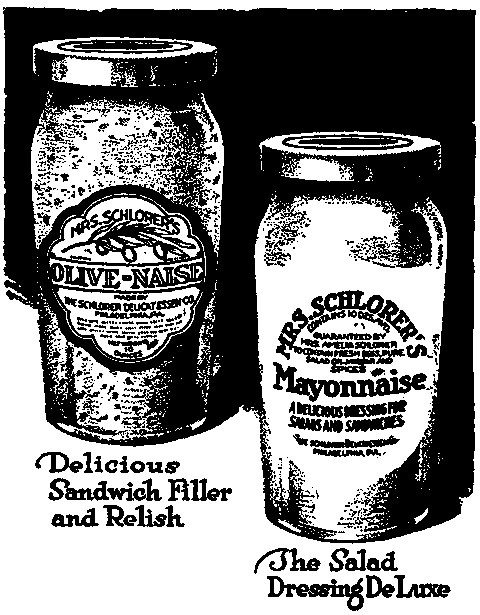
MANUFACTURED BY

Sauce, apple, my ideal, 114
artichoke, Hollandaise, 220
banana, 229
batardi, 382
Bearnaise, 195
blackberry, sweet spiced, 81
Bohemian, 384
brown, 383
Canadian, 384
caramel, 79
celery, 194
cherry, 81
chili, 438
cider (champagne sauce), 382
cream, 384
horseradish, 195
creole, 198
cucumber, 197
custard, 79
English mustard, 199
fish, 231
fruit, 79
custard, 82
herb, 198
horseradish, 384
lemon, 80
Maintenon (for au gratin dishes), 195
Mexican chili, 385
mint, 199
mushroom, 197
olive, 191
onion, 194
orange, 83
oyster, 197
cocktail, 370
parsley, 197
pear, 250
pimento cream, 194
prune, 122
pudding, 82
rhubarb-fruit, 123
saboyon, 81
supreme, 194
sweetened cream, 80
to serve with fish (boiled fish), 172
vanilla, 80
Virginia, 319
Scallions à l'italienne, 303
Scalloped corn, 77
Scrapple, the, 434
Seasonings, French, 179
Selection of menus for family of ten persons, 456
Shake, cream coffee, 391
Shank, 309
Shell fish, 165
Shoulder clod, 309
Sling, currant, 390
Soup, 237
bean, 148
cabbage, 248
celery, 245
clear, 241
tomato, 472
French pea, 152
fruit, 154
herbs, fagot of, 152
how to prepare fagot of, 179
mock turtle, 150
mulligatawny, 151
ox tail, 151
oyster, real old Vermont, 352
pea, 468
turkey (Italian), 348
vegetable, 240
Spinach, 143
à la bourgeois, 147
à la mode, 144
balls, 146
nests, 145
pudding, 144
salad, 146
(Scotch style), 147
souffle of, 145
with Hollandaise sauce, 145
Squab, planked, 367
Steak, 295
braised rolled flank, 320
broiled hamburg, 295
planked, 320
round, 295
rump, 295
sirloin, 295
Spanish, 452
Sticky cinnamon buns, 20
St. Nazaire buns, 21
Straight dough Vienna, 9
String beans, Italian style, 74
Suey, chop, 321
Sugarless candy, 455
Suggestive Colonial menu, 480
menu for family home wedding, 25 persons, 7 o'clock dinner, 369
menus, 465
[pg 502]Summer drinks, 389
Sunshine sauce for vegetables, 144
Supreme sauce, 194
Swedish rice pudding, 110
Sweet biscuits, 45
doughs, 26
potato biscuit, 417
cakes (Georgia style), 418
cookies, 416
croquettes, 415
nests, 415
pineapple, 418
pone, 358
pudding (Kentucky style), 417
potatoes, 415
red pepper marmalade, 440
spiced blackberry sauce, 81
Sweetbread patties, 162
Sweetened cream sauce, 80
Talls, braised ox, 377
Tamales, chicken, 207
Tapioca, honey raisin, 210
Tart, strawberry custard, 217
Tarts, pear, 250
Temperature, oven, 6
Tenderloin, pork, 319
Tennessee turkey hash, 206
Terrapin, 294
Thousand Islands dressing, 130
Tiger-eye sandwiches, 280
Time for roasting meat in gas broiler, 157
To can sauerkraut, 441
cook rhubarb for pies, 123
turtle and snapper, 293
veal, 289
dry corn (Lancaster County recipe), 424
make a cocktail, 411
brioche using bread dough, 25
the famous French bread, 10
meringue, 90
stock, 238
melt chocolate for dipping, 454
pan broil, 157
prepare a stew, 244
brains, 290
breaded cutlets, 289
corn flour, 407
fish for frying, 313
individual plum puddings, 472
loaf, 9
macaroni, 256
the mushrooms, 372
roast loin, 158
stuff dates with ginger, 128
use fondant for dipping, 455
Tomato canape, 273
cases, omelet in, 141
cream of, 247
dumplings, 428
egg custard, 425
marmalade, 439
omelet, 425
purée, 247
toast, 429
Tomatoes, 425
and eggs, pardue, 425
string beans, 427
au gratin, 426
baked, 426
Chelsea, 142
(cold), 429
eggplant and, 427
country style, 142
roast, 427
Tom Tiddle gingerbread, 464
Tongue, cold spice, 316
Try this dressing on plain lettuce, 302
Turkey, 343
au gratin, 346
croquettes, 346
meat biscuits, 345
pot pie, 348
preparing the, 460
soup (Italian), 348
stocks, some soups using, 348
(terrapin style), 347
utilising the leftover, 346
Turkish coffee, 389
Two-layer cake, 54
Utilizing the leftover turkey, 346
Vermont rhubarb griddle cakes, 125
Vienna, dough, straight, 9
Waffle batter, 37
Waffles, 35
Wassail, an English, 477
Weight, diet to reduce, 399
West Indies sweet potato pudding, 416
What these breakfasts eliminate, 402
Wheat bread, entire, 11
Whip, fruit, 83
Whole wheat muffins, 378
Why dough falls, 2
Wild game filling, 344
Winter menu, 338
Yearling, 323
Yeast, home-made, 8
Yeast-raised cake, how to make, 23
Ye Kentucky corn dodgers, 436
olde-tyme mincemeat, 363
pork pie, 445
old-time oyster pye, 341-342
Virginia batter bread, 436
Yesterday's bran bread, 379
Yorkshire pudding, 442
| ¼ pk. | 1 qt. | 1 pk. | 1 bu. | ||||
| Apples | 3 lbs. | 1 lb. 8 oz. | 11¼ lbs. | 45 lbs. | |||
| Beans, Lima | 3 lbs. 8 oz. | 1 lb. 12 oz. | 14 lbs. | 56 lbs. | |||
| Beans, String | 1 lb. 8 oz. | 12 oz. | 6 lbs. | 24 lbs. | |||
| Beans, Wax | 1 lb. 8 oz. | 12 oz. | 6 lbs. | 24 lbs. | |||
| Carrots | 3 lbs. 2 oz. | 1 lb. 9 oz. | 12½ lbs. | 50 lbs. | |||
| Cranberries | 2 lbs. | 1 lb. 1 oz. | 10 lbs. | 40 lbs. | |||
| Kale | 12 oz. | 6 oz. | 3 lbs. | 12 lbs. | |||
| Onions | 3 lbs. 9 oz. | 1 lb. 12 oz. | 12½ lbs. | 50 lbs. | |||
| Parsnips | 3 lbs. 2 oz. | 1 lb. 9 oz. | 12½ lbs. | 50 lbs. | |||
| Peas, dried | 3 lbs. 12 oz. | 1 lb. 14 oz. | 11¼ lbs. | 45 lbs. | |||
| Peas, green, unshelled | 3 lbs. 8 oz. | 1 lb. 12 oz. | 14 lbs. | 56 lbs. | |||
| Potatoes, Irish | 3 lbs. 12 oz. | 1 lb. 14 oz. | 15 lbs. | 60 lbs. | |||
| Potatoes, Sweet | 3 lbs. 4 oz. | 1 lb. 10 oz. | 13½ lbs. | 54 lbs. | |||
| Tomatoes | 3 lbs. 12 oz. | 1 lb. 14 oz. | 15 lbs. | 60 lbs. | |||
| Turnips | 3 lbs. 12 oz. | 1 lb. 14 oz. | 15 lbs. | 60 lbs. | |||
| Cherries | 3 lbs. 8 oz. | 1 lb. 12 oz. | 14 lbs. | 56 lbs. | |||
| Peanuts | 1 lb. 6 oz. | 10 oz. | 5½ lbs. | 22 lbs. |
The law provides that apples, cucumbers, cabbage, pears, peaches may be sold by numerical count.
| MEATS | VEGETABLES | |||||||
|---|---|---|---|---|---|---|---|---|
| Time | Time | |||||||
| Mutton | per | pound, | 20 | minutes. | Potatoes | 20 | to 30 min. | |
| Corned Beef | " | " | 30 | " | Asparagus | 20 | to 25 " | |
| Ham | " | " | 20 | " | Peas | 15 | to 20 " | |
| Turkey | " | " | 25 | " | String Beans | 20 | to 30 " | |
| Chicken | " | " | 20 | " | Lima Beans | 30 | to 40 " | |
| Fowl | " | " | 20 | " | Spinach | 15 | to 20 " | |
| Tripe | " | " | 40 | " | Turnips | 30 | minutes. | |
| Beets | 1 | hour. | ||||||
| FISH | Cabbage | 20 | minutes. | |||||
| Time | Cauliflower | 20 | " | |||||
| Codfish | " | " | 15 | to 18 min. | Brussels Sprouts | 25 | " | |
| Halibut | " | " | 15 | to 18 min. | Onions | 30 | " | |
| Bluefish | " | " | 15 | to 18 min. | Green Corn | 20 | " | |
| Lobster | " | " | 30 | to 40 min. | Rice | 20 | " | |
| MEATS | ||||
|---|---|---|---|---|
| Time | ||||
| Beef, ribs, rare | per | pound, | 15 | minutes. |
| Beef, ribs, well done | " | " | 20 | " |
| Round of Beef | " | " | 20 | " |
| Mutton, leg, rare | " | " | 18 | " |
| Mutton, leg, well done | " | " | 20 | " |
| Mutton, loin, rare | " | " | 15 | " |
| Lamb, well done | " | " | 20 | " |
| Veal, well done | " | " | 25 | " |
| Pork, well done | " | " | 25 | " |
| Chicken | " | " | 20 | " |
| Goose | " | " | 25 | " |
| Fillet, hot oven | 45 | minutes. | ||
| Braised Meats | 1½ | hours. | ||
| Turkey, 8 pounds | 2 | hours. | ||
| Birds, small, hot oven | 15 | to 20 min. | ||
| Ducks, tame | 1 | hour. | ||
| Ducks, wild, very hot oven | 25 | minutes. | ||
| FISH | ||||
| Large Fish | 1 | hour, about | ||
| Small Fish | 20 | to 30 mins. | ||
| Time | ||
| Steak, 1 inch thick | 8 | to 10 min. |
| Steak, 1½ inch thick | 10 | to 15 " |
| Mutton Chops, French | 8 | minutes. |
| Mutton Chops, English | 10 | " |
| Spring Chicken | 20 | " |
| Quail | 8 | to 10 min. |
| Grouse | 15 | minutes. |
| Squabs | 10 | to 15 min. |
| Shad, Bluefish, Trout | 15 | to 25 " |
| Small Fish | 5 | to l0 " |
| 4 | gills | = | 1 pint. |
| 2 | pints | = | 1 quart. |
| 4 | quarts | = | 1 gallon. |
| 16 | ounces | = | 1 pound. |
| ½ | kitchen cupful | = | 1 | gill. |
| 1 | kitchen cupful | = | ½ | pint or 2 gills. |
| 4 | kitchen cupfuls | = | 1 | quart. |
| 2 | cupfuls of granulated sugar | } | = 1 pound. |
| 2½ | cupfuls of powdered sugar | ||
| 1 | tablespoonful of sugar = ½ oz. | ||
| 1 | tablespoonful of butter = | ||
| Butter size of an egg = | 2 oz. | ||
| 1 | cupful of butter = | ½ pound. | |
| 4 | cupfuls of flour | } | = pound. |
| 1 | quart | ||
| 16 | tablespoonfuls of dry material | = | 1 cupful. |
| 16 | tablespoonfuls of liquid | = | 1 cupful. |
5 to 8 eggs to 1 quart of milk for custards.
3 to 4 eggs to 1 pint of milk for custards.
½ teaspoonful of salt to 1 quart of milk for custards.
1 teaspoonful of vanilla to 1 quart of milk for custards.
2 ounces of gelatine to 1¾ quarts of liquid.
8 level tablespoonfuls of cornstarch to 1 quart of milk.
8 level teaspoonfuls of baking-powder to 1 quart of flour.
2 teaspoonfuls of baking-powder to 1 cupful of flour.

|
Range shown is Novelty Fortune E 318 Spacious Broiling Oven, White Enamel Pan with Rack. White Enamel Splasher. Spacious Cooking Top. Pouch feed for Coaling fire without removing lids. Duplex Grates. Deep Ash Pit. Large Gas Oven. Front Oven Burner. Large Gas Cooking Top. Burners operate from front of range. Full 18" coal oven. Drop oven doors enamel trimmed. Nickelled Brackets. Beautiful—Sturdy—Efficient. |
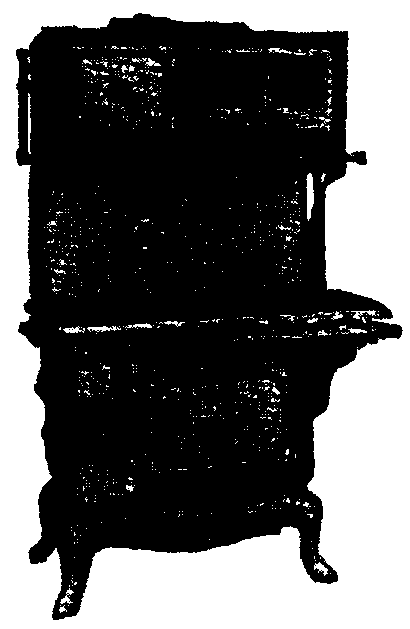 |
You are not always to blame when a roast goes bad in the oven—when a cake falls in the centre—the fault may be with your gas range—your oven does not heat uniformly or you have to use too much gas to get the results you are after.
The Fortune gas range was designed to help you cook. The Fortune is not merely our conception of what a good gas range should be.
The Fortune gas range is, on the other hand, the result of exhaustive scientific study—stands today without a peer. The Flex-o-tuf iron used in its construction insures long life and continued good service—you can depend upon it. You know that it does not waste fuel, and because domestic science teachers and lecturers have endorsed it, that it is the one and most practical range for you.
End of Project Gutenberg's Mrs. Wilson's Cook Book, by Mary A. Wilson

*** END OF THIS PROJECT GUTENBERG EBOOK MRS. WILSON'S COOK BOOK ***

***** This file should be named 17438-h.htm or 17438-h.zip *****
This and all associated files of various formats will be found in:
        http://www.gutenberg.org/1/7/4/3/17438/

Produced by Bethanne M. Simms, William Flis, and the Online
Distributed Proofreading Team at http://www.pgdp.net


Updated editions will replace the previous one--the old editions
will be renamed.

Creating the works from public domain print editions means that no
one owns a United States copyright in these works, so the Foundation
(and you!) can copy and distribute it in the United States without
permission and without paying copyright royalties.  Special rules,
set forth in the General Terms of Use part of this license, apply to
copying and distributing Project Gutenberg-tm electronic works to
protect the PROJECT GUTENBERG-tm concept and trademark.  Project
Gutenberg is a registered trademark, and may not be used if you
charge for the eBooks, unless you receive specific permission.  If you
do not charge anything for copies of this eBook, complying with the
rules is very easy.  You may use this eBook for nearly any purpose
such as creation of derivative works, reports, performances and
research.  They may be modified and printed and given away--you may do
practically ANYTHING with public domain eBooks.  Redistribution is
subject to the trademark license, especially commercial
redistribution.


*** START: FULL LICENSE ***

THE FULL PROJECT GUTENBERG LICENSE
PLEASE READ THIS BEFORE YOU DISTRIBUTE OR USE THIS WORK

To protect the Project Gutenberg-tm mission of promoting the free
distribution of electronic works, by using or distributing this work
(or any other work associated in any way with the phrase "Project
Gutenberg"), you agree to comply with all the terms of the Full Project
Gutenberg-tm License (available with this file or online at
http://gutenberg.org/license).


Section 1.  General Terms of Use and Redistributing Project Gutenberg-tm
electronic works

1.A.  By reading or using any part of this Project Gutenberg-tm
electronic work, you indicate that you have read, understand, agree to
and accept all the terms of this license and intellectual property
(trademark/copyright) agreement.  If you do not agree to abide by all
the terms of this agreement, you must cease using and return or destroy
all copies of Project Gutenberg-tm electronic works in your possession.
If you paid a fee for obtaining a copy of or access to a Project
Gutenberg-tm electronic work and you do not agree to be bound by the
terms of this agreement, you may obtain a refund from the person or
entity to whom you paid the fee as set forth in paragraph 1.E.8.

1.B.  "Project Gutenberg" is a registered trademark.  It may only be
used on or associated in any way with an electronic work by people who
agree to be bound by the terms of this agreement.  There are a few
things that you can do with most Project Gutenberg-tm electronic works
even without complying with the full terms of this agreement.  See
paragraph 1.C below.  There are a lot of things you can do with Project
Gutenberg-tm electronic works if you follow the terms of this agreement
and help preserve free future access to Project Gutenberg-tm electronic
works.  See paragraph 1.E below.

1.C.  The Project Gutenberg Literary Archive Foundation ("the Foundation"
or PGLAF), owns a compilation copyright in the collection of Project
Gutenberg-tm electronic works.  Nearly all the individual works in the
collection are in the public domain in the United States.  If an
individual work is in the public domain in the United States and you are
located in the United States, we do not claim a right to prevent you from
copying, distributing, performing, displaying or creating derivative
works based on the work as long as all references to Project Gutenberg
are removed.  Of course, we hope that you will support the Project
Gutenberg-tm mission of promoting free access to electronic works by
freely sharing Project Gutenberg-tm works in compliance with the terms of
this agreement for keeping the Project Gutenberg-tm name associated with
the work.  You can easily comply with the terms of this agreement by
keeping this work in the same format with its attached full Project
Gutenberg-tm License when you share it without charge with others.

1.D.  The copyright laws of the place where you are located also govern
what you can do with this work.  Copyright laws in most countries are in
a constant state of change.  If you are outside the United States, check
the laws of your country in addition to the terms of this agreement
before downloading, copying, displaying, performing, distributing or
creating derivative works based on this work or any other Project
Gutenberg-tm work.  The Foundation makes no representations concerning
the copyright status of any work in any country outside the United
States.

1.E.  Unless you have removed all references to Project Gutenberg:

1.E.1.  The following sentence, with active links to, or other immediate
access to, the full Project Gutenberg-tm License must appear prominently
whenever any copy of a Project Gutenberg-tm work (any work on which the
phrase "Project Gutenberg" appears, or with which the phrase "Project
Gutenberg" is associated) is accessed, displayed, performed, viewed,
copied or distributed:

This eBook is for the use of anyone anywhere at no cost and with
almost no restrictions whatsoever.  You may copy it, give it away or
re-use it under the terms of the Project Gutenberg License included
with this eBook or online at www.gutenberg.org

1.E.2.  If an individual Project Gutenberg-tm electronic work is derived
from the public domain (does not contain a notice indicating that it is
posted with permission of the copyright holder), the work can be copied
and distributed to anyone in the United States without paying any fees
or charges.  If you are redistributing or providing access to a work
with the phrase "Project Gutenberg" associated with or appearing on the
work, you must comply either with the requirements of paragraphs 1.E.1
through 1.E.7 or obtain permission for the use of the work and the
Project Gutenberg-tm trademark as set forth in paragraphs 1.E.8 or
1.E.9.

1.E.3.  If an individual Project Gutenberg-tm electronic work is posted
with the permission of the copyright holder, your use and distribution
must comply with both paragraphs 1.E.1 through 1.E.7 and any additional
terms imposed by the copyright holder.  Additional terms will be linked
to the Project Gutenberg-tm License for all works posted with the
permission of the copyright holder found at the beginning of this work.

1.E.4.  Do not unlink or detach or remove the full Project Gutenberg-tm
License terms from this work, or any files containing a part of this
work or any other work associated with Project Gutenberg-tm.

1.E.5.  Do not copy, display, perform, distribute or redistribute this
electronic work, or any part of this electronic work, without
prominently displaying the sentence set forth in paragraph 1.E.1 with
active links or immediate access to the full terms of the Project
Gutenberg-tm License.

1.E.6.  You may convert to and distribute this work in any binary,
compressed, marked up, nonproprietary or proprietary form, including any
word processing or hypertext form.  However, if you provide access to or
distribute copies of a Project Gutenberg-tm work in a format other than
"Plain Vanilla ASCII" or other format used in the official version
posted on the official Project Gutenberg-tm web site (www.gutenberg.org),
you must, at no additional cost, fee or expense to the user, provide a
copy, a means of exporting a copy, or a means of obtaining a copy upon
request, of the work in its original "Plain Vanilla ASCII" or other
form.  Any alternate format must include the full Project Gutenberg-tm
License as specified in paragraph 1.E.1.

1.E.7.  Do not charge a fee for access to, viewing, displaying,
performing, copying or distributing any Project Gutenberg-tm works
unless you comply with paragraph 1.E.8 or 1.E.9.

1.E.8.  You may charge a reasonable fee for copies of or providing
access to or distributing Project Gutenberg-tm electronic works provided
that

- You pay a royalty fee of 20% of the gross profits you derive from
     the use of Project Gutenberg-tm works calculated using the method
     you already use to calculate your applicable taxes.  The fee is
     owed to the owner of the Project Gutenberg-tm trademark, but he
     has agreed to donate royalties under this paragraph to the
     Project Gutenberg Literary Archive Foundation.  Royalty payments
     must be paid within 60 days following each date on which you
     prepare (or are legally required to prepare) your periodic tax
     returns.  Royalty payments should be clearly marked as such and
     sent to the Project Gutenberg Literary Archive Foundation at the
     address specified in Section 4, "Information about donations to
     the Project Gutenberg Literary Archive Foundation."

- You provide a full refund of any money paid by a user who notifies
     you in writing (or by e-mail) within 30 days of receipt that s/he
     does not agree to the terms of the full Project Gutenberg-tm
     License.  You must require such a user to return or
     destroy all copies of the works possessed in a physical medium
     and discontinue all use of and all access to other copies of
     Project Gutenberg-tm works.

- You provide, in accordance with paragraph 1.F.3, a full refund of any
     money paid for a work or a replacement copy, if a defect in the
     electronic work is discovered and reported to you within 90 days
     of receipt of the work.

- You comply with all other terms of this agreement for free
     distribution of Project Gutenberg-tm works.

1.E.9.  If you wish to charge a fee or distribute a Project Gutenberg-tm
electronic work or group of works on different terms than are set
forth in this agreement, you must obtain permission in writing from
both the Project Gutenberg Literary Archive Foundation and Michael
Hart, the owner of the Project Gutenberg-tm trademark.  Contact the
Foundation as set forth in Section 3 below.

1.F.

1.F.1.  Project Gutenberg volunteers and employees expend considerable
effort to identify, do copyright research on, transcribe and proofread
public domain works in creating the Project Gutenberg-tm
collection.  Despite these efforts, Project Gutenberg-tm electronic
works, and the medium on which they may be stored, may contain
"Defects," such as, but not limited to, incomplete, inaccurate or
corrupt data, transcription errors, a copyright or other intellectual
property infringement, a defective or damaged disk or other medium, a
computer virus, or computer codes that damage or cannot be read by
your equipment.

1.F.2.  LIMITED WARRANTY, DISCLAIMER OF DAMAGES - Except for the "Right
of Replacement or Refund" described in paragraph 1.F.3, the Project
Gutenberg Literary Archive Foundation, the owner of the Project
Gutenberg-tm trademark, and any other party distributing a Project
Gutenberg-tm electronic work under this agreement, disclaim all
liability to you for damages, costs and expenses, including legal
fees.  YOU AGREE THAT YOU HAVE NO REMEDIES FOR NEGLIGENCE, STRICT
LIABILITY, BREACH OF WARRANTY OR BREACH OF CONTRACT EXCEPT THOSE
PROVIDED IN PARAGRAPH F3.  YOU AGREE THAT THE FOUNDATION, THE
TRADEMARK OWNER, AND ANY DISTRIBUTOR UNDER THIS AGREEMENT WILL NOT BE
LIABLE TO YOU FOR ACTUAL, DIRECT, INDIRECT, CONSEQUENTIAL, PUNITIVE OR
INCIDENTAL DAMAGES EVEN IF YOU GIVE NOTICE OF THE POSSIBILITY OF SUCH
DAMAGE.

1.F.3.  LIMITED RIGHT OF REPLACEMENT OR REFUND - If you discover a
defect in this electronic work within 90 days of receiving it, you can
receive a refund of the money (if any) you paid for it by sending a
written explanation to the person you received the work from.  If you
received the work on a physical medium, you must return the medium with
your written explanation.  The person or entity that provided you with
the defective work may elect to provide a replacement copy in lieu of a
refund.  If you received the work electronically, the person or entity
providing it to you may choose to give you a second opportunity to
receive the work electronically in lieu of a refund.  If the second copy
is also defective, you may demand a refund in writing without further
opportunities to fix the problem.

1.F.4.  Except for the limited right of replacement or refund set forth
in paragraph 1.F.3, this work is provided to you 'AS-IS' WITH NO OTHER
WARRANTIES OF ANY KIND, EXPRESS OR IMPLIED, INCLUDING BUT NOT LIMITED TO
WARRANTIES OF MERCHANTIBILITY OR FITNESS FOR ANY PURPOSE.

1.F.5.  Some states do not allow disclaimers of certain implied
warranties or the exclusion or limitation of certain types of damages.
If any disclaimer or limitation set forth in this agreement violates the
law of the state applicable to this agreement, the agreement shall be
interpreted to make the maximum disclaimer or limitation permitted by
the applicable state law.  The invalidity or unenforceability of any
provision of this agreement shall not void the remaining provisions.

1.F.6.  INDEMNITY - You agree to indemnify and hold the Foundation, the
trademark owner, any agent or employee of the Foundation, anyone
providing copies of Project Gutenberg-tm electronic works in accordance
with this agreement, and any volunteers associated with the production,
promotion and distribution of Project Gutenberg-tm electronic works,
harmless from all liability, costs and expenses, including legal fees,
that arise directly or indirectly from any of the following which you do
or cause to occur: (a) distribution of this or any Project Gutenberg-tm
work, (b) alteration, modification, or additions or deletions to any
Project Gutenberg-tm work, and (c) any Defect you cause.


Section  2.  Information about the Mission of Project Gutenberg-tm

Project Gutenberg-tm is synonymous with the free distribution of
electronic works in formats readable by the widest variety of computers
including obsolete, old, middle-aged and new computers.  It exists
because of the efforts of hundreds of volunteers and donations from
people in all walks of life.

Volunteers and financial support to provide volunteers with the
assistance they need, is critical to reaching Project Gutenberg-tm's
goals and ensuring that the Project Gutenberg-tm collection will
remain freely available for generations to come.  In 2001, the Project
Gutenberg Literary Archive Foundation was created to provide a secure
and permanent future for Project Gutenberg-tm and future generations.
To learn more about the Project Gutenberg Literary Archive Foundation
and how your efforts and donations can help, see Sections 3 and 4
and the Foundation web page at http://www.pglaf.org.


Section 3.  Information about the Project Gutenberg Literary Archive
Foundation

The Project Gutenberg Literary Archive Foundation is a non profit
501(c)(3) educational corporation organized under the laws of the
state of Mississippi and granted tax exempt status by the Internal
Revenue Service.  The Foundation's EIN or federal tax identification
number is 64-6221541.  Its 501(c)(3) letter is posted at
http://pglaf.org/fundraising.  Contributions to the Project Gutenberg
Literary Archive Foundation are tax deductible to the full extent
permitted by U.S. federal laws and your state's laws.

The Foundation's principal office is located at 4557 Melan Dr. S.
Fairbanks, AK, 99712., but its volunteers and employees are scattered
throughout numerous locations.  Its business office is located at
809 North 1500 West, Salt Lake City, UT 84116, (801) 596-1887, email
business@pglaf.org.  Email contact links and up to date contact
information can be found at the Foundation's web site and official
page at http://pglaf.org

For additional contact information:
     Dr. Gregory B. Newby
     Chief Executive and Director
     gbnewby@pglaf.org


Section 4.  Information about Donations to the Project Gutenberg
Literary Archive Foundation

Project Gutenberg-tm depends upon and cannot survive without wide
spread public support and donations to carry out its mission of
increasing the number of public domain and licensed works that can be
freely distributed in machine readable form accessible by the widest
array of equipment including outdated equipment.  Many small donations
($1 to $5,000) are particularly important to maintaining tax exempt
status with the IRS.

The Foundation is committed to complying with the laws regulating
charities and charitable donations in all 50 states of the United
States.  Compliance requirements are not uniform and it takes a
considerable effort, much paperwork and many fees to meet and keep up
with these requirements.  We do not solicit donations in locations
where we have not received written confirmation of compliance.  To
SEND DONATIONS or determine the status of compliance for any
particular state visit http://pglaf.org

While we cannot and do not solicit contributions from states where we
have not met the solicitation requirements, we know of no prohibition
against accepting unsolicited donations from donors in such states who
approach us with offers to donate.

International donations are gratefully accepted, but we cannot make
any statements concerning tax treatment of donations received from
outside the United States.  U.S. laws alone swamp our small staff.

Please check the Project Gutenberg Web pages for current donation
methods and addresses.  Donations are accepted in a number of other
ways including including checks, online payments and credit card
donations.  To donate, please visit: http://pglaf.org/donate


Section 5.  General Information About Project Gutenberg-tm electronic
works.

Professor Michael S. Hart is the originator of the Project Gutenberg-tm
concept of a library of electronic works that could be freely shared
with anyone.  For thirty years, he produced and distributed Project
Gutenberg-tm eBooks with only a loose network of volunteer support.


Project Gutenberg-tm eBooks are often created from several printed
editions, all of which are confirmed as Public Domain in the U.S.
unless a copyright notice is included.  Thus, we do not necessarily
keep eBooks in compliance with any particular paper edition.


Most people start at our Web site which has the main PG search facility:

     http://www.gutenberg.org

This Web site includes information about Project Gutenberg-tm,
including how to make donations to the Project Gutenberg Literary
Archive Foundation, how to help produce our new eBooks, and how to
subscribe to our email newsletter to hear about new eBooks.