Project Gutenberg's The Vision of Sir Launfal, by James Russell Lowell

This eBook is for the use of anyone anywhere at no cost and with
almost no restrictions whatsoever.  You may copy it, give it away or
re-use it under the terms of the Project Gutenberg License included
with this eBook or online at www.gutenberg.org


Title: The Vision of Sir Launfal
       And Other Poems

Author: James Russell Lowell

Release Date: November 20, 2005 [EBook #17119]

Language: English

Character set encoding: ISO-8859-1

*** START OF THIS PROJECT GUTENBERG EBOOK THE VISION OF SIR LAUNFAL ***


Produced by David Starner, Sankar Viswanathan, and the
Online Distributed Proofreading Team at https://www.pgdp.net
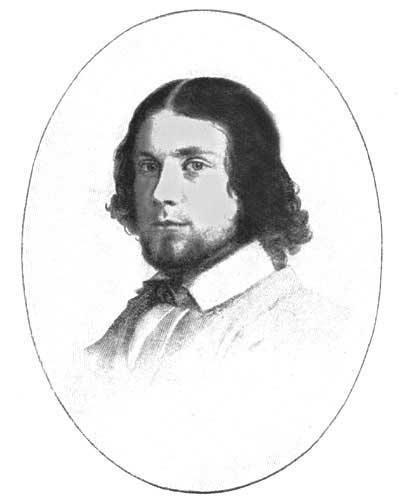 James Russell Lowell.
The Riverside Literature Series
THE VISION OF SIR LAUNFAL
AND OTHER POEMS
BY
JAMES RUSSELL LOWELL
WITH A BIOGRAPHICAL SKETCH
AND NOTES
A PORTRAIT AND OTHER ILLUSTRATIONS
HOUGHTON, MIFFLIN AND COMPANY
Boston: 4 Park Street; New York: 11 East Seventeenth Street
Chicago: 378-388 Wabash Avenue
The Riverside Press, Cambridge
Copyright, 1848, 1857, 1866, 1868, 1869, 1876, and 1885,
By JAMES RUSSELL LOWELL.
Copyright, 1887, 1894, and 1896,
By HOUGHTON, MIFFLIN & CO.
CONTENTS
LIST OF ILLUSTRATIONS.
A SKETCH OF THE LIFE OF JAMES RUSSELL LOWELL
[v]
I.
ELMWOOD.
About half a mile from the Craigie House in Cambridge, Massachusetts,
on the road leading to the old town of Watertown, is Elmwood, a
spacious square house set amongst lilac and syringa bushes, and
overtopped by elms. Pleasant fields are on either side, and from the
windows one may look out on the Charles River winding its way among
the marshes. The house itself is one of a group which before the war
for independence belonged to Boston merchants and officers of the
crown who refused to take the side of the revolutionary party. Tory
Row was the name given to the broad winding road on which the houses
stood. Great farms and gardens were attached to them, and some sign of
their roomy ease still remains. The estates fell into the hands of
various persons after the war, and in process of time Longfellow came
to occupy Craigie House. Elmwood at that time was the property of the
Reverend Charles Lowell, minister of the West Church in Boston, and
when Longfellow thus became his neighbor, James Russell Lowell was a
junior in Harvard College. He was born at Elmwood, February 22, 1819.
[vi]Any one who will read An Indian Summer Reverie will discover how
affectionately Lowell dwelt on the scenes of nature and life amidst
which he grew up. Indeed, it would be a pleasant task to draw from the
full storehouse of his poetry the golden phrases with which he
characterizes the trees, meadows, brooks, flowers, birds, and human
companions that were so near to him in his youth and so vivid in his
recollection. In his prose works also a lively paper, Cambridge
Thirty Years Ago, contains many reminiscences of his early life.
To know any one well it is needful to inquire into his ancestry, and
two or three hints may be given of the currents that met in this poet.
On his father's side he came from a succession of New England men who
for the previous three generations had been in professional life. The
Lowells traced their descent from Percival Lowell,—a name which
survives in the family,—of Bristol, England, who settled in Newbury,
Massachusetts, in 1639. The great-grandfather was a minister in
Newburyport, one of those, as Dr. Hale says, "who preached sermons
when young men went out to fight the French, and preached sermons
again in memory of their death when they had been slain in battle."
The grandfather was John Lowell, a member of the Constitutional
Convention of Massachusetts in 1780. It was he who introduced into the
Bill of Rights a phrase from the Bill of Rights of Virginia, "All men
are created free and equal," with the purpose which it effected of
setting free every man then held as a slave in Massachusetts. A son of
John Lowell and brother of the Rev. Charles Lowell was Francis Cabot
Lowell, who gave a great impetus to New England manufactures, and from
whom the city of Lowell took its name. Another son, and thus also an
[vii]
uncle of the poet, was John Lowell, Jr., whose wise and far-sighted
provision gave to Boston that powerful centre of intellectual
influence, the Lowell Institute. Of the Rev. Charles Lowell, his son
said, in a letter written in 1844, "He is Doctor Primrose in the
comparative degree, the very simplest and charmingest of
sexagenarians, and not without a great deal of the truest
magnanimity." It was characteristic of Lowell thus to go to The Vicar
of Wakefield for a portrait of his father. Dr. Lowell lived till
1861, when his son was forty-two.
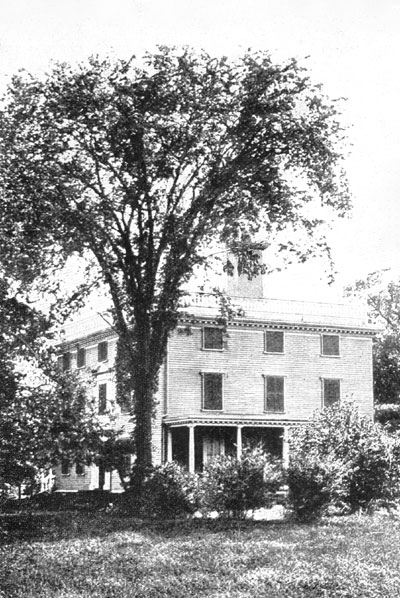 Elmwood, Mr. Lowell's home in Cambridge.
Mrs. Harriet Spence Lowell, the poet's mother, was of Scotch origin, a
native of Portsmouth, New Hampshire. She is described as having "a
great memory, an extraordinary aptitude for language, and a passionate
fondness for ancient songs and ballads." It pleased her to fancy
herself descended from the hero of one of the most famous ballads, Sir
Patrick Spens, and at any rate she made a genuine link in the Poetic
Succession. In a letter to his mother, written in 1837, Lowell says:
"I am engaged in several poetical effusions, one of which I have
dedicated to you, who have always been the patron and encourager of my
youthful muse." The Russell in his name seems to intimate a strain of
Jewish ancestry; at any rate Lowell took pride in the name on this
account, for he was not slow to recognize the intellectual power of
the Hebrew race. He was the youngest of a family of five, two
daughters and three sons. An older brother who outlived him a short
time, was the Rev. Robert Traill Spence Lowell, who wrote besides a
novel, The New Priest in Conception Bay, which contains a delightful
study of a Yankee, some poems, and a story of school-boy life.
[viii]
Not long before his death, Lowell wrote to an English friend a
description of Elmwood, and as he was very fond of the house in which
he lived and died, it is agreeable to read words which strove to set
it before the eyes of one who had never seen it. "'Tis a pleasant old
house, just about twice as old as I am, four miles from Boston, in
what was once the country and is now a populous suburb. But it still
has some ten acres of open about it, and some fine old trees. When the
worst comes to the worst (if I live so long) I shall still have four
and a half acres left with the house, the rest belonging to my
brothers and sisters or their heirs. It is a square house, with four
rooms on a floor, like some houses of the Georgian era I have seen in
English provincial towns, only they are of brick, and this is of wood.
But it is solid with its heavy oaken beams, the spaces between which
in the four outer walls are filled in with brick, though you mustn't
fancy a brick-and-timber house, for outwardly it is sheathed with
wood. Inside there is much wainscot (of deal) painted white in the
fashion of the time when it was built. It is very sunny, the sun
rising so as to shine (at an acute angle to be sure) through the
northern windows, and going round the other three sides in the course
of the day. There is a pretty staircase with the quaint old twisted
banisters,—which they call balusters now; but mine are banisters. My
library occupies two rooms opening into each other by arches at the
sides of the ample chimneys. The trees I look out on are the earliest
things I remember. There you have me in my new-old quarters. But you
must not fancy a large house—rooms sixteen feet square, and on the
ground floor, nine high. It was large, as things went here, when it
was built, and has a certain [ix]air of amplitude about it as from some
inward sense of dignity." In an earlier letter he wrote: "Here I am in
my garret. I slept here when I was a little curly-headed boy, and used
to see visions between me and the ceiling, and dream the so often
recurring dream of having the earth put into my hand like an orange.
In it I used to be shut up without a lamp,—my mother saying that none
of her children should be afraid of the dark,—to hide my head under
the pillow, and then not be able to shut out the shapeless monsters
that thronged around me, minted in my brain.... In winter my view is a
wide one, taking in a part of Boston. I can see one long curve of the
Charles and the wide fields between me and Cambridge, and the flat
marshes beyond the river, smooth and silent with glittering snow. As
the spring advances and one after another of our trees puts forth, the
landscape is cut off from me piece by piece, till, by the end of May,
I am closeted in a cool and rustling privacy of leaves." In two of his
papers especially, My Garden Acquaintance and A Good Word for
Winter, has Lowell given glimpses of the out-door life in the midst
of which he grew up.
II.
EDUCATION.
His acquaintance with books and his schooling began early. He learned
his letters at a dame school. Mr. William Wells, an Englishman, opened
a classical school in one of the spacious Tory Row houses near
Elmwood, and, bringing with him English public school thoroughness and
severity, gave the boy a drilling in Latin, which he must have made
almost a native speech to [x]judge by the ease with which he handled it
afterward in mock heroics. Of course he went to Harvard College. He
lived at his father's house, more than a mile away from the college
yard; but this could have been no great privation to him, for he had
the freedom of his friends' rooms, and he loved the open air. The Rev.
Edward Everett Hale has given a sketch of their common life in
college. "He was a little older than I," he says, "and was one class
in advance of me. My older brother, with whom I lived in college, and
he were most intimate friends. He had no room within the college
walls, and was a great deal with us. The fashion of Cambridge was then
literary. Now the fashion of Cambridge runs to social problems, but
then we were interested in literature. We read Byron and Shelley and
Keats, and we began to read Tennyson and Browning. I first heard of
Tennyson from Lowell, who had borrowed from Mr. Emerson the little
first volume of Tennyson. We actually passed about Tennyson's poems in
manuscript. Carlyle's essays were being printed at the time, and his
French Revolution. In such a community—not two hundred and fifty
students all told,—literary effort was, as I say, the fashion, and
literary men, among whom Lowell was recognized from the very first,
were special favorites. Indeed, there was that in him which made him a
favorite everywhere."
Lowell was but fifteen years old when he entered college in the class
which graduated in 1838. He was a reader, as so many of his fellows
were, and the letters which he wrote shortly after leaving college
show how intent he had been on making acquaintance with the best
things in literature. He began also to scribble verse, and he wrote
both poems and essays for college [xi]magazines. His class chose him
their poet for Class Day, and he wrote his poem; but he was careless
about conforming to college regulations respecting attendance at
morning prayers; and for this was suspended from college the last term
of his last year, and not allowed to come back to read his poem. "I
have heard in later years," says Dr. Hale, "what I did not know then,
that he rode down from Concord in a canvas-covered wagon, and peeped
out through the chinks of the wagon to see the dancing around the
tree. I fancy he received one or two visits from his friends in the
wagon; but in those times it would have been treason to speak of
this." He was sent to Concord for his rustication, and so passed a few
weeks of his youth amongst scenes dear to every lover of American
letters.
III.
FIRST VENTURE.
After his graduation he set about the study of law, and for a short
time even was a clerk in a counting-room; but his bent was strongly
toward literature. There was at that time no magazine of commanding
importance in America, and young men were given to starting magazines
with enthusiasm and very little other capital. Such a one was the
Boston Miscellany, launched by Nathan Hale, Lowell's college friend,
and for this Lowell wrote gaily. It lived a year, and shortly after
Lowell himself, with Robert Carter, essayed The Pioneer in 1843. It
lived just three months; but in that time printed contributions by
Lowell, Hawthorne, Whittier, Story, Poe, and Dr. Parsons,—a group
which it would be hard to match in any of the little magazines [xii]that
hop across the world's path to-day. Lowell had already collected, in
1841, the poems which he had written and sometimes contributed to
periodicals into a volume entitled A Year's Life; but he retained
very little of the contents in later editions of his poems. The book
has a special interest, however, from its dedication in veiled phrase
to Maria White. He became engaged to this lady in the fall of 1840,
and the next twelve years of his life were profoundly affected by her
influence. Herself a poet of delicate power, she brought into his life
an intelligent sympathy with his work; it was, however, her strong
moral enthusiasm, her lofty conception of purity and justice, which
kindled his spirit and gave force and direction to a character which
was ready to respond, and yet might otherwise have delayed active
expression. They were not married until 1844; but they were not far
apart in their homes, and during these years Lowell was making those
early ventures in literature, and first raids upon political and moral
evil, which foretold the direction of his later work, and gave some
hint of its abundance.
About the time of his marriage, he published two books which, by their
character, show pretty well the divided interest of his life. His bent
from the beginning was more decidedly literary than that of any
contemporary American poet. That is to say, the history and art of
literature divided his interest with the production of literature, and
he carried the unusual gift of a rare critical power, joined to hearty
spontaneous creation. It may indeed be guessed that the keenness of
judgment and incisiveness of wit which characterize his examination of
literature sometimes interfered with his poetic power, and made him
liable to question his art [xiii]when he would rather have expressed it
unchecked. One of the two books was a volume of poems; the other was a
prose work, Conversations on Some of the Old Poets. He did not keep
this book alive; but it is interesting as marking the enthusiasm of a
young scholar treading a way then almost wholly neglected in America,
and intimating a line of thought and study in which he afterward made
most noteworthy venture. Another series of poems followed in 1848, and
in the same year The Vision of Sir Launfal. Perhaps it was in
reaction from the marked sentiment of his poetry that he issued now a
jeu d'esprit, A Fable for Critics, in which he hit off, with a rough
and ready wit, the characteristics of the writers of the day, not
forgetting himself in these lines:
There is Lowell, who's striving Parnassus to climb
With a whole bale of isms tied together with rhyme;
He might get on alone, spite of brambles and boulders,
But he can't with that bundle he has on his shoulders;
The top of the hill he will ne'er come nigh reaching
Till he learns the distinction 'twixt singing and preaching;
His lyre has some chords that would ring pretty well,
But he'd rather by half make a drum of the shell,
And rattle away till he's old as Methusalem,
At the head of a march to the last new Jerusalem.
This, of course, is but a half serious portrait of himself, and it
touches but a single feature; others can say better that Lowell's
ardent nature showed itself in the series of satirical poems which
made him famous, The Biglow Papers, written in a spirit of
indignation and fine scorn, when the Mexican War was causing many
Americans to blush with shame at the use of the country by a class for
its own ignoble ends. Lowell and his wife, who brought a fervid
anti-slavery temper as part of her marriage portion, were both
contributors to the [xiv]Liberty Bell; and Lowell was a frequent
contributor to the Anti-Slavery Standard, and was, indeed, for a
while a corresponding editor. In June, 1846, there appeared one day in
the Boston Courier a letter from Mr. Ezekiel Biglow of Jaalam to the
editor, Hon. Joseph T. Buckingham, inclosing a poem of his son, Mr.
Hosea Biglow. It was no new thing to seek to arrest the public
attention with the vernacular applied to public affairs. Major Jack
Downing and Sam Slick had been notable examples, and they had many
imitators; but the reader who laughed over the racy narrative of the
unlettered Ezekiel, and then took up Hosea's poem and caught the gust
of Yankee wrath and humor blown fresh in his face, knew that he was in
at the appearance of something new in American literature. The force
which Lowell displayed in these satires made his book at once a
powerful ally of an anti-slavery sentiment, which heretofore had been
ridiculed.
IV.
VERSE AND PROSE.
A year in Europe, 1851-1852, with his wife, whose health was then
precarious, stimulated his scholarly interests, and gave substance to
his study of Dante and Italian literature. In October, 1853, his wife
died; she had borne him three children: the first-born, Blanche, died
in infancy; the second, Walter, also died young; the third, a
daughter, Mrs. Burnett, survived her parents. In 1855 he was chosen
successor to Longfellow as Smith Professor of the French and Spanish
Languages and Literature, and Professor of Belles Lettres in Harvard
College. He spent two years in Europe in [xv]further preparation for the
duties of his office, and in 1857 was again established in Cambridge,
and installed in his academic chair. He married, also, at this time
Miss Frances Dunlap, of Portland, Maine.
Lowell was now in his thirty-ninth year. As a scholar, in his
professional work, he had acquired a versatile knowledge of the
Romance languages, and was an adept in old French and Provençal
poetry; he had given a course of twelve lectures on English poetry
before the Lowell Institute in Boston, which had made a strong
impression on the community, and his work on the series of British
Poets in connection with Professor Child, especially his biographical
sketch of Keats, had been recognized as of a high order. In poetry he
had published the volumes already mentioned. In general literature he
had printed in magazines the papers which he afterward collected into
his volume, Fireside Travels. Not long after he entered on his
college duties, The Atlantic Monthly was started, and the editorship
given to him. He held the office for a year or two only; but he
continued to write for the magazine, and in 1862 he was associated
with Mr. Charles Eliot Norton in the conduct of The North American
Review, and continued in this charge for ten years. Much of his prose
was contributed to this periodical. Any one reading the titles of the
papers which comprise the volumes of his prose writings will readily
see how much literature, and especially poetic literature, occupied
his attention. Shakespeare, Dryden, Lessing, Rousseau, Dante, Spenser,
Wordsworth, Milton, Keats, Carlyle, Percival, Thoreau, Swinburne,
Chaucer, Emerson, Pope, Gray,—these are the principal subjects of his
prose, and the range of topics indicates the catholicity of his
taste.
[xvi]
In these papers, when studying poetry, he was very alive to the
personality of the poets, and it was the strong interest in humanity
which led Lowell, when he was most diligent in the pursuit of
literature, to apply himself also to history and politics. Several of
his essays bear witness to this, such as Witchcraft, New England Two
Centuries Ago, A Great Public Character (Josiah Quincy), Abraham
Lincoln, and his great Political Essays. But the most remarkable of
his writings of this order was the second series of The Biglow
Papers, published during the war for the Union. In these, with the
wit and fun of the earlier series, there was mingled a deeper strain
of feeling and a larger tone of patriotism. The limitations of his
style in these satires forbade the fullest expression of his thought
and emotion; but afterward in a succession of poems, occasioned by the
honors paid to student soldiers in Cambridge, the death of Agassiz,
and the celebration of national anniversaries during the years 1875
and 1876, he sang in loftier, more ardent strains. The most famous of
these poems was his noble Commemoration Ode.
V.
PUBLIC LIFE.
It was at the close of this period, when he had done incalculable
service to the Republic, that Lowell was called on to represent the
country, first in Madrid, where he was sent in 1877, and then in
London, to which he was transferred in 1880. Eight years were thus
spent by him in the foreign service of the country. He had a good
knowledge of the Spanish language and literature when he went to
Spain; but he at once took pains to [xvii]make his knowledge fuller and his
accent more perfect, so that he could have intimate relations with the
best Spanish men of the time. In England he was at once a most welcome
guest, and was in great demand as a public speaker. No one can read
his dispatches from Madrid and London without being struck by his
sagacity, his readiness in emergencies, his interest in and quick
perception of the political situation in the country where he was
resident, and his unerring knowledge as a man of the world. Above all,
he was through and through an American, true to the principles which
underlie American institutions. His address on Democracy, which he
delivered in England, is one of the great statements of human liberty.
A few years later, after his return to America, he gave another
address to his own countrymen on The Place of the Independent in
Politics. It was a noble defense of his own position, not without a
trace of discouragement at the apparently sluggish movement in
American self-government of recent years, but with that faith in the
substance of his countrymen which gave him the right to use words of
honest warning.
The public life of Mr. Lowell made him more of a figure before the
world. He received honors from societies and universities; he was
decorated by the highest honors which Harvard could pay officially;
and Oxford and Cambridge, St. Andrews and Edinburgh and Bologna, gave
gowns. He established warm personal relations with Englishmen, and,
after his release from public office, he made several visits to
England. There, too, was buried his wife, who died in 1885. The
closing years of his life in his own country, though touched with
domestic loneliness and diminished by growing physical [xviii]infirmities
that predicted his death, were rich also with the continued expression
of his large personality. He delivered the public address in
commemoration of the 250th anniversary of the founding of Harvard
University; he gave a course of lectures on the Old English Dramatists
before the Lowell Institute; he collected a volume of his poems; he
wrote and spoke on public affairs; and, the year before his death,
revised, rearranged, and carefully edited a definitive series of his
writings in ten volumes. He died at Elmwood, August 12, 1891. Since
his death three small volumes have been added to his collected
writings, and Mr. Norton has published Letters of James Russell
Lowell, in two volumes.
[1]
INTRODUCTORY NOTE
Lowell was in his thirtieth year when he wrote and published The
Vision of Sir Launfal. It appeared when he had just dashed off his
Fable for Critics, and when he was in the thick of the anti-slavery
fight, writing poetry and prose for The Anti-Slavery Standard, and
sending out his witty Biglow Papers. He had married four years
before, and was living in the homestead at Elmwood, walking in the
country about, and full of eagerness at the prospect which lay before
him. In a letter to his friend Charles F. Briggs, written in December,
1848, he says: "Last night ... I walked to Watertown over the snow,
with the new moon before me and a sky exactly like that in Page's
evening landscape. Orion was rising behind me, and, as I stood on the
hill just before you enter the village, the stillness of the fields
around me was delicious, broken only by the tinkle of a little brook
which runs too swiftly for Frost to catch it. My picture of the brook
in Sir Launfal was drawn from it. But why do I send you this
description,—like the bones of a chicken I had picked? Simply because
I was so happy as I stood there, and felt so sure of doing something
that would justify my friends. But why do I not say that I have done
something? I believe that I have done better than the world knows yet;
but the past seems so little compared with the future.... I am the
first poet who has endeavored [2]to express the American Idea, and I
shall be popular by and by."
It is not very likely that Lowell was thinking of Sir Launfal when
he wrote this last sentence, yet it is not straining language too far
to say that when he took up an Arthurian story he had a different
attitude toward the whole cycle of legends from that of Tennyson, who
had lately been reviving the legends for the pleasure of
English-reading people. The exuberance of the poet as he carols of
June in the prelude to Part First is an expression of the joyous
spring which was in the veins of the young American, glad in the sense
of freedom and hope. As Tennyson threw into his retelling of Arthurian
romance a moral sense, so Lowell, also a moralist in his poetic
apprehension, made a parable of his tale, and, in the broadest
interpretation of democracy, sang of the leveling of all ranks in a
common divine humanity. There is a subterranean passage connecting the
Biglow Papers with Sir Launfal; it is the holy zeal which attacks
slavery issuing in this fable of a beautiful charity, Christ in the
guise of a beggar.
The invention is a very simple one, and appears to have been suggested
by Tennyson's Sir Galahad, though Lowell had no doubt read Sir
Thomas Malory's Morte d'Arthur. The following is the note which
accompanied The Vision when first published in 1848, and retained by
Lowell in all subsequent editions:—
"According to the mythology of the Romancers, the San Greal,
or Holy Grail, was the cup out of which Jesus Christ partook
of the last supper with his disciples. It was brought into
England by Joseph of Arimathea, and remained there, an
object of pilgrimage and adoration, [3]for many years in the
keeping of his lineal descendants. It was incumbent upon
those who had charge of it to be chaste in thought, word,
and deed; but, one of the keepers having broken this
condition, the Holy Grail disappeared. From that time it was
a favorite enterprise of the Knights of Arthur's court to go
in search of it. Sir Galahad was at last successful in
finding it, as may be read in the seventeenth book of the
Romance of King Arthur. Tennyson has made Sir Galahad the
subject of one of the most exquisite of his poems.
"The plot (if I may give that name to anything so slight) of
the following poem is my own, and, to serve its purposes, I
have enlarged the circle of competition in search of the
miraculous cup in such a manner as to include not only other
persons than the heroes of the Round Table, but also a
period of time subsequent to the date of King Arthur's
reign."
[4]
THE VISION OF SIR LAUNFAL
PRELUDE TO PART FIRST.
Over his keys the musing organist,
Beginning doubtfully and far away,
First lets his fingers wander as they list,
And builds a Bridge from Dreamland for his lay:
5Then, as the touch of his loved instrument
Gives hope and fervor, nearer draws his theme,
First guessed by faint auroral flushes sent
Along the wavering vista of his dream.
Not only around our infancy[1]
10Doth heaven with all its splendors lie;
Daily, with souls that cringe and plot,
We Sinais climb and know it not.
Over our manhood bend the skies;
Against our fallen and traitor lives
15The great winds utter prophecies:
With our faint hearts the mountain strives;
Its arms outstretched, the druid wood
Waits with its benedicite;
And to our age's drowsy blood
20Still shouts the inspiring sea.
Earth gets its price for what Earth gives us;
The beggar is taxed for a corner to die in,
The priest hath his fee who comes and shrives us,
We bargain for the graves we lie in;
[5]
25At the Devil's booth are all things sold,
Each ounce of dross costs its ounce of gold;
For a cap and bells our lives we pay,[2]
Bubbles we buy with a whole soul's tasking:
'T is heaven alone that is given away,
30'T is only God may be had for the asking;
No price is set on the lavish summer;
June may be had by the poorest comer.
And what is so rare as a day in June?
Then, if ever, come perfect days;
35Then Heaven tries the earth if it be in tune,
And over it softly her warm ear lays:
Whether we look, or whether we listen,
We hear life murmur, or see it glisten;
Every clod feels a stir of might,
40An instinct within it that reaches and towers,
And, groping blindly above it for light,
Climbs to a soul in grass and flowers;
The flush of life may well be seen
Thrilling back over hills and valleys;
45The cowslip startles in meadows green,
The buttercup catches the sun in its chalice,
And there's never a leaf nor a blade too mean
To be some happy creature's palace;
The little bird sits at his door in the sun,
50Atilt like a blossom among the leaves,
And lets his illumined being o'errun
With the deluge of summer it receives;
His mate feels the eggs beneath her wings,
And the heart in her dumb breast flutters and sings;
55He sings to the wide world, and she to her nest,—
In the nice ear of Nature which song is the best?
[6]
Now is the high-tide of the year,
And whatever of life hath ebbed away
Comes flooding back with a ripply cheer,
60Into every bare inlet and creek and bay;
Now the heart is so full that a drop overfills it,
We are happy now because God wills it;
No matter how barren the past may have been,
'Tis enough for us now that the leaves are green;
65We sit in the warm shade and feel right well
How the sap creeps up and the blossoms swell;
We may shut our eyes, but we cannot help knowing
That skies are clear and grass is growing;
The breeze comes whispering in our ear,
70That dandelions are blossoming near,
That maize has sprouted, that streams are flowing,
That the river is bluer than the sky,
That the robin is plastering his house hard by;
And if the breeze kept the good news back,
75For other couriers we should not lack;
We could guess it all by yon heifer's lowing,—
And hark! how clear bold chanticleer,
Warmed with the new wine of the year,
Tells all in his lusty crowing!
80Joy comes, grief goes, we know not how;
Everything is happy now,
Everything is upward striving;
'T is as easy now for the heart to be true
As for grass to be green or skies to be blue,—
85'T is the natural way of living:
[7]
Who knows whither the clouds have fled?
In the unscarred heaven they leave no wake,
And the eyes forget the tears they have shed,
The heart forgets its sorrow and ache;
90The soul partakes of the season's youth,
And the sulphurous rifts of passion and woe
Lie deep 'neath a silence pure and smooth,
Like burnt-out craters healed with snow.
What wonder if Sir Launfal now
95Remembered the keeping of his vow?
PART FIRST.
I.
"My golden spurs now bring to me,
And bring to me my richest mail,
For to-morrow I go over land and sea,
In search of the Holy Grail;
100Shall never a bed for me be spread,
Nor shall a pillow be under my head,
Till I begin my vow to keep;
Here on the rushes will I sleep,
And perchance there may come a vision true
105Ere day create the world anew."
Slowly Sir Launfal's eyes grew dim,
Slumber fell like a cloud on him,
And into his soul the vision flew.
II.
The crows flapped over by twos and threes,
110In the pool drowsed the cattle up to their knees,
The little birds sang as if it were
The one day of summer in all the year,
[8]
And the very leaves seemed to sing on the trees:
The castle alone in the landscape lay
115Like an outpost of winter, dull and gray:
'Twas the proudest hall in the North Countree,
And never its gates might opened be,
Save to lord or lady of high degree;
Summer besieged it on every side,
120But the churlish stone her assaults defied;
She could not scale the chilly wall,
Though around it for leagues her pavilions tall
Stretched left and right,
Over the hills and out of sight;
125Green and broad was every tent,
And out of each a murmur went
Till the breeze fell off at night.
III.
The drawbridge dropped with a surly clang,
And through the dark arch a charger sprang,
130Bearing Sir Launfal, the maiden knight,
In his gilded mail, that flamed so bright
It seemed the dark castle had gathered all
Those shafts the fierce sun had shot over its wall
In his siege of three hundred summers long,
135And, binding them all in one blazing sheaf,
Had cast them forth: so, young and strong,
And lightsome as a locust-leaf,
Sir Launfal flashed forth in his unscarred mail,
To seek in all climes for the Holy Grail.
IV.
140It was morning on hill and stream and tree,
And morning in the young knight's heart;
Only the castle moodily
[9]
Rebuffed the gifts of the sunshine free,
And gloomed by itself apart;
145The season brimmed all other things up
Full as the rain fills the pitcher-plant's cup.
V.
As Sir Launfal made morn through the darksome gate,
He was 'ware of a leper, crouched by the same,
Who begged with his hand and moaned as he sate;
150And a loathing over Sir Launfal came;
The sunshine went out of his soul with a thrill,
The flesh 'neath his armor 'gan shrink and crawl,
And midway its leap his heart stood still
Like a frozen waterfall;
155For this man, so foul and bent of stature,
Rasped harshly against his dainty nature,
And seemed the one blot on the summer morn,—
So he tossed him a piece of gold in scorn.
VI.
The leper raised not the gold from the dust:
160"Better to me the poor man's crust,
Better the blessing of the poor,
Though I turn me empty from his door;
That is no true alms which the hand can hold;
He gives nothing but worthless gold
165Who gives from a sense of duty;
But he who gives but a slender mite,
And gives to that which is out of sight,
That thread of the all-sustaining Beauty
Which runs through all and doth all unite,—
170The hand cannot clasp the whole of his alms,
[10]
The heart outstretches its eager palms,
For a god goes with it and makes it store
To the soul that was starving in darkness before."
PRELUDE TO PART SECOND.
Down swept the chill wind from the mountain peak,[3]
175From the snow five thousand summers old;
On open wold and hill-top bleak
It had gathered all the cold,
And whirled it like sleet on the wanderer's cheek;
It carried a shiver everywhere
180From the unleafed boughs and pastures bare;
The little brook heard it and built a roof
'Neath which he could house him, winter-proof;
All night by the white stars frosty gleams
He groined his arches and matched his beams;
185Slender and clear were his crystal spars
As the lashes of light that trim the stars;
He sculptured every summer delight
In his halls and chambers out of sight;
Sometimes his tinkling waters slipt
190Down through a frost-leaved forest-crypt,
Long, sparkling aisles of steel-stemmed trees
Bending to counterfeit a breeze;
Sometimes the roof no fretwork knew
But silvery mosses that downward grew;
195Sometimes it was carved in sharp relief
With quaint arabesques of ice-fern leaf;
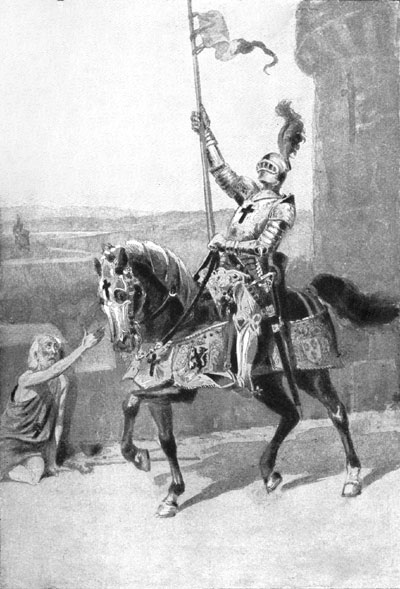 As Sir Launfal Made Morn Through the Darksome Gate.
[11]
Sometimes it was simply smooth and clear
For the gladness of heaven to shine through, and here
He had caught the nodding bulrush-tops
200And hung them thickly with diamond-drops,
That crystalled the beams of moon and sun,
And made a star of everyone:
No mortal builder's most rare device[4]
Could match this winter-palace of ice;
205'Twas as if every image that mirrored lay
In his depths serene through the summer day,[5]
Each fleeting shadow of earth and sky,
Lest the happy model should be lost,
Had been mimicked in fairy masonry
210By the elfin builders of the frost.
Within the hall are song and laughter,
The cheeks of Christmas grow red and jolly,
And sprouting is every corbel and rafter
With lightsome green of ivy and holly;
215Through the deep gulf of the chimney wide
Wallows the Yule-log's roaring tide
The broad flame-pennons droop and flap
And belly and tug as a flag in the wind;
Like a locust shrills the imprisoned sap,
220Hunted to death in its galleries blind;
And swift little troops of silent sparks,
Now pausing, now scattering away as in fear,
Go threading the soot-forest's tangled darks
Like herds of startled deer.
225But the wind without was eager and sharp,
Of Sir Launfal's gray hair it makes a harp,
And rattles and wrings
The icy strings,
Singing, in dreary monotone,
230A Christmas carol of its own,
Whose burden still, as he might guess,
Was—"Shelterless, shelterless, shelterless!"
The voice of the seneschal flared like a torch
As he shouted the wanderer away from the porch,
235And he sat in the gateway and saw all night
The great hall-fire, so cheery and bold,
Through the window-slits of the castle old,
Build out its piers of ruddy light
Against the drift of the cold.
[12]
PART SECOND.
I.
240There was never a leaf on bush or tree,
The bare boughs rattled shudderingly;
The river was dumb and could not speak,
For the weaver Winter its shroud had spun,
A single crow on the tree-top bleak
245From his shining feathers shed off the cold sun;
Again it was morning, but shrunk and cold,
As if her veins were sapless and old,
And she rose up decrepitly
For a last dim look at earth and sea.
[13]
II.
250Sir Launfal turned from his own hard gate,
For another heir in his earldom sate;
An old, bent man, worn out and frail,
He came back from seeking the Holy Grail;
Little he recked of his earldom's loss,
255No more on his surcoat was blazoned the cross,
But deep in his soul the sign he wore,
The badge of the suffering and the poor.
III.
Sir Launfal's raiment thin and spare
Was idle mail 'gainst the barbed air,
260For it was just at the Christmas time;
So he mused, as he sat, of a sunnier clime,
And sought for a shelter from cold and snow
In the light and warmth of long-ago;
He sees the snake-like caravan crawl
265O'er the edge of the desert, black and small,
Then nearer and nearer, till, one by one,
He can count the camels in the sun,
As over the red-hot sands they pass
To where, in its slender necklace of grass,
270The little spring laughed and leapt in the shade,
And with its own self like an infant played,
And waved its signal of palms.
IV.
"For Christ's sweet sake, I beg an alms;"—
The happy camels may reach the spring,
275But Sir Launfal sees only the grewsome thing,
The leper, lank as the rain-blanched bone,
That cowers beside him, a thing as lone
[14]
And white as the ice-isles of Northern seas
In the desolate horror of his disease.
V.
280And Sir Launfal said,—"I behold in thee
An image of Him who died on the tree;
Thou also hast had thy crown of thorns,—
Thou also hast had the world's buffets and scorns,—
And to thy life were not denied
285The wounds in the hands and feet and side;
Mild Mary's Son, acknowledge me;
Behold, through him, I give to Thee!"
VI.
Then the soul of the leper stood up in his eyes
And looked at Sir Launfal, and straightway he
290Remembered in what a haughtier guise
He had flung an alms to leprosie,
When he girt his young life up in gilded mail
And set forth in search of the Holy Grail.
The heart within him was ashes and dust;
295He parted in twain his single crust,
He broke the ice on the streamlet's brink,
And gave the leper to eat and drink:
'T was a mouldy crust of coarse brown bread,
'T was water out of a wooden bowl,—
300Yet with fine wheaten bread was the leper fed,
And 't was red wine he drank with his thirsty soul.
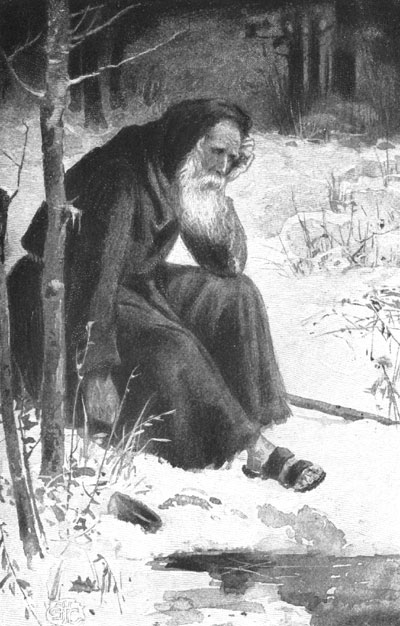 So he Mused, as he sat, of a sunnier clime.
VII.
As Sir Launfal mused with a downcast face,
A light shone round about the place;
The leper no longer crouched at his side,
[15]
305But stood before him glorified,
Shining and tall and fair and straight
As the pillar that stood by the Beautiful Gate,—
Himself the Gate whereby men can
Enter the temple of God in Man.
VIII.
310His words were shed softer than leaves from the pine,
And they fell on Sir Launfal as snows on the brine,
That mingle their softness and quiet in one
With the shaggy unrest they float down upon;
And the voice that was calmer than silence said,
315"Lo it is I, be not afraid!
In many climes, without avail,
Thou hast spent thy life for the Holy Grail;
Behold, it is here,—this cup which thou
Didst fill at the streamlet for Me but now;
320This crust is My body broken for thee,
This water His blood that died on the tree;
The Holy Supper is kept, indeed,
In whatso we share with another's need:
Not what we give, but what we share,—
325For the gift without the giver is bare;
Who gives himself with his alms feeds three,—
Himself, his hungering neighbor, and Me."
IX.
Sir Launfal awoke as from a swound:—
"The Grail in my castle here is found!
330Hang my idle armor up on the wall,
Let it be the spider's banquet-hall;
He must be fenced with stronger mail
Who would seek and find the Holy Grail."
[16]
X.
The castle gate stands open now,
335And the wanderer is welcome to the hall
As the hangbird is to the elm-tree bough;
No longer scowl the turrets tall,
The Summer's long siege at last is o'er;
When the first poor outcast went in at the door,
340She entered with him in disguise,
And mastered the fortress by surprise;
There is no spot she loves so well on ground,
She lingers and smiles there the whole year round;
The meanest serf on Sir Launfal's land
345Has hall and bower at his command;
And there's no poor man in the North Countree
But is lord of the earldom as much as he.
ODE RECITED AT THE HARVARD COMMEMORATION.
[On the 21st of July, 1865, Harvard University welcomed back those of
its students and graduates who had fought in the war for the Union. By
exercises in the church and at the festival which followed, the
services of the dead and the living were commemorated. It was on this
occasion that Mr. Lowell recited the following ode.]
I.
Weak-winged is song,
Nor aims at that clear-ethered height
Whither the brave deed climbs for light:
We seem to do them wrong,
5Bringing our robin's-leaf to deck their hearse
[17]
Who in warm life-blood wrote their nobler verse,
Our trivial song to honor those who come
With ears attuned to strenuous trump and drum,
And shaped in squadron-strophes their desire,
10Live battle-odes whose lines were steel and fire:
Yet sometimes feathered words are strong,
A gracious memory to buoy up and save
From Lethe's dreamless ooze, the common grave
Of the unventurous throng.
II.
15To-day our Reverend Mother welcomes back
Her wisest Scholars, those who understood
The deeper teaching of her mystic tome,
And offered their fresh lives to make it good:
No lore of Greece or Rome,
20No science peddling with the names of things,
Or reading stars to find inglorious fates,
Can lift our life with wings
Far from Death's idle gulf that for the many waits,
And lengthen out our dates
25With that clear fame whose memory sings
In manly hearts to come, and nerves them and dilates:
Nor such thy teaching, Mother of us all!
Not such the trumpet-call
Of thy diviner mood,
30That could thy sons entice
From happy homes and toils, the fruitful nest
Of those half-virtues which the world calls best,
Into War's tumult rude;
But rather far that stern device
35The sponsors chose that round thy cradle stood
In the dim, unventured wood,
[18]
The Veritas that lurks beneath[6]
The letter's unprolific sheath,
Life of whate'er makes life worth living,
40Seed-grain of high emprise, immortal food,
One heavenly thing whereof earth hath the giving.
III.
Many loved Truth, and lavished life's best oil
Amid the dust of books to find her,
Content at last, for guerdon of their toil,
45With the cast mantle she hath left behind her.
Many in sad faith sought for her,
Many with crossed hands sighed for her;
But these, our brothers, fought for her,
At life's dear peril wrought for her,
50So loved her that they died for her,
Tasting the raptured fleetness
Of her divine completeness
Their higher instinct knew
Those love her best who to themselves are true,
55And what they dare to dream of, dare to do;
They followed her and found her
Where all may hope to find,
Not in the ashes of the burnt-out mind,
But beautiful, with danger's sweetness round her.
60Where faith made whole with deed
Breathes its awakening breath
Into the lifeless creed,
They saw her plumed and mailed,
With sweet, stern face unveiled,
65And all-repaying eyes, look proud on them in death.
[19]
IV.
Our slender life runs rippling by, and glides
Into the silent hollow of the past;
What is there that abides
To make the next age better for the last?
70Is earth too poor to give us
Something to live for here that shall outlive us?
Some more substantial boon
Than such as flows and ebbs with Fortune's fickle moon?
The little that we see
75From doubt is never free;
The little that we do
Is but half-nobly true;
With our laborious hiving
What men call treasure, and the gods call dross,
80Life seems a jest of Fate's contriving,
Only secure in everyone's conniving,
A long account of nothings paid with loss,
Where we poor puppets, jerked by unseen wires,
After our little hour of strut and rave,
85With all our pasteboard passions and desires,
Loves, hates, ambitions, and immortal fires,
Are tossed pell-mell together in the grave.
But stay! no age was e'er degenerate,
Unless men held it at too cheap a rate,
90For in our likeness still we shape our fate.
Ah, there is something here
Unfathomed by the cynic's sneer,
Something that gives our feeble light
A high immunity from Night,
95Something that leaps life's narrow bars
To claim its birthright with the hosts of heaven;
[20]
A seed of sunshine that doth leaven
Our earthly dulness with the beams of stars,
And glorify our clay
100With light from fountains elder than the Day;
A conscience more divine than we,
A gladness fed with secret tears,
A vexing, forward-reaching sense
Of some more noble permanence;
105A light across the sea,
Which haunts the soul and will not let it be,
Still glimmering from the heights of undegenerate years.
V.
Whither leads the path
To ampler fates that leads?
110Not down through flowery meads,
To reap an aftermath
Of youth's vainglorious weeds;
But up the steep, amid the wrath
And shock of deadly-hostile creeds,
115Where the world's best hope and stay
By battle's flashes gropes a desperate way,
And every turf the fierce foot clings to bleeds.
Peace hath her not ignoble wreath,
Ere yet the sharp, decisive word
120Light the black lips of cannon, and the sword
Dreams in its easeful sheath;
But some day the live coal behind the thought,
Whether from Baal's stone obscene,
Or from the shrine serene
125Of God's pure altar brought,
Bursts up in flame; the war of tongue and pen
[21]
Learns with what deadly purpose it was fraught,
And, helpless in the fiery passion caught,
Shakes all the pillared state with shock of men:
130Some day the soft Ideal that we wooed
Confronts us fiercely, foe-beset, pursued,
And cries reproachful: "Was it, then, my praise,
And not myself was loved? Prove now thy truth;
I claim of thee the promise of thy youth;
135Give me thy life, or cower in empty phrase,
The victim of thy genius, not its mate!"
Life may be given in many ways,
And loyalty to Truth be sealed
As bravely in the closet as the field,
140So bountiful is Fate;
But then to stand beside her,
When craven churls deride her,
To front a lie in arms and not to yield,
This shows, methinks, God's plan
145And measure of a stalwart man,
Limbed like the old heroic breeds,
Who stands self-poised on manhood's solid earth;
Not forced to frame excuses for his birth,
Fed from within with all the strength he needs.
VI.
150Such was he, our Martyr-Chief,
Whom late the Nation he had led,
With ashes on her head,
Wept with the passion of an angry grief:
Forgive me, if from present things I turn
155To speak what in my heart will beat and burn,
And hang my wreath on his world-honored urn.
Nature, they say, doth dote,
[22]
And cannot make a man
Save on some worn-out plan,
160Repeating us by rote:
For him her Old-World moulds aside she threw,
And, choosing sweet clay from the breast
Of the unexhausted West,
With stuff untainted shaped a hero new,
165Wise, steadfast in the strength of God, and true.
How beautiful to see
Once more a shepherd of mankind indeed,
Who loved his charge, but never loved to lead;
One whose meek flock the people joyed to be,
170Not lured by any cheat of birth,
But by his clear-grained human worth,
And brave old wisdom of sincerity!
They knew that outward grace is dust;
They could not choose but trust
175In that sure-footed mind's unfaltering skill,
And supple-tempered will
That bent like perfect steel to spring again and thrust.
His was no lonely mountain-peak of mind,
Thrusting to thin air o'er our cloudy bars,
180A sea-mark now, now lost in vapors blind;
Broad prairie rather, genial, level-lined,
Fruitful and friendly for all human-kind,
Yet also nigh to heaven and loved of loftiest stars.
Nothing of Europe here,
185Or, then, of Europe fronting mornward still,
Ere any names of Serf and Peer
Could Nature's equal scheme deface
And thwart her genial will;
Here was a type of the true elder race,
190And one of Plutarch's men talked with us face to face.
[23]I praise him not; it were too late;
And some innative weakness there must be
In him who condescends to victory
Such as the Present gives, and cannot wait,
195Safe in himself as in a fate.
So always firmly he:
He knew to bide his time,
And can his fame abide,
Still patient in his simple faith sublime,
200Till the wise years decide.
Great captains, with their guns and drums,
Disturb our judgment for the hour,
But at last silence comes;
These all are gone, and, standing like a tower,
205Our children shall behold his fame,
The kindly-earnest, brave, foreseeing man,
Sagacious, patient, dreading praise, not blame,
New birth of our new soil, the first American.
VII.
Long as man's hope insatiate can discern
210Or only guess some more inspiring goal
Outside of Self, enduring as the pole,
Along whose course the flying axles burn
Of spirits bravely-pitched, earth's manlier brood;
Long as below we cannot find
215The meed that stills the inexorable mind;
So long this faith to some ideal Good,
Under whatever mortal name it masks,
Freedom, Law, Country, this ethereal mood
That thanks the Fates for their severer tasks,
220Feeling its challenged pulses leap,
While others skulk in subterfuges cheap,
And, set in Danger's van, has all the boon it asks,
[24]
Shall win man's praise and woman's love,
Shall be a wisdom that we set above
225All other skills and gifts to culture dear,
A virtue round whose forehead we enwreathe
Laurels that with a living passion breathe
When other crowns grow, while we twine them, sear.
What brings us thronging these high rites to pay,
230And seal these hours the noblest of our year,
Save that our brothers found this better way?
VIII.
We sit here in the Promised Land
That flows with Freedom's honey and milk;
But 't was they won it, sword in hand,
235Making the nettle danger soft for us as silk.[7]
We welcome back our bravest and our best;—
Ah me! not all! some come not with the rest,
Who went forth brave and bright as any here!
I strive to mix some gladness with my strain,
240But the sad strings complain,
And will not please the ear:
I sweep them for a pæan, but they wane
Again and yet again
Into a dirge, and die away in pain.
245In these brave ranks I only see the gaps,
Thinking of dear ones whom the dumb turf wraps,
Dark to the triumph which they died to gain:
Fitlier may others greet the living,
For me the past is unforgiving;
250I with uncovered head
Salute the sacred dead,
Who went, and who return not.—Say not so!
'Tis not the grapes of Canaan that repay,[8]
But the high faith that failed not by the way;
255Virtue treads paths that end not in the grave;[9]
No bar of endless night exiles the brave;
And to the saner mind
We rather seem the dead that stayed behind.
Blow, trumpets, all your exultations blow!
260For never shall their aureoled presence lack:
I see them muster in a gleaming row,
With ever-youthful brows that nobler show;
We find in our dull road their shining track;
In every nobler mood
265We feel the orient of their spirit glow,
Part of our life's unalterable good,
Of all our saintlier aspiration;
They come transfigured back,
Secure from change in their high-hearted ways,
270Beautiful evermore, and with the rays
Of morn on their white Shields of Expectation!
[25]
IX.
But is there hope to save
Even this ethereal essence from the grave?
What ever 'scaped Oblivion's subtle wrong
275Save a few clarion names, or golden threads of song
Before my musing eye
The mighty ones of old sweep by,
Disvoicéd now and insubstantial things,
As noisy once as we; poor ghosts of kings,
280Shadows of empire wholly gone to dust,
[26]
And many races, nameless long ago,
To darkness driven by that imperious gust
Of ever-rushing Time that here doth blow:
O visionary world, condition strange,
285Where naught abiding is but only Change,
Where the deep-bolted stars themselves still shift and range!
Shall we to more continuance make pretence?
Renown builds tombs; a life-estate is Wit;
And, bit by bit,
290The cunning years steal all from us but woe:
Leaves are we, whose decays no harvest sow.
But, when we vanish hence,
Shall they lie forceless in the dark below,
Save to make green their little length of sods,
295Or deepen pansies for a year or two,
Who now to us are shining-sweet as gods?
Was dying all they had the skill to do?
That were not fruitless: but the Soul resents
Such short-lived service, as if blind events
300Ruled without her, or earth could so endure;
She claims a more divine investiture
Of longer tenure than Fame's airy rents;
Whate'er she touches doth her nature share;
Her inspiration haunts the ennobled air,
Gives eyes to mountains blind,
305Ears to the deaf earth, voices to the wind,
And her clear trump sings succor everywhere
By lonely bivouacs to the wakeful mind,
For soul inherits all that soul could dare:
Yea, Manhood hath a wider span
310And larger privilege of life than man.
The single deed, the private sacrifice,
[27]
So radiant now through proudly-hidden tears,
Is covered up ere long from mortal eyes
With thoughtless drift of the deciduous years;
315But that high privilege that makes all men peers,
That leap of heart whereby a people rise
Up to a noble anger's height,
And, flamed on by the Fates, not shrink, but grow more bright,
That swift validity in noble veins,
320Of choosing danger and disdaining shame,
Of being set on flame
By the pure fire that flies all contact base,
But wraps its chosen with angelic might,
These are imperishable gains,
325Sure as the sun, medicinal as light,
These hold great futures in their lusty reins
And certify to earth a new imperial race.
X.
Who now shall sneer?
Who dare again to say we trace
330Our lines to a plebeian race?
Roundhead and Cavalier!
Dumb are those names erewhile in battle loud;
Dream-footed as the shadow of a cloud,
They flit across the ear:
335That is best blood that hath most iron in 't.
To edge resolve with, pouring without stint
For what makes manhood dear.
Tell us not of Plantagenets,
Hapsburgs, and Guelfs, whose thin bloods crawl
340Down from some victor in a border-brawl!
How poor their outworn coronets,
[28]
Matched with one leaf of that plain civic wreath
Our brave for honor's blazon shall bequeath,
Through whose desert a rescued Nation sets
345Her heel on treason, and the trumpet hears
Shout victory, tingling Europe's sullen ears
With vain resentments and more vain regrets!
XI.
Not in anger, not in pride,
Pure from passion's mixture rude,
350Ever to base earth allied,
But with far-heard gratitude,
Still with heart and voice renewed,
To heroes living and dear martyrs dead,
The strain should close that consecrates our brave.
355Lift the heart and lift the head!
Lofty be its mood and grave,
Not without a martial ring,
Not without a prouder tread
And a peal of exultation:
360Little right has he to sing
Through whose heart in such an hour
Beats no march of conscious power,
Sweeps no tumult of elation!
'Tis no Man we celebrate,
365By his country's victories great,
A hero half, and half the whim of Fate,
But the pith and marrow of a Nation
Drawing force from all her men,
Highest, humblest, weakest, all,
370For her time of need, and then
Pulsing it again through them,
Till the basest can no longer cower,
[29]
Feeling his soul spring up divinely tall,
Touched but in passing by her mantle-hem.
375Come back, then, noble pride, for 'tis her dower!
How could poet ever tower,
If his passions, hopes, and fears,
If his triumphs and his tears,
Kept not measure with his people?
380Boom, cannon, boom to all the winds and waves!
Clash out, glad bells, from every rocking steeple!
Banners, adance with triumph, bend your staves!
And from every mountain-peak
Let beacon-fire to answering beacon speak,
385Katahdin tell Monadnock, Whiteface he,
And so leap on in light from sea to sea,
Till the glad news be sent
Across a kindling continent,
Making earth feel more firm and air breathe braver:
390"Be proud! for she is saved, and all have helped to save her!
She that lifts up the manhood of the poor,
She of the open soul and open door,
With room about her hearth for all mankind!
The fire is dreadful in her eyes no more;
395From her bold front the helm she doth unbind,
Sends all her handmaid armies back to spin,
And bids her navies, that so lately hurled
Their crashing battle, hold their thunders in,
Swimming like birds of calm along the unharmful shore.
400No challenge sends she to the elder world,
That looked askance and hated; a light scorn
Plays o'er her mouth, as round her mighty knees
[30]She calls her children back, and waits the morn
Of nobler day, enthroned between her subject seas."
XII.
405Bow down, dear Land, for thou hast found release!
Thy God, in these distempered days,
Hath taught thee the sure wisdom of His ways,
And through thine enemies hath wrought thy peace!
Bow down in prayer and praise!
410No poorest in thy borders but may now
Lift to the juster skies a man's enfranchised brow,
O Beautiful! my Country! ours once more!
Smoothing thy gold of war-dishevelled hair
O'er such sweet brows as never other wore,
415And letting thy set lips,
Freed from wrath's pale eclipse,
The rosy edges of their smile lay bare,
What words divine of lover or of poet
Could tell our love and make thee know it,
420Among the Nations bright beyond compare?
What were our lives without thee?
What all our lives to save thee?
We reck not what we gave thee;
We will not dare to doubt thee,
425But ask whatever else, and we will dare!

The Seal of Harvard University[31]
ON BOARD THE '76.
WRITTEN FOR MR. BRYANT'S SEVENTIETH BIRTHDAY.
November 3, 1864.
[After the disastrous battle of Bull Run, Congress authorized the
creation of an army of 500,000, and the expenditure of $500,000,000.
The affair of the Trent had partially indicated the temper of the
English government, and the people of the United States were
thoroughly roused to a sense of the great task which lay before them.
Mr. Bryant, at this time, not only gave strong support to the Union
through his paper The Evening Post of New York, but wrote two lyrics
which had a profound effect. One of these, entitled Not Yet, was
addressed to those of the Old World who were secretly or openly
desiring the downfall of the republic. The other, Our Country's
Call, was a thrilling appeal for recruits. It is to this time and
these two poems that Mr. Lowell refers in the lines that follow.]
Our ship lay tumbling in an angry sea,
Her rudder gone, her mainmast o'er the side;
Her scuppers, from the waves' clutch staggering free,
Trailed threads of priceless crimson through the tide;
5Sails, shrouds, and spars with pirate cannon torn,
We lay, awaiting morn.
Awaiting morn, such morn as mocks despair;
And she that bare the promise of the world
Within her sides, now hopeless, helmless, bare,
10At random o'er the wildering waters hurled;
The reek of battle drifting slow alee
[32]
Not sullener than we.
Morn came at last to peer into our woe,
When lo, a sail! Now surely help was nigh;
15The red cross flames aloft, Christ's pledge; but no,[10]
Her black guns grinning hate, she rushes by
And hails us:—"Gains the leak! Ay, so we thought!
Sink, then, with curses fraught!"
I leaned against my gun still angry-hot,
20And my lids tingled with the tears held back;
This scorn methought was crueller than shot:
The manly death-grip in the battle-wrack,
Yard-arm to yard-arm, were more friendly far
Than such fear-smothered war.
25There our foe wallowed, like a wounded brute
The fiercer for his hurt. What now were best?
Once more tug bravely at the peril's root,
Though death came with it? Or evade the test
If right or wrong in this God's world of ours
30Be leagued with higher powers?
Some, faintly loyal, felt their pulses lag
With the slow beat that doubts and then despairs;
Some, caitiff, would have struck the starry flag
That knits us with our past, and makes us heirs
35Of deeds high-hearted as were ever done
'Neath the all-seeing sun.
[33]
But there was one, the Singer of our crew,
Upon whose head Age waved his peaceful sign,
But whose red heart's-blood no surrender knew;
40And couchant under brows of massive line,
The eyes, like guns beneath a parapet,
Watched, charged with lightnings yet.
The voices of the hills did his obey;
The torrents flashed and tumbled in his song;
45He brought our native fields from far away,
Or set us 'mid the innumerable throng
Of dateless woods, or where we heard the calm
Old homestead's evening psalm.
But now he sang of faith to things unseen,
50Of freedom's birthright given to us in trust;
And words of doughty cheer he spoke between,
That made all earthly fortune seem as dust,
Matched with that duty, old as Time and new,
Of being brave and true.
55We, listening, learned what makes the might of words,—
Manhood to back them, constant as a star;
His voice rammed home our cannon, edged our swords,
And sent our boarders shouting; shroud and spar
Heard him and stiffened; the sails heard, and wooed
60The winds with loftier mood.
In our dark hours he manned our guns again;
Remanned ourselves from his own manhood's stores;
Pride, honor, country, throbbed through all his strain:
And shall we praise? God's praise was his before;
[34]
65And on our futile laurels he looks down,
Himself our bravest crown.
AN INDIAN-SUMMER REVERIE.
[When Mr. Lowell wrote this poem he was living at Elmwood in
Cambridge, at that time quite remote from town influences,—Cambridge
itself being scarcely more than a village,—but now rapidly losing its
rustic surroundings. The Charles River flowed near by, then a limpid
stream, untroubled by factories or sewage. It is a tidal river and not
far from Elmwood winds through broad salt marshes. Mr. Longfellow's
old home is a short stroll nearer town, and the two poets exchanged
pleasant shots, as may be seen by Lowell's To H.W.L., and
Longfellow's The Herons of Elmwood. In Under the Willows Mr.
Lowell has, as it were, indulged in another reverie at a later period
of his life, among the same familiar surroundings.]
What visionary tints the year puts on,
When falling leaves falter through motionless air
Or numbly cling and shiver to be gone!
How shimmer the low flats and pastures bare,
5As with her nectar Hebe Autumn fills
The bowl between me and those distant hills,
And smiles and shakes abroad her misty, tremulous hair!
No more the landscape holds its wealth apart,
Making me poorer in my poverty,
10But mingles with my senses and my heart;
[35]
My own projected spirit seems to me
In her own reverie the world to steep;
'Tis she that waves to sympathetic sleep,
Moving, as she is moved, each field and hill and tree.
15How fuse and mix, with what unfelt degrees,
Clasped by the faint horizon's languid arms,
Each into each, the hazy distances!
The softened season all the landscape charms;
Those hills, my native village that embay,
20In waves of dreamier purple roll away,
And floating in mirage seem all the glimmering farms.
Far distant sounds the hidden chickadee
Close at my side; far distant sound the leaves;
The fields seem fields of dream, where Memory
25Wanders like gleaning Ruth; and as the sheaves
Of wheat and barley wavered in the eye
Of Boaz as the maiden's glow went by,
So tremble and seem remote all things the sense receives.
The cock's shrill trump that tells of scattered corn,
30Passed breezily on by all his flapping mates,
Faint and more faint, from barn to barn is borne,
Southward, perhaps to far Magellan's Straits;
Dimly I catch the throb of distant flails;
34Silently overhead the hen-hawk sails,
With watchful, measuring eye, and for his quarry waits.
The sobered robin, hunger-silent now,
Seeks cedar-berries blue, his autumn cheer;
[36]The squirrel, on the shingly shagbark's bough,
Now saws, now lists with downward eye and ear,
40Then drops his nut, and, with a chipping bound,
Whisks to his winding fastness underground;
The clouds like swans drift down the streaming atmosphere.
O'er yon bare knoll the pointed cedar shadows
Drowse on the crisp, gray moss; the ploughman's call
45Creeps faint as smoke from black, fresh-furrowed meadows;
The single crow a single caw lets fall;
And all around me every bush and tree
Says Autumn's here, and Winter soon will be,
Who snows his soft, white sleep and silence over all.
50The birch, most shy and ladylike of trees,
Her poverty, as best she may, retrieves,
And hints at her foregone gentilities
With some saved relics of her wealth of leaves;
The swamp-oak, with his royal purple on,
55Glares red as blood across the sinking sun,
As one who proudlier to a falling fortune cleaves.
He looks a sachem, in red blanket wrapt,
Who, 'mid some council of the sad-garbed whites,
Erect and stern, in his own memories lapt,
60With distant eye broods over other sights,
Sees the hushed wood the city's flare replace,
The wounded turf heal o'er the railway's trace,
And roams the savage Past of his undwindled rights.
[37]
The red-oak, softer-grained, yields all for lost,
65And, with his crumpled foliage stiff and dry,
After the first betrayal of the frost,
Rebuffs the kiss of the relenting sky;
The chestnuts, lavish of their long-hid gold,
69To the faint Summer, beggared now and old,
Pour back the sunshine hoarded 'neath her favoring eye.
The ash her purple drops forgivingly
And sadly, breaking not the general hush;
The maple-swamps glow like a sunset sea,
Each leaf a ripple with its separate flush;
75All round the wood's edge creeps the skirting blaze
Of bushes low, as when, on cloudy days,
Ere the rain falls, the cautious farmer burns his brush.
O'er yon low wall, which guards one unkempt zone,
Where vines and weeds and scrub-oaks intertwine
80Safe from the plough, whose rough, discordant stone
Is massed to one soft gray by lichens fine,
The tangled blackberry, crossed and recrossed, weaves
A prickly network of ensanguined leaves;
Hard by, with coral beads, the prim black-alders shine.
85Pillaring with flame this crumbling boundary,
Whose loose blocks topple 'neath the ploughboy's foot,
Who, with each sense shut fast except the eye,
Creeps close and scares the jay he hoped to shoot,
The woodbine up the elm's straight stem aspires,
90Coiling it, harmless, with autumnal fires;
[38]
In the ivy's paler blaze the martyr oak stands mute.
Below, the Charles—a stripe of nether sky,
Now hid by rounded apple-trees between,
Whose gaps the misplaced sail sweeps bellying by,
95Now flickering golden through a woodland screen,
Then spreading out, at his next turn beyond,
A silver circle like an inland pond—
Slips seaward silently through marshes purple and green.
Dear marshes! vain to him the gift of sight
100Who cannot in their various incomes share,
From every season drawn, of shade and light,
Who sees in them but levels brown and bare;
Each change of storm or sunshine scatters free
104On them its largess of variety,
For Nature with cheap means still works her wonders rare.
In Spring they lie one broad expanse of green,
O'er which the light winds run with glimmering feet:
Here, yellower stripes track out the creek unseen,
There, darker growths o'er hidden ditches meet;
110And purpler stains show where the blossoms crowd,
As if the silent shadow of a cloud
Hung there becalmed, with the next breath to fleet.
All round, upon the river's slippery edge,
Witching to deeper calm the drowsy tide,
115Whispers and leans the breeze-entangling sedge;
Through emerald glooms the lingering waters slide,
[39]Or, sometimes wavering, throw back the sun,
And the stiff banks in eddies melt and run
Of dimpling light, and with the current seem to glide.
120In Summer 'tis a blithesome sight to see,
As, step by step, with measured swing, they pass,
The wide-ranked mowers wading to the knee,
Their sharp scythes panting through the thick-set grass;
Then, stretched beneath a rick's shade in a ring,
125Their nooning take, while one begins to sing
A stave that droops and dies 'neath the close sky of brass.
Meanwhile that devil-may-care, the bobolink,
Remembering duty, in mid-quaver stops
Just ere he sweeps o'er rapture's tremulous brink,
130And 'twixt the winrows most demurely drops,
A decorous bird of business, who provides
For his brown mate and fledglings six besides,
And looks from right to left, a farmer 'mid his crops.
Another change subdues them in the Fall,
135But saddens not; they still show merrier tints,
Though sober russet seems to cover all;
When the first sunshine through their dewdrops glints.
Look how the yellow clearness, streamed across,
139Redeems with rarer hues the season's loss,
As Dawn's feet there had touched and left their rosy prints.
Or come when sunset gives its freshened zest,
Lean o'er the bridge and let the ruddy thrill,
While the shorn sun swells down the hazy west,
[40]Glow opposite;—the marshes drink their fill
145And swoon with purple veins, then slowly fade
Through pink to brown, as eastward moves the shade,
Lengthening with stealthy creep, of Simond's darkening hill.
Later, and yet ere Winter wholly shuts,
Ere through the first dry snow the runner grates,
150And the loath cart-wheel screams in slippery ruts,
While firmer ice the eager boy awaits,
Trying each buckle and strap beside the fire,
And until bedtime plays with his desire,
Twenty times putting on and off his new-bought skates;—
155Then, every morn, the river's banks shine bright
With smooth plate-armor, treacherous and frail,
By the frost's clinking hammers forged at night,
'Gainst which the lances of the sun prevail,
Giving a pretty emblem of the day
160When guiltier arms in light shall melt away,
And states shall move free-limbed, loosed from war's cramping mail.
And now those waterfalls the ebbing river
Twice every day creates on either side
Tinkle, as through their fresh-sparred grots they shiver
165In grass-arched channels to the sun denied;
High flaps in sparkling blue the far-heard crow,
The silvered flats gleam frostily below,
Suddenly drops the gull and breaks the glassy tide.
[41]
But crowned in turn by vying seasons three,
170Their winter halo hath a fuller ring;
This glory seems to rest immovably,—
The others were too fleet and vanishing;
When the hid tide is at its highest flow,
174O'er marsh and stream one breathless trance of snow
With brooding fulness awes and hushes everything.
The sunshine seems blown off by the bleak wind,
As pale as formal candles lit by day;
Gropes to the sea the river dumb and blind;
The brown ricks, snow-thatched by the storm in play,
180Show pearly breakers combing o'er their lee,
White crests as of some just enchanted sea,
Checked in their maddest leap and hanging poised midway.
But when the eastern blow, with rain aslant,
From mid-sea's prairies green and rolling plains
185Drives in his wallowing herds of billows gaunt,
And the roused Charles remembers in his veins
Old Ocean's blood and snaps his gyves of frost,
That tyrannous silence on the shores is tost
In dreary wreck, and crumbling desolation reigns.
190Edgewise or flat, in Druid-like device,
With leaden pools between or gullies bare,
The blocks lie strewn, a bleak Stonehenge of ice;
No life, no sound, to break the grim despair,
Save sullen plunge, as through the sedges stiff
195Down crackles riverward some thaw-sapped cliff,
Or when the close-wedged fields of ice crunch here and there.
[42]
But let me turn from fancy-pictured scenes
To that whose pastoral calm before me lies:
Here nothing harsh or rugged intervenes;
200The early evening with her misty dyes
Smooths off the ravelled edges of the nigh,
Relieves the distant with her cooler sky,
And tones the landscape down, and soothes the wearied eyes.
There gleams my native village, dear to me,
205Though higher change's waves each day are seen,
Whelming fields famed in boyhood's history,
Sanding with houses the diminished green;
There, in red brick, which softening time defies,
209Stand square and stiff the Muses' factories;—
How with my life knit up is every well-known scene!
Flow on, dear river! not alone you flow
To outward sight, and through your marshes wind;
Fed from the mystic springs of long-ago,
Your twin flows silent through my world of mind;
215Grow dim, dear marshes, in the evening's gray!
Before my inner sight ye stretch away,
And will forever, though these fleshly eyes grow blind.
Beyond the hillock's house-bespotted swell,
Where Gothic chapels house the horse and chaise,
220Where quiet cits in Grecian temples dwell,
Where Coptic tombs resound with prayer and praise,
Where dust and mud the equal year divide,
There gentle Allston lived, and wrought, and died,[11]
Transfiguring street and shop with his illumined gaze.
[43]
225Virgilium vidi tantum,—I have seen[12]
But as a boy, who looks alike on all,
That misty hair, that fine Undine-like mien,[13]
Tremulous as down to feeling's faintest call;—
Ah, dear old homestead! count it to thy fame
230That thither many times the Painter came;—
One elm yet bears his name, a feathery tree and tall.
Swiftly the present fades in memory's glow,—
Our only sure possession is the past;
The village blacksmith died a month ago,[14]
235And dim to me the forge's roaring blast;
Soon fire-new mediævals we shall see
Oust the black smithy from its chestnut-tree,
And that hewn down, perhaps, the bee-hive green and vast.
How many times, prouder than king on throne,
240Loosed from the village school-dame's A's and B's,
Panting have I the creaky bellows blown,
And watched the pent volcano's red increase,
Then paused to see the ponderous sledge, brought down
224By that hard arm voluminous and brown,
From the white iron swarm its golden vanishing bees.
[44]
Dear native town! whose choking elms each year
With eddying dust before their time turn gray,
Pining for rain,—to me thy dust is dear;
It glorifies the eve of summer day,
250And when the westering sun half sunken burns,
The mote-thick air to deepest orange turns,
The westward horseman rides through clouds of gold away,
So palpable, I've seen those unshorn few,
The six old willows at the causey's end
255(Such trees Paul Potter never dreamed nor drew),
Through this dry mist their checkering shadows send,
Striped, here and there, with many a long-drawn thread,
Where streamed through leafy chinks the trembling red,
Past which, in one bright trail, the hangbird's flashes blend.
260Yes, dearer for thy dust than all that e'er,
Beneath the awarded crown of victory,
Gilded the blown Olympic charioteer;
Though lightly prized the ribboned parchments three,
Yet collegisse juvat, I am glad[15]
265That here what colleging was mine I had,—
It linked another tie, dear native town, with thee!
[45]
Nearer art thou than simply native earth,
My dust with thine concedes a deeper tie;
A closer claim thy soil may well put forth,
270Something of kindred more than sympathy;
For in thy bounds I reverently laid away
That blinding anguish of forsaken clay,
That title I seemed to have in earth and sea and sky,
That portion of my life more choice to me
275(Though brief, yet in itself so round and whole)[16]
Than all the imperfect residue can be;—
The Artist saw his statue of the soul
Was perfect; so, with one regretful stroke,
279The earthen model into fragments broke,
And without her the impoverished seasons roll.
THE FIRST SNOW-FALL.
The snow had begun in the gloaming,
And busily all the night
Had been heaping field and highway
With a silence deep and white.
5Every pine and fir and hemlock
Wore ermine too dear for an earl,
And the poorest twig on the elm-tree
Was ridged inch-deep with pearl.
[46]
From sheds new-roofed with Carrara[17]
10Came Chanticleer's muffled crow,
The stiff rails were softened to swan's-down,
And still fluttered down the snow.
I stood and watched by the window
The noiseless work of the sky,
15And the sudden flurries of snow-birds,
Like brown leaves whirling by.
I thought of a mound in sweet Auburn
Where a little headstone stood;
How the flakes were folding it gently,
20As did robins the babes in the wood.
Up spoke our own little Mabel,
Saying, "Father, who makes it snow?"
And I told of the good All-father
Who cares for us here below.
25Again I looked at the snow-fall,
And thought of the leaden sky
That arched o'er our first great sorrow,
When that mound was heaped so high.
I remembered the gradual patience
30That fell from that cloud like snow,
Flake by flake, healing and hiding
The scar of our deep-plunged woe.
And again to the child I whispered,
"The snow that husheth all,
35Darling, the merciful Father
Alone can make it fall!"
[47]
Then, with eyes that saw not, I kissed her;
And she, kissing back, could not know
That my kiss was given to her sister,
40Folded close under deepening snow.
THE OAK.
What gnarlèd stretch, what depth of shade, is his!
There needs no crown to mark the forest's king;
How in his leaves outshines full summer's bliss!
Sun, storm, rain, dew, to him their tribute bring,
5Which he with such benignant royalty
Accepts, as overpayeth what is lent;
All nature seems his vassal proud to be,
And cunning only for his ornament.
How towers he, too, amid the billowed snows,
10An unquelled exile from the summer's throne,
Whose plain, uncinctured front more kingly shows,
Now that the obscuring courtier leaves are flown.
His boughs make music of the winter air,
Jewelled with sleet, like some cathedral front
15Where clinging snow-flakes with quaint art repair
The dints and furrows of time's envious brunt.
How doth his patient strength the rude March wind
Persuade to seem glad breaths of summer breeze,
And win the soil that fain would be unkind,
20To swell his revenues with proud increase!
He is the gem; and all the landscape wide
[48]
(So doth his grandeur isolate the sense)
Seems but the setting, worthless all beside,
An empty socket, were he fallen thence.
25So, from oft converse with life's wintry gales,
Should man learn how to clasp with tougher roots
The inspiring earth; how otherwise avails
The leaf-creating sap that sunward shoots?
So every year that falls with noiseless flake
30Should fill old scars up on the stormward side,
And make hoar age revered for age's sake,
Not for traditions of youth's leafy pride.
So, from the pinched soil of a churlish fate,
True hearts compel the sap of sturdier growth,
35So between earth and heaven stand simply great,
That these shall seem but their attendants both;
For nature's forces with obedient zeal
Wait on the rooted faith and oaken will;
As quickly the pretender's cheat they feel,
40And turn mad Pucks to flout and mock him still.[18]
Lord! all Thy works are lessons; each contains
Some emblem of man's all-containing soul;
Shall he make fruitless all Thy glorious pains,
Delving within Thy grace an eyeless mole?
45Make me the least of thy Dodona-grove,[19]
Cause me some message of thy truth to bring,
Speak but a word to me, nor let thy love
Among my boughs disdain to perch and sing.
[49]
PROMETHEUS.
[The classic legend of Prometheus underwent various changes in
successive periods of Greek thought. In its main outline the story is
the same: that Prometheus, whose name signifies Forethought, stole
fire from Zeus, or Jupiter, or Jove, and gave it as a gift to man. For
this, the angry god bound him upon Mount Caucasus, and decreed that a
vulture should prey upon his liver, destroying every day what was
renewed in the night. The struggle of man's thought to free itself
from the tyranny of fear and superstition and all monsters of the
imagination is illustrated in the myth. The myth is one which has been
a favorite with modern poets, as witness Goethe, Shelley, Mrs.
Browning, and Longfellow.]
One after one the stars have risen and set,
Sparkling upon the hoarfrost on my chain:
The Bear, that prowled all night about the fold
Of the North-Star, hath shrunk into his den,
5Scared by the blithesome footsteps of the Dawn,
Whose blushing smile floods all the Orient;
And now bright Lucifer grows less and less,
Into the heaven's blue quiet deep-withdrawn.
Sunless and starless all, the desert sky
10Arches above me, empty as this heart
For ages hath been empty of all joy,
Except to brood upon its silent hope,
As o'er its hope of day the sky doth now.
All night have I heard voices: deeper yet
15The deep low breathing of the silence grew.
While all about, muffled in awe, there stood
[50]
Shadows, or forms, or both, clear-felt at heart,
But, when I turned to front them, far along
Only a shudder through the midnight ran,
20And the dense stillness walled me closer round.
But still I heard them wander up and down
That solitude, and flappings of dusk wings
Did mingle with them, whether of those hags
Let slip upon me once from Hades deep,
25Or of yet direr torments, if such be,
I could but guess; and then toward me came
A shape as of a woman: very pale
It was, and calm; its cold eyes did not move,
And mine moved not, but only stared on them.
30Their fixéd awe went through my brain like ice;
A skeleton hand seemed clutching at my heart,
And a sharp chill, as if a dank night fog
Suddenly closed me in, was all I felt:
And then, methought, I heard a freezing sigh,
35A long, deep, shivering sigh, as from blue lips
Stiffening in death, close to mine ear. I thought
Some doom was close upon me, and I looked
And saw the red moon through the heavy mist,
Just setting, and it seemed as it were falling,
40Or reeling to its fall, so dim and dead
And palsy-struck it looked. Then all sounds merged
Into the rising surges of the pines,
Which, leagues below me, clothing the gaunt loins
Of ancient Caucasus with hairy strength,
45Sent up a murmur in the morning wind,
Sad as the wail that from the populous earth
All day and night to high Olympus soars,
Fit incense to thy wicked throne, O Jove!
[51]Thy hated name is tossed once more in scorn
50From off my lips, for I will tell thy doom.
And are these tears? Nay, do not triumph, Jove!
They are wrung from me but by the agonies
Of prophecy, like those sparse drops which fall
From clouds in travail of the lightning, when
55The great wave of the storm high-curled and black
Rolls steadily onward to its thunderous break.
Why art thou made a god of, thou poor type
Of anger, and revenge, and cunning force?
True Power was never born of brutish strength,
60Nor sweet Truth suckled at the shaggy dugs
Of that old she-wolf. Are thy thunder-bolts,
That quell the darkness for a space, so strong
As the prevailing patience of meek Light,
Who, with the invincible tenderness of peace,
65Wins it to be a portion of herself?
Why art thou made a god of, thou, who hast
The never-sleeping terror at thy heart,
That birthright of all tyrants, worse to bear
Than this thy ravening bird on which I smile?
70Thou swear'st to free me, if I will unfold
What kind of doom it is whose omen flits
Across thy heart, as o'er a troop of doves
The fearful shadow of the kite. What need
To know that truth whose knowledge cannot save?
75Evil its errand hath, as well as Good;
When thine is finished, thou art known no more:
There is a higher purity than thou,
And higher purity is greater strength;
Thy nature is thy doom, at which thy heart
80Trembles behind the thick wall of thy might.
Let man but hope, and thou art straightway chilled
[52]With thought of that drear silence and deep night
Which, like a dream, shall swallow thee and thine:
Let man but will, and thou art god no more,
85More capable of ruin than the gold
And ivory that image thee on earth.
He who hurled down the monstrous Titan-brood[20]
Blinded with lightnings, with rough thunders stunned,
Is weaker than a simple human thought.
90My slender voice can shake thee, as the breeze,
That seems but apt to stir a maiden's hair,
Sways huge Oceanus from pole to pole;
For I am still Prometheus, and foreknow
In my wise heart the end and doom of all.
95Yes, I am still Prometheus, wiser grown
By years of solitude,—that holds apart
The past and future, giving the soul room
To search into itself,—and long commune
With this eternal silence;—more a god,
100In my long-suffering and strength to meet
With equal front the direst shafts of fate,
Than thou in thy faint-hearted despotism,
Girt with thy baby-toys of force and wrath.
Yes, I am that Prometheus who brought down
105The light to man, which thou, in selfish fear,
Hadst to thyself usurped,—his by sole right,
For Man hath right to all save Tyranny,—
And which shall free him yet from thy frail throne.
Tyrants are but the spawn of Ignorance,
110Begotten by the slaves they trample on,
Who, could they win a glimmer of the light,
And see that Tyranny is always weakness,
Or Fear with its own bosom ill at ease,
Would laugh away in scorn the sand-wove chain
115Which their own blindness feigned for adamant.
Wrong ever builds on quicksands, but the Right
To the firm centre lays its moveless base.
The tyrant trembles, if the air but stirs
The innocent ringlets of a child's free hair,
120And crouches, when the thought of some great spirit,
With world-wide murmur, like a rising gale,
Over men's hearts, as over standing corn,
Rushes, and bends them to its own strong will.
So shall some thought of mine yet circle earth,
125And puff away thy crumbling altars, Jove!
[53]
And, wouldst thou know of my supreme revenge,
Poor tyrant, even now dethroned in heart,
Realmless in soul, as tyrants ever are,
Listen! and tell me if this bitter peak,
130This never-glutted vulture, and these chains
Shrink not before it; for it shall befit
A sorrow-taught, unconquered Titan-heart.
Men, when their death is on them, seem to stand
On a precipitous crag that overhangs
135The abyss of doom, and in that depth to see,
As in a glass, the features dim and vast
Of things to come, the shadows, as it seems,
Of what had been. Death ever fronts the wise;
Not fearfully, but with clear promises
140Of larger life, on whose broad vans upborne,
Their outlook widens, and they see beyond
The horizon of the present and the past,
Even to the very source and end of things.
Such am I now: immortal woe hath made
145My heart a seer, and my soul a judge
[54]
Between the substance and the shadow of Truth.
The sure supremeness of the Beautiful,
By all the martyrdoms made doubly sure
Of such as I am, this is my revenge,
150Which of my wrongs builds a triumphal arch,
Through which I see a sceptre and a throne.
The pipings of glad shepherds on the hills,
Tending the flocks no more to bleed for thee,—
The songs of maidens pressing with white feet
155The vintage on thine altars poured no more,—
The murmurous bliss of lovers, underneath
Dim grapevine bowers, whose rosy bunches press
Not half so closely their warm cheeks, unpaled
By thoughts of thy brute lust,—the hive-like hum
160Of peaceful commonwealths, where sunburnt Toil
Reaps for itself the rich earth made its own
By its own labor, lightened with glad hymns
To an omnipotence which thy mad bolts
Would cope with as a spark with the vast sea,—
165Even the spirit of free love and peace,
Duty's sure recompense through life and death,—
These are such harvests as all master-spirits
Reap, haply not on earth, but reap no less
Because the sheaves are bound by hands not theirs;
170These are the bloodless daggers wherewithal
They stab fallen tyrants, this their high revenge:
For their best part of life on earth is when,
Long after death, prisoned and pent no more,
Their thoughts, their wild dreams even, have become
175Part of the necessary air men breathe:
When, like the moon, herself behind a cloud,
They shed down light before us on life's sea,
That cheers us to steer onward still in hope.
[55]
Earth with her twining memories ivies o'er
180Their holy sepulchres; the chainless sea,
In tempest or wide calm, repeats their thoughts;
The lightning and the thunder, all free things,
Have legends of them for the ears of men.
All other glories are as falling stars,
185But universal Nature watches theirs:
Such strength is won by love of human-kind.
Not that I feel that hunger after fame,
Which souls of a half-greatness are beset with;
But that the memory of noble deeds
190Cries shame upon the idle and the vile,
And keeps the heart of Man forever up
To the heroic level of old time.
To be forgot at first is little pain
To a heart conscious of such high intent
195As must be deathless on the lips of men;
But, having been a name, to sink and be
A something which the world can do without,
Which, having been or not, would never change
The lightest pulse of fate,—this is indeed
200A cup of bitterness the worst to taste,
And this thy heart shall empty to the dregs.
Endless despair shall be thy Caucasus,
And memory thy vulture; thou wilt find
Oblivion far lonelier than this peak,—
205Behold thy destiny! Thou think'st it much
That I should brave thee, miserable god!
But I have braved a mightier than thou.
Even the tempting of this soaring heart,
Which might have made me, scarcely less than thou,
210A god among my brethren weak and blind,—
[56]
Scarce less than thou, a pitiable thing
To be down-trodden into darkness soon.
But now I am above thee, for thou art
The bungling workmanship of fear, the block
215That awes the swart Barbarian; but I
Am what myself have made,—a nature wise
With finding in itself the types of all,—
With watching from the dim verge of the time
What things to be are visible in the gleams
220Thrown forward on them from the luminous past,—
Wise with the history of its own frail heart,
With reverence and with sorrow, and with love,
Broad as the world, for freedom and for man.
Thou and all strength shall crumble, except Love,
225By whom, and for whose glory, ye shall cease:
And, when thou art but a dim moaning heard
From out the pitiless gloom of Chaos, I
Shall be a power and a memory,
A name to fright all tyrants with, a light
230Unsetting as the pole-star, a great voice
Heard in the breathless pauses of the fight
By truth and freedom ever waged with wrong,
Clear as a silver trumpet, to awake
Huge echoes that from age to age live on
235In kindred spirits, giving them a sense
Of boundless power from boundless suffering wrung:
And many a glazing eye shall smile to see
The memory of my triumph (for to meet
Wrong with endurance, and to overcome
240The present with a heart that looks beyond,
Are triumph), like a prophet eagle, perch
[57]Upon the sacred banner of the Right.
Evil springs up, and flowers, and bears no seed,
And feeds the green earth with its swift decay,
245Leaving it richer for the growth of truth;
But Good, once put in action or in thought,
Like a strong oak, doth from its boughs shed down
The ripe germs of a forest. Thou, weak god,
Shalt fade and be forgotten! but this soul,
250Fresh-living still in the serene abyss,
In every heaving shall partake, that grows
From heart to heart among the sons of men,—
As the ominous hum before the earthquake runs
Far through the Ægean from roused isle to isle,—
255Foreboding wreck to palaces and shrines,
And mighty rents in many a cavernous error
That darkens the free light to man:—This heart,
Unscarred by thy grim vulture, as the truth
Grows but more lovely 'neath the beaks and claws
260Of Harpies blind that fain would soil it, shall
In all the throbbing exultations share
That wait on freedom's triumphs, and in all
The glorious agonies of martyr-spirits,—
Sharp lightning-throes to split the jagged clouds
265That veil the future, showing them the end,—
Pain's thorny crown for constancy and truth,
Girding the temples like a wreath of stars.
This is a thought, that, like the fabled laurel,
Makes my faith thunder-proof; and thy dread bolts
270Fall on me like the silent flakes of snow
On the hoar brows of aged Caucasus:
But, O thought far more blissful, they can rend
This cloud of flesh, and make my soul a star!
[58]Unleash thy crouching thunders now, O Jove!
275Free this high heart, which, a poor captive long,
Doth knock to be let forth, this heart which still,
In its invincible manhood, overtops
Thy puny godship, as this mountain doth
The pines that moss its roots. Oh, even now,
280While from my peak of suffering I look down,
Beholding with a far-spread gush of hope
The sunrise of that Beauty, in whose face,
Shone all around with love, no man shall look
But straightway like a god he is uplift
285Unto the throne long empty for his sake,
And clearly oft foreshadowed in wide dreams
By his free inward nature, which nor thou,
Nor any anarch after thee, can bind
From working its great doom,—now, now set free
290This essence, not to die, but to become
Part of that awful Presence which doth haunt
The palaces of tyrants, to hunt off,
With its grim eyes and fearful whisperings
And hideous sense of utter loneliness,
295All hope of safety, all desire of peace,
All but the loathed forefeeling of blank death,—
Part of that spirit which doth ever brood
In patient calm on the unpilfered nest
Of man's deep heart, till mighty thoughts grow fledged
300To sail with darkening shadow o'er the world,
Filling with dread such souls as dare not trust
In the unfailing energy of Good,
Until they swoop, and their pale quarry make
Of some o'erbloated wrong,—that spirit which
305Scatters great hopes in the seed-field of man,
Like acorns among grain, to grow and be
[59]A roof for freedom in all coming time!
But no, this cannot be; for ages yet,
In solitude unbroken, shall I hear
310The angry Caspian to the Euxine shout,
And Euxine answer with a muffled roar,
On either side storming the giant walls
Of Caucasus with leagues of climbing foam
(Less, from my height, than flakes of downy snow),
315That draw back baffled but to hurl again,
Snatched up in wrath and horrible turmoil,
Mountain on mountain, as the Titans erst,
My brethren, scaling the high seat of Jove,
Heaved Pelion upon Ossa's shoulders broad
320In vain emprise. The moon will come and go
With her monotonous vicissitude;
Once beautiful, when I was free to walk
Among my fellows, and to interchange
The influence benign of loving eyes,
325But now by aged use grown wearisome;—
False thought! most false! for how could I endure
These crawling centuries of lonely woe
Unshamed by weak complaining, but for thee,
Loneliest, save me, of all created things,
330Mild-eyed Astarte, my best comforter,[21]
With thy pale smile of sad benignity?
[60]
Year after year will pass away and seem
To me, in mine eternal agony,
But as the shadows of dumb summer clouds,
335Which I have watched so often darkening o'er
The vast Sarmatian plain, league-wide at first,
But, with still swiftness, lessening on and on
Till cloud and shadow meet and mingle where
The gray horizon fades into the sky,
340Far, far to northward. Yes, for ages yet
Must I lie here upon my altar huge,
A sacrifice for man. Sorrow will be,
As it hath been, his portion; endless doom,
While the immortal with the mortal linked
345Dreams of its wings and pines for what it dreams,
With upward yearn unceasing. Better so:
For wisdom is meek sorrow's patient child,
And empire over self, and all the deep
Strong charities that make men seem like gods;
350And love, that makes them be gods, from her breasts
Sucks in the milk that makes mankind one blood.
Good never comes unmixed, or so it seems,
Having two faces, as some images
Are carved, of foolish gods; one face is ill;
355But one heart lies beneath, and that is good,
As are all hearts, when we explore their depths.
Therefore, great heart, bear up! thou art but type
Of what all lofty spirits endure, that fain
Would win men back to strength and peace through love:
360Each hath his lonely peak, and on each heart
Envy, or scorn, or hatred, tears lifelong
With vulture beak; yet the high soul is left;
And faith, which is but hope grown wise; and love
And patience, which at last shall overcome.
[61]
TO W.L. GARRISON.
"Some time afterward, it was reported to me by the city
officers that they had ferreted out the paper and its
editor; that his office was an obscure hole, his only
visible auxiliary a negro boy, and his supporters a few very
insignificant persons of all colors."—Letter of H.G.
Otis.
In a small chamber, friendless and unseen,
Toiled o'er his types one poor, unlearned young man;
The place was dark, unfurnitured, and mean;—
Yet there the freedom of a race began.
5Help came but slowly; surely no man yet
Put lever to the heavy world with less:[22]
What need of help? He knew how types were set,
He had a dauntless spirit, and a press.
Such earnest natures are the fiery pith,
10The compact nucleus, round which systems grow!
Mass after mass becomes inspired therewith,
And whirls impregnate with the central glow,
O Truth! O Freedom! how are ye still born
In the rude stable, in the manger nursed!
15What humble hands unbar those gates of morn
Through which the splendors of the New Day burst.
What! shall one monk, scarce known beyond his cell,
Front Rome's far-reaching bolts, and scorn her frown?
Brave Luther answered Yes; that thunder's swell
20Rocked Europe, and discharmed the triple crown.
[62]
Whatever can be known of earth we know,
Sneered Europe's wise men, in their snail-shells curled;
No! said one man in Genoa, and that No
Out of the dark created this New World.
25Who is it will not dare himself to trust?
Who is it hath not strength to stand alone?
Who is it thwarts and bilks the inward must?
He and his works, like sand, from earth are blown?
Men of a thousand shifts and wiles, look here!
30See one straightforward conscience put in pawn
To win a world; see the obedient sphere
By bravery's simple gravitation drawn!
Shall we not heed the lesson taught of old,
And by the Present's lips repeated still,
35In our own single manhood to be bold,
Fortressed in conscience and impregnable will?
We stride the river daily at its spring,
Nor, in our childish thoughtlessness, foresee,
What myriad vassal streams shall tribute bring,
40How like an equal it shall greet the sea.
O small beginnings, ye are great and strong,
Based on a faithful heart and weariless brain!
Ye build the future fair, ye conquer wrong,
Ye earn the crown, and wear it not in vain.
[63]
WENDELL PHILLIPS.
He stood upon the world's broad threshold; wide
The din of battle and of slaughter rose;
He saw God stand upon the weaker side,
That sank in seeming loss before its foes:
5Many there were who made great haste and sold
Unto the cunning enemy their swords,
He scorned their gifts of fame, and power, and gold,
And, underneath their soft and flowery words,
Heard the cold serpent hiss; therefore he went
10And humbly joined him to the weaker part,
Fanatic named, and fool, yet well content
So he could be the nearer to God's heart,
And feel its solemn pulses sending blood
Through all the widespread veins of endless good.
MR. HOSEA BIGLOW TO THE EDITOR OF THE ATLANTIC MONTHLY.
[When the Mexican war was under discussion, Mr. Lowell began the
publication in a Boston newspaper of satirical poems, written in the
Yankee dialect, and purporting to come for the most part from one
Hosea Biglow. The poems were the sharpest political darts that were
fired at the time, and when the verses were collected and set forth,
with a paraphernalia of introductions and notes professedly prepared
by an old-fashioned, scholarly parson, Rev. Homer Wilbur, the book
gave Mr. Lowell a distinct place as a wit and satirist, and was read
with delight in England and America after the cir[64]cumstance which
called it out had become a matter of history and no longer of
politics.
When the war for the Union broke out, Mr. Lowell took up the same
strain and contributed to the Atlantic Monthly a second series of
Biglow Papers, and just before the close of the war, published the
poem that follows.]
Dear Sir,—Your letter come to han'
Requestin' me to please be funny;
But I ain't made upon a plan
Thet knows wut's comin', gall or honey:
5Ther' 's times the world does look so queer,
Odd fancies come afore I call 'em;
An' then agin, for half a year,
No preacher 'thout a call 's more solemn.
You're 'n want o' sunthin' light an' cute,
10Rattlin' an' shrewd an' kin' o' jingleish,
An' wish, pervidin' it 'ould suit,
I'd take an' citify my English.
I ken write long-tailed, ef I please,—
But when I'm jokin', no, I thankee;
15Then, 'fore I know it, my idees
Run helter-skelter into Yankee.
Sence I begun to scribble rhyme,
I tell ye wut, I hain't ben foolin';
The parson's books, life, death, an' time
20Hev took some trouble with my schoolin';
Nor th' airth don't git put out with me,
Thet love her 'z though she wuz a woman;
Why, th' ain't a bird upon the tree
But half forgives my bein' human.
[65]
25An' yit I love th' unhighschooled way
Ol' farmers hed when I wuz younger;
Their talk wuz meatier, an' 'ould stay,
While book-froth seems to whet your hunger;
For puttin' in a downright lick
30'Twixt Humbug's eyes, ther' 's few can metch it.
An' then it helves my thoughts ez slick
Ez stret-grained hickory doos a hetchet.
But when I can't, I can't, thet's all,
For Natur' won't put up with gullin';
35Idees you hev to shove an' haul
Like a druv pig ain't wuth a mullein:
Live thoughts ain't sent for; thru all rifts
O' sense they pour an' resh ye onwards,
Like rivers when south-lyin' drifts
40Feel thet th' old airth's a-wheelin' sunwards.
Time wuz, the rhymes come crowdin' thick
Ez office-seekers arter 'lection,
An' into ary place 'ould stick
Without no bother nor objection;
45But sence the war my thoughts hang back
Ez though I wanted to enlist 'em,
An' subs'tutes—they don't never lack,
But then they'll slope afore you've mist 'em.
Nothin' don't seem like wut it wuz;
50I can't see wut there is to hender,
An' yit my brains jes' go buzz, buzz,
Like bumblebees agin a winder;
'Fore these times come, in all airth's row,
Ther' wuz one quiet place, my head in,
55Where I could hide an' think,—but now
[66]
It's all one teeter, hopin', dreadin'.
Where's Peace? I start, some clear-blown night,
When gaunt stone walls grow numb an' number,
An', creakin' 'cross the snow-crus' white,
60Walk the col' starlight into summer;
Up grows the moon, an' swell by swell
Thru the pale pasturs silvers dimmer
Than the last smile thet strives to tell
O' love gone heavenward in its shimmer.
65I hev ben gladder o' sech things,
Than cocks o' spring or bees o' clover,
They filled my heart with livin' springs,
But now they seem to freeze 'em over;
Sights innercent ez babes on knee,
70Peaceful ez eyes o' pastur'd cattle,
Jes' coz they be so, seem to me
To rile me more with thoughts o' battle.
In-doors an' out by spells I try;
Ma'am Natur' keeps her spin-wheel goin',
75But leaves my natur' stiff and dry
Ez fiel's o' clover arter mowin';
An' her jes' keepin' on the same,
Calmer 'n a clock, an' never carin',
An' findin' nary thing to blame,
80Is wus than ef she took to swearin'.
Snow-flakes come whisperin' on the pane,
The charm makes blazin' logs so pleasant,
But I can't hark to wut they're say'n',
[67]With Grant or Sherman ollers present;
85The chimbleys shudder in the gale,
Thet lulls, then suddin takes to flappin'
Like a shot hawk, but all's ez stale
To me ez so much sperit rappin'.
Under the yaller-pines I house,
90When sunshine makes 'em all sweet-scented,
An' hear among their furry boughs
The baskin' west-wind purr contented,
While 'way o'erhead, ez sweet an' low
Ez distant bells thet ring for meetin',
95The wedged wil' geese their bugles blow,
Further an' further South retreatin'.
Or up the slippery knob I strain
An' see a hundred hills like islan's
Lift their blue woods in broken chain
100Out o' the sea o' snowy silence;
The farm-smokes, sweetes' sight on airth,
Slow thru the winter air a-shrinkin'
Seem kin' o' sad, an' roun' the hearth
Of empty places set me thinkin'.
105Beaver roars hoarse with meltin' snows,[23]
An' rattles di'mon's from his granite;
Time wuz, he snatched away my prose,
An' into psalms or satires ran it;
But he, nor all the rest thet once
110Started my blood to country-dances,
Can't set me goin' more 'n a dunce
Thet hain't no use for dreams an' fancies.
[68]
Rat-tat-tat-tattle thru the street
I hear the drummers makin' riot,
115An' I set thinkin' o' the feet
Thet follered once an' now are quiet,—
White feet ez snowdrops innercent,
Thet never knowed the paths o' Satan,
Whose comin' step ther' 's ears thet won't,
120No, not lifelong, leave off awaitin'.
Why, hain't I held 'em on my knee?
Didn't I love to see 'em growin',
Three likely lads ez wal could be,
Hahnsome an' brave an' not tu knowin'?
125I set an' look into the blaze
Whose natur', jes' like theirn, keeps climbin',
Ez long 'z it lives, in shinin' ways,
An' half despise myself for rhymin'.
Wut's words to them whose faith an' truth
130On War's red techstone rang true metal,
Who ventered life an' love an' youth
For the gret prize o' death in battle?
To him who, deadly hurt, agen
Flashed on afore the charge's thunder,
135Tippin' with fire the bolt of men
Thet rived the Rebel line asunder?
'T ain't right to hev the young go fust,
All throbbin' full o' gifts an' graces,
Leavin' life's paupers dry ez dust
140To try an' make b'lieve fill their places:
Nothin' but tells us wut we miss,
Ther' 's gaps our lives can't never fay in,
An' thet world seems so fur from this
[69]
Lef' for us loafers to grow gray in!
145My eyes cloud up for rain; my mouth
Will take to twitchin' roun' the corners;
I pity mothers, tu, down South,
For all they sot among the scorners:
I'd sooner take my chance to stan'
150At Jedgment where your meanest slave is,
Than at God's bar hol' up a han'
Ez drippin' red ez yourn, Jeff Davis!
Come, Peace! not like a mourner bowed
For honor lost an' dear ones wasted,
155But proud, to meet a people proud,
With eyes thet tell o' triumph tasted!
Come, with han' grippin' on the hilt,
An' step thet proves ye Victory's daughter!
Longin' for you, our sperits wilt
160Like shipwrecked men's on raf's for water.
Come, while our country feels the lift
Of a gret instinct shoutin' forwards,
An' knows thet freedom ain't a gift
Thet tarries long in han's o' cowards!
165Come, sech ez mothers prayed for, when
They kissed their cross with lips thet quivered,
An' bring fair wages for brave men,
A nation saved, a race delivered!
[70]
VILLA FRANCA.
[The battles of Magenta and Solferino, in the early summer of 1859,
had given promise of a complete emancipation of Italy from the
Austrian supremacy, when Napoleon III., who was acting in alliance
with Victor Emmanuel, king of Sardinia, held a meeting with the
emperor Francis Joseph of Austria at Villa Franca, and agreed to terms
which were very far from including the unification of Italy. There was
a general distrust of Napoleon, and the war continued with the final
result of a united Italy. In the poem which follows Mr. Lowell gives
expression to his want of faith in the French emperor.]
Wait a little: do we not wait?
Louis Napoleon is not Fate,
Francis Joseph is not Time;
There's One hath swifter feet than Crime;
5Cannon-parliaments settle naught;
Venice is Austria's,—whose is Thought?
Minié is good, but, spite of change,
Gutenberg's gun has the longest range.
Spin, spin, Clotho, spin![24]
10Lachesis, twist! and, Atropos, sever!
In the shadow, year out, year in,
The silent headsman waits forever.
[71]
Wait, we say; our years are long;
Men are weak, but Man is strong;
15Since the stars first curved their rings,
We have looked on many things;
Great wars come and great wars go,
Wolf-tracks light on polar snow;
We shall see him come and gone,
20This second-hand Napoleon.
Spin, spin, Clotho, spin!
Lachesis, twist! and, Atropos, sever!
In the shadow, year out, year in,
The silent headsman waits forever.
25We saw the elder Corsican,
And Clotho muttered as she span,
While crownèd lackeys bore the train,
Of the pinchbeck Charlemagne:
"Sister, stint not length of thread!
30Sister, stay the scissors dread!
On Saint Helen's granite bleak,
Hark, the vulture whets his beak!"
Spin, spin, Clotho, spin!
Lachesis, twist! and, Atropos, sever!
35In the shadow, year out, year in,
The silent headsman waits forever.
The Bonapartes, we know their bees
That wade in honey red to the knees:
Their patent reaper, its sheaves sleep sound
40In dreamless garners underground:
We know false glory's spendthrift race
Pawning nations for feathers and lace;
It may be short, it may be long,
"'Tis reckoning-day!" sneers unpaid Wrong.
45Spin, spin, Clotho, spin!
[72]
Lachesis, twist! and, Atropos, sever!
In the shadow, year out, year in,
The silent headsman waits forever.
The Cock that wears the Eagle's skin
50Can promise what he ne'er could win;
Slavery reaped for fine words sown,
System for all, and rights for none,
Despots atop, a wild clan below,
Such is the Gaul from long ago;
55Wash the black from the Ethiop's face,
Wash the past out of man or race!
Spin, spin, Clotho, spin!
Lachesis, twist! and, Atropos, sever!
In the shadow, year out, year in,
60The silent headsman waits forever.
'Neath Gregory's throne a spider swings,[25]
And snares the people for the kings;
"Luther is dead; old quarrels pass;
The stake's black scars are healed with grass;"
65So dreamers prate; did man e'er live
Saw priest or woman yet forgive;
But Luther's broom is left, and eyes
Peep o'er their creeds to where it lies.
Spin, spin, Clotho, spin!
70Lachesis, twist! and, Atropos, sever!
In the shadow, year out, year in,
The silent headsman waits forever.
[73]
Smooth sails the ship of either realm,
Kaiser and Jesuit at the helm;
75We look down the depths, and mark
Silent workers in the dark
Building slow the sharp-tusked reefs,
Old instincts hardening to new beliefs;
Patience a little; learn to wait;
80Hours are long on the clock of Fate.
Spin, spin, Clotho, spin!
Lachesis, twist! and, Atropos, sever!
Darkness is strong, and so is Sin,
But only God endures forever!
THE NIGHTINGALE IN THE STUDY.
"Come forth!" my catbird calls to me,
"And hear me sing a cavatina
That, in this old familiar tree,
Shall hang a garden of Alcina.
5"These buttercups shall brim with wine
Beyond all Lesbian juice or Massic;
May not New England be divine?
My ode to ripening summer classic?
"Or, if to me you will not hark,
10By Beaver Brook a thrush is ringing
Till all the alder-coverts dark
Seem sunshine-dappled with his singing.
"Come out beneath the unmastered sky,
With its emancipating spaces,
15And learn to sing as well as I,
[74]
Without premeditated graces.
"What boot your many-volumed gains,
Those withered leaves forever turning,
To win, at best, for all your pains,
20A nature mummy-wrapt in learning?
"The leaves wherein true wisdom lies
On living trees the sun are drinking;
Those white clouds, drowsing through the skies,
Grew not so beautiful by thinking.
25"Come out! with me the oriole cries,
Escape the demon that pursues you!
And, hark, the cuckoo weatherwise,
Still hiding, farther onward wooes you."
"Alas, dear friend, that, all my days,
30Has poured from thy syringa thicket
The quaintly discontinuous lays
To which I hold a season-ticket,—
"A season-ticket cheaply bought
With a dessert of pilfered berries,
35And who so oft my soul has caught
With morn and evening voluntaries,—
"Deem me not faithless, if all day
Among my dusty books I linger,
No pipe, like thee, for June to play
40With fancy-led, half-conscious finger.
[75]
"A bird is singing in my brain
And bubbling o'er with mingled fancies,
Gay, tragic, rapt, right heart of Spain
Fed with the sap of old romances.
45"I ask no ampler skies than those
His magic music rears above me,
No falser friends, no truer foes,—
And does not Doña Clara love me?
"Cloaked shapes, a twanging of guitars,
50A rush of feet, and rapiers clashing,
Then silence deep with breathless stars,
And overhead a white hand flashing.
"O music of all moods and climes,
Vengeful, forgiving, sensuous, saintly,
55Where still, between the Christian chimes,
The moorish cymbal tinkles faintly!
"O life borne lightly in the hand,
For friend or foe with grace Castilian!
O valley safe in Fancy's land,
60Not tramped to mud yet by the million!
"Bird of to-day, thy songs are stale
To his, my singer of all weathers,
My Calderon, my nightingale,
My Arab soul in Spanish feathers.
65"Ah, friend, these singers dead so long,
And still, God knows, in purgatory,
Give its best sweetness to all song,
To Nature's self her better glory."
[76]
ALADDIN.
When I was a beggarly boy,
And lived in a cellar damp,
I had not a friend nor a toy,
But I had Aladdin's lamp;
5When I could not sleep for cold,
I had fire enough in my brain,
And builded with roofs of gold
My beautiful castles in Spain!
Since then I have toiled day and night,
10I have money and power good store,
But, I'd give all my lamps of silver bright
For the one that is mine no more;
Take, Fortune, whatever you choose,
You gave, and may snatch again;
15I have nothing 't would pain me to lose,
For I own no more castles in Spain!
BEAVER BROOK.
Hushed with broad sunlight lies the hill,
And, minuting the long day's loss,
The cedar's shadow, slow and still,
Creeps o'er its dial of gray moss.
5Warm noon brims full the valley's cup,
The aspen's leaves are scarce astir;
Only the little mill sends up
Its busy, never-ceasing burr.
[77]
Climbing the loose-piled wall that hems
10The road along the mill-pond's brink,
From 'neath the arching barberry-stems,
My footstep scares the shy chewink.
Beneath a bony buttonwood
The mill's red door lets forth the din;
15The whitened miller, dust-imbued,
Flits past the square of dark within.
No mountain torrent's strength is here;
Sweet Beaver, child of forest still,[26]
Heaps its small pitcher to the ear,
20And gently waits the miller's will.
Swift slips Undine along the race
Unheard, and then, with flashing bound,
Floods the dull wheel with light and grace,
And, laughing, hunts the loath drudge round.
25The miller dreams not at what cost
The quivering millstones hum and whirl,
Nor how for every turn are tost
Armfuls of diamond and of pearl.
But Summer cleared my happier eyes
30With drops of some celestial juice,
To see how Beauty underlies,
Forevermore each form of use.
And more; methought I saw that flood,
Which now so dull and darkling steals,
35Thick, here and there, with human blood,
To turn the world's laborious wheels.
[78]
No more than doth the miller there,
Shut in our several cells, do we
Know with what waste of beauty rare
40Moves every day's machinery.
Surely the wiser time shall come
When this fine overplus of might,
No longer sullen, slow, and dumb,
Shall leap to music and to light.
45In that new childhood of the Earth
Life of itself shall dance and play,
Fresh blood in Time's shrunk veins make mirth,
And labor meet delight half way.
THE SHEPHERD OF KING ADMETUS.
There came a youth upon the earth,
Some thousand years ago,
Whose slender hands were nothing worth,
Whether to plough, or reap, or sow.
5Upon an empty tortoise-shell
He stretched some chords, and drew
Music that made men's bosoms swell
Fearless, or brimmed their eyes with dew.
Then King Admetus, one who had
10Pure taste by right divine,
Decreed his singing not too bad
[79]
To hear between the cups of wine:
And so, well pleased with being soothed
Into a sweet half-sleep,
15Three times his kingly beard he smoothed,
And made him viceroy o'er his sheep.
His words were simple words enough,
And yet he used them so,
That what in other mouths was rough
20In his seemed musical and low.
Men called him but a shiftless youth,
In whom no good they saw;
And yet, unwittingly, in truth,
They made his careless words their law.
25They knew not how he learned at all,
For idly, hour by hour,
He sat and watched the dead leaves fall,
Or mused upon a common flower.
It seemed the loveliness of things
30Did teach him all their use,
For, in mere weeds, and stones, and springs,
He found a healing power profuse.
Men granted that his speech was wise,
But, when a glance they caught
35Of his slim grace and woman's eyes,
They laughed, and called him good-for-naught.
[80]
Yet after he was dead and gone,
And e'en his memory dim,
Earth seemed more sweet to live upon,
40More full of love, because of him.
And day by day more holy grew
Each spot where he had trod,
Till after-poets only knew
Their first-born brother as a god.
THE PRESENT CRISIS.
[In the year 1844, which is the date of the following poem, the
question of the annexation of Texas was pending, and it was made an
issue of the presidential campaign then taking place. The anti-slavery
party feared and opposed annexation, on account of the added strength
which it would give to slavery, and the South desired it for the same
reason.]
When a deed is done for Freedom, through the broad earth's aching breast
Runs a thrill of joy prophetic, trembling on from east to west,
And the slave, where'er he cowers, feels the soul within him climb
To the awful verge of manhood, as the energy sublime
5Of a century bursts full-blossomed on the thorny stem of Time.
[81]
Through the walls of hut and palace shoots the instantaneous throe,
When the travail of the Ages wrings earth's systems to and fro;
At the birth of each new Era, with a recognizing start,
Nation wildly looks at nation, standing with mute lips apart,
10And glad Truth's yet mightier man-child leaps beneath the Future's heart.
So the Evil's triumph sendeth, with a terror and a chill,
Under continent to continent, the sense of coming ill,
And the slave, where'er he cowers, feels his sympathies with God
In hot tear-drops ebbing earthward, to be drunk up by the sod,
15Till a corpse crawls round unburied, delving in the nobler clod.
For mankind are one in spirit, and an instinct bears along,
Round the earth's electric circle, the swift flash of right or wrong;[27]
Whether conscious or unconscious, yet Humanity's vast frame
Through its ocean-sundered fibres feels the gush of joy or shame;—
20In the gain or loss of one race all the rest have equal claim.
[82]
Once to every man and nation comes the moment to decide,
In the strife of Truth with Falsehood, for the good or evil side;
Some great cause, God's new Messiah, offering each the bloom or blight,
Parts the goats upon the left hand, and the sheep upon the right,
25And the choice goes by forever 'twixt that darkness and that light.
Hast thou chosen, O my people, on whose party thou shall stand,
Ere the Doom from its worn sandals shakes the dust against our land?
Though the cause of Evil prosper, yet 'tis Truth alone is strong,
And, albeit she wander outcast now, I see around her throng[28]
30Troops of beautiful, tall angels, to enshield her from all wrong.
Backward look across the ages and the beacon-moments see,
That, like peaks of some sunk continent, jut through Oblivion's sea;
Not an ear in court or market for the low foreboding cry
Of those Crises, God's stern winnowers, from whose feet earth's chaff must fly;
35Never shows the choice momentous till the judgment hath passed by.
[83]
Careless seems the great Avenger; history's pages but record
One death-grapple in the darkness 'twixt old systems and the Word;[29]
Truth forever on the scaffold, Wrong forever on the throne,—
Yet that scaffold sways the future, and, behind the dim unknown,
40Standeth God within the shadow, keeping watch above his own.
We see dimly in the Present what is small and what is great,
Slow of faith how weak an arm may turn the iron helm of fate,
But the soul is still oracular; amid the market's din,
List the ominous stern whisper from the Delphic cave within,—
45"They enslave their children's children who make compromise with sin."
[84]
Slavery, the earth-born Cyclops, fellest of the giant brood,
Sons of brutish Force and Darkness, who have drenched the earth with blood,
Famished in his self-made desert, blinded by our purer day,
Gropes in yet unblasted regions for his miserable prey;—
50Shall we guide his gory fingers where our helpless children play?[30]
Then to side with Truth is noble when we share her wretched crust,
Ere her cause bring fame and profit, and 'tis prosperous to be just;
Then it is the brave man chooses, while the coward stands aside,
Doubting in his abject spirit, till his Lord is crucified,
55And the multitude make virtue of the faith they had denied.
Count me o'er earth's chosen heroes,—they were souls that stood alone,
While the men they agonized for hurled the contumelious stone,
Stood serene, and down the future saw the golden beam incline
To the side of perfect justice, mastered by their faith divine,
60By one man's plain truth to manhood and to God's supreme design.
[85]
By the light of burning heretics Christ's bleeding feet I track,
Toiling up new Calvaries ever with the cross that turns not back,
And these mounts of anguish number how each generation learned
One new word of that grand Credo which in prophet-hearts hath burned[31]
65Since the first man stood God-conquered with his face to heaven upturned.
For Humanity sweeps onward: where to-day the martyr stands,
On the morrow crouches Judas with the silver in his hands;
Far in front the cross stands ready and the crackling fagots burn,
While the hooting mob of yesterday in silent awe return
70To glean up the scattered ashes into History's golden urn.
'Tis as easy to be heroes as to sit the idle slaves
Of a legendary virtue carved upon our fathers' graves,
Worshippers of light ancestral make the present light a crime;—
Was the Mayflower launched by cowards, steered by men behind their time?
75Turn those tracks toward Past or Future, that make Plymouth Rock sublime?
[86]
They were men of present valor, stalwart old iconoclasts,
Unconvinced by axe or gibbet that all virtue was the Past's;
But we make their truth our falsehood, thinking that hath made us free,
Hoarding it in mouldy parchments, while our tender spirits flee
80The rude grasp of that great Impulse which drove them across the sea.
They have rights who dare maintain them; we are traitors to our sires,
Smothering in their holy ashes Freedom's new-lit altar-fires;
Shall we make their creed our jailer? Shall we, in our haste to slay,
From the tombs of the old prophets steal the funeral lamps away
85To light up the martyr-fagots round the prophets of to-day?
New occasions teach new duties; Time makes ancient good uncouth;
They must upward still, and onward, who would keep abreast of Truth;
Lo, before us gleam her camp-fires! we ourselves must Pilgrims be.
Launch our Mayflower, and steer boldly through the desperate winter sea,
90Nor attempt the Future's portal with the Past's blood-rusted key.
[87]
AL FRESCO.
The dandelions and buttercups
Gild all the lawn; the drowsy bee
Stumbles among the clover-tops,
And summer sweetens all but me:
5Away, unfruitful lore of books,
For whose vain idiom we reject
The soul's more native dialect,
Aliens among the birds and brooks,
Dull to interpret or conceive
10What gospels lost the woods retrieve!
Away, ye critics, city-bred,
Who springes set of thus and so,
And in the first man's footsteps tread,
Like those who toil through drifted snow!
15Away, my poets, whose sweet spell[32]
Can make a garden of a cell!
I need ye not, for I to-day
Will make one long sweet verse of play.
[88]
Snap, chord of manhood's tenser strain!
20To-day I will be a boy again;
The mind's pursuing element,
Like a bow slackened and unbent,
In some dark corner shall be leant.
The robin sings, as of old, from the limb!
25The catbird croons in the lilac bush!
Through the dim arbor, himself more dim,
Silently hops the hermit-thrush,
The withered leaves keep dumb for him;
The irreverent buccaneering bee
30Hath stormed and rifled the nunnery
Of the lily, and scattered the sacred floor
With haste-dropt gold from shrine to door;
There, as of yore,
The rich, milk-tingeing buttercup
35Its tiny polished urn holds up,
Filled with ripe summer to the edge,
The sun in his own wine to pledge;
And our tall elm, this hundredth year
Doge of our leafy Venice here,
40Who, with an annual ring, doth wed
The blue Adriatic overhead,
Shadows with his palatial mass
The deep canals of flowing grass.
O unestrangëd birds and bees!
45O face of Nature always true!
O never-unsympathizing trees!
O never-rejecting roof of blue,
Whose rash disherison never falls
On us unthinking prodigals,
50Yet who convictest all our ill,
So grand and unappeasable!
Methinks my heart from each of these
Plucks part of childhood back again,
Long there imprisoned, as the breeze
55Doth every hidden odor seize
Of wood and water, hill and plain;
Once more am I admitted peer
In the upper house of Nature here,
And feel through all my pulses run
[89]
60The royal blood of breeze and sun.
Upon these elm-arched solitudes
No hum of neighbor toil intrudes;
The only hammer that I hear
Is wielded by the woodpecker,
65The single noisy calling his
In all our leaf-hid Sybaris;
The good old time, close-hidden here,
Persists, a loyal cavalier,
While Roundheads prim, with point of fox,
70Probe wainscot-chink and empty box;
Here no hoarse-voiced iconoclast
Insults thy statues, royal Past;
Myself too prone the axe to wield,
I touch the silver side of the shield
75With lance reversed, and challenge peace,
A willing convert of the trees.
How chanced it that so long I tost
A cable's length from this rich coast,
With foolish anchors hugging close
80The beckoning weeds and lazy ooze,
Nor had the wit to wreck before
On this enchanted island's shore,
Whither the current of the sea,
With wiser drift, persuaded me?
85O, might we but of such rare days
Build up the spirit's dwelling-place!
A temple of so Parian stone
Would brook a marble god alone,
The statue of a perfect life,
[90]
90Far-shrined from earth's bestaining strife.
Alas! though such felicity
In our vext world here may not be,
Yet, as sometimes the peasant's hut
Shows stones which old religion cut
95With text inspired, or mystic sign
Of the Eternal and Divine,
Torn from the consecration deep
Of some fallen nunnery's mossy sleep,
So, from the ruins of this day
100Crumbling in golden dust away,
The soul one gracious block may draw,
Carved with some fragment of the law,
Which, set in life's prosaic wall,
Old benedictions may recall,
105And lure some nunlike thoughts to take
Their dwelling here for memory's sake.
THE FOOT-PATH.
It mounts athwart the windy hill
Through sallow slopes of upland bare,
And Fancy climbs with foot-fall still
Its narrowing curves that end in air.
5By day, a warmer-hearted blue
Stoops softly to that topmost swell;
Its thread-like windings seem a clew
To gracious climes where all is well.
By night, far yonder, I surmise
10An ampler world than clips my ken,
Where the great stars of happier skies
[91]
Commingle nobler fates of men.
I look and long, then haste me home,
Still master of my secret rare;
15Once tried, the path would end in Rome,
But now it leads me everywhere.
Forever to the new it guides,
From former good, old overmuch;
What Nature for her poets hides,
20'Tis wiser to divine than clutch.
The bird I list hath never come
Within the scope of mortal ear;
My prying step would make him dumb,
And the fair tree, his shelter, sear.
25Behind the hill, behind the sky,
Behind my inmost thought, he sings;
No feet avail; to hear it nigh,
The song itself must lend the wings.
Sing on, sweet bird, close hid, and raise
30Those angel stairways in my brain,
That climb from these low-vaulted days
To spacious sunshines far from pain.
Sing when thou wilt, enchantment fleet,
I leave thy covert haunt untrod,
35And envy Science not her feat
To make a twice-told tale of God.
[92]
They said the fairies tript no more,
And long ago that Pan was dead;
'Twas but that fools preferred to bore
40Earth's rind inch-deep for truth instead.
Pan leaps and pipes all summer long,
The fairies dance each full-mooned night,
Would we but doff our lenses strong,
And trust our wiser eyes' delight.
45City of Elf-land, just without
Our seeing, marvel ever new,
Glimpsed in fair weather, a sweet doubt
Sketched-in, mirage-like, on the blue.
I build thee in yon sunset cloud,
50Whose edge allures to climb the height;
I hear thy drowned bells, inly-loud,
From still pools dusk with dreams of night.
Thy gates are shut to hardiest will,
Thy countersign of long-lost speech,—
55Those fountained courts, those chambers still,
Fronting Time's far East, who shall reach?
I know not, and will never pry,
But trust our human heart for all;
Wonders that from the seeker fly
60Into an open sense may fall.
Hide in thine own soul, and surprise
The password of the unwary elves;
Seek it, thou canst not bribe their spies;
Unsought, they whisper it themselves.
The Riverside Literature Series.
With Introductions, Notes, Historical Sketches, and Biographical
Sketches. Each regular single number, paper, 15 cents.
1. Longfellow's Evangeline.[33][36]
2. Longfellow's Courtship of Miles Standish; Elizabeth.[33]
3. Longfellow's Courtship of Miles Standish. Dramatized.
4. Whittier's Snow-Bound, and Other Poems.[33][36][34]
5. Whittier's Mabel Martin, and Other Poems.[34]
6. Holmes's Grandmother's Story of Bunker Hill Battle, etc.[34]
7, 8, 9. Hawthorne's Grandfather's Chair: True Stories from New
England History. 1620-1803. In three parts.[36]
10. Hawthorne's Biographical Stories. With Questions.[34]
11. Longfellow's Children's Hour, and Other Selections.[34]
12. Studies in Longfellow. Thirty-two Topics for Study.
13, 14. Longfellow's Song of Hiawatha. In two parts.[35]
15. Lowell's Under the Old Elm, and Other Poems.[34]
16. Bayard Taylor's Lars: a Pastoral of Norway; and Other Poems.
17, 18. Hawthorne's Wonder-Book. In two parts.[35]
19, 20. Benjamin Franklin's Autobiography. In two parts.[35]
21. Benjamin Franklin's Poor Richard's Almanac, etc.
22, 23. Hawthorne's Tanglewood Tales. In two parts.[35]
24. Washington's Rules of Conduct, Letters and Addresses.[33]
25, 26. Longfellow's Golden Legend. In two parts.[35]
27. Thoreau's Succession of Forest Trees, Sounds, and Wild Apples.
With a Biographical Sketch by R.W. Emerson.
28. John Burroughs's Birds and Bees.[34]
29. Hawthorne's Little Daffydowndilly, and Other Stories.[34]
30. Lowell's Vision of Sir Launfal, and Other Pieces.[33][36][34]
31. Holmes's My Hunt after the Captain, and Other Papers.[33]
32. Abraham Lincoln's Gettysburg Speech, and Other Papers.
33, 34, 35. Longfellow's Tales of a Wayside Inn. In three parts.[35]
36. John Burroughs's Sharp Eyes, and Other Papers.[34]
37. Charles Dudley Warner's A-Hunting of the Deer, etc.[33]
38. Longfellow's Building of the Ship, and Other Poems.
39. Lowell's Books and Libraries, and Other Papers.
40. Hawthorne's Tales of the White Hills, and Sketches.[34]
41. Whittier's Tent on the Beach, and Associated Poems.
42. Emerson's Fortune of the Republic, and Other Essays, including the
American Scholar.
43. Ulysses among the Phæacians. From W.C. Bryant's
Translation of Homer's Odyssey.
44. Edgeworth's Waste Not, Want Not; and The Barring Out.
45. Macaulay's Lays of Ancient Rome.[33]
46. Old Testament Stories in Scripture Language.
47, 48. Fables and Folk Stories. In two parts.[35]
49, 50. Hans Andersen's Stories. In two parts.[35]
51, 52. Washington Irving: Essays from the Sketch Book. [51.] Rip Van
Winkle, and other American Essays. [52] The Voyage, and other English
Essays. In two parts.[35]
53. Scott's Lady of the Lake. Edited by W.J. Rolfe. With
copious notes and numerous illustrations. (Double Number, 30 cents.
Also, in Rolfe's Students' Series, cloth to Teachers, 53 cents.)
Also, bound in linen: [33] 25 cents. [34] 29 and 10 in one vol., 40
cents; likewise 28 and 36, 4 and 5, 6 and 31, 15 and 36, 40 and 69, 11
and 63. [35] Also in one vol. 40 cents. [36] 1, 4, and 30 also in one
vol., 50 cents; likewise 7, 8, and 9, 33, 34, and 36.
JAMES RUSSELL LOWELL.
POEMS
Cabinet Edition. 16mo, $1.00, half calf, $2.00, tree calf, flexible
calf, or flexible levant, $3.00.
The Same. Household Edition. With Portrait and
Illustrations. 12mo, $1.50, full gilt, $2.00, half calf, $3.00, levant
or tree calf, $4.50.
The Same. New Cambridge Edition. From new plates, printed
from clear type on opaque paper, and attractively bound. With a
Portrait and engraved Title-page, and a Vignette of Lowell's Home,
Elmwood. 8vo, gilt top, $2.00.
The Same. Family Edition. Illustrated. 8vo, full gilt,
$2.00.
The Same. Illustrated Library Edition. With Portrait and 32
full-page Illustrations. 8vo, full gilt, $3.00, half calf, $5.00,
levant, padded calf, or tree calf, $7.50.
PROSE AND POETRY.
New Riverside Edition. Same style as Riverside. Longfellow and
Whittier. With Portraits. The set, 12 vols. crown 8vo, gilt top, each
(except vols. 11 and 12), $1.50, vols. 11 and 12, each, $1.25, the
set, 12 vols., $17.50, half calf, $33.00, half calf, gilt top, $36.00,
half levant, $48.00.
Prose Works. (Vols. 1-6, 11, 12.) Separate, $11.50. Poems (Vols. 7-10)
Separate, $6.00. 1-4. Literary Essays (including My Study Windows,
Among my Books, Fireside Travels), 5. Political Essays, 6. Literary
and Political Addresses, 7-10. Poems, 11. Latest Literary Essays and
Addresses, 12. The Old English Dramatists.
SEPARATE WORKS AND COMPILATIONS.
The Vision of Sir Launfal. A Poem of the Search for the Holy Grail.
Illustrated. 16mo, flexible leather, $1.50.
The Same. New Edition. Illustrated with Photogravures from
designs by E.H. Garrett, and a new Portrait. 16mo, gilt top,
$1.50.
A Fable for Critics. With outline portraits of authors mentioned,
and facsimile of title-page of First Edition. Crown 8vo, gilt top,
$1.00.
Heartsease and Rue. 16mo, gilt top, $1.25.
The Biglow Papers. First and Second Series. New Popular Edition,
12mo, $1.00, in Riverside Aldine Series, 2 vols., $2.00.
Odes, Lyrics, and Sonnets, from the Poetic Works of James Russell
Lowell. White and Gold Series. 16mo, gilt top, $1.00, half levant,
$3.00.
Fireside Travels. 12mo, gilt top, $1.50.
Among my Books. First Series, Second Series. Each, 12mo, gilt top,
$2.00.
My Study Windows. 12mo, gilt top, $2.00.
Democracy, and Other Addresses. 16mo, gilt top, $1.25.
Political Essays. 12mo, gilt top, $1.50.
Lowell Birthday Book. 32mo, $1.00.
Lowell Calendar Book. Containing Selections from Lowell's Writings
for Every Day. 32mo, 25 cents.
Last Poems. Edited by Charles Eliot Norton. With a fine new
Portrait. 12mo, gilt top, $1.25.
FOR SCHOOL USE.
Riverside Literature Series: No. 15. Under the Old Elm, and Other
Poems. With a Biographical Sketch and Notes. Paper, 15 cents, net.
No. 30. The Vision of Sir Launfal, and Other Poems. With a
Biographical Sketch, Notes, and Illustrations. Paper, 15 cents, net,
cloth, 25 cents, net. (Nos. 15 and 30 also bound together in one
volume, cloth, 40 cents, net.) No. 39. Books and Libraries, and
Other Papers. With Notes. Paper, 15 cents, net. Extra Double No.
M. A Fable for Critics. With Outline Portraits. 30 cents, net.
Extra Double No. O. Lowell Leaflets. 30 cents, net; cloth, 40
cents, net.
Modern Classics: Vol 5. The Vision of Sir Launfal, The Cathedral,
Favorite Poems. Vol. 31. My Garden Acquaintance, A Good Word for
Winter, A Moosehead Journal. School Edition. Each, 32mo, 40 cents,
net.
Riverside School Library: The Vision of Sir Launfal, and other Verse
and Prose. 16mo, half leather, 60 cents, net.
Portraits. Lowell at 24, etching, at 31, at 38, at 39, at 62, at 69.
Steel, each 25 cents. On India paper, 75 cents. Lowell at 23,
photogravure, 75 cents. Atlantic Life-Size Portrait, $1.00.
HOUGHTON, MIFFLIN & COMPANY.
The Riverside Literature Series.
(Continued.)
Each regular single number, paper, 15 cents.
54. Bryant's Sella, Thanatopsis, and Other Poems.[33]
55. Shakespeare's Merchant of Venice. Thurber.[33][34]
56. Webster's First Bunker Hill Oration, and the Oration on Adams and
Jefferson.
57. Dickens's Christmas Carol.[34] With Notes and a Biography.
58. Dickens's Cricket on the Hearth.[34]
59. Verse and Prose for Beginners in Reading.[33]
60, 61. The Sir Roger de Ooverley Papers. In two parts.[35]
62. John Fiske's War of Independence. With Maps and a Biographical
Sketch.[36]
63. Longfellow's Paul Revere's Ride, and Other Poems.[34]
64. 65, 66. Tales from Shakespeare. Edited by Charles and
Mary Lamb. In three parts. [Also, in one volume, linen, 50
cents.]
67. Shakespeare's Julius Cæsar.[33][34]
68. Goldsmith's Deserted Village, The Traveller, etc.[33]
69. Hawthorne's Old Manse, and A Few Mosses.[34]
70. A Selection from Whittier's Child Life in Poetry.[34]
71. A Selection from Whittier's Child Life in Prose.[34]
72. Milton's L'Allegro, Il Penseroso, Oomus, Lycidas, etc.[34]
73. Tennyson's Enoch Arden, and Other Poems.
74. Gray's Elegy, etc.: Oowper's John Gilpin, etc.
75. Scudder's George Washington.[36]
76. Wordsworth's On the Intimations of Immortality, etc.
77. Burns's Cotter's Saturday Night, and Other Poems.
78. Goldsmith's Vicar of Wakefield.[36]
79. Lamb's Old China, and Other assays of Elia.
80. Coleridge's Rime of the Ancient Mariner, and Other Poems;
Campbell's Lochiel's Warning, and Other Poems.
EXTRA NUMBERS.
A. American Authors and their Birthdays. Programmes and Suggestions
for the Celebration of the Birthdays of Authors. By A.S. Roe.
B. Portraits and Biographies of 20 American Authors.
C. A Longfellow Night. For Catholic Schools and Societies.
D. Literature in School. Essays by Horace E. Scudder.
E. Harriet Beecher Stowe. Dialogues and Scenes.
F. Longfellow Leaflets.
G. Whittier Leaflets.
H. Holmes Leaflets.
O. Lowell Leaflets.
(Each a Double Number, 30 cents; linen, 40 cents.) Poems and Prose Passages for Reading and Recitation.
I. The Riverside Manual for Teachers, containing Suggestions and
Illustrative Lessons leading up to Primary Reading. By I.F.
Hall.
K. The Riverside Primer and Reader. (Special Number.) In paper
covers, with cloth back, 25 cents; in strong linen binding, 30 cents.
L. The Riverside Song Book. Containing Classic American Poems set to
Standard Music. (Double Number, 30 cents; boards, 40 cents.)
M. Lowells' Fable for Critics. (Double Number, 30 cents.)
End of Project Gutenberg's The Vision of Sir Launfal, by James Russell Lowell

*** END OF THIS PROJECT GUTENBERG EBOOK THE VISION OF SIR LAUNFAL ***

***** This file should be named 17119-h.htm or 17119-h.zip *****
This and all associated files of various formats will be found in:
        https://www.gutenberg.org/1/7/1/1/17119/

Produced by David Starner, Sankar Viswanathan, and the
Online Distributed Proofreading Team at https://www.pgdp.net


Updated editions will replace the previous one--the old editions
will be renamed.

Creating the works from public domain print editions means that no
one owns a United States copyright in these works, so the Foundation
(and you!) can copy and distribute it in the United States without
permission and without paying copyright royalties.  Special rules,
set forth in the General Terms of Use part of this license, apply to
copying and distributing Project Gutenberg-tm electronic works to
protect the PROJECT GUTENBERG-tm concept and trademark.  Project
Gutenberg is a registered trademark, and may not be used if you
charge for the eBooks, unless you receive specific permission.  If you
do not charge anything for copies of this eBook, complying with the
rules is very easy.  You may use this eBook for nearly any purpose
such as creation of derivative works, reports, performances and
research.  They may be modified and printed and given away--you may do
practically ANYTHING with public domain eBooks.  Redistribution is
subject to the trademark license, especially commercial
redistribution.


*** START: FULL LICENSE ***

THE FULL PROJECT GUTENBERG LICENSE
PLEASE READ THIS BEFORE YOU DISTRIBUTE OR USE THIS WORK

To protect the Project Gutenberg-tm mission of promoting the free
distribution of electronic works, by using or distributing this work
(or any other work associated in any way with the phrase "Project
Gutenberg"), you agree to comply with all the terms of the Full Project
Gutenberg-tm License (available with this file or online at
https://gutenberg.org/license).


Section 1.  General Terms of Use and Redistributing Project Gutenberg-tm
electronic works

1.A.  By reading or using any part of this Project Gutenberg-tm
electronic work, you indicate that you have read, understand, agree to
and accept all the terms of this license and intellectual property
(trademark/copyright) agreement.  If you do not agree to abide by all
the terms of this agreement, you must cease using and return or destroy
all copies of Project Gutenberg-tm electronic works in your possession.
If you paid a fee for obtaining a copy of or access to a Project
Gutenberg-tm electronic work and you do not agree to be bound by the
terms of this agreement, you may obtain a refund from the person or
entity to whom you paid the fee as set forth in paragraph 1.E.8.

1.B.  "Project Gutenberg" is a registered trademark.  It may only be
used on or associated in any way with an electronic work by people who
agree to be bound by the terms of this agreement.  There are a few
things that you can do with most Project Gutenberg-tm electronic works
even without complying with the full terms of this agreement.  See
paragraph 1.C below.  There are a lot of things you can do with Project
Gutenberg-tm electronic works if you follow the terms of this agreement
and help preserve free future access to Project Gutenberg-tm electronic
works.  See paragraph 1.E below.

1.C.  The Project Gutenberg Literary Archive Foundation ("the Foundation"
or PGLAF), owns a compilation copyright in the collection of Project
Gutenberg-tm electronic works.  Nearly all the individual works in the
collection are in the public domain in the United States.  If an
individual work is in the public domain in the United States and you are
located in the United States, we do not claim a right to prevent you from
copying, distributing, performing, displaying or creating derivative
works based on the work as long as all references to Project Gutenberg
are removed.  Of course, we hope that you will support the Project
Gutenberg-tm mission of promoting free access to electronic works by
freely sharing Project Gutenberg-tm works in compliance with the terms of
this agreement for keeping the Project Gutenberg-tm name associated with
the work.  You can easily comply with the terms of this agreement by
keeping this work in the same format with its attached full Project
Gutenberg-tm License when you share it without charge with others.

1.D.  The copyright laws of the place where you are located also govern
what you can do with this work.  Copyright laws in most countries are in
a constant state of change.  If you are outside the United States, check
the laws of your country in addition to the terms of this agreement
before downloading, copying, displaying, performing, distributing or
creating derivative works based on this work or any other Project
Gutenberg-tm work.  The Foundation makes no representations concerning
the copyright status of any work in any country outside the United
States.

1.E.  Unless you have removed all references to Project Gutenberg:

1.E.1.  The following sentence, with active links to, or other immediate
access to, the full Project Gutenberg-tm License must appear prominently
whenever any copy of a Project Gutenberg-tm work (any work on which the
phrase "Project Gutenberg" appears, or with which the phrase "Project
Gutenberg" is associated) is accessed, displayed, performed, viewed,
copied or distributed:

This eBook is for the use of anyone anywhere at no cost and with
almost no restrictions whatsoever.  You may copy it, give it away or
re-use it under the terms of the Project Gutenberg License included
with this eBook or online at www.gutenberg.org

1.E.2.  If an individual Project Gutenberg-tm electronic work is derived
from the public domain (does not contain a notice indicating that it is
posted with permission of the copyright holder), the work can be copied
and distributed to anyone in the United States without paying any fees
or charges.  If you are redistributing or providing access to a work
with the phrase "Project Gutenberg" associated with or appearing on the
work, you must comply either with the requirements of paragraphs 1.E.1
through 1.E.7 or obtain permission for the use of the work and the
Project Gutenberg-tm trademark as set forth in paragraphs 1.E.8 or
1.E.9.

1.E.3.  If an individual Project Gutenberg-tm electronic work is posted
with the permission of the copyright holder, your use and distribution
must comply with both paragraphs 1.E.1 through 1.E.7 and any additional
terms imposed by the copyright holder.  Additional terms will be linked
to the Project Gutenberg-tm License for all works posted with the
permission of the copyright holder found at the beginning of this work.

1.E.4.  Do not unlink or detach or remove the full Project Gutenberg-tm
License terms from this work, or any files containing a part of this
work or any other work associated with Project Gutenberg-tm.

1.E.5.  Do not copy, display, perform, distribute or redistribute this
electronic work, or any part of this electronic work, without
prominently displaying the sentence set forth in paragraph 1.E.1 with
active links or immediate access to the full terms of the Project
Gutenberg-tm License.

1.E.6.  You may convert to and distribute this work in any binary,
compressed, marked up, nonproprietary or proprietary form, including any
word processing or hypertext form.  However, if you provide access to or
distribute copies of a Project Gutenberg-tm work in a format other than
"Plain Vanilla ASCII" or other format used in the official version
posted on the official Project Gutenberg-tm web site (www.gutenberg.org),
you must, at no additional cost, fee or expense to the user, provide a
copy, a means of exporting a copy, or a means of obtaining a copy upon
request, of the work in its original "Plain Vanilla ASCII" or other
form.  Any alternate format must include the full Project Gutenberg-tm
License as specified in paragraph 1.E.1.

1.E.7.  Do not charge a fee for access to, viewing, displaying,
performing, copying or distributing any Project Gutenberg-tm works
unless you comply with paragraph 1.E.8 or 1.E.9.

1.E.8.  You may charge a reasonable fee for copies of or providing
access to or distributing Project Gutenberg-tm electronic works provided
that

- You pay a royalty fee of 20% of the gross profits you derive from
     the use of Project Gutenberg-tm works calculated using the method
     you already use to calculate your applicable taxes.  The fee is
     owed to the owner of the Project Gutenberg-tm trademark, but he
     has agreed to donate royalties under this paragraph to the
     Project Gutenberg Literary Archive Foundation.  Royalty payments
     must be paid within 60 days following each date on which you
     prepare (or are legally required to prepare) your periodic tax
     returns.  Royalty payments should be clearly marked as such and
     sent to the Project Gutenberg Literary Archive Foundation at the
     address specified in Section 4, "Information about donations to
     the Project Gutenberg Literary Archive Foundation."

- You provide a full refund of any money paid by a user who notifies
     you in writing (or by e-mail) within 30 days of receipt that s/he
     does not agree to the terms of the full Project Gutenberg-tm
     License.  You must require such a user to return or
     destroy all copies of the works possessed in a physical medium
     and discontinue all use of and all access to other copies of
     Project Gutenberg-tm works.

- You provide, in accordance with paragraph 1.F.3, a full refund of any
     money paid for a work or a replacement copy, if a defect in the
     electronic work is discovered and reported to you within 90 days
     of receipt of the work.

- You comply with all other terms of this agreement for free
     distribution of Project Gutenberg-tm works.

1.E.9.  If you wish to charge a fee or distribute a Project Gutenberg-tm
electronic work or group of works on different terms than are set
forth in this agreement, you must obtain permission in writing from
both the Project Gutenberg Literary Archive Foundation and Michael
Hart, the owner of the Project Gutenberg-tm trademark.  Contact the
Foundation as set forth in Section 3 below.

1.F.

1.F.1.  Project Gutenberg volunteers and employees expend considerable
effort to identify, do copyright research on, transcribe and proofread
public domain works in creating the Project Gutenberg-tm
collection.  Despite these efforts, Project Gutenberg-tm electronic
works, and the medium on which they may be stored, may contain
"Defects," such as, but not limited to, incomplete, inaccurate or
corrupt data, transcription errors, a copyright or other intellectual
property infringement, a defective or damaged disk or other medium, a
computer virus, or computer codes that damage or cannot be read by
your equipment.

1.F.2.  LIMITED WARRANTY, DISCLAIMER OF DAMAGES - Except for the "Right
of Replacement or Refund" described in paragraph 1.F.3, the Project
Gutenberg Literary Archive Foundation, the owner of the Project
Gutenberg-tm trademark, and any other party distributing a Project
Gutenberg-tm electronic work under this agreement, disclaim all
liability to you for damages, costs and expenses, including legal
fees.  YOU AGREE THAT YOU HAVE NO REMEDIES FOR NEGLIGENCE, STRICT
LIABILITY, BREACH OF WARRANTY OR BREACH OF CONTRACT EXCEPT THOSE
PROVIDED IN PARAGRAPH F3.  YOU AGREE THAT THE FOUNDATION, THE
TRADEMARK OWNER, AND ANY DISTRIBUTOR UNDER THIS AGREEMENT WILL NOT BE
LIABLE TO YOU FOR ACTUAL, DIRECT, INDIRECT, CONSEQUENTIAL, PUNITIVE OR
INCIDENTAL DAMAGES EVEN IF YOU GIVE NOTICE OF THE POSSIBILITY OF SUCH
DAMAGE.

1.F.3.  LIMITED RIGHT OF REPLACEMENT OR REFUND - If you discover a
defect in this electronic work within 90 days of receiving it, you can
receive a refund of the money (if any) you paid for it by sending a
written explanation to the person you received the work from.  If you
received the work on a physical medium, you must return the medium with
your written explanation.  The person or entity that provided you with
the defective work may elect to provide a replacement copy in lieu of a
refund.  If you received the work electronically, the person or entity
providing it to you may choose to give you a second opportunity to
receive the work electronically in lieu of a refund.  If the second copy
is also defective, you may demand a refund in writing without further
opportunities to fix the problem.

1.F.4.  Except for the limited right of replacement or refund set forth
in paragraph 1.F.3, this work is provided to you 'AS-IS', WITH NO OTHER
WARRANTIES OF ANY KIND, EXPRESS OR IMPLIED, INCLUDING BUT NOT LIMITED TO
WARRANTIES OF MERCHANTIBILITY OR FITNESS FOR ANY PURPOSE.

1.F.5.  Some states do not allow disclaimers of certain implied
warranties or the exclusion or limitation of certain types of damages.
If any disclaimer or limitation set forth in this agreement violates the
law of the state applicable to this agreement, the agreement shall be
interpreted to make the maximum disclaimer or limitation permitted by
the applicable state law.  The invalidity or unenforceability of any
provision of this agreement shall not void the remaining provisions.

1.F.6.  INDEMNITY - You agree to indemnify and hold the Foundation, the
trademark owner, any agent or employee of the Foundation, anyone
providing copies of Project Gutenberg-tm electronic works in accordance
with this agreement, and any volunteers associated with the production,
promotion and distribution of Project Gutenberg-tm electronic works,
harmless from all liability, costs and expenses, including legal fees,
that arise directly or indirectly from any of the following which you do
or cause to occur: (a) distribution of this or any Project Gutenberg-tm
work, (b) alteration, modification, or additions or deletions to any
Project Gutenberg-tm work, and (c) any Defect you cause.


Section  2.  Information about the Mission of Project Gutenberg-tm

Project Gutenberg-tm is synonymous with the free distribution of
electronic works in formats readable by the widest variety of computers
including obsolete, old, middle-aged and new computers.  It exists
because of the efforts of hundreds of volunteers and donations from
people in all walks of life.

Volunteers and financial support to provide volunteers with the
assistance they need, is critical to reaching Project Gutenberg-tm's
goals and ensuring that the Project Gutenberg-tm collection will
remain freely available for generations to come.  In 2001, the Project
Gutenberg Literary Archive Foundation was created to provide a secure
and permanent future for Project Gutenberg-tm and future generations.
To learn more about the Project Gutenberg Literary Archive Foundation
and how your efforts and donations can help, see Sections 3 and 4
and the Foundation web page at https://www.pglaf.org.


Section 3.  Information about the Project Gutenberg Literary Archive
Foundation

The Project Gutenberg Literary Archive Foundation is a non profit
501(c)(3) educational corporation organized under the laws of the
state of Mississippi and granted tax exempt status by the Internal
Revenue Service.  The Foundation's EIN or federal tax identification
number is 64-6221541.  Its 501(c)(3) letter is posted at
https://pglaf.org/fundraising.  Contributions to the Project Gutenberg
Literary Archive Foundation are tax deductible to the full extent
permitted by U.S. federal laws and your state's laws.

The Foundation's principal office is located at 4557 Melan Dr. S.
Fairbanks, AK, 99712., but its volunteers and employees are scattered
throughout numerous locations.  Its business office is located at
809 North 1500 West, Salt Lake City, UT 84116, (801) 596-1887, email
business@pglaf.org.  Email contact links and up to date contact
information can be found at the Foundation's web site and official
page at https://pglaf.org

For additional contact information:
     Dr. Gregory B. Newby
     Chief Executive and Director
     gbnewby@pglaf.org

Section 4.  Information about Donations to the Project Gutenberg
Literary Archive Foundation

Project Gutenberg-tm depends upon and cannot survive without wide
spread public support and donations to carry out its mission of
increasing the number of public domain and licensed works that can be
freely distributed in machine readable form accessible by the widest
array of equipment including outdated equipment.  Many small donations
($1 to $5,000) are particularly important to maintaining tax exempt
status with the IRS.

The Foundation is committed to complying with the laws regulating
charities and charitable donations in all 50 states of the United
States.  Compliance requirements are not uniform and it takes a
considerable effort, much paperwork and many fees to meet and keep up
with these requirements.  We do not solicit donations in locations
where we have not received written confirmation of compliance.  To
SEND DONATIONS or determine the status of compliance for any
particular state visit https://pglaf.org

While we cannot and do not solicit contributions from states where we
have not met the solicitation requirements, we know of no prohibition
against accepting unsolicited donations from donors in such states who
approach us with offers to donate.

International donations are gratefully accepted, but we cannot make
any statements concerning tax treatment of donations received from
outside the United States.  U.S. laws alone swamp our small staff.

Please check the Project Gutenberg Web pages for current donation
methods and addresses.  Donations are accepted in a number of other
ways including including checks, online payments and credit card
donations.  To donate, please visit: https://pglaf.org/donate


Section 5.  General Information About Project Gutenberg-tm electronic
works.

Professor Michael S. Hart was the originator of the Project Gutenberg-tm
concept of a library of electronic works that could be freely shared
with anyone.  For thirty years, he produced and distributed Project
Gutenberg-tm eBooks with only a loose network of volunteer support.

Project Gutenberg-tm eBooks are often created from several printed
editions, all of which are confirmed as Public Domain in the U.S.
unless a copyright notice is included.  Thus, we do not necessarily
keep eBooks in compliance with any particular paper edition.

Most people start at our Web site which has the main PG search facility:

     https://www.gutenberg.org

This Web site includes information about Project Gutenberg-tm,
including how to make donations to the Project Gutenberg Literary
Archive Foundation, how to help produce our new eBooks, and how to
subscribe to our email newsletter to hear about new eBooks.

*** END: FULL LICENSE ***