The Project Gutenberg EBook of A Handbook for Latin Clubs, by Various

This eBook is for the use of anyone anywhere at no cost and with
almost no restrictions whatsoever.  You may copy it, give it away or
re-use it under the terms of the Project Gutenberg License included
with this eBook or online at www.gutenberg.org


Title: A Handbook for Latin Clubs

Author: Various

Release Date: October 23, 2005 [EBook #16923]

Language: English

Character set encoding: ISO-8859-1

*** START OF THIS PROJECT GUTENBERG EBOOK A HANDBOOK FOR LATIN CLUBS ***


Produced by Louise Hope, David Starner and the Online
Distributed Proofreading Team at https://www.pgdp.net
A few typographical errors have been corrected. They are marked in the
text with popups.
A HANDBOOK FOR
LATIN CLUBS
BY
SUSAN PAXSON
TEACHER OF LATIN IN THE CENTRAL HIGH SCHOOL
OMAHA, NEB.
D. C. HEATH & COMPANY, PUBLISHERS
BOSTON NEW YORK CHICAGO
Copyright, 1916,
By D. C. Heath & Co.
iii
PREFACE
The Latin Club in secondary schools is the result of the incessant
demand that our Latin instruction must be vivified. Many teachers feel
the need of supplementary work in their Latin teaching, but they have
been handicapped because of a lack of material as well as a lack of
time. This is especially true of the teacher in the small town. To help
meet this demand is the purpose of this book.
The programs have purposely been made too long for one session in
order that the teacher may have some choice in selection, and that, in
case all references are not accessible, enough may be secured to insure
a reasonably varied program.
I would suggest that the Club purchase as many Perry pictures and
Berlin photographs of classical subjects as possible and that its
members coöperate with the city library board for the purchase of such
books as are essential, in case there is no school fund available for
this purpose. Some high school alumnus in whose heart there is
appreciation of Rome's gift to us might present a book to his Alma
Mater. Another might offer some suitable magazines, properly bound.
Of a Latin Club, as of most school work, it may be said that usus
est optimus magister, and especially applicable in this connection
are the words of Horace: Dimidium facti, qui coepit.
Omaha, Nebraska,
June, 1916
v
CONTENTS
| The Value of Latin |
3 |
| Pompeii |
5 |
| Ancient Rome |
7 |
| The Roman Forum |
10 |
| The Roman House |
12 |
| Roman Slaves |
13 |
| Roman Children |
15 |
| Education among the Romans |
16 |
| Some Common Professions and Trades among
the Romans |
17 |
| Roman Doctors |
19 |
| The Roman Soldier |
20 |
| Caesar |
21 |
| Cicero |
23 |
| Vergil |
25 |
| Horace |
27 |
| Roman Literature |
28 |
| Some Famous Women of Ancient
Rome |
29 |
| Roman Holidays |
31 |
| Funeral Customs and Burial
Places |
33 |
| Roman Games |
35 |
| Some Famous Buildings of Ancient
Rome |
37 |
| Some Famous Roman Letters |
38 |
| Some Ancient Romans of Fame |
40 |
| A Roman Banquet |
42 |
| Roman Roads |
44 |
| Some Roman Gods |
46 |
| Some Famous Temples of Ancient and Modern
Rome |
47 |
| Some Religious Customs |
49 |
|
vi
Some Famous Pictures and
Sculpture |
51 |
| Roman Book and Libraries |
52 |
| Ancient Myths and Legends |
53 |
| The Ancient Myth in Modern
Literature |
54 |
| What English Owes to Greek |
55 |
| Modern Rome |
56 |
| Italy of To-day |
58 |
| O Tempora! O Mores! |
60 |
| A Plea for the Classics |
Eugene Field |
65 |
| On an Old Latin Text Book |
T. W. Higginson |
66 |
| St. Augustine's Love of Latin |
Andrew Lang |
68 |
| The Watch of the Old Gods |
|
69 |
| Old and New Rome |
Herman Merivale |
70 |
| The Fall of Rome |
Arthur Chamberlain |
70 |
| A Christmas Hymn |
Alfred Dommett |
71 |
| Roman Girl's Song |
Mrs. Hemans |
73 |
| Capri |
Walter Taylor Field |
74 |
| Palladium |
Matthew Arnold |
76 |
| After Construing |
A. C. Benson |
77 |
| A Roman Mirror |
Rennell Rodd |
78 |
| The Doom of the Slothful |
John Addington Symonds |
79 |
| Hector and Andromache.
Schiller |
Tr. Sir E. B. Lytton |
80 |
| Enceladus |
Henry W. Longfellow |
81 |
| Nil Admirari |
John G. Saxe |
83 |
| Perdidi Diem |
Mrs. Sigourney |
84 |
| Jupiter and His Children |
John G. Saxe |
85 |
| The Prayer of Socrates |
John H. Finley |
87 |
| By the Roman Road |
Anonymous |
88 |
| A Nymph's Lament |
Nora Hopper |
89 |
| Helen of Troy |
Nora Hopper |
92 |
| An Etruscan Ring |
J. W. Mackail |
93 |
| Orpheus With His Lute |
William Shakespeare |
94 |
| A Hymn in Praise of Neptune |
Thomas Campion |
94 |
|
vii
Horace's Philosophy of Life |
Tr. Sir Theodore Martin |
95 |
| An Invitation to Dine
Written by Horace to Vergil |
|
|
Tr. Sir Theodore Martin |
96 |
| The Golden Mean.
Horace |
Tr. Wm. Cowper |
97 |
| To the Reader.
Martial |
Tr. Lord Byron |
98 |
| On Portia.
Martial |
Tr. Lamb |
98 |
| To Potitus.
Martial |
Tr. John Hay |
99 |
| What Is Given To Friends Is
Not Lost.
Martial |
99 |
| To Cotilus.
Martial |
Tr. Elton |
100 |
| The Happy Life.
Martial |
Tr. Sir Richard Fanshawe |
100 |
| To a Schoolmaster.
Martial |
Tr. John Hay |
101 |
| Epitaph on Erotion.
Martial |
Tr. Leigh Hunt |
102 |
| Non Amo Te |
|
102 |
| Gratitude |
Robert Burns |
103 |
| A Hymn to the Lares |
Robert Herrick |
103 |
| Elysium.
Schiller |
Tr. Sir Edward Bulwer Lytton |
104 |
| Orpheus |
Robert Herrick |
105 |
| Cerberus |
Oliver Herford |
105 |
| The Harpy |
Oliver Herford |
106 |
| Cupid and the Bee |
Anacreon |
106 |
| The Assembly of the Gods
A. Tassoni
|
Tr. A. Werner |
107 |
| A Model Young Lady of
Antiquity |
Pliny the Younger |
109 |
|
Translation
|
Alfred J. Church |
110 |
| To Lesbia's Sparrow |
Catullus |
111 |
|
Translation
|
Elton |
112 |
| Cicero |
Catullus |
112 |
|
Translation
|
Charles Lamb |
113 |
| De Patientia |
Thomas à Kempis |
113 |
| The Favorite Prayer of Mary
Queen of Scots |
114 |
| Ultima Thule |
Seneca |
114 |
|
Translation
|
|
115 |
| The Roman of Old |
Anonymous |
115 |
| Ich bin Dein |
|
116 |
| Malum Opus |
James A. Morgan |
117 |
|
viii
Felis
|
|
118 |
| Amantis Res Adversae |
|
119 |
| Puer ex Jersey |
|
121 |
|
Items in italics—except translators' names—have been
added by the transcriber.
|
| Flevit Lepus Parvulus |
|
125 |
| Carmen Vitae.
Longfellow |
Tr. Benjamin L. D'Ooge |
126 |
| Text |
|
127 |
| Gaudeamus Igitur |
|
128 |
| Text |
|
129 |
| Lauriger Horatius |
|
132 |
| Text |
|
133 |
| America |
Tr. George D. Kellogg |
134 |
| Integer Vitae |
Horace |
136 |
| Text |
|
137 |
| Rock of Ages.
Toplady |
Tr. William Gladstone |
138 |
| Dies Irae |
Thomas of Celano |
139 |
| Ad Sanctum Spiritus |
Robert II, King of France |
142 |
| Adeste Fideles |
|
143 |
| De Nativitate Domini |
|
145
|
| Bibliography |
|
147 |
| Acknowledgment |
|
149 |
| Footnotes |
end of main
text
|
| Publisher's Price List |
end of
volume |
3
THE VALUE OF LATIN
"Latin is the most logically constructed of all the languages, and will
help more effectually than any other study to strengthen the brain
centres that must be used when any reasoning is required."
—Dr. Frank Sargent Hoffman
The Latin Language.
Mosaics in History. Arthur Gilman. Chautauqua. Vol. ii, p.
317.
Illustrated History of Ancient Literature. John D. Quackenbos. P.
305.
A Short Story of the English Language.
Jessie A. Chase. Saint Nicholas. Vol. xxvi, p. 593.
The Value of Latin.
The Advantages which accrue from a Classical Education. Caroline R.
Gaston. Education. Vol. xxiii, p. 257.
The Study of Cæsar. Adeline A. Knight. Education. Vol. viii, p.
188.
A Plea for Culture. T. W. Higginson. Atlantic Monthly. Vol.
xix, p. 29.
The Nature of Culture Studies. R. M. Wenley. School Review.
Vol. xiii, p. 441.
The Teaching of Second Year Latin. H. W. Johnston. School
Review. Vol. x, p. 72.
Essay.
What I have gained from the Study of Latin.
4
The Value of Latin as a Preparation for the
Study of Medicine.
The Advantages that accrue from a Classical Education. Caroline R.
Gaston. Education. Vol. xxiii, p. 351.
The Value of Greek and Latin to the Medical Student. Victor C. Vaughan.
School Review. Vol. xiv, p. 389.
Latin and Greek in American Education. Francis W. Kelsey. Chap.
iv.
The Place of the Humanities in the Training Of
Engineers.
Latin and Greek in American Education. Francis W. Kelsey. Chap.
iv.
The Value of the Humanistic Studies as a Preparation for the Study of
Engineering. Herbert C. Sadler. School Review. Vol. xiv, p.
400.
The Value of Latin as a Training for Practical
Life.
Latin and Greek in American Education. Francis W. Kelsey. Chap.
iv.
Bulletin of the Missouri State Normal School (1909). P. 19.
The Practical Value of Humanistic Studies. Wm. Gardner Hale. School
Review. Vol. xix, p. 657.
The Value of Latin to the Business Girl.
Latin as a Vocational Study in the Commercial Course. Albert S. Perkins.
The Classical Journal. Vol. x, p.7.
Rome's Gift to Us.
The Indebtedness of the English Language to the Latin. Federico
Garlanda. Chautauqua. Vol. xi, p. 10.
A First Year Latin Book. (Introduction.) Wm. Gardner Hale.
The Value of Latin as a Training for the
Lawyer.
Bulletin of the Missouri State Normal School (1909). P. 17.
Will Latin follow Greek out of the High School. Joseph P. Behm.
Classical Weekly. Vol. vii, p. 25.
Poem.—A Plea for
the Classics. Eugene Field.
5
POMPEII
"There is nothing on the earth, or under it, like Pompeii."
—W. D. Howells
Poem.—Pompeii.
Poetical Works. Mrs. Sigourney. P. 270.
The City of Pompeii before the
Destruction.
The Last Days of Pompeii. Sir Edward Bulwer-Lytton. P. 89.
The Destruction of Pompeii.
The Last Days of Pompeii. Sir Edward Bulwer-Lytton. P. 366.
Poem.—The
Earthquake.
Whittier's Complete Poems. P. 487.
A Letter from Pliny the Younger to
Tacitus.
The Eruption of Vesuvius. Pliny the Younger. Century. Vol. lxiv,
p. 642.
The Eruption of Vesuvius. Translation of Pliny's letter. Readings in
Ancient History. Hutton Webster. P. 248.
A Doomed City. Arranged from Pliny's Letters. Chautauqua. Vol.
xviii, p. 506.
Vesuvius, Destroyer of Cities.
B. F. Fisher. Cosmopolitan. Vol. xxxii, p. 573.
Peeps at Many Lands. Italy. John Finnemore. Chap. xiv, p.
61.
A Day in Pompeii as Described by Shelley.
The Prose Works of Percy Bysshe Shelley. Harry Buxton Forman.
Vol. iv, p. 71.
With Shelley in Italy. Anna B. McMahan. P.187.
A Day in Pompeii as Described by Howells.
Italian Journeys. W. D. Howells. Chap. viii.
6
Poem.—Pompeii.
Edgar Fawcett. Cosmopolitan. Vol. xxiv, p. 182.
The Interior of a Pompeian House.
H. G. Huntington. Cosmopolitan. Vol. xxiv, p. 521.
A Municipal Election in a.d. 79.
Littell's Living Age. Vol. ccxlii, p. 188.
Recent Excavations and Discoveries in
Pompeii.
John L. Stoddard's Lectures. Naples. Vol. viii.
A Day in Pompeii as Described by Dickens.
Pictures from Italy. Charles Dickens. P. 164.
Probing Pompeii.
Antonio Sogliano. Cosmopolitan. Vol. liii, p. 760.
Poem.—The
Eruption of Vesuvius.
Poems. Victor Hugo. P. 112.
7
ANCIENT ROME
"Yet wears thy Tiber's shore
A mournful mien—
Rome, Rome! Thou art no more
As thou hast been."
—Mrs. Hemans
Roll Call.
Quotations referring to Rome from Byron's "Childe Harold" or other
poems.
The Topography Of Rome.
A Day in Ancient Rome. Edgar S. Shumway. P. 5.
Social Life at Rome in the Age of Cicero. W. Warde Fowler. Chap.
i.
Ancient Rome in the Light of Recent Discoveries. Rodolfo
Lanciani. Chap. iv.
Ancient History. Hutton Webster. P. 631.
Rome: The Eternal City.
The Eternal City. Lyman Abbott. Harper's Magazine. Vol. xliv, p.
1.
New Splendors of Old Rome. Dante Vaglieri. Cosmopolitan. Vol.
lii, p. 440.
A Walk in Ancient Rome.
A Walk in Rome. Oscar Kuhns. Chautauqua. Vol. xxxiv, P. 56.
The Waterworks Of Rome.
Rome: The Eternal City. Clara Erskine Clement. Vol. ii, p.
461.
Ancient Rome in the Light of Recent Discoveries. Rodolfo
Lanciani. P. 299.
Poem.—A Roman
Aqueduct.
Poetical Works. Oliver Wendell Holmes. P. 326.
8
The Gardens.
The Gardens of Ancient Rome and What Grew in them. St. Clair Baddely,
Littell's Living Age. Vol. ccxxxix, p. 458.
Rome: The Eternal City. Clara Erskine Clement. Vol. ii, P. 475,
533.
Poem.—A Roman
Garden.
Florence Wilkinson. Current Literature. Vol. xliii, p. 570.
The Fountains.
Roman Fountains. E. McAuliffe. Catholic World. Vol. lxxvii, p.
209.
Rome: The Eternal City. Clara Erskine Clement. Vol. ii, p.
464.
Roba di Roma. William W. Story. Chapter xvii.
The Prose Works of Percy Bysshe Shelley. Harry Buxton Forman.
Vol. iv, p. 96.
With Shelley in Italy. Anna B. McMahan. P 99.
Walks in Rome. Augustus J. C. Hare. P. 305.
Poem.—The
Fountain of Trevi.
Poetical Works. Bayard Taylor. P. 91.
Hawthorne's Description of the Fountain of
Trevi.
Walks in Rome. Augustus J. C. Hare. P. 65.
Poem.—The
Fountain.
Poetical Works. James R. Lowell. P. 10.
A Stroll in Rome as Described by Horace.
A Day in Ancient Rome. Edgar S. Shumway. P. 51.
The Burning of Rome.
Tacitus. Annales. Chap. xv.
Readings in Ancient History. Hutton Webster. P. 232.
Readings in Ancient History. Rome and the West. William Stearns
Davis. P. 192.
Illustrated History of Ancient Literature. John D. Quackenbos. P.
414.
Foreign Classics in English. William Cleaver Wilkinson. Vol. iv,
p. 105.
9
The Sky Scrapers Of Rome.
Rodolfo Lanciani. North American Review. Vol. clxii, p. 45.
Poem.—Nero's
Incendiary Song.
Poems. Victor Hugo. P. 31.
Poem.—Urbs,
Roma, Vale.
Littell's Living Age. J. P.M. Vol. cliv, p. 575; vol. clv,
p. 447.
Blackwood's Magazine. Vol. cxxxii, pp. 176, 490, 781.
10
THE ROMAN FORUM
"In many a heap the ground
Heaves, as if Ruin in a frantic mood
Had done its utmost. Here and there appears,
As left to show his handiwork, not ours,
An idle column, a half-buried arch,
A wall of some great temple."
—Rogers
The Topography of the Forum.
Ancient Rome in the Light of Recent Discoveries. Rodolfo
Lanciani. P. 82.
A Day in Ancient Rome. Edgar S. Shumway. Pp. 21, 43.
The Remains of Ancient Rome. J. H. Middleton. Vol. i, p.
231.
Ancient History. Hutton Webster. P. 636.
The Roman Capitol.
Eugene Lawrence. Harper's Magazine. Vol. xliv, p. 570.
The Rostra.
Rome of To-day and Yesterday. John Dennie. Pp. 65, 117.
Rome: The Eternal City. Clara Erskine Clement. Vol. i, P.
356.
The Mamertine Prison.
Rome of To-day and Yesterday. John Dennie. P. 35.
Ancient Rome in the Light of Recent Discoveries. Rodolfo
Lanciani. P. 75.
A Day in Ancient Rome. Edgar S. Shumway. P. 22.
Dickens' Description of the Mamertine
Prison.
A Day in Ancient Rome. Edgar S. Shumway. P. 21.
Recent Excavations in the Forum as Seen by a
Traveler.
Roma Beata. Maud Howe. P. 254.
The Roman Forum as Cicero Saw it.
Walter Dennison. The Classical Journal. Vol. iii, p. 318.
11
Cicero's House near the Forum.
Walks in Rome. Augustus J. C. Hare. P. 249.
A Roman Street Scene.
Gallus. W. A. Becker. P. 43.
Poem.—The Pillar
of Trajan.
Complete Poetical Works. William Wordsworth. P. 652.
Nero's Golden House.
Rome of To-day and Yesterday. John Dennie. P. 192.
Rome: The Eternal City. Clara Erskine Clement. Vol. i, p.
342.
The Life of the Greeks and Romans. Guhl and Koner. P. 369.
The Golden House of Nero. J. G. Winter. Classical
Weekly. Vol. vii, p. 163.
The Lapis Niger.
Roma Beata. Maud Howe. Pp. 163, 260.
Pompey's Theater.
Rome: The Eternal City. Clara Erskine Clement. Vol. i, P.
374.
Ancient Rome in the Light of Recent Discoveries. Rodolfo
Lanciani. P. 190.
The Roman Forum as it Appears To-day.
Roman Holidays and Others. W. D. Howells. P. 96.
Poem.—In the
Roman Forum
Amelia Josephine Burr. Literary Digest. Vol. xlviii, p.
1130.
12
THE ROMAN HOUSE
"Here is my religion, here is my race, here are the traces of my
forefathers. I cannot express the charm which I find here, and which
penetrates my heart and my senses."
—Cicero: Pro Domo.
The Plan of the Roman House.
Callus. W. A. Becker. P. 237.
The Life of the Greeks and Romans. Guhl and Koner. P. 357.
The Private Life of the Romans. H. W. Johnston. Chap.
vi.
Society in Rome under the Caesars. William R. Inge. Chap.
x.
The Heating and Lighting of the House.
The Life of the Greeks and Romans. Guhl and Koner. P. 457.
The Private Life of the Romans. H. W. Johnston. Chap.
vi.
Ancient Rome in the Light of Recent Discoveries. Rodolfo
Lanciani. Pp. 78, 269.
The Interior of the House.
Social Life at Rome in the Age of Cicero. W. Warde Fowler. Chap.
viii.
The Interior of a Pompeian House. H. G. Huntington.
Cosmopolitan. Vol. xxiv, p. 52.
Household Furniture.
Gallus. W. A. Becker. P. 295.
Society in Rome under the Caesars. W. R. Inge. Chap.
x.
The Private Life of the Romans. H. W. Johnston. Chap.
vi.
A Day in Ancient Rome. Edgar S. Shumway. P. 77.
The Palatine: Home of the Aristocracy.
Rome: The Eternal City. Clara E. Clement. Vol. i, p. 324.
Walks in Rome. Augustus J. C. Hare. Pp. 225, 249.
A Haunted House.
C. Pliny. Epist. 7, 27, 5-11.
13
ROMAN SLAVES
"Is not a slave of the same stuff as you, his lord? Does he not enjoy
the same sun, breathe the same air, die, even as you do? Then let your
slave worship rather than dread you. Scorn not any man. The Universe is
the common parent of us all."
—Seneca
The Roman Slave.
Gallus. W. A. Becker. P. 200.
Rome: The Eternal City. Clara Erskine Clement. Vol. ii, P.
530.
Caesar. A Sketch. James Anthony Froude. Chap. ii.
The Private Life of the Romans. H. W. Johnston. Chap.
v.
The Life of the Greeks and Romans. Guhl and Koner. P. 511.
Ancient History. Hutton Webster. P. 596.
The Roman Slave as Seen in Literature.
Vergilius. Irving Bacheller. P. 38.
A Friend of Caesar. William Stearns Davis. Chap. ii, pp. 33,
44.
Treatment of Slaves.
Cato: On Agriculture. Translation in Source Book of Roman
History. Dana C. Munro. P. 184.
Letter of Pliny the Younger. Translation in Readings in Ancient
History. Hutton Webster. P. 245.
The Household Slave.
The Life of the Greeks and Romans. Guhl and Koner. P. 513.
Society in Rome under the Caesars. William R. Inge. P. 160.
Slaves as Physicians.
The Life of the Greeks and Romans. Guhl and Koner. P. 526.
14
Ancient Rome in the Light of Recent Discoveries. Rodolfo
Lanciani. P. 71.
Trimalchio's Cook.
Trimalchio's Dinner. Harry Thurston Peck. P. 115.
Seneca's Opinions Upon Slavery.
Readings in Ancient History. Rome and the West. William Stearns
Davis. P. 259.
Dialogue.—A
Slave Owner and His Slaves.
Readings in Ancient History. Rome and the West. William Stearns
Davis. P. 90.
15
ROMAN CHILDREN
"Pueri mei sunt mea ornamenta."
—Cornelia
The Roman Child.
The Private Life of the Romans. H. W. Johnston. P. 67.
His Pets and Games.
The Private Life of the Romans. H. W. Johnston. P. 73.
His Playthings.
The Private Life of the Romans. H. W. Johnston. P. 71.
Second Latin Book. Miller and Beeson. Introduction. P. 20.
A Roman Boy as Described by Petronius.
Trimalchio's Dinner. Harry Thurston Peck. P. 112.
Cicero's Son.
Roman Life in the Days of Cicero. Alfred J. Church. Chap.
ii.
A Roman Boy's Birthday.
Bertha A. Bush. Saint Nicholas. Vol. xxii, p. 38.
The Story of a Roman Boy.
Second Latin Book. Miller and Beeson. Introduction.
Poem.—A Girl's
Funeral in Milan.
In the Garden of Dreams. Louise Chandler Moulton. P. 39.
Roman Children on their Way to School.
Second Latin Book. Miller and Beeson. Introduction. P. 24.
Poem.—To
Lesbia's Sparrow.
16
EDUCATION AMONG THE ROMANS
"Iam tristis nucibus puer relictis
Clamoso revocatur a magistro."
—Martial
Ode.—To a
Schoolmaster.
The Epigrams of Martial. Book x: lxii.
Education Among the Romans.
A Literary History of Rome. J. Wight Duff. P. 49.
The Private Life of the Romans. H. W. Johnston. Chap.
iv.
Social Life at Rome in the Age of Cicero. W. Warde Fowler. Chap.
vi.
Wages of Schoolmasters in Ancient Rome.
R. F. Leighton. Education. Vol. iv, p. 506.
The Troubles of the Roman Schoolmaster.
Society in Rome under the Caesars. William R. Inge. Chap.
vi.
The Punishment of Pupils.
Roman Life in the Days of Cicero. Alfred J. Church. P. 15.
Readings in Ancient History. Rome and the West. William Stearns
Davis. P. 230.
Cato's Training of His Son.
Rome: The Eternal City. Clara Erskine Clement. Vol. ii, p.
525.
Social Life at Rome in the Age of Cicero. W. Warde Fowler. Chap.
vi, p. 172.
A Letter Written By Cicero's Son while at
College.
Social Life at Rome in the Age of Cicero. W. Warde Fowler. Chap.
vi, p. 199.
Masterpieces of Latin Literature. Gordon J. Laing. P. 176.
The Boy Poet Sulpicius: A Tragedy of
Roman Education.
J. Raleigh Nelson. School Review. Vol. xi, p. 384.
17
SOME COMMON PROFESSIONS AND TRADES AMONG THE ROMANS
"Rome had her great shopping district (mainly on streets leading into
the Forum), and seemingly her 'department stores'; also her class of
inveterate shoppers."
—Readings in Ancient History. William Stearns Davis, p.
225.
Poem.—Pan in
Wall Street.
Edmund Clarence Stedman. Atlantic Monthly. Vol. xix, p.
118.
The Classic Myths in English Literature. Charles Mills Gayley.
Chap. xv, p. 183.
How a Well-to-do Roman Spent His Day.
Social Life at Rome in the Age of Cicero. W. Warde Fowler. Chap.
ix.
Society in Rome under the Caesars. William Ralph Inge. Chap.
viii.
The Private Life of the Romans. H. W. Johnston. P.
308.
Ancient History. Hutton Webster. P. 581.
Banking and Money Lending.
Social Life at Rome in the Age of Cicero. W. Warde Fowler. Chap.
iii, p. 80.
The Private Life of the Romans. H. W. Johnston. P.
306.
A Roman Author.
Society in Rome under the Caesars. William Ralph Inge. Chap.
vi.
The Private Life of the Romans. H. W. Johnston. P. 296.
The Baker.
The Life of the Greeks and Romans. Guhl and Koner. P. 521.
The Private Life of the Romans. H. W. Johnston. P.
191.
18
The Florist.
Ancient Rome in the Light of Recent Discoveries. Rodolfo
Lanciani. P. 273.
The Lawyer.
Society in Rome under the Caesars. William Ralph Inge. Chap.
vi.
The Private Life of the Romans. H. W. Johnston. P.
301.
A Roman Craft Set At Nought By Paul.
Bible. Acts, Chap. xix, v. 21 ff.
Some Business Advertisements.
Readings in Ancient History. Rome and the West. William Stearns
Davis. P. 263.
A Business Panic in Rome.
Readings in Ancient History. Rome and the West. William Stearns
Davis. P. 222.
The Vexations Of City Life.
C. Pliny. Epist. i, 6. Translation in Ancient Classics for
English Readers. Pliny. W. Lucas Collins. Chap. x, p. 124.
19
ROMAN DOCTORS
"Mens sana in corpore sano."
—Juvenal
The Sanitary Conditions of Ancient Rome.
The Italians of To-day. René Bazin. P. 121.
Roba di Roma. William W. Story. Chap. vii.
Ancient Rome in the Light of Recent Discoveries. Rodolfo
Lanciani. P. 70.
Roman Doctors.
Gallus. W. A. Becker. P. 207.
Society in Rome under the Caesars. W. R. Inge. Chap.
vi.
Roba di Roma. William W. Story. P. 527.
Remedies for Toothache and Hydrophobia.
Illustrated History of Ancient Literature. John D. Quakenbos. P.
404.
Ancient Microbes.
Walks in Rome. Augustus J. C. Hare. P. 416.
Ancient Rome in the Light of Recent Discoveries. Rodolfo
Lanciani. P. 52.
The Faith Cure.
Ancient Rome in the Light of Recent Discoveries. Rodolfo
Lanciani. Pp. 52, 68.
Baiae: The Health Resort.
Society in Rome under the Caesars. W. R. Inge. Chap.
ix.
Medical Service In The Roman Army.
Medicine in the Roman Army. Eugene Hugh Byrne. Classical Journal.
Vol. v, p. 267.
The Story of a Roman Doctor.
Lazy Tours in Spain. Louise Chandler Moulton. P. 103.
The Public Baths.
Society in Rome under the Caesars. W. R. Inge. P. 232.
The Private Life of the Romans. H. W. Johnston. P.
272.
20
THE ROMAN SOLDIER
"Tu regere imperio populos, Romane, memento;
hae tibi erunt artes; pacisque imponere morem
parcere subiectis, et debellare superbos."
—Vergil. Aeneid, vi, 851
ff.
The Roman Soldier.
Caesar. A Sketch. James Anthony Froude. Chap. xiv.
The Soldier's Armor.
The Life of the Greeks and Romans. Guhl and Koner. P. 567.
The Genesis of Rome's Military Equipment. Eugene S.
McCartney.
Classical Weekly. Vol. vi, p. 74.
Caesar's Art of War.
Caesar's Art of War and of Writing. Atlantic Monthly. Vol. xliv,
p. 273.
Caesar's Care for his Soldiers.
Caesar. A Sketch. James Anthony Froude. Chap. xxiv.
Debate.
Resolved that Caesar was justified in subduing Gaul.
Dialogue: A Roman Man o' War's Man.
Heroic Happenings. E. S. Brooks. P. 63.
The Italian Soldier Of To-Day.
The Italians of To-day. René Bazin. P. 66.
Studying Caesar On The Aisne.
Literary Digest. Vol. l, p. 919.
Poem.—Gods of
War.
Literary Digest. Vol. xlix, p. 1022.
21
CAESAR
"The foremost man of all this world."
—Shakespeare
The Boyhood of Caesar.
Great Captains. Caesar. Theodore A. Dodge. Chap. iii.
Roman Life in the Days of Cicero. Alfred J. Church. Chap.
viii.
Caesar. A Sketch. James Anthony Froude. Chap. vi.
His Personal Appearance.
A History of Roman Literature. Charles Thomas Cruttwell. P.
193.
Caesar. A Sketch. James Anthony Froude. Chap. viii.
The Habits of the Gauls.
Great Captains. Caesar. Theodore A. Dodge. Chap. iv.
Caesar. A Sketch. James Anthony Froude. Chap. xiii.
Caesar in Gaul.
Caesar. A Sketch. James Anthony Froude. Pp. 198, 217.
Caesar's Army and a Modern Army Compared.
Great Captains. Theodore A. Dodge. Chaps. xxiii, xlvi.
The Animals of the Hercynian Forest.
Grace G. Begle. School Review. Vol. viii, p. 457.
Caesar's Favorite Horse.
Rome: The Eternal City. Clara Erskine Clement. Vol. i, p.
362.
Ancient Rome in the Light of Recent Discoveries. Rodolfo
Lanciani. P. 84.
Caesar. A Sketch. James Anthony Froude. P. 537.
Our English Forefathers as Described by
Caesar.
Commentaries. Caesar. Book v, Chaps. xii-xv.
22
Caesar a Guest at the Home of Cicero.
Foreign Classics in English. William Cleaver Wilkinson. Vol. iv,
p. 243.
The Death of Caesar.
Julius Caesar. William Shakespeare. Act iii, scene i.
A New Version of the Death of Caesar.
Harper's Magazine. Vol. cxv, p. 655.
Poem.—The Lads
of Liege.
The Present Hour. Percy Mackaye. P. 35.
New York Times. Sept. 2, 1914.
23
CICERO
"Caesar alone excepted, no ancient Roman has been so widely, so
continuously, and so intensely alive since his death, as has been Marcus
Tullius Cicero."
—Wilkinson
The House where Cicero was Born.
Roman Life in the Days of Cicero. Alfred J. Church. Chap.
vi.
His Favorite House.
Roman Life in the Days of Cicero. Alfred J. Church. P. 121.
Cicero, the Man.
Cicero. John Lord. Chautauqua. Vol. ii, p. 563.
Foreign Classics in English. William Cleaver Wilkinson. Vol. iv.
Chap. vii.
Cicero, the Orator.
Cicero in the Senate. Harriet Waters Preston. Atlantic
Monthly. Vol. lxi, p. 641.
Cicero, the Wit.
Cicero as a Wit. W. L. Collins. Chautauqua. Vol. xi, P.
377.
Cicero as a Wit. Francis W. Kelsey. Classical Journal. Vol. iii,
p. 3.
Roman Life in the Days of Cicero. Alfred J. Church. P. 197.
Foreign Classics in English. William Cleaver Wilkinson, Vol. iv,
p. 235.
Humor Repeats Itself. Irene Nye. Classical Journal. Vol. ix, p.
154.
Cicero, the Exile.
Rome: The Eternal City. Clara Erskine Clement. Vol. ii, p.
621.
24
Roman Life in the Days of Cicero. Alfred J. Church. Chap.
x.
The Prosecution of Archias.
Richard Wellington Husband. Classical Weekly. Vol. ix, p.
165.
A Comparison: Cicero and Demosthenes.
Illustrated History of Ancient Literature. John D. Quackenbos. P.
286.
Foreign Classics in English. William Cleaver Wilkinson. Vol. iv,
p. 487.
Cicero in Maine.
Martha Baker Dunn. Atlantic Monthly. Vol. xciii, p. 253.
Debate: Resolved that Cicero was
justified in putting the Catilinarian conspirators to death.
The conviction of Lentulus. H. C. Nutting. Classical
Journal. Vol. iii, p. 186.
Catiline as a Party Leader. E. S. Beesly. Fortnightly
Review. Vol. i, p. 175.
The Death of Cicero.
Rome: The Eternal City. Clara Erskine Clement. Vol. ii, p.
624.
25
VERGIL
"The noble sage who knew everything."
—Dante
Song.—Opening
Lines of the Aeneid.
An Experiment with the Opening Lines of the Aeneid. J. Raleigh Nelson.
School Review. Vol. vii, p. 129.
Dido. An Epic Tragedy. Miller and Nelson. P. 57.
Vergil.
Outline for the Study of Vergil's Aeneid. Maud Emma Kingsley.
Education. Vol. xxiii, p. 148.
Vergil. Harper and Miller. Introduction.
In Vergil's Italy.
Frank Justus Miller. Chautauqua. Vol. xxxiv, p. 368.
Dido: A Character Study.
J. Raleigh Nelson. School Review. Vol. xii, p. 408.
Vergil. Harper and Miller.
Vergil's Estimate of his Æneid.
Rome: The Eternal City. Clara Erskine Clement. Vol. ii, P.
636.
Poem.—The Doom
of the Slothful.
John Addington Symonds.
Essay.—Paris and
Helen.
Adventures among Books. Andrew Lang. P. 235, or
Cosmopolitan. Vol. xviii, p. 173.
Legends Connected with Vergil.
A History of Roman Literature. Charles Thomas Cruttwell. P.
278.
Vergil in Maine.
Martha Baker Dunn. Atlantic Monthly. Vol. c, p. 773.
Vergil's Influence.
On Teaching Vergil. H. H. Yeames. School Review. Vol. xx, p.
1.
26
A Travesty on the Taking of Troy.
Roba di Roma. William W. Story. P. 186.
North American Review. Vol. xcvii, p. 255.
St. Paul's Visit to Vergil's Tomb.
Rome: The Eternal City. Clara Erskine Clement. Vol. ii, p.
640.
Poem.—To
Vergil.
Poetical Works. Alfred Tennyson. P. 511.
Littell's Living Age. Vol. clv, p. 2.
27
HORACE
"Exegi monumentum acre perennius
regalique situ pyramidum altius."
—Horace. Carmina. III,
xxx.
Horace.
Horace: Person and Poet. Grant Showerman. Classical Journal. Vol.
vi, p. 158.
A History of Roman Literature. Charles Thomas Cruttwell. P.
515.
A Glimpse of Horace's Schooldays.
Roman Life in the Days of Cicero. Alfred J. Church. P. 39.
Readings in Ancient History. Rome and the West. William Stearns
Davis. P. 227.
Poem.—Capri.
Walter Taylor Field.
An Invitation from Horace to Vergil for
Dinner.
Foreign Classics in English. Vol. iv. William Cleaver Wilkinson.
P. 183.
Some Translations of Horace's Odes.
Blackwood's Magazine. Vol. civ, p. 150.
Poem.—The Sabine
Farm.
Michael Monahan. Current Literature. Vol. xlviii, p. 344.
A Dialogue from Horace.—The Bore. Sat. i, 9.
A Day in Ancient Rome. Edgar S. Shumway. P. 51.
Masterpieces of Latin Literature. Gordon J. Laing. P. 295.
Poem.—I sing of
myself. (Horace. Book ii, Ode xx.)
Louis Untermeyer. Century Magazine. Vol. lxiv, p. 960.
Poem.—Byron's
Farewell to Horace.
Childe Harold. Byron. Canto iv, lxxvii.
28
ROMAN LITERATURE
"Haec studia adulescentiam alunt, senectutem oblectant, secundas res
ornant, adversis perfugium ac solacium praebent, delectant domi, non
impediunt foris, pernoctant nobiscum, peregrinantur, rusticantur."
—Cicero. Pro Archia Poeta,
vii.
Roll Call.—Gems
of Latin Thought.
Illustrated History of Ancient Literature. John D. Quackenbos. P.
425.
Latin Mottoes and Proverbs.
Latin Lessons. M. L. Smith. P. 212.
The Literature of Rome.
Society in Rome under the Caesars. William Ralph Inge. Chap.
v.
Latin Literature. Nelson G. McCrea. Classical Weekly. Vol. v, p.
194.
Children in Roman Literature.
Childhood in Literature and Art. Horace E. Scudder. Chap. ii, p.
6.
The Calendar.
How the Roman Spent his Year. William F. Allen. Lippincott's
Magazine. Vol. xxxiii, p. 447.
The Ancient City. Fustel De Coulanges. P. 212.
Music in Ancient Rome.
Society in Rome under the Caesars. William Ralph Inge. Chap.
v.
Roman Folk-lore.
Second Latin Book. Miller and Beeson. P. 52.
Ode to Apollo.
Complete Poetical Works. Keats. P. 7.
29
SOME FAMOUS WOMEN OF ANCIENT ROME
"A marked feature of the Roman character, a peculiarity which at once
strikes the student of their history as compared with that of the Greeks
was their great respect for the home and the mater familias."
—Eugene Hecker
The Roman Matron.
The Private Life of the Romans. H. W. Johnston. Chap.
vii.
The Life of the Greeks and Romans. Guhl and Koner. P. 482.
The Women of Cicero's Time.
Social Life at Rome in the Age of Cicero. W. Warde Fowler. P.
150.
A Friend of Caesar. William Stearns Davis. Chap. vi, p.
104.
The Women of Ulysses' Time.
Mischievous Philanthropy. Simon Newcomb. Forum. Vol. i, p.
348.
The Roman Woman as Described by Juvenal.
Rome: The Eternal City. Clara Erskine Clement. Vol. ii, p.
537.
Readings in Ancient History. Rome and the West. William Stearns
Davis. P. 247.
Poem.—Venus and
Vulcan.
Poetical Works. John G. Saxe. P. 238.
Lollia Paulina, a Woman of Wealth and
Misfortune.
Ancient Rome in the Light of Recent Discoveries. Rodolfo
Lanciani. P. 104.
Livia, the Politician.
The Women of the Caesars. Guglielmo Ferrero. Chap. ii.
30
The Vestal Virgins.
Rome: The Eternal City. Clara Erskine Clement. Vol. i, p.
3.
Ancient Rome in the Light of Recent Discoveries. Rodolfo
Lanciani. P. 135.
A Friend of Caesar. William Stearns Davis. Chap. iii, p.
37.
Julia, Augustus' Daughter.
Rome of To-day and Yesterday. John Dennie. P. 133.
Ancient Rome in the Light of Recent Discoveries. Rodolfo
Lanciani. P. 81.
Rome: The Eternal City. Clara Erskine Clement. Vol. ii, p.
547.
The Women of the Caesars. Guglielmo Ferrero. Chap. ii.
Martial's Epigram on Portia.
Book i, xlii.
A Contrast: Tarpeia and Virginia.
A Day in Ancient Rome. Edgar S. Shumway. Pp. 14, 40.
The History of Women's Rights in Rome.
A Short History of Women's Rights. Eugene Hecker. P. 1.
Some Roman Examples. Outlook. Vol. xciii, p. 490.
Women and Public Affairs under the Roman Republic. Frank Frost Abbott.
Scribner's Magazine. Vol. xlvi, p. 357.
Poem.—Our Yankee
Girls.
Complete Poems. Oliver Wendell Holmes. P. 327.
Poem.—To a Pair
of Egyptian Slippers.
Sir Edwin Arnold. Oxford Book of Victorian Verse. P. 499.
A Roman Citizen.
Anne C. E. Allinson. Atlantic Monthly. Vol. cxii, p.
263.
31
ROMAN HOLIDAYS
"Januarias nobis felices multos annos!"
Poem.—January.
Henry W. Longfellow. Chautauqua. Vol. xviii, p. 506.
Janus.
Chautauqua. Vol. xviii, p. 365.
New Year's Day in Rome.
How the Roman Spent his Year. William F. Allen. Lippincott's
Magazine. Vol. xxxiii, p. 347.
Christmas Holidays in Rome.
Roba di Roma. William W. Story. Chap. iv.
A Christmas Hymn.
Alfred Dommett.
The Roman Carnival.
Pictures from Italy. Charles Dickens. P. 116.
St. Valentine's Day in Rome.
St. Valentine's Day. Keziah Shelton. Chautauqua. Vol. xvi, p.
604.
Poem.—Pompey's
Christmas.
Carolyn Wells. St. Nicholas. Vol. xxvii, p. 154.
Poem.—A Roman
Valentine.
Emma D. Banks's Original Recitations. P. 91.
The Liberalia.
The Private Life of the Romans. H. W. Johnston. P. 87.
The Lupercalia.
Rome: The Eternal City. Clara E. Clement. Vol. i, p. 48.
Ancient Rome in the Light of Recent Discoveries. Rodolfo
Lanciani. Pp. 36, 161.
Harper's Dictionary of Classical Literature and Antiquities.
Harry Thurston Peck. P. 979.
32
The Saturnalia.
Gallus. W. A. Becker. P. 193.
Roba di Roma. William W. Story. Chap. v.
Social Life at Rome in the Age of Cicero. W. Warde Fowler, Chap.
x.
Christmas Throughout Christendom. O. M. Spencer. Harper's
Magazine. Vol. xlvi, p. 241.
December and its Festivals. Pamela M. Cole. Chautauqua. Vol. xvi,
p. 343.
A Roman Triumph.
Rome of To-day and Yesterday. John Dennie. P. 83.
The Floralia.
Roba di Roma. William W. Story. P. 202.
Rome: The Eternal City. Clara Erskine Clement. Vol. i, p.
57.
Harper's Dictionary of Classical Literature and Antiquities.
Harry Thurston Peck. P. 677.
Poem.—Holy-cross
Day.
Robert Browning.
33
FUNERAL CUSTOMS AND BURIAL PLACES
"Reddenda est terra terrae."
The Roman's Belief Concerning Death.
Caesar. A Sketch. James Anthony Froude. Pp. 60, 530.
The Ancient City. Fustel De Coulanges. Chap. i.
The Preparation of the Body for Burial.
The Life of the Greeks and Romans. Guhl and Koner. P. 592.
Roman Funerals.
The Old Romans at Home. Benson J. Lossing. Harper's Magazine.
Vol. xlvi, p. 183.
Rome: The Eternal City. Clara E. Clement. Vol. i, p. 67.
Walks in Rome. Augustus J. C. Hare. P. 494.
The Private Life of the Romans. H. W. Johnston. Chap.
xii.
Gallus. W. A. Becker. P. 507.
The Funeral of Gallus.
Gallus. W. A. Becker. P. 144.
The Funeral of Misenus.
The Aeneid. Vergil. Book vi, 212 ff.
The Funeral of Julius Caesar.
Readings in Ancient History. Rome and the West. William Stearns
Davis. P. 157.
Caesar. A Sketch. James Anthony Froude. Chap xxvii.
The Catacombs of Rome.
Rome: The Eternal City. Clara Erskine Clement. Vol. i, p.
300.
The Catacombs of Rome. Wm. Withrow. Chautauqua. Vol. ii, p.
103.
Marble Faun. Nathaniel Hawthorne. Chap. iii.
34
Poem.—The
Antique Sepulcher.
Poetical Works. Mrs. Hemans. P. 235.
The Burial Place of Augustus.
Rome of To-day and Yesterday. John Dennie. P. 130.
Walks in Rome. Augustus J. C. Hare. P. 50.
Rome: The Eternal City. Clara Erskine Clement. Vol. i, p.
254.
The Tomb of Hadrian.
Rome of To-day and Yesterday. John Dennie. Pp. 238, 285.
Rome: The Eternal City. Clara Erskine Clement. Vol. i, p.
262.
The Tomb of Cecilia Metella.
Rome of To-day and Yesterday. John Dennie. P. 172.
Rome: The Eternal City. Clara Erskine Clement. Vol. i, p.
253.
Walks in Rome. Augustus J. C. Hare. P. 342.
Childe Harold. Lord Byron. Canto iv, xcix-civ.
The Tomb of Minicia Marcella.1
Rome: The Eternal City. Clara Erskine Clement. Vol. i, p.
279.
Tomb Inscriptions and Memorial Structures.
The Life of the Greeks and Romans. Guhl and Koner. P. 387.
The Old Romans at Home. Benson J. Lossing. Harper's Magazine.
Vol. xlvi, p. 184.
The Burial of a Young Roman Girl.
The Old Romans at Home. Benson J. Lossing. Harper's Magazine.
Vol. xlvi, p. 183.
Epitaph on Erotion, six years of age.
Martial.
Poem.—Tartarus.
Complete Poetical Works. Oliver Wendell Holmes. P. 196.
35
ROMAN GAMES
"Ast ubi me fessum sol acrior ire lavatum
Admonuit, fugio campum lusumque trigonem."
—Horace
Roman Games.
Roba di Roma. William W. Story. Chap. vi.
The Private Life of the Romans. H. W. Johnston. Chap.
ix.
Social Life at Rome in the Age of Cicero. W. Warde Fowler. Chap.
x.
Roman Games. Vincenzo Fiorentino. Cosmopolitan. Vol. xxxiv, p.
269.
The Games of the Amphitheater.
Society in Rome under the Caesars. William Ralph Inge. Chaps.
iii, viii.
The Private Life of the Romans. H. W. Johnston. Chap.
ix.
Common Sports in Ancient Rome.
Roba di Roma. William W. Story. Chap. xxii.
Gallus. W. A. Becker. Pp. 398, 500.
The Life of the Greeks and Romans. Guhl and Koner. P. 546.
A Day of Sport in the Campus Martius.
Second Latin Book. Miller and Beeson. Introduction, p. 36.
The Chariot Race.
Ben Hur. Lew Wallace. Chap. xiv, p. 368.
Ancient Sports in Rome To-day.
Current Literature. Vol. xxxiii, p. 325.
36
The Theater.
Roba di Roma. William W. Story. Chap. viii.
The Life of the Greeks and Romans. Guhl and Koner. P. 565.
Society in Rome under the Caesars. William Ralph Inge. P.
222.
"Morra" Illustrated.
Roba di Roma. William W. Story. P. 123.
Walks in Rome. Augustus J. C. Hare. P. 675.
Society in Rome under the Caesars. William Ralph Inge. Chap
viii.
37
SOME FAMOUS BUILDINGS OF ANCIENT ROME
"The world has nothing else like the Pantheon."
—Hawthorne
The Pantheon.
A Day in Ancient Rome. Edgar S. Shumway. P. 9.
Rome of To-day and Yesterday. John Dennie. P. 283.
Rome: The Eternal City. Clara Erskine Clement. Vol. i, p.
249.
Walks in Rome. Augustus J. C. Hare. P. 541.
Lord Byron's Description of the Pantheon.
Rome: The Eternal City. Clara Erskine Clement. Vol. i, p.
251.
Childe Harold. Lord Byron. Canto iv, cxlvi.
The Coliseum.
The Life of the Greeks and the Romans. Guhl and Koner. P.
434
Ancient Rome in the Light of Recent Discoveries. Rodolfo
Lanciani. Pp. 125, 158.
Roba di Roma. William W. Story. Chap. ix.
The Marble Faun. Nathaniel Hawthorne. Chap. xvii.
Dickens' Visit to the Coliseum.
Pictures from Italy. Charles Dickens. P. iii.
Hawthorne's Impressions of the Arch of
Titus.
A Day in Ancient Rome. Edgar S. Shumway. P. 54.
Rome: The Eternal City. Clara Erskine Clement. Vol. ii, p.
425.
The Coliseum, a Fragment of a Romance.
The Prose Works of Percy Bysshe Shelley. Harry Buxton Forman.
Vol. iii, p. 27.
38
SOME FAMOUS ROMAN LETTERS
"The authors who have lived and written under an Italian sky, are
reticent and shy in the foreign schoolroom. But if we transfer ourselves
with them to the market and enter their families, then they grow
confiding and social."
—Shumway
The Writing and Sending of Letters.
The Private Life of the Romans. H. W. Johnston. P.
287.
The Life of the Greeks and Romans. Guhl and Koner. P. 530.
Rome: The Eternal City. Clara Erskine Clement. Vol. ii, p.
541.
Some Roman Letters from the Bible.
Bible. Acts, Chap. xxiii, 25 ff.
Bible. Acts, Chap. xxvii.
A Letter Written by Cicero to his Wife.
Roman Life in the Days of Cicero. Alfred J. Church. P. 206.
A Letter Written by Cicero Describing his Return
from Exile.
Foreign Classics in English. William Cleaver Wilkinson. Vol. iv,
p. 238.
A Letter from Pliny the Younger to
Trajan, "On the Christians."
Illustrated History of Ancient Literature. John D. Quackenbos. P.
418.
Readings in Ancient History. Hutton Webster. P. 250.
A Love Letter from Pliny the Younger to his
Wife.
Foreign Classics in English. William Cleaver Wilkinson. Vol. iv,
p. 287.
Readings in Ancient History. Hutton Webster. P. 241.
39
A Famous Literary Antique.—The Letter of Consolation written by Servius
Sulpicius to Cicero upon the death of Tullia.
Foreign Classics in English. William Cleaver Wilkinson. Vol. iv,
p. 251.
A Letter by Cicero Describing Caesar's Visit at
Cicero's Home.
Foreign Classics in English. William Cleaver Wilkinson. Vol. iv,
p. 244.
Letter of a Schoolboy.
Source Book of Roman History. Dana C. Munro. P. 197.
40
SOME ANCIENT ROMANS OF FAME
"They were a great race, not unworthy of their fame,—those ancient
Romans; and Alpine flowers of moral beauty bloomed amid the Alpine snow
and ice of their austere pride."
—Wilkinson, p. 274
Ancient Nicknames.
Ancient Nicknames. W. W. Story. Chautauqua. Vol. xi, p.
241.
A Conversation Between Cicero and Atticus.
A Roman Holiday Twenty Centuries Ago. W. W. Story. Atlantic
Monthly. Vol. xliii, p. 273.
Horatius, the Patriot.
Readings in Ancient History. Rome and the West. William Stearns
Davis. P. 16.
Poetical Works. Thomas Babington Macaulay. Lays of Ancient Rome,
p. 31.
Caius Verres, the Grafter.
Caesar. A Sketch. James Anthony Froude. Chap. ix.
Roman Life in the Days of Cicero. Alfred J. Church. Chap.
iv.
Pompey, Fortune's Favorite.
A Friend of Caesar. William Stearns Davis. Chap. vi, p.
102.
Roman Life in the Days of Cicero. Alfred J. Church. Chap.
ix.
Great Captains: Caesar. Theodore A. Dodge. Chap. ii.
Maecenas, the Gentleman of Leisure.
Rome of To-day and Yesterday. John Dennie. P. 161.
Foreign Classics in English. William Cleaver Wilkinson. Vol. iv,
p. 177.
Poem.—Perdidi
Diem.
Poetical Works. Mrs. Sigourney. P. 32.
41
Catiline, the Conspirator.
Roman Life in the Days of Cicero. Alfred J. Church. P. 135.
Harper's Dictionary of Ancient Literature and Antiquities. Harry
Thurston Peck. P. 296.
Cato, the Upright.
A History of Roman Literature. Charles Thomas Cruttwell. P.
95.
Rome: The Eternal City. Clara Erskine Clement. Vol. ii, p.
525.
Readings in Ancient History. Rome and the West. William Stearns
Davis. P. 97.
Great Captains: Caesar. Theodore A. Dodge. Chap. xii.
Pliny the Elder as Described by Pliny the
Younger.
A History of Roman Literature. Charles Thomas Cruttwell. P.
403.
Pliny the Younger at Home.
Peeps at Many Lands. Italy. John Finnemore. Chap. iii.
Society in Rome under the Caesars. William Ralph Inge. Chap.
v.
Foreign Classics in English. William Cleaver Wilkinson. Vol. iv,
p. 279.
42
A ROMAN BANQUET
"None of my friends shall in his cups talk treason."
—Martial
Roman Cookery.
The Old Romans at Home. Benson J. Lossing. Harper's Magazine.
Vol. xlvi, p. 66.
The Private Life of the Romans. H. W. Johnston. Chap.
viii.
The Life of the Greeks and Romans. Guhl and Koner. P. 501.
The Meals and Menus.
Gallus. W. A. Becker. P. 451.
Rome: The Eternal City. Clara Erskine Clement. Vol. ii, pp. 523,
533.
The Life of the Greeks and Romans. Guhl and Koner. p. 501.
The Use of Iced Water.
Ancient Rome in the Light of Recent Discoveries. Rodolfo
Lanciani. P. 185.
Martial's Preparation for a Banquet.
The Epigrams of Martial. Book x: xlviii.
Entertainments at Banquets.
Letter of Pliny the Younger. Translation in Readings in Ancient
History. Hutton Webster. P. 247.
To Theopompus, a Handsome Youth Become a
Cook.
The Epigrams of Martial. Book x: lxvi.
Dido's Banquet.
The Aeneid. Vergil. Book i, 695-756.
A Banquet at the Home of Lentulus.
Gallus. W. A. Becker. Scene 9.
43
The Cost of High Living in Old Rome.
Rome: The Eternal City. Clara Erskine Clement. Vol. ii, pp. 524,
527, 535.
At Trimalchio's Dinner. (Petronius,
Satire 41.)
Trimalchio's Dinner. (Translation) Harry Thurston Peck.
Masterpieces of Latin Literature. Gordon J. Laing. P. 389.
The Bill of Fare at a Banquet at which Caesar
Served.
Rome: The Eternal City. Clara Erskine Clement. Vol. ii, p.
533.
44
ROMAN ROADS
"Could the entire history of the construction of Roman military roads
and highways be written, it would include romantic tales of hazard and
adventure, of sacrifice and suffering, which would lend to the subject a
dignity and effectiveness somewhat in keeping with their value to Rome
and to the world."
—Clara Erskine Clement
Military Roads.
Rome of To-day and Yesterday. John Dennie. P. 104.
Rome: The Eternal City. Clara Erskine Clement. Vol. ii, p.
484.
Lectures. John L. Stoddard. Vol. viii, p. 301.
The Roman as a Road Builder.
The Roman Road Builders' Message to America. Archer B. Hulbert.
Chautauqua. Vol. xliii, p. 133.
The Private Life of the Romans. H. W. Johnston. P.
282.
The Life of the Greeks and Romans. Guhl and Koner. P. 341.
Source Book of Roman History,. Dana C. Munro. P. 111.
Means of Travel.
Gallus. W. A. Becker. Chap. iv.
The Private Life of the Romans. H. W. Johnston. P.
280.
The Life of the Greeks and Romans. Guhl and Koner. P. 514.
Via Appia.
Ancient Rome in the Light of Recent Discoveries. Rodolfo
Lanciani. Pp. 130, 264.
The Private Life of the Romans. H. W. Johnston. P.
282.
Walks in Rome. Augustus J. C. Hare. Pp. 303, 343.
Rome: The Eternal City. Clara Erskine Clement. Vol. ii, p.
486.
45
Rome of To-day and Yesterday. John Dennie. P. 106.
The Ancient Street-Bully.
Society in Rome under the Caesars. William Ralph Inge. Chap.
iii.
Luxuries Enjoyed by the Wealthy Traveler.
Rome: The Eternal City. Clara Erskine Clement. Vol. ii, p.
540.
46
SOME ROMAN GODS
"There are in Rome more gods than citizens."
—Fustel de Coulanges
Poem.—To the
Gods of the Country.
Helen Redeemed and Other Poems. Maurice Hewlett. P. 193.
The Pagan Altars.
Rome: The Eternal City. Clara Erskine Clement. Vol. i, p.
149.
The Greater and Lesser Gods.
Rome: The Eternal City. Clara Erskine Clement. Vol. i, p.
22.
The Ancient City. Fustel de Coulanges. P. 201.
The Classic Myths in English Literature. Charles Mills
Gayley.
Chap. xvi.
Poem.—Miracles.
Two Rivulets. Walt Whitman. P. 102.
Did Caesar Believe in Gods?
A Friend of Caesar. William Stearns Davis. P. 309.
Poem.—By the
Roman Road.
The Gods of the Underworld.
Classic Myths in English Literature. Charles Mills Gayley. Chap.
iv.
The Gods of the Waters.
The Classic Myths in English Literature. Charles Mills Gayley.
Chap. v.
Poem.—Palladium.
Poems. Matthew Arnold. P. 273.
Poem.—What has
become of the Gods?
Poetical Works. John G. Saxe. P. 22.
Hymn To Apollo.
Complete Poetical Works. John Keats. P. 7.
47
SOME FAMOUS TEMPLES OF ANCIENT AND MODERN ROME
"A vast wilderness of consecrated buildings of all shapes and fancies."
—Dickens
The Architecture of the Temples.
Rome: The Eternal City. Clara Erskine Clement. Vol. i, p. 159.
Vol. ii, p. 691.
The Life of the Greeks and Romans. Guhl and Koner. P. 297.
The Temple of Concord.
Ancient Rome in the Light of Recent Discoveries. Rodolfo
Lanciani. P. 77.
Rome: The Eternal City. Clara Erskine Clement. Vol. i, p.
161.
Rome of To-day and Yesterday. John Dennie. P. 65.
The Life of the Greeks and Romans. Guhl and Koner. P. 312.
The Temple of Castor and Pollux.
Ancient Rome in the Light of Recent Discoveries. Rodolfo
Lanciani. Pp. 80, 150.
A Day in Ancient Rome. Edgar S. Shumway. P. 44.
The Temple of Vesta.
Ancient Rome in the Light of Recent Discoveries. Rodolfo
Lanciani. Pp. 75, 160.
Rome: The Eternal City. Clara Erskine Clement. Vol. ii, p.
689.
The Life of the Greeks and Romans. Guhl and Koner. P. 319.
Italian Note-Books. Nathaniel Hawthorne. P. 128.
48
The Temple of Saturn.
Ancient Rome in the Light of Recent Discoveries. Rodolfo
Lanciani. P. 77.
Rome of To-day and Yesterday. John Dennie. P. 29.
Walks in Rome. Augustus J. C. Hare. P. 143.
Poem.—Dedication
Hymn.
Poems. Nathaniel P. Willis. P. 91.
St. Peter's.
A Walk in Rome. Oscar Kuhns. Chautauqua. Vol. xxxiv, p. 57.
A Night in St. Peter's. T. Adolphus Trollope. Atlantic Monthly.
Vol. xl, p. 409.
Hawthorne's Visit to St. Peter's.
Italian Note-Books. Nathaniel Hawthorne. Pp. 64, 143.
Dickens' Impressions of Roman Churches.
Pictures from Italy. Charles Dickens. P. 133.
Poem.—Jupiter
and His Children.
John G. Saxe.
49
SOME RELIGIOUS CUSTOMS
"In the house of every Greek and Roman was an altar; on this altar there
had always to be a small quantity of ashes, and a few lighted coals. The
fire ceased to glow upon the altar only when the entire family had
perished; an extinguished hearth, an extinguished family, were
synonymous expressions among the ancients."
—De Coulanges
The Pagan Religion.
Society in Rome under the Caesars. William Ralph Inge. Chap.
i.
Rome: The Eternal City. Clara Erskine Clement. Vol. i, Chap.
i.
Social Life at Rome in the Age of Cicero. W. Warde Fowler. Chap.
xi.
Some Roman Goddesses.
Classic Myths in English Literature. Charles Mills Gayley. Chap.
x.
Vergil. Introduction. Charles Knapp.
The Penates.
The Ancient City. Fustel De Coulanges. Chap. xvi.
The Blessing of Animals.
Roba di Roma. William W. Story. P. 462.
Society in Rome under the Caesars. William Ralph Inge. Chap.
iii.
Children's Day in Rome.
Heroic Happenings. Elbridge S. Brooks. P. 89.
The Interpretation of Dreams.
Roba di Roma. William W. Story. P. 142.
Society in Rome under the Caesars. William Ralph Inge. Chap.
i.
50
Easter Time in Rome.
Anne Hollingsworth Wharton. Lippincott's Magazine. Vol. lxxix, p.
528.
A Roman Citizen.
Bible. Acts, xxii, 25.
Poem.—Elysium.
Poems and Ballads of Schiller. Tr. Sir Edward Bulwer-Lytton. P.
369.
The Infernal Regions.
Classic Myths in English Literature. Charles Mills Gayley. P.
354.
The Aeneid. Vergil. Book vi.
51
SOME FAMOUS PICTURES AND SCULPTURE
Vita brevis, ars longa.
How to Study Pictures.
Charles H. Caffin. Saint Nicholas. Vol. xxxii, p. 23.
Ode.—Upon the
Sight of a Beautiful Picture.
Complete Poems. William Wordsworth. P. 399.
Sculpture in Ancient Rome.
Society in Rome under the Caesars. William Ralph Inge. Chap.
v.
The Sculpture Gallery of the Capitol at
Rome.
The Marble Faun. Nathaniel Hawthorne. Chap. i.
Poem.—The
Celestial Runaway: Phaëton.
Poetical Works. John G. Saxe. P. 233.
Dido Building Carthage.
The Aeneid. Vergil. Book i, 418-440.
Byron's Impression of the Laocoön.
Childe Harold. Canto iv, clx.
Shelley's Impression of the Laocoön.
The Prose Works of Percy Bysshe Shelley. Harry Buxton Forman.
Vol. iii, p. 44.
Atalanta's Foot Race.
Classic Myths in English Literature. Charles Mills Gayley. P.
139.
Hellenic Tales. Edmund J. Carpenter. P. 80.
Poem.—Ode on a
Grecian Urn.
Complete Poetical Works. John Keats. P. 134.
The Faun of Praxiteles.
The Marble Faun. Nathaniel Hawthorne. Chap. i.
Poem.—A
Likeness.
Willa S. Cather. Literary Digest. Vol. xlviii, p. 219.
52
ROMAN BOOKS AND LIBRARIES
Vita sine litteris mors est.
Roman Books.
Rome: The Eternal City. Clara Erskine Clement. Vol. i, p.
401.
Ancient Rome in the Light of Recent Discoveries. Rodolfo
Lanciani. Pp. 182, 199.
The Private Life of the Romans. H. W. Johnston. P.
290.
Cicero's Library.
Rome: The Eternal City. Clara Erskine Clement. Vol. i, p.
405.
Ancient Rome in the Light of Recent Discoveries. Rodolfo
Lanciani. P. 180.
Public Libraries in Rome.
Rome: The Eternal City. Clara Erskine Clement. Vol. i, p.
413.
Ancient Rome in the Light of Recent Discoveries. Rodolfo
Lanciani. Chap. vii.
The Life of the Greeks and Romans. Guhl and Koner. P. 531.
The Book Markets.
Ancient Rome in the Light of Recent Discoveries. Rodolfo
Lanciani. P. 183.
The Life of the Greeks and Romans. Guhl and Koner. P. 529.
Society in Rome under the Caesars. William Ralph Inge. Chap.
vi.
53
ANCIENT MYTHS AND LEGENDS
"O antique fables! beautiful and bright,
And joyous with the joyous youth of yore;
O antique fables! for a little light
Of that which shineth in you evermore,
To cleanse the dimness from our weary eyes
And bathe our old world with a new surprise
Of golden dawn entrancing sea and shore."
—James Thomson
Song.—Hymn to
the Dawn.
Dido: An Epic Tragedy. Miller and Nelson. P. 61.
The Relation of the Classic Myths to
Literature.
The Influence of the Classics on American Literature. Paul Shorey.
Chautauqua. Vol. xliii, p. 121.
Classic Myths in English Literature. C. M. Gayley.
Introduction.
The Origin of Myths.
Classic Myths in English Literature. C. M. Gayley. P.
431.
Mythology in Art.
Classic Myths in Modern Art. Chautauqua. Vol. xlii, p. 455.
The Myth of Admetus and Alcestis.
Classic Myths in English Literature. C. M. Gayley. P.
106.
Tarpeia and the Tarpeian Rock.
Walks in Rome. Augustus J. C. Hare. P. 118.
The Marble Faun. Nathaniel Hawthorne. Chap. xiii.
The Origin and Growth of the Myth about Tarpeia. Henry A. Sanders.
School Review. Vol. viii, p. 323.
Lamia. Complete Poetical Works.
John Keats. P. 146.
Play.—Persephone.
Children's Classics in Dramatic Form. Augusta Stevenson. Vol.
iv.
Recitation.—Mangled Mythology.
Literary Digest. Vol. xxxix, p. 1110.
54
THE ANCIENT MYTH IN MODERN LITERATURE
"The debt of literature to the myth-makers of the Mediterranean has been
an endless one starting at Mt. Olympus, and flowing down in fertilizing
streams through all the literary ages."
—James A. Harrison
Icarus.
Poetical Works. Bayard Taylor. P. 88.
Orpheus with his Lute.
Henry VIII. William Shakespeare. Act. iii, scene i.
Iphigenia and Agamemnon.
The Shades of Agamemnon and Iphigenia. Poems and Dialogues in
Verse. Walter Savage Landor. Vol. i, p. 78.
Venus and Vulcan.
Poetical Works. John G. Saxe. P. 238.
Pandora.
Poetical Works. Bayard Taylor. P. 203.
The Legend of St. Mark.
Poetical Works. John G. Whittier. P. 36.
Icarus: or the Peril of the Borrowed
Plumes.
Poetical Works. John G. Saxe. P. 229.
Laodamia.
Complete Poetical Works. William Wordsworth. P. 525.
The Lotus Eaters
Poetical Works. Alfred Tennyson. P. 51.
The Shepherd of King Admetus.
Complete Poetical Works. James Russell Lowell. P. 44.
Classic Myths in English Literature. C. M. Gayley. P.
131.
Ceres.
Bliss Carman. Literary Digest. Vol. xlv, p. 347.
Persephone.
Poetical Works. Jean Ingelow. P. 181.
55
WHAT ENGLISH OWES TO GREEK
"We are all Greeks. Our laws, our literature, our religion, our arts,
have their root in Greece."
The Influence of Greek on English.
The Iliad in Art. Eugene Parsons. Chautauqua. Vol. xvi. p.
643.
The Greek in English. E. L. Miller. School Review. Vol.
xiii, p. 390.
The Social Life of Ancient Greece.
Edward Capps. Chautauqua. Vol. xxiv, p. 290.
The Life of the Greeks and Romans. Guhl and Koner. P. 183.
The Modern Maid of Athens and her Brothers of
To-day.
William E. Waters. Chautauqua. Vol. xvii, p. 259.
Our Poets' Debt to Homer.
English Poems on Greek Subjects. James Richard Joy. Chautauqua.
Vol. xvii, p. 271.
Athens as it Appears To-day.
In and about Modern Athens. William E. Waters. Chautauqua. Vol.
xvii, p. 131.
Skirting the Balkan Peninsula. Robert Hichens. Century Magazine.
Vol. lxiv, p. 84.
Greece Revisited.
Martin L. D'Ooge. Nation. Vol. xcvi, p. 569.
The Influence of Greek Architecture in the
United States.
W. H. Goodyear. Chautauqua. Vol. xvi, pp. 3, 131, 259.
56
MODERN ROME
"What shall I say of the modern city? Rome is yet the capital of the
world."
—Shelley
Poem.—The Voices
of Rome.
Poetical Works. Bayard Taylor. P. 202.
The Beauty of Rome.
Rome. Maurice Maeterlinck. Critic. Vol. xlvi, p. 362.
Shelley's Impression of Rome.
With Shelley in Italy. Anna B. McMahan. P. 70.
A Frenchman's Impression of Rome.
The Italians of To-day. René Bazin. P. 94.
Poem.—At
Rome.
Poetical Works. William Wordsworth. P. 749.
Hawthorne's Moonlight Walk in Rome
Italian Note-Books. Nathaniel Hawthorne. P. 173.
The American School in Rome.
Howard Crosby Butler. Critic. Vol. xxiii, p. 466.
The Vatican.
Roba di Roma. William W. Story. P. 534.
The City of the Saints. Lyman Abbott. Harper's Magazine. Vol.
xlv, p. 169.
Walks in Rome. Augustus J. C. Hare. Chap. xvi.
The Protestant Cemetery in Rome.
Rome: The Eternal City. Clara Erskine Clement. Vol. ii, p.
512.
Roba di Roma. William W. Story. P. 509.
Walks in Rome. Augustus J. C. Hare. P. 698.
With Shelley in Italy. Anna B. McMahan. Pp. 228, 241.
Literary Landmarks of Rome. Laurence Hutton. P. 35.
Poem.—The Grave
of Keats.
The Poems of Oscar Wilde. Vol. ii, p. 5.
57
The Tiber.
Rome of To-day and Yesterday. John Dennie. P. 7.
Ancient Rome in the Light of Recent Discoveries. Rodolfo
Lanciani. P. 232.
Following the Tiber. Lippincott's Magazine. Vol. xv, p. 30.
Poem.—Roman
Antiquities.
Poetical Works. William Wordsworth. P. 695.
The Expense of Living in Rome.
Roma Beata. Maud Howe. Pp. 28, 250.
Poem.—February
in Rome.
On Viol and Flute. Edmund W. Gosse. P. 53.
Poem.—What he
saw in Europe.
Current Literature. Vol. xxxvi, p. 365.
Poem.—Rome
Unvisited.
The Poems of Oscar Wilde. Vol. i, p. 64.
Poem.—Roman
Girl's Song.
Poetical Works. Mrs. Hemans. P. 227.
58
ITALY OF TO-DAY
"No sudden goddess through the rushes glides,
No eager God among the laurels hides;
Jove's eagle mopes beside an empty throne,
Persephone and Ades sit alone
By Lethe's hollow shore."
—Nora Hopper
Sonnet.—On
Approaching Italy.
The Poems of Oscar Wilde. Vol. i, p. 59.
Naples.
Lectures. John L. Stoddard. Naples. Vol. viii, p. 115.
Peeps at Many Lands. Italy. John Finnemore. Chap. xiii.
Certain Things in Naples.
Italian Journeys. W. D. Howells. P. 80.
A School in Naples.
Italian Journeys. W. D. Howells. P. 139.
Italian Recollections.
More Letters of a Diplomat's Wife. Mary King Waddington. Scribner's
Magazine. Vol. xxxvii, p. 204.
The Italian Peasantry.
Roma Beata. Maud Howe. P. 34.
Peeps at Many Lands. Italy. John Finnemore. Chap. xix.
A Stroll on the Pincian Hill.
The Marble Faun. Nathaniel Hawthorne. Chap. xii.
Hotels in Italy.
Roman Holidays and Others. W. D. Howells. Chap. vi, p.
68.
A Modern Italian Farmyard as Seen by
Shelley.
The Prose Works of Percy Bysshe Shelley. Harry Buxton Forman.
Vol. iv, p. 43.
59
School Life in Italy.
Glimpses of School Life in Italy. Mary Sifton Pepper. Chautauqua.
Vol. xxxv, p. 550.
Education in Italy. Alex Oldrini. Chautauqua. Vol. xviii, p.
413.
A Night in Italy.
Exits and Entrances. Charles Warren Stoddard. P. 41.
Poem.—In
Italy.
Poetical Works. Bayard Taylor. P. 130.
Life in Modern Italy.
In Italy. John H. Vincent. Chautauqua. Vol. xviii, p. 387.
Life in Modern Italy. Bella H. Stillman. Chautauqua. Vol. xi, p.
6.
60
O TEMPORA! O MORES!
"The seeds of godlike power are in us still;
Gods are we, bards, saints, heroes, if we will!"
—Matthew Arnold
Poem.—The Watch
of the Old Gods.
Poverty among the Ancient Romans.
Society in Rome under the Caesars. William Ralph Inge. Chap.
iii.
The Private Life of the Romans. H. W. Johnston. P.
305.
The Ancient City. Fustel De Coulanges. P. 449.
Poverty among the Americans.
The Problem of Poverty. Robert Hunter. Outlook. Vol. lxxix, p.
902.
The Weary World of Human Misery. World's Work. Vol. xvi, p.
10526.
How the Other Half Lives. Jacob Riis. Chap. xxii, p. 255.
The Craze for Amusement among the Ancient
Romans.
Society in Rome under the Caesars. William Ralph Inge. Chap.
ix.
Readings in Ancient History. Rome and the West. William Stearns
Davis. P. 194.
The Craze for Amusement among the
Americans.
What New York spends at the Theaters. Literary Digest. Vol. xlv,
p. 19.
Luxury and Extravagance in Ancient Rome.
Rome: The Eternal City. Clara Erskine Clement. Vol. ii, pp. 524,
529.
Society in Rome under the Caesars. William Ralph Inge. P.
262.
Readings in Ancient History. Rome and the West. William Stearns
Davis. P. 305.
61
Luxury and Extravagance among Americans.
Newport: The City of Luxury. Jonathan T. Lincoln. Atlantic
Monthly. Vol. cii, p. 162.
Housekeeping on Half-a-million a Year. Emily Harington.
Everybody's. Vol. xiv, p. 497.
The Passing of the Idle Rich. Frederick Townsend Martin. Chap.
ii, p. 23.
Poem.—Tempora
Mutantur.
Poetical Works. John G. Saxe. P. 98.
63
65
A PLEA FOR THE CLASSICS2
|
A Boston gentleman declares,
By all the gods above, below,
That our degenerate sons and heirs
Must let their Greek and Latin go!
Forbid, O Fate, we loud implore,
A dispensation harsh as that;
What! wipe away the sweets of yore;
The dear "amo, amas, amat?"
The sweetest hour the student knows
Is not when poring over French,
Or twisted in Teutonic throes,
Upon a hard collegiate bench;
'Tis when on roots and kais and gars
He feeds his soul and feels it glow,
Or when his mind transcends the stars
With "Zoa mou, sas agapo!"
So give our bright, ambitious boys
An inkling of these pleasures, too—
A little smattering of the joys
Their dead and buried fathers knew;
And let them sing—while glorying that
Their sires so sang, long years ago—
The songs "amo, amas, amat"
And "Zoa mou, sas agapo!"
—Eugene Field
|
66
ON AN OLD LATIN TEXT BOOK
I remember the very day when the schoolmaster gave it to me.... And I
remember that the rather stern and aquiline face of our teacher relaxed
into mildness for a moment. Both we and our books must have looked very
fresh and new to him, though we may all be a little battered now; at
least, my New Latin Tutor is. It is a very precious book, and it
should be robed in choice Turkey morocco, were not the very covers too
much a part of the association to be changed. For between them I
gathered the seed-grain of many harvests of delight; through this low
archway I first looked upon the immeasurable beauty of words....
What liquid words were these: aqua, aura, unda!
All English poetry that I had yet learned by heart—it is only
children who learn by heart, grown people "commit to memory"—had
not so awakened the vision of what literature might mean. Thenceforth
all life became ideal....
Then human passion, tender, faithful, immortal, came also by and
beckoned. "But let me die," she said. "Thus, thus it delights me to go
under the shades." Or that infinite tenderness, the stronger even for
its opening moderation of utterance, the last sigh of Aeneas after
Dido,—
Nec me meminisse pigebit Elissam
Dum memor ipse mihi, dum spiritus hos regit artus....
Or, with more definite and sublime grandeur, the vast forms of Roman
statesmanship appear: "Today, Romans, you behold the commonwealth, the
lives of you all, estates, fortunes, wives and children, and the seat of
this most renowned empire, this most fortunate and beautiful city,
preserved and restored to you by the distinguished love of the immortal
gods, and by my toils, counsels, and dangers."
What great thoughts were found within these pages, what a Roman vigor
was in these maxims! "It is Roman to do and suffer
67
bravely." "It is sweet and glorious to die for one's country." "He that
gives himself up to pleasure, is not worthy the name of a man."...
There was nothing harsh or stern in this book, no cynicism, no
indifference; but it was a flower-garden of lovely out-door allusions, a
gallery of great deeds; and as I have said before, it formed the child's
first real glimpse into the kingdom of words.
I was once asked by a doctor of divinity, who was also the overseer
of a college, whether I ever knew any one to look back with pleasure
upon his early studies in Latin and Greek. It was like being asked if
one looked back with pleasure on summer mornings and evenings. No doubt
those languages, like all others, have fared hard at the hands of
pedants; and there are active boys who hate all study, and others who
love the natural sciences alone. Indeed, it is a hasty assumption, that
the majority of boys hate Latin and Greek. I find that most college
graduates, at least, retain some relish for the memory of such studies,
even if they have utterly lost the power to masticate or digest them.
"Though they speak no Greek, they love the sound on't." Many a
respectable citizen still loves to look at his Horace or Virgil on the
shelf where it has stood undisturbed for a dozen years; he looks, and
thinks that he too lived in Arcadia.... The books link him with culture,
and universities, and the traditions of great scholars.
On some stormy Sunday, he thinks, he will take them down. At length
he tries it; he handles the volume awkwardly, as he does his infant; but
it is something to be able to say that neither book nor baby has been
actually dropped. He likes to know that there is a tie between him and
each of these possessions, though he is willing, it must be owned, to
leave the daily care of each in more familiar hands....
I must honestly say that much of the modern outcry against classical
studies seems to me to be (as in the case of good Dr. Jacob Bigelow) a
frank hostility to literature itself, as the supposed rival of science;
or a willingness (as in Professor Atkinson's
68
case) to tolerate modern literature, while discouraging the study of the
ancient. Both seem to commit the error of drawing their examples of
abuse from England, and applying their warnings to America.... Because
the House of Commons was once said to care more for a false quantity in
Latin verse than in English morals, shall we visit equal indignation on
a House of Representatives that had to send for a classical dictionary
to find out who Thersites was?...
Granted, that foreign systems of education may err by insisting on
the arts of literary structure too much; think what we should lose by
dwelling on them too little! The magic of mere words; the mission of
language; the worth of form as well as of matter; the power to make a
common thought immortal in a phrase, so that your fancy can no more
detach the one from the other than it can separate the soul and body of
a child; it was the veiled half revelation of these things that made
that old text-book forever fragrant to me. There are in it the still
visible traces of wild flowers which I used to press between the pages,
on the way to school; but it was the pressed flowers of Latin poetry
that were embalmed there first. These are blossoms that do not fade.
—Thomas Wentworth Higginson
Andrew Lang, in his Adventures Among Books, writes:
"Saint Augustine, like Sir Walter Scott at the University of
Edinburgh, was 'The Greek Dunce.' Both of these great men, to their
sorrow and loss, absolutely and totally declined to learn Greek. 'But
what the reason was why I hated the Greek language, while I was taught
it, being a child, I do not yet understand.' The Saint was far from
being alone in that distaste, and he who writes loathed Greek like
poison—till he came to Homer. Latin the Saint loved, except 'when
reading, writing, and casting of accounts was taught in Latin, which I
held not far less painful
69
or penal than the very Greek. I wept for Dido's death, who made herself
away with the sword,' he declares, 'and even so, the saying that two and
two makes four was an ungrateful song in mine ears, whereas the wooden
horse full of armed men, the burning of Troy, and the very Ghost of
Creusa, was a most delightful spectacle of vanity.'"
|
Were the old gods watching yet,
From their cloudy summits afar,
At evening under the evening star,
After the star is set,
Would they see in these thronging streets,
Where the life of the city beats
With endless rush and strain,
Men of a better mold,
Nobler in heart and brain,
Than the men of three thousand years ago,
In the pagan cities old,
O'er which the lichens and ivy grow?
Would they not see as they saw
In the younger days of the race,
The dark results of broken law,
In the bent form and brutal face
Of the slave of passions as old as earth,
And young as the infants of last night's birth?
Alas! the old gods no longer keep
Their watch from the cloudy steep;
But, though all on Olympus lie dead
Yet the smoke of commerce still rolls
From the sacrifice of souls,
To the heaven that bends overhead.
|
70
OLD AND NEW ROME
|
Still, as we saunter down the crowded street,
On our own thoughts intent, and plans and pleasures,
For miles and miles beneath our idle feet,
Rome buries from the day yet unknown treasures.
The whole world's alphabet, in every line
Some stirring page of history she recalls,—
Her Alpha is the Prison Mamertine,
Her Omega, St. Paul's, without the walls.
Above, beneath, around, she weaves her spells,
And ruder hands unweave them all in vain:
Who once within her fascination dwells,
Leaves her with but one thought—to come again.
So cast thy obol into Trevi's fountain—
Drink of its waters, and, returning home,
Pray that by land or sea, by lake or mountain,
"All roads alike may lead at last to Rome."
—Herman Merivale
|
|
Rome ruled in all her matchless pride,
Queen of the world, an empire-state;
Her eagles conquered far and wide;
Her word was law, her will was fate.
Within her immemorial walls
The temples of the gods looked down;
Her forum echoed with the calls
To greater conquest and renown.
71
All wealth, all splendor, and all might
The world could give, before her lay;
She dreamed not there could come a night
To dim the glory of her day.
Rome perished: Legions could not save,
Nor wealth, nor might, nor majesty,—
The Roman had become a slave,
But the barbarian was free.
—Arthur Chamberlain
|
|
It was the calm and silent night!
Seven hundred years and fifty-three
Had Rome been growing up to might,
And now was queen of land and sea.
No sound was heard of clashing wars—
Peace brooded o'er the hushed domain:
Apollo, Pallas, Jove and Mars
Held undisturbed their ancient reign,
In the solemn midnight,
Centuries ago.
'Twas in the calm and silent night!
The senator of haughty Rome
Impatient, urged his chariot's flight,
From lordly revel rolling home:
Triumphal arches, gleaming, swell
His breast with thoughts of boundless sway:
What recked the Roman what befell
A paltry province far away,
In the solemn midnight,
Centuries ago?
72
Within that province far away
Went plodding home a weary boor;
A streak of light before him lay,
Falling through a half shut stable-door
Across his path. He passed—for naught
Told what was going on within:
How keen the stars, his only thought—
The air how calm, and cold and thin
In the solemn midnight,
Centuries ago!
Oh, strange indifference! low and high
Drowsed over common joys and cares;
The earth was still—but knew not why,
The world was listening, unawares.
How calm a moment may precede
One that shall thrill the world forever!
To that still moment, none would heed,
Man's doom was linked no more to sever—
In the solemn midnight,
Centuries ago!
It is the calm and silent night!
A thousand bells ring out, and throw
Their joyous peals abroad, and smite
The darkness—charmed and holy now!
The night that erst no name had worn,
To it a happy name is given;
For in that stable lay, new-born,
The peaceful prince of earth and heaven,
In the solemn midnight,
Centuries ago!
—Alfred Dommett
|
73
ROMAN GIRL'S SONG
|
Rome, Rome! thou art no more
As thou hast been!
On thy seven hills of yore
Thou satt'st a queen.
Thou hadst thy triumphs then
Purpling the street,
Leaders and sceptred men
Bow'd at thy feet.
They that thy mantle wore,
As gods were seen—
Rome, Rome! thou art no more
As thou hast been!
Rome! thine imperial brow
Never shall rise:
What hast thou left thee now?—
Thou hast thy skies!
Blue, deeply blue, they are,
Gloriously bright!
Veiling thy wastes afar,
With color'd light.
Thou hast the sunset's glow,
Rome, for thy dower,
Flushing tall cypress bough,
Temple and tower!
And all sweet sounds are thine,
Lovely to hear,
While night, o'er tomb and shrine
Rests darkly clear.
74
Many a solemn hymn,
By starlight sung,
Sweeps through the arches dim,
Thy wrecks among.
Many a flute's low swell,
On thy soft air
Lingers, and loves to dwell
With summer there.
Thou hast the south's rich gift
Of sudden song—
A charmed fountain, swift,
Joyous and strong.
Thou hast fair forms that move
With queenly tread;
Thou hast proud fanes above
Thy mighty dead.
Yet wears thy Tiber's shore
A mournful mien:
Rome, Rome! Thou art no more
As thou hast been!
—Mrs. Hemans
|
|
Rising from the purpling water
With her brow of stone,
Sprite or nymph or Triton's daughter,
Rising from the purpling water,
Capri sits alone—
Sits and looks across the billow
Now the day is done
75
Resting on her rocky pillow
Sits and looks across the billow
Toward the setting sun.
Misty visions trooping sadly
Glimmer through her tears,
Shapes of men contending madly,—
Misty visions trooping sadly
From the vanished years.
Here Tiberius from his palace
On the headland gray
Hurls his foes with gleeful malice,
Proud Tiberius at his palace
Murd'ring men for play.
There Lamarque's recruits advancing
Scale yon rocky spot,
'Neath the moon their bright steel glancing,
See Lamarque's recruits advancing
Through a storm of shot.
But today the goat bells' tinkle
And the vespers chime,
Vineyards shade each rock-hewn wrinkle,
And today the goat bells' tinkle
Marks a happier time.
Soft the olive groves are gleaming,
War has found surcease,
And as Capri sits a-dreaming
Soft the olive groves are gleaming,
Crowning her with peace.
—Walter Taylor Field
|
76
PALLADIUM
|
Set where the upper streams of Simois flow
Was the Palladium, high 'mid rock and wood;
And Hector was in Ilium, far below,
And fought, and saw it not—but there it stood!
It stood, and sun and moonshine rain'd their light
On the pure columns of its glen-built hall.
Backward and forward rolled the waves of fight
Round Troy,—but while this stood, Troy could not fall.
So, in its lovely moonlight, lives the soul.
Mountains surround it, and sweet virgin air;
Cold plashing, past it, crystal waters roll;
We visit it by moments, ah, too rare!
Men will renew the battle in the plain
Tomorrow; red with blood will Xanthus be;
Hector and Ajax will be there again,
Helen will come upon the wall to see.
Then we shall rust in shade, or shine in strife,
And fluctuate 'twixt blind hopes and blind despairs,
And fancy that we put forth all our life,
And never know how with the soul it fares.
Still doth the soul, from its lone fastness high,
Upon our life a ruling effluence send;
And when it fails, fight as we will, we die,
And while it lasts, we cannot wholly end.
—Matthew Arnold
|
77
AFTER CONSTRUING
|
Lord Caesar, when you sternly wrote
The story of your grim campaigns
And watched the ragged smoke-wreath float
Above the burning plains,
Amid the impenetrable wood,
Amid the camp's incessant hum
At eve, beside the tumbling flood,
In high Avaricum,
You little recked, imperious head,
When shrilled your shattering trumpets' noise,
Your frigid sections would be read
By bright-eyed English boys.
Ah me! Who penetrates today
The secret of your deep designs?
Your sovereign visions, as you lay
Amid the sleeping lines?
The Mantuan singer pleading stands;
From century to century
He leans and reaches wistful hands,
And cannot bear to die.
But you are silent, secret, proud,
No smile upon your haggard face,
As when you eyed the murderous crowd
Beside the statue's base.
I marvel: That Titanic heart
Beats strongly through the arid page,
And we, self-conscious sons of art,
In this bewildering age,
78
Like dizzy revellers stumbling out
Upon the pure and peaceful night,
Are sobered into troubled doubt,
As swims across our sight,
The ray of that sequestered sun,
Far in the illimitable blue,—
The dream of all you left undone,
Of all you dared to do.
—Arthur Christopher Benson
|
|
They found it in her hollow marble bed,
There where the numberless dead cities sleep,
They found it lying where the spade struck deep
A broken mirror by a maiden dead.
These things—the beads she wore about her throat,
Alternate blue and amber, all untied,
A lamp to light her way, and on one side
The toll men pay to that strange ferry-boat.
No trace today of what in her was fair!
Only the record of long years grown green
Upon the mirror's lustreless dead sheen,
Grown dim at last, when all else withered there
Dead, broken, lustreless! It keeps for me
One picture of that immemorial land,
For oft as I have held thee in my hand
The chill bronze brightens, and I dream to see
A fair face gazing in thee wondering wise
And o'er one marble shoulder all the while
79
Strange lips that whisper till her own lips smile
And all the mirror laughs about her eyes.
It was well thought to set thee there, so she
Might smooth the windy ripples of her hair
And knot their tangled waywardness or ere
She stood before the queen Persephone.
And still it may be where the dead folk rest
She holds a shadowy mirror to her eyes,
And looks upon the changelessness, and sighs
And sets the dead land lilies in her hand.
—Rennell Rodd
|
|
When through the dolorous city of damned souls
The Florentine with Vergil took his way,
A dismal marsh they passed, whose fetid shoals
Held sinners by the myriad. Swollen and grey,
Like worms that fester in the foul decay
Of sweltering carrion, these bad spirits sank
Chin-deep in stagnant slime and ooze that stank.
Year after year forever—year by year,
Through billions of the centuries that lie
Like specks of dust upon the dateless sphere
Of heaven's eternity, they cankering sigh
Between the black waves and the starless sky;
And daily dying have no hope to gain
By death or change or respite of their pain.
What was their crime, you ask? Nay, listen: "We
Were sullen—sad what time we drank the light,
And delicate air, that all day daintily
Is cheered by sunshine; for we bore black night
80
And murky smoke of sloth, in God's despite,
Within our barren souls, by discontent
From joy of all fair things and wholesome pent:
Therefore in this low Hell from jocund sight
And sound He bans us; and as there we grew
Pallid with idleness, so here a blight
Perpetual rots with slow-corroding dew
Our poisonous carcase, and a livid hue
Corpse-like o'erspreads these sodden limbs that take
And yield corruption to the loathly lake."
—John Addington Symonds
|
|
Andromache
Will Hector leave me for the fatal plain,
Where, fierce with vengeance for Patroclus slain,
Stalks Peleus' ruthless son?
Who, when thou glid'st amid the dark abodes,
To hurl the spear and to revere the gods,
Shall teach thine Orphan One?
Hector
Woman and wife beloved—cease thy tears;
My soul is nerved—the war-clang in my ears!
Be mine in life to stand
Troy's bulwark!—fighting for our hearths, to go
In death, exulting to the streams below,
Slain for my father-land!
81
Andromache
No more I hear thy martial footsteps fall—
Thine arms shall hang, dull trophies, on the wall—
Fallen the stem of Troy!
Thou go'st where slow Cocytus wanders—where
Love sinks in Lethe, and the sunless air
Is dark to light and joy!
Hector
Longing and thought—yea, all I feel and think
May in the silent sloth of Lethe sink,
But my love not!
Hark, the wild swarm is at the walls! I hear!
Gird on my sword—Belov'd one, dry the tear—
Lethe for love is not!
—Schiller
|
|
Under Mount Etna he lies,
It is slumber, it is not death;
For he struggles at times to arise,
And above him the lurid skies
Are hot with his fiery breath.
The crags are piled on his breast,
The earth is heaped on his head;
But the groans of his wild unrest,
Though smothered and half suppressed,
Are heard, and he is not dead.
82
And the nations far away
Are watching with eager eyes;
They talk together and say,
"Tomorrow, perhaps today,
Enceladus will arise!"
And the old gods, the austere
Oppressors in their strength,
Stand aghast and white with fear
At the ominous sounds they hear,
And tremble, and mutter, "At length!"
Ah me! for the land that is sown
With the harvest of despair!
Where the burning cinders, blown
From the lips of the overthrown
Enceladus, fill the air.
Where ashes are heaped in drifts
Over vineyard and field and town,
Whenever he starts and lifts
His head through the blackened rifts
Of the crags that keep him down.
See, see! the red light shines!
'Tis the glare of his awful eyes!
And the storm-wind shouts through the pines,
Of Alps and of Apennines,
"Enceladus, arise!"
—Henry W. Longfellow
|
83
NIL ADMIRARI
|
When Horace in Venusian groves
Was scribbling wit or sipping "Massic,"
Or singing those delicious loves
Which after ages reckon classic,
He wrote one day—'twas no vagary—
These famous words:—Nil admirari!
"Wonder at nothing!" said the bard;
A kingdom's fall, a nation's rising,
A lucky or a losing card,
Are really not at all surprising;
However men or manners vary,
Keep cool and calm: Nil admirari!
If kindness meet a cold return;
If friendship prove a dear delusion;
If love, neglected, cease to burn,
Or die untimely of profusion,—
Such lessons well may make us wary,
But needn't shock: Nil admirari!
Ah! when the happy day we reach
When promisers are ne'er deceivers;
When parsons practice what they preach,
And seeming saints are all believers,
Then the old maxim you may vary,
And say no more, Nil admirari!
—John G. Saxe
|
84
PERDIDI DIEM
The Emperor Titus, at the close of a day in which he had neither
gained any knowledge nor conferred benefit, was accustomed to exclaim,
"Perdidi diem," "I have lost a day."
|
Why art thou sad, thou of the sceptred hand?
The rob'd in purple, and the high in state?
Rome pours her myriads forth, a vassal band,
And foreign powers are crouching at thy gate;
Yet dost thou deeply sigh, as if oppressed by fate.
"Perdidi diem!"—Pour the empire's treasure,
Uncounted gold, and gems of rainbow dye;
Unlock the fountains of a monarch's pleasure
To lure the lost one back. I heard a sigh—
One hour of parted time, a world is poor to buy.
"Perdidi diem!"—'Tis a mournful story,
Thus in the ear of pensive eve to tell,
Of morning's firm resolves, the vanish'd glory,
Hope's honey left within the withering bell
And plants of mercy dead, that might have bloomed so well.
Hail, self-communing Emperor, nobly wise!
There are, who thoughtless haste to life's last goal.
There are, who time's long squandered wealth despise.
Perdidi vitam marks their finished scroll,
When Death's dark angel comes to claim the startled soul.
—Mrs. Sigourney
|
85
JUPITER AND HIS CHILDREN
A CLASSIC FABLE
Once, on sublime Olympus, when
Great Jove, the sire of gods and men,
Was looking down on this our Earth,
And marking the increasing dearth
Of pious deeds and noble lives,
While vice abounds and meanness thrives,—
He straight determined to efface
At one fell swoop the thankless race
Of human kind. "Go!" said the King
Unto his messenger, "and bring
The vengeful Furies; be it theirs,
Unmindful of their tears and prayers,
These wretches,—hateful from their birth,—
To wipe from off the face of earth!"
The message heard, with torch of flame
And reeking sword, Alecto came,
And by the beard of Pluto swore
The human race should be no more!
But Jove, relenting thus to see
The direst of the murderous three,
And hear her menace, bade her go
Back to the murky realms below.
"Be mine the cruel task!" he said,
And, at a word, a bolt he sped,
Which, falling in a desert place,
Left all unhurt the human race!
Grown bold and bolder, wicked men
Wax worse and worse, until again
The stench to high Olympus came,
And all the gods began to blame
The monarch's weak indulgence,— they
86
Would crush the knaves without delay!
At this, the ruler of the air
Proceeds a tempest to prepare,
Which, dark and dire, he swiftly hurled
In raging fury on the world!
But not where human beings dwell
(So Jove provides) the tempest fell.
And still the sin and wickedness
Of men grew more, instead of less:
Whereat the gods declare, at length,
For thunder bolts of greater strength
Which Vulcan soon, at Jove's command,
Wrought in his forge with dexterous hand.
Now from the smithy's glowing flame
Two different sorts of weapons came:
To hit the mark was one designed;
As sure to miss, the other kind.
The second sort the Thunderer threw,
Which not a human being slew;
But roaring loudly, hurtled wide
On forest-top and mountain-side!
MORAL
What means this ancient tale? That Jove
In wrath still felt a parent's love:
Whatever crimes he may have done,
The father yearns to spare the son.
—John G. Saxe
|
87
THE PRAYER OF SOCRATES
|
Socrates
Ere we leave this friendly sky,
And cool Ilyssus flowing by,
Change the shrill cicala's song
For the clamor of the throng,
Let us make a parting prayer
To the gods of earth and air.
Phaedrus
My wish, O Friend, accords with thine,
Say thou the prayer, it shall be mine.
Socrates
This then, I ask, O thou beloved Pan,
And all ye other gods: Help, as ye can,
That I may prosper in the inner man;
Grant ye that what I have or yet may win
Of those the outer things may be akin
And constantly at peace within;
May I regard the wise the rich, and care
Myself for no more gold, as my earth-share,
Than he who's of an honest heart can bear.
—John H. Finley
|
88
BY THE ROMAN ROAD
"Poetry and paganism do not mix very well nowadays. The Hellenism of
our versifiers is, as a rule, not Greek; it is derived partly from
Swinburne and partly from Pater. But now and then there comes a poet who
has real appreciation of the beauty of classic days; who can express
sincerely and vividly the haunting charm of Greek or Roman culture. Such
an one is the anonymous writer of these lines, which appeared in the
London Punch."
The wind it sang in the pine-tops, it sang like a humming harp;
The smell of the sun on the bracken was wonderful sweet and sharp.
As sharp as the piney needles, as sweet as the gods were good,
For the wind it sung of the old gods, as I came through the wood!
It sung how long ago the Romans made a road,
And the gods came up from Italy and found them an abode.
It sang of the wayside altars (the pine-tops sighed like the surf),
Of little shrines uplifted, of stone and scented turf,
Of youths divine and immortal, of maids as white as the snow
That glimmered among the thickets a mort of years ago!
All in the cool of dawn, all in the twilight gray,
The gods came up from Italy along the Roman way.
The altar smoke it has drifted and faded afar on the hill;
No wood-nymphs haunt the hollows; the reedy pipes are still;
No more the youth Apollo shall walk in his sunshine clear;
No more the maid Diana shall follow the fallow-deer
(The woodmen grew so wise, the woodmen grew so old,
The gods went back to Italy—or so the story's told!).
But the woods are full of voices and of shy and secret things
The badger down by the brook-side, the flick of a woodcock's wings,
The plump of a falling fir-cone, the pop of the sunripe pods,
And the wind that sings in the pine-tops the song of the ancient
gods—
The song of the wind that says the Romans made a road,
And the gods came up from Italy and found them an abode!
|
89
A NYMPH'S LAMENT
O Sister Nymphs, how shall we dance or sing
Remembering
What was and is not? How sing any more
Now Aphrodite's rosy reign is o'er?
For on the forest-floor
Our feet fall wearily the summer long,
The whole year long:
No sudden goddess through the rushes glides,
No eager God among the laurels hides;
Jove's eagle mopes beside an empty throne,
Persephone and Ades sit alone,
By Lethe's hollow shore.
And hear not any more
Echoed from poplar-tree to poplar-tree,
The voice of Orpheus making sweetest moan
For lost Eurydice.
The Fates walk all alone
In empty kingdoms, where is none to fear
Shaking of any spear.
Even the ghosts are gone
From lightless fields of mint and euphrasy:
There sings no wind in any willow-tree,
And shadowy flute-girls wander listlessly
Down to the shore where Charon's empty boat,
As shadowed swan doth float,
Rides all as listlessly, with none to steer.
A shrunken stream is Lethe's water wan
Unsought of any man:
Grass Ceres sowed by alien hands is mown,
And now she seeks Persephone alone.
The gods have all gone up Olympus' hill,
And all the songs are still
90
Of grieving Dryads, left
To wail about our woodland ways, bereft,
The endless summertide.
Queen Venus draws aside
And passes, sighing, up Olympus' hill.
And silence holds her Cyprian bowers, and claims
Her flowers, and quenches all her altar-flames,
And strikes dumb in their throats
Her doves' complaining notes:
And sorrow
Sits crowned upon her seat: nor any morrow
Hears the Loves laughing round her golden chair.
(Alas, thy golden seat, thine empty seat!)
Nor any evening sees beneath her feet
The daisy rosier flush, the maidenhair
And scentless crocus borrow
From rose and hyacinth their savour sweet.
Without thee is no sweetness in the morn,
The morn that was fulfilled of mystery,
It lies like a void shell, desiring thee,
O daughter of the water and the dawn,
Anadyomene!
There is no gold upon the bearded corn,
No blossom on the thorn;
And in wet brakes the Oreads hide, forlorn
Of every grace once theirs: no Faun will follow
By herne or hollow
Their feet in the windy morn.
Let us all cry together "Cytherea!"
Lock hands and cry together: it may be
That she will heed and hear
And come from the waste places of the sea,
Leaving old Proteus all discomforted,
To cast down from his head
91
Its crown of nameless jewels, to be hurled
In ruins, with the ruined royalty
Of an old world.
The Nereids seek thee in the salt sea-reaches,
Seek thee; and seek, and seek, and never find:
Canst thou not hear their calling on the wind?
We nymphs go wandering under pines and beeches,
And far—and far behind
We hear Paris' piping blown
After us, calling thee and making moan
(For all the leaves that have no strength to cry,
The young leaves and the dry),
Desiring thee to bless these woods again,
Making most heavy moan
For withered myrtle-flowers,
For all thy Paphian bowers
Empty and sad beneath a setting sun;
For dear days done!
The Naiads splash in the blue forest-pools—
"Idalia—Idalia!" they cry.
"On Ida's hill,
With flutings faint and shrill,—
On Ida's hill the shepherds vainly try
Their songs, and coldly stand their damsels by,
Whatever tunes they try;
For beauty is not, and Love may not be,
On land or sea—
Oh, not in earth or heaven, on land or sea,
While darkness holdeth thee."
The Naiads weep beside their forest-pools,
And from the oaks a hundred voices call,
"Come back to us, O thou desired of all!
Elsewhere the air is sultry: here it cools
And full it is of pine scents: here is still
92
The world-pain that has driven from Ida's hill
Thine unreturning feet.
Alas! the days so fleet that were, and sweet,
When kind thou wert, and dear,
And all the loves dwelt here!
Alas! thy giftless hands, thy wandering feet!
Oh, here for Pithys' sake the air is sweet
And here snow falls not, neither burns the sun
Nor any winds make moan for dear days done.
Come, then: the woods are emptied all of glee,
And all the world is sad, desiring thee!"
—Nora Hopper
|
|
I am that Helen, that very Helen
Of Leda, born in the days of old:
Men's hearts as inns that I might dwell in:
Houseless I wander to-night, and cold.
Because man loved me, no God takes pity:
My ghost goes wailing where I was Queen!
Alas! my chamber in Troy's tall city,
My golden couches, my hangings green!
Wasted with fire are the halls they built me,
And sown with salt are the streets I trod,
Where flowers they scattered and spices spilt me—
Alas, that Zeus is a jealous God!
Softly I went on my sandals golden;
Of love and pleasure I took my fill;
With Paris' kisses my lips were holden,
Nor guessed I, when life went at my will,
That the fates behind me went softlier still.
—Nora Hopper
|
93
AN ETRUSCAN RING
|
Where, girt with orchard and with oliveyard,
The white hill-fortress glimmers on the hill,
Day after day an ancient goldsmith's skill
Guided the copper graver, tempered hard
By some lost secret, while he shaped the sard
Slowly to beauty, and his tiny drill,
Edged with corundum, ground its way until
The gem lay perfect for the ring to guard.
Then seeing the stone complete to his desire,
With mystic imagery carven thus,
And dark Egyptian symbols fabulous,
He drew through it the delicate golden wire,
And bent the fastening; and the Etrurian sun
Sank behind Ilva, and the work was done.
What dark-haired daughter of a Lucumo
Bore on her slim white finger to the grave
This the first gift her Tyrrhene lover gave,
Those five-and-twenty centuries ago?
What shadowy dreams might haunt it, lying low
So long, while kings and armies, wave on wave,
Above the rock-tomb's buried architrave
Went trampling million-footed to and fro?
Who knows? but well it is so frail a thing,
Unharmed by conquering Time's supremacy,
Still should be fair, though scarce less old than Rome.
Now once again at rest from wandering
Across the high Alps and the dreadful sea,
In utmost England let it find a home.
—J. W. Mackail
|
94
ORPHEUS WITH HIS LUTE
|
Orpheus with his lute made trees,
And the mountain tops that freeze,
Bow themselves when he did sing:
To his music, plants and flowers
Ever sprung: as sun and showers
There had made a lasting spring.
Everything that heard him play,
Even the billows of the sea,
Hung their heads, and then lay by.
In sweet music is such art,
Killing care and grief of heart
Fall asleep or hearing, die.
—William Shakespeare
|
|
Of Neptune's empire let us sing
At whose command the waves obey;
To whom the rivers tribute pay,
Down the high mountains sliding:
To whom the scaly nation yields
Homage for the crystal fields
Wherein they dwell:
And every sea-god pays a gem
Yearly out of his wat'ry cell
To deck great Neptune's diadem.
The Tritons dancing in a ring
Before his palace gates do make
The waters with their echoes quake,
Like the great thunder sounding:
The sea-nymphs chant their accents shrill,
95
And the sirens, taught to kill
With their sweet voice,
Make every echoing rock reply
Unto their gentle murmuring noise
The praise of Neptune's empery.
—Thomas Campion
|
Book II, Ode 16
|
(In part, only)
He lives on little, and is blest,
On whose plain board the bright
Salt-cellar shines, which was his sire's delight,
Nor terrors, nor cupidity's unrest,
Disturb his slumbers light.
Why should we still project and plan,
We creatures of an hour?
Why fly from clime to clime, new regions scour?
Where is the exile, who, since time began,
To fly from self had power?
Fell care climbs brazen galley's sides;
Nor troops of horse can fly
Her foot, which than the stag's is swifter, ay,
Swifter than Eurus when he madly rides
The clouds along the sky.
Careless what lies beyond to know,
And turning to the best,
The present, meet life's bitters with a jest,
And smile them down; since nothing here below
Is altogether blest.
96
In manhood's prime Achilles died,
Tithonus by the slow
Decay of age was wasted to a show,
And Time may what it hath to thee denied
On me perchance bestow.
To me a farm of modest size,
And slender vein of song,
Such as in Greece flowed vigorous and strong,
Kind fate hath given, and spirit to despise
The base, malignant throng.
—Sir Theodore Martin
|
Book IV, Ode 12
Yes, a small box of nard from the stores of Sulpicius 3
A cask shall elicit, of potency rare
To endow with fresh hopes, dewy-bright and delicious,
And wash from our hearts every cobweb of care.
If you'd dip in such joys, come—the better the quicker!—
But remember the fee—for it suits not my ends,
To let you make havoc, scot-free, 'with my liquor,
As though I were one of your heavy-pursed friends.
To the winds with base lucre and pale melancholy!—
In the flames of the pyre these, alas! will be vain,
Mix your sage ruminations with glimpses of folly,—
'Tis delightful at times to be somewhat insane.
—Sir Theodore Martin
|
97
THE GOLDEN MEAN
Horace. Book II, Ode 10
|
Receive, dear friends, the truths I teach,
So shalt thou live beyond the reach
Of adverse Fortune's power;
Not always tempt the distant deep,
Nor always timorously creep
Along the treacherous shore.
He that holds fast the golden mean
And lives contentedly between
The little and the great,
Feels not the wants that pinch the poor,
Nor plagues that haunt the rich man's door,
Imbittering all his state.
The tallest pines feel most the power
Of wintry blasts; the loftiest tower
Comes heaviest to the ground;
The bolts that spare the mountain's side
His cloud-capt eminence divide,
And spread the ruin round.
The well-informed philosopher
Rejoices with a wholesome fear,
And hopes in spite of pain;
If winter bellow from the north,
Soon the sweet spring comes dancing forth,
And nature laughs again.
What if thine heaven be overcast?
The dark appearance will not last;
Expect a brighter sky.
98
The god that strings a silver bow
Awakes sometimes the Muses too,
And lays his arrows by.
If hindrances obstruct thy way,
Thy magnanimity display,
And let thy strength be seen:
But O! if Fortune fill thy sail
With more than a propitious gale,
Take half thy canvas in.
—William Cowper
|
Martial
|
He unto whom thou art so partial,
O reader, is the well-known Martial,
The Epigrammatist: while living,
Give him the fame thou wouldst be giving
So shall he hear, and feel, and know it:
Post-obits rarely reach a poet.
—Lord Byron
|
Martial. Book I, xlii
|
When the sad tale, how Brutus fell, was brought,
And slaves refused the weapon Portia sought;
"Know ye not yet," she said, with towering pride,
"Death is a boon that cannot be denied?
I thought my father amply had imprest
This simple truth upon each Roman breast."
Dauntless she gulph'd the embers as they flamed
And, while their heat within her raged, exclaim'd
"Now, troublous guardians of a life abhorr'd,
Still urge your caution, and refuse the sword."
—George Lamb
|
99
TO POTITUS
Martial. Book X, lxx
|
That scarce a piece I publish in a year,
Idle perhaps to you I may appear.
But rather, that I write at all, admire,
When I am often robbed of days entire.
Now with my friends the evening I must spend:
To those preferred my compliments must send.
Now at the witnessing a will make one:
Hurried from this to that, my morning's gone.
Some office must attend; or else some ball;
Or else my lawyer's summons to the hall.
Now a rehearsal, now a concert hear;
And now a Latin play at Westminster.
Home after ten return, quite tir'd and dos'd.
When is the piece, you want, to be compos'd?
—John Hay
|
Martial
|
Your slave will with your gold abscond,
The fire your home lay low,
Your debtor will disown his bond
Your farm no crops bestow;
Your steward a mistress frail shall cheat;
Your freighted ship the storms will beat;
That only from mischance you'll save,
Which to your friends is given;
The only wealth you'll always have
Is that you've lent to heaven.
—English Journal of Education, Jan., 1856
|
100
TO COTILUS
Martial
|
They tell me, Cotilus, that you're a beau:
What this is, Cotilus, I wish to know.
"A beau is one who, with the nicest care,
In parted locks divides his curling hair;
One who with balm and cinnamon smells sweet,
Whose humming lips some Spanish air repeat;
Whose naked arms are smoothed with pumice-stone,
And tossed about with graces all his own:
A beau is one who takes his constant seat
From morn till evening, where the ladies meet;
And ever, on some sofa hovering near,
Whispers some nothing in some fair one's ear;
Who scribbles thousand billets-doux a day;
Still reads and scribbles, reads, and sends away;
A beau is one who shrinks, if nearly pressed
By the coarse garment of a neighbor guest;
Who knows who flirts with whom, and still is found
At each good table in successive round:
A beau is one—none better knows than he
A race-horse, and his noble pedigree"—
Indeed? Why Cotilus, if this be so,
What teasing trifling thing is called a beau!
—Elton
|
Martial
To Julius Martialis
The things that make a life to please,
(Sweetest Martial), they are these:
Estate inherited, not got:
101
A thankful field, hearth always hot:
City seldom, law-suits never:
Equal friends, agreeing forever:
Health of body, peace of mind:
Sleeps that till the morning bind:
Wise simplicity, plain fare:
Not drunken nights, yet loos'd from care:
A sober, not a sullen spouse:
Clean strength, not such as his that plows;
Wish only what thou art, to be;
Death neither wish, nor fear to see.
—Sir Richard Fanshawe
|
Martial. Book X, lxii
|
Thou monarch of eight parts of speech,
Who sweep'st with birch a youngster's breech,
Oh! now awhile withhold your hand!
So may the trembling crop-hair'd band
Around your desk attentive hear,
And pay you love instead of fear;
So may yours ever be as full,
As writing or as dancing school.
The scorching dog-day is begun;
The harvest roasting in the sun;
Each Bridewell keeper, though requir'd
To use the lash, is too much tir'd.
Let ferula and rod together
Lie dormant, till the frosty weather.
Boys do improve enough in reason,
Who miss a fever in this season.
—John Hay
|
102
EPITAPH ON EROTION
Martial. Book X, lxi
Underneath this greedy stone,
Lies little sweet Erotion; 4
Whom the Fates, with hearts as cold,
Nipp'd away at six years old.
Thou, whoever thou mayst be,
That hast this small field after me,
Let the yearly rites be paid
To her little slender shade;
So shall no disease or jar
Hurt thy house, or chill thy Lar;
But this tomb be here alone
The only melancholy stone.
—Leigh Hunt
|
Martial. I, 32
Non amo te, Sabidi, nec possum dicere quare:
Hoc tantum possum dicere, non amo te. 5 |
103
GRATITUDE
|
Some hae meat and canna eat,
And some wad eat that want it;
But we hae meat and we can eat
And sae the Lord be thanket.
—Burns
TRANSLATION
Sunt quibus est panis
nec amor tamen ullus edendi:
Sunt quibus hic amor est
deest tamen ipse cibus.
Panis at est nobis
et amor quoque panis edendi
Pro quibus est Domino
gratia habenda Deo.
—The Lawrence Latinist
|
It was, and still my care is,
To worship ye, the Lares,
With crowns of greenest parsley,
And garlick chives not scarcely;
For favors here to warme me,
And not by fire to harme me;
For gladding so my hearth here,
With inoffensive mirth here;
That while the wassaile bowle here
With North-down ale doth troule here,
No sillable doth fall here,
To marre the mirth at all here.
For which, O chimney-keepers!
(I dare not call ye sweepers)
So long as I am able
To keep a country-table
104
Great be my fare, or small cheere,
I'll eat and drink up all here.
—Robert Herrick
|
ELYSIUM
|
Past the despairing wail—
And the bright banquets of the Elysian Vale
Melt every care away!
Delight, that breathes and moves forever,
Glides through sweet fields like some sweet river!
Elysian life survey!
There, fresh with youth, o'er jocund meads,
His merry west-winds blithely leads
The ever-blooming May!
Through gold-woven dreams goes the dance of the Hours,
In space without bounds swell the soul and its powers,
And Truth, with no veil, gives her face to the day.
And joy today and joy tomorrow
But wafts the airy soul aloft;
The very name is lost to Sorrow,
And Pain is Rapture tuned more exquisitely soft.
Here the Pilgrim reposes the world-weary limb,
And forgets in the shadow, cool-breathing and dim,
The load he shall bear never more;
Here the mower, his sickle at rest, by the streams
Lull'd with harp strings, reviews, in the calm of his dreams
The fields, when the harvest is o'er.
Here, He, whose ears drank in the battle roar,
Whose banners streamed upon the startled wind
A thunder-storm,—before whose thunder tread
The mountains trembled,—in soft sleep reclined,
By the sweet brook that o'er its pebbly bed
In silver plays, and murmurs to the shore,
Hears the stern clangour of wild spears no more.
—Schiller
|
105
ORPHEUS
|
Orpheus he went (as poets tell)
To fetch Euridice from hell;
And had her; but it was upon
This short, but strict, condition:
Backward he should not looke while he
Led her through hell's obscuritie.
But ah! it happened as he made
His passage through that dreadful shade,
Revolve he did his loving eye,
For gentle feare, or jelousie,
And looking back, that look did sever
Him and Euridice forever.
—Robert Herrick
|
|
Dear Reader, should you chance to go
To Hades, do not fail to throw
A "Sop to Cerberus" at the gate,
His anger to propitiate.
Don't say "Good dog!" and hope thereby
His three fierce Heads to pacify.
What though he try to be polite
And wag his tail with all his might,
How shall one amiable Tail
Against three angry Heads prevail?
The Heads must win.—What puzzles me
Is why in Hades there should be
A watchdog; 'tis, I should surmise,
The last place one would burglarize.
—Oliver Herford
|
106
THE HARPY
|
They certainly contrived to raise
Queer ladies in the olden days.
Either the type had not been fixed,
Or else Zoölogy got mixed.
I envy not primeval man
This female on the feathered plan.
We only have, I'm glad to say,
Two kinds of human birds today—
Women and warriors, who still
Wear feathers when dressed up to kill.
—Oliver Herford
|
Anacreon6
Young Cupid once a rose caressed,
And sportively its leaflets pressed.
The witching thing, so fair to view
One could not but believe it true,
Warmed, on its bosom false, a bee,
Which stung the boy-god in his glee.
Sobbing, he raised his pinions bright,
And flew unto the isle of light,
Where, in her beauty, myrtle-crowned,
The Paphian goddess sat enthroned.
Her Cupid sought, and to her breast
His wounded finger, weeping, pressed.
"O mother! kiss me," was his cry—
"O mother! save me, or I die;
A winged little snake or bee
With cruel sting has wounded me!"
107
The blooming goddess in her arms
Folded and kissed his budding charms;
To her soft bosom pressed her pride,
And then with truthful words replied:
"If thus a little insect thing
Can pain thee with its tiny sting,
How languish, think you, those who smart
Beneath my Cupid's cruel dart?
How fatal must that poison prove
That rankles on the shafts of Love." |
|
O'er rolling stars, from heavenly stalls advancing,
The coaches soon were seen, and a long train
Of mules with litters, horses fleet and prancing,
Their trappings all embroidery, nothing plain;
And with fine liveries, in the sunbeams glancing,
More than a hundred servants, rather vain
Of handsome looks and of their stature tall,
Followed their masters to the Council Hall.
First came the Prince of Delos, Phoebus hight,
In a gay travelling carriage, fleetly drawn
By six smart Spanish chestnuts, shining bright,
Which with their tramping shook the aerial lawn;
Red was his cloak, three-cocked his hat, and light
Around his neck the golden fleece was thrown;
And twenty-four sweet damsels, nectar-sippers,
Were running near him in their pumps or slippers.
Pallas, with lovely but disdainful mien,
Came on a nag of Basignanian race;
Tight round her leg, and gathered up, was seen
Her gown, half Greek, half Spanish; o'er her face
108
Part of her hair hung loose, a natural screen,
Part was tied up, and with becoming grace;
A bunch of feathers on her head she wore,
And on her saddle-bow her falchion bore.
But Ceres and the God of Wine appeared
At once, conversing; and the God of Ocean
Upon a dolphin's back his form upreared,
Floating through waves of air with graceful motion;
Naked, all sea-weed, and with mud besmeared;
For whom his mother Rhea feels emotion,
Reproaching his proud brother, when she meets him,
Because so like a fisherman he treats him.
Diana, the sweet virgin, was not there;
She had risen early and o'er woodland green
Had gone to wash her clothes in fountain fair
Upon the Tuscan shore—romantic scene.
And not returning till the northern star
Had rolled through dusky air and lost its sheen,
Her mother made excuses quite provoking,
Knitting at the time, a worsted stocking.
Juno-Lucina did not go—and why?
She anxious wished to wash her sacred head.
Menippus, Jove's chief taster, standing by
For the disastrous Fates excuses made.
They had much tow to spin, and lint to dry,
And they were also busy baking bread.
The cellarman, Silenus, kept away,
To water the domestics' wine, that day.
On starry benches sit the famous warriors
Of the immortal kingdom, in a ring;
109
Now drums and cymbals, echoing to the barriers,
Announce the coming of the gorgeous king;
A hundred pages, valets, napkin-carriers
Attend, and their peculiar offerings bring.
And after them, armed with his club so hard,
Alcides, captain of the city guard.
With Jove's broad hat and spectacles arrived
The light-heeled Mercury; in his hand he bore
A sack, in which, of other means deprived,
He damned poor mortals' prayers, some million score;
Those he disposed in vessels, well contrived,
Which graced his father's cabinet of yore;
And, wont attention to all claims to pay,
He regularly signed them twice a day.
Then Jove himself, in royal habit dressed,
With starry diadem upon his head,
And o'er his shoulders an imperial vest
Worn upon holidays.—The king displayed
A sceptre, pastoral shape, with hooked crest:
In a rich jacket too was he arrayed,
Given by the inhabitants of Sericane,
And Ganymede held up his splendid train.
—A. Tassoni
|
(Pliny, the Younger, writes the following in a letter relative to the
death of Minicia Marcella, the daughter of his friend, Fundanus.)
Tristissimus haec tibi scribo, Fundani nostri filia minore defuncta,
qua puella nihil umquam festivius, amabilius, nec modo longiore vita sed
prope immortalitate dignius vidi. Nondum annos quattuor decem
impleverat, et iam illi anilis prudentia, matronalis gravitas erat, et
tamen suavitas puellaris cum virginali
110
verecundia. Ut illa patris cervicibus inhaerebat! Ut nos amicos paternos
et amanter et modeste complectabatur! ut nutrices, ut paedagogos, ut
praeceptores, pro suo quemque officio diligebat! quam studiose, quam
intellegenter lectitabat! ut parce custoditeque ludebat! Qua illa
temperantia, qua patientia, qua etiam constantia novissimam valetudinem
tulit! Medicis obsequebatur, sororem, patrem adhortabatur, ipsamque se
destitutam corporis viribus vigore animi sustinebat. Duravit hic illi
usque ad extremum nec aut spatio valetudinis aut metu mortis infractus
est, quo plures gravioresque nobis causas relinqueret et desiderii et
doloris. O triste plane acerbumque funus! O morte ipsa mortis tempus
indignius! Iam destinata erat egregio iuveni, iam electus nuptiarum
dies, iam nos vocati. Quod gaudium quo maerore mutatum est! Nec possum
exprimere verbis quantum anima vulnus acceperim, cum audivi Fundanum
ipsum, praecipientem, quod in vestes margarita gemmas fuerat erogaturus,
hoc in tus et unguenta et odores impenderetur.
—C. Pliny. Epist. v,
16
I have the saddest news to tell you. Our friend Fundanus has lost his
youngest daughter. I never saw a girl more cheerful, more lovable, more
worthy of long life—nay, of immortality. She had not yet completed
her fourteenth year, and she had already the prudence of an old woman,
the gravity of a matron, and still, with all maidenly modesty, the
sweetness of a girl. How she would cling to her father's neck! how
affectionately and discreetly she would greet us, her father's friends!
how she loved her nurses, her attendants, her teachers,—everyone
according to his service. How earnestly, how intelligently, she used to
read! How modest was she and restrained in her sports! And with what
self-restraint, what patience—nay, what courage—she bore her
last illness! She obeyed the physicians, encouraged her father and
sister, and, when all strength of body had left her, kept herself alive
by the
111
vigor of her mind. This vigor lasted to the very end, and was not broken
by the length of her illness or by the fear of death; so leaving, alas!
to us yet more and weightier reasons for our grief and our regret. Oh
the sadness, the bitterness of that death! Oh the cruelty of the time
when we lost her, worse even than the loss itself! She had been
betrothed to a noble youth; the marriage day had been fixed, and we had
been invited. How great a joy changed into how great a sorrow! I cannot
express in words how it went to my heart when I heard Fundanus himself
(this is one of the grievous experiences of sorrow) giving orders that
what he had meant to lay out on dresses, and pearls, and jewels, should
be spent on incense, unguents, and spices.
—Tr. Alfred J. Church
|
Lugete, o Veneres Cupidinesque,
Et quantumst hominum venustiorum.
Passer mortuus est meae puellae,
Passer, deliciae meae puellae,
Quem plus illa oculis suis amabat:
Nam mellitus erat suamque norat
Ipsa tam bene quam puella matrem,
Nec sese a gremio illius movebat,
Sed circumsiliens modo huc modo illuc
Ad solam dominam usque pipiabat.
Qui nunc it per iter tenebricosum
Illuc unde negant redire quemquam.
At vobis male sit, malae tenebrae
Orci, quae omnia bella devoratis:
Tam bellum mihi passerem abstulistis.
O factum male! io miselle passer!
Tua nunc opera meae puellae
Flendo turgiduli rubent ocelli.
—Catullus
112
TRANSLATION
Each Love, each Venus, mourn with me!
Mourn, every son of gallantry!
The sparrow, my own nymph's delight,
The joy and apple of her sight;
The honey-bird, the darling dies,
To Lesbia dearer than her eyes,
As the fair one knew her mother,
So he knew her from another.
With his gentle lady wrestling,
In her snowy bosom nestling;
With a flutter and a bound,
Quiv'ring round her and around;
Chirping, twitt'ring, ever near,
Notes meant only for her ear.
Now he skims the shadowy way,
Whence none return to cheerful day.
Beshrew the shades! that thus devour
All that's pretty in an hour.
The pretty sparrow thus is dead;
The tiny fugitive is fled.
Deed of spite! poor bird!—ah! see,
For thy dear sake, alas! for me!—
My nymph with brimful eyes appears,
Red from the flushing of her tears.
—Elton
|
The following tribute to Cicero was written by Catullus, the Roman
lyric poet (87-54 b.c.)
Disertissime Romuli nepotum,
Quot sunt quotque fuere, Marce Tulli,
Quot que post aliis erunt in annis,
Gratius tibi maximas Catullus
113
Agit, pessimus omnium poeta,
Tanto pessimus omnium poeta
Quanto tu optimus omnium patronum. TRANSLATION
Tully, most eloquent, most sage
Of all the Roman race,
That deck the past or present age,
Or future days may grace.
Oh! may Catullus thus declare
An overflowing heart;
And, though the worst of poets, dare
A grateful lay impart!
'Twill teach thee how thou hast surpast
All others in thy line;
For, far as he in his is last,
Art thou the first in thine.
—Charles Lamb
|
|
Patiendo fit homo melior,
Auro pulchrior,
Vitro clarior,
Laude dignior,
Gradu altior,
A vitiis purgatior,
Virtutibus perfectior,
Iesu Christo acceptior,
Sanctis quoque similior,
Hostibus suis fortior,
Amicis amabilior.
—Thomas à Kempis
|
114
THE FAVORITE PRAYER OF MARY, QUEEN OF SCOTS7
|
O Domine Deus!
Speravi in te;
O care mi Iesu!
Nunc libera me:
In dura catena
In misera poena
Desidero te;
Languendo, gemendo,
Et genuflectendo
Adoro, imploro,
Ut liberes me!
TRANSLATION
My Lord and my God! I have trusted in Thee;
O Jesus, my Savior belov'd, set me free:
In rigorous chains, in piteous pains,
I am longing for Thee!
In weakness appealing, in agony kneeling,
I pray, I beseech Thee, O Lord, set me free!
|
American pride has often gloried in Seneca's "Vision of the West"
written more than 1800 years ago.
|
Venient annis
Saecula seris, quibus Oceanus
Vincula rerum laxet, et ingens
Pateat tellus, Tethysque novos
Detegat orbes, nec sit terris
Ultima Thule.
—Seneca
115
TRANSLATION
A time will come in future ages far
When Ocean will his circling bounds unbar,
And, opening vaster to the Pilot's hand,
New worlds shall rise, where mightier kingdoms are,
Nor Thule longer be the utmost land.
|
|
Oh, the Roman was a rogue,
He erat, was, you bettum;
He ran his automobilis
And smoked his cigarettum;
He wore a diamond studibus
And elegant cravatum,
A maxima cum laude shirt
And such a stylish hattum.
He loved the luscious hic-haec-hoc,
And bet on games and equi:
At times he won: at others, though,
He got it in the nequi.
He winked (quousque tandem?)
At puellas on the Forum,
And sometimes even made
Those goo-goo oculorum!
He frequently was seen
At combats gladiatorial,
And ate enough to feed
Ten boarders at Memorial:
116
He often went on sprees,
And said on starting homus,
"Hic labor, opus est,
Oh, where's my hic-haec-domus?"
Although he lived in Rome—
Of all the arts the middle—
He was (excuse the phrase)
A horrid individ'l;
Ah, what a different thing
Was the homo (dative homini)
Of far away B. C.
From us of Anno Domini!
—Harvard Lampoon
|
The Journal of Education commends this ingenious poem, written
in seven languages— English, French, German, Greek, Latin,
Spanish, and Italian— as one of the best specimens of Macaronic
verse in existence, and worthy of preservation by all collectors.
|
In tempus old a hero lived,
Qui loved puellas deux;
He no pouvait pas quite to say
Which one amabat mieux.
Dit-il lui-meme un beau matin,
"Non possum both avoir,
Sed si address Amanda Ann,
Then Kate y yo have war.
Amanda habet argent coin,
Sed Kate has aureas curls;
Et both sunt very agathæ
Et quite formosæ girls."
Enfin the joven anthropos,
Philoun the duo maids,
117
Resolved proponere ad Kate
Devant cet evening's shades,
Procedens then to Kate's domo,
Il trouve Amanda there,
Kai quite forgot his late resolves,
Both sunt so goodly fair,
Sed smiling on the new tapis,
Between puellas twain,
Coepit to tell suo love a Kate
Dans un poetique strain.
Mais, glancing ever et anon
At fair Amanda's eyes,
Illæ non possunt dicere
Pro which he meant his sighs.
Each virgo heard the demi-vow,
Con cheeks as rouge as wine,
Ed offering, each, a milk-white hand,
Both whispered, "Ich bin dein."
|
|
Prope ripam fluvii solus
A senex silently sat;
Super capitum ecce his wig,
Et wig super, ecce his hat.
Blew Zephyrus alte, acerbus,
Dum elderly gentleman sat;
Et a capite took up quite torve
Et in rivum projecit his hat.
Tunc soft maledixit the old man,
Tunc stooped from the bank where he sat,
Et cum scipio poked in the water,
Conatus servare his hat.
118
Blew Zephyrus alte, acerbus,
The moment it saw him at that;
Et whisked his novum scratch wig
In flumen, along with his hat.
Ab imo pectore damnavit,
In coeruleus eye dolor sat;
Tunc despairingly threw in his cane,
Nare cum his wig and his hat.
L'Envoi
Contra bonos mores, don't swear
It est wicked you know (verbum sat)
Si this tale habet no other moral
Mehercle! You're gratus to that.
—James A. Morgan
|
|
A cat sedebat on our fence
As laeta as could be;
Her vox surgebat to the skies,
Canebat merrily.
My clamor was of no avail,
Tho' clare did I cry.
Conspexit me with mild reproof,
And winked her alter eye.
Quite vainly ieci boots, a lamp,
Some bottles and a book;
Ergo, I seized my pistol, et
My aim cum cura took.
I had six shots, dixi, "Ye gods,
May I that felis kill!"
119
Quamquam I took six of her lives
The other three sang still.
The felis sang with major vim,
Though man's aim was true,
Conatus sum, putare quid
In tonitru I'd do.
A scheme advenit in my head
Scivi, 'twould make her wince—
I sang! Et then the hostis fled
Non eam vidi since.
—Tennessee University Magazine
|
|
A homo ibat, one dark night
Puellas visitare
Et mansit there so very late
Ut illi constet cura.
Pueri walking by the house
Saw caput in fenestra,
Et sunt morati for a while
To see quis erat in there.
Soon caput turned its nasum round
In viam puerorum;
Agnoscunt there the pedagogue,
Oh! maximum pudorem!
Progressus puer to the door
Cum magna quietate,
Et turned the key to lock him in
Moratus satis ante.
120
Tum pedagogue arose to go
Est feeling hunky-dore:
Sed non potest to get out
Nam key's outside the fore.
Ascendit sweetheart now the stairs
Cum festinato pede,
Et roused puellas from their sleep
Sed habent non the door key.
Tum excitavit dominum
By her tumultuous voce
Insanus currit to the door
Et vidit puellam.
"Furenti place," the master roared,
"Why spoil you thus my somnum?
Exite from the other door
Si rogues have locked the front one."
Puella tristis hung her head
And took her lover's manum,
Et cite from the other door
His caput est impulsum.
Cum magno gradu redit domum
Retrorsum umquam peeping,
Et never ausus est again
Vexare people's sleeping.
|
121
PUER EX JERSEY
|
Puer ex Jersey
Iens ad school;
Vidit in meadow,
Infestum mule.
Ille approaches
O magnus sorrow!
Puer it skyward
Funus tomorrow.
Moral
Qui vidit a thing
Non ei well-known
Est bene for him
Id relinqui alone.
—Anonymous
|
123
125
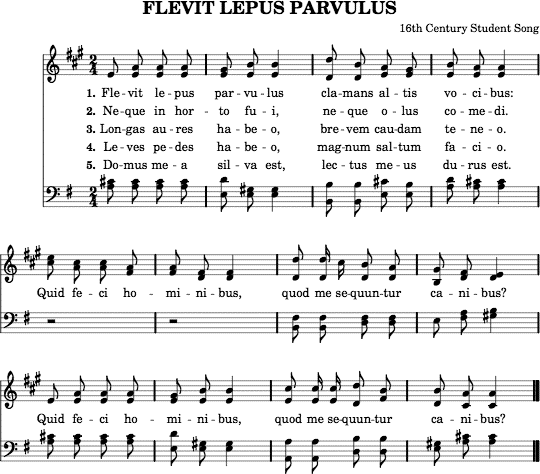
FLEVIT LEPUS PARVULUS8
16th Century Student Song
|
Flevit lepus parvulus
clamans altis vocibus:
Chorus
Quid feci hominibus,
quod me sequuntur canibus?
Neque in horto fui,
neque olus comedi.
Longas aures habeo,
brevem caudam teneo.
Leves pedes habeo,
magnum saltum facio.
Domus mea silva est,
lectus meus durus est.
|
126
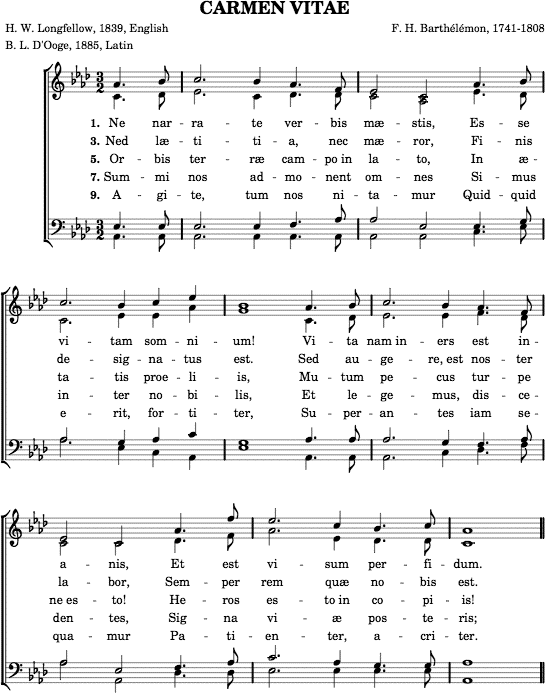
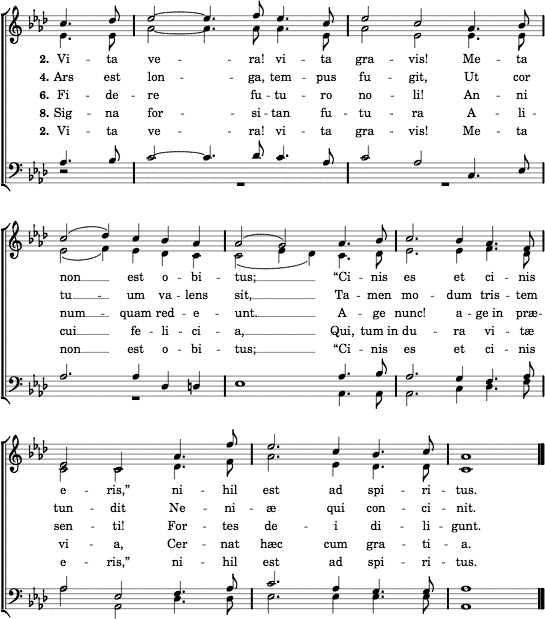
127
CARMEN VITÆ.
|
H. W. Longfellow, 1839, English
B. L. D'Ooge, 1885, Latin
F. H. Barthélémon, 1741-1808
Ne narrate verbis mæstis,
Esse vitam somnium!
Vita nam iners est inanis,
Et est visum perfidum.
Vita vera! vita gravis!
Meta non est obitus;
"Cinis es et cinis eris,"
Nihil est ad spiritus.
Ned lætitia, nec mæror,
Finis designatus est;
Sed augere, est noster labor,
Semper rem quæ nobis est.
Ars est longa, tempus fugit,
Ut cor tuum valens sit,
Tamen modum tristem tundit
Neniæ qui concinit.
Orbis terræ campo in lato,
In ætatis proeliis,
Mutum pecus turpe ne esto!
Heros esto in copiis!
Fidere futuro noli!
Anni numquam redeunt.
Age nunc! age in præsenti!
Fortes dei diligunt.
Summi nos admonent omnes
Simus inter nobilis,
Et legemus, disce dentes,
Signa viæ posteris;
Signa forsitan futura
Alicui felicia,
Qui, tum in dura vitæ via,
Cernat hæc cum gratia.
Agite, tum nos nitamur
Quidquid erit, fortiter,
Superantes iam sequamur
Patienter, acriter.
Vita vera! vita gravis!
Meta non est obitus;
"Cinis es et cinis eris,"
Nihil est ad spiritus.
|
128
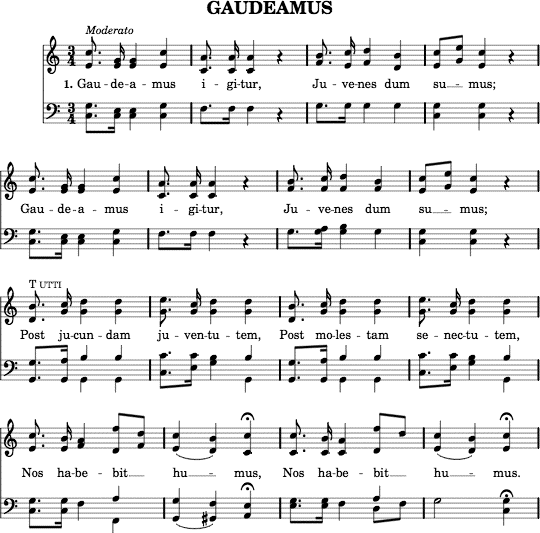
129
GAUDEAMUS
|
Gaudeamus igitur,
Iuvenes dum sumus;
Post iucundam iuventutem,
Post molestam senectutem,
Nos habebit humus.
Ubi sunt, qui ante nos
In mundo fuere?
Transeas ad superos,
Abeas ad inferos,
Quos si vis videre.
Vita nostra brevis est,
Brevi finietur;
Venit mors velociter,
Rapit nos atrociter,
Nemini parcetur.
Vivat academia,
Vivant professores,
Vivat membrum quodlibet,
Vivant membra quaelibet,
Semper sint in flore.
Vivant omnes virgines,
Faciles formosae;
Vivant et mulieres,
Dulces et amabiles,
Bonae, laboriosae.
Vivat et res publica,
Et qui illam regit.
130
Vivat nostra civitas,
Maecenatum caritas,
Quae nos hic protegit.
Pereat tristitia,
Pereant osores,
Pereat diabolus,
Quivis antiburschius
Atque irrisores.
TRANSLATION
While the glowing hours are bright,
Let not sadness mar them,
For when age shall rifle youth,
And shall drive our joys unsooth,
Then the grave will bar them.
Where are those who from the world
Long ago departed!
Scale Olympus' lofty height—
See grim Hades' murky night—
There are the great hearted.
Mortal life is but a span,
That is quickly fleeting;
Cruel death comes on apace
And removes us from the race,
None with favor treating.
Long may this fair temple stand,
Nassau now and ever!
Long may her professors grace
Each his own time honored place,
Friendship failing never.
131
May our charming maidens live,
Matchless all in beauty,
May our blooming matrons long
Be the theme of grateful song,
Patterns bright of duty.
May our Union grow in strength,
Faithful rulers guiding;
In the blaze of Freedom's light
Where the genial arts are bright,
Find we rest abiding.
Out on sighing! Vanish hate,
And ye friends of sadness;
To his chill abode of woe,
Let the dread Philistine go,
Who would steal our gladness.
—Tr. J. A. Pearce, Jr.
|
132
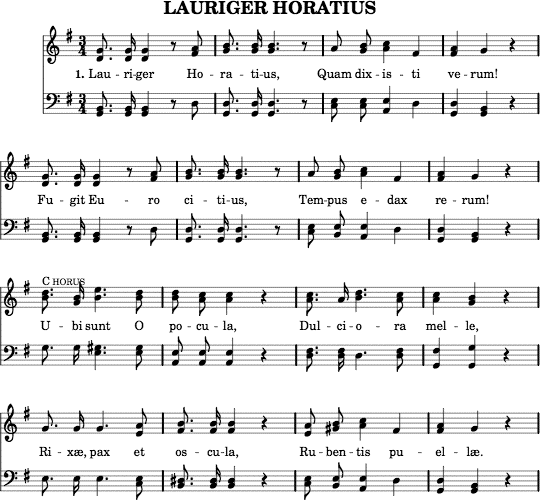
133
LAURIGER HORATIUS.
|
Lauriger Horatius,
Quam dixisti verum!
Fugit Euro citius
Tempus edax rerum.
Chorus
Ubi sunt, O pocula,
Dulciora melle,
Rixae, pax, et oscula
Rubentis puellae?
Crescit uva molliter,
Et puella crescit,
Sed poeta turpiter
Sitiens canescit.
Quid iuvat aeternitas
Nominis, amare
Nisi terrae filias
Licet, et potare?
TRANSLATION
Horace, crowned with laurels bright,
Truly thou hast spoken;
Time outspeeds the swift winds' flight,
Earthly power is broken.
Chorus
Give me cups that foaming rise,
Cups with fragrance laden,
Pouting lips and smiling eyes,
Of a blushing maiden.
134
Blooming grows the budding vine,
And the maid grows blooming;
But the poet quaffs not wine,
Age is surely dooming.
Who would grasp at empty fame?
'Tis a fleeting vision;
But for love and wine we claim,
Sweetness all Elysian.
—Tr. J. A. Pearce, Jr.
|
This singable Latin translation of America was made by Professor
George D. Kellogg of Union College and appeared in The Classical
Weekly.
|
Te cano, Patria,
candida, libera;
te referet
portus et exulum
et tumulus senum;
libera montium
vox resonet.
Te cano, Patria,
semper et atria
ingenuum;
laudo virentia
culmina, flumina;
sentio gaudia
caelicolum.
Sit modulatio!
libera natio
dulce canat!
135
labra vigentia,
ora faventia,
saxa silentia
vox repleat!
Tutor es unicus,
unus avum deus!
Laudo libens.
Patria luceat,
libera fulgeat,
vis tua muniat,
Omnipotens!
|
136
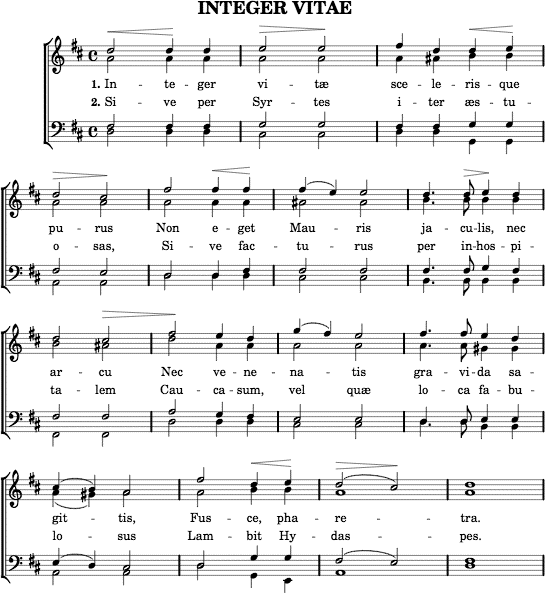
137
INTEGER VITÆ.
Horace. Book I, Ode xxii
|
Integer vitae, scelerisque purus
Non eget Mauris jaculis nec arcu,
Nec venenatis gravida sagittis,
Fusce, pharetra.
Sive per Syrtes, iter aestuosas,
Sive facturus per inhospitalem
Caucasum, vel quae loca fabulosus
Lambit Hydaspes.
Pone me pigris ubi nulla campis
Arbor aestiva recreatur aura;
Quod latus mundi nebulae malusque
Iuppiter urget;
Pone sub curru nimium propinqui
Solis, in terra domibus negata:
Dulce ridentem Lalagen amabo,
Dulce loquentem.
TRANSLATION
Fuscus, the man of life upright and pure
Needeth nor javelin, nor bow of Moor
Nor arrows tipped with venom deadly-sure,
Loading his quiver.
Whether o'er Afric's burning sand he rides,
Or frosty Caucasus' bleak mountain-sides,
Or wanders lonely, where Hydaspes glides,
That storied river.
138
Place me where no life-laden summer breeze
Freshens the meads, or murmurs 'mongst the trees;
Where clouds oppress, and withering tempests' breeze
From shore to shore.
Place me beneath the sunbeams' fiercest glare,
On arid sands, no dwelling anywhere,
Still Lalage's sweet smile, sweet voice e'en there
I will adore.
—Tr. William Greenwood
|
|
Iesu, pro me perforatus,
Condar intra tuum latus,
Tu per lympham profluentem,
Tu per sanguinem tepentem,
In peccata mi redunda,
Tolle culpam, sordes munda.
Coram te nec iustus forem,
Quamvis tota vi laborem.
Nec si fide nunquam cesso,
Fletu stillans indefesso:
Tibi soli tantum munus:
Salva me, Salvator unus!
Nil in manu mecum fero
Sed me versus crucem gero;
Vestimenta nudus oro,
Opem debilis imploro;
Fontem Christi quaero immundus,
Nisi laves, moribundus.
Dum hos artus vita regit;
Quando nox sepulchre tegit;
139
Mortuos cum stare iubes;
Sedens iudex inter nubes;
Iesu, pro me perforatus,
Condar intra tuum latus.
—Toplady. Tr. by Gladstone
|
DIES IRAE9
|
Dies irae, dies illa
Solvet saeclum in favilla,
Teste David cum Sybilla.
Quantus tremor est futurus,
Quando iudex est venturus,
Cuncta stricte discussurus!
Tuba, mirum spargens sonum
Per sepulcra regionum,
Coget omnes ante thronum.
Mors stupebit, et natura,
Cum resurget creatura
Iudicanti responsura.
Liber scriptus proferetur,
Inquo totum continetur,
Unde mundus iudicetur.
Iudex ergo cum sedebit,
Quidquid latet, apparebit,
Nil inultum remanebit.
Quid sum miser tunc dicturus,
Quem patronum rogaturus,
Cum vix iustus sit securus?
140
Rex tremendae maiestatis,
Qui salvandos salvas gratis,
Salva me, fons pietatis!
Recordare, Iesu pie,
Quod sum causa tuae viae;
Ne me perdas illa die!
Quaerens me sedisti lassus,
Redemisti crucem passus:
Tantus labor non sit cassus!
Iuste iudex ultionis,
Donum fac remissionis
Ante diem rationis!
—Thomas of Celano
TRANSLATION
Day of Wrath,—that Day of Days,—
When earth shall vanish in a blaze,
As David, with the Sibyl, says!
What a trembling will come o'er us,
When the Judge shall be before us,
For every hidden sin to score us!
The trumpet with its wondrous sound,
Piercing each sepulchral mound,
Shall summon all, the throne around.
Nature and death will stand aghast,
When those who to the grave have past,
Come answering to the judgment blast!
141
The Written Book shall be unrolled,
Wherein the deeds of all are told,
And shall the doom of all unfold.
For when the Judge shall be enthroned,
No secret shall be left unowned,
No crime or trespass unatoned.
When for a guilty wretch like me,
What plea, what pleader, will there be,
When scarcely shall the just go free!
King of tremendous majesty,
Whose grace saves all who saved may be,
Fountain of mercy, oh save me!
Forget not then, dear Son of God,
For my sake Thou thy way hast trod,
Nor let me sink beneath thy rod.
Yes, me to save Thou sat'st in pain,
Nor didst the bitter Cross disdain,—
Let not such anguish be in vain!
Unerring Judge, thy wrath restrain,
And let my sins remission gain,
While still the days of grace remain.
—Tr. Robert C. Winthrop
|
142
AD SANCTUM SPIRITUS10
|
Veni, Sancte Spiritus,
Et emitte coelitus
Lucis tuae radium.
Veni, pater pauperum,
Veni, dator munerum,
Veni, lumen cordium;
O lux beatissima,
Reple cordis intima
Tuorum fidelium!
Sine tuo numine
Nihil est in homine,
Nihil est innoxium.
Da tuis fidelibus
In te confitentibus
Sacrum septenarium;
Da virtutis meritum,
Da salutis exitum,
Da perenne gaudium!
TRANSLATION
Holy Spirit, come, we pray
Shed from Heaven thine inward ray,
Kindle darkness into day.
Come, Thou Father of the poor,
Come, Thou source of all our store,
Light of hearts forevermore.
143
Light most blissful! Fire divine!
Fill, oh! fill these hearts of Thine!
On our inmost being shine.
If in Thee it be not wrought
All in men is simply naught,
Nothing pure in deed and thought.
On the faithful who confide,
Solely in Thyself as guide,
Let Thy sevenfold gifts abide.
Grant them virtue's full increase,
Grant them safe and sweet release,
Grant them everlasting peace!
|
A Christmas Hymn
|
Adeste, fideles,
Laeti, triumphantes,
Venite, venite in Bethlehem:
Natum videte
Regem Angelorum:
Chorus
Venite adoremus,
Venite adoremus,
Venite adoremus Dominum.
Deum de Deo,
Lumen de lumine,
Gestant puellae viscera:
Deum verum,
Genitum non factum:
144
Cantet nunc Io
Chorus Angelorum,
Cantet nunc aula caelestium:
Gloria in
Excelsis Deo:
Ergo qui natus
Die hodierna
Iesu, tibi sit gloria:
Patris aeterni
Verbum caro factum.
TRANSLATION
O come, all ye faithful,
Joyful and triumphant,
O come ye, O come ye to Bethlehem;
Come and behold him.
Born, the King of Angels;
O come, let us adore Him,
O come, let us adore Him,
O come, let us adore Him, Christ the Lord.
God of God,
Light of Light,
Lo! He abhors not the Virgin's womb;
Very God,
Begotten, not created;
O come, let us adore Him, etc.
Sing choirs of Angels,
Sing in exultation,
Sing, all ye citizens of Heav'n above:
"Glory to God
In the highest";
O come, let us adore Him, etc.
145
Yea, Lord, we greet Thee,
Born this happy morning;
Jesu, to Thee be glory given;
Word of the Father,
Now in flesh appearing;
O come, let us adore Him, etc.
|
|
Puer natus in Bethlehem
Unde gaudet Ierusalem
Hic iacet in praesepio,
Qui regnat sine termino.
Cognovit bos et asinus
Quod puer erat Dominus.
Reges de Saba veniunt,
Aurum, thus, myrrham offerunt.
Intrantes domum invicem
Novum salutant Principem.
De matre natus virgine
Sine virile semine;
Sine serpentis vulnere
De nostro venit sanguine;
In carne nobis similis,
Peccato sed dissimilis;
146
Ut redderet nos homines
Deo et sibi similes
In hoc natali gaudio
Benedicamus Domino.
Laudetur sancta Trinitas;
Deo dicamus gratias.
|
147
BIBLIOGRAPHY
Bazin, René. The Italians of Today. New York. Henry Holt &
Co.
|
$1.25 |
Becker, W. A. Gallus. New York. Longmans, Green, and Co.
|
1.25 |
Brooks, Elbridge S. Heroic Happenings. New York. G. P.
Putnam's Sons
|
1.25 |
Church, Alfred J. Roman Life in the Days of Cicero. New York.
Dodd, Mead, & Co.
|
1.25 |
Clement, Clara Erskine. Rome: The Eternal City. Boston. Dana
Estes & Co. 2 vols.
|
3.00 |
Cruttwell, Charles Thomas. A History of Roman Literature. New
York. Charles Scribner's Sons
|
2.50 |
Davis, William Stearns. Readings in Ancient History. Rome and the
West. Boston. Allyn and Bacon
|
1.00 |
De Coulanges, Fustel. The Ancient City. Boston. Lothrop, Lee and
Shepard
|
2.00 |
Dennie, John. Rome of Today and Yesterday. New York. G. P.
Putnam's Sons
|
4.50 |
Dodge, Theodore A. Great Captains. Caesar. Boston, Houghton,
Mifflin Co.
|
2.00 |
Forman, Harry Buxton. The Prose Works of Percy Bysshe Shelley.
New York. Macmillan. 5 vols.
|
.75¢ each |
Fowler, W. Warde. Social Life at Rome in the Age of Cicero. New
York. Macmillan
|
2.25 |
Froude, James Anthony. Caesar. A Sketch. New York. Charles
Scribner's Sons
|
1.50 |
Gayley, Charles Mills. The Classic Myths in English Literature.
Boston. Ginn and Company
|
1.60 |
Guhl and Koner. The Life of the Greeks and Romans. New York.
Charles Scribner's Sons
|
2.50 |
Hare, Augustus J. C. Walks in Rome. New York. Macmillan
|
2.50 |
Inge, William Ralph. Society in Rome under the Caesars. New York.
Charles Scribner's Sons
|
1.25 |
Johnston, H. W. The Private Life of the Romans. Chicago.
Scott, Foresman & Co.
|
1.50 |
Kelsey, Francis W. Latin and Greek in American Education. New
York. Macmillan
|
1.50 |
Lanciani, Rodolfo. Ancient Rome in the Light of Recent
Discoveries. Boston. Houghton, Mifflin Co.
|
6.00 |
148
Munro, Dana Carleton. Source Book in Roman History. New York.
D. C. Heath & Co.
|
1.00 |
Peck, Harry Thurston. Harper's Dictionary of Classical Literature and
Antiquities. New York. American Book Company
|
6.00 |
Quackenbos, John D. Illustrated History of Ancient Literature.
New York. American Book Company
|
1.20 |
Shumway, Edgar S. A Day in Ancient Rome. New York. D. C.
Heath & Co. (Paper cover 30c.)
|
.75 |
Story, William W. Roba di Roma. Boston. Houghton, Mifflin Co.
|
2.50 |
Webster, Hutton. Ancient History. New York. D. C. Heath
& Co.
|
1.50 |
Webster, Hutton. Readings in Ancient History.
|
1.00 |
Wilkinson, William Cleaver. College Latin Course in English. New
York. Chautauqua Press
|
1.50 |
Wilkinson, William Cleaver. Foreign Classics in English. Vol. IV.
New York. Funk & Wagnalls
|
1.50 |
149
ACKNOWLEDGMENT
This section is reproduced verbatim from the orignal text,
published in 1916.
I wish to express my sincere gratitude to Professor Benjamin L.
D'Ooge, of the Michigan State Normal School, for his generous assistance
and hearty encouragement in the preparation of this work.
Sincere thanks are due to the various authors and publishers of
copyrighted books from which selections are taken for their courteous
permission to copy.
Specific acknowledgment is due George Bell and Sons, London, for
Martial's Epigrams; Smith, Elder, and Company, London, for The
Doom of the Slothful; Houghton, Mifflin Co., for After Construing, A
Roman Mirror, Enceladus, and the poems of John G. Saxe; The Chautauqua
Press, for Capri and the Translations of Horace's Odes; Charles
Scribner's Sons, for the Assembly of the Gods, Cerberus, the Harpy, A
Plea for the Classics, and Malum Opus; The American Book Company,
for Cupid and the Bee; Lothrop, Lee and Shepard Co., for A Christmas
Hymn; New England Magazine, for the Fall of Rome; Little, Brown
and Company, for the translation of Dies Irae; The Outlook
Company, for the Prayer of Socrates; Allyn and Bacon, for the music for
Flevit Lepus Parvulus.
I must beg forgiveness of any one whose rights I have overlooked and
of a few whom, after repeated efforts, I have been unable to trace.
GRAMMAR |
Allen's Review of English Grammar for Secondary Schools
Such a course as is recommended in the college
entrance requirements.
|
$ .64 |
MacEwan's The Essentials of the English Sentence
A review preparatory to teaching or to the
study of rhetoric.
|
.80 |
Meiklejohn's English Grammar. Revised
A thorough course for review and the mastery
of principles and detail.
|
.88 |
Sanford and Brown's English Grammar
Uses the new uniform nomenclature and has rich
illustrative material.
|
.72 |
COMPOSITION |
Buhlig's Business English
Spelling, punctuation, oral English, letter
writing, and business practice.
|
1.16 |
Duncan, Beck and Graves's Prose Specimens
Selections illustrating description,
narration, exposition, and argumentation.
|
1.16 |
Gerrish and Cunningham's Practical English Composition
Modern, progressive, teaching by example as
well as by precept.
|
1.24 |
Williams's Composition and Rhetoric by Practice
Concise and practical, with little theory and
much practice.
|
1.00 |
Woolley's Handbook of Composition
A systematic guide to the writing of correct
English.
|
.80 |
Woolley's Written English
The main things to know in order to write
English correctly.
|
1.12 |
RHETORIC |
Espenshade's Essentials of Composition and Rhetoric. Revised
An inductive course with abundant application
of principles.
|
1.20 |
Kellow's Practical Training in English
Helpful in its study of vocabulary, grammar,
and structure.
|
.80 |
Spalding's Principles of Rhetoric
A supremely interesting presentation of the
essentials.
|
1.08 |
Strang's Exercises in English. Revised
Examples in syntax, accidence and style, for
criticism and correction.
|
.56 |
LITERATURE |
Heath's English Classics. Prices range from
About 100 volumes covering literature for high
school reading. Send for list.
|
.50 to .25 |
Hooker's Study Book in English Literature
A handbook to accompany the appreciative study
of the greater writers.
|
1.00 |
Howes's Primer of American Literature
A brief, satisfactory account of the facts of
American literary history.
|
.52 |
Howes's Primer of English Literature
The essentials concerning great writers and
important periods.
|
.52 |
Meiklejohn's History of the English Language and Literature.
|
.60 |
SPELLING |
Sandwick and Bacon's High School Word Book
Graded lists of 5000 words needed by high
school pupils.
|
.44 |
Sandwick and Bacon's High School Word Book. Briefer Course
|
.28 |
D. C. HEATH & CO., Boston, New York, Chicago
LATIN
Paxson's Handbook for Latin Clubs.
158 pages
|
$ .60 |
LATIN GRAMMAR |
Gildersleeve-Lodge Latin Grammar.
School edition. 340 pages
|
1.00 |
Gildersleeve-Lodge Latin Grammar.
Complete. 560 pages
|
1.40 |
Jenks's Latin Word Formation.
86 pages
|
.56 |
BEGINNERS' BOOKS |
Bain's First Latin Book.
Revised. 420 pages
|
1.00 |
Barss's Beginning Latin.
331 pages
|
1.12 |
D'Ooge's Colloquia Latina.
81 pages
|
.28 |
Moulton's Introductory Latin.
Revised. 278 pages
|
1.00 |
Smith's Elements of Latin.
361 pages
|
1.00 |
CAESAR |
Dotey's Exercise Books on Caesar's Gallic war.
Four books. Each
|
.28 |
Perrin's Caesar's Civil War,
with vocabulary. 340 pages
|
1.00 |
Towle & Jenks's Caesar's Gallic War.
Books I and II. 378 pages
|
1.00 |
Towle & Jenks's Caesar's Gallic War.
Books I and II, with Selections for Sight
Reading. 518 pages
|
1.28 |
Towle & Jenks's Caesar's Gallic War.
Books I, II, III, and IV
|
1.20 |
Towle & Jenks's Caesar's Gallic War.
Complete. 604 pages
|
1.40 |
Towle & Jenks's Caesar for Sight Reading.
144 pages
|
.60 |
CICERO |
Tunstall's Six Orations of Cicero.
|
1.20 |
Tunstall's Cicero's Orations.
Eleven orations. 616 pages
|
1.40 |
LATIN COMPOSITION |
Barss's Writing Latin, Book I.
Based on Caesar. 144 pages
|
.56 |
Barss's Writing Latin, Book II.
Based on Caesar and Cicero
|
.80 |
Daniels's Latin Drill and Composition.
125 pages
|
.48 |
OVID |
Anderson's Selections from Ovid,
with Vocabulary. 264 pages
|
1.12 |
FOR COLLEGE CLASSES |
Carter's Roman Elegiac Poets.
330 pages
|
1.32 |
Bowen's Cicero's De Amicitia.
151 pages
|
.80 |
Bowen's Cicero's De Senectute.
164 pages
|
.80 |
Gildersleeve-Lodge Latin Grammar.
Complete. 560 pages
|
1.40 |
Gildersleeve-Lodge Latin Composition.
201 pages
|
.80 |
Lease's Livy, Books I, XXI and XXII.
510 pages
|
1.36 |
Moore's Prose Exercises.
Revised. 80 pages
|
.60 |
Penick's Sallust's Catiline.
With vocabulary. 191 pages
|
1.00 |
Poteat's Select Letters of Cicero.
215 pages
|
1.00 |
Rockwood's Cicero's De Officiis.
183 pages
|
1.00 |
Sihler's Cicero's Second Philippic.
157 pages
|
1.00 |
Wilson's Juvenal.
372 pages
|
1.36 |
D. C. HEATH & CO., Boston, New York, Chicago
End of the Project Gutenberg EBook of A Handbook for Latin Clubs, by Various

*** END OF THIS PROJECT GUTENBERG EBOOK A HANDBOOK FOR LATIN CLUBS ***

***** This file should be named 16923-h.htm or 16923-h.zip *****
This and all associated files of various formats will be found in:
        https://www.gutenberg.org/1/6/9/2/16923/

Produced by Louise Hope, David Starner and the Online
Distributed Proofreading Team at https://www.pgdp.net


Updated editions will replace the previous one--the old editions
will be renamed.

Creating the works from public domain print editions means that no
one owns a United States copyright in these works, so the Foundation
(and you!) can copy and distribute it in the United States without
permission and without paying copyright royalties.  Special rules,
set forth in the General Terms of Use part of this license, apply to
copying and distributing Project Gutenberg-tm electronic works to
protect the PROJECT GUTENBERG-tm concept and trademark.  Project
Gutenberg is a registered trademark, and may not be used if you
charge for the eBooks, unless you receive specific permission.  If you
do not charge anything for copies of this eBook, complying with the
rules is very easy.  You may use this eBook for nearly any purpose
such as creation of derivative works, reports, performances and
research.  They may be modified and printed and given away--you may do
practically ANYTHING with public domain eBooks.  Redistribution is
subject to the trademark license, especially commercial
redistribution.


*** START: FULL LICENSE ***

THE FULL PROJECT GUTENBERG LICENSE
PLEASE READ THIS BEFORE YOU DISTRIBUTE OR USE THIS WORK

To protect the Project Gutenberg-tm mission of promoting the free
distribution of electronic works, by using or distributing this work
(or any other work associated in any way with the phrase "Project
Gutenberg"), you agree to comply with all the terms of the Full Project
Gutenberg-tm License (available with this file or online at
https://gutenberg.org/license).


Section 1.  General Terms of Use and Redistributing Project Gutenberg-tm
electronic works

1.A.  By reading or using any part of this Project Gutenberg-tm
electronic work, you indicate that you have read, understand, agree to
and accept all the terms of this license and intellectual property
(trademark/copyright) agreement.  If you do not agree to abide by all
the terms of this agreement, you must cease using and return or destroy
all copies of Project Gutenberg-tm electronic works in your possession.
If you paid a fee for obtaining a copy of or access to a Project
Gutenberg-tm electronic work and you do not agree to be bound by the
terms of this agreement, you may obtain a refund from the person or
entity to whom you paid the fee as set forth in paragraph 1.E.8.

1.B.  "Project Gutenberg" is a registered trademark.  It may only be
used on or associated in any way with an electronic work by people who
agree to be bound by the terms of this agreement.  There are a few
things that you can do with most Project Gutenberg-tm electronic works
even without complying with the full terms of this agreement.  See
paragraph 1.C below.  There are a lot of things you can do with Project
Gutenberg-tm electronic works if you follow the terms of this agreement
and help preserve free future access to Project Gutenberg-tm electronic
works.  See paragraph 1.E below.

1.C.  The Project Gutenberg Literary Archive Foundation ("the Foundation"
or PGLAF), owns a compilation copyright in the collection of Project
Gutenberg-tm electronic works.  Nearly all the individual works in the
collection are in the public domain in the United States.  If an
individual work is in the public domain in the United States and you are
located in the United States, we do not claim a right to prevent you from
copying, distributing, performing, displaying or creating derivative
works based on the work as long as all references to Project Gutenberg
are removed.  Of course, we hope that you will support the Project
Gutenberg-tm mission of promoting free access to electronic works by
freely sharing Project Gutenberg-tm works in compliance with the terms of
this agreement for keeping the Project Gutenberg-tm name associated with
the work.  You can easily comply with the terms of this agreement by
keeping this work in the same format with its attached full Project
Gutenberg-tm License when you share it without charge with others.

1.D.  The copyright laws of the place where you are located also govern
what you can do with this work.  Copyright laws in most countries are in
a constant state of change.  If you are outside the United States, check
the laws of your country in addition to the terms of this agreement
before downloading, copying, displaying, performing, distributing or
creating derivative works based on this work or any other Project
Gutenberg-tm work.  The Foundation makes no representations concerning
the copyright status of any work in any country outside the United
States.

1.E.  Unless you have removed all references to Project Gutenberg:

1.E.1.  The following sentence, with active links to, or other immediate
access to, the full Project Gutenberg-tm License must appear prominently
whenever any copy of a Project Gutenberg-tm work (any work on which the
phrase "Project Gutenberg" appears, or with which the phrase "Project
Gutenberg" is associated) is accessed, displayed, performed, viewed,
copied or distributed:

This eBook is for the use of anyone anywhere at no cost and with
almost no restrictions whatsoever.  You may copy it, give it away or
re-use it under the terms of the Project Gutenberg License included
with this eBook or online at www.gutenberg.org

1.E.2.  If an individual Project Gutenberg-tm electronic work is derived
from the public domain (does not contain a notice indicating that it is
posted with permission of the copyright holder), the work can be copied
and distributed to anyone in the United States without paying any fees
or charges.  If you are redistributing or providing access to a work
with the phrase "Project Gutenberg" associated with or appearing on the
work, you must comply either with the requirements of paragraphs 1.E.1
through 1.E.7 or obtain permission for the use of the work and the
Project Gutenberg-tm trademark as set forth in paragraphs 1.E.8 or
1.E.9.

1.E.3.  If an individual Project Gutenberg-tm electronic work is posted
with the permission of the copyright holder, your use and distribution
must comply with both paragraphs 1.E.1 through 1.E.7 and any additional
terms imposed by the copyright holder.  Additional terms will be linked
to the Project Gutenberg-tm License for all works posted with the
permission of the copyright holder found at the beginning of this work.

1.E.4.  Do not unlink or detach or remove the full Project Gutenberg-tm
License terms from this work, or any files containing a part of this
work or any other work associated with Project Gutenberg-tm.

1.E.5.  Do not copy, display, perform, distribute or redistribute this
electronic work, or any part of this electronic work, without
prominently displaying the sentence set forth in paragraph 1.E.1 with
active links or immediate access to the full terms of the Project
Gutenberg-tm License.

1.E.6.  You may convert to and distribute this work in any binary,
compressed, marked up, nonproprietary or proprietary form, including any
word processing or hypertext form.  However, if you provide access to or
distribute copies of a Project Gutenberg-tm work in a format other than
"Plain Vanilla ASCII" or other format used in the official version
posted on the official Project Gutenberg-tm web site (www.gutenberg.org),
you must, at no additional cost, fee or expense to the user, provide a
copy, a means of exporting a copy, or a means of obtaining a copy upon
request, of the work in its original "Plain Vanilla ASCII" or other
form.  Any alternate format must include the full Project Gutenberg-tm
License as specified in paragraph 1.E.1.

1.E.7.  Do not charge a fee for access to, viewing, displaying,
performing, copying or distributing any Project Gutenberg-tm works
unless you comply with paragraph 1.E.8 or 1.E.9.

1.E.8.  You may charge a reasonable fee for copies of or providing
access to or distributing Project Gutenberg-tm electronic works provided
that

- You pay a royalty fee of 20% of the gross profits you derive from
     the use of Project Gutenberg-tm works calculated using the method
     you already use to calculate your applicable taxes.  The fee is
     owed to the owner of the Project Gutenberg-tm trademark, but he
     has agreed to donate royalties under this paragraph to the
     Project Gutenberg Literary Archive Foundation.  Royalty payments
     must be paid within 60 days following each date on which you
     prepare (or are legally required to prepare) your periodic tax
     returns.  Royalty payments should be clearly marked as such and
     sent to the Project Gutenberg Literary Archive Foundation at the
     address specified in Section 4, "Information about donations to
     the Project Gutenberg Literary Archive Foundation."

- You provide a full refund of any money paid by a user who notifies
     you in writing (or by e-mail) within 30 days of receipt that s/he
     does not agree to the terms of the full Project Gutenberg-tm
     License.  You must require such a user to return or
     destroy all copies of the works possessed in a physical medium
     and discontinue all use of and all access to other copies of
     Project Gutenberg-tm works.

- You provide, in accordance with paragraph 1.F.3, a full refund of any
     money paid for a work or a replacement copy, if a defect in the
     electronic work is discovered and reported to you within 90 days
     of receipt of the work.

- You comply with all other terms of this agreement for free
     distribution of Project Gutenberg-tm works.

1.E.9.  If you wish to charge a fee or distribute a Project Gutenberg-tm
electronic work or group of works on different terms than are set
forth in this agreement, you must obtain permission in writing from
both the Project Gutenberg Literary Archive Foundation and Michael
Hart, the owner of the Project Gutenberg-tm trademark.  Contact the
Foundation as set forth in Section 3 below.

1.F.

1.F.1.  Project Gutenberg volunteers and employees expend considerable
effort to identify, do copyright research on, transcribe and proofread
public domain works in creating the Project Gutenberg-tm
collection.  Despite these efforts, Project Gutenberg-tm electronic
works, and the medium on which they may be stored, may contain
"Defects," such as, but not limited to, incomplete, inaccurate or
corrupt data, transcription errors, a copyright or other intellectual
property infringement, a defective or damaged disk or other medium, a
computer virus, or computer codes that damage or cannot be read by
your equipment.

1.F.2.  LIMITED WARRANTY, DISCLAIMER OF DAMAGES - Except for the "Right
of Replacement or Refund" described in paragraph 1.F.3, the Project
Gutenberg Literary Archive Foundation, the owner of the Project
Gutenberg-tm trademark, and any other party distributing a Project
Gutenberg-tm electronic work under this agreement, disclaim all
liability to you for damages, costs and expenses, including legal
fees.  YOU AGREE THAT YOU HAVE NO REMEDIES FOR NEGLIGENCE, STRICT
LIABILITY, BREACH OF WARRANTY OR BREACH OF CONTRACT EXCEPT THOSE
PROVIDED IN PARAGRAPH F3.  YOU AGREE THAT THE FOUNDATION, THE
TRADEMARK OWNER, AND ANY DISTRIBUTOR UNDER THIS AGREEMENT WILL NOT BE
LIABLE TO YOU FOR ACTUAL, DIRECT, INDIRECT, CONSEQUENTIAL, PUNITIVE OR
INCIDENTAL DAMAGES EVEN IF YOU GIVE NOTICE OF THE POSSIBILITY OF SUCH
DAMAGE.

1.F.3.  LIMITED RIGHT OF REPLACEMENT OR REFUND - If you discover a
defect in this electronic work within 90 days of receiving it, you can
receive a refund of the money (if any) you paid for it by sending a
written explanation to the person you received the work from.  If you
received the work on a physical medium, you must return the medium with
your written explanation.  The person or entity that provided you with
the defective work may elect to provide a replacement copy in lieu of a
refund.  If you received the work electronically, the person or entity
providing it to you may choose to give you a second opportunity to
receive the work electronically in lieu of a refund.  If the second copy
is also defective, you may demand a refund in writing without further
opportunities to fix the problem.

1.F.4.  Except for the limited right of replacement or refund set forth
in paragraph 1.F.3, this work is provided to you 'AS-IS', WITH NO OTHER
WARRANTIES OF ANY KIND, EXPRESS OR IMPLIED, INCLUDING BUT NOT LIMITED TO
WARRANTIES OF MERCHANTIBILITY OR FITNESS FOR ANY PURPOSE.

1.F.5.  Some states do not allow disclaimers of certain implied
warranties or the exclusion or limitation of certain types of damages.
If any disclaimer or limitation set forth in this agreement violates the
law of the state applicable to this agreement, the agreement shall be
interpreted to make the maximum disclaimer or limitation permitted by
the applicable state law.  The invalidity or unenforceability of any
provision of this agreement shall not void the remaining provisions.

1.F.6.  INDEMNITY - You agree to indemnify and hold the Foundation, the
trademark owner, any agent or employee of the Foundation, anyone
providing copies of Project Gutenberg-tm electronic works in accordance
with this agreement, and any volunteers associated with the production,
promotion and distribution of Project Gutenberg-tm electronic works,
harmless from all liability, costs and expenses, including legal fees,
that arise directly or indirectly from any of the following which you do
or cause to occur: (a) distribution of this or any Project Gutenberg-tm
work, (b) alteration, modification, or additions or deletions to any
Project Gutenberg-tm work, and (c) any Defect you cause.


Section  2.  Information about the Mission of Project Gutenberg-tm

Project Gutenberg-tm is synonymous with the free distribution of
electronic works in formats readable by the widest variety of computers
including obsolete, old, middle-aged and new computers.  It exists
because of the efforts of hundreds of volunteers and donations from
people in all walks of life.

Volunteers and financial support to provide volunteers with the
assistance they need, is critical to reaching Project Gutenberg-tm's
goals and ensuring that the Project Gutenberg-tm collection will
remain freely available for generations to come.  In 2001, the Project
Gutenberg Literary Archive Foundation was created to provide a secure
and permanent future for Project Gutenberg-tm and future generations.
To learn more about the Project Gutenberg Literary Archive Foundation
and how your efforts and donations can help, see Sections 3 and 4
and the Foundation web page at https://www.pglaf.org.


Section 3.  Information about the Project Gutenberg Literary Archive
Foundation

The Project Gutenberg Literary Archive Foundation is a non profit
501(c)(3) educational corporation organized under the laws of the
state of Mississippi and granted tax exempt status by the Internal
Revenue Service.  The Foundation's EIN or federal tax identification
number is 64-6221541.  Its 501(c)(3) letter is posted at
https://pglaf.org/fundraising.  Contributions to the Project Gutenberg
Literary Archive Foundation are tax deductible to the full extent
permitted by U.S. federal laws and your state's laws.

The Foundation's principal office is located at 4557 Melan Dr. S.
Fairbanks, AK, 99712., but its volunteers and employees are scattered
throughout numerous locations.  Its business office is located at
809 North 1500 West, Salt Lake City, UT 84116, (801) 596-1887, email
business@pglaf.org.  Email contact links and up to date contact
information can be found at the Foundation's web site and official
page at https://pglaf.org

For additional contact information:
     Dr. Gregory B. Newby
     Chief Executive and Director
     gbnewby@pglaf.org

Section 4.  Information about Donations to the Project Gutenberg
Literary Archive Foundation

Project Gutenberg-tm depends upon and cannot survive without wide
spread public support and donations to carry out its mission of
increasing the number of public domain and licensed works that can be
freely distributed in machine readable form accessible by the widest
array of equipment including outdated equipment.  Many small donations
($1 to $5,000) are particularly important to maintaining tax exempt
status with the IRS.

The Foundation is committed to complying with the laws regulating
charities and charitable donations in all 50 states of the United
States.  Compliance requirements are not uniform and it takes a
considerable effort, much paperwork and many fees to meet and keep up
with these requirements.  We do not solicit donations in locations
where we have not received written confirmation of compliance.  To
SEND DONATIONS or determine the status of compliance for any
particular state visit https://pglaf.org

While we cannot and do not solicit contributions from states where we
have not met the solicitation requirements, we know of no prohibition
against accepting unsolicited donations from donors in such states who
approach us with offers to donate.

International donations are gratefully accepted, but we cannot make
any statements concerning tax treatment of donations received from
outside the United States.  U.S. laws alone swamp our small staff.

Please check the Project Gutenberg Web pages for current donation
methods and addresses.  Donations are accepted in a number of other
ways including including checks, online payments and credit card
donations.  To donate, please visit: https://pglaf.org/donate


Section 5.  General Information About Project Gutenberg-tm electronic
works.

Professor Michael S. Hart was the originator of the Project Gutenberg-tm
concept of a library of electronic works that could be freely shared
with anyone.  For thirty years, he produced and distributed Project
Gutenberg-tm eBooks with only a loose network of volunteer support.

Project Gutenberg-tm eBooks are often created from several printed
editions, all of which are confirmed as Public Domain in the U.S.
unless a copyright notice is included.  Thus, we do not necessarily
keep eBooks in compliance with any particular paper edition.

Most people start at our Web site which has the main PG search facility:

     https://www.gutenberg.org

This Web site includes information about Project Gutenberg-tm,
including how to make donations to the Project Gutenberg Literary
Archive Foundation, how to help produce our new eBooks, and how to
subscribe to our email newsletter to hear about new eBooks.

*** END: FULL LICENSE ***