 Vice-Admiral, Lord Nelson
The Project Gutenberg EBook of The Life of Nelson, Vol. II. (of 2)
by A. T. (Alfred Thayer) Mahan

This eBook is for the use of anyone anywhere at no cost and with
almost no restrictions whatsoever.  You may copy it, give it away or
re-use it under the terms of the Project Gutenberg License included
with this eBook or online at www.gutenberg.org


Title: The Life of Nelson, Vol. II. (of 2)
       The Embodiment of the Sea Power of Great Britain

Author: A. T. (Alfred Thayer) Mahan

Release Date: October 21, 2005 [EBook #16915]

Language: English

Character set encoding: ISO-8859-1

*** START OF THIS PROJECT GUTENBERG EBOOK THE LIFE OF NELSON, VOL. II. ***


Produced by Steven Gibbs and the Online Distributed
Proofreading Team at https://www.pgdp.net
| LIST OF ILLUSTRATIONS. | |
| BATTLE PLANS. | |
| CHAPTER XIV. | |
| NELSON TEMPORARILY COMMANDER-IN-CHIEF IN THE MEDITERRANEAN.—RELIEVED BY LORD KEITH.—APPLIES TO RETURN TO ENGLAND ON ACCOUNT OF ILL HEALTH. | |
| AUGUST, 1799—JUNE, 1800. | |
| Nelson left in temporary command | 1 |
| His disposition of the squadron | 1 |
| Made Duke of Bronté in Sicily | 2 |
| His hopes of remaining in command disappointed | 3 |
| His discontent | 3 |
| Energy and tact in exercising command | 4 |
| Affairs in Rome and Naples | 5 |
| Nelson visits Minorca | 6 |
| His anxiety about Malta | 7 |
| Portuguese squadron recalled to Lisbon.—Nelson's action | 8 |
| Characteristics of his intercourse with foreign officials | 10 |
| Urgency with army to support blockade of La Valetta | 12 |
| Partial success in this | 13 |
| Successes on the Continent of the Coalition against France | 14 |
| Subsequent blunders and disasters | 15 |
| Nelson's mortification at Bonaparte's escape to France | 16 |
| The French defeat the Turks at Aboukir | 17 |
| Nelson peremptorily forbids Sidney Smith to allow any French to leave Egypt | 18 |
| Smith nevertheless countenances the Convention of El Arish | 19 |
| His action disallowed by Keith and Nelson | 20 |
| Nelson's vivid expressions of disapproval | 21 |
| Nelson joins Keith at Leghorn | 22 |
| They visit Palermo and Malta together | 22 |
| Capture of "Le Généreux," 74, by Nelson's division | 24 |
| Nelson's relations with Keith, and bearing towards him | 27 |
| Keith orders Nelson to take personal charge off Malta | 28 |
| Nelson's annoyance and remonstrance | 29 |
| His restiveness under Keith's command | 30 |
| He returns from Malta to Palermo | 31 |
| The "Guillaume Tell," 80, captured in his absence | 31 |
| Displeasure of the Admiralty at his quitting his station | 32 |
| Letters of the First Lord | 33 |
| Nelson's soreness under them | 34 |
| He applies for leave to return to England | 35 |
| CHAPTER XV. | |
| NELSON LEAVES THE MEDITERRANEAN.—THE JOURNEY OVERLAND THROUGH GERMANY.—ARRIVAL IN ENGLAND.—SEPARATION FROM LADY NELSON.—HOISTS HIS FLAG IN THE CHANNEL FLEET, UNDER LORD ST. VINCENT. | |
| JUNE, 1800—JANUARY, 1801. | |
| Nelson escorts the Queen of Naples to Leghorn with two British ships-of-the-line | 36 |
| Keith's displeasure | 37 |
| Nelson at Leghorn | 37 |
| Austrians defeated at Marengo | 37 |
| Nelson and the Hamiltons leave Leghorn for Ancona | 39 |
| Journey to Trieste and Vienna | 40 |
| Enthusiasm shown towards Nelson by the people | 40 |
| Mention of him and Lady Hamilton by eye-witnesses | 41 |
| Anecdotes of him | 42 |
| His meeting with the Archduke Charles at Prague | 43 |
| Mrs. St. George's account of him at Dresden | 43 |
| Her disparaging mention of Lady Hamilton | 44 |
| Arrival of the party in England | 45 |
| Lady Nelson's attitude at this time | 46 |
| Her letters to Nelson | 47 |
| His reception and conduct in London | 48 |
| Growing estrangement between him and Lady Nelson | 51 |
| Anecdote of his visit to Fonthill | 52 |
| Final breach with Lady Nelson | 53 |
| Her blameless character, and subsequent life | 54 |
| Nelson's testimony to her conduct | 55 |
| Hoists his flag on board the "San Josef" at Plymouth | 56 |
| Birth of the child Horatia | 56 |
| Nelson's care to conceal his relations with Lady Hamilton | 57 |
| CHAPTER XVI. | |
| THE EXPEDITION TO THE BALTIC AND BATTLE OF COPENHAGEN.—NELSON RETURNS TO ENGLAND. | |
| FEBRUARY—JUNE, 1801. | |
| Origin of the trouble between Great Britain and Denmark | 60 |
| The entrance of the Czar Paul into the quarrel | 62 |
| Renewal of the Armed Neutrality of 1780 | 63 |
| Relations of Bonaparte to this event | 64 |
| Nelson joins the fleet under Sir Hyde Parker, at Yarmouth | 65 |
| Relations between him and Parker | 66 |
| Nelson's disapproval of the plans for the expedition | 68 |
| Evident change in his general disposition | 69 |
| Anecdote of Nelson and the turbot | 70 |
| The fleet collected off the Skaw | 70 |
| Parker's slowness and Nelson's impatience | 71 |
| Alarming reports of the Danes' preparations | 72 |
| Nelson's attitude and counsels | 73 |
| Accuracy of his judgment of the conditions | 74 |
| Tact and discretion in his dealings with Parker | 74 |
| His letter to Parker upon the general situation | 75 |
| Parker's indecision | 77 |
| Nelson's plans adopted | 78 |
| The fleet passes the Sound | 79 |
| Detail and discussion of Nelson's plan of operations | 80 |
| His feelings and speech in the Council of War | 82 |
| Nelson's division anchors south of Copenhagen | 82 |
| Nelson on the night before the battle | 83 |
| The Danish dispositions for defence | 85 |
| Nelson's Plan of Attack—Detail and discussion | 85 |
| The Battle of Copenhagen | 87 |
| Parker makes the signal to leave off action | 89 |
| Nelson refuses to repeat it | 90 |
| Discussion of this incident | 91 |
| Incidents of the battle | 94 |
| Nelson addresses a letter to the Crown Prince under a flag of truce | 94 |
| Characteristic anecdote | 95 |
| Discussion of the sending of the flag of truce | 96 |
| The battle discontinued | 97 |
| Nelson removes his ships | 97 |
| Completeness of his success | 98 |
| Merit of his conduct throughout | 99 |
| He is advanced in the peerage to be a Viscount | 99 |
| No other rewards, or medals, bestowed for this action | 99 |
| Negotiations intrusted to Nelson by Parker | 100 |
| The murder of the Czar Paul | 100 |
| Armistice for fourteen weeks concluded with Denmark | 103 |
| Qualified approval of the British Government | 104 |
| The British fleet enters the Baltic | 104 |
| Nelson's ardor and personal recklessness.—Anecdote | 105 |
| Parker's sluggishness of action.—Nelson's impatience | 106 |
| Russia intimates her purpose to abstain from hostilities | 107 |
| Nelson's controversy with the Danish Commodore Fischer | 108 |
| Parker ordered home, and Nelson left in command | 110 |
| Dissatisfaction of the latter | 110 |
| His longing to return to Lady Hamilton | 110 |
| He insists upon being relieved, on account of his health | 111 |
| He starts at once with the fleet for Revel | 111 |
| Displeasure manifested by the Czar Alexander | 112 |
| Nelson withdraws from Revel to Rostock | 113 |
| The Czar thereupon raises the embargo on British merchant ships | 114 |
| Nelson's elation over this result of his conduct | 114 |
| Details of his life on board | 115 |
| His avoidance of social relations outside the ship | 115 |
| Relieved by Admiral Pole, and returns to England | 117 |
| CHAPTER XVII. | |
| NELSON COMMANDS THE "SQUADRON ON A PARTICULAR SERVICE," FOR THE DEFENCE OF THE COAST OF ENGLAND AGAINST INVASION.—SIGNATURE OF PRELIMINARIES OF PEACE WITH FRANCE. | |
| JULY-OCTOBER, 1801. | |
| Nelson's longing for repose | 118 |
| His services immediately required again | 119 |
| His reluctant consent | 120 |
| Bonaparte's threats of invasion | 120 |
| Inadequacy of British preparations for coast-defence | 121 |
| Nature of British apprehensions in 1801 | 122 |
| Nelson's Memoranda for the Defence of the Thames | 123 |
| Analysis and discussion of this paper | 126 |
| St. Vincent's sagacious views on national defence | 131 |
| Apparent divergence between him and Nelson | 131 |
| Nelson hoists his flag again | 133 |
| His tact and courtesy towards others | 134 |
| Activity of his movements | 135 |
| Satisfied that there can be no invasion | 136 |
| Boat attack upon the vessels before Boulogne | 137 |
| Its disastrous failure | 138 |
| Nelson's distress | 138 |
| His exasperation at being kept afloat | 138 |
| His alienation from Troubridge | 140 |
| Annoyances of his situation | 142 |
| Death of Commander Parker.—Nelson's grief | 143 |
| His liberality in money matters | 143 |
| Pecuniary embarrassments | 144 |
| Signature of the preliminaries of peace | 144 |
| Nelson's satisfaction at the prospect of release | 144 |
| His indignation at the excessive elation of others | 144 |
| Receives leave of absence and goes home | 145 |
| CHAPTER XVIII. | |
| RELEASE FROM ACTIVE SERVICE DURING THE PEACE OF AMIENS.—HOME LIFE AT MERTON.—PUBLIC INCIDENTS. | |
| OCTOBER, 1801—MAY, 1803. | |
| Nelson makes his home with the Hamiltons | 146 |
| His letter of final severance to his wife | 146 |
| His relations to his stepson, Josiah Nisbet | 147 |
| Desire to have a home of his own | 149 |
| Lady Hamilton selects Merton for him | 150 |
| The purchase effected, and the Hamiltons reside with him | 150 |
| Position of Sir William and of Lady Hamilton in the house | 151 |
| Differences between them | 152 |
| Minto's account of the household at Merton | 154 |
| Reminiscence of the same by Nelson's nephew | 155 |
| Incident narrated by Lieutenant Layman | 157 |
| Recollections of Nelson by the vicar's daughter | 159 |
| Nelson's strong religious sense of Divine Providence | 159 |
| Takes his place in the House of Lords | 160 |
| His controversy about rewards for the Battle of Copenhagen | 161 |
| His action justified | 165 |
| Nelson's warm and avowed sympathy with his followers | 165 |
| His consistent maintenance of the ground assumed | 166 |
| His interest in public questions | 168 |
| Dissatisfaction with the general conduct of the Admiralty | 169 |
| His sense of neglect | 170 |
| Embarrassment in money matters | 171 |
| Inadequacy of his pension to his services | 171 |
| His doubts as to the continuance of peace | 172 |
| His antagonism to Bonaparte illustrated | 172 |
| Speech in seconding the address to the throne | 173 |
| Designated for the Mediterranean in case of war | 174 |
| Volunteers his services | 174 |
| Hoists his flag in the "Victory," and sails | 175 |
| Breaks in his home-ties during this period | 176 |
| Death of his father | 176 |
| Death of Sir William Hamilton | 177 |
| Hamilton's expressed confidence in Nelson | 178 |
| Relations of Nelson's family to Lady Nelson and to Lady Hamilton | 178 |
| CHAPTER XIX. | |
| COMMANDER-IN-CHIEF IN THE MEDITERRANEAN.—THE LONG WATCH OFF TOULON.—OCCUPATIONS OF A COMMANDER-IN-CHIEF. | |
| MAY, 1803—JANUARY, 1805. | |
| Changed political conditions in the Mediterranean | 179 |
| Attitude of the Great Powers | 180 |
| Situation of Spain and Portugal | 181 |
| Policy of the Italian States | 181 |
| Nelson's sense of the importance of the Mediterranean | 182 |
| Bonaparte's policy | 184 |
| The course advocated by Nelson | 185 |
| Accuracy of his general forecast | 187 |
| Impatience to reach his station | 188 |
| Unwilling detention off Ushant | 188 |
| Quits the "Victory," and proceeds in a frigate | 189 |
| Momentary stop in Gibraltar | 189 |
| Arrival at Malta | 190 |
| Extensive correspondence | 190 |
| Policy as regards the Two Sicilies | 191 |
| His impatience with blind observance of orders | 192 |
| Departure from Malta for Toulon | 194 |
| Emotions at the sight of Naples | 194 |
| Opinion on Malta's value to England | 195 |
| Strategic importance of Malta and Gibraltar | 195 |
| Nelson joins the fleet before Toulon | 196 |
| Bad condition of the ships | 196 |
| His skilful administration of the fleet | 197 |
| Difficulty of obtaining supplies | 198 |
| His attitude towards Spain | 199 |
| Importance of Sardinia in Nelson's eyes | 200 |
| The valuable anchorage at Madalena | 201 |
| Station taken by him off Toulon | 202 |
| Fears loss of Sardinia, and serious consequences | 203 |
| Significance of Napoleon's inactivity in the Mediterranean | 204 |
| The winter rendezvous of the fleet.—Number 97 | 205 |
| Seamanlike care of ships and spars | 206 |
| Preserves health of seamen by constant activity | 206 |
| Sanitary conditions of the fleet | 208 |
| His personal health, and anxieties | 209 |
| Fears a break-down | 210 |
| Speculations as to French intentions | 211 |
| Characteristic distrust of Frenchmen | 211 |
| Increasing perplexities | 212 |
| Firmness of his resolution | 213 |
| The French manoeuvre outside Toulon | 214 |
| Nelson's tactical conclusions and arrangements | 215 |
| His care to impart his ideas to his officers | 216 |
| Methods of intercourse with them | 217 |
| Exasperation at a statement of Latouche Tréville | 217 |
| Endeavors to force or to lure the French to sea | 219 |
| Effect of worry upon his mind | 221 |
| His last promotion.—Vice-Admiral of the White | 221 |
| Wearing effect of protracted monotony | 222 |
| Refuses to let Lady Hamilton join him | 223 |
| The daily life on board | 224 |
| Account of Nelson's health and habits | 225 |
| Occupations in business hours | 228 |
| Diplomatic ability and conciliatory temper | 229 |
| Sharp reply to remonstrance about blockades | 230 |
| Difficulties with Algiers | 230 |
| Nelson's diligent pursuit of information | 233 |
| Interest in listening to conversations | 233 |
| Examination of foreign journals and captured letters | 234 |
| Kindliness in intercourse with others | 236 |
| Exercise of official patronage | 239 |
| Protection of British trade | 241 |
| Want of frigates and small cruisers | 243 |
| Collection and protection of convoys | 244 |
| Nelson applies for sick leave | 245 |
| Desire to return to the station afterwards | 246 |
| Leave is granted by the Admiralty | 246 |
| The Mediterranean Station divided | 247 |
| Sir John Orde given the portion west of Gibraltar | 247 |
| Nelson's dissatisfaction and complaints | 247 |
| His change of mind about going home | 249 |
| Learns Cornwallis's order to seize Spanish treasure-ships | 251 |
| Directs captains under his orders not to obey | 251 |
| Letter illustrative of the characteristics of his orders | 252 |
| Adequacy of his measures to the requirements of the case | 254 |
| Determines not to use his leave of absence | 255 |
| Orde arrives off Cadiz | 256 |
| Indications of the French fleet leaving Toulon | 257 |
| Nelson receives word of the seizure of Spanish ships | 258 |
| Promptness of his measures.—Reasons therefor | 258 |
| Rumors of French departure | 260 |
| Annoyances caused Nelson by Orde | 261 |
| The mission of the frigate "Amazon" | 261 |
| Nelson's hope of meeting the French fleet | 263 |
| Opinions on general subjects | 263 |
| Sympathetic insight into Bonaparte's purposes | 265 |
| The French fleet sails from Toulon | 266 |
| CHAPTER XX. | |
| THE ESCAPE AND PURSUIT OF THE TOULON FLEET.—NELSON'S RETURN TO ENGLAND. | |
| JANUARY-AUGUST, 1805. | |
| Object of Napoleon's combinations in 1805 | 267 |
| Details of his plan | 268 |
| Nelson's share in thwarting it | 269 |
| The difficulties of one dealing with Napoleon | 271 |
| Nelson's guiding principle | 271 |
| The sailing of the Toulon fleet | 272 |
| Nelson's movements and perplexities | 273 |
| Goes to Alexandria | 277 |
| Returns to Gulf of Palmas, Sardinia | 278 |
| British disasters in Western Mediterranean | 278 |
| Characteristic letter of Nelson in behalf of an officer | 279 |
| Explanations to the Admiralty about his own course | 280 |
| Makes a round off Toulon and Barcelona to deceive the enemy | 282 |
| Returns to the Gulf of Palmas | 283 |
| The Toulon fleet sails again | 284 |
| Its movements and those of Nelson | 284 |
| Distress and misfortunes of the latter | 286 |
| Learns that the French fleet has passed the Straits | 287 |
| Thoroughness and sagacity of his measures | 287 |
| Continued head winds and distress of mind | 289 |
| The excitement in London | 290 |
| Gloom at the Admiralty | 291 |
| Nelson's constancy against bad fortune | 292 |
| Hears that the French and Spaniards are gone to the West Indies | 292 |
| Determines to follow them there | 295 |
| Sails in pursuit | 296 |
| Incidents of the voyage | 297 |
| Arrives in Barbadoes | 298 |
| Misled by false information | 299 |
| Rapid measures to retrieve the mis-step | 299 |
| Infers that the enemy have returned to Europe | 301 |
| He starts back immediately for Gibraltar | 302 |
| His judgments rapid, but not precipitate | 302 |
| Strength of his convictions | 303 |
| Relief from the anxiety previously felt | 303 |
| Movements of the allies and of Nelson | 304 |
| Precautions of the latter | 305 |
| His own explanation of his reasons | 305 |
| Discussion of this utterance | 306 |
| Indecisive engagement between the allies and Sir Robert Calder | 307 |
| Alarm in London at the failure of the latter | 307 |
| Nelson's protracted pursuit and mental depression | 308 |
| Reaches the Straits again | 309 |
| Appreciation of his action by others | 310 |
| Exchange of views between Nelson and Collingwood | 311 |
| Movements of Villeneuve, Calder, and Nelson | 313 |
| Nelson's arrival in Gibraltar | 314 |
| Subsequent rapid movements | 315 |
| Learns the news brought by the "Curieux" | 315 |
| Starts at once for the northward | 315 |
| Joins the Channel Fleet off Ushant | 317 |
| Leaves his squadron with Cornwallis, and proceeds to England | 317 |
| Anchors at Spithead | 318 |
| His sympathy with Calder | 318 |
| Tenacity of his opinions | 319 |
| CHAPTER XXI. | |
| NELSON'S LAST STAY IN ENGLAND. | |
| AUGUST 19—SEPTEMBER 15, 1805. | |
| Nelson hauls down his flag and goes to Merton | 320 |
| Interviews with the Admiralty | 320 |
| His one meeting with Wellington | 321 |
| Interview with Lord Castlereagh | 323 |
| Popular demonstrations of affection | 325 |
| Home life at Merton | 326 |
| Presentiments | 327 |
| Intimations of early summons into service | 327 |
| News arrives that the combined fleets are in Cadiz | 328 |
| Determination of the British Government | 328 |
| Nelson's opinion on the License System | 330 |
| His services requested by the Government | 330 |
| Lady Hamilton's part in his decision | 331 |
| It is settled that he return to the Mediterranean | 332 |
| His health and spirits | 332 |
| His insistence upon the need for numbers | 333 |
| Final departure from home | 335 |
| Flag re-hoisted on board the "Victory" | 335 |
| Anecdote of Nelson and the gypsy | 335 |
| CHAPTER XXII. | |
| THE ANTECEDENTS OF TRAFALGAR. | |
| SEPTEMBER 15—OCTOBER 19, 1805. | |
| Popular demonstrations when Nelson embarked | 337 |
| The passage to Cadiz | 338 |
| Precautions to deceive the enemy | 339 |
| His reception by the officers of the fleet | 339 |
| The "Plan of Attack" of May, 1805 | 341 |
| The "Nelson Touch" | 343 |
| Discussion and comparison of these two papers | 346 |
| Comparison between the second and the Battle of Trafalgar, as fought | 350 |
| Nelson and Sir Robert Calder | 353 |
| Nelson's concession to Calder, and his own comments upon it | 355 |
| His disposition of the fleet before Cadiz | 356 |
| His fear lest the enemy should evade him | 358 |
| Growing presentiments, and cheerful calmness | 359 |
| Anecdote showing his considerateness | 359 |
| Necessity for sending away a detachment | 360 |
| Numbers of the British, and of the allies in Cadiz | 360 |
| Nelson's general intentions, made known to his subordinates | 361 |
| The enemy begins to leave Cadiz | 362 |
| CHAPTER XXIII. | |
| TRAFALGAR.—THE DEATH OF NELSON. | |
| OCTOBER 19-21, 1805. | |
| Numbers and composition of the opposing fleets | 363 |
| Difficulties of the allies in leaving port | 364 |
| Respective movements of the two fleets | 364 |
| Nelson's last letter to Lady Hamilton | 365 |
| His last letter to his child | 366 |
| Events and incidents of October 20 | 366 |
| Relative positions of the fleets at midnight | 368 |
| Conditions at daybreak of the 21st | 369 |
| The manoeuvres of the two fleets | 370 |
| Nelson's intercourse with Blackwood on the 21st | 372 |
| He bequeaths Lady Hamilton and Horatia to the care of his Country | 375 |
| The hostile fleets forming for battle | 377 |
| Nelson's impatience to close the enemy | 378 |
| The anxiety of others for his personal safety | 379 |
| The order of the allies while awaiting attack | 379 |
| Nelson's last prayer as entered in his journal | 380 |
| The origin and development of his famous signal | 382 |
| The battle opens | 383 |
| The "Victory" comes under fire | 384 |
| Nelson bids Blackwood a final farewell | 385 |
| Exposure and loss of life on board the "Victory" | 386 |
| The "Victory" breaks the enemy's line | 387 |
| Her duel with the "Redoutable" | 387 |
| Nelson falls, mortally wounded | 388 |
| The death-scene in the cockpit | 389 |
| The decisive hour of the battle | 390 |
| The second and closing phase of the battle | 391 |
| Nelson's anxiety about Hardy | 391 |
| Hardy's first visit to his death-bed | 392 |
| The final exchange of shots | 393 |
| Hardy's second visit and Nelson's farewell | 394 |
| The last moments | 395 |
| The death of Nelson | 396 |
| The close of the fight | 396 |
| The significance of Nelson's life | 397 |
| The perfect fulfilment of his life's work | 398 |
| INDEX. |
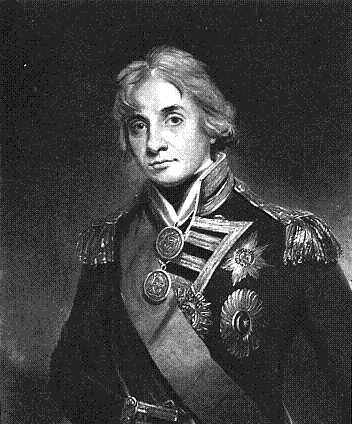
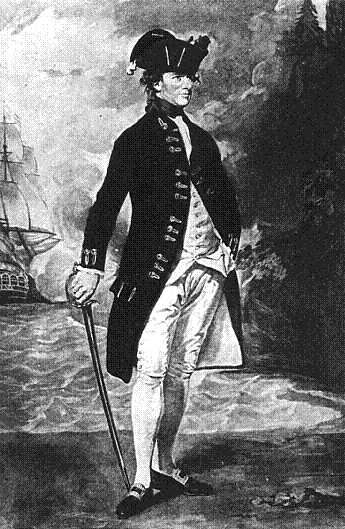
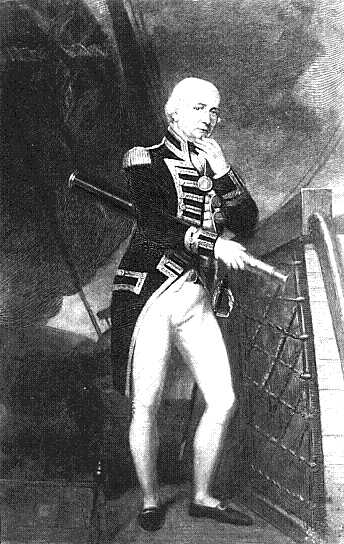
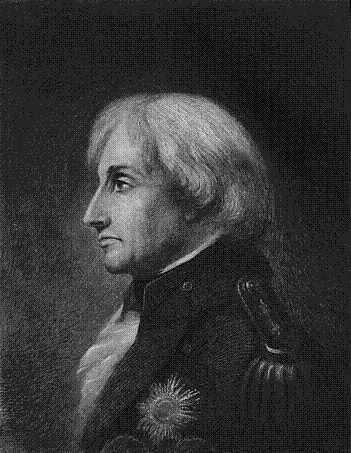
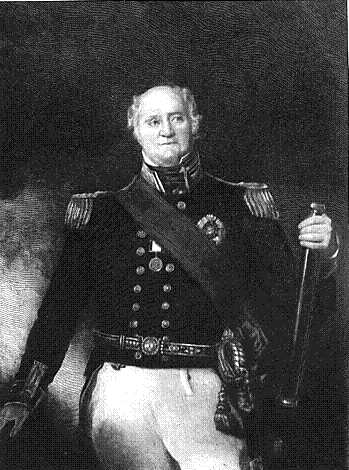
Vice-Admiral, Lord Nelson
From the painting by Sir
William Beechey. By permission of the Duke of
Wellington.
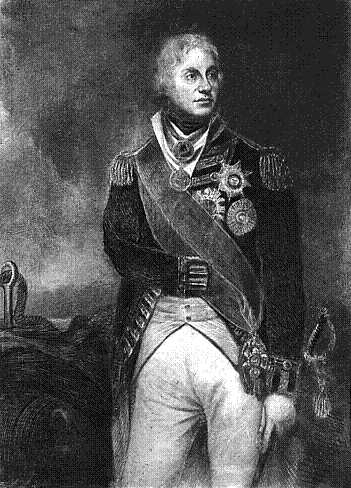
Vice-Admiral, Lord Nelson
From an engraving by W.O.
Burgess, after the painting by John Hoppner in St. James's
Palace.
Vice-Admiral, Sir Hyde Parker
After the painting by G.
Romney.
H.
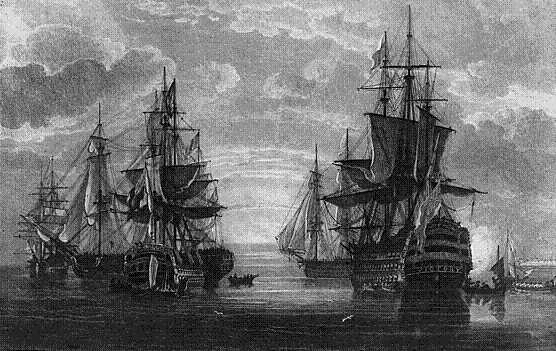
M. Ships "Agamemnon," "Captain," "Vanguard," "Elephant," and
"Victory"
From an engraving by J.
Fittler, after the painting by N. Pocock.
Admiral Collingwood
From the painting by Henry
Howard at Greenwich Hospital.
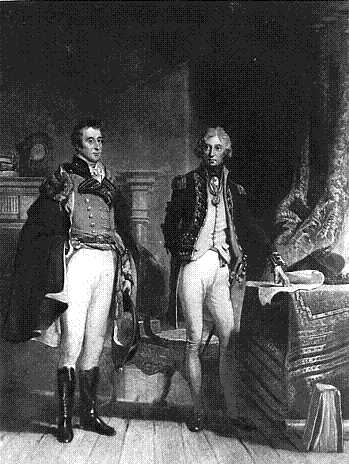
Meeting of Nelson and Wellington
From an engraving by
Reynolds, after the painting by John Prescott
Knight.
Vice-Admiral, Lord Nelson
From the portrait in the
possession of Sir W. Biddulph Parker, Bart. of Blackbrook
House, Fareham, Hants. On the back of the picture is written,
"This head was sketched from the Hero during his short stay at
Merton the beginning of September, 1805, by me, John
Whichele."
Captain Thomas Masterman Hardy
From the painting by Robert
Evans, at Greenwich Hospital.
Horatia, at Twenty-two Years of Age
From a miniature by Sir
William Charles Ross in the possession of Mr. Nelson
Ward.
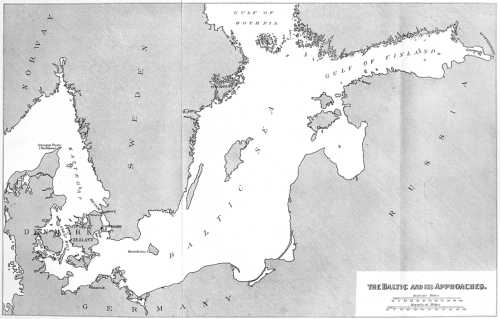
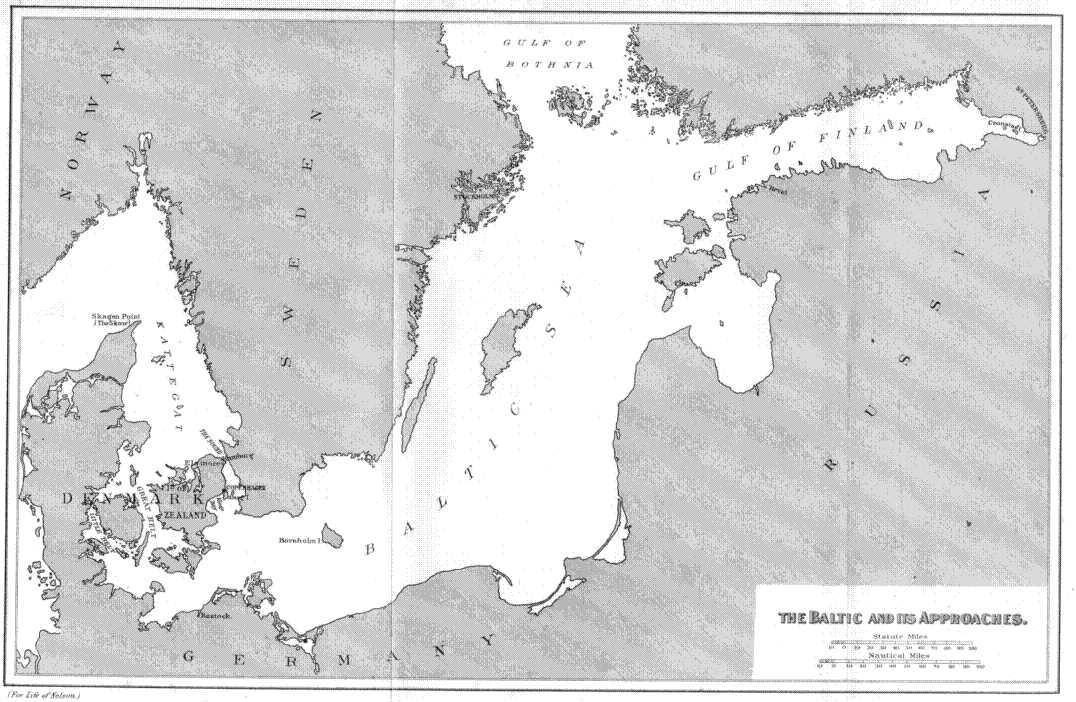
Map of the Baltic and its Approaches
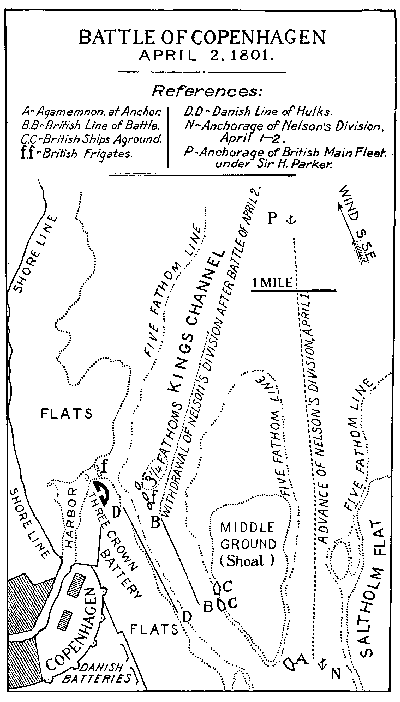
Battle of Copenhagen, Plan Number 1
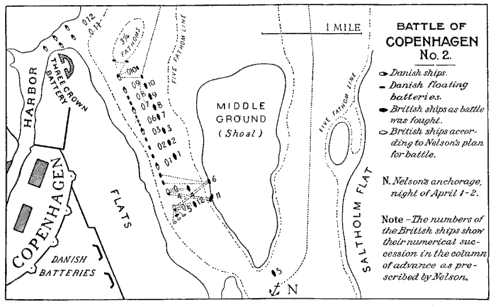
Battle of Copenhagen, Plan Number 2
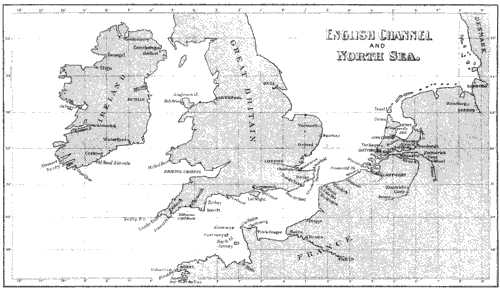
Map of the English Channel and North
Sea
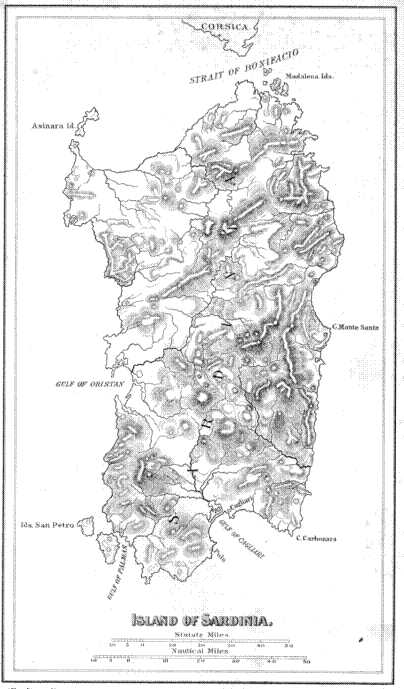
Map of Sardinia
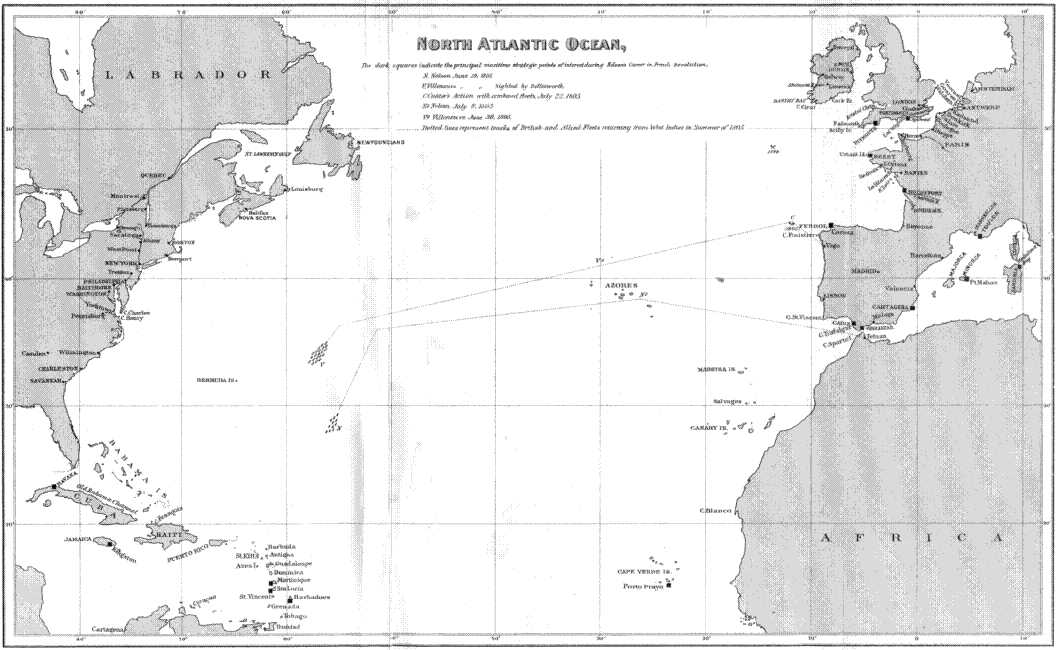
Map of the North Atlantic
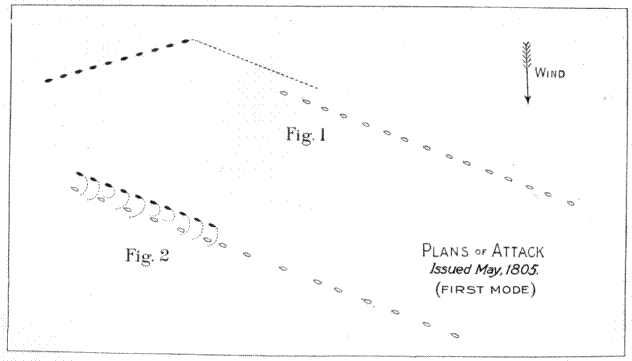
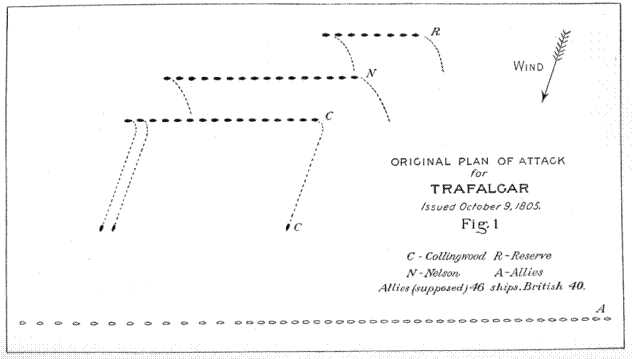
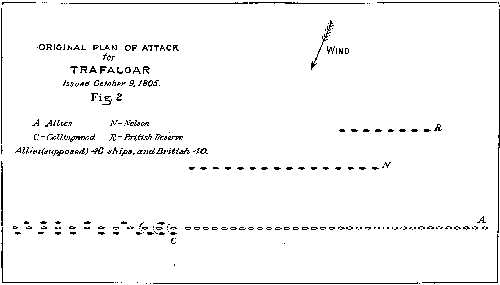
Plans of Attack, issued May, 1805, Figures 1, 2,
and 3.
Plan of Attack for Trafalgar, Figure 1
Plan of Attack for Trafalgar, Figure 2
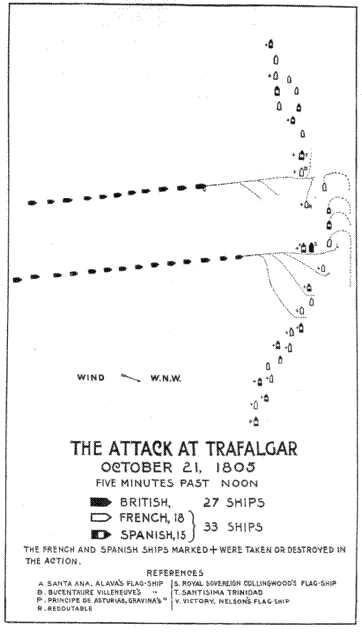
The Attack at Trafalgar
NELSON TEMPORARILY COMMANDER-IN-CHIEF IN THE MEDITERRANEAN.—RELIEVED BY LORD KEITH.—APPLIES TO RETURN TO ENGLAND ON ACCOUNT OF ILL HEALTH.
AUGUST, August 1799—JUNE, 1800. AGE, 41.
Upon Keith's departure, the command in the Mediterranean devolved upon Nelson, who for some time remained in doubt of the fact, but with his usual promptitude acted as if all depended upon himself. "I am venturing certainly out of my line of duty, but as the commander-in-chief may not even be on the station, I must do the best which my judgment points out during his temporary absence." Six sail-of-the-line, under Admiral Duckworth, were sufficient for service at Gibraltar and Cadiz, if the latter port was deserted. Four of the line were about Minorca, constantly, though inefficiently, threatened from the adjacent coasts of Spain. Three were blockading Malta, conjointly with the Portuguese vessels. Sidney Smith with his division remained in the Levant. Troubridge was operating with a few ships on the coast of Italy, against Civita Vecchia, still in the hands of the French. A small squadron was maintained on the Riviera of Genoa, disturbing the communications of the French, and keeping touch with the advance of the Austro-Russians; but it was expected that the Russian fleet, as was natural and proper, would soon assume the duty of co-operating with their general, Suwarrow. The smaller British cruisers were distributed among these various duties. The flagship "Foudroyant" was at Palermo, whither the King returned from Naples on the 8th of August, and there the headquarters of the squadron remained during Nelson's command. Soon after this arrival in Palermo the King conferred upon him the title of Duke of Bronté, with an estate of the same name in Sicily, valued at £3,000 per annum. After this the admiral for a time signed his papers as Bronté Nelson,[1] changed subsequently to Bronté Nelson of the Nile, and finally settled down to Nelson and Bronté, which was his form of signature for the last four years of his life. He placed upon his new estate an annual charge of £500 in favor of his father for the term of the latter's life. "Receive this small tribute, my honoured father," he wrote, "as a mark of gratitude to the best of parents from his most dutiful son."
On the 20th of September he received letters from the Admiralty, investing him with the chief command, "till the return of Lord Keith or some other your superior officer." He was not, however, allowed the appointments of a commander-in-chief, and often complained of the inadequacy of his staff to the extent of his duties. Nelson naturally hoped that his long and eminent services in that particular field, and the conspicuous ability he had shown on so many occasions, would lead to the station remaining permanently in his hands, and that Lord Keith, who was now in England, would succeed in due course to the Channel Fleet, whose commander, Lord Bridport, soon after retired. The Mediterranean was naturally attributed to a vice-admiral, and one of some seniority; but Nelson was now a rear-admiral of the Red, the highest color, not far, therefore, from promotion, and it would not be an unreasonable conclusion that the same ministry which had been fortunate enough to choose him for the campaign of the Nile, might now prefer to entrust to such able and enterprising hands the great interests of the Mediterranean at large.
It was not, however, to be so. Whether moved only by routine considerations of rank, as afterwards at Copenhagen, or whether his relations with the Sicilian Court, his conduct of affairs at Naples, and his collisions with Keith, had excited doubt of the normal balance of his mind, the Admiralty decided to send Keith back, and Nelson, greatly to his mortification, was kept in charge only till the end of the year. As St. Vincent had always left him practically independent, he had known no superior since he entered the Straits, except during Keith's brief period of succession, when leagues of sheltering distance left him free, as has been seen, to defy orders when not in accordance with his views; and he found it impossible now to bow his will to the second place on the very field of his glory. To this feeling, natural in any man, and doubly so to one of Nelson's quick susceptibilities, at once stimulated and soothed by the lavish adulation of the past year, was added personal dislike to his new superior, aggravated, if not originated, by the clash of judgment over the relative importance of Naples and Minorca. "I have serious thoughts of giving up active service," he wrote to Minto; "Greenwich Hospital seems a fit retreat for me after being evidently thought unfit to command in the Mediterranean." Complaints of Keith's lack of consideration then abound, nor does he seem to be conscious that there was anything in his mode of life, in current rumor, or in his past relations with his new commander-in-chief, which might make the latter unwilling to give him the loose rein St. Vincent had done.
From the time that Keith left the Mediterranean in July, 1799, to Nelson's own departure a year later, there was little to be done in the naval way except to maintain and press existing advantages, and wait until the fruit was ready to drop. The absolute supremacy of the British squadrons, challenged for a moment by the incursion of Admiral Bruix, had reverted, in even greater degree than before, by the absence of the Spanish ships which had accompanied him to Brest. Impeded by their own numbers, and paralyzed by the insufficiency of the resources of the port, they remained there a huge, inert mass, whose impotence was only partially understood by the British; a fact which conduced to prolong Keith's presence in the Channel. The year under consideration was therefore devoid of stirring events at sea.
In the Mediterranean, it is true, Nelson's unwearying mental energy, and keen sense of the necessity of seizing opportunity, did not allow things to lapse into indolence. Whether or not he was well advised to settle himself at Palermo, aware as he must have been of the actual temptation, and of the serious injury that scandal was doing to his reputation, both professional and personal, may admit of doubt. With numerous detached and minor services carrying on at the same moment, there was much to be said for the commander-in-chief remaining in a fixed position, near the centre of affairs; and in his apprehension everything then revolved about the Kingdom of Naples. There can be no question, however, that all his faculties were constantly on the alert; and that his administration of the station until Keith's return was characterized by the same zeal, sagacity, and politic tact that he had shown in earlier days. It is admirable to note the patience, courtesy, and adroit compliment, he brings into play, to kindle, in those over whom he has no direct control, the ardor for the general good, and the fearlessness of responsibility, which actuate himself; and at the same time to observe how severe the strain was upon his nervous and irritable temper, as betrayed in comments upon these very persons, made in private letters which he never expected would see the light.
The points of principal importance were the consolidation of the royal power in the continental territory of the Two Sicilies, the reduction of Malta, and the retention of the French army in Egypt in entire isolation from France. For the first, Nelson entirely failed in his efforts to induce the King to trust himself again in Naples, as the Hamiltons and he had expected when they came back to Palermo. "My situation here is indeed an uncomfortable one," he said to Earl Spencer; "for plain common sense points out that the King should return to Naples, but nothing can move him." "Our joint exertions have been used to get the King to go to Naples," he wrote to Troubridge, "but of no avail; the Austrians will be there before him." Although the French had been expelled from all the Neapolitan dominions, the presence of fifteen hundred in Rome and Civita Vecchia served then as an excuse. Nelson implored the commander of the British troops at Minorca to spare twelve hundred of his men, to aid Troubridge on the Roman coast. "Sir Charles Stuart," he tells him flatteringly, "by his timely exertion saved this Kingdom [Sicily] from anarchy and confusion, and perhaps from rebellion. So it is now, my dear Sir, I trust, in your power (and I have assured the good King and Queen of your readiness to serve them and the good cause as much as Sir Charles) to send for the taking possession of Civita Vecchia and Rome; this done, and with my life, I will answer for the success of the expedition. All would be quiet and happy; and their Sicilian Majesties might return to their throne without any alarm from mobs.... I am sure I need not venture to say more on the subject. Your Excellency's judgment and heart will point out the necessity of the measure if it can be accomplished." "Our King would be much gratified that Britain not Austria should reinstate the Pope."
Sir James Erskine, thus importuned, did not see his way to sending the troops. Naturally, as a soldier, he did not rely as much upon the navy preventing a landing in his island, as upon his own powers of resistance after it was effected, and was therefore unwilling to spare from the latter. The point of view of a seaman was, and is, different. He complained, too, that Duckworth had taken a great many ships to Gibraltar. Nelson admits the mistake, and expresses his regret, but no word of dissatisfaction with Erskine transpires through his evident disappointment. He only says, "Pardon what I am going to repeat, that either in Malta or on the Continent, a field of glory is open." "Minorca," he wrote to Spencer, "I have never yet considered in the smallest danger, but it has been a misfortune that others have thought differently from me on that point." Towards the end of September, Troubridge, without the aid of British troops, but supported by the arrival of a division sent by Suwarrow, reported the evacuation of Rome and Civita Vecchia. "How happy you have made us!" wrote Nelson to him. "My pen will not say what I feel." The King, however, would not return to Naples, now that this obstacle was withdrawn. "The Queen has a noble generous disposition," said Nelson two months later. "Unfortunately the King and her Majesty do not at this moment draw exactly the same way; therefore, his Majesty will not go at this moment to Naples, where his presence is much wanted." "We do but waste our breath," he avowed afterwards.
In the beginning of October, a visit which he had intended making to Minorca was hastened by a report that thirteen hostile ships-of-the-line had been seen off Cape Finisterre, and it was thought they might be destined for the Mediterranean. Nelson hoped to assemble ten to meet them; but the news proved to be false. He left Palermo for this trip on the 5th of October, and returned again on the 22d, having remained five days in Port Mahon. The arrangements for the naval force, depending entirely upon himself, were soon settled; but he was disappointed in obtaining, as he had hoped to do from a personal interview with Erskine, a detachment of two thousand troops for Malta. About that island he was, to use his own words, almost in despair. For over a year La Valetta had been blockaded by land and sea. For the latter he could with difficulty find ships; for the former he could obtain no men to aid the islanders, who, half starving, dependent for food chiefly upon Sicily, were sustained in their resistance mainly by hatred of the invaders, and by the tactful appeals and encouragement of Captain Ball, who lived ashore among them. The Barbary pirates, by virtue of their war with Naples, captured many of the vessels laden with supplies, despite Nelson's passports; while the Sicilian Court, though well disposed, lacked the energy and the propelling force necessary to compel the collection and despatch of the needed grain. On one occasion Troubridge or Ball, desperate at the sight of the famine around them, sent a ship of war into Girgenti, a Sicilian port, seized, and brought away two corn-laden vessels. "The measure was strong," said Nelson, but he refrained from censuring; and, while apologizing to the Government, added he hoped it "would not again force officers to so unpleasant an alternative." He feared that in their misery the Maltese would abandon the struggle, particularly if they got wind of the purpose of Great Britain to restore the hated Order of Knights, in deference to the wishes of the Czar. "The moment the French flag is struck," he had been obliged to write to Ball, "the colours of the Order must be hoisted and no other; when it was settled otherwise, the orders from England were not so strong."
About this time came information that several ships were fitting out at Toulon, with supplies for the besieged. This increased Nelson's anxieties, and at the same time emphasized the necessity which he had always urged of using speedier and surer means to reduce the place, while the undisputed mastery of the sea gave the opportunity. "What might not Bruix have done, had he done his duty?" was his own comment upon that recent incursion; and who could tell how soon as great a force might appear again under an abler man? He turned in every direction, and was instant in his appeals for aid. He wrote to Acton that he had positive information that seven ships were loaded in Toulon. "I therefore beg leave to propose to your Excellency, whether under our present circumstances, it would not be right for his Sicilian Majesty to desire that the English garrison at Messina should instantly go to Malta, for I am clear, that if Malta is relieved, that our forces got together could not take it, and the commencement of a new blockade would be useless. All the Barbary cruisers would there have their rendezvous, and not a vessel of his Sicilian Majesty's could put to sea." He exhorts the minister also to apply to the Russians for immediate help at Malta.
At the same time, to augment his embarrassments, orders came from Lisbon recalling the Portuguese squadron, which formed the larger part of the sea blockade. Nelson forgot how often he had abused them as useless, and grappled with that part of the difficulty with characteristic boldness. He peremptorily forbade the admiral to obey his orders. "As the reduction of the Island of Malta is of the greatest consequence to the interests of the allied Powers at war with France, and the withdrawing of the squadron under your command, at this time, from the blockade of that island, will be of the most ruinous consequences to their interests ... you are hereby required and directed, in consideration of the above circumstances, and notwithstanding the orders you may have received from your Court to return to Lisbon, not on any consideration whatsoever to withdraw one man from that island, which may have been landed from the squadron under your Excellency's command, or detach one ship down the Mediterranean, until further orders from me for that purpose." Your orders, he tells Niza in a private letter, were founded upon the belief that your presence was no longer necessary; "but the contrary is the fact—for your services were never more wanted than at this moment, when every exertion is wanting to get more troops of English and Russians to Malta." He is evidently thinking of his difference with Keith; but now he is within the limits of his commission as Commander-in-chief. Doubting, however, whether his official authority will prevail with Niza to disobey his recall, he plies him skilfully with appeals to those sentiments of honor which had received such illustration in his own noble career. "If you quit your most important station till I can get" reliefs for you, "depend upon it, your illustrious Prince will disapprove of (in this instance) your punctilious execution of orders." "We shall soon get more troops from Messina and Minorca; and I am not a little anxious for the honour of Portugal and your Excellency, that you should be present at the surrender. I hold myself responsible." "You was the first at the blockade. Your Excellency's conduct has gained you the love and esteem of Governor Ball, all the British officers and men, and the whole Maltese people; and give me leave to add the name of Nelson as one of your warmest admirers, as an officer and a friend."
As he dealt with the Portuguese admiral, so, in due measure, he conducted his intercourse with all others who came within the scope of his widely ranging activities. Already more Neapolitan than the King, to the Russian he became as a Russian, to the Turk as a Turk, all things to all men, if he could by any means promote the interest of the Allied cause and save Malta. Amid the diverse and conflicting motives of a coalition, Nelson played a steady hand, his attention unified, and his sight cleared, by an unwavering regard to the single object which he compressed into the words, "Down, down, with the French!" In that sense, he asserts truthfully enough to each and all of his correspondents that the advantage of their country and their monarch is as dear to him as that of Great Britain. He touches with artful skill upon the evident interests of each nation, appeals to the officer's sense of the cherished desires of his sovereign, and, while frankly setting forth the truths necessary to be spoken, as to the comparative claims upon himself of the various portions of the field, he insinuates, rather than suggests, what the person immediately addressed ought to be doing in furtherance of the one great aim. Withal, despite the uneasiness to which he is constantly a prey on account of the failures of others, no lack of confidence in the one to whom he is writing is suffered to appear. Each is not only exhorted and cheered, but patted on the back with an implied approbation, which in his own service constituted much of his well-deserved influence. He is as hearty and generous in his praises to Sir Sidney Smith, whom he never fully trusted, for his services at Acre, as he is to the valued friend, and pattern of all naval efficiency, Troubridge. To the Emperor of Russia he paid the politic attention of sending a detailed report of all that had been done about Malta, made to him as Grand Master of the Order,—a delicate and adroit flattery at the moment, for the Czar then valued himself more as the restorer of an ancient order of chivalry than as the inheritor of a great Sovereignty; and his position was further recognized by asking of him the insignia of the Order for Captain Ball and Lady Hamilton.
This immense load of correspondence and anxiety was additional to the numerous unrecorded cares and interviews, relating to the routine work and maintenance of a great squadron, often left bare of resources from home, and to the support of the destitute population of Malta,—sixty thousand souls; and all was carried on amid the constant going and coming of the ambassador's house, kept open to naval officers and others. This public sort of life and excitement involved considerable expense, and was little to the taste of either Nelson or Hamilton, the latter of whom was now approaching his seventieth year; but in it Lady Hamilton was in all her glory, overwhelmed with compliments, the victor of the Nile at her feet, and "making a great figure in our political line," to use her husband's words. "Except to the Court," wrote Nelson, replying to a censure from the Admiralty for failing to send a letter by a certain channel, when he had sent duplicates by two other conveyances,—"except to the Court, till after eight o'clock at night I never relax from business. I have had hitherto, the Board knows, no one emolument—no one advantage of a Commander-in-chief." It was in reference to this captious rebuff, received when immersed in cares, that he wrote to Spencer: "Do not, my dear Lord, let the Admiralty write harshly to me—my generous soul cannot bear it, being conscious it is entirely unmerited."
While he was striving to gain assistance for the Maltese, he does not forget to sustain them with hopes, not always too well founded. He tells Ball he trusts the Messina troops will soon be with him. "You may depend, in October, I will get 2,000 men on shore at Malta. Niza is ordered to Lisbon, but I have directed his stay off Malta." He appeals personally to the British commander at Messina, and to the Russian minister at Palermo, reminding the latter how dear Malta and its Order were to his sovereign. "Malta, my dear Sir, is in my thoughts sleeping or waking." The Portuguese, he tells him, are ordered home; but, wishing Russian assistance, he does not say that he has stopped them,—as to which, indeed, he could not feel sure.
The same object pressed upon him while in Port Mahon, and he succeeded, by his personal enthusiasm, in arousing Erskine's interest in the matter; but the latter was loaded to the muzzle with objections. "Sir James," said Nelson to Troubridge, with the amusing professional prejudice they both entertained, "enters upon the difficulty of the undertaking in a true soldier way." "I am just come from Sir James," he wrote to Hamilton on the 13th of October. "He sees all the difficulty of taking Malta in the clearest point of views, and therefore it became an arduous task to make him think that with God's blessing the thing was possible." He has, however, consented to prepare fifteen hundred men with stores and equipments, but only on condition that the Russians will also give a thousand,—a further draft on Nelson's diplomacy,—and a thousand be landed from the squadron, etc. Besides, there is the further difficulty that a superior officer is expected from England, and what will he say? And will Erskine be justified in sending men before his entirely uncertain arrival? It may be imagined what such proceedings were to Nelson's nervous, ardent, unhesitating temperament, and they elicited the characteristic comment, "This has been my first conference. It has cost me four hours hard labour, and may be upset by a fool." "My heart is, I assure you, almost broke with this and other things," he wrote to Spencer. "If the enemy gets supplies in, we may bid adieu to Malta. This would complete my misery; for I am afraid I take all services too much to heart. The accomplishing of them is my study, night and day."
"My dear Sir James," he writes to Erskine after returning to Palermo, "I am in desperation about Malta—we shall lose it, I am afraid, past redemption. I send you copies of Niza's and Ball's letters, also General Acton's, so you will see I have not been idle." As it is, Ball can hardly keep the inhabitants in hope of relief; what then will it be if the Portuguese withdraw? "If the islanders are forced again to join the French, we may not find even landing a very easy task, much less to get again our present advantageous position. I therefore entreat for the honour of our King, that whether General Fox is arrived or not, at least the garrison of Messina may be ordered to hold post in Malta until a sufficient force can be collected to attack it.... I know well enough of what officers in your situation can do; the delicacy of your feelings on the near approach of General Fox I can readily conceive; but the time you know nothing about; this is a great and important moment, and the only thing to be considered, is his Majesty's service to stand still for an instant? ... Was the call for these troops known at home, would they not order them to proceed when the service near at hand loudly calls for them? this is the only thing in my opinion for consideration. If we lose this opportunity it will be impossible to recall it." From this desperate appeal he turns to Ball, with words of encouragement for his islanders. "We shall soon hear to a certainty of at least 5,000 Russian troops for the service of Malta. Within a month I hope to see 10,000 men in arms against La Valetta. I have sent for Troubridge and Martin, that I may get a force to relieve Niza. I trust he will not go till I can get not only a proper force to relieve his ships, but those of his people who are on shore." "The great order of all," he writes Erskine three weeks later, "is to destroy the power of the French. Two regiments for two months would probably, with the assistance of the Russians, give us Malta, liberate us from an enemy close to our doors, gratify the Emperor of Russia, protect our Levant trade, relieve a large squadron of ships from this service, and enable me the better to afford naval protection to the island of Minorca, and assist our allies on the northern coast of Italy, and to annoy the enemy on the coast of France."
Nelson's entreaties and efforts met with success, sufficient at least to stay the ebbing tide. General Fox arrived in Minorca, gave permission for the garrison of Messina to go to Malta, and on the 25th of November Troubridge, bringing this news, arrived off Palermo. Nelson's haste did not permit the "Culloden" to anchor. Shifting his flag to a transport, he sent out the "Foudroyant" to meet her, with orders for both to go to Messina, embark the garrison, and get off Malta as soon as possible. The "Northumberland," seventy-four, was also to join off Malta, forming a division to replace the Portuguese squadron. The latter quitted the blockade in December, Nelson notifying Niza on the 18th of the month that he no longer considered him under his command. The Messina troops landed at Malta on the 10th. The British then had fifteen hundred men on the island, supported by two thousand Maltese, well disciplined and armed, besides a number of native irregulars upon whom only partial dependence could be placed. The Russians never came to take part. They got as far as Messina, but there received orders to go to Corfu, both ships and men. This was in pursuance of a change of policy in the Czar, who, being enraged at the conduct of his allies, particularly of the Austrians, in the late campaign, intended withdrawing from the Coalition, and was concentrating troops at Corfu. This revived Nelson's fears for Malta. "I trust Graham will not think of giving the island to the French by withdrawing, till he receives orders from General Fox." The troops remained, but in numbers too small to admit active operations. The result was left perforce to the slow pressure of blockade; and final success, insured mainly by Nelson's untiring efforts, was not attained until after he had left the Mediterranean.
The six months of his independent command, though unmarked by striking incidents at sea, were crowded with events, important in themselves, but far more important as pregnant of great and portentous changes in the political and military conditions of Europe. When Keith passed the Straits in pursuit of the Franco-Spanish fleet, on the 30th of July, the forces of the Coalition in Upper Italy were in the full tide of repeated victories and unchecked success. On that same day the fortress of Mantua, the siege of which in 1796 had stayed for nine months the triumphal progress of Bonaparte, was surrendered by the French, whose armies in the field, driven far to the westward, were maintaining a difficult position on the crests of the Apennines. Seeking to descend from there into the fields of Piedmont, they were met by Suwarrow, and on the 15th of August, at Novi, received once more a ruinous defeat, in which their commander-in-chief was slain.
At this moment of success, instead of pressing onward to drive the enemy out of Italy, and possibly to pursue him into France, it was decided that the Russians should be sent across the Alps into Switzerland, to take the place of a number of Austrians. The latter, in turn, were to move farther north, on the lower Rhine, to favor by a diversion an intended invasion of Holland by a combined force of Russians and British. This gigantic flank movement and change of plan resulted most disastrously. In the midst of it the French general Masséna, commanding in Switzerland, the centre of the great hostile front which extended from the Mediterranean to the North Sea, made a vehement and sustained attack upon the Austro-Russians at Zurich, on the 25th of September. Gaining a complete victory, he drove the enemy back beyond the point where Suwarrow expected to make his junction. The veteran marshal, who had left Italy on the 11th of September, arrived two days after the Battle of Zurich was fought. Isolated in insufficient numbers from the friends he expected to meet, it was only after severe hardships and superhuman efforts, extending over ten days, that he at length, on the 9th of October, reached a place of safety at Ilanz. Declining further co-operation with the Austrians, and alleging the need of rest for his troops after their frightful exposure in the mountains, he withdrew into winter quarters in Bavaria at the end of the month. Thus Switzerland remained in possession of the French, inactivity continued in Italy, and the Czar, furious at the turn events had taken, was rapidly passing into hatred of both Austria and Great Britain.
On the 9th of October, also, Bonaparte landed in France, after a six weeks' voyage from Alexandria. The immense consequences involved in this single event could not then be foreseen; but it none the less caused mortification and regret to Nelson. It was a cardinal principle with him, vehemently and frequently uttered, that not a single Frenchman should be allowed to return from Egypt; and here their commander-in-chief had passed successfully from end to end of the station, unseen by any British cruiser. He did not, however, consider himself at fault, and his judgment may be allowed, although in his own case. "If I could have had any cruisers, as was my plan, off Cape Bon, in Africa, and between Corsica and Toulon, Mr. Buonaparte could not probably have got to France." This he said to Earl Spencer. Elsewhere he wrote: "I have regretted sincerely the escape of Buonaparte; but those ships which were destined by me for the two places where he would certainly have been intercepted, were, from the Admiralty thinking, doubtless, that the Russians would do something at sea, obliged to be at Malta, and other services which I thought the Russian Admiral would have assisted me in—therefore, no blame lies at my door." He took some comfort in contrasting the stealthy return of the French general, with the great armada that accompanied his departure. "No Crusader ever returned with more humility—contrast his going in L'Orient, &c. &c."
A report that Bonaparte had passed Corsica reached Nelson on October 24th. The same day came despatches from Sir Sidney Smith, narrating a disastrous defeat sustained by the Turks on the shores of Aboukir Bay. Smith's period of command in the Levant had been chiefly, and brilliantly, distinguished by the successful defence of Acre against Bonaparte. The latter, threatened by simultaneous attacks by the Turks from Syria and from the sea, had determined to anticipate such a combination by going himself against the enemy on the land side, before the weather conditions made it possible to disembark any formidable body of men on the shores of Egypt. Starting with this purpose in February, he had proceeded with slight resistance until the 18th of March, when his army appeared before Acre. Smith was then lying in the roads with two ships-of-the-line. The siege which ensued lasted for sixty-two days, so great was Bonaparte's pertinacity, and anxiety to possess the place; and in its course Smith displayed, not only courage and activity, which had never been doubted, but a degree of conduct and sound judgment that few expected of him. His division was fortunate enough to capture the French siege train, which had to be sent by water, and he very much disturbed the enemy's coastwise communications, besides contributing materially to the direction of the defence, to which the Turks, though brave enough, were not adequate. After several desperate assaults the siege was raised on the 20th of May, and Bonaparte retreated to Egypt, regaining Cairo on the 14th of June.
Following up the success at Acre, a Turkish fleet of thirteen ships-of-the-line anchored in Aboukir Bay on the 11th of July, attended by a body of transports carrying troops, variously estimated at from ten to thirty thousand. Smith with his ships accompanied the expedition. The Turks landed, and stormed the castle of Aboukir; but on the 25th Bonaparte, having concentrated his forces rapidly, fell upon them and totally defeated them. All who had landed were either killed, driven into the sea and drowned, or taken prisoners; the commander-in-chief being among the latter. Four weeks later, as is already known, Bonaparte embarked for France.
It was thus conclusively demonstrated that for the present at least, and until the French numbers were further diminished by the inevitable losses of disease and battle, the Turks could not regain control of Egypt. On the other hand, it was equally evident, and was admitted by both Bonaparte and his able successor, Kleber, that without reinforcements, which could not be sent while the British controlled the sea, the end of the French occupation was only a question of time. After Bonaparte's departure, Kleber wrote home strongly to this effect. His letters, being addressed to the Government, fell upon arrival into Bonaparte's hands; but, with these convictions, he was ready to enter into an arrangement for the evacuation of the country, upon condition of being allowed to return freely to Europe.
Such also appears to have been the disposition of the British representatives in the East. Immediately after taking over the command in the Levant from Troubridge, Smith gave him, among other papers, a form of passport which he intended to use, permitting individual Frenchmen to go to Europe by sea. This Troubridge handed to Nelson, telling him also that it was Smith's intention to send word into Alexandria, that all French ships might pass to France. This passport, adopted after Smith had been to Constantinople, had doubtless the sanction of the joint minister, his brother, and was signed by himself both as plenipotentiary and naval officer. Nelson had by this time been instructed that Smith was under his command, and he at once sent him an order, couched in the most explicit, positive, and peremptory terms, which merit especial attention because Smith disobeyed them. "As this is in direct opposition to my opinion, which is, never to suffer any one individual Frenchman to quit Egypt—I must therefore strictly charge and command you,[2] never to give any French ship or man leave to quit Egypt. And I must also desire that you will oppose by every means in your power, any permission which may he attempted to be given by any foreigner, Admiral, General, or other person; and you will acquaint those persons, that I shall not pay the smallest attention to any such passport after your notification; and you are to put my orders in force, not on any pretence to permit a single Frenchman to leave Egypt." It seems clear from these expressions that Nelson had gathered, through Troubridge, that it was the policy of the Sultan and of the British representatives to get the French out of Egypt at any cost,—to look, in short, to local interests rather than to the general policy of the Allies. This he was determined to prevent by instructions so comprehensive, yet so precise, as to leave no loophole for evasion.
Here matters seem to have rested for a time. Smith could scarcely dare to disregard such orders at once, and Bonaparte was not yet disposed openly to confess failure by seeking terms. In the autumn of 1799, however, the Earl of Elgin went to Constantinople as ambassador, Spencer Smith dropping to secretary of embassy, and his brother remaining on the Egyptian coast. Elgin was far from being in accord with Smith's general line of conduct, which was marked with presumption and self-sufficiency, and in the end he greatly deplored the terms "granted to the French, so far beyond our expectation;" but he shared the belief that to rid Egypt of the French was an end for which considerable sacrifices should be made, and his correspondence with Smith expressed this conviction. When prepossessions such as this exist among a number of men associated with one another, they are apt, as in the case of Admiral Man consulting with his captains, to result in some ill-advised step, bearing commonly the stamp of concern for local interests, and forgetfulness of general considerations. The upshot in this particular instance was the conclusion of a Convention, known as that of El Arish, between the Turks and the French, signed on board Smith's ship on the 24th of January, 1800, by which this army of veterans was to be permitted to return to France unmolested, and free at once to take the field against the allies of Turkey and Great Britain, at the moment when Bonaparte's unrivalled powers of administration were straining every nerve, to restore the French forces from the disorganization into which they had fallen, and to prepare for the spring campaign.
Smith, though present, did not sign this precious paper, which, in a letter to Hamilton, he called "the gratifying termination of his labours;" but he had in his hand the orders of his immediate superior, and temporary commander-in-chief, to notify any "foreigner, general, or admiral," that the execution of such an agreement would not be permitted by the British Navy, and it would have been his own duty to stop any ships attempting to carry it out, until other orders were received. His powers as joint plenipotentiary having ceased, he was now simply the naval officer. As it happened, Keith, who by this time had relieved Nelson, brought out from England clear directions from the Government not to allow any transaction of this kind; and although he personally favored the policy of evacuation, feeling perhaps the inconvenience of detaching ships so far from his centre of operations, he was not a man to trifle with orders. Rumors of what was going on had evidently reached him, for on the 8th of January, a fortnight before the convention was signed, he wrote to Kleber a letter, which he directed Smith to deliver, thus placing it out of the power of that very independent officer to leave any mistake as to actual conditions in the mind of the French general. To the latter he said: "I have positive orders not to consent to any capitulation with the French troops, at least unless they lay down their arms, surrender themselves prisoners of war, and deliver up all the ships and stores of the port of Alexandria to the Allied Powers." Even in such case they would not be allowed to leave Egypt until exchanged. Any persons that attempted to return, pursuant to an arrangement with one of the Allies, exclusive of the others, as the El-Arish Convention was, would be made prisoners of war.
Nelson's opinions in this matter had never wavered. As rumors of what was brewing got about, he wrote to the Earl of Elgin, on the 21st of December, 1800: "I own my hope yet is, that the Sublime Porte will never permit a single Frenchman to quit Egypt; and I own myself wicked enough to wish them all to die in that country they chose to invade. We have scoundrels of French enough in Europe without them." "I never would consent to one of them returning to the Continent of Europe during the war," he tells Spencer Smith. "I wish them to perish in Egypt, and give a great lesson to the world of the justice of the Almighty." When Elgin, thinking him still commander-in-chief, sent him the Convention, he replied formally: "I shall forward the papers to Lord Keith, who will answer your Excellency. But I cannot help most sincerely regretting that ever any countenance was given to the Turks to enter into such a treaty with the French; for I ever held it to be impossible to permit that army to return to Europe, but as prisoners of war, and in that case, not to France. And was I commander-in-chief, even when the thing was done, I should have refused to ratify any consent or approbation of Sir Sidney Smith, and have wrote to both the Grand Vizir and the French General, the impossibility of permitting a vanquished army to be placed by one Ally in a position to attack another Ally." The last phrase put the facts in a nutshell, and illustrates well Nelson's power of going straight to the root of a matter, disregardful of confusing side-issues, of policy or timidity. To Hamilton he wrote passionately concerning the manifold difficulties caused to all, except the Turks and the Smiths. "If all the wise heads had left them to God Almighty, after the bridge was broke, all would have ended well. For I differ entirely with my commander-in-chief, in wishing they were permitted to return to France; and, likewise, with Lord Elgin on the great importance of removing them from Egypt."
"I have wrote to Lord Keith, and home," said Nelson to Sir Sidney Smith on the 15th of January, "that I did not give credit that it was possible for you to give any passport for a single Frenchman, much less the Army, after my positive order of March 18th, 1799." The words show what reports had already got about of the general trend of policy, on the part of the Porte and the British representatives; but the irony of the matter as regards Nelson is, that Smith disobeyed his orders, as he himself, six months before, had disobeyed Keith's; and for the same reason, that he on the spot was a better judge of local conditions and recent developments than one at a distance. To one, Naples was more important than Minorca, more important than a half-dozen ships in a possible fleet action; to the other, Egypt was more important than the presence of sixteen thousand veterans, more or less, on a European battle-field. It is impossible and bootless, to weigh the comparative degree of culpability involved in breaches of orders which cannot be justified. It is perhaps safe to say that while a subordinate has necessarily a large amount of discretion in the particular matter intrusted to him, the burden of proof rests wholly upon him when he presumes to depart from orders affecting the general field of war, which is the attribute of the commander-in-chief. What in the former case may be simply an error of judgment, in the latter becomes a military crime.
On the 16th of January, 1800, Nelson, who some days before had been notified by Keith of his approach, and directed to place himself under his command, left Palermo for Leghorn, arriving on the 20th. The commander-in-chief was already there in the "Queen Charlotte." On the 25th they sailed together for Palermo, and after nine days' stay in that port went on again for Malta, which they reached on the 15th of February. No incident of particular interest occurred during these three weeks, but Nelson's letters to the Hamiltons show that he was chafing under any act in his superior which could be construed into a slight. "I feel all, and notwithstanding my desire to be as humble as the lowest midshipman, perhaps, I cannot submit to be much lower, I am used to have attention paid me from his superiors." "To say how I miss your house and company would be saying little; but in truth you and Sir William have so spoiled me, that I am not happy anywhere else but with you, nor have I an idea that I ever can be." Keith's comment—the other point of view—is worth quoting. "Anything absurd coming from the quarter you mention does not surprise me," he wrote to Paget, who succeeded Hamilton as minister. "The whole was a scene of fulsome vanity and absurdity all the long eight days I was at Palermo."[3]
When Keith returned, the capture of Malta, and of the two ships-of-the-line which had escaped from the Battle of the Nile, were, by common consent, all that remained to do, in order to round off and bring to a triumphant conclusion Nelson's Mediterranean career. Fortune strove hard against his own weakness to add all these jewels to his crown, but she strove in vain. "We may truly call him a heaven-born Admiral, upon whom fortune smiles wherever he goes." So wrote Ball to Lady Hamilton, alluding to the first of the favors flung at his head. "We have been carrying on the blockade of Malta sixteen months, during which time the enemy never attempted to throw in great succours. His Lordship arrived off here the day they were within a few leagues of the island, captured the principal ships, and dispersed the rest, so that not one has reached the port." It was indeed a marvellous piece of what men call luck. Nelson had never gone near Malta since October, 1798, till Keith took him there on the 15th of February, 1800. The division had no sooner arrived at the island, than a frigate brought word of a French squadron having been seen off the west end of Sicily. It was then blowing strong from southeast, and raining. Keith took his own station off the mouth of the harbor, placed other ships where he thought best, and signalled Nelson to chase to windward with three ships-of-the-line, which were afterwards joined by a fourth, then cruising on the southeast of the island. The next day the wind shifted to northwest, but it was not until the morning of the 18th that the enemy were discovered. Guns were then heard to the northward, by those on board the "Foudroyant," which made all sail in pursuit, and soon sighted the "Alexander" chasing four French sail. "Pray God we may get alongside of them," wrote Nelson in his journal; "the event I leave to Providence. I think if I can take one 74 by myself, I would retire, and give the staff to more able hands." "I feel anxious to get up with these ships," he wrote to Lady Hamilton, "and shall be unhappy not to take them myself, for first my greatest happiness is to serve my gracious King and Country, and I am envious only of glory; for if it be a sin to covet glory, I am the most offending soul alive. But here I am in a heavy sea and thick fog—Oh, God! the wind subsided—but I trust to Providence I shall have them. 18th in the evening, I have got her—Le Généreux—thank God! 12 out of 13, onely the Guillaume Telle remaining; I am after the others." The enemy's division had consisted of this seventy-four, a large transport, also captured, and three corvettes which escaped.
An account of Nelson on the quarter-deck on this occasion has been transmitted by an eye-witness, whose recollections, committed to paper nearly forty years later, are in many points evidently faulty, but in the present instance reflect a frame of mind in the great admiral in perfect keeping with the words last quoted from his own letter. The writer was then a midshipman of the "Foudroyant;" and the scene as described opens with a hail from a lieutenant at the masthead, with his telescope on the chase.
"'Deck there! the stranger is evidently a man of war—she is a line-of-battle-ship, my lord, and going large on the starboard tack.'
"'Ah! an enemy, Mr. Stains. I pray God it may be Le Généreux. The signal for a general chase, Sir Ed'ard, (the Nelsonian pronunciation of Edward,) make the Foudroyant fly!'
"Thus spoke the heroic Nelson; and every exertion that emulation could inspire was used to crowd the squadron with canvas, the Northumberland taking the lead, with the flag-ship close on her quarter.
"'This will not do, Sir Ed'ard; it is certainly Le Généreux, and to my flag-ship she can alone surrender. Sir Ed'ard, we must and shall beat the Northumberland.'
"'I will do the utmost, my lord; get the engine to work on the sails—hang butts of water to the stays—pipe the hammocks down, and each man place shot in them—slack the stays, knock up the wedges, and give the masts play—start off the water, Mr. James, and pump the ship.' The Foudroyant is drawing a-head, and at last takes the lead in the chase. 'The admiral is working his fin, (the stump of his right arm,) do not cross his hawse, I advise you.'
"The advice was good, for at that moment Nelson opened furiously on the quarter-master at the conn. 'I'll knock you off your perch, you rascal, if you are so inattentive.—Sir Ed'ard, send your best quarter-master to the weather wheel.'
"'A strange sail a-head of the chase!' called the look-out man.
"'Youngster, to the mast-head. What! going without your glass, and be d——d to you? Let me know what she is immediately.'
"'A sloop of war, or frigate, my lord," shouted the young signal-midshipman.
"'The Success, my lord.'
"'Captain Peard; signal to cut off the flying enemy—great odds, though—thirty-two small guns to eighty large ones.'
"'The Success has hove-to athwart-hawse of the Généreux, and is firing her larboard broadside. The Frenchman has hoisted his tri-colour, with a rear-admiral's flag.'
"'Bravo—Success, at her again!'
"'She has wore round, my lord, and firing her starboard broadside. It has winged her, my lord—her flying kites are flying away all together.' The enemy is close on the Success, who must receive her tremendous broadside. The Généreux opens her fire on her little enemy, and every person stands aghast, afraid of the consequences. The smoke clears away, and there is the Success, crippled, it is true, but, bull-dog like, bearing up after the enemy.
"'The signal for the Success to discontinue the action, and come under my stern,' said Lord Nelson; 'she has done well, for her size. Try a shot from the lower-deck at her, Sir Ed'ard.'
"'It goes over her.'
"'Beat to quarters, and fire coolly and deliberately at her masts and yards.'
"Le Généreux at this moment opened her fire on us; and, as a shot passed through the mizen stay-sail, Lord Nelson, patting one of the youngsters on the head, asked him jocularly how he relished the music; and observing something like alarm depicted on his countenance, consoled him with the information, that Charles XII. ran away from the first shot he heard, though afterwards he was called 'The Great,' and deservedly, from his bravery. 'I, therefore,' said Lord Nelson, 'hope much from you in future.'
"Here the Northumberland opened her fire, and down came the tri-colored ensign, amidst the thunder of our united cannon."[4]
According to Keith, Nelson "on this occasion, as on all others, conducted himself with skill, and great address, in comprehending my signals, which the state of the weather led me greatly to suspect." Nelson's account to Hamilton was, "By leaving my admiral without signal, for which I may be broke, I took these French villains." "I have wrote to Lord Spencer," he tells his eldest brother, "and have sent him my journal, to show that the Généreux was taken by me, and my plan—that my quitting Lord Keith was at my own risk, and for which, if I had not succeeded, I might have been broke. The way he went, the Généreux never could have been taken." In a letter to Lord Minto he attributed his success to his knowledge of all the local conditions, acquired by seven years' experience. In his anxiety to make this instance prove his case, in the previous disobedience to Keith, for which the Admiralty had censured him, Nelson overreached himself and certainly fell into an ungenerous action. His vaunt of success by the road of disobedience rested only on the fact that he had failed to see Keith's signal. This the latter did not know, and evidently considered he had complied with its spirit. The signal to chase to windward was not strained to disobedience in being construed to search a fairly wide area for the enemy, keeping the rendezvous, which was also the enemy's destination, to leeward, so as to be readily regained. The "Queen Charlotte," Keith's flagship, covered the inner line, and, being a first-rate, was competent to handle any force that could come out of Toulon. There is a good deal of human nature in this captious unofficial attack on a superior, whose chief fault, as towards himself, was that he had been the victim of disobedience; but it is not pleasant to see in a man so truly great.
The "Généreux" carried the flag of a rear-admiral, who was killed in the action. Nelson seized the opportunity of further conciliating the Czar, by sending the sword of this officer to him, as Grand Master of the Order of Malta. Upon rejoining Keith, he reported in person, as custom demands. "Lord Keith received my account and myself like a philosopher (but very unlike you)," he wrote to Hamilton; "it did not, that I could perceive, cause a pleasing muscle in his face." "Had you seen the Peer receive me," he wrote to Lady Hamilton the same day, "I know not what you would have done; but I can guess. But never mind. I told him that I had made a vow, if I took the Généreux by myself, it was my intention to strike my flag. To which he made no answer." What could he very well say, if a man chose to throw away his chances, especially when that man was a subordinate who a short time before had flatly refused to obey his orders. Soreness and testiness had full swing in Nelson at this time; at some fancied neglect, he wrote Troubridge a letter which reduced that gallant officer to tears.
Between Palermo and Malta Keith had received letters from General Mélas, commanding the Austrian army in Piedmont, giving the plan of the approaching campaign, in which, as the Austrians were to besiege Genoa, and advance to the Riviera, much depended upon naval co-operation. Rightly judging that to be the quarter calling for the naval commander-in-chief, he was anxious to get away. On the 24th of February he issued an order to Nelson to take charge of the blockade, and "to adopt and prosecute the necessary measures for contributing to the complete reduction of Malta." Short of the chief command, which he coveted and grudged, Nelson himself could not have contrived a position better fitted to crown his work in the Mediterranean. Within the harbor of La Valetta, concentrating there the two objects that yet remained to be attained,—- Valetta itself being one,—was the "Guillaume Tell," the thirteenth ship, which alone was lacking now to complete the tale of the trophies of the Nile. Yet the fair prospect of success, inevitable since the capture of the "Généreux" had destroyed the French hopes of relief, brought to Nelson nothing but dismay. "My Lord," he replied the same day, "my state of health is such, that it is impossible I can much longer remain here. Without some rest, I am gone. I must, therefore, whenever I find the service will admit of it, request your permission to go to my friends, at Palermo, for a few weeks, and leave the command here to Commodore Troubridge. Nothing but absolute necessity obliges me to write this letter." "I could no more stay fourteen days longer here, than fourteen years," he said in a private letter to Keith of the same date.
By the next day he had recognized that even he could not leave at once the task appointed him, without discredit. "My situation," he then wrote to Hamilton, "is to me very irksome, but how at this moment to get rid of it is a great difficulty. The French ships here ["Guillaume Tell" and others] are preparing for sea; the Brest fleet, Lord Keith says, may be daily expected, and with all this I am very unwell.... The first moment which offers with credit to myself I shall assuredly give you my company. ... Lord Keith is commander-in-chief, and I have not been kindly treated." His tried friends, Troubridge and Ball, realized the false step he was about to take, but they could not change his purpose. "Remember, my Lord," wrote the former, "the prospects are rather good at present of reducing this place, and that William Tell, Diane,[1] and Justice,[5] are the only three ships left from the Nile fleet. I beseech you hear the entreaties of a sincere friend, and do not go to Sicily for the present. Cruizing may be unpleasant. Leave the Foudroyant outside, and hoist your flag in the Culloden, to carry on operations with the General. Everything shall be done to make it comfortable and pleasing to you: a month will do all. If you comply with my request, I shall be happy, as I shall then be convinced I have not forfeited your friendship." "I dined with his Lordship yesterday, who is apparently in good health," wrote Ball to Lady Hamilton, "but he complains of indisposition and the necessity of repose. I do not think a short stay here will hurt his health, particularly as his ship is at anchor, and his mind not harassed. Troubridge and I are extremely anxious that the French ships, and the French garrison of La Valetta, shall surrender to him. I would not urge it if I were not convinced that it will ultimately add both to his honour and happiness."
The fear of his friends that he would lose honor, by not resisting inclination, is evident—undisguised; but they could not prevail. On the 4th of March he wrote to Lady Hamilton: "My health is in such a state, and to say the truth, an uneasy mind at being taught my lesson like a school boy, that my DETERMINATION is made to leave Malta on the 15th morning of this month, on the first moment after the wind comes favourable; unless I am SURE that I shall get hold of the French ships." Keith's directions had been full and explicit on details, and this Nelson seems to have resented. Among the particular orders was one that Palermo, being so distant from Malta, should be discontinued as the rendezvous, and Syracuse substituted for it; Nelson was, however, at liberty to use Messina or Augusta, both also on the west coast of Sicily, if he preferred. It will be remembered that Nelson himself, before he fell under the influence of Naples, had expressed his intention to make Syracuse the base of his operations. Coming as this change did, as one of the first acts of a new commander-in-chief, coinciding with his own former judgment, it readily took the color of an implied censure upon his prolonged stay at Palermo—an echo of the increasing scandal that attended it.
On the 10th of March he left Malta for Palermo in the "Foudroyant," sending the ship back, however, to take her place in the blockade, and hoisting his own flag on board a transport. His mind was now rapidly turning towards a final retirement from the station, a decision which was accelerated by the capture of the "Guillaume Tell." This eighty-gun ship started on the night of March 29th to run out from La Valetta, to relieve the famished garrison from feeding the twelve hundred men she carried. Fortunately, the "Foudroyant" had resumed her station off the island; and it was a singular illustration of the good fortune of the "heaven-born" admiral, to repeat Ball's expression, that she arrived barely in time, only a few hours before the event, her absence from which might have resulted in the escape of the enemy, and a just censure upon Nelson. The French ship was sighted first by a frigate, the "Penelope," Captain Blackwood, which hung gallantly upon her quarters, as Nelson in former days had dogged the "Ça Ira" with the "Agamemnon," until the heavier ships could gather round the quarry. The "Guillaume Tell," necessarily intent only on escape from overpowering numbers, could not turn aside to crush the small antagonist, which one of her broadsides might have swept out of existence; yet even so, the frigate decided the issue, for she shot away the main and mizzen topmasts of the French vessel, permitting the remainder of the British to come up. No ship was ever more gallantly fought than the "Guillaume Tell;" the scene would have been well worthy even of Nelson's presence. More could not be said, but Nelson was not there. She had shaken off the "Penelope" and the "Lion," sixty-four, when the "Foudroyant" drew up at six in the morning. "At half-past six," says the latter's log, "shot away the [French] main and mizen-masts: saw a man nail the French ensign to the stump of the mizen-mast. Five minutes past eight, shot away the enemy's foremast. Ten minutes past eight, all her masts being gone by the board, the enemy struck his colours, and ceased firing." The last of the fleet in Aboukir Bay had surrendered to Nelson's ship, but not to Nelson's flag.
"I am sensible," he wrote from Palermo to Sir Edward Berry, the captain of the "Foudroyant," "of your kindness in wishing my presence at the finish of the Egyptian fleet, but I have no cause for sorrow. The thing could not be better done, and I would not for all the world rob you of one particle of your well-earned laurels." In the matter of glory Nelson might well yield much to another, nor miss what he gave; but there is a fitness in things, and it was not fitting that the commander of the division should have been away from his post when such an event was likely to happen. "My task is done, my health is lost, and the orders of the great Earl St. Vincent are completely fulfilled." "I have wrote to Lord Keith," he tells Spencer, "for permission to return to England, when you will see a broken-hearted man. My spirit cannot submit patiently." But by this time, if the forbearance of the First Lord was not exhausted, his patience very nearly was, and a letter had already been sent, which, while couched in terms of delicate consideration, nevertheless betrayed the profound disappointment that had succeeded to admiration for services so eminent, and for a spirit once so indomitable: "To your letter of the 20th of March, all I shall say is, to express my extreme regret that your health should be such as to oblige you to quit your station off Malta, at a time when I should suppose there must be the finest prospect of its reduction. I should be very sorry that you did not accomplish that business in person, as the Guillaume Tell is your due, and that ship ought not to strike to any other. If the enemy should come into the Mediterranean, and whenever they do, it will be suddenly, I should be much concerned to hear that you learnt of their arrival in that sea, either on shore or in a transport at Palermo."
A nearer approach to censure was soon to follow. On the 9th of May, apparently before Nelson's application for leave to return to England had been received, the Admiralty sent orders to Keith, that if his health rendered him incapable of doing his duty, he was to be permitted to return home by sea when opportunity offered, or by land if he preferred. Earl Spencer wrote him at the same time a private letter, in which disapprobation was too thinly masked by carefully chosen words to escape attention: "It is by no means my wish or intention to call you away from service, but having observed that you have been under the necessity of quitting your station off Malta, on account of your health, which I am persuaded you could not have thought of doing without such necessity, it appeared to me much more advisable for you to come home at once, than to be obliged to remain inactive at Palermo, while active service was going on in other parts of the station. I should still much prefer your remaining to complete the reduction of Malta, which I flatter myself cannot be very far distant, and I still look with anxious expectation to the Guillaume Tell striking to your flag. But if, unfortunately, these agreeable events are to be prevented, by your having too much exhausted yourself in the service to be equal to follow them up, I am quite clear, and I believe I am joined in opinion by all your friends here, that you will be more likely to recover your health and strength in England than in an inactive situation at a Foreign Court, however pleasing the respect and gratitude shown to you for your services may be, and no testimonies of respect and gratitude from that Court to you can be, I am convinced, too great for the very essential services you have rendered it. I trust that you will take in good part what I have taken the liberty to write to you as a friend."
Both these letters reached Nelson in June, at Leghorn, on his way home. The underlying censure did not escape him,—"your two letters gave me much pain," he replied,—but he showed no traces of self-condemnation, or of regret for the past. Lord Minto, who was now ambassador at Vienna, wrote thence in March of this year, before the question of going home was decided: "I have letters from Nelson and Lady Hamilton. It does not seem clear whether he will go home. I hope he will not for his own sake, and he will at least, I hope, take Malta first. He does not seem at all conscious of the sort of discredit he has fallen into, or the cause of it, for he still writes, not wisely, about Lady H. and all that. But it is hard to condemn and use ill a hero, as he is in his own element, for being foolish about a woman who has art enough to make fools of many wiser than an admiral." Many years later, immediately after the parting which he did not then know was the last, Minto said of him, "He is in many points a really great man, in others a baby." Nelson himself, conscious of the diligence which he had used in the administration of his wide command and its varied interests, put out of court all other considerations of propriety. "I trust you and all my friends will believe," he told Spencer, "that mine cannot be an inactive life, although it may not carry all the outward parade of much ado about nothing."
Had the Hamiltons remained in Palermo, Nelson would have been forced to a choice between leaving her and the Mediterranean, or yielding a submission to orders which to the last he never gave, when fairly out of signal distance. But the Foreign Office had decided that Sir William should not return after the leave for which he had applied; and in the beginning of March it was known at Palermo that his successor had been appointed. This Nelson also learned, at the latest, when he came back there on the 16th. To one correspondent he wrote, on the 28th, "Most probably my health will force me to retire in April, for I am worn out with fatigue of body and mind," and his application was sent in on the 6th of the latter month, after news of the "Guillaume Tell's" capture. On the 22d Hamilton presented his letters of recall, and on the 24th he and Lady Hamilton, with a party, embarked on board the "Foudroyant" for a trip to Syracuse and Malta, from which they all returned to Palermo on the first of June. Against this renewed departure Troubridge again remonstrated, in words which showed that he and others saw, in Nelson's determination to abandon the field, the results of infatuation rather than of illness. "Your friends, my Lord, absolutely, as far as they dare, insist on your staying to sign the capitulation. Be on your guard." Keith also wrote him in generous and unexceptionable terms: "I am very sorry, my dear Nelson, for the contents of your letter, and I hope you will not be obliged to go: strictly speaking, I ought to write to the Admiralty before I let a flag-officer go off the station; particularly as I am directed to send you, if you like it, to Egypt; but when a man's health is concerned, there is an end of all, and I will send you the first frigate I can lay hold of."
[1] The title of Bronté was assumed in Sicily only, until he received the consent of George III. to accept it.
[2] The italics to this point are Nelson's; afterwards the author's.
[3] The Paget Papers, London, 1896, vol. i. p. 200.
[4] Nelsonian Reminiscences, by Lieutenant G.S. Parsons. The author has been able to test Parsons' stories sufficiently to assure himself that they cannot be quoted to establish historical fact; but such scenes as here given, or how many glasses of wine Nelson drank at dinner, or that the writer himself was out of clean shirts, when asked to dine at the admiral's table, are trivialities which memory retains.
[5] Frigates.
NELSON LEAVES THE MEDITERRANEAN.—THE JOURNEY OVERLAND THROUGH GERMANY.—ARRIVAL IN ENGLAND.—SEPARATION FROM LADY NELSON.—HOISTS HIS FLAG IN THE CHANNEL FLEET, UNDER LORD ST. VINCENT.
JUNE, 1800—JANUARY, 1801. AGE, 42.
At the time Nelson and the Hamiltons returned to Palermo, the Queen of Naples was wishing, for political reasons, to visit Vienna. To meet this wish Nelson took the "Foudroyant" and "Alexander" off the blockade of Malta, that they might carry herself and suite to Leghorn, together with the Hamiltons. He clung also to the hope that Keith would give him his powerful flagship to return to England, in which case the Hamiltons would go with him. "I go with our dear friends Sir William and Lady Hamilton," he wrote to Lord Minto; "but whether by water or land depends on the will of Lord Keith. May all orders be as punctually obeyed," alluding to the completion of the destruction of the Nile fleet by the capture of the "Guillaume Tell," "but never again an officer at the close of what I must, without being thought vain (for such I am represented by enemies), call a glorious career, be so treated!"
Keith's opinion of Nelson's obedience was probably somewhat different. The latter had written him on the 12th of May, that, being under an old promise to carry the Queen to the Continent, he proposed to take the two ships-of-the-line for that purpose, and Keith sent him a letter forbidding him to do so, and directing them to be sent back at once to Malta. Nelson, it is true, did not receive this; but it is impossible to reconcile with attention to orders the diversion of two ships of their force from the singularly important station appointed them by the commander-in-chief, without reference to him, and using them to carry about foreign sovereigns. On arriving in Leghorn, on the 14th of June, Nelson announced the fact to Keith, with apparent perfect unconsciousness that the latter could be other than charmed. "I was obliged to bring the Alexander, or the party never could have been accommodated: I therefore trust you will approve of it." "I was so displeased by the withdrawing of the ships from before Malta," wrote Keith to Paget, "and with other proceedings, that her Majesty did not take any notice of me latterly." It would seem also that some harm had come of it. "What a clamour, too, letting in the ships to Malta will occasion. I assure you nothing has given me more real concern, it was so near exhausted." "Had not Nelson quitted the blockade," he wrote a week later, "and taken the ships off the station, it might have fallen about this time."[6]
Lord Keith had been engaged for six weeks past in the famous blockade and siege of Genoa, the garrison of which, spent with famine and disease, marched out on the 5th of June, 1800. On the 14th—the day Nelson reached Leghorn—was fought the Battle of Marengo, in which the Austrians were totally defeated, the French army under Bonaparte remaining victorious across their line of retreat to Mantua. The next day Mélas signed a convention, abandoning Northern Italy, as far as the Mincio, to the French, to whom were given up all the fortified places, Genoa included. At midnight of June 18, Nelson received an order from Keith to take all the ships at Leghorn to Spezia, for certain minor military purposes. Nelson sent the "Alexander" and a frigate, but remained himself in Leghorn with the "Foudroyant," ready, he wrote the admiral, "to receive the queen and royal family, should such an event be necessary." Keith rejoined with a peremptory order that no ships-of-the-line should be used for such purpose; the Queen, he said, had better get to Vienna as fast as she could, and not think of going back to Palermo. "If the French fleet gets the start of ours a day, Sicily cannot hold out even that one day." "Lord Keith," commented Nelson, "believes reports of the Brest fleet, which I give not the smallest credit to." "I own I do not believe the Brest fleet will return to sea," he told Keith; "and if they do, the Lord have mercy on them, for our fleet will not, I am sure." It was not the least of his conspicuous merits that he was blind to imaginative or exaggerated alarms. Keith saw too vividly all that might happen in consequence of recent reverses—much more than could happen.
On the 24th of June the latter reached Leghorn in person. "I must go to Leghorn," he complained, "to land the fugitives, and to be bored by Lord Nelson for permission to take the Queen to Palermo, and princes and princesses to all parts of the globe." The Queen was in a panic, and besought him with tears to give her the "Foudroyant," but Keith was obdurate. "Mr. Wyndham[7] arrived here yesterday from Florence," wrote Lady Minto on the 6th of July to her sister. "He left the Queen of Naples, Sir William and Lady Hamilton, and Nelson, at Leghorn. The Queen has given up all thoughts of coming here. She asked Lord Keith in her own proper person for the Foudroyant to take her back. He refused positively giving her such a ship. The Queen wept, concluding that royal tears were irresistible; but he remained unmoved, and would grant nothing but a frigate to convoy her own frigates[8] to Trieste. He told her Lady Hamilton had had command of the fleet long enough. The Queen is very ill with a sort of convulsive fit, and Nelson is staying there to nurse her; he does not intend going home till he has escorted her back to Palermo. His zeal for the public service seems entirely lost in his love and vanity, and they all sit and flatter each other all day long." It is only fair to say that there are indications, in the correspondence, of bad terms between the Hamiltons and Wyndham, who, therefore, was probably not a sympathetic observer. He had also before this written unpleasantly to Nelson, insinuating, apparently, a lack of attention to duty; for the latter in a letter to Troubridge says, "I send you an extract of Mr. Wyndham's unhandsome mode of expressing himself towards me." Towards Keith her Majesty manifested her displeasure by omitting him in the public leave she took of all the officials.
The Queen finally resolved to continue her journey, but the victories of the French introduced into the political future an element of uncertainty, which caused her to delay a month in Leghorn, undecided whether to go by sea or land; and Nelson had vowed not to forsake her. Keith, after some days, relented so far as to authorize the "Alexander" taking the royal family to Trieste, but many of the party were averse to the sea voyage. There had been for some time living with the Hamiltons a Miss Knight, an English lady already in middle life, whose journal gives the chief particulars that have been preserved of this period. "The Queen," she wrote, "wishes, if possible, to prosecute her journey. Lady Hamilton cannot bear the thought of going by sea; and therefore nothing but impracticability will prevent our going to Vienna." When it was at last fixed, after many vacillations, that they should go to Ancona, and there take small Austrian vessels for Trieste, she exclaims, "to avoid the danger of being on board an English man-of-war, where everything is commodious, and equally well arranged for defence and comfort! But the die is cast, and go we must." She mentions that Lord Nelson was well, and kept up his spirits amazingly, but Sir William appeared broken, distressed, and harassed.
On the 11th the travellers started for Florence, passing within two miles of the French advanced posts. At Ancona they embarked on board some Russian frigates, and in them reached Trieste safely on the 2d of August. Nelson was received with acclamations in all the towns of the Pope's states. A party in which were not only the queen of a reigning sovereign, but an English minister and his wife, was sure of receiving attention wherever it passed or stopped; but in the present case it was the naval officer who carried off the lion's share of homage, so widely had his fame spread throughout the Continent. At Trieste, says Miss Knight, "he is followed by thousands when he goes out, and for the illumination which is to take place this evening, there are many Viva Nelsons prepared."
The same enthusiasm was shown at Vienna, where they arrived on the 21st or 22d of August. "You can have no notion of the anxiety and curiosity to see him," wrote Lady Minto.[9] "The door of his house is always crowded with people, and even the street when his carriage is at the door; and when he went to the play he was applauded, a thing which rarely happens here." "Whenever he appeared in public," records Miss Knight, "a crowd was collected, and his portrait was hung up as a sign over many shops—even the milliners giving his name to particular dresses, but it did not appear to me that the English nation was at all popular." At a dinner at Prince Esterhazy's, where he spent some days, his health was drunk with a flourish of trumpets and firing of cannon. "I don't think him altered in the least," continued Lady Minto, who remembered him from the old days in Corsica. "He has the same shock head and the same honest simple manners; but he is devoted to Emma, he thinks her quite an angel, and talks of her as such to her face and behind her back, and she leads him about like a keeper with a bear. She must sit by him at dinner to cut his meat, and he carries her pocket-handkerchief. He is a gig from ribands, orders and stars, but he is just the same with us as ever he was;" and she mentions his outspoken gratitude to Minto for the substantial service he had done him, and the guidance he had imparted to his political thought,—an acknowledgment he frequently renewed up to the last days of his life.
Lady Minto's nephew, Lord Fitzharris, the son of the Earl of Malmesbury, was then in Vienna, apparently as an attaché. He speaks in the same way of Nelson himself, but with less forbearance for Lady Hamilton; and he confirms the impression that Nelson at this time had lost interest in the service. Writing to his father, he says: "Nelson personally is not changed; open and honest, not the least vanity about him. He looks very well, but seems to be in no hurry to sail again. He told me he had no thoughts of serving again." "Lord Nelson and the Hamiltons dined here the other day; it is really disgusting to see her with him." A few days later there was a ball at Prince Esterhazy's, where Fitzharris was present. "Lady Hamilton is without exception the most coarse, ill-mannered, disagreeable woman I ever met with. The Princess had with great kindness got a number of musicians, and the famous Haydn, who is in their service, to play, knowing Lady Hamilton was fond of music. Instead of attending to them she sat down to the Faro table, played Nelson's cards for him, and won between £300 and £400. In short, I could not disguise my feeling, and joined in the general abuse of her."[10] The impression that Nelson would decline further service had been conveyed to other friends. Troubridge, who had meanwhile returned to England, wrote two months later to a young lieutenant who wished to get on board the admiral's next ship: "Lord Nelson is not yet arrived in England, and between ourselves I do not think he will serve again."
Both Lady Minto and Fitzharris have recorded an account given them by Nelson, of his motives for action at the Battle of the Nile. "He speaks in the highest terms of all the captains he had with him off the coast of Egypt," writes the former, "adding that without knowing the men he had to trust to, he would not have hazarded the attack, that there was little room, but he was sure each would find a hole to creep in at." In place of this summary, her nephew gives words evidently quite fresh from the speaker's lips. "He says, 'When I saw them, I could not help popping my head every now and then out of the window, (although I had a d——d toothache), and once as I was observing their position I heard two seamen quartered at a gun near me, talking, and one said to the other, 'D——n them, look at them, there they are, Jack, if we don't beat them, they will beat us.' He says, 'I knew what stuff I had under me, so I went into the attack with only a few ships, perfectly sure the others would follow me, although it was nearly dark and they might have had every excuse for not doing it, yet they all in the course of two hours found a hole to poke in at. If,' he added, 'I had taken a fleet of the same force from Spithead, I would sooner have thought of flying than attacking the French in their position, but I knew my captains, nor could I say which distinguished himself most.'" Yet to Lady Minto he revealed the spirit he was of. "I told him I wished he had the command of the Emperor's army. He said, 'I'll tell you what. If I had, I would only use one word—advance, and never say retreat.'"
After a month's stop at Vienna, during which Sir William Hamilton's health continued to cause anxiety, the party started north for Prague, Dresden, and Hamburg, following the course of the Elbe. On the 28th of September, Prague was reached, and there Nelson was met by arrangement by the Archduke Charles, the first in ability of the Austrian generals, approved as no unworthy antagonist by Bonaparte himself, but rarely employed, except in moments of emergency, because of his pronounced opposition to the Court policy. The next day, September 29th, was Nelson's birthday, and the Archduke gave a grand entertainment in his honor. Continuing thence, the travellers on October 2d reached Dresden, to which Court the British minister was Hugh Elliot, the brother of Lord Minto. It was here that they came under the eye of Mrs. St. George, a young Irish widow, who by a second marriage, some years later, became Mrs. Trench, and the mother of the late Archbishop of Dublin. Her description and comments have been considered severe, and even prejudiced; but they do not differ essentially from those of the Mintos and Fitzharris, except in saying that on one occasion, after dinner, Nelson took too much champagne, and showed the effects. Such a thing has happened on isolated occasions to many a good man and true, and, however much to be deplored, is not so impossible an occurrence, even in a man of Nelson's well-established habitual abstemiousness, which indeed his health necessitated, as to invalidate the testimony of an eye-witness.
Mrs. St. George's journal was not written for publication, and did not see the light till thirty-odd years after her death. "October 3d. Dined at Mr. Elliot's with only the Nelson party. It is plain that Lord Nelson thinks of nothing but Lady Hamilton,[11] who is totally occupied by the same object. Lord Nelson is a little man, without any dignity; who, I suppose, must resemble what Suwarrow was in his youth, as he is like all the pictures I have seen of that General. Lady Hamilton takes possession of him, and he is a willing captive, the most submissive and devoted I have ever seen. Sir William is old, infirm, all admiration of his wife, and never spoke to-day but to applaud her. Miss Cornelia Knight seems the decided flatterer of the two, and never opens her mouth but to show forth their praise; and Mrs. Cadogan, Lady Hamilton's mother, is—what one might expect. After dinner we had several songs in honour of Lord Nelson, written by Miss Knight, and sung by Lady Hamilton.[12] She puffs the incense full in his face; but he receives it with pleasure, and snuffs it up very cordially." Lord Minto, whose friendship for Nelson was of proof, wrote eighteen months after this to his wife: "She goes on cramming Nelson with trowelfuls of flattery, which he goes on taking as quietly as a child does pap."[13]
"Lady Hamilton," wrote Mrs. St. George on succeeding days, "paid me those kinds of compliments which prove she thinks mere exterior alone of any consequence ... She loads me with all marks of friendship at first sight, which I always think more extraordinary than love of the same kind, pays me many compliments both when I am absent and present, and said many fine things about my accompanying her at sight. Still she does not gain upon me ... Mr. Elliot says, 'She will captivate the Prince of Wales, whose mind is as vulgar as her own, and play a great part in England,'"—a remark which showed shrewd judgment of character, as Nelson afterwards found to his intense disturbance. At Vienna the whole party had been presented at Court, but at Dresden the Electress refused to receive Lady Hamilton, on account of her former dissolute life. "She wished to go to Court," says Mrs. St. George, "on which a pretext was made to avoid receiving company last Sunday, and I understand there will be no Court while she stays." Nelson felt resentment at this exclusion, though powerless, of course, to express it; but he declined an invitation to a private house which had not been extended to her. This incident naturally raised the question, what prospect there was of the lady being accepted at the Court of her own sovereign. "She talked to me a great deal of her doubts whether the Queen would receive her, adding, 'I care little about it. I had much rather she would settle half Sir William's pension on me,'"—a remark which showed more philosophy than self-esteem.
A week's visit in Dresden ended by the party taking boats for Hamburg, which they reached on the 21st of October, the journey being prolonged by stopping every night. They there remained ten days, of which no very noteworthy incidents have been recorded, although the general interest of all classes of people in the renowned warrior, of whom they had heard so much, continued to be manifested, sometimes in quaint and touching expression. On the 31st of October they embarked on board the mail-packet for England, and after a stormy passage landed at Yarmouth on the 6th of November, 1800. Two years and eight months had passed since Nelson sailed from Spithead, on a cruise destined to have so marked an influence on his professional reputation and private happiness. He was received on his landing with every evidence of popular enthusiasm, and of official respect from all authorities, civil and military. With the unvarying devout spirit which characterized him in all the greater events of his life, he asked that public service might be held, to enable him to give thanks in church for his safe return to his native country, and for the many blessings which he had experienced. The whole party then went on to town, arriving on the 8th.
From those who welcomed Nelson when he first put his foot on shore there was one conspicuously missing. Lady Nelson had not thought well to go to Yarmouth to await her husband. Under ordinary conditions there would have been little to challenge remark, in the decision not to leave the feeble old man, her husband's father, who depended much upon her, for the period of uncertain duration during which she might have to wait at Yarmouth, in those days of sailing-vessels and head winds. Coining as her husband did, hand in hand with the woman whose name had been scandalously linked with his for nearly two years, the absence easily took on the appearance of cold and reserved censure. Unquestionably, if Lady Nelson wished above all things to win her husband back, and cared more for that than for her own humiliation, more or less, the best fighting chance would have been to meet him at once, with a smile on her face and words of love on her lips. Considering the flagrancy of the affair throughout Europe, and the antecedents of Lady Hamilton, it may be permitted to doubt whether, regarded as a struggle for possession, many women would have thought the game worth the candle; although Lady Nelson did not then know that her husband expected soon to be a father, by the woman whom he at once brought to her apartments and presented to her.
In the scanty details that have been transmitted to us concerning Lady Nelson, there is little to appeal to the imagination, or to impress one strongly with her attractions; but candor to her surely compels the admission that, to await her husband in their own home, to greet him alone, without the observation even of beloved outsiders, was no singular impulse in a tender and reserved woman. A seaside hotel and the inevitable clamor of the multitude do not fit in well with the emotions that would naturally stir her, and a very little tact, a very little sympathy, would have induced Nelson to let the Hamiltons go their way for one evening, while he went directly and alone to her and his father. She had been sorely tried, and as far as is known had restrained herself patiently in her letters. The latest one that is now accessible is dated the 29th of March, 1800, seven months therefore before they now met, and is lacking neither in dignity, affection, nor pathos.
"I have this instant received a note from Admiral Young, who tells me if I can send him a letter for you in an hour, he will send it, therefore, I have only time to say I have at last had the pleasure of receiving two letters from you, dated January 20th and 25th. I rejoice exceedingly I did not follow the advice of the physician and our good father to change the climate, and I hope my health will be established by hot sea-bathing and the warmth of the summer.
"I can with safety put my hand on my heart and say it has been my study to please and make you happy, and I still flatter myself we shall meet before very long. I feel most sensibly all your kindnesses to my dear son, and I hope he will add much to our comfort. Our good father has been in good spirits ever since we heard from you; indeed, my spirits were quite worn out, the time had been so long. I thank God for the preservation of my dear husband, and your recent success off Malta. The taking of the Généreux seems to give great spirits to all. God bless you, my dear husband, and grant us a happy meeting, and believe me," etc.[14]
From the difficulties attendant upon the mails in those days, this letter would not be likely to reach Nelson till towards the end of May, when he was on the point of leaving Palermo finally; and, having regard to the uncertainties of his movements before quitting Leghorn, it is not improbable that it was among the last, if not the very last, he received before landing in England. If so, it represented fairly the attitude of Lady Nelson, as far as known to him,—free from reproach, affectionate, yet evidently saddened by a silence on his part, which tended to corroborate the rumors rife, not only in society but in the press. It is possible that, like many men, though it would not be in the least characteristic of himself, he, during his journey home, simply put aside all consideration of the evil day when the two women would be in the same city, and trusted to the chapter of accidents to settle the terms on which they might live; but, from his actions, he seems to have entertained the idea that he could still maintain in London, with the cheerful acquiescence of his wife, the public relations towards Lady Hamilton which were tolerated by the easy tone of Neapolitan society. Miss Knight relates that, while at Leghorn, he said he hoped Lady Nelson and himself would be much with Sir William and Lady Hamilton, that they all would dine together very often, and that when the latter went to their musical parties, he and Lady Nelson would go to bed. In accordance with this programme, he took his two friends to dine with his wife and father, immediately upon his arrival in town. Miss Knight went to another hotel with Lady Hamilton's mother, and was that evening visited by Troubridge. He advised her to go and stop with a friend; and, although no reason is given, it is probable that he, who knew as much as any one of the past, saw that the position of residence with the Hamiltons would be socially untenable for a woman. Miss Knight accordingly went to live with Mrs. Nepean, the wife of the Secretary to the Admiralty.
A few days later there was again a dinner at the house taken by the Hamiltons in Grosvenor Square. The Nelsons were there, as was Miss Knight. The next day several of the party attended the theatre, and Lady Nelson, it is said, fainted in the box, overcome by feeling, many thought, at her husband's marked attentions to Lady Hamilton. The latter being in her way a character as well known as Nelson himself, the affair necessarily became more than usually a matter of comment, especially as the scene now provided for London gossipers was a re-presentation of that so long enacted at Palermo, and notorious throughout Europe; but it was received with little toleration. "Most of my friends," wrote Miss Knight, "were urgent with me to drop the acquaintance, but, circumstanced as I had been, I feared the charge of ingratitude, though greatly embarrassed as to what to do, for things became very unpleasant." Had it been a new development, it would have presented little difficulty; but as she had quietly lived many months in the minister's house under the same conditions, only in the more congenial atmosphere of Palermo, it was not easy now to join in the disapproval shown by much of London society.
Lady Hamilton, of course, could not have any social acceptance, but even towards Nelson himself, in all his glory, a marked coldness was shown in significant quarters. "The Lady of the Admiralty," wrote he to his friend Davison, "never had any just cause for being cool to me;" an allusion probably to Lady Spencer, the wife of the First Lord. Coldness from her must have been the more marked, for after the Nile she had written him a wildly enthusiastic letter, recognizing with gratitude the distinction conferred upon her husband's administration by the lustre of that battle. "Either as a public or private man," he continued, "I wish nothing undone which I have done,"—a remark entirely ambiguous and misleading as regards his actual relations to Lady Hamilton. He told Collingwood, at this same time, that he had not been well received by the King. "He gave me an account of his reception at Court," his old comrade writes, "which was not very flattering, after having been the adoration of that of Naples. His Majesty merely asked him if he had recovered his health; and then, without waiting for an answer, turned to General——, and talked to him near half an hour in great good humour. It could not be about his successes." This slight was not a revival of the old prejudice entertained by the King before the war, which had been wholly removed by the distinguished services Nelson had rendered afterwards. Eighteen months before this Davison had written to him: "I waited upon the King early last Sunday morning, and was alone with him a full hour, when much of the conversation was about you. It is impossible to express how warmly he spoke of you, and asked me a thousand questions about you ... I have been again at the Queen's house, and have given the King a copy of your last letter to me, giving an account of your health, which he read twice over, with great attention, and with apparent emotion of concern. His Majesty speaks of you with the tenderness of a father." Samuel Rogers has an incidental mention of the effect produced upon Nelson by the treatment now experienced. "I heard him once during dinner utter many bitter complaints (which Lady Hamilton vainly attempted to check) of the way he had been treated at Court that forenoon: the Queen had not condescended to take the slightest notice of him. In truth, Nelson was hated at Court; they were jealous of his fame."[15] People, however, are rarely jealous of those who are not rivals.
The position which Nelson had proposed to himself to establish was of course impossible. The world was no more disposed to worry about any private immoralities of his than it did about those of other men, but it was not prepared to have them brandished in its face, and it would have none of Lady Hamilton,—nor would Lady Nelson. The general public opinion at the time receives, probably, accurate expression from Sir William Hotham, a man then in London society. "His vanity, excusable as such a foible is in such a man, led him to unpardonable excesses, and blinded him to the advantages of being respected in society ... His conduct to Lady Nelson was the very extreme of unjustifiable weakness, for he should at least have attempted to conceal his infirmities, without publicly wounding the feelings of a woman whose own conduct he well knew was irreproachable."[16] On the other hand, Nelson could not forget the kindnesses he had accepted from Lady Hamilton, nor was he either able or willing to lessen an intimacy which, unless diminished, left the scandal unabated. He was not able, for a man of his temperament could not recede before opposition, or slight a woman now compromised by his name; and he was not willing, for he was madly in love. Being daily with her for seven months after leaving Palermo, there occurs a break in their correspondence; but when it was resumed in the latter part of January, 1801, every particle of the reticence which a possible struggle with conscience had imposed disappears. He has accepted the new situation, cast aside all restraints, and his language at times falls little short of frenzy, while belying the respect for her which he asserts continually and aggressively, as though against his convictions.
The breach with Lady Nelson had in this short time become final. We have not the means—happily—to trace through its successive stages a rapid process of estrangement, of which Nelson said a few months afterwards: "Sooner than live the unhappy life I did when last I came to England, I would stay abroad forever." A highly colored account is given in Harrison's Life of Nelson, emanating apparently from Lady Hamilton, of the wretchedness the hero experienced from the temper of his wife; while in the "Memoirs of Lady Hamilton," published shortly after her death, another side of the case is brought forward, and Lady Nelson appears as rebutting with quiet dignity the reproaches of her husband for heartlessness, displayed in her unsympathetic attitude towards her rival, when suffering from indisposition. Into these recriminations it is needless to enter; those who wish can read for themselves in the works mentioned. A marked symptom of growing alienation was afforded by his leaving her on the 19th of December, in company with the Hamiltons, to spend the Christmas holidays at Fonthill, the seat of William Beckford.
During this visit occurred a curious incident, which shows that the exultant delight unquestionably felt by Nelson in battle did not indicate insensibility to danger, or to its customary effects upon men, but resulted from the pleasurable predominance of other emotions, which accepted danger and the startling tokens of its presence as the accompaniments, that only enhanced the majesty of the part he was called upon to play. Beckford tells the story as follows: "I offered to show him what had been done by planting in the course of years. Nelson mounted by my side in a phaeton, drawn by four well-trained horses, which I drove. There was not the least danger, the horses being perfectly under my command, long driven by myself. Singular to say, we had not gone far before I observed a peculiar anxiety in his countenance, and presently he said: 'This is too much for me, you must set me down.' I assured him that the horses were continually driven by me, and that they were perfectly under command. All would not do. He would descend, and I walked the vehicle back again."[17] Nelson, of course, never claimed for himself the blind ignorance of fear which has been asserted of him; on the contrary, the son of his old friend Locker tells us, "The bravest man (so we have heard Lord Nelson himself declare) feels an anxiety 'circa præcordia' as he enters the battle; but he dreads disgrace yet more."[18] In battle, like a great actor in a great drama, he knew himself the master of an invisible concourse, whose homage he commanded, whose plaudits he craved, and whom, by the sight of deeds raised above the common ground of earth, he drew to sympathy with heroism and self-devotion. There, too, he rejoiced in the noblest exercise of power, in the sensation of energies and faculties roused to full exertion, contending with mighty obstacles, and acting amid surroundings worthy of their grandeur; like Masséna, of whom it was said that he only found his greatest self when the balls flew thick about him, and things began to look their worst.
After his return from Fonthill Lady Nelson and himself lived together again for a time in their London lodgings, in Arlington Street, and there, according to the story told forty-five years afterwards by Mr. William Haslewood, Nelson's solicitor, the crisis of their troubles was reached. "In the winter of 1800, 1801, I was breakfasting with Lord and Lady Nelson, at their lodgings in Arlington Street, and a cheerful conversation was passing on indifferent subjects, when Lord Nelson spoke of something which had been done or said by 'dear Lady Hamilton;' upon which Lady Nelson rose from her chair, and exclaimed, with much vehemence, 'I am sick of hearing of dear Lady Hamilton, and am resolved that you shall give up either her or me.' Lord Nelson, with perfect calmness, said: 'Take care, Fanny, what you say. I love you sincerely; but I cannot forget my obligations to Lady Hamilton, or speak of her otherwise than with affection and admiration.' Without one soothing word or gesture, but muttering something about her mind being made up, Lady Nelson left the room, and shortly after drove from the house. They never lived together afterwards." Though committed to paper so many years later, the incident is just one of those that sticks to the memory, and probably occurred substantially as told. Lady Nelson's ultimatum will probably be differently regarded by different persons; it shows that she was at least living human flesh and blood. In later life, we are told by Hotham, who was in the habit of frequently seeing her, up to her death, in 1831, "she continually talked of him, and always attempted to palliate his conduct towards her, was warm and enthusiastic in her praises of his public achievements, and bowed down with dignified submission to the errors of his domestic life."
The same testimony is borne by a lady, of whom Nicolas speaks as "the personal and intimate friend both of Lord and Lady Nelson, and the widow of one of his most distinguished followers," but whose name he does not give.[19] "I am aware of your intention not to touch upon this delicate subject: I only allude to it in order to assure you, from my personal knowledge, in a long and intimate acquaintance, that Lady Nelson's conduct was not only affectionate, wise, and prudent, but admirable, throughout her married life, and that she had not a single reproach to make herself. I say not this to cast unnecessary blame upon one whose memory I delight to honour, but only in justice to that truly good and amiable woman ... If mildness, forbearance, and indulgence to the weaknesses of human nature could have availed, her fate would have been very different. No reproach ever passed her lips; and when she parted from her Lord, on his hoisting his flag again, it was without the most distant suspicion that he meant it to be final, and that in this life they were never to meet again. I am desirous that you should know the worth of her who has so often been misrepresented, from the wish of many to cast the blame anywhere, but on him who was so deservedly dear to the Nation."
The latter years of Lady Nelson's life were passed partly in Paris, where she lived with her son and his family. Her eldest grandchild, a girl, was eight or ten years old at the time of her death. She remembers the great sweetness of her grandmother's temper, and tells that she often saw her take from a casket a miniature of Nelson, look at it affectionately, kiss it, and then replace it gently; after which she would turn to her and say, "When you are older, little Fan, you too may know what it is to have a broken heart." This trifling incident, transpiring as it now does for the first time, after nearly seventy years, from the intimate privacies of family life, bears its mute evidence to the truth of the last two witnesses, that Lady Nelson neither reproached her husband, nor was towards him unforgiving.[20] Nelson's early friend, the Duke of Clarence, who had given her away at the wedding, maintained his kindly relations with her to the end, and continued his interest to her descendants after his accession to the throne.
Thus abruptly and sadly ended an attachment which, if never ardent, had for many years run undisturbed its tender course, and apparently had satisfied Nelson's heart, until the wave of a great passion swept him off his feet. "I remember," writes Miss Knight, "that, shortly after the Battle of the Nile, when my mother said to him that no doubt he considered the day of that victory as the happiest in his life, he answered, 'No; the happiest was that on which I married Lady Nelson.'" On the 13th of January, 1801, Nelson took formal and final leave of her before hoisting his flag at Torbay. "I call God to witness," he then said, "there is nothing in you, or your conduct, that I wish otherwise." His alienation from her was shared by most of his family, except his father, who said to him frankly, that gratitude required he should spend part of his time with Lady Nelson. Two years before, he had written of her: "During the whole war [since 1793] I have been with Lady Nelson, a good woman, and attentive to an infirm old man," and they had continued to live together. The old man persuaded himself that there was nothing criminal in relations, the result of which, as regarded his son and daughter-in-law, he could not but deplore; but his letters to Lady Hamilton go little beyond the civility that was necessary to avoid giving offence to Nelson. Nelson's two married sisters, Mrs. Bolton and Mrs. Matcham, evidently shared their father's belief. They and their children maintained with Lady Hamilton a friendly and even affectionate correspondence, long after Trafalgar, and until the death of the parties put an end to it.
Immediately upon landing at Yarmouth, Nelson had written to the Admiralty that his health was perfectly restored, and that he wished to resume service immediately. He was soon designated to a command in the Channel fleet, under Earl St. Vincent, who had been commander-in-chief since the spring of 1800. The "San Josef," the three-decker boarded by him at Cape St. Vincent, was named to receive his flag, and on the 17th of January it was hoisted on board her, at Plymouth,—blue at the fore, he having been promoted Vice-Admiral of the Blue on New Year's Day. An arrangement, however, had already been made, that, if the impending difficulties with Denmark threatened to lead to hostilities, he should accompany the fleet sent to the Baltic, as second to Sir Hyde Parker, selected for the chief command. While he was officially reporting to St. Vincent, on the 16th, at Torbay, preparatory to hoisting his flag, a letter from Parker informed him that the armament was decided upon. This he showed at once to St. Vincent, who acquiesced of course in the disappointment, but expressed a hope that after a brief absence he would rejoin him.
By the first of February the "San Josef" had gone round to Torbay, the rendezvous of the Channel fleet under St. Vincent's command, and there it was that Nelson received the news of the birth, on the 29th or 30th of January, of the child Horatia, whose parentage for a long time gave rise to much discussion, and is even yet considered by some a matter of doubt. Fortunately, that question requires no investigation here; as regards the Life of Nelson, and his character as involved in this matter, the fact is beyond dispute that he believed himself the father, and Lady Hamilton the mother, of the girl, whose origin he sought to conceal by an elaborate though clumsy system of mystification. This might possibly have left the subject covered with clouds, though not greatly in doubt, had not Lady Hamilton, after wildly unnecessary lying on her own part, recklessly preserved her holdings of a correspondence which Nelson scrupulously destroyed, and enjoined her to destroy.
The sedulous care on his side to conceal the nature of their relations, and the reckless disregard of his wishes shown by her, is singularly illustrated by the method he took to bring the child into her charge, from that of the nurse to whom it had been intrusted. When it was somewhat over three years old, on the 13th of August, 1804, he wrote Lady Hamilton a letter, evidently to be used, where necessary, to account for its presence under his roof. "I am now going to state a thing to you and to request your kind assistance, which, from my dear Emma's goodness of heart, I am sure of her acquiescence in. Before we left Italy I told you of the extraordinary circumstance of a child being left to my care and protection. On your first coming to England I presented you the child, dear Horatia. You became, to my comfort, attached to it, so did Sir William, thinking her the finest child he had ever seen. She is become of that age when it is necessary to remove her from a mere nurse and to think of educating her.... I shall tell you, my dear Emma, more of this matter when I come to England, but I am now anxious for the child's being placed under your protecting wing." With this letter (or, possibly, with another written the same day) was found an enclosure, undated and unsigned, but in Nelson's handwriting. "My beloved, how I feel for your situation and that of our dear Horatia, our dear child ... "[21]
The indifference to incidental consequences which was shown by Nelson, when once he had decided upon a course of action, was part of his natural, as well as of his more distinctively military character; but in this connection with Lady Hamilton he must have felt intuitively that not only her reputation—which probably was his first care—was involved, but his own also. The hospitality, the attention, the friendship, extended to him at Naples and Palermo, were not from Lady Hamilton only but from her husband also, in whose house he lived, and who to the end, so far as the records show, professed for him unbounded esteem and confidence. This confidence had been betrayed, and the strongest line of argument formerly advanced, by those who disputed Lady Hamilton's being the mother of the child, has become now Nelson's severest condemnation.
"However great was Nelson's infatuation," says Sir Harris Nicolas, "his nice sense of honour, his feelings of propriety, and his love of truth, were unquestionable. Hence, though during a long separation from his wife on the public service in the Mediterranean, he so far yielded to temptation as to become the father of a child, it is nevertheless difficult to believe that he should for years have had a criminal intercourse with the wife of a man of his own rank, whom he considered as his dearest friend, who placed the greatest confidence in his honour and virtue, and in whose house he was living. Still more difficult is it to believe, even if this had been the case, that he should not only have permitted every one of his relations, male and female,—his wife, his father, his brothers, his brothers-in-law, his two sisters, and all their daughters,—to visit and correspond with her, but even have allowed three of his nieces to live for a considerable time with her; have ostentatiously and frequently written and spoken of her 'virtuous and religious' character,—holding her up as an example to his family; have appointed her the sole guardian of his child; have avowedly intended to make her his wife; have acted upon every occasion as if the purity of their intimacy was altogether free from suspicion; and in the last written act of his life have solemnly called upon his country to reward and support her. An honourable and conscientious man rarely acts thus towards his mistress ... Moreover, Nelson's most intimate friends, including the Earl of St. Vincent, who called them 'a pair of sentimental fools,' Dr. Scott, his Chaplain, and Mr. Haslewood, were of the same opinion; and Southey says, 'there is no reason to believe that this most unfortunate attachment was criminal.'"
This complicated and difficult path of deception had to be trod, because the offence was not one of common error, readily pardoned if discovered, but because the man betrayed, whatever his faults otherwise, had shown both the culprits unbounded confidence and kindness, and upon the woman, at least, had been led by his love to confer a benefit which neither should have forgotten.
[6] The Paget Papers, vol. i. pp. 253, 257.
[7] British minister to Tuscany.
[8] There were some Neapolitan frigates in Leghorn, but the royal family were never willing to trust them.
[9] Life of Lord Minto, vol. iii. pp. 147-150.
[10] Malmesbury's Memoirs, vol, ii. p. 24.
[11] Mrs. St. George's description of Lady Hamilton has already been given, ante, vol. i. p. 380.
[12] Miss Knight mentions the same ceremony occurring in Vienna.
[13] Life of Lord Minto, vol. iii. pp. 242-243.
[14] This letter, with another, appears in the Alfred Morrison "Collection of Autograph Letters" (Nos. 472, 473). It is purposely given entire, except immaterial postscripts.
[15] Table-Talk of Samuel Rogers.
[16] The author is indebted to Prof. J. Knox Laughton for some extracts from Hotham's diary.
[17] Beckford's Memoirs, London, 1859, vol. ii. p. 127.
[18] Locker's Greenwich Gallery, article "Torrington."
[19] Nicolas, vol. ii. p. 353. The present writer believes this lady to have been Lady Berry, wife of Nelson's flag-captain, who gave Nicolas much of his information.
[20] The author is indebted for this anecdote to Mrs. F.H.B. Eccles, of Sherwell House, Plymouth, the daughter of the "little Fan" who told it.
[21] Morrison. The Hamilton and Nelson Papers, Nos. 777, 778, 779.
THE EXPEDITION TO THE BALTIC AND BATTLE OF COPENHAGEN.—NELSON RETURNS TO ENGLAND.
FEBRUARY—JUNE, 1801. AGE, 42.
The trouble between Great Britain and Denmark, which now called Nelson again to the front, leading to the most difficult of his undertakings, and, consequently, to the most distinguished of his achievements, arose about the maritime rights of neutrals and belligerents. The contention was not new. In 1780 the Baltic States, Russia, Sweden, and Denmark, being neutrals in the war then raging, had combined to assert, by arms, if necessary, certain claims advanced by them to immunity from practices which international law had hitherto sanctioned, or concerning which it had spoken ambiguously. These claims Great Britain had rejected, as contrary to her rights and interests; but, being then greatly outnumbered, she temporized until the end of the war, which left her in possession of the principles at stake, although she had forborne to enforce them offensively. The coalition of the Baltic States, at that time, received the name of the Armed Neutrality.
From 1793 to 1800 Sweden and Denmark had again succeeded in maintaining their neutrality, and, as most other maritime states were at war, their freedom of navigation had thrown into their hands a large carrying trade. But, while their profit was thus great, it would be much greater, if their ships could be saved the interruptions to their voyages arising from the right of belligerents to stop, to search, and, if necessary, to send into port, a vessel on board which were found enemy's goods, or articles considered "contraband of war." The uncertainty hanging round the definitions of the latter phrase greatly increased the annoyance to neutrals; and serious disputes existed on certain points, as, for example, whether materials for shipbuilding, going to an enemy's port, were liable to capture. Great Britain maintained that they were, the neutrals that they were not; and, as the Baltic was one of the chief regions from which such supplies came, a principal line of trade for the Northern States was much curtailed.
Sweden and Denmark were too weak to support their contention against the sea-power of Great Britain. Where there is lack of force, there will always be found the tendency to resort to evasion to accomplish an end; and Denmark, in 1799, endeavored to secure for her merchant ships immunity from search by belligerent cruisers—which International Law has always conceded, and still concedes, to be within the rights of a belligerent—by sending them on their voyages in large convoys, protected by ships of war. It was claimed that the statement of the senior naval officer, that there were not in the convoy any articles subject to capture, was sufficient; and that the belligerent would in that case have no right to search. Great Britain replied that the right of search rested upon longstanding common consent, and precedent, and that it could not be taken from her against her will by any process instituted by another state. The Danish ships of war being instructed to use force against search, two hostile collisions followed, in one of which several men were killed and wounded, and the Danish frigate was taken into a British port—though afterwards released.
The latter of these conflicts occurred in July, 1800. Great Britain then sent an ambassador to Denmark, backing him with a fleet of nine ships-of-the-line, with bomb-vessels; and at the end of August a convention was signed, by which the general subject was referred to future discussion, but Denmark agreed for the time to discontinue her convoys. The importance of the subject to Great Britain was twofold. First, by having the right to seize enemy's property in neutral ships, she suppressed a great part of the commerce which France could carry on, thus crippling her financially; and, second, by capturing articles of shipbuilding as contraband of war, she kept from the French materials essential to the maintenance of their navy, which their own country did not produce. British statesmen of all parties maintained that in these contentions there was at stake, not an empty and offensive privilege, but a right vital to self-defence, to the effective maintenance of which the power to search was fundamentally necessary.
In 1800 the Czar Paul I. had become bitterly hostile to Austria and Great Britain. This feeling had its origin in the disasters of the campaign of 1799, and was brought to a climax by the refusal of Great Britain to yield Malta to him, as Grand Master of the Order, after its capture from the French in September, 1800. It had been the full purpose of the British ministry to surrender it, and Nelson, much to his distaste, had received specific orders to that effect; but, besides the fact that the Russians had contributed nothing directly to the reduction of the island, the attitude of the Czar had become so doubtful, that common prudence forbade putting into the hands of a probable future enemy the prize so hardly won from a present foe. Paul had already announced his intention of reviving the Armed Neutrality of 1780; and when, in November, he learned the fall of Malta, he seized three hundred British vessels lying in Russian ports, marched their crews into the interior, and at the same time placed seals on all British warehoused property,—a measure intended to support his demand for the restitution of the island to him.
On the 16th of December a treaty was signed at St. Petersburg by Russia and Sweden, to which Denmark and Prussia promptly adhered, renewing the Armed Neutrality, for the support of their various claims. The consenting states bound themselves to maintain their demands by force, if necessary; but no declaration of war was issued. Great Britain, in accepting the challenge, equally abstained from acts which would constitute a state of war; but she armed at once to shatter the coalition, before it attained coherence in aught but words. From first to last, until the Armed Neutrality again dissolved, though there was hard fighting, there was not formal war.
The relation of these occurrences to the life of Nelson will not be fully understood, unless the general state of Europe be recalled, and the master hand of Bonaparte be recognized, underlying and controlling previous changes and present conditions. After the Battle of the Nile, and up to a year before this, Austria, Russia, and Great Britain had been united in arms against France; and, in addition to the undisputed control of the sea by the British Navy, they were pressing in overpowering numbers upon her eastern frontiers, from the North Sea to the Mediterranean. Blunders of their own had arrested the full tide of success, and the return of Bonaparte from Egypt reversed the current. Russia withdrew in anger, and Austria, beaten upon field after field, in Italy and Germany, by Bonaparte and Moreau, had finally consented to peace after the disastrous defeat of Hohenlinden, on the 3d of December, 1800. Great Britain was left without an ally; and Russia was added to the list of her active enemies by the skilful political manipulation of Bonaparte, who played upon the impulses and weaknesses of the half-mad Czar, releasing with distinguished marks of respect all Russian prisoners, and offering the vain gift of Malta, the French garrison of which was even then clutched by the throat in the iron grip of the British sea-power.
The renewal of the Armed Neutrality was thus, primarily, the work of Bonaparte. He alone had the keenness to see all the possibilities in favor of France that were to be found in the immense combination, and he alone possessed the skill and the power to touch the various chords, whose concert was necessary to its harmonious action. Although it was true, as Nelson said, that Paul was the trunk of the many-limbed tree, it was yet more true that Bonaparte's deft cajoling of the Czar, and the inducements astutely suggested by him to Prussia, were the vitalizing forces which animated the two principal parties in the coalition, in whose wake the weaker states were dragged. Through the former he hoped to effect a combination of the Baltic navies against the British; through the latter he looked to exclude Great Britain from her important commerce with the Continent, which was carried on mainly by the ports of Prussia, or by those of North Germany, which she could control. Thus, by the concerted and simultaneous action of direct weight of arms on the one hand, and of commercial embarrassment on the other, Bonaparte hoped to overbear the power of his chief enemy; and here, as on other occasions, both before and after, Nelson was at once the quickening spirit of the enterprise, and the direct agent of the blow, which brought down his plans, in ruins, about his ears.
Relaxing none of her efforts in other quarters of the world, Great Britain drew together, to confront the new danger, everything in the home waters that could float, till she had gathered a fleet of twenty sail-of-the-line, with smaller cruisers in due proportion. "Under the present impending storm from the north of Europe," wrote St. Vincent, from his perch above the waters of Torbay, "to enable us to meet such a host of foes, no ship under my command must have anything done to her at Plymouth or Portsmouth that can be done at this anchorage." "We are now arrived at that period," wrote Nelson, "what we have often heard of, but must now execute—that of fighting for our dear Country; and I trust that, although we may not be able to subdue our host of enemies, yet we may make them ashamed of themselves, and prove that they cannot injure us." "I have only to say," he wrote to Earl Spencer, who must have rejoiced to see the old spirit flaming again in undiminished vigor, "what you, my dear Lord, are fully satisfied of, that the service of my King and Country is the object nearest my heart; and that a first-rate, or sloop of war, is a matter of perfect indifference to your most faithful and obliged Nelson."
The "San Josef" being considered too heavy a ship for the Baltic service, Nelson's flag was shifted on the 12th of February to the "St. George," a three-decker of lighter draft. Hardy accompanied him as captain, and on the 17th Nelson received orders to place himself under the command of Sir Hyde Parker. A few days afterwards, the "St. George" went to Spithead, where she received on board six hundred troops, under the command of Colonel William Stewart, to whom we owe the fullest and most interesting account of the expedition in general, and of the Battle of Copenhagen in particular, that has been transmitted by an eye-witness. The ship sailed again on the 2d of March for Yarmouth, where she arrived on the 6th. The next day Nelson went to call on the commander-in-chief, who was living on shore, his flag flying on board a vessel in the roads. "I remember," says Colonel Stewart, "that Lord Nelson regretted Sir Hyde being on shore. We breakfasted that morning as usual, soon after six o'clock, for we were always up before daylight. We went on shore, so as to be at Sir Hyde's door at eight o'clock, Lord Nelson choosing to be amusingly exact to that hour, which he considered as a very late one for business."
At this, his first official visit, the commander-in-chief, it is said, scarcely noticed him, and Nelson, as will be seen, complained freely of the treatment he at the beginning received. Parker was now verging on old age, but he had recently married a young wife, who was in Yarmouth with him, and the two had arranged to give a great ball on the 13th of March; altogether a bad combination for a military undertaking. Nelson, who was in haste to get away,—chiefly because of his sound martial instinct that this was peculiarly a case for celerity, but partly, also, because of anxiety to get the thing over and done, and to return to his home comforts,—appears to have represented matters unofficially to the Admiralty, a step for which his personal intimacy with St. Vincent and Troubridge afforded easy opportunity; and an express quickly arrived, ordering the fleet to sea at once.[22] "The signal is made to prepare to unmoor at twelve o'clock," wrote Nelson to Troubridge on the 11th. "Now we can have no desire for staying, for her ladyship is gone, and the Ball for Friday knocked up by yours and the Earl's unpoliteness, to send gentlemen to sea instead of dancing with white gloves. I will only say," he continues, "as yet I know not that we are even going to the Baltic, except from the newspapers, and at sea I cannot go out of my ship but with serious inconvenience,"—owing to the loss of his arm. What was not told him before starting, therefore, could not be told by mouth till after arrival.
It will be remembered that Sir Hyde Parker had succeeded Hotham in the chief command of the Mediterranean, for a brief but critical month in 1795,[23] and that Nelson had then complained of his action as regards the general conduct of the campaign, and specifically for having reduced to the point of inefficiency the small squadron under Nelson's own direction, upon which the most important issues hinged. Possibly Parker had heard this, possibly the notorious disregard of Keith's orders a few months before influenced him to keep his renowned, but independent, subordinate at a distance in official matters. It was not well advised; though probably the great blunderers were the Admiralty, in sending as second a man who had shown himself so exceptionally and uniquely capable of supreme command, and so apt to make trouble for mediocre superiors. If Lord St. Vincent's surmise was correct, Parker, who was a very respectable officer, had been chosen for his present place because in possession of all the information acquired during the last preparation for a Russian war; while Nelson fancied that St. Vincent himself, as commander of the Channel fleet, had recommended him, in order to get rid of a second in command who did not carry out satisfactorily the methods of his superior. If that were so, the mistake recoiled upon his own head; for, while the appointment was made by Earl Spencer, St. Vincent succeeded him as First Lord before the expedition sailed, and the old seaman would much have preferred to see Nelson at the helm. He was quite sure of the latter, he said, and should have been in no apprehension if he had been of rank to take the chief command; but he could not feel so sure about Sir Hyde, as he had never been tried. Whatever the truth, Lady Malmesbury's comment after the event was indisputable: "I feel very sorry for Sir Hyde; but no wise man would ever have gone with Nelson, or over him, as he was sure to be in the background in every case."
"I declare solemnly," wrote Nelson to Davison four days after reporting, "that I do not know"—officially, of course—"that I am going to the Baltic, and much worse than that I could tell you. Sir Hyde is on board sulky. Stewart tells me, his treatment of me is now noticed. Dickson came on board to-day to say all were scandalized at his gross neglect. Burn this letter: then it can never appear, and you can speak as if your knowledge came from another quarter." That day the orders came from the Admiralty to go to sea; and the next, March 12, the ships then present sailed,—fifteen ships-of-the-line and two fifties, besides frigates, sloops of war, brigs, cutters, fireships, and seven bomb-vessels,—for, if the Danes were obstinate, Copenhagen was to be bombarded. On the 16th of March Nelson wrote both to Davison and Lady Hamilton that he as yet knew nothing, except by common report. "Sir Hyde has not told me officially a thing. I am sorry enough to be sent on such an expedition, but nothing can, I trust, degrade, do what they will." His mind was in a condition to see the worst motives in what befell him. "I know, I see, that I am not to be supported in the way I ought, but the St. George is beginning to prepare this day for battle, and she shall be true to herself.... Captain Murray sees, as do every one, what is meant to disgrace me, but that is impossible. Even the Captain of the Fleet [Parker's Chief of Staff] sent me word that it was not his doing, for that Sir Hyde Parker had run his pen through all that could do me credit, or give me support; but never mind, Nelson will be first if he lives, and you shall partake of all his glory. So it shall be my study to distinguish myself, that your heart shall leap for joy when my name is mentioned."[24]
Enough reached his ears to draw forth unqualified expressions of dissent from the plans proposed, and equally clear statements as to what should be done,—all stamped unmistakably with the "Nelson touch," to use an apt phrase of his own. "Reports say," he tells Lady Hamilton, "we are to anchor before we get to Cronenburg Castle, that our minister at Copenhagen may negotiate. What nonsense! How much better could we negotiate was our fleet off Copenhagen, and the Danish minister would seriously reflect how he brought the fire of England on his Master's fleet and capital; but to keep us out of sight is to seduce Denmark into a war.... If they are the plans of Ministers, they are weak in the extreme, and very different to what I understood from Mr. Pitt.[25] If they originate with Sir Hyde, it makes him, in my mind, as—but never mind, your Nelson's plans are bold and decisive—all on the great scale. I hate your pen and ink men; a fleet of British ships of war are the best negotiators in Europe." While the greatness and decision of his character remain unimpaired, perhaps even heightened, it will be noticed that self-reliance, never in any man more justified, has tended to degenerate into boastfulness, and restlessness under displeasing orders to become suspicion of the motives prompting them. "They all hate me and treat me ill," he says, speaking of Spencer's and St. Vincent's administrations. "I cannot, my dear friend, recall to mind any one real act of kindness, but all of unkindness." It must, of course, be remembered that, while such expressions portray faithfully the working of the inner spirit, and serve, by contrast, to measure the Nelson of 1801 against the Nelson of 1796, they were addressed to the most intimate of friends, and do not necessarily imply a corresponding bearing before the eyes of the world.
An amusing story is told of a shrewd stratagem resorted to by Nelson, on the passage to the Baltic, to thaw the barrier of frigidity in his superior, which not only was unpleasant to him personally, as well as injurious to the interests of the state, but threatened also to prevent his due share in the planning and execution of the enterprise in hand, thus diminishing the glory he ever coveted. The narrator, Lieutenant Layman, was serving on board the "St. George," and happened to mention, in Nelson's presence, that some years before he had seen caught a very fine turbot on the Dogger Bank, over which the fleet must pass on its way.
"This being a mere casual remark, nothing more would have been thought of it, had not Nelson, after showing great anxiety in his inquiries when they should be on the Dogger Bank, significantly said to Mr. Layman, 'Do you think we could catch a turbot?' After a try or two, a small turbot was caught. Lord Nelson appeared delighted, and called out, 'Send it to Sir Hyde.' Something being said about the risk of sending a boat, from the great sea, lowering weather, and its being dark, his Lordship said with much meaning, 'I know the Chief is fond of good living, and he shall have the turbot.' That his Lordship was right appeared by the result, as the boat returned with a note of compliment and thanks from Parker. The turbot having opened a communication, the effect was wonderful. At Merton Mr. Layman told Lord Nelson that a man eminent in the naval profession had said to him, 'Do tell me how Parker came to take the laurel from his own brow, and place it on Nelson's?' 'What did you say?' asked Nelson. 'That it was not a gift,' replied Layman, 'as your Lordship had gained the victory by a turbot.' 'A turbot!' 'Yes, my lord, I well recollect your great desire to catch a turbot, and your astonishing many, by insisting upon its being immediately sent to Sir Hyde, who condescended to return a civil note; without which opening your Lordship would not have been consulted in the Cattegat, and without such intercourse your Lordship would not have got the detached squadron; without which there would not have been any engagement, and consequently no victory.' Lord Nelson smilingly said, 'You are right.'"[26]
On the 19th of March the fleet was collected off the northern point of Denmark, known as the Skaw. From there the broad channel, called the Kattegat, extends southward, between Sweden and the northern part of the Danish peninsula, until it reaches the large Island of Zealand, upon the eastern shore of which Copenhagen lies. The two principal entrances into the Baltic are on either side of Zealand. The eastern one, separating it from Sweden, is called the Sound, that to the west is known as the Great Belt; each, from the military point of view, possessed its particular advantages and particular drawbacks. "We are slow in our motions as ever," wrote Nelson, whose impatient and decided character would have used the fair wind that was blowing to enter the Kattegat, and to proceed at once to Copenhagen, "but I hope all for the best. I have not yet seen Sir Hyde, but I purpose going this morning; for no attention shall be wanting on my part." The next day he reports the result of the interview to his friend Davison: "I staid an hour, and ground out something, but there was not that degree of openness which I should have shown to my second in command." The fleet advanced deliberately, a frigate being sent ahead to land the British envoy, Mr. Vansittart, whose instructions were that only forty-eight hours were to be allowed the Danes to accept the demands of Great Britain, and to withdraw from the coalition. The slowness here, like every other delay, chafed Nelson, whose wish from the beginning was to proceed at the utmost speed, not merely from the Skaw, but from England, with whatever ships could be collected; for he reasoned perfectly accurately upon the safe general principle that delay favors the defence more than the offence. "I only now long to be gone," he wrote before leaving Yarmouth; "time is precious, and every hour makes more resistance; strike quick, and home." It was particularly true in this case, for Denmark, long used to peace, had not thought war possible, and every day was precious to her in restoring and increasing the neglected protection of Copenhagen.
On the evening of March 20 the fleet anchored in the Kattegat, eighteen miles from Cronenburg Castle and the town of Elsinore, at which the Sound narrows to three miles. Both shores being hostile, Parker would not attempt to force the passage until he learned the result of the British mission to Copenhagen; meanwhile the Danes were working busily at the blockships and batteries of the city. On the 23d Mr. Vansittart returned with the terms rejected; and he brought, also, alarming reports of the state of the batteries at Elsinore and Copenhagen, which were much stronger than the previous information of the British Cabinet had shown, proving, as Nelson urged, that each day's delay increased the enemy's relative power. Sir Hyde called a council. "Now we are sure of fighting," wrote Nelson to Lady Hamilton. "I am sent for. When it was a joke I was kept in the background; to-morrow will I hope be a proud day for England—to have it so, no exertion shall be wanting from your most attached and affectionate friend."
He was accompanied to Parker's flagship by Lieutenant Layman, who went in the boat to steer for him. "On board the London," according to Layman, "the heads appeared very gloomy. Mr. Vansittart, who arrived at the same moment Nelson did, said that if the fleet proceeded to attack, it would be beaten, and the attempt was in danger of being relinquished. The Captain of the Fleet said to Layman that the Danes were too strong to attack, and a torpor verging to despondency prevailed in the councils. While others were dismayed, however, Lord Nelson questioned those just arrived from Copenhagen not only as to the force, but as to the position of the enemy. Such interrogatories he called 'bringing people to the post.' Having learned that the great strength of the enemy was at the head of the line, supported by the Crown Battery, his Lordship emphatically observed that to begin the attack there would be like taking a bull by the horns, and he therefore suggested the attempt by the tail."[27] In order to avoid the formidable works at Cronenburg, and yet come up in rear of Copenhagen, according to this proposition of Nelson's, it was proposed in the council to go by the Great Belt. That passage is more intricate, and therefore, from the pilot's point of view, more hazardous than the Sound. Nelson was not much deterred by the alarming reports. "Go by the Sound, or by the Belt, or anyhow," he said, "only lose not an hour."
The minutes of the council have not been transmitted, but it is evident from Nelson's own letter of the following day, soon to be quoted in full, and also from one written to him by Mr. Vansittart, after the latter reached London, that he urged upon Parker, and prevailed with him, to throw aside the instructions of the Government, under the changed conditions, and to adopt boldly the plan which, according to his present knowledge, should seem most certain to crush Denmark at once. After that, he would shatter the coalition by immediate steps against Russia. Only such a bold spirit, with the prestige of a Nelson, can dominate a council of war, or extort decisive action from a commander-in-chief who calls one. "The difficulty," wrote Nelson some time afterwards, "was to get our commander-in-chief to either go past Cronenburg or through the Belt [that is, by any passage], because, what Sir Hyde thought best, and what I believe was settled before I came on board the London, was to stay in the Cattegat, and there wait the time when the whole naval force of the Baltic might choose to come out and fight—a measure, in my opinion, disgraceful to our Country. I wanted to get at an enemy as soon as possible to strike a home stroke, and Paul was the enemy most vulnerable, and of the greatest consequence for us to humble." So pressing, daring, and outspoken were his counsels, so freely did he now, as at former times, advocate setting aside the orders of distant superiors, that he thought advisable to ask Vansittart, who was to sail immediately for England, to explain to the Admiralty all the conditions and reasons, which Vansittart did. St. Vincent, as First Lord, gave unhesitating approval to what his former lieutenant had advised.
Nelson's understanding of the situation was, in truth, acute, profound, and decisive. In the northern combination against Great Britain, Paul was the trunk, Denmark and Sweden the branches. Could he get at the trunk and hew it down, the branches fell with it; but should time and strength first be spent lopping off the branches, the trunk would remain, and "my power must be weaker when its greatest strength is required." As things then were, the Russian Navy was divided, part being in Cronstadt, and a large fraction, twelve ships-of-the-line, in Revel, an advanced and exposed port, where it was detained fettered by the winter's ice. Get at that and smite it, and the Russian Navy is disabled; all falls together. This would be his own course, if independent. As Parker, however, was obstinately resolved not to leave Denmark hostile in his rear, Nelson had to bend to the will of his superior. He did so, without forsaking his own purpose. As in the diverse objects of his care in the Mediterranean, where he could not compel, he sought diligently to compass his object by persuasion, by clear and full explanation of his lofty views, by stirring appeals to duty and opportunity, striving to impart to another his own insight, and to arouse in him his own single-minded and dauntless activity. Conceding, perforce, that Denmark was not to be left hostile in the rear,—although he indicates that this object might be attained by masking her power with a detachment, while the main effort was immediately directed against Revel,—his suggestions to Parker for reducing Denmark speedily are dominated by the same conception. Strategic and tactical considerations unite to dictate, that the fleet, whether it go by the Sound or the Belt, must quickly reach and hold a position beyond—and therefore in the rear of—Copenhagen. There it interposed between Denmark and Russia; from there it approached Copenhagen where its defences were weakest. This comprehensive exposition went, with Nelson's customary directness, straight to the root of the matter.
Next day, after returning to his own ship, Nelson drew up the following paper, which is at once so characteristic of his temperament and genius, and so lucid and masterly a review of the political and military conditions, that, contrary to the author's usual practice, it is given entire. Being devoted to a single subject, and inspired by the spirit of the writer when in a state of more than usual exaltation, it possesses a unity of purpose and demonstration, necessarily absent from most of his letters, in which many and diverse matters have to be treated.
24th March, 1801.
MY DEAR SIR HYDE,—The conversation we had yesterday has naturally, from its importance, been the subject of my thoughts; and the more I have reflected, the more I am confirmed in opinion, that not a moment should be lost in attacking the enemy: they will every day and hour be stronger; we never shall be so good a match for them as at this moment. The only consideration in my mind is, how to get at them with the least risk to our ships. By Mr. Vansittart's account, the Danes have taken every means in their power to prevent our getting to attack Copenhagen by the passage of the Sound. Cronenburg has been strengthened, the Crown Islands fortified, on the outermost of which are twenty guns, pointing mostly downwards, and only eight hundred yards from very formidable batteries placed under the Citadel, supported by five Sail of the Line, seven Floating batteries of fifty guns each, besides Small-craft, Gun-boats, &c. &c.; and that the Revel Squadron of twelve or fourteen Sail of the Line are soon expected, as also five Sail of Swedes. It would appear by what you have told me of your instructions, that Government took for granted you would find no difficulty in getting off Copenhagen, and in the event of a failure of negotiation, you might instantly attack; and that there would be scarcely a doubt but the Danish Fleet would be destroyed, and the Capital made so hot that Denmark would listen to reason and its true interest. By Mr. Vansittart's account, their state of preparation exceeds what he conceives our Government thought possible, and that the Danish Government is hostile to us in the greatest possible degree. Therefore here you are, with almost the safety, certainly with the honour of England more intrusted to you, than ever yet fell to the lot of any British Officer. On your decision depends, whether our Country shall be degraded in the eyes of Europe, or whether she shall rear her head higher than ever; again do I repeat, never did our Country depend so much on the success of any Fleet as on this. How best to honour our Country and abate the pride of her Enemies, by defeating their schemes, must be the subject of your deepest consideration as Commander-in-Chief; and if what I have to offer can be the least useful in forming your decision, you are most heartily welcome.
I shall begin with supposing you are determined to enter by the Passage of the Sound, as there are those who think, if you leave that passage open, that the Danish Fleet may sail from Copenhagen, and join the Dutch or French. I own I have no fears on that subject; for it is not likely that whilst their Capital is menaced with an attack, 9,000 of her best men should be sent out of the Kingdom. I suppose that some damage may arise amongst our masts and yards; yet perhaps there will not be one of them but could be made serviceable again. You are now about Cronenburg: if the wind be fair, and you determine to attack the Ships and Crown Islands, you must expect the natural issue of such a battle—Ships crippled, and perhaps one or two lost; for the wind which carries you in, will most probably not bring out a crippled Ship. This mode I call taking the bull by the horns. It, however, will not prevent the Revel Ships, or Swedes, from joining the Danes; and to prevent this from taking effect, is, in my humble opinion, a measure absolutely necessary—and still to attack Copenhagen. Two modes are in my view; one to pass Cronenburg, taking the risk of damage, and to pass up[28] the deepest and straightest Channel above the Middle Grounds; and coming down the Garbar or King's Channel, to attack their Floating batteries, &c. &c, as we find it convenient. It must have the effect of preventing a junction between the Russians, Swedes, and Danes, and may give us an opportunity of bombarding Copenhagen. I am also pretty certain that a passage could be found to the northward of Southolm for all our Ships; perhaps it might be necessary to warp a short distance in the very narrow part. Should this mode of attack be ineligible, the passage of the Belt, I have no doubt, would be accomplished in four or five days, and then the attack by Draco could be carried into effect, and the junction of the Russians prevented, with every probability of success against the Danish Floating batteries. What effect a bombardment might have, I am not called upon to give an opinion; but think the way would be cleared for the trial. Supposing us through the Belt with the wind first westerly, would it not be possible to either go with the Fleet, or detach ten Ships of three and two decks, with one Bomb and two Fire-ships, to Revel, to destroy the Russian Squadron at that place? I do not see the great risk of such a detachment, and with the remainder to attempt the business at Copenhagen. The measure may be thought bold, but I am of opinion the boldest measures are the safest; and our Country demands a most vigorous exertion of her force, directed with judgment. In supporting you, my dear Sir Hyde, through the arduous and important task you have undertaken, no exertion of head or heart shall be wanting from your most obedient and faithful servant,
NELSON AND BRONTE.
On the 25th the wind was too strong to allow the ships to lift their anchors. On the 26th the fleet weighed, and proceeded for a few hours in the direction of the Great Belt, which Parker had decided to follow. Captain Otway of the "London," Sir Hyde's flagship, chanced to have local knowledge of that passage, which had not come before the council, because he was not a member. When he ascertained the intention, he explained the difficulties and risks to the admiral, upon which the latter concluded that the batteries of Cronenburg and Elsinore presented fewer dangers. He accordingly directed the fleet to return toward the Sound, and sent Otway to tell Nelson he should take that route. "I don't care a d—n by which passage we go," replied the latter, "so that we fight them." "Sir Hyde Parker," he wrote the same day to Lady Hamilton, "has by this time found out the worth of your Nelson, and that he is a useful sort of man on a pinch; therefore, if he ever has thought unkindly of me, I freely forgive him. Nelson must stand among the first, or he must fall." Side by side with such expressions of dauntless resolve and unfailing self-confidence stand words of deepest tenderness, their union under one cover typifying aptly the twin emotions of heroic aspiration and passionate devotion, which at this time held within him alternate, yet not conflicting, sway. In the same letter he tells her fondly, "You know I am more bigoted to your picture—the faithful representation of you I have with me—than ever a Neapolitan was to St. Januarius, and look upon you as my guardian angel, and God, I trust, will make you so to me. His will be done." From the time of leaving he wrote to her practically every day. "Mr. S. is quite right," he says to her on one occasion, "that through the medium of your influence is the surest way to get my interest. It is true, and it will ever be, whilst you hold your present conduct, for you never ask anything that does not do honour to your feelings, as the best woman, as far as my knowledge goes, that ever lived, and it must do me honour the complying with them."
The fleet anchored again on the evening of the 26th of March, six miles from Cronenburg, and was there detained three days by head winds and calms. In this interval, Nelson's general plan of operations having been adopted, he shifted his flag to a lighter ship, the "Elephant," seventy-four, commanded by Captain Foley, the same who had led the fleet inside the French line in Aboukir Bay. On the 30th, the wind coming fair from northwest, the ships weighed and passed Cronenburg Castle. It had been expected that the Swedish batteries would open upon them, but, finding they remained silent, the column inclined to that side, thus going clear of the Danish guns. "More powder and shot, I believe, never were thrown away," wrote Nelson, "for not one shot struck a single ship of the British fleet. Some of our ships fired; but the Elephant did not return a single shot. I hope to reserve them for a better occasion."
That afternoon they anchored again, about five miles below Copenhagen. Parker and Nelson, accompanied by several senior officers, went at once in a schooner to view the defences of the town. "We soon perceived," wrote Stewart, "that our delay had been of important advantage to the enemy, who had lined the northern edge of the shoals near the Crown batteries, and the front of the harbour and arsenal, with a formidable flotilla. The Trekroner (Three Crowns) Battery"—a strong work established on piles, whose position will be given—"appeared, in particular, to have been strengthened, and all the buoys of the Northern, and of the King's Channels had been removed." Nelson, however, was, or feigned to be, less impressed. "I have just been reconnoitring the Danish line of defence," he wrote to Lady Hamilton. "It looks formidable to those who are children at war, but to my judgment, with ten sail-of-the-line I think I can annihilate them; at all events, I hope to be allowed to try." This is again the same spirit of the seaman "determined to attack" at Aboukir; the same resolution as before Bastia, where he kept shut in his own breast the knowledge of the odds, feeling that to do nothing was as bad as failure—and worse. A like eagerness does not seem to have prevailed on board the flagship. Parker had allowed himself to be stiffened to the fighting-point by the junior he had before disregarded, but that he looked to the issue with more than doubt may be inferred from the words of his private secretary, the Rev. Mr. Scott, who afterwards held the same relation to Nelson. "I fear," he wrote on the day of the council, "there is a great deal of Quixotism in this business; there is no getting any positive information of their strength."
Nelson's general plan of attack is set forth in main outlines in the letter already given, but it is desirable to give a somewhat more detailed description. It will be seen, by the annexed chart, that there are before Copenhagen two channels by which the city can be passed. Between the two lies a shoal, called the Middle Ground. The inner, known as the King's Channel, lay under the guns of the defences which had been hurriedly improvised for the present emergency. These consisted of a line of hulks, mostly mastless, ranged along the inner side of the King's Channel, close to the flats which bordered it, flanked at the northern end by the permanent work, called the Trekroner[29] Battery. Westward of the latter lay, across the mouth of the harbor proper, two more hulks, and a small squadron consisting of two ships-of-the-line and a frigate, masted, and in commission. This division was not seriously engaged, and, as a factor in the battle, may be disregarded.
The northern part of this defence was decisively the stronger. To attack there, Nelson called "taking the bull by the horns." The southern wing was much more exposed. Nor was this all. An advance from the north must be made with a northerly wind. If unsuccessful, or even, in case of success, if ships were badly crippled, they could not return to the north, where the fleet was. On the other hand, attack from the south presupposed a southerly wind, with which, after an action, the engaged ships could rejoin the fleet, if they threaded safely the difficult navigation. In any event there was risk, but none knew better than Nelson that without risks war is not made. To the considerations above given he added that, when south of the city, the British would be interposed between the other Baltic navies and Denmark. The latter, in that case, could not receive reinforcements, unless the English squadron were first defeated. He therefore proposed that ten ships-of-the-line, of the lighter draughts, which he offered himself to lead, should pass through the outer, or northern channel, gain the southern flank of the defence, and thence make the principal attack, while the rest of the fleet supported them by a demonstration against the northern end. The sagacity of this scheme is best attested from the enemy himself. "We have been deceived in the plan of attack," wrote the historian Niebuhr, then residing in the city; "and," now that the right wing of the defence is destroyed, "all is at stake." The nights of the 30th and 31st were employed in surveying the waters, laying down buoys to replace those removed by the Danes, and in further reconnoissance of the enemy's position. The artillery officers who were to supervise the bombardment satisfied themselves that, if the floating defences south of the Trekroner were destroyed, the bomb-vessels could be placed in such a position as to shell the city, without being themselves exposed to undue peril.
Parker gave Nelson twelve ships-of-the-line, two more than he had asked; a judicious addition, for the main part of the fighting was to fall to him, and the difficulties of pilotage might, and actually did, deprive him of several ships. Moreover, while it was proposed that the vessels remaining with Parker should approach and engage the northern defences, yet the time of attack depended upon a fair wind for Nelson; and as that would necessarily be foul for the other body, the diversion made by it might be, and proved to be, ineffective. Sound judgment dictated giving Nelson all that could be spared.
On the afternoon of the 31st another council was held, in which Nelson's plan was finally ratified; he again volunteered his services, which were accepted and his force detailed. As usual, the council was prolific in suggestions of danger. Stewart, who seems to have been present, writes: "During this Council of War, the energy of Lord Nelson's character was remarked: certain difficulties had been started by some of the members, relative to each of the three Powers we should either have to engage, in succession or united, in those seas. The number of the Russians was, in particular, represented as formidable. Lord Nelson kept pacing the cabin, mortified at everything that savoured either of alarm or irresolution. When the above remark was applied to the Swedes, he sharply observed, 'The more numerous the better;' and when to the Russians, he repeatedly said, 'So much the better, I wish they were twice as many, the easier the victory, depend on it.' He alluded, as he afterwards explained in private, to the total want of tactique among the Northern fleets; and to his intention, whenever he should bring either the Swedes or Russians to action, of attacking the head of their line, and confusing their movements as much as possible. He used to say, 'Close with a Frenchman, but out-manoeuvre a Russian.'"
Nelson gave personal supervision to the general work of buoying the Northern Channel. On the morning of April 1st he made a final examination of the ground in the frigate "Amazon," commanded by Captain Riou, who fell in the next day's battle. Returning at about one in the afternoon, he signalled his division to weigh, and, the wind favoring, the whole passed without accident, the "Amazon" leading. By nightfall they were again anchored, south of the Middle Ground, not over two miles from that end of the Danish line. As the anchor dropped, Nelson called out emphatically, "I will fight them the moment I have a fair wind." As there were in all thirty-three ships of war, they were crowded together, and, being within shelling distance of the mortars on Amag Island, might have received much harm; but the Danes were too preoccupied with their yet incomplete defences to note that the few shells thrown dropped among their enemies.
"On board the Elephant," writes Stewart, who with his soldiers had followed Nelson from the "St. George," "the night of the 1st of April was an important one. As soon as the fleet was at anchor, the gallant Nelson sat down to table with a large party of his comrades in arms. He was in the highest spirits, and drank to a leading wind and to the success of the ensuing day. Captains Foley, Hardy, Freemantle, Riou, Inman, Admiral Graves, his Lordship's second in command, and a few others to whom he was particularly attached, were of this interesting party; from which every man separated with feelings of admiration for their great leader, and with anxious impatience to follow him to the approaching battle. The signal to prepare for action had been made early in the evening. All the captains retired to their respective ships, Riou excepted, who with Lord Nelson and Foley arranged the Order of Battle, and those instructions that were to be issued to each ship on the succeeding day. These three officers retired between nine and ten to the after-cabin, and drew up those Orders that have been generally published, and which ought to be referred to as the best proof of the arduous nature of the enterprise in which the fleet was about to be engaged.
"From the previous fatigue of this day, and of the two preceding, Lord Nelson was so much exhausted while dictating his instructions, that it was recommended to him by us all, and, indeed, insisted upon by his old servant, Allen, who assumed much command on these occasions, that he should go to his cot. It was placed on the floor, but from it he still continued to dictate. Captain Hardy returned about eleven. He had rowed as far as the leading ship of the enemy; sounding round her, and using a pole when he was apprehensive of being heard. He reported the practicability of the Channel, and the depth of water up to the ships of the enemy's line. Had we abided by this report, in lieu of confiding in our Masters and Pilots, we should have acted better. The Orders were completed about one o'clock, when half a dozen clerks in the foremost cabin proceeded to transcribe them. Lord Nelson's impatience again showed itself; for instead of sleeping undisturbedly, as he might have done, he was every half hour calling from his cot to these clerks to hasten their work, for that the wind was becoming fair: he was constantly receiving a report of this during the night." It was characteristic of the fortune of the "heaven-born" admiral, that the wind which had been fair the day before to take him south, changed by the hour of battle to fair to take him north; but it is only just to notice also that he himself never trifled with a fair wind, nor with time.
The Orders for Battle, the process of framing which Stewart narrates, have been preserved in full;[30] but they require a little study and analysis to detect Nelson's thought, and their tactical merit, which in matters of detail is unique among his works. At the Nile and Trafalgar he contented himself with general plans, to meet cases which he could only foresee in broad outlines; the method of application he reserved to the moment of battle, when again he signified the general direction of the attack, and left the details to his subordinates. Here at Copenhagen he had been able to study the hostile dispositions. Consequently, although he could not mark with precision the situations of the smaller floating batteries, those of the principal blockships were known, and upon that knowledge lie based very particular instructions for the position each ship-of-the-line was to occupy. The smaller British vessels also had specific orders.
Taking the Trekroner as a point of reference for the Danish order, there were north of it, on the Danish left flank, two blockships. South of it were seven blockships, with a number of miscellaneous floating batteries, which raised that wing of the defence to eighteen—the grand total being therefore twenty. This was also Nelson's count, except that he put one small vessel on the north wing, reducing the southern to seventeen—an immaterial difference. South of the Trekroner, the Danes had disposed their seven blockships—which were mastless ships-of-the-line—as follows. Two were on the right flank, supporting each other, two on the left, the three others spaced between these extremes; the distance from the Trekroner to the southernmost ship being about a mile and a half. The intervals were filled with the floating batteries. It will be recognized that the Danes treated this southern wing as an entity by itself, of which they strengthened the flanks, relying for the protection of the centre upon the nearness to shoal water, which would prevent the line being pierced.
As thus described, the southern wing covered the front of the city against bombardment. The two northern blockships and the Trekroner did not conduce materially to that; they protected chiefly the entrance of the harbor. It was therefore only necessary to reduce the southern wing; but Nelson preferred to engage at once the whole line of vessels and the Trekroner. It is difficult entirely to approve this refusal to concentrate upon a part of the enemy's order,—an advantage to which Nelson was fully alive,—but it was probably due to underestimating the value of the Danish gunnery, knowing as he did how long they had been at peace. He may, also, have hoped something from Parker's division. Be this as it may, he spread his ships-of-the-line, in the arrangement he prescribed, from one end to the other of the enemy's order.
Having done this, however, he adopted measures well calculated to crush the southern flank speedily, and then to accumulate superior numbers on the northern. The British were arranged in a column of attack, and the directions were that the three leading ships should pass along the hostile line, engaging as they went, until the headmost reached the fifth Dane, a blockship inferior to itself, abreast which it was to anchor by the stern, as all the British ships were to do. Numbers two and three were then to pass number one, and anchor successively ahead of her, supporting her there against the other enemy's batteries, while four and five were to anchor astern of her, engaging the two flank blockships, which would have received already the full broadsides of the three leading vessels. Nelson hoped that the two southern Danes, by this concentration of fire upon them, would be speedily silenced; and their immediate antagonists had orders, when that was done, to cut their cables and go north, to reinforce the fight in that quarter. The sooner to attain this end, a frigate and some smaller vessels were told off to take position across the bows of the two blockships, and to keep a raking fire upon them.
The dispositions for the other British vessels were more simple. They were to follow along the outer side of their own engaged ships, each one anchoring as it cleared the headmost ship already in action,—number six ahead of number five, number seven of number six,—so that the twelfth would be abreast the twentieth Dane. One ship-of-the-line was of course thought equivalent to two or three floating batteries, if opposed to them in an interval. By this arrangement, each of the British was covered in its advance, until it reached its prescribed antagonist as nearly fresh as possible, and the order of the British column was reversed from end to end.[31] A division of frigates and fireships, under Captain Riou, was held ready for any special service. The bomb-vessels were to anchor in the King's Channel, but well outside the line of battle, from which position they threw some bombs. Alongside each ship-of-the-line was towed a flat-boat, intended to carry soldiers in an attempt to storm the Trekroner, if circumstances favored; and other boats were sent for that purpose from Parker's division.
These orders were copied, and ready for distribution, by six in the morning. Nelson, who was already up and had breakfasted, signalled at seven for all captains, and by eight these had their instructions. The wind had become so fair that ships anchoring by the stern would lie perfectly well for using their broadsides at once. At this instant indecision appeared among the pilots, who were mostly men of only a little local experience, and that gained in vessels much smaller than those they were now to conduct. Nelson, reverting afterwards to these moments, said: "I experienced in the Sound the misery of having the honour of our Country intrusted to pilots, who have no other thought than to keep the ship clear of danger, and their own silly heads clear of shot. At eight in the morning of the 2d of April, not one pilot would take charge of a ship." There is in these words scarcely fair allowance for the men's ignorance. At length one of the Masters of the fleet, a Mr. Brierley, undertook to lead the column, and the signal to weigh in succession was made. The leading ship got off handsomely, but difficulties soon arose. Nelson's old "Agamemnon" was so anchored that she could not weather the Middle Ground; she consequently did not get into action at all. Two other ships, the "Bellona" and "Russell," seventy-fours, grounded on the east side of the Middle Ground, where they remained fast. Although they could use their guns, and did use them against those southern ships which Nelson particularly wanted crushed, the disadvantages of distance, of position, and of general helplessness, detracted exceedingly from their usefulness. The valid British force was thus reduced by one-fourth,—to nine vessels.
Nelson's ship, the "Elephant," was following the "Bellona" and "Russell," and he saw them ground. "His agitation during these moments was extreme," says an eye-witness. "I shall never forget the impression it made on me. It was not, however, the agitation of indecision, but of ardent, animated patriotism panting for glory, which had appeared within his reach, and was vanishing from his grasp." He doubtless well knew the thinly veiled reproaches of rashness, cast by timid counsels upon the daring, which even under these disadvantages was to cover with confusion their prophecies of disaster; but, as on many another day, and in that more famous incident, a few hours later, in this same battle, his tenacious purpose harbored no side-thought of retreat. "Before you receive this," he had written to Lady Hamilton, "all will be over with Denmark,—either your Nelson will be safe, and Sir Hyde Parker a victor, or he, your own Nelson, will be laid low." The signal to advance was kept flying, but new dispositions had to be made to meet the new and adverse conditions.[32] The remaining ships were made to close to the rear, as they anchored. The "Elephant" had been originally assigned as antagonist to the biggest Danish ship, the "Sjaelland," seventy-four; but, the "Bellona" having grounded, she now dropped into the latter's berth immediately ahead of the "Glatton;" and Nelson hailed the "Ganges," as she was passing, to place herself as close as possible ahead of the "Elephant." This movement was imitated by the "Monarch," which thus got the "Elephant's" position abreast the "Sjaelland." Here, according to Danish accounts, the contest stood for some time, until the "Defiance," Graves's flagship, arriving, anchored ahead of the "Monarch," completing the line of nine British ships. Captain Riou with his light division engaged the Trekroner, and the Danish blockship next south of it, which was by him terribly battered. From this moment, and for some time, to use subsequent words of Nelson, "Here was no manoeuvring: it was downright fighting."
Meanwhile Parker's division, which had weighed as agreed, was some four miles off, beating up against Nelson's fair wind. It had not yet come into action, and the anxious chief, ever doubtful of the result of a step into which he had been persuaded, contrary, not, perhaps, to his will, but certainly to his bent, watched the indecisive progress of the strife with a mind unoccupied by any fighting of his own. Two things were evident: that Nelson had met with some mishaps, and that the Danish resistance was more prolonged and sturdier than he had argued in the Council that it would be. Parker began to talk about making the signal to leave off action, and the matter was discussed between himself, his fleet-captain, and Otway, the captain of the ship. The latter opposed the idea strongly, and at last, as a stay, obtained the admiral's authority to go on board the "Elephant" and learn how things were. He shoved off accordingly, but before he reached Nelson the signal was made.
Nelson at the moment was walking the quarter-deck of the "Elephant," which was anchored on the bow of the Danish flagship "Dannebroge," engaging her and some floating batteries ahead of her. At this time, Stewart says, "Few, if any, of the enemy's heavy ships and praams had ceased to fire;" and, after mentioning various disappointments that had befallen the smaller British vessels, besides the failure of three heavy ships to reach their stations, he continues: "The contest, in general, although from the relaxed state of the enemy's fire, it might not have given much room for apprehension as to the result, had certainly not declared itself in favour of either side. Nelson was sometimes much animated, and at others heroically fine in his observations. A shot through the mainmast knocked a few splinters about us. He observed to me, with a smile, 'It is warm work, and this day may be the last to any of us at a moment;' and then, stopping short at the gangway, he used an expression never to be erased from my memory, and said with emotion, 'but mark you, I would not be elsewhere for thousands.'
"When the signal, No. 39, was made, the Signal Lieutenant reported it to him. He continued his walk, and did not appear to take notice of it. The lieutenant meeting his Lordship at the next turn asked, 'whether he should repeat it?' Lord Nelson answered, 'No, acknowledge it.'[33] On the officer returning to the poop, his Lordship called after him, 'Is No. 16 [For Close Action] still hoisted?' The lieutenant answering in the affirmative, Lord Nelson said, 'Mind you keep it so.' He now walked the deck considerably agitated, which was always known by his moving the stump of his right arm. After a turn or two, he said to me, in a quick manner, 'Do you know what's shown on board the Commander-in-Chief, No. 39?' On asking him what that meant, he answered, 'Why, to leave off action.' 'Leave off action!' he repeated, and then added, with a shrug, 'Now damn me if I do.' He also observed, I believe, to Captain Foley, 'You know, Foley, I have only one eye—I have a right to be blind sometimes;' and then with an archness peculiar to his character, putting the glass to his blind eye, he exclaimed, 'I really do not see the signal.' This remarkable signal was, therefore, only acknowledged on board the Elephant, not repeated. Admiral Graves did the latter, not being able to distinguish the Elephant's conduct: either by a fortunate accident, or intentionally, No. 16 was not displaced.
"The squadron of frigates obeyed the signal, and hauled off. That brave officer, Captain Riou, was killed by a raking shot, when the Amazon showed her stern to the Trekroner. He was sitting on a gun, was encouraging his men, and had been wounded in the head by a splinter. He had expressed himself grieved at being thus obliged to retreat, and nobly observed, 'What will Nelson think of us?' His clerk was killed by his side; and by another shot, several of the marines, while hauling on the main-brace, shared the same fate. Riou then exclaimed, 'Come then, my boys, let us all die together!' The words were scarcely uttered, when the fatal shot severed him in two. Thus, and in an instant, was the British service deprived of one of its greatest ornaments, and society of a character of singular worth, resembling the heroes of romance." Fortunately for the British, not a ship-of-the-line budged. Graves had indeed transmitted the order by repeating it, but as he kept that for close action also flying, and did not move himself, the line remained entire throughout a period when the departure of a single ship would have ruined all, and probably caused its own destruction.
This incident of refusing to see the signal has become as hackneyed as a popular ballad, and in its superficial aspect, showing Nelson as the mere fighting man, who, like a plucky dog, could not be dragged off his antagonist, might well now have been dismissed with the shortest and most summary mention. Of late years doubt has been cast over the reality of Nelson's disobedience, for the reason that Otway, whose mission has already been noted, carried a verbal message that the order was to be understood as permissive, leaving Nelson the liberty to obey or not. From Otway's biography, however, it appears that the signal was hoisted before he reached the "Elephant." Parker's Secretary, Mr. Scott, has also stated distinctly, that "it was arranged between the admirals, that, should it appear the ships which were engaged were suffering too severely, the signal for retreat would be made, to give Lord Nelson the option of retiring, if he thought fit."[34]
On the other hand, without affirming positively, it should be said that Nelson's own impressions do not seem to have agreed with Scott's. Not only did he say, some hours after the fight, "Well, I have fought contrary to orders, and I shall perhaps be hanged; never mind, let them,"—which might pass as a continuation of the quarter-deck drama, if such it was,—but his account of the matter to Lord Minto is not consistent with any clear understanding, on his part, that he had such liberty of action. Nearly a year later, in March, 1802, Minto writes: "Lord Nelson explained to me a little, on Saturday last, the sort of blame which had been imputed to Sir Hyde Parker for Copenhagen; in the first place, for not commanding the attack in person, and in the next place for making signals to recall the fleet during the action; and everything would have been lost if these signals had been obeyed." If Nelson understood that the signal was to be construed as permissive only, it was extremely ungenerous, and most unlike Nelson, to have withheld an explanation which extenuated, if it did not excuse, one of the most dangerous and ill-judged orders that ever was conveyed by flags; nor is it probable that Parker, if the understanding had been explicit, would not have insisted with the Admiralty upon the fact, when he was smarting under the general censure, which had led to talk of an inquiry. It seems, also, unlikely that Nelson, having such a contingency in view, would have failed to give explicit instructions that his ships should not withdraw (as Riou's frigates did) unless he repeated; nor is it easy to reconcile the agitation noted by Stewart with a previous arrangement of the kind asserted.
What Parker said was, probably, simply one of those by-remarks, with which an apprehensive man consoles himself that he reserves a chance to change his mind. Such provision rarely entered Nelson's head when embarking upon an enterprise in which "do or die" was the only order for success. The man who went into the Copenhagen fight with an eye upon withdrawing from action would have been beaten before he began. It is upon the clear perception of this truth, and his tenacious grip of it, that the vast merit of Nelson in this incident depends, and not upon the disobedience; though never was disobedience more justified, more imperative, more glorious. To retire, with crippled ships and mangled crews, through difficult channels, under the guns of the half-beaten foe, who would renew his strength when he saw the movement, would be to court destruction,—to convert probable victory into certain, and perhaps overwhelming, disaster. It was not, however, only in superiority of judgment or of fighting quality that Nelson in this one act towered like a giant above his superior; it was in that supreme moral characteristic which enabled him to shut his eyes to the perils and doubts surrounding the only path by which he could achieve success, and save his command from a defeat verging on annihilation. The pantomime of putting the glass to his blind eye was, however unintentionally, a profound allegory. There is a time to be blind as well as a time to see. And if in it there was a little bit of conscious drama, it was one of those touches that not only provoke the plaudits of the spectators, but stir and raise their hearts, giving them both an example of heroic steadfastness, and also the assurance that there is one standing by upon whom their confidence can repose to the bitter end,—no small thing in the hour of hard and doubtful battle. It had its counterpart in the rebuke addressed by him on this very occasion to a lieutenant, who uttered some desponding words on the same quarter-deck: "At such a moment, the delivery of a desponding opinion, unasked, was highly reprehensible, and deserved much more censure than Captain Foley gave you."
At two o'clock, an hour after the signal was made, the resistance of the Danes had perceptibly slackened; the greater part of their line, Stewart says, had ceased to reply. The flagship "Dannebroge" had been on fire as early as half-past eleven, and the commander-in-chief, Commodore Fischer, had felt necessary to shift his broad pendant to the "Holstein," the second ship from the north flank. The "Dannebroge" continued to fight bravely, losing two hundred and seventy killed and wounded out of a total of three hundred and thirty-six, but at length she was driven out of the line in flames, and grounded near the Trekroner, where she blew up after the action. The "Sjaelland," seventy-four, next north of her, was likewise carried out of the line by her cables being cut; while the "Holstein," and the northernmost ship of all, the "Indfödsretten," were so shattered, the latter mainly by Riou's frigates, that Fischer again shifted his flag, this time to the Trekroner. The two southern flank ships, upon whom the most concentrated attack was made, had also met with tremendous losses. Their flags were shot away many times, till at the last, by a Danish account, no one had time to raise them again, whence the impression arose amongst the British that these vessels, as well as some others, fought after having surrendered.
This incident, occurring in several cases, was the immediate cause of Nelson's taking a step which both then and since has been blamed as an unjustifiable stratagem. So much of the Danish fire south of the Trekroner had ceased, that that wing could be looked upon as subdued; some vessels were helpless, some had their flags down. Between himself and the Trekroner, Nelson alleged, there was a group of four Danes, unresisting and unmanageable, across and through which the battery was firing, and the British replying. Ships which had struck repelled boats sent to board them, and the batteries on Amag Island also fired upon those boats, and over the surrendered Danes. That there was some ground for the complaints made by him appears from the Danish admission just quoted, as well as from several British statements; Stewart's being explicit. Nelson accordingly sent a message ashore, under a flag of truce, to the Crown Prince, who was in general command, saying that if he were not allowed to take possession of his prizes, he would have to burn them. The message ran:—
TO THE BROTHERS OF ENGLISHMEN, THE DANES.
Lord Nelson has directions to spare Denmark, when no longer resisting; but if the firing is continued on the part of Denmark, Lord Nelson will be obliged to set on fire all the floating batteries he has taken, without having the power of saving the brave Danes who have defended them.
NELSON AND BRONTE.
It was in the preparation and despatch of this note that Nelson gave another illustration, often quoted, of his cool consideration of all the circumstances surrounding him, and of the politic regard to effect which he ever observed in his official intercourse with men. It was written by his own hand, a secretary copying as he wrote. When finished, the original was put into an envelope, which the secretary was about to seal with a wafer; but this Nelson would not permit, directing that taper and wax should be brought. The man sent was killed before he could return. When this was reported to the admiral, his only reply was, "Send another messenger;" and he waited until the wax came, and then saw that particular care was exercised to make a full and perfect impression of the seal, which bore his own arms. Stewart said to him, "May I take the liberty of asking why, under so hot a fire, and after so lamentable an accident, you have attached so much importance to a circumstance apparently so trifling?" Nelson replied, "Had I made use of the wafer, it would still have been wet when presented to the Crown Prince; he would have inferred that the letter was sent off in a hurry, and that we had some very pressing reasons for being in a hurry. The wax told no tales."
A flag of truce in a boat asks no cessation of hostilities, except so far as the boat itself is concerned. As for the message sent, it simply insisted that the Danes should cease firing; failing which, Nelson would resort to the perfectly regular, warlike measure of burning their ships. As the ships were beaten, this might not be humane; but between it and leaving them under the guns of both parties, the question of humanity was only one of degree. If Nelson could extort from the Danes a cessation of hostilities by such a threat, he had a perfect right to do it, and his claim that what he demanded was required by humanity, is at least colorable. It must be observed, however, that he makes no suggestion of truce or armistice,—he demands that firing shall be discontinued, or he will resort to certain steps.
The Crown Prince at once sent back his principal aid-de-camp, with a verbal message, which the latter reduced to writing, as follows:—
"His Royal Highness, the Prince Royal of Denmark, has sent me, General Adjutant Lindholm, on board to his Britannic Majesty's Vice-Admiral, the Right Honourable Lord Nelson, to ask the particular object of sending the flag of truce."
To this Nelson replied in writing:—
"Lord Nelson's object in sending on shore a flag of truce is humanity; he, therefore, consents that hostilities shall cease till Lord Nelson can take his prisoners out of the prizes, and he consents to land all the wounded Danes, and to burn or remove his prizes."
This message concluded with a complimentary expression of hope that good relations would be restored between the two nations, whom Nelson always carefully spoke of as natural friends. It will be observed that he again alludes only to the flag of truce sent by the boat, and, as at first he demanded, so now he consents to a cessation of hostilities, until he can secure his prisoners and remove his prizes. If he could rightly remove his prizes, which he avowed as part of his demand, then still more he could his own ships. This part of the negotiation he took upon himself to settle; for discussion of any further matters he referred Lindholm to Sir Hyde Parker, and the Danish officer started for the "London" at the same time that the English officer pushed off to carry Nelson's second message to the Crown Prince. The latter had already sent orders to the batteries to cease firing. The battle then ended, and both sides hoisted flags of truce.
Nelson at once began to remove his ships, which had sufered more than in any other battle he had ever fought. That he was fully aware of the imminent necessity for some of them to withdraw, and of the advantage the Danes had yielded him by accepting his terms, is indisputable, and his own opinion was confirmed by that of two of his leading captains, whom he consulted. This he never denied; but he did deny that he had used a ruse de guerre, or taken unfair advantage of a truce. On the score of humanity he had consented to a cessation of hostilities, conditional upon his freedom to take out of the surrendered ships the unwounded prisoners, and to remove the prizes. If the bargain was more to his advantage than to that of the Danes—which is a matter of opinion—it was none the less a bargain, of which he had full right to reap the benefit. The Danes did not then charge him with taking an unfair advantage. On the contrary, Lindholm, who was closely cognizant of all that passed in relation to these negotiations, wrote to him: "Your Lordship's motives for sending a flag of truce to our Government can never be misconstrued, and your subsequent conduct has sufficiently shown that humanity is always the companion of true valour." The truce that then began was prolonged from day to day till April 9th. During it both parties went on with their preparations for war. "These few days," wrote Niebuhr, on the 6th, "have certainly been employed in repairing the evil [of faulty preparation] as far as possible." It is clear that the Danes understood, what Nelson's message specified, a cessation of direct hostilities, not of other movements. The British during the same days were putting bomb-vessels in place, a perfectly overt act.
Nelson's success at Copenhagen was secured by address, as it had been won by force. But it had been thoroughly won. "We cannot deny it," wrote Niebuhr, "we are quite beaten. Our line of defence is destroyed. We cannot do much injury to the enemy, as long as he contents himself with bombarding the city, docks, and fleet. The worst is the Crown Batteries can be held no longer." Two or three days later he says again: "The truce has been prolonged. The remaining half of our defences are useless, now that the right wing is broken,—a defect over which I have meditated uselessly many a time since last summer." The result was due to Nelson's sagacious and emphatic advice as to the direction and manner of the attack, by which the strong points of the Danish positions were completely and unexpectedly turned. This plan, it is credibly stated, he had formed before leaving England, although he was not formally consulted by Parker until the 23d of March.
Having regard to the general political conditions, and especially to the great combination of the North at this time directed against Great Britain, the victory of Copenhagen was second in importance to none that Nelson ever gained; while in the severity of the resistance, and in the attendant difficulties to be overcome, the battle itself was the most critical of all in which he was engaged. So conspicuous were the energy and sagacity shown by him, that most seamen will agree in the opinion of Jurien de la Gravière: "They will always be in the eyes of seamen his fairest title to glory. He alone was capable of displaying such boldness and perseverance; he alone could confront the immense difficulties of that enterprise and overcome them." Notwithstanding this, and notwithstanding that the valor of the squadron, as manifested in its losses, was never excelled, no medals were ever issued for the battle, nor were any individual rewards bestowed, except upon Nelson himself, who was advanced in the peerage to be a Viscount, and upon his immediate second, Rear-Admiral Graves, who was made a Knight of the Bath. The cause for this action—it was not a case of oversight—has never been explained; nor did Nelson consider the reasons for it, which the Prime Minister advanced to him in a private interview, at all satisfactory. If it was because a formal state of war did not exist between Great Britain and Denmark, the obvious reply of those engaged would be that they had hazarded their lives, and won an exceptionally hard-fought fight, in obedience to the orders of their Government. If, on the other hand, the Ministry felt the difficulty of making an invidious distinction between ships engaged and those not engaged, as between Nelson's detachment and the main body under Parker, it can only be said that that was shirking the duty of a government to reward the deserving, for fear lest those who had been less fortunate should cry out. The last administration had not hesitated to draw a line at the Battle of the Nile, even though the mishap of so great an officer as Troubridge left him on the wrong side. St. Vincent, positive as he was, had shrunk from distinguishing by name even Nelson at the battle which had won for himself his title. This naturally suggests the speculation whether the joint presence of St. Vincent and Troubridge at the Admiralty was not the cause of this futility; but nothing can be affirmed.
"First secure the victory, then make the most of it," had been avowedly Nelson's motto before the Nile. In the Battle of Copenhagen he had followed much the same rule. After beating the force immediately opposed to him, he obtained the safe removal of his detachment from the critical position in which it lay, by the shrewd use made of the advantage then in his hands. This achieved, and his ships having rejoined the main body, after various mishaps from grounding, under the enemy's guns, which emphasized over and over the adroit presence of mind he had displayed, it next fell to him to make the most of what the British had so far gained; having regard not merely to Denmark and Copenhagen, but to the whole question of British interests involved in the Coalition of the Baltic States. Parker intrusted to him the direct management of the negotiations, just as he had given him the immediate command of the fighting.
One circumstance, which completely changed the political complexion of affairs, was as yet unknown to him. On the night of March 24th the Czar Paul had been murdered, and with him fell the main motive force and support of the Armed Neutrality. Ignorant of this fact, Nelson's one object, the most to be made of the victory, was to get at the detachment of the Russian fleet—twelve ships—lying in the harbor of Revel, before the breaking up of the ice allowed it to join the main body at Cronstadt. The difficulty in the way lay not in Nelson's hesitation to act instantly, nor in the power of the British fleet to do so; it lay in the conflicting views and purposes of other persons, of the Crown Prince and of Parker, the representatives of Denmark and of Great Britain. Parker was resolved, so Nelson has told us, not to leave Denmark hostile in his rear, flanking his line of communications if he proceeded up the Baltic; and Nelson admits, although with his sagacious daring he would have disregarded, that the batteries which commanded the shoal ground above Copenhagen might have seriously interrupted the passage. He was ready to run risks again for the very adequate object mentioned. On the other hand the Crown Prince, while recognizing the exposure of Copenhagen, feared to yield even to the menace of bombardment, lest he should incur the vengeance of the Czar. It was to find a middle term between these opposing motives that Nelson's diplomacy was exerted.
On the 3d of April he went ashore to visit the Crown Prince, by whom he was received with all possible attention. "The populace," says Stewart, "showed a mixture of admiration, curiosity, and displeasure. A strong guard secured his safety, and appeared necessary to keep off the mob, whose rage, although mixed with admiration at his thus trusting himself amongst them, was naturally to be expected. It perhaps savored of rashness in him thus early to risk himself among them; but with him his Country's cause was paramount to all personal considerations." Nelson himself did not note these threatening indications. Fond of observation, with vanity easily touched, and indifferent to danger, he heard only homage in the murmurs about him. "The people received me as they always have done; and even the stairs of the palace were crowded, huzzaing, and saying, 'God bless Lord Nelson.'"
His interview with the Crown Prince was private, only Lindholm being present. It ranged, according to his private letter to Addington, over the whole subject of the existing differences with Great Britain, and the respective interests of the two states. The most important points to be noticed in this personal discussion, which was preliminary to the actual negotiation, are, first, Nelson's statement of the cause for the presence of the British fleet, and, second, the basis of agreement he proposed. As regards the former, to a question of the Prince he replied categorically: The fleet is here "to crush a most formidable and unprovoked Coalition against Great Britain." For the second, he said that the only foundation, upon which Sir Hyde Parker could rest his justification for not proceeding to bombardment, would be the total suspension of the treaties with Russia for a fixed time, and the free use of Danish ports and supplies by the British fleet. These two concessions, it will be observed, by neutralizing Denmark, would remove the threat to British communications, and convert Denmark into an advanced base of operations for the fleet. Nelson did not have great hope of success in negotiating, for he observed that fear of Russia, not desire for war, was controlling the Prince. Therefore, had he been commander-in-chief, he would at all risks have pushed on to Revel, and struck the coalition to the heart there. "I make no scruple," he wrote to St. Vincent after he had procured the armistice, "in saying that I would have been at Revel fourteen days ago. No man but those on the spot can tell what I have gone through, and do suffer. I wanted Sir Hyde to let me at least go and cruise off Carlscrona, [where the Swedish fleet was,] to prevent the Revel ships getting in. Think of me, my dear Lord, and if I have deserved well, let me retire; if ill, for heaven's sake supersede me, for I cannot exist in this state." Pegasus was indeed shackled.
The truce was continued from day to day, both sides preparing to renew hostilities, while the negotiators sat. Discussing thus, sword in hand, Nelson frankly told the other side that he wanted an armistice for sixteen weeks, to give him time to act against the Russian fleet, and then to return to Denmark. On the likely supposition that the latter would not greatly grieve over a Russian disaster, this openness was probably discreet. In the wrangling that preceded consent, one of the Danes hinted, in French, at a renewal of hostilities. "Renew hostilities!" said Nelson, who understood the language, but could not speak it, "tell him that we are ready at this moment; ready to bombard this very night." But, while he thus could use on occasion the haughty language of one at whose back stood a victorious fleet of twenty ships-of-the-line, "the best negotiators in Europe," to repeat his own words, his general bearing was eminently conciliatory, as became one who really longed for peace in the particular instance, and was alive to the mingled horror and inutility of the next move open to Great Britain, under Parker's policy,—the bombardment of Copenhagen. "Whoever may be the respective Ministers who shall sign the peace," wrote to him Count Waltersdorff, who with Lindholm conducted the Danish case and signed the armistice, "I shall always consider your lordship as the Pacificator of the North, and I am sure that your heart will be as much flattered by that title, as by any other which your grateful Country has bestowed upon you."
Had Paul lived, the issue might have been doubtful, and in that case England might well have rued the choice of a commander-in-chief whose chief function was to hamstring her greatest seaman; but the Danes received word of the murder, and on the 9th of April an agreement was reached. There was to be a cessation of hostilities for fourteen weeks, during which Denmark suspended her part in the Armed Neutrality, and would leave her ships of war in the same state of unpreparedness as they then were. The British fleet was at liberty to get supplies in all Danish ports. In return, it was merely stipulated that no attacks should be made on any part of the coast of Denmark proper. Norway[35] and the Danish colonies were not included, nor was Holstein. In a letter to Addington, Nelson pointed out that as a military measure, which it was, the result was that the hands of Denmark were tied, those of the fleet loosed, its communications secured, its base of supplies advanced, and last, but far from least, the timid counsels of its commander-in-chief disconcerted; no excuse for not advancing being left. Besides, as he said, to extort these concessions he had nothing in his hand but the threat of bombardment, which done, "we had done our worst, and not much nearer being friends." Sir Hyde would not have advanced.
As a military negotiation it is difficult to conceive one more adroitly managed, more perfectly conducive to the ends in view, or, it may be added, more clearly explained. The Government, with extraordinary dulness, replied in that patronizing official tone of superior wisdom, which is probably one of the most exasperating things that can be encountered by a man of such insight and action as Nelson had displayed. "Upon a consideration of all the circumstances, His Majesty has thought fit to approve." "I am sorry," replied Nelson, "that the Armistice is only approved under all considerations. Now I own myself of opinion that every part of the all was to the advantage of our King and Country." As First Lord of the Admiralty, old St. Vincent had to transmit this qualified approval; but he wrote afterwards to Nelson: "Your Lordship's whole conduct, from your first appointment to this hour, is the subject of our constant admiration. It does not become me to make comparisons: all agree there is but one Nelson."
The armistice being signed and ratified, the fleet on the 12th of April entered the Baltic; the heavy ships having to remove their guns, in order to cross the "Grounds," between the islands of Amager and Saltholm. Nelson was left behind in the "St. George," which, for some reason, was not ready. "My commander-in-chief has left me," he wrote to Lady Hamilton, "but if there is any work to do, I dare say they will wait for me. Nelson will be first. Who can stop him?" "We have reports," he says again, "that the Swedish fleet is above the Shallows, distant five or six leagues. All our fellows are longing to be at them, and so do I, as great a boy as any of them, for I consider this as being at school, and going to England as going home for the holidays, therefore I really long to finish my task." His confidence in himself and in his fortune was growing apace at this time, as was both natural and justifiable. "This day, twenty-two years," he writes soon after, on the 11th of June, "I was made a Post-Captain by Sir Peter Parker. If you meet him again, say that I shall drink his health in a bumper, for I do not forget that I owe my present exalted rank to his partiality, although I feel, if I had even been in an humbler sphere, that Nelson would have been Nelson still." Although always reverently thankful to the Almighty for a favorable issue to events, there does not seem to have been in him any keen consciousness of personal dependence, such as led Moltke to mark the text, "My strength is made perfect in weakness."
While thus lying, about twenty-four miles from the main body, a report came that the Swedish squadron had put to sea. Alarmed lest a battle might take place in his absence, Nelson jumped into a boat alongside, and started for a six hours' pull against wind and current to join the fleet, in haste so great that he refused even to wait for a boat cloak. "His anxiety lest the fleet should have sailed before he got on board one of them," tells the officer who was with him, "is beyond all conception. I will quote some expressions in his own words. It was extremely cold, and I wished him to put on a great coat of mine which was in the boat: 'No, I am not cold; my anxiety for my Country will keep me warm. Do you not think the fleet has sailed?' 'I should suppose not, my Lord.' 'If they are, we shall follow then to Carlscrona in the boat, by G—d!'—I merely state this to show how his thoughts must have been employed. The idea of going in a small boat, rowing six oars, without a single morsel of anything to eat or drink, the distance of about fifty leagues, must convince the world that every other earthly consideration than that of serving his Country, was totally banished from his thoughts." Such preoccupation with one idea, and that idea so fine, brings back to us the old Nelson, who has found himself again amid the storm and stress of danger and of action, for which he was created.
About midnight he reached the "Elephant," where his flag was again hoisted; but he did not escape unharmed from the exposure he had too carelessly undergone. "Since April 15," he wrote several weeks afterwards to Lady Hamilton, "I have been rapidly in a decline, but am now, thank God, I firmly believe, past all danger. At that time I rowed five hours in a bitter cold night. A cold struck me to the heart. On the 27th I had one of my terrible spasms of heart-stroke, which had near carried me off, and the severe disappointment of being kept in a situation where there can be nothing to do before August, almost killed me. From that time to the end of May I brought up what every one thought was my lungs, and I was emaciated more than you can conceive."
The fleet proceeded in a leisurely manner toward Carlscrona, Nelson chafing and fretting, none the less for his illness, under the indecision and dilatoriness that continued to characterize Parker's movements. "My dear friend," he had written to Lady Hamilton, "we are very lazy. We Mediterranean people are not used to it." "Lord St. Vincent," he tells his brother, "will either take this late business up with a very high hand, or he will depress it; but how they will manage about Sir Hyde I cannot guess. I am afraid much will be said about him in the public papers; but not a word shall be drawn from me, for God knows they may make him Lord Copenhagen if they please, it will not offend me." But now that Denmark has been quieted, he cannot understand nor tolerate the delay in going to Revel, where the appearance of the fleet would checkmate, not only Russia, but all the allied squadrons; for it would occupy an interior and commanding position between the detachments at Revel, Cronstadt, and Carlscrona, in force superior to any one of them. "On the 19th of April," he afterwards wrote bitterly to St. Vincent, "we had eighteen ships of the line and a fair wind. Count Pahlen [the Russian Cabinet Minister] came and resided at Revel, evidently to endeavour to prevent any hostilities against the Russian fleet there, which was, I decidedly say, at our mercy. Nothing, if it had been right to make the attack, could have saved one ship of them in two hours after our entering the bay; and to prevent their destruction, Sir Hyde Parker had a great latitude for asking for various things for the suspension of his orders." That is, Parker having the fleet at his mercy could have exacted terms, just as Nelson himself had exacted them from Denmark when Copenhagen was laid open; the advantage, indeed, was far greater, as the destruction of an organized force is a greater military evil than that of an unarmed town. This letter was written after Nelson had been to Revel, and seen the conditions on which he based his opinion.
So far from taking this course,—which it may be said would have conformed to instructions from his Government then on their way, and issued after knowing Paul's death,—Parker appeared off Carlscrona on April 20th. Two days afterwards he received a letter from the Russian minister at Copenhagen, saying that the Emperor had ordered his fleet to abstain from all hostilities. Parker apparently forgot that he was first a naval officer, and only incidentally a diplomatist; for, instead of exacting guarantees which would have insured the military situation remaining unchanged until definite agreements had been reached, he returned to Kioge Bay, near Copenhagen, but within the Shallows, leaving the Revel squadron untrammelled, either by force or pledge, free to go out when the ice allowed, and to join either the Swedes or its own main body. Accordingly, it did come out a fortnight later, went to Cronstadt, and so escaped the British fleet.
While on this cruise towards Carlscrona, Nelson became involved in a pen-and-ink controversy about Commodore Fischer, who had commanded the Danish line at the Battle of Copenhagen,—one of two or three rare occasions which illustrate the vehemence and insolence that could be aroused in him when his vanity was touched, or when he conceived his reputation to be assailed. Fischer, in his official report of the action, had comforted himself and his nation, as most beaten men do, by dwelling upon—and unquestionably exaggerating—the significance of certain incidents, either actual, or imagined by the Danes; for instance, that towards the end of the battle, Nelson's own ship had fired only single guns, and that two British ships had struck,—the latter being an error, and the former readily accounted for by the fact that the "Elephant" then had no enemy within easy range. What particularly stung Nelson, however, seems to have been the assertion that the British force was superior, and that his sending a flag of truce indicated the injury done his squadron. Some of his friends had thought, erroneously in the opinion of the author, that the flag was an unjustifiable ruse de guerre, which made him specially sensitive on this point.
His retort, addressed to his Danish friend, Lindholm, was written and sent in such heat that it is somewhat incoherent in form, and more full of abuse than of argument, besides involving him in contradictions. That the British squadron was numerically superior in guns seems certain; it would have been even culpable, having ships enough, not to have employed them in any case, and especially when the attacking force had to come into action amid dangerous shoals, and against vessels already carefully placed and moored. In his official report he had stated that the "Bellona" and "Russell" had grounded; "but although not in the situation assigned them, yet so placed as to be of great service." In the present dispute he claimed that they should be left out of the reckoning, and he was at variance with the Danish accounts as to the effect of Riou's frigates. But such errors, he afterwards admitted to Lindholm, may creep into any official report, and to measure credit merely by counting guns is wholly illusory; for, as he confessed, with exaggerated humility, some months later, "if any merit attaches itself to me, it was in combating the dangers of the shallows in defiance of the pilots."
He chose, however, to consider that Fischer's letter had thrown ridicule upon his character, and he resented it in terms as violent as he afterwards used of the French admiral, Latouche Tréville, who asserted that he had retired before a superior force; as though Nelson, by any flight of imagination, could have been suspected of over-caution. Fischer had twice shifted his broad pendant—that is, his own position—in the battle; therefore he was a coward. "In his letter he states that, after he quitted the Dannebrog, she long contested the battle. If so, more shame for him to quit so many brave fellows. Here was no manoeuvring: it was downright fighting, and it was his duty to have shown an example of firmness becoming the high trust reposed in him." This was probably a just comment, but not a fair implication of cowardice. "He went in such a hurry, if he went before she struck, which but for his own declaration I can hardly believe, that he forgot to take his broad pendant with him." This Lindholm showed was a mistake. "He seems to exult that I sent on shore a flag of truce. Men of his description, if they ever are victorious, know not the feeling of humanity ... Mr. Fischer's carcase was safe, and he regarded not the sacred call of humanity." This letter was sent to Lindholm, to be communicated to the Crown Prince; for, had not Fischer addressed the latter as an eye-witness, Nelson "would have treated his official letter with the contempt it deserved." Lindholm kept it from Fischer, made a temperate reply defending the latter, and the subject there dropped.
On the 25th of April the fleet was at anchor in Kioge Bay, and there remained until the 5th of May, when orders arrived relieving Parker, and placing Nelson in chief command. The latter was utterly dismayed. Side by side with the unquenchable zeal for glory and for his Country's service had been running the equally unquenchable passion for Lady Hamilton; and, with the noble impulses that bore him up in battle, sickness, and exposure, had mingled soft dreams of flight from the world, of days spent upon the sunny slopes of Sicily, on his estate of Bronté, amid scenes closely resembling those associated with his past delights, and with the life of the woman whom he loved. To this he several times alludes in the almost daily letters which he wrote her. But, whether to be realized there or in England, he panted for the charms of home which he had never known. "I am fixed," he tells her, "to live a country life, and to have many (I hope) years of comfort, which God knows, I never yet had—only moments of happiness,"—a pathetic admission of the price he had paid for the glory which could not satisfy him, yet which, by the law of his being, he could not cease to crave. "I wish for happiness to be my reward, and not titles or money;" and happiness means being with her whom he repeatedly calls Santa Emma, and his "guardian angel,"—a fond imagining, the sincerity of which checks the ready smile, but elicits no tenderness for a delusion too gross for sympathy.
Whatever sacrifices he might be ready to make for his country's service, he was not willing to give up all he held dear when the real occasion for his exceptional powers had passed away; and the assurances that the service absolutely required his presence in the Baltic made no impression upon him. He knew better. "Had the command been given me in February," he said, "many lives would have been saved, and we should have been in a very different situation; but the wiseheads at home know everything." Now it means expense and suffering, and nothing to do beyond the powers of an average officer. "Any other man can as well look about him as Nelson." "Sir Thomas Troubridge," he complains, after enumerating his grievances, "had the nonsense to say, now I was a Commander-in-Chief I must be pleased. Does he take me for a greater fool than I am?" It was indeed shaving pretty close to insult to send out a man like Nelson as second, when great work was in hand, and then, after he had done all his superior had permitted, and there was nothing left to do, to tell him that he was indispensable; but to be congratulated upon the fact by a Lord of the Admiralty, which Troubridge then was, was rather too much. He could not refuse to accept the command, but he demanded his relief in terms which could not be disregarded. His health, he said, made him unequal to the service. For three weeks he could not leave his cabin. "The keen air of the North kills me." "I did not come to the Baltic with the design of dying a natural death."
Parker had no sooner departed than Nelson made the signal for the fleet to weigh, and started at once for Revel. He did not know whether or not the Russian ships were still there, and he felt that the change of sovereigns probably implied a radical change of policy; but he understood, also, that the part of a commander-in-chief was to see that the military situation was maintained, from day to day, as favorable as possible to his own country. He anticipated, therefore, by his personal judgment, the instructions of the Cabinet, not to enter upon hostilities if certain conditions could be obtained, but to exact of the Russian Government, pending its decision, that the Revel ships should remain where they were. "My object," he said, writing the same day he took command, "was to get at Revel before the frost broke up at Cronstadt, that the twelve sail of the line might be destroyed. I shall now go there as a friend, but the two fleets shall not form a junction, if not already accomplished, unless my orders permit it." For the same reason, he wrote to the Swedish admiral that he had no orders to abstain from hostilities if he met his fleet at sea. He hoped, therefore, that he would see the wisdom of remaining in port.
His visit to Revel, consequently, was to wear the external appearance of a compliment to a sovereign whose friendly intentions were assumed. To give it that color, he took with him only twelve ships-of-the-line, leaving the others, with the small vessels of distinctly hostile character, bombs, fireships, etc., anchored off Bornholm Island, a Danish possession. The resolution to prevent a junction was contingent and concealed. On the 12th the squadron arrived in the outer bay of Revel, and a complimentary letter, announcing the purpose of his coming, was sent to St. Petersburg. The next day he paid an official visit to the authorities, when his vanity and love of attention received fresh gratification. "Except to you, my own friend, I should not mention it, 'tis so much like vanity; but hundreds come to look at Nelson, 'that is him, that is him,' in short, 'tis the same as in Italy and Germany, and I now feel that a good name is better than riches, not amongst our great folks in England; but it has its fine feelings to an honest heart. All the Russians have taken it into their heads that I am like Suwaroff, Le jeune Suwaroff;" thus confirming the impression made upon Mrs. St. George at Dresden.
On the 16th of May a letter arrived from Count Pahlen, the Russian minister. The Czar declined to see a compliment in the appearance in Russian waters of so formidable a force, commanded by a seaman whose name stood foremost, not merely for professional ability, but for sudden, resolute, and aggressive action. "Nelson's presence," Niebuhr had written, "leads us to think, judging of him by his past conduct, that a furious attack will be made upon our harbor;" and he himself had recorded with complacency that a Danish officer, visiting the "London," upon learning that he was with the fleet in the Kattegat, had said, "Is he here? Then I suppose it is no joke, if he is come." "The Baltic folks will never fight me, if it is to be avoided." "The Emperor, my Master," wrote Pahlen, "does not consider this step compatible with the lively desire manifested by His Britannic Majesty, to re-establish the good intelligence so long existing between the two Monarchies. The only guarantee of the loyalty of your intentions that His Majesty can accept, is the prompt withdrawal of the fleet under your command, and no negotiation with your Court can take place, so long as a naval force is in sight of his ports."
Nelson had of course recognized that the game was lost, as soon as he saw that the Russian fleet was gone. The conditions which had mainly prompted his visit were changed, and the Russian Government was in a position to take a high tone, without fear of consequences. "After such an answer," he wrote indignantly to St. Vincent, "I had no business here. Time will show; but I do not believe he would have written such a letter, if the Russian fleet had been in Revel." "Lord Nelson received the letter a few minutes before dinner-time," wrote Stewart. "He appeared to be a good deal agitated by it, but said little, and did not return an immediate reply. During dinner, however, he left the table, and in less than a quarter of an hour sent for his secretary to peruse a letter which, in that short absence, he had composed. The signal for preparing to weigh was immediately made; the answer above-mentioned was sent on shore; and his Lordship caused the fleet to weigh, and to stand as far to sea as was safe for that evening."
Nelson took hold of Pahlen's expression, that he had come "with his whole fleet" to Revel. Confining himself to that, he pointed out the mistake the minister had made, for he had brought "not one-seventh of his fleet in point of numbers." He mentioned also the deference that he had paid to the Revel authorities. "My conduct, I feel, is so entirely different to what your Excellency has expressed in your letter, that I have only to regret, that my desire to pay a marked attention to His Imperial Majesty has been so entirely misunderstood. That being the case, I shall sail immediately into the Baltic." Retiring thus in good order, if defeated, he had the satisfaction of knowing that it was not his own blunder, but the wretched dilatoriness of his predecessor, that had made the Czar, instead of the British admiral, master of the situation.
Stopping for twenty-four hours at Bornholm on the way down, Nelson on the 24th anchored in Rostock Bay, on the German coast of the Baltic, and there awaited the relief he confidently expected. He had scarcely arrived when a second letter from Pahlen overtook him. The minister expressed his regret for any misunderstanding that had arisen as to the purpose of his first visit, and continued, "I cannot give your excellency a more striking proof of the confidence which the Emperor my Master reposes in you, than by announcing the effect produced by your letter of the 16th of this month. His Imperial Majesty has ordered the immediate raising of the embargo placed upon the English merchant ships." Nelson plumed himself greatly upon this result of his diplomacy. "Our diplomatic men are so slow. Lord St. Helens told me that he hoped in a month he should be able to tell me something decisive. Now, what can take two hours I cannot even guess, but Ministers must do something for their diamond boxes. I gained the unconditional release of our ships, which neither Ministers nor Sir Hyde Parker could accomplish, by showing my fleet. Then they became alarmed, begged I would go away, or it would be considered as warlike. On my complying, it pleased the Emperor and his ministers so much, that the whole of the British shipping were given up." There is nothing like the point of view; but it must be admitted that Nelson extricated himself from an unpleasant position with great good temper and sound judgment.
He remained in his flagship between Rostock and Kioge Bay, until relieved by Vice-Admiral Pole on the 19th of June. Nothing of official importance occurred during these three weeks; for the naval part of the Baltic entanglement was ended, as he had foreseen. A pleasant picture of his daily life on board the "St. George" at this time has been preserved for us by Colonel Stewart: "His hour of rising was four or five o'clock, and of going to rest about ten; breakfast was never later than six, and generally nearer to five o'clock. A midshipman or two were always of the party; and I have known him send during the middle watch[36] to invite the little fellows to breakfast with him, when relieved. At table with them, he would enter into their boyish jokes, and be the most youthful of the party. At dinner he invariably had every officer of the ship in their turn, and was both a polite and hospitable host. The whole ordinary business of the fleet was invariably despatched, as it had been by Earl St. Vincent, before eight o'clock. The great command of time which Lord Nelson thus gave himself, and the alertness which this example imparted throughout the fleet, can only be understood by those who witnessed it, or who know the value of early hours ... He did not again land whilst in the Baltic; his health was not good, and his mind was not at ease; with him, mind and health invariably sympathized."
While thus generally pleasant on board ship, he resolutely refused intercourse with the outside world when not compelled by duty. In this there appears to have been something self-imposed, in deference to Lady Hamilton. There are indications that she felt, or feigned, some jealousy of his relations with others, especially with women, corresponding to the frenzied agitation he manifested at the association of her name with that of any other man, and especially with that of the then Prince of Wales. Whatever her real depth of attachment to him, her best hope for the future was in his constancy, and that he would eventually marry her; for Sir William's death could not be far distant, and matters might otherwise favor the hope that both he and she cherished. Her approaching widowhood would in fact leave her, unless her husband's will was exceptionally generous, in a condition as precarious, her acquired tastes considered, as that from which her marriage had rescued her; and her uneasiness would naturally arouse an uncertain and exacting temper, as in the old days at Naples, when Hamilton could not make up his mind. The condition of Nelson's health furnished him an excuse for declining all civilities or calls, even from a reigning prince, on the ground that he was not well enough to go ashore and return them. Soon after this, however, he was able to write Lady Hamilton that he was perfectly recovered. "As far as relates to health, I don't think I ever was stronger or in better health. It is odd, but after severe illness I feel much better." Thus he was, when definitely informed that his relief was on the way. "To find a proper successor," said Lord St. Vincent, when announcing the fact to him, "your lordship knows is no easy task; for I never saw the man in our profession, excepting yourself and Troubridge, who possessed the magic art of infusing the same spirit into others, which inspired their own actions; exclusive of other talents and habits of business, not common to naval characters." "I was so overcome yesterday," wrote Nelson to Lady Hamilton, "with the good and happy news that came about my going home, that I believe I was in truth scarcely myself. The thoughts of going do me good, yet all night I was so restless that I could not sleep. It is nearly calm, therefore Admiral Pole cannot get on. If he was not to come, I believe it would kill me. I am ready to start the moment I have talked with him one hour."
On the 19th of June Nelson left the Baltic in the brig "Kite," and on the 1st of July landed at Yarmouth.
[22] Naval Chronicle, vol. xxxvii. p. 445.
[23] Ante, vol. i. pp. 199-202.
[24] Nelson to Lady Hamilton. Pettigrew, vol. i. pp. 442-444.
[25] Pitt had resigned from office since then.
[26] Naval Chronicle, vol. xxxvii. p. 446.
[27] Naval Chronicle, vol. xxxvii., art. "Layman."
[28] That is, from north to south. It may be well to notice that to go from the Kattegat to the Baltic is up, although from north to south.
[29] Trekroner, which was then a favorite military name in Denmark, refers to the three Crowns of Denmark, Norway, and Sweden, once united.
[30] They are to be found in Nicolas's "Despatches and Letters of Lord Nelson," vol. iv. p. 304.
[31] Except numbers 4 and 5, whose stations, as has been said, were abreast the two southernmost Danes.
[32] The following is the order of the ships in the column of attack, as originally prescribed:—
1. Edgar, 74.
2. Ardent, 64.
3. Glatton, 54.
4. Isis, 50.
5. Agamemnon, 64.
6. Bellona, 74.
7. Elephant, 74.
8. Ganges, 74.
9. Monarch, 74.
10. Defiance, 74.
11. Russell, 74.
12. Polyphemus, 64.
[33] To acknowledge a signal is simply to hoist a flag, showing that it has been seen and understood. To repeat is to hoist the signal yourself, thus transmitting it as an order to those concerned.
[34] Life of Rev. Dr. A.J. Scott, p. 70
[35] Norway was then attached to the Danish Crown, as now to that of Sweden.
[36] Midnight to four A.M.
NELSON COMMANDS THE "SQUADRON ON A PARTICULAR SERVICE," FOR THE DEFENCE OF THE COAST OF ENGLAND AGAINST INVASION.—SIGNATURE OF PRELIMINARIES OF PEACE WITH FRANCE.
JULY-OCTOBER, 1801. AGE, 43.
Before sailing for the Baltic, and throughout his service in that sea, the longing for repose and for a lover's paradise had disputed with the love of glory for the empire in Nelson's heart, and signs were not wanting that the latter was making a doubtful, if not a losing, fight. Shortly before his departure for the North, he wrote to St. Vincent, "Although, I own, I have met with much more honours and rewards than ever my most sanguine ideas led me to expect, yet I am so circumstanced that probably this Expedition will be the last service ever performed by your obliged and affectionate friend." His old commander was naturally perturbed at the thought that the illustrious career, which he had done so much to foster, was to have the ignoble termination to be inferred from these words and the notorious facts. "Be assured, my dear Lord," he replied, "that every public[37] act of your life has been the subject of my admiration, which I should have sooner declared, but that I was appalled by the last sentence of your letter: for God's sake, do not suffer yourself to be carried away by any sudden impulse."
During his absence, the uncertain deferment of his desires had worked together with the perverse indolence of Sir Hyde Parker, the fretting sight of opportunities wasted, the constant chafing against the curb, to keep both body and mind in perpetual unrest, to which the severe climate contributed by undermining his health. This unceasing discomfort had given enhanced charm to his caressing dreams of reposeful happiness, soothed and stimulated by the companionship which he so far had found to fulfil all his power of admiration, and all his demands for sympathy. Released at last, he landed in England confidently expecting to realize his hopes, only to find that they must again be postponed. Reputation such as his bears its own penalty. There was no other man in whose name England could find the calm certainty of safety, which popular apprehension demanded in the new emergency, that had arisen while he was upholding her cause in the northern seas. Nelson repined, but he submitted. Within four weeks his flag was flying again, and himself immersed in professional anxieties.
War on the continent of Europe had ceased definitively with the treaty of Lunéville, between France and Austria, signed February 9, 1801. Over four years were to elapse before it should recommence. But, as Great Britain was to be the first to take up arms again to resist the encroachments of Bonaparte, so now she was the last to consent to peace, eager as her people were to have it. Malta had fallen, the Armed Neutrality of the North had dissolved, the French occupation of Egypt was at its last gasp. Foiled in these three directions by the sea-power of Great Britain, unable, with all his manipulation of the prostrate continent, to inflict a deadly wound, Bonaparte now resorted to the threat of invasion, well aware that, under existing conditions, it could be but a threat, yet hoping that its influence upon a people accustomed to sleep securely might further his designs. But, though the enchanter wove his spells to rouse the demon of fear, their one effect was to bring up once more, over against him, the defiant form of his arch-subverter. Both the Prime Minister, Addington, and the First Lord of the Admiralty assured Nelson that his presence in charge of the dispositions for defence, and that only, could quiet the public mind. "I have seen Lord St. Vincent," he wrote the former, "and submit to your and his partiality. Whilst my health will allow, I can only say, that every exertion of mine shall be used to merit the continuance of your esteem." St. Vincent, writing to him a fortnight later, avowed frankly the weight attached to his very name by both friend and foe. "Our negotiation is drawing near its close, and must terminate one way or another in a few days, and, I need not add, how very important it is that the enemy should know that you are constantly opposed to him."
The purpose of Bonaparte in 1801 is not to be gauged by the same measure as that of 1803-1805. In 1798 he had told the then government of France that to make a descent upon England, without being master of the sea, would be the boldest and most difficult operation ever attempted. Conditions had not changed since then, nor had he now the time or the money to embark in the extensive preparations, which afterwards gave assurance that he was in earnest in his threats. An adept in making false demonstrations, perfectly appreciative of the power of a great name, he counted upon his own renown, and his amazing achievement of the apparently impossible in the past, to overawe the imagination of a nation, whose will, rather than whose strength, he hoped to subdue. Boulogne and the small neighboring ports, whose nearness clearly indicated them as the only suitable base from which an invasion could start, were in that year in no state to receive the boats necessary to carry an army. This the British could see with their own eyes; but who could be sure that the paper flotilla at Boulogne, like the paper Army of Reserve at Dijon a year before, had not elsewhere a substantial counterpart, whose sudden appearance might yet work a catastrophe as unexpected and total as that of Marengo? And who more apt than Bonaparte to spread the impression that some such surprise was brewing? "I can venture to assure you that no embarkation of troops can take place at Boulogne," wrote Nelson, immediately after his first reconnoissance; but he says at the same time, "I have now more than ever reason to believe that the ports of Flushing and Flanders are much more likely places to embark men from, than Calais, Boulogne, or Dieppe; for in Flanders we cannot tell by our eyes what means they have collected for carrying an army." "Great preparations at Ostend," he notes a week later; "Augereau commands that part of the Army. I hope to let him feel the bottom of the Goodwin Sand." It was just this sort of apprehension, specific in direction, yet vague and elusive in details, that Bonaparte was skilled in disseminating.
St. Vincent, and the Government generally, agreed with Nelson's opinion. "We are to look to Flanders for the great effort," wrote the Earl to him. Neither of them had, nor was it possible for clear-headed naval officers to have, any substantial, rational, fear of a descent in force; yet the vague possibility did, for the moment, impress even them, and the liability of the populace, and of the commercial interests, to panic, was a consideration not to be overlooked. Besides, in a certain way, there was no adequate preparation for resistance. The British Navy, indeed, was an overwhelming force as compared to the French; but its hands were fully occupied, and the fleet Nelson had just left in the Baltic could not yet be recalled. It was, however, in purely defensive measures, in the possession of a force similar to that by which the proposed attack was to be made, and in dispositions analogous to coast defences, that the means were singularly defective, both in material and men. "Everything, my dear Lord," wrote Nelson, the day after he hoisted his flag at Sheerness, "must have a beginning, and we are literally at the foundation of our fabric of defence;" but, he continues, reverting to his own and St. Vincent's clear and accurate military intuitions, "I agree perfectly with you, that we must keep the enemy as far from our own coasts as possible, and be able to attack them the moment they come out of their ports."
"Our first defence," he writes a fortnight later, showing the gradual maturing of the views which he, in common with St. Vincent, held with such illustrious firmness in the succeeding years, "is close to the enemy's ports. When that is broke, others will come forth on our own coasts." It was in the latter that the unexpected anxieties of 1801 found the Government deficient, and these it was to be Nelson's first care to organize and dispose. By the time his duties were completed, and the problems connected with them had been two months under his consideration, he had reached the conclusion which Napoleon also held, and upon which he acted. "This boat business may be a part of a great plan of Invasion, but can never be the only one." From the first he had contemplated the possibility of the French fleets in Brest and elsewhere attempting diversions, such as Napoleon planned in support of his later great projects. "Although I feel confident that the fleets of the enemy will meet the same fate which has always attended them, yet their sailing will facilitate the coming over of their flotilla, as they will naturally suppose our attention will be called only to the fleets."
What was feared in 1801 was not a grand military operation, in the nature of an attempt at conquest, or, at the least, at injury so serious as to be disabling, but rather something in the nature of a great raid, of which the most probable object was the city of London, the chief commercial centre. It was upon this supposition that the instructions of the Admiralty to Nelson were framed, and upon this also the memorandum as to methods, submitted by him to it, on the 25th of July, 1801. "It is certainly proper to believe that the French are coming to attack London. I will suppose that 40,000 men are destined for this attack, or rather surprise." His plan is given first in his own words, as due to a matter of so much importance; and to them the writer appends a summary of the principal features, as understood by him. These are not always easily to be seen on the face of the paper, owing to the small time for its preparation, and the consequent haste—off-hand almost—with which it was drawn up, as is further indicated from the copy in the Admiralty being in his own writing.
MEMORANDA BY LORD NELSON, ON THE DEFENCE OF THE THAMES, ETC.
25th July, 1801.
Besides the stationed Ships at the different posts between the North Foreland and Orfordness, as many Gun-vessels as can be spared from the very necessary protection of the Coast of Sussex and of Kent to the westward of Dover, should be collected, for this part of the Coast must be seriously attended to; for supposing London the object of surprise, I am of opinion that the Enemy's object ought to be the getting on shore as speedily as possible, for the dangers of a navigation of forty-eight hours, appear to me to be an insurmountable objection to the rowing from Boulogne to the Coast of Essex. It is therefore most probable (for it is certainly proper to believe the French are coming to attack London, and therefore to be prepared) that from Boulogne, Calais, and even Havre, that the enemy will try and land in Sussex, or the lower part of Kent, and from Dunkirk, Ostend, and the other Ports of Flanders, to land on the Coast of Essex or Suffolk; for I own myself of opinion that, the object being to get on shore somewhere within 100 miles of London, as speedily as possible, that the Flats in the mouth of the Thames will not be the only place necessary to attend to; added to this, the Enemy will create a powerful diversion by the sailing of the Combined Fleet, and the either sailing, or creating such an appearance of sailing, of the Dutch Fleet, as will prevent Admiral Dickson from sending anything from off the great Dutch Ports, whilst the smaller Ports will spew forth its Flotilla,—viz., Flushing, &c. &c. It must be pretty well ascertained what number of small Vessels are in each Port.
"I will suppose that 40,000 men are destined for this attack, or rather surprise, of London; 20,000 will land on the west side of Dover, sixty or seventy miles from London, and the same number on the east side: they are too knowing to let us have but one point of alarm for London. Supposing 200 craft, or 250, collected at Boulogne &c., they are supposed equal to carry 20,000 men. In very calm weather, they might row over, supposing no impediment, in twelve hours; at the same instant, by telegraph, the same number of troops would be rowed out of Dunkirk, Ostend, &c. &c. These are the two great objects to attend to from Dover and the Downs, and perhaps one of the small Ports to the westward. Boulogne (which I call the central point of the Western attack) must be attended to. If it is calm when the Enemy row out, all our Vessels and Boats appointed to watch them, must get into the Channel, and meet them as soon as possible: if not strong enough for the attack, they must watch, and keep them company till a favourable opportunity offers. If a breeze springs up, our Ships are to deal destruction; no delicacy can be observed on this great occasion. But should it remain calm, and our Flotilla not fancy itself strong enough to attack the Enemy on their passage, the moment that they begin to touch our shore, strong or weak, our Flotilla of Boats must attack as much of the Enemy's Flotilla as they are able—say only one-half or two-thirds; it will create a most powerful diversion, for the bows of our Flotilla will be opposed to their unarmed sterns, and the courage of Britons will never, I believe, allow one Frenchman to leave the beach. A great number of Deal and Dover Boats to be on board our vessels off the Port of Boulogne, to give notice of the direction taken by the Enemy. If it is calm, Vessels in the Channel can make signals of intelligence to our shores, from the North Foreland to Orfordness, and even as far as Solebay, not an improbable place, about seventy or eighty miles from London.
"A Flotilla to be kept near Margate and Ramsgate, to consist of Gun-boats and Flat-boats; another Squadron to be stationed near the centre, between Orfordness and North Foreland, and the third in Hoseley Bay.[38] The Floating Batteries are stationed in all proper positions for defending the different Channels, and the smaller Vessels will always have a resort in the support of the stationed ships. The moment of the Enemy's movement from Boulogne, is to be considered as the movement of the Enemy from Dunkirk. Supposing it calm, the Flotillas are to be rowed, and the heavy ones towed, (except the stationed Ships), those near Margate, three or four leagues to the north of the North Foreland; those from Hoseley Bay, a little approaching the Centre Division, but always keeping an eye towards Solebay; the Centre Division to advance half-way between the two. The more fast Rowing boats, called Thames Galleys, which can be procured the better, to carry orders, information, &c. &c.
"Whenever the Enemy's Flotilla can be seen, our Divisions are to unite, but not intermix, and to be ready to execute such orders as may be deemed necessary, or as the indispensable circumstances may require. For this purpose, men of such confidence in each other should be looked for, that (as far as human foresight can go,) no little jealousy may creep into any man's mind, but to be all animated with the same desire of preventing the descent of the Enemy on our Coasts. Stationary Floating Batteries are not, from any apparent advantage, to be moved, for the tide may prevent their resuming the very important stations assigned them; they are on no account to be supposed neglected, even should the Enemy surround them, for they may rely on support, and reflect that perhaps their gallant conduct may prevent the mischievous designs of the Enemy. Whatever plans may be adopted, the moment the Enemy touch our Coast, be it where it may, they are to be attacked by every man afloat and on shore: this must be perfectly understood. Never fear the event. The Flat Boats can probably be manned (partly, at least,) with the Sea Fencibles, (the numbers or fixed places of whom I am entirely ignorant of,) but the Flat Boats they may man to be in grand and sub-divisions, commanded by their own Captains and Lieutenants, as far as is possible. The number of Flat Boats is unknown to me, as also the other means of defence in Small Craft; but I am clearly of opinion that a proportion of the small force should be kept to watch the Flat-Boats from Boulogne, and the others in the way I have presumed to suggest. These are offered as merely the rude ideas of the moment, and are only meant as a Sea plan of defence for the City of London; but I believe other parts may likewise be menaced, if the Brest fleet, and those from Rochfort and Holland put to sea; although I feel confident that the Fleets of the Enemy will meet the same fate which has always attended them, yet their sailing will facilitate the coming over of their Flotilla, as they will naturally suppose our attention will be called only to the Fleets."
Coming by water, the expectation seems to have been that the enemy might proceed up the river, or to a landing on some of the flats at the mouth of the Thames. Nelson says expressly that he does not think those alone are the points to be guarded; but he characterizes his paper as being "only meant as a sea plan of defence for the city of London," and the suggestion already noticed, that the enemy's fleet will support the attack by diversions, is merely mentioned casually. London being the supposed object, and the Thames the highway, the purely defensive force is to be concentrated there; the Channel coasts, though not excluded, are secondary. "As many gun-vessels as can be spared from the very necessary protection of the coast of Sussex, and of Kent to the westward of Dover, should be collected between the North Foreland and Orfordness, for this part of the coast must be seriously attended to."
The attack is expected in this quarter, because from Flanders and Flushing it is the most accessible. The object, Nelson thinks, will be to get on shore as speedily as possible, and therefore somewhere within one hundred miles of London. Anywhere from the westward of Dover round to Solebay—"not an improbable place"—must be looked upon as a possible landing. If there are forty thousand men coming, he regards it as certain that they will come in two principal bodies, of twenty thousand each—"they are too knowing to let us have but one point of alarm for London." "From Boulogne, Calais, and even Havre, the enemy will try and land in Sussex, or the lower part of Kent; and from Dunkirk, Ostend, and the other ports of Flanders, to land on the coast of Essex or Suffolk." "In very calm weather, they might row over from Boulogne, supposing no impediment, in twelve hours; at the same instant, by telegraph, the same number of troops would be rowed out of Dunkirk, Ostend, &c. &c. Added to this, the enemy will create a powerful diversion by the sailing of the combined fleet, and either the sailing, or creating such an appearance of sailing, of the Dutch fleet, as will prevent Admiral Dickson [commander-in-chief in the North Sea] from sending anything from off the great Dutch ports, whilst the smaller ports will spew forth its flotilla—viz, Flushing &c. &c."
To frustrate that part of this combined effort which is supposed to be directed against the Channel coast, Nelson proposes that, "if it is calm when the enemy row out, all our vessels and boats appointed to watch them, must get into the Channel, and meet them as soon as possible; if not strong enough for the attack, they must watch, and keep them company till a favourable opportunity offers. Should it remain calm," so that the cruising ships cannot assist, "the moment that they begin to touch our shore, strong or weak, our flotilla of boats must attack as much of the enemy's flotilla as they are able—say only one half or two thirds—it will create a most powerful diversion, for the bows of our flotilla will be opposed to their unarmed sterns."
The dispositions to defend the entrance of the Thames, being considered the more important, are the more minute. Blockships are stationed in the principal channels, as floating fortifications, commanding absolutely the water around them, and forming strong points of support for the flotilla. It is sagaciously ordered that these "are not, from any apparent advantage, to be moved, for the tide may prevent their resuming the very important stations assigned them." Nelson was evidently alive to that advantage in permanent works, which puts it out of the power of panic to stampede them; tide is not the only factor that prevents retrieving a false step. The eastern flotilla is organized into three bodies, the right wing being near Margate, the left in Hollesley Bay near Harwich, the centre, vaguely, between Orfordness and the North Foreland. When the alarm is given, they are to draw together towards the centre, but not to emphasize their movement sufficiently to uncover either flank, until the enemy's flotilla can be seen; then they are "to unite, but not intermix."
To both divisions—that in the Channel and that on' the East Coast—the commander-in-chief, in concluding, renews his charge, with one of those "Nelson touches" which electrified his followers: "Whatever plans may be adopted, the moment the enemy touch our coast, be it where it may, they are to be attacked by every man afloat and on shore: this must be perfectly understood. Never fear the event."
This plan for the defence of London against an attack by surprise, drawn up by Nelson on the spur of the moment, was based simply upon his general ideas, and without specific information yet as to either the character or extent of the enemy's preparations, or of the means of resistance available on his own side. It has, therefore, something of an abstract character, embodying broad views unmodified by special circumstances, and possessing, consequently, a somewhat peculiar value in indicating the tendency of Nelson's military conceptions. He assumes, implicitly, a certain freedom of movement on the part of the two opponents, unrestricted by the friction and uncertainty which in practice fetter action; and the use which, under these conditions, he imagines either will make of his powers, may not unfairly be assumed to show what he thought the correct course in such a general case.
Prominent among his ideas, and continuous in all his speculations as to the movements of an enemy, from 1795 onward, is the certainty that, for the sake of diversion, Bonaparte will divide his force into two great equal fragments, which may land at points so far apart, and separated by such serious obstacles, as were Solebay and Dover. Those who will be at the trouble to recall his guesses as to the future movements of the French in the Riviera, Piedmont, and Tuscany, in 1795 and 1796, as well as his own propositions to the Austrians at the same period, will recognize here the recurrence, unchastened by experience or thought, of a theory of warfare it is almost impossible to approve. That Bonaparte,—supposed to be master of his first movements,—if he meant to land in person at Dover, would put half his army ashore at Solebay, is as incredible as that he would have landed one half at Leghorn, meaning to act with the other from the Riviera. If this criticism be sound, it would show that Nelson, genius as he was, suffered from the lack of that study which reinforces its own conclusions by the experience of others; and that his experience, resting upon service in a navy so superior in quality to its enemies, that great inferiority in number or position could be accepted, had not supplied the necessary corrective to an ill-conceived readiness to sub-divide.
The resultant error is clearly traceable, in the author's opinion, in his dispositions at Copenhagen, and in a general tendency to allow himself too narrow a margin, based upon an under-valuation of the enemy not far removed from contempt. It was most fortunate for him, in the Baltic, that Parker increased to twelve the detachment he himself had fixed at ten. The last utterances of his life, however, show a distinct advance and ripening of the judgment, without the slightest decrease of the heroic resolution that so characterized him. "I have twenty-three sail with me," he wrote a fortnight before Trafalgar, "and should they come out I will immediately bring them to battle; ... but I am very, very, very anxious for the arrival of the force which is intended. It is, as Mr. Pitt knows, annihilation that the country wants, and not merely a splendid victory of twenty-three to thirty-six. Numbers only can annihilate."
The assumption that Bonaparte's plan would be such as he mentioned, naturally controlled Nelson in the dispositions he sketched for the local defence of the shore lines. The invasion being in two bodies, the defence was to be in two bodies also; nor is there any suggestion of a possibility that these two might be united against one of the enemy's. The whole scheme is dual; yet, although the chance of either division of the British being largely inferior to the enemy opposed to it is recognized, the adoption of a central position, or concentration upon either of the enemy's flotillas, apparently is not contemplated. Such uncertainty of touch, when not corrected by training, is the natural characteristic of a defence essentially passive; that is, of a defence which proposes to await the approach of the enemy to its own frontier, be that land or water. Yet it scarcely could have failed soon to occur to men of Nelson's and St. Vincent's martial capacities, that a different disposition, which would clearly enable them to unite and intercept either one of the enemy's divisions, must wreck the entire project; for the other twenty thousand men alone could not do serious or lasting injury. The mere taking a position favorable to such concentration would be an adequate check. The trouble for them undoubtedly was that which overloads, and so nullifies, all schemes for coast defence resting upon popular outcry, which demands outward and visible protection for every point, and assurance that people at war shall be guarded, not only against broken bones, but against even scratches of the skin.
This uneducated and weak idea, that protection is only adequate when co-extensive with the frontier line threatened, finds its natural outcome in a system of defence by very small vessels, in great numbers, capable of minute subdivision and wide dispersal, to which an equal tonnage locked up in larger ships cannot be subjected. Although St. Vincent was at the head of the Admiralty which in 1801 ordered that Nelson should first organize such a flotilla, and only after that proceed to offensive measures, the results of his experience now were to form—or at the least to confirm in him—the conclusion which he enunciated, and to which he persistently held, during the later truly formidable preparations of Napoleon. "Our great reliance is on the vigilance and activity of our cruisers at sea, any reduction in the number of which, by applying them to guard our ports, inlets, and beaches, would in my judgment tend to our destruction." Very strangely, so far as the author's opinion goes, Nelson afterwards expressed an apparently contrary view, and sustained Mr. Pitt in his attack upon St. Vincent's administration on this very point; an attack, in its tendency and in the moment chosen, among the most dangerous to his country ever attempted by a great and sagacious statesman. Nelson, however, writing in May, 1804, says: "I had wrote a memoir, many months ago, upon the propriety of a flotilla. I had that command at the end of the last war, and I know the necessity of it, even had you, and which you ought to have, thirty or forty sail of the line in the Downs and North Sea, besides frigates &c.; but having failed so entirely in submitting my mind upon three points I was disheartened." This Memoir has not been preserved, but it will be noticed that, in expressing his difference from St. Vincent in the words quoted, he assumes, what did not at any time exist, thirty or forty sail-of-the-line for the North Sea and the Downs. St. Vincent's stand was taken on the position that the flotilla could not be manned without diminishing the cruisers in commission, which were far short of the ideal number named by Nelson. It may be believed, or at least hoped, that if forced to choose between the two, as St. Vincent was, his choice would have been that of the great Earl. It seems clear, however, that in 1804 he believed it possible that the Army of Invasion might get as far as the shores of England—a question which has been much argued. "I am very uneasy," he then wrote to Lady Hamilton, "at your and Horatia being on the coast: for you cannot move, if the French make the attempt."
Whatever weight may be attributed to this criticism on Nelson's hastily sketched scheme, there can scarcely be any discord in the note of admiration for the fire that begins to glow, the instant he in thought draws near the enemy. There, assuredly, is no uncertain sound. They must be met as soon as possible; if not strong enough to attack, they must be watched, and company kept, till a favorable opportunity offers. If none occur till they draw near the beach, then, "Whatever plans may be adopted, the moment they touch our coast, be it where it may, they are to be attacked by every man afloat and on shore: this must be perfectly understood. Never fear the event." The resolution shown by such words is not born of carelessness; and the man who approaches his work in their spirit will wring success out of many mistakes of calculation—unless indeed he stumble on an enemy of equal determination. The insistence upon keeping the enemy under observation, "keeping company" with them, however superior in numbers, may also be profitably noted. This inspired his whole purpose, four years later, in the pursuit of the French to the West Indies—if the odds are too great for immediate attack, "We won't part without a battle." It was the failure to hold the same principle of action, applicable to such diverse cases, that ruined Calder in the same campaign.
With the general views that have been outlined, Nelson hastened to his task. His commission for the new service was dated July 24, three weeks after his return from the Baltic. On the 25th he presented the memorandum of operations which has been discussed, on the 26th the Admiralty issued their instructions, and on the 27th he hoisted his flag upon the "Unité" frigate at Sheerness. "I shall go on board this day," he said, "in order to show we must all get to our posts as speedily as possible." His orders, after mentioning the general reason for creating the "Squadron on a Particular Service," as his command was officially styled, designated the limits of his charge, coastwise, as from Orfordness, on the Suffolk shore, round to Beachy Head, on the Channel. On the enemy's side of the water, it extended from end to end of the line of ports from which the especial danger of an invasion by troops might be supposed to issue—from Dieppe to Ostend; but the mouth of the Scheldt was implicitly included.
The district thus assigned to him was taken out of the commands hitherto held by some very reputable admirals, senior to himself, who otherwise retained their previous charges, surrounding and touching his own; while at the Scheldt he trenched closely upon the province of the commander-in-chief in the North Sea. Such circumstances are extremely liable to cause friction and bad blood, and St. Vincent, who with all his despotism was keenly alive to the just susceptibilities of meritorious officers, was very careful to explain to them that he had with the greatest reluctance yielded to the necessity of combining the preparations for defence under a single flag-officer, who should have no other care. The innate tact, courtesy, and thoughtful consideration which distinguished Nelson, when in normal conditions, removed all other misunderstandings. "The delicacy you have always shown to senior officers," wrote St. Vincent to him, "is a sure presage of your avoiding by every means in your power to give umbrage to Admiral Dickson, who seems disposed to judge favourably of the intentions of us all: it is, in truth, the most difficult card we have to play." "Happy should I be," he said at another time, "to place the whole of our offensive and defensive war under your auspices, but you are well aware of the difficulties on that head." From first to last there is no trace of a serious jar, and Nelson's instructions to his subordinates were such as to obviate the probability of any. "I feel myself, my dear Lord," he wrote St. Vincent, relative to a projected undertaking on the Dutch coast, "as anxious to get a medal, or a step in the peerage as if I had never got either. If I succeeded, and burnt the Dutch fleet, probably medals and an earldom. I must have had every desire to try the matter, regardless of the feelings of others; but I should not have been your Nelson, that wants not to take honours or rewards from any man; and if ever I feel great, it is, my dear Lord, in never having, in thought, word, or deed, robbed any man of his fair fame."
He was accompanied from London by a young commander, Edward Parker, who seems first to have become known to him in the Baltic, and who now acted as an additional aide. The latter was filled with the admiration, felt by most of those thrown into contact with Nelson, for the rapidity with which he transacted business, and set all about him in movement. "He is the cleverest and quickest man, and the most zealous in the world. In the short time we were in Sheerness, he regulated and gave orders for thirty of the ships under his command, made every one pleased, filled them with emulation, and set them all on the qui vive." In forty-eight hours he was off again for the Downs, by land, having to make some inquiries on the way as to the organization, and readiness to serve, of the Sea Fencibles, a large body of naval reserves, who were exempt from impressment upon the understanding that they would come forward for coast defence, in case of threatened invasion. Concerning their dispositions he received fairly flattering assurances, which in the event were not realized. If the men were certified that they would not be detained after the danger was over, it was said, they certainly would go on board. "This service, my dear Lord," he wrote to St. Vincent, "above all others, would be terrible for me: to get up and harangue like a recruiting sergeant; but as I am come forth, I feel that I ought to do this disagreeable service as well as any other, if judged necessary."
Three days more, and he was off Boulogne in a frigate with some bomb-vessels. The French admiral, Latouche Tréville, had moored in front of the pier a line of gun-vessels, twenty-four in number, fastened together from end to end. At these, and at the shipping in the small port, some bombs were thrown. Not much injury was done on either side. Prevented by an easterly wind from going on to Flushing, as he had intended, Nelson returned to Margate on the 6th of August, issued a proclamation to the Fencibles, assuring them that the French undoubtedly intended an invasion, that their services were absolutely required at once on board the defence-ships, and that they could rely upon being returned to their homes as soon as the danger was over. Out of twenty-six hundred, only three hundred and eighty-five volunteered to this urgent call. "They are no more willing to give up their occupations than their superiors," wrote Nelson, with characteristically shrewd insight into a frame of mind wholly alien to his own self-sacrificing love of Country and of glory.
Hurrying from station to station, on the shores, and in the channels of the Thames, he was on the 12th of August back at Margate, evidently disappointed in the prospects for coast-defence, and more and more inclining to the deep-sea cruising, and to action on the enemy's coast, recommended by the Admiralty, and consonant to his own temper, always disdainful of mere defensive measures. "Our active force is perfect," he wrote to St. Vincent, "and possesses so much zeal that I only want to catch that Buonaparte on the water." He has satisfied himself that the French preparations were greatly exaggerated; Boulogne in fact could not harbor the needed vessels, unless enlarged, as afterwards by Napoleon. "Where is our invasion to come from? The time is gone." Nevertheless, he favors an attack of some sort, suggests an expedition against Flushing, with five thousand troops, and proposes a consultation. St. Vincent replied that he did not believe in consultations, and had always avoided them. "I disapprove of unnecessary consultations as much as any man," retorted Nelson, "yet being close to the Admiralty, I should not feel myself justified in risking our ships through the channels of Flushing without buoys and pilots, without a consultation with such men as your Lordship, and also I believe you would think an order absolutely necessary." "Lord St. Vincent tells me he hates councils," he writes rather sorely to Addington. "So do I between military men; for if a man consults whether he is to fight, when he has the power in his own hands, it is certain that his opinion is against fighting; but that is not the case at present, and I own I do want good council. Lord St. Vincent is for keeping the enemy closely blockaded; but I see they get alongshore inside their sand banks, and under their guns, which line the coast of France. Lord Hood is for keeping our squadrons of defence stationary on our own shore (except light cutters to give information of every movement of the enemy).... When men of such good sense, such great sea-officers, differ so widely, is it not natural that I should wish the mode of defence to be well arranged by the mature consideration of men of judgment?"
Meanwhile he had again gone off Boulogne, and directed an attack in boats upon the line of vessels moored outside. He took great care in the arrangements for this hazardous expedition, giving personal supervision to all details. "As you may believe, my dear Emma," he wrote to her who had his closest confidence, "my mind feels at what is going forward this night; it is one thing to order and arrange an attack, and another to execute it; but I assure you I have taken much more precaution for others, than if I was to go myself—then my mind would be perfectly at ease." He professed, and probably felt, entire confidence in the result. Fifty-seven boats were detailed for the attack. They were in four divisions, each under a commander; Edward Parker having one. Each division was to advance in two columns, the boats of which were secured one to another by tow-ropes; a precaution invaluable to keep them together, though rendering progress slower. The points in the enemy's line which each division was to make for were clearly specified, and special boats told off and fitted to tow out any vessels that were captured. Simultaneous with this onslaught, a division of howitzer flatboats was to throw shot into the port.
At half-past eleven on the night of August 15th, the boats, which had assembled alongside the flag-frigate "Medusa," shoved off together; but the distance which they had to pull, with the strong, uncertain currents, separated them; and, as so often happens in concerted movements, attacks intended to be simultaneous were made disconnectedly, while the French were fully prepared. The first division of the British arrived at half-past twelve, and after a desperate struggle was beaten off, Commander Parker being mortally wounded. Two other divisions came up later, while the fourth lost its way altogether. The affair was an entire failure, except so far as to show that the enemy would be met on their own shores, rather than on those of Great Britain. The British loss was forty-four killed, and one hundred and twenty-eight wounded.
Nelson returned to the Downs, bitterly grieved, but not greatly discouraged. The mishap, he said, was due to the boats not arriving at the same moment; and that, he knew, was caused by conditions of currents, which would ever prevent the dull flatboats of the enemy moving in a concert that the cutters of ships of war had not attained. "The craft which I have seen," he wrote, "I do not think it possible to row to England; and sail they cannot." As yet, however, he had not visited Flushing, and he felt it necessary to satisfy himself on that point. On the 24th of August, taking some pilots with him, he went across and inspected the ground, where the officer in charge of the British observing squadron was confident something might be effected. Nelson, however, decided otherwise. "I cannot but admire Captain Owen's zeal in his anxious desire to get at the enemy, but I am afraid it has made him overleap sand-banks and tides, and laid him aboard the enemy. I could join most heartily in his desire; but we cannot do impossibilities, and I am as little used to find out the impossibles as most folks; and I think I can discriminate between the impracticable and the fair prospect of success." By the 27th of August he had returned to the Downs, where, with a brief and unimportant intermission, he remained until the cessation of hostilities with France in October.
Satisfied that invasion was, for that year at least, an empty menace, Nelson fell again into the tone of angry and fretful complaint which was so conspicuous in the last weeks of his stay in the Baltic. To borrow the words of a French admirer, "He filled the Admiralty with his caprices and Europe with his fame." Almost from his first contact with this duty, it had been distasteful to him. "There is nothing to be done on the great scale," he said. "I own, my dear Lord," he told St. Vincent, "that this boat warfare is not exactly congenial to my feelings, and I find I get laughed at for my puny mode of attack." As usual, he threw himself with all his might into what he had to do, but the inward friction remained. "Whilst I serve, I will do it actively, and to the very best of my abilities. I have all night had a fever, which is very little abated this morning; my mind carries me beyond my strength, and will do me up; but such is my nature. I require nursing like a child."
That he was far from well is as unquestionable as that his distemper proceeded largely from his mind, if it did not originate there. "Our separation is terrible," he writes to Lady Hamilton; "my heart is ready to flow out of my eyes. I am not unwell, but I am very low. I can only account for it by my absence from all I hold dear in this world." From the first he had told St. Vincent that he could not stay longer than September 14th, that it was beyond his strength to stand the equinoctial weather. The veteran seaman showed towards him the same delicate consideration that he always had, using the flattering urgency which Nelson himself knew so well how to employ, in eliciting the hearty co-operation of others. "The public mind is so much tranquillised by your being at your post, it is extremely desirable that you should continue there: in this opinion all His Majesty's servants, with Sir Thomas Troubridge, agree. Let me entreat your Lordship to persevere in the measures you are so advantageously employed in, and give up, at least for the present, your intention of returning to town, which would have the worst possible effect at this critical juncture. The dispositions you have made, and are making, appear to us all as the most judicious possible." "I hope you will not relinquish your situation at a moment when the services of every man are called for by the circumstances the Country is placed in, so imperiously that, upon reflection, I persuade myself you will think as I, and every friend you have, do on this subject." Nelson admitted, in a calmer moment, that "although my whole soul is devoted to get rid of this command, yet I do not blame the Earl for wishing to keep me here a little longer." "Pray take care of your health," the latter says again, "than which nothing is of so much consequence to the Country at large, more particularly so to your very affectionate St. Vincent." "Your health is so precious at all times, more particularly so at this crisis."
St. Vincent tried in vain to conjure with the once beloved name of Troubridge, whom Nelson used to style the "Nonpareil," whose merits he had been never weary of extolling, and whose cause he had pleaded so vehemently, when the accident of his ship's grounding deprived him of his share in the Battle of the Nile. From the moment that he was chosen by St. Vincent, who called him the ablest adviser and best executive officer in the British Navy, to assist in the administration of the Admiralty, Nelson began to view him jealously. "Our friend Troubridge is to be a Lord of the Admiralty, and I have a sharp eye, and almost think I see it. No, poor fellow, I hope I do him injustice; he cannot surely forget my kindness to him." But when the single eye has become double, suspicion thrives, and when tortured by his desire to return to Lady Hamilton, Nelson saw in every obstacle and every delay the secret hand of Troubridge. "I believe it is all the plan of Troubridge," he wrote in one such instance, "but I have wrote both him and the Earl my mind." To St. Vincent, habit and professional admiration enabled him to submit, if grudgingly, and with constant complaints to his confidante; but Troubridge, though now one of the Board that issued his orders, was his inferior in grade, and he resented the imagined condition of being baffled in his wishes by a junior. The latter, quick-tempered and rough of speech, but true as his sword, to use St. Vincent's simile, must have found himself put to it to uphold the respect due to his present position, without wronging the affection and reverence which he undoubtedly felt for his old comrade, and which in the past he had shown by the moral courage that even ventured to utter a remonstrance, against the infatuation that threatened to stain his professional honor.
Such straining of personal relations constantly accompanies accession to office; many are the friendships, if they can be called such, which cannot endure the experience that official action may not always be controlled by them. If such is to be noted in Nelson, it is because he was no exception to the common rule, and it is sad that a man so great should not in this have been greater than he was. St. Vincent felt it necessary to tell him, with reference to the difficulty of granting some requests for promotion, "Encompassed as I am by applications and presumptuous claims, I have nothing for it but to act upon the defensive, as your Lordship will be compelled to do, whenever you are placed in the situation I at present fill." This Nelson contents himself with quoting; but of Troubridge he says: "Troubridge has so completely prevented my mentioning any body's service, that I am become a cypher, and he has gained a victory over Nelson's spirit. Captain Somerville has been begging me to intercede with the Admiralty again; but I have been so rebuffed, that my spirits are gone, and the great Troubridge has what we call cowed the spirits of Nelson; but I shall never forget it. He told me if I asked anything more that I should get nothing. No wonder I am not well."
The refusal of the Admiralty to give him leave to come to London, though founded on alleged motives of state, he thinks absurd. "They are beasts for their pains," he says; "it was only depriving me of one day's comfort and happiness, for which they have my hearty prayers." His spleen breaks out in oddly comical ways. "I have a letter from Troubridge, recommending me to wear flannel shirts. Does he care for me? No; but never mind." "Troubridge writes me, that as the weather is set in fine again, he hopes I shall get walks on shore. He is, I suppose, laughing at me; but, never mind." Petulant words, such as quoted, and others much more harsh, used to an intimate friend, are of course to be allowed for as indicating mental exasperation and the excitement of baffled longings, rather than expressing permanent feeling; but still they illustrate mental conditions more faithfully than do the guarded utterances of formal correspondence. Friendship rarely regains the ground lost in them. The situation did undoubtedly become exasperating towards the end, for no one pretended that any active service could be expected, or that his function was other than that of a signal displayed, indicating that Great Britain, though negotiating for peace, was yet on her guard. Lying in an open roadstead, with a heavy surf pouring in on the beach many days of the week, a man with one arm and one eye could not easily or safely get back and forth; and, being in a small frigate pitching and tugging at her anchors, he was constantly seasick, so much so "that I cannot hold up my head," afflicted with cold and toothache,—"but none of them cares a d—n for me and my sufferings."
In September the Hamiltons came to Deal, off which the ship was lying, and remained for a fortnight, during which he was happy; but the reaction was all the more severe when they returned to town on the 20th. "I came on board, but no Emma. No, no, my heart will break. I am in silent distraction.... My dearest wife, how can I bear our separation? Good God, what a change! I am so low that I cannot hold up my head." His depression was increased by the condition of Parker, the young commander, who had been wounded off Boulogne, and had since then hovered between life and death. The thigh had been shattered too far up for amputation, and the only faint hope had been that the bones might reunite. The day that the Hamiltons left, the great artery burst, and, after a brief deceitful rally, he died on the 27th of September. Nelson, who was tenderly attached to him, followed him to the grave with emotion so deep as to be noticeable to the bystanders. "Thank God," he wrote that afternoon, "the dreadful scene is past. I scarcely know how I got over it. I could not suffer much more and be alive." "I own," he had written to St. Vincent immediately after the repulse, "I shall never bring myself again to allow any attack to go forward, where I am not personally concerned; my mind suffers much more than if I had a leg shot off in this late business."
The Admiralty refusing any allowances, much of the expense of Parker's illness and of his funeral fell upon Nelson, who assumed all his debts. It was but one instance among many of a liberality in money matters, which kept him constantly embarrassed. To the surgeon who had attended the wounded, and to the captain of the "Medusa," a much richer man than he was, but who had shown him kindness, he gave handsome remembrances of the favors which he was pleased to consider done to himself personally. In a like spirit he wrote some months afterwards, concerning a proposed monument to Captain Ralph Willett Miller, who had fought under his flag. "I much doubt if all the admirals and captains will subscribe to poor dear Miller's monument; but I have told Davison, that whatever is wanted to make up the sum, I shall pay. I thought of Lord St. Vincent and myself paying,£50 each; some other admirals may give something, and I thought about £12 each for the captains who had served with him in the actions off Cape St. Vincent and the Nile. The spirit of liberality seems declining; but when I forget an old and dear friend, may I cease to be your affectionate Nelson and Bronté." Yet at this period he felt it advisable to sell the diamonds from the presents given him by foreign sovereigns. He was during these weeks particularly pressed, because in treaty for a house which he bought at Merton in Surrey, and for which he had difficulty in raising funds. In this his friend Davison helped him by a generous and unlimited offer of a loan. "The Baltic expedition," wrote Nelson in his letter of thanks, "cost me full £2,000. Since I left London it has cost me, for Nelson cannot be like others, near £1,000 in six weeks. If I am continued here, ruin to my finances must be the consequence."
On the 1st of October the Preliminaries of Peace with France were signed, and on the 9th news of their ratification reached Nelson on board his ship. "Thank God! it is peace," he exclaimed. Yet, while delighted beyond measure at the prospect of release from his present duties, and in general for the repose he now expected, he was most impatient at the exuberant demonstrations of the London populace, and of some military and naval men. "Let the rejoicings be proper to our several stations—the manufacturer, because he will have more markets for his goods,—but seamen and soldiers ought to say, 'Well, as it is peace, we lay down our arms; and are ready again to take them up, if the French are insolent.' There is no person in the world rejoices more in the peace than I do, but I would burst sooner than let a d—d Frenchman know it. We have made peace with the French despotism, and we will, I hope, adhere to it whilst the French continue in due bounds; but whenever they overstep that, and usurp a power which would degrade Europe, then I trust we shall join Europe in crushing her ambition; then I would with pleasure go forth and risk my life for to pull down the overgrown detestable power of France." When the mob in London dragged the carriage of the French ambassador, his wrath quite boiled over. "Can you cure madness?" he wrote to his physician; "for I am mad to read that our d—d scoundrels dragged a Frenchman's carriage. I am ashamed for our Country." "I hope never more to be dragged by such a degenerate set of people," he tells Lady Hamilton. "Would our ancestors have done it? So, the villains would have drawn Buonaparte if he had been able to get to London to cut off the King's head, and yet all our Royal Family will employ Frenchmen. Thanks to the navy, they could not." Nelson's soul was disturbed without cause. Under the ephemeral effervescence of a crowd lay a purpose as set as his own, and of which his present emotions were a dim and unconscious prophecy.
On the 15th of October he received official notification for the cessation of hostilities with the French Republic, the precise date at which they were to be considered formally at an end having been fixed at the 22d of the month. The Admiralty declined to allow him to leave his station until that day arrived. Then he had their permission to take leave of absence, but not to haul down his flag. "I heartily hope a little rest will soon set you up," wrote St. Vincent, "but until the definitive treaty is signed, your Lordship must continue in pay, although we may not have occasion to require your personal services at the head of the squadron under your orders." In accordance with this decision, Nelson's flag continued to fly as Commander-in-Chief of a Squadron of ships "on a particular service," throughout the anxious period of doubt and suspicion which preceded the signing of the treaty of Amiens, on the 25th of March, 1802. It was not till the 10th of the following April that he received the formal orders, to strike his flag and come on shore.
On the 22d of October, 1801, he left the flagship and set off for his new home in Surrey.
[37] These suggestive italics are in the letter as printed by Clarke and M'Arthur, and reproduced by Nicolas.
[38] Hollesley Bay.
RELEASE FROM ACTIVE SERVICE DURING THE PEACE OF AMIENS.—HOME LIFE AT MERTON.—PUBLIC INCIDENTS.
OCTOBER, 1801—MAY, 1803. AGE, 43-44.
During the brief interval between his return from the Baltic, July I,1801, and his taking command of the Squadron on a Particular Service, on the 27th of the same month, Nelson had made his home in England with the Hamiltons, to whose house in Piccadilly he went immediately upon his arrival in London. Whatever doubt may have remained in his wife's mind, as to the finality of their parting in the previous January, or whatever trace of hesitation may then have existed in his own, had been definitively removed by letters during his absence. To her he wrote on the 4th of March, immediately before the expedition sailed from Yarmouth: "Josiah[39] is to have another ship and to go abroad, if the Thalia cannot soon be got ready. I have done all for him, and he may again, as he has often done before, wish me to break my neck, and be abetted in it by his friends, who are likewise my enemies; but I have done my duty as an honest, generous man, and I neither want or wish for anybody to care what becomes of me, whether I return, or am left in the Baltic. Living, I have done all in my power for you, and if dead, you will find I have done the same; therefore my only wish is, to be left to myself: and wishing you every happiness, believe that I am, your affectionate Nelson and Bronté." Upon this letter Lady Nelson endorsed: "This is My Lord Nelson's Letter of dismissal, which so astonished me that I immediately sent it to Mr. Maurice Nelson,[40] who was sincerely attached to me, for his advice. He desired me not to take the least notice of it, as his brother seemed to have forgot himself."
A separation preceded and caused by such circumstances as this was, could not fail to be attended with bitterness on both sides; yet one could have wished to see in a letter which is believed, and probably was intended, to be the last ever addressed by him to her, some recollection, not only of what he himself had done for his stepson, but that once, to use his own expression, "the boy" had "saved his life;" and that, after all, if he was under obligations to Nelson, he would have been more than youth, had no intemperance of expression mingled with the resentment he felt for the slights offered his mother in the face of the world. With Nelson's natural temperament and previous habits of thought, however, it was imperative, for his peace of mind, to justify his course of action to himself; and this he could do only by dwelling upon the wrong done him by those who, in the eyes of men generally, seemed, and must still seem, the wronged. Of what passed between himself and Lady Nelson, we know too little to apportion the blame of a transaction in which she appears chiefly as the sufferer. Nisbet, except in the gallantry and coolness shown by him at Teneriffe, has not the same claim to consideration, and his career had undoubtedly occasioned great and legitimate anxiety to Nelson, whose urgency with St. Vincent was primarily the cause of a premature promotion, which spoiled the future of an officer, otherwise fairly promising.[41] If the relations between the two had not been so soon strained by Nelson's attentions to Lady Hamilton, things might have turned out better, through the influence of one who rarely failed to make the most of those under his command.
The annual allowance made to Lady Nelson by her husband, after their separation, was £1,800; which, by a statement he gave to the Prime Minister, two years later, when asking an increase of pension, appears to have been about half of his total income. On the 23d of April, 1801, when daily expecting to leave the Baltic for England, he sent her a message through their mutual friend Davison: "You will, at a proper time, and before my arrival in England, signify to Lady N. that I expect, and for which I have made such a very liberal allowance to her, to be left to myself, and without any inquiries from her; for sooner than live the unhappy life I did when last I came to England, I would stay abroad for ever. My mind is fixed as fate: therefore you will send my determination in any way you may judge proper."[42] To Lady Hamilton he wrote about the same time, assuring her, under the assumption of mystery with which he sought to guard their relations against discovery through the postal uncertainties of the day, that he had no communication with his wife: "Thomson[43] desires me to say he has never wrote his aunt[44] since he sailed, and all the parade about a house is nonsense. He has wrote to his father, but not a word or message to her. He does not, nor cannot, care about her; he believes she has a most unfeeling heart."[45]
His stay with the Hamiltons in Piccadilly, though broken by several trips to the country, convinced Nelson that if they were to live together, as he wished to do, it must be, for his own satisfaction, in a house belonging to him. It is clear that the matter was talked over between Lady Hamilton and himself; for, immediately upon joining his command in the Downs, he began writing about the search for a house, as a matter already decided, in which she was to act for him. "Have you heard of any house? I am very anxious to have a home where my friends might be made welcome." As usual, in undertakings of every kind, he chafed under delays, and he was ready to take the first that seemed suitable. "I really wish you would buy the house at Turnham Green," he writes her within a week. The raising of the money, it is true, presents some difficulty, for he has in hand but £3,000. "It is, my dear friend," he moralizes, "extraordinary, but true, that the man who is pushed forward to defend his country, has not from that country a place to lay his head in; but never mind, happy, truly happy, in the estimation of such friends as you, I care for nothing."
Lady Hamilton, however, was a better business-man than himself, and went about his purchase with the deliberation of a woman shopping. At the end of three weeks he was still regretting that he could not "find a house and a little ece of ground, for if I go on much longer with my present command, I must be ruined. I think your perseverance and management will at last get me a home." By the 20th of August she was suited, for on that date he writes to her, "I approve of the house at Merton;" and, as the Admiralty would not consent to his leaving his station even for a few days, all the details of the bargain were left in her hands. "I entreat, my good friend, manage the affair of the house for me." He stipulates only that everything in it shall be his, "to a book or a cook," or even "to a pair of sheets, towels, &c." "I entreat I may never hear about the expenses again. If you live in Piccadilly or Merton it makes no difference, and if I was to live at Merton I must keep a table, and nothing can cost me one-sixth part which it does at present." "You are to be, recollect, Lady Paramount of all the territories and waters of Merton, and we are all to be your guests, and to obey, all lawful commands."
In this way were conducted the purchase and preparation of the only home of his own on English ground that Nelson ever possessed, where he passed his happiest hours, and from which he set out to fight his last battle. The negotiation was concluded three days before the rumors of the peace got abroad, therefore about the 27th of September, 1801; and in consequence, so Sir William Hamilton thought, the property was acquired a thousand pounds cheaper than it otherwise might have been—a piece of financial good luck rare in Nelson's experience. "We have now inhabited your Lordship's premises some days," continued the old knight, "and I can now speak with some certainty. I have lived with our dear Emma several years. I know her merit, have a great opinion of the head and heart that God Almighty has been pleased to give her; but a seaman alone could have given a fine woman full power to chuse and fit up a residence for him without seeing it himself. You are in luck, for in my conscience I verily believe that a place so suitable to your views could not have been found, and at so cheap a rate. The proximity to the capital,"—Nelson found it an hour's drive from Hyde Park—"and the perfect retirement of this place, are, for your Lordship, two points beyond estimation; but the house is so comfortable, the furniture clean and good, and I never saw so many conveniences united in so small a compass. You have nothing but to come and enjoy immediately; you have a good mile of pleasant dry walk around your own farm. It would make you laugh to see Emma and her mother fitting up pig-sties and hencoops, and already the Canal is enlivened with ducks, and the cock is strutting with his hens about the walks."
As time passed, Sir William did not realize the comfort he had anticipated from surroundings so pleasant as those he described. He was troubled in money matters, fearing lest he might be distressed to meet the current expenses of the house. "If we had given up the house in Piccadilly," he lamented to Greville, "the living here would indeed be a great saving; but, as it is, we spend neither more nor less than we did." Why he did not give it up does not appear. As Lady Paramount over the owner of the place, Lady Hamilton insisted upon entertaining to a degree consonant to the taste neither of Lord Nelson, who was only too pleased to humor her whims, nor of her husband, who had an old man's longing for quiet, and, besides, was not pleased to find himself relegated to a place in her consideration quite secondary to that of his host. "It is but reasonable," he wrote to Greville, in January, 1802, "after having fagged all my life, that my last days should pass off comfortably and quietly. Nothing at present disturbs me but my debt, and the nonsense I am obliged to submit to here to avoid coming to an explosion, which would be attended with many disagreeable effects, and would totally destroy the comfort of the best man and the best friend I have in the world. However, I am determined that my quiet shall not be disturbed, let the nonsensical world go on as it will."
Neither the phlegm on which he prided himself, nor his resolutions, were sufficient, however, to keep the peace, or to avoid undignified contentions with his wife. Some months later he addressed her a letter, which, although bearing no date, was evidently written after a prolonged experience of the conditions entailed upon himself by this odd partnership; for partnership it was, in form at least, the living expenses being divided between the two.[46] In their quiet reasonableness, his words are not without a certain dignified pathos, and they have the additional interest of proving, as far as words can prove, that, battered man of the world though he was, he had no suspicion, within a year of his death, that the relations between his host and his wife were guilty towards himself.
"I have passed the last 40 years of my life in the hurry & bustle that must necessarily be attendant on a publick character. I am arrived at the age when some repose is really necessary, & I promised myself a quiet home, & altho' I was sensible, & said so when I married, that I shou'd be superannuated when my wife wou'd be in her full beauty and vigour of youth. That time is arrived, and we must make the best of it for the comfort of both parties. Unfortunately our tastes as to the manner of living are very different. I by no means wish to live in solitary retreat, but to have seldom less than 12 or 14 at table, and those varying continually, is coming back to what was become so irksome to me in Italy during the latter years of my residence in that country. I have no connections out of my own family. I have no complaint to make, but I feel that the whole attention of my wife is given to Ld. N. and his interest at Merton. I well know the purity of Ld. N.'s friendship for Emma and me, and I know how very uncomfortable it wou'd make his Lp, our best friend, if a separation shou'd take place, & am therefore determined to do all in my power to prevent such an extremity, which wou'd be essentially detrimental to all parties, but wou'd be more sensibly felt by our dear friend than by us. Provided that our expences in housekeeping do not encrease beyond measure (of which I must own I see some danger), I am willing to go on upon our present footing; but as I cannot expect to live many years, every moment to me is precious, & I hope I may be allow'd sometimes to be my own master, & pass my time according to my own inclination, either by going my fishing parties on the Thames or by going to London to attend the Museum, R. Society, the Tuesday Club, & Auctions of pictures. I mean to have a light chariot or post chaise by the month, that I may make use of it in London and run backwards and forwards to Merton or to Shepperton, &c. This is my plan, and we might go on very well, but I am fully determined not to have more of the very silly altercations that happen but too often between us and embitter the present moments exceedingly. If realy one cannot live comfortably together, a wise and well concerted separation is preferable; but I think, considering the probability of my not troubling any party long in this world, the best for us all wou'd be to bear those ills we have rather than flie to those we know not of. I have fairly stated what I have on my mind. There is no time for nonsense or trifling. I know and admire your talents & many excellent qualities, but I am not blind to your defects, and confess having many myself; therefore let us bear and forbear for God's sake."[47]
There are other accounts by eye-witnesses of the home life at Merton, in which participated, from time to time, not only the many outside guests, of whose burden Hamilton complained, but also most of the members of the Nelson family. Lord Minto, who had returned to England from Vienna, and whose personal friendship to Nelson never slackened, wrote to his wife, in March, 1802: "I went to Lord Nelson's on Saturday to dinner, and returned to-day in the forenoon. The whole establishment and way of life are such as to make me angry, as well as melancholy; but I cannot alter it, and I do not think myself obliged, or at liberty, to quarrel with him for his weakness, though nothing shall ever induce me to give the smallest countenance to Lady Hamilton. She looks ultimately to the chance of marriage, as Sir William will not be long in her way, and she probably indulges a hope that she may survive Lady Nelson; in the meanwhile she and Sir William, and the whole set of them, are living with him at his expense. She is in high looks, but more immense than ever. The love she makes to Nelson is not only ridiculous, but disgusting: not only the rooms, but the whole house, staircase and all, are covered with nothing but pictures of her and him, of all sizes and sorts, and representations of his naval actions, coats-of-arms, pieces of plate in his honour, the flag-staff of L'Orient, &c.—an excess of vanity which counteracts its own purpose. If it was Lady Hamilton's house there might be a pretence for it; to make his own house a mere looking-glass to view himself all day is bad taste. Braham, the celebrated Jew singer, performed with Lady Hamilton. She is horrid, but he entertained me in spite of her." Of this same period, but a year later, at the time of Hamilton's death, Minto wrote: "Lady Hamilton talked very freely [to me] of her situation with Nelson, and the construction the world may have put upon it, but protested that their attachment had been perfectly pure, which I declare I can believe, though I am sure it is of no consequence whether it be so or not. The shocking injury done to Lady Nelson is not made less or greater, by anything that may or may not have occurred between him and Lady Hamilton."
On the 6th of November, 1861, Mr. Matcham, a nephew of Lord Nelson, wrote for the "Times" some reminiscences of the great admiral, as he had known him in private life, both at this period, and three years later, just before Trafalgar. His letter was elicited by the publication of the "Remains of Mrs. Trench." In this had appeared extracts from her journal, when Mrs. St. George, containing statements derogatory to Nelson's conduct in Dresden, when on the journey from Trieste to Hamburg in the year 1800; some of which have been quoted already in this work.[48] Mr. Matcham's words, so far as they relate to Nelson himself, are here given in full[49]:—
I too Sir, as well as "the Lady," had some knowledge of that person, so much honoured and so much maligned; and although I do not defend his one great error (though in that, with some palliation, there were united elements of a generous and noble nature), I venture to say that whoever forms a notion of his manners and deportment in private life from this account of him, will labour under a very great delusion.
I visited my uncle twice during the short periods in which he was on shore—once in 1802, during his journey to Wales, when he was received at Oxford and other places; and the second time at his house at Merton, in 1805, for three weeks preceding the 15th of September, when he left to embark at Portsmouth to return no more; and I can assert with truth that a more complete contrast between this lady's portrait and my thorough recollection of him could not be forced on my mind. Lord Nelson in private life was remarkable for a demeanour quiet, sedate, and unobtrusive, anxious to give pleasure to every one about him, distinguishing each in turn by some act of kindness, and chiefly those who seemed to require it most.
During his few intervals of leisure, in a little knot of relations and friends, he delighted in quiet conversation, through which occasionally ran an undercurrent of pleasantry, not unmixed with caustic wit. At his table he was the least heard among the company, and so far from being the hero of his own tale, I never heard him voluntarily refer to any of the great actions of his life.
I have known him lauded by the great and wise; but he seemed to me to waive the homage with as little attention as was consistent with civility. Nevertheless, a mind like his was necessarily won by attention from those who could best estimate his value.
On his return from his last interview with Mr. Pitt, being asked in what manner he had been received, he replied that he had reason to be gratified with his reception, and concluded with animation, "Mr. Pitt, when I rose to go, left the room with me, and attended me to the carriage"—a spontaneous mark of respect and admiration from the great statesman, of which, indeed, he might well be proud.
It would have formed an amusement to the circle at Merton, if intemperance were set down to the master of the house, who always so prematurely cut short the sederunt of the gentlemen after dinner.
A man of more temperate habits could not, I am persuaded, have been found. It appears that the person of Lord Nelson (although he was not as described, a little man, but of the middle height and of a frame adapted to activity and exertion) did not find favour with the lady; and I presume not to dispute her taste, but in his plain suit of black, in which he alone recurs to my memory, he always looked what he was—a gentleman. Whatever expletives of an objectionable kind may be ascribed to him, I feel persuaded that such rarely entered into his conversation. He was, it is true, a sailor, and one of a warm and generous disposition; yet I can safely affirm that I never heard a coarse expression issue from his lips, nor do I recollect one word or action of his to which even a disciple of Chesterfield could reasonably object. If such did arise, it would be drawn forth when a friend was attacked, or even an enemy unjustly accused; for his disposition was so truly noble, that it revolted against all wrong and oppression. His heart, indeed, was as tender as it was courageous. Nor do I think, Sir, that it is a necessary concession to truth that you or others should lower your conception of this popular personage, on account of the exaggerated colours in which he is here drawn. Those who best knew the man the most estimated his value, and many who like myself could not appreciate his professional superiority, would yet bear witness to his gentleness, kindness, good-breeding, and courtesy.
He was not "a rude and boisterous captain of the sea." From his early years, by the introduction of his uncle, the Comptroller of the Navy, he was associated with the élite of his own profession; and the influences of his own paternal home, and his acquaintance with the first families of his native county, to many of whom he was related, would not allow a man of his intelligence and proper pride to foster coarseness beyond the habits of his age.
It appears to me that, however flattering or consolatory the recital of the follies or foibles of great men may be to that mediocrity which forms the mass of mankind, the person who undertakes to cater for mere amusement withdraws something from the common stock of his country. The glory of Great Britain depends as much on the heroes she has produced, as on her wealth, her influence, and her possessions; and the true patriot and honourable man, if he cannot add to their lustre, will at least refrain from any premeditated act which may dim their fame, and diminish that high estimation of them which expedience, nationality, and gratitude should alike contribute to sustain.
A NEPHEW OF ADMIRAL LORD NELSON.
A glimpse of the family life at Merton, and of the society which gathered there, has been casually preserved for us. It presents not only an interesting group of the admiral's associates, but also the record of a conversation concerning him, under his own roof, transmitted by one of the parties to it; particularly instructive, because showing the contradictory traits which illustrated his character, and the impression made by him upon his contemporaries and intimates,—men who had seen him upon all kinds of occasions, both great and small. It corroborates, too, the report of these superficial inconsistencies made by the Duke of Wellington on a later occasion. The narrator, Lieutenant Layman, was the same who had recently been with Nelson in the Baltic, and who has before been quoted in connection with that expedition. Sir Alexander Ball will be remembered as one of his chief supports during the long chase that preceded the Battle of the Nile, as well as in the action, and afterwards during the protracted operations around Malta. Hood was also a Nile captain.
"During the temporary peace, Mr. Layman spent some days at Merton, with Sir Alexander Ball and Sir Samuel Hood. One day, after tea in the drawing-room, Lord Nelson was earnestly engaged in conversation with Sir Samuel. Mr. Layman observed to Sir Alexander, that Lord Nelson was at work by his countenance and mouth, that he was a most extraordinary man, possessing opposite points of character; little in little things, but by far the greatest man in great things he ever saw: that he had seen him petulant in trifles, and as cool and collected as a philosopher when surrounded by dangers, in which men of common minds, with clouded countenance, would say, 'Ah! what is to be done?' It was a treat to see his animated and collected countenance in the heat of action. Sir Alexander remarked this seeming inconsistency, and mentioned that, after the Battle of the Nile, the captains of the squadron were desirous to have a good likeness of their heroic chief taken, and for that purpose employed one of the most eminent painters in Italy. The plan was to ask the painter to breakfast, and get him to begin immediately after. Breakfast being over, and no preparation being made by the painter, Sir Alexander was selected by the other captains to ask him when he intended to begin; to which the answer was, 'Never.' Sir Alexander said, he stared, and they all stared, but the artist continued: 'There is such a mixture of humility with ambition in Lord Nelson's countenance, that I dare not risk the attempt.'"[50]
There is yet another casual mention of the Merton home life, illustrative of more than one feature of Nelson's native character. Many years later the daughter of the Vicar of the parish, when transmitting a letter to Sir Harris Nicolas, added: "In revered affection for the memory of that dear man, I cannot refrain from informing you of his unlimited charity and goodness during his residence at Merton. His frequently expressed desire was, that none in that place should want or suffer affliction that he could alleviate; and this I know he did with a most liberal hand, always desiring that it should not be known from whence it came. His residence at Merton was a continued course of charity and goodness, setting such an example of propriety and regularity that there are few who would not be benefited by following it." His thoughtfulness and generosity to those about him was equally shown in his charges to his agents at Bronté, for the welfare of the Sicilian peasantry upon his estate. In the regularity and propriety of observance which impressed the clergyman's daughter, he carried out the ideal he had proposed to Lady Hamilton. "Have we a nice church at Merton? We will set an example of goodness to the under parishioners."
Whatever of censure or of allowance may be pronounced upon the life he was living, there was in the intention just quoted no effort to conciliate the opinion of society, which he was resolute in braving; nor was it inconsistent with the general tenor of his thoughts. In the sense of profound recognition of the dependence of events upon God, and of the obligation to manifest gratitude in outward act, Nelson was from first to last a strongly religious man. To his sin he had contrived to reconcile his conscience by fallacies, analogies to which will be supplied by the inward experience of many, if they will be honest with themselves. The outcome upon character of such dealings with one's self is, in the individual case, a matter to which man's judgment is not competent. During the last two years and a half of Nelson's life, the chaplain of the "Victory" was associated with him in close intimacy as confidential secretary, with whom he talked freely on many matters. "He was," said this gentleman, "a thorough clergyman's son—I should think he never went to bed or got up without kneeling down to say his prayers." He often expressed his attachment to the church in which he had been brought up, and showed the sincerity of his words by the regularity and respect with which he always had divine service performed on board the "Victory," whenever the weather permitted. After the service he had generally a few words with the chaplain on the subject of the sermon, either thanking him for its being a good one, or remarking that it was not so well adapted as usual to the crew. More than once, on such occasions, he took down a volume of sermons in his own cabin, with the page already marked at some discourse which he thought well suited to such a congregation, and requested Dr. Scott to preach it on the following Sunday.[51]
On the 29th of October, 1801, just one week after he left the Downs, Nelson took his seat in the House of Lords as a Viscount, his former commander-in-chief, Hood, who was of the same rank in the peerage, being one of those to present him. While in England he spoke from time to time on professional subjects, or those connected with the external policy of the country, on which he held clear and decided opinions, based, naturally, upon naval exigencies. His first speech was a warm and generous eulogy of Sir James Saumarez, once second to himself at the Battle of the Nile, an officer with whom it is not too much to say he was not in close personal sympathy, as he had been with Troubridge, but who had just fought two desperate squadron actions under conditions of singular difficulty, out of which he had wrenched a success that was both signal and, in the then state of the war and negotiations, most opportune. "Sir James Saumarez's action," said Lord St. Vincent, "has put us upon velvet."
Nelson's own thirst for glory made him keenly appreciative of the necessity to be just and liberal, in distributing to those who had achieved great deeds the outward tokens of distinguished service, which often are the sole recompense for dangers run and hardships borne. Scarcely had he retired from his active command in the Channel when he felt impelled to enter upon a painful and humiliating controversy, on behalf of those who had shared with him all the perils of the desperate Battle of Copenhagen; for which, unlike himself, they had received no reward, but from whom he refused to be dissociated in the national esteem and gratitude.
On the 19th of November, 1801, the City of London voted its thanks to the divisions of the Army and the Navy, whose joint operations during the previous summer had brought to an end the French occupation of Egypt, begun by Bonaparte in 1798. Nelson had for some time been uneasy that no such notice had been taken of the Battle of Copenhagen, for the custom of the Corporation of the chief city of the Empire, thus to honor the great achievements of their armed forces, was, he asserted, invariable in his experience; consequently, the omission in the case of Copenhagen was a deliberate slight, the implication of which, he thought, could not be disregarded. Delay, up to the time then present, might be attributed to other causes, not necessarily offensive, although, from a letter to his friend Davison, he seems to have feared neglect; but the vote of thanks to the two Services for their successes in Egypt left no room to doubt, that the failure to take similar action in the case of Copenhagen was intentional.
This Nelson regarded, and justly, as an imputation upon the transactions there. Where a practice is invariable, omission is as significant as commission can be. Either the victory was doubtful, or of small consequence, or, for some other reason, not creditable to the victors. He wrote at once to the Lord Mayor. After recalling the facts, he said: "If I were only personally concerned, I should bear the stigma, now first attempted to be placed upon my brow, with humility. But, my Lord, I am the natural guardian of the characters of the Officers of the Navy, Army, and Marines, who fought, and so profusely bled, under my command on that day.... When I am called upon to speak of the merits of the Captains of his Majesty's ships, and of the officers and men, whether seamen, marines, or soldiers, I that day had the happiness to command, I say, that never was the glory of this country upheld with more determined bravery than upon that occasion, and more important service was never rendered to our King and Country. It is my duty to prove to the brave fellows, my companions in dangers, that I have not failed, at every proper place, to represent, as well as I am able, their bravery and meritorious services."
This matter was the occasion, possibly the cause, of bringing him into collision with the Admiralty and the Government on the same subject. Although his private representations, soon after his return to England, had obtained from Lord St. Vincent, as he thought, a promise that medals should be issued for the battle, no steps thereto had been taken. He now enclosed to the Prime Minister and to the First Lord a copy of his letter to the Lord Mayor; and to both he alluded to the assurance he believed had been made him. "I have," he said, "been expecting the medals daily since the King's return from Weymouth." St. Vincent's reply was prompt as himself. With reference to the former matter, he confined himself to drily thanking Nelson, without comment, "for communicating the letter you have judged fit to write to the Lord Mayor;" but as to the medals, he wrote a separate note, telling him that he had "given no encouragement, but on the contrary had explained to your Lordship, and to Mr. Addington, the impropriety of such a measure being recommended to the King."
Nelson, to use his own word, was "thunder-struck" by this statement. "I own," he said, "I considered the words your Lordship used as conveying an assurance. It was an apology for their not being given before, which, I understood you, they would have been, but for the difficulty of fixing who was to have them;" an allusion particularly valuable as indicating, in this case of flat contradiction between two honorable men, what was the probable cause of withholding the marks of hard-won distinction. "I have never failed assuring the Captains, that I have seen and communicated with, that they might depend on receiving them. I could not, my dear Lord, have had any interest in misunderstanding you, and representing that as an intended Honour from the King which you considered as so improper to be recommended to the King: therefore I must beg that your Lordship will reconsider our conversation—to me of the very highest concern, and think that I could not but believe that we would have medals. I am truly made ill by your letter." St. Vincent replied briefly, "That you have perfectly mistaken all that passed between us in the conversation you allude to, is most certain. At the same time I am extremely concerned that it should have had so material an effect upon your health," etc. "Either Lord St. Vincent or myself are liars," wrote Nelson to Davison; a conclusion not inevitable to those who have had experience of human misunderstandings.
The Prime Minister took a week to reply. When he did, he deprecated the sending of any letter to the Mayor, for reasons, he said, "not merely of a public nature, but connected with the interest I shall ever take in your well-earned fame." These reasons, he added, he would be ready to give him in a private interview. Nelson had asked his opinion upon the terms of the letter; but, impatient after waiting three days, had already sent it in when this answer came. It seems probable that, with his usual promptness, he called at once; for on the same day, November 28, that he received Addington's letter he withdrew that to the Mayor.[52] "By the advice of a friend," he said, "I have now to request that your Lordship will consider my letter as withdrawn, as the discussion of the question may bring forward characters which had better rest quiet."[53] There seems, therefore, little reason to doubt that the honors, due to those who fought, were withheld out of consideration to those who did not fight. Nelson himself recognized the difficulty. "They are not Sir Hyde Parker's real friends who wish for an inquiry," he had written confidentially to Davison before leaving the Baltic. "His friends in the fleet wish everything of this fleet to be forgot, for we all respect and love Sir Hyde; but the dearer his friends, the more uneasy they have been at his idleness, for that is the truth—no criminality." But, as he vigorously and characteristically said of another matter occurring about this time, "I was told the difficulties were insurmountable. My answer was, 'As the thing is necessary to be done, the more difficulties, the more necessary to try to remove them.'"
As regards the soundness of Nelson's grounds, and the propriety of his action in this matter, it must, first, be kept in mind, that, before the City voted its thanks to the Navy engaged in Egypt, he had spoken in the House of Lords in favor of the thanks of the Government to the same force, although, as a whole, it had there played a subordinate part; and also, that, although deprived of the medal which he hoped to get in common with others, he had himself been rewarded for Copenhagen by promotion in the peerage.[54] This separation between himself and the mass of those who fought under him, necessarily intensified the feeling of one always profusely generous, in praise as in money; but his point otherwise was well taken. The task was ungracious and unpleasant, it may almost be called dirty work to have thus to solicit honors and distinction for deeds in which one has borne the principal part; but dirty work must at times be done, with hands or words, and the humiliation then rests, not with him who does it, but with them who make it necessary. Had the victors at Copenhagen fought a desperate fight, and were they neglected? If so, and the outside world looked indifferently on, who from among them should first come forth to defend their glory from implication of some undefined stain, if not their Commander-in-Chief, one whose great renown could well spare the additional ray of lustre which he demanded for them. Whether underneath lay some spot of self-seeking, of the secondary motive from which so few of us are free, matters little or nothing. The thing was right to be done, and he did it. If the Government and the City of London, by calculated omission, proclaimed, as they did, that these men had not deserved well of their country, it became him to say, as he did, openly to the City, subordinately to his superiors, that they had done men's work and deserved men's reward.
"If Lord Nelson could forget the services of those who have fought under his command, he would ill deserve to be so supported as he always has been." Thus he closed his last letter to the Lord Mayor on this subject, a year after the correspondence began. It was this noble sympathy with all beneath him, the lack of which has been charged against the great Commander of the British Army of this period, that won for Nelson the enthusiastic affection which, in all parts of his command, however remote from his own eyes, aroused the ardent desire to please him. No good service done him escaped his hearty acknowledgment, and he was unwearied in upholding the just claims of others to consideration. In the matter of Copenhagen, up to the time he left the country, eighteen months later, he refused any compromise. He recognized, of course, that he was powerless in the face of St. Vincent's opposition; but, he wrote to one of the captains engaged, "I am fixed never to abandon the fair fame of my companions in dangers. I have had a meeting with Mr. Addington on the subject; I don't expect we shall get much by it, except having had a full opportunity of speaking my mind." The Premier's arguments had been to him wholly inconclusive. Oddly enough, as things were, the Sultan sent him a decoration for Copenhagen. Coming from a foreign sovereign, there was, in accepting it, no inconsistency with his general attitude; but in referring the question to the Government, as was necessary, he told the Prime Minister, "If I can judge the feelings of others by myself, there can be no honours bestowed upon me by foreigners that do not reflect ten times on our Sovereign and Country."[55]
In conformity with this general stand, when it was proposed in June, 1802, to give him the thanks of the City, for taking command of the force destined to defend it against invasion, he wrote to request that the motion might be withdrawn, on the express ground that no thanks had been given those engaged at Copenhagen. "I should feel much mortified, when I reflected on the noble support I that day received, at any honour which could separate me from them." He alleged the same reason, in the following September, for refusing to dine with the Corporation. "Never, till the City of London think justly of the merits of my brave companions of the 2d of April, can I, their commander, receive any attention from the City of London." A like refusal was sent to his invitation for Lord Mayor's day.
After the interview with Mr. Addington, the question of medals was dropped. He had explained his position fully, and felt that it was hopeless to attempt more, so long as the Admiralty was against him; but when the Administration changed, in May, 1804, he wrote to Lord Melville, the new First-Lord, enclosing a statement of facts, including his correspondence with St. Vincent, and requesting a reconsideration of the matter. "The medal," he said, is withheld, "for what reason Lord St. Vincent best knows. I hope," he concluded, "for your recommendation to his Majesty, that he may be pleased to bestow that mark of honour on the Battle of Copenhagen, which his goodness has given to the Battle of St. Vincent, the First of June, of Camperdown, and the Nile." Melville, in a very sympathetic and courteous letter, declined, for a reason whose weight must be admitted: "When badges of triumph are bestowed in the heat and conflict of war, they do not rankle in the minds even of the enemy, at whose expense they are bestowed; but the feeling, I suspect, would be very different in Denmark, if the present moment was to be chosen for opening afresh wounds which are, I trust, now healed, or in the daily progress of being so." So it resulted that for some reason, only dimly outlined, no mark of public recognition ever was conferred upon the most difficult, the most hazardous, and, at the moment, perhaps the most critically important of Nelson's victories; that which he himself considered the greatest of his achievements.
This unfortunate and embittering controversy was the most marked and characteristic incident of his residence at Merton, between October, 1801, when he first went there, and May, 1803, when he departed for the Mediterranean, upon the renewal of war with France. Living always with the Hamiltons, the most copious stream of private correspondence was cut off; and being unemployed after April, 1802, his official letters are confined to subjects connected rather with the past than with the then present time. Upon general naval questions he had, however, something to say. A trip to Wales suggests a memorandum to the Prime Minister concerning the cultivation and preservation of oak timber in the Forest of Dean. He submits to him also his views as to the disposition of Malta, in case the provision of the Treaty of Amiens, which re-established there the Order of the Knights under the guarantee of the six great Powers, should fail, owing to the refusal of Russia to join in the proposed guarantee. At the time he wrote,—December, 1802,—the question was become burning, threatening the rupture of the existing peace between France and Great Britain; a result which, in fact, soon followed, and turned mainly upon this point. The essential aim in the provision, he observed, was that neither of the two countries should have the island. If the Order could not be restored, then it ought to go to Naples, again under the guarantee of the Powers. It was useless to England, for operations against France; and in the hands of the latter was a direct menace to Sicily. This arrangement would accord with the spirit of the treaty; but if it also was impracticable, Great Britain had no choice but to keep Malta herself. It would cost £300,000 annually, but anything was better than to chance its falling again into the hands of France.
In like manner he submitted to the Admiralty plans for the more certain manning of the Navy, and for the prevention of desertion. The material conditions of seamen while in the service, the pay and provisions, were, he considered, all that could be desired; but still there was great indisposition to enlist, and the desertions in the last war, 1793-1801, rose to the enormous figure of forty-two thousand. The remedy he outlined was a Registration of seamen, and of certificates to be given them, bearing a personal description by which they could be identified, and on which their character and services would appear. For lack of such papers, seamen by hundreds were in London in distress, although large amounts of money were due them at prize agencies, where the agent feared to pay for want of identification. A certificate showing five years' faithful service should entitle the holder to an annual bounty of two guineas, to be increased by further periods. Such provisions were well calculated to appeal to men accustomed to entertain prudential considerations, and to create gradually a class with whom they would weigh, and who would by them be retained in permanent employment. In meeting the case of desertions, caused by the heedlessness and weakness of seamen, Nelson became more vague. The nature of the trouble he recognized clearly enough, but there is a lack of definiteness in the remedy he proposed to meet an evil which still exists. "The mainspring of all my plan is, that of Certificates fully descriptive of the persons; the very greatest good must result from it. Something should be attempted at these times to make our seamen, at the din of war, fly to our Navy, instead of flying from it." His plan is substantially that now adopted.
Closely connected with the discontent of seamen was the subject of prize-money, in the receipt and distribution of which great irregularities and abuses existed among the agents, to remove which also he made particular and detailed suggestions; and he strongly supported, though with discriminating criticism, the Bill for an Inquiry into Naval Abuses, which embodied the most prominent of St. Vincent's administrative measures while at the head of the Admiralty. But, though thus supporting the Earl in his policy of investigation, and retaining his respect for him as a sea-officer, he was utterly dissatisfied with the general conduct of the Admiralty and with its attitude towards himself in particular. "I attribute none of the tyrannical conduct of the late Board to Lord St. Vincent," he wrote two years later. "For the Earl I have a sincere regard, but he was dreadfully ill-advised, and I fear the Service has suffered much from their conduct." It would seem as if he did not, after the first moments of annoyance, forget the irritation he felt against Troubridge at being retained in the Downs against his will, and, as he thought, without necessity. "I thank you," he wrote to Captain Murray, "for taking the trouble of driving seven miles to make me a visit; for, could you believe it, there are those who I thought were my firm friends, some of near thirty years' standing—who have never taken that trouble!" This may not refer to Troubridge, but the description answers to him, and it appears that in the Nelson-Hamilton circle his name now stood as a type of ingratitude.[56]
Writing to Davison in September, 1802, after a trip of six weeks made to Wales, in company with the Hamiltons, he says: "Our tour has been very fine and interesting, and the way in which I have been everywhere received most flattering to my feelings; and although some of the higher powers may wish to keep me down, yet the reward of the general approbation and gratitude for my services is an ample reward for all I have done; but it makes a comparison fly up to my mind, not much to the credit of some in the higher Offices of the State." He seems to have felt that neither in his influence with the Admiralty, nor in reference to his opinions on foreign topics, did he receive the recognition that his distinguished services, abilities, and experience claimed. "Having failed entirely in submitting my thoughts on three points"—those just cited, manning, desertion, and prize-money—"I was disheartened;" and to this he attributes his not sending in a memoir which he had prepared upon the subject of the Flotilla for Coast Defence.
But, while he resented this neglect, it did not greatly interfere with his happiness, which was at this time well-nigh complete. He complains of ill health, it is true, from time to time, and his means were insufficient duly to keep up the two establishments—Lady Nelson's and Merton—for which he was pecuniarily responsible. Under this embarrassment he chafed, and with a sense of injustice which was not unfounded; for, if reward be proportioned to merit and to the importance of services rendered, Nelson had been most inadequately repaid. For the single victories of St. Vincent and Camperdown, each commander-in-chief had received a pension of £3,000. The Nile and Copenhagen together had brought him no more than £2,000; indeed, as he had already been granted £1,000 a year for St. Vincent, another thousand may be said to have been all he got for two of the greatest victories of the war. In submitting a request for an increase, he asked pertinently, "Was it, or not, the intention of his Majesty's Government to place my rewards for services lower than Lord St. Vincent or Lord Duncan?" There was, of course, the damaging circumstance that the conditions under which he chose to live made him poorer than he needed to be; but with this the Government had no concern. Its only care should have been that its recompense was commensurate with his deserts, and it is revolting to see a man like Nelson, naturally high-toned and always liberal, forced to the undignified position of urging—and in vain—for the equal remuneration that should have been granted spontaneously long before.
In his criticisms of the Admiralty's general course, it does not appear whether Nelson, who was hereafter to be the greatest sufferer from St. Vincent's excessive economies, realized as yet the particular injury being done by them to the material of the Navy. In his passion for reform, the veteran seaman obstinately shut his eyes to the threatening condition of the political atmosphere, and refused to recognize the imminent danger of a renewal of the war, because it necessarily would postpone his projected innovations. Assuming the continuance of peace with all the violence of a prejudice, he permitted the strength and resources of the Navy to deteriorate rapidly, both by direct action and by omission to act. "Lord St. Vincent," wrote Minto in November, 1802, "is more violent than anybody against the war, and has declared that he will resign if ministers dare go to war. His principal reason is, I believe, that the ships are so much out of repair as to be unfit for service." "Lord Nelson," he says at the same period, "has been with me a long time to-day. He seems much of my mind on material points, but especially on the necessity of being better prepared than we now are." The admiral's own letters at this time make little allusion to the measures, or the neglects, which were rapidly undermining the efficiency of the fleet; but a year after leaving England he wrote, "With all my personal regard for Lord St. Vincent, I am sorry to see that he has been led astray by the opinion of ignorant people. There is scarcely a thing he has done since he has been at the Admiralty that I have not heard him reprobate before he came to the Board."
Much as he enjoyed his home and desired peace, Nelson had never felt assured of its continuance. Like Great Britain herself during this repose, he rested with his arms at his side, ready for a call. The Prime Minister, Addington, has transmitted a curious story of the manner in which he exemplified his ideas of the proper mode of negotiating with Bonaparte. "It matters not at all," he said, taking up a poker, "in what way I lay this poker on the floor. But if Bonaparte should say it must be placed in this direction," suiting the action to the word, "we must instantly insist upon its being laid in some other one." At the same time Bonaparte, across the Channel, was illustrating in almost identical phrase the indomitable energy that was common to these two men, the exponents of the two opposing and irreconcilable tendencies of their age. "If the British ministry should intimate that there was anything the First Consul had not done, because he was prevented from doing it, that instant he would do it." "You have proved yourself too true a prophet," wrote an occasional correspondent to Nelson, "for you have said ever since the peace that it could not be of long duration." Jar after jar, as Bonaparte drove his triumphal chariot over the prostrate continent, announced the instability of existing conditions; and the speech from the throne on the 16th of November, 1802, was distinctly ominous, if vague. Nelson then seconded the address in the House of Peers, in words so characteristic of his own temper, and of that then prevailing in the nation, that they serve to explain the strong accord between him and it, and to show why he was so readily and affectionately distinguished as its representative hero. They are thus reported:—
"I, my Lords, have in different countries, seen much of the miseries of war. I am, therefore, in my inmost soul, a man of peace. Yet I would not, for the sake of any peace, however fortunate, consent to sacrifice one jot of England's honour. Our honour is inseparably combined with our genuine interest. Hitherto there has been nothing greater known on the Continent than the faith, the untainted honour, the generous public sympathies, the high diplomatic influence, the commerce, the grandeur, the resistless power, the unconquerable valour of the British nation. Wherever I have served in foreign countries, I have witnessed these to be sentiments with which Britons were regarded. The advantages of such a reputation are not to be lightly brought into hazard. I, for one, rejoice that his Majesty has signified his intention to pay due regard to the connection between the interests of this country and the preservation of the liberties of Europe. It is satisfactory to know, that the preparations to maintain our dignity in peace, are not to be neglected. Those supplies which his Majesty shall for such purposes demand, his people will most earnestly grant. The nation is satisfied that the Government seeks in peace or war no interest separate from that of the people at large; and as the nation was pleased with that sincere spirit of peace with which the late treaty was negotiated, so, now that a restless and unjust ambition in those with whom we desired sincere amity has given a new alarm, the country will rather prompt the Government to assert its honour, than need to be roused to such measures of vigorous defence as the exigency of the times may require."
During the winter, Bonaparte, resentful of Great Britain's claim to a voice in the politics of the Continent, became more and more distinctly menacing in deed and word. On the 20th of February, 1803, in a message to the legislature, he made the imprudent, because useless, vaunt, "This government says with just pride, England, alone, cannot to-day contend against France." Two days later Minto, who was in opposition, was told by Nelson, "in strict confidence," that for some time back there had been great doubts between peace and war in the ministry. "One measure in contemplation has been to send him to the Mediterranean, by way of watching the armament and being ready if wanted. He says that he is thought the fitter for that delicate service, as on the one hand he wishes the continuance of peace, and therefore is not likely to precipitate matters, and on the other hand Bonaparte knows that if he hoists his flag it will not be in joke." It had for some time been arranged that, if war came, he was to have the Mediterranean command.
On the 8th of March, 1803, the King sent a message to Parliament, that, in consequence of military preparations going on in the ports of France and Holland, he judged expedient to adopt additional measures of precaution for the security of his dominions. While this was under discussion in the Upper House, Nelson, impressed with the idea that war must come, left his seat, and wrote to the Prime Minister the following line: "Whenever it is necessary, I am your Admiral." Yet he felt the tug at his heartstrings as he never had before. "War or Peace?" he writes to his old flag-captain, Berry. "Every person has a different opinion. I fear perhaps the former, as I hope so much the latter." Only with large reservations would he now have repeated the rule Codrington tells us he inculcated,—"that every man became a bachelor after passing the Rock of Gibraltar, and he was not very tardy in showing that he practised what he preached. Honour, glory and distinction were the whole object of his life, and that dear domestic happiness never abstracted his attention." He did, indeed, rail at marriage[57] during his last cruise, now fast approaching; but his passionate devotion to Lady Hamilton, and his yearning for home, knew no abatement. Yet, through all and over all, the love of glory and the sense of honor continued to the last to reign supreme. "Government cannot be more anxious for my departure," he tells St. Vincent, "than I am, if a war, to go."
Meantime the necessary preparations were quietly progressing, while the diplomatic discussions with France became more and more bitter and hopeless, turning mainly on the question of Malta, though the root of the trouble lay far deeper. The "Victory," of a hundred guns, was named for Nelson's flag, her officers appointed, and the ship commissioned. On the 6th of May he received orders to prepare for departure. On the 12th the British ambassador left Paris, having handed in the Government's ultimatum and demanded his passports. On the 16th Great Britain declared war against France, and the same day Nelson at the Admiralty received his commission as commander-in-chief in the Mediterranean. Within forty-eight hours he joined the "Victory" at Portsmouth, and on the 20th sailed for his station.
Thus ended the longest period of retirement enjoyed by Nelson, from the opening of the war with France, in 1793, until his death in 1805. During it, besides the separation from Lady Nelson, two great breaks occurred in his personal ties and surroundings. His father died at Bath on the 26th of April, 1802, at the age of seventy-nine. There had been no breach in the love between the two, but it seems to the author impossible to overlook, in the guarded letters of the old man to his famous son, a tinge of regret and disapproval for the singular circumstances under which he saw fit to live. That he gladly accepted the opinion professed by many friends, naval and others, and carefully fostered by the admiral, that his relations with Lady Hamilton were perfectly innocent, is wholly probable; but, despite the usual silence concerning his own views, observed by himself and Nelson, two clues to his thought and action appear in his letters. One is the remark, already quoted, that gratitude required him to spend some of his time with Lady Nelson. The other, singular and suggestive, is the casual mention to Nelson that he had received an anonymous letter, containing "severe reproaches for my conduct to you, which is such, it seems, as will totally separate us."[58] There is no record that he permitted himself to use direct expostulation, and it seems equally clear that he would not, by any implication, manifest approval or acquiescence. It has been said, indeed, but only upon the authority of Lady Hamilton, that it was his intention to take up his residence entirely at Merton, with the admiral and the Hamiltons; an act which would have given express countenance to the existing arrangements, and disavowed, more strongly than any words, the bearing imputed to him by the anonymous letter. In whose interest would such a letter most likely be penned? Nelson mourned him sincerely, but was prevented by illness from being present at the funeral. He is a man known to us only by his letters, which are marked by none of the originality that distinguishes the professional utterances of the admiral, and cannot be said to rise much above the commonplace; but they show a strong and unaffected piety, and particularly a cheerful, resolute, acceptance of the infirmities of protracted old age, which possesses charm and inspires respect. There is also a clear indication of the firmness that characterized Nelson himself, in the determination, amid all the feebleness of age, and notwithstanding his pride and love for his famous son, upon whom, too, he was partially dependent, that he would not join in the general abandonment of the wife by the husband's family. His attitude in this regard, as far as can be inferred from his letters, commands sympathy and admiration.
A year later, on the 6th of April, 1803, Sir William Hamilton also died, "in Lady Hamilton's and my arms," wrote Nelson, "without a sigh or a struggle. The world never lost a more upright and accomplished gentleman." Lady Hamilton, with ready tears, recorded: "Unhappy day for the forlorn Emma. Ten minutes past ten dear blessed Sir William left me." The grouping of figures and emotions at that death-bed was odd almost beyond comprehension; one of the most singular studies which human nature has presented to itself of its powers of self-cajolement. A man systematically deceived, yet apparently sincerely regarded, and affectionately tended to the last by his betrayers, one of whom at least prided himself, and for the most part not unjustly, upon his fidelity to his friends. Hamilton, alone among the three, seems to have been single-minded—to have viewed their mutual relations to the end, not with cynical indifference, but with a simplicity of confidence hard to be understood in a man of his antecedents. It may have been, however, that he recognized the inevitable in the disparity of years and in his wife's early training, and that he chose to cover her failings with a self-abnegation that was not without nobility. Upon such a tacit affirmation he set a final seal in a codicil to his will, well calculated to silence those who saw scandal in the association between his wife and his friend. "The copy of Madam Le Brunn's picture of Emma, in enamel, by Bone, I give to my dearest friend Lord Nelson, Duke of Bronté, a very small token of the great regard I have for his Lordship, the most virtuous, loyal, and truly brave character I ever met with. God bless him, and shame fall on those who do not say amen."
Sir William's death, by withdrawing the husband's countenance to Nelson's remaining under the same roof, might have complicated matters for the two lovers, but the outbreak of war necessitated the admiral's departure a month later. When he returned to England for the last time, in August, 1805, he was, deservedly, the object of such widespread popular devotion, and his stay was so short, that the voice of censure was hushed amid the general murmur of affectionate admiration. The noble qualities of the man, the exalted spirit of self-sacrifice and heroic aspiration that breathed in his utterances, and was embodied, not only in his brilliant deeds, but in the obscure, patient endurance of the last two years, evoked a sentiment which spread over him and her a haze of tender sympathy that still survives. In the glory of Trafalgar, in his last touching commendation of her and his child to the British Government, in the general grief of the nation, there was justly no room to remember their fault; both acquaintance and strangers saw in her only the woman whom he loved to the end. The sisters of Nelson, women of mature years and irreproachable character, maintained a correspondence with Lady Hamilton during their lives; long after his death, and the departure of his influence, removed any interested motive for courting her friendship. Between them and Lady Nelson, on the other hand, the breach was final. Their occasional mention of her is unfriendly, and upon the whole contemptuous; while she, as far as can be judged from their letters, returned to them an equal measure of disdain.
[39] Josiah Nisbet, her son.
[40] Nelson's eldest brother. There appear to have been two copies of this letter in Nelson's hand. One, of which the latter half only remains, is in the British Museum. It bears the endorsement of Lady Nelson, as given. The other copy, entire, is in the Alfred Morrison collection—Number 536. Nelson probably sent a copy to Lady Hamilton to satisfy her exigencies that the breach was final. The two correspond, word for word,—as far, that is, as the former remains. Maurice Nelson died in April, 1801.
[41] Nelson several times spoke of Nisbet's early promise. The author is indebted to Mrs. F.H.B. Eccles, Nisbet's granddaughter, for a copy of the following letter from St. Vincent to his sister Mrs. Ricketts:—
LONDON, January 22, 1807.
My dear sister,—Upon reflexion it appears best to send you the only letters I can find relative to Captain Nisbet, and to authorize you to assert in my name that Lord Nelson assured me that he owed his life to the resolution and admirable conduct of his stepson, when wounded at Teneriffe, and that he had witnessed many instances of his courage and enterprise. Yours most affectionately,
ST. VINCENT.
This letter explains how St. Vincent, feeling the value of Nelson's life to the country, granted, in the still warm memories of Teneriffe, a promotion which must have been sorely against his judgment.
[42] Nicolas, vol. vii. Addenda, p. ccix. In a letter to Lady Hamilton of the same date, Nelson says: "Read the enclosed, and send it if you approve. Who should I consult but my friends?" (Morrison, vol. ii. p. 142.) Whether the enclosed was this letter to Davison cannot be said; but it is likely. Compare foot-note, preceding page.
[43] Nelson.
[44] Lady Nelson.
[45] Morrison, vol. ii. p. 137.
[46] On the 21st of September, 1802, six months before Hamilton's death, he was still £1,200 in Nelson's debt. (Morrison, vol. ii. p. 404.)
[47] Morrison, No. 684.
[48] Ante, p. 43.
[49] From Mr. G. Lathora Browne's "Nelson: His Public and Private Life," London, 1891, p. 412.
[50] Naval Chronicle, vol. xxxvii. p. 445.
[51] Life of Rev. A.J. Scott, D.D., p. 191.
[52] Nicolas, vol. iv. p. 533.
[53] Ibid., vol. vii. p. ccx. Author's italics.
[54] Ibid., vol. v. p. 60.
[55] It is possible that Nelson here used the word "reflect" in the primary sense of reflecting honor; but in the secondary sense of being a reflection upon those who had denied a just claim, the phrase, ambiguous as it stands, represented accurately his feelings. "I own, my dear Sir," he said again to the Premier, with reference to this decoration, "great as this honour will be, it will have its alloy, if I cannot at the same time wear the medal for the Battle of Copenhagen, the greatest and most honourable reward in the power of our Sovereign to bestow, as it marks my personal services."
[56] See Pettigrew, vol. ii. p. 225; Morrison, vol. ii. p. 176.
[57] This habit is mentioned by Captain James Hillyar, for extracts from whose journals the author is indebted to Admiral Sir W.R. Mends, G.C.B.
[58] Morrison Collection, No. 632, October 8, 1801.
COMMANDER-IN-CHIEF IN THE MEDITERRANEAN.—THE LONG WATCH OFF TOULON.—OCCUPATIONS OF A COMMANDER-IN-CHIEF.
MAY, 1803—JANUARY, 1805. AGE, 45-46.
When Nelson, after a three years' absence, returned to the Mediterranean in 1803, he found the conditions, upon which the military balance of power there depended, greatly altered from those he had known during the period of his previous service. He had been present, indeed, almost an eye-witness, at the tremendous reverse associated with the name of Marengo, for that battle, it will be remembered, was fought while he was at Leghorn on his return to England; but Marengo, and the conventions following it, were at the moment only the beginning of an end which then could not be foreseen.
The most significant token of the entire change of conditions—of the predominant, far-reaching, and firmly fastened grip of France on the land—was the presence of an army corps of fifteen thousand men in the extreme southeast of Italy, occupying the Kingdom of Naples from the river Ofanto, on the Adriatic coast, round to the Bradano on the Gulf of Taranto, and including the useful ports of Brindisi and Taranto. This distant and ex-centric extension of the arms of the Republic bespoke Bonaparte's confidence in the solidity of his situation in the South of Europe; for under previous circumstances, even after his victorious campaign of 1796, he had always deprecated an occupation of Naples, and relied upon threats and a display of force to insure the quiescence of that state. That one of his first steps, upon the renewal of war with Great Britain, should have been to place a large body of troops in a position he once considered so exposed, shows the fulness of his conviction that upon the Continent he had, for the moment, nothing to fear from the other Great Powers. Strongly stirred as they had been by his highhanded aggressions, none as yet ventured to call him directly to account. Great Britain, the least immediately affected, had stepped into the lists, and demanded not only that aggression should cease, but that the state of the Continent should be restored as it existed when she signed the treaty of Amiens. With this requirement she maintained the war, single-handed, from May, 1803, to the autumn of 1805.
It was not without reason that Bonaparte reckoned upon the inaction of the Continent. Austria, although profoundly discontented by much he had done since the peace of Lunéville, in 1801, was too thoroughly disheartened and exhausted by the unsuccessful and protracted struggle which preceded it, to be ready to renew the strife. Limited as she now was, by the treaty, to the eastern bank of the Adige, there was in Northern Italy no force to threaten the French communications, between their divisions in the valley of the Po and the one at the heel of the peninsula. Prussia, playing a double part for years back, seeking from day to day the favor of the most powerful, was wholly committed for the time to the First Consul; while Russia, although her youthful sovereign had abandoned the anti-British policy of his predecessor, remained undecided as to the general course she should pursue amid the ever-shifting perplexities of the day. Less fantastic in imagination than his insane father, Alexander I. inherited a visionary tendency, which hindered practical action, and showed itself in plans too vast and complicated for realization, even when two rulers of the overwhelming power of himself and Napoleon, at a later date, set their hands to the task. Swayed, alternately, by sympathy with the ancient order of things, which Great Britain for the moment represented, and by prospects of Russian aggrandizement, which Bonaparte dangled before his eyes, the Czar halted between two opinions, pleasing himself, meanwhile, in weaving, with associates of his own age, schemes for a general reorganization of Europe. In these the interests of Russia naturally, and quite properly, had a leading part, and not least in those seas and regions that fell within the limits of Nelson's command.
The power of the great states which lay to the northward and eastward of him being thus neutralized, Bonaparte found upon the land nothing to oppose his will, or to contest his influence, in the smaller and weaker nations to the southward and westward, close to his own doors, but isolated from the rest of Europe, except by sea—a weighty exception. Spain, reduced to virtual vassalage in the previous war, no longer even pretended to dispute his orders. She was not engaged in the present hostilities, simply because it suited him better to take a money tribute from her, and to enjoy for French ships the benevolent neutrality of Spanish ports, more necessary to them than to the British. Moreover, if Spain joined in the war, Minorca, restored to her at the peace, would be at the mercy of Great Britain, and Port Mahon, the fine haven of that island, was always a menace to Toulon. The harbors of remote Portugal, where Lisbon formerly had given powerful support to the British fleet, were now closed to it for offensive operations; and Nelson, within whose command its seaboard lay, was strictly enjoined to refrain from any such use of them, even from sending in prizes, except under stress of weather. In Italy, Piedmont had been incorporated with France, while the Italian and Ligurian (Genoa) Republics in the North were so identified with her in action, and so submissive to her, that the capture of the latter's ships was at once ordered by Nelson; and he recommended to his Government that a formal blockade should be proclaimed of her ports, as well as of Leghorn, where the French flag was flown on the same staff as the Tuscan. The States of the Pope, intermediate between these tributaries of Bonaparte in the North and his garrisoned province in Naples, enjoyed only such precarious independence as he from day to day allowed. But, mighty as was the growth of French ascendency, as shown by these changes, the very advantages accruing to France from her advanced maritime positions laid her further open to the Sea Power of Great Britain. The neutrality of Genoa and Tuscany could no longer embarrass the British admiral, as it had Nelson in 1795 and 1796. Offensive operations against them were now merely a question of adequate force, and the South of France depended greatly upon free access to their ports. Taking Piedmont from the King of Sardinia, too, relieved any scruples the British might have concerning their use of the island of Sardinia injuring a friendly monarch, a consideration which kept them away from Sicily.
Nelson, instructed by the experience and observation of the recent past, and by a certain prescient sagacity which was at once native and cultivated in him, recognized that the Mediterranean, with its immense indented coast line, its positions of critical importance,—such as the Straits of Gibraltar and the Bosphorus, Egypt and Malta,—and its comparatively short water distances, was the field of operations to which the maritime ambitions of Bonaparte, debarred a wider flight by the sea-power of Great Britain, must inevitably incline. To this contributed also its remoteness from England, as well as its nearness to France and to the ports subject to her influence in Italy and Spain; while the traditional ambitions of French rulers, for three centuries back, had aspired to control in the Levant, and had regarded Turkey for that reason as a natural ally. It was, therefore, not merely as magnifying his own office, nor yet as the outcome of natural bias, resulting from long service in its waters, that Nelson saw in the Mediterranean the region at once for defence and offence against Bonaparte; where he might be most fatally checked, and where also he might be induced most surely to steps exhaustive to his strength. This conviction was, indeed, rather an instance of accurate intuition than of formulated reasoning. Clear, ample, and repeated, as are his demonstrations of the importance of the various positions at stake, and of the measures necessary to be taken, they rather apply to the necessities of the moment than indicate a wide scheme of policy, which should divert the energies of the enemy to the South of Europe, and so provide the best of defences against his projected invasion of England. Yet even of such broader view tokens are not wanting. "To say the truth," he writes to the Queen of Naples, "I do not believe we had in the last war, and, according to all appearance, we shall not have in the present one either, plans of a sufficiently grand scale to force France to keep within her proper limits. Small measures produce only small results. The intelligent mind of your Majesty will readily comprehend the great things which might be effected in the Mediterranean. On this side Buonaparte is the most vulnerable. It is from here that it would be the most easy to mortify his pride, and so far humble him, as to make him accept reasonable conditions of peace."
It cannot be claimed, however, that there entered into Nelson's thoughts, for Italy, any such diversion as that by which the Spanish Peninsular War some years later drained the life blood of France. The time, indeed, was not yet ripe, nor would the scene have been in any way as favorable to Great Britain; and, moreover, so far from being ready to threaten, her energies were effectually constrained to her own defence, by the superior audacity and direct threats of Bonaparte. Even the limited suggestions for the employment of troops in the Mediterranean, made by Nelson from time to time, failed to receive attention, and he himself was left to struggle on as best he might, with inadequate means and upon a bare defensive, even in naval matters. Great Britain, in short, had stripped herself, incautiously, so bare, and was so alarmed by the French demonstrations of invasion, that she for the moment could think only of the safety of her territory and of her home waters, and her offensive operations were confined to the sea.
Bonaparte understood as fully as Nelson the importance of the Mediterranean to him. His mind was set upon the extension of France's dominion therein,—in its islands, upon its northern and southern shores, and in the East; nor was he troubled with scruples as to the means by which that object might be attained. During the short peace of Amiens, Lord Keith had felt it necessary to take precautions against the re-occupation of Corfu by the French troops; and again at a later date had stationed a ship for the same purpose at the Madalena Islands, belonging to Sardinia, which Nelson afterwards made a rendezvous for his fleet. Algiers, too, had attracted the First Consul's attention. "Algiers will be French in one year after a peace," wrote Nelson in August, 1804. "You see it, and a man may run and read; that is the plan of Buonaparte." "The Ministers of the Dey must know, that an armament at Toulon, and a large army, after the peace with Great Britain, was intended to land and plunder Algiers, which they doubtless would have effected, had not a British fleet been placed in Oristan Bay [Sardinia] to watch their motions." These and similar reasons had led the British Government to maintain the Mediterranean Squadron nearly upon a war footing during the peace. But, if Bonaparte's purpose was fixed to control the Mediterranean some day, it now was set also upon the invasion of England; and although he looked and plotted in many directions, taking long views, and neglecting no opportunity to secure advanced footholds for future uses, he had not yet reached the stage in his development when he would divide his energies between two gigantic undertakings. One at a time, and with an accumulation of force abundantly adequate to the end in view, was his policy all the days of Nelson. The Mediterranean with its varied interests was to him at this time one of several means, by which he hoped to distract British counsels and to dissever British strength; but it was no part of his design to provoke Great Britain to measures which would convert her alarm for the Mediterranean peninsulas into open war with them, or in them, compelling France either to recede from thence, or to divert thither a force that might weaken his main effort. His aim was to keep anxiety keenly alive, and to cut short the resources of his enemy, by diplomatic pressure upon neutral states, up to the last extreme that could be borne without war against them being declared, as the lesser evil; and the nearer he could approach this delicate boundary line, without crossing it, the greater his success. "I do not think a Spanish war [that is, a declaration by Spain] so near," wrote Nelson in November, 1803. "We are more likely to go to war with Spain for her complaisance to the French; but the French can gain nothing, but be great losers, by forcing Spain to go to war with us; therefore, I never expect that the Spaniards will begin, unless Buonaparte is absolutely mad, as many say he is. I never can believe that he or his counsellors are such fools as to force Spain to begin."
The course instinctively advocated by Nelson, transpiring through occasional utterances, was directly contrary to Bonaparte's aims and would have marred his game. "We never wanted ten thousand troops more than at this moment," Nelson wrote shortly after he had reached the station and become acquainted with the state of affairs. "They might save Naples, Sicily, the Morea and Egypt, by assisting and giving confidence to the inhabitants." "It has been my plan to have 10,000 disposable troops in the Mediterranean," he wrote to Acton; and he regretted to the Ministry that they should have withdrawn all the fine army which had regained Egypt in 1801. "The sending them home," he remarked to an occasional correspondent, "was a very inconsiderate measure, to say nothing further of it." His idea was to garrison Gaeta and Naples on the coast of the mainland, and Messina in Sicily; and to throw a force into the mountains of Calabria, which should sustain and give cohesion to the insurrection that he confidently expected would follow. With the British fleet covering the approaches by water, and sustaining and reinforcing garrisons in the ports, there would be imposed upon the enemy, unless he chose to abandon Southern Italy, a scene of operations in a distant, difficult country, with a long and narrow line of communications, flanked throughout by the sea, and particularly by the two fortified harbors which he proposed to occupy. "The peasantry would, I believe, defend their mountains, and at least it would give a check to the movements of the French, and give us time to get a fleet into the Mediterranean." That the attempt would have been ultimately successful, against such power as Napoleon then wielded, cannot be affirmed; but, until put down, it necessarily would have engaged a force very disproportionate to its own numbers, drawing off in great part the army destined against England, as it was diverted two years later by Austria, and giving opportunity for changes in the political conditions, even to the formation of a new Coalition.
Nelson, therefore, was not far from right in reasoning that the Mediterranean should, and therefore would, be the chief scene of operations. In Bonaparte's eyes, to invade Britain was, justly, the greatest of all ends, the compassing of which would cause all the rest to fall. Nelson, weighing the difficulties of that enterprise more accurately than could be done by one unaccustomed to the sea, doubted the reality of the intention, and thought it more consonant to the true policy of France to seize control of the Mediterranean, by a sudden concentration of her fleets, and then to transport her troops by water to the heel of Italy, to the Ionian Islands, to the Morea, to Egypt. So stationed, with fortified stepping-stones rising at short intervals from the deep, future movements of troops and supplies from point to point would be but an affair of coasters, slipping from battery to battery, such as he had experienced to his cost in the Riviera. In this project he thought it likely that France could secure the co-operation of Russia, by allowing the latter her share of the spoils of Turkey, especially in Constantinople. He saw, indeed, that the partition would involve some difficulty between the two partners, and in his correspondence he attributes the Morea and the islands, now to one, now to the other; but the prediction, elicited piece-meal from his letters, received a close fulfilment four years later in the general tenor of the agreements of Tilsit, nor was it less accurate in its dim prophecy of a disagreement.
Such, in broad outline, were the prepossessions and views Nelson took with him from England in 1803, as modified by the information he received upon reaching the station; and such the counter-projects of Bonaparte, to whom belonged, as the privilege of the offensive, the choice of direction for his attack. The essential difference between the two was, that one believed the invasion of England, however difficult, to be possible, and therefore to be the true and first object of his efforts; while the other, without pronouncing that attempt impossible, saw its difficulties so clearly, that he conceived his enemy must be aiming for the Mediterranean from the beginning. It is permissible to remark that Bonaparte, after the failure of the invasion, first busied himself in reducing Austria, Prussia, and Russia, successively, to the state of inaction in which they were in 1803; next came to an understanding with the latter, such as Nelson had foreseen; and then turned to the Mediterranean, where he established his own rule in Naples, in the Ionian Islands, on the eastern shore of the Adriatic, and finally in the Spanish peninsula. Beyond that his advance was stayed by the Sea Power of Great Britain, which at last wrought his ruin. Thus in the event the predictions of the British admiral were postponed, but not falsified.
Nelson's characteristic impatience and energy hurried him on from the moment he took up his command. "I cannot sail before to-morrow," he said repeatedly in Portsmouth, "and that's an age." "If the Devil stands at the door," he tells St. Vincent, "we shall sail to-morrow forenoon." The Admiralty, in its primary anxiety about Brest, imposed upon him a delay under which he chafed angrily. He was directed to meet off that port the squadron of Admiral Cornwallis, in order that, if the latter wanted the "Victory," she might be left there, and an intimation was even given that he was "on no account to pass Admiral Cornwallis, so as to run any chance of his being deprived of the services of the Victory, if he should judge it necessary to detain her." Nelson resented the implication that he was capable of evading an order, like a frigate-captain parting company to better his chance of prize-money. "I beg to assure you that I hold it impossible for any officer, under such orders as their Lordships' to me, to designedly miss Admiral Cornwallis off Brest."
On the 22d of May he was off Ushant, between which and Cornwallis's rendezvous he passed twenty-four hours, fuming and fretting over a delay that was losing him a fresh, fair, northerly wind; the more so, that he was satisfied Cornwallis neither needed nor wanted the ship. "From his conduct,"—not being on his rendezvous,—"I am clear there can be nothing in Brest to demand his attention." On the 23d, however, he could stand it no longer. "What a wind we are losing!" "If the wisdom of my superiors had not prevented me," he growled, "at this moment I should have been off the coast of Portugal. I am aware of the importance of my getting to the Mediterranean, and think I might safely have been allowed to proceed in the Victory." At 6 P.M. of that day, Cornwallis not turning up, he tumbled himself and his suite on board the frigate "Amphion," which was in company, and continued his voyage, going out in all the discomfort of "a convict," to use St. Vincent's expression; "seven or eight sleeping in one cabin," as Nelson himself described it. "It is against my own judgment but in obedience to orders," he told the Earl; while to the Prime Minister, with whom he was in personal correspondence, he lamented the loss, "for I well know the weight of the Victory in the Mediterranean." As he anticipated, Cornwallis did not want the ship, and she joined Nelson two months afterwards off Toulon.
Late in the evening of June 3d, the "Amphion" anchored at Gibraltar, whither she brought the first certain news of the war, though it had been declared nearly three weeks before. The next day was actively employed in giving necessary instructions to the yard officials, and detailing cruisers to guard the entrance to the Straits, and to maintain the communications with the Barbary coast, upon which the Rock depended for supplies of fresh provisions. At 4 P.M. the ship again sailed for Malta, accompanied by the frigate "Maidstone," to which, on the 11th of June, was transferred, for direct passage to Naples by the north of Sicily, the new British minister to the Two Sicilies, Mr. Elliot, who had embarked with Nelson on board the "Victory," and afterwards gone with him to the "Amphion." Throughout the following two years an active correspondence, personal and diplomatic, was maintained with this gentleman, who, like his brother, Lord Minto, placed the utmost dependence upon the political sagacity and tact of the admiral. When the latter, a year later, spoke of leaving the station on account of his health, Elliot wrote to him: "Where such great interests are concerned, I shall not presume to dwell upon my own feelings, although I cannot but recall to your Lordship that I only consented to depart as abruptly as I did from England, to undertake this arduous and ruinous mission, from the expectation that my efforts to direct the councils of this Kingdom would have been seconded by your pre-eminent talents and judgment." After the two frigates parted, the "Amphion" kept on to Malta, where she arrived on the 15th of June.
With the separation of the "Maidstone" Nelson began the extensive diplomatic correspondence, which employed so much of his time during this command, and through which we are made familiar with the workings of his mind on the general political conditions of the Mediterranean. She carried from him letters to the King and Queen of the Sicilies, to their Prime Minister, Acton, and to the British minister to the Court of Sardinia. To these succeeded, upon his arrival in Malta,—as a better point of departure for the farther East, now that the French held the west coast of the Adriatic,—despatches to the British minister to the Porte, to the Grand Vizier and the Capitan Pacha, to the Republic of the Seven Islands, as the group of Corfu and its sisters was now styled, and to the British representative to their government.
All these communications were, of course, tentative, based upon a yet imperfect knowledge of conditions. For the most part they conveyed, besides the notification of his having taken the command, chiefly general assurances of the good-will of the writer's government, and an undefined intimation that all had best be on their guard against French scheming and aggressions. To Naples he spoke more definitely, and indicated at once the considerations that would dictate his course, and, he intimated, should control theirs also. He had been instructed, he said, to consider the welfare of the Two Sicilies as one of the first of British objects, and his Government was convinced of the advantages that would accrue both to Sicily and Naples, if their neutrality could be maintained. They had to do, however, with an enemy that was not only powerful, but wily and unscrupulous; one whose action would be governed wholly by considerations of interest and expediency, not by those of right. Great Britain could not, probably, keep the French out of Naples, but she could out of Sicily, provided, and only provided, Messina was adequately garrisoned and held. If, however, there was any hasty overt action taken, looking to the security of Sicily, it might merely precipitate the seizure of Naples and the entire conquest of the King's continental dominions; or, "ten times more humiliating," leave him "an odious commissary to raise contributions from his unhappy subjects for the French." On the other hand, if, to avert suspicion, there was too much slackness in the measures to guard Sicily, Messina might be suddenly seized, the gates of the island thus thrown open, and, Sicily once lost, "Naples falls of course." "It is a most important point," he wrote to Elliot soon after, "to decide when Sicily ought to be placed in a state of security. For the present, I am content to say that Messina need not be taken possession of; but the strictest watch must be kept by Sir John Acton that we are not lulled into a fatal security, and thus lose both Kingdoms. To save for the moment Naples, we risk the two Kingdoms, and General Acton must join me in this heavy responsibility." "My whole opinion rests in these few words—that we must not risk Sicily too far in trying to save Naples; therefore, General Acton, yourself and myself must keep a good lookout."
This summed up the conditions for Naples during the long two years of watching and waiting, while Bonaparte, concentrating his purposes upon his invasion scheme, was content to leave things quiet in the South. To check, as far as might be, the designs of the French towards Morea or towards Sicily, on either side of the central position they held at the heel of Italy, Nelson employed a proportionately large number of cruisers—five—between Messina and the mouth of the Adriatic; while, to provide for the safety of the royal family, he kept always a ship-of-the-line in the Bay of Naples, the British minister holding orders for her captain to embark them at a moment's notice, and take them to Sicily. "I have kept everything here to save Italy, if in my power," he wrote Elliot two months later, "and you know I was ordered to send a squadron outside the Straits. Fourteen days ago, a French seventy-four got into Cadiz from Santo Domingo, and two French frigates, with some merchant ships. What will they say at home? However, I feel I have done right, and care not." "I must place a squadron between Elba and Genoa," he says again, "to prevent that expedition from moving, and also send some ships to the Straits' mouth, and keep enough to watch the ships in Toulon. These are all important objects, but nothing when compared to the security of the Sicilies."
Nelson's anxiety for Sicily threw him again into contact with an instance of that rigid and blind conformity to orders which always exasperated him. He had brought out directions to the general commanding in Malta, to hold a detachment of two thousand British troops in readiness to go at once to Messina, on the appearance of danger, and to garrison the works there, if he thought they could be spared from the defence of Malta. Nelson told the Prime Minister that discretion, as to such a step, was a responsibility greater than the average officer could bear, and would certainly defeat the object in view; for he would never feel his charge secure enough to permit such a diminution. There was at this time in Malta a body of Neapolitan soldiers, which had been sent there during the peace of Amiens, in accordance with a stipulation of the treaty. The general received an order to send them to Messina. Nelson had pointed out to him that if he did so, in the divided state of feeling in the Neapolitan dominions, and with the general character of Neapolitan officers, for both efficiency and fidelity, the citadel would not be safe from betrayal at their hands. "I have requested him to keep the orders secret, and not to send them; for if they got into Messina, they would certainly not keep the French out one moment, and it would give a good excuse for not asking us to secure Messina." "If General Acton sends for them we must submit; but at present we need not find means of sending them away." The British general, however, sent them over, and then the Neapolitan governor, as Nelson foretold, said it was quite unnecessary for any British to come. "I must apprise you," wrote Nelson to Addington, "that General Villettes, although a most excellent officer, will do nothing but what he receives, 'You are hereby required and directed;' for to obey, is with him the very acme of discipline. With respect to Sicily, I have no doubt but that the French will have it. My former reasons for inducing General Villettes to keep the Neapolitan troops in Malta, was to prevent what has happened; but, in a month after my back was turned, Villettes obeyed his orders, and now the Governor of Messina says, 'We can defend it, and want no assistance.' His whole conduct, I am bold to say, is either that of a traitor or a fool."[59]
Upon his own subordinates Nelson laid a distinct charge, that he should expect them to use their judgment and act upon it with independence, sure of his generous construction and support of their action. "We must all in our several stations," he tells one of them, "exert ourselves to the utmost, and not be nonsensical in saying, 'I have an order for this, that, and the other,' if the King's service clearly marks what ought to be done. I am well convinced of your zeal." In accordance with this, he was emphatic in his expressions of commendation for action rightly taken; a bare, cold approval was not adequate reward for deeds which he expected to reproduce his own spirit and temper, vivifying the whole of his command, and making his presence virtually co-extensive with its utmost limits. No severer condemnation, perhaps, was ever implied by him, than when he wrote to Sidney Smith, unqualifiedly, "I strictly charge and command you never to give any French ship or man leave to quit Egypt." To deny an officer discretion was as scathing an expression of dissatisfaction as Nelson could utter; and as he sowed, so he reaped, in a devotion and vigor of service few have elicited equally.
In Malta Nelson remained but thirty-six hours. Arriving at 4 P.M. on the evening of June 15th, he sailed again at 4 A.M. of the 17th. He had expected partly to find the fleet there; but by an odd coincidence, on the same day that he hoisted his flag in Portsmouth, it had sailed, although in ignorance of the war, to cruise between Sicily and Naples; whence, on the day he left Gibraltar, the commanding officer, Sir Richard Bickerton, had started for Toulon,—"very judiciously," said Nelson,—the instant he heard of the renewal of hostilities.
The "Amphion" passed through the Straits of Messina, and within sight of Naples, carrying Nelson once more over well-known seas, and in sight of fondly remembered places. "I am looking at dear Naples, if it is what it was," he wrote to Elliot from off Capri. "Close to Capri," he tells Lady Hamilton, "the view of Vesuvius calls so many circumstances to my mind, that it almost overpowers my feelings." "I am using force upon myself to keep away," he had already said to Acton; "for I think it likely, was I to fly to Naples, which I am much inclined to do, that the French might turn it to some plea against those good sovereigns." In his anxiety to join the fleet, and get in touch of the French, the length of the passage, three weeks, caused him great vexation, and deepened his convictions of the uselessness of the island to his squadron off Toulon. "My opinion of Malta, as a naval station for watching the French in Toulon, is well known; and my present experience of what will be a three weeks' passage, most fully confirms me in it. The fleet can never go there, if I can find any other corner to put them in; but having said this, I now declare, that I consider Malta as a most important outwork to India, that it will ever give us great influence in the Levant, and indeed all the southern parts of Italy. In this view, I hope we shall never give it up." "Malta and Toulon are entirely different services. It takes upon an average seven weeks to get an answer to a letter. When I am forced to send a ship there, I never see her under two months."
With Gibraltar, however, Malta gave the British two impregnable and secure bases of operations, within reasonable distance of one another, and each in close proximity to points most essential to control. During Nelson's entire command, the three chief centres of interest and of danger were the Straits of Gibraltar, the heel of Italy, and Toulon. The narrowing of the trade routes near the two former rendered them points of particular exposure for merchant shipping. Around them, therefore, and in dependence upon them, gathered the largest bodies of the cruisers which kept down privateering, and convoyed the merchant ships, whose protection was not the least exacting of the many cares that fell upon Nelson. Upon the Malta division depended also the watch over the mouth of the Adriatic and the Straits of Messina, by which Nelson hoped to prevent the passage of the French, in small bodies, to either Sicily, the Morea, or the Ionian Islands. Malta in truth, even in Nelson's time, was the base for operations only less important than the destruction of the Toulon fleet. The latter he rightly considered his principal mission, success in which would solve most other maritime difficulties. "My first object must ever be to keep the French fleet in check; and, if they put to sea, to have force enough with me to annihilate them. That would keep the Two Sicilies free from any attack from sea."
On the 8th of July the "Amphion" joined the fleet off Toulon. It numbered then nine ships-of-the-line, with three smaller cruisers. "As far as outside show goes," he reported to St. Vincent, "the ships look very well; but they complain of their bottoms, and are very short of men." The fact was, as he afterwards explained, that before the war came they had been expecting every day to go to England, and consequently had been allowed to run down gradually, a result which doubtless had been hastened by St. Vincent's stringent economies. Gibraltar and Malta were both bare, Nelson wrote six months later, and it was not the fault of the naval storekeepers. The ships, everywhere, were "distressed for almost every article. They have entirely eat up their stores, and their real wants not half complied with. I have applications from the different line-of-battle-ships for surveys on most of their sails and running rigging, which cannot be complied with, as there is neither cordage nor sails to replace the unserviceable stores, and, therefore, the evil must be combated in the best manner possible." As the whole Navy had suffered from the same cause, there was no reserve of ships at home to replace those in the Mediterranean, which, besides lacking everything, were between eight and nine hundred men short of their complement, or about one hundred for each ship-of-the-line. "We can send you neither ships nor men," wrote St. Vincent as winter drew on; and even a year later, the administration which followed his found it impossible to replace the "crazy" vessels, of which Nelson said only four were fit for winter cruising. "It is not a storeship a week," he declared, "that would keep them in repair." The trouble was greater because, when leaving Malta, they had anticipated only a cruise of three weeks, which for many of them became two years.
Despite the difficulties, he determined that the fleet as a body should not go into port; nor should the individual ships-of-the-line, except when absolutely necessary, and then to Gibraltar, not Malta. "I have made up my mind never to go into port till after the battle, if they make me wait a year, provided the Admiralty change the ships who cannot keep the sea in winter;" nor did the failure of the Admiralty to meet this proviso alter his resolution. It was the carrying out of this decision, with ships in such condition, in a region where winds and seas were of exceptional violence, and supplies of food and water most difficult to be obtained, because surrounded in all directions by countries either directly hostile, or under the overmastering influence of Bonaparte, that made the exercise of Nelson's command during this period a triumph of naval administration and prevision. It does not necessarily follow that an officer of distinguished ability for handling a force in the face of an enemy, will possess also the faculty which foresees and provides for the many contingencies, upon which depend the constant efficiency and readiness of a great organized body; though both qualities are doubtless essential to constitute a great general officer. For twenty-two months Nelson's fleet never went into a port, other than an open roadstead on a neutral coast, destitute of supplies; at the end of that time, when the need arose to pursue an enemy for four thousand miles, it was found massed, and in all respects perfectly prepared for so distant and sudden a call. To quote his own words, written a year before this summons in reply to an intimation from the Admiralty to be on his guard against Spain, "I have the pleasure to acquaint you that the squadron under my command is all collected, except the Gibraltar,[60] complete in their provisions and stores to near five months, and in a perfect state of readiness to act as the exigency of the moment may determine." "With the resources of your mind," wrote St. Vincent, when unable to reinforce him, "you will do very well;" and Nelson, when he put off his harness, might have boasted himself that the prediction was more than fulfilled.
Provisions, water, and supplies of all sorts were brought to the ships on their station, either at sea, or in unfrequented roadsteads within the limits of the cruising ground. "I never could have spared the ships to go to Gibraltar for them," he wrote to St. Vincent, to whom he expressed his satisfaction with the way the plan worked. He soon abandoned, in fact, the method of sending individual ships for water, because of the long absence thus entailed. When water could not be brought in transports, or rather could not easily be transhipped owing to the badness of the season, he thought it better to take the whole fleet to the nearest watering-place than to divide its strength. Fresh provisions, absolutely indispensable to the health of the ships' companies, constituted the greatest of difficulties. Opposition to furnishing them must be expected wherever French influence could be felt. "The great distance from Malta or Gibraltar renders the getting such refreshments from those places, in a regular manner, absolutely impossible;" and from the Spanish ports, Barcelona or Rosas, which were near his cruising ground, they could be had only "clandestinely." Government Bills would not be taken there, nor in Barbary or Sardinia, where bullocks might be got. Hard money must be paid, and about this there was some routine bureau difficulty. "I certainly hate to have anything to do with the management of money," he wrote, "but I submit the propriety of lodging public money on board the fleet, for the purpose of paying for fresh beef and vegetables, provided, but on no account otherwise, that the simple receipt from the captain of the ship may be a sufficient voucher for the disbursement of such money." Absolutely disposed as he was to assume political or military responsibilities, he was not willing, even for the health of the fleet, to incur the risk of pecuniary imputations for himself or his captains.
Great dexterity of management was required to obtain these supplies, without drawing, upon those who gave them, such tokens of displeasure from Bonaparte as might result in their discontinuance. Towards Spain, although he felt for her perplexities, Nelson took a firm tone. She was nominally neutral, and enjoyed privileges as such; he insisted therefore that she should deal equal measure to both belligerents. "I am ready to make large allowances for the miserable situation Spain has placed herself in; but there is a certain line beyond which I cannot submit to be treated with disrespect." That line of forbearance was dictated, of course, less by indulgence towards Spain than by the necessities of Great Britain, which Nelson, however indignant, was too good a diplomatist to drop out of sight; but he kept up a pressure which secured very substantial assistance, though grudgingly given. "Refreshments we have a right to as long as we remain at peace, and if this goes on"—the refusal, that is, to allow provisions to be bought in quantities—"you may acquaint them that I will anchor in Rosas with the squadron, and receive our daily supplies, which will offend the French much more than our staying at sea."
Towards Naples, as secretly friendly to Great Britain, he was of course far more tender; and, while he rejected no suggestion without consideration, he regarded the distance as too great to render such a means of subsistence certain. The numerous privateers that haunted every port would intercept the transports and render convoys necessary; it was not worth while, for so small an advantage, to involve Naples, in its already critical state, in a dispute with France. An occasional purchase, however, seems to have been made there; and even France herself was at times brought to contribute, indirectly, to the support of the squadron which was watching one of her principal ports. "Latterly our cattle and onions have been procured from France," wrote Nelson; "but from the apparent incivilities of the Spaniards, I suppose we are on the eve of being shut out." To escape the notice of the French agents, it was obviously desirable to distribute as widely as possible the sources of supply, so as not to concentrate observation upon any one, or upon the general fact.
It was, however, upon Sardinia that Nelson in the end chiefly depended. The importance of this island, both in fact and in his estimation, was so great, that it may be said to have constituted the chief object of his thought and anxiety, after his own squadron and the French, which also he at times prophetically spoke of as his own. "I do not mean to use the shells you have sent me at sea," he writes to General Villettes, "for that I hope to consider burning our own ships; but in case they run ashore, then a few put into their sides will do their business." In addition to its extremely favorable central position, Sardinia, as compared to Sicily, did not entail the perplexity that its use by the British might cause a friendly sovereign the loss of his continental dominions. Those of the King of Sardinia had passed already nearly, if not wholly, out of his hands. The island itself was so wild, poor, and neglected, that, even if seized by the enemy, the King would lose little. The net revenue derived from it was only £5,000.
During the previous war Nelson's attention had not been called much to Sardinia. Up to the withdrawal from the Mediterranean in 1796, Corsica had been a sufficient, and more suitable, base for the operations of the fleet, which until then had been upon the Riviera and the northern coast of Italy. When he returned in 1798, even after the Battle of the Nile and the disasters of the French in 1799, the unsettled condition of Naples, the blockade of Malta, and the affairs of Egypt, had combined to keep him in the South; while the tenure of the Allies in Northern Italy, up to the Battle of Marengo, was apparently so secure as to require no great support from the fleet. Irrespective of any personal influences that may have swayed him, Sicily was better suited then to be the centre from which to superintend the varied duties of his wide command.
When he returned in 1803, the old prepossessions naturally remained. In a survey of the political conditions written for the Prime Minister when on the passage to Toulon, much is said of Malta, Sicily, and Naples, but Sardinia is dismissed with a passing hope that the French would not seize it. After joining the fleet off Toulon, however, he had to realize that, if it was to remain at sea, as he purposed and effected, and yet be kept fully provisioned and watered, it must at times make an anchorage, which should be so far convenient as to keep it, practically, as much on its station as when under way. In this dilemma his attention was called to the Madalena Islands, a group off the northeast end of Sardinia, where wood and water could be obtained. Between them and the main island there was a good harbor, having the decisive advantage of two entrances, by one or other of which it could be left in winds from any quarter. A survey had been made a year before, during the peace, by a Captain Ryves, now commanding a ship in the fleet. As winter approached, Nelson decided to examine the spot himself, which he did in the last days of October, taking advantage of a moonlight week when the enemy would be less likely to leave port. He found it admirably adapted for his purposes, and that fresh provisions, though not of the best quality, could be had. "It is certainly one of the best anchorages I have met with for a fleet," he wrote, "but I suppose the French will take it now we have used it." This they did not attempt, and the British fleet continued to resort to it from time to time, obtaining water and bullocks.
Such a roadstead as an occasional rendezvous, where transports could discharge their stores to the vessels, and ships be refitted and supplied, would make the fleet as secure of holding its position as were the cruisers that depended upon Malta and Gibraltar. Its being two hundred miles from Toulon was not a serious drawback, for it was no part of Nelson's plan to keep the fleet close to Toulon. When he took command, he found it so stationed, but he soon removed to a position thirty to forty miles west of the harbor's mouth, which seems to have been his general summer rendezvous. "Lord Nelson," wrote a young officer of the fleet,[61] "pursues a very different plan from Sir Richard Bickerton. The latter kept close to the harbour, but Lord Nelson is scarce ever in sight of the land, and there is but one frigate inshore." "I chose this position," Nelson said, "to answer two important purposes: one to prevent the junction of a Spanish fleet from the westward; and the other, to be to windward, so as to enable me, if the northerly gale came on to the N.N.W., to take shelter in a few hours under the Hières Islands, or if N.N.E., under Cape San Sebastian." "It is not my intention to close-watch Toulon, even with frigates," he wrote, and his dispositions were taken rather with a view to encourage the enemy to come out; although, of course, he took every precaution that they should not get far without being observed, and assured himself by frequent reconnoitring that they had not left port. "My system is the very contrary of blockading," he told Admiral Pole. "Every opportunity has been offered the enemy to put to sea," he says again, "for it is there we hope to realize the hopes and expectations of our Country." There was also the obvious advantage that, if habitually out of sight, the enemy could not know his movements, nor profit by his occasional absences in any direction.
From Madalena he extended his observations over the whole island of Sardinia, upon the holding of which he thenceforth laid the greatest stress, and entertained most anxious fears lest the French should snatch it out of his hands. "If we could possess Sardinia, we should want neither Malta nor any other. It is the most important island, as a naval and military station, in the Mediterranean. It possesses at the northern end the finest harbour in the world [Madalena]. It is twenty-four hours' sail from Toulon; it covers Italy; it is a position that the wind which carries the French to the westward is fair for you to follow. In passing to the southward they go close to you. In short, it covers Egypt, Italy, and Turkey." He was anxious that the British Government should buy it. "If we, from delicacy, or commiseration of the unfortunate king of Sardinia, do not get possession of that island, the French will. If I lose Sardinia, I lose the French fleet."
His apprehensions were not verified; as also they were not during his command, either in the Morea, in Naples, or in Sicily. Napoleon took no active steps against Sardinia, although the proceedings there did not escape the sharp eyes of the French agents, but elicited from them vivacious remonstrances. "The government of the Republic," wrote one, "has a right to complain of this excessive complaisance. To give regular support to a squadron blockading a port, to revictual it, in one word, periodically, is to tread under foot the neutrality which is professed. I shall notify my government of a fact which demands all its attention, and in which it is painful to me to see a cause of misunderstanding between France and his Sardinian Majesty." It is singularly confirmatory of the reality of Bonaparte's intention to attempt the invasion of England, that he confined his efforts in the South—in the Mediterranean—to feints and demonstrations. What he did there looked to the future, not to the present; although, doubtless, he stood always so ready that no opportunity offering advantage would have passed neglected. The active mind of Nelson, condemned to the uncertainties of the defensive and to military idleness, however it may have been burdened with administrative routine and official correspondence, found ample time to speculate on the designs of Bonaparte, and the latter took care that he should have matter enough to occupy him—and if possible mislead him—in rumor and in movements. "At Marseilles they are fitting, as reports say, eighty or ninety gunboats, and intend sending them, by the canal of Languedoc to Bordeaux; but I am sure this is not true. They are to go alongshore to the Heel of Italy, and to embark and protect their army either to Sicily or the Morea, or to both; and the Navy of Europe can hardly prevent these alongshore voyages." In this will be noticed the recurrence of ideas familiar to him in the Riviera eight years before; the expectation of ex-centric operations into which Bonaparte was rarely betrayed.
Frequent stories also reach him of projects to invade and seize Sardinia. Vessels are fitting for that purpose, now at Marseilles, now at Villefranche; now the expedition is to come from Corsica only. "A light linen jacket, trowsers, red cap, and a pair of shoes, is the whole expense of Government; the plunder of the Sardinian Anglo-Sardes is held out as the reward." To prevent it he seeks the authority of his Government and of the King of Sardinia to garrison Madalena. The straits of Bonifacio are but ten miles wide; it is impossible therefore for a cruiser to prevent boats passing. If the attempt is made, no scruples about the neutrality of Sardinia shall tie his hands. "I have directed the frigates to pursue them, even should they chase into Sardinia, and to take or destroy them, and also the Corsican troops; for if I wait till the island is taken I should feel deserving of reprobation. Of course, they will say we have broken the neutrality, if we attack them in the ports of Sardinia before their conquest, and if we do not I shall be laughed at for a fool. Prevention is better than cure." With his usual long-headed circumspection, however, even when most bent on an extreme step, he warns the Prime Minister, to whom he is writing, to mention his purpose to the Russian ambassador—that the latter may understand the apparent breach of neutrality; for Russia has constituted herself a champion of the Sardinian monarch. "I mention my intention that idle reports may not be attended to."
As the winter of 1803-4 approached, and it became evident that Spain was to persevere in her neutrality, Nelson removed his fleet to a rendezvous about thirty miles south of Cape San Sebastian, on the Spanish coast—the Number 97 continually mentioned in his official letters to captains. There the highlands of Spain afford some shelter from the furious northerly gales, which, sweeping over France from the Atlantic, are compressed as in a funnel between the Pyrenees and the Alps, to fall with redoubled violence on the Gulf of Lyons. Only the utmost care and the most skilful seamanship could preserve the rickety ships, upon whose efficiency so much depended, and which, if damaged, there was none to replace. I "bear up for every gale," wrote Nelson. "I must not in our present state quarrel with the northwesters—with crazy masts and no port or spars near us." Even in September, he writes, there are "three days' gale of severe blowing weather out of the seven, which frequently comes on suddenly, and thereby exposes the topmasts, topsail yards and sails, to great hazard, under every care and attention; and there are no topmasts or topsail yards in store, either at Gibraltar or Malta." "The French fleet keep us waiting; and such a place as all the Gulf of Lyons, for gales of wind from the N.W. to N.E., I never saw; but by always going away large, we generally lose much of their force and the heavy sea. By the great care and attention of every captain, we have suffered much less than could have been expected. I do not believe Lord St. Vincent would have kept the sea with such ships. However, with nursing our ships, we have roughed it out better than could have been expected. We either run to the southward, or furl all the sails and make the ships as easy as possible." Under such circumstances, it was no small nor unworthy boast he made near the close of the cruise, when the first ineffectual attempt of the French to leave Toulon ended in numerous accidents. "These gentlemen are not accustomed to a Gulf of Lyons gale, which we have buffeted for twenty-one months, and not carried away a spar." Nelson himself, though reckless to desperation when an adequate object was at stake, in the moments of repose husbanded his means, and looked to the efficiency of his instruments, with the diligence of a miser. With his own hand he noted the weather indications, including the barometer, at least three times every twenty-four hours, and occasionally even more often.
A rendezvous, however advantageous, was not permitted by Nelson to become a permanent station, or a long-continued resting-place for the fleet. In the inevitable monotony of a watch protracted so far beyond his original expectations, his sleepless solicitude for the health and contentment of the ships' companies warned him that lack of mental interest saps the spirit, and wears away the strength, beyond the power of mere bodily comfort to prevent. On Number 97 was kept always a ship—frigate or smaller cruiser—with word where the admiral was to be found at any time; and thither resorted the vessels returning from their missions to all parts of the station, or coming out from England. "Rejoin me at Number 97," their instructions ran, "where you will find me, or orders for your further proceedings." Other rendezvous there were, of course, each with its own number, and with a cruiser if at sea; but in the anchorages occasionally resorted to, as Madalena, or the Gulf of Palmas in the south of Sardinia, communications were left on shore. With the threads thus reaching from these centres to the different parts of his command, Nelson's habit was to keep his fleet in motion from point to point, in the stretch of sea bounded on the one side by the coast of Spain, as far south as the Balearics, and on the east by the islands of Sardinia and Corsica. Through this hunting-ground, from end to end of which he roamed in unceasing restlessness, like a lion roaring for his prey, the Toulon fleet must pass, wherever bound; and by the judicious distribution of the cruisers—all too few—allowed him by St. Vincent's economies, he hoped to get timely and sufficient information of its leaving port.
"The great thing in all military service is health," he wrote to his old friend, Dr. Moseley, who had been with him in the far-back Central American expedition in 1780; "and you will agree with me, that it is easier for an officer to keep men healthy, than for a physician to cure them. Situated as this fleet has been, without a friendly port, where we could get all the things so necessary for us, yet I have, by changing the cruizing ground, not allowed the sameness of prospect to satiate the mind—sometimes by looking at Toulon, Ville Franche, Barcelona, and Rosas; then running round Minorca, Majorca; Sardinia and Corsica; and two or three times anchoring for a few days, and sending a ship to the last place for onions, which I find the best thing that can be given to seamen; having always good mutton for the sick, cattle when we can get them, and plenty of fresh water. In the winter it is the best plan to give half the allowance of grog, instead of all wine. These things are for the commander-in-chief to look to; but shut very nearly out from Spain, and only getting refreshments by stealth from other places, my command has been an arduous one." "Our men's minds," he added, "are always kept up with the daily hopes of meeting the enemy." An order indicating one of the squadron movements, of which he here speaks, may be worth quoting. "Whereas it is my intention," he writes at Number 97 to the captain there stationed, "to proceed with the squadron, the first westerly wind, off Toulon, for the purpose of reconnoitring the enemy at that port, and from thence pass through Rendezvous No. 102, to secure any information the ships there may have obtained of them, you are hereby required and directed to keep on your station and inform any of his Majesty's ships arriving on said rendezvous," etc.
The health of the crews, thus carefully watched, remained excellent throughout, and is mentioned by him continually with evident pride as well as satisfaction. Occasional slight outbursts of scurvy are noted, despite his efforts for fresh food, and he mentions hectic complaints—"of the few men we have lost, nine in ten are dead of consumption "—but upon the whole, the general condition is unparalleled in his experience. "We are healthy beyond example, and in great good humour with ourselves," he writes in October, 1803, "and so sharp-set, that I would not be a French Admiral in the way of any of our ships for something." It would be tedious to quote the numerous assertions to the same effect scattered up and down his correspondence at this time; but in December, 1804, when near the end of this long period of suspense, and after eighteen months at sea, he writes to the Admiralty: "The Fleet is in perfect good health and good humour, unequalled by anything which has ever come within my knowledge, and equal to the most active service which the times may call for." Dr. Gillespie, who joined the "Victory" as physician to the fleet in January, 1805, wrote immediately afterwards that out of her eight hundred and forty men, but one was confined to his bed by sickness, and that the other ships, though upwards of twenty months off Toulon, were in a like condition of health.
The same could not then, nor for long before, be said of Nelson himself. The first flush of excitement in leaving England and taking command, the expectation and change of scene in going out, affected him favorably. "As to my health," he says, immediately after joining the fleet, "thank God, I have not had a finger ache since I left England;" but this, unfortunately, did not endure. It was his first experience of the weightier anxieties of a commander-in-chief; for when he had succeeded to that position, temporarily, in the Mediterranean and the Baltic, he had found either a squadron in good running order, or at the least no serious hitch about necessary maintenance. Now all this was different. The difficulties about supplies and the condition of his ships have been mentioned, as have also his fears for Naples, Sicily, and the Morea,—all of which, in his belief, might possibly be conquered, even without the interposition of the Toulon fleet. The latter, however, kept him most uneasy; for he could get no certain knowledge as to its destination, or the probable time of its moving; and the wide field for injury open to it, if his vigilance were eluded, kept his eager, unquiet mind continually on the strain of speculation and anticipation. "I hope they will come out and let us settle the matter. You know I hate being kept in suspense." The nervous excitability—irritability—that often overlay the usually cordial kindliness and gracious bearing of the man, was an easy prey to such harassment. It breaks out at times in his letters, but was only occasionally visible to those around him. By the first of December he already foresees that he cannot last long. "Next Christmas, please God, I shall be at Merton; for, by that time, with all the anxiety attendant on such a command as this, I shall be done up. The mind and body both wear out."
As autumn drew towards winter, the bitter cold went through his feeble frame, and in the wild weather he was "always tossed about, and always sea-sick." "We have had a most terrible winter," he writes, even before the New Year. "It has almost knocked me up. I have been very ill, and am now far from recovered; but I hope to hold out till the battle is over, when I must recruit." "My heart, my Lord, is warm," he tells Lord Hobart, the Secretary of State for War, "my head is firm, but my body is unequal to my wishes. I am visibly shook; but as long as I can hold out, I shall never abandon my truly honourable post." He feared also blindness. "My eyesight fails me most dreadfully," he writes to his old friend Davison. "I firmly believe that, in a very few years, I shall be stone-blind. It is this only, of all my maladies, that makes me unhappy; but God's will be done." The first winter was unusually severe, and during it was added, to his official cares and personal suffering, an extreme anxiety about Lady Hamilton, for he was expecting the birth of a second child in January. This child, a girl, lived but a short time; he never saw her. The effect of these various causes upon his health was so great, that the physicians, as early as January, 1804, were advising his return. "The medical gentlemen are wanting to survey me, and to send me to Bristol for the re-establishment of my health," he tells Minto; but he adds, "do not mention it (it is my concern) I beg of you." Reports were then unusually persistent that the enemy was about to put to sea. "Imust not be sick until after the French fleet is taken."
To the last moment the destination of the French and the purposes of Bonaparte remained unknown to him, a fruitful source of guessing and worry. "It is at best but a guess," he wrote to Ball, after a year's pondering, "and the world attaches wisdom to him that guesses right." Yet his conclusions, however reached, though subject to temporary variations, were in the main correct. Strongly impressed though he was with the importance and exposure of Egypt, he inclined upon the whole to the belief that the French were bound to the westward, out of the Straits and into the Atlantic. This confirmed him in taking his general summer rendezvous to the westward, where he was to windward of such a movement, as well as interposed between Toulon and any Spanish fleet attempting to go there. "My station to the westward of Toulon, an unusual one," he writes to Addington in August, 1803, "has been taken upon an idea that the French fleet is bound out of the Straits and probably to Ireland. I shall follow them to the Antipodes." Two months later he says: "Plausible reasons may certainly be given for every one of the plans" suggested by his various correspondents; but he thinks that either Alexandria or outside the Mediterranean is the most probable. "To those two points my whole attention is turned." "Their destination, is it Ireland or the Levant? That is what I want to know;" but in December he still holds to his first impression: "My opinion is, certainly, out of the Mediterranean."
In this perplexity Elliot suggested to him to receive on board the fleet some good Frenchmen, who could land from time to time and get information in Toulon,—a proposition which drew from Nelson a characteristic and amusing explosion. "Mr. Elliot wanted to send me some good Frenchmen, to go ashore and get me information. My answer to all these offers is 'No.' I can be told nothing of any consequence to me; but a copy of the French admiral's orders, when he is to put to sea, and where he is destined to, is the only useful information I can care about. I can see the number and force at Toulon any day I please, and as for the names of the Captains or Admirals I care not what they are called; therefore, as you may suppose, I have none of these 'good Frenchmen' about me." "I put no confidence in them," he tells Elliot. "You think yours good: the Queen thinks hers the same: I believe they are all alike. Whatever information you can get me, I shall be very thankful for; but not a Frenchman comes here. Forgive me, but my mother hated the French." "I never trust a Corsican or a Frenchman. I would give the devil ALL the good ones to take the remainder."
As winter advanced, his perplexities increased, for each correspondent, by long dwelling on his particular concern, saw its danger and importance growing in his own eyes, and dwelt upon them with greater emphasis in his letters. "Ball is sure they are going to Egypt; the Turks are sure they are going to the Morea; Mr. Elliot at Naples, to Sicily; and the King of Sardinia, to his only spot. Every power thinks they are destined against them; but whatever the French may intend to do," he concludes, with a quaint humor occasional with him, "I trust, and with confidence, they are destined for Spithead." He recognized, too, that Bonaparte himself was not wholly master of his own projects when contending with such uncertain elements; and the great master of War, in this instance as in many others, had placed his force so centrally, in the heel of Italy, that he threatened with equal facility in two opposite directions, to his own advantage and his enemies' perplexity. "Circumstances may even make it necessary to alter its destination by Buonaparte; Egypt or Ireland, and I rather lean to the latter destination." Anything, indeed, is possible; for, as winter approaches, "we can be sure of nothing in so short a run,"—as to Sardinia or Sicily.
For a little while during February, 1804, he was further stirred up by reports that the French were about to concentrate their naval forces, from Brest and Ferrol, in the Mediterranean; and this he was inclined to believe, unfavorable as the season would be for maritime operations in that stormy sea, with the inexperienced crews of the enemy. In the summer his conviction of the importance of the Mediterranean had fully prepared him for such an attempt. "Naples, the Morea, and ultimately Egypt, are in Buonaparte's view," he had then written. "With this idea, I fully expect that the French fleet from Brest will assuredly come into the Mediterranean, to protect this army across the water. I shall try and fight one party or the other, before they form a junction." "Much may be done before British reinforcements arrive," he reminded St. Vincent. "Your Lordship knows what Admiral Bruix might have done, had he done his duty, and they may buy their experience." Now he says to Ball, "The Admiralty tells me nothing, they know nothing; but my private letters say, that the Brest squadron, as well as Ferrol,[62] is bound here—if so, we shall have work enough upon our hands." Thirty thousand troops, also, were ready to embark in Marseilles and Nice. The conclusion, in view of so great a force assembling, was natural: "Egypt, I have no doubt is the favourite and ultimate object of the Corsican tyrant." Nelson's spirit rises with the occasion. "I shall try to intercept them, but I cannot go so far to the westward as is necessary; for I will not lose sight of the Toulon fleet. What a most zealous man can do to meet all points of difficulty, shall be done. My squadron is the finest for its numbers in the world, and much may be expected of it. Should superior numbers join, we must look it in the face. Nil desperandum! God is good, and our cause is just."
This alarm passed away like others. Bonaparte had no idea of pushing ships into the Mediterranean, or embarking his naval forces on any doubtful experiments, until he had first tested the possibility of that supreme adventure, the invasion of England. When that mighty imagination passed away like a dream that leaves no trace, he ordered his fleets into the Mediterranean, as Nelson had expected, and the result was Trafalgar.
As the spring of 1804 opened, the French admiral at Toulon began to exercise his ships outside the harbor, singly or in small groups, like half-fledged birds learning to fly; or, to use Nelson's expression, "My friend Monsieur La Touche sometimes plays bo-peep in and out of Toulon, like a mouse at the edge of her hole." The only drill-ground for fleets, the open sea, being closed to him, he could do no better than these furtive excursions, to prepare for the eagle's flight Napoleon had prescribed to him. "Last week, at different times, two sail of the line put their heads out of Toulon, and on Thursday, the 5th [April], in the afternoon, they all came out." "Yesterday [the 9th] a rear-admiral and seven sail, including frigates, put their nose outside the harbour. If they go on playing this game, some day we shall lay salt upon their tails, and so end the campaign."
These outings—"capers," Nelson called them—naturally became more venturesome by little and little, as the British suffered them to proceed without serious attempt at molestation, or near approach on their part. Nelson veiled the keenness of his watch, as he crouched for a spring, with a drowsy appearance of caution and indifference. The French admiral, Latouche Tréville, was he who had commanded at Boulogne when Nelson's boats were repelled with slaughter; and it was also he who in 1792 had sent a grenadier to the King of Naples, with a peremptory summons to diplomatic apology in one hand, and a threat of bombardment in the other. For both these affairs Nelson considered he had a personal score to settle. "I rather believe my antagonist at Toulon begins to be angry with me: at least, I am trying to make him so; and then, he may come out, and beat me, as he says he did off Boulogne. He is the Admiral that went to Naples in December, 1792, who landed the grenadier. I owe him something for that."
The French having eight sail-of-the-line certainly ready for sea, and two or three more nearly so—how nearly Nelson was not sure—he now endeavored to lure them out. "I have taken a method of making Mr. La Touche Tréville angry. I have left Sir Richard Bickerton, with part of the fleet, twenty leagues from hence, and, with five of the line, am preventing his cutting capers, which he has done for some time past, off Cape Sicie." "He seems inclined to try his hand with us," he writes a week later, "and by my keeping so great an inferiority close to him, perhaps he may some day be tempted." Nelson had near Toulon at the time nine ships-of-the-line. Had he succeeded in bringing Latouche Tréville to attack his five, he would have hoped, even with such odds, for a decisive victory; but, failing that, he was assured that the Toulon fleet would be out of the game for that summer. It was important to bring matters to an issue, for, as he wrote Elliot, his force was diminishing daily through the deterioration of ships never from the first fit for their work. Measured by the standard of the ships in the Channel, "I have but four sail fit to keep the sea. I absolutely keep them out by management." Except the four, all needed docking, and there was not a dock open to the British west of Constantinople.
But, while thus keenly anxious to force an action, he was wary to obtain tactical conditions that should insure a success, adequate both to the risk he ran, and to the object at which he aimed. "I think their fleet will be ordered out to fight close to Toulon, that they may get their crippled ships in again, and that we must then quit the coast to repair our damages, and thus leave the coast clear; but my mind is fixed not to fight them, unless with a westerly wind, outside the Hières, and with an easterly wind, to the westward of Sicie." Crippled there, to leeward of their port, the other British division coming up fresh, as a reserve, from the southward, where it lay concealed, would both cut them off, and rescue any of their own fleet that might have been overpowered. Bickerton's orders were to remain due south from Port Cros, one of the Hyères, at a distance such that, with the upper canvas furled, his ships could not be seen from the islands, but could keep the main division in sight from their mastheads. In all cases of anticipated battle, Nelson not only took his measures thus thoughtfully, but was careful to put his subordinates in possession both of his general plans, and, as far as possible, of the underlying ideas. Thus, in a memorandum issued about this time to the captains, he says: "As it is my determination to attack the French fleet in any place where there is a reasonable prospect of getting fairly alongside of them, I recommend that every captain will make himself, by inquiries, as fully acquainted as possible with the following places, viz., Hières Bay, [with its three entrances], Gourjean Bay, (of which I send a chart from the latest surveys made,) Port Especia, and, in particular the northern Passage into Leghorn Roads, from which side it is only, in my opinion, possible to attack an enemy's fleet to advantage; and with the Gulf of Ajaccio." To these instructions he adds some details of practical preparation for anchoring under fire, and the reasons therefor. In the same spirit, when expecting the Brest fleet in the Mediterranean, he says: "I am perfectly prepared how to act with either a superior or an inferior force. My mind is firm as a rock, and my plans for every event fixed in my mind." No man ever was served better than Nelson by the inspiration of the moment; no man ever counted on it less.
In communicating his ideas to his subordinates Nelson did not confine himself to official intercourse; on the contrary, his natural disposition impelled him rather to familiar conversation with them on service subjects. "Even for debating the most important naval business," we learn through his confidential secretary at this period, "he preferred a turn on the quarter-deck with his captains, whom he led by his own frankness to express themselves freely, to all the stiffness and formality of a council of war."[63] An interesting instance of these occasional counsels has been transmitted to us by one of his captains, then little more than a youth, but the last to survive of those who commanded ships under him. "Throughout the month of October, 1804, Toulon was frequently reconnoitred, and the Phoebe and Amazon were ordered to cruize together. Previous to their going away Lord Nelson gave to Captains Capel and Parker several injunctions, in case they should get an opportunity of attacking two of the French frigates, which now got under weigh more frequently. The principal one was, that they should not each single out and attack an opponent, but 'that both should endeavour together to take one frigate; if successful, chase the other: but if you do not take the second, still you have won a victory, and your country will gain a frigate.' Then, half laughing, and half snappishly, said kindly to them as he wished them good-bye, 'I daresay you consider yourselves a couple of fine fellows, and when you get away from me you will do nothing of the sort, but think yourselves wiser than I am!'"[64]
The game of cat and mouse, off Toulon, occasioned one incident which greatly upset Nelson's composure, and led to a somewhat amusing display of ire, excited by a statement of the French admiral, published throughout Europe, that his renowned antagonist had run away from him. On the 13th of June, two French frigates and a brig were seen under the Hyères Islands, where they had been sent by Latouche Tréville, upon the report that some enemy's cruisers were in the neighborhood. Nelson despatched two frigates after them, which, owing to light winds, did not get near until the next day. The French vessels being then seen from the "Victory" to be close in with the batteries, the "Excellent," 74, was sent to support the frigates, and some time afterwards the other four ships also bore up for the main entrance to the islands. Upon this, Latouche Tréville got under way, and at about 5 P.M. came out of the harbor with his eight sail-of-the-line. Nelson's division reduced their canvas, hauling to the wind in line of battle, on the starboard tack, which, with the then wind, was with their heads off shore, and the "Excellent" was recalled, although she could not rejoin till midnight. In this order they hove-to (stopped), with two reefs in the topsails and the main yards square, at 7.30 P.M., which at that time of the year was broad daylight, and in this general position remained till next morning.
As the distance between the hostile bodies was apparently from twelve to fifteen miles, the French admiral's observations may have failed to recognize that the enemy, by backing his topsails, had offered a fair challenge; else, in his report of this very commonplace occurrence, he could scarcely have used, concerning the movement of heading south, the expression, prit chasse, which, whether rendered "retired," or "retreated," or, as Nelson did, "ran away," was a misrepresentation of the facts, and heightened by the assertion that he pursued till nightfall, and next morning could not see the enemy. Writing to Elliot four days after the affair happened, Nelson mentioned casually his view of the matter. "Monsieur La Touche came out with eight sail of the line and six frigates, cut a caper off Sepet, and went in again. I brought-to for his attack, although I did not believe anything was meant serious, but merely a gasconade." "On the morning of the 15th," he tells Acton on the same day, "I believe I may call it, we chased him into Toulon." His purpose evidently was, as has been shown, to fight, if the enemy meant business, to leeward of the port, and far enough off to give Bickerton a chance to come up. Great was his wrath, two months later, when Latouche's statement reached him, and he found that not only no mention was made of the relative numbers, but that the offensive expression quoted had been used. "I do assure you," he wrote to the Admiralty, enclosing a copy of the day's log, "I know not what to say, except by a flat contradiction; for if my character is not established by this time for not being apt to run away, it is not worth my time to attempt to put the world right." He might well have rested there,—an imputation that might have injured an untried man could provoke only a smile when levelled at his impregnable renown; but his ruffled mind would not let him keep quiet, and in private correspondence he vented his rage in terms similar to those used of the Danish commodore after Copenhagen. "You will have seen Monsieur La Touche's letter of how he chased me and how I ran. I keep it; and, by G—d, if I take him, he shall eat it." He is a "poltroon," a "liar," and a "miscreant." It may be added that no admiral, whether a Nelson or not, could have abandoned the "Excellent" under the conditions.
Immediately after this abortive affair, Nelson, convinced by it that something more than a taunt was needed to bring his enemy under his guns, stationed frigates at the Hyères, and to cruise thence to the eastward as far as Cape Taillat, to intercept the commerce between Italy and Toulon and Marseilles. For this purpose he had recommended, and the Government had ordered, a blockade of all Genoese ports including Spezia; Genoa, now the Ligurian Republic, being considered as much France as Toulon. Nothing, he said, could distress France more. This blockade had been but feebly enforced, owing to the lack of small cruisers; but he hoped to attain the same end by the frigates off the Hyères. "I really am of opinion," he told their commander, "that it will force La Touche out." In the latter, however, he had to do with an opponent of skill as well as of resolution. Firmly imbued with the French tradition, and with Bonaparte's instructions, which subordinated his local action entirely to the great scheme in which the Toulon fleet had its appointed part, Latouche Tréville was neither to be provoked nor betrayed into an action, by which, however tempting the promise, his fleet might be made unfit for their intended service. Nelson did him no more than justice, when he said, "I am confident, when he is ordered for any service, that he will risk falling in with us, and the event of a battle, to try and accomplish his orders;" but, short of the appointed time, nothing else could entice him. In vain did the British admiral bait his trap by exposing frigates, without visible support, to draw him to leeward, while the hostile fleet hovered out of sight to windward. The shrewd Frenchman doubtless felt the temptation, but he distrusted the gifts too plausibly tendered.
Besides the interest of the public service, Nelson had the strongest personal motives for bringing matters to an issue. The prolonged suspense and the anxiety were exhausting him, the steady tension even of the normal conditions fretted him beyond endurance; but when a crisis became accentuated by an appearance that the enemy had eluded him, his feelings of distress, acting upon an enfeebled organization, and a nervous temperament so sensitive that he started at the mere dropping of a rope beside him, drove him almost to distraction. On such an occasion he wrote: "I am absolutely beginning this letter in a fever of the mind. It is thick as butter-milk, and blowing a Levanter; and the Narcissus has just spoke me to say, 'she boarded a vessel, and they understood that the men had seen, a few days before, twelve sail of ships of war off Minorca. It was in the dusk, and he did not know which way they were steering.' This is the whole story, and a lame one. You will imagine my feelings, although I cannot bring my mind to believe. To miss them, God forbid.... If I should miss these fellows, my heart will break: I am actually only now recovering the shock of missing them in 1798. God knows I only serve to fight those scoundrels; and if I cannot do that, I should be better on shore." When the weather cleared, and a reconnoissance showed the news was false, his intense relief found expression in the words: "I believe this is the only time in my life, that I was glad to hear the French were in port." "The French ships," he says at another time, "have either altered their anchorage, or some of them have got to sea in the late gales: the idea has given me half a fever. If that admiral were to cheat me out of my hopes of meeting him, it would kill me much easier than one of his balls. Since we sat down to dinner Captain Moubray has made the signal, but I am very far from being easy."
On the 12th of May, 1804, there was a change of administration in England. Earl St. Vincent left the Admiralty, as First Lord, and was succeeded by Lord Melville. A few days before this Nelson, by a general promotion, had become Vice-Admiral of the White, the rank in which he died eighteen months later.
The return of summer had improved his health from the low condition into which it had fallen during the winter, but he did not flatter himself as to the future. The combination of colorless monotony with constant racking anxiety slackened the springs of moral energy, which, and which alone, responding joyously to a call to action, afforded the stimulus capable of triumphing over his bodily weakness, and causing it for the moment to disappear. "This is an odd war," he said, "not a battle!" Tying himself to the ship, in profound sympathy with the crews, he never went ashore from the time he left Malta in June, 1803, until he reached Gibraltar in July, 1805; nor was he ever outside of the "Victory" from July 30, 1803, the day he went on board her from the "Amphion." "Always shut up in the Victory's cabin," as he himself wrote, "cannot be very good for the constitution. I think you will find me grown thin, but never mind." Other officers, especially of the frigates, got their occasional runs ashore; but his slight figure was continually in view, walking the front of the poop, to the unconscious contentment of the men, thus reminded ever that their admiral shared their deprivations. This profound seclusion to the narrow circle of the flagship, although often broken by the presence of officers from the other vessels, who, whether cruising in company with the fleet, or arriving with tidings from different ports, were daily partakers of the admiral's hospitable table, could not but depress him; and there was with him the constant sense of loss, by absence from those he held most dear. "I have not a thought except on you and the French fleet," he tells Lady Hamilton; "all my thoughts, plans, and toils tend to those two objects. Don't laugh at my putting you and the French fleet together, but you cannot be separated."
Yet even towards her his mind is fixed as of old, that she must take a place second to duty. She had, it appears, insisted upon her wish to come out to the station to be near him. Malta and Italy were both, he said, out of the question. His place was off Toulon, as long as the French fleet was there; therefore he could not go into harbor; nay, "I might absolutely miss you, by leaving the Mediterranean without warning. The other day we had a report the French were out, and seen steering to the westward. We were as far as Minorca when the alarm proved false." As for coming on board the "Victory" to live, which she seems to have suggested, "Imagine what a cruize off Toulon is; even in summer time we have a hard gale every week, and two days' heavy swell. It would kill you; and myself to see you. Much less possible to have Charlotte, Horatia, &c., on board ship! And I, that have given orders to carry no women to sea in the Victory, to be the first to break them! I know, my own dear Emma, if she will let her reason have fair play, will say I am right; but she is like Horatia, very angry if she cannot have her own way." "Horatia is like her mother; will have her own way, or kick up a devil of a dust,"—an observation both Greville and Hamilton had had to make. "Your Nelson," he concludes, "is called upon, in the most honourable manner, to defend his country. Absence to us is equally painful: but, if I had either stayed at home, or neglected my duty abroad, would not my Emma have blushed for me? She could never have heard my praises, and how the country looks up." "The call of our country," he says again, "makes it indispensable for both our honours—the country looks up to the services of the poorest individual, much more to me, and are you not a sharer of my glory?"
Of his daily life on board, and intercourse with others, we have intimations, fragmentary yet sufficient. "Our days," he himself says, "pass so much alike that, having described one, you have them all. We now [October] breakfast by candle light; and all retire, at eight o'clock, to bed." "We cruise, cruise, and one day so like another that they are hardly distinguishable, but hopes, blessed hopes, keeps us up, that some happy day the French may come out, then I shall consider my duty to my country fulfilled." Of one of these monotonous days we have received a description from an officer,[65] a member of the admiral's mess, who had then too lately entered upon them to feel the full weight of their deadly sameness.
"At 6 o'clock my servant brings a light and informs me of the hour, wind, weather, and course of the ship, when I immediately dress and generally repair to the deck, the dawn of day at this season and latitude being apparent at about half or three-quarters of an hour past six. Breakfast is announced in the Admiral's cabin, where Lord Nelson, Rear Admiral Murray, (the Captain of the Fleet,) Captain Hardy, commander of the Victory, the chaplain, secretary, one or two officers of the ship, and your humble servant assemble and breakfast on tea, hot rolls, toast, cold tongue, &c., which when finished we repair upon deck to enjoy the majestic sight of the rising sun (scarcely ever obscured by clouds in this fine climate) surmounting the smooth and placid waves of the Mediterranean, which supports the lofty and tremendous bulwarks of Britain, following in regular train their admiral in the Victory. Between the hours of 7 and 2 there is plenty of time for business, study, writing, and exercise, which different occupations I endeavour to vary in such a manner as to afford me sufficient employment. At 2 o'clock a band of music plays till within a quarter of 3, when the drum beats the tune called, 'The Roast Beef of Old England' to announce the Admiral's dinner, which is served up exactly at 3 o'clock, and which generally consists of three courses and a dessert of the choicest fruit [a fact which bespeaks the frequency of communications with the land], together with three or four of the best wines, champagne and claret not excepted. If a person does not feel himself perfectly at his ease it must be his own fault, such is the urbanity and hospitality which reign here, notwithstanding the numerous titles, the four orders of Knighthood, worn by Lord Nelson,[66] and the well earned laurels which he has acquired. Coffee and liqueurs close the dinner about half-past 4 or 5 o'clock, after which the company generally walk the deck, where the band of music plays for nearly an hour.[67] A 6 o'clock tea is announced, when the company again assemble in the Admiral's cabin, where tea is served up before 7 o'clock, and, as we are inclined, the party continue to converse with his lordship, who at this time generally unbends himself, though he is at all times as free from stiffness and pomp as a regard to proper dignity will admit, and is very communicative. At 8 o'clock a rummer of punch with cake or biscuit is served up, soon after which we wish the Admiral a good night (who is generally in bed before 9 o'clock). Such is the journal of a day at sea in fine or at least moderate weather, in which this floating castle goes through the water with the greatest imaginable steadiness."
Another medical officer, who served on board the "Victory" soon after the writer of the lines just quoted, has transmitted some other interesting particulars of Nelson's personal habits and health, which relate to the general period now under narration.
"An opinion has been very generally entertained, that Lord Nelson's state of health, and supposed infirmities arising from his former wounds and hard services, precluded the probability of his long surviving the battle of Trafalgar, had he fortunately escaped the Enemy's shot: but the writer of this can assert that his Lordship's health was uniformly good, with the exception of some slight attacks of indisposition arising from accidental causes; and which never continued above two or three days, nor confined him in any degree with respect to either exercise or regimen: and during the last twelve months of his life, he complained only three times in this way. It is true, that his Lordship, about the meridian of life, had been subject to frequent fits of the gout; which disease, however, as well as his constitutional tendency to it, he totally overcame by abstaining for the space of nearly two years from animal food, and wine, and all other fermented drink; confining his diet to vegetables, and commonly milk and water. And it is also a fact, that early in life, when he first went to sea, he left off the use of salt, which he then believed to be the sole cause of scurvy, and never took it afterwards with his food.
"His Lordship used a great deal of exercise, generally walking on deck six or seven hours in the day. He always rose early, for the most part shortly after daybreak. He breakfasted in summer about six, and at seven in winter: and if not occupied in reading or writing despatches, or examining into the details of the Fleet, he walked on the quarter-deck the greater part of the forenoon; going down to his cabin occasionally to commit to paper such incidents or reflections as occurred to him during that time, and as might be hereafter useful to the service of his country. He dined generally about half-past two o'clock. At his table there were seldom less than eight or nine persons, consisting of the different Officers of the Ship: and when the weather and the service permitted, he very often had several of the Admirals and Captains in the Fleet to dine with him; who were mostly invited by signal, the rotation of seniority being commonly observed by his Lordship in these invitations. At dinner he was alike affable and attentive to every one: he ate very sparingly himself; the liver and wing of a fowl, and a small plate of macaroni, in general composing his meal, during which he occasionally took a glass of champagne. He never exceeded four glasses of wine after dinner, and seldom drank three; and even those were diluted with either Bristol or common water.
"Few men subject to the vicissitudes of a Naval life, equalled his Lordship in an habitual systematic mode of living. He possessed such a wonderful activity of mind, as even prevented him from taking ordinary repose, seldom enjoying two hours of uninterrupted sleep; and on several occasions he did not quit the deck during the whole night. At these times he took no pains to protect himself from the effects of wet, or the night air; wearing only a thin great coat: and he has frequently, after having his clothes wet through with rain, refused to have them changed, saying that the leather waistcoat which he wore over his flannel one would secure him from complaint. He seldom wore boots, and was consequently very liable to have his feet wet. When this occurred he has often been known to go down to his cabin, throw off his shoes, and walk on the carpet in his stockings for the purpose of drying the feet of them. He chose rather to adopt this uncomfortable expedient, than to give his servants the trouble of assisting him to put on fresh stockings; which, from his having only one hand, he could not himself conveniently effect.
"From these circumstances it may be inferred, that though Lord Nelson's constitution was not of that kind which is generally denominated strong, yet it was not very susceptible of complaint from the common occasional causes of disease necessarily attending a Naval life. The only bodily pain which his Lordship felt in consequence of his many wounds, was a slight rheumatic affection of the stump of his amputated arm on any sudden variation in the state of the weather; which is generally experienced by those who have the misfortune to lose a limb after the middle age. His Lordship usually predicted an alteration in the weather with as much certainty from feeling transient pains in his stump, as he could by his marine barometer; from the indications of which latter he kept a diary of the atmospheric changes, which was written with his own hand.
"His Lordship had lost his right eye by a contusion which he received at the siege of Calvi, in the island of Corsica. The vision of the other was likewise considerably impaired: he always therefore wore a green shade over his forehead, to defend this eye from the effect of strong light; but as he was in the habit of looking much through a glass while on deck, there is little doubt that had he lived a few years longer, and continued at sea, he would have lost his sight totally."[68]
The business hours of the day from seven to two were spent by Nelson largely with his secretaries. We know from Colonel Stewart that in the Baltic, where his command was more numerous than in the Mediterranean, his habit was to get through the ordinary business of the squadron before eight o'clock; for the rest, the greater part of the detail work would fall upon the Captain of the Fleet, then Rear-Admiral George Murray, who would require only general instructions and little interference for carrying on the laborious internal administration of the fleet. The admiral's energies were sufficiently taxed in considering and meeting, so far as his resources would permit, the numerous and complicated demands for external services in the different quarters of his wide command—the ingenious effort to induce two and two to make five, in which so much of the puzzle of life consists. His position necessarily involved extensive diplomatic relations. Each British Minister around the shores of the Mediterranean had his own particular care; the British admiral was in confidential communication with all, and in every movement had to consider the consequences, both of what he did and of what he left undone. It was a day when force ruled, and all the nations of Europe, whether they wished or not, had to put their chief trust in the sword, and in those who bore it. Not the least of Nelson's qualifications for his post was that he possessed intimate knowledge and experience of political conditions in the Mediterranean, knew the peoples and the rulers well, and to great sagacity and sound judgment added a temper at once firm and conciliatory. "He had in a great degree," said a contemporary who knew him well,[69] "the valuable but rare quality of conciliating the most opposite tempers, and forwarding the public service with unanimity amongst men not of themselves disposed to accord;" and although the remark referred primarily to his conduct in the naval service, it will readily be seen that this aptitude is nowhere more useful than in the tangled maze of conflicting national interests. "My line of conduct," he wrote to Hobart, a year after taking his command, "in obedience to the spirit of his Majesty's instructions communicated through your Lordship, has been simply this,—to conciliate all, to protect all from French rapacity. I have been honoured with your letter of January 7th, and it has given me most sincere pleasure that my whole conduct in my command here has been such as to meet his Majesty's approbation." The new Ministry, upon assuming office, requested him in the most flattering terms to continue his direct correspondence on political subjects with them, as with their predecessors.
Yet, while conciliatory, he could at times be curt and arbitrary enough. Fault was found with the blockade of Genoa on the ground that it did not comply with the requirements of international law; the complaint resting, apparently, on the statement that the blockaders could not be seen from Genoa. Nelson replied that the proof of evident danger to vessels seeking to enter or leave, rested on the fact that captures were made; and it is, on the face of it, absurd to say that there can be no danger to a vessel seeking to enter a blockaded port, because the blockading vessels are not visible from the latter. Much more depends upon their number, disposition, and speed. "From my knowledge of Genoa and its Gulf," said Nelson, "I assert without fear of contradiction, that the nearer ships cruise to Genoa, the more certain is the escape of vessels from that port, or their entrance into it insured. I am blockading Genoa, according to the orders of the Admiralty, and in the way I think most proper. Whether modern law or ancient law makes my mode right, I cannot judge; and surely of the mode of disposing of a fleet, I must, if I am fit for my post, be a better judge than any landsman, however learned he may appear. It would be the act of a fool to tell Europe where I intend to place the ships, for the purpose of effectually obeying my orders; not a captain can know it, and their positions will vary, according to the information I may receive.... I endeavour, as well as I am able, to obey my orders, without entering into the nice distinctions of lawyers. I will not further take up your time on a subject which, without being a lawyer, merely as a man, could have admitted of no dispute." Along with much truth, there was in this a certain amount of special pleading, as appeared when he took the further position that, to intercept ships from Genoa, bound to the Atlantic, there was no better place than the Gut of Gibraltar. When a definition of international law is stretched as far as that, it will have little elastic force left.
A petty, yet harassing, diplomatic difficulty, curiously illustrative of maritime conditions at that day, ran unsettled through almost the whole of his command. Malta, under the Knights, had been always at war with the Barbary Powers; and there was trouble in impressing upon the rulers of the latter that, when it passed into British hands, its people and ships were under British protection. Several Maltese vessels had been taken by Algerine cruisers, and their crews enslaved. When Nelson came out in 1803, he found pending these cases, and also the question of compelling, or inducing, the Dey to receive back the British consul, whom he had expelled with insult. In the absence of a British representative, the negotiations were intrusted wholly to the admiral.
Nelson's feelings were strongly excited. He was tenacious of everything he conceived to touch his country's honor, and long service in the Mediterranean had made him familiar with the outrages on its defenceless coasts practised by these barbarians, under the pretence of war with the weaker states. Even in the remote and impoverished north of Sardinia, the shepherds near the beaches watched their flocks with arms beside them, day and night, to repel the attacks of marauders from the sea. Not only were trading-vessels seized, but descents were made upon the shore, and the inhabitants swept off into slavery. Speaking of one such case in 1799, he had said: "My blood boils that I cannot chastise these pirates. They could not show themselves in the Mediterranean did not our Country permit. Never let us talk of the cruelty of the African slave trade, while we permit such a horrid war." But he knew, both then and afterwards, that Great Britain, with the great contest on her hands, could not spare the ships which might be crippled in knocking the barbarians' strongholds about their ears, and that no British admiral would be sustained in a course that provoked these pirates to cast aside the fears that restrained them, and to declare war on British commerce, which, as it was, he had difficulty to protect. He estimated ten ships-of-the-line as the force necessary, in case the batteries at Algiers were to be attacked. Exmouth, twelve years later, with fuller information, thought and found five to be sufficient.
Nelson's conduct and self-control were sorely tested by the necessity of temporizing with this petty foe, who reckoned securely on the embarrassments of Great Britain. He acted with great judgment, however, holding a high tone, and implying much in the way of menace, without at any time involving himself in a definite threat, from which he could not recede without humiliation; careful and precise in his demands, but never receding from them, or allowing them to be evaded, when once made; sensible of the difficulties in his way, as well those raised by his own Government as those dependent upon his opponent, but equally aware that he held in his hands, if authorized to use it, the power to suppress the career of depredation, upon which the Dey relied to support his revenue, and to content his officers. Personally, he favored a short and summary proceeding, accordant to his own decided character. The Dey proving immovable when first summoned, he proposed to the British Government "that on the 28th of April next, when, if he means to send his cruisers to sea, they will be out, that, on that day, every ship under my command should have strict orders (to open on that day) to take, sink, burn, and destroy every Algerine, and that on that day the port of Algiers should be declared in a state of blockade. Thus the Dey could get neither commerce, presents, or plunder; and, although the other Powers may rejoice at the war with us, yet I am firmly persuaded that it will be most advantageous to us for the next hundred years." At the same time, with his usual circumspection, he issued a general direction to all commanders of convoys to carry their charges well clear of the Algerine coast, until matters were settled. In the end, the British Ministry yielded much more than Nelson approved, but, however sorely against the grain, he carried out all his instructions with scrupulous subordination. It was only three days before the active campaign began with the sortie of the French fleet, that he was rejoined by the ship to whose captain were intrusted the final arrangements with Algiers.
For his diplomatic and naval correspondence, Nelson had two principal secretaries, public and private, both, awkwardly enough, named Scott; but the latter, being a clergyman and chaplain of the ship, was colloquially brevetted Doctor, a distinction which, for convenience, will be observed when it is necessary to mention him. He had become known to Nelson while serving in the same capacity with Sir Hyde Parker, and had been found very useful in the negotiations at Copenhagen. An accomplished linguist and an omnivorous reader, Dr. Scott was doubly useful. Upon him devolved the translating of all despatches and letters, not only from, but to, foreign courts and officials; for Nelson made a point of sending with all such papers a copy in the language of the person addressed, and an apology for failing to do so sometimes appears, on account of his secretary's absence. The latter was also a man of wide information, acquired, not as his superior's chiefly was, by mingling among men and dealing with affairs, but from books; and the admiral, while rightly valuing the teachings of experience above all, was duly sensible that one's own experience is susceptible of further extension through that of others, imparted either by word or pen. Nelson entertained a persuasion, so Scott has told us, that no man ever put his hand to paper without having some information or theory to deliver, which he fancied was not generally known, and that this was worth looking after through all the encumbering rubbish. For the same reason, besides being naturally sociable, he liked to draw others into conversation, and to start subjects for discussion, from which, when fairly under way, he would withdraw himself into silence and allow the company to do the talking, both in order to gather ideas that might be useful to himself, and also to observe character transpiring in conversation. Bourrienne has told us that Bonaparte took pleasure in provoking similar debates. Scott himself, a man essentially unpractical, afforded Nelson amusement as well as interest, and was the object of a good deal of innocent chaffing. He would, in those after-dinner gatherings which Gillespie mentions, lead the doctor into arguments on literature, politics, Spanish and even naval affairs, and would occasionally provoke from him a lecture on navigation itself, to the great entertainment of Murray, Hardy, and the other officers present.[70] "Ah, my dear Doctor!" he would say chaffingly, "give me knowledge practically acquired—experience! experience! experience! and practical men!"
Nelson, however, was too big and too broad a man not to know that, while by doing the same thing, or bearing the same thing, many times,—by experience, that is,—one acquires a facility not otherwise communicable, in a novel situation a man is abler to act, the more he has availed himself of the knowledge and the suggestions of others. Absorbed with the duties of his station, it was of the first importance that he should possess every information, and ponder every idea, small and great, bearing upon its conditions, as well as upon the general political state of Europe in that period of ominous waiting, wherein great events were evidently coming to birth. Day after day, Dr. Scott's biographer tells us, was passed by the two together, sitting in two black leathern arm-chairs with roomy pockets, stuffed with papers, written and printed, journals and pamphlets, gathered from every source—from prizes, from passing neutral vessels, from cruisers returning from neutral or friendly ports, or picked up by the doctor himself in the not infrequent trips on which he was sent, ostensibly for pleasure, but with a keen eye also to the collection of intelligence. Marked externally by the abstraction of a book-worm, entirely unpractical and heedless in the common affairs of life, and subject to an occasional flightiness of action, the result in part of an injury to his head while in the service, Scott gave those who saw him going about an impression of guilelessness, which covered him from the suspicion of having a mission. He had, says his biographer, "in union with a capacity for very difficult services, a simplicity that often put him at disadvantage in worldly matters, and it became a common joke with the Admiral, that 'the doctor would always want somebody to take care of him.'"
Nelson had everything read to him; first of all, newspapers, which were sent regularly to the fleet by British agents in various quarters. Upon them chiefly, and not upon England, he depended for knowledge of what was happening; in Great Britain itself, as well as on the Continent. From ten to twelve weeks was no uncommon length of time for him to be without word from home. "I never hear from England," he wrote to Elliot in the summer of 1804, "but as we manage to get the Paris papers regularly through Spain. From ten days to a fortnight we get them from their date at Paris: therefore we know the very great events which are passing in Europe—at least as much as the French people;" a shrewd limitation. These, therefore, together with Spanish, Italian, and other sheets, it was Scott's daily task to read aloud to his chief, who found therein not only information but amusement. He insisted also upon hearing the numerous ephemeral pamphlets, of which the age was prolific, and which found their way to him. His quickness in detecting the drift of an author was marvellous. Two or three pages of a pamphlet were generally sufficient to put him in complete possession of the writer's object, while nothing was too trivial for his attention where there existed a possibility of its contributing a clue to the problems of his command. Not the least onerous of the doctor's duties was the deciphering of private letters found in prizes, a channel by which important public interests are often betrayed. Nelson's quickness to see the bearing and value of an apparently trifling mention, dropped by the way by a careless pen, rendered such an exercise of his ingenuity at once a pleasure and a profit. The public secretary, Mr. Scott, was equally struck with the alertness and sagacity of his employer's mind. "I have heard much of Lord Nelson's abilities as an officer and statesman, but the account of the latter is infinitely short. In my travels through the service I have met with no character in any degree equal to his Lordship; his penetration is quick, judgment clear, wisdom great, and his decisions correct and decided: nor does he in company appear to bear any weight on his mind." It was with difficulty, after a prolonged session, that the doctor could at times beg off, and leave, stuffed in the arm-chair pockets, for another day's work, a dozen or two of such letters, sealed to Nelson by his imperfect eyesight and inadequate mastery of other tongues. The arm-chairs, lashed together, formed at times a couch upon which the admiral "slept those brief slumbers for which he was remarkable;" in those moments, doubtless, when anxiety about the enemy's movements did not permit him to go regularly to bed.
In common with all those closely associated with Nelson, Dr. Scott was particularly struck with the kindliness and cordiality of his bearing and actions; which is the more to be noted, because no one, probably, had more occasion to see the movements of irritability, of impatience, which lay very near the surface, than did his secretaries, through whom his most vexatious work must be done. That he was vehement to express annoyance has appeared frequently in these pages. The first Lord Radstock, who was senior to him in the service, and knew him well, writing to his son, then a midshipman in the "Victory," is constant and extreme in his admiration of Nelson; but he gives the caution to be careful of impressions made upon a chief upon whom advancement depends. Quick in all his ways, a moment's heedlessness, possibly misunderstood or misrepresented, may produce lasting injury. "Lord Nelson is of so hasty a temper, that in spite of all his natural goodness, I should fear that he would too readily give ear to those in whom he had placed his confidence. He is a man of strong passions, and his prejudices are proportionate." "On many occasions," says another writer, "Lord Nelson evinced an impatience that has been considered as irreconcileable with magnanimity; but the secret workings of his soul have not been received into the account or analysis of character, for we find the same individual, while employed in watching the French fleet off Toulon, display the most unexampled patience and forbearance, and never betray the smallest symptom of inquietude or disappointment."[71] Murray, the Captain of the Fleet, when first offered his appointment, had hesitated to accept. Upon Nelson urging him, he gave as his reason that the nature of the duties often led to disagreements between the admiral and his chief of staff, and that he was unwilling to risk any diminution of the regard existing between him and his Lordship; a remark true enough in the general, but clearly of somewhat special application. Nelson assured him that, should anything go contrary to his wishes, he would waive his rank and explain or expostulate with him as his friend, and when, after two years' service, Murray had to leave the ship, he refused to replace him,—he would have Murray or none. In truth, such readiness to flare up must needs be the defect of that quality of promptness, that instant succession of deed to thought, which was a distinguishing feature of Nelson's genius and actions. Captain Hillyar more than once alludes to this trait as characteristic of the fleet, to which its chief had transmitted his own spirit. "I have had to-day to lament," he says, speaking of some trifling disappointment, "the extreme promptitude with which we all move when near his lordship."
But, while traces of this failing may be detected here and there by the watchful reader, as Nelson himself gleaned useful indications amid the rubbishy mass of captured correspondence, there survives, among the remains left by those in daily contact with him, only the record of a frank, open bearing, and unfailing active kindness. "Setting aside his heroism," wrote Dr. Scott after Trafalgar, "when I think what an affectionate, fascinating little fellow he was, how dignified and pure his mind, how kind and condescending his manners, I become stupid with grief for what I have lost." "He is so cheerful and pleasant," wrote the public secretary, Mr. Scott, "that it is a happiness to be about his hand." Dr. Gillespie notes "his noble frankness of manners, freedom from vain formality and pomp (so necessary to the decoration of empty little great men), which can only be equalled by the unexampled glory of his naval career, and the watchful and persevering diligence with which he commands this fleet." "Nelson was the man to love" said Captain Pulteney Malcolm, who knew intimately both him and Wellington. "I received Captain Leake," Nelson himself says, speaking of an army officer on a special mission to the Mediterranean, "with that openness which was necessary to make myself as well acquainted with him in three days, as others might do in as many years. I have given him all the knowledge of the men, their views, &c. &c., as far as I have been able to form a judgment." The remark is valuable, for it shows that frankness and cordiality were recognized by him as the wisest and most politic method of dealing with men. "Our friend, Sir Alexander," he says testily, "is a very great diplomatic character, and even an admiral must not know what he is negotiating about. You shall judge, viz., 'The Tunisian envoy is still here, negotiating. He is a moderate man; and, apparently, the best disposed of any I ever did business with.' Could even the oldest diplomatic character be drier? I hate such parade and nonsense."
Captain Hillyar, who commanded one of the frigates that were ever coming and going, writes in his journal: "If extreme kindness and attention could render me happy, I have this day experienced both from our revered and good commander-in-chief. How can I repay his kindness? By obeying his injunctions 'not to be in a hurry to get married,'[72] or by a continued perseverance in discharging those duties with alacrity and honour, which he is more immediately concerned in?" "Lord Nelson talked a great deal against matrimony yesterday, and I feel will not trust me at Malta, while we are capable of remaining at sea. It was all, however, in a good natured way. He is going to charge me with two of his boys [midshipmen], I am pleased that an opportunity is offered for showing my gratitude in a small degree for his almost fatherly kindness. I wish you knew him; if he has failings, reflections on his virtues cause them to be forgotten, and the mind dwells with pleasure on a character where bravery, generosity, and good nature, are joined to a heart that can feel for the woes of others, and delights in endeavouring to alleviate them." Hillyar was experiencing what Radstock had remarked: "Gain his esteem, and there is nothing he will not dash through to put you forward." "Gain his esteem, and you will have nothing to fear, for I know not a more honourable man existing, or one who would more readily do you justice in all respects." "I am well aware," wrote another young captain to Nelson himself, "of the good construction which your Lordship has ever been in the habit of putting on circumstances, although wearing the most unfavourable appearances.... Your Lordship's good opinion constitutes the summit of my ambition, and the most effective spur to my endeavours."
Nelson loved to bestow promotion, when deserved, on the spot, to give a man his spurs, if it might be, on the field of battle; but vacancies would not always offer at the happy moment. A brother of Hillyar's was a midshipman in one of two boats, sent to visit a suspicious vessel. A sudden and staggering fire killed the lieutenant in command, besides disabling a number of the boats' crews. The men hesitated; but the lad, left in charge, cheered them on and carried the vessel by boarding. Although he was but a couple of months over fifteen, Nelson gave him at once his commission into the vacancy made by the lieutenant. One very dark night, the "Victory" being under way, a midshipman, at the imminent risk of his life, leaped into the sea to save a seaman who had fallen overboard, and otherwise would have been drowned. Nelson gave him, too, his commission the following morning; but, seeing the jubilation among the young man's messmates, and thinking the act might be a dangerous precedent, he leaned over the poop and said, smiling good-naturedly, "Stop, young gentlemen! Mr. Flin has done a gallant thing today, and he has done many gallant things before, for which he has now got his reward. But mind, I'll have no more making lieutenants for men falling overboard."
The power thus to reward at discretion, and speedily, though liable to abuse, was, he claimed, essential to the due influence of a commander-in-chief; his subordinates must feel that it was in his power to make their future, to distinguish them, and that they were in so far dependent upon him. Nevertheless, with him as with others, personal interest had a weight which qualified his argument. The premature[73] and disastrous promotion of his stepson, at his request, by St. Vincent, was a practical abuse which in most minds would outweigh theoretical advantages. Writing to Sir Peter Parker about this time, he said, "You may be assured I will lose no time in making your grandson a postcaptain. It is the only opportunity ever offered me, of showing that my feelings of gratitude to you are as warm and alive as when you first took me by the hand: I owe all my honours to you, and I am proud to acknowledge it to all the world." Such enduring gratitude is charming to see, and tends to show that Nelson recognized some other reason for Parker's favor to himself than deference to Suckling's position; but it is scarcely a good working principle for the distribution of official patronage, although the younger Parker was a good and gallant officer.
Among the military duties that weighed upon Nelson, not the least was the protection of British trade. The narrow waters of the Mediterranean favored the operations of privateers, which did not have to go far from their ports, and found shelter everywhere; for the littoral states, in their weakness and insecurity, could but feebly enforce neutrality either in their continental or insular territories. In fact, both parties to the war, Great Britain and France, derived from the infringement of neutrality advantages which checked their remonstrances, and gave the feebler nations an apt retort, when taken to task in their painful efforts to preserve an attitude that was rather double-faced than neutral. If France, on the one hand, was deriving a considerable revenue from Spanish subsidies, and subsisting an army corps upon Neapolitan territory, Great Britain, on the other, could scarcely have maintained her fleet in the Gulf of Lyons, if unable to get fresh provisions and water from neutral ports; for, save Gibraltar and Malta, she had none that was her own or allied. Under these conditions, small privateers, often mere rowboats, but under the colors of France or the Italian Republic, swarmed in every port and inlet; in the Adriatic,—a deep, secluded pocket, particularly favorable to marauding,—in the Ionian Islands, along the Barbary coast, upon the shores of Spain, and especially in Sicily, whose central position and extensive seaboard commanded every trade-route east of the Balearics.
Nelson's correspondence is full of remonstrances addressed to the various neutral states—including even Austria, whose shore-line on the Adriatic was extensive—for their toleration of these abuses, which rested ultimately upon the fear of Bonaparte. He has, also, constant explanations to make to his own Government, or to British ministers at the different Courts, of the acts of his cruisers in destroying the depredators within neutral limits, when found red-handed. He makes no apologies, but stands firmly by his officers, who, when right, could always count upon his support in trouble. He never left a man in the lurch, or damned him with faint approval. "The protection afforded the enemy's privateers and rowboats in the different neutral ports of these seas, so contrary to every known law of neutrality, is extremely destructive of our commerce.... Although their conduct is infamous, yet their doing wrong is no rule why we should. There is a general principle which I have laid down for the regulation of the officers' conduct under my command—which is never to break the neutrality of any port or place; but never to consider as neutral any place from whence an attack is allowed to be made. It is certainly justifiable to attack any vessel in a place from whence she makes an attack." "I very fully approve every part of Captain ——'s conduct on the above occasion," he writes to the Admiralty in such a case.
The supplying of convoys, therefore, was ceaseless, for the depredations of the marauders were unending. "I am pulled to pieces by the demands of merchants for convoys," Nelson said; and he recognized that it must be so, for he entirely disapproved of even a fast-sailing vessel attempting to make a passage unprotected. "I wrote to the Admiralty for more cruisers until I was tired," he told Ball, "and they left off answering those parts of my letters. The late Admiralty thought I kept too many to the eastward of Sicily; the Smyrna folks complain of me, so do the Adriatic, so they do between Cape de Gatte and Gibraltar. If I had the vessels, I do assure you not one of them should go prize-hunting: that I never have done, I am a poorer man than the day I was ordered to the Mediterranean command, by upwards of £1,000; but money I despise except as it is useful, and I expect my prize money is embarked in the Toulon fleet." "I am distressed for frigates," was his continual cry. "From Cape St. Vincent to the head of the Adriatic I have only eight; which, with the service of watching Toulon, and the necessary frigates with the fleet, are absolutely not one half enough." For military duties, "frigates are the eyes of a fleet. I want ten more than I have in order to watch that the French should not escape me, and ten sloops besides, to do all duties." For nine stations which ought to be filled, "I have but two frigates; therefore, my dear Ball, have a little mercy, and do not think I have neglected the protection of the trade of Malta." This was written soon after joining the station, and he represents the number as diminishing as time passed. "It is shameful!" he cries in a moment of intense anxiety.
In this fewness of cruisers he was forced to keep his vessels constantly on the go,—to the Levant, to the Adriatic, to Sicily, to Italy,—scouring the coasts for privateers, gathering merchant ships by driblets, picking up information, and at the end of the round returning to Malta with their fractions of the large convoy. When this was assembled, a frigate or a ship-of-the-line, with one or two smaller ships of war, sailed with it for Gibraltar at a date fixed, approximately, months before. Meanwhile, at the latter place a similar process of collection had been going on from the ports of the western Mediterranean, and, after the Malta convoy arrived, the whole started together in charge of a division, composed usually of vessels of war that had to return to England for repairs.
To arrange and maintain this complicated process, and to dovetail it with the other necessary cruising duties, having in consideration which ships should first go home, required careful study and long foresight—infinite management, in fact. "The going on in the routine of a station," he tells Ball, who seems to have trod on his toes, "if interrupted, is like stopping a watch—the whole machine gets wrong. If the Maidstone takes the convoy, and, when Agincourt arrives, there is none for her or Thisbe, it puzzles me to know what orders to give them. If they chace the convoy to Gibraltar, the Maidstone may have gone on with it to England, and in that case, two ships, unless I begin to give a new arrangement, will either go home without convoy, or they must return [to Malta] in contradiction to the Admiralty's orders to send them home; I am sure you see it in its true point of view." "I dare not send a frigate home without a convoy," he says later. "Not an officer in the service bows with more respect to the orders of the Admiralty than myself," he writes St. Vincent; "but I am sure you will agree with me, that if I form plans for the sending home our convoys, and the clearing the different parts of the station from privateers, and the other services requisite, and that the Admiralty in some respects makes their arrangements, we must clash." Then he points out how the Admiralty diverting a ship, unknown to him, has tumbled over a whole train of services, like a child's row of blocks.
An extremely critical point in the homeward voyage was the first hundred miles west of Gibraltar; and it was a greater thorn in Nelson's side, because of a French seventy-four, the "Aigle," which had succeeded in entering Cadiz just after he got off Toulon. For the ordinary policing of that locality he assigned a division of three frigates, under a Captain Gore, who possessed his confidence. "The enemy's privateers and cruisers," he tells him, "are particularly destructive to our trade passing the skirts of the station." Privateering was thus reduced; but when a convoy sailed, he tried always to have it accompanied through that stage by a ship of size sufficient to grapple with the "Aigle." For a while, indeed, he placed there an eighty-gun ship, but the gradual deterioration of his squadron and the increase of Latouche Tréville's obliged him to recall her, and at times his anxiety was great; not the less because Gore, like other frigate captains, entertained the fancy that his three frigates might contend with a ship-of-the-line. "Your intentions of attacking that ship with the small squadron under your command are certainly very laudable; but I do not consider your force by any means equal to it." The question of two or three small ships against one large involves more considerations than number and weight of guns. Unity of direction and thickness of sides—defensive strength, that is—enter into the problem. As Hawke said, "Big ships take a good deal of drubbing." Howe's opinion was the same as Nelson's; and Hardy, Nelson's captain, said, "After what I have seen at Trafalgar, I am satisfied it would be mere folly, and ought never to succeed."[74] What Hardy saw at Trafalgar, however, was not frigates against ships-of-the-line, but vessels of the latter class opposed, smaller against greater.
It seems singular, with such a weak link in the chain of communication from the Mediterranean to England, that the Admiralty, on the outbreak of the war with Spain, in the latter part of 1804, should have divided Nelson's command at this very point, leaving as a somewhat debatable ground, for mutual jealousy, that through which valuable interests must pass, and where they must be transferred. The reason and manner of this division, impolitic and inopportune as it was, and bitterly as Nelson resented it, seem to have been misunderstood. Convinced that he could not endure another winter such as the last, he made a formal application, about the middle of August, 1804, for permission to go home for a while. "I consider the state of my health to be such as to make it absolutely necessary that I should return to England to re-establish it. Another winter such as the last, I feel myself unable to stand against. A few months of quiet may enable me to serve again next spring; and I believe that no officer is more anxious to serve than myself." In accordance with this last intimation, which speaks his whole heart, he wrote privately to the First Lord that he would like to come back in the spring, if his health were restored, as he believed it would be; and he assured him that his second, Bickerton, whose rank did not entitle him to the chief command under ordinary conditions, was perfectly fitted to hold it during his absence—in short, to keep the place warm for his return.
Nelson knew that the Admiralty was besieged with admirals, many senior to himself, seeking for employment, and that it would be very difficult for it to resist the pressure for the vacancy in "my favourite command," to resume which he was impelled by both his sense of duty and his love of glory. He wrote therefore to Elliot, and to the King of the Two Sicilies, in the same sense as he had to Melville, recalling his well-tried devotion to the interests of that Court, which a successor might not equally show, and suggesting that his cause would be strengthened by an application for his return on the part of the King. The latter consequently intimated to the British Government that he hoped Lord Nelson would be sent back. He was, in truth, so much agitated over the prospect of his going, that he offered him a house in either Palermo or Naples, if he wished to remain in the South to recruit; an offer which Elliot, equally uneasy, urged him to accept.
The Government did exactly what was asked. Nelson received permission to go to England, when he felt it necessary, leaving the command in the hands of Bickerton; but at the same time the Admiralty had to meet the rush of claimants for the vacancy, all the more pressing because rumors were afloat of a Spanish war, which would make the Mediterranean not only the most important, but, in prize-money, the most lucrative command. Among the applicants was Sir John Orde, who had been nursing a technical grievance ever since he had been passed over, in Nelson's favor, for the command of the detachment with which the Battle of the Nile was fought. Nelson's leave was issued on the 6th of October, and on the 26th Orde was given a small squadron—five ships-of-the-line—to blockade Cadiz. Being senior to Nelson, and of course to Bickerton, he could only have this position by reducing the latter's station, which had extended to Cape Finisterre. The line between the two commands was drawn at the Straits' mouth, a rather vague phrase, but Gibraltar was left with Nelson. Orde thus got the station for prize-money, and Nelson that for honor, which from youth until now he most valued. "The arrangement," wrote his friend, Lord Radstock, "will be a death-stroke to his hopes of the galleons; but as your chief has ever showed himself to be as great a despiser of riches as he is a lover of glory, I am fully convinced in my own mind that he would sooner defeat the French fleet than capture fifty galleons."
Nevertheless, Nelson was sorely aggrieved, and complained bitterly to his correspondents. "I have learnt not to be surprised at anything; but the sending an officer to such a point, to take, if it is a Spanish war, the whole harvest, after all my trials (God knows unprofitable enough! for I am a much poorer man than when we started in the Amphion,) seems a little hard: but patienza." "He is sent off Cadiz to reap the golden harvest, as Campbell was to reap my sugar harvest. It's very odd, two Admiralties to treat me so: surely I have dreamt that I have 'done the State some service.' But never mind; I am superior to those who could treat me so." His contempt for money, however acquired, except as a secondary consideration, remained unchanged. "I believe I attend more to the French fleet than making captures; but what I have, I can say as old Haddock said, 'it never cost a sailor a tear, nor the nation a farthing.' This thought is far better than prize-money;—not that I despise money—quite the contrary, I wish I had one hundred thousand pounds this moment." "I am keeping as many frigates as possible round me," he wrote to his friend Ball, "for I know the value of them on the day of battle: and compared with that day, what signifies any prizes they might take?"[75] Nor did such utterances stand alone. "I hope war with Spain may be avoided," he wrote. "I want not riches at such a dreadful price. Peace for our Country is all I wish to fight for,—I mean, of course, an honourable one, without which it cannot be a secure one." But his outlays were very heavy. Besides the £1,800 annually paid to Lady Nelson, he gave Lady Hamilton £1,200 a year, exclusive of what was spent on the house and grounds at Merton; and it may be inferred from Dr. Gillespie that the cost of the cabin mess, beyond the table money allowed by the Government, was assumed by him. He himself said, early in the cruise, "Unless we have a Spanish war, I shall live here at a great expense, although Mr. Chevalier [his steward] takes every care." "God knows, in my own person, I spend as little money as any man; but you[76] know I love to give away."
That he was thus sore was most natural; but it was also natural that the Government should expect, in view of his strong representations about his health, that the three weeks between the issuing his leave and Orde's orders would have insured his being on his way home, before the latter reached his station. Had things fallen out so, it would not have been Nelson, the exceptional hero of exceptional services, but Bickerton, a man with no peculiar claims as yet, who would have lost the prize-money; for Nelson himself had just won a suit against St. Vincent, which established that the moment a commander-in-chief left his station, his right lapsed, and that of the next flag-officer commenced. Nor was the division of the station an unprecedented measure. It had been extended from the Straits to Cape Finisterre at the time St. Vincent withdrew from the Mediterranean, in 1796; and in 1802, when Lord Keith asked for additional aids, on account of the enormous administrative work, the Admiralty made of the request a pretext for restricting his field to the Mediterranean, a step which Keith successfully resisted.
Before Nelson received his leave he had begun to change his mind about going home. This was due, partly, to a slight betterment in his health, which he at this time mentions; chiefly, it would seem, to the prospects of a Spanish war. This, by doubling the number of his enemies and the quarters whence they might come, contributed to the pleasurable excitement that was always a tonic to his physical frame, and roused the eager desire for conspicuous action, which was his most prominent passion. Indications also assured him that the expectation of the French coming out, in which appearances had so often deceived him, was now on the point of being realized; that Bonaparte's projects, whatever they were, were approaching maturity. His "guess," founded on the reports before him, was wonderfully penetrative. He did not see all the way through the French mill-stone, but he saw very deep into it; his inference, indeed, was one in which intuition and sagacity bore equal shares. "If the Russians continue increasing their naval force in this country [that is, in the eastern Mediterranean], I do not think the French will venture to the eastward; therefore, I rather expect they will, as the year advances, try to get out of the straits; and should they accomplish it with 7,000 troops on board, I am sure we should lose half our West India Islands, for I think they would go there, and not to Ireland. Whatever may be their destination, I shall certainly follow, be it even to the East Indies." The last allusion is interesting, for it shows the wide flight of his speculations, which had found utterance before in the casual remark that his ships were provisioned for a voyage to Madras; and, even as a guess, it struck perilously near one of Bonaparte's purposes. The splendid decision, formulated so long before the case arose, to follow wherever they went, held in its womb the germ of the great campaign of Trafalgar; while in the surmise that the Toulon fleet was bound to the West Indies, the arrow of conjecture had gone straight to the bull's-eye.
In this same letter, addressed to General Villettes, at Malta, formerly his coadjutor at the siege of Bastia, Nelson, in the intimacy of friendship, reveals what was to him at once the secret of health and the fulfilment of desire; the congenial atmosphere in which his being throve, and expanded to fulfil the limits of his genius. "Such a pursuit would do more, perhaps, towards restoring me to health than all the doctors; but I fear" (his application for leave having gone in) "this is reserved for some happier man. Not that I complain; I have had a good race of glory, but we are never satisfied, although I hope I am duly thankful for the past; but one cannot help, being at sea, longing for a little more." "I hope," he had written a few months earlier to Lord Minto, "some day, very soon, to fulfil the warmest wishes of my Country and expectations of my friends. I hope you may be able, at some debate, to say, as your partiality has said before, 'Nelson has done more than he has done before;' I can assure you it shall be a stimulus to my exertion on the day of battle.... Whatever happens, I have run a glorious race."
On the 12th of October Nelson received a piece of news which elicited instantaneously a flash of action, illustrative at once of the promptness of his decisions and of the briskness of temper that has been noted already. A letter arrived from Captain Gore, commanding the detachment outside of the Straits, that two frigates, sent from the Brest squadron by Admiral Cornwallis, had arrived, with a captain senior to himself, who had taken him under his orders, and carried two of Nelson's frigates off Cadiz to intercept the Spanish treasure-fleet expected there from America. Cornwallis's action had been taken by orders from England, but no communication to that effect, either from him or from the Admiralty, reached Nelson at this moment. Astounded by a measure which could scarcely fail to cause war, and convinced, as he said, that Spain had no wish to go to war with Great Britain, he gave himself a night to pause; but early next day he wrote to the Admiralty, intimating pretty plainly that, if done by its direction, this was not the way the commander of the Mediterranean fleet should receive word of so momentous a step taken in his district, while to Gore he sent emphatic orders to disobey Cornwallis, although the latter was Nelson's senior. Summing up with admirable lucidity the facts before him, and thereby proving that the impression under which Cornwallis's action probably was taken was erroneous, he said: "Unless you have much weightier reasons than the order of Admiral Cornwallis, or that you receive orders from the Admiralty, it is my most positive directions that neither you, or any ship under your orders, do molest or interrupt in any manner the lawful commerce of Spain, with whom we are at perfect peace and amity."
It is permissible, because instructive, to note that in this order, while Nelson amply provides for discretion on the part of his subordinate, he throws the full weight of his authority on the difficult horn of a possible dilemma, the act—so momentous to an officer—of disobedience to a present superior; in this case the captain sent by Cornwallis. Contrast this with the Government's orders to the commander of the troops at Malta, when it wished him to send a garrison to Messina.[77] Instead of saying, "You will send so many men, unless you think you cannot spare them," its orders ran: "You will send, if you think you can spare them." Of course, as Nelson invariably experienced, an officer addressed in the latter style found always a lion in his path. So his orders to Gore were not, "Obey, if" but "Disobey, unless;" and Gore knew, as every man in the Mediterranean knew by long trial, that, if he disobeyed, he would have at his back, through thick and thin, the first sea-officer in Great Britain. But Nelson's orders were always stamped with the positive, daring, lucid character of his genius and its conceptions; and so, except in unworthy hands, they were fulfilled in spirit as well as in letter.
An interesting illustration of this trenchant clearness is to be found in instructions given to the captain of the "Donegal," an eighty-gun ship, sent under very critical circumstances to cruise off Cadiz, in September, 1803. It appears to the author not only characteristic of Nelson, but a perfect example of the kind of directions a junior would wish to have in a difficult case, when desirous to carry out the spirit of his superior's orders. It explains itself.
26th September, 1803.
TO CAPTAIN SIR RICHARD JOHN STRACHAN, BART., H.M. SHIP DONEGAL.
The occurrences which pass every day in Spain forbode, I fancy, a speedy War with England; therefore it becomes proper for me to put you on your guard, and advise you how to act under particular circumstances. By looking at the former line of conduct on the part of Spain, which she followed just before the commencement of the last War, we may naturally expect the same events to happen. The French Admiral Richery was in Cadiz, blocked up by Admiral Man; on August the 22nd, they came to sea, attended by the Spanish Fleet, which saw the French safe beyond St. Vincent, and returned into Cadiz. Admiral Man very properly did not choose to attack Admiral Richery under such an escort. This is a prelude to what I must request your strict attention to; at the same time, I am fully aware that you must be guided, in some measure, by actual circumstances.
I think it very probable, even before Spain breaks with us, that they may send a Ship or two of the Line to see L'Aigle round Cape St. Vincent; and that if you attack her in their presence, they may attack you; and giving them possession of the Donegal, would be more than either you or I should wish, therefore I am certain it must be very comfortable for you to know my sentiments. From what you hear in Cadiz, you will judge how far you may venture yourself in company with a Spanish Squadron; but if you are of opinion that you may trust yourself near them, keeping certainly out of gun-shot, send your Boat with a letter to the Spanish Commodore, and desire to know whether he means to defend the French Ships; and get his answer in writing, and have it as plain as possible. If it be 'yes, that he will fire at you if you attack the French under his protection,' then, if you have force enough, make your attack on the whole body, and take them all if you can; for I should consider such an answer as a perfect Declaration of War. If you are too weak for such an attack, you must desist; but you certainly are fully authorized to take the Ships of Spain whenever you meet them. Should the answer be ambiguous, you must then act as your judgment may direct you, and I am sure that will be very proper. Only recollect, that it would be much better to let the French Ships escape, than to run too great a risk of losing the Donegal, yourself, and the Ship's company.
I am, &c.
NELSON AND BRONTE.
This letter fulfils his own request to the Admiralty: "All I wish and submit to their Lordships is, that if the business is left to me, my orders may be decisive."
Later in the same day that Nelson received Gore's letter, the Admiralty's orders arrived, sent, as despatches too often were, by a vessel so small and slow that it would seem they counted upon her insignificance to elude an enemy's notice. The delay served, as has been said, to give proof of the rapidity of Nelson's action; the receipt of the orders enabled him also to show how much clearer were his conceptions of adequacy than those of ordinary men. To stop treasure-ships, or to embargo merchant-ships, when difficulty was threatening, was no new idea to the British Government. The latter had been done with Baltic merchantmen at the time of the Armed Neutrality. In the case of Spain, it was a measure particularly efficacious, for the financial solvency and belligerent capacity of that country depended upon the galleons, which brought to her the tribute of her colonies; and her relations and dealings with France at this time were so partial and suspicious as to justify precautions. Evidently, however, such a step, being avowedly preventive and not offensive, should be taken in such a way as to avert all chance of possible disaster. Several Spanish frigates being expected, the British Government charged four vessels of the same rate with the task of arresting them. Nelson, the instant he got his orders, detached to the spot an eighty-gun ship, to which he added four other cruisers, thinking, as he said in his orders to the captain selected, that "this is a service of the highest importance, and that an officer of your rank and experience should be employed therein." With such odds against him, the Spanish commander would need no military justification for submission. As it was, he resisted, necessitating a fight, which under the circumstances was barbarous and brutal, and ended in one of the Spanish vessels blowing up with several women on board; a result due wholly to the blundering lack of foresight which sent a corporal's guard to do the work of a sheriff's posse.
This incident, of the order to arrest the treasure-ships, which was made general for all vessels of that class, was probably the determining occasion of Nelson's decision to remain in the Mediterranean. War with Spain, with consequent increased activity on the part of France, though not certain, became probable. There was at that time on board the "Victory" a Dr. Lambton Este, who had gone to the Mediterranean in a civil capacity, and was on his way home. Nelson, hoping to return soon himself, asked Este to remain until he started, and to accompany him in a worn-out seventy-four, the "Superb," which he was holding for that purpose. It seems that, in looking forward to the resumption of his command, he expected it would be the scene of a more wide-spread political activity, especially in the far East where Este had been employed, and that, for this purpose, he wished to attach the latter to his person. "There may be more occupation there for us all, hereafter, than we just now foresee, or may expect."
In confirmation of this general forecast, we are told by Dr. Scott that, when the admiral left England before Trafalgar, arrangements had been made with the Foreign Office for Este with six clerks to be attached to the flagship, to conduct the diplomatic correspondence. The fact is doubly interesting. It shows, on the one hand, the accuracy of Nelson's foresight as to the vast importance the Mediterranean was about to assume, to meet which he thus was making provision in a general way; although neither he nor any other man could have anticipated the extraordinary, complicated snarl of the political threads in Napoleon's later years. The cares from these, it may be said in passing, were by Nelson's death devolved upon Collingwood; who, though a strong man, was killed by them, through general debility resulting from confinement, and through organic injury produced by bending over his desk. On the other hand, it cannot but be grateful to those who admire the hero, to see that Nelson looked forward to no inglorious ease, but to a life of strenuous work, as well as, if it might be so, of military honor. Had he lived, we may hope, the days after Trafalgar would not have been the grave of his renown.
On the first of November his decision was taken. He sent for Este and said, "Oh, my good fellow! I have abandoned the idea of going to England, at present. I shall not go yet, and when I may go is quite uncertain—must depend upon events, and upon my own precarious health; at the same time, I am doing you an evident injustice, by detaining you here so long in uncertainty." Este of course expressed his willingness to remain while needed, but Nelson interrupted him, saying, "No, my wish is that you should go,—I am anxious that you should go, and go without further delay. To tell you the truth, I am not entirely disinterested. Go home; get confirmed in your appointment, according to my desire, and return to me as soon afterwards as you can. Should I retain my command in the Mediterranean, with the powers already conceded to me, I shall require your assistance." It seems probable that he was anxious to get some one home as rapidly as possible, to forestall, if time permitted, a final recall, which the appointment of a successor would be. "Long before this time," he had written Lady Hamilton, "I expect, another admiral is far on his way to supersede me. I should for your sake, and for many of our friends, have liked an odd hundred thousand pounds [by a Spanish war]; but, never mind. If they give me the choice of staying a few months longer, it will be very handsome; and, for the sake of others, we would give up very much of our own felicity."
The despatches and routine papers were got ready rapidly, and placed in charge of Este, who sailed for Lisbon, in a sloop-of-war, on the 6th of November, furnished with orders to all officials to expedite him on his way, and particularly to captains not to communicate with the ship, because the plague, then raging in Gibraltar, would involve her, if visited, in the delays of quarantine. On the 18th of November, off Cape St. Vincent, Este met the "Swiftsure," seventy-four, bringing Orde out. It has been charged that the latter discourteously delayed to notify Nelson of his taking over part of the station.[78] It appears, however, from this encounter, that his letter to that effect, dated the 17th,[79] though headed "off Cadiz," was actually prepared before he reached his position there. It was forwarded to Nelson by the "Anson," whose captain was senior officer of the division till then blockading the port, whom Orde relieved and sent on with his despatch. The "Anson" joined Nelson on the 15th of December. The "Swiftsure," which was also destined to his squadron, did not reach him until the 25th. It seems, therefore, fair to acquit Orde of a discourtesy as aimless as it would be reprehensible.
Just before Este's departure Nelson had reconnoitred Toulon. A new vice-admiral had hoisted his flag in place of Latouche Tréville, who had died on the 20th of August. "He has given me the slip," wrote Nelson, who felt himself balked of his vengeance. "The French papers say he died of walking so often up to the signal-post, upon Sepet, to watch us: I always pronounced that would be his death." His successor was Villeneuve, the predestined victim of Trafalgar. "They now amuse themselves with night-signals," Nelson informed the First Lord; "and by the quantity of rockets and blue lights they show with every signal, they plainly mark their position. These gentlemen must soon be so perfect in theory, that they will come to sea to put their knowledge into practice. Could I see that day, it would make me happy." The time was now not far distant. The weariness of waiting was soon to give way to the anxious fever of doubtful and protracted pursuit, of prolonged uncertainty and steadfast endurance, through which he advanced to his final triumph, just as he had to those of the past.
The seizure of the Spanish treasure-ships, with its lamentable catastrophe, took place on the 5th of October. Nelson had the news on the 8th of November, which, extraordinary as it may appear, was before the fact was known in Madrid. On the 10th of November, when the British minister received his passports upon his own demand, no word had reached there. On the 15th, Nelson was informed that a British vessel had been fired upon by the batteries of Barcelona, which was an error; but receiving at the same time a letter from the minister, probably to the effect that he would break off relations on the 10th, he inferred that war existed, and issued orders for a general seizure of Spanish vessels of war and commerce throughout the station. This was done on his own responsibility, but he guarded himself by stringent provisions against any injury beyond detention being inflicted; and he alleged, very reasonably, that a commander-in-chief who never got letters from home less than two months old must act upon his own motion. "I am completely in the dark. It is now more than two months since the John Bull [the last despatch boat] sailed." "I have set the whole Mediterranean to work," he tells Lady Hamilton on the 23d; "and if I had had the spare troops at Malta at my disposal, Minorca would at this moment have had English colours flying." A Swedish ship, carrying a Spanish regiment from Barcelona to the latter island, was among the first captures.
"With respect to my making war upon Spain, and Sir John Orde not having done it," so he wrote to Elliot, "I believe you will think I have acted not precipitately, but consistent with the firmness of John Bull. I can't tell what schemes ministers may have; but when I am without orders, and unexpected occurrences arise, I shall always act as I think the honour and glory of my King and Country demand. Upon the most mature and serious consideration I can give the subject, the present lays within the compass of a nutshell. Our Ministers demand certain points to be conceded to them; they, to give a spur, detain the Spanish treasure. Spain, the moment she hears of it, kicks your minister out of Madrid; a plain proof they had not acceded to our propositions. Indeed, Mr. Frere,[80] you will see by his letter, did not believe it would have a favourable termination, even had not the frigates been detained. I send your Excellency his letters. I feel I have done perfectly right. No desire of wealth could influence my conduct; for I had nothing to take worth two-pence to me. Sir John Orde was sent, if it was a Spanish war, to take the money; but until he saw my orders, he did not act. I suppose he was fearful of that responsibility which I am ever ready to take upon me; and now he is to wallow in wealth, whilst I am left a beggar. But such things are. I receive the kindest letters from Lord Melville and the Secretary of State, but they think the French fleet is prize enough for me." No wonder Nelson found that diplomatists were slow, measured by himself as a standard; but what a wonderful instinct it shows in him, that, with action ever prompt to the verge of precipitancy, he made so few blunders in deed. There are several errors of fact in his summary of reasons, but his action was absolutely well-timed—to the very hour.
Meanwhile, and up to the 15th of December, when Orde's letter was received, no reply had come to his application for leave, and no intimation of a successor. A fresh complication here arose by the entire break-down of one of his two junior admirals—Rear-Admiral Campbell—whose health became so affected that it was necessary to send him immediately home. He quitted the fleet on the 4th of December. Nelson rightly felt that he himself could not go, leaving Bickerton without any assistant. He went further; for, when a rumor came that Orde was to relieve him, he determined that he would offer his services to him, as second, until a successor to Campbell should arrive. As there was friction between himself and Orde, who had, besides, a not very pleasant official reputation, this intention, to take a lower place where he had been chief, was not only self-sacrificing, but extremely magnanimous; it was, however, disfigured by too much self-consciousness. "I have wrote to Lord Melville that I should make such an offer, and that I entreated him to send out a flag-officer as soon as possible, but I dare say Sir John Orde is too great a man to want my poor services, and that he will reject them; be that as it may, you will, I am sure, agree with me, that I shall show my superiority to him by such an offer, and the world will see what a sacrifice I am ready to make for the service of my King and Country, for what greater sacrifice could I make, than serving for a moment under Sir John Orde, and giving up for that moment the society of all I hold most dear in this world?"
Orde's letter reached Nelson in Pula Roads, in the Gulf of Cagliari, at the southern extremity of Sardinia; an out-of-the-way position which probably accounts for much of its delay. He remained there, or in the Gulf of Palmas, a little to the westward, for about a week, and on the 19th of December left for his station off Cape San Sebastian. At the latter place, on Christmas Day, he was joined by the "Swiftsure," which brought him a great batch of official mail that had come out with Orde. He thus received at one and the same time his leave to go home and the Admiralty's order reducing his station. Unluckily, the latter step, though taken much later than the issuing of his leave, had become known to him first, through Orde; and the impression upon his mind remained with that firmness of prejudice which Radstock had noted in him. He does not appear at any time to have made allowance for the fact that his command was cut down under a reasonable impression that he was about to quit it.
Immediately after the "Swiftsure" joined at Rendezvous 97, he took the fleet off Toulon. The enemy was found to be still in port, but the rumors of an approaching movement, and of the embarkation of troops, were becoming more specific. He remained off the harbor for at least a week, and thence went to Madalena, where he anchored on the 11th of January, 1805. This was, though he knew it not, the end of the long watch off Toulon.
Short as the time was, Nelson had already experienced the inconvenience of a senior admiral, lying, like an enemy, on the flank of his communications with Great Britain, and dealing as he pleased with his vessels. One frigate at least had been sent already to England, without his knowledge and consent. "I have in a former letter," he tells the First Lord, "stated my opinion freely upon the stations of Gibraltar and Cadiz being given to the same officer; for without that is done, our convoys can never be considered safe. There is also another consideration, why the Officer at Gibraltar should be under the orders of the Admiral commanding the Mediterranean fleet—which is, that any admiral independent of that station, takes all the stores he chooses, or fancies he wants, for the service of his fleet; thereby placing the fleet in the Gulf of Lyons in great distress for many articles."
Off Toulon, having a large official mail to make up in reply to that brought by the "Swiftsure," he thought it both quicker and safer, under all the conditions of the time, to send it to Lisbon. He therefore called on board the "Victory" a smart young frigate-captain, William Parker, a nephew of Lord St. Vincent, gave him orders to take the despatches to Lisbon, and added, "Sir John Orde takes my frigates from me, and sends them away in some other direction from what I wish. I cannot even get my despatches home. You must contrive to get to the westward and go into Lisbon, and avoid his ships. I have not signed your orders," alluding to memorandum instructions separate from the formal orders, "because Sir John Orde is my senior officer; but, if it should come to a Court Martial, Hardy can swear to my handwriting, and you shall not be broke. Take your orders, and good bye; and remember, Parker, if you cannot weather that fellow, I shall think you have not a drop of your old uncle's blood in your veins." The memorandum directed him to pass Cape Spartel in the night, steering to the southward and westward to avoid Orde, and ended thus: "Bring-to [stop] for nothing, if you can help it. Hoist the signal for quarantine, and that you are charged with dispatches. If you are forced to speak by a superior officer, show him only my order for not interfering with you; and unless he is an admiral, superior to me, you will obey my orders instead of any pretended ones from him, from my superior officer."
Parker executed his commission successfully, but in doing so met with a curious adventure. Leaving Gibraltar with a north wind, favorable for his purpose, he passed Spartel as directed, and, the night being moonlight, saw in the distance Orde's squadron cruising under easy sail. Unluckily, one of the outlying lookout frigates discovered him, gave chase, and overtook him. Her captain himself came on board, and was about to give Parker orders not to proceed to the westward, Orde jealously objecting to any apparent intrusion upon his domain. Parker stopped him hastily from speaking on the quarter-deck, within earshot of others, and took him into the cabin. The stranger had been one of Nelson's old midshipmen and a favorite; had started with him in the "Agamemnon," and by him had been made a commander after the Nile. "Captain Hoste," said Parker, "I believe you owe all your advancement in the service to my uncle, Lord St. Vincent, and to Lord Nelson. I am avoiding Sir John Orde's squadron by desire of Lord Nelson; you know his handwriting; I must go on."[81] (Parker being senior to Hoste, the latter could not detain him by his own authority; and he understood from this avowal that Orde's orders, if produced, would become a matter of record, would be disobeyed, and a court-martial must follow.) "The question of a court-martial would be very mischievous. Do you not think it would be better if you were not to meet the 'Amazon' this night?" Captain Hoste, after a little reflection, left the ship without giving his admiral's orders to Parker.[82]
Having determined not to leave Bickerton alone, Nelson decided to keep secret his own leave to return to England. "I am much obliged by their Lordships' kind compliance with my request, which is absolutely necessary from the present state of my health," he writes on the 30th of December; "and I shall avail myself of their Lordships' permission, the moment another admiral, in the room of Admiral Campbell, joins the fleet, unless the enemy's fleet should be at sea, when I should not think of quitting my command until after the battle." "I shall never quit my post," he tells a friend, "when the French fleet is at sea, as a commander-in-chief of great celebrity once did,"—a not very generous fling at St. Vincent. "I would sooner die at my post, than have such a stigma upon my memory." "Nothing has kept me here," he writes Elliot, "but the fear for the escape of the French fleet, and that they should get to either Naples or Sicily in the short days. Nothing but gratitude to those good Sovereigns could have induced me to stay one moment after Sir John Orde's extraordinary command, for his general conduct towards me is not such as I had a right to expect."
During this last month of monotonous routine, while off Toulon and at Madalena, he had occasion to express opinions on current general topics, which found little room in his mind after the French fleet began to move. There was then a report of a large expedition for foreign service forming in England, and rumor, as usual, had a thousand tongues as to its destination. "A blow struck in Europe," Nelson wrote to Lord Moira, "would do more towards making us respected, and of course facilitate a peace, than the possession of Mexico or Peru,"—a direction towards which the commercial ambitions of Great Britain had a traditional inclination, fostered by some military men and statesmen, who foresaw the break-up of the Spanish colonial system. "Above all, I hope we shall have no buccaneering expeditions. Such services fritter away our troops and ships, when they are so much wanted for more important occasions, and are of no use beyond enriching a few individuals. I know not, if these sentiments coincide with yours; but as glory, and not money, has through life been your pursuit, I should rather think that you will agree with me, that in Europe, and not abroad, is the place for us to strike a blow." "I like the idea of English troops getting into the Kingdom of Naples," he tells Elliot at this same time; whence it may be inferred that that was the quarter he would now, as upon his first arrival, choose for British effort. "If they are well commanded, I am sure they will do well. They will have more wants than us sailors." The expedition, which sailed the following spring, was destined for the Mediterranean, and reinforced the garrisons of Gibraltar and Malta to an extent that made the latter a factor to be considered in the strategy of the inland sea; but when it arrived, Nelson had left the Mediterranean, not to return.
As regards general politics, Nelson, writing to the Queen of Naples, took a gloomy view of the future. The Prime Minister of the Two Sicilies, Sir John Acton, had some time before been forced out of office and had retired to Palermo, an event produced by the pressure of French influence, which Nelson regarded now as absolutely dominant in that kingdom, and menacing to Europe at large. "Never, perhaps, was Europe more critically situated than at this moment, and never was the probability of universal Monarchy more nearly being realized, than in the person of the Corsican. I can see but little difference between the name of Emperor, King, or Prefect, if they perfectly obey his despotic orders. Prussia is trying to be destroyed last—Spain is little better than a province of France—Russia does nothing on the grand scale. Would to God these great Powers reflected, that the boldest measures are the safest! They allow small states to fall, and to serve the enormous power of France, without appearing to reflect that every kingdom which is annexed to France, makes their own existence, as independent states, more precarious." How shrewd a prophecy this was as regards Prussia and Spain, those two countries were to learn by bitter experience; and remote Russia herself, though she escaped the last humiliation, saw in the gigantic hosts whose onset a few years later shook her to her centre, the armed subjects of the many smaller states, in whose subjugation she had acquiesced during the period of the Czar's moral subservience to Napoleon.
Nelson's essentially military genius had in political matters a keenly sensitive intuition of the probable action of his fellow-warrior, Bonaparte. "Russia's going to war in the way I am sure she will, will cause the loss of Naples and Sardinia; for that Court will not send 100,000 men into Italy, and less are useless for any grand purpose." "Your Excellency's summary account of the situation of Naples since the negotiations with Russia," he wrote to Elliot in October, "are perfectly clear; but the times are such that kingdoms must not be played with. So far from Russia assisting Naples, it may involve her, without the greatest care and circumspection, in total ruin. Naples must not be hastily involved in war with France. Sicily must be saved. The Calabrians must be kept from the entrance of French troops. If we are consulted, we must assist Naples in keeping off the blow as long as possible." That Napoleon's action would have been as here surmised, had his purposes then tended towards the Mediterranean instead of the English Channel, we have his own assertion. "At the solicitation of your ambassador at St. Petersburg," wrote he to the Queen of Naples, three months later, referring to the same subject, "ten thousand Russians have been sent to Corfu.... If it had entered into my plans to make war upon the King of Naples, I should have done it on the entrance of the first Russian in Corfu, but I wish for peace with Naples, with Europe entire, with England even." Napoleon's wishes for peace, except on the condition of having his own way, are scarcely to be taken seriously; but his care to keep things quiet in the South corroborates the other indications of his firm purpose to invade England. He was too astute to precipitate troubles elsewhere while that was pending. The appearance of the Russians in Corfu, although unwise in Nelson's view, relieved his fears for the islands and the Morea, and enabled him to reduce a little his detachment about the heel of Italy.
Towards the middle of December Nelson had received information, which was substantially correct, "from various places, and amongst others, from the King of Sardinia [then in Gaeta], that the French were assembling troops near Toulon, and had taken some of the best troops and a corps of cavalry from the Riviera of Genoa. Every seaman was pressed and sent to Toulon. On the 16th the Active spoke a vessel from Marseilles, who reported that seven thousand troops had embarked on board the French fleet."
It was in Madalena Roads that the long-expected summons came at last. In the afternoon of January 19, 1805, blowing a heavy gale of wind from the northwest, the two lookout frigates from off Toulon came in sight, with the signal flying that the French fleet was at sea. At 3 P.M. they anchored near the "Victory." Three hours later Nelson had left Madalena forever.
[59] This sentence refers to the governor; not to Villettes, as the construction might indicate.
[60] Unfit for sea, and kept at Naples for political reasons.
[61] The Honourable Mr. Waldegrave, afterwards Admiral Lord Eadstock.
[62] Five French ships-of-the-line, returning from the West Indies, had taken refuge in Ferrol.
[63] Life of Rev. A.J. Scott, p. 124.
[64] Phillimore's Last of Nelson's Captains, p. 122. A portion of this incident has before been quoted, in another connection (vol. i. p. 355, note). It is repeated, because again applicable, to illustrate a different trait of Nelson's character.
[65] The letter of this gentleman, Dr. Gillespie, from which a quotation has already been made, was published in the London "Times" of October 6, 1894.
[66] This incidental remark may be noted, as bearing upon the statement, now rejected, that his orders were put on especially for battle.
[67] There is here no mention of smoking; nor has any allusion to it, or to tobacco, caught the author's eye in Nelson's letters.
[68] Dr. Beatty's Narrative of the Death of Lord Nelson. Nicolas, vol. vii. p. 259.
[69] Sir William Hotham.
[70] Many of these details are taken with little alteration from the "Life of Rev. A.J. Scott."
[71] Memoir of Sir Thomas Hardy, in Clarke and M'Arthur's Life of Nelson vol. iii. p. 234.
[72] Hillyar was then engaged to a lady in Malta.
[73] As Lady Nelson's first marriage was in 1779, Josiah Nisbet could not have been eighteen when made a commander, in 1797.
[74] Phillimore's "The Last of Nelson's Captains," p. 146.
[75] Flag-officers had a share in all prizes taken by vessels of their squadrons.
[76] Davison.
[77] Ante, p. 192.
[78] Pettigrew, vol. ii. p. 444.
[79] Nicolas, vol. vi. p. 288.
[80] Late British minister to Spain.
[81] Author's italics.
[82] The whole of this account is taken from the Life of Sir William Parker. Phillimore's Last of Nelson's Captains, pp. 125-129.
THE ESCAPE AND PURSUIT OF THE TOULON FLEET.—NELSON'S RETURN TO ENGLAND.
JANUARY-AUGUST, 1805. AGE, 46.
To understand rightly the movements of Nelson during the first months of 1805, up to his return to England in August, and to appreciate fully the influence of this closing period of his career upon the plans and fortunes of Napoleon, it is necessary to state briefly the projects of the latter, as formulated in his correspondence.
The great object of the Emperor was to invade England, crossing the Channel with the army, 150,000 strong, which for two years past he had been assembling and drilling in the neighborhood of Boulogne. To this end all his plans were subsidiary—to it all movements at this moment were intended to conduce. He had no illusions as to the difficulties of the enterprise; he recognized fully that the odds were against success, but he had too often achieved the apparently impossible to permit the word to stop him in an attempt, which, if accomplished, would cause all other obstacles to disappear from his path of conquest. There were chances in his favor. Warily and steadfastly he advanced, step by step, determined to take no risk that could by the utmost care be changed into security, but equally resolved to dare the hazard, if by the military movements set in action by his unsurpassed genius, he could for a moment obtain the particular combination which would, to use his own phrase, make him master of the world. What if the soldiers of the Grand Army never returned from England? There were still in France men enough, as good as they were before his energizing spirit wrought them into the force which in its might trod the Continent under foot. Like Nelson dying at Trafalgar, it too would have laid down its life, leaving its work finished. Neither man nor army could have a prouder memorial.
The particular combination upon which Napoleon was willing to stake everything was a naval control of the Straits of Dover for a very few days, coincident with the presence there of an army ready and equipped to cross at once. The latter condition was merely a question of preparation—long, tedious, and expensive, but perfectly feasible. In the early months of 1805 it was realized. The army, a substantial, absolute fact, was there, awaiting only the throwing of the bridge. The naval part of the problem was far more difficult. In the face of the naval supremacy of Great Britain, the sought-for control could only be casual and transient—a fleeting opportunity to be seized, utilized, and so to disappear. Its realization must be effected by stratagem, by successful deception and evasion. The coveted superiority would be not actual, but local,—the French fleet in force there, the British fleet, though the greater in force, elsewhere; the weight of the former concentrated at one point by simultaneous movements of its different detachments, which movements had been so calculated and directed that they had misled the British divisions, and, of themselves, diverted them from the decisive centre. Subsidiary to this main effort, Napoleon also contemplated a simultaneous landing of some twenty thousand men in Ireland, which, like the naval movements, would distract and tend to divide the unity of the British resistance. The British admirals considered this project to be easier than the invasion of Great Britain, and it engaged their much more serious attention.
There were three principal French detachments to be united,—in Brest twenty ships, in Toulon ten, in Rochefort five. To these the outbreak of the war between Great Britain and Spain added the forces of the latter kingdom, in Ferrol and Cadiz, aggregating fifteen serviceable ships; but this was not until March, 1805. Of the three French contingents, the one from Rochefort was small; and, as a factor, although important, it was not essential. Its failure might weaken or impede the progress of the general movement, without entirely destroying it; but it was of necessity that the Toulon and Brest divisions both should fulfil their missions, accurately and on time, if the great combination, of which they were parts, was to advance to a triumphant conclusion. This emphasized to the British the importance, which Nelson always so keenly felt, of meeting the enemy immediately after they left port. Once away, and their destination in doubt, the chances in favor of any scheme were multiplied. In their greatest and final effort, Cornwallis, off Brest, was fortunate, in that the plans of the Emperor first, and afterwards unusual weather conditions, retained the French fleet there in harbor; a result to which the material efficiency of his own ships, and their nearness to their base, much contributed.
Upon Nelson, with his crazy ships, on the other hand, fell the burden of counteracting a successful evasion of the Toulon fleet, of foiling, by sagacious and untiring pursuit, through immense and protracted discouragements, the efforts of the one division which had been committed to his watch. Although it became much superior to his own force, he drove it out of the position in the West Indies first appointed for the meeting, followed it back to Europe, arrived before it, and then, finding it had gone to Ferrol, carried his squadron, without orders, counselled simply by his own genius, to the aid of Cornwallis; by which act the British navy, to the number of thirty-five ships-of-the-line, was massed in a central position, separating the two enemy's bodies, and able to act decisively against a foe approaching from either direction. Thus a second time he prevented the enemy from forming a junction, unless they fought for it—an alternative Napoleon wished to avoid. To him fell all the strain of uncertainty, all the doubtful and complicated mental effort, all the active strategic movement, of the campaign, and to him consequently has been attributed justly the greater meed of glory; though care must be taken not to ignore or undervalue the well-played parts of other admirals, which were essential to the success of the great defensive campaign comprehended under the name Trafalgar.
The point selected by the Emperor for the meeting of his naval divisions, in both the unsuccessful attempts made in 1805, was the West Indies. There was the most powerful foreign arsenal, Martinique, left in the hands of France, and there the greatest single interest of the wide-spread commerce upon which depended the life of Great Britain. The latter, therefore, was specially sensitive to anything threatening the safety of the West India Islands. "I should think the West Indies the more likely place for the French to succeed in," wrote Nelson to Ball, on the 6th of September, 1804. "Suppose the Toulon fleet escapes, and gets out of the Straits, I rather think I should bend my course to the westward; for if they carry 7,000 men—with what they have at Martinico and Guadaloupe—St. Lucia, Grenada, St. Vincent, Antigua, and St. Kitts would fall, and, in that case, England would be so clamorous for peace that we should humble ourselves." This is a noteworthy passage, for it shows great sagacity of prediction, and, in announcing beforehand his resolve,—of which this is not the sole previous mention,—it dispels entirely the idea that he was decoyed to the West Indies. It explains, also, the remarkable outburst of gratitude that hailed him on his return from a chase which had been wholly unsuccessful as regards his own chief object—the annihilation of the French fleet. He had failed to find it, but he had driven the enemy out of the West Indies before they could do any serious injury to the vital interests of the country. A man cannot be said to be decoyed, because, in pursuance of a judgment deliberately formed beforehand, he does the thing which the moment demands; unless it can be shown that he has thereby uncovered greater interests. This Nelson did not do. He saved the West Indies, and returned in time to protect Great Britain and Ireland from invasion.
It is through the perplexities of this momentous period that we have now to follow him, and we shall do so to most advantage by taking as our clue his own avowed primary motive of action, the finding and destroying of the French fleet. A man dealing with Napoleon was bound to meet perplexities innumerable, to thread a winding and devious track, branching out often into false trails that led nowhere, and confused by cross-lights which glittered only to mislead. In such a case, as in the doubtful paths of common life, the only sure guide to a man's feet is principle; and Nelson's principle was the destruction of the French fleet. No other interest, his own least of all, could divert him from it. For it he was willing not only to sacrifice fortune, but to risk renown; and so, amid troubles manifold, he walked steadfastly in the light of the single eye.
While Napoleon's object remained the same throughout, his methods received various modifications, as all plans must do when circumstances change. In his original intention the execution of the main effort was intrusted to Latouche Tréville, by far and away the best admiral he had. Upon his death, the Toulon fleet was committed to Villeneuve. Its sailing was to take place as nearly as possible at the same time as that of the Rochefort division. They were to go to the West Indies, proceed at once, independently, to offensive operations, then to unite and return together to Rochefort. Napoleon's calculation was that the British, impressed by this simultaneous departure, and uncertain about the enemy's purpose, must send at once thirty ships-of-the-line in pursuit, in order to secure all the different quarters they would think endangered. This diversion, if realized, would facilitate the operations of the Brest fleet, which was to land an army corps in Ireland, and then to cover the crossing of the main body at Boulogne into England; the precise character of its movements depending necessarily upon conditions of wind at the moment of execution.
The Rochefort ships sailed on the 11th of January. For a week before and a week after that date the winds at Toulon hung between northeast and southeast, favorable, therefore, for a voyage to the Straits of Gibraltar; but Villeneuve argued, judiciously, that a fleet intent on evasion only, and to avoid fighting, should move with great speed until lost to sight—that is, should start with a very fresh breeze, the direction of which was of secondary moment. This view of the matter escaped Nelson's attention, and therefore contributed seriously to mislead him in his reasoning as to the enemy's probable object.
On the 17th of January the wind at Toulon shifted to north-northwest, with signs of an approaching gale, such as the Gulf of Lyons is noted for. The next morning Villeneuve sent a division to drive away Nelson's lookouts. This duty was imperfectly performed. It should have been done by a frigate squadron strong enough to force them out of sight of the main body, and having orders to rejoin the latter at a distant rendezvous. As it was, the British frigates did not lose touch of the hostile fleet, which sailed that evening. They dogged it late into the night, going at times thirteen knots before the blast of the storm, in order to keep clear of the enemy; and at two in the morning of January 19th, being then in the latitude of Ajaccio, satisfied that the French were steering steadily south-southwest, and under a press of sail, which indicated a mission of importance, they parted company and hastened to Nelson, whom they joined twelve hours later, as already stated.
Nelson needed no time to deliberate. His mind was long before fixed to follow, and there was but one way to do so. The enemy's course, as reported, led to the southern end of Sardinia, after reaching which the wind was fair for Naples, Sicily, and the East. The British ships were moored—two anchors down. At half-past four they were under way, standing in single column for the narrow passage between Biche and Sardinia, the "Victory" leading, each vessel steering by the stern lights of the one ahead of her. At seven P.M. all were clear, and the fleet hauled up along the east coast of Sardinia, which made a lee for them. "At midnight," Nelson notes in his journal, "moderate breezes and clear." During the same hours the untrained squadron of Villeneuve was losing topmasts in the fury of the gale.
The following afternoon,[83] as the British drew out from under the lee of Sardinia, they found the wind blowing a hard gale from south-southwest, which lasted all that night. The fleet could make no way against it, but neither could the French utilize it, unless, which was unlikely, they had got much farther to the southward than Nelson had. When he left Madalena, he had sent a frigate ahead, with orders to round Sardinia by the south and try to get sight or word of the enemy. On the morning of the 22d she rejoined, the fleet having then drifted to fifty miles east of Cape Carbonara, the southeastern point of Sardinia. At 11 A.M. her captain informed Nelson that the afternoon before he had seen a French frigate standing into the Gulf of Cagliari, but, the weather being thick, giving an horizon of only three miles, nothing more had been discovered. The admiral had sent word of the French sailing to Acton at Palermo, and through him to Naples and Malta, Ball being requested to seek for information in every practicable direction. Naples was for the moment safe, as the British squadron stood across any possible road by which the French could approach it.
The gale, hauling gradually to the westward, lasted in its force until the morning of January 25th. During these three days Nelson received no news, but he did much thinking and had made up his mind. The French might be intending to land in Cagliari, to windward of which they had been during these four days that he had been to leeward. With Cagliari, therefore, he must communicate; the Viceroy of Sardinia would know if any landing had been attempted or threatened. If Sardinia was safe, he would next go or send to Palermo for news, and thence push for the Faro of Messina, where he would cover both that important fortress and the approaches to Naples from either side of Sicily. "You will believe my anxiety," he wrote to Acton in Palermo, on the 25th. "I have neither ate, drank, or slept with any comfort since last Sunday" (the 20th). "I am naturally very anxious," he tells Ball, "therefore you must forgive my short letter. We have a dead foul wind and heavy sea. I cannot, for want of frigates, send off this letter." The lack of small cruisers; so often lamented in quieter days, now embarrassed him cruelly. The few he had were dispersed in all directions in search of news, and to communicate with Acton he had to detach one of his fastest ships-of-the-line, the "Leviathan," intending himself to follow her with the fleet to Palermo. At the latter point he could obtain all the intelligence of the common enemy which might have reached any Sicilian port, before he carried out his already formed purpose of chasing to leeward, to the Morea and Egypt. With firm grip, though in agony of mind, he held himself in hand, determined, burning as he was to pursue somewhere, not to yield the advantage of the wind till he had reached a reasonable certainty—as in 1798—that the circumstances justified it. "I hope," he says to Acton, "that the governor of Augusta[84] will not give up the post to the French fleet; but if he does, I shall go in and attack them; for I consider the destruction of the enemy's fleet of so much consequence, that I would gladly have half of mine burnt to effect their destruction. I am in a fever. God send I may find them!" Throughout the long chase which followed, all, so to say, slept on their arms. On the 11th of March he wrote: "Ever since January 21st we have been prepared for battle: not a bulkhead[85] up in the fleet. Night or day, it is my determination not to lose one moment in attacking them."
On the 26th Nelson communicated with Cagliari, and learned that no landing had been attempted in Sardinia. The same day the frigate "Phoebe" rejoined, with information that a French eighty-gun ship had anchored in Ajaccio on the evening of the 19th, dismasted and crippled. Putting these facts together, and in connection with his own movements, he inferred conclusively that either the French had gone back to Toulon in consequence of injuries, or that they had given him the slip, had got round Sicily, and proceeded to the eastward. The latter was improbable, because the westerly gales, as he had noted, could scarcely have allowed them to weather Maritimo[86]; it was not, however, impossible. A return to Toulon was, antecedently, equally improbable, although it proved to be the alternative adopted by Villeneuve. "Although I knew one of the French ships was crippled, yet I considered the character of Bonaparte; and that the orders given by him, on the banks of the Seine, would not take into consideration winds or weather; nor indeed could the accident of three or four ships alter, in my opinion,[87] a destination of importance: therefore such an accident did not weigh in my mind, and I went first to the Morea and then to Egypt." This quotation is especially interesting, as it proves how closely Nelson scanned every known element in a problem, even to the temperament of his opponent; and it also shows the substantial agreement in judgment between him and Napoleon. The latter, Thiers writes, "was sensibly displeased on hearing of this resultless sortie. 'What is to be done,' he said, 'with admirals who allow their spirits to sink, and determine to hasten home at the first damage they receive? All the captains ought to have had sealed orders to meet off the Canary Islands. The damages should have been repaired en route. A few topmasts carried away, some casualties in a gale of wind, were every-day occurrences. But the great evil of our Navy is, that the men who command it are unused to all the risks of command.'"
Still without definite tidings, compelled to act upon his own inferences—for merely doing nothing was action under such circumstances—Nelson reasoned that, if the French had returned, he could not overtake them, and if they had gone east, he had no time to lose before following. He fell back therefore from his windward position to the Straits of Messina, through which the whole squadron beat on the 31st of January—"a thing unprecedented in nautical history," he wrote to the Admiralty, "but although the danger from the rapidity of the current was great, yet so was the object of my pursuit; and I relied with confidence on the zeal and ability of the fleet under my command." The same day, knowing now that Sicily and Naples were not threatened, he despatched six cruisers for intelligence, "in all directions from Tunis to Toulon;" three of them being frigates, which were to rendezvous off the latter port and resume the watch of the French, if found there. A seventh vessel was sent ahead of the squadron to Koron, off which he appeared on the 2d of February, and, still getting no news, went on to Alexandria, where he communicated with the British consul on the 7th. "I beg the boat may not be detained, nor must any communication be had with the officer, so as to put the ship in quarantine. The officer is ordered not to wait more than thirty minutes; for you will readily believe my anxiety to find out the enemy's fleet." No news was to be had; but it was ascertained that Egypt was practically defenceless against any renewed attempts of the French.
Nelson at once started back to the westward. On the 19th of February, twelve days after leaving Alexandria, he was off Malta, and there for the first time received information that the enemy had returned to Toulon in a very crippled state. It was now necessary to regain his station as speedily as possible, and also to resume the operation of victualling the squadron, which had been interrupted at Madalena by the news of the enemy's sailing. The captain left there in charge of the transports had taken them for safety to Malta, in pursuance of the orders left with him, and they would have to be convoyed again to the Gulf of Palmas, which was appointed for their joining. The incident shows at once the forehandedness of Nelson, in that he was able immediately to go on so long a chase, and also the difficulties attendant upon the administration of the fleet. Against the prevailing winds the convoy did not reach Palmas until the 14th of March. The fleet had preceded it there by a week. After a tedious beat, in which eight days were consumed to make the three hundred and fifty miles to windward, Nelson anchored on the 27th of February in Pula Roads, Gulf of Cagliari, just to hold on. "What weather!" wrote he to Bickerton, when the anchor dropped. "Did you ever see such in almost any country? It has forced me to anchor here, in order to prevent being drove to leeward, but I shall go to sea the moment it moderates." Palmas is only forty miles to windward of Pula, but it was not till the 8th of March, after three or four ineffectual efforts, that the squadron got there. "From the 19th of February to this day," wrote Nelson to Ball, "have we been beating, and only now going to anchor here as it blows a gale of wind at northwest. It has been without exception, the very worst weather I have ever seen." Bad as it was, it was but a sample of that he was to meet a month later, in the most wearing episode of his anxious life.
Besides the weary struggle with foul winds and weather, other great disappointments and vexations met Nelson at Palmas. During his absence to the eastward, one despatch vessel had been wrecked off Cadiz and fallen into the hands of the Spaniards, another had been intercepted by the battered French fleet as it approached Toulon, and a convoy, homeward-bound from Malta, had been waylaid, the two small ships of war which formed the escort had been taken, and the merchant ships dispersed. This last misfortune he ascribed unhesitatingly to the division of the command. "It would not have happened, could I have ordered the officer off Cadiz to send ships to protect them." The incident was not without its compensations to one who valued honor above loss, for his two petty cruisers had honored themselves and him by such a desperate resistance, before surrendering to superior force, that the convoy had time to scatter, and most of it escaped. There was reason to fear that the despatch vessel taken off Toulon had mistaken the French fleet for the British, which it had expected to find outside, and that her commander might have had to haul down his flag before getting opportunity to throw the mail-bags overboard. In that case, both public and private letters had gone into the enemy's possession. "I do assure you, my dearest Emma," he wrote Lady Hamilton, "that nothing can be more miserable, or unhappy, than your poor Nelson." Besides the failure to find the French, "You will conceive my disappointment! It is now[88] from November 2nd that I have had a line from England."
A characteristic letter was elicited from Nelson by the loss of the despatch-vessel off Cadiz, the brig "Raven," whose commander, Captain Layman, had gained his cordial professional esteem in the Copenhagen expedition, in connection with which he has already been mentioned. As usual in the case of a wreck, a court-martial was held. This censured the captain, much to Nelson's vexation; the more so because, at his request, Layman had not produced before the court certain orders for the night given by him, the proved neglect of which would have brought a very heavy punishment upon the officer of the watch. In weighing the admiral's words, therefore, allowance may be made for a sense of personal responsibility for the finding of the court; but the letter, which was addressed to the First Lord, contains expressions that are most worthy of attention, not only because illustrative of Nelson's temperament and mode of thought, but also for a point of view too rarely taken in the modern practice, which has grown up in peace.
MY DEAR LORD,—Give me leave to recommend Captain Layman to your kind protection; for, notwithstanding the Court Martial has thought him deserving of censure for his running in with the land, yet, my Lord, allow me to say, that Captain Layman's misfortune was, perhaps, conceiving other people's abilities were equal to his own, which, indeed, very few people's are.
I own myself one of those who do not fear the shore, for hardly any great things are done in a small ship by a man that is; therefore, I make very great allowances for him. Indeed, his station was intended never to be from the shore in the straits: and if he did not every day risk his sloop, he would he useless upon that station. Captain Layman has served with me in three ships, and I am well acquainted with his bravery, zeal, judgment, and activity; nor do I regret the loss of the Raven compared to the value of Captain Layman's services, which are a national loss.[89]
You must, my dear Lord, forgive the warmth which I express for Captain Layman; but he is in adversity, and, therefore, has the more claim to my attention and regard. If I had been censured every time I have run my ship, or fleets under my command, into great danger, I should long ago have been out of the Service, and never in the House of Peers.
I am, my dear Lord, most faithfully, your obedient servant,
NELSON AND BRONTE.
It is something to meet with the clear recognition that a man may be of more value than a ship. As Clarendon said, it is not all of an officer's duty to bring his ship safe home again.
On the voyage back from Alexandria be had busied himself with vindications of his course in going there, manifesting again that over-sensitiveness to the judgment of others, which contrasts so singularly with his high resolve and self-dependence when assuming the greatest responsibilities. To Ball, to the Admiralty, and to the First Lord privately, he sent explanations of his action, accompanied by a summary of his reasons. As the latter have been given, one by one, as each step was taken, it is not necessary here to say more than that, in the author's judgment, each successive movement was made upon good; grounds, and rightly timed. This is true, although Nelson was entirely misled as to Bonaparte's object. The ruse of the latter, as put into effect by Villeneuve, not only deceived the British admiral, but, in its issue, confounded the French. The critical moment of decision, for the whole fruitless campaign, was when Nelson determined to go first off Messina, then to the Morea, and finally to Egypt, upon the inference that by this time one of three things must have happened. Either (1) he must have met the French fleet, personally or by his lookouts, or (2) it had returned to Toulon, or (3) it had gone on to Egypt. The first being eliminated, the choice he made between the others, wide as was the flight for which it called, was perfectly accurate. It is difficult to know which most to admire,—the sagacity which divined the actual, though not the intended, movements of the enemy, the fiery eagerness which gave assurance of a fierce and decisive battle, or the great self-restraint which, in all his fever of impatience, withheld him from precipitating action before every means of information was exhausted. There will be occasion to note again the same traits in the yet sharper trial he was soon to undergo.
His conclusion upon the whole matter, therefore, though erroneous as to the fact, may be accepted as entirely justified by all the indications; and it must be added that, with the dispositions he took, nothing could have saved the French fleet but its prompt retreat to Toulon. "Had they not been crippled," he wrote Davison, "nothing could have hindered our meeting them on January 21st, off the south end of Sardinia." "I have not the smallest doubt," he concluded his letter to the Admiralty, "but that the destination of the French armament which left the coast of France on the 18th of January, was Alexandria; and, under all the circumstances which I have stated, I trust their Lordships will approve my having gone to Egypt in search of the French fleet." There was, however, no occasion for him to be forward in suggesting the sacrifice of himself, as he did to Melville. "At this moment of sorrow I still feel that I have acted right. The result of my inquiries at Coron and Alexandria confirm me in my former opinion; and therefore, my Lord, if my obstinacy or ignorance is so gross, I should be the first to recommend your superseding me." It may be noted here that Nelson never realized—he did not live long enough to realize—how thoroughly Bonaparte had learned from Egypt his lesson as to the control of the sea by sea-power, and what it meant to a maritime expedition which left it out of the account. To the end of his reign, and in the height of his sway, he made no serious attempt to occupy Sardinia or even Sicily, narrow as was the water separating the latter from Naples, become practically a French state, over which his brother and brother-in-law reigned for six years. Nelson to the last made light of the difficulties of which Bonaparte had had bitter experience. "France," he wrote to the Secretary for War, "will have both Sardinia and Sicily very soon, if we do not prevent it, and Egypt besides." "We know," he said in a letter to Ball, "there would be no difficulty for single polaccas to sail from the shores of Italy with 300 or 400 men in each, (single ships;) and that, in the northerly winds, they would have a fair chance of not being seen, and even if seen, not to be overtaken by the Russian ships. Thus, 20,000 men would be fixed again in Egypt, with the whole people in their favour. Who would turn them out?"
Nelson left the Gulf of Palmas as soon as the wind served, which was on the 9th of March. It was necessary to revictual; but, as the time of the storeships' arrival was uncertain, he thought best to make a round off Toulon and Barcelona, to renew the impression of the French that his fleet was to the westward. This intention he carried out, "showing myself," to use his own words, "off Barcelona and the coast of Spain, and the islands of Majorca and Minorca, until the 21st of March." "I shall, if possible," he wrote to a captain on detached service, "make my appearance off Barcelona, in order to induce the enemy to believe that I am fixed upon the coast of Spain, when I have every reason to believe they will put to sea, as I am told the troops are still embarked. From Barcelona I shall proceed direct to Rendezvous 98."[90] Accordingly, on the 26th of March he anchored at Palmas, and began at once to clear the transports. "By the report of the Fleet Captain, I trust [it will be evident that] it could not with propriety be longer deferred." Still satisfied that the French were bound to Egypt, he would here be close to their necessary route, and with a lookout ship thirty miles to the westward felt assured they would not escape him. Four days after he anchored, Villeneuve started on his second venture, and thinking, as Nelson had plotted, that the British fleet was off Cape San Sebastian, he again shaped his course to pass east of the Balearics, between them and Sardinia. The news of his sailing reached Nelson five days later, on April 4th, at 10 A.M. He had left Palmas the morning before, and was then twenty miles west of it, beating against a head wind. The weary work of doubt, inference, and speculation was about to begin once more, and to be protracted for over three months.
In the present gigantic combination of Napoleon, the Brest squadron, as well as those of Rochefort and Toulon, was to go to the West Indies, whence the three should return in mass to the English Channel, to the number of thirty-five French ships-of-the-line. To these it was hoped to add a number of Spanish ships, from Cartagena and Cadiz. If the movements were successful, this great force would overpower, or hold in check, the British Channel Fleet, and secure control of the Straits of Dover long enough for the army to cross. It is with the Toulon squadron that we are immediately concerned, as it alone for the present touches the fortunes of Nelson. Villeneuve's orders were to make the best of his way to the Straits of Gibraltar, evading the British fleet, but calling off Cartagena, to pick up any Spanish ships there that might be perfectly ready to join him. He was not, however, to delay for them on any account, but to push on at once to Cadiz. This port he was not to enter, but to anchor outside, and there be joined by the "Aigle," the ship that had so long worried Nelson, and also by six or eight Spanish ships believed to be ready. As soon as these came out, he was to sail with all speed for Martinique, and there wait forty days for the Brest squadron, if the latter, whose admiral was to be commander-in-chief of the allied fleets, did not appear sooner. Villeneuve had other contingent instructions, which became inoperative through the persistent pursuit of Nelson.
The French fleet sailed during the night of March 30, with a light northeast wind, and steered a course approaching due south, in accordance with Villeneuve's plan of going east of Minorca. The British lookout frigates, "Active" and "Phoebe," saw it at eight o'clock the next morning, and kept company with its slow progress till eight P.M., when, being then sixty miles south by west, true, from Toulon, the "Phoebe" was sent off to Nelson. During the day the wind shifted for a time to the northwest. The French then hauled up to southwest, and were heading so when darkness concealed them from the British frigates, which were not near enough for night observations. After the "Phoebe's" departure, the "Active" continued to steer as the enemy had been doing when last seen, but at daybreak they were no longer in sight. Just what Villeneuve did that night does not appear; but no vessel of Nelson's knew anything more about him till April 18th, when information was received from a chance passer that he had been seen on the 7th off Cape de Gata, on the coast of Spain, with a fresh easterly wind steering to the westward.
Villeneuve doubtless had used the night's breeze, which was fresh, to fetch a long circuit, throw off the "Active," and resume his course to the southward. It was not till next day, April 1st, that he spoke a neutral, which had seen Nelson near Palmas. Undeceived thus as to the British being off Cape San Sebastian, and the wind having then come again easterly, the French admiral kept away at once to the westward, passed north of the Balearic Islands, and on the 6th appeared off Cartagena. The Spanish ships there refusing to join him, he pressed on, went by Gibraltar on the 8th, and on the 9th anchored off Cadiz, whence he drove away Orde's squadron. The "Aigle," with six Spanish ships, joined at once, and that night the combined force, eighteen ships-of-the-line, sailed for Martinique, where it arrived on the 14th of May. By Villeneuve's instructions it was to remain in the West Indies till the 23d of June.
When the captain of the "Active" found he had lost sight of the French, he kept away for Nelson's rendezvous, and joined him at 2 P.M. of April 4th, five or six hours after the "Phoebe." Prepossessed with the opinion that Naples, Sicily, or Egypt was the enemy's aim, an opinion which the frigate's news tended to confirm, Nelson at once took the fleet midway between Sardinia and the Barbary coast, spreading lookouts on either side. Thus, without yielding ground to leeward, he covered all avenues leading to the eastward. He summed up his purpose in words which showed an entire grasp of the essentials of his perplexing situation. "I shall neither go to the eastward of Sicily, or to the westward of Sardinia, until I know something positive." Amid the diverse objects demanding his care, this choice of the strategic position was perfectly correct; but as day followed day without tidings, the distress of uncertainty, and the strain of adhering to his resolve not to move without information to guide him, became almost unbearable—a condition not hard to be realized by those who have known, in suspense, the overpowering impulse to do something, little matter what. It is an interesting illustration of the administrative difficulties of the fleet, that three supply-ships joined him on the 5th of April, and their stores were transferred at sea while momentarily expecting the enemy's appearance; one at least being completely discharged by the night of the 6th.
On this date, Nelson, having waited forty-eight hours to windward of Sicily, decided to fall back on Palermo; reckoning that if any attempt had been made upon Naples or Sicily, he should there hear of it. The lookouts which were scattered in all directions were ordered to join him there, and a frigate was sent to Naples. On the 9th and 10th he was off Palermo, and, though he got no word of the French, received two pieces of news from which his quick perceptions jumped to the conclusion that he had been deceived, and that the enemy had gone west. "April 10, 7 A.M. Hallowell is just arrived from Palermo. He brings accounts that the great Expedition is sailed,[91] and that seven Russian sail-of-the-line are expected in the Mediterranean; therefore I may suppose the French fleet are bound to the westward. I must do my best. God bless you. I am very, very miserable, but ever, my dear Ball," etc.
A week more was to elapse before this dreadfully harassing surmise was converted into a certainty. On the 9th he started back from Palermo, intending to go towards Toulon, to make sure that the French had not returned again. Meeting a constant strong head wind, he was nine days getting again to the south of Sardinia, a distance of less than two hundred miles. There, on the 18th, the vessel was spoken which informed him that she had seen the French off Cape de Gata, three hundred miles to the westward, ten days before. "If this account is true," he wrote to Elliot, "much mischief may be apprehended. It kills me, the very thought." Yet, now that the call for decision sounds, he knows no faltering, nor does he, as in hours of reaction, fret himself about the opinions of others. "I am going out of the Mediterranean," he says in farewell. "It may be thought that I have protected too well Sardinia, Naples, Sicily, the Morea, and Egypt; but I feel I have done right, and am, therefore, easy about any fate which may await me for having missed the French fleet."
The following day a vessel joined from Gibraltar, with certain information that the enemy had passed the Straits. Nelson had no need to ponder the next step. His resolve had been taken long before to follow to the Antipodes. He comforted himself, mistakenly, that his watchfulness was the cause that the French had abandoned the attempt against Egypt in force. "Under the severe affliction which I feel at the escape of the French fleet out of the Mediterranean," he wrote the Admiralty, "I hope that their Lordships will not impute it to any want of due attention on my part; but, on the contrary, that by my vigilance the enemy found it was impossible to undertake any expedition in the Mediterranean." Mindful, also, that Bonaparte's great attempt of 1798 had depended upon the absence of the British fleet, he left a squadron of five frigates to cruise together to the windward of Sicily, lest the French even now might try to send transports with troops to the eastward, under the protection of small armed vessels.
The number of letters written on the 18th and 19th of April show how thoroughly his mind was prepared for contingencies. Despatched, in all directions, they outline his own intended course, for the information of those who might have to co-operate, as well as that which he wished to be pursued by the officers under his orders. They are issued neat and complete, at one cast, and no other follows for a week. He surmises, from the fact of the Spanish ships accompanying the movement, that it is directed, not against the West Indies, but for either Ireland or Brest; not a bad "guess," which is all he would have claimed for it, for the West Indies were actually only a rallying-point on the roundabout road to the Channel prescribed by Napoleon. "Therefore," he wrote to the Admiralty, "if I receive no intelligence to do away my present belief, I shall proceed from Cape St. Vincent, and take my position fifty leagues west from Scilly, approaching that island slowly, that I may not miss any vessels sent in search of the squadron with orders. My reason for this position is, that it is equally easy to get to either the fleet off Brest, or to go to Ireland, should the fleet be wanted at either station." The suitableness of this position to any emergency arising about the British Islands can be realized at a glance, bearing in mind that westerly winds prevail there. A copy of the letter was sent to Ireland, and another to the commander of the Channel fleet off Brest. "I have the pleasure to say," he concludes, "that I shall bring with me eleven as fine ships of war, as ably commanded, and in as perfect order, and in health, as ever went to sea."
It will be interesting to support even Nelson's opinion of his own squadron by that of an unbiassed and competent witness. Sir Edward Codrington was associated with it, still nearly entire, some three months later, after the return from the West Indies; the "Orion," which he commanded, being one of a detachment of eighteen ships-of-the-line sent off from Brest by Admiral Cornwallis. "Lord Nelson's squadron (of which we have now eight with us) seems to be in very high order indeed; and although their ships do not look so handsome as objects, they look so very warlike and show such high condition, that when once I can think Orion fit to manoeuvre with them, I shall probably paint her in the same manner." There was, it would seem, a Nelson pattern for painting ships, as well as a "Nelson touch" in Orders for Battle. "I have been employed this week past," wrote Captain Duff of the "Mars," "to paint the ship à la Nelson, which most of the fleet are doing." This, according to the admiral's biographers, was with two yellow streaks, but the portholes black, which gave the sides an appearance of being chequered.
The frigate "Amazon," sent ahead with the letters, was ordered to go on to Lisbon, get all the news she could, and rejoin at Cape St. Vincent. She passed Gibraltar on the 29th, and, getting decisive information just outside the Straits, held on there. It was not till the 6th that Nelson reached Gibraltar, where he anchored for only four hours. This gain of a week by a frigate, in traversing ground for which the fleet took seventeen days, may well be borne in mind by those unfamiliar with the delays attending concerted movements, that have to be timed with reference to the slowest units taking part in the combination.
The days of chase, over which we have hurried in a few lines, passed for Nelson not only wearily, but in agony of soul. Justified as his action was to his own mind, and as it must be by the dispassionate review of military criticism, he could not but be tormented by the thought of what might have been, and by his temper, which lacked equanimity and fretted uncontrollably to get alongside the enemy—to do the duty and to reap the glory that he rightly conceived to be his own. "I am entirely adrift," he complained, "by my frigates losing sight of the French fleet so soon after their coming out of port." His purpose never faltered, nor did the light that led him grow dim. His action left nothing to be desired, but the chafing of his spirit approached fury. Lord Radstock, writing from London to his son, says: "I met a person yesterday, who told me that he had seen a letter from Lord Nelson, concluding in these words: 'O French fleet, French fleet, if I can but once get up with you, I'll make you pay dearly for all that you have made me suffer!' Another told me that he had seen a letter from an officer on board the Victory, describing his chief 'as almost raving with anger and vexation.' This," continues Radstock, who knew him very well, "I can readily credit, so much so, indeed, that I much fear that he will either undertake some desperate measure to retrieve his ground, or, should not such an opportunity offer, that he will never suffer us to behold him more."
Being in London, the writer just quoted was in close touch with the popular feeling of anxiety, a suspicion of which he could well imagine Nelson also had, and which added to his burden. "It is believed here," he says on the 21st of May, "that the combined fleet from Cadiz is bound to the West Indies. This is by no means improbable.... The City people are crying out against Sir J.O.,[92] and, as usual, are equally absurd and unjust. Some are so ridiculous as to say that he ought to have captured some of the Toulon squadron, whilst others, more moderate, think that he might at all events, have so crippled the enemy as to have checked the expedition.[93] You may readily guess that your chief is not out of our thoughts at this critical moment. Should Providence once more favour him, he will be considered our guardian angel; but, on the other hand, should he unfortunately take a wrong scent, and the Toulon fleet attain their object, the hero of the 14th of February and of Aboukir will be—I will not say what, but the ingratitude of the world is but too well known on these occasions."
A week before, on the 13th of May, the same officer had written: "Where are you all this time?[94] for that is a point justly agitating the whole country more than I can describe. I fear that your gallant and worthy chief will have much injustice done him on this occasion, for the cry is stirring up fast against him, and the loss of Jamaica would at once sink all his past services into oblivion. All I know for certain is that we ought never to judge rashly on these occasions, and never merely by the result. Lord Barham[95] told me this morning that the Board had no tidings of your squadron. This is truly melancholy, for certainly no man's zeal and activity ever surpassed those of your chief.... The world is at once anxious for news and dreading its arrival." The Admiralty itself, perplexed and harassed by the hazards of the situation, were dissatisfied because they received no word from him, being ignorant of the weather conditions which had retarded even his frigates so far beyond the time of Villeneuve's arrival at Cadiz. Radstock, whose rank enabled him to see much of the members of the Board, drew shrewd inferences as to their feelings, though mistaken as to Nelson's action. "I fear that he has been so much soured by the appointment of Sir John Orde, that he has had the imprudence to vent his spleen on the Admiralty by a long, and, to the Board, painful silence. I am sure that they are out of humour with him, and I have my doubts whether they would risk much for him, were he to meet with any serious misfortune."
Through such difficulties in front, and such clamor in the rear, Nelson pursued his steadfast way, in anguish of spirit, but constant still in mind. "I am not made to despair," he said to Melville, "what man can do shall be done. I have marked out for myself a decided line of conduct, and I shall follow it well up; although I have now before me a letter from the physician of the fleet, enforcing my return to England before the hot months." "Brokenhearted as I am, at the escape of the Toulon fleet," he tells the governor of Gibraltar, "yet it cannot prevent my thinking of all the points intrusted to my care, amongst which Gibraltar stands prominent." "My good fortune seems flown away," he cries out to Ball. "I cannot get a fair wind, or even a side wind. Dead foul!—dead foul! But my mind is fully made up what to do when I leave the Straits, supposing there is no certain information of the enemy's destination. I believe this ill-luck will go near to kill me; but as these are times for exertions, I must not be cast down, whatever I feel." A week later, on the 26th of April, he complains: "From the 9th I have been using every effort to get down the Mediterranean, but to this day we are very little advanced. From March 26th, we have had nothing like a Levanter,[96] except for the French fleet. I have never been one week without one, until this very important moment. It has half killed me; but fretting is of no use." On the 1st of May he wrote to the Admiralty, "I have as yet heard nothing of the enemy;" beyond, of course, the fact of their having passed the Straits.
On the 4th of May the squadron was off Tetuan, on the African coast, a little east of Gibraltar, and, as the wind was too foul for progress, Nelson, ever watchful over supplies, determined to stop for water and fresh beef, which the place afforded. There he was joined by the frigate "Decade" from Gibraltar, and for the first time, apparently, received a rumor that the allied fleets had gone to the West Indies. He complains, certainly not unreasonably, and apparently not unjustly, that Sir John Orde, who had seen the French arrive off Cadiz, had not dogged their track and ascertained their route; a feat certainly not beyond British seamanship and daring, under the management of a dozen men that could be named off-hand. "I believe my ill luck is to go on for a longer time, and I now much fear that Sir John Orde has not sent his small ships to watch the enemy's fleet, and ordered them to return to the Straits mouth, to give me information, that I might know how to direct my proceedings: for I cannot very properly run to the West Indies, without something beyond mere surmise; and if I defer my departure, Jamaica may be lost. Indeed, as they have a month's start of me, I see no prospect of getting out time enough to prevent much mischief from being done. However, I shall take all matters into my most serious consideration, and shall do that which seemeth best under all circumstances." "I am like to have a West India trip," he wrote to Keats, one of his favorite captains; "but that I don't mind, if I can but get at them."
The wind hauling somewhat to the southward on the 5th, allowed the fleet to lay a course for Gibraltar. The operation of getting bullocks was stopped at once, and the ships weighed. In this brief stay, the water of the fleet had been completed and another transport cleared. Next day Gibraltar was reached. The wind, westerly still, though fair for this stretch, remained foul for beating out of the Straits against a current which ever sets to the eastward; and many of the officers, presuming on a continuance of the weather that had so long baffled them, hurried their washing ashore. Nelson, however, keenly vigilant and with long experience, saw indications of a change. "Off went a gun from the Victory, and up went the Blue Peter,[97] whilst the Admiral paced the deck in a hurry, with anxious steps, and impatient of a moment's delay. The officers said, 'Here is one of Nelson's mad pranks.' But he was right."[98] The wind came fair, a condition with which the great admiral never trifled. Five hours after the anchors dropped they were again at the bows, and the fleet at last standing out of the Mediterranean; the transports in tow of the ships of war. Nelson's resolve was fast forming to go to the West Indies. In fact, at Tetuan, acting upon this possibility, he had given conditional orders to Bickerton to remain in command of the Mediterranean squadron, assigning to that service half a dozen frigates and double that number of smaller cruisers, and had transferred to him all station papers necessary for his guidance,—a promptness of decision which sufficiently shows one of the chief secrets of his greatness. "If I fail," said he to Dr. Scott, "if they are not gone to the West Indies, I shall be blamed: to be burnt in effigy or Westminster Abbey is my alternative." Evidently he was not unmindful of the fickle breath of popular favor, whose fluctuations Radstock was noting. Dr. Scott, who witnessed his chief's bearing at this time, always considered that he never exhibited greater magnanimity than in this resolution, which Jurien de la Gravière also has called one of his finest inspirations.
Great, indeed, was his promptitude, alike in decision and in act; but he was no less great in his delays, in the curb he placed on his natural impetuosity. "God only knows, my dear friend," he wrote at this moment to Davison, "what I have suffered by not getting at the enemy's fleet;" but, in all his impatience, he would not start on that long voyage until he had exhausted every possibility of further enlightenment. "Perseverance and patience," he said, "may do much;" but he did not separate the one from the other, in deed or in word. Circumspection was in him as marked a trait as ardor. "I was in great hopes," he wrote the Admiralty, "that some of Sir John Orde's frigates would have arrived at Gibraltar, from watching the destination of the enemy, from whom I should have derived information of the route the enemy had taken, but none had arrived." Up to April 27th nothing had been heard of them at Lisbon. "I am now pushing off Cape St. Vincent, and hope that is the station to which Sir John Orde may have directed his frigates to return from watching the route of the enemy. If nothing is heard there, I shall probably think the rumours which are spread are true, that their destination is the West Indies, and in that case think it my duty to follow them." "I am as much in the dark as ever," he wrote on the same date, May 7th, to Nepean, one of the puisne lords. "If I hear nothing, I shall proceed to the West Indies."
The wind continued fair for nearly forty-eight hours, when it again became westerly; but the fleet was now in the Atlantic. On the 9th of May the "Amazon" rejoined, bringing a letter from another ship of war, which enclosed a report gathered from an American brig that had left Cadiz on the 2d. According to this, while there were in Cadiz diverse rumors as to the destination of the allied fleets, the one most generally accepted was that they were bound to the West Indies. That night the fleet anchored in Lagos Bay, to the eastward of Cape St. Vincent, and the unending work of discharging transports was again resumed. Nelson, shortly before leaving Gibraltar, had received official notification that a convoy carrying five thousand troops was on its way to the Mediterranean, and would depend upon him for protection. He felt it necessary to await this in his present position, and he utilized the time by preparing for a very long chase.
At Lagos, Rear-Admiral Campbell of the Portuguese Navy, who had served with the British in the Mediterranean six years before, visited the "Victory," and certain intelligence that Villeneuve was gone to the West Indies was by him given to Nelson. The latter had now all the confirmation needed, by such an one as he, to decide upon his line of action. "My lot is cast, my dear Ball, and I am going to the West Indies, where, although I am late, yet chance may have given them a bad passage, and me a good one: I must hope the best." "Disappointment has worn me to a skeleton," he writes to his late junior in the Mediterranean, Campbell, "and I am in good truth, very, very far from well." "If I had not been in pursuit of the enemy's fleet, I should have been at this moment in England, but my health, or even my life, must not come into consideration at this important crisis; for, however I may be called unfortunate, it never shall be said that I have been neglectful of my duty, or spared myself." "It will not be supposed I am on a party of pleasure," he wrote to the Secretary of the Admiralty, "running after eighteen sail of the line with ten, and that to the West Indies;" but, he summed up his feelings to Davison, "Salt beef and the French fleet, is far preferable to roast beef and champagne without them."
On the 10th of May only was his purpose finally and absolutely formed, for on that day he sent a sloop to Barbadoes, his intended point of arrival, to announce his coming; requesting that an embargo might be laid at once on all vessels in port, to prevent the news reaching the enemy at Martinique or elsewhere. In the morning of the 11th the fleet weighed, and at 4 P.M. the expedition from England arrived. It was accompanied by two ships-of-the-line, to which Nelson joined a third, the "Royal Sovereign," which sailed so badly, from the state of her bottom, that she would retard a movement already too long delayed. At seven that evening the fleet was under full sail for the West Indies.
The voyage across was uneventful; the ships, as customary for this passage, stood to the southward and westward into the trade winds, under whose steady impulse they advanced at a daily average speed of one hundred and thirty-five miles, or between five and six miles an hour. This rate, however, was a mean between considerable extremes,—a rate of nine miles being at times attained. The slackest winds, which brought down the average, are found before reaching the trades, and Nelson utilized this period to transmit to the fleet his general plan for action, in case he found the allies at sea. The manner in which this was conveyed to the individual ships is an interesting incident. The speed of the fleet is necessarily that of its slowest member; the faster ships, therefore, have continually a reserve, which they may at any moment bring into play. The orders being prepared, a frigate captain was called on board the "Victory" and received them. Returning to his own vessel, he made all sail until on the bow[99] of one of the ships-of-the-line. Deadening the way of the frigate, a boat was dropped in the water and had only to pull alongside the other vessel as it came up. The frigate remained slowed until passed, and the boat, having delivered its letter, came easily alongside again,—the whole operation being thus conducted with the least expenditure of time and exertion.[100]
There was in the fleet one ship that had been steadily in commission since 1801, and was now in very shaky condition. This was the "Superb," seventy-four. She had only been kept out by the extreme exertions of her commander, Keats, one of the most distinguished captains of the day, and he had entreated that he should not be sent away now, when the moment of battle seemed near. By a singular irony of fate, this zealous insistence caused him to miss Trafalgar, at which the "Royal Sovereign," that parted at Lagos, was present, repaired and recoppered,—a new ship. Keats, whose energy and readiness made him a great favorite with Nelson, obtained permission not to stop when other ships did, but always to carry a press of sail; and he lashed his studding-sail booms to the yards, as the constant direction of the trade-winds allows them to be carried steadily. Notwithstanding all that could be done, the "Superb" seems to have set the pace, and slower than could have been wished; which drew from Nelson's customary kindly thoughtfulness a few lines too characteristic to be omitted.
MY DEAR KEATS,—I am fearful that you may think that the Superb does not go so fast as I could wish. However that may be, (for if we all went ten knots, I should not think it fast enough,) yet I would have you be assured that I know and feel that the Superb does all which is possible for a ship to accomplish; and I desire that you will not fret upon the occasion.... Whatever may happen, believe me ever, my dear Keats, your most obliged and sincere friend,
NELSON AND BRONTE.
A week seems to have elapsed before he could get a suitable opportunity for sending this, and he then, on the 27th of May, added: "Our passage, although not very quick, has been far from a bad one;" and he thought that they would gain fourteen days upon the allies. The actual gain was ten, the latter being thirty-four days from Cadiz to Martinique, the British twenty-four to Barbadoes. The enemy were therefore three weeks in the West Indies before Nelson arrived; but in that time they neither accomplished nor undertook anything but the recapture of Diamond Rock, a precipitous islet off the south end of Martinique, which the British had held for some time, to the great annoyance of the main island.
Reaching Barbadoes on the afternoon of June 4th, Nelson found that the day before information had been received from General Brereton, commanding the troops at Santa Lucia, that the allied fleets had passed there, going south, during the night of May 28-29. The intelligence was so circumstantial that it compelled respect, coming from the quarter it did. "There is not a doubt in any of the Admirals' or Generals' minds," wrote Nelson to the Admiralty, in the despatch announcing his arrival, "but that Tobago and Trinidada are the enemy's objects." Nelson himself was sceptical,—the improbability seemed great to his sound military perceptions; but, confident as he was in his own conclusions in dilemmas, his mind was too sane and well balanced to refuse direct and credible evidence. Summing up the situation with lamentations, six weeks later, he said to Davison: "When I follow my own head, I am, in general, much more correct in my judgment, than following the opinion of others. I resisted the opinion of General Brereton's information till it would have been the height of presumption to have carried my disbelief further. I could not, in the face of generals and admirals, go N.W., when it was apparently clear that the enemy had gone south." His purpose had been not to anchor, but to pick up such ships-of-the-line as he found there,—two seventy-fours,[101] as it turned out,—and to proceed with them to Martinique, which he naturally assumed to be the enemy's headquarters. As it was, receiving a pressing request from the commanding general at Barbadoes to let him accompany the fleet with two thousand troops, he anchored in Carlisle Bay at 5 P.M. At half-past nine the next morning he was again under way for Trinidad. Some curious misunderstandings maintained this mistaken impression as to the enemy's actions, until communication with Trinidad was had on the evening of June 7th. It was found then that no hostile force had appeared, although the British fleet for a moment had been believed to be such.
Nelson at once started north again. A report reached him that a second squadron, of fourteen French and Spanish ships from Ferrol, had arrived at Martinique. He said frankly that he thought this very doubtful, but added proudly: "Powerful as their force may be, they shall not with impunity make any great attacks. Mine is compact, theirs must be unwieldy, and although a very pretty fiddle, I don't believe that either Gravina or Villeneuve know how to play upon it." On the 9th he for the first time got accurate information. An official letter from Dominica[102] announced that eighteen ships-of-the-line, with smaller vessels, had passed there on the 6th of June. But for the false tidings which on the 4th had led him, first to pause, and then to take a wrong direction, Nelson argued, and not unjustly, that he would have overtaken them at this point, a bare hundred miles from Barbadoes. "But for wrong information, I should have fought the battle on June 6th where Rodney fought his." The famous victory of the latter was immediately north of Dominica, by which name it is known in French naval history. "There would have been no occasion for opinions," wrote Nelson wrathfully, as he thought of his long anxieties, and the narrow margin by which he failed, "had not General Brereton sent his damned intelligence from St. Lucia; nor would I have received it to have acted by it, but that I was assured that his information was very correct. It has almost broke my heart, but I must not despair." It was hard to have borne so much, and then to miss success from such a cause. "Brereton's wrong information could not be doubted," he told his intimates, "and by following it, I lost the opportunity of fighting the enemy." "What a race I have run after these fellows; but God is just, and I may be repaid for all my moments of anxiety."
When Villeneuve, with his ill-trained and sickly[103] fleet, left Martinique on the 4th of June, he had, of course, no knowledge of Nelson's approach. Nearly up to that date it was not known, even in London, where the latter had gone. A frigate had reached the French admiral on the 29th of May, with orders from Napoleon to make some attempts against the British islands during the time he was awaiting the Brest squadron. For this reason he sailed, and just outside the harbor was joined by two ships from France, raising his force to twenty of the line. He steered north, intending to gain to windward, and thence return upon Barbadoes, his first proposed conquest. On the 8th of June, off Antigua, were captured fourteen British merchant-ships, which had imprudently put to sea from that island. From these Villeneuve got a report that Nelson had arrived with fourteen ships-of-the-line, to which his imagination added five he believed to be at Barbadoes. He decided at once to return to Europe, abandoning all his projects against the British possessions. Transferring hastily a number of troops to frigates, as garrisons for the French islands, he sailed the next day for the northward to gain the westerly winds which prevail in the higher latitudes. Of the forty days he was to remain in the West Indies—reduced to thirty-five by subsequent instructions—only twenty-six had passed. Whatever else might result in the future, Nelson was justified in claiming that his pursuit, effected under such discouragements, had driven the enemy out of the West Indies, saved the islands, and, as he added, two hundred sail of sugar ships. Only extreme imprudence, he fairly maintained, was responsible for the loss of the fourteen from Antigua.
Nelson himself was off Antigua on the 12th of June, exactly one week after he left Barbadoes. There he received all the information that has just been mentioned as to the enemy's movements. A rapid decision was necessary, if he might hope yet to overtake his fortune, and to baffle finally the objects of the allies, whatever they might be. "I must be satisfied they have bent their course for Europe before I push after them, which will be to the Straits' mouth;" but later in the same day he has learned that they were standing to the northward when last seen, and had sent back their troops to Guadaloupe, therefore, "I hope to sail in the morning after them for the Straits' mouth." That night the troops were landed, and a brig of war, the "Curieux," was despatched to England with word of his intentions. At the same time, while believing the allies were bound back to the Mediterranean, he recognized that it was possible they might be going farther north, to one of the Biscay ports, and consequently took measures to notify the commanding officer off Ferrol to be on his guard. The frigate charged with this communication was kept with the fleet until the 19th, by which time he had obtained at sea additional and more precise knowledge of Villeneuve's direction. This important warning was duly received, and in advance of the enemy's appearance, by the admiral for whom it was intended.
In taking this second decision, to abandon the West Indies once more to themselves, as a month before he had abandoned the Mediterranean, Nelson had to rely only upon his own natural sagacity and practised judgment. "I hear all, and even feel obliged, for all is meant as kindness to me, that I should get at them. In this diversity of opinions I may as well follow my own, which is, that the Spaniards are gone to the Havannah, and that the French will either stand for Cadiz or Toulon—I feel most inclined to the latter place; and then they may fancy that they will get to Egypt without any interruption." "So far from being infallible, like the Pope, I believe my opinions to be very fallible, and therefore I may be mistaken that the enemy's fleet has gone to Europe; but I cannot bring myself to think otherwise, notwithstanding the variety of opinions which different people of good judgment form."
Still, as before, his judgments, if rapid, are not precipitate. Though characterized by even more of insight than of reasoning, no conditions are left out of sight, nor, as he declared, was a deaf ear turned to any suggestion. Upon the whole, one is more struck by the accuracy of the inferences than by the antecedent processes as summarized by himself; yet the weight of evidence will be found on the side he espouses. Erroneous in particulars, the general conclusions upon which he bases his future course are justified, not only by the results now known to us, but to impartial review of their probability at the moment. Most impressive of all, however, is the strength of conviction, which lifts him from the plane of doubt, where unaided reason alone would leave him, to that of unhesitating action, incapable of looking backward. In the most complete presentation of all his views, the one he wished brought before the Prime Minister, if his conduct on this momentous occasion were called in question, he ends thus: "My opinion is firm as a rock, that some cause, orders, or inability to perform any service in these seas, has made them resolve to proceed direct for Europe, sending the Spanish ships to the Havannah." It is such conviction, in which opinion rather possesses a man than is possessed by him, that exalts genius above talent, and imbues faith with a power which reason has not in her gift.
There were among his conclusions certain ones which placed Nelson's mind, however fretted by disappointment, at ease concerning any future harm the enemy might be able to do. Another wreath of laurel, which seemed almost within his grasp, had indeed evaded him, and no man felt more keenly such a loss; but he was reasonably sure that, if Villeneuve were gone to Europe, he could not outstrip pursuit by long enough to do much harm. The harassing fear, which he had borne through the long beat down the Mediterranean and the retarded voyage to Martinique, had now disappeared. Going out he had gained ten days upon the allies; they had only five days' start of him in the return. He recognized, moreover, the great significance of their inactivity during the three weeks they had the Windward Islands, if not all the West Indies, defenceless before them. "If they were not able to make an attack for three weeks after their arrival, they could not hope for greater success after our means of resistance increased, and their means of offence were diminished." If this consideration, on the one hand, showed the improbability of their proceeding against Jamaica, after Nelson's coming, when they had not ventured before, it gave also an inkling of their probable efficiency for immediate action in Europe. "They will not give me credit for quitting the West Indies for a month to come;" therefore it was unlikely that they would think it necessary to proceed at once upon their next enterprise, after reaching port. "I must not despair of getting up with them before they enter the Straits," he writes Elliot. "At least, they will have no time to carry any of their future plans into execution, and do harm to any of the countries under my charge." If his thirst for glory was unslaked, his fears of disaster had disappeared.
Villeneuve, guided by instructions recently received from Napoleon, to meet the case of the Brest squadron not getting away, had gone actually for Ferrol, where he was to join a squadron of five French and nine Spanish ships, which would raise his own force to thirty-four of the line; but Nelson, unable to know this, argued correctly that, in the uncertainty, he must leave this chance to the Biscay ships, and that for himself the Mediterranean possessed the first claim. At noon of June 13th, nine days after reaching Barbadoes, he got away from Antigua. The necessity for gaining the westerly winds made his course for some time the same as that of Villeneuve, and left him not without hopes that he might yet fall in with the allies, especially if, as he thought, they were destined to the Straits. On the 17th an American schooner was spoken, which had seen the combined squadron two days before, steering also to the northward. This report, wrote Nelson to the Admiralty, "can leave me no room to doubt but that I am hard upon the heels of the enemy's fleet. I think we cannot be more than eighty leagues from them at this moment, and by carrying every sail, and using my utmost efforts, I shall hope to close with them before they get to either Cadiz or Toulon." The news was sent ahead by two vessels, which parted from the fleet on the 19th of June,—one for Gibraltar, with despatches and letters for the admiral and ministers in the Mediterranean; one for Lisbon, whence this important intelligence would be forwarded to England and to the commanding officer off Ferrol. Still believing them bound for the Straits, Nelson expressed in the fleet the opinion that they would keep well to the southward of the Azores, so as not to be seen by British cruisers centred there. In this he was mistaken, as he was in their final destination; both fleets sighted the islands,—- the French on the 30th of June to the northward of the group, while the British passed through it on the 8th of July. He admitted, however, that he was doubtful in the matter. "It is very uncertain whether they will go to Ferrol or Cadiz;" and nothing can indicate more clearly his perplexity, and his sense of the urgency of the case, than his parting on the same day with two of the four small cruisers he had with him, in order to insure that Ferrol as well as Gibraltar should have prompt warning.
It was at about this time that Nelson expressed, to one or more of his captains, his views as to what he had so far effected, what he had proposed to do if he had met the hostile fleets, and what his future course would be if they were yet found. "I am thankful that the enemy have been driven from the West India Islands with so little loss to our Country. I had made up my mind to great sacrifices; for I had determined, notwithstanding his vast superiority, to stop his career, and to put it out of his power to do any further mischief. Yet do not imagine I am one of those hot brained people, who fight at an immense disadvantage, without an adequate object.[1] My object is partly gained," that is, the allies had been forced out of the West Indies." If we meet them, we shall find them not less than eighteen, I rather think twenty sail of the line, and therefore do not be surprised if I should not fall on them immediately: we won't part without a battle.[104] I think they will be glad to leave me alone, if I will let them alone; which I will do, either till we approach the shores of Europe, or they give me an advantage too tempting to be resisted."
It is rare to find so much sagacious appreciation of conditions, combined with so much exalted resolution and sound discretion, as in this compact utterance. Among the external interests of Great Britain, the West Indies were the greatest. They were critically threatened by the force he was pursuing; therefore at all costs that force should be so disabled, that it could do nothing effective against the defences with which the scattered islands were provided. For this end he was prepared to risk the destruction of his squadron. The West Indies were now delivered; but the enemy's force remained, and other British interests. Three months before, he had said, "I had rather see half my squadron burnt than risk what the French fleet may do in the Mediterranean." In the same spirit he now repeats: "Though we are but eleven to eighteen or twenty, we won't part without a battle." Why fight such odds? He himself has told us a little later. "By the time the enemy has beat our fleet soundly, they will do us no harm this year." Granting this conclusion,—the reasonableness of which was substantiated at Trafalgar,—it cannot be denied that the sacrifice would be justified, the enemy's combinations being disconcerted. Yet there shall be no headlong, reckless attack. "I will leave them alone till they offer me an opportunity too tempting to be resisted,"—that speaks for itself,—or, "until we approach the shores of Europe," when the matter can no longer be deferred, and the twenty ships must be taken out of Napoleon's hosts, even though eleven be destroyed to effect this. The preparedness of mind is to be noted, and yet more the firmness of the conviction, in the strength of which alone such deeds are done. It is the man of faith who is ever the man of works.
Singularly enough, his plans were quickly to receive the best of illustrations by the failure of contrary methods. Scarcely a month later fifteen British ships, under another admiral, met these twenty, which Nelson with eleven now sought in vain. They did not part without a battle, but they did part without a decisive battle; they were not kept in sight afterwards; they joined and were incorporated with Napoleon's great armada; they had further wide opportunities of mischief; and there followed for the people of Great Britain a period of bitter suspense and wide-spread panic. "What a game had Villeneuve to play!" said Napoleon of those moments. "Does not the thought of the possibilities remaining to Villeneuve," wrote Lord Radstock of Calder's fruitless battle, "make your blood boil when you reflect on the never to be forgotten 22d of July? Notwithstanding the inferiority of Lord Nelson's numbers," he says at the same time, with keen appreciation of the man he knew so well, "should he be so lucky as to fall in with the enemy, I have no doubt that he would never quit them[105] until he should have destroyed or taken some of the French ships; and that he himself would seek the French admiral's ship, if possible, I would pledge my life on it." "There is such an universal bustle and cry about invasion, that no other subject will be listened to at present by those in power. I found London almost a desert, and no good news stirring to animate it; on the contrary, the few faces I saw at the Admiralty at once confirmed the truth of the report of the combined squadron having safely arrived at Ferrol." This was after Calder had met and fought them, and let them get out of his sight.
Lord Minto, speaking of the same crisis, says: "There has been the greatest alarm ever known in the city of London, since the combined fleet [Villeneuve's] sailed from Ferrol. If they had captured our homeward-bound convoys, it is said the India Company and half the city must have been bankrupt." These gleams of the feelings of the times, reflected by two men in close contact with the popular apprehensions, show what Nelson was among British admirals to the men of his day, and why he was so. "Great and important as the victory is," wrote Minto, three months later, after the news of Trafalgar, "it is bought too dearly, even for our interest, by the death of Nelson. We shall want more victories yet, and to whom can we look for them? The navy is certainly full of the bravest men, but they are mostly below the rank of admiral; and brave as they almost all are, there was a sort of heroic cast about Nelson that I never saw in any other man, and which seems wanting to the achievement of impossible things which became easy to him, and on which the maintenance of our superiority at sea seems to depend against the growing navy of the enemy." "The clamour against poor Sir Robert Calder is gaining ground daily," wrote Radstock, condemnatory yet pitiful towards the admiral who had failed duly to utilize the opportunity Nelson then was seeking in vain, "and there is a general cry against him from all quarters. Thus much one may venture to say, that had your old chief commanded our squadron, the enemy would have had but little room for lying or vapouring, as I have not a shadow of a doubt but that he would either have taken or destroyed the French admiral."
But there was but one Nelson, and he meantime, faint yet pursuing, toiled fruitlessly on, bearing still the sickness of hope deferred and suspense protracted. "Midnight," he notes in his private diary of June 21st. "Nearly calm, saw three planks which I think came from the French fleet. Very miserable, which is very foolish." "We crawled thirty-three miles the last twenty-four hours," he enters on the 8th of July. "My only hope is, that the enemy's fleet are near us, and in the same situation. All night light breezes, standing to the eastward, to go to the northward of St. Michael's.[106] At times squally with rain." Amid these unavoidable delays, he was forecasting and preparing that no time should be lost when he reached the Straits and once more came within the range of intelligence. The light winds, when boats could pass without retarding the ships, were utilized in preparing letters to the officials at Gibraltar and Tangiers, to have ready the stores necessary for the fleet upon arrival. These papers were already on board the two frigates remaining with him, with the necessary instructions for their captains, so that they might part at any moment judged fitting, irrespective of weather conditions. Again he cautions the authorities to keep his approach a profound secret. No private letters for Gibraltar were permitted in the mail-bags, lest they should unwittingly betray counsel. The vessels were directed to rejoin him forty miles west of Cape Spartel, giving him thus time to decide upon his course before he reached Gibraltar; for it was quite on the cards that he might find it imperative to hurry north without anchoring. On the 13th of July, five hundred miles from Cape St. Vincent, one of these ships left him, probably the last to go.
On the 18th of July, Cape Spartel was sighted. "No French fleet," wrote the admiral in his diary, "nor any information about them: how sorrowful this makes me, but I cannot help myself!" "I am, my dear Mr. Marsden," he wrote to the Secretary of the Admiralty, "as completely miserable as my greatest enemy could wish me; but I blame neither fortune or my own judgment. Oh, General Brereton! General Brereton!" To his friend Davison he revealed yet more frankly the bitterness of his spirit, now that the last hope was dashed, and it was even possible that the mis-step of going to Trinidad had caused him to incur a further mistake, by leaving the allies in the West Indies. "But for General Brereton's damned information, Nelson," he said, half prophetically, "would have been, living or dead, the greatest man in his profession that England ever saw. Now alas! I am nothing—perhaps shall incur censure for misfortunes which may happen, and have happened."
But if he himself were disappointed, and foreboded the discontent of others, the greatness of what he had done was quickly apparent, and received due recognition from thoughtful men. "Either the distances between the different quarters of the globe are diminished," wrote Mr. Elliot from Naples, "or you have extended the powers of human action. After an unremitting cruise of two long years in the stormy Gulf of Lyons, to have proceeded without going into port to Alexandria, from Alexandria to the West Indies, from the West Indies back again to Gibraltar; to have kept your ships afloat, your rigging standing, and your crews in health and spirits—is an effort such as never was realised in former times, nor, I doubt, will ever again be repeated by any other admiral. You have protected us for two long years, and you saved the West Indies by only a few days." Thus truly summarized, such achievements are seen to possess claims to admiration, not to be exceeded even by the glory of Trafalgar.
Although no French fleet was visible, as Nelson approached the Straits, there were a half-dozen British ships-of-the-line, under the command of his old friend Collingwood, blockading Cadiz. When Orde was driven off that station by Villeneuve on the 9th of April, and retired upon Brest, he had already sent in an application to be relieved from a duty which he himself had sought, and had held for so short a time; alleging a bundle of grievances which show clearly enough the impracticable touchiness of the man. His request was at once granted. Early in May, Collingwood was sent from England with eight sail-of-the-line for the West Indies; but learning on the way that Nelson had gone thither, he detached to him two of his swiftest seventy-fours, and, with great good judgment, himself took position off Cadiz, where he covered the entrance of the Mediterranean, and effectually prevented any ships from either Cartagena or Ferrol concentrating in the neighborhood of the Straits.
Nelson received word from some of his lookouts appointed to meet him here, that nothing had been heard of the allied squadrons. The anxiety which had never ceased to attend him was increased by this prolonged silence. He had no certainty that the enemy might not have doubled back, and gone to Jamaica. He would not stop now to exchange with Collingwood speculations about the enemy's course. "My dear Collingwood, I am, as you may suppose, miserable at not having fallen in with the enemy's fleet; and I am almost increased in sorrow by not finding them [here]. The name of General Brereton will not soon be forgot. I must now only hope that the enemy have not tricked me, and gone to Jamaica; but if the account,[107] of which I send you a copy, is correct, it is more than probable that they are either gone to the northward, or, if bound to the Mediterranean, not yet arrived." His surmise remains accurate. He then continues, with that delicate and respectful recognition of the position and ability of others, which won him so much love: "The moment the fleet is watered, and got some refreshments, of which we are in great want, I shall come out and make you a visit; not, my dear friend, to take your command from you, (for I may probably add mine to you,) but to consult how we can best serve our Country, by detaching a part of this large force." Circumstances prevented his neighborly intention from taking effect. A week later Nelson returned north with his squadron, and the friends did not meet until shortly before Trafalgar.
In reply to Nelson's letter, Collingwood summed up his view of the situation as so far developed. "I have always had an idea that Ireland alone was the object they had in view, and still believe that to be their ultimate destination—that they will now liberate the Ferrol squadron from Calder, make the round of the Bay,[108] and, taking the Rochefort people with them, appear off Ushant—perhaps with thirty-four sail, there to be joined by twenty more. Admiral Cornwallis collecting his out squadrons may have thirty and upwards. This appears to be a probable plan; for unless it is to bring their great fleets and armies to some point of service—some rash attempt at conquest—they have been only subjecting them to chance of loss, which I do not believe the Corsican would do, without the hope of an adequate reward."
It is upon this letter, the sagacious and well-ordered inferences of which must be candidly admitted, that a claim for superiority of discernment over Nelson has been made for its writer. It must be remembered, however, not as a matter of invidious detraction from one man, but in simple justice to the other, whose insight and belief had taken form in such wonderful work, that Nelson also had fully believed that the enemy, if they left the Mediterranean, would proceed to Ireland; and further, and yet more particularly, Collingwood's views had been confirmed to him by the fact, as yet unknown to Nelson, that the Rochefort squadron, which sailed at the time Villeneuve first escaped in January, had since returned to Europe on the 26th of May. "The flight to the West Indies," Collingwood said, in a letter dated the day after the one just quoted, "was to take off our naval force, which is the great impediment to their undertaking. The Rochefort Squadron's return confirmed me." "I well know what your lordship's disappointment is," he wrote, with generous sympathy; "and I share the mortification of it. It would have been a happy day for England, could you have met them; small as your force was, I trust it would have been found enough. This summer is big with events. Sincerely I wish your Lordship strength of body to go through—and to all others, your strength of mind." Testy even to petulance as these two great seamen were at times in small matters, when overwrought with their manifold anxieties, they nowhere betray any egotistic concern as to the value attached by others to their respective speculations, the uncertainties of which none knew better than they, who had to act upon their conclusions.
Meantime, at the very moment they were exchanging letters, pregnant movements were taking place, unknown to either. The brig "Curieux," despatched to England by Nelson the night before he left Antigua, had fallen in with the allied squadrons, nine hundred miles north-northeast from Antigua, on the 19th of June—just a week after she sailed. Keeping company with them long enough to ascertain their course and approximate numbers, the captain then hastened on, anchoring in Plymouth on the 7th of July. "I am sorry," wrote Nelson when he heard of this meeting, "that Captain Bettesworth did not stand back and try to find us out;" but grateful as the word would have been to him, the captain was better advised to make for a fixed and certain destination. At daylight of the 9th the news was in the hands of the First Lord, who issued instant orders for the blockading squadrons off Rochefort and Ferrol to unite, and to take post one hundred miles west of Cape Finisterre. On the 19th of July Admiral Calder was in this position, with fifteen ships-of-the-line, and received through Lisbon the information of the French movements, which Nelson had forwarded thither an exact month before. On the 20th Nelson's fleet anchored at Gibraltar, and he went ashore, "for the first time since the 16th of June, 1803." On the 22d Calder and Villeneuve met and fought. Two Spanish ships-of-the-line were captured, but the battle was otherwise indecisive. Calder hesitated to attack again, and on the 26th lost sight of the enemy, who, on the 28th, put into Vigo Bay; whence, by a lucky slant of wind, they reached Ferrol on the first of August with fifteen ships, having left three in Vigo. Calder sent five of his fleet to resume the blockade of Rochefort, and himself with nine joined Cornwallis off Brest, raising the force there to twenty-six. This junction was made August 14th. The next day appeared there the indefatigable Nelson, with his unwearied and ever ready squadron of eleven ships—veterans in the highest sense of the word, in organization, practice, and endurance; alert, and solid as men of iron.
This important and most opportune arrival came about as follows. Anchoring on the 19th of July at Gibraltar, Nelson found everything ready for the re-equipment of his ships, owing to his foresight in directing it. All set to work at once to prepare for immediate departure. When I have "completed the fleet to four months' provisions, and with stores for Channel service," he wrote to the Admiralty, "I shall get outside the Mediterranean, leaving a sufficient force to watch Carthagena, and proceed as upon a due consideration, (on reading Vice-Admiral Collingwood's orders, and those which Rear-Admiral Sir Richard Bickerton may have received during my absence,) may suggest to be most proper. Should I hear that the enemy are gone to some of the ports in the Bay, I shall join the squadron off Ferrol, or off Ushant, as I think the case requires." There will be observed here the same striking combination of rapidity, circumspection, and purpose prepared by reflection for instant action in emergencies, that characterized him usually, and especially in these four months of chase. "The squadron is in the most perfect health," he continues, "except some symptoms of scurvy, which I hope to eradicate by bullocks and refreshments from Tetuan, to which I will proceed to-morrow." The getting fresh beef at Tetuan, it will be remembered, had been stopped by a fair wind on the 5th of May. Since then, and in fact since a month earlier, no opportunity of obtaining fresh provisions had offered during his rapid movements. "The fleet received not the smallest refreshment, not even a cup of water in the West Indies," he told the Queen of Naples. The admiral himself got only a few sheep, in the nine days' round.
Even now, the intention to go to Tetuan, advisable as the step was, was contingent upon the opportunity offering of reaching a position whence he could move with facility. Nelson did not mean to be back-strapped again within the Mediterranean, with a west wind, and a current setting to leeward, if the enemy turned up in the Atlantic. "If the wind is westerly," he wrote on the early morning of the 22d, "I shall go to Tetuan: if easterly, out of the straits." At half-past nine that day the fleet weighed, and at half-past seven in the evening anchored at Tetuan, whither orders had already gone to prepare bullocks and fresh vegetables for delivery. At noon of the 23d the ships again lifted their anchors, and started. "The fleet is complete," he wrote the First Lord that day, "and the first easterly wind, I shall pass the Straits." Fortune apparently had made up her mind now to balk him no more. Thirty-six hours later, at 3.30 A.M. of July 25th, being then off Tarifa, a little west of Gibraltar, the sloop-of-war "Termagant," one of his own Mediterranean cruisers, came alongside, and brought him a newspaper, received from Lisbon, containing an account of the report carried to England by the "Curieux." "I know it's true," he wrote to the Admiralty, "from my words being repeated, therefore I shall not lose a moment, after I have communicated with Admiral Collingwood, in getting to the northward to either Ferrol, Ireland, or Ushant; as information or circumstances may point out to be proper." In his haste to proceed, and wishing to summon the "Amazon" frigate to rejoin him, he sent the "Termagant" at once to Gibraltar, without understanding that she was just from there and had on board his clothes left for washing; in consequence of which precipitancy she "carried all my things, even to my last shirt, back again." "As I fancied he came from Lisbon," he explained, "I would not allow him to stop." "My dear Parker," he wrote the frigate-captain, "make haste and join me. If all places fail you will find me at Spithead." Parker, who was a favorite of the admiral's, followed out the careful detailed instructions which accompanied this note, but could not overtake the fleet, and from incidents of the service never met Nelson again.
With a fresh easterly gale the squadron pressed again into the Atlantic. As it went on for Cape St. Vincent, Collingwood's division was seen some distance to leeward, but, as not infrequently happens in and near the Mediterranean, the wind with it came from the opposite quarter to that which Nelson had. The latter, therefore, would not stop, nor lose a mile of the ground over which his fair breeze was carrying him. "My dear Collingwood," he wrote, "We are in a fresh Levanter. You have a westerly wind, therefore I must forego the pleasure of taking you by the hand until October next, when, if I am well enough, I shall (if the Admiralty please) resume the command. I am very far from well; but I am anxious that not a moment of the services of this fleet should be lost." Matters therefore were left standing much as they were when he passed in a week before. He had taken upon himself, however, with a discretion he could now assume freely, to change the Admiralty's orders, issued during his absence, withdrawing most of the small cruisers from about Malta, to reinforce Collingwood's division. When he first learned of this step, he said it was a mistake, for double the number he had left there were needed; "but the orders of the Admiralty must be obeyed. I only hope officers will not be blamed for the events which it is not difficult to foresee will happen." With the crowd of enemy's privateers in those waters, Malta, he was assured, would be cut off from all communication. He soon made up his mind that he would use his own discretion and modify the dispositions taken. "Malta cannot more than exist, and our troops would be placed in a position of great distress," he told the Admiralty. "I transmit a statement of the force I think necessary to the eastward of Carthagena for performing the services intrusted to my care, and when I get the lists I shall apportion them as far as their number will allow, and my judgment will admit." "I hope the Board will consider this as not wishing to alter any arrangement of theirs, but as a measure absolutely necessary." Within his own field Nelson was now, by proved professional genius, above the restraint of Boards; and when he reached England the new First Lord had the wisdom to admit it, in this supreme crisis, by giving him full control, within the resources of the country, over the constitution of the fleet with which he fought Trafalgar.
Letters left for Bickerton and Collingwood placed them in possession of his ideas, including the revocation of the Admiralty's order; and, in an official letter, he earnestly recommended the latter officer to adhere to his arrangements. Word was also sent forward to Cornwallis, and to the commander-in-chief at Cork, as well as to the Admiralty, to notify them of his approach. To the northward of Cape St. Vincent he met the northerly winds that prevail on the Portuguese coast. Delayed by these, he was three full weeks making the passage from Gibraltar to the Channel Fleet, which he joined at 3 P.M. of August 15th, twenty-five miles west of Ushant. To this point his movements were finally determined by a frigate, which was spoken on the 12th of August, and informed him that up to three days before no intelligence had been received of the enemy's arrival in the Bay of Biscay, or on the Irish coast. Cornwallis excused him from the customary personal visit, and authorized him to proceed at once to Portsmouth with the "Victory," in pursuance of the Admiralty's leave which he so long had had in his hands. On the morning of August 18th, the long and fruitless chase of the allied fleet was brought to an end by the dropping of the "Victory's" anchor at Spithead. To Davison Nelson summed up his disappointment in the exasperated expression, "—n General Brereton."[109]
From newspapers received off Ushant he first learned of Calder's battle, and the public dissatisfaction with the results. He had undergone too much frustration and anxiety himself not to feel for an officer who had made a mistake, although it may safely be said that Calder's mistake was not only one Nelson could not have made, but was the exact opposite of the course which Nelson by anticipation had said he would adopt. He expressed himself in words of generous sympathy. "I was bewildered by the account of Sir Robert Calder's victory, and the joy of the event; together with the hearing that John Bull was not content, which I am sorry for. Who can, my dear Freemantle, command all the success which our Country may wish? We have fought together, and therefore well know what it is. I have had the best disposed fleet of friends, but who can say what will be the event of a battle? and it most sincerely grieves me, that in any of the papers it should be insinuated, that Lord Nelson could have done better. I should have fought the enemy, so did my friend Calder; but who can say that he will be more successful than another? I only wish to stand upon my own merits, and not by comparison, one way or the other, upon the conduct of a brother officer. You will forgive this dissertation, but I feel upon the occasion." These words, which spoke the whole of his honest heart, were the more generous, because he believed Calder to be one of the few professional enemies that he had.
From the place where Villeneuve was met, Nelson reasoned, again, that the primary intention of the allies, returning from the West Indies, had been to enter the Straits. "By all accounts I am satisfied their original destination was the Mediterranean, but they heard frequently of our track." This persistence in his first view was partly due to the confidence with which he held to his own convictions,—the defect of a strong quality,—partly, doubtless, to the fact that Villeneuve had blundered in his homeward course, and fetched unnecessarily to leeward of his port, with reference to winds perfectly understood by seamen of that day. In fact he had no business to be where he brought up, except on the supposition that he was making for the Straits.
[83] At noon, January 20, "Mount Santo bore N.W., distant six leagues."—"Victory's" Log. Cape Monte Santo is sixty miles north of the southern extremity of Sardinia.
[84] On the east coast of Sicily.
[85] Bulkheads are the light partitions which divide cabins, offices, etc. from the rest of the decks. For battle they are removed to allow freer communication, and to lessen the risk of fire and splinters.
[86] An island twenty miles west of Sicily.
[87] Author's italics.
[88] March 9th.
[89] Author's italics.
[90] Apparently Gulf of Palmas.
[91] From England.
[92] Sir John Orde.
[93] Orde's squadron never exceeded six ships-of-the-line, while Villeneuve's numbered eleven without the Spaniards. It will be seen further on that Nelson blamed Orde for not keeping track of the enemy's movements, and sending word to him at Gibraltar, and elsewhere, of the direction taken. As far as the author's information goes, he agrees with this censure. To fight eleven ships with six could only be justified by extreme circumstances; but to lose sight of them in spring weather infers even worse judgment than fighting would. It was of the first importance to learn the destination of so large a body, considering that the interests of Great Britain were threatened in directions so diverse as the Channel, the East Indies, and the West Indies.
[94] Lord Radstock's son had been transferred before this from the "Victory" to the "Hydra"; but his father did not yet know the fact, and supposed him with Nelson.
[95] First Lord of the Admiralty, who had very lately succeeded Melville.
[96] An east wind.
[97] The signal flag for a vessel about to sail.
[98] Life of the Rev. A.J. Scott, p. 171.
[99] Ahead, but a little to one side.
[100] Phillimore's Last of Nelson's Captains.
[101] The "Northumberland" and the "Spartiate."
[102] The island immediately north of Martinique.
[103] "The Trench and Spaniards landed 1,000 sick when they arrived at Martinico, and buried full that number during their stay." Nicolas, vol. vi. p. 480.
[104] Author's italics.
[105] Author's italics.
[106] One of the easternmost of the Azores.
[107] The report of the American schooner, which saw the allied fleet, June 15th.
[108] Of Biscay.
[109] The extent of Brereton's fault (if at fault) depended, probably, upon the character and responsibility of the man he had on lookout at so critical a moment, and the care with which he tested the report made to him. Brereton did not know of Nelson's arrival, possibly not of his approach. At the same time men must take the blame of carelessness, when harm comes of it. Ball, commenting to Nelson upon the incident, said: "I think orders should be given, that when a fleet is discovered, an officer should be sent for to witness it, and that one should be at the signal hill at the rising and setting of the sun. I have often reflected on these circumstances, and on the little attention generally paid them." As it stands, the whole affair is a warning to officers, of what results may flow from errors small in themselves.
NELSON'S LAST STAY IN ENGLAND.
AUGUST 19—SEPTEMBER 15, 1805. AGE, 46.
The "Victory" was delayed in quarantine twenty-four hours, when orders from London directed her release. At 9 P.M. of the 19th of August, Nelson's flag was hauled down, and he left the ship for Merton, thus ending an absence of two years and three months. His home being but an hour's drive from the heart of London, the anxieties of the time, and his own eagerness to communicate his views and experience, carried him necessarily and at once to the public offices—to the Admiralty first, but also to the Secretaries for Foreign Affairs and for War, both of whom had occasion for the knowledge and suggestions of so competent and practised an observer. The present head of the Admiralty, Lord Barham, had succeeded to the office, unexpectedly, upon the sudden retirement of Melville the previous May. He was a naval officer, eighty years of age, who since middle life had exchanged the active sea-going of the profession, for civil duties connected with it. He had thus been out of touch with it on the military side; and although Nelson was of course well known to him by reputation and achievement, he had not that intimate personal experience of his character and habit of thought, upon which was based the absolute confidence felt by St. Vincent, and by all others who had seen the great warrior in active service. "Lord Barham is an almost entire stranger to me," wrote Nelson; but after their interview he left with him the journals in which were embodied the information obtained during his recent command, with his comments upon the affairs of the Mediterranean in particular, and, as incidental thereto, of Europe in general. Barham, who gave proof of great military capacity during his short term of office, was so much impressed by the sagacity and power of Nelson's remarks, that he assured the Cabinet he ought by all means to go back to the Mediterranean; and it may be assumed that the latter's wish so to do would have been gratified, at the time of his own choosing, had not other events interposed to carry him away earlier, and to end his career.
It was upon one of these visits to Ministers that Nelson and Wellington met for the only time in their lives. The latter had just returned from a long service in India, reaching England in September, 1805. His account of the interview, transmitted to us by Croker, is as follows:—
WALMER, October 1st, 1834. We were talking of Lord Nelson, and some instances were mentioned of the egotism and vanity that derogated from his character. "Why," said the Duke, "I am not surprised at such instances, for Lord Nelson was, in different circumstances, two quite different men, as I myself can vouch, though I only saw him once in my life, and for, perhaps, an hour. It was soon after I returned from India. I went to the Colonial Office[110] in Downing Street, and there I was shown into the little waiting-room on the right hand, where I found, also waiting to see the Secretary of State, a gentleman, whom, from his likeness to his pictures and the loss of an arm, I immediately recognised as Lord Nelson. He could not know who I was, but he entered at once into conversation with me, if I can call it conversation, for it was almost all on his side and all about himself, and in, really, a style so vain and so silly as to surprise and almost disgust me. I suppose something that I happened to say may have made him guess that I was somebody, and he went out of the room for a moment, I have no doubt to ask the office-keeper who I was, for when he came back he was altogether a different man, both in manner and matter. All that I had thought a charlatan style had vanished, and he talked of the state of this country and of the aspect and probabilities of affairs on the Continent with a good sense, and a knowledge of subjects both at home and abroad, that surprised me equally and more agreeably than the first part of our interview had done; in fact, he talked like an officer and a statesman. The Secretary of State kept us long waiting, and certainly, for the last half or three quarters of an hour, I don't know that I ever had a conversation that interested me more. Now, if the Secretary of State had been punctual, and admitted Lord Nelson in the first quarter of an hour, I should have had the same impression of a light and trivial character that other people have had; but luckily I saw enough to be satisfied that he was really a very superior man; but certainly a more sudden and complete metamorphosis I never saw."[111]
This is not the only record that remains to us of those interesting interviews with Cabinet Ministers, although the most have passed away unnoted. It was in one of them that he uttered a military opinion, for whose preservation we are indebted to his own mention of it in a private letter; an opinion so characteristic of his habits of thought, his reasoned motives of action, that, although it has before been quoted, it is fitting to repeat it in his own words and in full.
When he reached England, the naval situation, as far as then known, was that Napoleon had twenty-one French ships-of-the-line in Brest, and twenty-eight or nine, French and Spanish, in Ferrol; while Cornwallis had thirty-five British off Brest. This was the condition on the 15th of August, when Nelson parted from the fleet off Ushant. Very soon after his arrival in town, news was received that Villeneuve had gone to sea from Ferrol, and that Cornwallis, when informed of the fact, had divided his fleet, with great lack of judgment, keeping himself seventeen ships to confront the Brest squadron, while eighteen were sent to look for Villeneuve under the command of Admiral Calder. In the public discontent with the latter, it was not reassuring to know that, at a moment when every one's nerves were on the rack, he was again intrusted with the always difficult task of coping with a much superior force. While this state of excitement prevailed, Nelson called upon the Secretary of State, Lord Castlereagh, on the 23d of August. "Yesterday," he wrote to Captain Keats, "the Secretary of State, which is a man who has only sat one solitary day in his office, and of course knows but little of what is passed, and indeed the Minister,[112] were all full of the enemy's fleet, and as I am now set up for a Conjuror, and God knows they will very soon find out I am far from being one, I was asked my opinion, against my inclination, for if I make one wrong guess the charm will be broken; but this I ventured without any fear, that if Calder got close alongside their twenty-seven or twenty-eight sail, that by the time the enemy had beat our fleet soundly, they would do us no harm this year."
This acute perception of the reason why it was at times desirable and proper to hurl a smaller though more efficient force against superior numbers, content that the latter, as a factor, were for the campaign annihilated,—this realization of the possible fruitfulness of a defeat, or rather, of a battle wisely lost, as contrasted with what Jomini calls the sterile glory of fighting battles merely to win them,—is one of the most marked and decisive features of Nelson's genius as a general officer. It recurs over and over again, and at all periods, in his correspondence, this clear and full appreciation of the relation of the parts to the whole.[113] It underlay his sustained purpose during the long pursuit of the preceding months, that, if he found the allied squadron, "they would not part without a battle." Whatever else the result, that particular division would do no harm that year, and with it necessarily fell the great combination, whatever that might be, of which it was an essential factor. "The event would have been in the hands of Providence," he wrote to Barham; "but we may without, I hope, vanity, believe that the enemy would have been fit for no active service after such a battle." There is wanting to the completeness of this admirable impulse only the steadying resolve that he would bide his time, so as, to use Napoleon's phrase, to have the most of the chances on his side when he attacked. This also we know he meant to do. "I will wait, till they give me an opportunity too tempting to be resisted, or till they draw near the shores of Europe." In such qualification is to be seen the equipoise of the highest order of ability. This union of desperate energy with calculating wariness was in him not so much a matter of reasoning, though reason fully endorses it, as it was the gift of nature,—genius, in short. Reasoning of a very high order illuminates Nelson's mental processes and justifies his conclusions, but it is not in the power of reason, when face to face with emergency, to bridge the chasm that separates perception, however clear, from the inward conviction which alone sustains the loftiest action. "Responsibility," said St. Vincent, "is the test of a man's courage." Emergency, it may be said, is the test of his faith in his beliefs.
While those at the head of the State thus hung upon his counsels, and drew encouragement from his indomitable confidence, the people in the streets looked up to him with that wistful and reverent dependence which does not wholly understand, but centres all its trust upon a tried name. They knew what he had done in the now distant past, and they had heard lately that he had been to the West Indies, and had returned, having saved the chief jewel among the colonies of the empire. They knew, also, that their rulers were fearful about invasion, and that in some undefined way Nelson had stood, and would yet stand, between them and harm. The rapidity of his movements left little interval between the news of his being back at Gibraltar and the announcement of his arrival at Portsmouth, which was not generally expected. On the 19th of August, a day after the "Victory" anchored at Spithead, Lord Radstock wrote: "'T is extraordinary no official accounts have been received from Lord Nelson since the 27th of July. He then hinted that he might perhaps go to Ireland; nevertheless, we have had no tidings of him on that coast. I confess I begin to be fearful that he has worried his mind up to that pitch, that he cannot bear the idea of showing himself again to the world, until he shall have struck some blow, and that it is this hope that is now making him run about, half-frantic, in quest of adventures. That such unparalleled perseverance and true valor should thus evaporate in air is truly melancholy."
If any doubt of the approval of his countrymen mingled with the distress Nelson unquestionably felt at having missed the enemy, he was touchingly undeceived. As soon as the "Victory" and his flag were made out, the people flocked to Portsmouth, collecting on the ramparts of the town and other points of view, in inaudible testimony of welcome. As the barge pulled to the shore, and upon landing, he was greeted with loud and long-continued cheering. In London the same demonstrations continued whenever he was recognized in public. "Lord Nelson arrived a few days ago," wrote Radstock. "He was received in town almost as a conqueror, and was followed round by the people with huzzas. So much for a great and good name most nobly and deservedly acquired." "I met Nelson in a mob in Piccadilly," wrote Minto at the same time, "and got hold of his arm, so that I was mobbed too. It is really quite affecting to see the wonder and admiration, and love and respect of the whole world; and the genuine expression of all these sentiments at once, from gentle and simple, the moment he is seen. It is beyond anything represented in a play or in a poem of fame." In these few days was concentrated the outward reward of a life spent in the service of his country. During them, Nelson was conspicuously the first man in England,—first alike in the love of the people and in importance to the State.
On the private side, also, his life for this brief respite was eminently happy, marred only by the prospect of a speedy departure, the signal for which sounded even sooner than was expected. By his own account, he was only four times in London, and all the moments that could be spared from external calls he spent at Merton, where there gathered a large family party, including all his surviving brothers and sisters, with several of their children. "I cannot move at present," he writes on the 31st of August, in declining an invitation, "as all my family are with me, and my stay is very uncertain; and, besides, I have refused for the present all invitations." "I went to Merton on Saturday" (August 24th), wrote Minto, "and found Nelson just sitting down to dinner, surrounded by a family party, of his brother the Dean, Mrs. Nelson, their children, and the children of a sister. Lady Hamilton at the head of the table, and Mother Cadogan[114] at the bottom. I had a hearty welcome. He looks remarkably well and full of spirits. His conversation is a cordial in these low times. Lady Hamilton has improved and added to the house and the place extremely well, without his knowing she was about it. He found it already done. She is a clever being, after all: the passion is as hot as ever."
Over all hung, unseen, the sword of Damocles. Nelson himself seems to have been possessed already by vague premonitions of the coming end, which deepened and darkened around him as he went forward to his fate. The story told of his saying to the upholsterer, who had in charge the coffin made from the mast of the "Orient," that a certificate of its identity should be engraved on the lid, because he thought it highly probable that he might want it on his return, is, indeed, but a commonplace, light-hearted remark, which derives what significance it has purely from the event; but it is easy to recognize in his writings the recurrent, though intermittent, strain of unusual foreboding. Life then held much for him; and it is when richest that the possibility of approaching loss possesses the consciousness with the sense of probability. Upon a soul of his heroic temper, however, such presentiments, though they might solemnize and consecrate the passing moments, had no power to appall, nor to convert cheerfulness into gloom. The light that led him never burned more brightly, nor did he ever follow with more unfaltering step.
Fixed in his mind to return to his command in October, he soon felt that, in the uncertainties of the French movements, a call might come at any moment. Although he nowhere says so, his mind was doubtless made up that, if Villeneuve's twenty-nine sail went to, or near, the Mediterranean, he would go out at once. "Every ship," he writes on the 31st of August, "even the Victory, is ordered out, for there is an entire ignorance whether the Ferrol fleet is coming to the northward, gone to the Mediterranean, or cruizing for our valuable homeward-bound fleet." "Mr. Pitt," he tells a friend as early as the 29th, "is pleased to think that my services may be wanted. I hope Calder's victory (which I am most anxiously expecting) will render my going forth unnecessary." "I hold myself ready," he writes again on the 3d of September, "to go forth whenever I am desired, although God knows I want rest; but self is entirely out of the question."[115]
It was not, therefore, to a mind or will unprepared that the sudden intimation came on the 2d of September—just a fortnight after he left the "Victory." That morning there arrived in town Captain Blackwood of the frigate "Euryalus," which had been despatched by Collingwood to notify the Admiralty that the missing Villeneuve had turned up with his squadron at Cadiz, on the 20th of August. Blackwood was an old friend and follower. It was he who had commanded the "Penelope" in March, 1800, and more than any one present had insured the capture of the "Guillaume Tell," when she ran out from Malta,[116]—the greatest service, probably, rendered to Nelson's reputation by any man who ever sailed under his orders. He stopped first at Merton at five o'clock in the morning, and found Nelson already up and dressed. The latter said at once, "I am sure you bring me news of the French and Spanish fleets, and I think I shall yet have to beat them." Later in the day he called at the Admiralty, and there saw Blackwood again. In the course of conversation, which turned chiefly upon future operations in the Mediterranean, he frequently repeated, "Depend on it, Blackwood, I shall yet give Mr. Villeneuve a drubbing," an expression whose wording evinces animation and resolve,—far removed from the troubled indecision from which, by her own account, Lady Hamilton freed him.
It was speedily determined by the Government that the combined fleets in Cadiz should be held there, or forced to fight if they left; the country had passed through a fortnight of too great anxiety, to risk any chance of its repetition by a renewed evasion. Ignorant of the reasons which dictated Villeneuve's course, and that it was not accordant but contrary to his orders, it was natural to suppose that there was some further object indicated by the position now taken, and that that object was the Mediterranean. Moreover, so large a body of commissioned ships—nearly forty—as were now assembled, could not fail to tax severely the resources of a port like Cadiz, and distress would tend to drive them out soon. Thirty thousand able-bodied men are a heavy additional load on the markets of a small city, blockaded by sea, and with primitive communications by land. Upon this rested Nelson's principal hope of obliging them to come forth, if Napoleon himself did not compel them. Their position, he wrote the Secretary for War soon after he joined the fleet, seemed to favor an attack by rockets; "but I think we have a better chance of forcing them out by want of provisions: it is said hunger will break through stone walls,—ours is only a wall of wood." "It is said that there is a great scarcity of provisions in Cadiz." He then mentioned that the allies were endeavoring to meet this difficulty by sending neutral vessels, loaded with food-stuffs, from French ports to all the small harbors on either side of Cadiz, whence the stores carried by them could be transferred by coasting-boats,—a process which ships were powerless to stop. Collingwood, therefore, had seized the neutrals, and sent them into Gibraltar, a step which Nelson had approved and continued. For it he then demanded the authority of his government. "Should it be thought proper to allow the enemy's fleet to be victualled, I request that I may be informed as soon as possible."
In connection with this subject Nelson made an allusion to a policy with which Castlereagh, the minister he was addressing, was afterwards identified,—that of the celebrated Orders in Council of 1807, and the license system connected with it. This is one of the few intimations we have of the wide range of subjects upon which he conversed with members of the Cabinet while in England; and it is interesting, not only as showing how far back those measures originated, but also as illustrating his own prophetic intuition of the construction which would be placed upon such proceedings. "I can have nothing, as an Admiral, to say upon the propriety of granting licences; but from what your Lordship told me of the intention of Ministers respecting the neutral trade, it strikes me, some day it may be urged that it was not for the sake of blockade, but for the purpose of taking all the trade into her own hands, that Great Britain excluded the Neutrals. Your Lordship's wisdom will readily conceive all that Neutral Courts may urge at this apparent injustice, and of might overcoming right."[117] This shrewdly accurate forecast of a contention which was not to arise till after his death is but one instance among many of Nelson's clearness of judgment, in political as well as in military matters.
Nelson's services, upon this, his final departure from England, were rather requested by the Government than by him volunteered—in the ordinary sense of the word. He went willingly enough, doubtless, but in obedience, proud and glad, to the summons, not only of the popular cry, but of the Cabinet's wish. "I own I want much more rest," he wrote to Elliot, immediately after joining the fleet off Cadiz; "but it was thought right to desire me to come forth, and I obeyed." "I expected to lay my weary bones quiet for the winter," he told another friend in Naples, "but I ought, perhaps, to be proud of the general call which has made me to go forth." The popularly received account, therefore, derived from Lady Hamilton, of her controlling influence in the matter, may be dismissed as being—if not apocryphal—merely one side of the dealing by which he had to reconcile the claims of patriotic duty with the appeals of the affections. As told by Southey, her part in his decision was as follows: "When Blackwood had left him, he wanted resolution to declare his wishes to Lady Hamilton and his sisters, and endeavoured to drive away the thought. He had done enough, he said: 'Let the man trudge it who has lost his budget!' His countenance belied his lips; and as he was pacing one of the walks in the garden, which he used to call the quarter-deck, Lady Hamilton came up to him, and said she saw he was uneasy. He smiled, and said: 'No, he was as happy as possible; he was surrounded by his family, his health was better since he had been on shore, and he would not give sixpence to call the king his uncle.' She replied, that she did not believe him, that she knew he was longing to get at the combined fleets, that he considered them as his own property, that he would be miserable if any man but himself did the business, and that he ought to have them, as the price and reward of his two years' long watching, and his hard chase. 'Nelson,' said she, 'however we may lament your absence, offer your services; they will be accepted, and you will gain a quiet heart by it; you will have a glorious victory, and then you may return here, and be happy.' He looked at her with tears in his eyes: 'Brave Emma! Good Emma! If there were more Emmas, there would be more Nelsons.' His services were as willingly accepted as they were offered."
The fidelity with which Nelson destroyed Lady Hamilton's letters prevents our knowing just what was her attitude towards his aspirations for glory, and her acquiescence in his perils, in view of the entire dependence of her future upon his life; a dependence such as an honored wife could by no means feel, for the widow of Nelson could rely safely upon the love of the nation. Certain it is that his letters to her contain enough appeals to the sense she should have of his honor, to show that he stood in need of no strengthening at her hands; and it seems legible enough, between the lines, that he had rather to resist the pull of her weakness, or her interest, than to look for encouragement in the path of hardship and self-denial. It is certain, too, that some days before Blackwood arrived, Nelson understood that he might be wanted soon, and avowed his entire willingness to go, while not affecting to conceal his hope that circumstances might permit him to remain until October, the time he had fixed to Collingwood for his return. Whatever the inside history, the matter was quickly settled. On September 3d, the day after Blackwood's arrival, he writes to Rose: "I shall rejoice to see you on board the Victory, if only for a moment; but I shall certainly not be an advocate for being at Portsmouth till one of the Victory's anchors are at the bows."[118] The next day, the 4th, Lord Minto writes: "Lord Nelson has been here to-day. He is going to resume the command of the Mediterranean as soon as the Victory is ready, which will be within a week." On the 5th he himself tells a friend, "All my things are this day going off for Portsmouth."
The ten days that followed were for him, necessarily, very busy; but mental preoccupation—definiteness of object—was always beneficial to him. Even the harassing run to and from the West Indies had done him good. "I am but so-so," he had written to his brother upon arrival; "yet, what is very odd, the better for going to the West Indies, even with the anxiety." To this had succeeded the delightful fortnight at home, and now the animation and stir of expected active service. Minto had already noted his exhilaration amid the general public gloom, and after his death, speaking of these last days, said, "He was remarkably well and fresh, and full of hope and spirit." The care of providing him with adequate force he threw off upon the Admiralty. There was, of course, a consultation between him and it as to the numbers and kind of vessels he thought necessary, but his estimate was accepted without question, and the ships were promised, as far as the resources went. When Lord Barham asked him to select his own officers, he is said to have replied, "Choose yourself, my lord, the same spirit actuates the whole profession; you cannot choose wrong." He did, nevertheless, indicate his wishes in individual cases; and the expression, though characteristic enough of his proud confidence in the officers of the navy, must be taken rather as a resolve not to be burdened with invidious distinctions, than as an unqualified assertion of fact.
Nelson, however, gave one general admonition to the Cabinet which is worthy to be borne in mind, as a broad principle of unvarying application, more valuable than much labored detail. What is wanted, he said, is the annihilation of the enemy—"Only numbers can annihilate."[119] It is brilliant and inspiring, indeed, to see skill and heroism bearing up against enormous odds, and even wrenching victory therefrom; but it is the business of governments to insure that such skill and heroism be more profitably employed, in utterly destroying, with superior forces, the power of the foe, and so compelling peace. No general has won more striking successes over superior numbers than did Napoleon; no ruler has been more careful to see that adequate superiority for his own forces was provided from the beginning. Nelson believed that he had fully impressed the Prime Minister that what was needed now, after two and a half years of colorless war, was not a brilliant victory for the British Navy, but a crushing defeat for the foe. "I hope my absence will not be long," he wrote to Davison, "and that I shall soon meet the combined fleets with a force sufficient to do the job well: for half a victory would but half content me. But I do not believe the Admiralty can give me a force within fifteen or sixteen sail-of-the-line of the enemy; and therefore, if every ship took her opponent, we should have to contend with a fresh fleet of fifteen or sixteen sail-of-the-line. But I will do my best; and I hope God Almighty will go with me. I have much to lose, but little to gain; and I go because it's right, and I will serve the Country faithfully." He doubtless did not know then that Calder, finding Villeneuve had gone to Cadiz, had taken thither the eighteen ships detached with him from the Brest blockade, and that Bickerton had also joined from within the Mediterranean, so that Collingwood, at the moment he was writing, had with him twenty-six of the line. His anticipation, however, was substantially correct. Despite every effort, the Admiralty up to a fortnight before Trafalgar had not given him the number of ships he thought necessary, to insure certain watching, and crushing defeat. He was particularly short of the smaller cruisers wanted.
On the 12th of September Minto took his leave of him. "I went yesterday to Merton," he wrote on the 13th, "in a great hurry, as Lord Nelson said he was to be at home all day, and he dines at half-past three. But I found he had been sent for to Carleton House, and he and Lady Hamilton did not return till half-past five." The Prince of Wales had sent an urgent command that he particularly wished to see him before he left England. "I stayed till ten at night," continues Minto, "and I took a final leave of him. He goes to Portsmouth to-night. Lady Hamilton was in tears all day yesterday, could not eat, and hardly drink, and near swooning, and all at table. It is a strange picture. She tells me nothing can be more pure and ardent than this flame." Lady Hamilton may have had the self-control of an actress, but clearly not the reticence of a well-bred woman.
On the following night Nelson left home finally. His last act before leaving the house, it is said, was to visit the bed where his child, then between four and five, was sleeping, and pray over her. The solemn anticipation of death, which from this time forward deepened more and more over his fearless spirit, as the hour of battle approached, is apparent in the record of his departure made in his private diary:—
Friday Night, September 13th.
At half-past ten drove from dear dear Merton, where I left all which I hold dear in this world, to go to serve my King and Country. May the great God whom I adore enable me to fulfil the expectations of my Country; and if it is His good pleasure that I should return, my thanks will never cease being offered up to the Throne of His Mercy. If it is His good Providence to cut short my days upon earth, I bow with the greatest submission, relying that He will protect those so dear to me, that I may leave behind. His will be done: Amen, Amen, Amen.
At six o'clock on the morning of the 14th Nelson arrived at Portsmouth. At half-past eleven his flag was again hoisted on board the "Victory," and at 2 P.M. he embarked. His youngest and favorite sister, Mrs. Matcham, with her husband, had gone to Portsmouth to see him off. As they were parting, he said to her: "Oh, Katty! that gypsy;" referring to his fortune told by a gypsy in the West Indies many years before, that he should arrive at the head of his profession by the time he was forty. "What then?" he had asked at the moment; but she replied, "I can tell you no more; the book is closed."[120] The Battle of the Nile, preceding closely the completion of his fortieth year, not unnaturally recalled the prediction to mind, where the singularity of the coincidence left it impressed; and now, standing as he did on the brink of great events, with half-acknowledged foreboding weighing on his heart, he well may have yearned to know what lay beyond that silence, within the closed covers of the book of fate.
[110] In a letter to the Earl of Mornington, dated December 21st, 1805, Wellington, then Wellesley, said, "I arrived in England about September 10th." The margin of time for meeting Nelson, who left Merton on the 13th, was therefore small, and fixes very closely the date of this interesting interview. The Colonial and War Offices seem then to have been under one head.
[111] Correspondence and Diaries of John Wilson Croker, vol. ii. p. 233.
[112] The Prime Minister Pitt.
[113] Compare for example, ante, vol. i. p. 421.
[114] Lady Hamilton's mother.
[115] Nelson to Right Hon. George Rose, August 29 and September 3, 1805: Nicolas, vol. vii. pp. 18, 19, 29.
[116] Ante, p. 31.
[117] This is the earliest intimation that has come under the author's eye of the formulation (as distinguished from the development) of the groups of Orders in Council of 1807, bearing upon the Neutral Trade, which were issued and carried out by a Ministry other than the one which Nelson knew. The measure was clearly under consideration before Trafalgar.
[118] That is, the ship ready to sail in half an hour, one of the two anchors which moor a ship being lifted.
[119] The author wishes to guard himself from seeming to share the perversion, as he thinks it, of this saying, into an argument against heavy ships, because the heavier the ships, the smaller the number. Without here expressing any opinion upon this controverted subject, he would simply quote on the other side the view attributed to Nelson during the chase to the West Indies. "He knew that the French had no three-decked ships in their fleet, and he reckoned on the great superiority in close action of three batteries of guns over two." (Last of Nelson's Captains, p. 137.) With this may be joined a quotation from himself involving implicitly the same idea: "Two [two-deckers] alongside an enemy are better than three-deckers a great way off." This evidently suggests the idea that one three-decker was better than two seventy-fours, conditions being similar. In truth, numbers should be read "numbers of guns"—or, better still, "numbers, other things being equal."
[120] The author has to thank the present Earl Nelson for this anecdote.
THE ANTECEDENTS OF TRAFALGAR.
SEPTEMBER 15—OCTOBER 19, 1805. AGE, 47.
The crowds that had assembled to greet Nelson's arrival at Portsmouth, four weeks before, now clustered again around his footsteps to bid him a loving farewell. Although, to avoid such demonstrations, he had chosen for his embarkation another than the usual landing-place, the multitude collected and followed him to the boat. "They pressed forward to obtain sight of his face," says Southey; "Many were in tears, and many knelt down before him, and blessed him as he passed. England has had many heroes, but never one," he justly adds, "who so entirely possessed the love of his fellow countrymen as Nelson." There attached to him not only the memory of many brilliant deeds, nor yet only the knowledge that more than any other he stood between them and harm,—his very name a tower of strength over against their enemies. The deep human sympathy which won its way to the affections of those under his command, in immediate contact with his person, seamen as well as officers, had spread from them with quick contagion throughout all ranks of men; and heart answered to heart in profound trust, among those who never had seen his face. "I had their huzzas before," he said to Captain Hardy, who sat beside him in the boat. "Now I have their hearts."
He was accompanied to the ship by Mr. Canning and Mr. Rose, intimate associates of Mr. Pitt, and they remained on board to dine. Nelson noted that just twenty-five days had been passed ashore, "from dinner to dinner." The next morning, Sunday, September 15th, at 8 A.M., the "Victory" got under way and left St. Helen's, where she had been lying at single anchor, waiting to start. Three other line-of-battle ships belonging to his fleet, and which followed him in time for Trafalgar, were then at Spithead, but not yet ready. The "Victory" therefore sailed without them, accompanied only by Blackwood's frigate, the "Euryalus." The wind outside, being west-southwest, was dead foul, and it was not till the 17th that the ship was off Plymouth. There it fell nearly calm, and she was joined by two seventy-fours from the harbor. The little squadron continued its course, the wind still ahead, until the 20th of the month, when it had not yet gained a hundred miles southwest from Scilly. Here Nelson met his former long-tried second in the Mediterranean, Sir Richard Bickerton, going home ill; having endured the protracted drudgery off Toulon only to lose, by a hair's breadth, his share in the approaching triumph.
On the 25th the "Victory" was off Lisbon. "We have had only one day's real fair wind," wrote Nelson to Lady Hamilton, "but by perseverance we have done much." The admiral sent in letters to the British consul and naval officers, urging them to secure as many men as possible for the fleet, but enjoining profound secrecy about his coming, conscious that his presence would be a deterrent to the enemy and might prevent the attempt to leave Cadiz, upon which he based his hopes of a speedy issue, and a speedy return home for needed repose. His departure from England, indeed, could not remain long unknown in Paris; but communications by land were slow in those times, and a few days' ignorance of his arrival, and of the reinforcement he brought, might induce Villeneuve to dare the hazard which he otherwise might fear. "Day by day," he wrote to Davison, "I am expecting the allied fleet to put to sea—every day, hour, and moment." "I am convinced," he tells Blackwood, who took charge of the inshore lookout, "that you estimate, as I do, the importance of not letting these rogues escape us without a fair fight, which I pant for by day, and dream of by night." For the same reasons of secrecy he sent a frigate ahead to Collingwood, with orders that, when the "Victory" appeared, not only should no salutes be fired, but no colors should be shown, if in sight of the port. The like precautions were continued when any new ship joined. Every care was taken to lull the enemy into confidence, and to lure him out of port.
At 6 P.M. of Saturday, September 28th, the "Victory" reached the fleet, then numbering twenty-nine of the line; the main body being fifteen to twenty miles west of Cadiz, with six ships close in with the port. The next day was Nelson's birthday—forty-seven years old. The junior admirals and the captains visited the commander-in chief, as customary, but with demonstrations of gladness and confidence that few leaders have elicited in equal measure from their followers. "The reception I met with on joining the fleet caused the sweetest sensation of my life. The officers who came on board to welcome my return, forgot my rank as commander-in-chief in the enthusiasm with which they greeted me. As soon as these emotions were past, I laid before them the plan I had previously arranged for attacking the enemy; and it was not only my pleasure to find it generally approved, but clearly perceived and understood." To Lady Hamilton he gave an account of this scene which differs little from the above, except in its greater vividness. "I believe my arrival was most welcome, not only to the Commander of the fleet, but also to every individual in it; and, when I came to explain to them the 'Nelson touch,' it was like an electric shock. Some shed tears, all approved—'It was new—it was singular—it was simple!' and, from admirals downwards, it was repeated—'It must succeed, if ever they will allow us to get at them! You are, my Lord, surrounded by friends whom you inspire with confidence.' Some may be Judas's: but the majority are certainly much pleased with my commanding them." No more joyful birthday levee was ever held than that of this little naval court. Besides the adoration for Nelson personally, which they shared with their countrymen in general, there mingled with the delight of the captains the sentiment of professional appreciation and confidence, and a certain relief, noticed by Codrington, from the dry, unsympathetic rule of Collingwood, a man just, conscientious, highly trained, and efficient, but self-centred, rigid, uncommunicative; one who fostered, if he did not impose, restrictions upon the intercourse between the ships, against which he had inveighed bitterly when himself one of St. Vincent's captains. Nelson, on the contrary, at once invited cordial social relations with the commanding officers. Half of the thirty-odd were summoned to dine on board the flagship the first day, and half the second. Not till the third did he permit himself the luxury of a quiet dinner chat with his old chum, the second in command, whose sterling merits, under a crusty exterior, he knew and appreciated. Codrington mentions also an incident, trivial in itself, but illustrative of that outward graciousness of manner, which, in a man of Nelson's temperament and position, is rarely the result of careful cultivation, but bespeaks rather the inner graciousness of the heart that he abundantly possessed. They had never met before, and the admiral, greeting him with his usual easy courtesy, handed him a letter from his wife, saying that being intrusted with it by a lady, he made a point of delivering it himself, instead of sending it by another.
The "Nelson touch," or Plan of Attack, expounded to his captains at the first meeting, was afterwards formulated in an Order, copies of which were issued to the fleet on the 9th of October. In this "Memorandum," which was doubtless sufficient for those who had listened to the vivid oral explanation of its framer, the writer finds the simplicity, but not the absolute clearness, that they recognized. It embodies, however, the essential ideas, though not the precise method of execution, actually followed at Trafalgar, under conditions considerably different from those which Nelson probably anticipated; and it is not the least of its merits as a military conception that it could thus, with few signals and without confusion, adapt itself at a moment's notice to diverse circumstances. This great order not only reflects the ripened experience of its author, but contains also the proof of constant mental activity and development in his thought; for it differs materially in detail from the one issued a few months before to the fleet, when in pursuit of Villeneuve to the West Indies. As the final, and in the main consecutive, illustrations of his military views, the two are presented here together.
PLAN OF ATTACK.[121]
The business of an English Commander-in-Chief being first to bring an Enemy's Fleet to Battle, on the most advantageous terms to himself, (I mean that of laying his Ships close on board the Enemy, as expeditiously as possible;) and secondly, to continue them there, without separating, until the business is decided; I am sensible beyond this object it is not necessary that I should say a word, being fully assured that the Admirals and Captains of the Fleet I have the honour to command, will, knowing my precise object, that of a close and decisive Battle, supply any deficiency in my not making signals; which may, if extended beyond these objects, either be misunderstood, or, if waited for, very probably, from various causes, be impossible for the Commander-in-Chief to make: therefore, it will only be requisite for me to state, in as few words as possible, the various modes in which it may be necessary for me to obtain my object, on which depends, not only the honour and glory of our Country, but possibly its safety, and with it that of all Europe, from French tyranny and oppression.
If the two Fleets are both willing to fight, but little manoeuvring is necessary; the less the better;—a day is soon lost in that business: therefore I will only suppose that the Enemy's Fleet being to leeward, standing close upon a wind on the starboard tack, and that I am nearly ahead of them, standing on the larboard tack, of course I should weather them. The weather must be supposed to be moderate; for if it be a gale of wind, the manoeuvring of both Fleets is but of little avail, and probably no decisive Action would take place with the whole Fleet. Two modes present themselves: one to stand on, just out of gunshot, until the Van-Ship of my Line would be about the centre Ship of the Enemy, then make the signal to wear together, then bear up, engage with all our force the six or five Van-Ships of the Enemy, passing, certainly, if opportunity offered, through their Line. This would prevent their bearing up, and the Action, from the known bravery and conduct of the Admirals and Captains, would certainly be decisive: the second or third Rear-Ships of the Enemy would act as they please, and our Ships would give a good account of them, should they persist in mixing with our Ships. The other mode would be, to stand under an easy but commanding sail, directly for their headmost Ship, so as to prevent the Enemy from knowing whether I should pass to leeward or windward of him. In that situation, I would make the signal to engage the Enemy to leeward, and to cut through their Fleet about the sixth Ship from the Van, passing very close; they being on a wind, and you going large, could cut their Line when you please. The Van-Ships of the Enemy would, by the time our Rear came abreast of the Van-Ship, be severely cut up, and our Van could not expect to escape damage. I would then have our Rear Ship, and every Ship in succession, wear, continue the Action with either the Van-Ship, or second Ship, as it might appear most eligible from her crippled state; and this mode pursued, I see nothing to prevent the capture of the five or six Ships of the Enemy's Van. The two or three Ships of the Enemy's Rear[122] must either bear up, or wear; and, in either case, although they would be in a better plight probably than our two Van-Ships (now in the Rear) yet they would be separated, and at a distance to leeward, so as to give our Ships time to refit; and by that time, I believe, the Battle would, from the judgment of the Admiral and Captains, be over with the rest of them. Signals from these moments are useless, when every man is disposed to do his duty. The great object is for us to support each other, and to keep close to the Enemy, and to leeward of him.
If the Enemy are running away, then the only signals necessary will be, to engage the Enemy as arriving up with them; and the other ships to pass on for the second, third, &c., giving, if possible, a close fire into the Enemy in passing, taking care to give our Ships engaged notice of your intention.
MEMORANDUM.
(Secret)
Victory, off CADIZ, 9th October, 1805.
Thinking it almost impossible to bring a Fleet of forty Sail of the Line into a Line of Battle in variable winds, thick weather, and other circumstances which must occur, without such a loss of time that the opportunity would probably be lost of bringing the Enemy to Battle in such a manner as to make the business decisive, I have therefore made up my mind to keep the Fleet in that position of sailing (with the exception of the First and Second in Command) that the Order of Sailing is to be the Order of Battle, placing the Fleet in two Lines of sixteen Ships each, with an Advanced Squadron of eight of the fastest sailing Two-decked Ships, which will always make, if wanted, a Line of twenty-four Sail, on whichever Line the Commander-in-Chief may direct.
The Second in Command will, after my intentions are made known to him, have the entire direction of his Line to make the attack upon the Enemy, and to follow up the blow until they are captured or destroyed.
If the Enemy's Fleet should be seen to windward in Line of Battle, and that the two Lines and the Advanced Squadron can fetch them, they will probably be so extended that their Van could not succour their Rear.
I should therefore probably make the Second in Command's signal to lead through, about their twelfth Ship from their Rear, (or wherever he could fetch, if not able to get so far advanced); my Line would lead through about their Centre, and the Advanced Squadron to cut two or three or four Ships a-head of their Centre, so as to ensure getting at their Commander-in-Chief, on whom every effort must be made to capture.
The whole impression of the British Fleet must be to overpower from two or three Ships a-head of their Commander-in-Chief supposed to be in the Centre, to the Rear of their Fleet. I will suppose twenty Sail of the Enemy's Line to be untouched, it must be some time before they could perform a manoeuvre to bring their force compact to attack any part of the British Fleet engaged, or to succour their own Ships, which indeed would be impossible without mixing with the Ships engaged.
Something must be left to chance; nothing is sure in a Sea Fight beyond all others. Shot will carry away the masts and yards of friends as well as foes; but I look with confidence to a Victory before the Van of the Enemy could succour their Rear, and then that the British Fleet would most of them be ready to receive their twenty Sail of the Line, or to pursue them, should they endeavour to make off.
If the Van of the Enemy tacks, the Captured Ships must run to leeward of the British Fleet; if the Enemy wears, the British must place themselves between the Enemy and the Captured, and disabled British Ships; and should the Enemy close, I have no fears as to the result.
Second in Command will in all possible things direct the movements of his Line, by keeping them as compact as the nature of the circumstances will admit. Captains are to look to their particular Line as their rallying point. But, in case Signals can neither be seen or perfectly understood, no Captain can do very wrong if he places his Ship alongside that of an Enemy.
Of the intended attack from to windward, the Enemy in Line of Battle ready to receive an attack,
The divisions of the British Fleet will be brought nearly within gun shot of the Enemy's Centre. The signal will most probably then be made for the Lee Line to bear up together, to set all their sails, even steering sails, in order to get as quickly as possible to the Enemy's Line, and to cut through, beginning from the 12 Ship from the Enemy's Rear. Some Ships may not get through their exact place, but they will always be at hand to assist their friends; and if any are thrown round the Rear of the Enemy, they will effectually complete the business of twelve Sail of the Enemy.
Should the Enemy wear together, or bear up and sail large, still the twelve Ships composing, in the first position, the Enemy's Rear, are to be the object of attack of the Lee Line, unless otherwise directed from the Commander-in-Chief, which is scarcely to be expected, as the entire management of the Lee Line, after the intentions of the Commander-in-Chief, is signified, is intended to be left to the judgment of the Admiral commanding that Line.
The remainder of the Enemy's Fleet, 34 Sail, are to be left to the management of the Commander-in-Chief, who will endeavour to take care that the movements of the Second in Command are as little interrupted as is possible.
NELSON AND BRONTE.
It will be borne in mind that the first of these instructions was issued for the handling of a small body of ships—ten—expecting to meet fifteen to eighteen enemies; whereas the second contemplated the wielding of a great mass of vessels, as many as forty British, directed against a possible combination of forty-six French and Spanish. In the former case, however, although the aggregate numbers were smaller, the disproportion of force was much greater, even after allowance made for the British three-deckers; and we know, from other contemporary remarks of Nelson, that his object here was not so much a crushing defeat of the enemy—"only numbers can annihilate"—as the disorganization and neutralization of a particular detachment, as the result of which the greater combination of the enemy would fall to pieces. "After they have beaten our fleet soundly, they will do us no more harm this summer."[124] Consequently, he relies much upon the confusion introduced into the enemy's movements by an attack, which, though of much inferior force, should be sudden in character, developing only at the last moment, into which the enemy should be precipitated unawares, while the British should encounter it, or rather should enter it, with minds fully prepared,—not only for the immediate manoeuvre, but for all probable consequences.
In accordance with the same general object—confusion—he directs his assault upon the van, instead of, as at Trafalgar, upon the rear; according to his saying in the Baltic, recorded by Stewart,[125] "Close with a Frenchman, but out-manoeuvre a Russian," for which purpose he would throw his own force, preferably, upon the van of the latter. The reason is obvious, upon reflection; for in attacking and cutting off the head—van and centre—of a column of ships, the rear, coming up under full way, has immediate action forced upon it. There is no time for deliberation. The van is already engaged, and access to it more or less impeded, by the hostile dispositions. The decision must be instant—to the right hand, or to the left, to windward, or to leeward—and there is at least an even chance that the wrong thing will be done, as well as a probability, falling little short of certainty, that all the ships of the rear will not do the same thing; that is, they will be thrown into confusion with all its dire train of evils, doubt, hesitancy, faltering, and inconsequent action. It is hard work to knit again a shattered line under the unremittent assault of hardened veterans, such as Nelson's Mediterranean ships.
The method employed in the second of these instructions, the celebrated Memorandum, differs essentially from that of the Plan of Attack, though both are simply developments of the one idea of concentration. It is unfortunate for us that Nelson, like most men of action, reveals his reasoning processes, not in ordered discussion, but by stray gleams of expression, too often unrecorded, from which we can infer only the general tenor of his thought. It is in the chance phrase, transmitted by Stewart, coupled with the change of object, so definitely announced in the second instance,—the crushing, namely, of the enemy's great fleet, and not the mere crippling of a detachment such as went to the West Indies,—that the author thinks to find the clew to the difference of dispositions, in the first case, from those prescribed and followed for Trafalgar—the "Nelson touch" that thrilled the captains. There is again, indeed, in the latter, the distinct reliance upon confusion, for the line of the foe is to be broken in two places; but now the confusion introduced is in the part of the enemy that is assailed, not, as before, in that which is left out of action. Confusion, in short, is now imposed by external force, rather than induced by internal perplexity,—a condition surer, and therefore more liable to result in a crushing victory, for it depends upon the vigor of the offensive, and not on the weakness of the defensive, which may prove a deceitful reliance. Moreover, effectual crushing requires time, even when, as in the final memorandum, a great concentration of superiority is intended on part of an enemy's order. Now, when the van and centre are attacked, the rear is pointed fair, and, if it does not lose its head, comes quickly up to the rescue; but when, in the contrary case, the centre and rear receive the assault, the van, being left out of action, not only has to turn round, but naturally stands away, for an interval dependent upon the initiative of its immediate commander, as occurred to an extreme degree at Trafalgar. Thus time, the invaluable five minutes or half hour, is gained for the offensive to bring its first concentration to a successful issue, as well as to prepare to repel the van of the defensive, if it countermarches, as it should. "I look with confidence to a victory before the van of the enemy could succour their rear, and then that the British fleet would most of them be ready to receive their twenty sail of the line, or to pursue them, should they endeavour to make off."
The organization of a distinct body of eight fast-sailing ships-of-the-line, to be carried to such part of the field as might appear necessary to the commander-in-chief in a particular emergency, resulted inevitably, perhaps, from the considerations presented by Nelson in the opening sentences of the Memorandum, and from the great number of ships he then hoped to have. There were precedents for such a formation, in the practice of the day; but, as far as recalled by the author, they were the advanced guards, the skirmish line, of the fleet, not, as in this case, essentially a reserve. In Nelson's present thought, the employment of this force would be, not antecedent to, but consequent upon, the particular indications of the day. Probably they would not be held back as long—for as distinct indications—as in the case of an army's reserve; but nevertheless, the chief object of their separate organization was to redress, at the moment, the unforeseen developments of a battle, whether at the instant of engagement or during its subsequent progress. The unfortunate Villeneuve, who commanded the allies, an accomplished though irresolute seaman, had adopted a similar arrangement, placing twelve detached ships under his colleague Gravina; but, with sailing vessels, the effective use of such a force depended largely upon the windward position, which the allies did not have. If placed to leeward of a lee line, it was in the power of the assailant to throw them out of action altogether; if to windward, to attack them separately; therefore at Trafalgar Villeneuve ordered them back into the line. Nelson likewise then embodied his reserve in the two columns of attack, because he had fewer vessels than he expected, and because the light wind forbade the wasting of time in evolutionary refinements. The incident of the simultaneous adoption of the same provision by the two opposing admirals, however, is interesting as indicative of the progress of naval thought, though still hampered by the uncertainties of the motive power.
The second of these Orders, that of October 9, is memorable, not only for the sagacity and comprehensiveness of its general dispositions, but even more for the magnanimous confidence with which the details of execution were freely intrusted to those upon whom they had to fall. It was evidently drawn up in the first instance for Collingwood only; the word "your" in the original draught having been struck out, and "second in command" substituted. The comparison already made between it and its predecessor of May, may not uninstructively be followed by a study of the difference in details between itself and the execution it actually received at the Battle of Trafalgar. To aid this purpose the author has traced, in marginal notes, the succession of the leading ideas.
After a statement of General Considerations, and a frank attribution of full powers to the second in command for carrying out his part, Nelson lays down the manner of Attack from to Leeward. This condition not obtaining at Trafalgar, the plan cannot be contrasted with the performance of that day. Upon this follows a luminous enunciation of the general idea, namely, Collingwood's engaging the twelve rear ships, which underlies the method prescribed for each attack—from to leeward and to windward. Of the latter Nelson fortunately gives an outline diagram, which illustrates the picture before his own mind, facilitating our comprehension of his probable expectations, and allowing a comparison between them and the event as it actually occurred. It is not to the discredit, but greatly to the credit, of his conception, that it was susceptible of large modification in practice while retaining its characteristic idea.
Looking at his diagram,[126] and following his words, it will be seen that the British lines are not formed perpendicularly to that of the enemy (as they were at Trafalgar), but parallel to it. Starting from this disposition, near the enemy and abreast his centre, the lee line of sixteen ships was to bear up together, and advance in line, not in column (as happened at Trafalgar); their object being the twelve rear ships of the enemy. This first move stands by itself; the action of the weather line, and of the reserve squadron still farther to windward, are held in suspense under the eye of the commander-in-chief, to take the direction which the latter shall prescribe as the struggle develops. The mere menace of such a force, just out of gunshot to windward, would be sufficient to prevent any extensive manoeuvre of the unengaged enemies. Nelson doubtless had in mind the dispositions, more than a century old, of Tourville and De Ruyter, by which a few ships, spaced to windward of an enemy's van, could check its tacking, because of the raking fire to which they would subject it. Unquestionably, he would not have kept long in idle expectancy twenty-four ships, the number he had in mind; but clearly also he proposed to hold them until he saw how things went with Collingwood. Thus much time would allow, granting the position he assumed and a reasonable breeze. His twenty-four to windward held an absolute check over the supposed thirty-four unengaged, of the enemy.
The attack as planned, therefore, differed from that executed (1) in that the lee line was not to advance in column, but in line, thereby dispersing the enemy's fire, and avoiding the terrific concentration which crushed the leaders at Trafalgar; and (2) in that the weather squadrons were not to attack simultaneously with the lee, but after it had engaged, in order to permit the remedying of any mishap that might arise in delivering the crucial blow. In both these matters of detail the plan was better than the modification; but the latter was forced upon Nelson by conditions beyond his control.
It will be observed that, when considering attacking from to leeward, he orders a simultaneous movement of the three British divisions,—lee, weather, and reserve; for the obvious reason that if he held his own divisions in reserve to leeward he could not at all count upon bringing them into action at will; and, moreover, such an attack would probably have to be in columns, and, if simultaneous, would be less liable to disaster than in succession, mutual support diverting the enemies' fire. In fact, the highest order of offensive combination was only possible when having the advantage of the wind—fair, and enough of it.
The plan upon which Trafalgar was to be fought, as above described and analyzed, was formed some time before leaving England, and it is not unreasonable to suppose that it was in fact a modification of the earlier idea, laid down during the chase to the West Indies. On the 10th of September, three days only before quitting Merton, Nelson called upon his old friend, Lord Sidmouth,[127] who until recently had been Prime Minister. In the course of the interview he explained his intentions as regards the attack. "Rodney," he said, "broke the enemy's line in one place,[128] I will break it in two;" and with his finger he indicated upon a table the general character of the assault, to be made in two lines, led by himself and Collingwood. He felt confident, according to Sidmouth's narration, that he should capture either their van and centre or their centre and rear. It was of course out of his power to prevent the enemy inverting their order, by the simultaneous turning round of every ship, at the time of engagement, so that the attack intended for the rear should fall upon it become the van. Against this contingency he provided by the words, "should the enemy wear together, still the twelve ships composing, in the first position, the enemy's rear, are to be the object of attack of the lee line." Sidmouth did not commit his recollection of this incident to writing until many years later, and, not being a seaman, very likely failed to comprehend some of the details—there seems to the author to be in the story a confusion of what Nelson planned with what Nelson did; but a great conception is largely independent of details, and the essential features of Trafalgar are in Sidmouth's account. The idea was doubtless imparted also to the family circle at Merton, where probably the expression, "Nelson touch," originated. It occurs chiefly, if not wholly, in his letters to Lady Hamilton, to whom, some days before reaching the fleet, he wrote, "I am anxious to join, for it would add to my grief if any other man was to give them the Nelson touch, which WE say is warranted never to fail;" but there may be a quaint allusion to it in the motto he told Rose he had adopted: "Touch and Take."
When Nelson left England, he was intrusted by the First Lord with the delicate and unpleasant mission of communicating to Sir Robert Calder the dissatisfaction of the Government with his conduct, in the encounter with the allied fleets the previous July; especially for failing to keep touch with them and bring them again to action. The national outcry was too strong to be disregarded, nor is it probable that the Admiralty took a more lenient view of the matter. At all events, an inquiry was inevitable, and the authorities seem to have felt that it was a favor to Calder to permit him to ask for the Court which in any case must be ordered. "I did not fail," wrote Nelson to Barham, "immediately on my arrival, to deliver your message to Sir Robert Calder; and it will give your Lordship pleasure to find, as it has me, that an inquiry is what the Vice-Admiral wishes, and that he had written to you by the Nautilus, which I detained, to say so. Sir Robert thinks that he can clearly prove, that it was not in his power to bring the combined squadrons again to battle."
Nelson felt a profound sympathy for the unfortunate officer, pursued by the undiscriminating and ignorant fury of popular clamor, the extent and intensity of which he had had opportunity to realize when in England. While he probably did not look for so tragic an issue, the execution of Byng under a similar odium and a similar charge, although expressly cleared of cowardice and disaffection, was still fresh in the naval mind. "Sir Robert has an ordeal to pass through," he wrote Collingwood, "which he little expects." His own opinion upon the case seems to have undergone some modification, since the generous outburst with which he at first deprecated the prejudgment of a disappointed and frightened people; nor could it well fail, as details became known to him, that he should pass a silent censure upon proceedings, which contravened alike his inward professional convictions, and his expressed purposes of action for a similar contingency. "I have had, as you will believe, a very distressing scene with poor Sir Robert Calder," he told Lady Hamilton. "He has wrote home to beg an inquiry, feeling confident that he can fully justify himself. I sincerely hope he may, but—I have given him the advice as to my dearest friend. He is in adversity, and if he ever has been my enemy, he now feels the pang of it, and finds me one of his best friends." "Sir Robert Calder," he wrote to another correspondent, "has just left us to stand his trial, which I think of a very serious nature." Nelson was obliged to detain him until reinforcements arrived from England, because Calder was unwilling to undergo the apparent humiliation of leaving his flagship under charges, and she could not yet be spared. It was not the least of this unlucky man's misfortunes that he left the fleet just a week before the battle, where his conduct would undoubtedly have redeemed whatever of errors he may have committed. One of the last remarks Nelson made before the action began, was, "Hardy, what would poor Sir Robert Calder give to be with us now!"
Calder's reluctance to quit his flagship, and the keen sensitiveness with which he expressed his feelings, drew from Nelson a concession he knew to be wrong, but which is too characteristic, both in the act itself and in his own account of it, to be omitted. "Sir Robert felt so much," he wrote to the First Lord, "even at the idea of being removed from his own ship which he commanded, in the face of the fleet, that I much fear I shall incur the censure of the Board of Admiralty, without your Lordship's influence with the members of it. I may be thought wrong, as an officer, to disobey the orders of the Admiralty, by not insisting on Sir Robert Calder's quitting the Prince of Wales for the Dreadnought, and for parting with a 90-gun ship, before the force arrives which their Lordships have judged necessary; but I trust that I shall be considered to have done right as a man, and to a brother officer in affliction—my heart could not stand it, and so the thing must rest. I shall submit to the wisdom of the Board to censure me or not, as to them may seem best for the Service; I shall bow with all due respect to their decision."
From the military point of view this step was indefensible, but it is in singular keeping with Nelson's kindness of heart, his generosity of temper, and with a certain recklessness of consequences,—when supported by inward conviction of right, or swayed by natural impulses,—which formed no small part of his greatness as a warrior. "Numbers only can annihilate;" yet to spare the feelings of an unhappy man, whom he believed to have been his enemy, he parted with one of the best units from his numbers, although, even with her present, he was inferior to the allies. He felt keenly, however, the responsibility he assumed, not only towards the Admiralty, but towards his own success and reputation. At one time he seems, with unusual vacillation, even to have returned upon his decision, and to have notified Calder that the ship could not be spared; for on the 12th of October the latter wrote him: "The contents of your Lordship's letter have cut me to the soul. If I am to be turned out of my ship, after all that has passed, I have only to request I may be allowed to take my Captain, and such officers as I find necessary for the justification of my conduct as an officer, and that I may be permitted to go without a moment's further loss of time. My heart is broken." This appeal broke down all Nelson's power of resistance. He deprived himself on the eve of battle of a first-rate ship, taking only the precaution of sending his entire correspondence with Calder, public and private, to explain his course, though scarcely to justify it. The significance of this act is enhanced by the known importance which he himself attached to the presence or absence of even a third-rate ship-of-the-line. When the expedition to the Baltic was on the eve of starting, a seventy-four went aground, in leaving the Downs. Lieutenant Layman having been conspicuously instrumental in getting her off, Nelson told him that he had in consequence written in his favor to the Admiralty; and upon Layman's remarking that what he had done scarcely deserved so much, the admiral replied, "I think differently, the loss of one line-of-battle ship might be the loss of a victory."
When Nelson joined the fleet, he found it stationed some fifteen to twenty miles from Cadiz. He soon moved the main body to fifty miles west of the port. "It is desirable," he admitted, "to be well up in easterly winds, but I must guard against being caught with a westerly wind near Cadiz, as a fleet of ships with so many three-deckers would inevitably be forced into the Straits, and then Cadiz would be perfectly free for the enemy to come out with a westerly wind, as they served Lord Keith in the late war." The memory of his weary beat out of the Mediterranean the previous April, against wind and current, remained vividly in his mind; and he feared also that the willingness of the enemy to come out, which was his great object, would be much cooled by the certainty that his fleet could not be avoided, and by seeing such additions as it might receive. "I think we are near enough," he wrote Colling wood, "for the weather if it is fine, the wind serves, and we are in sight, they will never move." "I rely on you," he tells Blackwood, "that we can't miss getting hold of them, and I will give them such a shaking as they never yet experienced; at least I will lay down my life in the attempt." An advanced squadron of fast-sailing seventy-fours was thrown out ten or twelve miles east of the fleet, through which daily signals could be exchanged with Blackwood's squadron of frigates, that cruised day and night close to the harbor's mouth. This disposition received a farther development after the 10th of October, when the combined fleets shifted from the inner harbor to the Bay of Cadiz, and gave other tokens of a speedy start. On the 14th of the month he made the following entry in his diary: "Enemy at the harbour's mouth. Placed Defence and Agamemnon from seven to ten leagues west of Cadiz, and Mars and Colossus five leagues east of fleet [that is, under way between the fleet and the former group], whose station is from fifteen to twenty leagues west of Cadiz; and by this chain I hope to have constant communication with the frigates off Cadiz." To the captain of the "Defence" he wrote that it was possible the enemy might try to drive off the frigate squadron, in order to facilitate their own evasion; in which case the inner ships-of-the-line would be at hand to resist the attempt.
Despite these careful dispositions, his mind was still ill at ease lest the enemy might escape undetected. He never had frigates enough to make the result as sure as it ought to be, where such vast issues were at stake. While eight at least were needed to be always with the fleet before Cadiz, he had but five; and to maintain even so many it was necessary to cut short other services and essential stations. This deficiency he urged upon the Government still more than he did the inadequacy of the line-of-battle force; for his fear of the enemy eluding him was greater than that of a conflict with superior numbers. As regards the latter contingency, he wrote to Lord Barham that, if the enemy came out, he would immediately bring them to battle; "but, although I should not doubt of spoiling any voyage they might attempt, yet I hope for the arrival of the ships from England, that as an enemy's fleet they may be annihilated." On the other hand, "the last fleet was lost to me for want of frigates." Besides his own direct representations, he pressed Rose to obtain an intimation to the Admiralty from the Prime Minister, that the latter was personally solicitous that more small cruisers should be supplied. Both Collingwood and Nelson believed the allies bound to the Mediterranean; but in this they might be mistaken, and as the real object might be again the West Indies, lookouts should be placed off Cape Blanco on the coast of Africa, and off the Salvages,[129] both which he knew had been sighted by Villeneuve, in the outward voyage of the previous spring.
To his concern about the immediate situation before Cadiz were added the universal cares of the Mediterranean, with all parts of which he renewed his correspondence, occupying his active mind with provisions for forwarding the cause of Great Britain and her allies. Under his many anxieties, however, he preserved his buoyant, resolute temper, not worrying over possible happenings against which he was unable to provide. "The force is at present not so large as might be wished," he writes to Ball, "but I will do my best with it; they will give me more when they can, and I am not come forth to find difficulties, but to remove them." "Your Lordship may depend upon my exertions," he tells Barham. The possibility that he himself might fall was, as always, present to his thoughts, and never did life mean more to him than it now did; yet, as the twilight deepened, and the realization of danger passed gradually into a presentiment of death, he faced the prospect without gloom—steadfast still in mind. "Let the battle be when it may, it will never have been surpassed. My shattered frame, if I survive that day, will require rest, and that is all I shall ask for. If I fall on such a glorious occasion, it shall be my pride to take care that my friends shall not blush for me. These things are in the hands of a wise and just Providence, and His will be done! I have got some trifle, thank God, to leave those I hold most dear, and I have taken care not to neglect it. Do not think I am low-spirited on this account, or fancy anything is to happen to me; quite the contrary—my mind is calm, and I have only to think of destroying our inveterate foe."
Of these days of preoccupation, while in hourly expectation of the issue, overcharged with official anxieties, and facing, however fearlessly, a growing impression that he himself would not survive the conflict for which he longed, an anecdote has been transmitted that shows again how to the end, and whatever his personal cares, his quick sympathy went out to men of all classes. Word had been passed through the fleet that a mail was about to start for England, which would not improbably be the last opportunity of writing home before the enemy came forth. The letters had been collected as usual, the bags were all on board the departing vessel, and she herself, under full sail, had got already some distance away, when Nelson saw a midshipman come up and speak to Lieutenant Pasco, the signal officer, who, upon hearing what was said, stamped his foot in evident vexation, and uttered an exclamation. The admiral, of whose nearness Pasco was not aware, called him, and asked what was the matter. "Nothing that need trouble your Lordship," was the reply. "You are not the man to lose your temper for nothing," rejoined Nelson. "What was it?" "Well, if you must know, my Lord, I will tell you. You see that cockswain," pointing to one of the most active of the petty officers; "we have not a better man on board the Victory and the message which put me out was this. I was told that he was so busy receiving and getting off the mail-bags, that he forgot to drop his own letter to his wife into one of them, and he has just discovered it in his pocket." "Hoist a signal to bring her back," was Nelson's instant command; "who knows that he may not fall in action to-morrow. His letter shall go with the rest,"—and the despatch vessel was brought back for that alone.[130] In telling the story, Pasco used to say it was no wonder that the common sailors idolized Nelson, since he was always thinking about them, and won their hearts by showing his own.
In addition to the combined fleets in Cadiz, which numbered thirty-six of the line, besides frigates, the enemy had a half-dozen of the line in Cartagena, which showed signs of moving, and whose junction must be prevented, if possible. Partly for this reason, partly because it was necessary to renew the water of the ships, Nelson sent a detachment of six of the line to Gibraltar and Tetuan, immediately after he took charge. To the junior admiral who commanded it, and who lamented that they might lose their share in the expected battle, he replied: "I have no other means of keeping my fleet complete in provisions and water. The enemy will come out, and we shall fight them; but there will be time for you to get back first." They did not, however, return as thus expected, a misadventure which was chiefly due to their having to guard a convoy past Cartagena,—a potent illustration of the influence exerted by a powerful squadron, judiciously placed on the flank of an important trade route, or line of communication; but even had they rejoined, six others were told off to leave at once in turn. Nelson did not dare to take the fleet in mass to Tetuan, as he used to Madalena; for he could never be sure of getting out of the Straits when he wished, or when the enemy moved. Thus his fleet was reduced, by both administrative and strategic exigencies, to twenty-three ships-of-the-line. Fortunately, four more joined before the battle, raising the numbers actually engaged to twenty-seven. It will be recognized that Calder's ninety-gun ship was no small loss.
Such were the general dispositions in which the sailing of the enemy was awaited. A main body of eighteen to twenty, fifty miles west of Cadiz, a frigate squadron close in to the harbor, and two groups of ships-of-the-line extended between these extremes. With a westerly wind, approach to the port would be easy for all; with an easterly, Nelson wrote to Blackwood, he would habitually beat up for Cadiz, never going north of the port. His whereabouts in case of thick weather was thus always known. He notified Collingwood and his other subordinates, that if the enemy came out, he should stand for Cape Spartel, the African outpost of the Straits, to bar the entrance of the allies to the Mediterranean. Signals were arranged, precise, yet not so elaborate as to tend to confusion, by which the departure and general direction of the enemy could be continually transmitted, from the furthest lookouts to the main body, by night as by day.
On the 13th of October his old ship, the "Agamemnon," joined the fleet. She was commanded by Sir Edward Berry, who had been first lieutenant in her with Nelson, had accompanied him in boarding the "San Nicolas" and "San Josef" at St. Vincent, and was afterwards his flag-captain at the Nile. When her approach was reported to the admiral, he exclaimed gleefully, "Here comes Berry! Now we shall have a battle;" for Berry, having been in more fleet actions than any captain in the British Navy,[131] had a proverbial reputation for such luck. The event did not belie the prediction. Five days later, on the 18th of the month, Nelson noted in his diary: "Fine weather, wind easterly; the combined fleets cannot have finer weather to put to sea;" and the following morning, at half-past nine, the signal, repeated from masthead to masthead, from the inshore frigates to their commander-in-chief fifty miles at sea, announced that the long-expected battle was at hand—for "The Enemy are coming out of port."
[121] May, 1805.
[122] The author does not here understand the speaking of "two or three" rear ships, when the van is supposed to be five or six—making a total of not over nine or ten enemies. If this order of attack was issued, as expressly stated by Clarke and M'Arthur, on the chase to the West Indies, Nelson then was fully aware that he with ten ships was in pursuit of eighteen. (See ante, p. 296) It appears to the author more probable that it was issued to the fleet when off Toulon, in anticipation of a possible meeting with the French squadron there, when the disparity of force was less—say, eight to ten. This impression is confirmed by the "Plan of Attack" speaking of the junior "Admirals"—in the plural. There was but one such in the pursuit to the West Indies. It is quite possible, however, that the same order was re-issued upon the later occasion, re-copied without change of words. In any event, it confirms other statements and actions of Nelson's, that an enemy should not be fought ship to ship, but by a concentration on part of his order.
[123] Inserted by author.
[124] Ante, pp. 306, 323.
[125] Ante, p. 82.
[126] The author has introduced an arrow to show the direction of the wind as viewed by Nelson; the arrow flying with the wind.
[127] Formerly Mr. Addington, who was at the head of the Government during the Copenhagen expedition.
[128] This was a mistake on Nelson's part. Rodney's fleet actually, though accidentally, broke through De Grasse's order in two (if not three) places.
[129] A desert group of small islands between Madeira and the Canaries.
[130] The author is indebted for this reminiscence to Mr. Stuart J. Reid, who received it from Pasco's son, also an officer in the Navy.
[131] Besides three of the battles associated with Nelson's name—St. Vincent, the Nile, and Trafalgar—Berry as a midshipman had been in the five fleet actions between Suffren and Hughes, in the East Indies, in 1782 and 1783. ("The Nelson Memorial," by John Knox Laughton, pp. 83, 284.)
TRAFALGAR.—THE DEATH OF NELSON.
OCTOBER 19-21, 1805. AGE, 47.
Contrary to the general policy that for many years had governed the naval undertakings of France and Spain, the combined fleets put to sea on the 19th of October, 1805, with the fixed purpose of daring the hazard of battle, which they could scarcely expect to avoid. They numbered thirty-three ships-of-the-line, eighteen French and fifteen Spanish, and were accompanied by five frigates and two brigs, all of which were French. This great force in its aggregate was one. There were not two separate entities, a French fleet and a Spanish fleet, acting in concert, as is often the case in alliances. Whatever the administrative arrangements, for cruising and for battle the vessels of the two nations were blended in a single mass, at the head of which was the French admiral, just as the general direction of the naval campaign was in the hands of the French Emperor alone. The commander-in-chief was Vice-Admiral Villeneuve, the same that Nelson recently had pursued to the West Indies and back to Europe. The commander of the Spanish contingent, Vice-Admiral Gravina, was less his colleague than his subordinate. There were also flying in the combined fleet the flags of four junior admirals, two French and two Spanish, and the broad pendants of several commodores.
In the allied force there were four three-decked ships, of from one hundred to one hundred and thirty guns, all Spanish, of which one, the "Santísima Trinidad," was the largest vessel then afloat. Among Nelson's twenty-seven there were seven three-deckers, of ninety-eight to one hundred guns; but in the lower rates the British were at a disadvantage, having but one eighty-gun ship and three sixty-fours, whereas the allies had six of the former and only one of the latter. All the other vessels of the line-of-battle were seventy-fours, the normal medium type, upon which the experience of most navies of that day had fixed, as best fitted for the general purposes of fleet warfare. Where more tonnage and heavier batteries were put into single ships, it was simply for the purpose of reinforcing the critical points of an order of battle; an aim that could not be as effectively attained by the combination of two ships, under two captains.
As Nelson said in his celebrated order, so large a body as thirty-three heavy vessels is not easily handled, even at sea; and leaving port with them is an operation yet more difficult. Consequently, the movement which began soon after daylight on the 19th was not completed that day. Owing to the falling of the wind, only twelve ships got fairly clear of the bay, outside of which they lay becalmed. The following morning the attempt was resumed, and by two or three o'clock in the afternoon of the 20th the whole combined fleet was united, and standing with a fresh southwest wind to the northward and westward, to gain room to windward for entering the Straits.
As has been said, the movement that Blackwood recognized at 7 A.M. of the 19th was communicated to the admiral at half-past nine. According to his announced plan, to cut the enemy off from the Mediterranean, he at once made signal for a General Chase to the southeast,—towards Cape Spartel,—and the fleet moved off in that direction with a light southerly wind. At noon Nelson sat down in his cabin to begin his last letter to Lady Hamilton. The words then written he signed, as though conscious that no opportunity to continue might offer; nor is it difficult to trace that some such thought was then uppermost in his mind, and sought expression in the tenderness of farewell. The following day, however, he added a few lines, in which the dominant note was fear that the enemy might again elude him, by returning into port; an apprehension that expelled the previous haunting sense of finality. There he laid down the pen, never again to address her directly. The letter, thus abruptly closed by death, was found open and unsigned upon his desk after the battle.
Victory, October 19th, 1805, Noon. CADIZ, E.S.E., 16 Leagues.
MY DEAREST BELOVED EMMA, the dear friend of my bosom. The signal has been made that the Enemy's Combined Fleet are coming out of Port. We have very little wind, so that I have no hopes of seeing them before to-morrow. May the God of Battles crown my endeavours with success; at all events, I will take care that my name shall ever be most dear to you and Horatia, both of whom I love as much as my own life. And as my last writing before the Battle will be to you, so I hope in God that I shall live to finish my letter after the Battle. May Heaven bless you prays your
NELSON AND BRONTE.
October 20th.
In the morning, we were close to the Mouth of the Straits, but the wind had not come far enough to the Westward to allow the Combined Fleets to weather the Shoals off Trafalgar; but they were counted as far as forty Sail of Ships of War, which I suppose to be thirty-four of the Line, and six Frigates. A group of them was seen off the Lighthouse of Cadiz this morning, but it blows so very fresh and thick weather, that I rather believe they will go into the Harbour before night. May God Almighty give us success over these fellows, and enable us to get a Peace.
He wrote the same day to his daughter, addressing the letter to Miss Horatia Nelson Thompson,[132] by which name she had hitherto been known. In the Codicil to his Will, signed on the morning of the 21st, a few hours before the battle, he called her his adopted daughter, and desired that she would in future use the name of Nelson only.
Victory, October 19th, 1805.
MY DEAREST ANGEL,—I was made happy by the pleasure of receiving your letter of September 19th, and I rejoice to hear that you are so very good a girl, and love my dear Lady Hamilton, who most dearly loves you. Give her a kiss for me. The Combined Fleets of the Enemy are now reported to be coming out of Cadiz; and therefore I answer your letter, my dearest Horatia, to mark to you that you are ever uppermost in my thoughts. I shall be sure of your prayers for my safety, conquest, and speedy return to dear Merton, and our dearest good Lady Hamilton. Be a good girl, mind what Miss Connor says to you. Receive, my dearest Horatia, the affectionate parental blessing of your Father,
NELSON AND BRONTE.
The 20th of October opened with fresh breezes from south-southwest and heavy rains. At daybreak the British fleet was near the Straits' mouth, between Capes Trafalgar and Spartel, unable to see anything, but certain that, with the existing winds, the enemy could not have anticipated it there. Blackwood's frigates, out of sight to the northward, were dogging the path of the allies, of whose general position they were certain, although the thick weather hid them from observation. At 7 A.M. the frigate "Phoebe" signalled to Nelson that the enemy bore north. With the wind as it was, and considering the position of the land, they must be standing to the northwest, so that the British fleet wore and steered the same course, keeping parallel to the enemy and spreading lookouts in their direction. Soon after noon, the weather clearing, Blackwood saw the combined fleets where he believed them to be, under low sail, and so close that the "Euryalus" went about immediately. At 1 P.M. he left the squadron in temporary charge of a junior captain, and with his own ship kept away south to speak the admiral. At two he sighted the main body, and at 3.20 was near enough to send the telegraphic message, "The enemy appears determined to push to the westward." "That," wrote Nelson in his diary, "they shall not do, if in the power of Nelson and Bronté to prevent them," and he telegraphed back, "I rely upon your keeping sight of the enemy." The frigates and lookout ships, he noted in his journal, had so far discharged their duties most admirably, informing him promptly of all the hostile movements; he was justified therefore in the confidence that they would do as well in the night now approaching.
While Blackwood was communicating, Nelson himself was much of the time on the "Victory's" poop. Seeing there a number of midshipmen assembled, he observed to them, "This day or to-morrow will be a fortunate one for you, young gentlemen," alluding to their prospect of promotion after a successful battle. The same day at dinner, he said to some of the company, "To-morrow I will do that which will give you younger gentlemen something to talk and think about for the rest of your lives, but I shall not live to know about it myself;" and he added that he expected to capture twenty to twenty-two of the hostile fleet.[133] It may be inferred from this remark that by the dinner hour, between three and five, he had become satisfied that the enemy either would not, or could not, return into port, according to the fear he had expressed to Lady Hamilton, and that a battle therefore was certain. The letter to her, from its mention of the weather as thick, must have been written in the forenoon. His expectation that the morrow would prove the decisive day was reinforced by one of those prepossessions for coincidences, half jesting, half serious, which are natural to men, but fall too far short of conviction to be called superstitious. On the 21st of October, 1757, his uncle Maurice Suckling had commanded one of three ships-of-the-line which had beaten off a superior force. Nelson had several times said to Captain Hardy and Dr. Scott, "The 21st will be our day;" and on the morning of the battle, when the prediction was approaching fulfilment, he again remarked that the 21st of October was the happiest day in the year for his family; but he mentioned no reason other than that just given.
The main bodies of the contending navies did not come in sight of each other during the 20th; the British lookout frigates, between the two, and three or four miles from the allied line, could see their own fleet only from the masthead. At about 2 P.M., soon after the weather cleared, the wind shifted to west-northwest, taking the ships aback. After filling their sails again to the new wind, as this was now fair for their approach to the Straits' mouth, the combined fleets wore, and headed to the southward. The British remaining on the same tack as before,—the port,—stood to the northward until 8 P.M., when they also wore to the southwest; but this interval of steering in nearly opposite directions changed the relative bearings. At midnight, by the log of Blackwood's frigates, the enemy stretched along the eastern horizon, while the British bore southwest; the space between the two being ten miles. The "Euryalus," three miles from the allies, saw the loom of the lights of her own fleet. Still fearful lest the view of his ships should shake the enemy's purpose, Nelson was careful not to lessen this distance; the more so because the British, having the wind, could attack when they pleased, provided the enemy by continuing to the southward deprived themselves of the power to regain Cadiz. Two British frigates were directed to keep them in sight during the night, reporting their movements to two others who were stationed a little farther from them, whence a chain of line-of-battle ships communicated with the "Victory." Thus, throughout the dark hours, signal lights and guns flashed across the waters to Nelson instantaneous information of every noteworthy occurrence in the hostile order.
Since the morning of the 19th, the weather, fine for some days previous, had become unsettled, working up for the southwest gale which wrought so much damage among the victims of the fight. As the night of the 20th advanced, the wind fell, and at midnight there were only light westerly breezes, inclining to calm. The same conditions continued at dawn, and throughout the day of the 21st until after the battle; but there was also a great swell from the westward, the precursor of a storm. At 4 A.M. the British fleet again wore, and was standing northeast when the day broke.
After leaving Cadiz, in order to avoid separations during the night, or in thick weather, the combined fleets had been disposed in five columns, a formation whose compactness, though not suited to an engagement, was less liable to straggling than a single long line, and brought all parts more directly under the control of the commander-in-chief at the centre. Of the five, the two to windward, of six ships each, constituted a reserve, similar to Nelson's proposed detachment of eight. It was commanded by Admiral Gravina, and was intended to reinforce such part of the battle as should appear to require it; an object for which the windward position was of the utmost moment, as it was for all naval initiative in that day. This advantage the allies did not have on the morning of Trafalgar. When Villeneuve, therefore, formed the line of battle, these twelve ships were at once incorporated with it, taking the lead of their order as it stood to the southward, with the wind at west-northwest,—a long column stretching over five miles of sea from end to end.
In a general sense, then, it may be said that, when daylight showed the enemies to each other, the British fleet was heading to the northward, and that of the allies to the southward; the latter being ten or twelve miles east of their opponents. In the far distance, Cape Trafalgar, from which the battle takes its name, was just visible against the eastern sky. At twenty minutes before seven Nelson made in quick succession the signals, "To form the order of sailing,"—which by his previous instructions was to be the order of battle,—and "To prepare for battle." Ten minutes later followed the command to "Bear up," the "Victory" setting the example by at once altering her course for the enemy. Collingwood did the same, and the ships of the two divisions fell into the wake of their leaders as best they could, for the light wind afforded neither the means nor the time for refinements in manoeuvring. Fourteen ships followed the "Royal Sovereign," which bore Collingwood's flag, while the remaining twelve gathered in Nelson's division behind the "Victory."[134] The two columns steered east, about a mile apart, that of Nelson being to the northward; from which circumstance, the wind being west-northwest, it has been called commonly the weather line.
Thus, as Ivanhoe, at the instant of encounter in the lists, shifted his lance from the shield to the casque of the Templar, Nelson, at the moment of engaging, changed the details of his plan, and substituted an attack in two columns, simultaneously made, for the charge of Collingwood's division, in line and in superior numbers, upon the enemy's flank; to be followed, more or less quickly, according to indications, by such movement of his own division as might seem advisable. It will be observed, however, that the order of sailing remained the order of battle,—probably, although it is not so stated, the fleet was already thus disposed when the signal was made, needing only rectification after the derangements incident to darkness,—and further, that the general direction of attack continued the same, Collingwood guiding his column upon the enemy's southern flank, while Nelson pointed a few ships north of their centre. In this way was preserved the comprehensive aim which underlay the particular dispositions of his famous order: "The whole impression of the British fleet must be to overpower from two or three ships ahead of their commander-in-chief, supposed to be in the Centre, to the Rear of their fleet." The northern flank of the allies—ten or a dozen ships—was consequently left unengaged, unless by their own initiative they came promptly into action; which, it may be added, they did not do until after the battle was decided.
When the development of the British movement was recognized by Villeneuve, he saw that fighting was inevitable; and, wishing to keep Cadiz, then twenty miles to the northward and eastward, under his lee, he ordered the combined fleets to wear together.[135] The scanty wind which embarrassed the British impeded this manoeuvre also, so that it was not completed till near ten o'clock. Nelson, however, noted its beginning at seven, and with grave concern; for not only would it put the allies nearer their port, as it was intended to do, but it would cause vessels crippled in the action to find to leeward of them, during the gale which he foresaw, the dangerous shoals off Trafalgar instead of the open refuge of the Straits. The appreciation of the peril thus entailed led him to make a signal for all the ships to be prepared to anchor after the battle, for it was not to be hoped that the spars of many of them would be in a condition to bear sail. The result of the allied movement was to invert their order. Their ships, which had been steering south, now all headed north; the van became the rear; Gravina, who had been leading the column, was in the rear ship; and it was upon this rear, but still the southern flank of the hostile array, that the weight of Collingwood's attack was to fall.
Soon after daylight Nelson, who, according to his custom, was already up and dressed, had gone on deck. He wore as usual his admiral's frock coat, on the left breast of which were stitched the stars of four different Orders that he always bore. It was noticed that he did not wear his sword at Trafalgar, although it lay ready for him on the cabin table; and it is supposed he forgot to call for it, as this was the only instance in which he was known not to carry it when engaged. At about six o'clock he summoned Captain Blackwood on board the "Victory." This officer had had a hard fag during the past forty-eight hours, dogging the enemy's movements through darkness and mist; but that task was over, and his ambition now was to get command of one of two seventy-fours, whose captains had gone home with Calder to give evidence at his trial. "My signal just made on board the Victory," he wrote to his wife. "I hope to order me to a vacant line-of-battle ship." Nelson's purpose, however, as far as stated by Blackwood, was simply to thank him for the successful efforts of the past two days, and to have him by his side till the flagship came under fire, in order to receive final and precise instructions, as the situation developed, for the conduct of the frigates during and after the battle. To Blackwood's congratulations upon the approach of the moment that he had, to use his own word, panted for, he replied: "I mean to-day to bleed the captains of the frigates, as I shall keep you on board to the very last moment."
Blackwood found him in good but very calm spirits, preoccupied with the movements of the allies, and the probable results of his own plan of attack. He frequently asked, "What would you consider a victory?" Blackwood answered: "Considering the handsome way in which the battle is offered by the enemy, their apparent determination for a fair trial of strength, and the proximity of the land, I think if fourteen ships are captured, it will be a glorious result." Nelson's constant reply was that he would not be satisfied with anything short of twenty. He admitted, however, that the nearness of the land might make it difficult to preserve the prizes, and he was emphatic in directing that, if the shattered enemies had any chance of returning to Cadiz, the frigates were to be actively employed in destroying them, and were not to be diverted from that single aim in order to save either ships or men. Annihilation, he repeated, was his aim, and nothing short of it; and he must have regretted the absence of the six of the line in the Mediterranean, imperative as that had been. Word had been sent for them to Gibraltar by Blackwood the moment the enemy moved, but they were still away with the convoy.
Blackwood, being a great personal friend of the admiral, took the liberty, after exchanging greetings, of submitting to him the expediency of shifting his flag to the "Euryalus," and conducting the battle from her. Nelson made no reply, but immediately ordered more sail to be made upon the "Victory." Finding himself foiled in this, Blackwood then made a direct request for the command of one of the two vacant seventy-fours. This would give him a chance to share in the fight, which in a frigate he probably would not have, but it would also displace the first lieutenant of the ship from the position to which he had succeeded temporarily. Nelson replied instantly, "No, Blackwood, it is those men's birthright, and they shall have it."[136] The incident shows vividly the lively sympathy and sense of justice which ever distinguished Nelson; for it must have pained him to deny a request so consonant to his own temper, coming from one whom he had long known and valued, both as a friend and as an officer, and of whose recent service such orders would have been a graceful and appropriate acknowledgment. It may be desirable to explain to unprofessional readers what was the claim of the lieutenants which Nelson refused to ignore. The efficiency of the ships for the coming day's work was due to them scarcely less than to the absent captains, and if they survived the battle, having been in command through it, they would reap not only the honor but also their confirmation in the rank of post-captain, through having exercised it in actual battle. This succession the admiral aptly called their birthright.
Nelson availed himself of Blackwood's presence to have him, together with Hardy, witness his signature to a paper, in which he bequeathed Lady Hamilton and the child Horatia to the care of the nation, and which consequently has been styled a Codicil to his Will. Unless Blackwood's memory a few years later was at fault, in stating that his signal was made at six o'clock,[137] it is likely enough that this early summons was for the special purpose of giving formal completeness, by the attestation of two of his closest friends, to a private duty which was the last to engage Nelson's attention and affections; for, in addition to the date, the place and hour of his writing are fixed by the words, "In sight of the Combined Fleets of France and Spain, distant about ten miles." This was the common estimate of the relative positions, made by the British fleet at large at daybreak, and coincides fairly well with the inferences to be drawn, from the slow rate of speed at which the wind permitted the British to advance, and from the hour the conflict began. Nor was there time, nor convenient room, for further delay. A freshening breeze might readily have brought the fleet into action in a couple of hours, and it is the custom in preparing for battle—the signal for which was made at 6.40—to remove most of the conveniences, and arrangements for privacy, from the living spaces of the officers; partly to provide against their destruction, chiefly to clear away all impediments to fighting the guns, and to moving about the ship. In the case of the admiral, of course, much might be postponed to the last moment, but in fact his cabin was cleared of fixtures immediately after he went on the poop in the early morning; for it is distinctly mentioned that while there he gave particular directions in the matter, and enjoined great care in handling the portrait of Lady Hamilton, saying, "Take care of my guardian angel."
It seems, therefore, probable that this so-called Codicil was written in the quiet minutes of the morning, while the fleet was forming its order of sailing and bearing up for the enemy, but before the admiral's cabin was cleared for battle. In it Nelson first recounted, briefly but specifically, "the eminent services of Emma Hamilton" to the state, on two occasions, as believed by himself to have been rendered. Into the actuality of these services it is not necessary here to inquire;[138] it is sufficient to say that Nelson's knowledge of them could not have been at first hand, and that the credence he unquestionably gave to them must have depended upon the evidence of others,—probably of Lady Hamilton herself, in whom he felt, and always expressed, the most unbounded confidence. "Could I have rewarded these services," the paper concludes, "I would not now call upon my Country; but as that has not been in my power, I leave Emma Lady Hamilton, therefore, a legacy to my King and Country, that they will give her an ample provision to maintain her rank in life. I also leave to the beneficence of my Country my adopted daughter, Horatia Nelson Thompson; and I desire she will use in future the name of Nelson only. These are the only favours I ask of my King and Country at this moment when I am going to fight their battle. May God bless my King and Country, and all those who I hold dear. My relations it is needless to mention: they will of course be amply provided for."
At seven o'clock Nelson had returned from the poop to the cabin, for at that hour was made in his private journal the last entry of occurrences,—"At seven the combined fleets wearing in succession." Here it seems likely that he laid down the pen, for, when he was found writing again, some hours later, it was to complete the long record of experiences and of duties, with words that summed up, in fit and most touching expression, the self-devotion of a life already entering the shadow of death.
Between eight and nine o'clock the other frigate commanders came on board the "Victory;" aides-de-camp, as it were, waiting to the last moment to receive such orders as might require more extensive wording, or precise explanation, than is supplied by the sententious phrases of the signal-book. Blackwood himself, a captain of long standing and of tried ability, was in fact intrusted contingently with no small share of the power and discretion of the commander-in-chief. "He not only gave me command of all the frigates, but he also gave me a latitude, seldom or ever given, that of making any use I pleased of his name, in ordering any of the sternmost line-of-battle ships to do what struck me as best." While thus waiting, the captains accompanied the admiral in an inspection which he made of the decks and batteries of the flagship. He addressed the crew at their several quarters, cautioned them against firing a single shot without being sure of their object, and to the officers he expressed himself as highly satisfied with the arrangements made.
Meanwhile the two fleets were forming, as best they could with the scanty breeze, the order in which each meant to meet the shock of battle. The British could not range themselves in regular columns without loss of time that was not to be thrown away. They advanced rather in two elongated groups, all under full sail, even to studding-sails on both sides, the place of each ship being determined chiefly by her speed, or, perhaps, by some fortuitous advantage of position when the movement began. The great point was to get the heads of the columns into action as soon as possible, to break up the enemy's order. That done, those which followed could be trusted to complete the business on the general lines prescribed by Nelson. Collingwood's ship, the "Royal Sovereign," being but a few days out from home, and freshly coppered, easily took the lead in her own division. After her came the "Belleisle," also a recent arrival off Cadiz, but an old Mediterranean cruiser which had accompanied Nelson in the recent chase to the West Indies. Upon these two ships, as upon the heads of all columns, fell the weight of destruction from the enemy's resistance.
The "Victory," always a fast ship, had likewise little difficulty in keeping her place at the front. Blackwood, having failed to get Nelson on board his own frigate, and realizing the exposure inseparable from the position of leader, ventured, at about half-past nine, when still six miles from the enemy, to urge that one or two ships should be permitted to precede the "Victory." Nelson gave a conditional assent—"Let them go," if they can. The "Téméraire," a three-decker, being close behind, was hailed to go ahead, and endeavored to do so; but at the same moment the admiral gave an indication of how little disposed he was to yield either time or position. The lee lower studding-sail happening to be badly set, the lieutenant of the forecastle had it taken in, meaning to reset it; which Nelson observing, ran forward and rated him severely for delaying the ship's progress. Anything much less useful than a lee lower studding-sail is hard to imagine, but by this time the admiral was getting very restive. "About ten o'clock," says Blackwood, "Lord Nelson's anxiety to close with the enemy became very apparent: he frequently remarked that they put a good face upon it; but always quickly added: 'I'll give them such a dressing as they never had before.'"
Seeing that the "Téméraire" could not pass the "Victory" in time to lead into the hostile order, unless the flagship gave way, Blackwood, feeling perhaps that he might wear out his own privilege, told Hardy he ought to say to the admiral that, unless the "Victory" shortened sail, the other ships could not get into place; but Hardy naturally demurred. In any event, it was not just the sort of proposition that the captain of the ship would wish to make, and it was very doubtful how Nelson might take it. This the latter soon showed, however; for, as the "Téméraire" painfully crawled up, and her bows doubled on the "Victory's" quarter, he hailed her, and speaking as he always did with a slight nasal intonation, said: "I'll thank you, Captain Harvey, to keep in your proper station, which is astern of the Victory." The same concern for the admiral's personal safety led the assembled officers to comment anxiously upon the conspicuous mark offered by his blaze of decorations, knowing as they did that the enemy's ships swarmed with soldiers, that among them were many sharpshooters, and that the action would be close. None, however, liked to approach him with the suggestion that he should take any precaution. At length the surgeon, whose painful duty it was a few hours later to watch over the sad fulfilment of his apprehensions, said that he would run the risk of his Lordship's displeasure; but before he could find a fitting opportunity to speak, a shot flew over the "Victory," and the admiral directed all not stationed on deck to go to their quarters. No remark therefore was made; but it is more likely that Nelson would have resented the warning than that he would have heeded it.
The French and Spanish fleets, being neither a homogeneous nor a well-exercised mass, experienced even greater difficulty than the British in forming their array; and the matter was to them of more consequence, for, as the defensive has an advantage in the careful preparations he may make, so, if he fail to accomplish them, he has little to compensate for the loss of the initiative, which he has yielded his opponent. The formation at which they aimed, the customary order of battle in that day, was a long, straight, single column, presenting from end to end an unbroken succession of batteries, close to one another and clear towards the foe, so that all the ships should sweep with their guns the sea over which, nearly at right angles, the hostile columns were advancing. Instead of this, embarrassed by both lack of wind and lack of skill, their manoeuvres resulted in a curved line, concave to the enemy's approach; the horns of the crescent thus formed being nearer to the latter. Collingwood noted that this disposition facilitated a convergent fire upon the assailants, the heads of whose columns were bearing down on the allied centre; it does not seem to have been remarked that the two horns, or wings, being to windward of the centre, also had it more in their power to support the latter—a consideration of very great importance. Neither of these advantages, however, was due to contrivance. The order of the combined fleets was the result merely of an unsuccessful effort to assume the usual line of battle. The ships distributed along the crescent lay irregularly, sometimes two and three abreast, masking each other's fire. On the other hand, even this irregularity had some compensations, for a British vessel, attempting to pass through at such a place, fell at once into a swarm of enemies. From horn to horn was about five miles. Owing to the lightness of the breeze, the allies carried a good deal of sail, a departure from the usual battle practice. This was necessary in order to enable them to keep their places at all, but it also had the effect of bringing them continually, though very gradually, nearer to Cadiz. Seeing this, Nelson signalled to Collingwood, "I intend to pass through the van of the enemy's line, to prevent him from getting into Cadiz," and the course of the "Victory," for this purpose, was changed a little to the northward.
After this, towards eleven o'clock, Nelson went below to the cabin. It was his habit, when an engagement was expected, to have all the bulkheads[139] upon the fighting decks taken down, and those of his own apartments doubtless had been removed at least as soon as the enemy's sailing was signalled; but it was possible to obtain some degree of privacy by hanging screens, which could be hurried out of the way at the last moment. The "Victory" did not come under fire till 12.30, so that at eleven she would yet be three miles or more distant from the enemy,[140] and screens could still remain. Shortly, after he entered, the signal-lieutenant, who had been by his side all the morning, followed him, partly to make an official report, partly to prefer a personal request. He was the ranking lieutenant on board, but had not been permitted to exercise the duties of first lieutenant, because Nelson some time before, to avoid constant changes in that important station, had ordered that the person then occupying it should so continue, notwithstanding the seniority of any who might afterwards join. Now that battle was at hand, the oldest in rank wished to claim the position, and to gain the reward that it insured after a victory,—a request natural and not improper, but more suited for the retirement of the cabin than for the publicity of the deck.
Whatever the original injustice,—or rather hardship,—it is scarcely likely, remembering the refusal encountered by Blackwood, that Nelson would have consented now to deprive of his "birthright" the man who so far had been doing the work; but the petition was never preferred. Entering the cabin, the officer paused at the threshold, for Nelson was on his knees writing. The words, the last that he ever penned, were written in the private diary he habitually kept, in which were noted observations and reflections upon passing occurrences, mingled with occasional self-communings. They followed now, without break of space, or paragraph, upon the last incident recorded—"At seven the enemy wearing in succession"—and they ran thus:—
"May the Great God, whom I worship, grant to my Country, and for the benefit of Europe in general, a great and glorious victory; and may no misconduct in any one tarnish it; and may humanity after victory be the predominant feature in the British fleet. For myself, individually, I commit my life to Him who made me, and may His blessing light upon my endeavours for serving my Country faithfully. To Him I resign myself and the just cause which is entrusted to me to defend. Amen. Amen. Amen."
The officer, Lieutenant Pasco, waited quietly till Nelson rose from his knees, and then made his necessary report; but, although his future prospects hung upon the wish he had to express, he refrained with singular delicacy from intruding it upon the preoccupation of mind evidenced by the attitude in which he had found his commander. The latter soon afterwards followed him to the poop, where Blackwood was still awaiting his final instructions. To him Nelson said, "I will now amuse the fleet with a signal;" and he asked if he did not think there was one yet wanting. Blackwood replied that the whole fleet seemed very clearly to understand what they were about, and were vying with each other to get as near as possible to the leaders of the columns. Upon this succeeded the celebrated signal, the development of which to its final wording is a little uncertain. Comparing the various accounts of witnesses, it seems probably to have been as follows. Nelson mused for a little while, as one who phrases a thought in his own mind before uttering it, and then said, "Suppose we telegraph 'Nelson confides that every man will do his duty.'" In this form it was the call of the leader to the followers, the personal appeal of one who trusts to those in whom he trusts, a feeling particularly characteristic of the speaker, whose strong hold over others lay above all in the transparent and unswerving faith he showed in their loyal support; and to arouse it now in full force he used the watchword "duty," sure that the chord it struck in him would find its quick response in every man of the same blood. The officer to whom the remark was made, suggested "England" instead of "Nelson." To the fleet it could have made no difference,—to them the two names meant the same thing; but Nelson accepted the change with delight. "Mr. Pasco," he called to the signal officer, "I wish to say to the fleet, 'England confides that every man will do his duty;'" and he added, "You must be quick, for I have one more to make, which is for close action." This remark shows that the columns, and particularly Collingwood's ship, were already nearing the enemy. Pasco answered, "If your Lordship will permit me to substitute 'expects' for 'confides,' it will be sooner completed, because 'expects' is in the vocabulary,[141] and 'confides' must be spelt." Nelson replied hastily, but apparently satisfied, "That will do, Pasco, make it directly;" but the slightly mandatory "expects" is less representative of the author of this renowned sentence than the cordial and sympathetic "confides." It is "Allez," rather than "Allons;" yet even so, become now the voice of the distant motherland, it carries with it the shade of reverence, as well as of affection, which patriotism exacts.
It is said that Collingwood, frequently testy, and at the moment preoccupied with the approaching collision with the Spanish three-decker he had marked for his opponent, exclaimed impatiently when the first number went aloft, "I wish Nelson would stop signalling, as we know well enough what we have to do." But the two life-long friends, who were not again to look each other in the face, soon passed to other thoughts, such as men gladly recall when death has parted them. When the whole signal was reported to him, and cheers resounded along the lines, Collingwood cordially expressed his own satisfaction. A few moments later, just at noon, the French ship "Fougueux," the second astern of the "Santa Ana," for which the "Royal Sovereign" was steering, fired at the latter the first gun of the battle. As by a common impulse the ships of all the nations engaged hoisted their colors, and the admirals their flags,—a courteous and chivalrous salute preceding the mortal encounter. For ten minutes the "Royal Sovereign" advanced in silence, the one centre of the hostile fire, upon which were fixed all eyes, as yet without danger of their own to distract. As she drew near the two ships between which she intended to pass, Nelson exclaimed admiringly, "See how that noble fellow Collingwood carries his ship into action." At about the same instant Collingwood was saying to his flag-captain, "Rotherham, what would Nelson give to be here!"
These things being done, Nelson said to Blackwood, "Now I can do no more. We must trust to the great Disposer of all events, and to the justice of our cause. I thank God for this great opportunity of doing my duty." When his last signal had been acknowledged by a few ships in the van, the admiral directed Pasco to make that for close action, and to keep it up. This was accordingly hoisted on board the flagship, where it was flying still as she disappeared into the smoke of the battle, and so remained till shot away. The "Victory" was about two miles from the "Royal Sovereign" when the latter, at ten minutes past twelve, broke through the allied order, and she had still a mile and a half to go before she herself could reach it. At twenty minutes past twelve Villeneuve's flagship, the "Bucentaure," of eighty guns, fired a shot at her, to try the range. It fell short. A few minutes later a second was fired, which dropped alongside. The distance then was a mile and a quarter. Two or three followed in rapid succession and passed over the "Victory." Nelson then turned to Blackwood, and directed him and Captain Prowse of the "Sirius" to return to their ships, but in so doing to pass along the column and tell the captains he depended upon their exertions to get into action as quickly as possible. He then bade them again to go away. Blackwood, who was standing by him at the forward end of the poop, took his hand, and said, "I trust, my Lord, that on my return to the Victory, which will be as soon as possible, I shall find your Lordship well and in possession of twenty prizes." Nelson replied, "God bless you, Blackwood, I shall never speak to you again."
The "Victory" was all the time advancing, the feeble breeze urging her progress, which was helped also by her lurching through the heavy following swell that prevailed. Before Blackwood could leave her, a shot passed through the main-topgallantsail, and the rent proclaimed to the eager eyes of the foes that the ship was fairly under their guns. Thereupon everything about the "Bucentaure," some seven or eight ships, at least, opened upon this single enemy, as the allied rear and centre had upon the "Royal Sovereign;" for it was imperative to stop her way, if possible, or at least to deaden it, and so to delay as long as might be the moment when she could bring her broadside to bear effectively. During the forty minutes that followed, the "Victory" was an unresisting target to her enemies, and her speed, slow enough at the first, decreased continually as the hail of shot riddled the sails, or stripped them from the yards. Every studding-sail boom was shot away close to the yard arms, and this light canvas, invaluable in so faint a wind, fell helplessly into the water. During these trying moments, Mr. Scott, the admiral's public secretary, was struck by a round shot while talking with Captain Hardy, and instantly killed. Those standing by sought to remove the body without drawing Nelson's attention to the loss of one so closely associated with him; but the admiral had noticed the fall. "Is that poor Scott," he said, "who is gone?" The clerk who took the dead man's place was killed a few moments later by the wind of a ball, though his person was untouched.
The "Victory" continuing to forge slowly ahead, despite her injuries, and pointing evidently for the flagship of the hostile commander-in-chief, the ships round the latter, to use James's striking phrase, now "closed like a forest." The nearer the British vessel drew, the better necessarily became the enemies' aim. Just as she got within about five hundred yards—quarter of a mile—from the "Bucentaure's" beam, the mizzen topmast was shot away. At the same time the wheel was hit and shattered, so that the ship had to be steered from below, a matter that soon became of little importance. A couple of minutes more, eight marines were carried off by a single projectile, while standing drawn up on the poop, whereupon Nelson ordered the survivors to be dispersed about the deck. Presently a shot coming in through the ship's side ranged aft on the quarter-deck towards the admiral and Captain Hardy, between whom it passed. On its way it struck the fore-brace bitts—a heavy block of timber—carrying thence a shower of splinters, one of which bruised Hardy's foot. The two officers, who were walking together, stopped, and looked inquiringly at each other. Seeing that no harm was done, Nelson smiled, but said, "This is too warm work, Hardy, to last long." He then praised the cool resolution of the seamen around him, compelled to endure this murderous fire without present reply. He had never, he said, seen better conduct. Twenty men had so far been killed and thirty wounded, with not a shot fired from their own guns.
Still the ship closed the "Bucentaure." It had been Nelson's purpose and desire to make her his special antagonist, because of Villeneuve's flag; but to do so required room for the "Victory" to turn under the French vessel's stern, and to come up alongside. As she drew near, Hardy, scanning the hostile array, saw three ships crowded together behind and beyond the "Bucentaure." He reported to Nelson that he could go close under her stern, but could not round-to alongside, nor pass through the line, without running on board one of these. The admiral replied, "I cannot help it, it does not signify which we run on board of. Go on board which you please: take your choice." At one o'clock the bows of the "Victory" crossed the wake of the "Bucentaure," by whose stern she passed within thirty feet, the projecting yard arms grazing the enemy's rigging. One after another, as they bore, the double-shotted guns tore through the woodwork of the French ship, the smoke, driven back, filling the lower decks of the "Victory," while persons on the upper deck, including Nelson himself, were covered with the dust which rose in clouds from the wreck. From the relative positions of the two vessels, the shot ranged from end to end of the "Bucentaure," and the injury was tremendous. Twenty guns were at once dismounted, and the loss by that single discharge was estimated, by the French, at four hundred men. Leaving the further care of the enemy's flagship to her followers, secure that they would give due heed to the admiral's order, that "every effort must be made to capture the hostile commander-in-chief," the "Victory" put her helm up, inclining to the right, and ran on board a French seventy-four, the "Redoutable," whose guns, as well as those of the French "Neptune," had been busily playing upon her hitherto. At 1.10 she lay along the port side of the "Redoutable," the two ships falling off with their heads to the eastward, and moving slowly before the wind to the east-southeast.
In the duel which ensued between these two, in which Nelson fell, the disparity, so far as weight of battery was concerned, was all against the French ship; but the latter, while greatly overmatched at the guns, much the greater part of which were below deck, was markedly superior to her antagonist in small-arm fire on the upper deck, and especially aloft, where she had many musketeers stationed. Nelson himself was averse to the employment of men in that position, thinking the danger of fire greater than the gain, but the result on this day was fatal to very many of the "Victory's" men as well as to himself. As the ship's place in the battle was fixed for the moment, nothing now remained to be done, except for the crews to ply their weapons till the end was reached. The admiral and the captain, their parts of direction and guidance being finished, walked back and forth together on the quarter-deck, on the side farthest from the "Redoutable," where there was a clear space of a little over twenty feet in length, fore and aft, from the wheel to the hatch ladder leading down to the cabin. The mizzen-top of the "Redoutable," garnished with sharpshooters, was about fifty feet above them. Fifteen minutes after the vessels came together, as the two officers were walking forward, and had nearly reached the usual place of turning, Nelson, who was on Hardy's left, suddenly faced left about. Hardy, after taking a step farther, turned also, and saw the admiral in the act of falling—on his knees, with his left hand touching the deck; then, the arm giving way, he fell on his left side. It was in the exact spot where Scott, the secretary, had been killed an hour before. To Hardy's natural exclamation that he hoped he was not badly hurt, he replied, "They have done for me at last;" and when the expression of hope was repeated, he said again, "Yes, my back-bone is shot through." "I felt it break my back," he told the surgeon, a few minutes later. The ball had struck him on the left shoulder, on the forward part of the epaulette, piercing the lung, where it severed a large artery, and then passed through the spine from left to right, lodging finally in the muscles of the back. Although there was more than one mortal injury, the immediate and merciful cause of his speedy death was the internal bleeding from the artery. Within a few moments of his wounding some forty officers and men were cut down by the same murderous fire from the tops of the enemy. Indeed so stripped of men was the upper deck of the "Victory" that the French made a movement to board, which was repulsed, though with heavy loss.
The stricken hero was at once carried below, himself covering his face and the decorations of his coat with his handkerchief, that the sight of their loss might not affect the ship's company at this critical instant. The cockpit was already cumbered with the wounded and dying, but the handkerchief falling from his face, the surgeon recognized him, and came at once to him. "You can do nothing for me, Beatty," he said; "I have but a short time to live." The surgeon also uttered the involuntary exclamation of encouragement, which rises inevitably to the lips at such a moment; but a short examination, and the sufferer's statement of his sensations, especially the gushing of blood within the breast, which was vividly felt, convinced him that there was indeed no hope. "Doctor, I am gone," he said to the Rev. Mr. Scott, the chaplain, who knelt beside him; and then added in a low voice, "I have to leave Lady Hamilton, and my adopted daughter Horatia, as a legacy to my Country."
After the necessary examination had been made, nothing further could be done, nor was attempted, than to obtain the utmost possible relief from suffering. Dr. Scott and the purser of the "Victory" sustained the bed under his shoulders, raising him into a semi-recumbent posture, the only one that was supportable to him, and fanned him; while others gave him the cooling drink—lemonade—which he continually demanded. Those about did not speak to him, except when addressed; but the chaplain, to whom Nelson frequently said, "Pray for me, Doctor," ejaculated with him short prayers from time to time. The agony of mortal pain wrung from him repeated utterance, though no unmanly complaint; and his thoughts dwelt more upon home and the battle than upon his own suffering and approaching death. His mind remained clear until he became speechless, about fifteen minutes before he passed away, and he took frequent notice of what occurred near him, as well as of sounds on deck.
The hour that succeeded his wounding was the decisive one of the fight; not that the issue admitted of much doubt, after once Nelson's plans had received fulfilment, and the battle joined,—unless the delinquent van of the allies had acted promptly,—but in those moments the work was done which was thenceforth, for the enemy, beyond repair. Overhead, therefore, the strife went on incessantly, the seamen toiling steadily at their guns, and cheering repeatedly. Near the admiral lay Lieutenant Pasco, severely but not fatally wounded. At one burst of hurrahs, Nelson asked eagerly what it was about; and Pasco replying that another ship had struck, he expressed his satisfaction. Soon he became very anxious for further and more exact information of the course of the battle, and about the safety of Captain Hardy, upon whom now was devolved such guidance as the fleet, until the action was over, must continue to receive from the flagship of the commander-in-chief. In accordance with his wishes many messages were sent to Hardy to come to him, but for some time it was not possible for that officer to leave the deck. During this period, up to between half-past two and three, the ships of the two British divisions, that followed the leaders, were breaking successively into the enemy's order, and carrying out with intelligent precision the broad outlines of Nelson's instructions. The heads of the columns had dashed themselves to pieces, like a forlorn hope, against the overpowering number of foes which opposed their passage—an analysis of the returns shows that upon the four ships which led, the "Victory" and "Téméraire," the "Royal Sovereign" and "Belleisle," fell one-third of the entire loss in a fleet of twenty-seven sail. But they had forced their way through, and by the sacrifice of themselves had shattered and pulverized the local resistance, destroyed the coherence of the hostile line, and opened the road for the successful action of their followers. With the appearance of the latter upon the scene, succeeded shortly by the approach of the allied van, though too late and in disorder, began what may be called the second and final phase of the battle.
While such things were happening the deck could not be left by Hardy, who, for the time being, was commander-in-chief as well as captain. Shortly after Nelson fell, the "Téméraire" had run on board the "Redoutable" on the other side, and the French "Fougueux" upon the "Téméraire," so that for a few minutes the four ships were fast together, in the heat of the fight. About quarter past two, the "Victory" was shoved clear, and lay with her head to the northward, though scarcely with steerage way. The three others remained in contact with their heads to the southward. While this mêlée was in progress, the French flagship "Bucentaure" surrendered, at five minutes past two; but, before hauling down the flag, Villeneuve made a signal to his recreant van,—"The ships that are not engaged, take positions which will bring them most rapidly under fire." Thus summoned, the ten vessels which constituted the van began to go about, as they should have done before; and, although retarded by the slack wind, they had got their heads to the southward by half-past two. Five stood to leeward of the line of battle, but five to windward. The latter would pass not far to the westward of the "Victory," and to meet this fresh attack demanded the captain's further care, and postponed his going to the death-bed of his chief. The latter had become very agitated at the delay, thinking that Hardy might be dead and the news kept from him. "Will nobody bring Hardy to me?" he frequently exclaimed. "He must be killed; he is surely destroyed." At last a midshipman came down with the message that "circumstances respecting the fleet required the captain's presence on deck, but that he would take the first favourable moment to visit his Lordship." Nelson, hearing the voice, asked who it was that spoke. The lad, Bulkeley, who later in the day was wounded also, was the son of a former shipmate in the far back days of the San Juan expedition, and the dying admiral charged the lad with a remembrance to his father.
Two ships of Nelson's column, as yet not engaged,—the "Spartiate" and the "Minotaur,"—were then just reaching the scene. Being in the extreme rear, the lightness of the breeze had so far delayed them. Arriving thus opportunely, they hauled to the wind so as to interpose between the "Victory" and the approaching van of the allies. Covered now by two wholly fresh ships, the captain felt at liberty to quit the deck, in accordance with Nelson's desire. The two tried friends—Hardy had been everywhere with him since the day of St. Vincent, and was faithful enough to speak to Lady Hamilton more freely than she liked—shook hands affectionately. "Well, Hardy," said Nelson, "how goes the battle? How goes the day with us?" "Very well, my Lord," replied Hardy. "We have got twelve or fourteen of the enemy's ships in our possession, but five of their van have tacked, and show an intention of bearing down upon the Victory. I have therefore called two or three of our fresh ships round us, and have no doubt of giving them a drubbing." "I hope none of our ships have struck, Hardy." "No, my Lord," was the answer, "there is no fear of that." Nelson then said, "I am a dead man, Hardy. I am going fast: it will be all over with me soon. Come nearer to me. Pray let my dear Lady Hamilton have my hair, and all other things belonging to me." Hardy observed that he hoped Mr. Beatty could yet hold out some prospect of life. "Oh no!" replied Nelson; "it is impossible. My back is shot through. Beatty will tell you so." Hardy then returned to the deck, shaking hands again before parting.
Nelson now desired the surgeons to leave him to the attendants, as one for whom nothing could be done, and to give their professional care where it would be of some avail. In a few moments he recalled the chief surgeon, and said, "I forgot to tell you that all power of motion and feeling below my breast are gone; and you very well know I can live but a short time." From the emphasis he placed on his words, the surgeon saw he was thinking of a case of spinal injury to a seaman some months before, which had proved mortal after many days' suffering; yet it would seem that, despite the conviction that rested on his mind, the love of life, and of all it meant to him, yet clung to the hope that possibly there might be a reprieve. "One would like to live a little longer," he murmured; and added, "What would become of poor Lady Hamilton if she knew my situation!" "Beatty," he said again, "you know I am gone." "My Lord," replied the surgeon, with a noble and courteous simplicity, "unhappily for our country, nothing can be done for you;" and he turned away to conceal the emotion which he could not at once control. "I know it," said Nelson. "I feel something rising in my breast," putting his hand on his left side, "which tells me I am gone. God be praised, I have done my duty." To this latter thought he continually recurred.
At about three o'clock, the five ships of the enemy's van, passing within gunshot to windward,[142] opened fire upon the British ships and their prizes. The "Victory" with her consorts replied. "Oh, Victory! Victory!" cried the sufferer, "how you distract my poor brain!" and after a pause added, "How dear life is to all men!" This distant exchange of shots was ineffectual, except to kill or wound a few more people, but while it continued Hardy had to be on deck, for the flag of the commander-in-chief still vested his authority in that ship. During this period an officer was sent to Collingwood to inform him of the admiral's condition, and to bear a personal message of farewell from the latter; but Nelson had no idea of transferring any portion of his duty until he parted with his life also.
A short hour elapsed between Hardy's leaving the cockpit and his returning to it, which brings the time to four o'clock. Strength had ebbed fast meanwhile, and the end was now very near; but Nelson was still conscious. The friends again shook hands, and the captain, before releasing his grasp, congratulated the dying hero upon the brilliancy of the victory. It was complete, he said. How many were captured, it was impossible to see, but he was certain fourteen or fifteen. The exact number proved to be eighteen. "That is well," said Nelson, but added, faithful to his exhaustive ideas of sufficiency, "I bargained for twenty." Then he exclaimed, "Anchor, Hardy, anchor!" Hardy felt the embarrassment of issuing orders now that Collingwood knew that his chief was in the very arms of death; but Nelson was clearly within his rights. "I suppose, my Lord," said the captain, "Admiral Collingwood will now take upon himself the direction of affairs." "Not while I live, I hope, Hardy," cried Nelson, and for a moment endeavored, ineffectually, to raise himself from the bed. "No. Do you anchor, Hardy." Captain Hardy then said, "Shall we make the signal, Sir?" "Yes," answered the admiral, "for if I live, I'll anchor." These words he repeated several times, even after Hardy had left him, and the energy of his manner showed that for the moment the sense of duty and of responsibility had triumphed over his increasing weakness.
Reaction of course followed, and he told Hardy he felt that in a few minutes he should be no more. "Don't throw me overboard," he added; "you know what to do." Hardy having given assurance that these wishes should be attended to, Nelson then said, "Take care of my dear Lady Hamilton, Hardy: take care of poor Lady Hamilton. Kiss me, Hardy." The captain knelt down and kissed his cheek. "Now I am satisfied. Thank God, I have done my duty." Hardy rose and stood looking silently at him for an instant or two, then knelt down again and kissed his forehead. "Who is that?" asked Nelson. The captain answered, "It is Hardy;" to which his Lordship replied, "God bless you, Hardy!" The latter then returned to the quarter-deck, having passed about eight minutes in this final interview.
Nelson now desired his steward, who was in attendance throughout, to turn him on his right side. "I wish I had not left the deck," he murmured; "for I shall soon be gone." Thenceforth he sank rapidly; his breathing became oppressed and his voice faint. To Dr. Scott he said, "Doctor, I have not been a great sinner," and after a short pause, "Remember, that I leave Lady Hamilton and my daughter Horatia as a legacy to my country—never forget Horatia." This injunction, with remembrances to Lady Hamilton and the child, he frequently repeated; and he charged Scott to see Mr. Rose, and tell him—but here pain interrupted his utterance, and after an interval he simply said, "Mr. Rose will remember," alluding to a letter which he had written him, but which as yet could not have been received. His thirst now increased; and he called for "drink, drink," "fan, fan," and "rub, rub," addressing himself in this last case to Dr. Scott, who had been rubbing his breast with his hand, by which some relief was given. These words he spoke in a very rapid manner, which rendered his articulation difficult; but he every now and then, with evident increase of pain, made a greater effort, and said distinctly, "Thank God, I have done my duty." This he repeated at intervals as long as the power of speech remained. The last words caught by Dr. Scott, who was bending closely over him, were, "God and my Country."
Fifteen minutes after Hardy left him for the second time, the admiral became speechless; and when this had continued five minutes, the surgeon, who was busied among the other wounded, was summoned again. He found him upon the verge of dissolution, the hands cold and the pulse gone; but upon laying his hand upon his forehead, Nelson opened his eyes, looked up, and then closed them forever. Five minutes later he was dead. The passing was so quiet that Dr. Scott, still rubbing his breast, did not perceive it, until the surgeon announced that all was over. It was half-past four o'clock, just three hours after the fatal wound was received. Not till an hour later did the last of the eighteen prizes strike, and firing cease altogether; but the substantial results were known to Nelson before consciousness left him. To quote the rugged words of the "Victory's" log, "Partial firing continued until 4.30, when a victory having been reported to the Right Honourable Lord Viscount Nelson, K.B., he died of his wound."
Of the five ships of the allied van which passed to windward of the "Victory," one was cut off and captured by the "Minotaur" and "Spartiate." The other four continued on the wind to the southwest, and escaped to sea. By the surrender of Villeneuve the chief command of the combined fleets remained with the Spanish admiral Gravina. The latter, at quarter before five, fifteen minutes after Nelson breathed his last, retreated upon Cadiz, making signal for the vessels which had not struck to rally round his flag. Ten other ships, five French and five Spanish,—in all eleven sail-of-the-line,—made good their escape into the port.
"Before sunset," wrote an eye-witness on board the "Belleisle," "all firing had ceased. The view of the fleet at this period was highly interesting, and would have formed a beautiful subject for a painter. Just under the setting rays were five or six dismantled prizes; on one hand lay the Victory with part of our fleet and prizes, and on the left hand the Royal Sovereign and a similar cluster of ships. To the northward, the remnant of the combined fleets was making for Cadiz. The Achille, with the tricoloured ensign still displayed, had burnt to the water's edge about a mile from us, and our tenders and boats were using every effort to save the brave fellows who had so gloriously defended her; but only two hundred and fifty were rescued, and she blew up with a tremendous explosion."
There, surrounded by the companions of his triumph, and by the trophies of his prowess, we leave our hero with his glory. Sharer of our mortal weakness, he has bequeathed to us a type of single-minded self-devotion that can never perish. As his funeral anthem proclaimed, while a nation mourned, "His body is buried in peace, but his Name liveth for evermore." Wars may cease, but the need for heroism shall not depart from the earth, while man remains man and evil exists to be redressed. Wherever danger has to be faced or duty to be done, at cost to self, men will draw inspiration from the name and deeds of Nelson.
Happy he who lives to finish all his task. The words, "I have done my duty," sealed the closed book of Nelson's story with a truth broader and deeper than he himself could suspect. His duty was done, and its fruit perfected. Other men have died in the hour of victory, but for no other has victory so singular and so signal graced the fulfilment and ending of a great life's work. "Finis coronat opus" has of no man been more true than of Nelson. There were, indeed, consequences momentous and stupendous yet to flow from the decisive supremacy of Great Britain's sea-power, the establishment of which, beyond all question or competition, was Nelson's great achievement; but his part was done when Trafalgar was fought. The coincidence of his death with the moment of completed success has impressed upon that superb battle a stamp of finality, an immortality of fame, which even its own grandeur scarcely could have insured. He needed, and he left, no successor. To use again St. Vincent's words, "There is but one Nelson."
[132] The name Thompson was spelled by Nelson indifferently with or without the "p", which, as Nicolas observes, confirms the belief that it was fictitious. The fact is singular; for, from a chance remark of his, it appears that he meant it to be Thomson. (Morrison, Letter No. 569.)
[133] The author is indebted for this anecdote to Mr. Edgar Goble, of Fareham, Hants, whose father, Thomas Goble, then secretary to Captain Hardy, was present at the table.
[134] One sixty-four, the "Africa," had separated to the northward during the night, and joined in the battle by passing alone along the enemy's line, much of the time under fire. She belonged, therefore, to Nelson's column, and cooperated with it during the day.
[135] Nelson in his journal wrote: "The enemy wearing in succession." As the allies' order was reversed, however, it is evident that he meant merely that the ships wore one after the other, from rear to van, but in their respective stations, each waiting till the one astern had, to use the old phrase, "marked her manoeuvre,"—a precaution intended to prevent collisions, though it necessarily extended the line.
[136] The author is indebted for these incidents to Admiral Sir W.R. Mends, G.C.B., who received them from the second baronet, Sir Henry M. Blackwood, when serving with him as first lieutenant.
[137] The "Euryalus's" log gives eight o'clock as the hour of the captain's going on board the "Victory;" but Blackwood not only says six, but also mentions that his stay on board lasted five and a half hours, which gives about the same time for going on board. The other frigate captains did not go till eight. Blackwood, as the senior, might need a fuller and longer continued interview, because the general direction of the frigate squadron would be in his hands; or Nelson might particularly desire the presence of a close professional friend, the captains of the ships-of-the-line having their hands now full of preparations.
[138] The question of Lady Hamilton's services on the occasions mentioned by Nelson, vigorously asserted by herself, has been exhaustively discussed by Professor John Knox Laughton, in the "United Service Magazine" for April and May, 1889. His conclusions are decisively adverse to her claims.
[139] See ante, p. 275.
[140] That is, with a one and a half knot breeze.
[141] The vocabulary of the telegraphic signal book provides certain words which can be signalled by a single number. Words not in this vocabulary must be spelled letter by letter,—each letter of the alphabet having its own number.
[142] That is, to the westward.
Aboukir, Bay, Island, Promontory,
and Castle,
i. 342, 343, 345-347,
365;
ii. 16, 17, 32.
Aboukir, Battle of, ii. 17.
Acton, Sir John, Prime Minister of the Kingdom of the Two
Sicilies,
i. 328, 329, 340, 342,
383, 428, 430, 443;
ii. 8, 190, 191, 193, 194, 219, 264, 274, 275.
Addington (afterwards Lord Sidmouth), Prime Minister of Great
Britain, 1801-1804,
Nelson's intercourse with,
i. 383;
ii. 101, 103, 120, 136, 162-164, 166, 167, 172, 174, 189, 193, 205, 211, 352.
Adriatic,
importance to the communications
of the Austrians in Italy, i. 247, 405;
British concern in, 369,
ii. 192, 195, 243;
Napoleon's interest in, 188, 195, 266;
resort of privateers, 241, 242.
"Agamemnon," British ship-of-the-line,
Nelson ordered to command her,
i. 95;
relation to his career,
97-99;
action with four French frigates,
113, 115;
engages the batteries at Bastia,
120, 121;
action with the "Ça Ira,"
French 80-gun ship, 163-166;
engagement of March 14, 1795,
168;
engagement of July 13,
178-180;
services at Genoa,
200-202;
on the opening of Bonaparte's
campaign, 1796, 220-223;
Nelson leaves her for the
"Captain," seventy-four, 229, 230;
she sails for England,
230;
subsequent history,
230;
misfortune at the Battle of
Copenhagen, ii. 87;
joins the fleet shortly before
Trafalgar, 361.
"Albemarle," British frigate commanded by Nelson, i.
31-41.
Alexandria,
Nelson's first voyage to,
i. 332-339;
second voyage, 342,
343;
blockaded, 366;
Nelson's third voyage to,
ii. 276, 277.
Algiers, Bonaparte's designs upon, ii. 184;
Nelson's difficulties with,
230-232.
"Amazon," British frigate,
services at Copenhagen,
ii. 82, 86,
89, 91;
subsequent mention, 217, 261-263, 289, 295, 315.
Amiens, Peace of, signature of, ii. 146;
Nelson's home life during,
150-178;
rupture of, 175.
"Amphion," British frigate,
Nelson's passage to Mediterranean
in, ii. 189-196;
leaves her for the "Victory,"
222.
Archduke Charles, Nelson's meeting with, at Prague, ii.
43.
Austria and Austrians,
result of campaign of 1794 in
Holland and Germany, i. 155
in Italy, 156;
delay in opening campaign of 1795
in Italy, 177;
their advance to Vado Bay, on the
Riviera, 178;
Nelson ordered to co-operate
with, 178, 184;
their disregard of Genoese
neutrality, 184;
position of, in summer of 1795,
186;
inability, or unwillingness to
advance, 188, 189, 194;
their attitude towards the
British, 197, 202, 213;
growing insecurity of their
position, 196, 200, 201, 212;
attacked and defeated by French
at Battle of Loano, 201;
retreat across the Apennines,
202;
urged by Nelson to reoccupy Vado
in 1796, 218, 219;
their advance under Beaulieu,
220-223;
Nelson's assurances to,
221;
defeat by Bonaparte, 220,
223;
driven into the Tyrol, and behind
the Adige, 232;
besieged in Mantua,
232;
advance under Wurmser to relieve
Mantua, 238;
Nelson's hopes therefrom,
238-241;
hears of their defeat again, 241,
244;
the peace of Campo Formio between
Austria and France, 317, 318;
dissatisfaction of Austria with
France, 319, 322;
effect of their position in upper
Italy upon French operations, 391;
attitude towards France and
Naples, 1798, 392;
Nelson's judgment on, 399,
400;
alliance with Russia, 1799,
400;
successes in 1799, 400, 415, 416;
ii. 1, 14,
15;
reverses, 15;
capture of Genoa, 1800, 37;
defeat at Marengo, 37;
abandon Northern Italy, 37;
Nelson's visit to, 40-43;
peace with France, 1801, 63, 119;
exhaustion of, 1801-1805,
180;
Nelson's remonstrance with, on
failure to enforce her neutrality, 242.
Ball, Sir Alexander J., British captain,
letter to Nelson, i.
211;
joins Nelson's division at
Gibraltar, 316;
services in saving the flagship,
324;
advice asked by Nelson,
333;
at the Battle of the Nile, 347,
352-354;
accompanies Nelson to Naples,
366;
gallantry towards Lady Hamilton,
386;
serves ashore at Malta, 392,
406-409, ii. 7, 9, 11, 12, 13;
mentions with unbelief reports
about Nelson and Lady Hamilton, i. 396;
summoned to join Nelson upon the
incursion of Admiral Bruix, 419-421, 426;
ordered to resume duties at
Malta, 423;
mention of Nelson in letters to
Lady Hamilton, ii. 23, 30;
visits Nelson at Merton, 158;
anecdote of Nelson told by him,
158;
letters from Nelson to, 211, 213, 242-244, 270, 274, 278, 280, 286, 292;
opinion as to French objects in
1804, 212;
Nelson's testy vexation with,
238;
opinion as to the management of
coast lookout stations, 318,
note.
Barbary States. See Algiers, Tripoli, Tunis.
Barham, Lord,
Nelson's interview with, as
Comptroller of the Navy, i. 85;
First Lord of the Admiralty,
ii. 291 and note, 317, 320, 321;
Nelson's interviews with,
320, 333;
Nelson's letters to, 324, 353, 355, 358.
Bastia, town in Corsica,
in possession of French,
i. 116;
blockade of, by Nelson, 120,
122;
engagement with batteries of,
120;
description of, 121;
Nelson's opinion as to besieging,
121-124, 126;
siege of, 127-131;
capitulation of,
129;
Nelson's estimate as to his own
services at, 132, 133, 152;
Nelson directed to superintend
evacuation of, by British, 247;
evacuation of,
251-253.
Battles, land, mentioned:
Aboukir, ii. 17;
Castiglione, i. 241,
244;
Hohenlinden, ii. 63;
Loano, i.
201;
Marengo, ii. 37;
Novi, 15.
Battles, naval, mentioned:
Calder's action, ii.
307, 313,
318, 323;
Camperdown, i.
309;
Copenhagen, ii. 79-97, 98, 161-167;
First of June (Lord Howe's),
i. 150, 176;
July 13, 1795, i.
178-182;
March 14, 1795, i.
166-173;
the Nile, i.
343-358;
St. Vincent, i.
268-277;
Trafalgar, ii. 377-397.
Beatty, Dr., surgeon of the "Victory,"
account of Nelson's habits and
health, ii. 225-228 and note;
present at Nelson's death,
388, 389,
392, 393,
396.
Beaulieu, Austrian general,
commands the army in Italy, 1796,
i. 219;
defeated by Bonaparte, and driven
into the Tyrol, 220-223, 232.
Beckford, William,
opinion of Lady Hamilton,
i. 381;
visited by Nelson at Fonthill,
ii. 51-53;
anecdote of Nelson, 52.
Berry, Sir Edward, British captain,
accompanies Nelson in boarding
the "San Nicolas" and "San Josef," i. 273-275,
279;
commands Nelson's flagship, the
"Vanguard," 309;
account of the campaign of the
Nile (quoted), 332, 339, 344, 355, 359;
at the Battle of the Nile, 351,
354, 363;
sent to England with despatches,
360;
commands the "Foudroyant" at the
capture of the "Généreux," ii. 24-27;
at the capture of the "Guillaume
Tell," 31, 32;
commands the "Agamemnon" at
Trafalgar, 361;
numerous services of, 362.
Bickerton, Sir Richard, British admiral,
commands in the "Mediterranean"
when war with France begins, 1803, ii. 194;
second in command to Nelson,
1803-1805, 202, 215, 219, 246, 248, 259, 263, 278;
left in command by Nelson, upon
his departure for the West Indies, 294,
314, 317;
joins Collingwood before Cadiz,
334;
returns to England, ill, just
before Trafalgar, 338.
Blackwood, Sir Henry, British captain,
distinguished part taken in the
capture of the "Guillaume Tell," ii. 31, 328;
arrives in London with news that
the combined fleets are in Cadiz, 328;
interviews with Nelson, 328;
commands advanced squadron of
frigates off Cadiz, 339, 357, 361, 364-369;
last day spent with Nelson,
372-379, 382-385;
witnesses the "Codicil" to
Nelson's will, 374, 375;
special mark of confidence shown
him by Nelson, 377;
Nelson's farewell to him,
385.
Bolton, Susannah, Nelson's sister,
relations of, with Lady Nelson
and Lady Hamilton, ii. 55, 178.
Bonaparte, Napoleon,
decisive influence of Nelson upon
the career of, i. 96, 97, 220, ii. 63, 64, 119, 120, 267-270, 283, 284, 301, 310, 314;
indicates the key of the defences
of Toulon, i. 117;
opinions upon operations in
Italy, 186, 187, 193, 194, 197, 208, 214-216, 219, 391,
394;
command of Army of Italy,
220;
defeats Beaulieu, advances to the
Adige, and establishes the French position in Northern Italy,
220-223, 228, 229, 232;
fortifies the coastline of the
Riviera, 223, 224, 227;
seizes Leghorn, 231-233,
236;
contrasted with Nelson, 234-236,
258, ii. 129, 130, 172;
overthrows Wurmser, i.
238, 240, 241;
effect of his campaign in Italy
upon the career of Nelson, 242, 243, 318;
forces Genoa to close her ports
to Great Britain, 245;
sails on the Egyptian Expedition,
323, 325, 328, 329, 331-334, 336-339;
landing in Egypt,
339;
Nelson's appreciation of the
effect upon, by the Battle of the Nile, 366, 369, 370, 406,
ii. 18-22;
expedition into Syria, 17;
escape from Egypt to France,
16, 17,
after defeating a Turkish army in
Aboukir Bay, 17;
defeats Austrians at Marengo,
37;
influence upon the formation of
the Baltic Coalition, 63, 64;
threats of invading England,
1801, 119-122;
his dominant situation on the
Continent in 1803, 179-187;
firmness of intention to invade
England, 1803-1805, 184-188, 191, 204, 213;
his policy and Nelson's counter
projects, 182-187;
Nelson's singularly accurate
prediction of future of, 188, 265;
Nelson's intuitive recognition of
probable action of, 265, 270;
vast combinations for invasion of
England, 267-272,
283, 284;
his understanding of the value of
sea-power evidenced, 282.
"Boreas," British frigate,
commanded by Nelson, 1784-1787,
i. 44-80.
Brereton, British general,
erroneous information sent to
Nelson, ii. 298-300;
Nelson's expressions of
annoyance, 300, 309, 311, 318;
comment upon his mistake,
318, note.
Bronté, Duke of,
Sicilian title and estate
conferred upon Nelson, ii. 2;
his form of signature afterwards,
2 and note.
Brueys, French admiral,
commander-in-chief at the Battle
of the Nile, i. 345;
his dispositions for action,
345-347.
Bruix, French admiral,
commander-in-chief of a French
fleet entering the Mediterranean from Brest, i. 417, 422,
425, 428, 432;
effect of his approach upon
proceedings in Naples, 432, 437, 441;
his return to Brest, 446,
448;
Nelson's comment upon his
conduct, ii. 213.
"Bucentaure," French flagship at Trafalgar,
Nelson's encounter with,
ii. 384-387;
surrender of, 391.
Cadiz, Nelson's visit to, i. 103-104;
his operations before, under
Jervis, 286-288, 289-294;
his watch before, prior to
Trafalgar, ii. 339, 356-361;
effect of position of, upon the
Battle of Trafalgar, 369, 371, 372, 380.
"Ça Ira," French ship-of-the-line,
Nelson's action with, in the
"Agamemnon," i. 163-166;
his credit for, 172.
Calder, Sir Robert, British admiral,
captain of the fleet at the
Battle of St. Vincent, i. 281, 282;
his indecisive action with the
allied fleets, in 1805, ii. 307,
313;
popular outcry against, 308, 315, 323, 353;
Nelson's relations with, 318, 319, 323, 327, 353-356;
recalled to England for trial,
353.
Calvi, town in Corsica,
Nelson at the siege of, i.
136-148;
loses there his right eye, 139,
140.
Canary Islands. See Teneriffe.
Capel, Thomas B., British captain,
bearer of despatches after the
Battle of the Nile, i. 361, 371;
mentioned, 355, note, ii.
217.
"Captain," British ship-of-the-line,
carries Nelson's broad pendant as
commodore, i. 230;
at the Battle of St. Vincent,
270-276;
injuries received there,
285;
Nelson quits her for the
"Theseus," 285, 289.
Caracciolo, Francesco, commodore in the Neapolitan navy,
wounded feelings at the distrust
of his Court, i. 390;
accompanies the flight to
Palermo, obtains leave to return to Naples, and joins the
insurgents there, 437;
apprehension, trial, and
execution of, 438;
comments upon Nelson's part in
this transaction, 439-443.
Castlereagh, Lord, British Minister,
Nelson's shrewd prediction to him
of the results of the Orders in Council affecting neutral flags,
and of the License System, ii. 330.
Clarence, Duke of. See William Henry.
Codrington, Edward, British captain, expressions quoted:
about Nelson's seamanship,
i. 15;
his family ties and love of
glory, 72, ii. 175;
appearance of Nelson's ships,
288;
graciousness of Nelson's bearing,
340.
Collingwood, Cuthbert, British admiral,
close connection between his
career and that of Nelson, i. 21, 22;
strong expression of regard for
Nelson, 24;
association with Nelson in the
West Indies, 54 and note, 55, 63;
at the Battle of Cape St.
Vincent, 269, 273, 276, 281, 282;
strong expression upon the credit
due to Nelson, 272;
his account of Nelson's cold
reception at Court, in 1800, ii. 49;
sent from England to West Indies
in 1805, 310;
hearing that Nelson is gone
thither, takes position off Cadiz instead, 311;
correspondence with Nelson on his
return, 311-313;
left by Nelson in charge off
Cadiz, 316, 317;
force collected under, when
allies enter Cadiz, 334;
characteristics, 340;
part assigned to, by Nelson, for
Trafalgar, 350-352;
his part at Trafalgar, 370-372, 377, 380, 383, 384;
Nelson's praise of, 384;
his sympathy with Nelson,
384;
notified of Nelson's fatal wound,
394.
Convoys,
Nelson's comments on the behavior
of, i. 33;
gives one to American merchant
ships against French privateers, 289;
difficulty of providing in the
Mediterranean, ii. 241-244.
Copenhagen, defences of,
in 1801, ii. 72, 80, 81, 84, 85;
Battle of, Nelson's plans for,
84-87;
the battle, 87-97;
importance and difficulty of the
achievement, 98, 99;
failure of the British Government
to reward, 99, 162;
silence of the city of London,
161;
Nelson's action, 161-167.
Corfu,
transferred, with the other
Ionian Islands, from Venice to France, i.
318;
Nelson's concern for, after the
Battle of the Nile, 368, 405, 406;
taken by Russo-Turkish forces,
405;
British precautions against
re-occupation by French, ii. 184;
concern of Nelson for, while
commander-in-chief in the Mediterranean, 1803-1805, 187, 190, 195, 266;
resort of privateers, 241;
Napoleon's estimate of, 206.
Cornwallis, William, British admiral,
kindness to Nelson in early life,
i. 30 and note, 45;
Nelson directed to communicate
with, off Brest in 1803, ii. 188,
189;
orders seizure of Spanish
treasure-ships, 251;
Nelson directs that the order be
disobeyed, 251;
services of, off Brest, 269;
Nelson joins, off Brest, on
return from West Indies, 314, 317;
authorizes Nelson to return to
England, 317.
Correspondence, Nelson's extensive,
while in the Mediterranean,
ii. 190;
his manner of conducting,
232-236.
Corsica, Island of,
Nelson ordered to coast of,
i. 115, 116;
Nelson's connection with
operations there in 1794, 118-148;
strategic value of, to British,
155-159;
government as a British
dependency, 159;
dissatisfaction of natives with
British rule, 231;
tenure of, dependent on support
of the natives, 234;
abandonment of, by the British,
247, 251-254;
threatened invasion of Sardinia
from, ii. 204.
"Curieux," British brig of war,
sent by Nelson to England from
West Indies with news of his movements, ii. 301;
falls in with combined fleets,
313;
Nelson's comment on hearing the
fact, 313, 315.
Davison, Alexander, intimate friend of Nelson,
Nelson expresses despondency to,
i. 412;
tells him circumstances of
surrender of castles at Naples, 431, 432;
the "Lady of the Admiralty's"
coolness, ii. 49;
account given by, of George III.
speaking of Nelson, 49, 50;
Nelson's mention of Sir Hyde
Parker to, 67, 68,
71, 164;
aids Nelson pecuniarily, 144;
charged by Nelson with a final
message to Lady Nelson, 148;
Nelson's expressions to, about
St. Vincent, 163;
about treatment of himself by the
government, 170;
"Salt beef and the French fleet,"
296;
about General Brereton, 318.
De Vins, Austrian general,
commands on the Riviera in 1795,
i. 187;
Nelson's association with, 187,
193-197, and opinion of, 197.
Dresden, Nelson's visit to, in 1800, ii. 43-45.
Drinkwater, Colonel,
returns from Elba in frigate with
Nelson, 1797, i. 262;
incidents narrated of the voyage,
266-268;
witnesses the Battle of St.
Vincent, 281;
interview with Nelson after the
battle, 283;
characteristic anecdote of
Nelson, 309.
Duckworth, Sir J.T., British admiral,
association with Nelson during
operations in the Mediterranean, 1799, i. 418, 419, 420,
421, 423, 442, ii. 1, 6.
Dundas, British general,
commanding troops in Corsica,
i. 121;
controversy with Lord Hood, 121,
122;
Nelson's opinion,
121.
Egypt,
Bonaparte's expedition to, in
1798, i. 323-339;
Nelson's pursuit, 327-329,
331-338;
Nelson's constant attention to,
369, 404, 406, ii. 182, 185, 201, 203, 211, 212, 213, 255, 270, 277, 280-282, 287, 302;
his urgency that the French army
be not permitted to leave, 18-22.
El Arish, Convention of, signed, ii. 19.
Elba, island of,
Nelson's opinion of importance
of, i. 237;
his seizure of, 237;
evacuation of, 259-263, 287,
288.
"Elephant," British ship-of-the-line,
Nelson's flagship at Copenhagen,
ii. 78, 83,
88-97.
Elgin, Earl of, British ambassador to Turkey,
opinion upon the state of things
at Palermo during Nelson's residence there, i.
397;
Nelson's divergence of opinion
from, concerning the French quitting Egypt, ii. 19-21.
Elliot, Sir Gilbert, afterwards Lord Minto,
British representative in
Corsica, 1794, i. 119;
Viceroy of Corsica,
154;
friendship between him and
Nelson, 154, 275, 281, 283, 284, ii. 153, 250, 325;
Nelson's correspondence with,
i. 172, 203, 237, 239, 275, 281, 356, ii. 3, 27, 36, 210, 250;
directs the seizure of Elba by
Nelson, i. 237;
present at the evacuation of
Corsica, 252, 253, and of Elba. 262;
passage with Nelson to Gibraltar,
262-268;
witnesses the Battle of St.
Vincent, 275, 281;
advocacy of Nelson's claims to
distinction, 284, 403;
incidental mention of Nelson by,
i. 308, ii. 34, 44, 92, 154, 172, 174, 308, 326, 332, 335;
mention of Lady Hamilton by,
i. 379-382, ii. 44, 154, 320, 335;
ambassador to Vienna, i.
396 note.
Elliot, Hugh,
British minister at Dresden
during Nelson's visit in 1800, ii. 43, 44;
minister to the two Sicilies
during Nelson's Mediterranean command, 1803-1805, 189-310;
takes passage out with Nelson,
189;
correspondence between Nelson
and, quoted, 191, 192, 194, 211, 212, 215, 218, 235, 246, 258, 263, 264, 286, 304, 310, 330.
Este, Lambton, association with Nelson mentioned, ii.
254-257.
Fischer, Commodore,
commander-in-chief of Danish
fleet at the Battle of Copenhagen, ii. 94;
Nelson's controversy with, on
account of his official report of the battle, 107-109.
Fitzharris, Lord,
British attaché at Vienna
during Nelson's visit, 1800, anecdotes of Nelson and of Lady
Hamilton, ii. 41, 42.
Flag of Truce, incident of the, at Copenhagen, ii.
94-98.
"Fleet in Being,"
indications of Nelson's probable
opinion of its deterrent effect, i. 135-137, 160, 182,
183, 196, 198, 213, 214, 216, 217, 218, 227;
ii. 301-306.
Freemantle, British captain,
with Nelson, at Teneriffe,
i. 301-304;
at Copenhagen, ii.
83;
letter from Nelson to, concerning
Calder, 318.
Frigates,
Nelson's sense of the importance
of, and of small cruisers generally, i. 338, 340, 341;
ii. 242-245, 274, 294, 334, 357, 358.
"Généreux," French ship-of-the-line,
escape of, after the Battle of
the Nile, i. 357, 358;
capture of the "Leander" by, 361,
405;
captured by Nelson's squadron off
Malta, ii. 24-29.
Genoa,
importance of, to the South of
France, i. 105, 106, 107;
difficult neutrality of, 157,
158, 184-192, 199-201, 218, 223, 226-228, 233, 393;
closes her ports against Great
Britain, 1796, 244-246;
siege of city, in 1800,
ii. 28;
surrender of, by Masséna,
37;
identified with France as the
Ligurian Republic, 181, 182;
ports of, blockaded by Nelson,
219, 229,
230.
George III., King of Great Britain,
prejudice of, against Nelson in
early life, i. 88, 89, 284;
subsequent approbation, 177, 284,
308;
interest in Nelson manifested by,
ii. 49, 50;
subsequent coldness of, toward
Nelson, apparently in consequence of his relations to Lady
Hamilton, 49.
Gillespie, Dr.,
account of life on board Nelson's
flagship by, ii. 223-225, 238, 248.
Goodall, Admiral,
at the partial fleet action of
March 14, 1795, i. 168, 169;
his support of Nelson when under
public censure for failure to find the French fleet,
334.
Gore, British captain,
commands squadron of frigates
under Nelson's orders, outside Straits of Gibraltar, ii.
244;
letter of Nelson to, concerning
three frigates attacking a ship-of-the-line, 245;
ordered by Nelson to disobey
orders of Admiral Cornwallis to seize Spanish treasure-ships,
250, 251.
Graves, Rear Admiral,
second to Nelson at the Battle of
Copenhagen, ii. 83, 90;
made Knight of the Bath in reward
for the action, 99.
Gravina, Spanish admiral,
commander of the Spanish
contingent, and second in command of the combined fleet, at
Trafalgar, ii. 363, 369, 372, 396.
Greville, Charles, nephew to Sir William Hamilton,
relations of, to Emma Hart,
afterwards Lady Hamilton, i. 373-379.
Hallowell, British captain,
under Nelson at the siege of
Calvi, i. 139;
commands the "Swiftsure" at the
Battle of the Nile, 353.
Hamilton, Emma, Lady,
Nelson's first meeting with,
i. 110, 111;
letter of Nelson to.
340;
conduct of, in Naples, upon
receipt of news of the Battle of the Nile, 371;
Nelson's second meeting with,
372;
previous history of,
373-379;
married to Sir William Hamilton,
378;
personal appearance and
characteristics, 379-382, 384-386, ii. 43-45, 150, 154, 223, 326, 335;
influence at Court of Naples,
i. 383, 426, 442;
influence upon Nelson, 385-388,
441, 442, 444, ii. 23, 28-30, 38, 39, 41, 78, 330-332;
intermediary between the Court
and Nelson, i. 389, 426, 428;
efficiency during the flight of
the Court from Naples, 395;
scandal concerning her relations
to Nelson, 396-398, ii. 30,
34, 35, 48-51, 154, 177, 178;
love of play, i. 397,
ii. 41;
Nelson's infatuation for,
i. 380, 422, 441, ii. 29,
30, 34, 35, 38, 39, 41, 43, 51, 53, 78, 110, 154, 326;
with Sir William Hamilton
accompanies Nelson to Naples in flagship, i.
428;
usefulness there,
444;
Nelson asks of the Czar insignia
of the Order of Malta for, ii. 10;
accompanies Nelson, with her
husband, on a trip to Malta, 35, and on
the return journey to England, 36-45;
her reception by the London
world, 48-50,
154;
Lady Nelson's attitude towards,
46-48, 51, 53;
attitude of Nelson's father
towards, 55, 176;
of other members of Nelson's
family, 55, 178,
326;
believed by Nelson to be the
mother of Horatia, 56-58;
Nelson's letters to, during
Copenhagen expedition, 68, 69, 72, 79, 88, 104, 105, 106, 110, 111, 116, 149;
letters to, while commanding
preparations against invasion, 137,
139, 140-143, 149, 150;
purchases the Merton property for
Nelson, 149-151;
disturbed relations with her
husband, 151-153;
death of husband, 177;
Nelson's letters to, during his
command in the Mediterranean, 1803-1805, 194, 222, 223, 256, 258, 279, 339, 353, 354;
Nelson's anxiety about
confinement of, 210;
birth of a second child, 210;
allowance made by Nelson to,
248;
Nelson's last letter to, 365;
bequeathed by Nelson to his
Country, 376, 389, 395;
mentioned by Nelson, when dying,
392, 393,
395.
Hamilton, Sir William, British minister to Naples,
Nelson's first association with,
i. 110;
Nelson's correspondence with,
during the Nile campaign, 327, 329, 330, 340-342, 368,
372;
Nelson's association with, while
in command in Neapolitan waters, 1798-1800, 372, 387, 389, 390,
393, 395-398, 427, 428-444, ii. 21,
23, 27-30, 34, 35;
relations to Amy Lyon, otherwise
Emma Hart, prior to their marriage, i.
375-378;
marriage to Emma Hart,
378;
onerous increase of diplomatic
duties after the French Revolution began, 384;
influence of Lady Hamilton upon,
383, 389, 397, ii. 44;
apparent unfitness for his
position, i. 383, 397, 398, 435, 436;
accompanies Nelson to Naples in
flagship, 428;
assertion of Nelson's full powers
at this time by, 430;
official despatch of, relative to
transactions at Naples, June-July, 1799, quoted and discussed,
432-436;
share of, in these transactions,
444;
recalled to England, ii.
34;
accompanied by Nelson on return
to England, 36-45;
Nelson takes up his residence
with, 146;
with Lady Hamilton goes to live
with Nelson at Merton, 150;
disturbed relations of, with his
wife, 151-153;
death of, 177;
his professed confidence in
Nelson, 178.
Hardy, Captain Thomas M.,
captured in the prize "Sabina,"
i. 260;
exchanged, 264, 266;
narrow escape from recapture,
267;
commander of the brig "Mutine,"
323;
accompanies Nelson in Baltic
expedition, ii. 65, 83;
continuous association with
Nelson after St. Vincent, 392;
presence at Nelson's death-bed,
392-395;
incidentally mentioned,
ii. 224, 234, 245, 337, 368, 374, 378, 385-389, 391.
Hart, Emma,
name assumed by Lady Hamilton,
prior to marriage, i. 375.
Haslewood, anecdote of final breach between Lord and Lady Nelson,
ii. 53.
Hillyar, Captain James,
anecdotes of Nelson, ii.
175, note, 237-239.
"Hinchinbrook," British frigate,
commanded by Nelson in youth,
i. 21-30;
singular coincidence that both
Nelson and Collingwood were made post into this ship,
21.
Hood, Admiral, Lord,
opinion of Nelson in early life,
i. 34;
Nelson obtains transfer of his
ship to the fleet of, 36-39;
relations of Nelson with, prior
to French Revolution, 37, 39, 41, 45, 66, 87, 89,
108;
appointed to command the
Mediterranean fleet, 1793, 101;
services off Toulon,
103-117;
employs Nelson on detached
service, at Naples, 108,
at Tunis, 113,
around Corsica,
115-120;
reduction of Corsica,
118-148;
return to England, 148,
149;
removed from the Mediterranean
command, 175;
Nelson's opinion of, 119, 175,
176;
Nelson's relations with, during
his Mediterranean command, 112, 116, 119, 122, 124,
148;
at siege of Bastia,
130-132;
at siege of Calvi, 142,
143;
inadequate mention of Nelson's
services in Corsica by, 131-134, 152, 153;
differences with Colonel Moore,
143-145;
opinion of Nelson's merits at the
Battle of the Nile, 361-363;
presents Nelson in the House of
Peers, when taking his seat as a viscount, ii. 160.
Hood, Captain Sir Samuel,
pilots Nelson's fleet into
Aboukir Bay, i. 348;
share of, in the Battle of the
Nile, 349, 350, 358;
left to blockade Alexandria, 366,
392;
incidentally mentioned, 401, 404,
ii. 158.
Horatia, Nelson's daughter,
birth of, ii. 56;
mentioned, 57, 223, 335;
Nelson's last letter to, 366;
desired by him to use the name of
"Nelson" only, 366;
bequeathed by Nelson to his
Country, 376, 389;
mentioned by Nelson in dying,
395.
Hoste, Captain William,
midshipman with Nelson from 1793
to 1797, i. 304;
describes Nelson's return on
board wounded, after the affair at Santa Cruz, 304;
lieutenant, and commander of the
"Mutine," 371;
reception at Naples by Lady
Hamilton, 371;
curious anecdote of, ii.
262, 263.
Hotham, Vice-Admiral, second in command to Lord Hood,
mistaken action of, i.
134, 135;
Nelson's comment on, 135,
150;
succeeds Hood as
commander-in-chief, 149;
encounter with French Toulon
fleet, 161-170;
Nelson's urgency with,
168,
and criticism of his action in
this case, 169-172;
inadequate military conceptions
of, 171, 182, 198;
difficulties of, recognized by
Nelson, 171;
second encounter with the French,
178-180;
incompetent action, and Nelson's
criticism, 179-182;
disastrous results of
inefficiency of, 182, 183, 198, 203, 210;
sends Nelson to co-operate with
Austrians on the Riviera, 184;
Nelson's opinion of his
"political courage," 189;
personal dislike to co-operation
of, 191, 197 and note;
inadequate support given to
Nelson by, 197, 198, 202;
Nelson's opinion of the
consequent mishaps, 182, 199, 202;
relieved by Sir Hyde Parker,
199.
Hotham, Sir William,
criticism of Nelson's conduct
towards Lady Nelson, ii. 50;
mention of Lady Nelson's conduct
after the separation, 53;
Nelson's aptitude at forwarding
public service, 229.
Howe, Admiral, Lord,
appoints Nelson to the command of
the "Boreas," i. 44;
kind reception of Nelson in 1787,
82;
victory of June 1st, 1794,
Nelson's opinion of, 150;
Nelson's expression to, about the
Battle of the Nile, 356;
opinion of, concerning the Battle
of the Nile, 357, 363.
Hughes, Sir Richard,
commander-in-chief of the Leeward
Islands Station, 1784-1786, i. 45;
Nelson's difficulties with,
49-53, and 53-58;
his attitude towards Nelson in
the matter of enforcing the Navigation Act, 58, 60,
63;
Nelson's reconciliation with,
72.
Hughes, Lady, account of Nelson as a very young captain,
i. 46.
Ionian Islands, Corfu, etc.,
objects of Nelson's solicitude,
i. 368, 391, 405, 406, ii. 265. 266;
Russian occupation of, i.
405, ii. 14;
importance of, to Bonaparte,
ii. 187, 188, 195, 241;
temporary political name of
Republic of the Seven Islands, 190.
Ireland,
Nelson's speculations as to
Bonaparte's intentions against, ii. 211, 212, 288, 315;
Collingwood's, 311, 312.
Jervis, Admiral Sir John,
afterwards Earl of St. Vincent,
i. 34;
commander-in-chief in the West
Indies, 115;
commander-in-chief in the
Mediterranean, 204, 212;
Nelson's first meeting with,
215;
desire of, to have Nelson remain
under his command, 216, 229, 255;
his close blockade of Toulon,
230, 242;
Nelson's lofty opinion of, 244,
248;
forced to concentrate his fleet
owing to the attitude of Spain, 245, 246;
embarrassment caused to, by
conduct of Admiral Man, 246, 251;
ordered to evacuate the
Mediterranean, 247;
retires to Gibraltar,
254;
sends Nelson back to superintend
the evacuation of Elba, 259;
his opinions of Nelson, as
expressed, 261, 281, 282, 294, 299, 306, 323, 363, 403,
ii. 67, 104, 116, 118, 120, 196, 198;
rejoined by Nelson, off Cape St.
Vincent, i. 268;
Battle of Cape St. Vincent,
268-277;
operations after the battle,
285-288;
blockade and bombardment of
Cadiz, 288-294;
sends Nelson to Teneriffe, 298,
299;
sympathy with Nelson in his
defeat and wound, 306;
created Earl of St. Vincent,
306;
rejoined by Nelson after
convalescence, 310;
expressions of satisfaction
thereat, 310;
aversion of, to extending the
operations of the fleet, 320;
sends Nelson to watch the Toulon
armament, 310, 323;
denounced for choosing so young a
flag-officer, 337;
opinion of the Battle of the
Nile, 363;
orders Nelson to return to the
western Mediterranean, 366;
the affair of Sir Sidney Smith,
401, 402;
absolute confidence of, in
Nelson, 408;
action upon the incursion of
Bruix's fleet, 420-423;
gives up the command of the
Mediterranean, 424;
Nelson's distress and vexation,
424, ii. 263;
succeeded in command by Lord
Keith, i. 425, 428;
takes command of Channel Fleet,
1800, ii. 56;
Nelson joins him as subordinate,
56;
stern resolution in face of the
Baltic Coalition, 64;
becomes First Lord of the
Admiralty, 67;
Nelson's gradual alienation from,
69, 140, 141, 142, 162, 163, 167, 170, 172;
full approval of Nelson's course
in the Baltic by, 73, 104;
indisposition to grant rewards
for services at Copenhagen, 99, 162, 163, 167;
reluctance to relieve Nelson,
116;
insists with Nelson that he must
accept and retain command of preparations against invasion,
120, 139,
145;
correspondence with Nelson on
this subject, 120-126, 134, 135, 136, 139, 143;
divergence of views from Nelson's
on the subject of a flotilla, 131,
132;
misunderstanding between Nelson
and, on the subject of medals for Copenhagen, 162, 163, 167;
sends Nelson to the Mediterranean
as commander-in-chief, 175;
injury to Navy from excessive
economy of, 172, 196;
correspondence of Nelson with,
while commander-in-chief in the Mediterranean, quoted, 188, 189, 196, 198, 213;
retires from the Admiralty, and
succeeded by Lord Melville, 221.
KEATS, Captain Richard G.,
favorite with Nelson, ii.
293;
letters from Nelson to, 293, 297, 298, 323.
Keith, Admiral, Lord,
second in command to St. Vincent
in the Mediterranean, i. 423;
St. Vincent relinquishes command
to, 425, 428;
characteristics of,
425;
friction between Nelson and,
425-427;
advice of, to Nelson, concerning
executions in Naples, 442;
Nelson's disobedience to orders
of, 445-454;
pursues combined fleets to
English Channel, 448, ii. 14;
inferiority of, to Nelson, in
military sagacity, i. 450, ii. 38;
absence from Mediterranean
prolonged, ii. 4;
resumes command in the
Mediterranean, 22;
Nelson's resentment at his
return, 3, 23;
relations between the two,
23, 27-30, 32, 36-38;
orders Nelson to assume personal
charge of blockade of Malta, 28;
generous letter of, to Nelson,
35;
dissatisfaction of, with Nelson's
course, 36-38;
displeasure of Queen of Naples
with, 38, 39;
measures of, to prevent French
encroachments during Peace of Amiens, 184;
successful resistance of, to the
Admiralty's attempt to reduce his station, 249.
Kleber, French general,
succeeds Bonaparte in the command
in Egypt, ii. 17;
convinced of the hopelessness of
retaining Egypt, 18;
makes the Convention of El Arish
with the Turks, 18-20.
Knight, Miss,
friend and companion of the
Hamiltons, ii. 39;
accompanies them and Nelson on
journey to England in 1800, 39-48;
incidents mentioned by, relative
to this period, 39, 40, 48;
testimony to Nelson's love for
his wife, prior to meeting with Lady Hamilton, 55.
LATOUCHE-TRÉVILLE, French admiral,
in command off Boulogne, and
successful repulse of British boats, ii. 135-138, 214;
in command of Toulon fleet,
214;
Nelson's attempts to lure out of
port, 214-216,
219, 220;
reports that Nelson retreated
before him, and Nelson's wrath, 217-219;
death of, 257.
Layman, Lieutenant, and Commander,
serving with Nelson on board the
St. George, 1801, ii. 69;
anecdotes of Nelson by, 70, 72, 158, 356;
loses the brig "Raven" when
carrying despatches, 279;
characteristic letter of Nelson
in behalf of, 279, 280.
"Leander," British fifty-gun ship,
Campaign and Battle of the Nile,
i. 327, 352, 353;
sent with despatches to
Gibraltar, 360;
captured by the
"Généreux," 361;
recaptured by Russians, and
restored to Great Britain, 405.
Leghorn,
Nelson's visits to, i.
148, 151, 161, 208;
importance of, to the French,
157, 160,
and to the British fleet, 161,
231, 232;
occupation of, by Bonaparte, in
1796, 233;
blockade of, by Nelson,
236-238;
Nelson's project for an assault
of, 238-241;
occupation of, by Neapolitans, in
1798, 393, 406;
blockade of, recommended by
Nelson, in 1803, ii. 182.
Lindholm, Danish officer, aide-de-camp to Crown Prince at the
Battle of Copenhagen,
sent to Nelson with reply to the
message under flag of truce, ii. 96;
association with the
negotiations, 97, 101, 103;
testimony of, to Nelson's motives
in sending flag of truce, 97;
correspondence of, with Nelson,
relative to the conduct of Commodore Fischer, 108, 109.
Linzee, Commodore,
Nelson serves under, on mission
to Tunis, i. 113;
Nelson's causeless
dissatisfaction with conduct of, 114.
Lisbon,
headquarters of British fleet
after evacuation of the Mediterranean, i. 260, 285, 286,
310;
forbidden to British in 1803,
ii. 181.
Locker, Captain William,
Nelson's early commander and
life-long friend, i. 17-20, 21.
Louis, Captain Thomas,
Nelson's expressions of
obligation to, at the Battle of the Nile, i.
351.
"Lowestoffe," British frigate,
Nelson commissioned lieutenant
into, and incidents on board of, i. 16-20;
his place on board of, filled by
Collingwood, 21.
Lyon, Amy, maiden name of Lady Hamilton, i. 373.
Mack, Austrian general,
association with Nelson before
and after the disastrous Neapolitan campaign of 1798, i.
392-394.
Madalena Islands,
situation of, and importance to
Nelson's fleet, ii. 201-205, 207;
Nelson there receives news of
Villeneuve's first sailing, 266.
Malmesbury, Lady,
mention of Lady Hamilton by,
i. 379, 382;
of Nelson and Hyde Parker,
ii. 67.
Malta,
seizure of, by Bonaparte,
i. 329, 331;
Nelson's estimate of the
importance of, 330, 407, ii. 13,
195, 198;
his concern for, i. 368,
369, 414, ii. 5, 7-14, 243, 316, 317;
directs blockade of, i.
369,
by Portuguese squadron,
371;
blockade of, 391, 392, 409, 420,
423, ii. 1, 7-14, 23-34, 36, 37;
Nelson's jealousy of Russian
designs upon, i. 406-408;
capture near, of the
"Généreux," ii. 23-28,
and of the "Guillaume Tell,"
31;
Nelson ordered by Keith to take
personal charge of blockade of, 28;
Nelson quits blockade of,
30, 31;
takes ships off blockade,
contrary to Keith's wishes, 36-39;
surrender of, to the British,
62;
effect of surrender of, upon the
Czar, 62;
Nelson's views as to the ultimate
disposition of, 168;
Nelson's visit to, in 1803,
189, 194;
strategic importance of, 182, 195, 264.
Man, Admiral Robert,
in command under Hotham, at the
fleet action of July 13, 1795, i. 180;
Nelson's commendation of,
180;
subsequent mistakes of, in 1796,
240, 248, 249, 254;
Nelson's expressions concerning,
240, 248;
allusion to, ii. 19.
Marengo, Battle of,
Nelson in Leghorn at the time of,
ii. 37, 179.
Maritimo, Island of,
strategic centre for a
rendezvous, i. 420, 426, 427.
Masséna, French general,
defeats the combined Austrians
and Russians near Zurich, ii. 15;
Nelson likened to, 52.
Matcham, Mrs., Nelson's sister,
attitude towards Lady Hamilton,
ii. 55, 178;
towards Lady Nelson, 178;
anecdote of Nelson transmitted
by, 335.
Matcham, George, Nelson's nephew,
letter of, dated 1861, giving
recollections of Nelson, ii. 155-157.
Melville, Lord, First Lord of the Admiralty, in succession to St.
Vincent,
reply to Nelson's appeal to
reverse previous refusal of medals for Copenhagen, ii.
167;
Nelson's letter to, about his
missing the French fleet, 280-282.
Merton, Nelson's home in England,
purchase of, by him, ii.
144, 149,
150;
life at, during Peace of Amiens,
146-178;
final stay at, 320-336.
Messina,
importance of, to the security of
Sicily, Nelson's opinions, i. 413, 414, 417, ii.
186, 191-193.
Middleton, Sir Charles, afterwards Lord Barham, i. 85.
See Barham.
Miles, Commander Jeaffreson,
able defence of Lord Nelson's
action at Naples, in 1799, i. 441.
Miller, Captain Ralph W.,
commands Nelson's flagship at the
Battle of St. Vincent, i. 274, 279;
at Teneriffe, 302;
at the Battle of the Nile,
355;
Nelson's expressions of affection
for, and anxiety for a monument to, ii. 143.
Minorca,
Nelson ordered from Egypt for an
expedition against, i. 366;
Nelson directs his squadron upon,
on receiving news of Bruix's incursion, 418-420;
Nelson's difference with Keith,
as to the value and danger of, 445-451, ii. 3, 5, 6;
Nelson's visit to, in 1799,
ii. 6, 11,
12;
restored to Spain at Peace of
Amiens, 181.
Minto, Lord. See Elliot, Sir Gilbert.
Minto, Lady,
mention of Nelson at Palermo, in
letters of, i. 396, 397;
at Leghorn, ii. 38, 39;
at Vienna, 40-42.
Moore, Colonel,
afterwards Sir John, i.
119;
friction between Lord Hood and,
in Corsica, 140-145;
Nelson's agreement, in the main,
with Hood's views, 143, 144, 145.
Morea,
Nelson's anxieties about,
ii. 185, 187, 195, 203, 204, 213, 266, 276, 281, 287.
Moutray, Captain,
Nelson's refusal to recognize
pendant of, as commodore, i. 49-51;
undisturbed friendship between
Nelson and, 51.
Moutray, Mrs.,
Nelson's affection and admiration
for, i. 51, 52;
Collingwood writes to, after
Nelson's death, 52.
Moutray, Lieutenant James, son of the above,
dies before Calvi, while serving
under Nelson, i. 52, 148;
Nelson erects a monument to,
148.
Murray, Rear-Admiral George,
Nelson's pleasure at a visit
from, ii. 170;
captain of the fleet to Nelson,
1803-1805, 224, 228, 234, 237.
NAPLES, city of,
Nelson's first visit to,
i. 108-111;
second visit, 371, 372,
385-395;
flight of the Court from,
395;
the French enter,
399;
the French evacuate, after their
disasters in Upper Italy, 415;
the royal power re-established
in, 429-432, 444;
Nelson's action in the Bay of,
430-444;
Nelson leaves finally, for
Palermo, ii. 2;
Nelson's emotions upon distant
view of, in 1803, 194.
Naples, Kingdom of. See Two Sicilies.
Naples, King of,
Nelson's regrets for, upon the
evacuation of the Mediterranean, 1798, i.
248;
gives orders that supplies be
furnished Nelson's squadron before the Battle of the Nile,
329;
Nelson's appeal to, to take a
decided stand, 330;
Nelson's indignation against,
when difficulties about supplies are raised in Syracuse,
340;
congratulates Nelson on the issue
of the Battle of the Nile, 363;
visits Nelson's flagship,
372;
distrust of his own officers,
390, 416;
under Nelson's influence, decides
upon war with France, 391;
Nelson promises support to, 391,
392;
decides to advance against French
in Rome, 393;
defeat and precipitate flight of,
394;
takes refuge at Palermo,
395;
promises Nelson that Malta, being
legitimately his territory, should not be transferred to any
power without consent of England, 406;
authorizes British flag to be
hoisted in Malta alongside the Sicilian, 407;
Nelson's devotion to, 408, 443,
450;
personal timidity and apathy of,
416, 417, ii. 5, 6;
requests Nelson to go to Naples
and support the royalists, i. 425;
gives Nelson full powers to act
as his representative in Naples, 429, 430;
goes himself to Bay of Naples,
but remains on board Nelson's flagship, 443;
alienation of, from the queen,
444, ii. 6;
returns to Palermo, ii.
2;
confers upon Nelson the dukedom
of Bronté, 2;
Nelson renews correspondence
with, in 1803, 190;
Nelson's apprehensions for,
191, 195;
Nelson keeps a ship-of-the-line
always in the Bay of Naples to receive royal family, 192;
application of, to the British
government, to send Nelson back to the Mediterranean, after
sick-leave, 246;
agitation of, at the prospect of
Nelson's departure, 246;
offers him a house at Naples or
at Palermo, 246.
Naples, Queen of,
agitation at hearing of the
Battle of the Nile, i. 372;
friendship with Lady Hamilton,
378, 383, 384, 426, 444;
characteristics of, 388,
ii. 6;
association with Nelson,
i. 388-391;
Nelson's devotion to,
392;
distrust of her subjects, 394,
416, ii. 5;
flight to Palermo, i.
395;
apprehensions of, 419,
428;
alienation of the King from, 444,
ii. 6;
wishes to visit Vienna, and is
carried to Leghorn by Nelson, with two ships-of-the-line,
ii. 36;
refused further assistance of the
same kind by Lord Keith, 38;
her distress of mind, and anger
with Keith, 39;
proceeds to Vienna by way of
Ancona, 40;
Nelson renews correspondence
with, in 1803-1805, 183, 190, 264.
Nelson, Rev. Edmund,
father of Lord Nelson, i.
4;
Nelson and his wife live with,
1788-1793, 91;
Mrs. Nelson continues to live
with, after Nelson goes to the Mediterranean, 207, 257, 308,
ii. 48-48,
55;
his testimony to Lady Nelson's
character, ii. 55;
attitude towards Lady Hamilton,
55, 176;
persuaded of the absence of
criminality in her relations with Nelson, 55, 176;
refuses to be separated from Lady
Nelson, 55, 176,
177;
death of, 176;
character of, 176, 177.
NELSON, HORATIO, LORD.
Historical Sequence of
Career:
and birth, i.
4;
first going to sea,
5;
service in merchantman,
9;
cruise to the Arctic Seas,
12;
to the East Indies,
14;
acting lieutenant,
15;
lieutenant, 16;
cruise to West Indies,
17;
commander and post-captain,
21;
Nicaraguan expedition,
26;
invalided home, 30;
command of "Albemarle," 1781,
31;
paid off, and visits France,
41;
cruise of the "Boreas," 1784,
44;
refuses to obey orders of
commander-in-chief,
first, to recognize broad pendant
of a captain "not in commission," 49,
and, second, when directed not to
enforce the Navigation Act, 53-64;
engagement to Mrs. Nisbet,
69;
marriage, 75;
return to England, and "Boreas"
paid off. 1787, 75-80;
exposure of frauds in the West
Indies, 79, 82-86;
half-pay, 1788-1792,
90-94;
commissions the "Agamemnon,"
February, 1793, 99;
joins the Mediterranean fleet
under Lord Hood, 103;
constant detached service,
108-114;
blockade of Corsica,
116;
siege of Bastia,
120-133;
siege of Calvi,
136-146;
loss of right eye,
139;
refitting in Leghorn,
151-160;
action of "Agamemnon" with
"Ça Ira," 163;
partial fleet action of March 14,
1795, 166;
partial fleet action of July 13,
1795, 178;
command of a detached squadron on
the Riviera of Genoa,
under Hotham, 1795,
184-204,
and under Jervis, 1796,
215-229;
hoists broad pendant as
commodore, 220;
leaves "Agamemnon" for "Captain,"
230;
the blockade of Leghorn,
233;
seizure of Elba,
237,
and of Capraia, 245;
evacuation of Corsica,
247-254;
British fleet retires to
Gibraltar, 254;
mission to evacuate Elba,
259;
action with Spanish frigates,
259;
rejoins Jervis off Cape St.
Vincent, 268;
Battle of Cape St. Vincent, 1797,
268;
made a Knight of the Bath,
284;
promoted rear-admiral,
285;
mission into the Mediterranean,
288;
blockade and bombardment of
Cadiz, 289-294;
the Teneriffe expedition,
296;
loses his right arm,
303;
invalided home, 307;
rejoins Mediterranean fleet in
the "Vanguard," 1798, 310;
sent to watch the Toulon
armament, 316;
Campaign of the Nile,
323-366;
Battle of the Nile,
343-358;
severely wounded in the head,
351;
advanced to the peerage as Baron
Nelson of the Nile, 361;
arrives at Naples,
371;
meeting with Lady Hamilton,
372;
urges Naples to declare war
against France, 389;
war between Naples and France,
393;
Neapolitan court carried to
Palermo by, 395;
residence at Palermo and
contemporary events, 1799,—Sidney Smith and the Levant,
400;
Ionian Islands, 404;
Malta, 406;
Barbary States, 409;
about Naples, 413;
incursion of French fleet under
Admiral Bruix, 417-427;
proceeds to Naples,
428;
incident of the surrender of the
Neapolitan insurgents, 429-436;
the Caracciolo incident,
437;
refuses to obey an order of Lord
Keith, 445;
reiterated refusal,
448;
left temporarily
commander-in-chief by Keith's departure, ii. 1-22;
created Duke of Bronté by
King of Naples, 2;
dissatisfaction at not being
continued as commander-in-chief, 3;
Keith's return, 1800, 22;
superseded by Keith's return,
22;
capture of "Le
Généreux," 24;
capture of "Le Guillaume Tell,"
in Nelson's absence, 31;
returns to England through
Germany, 1800, 39-45;
breach with Lady Nelson, 45-57;
promoted vice-admiral, 56;
hoists flag on board "San Josef,"
in the Channel Fleet, under Lord St. Vincent, 1801, 56;
birth of the child Horatia,
56;
the Baltic expedition, 60-116;
Battle of Copenhagen, 80-97;
incident of disobeying the signal
to leave off action, 89;
incident of the flag of truce,
94;
created a viscount, 99;
negotiations, 100;
return to England, 107;
charged with defence of the coast
of England against invasion, 118-145;
retirement from active service
during the Peace of Amiens, 146-175;
interest in public questions,
168-174;
commissioned commander-in-chief
in the Mediterranean, 1803, 175;
death of his father, 176;
arrival in the Mediterranean,
189;
the long watch off Toulon,
196-261;
last promotion, Vice-Admiral of
the White, 1804, 221;
escape and pursuit of the French
Toulon fleet, 1805, 272-295;
follows it and its Spanish
auxiliaries to the West Indies, 296;
returns to Gibraltar, 309;
carries his squadron to
Cornwallis off Brest, 315-317;
returns himself to England,
August, 1805, 315;
last stay in England, 320-336;
resumes command in the
Mediterranean, 339;
the Battle of Trafalgar, 363;
mortally wounded, 388;
death of, 396.
Personal
Characteristics:
Appearance,
in boyhood, i.
15;
at twenty-one, 22;
at twenty-four, 38;
at twenty-seven, 66;
at thirty-six, 39;
at forty-two, ii. 40, 41, 43;
at forty-three, 112;
later years, 155-157, 228, 238, 321, 332;
expression, 158.
Health,
inherited delicacy of
constitution, i. 5;
invalided from East Indies,
15;
from West Indies, 29, 30,
31;
in Baltic, 33;
in Canada, 36;
mentioned, 44, 75, 78, 91, 119,
146, 147, 149, 207, 236, 294, 309, 368, 401, 413, 453, 454,
ii. 29-33,
35, 56, 105, 106, 111, 115, 119, 139, 142 (sea-sickness), 209,
210, 221,
225-228, 245, 246, 292, 326, 332;
influence of active employment
upon, i. 77, 78, 119, 130, 207, 236, 292, 294, ii.
332.
Charm of manner and
considerateness of action,
i. 18, 24, 32, 46, 47, 51,
74, 93, 108, 166, 290, 291, 359;
ii. 4, 9, 10, 40, 41, 70, 71, 103, 115, 159, 165, 226, 229, 236-239, 298, 311, 318, 337, 339, 340, 353-356, 359, 374.
Vanity, and occasional
petulance,
i. 138, 152, 153, 255-257,
277-281, 295, 315, 385, 388-389, 452-453;
ii. 3, 23, 27-29, 30, 32, 34, 39, 44, 50, 69, 78, 104-105, 112, 138-142, 144, 236, 237, 300, 322.
Courage,
illustrated,
i. 8, 13, 19, 145, 274,
293, 302-304, 306;
ii. 90, 95, 101, 327, 359, 379.
Love of glory and
honor,
i. 8, 20, 22, 25, 29, 37,
39, 40, 64, 76, 119, 124, 126, 133, 138, 151, 152, 172, 173, 215,
241, 248, 255, 280, 283, 286, 293, 302, 309, 359,
419;
ii. 24, 52, 65, 90, 104, 105, 112, 134, 175, 250, 339.
Strength and tenacity of
convictions,
i. 18, 38, 52, 57, 62, 63,
73, 74, 125, 126, 127, 136, 137, 226, 241, 244, 312, 313, 335,
341, 344, 421, 427, 450, 451;
ii. 18-21, 71, 73, 74, 78, 82, 93, 137, 183, 271, 273, 281, 285, 287, 289, 294, 302, 303, 306, 314, 315, 319, 324.
Sensitiveness to anxiety,
perplexity, and censure,
i. 61, 62, 75, 79, 81, 92,
133, 204, 210-213, 302, 306, 307, 341, 401, 412, 419,
452-454;
ii. 3, 11, 12, 13, 29-34, 49, 50, 68, 105, 113, 116, 119, 141, 161-167, 170, 188, 209, 219-221, 247, 274, 280, 286, 287, 289, 292, 296, 300, 308, 309, 378.
Daily life, examples of, and
occupations,
i. 139-141, 146-147, 207,
289-294, 332-333, 367-369, 396-398;
ii. 115-116, 150-159, 223-228, 232-236, 275, 326-328, 330-335, 340.
Religious feelings, indications
of,
i. 173, 324, 325, 352,
358-360;
ii. 159, 160, 335, 381, 382, 384, 389, 395, 396.
Professional
Characteristics:
Duty, sense of,
i. 8, 70, 109, 133, 225,
257, 302, 419;
ii. 65, 101, 105, 119-120, 222-223, 263, 291, 296, 382, 384, 393-396.
Exclusiveness and constancy of
purpose,
i. 16, 27, 34, 37, 38, 40,
62, 64, 68, 74, 86, 99, 109, 111, 122, 126, 133, 147, 151, 169,
221, 222, 225, 236, 253, 255, 257, 284, 309, 315, 324, 325, 326,
327, 334, 337, 339, 344, 351, 355;
ii. 9, 42, 65, 74, 75, 88, 93, 107, 188, 222, 234-236, 271, 287, 291, 315, 324, 394.
Professional
courage,
i. 35, 73, 125, 127,
163-165, 166, 221, 240, 248, 263, 265, 266, 271-273, 292, 301,
328, 334, 344, 421, 427;
ii. 27, 72-77, 79, 88-93, 102, 107, 111, 132, 136, 215, 270, 280, 281, 294, 305-307, 323, 324, 334, 355.
Fearlessness of
responsibility,
i. 11, 19, 49-52, 52-59,
63, 64, 124-126, 188-191, 221, 268, 271, 282, 334-336,
445-453;
ii. 8, 73, 89-93, 193, 194, 205, 242, 250-253, 258, 259, 261-263, 270, 292-296, 302, 306, 316.
Diplomacy,
natural aptitude for, and tact in
dealing with men,
i. 31-33, 47, 65, 110,
140-143, 189-191, 206 and note, 403-404;
ii. 4-6, 8-10, 12-14, 69-70, 71, 72-73, 76, 94-97, 100-104, 114, 133-134, 194, 199, 216-217, 229, 231-232, 237-239, 255, 258, 264-266, 311, 337, 339-340;
extensive cares in,
i. 383, 405-408,
411-413;
ii. 10, 11, 181-188, 190, 199, 228-229, 233-236.
Fleet,
when commander-in-chief,
Administration of, ii. 4, 10, 11, 16, 115, 116, 134-136, 168-170, 197, 198-200, 209, 228, 229, 234-236, 237, 241-245, 277, 278, 283, 286, 292, 293, 295, 309, 314, 315.
Condition of, in the
Mediterranean, 1803-1805, ii. 171,
196, 205,
269, 288,
297, 310.
Preservation and management of,
ii. 195-198, 201-204, 205-207, 210, 211, 214-216, 219-220, 229, 230, 241-245, 253-254, 282, 283, 285, 287, 296-298, 310, 315, 316, 317, 329, 356-358, 361.
Health of,
i. 109, 110;
ii. 207-209, 310, 314.
Strategic ideas, indications
of,
i. 27, 28, 102, 105, 107,
115, 123, 135, 136, 150, 159, 160, 171, 174, 176, 182, 183, 191,
193-196, 199-200, 213-215, 216, 217-218, 231-232, 234, 239,
243-246, 247-250, 330, 332-336, 337, 342, 365, 366, 391, 407,
419-421, 427;
ii. 18-21, 42, 71-73, 74-77, 106, 111, 122, 123-133, 136, 182-184, 185-188, 198, 200-203, 204, 207, 211-213, 249, 250, 269-271, 276, 281, 282, 285-288, 293, 302, 305, 306, 314-317, 323, 324, 364.
Tactical ideas, indications
of,
i. 34, 105, 121, 126, 135,
163, 164, 166, 180-182, 217-218, 222, 226, 240, 244, 270-272,
301, 327, 344-345, 350, 355-357, 358, 421; ii. 76, 79, 80-82, 84-87, 92, 100, 124-126, 137, 138, 215-217, 219, 220, 230, 306, 333, 341-353, 356, 357, 360, 361, 366-369, 370, 371, 373, 380.
Nelson, Frances, Lady, wife of Lord Nelson,
birth, parentage, and first
marriage to Dr. Josiah Nisbet, i. 65;
one son, Josiah Nisbet,
65;
widowhood, 65; lives with her
uncle, at Nevis, 66;
characteristics, 67-69, 71, 149,
173, 386, ii. 46, 53, 54;
wooing of, by Nelson, i.
69-71;
marriage to Nelson, and departure
to England, 75;
no children by Nelson,
90;
resides with Nelson, in his
father's house, 91;
lives with father of Nelson,
during the latter's absences, 1793-1800, 207, 257, 308,
ii. 46-48,
55;
letters of Nelson to, quoted,
i. 111, 133, 139, 147, 149, 172, 173, 207, 248, 255-258,
295, 307, 325, 372, 387, ii. 47,
146,147;
continued attachment of Nelson
to, on returning home in 1797, i. 308, 309,
316;
Nelson's message to, when
thinking himself mortally wounded at the Nile, 351;
uneasiness of, at the reports of
Nelson's intimacy with Lady Hamilton, 396;
apparent purpose of, to go to the
Mediterranean, discouraged by Nelson, 396;
growing alienation of Nelson
from, 422, ii. 45-47, 48, 51, 53; attitude of,
towards Nelson, ii. 46, 47, 50, 53, 54;
letters of, to Nelson, quoted,
47;
Nelson's bearing towards,
48, 50;
attitude of, towards Lady
Hamilton, 51;
final breach between Nelson and,
53, 55, 146-149;
later years of, 54, 55;
testimony to, of Nelson and of
his father, 55;
Nelson's "letter of dismissal"
to, and her endorsement thereon, 146,
147;
date of death, i. 65
note.
Nelson, Maurice, Nelson's eldest brother,
quoted by Lady Nelson, ii.
147 and note.
Niebuhr, the historian,
accounts of the Battle of
Copenhagen, quoted, ii. 81,
98, 112.
Nile, Battle of the, i. 343-358.
Nisbet, Captain Josiah, Nelson's stepson, birth and parentage,
i. 65;
goes to sea with Nelson in the
"Agamemnon," 100;
Lady Hamilton's kindness to,
111;
good conduct of, at Teneriffe,
302, 303;
Nelson attributes the saving of
his life to, 306, ii. 147;
St. Vincent promotes to commander
at Nelson's request, i. 306;
Nelson's disappointment in,
412;
estrangement between Nelson and,
ii. 146-148;
St. Vincent's assertion of
Nelson's high opinion of, in early life, 148 note.
Nisbet, Dr. Josiah, first husband of Lady Nelson, i.
65.
Nisbet, Mrs. Josiah, Lady Nelson's name by first marriage.
See Nelson, Lady.
Niza, Marquis de, Portuguese admiral,
commanding squadron under
Nelson's orders in the Mediterranean, 1798, 1799, i.
370;
conducts sea blockade of Malta,
370, 392, ii. 1, 8, 9, 12, 14;
ordered temporarily to defence of
Messina, i. 413;
co-operates at sea with Nelson,
when expecting Bruix's fleet, 420, 425;
limitations to Nelson's authority
over, 439;
recalled by Portuguese
government, ii. 8;
Nelson forbids him to obey,
8, 9;
Nelson's expressions of esteem
for, 9;
final recall allowed by Nelson,
14.
Orde, Admiral Sir John,
governor of Dominica, i.
59;
difficulty with Lord St. Vincent
concerning Nelson's appointment to command a squadron, 337,
338;
assigned in 1804 to command part
of Nelson's station, from the Straits of Gibraltar to Cape
Finisterre, ii. 247;
relations between Nelson and,
247, 248,
256-263, 291;
driven from before Cadiz by
combined fleets, 285;
popular outcry against, 290;
Nelson's complaint against, for
not watching course of combined fleets, 290 note, 292-295;
relieved from duty at his own
request, 310.
"Orient," French flagship at the Battle of the Nile,
present as the "Sans Culottes,"
in Hotham's action of March 13, 1795, i. 162, 164,
166;
at the Battle of the Nile, 347,
349, 353, 354;
blows up, 354;
Nelson's coffin made from
mainmast of, ii. 327.
Otway, Captain,
commands Sir Hyde Parker's
flagship at the Battle of Copenhagen, ii. 77;
advises against the passage of
the Great Belt, 77, 78;
opposes the making signal to
Nelson to leave off action, 89;
message from Parker to Nelson by,
89, 91.
Paget, Sir Arthur,
succeeds Hamilton as British
minister to Naples, i. 397, ii. 34, 35;
quotations from the "Paget
Papers," i. 397, 398, ii. 23, 37.
Pahlen,
Russian minister of state during
Nelson's command in the Baltic, ii. 107;
Nelson's correspondence with,
112-114.
Palermo, Nelson's residence in, i. 395-420; ii.
2-35.
Palmas, Gulf of, in Sardinia,
rendezvous of Nelson's fleet,
ii. 207, 277, 278, 282, 283;
Nelson learns there of
Villeneuve's second sailing, 283.
Parker, Commander Edward,
aide to Nelson, ii.
134;
description of Nelson's celerity
by, 134;
takes part in boat-attack on the
French vessels off Boulogne, 137;
mortally wounded, 138;
death of, and Nelson's distress,
143.
Parker, Admiral Sir Hyde,
succeeds Hotham in command in the
Mediterranean, i. 199, 200;
Nelson's dissatisfaction with,
202;
selected to command the Baltic
expedition, ii. 56;
Nelson joins, as second in
command, 65;
cool reception of Nelson by,
66-69;
growing influence of Nelson with,
70-74;
sluggish movements of, 71, 102, 106, 107;
Nelson's comprehensive letter to,
75-77;
authorizes Nelson's plan of
attack, 79;
the signal to leave off action,
89-93;
intrusts negotiations to Nelson,
100-104;
relieved from command, 110;
Nelson's opinion of his conduct
in the Baltic, 110, 164.
Parker, Admiral Sir Peter,
early patron of Nelson, and chief
mourner at his funeral, i. 20-22;
personal kindness to Nelson of,
20, 30;
Nelson's gratitude expressed to,
ii. 105, 240.
Parker, Vice-Admiral Sir William,
controversy with Nelson about the
latter's account of the Battle of Cape St. Vincent, i.
277-282;
remonstrates with Lord St.
Vincent for Nelson's appointment to command a detached squadron,
337, 338.
Parker, Captain William,
commander of the frigate
"Amazon," anecdote of Nelson, i. 337 note, ii.
217;
anecdote of Captain Hardy,
245;
special mission and singular
orders given by Nelson to, 261-263;
accompanies Nelson to the West
Indies, 289, 295,
297;
final letter from Nelson to,
315, 316.
Pasco, Lieutenant,
Nelson's signal officer at
Trafalgar, ii. 359;
anecdotes of Nelson by, 359, 360, 381, 382;
makes the signals "England
expects," etc., 383,
and for "close action," 384;
wounded, 390;
replies to a query made by Nelson
while dying, 390.
Paul I., Emperor of Russia,
congratulations to Nelson on the
Battle of the Nile, i. 363;
coalition of, with Austria and
Naples, 400, 404-406;
becomes Grand Master of Knights
of Malta, and seeks the restoration of the Order,
406-408;
Nelson's compliments to,
ii. 10, 28;
successes of his general,
Suwarrow, 14;
subsequent reverses, and anger
of, against Austria and Great Britain, 15,
62;
indignation at the refusal of
Great Britain to surrender Malta to himself, 62;
renews the Armed Neutrality of
1780, with Sweden, Denmark, and Prussia, 63;
Bonaparte's management of,
64;
murder of, 100.
"Penelope," British frigate,
efficacious action of, in
compelling the surrender of the "Guillaume Tell," French
ship-of-the-line, ii. 31, 328.
Pitt, William, Prime Minister of Great Britain,
marked courtesy shown to Nelson
when last in England by, ii. 156;
intercourse of Nelson with, just
before Trafalgar, 323, 327.
Porto Ferrajo, Island of Elba,
seized by Nelson in 1796,
i. 237;
British forces retire from Bastia
to, 253;
naval evacuation of,
superintended by Nelson, 259-262.
RADSTOCK, Admiral, Lord,
quotations from letters of,
relating to Nelson, i. 152, ii. 202 and note, 236,
239, 247,
289, 290,
291, 307,
308, 325.
"Redoutable," French ship-of-the-line,
Nelson mortally wounded by a shot
from, ii. 387-389.
Registration of seamen, Nelson's plans for, ii. 168. 169.
Revel,
Nelson's desire to attack the
Russian detachment of ships in, ii. 74, 77, 100, 102, 106, 107, 111;
Nelson's visit to, 112-114;
results of Nelson's visit,
114.
Riou, Captain,
commands the frigate "Amazon,"
and a light squadron in the Battle of Copenhagen, ii.
82, 83, 86, 89, 91;
obeys signal to retire, and is
killed, 91.
Riviera of Genoa,
operations of Nelson upon the,
1795, 1796, i. 184-236;
importance of, to the French,
184-190.
Rochefort, the part of the French squadron at,
in Napoleon's combinations,
ii. 269, 272, 312.
Rodney, Admiral, Lord,
effect of his victory upon
Nelson's plans for Trafalgar, ii. 352.
Rogers, Samuel, anecdote of Nelson, ii. 50.
Rose, George,
Nelson's interview with, in 1788,
i. 82-84;
accompanies Nelson on board ship
before Trafalgar, ii. 337;
Nelson's message to, when dying,
395.
Ruffo, Cardinal,
leader of the Neapolitan
"Christian Army" at Naples, 1799, i. 416;
concludes with the insurgents in
the castles a capitulation which Nelson annuls, 429 and note,
432;
stormy interview of, with Nelson,
431.
"Sabina," Spanish frigate,
captured by the "Minerve"
carrying Nelson's broad pendant, i. 259;
recaptured, 260.
"San Josef," Spanish three-decked ship,
taken possession of by Nelson at
Battle of St. Vincent, i. 273-276;
flagship to Nelson in the Channel
Fleet, ii. 56, 65.
"San Nicolas," Spanish eighty-gun ship,
boarded by Nelson at Battle of
St. Vincent, i. 273-276.
Santa Cruz, Canary Islands. See Teneriffe.
Sardinia, Island of,
importance of, in Nelson's
opinion, ii. 200-205.
Saumarez, Sir James,
commands the "Orion," at the
Battle of St. Vincent, i. 276, 277;
relieves Nelson in the blockade
of Cadiz, 288;
accompanies Nelson as second in
command in the Nile campaign, 316, 325, 332, 333 and note, 336,
345;
at Battle of the Nile, 349,
353;
sent to Gibraltar with the
prizes, 366, 368;
Nelson's eulogy of, in the House
of Lords, ii. 160.
Scott, Rev. A.J.,
private secretary to Sir Hyde
Parker, and afterwards to Nelson in the Mediterranean, ii.
80, 92;
testimony of, to Nelson's
religious feelings, 160;
Nelson's method of transacting
business with, 233-235;
mention of Nelson's kindliness
by, 236-238;
anecdote of Nelson, 293, 294;
remark of Nelson to, 368;
at Nelson's death-bed, 389, 395, 396.
Scott, John,
public secretary to Nelson,
ii. 232;
remarks on the quickness of
Nelson's intelligence, 236,
and on his kindliness, 238;
killed at Trafalgar, 385.
Sicily,
importance of Malta to, i.
330;
Nelson's anxiety for, in 1799,
413, 414, 419, 423, 426-428, 445, 447, ii. 5;
in 1803-5, ii. 185, 191-193, 196, 212, 282, 285-287;
Nelson's estate of Bronté
in, ii. 2, 110.
Sidmouth, Lord. See Addington.
Smith, Sir Sidney,
Nelson's indignation at the
mission of, to the Levant, i. 400-402;
Nelson's relations with,
402-404;
successful defence of Acre by,
ii. 17;
Nelson's peremptory orders to,
not to permit any Frenchman to quit Egypt, 18;
nevertheless, Convention of El
Arish countenanced by, 20-22;
Nelson's distrust of, 10, 194.
Smith, Spencer, brother to Sir Sidney,
minister and joint minister of
Great Britain to Constantinople, i. 400-403;
becomes secretary of embassy,
ii. 13.
Spain,
Nelson sees that Spain cannot be
a true ally to Great Britain, i. 104;
effect upon Nelson of declaration
of war by, 243-250;
political condition of, in 1803,
ii. 181;
Nelson's views concerning,
185, 199,
248, 251,
254, 258,
259, 265;
Nelson's letter of instructions
to a captain contingent upon action of, 252.
Spencer, Earl,
first Lord of the Admiralty,
i. 294;
letters to Nelson from, quoted,
285, 361, 452, ii. 32-34;
letters of Nelson to, quoted,
i. 294, 327, 362, 401, 402, 407, 444, 445, 447, ii.
5, 6, 11, 12, 16, 27, 32, 34, 65;
indicates to Jervis the
Government's wish that Nelson command the squadron in the
Mediterranean, i. 321, 322;
selects Sir Hyde Parker for
Baltic command, ii. 67.
St. George, Mrs.,
description of Lady Hamilton,
i. 380, 382;
account of meeting with Nelson
and the Hamiltons at Dresden in 1800, ii. 43-45;
remarks likeness of Nelson to the
Russian Marshal Suwarrow, 43.
"St. George," British ship-of-the-line,
Nelson's flagship in the Baltic
expedition, ii. 65;
Nelson quits, for the "Elephant,"
for the Battle of Copenhagen, 78.
St. Vincent, Battle of Cape, i. 268-277.
St. Vincent, Earl. See Jervis.
Stewart, Lieutenant-Colonel,
accompanies the Baltic expedition
on board Nelson's flagship, ii. 65;
narrative of the expedition, and
anecdotes of Nelson by, quoted, 65,
79, 82-84, 89-91, 94-96, 101, 113, 115.
Stuart, General,
in command of the British troops
at the siege of Calvi, i. 134, 136-146;
apparent friction between Lord
Hood and, 142-145;
Nelson's high opinion of, 140,
143.
Suckling, Catherine, maiden name of Nelson's mother, i.
4.
Suckling, Captain Maurice,
Nelson's maternal uncle,
i. 5;
receives Nelson on board his ship
the "Raisonnable," on entering the navy, 6;
care for Nelson during his early
years, 9-16;
made Comptroller of the Navy,
15;
procures Nelson's promotion to
lieutenant, 16;
death of, 21;
Nelson's care, when wounded at
Teneriffe, to save the sword of, 303;
successful naval engagement of,
on the date of Trafalgar, and expectation formed therefrom by
Nelson, ii. 368.
Suckling, William, Nelson's maternal uncle,
Nelson appeals to, for aid to
marry, i. 43, 69, 70;
makes an allowance to Nelson,
70;
letters of Nelson to, 43, 69,
133.
Suwarrow, Russian marshal,
commands the combined Russian and
Austrian troops in Italian campaign of 1799, i. 416,
ii. 2, 6,
15;
personal resemblance of Nelson
to, ii. 43, 112.
Sweden,
joins Russia, Denmark, and
Prussia in the Armed Neutrality of 1800, ii. 60-63.
Syracuse,
Nelson refreshes his squadron in,
before the Battle of the Nile, i. 340-342;
Nelson's opinion of, as a base
for his operations after the battle, 368, 369;
insecurity of, with headquarters
at Palermo, 414;
Nelson ordered by Keith to make
his headquarters at, ii. 30.
"TÉMÉRAIRE," British ship-of-the-line,
Nelson's supporter at Trafalgar,
ii. 378, 391.
Teneriffe, Nelson's expedition against, i. 296-306.
Tetuan,
Nelson's visits to, for water and
fresh provisions, ii. 292-294, 314, 315;
sends a detachment to, before
Trafalgar, 360.
"Theseus," British ship-of-the-line,
Nelson's flagship before Cadiz
and at Teneriffe, i. 289-291, 300, 304.
Thomson,
name under which Nelson speaks of
himself in his correspondence with Lady Hamilton, ii.
149,
and borne by his daughter prior
to his own death, 366.
Toulon,
delivered by its inhabitants to
Lord Hood, i. 106, 107;
retaken by the French,
117;
Nelson reconnoitres, 198,
217;
Jervis's efficient blockade of,
230, 242;
Nelson's method of watching,
ii. 197-199, 202, 211-217.
Trafalgar, Battle of,
general plan of action, as
originally conceived, ii. 343-346;
discussed, 347-349;
contrasted with the tactics of
the battle as fought, 350-352;
anecdote concerning its
conception, 352;
narrative of, 363-397.
Trench, Mrs. See St. George.
Tripoli,
maintains formal war with Naples
and Portugal, for the purposes of piracy, i. 409,
ii. 7;
Nelson's diplomatic difficulties
with, i. 409, 410.
Troubridge, Sir Thomas,
nobly supports Nelson in his
initiative at the Battle of St. Vincent, i. 271-273,
277-282;
advises and accompanies Nelson in
the Teneriffe expedition, 296-306;
limitations of, 300,
301,
and admirable qualities, 304-306,
ii. 141;
sent with a detachment of ten
ships-of-the-line to join Nelson in the Nile campaign, i.
323, 325, 326;
mentioned, 328, 329, 333, 340,
341, 343;
his ship, the "Culloden,"
unfortunately grounds before getting into action at the Nile,
352;
Nelson's praise of, 364,
ii. 10;
incidental services in the waters
of Italy and Malta, i. 393, 405, 414-416, 419, 420, 437,
444, ii. 6, 13, 29;
remonstrates with Nelson on his
life at Palermo, i. 398;
sent by Nelson on a special
mission to Alexandria, 401;
singular anecdote of,
411;
letters of, to Nelson, 453,
ii. 29, 35;
Nelson's petulant reproach to,
ii. 28;
strong remonstrances of, to
Nelson, against quitting the blockade of Malta, 29, 30, 35;
return of, to England, 41;
impression of, that Nelson will
not serve again, 42;
advice to Miss Knight concerning
the Hamiltons, 48;
letter of Nelson to, concerning
the sailing of the Baltic fleet, 66;
beginning alienation of Nelson
from, 111, 140,
141, 142,
170;
St. Vincent's opinion of,
116, 140.
Tunis,
Nelson's mission to, in 1793,
i. 113-116;
maintains formal war with Naples
and Portugal, for the purposes of piracy, 409, ii.
7;
Nelson's diplomatic difficulties
with, i. 409, 410.
Turkey,
co-operates with Russia and Great
Britain in the Mediterranean, 1798, i. 392, 404-406, 419,
420, 429, ii. 16-18;
Nelson's sympathy with, against
Russia, i. 406, 408;
makes separate convention of El
Arish with French, regardless of her allies, ii. 19, 20;
interests of, threatened in the
Morea and in Egypt by the French in 1803-5, 185-188, 195, 211-213.
Tuscany, attitude of, towards France, in 1794, i. 156,
161;
importance of ports of, to
France, 157, 158;
difficult neutrality of, 185,
233;
Nelson imagines a French
enterprise against, by sea, 214, 217, 218, 219;
control of, obtained by the
French, 233;
Nelson's operations on the coast
of, 236;
blockade of Leghorn and seizure
of Elba, 237;
political condition of, in
1803-5, during Nelson's Mediterranean command, ii.
182.
Two Sicilies, the Kingdom of the, (Naples and Sicily,)
Nelson's successful mission to,
to obtain troops for the occupation of Toulon, i.
110;
attitude towards France, 1795,
158;
sends flotilla to aid Nelson, but
too late in the season, 192;
makes an armistice with France,
1796, 233;
Nelson's interest keenly excited
for, 247, 248;
makes peace with France, 1796,
251;
dissatisfaction with course of
France, in 1798, 319;
attitude of, towards France,
during the campaign of the Nile, 329-331, 340, 341,
342;
Nelson's anxieties for,
339;
Nelson's extreme interest in,
throughout his life, after his return from the Nile, 369, 388,
412, 417, 427, 442-446, 448, 450-452, ii. 4, 5, 6, 39, 183, 190-194, 264-266, 282, 285-287;
joy of, upon receipt of the news
of Battle of the Nile, i. 371, 372;
strategic weight of, in the
counsels of Bonaparte, 391;
Nelson persuades, to declare war
against France, 389-393;
overwhelming defeat of, and
flight of Court to Palermo, 394, 395;
restoration of the royal
authority in Naples, ii. 6;
refusal of the king to reside in
Naples, 5, 6;
occupation of Adriatic coast of,
by Bonaparte, 1803-5, 179.
Vado, Bay of,
occupied by Austrians in 1795,
i. 178;
best anchorage between Nice and
Genoa, 186;
importance of, to France, 187,
214, 215;
evacuated by Austrians after the
Battle of Loano, 201, 208;
held definitively by French,
223.
Valetta,
French in Malta shut in,
i. 392, 407, 409, ii. 7;
Nelson's difficulties in
maintaining the blockade, ii. 7-10, 12-14;
urgency of Spencer and Troubridge
upon Nelson to await the capitulation of, 28-30, 32-35.
"Vanguard," British ship-of-the-line,
Nelson's flagship at the Battle
of the Nile, commissioned, i. 310;
dismasted off Corsica,
323;
at the Battle of the Nile, 348,
349, 350;
arrives at Naples,
371;
Nelson's flag shifted from, to
the "Foudroyant," 423.
Vansittart,
British envoy to Copenhagen in
1801, ii. 71-73;
report of Danish defences,
73;
explanations conveyed from Nelson
to the Admiralty by, 73.
"Victory," British hundred-gun ship, Nelson's flagship at
Trafalgar,
Jervis's flagship at Battle of
St. Vincent, i. 275;
Nelson sails in, for the
Mediterranean, ii. 175;
his long stay on board of,
222, 313;
returns to England, 318;
again sails with Nelson, 338;
at Battle of Trafalgar, 370, 378-380, 384-389, 390-394, 397.
Villeneuve, French admiral,
commands the rear at the Battle
of the Nile, i. 357;
escapes with two
ships-of-the-line and two frigates, 357;
indecision of, 358, ii.
349;
commands the Toulon squadron,
after the death of Latouche Tréville, ii. 257, 271;
Napoleon's orders to, 271, 272;
first sailing of, and disasters
encountered by, 272, 275, 276, 277;
second sailing of, from Toulon,
284;
arrival at Cadiz and in the West
Indies, 285;
Nelson learns of his passing the
Straits, 287,
and of his destination to the
West Indies, 292-295;
leaves West Indies for Europe, on
learning Nelson's arrival, 301;
followed by Nelson, 302;
engagement of, with Calder's
fleet, 313;
arrives at Ferrol, 314;
sails from Ferrol, 323;
arrival in Cadiz, 328;
dispositions for battle, before
Trafalgar, 349, 369, 370, 379, 380;
commander-in-chief of the entire
combined fleet, 363;
encounter of his flagship and
Nelson's, 384-387;
surrender of, 391.
Villettes, British general, at the siege of Bastia, i.
130;
Nelson's criticism on, when
commander of the troops at Malta, 1803, ii. 193;
characteristic letters of Nelson
to, 200, 250.
Wellington, Nelson's one meeting with, ii. 321.
West Indies, Nelson's early service in, i. 17-30;
called by Nelson "the station for
honour," i. 37;
Nelson enforces Navigation Act
in, 53-65;
wishes to return to, in search of
more active service, 108, 115;
conjectures destination of French
Toulon fleet to, in 1804, ii. 249,
270;
importance of, to Great Britain,
270;
rendezvous fixed by Napoleon, for
the concentration of his fleets, in 1805, 271, 283;
Toulon squadron goes to, 284, 285;
Nelson pursues to, 296, 297;
Nelson's week in, in June, 1805,
298-303;
his estimate of his services
rendered by going there, 301, 305;
Nelson returns to Europe from,
302-310.
William Henry, Prince, son of George III., and captain in the
British navy,
first meeting of Nelson with,
i. 38, 39;
description of Nelson at
twenty-four, by, 39;
accompanied by Nelson in visit to
Havana, 41;
Nelson's association with, in
1786-87, 74, 75;
gives away the bride at Nelson's
wedding, 75;
intimacy of Nelson with,
86-88;
returns with his ship from
America, contrary to orders, 88;
at variance with the King, 88,
89;
made Duke of Clarence,
89;
effect of intimacy with, upon
Nelson, 89;
subsequent correspondence between
Nelson and, 239, 244, 256, 284, 451;
continues his friendship to Lady
Nelson, after her husband's alienation, ii. 55.
Woolward, Frances Herbert, maiden name of Lady Nelson, i.
65.
Wurmser, Austrian marshal, succeeds Beaulieu, after the latter's
defeat by Bonaparte, in 1796, i. 238;
raises the siege of Mantua,
238;
Nelson's enterprise against
Leghorn dependent on the success of, 240;
defeated by Bonaparte, at
Castiglione and Lonato, 241.
Wyndham, British minister to Tuscany, mention of Nelson and the
Hamiltons by, ii. 38, 39;
strained relations of, towards
Nelson and the Hamiltons, 39.
Captain Mahan's works on the "Influence of Sea Power" have received official recognition from the Governments of the United States and Great Britain—the War and Navy Departments of the United States having purchased a large edition for use in the service and ship libraries, and the British Government having supplied the books to the cruising ships of the Royal Navy. German and French translations have appeared.
I. The Influence of Sea Power upon History. 1660-1783. With 25 Charts of Great Naval Battles. Demy 8vo. Cloth extra, gilt top, 18s.
II. The Influence of Sea Power upon the French Revolution and Empire. With 13 Maps and Battle Plans. 2 vols. Demy 8vo., cloth extra, gilt top, 30s.
III. The Life of Admiral Farragut. With Steel Engraved Portrait, also a General Map and Plans of the Passage of the Mississippi Forts, the Vicksburg Batteries, and Port Hudson, and the Battle of Mobile Bay. Crown 8vo., cloth, price 6s.
Captain Mahan's book is admirable, both as a picture of the Admiral himself and as gathering up the lessons of strategy and conduct which are to be learnt from a survey of his career.—Times.
IV. The Life of Nelson: the Embodiment of the Sea Power of Great Britain. With 12 Battle Plans, 7 Lithographic Maps, and 19 Photogravure Plates. 2 vols. Demy 8vo., cloth extra, gilt top, price 36s. net.
The late Admiral Tryon, of the British Navy, pronounced them simply great,—the best things ever written.
Extracts from Reviews.
Captain Mahan, whose name is famous all the world over as that of the author of "The Influence of Sea Power upon History," a work, or rather a series of works, which may fairly be said to have codified the laws of naval strategy—The Westminster Gazette.
An instructive work of the highest value and interest to students and to the reading public, and should find its way into all the libraries and homes of the land.—Magazine of American History.
Captain Mahan has been recognized by all competent judges not merely as the most distinguished living writer on naval strategy, but as the originator and first exponent of what may be called the philosophy of naval history.—London Times.
The greatest of living writers on naval subjects.... Captain Mahan is the author of books which mark a new era in historical literature. They are to sailors of every navy in the world what Napier's "History of the Peninsular War" was to British soldiers, and something more. Captain Mahan is a born historian.—London Daily News.
The American officer was fitted by nature as well as by training for the work to which he happily turned his hand. Possessed of a charming style; precise and clear instead of verbose; completely conscious of what he intends to convey and perfectly competent to convey it; and dowered with a perspicacious breadth of view which dwells on all that is important and passes over all that is irrelevant, Captain Mahan has given us two very remarkable books.—The Fortnightly Review.
The distinguished author of some of the most important books on naval history and strategy which have ever been published, and which serve as text-books for nearly every naval lecture or article of the present day.—London Globe.
Captain Mahan's book should be read by all who are interested in the development of the navy, and who believe in the importance of the navy as the principal factor of defence.—C.H. Davis, Commander and Chief Intelligence Officer, U.S.N.
An altogether exceptional work; there is nothing like it in the whole range of naval literature.... The work is entirely original in conception, masterful in construction, and scholarly in execution.—The Critic.
Press Notices.
A book that must be read. First, it must be read by all schoolmasters, from the headmaster of Eton to the head of the humblest board-school in the country. No man is fit to train English boys to fulfil their duties as Englishmen who has not marked, learned, and inwardly digested it. Secondly, it must be read by every Englishman and Englishwoman who wishes to be worthy of that name. It is no hard or irksome task to which I call them The writing is throughout clear, vigorous, and incisive.... The book deserves and must attain a world-wide reputation.—Colonel Maurice of the British Army in "The United Service Magazine."
Delightful reading.... The most exciting and among the best written naval battles ever described, for its clearness, is the battle of the Nile, fought in the darkness and upon strange waters.—Chicago Inter-Ocean.
Remarkable volumes.... Captain Mahan has for the first time made clear to the unprofessional reader how much the plans of Napoleon were influenced by the successes of the British squadrons and the consequent failure of his "Continental System."—Macmillan's Magazine.
Do not contain a page that cannot be read with pleasure as well as with profit by any man for whom foreign politics, the history of the rise and fall of nations, and the sources of national greatness possess the slightest attractions.—The Fortnightly Review.
No other writer has told the influence of British naval power upon the career of Napoleon with the skill and lucidity characterizing Captain Mahan's account.—Springfield Republican (Editorial).
Of great permanent value and exceptional interest, and in a high degree creditable to our naval service and to the country.—The New York Nation.
Masterly and comprehensive.... The drama of the great war unfolds itself in these pages in a manner at once novel and engrossing.—The Spectator.
A highly interesting and an important work, having lessons and suggestions which are calculated to be of high value to the people of the United States. His pages abound with spirited and careful accounts of the great naval battles and manoeuvres which occurred during the period treated. We have before had occasion to praise Captain Mahan's literary style, which is flexible, nervous, and sufficiently dignified to satisfy every reasonable demand. It is, moreover, full of energy, and marked by a felicitous choice of language, and its tone and qualities are sustained steadily throughout.—New York Tribune.
Of the way in which this great theme is treated we need say little; no living writer is so well qualified to do it justice as Captain Mahan, and certainly the true significance of the tremendous events of these momentous years has never been more luminously or more instructively displayed.—London Times.
He penetrates to the real meaning of the mass of books, diplomatic, political, naval and historical, which have been written to describe the state of things in Europe during the last decade of the eighteenth century—The Critic.
We do not hesitate to assert that, in treating this theme, he has easily surpassed all previous writers.—Judge William O'Connor Morris in "The Academy."
End of the Project Gutenberg EBook of The Life of Nelson, Vol. II. (of 2)
by A. T. (Alfred Thayer) Mahan

*** END OF THIS PROJECT GUTENBERG EBOOK THE LIFE OF NELSON, VOL. II. ***

***** This file should be named 16915-h.htm or 16915-h.zip *****
This and all associated files of various formats will be found in:
        https://www.gutenberg.org/1/6/9/1/16915/

Produced by Steven Gibbs and the Online Distributed
Proofreading Team at https://www.pgdp.net


Updated editions will replace the previous one--the old editions
will be renamed.

Creating the works from public domain print editions means that no
one owns a United States copyright in these works, so the Foundation
(and you!) can copy and distribute it in the United States without
permission and without paying copyright royalties.  Special rules,
set forth in the General Terms of Use part of this license, apply to
copying and distributing Project Gutenberg-tm electronic works to
protect the PROJECT GUTENBERG-tm concept and trademark.  Project
Gutenberg is a registered trademark, and may not be used if you
charge for the eBooks, unless you receive specific permission.  If you
do not charge anything for copies of this eBook, complying with the
rules is very easy.  You may use this eBook for nearly any purpose
such as creation of derivative works, reports, performances and
research.  They may be modified and printed and given away--you may do
practically ANYTHING with public domain eBooks.  Redistribution is
subject to the trademark license, especially commercial
redistribution.


*** START: FULL LICENSE ***

THE FULL PROJECT GUTENBERG LICENSE
PLEASE READ THIS BEFORE YOU DISTRIBUTE OR USE THIS WORK

To protect the Project Gutenberg-tm mission of promoting the free
distribution of electronic works, by using or distributing this work
(or any other work associated in any way with the phrase "Project
Gutenberg"), you agree to comply with all the terms of the Full Project
Gutenberg-tm License (available with this file or online at
https://gutenberg.org/license).


Section 1.  General Terms of Use and Redistributing Project Gutenberg-tm
electronic works

1.A.  By reading or using any part of this Project Gutenberg-tm
electronic work, you indicate that you have read, understand, agree to
and accept all the terms of this license and intellectual property
(trademark/copyright) agreement.  If you do not agree to abide by all
the terms of this agreement, you must cease using and return or destroy
all copies of Project Gutenberg-tm electronic works in your possession.
If you paid a fee for obtaining a copy of or access to a Project
Gutenberg-tm electronic work and you do not agree to be bound by the
terms of this agreement, you may obtain a refund from the person or
entity to whom you paid the fee as set forth in paragraph 1.E.8.

1.B.  "Project Gutenberg" is a registered trademark.  It may only be
used on or associated in any way with an electronic work by people who
agree to be bound by the terms of this agreement.  There are a few
things that you can do with most Project Gutenberg-tm electronic works
even without complying with the full terms of this agreement.  See
paragraph 1.C below.  There are a lot of things you can do with Project
Gutenberg-tm electronic works if you follow the terms of this agreement
and help preserve free future access to Project Gutenberg-tm electronic
works.  See paragraph 1.E below.

1.C.  The Project Gutenberg Literary Archive Foundation ("the Foundation"
or PGLAF), owns a compilation copyright in the collection of Project
Gutenberg-tm electronic works.  Nearly all the individual works in the
collection are in the public domain in the United States.  If an
individual work is in the public domain in the United States and you are
located in the United States, we do not claim a right to prevent you from
copying, distributing, performing, displaying or creating derivative
works based on the work as long as all references to Project Gutenberg
are removed.  Of course, we hope that you will support the Project
Gutenberg-tm mission of promoting free access to electronic works by
freely sharing Project Gutenberg-tm works in compliance with the terms of
this agreement for keeping the Project Gutenberg-tm name associated with
the work.  You can easily comply with the terms of this agreement by
keeping this work in the same format with its attached full Project
Gutenberg-tm License when you share it without charge with others.

1.D.  The copyright laws of the place where you are located also govern
what you can do with this work.  Copyright laws in most countries are in
a constant state of change.  If you are outside the United States, check
the laws of your country in addition to the terms of this agreement
before downloading, copying, displaying, performing, distributing or
creating derivative works based on this work or any other Project
Gutenberg-tm work.  The Foundation makes no representations concerning
the copyright status of any work in any country outside the United
States.

1.E.  Unless you have removed all references to Project Gutenberg:

1.E.1.  The following sentence, with active links to, or other immediate
access to, the full Project Gutenberg-tm License must appear prominently
whenever any copy of a Project Gutenberg-tm work (any work on which the
phrase "Project Gutenberg" appears, or with which the phrase "Project
Gutenberg" is associated) is accessed, displayed, performed, viewed,
copied or distributed:

This eBook is for the use of anyone anywhere at no cost and with
almost no restrictions whatsoever.  You may copy it, give it away or
re-use it under the terms of the Project Gutenberg License included
with this eBook or online at www.gutenberg.org

1.E.2.  If an individual Project Gutenberg-tm electronic work is derived
from the public domain (does not contain a notice indicating that it is
posted with permission of the copyright holder), the work can be copied
and distributed to anyone in the United States without paying any fees
or charges.  If you are redistributing or providing access to a work
with the phrase "Project Gutenberg" associated with or appearing on the
work, you must comply either with the requirements of paragraphs 1.E.1
through 1.E.7 or obtain permission for the use of the work and the
Project Gutenberg-tm trademark as set forth in paragraphs 1.E.8 or
1.E.9.

1.E.3.  If an individual Project Gutenberg-tm electronic work is posted
with the permission of the copyright holder, your use and distribution
must comply with both paragraphs 1.E.1 through 1.E.7 and any additional
terms imposed by the copyright holder.  Additional terms will be linked
to the Project Gutenberg-tm License for all works posted with the
permission of the copyright holder found at the beginning of this work.

1.E.4.  Do not unlink or detach or remove the full Project Gutenberg-tm
License terms from this work, or any files containing a part of this
work or any other work associated with Project Gutenberg-tm.

1.E.5.  Do not copy, display, perform, distribute or redistribute this
electronic work, or any part of this electronic work, without
prominently displaying the sentence set forth in paragraph 1.E.1 with
active links or immediate access to the full terms of the Project
Gutenberg-tm License.

1.E.6.  You may convert to and distribute this work in any binary,
compressed, marked up, nonproprietary or proprietary form, including any
word processing or hypertext form.  However, if you provide access to or
distribute copies of a Project Gutenberg-tm work in a format other than
"Plain Vanilla ASCII" or other format used in the official version
posted on the official Project Gutenberg-tm web site (www.gutenberg.org),
you must, at no additional cost, fee or expense to the user, provide a
copy, a means of exporting a copy, or a means of obtaining a copy upon
request, of the work in its original "Plain Vanilla ASCII" or other
form.  Any alternate format must include the full Project Gutenberg-tm
License as specified in paragraph 1.E.1.

1.E.7.  Do not charge a fee for access to, viewing, displaying,
performing, copying or distributing any Project Gutenberg-tm works
unless you comply with paragraph 1.E.8 or 1.E.9.

1.E.8.  You may charge a reasonable fee for copies of or providing
access to or distributing Project Gutenberg-tm electronic works provided
that

- You pay a royalty fee of 20% of the gross profits you derive from
     the use of Project Gutenberg-tm works calculated using the method
     you already use to calculate your applicable taxes.  The fee is
     owed to the owner of the Project Gutenberg-tm trademark, but he
     has agreed to donate royalties under this paragraph to the
     Project Gutenberg Literary Archive Foundation.  Royalty payments
     must be paid within 60 days following each date on which you
     prepare (or are legally required to prepare) your periodic tax
     returns.  Royalty payments should be clearly marked as such and
     sent to the Project Gutenberg Literary Archive Foundation at the
     address specified in Section 4, "Information about donations to
     the Project Gutenberg Literary Archive Foundation."

- You provide a full refund of any money paid by a user who notifies
     you in writing (or by e-mail) within 30 days of receipt that s/he
     does not agree to the terms of the full Project Gutenberg-tm
     License.  You must require such a user to return or
     destroy all copies of the works possessed in a physical medium
     and discontinue all use of and all access to other copies of
     Project Gutenberg-tm works.

- You provide, in accordance with paragraph 1.F.3, a full refund of any
     money paid for a work or a replacement copy, if a defect in the
     electronic work is discovered and reported to you within 90 days
     of receipt of the work.

- You comply with all other terms of this agreement for free
     distribution of Project Gutenberg-tm works.

1.E.9.  If you wish to charge a fee or distribute a Project Gutenberg-tm
electronic work or group of works on different terms than are set
forth in this agreement, you must obtain permission in writing from
both the Project Gutenberg Literary Archive Foundation and Michael
Hart, the owner of the Project Gutenberg-tm trademark.  Contact the
Foundation as set forth in Section 3 below.

1.F.

1.F.1.  Project Gutenberg volunteers and employees expend considerable
effort to identify, do copyright research on, transcribe and proofread
public domain works in creating the Project Gutenberg-tm
collection.  Despite these efforts, Project Gutenberg-tm electronic
works, and the medium on which they may be stored, may contain
"Defects," such as, but not limited to, incomplete, inaccurate or
corrupt data, transcription errors, a copyright or other intellectual
property infringement, a defective or damaged disk or other medium, a
computer virus, or computer codes that damage or cannot be read by
your equipment.

1.F.2.  LIMITED WARRANTY, DISCLAIMER OF DAMAGES - Except for the "Right
of Replacement or Refund" described in paragraph 1.F.3, the Project
Gutenberg Literary Archive Foundation, the owner of the Project
Gutenberg-tm trademark, and any other party distributing a Project
Gutenberg-tm electronic work under this agreement, disclaim all
liability to you for damages, costs and expenses, including legal
fees.  YOU AGREE THAT YOU HAVE NO REMEDIES FOR NEGLIGENCE, STRICT
LIABILITY, BREACH OF WARRANTY OR BREACH OF CONTRACT EXCEPT THOSE
PROVIDED IN PARAGRAPH F3.  YOU AGREE THAT THE FOUNDATION, THE
TRADEMARK OWNER, AND ANY DISTRIBUTOR UNDER THIS AGREEMENT WILL NOT BE
LIABLE TO YOU FOR ACTUAL, DIRECT, INDIRECT, CONSEQUENTIAL, PUNITIVE OR
INCIDENTAL DAMAGES EVEN IF YOU GIVE NOTICE OF THE POSSIBILITY OF SUCH
DAMAGE.

1.F.3.  LIMITED RIGHT OF REPLACEMENT OR REFUND - If you discover a
defect in this electronic work within 90 days of receiving it, you can
receive a refund of the money (if any) you paid for it by sending a
written explanation to the person you received the work from.  If you
received the work on a physical medium, you must return the medium with
your written explanation.  The person or entity that provided you with
the defective work may elect to provide a replacement copy in lieu of a
refund.  If you received the work electronically, the person or entity
providing it to you may choose to give you a second opportunity to
receive the work electronically in lieu of a refund.  If the second copy
is also defective, you may demand a refund in writing without further
opportunities to fix the problem.

1.F.4.  Except for the limited right of replacement or refund set forth
in paragraph 1.F.3, this work is provided to you 'AS-IS' WITH NO OTHER
WARRANTIES OF ANY KIND, EXPRESS OR IMPLIED, INCLUDING BUT NOT LIMITED TO
WARRANTIES OF MERCHANTIBILITY OR FITNESS FOR ANY PURPOSE.

1.F.5.  Some states do not allow disclaimers of certain implied
warranties or the exclusion or limitation of certain types of damages.
If any disclaimer or limitation set forth in this agreement violates the
law of the state applicable to this agreement, the agreement shall be
interpreted to make the maximum disclaimer or limitation permitted by
the applicable state law.  The invalidity or unenforceability of any
provision of this agreement shall not void the remaining provisions.

1.F.6.  INDEMNITY - You agree to indemnify and hold the Foundation, the
trademark owner, any agent or employee of the Foundation, anyone
providing copies of Project Gutenberg-tm electronic works in accordance
with this agreement, and any volunteers associated with the production,
promotion and distribution of Project Gutenberg-tm electronic works,
harmless from all liability, costs and expenses, including legal fees,
that arise directly or indirectly from any of the following which you do
or cause to occur: (a) distribution of this or any Project Gutenberg-tm
work, (b) alteration, modification, or additions or deletions to any
Project Gutenberg-tm work, and (c) any Defect you cause.


Section  2.  Information about the Mission of Project Gutenberg-tm

Project Gutenberg-tm is synonymous with the free distribution of
electronic works in formats readable by the widest variety of computers
including obsolete, old, middle-aged and new computers.  It exists
because of the efforts of hundreds of volunteers and donations from
people in all walks of life.

Volunteers and financial support to provide volunteers with the
assistance they need, is critical to reaching Project Gutenberg-tm's
goals and ensuring that the Project Gutenberg-tm collection will
remain freely available for generations to come.  In 2001, the Project
Gutenberg Literary Archive Foundation was created to provide a secure
and permanent future for Project Gutenberg-tm and future generations.
To learn more about the Project Gutenberg Literary Archive Foundation
and how your efforts and donations can help, see Sections 3 and 4
and the Foundation web page at https://www.pglaf.org.


Section 3.  Information about the Project Gutenberg Literary Archive
Foundation

The Project Gutenberg Literary Archive Foundation is a non profit
501(c)(3) educational corporation organized under the laws of the
state of Mississippi and granted tax exempt status by the Internal
Revenue Service.  The Foundation's EIN or federal tax identification
number is 64-6221541.  Its 501(c)(3) letter is posted at
https://pglaf.org/fundraising.  Contributions to the Project Gutenberg
Literary Archive Foundation are tax deductible to the full extent
permitted by U.S. federal laws and your state's laws.

The Foundation's principal office is located at 4557 Melan Dr. S.
Fairbanks, AK, 99712., but its volunteers and employees are scattered
throughout numerous locations.  Its business office is located at
809 North 1500 West, Salt Lake City, UT 84116, (801) 596-1887, email
business@pglaf.org.  Email contact links and up to date contact
information can be found at the Foundation's web site and official
page at https://pglaf.org

For additional contact information:
     Dr. Gregory B. Newby
     Chief Executive and Director
     gbnewby@pglaf.org


Section 4.  Information about Donations to the Project Gutenberg
Literary Archive Foundation

Project Gutenberg-tm depends upon and cannot survive without wide
spread public support and donations to carry out its mission of
increasing the number of public domain and licensed works that can be
freely distributed in machine readable form accessible by the widest
array of equipment including outdated equipment.  Many small donations
($1 to $5,000) are particularly important to maintaining tax exempt
status with the IRS.

The Foundation is committed to complying with the laws regulating
charities and charitable donations in all 50 states of the United
States.  Compliance requirements are not uniform and it takes a
considerable effort, much paperwork and many fees to meet and keep up
with these requirements.  We do not solicit donations in locations
where we have not received written confirmation of compliance.  To
SEND DONATIONS or determine the status of compliance for any
particular state visit https://pglaf.org

While we cannot and do not solicit contributions from states where we
have not met the solicitation requirements, we know of no prohibition
against accepting unsolicited donations from donors in such states who
approach us with offers to donate.

International donations are gratefully accepted, but we cannot make
any statements concerning tax treatment of donations received from
outside the United States.  U.S. laws alone swamp our small staff.

Please check the Project Gutenberg Web pages for current donation
methods and addresses.  Donations are accepted in a number of other
ways including including checks, online payments and credit card
donations.  To donate, please visit: https://pglaf.org/donate


Section 5.  General Information About Project Gutenberg-tm electronic
works.

Professor Michael S. Hart was the originator of the Project Gutenberg-tm
concept of a library of electronic works that could be freely shared
with anyone.  For thirty years, he produced and distributed Project
Gutenberg-tm eBooks with only a loose network of volunteer support.


Project Gutenberg-tm eBooks are often created from several printed
editions, all of which are confirmed as Public Domain in the U.S.
unless a copyright notice is included.  Thus, we do not necessarily
keep eBooks in compliance with any particular paper edition.


Most people start at our Web site which has the main PG search facility:

     https://www.gutenberg.org

This Web site includes information about Project Gutenberg-tm,
including how to make donations to the Project Gutenberg Literary
Archive Foundation, how to help produce our new eBooks, and how to
subscribe to our email newsletter to hear about new eBooks.